Hello everyone,
Some time ago I began to study The Annotated Erdnase which I found quite fascinating. However, I soon delayed my study of Erdnase and began reading the Card College volumes.
Now I'm ready to resume my study of "The Expert". My question is how does one properly study Erdnase? Should I start with the Legerdemain section or Card Table Artifice?
Are there certain moves that are best studied from other sources? Are there sleights that are too inferior? Any help would be greatly appreciated!
Roberto
The ERDNASE thread
This version: https://lookingforerdnase.polyscopic.works/thread/
Original thread: https://forums.geniimagazine.com/viewtopic.php?f=1&t=1240
This is a single-page version of the ERDNASE thread on the Genii forum, useful for quickly searching the entire thread. After each post title is a link to the corresponding original post on the forum. The thread is also available in PDF, EPUB, and Kindle formats for offline reading. To filter the page on posts by a specific user, enter their Genii forum username:
Last updated: December 28, 2021
The Expert At The Card Table is a singular book.
Start at page 1; progress to the back cover. Then...start at page 1 again. Repeat periodically for the rest of your life.
Cheers,
Lance
Start at page 1; progress to the back cover. Then...start at page 1 again. Repeat periodically for the rest of your life.
Cheers,
Lance
I agree with Lance on this one. Some books must be "lived with" over an extended period. This being said, I've seldom run across any essays on WHY Erdnase is a book worth studying--at least none with cogent, explanatory force.
THE ANNOTATED ERDNASE, by example, shows the fruits of various studies, providing interesting and useful marginalia and footnotes. But there is nothing equivalent to lit-crit books found in Literature.
Are you up for it, Lance? Darwin?
Anybody?
Onward...
THE ANNOTATED ERDNASE, by example, shows the fruits of various studies, providing interesting and useful marginalia and footnotes. But there is nothing equivalent to lit-crit books found in Literature.
Are you up for it, Lance? Darwin?
Anybody?
Onward...
I'm probably not up to it, Jon. Darwin would indeed do a wonderful job with it, as would Steve Freeman or Persi. I'm sure Max would also (as is his usual style!) give us some great insights.
All I can say is that if the book is read and absorbed over a period of time, and if what it says is compared with one's own experience as he grows and learns, then it will reveal itself to be much more than a collection of techniques and artifices. Within the pages is embodied an entire philosophy of conduct and manner, a cogent and complete system of thinking about magic and its related fields. Far beyond the wonderful moves contained therein, what the book gives us is an approach, a style, and a guidebook toward really understanding not only the inner workings and mechanisms of sleight of hand, but its psychology and practice as well -- and because of this, much of what it has to say goes way beyond the field of card work alone. Sometimes it seems almost as though everything every great magician has said about performance and execution is already there in the pages of this book, concisely stated and well-phrased.
But of courseyou already knew all this! ;)
L-
All I can say is that if the book is read and absorbed over a period of time, and if what it says is compared with one's own experience as he grows and learns, then it will reveal itself to be much more than a collection of techniques and artifices. Within the pages is embodied an entire philosophy of conduct and manner, a cogent and complete system of thinking about magic and its related fields. Far beyond the wonderful moves contained therein, what the book gives us is an approach, a style, and a guidebook toward really understanding not only the inner workings and mechanisms of sleight of hand, but its psychology and practice as well -- and because of this, much of what it has to say goes way beyond the field of card work alone. Sometimes it seems almost as though everything every great magician has said about performance and execution is already there in the pages of this book, concisely stated and well-phrased.
But of courseyou already knew all this! ;)
L-
mrmagik, don't waste your time with all of the oddball passes in the book. I have never seen a single person do an invisible SWE Shift or Open Shift. Never.
I agree with you, Lance, which makes the question of Erdnase's real identity that much more puzzling; however, I think that David Alexander has taken this into account and may be closer to finding the REAL Erdnase.
Onward...
Onward...
Therefore they have nothing to teach? Hmmmm. I've never seen anyone do an invisible top change, should we throw that one out as well?Originally posted by Richard Kaufman:
mrmagik, don't waste your time with all of the oddball passes in the book. I have never seen a single person do an invisible SWE Shift or Open Shift. Never.
Isaac Newton's PRINCIPIA was shown to be "wrong" by Einstein in the early 20th century. Does that make studying the PRINCIPIA a worthless endeavor? Of course not.
Obviously, I heartily disagree with Richard's position. Mrmagik, please, please spend some time on the SWE shift, and on the Open Shift. They both have loads of information in them, even if they ultimately never become "invisible". Erdnase himself admitted that the Open shift is imperfect, and in the "Artifice" section of the book stated that "The shift has yet to be invented ...that can be executed with the hands held stationary and not show that some manuever has taken place, however cleverly it may be performed."
But I don't think that these two admissions make the study of the SWE and the Open shifts a "waste of time". They just mean you have to practice and study them with goals other than complete invisibility in mind. Like maybe making a tiny little connection to our past masters, and the struggles they went through in trying to create the perfect shift? Just a thought.
Jason England
You'll find a sharp division in our field over whether some of the moves in Erdnase have any value or not. I have seen the best in the world do the SWE Shift, and not a single person has ever performed it where it was deceptive to me. Where, in other words, I didn't SEE, actually see, that a pass occurred. Why waste time studying sleights that you'll never use? No one really has enough time to study the sleights you WILL use in the depth they should be studied and practiced.
I might add that I'm pleased to have Jason England on this Forum. I had the pleasure of spending a few minutes with him at the Magic Castle last November (December?) and he did some very fine work. One thing in particular stands out, which you'll all get to see if the original credit sequence in the movie "Shade" is retained.
I might add that I'm pleased to have Jason England on this Forum. I had the pleasure of spending a few minutes with him at the Magic Castle last November (December?) and he did some very fine work. One thing in particular stands out, which you'll all get to see if the original credit sequence in the movie "Shade" is retained.
Am I the only one who believes Erdnase was a compilation of idea's put together by a handful of card workers rather than one super genius?
Steve V
Steve V
[QUOTE]Originally posted by Richard Kaufman:
[QB]You'll find a sharp division in our field over whether some of the moves in Erdnase have any value or not. I have seen the best in the world do the SWE Shift, and not a single person has ever performed it where it was deceptive to me.[QB]
Well, I agree with you that the passes are probably never going to be made fast enough to fool the eyes. But I just think there may be something to gain by studying them anyway.
I don't always measure the utility of a sleight by whether or not I "use" it in my work. And, I've learned to be careful about saying that something can't be done, just because it hasn't been done yet. There was a time when the center deal was thought impossible by a large segment of the top magicians of the day. Today, I could probably name at least 10 people that I know that can do a deceptive center deal.
Who knows, maybe mrmagick will be the one to get the SWE shift down under a 10th of a second or so. I think at that speed it would be a viable move indeed, although still an esoteric one.
Thank you for the compliments about my work Richard. You probably don't know it, but you're partly responsible for me being into magic. The SECRETS OF BROTHER JOHN HAMMAN was the first book I ever bought.
Jason
[QB]You'll find a sharp division in our field over whether some of the moves in Erdnase have any value or not. I have seen the best in the world do the SWE Shift, and not a single person has ever performed it where it was deceptive to me.[QB]
Well, I agree with you that the passes are probably never going to be made fast enough to fool the eyes. But I just think there may be something to gain by studying them anyway.
I don't always measure the utility of a sleight by whether or not I "use" it in my work. And, I've learned to be careful about saying that something can't be done, just because it hasn't been done yet. There was a time when the center deal was thought impossible by a large segment of the top magicians of the day. Today, I could probably name at least 10 people that I know that can do a deceptive center deal.
Who knows, maybe mrmagick will be the one to get the SWE shift down under a 10th of a second or so. I think at that speed it would be a viable move indeed, although still an esoteric one.
Thank you for the compliments about my work Richard. You probably don't know it, but you're partly responsible for me being into magic. The SECRETS OF BROTHER JOHN HAMMAN was the first book I ever bought.
Jason
What about Freeman?Originally posted by Richard Kaufman:
mrmagik, don't waste your time with all of the oddball passes in the book. I have never seen a single person do an invisible SWE Shift or Open Shift. Never.
Best,
Geoff
Erdnase, hmmmmm.
I recently came upon a use for one of the aforementioned exotic shifts/passes, at least all those hours practicing weren't completely squandered. Rather than write of it here, I think I'd rather fool you with it, at least for a moment or two -- should our paths cross and there's the opportunity of course.
An unsolicited Tip:
Don't overlook the other top palm, in spite of the fact that Vernon scorned it, and Ortiz chose silence.
I recently came upon a use for one of the aforementioned exotic shifts/passes, at least all those hours practicing weren't completely squandered. Rather than write of it here, I think I'd rather fool you with it, at least for a moment or two -- should our paths cross and there's the opportunity of course.
An unsolicited Tip:
Don't overlook the other top palm, in spite of the fact that Vernon scorned it, and Ortiz chose silence.
I didn't say anything about the palms in Erdnase: I know several top notch guys who use them all the time.
And, I didn't say there were no uses for the SWE Shift, for example. Not only is Kenner's "SWE Elevator" in Out of Control a good example of that, but Tom Franks has a lovely move using the SWE shift for a face-up card revelation.
I have seen Freeman do the move: visible.
I have seen Riser do the move: visible.
I have seen Miller do the move: visible.
I have seen Dingle do the move: less visible, but still visible.
Of course, if we go with the idea that the SWE Shift is a move designed for standup or platform use, then of course it would be done during a body turn. Then it WOULD most likely be invisible, and it's a good shift for platform work because there's no dip which would be visible from beneath.
And, I didn't say there were no uses for the SWE Shift, for example. Not only is Kenner's "SWE Elevator" in Out of Control a good example of that, but Tom Franks has a lovely move using the SWE shift for a face-up card revelation.
I have seen Freeman do the move: visible.
I have seen Riser do the move: visible.
I have seen Miller do the move: visible.
I have seen Dingle do the move: less visible, but still visible.
Of course, if we go with the idea that the SWE Shift is a move designed for standup or platform use, then of course it would be done during a body turn. Then it WOULD most likely be invisible, and it's a good shift for platform work because there's no dip which would be visible from beneath.
Originally posted by Steve V:
"Am I the only one who believes Erdnase was a compilation of idea's put together by a handful of card workers rather than one super genius?"
_____________________
Yes, Steve, probably. The "voice" one reads in the Artifice half of Erdnase is of a piece and comes from a writer who has had long practice at expressing himself through writing. The author is also highly skilled at problem solving and articulating his solutions in a clear and unambiguous manner. There is no evidence of an editor at work. The work would be quite different if an editor had had a hand in it.
It is also important to realize that the book was written over a period of time, doubtless years, as Erdnase worked out the various problems he set for himself, gathered information from card sharps and hustlers by observation and trading, and set down his insights as they developed.
See my article in the January 2000 Genii for my take on the Erdnase mystery. Richard generously gave me the space I needed.
"Am I the only one who believes Erdnase was a compilation of idea's put together by a handful of card workers rather than one super genius?"
_____________________
Yes, Steve, probably. The "voice" one reads in the Artifice half of Erdnase is of a piece and comes from a writer who has had long practice at expressing himself through writing. The author is also highly skilled at problem solving and articulating his solutions in a clear and unambiguous manner. There is no evidence of an editor at work. The work would be quite different if an editor had had a hand in it.
It is also important to realize that the book was written over a period of time, doubtless years, as Erdnase worked out the various problems he set for himself, gathered information from card sharps and hustlers by observation and trading, and set down his insights as they developed.
See my article in the January 2000 Genii for my take on the Erdnase mystery. Richard generously gave me the space I needed.
Yeah, Im with Mr. Alexander. While Erdnase didn't claim that absolutely everything in the book was his, he did state that he claims "originality for the particular manner of accomplishing many of the manoeuvres [sic] described." This implies that while some sleights are cited as wholly original, those that arent are likely original variations of existing sleights in his day. Erdnase demonstrated a habit of identifying those methods that were in common use at the time, such as the information he imparted on forcing, back-palming, and top changes. In fact, of the six two-handed transformations he describes, he unequivocally claims credit for only one.
We have to come to the most reasonable conclusions we can. In the section on Card Table Artifice, Erdnase writes, "...as certain artifices are first disclosed in this work, so will others remain private property as long as the originators are so disposed." This strongly indicates that the material he gives is for the most part his, but it also leaves open the possibility that some may have been methods in the public domain (as only certain artifices are being disclosed for the very first time). Further conviction is lent in the very next sentence, where he writes, "We betray no confidences in publishing this book, having only ourselves to thank for what we know." Its possible that by the words, "this work," and "this book," he means the section on Artifice, or it may mean the entire book, but either way, if we can take him at his word (and I'm not sure why we wouldn't), then the material is indeed original with him or are variations original with him -- with the exception of those he clearly identifies as being in common use at the time (i.e. the stock shuffle).
As improbable as it might seem to some, the unified "voice" that David speaks of...the writing style and manner...the tone of the overall work combined with the information imparted...it all supports the "super genius" theory more than others. Im willing to accept the notion that Erdnase was, like some others before and after him, a prodigy, and one who had both the talent and insight to not only learn a craft, but change it forever.
Cheers,
Lance
We have to come to the most reasonable conclusions we can. In the section on Card Table Artifice, Erdnase writes, "...as certain artifices are first disclosed in this work, so will others remain private property as long as the originators are so disposed." This strongly indicates that the material he gives is for the most part his, but it also leaves open the possibility that some may have been methods in the public domain (as only certain artifices are being disclosed for the very first time). Further conviction is lent in the very next sentence, where he writes, "We betray no confidences in publishing this book, having only ourselves to thank for what we know." Its possible that by the words, "this work," and "this book," he means the section on Artifice, or it may mean the entire book, but either way, if we can take him at his word (and I'm not sure why we wouldn't), then the material is indeed original with him or are variations original with him -- with the exception of those he clearly identifies as being in common use at the time (i.e. the stock shuffle).
As improbable as it might seem to some, the unified "voice" that David speaks of...the writing style and manner...the tone of the overall work combined with the information imparted...it all supports the "super genius" theory more than others. Im willing to accept the notion that Erdnase was, like some others before and after him, a prodigy, and one who had both the talent and insight to not only learn a craft, but change it forever.
Cheers,
Lance
I realize that the passes in EATCT are not often seen and my comment regarding them wasn't to be confused with my tip on the top palm.
While I know of several cardmen that use the top palm number one, I am not aware of anyone using number two. Some are not even aware that there are two. I attribute this to the fact that Vernon in print didn't like it at all, and Ortiz doesn't give it a so much as a mention. The fact that number two is at least as good as number one (for my use at least), either the fellas didn't understand it (highly unlikely perhaps), or, they felt it didn't warrant additional commentary. I disagree heartily with that second alternative and in Vernon's case at least, I truly think he misunderstood the move due to his abhorence of it in comparison to the first.
While I know of several cardmen that use the top palm number one, I am not aware of anyone using number two. Some are not even aware that there are two. I attribute this to the fact that Vernon in print didn't like it at all, and Ortiz doesn't give it a so much as a mention. The fact that number two is at least as good as number one (for my use at least), either the fellas didn't understand it (highly unlikely perhaps), or, they felt it didn't warrant additional commentary. I disagree heartily with that second alternative and in Vernon's case at least, I truly think he misunderstood the move due to his abhorence of it in comparison to the first.
If I'm not mistaken, Earl Nelson uses the second top palm and does it beautifully. Actually, I might be remembering him performing a palm from the center with the deck is pivoted away from the hand. Can't remember exactly, but he does it extremely well.
During my study of Erdnase I have noticed one issue being tackled a number of times by the author(s). That being the elimination of space and movement during a secret action. I think the underlying motivation for the number and variety of sleights spirals out from that central theme. Every sleight is a lesson. You don't need to be able to perform an invisble SWE shift for the lesson to be valuable. It speaks of accomplishing the action in a small space. The one handed shift is the same lesson approached from a different angle. Each for an entirely different purpose. The one handed shift is decribed in the Card-table artifice section and the SWE in the Legerdemain section. Erdnase seems plauged by wasted movements the majority of sleights incorporated at that time.
He is searching for answers, the same answers we seek today.
Asking the question is the most important part.
He is searching for answers, the same answers we seek today.
Asking the question is the most important part.
SW Erdnase's book is more than a rite of passage for aspiring card workers. Almost every item in the book has been thoroughly thought out and presented in a clear, concise manner.
Every sleight is mechanically beautiful by design and, more often than not, thoroughly practical and deceptive in practise.
There are exceptions, the most commonly mentioned being the SWE shift. There are very few places for this shift in modern conjuring but that does not mean that it should not be studied and its lessons learned.
Richard Kaufman is an advocate of invisible shifts. He is also one of the world's finest exponent of this branch of our art. That said, an invisible shift is often quite different to an IMPERCEPTIBLE shift.
A pass, like a top change, was not originally conceived as a move to be stared at during is execution. Personally, I feel that the audience's attention should never be directed towards the deck during a sleight.
Often an invivsible pass is made under cover of another action - a cover. While the audience does not see the shift, they see the covering action. I am not saying this is bad I simply believe that a silent pass under proper misdirection is much, much better. Here the audience is aware of nothing. Strangely, this is the pass advocated by Malini, Vernon, Liepzig, Walton, Ramsay, Galloway and Hofzinser to name just a few.
The SWE Shift is not a cheating move. It is a conjuror's shift (as clearly stated in the opening paragraph). It could easily be argued that this shift was designed for parlour magic rather than close up.
In actual fact, once the shift has been mastered, the shift has several uses, one of which is mentioned in Vernon's Revelations.
Most important is the lesson to be learned from this shift. Perfecting its actions teaches a great deal. Performing this sleight well (either slowly or at speed) takes more than mere skill, it requires the student to UNDERSTAND the shift and learn it properly.
Erdnase is packed with great material for the card magician. The palms are excellent, the shifts intriguing and the effects are timeless.
Every time I return to this book I am drawn back into it's pages like a miser opening his money box.
I say every student of card magic should have this book on his agenda (after Royal Road, Vernon's Inner Secrets and Card College). As Lance Pierce stated, Erdnase is a life-long commitment.
Back to the SWE shift. RK says he has never seen this performed invisibly. I have. I watched this performed and never saw the packets exchange. This was during a lengthy session with a friend (a session stretched over several months as we explored Erdnase together). He got the action just right and it was great. Dare I say I even hit it a few times myself but damn if it isn't elusive.
RK mentions several people who he saw do the shift and none were completely invisible. I too have seen many people attempt the shift and none were completely invisible unless they used a cover action (raising the hands, spreading the cards as the shift is made or ending with a different shaped deck at a different angle - all of which were great to see).
That said, I would like to point out that almost no one I have seen has performed the shift correctly - as described in the book. Everyone (including Steve Freeman on the Vernon tapes) has made some sort of adjustment and almost everyone STARTS IN THE WRONG POSITION.
So the chances are that while you may not have seen this shift performed invisibly you probably haven't even seen it executed properly. All of which is moot since I believe it was never intended to be invisible, simply fast, silent and performed at the correct MOMENT.
End Rant.
Every sleight is mechanically beautiful by design and, more often than not, thoroughly practical and deceptive in practise.
There are exceptions, the most commonly mentioned being the SWE shift. There are very few places for this shift in modern conjuring but that does not mean that it should not be studied and its lessons learned.
Richard Kaufman is an advocate of invisible shifts. He is also one of the world's finest exponent of this branch of our art. That said, an invisible shift is often quite different to an IMPERCEPTIBLE shift.
A pass, like a top change, was not originally conceived as a move to be stared at during is execution. Personally, I feel that the audience's attention should never be directed towards the deck during a sleight.
Often an invivsible pass is made under cover of another action - a cover. While the audience does not see the shift, they see the covering action. I am not saying this is bad I simply believe that a silent pass under proper misdirection is much, much better. Here the audience is aware of nothing. Strangely, this is the pass advocated by Malini, Vernon, Liepzig, Walton, Ramsay, Galloway and Hofzinser to name just a few.
The SWE Shift is not a cheating move. It is a conjuror's shift (as clearly stated in the opening paragraph). It could easily be argued that this shift was designed for parlour magic rather than close up.
In actual fact, once the shift has been mastered, the shift has several uses, one of which is mentioned in Vernon's Revelations.
Most important is the lesson to be learned from this shift. Perfecting its actions teaches a great deal. Performing this sleight well (either slowly or at speed) takes more than mere skill, it requires the student to UNDERSTAND the shift and learn it properly.
Erdnase is packed with great material for the card magician. The palms are excellent, the shifts intriguing and the effects are timeless.
Every time I return to this book I am drawn back into it's pages like a miser opening his money box.
I say every student of card magic should have this book on his agenda (after Royal Road, Vernon's Inner Secrets and Card College). As Lance Pierce stated, Erdnase is a life-long commitment.
Back to the SWE shift. RK says he has never seen this performed invisibly. I have. I watched this performed and never saw the packets exchange. This was during a lengthy session with a friend (a session stretched over several months as we explored Erdnase together). He got the action just right and it was great. Dare I say I even hit it a few times myself but damn if it isn't elusive.
RK mentions several people who he saw do the shift and none were completely invisible. I too have seen many people attempt the shift and none were completely invisible unless they used a cover action (raising the hands, spreading the cards as the shift is made or ending with a different shaped deck at a different angle - all of which were great to see).
That said, I would like to point out that almost no one I have seen has performed the shift correctly - as described in the book. Everyone (including Steve Freeman on the Vernon tapes) has made some sort of adjustment and almost everyone STARTS IN THE WRONG POSITION.
So the chances are that while you may not have seen this shift performed invisibly you probably haven't even seen it executed properly. All of which is moot since I believe it was never intended to be invisible, simply fast, silent and performed at the correct MOMENT.
End Rant.
A fine essay from Mr. Wilson, who demonstrated a very mean Spread Pass in Ohio.
What I really want to add is that there is no reason to waste time learning sleights that you will probably never use. Few of us have enough time to practice the sleights we will use!
Spending time learning the SWE Shift and the Open Shift is not the BEST way you can spend your practice time: spending that same time learning a Riffle or Classic Pass, or The Diagonal Palm Shift, is time MUCH BETTER SPENT because you WILL use those sleights a LOT once you've mastered them.
End of MY rant. :)
What I really want to add is that there is no reason to waste time learning sleights that you will probably never use. Few of us have enough time to practice the sleights we will use!
Spending time learning the SWE Shift and the Open Shift is not the BEST way you can spend your practice time: spending that same time learning a Riffle or Classic Pass, or The Diagonal Palm Shift, is time MUCH BETTER SPENT because you WILL use those sleights a LOT once you've mastered them.
End of MY rant. :)
Being a "shiftless" soul... I like crimps, corner shorts and resin (Koornwinder Kard Kontrol). Not to say that I don't admire those shiftier than I, it is just something I never really got into.
It's a whole different sport.
Fine sleight-of-hand card magic is like baseball is to football.
It's a whole different sport.
Fine sleight-of-hand card magic is like baseball is to football.
Is there anything in Erdnase to rival the Diagonal Palm Shift? In my (admittedly limited) time with EATCT I have not found anything so profoundly well constructed.
It almost defies understanding at first and is almost completely counter intuitive yet it is the most amazingly direct way to get a card out of the deck without tipping the steal.
An engineering marvel...
Also, does anyone use the Arthur Finley variant from the Vernon Chronicles?
It almost defies understanding at first and is almost completely counter intuitive yet it is the most amazingly direct way to get a card out of the deck without tipping the steal.
An engineering marvel...
Also, does anyone use the Arthur Finley variant from the Vernon Chronicles?
Vernon taught me the Finley Variant--Vernon did it superbly. If I recall, the end result is entirely different since the card ends up in Gambler's Palm in the right hand rather than full palm in the left hand.
Actually, according to Volume I of The Lost Inner Secrets, the card goes into a full classic palm rather than a gamblers palm. In looking at the mechanics, Im not sure how one would get the card into gamblers palmthis will make an interesting exercise to try and solve
Many thanks to RP and Jay for their observations (as well as the rest, of course).
Cheers!
Lance :D
Many thanks to RP and Jay for their observations (as well as the rest, of course).
Cheers!
Lance :D
Lance, after that volume of the Vernon book appeared, I explained to Minch that the description did not jibe with what Vernon had shown me. I believe Stephen then described it with the gambler's palm (NOT COP!) in a subsequent volume in the series.
Ah--I now recall that the sleight put the card into right-hand gambler's palm and that the right hand immediately moved to the left inner elbow to tug upward at the sleeve.
Ah--I now recall that the sleight put the card into right-hand gambler's palm and that the right hand immediately moved to the left inner elbow to tug upward at the sleeve.
Richard, does this sound right?
I seem to recall Minch telling me that Mr. Finley had used a full classic palm but that Vernon used the Gambler's palm which he considered a better concealment.
Another minor example of "The Vernon Touch" making a very good thing into a very great thing.
I seem to recall Minch telling me that Mr. Finley had used a full classic palm but that Vernon used the Gambler's palm which he considered a better concealment.
Another minor example of "The Vernon Touch" making a very good thing into a very great thing.
Speaking of the SWE Shift...
Has anyone tried the Block Cover variation as mentioned by Chris Kenner in Out of Control?
Sound as though it would shade the move well, but having trouble figuring out the best finger positions. Any ideas?
Has anyone tried the Block Cover variation as mentioned by Chris Kenner in Out of Control?
Sound as though it would shade the move well, but having trouble figuring out the best finger positions. Any ideas?
Hi, Richard,
Well, I was having trouble figuring out how to avoid flashing the outer right corner of the card as it was taken into gambler's palm, but I see where it can be done now. Knowing that in many circumstances where one is seated at a table Vernon preferred the gambler's palm over the classic palm, this bit of finesse doesn't surprise me!
Thanks,
Lance
Well, I was having trouble figuring out how to avoid flashing the outer right corner of the card as it was taken into gambler's palm, but I see where it can be done now. Knowing that in many circumstances where one is seated at a table Vernon preferred the gambler's palm over the classic palm, this bit of finesse doesn't surprise me!
Thanks,
Lance
Incidentally, I saw Vernon do this when he was about 84. He fumbled he first few times since he hadn't done it in many years, however he hit it the third or fourth time and it looked perfect. He did it perfectly several times after that.
Finley's handling is invisible and utterly disarming.
Finley's handling is invisible and utterly disarming.
Regarding Erdnase, Richard Hatch pointed out to me once that many of the illustrations in the book carry Erdnase's copyright statement right beneath the drawing, but many of them don't. There doesn't seem to be a discernable pattern as to why some do and some don't, but all the drawings appear to be pretty close in style.
Coupling this with the information gleaned from the interview with the person who did the artwork for the book and how he expressed his surprise because he didn't remember drawing so many, does anyone have any theories to explain this? Did the artist draw all the pictures that don't bear the copyright statement, and was Erdnase also an excellent mimic with the pen who drew the remaining pictures and put his copyright claim on them?
Lance
Coupling this with the information gleaned from the interview with the person who did the artwork for the book and how he expressed his surprise because he didn't remember drawing so many, does anyone have any theories to explain this? Did the artist draw all the pictures that don't bear the copyright statement, and was Erdnase also an excellent mimic with the pen who drew the remaining pictures and put his copyright claim on them?
Lance
Has anyone tried to look up the copyright registrations for either the book or the illustrations at the Library of Congress? Might be some interesting information there (these forms were, for example, the first hard evidence that "Richard Bachman" was in fact Stephen King.
Originally posted by Lance Pierce:
[QB]Regarding Erdnase, Richard Hatch pointed out to me once that many of the illustrations in the book carry Erdnase's copyright statement right beneath the drawing, but many of them don't. There doesn't seem to be a discernable pattern as to why some do and some don't, but all the drawings appear to be pretty close in style.
Coupling this with the information gleaned from the interview with the person who did the artwork for the book and how he expressed his surprise because he didn't remember drawing so many, does anyone have any theories to explain this? Did the artist draw all the pictures that don't bear the copyright statement, and was Erdnase also an excellent mimic with the pen who drew the remaining pictures and put his copyright claim on them?
Lance
____________________________
My article covers this in one of the footnotes. All of the illustrations were traced from photographs, a job that would have taken a day or so. Otherwise, Marshall Smith (the artist) would have been with Erdnase for at least two weeks if he actually drew from life...assuming that Erdnase had all 101 poses planned out and that there were no errors or corrections. Otherwise, it would have taken longer... Smith remembered one meeting on a particularly cold day which I managed to pinpoint in December, 1901.
The cost of printing over 100 photographs was prohibitive and would have required a more expensive paper. The use of "cuts" or line drawings facilitated a much cheaper production.
My wife, a professional artist, agrees with this assement as does Jim Steranko who has a bit of experience in the art business.
By the way, I've enlarged the drawings and discovered the cards to be both of poker and bridge-sized.
[QB]Regarding Erdnase, Richard Hatch pointed out to me once that many of the illustrations in the book carry Erdnase's copyright statement right beneath the drawing, but many of them don't. There doesn't seem to be a discernable pattern as to why some do and some don't, but all the drawings appear to be pretty close in style.
Coupling this with the information gleaned from the interview with the person who did the artwork for the book and how he expressed his surprise because he didn't remember drawing so many, does anyone have any theories to explain this? Did the artist draw all the pictures that don't bear the copyright statement, and was Erdnase also an excellent mimic with the pen who drew the remaining pictures and put his copyright claim on them?
Lance
____________________________
My article covers this in one of the footnotes. All of the illustrations were traced from photographs, a job that would have taken a day or so. Otherwise, Marshall Smith (the artist) would have been with Erdnase for at least two weeks if he actually drew from life...assuming that Erdnase had all 101 poses planned out and that there were no errors or corrections. Otherwise, it would have taken longer... Smith remembered one meeting on a particularly cold day which I managed to pinpoint in December, 1901.
The cost of printing over 100 photographs was prohibitive and would have required a more expensive paper. The use of "cuts" or line drawings facilitated a much cheaper production.
My wife, a professional artist, agrees with this assement as does Jim Steranko who has a bit of experience in the art business.
By the way, I've enlarged the drawings and discovered the cards to be both of poker and bridge-sized.
[QUOTE]Originally posted by Bill Mullins:
[QB]Has anyone tried to look up the copyright registrations for either the book or the illustrations at the Library of Congress? Might be some interesting information there (these forms were, for example, the first hard evidence that "Richard Bachman" was in fact Stephen King.[/QB-----------------
The copyright has been published and the pseudonym was used. The illustrations were not separately copyrighted.
The entire copyright business is significant for a number of reasons which I may reveal in a follow-up article once a bit more research has been completed.
[QB]Has anyone tried to look up the copyright registrations for either the book or the illustrations at the Library of Congress? Might be some interesting information there (these forms were, for example, the first hard evidence that "Richard Bachman" was in fact Stephen King.[/QB-----------------
The copyright has been published and the pseudonym was used. The illustrations were not separately copyrighted.
The entire copyright business is significant for a number of reasons which I may reveal in a follow-up article once a bit more research has been completed.
Last March I spent several days at the Copyright Office in Washington researching this and other related things. It took more than a month after that and about $80 or so in fees to finally get a copy of all four pages of the original copyright application. The Whaley/Busby book only reproduces half of one page. Nothing earthshattering in the other pages, but you never know till you look! The front page identifies the author as being of "American" nationality and gives his address care of James McKinney, as does the page Busby reproduced. McKinney was a Chicago printer, so presumably did the printing for the author (this is an assumption. I happen to think it is pretty good one, however!). The copyright was filled out on February 15, 1902 and reached the copyright office just two days later on the 17th (they had good postal service in those days!). Since the application included a printed copy of the titlepage (this is the third page of the application), the book was clearly "in production" in mid-February. Two deposit copies (not one as stated by Whaley, who chides John Booth for saying there were two) were received at the copyright office on March 8th, so the book was coming back from the bindery by March 6th. "S. W. Erdnase" is not identified as a pseudonym on the application, nor in the copyright offices files. One mystery to me is how the author sold the book initially. He obviously had copies to sell in early March and his stated purpose in writing the book was that he "needed the money" (David Alexander believes this is purely literary irony. I don't read it that way.) The earliest known advertisement for it is in the Sphinx in November 1902. (It is briefly mentioned in the September issue.) What was he doing with copies in the meantime? The first edition copy in the Houdini collection at the Library of Congress had been Adrian Plate's copy, and written in Plate's handwriting (at least I believe it to be Plate's handwriting!) at the bottom of the titlepage it says "Sold by James McKinney and Company" and gives their Chicago address. How did Plate, in New York, know this? I assume he might have seen an advertisement for it in the non-magical press. I'm looking for such an ad. If anyone spots it, please let me know!
Incidentally, Jim Steranko does agree that the illustrations "could" have been traced from photos, but has not put all his "eggs" in that basket. He also sees evidence in the illustrations that they "could" have been the work of two different artists (or one who got better!). So I'd say the field is still open on that issue... The titlepage states that the illustrations were "drawn from life" by M. D. Smith, and Smith recalled doing so. That he was surprised that there were so many illustrations (101) is intriguing (he'd have guessed he did 20 or 30). But Gardner was interviewing him more than 40 years after the fact and it was clearly not an important job from his point of view. His grand-niece and nephew are going to be digging a box of his stuff out of storage this week to see what "Erdnase" materials he still had when he died. My guess is that he had the letters Martin Gardner wrote him and not much else, if that. But again, you don't know till you check, so I'm looking forward to their report...
I did check to see if there had been a seperate copyright application on the illustrations (about half bear a copyright statement, half don't), but there was none...
Incidentally, Jim Steranko does agree that the illustrations "could" have been traced from photos, but has not put all his "eggs" in that basket. He also sees evidence in the illustrations that they "could" have been the work of two different artists (or one who got better!). So I'd say the field is still open on that issue... The titlepage states that the illustrations were "drawn from life" by M. D. Smith, and Smith recalled doing so. That he was surprised that there were so many illustrations (101) is intriguing (he'd have guessed he did 20 or 30). But Gardner was interviewing him more than 40 years after the fact and it was clearly not an important job from his point of view. His grand-niece and nephew are going to be digging a box of his stuff out of storage this week to see what "Erdnase" materials he still had when he died. My guess is that he had the letters Martin Gardner wrote him and not much else, if that. But again, you don't know till you check, so I'm looking forward to their report...
I did check to see if there had been a seperate copyright application on the illustrations (about half bear a copyright statement, half don't), but there was none...
Having drawn many thousands of illustrations by "tracing" from photographs, I can say that it would have been nearly impossible for Smith to have done 110 drawings in one day.
I love the Erdnase info coming out. I hope this thread stays alive.
This may be an odd thought, but...
Maybe Erdnase took some of Smith's illustrations, traced them, and combined them with some of Smith's other illustrations, and voila(!) had a new illustration for the book that he didn't have to pay for.
I think RK may have mentioned that Frank Garcia did something like this in his day, or was that A.I. Cragknarf?
This may be an odd thought, but...
Maybe Erdnase took some of Smith's illustrations, traced them, and combined them with some of Smith's other illustrations, and voila(!) had a new illustration for the book that he didn't have to pay for.
I think RK may have mentioned that Frank Garcia did something like this in his day, or was that A.I. Cragknarf?
[QUOTE]Originally posted by Richard Hatch:
He obviously had copies to sell in early March and his stated purpose in writing the book was that he "needed the money" (David Alexander believes this is purely literary irony. I don't read it that way.) The earliest known advertisement for it is in the Sphinx in November 1902. (It is briefly mentioned in the September issue.) What was he doing with copies in the meantime? The first edition copy in the Houdini collection at the Library of Congress had been Adrian Plate's copy, and written in Plate's handwriting (at least I believe it to be Plate's handwriting!) at the bottom of the titlepage it says "Sold by James McKinney and Company" and gives their Chicago address. How did Plate, in New York, know this? I assume he might have seen an advertisement for it in the non-magical press. I'm looking for such an ad. If anyone spots it, please let me know!
Incidentally, Jim Steranko does agree that the illustrations "could" have been traced from photos, but has not put all his "eggs" in that basket. He also sees evidence in the illustrations that they "could" have been the work of two different artists (or one who got better!). So I'd say the field is still open on that issue... The titlepage states that the illustrations were "drawn from life" by M. D. Smith, and Smith recalled doing so. That he was surprised that there were so many illustrations (101) is intriguing (he'd have guessed he did 20 or 30). But Gardner was interviewing him more than 40 years after the fact and it was clearly not an important job from his point of view. ...[/QB][/QUOTE
____________________
The printing end of project took several months, in the middle of winter, beginning early in December and concluding when the books were available to sell, apparently late February or early March. Since McKinney was not the publisher, his printing services were bought and paid for which meant the bill was paid in full before Erdnase took possession of the first run.
A three-month process to obtain a product that must then be advertised (possibly), sold and distributed, that must be paid for by the author is not a project someone undertakes because "they need the money." Publishing books, especially those with a niche market, is not a quick way to make money.
Erdnse, presumably with the requisite skills, could have found a game and made money. His comment is ironic, as in keeping with the persona evident in the Artifice section.
Plate could have found out about the book a number of ways, other than a magazine ad. People traveled, people talked to one another, etc. The book was not a secret, but was probably sold and distributed quietly before it was advertised to magicians.
The tracing of photos, at 5 minutes each, would have taken over 8 hours of continuous work. Given that Smith would have done these at his studio near McKinney's plant, the project could have done these over two or three days, with Smith delivering them either to Erdnase at his hotel (for approval) to McKinney's office where the work was approved. Smith did not remember prolonged contact with Erdnase, which drawing "from life" would have required.
What he remembered was meeting Erdnase in an unheated hotel room, "auditioning" for him by making some quick sketches. The photos were not "drawn from life," unless you stretch the definition to include photographs taken from life. That he got a bit better at the process as he progressed through the 101 illustrations should be readily apparent.
He obviously had copies to sell in early March and his stated purpose in writing the book was that he "needed the money" (David Alexander believes this is purely literary irony. I don't read it that way.) The earliest known advertisement for it is in the Sphinx in November 1902. (It is briefly mentioned in the September issue.) What was he doing with copies in the meantime? The first edition copy in the Houdini collection at the Library of Congress had been Adrian Plate's copy, and written in Plate's handwriting (at least I believe it to be Plate's handwriting!) at the bottom of the titlepage it says "Sold by James McKinney and Company" and gives their Chicago address. How did Plate, in New York, know this? I assume he might have seen an advertisement for it in the non-magical press. I'm looking for such an ad. If anyone spots it, please let me know!
Incidentally, Jim Steranko does agree that the illustrations "could" have been traced from photos, but has not put all his "eggs" in that basket. He also sees evidence in the illustrations that they "could" have been the work of two different artists (or one who got better!). So I'd say the field is still open on that issue... The titlepage states that the illustrations were "drawn from life" by M. D. Smith, and Smith recalled doing so. That he was surprised that there were so many illustrations (101) is intriguing (he'd have guessed he did 20 or 30). But Gardner was interviewing him more than 40 years after the fact and it was clearly not an important job from his point of view. ...[/QB][/QUOTE
____________________
The printing end of project took several months, in the middle of winter, beginning early in December and concluding when the books were available to sell, apparently late February or early March. Since McKinney was not the publisher, his printing services were bought and paid for which meant the bill was paid in full before Erdnase took possession of the first run.
A three-month process to obtain a product that must then be advertised (possibly), sold and distributed, that must be paid for by the author is not a project someone undertakes because "they need the money." Publishing books, especially those with a niche market, is not a quick way to make money.
Erdnse, presumably with the requisite skills, could have found a game and made money. His comment is ironic, as in keeping with the persona evident in the Artifice section.
Plate could have found out about the book a number of ways, other than a magazine ad. People traveled, people talked to one another, etc. The book was not a secret, but was probably sold and distributed quietly before it was advertised to magicians.
The tracing of photos, at 5 minutes each, would have taken over 8 hours of continuous work. Given that Smith would have done these at his studio near McKinney's plant, the project could have done these over two or three days, with Smith delivering them either to Erdnase at his hotel (for approval) to McKinney's office where the work was approved. Smith did not remember prolonged contact with Erdnase, which drawing "from life" would have required.
What he remembered was meeting Erdnase in an unheated hotel room, "auditioning" for him by making some quick sketches. The photos were not "drawn from life," unless you stretch the definition to include photographs taken from life. That he got a bit better at the process as he progressed through the 101 illustrations should be readily apparent.
It is all very intriguing, isn't it, John? And many thanks to Richard and David for adding their work here.
If Erdnase could replicate Marshall Smith's drawing style, then perhaps he did add his own illustrations to Smith's, and claim copyright only on those. On the other hand, as David stated, it's possible that Smith was able to quickly trace all the requisite drawings. If so, though, then why only attach a copyright statement to some and not others? Hmmm
Does anyone know how many copies of the book Erdnase ran in the first printing and perhaps subsequent others? Are there printer's records that would reveal this?
I don't have my copy of Expert with me at this moment, but I distinctly remember the copyright statement originating from Canada (The Department of Agriculture, to be exact, in London, Ontario). Does this precede or succeed the copyright filed in the U.S.? What do the Canadian records reveal?
Cheers,
Lance
If Erdnase could replicate Marshall Smith's drawing style, then perhaps he did add his own illustrations to Smith's, and claim copyright only on those. On the other hand, as David stated, it's possible that Smith was able to quickly trace all the requisite drawings. If so, though, then why only attach a copyright statement to some and not others? Hmmm
Does anyone know how many copies of the book Erdnase ran in the first printing and perhaps subsequent others? Are there printer's records that would reveal this?
I don't have my copy of Expert with me at this moment, but I distinctly remember the copyright statement originating from Canada (The Department of Agriculture, to be exact, in London, Ontario). Does this precede or succeed the copyright filed in the U.S.? What do the Canadian records reveal?
Cheers,
Lance
The copyright statement is misleading and somewhat nonsensical. The claim of copyright is made by "S.W. Erdnase," and then "Enterted at Stationers' Hall, London."
At least one British researcher has looked and found nothing there.
Then, "Entered according to the Act of the Parliament of Congress.....in the Office of the Minister of Agriculture." It says nothing about "London, Ontario."
"Parliament of Congress" is nonsense. It is either "Act of Parliament," which would be in keeping with a British copyright, or "Act of Congress," which would be appropriate to an US copyright. What it says doesn't mean anything.
This suggests either someone who didn't know what they were doing - an amateur publisher as Erdnase was - an incompetent at McKinney who typeset this after Erdnase had left and wasn't available to proof it (which also explains the technical errors in the text) - or someone trying to confuse the issue.
The book was copyrighted in the US, as Hatch and others have clearly shown...but the copyright page does not announce that. Since the US copyright forms were filled out using the pseudonym, there was no need for additional obfuscation.
As I have said before, had anyone tracked "Erdnase" back to McKinney, all they would have found, had McKinney talked at all, was their belief that it was a man named Andrews (an additional pseudonym I believe my candidate would have used) wrote the book. Sorry, we don't have a forwarding address for him.
It should also be pointed out that the Preface contradicts what Erdnase supposedly told Smith...that he was a "reformed gambler who had decided to go straight."
In his Preface Erdnase writes, "The hypocritical cant of reformed (?) gamblers, or whining, mealy-mouthed pretensions of piety, are not foisted as a justification for imparting the knowledge it contains." His "justification" for writing the book, his "primary motive" as he describes it, is "he needs the money."
This is highly unlikely as anyone who had ever been involved in the publishing business well knows. The book took years to research and write and the actual publishing process took several months, with all publishing services paid for in advance by Erdnase, to be followed by distribution and sales (details currently unknown) before any money would be realized. A minimum of four months if he had customers ready and waiting. Longer if he had to develop the market after the book was available. Hardly the actions of a someone who "needed the money."
There is no evidence that I am aware of that gives the number of copies printed in the first print run, or if the first run was the only print run. The plates were at McKinney and available for addition print runs, should the demand be there.
Common printing/publishing custom suggests for economy and a reasonable cost per unit, the first run was probably 250 to 500, but we don't know with any certainty. It could have been more...or less. Then there are the six or seven months between when the book was available to Erdnase and when it was made known publicly in the magic press of the day, another two before an ad appeared.
It may be that Erdnase sold/distributed the books he had planned on, that the book served whatever purpose he had in mind and that what was left could be sold to magicians. Part of the purpose of the magic section - written without the persona seen in the Artifice section - was camouflage, disguising the book's true purpose as a primer for cheating with cards. Indeed, years later, print run was seized by a vigorous sheriff for exactly that reason. In Erdnase's day, the First Amendment was not interpreted as it is today and a pure primer on card cheating would be seen as an offense to public morals. Possibly the book was sold "under the counter" for a period of time before people saw that it was not going to attract much heat.
The book was equivalent to a $40 or $50 book today, so it wasn't cheap....and we do not know if Erdnase sold them at list price or for more.
At least one British researcher has looked and found nothing there.
Then, "Entered according to the Act of the Parliament of Congress.....in the Office of the Minister of Agriculture." It says nothing about "London, Ontario."
"Parliament of Congress" is nonsense. It is either "Act of Parliament," which would be in keeping with a British copyright, or "Act of Congress," which would be appropriate to an US copyright. What it says doesn't mean anything.
This suggests either someone who didn't know what they were doing - an amateur publisher as Erdnase was - an incompetent at McKinney who typeset this after Erdnase had left and wasn't available to proof it (which also explains the technical errors in the text) - or someone trying to confuse the issue.
The book was copyrighted in the US, as Hatch and others have clearly shown...but the copyright page does not announce that. Since the US copyright forms were filled out using the pseudonym, there was no need for additional obfuscation.
As I have said before, had anyone tracked "Erdnase" back to McKinney, all they would have found, had McKinney talked at all, was their belief that it was a man named Andrews (an additional pseudonym I believe my candidate would have used) wrote the book. Sorry, we don't have a forwarding address for him.
It should also be pointed out that the Preface contradicts what Erdnase supposedly told Smith...that he was a "reformed gambler who had decided to go straight."
In his Preface Erdnase writes, "The hypocritical cant of reformed (?) gamblers, or whining, mealy-mouthed pretensions of piety, are not foisted as a justification for imparting the knowledge it contains." His "justification" for writing the book, his "primary motive" as he describes it, is "he needs the money."
This is highly unlikely as anyone who had ever been involved in the publishing business well knows. The book took years to research and write and the actual publishing process took several months, with all publishing services paid for in advance by Erdnase, to be followed by distribution and sales (details currently unknown) before any money would be realized. A minimum of four months if he had customers ready and waiting. Longer if he had to develop the market after the book was available. Hardly the actions of a someone who "needed the money."
There is no evidence that I am aware of that gives the number of copies printed in the first print run, or if the first run was the only print run. The plates were at McKinney and available for addition print runs, should the demand be there.
Common printing/publishing custom suggests for economy and a reasonable cost per unit, the first run was probably 250 to 500, but we don't know with any certainty. It could have been more...or less. Then there are the six or seven months between when the book was available to Erdnase and when it was made known publicly in the magic press of the day, another two before an ad appeared.
It may be that Erdnase sold/distributed the books he had planned on, that the book served whatever purpose he had in mind and that what was left could be sold to magicians. Part of the purpose of the magic section - written without the persona seen in the Artifice section - was camouflage, disguising the book's true purpose as a primer for cheating with cards. Indeed, years later, print run was seized by a vigorous sheriff for exactly that reason. In Erdnase's day, the First Amendment was not interpreted as it is today and a pure primer on card cheating would be seen as an offense to public morals. Possibly the book was sold "under the counter" for a period of time before people saw that it was not going to attract much heat.
The book was equivalent to a $40 or $50 book today, so it wasn't cheap....and we do not know if Erdnase sold them at list price or for more.
I knew I shouldn't have opened my trap until I went home and pulled down my copy. Thanks, David. At the risk of abusing the wonderful resource that is yourself, one more question for now...
Vernon told the story several times of how he first came to know of the book. He stated that his father, who worked in the patent & copyright office in Canada, came home one day and told him that they'd received a book on gambling (the Erdnase book), but that he felt Dai was too young to read such as yet. Vernon said that he badgered his father about the book to no avail, but that shortly after, he saw the book on display in a local store and acquired it.
I hope I've remembered this with some accuracy; I'm going back some years here from when I heard the story. It does imply that the book was indeed submitted for copyright in Canada and that it wasn't so much "sold under the counter" (at least not where Vernon found it), but that it was carried rather openly.
In trying to piece together the mosaic of the book's history, where does this information fit in?
Thanks,
Lance
Vernon told the story several times of how he first came to know of the book. He stated that his father, who worked in the patent & copyright office in Canada, came home one day and told him that they'd received a book on gambling (the Erdnase book), but that he felt Dai was too young to read such as yet. Vernon said that he badgered his father about the book to no avail, but that shortly after, he saw the book on display in a local store and acquired it.
I hope I've remembered this with some accuracy; I'm going back some years here from when I heard the story. It does imply that the book was indeed submitted for copyright in Canada and that it wasn't so much "sold under the counter" (at least not where Vernon found it), but that it was carried rather openly.
In trying to piece together the mosaic of the book's history, where does this information fit in?
Thanks,
Lance
David, I don't believe the illustrations could have been drawn/traced in the brief time you've mentioned of five minutes each. Considering the detail and careful adherence to the anatomy of the hand, I would say at least 20 to 45 minutes each. And we're assuming that he simply put ink to paper, rather than using pencil first and inking afterward. Or having to REdraw as many as 20% (or more!) because Smith wasn't a magician and didn't understand the importance of the exact position of every muscle, etc.
Earle Oakes also "traces" from photographs. He only produces five drawings a day!
Earle Oakes also "traces" from photographs. He only produces five drawings a day!
I do have to say that in looking at the illustrations, they don't appear as if they were traced, but have the look more of a freehand style...although Smith may have done his work freehand from photographs. Just conjecture, though...
Lance
Lance
David,
there is one wrong reasoning in your post. If we assume that Erdnase was unexperienced in publishing, if it was his first book, then why is that inconsistent with his statement of "doing it for the money"?
To me it makes perfect sense. There are many who think that they can get rich writing a book. And then they find out that is far more difficult. So I can fully believe that Erdnase thought he could make a good amount of money doing the book, particularly if he had no prior experience in the publishing world.
Chris Wasshuber
preserving magic one book at a time.
there is one wrong reasoning in your post. If we assume that Erdnase was unexperienced in publishing, if it was his first book, then why is that inconsistent with his statement of "doing it for the money"?
To me it makes perfect sense. There are many who think that they can get rich writing a book. And then they find out that is far more difficult. So I can fully believe that Erdnase thought he could make a good amount of money doing the book, particularly if he had no prior experience in the publishing world.
Chris Wasshuber
preserving magic one book at a time.
Richard,Originally posted by Richard Kaufman:
He only produces five drawings a day![/QB]
Out of curiosity, how many Illustrations can you pump out a day?
When you're in "the zone" of course. :)
Originally posted by David Alexander:
The copyright statement is misleading and somewhat nonsensical. The claim of copyright is made by "S.W. Erdnase," and then "Enterted at Stationers' Hall, London."
At least one British researcher has looked and found nothing there.
Then, "Entered according to the Act of the Parliament of Congress.....in the Office of the Minister of Agriculture." It says nothing about "London, Ontario."
"Parliament of Congress" is nonsense. It is either "Act of Parliament," which would be in keeping with a British copyright, or "Act of Congress," which would be appropriate to an US copyright. What it says doesn't mean anything.
This suggests either someone who didn't know what they were doing - an amateur publisher as Erdnase was - an incompetent at McKinney who typeset this after Erdnase had left and wasn't available to proof it (which also explains the technical errors in the text) - or someone trying to confuse the issue.
I hate to admit that Busby is right about something on this topic, but he was right when he pointed out that the copyright statement in the first edition of Erdnase is an unusual triple copyright statement. The first line says:
"Copyright, 1902, by S. W. Erdnase."
This is, in fact, the US Copyright statement.
Under this is a seperating line and then the statement:
"Entered at Stationer's Hall, London."
This is the British copyright statement. Under this is another seperating line, then it says:
"Entered According to the Act of Parliament of Canada in the Year One Hundred Thousand and Two, by S. W. Erdnase, in the Office of the Minister of Agriculture."
This is the Canadian Copyright statement. Even in the first edition, the word Canada is in broken type. Sometime, much, much later (possibly not till the 1930s), Frederick J. Drake and Company replaced the broken type for "Canada" with the word "Congress". This was not a mistake the author made. Whoever he was, he knew quite a bit about copyright law, as all three statements are correctly formatted. I know of no other book from the period, magic or otherwise, with this feature. He did follow through with the US Copyright (why?). He apparently did not follow through with the Canadian or British Copyrights (why not?). I think these facts tell us some important things about the author, though it is not clear exactly what.
The exact nature of the author's relationship with the printer McKinney is not known. McKinney was an alcoholic and one of his partners was a known gambler. To me it is not impossible to imagine that they undertook the project without requiring up front financing from a struggling author for a project they may have believed in themselves. We know now that they were selling copies themselves. Was this at the author's request, or to pay off his debt? We just don't know at this point. The fact that the author bothered to follow through with the US Copyright application, to me weakens his conjectured need for absolute anonymity, as does his use of the artist's true name ("M. D. Smith") on the title page. Anyone with sufficient interest in 1902 could have gotten the copyright information, tracked down McKinney, tracked down Smith, and learned a great deal that is now lost to us. Certainly we would have learned exactly what he looked like, when and how often he met the artist (he had vivid recollection only of their initial meeting, but agreed that they must have met more than once. Indeed, he claimed that after making the sketches "from life" he would go to his studio to ink them in, returning them to the author for his approval...). How much Smith was paid, what bank was used for the check, what hotel they met in, what name he was registered under there, how many illustrations he did (and how), the exact nature of the author's "relationship" to Louis Dalrymple, the political cartoonist, etc. etc. Enough I would think, for a clever detective quickly to pinpoint the author, even if the latter was dealing with McKinney and Smith under a second pseudonym (I don't happen to believe he was, but I admit I don't really know!). I really don't understand why someone demanding (as conjectured by David Alexander) total anonymity would bother with the copyright application or place Smith's true name on the title page. I happen to think the author likely did not require that high a degree of anonymity, and that a simple reversal of his true name sufficed for his purposes. Indeed, he may have been disappointed not only with poor sales on the first edition (I am guessing about 1,000 were done as they are much more common that the two hardback edition Drake put out in 1905 and were available from Chicago magic shops as late as 1911 at half the original price (which was still double Drake's hardback price, triple the Sear's catalog price!), but with the fact that no one tracked him down. I really think we won't understand all the known facts until we know for sure who the author was...
Incidentally, for those interested, the facsimile of the first edition offered by bookseller Michael Canick is finally out and is quite lovely. At $52 it is also rather expensive, but I'm happy to have one (limited to 750 copies). Copies of the 1975 Powner edition, which retains all the typographical features of the first edition, except for the title page, are still widely available for under $10 at most dealers...
One of the aspects about the illustrations that always concerned me is the fact that Smith's recollections were offered many years after he did the work. It seems too many suppositions & conclusions are based on these recollections, which could be entirely erroneous. Consider this: the memory scientist & psychologist Jean Piaget had vivid recollections of being kidnapped when he was 2. It turns out that this never happened & was a story fabricated by his nurse. Even after Piaget learned the truth, he still had distinct images of the supposed event.
This thread was started by someone asking about how to study Erdnase. While I'll post a commercial message elsewhere, I'd like to encourage serious students to purchase the facsimile edition that I'm distributing, if for no other reason than that the type & illustrations were painstakingly restored & everything is 100% legible.
Best,
Michael
****************************************
*
* Michael Canick Booksellers, L.L.C.
* 200 East 82nd Street, #3B
* New York, NY 10028
* Phone: (212) 585-2990
* Fax: (212) 585-2986
* E-Mail: canick@panix.com
* Website: http://www.canick.com
* By Appointment.
* Specializing in Rare, Used & New Magic.
* Book Search Service & Appraisals in All Fields.
* Catalogs Issued.
*****************************************
This thread was started by someone asking about how to study Erdnase. While I'll post a commercial message elsewhere, I'd like to encourage serious students to purchase the facsimile edition that I'm distributing, if for no other reason than that the type & illustrations were painstakingly restored & everything is 100% legible.
Best,
Michael
****************************************
*
* Michael Canick Booksellers, L.L.C.
* 200 East 82nd Street, #3B
* New York, NY 10028
* Phone: (212) 585-2990
* Fax: (212) 585-2986
* E-Mail: canick@panix.com
* Website: http://www.canick.com
* By Appointment.
* Specializing in Rare, Used & New Magic.
* Book Search Service & Appraisals in All Fields.
* Catalogs Issued.
*****************************************
I have just received the facsimile first edition of Expert at the Card Table which is being distributed by Michael Canick and it is THE edition to have if you love this book. I do have a first edition and it looks virtually identical.
I stand corrected on the first page...the copy I was looking at I thought to be a replication of the first edition, but it wasn't.
About McKinney "publishing" the book. There is no evidence for that. The book was "Published by the Author," which means to me that it was bought and paid for by Erdnase. Otherwise, McKinney's name would be on it for re-orders, credit, etc.
I've addressed the other questions in other locations and don't need to take up bandwidth covering old ground again.
It makes no sense to posit that Smith did some of the illustrations and Erdnase did others. If Erdnase had the ability, why bring Smith into the picture at all? Why didn't he do all the illustrations himself?
On speed, some artists are painstakingly slow while others aren't. We have a friend who is a highly successful wildlife artist. He won the national duck stamp contest a few years ago. He was trained as an anatomical artist and is incredibly slow. My wife isn't. See www.thealexanderstuido.com for my examples of her work. Click on the painting at the opening screen to see examples. The large oil painting of the pretty girl, which is not completely illustrated, is 36" x 72" and was completed in 40 hours of painting. The dress is velvet and looks like velvet in the painting.
The male head and shoulders was done in two 6 hour days, in time for his funeral. This is all freehand work. Pastels are faster..a few hours each.
Using a light table and a good photograph should take a a lot less time, a few minutes each.
My wife did the illustrations of James Randi's public magic book. The line drawings did not take long at all, especially given good photographic reference, and the pencil portraits (poorly reproduced by the publisher) took about 45 minutes each, but they were done freehand, not traced.
If Smith had produced 5 drawings a day, he would have been on the project for 20 days...hardly a financially viable assignment to accept.
About McKinney "publishing" the book. There is no evidence for that. The book was "Published by the Author," which means to me that it was bought and paid for by Erdnase. Otherwise, McKinney's name would be on it for re-orders, credit, etc.
I've addressed the other questions in other locations and don't need to take up bandwidth covering old ground again.
It makes no sense to posit that Smith did some of the illustrations and Erdnase did others. If Erdnase had the ability, why bring Smith into the picture at all? Why didn't he do all the illustrations himself?
On speed, some artists are painstakingly slow while others aren't. We have a friend who is a highly successful wildlife artist. He won the national duck stamp contest a few years ago. He was trained as an anatomical artist and is incredibly slow. My wife isn't. See www.thealexanderstuido.com for my examples of her work. Click on the painting at the opening screen to see examples. The large oil painting of the pretty girl, which is not completely illustrated, is 36" x 72" and was completed in 40 hours of painting. The dress is velvet and looks like velvet in the painting.
The male head and shoulders was done in two 6 hour days, in time for his funeral. This is all freehand work. Pastels are faster..a few hours each.
Using a light table and a good photograph should take a a lot less time, a few minutes each.
My wife did the illustrations of James Randi's public magic book. The line drawings did not take long at all, especially given good photographic reference, and the pencil portraits (poorly reproduced by the publisher) took about 45 minutes each, but they were done freehand, not traced.
If Smith had produced 5 drawings a day, he would have been on the project for 20 days...hardly a financially viable assignment to accept.
Thank you Richard Kaufman & Dick Hatch for your kind words about the Erdnase facsimile I'm distributing. One word about the price: since the books were so carefully crafted & indeed had to be returned & rebound (for additional cost) and since both the publisher & myself have put large resources into the project (both time & money), it is doubtful that either of us will make a profit even if the complete print run of 750 copies sells out.
Best,
Michael
****************************************
*
* Michael Canick Booksellers, L.L.C.
* 200 East 82nd Street, #3B
* New York, NY 10028
* Phone: (212) 585-2990
* Fax: (212) 585-2986
* E-Mail: canick@panix.com
* Website: http://www.canick.com
* By Appointment.
* Specializing in Rare, Used & New Magic.
* Book Search Service & Appraisals in All Fields.
* Catalogs Issued.
*****************************************
Best,
Michael
****************************************
*
* Michael Canick Booksellers, L.L.C.
* 200 East 82nd Street, #3B
* New York, NY 10028
* Phone: (212) 585-2990
* Fax: (212) 585-2986
* E-Mail: canick@panix.com
* Website: http://www.canick.com
* By Appointment.
* Specializing in Rare, Used & New Magic.
* Book Search Service & Appraisals in All Fields.
* Catalogs Issued.
*****************************************
One other aspect of the illustrations might be worth mentioning here. According to Mike Perovich, Vernon felt that the number of illustrations, 101, was not accidental. It was a popular way to advertise things (101 ways to clean house, 101 Dalmations, etc) and in fact, the author uses it on his title page to allow him to say "With over 100 drawings from life by M. D. Smith". Yeah, there are more than one hundred: one more! So Vernon's thinking was that the author needed to get to that magic number for marketing reasons. It would be more likely he would get there by adding illustrations than by deleting them. If he went to Chicago with his manuscript and some of the illustrations, he would only need Smith to add the "20 or 30" he later recalled to get to the magic 101. Smith recalled that the author was not concerned with the drawing's artistic merits, just their accuracy. One way of interpreting this 40 year old memory would be the author telling Smith: "Make your illustrations match these." Of the 101 illustrations, 50 have a copyright statement as a caption. Roughly 2/3 of those in the card table artifice section are so captioned, only 11 of the 35 in the legerdemain section are. If one believe the copyright captions differentiate between two artists and those bearing it are the earlier ones, this makes sense if -- as many have speculated -- the legerdemain section was expanded later to facilitate marketing the book. All of this is merely conjecture at this point, of course. The author told Smith that he was somehow "related" to Louis Dalrymple, a famous political cartoonist of the day. My current favorite two artist theory has Dalrymple doing the "copyrighted" illustrations, but bailing out on the job before finishing it (he was wanted on spousal support charges. His first wife had not only divorced him with alimony, but he was not allowed to remarry or leave NY. He both left and remarried, so was pretty much on the run until his death apparently from venereal disease related delirium a few years later (1905). Anyway, it turns out Dalrymple was in Chicago at about the same time the book was nearing completion, though I haven't pinned down the dates, so this is not as outrageous a theory as it might first seem. But it does beggar the question of why Smith's name (which had no commercial value) and not Dalrymple's (in this scenario) was on the title page. Which brings us back to the degree that the author needed anonymity... Why not just make up an artist's name on the titlepage?
On the size of the job for Smith: We don't know how much he was paid, but it was enough for the author to have paid him by check, rather than cash, and for Smith to be hesitant about accepting the check from a relative stranger. Especially since it was the first (or one of the first) checks on the account (consistent with the author having only recently arrived in Chicago). But he did take the check, it did clear, and he never saw the author again. To my way of thinking, the use of a check implies a fairly sizeable job...
On the size of the job for Smith: We don't know how much he was paid, but it was enough for the author to have paid him by check, rather than cash, and for Smith to be hesitant about accepting the check from a relative stranger. Especially since it was the first (or one of the first) checks on the account (consistent with the author having only recently arrived in Chicago). But he did take the check, it did clear, and he never saw the author again. To my way of thinking, the use of a check implies a fairly sizeable job...
Thanks to all you experts for some very interesting Erdnase discussion. I've become increasingly obsessed with this book over the past year. I have two comments that I hope you'll find intriguing.
First of all, here is some evidence that I've never seen mentioned before that the number of illustrations is somehow important. In the discussion of the second deal Erdnase says, "He need not bother about acquiring skill at blind shuffling, cutting stocking, or any of the other hundred and one ruses known to the profession." This is certainly a bit of irony.
Second, with regard to the comment that the author needs the money: Has anyone considered the possibility that Erdnase expected to receive money from a source other than the sales of the book? Perhaps Erdnase made a bet that he could pull of the greatest book publishing scam in magic history. He was certainly arrogant enough to believe he could pull something like this off. Furthermore, if he really was a gambler at heart then the bet itself would have been much more exciting than any actual money he made which explains why Erdnase wouldn't just go find a game if he needed money. Consider this line from the intoduction: "He knows little of the real value of money, and as a rule is generous, careless and improvident. He loves the hazard rather than the stakes." When Erdnase says he needed the money, he might mean that he couldn't resist such a preposterous wager.
First of all, here is some evidence that I've never seen mentioned before that the number of illustrations is somehow important. In the discussion of the second deal Erdnase says, "He need not bother about acquiring skill at blind shuffling, cutting stocking, or any of the other hundred and one ruses known to the profession." This is certainly a bit of irony.
Second, with regard to the comment that the author needs the money: Has anyone considered the possibility that Erdnase expected to receive money from a source other than the sales of the book? Perhaps Erdnase made a bet that he could pull of the greatest book publishing scam in magic history. He was certainly arrogant enough to believe he could pull something like this off. Furthermore, if he really was a gambler at heart then the bet itself would have been much more exciting than any actual money he made which explains why Erdnase wouldn't just go find a game if he needed money. Consider this line from the intoduction: "He knows little of the real value of money, and as a rule is generous, careless and improvident. He loves the hazard rather than the stakes." When Erdnase says he needed the money, he might mean that he couldn't resist such a preposterous wager.
I'm afraid this discussion is becoming rife with fantasy. Now Dalrymple is being brought in as a possible artistic contributor. This is in the same vein as the suggestion that Mark Twain was the ghost writer.
Best to remember Occam's Razor and adhere to it.
Best to remember Occam's Razor and adhere to it.
-------------------------Originally posted by Richard Hatch:
On the size of the job for Smith: We don't know how much he was paid, but it was enough for the author to have paid him by check, rather than cash, and for Smith to be hesitant about accepting the check from a relative stranger. Especially since it was the first (or one of the first) checks on the account (consistent with the author having only recently arrived in Chicago). But he did take the check, it did clear, and he never saw the author again. To my way of thinking, the use of a check implies a fairly sizeable job...
The use of a check indicates the publisher (Erdnase) wanted proof of title, clear ownership of the material he was paying for. Establishing clear title is important for what happened later and a check is the best evidence.
It is also indirect evidence that McKinney had nothing to do with "publishing" the book since, as an established printer, they could have ordered the illustrations and paid for them directly. McKinney would have been known to Smith.
As it was, McKinney probably recommended Smith and Smith accepted the job on that referral. That it was a short job is also implied because Smith would not have accepted a long job, from a stranger, without some sort of downpayment. Who is going to work for a couple of weeks for a stranger - a reformed gambler who was met in a cheap hotel - without a deposit? Please....
The job took a day or so - tracing the photos - the material was delivered and approved - the job paid for by a check which could be verified quickly by Smith by walking over to the bank and cashing it. If there was a problem, it could be resolved quickly since the book was in the early stages of production and the author/publisher was still around.
If the book wasn't published for money, then why was it published?
Not for vanity or to establish a name for the author, the pseudonym precludes that.
Not as a public service to protect the sheep from being fleeced -- it isn't written from that perspective, nor does it seem to have been marketed that way.
Perhaps Erdnase lost a bet to McKinney, and the manuscript was payment?
Any other ideas?
Also, Hatch says above that copyright wasn't followed up in Canada -- has someone researched the Canadian copyright records? Are there significant early editions in other languages (and other countries whose copyright records should be checked)?
As far as Dalrymple doing some of the drawings -- can anyone say whether or not the style of Dalrymple is similar to that in the book? Samples of Dalrymple artwork:
http://www.relativelyyours.com/dalrympl ... rymple.htm
http://bugpowder.com/andy/e.dalrymple.html
http://www.graphicwitness.org/group/pksail.jpg
http://www.graphicwitness.org/group/pktower.jpg
http://www.bu.edu/ah/ah208/lecture4/1-40.jpg
http://www.theodore-roosevelt.com/trm44.html
I don't think their styles are so similar that a claim that Dalrymple was a co-illustrator of EATCT makes sense.
Not for vanity or to establish a name for the author, the pseudonym precludes that.
Not as a public service to protect the sheep from being fleeced -- it isn't written from that perspective, nor does it seem to have been marketed that way.
Perhaps Erdnase lost a bet to McKinney, and the manuscript was payment?
Any other ideas?
Also, Hatch says above that copyright wasn't followed up in Canada -- has someone researched the Canadian copyright records? Are there significant early editions in other languages (and other countries whose copyright records should be checked)?
As far as Dalrymple doing some of the drawings -- can anyone say whether or not the style of Dalrymple is similar to that in the book? Samples of Dalrymple artwork:
http://www.relativelyyours.com/dalrympl ... rymple.htm
http://bugpowder.com/andy/e.dalrymple.html
http://www.graphicwitness.org/group/pksail.jpg
http://www.graphicwitness.org/group/pktower.jpg
http://www.bu.edu/ah/ah208/lecture4/1-40.jpg
http://www.theodore-roosevelt.com/trm44.html
I don't think their styles are so similar that a claim that Dalrymple was a co-illustrator of EATCT makes sense.
I think it is a bit unfair to lump the Louis Dalrymple theory with the Mark Twain theory. The illustrator, Marshall D. Smith, recalls the author telling him that he (the author) was related to Dalrymple. I thought the Mark Twain theory came from Martin Gardner as it related to Milton Franklin Andrews. Gardner speculated that M.F. Andrews and Twain were friends for several reasons including the fact that they both lived in Hartford at the same time. According to Busby, even Gardner thought his own Mark Twain theory to be extremely unlikely.
If Marshall Smith is to be believed, then I don't think discussing Dalrymple's possible involvement with the book is rife with fantasy.
This is a very interesting thread, and I greatly enjoy reading the observations of Richard Hatch and David Alexander.
If Marshall Smith is to be believed, then I don't think discussing Dalrymple's possible involvement with the book is rife with fantasy.
This is a very interesting thread, and I greatly enjoy reading the observations of Richard Hatch and David Alexander.
I agree with David's comment that the Dalrymple as second artist is as fantastic (and unlikely) an hypothesis as Martin Gardner's "Mark Twain as ghostwriter" theory (and I flattered to be in Gardner's company!).
I suspect I'm having as much fun exploring it as Gardner did with the Twain theory. These things are fun to fantasize about, and one never knows where they might lead.
I also agree wholeheartedly that Occam's razor is a useful guide. As I apply it, Occam's razor would lead us to look first for an "E. S. Andrews" about 40 years old, possibly related to Louis Dalrymple, slight in stature, who had lived in Chicago in the 1890s, went back to Chicago in the late fall of 1901 (to have the book published), and left not much later (likely about when the book dropped from $2 to $1 in February 1903: the explanation being that he dumped copies when he moved). Such a candidate exists:
Edwin Sumner Andrews, born 1859, lived in Chicago from 1888 to 1895, moved back (from Denver, another gambling center) in October 1901, departed (for San Francisco, yet another gambling center)in February 1903, the very month that the Atlas Novelty Company at 295 Austin Ave dropped the price from $2 to $1 (only the second time the book was advertised in the Sphinx). E. S. Andrews' address in Chicago (actually Oak Park): 195 Austin Ave, 8 blocks due south. Coincidence? Perhaps, but I think not. He wife's maiden name was Seely, the same maiden name as Dalrymple's mother. Coincidence? Perhaps. His nearest neighber growing up in rural Minnesota was an Irish immigrant farmer named Patrick McKinney who had a son named James. The book's printer was a James McKinney, the son of immigrant Irish whose older brother (whom he employed) was named Patrick. Coincidence? Almost certainly, but intriguing enough for me to want to explore further. Edwin Sumner Andrews as a "travelling agent" for the Chicago & Northwestern Railroad, which would have given him ample opportunity to observe (and participate in, if so inclined) card play. The one photo I have of him shows him to be the proper height range (judged relative to those around him...). Can I place a deck of cards in his hands. No. But he makes a heck of a circumstantial case, in my opinion...
I suspect I'm having as much fun exploring it as Gardner did with the Twain theory. These things are fun to fantasize about, and one never knows where they might lead.
I also agree wholeheartedly that Occam's razor is a useful guide. As I apply it, Occam's razor would lead us to look first for an "E. S. Andrews" about 40 years old, possibly related to Louis Dalrymple, slight in stature, who had lived in Chicago in the 1890s, went back to Chicago in the late fall of 1901 (to have the book published), and left not much later (likely about when the book dropped from $2 to $1 in February 1903: the explanation being that he dumped copies when he moved). Such a candidate exists:
Edwin Sumner Andrews, born 1859, lived in Chicago from 1888 to 1895, moved back (from Denver, another gambling center) in October 1901, departed (for San Francisco, yet another gambling center)in February 1903, the very month that the Atlas Novelty Company at 295 Austin Ave dropped the price from $2 to $1 (only the second time the book was advertised in the Sphinx). E. S. Andrews' address in Chicago (actually Oak Park): 195 Austin Ave, 8 blocks due south. Coincidence? Perhaps, but I think not. He wife's maiden name was Seely, the same maiden name as Dalrymple's mother. Coincidence? Perhaps. His nearest neighber growing up in rural Minnesota was an Irish immigrant farmer named Patrick McKinney who had a son named James. The book's printer was a James McKinney, the son of immigrant Irish whose older brother (whom he employed) was named Patrick. Coincidence? Almost certainly, but intriguing enough for me to want to explore further. Edwin Sumner Andrews as a "travelling agent" for the Chicago & Northwestern Railroad, which would have given him ample opportunity to observe (and participate in, if so inclined) card play. The one photo I have of him shows him to be the proper height range (judged relative to those around him...). Can I place a deck of cards in his hands. No. But he makes a heck of a circumstantial case, in my opinion...
Dalrymple's style does not look anything like the illustrations in Erdnase, but I have five other books illustrated by Marshall D. Smith that don't look anything like the technical drawings he did for Erdnase either, so I don't discount the Dalrymple theory on those grounds. But I don't take it too seriously myself, either, just trying not to miss any possible clues by ignoring him entirely...
The Canadian copyright has been exhaustively researched, most recently by David Ben. The copyright was not applied for (it would have left a record even if the application was rejected, on moral grounds, for example). The British copyright has also been researched without bearing fruit. Possibly the author intended to file these applications, but never followed though. British copyright at that time required 5 deposit copies (for each of the national libraries). As far as I can tell, none of them currently has a first edition (most can be searched online), making it extremely unlikely he followed through with that application (owing perhaps to lack of funds). Possibly the triple copyright statement was just a bluff to scare off pirates, but then why bother even with the US Copyright?
Frederick J. Drake began selling first edition copies in 1903 and continued to sell them until he reprinted the book beginning in 1905 and continuing at least as late as 1934 (possibly 1937, when the plates were transfered to Frost Publishing Company). I have done extensive research on Drake and he appears extremely scrupulous in following the letter of the law. He had almost all his publication, regardless of subject matter or author, copyrighted in the name of "Frederick J. Drake and Company". I have examined the records of some of these in the copyright offices in Washington. He clearly knew and apparently followed the letter of the law. Erdnase is one of the few books (the are others, but not many, especially from this period) that he published without obtaining a transfer of the copyright. To me, that implies that he had made a financial arrangement with the author, either buying the book outright (then why not obtain the copyright, as was his practice?) or paying royalties. And it as Drake who first broke the news that the "S. W. Erdnase" read in reverse yields the author's name. In my application of Occam's razor, that carries some weight..
The Canadian copyright has been exhaustively researched, most recently by David Ben. The copyright was not applied for (it would have left a record even if the application was rejected, on moral grounds, for example). The British copyright has also been researched without bearing fruit. Possibly the author intended to file these applications, but never followed though. British copyright at that time required 5 deposit copies (for each of the national libraries). As far as I can tell, none of them currently has a first edition (most can be searched online), making it extremely unlikely he followed through with that application (owing perhaps to lack of funds). Possibly the triple copyright statement was just a bluff to scare off pirates, but then why bother even with the US Copyright?
Frederick J. Drake began selling first edition copies in 1903 and continued to sell them until he reprinted the book beginning in 1905 and continuing at least as late as 1934 (possibly 1937, when the plates were transfered to Frost Publishing Company). I have done extensive research on Drake and he appears extremely scrupulous in following the letter of the law. He had almost all his publication, regardless of subject matter or author, copyrighted in the name of "Frederick J. Drake and Company". I have examined the records of some of these in the copyright offices in Washington. He clearly knew and apparently followed the letter of the law. Erdnase is one of the few books (the are others, but not many, especially from this period) that he published without obtaining a transfer of the copyright. To me, that implies that he had made a financial arrangement with the author, either buying the book outright (then why not obtain the copyright, as was his practice?) or paying royalties. And it as Drake who first broke the news that the "S. W. Erdnase" read in reverse yields the author's name. In my application of Occam's razor, that carries some weight..
If a copyright was never applied for in Canada, then the Vernon story about his father telling him that the book had been received at the copyright office would have to be false.
The Vernon story is a "false memory". David Ben has been able to identify the book his father brought home. It was not Erdnase, but another book on gambling from the period and is illustrated with photos. We may have to wait for David's Vernon biography to learn the details...
There are plenty of people who "remember" the annoucement of the attack on Pearl Harbor coming in the middle of a baseball game when the season was over months earlier.
The evidence shows the book was author published. That's what it says in the front of the book. Author published means everything done to produce the book would have been bought and paid for by the author prior to the book appearing in printed form. McKinney was not a publisher. McKinney was a printer and binder. (Even Martin Gardner was confused on this point.)
The illustrations were paid for with a check, which suggests the printing and binding were also paid the same way. This is important if the author/publisher is traveling and needs copies sent here or there as instructions and a check could be mailed to McKinney and the orders fulfilled with minimal fuss. Checks also provided a paper trail for ownership should the need arise, which I believe it did.
My thoughts on this, which Ive previously shared with Dick Hatch, follow:
McKinney was going down the drain, but continued to have the responsibility for Erdnases printing plates and excess stock, material they couldnt legally dispose of. They had no way of contacting Erdnase, so what to do with his property as the business was deteriorating?
Without a shred of supporting evidence, Busby claims that in 1903 William J. Hilliar brokered a deal between M.F. Andrews and Frederick J. Drake, a Chicago publisher, for the rights, plates and unsold stock. However, if the real Erdnase was involved in the deal, as Busby claims, then Drake, like any prudent publisher, would have purchased or had the copyright transferred to his name. That didnt happen, which in and of itself is not a problem as royalties could have been paid by contract, but the actions by Drake subsequent to obtaining the Erdnase material suggest Drake had a less than benign motive, for, once in possession of the plates, he then advertised an edited version of Expert of 204 pages and 45 illustrations by Samuel Robert Erdnase in the United States Catalog: Books in America. Clearly, he did not own or have legal rights to the copyright because he listed the book under another authors name. He would not have done this if he owned the copyrights or had legal entitlement to the material. However, this book never was released. The conclusion one must make is that some how Erdnase learned of Drakes plan and forestalled it.
My conjecture is that the real Erdnase may have contacted McKinney for more books or somehow learned that the company was failing and that his material had been transferred to Drakes care, with Drake continuing to sell Erdnases book.
Erdnase hired a lawyer, to whom he presented the various cancelled checks, copyright forms, original manuscript, etc., easily proving his bona fides as the author and owner of the copyright.
A letter from the lawyer to Drake stops the whole Samuel Robert Erdnase business in its tracks. Drake was in possession of and selling material that wasnt his. This could lead to trouble, but the whole thing is put off as a misunderstandinga favor to McKinneymisrepresentation by Hilliar, whatever, and the matter settled out of court. A lease agreement to use the plates and a royalty contract was signed with Drake paying monies to Erdnase/Andrews, probably through the same Chicago bank account set up to pay for the book.
Drake had dozens of titles and Expert would have been one of many, not worth any legal hassle especially when he was in violation of several state and federal statutes, with no way to win. Settling was the only solution.
Drake reprints the book with the copyright remaining in the name of Erdnase, royalties are paid and life goes on.
Then one day, the royalty checks are returned by the bankaccount closedno forwarding address. It isnt Drakes responsibility to chase authors and pay them royalties, so he just keeps tabs on what he owes and waits to hear from the author. He never does.
The year 1930 rolls around, important because that is the year the copyright comes up for renewal. No one renews it. Drake cant because he doesnt own it or have legal rights to it, otherwise he would have. Erdnase doesnt, because my candidate has, years earlier, dropped any interest he has in the project. It has served his psychological purposes and he has moved on with his lifeand to renew the copyright may risk exposure. There is no benefit for him to resurface.
So, in 1930, the book passes into public domainand, apparently, no one notices or cares because the market is handled by Drake and the production of another edition probably isnt financially viable, should anyone have taken notice of the books now public status.
Drake continues to sell the book until 1937, a period of time when Drake could argue that their author is legally dead seven years being the standard back then. Drake, for whatever reasons, sells the plates to Frost who probably assumed responsibility for paying the author or his heirs back royalties. Certainly it would have been prudent for Drake to have Frost assume liability.
This is, of course, conjecture, but it does explain the facts as we know them without complication.
The illustrations were paid for with a check, which suggests the printing and binding were also paid the same way. This is important if the author/publisher is traveling and needs copies sent here or there as instructions and a check could be mailed to McKinney and the orders fulfilled with minimal fuss. Checks also provided a paper trail for ownership should the need arise, which I believe it did.
My thoughts on this, which Ive previously shared with Dick Hatch, follow:
McKinney was going down the drain, but continued to have the responsibility for Erdnases printing plates and excess stock, material they couldnt legally dispose of. They had no way of contacting Erdnase, so what to do with his property as the business was deteriorating?
Without a shred of supporting evidence, Busby claims that in 1903 William J. Hilliar brokered a deal between M.F. Andrews and Frederick J. Drake, a Chicago publisher, for the rights, plates and unsold stock. However, if the real Erdnase was involved in the deal, as Busby claims, then Drake, like any prudent publisher, would have purchased or had the copyright transferred to his name. That didnt happen, which in and of itself is not a problem as royalties could have been paid by contract, but the actions by Drake subsequent to obtaining the Erdnase material suggest Drake had a less than benign motive, for, once in possession of the plates, he then advertised an edited version of Expert of 204 pages and 45 illustrations by Samuel Robert Erdnase in the United States Catalog: Books in America. Clearly, he did not own or have legal rights to the copyright because he listed the book under another authors name. He would not have done this if he owned the copyrights or had legal entitlement to the material. However, this book never was released. The conclusion one must make is that some how Erdnase learned of Drakes plan and forestalled it.
My conjecture is that the real Erdnase may have contacted McKinney for more books or somehow learned that the company was failing and that his material had been transferred to Drakes care, with Drake continuing to sell Erdnases book.
Erdnase hired a lawyer, to whom he presented the various cancelled checks, copyright forms, original manuscript, etc., easily proving his bona fides as the author and owner of the copyright.
A letter from the lawyer to Drake stops the whole Samuel Robert Erdnase business in its tracks. Drake was in possession of and selling material that wasnt his. This could lead to trouble, but the whole thing is put off as a misunderstandinga favor to McKinneymisrepresentation by Hilliar, whatever, and the matter settled out of court. A lease agreement to use the plates and a royalty contract was signed with Drake paying monies to Erdnase/Andrews, probably through the same Chicago bank account set up to pay for the book.
Drake had dozens of titles and Expert would have been one of many, not worth any legal hassle especially when he was in violation of several state and federal statutes, with no way to win. Settling was the only solution.
Drake reprints the book with the copyright remaining in the name of Erdnase, royalties are paid and life goes on.
Then one day, the royalty checks are returned by the bankaccount closedno forwarding address. It isnt Drakes responsibility to chase authors and pay them royalties, so he just keeps tabs on what he owes and waits to hear from the author. He never does.
The year 1930 rolls around, important because that is the year the copyright comes up for renewal. No one renews it. Drake cant because he doesnt own it or have legal rights to it, otherwise he would have. Erdnase doesnt, because my candidate has, years earlier, dropped any interest he has in the project. It has served his psychological purposes and he has moved on with his lifeand to renew the copyright may risk exposure. There is no benefit for him to resurface.
So, in 1930, the book passes into public domainand, apparently, no one notices or cares because the market is handled by Drake and the production of another edition probably isnt financially viable, should anyone have taken notice of the books now public status.
Drake continues to sell the book until 1937, a period of time when Drake could argue that their author is legally dead seven years being the standard back then. Drake, for whatever reasons, sells the plates to Frost who probably assumed responsibility for paying the author or his heirs back royalties. Certainly it would have been prudent for Drake to have Frost assume liability.
This is, of course, conjecture, but it does explain the facts as we know them without complication.
For anyone interested, here's an original Marshall D. Smith painting you can pick up for just $20,000:
http://showcase.goantiques.com/search/i ... p?id=92899
Personally, I don't think it looks anymore like the work of the artist of Erdnase than the Darlymple cartoons posted earlier. My feeling (as a non-artist) is that the technical illustrations required by the artist could easily have been rendered to his satisfaction by any competent artist. Smith specifically recalled that the author was not interested in "artistic" qualities, just accuracy, leaving little room for artistic expression.
David Alexander, in his excellent post says:
"The evidence shows the book was author published. That's what it says in the front of the book."
True enough, and I agree with it, but it does raise the question of how much of what the mysterious author tells us we should take at face value. For example, on that same title page he tells us his name is "S. W. Erdnase" which we now know not to be true (it was, however, not obvious to readers at the time of publication). He also tells us that the illustration were drawn "from life" while Alexander claims they were traced from photographs. The copyright page claims copyright in Canada and the UK. Not true. The preface claims he wrote the book because he "needs the money". Alexander tells us this is simply irony, and that he was a man of independent means. My understanding is the Alexander's candidate's motive for writing the book was to exact private revenge on the gambling fraternity that had cheated him in his youth, but the author tells us he has "neither greivance against the fraternity nor sympathy for so called 'victims'" (p. 10). I'm sure other examples of such contradictions could be found. In fact, some people feel his statements that he both betrays "no confidences" yet proffers "the sum of our present knowledge" (p. 14) are inherently contradictory. I'm not so sure. My feeling is we should believe the author and other "witnesses" until forced by facts to do otherwise. I see no compelling reason not to believe that "S. W. Erdnase" is a lightly disguised version of his real name, that he was the publisher of his own book (I'm not sure anyone on the forum has challenged this claim, but since we don't know who the author was, it doesn't tell us a great deal about him. He gave his address on the copyright application c/o McKinney who, it turns out, was selling copies of the book, so the thought that McKinney himself might have authored the book is not entirely outrageous...), that the illustrations were drawn from life by M. D. Smith, and that he needed the money. Perhaps this post will be useful it points out that what we don't yet know about the author and his book greatly outweighs what we do know.
We don't know when, where and under what circumstances the book was written. Some believe it to have been written many years before it was finally published. I'm not among those, but it is possible. We don't know when the book was illustrated by Smith (Alexander's pinpointing of the date by comparing weather records with Smith's recollection that he met the author on a bitter cold day is an ingenious approach, but it does assume that Smith met the author shortly before publication, i.e., in the winter of 1901. While that assumption is reasonable and one that I share, it is an assumption. Smith told Gardner he was about 25 when he did the job. He turned 29 in the winter of 1901.). We don't know exactly where they met or how long the illustrating took or how much Smith was paid. We don't know the nature of the author/publisher's relation with McKinney, whom we assume printed the book (a reasonable assumption, but an assumption, nonetheless), so we don't know the terms they worked out. Nor do we know the nature of the relationship between the author and Frederick J. Drake, who began selling first editions at half price in 1903 and printing the book himself in 1905. We don't know how many first editions were printed or how they were distributed. We therefore don't know how well it sold and whether is satisfied the author's need for money or not. We don't know why the price was dropped from $2 to $1 in February 1903, less than a year after the book came of the presses. We don't know why the copyright was not transfered to Drake nor why it was not renewed in 1930. Finally, we don't know who wrote the book. Likely many of these questions will not be answerable until we do.
http://showcase.goantiques.com/search/i ... p?id=92899
Personally, I don't think it looks anymore like the work of the artist of Erdnase than the Darlymple cartoons posted earlier. My feeling (as a non-artist) is that the technical illustrations required by the artist could easily have been rendered to his satisfaction by any competent artist. Smith specifically recalled that the author was not interested in "artistic" qualities, just accuracy, leaving little room for artistic expression.
David Alexander, in his excellent post says:
"The evidence shows the book was author published. That's what it says in the front of the book."
True enough, and I agree with it, but it does raise the question of how much of what the mysterious author tells us we should take at face value. For example, on that same title page he tells us his name is "S. W. Erdnase" which we now know not to be true (it was, however, not obvious to readers at the time of publication). He also tells us that the illustration were drawn "from life" while Alexander claims they were traced from photographs. The copyright page claims copyright in Canada and the UK. Not true. The preface claims he wrote the book because he "needs the money". Alexander tells us this is simply irony, and that he was a man of independent means. My understanding is the Alexander's candidate's motive for writing the book was to exact private revenge on the gambling fraternity that had cheated him in his youth, but the author tells us he has "neither greivance against the fraternity nor sympathy for so called 'victims'" (p. 10). I'm sure other examples of such contradictions could be found. In fact, some people feel his statements that he both betrays "no confidences" yet proffers "the sum of our present knowledge" (p. 14) are inherently contradictory. I'm not so sure. My feeling is we should believe the author and other "witnesses" until forced by facts to do otherwise. I see no compelling reason not to believe that "S. W. Erdnase" is a lightly disguised version of his real name, that he was the publisher of his own book (I'm not sure anyone on the forum has challenged this claim, but since we don't know who the author was, it doesn't tell us a great deal about him. He gave his address on the copyright application c/o McKinney who, it turns out, was selling copies of the book, so the thought that McKinney himself might have authored the book is not entirely outrageous...), that the illustrations were drawn from life by M. D. Smith, and that he needed the money. Perhaps this post will be useful it points out that what we don't yet know about the author and his book greatly outweighs what we do know.
We don't know when, where and under what circumstances the book was written. Some believe it to have been written many years before it was finally published. I'm not among those, but it is possible. We don't know when the book was illustrated by Smith (Alexander's pinpointing of the date by comparing weather records with Smith's recollection that he met the author on a bitter cold day is an ingenious approach, but it does assume that Smith met the author shortly before publication, i.e., in the winter of 1901. While that assumption is reasonable and one that I share, it is an assumption. Smith told Gardner he was about 25 when he did the job. He turned 29 in the winter of 1901.). We don't know exactly where they met or how long the illustrating took or how much Smith was paid. We don't know the nature of the author/publisher's relation with McKinney, whom we assume printed the book (a reasonable assumption, but an assumption, nonetheless), so we don't know the terms they worked out. Nor do we know the nature of the relationship between the author and Frederick J. Drake, who began selling first editions at half price in 1903 and printing the book himself in 1905. We don't know how many first editions were printed or how they were distributed. We therefore don't know how well it sold and whether is satisfied the author's need for money or not. We don't know why the price was dropped from $2 to $1 in February 1903, less than a year after the book came of the presses. We don't know why the copyright was not transfered to Drake nor why it was not renewed in 1930. Finally, we don't know who wrote the book. Likely many of these questions will not be answerable until we do.
I'm afraid I must disagree with statements regarding the illustrations in "Expert at the Card Table" made by both my friends David and Richard.
First, the drawings are extremely exacting, and almost perfectly reproduce the anatomy of the hand. These drawings simply could not have been done as quickly as David assumes. Each one looks as if it would have taken a minimum of 15 to 30 minutes. That's a minimum, and frankly I think and underestimate.
Second, Richard states that any competant artist could have done the work. I must strongly dispute this: Even great artists often fail miserably when it comes to the hands. Here, we are not even talking about great art, and it has nothing to do with whether the artist is "reputable" or not. It has to do with someone who understands the anatomy of the hands and how it relates to the objects they hold. The illustrations in Erdnase are among the clearest ever drawn in our field. VERY FEW artists are capable of that.
First, the drawings are extremely exacting, and almost perfectly reproduce the anatomy of the hand. These drawings simply could not have been done as quickly as David assumes. Each one looks as if it would have taken a minimum of 15 to 30 minutes. That's a minimum, and frankly I think and underestimate.
Second, Richard states that any competant artist could have done the work. I must strongly dispute this: Even great artists often fail miserably when it comes to the hands. Here, we are not even talking about great art, and it has nothing to do with whether the artist is "reputable" or not. It has to do with someone who understands the anatomy of the hands and how it relates to the objects they hold. The illustrations in Erdnase are among the clearest ever drawn in our field. VERY FEW artists are capable of that.
Richard, thanks for pointing this out.
On the question of whether the illustrations were drawn "from life" or traced from photos, let me throw in the following, for others to correct me on as well:
The final illustration, Fig. 101, shows the face of the Ace of Spades from a Bee brand deck. Thinking that this might help date the illustrations (since the designs change over time), I obtained a photocopy of the Bee design from that period (which turns out to have been stable over that period, so only set a lower bound on the illustrations). The actual design is significantly different from the one shown in the illustration, suggesting to me that this illustration, at least (or that portion of it) was not traced, but rendered free hand...
Fig. 16 (page 47) shows two edges of the square board that Smith recalled the author demonstrated the moves on. The front edge of the deck runs parallel to the front of the board, so a traced photo should show the end of the deck parallel to the side of the board. It does not, again suggesting this was drawn freehand, and rather quickly at that. I asked Steranko to take a close look at the illustrations, to see if he could determine whether they showed evidence of having been traced from photos, rendered by two or more artists, and whether the author's hands were large or small. His conclusions to all three issues were ambiguous. In the case of the size of the hand, some (fig. 79 for example) make the hand appear small while others (fig. 61) make it appear huge. I don't believe these discrepencies could be explained merely by saying that some poses used bridge sized cards and others poker size. It could be explained if they were drawn from life as stated on the titlepage by the author and later recalled by the illustrator. I don't know anything about the history of photography, so hope someone who does might see fit to comment on this, but my naive belief is that it would have been both much more expensive and much more time consuming to pose for the photographs (to get 101 usuable ones would likely have required a fair number of more shots). Many of the poses would be awkward to hold for the cameras of the period (shots from below, above, etc. which required setting up a tripod, etc. etc.) If the author took the time and expense to have the photos taken and (as Alexander contents) was not concerned about turning a profit from the project, why not use them for the book, rather than spending additional time and expense to turn them into illustrations? Lang Neil's photo illustrated book came out later in 1902 at the same price as Erdnase (of course, it was not self-published either!). Any experts on turn of the century photography care to enlighten us?
On the question of whether the illustrations were drawn "from life" or traced from photos, let me throw in the following, for others to correct me on as well:
The final illustration, Fig. 101, shows the face of the Ace of Spades from a Bee brand deck. Thinking that this might help date the illustrations (since the designs change over time), I obtained a photocopy of the Bee design from that period (which turns out to have been stable over that period, so only set a lower bound on the illustrations). The actual design is significantly different from the one shown in the illustration, suggesting to me that this illustration, at least (or that portion of it) was not traced, but rendered free hand...
Fig. 16 (page 47) shows two edges of the square board that Smith recalled the author demonstrated the moves on. The front edge of the deck runs parallel to the front of the board, so a traced photo should show the end of the deck parallel to the side of the board. It does not, again suggesting this was drawn freehand, and rather quickly at that. I asked Steranko to take a close look at the illustrations, to see if he could determine whether they showed evidence of having been traced from photos, rendered by two or more artists, and whether the author's hands were large or small. His conclusions to all three issues were ambiguous. In the case of the size of the hand, some (fig. 79 for example) make the hand appear small while others (fig. 61) make it appear huge. I don't believe these discrepencies could be explained merely by saying that some poses used bridge sized cards and others poker size. It could be explained if they were drawn from life as stated on the titlepage by the author and later recalled by the illustrator. I don't know anything about the history of photography, so hope someone who does might see fit to comment on this, but my naive belief is that it would have been both much more expensive and much more time consuming to pose for the photographs (to get 101 usuable ones would likely have required a fair number of more shots). Many of the poses would be awkward to hold for the cameras of the period (shots from below, above, etc. which required setting up a tripod, etc. etc.) If the author took the time and expense to have the photos taken and (as Alexander contents) was not concerned about turning a profit from the project, why not use them for the book, rather than spending additional time and expense to turn them into illustrations? Lang Neil's photo illustrated book came out later in 1902 at the same price as Erdnase (of course, it was not self-published either!). Any experts on turn of the century photography care to enlighten us?
The sleeves in the illustrations seem stylized rather than realistic. For example, many of them have a little curved line with a gap to indicate the connection between the length of the sleeve and the end of the sleeve (hard to explain verbally). Plus, the shirt extended out from the coat sleeve seems more uniform than it would be in real life. So my guess is that Smith either drew the sleeves from life in a quick stylized way, or alternatively, he fabricated them after the fact in the process of finishing/refining the illustrations.
Either way, that seems to me to be an argument against tracing. If he traced the pictures, I'd expect to see less stylized, more varied sleeves. And a similar argument for the hands themselves. I'd expect to see more profile of knuckles, for example, if it was traced (e.g., left hand in fig. 85).
Though I guess he could draw from pictures rather than tracing them which would account better for the reduction/simplification.
Either way, that seems to me to be an argument against tracing. If he traced the pictures, I'd expect to see less stylized, more varied sleeves. And a similar argument for the hands themselves. I'd expect to see more profile of knuckles, for example, if it was traced (e.g., left hand in fig. 85).
Though I guess he could draw from pictures rather than tracing them which would account better for the reduction/simplification.
As something to look at when considering a "two artist" or "one artist who got better" theory, Steranko pointed out discepencies in the rendition of the fingernails. Some are ovals and others are more realistically squared off. Naturally, one must compare the same fingers on the same hands for this to be relevant. Again, this seems like the kind of discrepency more likely to occur if being drawn from life than traced from photos. Of course, it could also be explained by two different people posing for the illustrations, or one who got a serious manicure between sessions...
For a fascinating example of photos that were turned into illustrations, several incredible photos of Robert-Houdin performing cups and balls, card sleights, etc. are in the fantastic new books by Christian Fechner. Robert-Houdin had these taken and then turned into illustrations for his seminal text, Secrets of Conjuring and Magic. This was in the late 1860s, so perhaps the mysterious Erdnase did the same some 30 odd years later...
For a fascinating example of photos that were turned into illustrations, several incredible photos of Robert-Houdin performing cups and balls, card sleights, etc. are in the fantastic new books by Christian Fechner. Robert-Houdin had these taken and then turned into illustrations for his seminal text, Secrets of Conjuring and Magic. This was in the late 1860s, so perhaps the mysterious Erdnase did the same some 30 odd years later...
Nathan is correct is citing the above reference to the term "one hundred and one" in the text as never having been mentioned in print prior to his posting. I had done a text search on a number of key words some months ago, using Chris Wasshuber's eBook version. My search on the word "hundred" turned up one other use of the phrase. In his discussion of ways to present the pre-arranged deck (p. 181) he says: "There are a hundred and one variations..." I think these two examples show the author's fondness for the phrase and strengthen Vernon's contention that the number of illustrations (101) was not accidental.Originally posted by Nathan Becker:
First of all, here is some evidence that I've never seen mentioned before that the number of illustrations is somehow important. In the discussion of the second deal Erdnase says, "He need not bother about acquiring skill at blind shuffling, cutting stocking, or any of the other hundred and one ruses known to the profession." This is certainly a bit of irony.
I had the opportunity of spending a good deal of the day in my car with Earle Oakes, and we discussed the issue of the drawings in Erdnase. His contention is similar to mine: they must have taken a minimum of at least 20 minutes each to draw, if not much longer.
I have several other observations to make:
1) The illustrations almost uniformly depict someone with small chubby hands. Unless someone can find evidence that Smith always drew peoples' hands looking small and chubby, we MUST assume Erdnase's hands were small and chubby. (Note that Vernon had a smaller than average size hand; Steve Freeman has small hands; Howard Schwarzman has small hands: all three men could/can do virtually every sleight in the book.)
2) These illustrations could not have been sketched from life. It seems impossible to me that this degree of anatomical accuracy could have reproduced from quick sketches made from looking at Erdnase's hands. My own experience forces me to assume that they have been traced from photographs.
3) The fact that there are two different "groups" of illustrations does not indicate to me that there are two different artists involved. It more strongly suggests that Smith did the drawings in two different batches, at least six months apart but as long as several years apart. I say this from experience: I illustrated "The Card Classics of Ken Krenzel" over a period of a year. The first batch of drawings differs substantially from the second batch, for which the photographs were taken about six months later. Very simple: my style changed. The style of every artist changes over time, even over just a few months, depending upon what is influencing his or her work. With a book that has as many extremely complex drawings as this ("complex" in the sense that the positions of the fingers and cards are vital), it would not be at all surprising if Smith did it in two batches.
4) The fact that "The Modern Conjuror" was one of the few (though not the only) books to use photographs during that period would suggest not just that it was more expensive to use photographs, but the prevailing opinion (which persists to this day) that illustrations are simply a BETTER way to explain this type of material. Besides, Erdnase may have felt that actual photographs of his hands might betray his identity. Either way, just because photos do not appear in the book is no reason to presume that the illustrations were not drawn from photographs.
5) The points about the sleeves and cuffs and table edges having nothing to do with anything. When making a drawing like this, frequently the edges of the table and the sleeves are not in view, or only partially in view, in the photograph. They can, and frequently are, "made up" by the artist. And you can see the difference in the line work when something has been traced from a photo and when it hasn't--frankly, the fact that the cuffs or sleeves sometimes look spontaneously drawn strengthens, NOT weakens, the arguement that the illustrations were traced from photographs.
I have several other observations to make:
1) The illustrations almost uniformly depict someone with small chubby hands. Unless someone can find evidence that Smith always drew peoples' hands looking small and chubby, we MUST assume Erdnase's hands were small and chubby. (Note that Vernon had a smaller than average size hand; Steve Freeman has small hands; Howard Schwarzman has small hands: all three men could/can do virtually every sleight in the book.)
2) These illustrations could not have been sketched from life. It seems impossible to me that this degree of anatomical accuracy could have reproduced from quick sketches made from looking at Erdnase's hands. My own experience forces me to assume that they have been traced from photographs.
3) The fact that there are two different "groups" of illustrations does not indicate to me that there are two different artists involved. It more strongly suggests that Smith did the drawings in two different batches, at least six months apart but as long as several years apart. I say this from experience: I illustrated "The Card Classics of Ken Krenzel" over a period of a year. The first batch of drawings differs substantially from the second batch, for which the photographs were taken about six months later. Very simple: my style changed. The style of every artist changes over time, even over just a few months, depending upon what is influencing his or her work. With a book that has as many extremely complex drawings as this ("complex" in the sense that the positions of the fingers and cards are vital), it would not be at all surprising if Smith did it in two batches.
4) The fact that "The Modern Conjuror" was one of the few (though not the only) books to use photographs during that period would suggest not just that it was more expensive to use photographs, but the prevailing opinion (which persists to this day) that illustrations are simply a BETTER way to explain this type of material. Besides, Erdnase may have felt that actual photographs of his hands might betray his identity. Either way, just because photos do not appear in the book is no reason to presume that the illustrations were not drawn from photographs.
5) The points about the sleeves and cuffs and table edges having nothing to do with anything. When making a drawing like this, frequently the edges of the table and the sleeves are not in view, or only partially in view, in the photograph. They can, and frequently are, "made up" by the artist. And you can see the difference in the line work when something has been traced from a photo and when it hasn't--frankly, the fact that the cuffs or sleeves sometimes look spontaneously drawn strengthens, NOT weakens, the arguement that the illustrations were traced from photographs.
Smith recalled the author as having small, soft hands (softer than a woman's), consistent with the above. This is important in the identity search, since Milton Franklin Andrews was known to have large hands. And, of course, he was 6' 1.5" in his stocking feet, taller than Smith, who recalled looking down on the author, whom he recalled as being 5'6", perhaps smaller, not taller than 5'7" (Smith himself appears to be about 6' from a photo of him standing beside Paul Rosini and Martin Gardner which can be see in Chuck Romano's Paul Rosini book, HOUSE OF CARDS. Gardner was about 5'7" at that time. In fact, Smith told Gardner he was about the same size as Erdnase when Gardner first interviewed him. Gardner was unable to convince Smith that he might have met Milton Franklin Andrews, due to the height discrepency.)Originally posted by Richard Kaufman:
1) The illustrations almost uniformly depict someone with small chubby hands. Unless someone can find evidence that Smith always drew peoples' hands looking small and chubby, we MUST assume Erdnase's hands were small and chubby.
Erdnase himself refers to the sizes of hands in several places. For example, after describing the difficult one-handed Erdnase shift (p. 101), he says: "We presume that the larger or longer the hand, the easier it will be for a beginner to accomplish this shift, but a very small hand can perform the action when the knack is once acquired." He seems to "know" about small hands, but must "presume" when it comes to large hands, suggesting his own hands are small, though this is open to interpretation. Vernon in REVELATIONS says of Erdnase's description of the classic pass (p. 96): "Erdnase's method for the two-handed shift is the only one in which tip of thumb is held at side of pack and it is decidedly more efficient especially if operator's hand is small." Suggesting again that Erdnase likely had small hands...
Thanks to David Alexander for pointing these passages and their significance out to me.
I've thoroughly enjoyed reading this thread, the contributions have been varied and well thought-through/informed. Fascinating stuff.
Thanks.
Thanks.
I'd like to echo Eric's words. I started by asking on the proper way of studying Erdnase and got a whole lot more. Although the emphasis of this thread has been somewhat diluted, in reading these wonderful responses, I have found them to be inspirational and very interesting to say the least. Thanks everyone and keep 'em coming!
Roberto
Roberto
Does ANYONE have proof that Expert at the Card Table was NOT written by Walter B. Gibson? <GRD>
It's very hard to prove a negative! That what gives Santa Claus, the Easter Bunny and Milton Franklin Andrews such staying power... ;)Originally posted by Pete Biro:
Does ANYONE have proof that Expert at the Card Table was NOT written by Walter B. Gibson? <GRD>
How old was Gibson when Expert came out? Two?
Erdnase was actually Charlier.
Hey, according to the new Fechner biography, Robert-Houdin was baptised several days before he was born (not a typo in Fechner's text, he points it out himself in an endnote), so I wouldn't eliminate Gibson from the growing candidate list on age alone (though you'd think Smith would remember needing to change diapers between sketches!). Actually, Gibson was seven at the time. Probably not quite 5'6", though his hands likely would have been "small and soft". And he was from the East Coast. Oh wait, it was Gibson who told Gardner in 1947 to contact Edgar Pratt, which led to the Milton Franklin Andrews theory. And Gibson, ghost-writing for Radner, who gave the author's true name as "James Andrews". Clever smokescreens to hide his own involvement?Originally posted by Richard Kaufman:
How old was Gibson when Expert came out? Two?
Ironically, Charlier is the only magician mentioned by name in Erdnase, and his name is misspelled at that: "This is known to conjurers as the "Charlies [sic] pass" and we presume was invented by the famous magician of that name." (p. 128). The move is used in a later trick and spelled properly, so this is just a typo, but could be used both to argue that Erdnase was not an active member of the magic fraternity (the whole legerdemain section has him standing outside it: Why do conjurers always use the pass instead of blind shuffles? He is clearly well read on magic and probably came up with some of his great moves because he was not fraternising with magicians...) and that the book did not have an editor (who would have caught the discrepency) as David Alexander argues persuasively. I also don't think the book had an editor, but I think it not so much due to his need for anonymity, but due to his need for money: he couldn't afford one. This is consistent with the cheap paper and binding, and the cheap hotel in which he met the artist.Originally posted by Hen Kvetch:
Erdnase was actually Charlier.
Hi Rich,Originally posted by Richard Hatch:
...not so much due to his need for anonymity, but due to his need for money: he couldn't afford one. This is consistent with the cheap paper and binding, and the cheap hotel in which he met the artist.
I'm trying to read this thread and glean the back story as you and some others collect evidence. The money issue itself begs some questions.
Is E@CT to be interpreted like Nicolo Machavelli's work as intended to regain favor at some court or clique?
Did the author claim to be reformed? If so, why not get a church involved? If the work had a different tone and focus it might be framed as a 'how to save your money from evil people' type work.
If not, then there is money to be taken from the card table and not much motivation to write a compromising book. Even if one had students one might wish to protect the material by coding the text and limiting the illustrations to just what the student might have forgotten from the lessons given.
More puzzled than usual
-Jon
The publisher of the Erdnase facsimile I'm distributing asked me to post his theory here concerning the illustrations in Erdnase. BTW, because the illustrations are so clear in this facsimile, the point he makes is more easily seen.
His theory is basically this: there were at least 3 artists illustrating Erdnase. Possibly Erdnase (to save money) or Smith (to save time) had a colleague or student do some of the work. The publisher cites 3 illustrations for his theory: On page 29, Fig. 1, the hands look anatomically correct and professionally rendered. On page 132, Fig. 68, the hands look awkward & amateurishly rendered (compare especially how the base of the fingers meet the hand). Finally, on the facing page (p. 133, Fig. 69), the hands & cuffs seem quite different again. Also, a heart can clearly be seen drawn on the back of the lower hand! This apparently is a device that students use to get the proportions & shape of the hand correct. It is the only illustration in the whole book that has this heart shape visible.
Michael Canick
His theory is basically this: there were at least 3 artists illustrating Erdnase. Possibly Erdnase (to save money) or Smith (to save time) had a colleague or student do some of the work. The publisher cites 3 illustrations for his theory: On page 29, Fig. 1, the hands look anatomically correct and professionally rendered. On page 132, Fig. 68, the hands look awkward & amateurishly rendered (compare especially how the base of the fingers meet the hand). Finally, on the facing page (p. 133, Fig. 69), the hands & cuffs seem quite different again. Also, a heart can clearly be seen drawn on the back of the lower hand! This apparently is a device that students use to get the proportions & shape of the hand correct. It is the only illustration in the whole book that has this heart shape visible.
Michael Canick
Gazzo seems to think the heart shape (which is edited out of some later reprints) is a significant clue to the author's identity. He also thinks the fact that it occurs in Fig. 69 might be of importance. I don't know how to interpret any of this. Gazzo also thinks that the final words of the book "no hocus pocus" are important. He first suggested to me the idea of using the Bee Ace design to try to date the book, but as noted earlier, it only put a lower bound of 1892 (when Bee brand was introduced, I believe, working from memory here) on that particular illustration. He thinks the book could have been written decades before being published and that the relative popularity of the games mentioned could also be used to date it...Originally posted by Michael Canick:
Finally, on the facing page (p. 133, Fig. 69), the hands & cuffs seem quite different again. Also, a heart can clearly be seen drawn on the back of the lower hand! This apparently is a device that students use to get the proportions & shape of the hand correct. It is the only illustration in the whole book that has this heart shape visible.
The really great thing about this thread is that I'm READING Erdnase again. Believe it or not, there are many among us who haven't even read it! As Darwin Ortiz mentioned, "The work of art is always more important than the artist" (I'm quoting by memory, but its a good point.) It would be nice to see a discussion on the book itself, but really, what else could be said, other than: READ IT! It is a wonderful experience.
Anyway, can't John Edward find out who he was? Ha ha.
Seriously, if I was in a position to do so, I would gladly see to it that Richard Hatch and David Alexander receive a grant to continue their research. We're getting close and clsoer it seems. Remember years ago (in The Phoenix?), it was mentioned triumphantly "They mystery of Erdnase has been solved!" If they only knew...
And if Erdnase himself only knew the lasting influence he'd have!
Go forth now and read the book, if you haven't done so, you'll thank me.
Anyway, can't John Edward find out who he was? Ha ha.
Seriously, if I was in a position to do so, I would gladly see to it that Richard Hatch and David Alexander receive a grant to continue their research. We're getting close and clsoer it seems. Remember years ago (in The Phoenix?), it was mentioned triumphantly "They mystery of Erdnase has been solved!" If they only knew...
And if Erdnase himself only knew the lasting influence he'd have!
Go forth now and read the book, if you haven't done so, you'll thank me.
I just caught up on this thread and have just spent an hour going through it. Wow. I hope someone is recording a lot of this - it's one of the best Internet threads I have ever seen on a magic site.
I am not qualified to offer a theory on Erdnase's identity. I happen to subscribe to Richard Hatch's excellent candidate but have been fascinated by all the potential Erdnase suspects put forward by David Alexander and Mr Hatch. I think we are very fortunate to have two passionate historians researching this mystery from different perspectives.
I have a theory that may answer a lot of questions about the drawings in Erdnase.
First of all, I think it would be important to learn the details of obtaining 101 photographs in the late 19th century. I assume it would be extremely expensive and quite difficult in itself. Not like buying a roll of film and dropping it at the one hour photo booth.
Assuming that obtaining 101 photographs would not prove to be prohibitive we should also consider the idea of someone going to such an expense only to have the photographs converted into drawings. At this stage in the life span of photography such an idea might seem extremely fanciful if not downright stupid.
Experts in the history of photography might be able to clarify this.
Now, if I was Mr Smith and I was required to draw from life, I find it quite unlikely that I would sit with my subject and complete each illustration in front of him.
It would be much smarter to perform quick sketches, outlining the position and size of the hands and cards. Such sketches can be completed in a matter of SECONDS.
Before you dismiss this, consider that such preliminary sketches were an accepted tool of the pre-photography artist.
Now look at the drawings in Erdnase. These are not real hands. Yes, they may accurately reflect the size and shape of the subject BUT these hands are fanciful - they are drawn, in my opinion, from the illustrator's mind.
I think Smith sat with Erdnase and made dozens of quick sketches. Then, later, he used those sketches to create the illustrations, applying his understanding of the human hand to the positions shown in his initial drawings.
He could then return them to his employer by mail.
While I do not have Richard or Earl Oaks' experience, I have illustrated several small books and studied anatomy and life drawing at the Glasgow School Of Art.
I think that both Richard and Earl are approaching the problem from their position as excellent draughtsmen.
I believe Smith approached the task as an artist.
I am not qualified to offer a theory on Erdnase's identity. I happen to subscribe to Richard Hatch's excellent candidate but have been fascinated by all the potential Erdnase suspects put forward by David Alexander and Mr Hatch. I think we are very fortunate to have two passionate historians researching this mystery from different perspectives.
I have a theory that may answer a lot of questions about the drawings in Erdnase.
First of all, I think it would be important to learn the details of obtaining 101 photographs in the late 19th century. I assume it would be extremely expensive and quite difficult in itself. Not like buying a roll of film and dropping it at the one hour photo booth.
Assuming that obtaining 101 photographs would not prove to be prohibitive we should also consider the idea of someone going to such an expense only to have the photographs converted into drawings. At this stage in the life span of photography such an idea might seem extremely fanciful if not downright stupid.
Experts in the history of photography might be able to clarify this.
Now, if I was Mr Smith and I was required to draw from life, I find it quite unlikely that I would sit with my subject and complete each illustration in front of him.
It would be much smarter to perform quick sketches, outlining the position and size of the hands and cards. Such sketches can be completed in a matter of SECONDS.
Before you dismiss this, consider that such preliminary sketches were an accepted tool of the pre-photography artist.
Now look at the drawings in Erdnase. These are not real hands. Yes, they may accurately reflect the size and shape of the subject BUT these hands are fanciful - they are drawn, in my opinion, from the illustrator's mind.
I think Smith sat with Erdnase and made dozens of quick sketches. Then, later, he used those sketches to create the illustrations, applying his understanding of the human hand to the positions shown in his initial drawings.
He could then return them to his employer by mail.
While I do not have Richard or Earl Oaks' experience, I have illustrated several small books and studied anatomy and life drawing at the Glasgow School Of Art.
I think that both Richard and Earl are approaching the problem from their position as excellent draughtsmen.
I believe Smith approached the task as an artist.
In fact, this is EXACTLY the process described by Smith when interviewed by Martin Gardner in December 1946, some 45 years after the fact. He told Gardner he made sketches which the author approved. He then left the hotel room in which they met to return to his studio to ink them in. He did not recall tracing them from photographs, which I think he would have remembered. He was trained at the Chicago Art institute and doing extensive illustrating at this time (he later gave up this line of work in favor or oil painting, which paid him better). He recalled that his work at the time was for "cheap magazines", indicating that he likely did not command a high price for his services, consistent with the book's author having a profit motive (i.e., "needing the money"). What is strange about his recollection is that he was both surprised by the large number of illustrations (he'd have guessed he did 20-30 not 101) and that he did not recognize them. He claimed he did recognize the handwriting beneath them, i.e., "Fig. 1", "Fig. 2" etc. I find that very strange. Apparently Vernon was so disappointed with the artist's recollection (when interviewed in May 1947 at the SAM convention in Chicago some months after Gardner found him) that he expressed some doubt as to whether Smith had actually illustrated the book at all...Originally posted by R P Wilson:
It would be much smarter to perform quick sketches, outlining the position and size of the hands and cards. Such sketches can be completed in a matter of SECONDS.
Before you dismiss this, consider that such preliminary sketches were an accepted tool of the pre-photography artist....
I think Smith sat with Erdnase and made dozens of quick sketches. Then, later, he used those sketches to create the illustrations, applying his understanding of the human hand to the positions shown in his initial drawings.
This method for producing the illustrations could feasibly explain many things.
If Smith were working from sketches the quality of each drawing is bound to vary. Lets say he did five drawings in each session. It is entirely likely that the quality of the drawings will not be constant. This could also be explained by the quality of his preliminary sketches.
There is is also no way to determine the order in which he did the drawings. He may have started with illustration 69 - then 25 then 101 and so on.
It is also possible that the illustrations were not numbered by Smith at all. As an illustrator, I think it best to mark an illustration at the lower left corner of the paper. The drawing can then be labelled later when the book is being laid out. I seriously doubt that the illustrations were numbered by Smith the way they are in the book. This ma be the work of McKinney or even Erdnase himself.
As to Smith's surprise that he did so many drawings - I think we can consider this as a minor issue. How many times have you mis-remembered an event or even a period from your past? This was no-doubt a novel job for Smith but by no means the highlight of his career. Why should he recall every detail 45 years later?
Maybe he was surprised that he had done so many drawings. This does not mean he did not do them.
If Smith were working from sketches the quality of each drawing is bound to vary. Lets say he did five drawings in each session. It is entirely likely that the quality of the drawings will not be constant. This could also be explained by the quality of his preliminary sketches.
There is is also no way to determine the order in which he did the drawings. He may have started with illustration 69 - then 25 then 101 and so on.
It is also possible that the illustrations were not numbered by Smith at all. As an illustrator, I think it best to mark an illustration at the lower left corner of the paper. The drawing can then be labelled later when the book is being laid out. I seriously doubt that the illustrations were numbered by Smith the way they are in the book. This ma be the work of McKinney or even Erdnase himself.
As to Smith's surprise that he did so many drawings - I think we can consider this as a minor issue. How many times have you mis-remembered an event or even a period from your past? This was no-doubt a novel job for Smith but by no means the highlight of his career. Why should he recall every detail 45 years later?
Maybe he was surprised that he had done so many drawings. This does not mean he did not do them.
I think the point relayed by Michael Canick, that there might have been multiple artists is plausible. Looking through them, a few groups jump out (to my eye). Specifically, I think figures 84, 85, 86, 87, and especially 88 seem of inferior quality. And 92, 93, 94, 97 also. Others look very well drawn with correct proportions.
Multiple artists would fit with Smith's recollection that there were many more than he remembered. It would also fit with Erdnase needing money. Perhaps he could only afford to have a limited number professionally illustrated (by Smith). For others he found less competent (and cheaper) help.
Multiple artists would fit with Smith's recollection that there were many more than he remembered. It would also fit with Erdnase needing money. Perhaps he could only afford to have a limited number professionally illustrated (by Smith). For others he found less competent (and cheaper) help.
I know very little about drawing, and, honestly, when I looked at the illustrations I thought they were all better than I could do, and therefore thought all of them were good. However, maybe Mr. Erdnase only had Mr. Smith do the drawings he could not do himself because they were too difficult, or he wanted them to be very accurate. Perhaps he had worked on them prior to meeting or hiring Smith. Are the more difficult drawings consistently the better ones?
Also, I think Erdnase would have mentioned if he had additional artists work on the book, unless he put Mr. Smith's name in the book for purposes other than giving credit. Further, in the book he seems like a man who wanted to at least appear modest, since, after he named the S.W.E. Shift, he kind of downplays the use of his name in the title. This, in my mind, makes it possible that he might have worked on some of the illustrations himself without mentioning it. What would the price difference be if you had all the drawings done or just the ones that have been perceived as not as exceptional?
Regards,
Ricky Smith
Also, I think Erdnase would have mentioned if he had additional artists work on the book, unless he put Mr. Smith's name in the book for purposes other than giving credit. Further, in the book he seems like a man who wanted to at least appear modest, since, after he named the S.W.E. Shift, he kind of downplays the use of his name in the title. This, in my mind, makes it possible that he might have worked on some of the illustrations himself without mentioning it. What would the price difference be if you had all the drawings done or just the ones that have been perceived as not as exceptional?
Regards,
Ricky Smith
Sorry if I missed this in this long and wonderful thread, but do some of our resident experts have any thoughts on the significance of the name of the S.W.E. Shift?
I'm thinking, for example, that if S.W. Erdnase were really E.S. Andrews, he might have chosen a different title that would reflect his real name better.
Just a thought. Thanks to everyone for posting the results of their labor here for all to share.
Pete
I'm thinking, for example, that if S.W. Erdnase were really E.S. Andrews, he might have chosen a different title that would reflect his real name better.
Just a thought. Thanks to everyone for posting the results of their labor here for all to share.
Pete
David Alexander's fascinating and tantalizing theory (printed in Genii or Magic a couple years ago) is that S.W. Erdnase is really an anagram of real person named W.E. Sanders. Regarding the S.W.E. shift, "W.E.S." (Sander's initials) is what you get when you perform a shift on "S.W.E" (Erdnase's initials). The "S" packet gets shifted from the top (beginning) to the bottom (end).Pete McCabe asks: Sorry if I missed this in this long and wonderful thread, but do some of our resident experts have any thoughts on the significance of the name of the S.W.E. Shift?
David also points out that Erdnase means "Earth nose" in German. Sanders was a mining engineer. Maybe a coincidence, or maybe a clever pseudonym that functions both as an anagram and a description. Anyway, it's been a while since I read it, but there were various other things that would link Sanders and Erdnase, but nothing conclusive I think. Apparently there are also diaries of Sanders in existence, but I don't know if anything in them supports the theory or not.
Thanks Bob, and by extension, David. And everybody else on this thread. This is just another of those things that would have been utterly impossible just 11 years ago, before the World Wide Web was invented.
Hi, everyone
First of all, stay tuned for Martin Breese's upcoming CD-ROM release of the entire file of The Magic Wand. The very first issue (1910) begins a series by Professor Hoffmann analyzing moves in Erdnase (the Fleming/Gambler's Book CLub edition has this material, too).
Richard Hatch and I have been discussing Erdnase in-depth recently and he suggested I share a few thoughts. I do NOT want to get into an endless debate and quibble about details...I'm just sharing some ideas.
I also do think it's important to check out as many avenues as possible, so Richard and everyone else should continue their leads and see what turns up.
One of my first comments to Richard, whose historical wisdom I greatly respect, was that my background is in investigative journalism and in historical research (plus 12 years as a full-time magician). A few rules I follow: 1. Use common sense and get the facts correct. 2. Without proof, theories are just speculation. 3. People's memories are not facts (just look how people inaccurately recall your magic feats to their friends).
The artwork: Erdnase most likely made many of the changes himself to Smith's artwork, altering some and perhaps composing others by tracing Smith's drawings and making necessary changes when he saw Smith got certain details wrong. Erdnase probably didn't have the money to have Smith redo them: he states up front he was publishing the book for the money and Smith said he met the guy in a cheap hotel room. If he did hire a second artist, it does look like the work of an amateur as pointed out.
Copyright notices: It looks like Erdnase inserted the notices mainly where he had room to do so. It appears that the layout was typeset, after which a paranoid Erdnase decided to insert copyright notices under the artwork, perhaps thinking the drawings weren't covered by the copyright at the beginning of the book. (This makes me think this man did not know much about the law.)
Erdnase's character: I would say this was a very bright fellow, a good, detailed writer. I believe he used a pseudonym because he feared retribution by crooked gamblers. (This was probably a rough time to mess with the livelihood of card sharps. Look how peeved the magic community was with the Masked Magician and multiply exponentially.) I think this paranoia is reflected in the overkill with the book's copyrights.
Magician or gambler: The book feels like it was written by a magician. I believe this person was an incredibly skillful and knowledgeable gambler but I think his knowledge of magic is just too great for a non-magician. Secondly, I feel that the text is TOO careful to point out shortcomings of "those conjurers"...it really feels to me like the author was taking great pains to pose as a gambler. His prose also feels like someone trying hard to give the impression of being erudite but amusing.
Publishing: I checked the first ad in The Sphinx, 1902 (as Richard Hatch points out below, it's mainly the text from the book's forward, ending with the author saying he's in it for the money...not a great way to lure buyers). My feeling is that sales were awful for the first few months, so he decided to sell some other way (as Richard indicates, through Vernelo, then Atlas).
Residence: I don't think it's easy to pinpoint anything about where this man lived. These were not the pioneer days of horse-pulled wagons. Look at the traveling schedules of performers in those days (Germain did 45 shows in 45 cities in 46 days): people were mobile and New York to Chicago trips were not impossible. The fact that he met Smith in a hotel room was probably not just for privacy, but because he was in fact from out of town.
The pseudonym: Erdnase was clever, but I don't think the name was too far from whatever name he started with. Andrew or Andrews was probably part of it. (I keep wondering about E.S. Burns, who owned Atlas...that E.S. is spooky.)
Smith's memory: I think it's not a good idea to put too much weight on Smith's recollections. This is very flimsy proof, and without an exact record of his conversations with Erdnase, I feel one must be very careful chasing leads or making assumptions based mainly on what Smith said.
Where to look: I would check anyone in magic who was a card expert at that time, as well as anything written about gambling. The only smoking gun I think we will find at this point are more writings by this person, who was an excellent writer and probably wrote more somewhere. A careful comparison of texts with the same phrasing and words would be a very convincing development.
Now, who's going to help me find out who Elbiquet was? If you read his book Supplementary Magic, you'll see that his presentational theories had a huge influence on Al Baker. (And he is probably not Louis Branson, who had a totally different writing style and an opposite outlook on magic, and was much, much less insightful.)
First of all, stay tuned for Martin Breese's upcoming CD-ROM release of the entire file of The Magic Wand. The very first issue (1910) begins a series by Professor Hoffmann analyzing moves in Erdnase (the Fleming/Gambler's Book CLub edition has this material, too).
Richard Hatch and I have been discussing Erdnase in-depth recently and he suggested I share a few thoughts. I do NOT want to get into an endless debate and quibble about details...I'm just sharing some ideas.
I also do think it's important to check out as many avenues as possible, so Richard and everyone else should continue their leads and see what turns up.
One of my first comments to Richard, whose historical wisdom I greatly respect, was that my background is in investigative journalism and in historical research (plus 12 years as a full-time magician). A few rules I follow: 1. Use common sense and get the facts correct. 2. Without proof, theories are just speculation. 3. People's memories are not facts (just look how people inaccurately recall your magic feats to their friends).
The artwork: Erdnase most likely made many of the changes himself to Smith's artwork, altering some and perhaps composing others by tracing Smith's drawings and making necessary changes when he saw Smith got certain details wrong. Erdnase probably didn't have the money to have Smith redo them: he states up front he was publishing the book for the money and Smith said he met the guy in a cheap hotel room. If he did hire a second artist, it does look like the work of an amateur as pointed out.
Copyright notices: It looks like Erdnase inserted the notices mainly where he had room to do so. It appears that the layout was typeset, after which a paranoid Erdnase decided to insert copyright notices under the artwork, perhaps thinking the drawings weren't covered by the copyright at the beginning of the book. (This makes me think this man did not know much about the law.)
Erdnase's character: I would say this was a very bright fellow, a good, detailed writer. I believe he used a pseudonym because he feared retribution by crooked gamblers. (This was probably a rough time to mess with the livelihood of card sharps. Look how peeved the magic community was with the Masked Magician and multiply exponentially.) I think this paranoia is reflected in the overkill with the book's copyrights.
Magician or gambler: The book feels like it was written by a magician. I believe this person was an incredibly skillful and knowledgeable gambler but I think his knowledge of magic is just too great for a non-magician. Secondly, I feel that the text is TOO careful to point out shortcomings of "those conjurers"...it really feels to me like the author was taking great pains to pose as a gambler. His prose also feels like someone trying hard to give the impression of being erudite but amusing.
Publishing: I checked the first ad in The Sphinx, 1902 (as Richard Hatch points out below, it's mainly the text from the book's forward, ending with the author saying he's in it for the money...not a great way to lure buyers). My feeling is that sales were awful for the first few months, so he decided to sell some other way (as Richard indicates, through Vernelo, then Atlas).
Residence: I don't think it's easy to pinpoint anything about where this man lived. These were not the pioneer days of horse-pulled wagons. Look at the traveling schedules of performers in those days (Germain did 45 shows in 45 cities in 46 days): people were mobile and New York to Chicago trips were not impossible. The fact that he met Smith in a hotel room was probably not just for privacy, but because he was in fact from out of town.
The pseudonym: Erdnase was clever, but I don't think the name was too far from whatever name he started with. Andrew or Andrews was probably part of it. (I keep wondering about E.S. Burns, who owned Atlas...that E.S. is spooky.)
Smith's memory: I think it's not a good idea to put too much weight on Smith's recollections. This is very flimsy proof, and without an exact record of his conversations with Erdnase, I feel one must be very careful chasing leads or making assumptions based mainly on what Smith said.
Where to look: I would check anyone in magic who was a card expert at that time, as well as anything written about gambling. The only smoking gun I think we will find at this point are more writings by this person, who was an excellent writer and probably wrote more somewhere. A careful comparison of texts with the same phrasing and words would be a very convincing development.
Now, who's going to help me find out who Elbiquet was? If you read his book Supplementary Magic, you'll see that his presentational theories had a huge influence on Al Baker. (And he is probably not Louis Branson, who had a totally different writing style and an opposite outlook on magic, and was much, much less insightful.)
I have the advantage of Mr. Kaufman, then, for I have actually SEEN Harry Riser do an invisible SWE shift. It was a long time ago. I saw him do it about a half dozen times. I didn't believe he had actually done anything.Originally posted by Richard Kaufman:
mrmagik, don't waste your time with all of the oddball passes in the book. I have never seen a single person do an invisible SWE Shift or Open Shift. Never.
The first advertisement in THE SPHINX was in the November 1902 issue. It was simply the preface to the book, minus his statement about "needing the money". I agree that the advertisement was not a good one, but would blame that on the Vernelos, who were doing advertising, not the author of the book they were selling.Originally posted by Todd Karr:
Publishing: I checked the first ad in The Sphinx, 1902, and the author did not write very good copy, not focusing on the work's value to magicians, trying to be very florally about its contents, and then concluding by saying he's in it for the money...not a great way to lure buyers. My feeling is that sales were awful for the first few months, so he decided to sell through dealers, first Vernelo, then Atlas.
I read the evidence very differently than Todd, but perhaps that is what makes the book a classic: we each see what we want to see in it!
The November 1902 ad ends with:
"But whatever the result may be, if it sells it will accomplish the primary motive of the author."
"But whatever the result may be, if it sells it will accomplish the primary motive of the author."
The original last sentence of his preface to the book is:
"But it will not make the innocent vicious, or transform the pastime player into a professional; or make the fool wise, or curtail the annual crop of suckers; but whatever the result may be, if it sells it will accomplish the primary motive of the author, as he needs the money."
The Vernelo ad in the Sphinx is just his preface, minus the last phrase. I don't think the author intended his preface to be used as a stand-alone ad for the book, as the Vernelos used it. He would probably have used something along the lines of his titlepage summary of the contents which may be viewed as his ad for the book:
"Embracing the whole calendar of slights [sic] that are employed by the gambler and conjurer, describing with detail and illustration every known expedient, manoevre and strategem [sic] of the expert card handler, with over one hundred drawings from life by M. D. Smith. Price $2.00"
I also happen to think the preface is a truly fine piece of writing.
And I think the author "needed the money"!
"But it will not make the innocent vicious, or transform the pastime player into a professional; or make the fool wise, or curtail the annual crop of suckers; but whatever the result may be, if it sells it will accomplish the primary motive of the author, as he needs the money."
The Vernelo ad in the Sphinx is just his preface, minus the last phrase. I don't think the author intended his preface to be used as a stand-alone ad for the book, as the Vernelos used it. He would probably have used something along the lines of his titlepage summary of the contents which may be viewed as his ad for the book:
"Embracing the whole calendar of slights [sic] that are employed by the gambler and conjurer, describing with detail and illustration every known expedient, manoevre and strategem [sic] of the expert card handler, with over one hundred drawings from life by M. D. Smith. Price $2.00"
I also happen to think the preface is a truly fine piece of writing.
And I think the author "needed the money"!
Since the discussion has somewhat turned to the writing style in the book, here are some comments I have. Has anyone else considering these before?
The only blatant grammatically incorrect sentence I've found is in the Cull Shuffling section: "Lightning don't strike in the same place often..." This sentence sounds so out of place that everytime I read it I wonder if Erdnase really wrote it.
I have heard about people comparing writing samples from diaries of suspected authors in a search for a match. Has anyone looked into the phrase "quick as a flash." It seems that Erdnase likes to use it to the point where it is almost overused. It may just be a common expression of the period, but given the elegance of Erdnase's style I find it somewhat hard to believe that he would succumb to overuse of a catch-phrase of the day. Perhaps it could be a clue to his hometown (or region) dialect?
The only blatant grammatically incorrect sentence I've found is in the Cull Shuffling section: "Lightning don't strike in the same place often..." This sentence sounds so out of place that everytime I read it I wonder if Erdnase really wrote it.
I have heard about people comparing writing samples from diaries of suspected authors in a search for a match. Has anyone looked into the phrase "quick as a flash." It seems that Erdnase likes to use it to the point where it is almost overused. It may just be a common expression of the period, but given the elegance of Erdnase's style I find it somewhat hard to believe that he would succumb to overuse of a catch-phrase of the day. Perhaps it could be a clue to his hometown (or region) dialect?
I had hoped to get Shakespearean scholar Don Foster interested in the Erdnase problem. He's the fellow who unmasked Joe Klein as the anonymous author of PRIMARY COLORS. I sent him an email several years ago, never heard back. Then I read his terrific book, AUTHOR UNKNOWN: IN SEARCH OF ANONYMOUS and learned he gets hundreds of such requests each week... I had also falsely assumed (as many do) that he had some kind of computer program to compare styles and you could just dump in two samples and check for a match. But that is not what he does. I do recommend his book as it is highly entertaining and parallels the Erdnase identity search in many ways. Foster's reputation suffered a slight setback recently as his early reputation was based on convincing scholars that an obscure 16th century funeral elegy by "W.S." was a previously unattributed work of William Shakespeare. Recent scholarhip has shown someone else wrote it...
Bart Whaley when researching THE MAN WHO WAS ERDNASE took some kind of style matching software and compared the "style" of Erdnase to that of Milton Franklin Andrews' confession/alibi letters and found a "match". He also compared the style of Erdnase to that of William Hilliar, their candidate as Milton's ghostwriter, and also found a match. To my way of thinking, that shows Hilliar could have "ghosted" the confession/alibi letters, which is patently ridiculous, and so the excercise proves nothing. In fairness to Whaley, this was done when such programs were light years removed from what they would be today. So he deserves credit for having made the attempt.
Bart Whaley when researching THE MAN WHO WAS ERDNASE took some kind of style matching software and compared the "style" of Erdnase to that of Milton Franklin Andrews' confession/alibi letters and found a "match". He also compared the style of Erdnase to that of William Hilliar, their candidate as Milton's ghostwriter, and also found a match. To my way of thinking, that shows Hilliar could have "ghosted" the confession/alibi letters, which is patently ridiculous, and so the excercise proves nothing. In fairness to Whaley, this was done when such programs were light years removed from what they would be today. So he deserves credit for having made the attempt.
I have nothing to add to this conversation, except to say that it is fascinating! Thank you!
Regarding Nathan Becker's observation of an obviously ungrammatical phrase in Erdnase, I feel that this might have been an intentionally used colloquialism.
Regarding Dick Hatch's discussion of style-matching computer software, my understanding is that these programs are quite sophisticated. They look for grammatical patterns (e.g., how often does an author use adverbs? Where in a sentence do adverbs tend to occur? How many words apart (in range) are the adverb from the verb? Etc.) and compare these patterns in two or more writing samples.
Many years ago, I had a professor who used such a program to confirm his suspicion that Hemingway wrote one of his books earlier in his career than he claimed.
Is there someone on the Genii Forum who has access to such a program?
Michael Canick
Regarding Dick Hatch's discussion of style-matching computer software, my understanding is that these programs are quite sophisticated. They look for grammatical patterns (e.g., how often does an author use adverbs? Where in a sentence do adverbs tend to occur? How many words apart (in range) are the adverb from the verb? Etc.) and compare these patterns in two or more writing samples.
Many years ago, I had a professor who used such a program to confirm his suspicion that Hemingway wrote one of his books earlier in his career than he claimed.
Is there someone on the Genii Forum who has access to such a program?
Michael Canick
Hi Michael Canick,
Are you suppling dealers with this edition of Erdnase? Just curious. And do you accept Paypal? It sounds like a nice thing to own, even for a minimalist like me.
Are you suppling dealers with this edition of Erdnase? Just curious. And do you accept Paypal? It sounds like a nice thing to own, even for a minimalist like me.
Hi John (and any other interested party):
My agreement with the publisher prohibits me from selling discounted copies to dealers (although they may buy as many as they want for retail <g>) or from offering discounts to anyone. Sorry.
We accept any type of payment (except shells) including major credit cards & PayPal, which can be sent to my e-mail addy below.
The price again is $52 + $5 P&H for domestic orders. For multiple copies & international orders, please contact me privately. In fact, I think it would be respectiful to this topic discussion if any commercial inquiries be directed to me privately at my contact info below. You can find out more info on the book at our site or on the Genii Collector's Forum.
Best,
Michael
****************************************
*
* Michael Canick Booksellers, L.L.C.
* 200 East 82nd Street, #3B
* New York, NY 10028
* Phone: (212) 585-2990
* Fax: (212) 585-2986
* E-Mail: canick@panix.com
* Website: http://www.canick.com
* By Appointment.
* Specializing in Rare, Used & New Magic.
* Book Search Service & Appraisals in All Fields.
* Catalogs Issued.
*****************************************
My agreement with the publisher prohibits me from selling discounted copies to dealers (although they may buy as many as they want for retail <g>) or from offering discounts to anyone. Sorry.
We accept any type of payment (except shells) including major credit cards & PayPal, which can be sent to my e-mail addy below.
The price again is $52 + $5 P&H for domestic orders. For multiple copies & international orders, please contact me privately. In fact, I think it would be respectiful to this topic discussion if any commercial inquiries be directed to me privately at my contact info below. You can find out more info on the book at our site or on the Genii Collector's Forum.
Best,
Michael
****************************************
*
* Michael Canick Booksellers, L.L.C.
* 200 East 82nd Street, #3B
* New York, NY 10028
* Phone: (212) 585-2990
* Fax: (212) 585-2986
* E-Mail: canick@panix.com
* Website: http://www.canick.com
* By Appointment.
* Specializing in Rare, Used & New Magic.
* Book Search Service & Appraisals in All Fields.
* Catalogs Issued.
*****************************************
Hi John (and any other interested party):
My agreement with the publisher prohibits me from selling discounted copies to dealers (although they may buy as many as they want for retail <g>) or from offering discounts to anyone. Sorry.
We accept any type of payment (except shells) including major credit cards & PayPal, which can be sent to my e-mail addy below.
The price again is $52 + $5 P&H for domestic orders. For multiple copies & international orders, please contact me privately. In fact, I think it would be respectiful to this topic discussion if any commercial inquiries be directed to me privately at my contact info below. You can find out more info on the book at our site or on the Genii Collector's Forum.
Best,
Michael
****************************************
*
* Michael Canick Booksellers, L.L.C.
* 200 East 82nd Street, #3B
* New York, NY 10028
* Phone: (212) 585-2990
* Fax: (212) 585-2986
* E-Mail: canick@panix.com
* Website: http://www.canick.com
* By Appointment.
* Specializing in Rare, Used & New Magic.
* Book Search Service & Appraisals in All Fields.
* Catalogs Issued.
*****************************************
My agreement with the publisher prohibits me from selling discounted copies to dealers (although they may buy as many as they want for retail <g>) or from offering discounts to anyone. Sorry.
We accept any type of payment (except shells) including major credit cards & PayPal, which can be sent to my e-mail addy below.
The price again is $52 + $5 P&H for domestic orders. For multiple copies & international orders, please contact me privately. In fact, I think it would be respectiful to this topic discussion if any commercial inquiries be directed to me privately at my contact info below. You can find out more info on the book at our site or on the Genii Collector's Forum.
Best,
Michael
****************************************
*
* Michael Canick Booksellers, L.L.C.
* 200 East 82nd Street, #3B
* New York, NY 10028
* Phone: (212) 585-2990
* Fax: (212) 585-2986
* E-Mail: canick@panix.com
* Website: http://www.canick.com
* By Appointment.
* Specializing in Rare, Used & New Magic.
* Book Search Service & Appraisals in All Fields.
* Catalogs Issued.
*****************************************
I'd like to first talk a bit about the question of the extent to which Erdnase was genuinely interested in magic, then the question of using computers to pinpoint authorship....
some comments on Erdnase:
Magician v. Gambler:
Some Observations:
Was Erdnase a Magician? I think that Erdnase was, primarily, a lover of artistic card handling. I believe that he began as a gambler, but that a love for his tools outpaced in him the love of wager; he began to thouroughly explore the manipulation of playing cards...and this led him to experiment with the sleights and methods of conjurers and, perhaps, to begin to perform himself.
I think Erdnase was a sort of inverse Dai Vernon. Vernon was a magician whose love of deceptive and artistic card handling led him to explore and think about the methods of gamblers. Erdnase, to my mind, was a gambler whose love of deceptive and artistic card handling led him to explore and think about the methods of magicians... What think the experts?
some comments about attempts to quantify style:
The use of computer software to determine authorship seems highly suspect to me. Any such software depends upon postulates that are neither self-evident nor demonstrable, namely that:
best,
nate.
some comments on Erdnase:
Magician v. Gambler:
Some Observations:
- Erdnase cares about how magicians perform. He has thought, carefully, about how magic should be performed and passionately exhorts the learner to adopt certain practices.
- The sleights in his "Legerdemain" section are just as carefully and thoughtfully conceived as those designed primarily for the card table.
- He is familiar with the practices and methods of contemporary conjurers.
- The Exclusive Coterie is an highly entertaining presentation for an assembly. When delivered by someone who interprets the words well, it is an extremely entertaining piece for contemporary audiences (as Ricky Jay very convincingly proved in his first off-broadway show). I have seen very many magicians (including myself at one time) who have put little thought into the presentation of an assembly; Erdnase presents a polished and interesting script carefully coordinated to the performer's actions.
Was Erdnase a Magician? I think that Erdnase was, primarily, a lover of artistic card handling. I believe that he began as a gambler, but that a love for his tools outpaced in him the love of wager; he began to thouroughly explore the manipulation of playing cards...and this led him to experiment with the sleights and methods of conjurers and, perhaps, to begin to perform himself.
I think Erdnase was a sort of inverse Dai Vernon. Vernon was a magician whose love of deceptive and artistic card handling led him to explore and think about the methods of gamblers. Erdnase, to my mind, was a gambler whose love of deceptive and artistic card handling led him to explore and think about the methods of magicians... What think the experts?
some comments about attempts to quantify style:
The use of computer software to determine authorship seems highly suspect to me. Any such software depends upon postulates that are neither self-evident nor demonstrable, namely that:
- published works by the same author, in the same period, will always feature the same characteristics
- multiple authors will not have the same stylistic profile.
best,
nate.
I remember Jon Racherbaumer writing something, somewhere (Magic Magazine?) about an annotated Erdnase by Marlo. He was emphatic about saying that the book DID NOT exist. Would have been nice though. And BIG. Anyway, who among us today, would be qualified for the job of a third annotated Erdnase? Is there any such project in the works?
Another thing...Erdnase is a great book, and Vernon was a great magician. The book, all by itself is indeed wonderful. But for Vernon, it really spoke to him. He worked at getting it, and he just GOT it. We all have books that speak to us, better than others. For me, CLOSE-UP CARD MAGIC, is one such. Perhaps if any of us took the time to be as THOROUGH with our "speaking volumes" (Sorry David!), as Vernon was with his, we'd each have a better understanding of magic, as we see it, as what it is to us individually. Yeah, I know: as it happened Vernon "got" a really good one! Does this makes sense? Or is it a non point? I had good intentions when I started!
Another thing...Erdnase is a great book, and Vernon was a great magician. The book, all by itself is indeed wonderful. But for Vernon, it really spoke to him. He worked at getting it, and he just GOT it. We all have books that speak to us, better than others. For me, CLOSE-UP CARD MAGIC, is one such. Perhaps if any of us took the time to be as THOROUGH with our "speaking volumes" (Sorry David!), as Vernon was with his, we'd each have a better understanding of magic, as we see it, as what it is to us individually. Yeah, I know: as it happened Vernon "got" a really good one! Does this makes sense? Or is it a non point? I had good intentions when I started!
Actually, the book was "Revelations". It was given to Marlo,he wrote comments in the book, then the book was given to Vernon,where he too wrote comments. The person who was suppose to have the book passed away many years ago. The search for the holy grail continues..............
Here's the story: a guy by the name of Chuck (think his last name was Stanfield--a nice guy) worked at Magic Inc. and had a huge collection of signed first editions. He bought a copy of "Revelations" when it was published and gave it to Marlo so he could write some comments in it, based upon Vernon's annotations. Marlo did this, belittling Vernon's additions. Chuck then gave the book to Vernon to sign, and to get his reaction to Marlo's jealous scribblings. Vernon wrote, "Ed, keep striving," or something along those lines.
Chuck died of AIDS years ago and Jay Marshall inherited his library. So, Jay Marshall now has the book.
Chuck died of AIDS years ago and Jay Marshall inherited his library. So, Jay Marshall now has the book.
Off the top of my head I can think of four men who are eminently qualified. However, another quality these men share in common is that they would never, ever, consider it.Originally posted by John Blaze:
Anyway, who among us today, would be qualified for the job of a third annotated Erdnase?
Dustin
Chuck's last name was indeed Stanfield.Originally posted by Richard Kaufman:
Here's the story: a guy by the name of Chuck (think his last name was Stanfield--a nice guy) worked at Magic Inc. and had a huge collection of signed first editions. He bought a copy of "Revelations" when it was published and gave it to Marlo so he could write some comments in it, based upon Vernon's annotations. Marlo did this, belittling Vernon's additions. Chuck then gave the book to Vernon to sign, and to get his reaction to Marlo's jealous scribblings. Vernon wrote, "Ed, keep striving," or something along those lines.
Chuck died of AIDS years ago and Jay Marshall inherited his library. So, Jay Marshall now has the book.
Vernon wrote addenda to several of Marlo's comments. I believe the punchline was closer to, "Ed, keep up the good work."
The Standfield collection was sold, most of it piecemeal, so the owner of that double-annotated copy of Revelations is not necessarily Jay.
I have a COPY of the Marlo comments re REVELATIONS, comments which were not really annotations but short, negative remarks more accurately resembling snide marginalia.
REVELATIONS of course is better than the knee-jerk demeaning reactions that circulated when the book appeared. They more accurately reflected an almost unanimous disappointment of the book they imagined rather than sage or informed appraisals of the book that actually exists. This often happens when expectations are too unrealistically high in the first place.
I DO have a scattered collection of Marlo's true annotations, which would now make an interesting and very personal book. Right now it is not in book form, though.
EXPERT AT THE CARD TABLE, to me, is a curious book and the current interest in this work and its mysterious author or authors is even more curious. I also find it interesting that nobody talks about McDougal's "take" or his Erdnasian book anymore?
Comments?
REVELATIONS of course is better than the knee-jerk demeaning reactions that circulated when the book appeared. They more accurately reflected an almost unanimous disappointment of the book they imagined rather than sage or informed appraisals of the book that actually exists. This often happens when expectations are too unrealistically high in the first place.
I DO have a scattered collection of Marlo's true annotations, which would now make an interesting and very personal book. Right now it is not in book form, though.
EXPERT AT THE CARD TABLE, to me, is a curious book and the current interest in this work and its mysterious author or authors is even more curious. I also find it interesting that nobody talks about McDougal's "take" or his Erdnasian book anymore?
Comments?
Wonderful thread!
One point not touched on is Erdnase as teacher. Certainly the whole book demonstrates his ability in this area - but specifically in describing the Three Card Stock within Card Table Artifice, he says "Certain players whom we have instructed, can execute the stock with the greatest facility". And the three card stock has far more purpose for gambling than for magic. Whereas I can see no equivalent indication of teaching in the legerdemain section. So - he gave lessons in gambling technique, it would seem.
Does this lend weight to the argument he was a gambler? In the introduction to the artifice section, he says "some techniques will remain private property as long as the originators are so disposed" - highlighting that some gamblers were sharing their private techniques with him. Yet in the introduction to the Legerdemain section, he says "...as far as we can learn from the exhibitions and literature of conjurers, not one of them knows of" (a substitute for the pass), suggesting, if, he is reliant on literature, he is not so well aquainted with magicians - but then,later, when talking about the diagonal palm shift, he does refer to a move as being "well known to most conjurers" - which could indicate a familiarity with our breed...
One point not touched on is Erdnase as teacher. Certainly the whole book demonstrates his ability in this area - but specifically in describing the Three Card Stock within Card Table Artifice, he says "Certain players whom we have instructed, can execute the stock with the greatest facility". And the three card stock has far more purpose for gambling than for magic. Whereas I can see no equivalent indication of teaching in the legerdemain section. So - he gave lessons in gambling technique, it would seem.
Does this lend weight to the argument he was a gambler? In the introduction to the artifice section, he says "some techniques will remain private property as long as the originators are so disposed" - highlighting that some gamblers were sharing their private techniques with him. Yet in the introduction to the Legerdemain section, he says "...as far as we can learn from the exhibitions and literature of conjurers, not one of them knows of" (a substitute for the pass), suggesting, if, he is reliant on literature, he is not so well aquainted with magicians - but then,later, when talking about the diagonal palm shift, he does refer to a move as being "well known to most conjurers" - which could indicate a familiarity with our breed...
To all contributers:
Thank you very much - This thread is conclusive proof - Best magic board on the net
Dave
(By the way Mr Alexander, I checked out your wife's drawings - She draws real good!!)
Thank you very much - This thread is conclusive proof - Best magic board on the net
Dave
(By the way Mr Alexander, I checked out your wife's drawings - She draws real good!!)
Regarding the illustrations, isn't it probably that Erdnase had already penned the majority if not entire contents of hte book and was seeking illustrations to clarify or strengthen certain points? If you agree that this was the case, isn't it possible that the description of a sleight or move could have been given to Smith for reference while he was illustrating. Alternatively, Smith could have done quick sketches and later inked them in. Upon receiving the final illustrations Erdnase accepted the work but then while laying up the art noticed that the illustrations did not exactly match the accompanying text. It wouldn't have been too difficult for him to trace an existing image with only minor adjustments.
This might explain why some of the images don't seem quite right while others are very perfect. It may also provide some clue as to why some images contain copyright statements while others do not.
Fantastic thread - thank you all.
John Bodine
P.S. Richard, I know I still owe you some pictures of potential residences for Edwin Sumner. I'll put the activity a bit higher on my list.
This might explain why some of the images don't seem quite right while others are very perfect. It may also provide some clue as to why some images contain copyright statements while others do not.
Fantastic thread - thank you all.
John Bodine
P.S. Richard, I know I still owe you some pictures of potential residences for Edwin Sumner. I'll put the activity a bit higher on my list.
Thanks, John. Looking forward to it. With luck this may allow us to get a better grip on E. S. Andrews' height, should the one known photograph show him in front of a residence that still exists. It's a longshot, but you never know. (Clearly he is "short" relative to the rest of his family in the photo, including his two adolescent children...)Originally posted by John Bodine:
P.S. Richard, I know I still owe you some pictures of potential residences for Edwin Sumner. I'll put the activity a bit higher on my list.
Is anyone interested in a post about Martin Gardner's pursuit of "James Andrews"? His correspondence with the Library of Congress on this topic in early 1947 has at least one surprising "revelation"...
Yes, please post it. This thread has probably been the one that I've enjoyed the most.
Frank Yuen
Frank Yuen
I'll try to dig out Gardner's correspondence later today and post this, rather than work from memory and get things wrong...
On December 10, 1946, Martin Gardner in Chicago wrote letters to Marshall D. Smith, Richard W. Hood (son of and successor to Edwin C. Hood, founder of H. C. Evans & Company, the Chicago based gambling supplier since 1892) and the Canadian Copyright office, asking all of them specific questions about S. W. Erdnase and his book. All responded promptly and only the Canadian copyright office yielded no information, other than the fact that they could find no record of copyright there. Smith responded just two days later and in his reply letter he wrote: I did the drawings for Mr. Erdnase whose name I had forgotten. When Gardner met Smith the very next day, Gardners notes tell us: Before I [Gardner] mentioned Andrews as the name, he said that Erdnase didnt sound right, and he recalled it as a name with a W. When I said Andrews his face lighted up and he was sure that was it. Does not recall first name or initials. I think it worth noting that Smith did not independently recall the name as Andrews, though he strongly supported Gardners suggestion. Gardners interview with Smith and his subsequent correspondence yielded quite a bit of specific information regarding the books author, including a detailed physical description and the fact that he was somehow related to Louis Dalrymple, the famous political cartoonist of the period. He also recalled that he made pencil sketches of the authors hands, then took them home to ink them in after the author had OKd each sketch. He thought the job took him about two weeks, though he had specific memories of only their initial meeting
Just a month later, on July 16th, 1947, Gardner wrote the Librarian of Congress for the first time about the book. In that letter he says: The authors real name was James Andrews. He obtained the pseudonym of S. W. Erdnase by spelling his real name backwards, including the last two letters of James.
In his reply some two months later (March 17th, 1947), Robert C. Gooch, Chief of the General Reference and Bibliography Division, after supplying the bibliographic information Gardner requested, writes: We are very interested to note that you have discovered evidence that this authors real name is James Andrews. Our Processing Department would be pleased to learn in what source this information may be found, in order to complete its records. In his detailed response of March 20, 1947, Gardner writes: Regarding the authors real name: In my research on Erdnase I located M. D. Smith, the artist who did the illustrations. He lives in Chicago, a hale and hearty man of about 80 [in fact, he 74 at the time -rh]. He remembered Erdnases real name (I.e. James Andrews). With this as a lead, I found a magazine article by James Andrews in Harpers Weekly, June 26, 1909, titled Confessions of a Fakir, which contains intrinsic material that establishes it beyond doubt as by the same author as the book on gambling methods. This article was reprinted in Conjurers Magazine in August 1949. Just two months later, in October 1949, Gardner found articles from 1905 detailing the lurid life and death of card cheat Milton Franklin Andrews, who had been described to him as Erdnase (without revealing his name) by Philadelphia magician, E. L. Pratt. Within a short period of time, Gardner abandoned the James Andrews theory in favor of Milton Franklin Andrews.
What surprised me in Gardners correspondence was the claim that he was led to the James Andrews theory by Marshall Smiths recollection. He met Smith in December 1946 and makes this claim in March 1947, though mentions the James Andrews name just one month after meeting Smith. He made no mention of James Andrews in his article THE MYSTERY OF ERDNASE published in the SAM Convention program in May 1947. James Andrews is mentioned in Vincent Starretts weekly Books Alive column in the Chicago Sunday Tribune of June 15th, 1947: For nearly half a century the identity of Erdnase remained a mystery; then the ingenious Mr. Gardner read the name backwards and produced E. S. Andrews. But who was E. S. Andrews? A later discovery by Mr. Gardner revealed him as James Andrews; the initials obtained by spelling the name in reverse were the last two letters of James. This final revelation came too late for inclusion in Mr. Gardners article, The Mystery of Erdnase, and were revealed to me in a letter supplementing the printed revelation The same article mentions Smith, but without crediting him with this revelation. It does credit Smith with the Louis Dalrymple clue, noting that Dalrymple was then [1902] a cartoonist and comic artist for the Chicago Tribune. (Incidentally, Smith acknowledged receiving a copy of the Tribune article from Gardner in his letter of June 24, 1947).
Alas, Gardners own recollection of this episode is now pretty dim (he is more than a decade older than Smith was back then and it was 55 years ago!). He now thinks it likely that he first found the article in Harpers Weekly, then asked Smith about the name James Andrews and got some kind of encouragement, though this is, of course, not what Gardner wrote to the Library of Congress at the time. And why did he omit the reference to James in the SAM Program? Surely not, as the Tribune article states, because he obtained it too late for inclusion. He had the information in January, the convention wasnt till May
Some of you may recall that I was once enthusiastic about a James Andrews candidate myself, specifically, James DeWitt Andrews, a Chicago attorney and writer of legal treatises. I remain interested in James DeWitt Andrews, but in trying to link him to Dalrymple, I stumbled across Edwin Sumner Andrews, whom I consider a more likely fit on circumstantial grounds. The most intriguing response to the MAGIC article (December 1999) I wrote on this topic (which included considerable information on James DeWitt Andrews) came from reader Michael DeMarco. He found the circumstantial case I made for JDA sufficiently compelling to search the first edition title page (which seems to be the Rosetta stone of this mystery) for the other missing letters of his name. Sure enough, there they are: the first letters of each line of the inverted pyramid subtitle are JAM DEWTT, missing only the letter I (no, they are not in that order!).
Just a month later, on July 16th, 1947, Gardner wrote the Librarian of Congress for the first time about the book. In that letter he says: The authors real name was James Andrews. He obtained the pseudonym of S. W. Erdnase by spelling his real name backwards, including the last two letters of James.
In his reply some two months later (March 17th, 1947), Robert C. Gooch, Chief of the General Reference and Bibliography Division, after supplying the bibliographic information Gardner requested, writes: We are very interested to note that you have discovered evidence that this authors real name is James Andrews. Our Processing Department would be pleased to learn in what source this information may be found, in order to complete its records. In his detailed response of March 20, 1947, Gardner writes: Regarding the authors real name: In my research on Erdnase I located M. D. Smith, the artist who did the illustrations. He lives in Chicago, a hale and hearty man of about 80 [in fact, he 74 at the time -rh]. He remembered Erdnases real name (I.e. James Andrews). With this as a lead, I found a magazine article by James Andrews in Harpers Weekly, June 26, 1909, titled Confessions of a Fakir, which contains intrinsic material that establishes it beyond doubt as by the same author as the book on gambling methods. This article was reprinted in Conjurers Magazine in August 1949. Just two months later, in October 1949, Gardner found articles from 1905 detailing the lurid life and death of card cheat Milton Franklin Andrews, who had been described to him as Erdnase (without revealing his name) by Philadelphia magician, E. L. Pratt. Within a short period of time, Gardner abandoned the James Andrews theory in favor of Milton Franklin Andrews.
What surprised me in Gardners correspondence was the claim that he was led to the James Andrews theory by Marshall Smiths recollection. He met Smith in December 1946 and makes this claim in March 1947, though mentions the James Andrews name just one month after meeting Smith. He made no mention of James Andrews in his article THE MYSTERY OF ERDNASE published in the SAM Convention program in May 1947. James Andrews is mentioned in Vincent Starretts weekly Books Alive column in the Chicago Sunday Tribune of June 15th, 1947: For nearly half a century the identity of Erdnase remained a mystery; then the ingenious Mr. Gardner read the name backwards and produced E. S. Andrews. But who was E. S. Andrews? A later discovery by Mr. Gardner revealed him as James Andrews; the initials obtained by spelling the name in reverse were the last two letters of James. This final revelation came too late for inclusion in Mr. Gardners article, The Mystery of Erdnase, and were revealed to me in a letter supplementing the printed revelation The same article mentions Smith, but without crediting him with this revelation. It does credit Smith with the Louis Dalrymple clue, noting that Dalrymple was then [1902] a cartoonist and comic artist for the Chicago Tribune. (Incidentally, Smith acknowledged receiving a copy of the Tribune article from Gardner in his letter of June 24, 1947).
Alas, Gardners own recollection of this episode is now pretty dim (he is more than a decade older than Smith was back then and it was 55 years ago!). He now thinks it likely that he first found the article in Harpers Weekly, then asked Smith about the name James Andrews and got some kind of encouragement, though this is, of course, not what Gardner wrote to the Library of Congress at the time. And why did he omit the reference to James in the SAM Program? Surely not, as the Tribune article states, because he obtained it too late for inclusion. He had the information in January, the convention wasnt till May
Some of you may recall that I was once enthusiastic about a James Andrews candidate myself, specifically, James DeWitt Andrews, a Chicago attorney and writer of legal treatises. I remain interested in James DeWitt Andrews, but in trying to link him to Dalrymple, I stumbled across Edwin Sumner Andrews, whom I consider a more likely fit on circumstantial grounds. The most intriguing response to the MAGIC article (December 1999) I wrote on this topic (which included considerable information on James DeWitt Andrews) came from reader Michael DeMarco. He found the circumstantial case I made for JDA sufficiently compelling to search the first edition title page (which seems to be the Rosetta stone of this mystery) for the other missing letters of his name. Sure enough, there they are: the first letters of each line of the inverted pyramid subtitle are JAM DEWTT, missing only the letter I (no, they are not in that order!).
If, as Dick suggests, the first edition title page is the Rosetta stone of this mystery, can someone post a link to a scan of this page?
Michael Canick includes an image of the first edition titlepage in his write up of his facsimile edition:
http://www.canick.com/erdnase.html
The second line of the title:
"Ruse And Subterfuge"
has been the source of much speculation. Steve Burton, Thomas Sawyer and more recently David Alexander have all considered it significant that reversing the first two words yields "And Ruse" = Andrews. Sawyer (and possibly Burton) pointed out that the first and last letters of "Subterfuge", when also reversed yield "E. S."
David Alexander's reading of the titlepage "clues" is given in his excellent cover story feature in the January 2000 GENII.
http://www.canick.com/erdnase.html
The second line of the title:
"Ruse And Subterfuge"
has been the source of much speculation. Steve Burton, Thomas Sawyer and more recently David Alexander have all considered it significant that reversing the first two words yields "And Ruse" = Andrews. Sawyer (and possibly Burton) pointed out that the first and last letters of "Subterfuge", when also reversed yield "E. S."
David Alexander's reading of the titlepage "clues" is given in his excellent cover story feature in the January 2000 GENII.
Since I have access to a University library, I couldn't resist the temptation to look up the article by James Andrews in Harper's Weekly.
There are some interesting circumstantial similarities between Erdnase and James Andrews. They both seem to be interested in making money and they both have little sympathy for the victims. Also they both wrote literature exposing the detailed workings of their artifice. There is also a brief mention of card sharps in James Andrew's article which is either an indication of his lack of knowledge of card cheating or as a tease to all those card workers who might have tried to find Erdnase.
Somehow I doubt the card expert ended up as a fakir on Coney Island, but one thing is sort of intriguing. James Andrews claims to have made between $150 and $200 per night telling fortunes. I'm not sure what Erdnase would have been able to make in a card game in one night in those days, but I wonder if it might have been comparable money. It certainly involves significantly less risk. Might Erdnase have lost his nerve and turned towards a safer and equally profitable profession?
There are some interesting circumstantial similarities between Erdnase and James Andrews. They both seem to be interested in making money and they both have little sympathy for the victims. Also they both wrote literature exposing the detailed workings of their artifice. There is also a brief mention of card sharps in James Andrew's article which is either an indication of his lack of knowledge of card cheating or as a tease to all those card workers who might have tried to find Erdnase.
Somehow I doubt the card expert ended up as a fakir on Coney Island, but one thing is sort of intriguing. James Andrews claims to have made between $150 and $200 per night telling fortunes. I'm not sure what Erdnase would have been able to make in a card game in one night in those days, but I wonder if it might have been comparable money. It certainly involves significantly less risk. Might Erdnase have lost his nerve and turned towards a safer and equally profitable profession?
Nathan, thanks for looking this up! Is the original a single oversized page? I assume Harper's does not include an "about the authors" page! In the CONJURORS' MAGAZINE reprint (August 1949), it is a single page, spread sideways across two of the magazine's 8.5x11 pages. Gardner's one page introductory piece accompanying the reprint points out that the James Andrews in the article described himself as a "blonde, blue-eyed, thin nervous American" which agreed with Marshall Smith's description. James Andrews also says "the spur of poverty drove me into prophecy" which agrees with Erdnase's "need for money" motivation for publishing THE EXPERT. Gardner says the writing style of the James Andrews story is "somewhat different" from THE EXPERT, but points out that this could be explained by the different audience being addressed or the possibility that THE EXPERT was ghostwritten. He does note the mention of the cardsharp and that both use the terms "patter" and "chicanery", and the device of a question mark in parenthesis. Gardner found a James J. Andrews listed as a clairvoyant in the 1909 New York directory, but no way of determining whether he was the author of the Harper's story. I would add that we don't know if the Harper's story was written as fact or fiction, or whether its author's true name is James Andrews. I personally don't think the story sounds anything like Erdnase.
Gardner also says in his introductory remarks that, while Marshall Smith "confirmed" that Erdnase's real name was Andrews, "Smith does not, however, recall Andrews' real name." This, of course, directly contradicts what he wrote to the Library of Congress just four months after meeting Smith.
If Smith did indeed independently recall the author's first name as "James", I would consider that extremely significant. Gardner would then have recognized that it explained the "E. S." and begun his search, leading to the Harper's article as claimed in the letter to the Library of Congress. But other than that letter, there is no suggestion that Smith did so. If Gardner was simply led to look for a James because the name ends in "ES", then one should also look for candidates named Charles, Wes, Les, Soames, Ames, etc. The same logic could extend the search to middle names ending in those letters, leading to an impossibly large field of candidates.
Based on the US population of the time, the artist's description, the frequency of the last name Andrews, the popularity of male first names beginning with E (these statistics can be found online associated with the 1900 census) and an assumption regarding the frequency of middle names beginning with S, I at one time estimated there were no more than 24 white adult males named E. S. Andrews at the time of the book's publication. I have found a half dozen of them by searching census records. That one of them is the age and size (approximate) remembered by the author, possibly related to Dalrymple (which is how I found him), moved to Chicago late in 1901, left in February 1903 and was living just 9 blocks south of Atlas Novelty Co. which began distributing first edition copies at half price in February 1903 strikes me as rather remarkable if it is just a coincidence (as it may, indeed, be).
Gardner also says in his introductory remarks that, while Marshall Smith "confirmed" that Erdnase's real name was Andrews, "Smith does not, however, recall Andrews' real name." This, of course, directly contradicts what he wrote to the Library of Congress just four months after meeting Smith.
If Smith did indeed independently recall the author's first name as "James", I would consider that extremely significant. Gardner would then have recognized that it explained the "E. S." and begun his search, leading to the Harper's article as claimed in the letter to the Library of Congress. But other than that letter, there is no suggestion that Smith did so. If Gardner was simply led to look for a James because the name ends in "ES", then one should also look for candidates named Charles, Wes, Les, Soames, Ames, etc. The same logic could extend the search to middle names ending in those letters, leading to an impossibly large field of candidates.
Based on the US population of the time, the artist's description, the frequency of the last name Andrews, the popularity of male first names beginning with E (these statistics can be found online associated with the 1900 census) and an assumption regarding the frequency of middle names beginning with S, I at one time estimated there were no more than 24 white adult males named E. S. Andrews at the time of the book's publication. I have found a half dozen of them by searching census records. That one of them is the age and size (approximate) remembered by the author, possibly related to Dalrymple (which is how I found him), moved to Chicago late in 1901, left in February 1903 and was living just 9 blocks south of Atlas Novelty Co. which began distributing first edition copies at half price in February 1903 strikes me as rather remarkable if it is just a coincidence (as it may, indeed, be).
If anyone wants a piece of original artwork by Erdnase's "relative" Louis Dalrymple, there is currently a drawing of his from Puck on ebay at the following link:
http://cgi.ebay.com/ws/eBayISAPI.dll?Vi ... 70138&rd=1
http://cgi.ebay.com/ws/eBayISAPI.dll?Vi ... 70138&rd=1
For you hunters the 1880 US Census, which was, I believe, the first showing names, jobs, family members, etc. is on line. The British census from around the same time is also on line.
Steve V
Steve V
Richard,
To answer your question, the Harper's Weekly that I looked at was an enormous poster size. It is being stored in the library's special collections so I had to have a librarian go back and pull it up for me. She was quite out breath when she lugged the bound 1909 volume back with her! I felt a little guilty when she then showed me how I could just pull it up online.
To answer your question, the Harper's Weekly that I looked at was an enormous poster size. It is being stored in the library's special collections so I had to have a librarian go back and pull it up for me. She was quite out breath when she lugged the bound 1909 volume back with her! I felt a little guilty when she then showed me how I could just pull it up online.
Richard Hatch was kind enough to send a copy of the Harper's article to me and so far I see no significant similarity of style or usage that would indicate that Erdnase wrote it. As Gardner noted, though, this could simply mean that his article was heavily edited by the Harper's editors.
I was searching the web for uses of the expression "mealymouthed pretensions" and only came up with two matches, both Erdnase's preface. But one of them is on a site that describes itself as "a collection of primary texts of american anti-authoritarianism" and includes links to quotes by Mencken, Patrick Henry, Sam Adams, Abby Hoffman, Tecumsah, etc. I was surprised to see Erdnase in their company!
Here's the site:
http://www.crispinsartwell.com/americanliberties.htm
Here's the site:
http://www.crispinsartwell.com/americanliberties.htm
That is a fascinating view of Erdnase's words. Obviously he was not a fan of those behind the reform movement of the late 19th & early 20th centuries (whose design, for those of you out there not familiar with the movement, was to rid cities of the evils of gambling and the other vices normally associated with it) but to call that single sentence a "primary text" of anti-authoritarianism is quite a stretch indeed.
Dustin
Dustin
Wow, to be mentioned in the same sentence as any of the abovementioned social activists would be quite an honor for most people. Abby Hoffman was one of my heros during the early 70's, and tecumseh makes one heck of an engine (just kidding about that last one)
At the risk of polluting this thread with another "crazy theory", I want to suggest the following research tactic that to my knowledge has not yet been attempted. Regardless of how insane you think my idea is, the saving grace is the fact that it is completely testable by someone who has access to the appropriate resources (which I unfortunately do not).
Suppose for a moment that Erdnase's motive for disguising his identity was because he wanted to pull off the greatest trick in magic/gambling publishing history, but he wanted to eventually be discovered. Perhaps this is why he revealed the illustrator's real name. Maybe there is another clue that leads to additional information. Another really cryptic thing in the book is the copyright "Entered at Stationer's Hall, London..." According to what I've read in "Annotated Erdnase", the book was never copyrighted there so it seems strange to cite this copyright since the book actually was copyrighted in the US.
Perhaps, and I know this is pretty crazy, Erdnase wrote some autobiographical material and copyrighted it in England but never published it with the hopes that it would be discovered after "The Expert at the Card Table" reached its present day mysterious status. Thus, the thing to search for in Stationer's Hall is a book that was copyrighted in 1902 but never actually published. The US copyright office apparently received a couple of copies of Expert (at least according to what I've read in Annotated Erdnase), so presumably the office in London would have received a preprint of whatever informational book Erdnase might have submitted. Clearly Erdnase would not copyright such autobiographical material under the name S.W. Erdnase because he wouldn't want someone to accidentally stumble on it without solving the copyright page puzzle (if such a puzzle exists).
Suppose for a moment that Erdnase's motive for disguising his identity was because he wanted to pull off the greatest trick in magic/gambling publishing history, but he wanted to eventually be discovered. Perhaps this is why he revealed the illustrator's real name. Maybe there is another clue that leads to additional information. Another really cryptic thing in the book is the copyright "Entered at Stationer's Hall, London..." According to what I've read in "Annotated Erdnase", the book was never copyrighted there so it seems strange to cite this copyright since the book actually was copyrighted in the US.
Perhaps, and I know this is pretty crazy, Erdnase wrote some autobiographical material and copyrighted it in England but never published it with the hopes that it would be discovered after "The Expert at the Card Table" reached its present day mysterious status. Thus, the thing to search for in Stationer's Hall is a book that was copyrighted in 1902 but never actually published. The US copyright office apparently received a couple of copies of Expert (at least according to what I've read in Annotated Erdnase), so presumably the office in London would have received a preprint of whatever informational book Erdnase might have submitted. Clearly Erdnase would not copyright such autobiographical material under the name S.W. Erdnase because he wouldn't want someone to accidentally stumble on it without solving the copyright page puzzle (if such a puzzle exists).
This is true, however as so much of the explanations in Erdnase have errors and a lot of the descriptions are somewhat ambiguous, who is to say that the method given for the S.W.E shift is actually correct?Originally posted by R P Wilson:
That said, I would like to point out that almost no one I have seen has performed the shift correctly - as described in the book. Everyone (including Steve Freeman on the Vernon tapes) has made some sort of adjustment and almost everyone STARTS IN THE WRONG POSITION.
Just a thought.
--Euan
This is a wonderful thread worthy of repeated study. I just received my copy of Expert at the Card Tablefrom Michael Canick and will compare the information from these postings with my facsimile copy.
I believe only a serious historian of this text can answer Lance's question. I'm currently wondering if Mike Caveney will republish Vernon's Revelations. Since Mr. Caveney is reviving out of print books from his catalog--and since this year is the 100th anniversary of this wonderful text-well-it's just a thought. :)
I believe only a serious historian of this text can answer Lance's question. I'm currently wondering if Mike Caveney will republish Vernon's Revelations. Since Mr. Caveney is reviving out of print books from his catalog--and since this year is the 100th anniversary of this wonderful text-well-it's just a thought. :)
Uh Oh, it looks like Erdnase is catching up with the five page three fly thread!
I would like to correct Euan's above post. There are VERY FEW errors or ommissions in the Erdnase text. It is my experience that everything is both well described and VERY WELL thought out.
While the descriptions are "economic" they include everything needed by the serious student to learn the moves.
As Dai Vernon wrote in his introduction to Revelations:
"Erdnase is at once logical and practical. Surely no one, before or since, has written so lucidly on the subject of card table artifice."
As someone once observed, students of Erdnase usually blame their difficulties on the text, rather than their inability to understand it.
While the descriptions are "economic" they include everything needed by the serious student to learn the moves.
As Dai Vernon wrote in his introduction to Revelations:
"Erdnase is at once logical and practical. Surely no one, before or since, has written so lucidly on the subject of card table artifice."
As someone once observed, students of Erdnase usually blame their difficulties on the text, rather than their inability to understand it.
Very few? Hrmm.
The slip cut is wrong, completely. Interestingly the same wrong technique is described in more card manipulations. Actually it's just the image in more card manipulations but it's still wrong.
There are several errors in the bottom deal description in that he changes which finger are meant to be doing the push out several times.
The over hand shuffle cull descriptions are ambiguous as to which cards are meant to be jogged.
The open shift is less than clear.
The first method for top palming is clearly wrong. Does anyone do this move with the left pinky in the position described in the text? ( ie against the middle of the inner short edge ).
That's just off the top of my head.
However I still think it's a brilliant book and well worth studying. In fact next to Roy Walton, Alex Elmsley and Bob Hummers works it's my favourite book.
--Euan
The slip cut is wrong, completely. Interestingly the same wrong technique is described in more card manipulations. Actually it's just the image in more card manipulations but it's still wrong.
There are several errors in the bottom deal description in that he changes which finger are meant to be doing the push out several times.
The over hand shuffle cull descriptions are ambiguous as to which cards are meant to be jogged.
The open shift is less than clear.
The first method for top palming is clearly wrong. Does anyone do this move with the left pinky in the position described in the text? ( ie against the middle of the inner short edge ).
That's just off the top of my head.
However I still think it's a brilliant book and well worth studying. In fact next to Roy Walton, Alex Elmsley and Bob Hummers works it's my favourite book.
--Euan
Euan,
I'm trying not to slam you here but what follows may read that way. I figure it's best to just say it and be done. Just my opinion on a subject close to my heart.
To begin with, you are correct about the bottom deal - partly. There is ONE error which mentions the second finger pushing out the bottom card instead of the third. Vernon mentions another paragraph earlier in the description which states that the second finger and thumb "do the work". Vernon believed that Erdnase meant to say "third finger and thumb", assuming he referred to the dealing action. The sentence immediately before this one, however, talks about the little finger and it's part in HOLDING the deck. I believe that he goes on to say that the second finger and thumb do all the work with regards to supporting the pack, NOT the dealing action. This is moot but either way it does not detract from the excellent description of the sleight. Hardly "several" errors as you suggest.
The Open Shift is VERY clear. You simply haven't read it clearly. To quote Vernon again:"This is an exceedingly difficult pass but its acquisition can be greatly facilitated by following Erdnase's EXACT instructions". I learned it from the book. It wasn't easy but the work is all there.
I have no problem with the overhand shuffle culls. They're complex but correct. Better methods have since appeared but I learned all of these for completeness. Never, ever, used them.
Erdnase's Top Palm (version one) is a perfect sleight. It is rarely used and has been varied to death but the original is still extremely well described and thought out. Mechanically, it's brilliant. Just because people don't do it, doesn't make it any less perfect.
The Slip Cut is completely CORRECT. The illustration exaggerates the middle part of the sleight but, in doing so, correctly conveys the action. Carrying the lower half forward under the top card is a DIFFERENT tabled slip cut. I have used the Erdnase cut for many years with no difficulty. In Revelations, Vernon mentions a complete blind that is worth looking up (also correctly described). He also discusses the now standard version of the tabled slip-cut (where the lower packet is carried forward).
Euan, you need to understand that, when I first started visiting Roy Walton in his shop (almost twenty years ago) , I took his advice and bought a paperback of Erdnase, had it trimmed to the edge of the text and have carried it in my pocket ever since. I have lived with this book, studied it, loved it, hated it and devoured it.
I still dont understand it like Roy Walton does. Or Gordon Bruce. Or Bruce Cervon. Or Howie Schwarzman (who I could spend hours discussing the book with). But I keep reading and keep getting rewarded.
Thinking the text is wrong simply because it is either alien (like the top palm) or difficult (like the open shift) suggests you need to reconsider whether it is really a favourite book after all.
I'm trying not to slam you here but what follows may read that way. I figure it's best to just say it and be done. Just my opinion on a subject close to my heart.
To begin with, you are correct about the bottom deal - partly. There is ONE error which mentions the second finger pushing out the bottom card instead of the third. Vernon mentions another paragraph earlier in the description which states that the second finger and thumb "do the work". Vernon believed that Erdnase meant to say "third finger and thumb", assuming he referred to the dealing action. The sentence immediately before this one, however, talks about the little finger and it's part in HOLDING the deck. I believe that he goes on to say that the second finger and thumb do all the work with regards to supporting the pack, NOT the dealing action. This is moot but either way it does not detract from the excellent description of the sleight. Hardly "several" errors as you suggest.
The Open Shift is VERY clear. You simply haven't read it clearly. To quote Vernon again:"This is an exceedingly difficult pass but its acquisition can be greatly facilitated by following Erdnase's EXACT instructions". I learned it from the book. It wasn't easy but the work is all there.
I have no problem with the overhand shuffle culls. They're complex but correct. Better methods have since appeared but I learned all of these for completeness. Never, ever, used them.
Erdnase's Top Palm (version one) is a perfect sleight. It is rarely used and has been varied to death but the original is still extremely well described and thought out. Mechanically, it's brilliant. Just because people don't do it, doesn't make it any less perfect.
The Slip Cut is completely CORRECT. The illustration exaggerates the middle part of the sleight but, in doing so, correctly conveys the action. Carrying the lower half forward under the top card is a DIFFERENT tabled slip cut. I have used the Erdnase cut for many years with no difficulty. In Revelations, Vernon mentions a complete blind that is worth looking up (also correctly described). He also discusses the now standard version of the tabled slip-cut (where the lower packet is carried forward).
Euan, you need to understand that, when I first started visiting Roy Walton in his shop (almost twenty years ago) , I took his advice and bought a paperback of Erdnase, had it trimmed to the edge of the text and have carried it in my pocket ever since. I have lived with this book, studied it, loved it, hated it and devoured it.
I still dont understand it like Roy Walton does. Or Gordon Bruce. Or Bruce Cervon. Or Howie Schwarzman (who I could spend hours discussing the book with). But I keep reading and keep getting rewarded.
Thinking the text is wrong simply because it is either alien (like the top palm) or difficult (like the open shift) suggests you need to reconsider whether it is really a favourite book after all.
Hi Paul
Your post didn't come across as slamming me, just so's you know.
You really think the slip cut is correct? In the text you are told to hold the deck off the table by the ends. Slip the top card to the left as your right hand takes the top half to the right then drop the left portion on the table followed by the right. At least in the Dover reprint, perhaps it is different in the original text?
I've never seen anyone handle a slip cut this way.
Usually you have the deck on the table the bottom half is moved forward onto which the top card is slipped using the right index finger (if you're right handed). then the right hand comes back and picks up the remaining half and slaps it on top of the other half.
Or am I missing something?
I'm not trying to attack you or Erdnase here I'm just trying to point out that as there are some errors in the text. There is a distinct possibility that the description of the SWE shift is perhaps incorrect.
--Euan
PS Vernon also said that you shouldn't treat sleight descriptions as biblical but that you should try to understand what is going on and then adapt the technique so that it fits how you handle cards (all hand sizes are different etc). I'm paraphrasing but you get the idea.
Your post didn't come across as slamming me, just so's you know.
You really think the slip cut is correct? In the text you are told to hold the deck off the table by the ends. Slip the top card to the left as your right hand takes the top half to the right then drop the left portion on the table followed by the right. At least in the Dover reprint, perhaps it is different in the original text?
I've never seen anyone handle a slip cut this way.
Usually you have the deck on the table the bottom half is moved forward onto which the top card is slipped using the right index finger (if you're right handed). then the right hand comes back and picks up the remaining half and slaps it on top of the other half.
Or am I missing something?
I'm not trying to attack you or Erdnase here I'm just trying to point out that as there are some errors in the text. There is a distinct possibility that the description of the SWE shift is perhaps incorrect.
--Euan
PS Vernon also said that you shouldn't treat sleight descriptions as biblical but that you should try to understand what is going on and then adapt the technique so that it fits how you handle cards (all hand sizes are different etc). I'm paraphrasing but you get the idea.
Euan,
the slip cut is a different action - follow the text and perform it with a distinct slapping action. straight to the table, no forward action.
the slip cut is a different action - follow the text and perform it with a distinct slapping action. straight to the table, no forward action.
This thread is wonderful, and the small quote above from Paul Wilson is well worthy of any serious student's consideration.Originally posted by R P Wilson:
when I first started visiting Roy Walton in his shop (almost twenty years ago) , I took his advice and bought a paperback of Erdnase, had it trimmed to the edge of the text and have carried it in my pocket ever since. I have lived with this book, studied it, loved it, hated it and devoured it.
Along with Michael Canick's new facsimile of Erdnase, and among other versions of the book in my library, I have two copies of the inexpensive Dover paperback edition. One looks nice and neat. The other looks like it's been in the washing machine.
That's the copy I fold in half and stuff in the back pocket of my jeans when I'm going somewhere like a beach outing. While I find it difficult to actually work with a deck of cards on the beach, reading Erdnase is something I very much enjoy.
So reading that Roy Walton had suggested something like this to Paul, who took it to heart, resonated within me, and I post this to stir some students out there to do likewise.
Thanks, Paul.
Matt Field
Another idea is to get the electronic version and print it out in small fonts. With a little tool like ClickBook one can even print out a small booklet (4 or 8 pages per sheet). And when it's torn up, just print out another one. Or print chapters separately. Then it might fit in your breast pocket.Originally posted by Matthew Field:
That's the copy I fold in half and stuff in the back pocket of my jeans when I'm going somewhere like a beach outing.
I don't need to tell you where to get the electronic version ;)
Chris Wasshuber
preserving magic one book at a time.
Except you can't read it on the beach!!!!!!! Too much glare!!
Dave
Dave
Dave, I wrote 'print out'. When you print the ebook there is no glare. ;)Originally posted by Dave Egleston:
Except you can't read it on the beach!!!!!!! Too much glare!!
Chris Wasshuber
preserving magic one book at a time.
Yes it's bad technique though. You do that in a game and you're liable to get your kneecaps blown off.Originally posted by R P Wilson:
Euan,
the slip cut is a different action - follow the text and perform it with a distinct slapping action. straight to the table, no forward action.
Re the open shift. Can anyone actually do this? There doesn't seem to be any conceivable angle from which it can be viewed to make it even remotely deceptive.
--Euan
I have no idea how to reply to this. I'm stunned.
Euan clearly thinks he knows more about it than the rest of us - including Erdnase.
Personally, I feel like I just tried to explain quantum mechanics to my dog.
For the record, I think the slip cut is excellent and the Open Shift is an excellent lesson in shift mechanics.
Euan clearly thinks he knows more about it than the rest of us - including Erdnase.
Personally, I feel like I just tried to explain quantum mechanics to my dog.
For the record, I think the slip cut is excellent and the Open Shift is an excellent lesson in shift mechanics.
Paul, the fact that I have an opinion outside of your own does not warrant your personal attacks. I would very much appreciate it if you did not refer to me as a 'dog' again. Thank you!
The open shift is impractical and unnatural in handling. There is no conceivable reason to hold the deck in the manner needed to execute it. Out of interest, how do you justify the unnatural grip when you perform this? Also where is the focus of viewing; perhaps from the right side using the back of the right hand as cover?
--Euan
The open shift is impractical and unnatural in handling. There is no conceivable reason to hold the deck in the manner needed to execute it. Out of interest, how do you justify the unnatural grip when you perform this? Also where is the focus of viewing; perhaps from the right side using the back of the right hand as cover?
--Euan
Euan, come on, man, Mr. Wilson didn't refer to you as a dog.
Teaching quantum physics to a dog would be a very frustrating experience. Mr. Wilson was simply using an analogy to voice his frustrations. Have a nice day! :)
Teaching quantum physics to a dog would be a very frustrating experience. Mr. Wilson was simply using an analogy to voice his frustrations. Have a nice day! :)
Regarding the illustrations of THE EXPERT AT THE CARD TABLE.Because there are so many intricate finger positions and specific breaks in the deck,I believe M.D.Smith must have worked over photographs and not from life as I understand the term.While purely conjecture, Erdnase,in stating on the title page that the drawings were done "from life",I believe he could have been referring to photographs that were taken for Smith's use.
No matter, whether from life or photos the outstanding feature of Smith's drawings is that the hands and fingers express the action as well as the proper finger positions to accomplish the sleight described. Fig.5, riffle shuffling and Fig.10, squaring up the deck are just two handsome examples of Smith's accurate and expressive drawings. I don't mean style or technique.
The original drawings had to have been done at least 60% larger than the published work. All the cards have rounded corners and the lined card indications on the sides of the talons and deck are all there and accurately drawn which could only have been done at a much larger size than shown in the book.
To do 101 drawings (over photos) with the clean accurate detail that the Smith drawings have in less than 20 minutes per drawing would be difficult.I think working 8 hours a day for four days would be a reasonable estimate as to the time it would havetaken Smith to do that number of drawings.
Technique aside, Smith, did wonderful expressive drawings for Erdnase. To draw hands so that they show the grace of the fingers and the beauty of the sleight is always the challenge to the illustrator of magic. M.D.Smith did an admirable job, no matter the time it may have taken to do the work or whether he worked from life or photographs.
This has been one of the most interesting threads to make the Forum.
Earle
No matter, whether from life or photos the outstanding feature of Smith's drawings is that the hands and fingers express the action as well as the proper finger positions to accomplish the sleight described. Fig.5, riffle shuffling and Fig.10, squaring up the deck are just two handsome examples of Smith's accurate and expressive drawings. I don't mean style or technique.
The original drawings had to have been done at least 60% larger than the published work. All the cards have rounded corners and the lined card indications on the sides of the talons and deck are all there and accurately drawn which could only have been done at a much larger size than shown in the book.
To do 101 drawings (over photos) with the clean accurate detail that the Smith drawings have in less than 20 minutes per drawing would be difficult.I think working 8 hours a day for four days would be a reasonable estimate as to the time it would havetaken Smith to do that number of drawings.
Technique aside, Smith, did wonderful expressive drawings for Erdnase. To draw hands so that they show the grace of the fingers and the beauty of the sleight is always the challenge to the illustrator of magic. M.D.Smith did an admirable job, no matter the time it may have taken to do the work or whether he worked from life or photographs.
This has been one of the most interesting threads to make the Forum.
Earle
I have recently been encouraged to post publicly some previously unpublished critiques of THE MAN WHO WAS ERDNASE (TMWWE). Let me begin by saying that I truly consider TMWWE to be a fantastic book which every student of Erdnase should own and study. This discussion assumes you have the book and can look up the references in it. It may make little sense if you do not have access to a copy. The good news is that it is still in print and available at a reasonable price from several dealers including the publisher.
TMWWE is basically a chronicle of the life of Milton Franklin Andrews (MFA, 1872-1905) and a history of Erdnase (the book and the author), arguing persuasively that MFA was Erdnase. This theory was first published by Martin Gardner, who developed information supplied to him by Edgar Pratt, a magician originally from Providence, Rhode Island, but living in Philadelphia when Gardner corresponded with him (at the suggestion of Walter Gibson) beginning in 1947. Gardner later met him several times. Gardners evidence (on this and other Erdnase theories) was further developed by Jeff Busby and then Bart Whaley. Thus the book is credited to Bart Whaley (who did most of the writing and much of the background research) with Jeff Busby and Martin Gardner. In addition to his research, Gardner contributed a foreword and Busby, who published the book in 1991, contributed not only research but several important chapters.
Let me begin with one of the very first artifacts presented in the book: a frontispiece photo opposite the title page of a handsome young man from the turn of the century. The photo is captioned Milton Franklin Andrews. When Martin Gardner received his first copy of the book, he was struck by the photo, which he had never seen. His initial response was Thats not Milton! as it was so unlike the photos of MFA with which he was familiar. Indeed, Thomas Sawyer in his critique ERDNASE: ANOTHER VIEW (possibly still available from Aladdin Books in Fullerton California) makes the same point. The morgue photo of MFA (p. 37) is clearly not the same man shown in the frontispiece photo (compare the shape of the noses: one is convex, one is concave, check the relative distances between the chin and lips, lips and eyes etc. Not the same man.). If the frontispiece photo is not MFA, who is it? One of the wonderful things about TMWWE is the extensive endnoting of source material. The first endnote in the book (p. 383) tells us that this photo, now in the collection of Howard Flint, is unique and still in the original photographers studio frame (Rose & Sands of Providence RI and NY) and that pencilled lightly on the back, likely in Edgar Pratts handwriting, it says Age 24 [corrected from 23], August 7, 1900. The photograph was purchased by Flint from Bob Little, who obtained it from Philadelphia magic dealer Mitchell (Mike) Kanter, who had obtained it, along with several other materials supposedly relating to MFA and Erdnase, from Pratt.
The first thing worth noting is that the photo is not unique. This was pointed out in T. A. Waters review of TMWWE in GENII, as he knew of the existence of at least one other copy. Flint had sold that copy to a well known magic personality and close friend of Waters, and Waters review implies that Busby/Whaley had knowledge of this. Bob Little did not know that he had sold Flint two photos stuck together, and it is likely that neither Kanter nor Pratt realized it as well. Since MFA was 27 on the date pencilled in on the photo, Whaley conjectures that it is likely a photo of MFA at age 24, given to Pratt when MFA was 27. Now Pratts correspondence and interviews with Gardner never claim that he knew MFA well, only that MFA was on friendly terms with Pratts childhood friends, the Taylor brothers and that what MFA showed them, the Taylor boys would share with Pratt (Pratts 4 letters to Gardner are reprinted in Darwin Ortizs wonderful ANNOTATED ERDNASE, also still in print and highly recommended to all interested in this topic). Why would Pratt even have a photo of MFA, whom he barely knew, and why would he keep it for nearly 50 years? Intrigued by this mystery, I went through the Providence city directories (available on microfilm at the Family History Library of the Mormon Church in Salt Lake City) covering a period of about 30 years researching Pratt, the Taylor brothers and, relevant to the case at hand, the Rose & Sands photography studio. Philip Rose founded the studio in the 1870s, at which time it was simply The Rose Studio. For one year, and one year only --1900-- he partnered with an ex-employee named Sands who had moved to NY and together they operated under the name Rose & Sands. By 1901, the partnership had broken up and The Rose Studio was back in business (Sands eventually moved back to Providence and opened a competing studio under his own name). This allows us to date the photos frame with some certainty as from 1900, and it seems most reasonable that the photo itself also dates from that period, as indicated by the pencilled notation. So who is it?
As it turns out, Edgar Pratt had an older brother William Pratt who turned 24 (from 23!) on August 6, 1900. I cannot prove, but would be willing to bet that the frontispiece photo of TMWWE is a photo of William Pratt, taken to commerate his 24th birthday. Pratt told Gardner that his brother died a few years later, and it makes sense to me that he would both have and hold onto a photo of his deceased brother for many years, selling it to Kanter only when poverty forced him to do so (Gardner tells us that Pratt was living in empoverished circumstances when they met).
One of the things Pratt sold Kanter, apparently on the same occasion (along with two letters from Gardner) was the copy of the AMERICAN WEEKLY article, THE MALTED MILK MURDERER published on May 20, 1945. This is reproduced on page 264 of TMWWE. Even with a strong magnifying glass, the article (which is missing several pieces) is difficult to read, but I have since been able to purchase several copies online. Everything Pratt told Gardner about MFA that can be verified is in that article, as are several things he told Gardner about MFA that are incorrect. Pratt, at that time, would not tell Gardner who Erdnase was. Later, when Gardner found the MFA murder/suicide story by following up on Pratts leads, and told Pratt that MFAs story had seen print several times (Pratt claimed to be protecting his friends identity to avoid scandalizing the Andrews family), Pratt claimed he did not know anything had ever been published on this topic--this just a few years after THE MALTED MILK MURDERER article. It is my belief that Pratt, whatever his relationship with MFA (I am inclinded to believe he did not know him at all, from the many mistatements he made regarding him), knew about the Andrews=Erdnases real name theory (which was published in THE SPHINX by Leo Rullman in February 1929 as though it was already well known at that time) and conjectured that MFA was Erdnase based on the MALTED MILK MURDERER article. And perhaps he was correct in doing so: MFA remains the only candidate named Andrews who is known to have had some of the skills required of the books author (knowledge of card cheating methods and card tricks). The fact that he died in 1905 conveniently explains why the author who clearly took pride in his work never came forward to identify himself, once the book became a commercial success.
Gardner, even after cracking the MFA theory, remained skeptical because of Pratts strange behavior. But he followed up Pratts lead that James Harto had collaborated with the author and found independent evidence of this, which he found compelling. I have done considerable research on Harto, as well as on Hugh Johnston and Del Aldephia, who, along with Albertie Minkley, MFAs sister-in-law, are cited in TMWWE in support of the MFA theory. Should there be sufficient interest, I would be happy to post some of my findings on this board as time permits.
TMWWE is basically a chronicle of the life of Milton Franklin Andrews (MFA, 1872-1905) and a history of Erdnase (the book and the author), arguing persuasively that MFA was Erdnase. This theory was first published by Martin Gardner, who developed information supplied to him by Edgar Pratt, a magician originally from Providence, Rhode Island, but living in Philadelphia when Gardner corresponded with him (at the suggestion of Walter Gibson) beginning in 1947. Gardner later met him several times. Gardners evidence (on this and other Erdnase theories) was further developed by Jeff Busby and then Bart Whaley. Thus the book is credited to Bart Whaley (who did most of the writing and much of the background research) with Jeff Busby and Martin Gardner. In addition to his research, Gardner contributed a foreword and Busby, who published the book in 1991, contributed not only research but several important chapters.
Let me begin with one of the very first artifacts presented in the book: a frontispiece photo opposite the title page of a handsome young man from the turn of the century. The photo is captioned Milton Franklin Andrews. When Martin Gardner received his first copy of the book, he was struck by the photo, which he had never seen. His initial response was Thats not Milton! as it was so unlike the photos of MFA with which he was familiar. Indeed, Thomas Sawyer in his critique ERDNASE: ANOTHER VIEW (possibly still available from Aladdin Books in Fullerton California) makes the same point. The morgue photo of MFA (p. 37) is clearly not the same man shown in the frontispiece photo (compare the shape of the noses: one is convex, one is concave, check the relative distances between the chin and lips, lips and eyes etc. Not the same man.). If the frontispiece photo is not MFA, who is it? One of the wonderful things about TMWWE is the extensive endnoting of source material. The first endnote in the book (p. 383) tells us that this photo, now in the collection of Howard Flint, is unique and still in the original photographers studio frame (Rose & Sands of Providence RI and NY) and that pencilled lightly on the back, likely in Edgar Pratts handwriting, it says Age 24 [corrected from 23], August 7, 1900. The photograph was purchased by Flint from Bob Little, who obtained it from Philadelphia magic dealer Mitchell (Mike) Kanter, who had obtained it, along with several other materials supposedly relating to MFA and Erdnase, from Pratt.
The first thing worth noting is that the photo is not unique. This was pointed out in T. A. Waters review of TMWWE in GENII, as he knew of the existence of at least one other copy. Flint had sold that copy to a well known magic personality and close friend of Waters, and Waters review implies that Busby/Whaley had knowledge of this. Bob Little did not know that he had sold Flint two photos stuck together, and it is likely that neither Kanter nor Pratt realized it as well. Since MFA was 27 on the date pencilled in on the photo, Whaley conjectures that it is likely a photo of MFA at age 24, given to Pratt when MFA was 27. Now Pratts correspondence and interviews with Gardner never claim that he knew MFA well, only that MFA was on friendly terms with Pratts childhood friends, the Taylor brothers and that what MFA showed them, the Taylor boys would share with Pratt (Pratts 4 letters to Gardner are reprinted in Darwin Ortizs wonderful ANNOTATED ERDNASE, also still in print and highly recommended to all interested in this topic). Why would Pratt even have a photo of MFA, whom he barely knew, and why would he keep it for nearly 50 years? Intrigued by this mystery, I went through the Providence city directories (available on microfilm at the Family History Library of the Mormon Church in Salt Lake City) covering a period of about 30 years researching Pratt, the Taylor brothers and, relevant to the case at hand, the Rose & Sands photography studio. Philip Rose founded the studio in the 1870s, at which time it was simply The Rose Studio. For one year, and one year only --1900-- he partnered with an ex-employee named Sands who had moved to NY and together they operated under the name Rose & Sands. By 1901, the partnership had broken up and The Rose Studio was back in business (Sands eventually moved back to Providence and opened a competing studio under his own name). This allows us to date the photos frame with some certainty as from 1900, and it seems most reasonable that the photo itself also dates from that period, as indicated by the pencilled notation. So who is it?
As it turns out, Edgar Pratt had an older brother William Pratt who turned 24 (from 23!) on August 6, 1900. I cannot prove, but would be willing to bet that the frontispiece photo of TMWWE is a photo of William Pratt, taken to commerate his 24th birthday. Pratt told Gardner that his brother died a few years later, and it makes sense to me that he would both have and hold onto a photo of his deceased brother for many years, selling it to Kanter only when poverty forced him to do so (Gardner tells us that Pratt was living in empoverished circumstances when they met).
One of the things Pratt sold Kanter, apparently on the same occasion (along with two letters from Gardner) was the copy of the AMERICAN WEEKLY article, THE MALTED MILK MURDERER published on May 20, 1945. This is reproduced on page 264 of TMWWE. Even with a strong magnifying glass, the article (which is missing several pieces) is difficult to read, but I have since been able to purchase several copies online. Everything Pratt told Gardner about MFA that can be verified is in that article, as are several things he told Gardner about MFA that are incorrect. Pratt, at that time, would not tell Gardner who Erdnase was. Later, when Gardner found the MFA murder/suicide story by following up on Pratts leads, and told Pratt that MFAs story had seen print several times (Pratt claimed to be protecting his friends identity to avoid scandalizing the Andrews family), Pratt claimed he did not know anything had ever been published on this topic--this just a few years after THE MALTED MILK MURDERER article. It is my belief that Pratt, whatever his relationship with MFA (I am inclinded to believe he did not know him at all, from the many mistatements he made regarding him), knew about the Andrews=Erdnases real name theory (which was published in THE SPHINX by Leo Rullman in February 1929 as though it was already well known at that time) and conjectured that MFA was Erdnase based on the MALTED MILK MURDERER article. And perhaps he was correct in doing so: MFA remains the only candidate named Andrews who is known to have had some of the skills required of the books author (knowledge of card cheating methods and card tricks). The fact that he died in 1905 conveniently explains why the author who clearly took pride in his work never came forward to identify himself, once the book became a commercial success.
Gardner, even after cracking the MFA theory, remained skeptical because of Pratts strange behavior. But he followed up Pratts lead that James Harto had collaborated with the author and found independent evidence of this, which he found compelling. I have done considerable research on Harto, as well as on Hugh Johnston and Del Aldephia, who, along with Albertie Minkley, MFAs sister-in-law, are cited in TMWWE in support of the MFA theory. Should there be sufficient interest, I would be happy to post some of my findings on this board as time permits.
Thanks Mr Hatch,
This is the stuff that fascinates - I don't believe there will ever be a time when this isn't interesting.
I'm ready for you to put out a book - I'll be one of the first to buy it
Dave
This is the stuff that fascinates - I don't believe there will ever be a time when this isn't interesting.
I'm ready for you to put out a book - I'll be one of the first to buy it
Dave
Yes, thanks to Richard Hatch!! This is fascinating information and research. I'd always wondered about the veracity of Pratt's claims that he knew Erdnase and that Erdnase = MFA. If Pratt's statements are suspect (as RH reserach indicates), then the whole MFA theory becomes less credible. I'd love to hear about the new research on Harto (the hypothesized writer of the magic section).
It is especially nice of Dick to say that "I truly consider TMWWE to be a fantastic book which every student of Erdnase should own and study" considering the things that Busby has been saying about Dick in his occasional e-mail screed. It demonstrates what a gentleman Dick is. BTW, I like TMWWE too.
This post does not necessarily reflect the opinions of Genii Magazine or Richard Hatch.
This post does not necessarily reflect the opinions of Genii Magazine or Richard Hatch.
Hatch strikes again......thanks.
Wow, amazing stuff. Thanks for the post.
Brad "speaks without moving his lips" Henderson
Brad "speaks without moving his lips" Henderson
Thanks, guys, I'll try to post some more information on this topic here soon. I think the information on Harto, Hugh Johnston, and Bertie Minkley should be of interest.
As far as a book goes, I don't yet feel there is sufficient compelling evidence for closure on this topic. Milton Franklin Andrews remains a "person of interest" to me, despite the glaring discrepencies between what we know about him and what we believe about the author. Other persons of interest are Wilbur Edgerton Sanders (see David Alexander's excellent GENII article, January 2000), Robert Frederick Foster (Jerry Sadowitz's proposed ghostwriter of the book), James DeWitt Andrews (see my MAGIC article, December 1999), and my favorite for the past 3 years, Edwin Sumner Andrews (mentioned in passing at the end of the MAGIC article and in some earlier posts here). I have pretty much lost interest in a Canadian riverboat captain named E. S. Andrews, a Michigan newspaper publisher named E. S. Andrews, and a British engineer named E. S. Andrews (first noted by Mike Perovich, who called his attention to Dai Vernon, who was enthusiastic...). I have recently become interested in William Symes Andrews (1847-1929), a American electrical engineer who wrote a book on Magic Squares, published in Chicago in 1908 by the Open Court publishing company, who also published Evans OLD AND NEW MAGIC. I had lost interest in him (he's much older than recalled by Marshall Smith, for one thing), but it was recently brought to my attention that Al Flosso seemed to think that he was Erdnase, which has made him worth another look, in my estimation...
At this point, I think I'd have to call my book, THE MEN WHO WERE NOT ERDNASE (and a couple who might have been)!
Chris, not sure what Busby e-mail references you're talking about, but regardless, TMWWE is still THE essential book on this topic.
As far as a book goes, I don't yet feel there is sufficient compelling evidence for closure on this topic. Milton Franklin Andrews remains a "person of interest" to me, despite the glaring discrepencies between what we know about him and what we believe about the author. Other persons of interest are Wilbur Edgerton Sanders (see David Alexander's excellent GENII article, January 2000), Robert Frederick Foster (Jerry Sadowitz's proposed ghostwriter of the book), James DeWitt Andrews (see my MAGIC article, December 1999), and my favorite for the past 3 years, Edwin Sumner Andrews (mentioned in passing at the end of the MAGIC article and in some earlier posts here). I have pretty much lost interest in a Canadian riverboat captain named E. S. Andrews, a Michigan newspaper publisher named E. S. Andrews, and a British engineer named E. S. Andrews (first noted by Mike Perovich, who called his attention to Dai Vernon, who was enthusiastic...). I have recently become interested in William Symes Andrews (1847-1929), a American electrical engineer who wrote a book on Magic Squares, published in Chicago in 1908 by the Open Court publishing company, who also published Evans OLD AND NEW MAGIC. I had lost interest in him (he's much older than recalled by Marshall Smith, for one thing), but it was recently brought to my attention that Al Flosso seemed to think that he was Erdnase, which has made him worth another look, in my estimation...
At this point, I think I'd have to call my book, THE MEN WHO WERE NOT ERDNASE (and a couple who might have been)!
Chris, not sure what Busby e-mail references you're talking about, but regardless, TMWWE is still THE essential book on this topic.
"Chris, not sure what Busby e-mail references you're talking about"
Good.
Good.
Dick Hatch's research on Erdnase is absolutely fascinating -- many thanks, Dick, for posting it here.
As more tangible thanks, I'll be visiting www.magicbookshop.com to check out the great selection of new and used books you've got at H& R magic Books. I might recommend Pit Hartling's new "Card Fictions." He's one of the Flicking Fingers, and H&R is bringing the book to U.S. audiences. See the rave review by Eric Mead in the October Genii.
Matt Field
As more tangible thanks, I'll be visiting www.magicbookshop.com to check out the great selection of new and used books you've got at H& R magic Books. I might recommend Pit Hartling's new "Card Fictions." He's one of the Flicking Fingers, and H&R is bringing the book to U.S. audiences. See the rave review by Eric Mead in the October Genii.
Matt Field
Apologies for the delayed posting of more information relevant to TMWWE and its thesis that Milton Franklin Andrews (MFA) was Erdnase. Here's another installment:
Once Gardner had deduced that Edgar Pratt had been talking about Milton Franklin Andrews, he sought independent confirmation that MFA really was Erdnase. Unfortunately, Alvin Andrews, MFAs older brother whom Gardner tracked down and interviewed in Hartford in 1949, knew nothing about the book, and had never heard of Pratt, the Taylor brothers or any possible relationship with cartoonist Louis Dalrymple. Gardner wrote Marshall Smith regarding MFA and found that virtually nothing the artist recalled about the author corresponded to what was known about MFA (wrong age, wrong height, etc etc. See earlier posts and the December 1999 MAGIC article). So Gardner returned to Philadelphia to press Pratt for more details. When Gardner showed Pratt the photostats of the newspaper accounts of MFAs dramatic demise, Pratt finally opened up to Gardner and admitted that he had been talking about MFA. Significantly, he said that he never heard MFA mention the book, and had only heard his high school chum George Taylor mention it once, in connection with a sleight Pratt had asked Taylor about, to which he responded, Thatll be in Andrews book. Pratt claimed subsequently to have recognized the move in Erdnase when the book came out, though he did not identify the move for Gardner. On this visit he told Gardner that he had heard (though he couldnt recall where) that Harto of Indianapolis supplied the magic section. Pratt thought Harto [James S. Harto a performer and magic dealer] hadnt known Andrews, but that the printer got in touch with Harto about adding this section. A few things are worth noting at this point: First, Pratt did not claim that Harto told him about his involvement with Erdnase, and second, Pratt claimed that Hartos involvement was at the publishers insistence. Since the book was originally published by the author the latter claim seems suspect at worst and schizophrenic at best. In any case, Gardner pursued the Harto claim hoping to find the independent confirmation he sought. Unfortunately, Harto had died in 1933 and had apparently spent several years prior to that in a sanitarium. But Gardner was able to track down two Harto associates, Audley Dunham and Charles Maly, both of whom confirmed that Harto and Erdnase had some kind of relationship. Dunham had been an assistent to Harto and had worked in his magic shop. In response to a letter from Gardner, Dunham wrote: Yes, I have heard Jim Harto speak of Andrews he was referred to Jim by another magician the name of which I cannot recall at the present time [sic]. I spent many hours with Jim... and Jim referred to some part he helped on Erdnase. Dunham then talks about an auction of Hartos estate that he organized at which Waldo Logan of Chicago was the major purchaser. ...if I am not mistaken there was a letter in Waldos purchases from this magician to Jim in which some mention is made of Jim helping on Erdnase. Erdnase has never interested me much as I am not primarily a card man, there was however an original Erdnase in the effects and I also believe Waldo has that or may[be] J. Elder Blackledge got it I do not remember. He later goes on to say that Roltare Eggleston said something about Harto being connected with Erdnase. The rest of Dunhams letter does not mention Erdnase.
Maly, another close friend of Harto, was first contacted at Gardners request by Francis Marshall. Marshall wrote Gardner that Maly told her that he had seen the Andrews notes and notebooks, etc. in Hartos possesssion, and that Harto and Andrews planned a 2nd volume to Expert at Cd Tble [sic]. Gardner wrote Maly care of Frances Marshall on March 28, 1951, outlining Pratts claims, though refering to MFA simply as a gambler named Andrews and asking if Maly could confirm them. Malys handwritten response was in the margins of Gardners letter: Your informer is correct - Jim Harto did have contact with Andrews (Erdnase) or vice versa regarding a magic sectin in Erdnases book, but I do not remember any of the details. In fact, Harto showed me two letters, as I recall, from Andrews. However, since that was over 25 years ago - yes, probably closer to 32 years ago, I cannot remember any part of the letters. I am quite sure though that up to the time of Hartos death these letters were in Hartos file. Maly apologized for not being able to provide more information and suggested that Gardner contact Audley Dunham...
These two confirmations of Hartos association with Erdnase bolstered Gardners confidence in Pratt as a reliable source, leading him to reject Marshall Smiths conflicting testimony as mistaken. But I think it worth noting that neither Maly nor Dunham makes any reference to Milton Franklin Andrews, nor does either state that Harto authored the legerdemain section of Erdnase. Both confirm that Harto told many folks that he had collaborated with Andrews (Erdnase) on a project of some kind, a claim worthy of serious consideration. Time and interest permitting, Ill post some background next time on Harto that may have a bearing on this question.
Once Gardner had deduced that Edgar Pratt had been talking about Milton Franklin Andrews, he sought independent confirmation that MFA really was Erdnase. Unfortunately, Alvin Andrews, MFAs older brother whom Gardner tracked down and interviewed in Hartford in 1949, knew nothing about the book, and had never heard of Pratt, the Taylor brothers or any possible relationship with cartoonist Louis Dalrymple. Gardner wrote Marshall Smith regarding MFA and found that virtually nothing the artist recalled about the author corresponded to what was known about MFA (wrong age, wrong height, etc etc. See earlier posts and the December 1999 MAGIC article). So Gardner returned to Philadelphia to press Pratt for more details. When Gardner showed Pratt the photostats of the newspaper accounts of MFAs dramatic demise, Pratt finally opened up to Gardner and admitted that he had been talking about MFA. Significantly, he said that he never heard MFA mention the book, and had only heard his high school chum George Taylor mention it once, in connection with a sleight Pratt had asked Taylor about, to which he responded, Thatll be in Andrews book. Pratt claimed subsequently to have recognized the move in Erdnase when the book came out, though he did not identify the move for Gardner. On this visit he told Gardner that he had heard (though he couldnt recall where) that Harto of Indianapolis supplied the magic section. Pratt thought Harto [James S. Harto a performer and magic dealer] hadnt known Andrews, but that the printer got in touch with Harto about adding this section. A few things are worth noting at this point: First, Pratt did not claim that Harto told him about his involvement with Erdnase, and second, Pratt claimed that Hartos involvement was at the publishers insistence. Since the book was originally published by the author the latter claim seems suspect at worst and schizophrenic at best. In any case, Gardner pursued the Harto claim hoping to find the independent confirmation he sought. Unfortunately, Harto had died in 1933 and had apparently spent several years prior to that in a sanitarium. But Gardner was able to track down two Harto associates, Audley Dunham and Charles Maly, both of whom confirmed that Harto and Erdnase had some kind of relationship. Dunham had been an assistent to Harto and had worked in his magic shop. In response to a letter from Gardner, Dunham wrote: Yes, I have heard Jim Harto speak of Andrews he was referred to Jim by another magician the name of which I cannot recall at the present time [sic]. I spent many hours with Jim... and Jim referred to some part he helped on Erdnase. Dunham then talks about an auction of Hartos estate that he organized at which Waldo Logan of Chicago was the major purchaser. ...if I am not mistaken there was a letter in Waldos purchases from this magician to Jim in which some mention is made of Jim helping on Erdnase. Erdnase has never interested me much as I am not primarily a card man, there was however an original Erdnase in the effects and I also believe Waldo has that or may[be] J. Elder Blackledge got it I do not remember. He later goes on to say that Roltare Eggleston said something about Harto being connected with Erdnase. The rest of Dunhams letter does not mention Erdnase.
Maly, another close friend of Harto, was first contacted at Gardners request by Francis Marshall. Marshall wrote Gardner that Maly told her that he had seen the Andrews notes and notebooks, etc. in Hartos possesssion, and that Harto and Andrews planned a 2nd volume to Expert at Cd Tble [sic]. Gardner wrote Maly care of Frances Marshall on March 28, 1951, outlining Pratts claims, though refering to MFA simply as a gambler named Andrews and asking if Maly could confirm them. Malys handwritten response was in the margins of Gardners letter: Your informer is correct - Jim Harto did have contact with Andrews (Erdnase) or vice versa regarding a magic sectin in Erdnases book, but I do not remember any of the details. In fact, Harto showed me two letters, as I recall, from Andrews. However, since that was over 25 years ago - yes, probably closer to 32 years ago, I cannot remember any part of the letters. I am quite sure though that up to the time of Hartos death these letters were in Hartos file. Maly apologized for not being able to provide more information and suggested that Gardner contact Audley Dunham...
These two confirmations of Hartos association with Erdnase bolstered Gardners confidence in Pratt as a reliable source, leading him to reject Marshall Smiths conflicting testimony as mistaken. But I think it worth noting that neither Maly nor Dunham makes any reference to Milton Franklin Andrews, nor does either state that Harto authored the legerdemain section of Erdnase. Both confirm that Harto told many folks that he had collaborated with Andrews (Erdnase) on a project of some kind, a claim worthy of serious consideration. Time and interest permitting, Ill post some background next time on Harto that may have a bearing on this question.
Hopefully you have the time because I'm certain you have the interest. Thanks for the update.
Frank Yuen
Frank Yuen
Richard,
This has to be the best discussion on the forum. Everyone even slightly interested in Erdnase owes you a huge debt of gratitude for putting all this information here for us.
Did anyone ever get to look at the letters that Waldo Logan won at auction?
Thanks,
Grant
This has to be the best discussion on the forum. Everyone even slightly interested in Erdnase owes you a huge debt of gratitude for putting all this information here for us.
Did anyone ever get to look at the letters that Waldo Logan won at auction?
Thanks,
Grant
Thanks, guys. I'm having fun finally organizing this material, but it does take time so your patience (and encouragement) is appreciated...
Alas, Gardner was unsuccessful tracking them down. Waldo Logan, whom Gardner had known in Chicago (as had Marshall Smith. In fact, Logan's mother had awarded Smith a prize for one of his paintings...) had moved by then, apparently to Florida, and Gardner was unsuccessful in his attempts to follow up. There is a chance the letters survive in someone's archive somewhere... I would also be very keen on examining the "original Erdnase" that Dunham refers to. I assume he means a first edition copy. If Harto did collaborate with Erdnase, one would think Harto's personal copy might give an indication of this... But Gardner's attempts to follow up leads to Blackledge did not bring results either. Also, it should be mentioned that Dunham destroyed many of Harto's documents before the auction, including original letters to Harto from Houdini, Kellar and others. Dunham was afraid he would catch some of Harto's lingering "Syph" germs from them, even though this was more than a decade after the latter's death!Originally posted by Grant McSorley:
Did anyone ever get to look at the letters that Waldo Logan won at auction?
As a follow up to the above, I try to examine ANY copy I find out about of the first edition. Some have, in fact, yielded new information (for example, Houdini's copy, which is mentioned earlier in this forum). I currently know the whereabouts of nearly 50 first edition copies (including the exceptional one currently being auctioned on eBay!), and have had a chance to examine about a dozen of them. But I am anxious to learn the whereabouts of others (and examine them, when possible), so if you have or know the whereabouts of copies, feel free to email me privately at richard@magicbookshop.com
Surprisingly, the first edition seems to be the most common of the early hardback editions, more seeming to have survived than of the Drake hardbacks. Extrapolating backward, my current guess is that the print run of the first edition was likely close to 1,000 copies, of which probably about 100 survive today. But that's just a guess at this point...
Surprisingly, the first edition seems to be the most common of the early hardback editions, more seeming to have survived than of the Drake hardbacks. Extrapolating backward, my current guess is that the print run of the first edition was likely close to 1,000 copies, of which probably about 100 survive today. But that's just a guess at this point...
This is a most incredible thread, and I hope it continues in earnest! Richards enthusiasm for this subject comes through in his writing, but folks, you should have seen him in action at the 2001 L.A. History Conference! He was a site to see!
For those of you who might be interested in discussing the contents of this amazing book, Forum member Philippe Noel has started a thread on it in the Book of the Month Forum. You can join in by clicking below!
Thanks!
Dustin
http://geniimagazine.com/forum/cgi-bin/ ... 7;t=000013
For those of you who might be interested in discussing the contents of this amazing book, Forum member Philippe Noel has started a thread on it in the Book of the Month Forum. You can join in by clicking below!
Thanks!
Dustin
http://geniimagazine.com/forum/cgi-bin/ ... 7;t=000013
A painting by Marshall D. Smith, illustrator of Erdnase, is set to be sold at live auction by Treadway Galleries of Oak Park, Illinois next Sunday, December 7th. The painting can be viewed online at http://cgi.liveauctions.ebay.com/ws/eBa ... 2204907987
(if that doesn't work, do a search on www.ebay.com for "Marshall D Smith").
They think it will sell for between $2,000 and $3,000, with an opening bid of $750. Another Illinois art dealer has one of his paintings offered on sale for more than $20,000, so maybe it will!
(if that doesn't work, do a search on www.ebay.com for "Marshall D Smith").
They think it will sell for between $2,000 and $3,000, with an opening bid of $750. Another Illinois art dealer has one of his paintings offered on sale for more than $20,000, so maybe it will!
I've seen it mentioned a couple of times that Martin Gardner speculated that Mark Twain might have written Erdnase -- due to connections with Dalrymple??
Is this an anecdotal speculation? Where does it appear in print? In some of Gardner's writings? or was another writing quoting a statement made by Gardner?
Is this an anecdotal speculation? Where does it appear in print? In some of Gardner's writings? or was another writing quoting a statement made by Gardner?
Once the hints dropped by Edgar Pratt led Gardner to Milton Franklin Andrews (MFA), Bill Woodfield got copies of the Bay Area coverage of the latter's lurid end, which seemed like the OJ Simpson story of the day (November 1905). Included in this coverage were transcripts of two lengthy "confession/alibi" letters written by MFA to local newspapers (he confesses to having attempted to murder his Australian gambling partner, with whom he was caught attempting to perform "the spread" while sailing from Hawaii to San Francisco, but gives alibis regarding the other 3 murders police wanted to pin on him). Because these letters sounded so little like the prose of Erdnase, Woodfield suggested to Gardner that MFA (assumed now to be the author), must have had an editor or ghostwriter. Gardner, knowing that MFA had been raised in Hartford, made the connection to Mark Twain, a prominent Hartford resident after he achieved literary fame. Gardner found some stylistic similarities with Twain (the "club room" anecdote, for example), evidence that Twain had ghosted other works, and the fact that Twain was fond of billiards, at which MFA was a known hustler. He even got confirmation from a relative of Twain's named Cyril Clemens who edited a "Mark Twain Journal" saying that one of Twain's friends had told him (Cyril) that Twain had known MFA. But established Twain scholars informed Gardner that Cyril Clemens was not to be trusted on such matters and pointed out that Twain spent the entire period of possible collaboration with MFA (basically the decade prior to the turn of the 20th century) travelling in Europe rather than in Hartford. So Gardner stopped pursuing that line of inquiry, which he had always considered unlikely, though intriguing.Originally posted by Bill Mullins:
I've seen it mentioned a couple of times that Martin Gardner speculated that Mark Twain might have written Erdnase -- due to connections with Dalrymple??
Is this an anecdotal speculation? Where does it appear in print? In some of Gardner's writings? or was another writing quoting a statement made by Gardner?
All of the above may be found in Bart Whaley and Jeff Busby's incredible THE MAN WHO WAS ERDNASE. Transcripts of the letters MFA wrote are included as Appendices. Those who favor MFA as author are prone to bring in ghostwriter/editors, but if MFA did not write the book, such a complication seems premature. David Alexander has persuasively argued from internal evidence that the self-published book did not have an editor. Busby conjectured that Bill Hilliar ghosted it, with the added complication of James Harto contributing the legerdemain section. Time permitting, both conjectures can be discussed at length in future postings.
this would make for a killer indie film!! all the ingredients are there plus the mystery. maybe shoot it from the perspective of all the suspected erdnase characters or from your (richard) perspective as a professor indiana jones type character looking for the truth. ill produce the sound track so now we need a script writer, producer, director, actors, crew, equipment, transportation, a psychic and of course lots of dinero.
After the Erdnase mystery was covered on the front page of the Wall Street Journal three years ago, I was actually contacted by by a documentary filmmaker about it. I gave him contact info for Martin Gardner and Jeff Busby as he mostly wanted to option the film rights for the MFA story and I didn't feel I had any right to that material. I know he spoke with Martin, but later got the impression he never spoke with Jeff. In any case, as far as I know, no money changed hands and no film was made. I believe he tried to pitch it to the History Channel without success. I still hear from him occasionally. Several others have also expressed an interest, but the focus usually seems to be on the MFA story, since that is the most "romantic" and so, presumably, the most "marketable" version. Two years ago BBC radio did produce a 15 minute story on Erdnase featuring interviews with David Alexander, Bart Whaley, Roger Crosthwaite and Darwin Ortiz. Darwin was even featured performing the Erdnase color change on the radio!
im not surprised that there was some buzzing about it after the wsj story. color change on the radio!! thats a good one!!!! i guess ill get busy on the script.
-=tabman
-=tabman
Just a quick follow-up: The painting by Marshall D. Smith, illustrator of Erdnase, mentioned earlier in this thread, sold at live auction today in Oak Park, Illinois to an online bidder for $3,000 plus 22% online buyer's premium plus other charges (shipping, 3% credit card charges if he or she uses one) for a total cost of likely close to $3,7500. For now, the painting may still be viewed at http://cgi.liveauctions.ebay.com/ws/eBa ... 2204907987
Hi, everyone
Very exciting developments on Erdnase.
I've uncovered information on a Midwest con-man named E. S. Andrews who seems to fit the bill of our man. The dates, locations, and character fit in place very well. I ran this past Richard Hatch, who feels it's definitely promising. I am following some of the leads and will of course share the details with everyone as soon as possible.
Very exciting developments on Erdnase.
I've uncovered information on a Midwest con-man named E. S. Andrews who seems to fit the bill of our man. The dates, locations, and character fit in place very well. I ran this past Richard Hatch, who feels it's definitely promising. I am following some of the leads and will of course share the details with everyone as soon as possible.
Todd -- Very exciting! How did everybody else miss this guy?
Matt Field
Matt Field
Matt, wishing to "betray no confidences" limits what I can say at this time, but I believe it is safe for me to say that Todd's new information is extremely promising. It appears to be a previously unknown "E. S. Andrews", who seems to be in about the right places at the right times in a most intriguing line of work. That he was not on anyone's radar screen prior to now is not all that surprising given the difficulty in tracking the pool of candidates 100 years ago. What is more surprising (to me) is that such candidates are being found at all, at this late date! Todd has accessed a previously untapped resource and may have hit paydirt, but much work remains to be done and he is diligently pursuing it.
I spoke to Martin Gardner, now 89, this morning, and he is intrigued by the development as well.
I spoke to Martin Gardner, now 89, this morning, and he is intrigued by the development as well.
I am Erdnase.
NEWS FLASH!!!!!!! After thumbing through old turn of the century newspapers in the Library of Congress I have just discovered mention of Erdanse's Wife, May. She was a performer, of all things she did card magic.Her full name was MAYONNAISE....She did sandwich tricks.....Mike.... :p
Bob Farmer isn't Erdnase. Bob Farmer is Spartacus.
No, I am Spartacus!
I can't see this rumour spreading very far! :DOriginally posted by Mike Walsh II:
Her full name was MAYONNAISE....She did sandwich tricks.
Hi, again
I've received a number of curious inquiries about the nature of the information I've dug up. Below are some of the relevant facts, which are all I'll reveal for now before I check other sources.
This person, E.S. Andrews, was reported in 1901 as perpetrating a rather sophisticated scam in a Midwest town before fleeing. His company's base is stated as Chicago.
In 1904, the same E.S. Andrews was arrested and tried for pulling the same con job in a different state.
While in jail during the court process, a reporter interviewed Andrews, who was stated to have used an assumed name prior to his arrest.
Andrews is described as a bright young man and his comments to the reporter are lengthy, eloquent, clever, and mention legal knowledge and a love of reading.
I am currently checking court records and other sources and will let everyone know more when the facts are in.
I've received a number of curious inquiries about the nature of the information I've dug up. Below are some of the relevant facts, which are all I'll reveal for now before I check other sources.
This person, E.S. Andrews, was reported in 1901 as perpetrating a rather sophisticated scam in a Midwest town before fleeing. His company's base is stated as Chicago.
In 1904, the same E.S. Andrews was arrested and tried for pulling the same con job in a different state.
While in jail during the court process, a reporter interviewed Andrews, who was stated to have used an assumed name prior to his arrest.
Andrews is described as a bright young man and his comments to the reporter are lengthy, eloquent, clever, and mention legal knowledge and a love of reading.
I am currently checking court records and other sources and will let everyone know more when the facts are in.
Very interesting. Thanks for sharing.
Certainly a most jarring revelation....keep a lid on it, will you?Her full name was MAYONNAISE....She did sandwich tricks.....Mike
-Tony
Fill in on this.
Yes, by all means, Schedd's some light on this subject...
-T
-T
Hellman, let's get back on topic.
Any more news on this exciting development?
Paul
Paul
yes you are and you would be perfect for the part of "the expert" in my film.Originally posted by Bob Farmer:
I am Erdnase.
-=tabman
The first edition Erdnase at the recent Swann Galleries auction went for $900 plus 15% premium.
It was described as "London, 1902". Does that mean it was a British printing?
It was described as "London, 1902". Does that mean it was a British printing?
There are no known British printings, but this is a common bibliographer's error. Mulholland made the same error, as did the bibliographers of Milbourne Christopher's Library. It is no doubt due to the confusing "triple copyright" statement (US, British and Canadian), which has led others to suspect it was a Canadian imprint (there have been two Canadian printings, but not the first edition). The first edition copy sold at Swann's was in decent condition, so the price seems to be dropping a bit, though prices were generally "down" on most items in this sale, which was attended by less than 25 onsite bidders, according to credible first hand reports...Originally posted by Bill Mullins:
The first edition Erdnase at the recent Swann Galleries auction went for $900 plus 15% premium.
It was described as "London, 1902". Does that mean it was a British printing?
It is clear to me that this is the single finest thread on the internet. I hope this one continues moto perpetuo.
I now view this book with the same enthusiasm I had when I first started trying to decode the Seargent Pepper album cover.
I now view this book with the same enthusiasm I had when I first started trying to decode the Seargent Pepper album cover.
If you take a look at the Zapruder film under the right lighting conditions, you can see a man with an umbrella doing an invisible SWE Shift. This proves Erdanse was the second gunmen behind the grassy knoll. He looks erily like Bob Farmer
Another Marshall D. Smith painting sold today at an auction and may be viewed online at the following link:
http://cgi.liveauctions.ebay.com/ws/eBa ... AMEWA%3AIT
It went for only $250 plus buyer's fees. Doesn't look to me anything like the Erdnase illustrations (but then again, why should it?) and seems to be identified only by the artist's initials: MDS.
http://cgi.liveauctions.ebay.com/ws/eBa ... AMEWA%3AIT
It went for only $250 plus buyer's fees. Doesn't look to me anything like the Erdnase illustrations (but then again, why should it?) and seems to be identified only by the artist's initials: MDS.
Taken from "expert at the card table" dover books.foreward to the dover edition.
"who was S.W Erdnace?Early on it was noticed that when this name is spelled backward it becomes E.S.Andrews.Half a century ago I was instrumental in tracking down the authors true identity.He was Milton Franklin Andrews.(MFA),a native of hartford,Conn.,who left home as a youth to become one of the nations most successful card swindlers.A man with a violent temper and a fondness of prostitutes,he was wanted by the police as a prime suspect the murder of Bessie Bouton,one of his many girlfriends, in Cold Springs,Colorado.
In 1905,when the police finally located andrews,and broke into his apartment, he shot himself and the women then living with him.He was 33".
skip a bit and -
"We know that Andrews paid a Chicago publisher to publish his bookin 1902.We also know that he paid a chicago artist,Marshall D. Smith,to illustrate the book.I had the pleasure of locating the elderly smith when he still lived in chicago.he told me how,as a young man he had gone to Andrews' hotel room on a cold winter daty to make pencil sketches of the gamber's hands as he held the cards above a felt-covered board that you see in some of the drawings. But who did Andrews pay to edit his manuscript? To this day the question remains unanswered. In "The Man Who Was Erdnase", Whaley gives excellent reasons for thinking it was William John Hilliar, an English magician who settled in America and who ghosted books by magicians T. Nelson Downs and Howard Thurston.
Whether Andrews actually killed Bessie Bouton we shall never know. It is possible he was no more than a likely suspect. Ther is no doubt, however, that his short life was dangerous and tormented. He must have known that his book would be his only claim to undying fame. He was immensely proud of his skills and his original contributions to card work and, as he tells in his book, was frustrated by the necessity of keeping his talents hidden. Surely that was why he concealed his last name in so simple a way that it would be easy to discover.
Ther is controversy over how much material Andrews omitted- secrets he preferred not to reveal- as well as the extent to which he may have knowingly given inferior methods. In some cases Smitth' drawings are misleading. For instance, the illustration for the slip cut shows how not to perform this valuable move. The text itself does not support the picture. Nor does the text describe the best technique. as all card magicians should know, a slip cut is best made by pressing the index finger on the top card so that, when the bottom half of the deck is cut forward, the car slides with it to give the impression that the top half has been take. Then the habnd comes back to pick up the top half. which has not moved, and place it on the bottom half."
From the Immortal words of Martin Gardner.
I know that most of us have read or already known this bit of info but i recently stumbled upon this interesting man/subject.
So if anything i hope this helped.-KARDZ
"who was S.W Erdnace?Early on it was noticed that when this name is spelled backward it becomes E.S.Andrews.Half a century ago I was instrumental in tracking down the authors true identity.He was Milton Franklin Andrews.(MFA),a native of hartford,Conn.,who left home as a youth to become one of the nations most successful card swindlers.A man with a violent temper and a fondness of prostitutes,he was wanted by the police as a prime suspect the murder of Bessie Bouton,one of his many girlfriends, in Cold Springs,Colorado.
In 1905,when the police finally located andrews,and broke into his apartment, he shot himself and the women then living with him.He was 33".
skip a bit and -
"We know that Andrews paid a Chicago publisher to publish his bookin 1902.We also know that he paid a chicago artist,Marshall D. Smith,to illustrate the book.I had the pleasure of locating the elderly smith when he still lived in chicago.he told me how,as a young man he had gone to Andrews' hotel room on a cold winter daty to make pencil sketches of the gamber's hands as he held the cards above a felt-covered board that you see in some of the drawings. But who did Andrews pay to edit his manuscript? To this day the question remains unanswered. In "The Man Who Was Erdnase", Whaley gives excellent reasons for thinking it was William John Hilliar, an English magician who settled in America and who ghosted books by magicians T. Nelson Downs and Howard Thurston.
Whether Andrews actually killed Bessie Bouton we shall never know. It is possible he was no more than a likely suspect. Ther is no doubt, however, that his short life was dangerous and tormented. He must have known that his book would be his only claim to undying fame. He was immensely proud of his skills and his original contributions to card work and, as he tells in his book, was frustrated by the necessity of keeping his talents hidden. Surely that was why he concealed his last name in so simple a way that it would be easy to discover.
Ther is controversy over how much material Andrews omitted- secrets he preferred not to reveal- as well as the extent to which he may have knowingly given inferior methods. In some cases Smitth' drawings are misleading. For instance, the illustration for the slip cut shows how not to perform this valuable move. The text itself does not support the picture. Nor does the text describe the best technique. as all card magicians should know, a slip cut is best made by pressing the index finger on the top card so that, when the bottom half of the deck is cut forward, the car slides with it to give the impression that the top half has been take. Then the habnd comes back to pick up the top half. which has not moved, and place it on the bottom half."
From the Immortal words of Martin Gardner.
I know that most of us have read or already known this bit of info but i recently stumbled upon this interesting man/subject.
So if anything i hope this helped.-KARDZ
For those interested in primary source material:
"The Man Who Was Erdnase" has some information about the arrest of Milton Franklin Andrews, taken from contemporary newspaper reports. Those interested in seeing the originals should search here:
UTAH Newspapers
This is a project to digitize 19th and early 20th century Utah newspapers, in a searchable format.
See HERE for an example.
Searching on Juggler, conjurer, conjuror, magician, gambler, card sharp, etc. also leads to interesting articles.
"The Man Who Was Erdnase" has some information about the arrest of Milton Franklin Andrews, taken from contemporary newspaper reports. Those interested in seeing the originals should search here:
UTAH Newspapers
This is a project to digitize 19th and early 20th century Utah newspapers, in a searchable format.
See HERE for an example.
Searching on Juggler, conjurer, conjuror, magician, gambler, card sharp, etc. also leads to interesting articles.
What happened to the new Erndase candidate (an E.S. Andrews) that Todd Karr uncovered? It sounded very promising!! But the last mention of that was in January. Anything new on it? Has it panned out?
Burton Sperber's privately published periodical, A Real Miracle, reprints "The Story of Erdnase" by Wilford Hutchison and mentions "S. W. Erdnase, Another View" by someone named Sawyer. Who is Sawyer? Is either the original of the Hutchison book or the Sawyer book readily available? Is there any real new info in the Sawyer book?
I am not wholly persuaded that M.F. Andrews was Erdnase. But (at least according to Whaley/Busby/Gardner) some of his relatives (who were laypeople in magic/gambling) and others (some of whom recognized the significance of "Expert") believed he had published a book. If that book wasn't "Expert", what was it? Since "The Man Who Was Erdnase" lays out the case that Erdnase was Andrews, it doesn't really pursue this line of inquiry -- has anyone else?
I am not wholly persuaded that M.F. Andrews was Erdnase. But (at least according to Whaley/Busby/Gardner) some of his relatives (who were laypeople in magic/gambling) and others (some of whom recognized the significance of "Expert") believed he had published a book. If that book wasn't "Expert", what was it? Since "The Man Who Was Erdnase" lays out the case that Erdnase was Andrews, it doesn't really pursue this line of inquiry -- has anyone else?
Hi, everyone. I've been waiting for court documents from the man I'm checking out. The wheels of research turn slowly sometimes.
Bill:
S.W. Erdnase: Another View, copyright 1991 by Thomas A. Sawyer.
Self-published, 67 pages, card covers, plastic spine. Addresses the conclusions of The Man Who Was Erdnase and the Andrews data from The Annotated Erdnase. I've seen it priced between $25 and $75. Aladdin Books used to stock it. They still have his other works.
From the introduction.
"If the present book does nothing more than encourage such further discussion on this matter, then it will have served a useful purpose"
More an open letter than a monograph, Mr. Sawyer details any inconsistencies or syllogisms he divines from those texts. He doesn't proffer counter arguments, but sensibly cautions against assumptions and leaps of faith.
The only new material is some wider context for the publishing efforts of the Frederick J. Drake company and bibliographic aid to dating early editions.
To borrow a phrase, food for thought and ground for further research, but it noticeably predates the readily available work of Richard Hatch, (Magic December 1999) David Alexander, (Genii January 2000) and the contributions to this forum.
Considering the price to content ratio, I suggest only the truly hardcore track it down.
S.W. Erdnase: Another View, copyright 1991 by Thomas A. Sawyer.
Self-published, 67 pages, card covers, plastic spine. Addresses the conclusions of The Man Who Was Erdnase and the Andrews data from The Annotated Erdnase. I've seen it priced between $25 and $75. Aladdin Books used to stock it. They still have his other works.
From the introduction.
"If the present book does nothing more than encourage such further discussion on this matter, then it will have served a useful purpose"
More an open letter than a monograph, Mr. Sawyer details any inconsistencies or syllogisms he divines from those texts. He doesn't proffer counter arguments, but sensibly cautions against assumptions and leaps of faith.
The only new material is some wider context for the publishing efforts of the Frederick J. Drake company and bibliographic aid to dating early editions.
To borrow a phrase, food for thought and ground for further research, but it noticeably predates the readily available work of Richard Hatch, (Magic December 1999) David Alexander, (Genii January 2000) and the contributions to this forum.
Considering the price to content ratio, I suggest only the truly hardcore track it down.
The Sperber reprint was done because the originals are so scarce. I believe there were only 12 copies of the original (I dont have my copy of the Sperber reprint handy, but it gives the bibliographic details and lists the whereabouts of known copies). The information in it is merely a summary of Martin Gardners Milton Franklin Andrews (MFA) theory, as detailed in TRUE magazine in January 1958. The Sawyer monograph questions that theory, based on the evidence presented in Busbys THE MAN WHO WAS ERDNASE (TMWWE) and Ortizs ANNOTATED ERDNASE. Sawyer, a lawyer and conjuring bibliophile, concludes that the MFA theory, though plausible, remains unproved. He does not examine competing theories, asat the timethere were none. Sawyer was first to point out that the frontispiece photo of MFA in TMWWE is not the same person shown in the morgue photo of MFA and that the photos of MFA on pages 10, 20, 21, 119, 129, and 144 of TMWWE are all versions (some touched up to show him clean shaven and with a goatee) of the same photo, not independent images. He also questions the testimony of Albertie Minkley, MFAs sister-in-law. TMWWE makes much of her recollections, in Chapter 15, A Case of Identity" (an imaginary cross examination of the principle players in the identity issue), where Whaley has her say: When that nice Mr. Jay Marshall showed me his copy of THE EXPERT I recognized it right away! Just like the ones in the big pile of copies of dear Miltons own brand new book that he kept in his room back in ought three [1903]. Keep in mind, this is an invented testimony, not an actual statement made by Mrs. Minkley. If accurate, it would constitute compelling evidence of MFAs authorship of the book. The actual facts are somewhat different:Originally posted by Bill Mullins:
Burton Sperber's privately published periodical, A Real Miracle, reprints "The Story of Erdnase" by Wilford Hutchison and mentions "S. W. Erdnase, Another View" by someone named Sawyer. Who is Sawyer? Is either the original of the Hutchison book or the Sawyer book readily available? Is there any real new info in the Sawyer book?
I am not wholly persuaded that M.F. Andrews was Erdnase. But (at least according to Whaley/Busby/Gardner) some of his relatives (who were laypeople in magic/gambling) and others (some of whom recognized the significance of "Expert") believed he had published a book. If that book wasn't "Expert", what was it? Since "The Man Who Was Erdnase" lays out the case that Erdnase was Andrews, it doesn't really pursue this line of inquiry -- has anyone else?
In early May 1956 Jay Marshall, after appearing on the annual Boston Magicale show, visited his parents in Chicopee, Massachusetts and took that opportunity to go to nearby Holyoke to see what he could dig up about MFA, who lived there with his in-laws for several years at the turn of the century. His visited the office of the HOLYOKE TRANSCRIPT-TELEGRAM and got the editors son interested in the story. A small notice appeared in the paper on May 10, 1956, Local Magician On Ed Sullivans TV Hour Sunday, and the article mentioned that Jay was trying to contact the family of MFA, a reputed card shark who may have written a book, a belief the truth of which Marshall is attempting to ascertain. As a result of the newspaper story, two family members got in touch. One, a niece of MFA, provided some information about what happened to his wife and daughter, but no information about his authorship. The other was Mrs. Oscar W. Minkley (Albertie Walsh), sister of MFAs wife. Donald Dwight, the editors son, wrote Jay on May 12, 1956, having spoken with Albertie. In addition to relating some family information, he says that Mrs. Minkley knew nothing about the book, but did say he was a college graduate (which turns out to be untrue) and did write books or pamphlets and gave magic exhibitions in the area. Before going to the next stage, keep in mind that Mrs. Minkley, age 71 in 1956, was attempting to recall events from more than 50 years earlier, prompted by a newspaper article that specifically solicited information linking MFA to a book popular among magicians and gamblers. Immediately after appearing on the Ed Sullivan show on May 13th, Jay Marshall called her, but made no notes of his initial conversation. However, after returning to Chicago, he did call Martin Gardner, whose typewritten notes (misdated May 11, 1956) indicate Mrs. Minkleys memory had improved somewhat since speaking with the editors son, as she apparently confirmed that Andrews wrote the book and said that he also wrote sev. Pamphlets, privately printed, sold to gamblers for large sums. Jay returned to the east coast to perform on Gary Moores television show (his recollection of this in a letter written in December 1956 was that this was about a month later, but the Holyoke newspaper article indicates he was to appear on Moore's show on Monday, May 21st. Of course, it could have been postponed or a later appearance) and took that opportunity to travel to Holyoke to interview Mrs. Minkley. He did take notes of that conversation, and called Gardner afterwards. Gardners typewritten notes (misdated March 20, 1956) say that the mss. he sold were probably typewritten by him, not printed. She looked at book [a copy of Erdnase Jay brought with him], recalled pictures, but remembered book as being thicker than it was. Recalled that he had many copies of it on hand. She repeated that she thought he had been to college. Jay transcribed his notes of the interview in a letter to Gardner dated December 12, 1956. Unfortunately, the surviving transcription in Gardners collection may be missing a second page or second letter (the one page letter says continued at the bottom). Jay Marshall probably has his original notes, which would be interesting to see, as the surviving transcription makes no mention of the book or the manuscripts. It does say She insists he was a college grad which we know now to be inaccurate. That is the extent of the documentation I have seen of Mrs. Minkleys testimony on this subject (she does report anecdotes about his card tricks and other family information, all given in TMWWE). There are a couple of very curious features of her reaction to the copy of the book Jay showed her: She apparently recognized the illustrations, but misremembered his book as being thicker. If Jay showed her a first edition copy (as Gardner reports in an essay in THE ANNOTATED ERDNASE), this memory could be explained by the passage of time, we tend to misremember things we saw as a child as larger than they were. But in a 1990 phone interview with Bart Whaley (see footnote 15 to page 303 of TMWWE), Jay recalled that hed shown her the Fleming edition, surely the very thickest of all editions (Perhaps in light of this, TMWWE interprets Gardners notes cited aboveas that she thought the edition Jay had was thicker than the books MFA had. That was not Gardners understanding, as shown by his essay, and his assumption that Jay had shown her a first edition. The notes are open to either interpretation). Since she claimed to recognize the illustrations, she must have looked at an open copy, indicating more than passing acquaintance with the book. Does it strike anyone else as strange that she wouldnt have looked at the title page and asked her brother-in-law who Erdnase was? The name "ERDNASE" is clearly printed on the spine of the first edition as well. The authors strange name, especially if MFA claimed to her to have written the book (she never says he did), would surely have left an impression, I would think As Sawyer points out, MFA may have had stacks of books, but were they THE EXPERT? Were they books he wrote? Perhaps she saw a copy of MODERN MAGIC. To a laymansome fifty years laterhands manipulating cards might strike a memory chord, even if drawn in very different styles (Curiously, Marshall D. Smith, the named illustrator of the book, did NOT recognize the illustrations when Gardner first showed him a copy of the book! Some take this as evidence that he did not do them)
Heres how I see the Minkley testimony: She learns of Jay Marshalls interest in the Holyoke newspaper and contacts the paper. The first person who speaks to her about it reports that she knows nothing about the book, though she does confirm MFAs interest in magic, and that he wrote some manuscripts. She receives a long distance call (quite an exciting event for many in the 1950s!) from Jay Marshall, immediately after hed performed on ED SULLIVANS popular Sunday night television show, which shed likely watched, having read about it in the paper. That must have been quite exciting for her too, and she now confirms that her brother-in-law, MFA, wrote the book. When celebrity Jay Marshall takes a special trip from New York to Holyoke to interview her after appearing on the Gary Moore show, she does not disappoint him, claiming to recognize the books illustrations, if not its physical features, and offering numerous anecdotes about MFA. How seriously should this testimony that MFA actually wrote THE EXPERT be taken?
I personally find the non-affirmation of MFAs older brother Alvin much more troubling for the MFA theory. He was only too happy to meet with Gardner in the fall of 1949. Gardners notes do not show Alvin had ever heard about the book, though he knew quite a lot about MFAs gambling activites. Their relationship was so close that it was Alvin who advised MFA to go to Australia to avoid the police charges of murdering several people (Alvin did not believe him guilty). Gardner conjectures that MFA did not tell his family about the book because it might embarrass them. This would seem to fly in the face of the authors clear pride of accomplishment and strong sense of worth as expressed in the book (not to mention its conflict with the recollection of Albertie Minkley, cited above. If she is to be believed, he had no qualms about letting his in-laws know about the book). Would a known card cheat and pool hustler and an accused multiple murderer be embarrassed to tell his family about a book hed written? Gardner sent Alvin Andrews a copy of THE EXPERT with a lengthy letter dated November 7, 1949. Gardner says he is anxious to know if you think the writing sounds like Milton. He received no reply. Now, if someone sent me a copy of a book written by my late brother, whom the world believes to have been a serial killer, but whose book shows had a redeeming side, Id have surely acknowledged its receipt and commented on its voice! We dont know why Alvin didnt bother to respond (he didnt die for several more years), but possibly he wasnt convinced that MFA had anything to do with the book, and regarded Gardner as a bit of a crank for thinking so Admittedly, that is pure conjecture on my part.
A final note: I sent Gardner a copy of Sawyers book (the second, revised and enlarged 87 page edition of 1997) and in his letter to me, dated 31 August 1999, he says: Thanks for your letter and the copy of the Sawyer book which I did not even know existed. He raises good points, and I admit that the identity of Erdnase is still an open question, lacking in any positive documentary evidence that MF Andrews was the man. I would estimate my belief at about 80 percent. Pratt is the major link. I dont believe he lied. He was very reluctant to give me information about Andrews because he said it would be hard on his brother My views on Pratts reliability and motives can be found earlier in this thread.
Pratt & photographs: A curiosity.
The footnote to the nicest photograph of Andrews in the frontispiece to The Man Who Was Erdnase, mentions the rear notation, "Rose & Sands- Providence, R.I./ 234 5th Avenue." A bolster to the claim that Providence resident Ed Pratt received the photograph from Andrews.
Here's another fine example from the Rose & Sands studio.
http://www.gabrielleray.150m.com/Archiv ... quest.html
Interesting to note that the NY studio at 234 5th Avenue, was a block and a half from the Madison Square Club at 22 W. 26th. A short hop down to John Morrisey's place at 5 W. 24th and not much further to the House With The Bronze Door at 33 W. 23rd. At least 2 other gambling joints existed in less than a five block radius, but those were by far the spiffiest, bar a carriage ride down to 818 Broadway.
In 1910, outside 234 5th Avenue, heiress Dorothy Arnold vanished into thin air, creating another infamous unsolved mystery. That place was jinxed.
The footnote to the nicest photograph of Andrews in the frontispiece to The Man Who Was Erdnase, mentions the rear notation, "Rose & Sands- Providence, R.I./ 234 5th Avenue." A bolster to the claim that Providence resident Ed Pratt received the photograph from Andrews.
Here's another fine example from the Rose & Sands studio.
http://www.gabrielleray.150m.com/Archiv ... quest.html
Interesting to note that the NY studio at 234 5th Avenue, was a block and a half from the Madison Square Club at 22 W. 26th. A short hop down to John Morrisey's place at 5 W. 24th and not much further to the House With The Bronze Door at 33 W. 23rd. At least 2 other gambling joints existed in less than a five block radius, but those were by far the spiffiest, bar a carriage ride down to 818 Broadway.
In 1910, outside 234 5th Avenue, heiress Dorothy Arnold vanished into thin air, creating another infamous unsolved mystery. That place was jinxed.
On page 4 of this thread will be found my earlier posting on Pratt and the frontispiece photograph. As noted there, the Rose & Sands studio was only in existance for one year, allowing us to date the photo (or at least, its frame!) with some certainty to 1900. Based on the notation (apparently in Pratt's handwriting) on the back of the photo ("Age 24 [Corrected from 23], August 7, 1900"), I am convinced this is a photo of Pratt's brother William, who turned 24 the day before (coincidence?). Andrews, whose 2 other known photos differ markedly from this one, would have been 27 on that day. In my opinion, there is no credible evidence that Pratt even knew Andrews, since everything he told Gardner that was accurate (and some things that were not) were in the "Malted Milk Murderer" article in Pratt's possession (unbeknowst to Gardner).Originally posted by Richard Lane:
Pratt & photographs: A curiosity.
The footnote to the nicest photograph of Andrews in the frontispiece to The Man Who Was Erdnase, mentions the rear notation, "Rose & Sands- Providence, R.I./ 234 5th Avenue." A bolster to the claim that Providence resident Ed Pratt received the photograph from Andrews.
I've been able to purchase several photos from this studio on eBay (though none of Andrews!).
Are you going to publish all these posts?
This is the best thread that I have read in a long time.
I do not feel that Erdnase was a card shark I feel that he was a magician. I have met card sharks in the past and they seem to know only a few moves...
These moves they do very well - but magicians seem to want to know more moves than a card shark. And card sharks really do not need to know a lot of moves just WHEN to do them in a game.
Expert at the card table is filled with moves. It is ground breaking and there has not been a book since that has done what Erdnase has done with his book.
Another thing in the magic section is that in the routines Erdnase has all sorts of bits of business in the routines. When he palms cards... Vernon points these little bits of business out in Revelations...
These bits of business can only be developed by performing the magic effects for people. In real time and under fire. This suggests to me that Erdnase was a performer.
As with his twelve card stock or fancy stock. It makes a great demonstration of fake card cheating but no real card cheat would ever cheat like that.
In the first few pages of the book he also talkes about how saloons used look outs. He could have been a look out for a saloon. And could have been around card players and card cheats for a long time.
Why would he write a book? I feel that it was promo and Erdnase was his stage name. Magicians use stage names but he was also re-inventing himself to become this other person that was the expert at the card table...
Micky McDoogle called himself "The Card Dective" and that was part of his promo. And so were the books he wrote.
My other feeling is that if Erdnase was a card cheat why would he need the money and write a book to get money?
If he was the card cheat of card cheats finding a game in 1902 would have not have been a hard thing to do. And I feel that if he needed the money he could have found someone to back him with a steak... If he was indeed the card cheat of card cheats that is.
He could also do three card monte. Three card monte is the fastest way to make a buck as far as con games go.
I learned Three card monte by reading Erdnase. And I also got tips later from Buddy Farnan and Dai Vernon himself.
Looking at the research that Whit Haydn has done on three card monte. And knowing about the game and watching people play it on the streets in Chicago. The MOB is an important part of the swindle.
Back in 1902 they used a mob and a script... Yet reading the three card monte routine in Erdnase there is no mention of using a Mob at all.
And that suggests to me that may have never done it on the streets. But the way that he writes about it it would make a great demonstration for an entertainer/card shark/magician to do to entertain during a show.
The book suggests to me that he was a magician and he was inventing a persona... As the expert at the card table. And the book could have been part of the promo.
Magicians write books and invent persona's to get publicity and to set themselves up as experts in a field. Scarne, McDoogle, Ortiz, Forte have all used books and video for this reason.
Selling the books and tapes makes a profit but not as much of a profit as a booking - being an expert in a field can get a lot more money because it sets them appart from the average magician that can do a few card tricks.
This is just a guess but in the first few pages of the book he talks about people that were employed by saloons to watch for card cheats. Could this book be part of him trying to set this up as a performing/consulting market?
And the add in the Sphinx for magician a second market and an attempt at quick cash?
I do not feel that Erdnase was a card shark I feel that he was a magician. I have met card sharks in the past and they seem to know only a few moves...
These moves they do very well - but magicians seem to want to know more moves than a card shark. And card sharks really do not need to know a lot of moves just WHEN to do them in a game.
Expert at the card table is filled with moves. It is ground breaking and there has not been a book since that has done what Erdnase has done with his book.
Another thing in the magic section is that in the routines Erdnase has all sorts of bits of business in the routines. When he palms cards... Vernon points these little bits of business out in Revelations...
These bits of business can only be developed by performing the magic effects for people. In real time and under fire. This suggests to me that Erdnase was a performer.
As with his twelve card stock or fancy stock. It makes a great demonstration of fake card cheating but no real card cheat would ever cheat like that.
In the first few pages of the book he also talkes about how saloons used look outs. He could have been a look out for a saloon. And could have been around card players and card cheats for a long time.
Why would he write a book? I feel that it was promo and Erdnase was his stage name. Magicians use stage names but he was also re-inventing himself to become this other person that was the expert at the card table...
Micky McDoogle called himself "The Card Dective" and that was part of his promo. And so were the books he wrote.
My other feeling is that if Erdnase was a card cheat why would he need the money and write a book to get money?
If he was the card cheat of card cheats finding a game in 1902 would have not have been a hard thing to do. And I feel that if he needed the money he could have found someone to back him with a steak... If he was indeed the card cheat of card cheats that is.
He could also do three card monte. Three card monte is the fastest way to make a buck as far as con games go.
I learned Three card monte by reading Erdnase. And I also got tips later from Buddy Farnan and Dai Vernon himself.
Looking at the research that Whit Haydn has done on three card monte. And knowing about the game and watching people play it on the streets in Chicago. The MOB is an important part of the swindle.
Back in 1902 they used a mob and a script... Yet reading the three card monte routine in Erdnase there is no mention of using a Mob at all.
And that suggests to me that may have never done it on the streets. But the way that he writes about it it would make a great demonstration for an entertainer/card shark/magician to do to entertain during a show.
The book suggests to me that he was a magician and he was inventing a persona... As the expert at the card table. And the book could have been part of the promo.
Magicians write books and invent persona's to get publicity and to set themselves up as experts in a field. Scarne, McDoogle, Ortiz, Forte have all used books and video for this reason.
Selling the books and tapes makes a profit but not as much of a profit as a booking - being an expert in a field can get a lot more money because it sets them appart from the average magician that can do a few card tricks.
This is just a guess but in the first few pages of the book he talks about people that were employed by saloons to watch for card cheats. Could this book be part of him trying to set this up as a performing/consulting market?
And the add in the Sphinx for magician a second market and an attempt at quick cash?
Quick update: I've obtained copies of the original court docket sheets for the case of con man E.S. Andrews and there's not much more there than the basic information I have already...not even a first or middle name! I may be posting some of my info on the Web soon, so stay tuned!
Thank you Todd Karr. I have found your posts very interesting reading...
I look forward to reading more...
I look forward to reading more...
Glenn, this is not quite accurate. On page 121 of the standard editions Erdnase writes about Monte: "In a confidence game, the corner of the Ace is turned by a "capper," who seizes an opportunity when the careless (?) dealer turns to expectorate, or on any pretext neglects his game for a moment." This seems a clear reference to the mob aspect of the "confidence" version of Monte. Erdnase does not advocate that one do this, merely states it as a matter of fact. Indeed, the entire Monte section seems out of place in the "card table artifice" section of the book, since he seems to be clearly presenting it as entertainment, commending it to the amateur as a source of much amusement. In that context, it seems more suited to the "Legerdemain" section though perhaps he is merely acknowledging its gambling origins by including it in the former section. In any case, I can find no instance of Erdnase recommending any sleight or move as something that has earned him money, but on several occasions he makes references to having been the victim of card cheats. Indeed, he admits in the introductory section that his interest in card manipulation stemmed from an awareness of having been cheated. As I read it, his passion for play was transformed into a passion for manipulation, i.e., his study of the latter cured him of his compulsion for the former. But that is strictly conjecture on my part. He makes fun of reformed gamblers in his famous preface ("The hypocritical cant of reformed (?) gamblers...") so it seems unlikely that he regarded himself as one. As you point out (and as does Darwin Ortiz in his ANNOTATED ERDNASE), if he were an unreformed gambler who needed money, he wouldn't write a book, he'd find a game... Tony Giorgio has pointed out numerous other instances in the text that argue against the author having been a practicing card cheat. This leads many to believe he was a magician, but his tone in the legerdemain section is that of an outsider: he's read books on magic and studied the performances of magicians and wonders why they use the pass instead of blind shuffles, for example. The fact that book came off the press in early March 1902 and was not advertised in THE SPHINX (which was published in the same city as the book) until November of that year (it received a brief mention in the September issue) would suggest that he was not aware of how to reach that particular market for his book initially (the ad was placed by the Vernelos, publishers of the SPHINX, not by the author). So my best guess is that he was a student of both branches of card manipulation, but just an armchair practictioner of both. Perhaps he suffered from the failure of nerve he refers to on page 23. I expect most of these questions will be answered when we find out (if we do!) the author's true identity...Originally posted by Glenn Bishop:
Back in 1902 they used a mob and a script... Yet reading the three card monte routine in Erdnase there is no mention of using a Mob at all.
Glenn, this is not quite accurate. On page 121 of the standard editions Erdnase writes about Monte: "In a confidence game, the corner of the Ace is turned by a "capper," who seizes an opportunity when the careless (?) dealer turns to expectorate, or on any pretext neglects his game for a moment." This seems a clear reference to the mob aspect of the "confidence" version of Monte. [/b]Originally posted by Richard Hatch:
Originally posted by Glenn Bishop:
[b]
Back in 1902 they used a mob and a script... Yet reading the three card monte routine in Erdnase there is no mention of using a Mob at all.
Just wanted to clarify something that Glenn alluded to: Steve Forte is not a magician who invented a persona for his act; Steve would be the first to tell you that he's not an entertainer and has never tried to be. He has moves out the ying-yang but he's never considered himself a magician.
He is, however, the best cardshark I've ever met.
He is, however, the best cardshark I've ever met.
Glenn Bishop is wrong about Erdnase and monte. Watching mobs in Chicago in the 1970's is interesting but not contemporaneous with Erdnase's experience. I would suggest Glenn reads "40 Year a Gambler on the Mississippi" by George Devol before he makes assessments regarding Erdnase's accuracy.
Hope this helps.
Hope this helps.
Buster Brown... To me it is not about being right or wrong when talking about the mystery of Erdnase. Richard has done some fantastic work on this subject. He is like someong digging at some tomb or old world dig - digging up the past and the mystery. Each bit of theory or idea that is uncovered is another step toward getting to the mystery.
I suggest you get Whit Haydn's three card monte DVD from the School Of Scoundrels. This is the first DVD that shows how the mob works. And back in the 1900's they did it this way.
There was open monte and closed monte.
Erdnase text on three card monte was one of the more interesting things that I found in the book. I feel by reading it that he did it as a demo. The same reason that he did the twelve card stack. A great demo. But I do not feel (Having played cards) that a card shark would do it that way.
I am not interested in being right or wrong. I am only interested in what we can bring to the table and try to find clue's.
I think that Richard has done a fantastic job.
I have also posted in other threads on this subjects and If Erdnase was a card shark he may have used three card monte as an after game. To be done after the poker game was breaking up.
I have seen people cut to the high card as an after game. If a card shark could do this he could win back some lost money. Or use this to cheat and not have to cheat during the game.
But my thoughts on three card monte are that if you know three card monte it is one of the fastest money makeing games or cons that there ever was. Only cons like the thimble rig or the shell game do as well.
In fact it is often said about three card monte that it will make more money for the con man faster than any other game...
If Erdnase could do three card monte why would he need to cheat at the card table and "Need the Money" as the book said?
Again... It is not about being right or wrong it is about exploring the mystery and bringing ideas to the table to talk about!
I suggest you get Whit Haydn's three card monte DVD from the School Of Scoundrels. This is the first DVD that shows how the mob works. And back in the 1900's they did it this way.
There was open monte and closed monte.
Erdnase text on three card monte was one of the more interesting things that I found in the book. I feel by reading it that he did it as a demo. The same reason that he did the twelve card stack. A great demo. But I do not feel (Having played cards) that a card shark would do it that way.
I am not interested in being right or wrong. I am only interested in what we can bring to the table and try to find clue's.
I think that Richard has done a fantastic job.
I have also posted in other threads on this subjects and If Erdnase was a card shark he may have used three card monte as an after game. To be done after the poker game was breaking up.
I have seen people cut to the high card as an after game. If a card shark could do this he could win back some lost money. Or use this to cheat and not have to cheat during the game.
But my thoughts on three card monte are that if you know three card monte it is one of the fastest money makeing games or cons that there ever was. Only cons like the thimble rig or the shell game do as well.
In fact it is often said about three card monte that it will make more money for the con man faster than any other game...
If Erdnase could do three card monte why would he need to cheat at the card table and "Need the Money" as the book said?
Again... It is not about being right or wrong it is about exploring the mystery and bringing ideas to the table to talk about!
I have seen Steves work on video and I think that he is the best of the best. I don't know Steve Forte... And I have no idea how he makes his money. But he did make money on the video's that he did as John Scarne made money on the books that he wrote. And Darwin Ortiz makes money on the books and video's that he produces.Originally posted by emeprod:
Just wanted to clarify something that Glenn alluded to: Steve Forte is not a magician who invented a persona for his act; Steve would be the first to tell you that he's not an entertainer and has never tried to be. He has moves out the ying-yang but he's never considered himself a magician.
He is, however, the best cardshark I've ever met.
Darwin is also one ot the best and gets a good fee for a demo of card sharping expo as well as doing magic.
I have no idea if Steve Forte does demo of card sharp methods but if he does I would think that he is also getting top money for doing it...
To me a demo of card sharp methods is a show like a speaker. People work hard in these markets to show that they are the at the top and they do this today by writing books and doing video's...
Perhaps this was the reason Erdnase wrote the book... Perhaps not but it is a theory and just another thing to look at in the mystery of Erdnase.
I have great respect for Whit Haydn. Whit's a friend of mine. I haven't seen the DVD, but I have his book on monte, which is excellent. If the DVD shows a large mob, then that's fine. But I do think you need to read Devol's book which contains numerous accounts of working monte with one or two partners and sometimes alone.
I know Richard too, and I'm not sure why you kept mentioning him. For what it's worth, Richard and I corresponded on Erdnase in the late nineties, and I think his scholarship is excellent.
I agree, monte is lucrative. And you don't even have to be that good at it. Paul Wilson and I both witnessed a tourist lose $1400 cash outside Caesar's Palace about three years ago, and I have watched (and photographed) monte mobs all over the world.
cheers
I know Richard too, and I'm not sure why you kept mentioning him. For what it's worth, Richard and I corresponded on Erdnase in the late nineties, and I think his scholarship is excellent.
I agree, monte is lucrative. And you don't even have to be that good at it. Paul Wilson and I both witnessed a tourist lose $1400 cash outside Caesar's Palace about three years ago, and I have watched (and photographed) monte mobs all over the world.
cheers
Well, I just got done reading this thread, it has been quite interesting. Thanks to everyone who has contributed. Defintately given me some things to think about with regards to magicians/gambling, etc. Also, I just love reading history, or even speculation about history (but ssshhhh, don't tell my friends).
One thing about the last post got me, however. The tourist losing $1400! Funny, one of the things I'm studying/working on in magic the most is the phsycological processes that go into everything, but one I haven't been able to understand is gambling. It's one of those tests Mithrandir refers too. For the last year now, I've been puzzled over gambling. You see, I got into a Casino for the first time when I was 17 years old, with nearly $700 bucks in my pocket. I played until I got kind of bored and left, down twenty bucks. Since then I've returned a few times, trying various Casino's, etc with over a grand on me, just in case I got that bug . I mean I wanted to feel it, find it, understand it. No luck.
But hell, free booze, and shows, lol...
Seriously though, there is something there I'm having difficulty pinpointing, but I think it may be important to what we do, and maybe to the way this crazy world works...thoughts? I'll let you know if I scrape up anything cogent...
One thing about the last post got me, however. The tourist losing $1400! Funny, one of the things I'm studying/working on in magic the most is the phsycological processes that go into everything, but one I haven't been able to understand is gambling. It's one of those tests Mithrandir refers too. For the last year now, I've been puzzled over gambling. You see, I got into a Casino for the first time when I was 17 years old, with nearly $700 bucks in my pocket. I played until I got kind of bored and left, down twenty bucks. Since then I've returned a few times, trying various Casino's, etc with over a grand on me, just in case I got that bug . I mean I wanted to feel it, find it, understand it. No luck.
But hell, free booze, and shows, lol...
Seriously though, there is something there I'm having difficulty pinpointing, but I think it may be important to what we do, and maybe to the way this crazy world works...thoughts? I'll let you know if I scrape up anything cogent...
Ask Whit Haydn about it. I talked with him about Erdnase and three card monte in the close up Gallery at the Magic Castle...Originally posted by Buster Brown:
I have great respect for Whit Haydn. Whit's a friend of mine. I haven't seen the DVD, but I have his book on monte, which is excellent. If the DVD shows a large mob, then that's fine.
I agree, monte is lucrative. And you don't even have to be that good at it. Paul Wilson and I both witnessed a tourist lose $1400 cash outside Caesar's Palace about three years ago, and I have watched (and photographed) monte mobs all over the world. cheers
And what we talked about - is why I feel this way about Erdnase and three card monte. It is just a guess but it is just another guess or theory that we bring to the table.
By the way the book you mention is on my list...
I'm sure there are different reasons people enjoy gambling, just as there are different reasons people take recreational drugs. From my limited experience I will note that winning in a casino and winning in the stockmarket give you (or at least, me) precisely the same feeling of euphoria. Conversely, loosing at either gives a feeling of depression.
While I enjoyed gambling when I did it, being a relative cheapskate I would only play at games which gave me some chance of winning, or at least breaking even. For me gambling was a sort of role playing; getting comped, flashing the wad of money I never intended to actually gamble to the pit bosses, not to mention as you note the drinking, eating, etc. I got to play the role of someone who's respected because of their wealth and gambling skill. I think that's what a lot of people get out of it - role playing. Before going to Reno or Vegas (and even after coming back) I'd watch _Casino_ on DVD :) .
While I enjoyed gambling when I did it, being a relative cheapskate I would only play at games which gave me some chance of winning, or at least breaking even. For me gambling was a sort of role playing; getting comped, flashing the wad of money I never intended to actually gamble to the pit bosses, not to mention as you note the drinking, eating, etc. I got to play the role of someone who's respected because of their wealth and gambling skill. I think that's what a lot of people get out of it - role playing. Before going to Reno or Vegas (and even after coming back) I'd watch _Casino_ on DVD :) .
That is very interesting sir. I must admit that amongst my peers, and ranging out to a few years older, (not too sure about the older demographics, on this one), there is an increasing trend to "re-invent" onself, whenever one feels like it, and a seeming lack of any notion that this might not be an ideal concept.
So, beyond "what happens in Vegas stays in Vegas", you're saying that people actually are expeiriencing a sort of real virtual reality or the chance to be someone, or at least play the part of someone they're not?
Looking at the money Casino's make, the idea that people desperately wish to not merely be entertained, but to shroud themselves in a cloak of fantasy if you will, well, I'd say it bodes well for our business. :D And is yet another proponent of creating an entire magical environment for someone, like a seperate little demension when we perform, instead of being mere tricks, or a puzzle. As they tell me Slydini did with his pins, where others failed...
Sorry for going off topic, and sorry if some of this stuff seems like stating the obvious. Sometimes little gliches in my thinking appear, and it is important to capitilze on them, (I think) in whatever area they were spawned from.
After all, I believe Erdnase tells us, "THE finished card expert considers nothing too trivial that in any way contributes to his success", though personally I picked that concept from the writings of Mr. Paul Chosse.
So, beyond "what happens in Vegas stays in Vegas", you're saying that people actually are expeiriencing a sort of real virtual reality or the chance to be someone, or at least play the part of someone they're not?
Looking at the money Casino's make, the idea that people desperately wish to not merely be entertained, but to shroud themselves in a cloak of fantasy if you will, well, I'd say it bodes well for our business. :D And is yet another proponent of creating an entire magical environment for someone, like a seperate little demension when we perform, instead of being mere tricks, or a puzzle. As they tell me Slydini did with his pins, where others failed...
Sorry for going off topic, and sorry if some of this stuff seems like stating the obvious. Sometimes little gliches in my thinking appear, and it is important to capitilze on them, (I think) in whatever area they were spawned from.
After all, I believe Erdnase tells us, "THE finished card expert considers nothing too trivial that in any way contributes to his success", though personally I picked that concept from the writings of Mr. Paul Chosse.
As Richard mentions, on P.121 Erdnase uses the word "expectorate". This is the exact same word the Devol uses in "Forty Years a Gambler on the Mississippi".
The coincicence seems to great for Erdnase to have been writing from his own Monte experience.
The coincicence seems to great for Erdnase to have been writing from his own Monte experience.
Larry, that's most interesting!Originally posted by Larry Horowitz:
As Richard mentions, on P.121 Erdnase uses the word "expectorate". This is the exact same word the Devol uses in "Forty Years a Gambler on the Mississippi".
The coincicence seems to great for Erdnase to have been writing from his own Monte experience.
Since several people have mentioned Devol's book (I believe Peter Studebaker even included it on his "top ten" list in one of his lecture notes), I thought I might point out that this 1887 classic is available as a 300 page paperback reprint from numerous sources for just $12.95 plus shipping (including H & R Magic Books www.magicbookshop.com
Do a search on "Devol" and it will show up.)
I might add that it appears as though the value of a second edition of "The Expert at the Card Table" is approximately $760. It's just such a shame that mid bid of $72 didn't win the auction. :)
johnbodine
johnbodine
It should be noted that if either Jason England (the winning bidder) or I (the underbidder) had not tried to "spike" this in the last few seconds, one of us would have gotten it for just $107.50. Had neither of us bid, it would have sold for just $72...Originally posted by John Bodine:
I might add that it appears as though the value of a second edition of "The Expert at the Card Table" is approximately $760. It's just such a shame that mid bid of $72 didn't win the auction. :)
johnbodine
"Forty Years a Gambler on the Mississippi" can also be had electronically from Lybrary.com http://www.lybrary.com/index.html?goto= ... mbler.htmlOriginally posted by Richard Hatch:
Since several people have mentioned Devol's book (I believe Peter Studebaker even included it on his "top ten" list in one of his lecture notes), I thought I might point out that this 1887 classic is available as a 300 page paperback reprint from numerous sources for just $12.95 plus shipping.
Chris Wasshuber
Lybrary.com preserving magic one book at a time.
Stuart,
Your question about understanding gambling/gamblers, is best discussed in another thread or elsewhere.
But you may want to read the works of Dr. Robert Custer and others who worked with compulsive/addictive gamblers.
I knew a number of those who worked in Vegas, who threw their salaries away each week, who would call you, a "normie"...someone who couldn't,(thankfully) understand the wishfull, delusional, magical thinking, that the reality of math, would somehow, stop for them. I knew high-ranking casino executives, whose business was to know how much revenue, the "games" would generate by the hour, but still took THEIR salaries and blow it each week, at the same games at the casino next door!
Your question about understanding gambling/gamblers, is best discussed in another thread or elsewhere.
But you may want to read the works of Dr. Robert Custer and others who worked with compulsive/addictive gamblers.
I knew a number of those who worked in Vegas, who threw their salaries away each week, who would call you, a "normie"...someone who couldn't,(thankfully) understand the wishfull, delusional, magical thinking, that the reality of math, would somehow, stop for them. I knew high-ranking casino executives, whose business was to know how much revenue, the "games" would generate by the hour, but still took THEIR salaries and blow it each week, at the same games at the casino next door!
Hi, everyone
I have decided to share my Erdnase research with the magic community in the hope that we all can join forces to pursue some of these leads I've uncovered on con man E. S. Andrews.
Go to www.illusionata.com (this is the new Magical Past-Times site, which I'm now editing) to read about Andrews, see the news articles, and check the list of potential research topics that interested historians can try to chase.
As always, I'll stress that this may not be the man we're looking for. We haven't found a deck of cards in his hands. But at least we may eliminate one more candidate if this proves to be yet another false lead.
I'll welcome emails from anyone making progress on these leads!
Thank you and best wishes,
Todd
I have decided to share my Erdnase research with the magic community in the hope that we all can join forces to pursue some of these leads I've uncovered on con man E. S. Andrews.
Go to www.illusionata.com (this is the new Magical Past-Times site, which I'm now editing) to read about Andrews, see the news articles, and check the list of potential research topics that interested historians can try to chase.
As always, I'll stress that this may not be the man we're looking for. We haven't found a deck of cards in his hands. But at least we may eliminate one more candidate if this proves to be yet another false lead.
I'll welcome emails from anyone making progress on these leads!
Thank you and best wishes,
Todd
Todd's new info is very interesting, and it's great that he's sharing it (as well as picking up Magic Past Times).
To follow up on one of his leads:
This site:
http://www.cdpheritage.org/newspapers/index.html
has a number of scanned Colorado newspapers. No reference to Charles Brandon was found. There are too many references to "Andrews" (1600+ between 1900 and 1910) to say yet if any of them are relevant.
To follow up on one of his leads:
This site:
http://www.cdpheritage.org/newspapers/index.html
has a number of scanned Colorado newspapers. No reference to Charles Brandon was found. There are too many references to "Andrews" (1600+ between 1900 and 1910) to say yet if any of them are relevant.
Thanks, Bill. The Colorado newspaper index is a promising resource...this is exactly the kind of pooling of efforts that I think will prove productive in tracking down Erdnase.
Todd, that was very, very interesting to read. Great research, it sounds a lot like it actually could be S W Andrews.
Gook luck.
Gook luck.
oops, i mean E S Andrews.
Thanks, Rage
Todd -- Phenominal! Many thanks for posting the results of your research, and for taking over the "Magical Past-Times" site.
Matt Field
Matt Field
Matt, thanks. I hope this all helps advance the Erdnase search so we can give credit due to this unsung but outstanding author. As for MPT, I hope to honor Gary Hunt's legacy and do a good job with it, including other intriguing material soon.
Todd, Very interesting material. Keep up the good work!
By the way, how is the Mickey MacDougall book coming along?
By the way, how is the Mickey MacDougall book coming along?
Mr Karr
Thank you.
A fine piece of work and very exciting theory. I hope you will get all the help you need.
Just thinking of the cuff. The gent was convicted so unless he won an appeal later he would have a criminal record. Did they not take photos and fingerprints in those days?
I think it unlikely that he would have been given a jail term if it was his first offence, but if he had then what prison would he most likely have gone to from the court where he was convicted? Prisons often keep very good records.
I do not suppose the gent was connected to Denver by any chance. I only ask that because a lot of pro con men were at that time.
Thank you.
A fine piece of work and very exciting theory. I hope you will get all the help you need.
Just thinking of the cuff. The gent was convicted so unless he won an appeal later he would have a criminal record. Did they not take photos and fingerprints in those days?
I think it unlikely that he would have been given a jail term if it was his first offence, but if he had then what prison would he most likely have gone to from the court where he was convicted? Prisons often keep very good records.
I do not suppose the gent was connected to Denver by any chance. I only ask that because a lot of pro con men were at that time.
Brad: Thanks, and I don't have plans for a MacDougall book right now, although the card detective would definitely be fascinating.
Mr. Cooper: The surviving court records are scant from that period, and while I had hoped to get more from the Wisconsin police files, the docket sheets are all I was provided with. This is where we need someone to go there and check the records in person and see what actually still exists. I also agree that prison records might be helpful, and I hope some of our Wisconsin friends can help check this out.
You're right about a Denver connection. Check my article again at www.illusionata.com where the press states Andrews' company is incorporated in Colorado. I hope business records still exist from that period!
Mr. Cooper: The surviving court records are scant from that period, and while I had hoped to get more from the Wisconsin police files, the docket sheets are all I was provided with. This is where we need someone to go there and check the records in person and see what actually still exists. I also agree that prison records might be helpful, and I hope some of our Wisconsin friends can help check this out.
You're right about a Denver connection. Check my article again at www.illusionata.com where the press states Andrews' company is incorporated in Colorado. I hope business records still exist from that period!
Re Denver. This was a guess from me. I am from the UK and do not know my geography of the USA very well. However, Because of the Denver connection, your man might well have been a member of the Blonger mob. See here for a run down of these guys.
http://www.blongerbros.com/gang/cast/underworld.asp
Your man describes himself as Businesslike and I cannot think of a word that could better describe the Erdnase work itself.
Businesslike
Definitions:
Exhibiting methodical and systematic characteristics that would be useful in business
Not distracted by anything unrelated to the goal
Synonyms: earnest, efficient, purposeful
In the manner of one transacting business wisely and by right
methods. ; practical and efficient.
Serious and purposeful.
Regards
COOPER
http://www.blongerbros.com/gang/cast/underworld.asp
Your man describes himself as Businesslike and I cannot think of a word that could better describe the Erdnase work itself.
Businesslike
Definitions:
Exhibiting methodical and systematic characteristics that would be useful in business
Not distracted by anything unrelated to the goal
Synonyms: earnest, efficient, purposeful
In the manner of one transacting business wisely and by right
methods. ; practical and efficient.
Serious and purposeful.
Regards
COOPER
Cooper:
Exactly. And the Denver gang info is very interesting.
Exactly. And the Denver gang info is very interesting.
The National Endowment for the Humanities and the Library of Congress are about to digitize 30 million pages of American Newspapers. web page
Bill: That's excellent news! It's amazing what you can find hidden in old newspapers, and today's search engines makes researching names a matter of a few seconds rather than months.
Thanks, Glenn. I've already begun receiving a number of tips.
Back when "Erdnase" registered his copyright in Canada, the registration was done at the Department of Agriculture (where, apparently, Vernon's father worked). As part of the application, a copy of the book had to be filed.
I figured the book and the application must still be somewhere. Canada eventually created a copyright office and a lot of the records have been shifted around.
However, I did find what appears to be an entry for an original edition (there are other entries for later editions and reprints):
First, go to amicus.collectionscanada.ca
Or go to the Canada website and find Library and Archives Canada.
Here's the info:
Amicus No. 14561855
LCCN numbers 76378049 //r952
LC Call No. GV1247.E66 1902
It seems to me that if this copy could be examined, along with the original registration, some clues might emerge.
I figured the book and the application must still be somewhere. Canada eventually created a copyright office and a lot of the records have been shifted around.
However, I did find what appears to be an entry for an original edition (there are other entries for later editions and reprints):
First, go to amicus.collectionscanada.ca
Or go to the Canada website and find Library and Archives Canada.
Here's the info:
Amicus No. 14561855
LCCN numbers 76378049 //r952
LC Call No. GV1247.E66 1902
It seems to me that if this copy could be examined, along with the original registration, some clues might emerge.
I had trouble opening amicus.collectionscanada.ca but perhaps this link will help:
http://amicus.collectionscanada.ca/aawe ... &v=0&lvl=1
Noodling around on the above mentioned website, I found reference to S.R. Erdnase ... perhaps this is his brother.
Or maybe we should be looking for James Andrers. ;)
http://amicus.collectionscanada.ca/aawe ... &v=0&lvl=1
Noodling around on the above mentioned website, I found reference to S.R. Erdnase ... perhaps this is his brother.
Or maybe we should be looking for James Andrers. ;)
Bob, the copy you cited in Amicus did not show up for me when I did a search of the "National Library Collections," only when I searched "The Entire Amicus Database," so my guess is that it is not a copy submitted for copyright purposes (since it should then be in the National Library Collections, correct?), but a first edition elsewhere in Canada. The Whitchurch-Stouffville Public Library in Ontario has a first edition in the Art Latcham Magic Collection, so that might be the copy in question. Of course, I could be wrong and it would be most exciting if the Amicus reference is to a copy submitted by the author for copyright purposes. I would be very interested to learn of any other first editions in Canada, and elsewhere (my current count of first editions in public and private collections is well over 60 copies but I suspect I know of less than half the surviving copies at this point...). David Ben did recently check copyright submissions for the period in question (as have others before him) and found no record of the book having been submitted for copyright in Canada, despite the book's unusual, possibly unique triple copyright statement. The "Stationer's Hall, London" copyright also seems not have been submitted, though the American copyright forms and fees were filed properly and two deposit copies sent to the Library of Congress in early March 1902.
Bill, the "S. R. Erdnase" is a reference to "Samuel R. Erdnase" under which name the book's author is often referenced in bibliographies. This has been traced back to a 1904 catalog of Frederick J. Drake, prior to their first reprint of 1905. The catalog listing is curious in giving the incorrect number of pages (204 rather than 205) and illustrations (45 rather than 101), so it seems likely the "Samuel R." is a typo as well, though, of course, it could also be a clue of some kind!
Bill, the "S. R. Erdnase" is a reference to "Samuel R. Erdnase" under which name the book's author is often referenced in bibliographies. This has been traced back to a 1904 catalog of Frederick J. Drake, prior to their first reprint of 1905. The catalog listing is curious in giving the incorrect number of pages (204 rather than 205) and illustrations (45 rather than 101), so it seems likely the "Samuel R." is a typo as well, though, of course, it could also be a clue of some kind!
Dredging up a few matters discussed earlier in this wonderful thread
David Alexander opines that EATCT could not have been written for money because of the up-front costs of publishing and the time delays in obtaining profit, and later suggests that the book cost $40-$50 in equivalent money in those days a high cost indeed. While I agree with Davids implication that Erdnase probably could have made his money more efficiently at cheating (assuming he was so good at cheating), given the high cost of the book, it is not out of the question that Erdnase could have initially expected a very tidy profit at the end of the day at sales of $2 per copy (although subsequent price reductions suggest that sales may not have been so good). Considering the poor quality of the first edition, I wouldnt be surprised if the cost to print and bind the book was less than a dime per copy yielding a huge profit margin, abnormally high even if the book was wholesaled.
David also wrote: The use of a check indicates the publisher (Erdnase) wanted proof of title, clear ownership of the material he was paying for. Establishing clear title is important for what happened later and a check is the best evidence.
While we may never know why Erdnase used a check for payment to Smith (assuming Smiths recollection was correct, and leaving us to wonder why Erdnase would want to leave a paper trail), I disagree that a check is the best evidence. A receipt would have been just as good. Moreover, a simple check would indicate nothing more than payment for some sort of services not necessarily ownership of the drawings. While some artists do indeed sell ownership of their work, others merely sell the rights to use the artwork (i.e., they grant a license for certain purposes or a specified period of time) and retain ownership of their work.
David also wrote: It is also indirect evidence that McKinney had nothing to do with "publishing" the book since, as an established printer, they could have ordered the illustrations and paid for them directly.
To my mind, the act of commissioning and paying for the illustrations directly would be the hallmark of a publisher, not a printer.
There has been some discussion and opinions given about whether or not Erdnase was a magician or a gambler. Richard Hatch notes that Erdnase made reference to Charlier in EATCT. This reference does not conclusively prove anything, as Richard admits, but it does suggest (to me at least) that Erdnase was very familiar with the conjuring literature of the day. Either that, or Erdnase just happened upon the very few magic books published prior to 1902 which mention Charlier: Hoffmanns translation of Robert-Houdins Secrets of Conjuring and Magic (1878), Hoffmanns More Magic (1889), and Charles Bertrams Isnt it Wonderful? (1896). What are the odds that a hard-core gambler would have read these few magic books to the exclusion of others, and somewhat carefully at that? And if Charlier was so obscure in conjuring circles, how well known could he have been outside of the conjuring fraternity? On the other hand, if J. N. Maskelynes assessment is correct, then Charlier was a card sharp, for Maskelyne told Henry Ridgely Evans that he (Maskelyne) purchased a set of marked cards from Charlier in London in about 1873. So perhaps Erdnase was a gambler after all and knew of Charlier from Charliers reputation as a cheat? I take credit for none of the foregoing. You will find all of this information and more in Eddie Dawes wonderful chapter on Charlier in Charles Bertram The Court Conjurer (1997), published by the Chief Genii himself. The mere fact that Erdnase knew about the extremely elusive and obscure Charlier seems to support the argument that Erdnase had more than a passing interest in and familiarity with magic.
In closing, these are just my thoughts. I'm not pretending to know anywhere near as much about EATCT and its mysterious author as David, Richard, and others who have contributed mightily to this thread.
Clay
David Alexander opines that EATCT could not have been written for money because of the up-front costs of publishing and the time delays in obtaining profit, and later suggests that the book cost $40-$50 in equivalent money in those days a high cost indeed. While I agree with Davids implication that Erdnase probably could have made his money more efficiently at cheating (assuming he was so good at cheating), given the high cost of the book, it is not out of the question that Erdnase could have initially expected a very tidy profit at the end of the day at sales of $2 per copy (although subsequent price reductions suggest that sales may not have been so good). Considering the poor quality of the first edition, I wouldnt be surprised if the cost to print and bind the book was less than a dime per copy yielding a huge profit margin, abnormally high even if the book was wholesaled.
David also wrote: The use of a check indicates the publisher (Erdnase) wanted proof of title, clear ownership of the material he was paying for. Establishing clear title is important for what happened later and a check is the best evidence.
While we may never know why Erdnase used a check for payment to Smith (assuming Smiths recollection was correct, and leaving us to wonder why Erdnase would want to leave a paper trail), I disagree that a check is the best evidence. A receipt would have been just as good. Moreover, a simple check would indicate nothing more than payment for some sort of services not necessarily ownership of the drawings. While some artists do indeed sell ownership of their work, others merely sell the rights to use the artwork (i.e., they grant a license for certain purposes or a specified period of time) and retain ownership of their work.
David also wrote: It is also indirect evidence that McKinney had nothing to do with "publishing" the book since, as an established printer, they could have ordered the illustrations and paid for them directly.
To my mind, the act of commissioning and paying for the illustrations directly would be the hallmark of a publisher, not a printer.
There has been some discussion and opinions given about whether or not Erdnase was a magician or a gambler. Richard Hatch notes that Erdnase made reference to Charlier in EATCT. This reference does not conclusively prove anything, as Richard admits, but it does suggest (to me at least) that Erdnase was very familiar with the conjuring literature of the day. Either that, or Erdnase just happened upon the very few magic books published prior to 1902 which mention Charlier: Hoffmanns translation of Robert-Houdins Secrets of Conjuring and Magic (1878), Hoffmanns More Magic (1889), and Charles Bertrams Isnt it Wonderful? (1896). What are the odds that a hard-core gambler would have read these few magic books to the exclusion of others, and somewhat carefully at that? And if Charlier was so obscure in conjuring circles, how well known could he have been outside of the conjuring fraternity? On the other hand, if J. N. Maskelynes assessment is correct, then Charlier was a card sharp, for Maskelyne told Henry Ridgely Evans that he (Maskelyne) purchased a set of marked cards from Charlier in London in about 1873. So perhaps Erdnase was a gambler after all and knew of Charlier from Charliers reputation as a cheat? I take credit for none of the foregoing. You will find all of this information and more in Eddie Dawes wonderful chapter on Charlier in Charles Bertram The Court Conjurer (1997), published by the Chief Genii himself. The mere fact that Erdnase knew about the extremely elusive and obscure Charlier seems to support the argument that Erdnase had more than a passing interest in and familiarity with magic.
In closing, these are just my thoughts. I'm not pretending to know anywhere near as much about EATCT and its mysterious author as David, Richard, and others who have contributed mightily to this thread.
Clay
Hi, everybody!
Clay said:
Ok, that's is... going back lurking ;)
----
Marco Pusterla - http://www.mpmagic.co.uk
Clay said:
While my message can have nothing to do whatsoever with Erdnase, one of Charlier's marked cards pack is currently in The Magic Circle's museum, in London (UK)... I don't recall if this is the same deck bought by Maskelyne, but I do remember it is a very interesting deck indeed...Maskelyne told Henry Ridgely Evans that he (Maskelyne) purchased a set of marked cards from Charlier in London in about 1873.
Ok, that's is... going back lurking ;)
----
Marco Pusterla - http://www.mpmagic.co.uk
I believe Charlier is also mentioned in Hoffmann's 1889 Tricks with Cards, though I don't have a copy I can check. He is mentioned by name in Howard Thurston's Card Tricks (1901) and more importantly in Roterberg's 1897 New Era Card Tricks, which was almost certainly a source and inspiration for Erdnase, as pointed out by Jeff Busby (Roterberg's book sold very well for the same $2 cover price). Erdnase mentions his interest in conjuring literature on page 126: "But so far as we can learn from the exhibitions and literature of conjurers...". In his first (and primary) mention of Charlier, Erdnase writes (p. 128): "This is known to conjurers as the "Charlies [sic] Pass," and we presume was invented by the famous magician of that name." I don't believe any other writer on conjuring at the time would have refered to Charlier as a "famous magician" and the fact that Erdnase misspells his name in this initial and primary reference (it is spelled correctly in a latter passing reference) suggests to me that he was not a magical "insider." It does not follow that he was necessarily a professional gambler, but his familiarity with that world does seem more intimate to me.Originally posted by Magicam:
Either that, or Erdnase just happened upon the very few magic books published prior to 1902 which mention Charlier: Hoffmanns translation of Robert-Houdins Secrets of Conjuring and Magic (1878), Hoffmanns More Magic (1889), and Charles Bertrams Isnt it Wonderful? (1896).
The original "The Expert At The Card Table" was never submitted for registration for copyright to the Government of Canada. I have examined all entries bracketing the years in question - including those in the hand of Vernon's father. I have also had on going discussions with the National Archives and others regarding this issue as part of my research into the Vernon biography.
I do believe, however, that I have solved the riddle of how, why, when, where, etc Vernon first came across this book and the connection it had to his family. This will be explained in the book. (For those who are interested, I am about 75,000 words into a 180,000 word project.)
As for editions submitted to Canada, all books submitted to the Government of Canada at that time were eventually shipped to England and were destroyed accidentally in a fire.
I do believe, however, that I have solved the riddle of how, why, when, where, etc Vernon first came across this book and the connection it had to his family. This will be explained in the book. (For those who are interested, I am about 75,000 words into a 180,000 word project.)
As for editions submitted to Canada, all books submitted to the Government of Canada at that time were eventually shipped to England and were destroyed accidentally in a fire.
I must say that I've found this whole topic absolutely fascinating,illuminating and a real live treasure hunt to boot.
It's given me a whole new perspective when reading EATCT.
My thanks to you all, and great job Mr. Karr with your contributions here and with Magical Past-Times.
Gotta get back to the book!
Regards . .
Terry.
It's given me a whole new perspective when reading EATCT.
My thanks to you all, and great job Mr. Karr with your contributions here and with Magical Past-Times.
Gotta get back to the book!
Regards . .
Terry.
Just a thought or two.
Kokomo, 1901 E S Andrews, Same scam, same name!
Oshkosh, 1904 E S Andrews, Same scam, same name!
The Chicago 1907 E S Andrews, Same scam, same name!
I find it strange that a conman would want to use the same false name over and again to play the same con trick. In other words why not use a different false name.
After 1901, when his con comes to light, why not go to ground and emerge under a new false name, and after the 1904 conviction why carry on in the same name.
It tends to suggest to me, that it is not a false name. That E S Andrews was prepared to front this con. That is, he does it, confident, that he can beat the rap if arrested.
E S Andrews was indeed confident of winning the case in is jail house interview but was convicted. However if that conviction was quashed on appeal then it makes a bit of sense.
In that event his confidence in this legal loophole con might have grown and he would have carried on doing it. We do not know, do we, if he won an appeal. Also I note that there is no evidence that Tyler was convicted. I ask as I am not sure.
I am aware of conmen here in England who use their own name over and over, pulling a legal loophole con. Even though they are arrested time and again they, do not get convicted. These con games are similar in nature to the E S Andrews con; suffice to say that they are based on getting permission from the owner to take his goods or cash. It results in a civil case, rather than criminal one. They purposely use their real names because using a false name might be evidence of criminal intent.
Turning to another idea: E S Andrew appears well educated in business and might have gone to a business college. I do not know but perhaps there were few such Colleges at that time. One place I heard mentioned is Bryant & Stratton Business College. A long shot but maybe they have a student record. Or any education records might be worth a look as he sounds to me like a guy who had qualifications.
Regards
COOPER
PS Also why use this particular false name in reverse to write the S W Erdnase book. Again it suggests E S Andrews would have been his real name not a false one. What do you think, or have I got my facts wrong, sorry if that is so.
Kokomo, 1901 E S Andrews, Same scam, same name!
Oshkosh, 1904 E S Andrews, Same scam, same name!
The Chicago 1907 E S Andrews, Same scam, same name!
I find it strange that a conman would want to use the same false name over and again to play the same con trick. In other words why not use a different false name.
After 1901, when his con comes to light, why not go to ground and emerge under a new false name, and after the 1904 conviction why carry on in the same name.
It tends to suggest to me, that it is not a false name. That E S Andrews was prepared to front this con. That is, he does it, confident, that he can beat the rap if arrested.
E S Andrews was indeed confident of winning the case in is jail house interview but was convicted. However if that conviction was quashed on appeal then it makes a bit of sense.
In that event his confidence in this legal loophole con might have grown and he would have carried on doing it. We do not know, do we, if he won an appeal. Also I note that there is no evidence that Tyler was convicted. I ask as I am not sure.
I am aware of conmen here in England who use their own name over and over, pulling a legal loophole con. Even though they are arrested time and again they, do not get convicted. These con games are similar in nature to the E S Andrews con; suffice to say that they are based on getting permission from the owner to take his goods or cash. It results in a civil case, rather than criminal one. They purposely use their real names because using a false name might be evidence of criminal intent.
Turning to another idea: E S Andrew appears well educated in business and might have gone to a business college. I do not know but perhaps there were few such Colleges at that time. One place I heard mentioned is Bryant & Stratton Business College. A long shot but maybe they have a student record. Or any education records might be worth a look as he sounds to me like a guy who had qualifications.
Regards
COOPER
PS Also why use this particular false name in reverse to write the S W Erdnase book. Again it suggests E S Andrews would have been his real name not a false one. What do you think, or have I got my facts wrong, sorry if that is so.
Richard Hatch wrote:
Even with the additional books you cite, this subset of magic books mentioning Charlier is still quite small, although admittedly the titles you mention do incorporate the word "Card[s]" in their titles, thus perhaps making them more prominent to one casually reviewing a magic dealer catalog or a magic magazine. But what was Erdnase doing looking at such catalogs or magazines? And even if he never saw such publications, as insular as the magic community is, would it be unreasonable to guess that he had friends/associates who were quite familiar with the magic literature of the day (or at least its high points)? All in all, I cant help but suspect that Erdnase was more familiar with magic than he admitted.
Clay
Richard, as you have had your head into this problem for years, your judgment is far better informed than mine. That said, given Erdnase's penchant for misdirection, I do not find the one-time (intentional?) misspelling of Charlier's name and the "famous magician" phrase as very hearty evidence that Erdnase was unfamiliar with magic and magicians of the day.I believe Charlier is also mentioned in Hoffmann's 1889 Tricks with Cards, though I don't have a copy I can check. He is mentioned by name in Howard Thurston's Card Tricks (1901) and more importantly in Roterberg's 1897 New Era Card Tricks, which was almost certainly a source and inspiration for Erdnase, as pointed out by Jeff Busby (Roterberg's book sold very well for the same $2 cover price). Erdnase mentions his interest in conjuring literature on page 126: "But so far as we can learn from the exhibitions and literature of conjurers...". In his first (and primary) mention of Charlier, Erdnase writes (p. 128): "This is known to conjurers as the "Charlies [sic] Pass," and we presume was invented by the famous magician of that name." I don't believe any other writer on conjuring at the time would have refered to Charlier as a "famous magician" and the fact that Erdnase misspells his name in this initial and primary reference (it is spelled correctly in a latter passing reference) suggests to me that he was not a magical "insider." It does not follow that he was necessarily a professional gambler, but his familiarity with that world does seem more intimate to me.
Even with the additional books you cite, this subset of magic books mentioning Charlier is still quite small, although admittedly the titles you mention do incorporate the word "Card[s]" in their titles, thus perhaps making them more prominent to one casually reviewing a magic dealer catalog or a magic magazine. But what was Erdnase doing looking at such catalogs or magazines? And even if he never saw such publications, as insular as the magic community is, would it be unreasonable to guess that he had friends/associates who were quite familiar with the magic literature of the day (or at least its high points)? All in all, I cant help but suspect that Erdnase was more familiar with magic than he admitted.
Clay
A painting by Erdnase's illustrator, Marshall D. Smith, sold on eBay yesterday for $499. Here's a link:
http://cgi.ebay.com/ws/eBayISAPI.dll?Vi ... RK:MEWA:IT
It had previously been listed at $999 and failed to find a bidder.
http://cgi.ebay.com/ws/eBayISAPI.dll?Vi ... RK:MEWA:IT
It had previously been listed at $999 and failed to find a bidder.
If you look closely, you can see the guy sitting down has a card palmed in his right hand.
Cool Ace of Spades door ! I want one.
:cool:
:cool:
Another book illustrated by Marshall D. Smith, circa 1905, is currently on eBay. He is not identified as the artist in the posting, but several of the illustrations, including the cover illustration are shown. Here's a link:
http://cgi.ebay.com/ws/eBayISAPI.dll?Vi ... Track=true
http://cgi.ebay.com/ws/eBayISAPI.dll?Vi ... Track=true
Was the first edition printed by "Letterpress"?
For what it is worth. You can determine this by looking at the back of a printed page and looking for a kind of embossing, in particular look at the back of the illustrations. Letterpress is a relief printing process.
I have a little experience with letterpress and I can say it is not easy to typeset a book without making a spelling mistake, even if you are a great speller. It is set up like mirror writing, that is it looks like a rubber stamp but it is lead type. I am not sure when type setting machines came about but small printers would set up the plate by hand as a rule and each and every letter is a separate piece of type.
Also the illustrations would have been what are called Blocks and they can be expensive. Some years ago I had a small block made and it cost me 50 and there are over 100 in the Erdnase book.
I am not sure when Litho printing came into use in the USA but that would have been much cheaper. The plates are made by a photographic process with litho and they are flat and leave no embossing.
PS I am saying it might not have been Erdnase that made the spelling mistake but the printer.
For what it is worth. You can determine this by looking at the back of a printed page and looking for a kind of embossing, in particular look at the back of the illustrations. Letterpress is a relief printing process.
I have a little experience with letterpress and I can say it is not easy to typeset a book without making a spelling mistake, even if you are a great speller. It is set up like mirror writing, that is it looks like a rubber stamp but it is lead type. I am not sure when type setting machines came about but small printers would set up the plate by hand as a rule and each and every letter is a separate piece of type.
Also the illustrations would have been what are called Blocks and they can be expensive. Some years ago I had a small block made and it cost me 50 and there are over 100 in the Erdnase book.
I am not sure when Litho printing came into use in the USA but that would have been much cheaper. The plates are made by a photographic process with litho and they are flat and leave no embossing.
PS I am saying it might not have been Erdnase that made the spelling mistake but the printer.
I know I'm late in the day commenting on this, but:Originally posted by Lance Pierce:
Regarding Erdnase, Richard Hatch pointed out to me once that many of the illustrations in the book carry Erdnase's copyright statement right beneath the drawing, but many of them don't. There doesn't seem to be a discernable pattern as to why some do and some don't, but all the drawings appear to be pretty close in style.
Coupling this with the information gleaned from the interview with the person who did the artwork for the book and how he expressed his surprise because he didn't remember drawing so many, does anyone have any theories to explain this? Did the artist draw all the pictures that don't bear the copyright statement, and was Erdnase also an excellent mimic with the pen who drew the remaining pictures and put his copyright claim on them?
Lance
My ex-wife (artist) thought that there were three different styles of illustrations in the book. (I mentioned this to Richard Hatch when I met him in USA back in 1998/9.) The 'copyrighted' ones were possibly the originals and the others 'style copies' of those, but by two different hands. (My ex wife [Joyce] commented on the small detail; knuckles, creases etc.)
AND - I have a publishing theory (as I am a publisher): If the author(s) wanted to be anonymous, why choose Erdnase which is obviously Andrews spelt backward? Red herring!?
AND - How did he copyright it with a false name? The publisher AND the printer must have known something about him...NO publisher would publish a book by an unknown, for fear of 'breach of copyright.' Who paid the bills? Where did invoices go to?
I THINK that the publisher (Drake) must have been in on it; some kind of joke/scam? I, for one, would NEVER accept a manuscript from an unknown! ALSO - who would Drake pay the royalties/one-off fee to?
If you really wanted to be 100% anonymous, you'd have to NOT copyright/record it at all. And, you'd have to probably print it yourself! Hmm! Brings be back to Drake & McKinney...It makes you think.
MY THEORY is that the book is a 'house' piece of work; possibly a joke to get us all thinking! That, it did, alright...Yes, the revolutionary sleights are different - but, anyone could (and they do) publish esoteric moves that are never demonstrated in person.
TROUBLE is: If one scorns Erdnase, one gets vilified! Daft, really. People only want to believe what they want to believe. This is why we still have the Kennedy/Monroe stories/theories! How dull it would be if the TRUTH was that Oswald really did do it!
The book is NOT (I've searched) recorded at Kew Gardens (holding Stationers Hall material) in England, as also pointed out by the late Alan Kennaugh. That, I think, was another red-herring.
I LIKE the book, but I don't think it was written by a mysterious genius; certainly not Milton Andrews. I think it's a complete red-herring...designed to accomplish EXACTLY what it has accomplished...
Any thoughts, anyone?
Paul Gordon
Just to clarify a bibliographic point: The first edition (March 1902) was not published by Drake, but--according to the title page--was "published by the author" whoever he may have been. Drake did not begin selling first edition copies until sometime in 1903 (at the reduced price of $1) and did not begin to issue its own editions until 1905 (initially at 50 cents in hardback and 25 cents in paperback). According to a Leo Rullman article in the Sphinx circa 1928, Drake claimed it had purchased the reprint rights outright and had never paid royalties nor had subsequent contact with the mysterious author. Which is not to say that Frederick J. Drake might not have known who the author was. He is, after all, the one who suggested to Sprong and/or Vernon that they read "S. W. Erdnase" in reverse. Of course, the "Mr. Andrews" Drake dealt with might not have been using his real name in his dealing with Drake or the presumed original printer McKinney (who was also selling copies of the book) or with Marshall D. Smith, the illustrator. Which makes sense if he did indeed wish to remain anonymous. I personally don't think he did require or desire such anonymity, as if he did, putting the real name "M. D. Smith" on the titlepage as illustrator, which added no value to the book, would have to be seen as a huge risk to his anonymity. The fact that it took more than 40 years for someone like Martin Gardner to think of tracking down Smith is an accident of history. Anyone could easily have done so early in 1902 and likely quickly tracked down the author based on Smith fresh recollections of when and where they met, which bank the check in payment for the illustrations was written on, the name he used, etc.Originally posted by Paul Gordon:
I THINK that the publisher (Drake) must have been in on it; some kind of joke/scam? I, for one, would NEVER accept a manuscript from an unknown! ALSO - who would Drake pay the royalties/one-off fee to?
I saw a show on PBS where they have 'History Detectives'. Call 'em up and let them use their amazing resources to see what they can come up with. At minimum it should be interesting.
Steve V
Steve V
I don't think the author would have required or desired "100%" anonymity. He simple didn't want his true name to appear on the cover of a book dealing with advantage play - a book that would most likely be read by people he had previously encountered, or may later encounter at the card table.If you really wanted to be 100% anonymous, you'd have to NOT copyright/record it at all.
In his dealings with Drake, Smith and others, he would have no need to use a pseudonym.
An interesting theory.MY THEORY is that the book is a 'house' piece of work; possibly a joke to get us all thinking.
Absurd - but interesting.
Steve, I was thinking exactly the same thing.Originally posted by Steve V:
I saw a show on PBS where they have 'History Detectives'. Call 'em up and let them use their amazing resources to see what they can come up with. At minimum it should be interesting.
Steve V
Has anyone has checked the copyright? (I apologize if this has already been covered. This thread has gotten so substantial that I'm sure I've missed some salient points along the way.) Anyone can put the word "copyright" on a book. That doesn't mean that a copyright was ever actually filed.
Jim
All I could find when doing a quick search on the Copyright Office's website was the claim for the 1995 Dover edition.Originally posted by Jim Morton:
Has anyone has checked the copyright? (I apologize if this has already been covered. This thread has gotten so substantial that I'm sure I've missed some salient points along the way.) Anyone can put the word "copyright" on a book. That doesn't mean that a copyright was ever actually filed.
-Jim
I believe this is covered earlier in the thread, so will just make a quick resume here: The 4 page copyright application for the first edition was received at the US Copyright Office in mid-February 1902. The copyright holder is identified as the author, S. W. Erdnase, and his address is given c/o James McKinney and Company, printers in Chicago at their business address. The author's name is not identified as a pseudonym (it was not required to be so identified). He is listed as being an American national. Two deposit copies were received at the copyright office in early March (I believe March 8th), 1902, so the book was off the presses and presumably available for sale at that point. There was no recorded transfer or renewal of copyright, so the book became public domain 28 years later in 1930. Those who have checked in Canada and the UK have found no evidence that the work was submitted for copyright protection in either nation, despite the book's claims to have done so.Originally posted by Jim Morton:
Has anyone has checked the copyright? (I apologize if this has already been covered. This thread has gotten so substantial that I'm sure I've missed some salient points along the way.) Anyone can put the word "copyright" on a book. That doesn't mean that a copyright was ever actually filed.
[/QB]
Jason England just snagged a hard to find edition of Erdnase on eBay. Here's a link to it:
Card Secrets Exposed
This is one of several variants under this title published by Powner for K. C. Card Company. This one has 206 pages, page 206 being Paul Fleming's introduction to the Hoffmann section, even though that is omitted from this edition. That would date this circa 1945. In TMWWE (pp. 336-338), Jeff Busby refers to these variants, advertised by KC as early as 1939, as "fictional," implying they never existed, an indication of their scarcity.
Card Secrets Exposed
This is one of several variants under this title published by Powner for K. C. Card Company. This one has 206 pages, page 206 being Paul Fleming's introduction to the Hoffmann section, even though that is omitted from this edition. That would date this circa 1945. In TMWWE (pp. 336-338), Jeff Busby refers to these variants, advertised by KC as early as 1939, as "fictional," implying they never existed, an indication of their scarcity.
There have been numerous attempts to identify mysteries surrounding the book The Expert at the Card Table. Here are some personal observations on one of the greatest books on sleight of hand ever written. Some who read and post in this thread may find my observations of interest. I have some clues from the book that I have not found put forth before. Some of you may be able to expand on them.
The book was published in 1902. My opinion is that the work reflected in the book more closely resembles the kind of table work seen in the era of 1875, possibly a decade before or after, but around that time.
To paint a picture of the 1870s, one would see the era of Butch Cassidy and the Sundance Kid on the western side of the United States. This was the time of Wyatt Earp and the gunfight at the O.K. Coral. Basically the only areas where education was a standard was in the New York, Boston, and Baltimore areas. Therefore, it is my assertion that the author came from one of these areas or possibly Europe.
The author was very well educated. Some claim there was a ghostwriter. Maybe, but if the book was written by the author, he was very well educated. This may seem a bit in depth, but it is very important to the point I am going to make later on. This person probably associated with people much like himself- aristocrats. However, based on the book, I would say that the author was playing with cowboys, miners, farmers, a bar crowd, and prospectors- not people like himself. Again, these are some of the observations I have made through the clues I am going to submit later. You can take them for what they are worth.
M.D. Smith, the illustrator, recollected to Martin Gardener that the man he met in the Chicago hotel room brought with him a board which to place on his lap, and asked him to draw pictures from life. Other people suggested that Erdnase might have been the inventor of the close-up mat. When M.D. Smith illustrated, he didnt know what he was getting into, he just wanted to do a good job for what he was being paid for. M.D. Smith said to Martin Gardener that he recollected that he was asked to draw from life in a hotel room. I disagree with this. I think the illustrations came from photographs. Here is why- if you look at illustrations 5, 6, 8, 10, 13, 44, 45, 56, 63, and 64, all have reflections. What I mean by this is that the hands were performing maneuvers for the photographer above a varnished tabletop. If it would have been a green board or mat, the illustrator would not have shown as great of detail as to show reflection. My assertion is that the illustrator drew based on photos of the operator working at a varnished type tabletop from a saloon, and not the type of tabletop one would find at an aristocrat hall or fancy banquet hotel.
The tabletops in saloons were fashioned to accommodate drinking. Therefore, if beer was spilled, it could be easily wiped up. Aristocrat society made their money in the hotels. The saloons encouraged an atmosphere to have people drinking, playing pool, and card games.
This is why Erdnase did not go into great detail about working with the riffle shuffle. Instead he worked with the working man overhand shuffle. On a table without felt, the cards were difficult to pick up from the table to utilize a riffle shuffle.
On page 24, Erdnase suggested that the best way to practice was to sit up straight at a card table, adjacent to a mirror with cards in hand. Once again, Erdnase mentions a card table. I would imagine that Erdnase was sitting at the card table, not with a close-up mat, performing the manipulations for a camera.
To be continued....
Stay tuned...
The book was published in 1902. My opinion is that the work reflected in the book more closely resembles the kind of table work seen in the era of 1875, possibly a decade before or after, but around that time.
To paint a picture of the 1870s, one would see the era of Butch Cassidy and the Sundance Kid on the western side of the United States. This was the time of Wyatt Earp and the gunfight at the O.K. Coral. Basically the only areas where education was a standard was in the New York, Boston, and Baltimore areas. Therefore, it is my assertion that the author came from one of these areas or possibly Europe.
The author was very well educated. Some claim there was a ghostwriter. Maybe, but if the book was written by the author, he was very well educated. This may seem a bit in depth, but it is very important to the point I am going to make later on. This person probably associated with people much like himself- aristocrats. However, based on the book, I would say that the author was playing with cowboys, miners, farmers, a bar crowd, and prospectors- not people like himself. Again, these are some of the observations I have made through the clues I am going to submit later. You can take them for what they are worth.
M.D. Smith, the illustrator, recollected to Martin Gardener that the man he met in the Chicago hotel room brought with him a board which to place on his lap, and asked him to draw pictures from life. Other people suggested that Erdnase might have been the inventor of the close-up mat. When M.D. Smith illustrated, he didnt know what he was getting into, he just wanted to do a good job for what he was being paid for. M.D. Smith said to Martin Gardener that he recollected that he was asked to draw from life in a hotel room. I disagree with this. I think the illustrations came from photographs. Here is why- if you look at illustrations 5, 6, 8, 10, 13, 44, 45, 56, 63, and 64, all have reflections. What I mean by this is that the hands were performing maneuvers for the photographer above a varnished tabletop. If it would have been a green board or mat, the illustrator would not have shown as great of detail as to show reflection. My assertion is that the illustrator drew based on photos of the operator working at a varnished type tabletop from a saloon, and not the type of tabletop one would find at an aristocrat hall or fancy banquet hotel.
The tabletops in saloons were fashioned to accommodate drinking. Therefore, if beer was spilled, it could be easily wiped up. Aristocrat society made their money in the hotels. The saloons encouraged an atmosphere to have people drinking, playing pool, and card games.
This is why Erdnase did not go into great detail about working with the riffle shuffle. Instead he worked with the working man overhand shuffle. On a table without felt, the cards were difficult to pick up from the table to utilize a riffle shuffle.
On page 24, Erdnase suggested that the best way to practice was to sit up straight at a card table, adjacent to a mirror with cards in hand. Once again, Erdnase mentions a card table. I would imagine that Erdnase was sitting at the card table, not with a close-up mat, performing the manipulations for a camera.
To be continued....
Stay tuned...
Amazing. I started this thread Feb. of 2003 and today, two years later, it is still alive and kickin!
I have totally enjoyed reading all of the responses on this thread and reading all of this great stuff rekindles the passion I have for this great book.
Thank you and please, keep them coming!
Roberto
I have totally enjoyed reading all of the responses on this thread and reading all of this great stuff rekindles the passion I have for this great book.
Thank you and please, keep them coming!
Roberto
Hi Roberto, thanks for starting this thread!
I'm currently (among other things!) trying to track the first identification of S. W. Erdnase = E. S. Andrews, i.e., who recognized this first and got the word out. I think most of us know of the Vernon story about learning from his friend J. C. Sprong in Chicago that publisher Frederick J. Drake had told Sprong the man's real name was Andrews. Vernon then pestered Drake to reveal more, but Drake would only tell him to read the name backwards. Versions of this are in both the Diaconis preface to REVELATIONS and Vernon's Genii column. Vernon's personal questioning of Drake seems to have been when Vernon was cutting silhouettes at the Chicago World's fair in the early 1930s, but Sprong's interaction with Drake was likely earlier. The bibliography in THE MAN WHO WAS ERDNASE says that Mickey MacDougal's 1939 GAMBLER'S DON'T GAMBLE may have been the first to publish the E. S. Andrews identification, but I have found three earlier published references, all in THE SPHINX, all by bookseller Leo Rullman. The earliest I have is November 1928. He does not annouce it as though this is exciting news, so I assume it was not at the time, though it seems surprising that Vernon would not have known about it, were that the case, given his great interest in the book and its author.
Does anyone know of earlier references?
A 1962 issue of THE MAGICAL BOOKIE makes reference to a first edition copy of Erdnase that has, "inscribed in longhand" on the second flyleaf "S. W. Erdnse = E. S. Andrews". It seems doubtful that this is a copy inscribed by the author, but I'd sure love to look at this copy! Anyone know its present whereabouts?
I'm currently (among other things!) trying to track the first identification of S. W. Erdnase = E. S. Andrews, i.e., who recognized this first and got the word out. I think most of us know of the Vernon story about learning from his friend J. C. Sprong in Chicago that publisher Frederick J. Drake had told Sprong the man's real name was Andrews. Vernon then pestered Drake to reveal more, but Drake would only tell him to read the name backwards. Versions of this are in both the Diaconis preface to REVELATIONS and Vernon's Genii column. Vernon's personal questioning of Drake seems to have been when Vernon was cutting silhouettes at the Chicago World's fair in the early 1930s, but Sprong's interaction with Drake was likely earlier. The bibliography in THE MAN WHO WAS ERDNASE says that Mickey MacDougal's 1939 GAMBLER'S DON'T GAMBLE may have been the first to publish the E. S. Andrews identification, but I have found three earlier published references, all in THE SPHINX, all by bookseller Leo Rullman. The earliest I have is November 1928. He does not annouce it as though this is exciting news, so I assume it was not at the time, though it seems surprising that Vernon would not have known about it, were that the case, given his great interest in the book and its author.
Does anyone know of earlier references?
A 1962 issue of THE MAGICAL BOOKIE makes reference to a first edition copy of Erdnase that has, "inscribed in longhand" on the second flyleaf "S. W. Erdnse = E. S. Andrews". It seems doubtful that this is a copy inscribed by the author, but I'd sure love to look at this copy! Anyone know its present whereabouts?
For what it's worth, the Chicago Daily Tribune reported between late Dec 1902 and Jan 1903 on the bankruptcy proceedings of one James McKinney. I don't know if this is the printer, but since the date falls between the initial release under the imprint of McKinney and subsequent sales by Drake, this may be relevant.
I've got enough info that someone who knows how to work the archives of the Chicago/Cook County court system could pull the file, probably.
Also, Todd Karr's article of last November mentioned a Mr. Andrews who scammed while working for the Charles Branden Commercial Co. I've found another article where they were at work, in the Jan 31 1903 Davenport Iowa Daily Republican. Andrews is not mentioned in this one, but it is the same company, again up to no good.
The CBC was incorporated in Illinois on Dec 19, 1905. The Secretary of State of Illinois may have info from this act.
I've got enough info that someone who knows how to work the archives of the Chicago/Cook County court system could pull the file, probably.
Also, Todd Karr's article of last November mentioned a Mr. Andrews who scammed while working for the Charles Branden Commercial Co. I've found another article where they were at work, in the Jan 31 1903 Davenport Iowa Daily Republican. Andrews is not mentioned in this one, but it is the same company, again up to no good.
The CBC was incorporated in Illinois on Dec 19, 1905. The Secretary of State of Illinois may have info from this act.
Bill, great work! I think if you'll recheck the January 1903 Davenport reference that you kindly shared with me, you'll note that "Andrews" is mentioned and was, in fact, arrested there as well, though presumably released rather than held for trial, based on the report. But that may still yield an arrest record with more information on him...
The James McKinney in the bankruptcy petition of January 30th, 1903 is the printer, as his address is given as 73 Plymouth Place in Chicago, which was McKinney's address and the address used by Erdnase in registering the copyring in care of James McKinney. According to the bankruptcy petition, "an inventory of the property" was available for inspection. I wonder if such a document might still exist? It would be interesting to see if the inventory included copies of Erdnase (and how many!) and who bought the assets. It may not be a coincidence that the price of the book was dropped from $2 to $1 the following month and that Frederick J. Drake began advertising first edition copies later in 1903. (Drake's own earliest known printing is dated 1905 and was supposedly made from the original first edition plates).
Anyone in Chicago who can track down the court records?
The James McKinney in the bankruptcy petition of January 30th, 1903 is the printer, as his address is given as 73 Plymouth Place in Chicago, which was McKinney's address and the address used by Erdnase in registering the copyring in care of James McKinney. According to the bankruptcy petition, "an inventory of the property" was available for inspection. I wonder if such a document might still exist? It would be interesting to see if the inventory included copies of Erdnase (and how many!) and who bought the assets. It may not be a coincidence that the price of the book was dropped from $2 to $1 the following month and that Frederick J. Drake began advertising first edition copies later in 1903. (Drake's own earliest known printing is dated 1905 and was supposedly made from the original first edition plates).
Anyone in Chicago who can track down the court records?
Bill: Many thanks for digging up this additional information on the Brandon Company scams!
I find all this history of who Erdnase was fasinating and respect the guys doing the detective work as much as I respect Erdnase himself.
To me, even considering where to start is very daunting and way beyond my abilities, I take my hat off to you all and thank you for sharing your thoughts and findings.
while I do find this side of the book interesting and I am fasnated how it came to exist, to me it remaims secondary to the material itself.
For these reasons I am afraid I can offer nothing to the search. I would however like to argue (in a friendly way) Glenn Bishops claims about the twelve card (fancy) stock being something that would never be used by a card cheat.
"As with his twelve card stock or fancy stock. It makes a great demonstration of fake card cheating but no real card cheat would ever cheat like that."
Glenn Bishop.
The variable number stock (titled twelve card stock for illastrive purposes) is very useful, how it is used and why it is wrote up like it is must be understod before a quote such as the one above is thrown out.
We term this example a fancy stock, as it is very rarely that an opertunity occurs for selecting three sets of Four of a Kind; but the procedure is the same for two sets, or for sets of three, or pairs, or, infact, for the stocking of any number of kind, with sleight variation in the calculation.
Erdnase.
It is in the description of this stock that Erdnase takes the student away from the mimicking of taught examples and into the understanding of the procedure that is necessary for a card player to use it to full advantage.
It's not just a fake useless procedure used to accomlish this teaching though. If we look at the idea of using this stock with sets of three or two cards (or combinations of four's, three's and/or two's) we can see that the description of obtaining four is needed to gain the necessary understanding.
The sleight variation in the handling mentioned in the text is basic and is the first step to understanding the shuffle.
If using the shuffle to have three cards fall to the dealer (with three sets of three on top) the nine cards being run at the very start are changed to seven and the rest of the shuffle may be done the same. This means that the first card of the three will fall to the dealers hand on the third round rather than the second as with the four card version.
If using the shuffle to have two cards fall to the dealer (with three sets of two on top) the nine cards being run originally are changed to five, this means that the first card of the two will fall to the dealers hand on the fourth round rather than the second as with the four card version or the third round with three.
Thus; the shuffle can then be seen instantly as very useful to the true card cheat. He gets his cards and has knowlwege of plenty of the top cards (eight in the example in the book) after the deal and going into the draw without any need for markings or for glimpsing anything.
I'm sure the multiple possibilites of gaining this knowlege before and while getting involved in the draw can be seen from here.
Aspects such as; Erdnase's like of decks with no work put in, his dislike of cold decking, every single word of the stock and cull shuffling, the wonderful palms that were designed to work specifically following an overhand shuffle and with the purpose of holding out for the cut, and his understanding of just how useful the bottom deal is that make me believe strongly that Erdnase was nothing other than a card cheat of the highest order.
David.
To me, even considering where to start is very daunting and way beyond my abilities, I take my hat off to you all and thank you for sharing your thoughts and findings.
while I do find this side of the book interesting and I am fasnated how it came to exist, to me it remaims secondary to the material itself.
For these reasons I am afraid I can offer nothing to the search. I would however like to argue (in a friendly way) Glenn Bishops claims about the twelve card (fancy) stock being something that would never be used by a card cheat.
"As with his twelve card stock or fancy stock. It makes a great demonstration of fake card cheating but no real card cheat would ever cheat like that."
Glenn Bishop.
The variable number stock (titled twelve card stock for illastrive purposes) is very useful, how it is used and why it is wrote up like it is must be understod before a quote such as the one above is thrown out.
We term this example a fancy stock, as it is very rarely that an opertunity occurs for selecting three sets of Four of a Kind; but the procedure is the same for two sets, or for sets of three, or pairs, or, infact, for the stocking of any number of kind, with sleight variation in the calculation.
Erdnase.
It is in the description of this stock that Erdnase takes the student away from the mimicking of taught examples and into the understanding of the procedure that is necessary for a card player to use it to full advantage.
It's not just a fake useless procedure used to accomlish this teaching though. If we look at the idea of using this stock with sets of three or two cards (or combinations of four's, three's and/or two's) we can see that the description of obtaining four is needed to gain the necessary understanding.
The sleight variation in the handling mentioned in the text is basic and is the first step to understanding the shuffle.
If using the shuffle to have three cards fall to the dealer (with three sets of three on top) the nine cards being run at the very start are changed to seven and the rest of the shuffle may be done the same. This means that the first card of the three will fall to the dealers hand on the third round rather than the second as with the four card version.
If using the shuffle to have two cards fall to the dealer (with three sets of two on top) the nine cards being run originally are changed to five, this means that the first card of the two will fall to the dealers hand on the fourth round rather than the second as with the four card version or the third round with three.
Thus; the shuffle can then be seen instantly as very useful to the true card cheat. He gets his cards and has knowlwege of plenty of the top cards (eight in the example in the book) after the deal and going into the draw without any need for markings or for glimpsing anything.
I'm sure the multiple possibilites of gaining this knowlege before and while getting involved in the draw can be seen from here.
Aspects such as; Erdnase's like of decks with no work put in, his dislike of cold decking, every single word of the stock and cull shuffling, the wonderful palms that were designed to work specifically following an overhand shuffle and with the purpose of holding out for the cut, and his understanding of just how useful the bottom deal is that make me believe strongly that Erdnase was nothing other than a card cheat of the highest order.
David.
Coterie.
This might be pure coincidence but I just wonder if this Coterie of confidence men and Exclusive Coterie is connected in some way. The use of this word Coterie which is not a word I read often and the connection with card cheating seems interesting, so thought I would put it up.
Denver Times July 14, 1901
BLONGER IN A STEW
Crack Bunco Man Will Be Rearrested Tomorrow.
HE WORKED A BRITISHER
But the Traveler Had "Brawses" on His Trunk and Sped Along After Blonger Had Been Made to Cough Up.
A new complaint will be filed tomorrow by the district attorney against Lou Blonger, the head of a coterie of confidence [men?]. Blonger was arrested last week on a complaint signed by George Ritter, who charged him with enticing him into a brace poker game and swindling him out of $300. Justice Rice was aroused from his slumbers at 2 o'clock by Ritter and an officer, and a warrant secured for Blonger.
Cooper
This might be pure coincidence but I just wonder if this Coterie of confidence men and Exclusive Coterie is connected in some way. The use of this word Coterie which is not a word I read often and the connection with card cheating seems interesting, so thought I would put it up.
Denver Times July 14, 1901
BLONGER IN A STEW
Crack Bunco Man Will Be Rearrested Tomorrow.
HE WORKED A BRITISHER
But the Traveler Had "Brawses" on His Trunk and Sped Along After Blonger Had Been Made to Cough Up.
A new complaint will be filed tomorrow by the district attorney against Lou Blonger, the head of a coterie of confidence [men?]. Blonger was arrested last week on a complaint signed by George Ritter, who charged him with enticing him into a brace poker game and swindling him out of $300. Justice Rice was aroused from his slumbers at 2 o'clock by Ritter and an officer, and a warrant secured for Blonger.
Cooper
Probably just a coincidence. "Coterie" is a word which, while not obsolete, has fallen from favor over the last hundred years.
A painting by Marshall D. Smith, illustrator of THE EXPERT, sold at auction today and can be viewed here:
Marshall D. Smith Painting
Marshall D. Smith Painting
Mr Hatch it seems from this that Marshall Smith is more well known to magicians than the Art World, they do not deem it worth a mention that Marshall Smith was the illustrator of the of the Erdnase book or are unaware of this fact. I do not know if this interests you but it seems they are looking for help for his biography. See below:
http://www.askart.com/adopt.asp
These Notes from AskART represent the beginning of a possible future biography for this artist. Please click here if you wish to help in its development:
A Chicago and New Orleans painter known for street scenes, Marshall Smith exhibited in the 1930s at the Art Institute of Chicago. He was also a WPA artist.
http://www.askart.com/adopt.asp
These Notes from AskART represent the beginning of a possible future biography for this artist. Please click here if you wish to help in its development:
A Chicago and New Orleans painter known for street scenes, Marshall Smith exhibited in the 1930s at the Art Institute of Chicago. He was also a WPA artist.
In the interest of completeness:
The Charles Branden Commercial Co. is not mentioned in any volume of the Marvyn Scudder Manual of Extinct or Obsolete Companies, or the Robert D. Fisher Manual of Valuable and Worthless Securities.
Did anyone chase down the certificate of incorporation from the Illinois vaults?
The Charles Branden Commercial Co. is not mentioned in any volume of the Marvyn Scudder Manual of Extinct or Obsolete Companies, or the Robert D. Fisher Manual of Valuable and Worthless Securities.
Did anyone chase down the certificate of incorporation from the Illinois vaults?
Another book illustrated by Marshall D. Smith is currently on eBay. It is missing a page, but I assume all the Smith illustrations are there. Here's a link:
Marshall D Smith illustrated book on eBay
Marshall D Smith illustrated book on eBay
Here's another book illustrated by Marshall D. Smith on eBay, showing some of his illustrations:
Jack Henderson Down South on eBay
Warning: The cover illustration (by Smith) is no longer "politically correct" and might be offensive to some. Perhaps that is also why it is fetching such a high price, with reserve not yet met!
Jack Henderson Down South on eBay
Warning: The cover illustration (by Smith) is no longer "politically correct" and might be offensive to some. Perhaps that is also why it is fetching such a high price, with reserve not yet met!
Here's another painting attributed to Marshall D. Smith being auctioned off tomorrow in Oak Park, Illinois:
Marshall D Smith Painting
Opening bid of just $200...
Marshall D Smith Painting
Opening bid of just $200...
It looks like the Smith painting only brought $225.
Eardnase, so who is he?
That would be Lobe Eardnase, a cousin of the illustrious author of Expert at the Card Table.Originally posted by Brian Marks:
Eardnase, so who is he?
Author of "Expert at the Ear Surgeon's table"
Would it please be possible for someone to briefly rattle out the names of those already under the Erdnase spotlight? Ie who's already been looked at?
I have a name that so far fits the bill; dates, place, and he has a strong literary background. Like the aforementioned Andrews in this post however, no pack of cards found yet. Would really appreciate knowing if he's been targeted yet and/or dismissed as nothing.
Thank you.
I have a name that so far fits the bill; dates, place, and he has a strong literary background. Like the aforementioned Andrews in this post however, no pack of cards found yet. Would really appreciate knowing if he's been targeted yet and/or dismissed as nothing.
Thank you.
Hello everyone, I've thoroughly enjoyed reading this topic thus far, and I'd like to add my thoughts:
I had the honor of meeting with Darwin Ortiz the day before yesterday and we had an interesting discussion about who Erdnase was. He informed me that the Chicago bank that issued M.D. Smith's check (for payment of the illustrations) was later bought out by a larger bank which today still maintains account information from 1902. The source that gave Ortiz this information, which he did not disclose to me, has not contacted Darwin with follow up information. Only a few legal formalities needed to take place before the account information could be given out, but that's the last Ortiz heard of the investigation.
I shared my theory to Darwin about Theodore Hardison possibly being Erdnase. The fact that Hardison's manuscript "Poker" directly plagiarises phrases and illustrations from Expert at the Card Table is not my sole reason for this belief. "Poker" was self published by Hardison in 1914, around the time Erdnase couldn't be contacted anymore for his payments. (I believe Drake accepted payments at this point, but if you read this entire thread, I'm sure you'll discover who exactly pocketed the rest of the profits) Hardison added the spread, the strike second, and the greek deal, which many (including Vernon) suspect was purposely left out of Expert for certain reasons. I believe "Poker" was written partially as a sequel: another attempt to disclose the same information and make more money.
If "Poker" is read with the mindset of the author writing a sequel, and who thought he was treated unfairly in the profits of his first book, the text takes a new meaning:
"as the novice begins his career in the game, and is fortunite enough to enjoy a few good winnings, his natural ambition, as it is with all 'Young America' is to go higher"
-Theodore Hardison
Also I think it is interesting to note that the letters E-R-D-N-A-S-E can be found in the name "Theodore Hardison", which both I and Darwin believe to be a pseudonym.
be well,
Jeff Wessmiller
P.S This is merely a theory that I've dreamt up. Anyone that can provide information that would prove me wrong would be appreciated, and probably help me sleep better at night.
I had the honor of meeting with Darwin Ortiz the day before yesterday and we had an interesting discussion about who Erdnase was. He informed me that the Chicago bank that issued M.D. Smith's check (for payment of the illustrations) was later bought out by a larger bank which today still maintains account information from 1902. The source that gave Ortiz this information, which he did not disclose to me, has not contacted Darwin with follow up information. Only a few legal formalities needed to take place before the account information could be given out, but that's the last Ortiz heard of the investigation.
I shared my theory to Darwin about Theodore Hardison possibly being Erdnase. The fact that Hardison's manuscript "Poker" directly plagiarises phrases and illustrations from Expert at the Card Table is not my sole reason for this belief. "Poker" was self published by Hardison in 1914, around the time Erdnase couldn't be contacted anymore for his payments. (I believe Drake accepted payments at this point, but if you read this entire thread, I'm sure you'll discover who exactly pocketed the rest of the profits) Hardison added the spread, the strike second, and the greek deal, which many (including Vernon) suspect was purposely left out of Expert for certain reasons. I believe "Poker" was written partially as a sequel: another attempt to disclose the same information and make more money.
If "Poker" is read with the mindset of the author writing a sequel, and who thought he was treated unfairly in the profits of his first book, the text takes a new meaning:
"as the novice begins his career in the game, and is fortunite enough to enjoy a few good winnings, his natural ambition, as it is with all 'Young America' is to go higher"
-Theodore Hardison
Also I think it is interesting to note that the letters E-R-D-N-A-S-E can be found in the name "Theodore Hardison", which both I and Darwin believe to be a pseudonym.
be well,
Jeff Wessmiller
P.S This is merely a theory that I've dreamt up. Anyone that can provide information that would prove me wrong would be appreciated, and probably help me sleep better at night.
Hi Jeff great to read more from you - hope you're in good health + whatnot. (Might make it down in August after all!)
I can't confess to having read Hardison's publication, and I must apologise for the following, only adding to more brainfood at night, but there are a number of inconsistencies:
Granted, the letters exist within his name, though as do T-H-O-D-O-H-R-I, with no apparent reason for them being left out. Does anyone here share the view that often the NAME is overstudied and analysed? It presumably wasn't meant as a puzzle/pseudo/century-long-brain-itch but rather a way to slyly take the heat off his real name (for his safety) without going crazy into word-games. Reversing a name seems pretty logical, certainly if it works and reads as well as "Erdnase" and not ... Zitro (actually pretty neat :D ), Etrof, or what have you. Who spends such time and effort to write such a beautiful piece of work, only to then use a name that is in no way related? No doubt he'd brag about the book and show it to some close ones - he must have had some friends.
The fact that E.S.Andrews fits perfectly is often viewed as though it doesn't matter - like Gardner with M.F.Andrews - what's the point in assuming it's Andrews if you're going to ignore E and S and substitute two different ones?? There are several hundred E.S.Andrews available on online census records, each of them surely deserving more credit and time (since they match perfectly what we're looking for - the NAME) than names that simply contain SOME letters that match? This is no disrespect but it just beats me why people don't take such a solid lead more seriously.
Furthermore - why would Hardison write one book under a pseudo, only then to write a "sequel" under his real name, claiming no credit to the original? Could the paraphrasing not be simply because EATCT was a well-read book at the time with solid well-written material? Much as works published today cross-reference and quote from other writers' works?
Again, would appreciate thoughts on the "making money" comment since (I believe touched on earlier) is spending months writing a book really the best way to make money? Surely a man of his talent, requiring money, could find faster more effective methods?
None of this, again, is meant as disrespectful or hole-picking, just further angles on what we have. I'm awaiting replies from the people in the US I've contacted regarding the name I mentioned above - a little more information this way and I'll post it all up for public viewing here.
Nothing for certain by any means, but the name, place and date all fit pretty snug.
In thought,
D.
I can't confess to having read Hardison's publication, and I must apologise for the following, only adding to more brainfood at night, but there are a number of inconsistencies:
Granted, the letters exist within his name, though as do T-H-O-D-O-H-R-I, with no apparent reason for them being left out. Does anyone here share the view that often the NAME is overstudied and analysed? It presumably wasn't meant as a puzzle/pseudo/century-long-brain-itch but rather a way to slyly take the heat off his real name (for his safety) without going crazy into word-games. Reversing a name seems pretty logical, certainly if it works and reads as well as "Erdnase" and not ... Zitro (actually pretty neat :D ), Etrof, or what have you. Who spends such time and effort to write such a beautiful piece of work, only to then use a name that is in no way related? No doubt he'd brag about the book and show it to some close ones - he must have had some friends.
The fact that E.S.Andrews fits perfectly is often viewed as though it doesn't matter - like Gardner with M.F.Andrews - what's the point in assuming it's Andrews if you're going to ignore E and S and substitute two different ones?? There are several hundred E.S.Andrews available on online census records, each of them surely deserving more credit and time (since they match perfectly what we're looking for - the NAME) than names that simply contain SOME letters that match? This is no disrespect but it just beats me why people don't take such a solid lead more seriously.
Furthermore - why would Hardison write one book under a pseudo, only then to write a "sequel" under his real name, claiming no credit to the original? Could the paraphrasing not be simply because EATCT was a well-read book at the time with solid well-written material? Much as works published today cross-reference and quote from other writers' works?
Again, would appreciate thoughts on the "making money" comment since (I believe touched on earlier) is spending months writing a book really the best way to make money? Surely a man of his talent, requiring money, could find faster more effective methods?
None of this, again, is meant as disrespectful or hole-picking, just further angles on what we have. I'm awaiting replies from the people in the US I've contacted regarding the name I mentioned above - a little more information this way and I'll post it all up for public viewing here.
Nothing for certain by any means, but the name, place and date all fit pretty snug.
In thought,
D.
(PS the info is: E.S.Andrews (have precise forenames), born within 5 years of 1850 (have precise date), worked in NC* (have precise town) at about the turn of the century, and worked for a newspaper, rather high-up the pecking order).
*EDIT: Please forgive ignorant Brit - misread somewhere & was of the angle that Chicago was within NC. :whack: Still, he could've travelled...
*EDIT: Please forgive ignorant Brit - misread somewhere & was of the angle that Chicago was within NC. :whack: Still, he could've travelled...
Hi Drum (DMC), tried e-mailing you, but the e-mail address in your profile ain't working.
We never did meet up.....
Dave
We never did meet up.....
Dave
Hey Dave -
You know was reading an email yesterday + meant to write...! <<Diluting interesting topic>> It's Drummond(REMOVE)Magic@Yahoo.co.uk. Travelling in Asia until August but definitely when back.
You know was reading an email yesterday + meant to write...! <<Diluting interesting topic>> It's Drummond(REMOVE)Magic@Yahoo.co.uk. Travelling in Asia until August but definitely when back.
More information as of this morning - he was at age 27 a PRINTER. If he wanted to jump around legalities without leaving a trace, this might well allow for it. Mmmm it deepens.
From the "Daily Knave" column in the _Oakland Tribune_, 5 Sept 1956, p. E-29.
"S. W. Erdnase was for half a century a name to conjure with. Since the 1902 publication of The Expert at the Card Table dozens of persons have attempted to penetrate the psuedonym which cloaked the identity of the author of this famous book which outlined the methods of professional gamblers.
It was not difficult to conclude that his name was Andrewsbut what was the given name? Who was he?
For 50 years Erdnase' Chicago publisher was plagued with inquiries, but always professed that his records failed to reveal the author's true identity.
Erdnase' book was, when published, a sensation among the ace-in-the-hole boys; and it has remained one of the great textbooks for gamblers and sleight-of-handsters. It was the first textbook to reveal the best methods of the second deal, the shift, the bottom deal, false cuts, and other subterfuges of the card cheats.
What was more important, the book was written with a curiously detached cynicism, rather well pointed up by the author's prefatory remarks.
In effect, Erdnase counseled that card cheats cheated no one but themselves.
He contended that the passion for play had seduced many a man who, had he spent the same wit and energy in earning an honest living, could have amassed a considerable fortune.
He had not written his book, he noted, for moralistic reasons. His book, "will not make the innocent vicious, or transform the pastime player into a professional; or make the fool wise or curtail the annual crop of suckers; but whatever the results may be, if it sells it will accomplish the primary motive of the author, as he needs the money."
Now, after half a century, it is claimed that Erdnase' identity has been learned.
His name is said to have been Milton C. Andrews, and he is thought to be buried in San Mateo County. Paradoxically, the disclosure has been made not through the efforts of his compatriots, the gamblers, but by two sleight-of-hand experts, Martin Gardner and Jay Marshall - to whom, cheating at cards is absolutely unthinkable."
From the same column, one week later (p. E-21)
"After 50 years, the story of the man who wrote The Expert at the Card Table is being pieced together, little by little.
"There was a Milton C. Andrews," writes An Old-Time Oaklander, "who was in the public prints around 1907. He was a proiessional gambler and super-crook, who gained the friendship of one Ellis, an Australian jockey on a voyage from Australia to San Francisco.
"Ellis had considerable coin of the realm which Andrews knew about. On arrival Andrews invited Ellis to his apartment in Berkeley where he beat him up and left him for dead; but Ellis recovered and later Andrews was traced by reason of the fact that he ate only health foods and was captured at a health food store in San Francisco." "
"S. W. Erdnase was for half a century a name to conjure with. Since the 1902 publication of The Expert at the Card Table dozens of persons have attempted to penetrate the psuedonym which cloaked the identity of the author of this famous book which outlined the methods of professional gamblers.
It was not difficult to conclude that his name was Andrewsbut what was the given name? Who was he?
For 50 years Erdnase' Chicago publisher was plagued with inquiries, but always professed that his records failed to reveal the author's true identity.
Erdnase' book was, when published, a sensation among the ace-in-the-hole boys; and it has remained one of the great textbooks for gamblers and sleight-of-handsters. It was the first textbook to reveal the best methods of the second deal, the shift, the bottom deal, false cuts, and other subterfuges of the card cheats.
What was more important, the book was written with a curiously detached cynicism, rather well pointed up by the author's prefatory remarks.
In effect, Erdnase counseled that card cheats cheated no one but themselves.
He contended that the passion for play had seduced many a man who, had he spent the same wit and energy in earning an honest living, could have amassed a considerable fortune.
He had not written his book, he noted, for moralistic reasons. His book, "will not make the innocent vicious, or transform the pastime player into a professional; or make the fool wise or curtail the annual crop of suckers; but whatever the results may be, if it sells it will accomplish the primary motive of the author, as he needs the money."
Now, after half a century, it is claimed that Erdnase' identity has been learned.
His name is said to have been Milton C. Andrews, and he is thought to be buried in San Mateo County. Paradoxically, the disclosure has been made not through the efforts of his compatriots, the gamblers, but by two sleight-of-hand experts, Martin Gardner and Jay Marshall - to whom, cheating at cards is absolutely unthinkable."
From the same column, one week later (p. E-21)
"After 50 years, the story of the man who wrote The Expert at the Card Table is being pieced together, little by little.
"There was a Milton C. Andrews," writes An Old-Time Oaklander, "who was in the public prints around 1907. He was a proiessional gambler and super-crook, who gained the friendship of one Ellis, an Australian jockey on a voyage from Australia to San Francisco.
"Ellis had considerable coin of the realm which Andrews knew about. On arrival Andrews invited Ellis to his apartment in Berkeley where he beat him up and left him for dead; but Ellis recovered and later Andrews was traced by reason of the fact that he ate only health foods and was captured at a health food store in San Francisco." "
My memory tells me that the Daily Knave in the Oakland Tribune was written by Fred Braue.
Braue was also using the pseudonym "Aunt Elsie" as he edited the children's page.
Before I was into magic I won a contest run by the Oakland Tribune and when I called and asked for "Aunt Elsie" a man answered, explaining that was a pseudonym and he was the editor, a Mr. Braue.
Small World, eh?
Braue was also using the pseudonym "Aunt Elsie" as he edited the children's page.
Before I was into magic I won a contest run by the Oakland Tribune and when I called and asked for "Aunt Elsie" a man answered, explaining that was a pseudonym and he was the editor, a Mr. Braue.
Small World, eh?
Did Braue have anything to do with Real Estate? There is a column in the Oakland Tribune called "Realty Review" written by him.
NOt that I know of... but you don't have to be "in" something to write about it... just be a good researcher and writer. Which Braue seems to have been.
According to an article which appeared in the Oakland paper, Braue did write real estate and business columns.
I realize this might more properly belong in the marketplace section, but frankly I thought this thread needed "bumping up" so am mentioning it here instead! I've just posted a copy of Martin Gardner's THE GARDNER-SMITH CORRESPONDENCE on eBay. This documents Gardner's first contact with Marshall D. Smith, Erdnase's illustrator, reproduces his notes from his initial interview with Smith, and their subsequent correspondence on this topic. It was a reading of this correspondence that lead me initially to question the Milton Franklin Andrews' theory, since Smith's eyewitness testimony, if credible, seemed to contradict that theory on several points (most notably MFA's age and height). Anyone interested in this topic should begin by reading Bart Whaley, Jeff Busby, and Martin Gardner's MAN WHO WAS ERDNASE, then follow up by reading Ortiz's ANNOTATED ERDNASE (which reproduces the Gardner-Pratt correspondence) and this booklet. Limited to only 250 numbered copies and published in 1999 (to preserve the correspondence and publicize our sale of the original letters on eBay. It, along with Gardner's first edition EXPERT, signed on the title page by Smith, sold as a lot for more than $10,000 in early 2000), it recently went out of print and is starting to fetch high prices on eBay (about a week ago a copy sold there for $41). I've bundled this copy (#207) to a pristine copy of the K. C. Card Company edition of THE EXPERT, likely printed for KC by Frost Publishing in Chicago in the late 1930s (see listing for more bibliographic details). Here's a link to the auction for those wanting more details:
Gardner-Smith Correspondence on eBay
Gardner-Smith Correspondence on eBay
To use the twelve card fancy stock in a five handed game of poker by a card cheat would involve getting four sets of three of a kind in order - at total of a twelve cards in order and controlling them as a slug - then getting the winning hand on the bottom - and doing some kind of a stocking of the wining hand on the bottom.Originally posted by david walsh:
For these reasons I am afraid I can offer nothing to the search. I would however like to argue (in a friendly way) Glenn Bishops claims about the twelve card (fancy) stock being something that would never be used by a card cheat.
"As with his twelve card stock or fancy stock. It makes a great demonstration of fake card cheating but no real card cheat would ever cheat like that."
Aspects such as; Erdnase's like of decks with no work put in, his dislike of cold decking, every single word of the stock and cull shuffling, the wonderful palms that were designed to work specifically following an overhand shuffle and with the purpose of holding out for the cut, and his understanding of just how useful the bottom deal is that make me believe strongly that Erdnase was nothing other than a card cheat of the highest order.
David. [/QB]
Then deal out the cards having the dealer or the shark get the winning hand leaving the slug of twelve cards in sets of threes to be dealt on the draw. While a card game was in play!
I don't know but wouldn't easier if Erdnase just added the winning hand to the slug that was dealt on the draw - and use the false shuffle and false deals to keep control and deal the cards of choice on the draw? - If it were a real game!
Having the slug going from the lowest set of three of a kind to the highest would give Erdnase the strongest hand after the draw.
Also I do not feel that culling 3-4 sets of three of a kind while a game is in play is an easy thing to do for the lone poker cheat. This is why I feel that Erdnase was a magician - because the twelve card stock makes a great demonstration - and would sell his book. But to use it in a card game - there are better and easier methods for a card cheat to use to set up a cooler on a mark!
A cold deck - if he wanted this choice of hands as the cooler?
Now if Erdnase could do this and what you say. Why did he NEED the money?
Hi Glenn,
Its hard to tell but I think you may misunderstand the description of the stock in the book. Before I go into why, part of what makes me believe Erdnase was a cheat from reading this move in particular is in the following phrase:
"We term this example a fancy stock, as it is very rarely that an opportunity occurs for selecting three sets of Four of a Kind; but the procedure is the same for two sets, or for sets of three, or pairs, or, infact, for the stocking of any number of kind, with sleight variation in the calculation."
In this I see the point being made that the opportunity to obtain this four of a kind being rare, but more so that he knows that the opportunity to do anything with it is also a rare event. On the surface I can see why someone would think that the move (if used directly as the example Erdnase uses to teach the move) would only be of use for a show of skill.
Erdnase says that he knows the event occurring to be in a position to do this is rare, he knows from card playing experience that getting three sets of four of a kind in order to the top of the deck isnt an easy feat. From his words about the procedure being done with lesser amounts of cards of kind I also believe he knew that being in the event to use such a thing is also rare.
The following is partly why Im not sure you are getting the text right:
Its in your mention of the bottom of the deck in your last post; the bottom of the deck never comes into play.
For a moment Ill hypothetically assume it is to be done with three sets of four of a kind in the desired order and for five players, Ill also hypothetically assume they have been culled to the top in the desired position.
There is no need to get the winning hand (or any known cards) to the bottom, the idea is that all three sets of four sit on top of the deck, they are stocked in relation to the top and the winning hand is dealt to the dealer leaving the other two sets of four as the new top cards of the deck ready to do as the dealer pleases on the draw.
To take the move further than the books example; and Erdnase clearly knew this was possible. It would take a book of its own to cover the true possibilities of his stock shuffle:
To use the twelve card fancy stock in a five handed game (or any handed game) doesnt necessarily mean culling (by whatever means) three sets of four of a kind to the top, there are many variations of sets of four, three, two, sets of three and two or even a large stock of no particular numbered sets.
This will come clearer as you read but the reason being is that the sets of two, three or four dont even have to be of kind.
Imagine you gathered the cards ready for the deal memorising the order of the top eight cards of the deck.
You do the twelve card fancy stock and deal, you know none of the cards in the other players hands or in your own hand (until you look of course) but you do know the top eight cards of the deck before you go into the draw.
Many a successful card cheat has ruled out the need to stock and this is partly due to the need to cull ready to stock. They may use marked cards (edgework, pegs etc.) or glimpses to get the information thy need and that this stock offers. So this stock used like I said above then offers this information with no need to glimpse and with no work in the deck.
Playing regularly, with no mechanics other than this shuffle, offers a massive advantage that couldnt be beaten by straight play. If you add a second deal or if you were to add a cull it can of course be more powerful. Im sure the second deal speaks for itself, as for the cull, and for illustration purposes:
You cull four aces and have them as the lowest set of four in the twelve, the top two sets of four are just sets of four for the purpose of describing the move. They are in-fact eight totally random cards, these you memorise as in the previous example. You do the twelve card fancy stock getting four aces on the deal and also knowing the first eight cards going into the draw.
A card player reading the description of this stock can instantly see this advantage and can instantly see that the three sets of four is just the surface. Im pretty sure Erdnase (as a card player) would have known this when writing it.
Of course, if you are playing at a game where you can get away with dealing yourself four aces there is little need to know the draw cards. As Erdnase did with the stock in his book, I have only used it to illustrate the procedure.
The example before that one was of course one of actual use, as is the above one but with different cards, perhaps like the following:
On gathering the cards you see a five of hearts, a six of clubs and a seven of spades, all sitting nicely beside each other. Within the distance of the next nine cards is a four of clubs and an eight of diamonds (not necessarily beside each other), you just have to position the three beside each other to be part of the lowest set of four and remember the positions of the other two that lie within nine cards (above) and shuffle as though you are stocking twelve for three sets of four (or three sets of three if they are within six cards) and you get your five, six, seven on the deal and know the positions from the top of the deck for the other two cards of your straight.
As for a cold deck being a better and easier move, it certainly isnt better and Erdnase states quite clearly his thoughts on that and the easier issue:
Of course an exchange may be made by sleight-of-hand, but the player who can accomplish this feat successfully is generally well versed in the higher orders of card-table artifice, and will dispense with such make-shifts as cold decks or any kind of prepared cards.
I agree with him.
If you read through the description again you will also find that there isnt really any mention of setting up a cooler on a mark. The closest that comes to it is:
If the dealers set is the highest of the three it matters little to him how the draw is made, as none of the players can get a higher hand.
All it really says is that its a stock to get the dealers hand to the dealer and the other cards on top of the deck for the draw to do as suits the situation best.
I can easily see that with the mention of three sets of four of a kind at the start, and then with this statement at the end it could look to some that perhaps it is a shuffle to deal three people all four of a kinds or something similar.
As with the book itself; it is way deeper than just that, part of the beauty of every aspect of this book is what lies beneath its surface.
As for Erdnase needing the money, I dont particularly take this seriously. It could be a sarcastic joke or something as mentioned by some. I even remember once when I started to write a book, the amount of money I thought to be involved was massive compared to what I later found out to be the reality, it was a gradual decrease of expectation along the years of writing.
I dont think the statement can be one to be taken as proof that he wasnt a cheat.
Anyway, I think the devil wrote it, he must still be making money off it.
David.
Its hard to tell but I think you may misunderstand the description of the stock in the book. Before I go into why, part of what makes me believe Erdnase was a cheat from reading this move in particular is in the following phrase:
"We term this example a fancy stock, as it is very rarely that an opportunity occurs for selecting three sets of Four of a Kind; but the procedure is the same for two sets, or for sets of three, or pairs, or, infact, for the stocking of any number of kind, with sleight variation in the calculation."
In this I see the point being made that the opportunity to obtain this four of a kind being rare, but more so that he knows that the opportunity to do anything with it is also a rare event. On the surface I can see why someone would think that the move (if used directly as the example Erdnase uses to teach the move) would only be of use for a show of skill.
Erdnase says that he knows the event occurring to be in a position to do this is rare, he knows from card playing experience that getting three sets of four of a kind in order to the top of the deck isnt an easy feat. From his words about the procedure being done with lesser amounts of cards of kind I also believe he knew that being in the event to use such a thing is also rare.
The following is partly why Im not sure you are getting the text right:
Its in your mention of the bottom of the deck in your last post; the bottom of the deck never comes into play.
For a moment Ill hypothetically assume it is to be done with three sets of four of a kind in the desired order and for five players, Ill also hypothetically assume they have been culled to the top in the desired position.
There is no need to get the winning hand (or any known cards) to the bottom, the idea is that all three sets of four sit on top of the deck, they are stocked in relation to the top and the winning hand is dealt to the dealer leaving the other two sets of four as the new top cards of the deck ready to do as the dealer pleases on the draw.
To take the move further than the books example; and Erdnase clearly knew this was possible. It would take a book of its own to cover the true possibilities of his stock shuffle:
To use the twelve card fancy stock in a five handed game (or any handed game) doesnt necessarily mean culling (by whatever means) three sets of four of a kind to the top, there are many variations of sets of four, three, two, sets of three and two or even a large stock of no particular numbered sets.
This will come clearer as you read but the reason being is that the sets of two, three or four dont even have to be of kind.
Imagine you gathered the cards ready for the deal memorising the order of the top eight cards of the deck.
You do the twelve card fancy stock and deal, you know none of the cards in the other players hands or in your own hand (until you look of course) but you do know the top eight cards of the deck before you go into the draw.
Many a successful card cheat has ruled out the need to stock and this is partly due to the need to cull ready to stock. They may use marked cards (edgework, pegs etc.) or glimpses to get the information thy need and that this stock offers. So this stock used like I said above then offers this information with no need to glimpse and with no work in the deck.
Playing regularly, with no mechanics other than this shuffle, offers a massive advantage that couldnt be beaten by straight play. If you add a second deal or if you were to add a cull it can of course be more powerful. Im sure the second deal speaks for itself, as for the cull, and for illustration purposes:
You cull four aces and have them as the lowest set of four in the twelve, the top two sets of four are just sets of four for the purpose of describing the move. They are in-fact eight totally random cards, these you memorise as in the previous example. You do the twelve card fancy stock getting four aces on the deal and also knowing the first eight cards going into the draw.
A card player reading the description of this stock can instantly see this advantage and can instantly see that the three sets of four is just the surface. Im pretty sure Erdnase (as a card player) would have known this when writing it.
Of course, if you are playing at a game where you can get away with dealing yourself four aces there is little need to know the draw cards. As Erdnase did with the stock in his book, I have only used it to illustrate the procedure.
The example before that one was of course one of actual use, as is the above one but with different cards, perhaps like the following:
On gathering the cards you see a five of hearts, a six of clubs and a seven of spades, all sitting nicely beside each other. Within the distance of the next nine cards is a four of clubs and an eight of diamonds (not necessarily beside each other), you just have to position the three beside each other to be part of the lowest set of four and remember the positions of the other two that lie within nine cards (above) and shuffle as though you are stocking twelve for three sets of four (or three sets of three if they are within six cards) and you get your five, six, seven on the deal and know the positions from the top of the deck for the other two cards of your straight.
As for a cold deck being a better and easier move, it certainly isnt better and Erdnase states quite clearly his thoughts on that and the easier issue:
Of course an exchange may be made by sleight-of-hand, but the player who can accomplish this feat successfully is generally well versed in the higher orders of card-table artifice, and will dispense with such make-shifts as cold decks or any kind of prepared cards.
I agree with him.
If you read through the description again you will also find that there isnt really any mention of setting up a cooler on a mark. The closest that comes to it is:
If the dealers set is the highest of the three it matters little to him how the draw is made, as none of the players can get a higher hand.
All it really says is that its a stock to get the dealers hand to the dealer and the other cards on top of the deck for the draw to do as suits the situation best.
I can easily see that with the mention of three sets of four of a kind at the start, and then with this statement at the end it could look to some that perhaps it is a shuffle to deal three people all four of a kinds or something similar.
As with the book itself; it is way deeper than just that, part of the beauty of every aspect of this book is what lies beneath its surface.
As for Erdnase needing the money, I dont particularly take this seriously. It could be a sarcastic joke or something as mentioned by some. I even remember once when I started to write a book, the amount of money I thought to be involved was massive compared to what I later found out to be the reality, it was a gradual decrease of expectation along the years of writing.
I dont think the statement can be one to be taken as proof that he wasnt a cheat.
Anyway, I think the devil wrote it, he must still be making money off it.
David.
O.K. Here is an odd thought, I really don't know if it warrents any merit.....
It has always been thought that the writing style and vocabulary used by the author has denoted an education and possibly finer upbringing. Yet, all gambling references in the book refer to Poker. I believe at the turn of the century Poker would have been considered a low-brow game.
Does it signify anything that there is no reference to cheating at Gin, Bridge, Pinnochle or any other game played with "x" dollars per point? Certainly, there are known stories of cardsharp's working the cruise ships traversing the Atlantic.
It has always been thought that the writing style and vocabulary used by the author has denoted an education and possibly finer upbringing. Yet, all gambling references in the book refer to Poker. I believe at the turn of the century Poker would have been considered a low-brow game.
Does it signify anything that there is no reference to cheating at Gin, Bridge, Pinnochle or any other game played with "x" dollars per point? Certainly, there are known stories of cardsharp's working the cruise ships traversing the Atlantic.
Hi Darren,
Dai Vernon has been noted for saying that it's all there in black and white. I don't know to what extent he took this, I'm sure some of the older members here who knew or met him would know more about his thoughts here.
There is the odd mistake that comes clear the more the book is studied, but other than that; when I read the book I see everything to be there in black and white. But with a book that (to me) has obviously been wrote by someone who practiced what he preached there has to be under the surface information, it can't not be there.
It would be impossile for an author of this work to put everything he knew about everything included on paper, especially when it comes to moves such as the cull and stock shuffles.
While I can see Dai Vernon's thinking behind it all being there; I can also see that it's only so much of what the author knew that is there. While reading between the lines may not be neccessary to learn the moves, it can certainly offer a fuller understanding of what is going on.
I suppose there are no two people the same, and different people will see different parts of any quality text in a different clearness, perhaps Dai Vernon just seen this stuff clearer than anyone else, and that wouldn't be surprising.
From any level; I believe the book deserves a massive respect and thought is well worth putting into it, so I do both.
Larry, at the turn of the century I have no idea what poker would have been considered as, either over here or in the States. Sorry to jump in and reply to your thought without knowing, perhaps if what you say is true there could be something in it.
First I have to add somehting here. The book really does reek of poker and draw poker at that. It can clearly be seen that the thinking behind the majority of the book is tackling problems that occur in draw. The cut and the draw have been thought out massively by whoever wrote this book.
It is't the only game mentioned in the book though.
There is mention of Whist, Hearts, Poker, Cribbage, Euchre, Coon Can, Penukle, All Fours, Piquet and Euchre.
Back to your thought; as I said, I have no idea of how poker was looked apon at the time, the book is obviously not a quick throw together of moves worked out for the latest fad game though. We have read here that the book may have been written long before being published. Whether it was or not; the moves were definately not freshly thrown together for a quick publication.
Perhaps you are right and draw poker was becoming low brow, maybe if this wasn't the case the book wouldn't have been published at that time.
I don't have a clue really, I was just interested in the possiblity when I read your thought. Hopefully someone here knows more about the history of the game and can help out.
David.
Dai Vernon has been noted for saying that it's all there in black and white. I don't know to what extent he took this, I'm sure some of the older members here who knew or met him would know more about his thoughts here.
There is the odd mistake that comes clear the more the book is studied, but other than that; when I read the book I see everything to be there in black and white. But with a book that (to me) has obviously been wrote by someone who practiced what he preached there has to be under the surface information, it can't not be there.
It would be impossile for an author of this work to put everything he knew about everything included on paper, especially when it comes to moves such as the cull and stock shuffles.
While I can see Dai Vernon's thinking behind it all being there; I can also see that it's only so much of what the author knew that is there. While reading between the lines may not be neccessary to learn the moves, it can certainly offer a fuller understanding of what is going on.
I suppose there are no two people the same, and different people will see different parts of any quality text in a different clearness, perhaps Dai Vernon just seen this stuff clearer than anyone else, and that wouldn't be surprising.
From any level; I believe the book deserves a massive respect and thought is well worth putting into it, so I do both.
Larry, at the turn of the century I have no idea what poker would have been considered as, either over here or in the States. Sorry to jump in and reply to your thought without knowing, perhaps if what you say is true there could be something in it.
First I have to add somehting here. The book really does reek of poker and draw poker at that. It can clearly be seen that the thinking behind the majority of the book is tackling problems that occur in draw. The cut and the draw have been thought out massively by whoever wrote this book.
It is't the only game mentioned in the book though.
There is mention of Whist, Hearts, Poker, Cribbage, Euchre, Coon Can, Penukle, All Fours, Piquet and Euchre.
Back to your thought; as I said, I have no idea of how poker was looked apon at the time, the book is obviously not a quick throw together of moves worked out for the latest fad game though. We have read here that the book may have been written long before being published. Whether it was or not; the moves were definately not freshly thrown together for a quick publication.
Perhaps you are right and draw poker was becoming low brow, maybe if this wasn't the case the book wouldn't have been published at that time.
I don't have a clue really, I was just interested in the possiblity when I read your thought. Hopefully someone here knows more about the history of the game and can help out.
David.
Poker is referenced only four times (on pages 9, 70 and 115), and relatively in passing, whereas Euchre is more prominently featured (also mentioned four times, if one does not count the two section headings and the two table of contents reiterations). And the only game I know of that the author explicity admits to having played is Cassino (p.p. 116-117), at which he sheepishly admits to having had a "protracted run of 'hard luck'" which he only later learned was due to a "short deck." In addition to the games mentioned in the text as cited above by David Walsh (Whist, Hearts, Poker, Cribbage, Coon Can, Penukle, All Fours, Piquet and Euchre) the author mentions Faro three times on page 18 (though his earlier reference on page 14 to having "bucked the tiger voluntarily" is almost certainly an admission to having played that game as well) and, perhaps most famously, an entire section is devoted to three card monte, though that is hardly a real game!Originally posted by Larry Horowitz:
Yet, all gambling references in the book refer to Poker. I believe at the turn of the century Poker would have been considered a low-brow game.
Does it signify anything that there is no reference to cheating at Gin, Bridge, Pinnochle or any other game played with "x" dollars per point?
I do think it is instructive to examine the games mentioned and what they might tell us about the author. Some (Gazzo, for example) have attempted to use them to date the original manuscript (when were the games cited popular?) and perhaps fix the age of the author, but I am not aware of much success in that direction. I also think the writing style ought to tell us much about the author: the kind of works he read, perhaps his academic history and background. But I am not personally able to do much with that kind of literary "profiling." Although many have assumed that the style pre-supposes a higher education, I would point out that many fine writers of the period did not have such a background, Mark Twain being a prime example.
There certainly is mention of many games in there, and I know no gamblers who know and play only a single game.
But even without specific mention of name I also see a massive draw poker influence in the work, but it could just be that out of all the games mentioned I only know that and hearts.
David.
But even without specific mention of name I also see a massive draw poker influence in the work, but it could just be that out of all the games mentioned I only know that and hearts.
David.
It would appear that I am mistaken. Once again I shall read the book,(for the umpteenth time), and pay a little more attention.
Larry wrote:O.K. Here is an odd thought, I really don't know if it warrents any merit.....
It has always been thought that the writing style and vocabulary used by the author has denoted an education and possibly finer upbringing. Yet, all gambling references in the book refer to Poker. I believe at the turn of the century Poker would have been considered a low-brow game.
Larry,
I wrote an 8,000 word article, the cover story of the January 2000 Genii that profiles a candidate for the identity of Erdnase that takes this aspect into account in the creation of a profile. Clearly, the writer was university educated. He was also skilled in solving problems and articulating his solutions in writing, something that does not come easily or quickly, but with experience and practice.
While Mark Twain was a "fine writer," his was not the style of a university-educated writer. His was the style of a popular writer who learned his craft writing for newspapers of the day.
David Alexander
It has always been thought that the writing style and vocabulary used by the author has denoted an education and possibly finer upbringing. Yet, all gambling references in the book refer to Poker. I believe at the turn of the century Poker would have been considered a low-brow game.
Larry,
I wrote an 8,000 word article, the cover story of the January 2000 Genii that profiles a candidate for the identity of Erdnase that takes this aspect into account in the creation of a profile. Clearly, the writer was university educated. He was also skilled in solving problems and articulating his solutions in writing, something that does not come easily or quickly, but with experience and practice.
While Mark Twain was a "fine writer," his was not the style of a university-educated writer. His was the style of a popular writer who learned his craft writing for newspapers of the day.
David Alexander
I'm probably naive in thinking that such literary profiling is not as scientific as DNA matching. It seems to me that such profiling is, at best, probablistic in nature, with the degree of probability unspecified ("Clearly" implies 100% certainty on this issue). Perhaps Mark Twain was not the best example, but there are many others. Joseph Conrad wrote in a very dense prose style without benefit of a college education and English was not his first or even his second language. Herman Melville left school at age 12 and certainly wrote sophisticated American prose. My point is simply that I do not believe we can know with certainty that the mysterious author "S. W. Erdnase" necessarily attended college. One might argue that it is likely, but to say that it is "certain" likely excludes some interesting candidates, including possibly the actual author.Originally posted by David Alexander:
Clearly, the writer was university educated.
I highly recommend David's excellent GENII article to anyone interested in this topic, but I don't think that the profile developed there must be accepted uncritically. Here's an example of how I believe the profiling is based on probabilities rather than certainty: In that article, David argues that the author is college educated and therefore from a well-to-do family and therefore a Northerner, since the wealth of the South was destroyed during the Civil war. I apologize if I have oversimplified the argument, but I think that is essentially what is stated (please correct me if I am wrong!). If we turn that logic around, it implies that no one from the South went to college for several generations, which I find very hard to believe.
Certainly one is more likely to sound college educated if one actually has the benefit of such an education, but I think we all know people who sound better educated than they are and others who sound less sophisticated than their backgrounds would suggest. Con men, in particular (and I am not suggesting that the author necessarily was a con man!), are often able to pass themselves off as doctors, lawyers, even judges and surgeons, without any formal higher education at all (Frank Abagnale, of CATCH ME IF YOU CAN, being a recent example of the type). Personally, I find such profiling fascinating and a useful guide, but I do not yet find it compelling. In this specific case, I think it is not a question of whether the author was "well educated" (I would characterize all the authors cited as being "well educated", in my opinion), but how he came by that education: was he self taught, as the majority of his generation were, or did he have benefit of higher institutional education? I consider it still an "open" question. And though it is not likely entirely relevant here, I'm reminded of a quote attributed to Mark Twain:
"I have never let my schooling interfere with my education."
Perhaps S.W. wrote poorly but had an educated feller setting the type and editing? :)
Pete, that approach makes more sense than searching for a single author for the text. Houdini and Downs were not the best of writers, yet who they were does come across in what is known of their writing. Likewise we have some of Karl Germain's words in longhand to consider.Originally posted by Pete Biro:
Perhaps S.W. wrote poorly but had an educated feller setting the type and editing? :)
I hold that "ERDNASE" is a composite work, with at least two components and perhaps more than a few hands in the writing. In some ways I find the work analogous to Mary Shelly's Frankenstein where the author purports to one agenda and identity ...
With a nod to Mr. Hatch above, I'd be surprised if a textual analysis could produce anything close to DNA type match/mismatch results with similar confidence levels.
First of all it is wrong to make these above assumptions about the text in Erdnase. Not only do I find it insulting but I also find it very closed minded. Have you ever used this 12 card fancy stock on a real game of cards? Have you ever played cards like draw poker or five card stud?Originally posted by david walsh:
Hi Glenn,
Its hard to tell but I think you may misunderstand the description of the stock in the book.
The following is partly why Im not sure you are getting the text right:
This will come clearer as you read but the reason being is that the sets of two, three or four dont even have to be of kind.
David.
I don't claim to be an expert at cards or magic.
But you might try and set up a safe game and try out the moves as I have. Because this is how I came to this idea toward the 12 card fancy stock in Erdnase. I still think it makes a great demonstration to sell the book. But I do not see Erdnase or any card shark using the 12 card fancy stock in any real game of cards. As with many moves in this book.
And I have met with a few advantage players and sessioned with them.
He doesnt expose the hop or the gamblers palm and the palming is only on the magicians FULL palm. I also feel that Erdnase might have been employed as a spotter in the gambling halls of his day and then decided to write a book to help him do lectures and perhaps make more money. If he was successful at that it is lost in time for now - until someone finds the clues.
Glenn,
I can assure you no insult was meant, Im not sure what it is thats insulted you, but none was meant in any part of what I said.
Its hard to tell from your quoting of my post what you refer to, this is because you have taken a few bits from here and there and quoted them together, and as a result misquoted me. I never put them in that order or in that relation, so again Im not sure what has offended you.
All I have done is seen your first mention of the use of the shuffle (in February) and offered a change of thought from someone who knows otherwise. Then in your more recent description of using the stock it seems to me that you have read it wrong or dont understand it. Again I mean no insult or harm in anyway by saying this, I just mean (and meant) to offer help. Perhaps you do understand the example given in the book and it just hasnt come across that way in your post, it is possible but it doesnt look that way.
I can assure you that I understand the description exactly as written and I also understand the real world use of the shuffle to a fuller extent. I think I made this clear enough in my examples in my reply post. Perhaps if you do understand the move correctly you could take the time to check these out and see where I am coming from.
Perhaps you could read the Erdnase text again and see if perhaps I am right and you havent picked it up correctly. Perhaps even do this and if you have understood it read your post again and see why it looks like you dont understand it to someone who does when reading it.
The bottom of the deck being in play is somewhere in particular that you should take note on when doing this.
Im also glad you mention the full palm and the hop in the text. They are very related.
The palms have been designed to immediately follow on from an overhand shuffle, they flow so beautifully from the shuffle to the cut and to the cut replacement with the cards actually being palmed for such a very little time.
These palms have been designed specifically for one purpose only, to combat the cut.
There is mention of holding out during the deal, but even this is related. The palms flow from the shuffle to the cut and to the deal in perfect naturalness and complete econemy.
If you run an overhand shuffle, even an honest one, and pause for an instant as the cards are about to be adjusted into dealing position and look where they are, they sit in perfect position for the bottom palm first method (preferably with addition from the final paragraph) to be done as they are moved to a dealing position. No cop or gamblers palm could be made this economical, natural and uniform with the honest counterpart for this use. If you look at the top palm first method you will also see the exact same, the timing of the palm is a little different but the action is the same, the honest adjustment from shuffle to dealers grip, the bottom palm under this cover and the top palm as the same all look identical, they flow and they fit in with the strictest of card table surroundings. Its details like this that make me believe that Erdnase wasnt just knowlegable about cheats moves or even a run of the day cheat, the highest order is what I see.
Perhaps thats why theres no mention of the hop, with a system this good, there is no need to do one. I suppose thoughts like this can help the thinking if why what is and what isnt in the book is the way it is, but I dont think whats not in the book can be offered as proof that Erdnase wasnt a cheat, If everything was in there it would still be being wrote, I think what is in there is a better place to be looking, even if not to be finding out who wrote it, but for learning about the finer points of card handling and structure.
In nothing I have said do I mean offence, there is something that I feel I have to say in relation to your last post though. That is in your reference to your safe games and your assumed questioning about me (someone you dont know from Adam).
I dont want to hear about your safe game set ups again, and I dont want to be asked questions of that nature and in that manner.
Sorry to be blunt there, but I feel just. Hopefully we can we live with that and carry on.
David.
I can assure you no insult was meant, Im not sure what it is thats insulted you, but none was meant in any part of what I said.
Its hard to tell from your quoting of my post what you refer to, this is because you have taken a few bits from here and there and quoted them together, and as a result misquoted me. I never put them in that order or in that relation, so again Im not sure what has offended you.
All I have done is seen your first mention of the use of the shuffle (in February) and offered a change of thought from someone who knows otherwise. Then in your more recent description of using the stock it seems to me that you have read it wrong or dont understand it. Again I mean no insult or harm in anyway by saying this, I just mean (and meant) to offer help. Perhaps you do understand the example given in the book and it just hasnt come across that way in your post, it is possible but it doesnt look that way.
I can assure you that I understand the description exactly as written and I also understand the real world use of the shuffle to a fuller extent. I think I made this clear enough in my examples in my reply post. Perhaps if you do understand the move correctly you could take the time to check these out and see where I am coming from.
Perhaps you could read the Erdnase text again and see if perhaps I am right and you havent picked it up correctly. Perhaps even do this and if you have understood it read your post again and see why it looks like you dont understand it to someone who does when reading it.
The bottom of the deck being in play is somewhere in particular that you should take note on when doing this.
Im also glad you mention the full palm and the hop in the text. They are very related.
The palms have been designed to immediately follow on from an overhand shuffle, they flow so beautifully from the shuffle to the cut and to the cut replacement with the cards actually being palmed for such a very little time.
These palms have been designed specifically for one purpose only, to combat the cut.
There is mention of holding out during the deal, but even this is related. The palms flow from the shuffle to the cut and to the deal in perfect naturalness and complete econemy.
If you run an overhand shuffle, even an honest one, and pause for an instant as the cards are about to be adjusted into dealing position and look where they are, they sit in perfect position for the bottom palm first method (preferably with addition from the final paragraph) to be done as they are moved to a dealing position. No cop or gamblers palm could be made this economical, natural and uniform with the honest counterpart for this use. If you look at the top palm first method you will also see the exact same, the timing of the palm is a little different but the action is the same, the honest adjustment from shuffle to dealers grip, the bottom palm under this cover and the top palm as the same all look identical, they flow and they fit in with the strictest of card table surroundings. Its details like this that make me believe that Erdnase wasnt just knowlegable about cheats moves or even a run of the day cheat, the highest order is what I see.
Perhaps thats why theres no mention of the hop, with a system this good, there is no need to do one. I suppose thoughts like this can help the thinking if why what is and what isnt in the book is the way it is, but I dont think whats not in the book can be offered as proof that Erdnase wasnt a cheat, If everything was in there it would still be being wrote, I think what is in there is a better place to be looking, even if not to be finding out who wrote it, but for learning about the finer points of card handling and structure.
In nothing I have said do I mean offence, there is something that I feel I have to say in relation to your last post though. That is in your reference to your safe games and your assumed questioning about me (someone you dont know from Adam).
I dont want to hear about your safe game set ups again, and I dont want to be asked questions of that nature and in that manner.
Sorry to be blunt there, but I feel just. Hopefully we can we live with that and carry on.
David.
Moves in magic and theory are not a right or wrong issue with me. When a person learns from a book it is open to the interpretation of the reader.Originally posted by david walsh:
Perhaps you could read the Erdnase text again and see if perhaps I am right and you havent picked it up correctly.
David. [/QB]
So to me there is little right or wrong in the written world and only things that are different. The right way to do a move in performance at the card table and in a magic show is the way that it works. I would say that what works in the application of the move is the right way to do it!
So basically if I have read your posting - is that YOU think I am wrong and Erdnase in both the moves of the 12 card stock and he WAS a card shark cheat. And Erdnase DID do the 12 card fancy stock at the card table.
I can live with that!
"I would say that what works in the application of the move is the right way to do it!"
Glenn Bishop.
Taking the above quote into account and by your saying that the way you have read the move it doesn't work, it seems that we agree and you also think you are wrong, I'm glad we got that cleared up.
It's up to you of course, but perhaps you may like to study the move further and try to interpret it in a different way, one that does work. I originally posted my thoughts on this for no other reason than that of helping, you are welcome to study these along with it if you wish.
David.
Glenn Bishop.
Taking the above quote into account and by your saying that the way you have read the move it doesn't work, it seems that we agree and you also think you are wrong, I'm glad we got that cleared up.
It's up to you of course, but perhaps you may like to study the move further and try to interpret it in a different way, one that does work. I originally posted my thoughts on this for no other reason than that of helping, you are welcome to study these along with it if you wish.
David.
Umberto Eco wrote two books on that issue. In the first he suggested that the reader play an active role in the process of learning from a work, as you implied. However, in the second book, The Limits of Interpretation he was more conservative in approach as text taken out of its original context has little to no meaning of itself. What may be sensible in one place may be of no utility in another.Originally posted by Glenn Bishop:
...Moves in magic and theory are not a right or wrong issue with me. When a person learns from a book it is open to the interpretation of the reader.
So to me there is little right or wrong in the written world and only things that are different. ...
Have folks considered the book with its sections reversed and a different introduction? What then if the card table were a selling point expanded and emphasized to a attract a different audience?
No what I said was that I read the move learned it the way I learn things and then did it under fire and worked it out so it will work under fire - for me.Originally posted by david walsh:
Taking the above quote into account and by your saying that the way you have read the move it doesn't work, it seems that we agree and you also think you are wrong, I'm glad we got that cleared up.
David. [/QB]
Not interested. I have my ways of doing things and they work and my audiences like them. And as I said I like to test things under fire.Originally posted by david walsh:
It's up to you of course, but perhaps you may like to study the move further and try to interpret it in a different way, one that does work. I originally posted my thoughts on this for no other reason than that of helping, you are welcome to study these along with it if you wish.
David. [/QB]
No I don't think so. If you were interested in just helping me you most likely would have sent me an e-mail. But it seems that you want to insult and slam me - my theory and profile of what I feel who Erdnase might have been - card shark or magician.Originally posted by david walsh:
I originally posted my thoughts on this for no other reason than that of helping, you are welcome to study these along with it if you wish.
David. [/QB]
And how he might of used his moves in a real game.
This is not the first time I have run into this kind of thing. Paul Chosse and I went at it in the cafe last year. And I quote "He said I would not know fast company if it passes by me".
Basically I do not care if people feel that I am wrong and they are right. If you want to insult - it doesn't bother me at all. It is just one more voice in one more forum - doesn't change my opinion and insulting others has little to do with any Erdnase Theory!
Get a grip Glenn. David's not insulting you, he just disagrees with you, which is kind of the whole point of a discussion forum. If everyone agreed with each other it would just be a load of people saying "yes", "quite so!", "I agree entirely", "well said", etc.
I don't see any point in taking this any further Glenn, sorry for mentioning it.
It's not my loss.
David.
It's not my loss.
David.
While I don't want to comment on Erdnase as a card cheat vs. a magician, I do want to add that in my opinion Erdnase was not able to do every move in the book. The main spot of evidence comes from the bottom deal. The description of the bottom deal, in my opinion and others, is the most poorly described item in the book.
From what I can tell it is written from the perspective of someone who has not spent a significant amount of time learning the deal. The latter part of the description adds amendments to the earlier portion of the description in a way that seems like the author decided that there was more to add after learning more about it. The lack of time spent learning the deal may also be the reason for the bottom deal having the most errors in the book. It is possible that he forgot to correct all of them after a further study of the deal.
The two lines of argument above reinforce each other. They are, however, speculative. The more convincing piece of evidence comes in comapring the bottom deal to holding out during the deal. Looking at the photograph, only the first finger is at the outer edge. The held out cards are likely to be dealt from the bottom during the draw. This would require a change of grip in the middle of the deal, a procedure that would not provide a consistent mode of play. While this would likely fly in many real games, it is contrary to Erdnase's approach.
My guess is that he learned the bottom deal and holding out during the deal from different sources. It is either possible that a) he never used the hold out during the deal or b) he never used either move.
I am somewhat inclined to lean towards the latter conclusion, given the poor description of the bottom deal when compared to other items in the book.
I think the tendency to believe Erdnase could do and would possibly use everything derives from the modern magicians' ideal of the, what one friend calls, "super cheat". don't think there's any need to believe that Erdnase could do every trick in his book. After all, even among modern experts, not all of them can do everything they publish.
From what I can tell it is written from the perspective of someone who has not spent a significant amount of time learning the deal. The latter part of the description adds amendments to the earlier portion of the description in a way that seems like the author decided that there was more to add after learning more about it. The lack of time spent learning the deal may also be the reason for the bottom deal having the most errors in the book. It is possible that he forgot to correct all of them after a further study of the deal.
The two lines of argument above reinforce each other. They are, however, speculative. The more convincing piece of evidence comes in comapring the bottom deal to holding out during the deal. Looking at the photograph, only the first finger is at the outer edge. The held out cards are likely to be dealt from the bottom during the draw. This would require a change of grip in the middle of the deal, a procedure that would not provide a consistent mode of play. While this would likely fly in many real games, it is contrary to Erdnase's approach.
My guess is that he learned the bottom deal and holding out during the deal from different sources. It is either possible that a) he never used the hold out during the deal or b) he never used either move.
I am somewhat inclined to lean towards the latter conclusion, given the poor description of the bottom deal when compared to other items in the book.
I think the tendency to believe Erdnase could do and would possibly use everything derives from the modern magicians' ideal of the, what one friend calls, "super cheat". don't think there's any need to believe that Erdnase could do every trick in his book. After all, even among modern experts, not all of them can do everything they publish.
Most of the cheats I have met have only know a few moves. Yet Erdnase is packed with moves and ideas - many of them I think were new at the time. Some were not.
If Erdnase was a cheat I tend to think he used the bottom deal. And Palmed and held out the needed cards to get past the cut.
Years ago in one of the copies of Erdnase I think he also talked about dealing thirds. I think I gave this copy away to someone but IF Erdnase could deal thirds that would have been also useful to get a hand.
The book I feel is written from the point of view of a lone card shark. That also is a mystery because I feel that it is much easier to get the money if you have others - or partners.
If Erdnase was a lone card shark - why would he want to work that hard?
Also life on the road for a lone card shark would be both rough and dangerous because in those days it was very dangerous to travel alone - because of hwy men and the fact that it is also very expensive.
Having partners would be a safer way to travel in those days. That is if Erdnase did travel in his life as a card shark - that is if he was a card shark.
One more thing about the drawings and the theory that the may be drawn by more than one artist. If this theory is true I would suggest that Erdnase needed more drawings just before the book went to press. Perhaps he had a few done by a local artist.
Just some theory!
If Erdnase was a cheat I tend to think he used the bottom deal. And Palmed and held out the needed cards to get past the cut.
Years ago in one of the copies of Erdnase I think he also talked about dealing thirds. I think I gave this copy away to someone but IF Erdnase could deal thirds that would have been also useful to get a hand.
The book I feel is written from the point of view of a lone card shark. That also is a mystery because I feel that it is much easier to get the money if you have others - or partners.
If Erdnase was a lone card shark - why would he want to work that hard?
Also life on the road for a lone card shark would be both rough and dangerous because in those days it was very dangerous to travel alone - because of hwy men and the fact that it is also very expensive.
Having partners would be a safer way to travel in those days. That is if Erdnase did travel in his life as a card shark - that is if he was a card shark.
One more thing about the drawings and the theory that the may be drawn by more than one artist. If this theory is true I would suggest that Erdnase needed more drawings just before the book went to press. Perhaps he had a few done by a local artist.
Just some theory!
Someone just mentioned that all the cheating
books were about poker .Poker and blackjack more
likeky get the most gambling action maby rummy.
I have a book im my collection that I wamt to
call your attention to. " Cheating at Bridge '
by Judson J. Cameron....1933....hard back 188
pages 23 photo plates . I bought it in 1996 in
a secong hand book store. Its not just a knockoff
of Erdnase ....... Mike Walsh
books were about poker .Poker and blackjack more
likeky get the most gambling action maby rummy.
I have a book im my collection that I wamt to
call your attention to. " Cheating at Bridge '
by Judson J. Cameron....1933....hard back 188
pages 23 photo plates . I bought it in 1996 in
a secong hand book store. Its not just a knockoff
of Erdnase ....... Mike Walsh
Dai Vernon once told me (and another source said the same) that more crooks cheated and made more money hustlng BRIDGE than Poker.
NOt sure if I posted this before, but....
Persi took me into Ace Sport Works in NY City some time ago... and we waited while a guy was describing to the man behind the counter how he wanted a deck of cards marked.
The counter man said he'd never heard of the setup and wanted to know what the game was.
The guy said, "It's an old family game and I want to bust my uncles."
Heheheh :eek:
Persi took me into Ace Sport Works in NY City some time ago... and we waited while a guy was describing to the man behind the counter how he wanted a deck of cards marked.
The counter man said he'd never heard of the setup and wanted to know what the game was.
The guy said, "It's an old family game and I want to bust my uncles."
Heheheh :eek:
Pete...I heard but second hand that 30's-40's
Ocean liners had very wealthy people who liked to
play bridge.........Mike
Ocean liners had very wealthy people who liked to
play bridge.........Mike
Yes, you did mention, in 2003 , but in the 2003 version, the quote waaOriginally posted by Pete Biro:
NOt sure if I posted this before, but....
Persi took me into Ace Sport Works in NY City some time ago... and we waited while a guy was describing to the man behind the counter how he wanted a deck of cards marked.
The counter man said he'd never heard of the setup and wanted to know what the game was.
The guy said, "It's an old family game and I want to bust my uncles."
Heheheh :eek:
What happened to all those gaffed card makers Scarne wrote about, , anyway? The only place I know you can get good stuff is Cards by Martin. I ask for entertainment purposes only, of course."It's a game I play with my dad and his brothers!"
This is not the first time I have run into this kind of thing. Paul Chosse and I went at it in the cafe last year. And I quote "He said I would not know fast company if it passes by me".Originally posted by Glenn Bishop:
[David. [/QB]
[/QB][/QUOTE]
Glenn,
You are using my name to lend some sort of credence to whatever your position is. Please stop. You are quoting me incorrectly, and out of context. In addition you are bringing up old news that I thought we had put to bed long ago. Apparently you don't feel the way you said you did in private e-mails to me. Please DO NOT use my name in your posts on this subject unless you'd like me to respond in detail...
Best, PSC
As best I can recall, the place was on 12th street and fifth avenue. A nice short walk from Forbidden Planet and a great place to buy decks by the case. They may even remember the guy who would want a split case of Tally Ho's, blue back circle and red back star design. They had dice and the card trimmers there too. Anyone know if the place still exists?Originally posted by Pete Biro:
...Ace Sport Works in NY City some time ago...
This is not the first time I have run into this kind of thing. Paul Chosse and I went at it in the cafe last year. And I quote "He said I would not know fast company if it passes by me".Originally posted by pchosse:
Originally posted by Glenn Bishop:
[David.
[/QB]
Hi Pete! It strikes me as extremely unlikely that a typesetter would be able to turn something poorly written into a masterpiece. Indeed, David Alexander has convincingly argued (in his GENII article) that the textual errors (typographical and technical) are evidence of the lack of an editor.Originally posted by Pete Biro:
Perhaps S.W. wrote poorly but had an educated feller setting the type and editing? :)
I would also argue that if we take his famous final statement in the preface that he published the book because he "needs the money" at face value (as I do, and I recognize that others do not!), then it seems unlikely that he could have afforded the luxury of a professional editor.
Personally, I find the style sufficiently confident, compelling and consistent to favor the "lone writer" theory. I don't believe anyone suggested the possibility of an editor until Milton Franklin Andrews was found wanting in the literary department, based on the surviving lengthy confession/alibi letters he wrote, though Edgar Pratt had suggested to Martin Gardner that James Harto had a hand in adding the legerdemain section. For many reasons, I'm skeptical of that claim, though I do accept the strong possibility of a relationship between Harto and the author of the book.
On page 23 he mentions his bottom deal as "Greatest Single Accomplishment" and then later on in the book page 52 he explains the bottom deal.
And it is not the best write up of a move in the book. Dai Vernon in Revelations mentions that this description is one of the few technical errors in the book.
I find that very interesting that the "Greatest Single Accomplishment" is explained that way in Erdnase text.
And it is not the best write up of a move in the book. Dai Vernon in Revelations mentions that this description is one of the few technical errors in the book.
I find that very interesting that the "Greatest Single Accomplishment" is explained that way in Erdnase text.
Better yet, what edition of Erdnase contains the "Third Deal"?Originally posted by Darren Hart:
Glen
Please post where Vernon says that in Revalations. Thanks
Darren Hart
I'm not sure "errors" are evidence of the lack fo an editor. There are plenty of magic books published with multiple editors that have more errors than Erdnase. I think it also depends on the editor's background and approach. Most of the errors are finger positions, so it is likely that they would not be caught if the editor was not working through every item in the book.
The ease with which these errors could be missed is further supported by Diaconis's statement in Revelations that Vernon asked him to find the 3 technical errors in the book. Given that Vernon carefully and repeatedly studied the book and still missed two of the errors, it is plausible than an editor could have missed all 5, especially if he didn't have a background in magic.
He doesn't describe his bottom deal as the greatest accomplishment, but rather bottom dealing in general. He also, to the best of my knowledge never claims the method of bottom dealing as his own.
With regard to the bottom deal being his own, I would argue against it being his own. I previously drew attention to the nature of the description. I'll add a few more notes on it. Erdnase comments "Like acquiring many other feats, a perfect understanding of the exact manner in which it is performed will avoid the principal difficulties." Erdnase is readily willing to comment on what he thinks is the best version and does not seem to be humble in laying claim to anything. The phrasing of the sentence quoted above makes it seem as if he is aware of only one method of bottom dealing. Contrast this with the second deal, where he provides two methods.
I also find it odd that the only place in the book that Erdnase describes the so-called Erdnase grip is with the Bottom Deal and the first method of Second Dealing. He never provides any reason why this grip is superior in these cases. The fact that the second Second Deal uses a more typical grip without any explanation for the difference, I believe is indication that he is collecting material from different sources.
The bottom deal and first second deal likely came from the same source. Given the inconsitency of the grip with the rest of the items in the book without any justification for the change (especially in light of the holding out while dealing (moving from all 4 fingers on the side to two on the front is a distinct shift), and no suggestion of an alternate method or the superiority of this method, I am inclined to believe that he did not use the bottom deal. (Note that I am not commenting on the validity of the grip but rather it being out of place in the context of the rest of the book.)
One might, however, say that he has bottom deal envy, given his praise of the move.
Oh and Paul I belive the third deal is in the same version that Vernon believe had photos.
The ease with which these errors could be missed is further supported by Diaconis's statement in Revelations that Vernon asked him to find the 3 technical errors in the book. Given that Vernon carefully and repeatedly studied the book and still missed two of the errors, it is plausible than an editor could have missed all 5, especially if he didn't have a background in magic.
He doesn't describe his bottom deal as the greatest accomplishment, but rather bottom dealing in general. He also, to the best of my knowledge never claims the method of bottom dealing as his own.
With regard to the bottom deal being his own, I would argue against it being his own. I previously drew attention to the nature of the description. I'll add a few more notes on it. Erdnase comments "Like acquiring many other feats, a perfect understanding of the exact manner in which it is performed will avoid the principal difficulties." Erdnase is readily willing to comment on what he thinks is the best version and does not seem to be humble in laying claim to anything. The phrasing of the sentence quoted above makes it seem as if he is aware of only one method of bottom dealing. Contrast this with the second deal, where he provides two methods.
I also find it odd that the only place in the book that Erdnase describes the so-called Erdnase grip is with the Bottom Deal and the first method of Second Dealing. He never provides any reason why this grip is superior in these cases. The fact that the second Second Deal uses a more typical grip without any explanation for the difference, I believe is indication that he is collecting material from different sources.
The bottom deal and first second deal likely came from the same source. Given the inconsitency of the grip with the rest of the items in the book without any justification for the change (especially in light of the holding out while dealing (moving from all 4 fingers on the side to two on the front is a distinct shift), and no suggestion of an alternate method or the superiority of this method, I am inclined to believe that he did not use the bottom deal. (Note that I am not commenting on the validity of the grip but rather it being out of place in the context of the rest of the book.)
One might, however, say that he has bottom deal envy, given his praise of the move.
Oh and Paul I belive the third deal is in the same version that Vernon believe had photos.
About the third deal I am not sure because I have purchased and given away at least a hundred copies of the soft bound book Expert at the card table over the last 20 years. It is one of the books that I have given to many students of magic as a Christmas gift.
So I have only my memory to go on. I brought up that question in the magic caf and here is the link that might answer that question about the third deal Paul!
http://www.themagiccafe.com/forums/view ... =2&start=0
http://www.themagiccafe.com/forums/viewtopic.php?topic=
So I have only my memory to go on. I brought up that question in the magic caf and here is the link that might answer that question about the third deal Paul!
http://www.themagiccafe.com/forums/view ... =2&start=0
http://www.themagiccafe.com/forums/viewtopic.php?topic=
Revelations Dai Vernon Wrote,Originally posted by Darren Hart:
Glen
Please post where Vernon says that in Revalations. Thanks
Darren Hart
Few present day experts use or recommend the method of bottom dealing described by Erdnase; their chief objection being the position of the pack in the hand and the difficulty of concealing the movement of the third finger.
We may say, however, that the above grip is of constant utility to card men. When the cards are thus held, are spread between the hands easy, without discernible movement, to slip the bottom card along bottom of the fan - a move of constant utility. Further, properly executed, the deal can be incredibly deceptive. Aim for a "soft take" avoiding sharp actions associated with other approaches.
The technical description contains one of the books few errors. The third paragraph should begin, "The third finger and thumb do the work."
Just another thing to add since Vernon's comments on the deal seem to be prominent in this thread at the moment. On the Revelations video series Vernon mentions that the Erdnase Deal is only good if you have large hands. In The Gardner-Smith correspondences, one of the details that Smith feels fairly sure about is that Erdnase's hands were not large in size. The deal was likely not well suited to his hand size.
And Darren it's on (of all pages) p. 52.
And Darren it's on (of all pages) p. 52.
Someone paid money for an add for Expert at the card table in the sphinx magazine. Could any records of this transaction like a check or a record still exist in the sphinx office files?
And would the sphinx office files still exist in storage?
And could that lead to a clue as to who Erdnase was?
And would the sphinx office files still exist in storage?
And could that lead to a clue as to who Erdnase was?
The first mention of the book (which was available for sale in March 1902, the same month the first issue of THE SPHINX was published, in the same city, Chicago) is in the September 1902 issue, a single line mention by editor Wm. Hilliar (in his last issue as editor). He simply states that a book entitled THE EXPERT AT THE CARD TABLE was recently published (no mention of the author or place of publication) and that it contains some material of interest to magicians (hardly a strong editorial plug, as claimed by Busby/Whaley on the assumption that Hilliar helped edit the book, which came off the presses half a year earlier). The first known advertisement for the book is a quarter page ad in the November 1902 SPHINX which quotes the preface, omitting the famous final line about needing the money. This ad was placed by Vernelos, the Chicago magic store that published the SPHINX. The second ad for the book in THE SPHINX is in the March 1903 issue, a small ad that, for the first time, describes the contents, and offers the book at half price, just $1. This ad was placed by E. S. Burns (Emil Sorensen), owner of the Atlas Trick and Novelty Company. I do think this advertisement may offer some clue to the book's provenance. It may be a coincidence, but Atlas was located at 295 Austin Ave, and a 41 year old travelling agent with the Chicago and Northwestern Railroad had been living just 9 blocks south on the same side of the same street for the previous year, and was transferred to San Francisco the month before the advertisement appeared. His wife shared the same maiden name (Seeley) as the mother of Louis Dalrymple (to whom the author told the illustrator he was related). His name? E. S. Andrews...Originally posted by Glenn Bishop:
Someone paid money for an add for Expert at the card table in the sphinx magazine. Could any records of this transaction like a check or a record still exist in the sphinx office files?
And would the sphinx office files still exist in storage?
And could that lead to a clue as to who Erdnase was?
Holey smokes!!! You just gave me the shivers!!Originally posted by Richard Hatch:
It may be a coincidence, but Atlas was located at 295 Austin Ave, and a 41 year old travelling agent with the Chicago and Northwestern Railroad had been living just 9 blocks south on the same side of the same street ...
-=tabman
Great work Richard. Could you please post what kind of a job would a railroad agent do on the railroad?
Thank you in advance and thank you for the great work you have done in finding out who Erdnase was?
Thank you in advance and thank you for the great work you have done in finding out who Erdnase was?
Hi Glenn. Hi Tabby. Thanks for your continued interest and input on this topic. First, this particular E. S. Andrews (Edwin Sumner Andrews, 1859-1922) is just one of a half dozen or more interesting candidates. He happens to be my personal favorite, but Todd Karr's con man (who appears to be a different fellow than this one, though that is not entirely clear), David Alexander's W. E. Sanders, Chicago attorney James Andrews, and Martin Gardner's Milton Franklin Andrews are all strong candidates for various reasons. Obviously, they didn't all write the book, possibly none of them did, so their strengths will in most (possibly all) cases prove to be coincidences once the case if definitively solved.
A railroad "travelling agent" is not a "travel agent." He is not selling tickets for travel on the train. Instead, he seems to have been a kind of "trouble shooter," visiting potential clients, soliciting business. Necessarily he would have spent a great deal of time traveling on the train to visit those clients. Naturally, that would have given him an opportunity to observe and even participate in card games, as well as practice his sleights on an "Erdnase" table, like the one you make, Tabby. At the time Edwin Sumner Andrews was living on Austin Ave in Oak Park, Illinois (Austin runs North-South and divides the enclave of Oak Park from Chicago. In other words, he was living on the Oak Park side of the street, Chicago was on the opposite side), he was actually the travelling agent for the C&NWRR based out of DeKalb, some 50 or so miles due west from him by rail. His home was just 1/3 of a block south of the Oak Park station for his RR, so he could have gotten to downtown Chicago (where the illustrator met him, and the printing was done) in about ten minutes by rail. David Alexander has pointed out (in his January 2000 GENII cover story) that the hotel room in which the author met the illustrator was apparently unheated in the wintertime, an unlikely situation even in a cheap Chicago hotel, implying that the author may not have been staying in that room, but merely using it to meet the illustrator. Makes sense if he lives just ten minutes away, but didn't want the illustrator to know that... This E. S. Andrews was living in Chicago from about 1887 till 1896. Richard Hood wrote Martin Gardner in 1946 that his father, Edwin C. Hood (founder of the famous H. C. Evans gambling supply company) knew the author of the book quite well when the author was living in Chicago in the mid-1890s. E. S. Andrews got promoted from clerk to travelling agent in 1896 and was transferred to Denver where he remained until October 1901. He was then transferred to DeKalb, but lived in Oak Park with his father in law, an invalid civil war veteran and railroad baggage handler, at the Austin Ave address. He was himself a widower with two teenage children, a second wife (the former Dollie Seeley, who had been head of stenography for a large Chicago company. Perhaps he dictated the book to her?), and two aging parents in the same household. My guess is that he needed the money! Arriving in Chicago in October 1901, he could have opened a bank account (the artist said he was paid with a low numbered check on a large Chicago bank), contacted the printer, met with the illustrator, and finished the manuscript in time for submission to the copyright office in early March (the two copies of the book were received at the Copyright Office in Washington on March 7th, 1902). The big mystery to me, no matter who the author was, is how he distributed and advertised the book. Until it enters the magic community some six months after having been published, we know nothing about this. Surely he didn't wait that long to start selling copies. My guess is that he took out classified ads using a PO Box in sporting men's publications, like the Police Gazette, but to date no such ad has been found. His move to San Francisco in February 1903 neatly explains the drop in price on unsold copies when he left town, if, in fact, Atlas was the distributor, rather than, for example, Frederick J. Drake (from whom Atlas could have obtained them, rather than vice versa). McKinney, the printer, went bankrupt in January 1903, and may also have had unsold copies that someone (Drake?) obtained at that time. Perhaps court records of the sale of McKinney's assets exist that would clarify this... His death in California in 1922 would explain why the copyright was not renewed in 1930. But these could be coincidences. He is the age remembered by the illustrator, and the one photo I have of him indicates he is, unlike Milton Franklin Andrews, relatively short of stature, also as recalled by the illustrator. But even though he seems a near perfect circumstantial match, I have no evidence of writing ability (or the education it implies) nor can I put a deck of cards in his hands, nor conclusively demonstrate his relationship to Dalrymple. So I'd say the case is still wide open!
A railroad "travelling agent" is not a "travel agent." He is not selling tickets for travel on the train. Instead, he seems to have been a kind of "trouble shooter," visiting potential clients, soliciting business. Necessarily he would have spent a great deal of time traveling on the train to visit those clients. Naturally, that would have given him an opportunity to observe and even participate in card games, as well as practice his sleights on an "Erdnase" table, like the one you make, Tabby. At the time Edwin Sumner Andrews was living on Austin Ave in Oak Park, Illinois (Austin runs North-South and divides the enclave of Oak Park from Chicago. In other words, he was living on the Oak Park side of the street, Chicago was on the opposite side), he was actually the travelling agent for the C&NWRR based out of DeKalb, some 50 or so miles due west from him by rail. His home was just 1/3 of a block south of the Oak Park station for his RR, so he could have gotten to downtown Chicago (where the illustrator met him, and the printing was done) in about ten minutes by rail. David Alexander has pointed out (in his January 2000 GENII cover story) that the hotel room in which the author met the illustrator was apparently unheated in the wintertime, an unlikely situation even in a cheap Chicago hotel, implying that the author may not have been staying in that room, but merely using it to meet the illustrator. Makes sense if he lives just ten minutes away, but didn't want the illustrator to know that... This E. S. Andrews was living in Chicago from about 1887 till 1896. Richard Hood wrote Martin Gardner in 1946 that his father, Edwin C. Hood (founder of the famous H. C. Evans gambling supply company) knew the author of the book quite well when the author was living in Chicago in the mid-1890s. E. S. Andrews got promoted from clerk to travelling agent in 1896 and was transferred to Denver where he remained until October 1901. He was then transferred to DeKalb, but lived in Oak Park with his father in law, an invalid civil war veteran and railroad baggage handler, at the Austin Ave address. He was himself a widower with two teenage children, a second wife (the former Dollie Seeley, who had been head of stenography for a large Chicago company. Perhaps he dictated the book to her?), and two aging parents in the same household. My guess is that he needed the money! Arriving in Chicago in October 1901, he could have opened a bank account (the artist said he was paid with a low numbered check on a large Chicago bank), contacted the printer, met with the illustrator, and finished the manuscript in time for submission to the copyright office in early March (the two copies of the book were received at the Copyright Office in Washington on March 7th, 1902). The big mystery to me, no matter who the author was, is how he distributed and advertised the book. Until it enters the magic community some six months after having been published, we know nothing about this. Surely he didn't wait that long to start selling copies. My guess is that he took out classified ads using a PO Box in sporting men's publications, like the Police Gazette, but to date no such ad has been found. His move to San Francisco in February 1903 neatly explains the drop in price on unsold copies when he left town, if, in fact, Atlas was the distributor, rather than, for example, Frederick J. Drake (from whom Atlas could have obtained them, rather than vice versa). McKinney, the printer, went bankrupt in January 1903, and may also have had unsold copies that someone (Drake?) obtained at that time. Perhaps court records of the sale of McKinney's assets exist that would clarify this... His death in California in 1922 would explain why the copyright was not renewed in 1930. But these could be coincidences. He is the age remembered by the illustrator, and the one photo I have of him indicates he is, unlike Milton Franklin Andrews, relatively short of stature, also as recalled by the illustrator. But even though he seems a near perfect circumstantial match, I have no evidence of writing ability (or the education it implies) nor can I put a deck of cards in his hands, nor conclusively demonstrate his relationship to Dalrymple. So I'd say the case is still wide open!
Richard I am so incredibly knocked over and excited by your information on Erdnase that you have done and the stuff that you just posted. Thank you very much you have really done some outstanding work on this and I really hope you do a book on it - because I would buy it in a second.
Thank you for the more info on the railroad agent job.
But would that put him into contact with magicians to? Because according to contracts I have of both my Dad and Jack Gwynne that the managers of the acts pushed the acts not to drive cars but to ride the rails. In fact it is mentioned in some of the contracts I have had in my files. This was quite a few yeas after Erdnase.
Did most of the acts of those days ride the rails too? Would this bring Mr. Andrews in contact with magicians too as well as card sharks?
And would this job also most likely put him in many towns with the saloons and card games that he could have gone into because he had time on his hands?
Would that give him the education in cards to write this book?
Thanks again Richard - fantastic work on Erdnase!
Thank you for the more info on the railroad agent job.
But would that put him into contact with magicians to? Because according to contracts I have of both my Dad and Jack Gwynne that the managers of the acts pushed the acts not to drive cars but to ride the rails. In fact it is mentioned in some of the contracts I have had in my files. This was quite a few yeas after Erdnase.
Did most of the acts of those days ride the rails too? Would this bring Mr. Andrews in contact with magicians too as well as card sharks?
And would this job also most likely put him in many towns with the saloons and card games that he could have gone into because he had time on his hands?
Would that give him the education in cards to write this book?
Thanks again Richard - fantastic work on Erdnase!
I think this thread should be published in a little book.
I think the author of the little book should be:Originally posted by Pete Biro:
I think this thread should be published in a little book.
O. R. Ibetep
Richard,
Is your man the only one that has a true backward spelling of S.W. Erdnase with no rearranging of letters as in other possible candidates that have been suggested?
That's a very strong circumstancial case. If you ever get him anywhere near a pack of cards I'd buy into your guy being the author.
Is your man the only one that has a true backward spelling of S.W. Erdnase with no rearranging of letters as in other possible candidates that have been suggested?
That's a very strong circumstancial case. If you ever get him anywhere near a pack of cards I'd buy into your guy being the author.
Ryan, there are several other E. S. Andrews candidates of interest. Todd Karr has found an E. S. Andrews (discussed elsewhere on this thread) who was pulling a collection agency scam in the midwest from about 1901-1907 I believe. A great source of information on him can be found at the following site:Originally posted by Ryan Matney:
Is your man the only one that has a true backward spelling of S.W. Erdnase with no rearranging of letters as in other possible candidates that have been suggested?
Is this Erdnase?
There are several other "E. S. Andrews" from the period that might be of interest, though the ones I have looked at tend eventually to develop "problems" as far as trying to identify them as Erdnase goes (wrong places at the wrong times, that kind of thing). Initially I was quite fond of Chicago based attorney James Andrews (jamES ANDREWS also gives the author's name when you reverse it and drop a few letters). But my investigation of him led me to the more interesting E. S. Andrews outlined above. I think if any of the candidates could be closely linked to Dalrymple, that would be compelling evidence. Or if one's writing style was a close match to the author's...
David Alexander argues that the simple backwards rendering of the name is not a good match for someone as clever as the author, since it is too transparent, which led him to his more complex anagram candidate. W. E. Sanders. I would tend to agree if I were convinced that the author wanted total anonymity, but I'm not. If he did, putting the illustrator's real name (rather than a fake one or none at all) on the title page was surely a huge error in judgement. Anyone in 1902 could have tracked down and interviewed M. D. Smith and quickly gotten enough information to identify the author. The fact that no on did so until Martin Gardner tracked him down in 1946 (who knows how many clues he had forgotten in those 44 years!) is an accident of history, not proof of the author's desire for anonymity.
Incidentally, the earlist identification in print I have found that S. W. Erdnase = E. S. Andrews is a Leo Rullman column in THE SPHINX in November 1928.
Thanks for the reply, Richard. I also don't believe the author wanted to remain anonamous for all eternity.
After all, how many magicians have you met that didn't want some credit for their own work (and maybe even the work of others)? It's not in card man's character to refuse credit entirely. ;-)
After all, how many magicians have you met that didn't want some credit for their own work (and maybe even the work of others)? It's not in card man's character to refuse credit entirely. ;-)
I originally e-mailed this to Richard Hatch as I was uncertain about whether it did or did not deserve mention (or re-mention, as it is) in this thread. Having been encouraged by Mr. Hatch to post it, I am doing so, and hoping that this will prove useful to someone.
Erdnase makes the following observation in the bottom dealing chapter, paragraph right below fig 25 that: "Hoyle makes a point of instructing that a dealer should always keep the outer end of thed eck, and the cards, as dealt, inclined towards the table."
It might be a noteworthy point, I haven't a clue what the avalibility was for that material which Erdnase points to (of Hoyle's). This HAS been brought up but not taken into account as far as dating and profiling are concerned, maybe because this means absolutely nothing.
Regardless, this is an excellent topic and I hope it will continue to grow.
Andrei
Erdnase makes the following observation in the bottom dealing chapter, paragraph right below fig 25 that: "Hoyle makes a point of instructing that a dealer should always keep the outer end of thed eck, and the cards, as dealt, inclined towards the table."
It might be a noteworthy point, I haven't a clue what the avalibility was for that material which Erdnase points to (of Hoyle's). This HAS been brought up but not taken into account as far as dating and profiling are concerned, maybe because this means absolutely nothing.
Regardless, this is an excellent topic and I hope it will continue to grow.
Andrei
I'm not wholly in agreement with this argument, because it only makes sense when going from "Erdnase" to "Sanders". But this is not what the author did -- he went from "Sanders" (or "Andrews") to "Erdnase". If the original author's name was E. S. Andrews (or JamES or CharlES or *** ES), then Erdnase makes sense -- simple reversal. But if the original author's name was W. E. Sanders (as is Alexander's candidate), then the "Erdnase" name is more contrived. Alexander solves this by pointing out that "Erdnase" translates from "Earth Nose" in German, and his Sanders had a mining background, but this still seems a stretch.Originally posted by Richard Hatch:
David Alexander argues that the simple backwards rendering of the name is not a good match for someone as clever as the author, since it is too transparent, which led him to his more complex anagram candidate. W. E. Sanders. [/QB]
I look forward to hearing more from David Alexander's analysis of Sanders' diaries, as he indicated in his Genii article.
Andrei, I've also been curious about the "Hoyle/outer end inclined toward the table" addition in the bottom deal description.
To deal with the cards in this position at an average sized table in an average sized seat can be quite a strain on the fore-arm that holds the deck. Everyones different of course; but for me (and in my hands) I have found this strain to come across un-natural in the way that anything straining tends to do.
I have found the bottom deal description to be my favourite part of the book, this is partly due to how hard the author found describing the move.
Regarding a previous comment about this being because he couldn't do it. I believe he could do it, I have sat down and struggled to describe technically challenging moves (that I can do fine) and came out with results that include mistakes such as wrong fingering positions (and other things) as a result of struggling with it.
The move was engineered to work in perfect consistency with the second deal (although there is a little hurdle needing tackled before this can be got) and with a top deal too. I believe that a person who thought this detail to be of massive importance had already used and experimented with many deals before getting to his final outcome.
it's thinking of someone who was very profficient at what he done.
I recon it's also obvious from the "Hoyle" comment that he never tilted the deck forward as he dealt. He mentions before it that he used a sleight up and down movement, I think he was maybe aware of some degree of finger flash in his own deal. It is possible, but also very hard to iradicate finger flash for the Erdnase bottom deal. I recon this is why he felt compelled to add the optional inclined positioning. I also recon he was fully aware that it may come accross a tad un-natural, perhaps that's why a name was attahced to it when in general names aren't attached to anything else in the book.
I'd also like to hear if anyone has any thoughts (or know's) about how this comment came to be, where it came from etc. I know nothing of Hoyle and have often wondered if this was a personal piece of advise offered when a finger flash was seen or even someing Erdnase had read elsewhere.
David.
To deal with the cards in this position at an average sized table in an average sized seat can be quite a strain on the fore-arm that holds the deck. Everyones different of course; but for me (and in my hands) I have found this strain to come across un-natural in the way that anything straining tends to do.
I have found the bottom deal description to be my favourite part of the book, this is partly due to how hard the author found describing the move.
Regarding a previous comment about this being because he couldn't do it. I believe he could do it, I have sat down and struggled to describe technically challenging moves (that I can do fine) and came out with results that include mistakes such as wrong fingering positions (and other things) as a result of struggling with it.
The move was engineered to work in perfect consistency with the second deal (although there is a little hurdle needing tackled before this can be got) and with a top deal too. I believe that a person who thought this detail to be of massive importance had already used and experimented with many deals before getting to his final outcome.
it's thinking of someone who was very profficient at what he done.
I recon it's also obvious from the "Hoyle" comment that he never tilted the deck forward as he dealt. He mentions before it that he used a sleight up and down movement, I think he was maybe aware of some degree of finger flash in his own deal. It is possible, but also very hard to iradicate finger flash for the Erdnase bottom deal. I recon this is why he felt compelled to add the optional inclined positioning. I also recon he was fully aware that it may come accross a tad un-natural, perhaps that's why a name was attahced to it when in general names aren't attached to anything else in the book.
I'd also like to hear if anyone has any thoughts (or know's) about how this comment came to be, where it came from etc. I know nothing of Hoyle and have often wondered if this was a personal piece of advise offered when a finger flash was seen or even someing Erdnase had read elsewhere.
David.
Can anyone reference an edition of Hoyle that contains the advice about keeping the outer end of the deck pointing down? I have checked several editions of Hoyle without success, including several edited by R. F. Foster, who some (Jerry Sadowitz and Peter Kane) believe helped edit THE EXPERT. Couldn't find the reference...
[QUOTE]Originally posted by Richard Hatch:
David Alexander argues that the simple backwards rendering of the name is not a good match for someone as clever as the author, since it is too transparent, which led him to his more complex anagram candidate. W. E. Sanders. I would tend to agree if I were convinced that the author wanted total anonymity, but I'm not. If he did, putting the illustrator's real name (rather than a fake one or none at all) on the title page was surely a huge error in judgement. Anyone in 1902 could have tracked down and interviewed M. D. Smith and quickly gotten enough information to identify the author. The fact that no on did so until Martin Gardner tracked him down in 1946 (who knows how many clues he had forgotten in those 44 years!) is an accident of history, not proof of the author's desire for anonymity.
*******
I do not argue for Erdnases wanting total anonymity, as clearly, he didnt. Had he wanted total anonymity he would have simply left the authors name blank or used by An Anonymous or Reformed Gambler. He did neither, but putting his name on the title page of the book in a disguised form was important.a way of demonstrating his superiority.
Putting Smiths name on the book was not an error. Should anyone have talked to Smith (who could easily have pointed them to McKinney) all they would have learned was that Erdnase doubtless used the name Andrews in his dealing with his printer and illustrator. His working name, E.S. Andrews, would be easily accepted by McKinney and Smith as legitimate, as would the pseudonym on the book, his working name spelled backwards. No one ever bothered to get past the first fake name. (My candidate was playing with anagrams of his name when he was a teenager.) As Mr. Andrews paid his bills, what did McKinney care? It was just another vanity job in a career of printing all sorts of things. For Smith, it was nothing special, a simply job he did quickly, collected his fee and moved on.
As Ive said before and will state here, again, publishing a book is not a fast way to money. Ask anyone in the niche publishing business and theyll tell you. In this case, it was a several-month process from a manuscript that took a long time to compile and write, probably years.
McKinney was not the publisher, he was the printer. Consequently, the job would be paid in advance before McKinney did anything. The job would then be typeset using something similar to a Linotype machine, a process that would take time. (This was years before photo offset.) There would be a plate for every page and cuts for every illustration put into the plate. This would take time. A skilled Linotype operator being able to typeset a certain number of pages a day. Printing historians tell me ten to fifteen would be a reasonable estimate. Then there was proofing, either by McKinney or Erdnase, should he be around. The project, done over the holidays of 1901, took many weeks, presuming that McKinney worked it into his printing schedule on a timely basis. They didnt drop everything they were doing just to work on this one project.
And then there was the sales and distribution of the finished book. A mind like Erdnases, with his ability to analyze and describe, his clear education and sophistication, would not seem to be the type who would spend the money necessary to print a book without having an idea about what he would do with the book once it was in his hands. That the first mention of the book in the magic press of the day wasnt until many months later suggests that even though Erdnase was familiar with the magic of the day, the amateur magic scene was not his target audience. The use of a pseudonym would all the author to sell the book himself, should he wish to, as something rare and privately printed. Magic has had a number of privately printed and circulated (and expensive) manuscripts floating around for years. Who knows how many copies of Expert were sold to real or wannbe card mechanics for well beyond the $2 cover price? (That cover price in 1902 dollars equates out to around $40 to $50 today. If Erdnase sold them directly, he wouldnt have had to sell many to recoup his investment, but, at this point, we do not know how he disposed of the first print run, nor how many were in the first print run.)
No one was seriously looking for Erdnase until Martin Gardner stumbled on Smith forty-plus years after the fact. Anyone could have looked him up in Chicago prior to that. He was a long-time illustrator with plenty of credits, but no one bothered. Simply put, no one cared that much about who Erdnase was to put in the relatively minor effort to track down the illustrator to begin the quest.
Afterwards, people uncritically accepted what Gardner posited until recently when Gardners work was questioned. It is clear that several conclusions Gardner made are unsupported by the evidence. Essentially, Gardners thesis that Milton Franklin Andrews was Erdnase rests entirely on the assertions of a supposedly retired gambler named Pratt. I believe Dick Hatch has shown persuasively that Pratt simply fed Gardner nonsense and that Gardner ran with it without any supporting evidence or verification of Pratts claims. Indeed, the evidence strongly suggests that Pratt was never a gambler at all and that he was just an old man blowing smoke at Walter Gibson and Martin Gardner.
David Alexander argues that the simple backwards rendering of the name is not a good match for someone as clever as the author, since it is too transparent, which led him to his more complex anagram candidate. W. E. Sanders. I would tend to agree if I were convinced that the author wanted total anonymity, but I'm not. If he did, putting the illustrator's real name (rather than a fake one or none at all) on the title page was surely a huge error in judgement. Anyone in 1902 could have tracked down and interviewed M. D. Smith and quickly gotten enough information to identify the author. The fact that no on did so until Martin Gardner tracked him down in 1946 (who knows how many clues he had forgotten in those 44 years!) is an accident of history, not proof of the author's desire for anonymity.
*******
I do not argue for Erdnases wanting total anonymity, as clearly, he didnt. Had he wanted total anonymity he would have simply left the authors name blank or used by An Anonymous or Reformed Gambler. He did neither, but putting his name on the title page of the book in a disguised form was important.a way of demonstrating his superiority.
Putting Smiths name on the book was not an error. Should anyone have talked to Smith (who could easily have pointed them to McKinney) all they would have learned was that Erdnase doubtless used the name Andrews in his dealing with his printer and illustrator. His working name, E.S. Andrews, would be easily accepted by McKinney and Smith as legitimate, as would the pseudonym on the book, his working name spelled backwards. No one ever bothered to get past the first fake name. (My candidate was playing with anagrams of his name when he was a teenager.) As Mr. Andrews paid his bills, what did McKinney care? It was just another vanity job in a career of printing all sorts of things. For Smith, it was nothing special, a simply job he did quickly, collected his fee and moved on.
As Ive said before and will state here, again, publishing a book is not a fast way to money. Ask anyone in the niche publishing business and theyll tell you. In this case, it was a several-month process from a manuscript that took a long time to compile and write, probably years.
McKinney was not the publisher, he was the printer. Consequently, the job would be paid in advance before McKinney did anything. The job would then be typeset using something similar to a Linotype machine, a process that would take time. (This was years before photo offset.) There would be a plate for every page and cuts for every illustration put into the plate. This would take time. A skilled Linotype operator being able to typeset a certain number of pages a day. Printing historians tell me ten to fifteen would be a reasonable estimate. Then there was proofing, either by McKinney or Erdnase, should he be around. The project, done over the holidays of 1901, took many weeks, presuming that McKinney worked it into his printing schedule on a timely basis. They didnt drop everything they were doing just to work on this one project.
And then there was the sales and distribution of the finished book. A mind like Erdnases, with his ability to analyze and describe, his clear education and sophistication, would not seem to be the type who would spend the money necessary to print a book without having an idea about what he would do with the book once it was in his hands. That the first mention of the book in the magic press of the day wasnt until many months later suggests that even though Erdnase was familiar with the magic of the day, the amateur magic scene was not his target audience. The use of a pseudonym would all the author to sell the book himself, should he wish to, as something rare and privately printed. Magic has had a number of privately printed and circulated (and expensive) manuscripts floating around for years. Who knows how many copies of Expert were sold to real or wannbe card mechanics for well beyond the $2 cover price? (That cover price in 1902 dollars equates out to around $40 to $50 today. If Erdnase sold them directly, he wouldnt have had to sell many to recoup his investment, but, at this point, we do not know how he disposed of the first print run, nor how many were in the first print run.)
No one was seriously looking for Erdnase until Martin Gardner stumbled on Smith forty-plus years after the fact. Anyone could have looked him up in Chicago prior to that. He was a long-time illustrator with plenty of credits, but no one bothered. Simply put, no one cared that much about who Erdnase was to put in the relatively minor effort to track down the illustrator to begin the quest.
Afterwards, people uncritically accepted what Gardner posited until recently when Gardners work was questioned. It is clear that several conclusions Gardner made are unsupported by the evidence. Essentially, Gardners thesis that Milton Franklin Andrews was Erdnase rests entirely on the assertions of a supposedly retired gambler named Pratt. I believe Dick Hatch has shown persuasively that Pratt simply fed Gardner nonsense and that Gardner ran with it without any supporting evidence or verification of Pratts claims. Indeed, the evidence strongly suggests that Pratt was never a gambler at all and that he was just an old man blowing smoke at Walter Gibson and Martin Gardner.
Projection, and ill founded conjecture there. A presentation of good research is easily tainted when the discussion shifts from the physical evidence to the mental imagery of the author. Not everyone imagines the same thing. I for one, imagine a temperance leader, probably female collecting gambling secrets from the strung out losers who have hit rock bottom and sharing some of their old ways as part of their recovery process. So many possibilities for good stories here. Perhaps Jerry Sadowitz got a time machine and decided to pull a prank. At least when we stick to the evidence we can agree about what is known and leave the conjecture to the storytellers. Right, Colonel Mustard, in the bar, with a deck of cards. ;)Originally posted by David Alexander:
...A mind like Erdnases, with his ability to analyze and describe, his clear education and sophistication, would not seem to be the type who would spend the money necessary to print a book without having an idea about what he would do with the book once it was in his hands. ...
Jonathan,
This is the second time either you or someone else has written about not using conjecture in this discussion. I say without some conjecture, we have nothing to discuss.
We have to act as resonable people discussing the evidence we have and where it may lead. The conjecture gives us further avenues for research.
I believe conjecture as to reasonable human actions can be made. If I yell FIRE in a theater, it's reasonable to think everyone will run out. You would imply that's an erronious assumption because there may be two or three people that day looking to commit suicide given the oppourtunity. They would run into the fire. Of course it "could" happen, but I wouldn't bet on it!
We may never reach a conclusion that exhausts all avenues. And we may never know for FACT the identity of the author. But this is still the best thread in magic.
This is the second time either you or someone else has written about not using conjecture in this discussion. I say without some conjecture, we have nothing to discuss.
We have to act as resonable people discussing the evidence we have and where it may lead. The conjecture gives us further avenues for research.
I believe conjecture as to reasonable human actions can be made. If I yell FIRE in a theater, it's reasonable to think everyone will run out. You would imply that's an erronious assumption because there may be two or three people that day looking to commit suicide given the oppourtunity. They would run into the fire. Of course it "could" happen, but I wouldn't bet on it!
We may never reach a conclusion that exhausts all avenues. And we may never know for FACT the identity of the author. But this is still the best thread in magic.
Well Jonathan, if you can read Erdnase and only come away seeing him as a frustrated female temperance worker,and not as a well-educated, analytical and experienced writer able to articulate his thoughts in an organized manner, I guess theres no point in further discussion with you.
And, of course, I do look forward to your in-depth research on this subject so we can see your skills at historical research.
And, of course, I do look forward to your in-depth research on this subject so we can see your skills at historical research.
I saw this late Saturday and held off on a retort in the hopes that we would see an edit to this post quoted above.Originally posted by David Alexander:
Well Jonathan, if you can read Erdnase and only come away seeing him as a ... female ...,and not as a well-educated, analytical and experienced writer able to articulate his (sic) thoughts in an organized manner, I guess theres no point in further discussion with you....
I understand this subject is emotionally charged by those who venerate Vernon etc.
My post offered four or five options for the book's authorship. In previous posts I suggested other options. The option that seems to have irked is the one where a temperance leader, perhaps a woman, collected the stories and methods as part of a reformation cause. Sorry to see sexist attitudes are blinding some to the works of half our species. In retort I point out Mary Shelly's Modern Prometheus and suggest that until we have ONE author and ONE editor we are not well served by projecting our prejudices into the past. Have we considered the author may have been black? How about a Chinese guy? When we filter the past through our prejudices we may wind up not learning what was but instead burying the good works of others under additional layers of denial.
It helps to stay open minded and look for clues. Yes I have studied the text. I'm working from the text, and curious about its origins. Hence my comments about moving sections around. I also support filtering out the highbrow language as editorial contribution. I feel the language inconsistent where the sleight descriptions which are, to my eyes, lacking in meter, flow and much detail. In seems to me that when one DOES a thing and wishes to describe what one DOES, one tends to use language of position, force and flow instead of external language of where things appear to be and how they appear to move.
I will refrain from pointing a finger at this community for it's lack of similar attention to the provenance of works and lauding of those who have "borrowed", like Braue et al. How about some energy fixing up Expert Card Technique to show some lessons have been learned? ECT in particular is ripe for a cleanup as some of those who knew the ones whose material which was "borrowed" are still alive. In the mean time, please don't ask for my respect regarding authorship and inventorship while condoning despicable acts and lauding those who have done and probably continue to do such things.
That said, let's keep a focus on the book, and what is known of its provenance thanks to much laudable and significant research by some who want the pertinent facts and are treating this matter as an historical investigation.
[It took about a dozen edits to get this post sorted and polished. Can we expect much different of the book in question?]
I would just point out that the illustrator, Marshall D. Smith, when interviewed by Martin Gardner some 40 plus years after the fact (Gardner described Smith's recollections as quite clear, however, despite his age and the passage of time) recalled meeting with a clean-shaven, slight, short (possibly as short as 5'5", not over 5'7"), middle aged (40-45 years old) white male with no hint of a foreign accent. Unless he met an imposter, I suggest this description serves as a useful guide for candidates. Even allowing for distortions due to the passage of time (perhaps he was slightly older or younger, shorter or taller, for example), it seems a stretch to think the artist might have been mistaken about the gender or race of his employer. That said, at least one theorist has argued that the fact that the artist recalled the author as short, slight, clean shaven and having hands "softer than any womans" could be explained if he was, in fact, dealing with a woman. I think that unlikely.Originally posted by Jonathan Townsend:
The option that seems to have irked is the one where a temperance leader, perhaps a woman, collected the stories and methods as part of a reformation cause. Sorry to see sexist attitudes are blinding some to the works of half our species. In retort I point out Mary Shelly's Modern Prometheus and suggest that until we have ONE author and ONE editor we are not well served by projecting our prejudices into the past. Have we considered the author may have been black? How about a Chinese guy?
Jonathan Townsend wrote:
It's bad form (and close minded) to accuse people of being sexist just because they don't subscribe to your inane theory that Erdnase might have been a female temperance worker. It's also very presumptive to suggest that people are in "denial" about the possibility that Erdnase was black, chinese, or female. All the evidence and probabilities point toward him being a white male. Perhaps you're the one in denial.Sorry to see sexist attitudes are blinding some to the works of half our species.
I thought the option ( not testable so not a theory ) about Jerry Sadowitz using a time machine was more inane. Then again, perhaps Mary Shelly was just a pen name for her husband? If it irks some that the author(s?) of a work might be unlike what they imagine... that speaks to who they are.Originally posted by Bob Coyne:
...your inane theory that Erdnase might have been a female temperance worker. ... All the evidence and probabilities point toward him being a white male. Perhaps you're the one in denial.
Getting ad-hominem does not increase the general level of respect or admiration in the community. If you want to argue with me about something, fine. If you want to ask about my motivations or how I come to conclusions or how I find possibilities in context, also fine. Denial is an inner-world term and perhaps we can discuss that too though let's do that off this thread where the focus is a thing, a book in particular.
As to reading in general...sometimes it seems we have folks who missed the line about gilding gold and painting the lily, and want to hold gilding the lily as absurd.
I couldn't agree more. Your post characterized others as being sexist, close-minded, and in denial, not to mention the off-topic rant about Expert Card Technique. This thread has been one of the best on the forum. Why ruin it?Jonathan Townsend wrote: Getting ad-hominem does not increase the general level of respect or admiration in the community.
Accusing me of less than positive intent and respect for my peers in magic is not gonna work here. Sure I'm a little playful with the textual studies. I hoped citing Borges and Eco would let folks know that I know. Then again I'm all for respecting history and those who DID the things we look back upon through the study of history.Originally posted by Bob Coyne:
...Your post characterized others ...
My interest is in finding out more about "erdnase". To that end I have taken some trouble to ponder the work and consider some options that may offer avenues to explore. All that magic and all those sleights. All from what we might call the school of hard knocks? All that wonderful writing and all at once? From where?
Am I writing to defend myself here? Nope. I can see that the ECT cleanup may be beyond some folks still. Till that project is done and published we have a black mark on our history and a faulty foundation/stepping stone for students. There (ECT) is a piece of history we can restore and admire when restored. That is the topic... connecting to our history. The process involved is one generation removed from the data needed to do the same for "expert". Yes, a plan of action and perhaps a training ground for the next generation of historians among us.
"Expert" is something that was neglected in its time. Did one person write "expert"? Surely the conjuring section would be harmless to sign as an author. Why then was it included in work without a proud author? A mystery, or at least a puzzle that sent me into the text for themes in content and style.
Any record of a book signing tour? Any diaries discussing authors parties and boasting? Any editor coming forth to discuss how they polished the book? Any "amended" copies of the book turned up with notes by students of the author? Any copies of the "artifice" section alone as a separate work distributed a few years before the book? A few questions about things that may have left traces in written or oral history.
btw, the suggestion that we should consider whether Erdnase might have been African American made me recall this passage from the introduction of Expert at the Card Table:
A colored attendant of a "club room," overhearing a discussion about running up two hands of poker, ventured the following interpolation: "Don't trouble 'bout no two han's Boss. Get yo' own han'. De suckah, he'll get a han' all right, suah!"
I think it's almost certain that Erdnase was a white male, and the above quote is compatible with that. But maybe it sheds light on the locations and types of club rooms where Erdnase worked? i.e., Were black attendants common in club rooms in all areas of the country?
A colored attendant of a "club room," overhearing a discussion about running up two hands of poker, ventured the following interpolation: "Don't trouble 'bout no two han's Boss. Get yo' own han'. De suckah, he'll get a han' all right, suah!"
I think it's almost certain that Erdnase was a white male, and the above quote is compatible with that. But maybe it sheds light on the locations and types of club rooms where Erdnase worked? i.e., Were black attendants common in club rooms in all areas of the country?
Carl Sagan said something like: "Extraordinary theories require extraordinary evidence".
Given what we "know" about Erdnase, any speculation that he wasn't a white male is extraordinary.
I put "know" in quotes, because a certain amount of figuring out who Erdnase was will be based on data that is not abolute. I agree with Richard above that the evidence is that he was a middle aged white man. But the evidence is the 40-year old memory of an old man. Is it reliable? Is any other "information" that we can obtain reliable? Either we are blue-sky speculating, or we are doing an historian's research. If we keep the two trains of thought separate, fine. But no historical data to date leads to a woman or a black/chinese man, and to reject the possibilities outright is entirely consistent with the data at hand. Such suggestions are only speculations at this point, and somewhat wild ones at that -- given the INFORMATION we do have.
If Jonathan or anyone else can come up with evidence to the contrary, so much the better, and it should be considered.
Given what we "know" about Erdnase, any speculation that he wasn't a white male is extraordinary.
I put "know" in quotes, because a certain amount of figuring out who Erdnase was will be based on data that is not abolute. I agree with Richard above that the evidence is that he was a middle aged white man. But the evidence is the 40-year old memory of an old man. Is it reliable? Is any other "information" that we can obtain reliable? Either we are blue-sky speculating, or we are doing an historian's research. If we keep the two trains of thought separate, fine. But no historical data to date leads to a woman or a black/chinese man, and to reject the possibilities outright is entirely consistent with the data at hand. Such suggestions are only speculations at this point, and somewhat wild ones at that -- given the INFORMATION we do have.
If Jonathan or anyone else can come up with evidence to the contrary, so much the better, and it should be considered.
Jonathan:
I've read many of your posts, here and elsewhere on the 'net, and perceive you as one who tries to provoke thought. That's almost always a good thing if offered on point (or thereabouts!) and in good faith.
If your point was to counsel against "runaway speculation" (as I would term it) in the course of research on Erdnase's identity, point taken. As Bill Mullins wrote, if you or anyone else "can come up with evidence to the contrary, so much the better, and it should be considered." But in this case, I don't think there's been much (if any) truly wild speculation on this thread, at least from those who have given serious thought to the matters in question. Larry Horowitz hit the nail on the head, IMHO. Paraphrasing him, in matters unknown, without [reasonable] speculation, fewer ideas could be "vetted" or explored.
I've never perceived you as one who tries to "sabotage" or create stinky threads, so I give you the full benefit of the doubt and assume that you viewed your comments as relevant and worthy of consideration. But with all due respect and based on what has been written by folks whose opinions I give credence to, IMHO most of the identity options you offered, while perhaps theoretically possible, actually injected elements of "runaway speculation" into the conversation.
To echo others, this is one of the best threads I've ever read on the internet and I'd hate to see it stray off point, no matter how well intentioned the "sidebars" are.
Clay
I've read many of your posts, here and elsewhere on the 'net, and perceive you as one who tries to provoke thought. That's almost always a good thing if offered on point (or thereabouts!) and in good faith.
If your point was to counsel against "runaway speculation" (as I would term it) in the course of research on Erdnase's identity, point taken. As Bill Mullins wrote, if you or anyone else "can come up with evidence to the contrary, so much the better, and it should be considered." But in this case, I don't think there's been much (if any) truly wild speculation on this thread, at least from those who have given serious thought to the matters in question. Larry Horowitz hit the nail on the head, IMHO. Paraphrasing him, in matters unknown, without [reasonable] speculation, fewer ideas could be "vetted" or explored.
I've never perceived you as one who tries to "sabotage" or create stinky threads, so I give you the full benefit of the doubt and assume that you viewed your comments as relevant and worthy of consideration. But with all due respect and based on what has been written by folks whose opinions I give credence to, IMHO most of the identity options you offered, while perhaps theoretically possible, actually injected elements of "runaway speculation" into the conversation.
To echo others, this is one of the best threads I've ever read on the internet and I'd hate to see it stray off point, no matter how well intentioned the "sidebars" are.
Clay
It could provide insight into the types of clubs Erdnase worked. It could also say lot about why it's unlikely that the text in 1902 was written by a Chinese or Black man. And then, it could just be a joke and not a real story at all and to that end make it even more likely the author was white.Originally posted by Bob Coyne:
btw, the suggestion that we should consider whether Erdnase might have been African American made me recall this passage from the introduction of Expert at the Card Table:
A colored attendant of a "club room," overhearing a discussion about running up two hands of poker, ventured the following interpolation: "Don't trouble 'bout no two han's Boss. Get yo' own han'. De suckah, he'll get a han' all right, suah!"
I think it's almost certain that Erdnase was a white male, and the above quote is compatible with that. But maybe it sheds light on the locations and types of club rooms where Erdnase worked? i.e., Were black attendants common in club rooms in all areas of the country?
It seems to me what Jonathan wants to discuss might have more place in a philosophy class than a converstaion on the man who was erdnase.
By the way, Jerry Sadowitz DOES have a time machine.
This thread is in another topic. I'm bringing part of the discussion here:
CA SOUTHWEST MUS, BRAUN RES LIBR
CA UNIV OF CALIFORNIA, LOS ANGELES
DC LIBRARY OF CONGRESS
IL UNIV OF ILLINOIS
LA LOUISIANA STATE UNIV
LA TULANE UNIV COLL ANALYSIS
LA TULANE UNIV
MA BOSTON COLLEGE
NV UNIV OF NEVADA, LAS VEGAS
OH OHIO STATE UNIV, THE
RI CRANSTON PUB LIBR
TX UNIV OF TEXAS, AUSTIN, HARRY RANSOM
and a microfilm edition at:
MI MICHIGAN STATE UNIV
The same author, Eugene Edwards, is also listed as having written:
Title: A million dollar jack pot :
and other poker stories /
Author(s): Edwards, Eugene. ;
Illustrator: Morgan, Ike, ;
Publication: Chicago : Jamieson-Higgins Co.,
Year: 1901
which may be a re-issue. [Note: Morgan also illustrated the first book.]
It is in two libraries:
IL UNIV OF ILLINOIS
OH OHIO STATE UNIV, THE
Title: Tom Custer's luck :
and other poker stories /
Author(s): Edwards, Eugene. ; Morgan, Ike, ; (Illustrator - ill.)
Corp Author(s): Jamieson-Higgins Company. ; (Publisher - pbl)
Publication: Chicago : Jamieson-Higgins Co.,
Year: 1901
OH OHIO STATE UNIV, THE
AB UNIV OF ALBERTA
Title: Ante - I raise you ten :
stories of the great American game /
Author(s): Edwards, Eugene.
Illustrations: Ike Morgan
Publication: Chicago : Jamieson-Higgins,
Year: 1902, 1900
NV UNIV OF NEVADA, LAS VEGAS
NY NEW YORK STATE HIST ASN
Ike Morgan was a fairly prolific illustrator. He did "The Woogle-Bug Book" by L. Frank Baum, which is in a common 1978 facsimile edition, for those who want to get a look at his style and compare it to Marshall Smith's.
Or, you could go here and look at an online copy of another book illustrated by Ike Morgan. [note that apparently H.M. Caldwell bought out Jamieson-Higgins for this version].
This page seems to imply that Jamieson Higgins was subsumed by Hurst & Co about 1903; I can find no books after 1903 that were listed as published by J-H, and they don't show up in newspaper databases after that date.
I found a 1901 ad for Jamieson-Higgins; one of their titles was "Fun with Magic" by Geo. Brunel.
Chicago IL census records for 1910 show a Eugene P. Edwards, at 754 Lincoln Park Blvd (probably a rooming house), age 47, occupation muddled but looks like "treasurer".
The WORLDCAT internet database (mostly academic and research libraries) shows copies of the book in 12 libraries:quote:
--------------------------------------------------------------------------------
Two years earlier, in 1900, Jamieson-Higgins also published JACK POTS, STORIES OF THE GREAT AMERICAN GAME by Eugene Edwards, an early classic on American Poker.
--------------------------------------------------------------------------------
Eugene Edwards / S.W. Erdnase
VERY close.... Curious, has this 'lead' been followed before?
CA SOUTHWEST MUS, BRAUN RES LIBR
CA UNIV OF CALIFORNIA, LOS ANGELES
DC LIBRARY OF CONGRESS
IL UNIV OF ILLINOIS
LA LOUISIANA STATE UNIV
LA TULANE UNIV COLL ANALYSIS
LA TULANE UNIV
MA BOSTON COLLEGE
NV UNIV OF NEVADA, LAS VEGAS
OH OHIO STATE UNIV, THE
RI CRANSTON PUB LIBR
TX UNIV OF TEXAS, AUSTIN, HARRY RANSOM
and a microfilm edition at:
MI MICHIGAN STATE UNIV
The same author, Eugene Edwards, is also listed as having written:
Title: A million dollar jack pot :
and other poker stories /
Author(s): Edwards, Eugene. ;
Illustrator: Morgan, Ike, ;
Publication: Chicago : Jamieson-Higgins Co.,
Year: 1901
which may be a re-issue. [Note: Morgan also illustrated the first book.]
It is in two libraries:
IL UNIV OF ILLINOIS
OH OHIO STATE UNIV, THE
Title: Tom Custer's luck :
and other poker stories /
Author(s): Edwards, Eugene. ; Morgan, Ike, ; (Illustrator - ill.)
Corp Author(s): Jamieson-Higgins Company. ; (Publisher - pbl)
Publication: Chicago : Jamieson-Higgins Co.,
Year: 1901
OH OHIO STATE UNIV, THE
AB UNIV OF ALBERTA
Title: Ante - I raise you ten :
stories of the great American game /
Author(s): Edwards, Eugene.
Illustrations: Ike Morgan
Publication: Chicago : Jamieson-Higgins,
Year: 1902, 1900
NV UNIV OF NEVADA, LAS VEGAS
NY NEW YORK STATE HIST ASN
Ike Morgan was a fairly prolific illustrator. He did "The Woogle-Bug Book" by L. Frank Baum, which is in a common 1978 facsimile edition, for those who want to get a look at his style and compare it to Marshall Smith's.
Or, you could go here and look at an online copy of another book illustrated by Ike Morgan. [note that apparently H.M. Caldwell bought out Jamieson-Higgins for this version].
This page seems to imply that Jamieson Higgins was subsumed by Hurst & Co about 1903; I can find no books after 1903 that were listed as published by J-H, and they don't show up in newspaper databases after that date.
I found a 1901 ad for Jamieson-Higgins; one of their titles was "Fun with Magic" by Geo. Brunel.
Chicago IL census records for 1910 show a Eugene P. Edwards, at 754 Lincoln Park Blvd (probably a rooming house), age 47, occupation muddled but looks like "treasurer".
Gardner on Erdnase:
"On the Way to "Mathematical Games": Part I of an Interview with Martin Gardner" by Don Albers, _College Mathematics Journal_, 1 May 2005, Volume 36; Issue 3; p 178
"On the Way to "Mathematical Games": Part I of an Interview with Martin Gardner" by Don Albers, _College Mathematics Journal_, 1 May 2005, Volume 36; Issue 3; p 178
I had an interesting experience recently with a magic book called The Expert at the Card Table by S. W. Erdnase. If you spell that backwards you get E. S. Andrews. The book is a classic and I had a first edition of the book that I bought for about five dollars when I was quite young. A couple months ago, Richard Hatch, who runs a magic rare book store in Texas, came out to see me to see if I had any books that he might want to buy and then resell. I had a copy of this first edition, which I mailed to him before he came out to see me. He got very excited and angry with me because I hadn't insured it. I didn't know it had any special value. So he put it up for auction, and the book sold for over $2,000, to his surprise and mine. I don't even know who bought it. But the early magic books are now quite rare.
$2,000?! Gardner's copy actually sold for over $10,000 (on eBay in February 2000, I believe). Probably just a measure of how little interest Gardner has in material things! And I wasn't "angry" with him for sending it to us uninsured, just rather surprised when it unexpectedly showed up one day in my mailbox, sent parcel post uninsured with a note suggesting we might want to sell it for him! I suggested to him that we sell it on eBay and explained what that involved, and he suggested perhaps it might be more interesting if sold with his correspondence with Marshall Smith and Edgar Pratt, and some of the other documents regarding his pursuit of this mystery. I agreed, and it was my own reading of those documents that stimulated my subsequent interest in the mystery.
Prehaps Gardner considered that $2000 was for the book and $8000 was for the other material.
What do you think, Richard? How much did the Marshall and Pratt letters contribute to the final price?
What do you think, Richard? How much did the Marshall and Pratt letters contribute to the final price?
Hard to say. His copy was in very poor condition, so aside from the provenance and Marshall D. Smith's signature on the title page, I wouldn't have appraised it for much. We did have an unsolicited pre-emptive offer of $3,500, I believe, for the book alone from a gambling collector, which we obviously declined. I don't believe that collector actively participated in the online bidding. As is often the case on eBay, the high price was the result of a last minute "spike" by the unsuccessful underbidder. I think it is very difficult to assign an objective value to historical documents, such as the Pratt and Smith correspondence. The winning bidder was a television writer whom we had not previously heard of, nor have we since!Originally posted by Brad Jeffers:
Prehaps Gardner considered that $2000 was for the book and $8000 was for the other material.
What do you think, Richard? How much did the Marshall and Pratt letters contribute to the final price?
Just ran across a newspaper article from a couple of years ago, that indicates a movie about Erdnase may be in development.
'Calendar Girls' heralds new era of comedy; Nigel Reynolds
The Daily Telegraph 08-16-2003
'Calendar Girls' heralds new era of comedy; Nigel Reynolds
The Daily Telegraph 08-16-2003
[Nick] Barton [CEO of Harbour Pictures] says that he even has the playwright David Mamet involved in another idea - this time from the United States.
Harbour has bought the rights to a book, Erdnase, which is about a later 19th-century magician who was America's Most Wanted serial killer.
Working as a consultant on the film, which is called Sleight of Hand, is the American magician and actor Ricky Jay. He is the husband of the line producer of Calendar Girls, Chrisann Verges, and is also a regular in Mamet films.
"Ricky has had discussions with David about writing the screenplay for Sleight of Hand and although nothing has been signed he has expressed real interest," says Barton.
Has anyone found anything on that Hoyle reference?
Andrei
Andrei
I just finished reading the Genii issue featuring David Alexanders new light on the identity of Erdnase. It was a great read and had me convinced.
When can we expect a follow up feature? It has been five years now. I would be interested in reading about any further information Mr. Alexander may have collected.
I would also like to read Richard Hatchs most recent conclusion on the topic.
When can we expect a follow up feature? It has been five years now. I would be interested in reading about any further information Mr. Alexander may have collected.
I would also like to read Richard Hatchs most recent conclusion on the topic.
Thought I would mention that today is Martin Gardner's 91st birthday. I just spoke with him and he sounds very good. A few weeks ago Gary Plants gave him a lesson on the Plants Shuffle, about which he is enthusiastic.
Happy Birthday Mr. Gardner!
Karl Fulves just gave a rave to Gardner's new book of science experiments. Amazing he is still turning out work.
Richard, so Martin still meets/sessions with magicians?
Karl Fulves just gave a rave to Gardner's new book of science experiments. Amazing he is still turning out work.
Richard, so Martin still meets/sessions with magicians?
Well, since he has moved to an assisted living center in Norman, Oklahoma (about 3 years ago), he has been visited by Jamy Ian Swiss, Bob White, Gary Plants, Randi (several times), Joshua Jay, and no doubt some others I don't know about. His dentist there, Dr. Tom Todd, is a magician. He's quite a private person, but seems to enjoy interacting with magicians on occasion. Magic is still an active and creative interest for him.Originally posted by Ryan Matney:
Richard, so Martin still meets/sessions with magicians?
ERDNASE IN NON-MAGIC POP CULTURE
Modesty Blaise studies EACT by Erdnase in _Dead Man's Handle_ (by Peter O'Donnell, 1986). Darwin Ortiz points out in _The Annotated Erdnase_ that Scarne, Zingone, and Rosini discuss the "merits of the Erdnase one-hand shift" in _No Coffin for the Corpse_ (by Clayton Rawson, 1942). Amy Tan's _Saving Fish From Drowning_ (2005) has a character named E. S. Andrews, who uses card tricks to assert power over Burmese tribesmen.
Any other non-magic notices of Erdnase?
Modesty Blaise studies EACT by Erdnase in _Dead Man's Handle_ (by Peter O'Donnell, 1986). Darwin Ortiz points out in _The Annotated Erdnase_ that Scarne, Zingone, and Rosini discuss the "merits of the Erdnase one-hand shift" in _No Coffin for the Corpse_ (by Clayton Rawson, 1942). Amy Tan's _Saving Fish From Drowning_ (2005) has a character named E. S. Andrews, who uses card tricks to assert power over Burmese tribesmen.
Any other non-magic notices of Erdnase?
I just read this and I don't know why I mention it here, apart from the fact that I am a gambler and know the world of pro gamblers is small, most of us know each other, sort of.
Well I was just wondering if this diary mentions someone who might fit the bill. Also this guy Michael Carey might give us a tip or two on how to search for Erdnase, maybe. I know its a long shot but I told you I was a gambler. I think it would be appropriate to find Erdnace by chance. I would like read the diary of a gambler from the time of Erdnase in any event.
Are any of you guys from Alaska.
FRIDAY, APRIL 15
1:45 to 3 p.m.
THE SEARCH FOR BILLY PORTER - From 1901-1903, a gambler kept a diary of his activities in the mining camp of Rampart on the Yukon River. The lengthy diary survived because Alaska journalist Michael Carey's father found it and kept it. The diarist recorded details of his business, scenes from his community, holiday events and celebrations. He said much about his frontier surroundings. But he never revealed his name. So who was he? In this workshop, Michael Carey will explain how he found out who the gambler was, when he was born, when he came to Alaska, what he did after he left Rampart for Fairbanks and how and where he died, a surprise ending. "The Search For Billy Porter" is an example of historical detective work, emphasizing research techniques that can be used by reporters, historians and genealogists.
http://www.pressclub.alaskawriters.com/schedule_05.html
Well I was just wondering if this diary mentions someone who might fit the bill. Also this guy Michael Carey might give us a tip or two on how to search for Erdnase, maybe. I know its a long shot but I told you I was a gambler. I think it would be appropriate to find Erdnace by chance. I would like read the diary of a gambler from the time of Erdnase in any event.
Are any of you guys from Alaska.
FRIDAY, APRIL 15
1:45 to 3 p.m.
THE SEARCH FOR BILLY PORTER - From 1901-1903, a gambler kept a diary of his activities in the mining camp of Rampart on the Yukon River. The lengthy diary survived because Alaska journalist Michael Carey's father found it and kept it. The diarist recorded details of his business, scenes from his community, holiday events and celebrations. He said much about his frontier surroundings. But he never revealed his name. So who was he? In this workshop, Michael Carey will explain how he found out who the gambler was, when he was born, when he came to Alaska, what he did after he left Rampart for Fairbanks and how and where he died, a surprise ending. "The Search For Billy Porter" is an example of historical detective work, emphasizing research techniques that can be used by reporters, historians and genealogists.
http://www.pressclub.alaskawriters.com/schedule_05.html
With Erdnase, one is reluctant to rule out anything with certainty. But unless the gambler's diary shows him to be in Chicago sometime in late 1901, or during 1902, it probably isn't Erdnase. That would have been the time he was arranging to have his book published in Chicago.Originally posted by COOPER:
From 1901-1903, a gambler kept a diary of his activities in the mining camp of Rampart on the Yukon River.
But it's fun running these leads down, and I'm trying to find a copy of the article from the Anchorage Press that starts here that Michael Carey wrote, to see if it sheds further light. Who knows?
The speaker in the above-mentioned talk, Michael Carey, was kind enough to send me a full copy of his article (which is more or less the same as the talk) on Billy Porter, the gambler who wrote the diary. It's not likely that he was Erdnase, but there are some parallels that do make him intriguing. From his article:
Billy's story does not end well
If there is a lesson in Porter's story that informs Erdnase research, it is that there were a bunch of gamblers in the United States in 1900. Running them all down would not likely be a productive path to identifying Erdnase, although some subjects may be tantalizingly close.
Billy Porter's diary is now in the collection of the University of Alaska at Fairbanks:
CATALOG ENTRY.
In reference to his business acumenBilly's voice is mature, experienced and worldly. Nobody would expect a gambler and barman to be a moralist, and this one does not wrestle with moral issues or questions about human nature. . . Billy seems to have spent at least a year in the Yukon Territory before settling in Alaska. Canadian border crossing records show William H. Porter entering the Yukon from Skagway April 24, 1899. He is not in the 1900 U.S. Census for Rampart, but a story in the Alaska Forum suggests he was in Rampart by the spring of 1900. . . . Billy says nothing [in his diary] about cheating . . . . The territorial laws of 1899 banning gambling never threatened Billy's business, at least according to the diary. His card and dice games, including roulette, were played openly at The Reception. . . .
This is consistent with a person who "needs the money".During late 1902, Billy's interest in The Reception waned. It was easy to see why. In August, Billy and bartender Nelson compared their income and expenditures for the previous eight months. They found The Reception was losing money, a discovery that left Billy feeling "very much blue." Billy never explains why he lost money. Popular belief has it that selling liquor to frontier miners was a sure thing. Not at The Reception.
Billy's story does not end well
Further research by Carey, after his article, revealed:On June 29, 1912 the Record Citizen reported a local jury found Billy Porter insane. He suffered delusions of grandeur, promising friends gifts of $500,000 or more from imaginary mining properties north of the Yukon River. . . . He was sent to the Mt. Tabor Asylum in Portland, Oregon (later Morningside), a private hospital that for more than 60 years held a federal contract to care for mentally-ill Alaskans. . . .Billy Porter died at the Mt. Tabor Asylum December 7,1913. His death certificate says Billy, now divorced, succumbed to "paralysis" and was buried in Multnomah Cemetery. A 1914 clipping Rex Fisher found in the Fairbanks Daily News-Miner reported his death under the headline "Billy Porter Is No More," noting in a sub-head "Was Well Known and Popular In Fairbanks In The Earlier Days." The term "paralysis" could mean many things. Here's what it probably meant: syphilis.
So he was from the midwest, he was literate and a writer, he was a gambler. His history could explain why Erdnase never reappeared after his book. But the timelines are wrong for a book to have been published in 1902 -- the only way they work is if the book and its illustrations were completed sometime in the 1890's, and then the publisher sat on it until 1902. And I can't find any way to scramble the letters of William H. Porter into S. W. Erdnase.I now believe, in addition to what I wrote, that Billy Porter was born in Milwaukee in October 1862, the son of a vessel master who sailed the Great Lakes. Billy grew up in some affluence in the Milwaukee suburbs. I have him into the early 90s working and living in Milwaukee. He is an agent for several freight companies, including American Express. About 1895, he disappears. I believe he went to Calif and from Calif went to Alaska - or the Yukon, Canada - in the gold rush.
If there is a lesson in Porter's story that informs Erdnase research, it is that there were a bunch of gamblers in the United States in 1900. Running them all down would not likely be a productive path to identifying Erdnase, although some subjects may be tantalizingly close.
Billy Porter's diary is now in the collection of the University of Alaska at Fairbanks:
CATALOG ENTRY.
Thanks very much Bill and thanks MR Carey.
The very thought of Erdnase, with his brilliant mind, ending up like that is not a pleasant one. I am happy it was not him now. But feel sad for poor old Billy.
The very thought of Erdnase, with his brilliant mind, ending up like that is not a pleasant one. I am happy it was not him now. But feel sad for poor old Billy.
From an article about Foster giving some talks on bridge at Bullock's Tea Room in Los Angeles (LA Times, 9/18/1927, p. 32):Originally posted by Richard Hatch:
Can anyone reference an edition of Hoyle that contains the advice about keeping the outer end of the deck pointing down? I have checked several editions of Hoyle without success, including several edited by R. F. Foster, who some (Jerry Sadowitz and Peter Kane) believe helped edit THE EXPERT.
"EXPERT ON CARDS TO TALK HERE
Mr. Foster needs little exploitation as he is internationally known and followed by bridge students. He has written many books on card games, his "Complete Hoyle" having gained for him the title of "Father of Bridge." "Foster on Auction Bridge and "Foster's Bridge Tactics" have been widely read and followed . . .
Mr. Foster was secretary of the Knickerbocker Whist Club of New York for many years. He was also card editor of Vanity Fair. His articles in that magazine have been eagerly read by thousands of people monthly. He was also card editor of the New York Sun and Tribune for more than twenty years.
Mr. Foster's master of the science of cards comes from the endless analyzing of thousands of card hands until his deductions are proven to him conclusively.
His keen wit evidenced in his lectures is a delight to his hearers.
Mr. Foster observes cannily (being Scotch) that after learning to value a card hand, psychology plays a big part, in being able to read one's partner and opponents. . . .
The Pellman system for memory training and concentration was also in Mr. Foster's work. . .
He designed the marble work for the interior of the Congressional Library at Washington, D. C. He also designed the interior of the Chicago Public Library, and is in addition a writer, traveler and inventor."
I hadn't been aware until now that he had written about cards in Vanity Fair, or the NY Sun/Trib. Studies of his writings there may prove interesting, when compared to EACT. The comments about psychology, when dealing with opponents, and his wit, also seem relevant in the study of EACT.
I wonder what his inventions are -- I don't think you can search the Patent Office's database by name, that far back.
Here are articles, which I don't have copies of, about or by Foster:
Title: R. F. Foster
Personal Author: BRADLEY, William Aspenwall
Journal Name: American Magazine
Source: American Magazine v. 69 (April 1910) p. 767-8
Publication Year: 1910
Title: Hopeless case
Journal Name: McClure's Magazine
Source: McClure's Magazine v. 32 (January 1909) p. 261-6
Publication Year: 1909
Subject(s): FOSTER, Robert Frederick, 1853-
Title: In self-defence
Journal Name: Bookman
Source: Bookman v. 21 (April 1905) p. 210-13
Publication Year: 1905
Subject(s): FOSTER, Robert Frederick, 1853-
Title: Good guessing at bridge
Journal Name: American Magazine
Source: American Magazine v. 68 (July 1909) p. 220-6
Publication Year: 1909
Subject(s): FOSTER, Robert Frederick, 1853-
In addition to numerous books about games and rules, he wrote a novel called "Cab No. 44" (1910), and non-fiction books "The coming faith: an answer to the eternal questions : whence? whither? and what for?" (1925); "Foster's rational method of recollection ... " (1906)
Thanks, Bill. I hadn't seen that 1927 article, nor some of the others you cited. I do have CAB 44 which is not too hard to locate online, and also his COMING FAITH which includes the only photo of Foster that I've been able to find. I found a number of amazing (to me) coincidences in researching Foster that make him a "person of interest" in the author search: his expertise on gaming (his 1897 Hoyle with its sections on cheating are what lead Kane and Sadowitz to conjecture that he ghostwrote or edited THE EXPERT for Erdnase), his membership (off and on) in the Society of American Magicians, a book on "Word Circle Puzzles" he wrote, about a kind of ciruclar crossword puzzle he invented. In the introduction he makes passing reference to a book written by someone under a pseudonym, with the author's true name only being revealed much later through the first letters of paragraphs in the book, or something along those lines. In CAB 44 one of the protagonists uses the name "Milton Fletcher" and is an Englishman who plays cards and billiards. Milton Franklin Andrews used the alias "Milton Franklin" and was a billard playing cardshark who sometimes passed himself off as an Englishman... Foster claimed to have had an ex-journalist roommate in Texas at one point who was an expert bottom dealer. Foster was born and raised in Scotland, leaving open a possible relationship with the Dalrymple family (also from Scotland). And he was quite short and slight in stature, in line with the artist's recollection. But I do consider all of the above merely coincidences at this point. His writing does not strike me as sounding much like Erdnase, and he points out in his 1897 Hoyle the blatant dishonesty of the house at Faro, whereas Erdnase denies it, taking the opposite view. It seems unlikely that he would have consorted with magicians, as he did, without revealing his hand in writing the book, given its iconic status by that time (the early 1930s). But I still consider him "a person of interst" and welcome any additional information on him. Thanks!
Check your email for more . . .Originally posted by Richard Hatch:
But I still consider him "a person of interst" and welcome any additional information on him.
I bought my copy of EACT in 1972, and it's been with me ever since.
I began reading it over and over again long before the internet was about, and my opinions were formed without outside influence.
I had, and have, always assumed the author to be a gambler, not a magician.
The language he uses in the initial chapters prior to going into the sleights is one of a love for the taking of chance. It's a hard, if not impossible, love to fake.
His language when speaking about the fact that gamblers love to gamble even more than they love to win is something that only a gambler would know how to put into words.
In light of the many pages on the internet, and in this thread, I'd have to say that I still believe him to be a gambler, but in the same sense that I play poker, study magic, and peruse magic history, I believe him to be a gambler who would have most probably had a love of magic and magicians, to the point of knowing one well enough to ask them to author the chapter on tricks.
Taking out the tricks chapter, the hundreds of times I've read the rest of the book, it's always been one voice to me. I've never heard anybody else in the text.
The wit, the insight, the clever twist of wordplay, the absolute love of cards.....It would have been great to sit down over a beer with this guy.
I began reading it over and over again long before the internet was about, and my opinions were formed without outside influence.
I had, and have, always assumed the author to be a gambler, not a magician.
The language he uses in the initial chapters prior to going into the sleights is one of a love for the taking of chance. It's a hard, if not impossible, love to fake.
His language when speaking about the fact that gamblers love to gamble even more than they love to win is something that only a gambler would know how to put into words.
In light of the many pages on the internet, and in this thread, I'd have to say that I still believe him to be a gambler, but in the same sense that I play poker, study magic, and peruse magic history, I believe him to be a gambler who would have most probably had a love of magic and magicians, to the point of knowing one well enough to ask them to author the chapter on tricks.
Taking out the tricks chapter, the hundreds of times I've read the rest of the book, it's always been one voice to me. I've never heard anybody else in the text.
The wit, the insight, the clever twist of wordplay, the absolute love of cards.....It would have been great to sit down over a beer with this guy.
Late last night I stumbled across the earliest advertisement of EATCT outside the magic community known to me. It is a classified advertisement in the "Sporting" section of the NATIONAL POLICE GAZETTE issue of March 28, 1903. Here is the exact text of the six line ad:
"THE EXPERT AT THE CARD TABLE.
The greatest and most up-to-date book on winning out at cards. 204 [sic] pages; 101 illustrations. Price $1.00. Worth its weight in gold. List of contents free. ATLAS NOVELTY CO., 295 AUSTIN AVE., CHICAGO"
A couple of points are worth noting: Clearly this is still a first edition of 1902, since the Drake editions did not come out until 1905. The wording is different than Atlas' advertisements in THE SPHINX at this time, which began to run in the February 1903 issue. Both ads have the mistake of 204 pages. Both offer the book at half the cover price of $2. This ad clearly targets the would-be unethical player and it is at the top of a column advertising marked cards, loaded dice and other club room accessories. To me, this ad strengthens my suspicion that Atlas (owned by E. S. Burns, real name Emil Sorensen) somehow acquired a goodly supply of first edition copies at a very favorable price early in 1903. He was willing to increase his investment in them by paying for advertising in THE SPHINX (based, like he was, in Chicago) and NATIONAL POLICE GAZETTE (based in New York). As noted earlier in this thread, one possibility (the one I favor) is that he obtained copies from the author. There was an E. S. Andrews living on the same street, 8 blocks south of him, a traveling agent for the Chicago and Northwestern Railroad, who transfered to San Francisco in February 1903 and may, therefore, have been motivated to unload a quantity of unsold books before moving. This is the same E. S. Andrews whose wife's maiden name was Seely, the same maiden name as the mother of Louis Dalrymple, to whom the author said he was somehow related. But that scenario remains conjecture at this point. James McKinney went bankrupt in January 1903 and his assests may have included unsold copies of the book (he had been selling the book, though on what terms with the author is unknown). Gardner says the plates and unsold copies of the book were acquired by Frederick J. Drake, but I have not independently been able to confirm the details, though Drake was advertising first edition copies at $1 in its own publications beginning in 1903, prior to releasing it under their own imprint in 1905. So the fact that Atlas was at 295 Austin and an E. S. Andrews was living at 113 S. Austin may prove just another coincidence. Possibly Atlas obtained copies from Drake. Possibly vice versa. Burns sold his company and assets to Roterberg a short time after this, and Roterberg did wholesale first edition copies to other magic shops around the world, again indicating a goodly supply, which he continued to advertise as late as 1911.
Anyway, for me, one of the fundamental mysteries remains the early marketing of the book. Who was the author's intended market and how did he attempt to reach them? I'm hoping that a still earlier advertisement for the book will help crack this case. If anyone knows of other advertisements from this period, please let us know (the first SPHINX mention of the book is in September 1902, first SPHINX advertisement in November 1902, first Atlas advertisement in the SPHINX in February 1903 with the price drop to $1 noted. MAHATMA and other magic periodicals begin to advertise the book at $1 at this point as well).
"THE EXPERT AT THE CARD TABLE.
The greatest and most up-to-date book on winning out at cards. 204 [sic] pages; 101 illustrations. Price $1.00. Worth its weight in gold. List of contents free. ATLAS NOVELTY CO., 295 AUSTIN AVE., CHICAGO"
A couple of points are worth noting: Clearly this is still a first edition of 1902, since the Drake editions did not come out until 1905. The wording is different than Atlas' advertisements in THE SPHINX at this time, which began to run in the February 1903 issue. Both ads have the mistake of 204 pages. Both offer the book at half the cover price of $2. This ad clearly targets the would-be unethical player and it is at the top of a column advertising marked cards, loaded dice and other club room accessories. To me, this ad strengthens my suspicion that Atlas (owned by E. S. Burns, real name Emil Sorensen) somehow acquired a goodly supply of first edition copies at a very favorable price early in 1903. He was willing to increase his investment in them by paying for advertising in THE SPHINX (based, like he was, in Chicago) and NATIONAL POLICE GAZETTE (based in New York). As noted earlier in this thread, one possibility (the one I favor) is that he obtained copies from the author. There was an E. S. Andrews living on the same street, 8 blocks south of him, a traveling agent for the Chicago and Northwestern Railroad, who transfered to San Francisco in February 1903 and may, therefore, have been motivated to unload a quantity of unsold books before moving. This is the same E. S. Andrews whose wife's maiden name was Seely, the same maiden name as the mother of Louis Dalrymple, to whom the author said he was somehow related. But that scenario remains conjecture at this point. James McKinney went bankrupt in January 1903 and his assests may have included unsold copies of the book (he had been selling the book, though on what terms with the author is unknown). Gardner says the plates and unsold copies of the book were acquired by Frederick J. Drake, but I have not independently been able to confirm the details, though Drake was advertising first edition copies at $1 in its own publications beginning in 1903, prior to releasing it under their own imprint in 1905. So the fact that Atlas was at 295 Austin and an E. S. Andrews was living at 113 S. Austin may prove just another coincidence. Possibly Atlas obtained copies from Drake. Possibly vice versa. Burns sold his company and assets to Roterberg a short time after this, and Roterberg did wholesale first edition copies to other magic shops around the world, again indicating a goodly supply, which he continued to advertise as late as 1911.
Anyway, for me, one of the fundamental mysteries remains the early marketing of the book. Who was the author's intended market and how did he attempt to reach them? I'm hoping that a still earlier advertisement for the book will help crack this case. If anyone knows of other advertisements from this period, please let us know (the first SPHINX mention of the book is in September 1902, first SPHINX advertisement in November 1902, first Atlas advertisement in the SPHINX in February 1903 with the price drop to $1 noted. MAHATMA and other magic periodicals begin to advertise the book at $1 at this point as well).
I just want to say thanks to Richard as well, for perhaps making this the most interesting thread in all of magic.
Hi, everyone: I've posted my latest research on conman E. S. Andrews on Magical Past-Times
See also the announcement of this new material in the Buzz section! Thanks!
See also the announcement of this new material in the Buzz section! Thanks!
I should start by saying that I know nothing about the subject outside of reading the book (which I am not well studied on) and reading the comments here. Thus you can take everything I say with a grain of salt, this is more a caution and collection of sense, hopefully common sense than thorough research.
First, I'd be interested in knowing what else Gazzo was interested in posting.
Second, I find it very likely that the book was not written, or at least not initially compiled within a period close to the publication. With most books, in my experience, they get pieced together over time. If you look at the works by Marlo as an example his notes over years were gradually gathered together and then published, but they took the form of notes initially. Thus, I find it highly likely that at least some of the book was written well before 1901. What wouldn't surprise me in the least is that it was written or at least drafted in some sort much earlier and then completed in a relatively short time period, possibly hastily. This might or might not fit with the objective of making money.
Third, I don't think the notion that it takes time and money to make money off a book necessarily dismisses the notion that one might make money by writing a book. On the contrary, I think there is a distinct lack of understanding regarding how much you make writing a book and how long it takes to produce. Likewise, I think that if the book was already mostly created and would simply require the assembly of various notes taken over a period of time the process would come much more quickly and the mindset of the author could easily be "I've got this all here, I might as well make some money off it, I could use the money".
Fourth, I don't think we can take the statement "if it sells it will accomplish the primary motive of the author, as he need the money" to be "I am in immient need of money. I'm speaking here from personal experience, I know several months before I need money that I will need money, at least in most cases. Say you had what is essentially a book you compiled and you lose your job. You are aware that you'll need to find a new source of income, thus you could consider writing the book which is nearly done anyway and releasing it, possibly to buy some time, possibly to start a new career aside from whatever you were doing before. There are any number of reasons you might "need the money", in fact it would be much like the possible actions of Pratt suggested earlier in this thread. Namely, he had something at his disposal and he decided to make use of it at a time when he was "down on his luck" so to speak.
Fifth, I do not think this author fits the profile of someone who was in any way wealthy. Along these lines, I don't think it fits the profile of someone who is working a steady job that is reasonably profitable at the time. As I see it there are two possible motives behind the preface. First, a sort of honesty explained above. Second, total sarcasm. Perhaps it is just me, but I don't see someone who is comfortably off and not totally sarcastic writing this statement. Granted, you can't rule out the possibility, but for me personally, I deem it unlikely.
Sixth, I think one of the most interesting questions is "why did he write it?" I personally think the view that he was some kind of enthusiast (I'll get into this later), already had the material together and sought to benefit from it for the sake of convenience along with a need that was perhaps not immient makes some of the best sense.
Seventh, regarding the authorship, I find the case for multiple authors very weak, though the possibility of multiple contributors quite another matter. The issue is in the style of writing, which I consider consistent enough to suggest a single author. (On the other hand, a separate author solely for the second section is another possibility, particularly with regard to the notion that one person wrote it, but someone else contributed the second section (or vice versa)). I find the single author theory quite pausible on the basis of the statements themselves "published by the author", a single title, and the statements within the preface referring to the writer. While these can all be faked I find it unlikely that they were. I even consider the second portion to come from the same author in part due to the familiarity with the material in both sections. Not impossible without it, but close cooperation would seem very necessary for the process to function. Adding a second author also complicates the process, makes the trail more messy, raises questions of creditting, of the illustrations from both parts etc. Ultimately then, I consider it most likely, nearly certain that we are talking about a single author (again, this says nothing for contributors).
Eighth, any book requires revision of the text and any revision can leave errors. I recently saw a book that went to press from a major publishing house that had an error on the cover which is a pretty big deal, so I don't think that the pressence of errors does anything to indicate a lack of editors. Simply based on writing experience and examining the writing of other authors I find it highly likely that the author would have had someone else read over the book prior to publishing it. This is not the same as hiring an editor which is a completely different matter especially given the limited market of a book of this nature. Given either of the earlier stated motives I find the notion that a professional editor was hired highly suspect and unlikely.
Ninth, I don't subscribe to the "super cheat" theory at all. I don't think Erdnase profile fits that of a cheat very well. Having made this remark I'm not suggesting he didn't gamble and I'm not suggesting he didn't cheat at one time or another, I am suggesting that he wasn't what I would consider a professional cheat, that he obtained his livelihood in this manner. I think often we tend to take either extreme and this may not be wise. There are simply too many reasons why portraying Erdnase as a professional cheat doesn't fit, one of the easiest is the question of money. If he needed money, this isn't a good way to get it, if he didn't need the money but he was a cheat then why did he write the book? Next, there is the issue of the content. In my view based on a wide range of experience and ideas, knowing a multitude of cheating techniques as well as magic techniques doesn't fit the profile of a professional cheater at all. Far more likely, he was a card enthusiast, little more and little less, by which I mean that he might have cheated on a couple of occasions (this could help to establish some experience), but not extensively and not professionally. Likewise, he was probably not a major magician of any sort though again it is possible, likely I would say, that he had performed some tricks from time to time. He is evidently familiar with magic material too familiar in my view not to have some association with magic, though I highly doubt this was in a full time professional position. In terms of cards I am nearly totally convinced that his interest was that of an enthusiast rather than a worker.
Some have argued for the perfection of the Erdnase methods. I disagree on two accounts. First, I simply don't agree the methods are the most expedient in many situations. Second, I don't think a lot of students accurately portray the work but rather elevate it to a status beyond what it is, reading a lot into it that isn't present. The text is notoriously absent of subtleties, the descriptions are really not terribly good (possibly a testament to the writing ability rather than the card handling ability, hard to say). Often I think we start working with material, modify it a little, then modify it some more and make it something good, then go back and say "you're supposed to do it this way", then credit the author who never said any such thing. I really don't think we can accurately do that and I am definitely not convinced that Erdnase was some superb and superbly brilliant card handler. Clearly he contributed a lot and worked a lot with cards, but beyond that I remain skeptical.
Tenth, I think the subject of Mr. Smith is most interesting in the puzzle. First, I don't think we should discount the possibility that he might not have illustrated it, but I find that possibility remote due primarily to the crediting at the beginning of the text and the fact that there is apparently no other illustrator by that name whom we are aware of. This brings us on to his account with which I am not intimately familiar, but I find several points particularly interesting and some almost useless. In the useless category, I'd start with the weather, it's too easy to blur together various memories and conjure memories here. I'd also question a number of details regarding the physical description among other things. The points I feel are most worth noting are those that would stand out. In other words, this individual did hundreds of jobs, what things will make this one different? The issue is that you are far more likely to remember unique experiences than familiar ones. With this in mind, the hands and focus on accuracy rather than artistic merit would be a good start. I find it unlikely that most of his other clients were asking for either of these things so they are probably accurate. Now regarding photographs and the idea of tracing them, I find this so unlikely that I'd dismiss it almost entirely for a number of reasons. I consulted a relative who is an artist and has studied this sort of thing extensively. When I raised the issue with him he immediately stated that it would be a bad idea to trace photographs of the hands as it would give you an unnatural look, he talked about a "flat" look, he said sketching from photographs would be the way to go if you were to go from photographs. He assures me that the upper bound on how long it would take a skilled artist is 15 minutes per illustration, this is based on his own abilities and the abilities of many artists and instructors he knows. He gave me the example that one of his intructors for what he called "life drawing" gives 20 minute demos in which he will sketch a face or something similar and he is explaining the process as he goes, meaning he could do it quicker. When prompted he informed me that hands are slightly easier than the face but not a huge amount. He suggested it was unlikely that it would take longer than 15 minutes each, definitely no longer than 20, probably no less than 10 to get an extremely accurate depiction. Contrary to what others might state, the illustrations in the book are not particularly good or accurate. They serve the purpose but are certainly not exemplary for the most part. Given that the artist recollects doing sketches then going to ink them I find it unlikely that photographs were used. While it is possible that he might have used them, I find the accuracy of his memory on this point which would be somewhat different than usual, fairly accurate, so I'd say that you could all but dismiss the idea of there being photographs when you account for the artist's testimony, the logistics, and the cost.
Next, I find the comment made by the individual that he was a reformed gambler quite interesting. As I mentioned earlier, I would suspect based on the work and a number of other considerations that he probably had contact with both the magic world and the gambling world, but was neither a professional cheat nor magician. I'd liken this in many senses to the fact that Walter Irving Scott dabbled in magic but would have been totally unknown within the world of magic. On the other hand, the likelihood that Erdnase was a gambler (note the difference between a gambler and a cheat) as quite another matter, most notably due to the testimonial of the artist. Again, this is something that would stand out, I doubt he meets any reformed gamblers in his regular cycle, and the interest in gambling and its lure comes across in the writing. The difference between being a gambler and a cheater also explains a difference in need for money, you can get money as a cheat, you can't necessarily as a gambler, you're just as likely to lose it. (I think you'll find that the preface heavily bolsters this viewpoint. "To all lovers of card games it should prove interesting, and as a basis of card entertainment it is practically inexhaustible...it may enable the skilled in deception to take a post-graduate course in the highest and most artistic breaches of his vocation." Note, we actually don't know about those who are the deceivers, we assume they are cheats, they could be magicians, but that seems unlikely. However, note the statement regarding the "artistic branches of his vocation". Again, I assert very heavily that this was the interest of Erdnase himself, more of an artistic study than a practical one and the practical application only being related as it concerned the context for the artistic. Simply stated, he was an enthusiast, his interest was sleight of hand with cards, as with anyone he would have had interest and experience outside of that, but as the material relates to him, this was the foundation and I think you'll find as you read the book that this is the type of person who would write it, study it etc.)
Likewise, the recollection of the individual's name as "Andrews", coupled with other evidence to suggest this is the case is quite likely accurate(note, we still have to explain why he used the pseudonym, which makes for another interesting question).
I find many details of the setting for the meeting questionable. Unless the place was an excessive dump in which case I think he would have remember it, or palatial, in which case I think he would have remembered it, I doubt many details of the room can be trusted. Likewise, I don't think we can really trust that the room wasn't heated or given the normal treatment, whatever that was, for such a hotel. If there was ice on the walls, he would have remembered, recalling that it was a little cold could have a lot to do with personal feeling and not setting.
The presentation of a few tricks is interesting, again it implies the author's involvement with magic.
One thing that stands out here. I find it unlikely that he lived nearby and rented a hotel room to protect his identity. There are a number of reasons for this. First, any lack of habitation in the room would have stood out (this isn't a strong argument). Second, he said he would go ink it and then come back, presumably over a course of two weeks. Now apparently he didn't go to various locations but continued to return to the hotel. It's not like he would have called up a local number in Chicago to say "I'm done and want to show you the pictures I can meet you in 2 hours" in those days. In other words, it seems like Erdnase was probably spending his down time at the hotel, while if he lived nearby he would have gone there when he wasn't meeting the artist. This just doesn't fit, though it does cause us to wonder what exactly he was doing for those two weeks while the pictures were being made. It is likely that he might have been working on the book at the time, meeting with people etc. and setting up meetings with the artist say at specific times (for example each evening). Frankly, again, for someone who needs the money renting a hotel room for 2 weeks doesn't seem very economical, again, why the big need to hide your identity like that, I'm sure there were other places they could have met.
A couple notes here. The timeframe could be off, his apparent recollection was a couple weeks but this is one of those points that is likely to get confused over 40 years, it won't stand out in his mind, so it could have been much shorter. Another point I don't think you can trust from someone who made thousands of illustrations in his day is the number. A hundred might seem high, but I don't think we have sufficient grounds to question it...with one exception. There is the question of the difference in drawings (two or three sessions over several months as suggested by Mr. Kaufmann really doesn't fit with the testimony) and more notably, the placement of copyrights.
In regards to naming the apparent relative of Mr. Andrews. This would stand out, hence why he would remember it...with one exception, he could be confusing two separate instances, still, I think that connection seems like a good one.
Eleventh, the question I mentioned earlier, why the secrecy, why the pseudonym? The first option that comes up is the issue of perhaps being somewhat ashamed of the work, this might reflect well for a reformed gambler. Might have lost a lot of money gambling, reformed himself but found himself needing money and so decided to publish some material, but didn't want others who knew of his gambling past to know that he was profiting from that side of things again. This is just one of the many possibilities, but I don't think we should dismiss the possibility that there is a certain shame, that perhaps he doesn't really want the work associated with his name. Of course this raises the question of why he would use Erdnase if Andrews was his name? I think this might be illustrated psychologically in a sort of dual feeling for the work. He is an enthusiast, thus he is clearly proud of his accomplishments. He is a reformed gambler, someone who might have had problems in the past and his shame doesn't have to do with himself, but with how others (perhaps a wife or kids) might perceive it. Thus, he gets a sort of dual satisfaction, the easy association of the work, which is his passion, to his name, but at the same time distance for the sake of those who know him and might be disappointed in him. That's the first possibility. The second is the Sanders reference cited by Mr. Alexander. I must admit, I don't give Mr. Alexander's suspect much credibility based purely on the name without even looking at any of the other details, until you mention that this guy was interested in anagrams, that to me changes everything. It can be something clever and fun to do, a puzzle of sorts, and maybe he wants his name associated with it, maybe he doesn't. I think the big issue with a candidate like Mr. Alexander's is "why did he write it?" Many of the earlier options make more sense. Then there are issues of a lack of professionalism within the dealings with the artist etc. At that point you'd also want to match a physical description, I can't recall if Mr. Alexander did that or not. One thing a candidate that was playing around with anagrams has going for him aside from the possibilities of the name, is the curiosity. This was certainly a curios person who worked with cards enthusiastically and came up with the material. Not necessarily brilliant by any means, but curious, someone who would fiddle. There'd be a lot of holes left to fill, but that's a possibility. Again, let's ask, why not use your real name? As a gambler, you might not want to get the reputation of a cheat, so there is that possible reason for witholding your name. I'd be interested in hearing other theories. One more might be the association with the upper class, it wouldn't be considered a high brow pursuit if you will. I think ultimately from what I can tell it boils down to potentially one of two things, possibly a combination. First, he was concerned about the public associating the work to him. Second, he wanted to make it a puzzle, something fun for him.
Twelfth, why didn't he claim the money later on? Along those lines we have the issue of the attempted reprinting under a different name, why did it change? Here I find an interesting contradiction (note, I could be misunderstanding the situation so someone can correct me if that's the case). If he is around and stops them from giving credit to a non-existant author, why wouldn't he also come forward to claim the money? At some point he didn't claim the money, there needs to be an explanation for that. Looking back to my earlier profiling, I'd suggest, either the monies are so little that they aren't worth the trouble, or he no longer needs the money. Again, think back to the earlier profile I did of someone who is not primarily a cheater or a magician, he is perhaps down on his luck and tries to make some money selling this book, probably without much success, he moves on, he finds another source of income, he no longer needs the money so he doesn't worry about it much. Alternatively, he moves away, there isn't a lot of money anyway, and collecting is too much trouble. Third, he dies or is otherwise unable to collect (prison etc.) It would help me greatly if someone to clarify when it was that he apparently stopped collecting the money and most significantly, whether it was before or after the attempted printing under another name. If it was after, there isn't a huge problem, if it was before, we have a huge problem to address.
Twelfth, this is another point regarding his character, again, I am hugely advocating that he was mainly a card enthusiast, maybe a gambler, maybe not, almost certainly not a cheat, almost certainly not a professional magician, but also someone who is acquainted with cheating and someone who is acquainted with magic. I'd like to quote from the introduction "Some of us are too timid to risk a dollar". Interesting reference here, a seeming inclusion of himself, maybe just a literary device, maybe not. He apparently contradicts the statement later on by saying he was cheated, then again, that could be one of the rare occasions he took the risk. To further support this assertion we have teh statement "Some one has remarked that there is but one pleasure in life greater than winning..." Again, note that he isn't making this claim but attributing it to someone else, almost as though it was explained to him.
I find references in the next paragraph interesting as well, starting with the reference to the colored attendent in the "club room" (note the quotations, speaking as though it might not be much of a club room) and also the reference to poker. An interesting question here, the colored man's statement was "Don't trouble 'bout no two hen's, Boss." My question is, who is he talking to? It could be a fabricated story, but it doesn't sound that way to me. It could have been passed down or related to Erdnase, but I have to wonder, was it something said to him? Was it something he overheard? If so, who was the statement being made to? I think this whole situation is worth some investigation, the idea of that setting, the game, the attendant etc. Another interesting reference here is to the stock exchange, and the comment about manipulation vs. speculation, is this a statement of experience or observation? What kind of person would say this? Also, there is the statement "so to make both ends meet", I find this interesting, I was always under the impression that it's "ends meat". Another point here, "and incidentally a good living". This makes me question upper class origins for our author as I find it unlikely that he'd consider cheating as providing a good living. By the standards of the middle class, perhaps, but by the standards of the upper class? No. Honestly, in this situation, in this paragraph he sounds to me like an observer not a practitioner.
Again, the next paragraph might change things, maybe observation, maybe not. I'll go on to quote a larger section from the next paragraph that may shed more light:
"We have not been impelled to our task by the qualms of a guilty conscience, nor through the hope of reforming the world. Man cannot change his temperament, and few cards to control it."
Depending on whether you read this as an observation or a personal sentiment changes everything.
"We have neither grievance against the fraternity nor sympathy for so called "victims"."
Again, clearly some kind of experience, but is it one of observation or involvement?
"A varied experience has impressed us with the belief that all men who play for any considerable stakes are looking for the best of it."
Again, interesting comment on the "varied experience".
"though we sorrowfully admit that our own early knowledge was acquired at the usual excessive cost to the uninitiated".
So he lost money, the question becomes, what followed?
"as in this case the entire conduct must be in perfect harmony with the usual procedure of the game. The slightest action that appears irregular, the least effort to distract attention, or the first unnatural movement, will create suspicion..."
This is an interesting statement, simply because it seems a bit romantic to me. Romantic the way magicians romanticize the world of card cheats.
Obviously by later accounts he has had some experience, but again, it largely appears romantic, more like Vernon's pursuit of the field I think than someone whose profession is the question...or at least that is how I read it and judge it based on the circumstantial evidence. I'd further bolster this viewpoint by statements like "the expert professional disdains their assistance...", not to say that the statements don't have some validity, but rather it comes across as the pursuit of the romantic. Likewise for some later comments.
Fourteenth, is the issue of not renewing the patent, why not? Several possibilities. One, he didn't know he had to or should. Certainly he wouldn't have received any notice due to an address that wasn't valid anymore. Second, he was dead. Third, he didn't care. It's a question worth asking though...then again, I'm not sure how much an explanation would benefit us.
Fifteenth is the interesting question of the market for the book. Honestly, I don't think he particularly had one. I think it makes more sense from most perspectives that he wanted to sell it to whoever would buy it. He saw an opening (he remarks on the lack of books on the subject), he had seen the sales of other books by reformed gamblers, he hoped to do the same, he might not have had much of a concept of the marketing necessary. The issue of the advertising in Sphinx also has another side to it. True, no matter what, he had the books for some time before the ads came out (possibly at the suggestion of a magician friend?), but you should account for the delay between the time when the ads were submitted and when the publication came out. As everyone should know, you typically have a month or so, sometimes more, lag time. Either way, the question is interesting, what did he plan and what did he do? Selling to gambling houses might have been one avenue he intended to pursue. Another possibility is that he became otherwise occupied and unable to promote the book for a couple months after the publication. Ultimately, it doesn't sound like he was a marketing genius. I think this point would be very telling.
Sixteenth, the question of this character in terms of education. I am not at all convinced or even persuaded that he was university educated, I see little reason to believe that. No reason to suggest that it isn't the case, simply no reason to suggest that it must be the case. He is clearly intelligent. The book is mostly quite appealing, well written, and concise. This doesn't necessarily imply any special education though so it's an uncertainty. I'd point out that an author can write within a persona, other writings don't have to match this one in style.
Seventeeth, this is the interesting question of people who apparently knew Erdnase. Apparently, someone was introduced to Erdnase after a performance, I'd be interested in knowing more about that. Granted, it proves nothing, it could be a joke, but it is worth looking into, partially for a physical description, partially in terms of the timeline, which is quite important. There was also that magic shop owner or whoever it was that was mentioned. How did they meet? What was their association? Could it be that they met after the writing of the initial book and the planned sequel was an idea put forward at that time? Just random ideas.
Once again returning to the illustrations, I must disagree that they are so incredibly accurate, a quick look for example at the pinky in figure 2 indicates otherwise. In talking with an artist about the subject they said for anyone who is good proportions etc. are a non-issue. Now, this serves little point except perhaps that another artist, perhaps Erdnase himself, was involved, as well as the reality that we might glorify the work more than it deserves. Alternatively, this might be more evidence of a relatively short period being necessary for the sketching, again, ideas.
Something of note is the organization, which is quite good, methodical at worst I'd say, which might tell something about the character of the author.
Finally, I don't accept the conman theory very strongly, simply because I don't buy the character as fitting into that mold. The author doesn't strike me as a con man. This is purely speculation of course, but I think part of the issue revolves around the question of money, he doesn't strike me as someone who is thus motivated and thus running around pulling cons to gain said money. Likewise, I don't buy that he was of the upper class due to his viewpoint on the sums involved and on the money when he refers to purchases etc. Added to this is the apparent company he kept, middle class seems much more logical. However, on the subject of the con man, if that was his primarily occupation it might explain some of the need for money and inability to gain it quickly in other means, it also might explain a methodical approach to some extent.
I feel the Andrews connection is pretty strong, only in rare occasions like the Alexander case would I consider otherwise and even then, skeptically, I also would be very likely to dismiss any reference to andrews without the E. S. without some kind of strong explanation, hence doubt in the Milton Franklin case, but these are of course merely ideas, musings and conjecture, hardly hard analysis born of constant research.
I do repeat though, I'd be interested in hearing what more Gazzo has to say on the subject.
First, I'd be interested in knowing what else Gazzo was interested in posting.
Second, I find it very likely that the book was not written, or at least not initially compiled within a period close to the publication. With most books, in my experience, they get pieced together over time. If you look at the works by Marlo as an example his notes over years were gradually gathered together and then published, but they took the form of notes initially. Thus, I find it highly likely that at least some of the book was written well before 1901. What wouldn't surprise me in the least is that it was written or at least drafted in some sort much earlier and then completed in a relatively short time period, possibly hastily. This might or might not fit with the objective of making money.
Third, I don't think the notion that it takes time and money to make money off a book necessarily dismisses the notion that one might make money by writing a book. On the contrary, I think there is a distinct lack of understanding regarding how much you make writing a book and how long it takes to produce. Likewise, I think that if the book was already mostly created and would simply require the assembly of various notes taken over a period of time the process would come much more quickly and the mindset of the author could easily be "I've got this all here, I might as well make some money off it, I could use the money".
Fourth, I don't think we can take the statement "if it sells it will accomplish the primary motive of the author, as he need the money" to be "I am in immient need of money. I'm speaking here from personal experience, I know several months before I need money that I will need money, at least in most cases. Say you had what is essentially a book you compiled and you lose your job. You are aware that you'll need to find a new source of income, thus you could consider writing the book which is nearly done anyway and releasing it, possibly to buy some time, possibly to start a new career aside from whatever you were doing before. There are any number of reasons you might "need the money", in fact it would be much like the possible actions of Pratt suggested earlier in this thread. Namely, he had something at his disposal and he decided to make use of it at a time when he was "down on his luck" so to speak.
Fifth, I do not think this author fits the profile of someone who was in any way wealthy. Along these lines, I don't think it fits the profile of someone who is working a steady job that is reasonably profitable at the time. As I see it there are two possible motives behind the preface. First, a sort of honesty explained above. Second, total sarcasm. Perhaps it is just me, but I don't see someone who is comfortably off and not totally sarcastic writing this statement. Granted, you can't rule out the possibility, but for me personally, I deem it unlikely.
Sixth, I think one of the most interesting questions is "why did he write it?" I personally think the view that he was some kind of enthusiast (I'll get into this later), already had the material together and sought to benefit from it for the sake of convenience along with a need that was perhaps not immient makes some of the best sense.
Seventh, regarding the authorship, I find the case for multiple authors very weak, though the possibility of multiple contributors quite another matter. The issue is in the style of writing, which I consider consistent enough to suggest a single author. (On the other hand, a separate author solely for the second section is another possibility, particularly with regard to the notion that one person wrote it, but someone else contributed the second section (or vice versa)). I find the single author theory quite pausible on the basis of the statements themselves "published by the author", a single title, and the statements within the preface referring to the writer. While these can all be faked I find it unlikely that they were. I even consider the second portion to come from the same author in part due to the familiarity with the material in both sections. Not impossible without it, but close cooperation would seem very necessary for the process to function. Adding a second author also complicates the process, makes the trail more messy, raises questions of creditting, of the illustrations from both parts etc. Ultimately then, I consider it most likely, nearly certain that we are talking about a single author (again, this says nothing for contributors).
Eighth, any book requires revision of the text and any revision can leave errors. I recently saw a book that went to press from a major publishing house that had an error on the cover which is a pretty big deal, so I don't think that the pressence of errors does anything to indicate a lack of editors. Simply based on writing experience and examining the writing of other authors I find it highly likely that the author would have had someone else read over the book prior to publishing it. This is not the same as hiring an editor which is a completely different matter especially given the limited market of a book of this nature. Given either of the earlier stated motives I find the notion that a professional editor was hired highly suspect and unlikely.
Ninth, I don't subscribe to the "super cheat" theory at all. I don't think Erdnase profile fits that of a cheat very well. Having made this remark I'm not suggesting he didn't gamble and I'm not suggesting he didn't cheat at one time or another, I am suggesting that he wasn't what I would consider a professional cheat, that he obtained his livelihood in this manner. I think often we tend to take either extreme and this may not be wise. There are simply too many reasons why portraying Erdnase as a professional cheat doesn't fit, one of the easiest is the question of money. If he needed money, this isn't a good way to get it, if he didn't need the money but he was a cheat then why did he write the book? Next, there is the issue of the content. In my view based on a wide range of experience and ideas, knowing a multitude of cheating techniques as well as magic techniques doesn't fit the profile of a professional cheater at all. Far more likely, he was a card enthusiast, little more and little less, by which I mean that he might have cheated on a couple of occasions (this could help to establish some experience), but not extensively and not professionally. Likewise, he was probably not a major magician of any sort though again it is possible, likely I would say, that he had performed some tricks from time to time. He is evidently familiar with magic material too familiar in my view not to have some association with magic, though I highly doubt this was in a full time professional position. In terms of cards I am nearly totally convinced that his interest was that of an enthusiast rather than a worker.
Some have argued for the perfection of the Erdnase methods. I disagree on two accounts. First, I simply don't agree the methods are the most expedient in many situations. Second, I don't think a lot of students accurately portray the work but rather elevate it to a status beyond what it is, reading a lot into it that isn't present. The text is notoriously absent of subtleties, the descriptions are really not terribly good (possibly a testament to the writing ability rather than the card handling ability, hard to say). Often I think we start working with material, modify it a little, then modify it some more and make it something good, then go back and say "you're supposed to do it this way", then credit the author who never said any such thing. I really don't think we can accurately do that and I am definitely not convinced that Erdnase was some superb and superbly brilliant card handler. Clearly he contributed a lot and worked a lot with cards, but beyond that I remain skeptical.
Tenth, I think the subject of Mr. Smith is most interesting in the puzzle. First, I don't think we should discount the possibility that he might not have illustrated it, but I find that possibility remote due primarily to the crediting at the beginning of the text and the fact that there is apparently no other illustrator by that name whom we are aware of. This brings us on to his account with which I am not intimately familiar, but I find several points particularly interesting and some almost useless. In the useless category, I'd start with the weather, it's too easy to blur together various memories and conjure memories here. I'd also question a number of details regarding the physical description among other things. The points I feel are most worth noting are those that would stand out. In other words, this individual did hundreds of jobs, what things will make this one different? The issue is that you are far more likely to remember unique experiences than familiar ones. With this in mind, the hands and focus on accuracy rather than artistic merit would be a good start. I find it unlikely that most of his other clients were asking for either of these things so they are probably accurate. Now regarding photographs and the idea of tracing them, I find this so unlikely that I'd dismiss it almost entirely for a number of reasons. I consulted a relative who is an artist and has studied this sort of thing extensively. When I raised the issue with him he immediately stated that it would be a bad idea to trace photographs of the hands as it would give you an unnatural look, he talked about a "flat" look, he said sketching from photographs would be the way to go if you were to go from photographs. He assures me that the upper bound on how long it would take a skilled artist is 15 minutes per illustration, this is based on his own abilities and the abilities of many artists and instructors he knows. He gave me the example that one of his intructors for what he called "life drawing" gives 20 minute demos in which he will sketch a face or something similar and he is explaining the process as he goes, meaning he could do it quicker. When prompted he informed me that hands are slightly easier than the face but not a huge amount. He suggested it was unlikely that it would take longer than 15 minutes each, definitely no longer than 20, probably no less than 10 to get an extremely accurate depiction. Contrary to what others might state, the illustrations in the book are not particularly good or accurate. They serve the purpose but are certainly not exemplary for the most part. Given that the artist recollects doing sketches then going to ink them I find it unlikely that photographs were used. While it is possible that he might have used them, I find the accuracy of his memory on this point which would be somewhat different than usual, fairly accurate, so I'd say that you could all but dismiss the idea of there being photographs when you account for the artist's testimony, the logistics, and the cost.
Next, I find the comment made by the individual that he was a reformed gambler quite interesting. As I mentioned earlier, I would suspect based on the work and a number of other considerations that he probably had contact with both the magic world and the gambling world, but was neither a professional cheat nor magician. I'd liken this in many senses to the fact that Walter Irving Scott dabbled in magic but would have been totally unknown within the world of magic. On the other hand, the likelihood that Erdnase was a gambler (note the difference between a gambler and a cheat) as quite another matter, most notably due to the testimonial of the artist. Again, this is something that would stand out, I doubt he meets any reformed gamblers in his regular cycle, and the interest in gambling and its lure comes across in the writing. The difference between being a gambler and a cheater also explains a difference in need for money, you can get money as a cheat, you can't necessarily as a gambler, you're just as likely to lose it. (I think you'll find that the preface heavily bolsters this viewpoint. "To all lovers of card games it should prove interesting, and as a basis of card entertainment it is practically inexhaustible...it may enable the skilled in deception to take a post-graduate course in the highest and most artistic breaches of his vocation." Note, we actually don't know about those who are the deceivers, we assume they are cheats, they could be magicians, but that seems unlikely. However, note the statement regarding the "artistic branches of his vocation". Again, I assert very heavily that this was the interest of Erdnase himself, more of an artistic study than a practical one and the practical application only being related as it concerned the context for the artistic. Simply stated, he was an enthusiast, his interest was sleight of hand with cards, as with anyone he would have had interest and experience outside of that, but as the material relates to him, this was the foundation and I think you'll find as you read the book that this is the type of person who would write it, study it etc.)
Likewise, the recollection of the individual's name as "Andrews", coupled with other evidence to suggest this is the case is quite likely accurate(note, we still have to explain why he used the pseudonym, which makes for another interesting question).
I find many details of the setting for the meeting questionable. Unless the place was an excessive dump in which case I think he would have remember it, or palatial, in which case I think he would have remembered it, I doubt many details of the room can be trusted. Likewise, I don't think we can really trust that the room wasn't heated or given the normal treatment, whatever that was, for such a hotel. If there was ice on the walls, he would have remembered, recalling that it was a little cold could have a lot to do with personal feeling and not setting.
The presentation of a few tricks is interesting, again it implies the author's involvement with magic.
One thing that stands out here. I find it unlikely that he lived nearby and rented a hotel room to protect his identity. There are a number of reasons for this. First, any lack of habitation in the room would have stood out (this isn't a strong argument). Second, he said he would go ink it and then come back, presumably over a course of two weeks. Now apparently he didn't go to various locations but continued to return to the hotel. It's not like he would have called up a local number in Chicago to say "I'm done and want to show you the pictures I can meet you in 2 hours" in those days. In other words, it seems like Erdnase was probably spending his down time at the hotel, while if he lived nearby he would have gone there when he wasn't meeting the artist. This just doesn't fit, though it does cause us to wonder what exactly he was doing for those two weeks while the pictures were being made. It is likely that he might have been working on the book at the time, meeting with people etc. and setting up meetings with the artist say at specific times (for example each evening). Frankly, again, for someone who needs the money renting a hotel room for 2 weeks doesn't seem very economical, again, why the big need to hide your identity like that, I'm sure there were other places they could have met.
A couple notes here. The timeframe could be off, his apparent recollection was a couple weeks but this is one of those points that is likely to get confused over 40 years, it won't stand out in his mind, so it could have been much shorter. Another point I don't think you can trust from someone who made thousands of illustrations in his day is the number. A hundred might seem high, but I don't think we have sufficient grounds to question it...with one exception. There is the question of the difference in drawings (two or three sessions over several months as suggested by Mr. Kaufmann really doesn't fit with the testimony) and more notably, the placement of copyrights.
In regards to naming the apparent relative of Mr. Andrews. This would stand out, hence why he would remember it...with one exception, he could be confusing two separate instances, still, I think that connection seems like a good one.
Eleventh, the question I mentioned earlier, why the secrecy, why the pseudonym? The first option that comes up is the issue of perhaps being somewhat ashamed of the work, this might reflect well for a reformed gambler. Might have lost a lot of money gambling, reformed himself but found himself needing money and so decided to publish some material, but didn't want others who knew of his gambling past to know that he was profiting from that side of things again. This is just one of the many possibilities, but I don't think we should dismiss the possibility that there is a certain shame, that perhaps he doesn't really want the work associated with his name. Of course this raises the question of why he would use Erdnase if Andrews was his name? I think this might be illustrated psychologically in a sort of dual feeling for the work. He is an enthusiast, thus he is clearly proud of his accomplishments. He is a reformed gambler, someone who might have had problems in the past and his shame doesn't have to do with himself, but with how others (perhaps a wife or kids) might perceive it. Thus, he gets a sort of dual satisfaction, the easy association of the work, which is his passion, to his name, but at the same time distance for the sake of those who know him and might be disappointed in him. That's the first possibility. The second is the Sanders reference cited by Mr. Alexander. I must admit, I don't give Mr. Alexander's suspect much credibility based purely on the name without even looking at any of the other details, until you mention that this guy was interested in anagrams, that to me changes everything. It can be something clever and fun to do, a puzzle of sorts, and maybe he wants his name associated with it, maybe he doesn't. I think the big issue with a candidate like Mr. Alexander's is "why did he write it?" Many of the earlier options make more sense. Then there are issues of a lack of professionalism within the dealings with the artist etc. At that point you'd also want to match a physical description, I can't recall if Mr. Alexander did that or not. One thing a candidate that was playing around with anagrams has going for him aside from the possibilities of the name, is the curiosity. This was certainly a curios person who worked with cards enthusiastically and came up with the material. Not necessarily brilliant by any means, but curious, someone who would fiddle. There'd be a lot of holes left to fill, but that's a possibility. Again, let's ask, why not use your real name? As a gambler, you might not want to get the reputation of a cheat, so there is that possible reason for witholding your name. I'd be interested in hearing other theories. One more might be the association with the upper class, it wouldn't be considered a high brow pursuit if you will. I think ultimately from what I can tell it boils down to potentially one of two things, possibly a combination. First, he was concerned about the public associating the work to him. Second, he wanted to make it a puzzle, something fun for him.
Twelfth, why didn't he claim the money later on? Along those lines we have the issue of the attempted reprinting under a different name, why did it change? Here I find an interesting contradiction (note, I could be misunderstanding the situation so someone can correct me if that's the case). If he is around and stops them from giving credit to a non-existant author, why wouldn't he also come forward to claim the money? At some point he didn't claim the money, there needs to be an explanation for that. Looking back to my earlier profiling, I'd suggest, either the monies are so little that they aren't worth the trouble, or he no longer needs the money. Again, think back to the earlier profile I did of someone who is not primarily a cheater or a magician, he is perhaps down on his luck and tries to make some money selling this book, probably without much success, he moves on, he finds another source of income, he no longer needs the money so he doesn't worry about it much. Alternatively, he moves away, there isn't a lot of money anyway, and collecting is too much trouble. Third, he dies or is otherwise unable to collect (prison etc.) It would help me greatly if someone to clarify when it was that he apparently stopped collecting the money and most significantly, whether it was before or after the attempted printing under another name. If it was after, there isn't a huge problem, if it was before, we have a huge problem to address.
Twelfth, this is another point regarding his character, again, I am hugely advocating that he was mainly a card enthusiast, maybe a gambler, maybe not, almost certainly not a cheat, almost certainly not a professional magician, but also someone who is acquainted with cheating and someone who is acquainted with magic. I'd like to quote from the introduction "Some of us are too timid to risk a dollar". Interesting reference here, a seeming inclusion of himself, maybe just a literary device, maybe not. He apparently contradicts the statement later on by saying he was cheated, then again, that could be one of the rare occasions he took the risk. To further support this assertion we have teh statement "Some one has remarked that there is but one pleasure in life greater than winning..." Again, note that he isn't making this claim but attributing it to someone else, almost as though it was explained to him.
I find references in the next paragraph interesting as well, starting with the reference to the colored attendent in the "club room" (note the quotations, speaking as though it might not be much of a club room) and also the reference to poker. An interesting question here, the colored man's statement was "Don't trouble 'bout no two hen's, Boss." My question is, who is he talking to? It could be a fabricated story, but it doesn't sound that way to me. It could have been passed down or related to Erdnase, but I have to wonder, was it something said to him? Was it something he overheard? If so, who was the statement being made to? I think this whole situation is worth some investigation, the idea of that setting, the game, the attendant etc. Another interesting reference here is to the stock exchange, and the comment about manipulation vs. speculation, is this a statement of experience or observation? What kind of person would say this? Also, there is the statement "so to make both ends meet", I find this interesting, I was always under the impression that it's "ends meat". Another point here, "and incidentally a good living". This makes me question upper class origins for our author as I find it unlikely that he'd consider cheating as providing a good living. By the standards of the middle class, perhaps, but by the standards of the upper class? No. Honestly, in this situation, in this paragraph he sounds to me like an observer not a practitioner.
Again, the next paragraph might change things, maybe observation, maybe not. I'll go on to quote a larger section from the next paragraph that may shed more light:
"We have not been impelled to our task by the qualms of a guilty conscience, nor through the hope of reforming the world. Man cannot change his temperament, and few cards to control it."
Depending on whether you read this as an observation or a personal sentiment changes everything.
"We have neither grievance against the fraternity nor sympathy for so called "victims"."
Again, clearly some kind of experience, but is it one of observation or involvement?
"A varied experience has impressed us with the belief that all men who play for any considerable stakes are looking for the best of it."
Again, interesting comment on the "varied experience".
"though we sorrowfully admit that our own early knowledge was acquired at the usual excessive cost to the uninitiated".
So he lost money, the question becomes, what followed?
"as in this case the entire conduct must be in perfect harmony with the usual procedure of the game. The slightest action that appears irregular, the least effort to distract attention, or the first unnatural movement, will create suspicion..."
This is an interesting statement, simply because it seems a bit romantic to me. Romantic the way magicians romanticize the world of card cheats.
Obviously by later accounts he has had some experience, but again, it largely appears romantic, more like Vernon's pursuit of the field I think than someone whose profession is the question...or at least that is how I read it and judge it based on the circumstantial evidence. I'd further bolster this viewpoint by statements like "the expert professional disdains their assistance...", not to say that the statements don't have some validity, but rather it comes across as the pursuit of the romantic. Likewise for some later comments.
Fourteenth, is the issue of not renewing the patent, why not? Several possibilities. One, he didn't know he had to or should. Certainly he wouldn't have received any notice due to an address that wasn't valid anymore. Second, he was dead. Third, he didn't care. It's a question worth asking though...then again, I'm not sure how much an explanation would benefit us.
Fifteenth is the interesting question of the market for the book. Honestly, I don't think he particularly had one. I think it makes more sense from most perspectives that he wanted to sell it to whoever would buy it. He saw an opening (he remarks on the lack of books on the subject), he had seen the sales of other books by reformed gamblers, he hoped to do the same, he might not have had much of a concept of the marketing necessary. The issue of the advertising in Sphinx also has another side to it. True, no matter what, he had the books for some time before the ads came out (possibly at the suggestion of a magician friend?), but you should account for the delay between the time when the ads were submitted and when the publication came out. As everyone should know, you typically have a month or so, sometimes more, lag time. Either way, the question is interesting, what did he plan and what did he do? Selling to gambling houses might have been one avenue he intended to pursue. Another possibility is that he became otherwise occupied and unable to promote the book for a couple months after the publication. Ultimately, it doesn't sound like he was a marketing genius. I think this point would be very telling.
Sixteenth, the question of this character in terms of education. I am not at all convinced or even persuaded that he was university educated, I see little reason to believe that. No reason to suggest that it isn't the case, simply no reason to suggest that it must be the case. He is clearly intelligent. The book is mostly quite appealing, well written, and concise. This doesn't necessarily imply any special education though so it's an uncertainty. I'd point out that an author can write within a persona, other writings don't have to match this one in style.
Seventeeth, this is the interesting question of people who apparently knew Erdnase. Apparently, someone was introduced to Erdnase after a performance, I'd be interested in knowing more about that. Granted, it proves nothing, it could be a joke, but it is worth looking into, partially for a physical description, partially in terms of the timeline, which is quite important. There was also that magic shop owner or whoever it was that was mentioned. How did they meet? What was their association? Could it be that they met after the writing of the initial book and the planned sequel was an idea put forward at that time? Just random ideas.
Once again returning to the illustrations, I must disagree that they are so incredibly accurate, a quick look for example at the pinky in figure 2 indicates otherwise. In talking with an artist about the subject they said for anyone who is good proportions etc. are a non-issue. Now, this serves little point except perhaps that another artist, perhaps Erdnase himself, was involved, as well as the reality that we might glorify the work more than it deserves. Alternatively, this might be more evidence of a relatively short period being necessary for the sketching, again, ideas.
Something of note is the organization, which is quite good, methodical at worst I'd say, which might tell something about the character of the author.
Finally, I don't accept the conman theory very strongly, simply because I don't buy the character as fitting into that mold. The author doesn't strike me as a con man. This is purely speculation of course, but I think part of the issue revolves around the question of money, he doesn't strike me as someone who is thus motivated and thus running around pulling cons to gain said money. Likewise, I don't buy that he was of the upper class due to his viewpoint on the sums involved and on the money when he refers to purchases etc. Added to this is the apparent company he kept, middle class seems much more logical. However, on the subject of the con man, if that was his primarily occupation it might explain some of the need for money and inability to gain it quickly in other means, it also might explain a methodical approach to some extent.
I feel the Andrews connection is pretty strong, only in rare occasions like the Alexander case would I consider otherwise and even then, skeptically, I also would be very likely to dismiss any reference to andrews without the E. S. without some kind of strong explanation, hence doubt in the Milton Franklin case, but these are of course merely ideas, musings and conjecture, hardly hard analysis born of constant research.
I do repeat though, I'd be interested in hearing what more Gazzo has to say on the subject.
THIS PAGE with a listing of the Charles Brandon Commercial Co., from an 1899 Denver city directory may be of some interest to those following Todd Karr's research. [Note: there is no listing for Charles Brandon or his company in the 1910 Denver city directory.]Originally posted by Todd Karr:
Hi, everyone: I've posted my latest research on conman E. S. Andrews on Magical Past-Times
See also the announcement of this new material in the Buzz section! Thanks!
THIS PAGE , from the same directory, may be of even greater interest.
I was reading Drey's comments until I got to:
We should completely discount the possibility that Marshall Smith did not illustrate EATCT. If we can't trust the first hand account of someone who remembers the event, then we can't trust any data at all, and there is no sense in trying to do anything other than read the book.First, I don't think we should discount the possibility that he [Marshall Smith] might not have illustrated it
Bill, thanks for posting this. It not only shows Edwin S. Andrews, the C&NW Travelling Agent who I've been tracking in Denver (he was there from roughly 1895-October 1901... I don't have my detailed notes in front of me), but also another "E. S. Andrews" who is listed as a "collr" which I am guessing is "collector" and therefore possibly Todd's candidate. His address, 1750 Stout, is likely a boarding house and might be so listed in the directory. Also, since this is the 1899 Directory, perhaps he was still there for the 1900 census would would give us more information on him...Originally posted by Bill Mullins:
THIS PAGE , from the same directory, may be of even greater interest.
There is an Edwin S. Andrews listed in the 1900 Federal Census living in Denver. He is 41 years old. He lists his occupation as a traveling agent for the Railroad. It also shows him to be married with several children. In addition it states they he has been married for 17 years.
Yes, that is Edwin Sumner Andrews (1859-1922, I believe, not looking at my notes). I have tracked him in all the available census records, city directories (Chicago pre 1895, Denver 1895-1901, Oak Park, Ill 1902, San Francisco and other California cities thereafter) and train records I have been able to find and have a very good time line on him. He makes a very nice circumstantial fit to the author's profile: right age, approximately correct stature, moves to Chicago in the late fall of 1901, leave in February of 1903 when the price on the book was cut in half by Atlas Novelty Company just a few blocks north of his Oak Park residence, his wife's maiden name (Seely) the same as Dalrymple's mother's maiden name, etc... You'll find much information on him in earlier postings on this thread. But the case in his favor remains entirely circumstantial at this point...Originally posted by Dan Mindo:
There is an Edwin S. Andrews listed in the 1900 Federal Census living in Denver. He is 41 years old. He lists his occupation as a traveling agent for the Railroad. It also shows him to be married with several children. In addition it states they he has been married for 17 years.
Page 97 of the directory is a list of abbreviations, and yes, "collr" is collector.Originally posted by Richard Hatch:
Bill, thanks for posting this. It not only shows Edwin S. Andrews, the C&NW Travelling Agent who I've been tracking in Denver (he was there from roughly 1895-October 1901... I don't have my detailed notes in front of me), but also another "E. S. Andrews" who is listed as a "collr" which I am guessing is "collector" and therefore possibly Todd's candidate.
The Sanborn Fire Insurance MAP for 1903 shows a hotel ("hotel office", I believe it says, probably for the St. Nicholas Hotel) at that address. It must have been a residence hotel. Note that the Albany Hotel is at the southwest end of the block. Edwin Andrews resided there in 1898, according to the CITY DIRECTORY for that year (Karr's E. S. Andrews is not on the scene, if it was in fact him.) Likewise 1897. Neither is there in 1896.His address, 1750 Stout, is likely a boarding house and might be so listed in the directory.
In 1896 , neither is there. In the 1900 listing, Edwin still lives on Lafayette, and E.S. is not listed.
Charles Brandon's collection agency/company shows up only in the 1899 directory. He's not in 1898 at all, and in 1900 there is a Charles Brandon listed as a teamster. No way to tell if it's the same guy.
In 1901, Edwin S. is still there, still living on Lafayette. No Charles Brandon as an individual or a company.
In 1903, neither Edwin S. nor E. S. Andrews is listed, but there is a "Brandon Loan and Collection Co."
Edwin S. Andrews (Hatch's candidate) is listed in the 1900 CENSUS as being at 1750 Stout, on the corner of 18th and Stout. This is the same address, the office of the St. Nicholas Hotel, that E. S. Andrews (who may be Karr's candidate) lived at just a year earlier.
Also, since this is the 1899 Directory, perhaps he was still there for the 1900 census would would give us more information on him...
If there weren't completely separate listings for Edwin S. and E.S. Andrews in the 1899 city directory, you could make a reasonable case that Hatch's candidate and Karr's candidate were the same person -- the coincidences of geography in 1897 - 1900 Denver are just too strong. But it is possible that the St. Nicholas and the Albany Hotels are both managed out of 1750 Stout, and share a common business address.
Was there a real person, H. C. Evans? Or is Edwin C. Hood <=> H. C. Andrews a reversal-pseudonym, a la Erdnase?Originally posted by Richard Hatch:
Richard Hood wrote Martin Gardner in 1946 that his father, Edwin C. Hood (founder of the famous H. C. Evans gambling supply company) knew the author of the book quite well when the author was living in Chicago in the mid-1890s.
Yes, it would be taxing to hold a deck with the front end pointed downward from a seated position. However, if you were standing, it would be much easier. Who stands and deals at a card table? Magicians.Originally posted by david walsh:
Andrei, I've also been curious about the "Hoyle/outer end inclined toward the table" addition in the bottom deal description.
To deal with the cards in this position at an average sized table in an average sized seat can be quite a strain on the fore-arm that holds the deck. Everyones different of course; but for me (and in my hands) I have found this strain to come across un-natural in the way that anything straining tends to do.
Were the other books from McKinney "vanity" books? As I recall from their titles (I don't own any), they seem to be more consistent with McKinney being a regular publisher, possibly with editorial input.Originally posted by David Alexander:
As Mr. Andrews paid his bills, what did McKinney care? It was just another vanity job in a career of printing all sorts of things. . . .
McKinney was not the publisher, he was the printer.
Bill, according to Whaley's MAN WHO WAS ERDNASE,there was no individual named "H. C. Evans" involved with this firm, that was the name that Edwin C. Hood chose for his gambling supply business, using the same initials as his own, but reversed. If Hood and Erdnase were intimates, as claimed by son Richard, perhaps Hood's reversal inspired Erdnase's search for an appropriate pseudonym. Certainly it indicates that such reversals and wordplay were not unknown in that industry.
I have to date only been able to obtain one other McKinney publication, a children's book issued the same year as THE EXPERT. It was printed, not published, by McKinney. I have no indication that McKinney ever acted as a publisher (with financial interest in, or editorial control over a publication), rather than a printer. Which is not to say that he might not have taken some work on special terms to help a friend, rather than requiring full payment in advance or upon completion. We know that his partner Wm. Galloway had an interest in gambling and kept a copy of the book (now in the Jay Marshall collection). Edwin S. Andrews grew up on a farm in Minnesota where his nearest neighbor was an Irish immigrant named Patrick McKinney and the printer was the son of Irish immigrants with a brother named Patrick McKinney who worked for him. But I think that is likely a coincidence...
I have to date only been able to obtain one other McKinney publication, a children's book issued the same year as THE EXPERT. It was printed, not published, by McKinney. I have no indication that McKinney ever acted as a publisher (with financial interest in, or editorial control over a publication), rather than a printer. Which is not to say that he might not have taken some work on special terms to help a friend, rather than requiring full payment in advance or upon completion. We know that his partner Wm. Galloway had an interest in gambling and kept a copy of the book (now in the Jay Marshall collection). Edwin S. Andrews grew up on a farm in Minnesota where his nearest neighbor was an Irish immigrant named Patrick McKinney and the printer was the son of Irish immigrants with a brother named Patrick McKinney who worked for him. But I think that is likely a coincidence...
I have long wondered, but wondered again since reading "The Vernon Touch" and seeing Vernons statements about his father bringing home a copy of EATCT but telling Vernon he was to young to read it how Vernon could have such specific memories about the event and still folks can't find any record of the Canadian copyright for the book.
Vernon states that when he saw it in a bookshop window, he knew right away what it was and that he had to have it.
Knowing what it was also supports his memories of having seen it when his father showed it to him.
Many researchers have looked (most recently a lengthy search by David Ben) for any hint of this copyright being registered with what was then the Ministry of Agriculture, but none have found the slightest footprint of Erdnase.
Vernons memories are very specific, and are twofold, his father bringing the copy home, and he himself seeing a copy in a bookstore window and knowing what it was.
I wonder if Vernon was influenced and his memory clouded over time by the implied Canadian copyright in the front of the book, or if perhaps a piece of paper containing the handwriting of Erdnase sits, undiscovered or perhaps misfiled somewhere in Ottawa.
Being in Canada, and perhaps not so inclined to conceal his identity, he may have even used his real name.........naaahhhhh!
I'm sure Chris has already looked but I sure hope somebody is going over Jay Marshall's collection with a fine tooth comb for things Erdnase prior to even thinking about selling any of it, perhaps for something even Jay didn't know he had.
It might be that it's from someplace just like Jay's archives that we'll get our next clue.
Vernon states that when he saw it in a bookshop window, he knew right away what it was and that he had to have it.
Knowing what it was also supports his memories of having seen it when his father showed it to him.
Many researchers have looked (most recently a lengthy search by David Ben) for any hint of this copyright being registered with what was then the Ministry of Agriculture, but none have found the slightest footprint of Erdnase.
Vernons memories are very specific, and are twofold, his father bringing the copy home, and he himself seeing a copy in a bookstore window and knowing what it was.
I wonder if Vernon was influenced and his memory clouded over time by the implied Canadian copyright in the front of the book, or if perhaps a piece of paper containing the handwriting of Erdnase sits, undiscovered or perhaps misfiled somewhere in Ottawa.
Being in Canada, and perhaps not so inclined to conceal his identity, he may have even used his real name.........naaahhhhh!
I'm sure Chris has already looked but I sure hope somebody is going over Jay Marshall's collection with a fine tooth comb for things Erdnase prior to even thinking about selling any of it, perhaps for something even Jay didn't know he had.
It might be that it's from someplace just like Jay's archives that we'll get our next clue.
this is the best forum on the net ever. relating to anything. period.
Drey wrote:
The book was copyrighted, not patented. There is a big difference. The government does not send you a notice to tell you when your copyright has expired. You are expected to take care of those details, yourself. All of this is spelled out in the forms that you fill out when you file for a copyright.Fourteenth, is the issue of not renewing the patent, why not? Several possibilities. One, he didn't know he had to or should. Certainly he wouldn't have received any notice due to an address that wasn't valid anymore. Second, he was dead. Third, he didn't care. It's a question worth asking though...then again, I'm not sure how much an explanation would benefit us.
could vernon seeing eatct in a shop window not have been a second hand shop?
In David Bens book about Vernon he says that the book that Vernons father mentioned was not Erdnase but another book on gambling that was illustrated with photos. That would explain why the copywrite for Erdnase isn't in the records, may not have been copywrited in Canada.
Steve V
Steve V
A nice first edition copy of Erdnase just sold on eBay for $2,677.87. Here's a link:
Erdnase First Edition on eBay
This may be a record for a copy without other features (such as Vernon signatures, etc.).
Erdnase First Edition on eBay
This may be a record for a copy without other features (such as Vernon signatures, etc.).
I think that everybody (indlucing myself) is guessing what Vernon might have seen in the window.
Although false memories are commonplace as we all get older, Vernon told this story more than once during his life, and pretty much told it the same way each time.
I tend to agree with Ben's (and others) assessment that it likely wasn't EATCT that Vernon saw that day, altough I have nothing beyond a gut feeling to back that thought up.
Although false memories are commonplace as we all get older, Vernon told this story more than once during his life, and pretty much told it the same way each time.
I tend to agree with Ben's (and others) assessment that it likely wasn't EATCT that Vernon saw that day, altough I have nothing beyond a gut feeling to back that thought up.
Anyone asking Vernon's Son about this?Originally posted by silverking:
I think that everybody (indlucing myself) is guessing what Vernon might have seen in the window. ...
Plus 22.5% buyer's premium, brings the total price paid up to $4,165, plus applicable sales tax or shipping. Another record price...Originally posted by daniel1113:
The latest auction for a first edition copy just ended at $3400.
ebay: 2090102
I wonder if anybody can comment on Gazzo's thoughts regarding Fig.69, and the heart shape on the back of the hand. (or Gazzo if you happen by!)
Specifically, what does Gazzo think it might mean or indicate, and why does he think "69" has importance here as well.
It occurs to me that in fact, very few people could have seen the heart in question.
Having read Dick Hatch's post mentioning Gazzo's thoughts earlier in this thread, I looked in my Powner edition, no heart.....I looked in my KC Card edition, no heart.......I looked in my Drake paperback edition, no heart.
I find the heart in my Canick 2002 edition, which faithfully re-creates the first edition.
From what I can see, this only leaves the Drake hardcovers in Green (with the hands), the Plum cloth cover, and the Blue cloth cover that the heart could possibly be seen in.
And in the first edition of course.
When exactly does the heart dissapear from the book?
I have to tell you, looking at that heart gave me the chills. It's probably the most completely out of place element in the entire book. A heart, plain as day on the back of a gamblers hand. I would be inclined to agree that it means something beyond a drawing aid.
For folks who have any of the Drake hardcovers above, can you confirm if the heart is in your edition?
Also, I don't have a Flemming paperback edition. If anybody does, could you look and see if the heart is in any of those editions?
I say again, I get chills looking at Fig.69 and the heart on the hand.
It's a shame more folks can't get a look at it, I'm sure it would drum up even more thoughts as to what it could possibly mean.
Specifically, what does Gazzo think it might mean or indicate, and why does he think "69" has importance here as well.
It occurs to me that in fact, very few people could have seen the heart in question.
Having read Dick Hatch's post mentioning Gazzo's thoughts earlier in this thread, I looked in my Powner edition, no heart.....I looked in my KC Card edition, no heart.......I looked in my Drake paperback edition, no heart.
I find the heart in my Canick 2002 edition, which faithfully re-creates the first edition.
From what I can see, this only leaves the Drake hardcovers in Green (with the hands), the Plum cloth cover, and the Blue cloth cover that the heart could possibly be seen in.
And in the first edition of course.
When exactly does the heart dissapear from the book?
I have to tell you, looking at that heart gave me the chills. It's probably the most completely out of place element in the entire book. A heart, plain as day on the back of a gamblers hand. I would be inclined to agree that it means something beyond a drawing aid.
For folks who have any of the Drake hardcovers above, can you confirm if the heart is in your edition?
Also, I don't have a Flemming paperback edition. If anybody does, could you look and see if the heart is in any of those editions?
I say again, I get chills looking at Fig.69 and the heart on the hand.
It's a shame more folks can't get a look at it, I'm sure it would drum up even more thoughts as to what it could possibly mean.
silverking,
I cannot comment on the heart, other than to say that it is indeed striking. It is also one of the reasons that I would recommend the facsimile edition of EATCT to anyone that is really curious about the identity of Erdnase. There are so many details that are either unintelligible or completely missing from many of the later editions. I was shocked at how much better the quality actually was when I first opened my copy.
Also, I realize that the Erdnase being a pseudonym for Milton Frankly Andrews has already been brought to question many times; however, while reading from "The Man that was Erdnase" over the past week, there was one particular fact missing from Busby's book that struck me as being particularly important. Erdnase has often been credited with being the first person to utilize a close-up pad. Not only did M.D. Smith confirm this (I believe this is correct, but I do not have most of the Erdnase research here with me), but the pad/table is shown in many of the drawings within EATCT. Yet, I cannot find a single source that describes Milton Franklin Andrews using a similar pad or table.
It could have been a detail that was simply overlooked by many of Andrew's acquaintances, but I still think it is interesting to note.
I cannot comment on the heart, other than to say that it is indeed striking. It is also one of the reasons that I would recommend the facsimile edition of EATCT to anyone that is really curious about the identity of Erdnase. There are so many details that are either unintelligible or completely missing from many of the later editions. I was shocked at how much better the quality actually was when I first opened my copy.
Also, I realize that the Erdnase being a pseudonym for Milton Frankly Andrews has already been brought to question many times; however, while reading from "The Man that was Erdnase" over the past week, there was one particular fact missing from Busby's book that struck me as being particularly important. Erdnase has often been credited with being the first person to utilize a close-up pad. Not only did M.D. Smith confirm this (I believe this is correct, but I do not have most of the Erdnase research here with me), but the pad/table is shown in many of the drawings within EATCT. Yet, I cannot find a single source that describes Milton Franklin Andrews using a similar pad or table.
It could have been a detail that was simply overlooked by many of Andrew's acquaintances, but I still think it is interesting to note.
A close-up pad is a magician's tool, not a gambler's. If you could find reference to him using a close-up pad, that would be strong evidence that he was a magician. But if you found explicit evidence that he practiced conjuring, that would be a much stronger argument for him being Erdnase than the other arguments offered to date.Originally posted by daniel1113:
Erdnase has often been credited with being the first person to utilize a close-up pad. Not only did M.D. Smith confirm this (I believe this is correct, but I do not have most of the Erdnase research here with me), but the pad/table is shown in many of the drawings within EATCT. Yet, I cannot find a single source that describes Milton Franklin Andrews using a similar pad or table.
While I have always believed our author was a magician, gamblers were known to travel the trains with portable card tables, which could be rested on the knees of players. These could very much resemble close-up pads.
As a devoted fan of Martin Gardner, I was most disappointed in the book about Erdnase. Martin had a distictive and beautifully lucid writing style that disappeared in that book. You know what they say about any animal designed by a commitee. For what it is worth, my Dad who was probably more familiar with Erdnase than anyone alive, never believed for a moment that his lifelong hero and idol was a common criminal and murderer.
I think Dai has many today who would agree with his assessment that Milton Franklin Andrews and Erdnase were two different people.
From the pen of Andrews:
"When I was a little boy in knee pants I read dime novels the same as most crazy little boys do with the result that I committed a few thefts to raise money to go west and be a cowboy and hunt buffaloes"
From the pen of Erdnase:
"We betray no confidences in the publishing of this book, having only ourselves to thank for what we know. Our tuition was recieved in the cold school of experience. We've started in with the trusting nature of a fledgling and a calm assurance born of overweening faith in our own potency"
The known writings of Andrews are almost to a word simplistic examples of mundane thoughts.
The known writings of Erdnase aren't.
From the pen of Andrews:
"When I was a little boy in knee pants I read dime novels the same as most crazy little boys do with the result that I committed a few thefts to raise money to go west and be a cowboy and hunt buffaloes"
From the pen of Erdnase:
"We betray no confidences in the publishing of this book, having only ourselves to thank for what we know. Our tuition was recieved in the cold school of experience. We've started in with the trusting nature of a fledgling and a calm assurance born of overweening faith in our own potency"
The known writings of Andrews are almost to a word simplistic examples of mundane thoughts.
The known writings of Erdnase aren't.
Interesting assessment. Would you offer a quote or citation from the known "Andrews"?Originally posted by silverking:
...The known writings of Andrews are almost to a word simplistic examples of mundane thoughts.
The known writings of Erdnase aren't.
A question to David Alexander: You published an very interesting article a number of years ago on a new candidate for Erdnase -- W. E. Sanders. But I haven't heard anything more about him since. Do you still believe he is the most viable candidate? Have you or anyone else uncovered any more evidence in his favor?
Interesting assessment. Would you offer a quote or citation from the known "Andrews"? [/b]Originally posted by Jonathan Townsend:
Originally posted by silverking:
[b] ...The known writings of Andrews are almost to a word simplistic examples of mundane thoughts.
The known writings of Erdnase aren't.
Exactly. Although the book is interesting and informative regarding MFA and his supposed crimes, the link to Erdnase is very weak, and completely non-existent with the removal of Pratt's questionable statements.Originally posted by David Alexander:
The entire case that Andrews was Erdnase rests on the word of a supposed retired gambler, Pratt. Nothing else. The argument is circular.
I believe that my profile, done as an excercise in deductive logic and using the book and observations of Smith the illustrator, still stands as a reasonable description of the person who was Erdnase. Most importantly, the person who wrote the book was an educated person and an experienced writer who had a practiced writing "voice."Originally posted by Bob Coyne:
A question to David Alexander: You published an very interesting article a number of years ago on a new candidate for Erdnase -- W. E. Sanders. But I haven't heard anything more about him since. Do you still believe he is the most viable candidate? Have you or anyone else uncovered any more evidence in his favor?
The task was to find a candidate that fit the profile without changing the profile. That I believe I did.
The intelligence behind the writer's words belie the idea that a simple reversal of his name would shield his identity, so I do not accept the proposition that Erdnase is someone named "Andrews," although I believe that since my candidate played with anagrams when he was a child, it is well-within the realm of possibility that he used "Andrews" and a way of concealing his identity when dealing with the printer and those who bought the book, a way of protecting his prominent Montana family. Using "Andrews" on checks and the reversal of the name on the book would have been readily accepted by the printer and Smith and would have stopped anyone cold from finding out who he really was should inquiries have been made.
In the interim, I have developed other circumstantial evidence that supports my candidate - why no one in the magic community ever heard of him, etc. I even located his step-grandson and learned the two reasons why he was not doing card tricks for anyone.
And one other tidbit...my candidate's family was related to Louis Dalrymple the famous cartoonist, part of the conversation that Marshall Smith recalled having with Erdnase on that cold winter day in December, 1901.
The problem with historical research is that those unfamiliar with the work demand a "smoking gun," when, often, all that is in hand or ever will be in hand, is a most-likely scenario, a persuasive circumstantial case that goes beyond a number of interesting coincidences.
Due to demands on my time I have not finished my research and probably won't for a few more years but, to date, I have as yet to see any other candidate that I find more likely or persuasive than mine, although I am more than willing to be persuaded by evidence.
David, where and when was the article under discussion published in which you discuss your candidate?
I don't have it and after reading your last post, I want it!
Jon, as David pointed out, the quote I used was from the Busby and crew book TMWWE.
I don't have it and after reading your last post, I want it!
Jon, as David pointed out, the quote I used was from the Busby and crew book TMWWE.
Cover story of the January 2000 GENII (volume 63, issue 1). An excellent and thought provoking article!Originally posted by silverking:
David, where and when was the article under discussion published in which you discuss your candidate?
I don't have it and after reading your last post, I want it!
Call the Genii office: six bucks.
The article grew out of a presentation I made at the 1999 Los Angeles Conference on Magic History. Richard asked for it, so I expanded it with the information I had at the time. I think it came in somewhere between 7,500 and 8,000 words.
I did not dwell on Milton Franklin Andrews as Erdnase because I think Dick Hatch's research has thoroughly demolished that idea, notwithstanding that there was NO evidence other than Pratt's claim that MFA was Erdnase. From what I recall, Dick learned that it was unlikely that Pratt was what he claimed he was, so we're left with a case of an old man "pumping up his resume," so to speak.
What I never understood was the inability of the writers of The Man Who Was Erdnase to recognize the circularity of their argument, which seems painfully obvious.
I did not dwell on Milton Franklin Andrews as Erdnase because I think Dick Hatch's research has thoroughly demolished that idea, notwithstanding that there was NO evidence other than Pratt's claim that MFA was Erdnase. From what I recall, Dick learned that it was unlikely that Pratt was what he claimed he was, so we're left with a case of an old man "pumping up his resume," so to speak.
What I never understood was the inability of the writers of The Man Who Was Erdnase to recognize the circularity of their argument, which seems painfully obvious.
How about the idea that Andrews itself was the false name used by the writer and he just played off the false name and his real name is nothing simular to either Andrews or Erdnase?
Steve V
Steve V
If I understand your post, Steve, that was my point. While "S.W. Erdnase" is "E.S. Andrews" backwards, it is also an anagram of "W.E. Sanders," my candidate.Originally posted by Steve V':
How about the idea that Andrews itself was the false name used by the writer and he just played off the false name and his real name is nothing simular to either Andrews or Erdnase?
Steve V
Erdnase clearly wanted his identity hidden, so he used a false name, but if he wanted to remain anonymous, he would have used the pen name, by "A Refored Gambler," or some such. He didn't.
Using the name "Andrews" on his checks, after pointing out the reversal of his name on the book to the printer, allowed him to work at a distance with the printer or anyone else, paying by check. Since it was around the Holidays, it seems unlikely he would have stayed in Chicago for the full typsetting of the book since that would take too long as it was set on a Monotype or Linotype machine.
If I recall correctly, the book wasn't copyrighted until February of the next year, a process that required two copies of the finished, bound book. Certainly not a project that was done in a hurry.
Of course, his real identity could not be penetrated because those people only knew him as "Andrews."
I don't believe anyone connected with the book's production knew who Erdnase really was, nor would they probably have cared since it was just another job, a guy paying to have a book printed, a vanity production.
It was probably not the first time something like that had happened at McKinney's shop. It still happens today. Most printers don't pay that much attention and just do the job and cash the check.
The Wikipedia entry on Erdnase has the following line, which was news to me:
"Research for an upcoming documentary has uncovered correspondence between noted physicists and authors Stanley Wesley Stratton and Robert Andrews Millikan on the subject of conjuring and crooked gambling. In 1896 Stratton suggested a textbook on the subject. Further evidence suggests that Millikan and Stratton hired Professor Hoffman to write the book based (partly) on notes they provided."
Sounds extremely farfetched and a likely hoax to me, but does anyone know anything more regarding this claim?
"Research for an upcoming documentary has uncovered correspondence between noted physicists and authors Stanley Wesley Stratton and Robert Andrews Millikan on the subject of conjuring and crooked gambling. In 1896 Stratton suggested a textbook on the subject. Further evidence suggests that Millikan and Stratton hired Professor Hoffman to write the book based (partly) on notes they provided."
Sounds extremely farfetched and a likely hoax to me, but does anyone know anything more regarding this claim?
The great problem with the Wikipedia is that anyone can post anything to it and not give citations. All entries should be viewed with a careful eye.
First off, where is the evidence that either, or both, were amateur magicians?
Second, what is the evidence to support this claim? It isn't footnoted or cited, supposedly discovered by unnamed people for an upcoming "documentary" that has no reference.
If those two world-famous men (Stratton became president of M.I.T.) did this, who was their source for the material? And who was the guy paying McKinney and Smith for their work? Prof Hoffmann in disguise, all the way from England to hire a small-time printer to print a book under a false name? Please!
This is nonsense on it's face.
First off, where is the evidence that either, or both, were amateur magicians?
Second, what is the evidence to support this claim? It isn't footnoted or cited, supposedly discovered by unnamed people for an upcoming "documentary" that has no reference.
If those two world-famous men (Stratton became president of M.I.T.) did this, who was their source for the material? And who was the guy paying McKinney and Smith for their work? Prof Hoffmann in disguise, all the way from England to hire a small-time printer to print a book under a false name? Please!
This is nonsense on it's face.
That sounds very intriguing. Any chance you'll be revealing any of that new evidence any time soon? :-)David Alexander writes: In the interim, I have developed other circumstantial evidence that supports my candidate - why no one in the magic community ever heard of him, etc. I even located his step-grandson and learned the two reasons why he was not doing card tricks for anyone.
I don't have your article in front of me now, but I think you mentioned that there was more to go through in his diaries. Have you found any passages which sound like Erdnase? i.e. similarities in writing style and "voice" between Sanders and Erdnase?
Bob,
I hate to be coy about this, but I'm not in a position to reveal much detail just yet. I want to nail down a few things before I publish again.
The great problem is that old records, especially social records, simply don't exist. My candidate was at Columbia School of Mines and belonged to a fraternity. There doesn't seem to be any record of their social activities extant, although I haven't gone through every edition of the Columbia school newspaper, if it still exists. It would be fantastic if there was a line in a campus newspaper about how everyone enjoyed "Willie's card tricks," which would nail it down for me.
German was a required course for mining engineers. Thomas Sawyer pointed out in his notes on Erdnase that "Erde-nase" means "Earth Nose" in German. Earth nose...mining engineer? It would be a major find to learn if there was an informal group of guys who called themselves the "Erde-nases."
Examining the papers of his fellow graduates from that year might reveal some vital information, but I do not have the time at the moment to follow that research thread.
When my biographical subject, Gene Roddenberry, was a student at Los Angeles City College in the late 1930s, he was president of a small service club, The Archons. That name would reappear decades in the future in a Star Trek story, The Return of the Archons. I only learned about it by accident when I found a single piece of paper that indicated Gene was a member and that the club existed at all. So, strange things can happen in a man's life.
I hate to be coy about this, but I'm not in a position to reveal much detail just yet. I want to nail down a few things before I publish again.
The great problem is that old records, especially social records, simply don't exist. My candidate was at Columbia School of Mines and belonged to a fraternity. There doesn't seem to be any record of their social activities extant, although I haven't gone through every edition of the Columbia school newspaper, if it still exists. It would be fantastic if there was a line in a campus newspaper about how everyone enjoyed "Willie's card tricks," which would nail it down for me.
German was a required course for mining engineers. Thomas Sawyer pointed out in his notes on Erdnase that "Erde-nase" means "Earth Nose" in German. Earth nose...mining engineer? It would be a major find to learn if there was an informal group of guys who called themselves the "Erde-nases."
Examining the papers of his fellow graduates from that year might reveal some vital information, but I do not have the time at the moment to follow that research thread.
When my biographical subject, Gene Roddenberry, was a student at Los Angeles City College in the late 1930s, he was president of a small service club, The Archons. That name would reappear decades in the future in a Star Trek story, The Return of the Archons. I only learned about it by accident when I found a single piece of paper that indicated Gene was a member and that the club existed at all. So, strange things can happen in a man's life.
First of all, his name is Samuel Wesley Stratton.Originally posted by Richard Hatch:
The Wikipedia entry on Erdnase has the following line, which was news to me:
"Research for an upcoming documentary has uncovered correspondence between noted physicists and authors Stanley Wesley Stratton and Robert Andrews Millikan on the subject of conjuring and crooked gambling. In 1896 Stratton suggested a textbook on the subject. Further evidence suggests that Millikan and Stratton hired Professor Hoffman to write the book based (partly) on notes they provided."
Sounds extremely farfetched and a likely hoax to me, but does anyone know anything more regarding this claim?
Millikan's papers are at the Caltech Archives in Pasadena. There is a published, online finding aid HERE . Stratton only appears once, in a folder of messages congratulating him on being awarded the Nobel Prize in physics.
Stratton's papers are at MIT, but there doesn't seem to be a finding aid available.
I can't find a reference to either of them having an interest in magic, card tricks, or gambling.
Thanks, Bill. Certainly sounds like a hoax posting to me. I'm guessing someone did a title search on "Wesley Andrews" (since "wES ANDREWS" reverses to "S. W. ERDNASEw) and found the physics textbook they co-authored in 1898 while both were at the University of Chicago and came up with this. Certainly the purported Hoffmann involvement is easily dismissed based on his own later published commentary on the book and the numerous stylistic differences between Erdnase and the many Hoffmann books, especially when the same sleights are discussed. But IF there is contemporary correspondence between the two physicists on such a topic, then the fact that both were in Chicago during the period just prior to the book's publication there in 1902(Stratton appears to have left shortly after 1900, Millikan remained there for many years), would make them "persons of interest" on this topic.
Sometimes, it is better to not find out how a trick was done. An absolute mystery is better remembered than finding out it was just a thread stetched across the stage. In this respect it may be better that the mystery of Erdnase never be solved. This whole thread shows how hard many of you have worked to solve this puzzle. If his true identiy were known, it would be relegated to a subject of less interest. There used to be an old radio show named "I Love a Mystery." No one loves a mystery better than magicians.
How much effort was expended to seek out the author back around 1920?
Wondering as this would be when the book was getting popular and the author was likely still alive to appreciate any such attention.
Wondering as this would be when the book was getting popular and the author was likely still alive to appreciate any such attention.
I'm digging through some of the magazines now, Jon. I'll let you know what I find. I did come across this in The Magic Wand for January 1911:Originally posted by Jonathan Townsend:
How much effort was expended to seek out the author back around 1920?
Wondering as this would be when the book was getting popular and the author was likely still alive to appreciate any such attention.
"To the Editor of THE MAGIC WAND.
DEAR SIR,-Professor Hoffmanns articles, "Some Useful Card Sleights," which deal with Mr. S. W. Erdnases book, "The Expert at the Card Table" are very interesting. I have studied the book at some length, and I quite agree with the Professor, that Mr. Erdnases knowledge of card manipulation must be extensive and peculiar. Cannot Mr. Erdnase be prevailed upon to write another book on the subject? I am sure it would be greatly appreciated by the ever growing multitude of wielders of the
wand.
Yours, etc.,
R. H. TOWNSEND.
Peshawar, India."
Have any relatives in India, Jon? ;)
In other news, the English magician Graham Adams seems to have spent a lot of time studying the book, even releasing a limited amount (six copies) of his own notes entitled "Erdnase -- His Book" around 1930 or so. It doesn't seem as if he spent much time tracking down the author, though.
The November 1928 Sphinx notes the reversal of the name, and the February 1929 issues includes this note in "The Books of Yesterday" by Leo Rullman:
"The most mysterious figure in the realm of magical literature, whose one contribution to the subject is still, after twenty five years, one of the classics, is S. W. Erdnase, author of "The Expert at the Card Table." No other work, in my opinion, packs so much concrete information, of use to the manipulator of cards, as this little volume. Who was S. W. Erdnase? Very little practical information concerning him is available. The magicians do not know him. The publishers of the hook have not been in touch with him for many years, as the copyright was purchased outright, and no royalties figured in the transaction. It has been said that his real name was E. S. Andrews, which in reverse order produces the pen-name under which he wrote. Whether he was an American is not known. However, it may be noted that while he coyprighted the book in England and Canada, the holder of the American copyright is the firm of Frederick J. Drake & Company, of Chicago. The following quotation from the preface of his book merely serves to emphasize the mystery surrounding the man whose identity has been so closely guarded: ..."
-Jim
There are also some of Stratton's papers (correspondence, a file regarding his appointment as a professor) in archives of the Univ. of Chicago (in the collection of William Rainey Harper). There are also some letters from Millikan in the same collection.
This is a good example of bad or no research being used to sound authoratative. Rullman claims the copyright was purchased outright by Drake "with no royalties involved," but gives no citation or source for this supposed fact. If Drake told him this, he was lying.[The November 1928 Sphinx notes the reversal of the name, and the February 1929 issues includes this note in "The Books of Yesterday" by Leo Rullman:
"The most mysterious figure in the realm of magical literature, whose one contribution to the subject is still, after twenty five years, one of the classics, is S. W. Erdnase, author of "The Expert at the Card Table." No other work, in my opinion, packs so much concrete information, of use to the manipulator of cards, as this little volume. Who was S. W. Erdnase? Very little practical information concerning him is available. The magicians do not know him. The publishers of the hook have not been in touch with him for many years, as the copyright was purchased outright, and no royalties figured in the transaction. It has been said that his real name was E. S. Andrews, which in reverse order produces the pen-name under which he wrote. Whether he was an American is not known. However, it may be noted that while he coyprighted the book in England and Canada, the holder of the American copyright is the firm of Frederick J. Drake & Company, of Chicago. The following quotation from the preface of his book merely serves to emphasize the mystery surrounding the man whose identity has been so closely guarded: ..."[/QB]
In any event, this is not correct. While Drake published the book, he did NOT own the copyright. How can I be so sure? Because when the copyright came up for renewal in 1930, Drake did not renew it.
Drake apparently tried once, early on, to copyright the book under a different name - "Robert Erdnase" - and had to back off that for some undetermined reason. Perhaps he got a letter from the real Erdnase or his lawyer suggesting that stealing a copyright wasn't such a good idea.
In any event, Drake's actions indicate that he did not own the copyright so when 1930 turned to 1931, the New Year saw Erdnase's work pass into the public domain....although Drake was probably not anxious to advertise this fact.
Interesting to note that Drake waited seven years before selling the plates to the next publisher, the plates being the only thing Drake had to sell.
And on the two physicists and their book, this is wrong in so many ways, but before I would spend 90 seconds on this nonsense someone would have to show me that they were amateur magicians in the first place. Again, no source for the claim is cited, which makes me suspicious in the first place.
I have the Drake plum cover and the Drake blue cover, and the heart is in neither of them. It's in the Dover edition though (!?)Originally posted by silverking:
From what I can see, this only leaves the Drake hardcovers in Green (with the hands), the Plum cloth cover, and the Blue cloth cover that the heart could possibly be seen in.
I have the Drake plum cover and the Drake blue cover, and the heart is in neither of them. It's in the Dover edition though (!?) [/b]Originally posted by willmorton:
Originally posted by silverking:
[b]
From what I can see, this only leaves the Drake hardcovers in Green (with the hands), the Plum cloth cover, and the Blue cloth cover that the heart could possibly be seen in.
That's interesting Bob, your 1944 version would be only two years after Powner got their hands on the plates.Originally posted by Bob Walder:
I have the Powner edition dated 1944 - the heart is clearly visible
Bob
[/QB]
My 1975 Powner edition (the last Powner) has no heart.
I've got a few more Powner editions from varying years coming my way from recent purchases, I'll be interested in seeing exactly when Powner took the heart out.
It could be quite a chore determining where the heart shows up and where it's been removed.
As an aside, after much searching I finally got my hands on an edition of "The Gardner-Smith Correspondence".
It's my opinion that when all of the letters are read in context, and combined with thoughts about the phone conversations, this book actually strengthens the thought that Milton Franklin Andrews certainly wasn't Erdnase.
It's obvious when reading the letters that Gardner really wants Smith to make a match, and that Smith (who appears to be quite an amicable fellow) would dearly like to oblige Gardner, but simply can't bring himself to.
His memories DON"T read like those of an old man trying desperately to please his interviewer, but those of somebody who is quite sharp, and is simply remembering someting from decades ago.
The single biggest surprise in reading this book of letters and thoughts (and one that hasn't been mentioned elsewhere that I've seen) is that M.D. Smith appears not to have been beyond demonstrating his ability to sling an unsolicited racial slur, it was surprising to read.
I must admit that seeing for the first time the actual line in the facsimile of Smiths letter to Gardner where he says for the first time that he in fact did do the illustrations for "The Expert at the Card" Table caused me to read it a few times with a smile on my face.......I can only imagine how Gardner felt when he first read it.
It took me over a year of constant searching to find a copy of "The Gardner-Smith Correspondence", and it was certainly worth while making the effort.
In an edition of 250 the struggle seemed just to find somebody who had one, let alone one for sale!
Okay, I've just finished cleaning up this thread.
DEREK, please don't post here again.
DEREK, please don't post here again.
OK Richard this your show and I am outta here.
Thank you, Richard.
I'm an ignoramous in these matters, but it does seem to me that if the author really was W.E Saunders, he would be much more likely to pick the plausible anagram E.S. Andrews as his pen name than the weird looking S.W. Erdnase. You'd need to find quite compelling evidence of the use of the use of "Earth nose" to make that theory compelling. IMO.
I've often thought that too. The simple reversal of letters is only obvious when it's pointed out, and it fits so well that it seems more plausible than the idea of a partial anagram of W.E. Saunders (the "u" would have been easy enough to fit in - Erdnause would have been no more bizarre than Erdnase).Originally posted by DomT:
I'm an ignoramous in these matters, but it does seem to me that if the author really was W.E Saunders, he would be much more likely to pick the plausible anagram E.S. Andrews as his pen name than the weird looking S.W. Erdnase. You'd need to find quite compelling evidence of the use of the use of "Earth nose" to make that theory compelling. IMO.
The "Erde + Nase" = "Earth Nose" idea also seems far-fetched to me. I've never come across the term in German, though maybe we'd need to ask a native speaker who knows the mining industry.
David's candidate is a W. E. Sanders (not Saunders), so the anagram is exact (no "u" to drop). He explains the psychological profile behind the preference for Erdnase over Andrews on the title page in his excellent GENII cover story.
Sorry, the misspelling is my fault - clearly such an ignoramous that I can't copy a name over without making a mistake.
Having finally got my hands on David Alexanders Genii article on his hunt for Erdnase only a few days after getting both the Gardner/Smith letters and (finally) a copy of "S.W. Erdnase-Another View" I'm pleasently drowning in all things Erdnase.
David's article threw me for a loop, it reads like a novel you can't put down.
I can only imagine seeing both David and Dick at the Magic History Conference where this was first presented. Apparently the room was absolutely entranced, and the two presentations were so powerful that there wasn't anything with enough "oomph" to actually follow them, the day ending after their breathtaking presentations. According to the report in Genii of those presentations, they were the strongest of the conference....and that was the year they did "The Mascot Moth"!
Between Dick's Magic Magazine article, and "Erdnase-Another View"....and then reading the Gardner-Smith letters for myself, that done after comparing the Milton Franklin writings in "The Man Who Was Erdnase" with those of the the man we DO know to be Erdnase in EATCT, I'm now firmly in the camp that rejects Milton Franklin as even a potential candidate.
What I find amazing is how the circumstantial evidence surrounding both David and Dick's two (different) candidates can be so strong as to potentially steer an Erdnase hunter happily down the road of either candidate.
As I looked at the two pictures of W.E. Sanders in Davids Genii article, one taken at a young age, and one quite a bit older, I must admit that I wondered if I was finally looking into the eyes of the master himself.
David's article threw me for a loop, it reads like a novel you can't put down.
I can only imagine seeing both David and Dick at the Magic History Conference where this was first presented. Apparently the room was absolutely entranced, and the two presentations were so powerful that there wasn't anything with enough "oomph" to actually follow them, the day ending after their breathtaking presentations. According to the report in Genii of those presentations, they were the strongest of the conference....and that was the year they did "The Mascot Moth"!
Between Dick's Magic Magazine article, and "Erdnase-Another View"....and then reading the Gardner-Smith letters for myself, that done after comparing the Milton Franklin writings in "The Man Who Was Erdnase" with those of the the man we DO know to be Erdnase in EATCT, I'm now firmly in the camp that rejects Milton Franklin as even a potential candidate.
What I find amazing is how the circumstantial evidence surrounding both David and Dick's two (different) candidates can be so strong as to potentially steer an Erdnase hunter happily down the road of either candidate.
As I looked at the two pictures of W.E. Sanders in Davids Genii article, one taken at a young age, and one quite a bit older, I must admit that I wondered if I was finally looking into the eyes of the master himself.
None of the supporters of any candidate can put a deck of cards into his hands. Until that's done, I'm not convinced of ANY of the candidates brought forth so far.
Our Mr. Erdnase might have made it extremely difficult to place a deck of cards in his hands.
Following his own advice, he may not have demonstrated even the slightest skill with a deck of cards in front of another person.
But I completely agree that this IS a story first and foremost about playing cards, demanding the protagonist actually be shown to be holding them in his hands, preferably demonstrating capabilities of a sort that would be worthy of comment from somebody present at the time.
Following his own advice, he may not have demonstrated even the slightest skill with a deck of cards in front of another person.
But I completely agree that this IS a story first and foremost about playing cards, demanding the protagonist actually be shown to be holding them in his hands, preferably demonstrating capabilities of a sort that would be worthy of comment from somebody present at the time.
It is very easy to put a deck of cards in the hands of Milton Franklin Andrews. The fact that he was a known card cheat with the last name Andrews living at the time the book was published and deceased shortly thereafter (explaining why he never revealed himself publicly as the author) are the primary strengths of his candidacy. I still consider him viable, myself, though he is far from my favorite, for reasons outlined earlier in this thread and elsewehere.Originally posted by Richard Kaufman:
None of the supporters of any candidate can put a deck of cards into his hands. Until that's done, I'm not convinced of ANY of the candidates brought forth so far.
Obviously my statement excluded Milton Franklin Andrews since he was a known card cheat. I was referring to the parade of new possibilities.
I am so apologize. May be this is not interesting or somebody know before. Time to time I read how peoples interesting when first time appeared information about Erdnase. I find "Bibliographies of works on playing cards and gaming" 1905 and on number 488 we can find Erdnase. May be this is first bibliography.
A clarification - I don't believe that the German play on words, "erde-nase" (earth nose) is a mining term. It could have been an in-joke amongst the mining students at the School of Mines when my candidate was attending Columbia in the 1880s.
Second, I don't understand why Dick still consideres MFA viable, given his telling demonstration at the 1999 LA Magic History Conference where he had two people stand...one the size that Marshall Smith remembered and the other the size that MFA was. The disparity in size was striking. As Dick pointed out at the time, it would be hard to make that sort of mistake.
Second, I don't understand why Dick still consideres MFA viable, given his telling demonstration at the 1999 LA Magic History Conference where he had two people stand...one the size that Marshall Smith remembered and the other the size that MFA was. The disparity in size was striking. As Dick pointed out at the time, it would be hard to make that sort of mistake.
Please, mr. David Alexander. I understand that my opinion means nothing, but looks like experiment should be little another. Peoples should recall what was length of man what they meet 40 years ago. Compare two peoples what stay close very much easy. Easy say what difference on size, but if you ask full length, you will be surprise on how differ be numbers. (I know lady who suppose Tom Cruise 180 sm.) Also, do not forget, most time they sat on chears and made pictures. If Erdnase sat on big chear and Smith on little, on brain of paintist can be not correct supposition.
I am so apologize if this opinion not interesting.
I am so apologize if this opinion not interesting.
I do consider Milton Franklin Andrews a viable candidate for Erdnase. While the fact that he was not the size recalled by artist M. D. Smith when interviewed by Martin Gardner 45 years after the fact was the key feature in making me question that theory, it relies entirely on the memory of the artist at an advanced age many years later. I happen to believe Smith's memory was pretty good, but I have to admit, I don't really have an independent way to judge his memory. If we accept Smith's claim that he was the book's artist (and I do, but not everyone does... Vernon questioned it after interviewing Smith in Chicago, as he found his recall of the job disappointing), and his recollection that the man he met was the author (Smith himself conjectured that perhaps he had met someone other than the author, when confronted with the height discrepency, but he dismissed the likelihood of that, as do I) and that that man was in the 5' 5" to 5' 7" range, or at least shorter, rather than taller, than Smith, then we can conclusively rule out MFA. Personally, I think Smith did illustrate the book, did meet the author and his recollection as recorded by Gardner strikes me as both clear and honest. Which is one of many reasons I think MFA was likely not the author. And as Smith is our most credible eyewitness of the author, I give his testimony a lot of weight, so I favor a short man with sharp features, small hands and in the 40 to 45 year range. But I am not in a position to state conclusively that Smith might not have been mistaken on the height issue, or the other things he recalled. Which leave the door open to MFA and many others. To date, MFA is the only known card cheat from the period to have been proposed, and for many that and the fact that his name was Andrews carries a lot of weight. It doesn't convince me, but I am unwilling to dismiss him entirely.Originally posted by David Alexander:
Second, I don't understand why Dick still consideres MFA viable, given his telling demonstration at the 1999 LA Magic History Conference where he had two people stand...one the size that Marshall Smith remembered and the other the size that MFA was. The disparity in size was striking. As Dick pointed out at the time, it would be hard to make that sort of mistake.
[/QUOTE]I do consider Milton Franklin Andrews a viable candidate for Erdnase. While the fact that he was not the size recalled by artist M. D. Smith when interviewed by Martin Gardner 45 years after the fact was the key feature in making me question that theory, it relies entirely on the memory of the artist at an advanced age many years later. I happen to believe Smith's memory was pretty good, but I have to admit, I don't really have an independent way to judge his memory. If we accept Smith's claim that he was the book's artist (and I do, but not everyone does... Vernon questioned it after interviewing Smith in Chicago, as he found his recall of the job disappointing), and his recollection that the man he met was the author (Smith himself conjectured that perhaps he had met someone other than the author, when confronted with the height discrepancy, but he dismissed the likelihood of that, as do I) and that that man was in the 5' 5" to 5' 7" range, or at least shorter, rather than taller, than Smith, then we can conclusively rule out MFA. Personally, I think Smith did illustrate the book, did meet the author and his recollection as recorded by Gardner strikes me as both clear and honest. Which is one of many reasons I think MFA was likely not the author. And as Smith is our most credible eyewitness of the author, I give his testimony a lot of weight, so I favor a short man with sharp features, small hands and in the 40 to 45 year range. But I am not in a position to state conclusively that Smith might not have been mistaken on the height issue, or the other things he recalled. Which leave the door open to MFA and many others. To date, MFA is the only known card cheat from the period to have been proposed, and for many that and the fact that his name was Andrews carries a lot of weight. It doesn't convince me, but I am unwilling to dismiss him entirely. [/QB][/QUOTE]
Smith's memory was good enough to remember a cold snap that happened on the day he met Erdnase, a day I was able to determine by examining weather records. It wasn't that cold a month before or a month after, so I think I pinpointed the day. For me, that validates Smith's memory as being accurate.
Second, this was a simple job that did not require much of Smith's time as the pictures were traced from photos, not drawn from life. The logistics of Smith drawing them from life don't work out and I won't go into the details here, but as my wife is an accomplished artist and has illustrated two magic books, she understands the process as do I.
Had Smith drawn exclusively from life, it would have been a two-week job, easily. He didn't remember that and doubtless recognized what he'd done when Vernon and Gardner showed him the book, but by them Martin Gardner had pronounced him the "Dean of Magic Book Illustrators" or some such title.
It is also important to remember than no one who interviewed Smith was a trained historian, a trained interviewer and I suspect that Smith, who originally thought he'd drawn 30 or so pictures, realized that he'd traced photos when he saw the book and simply didn't want to disappoint these men who were being so nice to him by explaining what he'd really done.
Vernon could only have been disappointed because Smith, the only person we believe with a high degree of confidence actually met and talked with Erdnase, didn't remember much, because as I've explained earlier, there really wasn't much to remember.
He met a client, demonstrated some of his work to establish his level of skill, was shown a few effects by the man, charmed by him you might say (as befitting someone used to working with employees or hired hands) a personal connection was made with Erdnase claiming to be related to Dalyrmple. A price agreed, a deadline doubtless set, and the deal was made.
It was a nothing job for Smith, a day or so doing the tracing with a light box, and he was on to other things. He probably delivered the finished drawings to be turned into cuts and the photos to the printer a day or so later. His office wasn't that far away. He may or may not have ever seen Erdnase again. Apparently he did not remember having to do anything over.
I believe that Erdnase may have used the name Andrews as an acceptable ruse to hide his identity from his illustrator and his printer since the reversal of his name into Erdnase would be understood to be an acceptable pseudonym.
The fact that we have a large sample of MFAs writing easily eliminates him from consideration as Erdnase since anyone with experience writing and editing will quickly see that MFA was incapable of writing up to the level that Erdnase exhibits. For that, and several other reasons that you yourself have uncovered, MFA should be ignored as any further consideration of him only muddies the waters.
Smith's memory was good enough to remember a cold snap that happened on the day he met Erdnase, a day I was able to determine by examining weather records. It wasn't that cold a month before or a month after, so I think I pinpointed the day. For me, that validates Smith's memory as being accurate.
Second, this was a simple job that did not require much of Smith's time as the pictures were traced from photos, not drawn from life. The logistics of Smith drawing them from life don't work out and I won't go into the details here, but as my wife is an accomplished artist and has illustrated two magic books, she understands the process as do I.
Had Smith drawn exclusively from life, it would have been a two-week job, easily. He didn't remember that and doubtless recognized what he'd done when Vernon and Gardner showed him the book, but by them Martin Gardner had pronounced him the "Dean of Magic Book Illustrators" or some such title.
It is also important to remember than no one who interviewed Smith was a trained historian, a trained interviewer and I suspect that Smith, who originally thought he'd drawn 30 or so pictures, realized that he'd traced photos when he saw the book and simply didn't want to disappoint these men who were being so nice to him by explaining what he'd really done.
Vernon could only have been disappointed because Smith, the only person we believe with a high degree of confidence actually met and talked with Erdnase, didn't remember much, because as I've explained earlier, there really wasn't much to remember.
He met a client, demonstrated some of his work to establish his level of skill, was shown a few effects by the man, charmed by him you might say (as befitting someone used to working with employees or hired hands) a personal connection was made with Erdnase claiming to be related to Dalyrmple. A price agreed, a deadline doubtless set, and the deal was made.
It was a nothing job for Smith, a day or so doing the tracing with a light box, and he was on to other things. He probably delivered the finished drawings to be turned into cuts and the photos to the printer a day or so later. His office wasn't that far away. He may or may not have ever seen Erdnase again. Apparently he did not remember having to do anything over.
I believe that Erdnase may have used the name Andrews as an acceptable ruse to hide his identity from his illustrator and his printer since the reversal of his name into Erdnase would be understood to be an acceptable pseudonym.
The fact that we have a large sample of MFAs writing easily eliminates him from consideration as Erdnase since anyone with experience writing and editing will quickly see that MFA was incapable of writing up to the level that Erdnase exhibits. For that, and several other reasons that you yourself have uncovered, MFA should be ignored as any further consideration of him only muddies the waters.
Let me preface this by saying that I too believe M. D. Smith to have had quite a good memory and am guided by his recollections in evaluating possible candidates. Having said that, let me play "devil's advocate" in defense of the Milton Franklin Andrews theory:
Smith thought the hotel was on the SE corner of Congress and State, but there does not seem to have been a hotel at that location then (He was more certain that it was on the east side of State Street, and there are several good candidates in the neighborhood at that time). He thought he did about 30 illustrations, there are 101 in the book as published (possibly even more were done and not all used...). He did not recognize the illustrations, but claimed to recognize his handwriting under them ("Fig. 1", "Fig. 2"...). He agreed he must have met with the author at his hotel on several occasions, but only had vivid recollections of the first, and getting the check in payment later. He could not recall either the amount of the check or the bank it was written on (other than recalling that it was a large Chicago Bank). He did not recall the man's name as "Andrews" until prompted by Gardner. I don't bring these up to argue that his memory was bad, why should he remember those things 45 years later? I'm grateful for the things he did recall and willing, at this point, to accept them at face value. But I am also willing to concede that his recollection at an advanced age, many years after the fact, could be wrong. That is what Gardner ultimately concluded when faced with the discrepencies between the artist's recollection and the MFA facts (age, height, etc.).
Again, playing devil's advocate: Smith recalled meeting a clean shaven man with fair hair. The published photo of W. E. Sanders as a youth shows him clean shaven with fair hair, but the published adult photo in your GENII article shows him with a large black beard (head covered by a hat). Obviously he could easily have been clean shaven rather than bearded when meeting with Smith, and certainly there are fair haired men with black beards, but if it turns out that W. E. Sanders as an adult was always bearded and/or had dark hair, does that rule him out as a candidate, or simply call into question Smith's memory on that point?
Smith recalled that it was "a bitter cold winter day," not necessarily the only such day, when he first met Erdnase in an uheated Chicago hotel room. He did not describe it as a cold snap. Assuming the illustrations were prepared in the winter of 1901/1902 (an assumption with which I have no problem, but an asummption none-the-less), I believe you searched the weather records and identified the only day in December 1901 fitting the "bitter cold" description that month by Chicago standards and then argued that must have been the date on which Smith met Erdnase. I consider that proof of your ingenuity in investigating this case, rather than a validation of Smith's memory.Originally posted by David Alexander:
Smith's memory was good enough to remember a cold snap that happened on the day he met Erdnase, a day I was able to determine by examining weather records. It wasn't that cold a month before or a month after, so I think I pinpointed the day. For me, that validates Smith's memory as being accurate.
Smith thought the hotel was on the SE corner of Congress and State, but there does not seem to have been a hotel at that location then (He was more certain that it was on the east side of State Street, and there are several good candidates in the neighborhood at that time). He thought he did about 30 illustrations, there are 101 in the book as published (possibly even more were done and not all used...). He did not recognize the illustrations, but claimed to recognize his handwriting under them ("Fig. 1", "Fig. 2"...). He agreed he must have met with the author at his hotel on several occasions, but only had vivid recollections of the first, and getting the check in payment later. He could not recall either the amount of the check or the bank it was written on (other than recalling that it was a large Chicago Bank). He did not recall the man's name as "Andrews" until prompted by Gardner. I don't bring these up to argue that his memory was bad, why should he remember those things 45 years later? I'm grateful for the things he did recall and willing, at this point, to accept them at face value. But I am also willing to concede that his recollection at an advanced age, many years after the fact, could be wrong. That is what Gardner ultimately concluded when faced with the discrepencies between the artist's recollection and the MFA facts (age, height, etc.).
Again, playing devil's advocate: Smith recalled meeting a clean shaven man with fair hair. The published photo of W. E. Sanders as a youth shows him clean shaven with fair hair, but the published adult photo in your GENII article shows him with a large black beard (head covered by a hat). Obviously he could easily have been clean shaven rather than bearded when meeting with Smith, and certainly there are fair haired men with black beards, but if it turns out that W. E. Sanders as an adult was always bearded and/or had dark hair, does that rule him out as a candidate, or simply call into question Smith's memory on that point?
As mentioned earlier in this thread, I asked Steranko, who certainly knows a thing or two about illustrating and card handling, to examine the illustrations and weigh in with an opinion on several points (multiple artists theories, size of hands, drawn from life versus from photos) and he was unable to conclude that the illustrations were traced from photos. In fact, he pointed out the difficulty and expense (and time needed) at that time to have 101 technical photos made. I concede the possibility that Smith may have worked from photos, but he did not recall (or admit to) doing so, and the book's title page specifically states "drawn from life". If he did trace them from photos, then it goes to the question of Smith's memory or honesty or both. If he didn't recall that detail or prevaricated about it, why should we believe him on the issue of height, age or room temperature?Originally posted by David Alexander:
Second, this was a simple job that did not require much of Smith's time as the pictures were traced from photos, not drawn from life. The logistics of Smith drawing them from life don't work out and I won't go into the details here, but as my wife is an accomplished artist and has illustrated two magic books, she understands the process as do I.
I agree that when I read the confession/alibi letters that MFA wrote, I have a hard time hearing the voice of Erdnase. Others (and not just Busby and Whaley) do hear hear that voice, reflected in his use of such terms as "expert". But most of those in the MFA camp seem to feel a need, given MFA's lack of education and those letters, to bring in an "editor." Busby proposed Bill Hilliar, Jerry Sadowitz R. F. Foster. I think it premature to bring in an editor at all at this stage, indeed, I consider it unlikely that a self-published book by an author "needing the money" (David, I realize we disagree on whether that statement is accurate or merely ironic) would have had an editor/ghostwriter. But I would also point out that the confession/alibi letters were written for a very different audience, under very different conditions, than the book. MFA was being hunted by the police on multiple murder charges. He confesses to the attempted murder of his Australian gambling partner, who he claimed had attempted to rape his girlfriend, then provides alibis for the other murders of which he was accused, including that of his own longtime consort. He is willing to negotiate surrender with the police under certain (rather strange!) conditions. I think such a letter, written in haste, under unbelievable pressure, possibly under the influence of illness (mental or otherwise) and/or drugs could reflect a very different voice than a technical treatise on card manipulation written under very different circumstances for a very different audience several years earlier, possibly by the same man. Unlikely, perhaps, but hardly impossible.Originally posted by David Alexander:
The fact that we have a large sample of MFAs writing easily eliminates him from consideration as Erdnase since anyone with experience writing and editing will quickly see that MFA was incapable of writing up to the level that Erdnase exhibits.
Milton Franklin Andrews was the first credible candidate to have been proposed for Erdnase and was for many years the only such candidate. For that, and other reasons, I consider him the "benchmark" candidate against whom others should be judged. I confess that I like several others much better at the moment, but absent conclusive evidence one way or the other, I am willing to concede that MFA is not only "viable" but the "candidate to beat" in the search for the truth on this issue.Originally posted by David Alexander:
For that, and several other reasons that you yourself have uncovered, MFA should be ignored as any further consideration of him only muddies the waters.
Oleg, thank you for this interesting early citation. Is that Jesse Frederic's Bibliography? Does it give any publication details on the book, such as date and place of publication? Thanks!Originally posted by Stepanov Oleg:
I am so apologize. May be this is not interesting or somebody know before. Time to time I read how peoples interesting when first time appeared information about Erdnase. I find "Bibliographies of works on playing cards and gaming" 1905 and on number 488 we can find Erdnase. May be this is first bibliography.
Dick Hatch wrote: Let me preface this by saying that I too believe M. D. Smith to have had quite a good memory and am guided by his recollections in evaluating possible candidates. Having said that, let me play "devil's advocate" in defense of the Milton Franklin Andrews theory:
quote:
________________________________________
Originally posted by David Alexander:
Smith's memory was good enough to remember a cold snap that happened on the day he met Erdnase, a day I was able to determine by examining weather records. It wasn't that cold a month before or a month after, so I think I pinpointed the day. For me, that validates Smith's memory as being accurate.
________________________________________
Smith recalled that it was "a bitter cold winter day," not necessarily the only such day, when he first met Erdnase in an unheated Chicago hotel room. He did not describe it as a cold snap. Assuming the illustrations were prepared in the winter of 1901/1902 (an assumption with which I have no problem, but an assumption none-the-less), I believe you searched the weather records and identified the only day in December 1901 fitting the "bitter cold" description that month by Chicago standards and then argued that must have been the date on which Smith met Erdnase. I consider that proof of your ingenuity in investigating this case, rather than a validation of Smith's memory.
David Alexander in italics -
I searched the weather records for the month before and the month after. The date I pinpointed was the only bitter cold day, a decided cold snap. Smith was a Chicagoan who had experienced Chicago winters. I took him at his word and found the day. Since the book was copyrighted the following February, that is about the time the book would have begun production, given the holidays and the speed at which a Linotype operator can create plates and cuts can be made. This was not photo offset, but a far slower process. Back when I was actively investigating this I spoke with a printing museum who gave me a time frame on making the book.
Smith thought the hotel was on the SE corner of Congress and State, but there does not seem to have been a hotel at that location then (He was more certain that it was on the east side of State Street, and there are several good candidates in the neighborhood at that time). He thought he did about 30 illustrations, there are 101 in the book as published (possibly even more were done and not all used...). He did not recognize the illustrations, but claimed to recognize his handwriting under them ("Fig. 1", "Fig. 2"...).
Smith did not recognize his drawings because they were not his normal work. They were traced from photographs.
He agreed he must have met with the author at his hotel on several occasions, but only had vivid recollections of the first, and getting the check in payment later. He could not recall either the amount of the check or the bank it was written on (other than recalling that it was a large Chicago Bank). He did not recall the man's name as "Andrews" until prompted by Gardner.
Here we have a major problem in that none of the people interviewing Smith were professional (or even experienced) interviewers. I was not present. You were not present, but we do know that Gardner and Vernon were anxious about getting information, or more accurately, validating their own ideas about Erdnase. Lawyers call it leading the witness.
Vernon had an opinion about Erdnase, but Martin Gardner had a specific candidate. Certainly Gardners letters to Smith over the years pushing him to remember Erdnase as taller give evidence that Martin had an agenda that he wanted Smith to validate. It is to Smiths credit that he only moved up an inch over the years and after several letters. Gardner was hardly an unbiased investigator. I've conducted hundreds of interviews and well know the dangers in inserting information into a question and how quickly people can pick up on what the interviewer wants to hear.
I don't bring these up to argue that his memory was bad, why should he remember those things 45 years later? I'm grateful for the things he did recall and willing, at this point, to accept them at face value. But I am also willing to concede that his recollection at an advanced age, many years after the fact, could be wrong. That is what Gardner ultimately concluded when faced with the discrepancies between the artist's recollection and the MFA facts (age, height, etc.).
Again, playing devil's advocate: Smith recalled meeting a clean shaven man with fair hair. The published photo of W. E. Sanders as a youth shows him clean shaven with fair hair, but the published adult photo in your GENII article shows him with a large black beard (head covered by a hat).
My source has no date for the photo of the bearded Sanders. As he worked in mining camps all over the West, the beard is to be expected. And, if he normally grew a beard while working the camps and shaved it off when he went to Chicago, if many who saw him during his work saw a man with a beard, shaving it would have provided an extra layer of disguise and anonymity.
Obviously he could easily have been clean shaven rather than bearded when meeting with Smith, and certainly there are fair haired men with black beards, but if it turns out that W. E. Sanders as an adult was always bearded and/or had dark hair, does that rule him out as a candidate, or simply call into question Smith's memory on that point?
quote:
________________________________________
Originally posted by David Alexander:
Second, this was a simple job that did not require much of Smith's time as the pictures were traced from photos, not drawn from life. The logistics of Smith drawing them from life don't work out and I won't go into the details here, but as my wife is an accomplished artist and has illustrated two magic books, she understands the process as do I.
________________________________________
As mentioned earlier in this thread, I asked Steranko, who certainly knows a thing or two about illustrating and card handling, to examine the illustrations and weigh in with an opinion on several points (multiple artists theories, size of hands, drawn from life versus from photos) and he was unable to conclude that the illustrations were traced from photos. In fact, he pointed out the difficulty and expense (and time needed) at that time to have 101 technical photos made.
I have traded emails with Jim on this. Like most books, this was probably an on-going project done over several years. The photos would have been taken over time, not all at once, as the book was probably written a section at a time. I believe I have evidence that strongly suggests the reference photos were taken at different times, but that's something for another day.
I concede the possibility that Smith may have worked from photos, but he did not recall (or admit to) doing so
As I pointed out earlier, Smith would not have admitted to such a pedestrian operation since these nice, enthusiastic men were paying him so much attention and Gardner had anointed him Dean of Magic Illustrators. Why disappoint them? Smith almost certainly had to know was the truth, especially since he did not recognize his own work when he saw it. That would seem to me strong evidence that he did not draw the figures from life, regardless of what the book claims.
and the book's title page specifically states "drawn from life". If he did trace them from photos, then it goes to the question of Smith's memory or honesty or both. If he didn't recall that detail or prevaricated about it, why should we believe him on the issue of height, age or room temperature?
quote:
________________________________________
Originally posted by David Alexander:
The fact that we have a large sample of MFAs writing easily eliminates him from consideration as Erdnase since anyone with experience writing and editing will quickly see that MFA was incapable of writing up to the level that Erdnase exhibits.
________________________________________
I agree that when I read the confession/alibi letters that MFA wrote, I have a hard time hearing the voice of Erdnase. Others (and not just Busby and Whaley) do hear hear that voice, reflected in his use of such terms as "expert". But most of those in the MFA camp seem to feel a need, given MFA's lack of education and those letters, to bring in an "editor." Busby proposed Bill Hilliar, Jerry Sadowitz R. F. Foster. I think it premature to bring in an editor at all at this stage, indeed, I consider it unlikely that a self-published book by an author "needing the money" (David, I realize we disagree on whether that statement is accurate or merely ironic) would have had an editor/ghostwriter.
Needing the money is the author being self-depricating, and is part of his writing "voice." Self-publishing a book in those days was time-consuming and expensive. It was a project of several months, not including the time actually spent writing it, which probably involved years. Ive pointed out elsewhere other ways Erdnase could have made more money faster had he actually been a reformed gambler. The book was written for other reasons, made clear I think, by Erdnase in the early pages of the book.
But I would also point out that the confession/alibi letters were written for a very different audience, under very different conditions, than the book. MFA was being hunted by the police on multiple murder charges. He confesses to the attempted murder of his Australian gambling partner, who he claimed had attempted to rape his girlfriend, then provides alibis for the other murders of which he was accused, including that of his own longtime consort. He is willing to negotiate surrender with the police under certain (rather strange!) conditions. I think such a letter, written in haste, under unbelievable pressure, possibly under the influence of illness (mental or otherwise) and/or drugs could reflect a very different voice than a technical treatise on card manipulation written under very different circumstances for a very different audience several years earlier, possibly by the same man. Unlikely, perhaps, but hardly impossible.
quote:
________________________________________
Originally posted by David Alexander:
For that, and several other reasons that you yourself have uncovered, MFA should be ignored as any further consideration of him only muddies the waters.
________________________________________
Milton Franklin Andrews was the first credible candidate to have been proposed for Erdnase and was for many years the only such candidate. For that, and other reasons, I consider him the "benchmark" candidate against whom others should be judged. I confess that I like several others much better at the moment, but absent conclusive evidence one way or the other, I am willing to concede that MFA is not only "viable" but the "candidate to beat" in the search for the truth on this issue.
Sorry, but as evidence you yourself have uncovered, Milton Franklin Andrews was never a credible candidate and is not the candidate to beat. The entire argument for him being Erdnase rests on the word of an alleged retired gambler that you have discredited. Martin Gardners work in this was sloppy. Martin never followed through to validate what he was told. He accepted Pratts word on the matter uncritically and without question, hardly indicative of the man who said, Extraordinary claims require extraordinary evidence.
Further, Gardner ended up arguing with the one person we believe actually met Erdnase when that persons memory failed to support what Gardner believed.
MFA was the only candidate for many years because people accepted Martin Gardners argument from authority and did not examine it critically. Both you and I have demonstrated that Gardners work was sloppy and without merit in this matter. Simply put, Andrews was Erdnase because Gardner accepted Pratts word that he was. The argument is circular as many others have recognized. Early on in my investigation I climbed off the Milton Franklin Andrews Merry-Go-Round. The argument is circular and a waste of time to pursue.
quote:
________________________________________
Originally posted by David Alexander:
Smith's memory was good enough to remember a cold snap that happened on the day he met Erdnase, a day I was able to determine by examining weather records. It wasn't that cold a month before or a month after, so I think I pinpointed the day. For me, that validates Smith's memory as being accurate.
________________________________________
Smith recalled that it was "a bitter cold winter day," not necessarily the only such day, when he first met Erdnase in an unheated Chicago hotel room. He did not describe it as a cold snap. Assuming the illustrations were prepared in the winter of 1901/1902 (an assumption with which I have no problem, but an assumption none-the-less), I believe you searched the weather records and identified the only day in December 1901 fitting the "bitter cold" description that month by Chicago standards and then argued that must have been the date on which Smith met Erdnase. I consider that proof of your ingenuity in investigating this case, rather than a validation of Smith's memory.
David Alexander in italics -
I searched the weather records for the month before and the month after. The date I pinpointed was the only bitter cold day, a decided cold snap. Smith was a Chicagoan who had experienced Chicago winters. I took him at his word and found the day. Since the book was copyrighted the following February, that is about the time the book would have begun production, given the holidays and the speed at which a Linotype operator can create plates and cuts can be made. This was not photo offset, but a far slower process. Back when I was actively investigating this I spoke with a printing museum who gave me a time frame on making the book.
Smith thought the hotel was on the SE corner of Congress and State, but there does not seem to have been a hotel at that location then (He was more certain that it was on the east side of State Street, and there are several good candidates in the neighborhood at that time). He thought he did about 30 illustrations, there are 101 in the book as published (possibly even more were done and not all used...). He did not recognize the illustrations, but claimed to recognize his handwriting under them ("Fig. 1", "Fig. 2"...).
Smith did not recognize his drawings because they were not his normal work. They were traced from photographs.
He agreed he must have met with the author at his hotel on several occasions, but only had vivid recollections of the first, and getting the check in payment later. He could not recall either the amount of the check or the bank it was written on (other than recalling that it was a large Chicago Bank). He did not recall the man's name as "Andrews" until prompted by Gardner.
Here we have a major problem in that none of the people interviewing Smith were professional (or even experienced) interviewers. I was not present. You were not present, but we do know that Gardner and Vernon were anxious about getting information, or more accurately, validating their own ideas about Erdnase. Lawyers call it leading the witness.
Vernon had an opinion about Erdnase, but Martin Gardner had a specific candidate. Certainly Gardners letters to Smith over the years pushing him to remember Erdnase as taller give evidence that Martin had an agenda that he wanted Smith to validate. It is to Smiths credit that he only moved up an inch over the years and after several letters. Gardner was hardly an unbiased investigator. I've conducted hundreds of interviews and well know the dangers in inserting information into a question and how quickly people can pick up on what the interviewer wants to hear.
I don't bring these up to argue that his memory was bad, why should he remember those things 45 years later? I'm grateful for the things he did recall and willing, at this point, to accept them at face value. But I am also willing to concede that his recollection at an advanced age, many years after the fact, could be wrong. That is what Gardner ultimately concluded when faced with the discrepancies between the artist's recollection and the MFA facts (age, height, etc.).
Again, playing devil's advocate: Smith recalled meeting a clean shaven man with fair hair. The published photo of W. E. Sanders as a youth shows him clean shaven with fair hair, but the published adult photo in your GENII article shows him with a large black beard (head covered by a hat).
My source has no date for the photo of the bearded Sanders. As he worked in mining camps all over the West, the beard is to be expected. And, if he normally grew a beard while working the camps and shaved it off when he went to Chicago, if many who saw him during his work saw a man with a beard, shaving it would have provided an extra layer of disguise and anonymity.
Obviously he could easily have been clean shaven rather than bearded when meeting with Smith, and certainly there are fair haired men with black beards, but if it turns out that W. E. Sanders as an adult was always bearded and/or had dark hair, does that rule him out as a candidate, or simply call into question Smith's memory on that point?
quote:
________________________________________
Originally posted by David Alexander:
Second, this was a simple job that did not require much of Smith's time as the pictures were traced from photos, not drawn from life. The logistics of Smith drawing them from life don't work out and I won't go into the details here, but as my wife is an accomplished artist and has illustrated two magic books, she understands the process as do I.
________________________________________
As mentioned earlier in this thread, I asked Steranko, who certainly knows a thing or two about illustrating and card handling, to examine the illustrations and weigh in with an opinion on several points (multiple artists theories, size of hands, drawn from life versus from photos) and he was unable to conclude that the illustrations were traced from photos. In fact, he pointed out the difficulty and expense (and time needed) at that time to have 101 technical photos made.
I have traded emails with Jim on this. Like most books, this was probably an on-going project done over several years. The photos would have been taken over time, not all at once, as the book was probably written a section at a time. I believe I have evidence that strongly suggests the reference photos were taken at different times, but that's something for another day.
I concede the possibility that Smith may have worked from photos, but he did not recall (or admit to) doing so
As I pointed out earlier, Smith would not have admitted to such a pedestrian operation since these nice, enthusiastic men were paying him so much attention and Gardner had anointed him Dean of Magic Illustrators. Why disappoint them? Smith almost certainly had to know was the truth, especially since he did not recognize his own work when he saw it. That would seem to me strong evidence that he did not draw the figures from life, regardless of what the book claims.
and the book's title page specifically states "drawn from life". If he did trace them from photos, then it goes to the question of Smith's memory or honesty or both. If he didn't recall that detail or prevaricated about it, why should we believe him on the issue of height, age or room temperature?
quote:
________________________________________
Originally posted by David Alexander:
The fact that we have a large sample of MFAs writing easily eliminates him from consideration as Erdnase since anyone with experience writing and editing will quickly see that MFA was incapable of writing up to the level that Erdnase exhibits.
________________________________________
I agree that when I read the confession/alibi letters that MFA wrote, I have a hard time hearing the voice of Erdnase. Others (and not just Busby and Whaley) do hear hear that voice, reflected in his use of such terms as "expert". But most of those in the MFA camp seem to feel a need, given MFA's lack of education and those letters, to bring in an "editor." Busby proposed Bill Hilliar, Jerry Sadowitz R. F. Foster. I think it premature to bring in an editor at all at this stage, indeed, I consider it unlikely that a self-published book by an author "needing the money" (David, I realize we disagree on whether that statement is accurate or merely ironic) would have had an editor/ghostwriter.
Needing the money is the author being self-depricating, and is part of his writing "voice." Self-publishing a book in those days was time-consuming and expensive. It was a project of several months, not including the time actually spent writing it, which probably involved years. Ive pointed out elsewhere other ways Erdnase could have made more money faster had he actually been a reformed gambler. The book was written for other reasons, made clear I think, by Erdnase in the early pages of the book.
But I would also point out that the confession/alibi letters were written for a very different audience, under very different conditions, than the book. MFA was being hunted by the police on multiple murder charges. He confesses to the attempted murder of his Australian gambling partner, who he claimed had attempted to rape his girlfriend, then provides alibis for the other murders of which he was accused, including that of his own longtime consort. He is willing to negotiate surrender with the police under certain (rather strange!) conditions. I think such a letter, written in haste, under unbelievable pressure, possibly under the influence of illness (mental or otherwise) and/or drugs could reflect a very different voice than a technical treatise on card manipulation written under very different circumstances for a very different audience several years earlier, possibly by the same man. Unlikely, perhaps, but hardly impossible.
quote:
________________________________________
Originally posted by David Alexander:
For that, and several other reasons that you yourself have uncovered, MFA should be ignored as any further consideration of him only muddies the waters.
________________________________________
Milton Franklin Andrews was the first credible candidate to have been proposed for Erdnase and was for many years the only such candidate. For that, and other reasons, I consider him the "benchmark" candidate against whom others should be judged. I confess that I like several others much better at the moment, but absent conclusive evidence one way or the other, I am willing to concede that MFA is not only "viable" but the "candidate to beat" in the search for the truth on this issue.
Sorry, but as evidence you yourself have uncovered, Milton Franklin Andrews was never a credible candidate and is not the candidate to beat. The entire argument for him being Erdnase rests on the word of an alleged retired gambler that you have discredited. Martin Gardners work in this was sloppy. Martin never followed through to validate what he was told. He accepted Pratts word on the matter uncritically and without question, hardly indicative of the man who said, Extraordinary claims require extraordinary evidence.
Further, Gardner ended up arguing with the one person we believe actually met Erdnase when that persons memory failed to support what Gardner believed.
MFA was the only candidate for many years because people accepted Martin Gardners argument from authority and did not examine it critically. Both you and I have demonstrated that Gardners work was sloppy and without merit in this matter. Simply put, Andrews was Erdnase because Gardner accepted Pratts word that he was. The argument is circular as many others have recognized. Early on in my investigation I climbed off the Milton Franklin Andrews Merry-Go-Round. The argument is circular and a waste of time to pursue.
David, Smith remembered he met Erdnase on "a bitter cold day." You found such a day. I don't see how that validates Smith's memory, since it provides no independent verification that they met on that day. Had Smith said they met on the only cold day in December 1901, then finding that there was in fact only one such day would lend weight to his recollection, but that's not what he said. I don't doubt that they did meet on a bitter cold day, by the way, and I do find your pinpointing such a day ingenious. But I don't see how that argues strongly in favor of Smith's powers of recollection. (On the other hand, details such as the fact that Smith kept on his overcoat in the hotel room, while Erdnase did not, do strike me as good evidence of both his recall and the fact that it was cold when they met). If they did indeed meet in the winter of 1901 (and I suspect they did), then your use of weather records to pinpoint the date is admirable, but I don't think it proves much about Smith's recollection.
At the time Gardner tracked down Smith in December 1946, he had no specific candidate in mind. Shortly after meeting Smith he came up with a "James Andrews" who wrote an article about a fortunetelling con (later reprinted in CONJURERS MAGAZINE). According to a letter Gardner wrote the Canadian copyright office early in 1947, Smith had "recalled" the author's true name as "James Andrews." Alas, the latter claim is not reflected in their surviving correspondence nor in Gardner's current recollection of what happened 60 years ago. I suspect Gardner recognized that "James Andrews" reverses to S. W. Erdnasemaj", found the article and saw some stylistic similarities to Erdnase (pointed out in the Conjurers article) and coaxed the "recollection" out of Smith. But if Smith did independently recall the author's name as "James Andrews", I would find that hard to ignore. Only several years after meeting and interviewing Smith did Gardner develop the Milton Franklin Andrews theory and return to question Smith in correspondence about it.Originally posted by David Alexander:
Vernon had an opinion about Erdnase, but Martin Gardner had a specific candidate.
The fact that Pratt's testimony on MFA is not credible does not invalidate that theory. If, as I believe, Pratt did not know MFA personally (as he claimed he did), then he and not Gardner should be given credit for developing the MFA theory. The theory could still be true, though it loses the weight of the testimony of a supposed colleague (Pratt), who claimed to have known him personally and been told about his book before it was published. Gardner himself was very skeptical of Pratt's claims and it was only after he obtained what he believed to be independent validation of them that he accepted Pratt's claims (Pratt was the first to tell Gardner of Harto's claimed involvement with Erdnase, which two Harto associates then validated to Gardner's satisfaction... I personally take Harto's claimed association with Erdnase seriously, though I am skeptical of Pratt's claim that Harto contributed material to THE EXPERT. Regardless, the Harto connection does not validate the MFA theory, but it did render Pratt's testimony credible for Gardner).Originally posted by David Alexander:
Sorry, but as evidence you yourself have uncovered, Milton Franklin Andrews was never a credible candidate and is not the candidate to beat. The entire argument for him being Erdnase rests on the word of an alleged retired gambler that you have discredited. Martin Gardners work in this was sloppy. Martin never followed through to validate what he was told. He accepted Pratts word on the matter uncritically and without question, hardly indicative of the man who said, Extraordinary claims require extraordinary evidence.
I'll agree with the first sentence above, but must take strong exception to the second. Gardner is the pioneering figure in the tiny field of Erdnase research and deserves a huge amount of credit and respect. He was the only person even to think of looking for the artist, whose name had been on the titlepage since 1902. His interviews with Smith produced information which I consider fundamental. He researched and wrote the first detailed account of the book's early publishing history, pinpointing McKinney as the printer. Were it not for Gardner's work, there would likely be little interest in this topic today. For all that, and much more, I am extremely grateful.Originally posted by David Alexander:
MFA was the only candidate for many years because people accepted Martin Gardners argument from authority and did not examine it critically. Both you and I have demonstrated that Gardners work was sloppy and without merit in this matter.
Dear mr. Richard Hatch.Originally posted by Richard Hatch:
Oleg, thank you for this interesting early citation. Is that Jesse Frederic's Bibliography? Does it give any publication details on the book, such as date and place of publication? Thanks!
Yes, this is Jessel Frederic's Bibliography. Information only name, 1902 and "Canada copyright". If you wish I can send you image of this page.
BTW. From first number of 2007 year's magazine "Casino Games" will be published my translation of Erdnase with my comments. This is first time in Russia. So, now I bacame one of "The Man Who Translate Erdnase". :-)))) I still remember I promised for your collection my book, when it will be published. But from magazine publications we just check my translation on errors. Unfortunatelly our problems not like on "Star Wars" by Hatch-Alexander. Our problems little low level like "What mean Erdnase when wrote Cassino and Casino"? :-)
Oleg, thanks (please call me Dick). Congratulations on your pending translation. I would very much like a copy for my collection. Can I purchase the magazine version in the meantime? If so, let me know how best to do so.
Also, if you can send a scan of the Jessel entry, it would be most welcome. Thanks!
Also, if you can send a scan of the Jessel entry, it would be most welcome. Thanks!
When I talked to Gardner many years ago he insisted that McKinney was the publisher. I had to argue several minutes to correct him, that McKinney was never the publisher, only the printer. He didn't seem to understand that.
Gardner also, according to you, after you explained your research, dropped his confidence in MFA being Erdnase from 90% to 60% and then, because neither of us came up with anything "new," according to what you told me, raised it back to 90%. That didn't make any sense to me then and it doesn't now. What you learned did not suddenly evaporate or become invalid.
You write:
The fact that Pratt's testimony on MFA is not credible does not invalidate that theory. If, as I believe, Pratt did not know MFA personally (as he claimed he did), then he and not Gardner should be given credit for developing the MFA theory. The theory could still be true, though it loses the weight of the testimony of a supposed colleague (Pratt), who claimed to have known him personally and been told about his book before it was published. Gardner himself was very skeptical of Pratt's claims and it was only after he obtained what he believed to be independent validation of them that he accepted Pratt's claims (Pratt was the first to tell Gardner of Harto's claimed involvement with Erdnase, which two Harto associates then validated to Gardner's satisfaction... I personally take Harto's claimed association with Erdnase seriously, though I am skeptical of Pratt's claim that Harto contributed material to THE EXPERT. Regardless, the Harto connection does not validate the MFA theory, but it did render Pratt's testimony credible for Gardner).
_________________________________
I don't find that reasonable at all. The fact that Harto may have claimed to various people that he was the one who wrote the magic section of Expert means nothing and I am unaware of any evidence other than what some people claimed Harto claimed. If this was echoed to Gardner by Pratt, it, in no way validates what Pratt may have claimed about Andrews.
In historical research, weight is given to likelyhoods, what is more likely than some other theory. Not all theories have equal weight or equal likelyhood of being correct. I think just looking at the material you've developed, not counting in what I think is a more likely theory of who Erdnase was and a candidate that fills that theory, you, on your own, have rendered the theory that Milton Franklin Andrews being Erdnase Highly Unlikely.
It is reasonable to believe that the book was being made ready for publication in December, 1901 because it was copyrighted in early 1902, a process that required two bound and printed copies of the book be submitted with the application.
The day Smith remembered would be unlikely to have happened much earlier, but if necessary, I suppose I, or you if you're so curious, could pull the weather records for June, 1901 through December, and examine them to see if there was another really cold day earlier than the one I found. I think I examined November 1901 and January, 1902, although it's been a while since I looked at my notes and everything is packed for moving.
I reasonably figured that the illustrations were done within a reasonable time frame with Erdnase getting them ready while or just before the book was being typeset, a process that would have taken a couple of weeks. Unfortunately, we do not know McKinney's work load a the time and where in his printing que the book would have been placed. Once the illustrations were delivered by Smith, cuts would have been made to insert into the appropriate pages. This also would have taken time. I don't believe McKinney's was a large shop.
It seems reasonable to assume the book was printed and bound not much later than January, 1902 and two copies and the copyright application were duly sent off. Perhaps it was all sent off a bit earlier as we do not know the backlog at the copyright office and how long it would have taken for the application to have been processed. If longer to process and grant copyright, it pushes the date back to late December, making my date more likely. That Smith remembered the weather of the day and then the cold hotel room (not an unheated hotel as Gardner later wrote), keeping his coat on during his interaction with Erdnase all works to validate what he remembered.
Gardner also, according to you, after you explained your research, dropped his confidence in MFA being Erdnase from 90% to 60% and then, because neither of us came up with anything "new," according to what you told me, raised it back to 90%. That didn't make any sense to me then and it doesn't now. What you learned did not suddenly evaporate or become invalid.
You write:
The fact that Pratt's testimony on MFA is not credible does not invalidate that theory. If, as I believe, Pratt did not know MFA personally (as he claimed he did), then he and not Gardner should be given credit for developing the MFA theory. The theory could still be true, though it loses the weight of the testimony of a supposed colleague (Pratt), who claimed to have known him personally and been told about his book before it was published. Gardner himself was very skeptical of Pratt's claims and it was only after he obtained what he believed to be independent validation of them that he accepted Pratt's claims (Pratt was the first to tell Gardner of Harto's claimed involvement with Erdnase, which two Harto associates then validated to Gardner's satisfaction... I personally take Harto's claimed association with Erdnase seriously, though I am skeptical of Pratt's claim that Harto contributed material to THE EXPERT. Regardless, the Harto connection does not validate the MFA theory, but it did render Pratt's testimony credible for Gardner).
_________________________________
I don't find that reasonable at all. The fact that Harto may have claimed to various people that he was the one who wrote the magic section of Expert means nothing and I am unaware of any evidence other than what some people claimed Harto claimed. If this was echoed to Gardner by Pratt, it, in no way validates what Pratt may have claimed about Andrews.
In historical research, weight is given to likelyhoods, what is more likely than some other theory. Not all theories have equal weight or equal likelyhood of being correct. I think just looking at the material you've developed, not counting in what I think is a more likely theory of who Erdnase was and a candidate that fills that theory, you, on your own, have rendered the theory that Milton Franklin Andrews being Erdnase Highly Unlikely.
It is reasonable to believe that the book was being made ready for publication in December, 1901 because it was copyrighted in early 1902, a process that required two bound and printed copies of the book be submitted with the application.
The day Smith remembered would be unlikely to have happened much earlier, but if necessary, I suppose I, or you if you're so curious, could pull the weather records for June, 1901 through December, and examine them to see if there was another really cold day earlier than the one I found. I think I examined November 1901 and January, 1902, although it's been a while since I looked at my notes and everything is packed for moving.
I reasonably figured that the illustrations were done within a reasonable time frame with Erdnase getting them ready while or just before the book was being typeset, a process that would have taken a couple of weeks. Unfortunately, we do not know McKinney's work load a the time and where in his printing que the book would have been placed. Once the illustrations were delivered by Smith, cuts would have been made to insert into the appropriate pages. This also would have taken time. I don't believe McKinney's was a large shop.
It seems reasonable to assume the book was printed and bound not much later than January, 1902 and two copies and the copyright application were duly sent off. Perhaps it was all sent off a bit earlier as we do not know the backlog at the copyright office and how long it would have taken for the application to have been processed. If longer to process and grant copyright, it pushes the date back to late December, making my date more likely. That Smith remembered the weather of the day and then the cold hotel room (not an unheated hotel as Gardner later wrote), keeping his coat on during his interaction with Erdnase all works to validate what he remembered.
I have not found any credible evidence that Harto made such a claim. Pratt is the only one who claims that, and he was both confused (claiming it was added at the publisher's insistence, rather a strange claim on a self-published book) and untrustworthy on other points. So I don't take that claim very seriously. But two individuals who knew Harto very well both confirmed that he had dealings with Erdnase, though neither is explicit on the nature of those dealings. One thought he saw correspondence between Harto and Erdnase, the other recalled seeing a notebook for a proposed sequel. Neither said that Harto claimed to have written the legerdemain section, only Pratt makes that claim. I have no problem at all with Harto having had some contact with Erdnase. Clearly Harto claimed to have had such contact and I have no basis on which to deny it. I would consider it a plus if a credible candidate could be shown to have had contact with Harto. None of the current candidates currently fall in that category, but I still consider it an open question. Regardless, it has no bearing the MFA issue, other than it being the detail than convinced Gardner of Pratt's bona fides.Originally posted by David Alexander:
The fact that Harto may have claimed to various people that he was the one who wrote the magic section of Expert means nothing and I am unaware of any evidence other than what some people claimed Harto claimed. If this was echoed to Gardner by Pratt, it, in no way validates what Pratt may have claimed about Andrews.
MFA is an unlikely candidate, but I think Richard's point is that he can't be excluded. (Although I do agree, being unlikely, he is not the best path to follow).
Just because Smith said it was a bitter cold day, doesn't mean it was the coldest day that year. It's entirely possible that the hotel room was colder than he was used to it being indoors (if he kept his coat on) and that was what influenced his comment (an emotional memory) rather than the actual temperature outside.
On the issue of illustrations: The claim that he wouldn't want to disappoint Gardner and Vernon by saying they were drawn from photographs is incredibly hypothetical. If it were true, why then did Smith claim he didn't remember doing all the illustrations if he really wanted to keep the image Gardner and Vernon had of him?
David or Richard, maybe you can answer this one:
Was "Drawn from Life" a phrase that would increase sales of a book at the time? If not, why would it be included if photos were used?
Just because Smith said it was a bitter cold day, doesn't mean it was the coldest day that year. It's entirely possible that the hotel room was colder than he was used to it being indoors (if he kept his coat on) and that was what influenced his comment (an emotional memory) rather than the actual temperature outside.
On the issue of illustrations: The claim that he wouldn't want to disappoint Gardner and Vernon by saying they were drawn from photographs is incredibly hypothetical. If it were true, why then did Smith claim he didn't remember doing all the illustrations if he really wanted to keep the image Gardner and Vernon had of him?
David or Richard, maybe you can answer this one:
Was "Drawn from Life" a phrase that would increase sales of a book at the time? If not, why would it be included if photos were used?
Aaron, I think that is an excellent point. I don't understand why the author would say "Drawn from life" on the title page if they were not, nor do I see why he would mention the artist's name on the titlepage, if he were obsessively concerned with maintaining anonymity, as David argues. Neither the method of illustrating nor the artist's identity would seem to have any bearing on sales of the book. Of course, David argues that sales were not the author's primary motivation (because David does not believe that he needed the money), but I still don't understand why he would add that statement to the titlepage: "Over One Hundred Drawings from Life by M. D. Smith."Originally posted by Aaron Lee Shields:
David or Richard, maybe you can answer this one:
Was "Drawn from Life" a phrase that would increase sales of a book at the time? If not, why would it be included if photos were used?
We do not know in what order Smith made his comments to Vernon, Gardner and the others when they met him. He may have made a simple observation of a job he'd done 40+ years before, before he saw the book, the illustrations and the number he did.Originally posted by Aaron Lee Shields:
On the issue of illustrations: The claim that he wouldn't want to disappoint Gardner and Vernon by saying they were drawn from photographs is incredibly hypothetical. If it were true, why then did Smith claim he didn't remember doing all the illustrations if he really wanted to keep the image Gardner and Vernon had of him?
David or Richard, maybe you can answer this one:
Was "Drawn from Life" a phrase that would increase sales of a book at the time? If not, why would it be included if photos were used?
Then he saw the book and realized what he said and had to follow through with it. I don't think he deliberately lied, just that he may have said things to keep his hosts happy. The problem is, none of the participants were trained in interview techniques and could have lead Smith in their questioning. I don't think it "incredibly hypothetical," just in line with how people are and what they do.
It was obviously important to Vernon, Gardner and the others and Smith was an old man who was getting incredible recognition for an inconsequential job he did in the early part of his career.
Re: "Drawn from Life" - you could make a stretch that drawing from a photo is drawing from "life." It certainly wouldn't be the first magic book to stretch a claim.
I have no way of proving, but think it likely that Erdnase showed up with photos and learned from McKinney that the cost of printing photos would be prohibitive and that they would not necessarily print that clearly, given the quality of the paper he chose to print on. So, far less expensive were line drawings made from the photographs that could be turned into cuts. Who was to argue that they weren't "from life," since no one knew who Erdnase was and it probably added to the preceived value of the book.
I don't believe Harto ever communicated with Erdnase.
I will grant the possibility of Harto saying to friends that he was "in contact" with Erdnase to build himself up because people do that. They pump up resumes, they inflate experience, people do a variety of things to make themselves look more important.
I just heard a Broadway star make mention that over the years she's figured that something like 50,000 people must have been in her theater on opening night because that's how many have come up to her over the years and told her how much they enjoyed her show and, of course, they always add that they were there on opening night.
With regards to the hotel room, I like David's printed theory that Erdnase was actually staying in ANOTHER room in the hotel, and, with his stuff all laid out, clothes, personal posessions, maybe books and personal papers.....he simply went down to the front desk and asked for another room in which to meet Smith, this to keep his privacy and maintain the masquarade that confounds us to this day.
If the room had been unbooked for a few days the heat would have been off (hotels STILL do this today) and being an old boiler system even after being turned back on probably would have taken the better part of the day to heat the room back up.
Smith remembering the cold hotel room is SO vertical in it's scope (it's such a FINE point) that it's hard for me not to give hiim full credit for the accuracy of the memory. Of course if you accept that the cold hotel room memory could might be that accurate, then you may have to make the next step to thinking that his memories of that day as they were shared with Gardner stand a chance of ALL being quite accurate.
If the room had been unbooked for a few days the heat would have been off (hotels STILL do this today) and being an old boiler system even after being turned back on probably would have taken the better part of the day to heat the room back up.
Smith remembering the cold hotel room is SO vertical in it's scope (it's such a FINE point) that it's hard for me not to give hiim full credit for the accuracy of the memory. Of course if you accept that the cold hotel room memory could might be that accurate, then you may have to make the next step to thinking that his memories of that day as they were shared with Gardner stand a chance of ALL being quite accurate.
I don't either. Then again, it doesn't strike me as blatantly odd. In fact, to my eyes and ears the "from Life" phrase has a nice ring to it. Do we know that Erdnase was competely responsible for titling the book and designing the title page? (perhaps he was.) Is this phrasing typical for illustrated books of that period? Or it is somewhat unique? Many have complimented Erdnase for his writing skills, so maybe this was just a well turned phrase for simply informing the reader of the illustrated nature of the book?Originally posted by Richard Hatch:
... but I still don't understand why he would add that statement to the titlepage: "Over One Hundred Drawings from Life by M. D. Smith."
Clay
Good grief! Smith's name on the book would have no effect on the annonymity of the author because if someone sought out Smith way back then, what could he tell them? He would give them the name he was given which was almost certainly NOT Erdnase's real name. Same for McKinney, the printer.Originally posted by Richard Hatch:
QUOTE]Aaron, I think that is an excellent point. I don't understand why the author would say "Drawn from life" on the title page if they were not, nor do I see why he would mention the artist's name on the titlepage, if he were obsessively concerned with maintaining anonymity, as David argues. Neither the method of illustrating nor the artist's identity would seem to have any bearing on sales of the book. Of course, David argues that sales were not the author's primary motivation (because David does not believe that he needed the money), but I still don't understand why he would add that statement to the titlepage: "Over One Hundred Drawings from Life by M. D. Smith." [/QB]
They knew Erdnase as probably a guy who used the name "Andrews" since it reverses so nicely to the pseudonym on the book, but this was a self-published book and they were paid in advance. What did they care who the author really was, if they even bothered to ask themselves that question? The checks cleared. The bills were paid so they did the job. Like any other printer I've ever known, that was the end of it as far as they were concerned. It was just another customer in a long line of customers. We see the book as special because we're interested in the subject. Obviously, neither the printer nor the illustrator were. Just another day at the office as far as they were concerned.
Dick, you cannot make the statement, "Neither the method of illustrating nor the artist's identity would seem to have any bearing on sales of the book," since neither you nor I nor anyone knows how many books were printed by McKinney for the author, how many books were sold, who the original market was, how that market was reached, or how many were sold in the months before the first ad appeared in the magic press...unless you've uncovered information that you haven't published.
Saying the drawings were "made from life" as well as the name of the artist adds authenticity to the book and would almost certainly help sales. I would have thought that self-evident. It's called "hype."
Given how good Smith's recollection seems to have been 45 years after the fact, I'm guessing an interviewer of Smith in 1902 (when his name appeared in the book, and Smith was listed in the Chicago directories as an artist) could have elicited much additional useful information including but hardly limited to:Originally posted by David Alexander:
Smith's name on the book would have no effect on the annonymity of the author because if someone sought out Smith way back then, what could he tell them?
1. The name and dates they met at the hotel
2. The bank on which the check was drawn
3. The name used by the author
4. An accurate physical portrait
5. A precise recollection of the nature of the author's claimed relationship with Dalrymple
And that's just for starters. Who knows how much additional information he could have provided? I think it would not have been nearly as difficult then to have tracked the author as it is now.
The book was copyrighted c/o McKinney and McKinney was selling copies of the book, so had an ongoing relationship of some kind with the author and could likely have also provided much useful information.
Your claim that the author likely used the alias "Andrews" with McKinney seems based on your profile that has the author requiring absolute anonymity. I'm not at all convinced that he did and I think his use of the artist's real name (which had no commercial value) supports that view. Why not put illustrated by R.Hatch or D. Alexander or someone completely fictitious?
I personally find the simple "E. S. Andrews" reversal a completely satisfying solution, and several attractive candidates with that name have been investigated, including at least one who was the age recalled by the artist, who arrived in Chicago just a few months before the book was published there (though he had lived there earlier, as recalled by Edwin Hood's son), had a wife whose maiden name was the same as Dalymple's mother's, stayed in Chicago during the intial sales period of the book, and moved out of state the very month the book was "remaindered" (in this case, dropped in price from $2 to $1) by a company living on the same street, indeed the same side of the street, just few blocks north of him. All possibly coincidental, but just as possibly the foundation of a good circumstantial case.
I don't know how many copies of the book were printed in its first edition, but I am currently tracking nearly 80 copies and it is certain there are a fair number floating around that I don't yet know about, and given the cheap paper and binding, equally certain that a good number have not survived. So I would guess (and that's all it is admittedly) an initial print run of 500, possibly more. Possibly some were printed but not bound, a fairly common practice at the time I believe.
I do think a key question that remains unanswered is the author's intended market for the book and the efforts he took to reach it. The author's preface suggests it was intended to be of interest "to all lovers of card games," quite a large market, then as now. Did he advertise it to that community? If so, when and how? I'm optimistic that he did something to advertise it that will provide further clues to his identity.
It's not "hype" if it is true, as I and I suspect more than a few others believe. If the author had gone to the great expense and effort to bring 101 or more photos with him to Chicago, why not advertise and benefit from his use of the technology by saying: "with over 100 drawings accurately traced from precise photos of the author's hands," for example? Why is "drawn from life," if untrue, a more compelling sales pitch? Illustrations "drawn from life" would be less accurate, and in a technical work of this nature, less appealing, I would think. And I see absolutely no reason to include the illustrator's true name on the book, especially if anonymity was desired. Smith himself never even saw the book until Gardner showed it to him 45 years later, and he's probably one of the few at the time who would have recognized his name and purchased a copy on that basis.Originally posted by David Alexander:
Saying the drawings were "made from life" as well as the name of the artist adds authenticity to the book and would almost certainly help sales. I would have thought that self-evident. It's called "hype."
Incidentally, Smith did not recall getting "paid in advance." He recalled getting a check when the work was completed, and he hesitated to take it, not knowing if the stranger's check would clear. But it did and he never saw him again.
FWIW, between "drawn from life" and "with over 100 drawings accurately traced from precise photos of the author's hands," for me it's an easy vote for the former!
Actually, Clay, I'll concede that rhetorical point, but I suspect Erdnase could have made it sound more appealing, if true!Originally posted by Magicam:
FWIW, between "drawn from life" and "with over 100 drawings accurately traced from precise photos of the author's hands," for me it's an easy vote for the former!
Paul Fleming in his introduction to the Fleming edition of Maskelyne and Devant's OUR MAGIC argues for the superiority of the "ilustrations made, with infinite patience, by Jeanne McLavy, from halftone prints which often failed to reveal details mentioned in the text." Again, I suspect Erdnase could have said it much better... Also, I think the relative novelty at the time of the author's claimed (by David) use of the photographs could easily have been made a "selling point".
[QUOTE]Originally posted by Richard Hatch:
Given how good Smith's recollection seems to have been 45 years after the fact, I'm guessing an interviewer of Smith in 1902 (when his name appeared in the book, and Smith was listed in the Chicago directories as an artist) could have elicited much additional useful information including but hardly limited to:
1. The name and dates they met at the hotel
2. The bank on which the check was drawn
3. The name used by the author
4. An accurate physical portrait
5. A precise recollection of the nature of the author's claimed relationship with Dalrymple
David Alexander's responses in italics...
Presuming that the author had not cautioned the artist and the printer not to talk about him, or that they would talk to you in the first place, you would have found the following:
1 A false name at the hotel that would have lead you nowhere.
2 A bank that would probably not give you any information about one of their depositors. If you did manage to penetrate bank discretion (highly unlikely) the account would almost certainly be under his false name that again would tell you nothing. Statement could be left to be picked up by him or sent to some city c/o General Delivery. End of trail.
3 The name used by the author which was almost certainly a false name. If not, why the "artifice, ruse and subterfuge" on the title page?
4 An accurate physical portrait of a man with no name in a country of 75 million people, and if my candidate, a man whose associates probably knew with a beard for much of the year. /I]
[I]5 A relationship that may or may not have been real used to establish rapport with the artist.
And that's just for starters. Who knows how much additional information he could have provided? I think it would not have been nearly as difficult then to have tracked the author as it is now.
The book was copyrighted c/o McKinney and McKinney was selling copies of the book, so had an ongoing relationship of some kind with the author and could likely have also provided much useful information.
As Ive written before, the author paid by check so that his business could be conducted by mail, managing sales and such by long distance, making it unnecessary for him to spend time with McKinney.
You claim the use of the artists real name had no commercial value, but how do you know? Thats just an opinion. Erdnase obviously had a different opinion because Smith's name is on the fly title. Smith may have cut the price for his work if he was given credit and forgot all about it. Erdnase was an amateur publisher, so who knows what went into his decision making processes? Why does the book have two titles? I think the fly title has a message that you ignore.
Your claim that the author likely used the alias "Andrews" with McKinney seems based on your profile that has the author requiring absolute anonymity.
You misstate my position...again. As I've always said, Dick, I do not believe the author required "absolute anonymity." If he had, then "By An Anonymous Gambler" would have hidden his identity forever. As Ive said many times, his name is on the book if you care to look for it.
I believe the author probably used the name "Andrews" because as a simple anagram of "S.W. Erdnase" it would have been readily accepted by the artist, author, bank manager, whoever he came into contact with.
I'm not at all convinced that he did and I think his use of the artist's real name (which had no commercial value) supports that view. Why not put illustrated by R.Hatch or D. Alexander or someone completely fictitious?
I personally find the simple "E. S. Andrews" reversal a completely satisfying solution, and several attractive candidates with that name have been investigated, including at least one who was the age recalled by the artist, who arrived in Chicago just a few months before the book was published there (though he had lived there earlier, as recalled by Edwin Hood's son), had a wife whose maiden name was the same as Dalymple's mother's, stayed in Chicago during the intial sales period of the book, and moved out of state the very month the book was "remaindered" (in this case, dropped in price from $2 to $1) by a company living on the same street, indeed the same side of the street, just few blocks north of him. All possibly coincidental, but just as possibly the foundation of a good circumstantial case.
Lots of other people have accepted the simple answer and gone down blind alleys. A man named Andrews (one of the most common names in the US) living in the neighborhood is proof of nothing. If he lived nearby, there would be no need to pay by check as that was fairly unusual for the time. He would have paid cash. Also, I see no evidence presented that this individual has the requisite education to write like Erdnase or the requisite time to develop the material in the book. Was the book truly remaindered or did that company simply aquire a smalll supply for one reason or another?
By the way, I've learned that my candidates family is related to the Dalrymple family through an uncle, or so I was informed a few years ago by someone off a genealogy bulletin board.
I don't know how many copies of the book were printed in its first edition, but I am currently tracking nearly 80 copies and it is certain there are a fair number floating around that I don't yet know about, and given the cheap paper and binding, equally certain that a good number have not survived. So I would guess (and that's all it is admittedly) an initial print run of 500, possibly more. Possibly some were printed but not bound, a fairly common practice at the time I believe.
Five hundred copies is just a guess. It may be accurate or it may be way under or way over. How many runs were made? We don't know. How many copies went into paper drives during WW I and WW II? We don't know. We do know that the book was a pulp book and not meant to last. I fail to see what determining the number of surviving copies will tell you.
I do think a key question that remains unanswered is the author's intended market for the book and the efforts he took to reach it. The author's preface suggests it was intended to be of interest "to all lovers of card games," quite a large market, then as now. Did he advertise it to that community? If so, when and how? I'm optimistic that he did something to advertise it that will provide further clues to his identity.
I think further research into how the book was marketed is a good direction to go.
Given how good Smith's recollection seems to have been 45 years after the fact, I'm guessing an interviewer of Smith in 1902 (when his name appeared in the book, and Smith was listed in the Chicago directories as an artist) could have elicited much additional useful information including but hardly limited to:
1. The name and dates they met at the hotel
2. The bank on which the check was drawn
3. The name used by the author
4. An accurate physical portrait
5. A precise recollection of the nature of the author's claimed relationship with Dalrymple
David Alexander's responses in italics...
Presuming that the author had not cautioned the artist and the printer not to talk about him, or that they would talk to you in the first place, you would have found the following:
1 A false name at the hotel that would have lead you nowhere.
2 A bank that would probably not give you any information about one of their depositors. If you did manage to penetrate bank discretion (highly unlikely) the account would almost certainly be under his false name that again would tell you nothing. Statement could be left to be picked up by him or sent to some city c/o General Delivery. End of trail.
3 The name used by the author which was almost certainly a false name. If not, why the "artifice, ruse and subterfuge" on the title page?
4 An accurate physical portrait of a man with no name in a country of 75 million people, and if my candidate, a man whose associates probably knew with a beard for much of the year. /I]
[I]5 A relationship that may or may not have been real used to establish rapport with the artist.
And that's just for starters. Who knows how much additional information he could have provided? I think it would not have been nearly as difficult then to have tracked the author as it is now.
The book was copyrighted c/o McKinney and McKinney was selling copies of the book, so had an ongoing relationship of some kind with the author and could likely have also provided much useful information.
As Ive written before, the author paid by check so that his business could be conducted by mail, managing sales and such by long distance, making it unnecessary for him to spend time with McKinney.
You claim the use of the artists real name had no commercial value, but how do you know? Thats just an opinion. Erdnase obviously had a different opinion because Smith's name is on the fly title. Smith may have cut the price for his work if he was given credit and forgot all about it. Erdnase was an amateur publisher, so who knows what went into his decision making processes? Why does the book have two titles? I think the fly title has a message that you ignore.
Your claim that the author likely used the alias "Andrews" with McKinney seems based on your profile that has the author requiring absolute anonymity.
You misstate my position...again. As I've always said, Dick, I do not believe the author required "absolute anonymity." If he had, then "By An Anonymous Gambler" would have hidden his identity forever. As Ive said many times, his name is on the book if you care to look for it.
I believe the author probably used the name "Andrews" because as a simple anagram of "S.W. Erdnase" it would have been readily accepted by the artist, author, bank manager, whoever he came into contact with.
I'm not at all convinced that he did and I think his use of the artist's real name (which had no commercial value) supports that view. Why not put illustrated by R.Hatch or D. Alexander or someone completely fictitious?
I personally find the simple "E. S. Andrews" reversal a completely satisfying solution, and several attractive candidates with that name have been investigated, including at least one who was the age recalled by the artist, who arrived in Chicago just a few months before the book was published there (though he had lived there earlier, as recalled by Edwin Hood's son), had a wife whose maiden name was the same as Dalymple's mother's, stayed in Chicago during the intial sales period of the book, and moved out of state the very month the book was "remaindered" (in this case, dropped in price from $2 to $1) by a company living on the same street, indeed the same side of the street, just few blocks north of him. All possibly coincidental, but just as possibly the foundation of a good circumstantial case.
Lots of other people have accepted the simple answer and gone down blind alleys. A man named Andrews (one of the most common names in the US) living in the neighborhood is proof of nothing. If he lived nearby, there would be no need to pay by check as that was fairly unusual for the time. He would have paid cash. Also, I see no evidence presented that this individual has the requisite education to write like Erdnase or the requisite time to develop the material in the book. Was the book truly remaindered or did that company simply aquire a smalll supply for one reason or another?
By the way, I've learned that my candidates family is related to the Dalrymple family through an uncle, or so I was informed a few years ago by someone off a genealogy bulletin board.
I don't know how many copies of the book were printed in its first edition, but I am currently tracking nearly 80 copies and it is certain there are a fair number floating around that I don't yet know about, and given the cheap paper and binding, equally certain that a good number have not survived. So I would guess (and that's all it is admittedly) an initial print run of 500, possibly more. Possibly some were printed but not bound, a fairly common practice at the time I believe.
Five hundred copies is just a guess. It may be accurate or it may be way under or way over. How many runs were made? We don't know. How many copies went into paper drives during WW I and WW II? We don't know. We do know that the book was a pulp book and not meant to last. I fail to see what determining the number of surviving copies will tell you.
I do think a key question that remains unanswered is the author's intended market for the book and the efforts he took to reach it. The author's preface suggests it was intended to be of interest "to all lovers of card games," quite a large market, then as now. Did he advertise it to that community? If so, when and how? I'm optimistic that he did something to advertise it that will provide further clues to his identity.
I think further research into how the book was marketed is a good direction to go.
I don't think it's a huge stretch to wonder out loud if one of the surviving copies, whereabouts currently unknown might not have a salutation from the author. Perhaps to a friend, perhaps in the authors actual name.. I fail to see what determining the number of surviving copies will tell you.
[/QB]
It doesn't even have to be a salutation from the author, it could just as easily be a note written by the buyer to himself...."purchased from W.E. Sanders, March, 1902.
That's just me dreaming out loud, but it's probably worth knowing where all the first editions are located, who owns them, and what might be written in them, if anything.
I'm tracking first edition copies for several reasons:Originally posted by David Alexander:
I fail to see what determining the number of surviving copies will tell you.
1. It puts a lower bound on the number of printed copies. Obviously, if I know of 80 surviving copies, he must have had at least that many printed. Likely considerably more. How many more is a guess, as I stated. But having some idea of how many copies were initially printed would give some indication of his ambitions for the book, which I would consider useful and interesting information.
2. In tracking and inspecting first edition copies (the only copies with a direct link to the author), I'm hopeful that additional clues about his identity will be revealed. I wouldn't be surprised if a copy inscribed by the author didn't surface at some point, and I would find that quite interesting. I know of the existence of one copy that has the name "E. S. Andrews" inscribed on the titlepage. But I don't know the current whereabouts of that copy, and so have not had a chance to examine it. I would be interested to compare that handwriting to the writing samples of Erdnase candidates, though I recognize the name may very well have been added by someone other than the author at a much later date. It was only by inspecting one of several first edition copies at the Library of Congress that I learned that McKinney was a direct source of copies (in this case, the copy sold to Adrian Plate in New York). That was new information to me. How did Plate, in New York, learn that copies were available from McKinney, in Chicago? I don't know, but I'm optimistic that someday we may.
3. It's a fun hobby!
I agree it proves nothing and believe I clearly stated that it could just be an odd coincidence, but I would like to point out that Andrews is NOT one of the most common names in the US, and I don't believe it ever has been. In the 1990 census, it ranks as the 183rd most common last name, with only an estimated 134,298 people in the U.S. having that last name at that time. In a country of nearly 250 million people (at that time), that's not many named Andrews. I thought this had been discussed earlier in the thread, but wasn't able to locate it if it has. At one time I had the 1900 census information on the number of people in the US named Andrews. Looking at the frequency of male first names that began with the letter E, and an estimate of the popularity of the middle initial S (probably the most fudged factor in my equation!), I estimated that there were likely something on the order of two dozen white adult males named E. S. Andrews in the US in 1900. The fact that two years later, at the exact moment needed, one of them was living in Chicago (well, technically, across the street from Chicago, on the Oak Park side of Austin Ave), with the same age as recalled by Smith, with a wife possibly related to Dalrymple, less than a mile from and on the same street as the Atlas Novelty Company (the rather obscure slum magic dealer who first offered the book to the magic community at half price the very month he got transferred to California), and that he worked as a travelling agent for the Chicago and Northwestern Railraod, a job that would have allowed him ample opportunity to develop the skills displayed by the author were he so inclined... well, it struck me as pretty darn interesting. Can I put a deck of cards in his hands? Nope, not yet. Can I show he has the voice of the book? Nope, not yet. But I personally find the circumstantial case for him pretty compelling, though I am admittedly biased by the way I stumbled across him and then developed the information I have on him. I consider Todd Karr's E. S. Andrews pretty interesting, too, though at this stage, still pretty undeveloped in terms of details regarding him. But definitely a promising "person of interest". And I find W. E. Sanders pretty interesting, too.Originally posted by David Alexander:
A man named Andrews (one of the most common names in the US) living in the neighborhood is proof of nothing.
HERE is a page from H. C. Evans' 1929 catalog, offering EATCT.
When I made mention of inscriptions inside the front cover of a first edition I was simply repeating something Dick had mentioned to me on the telephone one day.
It's Dick's original thought, NOT mine.
It's Dick's original thought, NOT mine.
I'm wanting to order some back-issues of Genii, and wondered if anyone can tell me any issues which have Erdnase features in (David Alexander's articles for instance). Also, any other decent gambling related features. Thanks!
Dave/Richard: I wish you two had been on the O.J. Simpson prosocuting team!
David's excellent article is the cover feature of the January 2000 issue (vol. 63:1). Available from the Genii offices and other dealers (I know we like to keep copies in stock at H & R!).Originally posted by willmorton:
I'm wanting to order some back-issues of Genii, and wondered if anyone can tell me any issues which have Erdnase features in (David Alexander's articles for instance).
There's an ellusive first edition of "Expert at the Card Table" on the Random Treasures auction right now.
I guess of note is that it's had a bit of work done to it, although it has original cover boards but new endpapers.
It's currently at $440.00.
http://www.randomtreasuresauctions.com/ ... RowStart=1
I guess of note is that it's had a bit of work done to it, although it has original cover boards but new endpapers.
It's currently at $440.00.
http://www.randomtreasuresauctions.com/ ... RowStart=1
http://www.themagiccafe.com/forums/view ... =2&start=0
On that thread near the bottom is a post by Jason England, he talks about a copy of expert at the card table with a picture of Erdnase, he's posted an image too on the post, do you guys think this could be the actual photo?
On that thread near the bottom is a post by Jason England, he talks about a copy of expert at the card table with a picture of Erdnase, he's posted an image too on the post, do you guys think this could be the actual photo?
No, but I have a bridge in Brooklyn that I need to sell fast. Email me for details. ;)
they also say on that thread that vernon meet him, and /or hoffinger!! I was under the impresion that j england knew what he was talking about.
Jason posted that with his tongue planted firmly in his cheek.
Cardsharping and forgery are things that one can easily associate with a conman. They are things that he might learn in his career. Indeed I can state, as fact, that: a conman, a cardsharp and a forger can be just one person and own a legit printing business as a front. Printing machinery is large and needs be hidden if one is using it to forge documents and the best way to hide it, is in plain sight, as a legit a printers. Based of my experience, it would not surprise me to find, that the printer, who printed the book, was Erdnase himself. I dont know but has the printer been eliminated from the enquiry?
Thanks in part largely to this thread, I just received my first copy of EATCT. I thumbed through it trying to decide if I was going to treat it like I typically do magic books and pick out the pieces I want to learn or go through it in great detail like the many previously listed card masters.
In flipping through the pages and taking an initial pass at a number of the moves... I began to wonder if the 'from life' quote has been completely skewed into the large debate as to whether they were drawn free-hand or traced from photos. Perhaps all the mystery writer was saying is that it is possible in real life and he was able to do all of the moves with the precise execution that they are described with. As far as I am concerned, some of these appear to be fantasy. ;)
In flipping through the pages and taking an initial pass at a number of the moves... I began to wonder if the 'from life' quote has been completely skewed into the large debate as to whether they were drawn free-hand or traced from photos. Perhaps all the mystery writer was saying is that it is possible in real life and he was able to do all of the moves with the precise execution that they are described with. As far as I am concerned, some of these appear to be fantasy. ;)
An interesting factoid that gives a flavor of Chicago in Erdnase's time...from The Big Con by Professor David W. Maurer:
"It has been estimated by one informant that in Chicago alone in 1898 there were, to his personal knowledge, more than two hundred ropers working for five permanent and protected monte stores alone; there were hundreds more roping against unprotected stores which ran 'on the sneak,' while the railroad lines running into Chicago were infested with mitt mobs. And similar conditions prevailed in new Orleans, San Francisco, New York City -- in fact, in any city which was a railroad center."
It was a very different world than today.
"It has been estimated by one informant that in Chicago alone in 1898 there were, to his personal knowledge, more than two hundred ropers working for five permanent and protected monte stores alone; there were hundreds more roping against unprotected stores which ran 'on the sneak,' while the railroad lines running into Chicago were infested with mitt mobs. And similar conditions prevailed in new Orleans, San Francisco, New York City -- in fact, in any city which was a railroad center."
It was a very different world than today.
Hello silverking,Originally posted by silverking:
[QB] There's an ellusive first edition of "Expert at the Card Table" on the Random Treasures auction right now.
I guess of note is that it's had a bit of work done to it, although it has original cover boards but new endpapers.
It's currently at $440.00.
Does that lower the value of the book?
Regards,
Kevin
Kevin, in principle, any deviation from new mint condition will influence the value. In some cases, such as an interesting signature of historic import, it might increase the value, but in this case the noted deviations would be considered blemishes by most collectors, I think. That said, the book just sold for $2988 plus 20% buyer's premium, for a combined total of $3585 plus tax and shipping if relevant, indicating how desirable first editions of this work have become....Originally posted by Kevin Baker:
Hello silverking,Originally posted by silverking:
[QB] There's an ellusive first edition of "Expert at the Card Table" on the Random Treasures auction right now.
I guess of note is that it's had a bit of work done to it, although it has original cover boards but new endpapers.
It's currently at $440.00.
Does that lower the value of the book?
Regards,
Kevin
Thanks Richard. It appears this book has become far more desirable and valuable in the recent past.
Regards,
Kevin
Regards,
Kevin
All I have been able to glean from Richard Hatch's research is this:
While some people, such as John Fisher and the people at Bloomsbury's, believe that Edward S. Andrews was the "real" S.W. Erdnase, others believe that Edwin S. Andrews is a much more viable candiate.
In other words, to paraphrase an answer given on an examination by an elementary school student,
S.W. Erdnase was not E.S. Andrews, but another person of the same name.
While some people, such as John Fisher and the people at Bloomsbury's, believe that Edward S. Andrews was the "real" S.W. Erdnase, others believe that Edwin S. Andrews is a much more viable candiate.
In other words, to paraphrase an answer given on an examination by an elementary school student,
S.W. Erdnase was not E.S. Andrews, but another person of the same name.
Please, I am very much apologize.
I have questions on book of Erdnase, but I do not know where I can ask it. The problem, my questions can be not clever. This is not history of subject. Probably this is my bad understanding of English. If somebody know another place on this Forum where I can ask such questions, I will be happy to move post. But I suppose some of questions can be solved many years before by group of peoples who interesting this book?
On LEGERDEMAIN section, on chapter SHIFTS and paragraph "The S.W.E. Shift" we can read:
"With the deck face up it makes an instantaneous "transformation," and the position of the deck permits the operator to get a glimpse of the index without being observed."
Please, what it means? I understand first part. I understand second part. But I do not understand ",". If parts connected should be "glimpse with the deck face up". Or second part should be like "and, when the deck still face down, the position of the deck permits the operator to get a glimpse of the index without being observed."
On same place but "The Longitudinal Shift":
Now the deck is ready for the shift, but the right hand may be withdrawn without disclosing the break at the inner corner, or the fact that the little finger runs between the packets. The left thumb and finger hold the packets firmly together and the deck could not have a more innocent appearance.
Which "finger" means on second sentence? Little finger from first sentence or this is just typo and should be "fingers"? For me this is important because on my language "little finger" only one word and this is not finger (like thumb on English).
Please, I am apologize for strange questions.
I have questions on book of Erdnase, but I do not know where I can ask it. The problem, my questions can be not clever. This is not history of subject. Probably this is my bad understanding of English. If somebody know another place on this Forum where I can ask such questions, I will be happy to move post. But I suppose some of questions can be solved many years before by group of peoples who interesting this book?
On LEGERDEMAIN section, on chapter SHIFTS and paragraph "The S.W.E. Shift" we can read:
"With the deck face up it makes an instantaneous "transformation," and the position of the deck permits the operator to get a glimpse of the index without being observed."
Please, what it means? I understand first part. I understand second part. But I do not understand ",". If parts connected should be "glimpse with the deck face up". Or second part should be like "and, when the deck still face down, the position of the deck permits the operator to get a glimpse of the index without being observed."
On same place but "The Longitudinal Shift":
Now the deck is ready for the shift, but the right hand may be withdrawn without disclosing the break at the inner corner, or the fact that the little finger runs between the packets. The left thumb and finger hold the packets firmly together and the deck could not have a more innocent appearance.
Which "finger" means on second sentence? Little finger from first sentence or this is just typo and should be "fingers"? For me this is important because on my language "little finger" only one word and this is not finger (like thumb on English).
Please, I am apologize for strange questions.
NB: The Bloomsbury auction of John Fisher items has just added a notice stating that the copy of Erdnase in their first lot (with the very scarce Graham Adams manuscript on Erdnase) is NOT a first edition, though they don't specify further which edition. Obviously this makes a huge difference in the value of this lot. I'm hoping to get more information, but it may be too late to post before the sale actually ends. Here's a link:
Erdnase lot in John Fisher Auction
Erdnase lot in John Fisher Auction
So what eventually happened, I must admit I had no idea what was going on with that auction software.
It appears as if somebody got it for a couple of hundred bucks, although that doesn't make sense because each item in the lot was worth more than that.
Anybody?
It appears as if somebody got it for a couple of hundred bucks, although that doesn't make sense because each item in the lot was worth more than that.
Anybody?
I couldn't get the live auction to work like it normally does (truly live). I didn't even notice the second part of the auction - the non-first edition copy of EATCT. If I had seen that, I may have bid on that item... not bad for ~$250.
Even if it was the Drake plum or blue cover, it was certainly worth more than a couple of hundred dollars.
I don't think anybody even got a bid in. It started off a few days ago with a "1" beside the number of bidders, and finished up with the same "1" beside the number of bidders.
Potentially two of the three items could have been worth $500.00 (or much, much more!) each.
I tried to bid and couldn't get the "bid" button to become active at any time before, during, or after the auction!
I don't think anybody even got a bid in. It started off a few days ago with a "1" beside the number of bidders, and finished up with the same "1" beside the number of bidders.
Potentially two of the three items could have been worth $500.00 (or much, much more!) each.
I tried to bid and couldn't get the "bid" button to become active at any time before, during, or after the auction!
It was a 1905 Drake hardback with an Olive Green cover, as far as I could tell from the description given to me over the phone by the auction house staff if was not the pictoral cover. I was the second highest bidder at 3200. I would have gone higher if it was that first edition...
Lot one sold for 3,400 + 19% premium to a floor bidder. I left the auction towards the end (other 50 or so lots still to go) and that was the highest price any lot went for.
Yep, I was the phone bidder who stopped at 3200 :)
...and beaten only by the Robert-Houdin mystery clock which went for a snip at 4,600.
:) Your bidding made the lot a lot more interesting (pun intended ;) ). Including the buyer's premium, the lot went for more than $7,800... not bad...
I know :) If I wasn't bidding, the guy who won it would have got it for a lot less :) I didn't find out it wasn't a first edition until the auctioneer called me five minutes before the auction began, so I didn't really have much time to plan my max bid amount :)
I just recieved an email from the auction house giving me the confirmation to bid (to late though).
I was so upset that I couldn't bid, because I thought the lot went for $280!
I thought, man, what a steal!
They emailed me to let me know it sold for much MUCH more then that, and was way out of my price range. Whew. Now I'm not so sad I missed the chance.
I was so upset that I couldn't bid, because I thought the lot went for $280!
I thought, man, what a steal!
They emailed me to let me know it sold for much MUCH more then that, and was way out of my price range. Whew. Now I'm not so sad I missed the chance.
So I wonder what the value of the Drake edition was, exclusive of the other two Erdnase lots?
The Sawyer book is worth about $130.00 (or at least it was a few months ago when I got mine), so that means the Drake edition and the S.W. Adams books comprise the rest of the over $7000.00!
With only 6 copies of the Adams book out there (although I think there were two more kept by the author) how does that $7000.00 break down between the two books?
I'm trying to figure out not only what the Adams book was worth individually, but also what the Drake edition was worth individually.
Does anybody know if the "Dai Vernon" inscription on the Drake edition was Vernon's actual signature, or just the result of somebody making a written reference to Vernon?
The Sawyer book is worth about $130.00 (or at least it was a few months ago when I got mine), so that means the Drake edition and the S.W. Adams books comprise the rest of the over $7000.00!
With only 6 copies of the Adams book out there (although I think there were two more kept by the author) how does that $7000.00 break down between the two books?
I'm trying to figure out not only what the Adams book was worth individually, but also what the Drake edition was worth individually.
Does anybody know if the "Dai Vernon" inscription on the Drake edition was Vernon's actual signature, or just the result of somebody making a written reference to Vernon?
It was Vernon's signature, and he also wrote (in brackets) 'Apologies' directly underneath Erdnase's name on the title-page.
My guess is that the larger part of the deal was because of the Adams' notes (as far as I know it isn't even available as a facsimile, like the other '6 copies only' Erdnase book) and the Vernon signature.
My guess is that the larger part of the deal was because of the Adams' notes (as far as I know it isn't even available as a facsimile, like the other '6 copies only' Erdnase book) and the Vernon signature.
Do we know if the purchaser was a floor bidder (who had a chance to inspect the lot) or an absentee bidder, who likely did not know exactly what was included? The information that the copy of Erdnase was not the first edition was posted very late and may have been a factor. The Adams title was clearly perceived by the auction house as being the chief item of interest (and presumably value) in the lot, since it was the only one prominently featured in the lot title and description. I have been told that the Vernon name was written in capitol letters on the title page, though it may have been his characteristic signature, which would have added interest and value to this copy. Although many of the Drake hardbacks are harder to find than the true first edition, they do not currently command the same interest for most collectors or fetch the high prices. But it is very hard to parse the relative values of this lot, or any such lot, unfortunately. And what was included among the tantalizing "other material relating to the identity of Erdnase, the Andrews murder investigation, and his death"? Can someone who was at the sale enlighten us?
The guy who won the lot was a floor bidder. I didn't get a chance to inspect the lot as I live miles from London and bid by phone. However, the auctioneer asked permission to publish my name if I won the auction, so - if the winner granted his permission - someone (Dick :) ) might be able to quiz him about what was included in the lot exactly .
Thanks, Will!
I am told that Bill Kalush won the Erdnase lot.
If it was Bill, he must have been after the Adams material because he already owns quite a few first editions of "Expert"!
Hmmm... The Conjuring Arts Research Center already owns Jay Marshall's copy of the Graham Adams' manuscript (inscribed to Bill by Jay on 10/14/94), so I would be surprised if he spent that kind of money for a second copy...
I've been reliably informed by someone at the auction that Bill Kalush was bidding on this lot, but dropped out at about 2,000 and that the winning bidder is a card enthusiast who works in the financial markets in Hong Kong.
Just found a very rare edition of Erdnase on Ebay, currently priced at next to nothing:
Item Number 140093332172
Erdnase - Fireside Edition
According to the Busby book the stock was recalled and destroyed after it was published, hence very hard to find.
Item Number 140093332172
Erdnase - Fireside Edition
According to the Busby book the stock was recalled and destroyed after it was published, hence very hard to find.
I met with Gordon Bruce on Monday who said he dropped out at 1900. The amusing thing was his description of the Adams books as 'terrible' but there are only six copies...
Take care, Ian
Take care, Ian
Heres something interesting regarding The Expert At the Card Table by S. W. Erdnase (at least to me).
I was reading the 1933 gambling classic Cheating at Bridge by Judson J. Cameron when I ran across these statistically improbable sections of matching (or near-matching) text.
CAB p. 7: It is quite generally known that much deception of various kinds is practiced in card games.
EATCT p. 13: Of course it is generally known that much deception is practiced at cards.
CAB p. 7: There is a vast difference between the hocus pocus and the accompanying talk and unnatural gestures of the card magician, as used in mystifying or amusing his audience, and the practices of the expert card sharper in his pursuit of ready money at the card table.
EATCT p. 11: There is a vast difference between the methods employed by the card conjurer in mystifying or amusing his audience; and those practiced at the card table by the professional.
CAB p. 7: To acquire a perfect understanding of the maneuvers used by the professional card sharper and the exact manner in which they are executed requires considerable study and a lot of practice; therefore the reader who desires a thorough knowledge of the tricks that can be used against him should take a pack of cards in hand and work out each maneuver as it is described until he thinks he could recognize it being used in a card game.
EATCT p. 11-12: But a perfect understanding of the risks that are taken may aid greatly in lessening the casualtiesand the reader desiring a complete understanding should take the deck in hand and work out for himself the action as it is described.
CAB p. 7: The object of this work is not to make the innocent player a vicious one, nor to transform the pasttime-player into a professional; not to enlighten the naturally crafty, who have the disposition to cheat but not the skill, but it is brought forth wholly for the purpose of engendering caution in the unwary and trustful, and it is hoped that it will demonstrate to the novice that he cant beat others at their own game.
EATCT Preface: It may caution the unwary who are innocent of guile, and it may inspire the crafty by enlightenment on artifice. It may demonstrate to the tyro that he cannot beat a man at his own game, and it may enable the skilled in deception to take a post-graduate course in the highest and most artistic branches of his vocation. But it will not make the innocent vicious, or transform the pastime player into a professional; or make the fool wise, or curtail the annual crop of suckers.
CAB p. 14: A long experience has convinced the author that, whenever the stakes are considerable, there is always someone in the game who is looking for the best of it, and they invariably find it.
EATCT p. 10: A varied experience has impressed us with the belief that all men who play for any considerable stakes are looking for the best of it.
CAB p. 14: In speaking of professional gamblers or expert manipulators, the author does not refer to proprietors or captains of gambling houses.
EATCT p. 11: When we speak of professional card players we do not refer to the proprietors or managers of gaming houses.
CAB p. 19: Were all players dependent on luck, the result of their scores would be about the same in the end.
EATCT p. 9: Were all gamblers to depend on luck they would break about even in the end.
CAB p. 19: The vagaries of luck or chance do not enter into his consideration, since successful manipulation is more profitable than mere speculation.
EATCT p. 9: However, the vagaries of luck, or chance, have impressed the professional card player with a certain knowledge that his more respected brother of the stock exchange possesses, viz.--manipulation is more profitable than speculation.
CAB p. 20: Having become a past master in his chosen profession, he can laugh at Lady Luck and defy the laws of chance, because his fortune is at his fingers ends, varying only with his skill and the fatness of the losers purses.
EATCT p. 23: He has become a past master in his profession. He can laugh at luck and defy the law of chance. His fortune is literally at his finger ends.
CAB p. 22: The deportment of the successful gambler is usually as finished as his skill in manipulating the cards; his sangfroid is proverbial, for without it the ability to control the cards would be nearly worthless. He is quiet, unostentatious, gentlemanly and reserved, and expresses no emotion over either gains or losses.
EATCT p. 22: The deportment of the successful card player must be as finished as his skill. A quiet, unostentatious demeanor and gentlemanly reserve are best calculated to answer his purpose. Especially the entire suppression of emotion over gains or losses, Without ability to control his feelings the "advantage player" is without advantage.
CAB p. 23: He is careful to observe uniformity of action at all times, and it is an inviolable rule that there be no departure from his customary method of performing each artifice attempted, particularly in the manner of holding, shuffling, cutting, or dealing the cards, and also in the necessary conversation in carrying on the auction.
EATCT p. 22: The inviolable rule of the professional is uniformity of action. Any departure from his customary manner of holding, shuffling, cutting or dealing the cards may be noticed, and is consequently avoided.
CAB p. 26: Skill alone in handling the cards does not of itself always insure success.
EATCT p. 22: Ability in card handling does not necessarily insure success.
CAB p. 26: The expert manipulator considers nothing too trivial which might in any manner contribute to his success, either in avoiding or allaying suspicion, in the intricate manner of carrying out each detail, or in leading up to and executing any maneuver; for should he possess excessive vanity, the temptation to show off or give exhibitions to supposed friends is very great, and likely to trip him up.
EATCT p. 25: The finished card expert considers nothing too trivial that in any way contributes to his success, whether in avoiding or allaying suspicion, or in the particular manner of carrying out each detail; or in leading up to, or executing, each artifice.
See also in EATCT p. 23: Excessive vanity proves the undoing of many experts. The temptation to show off is great.
CAB p. 26: Althougth a skillful manipulator may be suspected, detection in any particular artifice is almost impossible, and in most cases absolute proof of the act is wholly wanting.
EATCT p. 24: But though under certain circumstances a past-master at the card table may be suspected, detection in any particular artifice is almost impossible, and proof of the act is wholly wanting.
CAB p. 27: A perfect understanding of the advantages taken by the majority of experts should greatly aid in lessoning ones losses.
EATCT p. 11: But a perfect understanding of the risks that are taken may aid greatly in lessening the casualties.
CAB p. 63: The cut has always been the bte-noir of the cheater, and it always will bewere it not for the formality of the cut he would have everything his own way.
EATCT p. 109: The greatest obstacle in the path of the lone player is the cut. It is the bet noir of his existence. Were it not for this formality his deal would mean the money.
CAB p. 87: If an expert were asked what single artifice gives the greatest advantage, he would unhesitatingly decide in favor of second dealing.
EATCT p. 23: If requested to determine from what single artifice the greatest advantage is derived we would unhesitatingly decide in favor of bottom dealing.
Ive no doubt that there are many other similarites to be found in Mr. Camerons work, but those are the ones I ran across in about an hours worth of browsing. Aside from the few instances mentioned in The Annotated Erdnase regarding Frank Garcia, does anyone else know of this sort of flagrant plagiarism of Erdnase?
Jason
I was reading the 1933 gambling classic Cheating at Bridge by Judson J. Cameron when I ran across these statistically improbable sections of matching (or near-matching) text.
CAB p. 7: It is quite generally known that much deception of various kinds is practiced in card games.
EATCT p. 13: Of course it is generally known that much deception is practiced at cards.
CAB p. 7: There is a vast difference between the hocus pocus and the accompanying talk and unnatural gestures of the card magician, as used in mystifying or amusing his audience, and the practices of the expert card sharper in his pursuit of ready money at the card table.
EATCT p. 11: There is a vast difference between the methods employed by the card conjurer in mystifying or amusing his audience; and those practiced at the card table by the professional.
CAB p. 7: To acquire a perfect understanding of the maneuvers used by the professional card sharper and the exact manner in which they are executed requires considerable study and a lot of practice; therefore the reader who desires a thorough knowledge of the tricks that can be used against him should take a pack of cards in hand and work out each maneuver as it is described until he thinks he could recognize it being used in a card game.
EATCT p. 11-12: But a perfect understanding of the risks that are taken may aid greatly in lessening the casualtiesand the reader desiring a complete understanding should take the deck in hand and work out for himself the action as it is described.
CAB p. 7: The object of this work is not to make the innocent player a vicious one, nor to transform the pasttime-player into a professional; not to enlighten the naturally crafty, who have the disposition to cheat but not the skill, but it is brought forth wholly for the purpose of engendering caution in the unwary and trustful, and it is hoped that it will demonstrate to the novice that he cant beat others at their own game.
EATCT Preface: It may caution the unwary who are innocent of guile, and it may inspire the crafty by enlightenment on artifice. It may demonstrate to the tyro that he cannot beat a man at his own game, and it may enable the skilled in deception to take a post-graduate course in the highest and most artistic branches of his vocation. But it will not make the innocent vicious, or transform the pastime player into a professional; or make the fool wise, or curtail the annual crop of suckers.
CAB p. 14: A long experience has convinced the author that, whenever the stakes are considerable, there is always someone in the game who is looking for the best of it, and they invariably find it.
EATCT p. 10: A varied experience has impressed us with the belief that all men who play for any considerable stakes are looking for the best of it.
CAB p. 14: In speaking of professional gamblers or expert manipulators, the author does not refer to proprietors or captains of gambling houses.
EATCT p. 11: When we speak of professional card players we do not refer to the proprietors or managers of gaming houses.
CAB p. 19: Were all players dependent on luck, the result of their scores would be about the same in the end.
EATCT p. 9: Were all gamblers to depend on luck they would break about even in the end.
CAB p. 19: The vagaries of luck or chance do not enter into his consideration, since successful manipulation is more profitable than mere speculation.
EATCT p. 9: However, the vagaries of luck, or chance, have impressed the professional card player with a certain knowledge that his more respected brother of the stock exchange possesses, viz.--manipulation is more profitable than speculation.
CAB p. 20: Having become a past master in his chosen profession, he can laugh at Lady Luck and defy the laws of chance, because his fortune is at his fingers ends, varying only with his skill and the fatness of the losers purses.
EATCT p. 23: He has become a past master in his profession. He can laugh at luck and defy the law of chance. His fortune is literally at his finger ends.
CAB p. 22: The deportment of the successful gambler is usually as finished as his skill in manipulating the cards; his sangfroid is proverbial, for without it the ability to control the cards would be nearly worthless. He is quiet, unostentatious, gentlemanly and reserved, and expresses no emotion over either gains or losses.
EATCT p. 22: The deportment of the successful card player must be as finished as his skill. A quiet, unostentatious demeanor and gentlemanly reserve are best calculated to answer his purpose. Especially the entire suppression of emotion over gains or losses, Without ability to control his feelings the "advantage player" is without advantage.
CAB p. 23: He is careful to observe uniformity of action at all times, and it is an inviolable rule that there be no departure from his customary method of performing each artifice attempted, particularly in the manner of holding, shuffling, cutting, or dealing the cards, and also in the necessary conversation in carrying on the auction.
EATCT p. 22: The inviolable rule of the professional is uniformity of action. Any departure from his customary manner of holding, shuffling, cutting or dealing the cards may be noticed, and is consequently avoided.
CAB p. 26: Skill alone in handling the cards does not of itself always insure success.
EATCT p. 22: Ability in card handling does not necessarily insure success.
CAB p. 26: The expert manipulator considers nothing too trivial which might in any manner contribute to his success, either in avoiding or allaying suspicion, in the intricate manner of carrying out each detail, or in leading up to and executing any maneuver; for should he possess excessive vanity, the temptation to show off or give exhibitions to supposed friends is very great, and likely to trip him up.
EATCT p. 25: The finished card expert considers nothing too trivial that in any way contributes to his success, whether in avoiding or allaying suspicion, or in the particular manner of carrying out each detail; or in leading up to, or executing, each artifice.
See also in EATCT p. 23: Excessive vanity proves the undoing of many experts. The temptation to show off is great.
CAB p. 26: Althougth a skillful manipulator may be suspected, detection in any particular artifice is almost impossible, and in most cases absolute proof of the act is wholly wanting.
EATCT p. 24: But though under certain circumstances a past-master at the card table may be suspected, detection in any particular artifice is almost impossible, and proof of the act is wholly wanting.
CAB p. 27: A perfect understanding of the advantages taken by the majority of experts should greatly aid in lessoning ones losses.
EATCT p. 11: But a perfect understanding of the risks that are taken may aid greatly in lessening the casualties.
CAB p. 63: The cut has always been the bte-noir of the cheater, and it always will bewere it not for the formality of the cut he would have everything his own way.
EATCT p. 109: The greatest obstacle in the path of the lone player is the cut. It is the bet noir of his existence. Were it not for this formality his deal would mean the money.
CAB p. 87: If an expert were asked what single artifice gives the greatest advantage, he would unhesitatingly decide in favor of second dealing.
EATCT p. 23: If requested to determine from what single artifice the greatest advantage is derived we would unhesitatingly decide in favor of bottom dealing.
Ive no doubt that there are many other similarites to be found in Mr. Camerons work, but those are the ones I ran across in about an hours worth of browsing. Aside from the few instances mentioned in The Annotated Erdnase regarding Frank Garcia, does anyone else know of this sort of flagrant plagiarism of Erdnase?
Jason
Jason, if somebody has access to plagiarism detecting software (similar to what turnitin.com offers) one could feed into it the electronic versions of the most important works of cheating at games & gambling. This should give you a fairly complete overview of who swipped from whom.
Best,
Chris....
www.lybrary.com
Best,
Chris....
www.lybrary.com
Of course now the question must be asked.....
Could Judson J.Cameron be plagerizing himself?
Could Judson J.Cameron be plagerizing himself?
Marshall D. Smith related to Martin Gardner that Erdnase was about 40, and not over 45 when they met in the Chicago hotel room to begin the drawings for Expert.
If the bridge book was written in 1933, and they were authored by the same person, that person would be about 70 to 75 when he wrote the bridge book.
All that's needed to answer your question is to know how old Judson J.Cameron was when he wrote the bridge book.
Doing a simple search for that information, I don't find anything, but I'm sure somebody will know more about Judson and how old he might have been in 1933 when the bridge book was published.
If the bridge book was written in 1933, and they were authored by the same person, that person would be about 70 to 75 when he wrote the bridge book.
All that's needed to answer your question is to know how old Judson J.Cameron was when he wrote the bridge book.
Doing a simple search for that information, I don't find anything, but I'm sure somebody will know more about Judson and how old he might have been in 1933 when the bridge book was published.
Cheating at Bridge was published by Dorrance & Co., a subsidy publisher (aka a vanity press) still operating out of Pittsburgh, PA (CAB was published in Philadelphia). Perhaps they still have records relating to this book?
Neither the catalog of the Library of Congress nor the online master card catalog WorldCAT shows any other books written by Judson J. Cameron or Judson Cameron. Searches of several online subscription newspaper archives don't yield anything useful either.
CAB has a 1933 Dorrance edition, and a 1973 Gambler's Book Club edition (which may be evidence that the copyright was never renewed). The Copyright Office's online search capability is offline over the weekend -- the copyright record might give something interesting about the author (was J.J. Cameron a pseudonym?)
There are several Judson Camerons in the Ancestry.com index of Censuses that go through 1930, but none of them indicate that they are the author of the book in question.
Neither the catalog of the Library of Congress nor the online master card catalog WorldCAT shows any other books written by Judson J. Cameron or Judson Cameron. Searches of several online subscription newspaper archives don't yield anything useful either.
CAB has a 1933 Dorrance edition, and a 1973 Gambler's Book Club edition (which may be evidence that the copyright was never renewed). The Copyright Office's online search capability is offline over the weekend -- the copyright record might give something interesting about the author (was J.J. Cameron a pseudonym?)
There are several Judson Camerons in the Ancestry.com index of Censuses that go through 1930, but none of them indicate that they are the author of the book in question.
Dorrance also published Thurston's "autobiography"
Since Erdnase self-published ECATCT, why would he turn to a vanity press to publish another book 30+ years later?
Sounds to me that Judson J. Cameron found material that he liked in Expert and helped himself. Certainly not the first time that's happened, but common enough with amateur writers.
Regardless, that's a nice bit of research, Jason.
Sounds to me that Judson J. Cameron found material that he liked in Expert and helped himself. Certainly not the first time that's happened, but common enough with amateur writers.
Regardless, that's a nice bit of research, Jason.
While I agree with David, that this is probably just somebody copying from a prior work with related material, the argument that "30 years ago he self-published why would he use a vanity press later" is very weak. 30 years is a long time where circumstances can dramatically change.
Best,
Chris....
Best,
Chris....
Bill,
I checked the copyright renewal records and there is no renewal for "Cheating at Bridge" or any J. Cameron. One could lookup the original copyright registration record in 1933 for further info.
Best,
Chris....
I checked the copyright renewal records and there is no renewal for "Cheating at Bridge" or any J. Cameron. One could lookup the original copyright registration record in 1933 for further info.
Best,
Chris....
Anyone who uses a vanity publisher is someone who doesn't know anything about publishing or someone who has had their manuscript turned down by regular publishers and has more ego and money than common sense which should tell them to revise their work.
Vanity "publishers" regularly charge huge sums to print crap. They have little respect within the industry because most in publishing and book selling know who they are and pay scant attention to books published by them.
There is one small but supposedly "regular" publisher who has charged several authors $30,000 each for their books to be published. When that news leaked out, their standing in the publishing community dropped.
One vanity press hustle is to charge for printing and binding but to only bind 100 copies, keeping the rest of the printed matter "in storage." Experience has shown them that the typical vanity press author will only ever want 100 copies or so. After a few years of paying "storage fees" they usually agree to have the remaing "books" pulped...at a fee, of course.
Vanity "publishers" regularly charge huge sums to print crap. They have little respect within the industry because most in publishing and book selling know who they are and pay scant attention to books published by them.
There is one small but supposedly "regular" publisher who has charged several authors $30,000 each for their books to be published. When that news leaked out, their standing in the publishing community dropped.
One vanity press hustle is to charge for printing and binding but to only bind 100 copies, keeping the rest of the printed matter "in storage." Experience has shown them that the typical vanity press author will only ever want 100 copies or so. After a few years of paying "storage fees" they usually agree to have the remaing "books" pulped...at a fee, of course.
Just to throw more wood on the fire,
When the book was published and when it was written are not always the same.
How were vanity printers of 1930 different then today?
When the book was published and when it was written are not always the same.
How were vanity printers of 1930 different then today?
A clarification if I may, Larry.
Vanity presses hold themselves out to be publishers, not simply book manufacturers. There are any number of companies around the world who are in business to produce books. When I owned a small publishing company I used several as do most publishers who do not own their own printing plants.
Vanity presses hold themselves out to be publishers and prey on the ignorant and naive. The cost of producing a book through a vanity press and through a normal book manufacturer is far different.
There is a huge difference between a vanity press book and something self-published. Expert was self-published and did not come from a vanity press.
As best I understand it, the vanity presses of those days and the vanity presses of today operate with the same hustle.
Vanity presses hold themselves out to be publishers, not simply book manufacturers. There are any number of companies around the world who are in business to produce books. When I owned a small publishing company I used several as do most publishers who do not own their own printing plants.
Vanity presses hold themselves out to be publishers and prey on the ignorant and naive. The cost of producing a book through a vanity press and through a normal book manufacturer is far different.
There is a huge difference between a vanity press book and something self-published. Expert was self-published and did not come from a vanity press.
As best I understand it, the vanity presses of those days and the vanity presses of today operate with the same hustle.
I am so apologize. I steel search inside Erdnase.
I am interesting on "Transformations. Two hands." May be somebody know where was first published Third Method?
Also about Fifth Method. On "Magician's Tricks" by Hatton written that Felicien Trewey was inventor of Colour Change, and on "Expert Card Tecniques" that he invent just this Fifth Method. Who know more deep sources about this subject? May be first book where Trewey invent Colour Change? May be article on magazine? How Lumier's movie "Partie dcart" 1895 with Trewey connected with this subject?
I am interesting on "Transformations. Two hands." May be somebody know where was first published Third Method?
Also about Fifth Method. On "Magician's Tricks" by Hatton written that Felicien Trewey was inventor of Colour Change, and on "Expert Card Tecniques" that he invent just this Fifth Method. Who know more deep sources about this subject? May be first book where Trewey invent Colour Change? May be article on magazine? How Lumier's movie "Partie dcart" 1895 with Trewey connected with this subject?
The third method Erdnase change? I'm pretty sure that was published in Erdnase......where was first published Third Method?
If it be so - he wrote it. But he wrote only about Forth Method "The improvement is our own". If we understand that Forth Method is only Third Method with first and little fingers on ends, we realize Third Method was usualy invented before. The difference between Third and Forth so little, that should be only one method with notes, and "made" extra method can only man who WANT INFORM ABOUT HIS INOVATION!
No disrespect, but I think you're in the wrong thread for the kind of details you're looking for, you'd be better posting in the "Workers" over on the Magic Cafe, a forum that's crawling with guys who fret over every card move ever published.
Regarding Judson Cameron's CHEATING AT BRIDGE (1933) and Erdnase (1902), Jeff Busby in the chapter "Bookmen, Pirates and Ghosts" of THE MAN WHO WAS ERDNASE (1991) wrote (p. 358): "A close examination reveals the astonishing fact that much was lifted by Cameron from THE EXPERT. It is not simply technique re-explained, but true plagiarism of the original text..." Although he cites but one example, Busby clearly was way ahead of the curve on this information. He discusses several other much earlier "derivative" works, perhaps the most interesting being F. R. Ritter's 1905 COMBINED TREATISE ON ADVANTAGE PLAYING AND DRAW POKER, illustrated with photos, which was apparently the volume that Vernon's father showed him, which Vernon later misrecalled as having been Erdnase (Busby does not make this claim, however).
Thanks, Mr. silverking. I will try.
Oleg Stepanov wrote:
On LEGERDEMAIN section, on chapter SHIFTS and paragraph "The S.W.E. Shift" we can read:
"With the deck face up it makes an instantaneous "transformation," and the position of the deck permits the operator to get a glimpse of the index without being observed."
Please, what it means? I understand first part. I understand second part. But I do not understand ",". If parts connected should be "glimpse with the deck face up". Or second part should be like "and, when the deck still face down, the position of the deck permits the operator to get a glimpse of the index without being observed."
On same place but "The Longitudinal Shift":
Now the deck is ready for the shift, but the right hand may be withdrawn without disclosing the break at the inner corner, or the fact that the little finger runs between the packets. The left thumb and finger hold the packets firmly together and the deck could not have a more innocent appearance.
Which "finger" means on second sentence? Little finger from first sentence or this is just typo and should be "fingers"? For me this is important because on my language "little finger" only one word and this is not finger (like thumb on English).
-----------
I don't know whether this is the right place for technical details, and I can't help with the question about Trewey, but here are my thoughts on the previous questions:
Re the S.W.E. Shift:
It's not very explicit, but I think he might be saying that if you do the shift with the deck face up as a transformation, the position of the deck allows you to glimpse the index of a card in the middle of the deck and choose one that contrasts with the card on the face. You can therefore avoid changing (for example) the 8 of Hearts to the 8 of Diamonds, which is not very impressive.
Re the Longitudinal Shift:
I think you are right that it should be "fingers" in the plural, because the deck is held closed by the left second, third and little fingers. In the description of the S.W.E. Shift he says:
"This position, like that of the "Longitudinal" [Shift], allows the second, third and little fingers to appear over the top of the deck (...) the other fingers and thumb holding the packet firmly together."
On LEGERDEMAIN section, on chapter SHIFTS and paragraph "The S.W.E. Shift" we can read:
"With the deck face up it makes an instantaneous "transformation," and the position of the deck permits the operator to get a glimpse of the index without being observed."
Please, what it means? I understand first part. I understand second part. But I do not understand ",". If parts connected should be "glimpse with the deck face up". Or second part should be like "and, when the deck still face down, the position of the deck permits the operator to get a glimpse of the index without being observed."
On same place but "The Longitudinal Shift":
Now the deck is ready for the shift, but the right hand may be withdrawn without disclosing the break at the inner corner, or the fact that the little finger runs between the packets. The left thumb and finger hold the packets firmly together and the deck could not have a more innocent appearance.
Which "finger" means on second sentence? Little finger from first sentence or this is just typo and should be "fingers"? For me this is important because on my language "little finger" only one word and this is not finger (like thumb on English).
-----------
I don't know whether this is the right place for technical details, and I can't help with the question about Trewey, but here are my thoughts on the previous questions:
Re the S.W.E. Shift:
It's not very explicit, but I think he might be saying that if you do the shift with the deck face up as a transformation, the position of the deck allows you to glimpse the index of a card in the middle of the deck and choose one that contrasts with the card on the face. You can therefore avoid changing (for example) the 8 of Hearts to the 8 of Diamonds, which is not very impressive.
Re the Longitudinal Shift:
I think you are right that it should be "fingers" in the plural, because the deck is held closed by the left second, third and little fingers. In the description of the S.W.E. Shift he says:
"This position, like that of the "Longitudinal" [Shift], allows the second, third and little fingers to appear over the top of the deck (...) the other fingers and thumb holding the packet firmly together."
>>>Re: the S.W.E. Shift:
>>>It's not very explicit, but I think he might be saying that if you do the shift with the deck face up as a transformation, the position of the deck allows you to glimpse the index of a card in the middle of the deck and choose one that contrasts with the card on the face. You can therefore avoid changing (for example) the 8 of Hearts to the 8 of Diamonds, which is not very impressive.
Ops. Thanks. After reading this I can not understand what I suppose before. :-)
>>>Re: the Longitudinal Shift:
>>>I think you are right that it should be "fingers" in the plural, because the deck is held closed by the left second, third and little fingers. In the description of the S.W.E. Shift he says:
>>>"This position, like that of the "Longitudinal" [Shift], allows the second, third and little fingers to appear over the top of the deck (...) the other fingers and thumb holding the packet firmly together."
Thants too. Not important is this correct or not, important "it can be correct". I am Russian and after reading Hoffmann, Vernon and Ortiz, when I get something supposed like error I always think "It can not be true that I am most clever man in the World and find errors what not find famous specialists". But if somebody who know language better than me agreed "can be not correct" my stress is out.
Thanks again. I have more questions but I afraid here not correct place. I will try find another.
>>>It's not very explicit, but I think he might be saying that if you do the shift with the deck face up as a transformation, the position of the deck allows you to glimpse the index of a card in the middle of the deck and choose one that contrasts with the card on the face. You can therefore avoid changing (for example) the 8 of Hearts to the 8 of Diamonds, which is not very impressive.
Ops. Thanks. After reading this I can not understand what I suppose before. :-)
>>>Re: the Longitudinal Shift:
>>>I think you are right that it should be "fingers" in the plural, because the deck is held closed by the left second, third and little fingers. In the description of the S.W.E. Shift he says:
>>>"This position, like that of the "Longitudinal" [Shift], allows the second, third and little fingers to appear over the top of the deck (...) the other fingers and thumb holding the packet firmly together."
Thants too. Not important is this correct or not, important "it can be correct". I am Russian and after reading Hoffmann, Vernon and Ortiz, when I get something supposed like error I always think "It can not be true that I am most clever man in the World and find errors what not find famous specialists". But if somebody who know language better than me agreed "can be not correct" my stress is out.
Thanks again. I have more questions but I afraid here not correct place. I will try find another.
Oleg -- even though I'm not able to answer your questions, I enjoy reading them and the discussion they generate. Please continue to participate in the Genii Forum.
Dear Mr. Bill Mullins.
Probably this is misunderstanding. I do not want left Genii Forum. I means just, looks like this thread about history and I should ask my questions on another places like History or Close-up...
OK. More errors (or not errors).
Page 66
Then when the right hand has made the next downward motion, instead of drawing off the TOP card with the left thumb...
Am I correct here should be FIRST card, like it calls on TECHNICAL TERMS? So, can it be technical error? Looks like Erdnase confuse on terms what invent.
Page 51
...then as the extra cut is made a convex crimp can be put in the under part by pressing it quickly downwards with right thumb against the table edge as it is drawn out. The ally cuts by the ENDS.
But on THE PLAYER WITHOUT AN ALLY we can read "concave if the player cuts by the ends, and convex if at the sides." So, should here be SIDES?
There are a lot of things what can be calls like typos. Is it interesting too?
Probably this is misunderstanding. I do not want left Genii Forum. I means just, looks like this thread about history and I should ask my questions on another places like History or Close-up...
OK. More errors (or not errors).
Page 66
Then when the right hand has made the next downward motion, instead of drawing off the TOP card with the left thumb...
Am I correct here should be FIRST card, like it calls on TECHNICAL TERMS? So, can it be technical error? Looks like Erdnase confuse on terms what invent.
Page 51
...then as the extra cut is made a convex crimp can be put in the under part by pressing it quickly downwards with right thumb against the table edge as it is drawn out. The ally cuts by the ENDS.
But on THE PLAYER WITHOUT AN ALLY we can read "concave if the player cuts by the ends, and convex if at the sides." So, should here be SIDES?
There are a lot of things what can be calls like typos. Is it interesting too?
Although this thread is mostly about historical aspects of Erdnase, I think technical questions are OK too, unless the moderators prefer to have them as separate threads.
In the description on page 51 you start with the whole deck "concaved", so when you cut and make a convex crimp (i.e. in the opposite direction) in the "under part" and then place it on top there will be a gap at the ends of the deck, not at the sides. So the ally can cut by the ends.
This does look like a minor inconsistency - as you say, according to his list of technical terms it should be "first card".Page 66
Then when the right hand has made the next downward motion, instead of drawing off the TOP card with the left thumb...
I think this is OK. On page 113 (The Player without an Ally) he says "the two packets may be crimped in opposite directions". Depending on whether the other player normally cuts at the ends or at the sides, you have to crimp the two packets accordingly.Page 51
...then as the extra cut is made a convex crimp can be put in the under part by pressing it quickly downwards with right thumb against the table edge as it is drawn out. The ally cuts by the ENDS.
But on THE PLAYER WITHOUT AN ALLY we can read "concave if the player cuts by the ends, and convex if at the sides." So, should here be SIDES?
In the description on page 51 you start with the whole deck "concaved", so when you cut and make a convex crimp (i.e. in the opposite direction) in the "under part" and then place it on top there will be a gap at the ends of the deck, not at the sides. So the ally can cut by the ends.
For all who want to dig deeper into the plagiarism analysis of "Cheating at Bridge" and Erdnase, I have now a digital version (PDF) of Cheating at Bridge available for sale at $5.
Happy plagiarism hunting.
Best,
Chris....
www.lybrary.com
preserving magic one book at a time
Happy plagiarism hunting.
Best,
Chris....
www.lybrary.com
preserving magic one book at a time
My suggestion that Stepanov might want to check out the Cafe "Workers" forum to get some answers to his Erdnase card handling questions has nothing to do with not wanting to talk about it in this thread.
His questions are highly technical, and the answers he was getting here weren't......if he got any answers at all.
I made the presumption that he wanted answers to his questions from those who might know.
A quick trip over to the Cafe "Workers" will show you that Stepanov is currently engaging with the likes of Hideo Kato and others.
Personally, I read the 'Workers' forum far more often than I read this Erdnase thread, so I'll actually be enjoying much MORE of Stepanov's thoughts than I otherwise would have if he'd kept asking for input only here.
Peace.
His questions are highly technical, and the answers he was getting here weren't......if he got any answers at all.
I made the presumption that he wanted answers to his questions from those who might know.
A quick trip over to the Cafe "Workers" will show you that Stepanov is currently engaging with the likes of Hideo Kato and others.
Personally, I read the 'Workers' forum far more often than I read this Erdnase thread, so I'll actually be enjoying much MORE of Stepanov's thoughts than I otherwise would have if he'd kept asking for input only here.
Peace.
>>>>I think this is OK. On page 113 (The Player without an Ally) he says "the two packets may be crimped in opposite directions". Depending on whether the other player normally cuts at the ends or at the sides, you have to crimp the two packets accordingly.
>>>>>In the description on page 51 you start with the whole deck "concaved", so when you cut and make a convex crimp (i.e. in the opposite direction) in the "under part" and then place it on top there will be a gap at the ends of the deck, not at the sides. So the ally can cut by the ends.
I am so apologize. Unfortunatelly I should do not agree with you. Erdnase clearly wrote FULL PROCEDURE "By drawing the deck to the edge of the table the concave tendency can be put in the whole deck first..."
And I suppose "opposite directions" was only regress. So, normal do only one, but if you so ... you can do with both...
Here I come to very much difficult question. Who was Erdnase, how he wrote book, how peoples write books... I made big books and short articles. This is big difference. Big books - high level of links... And this is so difficult to do correct. If you made revolutionary book (like Expert) you should refuse previous ideas. And this is not easy too.
Did Erdnase know bridge? Sure. Why he did not wrote? It was "antiquated moss-covered ruses as well known as nursery rhymes". Can we read "between lines"? What Erdnase "miss" wrote about crimp? Probably - yes.(Apologize for Russian supposition :-)))):
1. Many years ago it was popular across crimp, but now all peoples know it so much that modern expert do not use it. Better bend cards along.
2. If you do crimp for both packs will be easy to see top (blink of sun or lamp), so modern expert do not use it and made bent only bottom part.
Not important is it correct or not (Tuilage was known on 1764), but author mean it when write about crimp. This is inside of book. He "should" be revolutioner ...
But, to be revolutioner not easy, because peoples can say - you just do not know truth what was written on previous books... And unfortunately peoples "made weak" - "the two packets may be crimped in opposite directions".
I am so apologize. May be this is not correct. It was difficult write here so big mesage. But I suppose this is not only technical problem. For example - sleight and slight. What difference between "two authors" and "two printers" (apologize, I do not know how call man who made plates by reading handwritten text). Two different authors use different vocabulary (different words, different forms) but two printers can not write "pack" where written "deck", but they can made different errors if different literacy. "Slight" not only on "LEGERDEMAIN" but last time appear on "CHANGES", so totaly - pages 125-150. It can be another man who made plates. Just supposition.
>>>>>In the description on page 51 you start with the whole deck "concaved", so when you cut and make a convex crimp (i.e. in the opposite direction) in the "under part" and then place it on top there will be a gap at the ends of the deck, not at the sides. So the ally can cut by the ends.
I am so apologize. Unfortunatelly I should do not agree with you. Erdnase clearly wrote FULL PROCEDURE "By drawing the deck to the edge of the table the concave tendency can be put in the whole deck first..."
And I suppose "opposite directions" was only regress. So, normal do only one, but if you so ... you can do with both...
Here I come to very much difficult question. Who was Erdnase, how he wrote book, how peoples write books... I made big books and short articles. This is big difference. Big books - high level of links... And this is so difficult to do correct. If you made revolutionary book (like Expert) you should refuse previous ideas. And this is not easy too.
Did Erdnase know bridge? Sure. Why he did not wrote? It was "antiquated moss-covered ruses as well known as nursery rhymes". Can we read "between lines"? What Erdnase "miss" wrote about crimp? Probably - yes.(Apologize for Russian supposition :-)))):
1. Many years ago it was popular across crimp, but now all peoples know it so much that modern expert do not use it. Better bend cards along.
2. If you do crimp for both packs will be easy to see top (blink of sun or lamp), so modern expert do not use it and made bent only bottom part.
Not important is it correct or not (Tuilage was known on 1764), but author mean it when write about crimp. This is inside of book. He "should" be revolutioner ...
But, to be revolutioner not easy, because peoples can say - you just do not know truth what was written on previous books... And unfortunately peoples "made weak" - "the two packets may be crimped in opposite directions".
I am so apologize. May be this is not correct. It was difficult write here so big mesage. But I suppose this is not only technical problem. For example - sleight and slight. What difference between "two authors" and "two printers" (apologize, I do not know how call man who made plates by reading handwritten text). Two different authors use different vocabulary (different words, different forms) but two printers can not write "pack" where written "deck", but they can made different errors if different literacy. "Slight" not only on "LEGERDEMAIN" but last time appear on "CHANGES", so totaly - pages 125-150. It can be another man who made plates. Just supposition.
I am so apologize. May be this is not interesting...
Multiple copyrights was not invented by Erdnase. I get book compiled by Albert A. Hopkins "Magic: Stage Illusions and Scientific Diversions Including Trick Photography" (1897) where 3 copyrights and additionally "All rights reserved".
Also, on magic were not only two "treatises" -"Madern Magic" and "Expert" but Henri Garenne on 1886 wrote "The Art of Modern Conjuring" which was "A Practical Treatise on the Art of Parlor and Stage Magic..."
Just for information.
Multiple copyrights was not invented by Erdnase. I get book compiled by Albert A. Hopkins "Magic: Stage Illusions and Scientific Diversions Including Trick Photography" (1897) where 3 copyrights and additionally "All rights reserved".
Also, on magic were not only two "treatises" -"Madern Magic" and "Expert" but Henri Garenne on 1886 wrote "The Art of Modern Conjuring" which was "A Practical Treatise on the Art of Parlor and Stage Magic..."
Just for information.
If you are writing a revolutionary book, you don't necessarily reject everything that has gone before. For example, if you assume that all the gamblers had read The Secret Out or some other book that has standard sleights in it, you would be wrong. Erdnase's market was different than many of the previous books, although he did include the section on legerdemain. Perhaps he realized that magicians would look for a book on gambling and that he should include something they would find useful.
If you are writing a book that teaches you how to play a musical instrument, such as the flute, you don't leave out the fingering chart and the scales.
Also, nobody says that Erdnase invented multiple copyrights. And if you think that you have even scratched the surface of pre-Erdnase conjuring books, you are really mistaken. There are at least 1000 major titles that appeared before Erdnase.
If you are writing a book that teaches you how to play a musical instrument, such as the flute, you don't leave out the fingering chart and the scales.
Also, nobody says that Erdnase invented multiple copyrights. And if you think that you have even scratched the surface of pre-Erdnase conjuring books, you are really mistaken. There are at least 1000 major titles that appeared before Erdnase.
Bill,
I think the Russian-English is hurting us a bit here.
I believe that he's referring to the fact that some have called the multiple copyrights in Erdnase "uncommon" for that era; he's not saying that Erdnase was the first.
He's just trying to show that perhaps they were more common that people have indicated.
Or I could be completely off here.
Jason
I think the Russian-English is hurting us a bit here.
I believe that he's referring to the fact that some have called the multiple copyrights in Erdnase "uncommon" for that era; he's not saying that Erdnase was the first.
He's just trying to show that perhaps they were more common that people have indicated.
Or I could be completely off here.
Jason
>>>>Also, nobody says that Erdnase invented multiple copyrights.
Apologize. Looks like I was wrong. I just read peoples too much interesting on 3 copyrights. "Invented" was just language form.
Apologize. Looks like I was wrong. I just read peoples too much interesting on 3 copyrights. "Invented" was just language form.
Here's an interesting EATCT hardcover I've not seen before. Would this be something that a library did as a one off, or is this a published edition?
The owner (who we all know!) has had the book for 40 years...
http://cgi.ebay.com/The-Expert-at-the-C ... dZViewItem
The owner (who we all know!) has had the book for 40 years...
http://cgi.ebay.com/The-Expert-at-the-C ... dZViewItem
Looks like it's a Fleming edition, without the dust jacket. Check out the photos here: http://www.erdnase.com/editions/index.html
-Jim
-Jim
Thank you for that Jim.
You can just see the blue covers where the dust jacket is worn away.
You can just see the blue covers where the dust jacket is worn away.
On Stanyon's "Magic" I find first advertizing of Erdnase on December 1904 and book prise was 4/6. If I understand well it was pounds. How much it was on dollars than time? All three books of Hoffmann sold by same price.
4/6 is actually 4 shillings and 6 pence - or about 22 1/2 pence in decimal currency.
this would equate to about a half dollar at current exchange rate.
Jon/Baph
this would equate to about a half dollar at current exchange rate.
Jon/Baph
Thanks.
I want Hoffmann on half dollsr. :-)
I want Hoffmann on half dollsr. :-)
Hello David,
David Alexander
Member # 1398
posted November 26, 2006 02:31 PM |
"German was a required course for mining engineers. Thomas Sawyer pointed out in his notes on Erdnase that "Erde-nase" means "Earth Nose" in German. Earth nose...mining engineer? It would be a major find to learn if there was an informal group of guys who called themselves the "Erde-nases."
just a minor comment if you want to follow this thought: the German plural for Nase (=nose) is Nasen . They would call themselves Erde Nasen or Erd Nasen
Hope that helps.
I always considered this "Erdnase" = Earth-nose hypothesis a bit far fetched, but I recently did a google book search on "Erdnase" and several pre-1902 German references came up where it is used. Mostly obscure linguistic texts. I believe in one it was the German equivalent of the term for "pig" in a Japanese dialect...
Thank you, Thorsten. I hope to get to where I can do a bit more research into my candidates schooling as a mining engineer and I appreciate the correction on the term I should look for.
Richard, I'd be interested to see some of those references if you have the time to post them. It seems far-fetched to me too, and too much of a coincidence on top of the highly plausible anagram explanation(s) of the name, but who knows...
I just did a search in Google Books and found a few references to "Erdnase" (probably the ones Richard mentioned). One is as a literal translation of a word in the Ainu language that apparently means "foothills" (= Vorgebirge), another is a literal translation of a slang term for "pig" in some other language ("Erdnase" or "Nase in Erde" = nose in the dirt), and another seems to be an actual German word meaning something like "mound (of earth)".
But even more interesting was this from a catalogue of works on spiritualism, magic and other related subjects:
http://books.google.com/books?id=FboZAA ... ase&pgis=1
Samuel W. Erdnase / pseud. Robert Samuel ??? Is this just a red herring, or did the catalogue author know something we don't?
But even more interesting was this from a catalogue of works on spiritualism, magic and other related subjects:
http://books.google.com/books?id=FboZAA ... ase&pgis=1
Samuel W. Erdnase / pseud. Robert Samuel ??? Is this just a red herring, or did the catalogue author know something we don't?
Edwin, that apparent error dates back to a listing by Frederick J. Drake in the UNITED STATES CATALOG: BOOKS IN AMERICA, interim edition of 1902-1905. This is basically a collection of publisher's catalogs. Drake's of 1904 advertised the book under this name, though the book was never published under that name nor did the edition advertised by Drake (45 illustrations rather than 101, 204 pages rather than 205) ever appear. At least, no known copies survive and the earliest known Drake imprint dates from 1905. Did Drake know something others did not? More likely it was, like the other bibliographic information in the entry, simply an error, one which has been propogated by subsequent catalogers. But who knows? Another mystery...
I had a feeling someone might have come across that before. And there I was thinking we'd solved the mystery...
Here's something I found about the second edition of Erdnase - but you probably knew about that too:
http://www.surnateum.org/English/surnat ... sances.htm
Search for the word "Erdnase" (near the bottom of the page).
Here's something I found about the second edition of Erdnase - but you probably knew about that too:
http://www.surnateum.org/English/surnat ... sances.htm
Search for the word "Erdnase" (near the bottom of the page).
Having just searched the british Library - they have a copy as well. here's the listing
System number 001157102
Author ERDNASE, Samuel Robert.
Title Artifice, ruse and subterfuge at the card table. A treatise on the science and art of manipulating cards, etc.
Publisher/year Chicago: Frederick J. Drake & Co., [1902].
Physical descr. pp. 178; illus. 16 cm.
General note Cover title: The expert at the card table.
Shelfmark X.619/6510.
Their X. stacks are usually firsts and rare. When I get it to read, Anyone want me to make a copy<G>
Jon
System number 001157102
Author ERDNASE, Samuel Robert.
Title Artifice, ruse and subterfuge at the card table. A treatise on the science and art of manipulating cards, etc.
Publisher/year Chicago: Frederick J. Drake & Co., [1902].
Physical descr. pp. 178; illus. 16 cm.
General note Cover title: The expert at the card table.
Shelfmark X.619/6510.
Their X. stacks are usually firsts and rare. When I get it to read, Anyone want me to make a copy<G>
Jon
Some folks in another Genii thread talking about the recent release of Erdnase DVD's wonder if it belittles Erdnase to question if, in fact, he himself could do ALL of the material he wrote about in the book flawlessly.
I don't believe the question belittles Erdnase at all.
That it COULD all be done flawlessly has been shown by the likes of Vernon and Freeman (although seen only briefly on video, likely far more often if you lived in LA and were a Castle regular while Vernon was holding court).....but I think it's certainly fair to wonder if Erdnase himself could do it all.
I've pondered the question since picking up the book over 30 years ago and determining just how difficult it would be to do every move in the book flawlessly.
If Erdnase was a die-hard fan or practitioner of both cheating and/or card magic, I don't believe it's a stretch to wonder if he may have had a great deal more knowledge than he did actual skills (I'm not saying he did, only that it wouldn't be a stretch).
I find many magi and card handlers even today usually KNOW far more about card handling than they can actually perform flawlessly....myself included.
I personally have always thought of Erdnase as highly skilled based on how he wrote and what he said in 'Expert', but also thought that doesn't require that he be able to do every single move he writes about 'under the gun'.
I wonder what others think or would care to postulate about Erdnase's actual card handling ability based on what we know to date?
I don't believe the question belittles Erdnase at all.
That it COULD all be done flawlessly has been shown by the likes of Vernon and Freeman (although seen only briefly on video, likely far more often if you lived in LA and were a Castle regular while Vernon was holding court).....but I think it's certainly fair to wonder if Erdnase himself could do it all.
I've pondered the question since picking up the book over 30 years ago and determining just how difficult it would be to do every move in the book flawlessly.
If Erdnase was a die-hard fan or practitioner of both cheating and/or card magic, I don't believe it's a stretch to wonder if he may have had a great deal more knowledge than he did actual skills (I'm not saying he did, only that it wouldn't be a stretch).
I find many magi and card handlers even today usually KNOW far more about card handling than they can actually perform flawlessly....myself included.
I personally have always thought of Erdnase as highly skilled based on how he wrote and what he said in 'Expert', but also thought that doesn't require that he be able to do every single move he writes about 'under the gun'.
I wonder what others think or would care to postulate about Erdnase's actual card handling ability based on what we know to date?
A number of listings of Erdnase are incorrect as Drake was not the original 1902 publisher. The author was.
That the author could explain his sleights clearly is not evidence that he could perform them all flawlessly throughout his life. The book clearly is something that was worked up over a period of years. What seems more likely is that he worked up something, developed a high degree of competence to the point that he fully understood what he was doing, wrote it up, took pictures from which the drawings were made, and then moved on. There is subtle evidence that the reference photographs were taken at different times. Some things he doubtless was more facile with than others, some things he kept fresh and others, not.
That the author could explain his sleights clearly is not evidence that he could perform them all flawlessly throughout his life. The book clearly is something that was worked up over a period of years. What seems more likely is that he worked up something, developed a high degree of competence to the point that he fully understood what he was doing, wrote it up, took pictures from which the drawings were made, and then moved on. There is subtle evidence that the reference photographs were taken at different times. Some things he doubtless was more facile with than others, some things he kept fresh and others, not.
I wanted to take advantage of this forum to discuss the "SWE Shift". I have just finished the Artifice section, and starting the legerdmain section, but i was having trouble thinking of a covering action for the "SW Shift", during a poker game, becuase i know of one magician who blows on the deck, or waves over the deck while doing the shift, but during a poker game those actions cannot be done. So i just ordered Wesley James' 7 DVD and Book Set which is on its way.
If anyone has any tips on the covering motion, or on the shift itself, it would be apreciated!
-John
If anyone has any tips on the covering motion, or on the shift itself, it would be apreciated!
-John
Welcome to the forum, John!
Because of the nature of this thread and the fact that it has become a real jewel of internet interaction, you may find that the moderators ask that you start a new thread on this technical question (perhaps in the "Close-Up Magic" section).
All the best,
Clay Shevlin
Because of the nature of this thread and the fact that it has become a real jewel of internet interaction, you may find that the moderators ask that you start a new thread on this technical question (perhaps in the "Close-Up Magic" section).
All the best,
Clay Shevlin
Which is why the shift is not IN the section on Card Table Artifice. It's not meant to be used as a hop. It was designed for card tricks.I have just finished the Artifice section, and starting the legerdmain section, but i was having trouble thinking of a covering action for the "SW Shift", during a poker game
Do we know Erdnase was an American? Could explain why finding Andrews is so tough.
would erdnase have been as a great and treasured book if we knew who he was? i personally dont think it's one of the greatest books written on cards, it might have been good for that generation, but i wouldnt recomend it for todays card learners.
im sure if we knew who he was, the book would be pretty much unknown.
im sure if we knew who he was, the book would be pretty much unknown.
Steve, the author gives his nationality as "American" on the first page of the copyright registration form. That, combined with the language, the fact that it was self published in Chicago, and the fact that the illustrator did not recall any signs of a foreign accent (and believed the author was from the East coast) make it extremely likely that he was a citizen of the United States.
Brian, I don't understand your statement at all. Most people thought the book was written by "S. W. Erdnase" and were unaware that there even was an identity issue. Vernon's proselytizing for the book was based on its content, not its mystique.
Brian, I don't understand your statement at all. Most people thought the book was written by "S. W. Erdnase" and were unaware that there even was an identity issue. Vernon's proselytizing for the book was based on its content, not its mystique.
This seems like a good time to quote Aaron Fisher--one of today's "card learners"--on the subject:would erdnase have been as a great and treasured book if we knew who he was? i personally dont think it's one of the greatest books written on cards, it might have been good for that generation, but i wouldnt recomend it for todays card learners.
im sure if we knew who he was, the book would be pretty much unknown.
"Erdase is my favorite book. It's the book that trained me, with some help from an older magician or two, in the craft of card magic. For my money, there is no better manual to learn the craft of serious sleight of hand with cards."
'Nuff said.
Jim
Anyone doing any of the magic from that book? I mean besides Ricky Jay's use of the patter from the Exclusive Coterie for a version of Hofzinser's Power of Belief.
Hi everybody:
This thread is absolutely fascinating. Having read all the ideas and theories put forth, I would like to add one little thing.
I have translated Erdnase into Danish (the book is to be published in my language, too, and Richard (Hatch), I have NOT forgotten my promise) and, considering how poor the illustrations in the book are, due to the many reprints from other reprints, I decided to make new drawings.
Since I am no artist, the following is the method I use: I have somebody take photos (colour slides) while I am posing for the shooting. Using a projector, I use a piece of paper as a screen, trace the hands and cards with a pencil, re-trace it with an inkpen, scan it into my computer and place it at the appropriate place in the text.
One thing has surprised me: Several times, I found it impossible to hold my hands and the deck in such a way that the photo (slide) could show the exact position as depicted in the book. In other words, the slide couldn't be super-imposed on the book's drawing in such a way that they register.
My idea is that the artist "cheated" in order the better to show his points.
I am perfectly willing to admit that another possibility could be that my photographer is a poor one. Perhaps others will try out the above, and we may get to know for sure whether the illustrator - whomever he might be - acually used photos. If nobody can superimpose the slide of a drawing and the drawing itself exactly, photos will be out of the question.
Thank you for sharing,
David
Jonathan: I use The Exclusive Coterie all the time - except for the patter. In my opinion, it is one of the greatest card tricks ever, clean, direct, and truly amazing. I have added a few touches of my own but the modus operandi remains the same.
This thread is absolutely fascinating. Having read all the ideas and theories put forth, I would like to add one little thing.
I have translated Erdnase into Danish (the book is to be published in my language, too, and Richard (Hatch), I have NOT forgotten my promise) and, considering how poor the illustrations in the book are, due to the many reprints from other reprints, I decided to make new drawings.
Since I am no artist, the following is the method I use: I have somebody take photos (colour slides) while I am posing for the shooting. Using a projector, I use a piece of paper as a screen, trace the hands and cards with a pencil, re-trace it with an inkpen, scan it into my computer and place it at the appropriate place in the text.
One thing has surprised me: Several times, I found it impossible to hold my hands and the deck in such a way that the photo (slide) could show the exact position as depicted in the book. In other words, the slide couldn't be super-imposed on the book's drawing in such a way that they register.
My idea is that the artist "cheated" in order the better to show his points.
I am perfectly willing to admit that another possibility could be that my photographer is a poor one. Perhaps others will try out the above, and we may get to know for sure whether the illustrator - whomever he might be - acually used photos. If nobody can superimpose the slide of a drawing and the drawing itself exactly, photos will be out of the question.
Thank you for sharing,
David
Jonathan: I use The Exclusive Coterie all the time - except for the patter. In my opinion, it is one of the greatest card tricks ever, clean, direct, and truly amazing. I have added a few touches of my own but the modus operandi remains the same.
I believe that 'Expert' is long past the time when folks could resonably debate as to its value and historical significance.
'Expert at the Card Table' has already established its place in the athenaeum of card literature.
Although anything CAN be debated, this particular book is long past the period where that debate really has any significant purpose.
'Expert at the Card Table' has already established its place in the athenaeum of card literature.
Although anything CAN be debated, this particular book is long past the period where that debate really has any significant purpose.
To David Lindgreen,
Since I haven't seen your photographer I cannot comment on his or her quality, but there is a very real reason why you cannot match up. It is also evidence that supports my observation that the reference photos used in Erdnase were taken at different times.
If you will privately email me, I'll give you my observations that should solve your problem.
David Alexaneer
dalexander006@socal.rr.com
Since I haven't seen your photographer I cannot comment on his or her quality, but there is a very real reason why you cannot match up. It is also evidence that supports my observation that the reference photos used in Erdnase were taken at different times.
If you will privately email me, I'll give you my observations that should solve your problem.
David Alexaneer
dalexander006@socal.rr.com
Re:
And I hope you can understand that others may not share your opinion or value a perspective based upon such a presumption.
The text is. The author is not. Its previous champion is dead. Some may wonder as to the "intent" of the work and the nature of its ideal reader.
Kindly understand that some of us did read the "erdnase" text critically and while it remains a respected text it is not necessarily Gospel Truth or an ideal pedagogical tool for most students of the craft.
Believe it or not, not all creative, productive and very serious students of this craft have use for "erdnase" per-se and may even worry over its use as a political more than artistic instrument.
Reasonably yours,
Jonathan
I respect your wish not to discuss the book or its presumed value to students of this craft.I believe that 'Expert' is long past the time when folks could resonably debate as to its value and historical significance.
'Expert at the Card Table' has already established its place in the athenaeum of card literature.
Although anything CAN be debated, this particular book is long past the period where that debate really has any significant purpose
And I hope you can understand that others may not share your opinion or value a perspective based upon such a presumption.
The text is. The author is not. Its previous champion is dead. Some may wonder as to the "intent" of the work and the nature of its ideal reader.
Kindly understand that some of us did read the "erdnase" text critically and while it remains a respected text it is not necessarily Gospel Truth or an ideal pedagogical tool for most students of the craft.
Believe it or not, not all creative, productive and very serious students of this craft have use for "erdnase" per-se and may even worry over its use as a political more than artistic instrument.
Reasonably yours,
Jonathan
richard,
as i said, i think it may have been a good book then, and vernon learned from it. i would pick other books in front of it to learn from. people may have thought the authors name real at the time but, i believe the mystery has kept the book alive more than the moves/tricks that are in it.
as i said, i think it may have been a good book then, and vernon learned from it. i would pick other books in front of it to learn from. people may have thought the authors name real at the time but, i believe the mystery has kept the book alive more than the moves/tricks that are in it.
Jonathan:
I use three of his four methods for determining a card merely thought of, on an almost daily basis. I also use the Diagonal Palm Shift from the legerdemain section, and in the past have performed The Top and Bottom Production, which is a fine effect.
Thomas Baxter
I use three of his four methods for determining a card merely thought of, on an almost daily basis. I also use the Diagonal Palm Shift from the legerdemain section, and in the past have performed The Top and Bottom Production, which is a fine effect.
Thomas Baxter
The books has remained popular thanks to Vernon's recommendations to his serious students and their belief that he was right to recommend it. Simply put: Vernon changed magic. His inspiration was Erdnase.as i said, i think it may have been a good book then, and vernon learned from it. i would pick other books in front of it to learn from. people may have thought the authors name real at the time but, i believe the mystery has kept the book alive more than the moves/tricks that are in it.
But let me ask you this: if you were begining a serious study of the piano, would you begin by studying the work of Elton John?
Perhaps Tiny Tim or Neil Young would have worked better using a guitar comparison.
Comparing "elton john" as pop music piano player to "erdnase" as card player diva does not work out too well on the erdnase side.
Unfortunately the guy who wrote text for "erdnase" took what at this time reads as a condescending tone and mentions but did not teach much of what one needs to learn in the craft, while the guy who wrote text for "elton john" wrote effective sentimental things that have stood for a generation and earned the performer much publicity.
Whatever crew was involved in the 'erdnase' text went away quietly into the indifference of the conjuring community. On the other hand, Reginald Dwight, now Sir Elton John is doing fine, long live the queen. ;)
Comparing "elton john" as pop music piano player to "erdnase" as card player diva does not work out too well on the erdnase side.
Unfortunately the guy who wrote text for "erdnase" took what at this time reads as a condescending tone and mentions but did not teach much of what one needs to learn in the craft, while the guy who wrote text for "elton john" wrote effective sentimental things that have stood for a generation and earned the performer much publicity.
Whatever crew was involved in the 'erdnase' text went away quietly into the indifference of the conjuring community. On the other hand, Reginald Dwight, now Sir Elton John is doing fine, long live the queen. ;)
I wonder if this thread has wandered off its LONG standing topic (the longest single thread on the Genii forum), which is the hunt for Erdnase and interesting observations in the text of the book itself which might assist in identifying who he could have been.
I'm not sure its the thread for debates.......unless its a debate about who Erdnase was.
I'm not sure its the thread for debates.......unless its a debate about who Erdnase was.
Re Jonathan Townsend: quote "Whatever crew was involved in the 'erdnase' text..."
Crew? :confused: :confused: :confused: Seems unlikely to me.
Crew? :confused: :confused: :confused: Seems unlikely to me.
Re: the "crew" remark....there is no evidence that there was anyone other than Erdnase involved in the writing of the book.
The idea that there is more than one person involved in the writing of the book is intriguing, and one that has been overlooked just because the available "evidence" suggests otherwise.Re: the "crew" remark....there is no evidence that there was anyone other than Erdnase involved in the writing of the book
I quoted the word "evidence" because, to the best of my knowledge, only a couple of people have actually seen "Erdnase." The fact that only a couple of people met one guy does not rule out a couple or group of people writing the book then one guy acting as a front man.
Of course, I am not by any means an EACT scholar, so if anyone wishes to slap me silly with proof otherwise, please feel free to do so.
Gord
Gord, I don't think the suggestion that more than one person may have had a hand in writing the book has been overlooked. James Harto is often cited by some as having had a hand in writing the "Legerdemain" section of the book (though I do not find the evidence compelling) and many of those supporting the Milton Franklin Andrews theory of authorship bring in an "editor" to help him with the writing. "Editors" as diverse as Mark Twain and William Hilliar have been suggested and investigated.
Speaking as a published author, editor, and publisher, for reasons I have already articulated in this thread and my Genii article, there is no evidence that Expert is the product of anything other than one man. Indeed, the book itself is strong evidence that there was no editor or ghost writer involved.
The illustrations show the same person's hands throughout. That, I think links the two sections and, considering the person who posed for the artist appeared to be familiar with all the material, that is strong evidence to support the view it was one author.
You're welcome,
Joe
You're welcome,
Joe
re the "crew" mention:
Many of the songs that folks remember were co-written by Bernie Taupin and the guy's name was Reginald Dwight. I was working from a parallel on the "Elton John" - "Erdnase" comparison used in the post just above.
I find the "erdnase" text puzzling yet I don't have enough background to decompile, parse and analyze it to offer the sort of analysis I feel it deserves. No "theory" offered as to its authorship. Perhaps some exploration of its mythic nature but no scholarly discussion intended.
As to folks holding onto a dear ghost via a book that the living man used to hold dear... also a separate subject. A much more interesting subject IMHO as the affected are still with us to discuss the matter but none the less its own topic.
Back to the wits, will and advantage play. :)
Many of the songs that folks remember were co-written by Bernie Taupin and the guy's name was Reginald Dwight. I was working from a parallel on the "Elton John" - "Erdnase" comparison used in the post just above.
I find the "erdnase" text puzzling yet I don't have enough background to decompile, parse and analyze it to offer the sort of analysis I feel it deserves. No "theory" offered as to its authorship. Perhaps some exploration of its mythic nature but no scholarly discussion intended.
As to folks holding onto a dear ghost via a book that the living man used to hold dear... also a separate subject. A much more interesting subject IMHO as the affected are still with us to discuss the matter but none the less its own topic.
Back to the wits, will and advantage play. :)
Edwin:
The first entry youve cited was from Harry Prices Short Title Catalogue (1929). While there is much valuable information therein, it is full of mistakes and guesses. Price probably got his info from the source cited by Richard Hatch.
The discussion of Erdnases book in the second link you provided is a good example of someone who (a) bibliographically speaking, doesnt know what theyre talking about and (b) wants to make their library sound really special. I loved this part of the discussion:
There are only two known copies of the second edition (the rarest of all editions). The Surnateum library holds both copies, which differ ever so slightly from each other. ...
The fact that this information can be had on the internet is testimony to the wondrous nature of the world wide web. And proof that what one finds on the internet may lead one astray!
Clay
The first entry youve cited was from Harry Prices Short Title Catalogue (1929). While there is much valuable information therein, it is full of mistakes and guesses. Price probably got his info from the source cited by Richard Hatch.
The discussion of Erdnases book in the second link you provided is a good example of someone who (a) bibliographically speaking, doesnt know what theyre talking about and (b) wants to make their library sound really special. I loved this part of the discussion:
There are only two known copies of the second edition (the rarest of all editions). The Surnateum library holds both copies, which differ ever so slightly from each other. ...
The fact that this information can be had on the internet is testimony to the wondrous nature of the world wide web. And proof that what one finds on the internet may lead one astray!
Clay
Considering it's a bizarre magic site the story aspect is just fine and seems appropriate. Not a bad entry from a Tlonist perspective.There are only two known copies of the second edition (the rarest of all editions). The Surnateum library holds both copies, which differ ever so slightly from each other. ...
The fact that this information can be had on the internet is testimony to the wondrous nature of the world wide web. And proof that what one finds on the internet may lead one astray!
J.T.,
Are you the webmaster of that site?
CHS
Are you the webmaster of that site?
CHS
Anyone who consults Chelman's website, The Museum of Supernatural History,and believes what is written there, please contact me as I have a bridge in Brooklyn for sale at a bargain price.
Hey, I bought the Brooklyn Bridge. What gives you the rights to sell something that belongs to me? :D
Clay et al.:
I see what you mean. Looks like I'd better stick to origami...
I see what you mean. Looks like I'd better stick to origami...
No, Edwin, explore!
Mine was a cautionary tale re the internet and authoritative-sounding websites. It was in no way intended as a knock or to discourage you.
As with any mystery, IMO the more people who explore and ask questions, the better off we are.
CHS
Mine was a cautionary tale re the internet and authoritative-sounding websites. It was in no way intended as a knock or to discourage you.
As with any mystery, IMO the more people who explore and ask questions, the better off we are.
CHS
The bibliography thing looked fairly legitimate and did sound like an interesting lead, but as for the Surnateum website I should have looked at that more closely. It's true that you definitely don't get this kind of thing in the world of origami though.
Clay wrote:
As with any mystery, IMO the more people who explore and ask questions, the better off we are.
_____________________________________
Generally yes, but with a caveat. Those new to the subject should aquaint themselves with what has been said/written before, not just chime in with some idea or observation that has already been brought up and discusssed previously.
As with any mystery, IMO the more people who explore and ask questions, the better off we are.
_____________________________________
Generally yes, but with a caveat. Those new to the subject should aquaint themselves with what has been said/written before, not just chime in with some idea or observation that has already been brought up and discusssed previously.
David wrote:
Generally yes, but with a caveat. Those new to the subject should aquaint themselves with what has been said/written before, not just chime in with some idea or observation that has already been brought up and discusssed previously.
_____________________________________
David, I agree, but with a caveat. ( :D ) Sometimes those new to the subject can bring a fresh perspective to what the experts perceive to be a "retread" of an idea, and sometimes such a fresh perspective would not have been forthcoming had the newbie read up on the subject in advance of thinking about it.
C.
[added by edit]
P.S. I'm ever the optimist, David!
Generally yes, but with a caveat. Those new to the subject should aquaint themselves with what has been said/written before, not just chime in with some idea or observation that has already been brought up and discusssed previously.
_____________________________________
David, I agree, but with a caveat. ( :D ) Sometimes those new to the subject can bring a fresh perspective to what the experts perceive to be a "retread" of an idea, and sometimes such a fresh perspective would not have been forthcoming had the newbie read up on the subject in advance of thinking about it.
C.
[added by edit]
P.S. I'm ever the optimist, David!
David wrote:
Generally yes, but with a caveat. Those new to the subject should aquaint themselves with what has been said/written before, not just chime in with some idea or observation that has already been brought up and discusssed previously.
---------------
I've followed this thread from the beginning and wasn't aware that this particular reference had been discussed previously. A forum search shows one post about the Surnateum in 2005, but nothing to suggest the site might have a reference to Erdnase that had been previously investigated. I just thought it might be something new and interesting.
Generally yes, but with a caveat. Those new to the subject should aquaint themselves with what has been said/written before, not just chime in with some idea or observation that has already been brought up and discusssed previously.
---------------
I've followed this thread from the beginning and wasn't aware that this particular reference had been discussed previously. A forum search shows one post about the Surnateum in 2005, but nothing to suggest the site might have a reference to Erdnase that had been previously investigated. I just thought it might be something new and interesting.
Edwin,
I wasn't referencing you in my post. I'm sorry if you read it that way, but I was responding to Clay's idea of "new" observations, not anything posted by you.
David
I wasn't referencing you in my post. I'm sorry if you read it that way, but I was responding to Clay's idea of "new" observations, not anything posted by you.
David
Edwin, you've contributed a valuble bit of information to the thread.
Chelman's site is quite well known to magi who focus on the bizzare style, and many will read this bit on his site about the 'only two copies in the world' editions of 'Expert' in his library and believe what they read, even though it's completely false.
Edwin, you've brought to light that there's still a great deal of misinformation and disinformation about various editions of the book out there.
This thread remains the most authoritative source of information on both the author and the book. When taken with David and Richard's Magic and Genii articles (which are absolutely priceless by the way) on Erdnase, you've got THE most accurate information, which you've now added to Edwin!
Chelman's site is quite well known to magi who focus on the bizzare style, and many will read this bit on his site about the 'only two copies in the world' editions of 'Expert' in his library and believe what they read, even though it's completely false.
Edwin, you've brought to light that there's still a great deal of misinformation and disinformation about various editions of the book out there.
This thread remains the most authoritative source of information on both the author and the book. When taken with David and Richard's Magic and Genii articles (which are absolutely priceless by the way) on Erdnase, you've got THE most accurate information, which you've now added to Edwin!
Thank you, there will be more coming if my next two lines of inquiry pay off.
Hi Silverking. Can you tell me the issue of Magic that contains Mr. Hatch's article on Erdnase. I have a complete file of Stan Allen's wonderful magazine--but without an index, it could take some time...
Does anyone know the phsycology behind the SW Shift? Why The SW Shift rather than a classic or the longitudinal?
If anyone has any ideas please let me know.
-John
If anyone has any ideas please let me know.
-John
I've seen many excellent cardmen do the SWE Shift and it's always obvious that something has happened. Chris Kenner does it very well with an outjogged card helping on the misdirection, and he also moves his hands at the moment the shift occurs.
Howie Scharzman had a nice way of doing it: as a cut to the table. This helps to hide the odd action.
Howie Scharzman had a nice way of doing it: as a cut to the table. This helps to hide the odd action.
MAGIC's web site has an index, in downloadable form.I have a complete file of Stan Allen's wonderful magazine--but without an index, it could take some time...
Richard Hatch's article on Erdnase is in the Dec 1999 issue.
Be sure to get David's 'Genii' article as well as Richard's 'Magic' article.
Richard and David have different views on who Erdnase might be, and the true Erdnase fan should defintitely have them both.
I read and re-read both articles often. I would have loved to have been at the LA Convention where both authors gave their talks in the same time period....I'm not on the invite list though.
David has some passages in his article that will give you goose bumps as you see just how important the SWE Shift could really be!
Richard and David have different views on who Erdnase might be, and the true Erdnase fan should defintitely have them both.
I read and re-read both articles often. I would have loved to have been at the LA Convention where both authors gave their talks in the same time period....I'm not on the invite list though.
David has some passages in his article that will give you goose bumps as you see just how important the SWE Shift could really be!
Thank you for your kind words.
As I gave my paper at the 1999 confernce there were no coughs, rustling of papers, people shifting in their seats or anything of the sort. The room was utterly silent and the audience's attention was almost palpable. It was an interesting experience in a lifetime of doing interesting things.
Although, as was suggested by a friend, it could just have been that the lights were in my eyes and everyone in the audience had simply left and gone to the bar. ;)
As I gave my paper at the 1999 confernce there were no coughs, rustling of papers, people shifting in their seats or anything of the sort. The room was utterly silent and the audience's attention was almost palpable. It was an interesting experience in a lifetime of doing interesting things.
Although, as was suggested by a friend, it could just have been that the lights were in my eyes and everyone in the audience had simply left and gone to the bar. ;)
As I mention David, I get goose bumps just READING the material....I can only imagine how electric it must have been to be sitting at the conference hearing it all for the first time!
David, do you know if yours and Richards presentations might have been recorded and available for purchase?
I've looked for such recordings, but never had luck in finding them.
David, do you know if yours and Richards presentations might have been recorded and available for purchase?
I've looked for such recordings, but never had luck in finding them.
To the best of my knowledge there are no publicly available tapes from the conference for sale.
No tapes of any Conference event have ever been sold. The only time a tape has been released was the DVD of "Palengenisia" included with last September's (October's?) issue of Genii
The rather scarce 'S.W.Erdnase:Another View' by Thomas Sawyer is for sale on Ebay.
It doesn't come up for sale that often, this is the second one I've seen in a couple of years.
This is the revised and enlarged version.
I've got a copy, but if anybodies looking for one, here's a tiny link to Ebay:
http://www.tiny.cc/sO0HK
It doesn't come up for sale that often, this is the second one I've seen in a couple of years.
This is the revised and enlarged version.
I've got a copy, but if anybodies looking for one, here's a tiny link to Ebay:
http://www.tiny.cc/sO0HK
Just found another:Originally posted by Bill Mullins:
ERDNASE IN NON-MAGIC POP CULTURE
Modesty Blaise studies EACT by Erdnase in _Dead Man's Handle_ (by Peter O'Donnell, 1986). Darwin Ortiz points out in _The Annotated Erdnase_ that Scarne, Zingone, and Rosini discuss the "merits of the Erdnase one-hand shift" in _No Coffin for the Corpse_ (by Clayton Rawson, 1942). Amy Tan's _Saving Fish From Drowning_ (2005) has a character named E. S. Andrews, who uses card tricks to assert power over Burmese tribesmen.
Any other non-magic notices of Erdnase?
_The King of the Nightcap_ by William Murray, Bantam Books 1989 (murder mystery) has a snippet available in Google Books:
"her hair and showed her a couple of fine-tuned variations on the Erdnase Shift, I had her gasping with pleasure. "Hell," she said, "this is better than a good lay." "
This is intriguiging, to say the least.
[Later downthread, Richard Hatch asks for a scan of the bibliographic citation.]Originally posted by Stepanov Oleg:
Dear mr. Richard Hatch.Originally posted by Richard Hatch:
Oleg, thank you for this interesting early citation. Is that Jesse Frederic's Bibliography? Does it give any publication details on the book, such as date and place of publication? Thanks!
Yes, this is Jessel Frederic's Bibliography. Information only name, 1902 and "Canada copyright". If you wish I can send you image of this page.
See HERE for a page image.
And anyone who would like to compare the writing style of W. E. Sanders, (David Alexander's candidate) might look up:
"The Framing of Rectangular Shaft Sets." by W. E. Sanders. _Engineering and Mining Journal_, vol 77 (10 Mar 1904) p. 396
or
"Mine Timbering" by W. E. Sanders, _Mineral Industry_, vol 8 p. 715 (1899)
or the book
_Mine Timbering_ by Wilbur E. Sanders, Bernard McDonald, Norman W. Parlee and others. pub by Hill Publ Co, NY and London, 1907. (reprints the two articles above)
or
"Montana: Organization, Name and Naming" by W. E. Sanders, Historical Society of Montana, _Contributions_ VII (Helena, 1910) pp. 23-24.
Some biographical trivia on W. E. Sanders:
The Oct 28 1911 issue of _Mining and Engineering World_ says "Wilbur Edgerton Sanders of Los Angeles returned from an eastern trip last week."
The 1902 Butte MT city directory has him living at 534 West Galena as a boarder, and working as a mining engineer for the ACM Company at 508 Hennessy building.
From 1889 - 1891 Helena MT city directories, we know that he boarded at 328 N. Ewing, and listed his occupation as "mining engineer".
From 1880 census:
age 18, born in Ohio, occupation "at school", has a older brother (2 years) James U., a younger brother (8 years) Louis/Lewis P.
From 1930 census:
Age 64, married for 20 years to Henrietta C. Sanders; occupation Mining Engineer, resides at 2909 Regent St. Berkeley CA
(the inconsistencies in ages with respect to the year the census was taken is common in looking people up in old census records.)
The 1885 minutes of the 46th convention of the Beta Theta Pi fraternity says that he was on the crew team, and is currently mining in Arizona (but his mailing address is still Helena MT), and that he was of the class of 1885 at Columbia.
And, a c.v. for W. E. Sanders (from _Who's Who on the Pacific Coast_, by Franklin Harper. Harper Publ, Los Angeles, 1913):
SANDERS, WILBUR EDGERTON, Mining Engineer; born, Akron O., Aug 21 1861; son, Wilbur Fisk and Harriet Peck (Fenn) S. Wilbur Fisk Sanders, his father, was first U.S. Senator from Montana. Edu.: public schools, Helena, Mont.; Phillips Exeter Academy, Exeter, N. H.; E. M. School of Mines, Columbia Univ., N. Y. City, 1885. Married, Henrietta Chamberlain Herrick, Aug 8, 1910 at Denver, Colo. Has had practical training in mining in all its branches; also considerable experience along various lines in metallurgical operations; has made mine examinations in Alaska, B.C., U.S, and Mexico. At present, engaged in the examination and exploration of certain mining situations along the Mother Lode Belt. Member: Am. Inst. Mining Engrs., Mont. Soc. Of Engrs., Am. Geographical Soc., Am. Forestry Assn. Contributor to technical journals and for the transactions of Am. Inst. Mining Engrs. Mineral Industry work on Mine Timbering (collaborator). Inventor of mechanical devices. Address: Soulsbyville, Cal.
Note that U.S. Patent #694995 "Car Axle Journal Box" is by Wilbur, and the images of the patent maybe found at Google's patent search.
SANDERS, WILBUR EDGERTON, Mining Engineer; born, Akron O., Aug 21 1861; son, Wilbur Fisk and Harriet Peck (Fenn) S. Wilbur Fisk Sanders, his father, was first U.S. Senator from Montana. Edu.: public schools, Helena, Mont.; Phillips Exeter Academy, Exeter, N. H.; E. M. School of Mines, Columbia Univ., N. Y. City, 1885. Married, Henrietta Chamberlain Herrick, Aug 8, 1910 at Denver, Colo. Has had practical training in mining in all its branches; also considerable experience along various lines in metallurgical operations; has made mine examinations in Alaska, B.C., U.S, and Mexico. At present, engaged in the examination and exploration of certain mining situations along the Mother Lode Belt. Member: Am. Inst. Mining Engrs., Mont. Soc. Of Engrs., Am. Geographical Soc., Am. Forestry Assn. Contributor to technical journals and for the transactions of Am. Inst. Mining Engrs. Mineral Industry work on Mine Timbering (collaborator). Inventor of mechanical devices. Address: Soulsbyville, Cal.
Note that U.S. Patent #694995 "Car Axle Journal Box" is by Wilbur, and the images of the patent maybe found at Google's patent search.
Bill, great stuff, as usual! What most intrigues me about the Sanders' CV is that his 1910 marriage took place in Denver, site of one of the "Erdnase sightings (Hugh Johnston recalled meeting someone introduced to him as "Erdnase" by Del Adelphia backstage in Denver, which would have been about this time).
Denver definitely seems to be the center of the Erdnase universe. Earlier in the thread, we established that both your (Richard Hatch) E.S. Andrews and Todd Karr's E.S. Andrews lived there, perhaps a block or so apart from each and maybe even at the same time. And Milton Franklin Andrews spent time there.
Alternatively, W. E. Sanders, your E.S. Andrews, and M. F. Andrews all spent time in the Berkeley CA area, so maybe the East Bay is the key location.
That Erdnase, he sho' do get around.
Alternatively, W. E. Sanders, your E.S. Andrews, and M. F. Andrews all spent time in the Berkeley CA area, so maybe the East Bay is the key location.
That Erdnase, he sho' do get around.
If you look at the edit history for this article in Wikipedia, you find that this particular nugget was added on April Fool's day 2006. Coincidence? I think not.Originally posted by Richard Hatch:
The Wikipedia entry on Erdnase has the following line, which was news to me:
"Research for an upcoming documentary has uncovered correspondence between noted physicists and authors Stanley Wesley Stratton and Robert Andrews Millikan on the subject of conjuring and crooked gambling. In 1896 Stratton suggested a textbook on the subject. Further evidence suggests that Millikan and Stratton hired Professor Hoffman to write the book based (partly) on notes they provided."
Sounds extremely farfetched and a likely hoax to me, but does anyone know anything more regarding this claim?
Wilbur Sander's patent was filed in August 1901 and granted in March 1902, almost exactly the time when the first edition copies were coming off the printing press. Of possible interest is the facsimile of the Wilbur E Sanders signature, which could be compared to the signature of "S. W. Erdnase" on the copyright application (assuming the author filled out the application himself).
Another patent this particular Wilber E Sanders filed (in 1913) is 1107846, a Bin.
W. E. Sanders was clearly busy being a mining engineer during the period when EACT had to have been written. That's not to say that he couldn't have done it in his spare time (he was still single -- didn't get married until his late forties), but it does tend to make me discount him somewhat as a candidate for Erdnase.Originally posted by Richard Hatch:
Wilbur Sander's patent was filed in August 1901 and granted in March 1902, almost exactly the time when the first edition copies were coming off the printing press. Of possible interest is the facsimile of the Wilbur E Sanders signature, which could be compared to the signature of "S. W. Erdnase" on the copyright application (assuming the author filled out the application himself).
He was all over the West between his college graduation in 1885, and the publication of EACT, so he may have spent time on the road becoming a card expert, and fleecing those he encountered along the way. But to me, EACT represents a "life's work", not a hobby, and I tend to believe that the author's full time job was card play.
I just found out that he (W. E. Sanders) was likely a classmate of Amos Alonzo Stagg while at Philips Exeter.
A Montana Historical Society document describes Sanders as more than just a mining engineer, including occupations that might seem to give him a lot more opportunity for card play.
A quote from that document:
"He worked in the field of mining as a mine superintendent, a shift boss, an assayer, a laborer, and a mine
owner in Helena, Butte, and the surrounding area".
He would seem to have done some time in a few different types of mining jobs as well as engineering, any of these other positions could possibly open the door to late night card games with different players of varying skills.
Has anybody physically visited the "one lineal foot" of documents that the Montana Historical Society lists as being in their possession, and dedicated to the life of W.E. Sanders?
A quote from that document:
"He worked in the field of mining as a mine superintendent, a shift boss, an assayer, a laborer, and a mine
owner in Helena, Butte, and the surrounding area".
He would seem to have done some time in a few different types of mining jobs as well as engineering, any of these other positions could possibly open the door to late night card games with different players of varying skills.
Has anybody physically visited the "one lineal foot" of documents that the Montana Historical Society lists as being in their possession, and dedicated to the life of W.E. Sanders?
One issue with Erdnase being Sanders is that in the book he talks about how he "needs the money". I'd expect that the amount of income from a niche market book on card technique would be much less than he'd make from his normal occupation of mining engineer/operator. Perhaps the "need the money" bit is just a literary conceit. Or maybe it's part of a non-practical and romantic side of his personality. Interesting that he applied for patents too...maybe part of the same mentality and quest for hitting the jackpot.
I think David Alexander has already addressed the "needs the money" bit. Basically, he'd probably make better money by actually cheating people than he would by publishing a book detailing the methods of cheating.Originally posted by Bob Coyne:
One issue with Erdnase being Sanders is that in the book he talks about how he "needs the money". I'd expect that the amount of income from a niche market book on card technique would be much less than he'd make from his normal occupation of mining engineer/operator. Perhaps the "need the money" bit is just a literary conceit. Or maybe it's part of a non-practical and romantic side of his personality. Interesting that he applied for patents too...maybe part of the same mentality and quest for hitting the jackpot.
One question I'd like to have answered is this: Why would someone who was actively working as a miner in Helena, Montana publish a book in Chicago, IL, 1500 miles away?
-Jim
Jim,
Perhaps this is a nit (but perhaps not): I suspect that being a miner and being a mining engineer are very different jobs.
Clay
Perhaps this is a nit (but perhaps not): I suspect that being a miner and being a mining engineer are very different jobs.
Clay
Jim, if he did (as is apparent) want to keep his name from being associated with the book, the limited publishing scene in Montana in 1900 could have made getting the book published there difficult if not impossible.
He may even have been recognized by his face in larger Montana cities at the time.
Chicago might have been the closest city where a project like this could be completed in an anonymous fashion.
Also, in 1900 there were a three or four rail lines through Montana that took a direct route to Chicago. For a guy from a family with a bit of money, Sanders would likely travel frequently and in many ways might look at a trip to Chicago as not out of the ordinary, or financially difficult.
He may even have been recognized by his face in larger Montana cities at the time.
Chicago might have been the closest city where a project like this could be completed in an anonymous fashion.
Also, in 1900 there were a three or four rail lines through Montana that took a direct route to Chicago. For a guy from a family with a bit of money, Sanders would likely travel frequently and in many ways might look at a trip to Chicago as not out of the ordinary, or financially difficult.
I believe Blair summarizes several of the concepts first set forth by David Alexander. I look forward to the day when David publishes additional results of his continuing research.
Clay
Clay
Yeah, you're right, Clay.Originally posted by Magicam:
Jim,
Perhaps this is a nit (but perhaps not): I suspect that being a miner and being a mining engineer are very different jobs.
Clay
And those are all good points, Blair, and I suspected as much. I was mainly raising them as questions that would need to be answered by anyone pursuing this person as a candidate. Like Clay, I'm very interested in seeing the results of David's research.
-Jim
I too am a big fan of David's work.
Like many, most of my existing knowledge of the Erdnase hunt comes from David Alexander and Dick Hatch's existing research.
Like many, most of my existing knowledge of the Erdnase hunt comes from David Alexander and Dick Hatch's existing research.
The house that W. E. Sanders grew up in is now a bed and breakfast -- you can spend the night in Erdnase's house! See HERE.
1. He had been able to go to an elite Eastern university.
2. He was a member of one of Montana's "first families". His father was a lawyer, his mother came from a respected family as well. They had been members of the professional class since before the States War, in Ohio.
3. He was an engineer -- a profession that genearally had (and has) a middle to upper-middle class career path.
By 1930, though, we can say for sure that W. E. Sanders was not poor. In that year, census records show that his house was worth $13,000 -- more than any other house listed on that census page. Also, he had a live in servant.
It's difficult to know with any certainty what Sanders' financial situation was, but he probably didn't "need the money" at the turn of the century.Originally posted by Bob Coyne:
One issue with Erdnase being Sanders is that in the book he talks about how he "needs the money". I'd expect that the amount of income from a niche market book on card technique would be much less than he'd make from his normal occupation of mining engineer/operator. Perhaps the "need the money" bit is just a literary conceit. Or maybe it's part of a non-practical and romantic side of his personality. Interesting that he applied for patents too...maybe part of the same mentality and quest for hitting the jackpot.
1. He had been able to go to an elite Eastern university.
2. He was a member of one of Montana's "first families". His father was a lawyer, his mother came from a respected family as well. They had been members of the professional class since before the States War, in Ohio.
3. He was an engineer -- a profession that genearally had (and has) a middle to upper-middle class career path.
By 1930, though, we can say for sure that W. E. Sanders was not poor. In that year, census records show that his house was worth $13,000 -- more than any other house listed on that census page. Also, he had a live in servant.
Bill, that is pretty cool. Here's a photo Mark Twain with W. E. Sanders' father in Helena, Montana in 1895 (scroll down for the photo):
Mark Twain with W. F. Sanders 1895
Maybe Twain did help ghost write THE EXPERT after all!
Mark Twain with W. F. Sanders 1895
Maybe Twain did help ghost write THE EXPERT after all!
How does the tone of Twain's later works compare to the tone of the introduction to the erdnase text? If I read the text with an inner voice of Twain (okay it will be Hal Holbrook) it comes across with a humor that I did not detect earlier.Originally posted by Richard Hatch:
...
Maybe Twain did help ghost write THE EXPERT after all!
As a literary conceit it works nicely
Originally posted by Jim Maloney:
One question I'd like to have answered is this: Why would someone who was actively working as a miner in Helena, Montana publish a book in Chicago, IL, 1500 miles away?
The following may be pertinent to the question:Originally posted by Blair Morris:
Jim, if he did (as is apparent) want to keep his name from being associated with the book, the limited publishing scene in Montana in 1900 could have made getting the book published there difficult if not impossible.
He may even have been recognized by his face in larger Montana cities at the time.
Chicago might have been the closest city where a project like this could be completed in an anonymous fashion.
Also, in 1900 there were a three or four rail lines through Montana that took a direct route to Chicago. For a guy from a family with a bit of money, Sanders would likely travel frequently and in many ways might look at a trip to Chicago as not out of the ordinary, or financially difficult.
Duluth [MN] News-Tribune, published as The Sunday News Tribune; Date: 11-10-1901; Volume: 23; Page: 5;
"Wilbur E. Sanders, of Butte, Mont., was in the city yesterday. He is preparing a text book on mine timbering."
Using WorldCat (a master card catalog of academic and other libraries) I can't find ANY commercially published books from Montana between 1898 and 1903. I find a couple from Idaho, and (depending on how you define "commercially") 1 from Oregon. I don't think it could have been published locally to Montana.
And this isn't relevant to the question of publishing in Chicago, but is still interesting (and shows that Sanders' character is not so pure that he couldn't be a sharper):
"Ore Thief Convicted" Boise [ID] Statesman Date: 05-28-1897; Page: [1]
"The jury returned a verdict of guilty against W. E. Sanders, charged with grand larceny, the theft of ore from the Trade Dollar mine."
As I understand the timeline, Erdnase was in Chicago in Dec 1901 working on drawings for EATCT with Marshall Smith. The book was released soon after, in 1902.
"Made Another Payment. Purchasers of Snow Creek Property Well Pleased" The [Boise] Idaho Daily Statesman 02-07-1904; Page: 11
"On November 1, 1901, the property was leased by W. E. Sanders from the late Thomas McEwen. Mr. Sanders proceeded with development work until April, 1902, when he bonded it to T. W. Davidson and associates for $67,500." [The mine was near Sumpter OR in the Greenhorn district HERE ; photo of mine site HERE ].
M. D. Smith could have been wrong about the dates, but if he was right, I don't seen a mining engineer in the middle of developing a new property in the wilds of Eastern Oregon deciding to drop everything for a couple weeks, take the train to Chicago, develop the illustrations for a book on card sleights, and go back to Oregon and pick back up on the job. If we accept the dates, W. E. Sanders is looking less likely as Erdnase.
"Made Another Payment. Purchasers of Snow Creek Property Well Pleased" The [Boise] Idaho Daily Statesman 02-07-1904; Page: 11
"On November 1, 1901, the property was leased by W. E. Sanders from the late Thomas McEwen. Mr. Sanders proceeded with development work until April, 1902, when he bonded it to T. W. Davidson and associates for $67,500." [The mine was near Sumpter OR in the Greenhorn district HERE ; photo of mine site HERE ].
M. D. Smith could have been wrong about the dates, but if he was right, I don't seen a mining engineer in the middle of developing a new property in the wilds of Eastern Oregon deciding to drop everything for a couple weeks, take the train to Chicago, develop the illustrations for a book on card sleights, and go back to Oregon and pick back up on the job. If we accept the dates, W. E. Sanders is looking less likely as Erdnase.
Finding that Sanders had a bit of larceny in his heart is telling!
Mine development in 1900 would have involved rock sampling and subsequent assaying as it does today.
Perhaps Sanders himself wouldn't have been the chap to do the sampling (being hard labour, and perhaps guided by a geologist), and wouldn't have done the assay of the samples either (being that it was his own property).
This might also mean that he wouldn't have to be at or near the mine site to guide the process.
The rock sampling and assaying could have been taking place under his direction, but without him present.
Another possibility is that he was in Chicago on mining business, and took time out from that business to meet with Smith and undertake the drawings.
I enjoy reading your research Bill!
Mine development in 1900 would have involved rock sampling and subsequent assaying as it does today.
Perhaps Sanders himself wouldn't have been the chap to do the sampling (being hard labour, and perhaps guided by a geologist), and wouldn't have done the assay of the samples either (being that it was his own property).
This might also mean that he wouldn't have to be at or near the mine site to guide the process.
The rock sampling and assaying could have been taking place under his direction, but without him present.
Another possibility is that he was in Chicago on mining business, and took time out from that business to meet with Smith and undertake the drawings.
I enjoy reading your research Bill!
Has anyone learned what a mining engineer actually did in those days?
He engineered in the mines!
Here's an interesting link I ran across tonight:
Erdnase Opera Link
Composer Gavin Bryars (who earlier composed some string quartets inspired by Erdnase) and writer Glen David Gold (of CARTER BEAT THE DEVIL fame) are working on an opera called WHO KILLED ERDNASE? Set for a premier next spring. Should be interesting!
Erdnase Opera Link
Composer Gavin Bryars (who earlier composed some string quartets inspired by Erdnase) and writer Glen David Gold (of CARTER BEAT THE DEVIL fame) are working on an opera called WHO KILLED ERDNASE? Set for a premier next spring. Should be interesting!
Since a number of resources have come on line and others are taking up the research, I will give some info that I developed some years back. I compliment Bill for his good work. Time has been scarce for me lately, but some of you may find what I learned to be of interest and spur further research.
Wilbur's book, Mine Timbering, was actually a compilation of articles written by a number of people, two of the articles (as I recall) having been written by Wilbur himself. He was the editor of the book. It was published in 1907 by the Hill Publishing Company of New York and London. As I understand it, the book remains one of the standards on the subject. The book is readily available through used book dealers for $50 - $75. I have a copy in my collection, but it is buried in a box that I havent unpacked yet.
I would observe that Wilbur's articles are dry and direct engineering articles. Only in his personal diaries does he sound like Erdnase. Comparing Wilbur's professional writing and Erdnase will prove nothing.
I have no argument that Expert represents a "life's work," or shall we say 20 years experience, more or less. I never claimed, nor can anyone claim, that the book was written just before it was published. There is no evidence that it was and few authors work that way.
Clearly, Wilbur announced (or simply told friends who let it out to the papers) that he was working on his mine timbering book in 1901, a book that wasn't published until 1907 and was only a compilation of previously published articles. A nice cover for his real project, perhaps and a great excuse to carry around and work on a manuscript.
I've always thought that Expert was written over many years with insights written down as he developed them and tested them in the mining camps where he worked or on the train as he travelled. I have a number of his addresses and he was all over the west.
We do not know if Wilbur was acting for investors or other principals in the Oregon project. He did not necessarily have to stay at the mine to develop it or have his orders carried out. Other business could have very easily taken him East as the train was relatively quick and direct for its day and Chicago was a hub.
Chicago would be, as I've previously explained, the perfect place to publish a book anonymously...and the entire process of getting the book publishing in gear would have just taken a few days. It would not have been a long, drawn out process.
In Butte he would have been too well-known even if the services he needed were available. He had his family to consider as he was a part of Montanas first family. His brother was a noted attorney and his mother and father were still very much a part of Montana society. The Senator died in 1905 and Mrs. Sanders in 1909. The Sanders had the first automobile in the area, an observatory in one house, etc. They were quite well-to-do. One huge scandal involved a family member marrying a cook! With that setting people back on their heels, one could only imagine how the local society people would have reacted to the son of Montanas first family being the author of a book on card cheating.GAMBLING, one of Satans tools to trap the unwary sinner. Proper people and the Sanders were very proper people - simply didnt do those sort of things.
Anyway, Ive learned that his wife was the daughter of the territorial Attorney General in the Colorado area, another reason why he had to keep his past secret. I believe his parents did not die until after Expert had been published and, as I recall, I think his father-in-law was in practice in Berkeley.
Since people are finally digging, I'll release the two main reasons why I don't think anyone heard of him in the magic societies of the day or why he did not attempt to capitalize on the reformed gambler idea: Some short time after Expert was published Wilbur became a Christian Scientist.
A religious conversion and one other thing: For years Wilbur suffered from tinnitus. I have letters of him trying new doctors, always looking for a cure. As he aged he became progressively deaf. On top of being a Christian Scientist, his wife was a Christian Science practitioner. Yet another reason for him to discard his past.
I located and corresponded with Wilbur's step-grandson who visited him at his mine in Northern California in the early 1930s. He said Wilbur was quite deaf and that he had to shout to be understood. He and Henrietta did not live together that much in later years with Wilbur spending a lot of time at his mine.
I had a great fantasy that I would find her relatives and that they would direct me to a trunk in the garage that belonged to her. In it I would find the handwritten manuscript for Expert.
Unfortunately, that fantasy evaporated when I learned how the Widow Sanders died in the late 1940s. She suffered from undiagnosed and untreated Tuberculosis, the bacillus apparently not responding to Christian Science practices. She finally went to a doctor probably somewhat traumatic given her beliefs and he diagnosed terminal TB, giving her only days to live.
She moved into the bedroom of her grandson in the home of her son with whom shed been estranged, the grandson being away at college. True to the doctors diagnosis, she only lasted a few days, dying in some discomfort. She was quickly buried. All her possessions, including the bed, the bed linen, the mattress, essentially everything in the room, was burned. Any possessions or evidence that she might have had that could have contributed to solving the mystery went up in smoke sixty years ago.
She's buried in the Bay Area while Wilbur is up in Montana.
All that and one other thing: some time back someone sent me info linking Wilbur's family with the Dalrymple family. I have to follow that more closely, but it looks good.
Wilbur's book, Mine Timbering, was actually a compilation of articles written by a number of people, two of the articles (as I recall) having been written by Wilbur himself. He was the editor of the book. It was published in 1907 by the Hill Publishing Company of New York and London. As I understand it, the book remains one of the standards on the subject. The book is readily available through used book dealers for $50 - $75. I have a copy in my collection, but it is buried in a box that I havent unpacked yet.
I would observe that Wilbur's articles are dry and direct engineering articles. Only in his personal diaries does he sound like Erdnase. Comparing Wilbur's professional writing and Erdnase will prove nothing.
I have no argument that Expert represents a "life's work," or shall we say 20 years experience, more or less. I never claimed, nor can anyone claim, that the book was written just before it was published. There is no evidence that it was and few authors work that way.
Clearly, Wilbur announced (or simply told friends who let it out to the papers) that he was working on his mine timbering book in 1901, a book that wasn't published until 1907 and was only a compilation of previously published articles. A nice cover for his real project, perhaps and a great excuse to carry around and work on a manuscript.
I've always thought that Expert was written over many years with insights written down as he developed them and tested them in the mining camps where he worked or on the train as he travelled. I have a number of his addresses and he was all over the west.
We do not know if Wilbur was acting for investors or other principals in the Oregon project. He did not necessarily have to stay at the mine to develop it or have his orders carried out. Other business could have very easily taken him East as the train was relatively quick and direct for its day and Chicago was a hub.
Chicago would be, as I've previously explained, the perfect place to publish a book anonymously...and the entire process of getting the book publishing in gear would have just taken a few days. It would not have been a long, drawn out process.
In Butte he would have been too well-known even if the services he needed were available. He had his family to consider as he was a part of Montanas first family. His brother was a noted attorney and his mother and father were still very much a part of Montana society. The Senator died in 1905 and Mrs. Sanders in 1909. The Sanders had the first automobile in the area, an observatory in one house, etc. They were quite well-to-do. One huge scandal involved a family member marrying a cook! With that setting people back on their heels, one could only imagine how the local society people would have reacted to the son of Montanas first family being the author of a book on card cheating.GAMBLING, one of Satans tools to trap the unwary sinner. Proper people and the Sanders were very proper people - simply didnt do those sort of things.
Anyway, Ive learned that his wife was the daughter of the territorial Attorney General in the Colorado area, another reason why he had to keep his past secret. I believe his parents did not die until after Expert had been published and, as I recall, I think his father-in-law was in practice in Berkeley.
Since people are finally digging, I'll release the two main reasons why I don't think anyone heard of him in the magic societies of the day or why he did not attempt to capitalize on the reformed gambler idea: Some short time after Expert was published Wilbur became a Christian Scientist.
A religious conversion and one other thing: For years Wilbur suffered from tinnitus. I have letters of him trying new doctors, always looking for a cure. As he aged he became progressively deaf. On top of being a Christian Scientist, his wife was a Christian Science practitioner. Yet another reason for him to discard his past.
I located and corresponded with Wilbur's step-grandson who visited him at his mine in Northern California in the early 1930s. He said Wilbur was quite deaf and that he had to shout to be understood. He and Henrietta did not live together that much in later years with Wilbur spending a lot of time at his mine.
I had a great fantasy that I would find her relatives and that they would direct me to a trunk in the garage that belonged to her. In it I would find the handwritten manuscript for Expert.
Unfortunately, that fantasy evaporated when I learned how the Widow Sanders died in the late 1940s. She suffered from undiagnosed and untreated Tuberculosis, the bacillus apparently not responding to Christian Science practices. She finally went to a doctor probably somewhat traumatic given her beliefs and he diagnosed terminal TB, giving her only days to live.
She moved into the bedroom of her grandson in the home of her son with whom shed been estranged, the grandson being away at college. True to the doctors diagnosis, she only lasted a few days, dying in some discomfort. She was quickly buried. All her possessions, including the bed, the bed linen, the mattress, essentially everything in the room, was burned. Any possessions or evidence that she might have had that could have contributed to solving the mystery went up in smoke sixty years ago.
She's buried in the Bay Area while Wilbur is up in Montana.
All that and one other thing: some time back someone sent me info linking Wilbur's family with the Dalrymple family. I have to follow that more closely, but it looks good.
The current (11/2007) Google Maps/satellite view shows an empty lot with a building under construction at the SE corner of Congress and State.Originally posted by Richard Hatch:
Smith thought the hotel was on the SE corner of Congress and State, but there does not seem to have been a hotel at that location then (He was more certain that it was on the east side of State Street, and there are several good candidates in the neighborhood at that time).
The 1886 Robinson Fire Insurance Map (available HERE ) doesn't name the building at that corner. It shows the Marvin House and the Congress House almost directly across the street (on the west side of State St.), and Brown's Hotel a half block north on the west side of State. A block south, on the east side of State, is the Globe Hotel.
It's always struck me as, well, odd that the story of Dai Vernon chasing Allan Kennedy and the Center Deal is so well known, but that I've never heard of him ever trying to locate Erdnase.
Did he put any effort into locating/identifying Erdnase? When he met Marshall Smith, what was his reaction? What did he think of Martin Gardner's research? Did he want to continue it?
Did he agree that M. F. Andrews was Erdnase?
(If the answers to these questions is in David Ben's book, forgive me. I need to get off my wallet and buy a copy.)
Did he put any effort into locating/identifying Erdnase? When he met Marshall Smith, what was his reaction? What did he think of Martin Gardner's research? Did he want to continue it?
Did he agree that M. F. Andrews was Erdnase?
(If the answers to these questions is in David Ben's book, forgive me. I need to get off my wallet and buy a copy.)
Everyone will be pleased to know that the mystery that was Erdnase has finally been solved.
www.chapters.indigo.ca has a copy of Expert for sale under the name of "Samuel R. Erdnase."
There you have it. We Canadians have figured it out. Hooray for us!
Gord
www.chapters.indigo.ca has a copy of Expert for sale under the name of "Samuel R. Erdnase."
There you have it. We Canadians have figured it out. Hooray for us!
Gord
Funny, I thought his name was Jeff Busby Erdnase Senior.
Vernon was very interested in the identity question early on. He apparently learned from his friend John C. Sprong that S. W. Erdnase is a reverse spelling of E. S. Andrews, and Sprong, who lived in Chicago apparently learned this from the publisher at that time, Frederick J. Drake. The exact provenance of this sourcing to Drake is unclear, as some version have Vernon himself pestering Drake for this information while he was in Chicago, possible while cutting silhouettes at the world's fair in 1933. Whether Drake gave this information to Sprong or Vernon or both, and whether Drake claimed it was the author's true name, and whether Drake even knew the author or his true name is all unclear at this point. Some contact between Drake and the author at some point may be presumed, as they advertised first edition copies at $1 starting in 1903 and published their own edition in both paperback and hardback (at 25 and 50 cents respectively) starting in 1905, when the book was still clearly protected by copyright.Originally posted by Bill Mullins:
It's always struck me as, well, odd that the story of Dai Vernon chasing Allan Kennedy and the Center Deal is so well known, but that I've never heard of him ever trying to locate Erdnase.
Did he put any effort into locating/identifying Erdnase? When he met Marshall Smith, what was his reaction? What did he think of Martin Gardner's research? Did he want to continue it?
Did he agree that M. F. Andrews was Erdnase?
(If the answers to these questions is in David Ben's book, forgive me. I need to get off my wallet and buy a copy.)
Vernon was apparently disappointed by the scant information he was able to glean from Marshall D. Smith, to the point of even questioning his involvement as illustrator of the book in later days. He was impressed with Gardner's research and findings, but Vernon never accepted his friend Gardner's conclusion that Milton Franklin Andrews wrote the book. Gardner believes this was because Vernon could not accept that possibility that his idol was a notorious murderer, but Vernon may have had other good reasons to question the theory.
Vernon also speculated that he might perhaps have met the mysterious author as a youth while studying magic books at the library in Ottawa. A stranger with a red beard engaged him in conversation about card work and gave him some fine points on the pass. Vernon never saw the man again and fantasized that perhaps it might have been the mysterious Erdnase.
These references are from my memory, so may not be entirely precise (I am out of town without access to my library at the moment), but I'm pretty sure most are from the Vernon Touch columns and Persi Diaconis' introduction to REVELATIONS.
[QUOTE]Originally posted by Gord:
[qb] Everyone will be pleased to know that the mystery that was Erdnase has finally been solved.
www.chapters.indigo.ca has a copy of Expert for sale under the name of "Samuel R. Erdnase."
There you have it. We Canadians have figured it out. Hooray for us!
[qb] Everyone will be pleased to know that the mystery that was Erdnase has finally been solved.
www.chapters.indigo.ca has a copy of Expert for sale under the name of "Samuel R. Erdnase."
There you have it. We Canadians have figured it out. Hooray for us!
The "Samuel" reference would be an error made decades ago, which has been repeated over and over again.
It actually shows up in quite a few different places.
It actually shows up in quite a few different places.
It appears that we've having some issues with the URL tag. I'm going to talk to Brad about it.Originally posted by Gangrini:
Gord, try using the code to reduce that URL to a hot link next time. Otherwise it throws off the page settings and makes it a pain in the ass to read the thread.
Can a mod please tidy that up?
Thanks.
I should point out that quoting the super-long link does not help matters. ;)
-Jim
Sorry guy's, I did use the URL tag but it didn't work so I cleaned it up as much as I could.
Gord
Gord
Does anyone know where this mistake first came up and why?Originally posted by Blair M.:
The "Samuel" reference would be an error made decades ago, which has been repeated over and over again.
It actually shows up in quite a few different places.
Gord
When he acquired the plates from Erdnase, that was the name Fredrick J. Drake registered in the U.S. Catalog as being the original author.
Drake himself may have made the name up.
To be fair, there are some folks who feel that Drake may have been asked by Erdnase himself to specifically use that pen name when he registered the authors name for copyright purposes.
Whichever is true, that's the name Drake used.
The false name was quite successful steering folks off the right track in the hunt for Erdnase for many years, so perhaps its purpose was served.
The name wasn't the only error this initial catalog listing contained.
The same listing says the book had 204 pages rather than 205.
It also promises only 45 illustrations rather than 101.
Drake himself may have made the name up.
To be fair, there are some folks who feel that Drake may have been asked by Erdnase himself to specifically use that pen name when he registered the authors name for copyright purposes.
Whichever is true, that's the name Drake used.
The false name was quite successful steering folks off the right track in the hunt for Erdnase for many years, so perhaps its purpose was served.
The name wasn't the only error this initial catalog listing contained.
The same listing says the book had 204 pages rather than 205.
It also promises only 45 illustrations rather than 101.
Why Erdnase would ask Drake to change the copyright he already owned does not make sense.
Drake got the plates from McKinney who was going bankrupt but McKinney did not own the plates so they could not legally sell them to anyone. Erdnase owned the plates because the book was self-published. The last time I talked to Martin Gardner he didn't understand this point until I pointed it out.
I think Drake tried to re-copyright the work in a name he could own and control, "Robert Erdnase." That was not succesful as somewhere along the way the real Erdnase asserted himself, possibly/probably through an attorney to whom he showed the checks paid to McKinney for typesetting and printing, and Marshall Smith for illustrations, along with the copyright papers.
I don't think Drake ever had direct contact or even know who Erdnase really was.
Drake got the plates from McKinney who was going bankrupt but McKinney did not own the plates so they could not legally sell them to anyone. Erdnase owned the plates because the book was self-published. The last time I talked to Martin Gardner he didn't understand this point until I pointed it out.
I think Drake tried to re-copyright the work in a name he could own and control, "Robert Erdnase." That was not succesful as somewhere along the way the real Erdnase asserted himself, possibly/probably through an attorney to whom he showed the checks paid to McKinney for typesetting and printing, and Marshall Smith for illustrations, along with the copyright papers.
I don't think Drake ever had direct contact or even know who Erdnase really was.
Correct that to I don't think Drake had direct contact with or ever knew who Erdnase really was. Certain subsequent actions by Drake suggest that to me.
David,
Do you think that any action Erdnase might have had a lawyer undertake on his behalf against McKinney might have proceeded beyond a "harsh" letter?
If a letter didn't do the job perhaps some sort of legal process could have been undertaken?
Blair
Do you think that any action Erdnase might have had a lawyer undertake on his behalf against McKinney might have proceeded beyond a "harsh" letter?
If a letter didn't do the job perhaps some sort of legal process could have been undertaken?
Blair
Leo Rullman, writing in his BOOKS OF YESTERDAY column in The Sphinx in 1929, says that the publisher at that time [Frederick J. Drake] had "not been in touch with him [the author] for many years, as the copyright was purchased outright and no royalties figured in the transaction." This is specific enough that I think it reasonable to assume that Rullman, a trustworthy source on such things, must have gotten this information directly from Drake, likely in correspondence with them on this topic. Whether Drake was trustworthy is another question. Incidentally, an earlier column of Rullman's, in the November 1928 Sphinx, is the earliest published reference to S. W. Erdnase=E. S. Andrews that I have found.
To clarify my earlier post on Vernon's involvement in the search for Erdnase, his Genii Touch column of August 1970 is devoted to Erdnase. There he credits Drake with having told Sprong that S. W. Erdnase was the name "Andrews" all mixed up, which was apparently the first Vernon learned this. He (Vernon) says he (Vernon) subsequently "badgered" Drake "religiously for months" in the hopes of learning more information about "Andrews" but claims Drake told him he could "not betray a confidence" and told him nothing further. It is not clear to me how reliable this account of Vernon's is on this point. I suspect he was dealing with Frederick J. Drake's son, who was later president of the company, rather than Frederick J. Drake himself. The fact that Vernon claims to have spent "months" pestering Drake on this point indicates that it was likely during his prolonged stint cutting silhouettes at the 1933 World's Fair, unless anyone knows of a similar period of time he spent there at an earlier date.
In the same column he discusses Gardner's research and says that he (Vernon) was "fairly certain this Milton Andrews, who was a gambler, was not the one who wrote the book." He also questions whether M. D. Smith was illustrator of the book, based on his weak recollection of the work years later.
In the same column he discusses Gardner's research and says that he (Vernon) was "fairly certain this Milton Andrews, who was a gambler, was not the one who wrote the book." He also questions whether M. D. Smith was illustrator of the book, based on his weak recollection of the work years later.
Drake never owned the copyright and did not own the plates. That is clear from the evidence, regardless of his self-serving statement to Rullman who doubtless reported it correctly, but had no understanding of what was going on. Had Rullman does a tiny bit of digging, he would have had an interesting story on his hands. It was all there for them to find...but they didn't.
Hmmm... The claim that Drake obtained the original first edition plates from the presumed printer McKinney comes to us from Martin Gardner, though I have been unable to ascertain his source and verify this claim. Drake was selling first editions at half price in 1903 and it is certainly plausible that they might have obtained the copies and the plates as part of a liquidation of the assets of McKinney's business, but I would classify that as conjecture at present. It seems to me equally possible that they could have obtained the books, the plates and the copyright from a discouraged author who (in his own words) "needed the money." The fact that Drake did not formally file the paperwork to transfer the copyright and did not later renew it is not proof they did not own those rights. Without knowing the details of the author's dealings with McKinney (who not only allowed the author to file the copyright using their address but also sold copies of the book) it is not possible to know who owned the plates, McKinney or the author. Quite possibly the author did not pay his full bill to McKinney (which might have contributed to their subsequent bankruptcy!) and so McKinney claimed ownership of the plates and unsold copies in payment. Obviously, this is speculative conjecture, but so is (I think) the claim that McKinney was merely a printer paid in full in advance with no vested interest in the publication. On what evidence is such a claim based?Originally posted by David Alexander:
Drake never owned the copyright and did not own the plates. That is clear from the evidence, regardless of his self-serving statement to Rullman who doubtless reported it correctly, but had no understanding of what was going on. Had Rullman does a tiny bit of digging, he would have had an interesting story on his hands. It was all there for them to find...but they didn't.
My scenario is based on common sense, how printers and businesses behave, how people behave, and a rational interpretation of the evidence developed so far. People act in their own self-interest and often they see what they can get away with for their own benefit.
The book was, as announced on the fly title, Published by the Author. McKinney was not the publisher and there is zero evidence that he was anything but a printer. Being the printer meant they did the job for a fee. Like every other small printer, they would require the job to have been paid in advance, especially for a stranger, a walk-in off the street. They had to make over 200 individual plates to print the book, a large investment in time and material for a small shop. McKinney almost certainly sent Erdnase to Marshall Smith who was paid for his work by Erdnase. It is highly unlikely that in this instance McKinney acted as a publisher or participating partner. That Erdnase contributed in any way to McKinneys subsequent bankruptcy is without merit.
Drake gives himself away by trying to re-copyright the book under the name Robert Erdnase. If he had the copyright assigned or purchased, there was no need for him to do that. It is possible that Hilliar, who Drake had published, gave him advice about a property Drake could pick up easily, but we do not know, even though The Man Who Was Erdnase claims without a shred of evidence presented, that Hilliar brokered the sale of the plates to Drake. Perhaps all of Drakes actions were done innocently from information supplied by Hilliar. At this remove, no one knows.
I am amazed that you dont see the renewal of the copyright as evidence that Drake did not own it. To think otherwise makes absolutely no sense. It was a property that had been selling well for years and it was in Drakes self interest to renew the copyright IF HE WAS ABLE. I take the lack of renewal as clear evidence that Drake could not renew it because he did not have standing to do so.
I think what happened is that Erdnase was out of touch with McKinney for a period of time and only learned about McKinneys bankruptcy after the fact and Drakes acquisition of the plates and the remaining book stock. All he needed to do was hire an attorney and show the copyright paperwork, the cancelled checks to McKinney and Smith (since he paid Smith with a check it is likely that he paid McKinney with a check or checks), all sufficient evidence to prove ownership of the book.
A letter could have been sent by Erdnases lawyer without ever having to divulge his real identity to Drake. Drake, knowing that he hed been caught out or acting in good faith on bad advice, had no defense. For Drake this was just another title in a large catalog of exploitation material. A defense would have been time consuming and expensive, especially when he would almost certainly lose both civilly and criminally, if charges had been brought. It was simpler and cheaper to settle, so a deal could have been struck for the lease of the plates and a royalty.
I also think that royalty payments were made for a time, easily mailed to whatever bank Erdnase named. One day the royalty checks came back, account closed. Drake has no way to contact his author, but he had no incumbency to hunt him down and pay him money, but he could not do anything else but make sure the accounting was accurateand of course, like any smart publisher, he kept selling the book.
The year 1930 rolls around, copyright renewal is due but Drake has been caught out once before and declines to do anything that would prompt legal action, so the copyright is not renewed and book reverts to the public domain, but Drake continues to sell it, an important point. Seven years later he sells the plates, but by that time photo offset was becoming more financially viable, so a knock off of the title was possible without resetting the entire book. Drake did well with the title and never knew who Erdnase really was, perhaps erroneously thinking it was someone named Andrews to whom he paid royalty and lease payments.
And, I find Drake selling the plates seven years later to be telling because in those days seven years was the time that one could legally assume someone was dead. Doubtless, when Drake sold the property he had the new buyer assume all responsibilities which allowed Drake to keep the royalties and lease payments, a nice bonus on top of the profits hed made over the years. Thats what a good businessman would have done.
It should also be noted that none of the people who interviewed Marshall Smith were anything like trained researchers or historians. This was an inconsequential job for Smith who only recognized the work from the style of lettering he used in numbering the drawings.
Martin Gardner had an agenda in dealing with Smith as is clear from the published correspondence where he is pushing Smith to correctly remember Erdnases height as corresponding with M.F. Andrews, many inches taller than the man Smith remembers. To his credit, Smith did not alter his memory to support Martin Gardners theory, which is wrong in so many ways. After several exchanges over the years, Smith did move his estimate one inch, but that was a long way from Andrewss six feet plus to the man Smith remembered as being 56 or so, as Dick Hatch so ably demonstrated at the LA History Conference.
The book was, as announced on the fly title, Published by the Author. McKinney was not the publisher and there is zero evidence that he was anything but a printer. Being the printer meant they did the job for a fee. Like every other small printer, they would require the job to have been paid in advance, especially for a stranger, a walk-in off the street. They had to make over 200 individual plates to print the book, a large investment in time and material for a small shop. McKinney almost certainly sent Erdnase to Marshall Smith who was paid for his work by Erdnase. It is highly unlikely that in this instance McKinney acted as a publisher or participating partner. That Erdnase contributed in any way to McKinneys subsequent bankruptcy is without merit.
Drake gives himself away by trying to re-copyright the book under the name Robert Erdnase. If he had the copyright assigned or purchased, there was no need for him to do that. It is possible that Hilliar, who Drake had published, gave him advice about a property Drake could pick up easily, but we do not know, even though The Man Who Was Erdnase claims without a shred of evidence presented, that Hilliar brokered the sale of the plates to Drake. Perhaps all of Drakes actions were done innocently from information supplied by Hilliar. At this remove, no one knows.
I am amazed that you dont see the renewal of the copyright as evidence that Drake did not own it. To think otherwise makes absolutely no sense. It was a property that had been selling well for years and it was in Drakes self interest to renew the copyright IF HE WAS ABLE. I take the lack of renewal as clear evidence that Drake could not renew it because he did not have standing to do so.
I think what happened is that Erdnase was out of touch with McKinney for a period of time and only learned about McKinneys bankruptcy after the fact and Drakes acquisition of the plates and the remaining book stock. All he needed to do was hire an attorney and show the copyright paperwork, the cancelled checks to McKinney and Smith (since he paid Smith with a check it is likely that he paid McKinney with a check or checks), all sufficient evidence to prove ownership of the book.
A letter could have been sent by Erdnases lawyer without ever having to divulge his real identity to Drake. Drake, knowing that he hed been caught out or acting in good faith on bad advice, had no defense. For Drake this was just another title in a large catalog of exploitation material. A defense would have been time consuming and expensive, especially when he would almost certainly lose both civilly and criminally, if charges had been brought. It was simpler and cheaper to settle, so a deal could have been struck for the lease of the plates and a royalty.
I also think that royalty payments were made for a time, easily mailed to whatever bank Erdnase named. One day the royalty checks came back, account closed. Drake has no way to contact his author, but he had no incumbency to hunt him down and pay him money, but he could not do anything else but make sure the accounting was accurateand of course, like any smart publisher, he kept selling the book.
The year 1930 rolls around, copyright renewal is due but Drake has been caught out once before and declines to do anything that would prompt legal action, so the copyright is not renewed and book reverts to the public domain, but Drake continues to sell it, an important point. Seven years later he sells the plates, but by that time photo offset was becoming more financially viable, so a knock off of the title was possible without resetting the entire book. Drake did well with the title and never knew who Erdnase really was, perhaps erroneously thinking it was someone named Andrews to whom he paid royalty and lease payments.
And, I find Drake selling the plates seven years later to be telling because in those days seven years was the time that one could legally assume someone was dead. Doubtless, when Drake sold the property he had the new buyer assume all responsibilities which allowed Drake to keep the royalties and lease payments, a nice bonus on top of the profits hed made over the years. Thats what a good businessman would have done.
It should also be noted that none of the people who interviewed Marshall Smith were anything like trained researchers or historians. This was an inconsequential job for Smith who only recognized the work from the style of lettering he used in numbering the drawings.
Martin Gardner had an agenda in dealing with Smith as is clear from the published correspondence where he is pushing Smith to correctly remember Erdnases height as corresponding with M.F. Andrews, many inches taller than the man Smith remembers. To his credit, Smith did not alter his memory to support Martin Gardners theory, which is wrong in so many ways. After several exchanges over the years, Smith did move his estimate one inch, but that was a long way from Andrewss six feet plus to the man Smith remembered as being 56 or so, as Dick Hatch so ably demonstrated at the LA History Conference.
What is the evidence that Erdnase was a stranger to McKinney? Certainly he could have been, but we really don't know. Erdnase picked McKinney for some reason, perhaps because they were not strangers. My favorite candidate, Edwin Sumner Andrews, was raised on a farm where his nearest neighbor was an Irish immigrant named Patrick McKinney who had a son named James. James McKinney, the printer, was the son of an Irish immigrant and James had a brother named Patrick who worked in his print shop. Probably just a goofy coincidence, but maybe not (McKinney is not a common name). I see no reason to assume the printer did not know who the author was. The fact that he allowed the author to use his address on the copyright registration and sold copies of the book (presumably on behalf of the author) argues otherwise, in my opinion. One of Jay Marhall's first edition copies came from the library of Edward Gallaway, who Busby/Whaley/Gardner tell us was McKinney's typesetter and later his business partner. I doubt many typesetters keep copies of the books they work on, again suggesting more than a "job for hire" in this instance.Originally posted by David Alexander:
The book was, as announced on the fly title, Published by the Author. McKinney was not the publisher and there is zero evidence that he was anything but a printer. Being the printer meant they did the job for a fee. Like every other small printer, they would require the job to have been paid in advance, especially for a stranger, a walk-in off the street.
I am not aware that Drake made any such attempt. The "Samuel Robert Erdnase" mislisting comes from a Drake catalog of 1904 that also listed the book as 204 pages (rather than 205) with just 45 illustrations (rather than 101). I know of no associated attempt to re-copyright the work under that description. Occam's razor would favor the multiple errors as being sloppiness on the part of Drake's advertising department, not dishonesty on Drake's part.
Drake gives himself away by trying to re-copyright the book under the name Robert Erdnase.
I don't think either the sale of the Erdnase plates to Frost circa 1937 (the last dated Drake edition) or Drake's failure to renew the copyright is very significant. Drake transfered to Frost several titles as part of the same deal: Roterberg's Card Tricks, Kunard's Book of Card Tricks and Robert-Houdin's Card-Sharpers. Several of these were copyrighted by Drake in 1902 (the Roterberg and Robert-Houdin) and were continuously in print from Drake up until the time of the transfer to Frost. None of them had their copyrights renewed by Drake. I think it merely reflects a change in the company's publishing interests. They divested themselves of their entire sleight of hand line, including Erdnase
And, I find Drake selling the plates seven years later to be telling because in those days seven years was the time that one could legally assume someone was dead. Doubtless, when Drake sold the property he had the new buyer assume all responsibilities which allowed Drake to keep the royalties and lease payments, a nice bonus on top of the profits hed made over the years. Thats what a good businessman would have done.
Gardner first found and interviewed Smith several years before he developed the Milton Franklin Andrews theory and had no agenda at that time. Later he did return to Smith in an attempt to corroborate the claims of Edgar Pratt, who's claims Gardner initially found highly suspect. Only when Gardner obtained weak (in my opinion) confirmation that James Harto had claimed some association with Erdnase (a claim Gardner first heard from Pratt, but which has nothing to do with MFA) did he take Pratt's claims seriously and become convinced of the MFA theory.
Martin Gardner had an agenda in dealing with Smith as is clear from the published correspondence where he is pushing Smith to correctly remember Erdnases height as corresponding with M.F. Andrews, many inches taller than the man Smith remembers. To his credit, Smith did not alter his memory to support Martin Gardners theory, which is wrong in so many ways.
Without taking a side on the extraordinarily interesting discussion between Alexander and Hatch, I'd note that some of the points raised might be supportable from the record:
Is there any evidence that McKinney (or Drake) ever worked with Marshall Smith on any other project? (I know that Richard Hatch is accumulating other Drake books). Did McKinney and Drake ever work on anything else together?Originally posted by David Alexander:
McKinney almost certainly sent Erdnase to Marshall Smith . . .
By this, do you mean that Drake had played fast and loose with other copyrighted works in its catalog? Has anyone ever checked this?For Drake this was just another title in a large catalog of exploitation material.
From Census records:Originally posted by Richard Hatch:
One of Jay Marhall's first edition copies came from the library of Edward Gallaway, who Busby/Whaley/Gardner tell us was McKinney's typesetter and later his business partner. I doubt many typesetters keep copies of the books they work on, again suggesting more than a "job for hire" in this instance.
1910: Edward Gallaway, age 41, address 3353 Polk St. Occupation printer, works at a print shop. Born Ohio, mother born Ireland, father born US. Wife Rose (age 37), daughter Julia (age 16), son William (age 7)
1920: Mostly the same. New address: 5420 Harrison St. Still works as a printer at a print shop. Lists both parents as being born in Ireland this time. Son William (age 17) is now an apprentice at a print shop.
1930. Both kids have moved out. Still at the same house; now he owns it and its value is $5000. He is now the proprietor of a print shop. Now his father was born in NY.
I've no idea how close either Polk or Harrison St. was to the McKinney plant.
In 1918, an Edward Gallaway ran for Cook County commissioner. Dunno if it is the same guy.
Bill, thanks, as always, for the great info!
I don't yet know of other links between McKinney and Marshall Smith, or McKinney and Drake, or Drake and Smith. Drake started his business in 1899 and expanded his line of titles greatly in 1901-1903. This included hiring William J. Hilliar to provide a number of titles, including Downs' Tricks with Coins, which Hilliar had ghosted (the reprint irked Downs, whose permission had apparently not been secured, but did not break his friendship with Hilliar), Hilliar's "translation" of Robert-Houdin's CARD SHARPERS (which was a direct reprint of an earlier edition with which Hilliar had had nothing to do) and Hilliar's own MAGICIAN'S HANDBOOK, which was patterned on and in parts plagiarized Selbit's Handbook (which Drake briefly advertised in their catalog). I suspect Drake was duped by Hilliar (who was also in Chicago editing the first issues of the Sphinx for the Vernelos) though they may have knowingly encouraged this thievery. However, they clearly secured Roterberg's permission to publish an expurgated edition of his NEW ERA CARD TRICKS, and commissioned and copyrighted other titles they published. Erdnase is unique among the Drake titles I have seen in bearing the author's copyright, rather than Drake's which would argue in favor of their not having secured the copyright when they began publishing it, but having worked something out with the author. My guess is that Rullman was mistaken in naming Drake as the copyright holder in 1928, rather than merely the publisher at that time. A 1920 guide to publishing for authors states that Frederick J. Drake would buy works outright or pay royalties, so either is possible in the case of Erdnase.
I don't yet know of other links between McKinney and Marshall Smith, or McKinney and Drake, or Drake and Smith. Drake started his business in 1899 and expanded his line of titles greatly in 1901-1903. This included hiring William J. Hilliar to provide a number of titles, including Downs' Tricks with Coins, which Hilliar had ghosted (the reprint irked Downs, whose permission had apparently not been secured, but did not break his friendship with Hilliar), Hilliar's "translation" of Robert-Houdin's CARD SHARPERS (which was a direct reprint of an earlier edition with which Hilliar had had nothing to do) and Hilliar's own MAGICIAN'S HANDBOOK, which was patterned on and in parts plagiarized Selbit's Handbook (which Drake briefly advertised in their catalog). I suspect Drake was duped by Hilliar (who was also in Chicago editing the first issues of the Sphinx for the Vernelos) though they may have knowingly encouraged this thievery. However, they clearly secured Roterberg's permission to publish an expurgated edition of his NEW ERA CARD TRICKS, and commissioned and copyrighted other titles they published. Erdnase is unique among the Drake titles I have seen in bearing the author's copyright, rather than Drake's which would argue in favor of their not having secured the copyright when they began publishing it, but having worked something out with the author. My guess is that Rullman was mistaken in naming Drake as the copyright holder in 1928, rather than merely the publisher at that time. A 1920 guide to publishing for authors states that Frederick J. Drake would buy works outright or pay royalties, so either is possible in the case of Erdnase.
I've removed a link from Gord's post that was screwing up the layout of this thread and making it impossible to read. I did try using the URL button (Mr. Maloney!), but it wouldn't create an abbreviated link for some reason.
Some interesting articles and classified ads:
Chicago Daily Tribune (1872-1963); Jul 28, 1895; p. 6;
"Says They Were Employes Only.
Treasurer F. O. Bartlett of the Regan Printing House denies James McKinney's assertion
that he and Charles L. Van Inwegen ever occupied official positions in the Regen company.
Van Inwegen embezzled a sum of money from McKinney Wednesday night and left for
Nebraska. "Charles L. Van Inwegen," said Barlett, "never owned one share of stock in our
company or occupied official position. He was employed in the capacity of accountant
only at a salary of $1,200. James McKinney was never manager of the company, but a
solicitor on salary."
Chicago Daily Tribune, 30 Jan 1903 p. 7 (and 31 Jan 1903, p. 7)
"In the District Court of the United States for the Northern District
Of Illinois, Northern Division
IN THE MATTER OF JAMES MCKINNEY, Bankrupt - No. 8577.
Public notice is hereby given that the undersigned, The Equitable
Trust Company, Receiver of said estate, will receive bids for the whole
or any portion of the property of said estate at any time up to nine
o'clock a. m. of the 4th day of February, A.D. 1903.
Each bid must be accompanied by cash or a certified check for at
least fifteen per centum of the amount of such bid.
All bids so received will be submitted to his Honor, Christian C.
Kohlsaat, Judge of said Court, at ten o'clock a. m. on the 4th
day of February, A.D. 1903, for approval or rejection.
An inventory of the property of said estate may be seen at the office
of the undersigned, No. 152 Monroe street, Chicago, Illinois, and
the property is open to inspection at the shop lately occupied by
said bankrupt, No. 73 Plymouth Place, Chicago, Illinois.
THE EQUITABLE TRUST COMPANY
Receiver in Bankruptcy of the Estate of James McKinney."
Chicago Daily Tribune, 3 Feb 1903 p. 11
" New Incorporations. . . .
The McKinney and Galloway company, Chicago: capital, $2,500; printing, publishing and engraving:
incorporators, James McKinney, Patrick J. McKinney, and Arthur Stern."
Chicago Daily Tribune, Feb 27, 1912; p. 19;
"NOTICE --
By virtue of an order entered by the Probate Court of Cook County, Illinois, on the 20th day of
February, A. D. 1912, I, Emma McKinney as administratrix of the estate of James McKinney,
deceased, have this day sold to Robert Mowat, all the right, title, and interest of said estate
in and to the goods and chattels used by said decedent under the name of James McKinney
& Co., in the conduct of a Printing Business, at 618 Sherman st., Chicago, Illinois.
EMMA McKINNEY
Administratrix Estate of James McKinney, deceased.
Dated, Chicago, Feb. 21, 1912."
Chicago Daily Tribune (1872-1963); Jul 28, 1895; p. 6;
"Says They Were Employes Only.
Treasurer F. O. Bartlett of the Regan Printing House denies James McKinney's assertion
that he and Charles L. Van Inwegen ever occupied official positions in the Regen company.
Van Inwegen embezzled a sum of money from McKinney Wednesday night and left for
Nebraska. "Charles L. Van Inwegen," said Barlett, "never owned one share of stock in our
company or occupied official position. He was employed in the capacity of accountant
only at a salary of $1,200. James McKinney was never manager of the company, but a
solicitor on salary."
Chicago Daily Tribune, 30 Jan 1903 p. 7 (and 31 Jan 1903, p. 7)
"In the District Court of the United States for the Northern District
Of Illinois, Northern Division
IN THE MATTER OF JAMES MCKINNEY, Bankrupt - No. 8577.
Public notice is hereby given that the undersigned, The Equitable
Trust Company, Receiver of said estate, will receive bids for the whole
or any portion of the property of said estate at any time up to nine
o'clock a. m. of the 4th day of February, A.D. 1903.
Each bid must be accompanied by cash or a certified check for at
least fifteen per centum of the amount of such bid.
All bids so received will be submitted to his Honor, Christian C.
Kohlsaat, Judge of said Court, at ten o'clock a. m. on the 4th
day of February, A.D. 1903, for approval or rejection.
An inventory of the property of said estate may be seen at the office
of the undersigned, No. 152 Monroe street, Chicago, Illinois, and
the property is open to inspection at the shop lately occupied by
said bankrupt, No. 73 Plymouth Place, Chicago, Illinois.
THE EQUITABLE TRUST COMPANY
Receiver in Bankruptcy of the Estate of James McKinney."
Chicago Daily Tribune, 3 Feb 1903 p. 11
" New Incorporations. . . .
The McKinney and Galloway company, Chicago: capital, $2,500; printing, publishing and engraving:
incorporators, James McKinney, Patrick J. McKinney, and Arthur Stern."
Chicago Daily Tribune, Feb 27, 1912; p. 19;
"NOTICE --
By virtue of an order entered by the Probate Court of Cook County, Illinois, on the 20th day of
February, A. D. 1912, I, Emma McKinney as administratrix of the estate of James McKinney,
deceased, have this day sold to Robert Mowat, all the right, title, and interest of said estate
in and to the goods and chattels used by said decedent under the name of James McKinney
& Co., in the conduct of a Printing Business, at 618 Sherman st., Chicago, Illinois.
EMMA McKINNEY
Administratrix Estate of James McKinney, deceased.
Dated, Chicago, Feb. 21, 1912."
Yeah, it would sure be interesting to get the inventory list from the McKinney bankruptcy, and find out who bought their stuff. Seems like the court records relating to it might still exist...
And someone with time to kill in Washington DC might want to check this out:
"Frederick B. Duncan scrapbook on Marshall D. Smith, 1944-1966.
The scrapbook, compiled by Duncan, contains 85 pen and ink letters in the form of captioned cartoons by the Chicago painter Marshall D. Smith to Duncan. The art works illustrate the events of their friendship, especially their mutual love "of Chicago,... and anything afloat." Also included are four snaphots of paintings by Smith owned by Duncan, and a typescript and handwritten notes by Duncan about the cartoons and his friendship with Smith.
General Info: Unmicrofilmed; use requires an appointment and is limited to AAA's Washington, D.C. storage facility."
[From the WorldCat database of library catalogs; I assume that AAA is American Art Association or something like it]
"Frederick B. Duncan scrapbook on Marshall D. Smith, 1944-1966.
The scrapbook, compiled by Duncan, contains 85 pen and ink letters in the form of captioned cartoons by the Chicago painter Marshall D. Smith to Duncan. The art works illustrate the events of their friendship, especially their mutual love "of Chicago,... and anything afloat." Also included are four snaphots of paintings by Smith owned by Duncan, and a typescript and handwritten notes by Duncan about the cartoons and his friendship with Smith.
General Info: Unmicrofilmed; use requires an appointment and is limited to AAA's Washington, D.C. storage facility."
[From the WorldCat database of library catalogs; I assume that AAA is American Art Association or something like it]
Bill, I spent a pleasant afternoon checking out the Marshall D. Smith scrapbook about two years ago. Made photocopies of a few of the illustrations. The only thing I really learned was Smith's middle name... No magical content or Erdnase related stuff. But you never know until you look!
The deluxe DVD set of The Expert at the Card Table, performed by Allan Ackerman and with all the accompanying goodies, will sell for $129. A bargain considering the number of discs and the extras.
Click on the link at the top of this page to see more.
Click on the link at the top of this page to see more.
Richard...
Which link?
Thanks,
GO
Which link?
Thanks,
GO
The banner at the top of this page. The ads rotate, so just click your refresh button a few times until the Houdini's ad comes up.
Ahhh yes, but do you have any specific dates you can tip us on Richard?
There's still no "BUY" button to push.
My money has been sitting in my PayPal account for months now ;)
There's still no "BUY" button to push.
My money has been sitting in my PayPal account for months now ;)
Geno is doing it the proper way: taking all the time he needs to make the best product he can. Not rushing it to market. And not taking any money until he gets very close to the release date. At least we now know exactly what's in it and what it's going to cost. To me, $129 is cheap to see Allan Ackerman perform and explain everything in The Expert at the Card Table.
I see from the most recent issue of _Magic_ that Mike Caveney is releasing an updated version of Vernon's annotations to Erdnase, _Revelations_, this summer.
Bill Mullins wrote:I see from the most recent issue of _Magic_ that Mike Caveney is releasing an updated version of Vernon's annotations to Erdnase, _Revelations_, this summer.
He's taking orders now, and it should be shipping by the end of June, according to the website.
-Jim
This is great. Thanks so much for the link.
Joe
Joe
Excellent to see a Revelations reprint, thanks for the link.
Looks to be more then just a reprint. From the website:
This new, over-size book was triggered by the discovery of more than 160 long-lost photographs of Dai Vernons hands that were taken in 1961 specifically to illustrate this manuscript. It is as close as you will ever get to a personal session with the Professor.
Includes: A facsimile reproduction of the entire, original typed Revelation manuscript.
The entire text of The Expert at the Card Table with Vernons annotations inserted at the appropriate places illustrated with the newly discovered photos.
Plus more than 100 pages of added material including Vernons explanation (with photos) of Topping the Deck, Walter Scotts Second Deal and Double Belly Cut, the Ping Pong Shift, The Hop, Allen Kennedys legendary Center Deal and more.
You'll understand more when you see Jamy's review in our July issue. There is a lot of new material added. The original Revelations text is no different than it was in the original publication years ago, however photos have now been added of Vernon doing many of these things, and lots of new material has been added (though none of it comes from the original Revelations manuscript).
Lance Pierce wrote:
Vernon told the story several times of how he first came to know of the book. He stated that his father, who worked in the patent & copyright office in Canada, came home one day and told him that they'd received a book on gambling (the Erdnase book), but that he felt Dai was too young to read such as yet. Vernon said that he badgered his father about the book to no avail, but that shortly after, he saw the book on display in a local store and acquired it.
I hope I've remembered this with some accuracy; I'm going back some years here from when I heard the story. It does imply that the book was indeed submitted for copyright in Canada and that it wasn't so much "sold under the counter" (at least not where Vernon found it), but that it was carried rather openly.
Lance
Excuse me if this is just a rehash of a former topic.
On page 99 on "The Vernon Touch" Vernon recounts this story but also says that "about a month and a half later, he saw a copy of the book in a bookstore window. It was a stiff board with a large King of Hearts on it.
Since the King of Hearts cover came a couple of years later on a Drake copy, perhaps from 1905 on, perhaps the copy his father was talking about was not an original copy but a later Drake copy. Does anybody know if the 1905 Drake copies were copyrighted in Canada?
Jeff Pierce
Vernon was mistaken in thinking that the book received at the copyright office was Erdnase, according to those who have looked into this over the years. Another plausible candidate for that book published in 1905 has been found. There is no Canadian copyright record of Erdnase (again, according to several different credible researchers who have looked into this over the years).
Here is a NEW STARTLING discovery on Erdnase and M.F. Andrews. Check out this link.
http://houdini.com/includes.cfm?page=press1.cfm
http://houdini.com/includes.cfm?page=press1.cfm
I'm sorry to dampen any high spirits which accompany this new Ackerman project, but I must register my disappointment and surprise at folks who still trumpet Andrews as Erdnase.
Sadly, as much as I'm a huge supporter of this project, and was one of the very first to pre-order ....it's hugely disappointing to read (yet again) about Milton Franklin Andrews being S.W. Erdnase.
Andrews wasn't Erdnase, plain and simple.
The evidence actually points AWAY in every direction from Andrews, and has done for a number of years now.
For such a high quality project all the way around, this is a definite slip in the area of the identity of Erdnase.
A very large disappointment indeed.....especially in light of ALL the newer and far higher quality evidence pointing to at least three other gentlemen, all of which are far more likely candidates for Mr. Erdnase than Andrews ever was, or ever will be.
Sadly, as much as I'm a huge supporter of this project, and was one of the very first to pre-order ....it's hugely disappointing to read (yet again) about Milton Franklin Andrews being S.W. Erdnase.
Andrews wasn't Erdnase, plain and simple.
The evidence actually points AWAY in every direction from Andrews, and has done for a number of years now.
For such a high quality project all the way around, this is a definite slip in the area of the identity of Erdnase.
A very large disappointment indeed.....especially in light of ALL the newer and far higher quality evidence pointing to at least three other gentlemen, all of which are far more likely candidates for Mr. Erdnase than Andrews ever was, or ever will be.
Roger, I was also surprised to see the advance materials trumpeting the MFA theory as the though it were the definite solution, but Geno has assured me that he has not edited out my rather extensive criticism of that theory and the information on competing theories, particularly my own favorite(s)... I am hoping that this will help balance things, though I have not yet seen the interview with Bart Whaley or Martin Gardner nor had access to Whaley's new research on MFA, which I look forward to very much. Regardless, I am confident that Allan Ackerman's presentation of the technical material in Erdnase will be worthwhile, having seen him lecture on aspects of it.
RIchard, I'm relieved slightly to know that a dissenting voice will (hopefully) be on the record, and contained somewhere within the DVD package.
I just find it unusual that with this VERY THREAD being one of the finest sources of information on Erdnase available anywhere, that anybody could seriously continue to postulate Andrews as Erdnase.
I find the work of Dick Hatch and David Alexander to be FAR more realistic and complete than the now debunked work trying to point to Andrews.
There is SO MUCH wrong with the Andrews theory that ISN'T wrong with the theories put forth by Richard and David, and much of that is RIGHT HERE in this thread to read.
Anybody doing any serious Erdnase work cannot simply discount the information presented in this thread. To do so is the "slip" I referred to in my last post.
Also note that there are HUGE differences in physical descriptions between Erdnase and Andrews that are simply "overlooked" in these new proofs attempting to point to Andrews.
Folks just seem to forget that we've got documentation from a man WHO SAT WITH ERDNASE FOR HOURS!!.......and later provided a description of him. That description provided (by Smith) of Erdnase, and the one provided of Andrews couldn't be more different.
Here's to hoping that Dick's most impressive thoughts on the identity of Erdnase don't wind up on the cutting room floor.
As for the Ackerman material itself, I suspect it will be the finest ever seen on this work, and anticipate spending many hours working through the book with Alan.
In the end, I feel strongly enough about this topic to simply remove any and all offending material from the package which too strongly tries to sell "Andrews as Erdnase", and simply stick it at the back of a library shelf behind some books where it will remain likely for a very long time :)
I just find it unusual that with this VERY THREAD being one of the finest sources of information on Erdnase available anywhere, that anybody could seriously continue to postulate Andrews as Erdnase.
I find the work of Dick Hatch and David Alexander to be FAR more realistic and complete than the now debunked work trying to point to Andrews.
There is SO MUCH wrong with the Andrews theory that ISN'T wrong with the theories put forth by Richard and David, and much of that is RIGHT HERE in this thread to read.
Anybody doing any serious Erdnase work cannot simply discount the information presented in this thread. To do so is the "slip" I referred to in my last post.
Also note that there are HUGE differences in physical descriptions between Erdnase and Andrews that are simply "overlooked" in these new proofs attempting to point to Andrews.
Folks just seem to forget that we've got documentation from a man WHO SAT WITH ERDNASE FOR HOURS!!.......and later provided a description of him. That description provided (by Smith) of Erdnase, and the one provided of Andrews couldn't be more different.
Here's to hoping that Dick's most impressive thoughts on the identity of Erdnase don't wind up on the cutting room floor.
As for the Ackerman material itself, I suspect it will be the finest ever seen on this work, and anticipate spending many hours working through the book with Alan.
In the end, I feel strongly enough about this topic to simply remove any and all offending material from the package which too strongly tries to sell "Andrews as Erdnase", and simply stick it at the back of a library shelf behind some books where it will remain likely for a very long time :)
I hope this isn't a naiive question, but I wondered whether there was any way of viewing this whole topic with all the users' names restored (the early parts have been anonymised since the last upgrade of the forum). Is there an archive of the thread somewhere?
Thanks in anticipation.
Thanks in anticipation.
Here you go.Richard Evans wrote:I hope this isn't a naiive question, but I wondered whether there was any way of viewing this whole topic with all the users' names restored
Thanks, Chris.
Tuesday, August 19, 2008
Martin Gardner
750 Canadian Trails Dr.
Norman, OK 73072
Re: MFA Erdnase Nulda Petrie
Dear Martin;
I hope all is well with you. Enclosed is a copy of the San Francisco Call, Nov. 7, 1905. I have enlarged the section of the article so that you can read it. This new revelation is beyond a coincidence. Here is my theory.
Milton Franklin Andrews started this whole mystery by using an alias in the form of an anagram. S. W. Erdnase, although an imperfect anagram, it gives the user protection from his or her real identity, and also gives the user a frame of reference with which to recall a fictitious name. If he was bouncing from city to city, the use of anagrams kept the user from making a mistake and giving the wrong name to a person he may have previously associated.
Thus anagrams may be used as a memory tool. A name is often easier to remember if it is in the form of an anagram. For example, if you choose a pseudonym for Geno Munari, you might uses Oneg Iranum, or Moe Rainnier.
MFA used many aliases as his standard modus operandi; William P. Brush, William Curtis etc.
When Bessie Bouton was murdered the police questioned two bystanders (cited in the Colorado Springs Gazette Dec. 22, 1904) I have enclosed a copy for you also. One bystanders name was W.S. Maunder. An anagram of this, although not perfect, is S.W. Erdnase. Interesting, but perhaps coincidental.
But then in the Nov. 7, 1905 story, MFAs lady friend gave her name as Miss Edna Little. Compare that to the real name, Nulda Petrie, and another anagram. The (u) and (r)are not used and a (t) and (L) are added to make the name look correct.
The answer to the puzzle was right in front of our eyes. A simple anagram.
These findings by my research team Don Fineout and myself are completely independent of any other research. I think it is very strong evidence that affirms the wonderful work that Bart Whaley, Jeff Busby and yourself completed.
This is a direct link between MFA and Erdnase. All of your other strong evidence makes MFA the correct candidate. There is no other suspect that is even close.
One theory I have been thinking about is; who are the people that played in the game with Erdnase? Those that played in the game were probably fleeced. It stands to reason that these easy marks were people of prominence and/or had money. If you could identify one of these parties there is a chance that there may be a trail to a description of Erdnase. If one of these suckers was a businessman that could earn money in business, he or she may have had a background check completed on Erdnase. There even might be a picture taken with him. Read on!
I think there is a very great possibility that Erdnase played poker with Lucky Baldwin. Baldwin was an interesting businessman, gambler and racehorse owner. His land holdings in the San Gabriel Mountains reached about 46,000 acres, which later became Arcadia, Pasadena, Monrovia, Sierra Madre and San Marino, California. His ranch also became Santa Anita Racetrack. My wife Penny grew up in El Monte and Monrovia were Lucky Baldwin had a presence. For instance Baldwin Boulevard is one of the main streets in the area. Penny loves horses, as did Lucky Baldwin, and discovered the book about him, Lucky Baldwin, The story of Unconventional Success, by C.B. Glassock. I thank her for this find. Baldwin fits the prerequisites to play with Erdnase. He loved women, loved to gamble, ran with fast company and had plenty of cash. He also traveled via steamships and spent a great deal of time in San Francisco. Baldwin died in 1909.
In Glassocks book there is a picture of Baldwin at the poker table with three other players. The game is in Luckys private quarters in his Baldwin Hotel, San Francisco. Could one of those players be Erdnase? In my perspective one of them slightly does resemble M.F. Andrews.
I would like to release some of this information after I release the video, Expert at the Card Table. I think that you will be in the news again.
Give me a call if you like to discuss this new information.
Very warm wishes,
Geno Munari
Martin Gardner
750 Canadian Trails Dr.
Norman, OK 73072
Re: MFA Erdnase Nulda Petrie
Dear Martin;
I hope all is well with you. Enclosed is a copy of the San Francisco Call, Nov. 7, 1905. I have enlarged the section of the article so that you can read it. This new revelation is beyond a coincidence. Here is my theory.
Milton Franklin Andrews started this whole mystery by using an alias in the form of an anagram. S. W. Erdnase, although an imperfect anagram, it gives the user protection from his or her real identity, and also gives the user a frame of reference with which to recall a fictitious name. If he was bouncing from city to city, the use of anagrams kept the user from making a mistake and giving the wrong name to a person he may have previously associated.
Thus anagrams may be used as a memory tool. A name is often easier to remember if it is in the form of an anagram. For example, if you choose a pseudonym for Geno Munari, you might uses Oneg Iranum, or Moe Rainnier.
MFA used many aliases as his standard modus operandi; William P. Brush, William Curtis etc.
When Bessie Bouton was murdered the police questioned two bystanders (cited in the Colorado Springs Gazette Dec. 22, 1904) I have enclosed a copy for you also. One bystanders name was W.S. Maunder. An anagram of this, although not perfect, is S.W. Erdnase. Interesting, but perhaps coincidental.
But then in the Nov. 7, 1905 story, MFAs lady friend gave her name as Miss Edna Little. Compare that to the real name, Nulda Petrie, and another anagram. The (u) and (r)are not used and a (t) and (L) are added to make the name look correct.
The answer to the puzzle was right in front of our eyes. A simple anagram.
These findings by my research team Don Fineout and myself are completely independent of any other research. I think it is very strong evidence that affirms the wonderful work that Bart Whaley, Jeff Busby and yourself completed.
This is a direct link between MFA and Erdnase. All of your other strong evidence makes MFA the correct candidate. There is no other suspect that is even close.
One theory I have been thinking about is; who are the people that played in the game with Erdnase? Those that played in the game were probably fleeced. It stands to reason that these easy marks were people of prominence and/or had money. If you could identify one of these parties there is a chance that there may be a trail to a description of Erdnase. If one of these suckers was a businessman that could earn money in business, he or she may have had a background check completed on Erdnase. There even might be a picture taken with him. Read on!
I think there is a very great possibility that Erdnase played poker with Lucky Baldwin. Baldwin was an interesting businessman, gambler and racehorse owner. His land holdings in the San Gabriel Mountains reached about 46,000 acres, which later became Arcadia, Pasadena, Monrovia, Sierra Madre and San Marino, California. His ranch also became Santa Anita Racetrack. My wife Penny grew up in El Monte and Monrovia were Lucky Baldwin had a presence. For instance Baldwin Boulevard is one of the main streets in the area. Penny loves horses, as did Lucky Baldwin, and discovered the book about him, Lucky Baldwin, The story of Unconventional Success, by C.B. Glassock. I thank her for this find. Baldwin fits the prerequisites to play with Erdnase. He loved women, loved to gamble, ran with fast company and had plenty of cash. He also traveled via steamships and spent a great deal of time in San Francisco. Baldwin died in 1909.
In Glassocks book there is a picture of Baldwin at the poker table with three other players. The game is in Luckys private quarters in his Baldwin Hotel, San Francisco. Could one of those players be Erdnase? In my perspective one of them slightly does resemble M.F. Andrews.
I would like to release some of this information after I release the video, Expert at the Card Table. I think that you will be in the news again.
Give me a call if you like to discuss this new information.
Very warm wishes,
Geno Munari
Everybody is welcome to have an opinion Geno, but please don't drastically alter the tone of the thread by declaring that you are on the cusp of confirming the actual identity of Erdnase, especially if it mirrors the Whaley/Gardner/Busby research findings.
It's STILL an ongoing search, and nobody knows the correct answer at this time.
Your claims, connections, and observations above are all quite interesting, but not even close to the final word.
Your claim that "there's no other suspect that's even close" is disturbing in that there has been an immense amount of research done, and the other three well known candidates are most definitely "close".
As mentioned above, you're obviously more than welcome to post your opinions, but refrain from declarations of pending success, as there are still others in this thread taking the entire process quite seriously.
There are also polite members of this thread who continue to refrain from pointing out the obvious errors the above trio of authors engaged in to make the crime fit the scene.
It's STILL an ongoing search, and nobody knows the correct answer at this time.
Your claims, connections, and observations above are all quite interesting, but not even close to the final word.
Your claim that "there's no other suspect that's even close" is disturbing in that there has been an immense amount of research done, and the other three well known candidates are most definitely "close".
As mentioned above, you're obviously more than welcome to post your opinions, but refrain from declarations of pending success, as there are still others in this thread taking the entire process quite seriously.
There are also polite members of this thread who continue to refrain from pointing out the obvious errors the above trio of authors engaged in to make the crime fit the scene.
I think Geno is taking it very seriously. His candidate has (and always has had) the one thing no other candidate has--a deck of cards in his hand. Despite the differences between Marshall Smith's recollection of what Erdnase looked like (and he couldn't even remember having illustrated the book at first), Geno may have done some new research.
More is yet to be revealed.
More is yet to be revealed.
I support the search for Erdnase, and I encourage everybody to continue to treat this thread as the fine source of information it is.
Quality research doesn't permit "lines" to be drawn wherever the researcher wants to draw them to ensure that the final conclusion matches the desired outcome.
Quality research doesn't permit "lines" to be drawn wherever the researcher wants to draw them to ensure that the final conclusion matches the desired outcome.
The statement "no other candidate even comes close" essentially shoves [censored] in the faces of Richard Hatch, David Alexander, and Todd Karr.
M.D. Smith vividly recalled many very specific details once he was prodded into remembering the scene in the hotel room, it's human nature to recall the basic scene, and then to begin to recall and further fill in all the details.
It's how people remember things.
To just brush aside the fact that M.D. Smith stared Erdnase in the eyes and registered his appearance to memory, and was the only person we know for sure to have done that, could be referred to as "ignoring facts which point in a direction other than the one you want to go".
Deck of cards in the hands or not, the simple, indisputable fact is that MFA doesn't look at all like M.D. Smith recalled S.W. Erdnase looking like.
Sorry, but that's a research problem that's far more difficult to overcome than simply ignoring the fact that it exists.
M.D. Smith vividly recalled many very specific details once he was prodded into remembering the scene in the hotel room, it's human nature to recall the basic scene, and then to begin to recall and further fill in all the details.
It's how people remember things.
To just brush aside the fact that M.D. Smith stared Erdnase in the eyes and registered his appearance to memory, and was the only person we know for sure to have done that, could be referred to as "ignoring facts which point in a direction other than the one you want to go".
Deck of cards in the hands or not, the simple, indisputable fact is that MFA doesn't look at all like M.D. Smith recalled S.W. Erdnase looking like.
Sorry, but that's a research problem that's far more difficult to overcome than simply ignoring the fact that it exists.
Here's how I understand Geno's argument:
"S. W. Erdnase" is an imperfect anagram of "M. F. Andrews" (the ES of the first being replaced with the MF of the second). This has been considered a relative weak point (one of several!) of the MFA case. Geno has noticed that MFA's girlfriend "Nulda Petrie" used a similarly imperfect anagram, "Edna Little" as a pseudonym (the P and U of the first are replaced with the L and T of the second). That such a close associate of MFA would use such a pseudonym strengthens the claim that MFA himself might have done so earlier. I have no problem with that logic, but it is hardly "smoking gun" proof. And it does require us to reject the testimony of our only credible eyewitness to the creation of the book, Marshall Smith, who remembered a very different man than MFA.
"S. W. Erdnase" is an imperfect anagram of "M. F. Andrews" (the ES of the first being replaced with the MF of the second). This has been considered a relative weak point (one of several!) of the MFA case. Geno has noticed that MFA's girlfriend "Nulda Petrie" used a similarly imperfect anagram, "Edna Little" as a pseudonym (the P and U of the first are replaced with the L and T of the second). That such a close associate of MFA would use such a pseudonym strengthens the claim that MFA himself might have done so earlier. I have no problem with that logic, but it is hardly "smoking gun" proof. And it does require us to reject the testimony of our only credible eyewitness to the creation of the book, Marshall Smith, who remembered a very different man than MFA.
One bystanders name was W.S. Maunder. An anagram of this, although not perfect, is S.W. Erdnase. Interesting, but perhaps coincidental.
But then in the Nov. 7, 1905 story, MFAs lady friend gave her name as Miss Edna Little. Compare that to the real name, Nulda Petrie, and another anagram. The (u) and (r)are not used and a (t) and (L) are added to make the name look correct.
The answer to the puzzle was right in front of our eyes. A simple anagram
Names as "imperfect anagrams" leads to some odd places when one gets swept away by much imagination and a small data set - especially when one has a desired outcome.
Didn't Lewis Carroll/Martin Gardner comment on this as regards the word game where you change one letter at a time to get from a given start word to a given end word? History students will recall efforts to find certain words in the output of a process applied to names - and to find heresy/treason through a reading of text (Richelieu).
Remember there's not so great a textual distinction between insipid and inspired, or santa and satan for that matter ;).
First of all, an anagram is defined as a word or phrase formed by reordering the letters of another word or phrase, such as satin to stain.
Now we have the imperfect anagram, a device without a specific definition. Is an imperfect anagram defined as a rearrangement of letters in a word with one letter unused? Two? Three? Can one add two or three letters, dropping others to arrive at the desired result and still call it an imperfect anagram?
On his website in a Press Release Geno takes this nonsense to new heights where he claims:
Scramble the letters around and we derive:
W S MAUNDER
S W ERDNASE
M F ANDREWS
W.S. Maunder is not an anagram for S W Erdnase any more than you can get M F. Andrews out of S W Erdnase. When Geno was adding and subtracting letters to make the evidence fit his theory he forgot to remove the 5 inch difference between Milt Andrews and the memory of the one person we know met Erdnase: Marshall Smith.
And Nulda Petrie - no need to add or subtract letters to get an interesting anagram from her name. One of the 7,300 words and phrases that her name makes up is Painted Lure. How appropriate.
Anyway, this entire approach to evidence reminds me of a great quote from the late Senator Daniel Patrick Moynihan, "Everyone is entitled to their own opinion, but not their own facts.
Now we have the imperfect anagram, a device without a specific definition. Is an imperfect anagram defined as a rearrangement of letters in a word with one letter unused? Two? Three? Can one add two or three letters, dropping others to arrive at the desired result and still call it an imperfect anagram?
On his website in a Press Release Geno takes this nonsense to new heights where he claims:
Scramble the letters around and we derive:
W S MAUNDER
S W ERDNASE
M F ANDREWS
W.S. Maunder is not an anagram for S W Erdnase any more than you can get M F. Andrews out of S W Erdnase. When Geno was adding and subtracting letters to make the evidence fit his theory he forgot to remove the 5 inch difference between Milt Andrews and the memory of the one person we know met Erdnase: Marshall Smith.
And Nulda Petrie - no need to add or subtract letters to get an interesting anagram from her name. One of the 7,300 words and phrases that her name makes up is Painted Lure. How appropriate.
Anyway, this entire approach to evidence reminds me of a great quote from the late Senator Daniel Patrick Moynihan, "Everyone is entitled to their own opinion, but not their own facts.
While the debate the over the definition of an anagram goes on in the background, I'd like to make a comment about the Prologue to Geno Mulari's production of the Erdnase DVDs with Allan Ackerman.
Geno was kind enough to allow me to take a peek at the prologue to the series, the life of M.F. Andrews. It is one of the best produced short films devoted to magic ever produced. Ernest Borgnine's narration is magnificent -- he sounds like an old-timer reminiscing. And Christie Wessling's direction is feature-film quality. The production values, the set, the music -- stupendous!
Why does this mean so much to me? Because one of the most important things in our art is the concept of respect.
What Geno achieves in the prologue is to present the life of Andrews, the presumptive identity of SWE, as a living history. By giving this a production that looks better than many Hollywood big-budget movies, he is saying to one and all that this man, Erdnase, is someone deserving of our attention and respect for his grand accomplishment.
I can't wait to see the final product, which will probably take me the rest of my life to absorb.
Matt Field
Geno was kind enough to allow me to take a peek at the prologue to the series, the life of M.F. Andrews. It is one of the best produced short films devoted to magic ever produced. Ernest Borgnine's narration is magnificent -- he sounds like an old-timer reminiscing. And Christie Wessling's direction is feature-film quality. The production values, the set, the music -- stupendous!
Why does this mean so much to me? Because one of the most important things in our art is the concept of respect.
What Geno achieves in the prologue is to present the life of Andrews, the presumptive identity of SWE, as a living history. By giving this a production that looks better than many Hollywood big-budget movies, he is saying to one and all that this man, Erdnase, is someone deserving of our attention and respect for his grand accomplishment.
I can't wait to see the final product, which will probably take me the rest of my life to absorb.
Matt Field
There is no debate about the definition of what an anagram is unless one is Humpty Dumpty.
"When I use a word," Humpty Dumpty said, in a rather scornful tone, "it means just what I choose it to mean -- neither more nor less."
I'm sorry Matt, you're a nice guy, but using the word "presumptive" about M.F. Andrews as Erdnase requires massive chutzpah. The evidence suggests otherwise, which you clearly havent read. Neither has Geno, apparently.
Dick Hatch's work has removed Andrews from consideration. If that weren't enough there's Marshall Smiths description of Erdnase. Smith remained steadfast in his description of Erdnase in spite of Martin Gardners repeated hectoring to change his mind about Erdnases height. As Dick so ably demonstrated with two people in the audience at the 1999 Conference on Magic History, the five inch difference is striking and not something dismissed out of hand.
A film is not historical research as anyone who has seen Oliver Stone or Michael Moores work will understand. You can wrap an empty box with pretty paper and ribbons, but its still an empty box, even if Ernie Borgnine hands it to you.
And "respect" for a murderer and thief just because you think hes the author of a book on cheating? Please, this thread is now wandering further through the looking glass than ever. Whats next, the Attila the Hun Appreciation Society?
"When I use a word," Humpty Dumpty said, in a rather scornful tone, "it means just what I choose it to mean -- neither more nor less."
I'm sorry Matt, you're a nice guy, but using the word "presumptive" about M.F. Andrews as Erdnase requires massive chutzpah. The evidence suggests otherwise, which you clearly havent read. Neither has Geno, apparently.
Dick Hatch's work has removed Andrews from consideration. If that weren't enough there's Marshall Smiths description of Erdnase. Smith remained steadfast in his description of Erdnase in spite of Martin Gardners repeated hectoring to change his mind about Erdnases height. As Dick so ably demonstrated with two people in the audience at the 1999 Conference on Magic History, the five inch difference is striking and not something dismissed out of hand.
A film is not historical research as anyone who has seen Oliver Stone or Michael Moores work will understand. You can wrap an empty box with pretty paper and ribbons, but its still an empty box, even if Ernie Borgnine hands it to you.
And "respect" for a murderer and thief just because you think hes the author of a book on cheating? Please, this thread is now wandering further through the looking glass than ever. Whats next, the Attila the Hun Appreciation Society?
David Alexander wrote:First of all, an anagram is defined as a word or phrase formed by reordering the letters of another word or phrase, such as satin to stain.
Now we have the imperfect anagram, a device without a specific definition. Is an imperfect anagram defined as a rearrangement of letters in a word with one letter unused? Two? Three? Can one add two or three letters, dropping others to arrive at the desired result and still call it an imperfect anagram?
It seems that it was not such an uncommon practice for authors to create a pseudonym by using imperfect anagrams. A 10 minute research on google (imperfect anagram pseudonym) revealed an abundance of material to look at. Starting from:
---
The pseudonyms adopted by authors are sometimes transposed forms, more or less exact, of their names; thus "Calvinus" becomes "Alcuinus" (V = U); "Francois Rabelais" = "Alcofribas Nasier"; "Arrigo Boito" = "Tobia Gorrio"; "Edward Gorey" = "Ogdred Weary", = "Regera Dowdy" or = "E. G. Deadworry" (and others); "Vladimir Nabokov" = "Vivian Darkbloom", = "Vivian Bloodmark" or = "Dorian Vivalcomb"; "Bryan Waller Proctor" = "Barry Cornwall, poet"; "Henry Rogers" = "R. E. H. Greyson"; "(Sanche) de Gramont" = "Ted Morgan", and so on. It is to be noted that several of these are "imperfect anagrams", letters having been left out in some cases for the sake of easy pronunciation. (Answers.com)
----
Not to forget the author Margaret Yourcenar (real name Crayencour, an imperfect anagram). There a few academic articles that might be interesting. I could peek at this one:
"Parisian Nobles, a Scottish Princess, and the Woman's Voice in Late Medieval Song"
Author(s): Paula Higgins
Source: Early Music History, Vol. 10 (1991), pp. 145-200. I am just quoting this passage:
--
One obvious candidate for a potential anagram is the text of the song Bel Acueil le sergant d'amours, the first piece in the Mellon Chansonnier, a manuscript made for Beatrice of Aragon and which bears formal dedications to her elsewhere in the manuscript. Not surprisingly, the song's incipit conceals her name (Example 8). The name itself uses only fifteen of the twenty-five letters in the incipit, but it is possible that the remaining letters form some kind of descriptive phrase (106). According to contemporary practice, a certain amount of liberty was accorded in the creation and resolution of anagrams (107). An anagram was 'imperfect' if many of the letters remained unused, or if letters had to be used more than once. It was considered 'perfect' if all of the letters of the phrase could be used without repetition (108). There were also several degrees of sophistication in anagrams. Imperfect anagrams, like those attributed to Villon, conceal only the name of one person or several people, while others concealed an entire verse or phrase (109).
107 Canel, 'Histoire de l'anagramme', p. 169.
108 Lebegue, 'Les anagrammes', pp. 243-4.
109 See the examples given in Canel, 'Histoire de l'anagramme', pp. 168-71.
---
I guess according to this definition Andrews is an imperfect anagram of both WS Maunders and SW Erdnase....
There's another fairly recent article (2007) by Alastair Fowler (Regius Professor of Rhetoric and English Literature Emeritus at the University of Edinburgh) that could contain information about imperfect anagrams used in the past. Just the one phrase showing up in google tells it: "Besides, imperfect anagrams have always passed muster in authorial pseudonyms, which are by definition intentional". I will take a look at this paper later, when I get hold of it.
Carlo
S.W. Erdnase:
"...the jars to our pocketbook caused far less anguish than the heartrending jolts to our insufferable conceit".
"Boldness and nerve are also absolutely essential. Ability in card handling does not necessarily insure success. Proficiency in target practice is not the sole qualification of the trap shooter. Many experts with the gun who can nonchalantly ring up the bull's eye in a shooting gallery could not hit the side of a barn in a duel. The greater the emergency, or the greater the stakes, the greater the nerve required".
"We have not been impelled to our task by the qualms of a guilty conscience, nor through the hope of reforming the world. Man cannot change his temperament, and few care to control it".
M.F. Andrews:
"I caught her playing sneak on me and going to the Alhambra Hotel district, in which she became a well known character. We split up several times on the strength of it, but each time I took the bag of diamonds".
"As I realize my life is at stake, and as I am a crack shot, being an old-time bear hunter in the Maine woods, whoever tries to get me, make your will".
"In Holyoke, Mass., I have a wife living. I wish I had a divorce".
"I have consumption, heart failure, lots of crushed ribs and catarrh of the intestines. One month in jail and I would be dead as a herring".
........Anybody who think the same person wrote these samples might consider seeking remedial english lessons.
It's obvious they were written by different people, and when this information is taken in consort with M.D. Smiths memory of what S.W. Erdnase actually looked like, M.F. Andrews as a candidate becomes what he's always been, an obvious distraction in the search for the identity of our friend S.W. Erdnase.
"...the jars to our pocketbook caused far less anguish than the heartrending jolts to our insufferable conceit".
"Boldness and nerve are also absolutely essential. Ability in card handling does not necessarily insure success. Proficiency in target practice is not the sole qualification of the trap shooter. Many experts with the gun who can nonchalantly ring up the bull's eye in a shooting gallery could not hit the side of a barn in a duel. The greater the emergency, or the greater the stakes, the greater the nerve required".
"We have not been impelled to our task by the qualms of a guilty conscience, nor through the hope of reforming the world. Man cannot change his temperament, and few care to control it".
M.F. Andrews:
"I caught her playing sneak on me and going to the Alhambra Hotel district, in which she became a well known character. We split up several times on the strength of it, but each time I took the bag of diamonds".
"As I realize my life is at stake, and as I am a crack shot, being an old-time bear hunter in the Maine woods, whoever tries to get me, make your will".
"In Holyoke, Mass., I have a wife living. I wish I had a divorce".
"I have consumption, heart failure, lots of crushed ribs and catarrh of the intestines. One month in jail and I would be dead as a herring".
........Anybody who think the same person wrote these samples might consider seeking remedial english lessons.
It's obvious they were written by different people, and when this information is taken in consort with M.D. Smiths memory of what S.W. Erdnase actually looked like, M.F. Andrews as a candidate becomes what he's always been, an obvious distraction in the search for the identity of our friend S.W. Erdnase.
"Imperfect anagrams" and "potential anagrams." All words can be made into anagrams if one wishes them so, depending on how many letters are to be added or left out.
Roger's observation on the disparity in the skill of writing and the experienced writing "voice" one reads in Erdnase forms part of the evidence that Milt Andrews was not Erdnase.
Then there's that five inch discrepency in height that no one has yet overcome.
Roger's observation on the disparity in the skill of writing and the experienced writing "voice" one reads in Erdnase forms part of the evidence that Milt Andrews was not Erdnase.
Then there's that five inch discrepency in height that no one has yet overcome.
I am now at the point, having reached 50, where being asked to recall the details of things that happened at 10 years of age (the 40 year gap between when Gardner questioned Smith and when Smith drew the illustrations for Erdnase) is something I can relate to. It's easy to misremember things. Some things are pinpoint sharp, others are fuzzy. Still other memories seem exact and clear but in fact are faulty.
It's also easy to underestimate the idea that Smith might not have wanted to disappoint Gardner, Vernon, et al., with a lack of details. And so he made them up.
It's also easy to underestimate the idea that Smith might have purposefully given false information for other reasons.
It's also easy to underestimate the idea that Smith might not have wanted to disappoint Gardner, Vernon, et al., with a lack of details. And so he made them up.
It's also easy to underestimate the idea that Smith might have purposefully given false information for other reasons.
David Alexander wrote:"Imperfect anagrams" and "potential anagrams." All words can be made into anagrams if one wishes them so, depending on how many letters are to be added or left out.
True, even Alexander or Gardner or Dai Vernon all have "Erdna" inside them, so they can be made into Erdnase by changing a few letters and anagramming the rest. But the point is that it was a practice to create pseudonyms by modifying a few letters of the real name. This alone isn't proof of anything but if other evidence comes into place you can't ignore it. Likewise, you can't use your argument alone to disprove the documented cases of such anagrams being used by past authors.
David Alexander wrote:Roger's observation on the disparity in the skill of writing and the experienced writing "voice" one reads in Erdnase forms part of the evidence that Milt Andrews was not Erdnase.
Then there's that five inch discrepency in height that no one has yet overcome.
I am not in particular for one or the other theory, since I only read this topic sporadically, so I might miss several bits of info. For example, about the writing style, is it disproved that there was a ghostwriter? Is MFA's 9,000-word letter published somewhere?
Also, I am wondering if we could trust Smith's memory: the guy was an illustrator and yet could not recognize his own drawings...
Carlo
Roger M. wrote:....Anybody who think the same person wrote these samples might consider seeking remedial english lessons.
It's obvious they were written by different people, and when this information is taken in consort with M.D. Smiths memory of what S.W. Erdnase actually looked like, M.F. Andrews as a candidate becomes what he's always been, an obvious distraction in the search for the identity of our friend S.W. Erdnase.
This disparity between the writing styles is what virtually requires MFA advocates to ring in an "editor" to polish his prose. Bart Whaley in TMWWE has a chapter giving the results of a computer analysis of the prose styles of Erdnase, MFA and their proposed editor, William Hilliar. The result of that admittedly rudimentary analysis was a match between Erdnase and MFA and Erdnase and Hilliar. Logic should then allow us to argue that Hilliar ghostwrote MFA's confesssion/alibi letters!
The liberties that Whaley/Busby/Gardner took to arrive at the conclusion they arrived at in the book remain difficult to accept as legitimate research.
That those same liberties are being taken today, and even expanded upon is disappointing at least, and outrageous at best.
Richard K., it's OK to observe ones potential inability to remember details with the passage of time, although for many people recalling vivid and accurate details from events of 40 years previous presents little or no difficulty.
Recall that M.D. Smith brought forward a number of things from his meeting with Erdnase, during which he relayed to Gardner a wide variety of details. (recorded in the Gardner/Smith Letters).
The height and general appearance of Erdnase was mixed with comments about the room they were in, how he got paid, Erdnase's general attitude, Erdnase's card table (which we see throughout the book), and other details that would not only be difficult to "make up", but ones there would be no reason to even put on the record if they weren't legitimately being recalled by M.D. Smith.
As for Smith having reason to misstate details (or outright lie) about what happened during his meeting with Erdnase, we have just as much reason to presume that he had absolutely no reason to misstate or lie about anything as we do to presume he might have.
That the two balance each other out is reason to render them neutral in the absence of information required to place importance on either one of them.
I don't go through life presuming folks to be liars in efforts to render conclusions to match my expectations.
In general, the conclusion that a subject might be lying or telling the truth is assisted by quality research.
There are far more potential lying characters within the "M.F. Andrews is Erdnase" research camp than there are amongst those who continue to examine other candidates. Some of the characters that Whaley/Busby/Gardner used to support their conclusions were of highly questionable character. Many would call them a cadre of lifes losers.
M.D. Smith had no reason to lie or misstate any of his recollections. If anybody has evidence otherwise, they've not presented it here.
To conclude that Erdnase was M.F. Andrews, and then to continue that there is more to support the story which hasn't been released yet is pointless and unhelpful.
If you've got something important for the Erdnase researcher to read, post it (or publish it).
If you're going to tell us all that you've got a secret, but you're not going to share it until you're ready, that's fine.......but spare us all the M.F. Andrews [censored] in the meantime.
If your evidence is nothing more than the basic argument from the Busby/Gardner/Whaley book, then you're presenting nothing new (or helpful) in the search for the real Erdnase.
As for the improper anagrams, they're interesting.
But lets be honest with each other, they're really nothing more than an interesting observation.
They're not at all conclusive of anything.
If Geno had posted suggesting that folks take a look at Nulda's and the other characters names in light of potentially being examples of imperfect anagrams, and then went on to suggest that people were welcome to comment on those observations, I believe that would have contributed some interesting information to the record.
But to present all of this as being definitive proof of M.F. Andrews as Erdnase, and to then go on and disparage all the other dedicated Erdnase researchers by stating that "nobody else even comes close" seems a bit over the top to say the least.
I'd really like to see this thread continue as the source of high quality information on the search for Erdnase that it currently is.
To attempt to end the thread with the claim that M.F. Andrews is Erdnase helps nobody, and makes the entire thread appear to be a waste of time.
You'll note that not a single Erdnase researcher has dared to make the definitive statements that were made in Geno's post.
I hope that this overall caution displayed by most posters to date regarding over-the top statements would remain a cornerstone of this thread.
That those same liberties are being taken today, and even expanded upon is disappointing at least, and outrageous at best.
Richard K., it's OK to observe ones potential inability to remember details with the passage of time, although for many people recalling vivid and accurate details from events of 40 years previous presents little or no difficulty.
Recall that M.D. Smith brought forward a number of things from his meeting with Erdnase, during which he relayed to Gardner a wide variety of details. (recorded in the Gardner/Smith Letters).
The height and general appearance of Erdnase was mixed with comments about the room they were in, how he got paid, Erdnase's general attitude, Erdnase's card table (which we see throughout the book), and other details that would not only be difficult to "make up", but ones there would be no reason to even put on the record if they weren't legitimately being recalled by M.D. Smith.
As for Smith having reason to misstate details (or outright lie) about what happened during his meeting with Erdnase, we have just as much reason to presume that he had absolutely no reason to misstate or lie about anything as we do to presume he might have.
That the two balance each other out is reason to render them neutral in the absence of information required to place importance on either one of them.
I don't go through life presuming folks to be liars in efforts to render conclusions to match my expectations.
In general, the conclusion that a subject might be lying or telling the truth is assisted by quality research.
There are far more potential lying characters within the "M.F. Andrews is Erdnase" research camp than there are amongst those who continue to examine other candidates. Some of the characters that Whaley/Busby/Gardner used to support their conclusions were of highly questionable character. Many would call them a cadre of lifes losers.
M.D. Smith had no reason to lie or misstate any of his recollections. If anybody has evidence otherwise, they've not presented it here.
To conclude that Erdnase was M.F. Andrews, and then to continue that there is more to support the story which hasn't been released yet is pointless and unhelpful.
If you've got something important for the Erdnase researcher to read, post it (or publish it).
If you're going to tell us all that you've got a secret, but you're not going to share it until you're ready, that's fine.......but spare us all the M.F. Andrews [censored] in the meantime.
If your evidence is nothing more than the basic argument from the Busby/Gardner/Whaley book, then you're presenting nothing new (or helpful) in the search for the real Erdnase.
As for the improper anagrams, they're interesting.
But lets be honest with each other, they're really nothing more than an interesting observation.
They're not at all conclusive of anything.
If Geno had posted suggesting that folks take a look at Nulda's and the other characters names in light of potentially being examples of imperfect anagrams, and then went on to suggest that people were welcome to comment on those observations, I believe that would have contributed some interesting information to the record.
But to present all of this as being definitive proof of M.F. Andrews as Erdnase, and to then go on and disparage all the other dedicated Erdnase researchers by stating that "nobody else even comes close" seems a bit over the top to say the least.
I'd really like to see this thread continue as the source of high quality information on the search for Erdnase that it currently is.
To attempt to end the thread with the claim that M.F. Andrews is Erdnase helps nobody, and makes the entire thread appear to be a waste of time.
You'll note that not a single Erdnase researcher has dared to make the definitive statements that were made in Geno's post.
I hope that this overall caution displayed by most posters to date regarding over-the top statements would remain a cornerstone of this thread.
Richard Hatch wrote:
This disparity between the writing styles is what virtually requires MFA advocates to ring in an "editor" to polish his prose. Bart Whaley in TMWWE has a chapter giving the results of a computer analysis of the prose styles of Erdnase, MFA and their proposed editor, William Hilliar. The result of that admittedly rudimentary analysis was a match between Erdnase and MFA and Erdnase and Hilliar. Logic should then allow us to argue that Hilliar ghostwrote MFA's confesssion/alibi letters!
I am curious as to what parameters were used for the analysis. I guess I will need to read the book.
I would run the same analysis with "The Art fo Magic", written by John Northern Hilliard. In the introduction by Reynolds I read that "Hilliard joined the Chicago Press when he was 17" (so in 1889) and that "later he worked on the Chicago Herald as a drama critic and editorial writer". Could he have anything to do with Erdnase?
Carlo
It seems to me that the quality of writing in "Expert at the Card Table" goes far beyond editing, or the ability of an editor to "buff" up an inferior writers material to make it read as "Expert" reads.
Erdnase gives us original thinking, most of it seen for the very first time in writing anywhere and presented in what could be described as glorious prose.
To say that this "original thought" is that of M.F. Andrews, and that it reads as it does due to the skills of an editor is difficult, if not impossible to accept.
Erdnase gives us original thinking, most of it seen for the very first time in writing anywhere and presented in what could be described as glorious prose.
To say that this "original thought" is that of M.F. Andrews, and that it reads as it does due to the skills of an editor is difficult, if not impossible to accept.
There is nothing in Hilliard's prose (who, indeed, ghost wrote Downs' Art of Magic) that would line up with the style of Erdnase.
Much of this is rehashing discussions that have been gone through before in this thread and elsewhere.
Smith didn't recognize his drawings because they were tracings of photographs because photographs would have been more costly to reproduce and muddy in the execution in any event given the cheap paper he decided to use.
The logistics of having to do 101 drawings individually "from life" has been examined before. The project would have taken several weeks and would have required Smith to take unusual positions with respect to what Erdnase wanted in his illustrations. (See the various Points of View in the illustrations.) Smith didn't remember a multi-day or multi-week project or anything at all out of the ordinary associated with this little job. He remembered one meeting on a particularly cold day in a cold hotel room in downtown Chicago.
When Smith was annointed by Garder as the "Dean of Magic Illustrators" I'm certain the old man did not want to disappoint his new admirers. I'm not suggesting he made things up, but he originally thought he'd only done 30 or so illustrations and only recognized the work as his by the style of the lettering and numbering. As an expereinced artist I suspect he recognized what he'd actually done using a light box and just didn't say anything for fear of disappointing Gardner.
I should also point out that Martin Gardner and those who talked to Smith were not experienced interviewers and not trained historians by any stretch of the imagination. It is unknown how much Smith was lead in the questioning. That, and the fact that Gardner pressed Smith to "re-remember" Erdnase's height to be in keeping with Gardner's candidate, which is hardly the sign of a disinterested investigator who is simply following the evidence.
Also, during one of my conversations with Martin Gardner I discovered that he did not understand that the book had been self-published by the author, thinking McKinney had been the publisher as opposed to being just the printer. I do not know if this was a product of Gardner's aging memory or if he mis-understood that from the beginning. It changes a number of conditions on the creation of the book if one fails to understand that the original edition was self-published.
Comparing the ability of a ten-year-old's memory with that of an adult doesn't apply here. Smith was an adult with his own business when he interacted with Erdnase and it was early in his career when every job was important.
Editor? This has been trotted out before without success. This presumes that the author needed help in expressing himself which is belied by the clear voice present in his writing. And who is this greatest of magic editors/ghost writers...someone so skilled at being able to write the detailed and ineffible into clear and unambigious prose and then never talking about this job or showing up on the magic scene ever again? Sorry, but the idea of an editor just doesn't hold together.
What was clear to me from the beginning was that Erdnase was intelligent, educated, AND an experienced writer able to express himself in personal terms. Every experienced writer knows it takes lots of time and lots of writing to have a "voice." Erdnase has a voice... and it isn't Milt Andrews'.
While it has been some years since I read the Whaley book with its circular argument, my memory of their "computer analysis" was that it was put through a program that produced something from the Flesch Scale, a technique for determining "readability" and nothing else. The Flesch Scale is useless in determining authorship. (Happy to be corrected if I remember this incorrectly.)
What was done by Whaley is nothing like the textual analysis done to "Primary Colors" which determined the author was likely to be Joe Klein, who admitted the same after prodding by others in interviews after denying it repeatedly. The academic who did the analysis does not claim to have a computer that can determine authorship because no such program exists. That should be understood by all.
An editor would almost certainly have removed "conge" and other words to make the prose more readable. I am convinced that we are reading the un-edited words directly from Erdnase himself, not filtered through a ghost writer or editor.
Smith didn't recognize his drawings because they were tracings of photographs because photographs would have been more costly to reproduce and muddy in the execution in any event given the cheap paper he decided to use.
The logistics of having to do 101 drawings individually "from life" has been examined before. The project would have taken several weeks and would have required Smith to take unusual positions with respect to what Erdnase wanted in his illustrations. (See the various Points of View in the illustrations.) Smith didn't remember a multi-day or multi-week project or anything at all out of the ordinary associated with this little job. He remembered one meeting on a particularly cold day in a cold hotel room in downtown Chicago.
When Smith was annointed by Garder as the "Dean of Magic Illustrators" I'm certain the old man did not want to disappoint his new admirers. I'm not suggesting he made things up, but he originally thought he'd only done 30 or so illustrations and only recognized the work as his by the style of the lettering and numbering. As an expereinced artist I suspect he recognized what he'd actually done using a light box and just didn't say anything for fear of disappointing Gardner.
I should also point out that Martin Gardner and those who talked to Smith were not experienced interviewers and not trained historians by any stretch of the imagination. It is unknown how much Smith was lead in the questioning. That, and the fact that Gardner pressed Smith to "re-remember" Erdnase's height to be in keeping with Gardner's candidate, which is hardly the sign of a disinterested investigator who is simply following the evidence.
Also, during one of my conversations with Martin Gardner I discovered that he did not understand that the book had been self-published by the author, thinking McKinney had been the publisher as opposed to being just the printer. I do not know if this was a product of Gardner's aging memory or if he mis-understood that from the beginning. It changes a number of conditions on the creation of the book if one fails to understand that the original edition was self-published.
Comparing the ability of a ten-year-old's memory with that of an adult doesn't apply here. Smith was an adult with his own business when he interacted with Erdnase and it was early in his career when every job was important.
Editor? This has been trotted out before without success. This presumes that the author needed help in expressing himself which is belied by the clear voice present in his writing. And who is this greatest of magic editors/ghost writers...someone so skilled at being able to write the detailed and ineffible into clear and unambigious prose and then never talking about this job or showing up on the magic scene ever again? Sorry, but the idea of an editor just doesn't hold together.
What was clear to me from the beginning was that Erdnase was intelligent, educated, AND an experienced writer able to express himself in personal terms. Every experienced writer knows it takes lots of time and lots of writing to have a "voice." Erdnase has a voice... and it isn't Milt Andrews'.
While it has been some years since I read the Whaley book with its circular argument, my memory of their "computer analysis" was that it was put through a program that produced something from the Flesch Scale, a technique for determining "readability" and nothing else. The Flesch Scale is useless in determining authorship. (Happy to be corrected if I remember this incorrectly.)
What was done by Whaley is nothing like the textual analysis done to "Primary Colors" which determined the author was likely to be Joe Klein, who admitted the same after prodding by others in interviews after denying it repeatedly. The academic who did the analysis does not claim to have a computer that can determine authorship because no such program exists. That should be understood by all.
An editor would almost certainly have removed "conge" and other words to make the prose more readable. I am convinced that we are reading the un-edited words directly from Erdnase himself, not filtered through a ghost writer or editor.
Okay, I wrote it.
It's time I confessed.
It's time I confessed.
No, I am Spartacus.
You gotta love it!
Conchis (conscious?) in Fowles' THE MAGUS posited that "mystery is energy." And everybody (as the old radio show suggested) loves a mystery. Where's Jimmy Hoffa? Amelia Earhart? Charlier?
Reading the serious research and the circumspect and wild speculations is truly entertaining and...well...energizing. (Someone not long said to me, "How do we know that the guy who met with Smith was not a 'ringer,' sent there by Erdnase?") Hmmmm...
Not since the initial Kennedy assassination have I read so much "fun stuff."
Keep it going...
And, by the way, I agree with Matt Field re the fine film Geno Munari produced and coaxed into being. I hope it encourages others to raise the bar when it comes to production values. Geno bothered to script something, hire actors and crews and editors to create a first-rate film. Sure, it is likely that some will bum-rap it, but the professionalism and caring that went into it will be obvious.
Say what you will, but Geno's entire Erdnase Project is an unmistakable labor of love and for the price--especially if you have not bought anything regarding Erdnase--is an incredible bargain.
Onward...
Conchis (conscious?) in Fowles' THE MAGUS posited that "mystery is energy." And everybody (as the old radio show suggested) loves a mystery. Where's Jimmy Hoffa? Amelia Earhart? Charlier?
Reading the serious research and the circumspect and wild speculations is truly entertaining and...well...energizing. (Someone not long said to me, "How do we know that the guy who met with Smith was not a 'ringer,' sent there by Erdnase?") Hmmmm...
Not since the initial Kennedy assassination have I read so much "fun stuff."
Keep it going...
And, by the way, I agree with Matt Field re the fine film Geno Munari produced and coaxed into being. I hope it encourages others to raise the bar when it comes to production values. Geno bothered to script something, hire actors and crews and editors to create a first-rate film. Sure, it is likely that some will bum-rap it, but the professionalism and caring that went into it will be obvious.
Say what you will, but Geno's entire Erdnase Project is an unmistakable labor of love and for the price--especially if you have not bought anything regarding Erdnase--is an incredible bargain.
Onward...
David Alexander wrote:Much of this is rehashing discussions that have been gone through before in this thread and elsewhere.
Sorry...as I said I did not read this thread regularly, nor have I read anything else other than the recent Genii article. In any case, it's not a bad thing to rehash discussions once in a while -- some new thoughts may develop.
David Alexander wrote:Editor? This has been trotted out before without success. This presumes that the author needed help in expressing himself which is belied by the clear voice present in his writing. And who is this greatest of magic editors/ghost writers...someone so skilled at being able to write the detailed and ineffible into clear and unambigious prose and then never talking about this job or showing up on the magic scene ever again? Sorry, but the idea of an editor just doesn't hold together.
Why would anyone so skilled as a writer do this job and never talk about it? Obviously there is such person, that we know for sure. Could it simply be because it's a book about cheating at cards?
Carlo
Roger M. wrote:It seems to me that the quality of writing in "Expert at the Card Table" goes far beyond editing, or the ability of an editor to "buff" up an inferior writers material to make it read as "Expert" reads.
Erdnase gives us original thinking, most of it seen for the very first time in writing anywhere and presented in what could be described as glorious prose.
To say that this "original thought" is that of M.F. Andrews, and that it reads as it does due to the skills of an editor is difficult, if not impossible to accept.
Suppose that Modern Coin Manipulation and The Art of Magic were authored by S.N. Woldenson, whose real identity is a mistery. Would you argue, by the same token, that the writer was indeed Woldenson himself?
Carlo
Welease, Woger!!!!!!!!!!
Carlo wrote:
Why would anyone so skilled as a writer do this job and never talk about it? Obviously there is such person, that we know for sure. Could it simply be because it's a book about cheating at cards?
__________________________________
There is a big difference between someone who writes something as personal as Expert and being a person hired to re-write or edit someone else's work.
As I've explained in my article about my candidate (Genii January 2000), there were perfectly good reasons for him not to discuss it with anyone.
Why would anyone so skilled as a writer do this job and never talk about it? Obviously there is such person, that we know for sure. Could it simply be because it's a book about cheating at cards?
__________________________________
There is a big difference between someone who writes something as personal as Expert and being a person hired to re-write or edit someone else's work.
As I've explained in my article about my candidate (Genii January 2000), there were perfectly good reasons for him not to discuss it with anyone.
Jon Racherbaumer wrote:(Someone not long said to me, "How do we know that the guy who met with Smith was not a 'ringer,' sent there by Erdnase?") Hmmmm...
Jon, Marshall Smith himself raised this possibility in correspondence with Martin Gardner, when the wanted poster description of MFA that Gardner sent him did not agree with his clear recollection of the person he met. Knowing (from Gardner's forwarded information) that MFA was wanted by the law, Smith wondered if perhaps he had sent someone else to meet with him. But Smith almost immediately rejects this possibility, based on the fact that the person he met performed all the sleights in the book (and who but the author could do that?) and seemed to him not to be hiding anything. In fact, MFA was not wanted by the police in the winter of 1901 when the illustrations are presumed to have been prepared, so MFA would have had no reason to send someone else, assuming such a person could have been found. It is virtually certain that Smith did at least some of the illustrations and met the author as part of that task. The real question is to what degree his recollection of those meetings can be trusted. As the only credible eyewitness to the author, I take his testimony at face value. While he is eager to assist Gardner in his research, Smith makes clear distinctions about what he recalls and what he isn't sure of. He is very certain that the man he met and whose hands he sketched was no taller than 5' 7", possibly as short as 5'5", and between 40 and 45 years old, i.e., about a dozen years older than Smith himself (MFA was 6'1" and just two weeks older than Smith). The only linkage of MFA to Erdnase came from Edgar Pratt, whose claim to have known MFA is dubious and whose information on him can be entirely traced to an article on MFA that he read in the Sunday Supplement to the Philadelphia Enquirer ("The Malted Milk Murderer," in American Weekly for May 20, 1945). Several of the statements he makes to Gardner are provably false. Gardner himself doubted Pratt's claims until he was able to obtain weak corroboration for one of them, the claim that Harto had contact with Erdnase, a claim Harto had made to others, which Gardner first heard from Pratt. The Harto claim (which I take seriously) does not link Erdnase to MFA, except through Pratt.
Dick, would you mind expanding your take on the Harto connection to Erdnase?
All of the Harto papers and library contents were put up for auction. I wonder if reference was made by Harto to Erdnase in any of his papers?
Harto does seem to be one of the more stable sources to have claimed that he knew Erdnase.
I actually hesitate to use the word "claimed", as Harto seems only to have mentioned in passing his association with Erdnase. He doesn't appear to be seeking anything out of the connection.
(I should also point out after re-reading my last few posts that although I disagree completely with Bart Whaley's conclusions in TMWWE, I do think he's a gifted researcher and a skilled historian. I'm likely not alone in preferring that he take his talon's out of MFA as the only candidate and put his talents to work on continuing the search with a wider eye).
All of the Harto papers and library contents were put up for auction. I wonder if reference was made by Harto to Erdnase in any of his papers?
Harto does seem to be one of the more stable sources to have claimed that he knew Erdnase.
I actually hesitate to use the word "claimed", as Harto seems only to have mentioned in passing his association with Erdnase. He doesn't appear to be seeking anything out of the connection.
(I should also point out after re-reading my last few posts that although I disagree completely with Bart Whaley's conclusions in TMWWE, I do think he's a gifted researcher and a skilled historian. I'm likely not alone in preferring that he take his talon's out of MFA as the only candidate and put his talents to work on continuing the search with a wider eye).
Hi Roger, thanks for the request. I thought that perhaps I had expounded on Harto earlier in this thread, but couldn't find the posting if I did (as an aside, is it possible to have the earlier contributions by myself, David Alexander, and others to this thread properly attributed again, rather than remaining anonymous? I notice that some early attributions have been restored, such as Lance Pierce and Richard Kaufman, but not the majority...).
I'll be at the TAOM all this weekend and at Magic in the Rockies next week, so I can't put up much at the moment (still packing) or for a few weeks, so here's an abbreviated answer:
Clearly Harto told several people of an association he claimed to have with Erdnase. Only Pratt claimed that Harto had contributed the Legerdemain section of the book, and Pratt's testimony is questionable as noted in earlier postings. Charles Maly, one of the Harto associates who confirmed for Gardner that Harto spoke of an association with Erdnase, claimed to have seen a notebook of material that Harto was working on as a proposed sequel to Erdnase. If this notebook survived the destruction of many Harto documents by Audley Dunham, it has not yet surfaced, nor have any Erdnase references in Harto documents that have survived. But I take his claimed association with Erdnase as a serious possibility, and one that may lead to further information on the identity question.
I do not think that Harto had much, if anything, to do with the writing of THE EXPERT. If one assumes (as I do, though I recognize it is an assumption and not a proven fact) that the book was assembled shortly prior to publication, Harto's schedule makes his collaboration with the author unlikely. Harto was touring with the Pawnee Bill Wild West Show as a ventriloquist and magician in the sideshow during several seasons prior to the book's publication. They would set up in a new city nearly every day, arriving by train, parading through town, setting up the show, doing the shows, striking the show, loading on the train, and traveling overnight to the next stop on the tour. I traveled to Pawnee, Oklahoma to check the tour route books in the Pawnee Bill Museum for those seasons and the schedule does not much leave much free time to work on a book, unless the primary author was also working the same tour. There was a magician name Andrews from Philadelphia (Pratt's later home) who did later join the Buffalo Bill Wild West show for their tour of Europe, and Harto was also at one time associated with the Buffalo Bill show, but this would have been after the book's publication and I have been unable to develop much information on this particular "person of interest." Another possibility I considered was Charles Andress (whose name reverses to S. S. Erdnase if you drop the rest of the first name reversal), a traveling magician with strong circus and Chicago connections, but I think him an extremely long shot for any number of reasons. I did track down Andress' son and spoke with him by phone a few years back (his father sired him when he was 80 or so!), but he knew nothing about the book and I haven't followed up on that line of inquiry.
Although Harto did get billing as a card magician early in his career (as a teenager) and was respected by his peers for his general knowledge of magic, mentalism and escapes, he does not seem to have been noted for originality in his card work. And the reference to the originality of his patter that is quoted in TMWWE is, in the original context, actually a reference to the originality of his ventriloqual dialogues, which I don't think can be extrapolated to assign him credit for the patter in Erdnase's LEGERDEMAIN section.
I'll be at the TAOM all this weekend and at Magic in the Rockies next week, so I can't put up much at the moment (still packing) or for a few weeks, so here's an abbreviated answer:
Clearly Harto told several people of an association he claimed to have with Erdnase. Only Pratt claimed that Harto had contributed the Legerdemain section of the book, and Pratt's testimony is questionable as noted in earlier postings. Charles Maly, one of the Harto associates who confirmed for Gardner that Harto spoke of an association with Erdnase, claimed to have seen a notebook of material that Harto was working on as a proposed sequel to Erdnase. If this notebook survived the destruction of many Harto documents by Audley Dunham, it has not yet surfaced, nor have any Erdnase references in Harto documents that have survived. But I take his claimed association with Erdnase as a serious possibility, and one that may lead to further information on the identity question.
I do not think that Harto had much, if anything, to do with the writing of THE EXPERT. If one assumes (as I do, though I recognize it is an assumption and not a proven fact) that the book was assembled shortly prior to publication, Harto's schedule makes his collaboration with the author unlikely. Harto was touring with the Pawnee Bill Wild West Show as a ventriloquist and magician in the sideshow during several seasons prior to the book's publication. They would set up in a new city nearly every day, arriving by train, parading through town, setting up the show, doing the shows, striking the show, loading on the train, and traveling overnight to the next stop on the tour. I traveled to Pawnee, Oklahoma to check the tour route books in the Pawnee Bill Museum for those seasons and the schedule does not much leave much free time to work on a book, unless the primary author was also working the same tour. There was a magician name Andrews from Philadelphia (Pratt's later home) who did later join the Buffalo Bill Wild West show for their tour of Europe, and Harto was also at one time associated with the Buffalo Bill show, but this would have been after the book's publication and I have been unable to develop much information on this particular "person of interest." Another possibility I considered was Charles Andress (whose name reverses to S. S. Erdnase if you drop the rest of the first name reversal), a traveling magician with strong circus and Chicago connections, but I think him an extremely long shot for any number of reasons. I did track down Andress' son and spoke with him by phone a few years back (his father sired him when he was 80 or so!), but he knew nothing about the book and I haven't followed up on that line of inquiry.
Although Harto did get billing as a card magician early in his career (as a teenager) and was respected by his peers for his general knowledge of magic, mentalism and escapes, he does not seem to have been noted for originality in his card work. And the reference to the originality of his patter that is quoted in TMWWE is, in the original context, actually a reference to the originality of his ventriloqual dialogues, which I don't think can be extrapolated to assign him credit for the patter in Erdnase's LEGERDEMAIN section.
Richard Hatch wrote:(as an aside, is it possible to have the earlier contributions by myself, David Alexander, and others to this thread properly attributed again, rather than remaining anonymous? I notice that some early attributions have been restored, such as Lance Pierce and Richard Kaufman, but not the majority...).
I'm fairly certain that's being worked on, it's just that Brad has been busy with other projects.
-Jim
This is directed at David Alexander, although others can feel free to chime in.
What, if any, evidence is there to support the supposition that the illustrations were drawn from photographs?
As an admittedly completely unscientific experiment, I just tried to duplicate Fig. 26 from Erdnase. Mind you, I've never drawn anything in my life. I did what I consider to be a fairly good FINISHED drawing in exactly 2:21 (just under 2 and a half minutes).
Let's make the reasonable assumption that Erdnase had a proper outline of what he needed illustrated. Let's also assume that only the briefest of sketches would actually be needed (and could be properly inked in later). Finally, operating on the assumption that a decent artist like Smith would undoubtedly sketch much faster than a complete novice like me, how is it that you consider it impossible to have all the drawings done in a single, long day?
Let's say that each sketch took 4 entire minutes. 4 x 101 = 404 minutes. Well, 60 x 8 = 480. In an eight hour workday I find it hard to believe that all of the sketches couldn't be done and still leave time for breaks and a brief lunch. Bump this up to a 10 hour day and drop the time a bit (Fig. 26 is perhaps one of the more complicated ones, easier Figs would've taken much less time to sketch) and you are not only well within the possible, you're well within the PROBABLE.
The aforementioned non-scientific elements acknowledged, where exactly am I going wrong here?
Jason
PS: Although I don't remember if Smith mentioned it, a second meeting of some type is a reasonable assumption, if only to drop off the drawings. It's not unthinkable that another few hours could have been spent correcting a few of the Figures that weren't to Erdnase's liking. A brief second meeting like that might not have made enough of an impact on Smith to recall it 45 years later, but could've contributed significantly to the possibility of all the drawings being done without photographs.
What, if any, evidence is there to support the supposition that the illustrations were drawn from photographs?
As an admittedly completely unscientific experiment, I just tried to duplicate Fig. 26 from Erdnase. Mind you, I've never drawn anything in my life. I did what I consider to be a fairly good FINISHED drawing in exactly 2:21 (just under 2 and a half minutes).
Let's make the reasonable assumption that Erdnase had a proper outline of what he needed illustrated. Let's also assume that only the briefest of sketches would actually be needed (and could be properly inked in later). Finally, operating on the assumption that a decent artist like Smith would undoubtedly sketch much faster than a complete novice like me, how is it that you consider it impossible to have all the drawings done in a single, long day?
Let's say that each sketch took 4 entire minutes. 4 x 101 = 404 minutes. Well, 60 x 8 = 480. In an eight hour workday I find it hard to believe that all of the sketches couldn't be done and still leave time for breaks and a brief lunch. Bump this up to a 10 hour day and drop the time a bit (Fig. 26 is perhaps one of the more complicated ones, easier Figs would've taken much less time to sketch) and you are not only well within the possible, you're well within the PROBABLE.
The aforementioned non-scientific elements acknowledged, where exactly am I going wrong here?
Jason
PS: Although I don't remember if Smith mentioned it, a second meeting of some type is a reasonable assumption, if only to drop off the drawings. It's not unthinkable that another few hours could have been spent correcting a few of the Figures that weren't to Erdnase's liking. A brief second meeting like that might not have made enough of an impact on Smith to recall it 45 years later, but could've contributed significantly to the possibility of all the drawings being done without photographs.
Jason,
I believe I covered this in my Genii article and elsewhere in this thread.
There is a HUGE difference between "duplicating" a drawing that's already done and creating one from life. They are entirely difference processes.
I believe I covered this in my Genii article and elsewhere in this thread.
There is a HUGE difference between "duplicating" a drawing that's already done and creating one from life. They are entirely difference processes.
Hi Jason
If Smith's account is accurate then he made detailed sketches of all the positions from life during a single meeting with Erdnase.
I've found that the most time consuming aspect of illustrating magic books is getting the preliminary sketch right. Taking a good photo can also be time consuming. Unless Erdnase had planned every view I'd imagine there would be some discussion about the best angle for each illustration. All time consuming.
But somehow Smith made detailed sketches required for every illustration, sketches that first had to be approved by 'Erdnase', in a single meeting.
I don't find it implausible that he could ink those sketches in the same amount of time. In fact I'd say he could probably ink those sketches more quickly than it took to make them. After all, he could add nothing of his own. There is no further discussion. He couldn't change them in case they wouldn't meet the approval of his employer.
If we want to be sceptical about the time taken to make the illustrations maybe we should wonder whether Smith could indeed have made detailed sketches of all the illustrations in just one meeting. But that calls into question Smith's recall of his encounter with Erdnase.
If Smith's account is accurate then he made detailed sketches of all the positions from life during a single meeting with Erdnase.
I've found that the most time consuming aspect of illustrating magic books is getting the preliminary sketch right. Taking a good photo can also be time consuming. Unless Erdnase had planned every view I'd imagine there would be some discussion about the best angle for each illustration. All time consuming.
But somehow Smith made detailed sketches required for every illustration, sketches that first had to be approved by 'Erdnase', in a single meeting.
I don't find it implausible that he could ink those sketches in the same amount of time. In fact I'd say he could probably ink those sketches more quickly than it took to make them. After all, he could add nothing of his own. There is no further discussion. He couldn't change them in case they wouldn't meet the approval of his employer.
If we want to be sceptical about the time taken to make the illustrations maybe we should wonder whether Smith could indeed have made detailed sketches of all the illustrations in just one meeting. But that calls into question Smith's recall of his encounter with Erdnase.
Considering the care with which Erdnase wrote the text, I would say it's certainly possible that he had, in his head, plotted out the exact view from which each sketch needed to be made.
If he had photos made in advance and then given them Smith, the drawings could have been made in as little as 10 to 20 minutes each.
If he had photos made in advance and then given them Smith, the drawings could have been made in as little as 10 to 20 minutes each.
Very true Richard.
In those days if he would have had photos taken he would have to get a photographer and the process was not so simple as it is today. Also very expensive, however he could afford it. If indeed he did have a photographer where and when were the photos taken. In Chicago? Or some other city? More than likely in a larger city that would have commercial photographers. Could have been a referral from the Chicago printer. Maybe we should look into photographers that were in the approximate area of the printer. I don't recall any investigation into that area of concern.
In those days if he would have had photos taken he would have to get a photographer and the process was not so simple as it is today. Also very expensive, however he could afford it. If indeed he did have a photographer where and when were the photos taken. In Chicago? Or some other city? More than likely in a larger city that would have commercial photographers. Could have been a referral from the Chicago printer. Maybe we should look into photographers that were in the approximate area of the printer. I don't recall any investigation into that area of concern.
David Alexander wrote:Jason,
I believe I covered this in my Genii article and elsewhere in this thread.
There is a HUGE difference between "duplicating" a drawing that's already done and creating one from life. They are entirely difference processes.
No doubt about it. But if I shop around at the local art college and can find a guy that can make a nice pencil drawing of me holding a deck of cards in some weird (to him) position in under 4 minutes then your theory is in a world of hurt.
Are you saying that I can't find that guy no matter where I look?
Because you're essentially saying that it can't be done (or more specifically, that it couldn't have been done in Chicago in the winter of 1901).
And remember, all you have to do is average 4 minutes per sketch to make this a one-day job. Some individual sketches would certainly take a bit longer, others a bit less.
As for Erdnase coming prepared for a meeting like that, remember, this is the guy that rewrote what it means to be specific and detail-oriented with regards to gambling and magic books.
I have no problems believing he showed up knowing exactly what he wanted drawn and from what angles. Look at how many of the figures depict exactly what one would see if you were "seated in the usual manner with a looking glass opposite" for hours on end. I can admit that I'm speculating, but I believe Erdnase knew what he wanted drawn.
I'd even go so far as to posit that he might've shown up with crude sketches of some of the more mundane figures already in hand, and only had Smith sketch 50 or 60 of the more difficult ones. Then Smith retired for a week (or whatever) and redrew and inked all 101 before returning to Erdnase for delivery. This might even account for Smith's recollection that he'd done much fewer drawings than the book seemed to indicate to him.
Anyway, you seem married to the idea that there were photographs at this meeting. I'm asking if you have any real evidence, or is this just conjecture on your part.
All we really know is that somehow, Smith and Erdnase managed to get these drawings done in a shorter amount of time than modern experts believe possible given only one (recalled) meeting. But there are at least a few other scenarios that are plausible that don't require photographs:
If they really met more than once and Smith just didn't remember this 45 years later then photos aren't necessary.
If Erdnase showed up with a decent number of crude or (heaven forbid) decent but not professional sketches already done then photos aren't necessary.
If Smith had help in some other fashion then photos aren't necessary.
If there is something else we're all overlooking then photos aren't necessary.
So I'm back to, do you have anything other than conjecture that photos were used? Because you sure talk like you do.
Jason
If photographs were used, then the following could be true.
At my peak, I could do a drawing from a photo in 10 minutes. At the other end of the spectrum is Earle Oakes, who (working from my photos) spends about an hour on each drawing.
Either way, it could be done in a week with no problem. As to finding someone who could do an accurate anatomical sketch in four minutes--it's unlikely. Not impossible. But unlikely. The anatomy in those drawings is extremely accurate, and all the drawings look like they've been done from the hands of the same person.
At my peak, I could do a drawing from a photo in 10 minutes. At the other end of the spectrum is Earle Oakes, who (working from my photos) spends about an hour on each drawing.
Either way, it could be done in a week with no problem. As to finding someone who could do an accurate anatomical sketch in four minutes--it's unlikely. Not impossible. But unlikely. The anatomy in those drawings is extremely accurate, and all the drawings look like they've been done from the hands of the same person.
If photos were used... who's got em? Same for sketches and the reams of paper one is wont to go through getting text into shape for publication.
The title page of Erdnase says the illustrations were 'drawn from life.' And Smith didn't mention seeing any photographs.
If Erdnase made photographs he would have taken them to the meeting with Smith otherwise they wouldn't have served any purpose either as reminders to Erdnase about what the drawing should be or to Smith as guides for his illustrations.
The more I think about it the more difficult the task seems to make all the preliminary sketches in the space of one meeting. But maybe Smith was an exceptionally fast worker and Erdnase knew exactly what he wanted. Or there is some other explanation.
David
If Erdnase made photographs he would have taken them to the meeting with Smith otherwise they wouldn't have served any purpose either as reminders to Erdnase about what the drawing should be or to Smith as guides for his illustrations.
The more I think about it the more difficult the task seems to make all the preliminary sketches in the space of one meeting. But maybe Smith was an exceptionally fast worker and Erdnase knew exactly what he wanted. Or there is some other explanation.
David
"Drawn from life" sounds better than "traced from photos." Taking photos in 1902 was not an easy business: I believed poses had to be held for a long time due to the length of the exposure required. So, there are arguments to be made on either side of that issue.
It's also possible that Smith may have not wanted to admit he traced the drawings from photos. Many derogatory comments about my own drawings used language that included things like "he just traces them." Of course that's foolish, but that's what some people think.
From my point of view, as the artist, I couldn't care less what anyone thinks, or thought. My only goal was to get a lot of drawings done as quickly as possible at the best quality I was capable of. One of the benefits of using photos is that when you look at the drawings in, say Derek Dingle's book, or David Roth's book, you can recognize them as their hands, and there is always information in the drawings, because they were done from photos, that would not otherwise be there. As much as I admired Joe Schmidt's work, there was simply a level of detail missing from it because it was done freehand.
It's also possible that Smith may have not wanted to admit he traced the drawings from photos. Many derogatory comments about my own drawings used language that included things like "he just traces them." Of course that's foolish, but that's what some people think.
From my point of view, as the artist, I couldn't care less what anyone thinks, or thought. My only goal was to get a lot of drawings done as quickly as possible at the best quality I was capable of. One of the benefits of using photos is that when you look at the drawings in, say Derek Dingle's book, or David Roth's book, you can recognize them as their hands, and there is always information in the drawings, because they were done from photos, that would not otherwise be there. As much as I admired Joe Schmidt's work, there was simply a level of detail missing from it because it was done freehand.
A bit of information about the state of photography in 1902 from
http://www.boxcameras.com/brown1900.html:
When Kodak introduced the $1.00 Brownie Camera in February of 1900, it was an immediate success, but with one problematic flaw - the shoebox-style, cardboard back wore out quite quickly, leaving the rollfilm inside more susceptible to light leaks. To fix the problem, Kodak engineers created a metal latch to hold a new rear cover in place, and all was well again. The original Brownie Camera was only in production for about two months, and is quite rare today. Eastman Kodak company records indicate that many of these first Brownie Cameras (about 15,000) were shipped to England.
The Brownie Camera with its new back door design would go on to be known as the No. 1 Brownie Camera in 1901.
More info http://history1900s.about.com/od/1900s/p/brownie.htm
http://www.boxcameras.com/brown1900.html:
When Kodak introduced the $1.00 Brownie Camera in February of 1900, it was an immediate success, but with one problematic flaw - the shoebox-style, cardboard back wore out quite quickly, leaving the rollfilm inside more susceptible to light leaks. To fix the problem, Kodak engineers created a metal latch to hold a new rear cover in place, and all was well again. The original Brownie Camera was only in production for about two months, and is quite rare today. Eastman Kodak company records indicate that many of these first Brownie Cameras (about 15,000) were shipped to England.
The Brownie Camera with its new back door design would go on to be known as the No. 1 Brownie Camera in 1901.
More info http://history1900s.about.com/od/1900s/p/brownie.htm
Any artist I know that draws from life will sketch simple, abstracted shapes initially, in order to represent the object being drawn. -When you draw a head you will probably start by drawing an oval.
These shapes are an aid to obtaining the objects correct proportions and construction. Often the shape will require correcting and repositioning, resulting in rough sketches. For illustration purposes these 'roughs' are then inked to produce informative line drawings. The sketch is then cleaned to leave only the line art.
If I'm drawing hands, I'll often quickly block in triangles to represent the palms or backs of the hands to give me the initial sketch to work on.
It looks to me as if Smith used a similar strategy but instead of triangles he used hearts.
Take a look at Fig.69 in The Open Shift. This drawing seems to have partially escaped cleaning, you can clearly see a heart shape on the back of the left hand.
These shapes are an aid to obtaining the objects correct proportions and construction. Often the shape will require correcting and repositioning, resulting in rough sketches. For illustration purposes these 'roughs' are then inked to produce informative line drawings. The sketch is then cleaned to leave only the line art.
If I'm drawing hands, I'll often quickly block in triangles to represent the palms or backs of the hands to give me the initial sketch to work on.
It looks to me as if Smith used a similar strategy but instead of triangles he used hearts.
Take a look at Fig.69 in The Open Shift. This drawing seems to have partially escaped cleaning, you can clearly see a heart shape on the back of the left hand.
Jason,
I find some weakness in your suggestions.
To think that 101 drawings could be made in one day would imply no changes. That each and avery drawing was exactly what the author invisioned defies logic. To think that there were only 101 drawings and no ideas that just didn't work or weren't needed defies logic. I can well imagine the artist stating that he could demonstrate a move better from a different drawing view then the author might have envisioned. This might only be found by some degree of trial and error.
I think that a 8-10 hour drawing day would cause enough fatigue that there would be a notible (by experts, at least) change in drawing quality.
On a different note regarding memory:
My father is 94. During the 60's-70's, following some heart problems and a doctor's suggestion, my father had a shot of scotch every night when he got home. Last week in discussions with him, he had no recollection of this. So a meeting to do art work, 40+ years removed, could well be mis-remembered.
I find some weakness in your suggestions.
To think that 101 drawings could be made in one day would imply no changes. That each and avery drawing was exactly what the author invisioned defies logic. To think that there were only 101 drawings and no ideas that just didn't work or weren't needed defies logic. I can well imagine the artist stating that he could demonstrate a move better from a different drawing view then the author might have envisioned. This might only be found by some degree of trial and error.
I think that a 8-10 hour drawing day would cause enough fatigue that there would be a notible (by experts, at least) change in drawing quality.
On a different note regarding memory:
My father is 94. During the 60's-70's, following some heart problems and a doctor's suggestion, my father had a shot of scotch every night when he got home. Last week in discussions with him, he had no recollection of this. So a meeting to do art work, 40+ years removed, could well be mis-remembered.
The more I think about the 101 drawings in Expert, and there may have been more, it seems that Smith had to have more than one meeting with Erdnase. Anyone that has published a book with hand drawn illustrations may agree. There are just two many things that have to be checked and re-checked. Smith may have met with Erdnase on two or three times maybe more. Perhaps more as the communication methods in those times was difficult.
Perhaps Smith forgot those additional meetings. Maybe this has been covered before here. If so sorry. But it is a plausible and consistent theory.
The real bone of contention wih the MFA theory is that Smith was right and the other witnesses are wrong or the investigator has a problem with them. With all due respect facts are facts. You can't pick and choose the facts you like.
But in reality all those who disbelieve the Gardner-Whaley-Busby theory base their reason on Smith's testimony. Yet there are several other witnesses and many other facts that can connect MFA with Erdnase.
David Alexander posted that Hatch's work has dismissed MFA. How so? This position stated as such reads as though it had footnotes and was gospel.
I am not convined 100% about MFA, but I haven't dismissed him.
None of the other candidates however have laid a claim on the authorship of Expert. Why haven't they? Why isn't there any connection to Erdnase via testimony, relatives etc., from these other candidates?
Wouldn't one of the relatives have something to connect the two? I would think so.
Perhaps Smith forgot those additional meetings. Maybe this has been covered before here. If so sorry. But it is a plausible and consistent theory.
The real bone of contention wih the MFA theory is that Smith was right and the other witnesses are wrong or the investigator has a problem with them. With all due respect facts are facts. You can't pick and choose the facts you like.
But in reality all those who disbelieve the Gardner-Whaley-Busby theory base their reason on Smith's testimony. Yet there are several other witnesses and many other facts that can connect MFA with Erdnase.
David Alexander posted that Hatch's work has dismissed MFA. How so? This position stated as such reads as though it had footnotes and was gospel.
I am not convined 100% about MFA, but I haven't dismissed him.
None of the other candidates however have laid a claim on the authorship of Expert. Why haven't they? Why isn't there any connection to Erdnase via testimony, relatives etc., from these other candidates?
Wouldn't one of the relatives have something to connect the two? I would think so.
Larry,
First of all, I hope all is well with you. Haven't seen you in a few months.
To Erdnase: I agree that doing every illustration (even just the initial sketches) to Erdnase's satisfaction right there at that initial meeting is unlikely. But, I provided a number of scenarios where Smith's memory of the event could be taken essentially at face value and yet you still only have one major meeting. Some method or instance of delivering the finished drawings obviously took place as well of course.
My particular favorite of these scenarios is that Erdnase had some rudimentary sketches already done, and asked Smith to either redraw, or match those drawings in style. This solves the "they didn't have time in one day" problem, as well as providing a plausible (though not perfect) explanation for the peculiar copyright notification on some of the figures.
I'm not saying that this theory is correct by any means, but then that's the difference between me and some others here. I openly admit that this is just a guess on my part. I think it's a viable guess, but a guess nonetheless.
On the other hand, David Alexander writes about photographs as though he's sitting on all 101 as we speak. I simply asked for some clarifications regarding whether or not he has other evidence (even a well-substantiated rumor of photos stemming from the early 20th century might suffice), or if photos is just his favorite solution to the "how could they have pulled this off with just one meeting" problem.
Jason
First of all, I hope all is well with you. Haven't seen you in a few months.
To Erdnase: I agree that doing every illustration (even just the initial sketches) to Erdnase's satisfaction right there at that initial meeting is unlikely. But, I provided a number of scenarios where Smith's memory of the event could be taken essentially at face value and yet you still only have one major meeting. Some method or instance of delivering the finished drawings obviously took place as well of course.
My particular favorite of these scenarios is that Erdnase had some rudimentary sketches already done, and asked Smith to either redraw, or match those drawings in style. This solves the "they didn't have time in one day" problem, as well as providing a plausible (though not perfect) explanation for the peculiar copyright notification on some of the figures.
I'm not saying that this theory is correct by any means, but then that's the difference between me and some others here. I openly admit that this is just a guess on my part. I think it's a viable guess, but a guess nonetheless.
On the other hand, David Alexander writes about photographs as though he's sitting on all 101 as we speak. I simply asked for some clarifications regarding whether or not he has other evidence (even a well-substantiated rumor of photos stemming from the early 20th century might suffice), or if photos is just his favorite solution to the "how could they have pulled this off with just one meeting" problem.
Jason
It's hard to imagine that Smith could have successfully drawn all 101 illustrations having met Erdnase only once if there were no photographs to either trace from or use as a source of reference.
However, I see no reason to accept Smith's recollections as gospel.
However, I see no reason to accept Smith's recollections as gospel.
I agree with Jason England on this. There's nothing to say Smith wouldn't have been able to put out decent drawings from life at a good rate. The argument that many artists block out perspective, doesn't mean all artists do so. I worked as a freelance commercial artist doing caricatures and so on when I was in college, for various large and small companies: media promotions, sales and marketing, etc. I have never in my entire life had to block out perspective. I can just draw what I see. (Or at least I could when I was actively drawing on a regular basis).
Yes, I'm aware that this kind of ability is the exception to the rule. But Smith was a hack for hire, a commercial artist plying his trade. What we do know is what Smith recounted to Gardner;
"He placed the board on the table, using it as a surface for demonstrating sleights which Smith sketched rapidly in pencil."
and
"Smith took the sketches home, inked them in, and returned them to Andrews later."
If Smith, the only first-party link who's ever really been quizzed about Erdnase, recalls drawing freehand at a rapid pace, I'm inclined to believe him.
Yes, I'm aware that this kind of ability is the exception to the rule. But Smith was a hack for hire, a commercial artist plying his trade. What we do know is what Smith recounted to Gardner;
"He placed the board on the table, using it as a surface for demonstrating sleights which Smith sketched rapidly in pencil."
and
"Smith took the sketches home, inked them in, and returned them to Andrews later."
If Smith, the only first-party link who's ever really been quizzed about Erdnase, recalls drawing freehand at a rapid pace, I'm inclined to believe him.
I don't think the drawings support that statement.
To support Jason's guess:
From the Preface: "if it sells it will accomplish the primary motive of the author, as he needs the money."
Wouldn't 101 photographs cost a good amount of money to have? then again paying an artist would have also cost money. For all I know, since I haven't really done research on pricing at the time, both could have been affordable. The guy didn't work with a team according to some of you, so can you tell me how a broke card cheat, with no publisher or a banker (no evidence suggesting there was one), gets enough money to put this project together? Erdnase must have known what pictures he wanted before meeting with Smith (either from crude sketches or already memorizing all 101 positions) since to figure out these things during the session would have cost him more money.
On another thought: Now lets say that Erdnase went to a bank and got the cash. Could it be possible put together a price for how much a project like his could have cost and look at bank records in "hit geographic areas where Erdnase could have been from exactly" for somebody that took that approximate amount of cash from a bank? (think IRS?) Just a thought...
From the Preface: "if it sells it will accomplish the primary motive of the author, as he needs the money."
Wouldn't 101 photographs cost a good amount of money to have? then again paying an artist would have also cost money. For all I know, since I haven't really done research on pricing at the time, both could have been affordable. The guy didn't work with a team according to some of you, so can you tell me how a broke card cheat, with no publisher or a banker (no evidence suggesting there was one), gets enough money to put this project together? Erdnase must have known what pictures he wanted before meeting with Smith (either from crude sketches or already memorizing all 101 positions) since to figure out these things during the session would have cost him more money.
On another thought: Now lets say that Erdnase went to a bank and got the cash. Could it be possible put together a price for how much a project like his could have cost and look at bank records in "hit geographic areas where Erdnase could have been from exactly" for somebody that took that approximate amount of cash from a bank? (think IRS?) Just a thought...
Richard Kaufman wrote:I don't think the drawings support that statement.
I respect your opinion (and your experience as a commercial artist and publisher), but I don't see why not. It's certain he would have made adjustments and corrections for errors in the inking stage. That's how I worked and, as noted, we have no reason to distrust the primary source (Smith), unless we have doubts about Gardner's accuracy.
When Gardner showed Smith the clippings of Milton Franklin Andrews he wrote, "The more I look at the front views, the more I am sure they look like Andrews"
Not a line up by any means but a picture will jog your memory.
Not a line up by any means but a picture will jog your memory.
Actually he said "The front views could be Andrews. Can't remember a mustache. The profile doesn't look like him. It's probably the expression. This view looks retouched, or a poor snap shot".
THEN, penciled on the reverse side of the same letter was the sentence "The more I look at the front views, the more I am sure they look like Andrews".
So he didn't say that upon first looking at the pictures.
There seems to me to be enough of a difference between what M.D. Smith said in the actual letter, and then what he penciled in on the reverse to keep the facts straight, and to not confuse the timeline of who said what, when they said it, and where it might be written.
Geno, you you state that some "choose" to believe M.D. Smith over the other witness's.
There were no other "witness's".
M.D. Smith is the only person to have seen S.W. Erdnase with his own eyes.
All the rest of them made statements which implied that they knew him.......and many of those statements are second or third hand.
There is to me quite a large difference between M.D. Smith, with his name clearly written on "Expert" as the illustrator, and somebody making a claim that they knew Erdnase.
Also you state that people have "dismissed" MFA as a candidate. Nobody has dismissed him in the sense that you imply.
I certainly haven't dismissed him.
I've read the evidence, filed it away, and now continue the search.
The facts are that between Richard Hatch, David Alexander, and Todd Karr, there have been proposed three additional candidates that are equally as strong, and in some cases far stronger than the MFA candidate.
THEN, penciled on the reverse side of the same letter was the sentence "The more I look at the front views, the more I am sure they look like Andrews".
So he didn't say that upon first looking at the pictures.
There seems to me to be enough of a difference between what M.D. Smith said in the actual letter, and then what he penciled in on the reverse to keep the facts straight, and to not confuse the timeline of who said what, when they said it, and where it might be written.
Geno, you you state that some "choose" to believe M.D. Smith over the other witness's.
There were no other "witness's".
M.D. Smith is the only person to have seen S.W. Erdnase with his own eyes.
All the rest of them made statements which implied that they knew him.......and many of those statements are second or third hand.
There is to me quite a large difference between M.D. Smith, with his name clearly written on "Expert" as the illustrator, and somebody making a claim that they knew Erdnase.
Also you state that people have "dismissed" MFA as a candidate. Nobody has dismissed him in the sense that you imply.
I certainly haven't dismissed him.
I've read the evidence, filed it away, and now continue the search.
The facts are that between Richard Hatch, David Alexander, and Todd Karr, there have been proposed three additional candidates that are equally as strong, and in some cases far stronger than the MFA candidate.
Roger
How so?
How so?
Geno, is your question "how so" are they stronger candidates?
There is a gross discrepancy between the police description of MFA and Smith's description of Erdnase.
Six+ inches difference in height, a sunken chest vs. a man Smith described as "handsome" and with no mention of disfigurment, and possibly one of the most glaring difference in writing styles one could imagine is a starting point.
If for some reason you choose to reject Smith's description of Erdnase (although there is absolutely no basis to do so) then the best we can do is likely share our independant thoughts in the same thread.
But to be fair to the discussion, I wonder if Smith's description of Erdnase should be taken at face value until somebody presents factual evidence to indicate that it shouldn't be.
There is a gross discrepancy between the police description of MFA and Smith's description of Erdnase.
Six+ inches difference in height, a sunken chest vs. a man Smith described as "handsome" and with no mention of disfigurment, and possibly one of the most glaring difference in writing styles one could imagine is a starting point.
If for some reason you choose to reject Smith's description of Erdnase (although there is absolutely no basis to do so) then the best we can do is likely share our independant thoughts in the same thread.
But to be fair to the discussion, I wonder if Smith's description of Erdnase should be taken at face value until somebody presents factual evidence to indicate that it shouldn't be.
Cugel wrote:
"He placed the board on the table, using it as a surface for demonstrating sleights which Smith sketched rapidly in pencil."
and
"Smith took the sketches home, inked them in, and returned them to Andrews later."
If Smith, the only first-party link who's ever really been quizzed about Erdnase, recalls drawing freehand at a rapid pace, I'm inclined to believe him.
I think it's safe to assume that Smith had not seen or even conceived any sort of card sleight as those described in the book. Now, most of us here when we think of second deal, push through, bottom deal or whathave you, we know exactly what is going on in our mind, and if we practiced, we know where the tip of the 2nd finger is on the bottom, or how much the second card should be exposed for second deal and where the thumbs should be etc.
Mr. Smith was most likely blown away by Erdnase's "demonstrations" (IF they had taken place), and I am finding it hard to believe that he was able to sketch them rapidly "live", and completing the drawings later. To the uninitiated these hands movements are very unnatural.
Carlo
You may find it hard to believe, but the fact is doing a life drawing of a man's hands holding a deck of cards stationary is no harder nor easier than any other life drawing.
Jason England wrote:My particular favorite of these scenarios is that Erdnase had some rudimentary sketches already done, and asked Smith to either redraw, or match those drawings in style. This solves the "they didn't have time in one day" problem,
But then how do we solve the "who did the rudimentary sketches" problem? I can't imagine Erdnase doing them himself....
and if it was someone else, then the sketches must have been pretty darn good in order for someone completely unaware of any card sleights to be able to "make them better". But then again if the sketches were already detailed enough, chances are there would have been be no need to ask Smith to refine them (they dont seem to be masterpiece drawings anyway)
Carlo
Roger you said, "The facts are that between Richard Hatch, David Alexander, and Todd Karr, there have been proposed three additional candidates that are equally as strong, and in some cases far stronger than the MFA candidate."
What are the facts about this?
What are the facts about this?
Read the entire thread, this is hardly groundbreaking news.
The fact is that the three of them have presented candidates that are more than worthy of consideration.
This is a fact.
The fact is that the three of them have presented candidates that are more than worthy of consideration.
This is a fact.
I have not seen these facts given anywhere in this thread.
Your quote, "The fact is that the three of them have presented candidates that are more than worthy of consideration."
How are they and what specifically are those reasons they are more worthy?
Your quote, "The fact is that the three of them have presented candidates that are more than worthy of consideration."
How are they and what specifically are those reasons they are more worthy?
Could this be a possibility:
1. Mr. Smith made initial sketches of Erdnase doing the moves.
2. Mr. Smith uses a second person imitating the hand positions to define and ink the final product.
This would support the mention from the book that drawings were made from life. Which life (individual) is not specified.
Following an earlier post by Richard K. about Roth & Dingle's hands being recognized, since we have no other evidence of what Erdnase's hands looked like, we are assuming the hands in the drawings are his.
1. Mr. Smith made initial sketches of Erdnase doing the moves.
2. Mr. Smith uses a second person imitating the hand positions to define and ink the final product.
This would support the mention from the book that drawings were made from life. Which life (individual) is not specified.
Following an earlier post by Richard K. about Roth & Dingle's hands being recognized, since we have no other evidence of what Erdnase's hands looked like, we are assuming the hands in the drawings are his.
Purely observational but descriptions of Andrews put him as sickly and thin. To me the hands in the drawings do not represent someone who is sickly and thin. They seem to be on the thick side, from someone who has a little weight on his frame. If these were drawn from real life, it does not sound like Andrews to me.
Secondly, why not find a impartial artist, one with no magic experience and recreate the meeting between Erdnase and Smith. Get someone like Jason, who can recreate the poses in the book. This will put you in the ballpark of the time needed to hand sketch the 101 illustrations. Just an idea.
Jeff Pierce
Secondly, why not find a impartial artist, one with no magic experience and recreate the meeting between Erdnase and Smith. Get someone like Jason, who can recreate the poses in the book. This will put you in the ballpark of the time needed to hand sketch the 101 illustrations. Just an idea.
Jeff Pierce
Artists differ in talent and experience so trying the experiment really wouldnt produce anything germane to the discussion.
Knowledgeable artists understand that hands have traditionally been the most difficult to accurately draw or paint. My wife is a portrait artist with thousands of commissions and decades of experience. In addition to her portrait work, she also did the line drawings for James Randis magic book published for the public some years back. She worked from photographic reference exclusively for that project and if memory serves, she used a light box to move the work along.
Ive done quite a bit of analysis of the drawings in Expert. Some of it has been posted in this thread and some hasnt.
For those wishing to comment or contribute to this discussion, I would think it incumbent to spend the time getting up to speed by reading my Genii article, Dick Hatchs Magic article and this entire thread first.
Much of what is being discussed now has been covered months, if not years ago.
Knowledgeable artists understand that hands have traditionally been the most difficult to accurately draw or paint. My wife is a portrait artist with thousands of commissions and decades of experience. In addition to her portrait work, she also did the line drawings for James Randis magic book published for the public some years back. She worked from photographic reference exclusively for that project and if memory serves, she used a light box to move the work along.
Ive done quite a bit of analysis of the drawings in Expert. Some of it has been posted in this thread and some hasnt.
For those wishing to comment or contribute to this discussion, I would think it incumbent to spend the time getting up to speed by reading my Genii article, Dick Hatchs Magic article and this entire thread first.
Much of what is being discussed now has been covered months, if not years ago.
David, I'm sorry I'm not up to speed, I have not spent a good portion of my time involved in this mystery as you have. I have read these posts over a long period but I have not read your Genii article so perhaps you should post it here if you expect us to reference it. My comments are just my curiosity of the subject matter.
I would have to disagree with you on the value of the experiment. A number of questions still exist about the 101 drawings and the amount of time it took Smith to complete them. While not an exact science, recreation of a time frame happens often in forensic science, for instance the Kennedy assasination was recreated to see if Oswald could actually get three shots of in the time frame allowed. I think I might have merit but I will read your article when it gets posted.
Jeff Pierce
I would have to disagree with you on the value of the experiment. A number of questions still exist about the 101 drawings and the amount of time it took Smith to complete them. While not an exact science, recreation of a time frame happens often in forensic science, for instance the Kennedy assasination was recreated to see if Oswald could actually get three shots of in the time frame allowed. I think I might have merit but I will read your article when it gets posted.
Jeff Pierce
Jeff, you really need to buy all the back issues of Genii. :)
Artists differ in talent and experience so trying the experiment really wouldnt produce anything germane to the discussion.
David,
You've been writing for years--as if it's a fact--that Smith worked from photographs. Your main reason for stating this is that you contend that it is not possible for someone to have sketched all those drawings in one sitting. If one were to find an artist who could sketch quickly enough to do 101 drawings in a day, then it would blow your theory (which you state as a fact) out of the water, and would be ABSOLUTELY germane to the discussion.
See page 25, footnote 2, Genii, January 2000.
Richard sells back issues. Support Genii. I should not be expected to bring everyone up to speed if they're not willing to extend themselves by reading the literature on the subject.
Richard sells back issues. Support Genii. I should not be expected to bring everyone up to speed if they're not willing to extend themselves by reading the literature on the subject.
David Alexander wrote:See page 25, footnote 2, Genii, January 2000.
Richard sells back issues. Support Genii. I should not be expected to bring everyone up to speed if they're not willing to extend themselves by reading the literature on the subject.
I guess this means that a discussion on what you wrote in that article is never possible in this forum, unless everyone actually own that issue of Genii, or someone decides not to support Genii.
Carlo
There is no footnote 2, Genii, January 2000, page 25. However there is a reference 2, Genii, January 2000 page 25.
This is a 3 paragraph section ending with the assumption that Mr. Smith traced photographs supplied by the author.
This is a 3 paragraph section ending with the assumption that Mr. Smith traced photographs supplied by the author.
David Alexander wrote:Knowledgeable artists understand that hands have traditionally been the most difficult to accurately draw or paint.
Nice inference there. I guess I should be offended, if I had the energy.
Richard Kaufman wrote:Jeff, you really need to buy all the back issues of Genii. :)
Richard, they would have found the identity of Erdnase and discovered where Hoffa is by the time I finished reading all the back issues.
I think I'll go back to lurking.
Jeff
Jeff Pierce Magic wrote: they would have . . . discovered where Hoffa is by the time I finished reading
Didn't you hear? They found Jimmy Hoffa. He was in a hospital maternity ward, directing labor.
Richard Kaufman wrote: Taking photos in 1902 was not an easy business: I believed poses had to be held for a long time due to the length of the exposure required.
By the turn of the century, fast exposures (shorter than 1/20 of a second) were easily possible. (remember, Edward Muybridge took his famous sequence of pictures of a horse galloping in 1878, in which the exposure was short enough to prove that at points in a horse's gallop, all four feet were in the air.) Cameras were starting to be mass-produced consumer items, instead of the tool of solely professional portrait artists, etc. Lenses and film were both much faster than those used in the Civil War era, when long poses had to be held. Amateurs were taking pictures in bulk. Celluloid film was starting to supplant glass plates.
How did Erdnase find Marshall Smith? What was his prominence as an artist in 1902? Had he advertised his services as an artist?
Did he show up in contemporary city directores? Worked on diffrent material for Drake publishers? For McKinney? In 1902 he had illustrated a book for Hurst & co in NY (_Jack Henderson Down East_ by B. F. Cobb) -- was this how Erdnase ran across him?
Did he show up in contemporary city directores? Worked on diffrent material for Drake publishers? For McKinney? In 1902 he had illustrated a book for Hurst & co in NY (_Jack Henderson Down East_ by B. F. Cobb) -- was this how Erdnase ran across him?
Bill Mullins wrote:Richard Kaufman wrote: Taking photos in 1902 was not an easy business: I believed poses had to be held for a long time due to the length of the exposure required.
By the turn of the century, fast exposures (shorter than 1/20 of a second) were easily possible.
Easily possible, but easily accessible/affordable? The gambler, who was Erdnase, may not have had access, time or money to spend on photographs.
The individual who wrote the book wanted to remain anonymous and publish his text book. Without directly putting the book in the hands of the author and providing concrete documentation of it, any attempts to identify him today is purely conjecture as there is no direct evidence or possibly anyone alive who may have known him.
The book was ahead of it's time then and still is now. I am sure the gambler who was Erdnase would be justly proud it has stood the test of time and his identity would trouble anyone over a century later.
I have been reading this thread with great interest and would like to add one or two thoughts or opinion into the mix.
The first thought is from the Busby book and the story of how MD Smith and Erdnase met in that hotel room. And the "story" that Erdnase took out a deck and a small board that was covered with felt and then did some card tricks for him.
This story from the Busby book and the way that the book "Expert at the card table" was written - as I have said in this thread before - the little bits of business that is written in the card trick section. Those little bits of business that one only learns if they "do" magic for people. In my opinion "doing" magic for people is the "only" way to come up with and "get" those little bits of business that Erdnase wrote about in his book.
Plus the reference to the word "performer" or "perform" such as used in the bottom deal explanation in the book "Expert At the card table". And the way that three card monte is written up - more like a magician or a performer would do it for "entertainment" than a street con artist that used a script.
Makes me think that Erdnase "was" a magician!
Being a performer I have worked with caricature artists that could do the drawings in the amount of time of 10 to 12 hours. I had a friend do drawings for a balloon book - hands doing balloon twists - that in my opinion were done in the same amount of time. I used a performing caricature artist to do the work because his work could have detail (hands close up) and he also could do the work in a short time because he was a performer that was used to the grind of doing caricature art over and over in an afternoon at a venue.
Then I will also add the question of that could Erdnase afford pictures from a camera if he "needed the money"?
To shoot - develop and perhaps re-shoot pictures?
I am moved to believe that if I needed the money I would try to get the project done without the added expense and new technology of "drawings" from pictures.
To this I will also add - the Vernon story of a book - that was written about in Revelations - that had gambling in the first part and magic in the second part. The word pictures could be drawings or illustrations from the laymen point of view. In my opinion magicians over analyze and are often over opinionated about little details.
Just my opinion.
The first thought is from the Busby book and the story of how MD Smith and Erdnase met in that hotel room. And the "story" that Erdnase took out a deck and a small board that was covered with felt and then did some card tricks for him.
This story from the Busby book and the way that the book "Expert at the card table" was written - as I have said in this thread before - the little bits of business that is written in the card trick section. Those little bits of business that one only learns if they "do" magic for people. In my opinion "doing" magic for people is the "only" way to come up with and "get" those little bits of business that Erdnase wrote about in his book.
Plus the reference to the word "performer" or "perform" such as used in the bottom deal explanation in the book "Expert At the card table". And the way that three card monte is written up - more like a magician or a performer would do it for "entertainment" than a street con artist that used a script.
Makes me think that Erdnase "was" a magician!
Being a performer I have worked with caricature artists that could do the drawings in the amount of time of 10 to 12 hours. I had a friend do drawings for a balloon book - hands doing balloon twists - that in my opinion were done in the same amount of time. I used a performing caricature artist to do the work because his work could have detail (hands close up) and he also could do the work in a short time because he was a performer that was used to the grind of doing caricature art over and over in an afternoon at a venue.
Then I will also add the question of that could Erdnase afford pictures from a camera if he "needed the money"?
To shoot - develop and perhaps re-shoot pictures?
I am moved to believe that if I needed the money I would try to get the project done without the added expense and new technology of "drawings" from pictures.
To this I will also add - the Vernon story of a book - that was written about in Revelations - that had gambling in the first part and magic in the second part. The word pictures could be drawings or illustrations from the laymen point of view. In my opinion magicians over analyze and are often over opinionated about little details.
Just my opinion.
That's a very interesting idea Eoin.
Animating drawings from the book, flip book style.
Animating drawings from the book, flip book style.
I asked a friend of mine (BA at Yale, major in Photography, M. Phil., Columbia Univ., and currently an Art History professor) whether it would have been possible to take photos of the hands holding a deck of cards like in the drawings, back in 1902. Beside the exposure time, I was not sure about closeups, but her (brief) answers were
- the drawings aren't particularly impressive -- anyone in the Renaissance could do a better job.
- According to our professor of Photo who specialized in the 19th century: no problem with close ups and there were already early flashes, so motion could be "stopped".
- Muybridge does stop-action photographs of men and animals running circa 1890.
But then I also asked whether it would be reasonable that
one person could draw "live" 100 drawings like those in the book (I sent her about 40 of them) and the answer was
- 100 drawings like these in one day without photos?-- yes.
So ...anything is possible! Back to square one on this one folks.
Carlo
- the drawings aren't particularly impressive -- anyone in the Renaissance could do a better job.
- According to our professor of Photo who specialized in the 19th century: no problem with close ups and there were already early flashes, so motion could be "stopped".
- Muybridge does stop-action photographs of men and animals running circa 1890.
But then I also asked whether it would be reasonable that
one person could draw "live" 100 drawings like those in the book (I sent her about 40 of them) and the answer was
- 100 drawings like these in one day without photos?-- yes.
So ...anything is possible! Back to square one on this one folks.
Carlo
You didn't have to ask your Professor friend. Smith said he drew them from life and it is entirely feasible that he did so.
Cugel wrote:You didn't have to ask your Professor friend. Smith said he drew them from life and it is entirely feasible that he did so.
judging from the thread, not everyone here has same faith as you in what's been claimed by Smith or Erdnase, or anyone else for that matter (that is a good thing....)
by the way, did Smith actually claim that he drew from life?
Yes, he did. He recalled it clearly. The quotes from Martin Gardner are above.
Indeed. Another conclusion to be drawn is that, judging from the thread, not everyone has the same desire to base their conclusions on facts and evidence as I do.
judging from the thread, not eveyone the has same faith as you in what's been claimed by Smith
Indeed. Another conclusion to be drawn is that, judging from the thread, not everyone has the same desire to base their conclusions on facts and evidence as I do.
Well, by watching the animation of those two drawings of the bottom deal, I would guess that he did freehand them. The hands are almost alike in size and proportion, but the deck shrinks and grows as do the sleeves. I could have imagined that the hands had been traced and then the sleeves just added on, which would allow for their inconsistencies, but then the decks shrinkage wouldn't be so pronounced if he was working from photos that have been taken one after the other.
But to play devils advocate, IF he only used photos for 'freehand reference' then that could explain the size shrinkage of the pack in the hands.
But to play devils advocate, IF he only used photos for 'freehand reference' then that could explain the size shrinkage of the pack in the hands.
John Lovick wrote:Artists differ in talent and experience so trying the experiment really wouldnt produce anything germane to the discussion.
David,
You've been writing for years--as if it's a fact--that Smith worked from photographs. Your main reason for stating this is that you contend that it is not possible for someone to have sketched all those drawings in one sitting. If one were to find an artist who could sketch quickly enough to do 101 drawings in a day, then it would blow your theory (which you state as a fact) out of the water, and would be ABSOLUTELY germane to the discussion.
John,
My wife Sydney is an artist and has done many sketches in her time. I asked her if it was possible for an artist to do 101 sketches in a day and she said, "If the artist was good, then yes, it can be done in a 'long' day, but clean up would take another day". This takes into account that the subject doesn't have to be there for 'clean up'.
Maybe I'll have her do a couple sketches of my hands and we'll time how long it takes.
Rick and Syd
The book said the illustrations were "drawn from life"; Marshall Smith said he drew them from life. Why is there any consideration given to the possibility of tracing photographs?
What's the deal with the heart prominent on the back of the left hand in Fig. 69?
The Conjuring Arts Research Center has a nice copy available for download at their site: HERE.
Richard Hatch, I believe you mentioned that you inspected the Marshall Smith scrapbook in the papers of Frederick Duncan at the Smithsonian. Has anyone ever gone through the archives at the Art Institute of Chicago with respect to Smith? I believe he won at least one prize in a contest they sponsored, and their collection owns some of his work. The catalog for their library has the cryptic entry for call # P-20494 "Miscellanea - Pamphlet - Marshall D. Smith"
What's the deal with the heart prominent on the back of the left hand in Fig. 69?
The Conjuring Arts Research Center has a nice copy available for download at their site: HERE.
Richard Hatch, I believe you mentioned that you inspected the Marshall Smith scrapbook in the papers of Frederick Duncan at the Smithsonian. Has anyone ever gone through the archives at the Art Institute of Chicago with respect to Smith? I believe he won at least one prize in a contest they sponsored, and their collection owns some of his work. The catalog for their library has the cryptic entry for call # P-20494 "Miscellanea - Pamphlet - Marshall D. Smith"
Bill Mullins wrote:
The Conjuring Arts Research Center has a nice copy available for download at their site: HERE.
Cool! I've just uploaded it to my ipod touch using this app. (Mac only)
Tip: Before you upload it on to your ipod touch or iphone, you should re-size the page size so you'll be able to zoom in and out on it. Here's how; double click to open the pdf in 'Preview'. Go to File/Print -in the print menu select your paper size - I choose A4 , click on the "Scale each page to fit paper" and then click the PDF button to save it as a new pdf file that has been resized. Upload this file to your ipod. PDF pocket Erdnase.
We offer it as well:
www.geniimagazine.com/Erdnase
www.geniimagazine.com/Erdnase
A couple of observations:
I agree that it seems unlikely that Erdnase decided to publish the book for the money, despite his claim to the contrary. Its also undoubtedly the case that the book was not written hastily and was the culmination of years of experience. However, it does seem unusual that someone, who had meticulously worked on his book for so long, should decide to travel to Chicago with the intention of finding both an illustrator and a publisher for his book and hope to complete the project within a few weeks.
If this was the case, one possible explanation might be that financial circumstances forced him to publish his work with a degree of haste. Many first-time authors find the time to write their book during a period of illness (which , in turn can be a cause of financial hardship). Its possible that the book was written during a period of protracted illness, or perhaps the manuscript had been completed over a period of time and illness forced publication. While publishing and selling a book is not a good way of getting cash fast, it may have been the only option open to him at the time. It would be interesting to know whether there is any history of illness among the current candidates for Erdnase.
Incidentally, I checked the mysterious fig.69 and the heart-shape on the back of the hand. Rather than looking like draft pencil marks that should have been erased, it looks to me more like an area thats been cut out. At the margins of the heart shape there are a few marks that seem to be protruding from under the edge of the shape.
I agree that it seems unlikely that Erdnase decided to publish the book for the money, despite his claim to the contrary. Its also undoubtedly the case that the book was not written hastily and was the culmination of years of experience. However, it does seem unusual that someone, who had meticulously worked on his book for so long, should decide to travel to Chicago with the intention of finding both an illustrator and a publisher for his book and hope to complete the project within a few weeks.
If this was the case, one possible explanation might be that financial circumstances forced him to publish his work with a degree of haste. Many first-time authors find the time to write their book during a period of illness (which , in turn can be a cause of financial hardship). Its possible that the book was written during a period of protracted illness, or perhaps the manuscript had been completed over a period of time and illness forced publication. While publishing and selling a book is not a good way of getting cash fast, it may have been the only option open to him at the time. It would be interesting to know whether there is any history of illness among the current candidates for Erdnase.
Incidentally, I checked the mysterious fig.69 and the heart-shape on the back of the hand. Rather than looking like draft pencil marks that should have been erased, it looks to me more like an area thats been cut out. At the margins of the heart shape there are a few marks that seem to be protruding from under the edge of the shape.
So, wait: did he decide to publish the book for money or didn't he?
seems unlikely that Erdnase decided to publish the book for the money, despite his claim to the contrary
one possible explanation might be that financial circumstances forced him to publish his work with a degree of haste
Cugel wrote:So, wait: did he decide to publish the book for money or didn't he?
I don't know!
Intuitively, it seems unlikely that he would publish the book in order to get money quickly: it's simply not an easy way to get rich quick. Secondly, if he was a cardsharp, ther would be easier ways of getting substantially more fund using his skills. Thirdly, the profile of Erdnase does not suggest that he was a gamblet/con artist and (depending on whose theory you subscribe to) may have been from a well-off background and wouldn't need the money anyway.
However, despite all the evidence pointing away from the author publishing the book to raise much-needed cash, there is an inconsistency in that the publication and printing appears to be somewhat rushed.
I'm not making a statement of fact - just raising either option as a possibility.
I would like to ask a few questions regarding the excellent interview Geno Munari conducted with Mr Bart Whaley on the Erdnase DVD's. This whole project is monumental in my opinion. Towards the end of the interview Mr Whaley suggests it is possible to account for the discrpancy in Smiths description of Andrews as small in stature compared to the tall M.F Andrews. However, no mention is made of the specific arguments that would presumably cast doubt on the reliability of Smiths description. I was wondering what these explanations could be and what the luminaries on Genii thought about these arguments.
In the interview with Richard Hatch, a tour de force in my opinion, Richard gives a clue by stating that Whaley and Busby simply gave greater weight to the testimony of Edger Pratts. No specifics are provided however.
Also, I notice that in the Magipedia section on Erdnase, it states the following 'Martin Gardner's research, now largely discredited'. Is it largely discredited? The tone of the interviews was more along the lines of entertaining these different hypotheses and trying to weigh up the pro's and cons of each. So my second question would be, is there compelling overwhelming evidence to throw out Martin Gardeners candidate afterall? The quote above would certainly suggest there is.
Regards,
Paul Hayward
In the interview with Richard Hatch, a tour de force in my opinion, Richard gives a clue by stating that Whaley and Busby simply gave greater weight to the testimony of Edger Pratts. No specifics are provided however.
Also, I notice that in the Magipedia section on Erdnase, it states the following 'Martin Gardner's research, now largely discredited'. Is it largely discredited? The tone of the interviews was more along the lines of entertaining these different hypotheses and trying to weigh up the pro's and cons of each. So my second question would be, is there compelling overwhelming evidence to throw out Martin Gardeners candidate afterall? The quote above would certainly suggest there is.
Regards,
Paul Hayward
I was amazed at just how unconvincing Whalley's argument was, even as he spoke directly to the camera.
Frankly, I was expecting to hear the core evidence that led Whalley himself to believe that MFA was Erdnase and that led to the conclusions reached in his book.
Alas, I heard nothing solid from Whalley that would tend to lend weight to that argument, and in fact felt the material in his book was a far stronger argument than what was verbally delivered.
So much of what he said included conclusions that were just opined without any solid evidence to render that conclusion the result of a piece of solid research. (I'm speaking strictly of this project. As I've stated before I believe Whalley to be a solid researcher otherwise).
Dick Hatch on the other hand, delivered what in my opinion is the most solid recitation on Erdnase yet offered by anybody.
He was working largely without notes, and everything he said had the voice of authority attached to it.
Dick's research is comprehensive and is also fleshed out to the point where, even to a "non die hard" fan of the search for Erdnase, Hatch provides a road map that is easy (and extrememly interesting) to follow.
Geno has outdone himself on this project, and I'm happy to have both the Whalley and Hatch viewpoints on video as a reference for the ages.
I'm just beginning with the Ackerman's actual card handling DVD's, as I'm sure others are as well.
These will take some time to absorb fully.
What I've seen to date is fantastic, and Ackerman himself has come a long way in terms of his onscreen personality. Ackerman comes across as somebody who truly understands the Erdnase material to its very core, and further displays assured confidence in everything he's saying and doing.
It may indeed be difficult (and likely impossible) for anybody to ever surpass Ackerman's efforts on this DVD set.
This DVD package (for those who haven't yet purchased it) is currently untouched in terms of what it delivers. The quality of the package itself is superb, and the scope of what it covers is vast and dealt with in a clear and concise manner.
Bravo Geno, Alan, Dick, Martin and Bart for the efforts put into this amazing project.
Frankly, I was expecting to hear the core evidence that led Whalley himself to believe that MFA was Erdnase and that led to the conclusions reached in his book.
Alas, I heard nothing solid from Whalley that would tend to lend weight to that argument, and in fact felt the material in his book was a far stronger argument than what was verbally delivered.
So much of what he said included conclusions that were just opined without any solid evidence to render that conclusion the result of a piece of solid research. (I'm speaking strictly of this project. As I've stated before I believe Whalley to be a solid researcher otherwise).
Dick Hatch on the other hand, delivered what in my opinion is the most solid recitation on Erdnase yet offered by anybody.
He was working largely without notes, and everything he said had the voice of authority attached to it.
Dick's research is comprehensive and is also fleshed out to the point where, even to a "non die hard" fan of the search for Erdnase, Hatch provides a road map that is easy (and extrememly interesting) to follow.
Geno has outdone himself on this project, and I'm happy to have both the Whalley and Hatch viewpoints on video as a reference for the ages.
I'm just beginning with the Ackerman's actual card handling DVD's, as I'm sure others are as well.
These will take some time to absorb fully.
What I've seen to date is fantastic, and Ackerman himself has come a long way in terms of his onscreen personality. Ackerman comes across as somebody who truly understands the Erdnase material to its very core, and further displays assured confidence in everything he's saying and doing.
It may indeed be difficult (and likely impossible) for anybody to ever surpass Ackerman's efforts on this DVD set.
This DVD package (for those who haven't yet purchased it) is currently untouched in terms of what it delivers. The quality of the package itself is superb, and the scope of what it covers is vast and dealt with in a clear and concise manner.
Bravo Geno, Alan, Dick, Martin and Bart for the efforts put into this amazing project.
Hi Roger,
I've just spent four days solid with a practice mat on my knee and bee cards at the ready watching and going through the whole set from beginning to end. The standard is superb. Allen Ackermans handling is very clear and workmanlike throughout and for my money he captures much of the essence of Erdnase whilst keeping his own identity as a magician. Geno and the team are to be heartily congratulated for a fantastic project. To be fair, the interview with Mr Whalley tended to focus on the method and theory of investigation rather than evidential specifics. I had the distinct impression that he had set aside the research on Erdnase for some considerable time. Richard Hatch, on the other hand, came across with a great deal of passion and enthusiasm for the subject that felt current and ongoing to him.
Regards,
Paul Hayward
I've just spent four days solid with a practice mat on my knee and bee cards at the ready watching and going through the whole set from beginning to end. The standard is superb. Allen Ackermans handling is very clear and workmanlike throughout and for my money he captures much of the essence of Erdnase whilst keeping his own identity as a magician. Geno and the team are to be heartily congratulated for a fantastic project. To be fair, the interview with Mr Whalley tended to focus on the method and theory of investigation rather than evidential specifics. I had the distinct impression that he had set aside the research on Erdnase for some considerable time. Richard Hatch, on the other hand, came across with a great deal of passion and enthusiasm for the subject that felt current and ongoing to him.
Regards,
Paul Hayward
It seems to me that currently, there are four "strong" candidates for Erdnase (M. F. Andrews, Hatch's Andrews, Karr's Andrews, and Alexander's Sanders). The points that weigh most heavily in M. F. Andrews's favor are:
1. He is the only one of these major candidates whom we know to be a gambler and proficient with a deck of cards,
2. He has what would be the closest to contemporary confirmation (statements by Pratt),
3. His family believed he wrote a book (see _The Man Who Was Erdnase).
Weighing against him:
1. "M. F. Andrews" <=> "S. W. Erdnase" is a forced fit, at best.
2. Known samples of his writing don't match the style of EATCT.
3. Inconsistencie in his physical description with the statements of Marshall D. Smith.
1. He is the only one of these major candidates whom we know to be a gambler and proficient with a deck of cards,
2. He has what would be the closest to contemporary confirmation (statements by Pratt),
3. His family believed he wrote a book (see _The Man Who Was Erdnase).
Weighing against him:
1. "M. F. Andrews" <=> "S. W. Erdnase" is a forced fit, at best.
2. Known samples of his writing don't match the style of EATCT.
3. Inconsistencie in his physical description with the statements of Marshall D. Smith.
Hi Bill,
Thanks for your reply. This balanced picture does seem to fit with the general discussion. Its your last 'third' point that particularly intrigues me as Mr Whalley suggests he can explain those physical inconsistencies in a way that continues support the M F Andrews hypothesis. Does anyone know what these mitigating arguments are?
Regards,
Paul
Thanks for your reply. This balanced picture does seem to fit with the general discussion. Its your last 'third' point that particularly intrigues me as Mr Whalley suggests he can explain those physical inconsistencies in a way that continues support the M F Andrews hypothesis. Does anyone know what these mitigating arguments are?
Regards,
Paul
There aren't any mitigating arguments.
Whalley never met Erdnase, M.D. Smith did.
Smith sat across the table from Erdnase, Whalley didn't.
Smith offers a description of Erdnase as the only person who we know of that is confirmed to have actually met, sat, worked and spoke with Erdnase.
This is all covered in great depth previously in this very thread. I'm not sure how much value there is in going over it again.
Whalley never met Erdnase, M.D. Smith did.
Smith sat across the table from Erdnase, Whalley didn't.
Smith offers a description of Erdnase as the only person who we know of that is confirmed to have actually met, sat, worked and spoke with Erdnase.
This is all covered in great depth previously in this very thread. I'm not sure how much value there is in going over it again.
Hello Roger,
It was not my intention to irritiate or stir things up. I suspect I would be agreeing with you. If the only argument for getting round the physical discrepancies is bad memory then that would be most unconvincing given all the other information regarding Smiths testimony. I have ordered 'The Man Who Was Erdnase' and I will look for Whalleys arguments in there.
Regards,
Paul
It was not my intention to irritiate or stir things up. I suspect I would be agreeing with you. If the only argument for getting round the physical discrepancies is bad memory then that would be most unconvincing given all the other information regarding Smiths testimony. I have ordered 'The Man Who Was Erdnase' and I will look for Whalleys arguments in there.
Regards,
Paul
Paul, please don't think you're stirring things up or irritating anybody. You're not.
I'm inclined to talk about this stuff endlessly, as are others here :)
"The Man Who Was Erdnase" is a must have book for those interested in all things Erdnase.
One can disagree with the overall conclusion reached in the book, but still see it for the abundance of amazing research it contains.
Understanding Whalley's arguments as presented in the book will give you a much broader view of the search for Erdnase. (as I said in an earlier post, his written views make a stronger argument than his verbal efforts in the DVD.)
I think Whalley is off base with his MFA conclusion, but that aside the remainder of the book contains some of the best information on Erdnase available anywhere.
There are other sources, but this is one very convenient package containing much factual information that isn't dependent on "opinions".
But back to the topic, to simply put forth that perhaps M.D. Smith had a bad memory is an example of the kind of "conclusion jumping" that plagues the MFA theory.
Here's the rub:
There's absolutely no evidence offered to presume M.D. Smith had a poor memory, and further there's no reason to presume that his description of Erdnase isn't 100% accurate.
Just saying "perhaps M.D. Smith had a poor memory" with absolutely no reason to make such a statement doesn't remotely justify the huge physical differences we know exist between MFA's police description and M.D. Smith's first hand description of Erdnase.
I'm inclined to talk about this stuff endlessly, as are others here :)
"The Man Who Was Erdnase" is a must have book for those interested in all things Erdnase.
One can disagree with the overall conclusion reached in the book, but still see it for the abundance of amazing research it contains.
Understanding Whalley's arguments as presented in the book will give you a much broader view of the search for Erdnase. (as I said in an earlier post, his written views make a stronger argument than his verbal efforts in the DVD.)
I think Whalley is off base with his MFA conclusion, but that aside the remainder of the book contains some of the best information on Erdnase available anywhere.
There are other sources, but this is one very convenient package containing much factual information that isn't dependent on "opinions".
But back to the topic, to simply put forth that perhaps M.D. Smith had a bad memory is an example of the kind of "conclusion jumping" that plagues the MFA theory.
Here's the rub:
There's absolutely no evidence offered to presume M.D. Smith had a poor memory, and further there's no reason to presume that his description of Erdnase isn't 100% accurate.
Just saying "perhaps M.D. Smith had a poor memory" with absolutely no reason to make such a statement doesn't remotely justify the huge physical differences we know exist between MFA's police description and M.D. Smith's first hand description of Erdnase.
Thanks Roger. An excellent reply.
Regards,
Paul
Regards,
Paul
Sorry, but I think somebody is concentrating too much on Bart Whaley's part in the MWWE project. I understand (I may be wrong, though) that was Martin Gardner who made the connection Erdnase -> Milton Franklin Edwards, it was Gardner who tracked down M.D. Smith and introduced him to the magical fraternity, it was Gardner who interviewed Pratt and it was was Gardner who did the bulk of the research. I understand that the major contribution of Bart Whaley to the book was to collate the material found by Gardner and put it in narrative form, in addition to run some minor checks (like finding Andrews' grave...).
Or did I miss something???
Or did I miss something???
Marco, the book is certainly based on Gardners original footwork.
You didn't miss anything.
I believe that Whaley did more than just "run some minor checks" though.
There are sections of the book that are clearly written by Busby, with much of the remainder of the material put into words, and then onto the page by Whaley.
I'd not call it "collating the material" though, as much of this content is written in Whaley's voice.
You've highlighted an important point for those who may not know the story "in depth", and that's that when speaking to the theory that Milton Franklin Andrews was Erdnase, we're actually speaking to an argument that was proposed by Gardner, researched and supported by Whaley, and adamantly stuck to by both parties as the end of the search for Erdnase.
I'd not underestimate Whaley's input into the book itself though, the guy knows how to dig, research, and write.
He may have just reached the wrong conclusion though, as Gardner might have :)
You didn't miss anything.
I believe that Whaley did more than just "run some minor checks" though.
There are sections of the book that are clearly written by Busby, with much of the remainder of the material put into words, and then onto the page by Whaley.
I'd not call it "collating the material" though, as much of this content is written in Whaley's voice.
You've highlighted an important point for those who may not know the story "in depth", and that's that when speaking to the theory that Milton Franklin Andrews was Erdnase, we're actually speaking to an argument that was proposed by Gardner, researched and supported by Whaley, and adamantly stuck to by both parties as the end of the search for Erdnase.
I'd not underestimate Whaley's input into the book itself though, the guy knows how to dig, research, and write.
He may have just reached the wrong conclusion though, as Gardner might have :)
Roger,
Personally, I believe that Whaley's involvement with the project was more a literary one rather than about of finding new information.
In the book, he writes (p. 287):
My understanding of the above (then he continues with a phrase about the pleasure of talking to descendants of Andrews...) is that Whaley accepted and supported Gardner's theory and was able to flesh it out in a captivating way. The book is certainly about Andrews' life, but the possibility that Andrews was Erdnase is not sure (as we know: this is why we're discussing it! :D ).
All the best,
Personally, I believe that Whaley's involvement with the project was more a literary one rather than about of finding new information.
In the book, he writes (p. 287):
I couldn't share the pleasure that Gardner and Marshall had in meeting several of these persons. My delights came from digging out undiscovered newspaper reports and some new documents and then, by comparison with the old evidence to gain fresh insight.
My understanding of the above (then he continues with a phrase about the pleasure of talking to descendants of Andrews...) is that Whaley accepted and supported Gardner's theory and was able to flesh it out in a captivating way. The book is certainly about Andrews' life, but the possibility that Andrews was Erdnase is not sure (as we know: this is why we're discussing it! :D ).
All the best,
Jon R. recommended a book in his Genii column that might offer up other candidates if researched.
The book is 'Knights of the Green Cloth - The Saga of the Frontier Gamblers' by Robert K. DeArment.
On page 356, a gambler by the name of Bert Bell has a resemblance to Erdnase's description.
The book describes Bell as practicing his second deal for 2 hours per day to maintain his skill. A veteran gambler called him the most perfect dealer of seconds he ever saw. "He was also an excellent bottom dealer and quick run-up artist. He was expert at the false shuffle and location work."
The book is 'Knights of the Green Cloth - The Saga of the Frontier Gamblers' by Robert K. DeArment.
On page 356, a gambler by the name of Bert Bell has a resemblance to Erdnase's description.
The book describes Bell as practicing his second deal for 2 hours per day to maintain his skill. A veteran gambler called him the most perfect dealer of seconds he ever saw. "He was also an excellent bottom dealer and quick run-up artist. He was expert at the false shuffle and location work."
Terry wrote:Jon R. recommended a book...
The book is 'Knights of the Green Cloth - The Saga of the Frontier Gamblers' by Robert K. DeArment....
I also highly recommend this book.
Not to denigrate in any way Martin Gardner's enormous contributions to Erdnase research, but wasn't it Pratt who first proposed that Erdnase = M. F. Andrews?Marco Pusterla wrote: I understand (I may be wrong, though) that was Martin Gardner who made the connection Erdnase -> Milton Franklin Edwards,
Bill Mullins wrote: Not to denigrate in any way Martin Gardner's enormous contributions to Erdnase research, but wasn't it Pratt who first proposed that Erdnase = M. F. Andrews?
Bill,
I'm away from my library now but if I remember correctly, Gardner found the link to Andrews thanks to somebody tipping him about "Erdnase" being "Andrews" in reverse, then finding all newspapers about the Andrews case and sending the photos to Pratt who eventually confirmed the murder was indeed his old friend Andrews.
All the best,
Marco Pusterla wrote: I'm away from my library now but if I remember correctly, Gardner found the link to Andrews thanks to somebody tipping him about "Erdnase" being "Andrews" in reverse,
In the Genii article it's claimed that Gardner immediately recognized the Andrews anagram.
Carlo
Getting back to the illustrations for a moment, Mr. Erdnase references the illustrations in his writing, and should he have had the book finished at the time he hired Mr. Smith wouldn't it be likely that he knew in advance what positions he wanted illustrated? This would certainly make the process go much more quickly as he would know not only the hand position but perhaps the angle from which he wanted it illustrated.
To Jason England's point, if someone were to sit down draw 101 illustrations of predefined positions and predefined angles, wouldn't the process go quite quickly?
-johnbodine
To Jason England's point, if someone were to sit down draw 101 illustrations of predefined positions and predefined angles, wouldn't the process go quite quickly?
-johnbodine
Richard Hatch wrote: One of Jay Marhall's first edition copies came from the library of Edward Gallaway, who Busby/Whaley/Gardner tell us was McKinney's typesetter and later his business partner.
From the Chicago Tribune, May 11, 1930, p. 16
"Ed. Gallaway, Printing Trade Estimator, Dies
Edward Gallaway, 67 years old, 5429 West Harrison street, president of the Printers' Estimating school, died Friday afternoon. He was widely known as a printing estimator. He established the school in the Transportation building six year ago, at which time he was chief estimator for R. R. Donnelly & Sons company.
Mr. Gallaway published two technical books on estimating in printing and was a member of the Old Time Printers' association.
He is survived by his widow, Rose; a son, William C. Bellwood, and a daughter, Mrs. Julia Dryden of Colorado Springs, Colo. Funeral services will be held tomorrow afternoon at 3 o'clock from the chapel at Madison street and Western avenue, in charge of Excelsior lodge of Odd Fellows."
Weird coincidence: This obituary is immediately next to one for Harry Blackstone.
From WorldCat:
"How to Price Job Printing Properly," by Edward Gallaway. Chicago: E. Gallaway, 1929.
"Estimating for Printers, Prepared for the Students of the Chicago School of Applied Estimating for Printers," by Edward Gallaway. Chicago: Printers Estimating School of Chicago, 1927, 1931.
Hey, Bill Didn't Harry Blackstone pass in 1965?
Unless the coincidence was the similarity of names
GO
Unless the coincidence was the similarity of names
GO
This one was "Irving Harry Blackstone", not the magician.
Whew, I thought I'd entered a time warp....
GO
GO
hi there
I have been doing some research into another possible candidate for erdnase. This indivdual is called Herbert Lee Andrews. In brief, he...
- Had a wife named Emma Shaw Andrews (S.W Erdnase in reverse).
- Lived in Chicago around the time of publication of Expert.
- Helped run a business just a few blocks away from James McKinney and Co. This business went bankrupt a few years before the publication of Expert.
- Was well educated, and had an analytical and inventive mind, with several engineering patents to his name (thus perhaps explaining the detailed nature of Expert and the unusual copyright notices in the book).
- Came from a well-respected and religious family based in Hartford County (thus providing a possible motivation for anonymity).
The little bit of research that I have carried out into his life is described here:
http://www.richardwiseman.com/erdnase.html
and it would be great if anyone can find out more, especially any links with gambling or magic. No idea if it will come to anything, but I thought it was worth mentioning.
I have been doing some research into another possible candidate for erdnase. This indivdual is called Herbert Lee Andrews. In brief, he...
- Had a wife named Emma Shaw Andrews (S.W Erdnase in reverse).
- Lived in Chicago around the time of publication of Expert.
- Helped run a business just a few blocks away from James McKinney and Co. This business went bankrupt a few years before the publication of Expert.
- Was well educated, and had an analytical and inventive mind, with several engineering patents to his name (thus perhaps explaining the detailed nature of Expert and the unusual copyright notices in the book).
- Came from a well-respected and religious family based in Hartford County (thus providing a possible motivation for anonymity).
The little bit of research that I have carried out into his life is described here:
http://www.richardwiseman.com/erdnase.html
and it would be great if anyone can find out more, especially any links with gambling or magic. No idea if it will come to anything, but I thought it was worth mentioning.
This wouldn't be a psychological research experiment aimed specifically at magicians, would it?
That's a remarkable find and as RichW noted it raises some questions.
LOL. Nope! I have done some research with magicians, such as this survey:
http://www.richardwiseman.com/magicsurvey.html
but nothing to do with Erdnase!
http://www.richardwiseman.com/magicsurvey.html
but nothing to do with Erdnase!
Very interesting development. Three questions immediately come to mind. First, is there any physical description or photo documentation of H.L. Andrews? That might corroborate M.D. Smith's description of Erdnase. Second, is there a date of birth for H.L. Andrews? M.D. Smith said the man claiming to be Erdnase was 40 or 45 at the time that he did the drawings for the book. Finally, is there a way to determine whether H.L. Andrews was related to Louis Dalrymple?
An interesting candidate for sure, but lots of digging to do to flesh out more details.
An interesting candidate for sure, but lots of digging to do to flesh out more details.
Tortuga wrote:M.D. Smith said the man claiming to be Erdnase was 40 or 45 at the time that he did the drawings for the book.
The link to Richard gave to his site lists HL Andrews' birth year as 1844, which would put him at 58 in 1902, which puts him a 13-18 years older than what M.D. Smith suggested. It's not entirely unreasonable that he could have looked younger if he was in good health, but it is somewhat of a stretch.
-Jim
This also raises the question, "Why didn't he illustrate the book himself?":
-Jim
He was described as having a natural taste for drawing and perspective, and a high admiration of the beauties of nature.
-Jim
What if...
What if Erdnase wasn't a man. What if it was a woman, say, Emma Shaw Andrews, knew all the moves and wrote the text to Expert At the Card Table, and had a friend pose as Erdnase for the drawings since at that time, women were not considered equal in society?
She could have been with the gamblers as the 'woman' and learned all the moves, then if her husband gambled away all of his money. wrote this book to get the money back and to get even with her husband.
What if Erdnase wasn't a man. What if it was a woman, say, Emma Shaw Andrews, knew all the moves and wrote the text to Expert At the Card Table, and had a friend pose as Erdnase for the drawings since at that time, women were not considered equal in society?
She could have been with the gamblers as the 'woman' and learned all the moves, then if her husband gambled away all of his money. wrote this book to get the money back and to get even with her husband.
Tortuga wrote:Very interesting development. Three questions immediately come to mind. First, is there any physical description or photo documentation of H.L. Andrews? That might corroborate M.D. Smith's description of Erdnase. Second, is there a date of birth for H.L. Andrews? M.D. Smith said the man claiming to be Erdnase was 40 or 45 at the time that he did the drawings for the book. Finally, is there a way to determine whether H.L. Andrews was related to Louis Dalrymple?
An interesting candidate for sure, but lots of digging to do to flesh out more details.
All good questions. I have not been able to find any physical description or pgotograph of H L Andrews, which is surprising. Good point re Smith's memory of Erdnase's age - I am not sure how much faith I would put in his comments, given that they were about events that happened to him over 40 years ago - but, if they are accurate then it doesn't support the H.L.A idea. Re Louis Dalrymple, interestingly Dalrymple worked as a cartoonist for Puck, and a series of special issues of Puck were produced at the Chicago World's Fair, some of them featuring Dalrymple's work. Details and examples here:
http://www.graphicwitness.org/group/election92.htm
There are several online sources showing that A H Andrew's and Co exhibited at the Fair, and provided all of the furniture for one of the major banks there.
Again, might mean nothing at all, but perhaps worth investigating further.
Jim Maloney wrote:This also raises the question, "Why didn't he illustrate the book himself?":He was described as having a natural taste for drawing and perspective, and a high admiration of the beauties of nature.
-Jim
Yes, I can't tell from the patents whether he did the drawings himself. As I say, I am not arguing that he was Erdnase, just that he is an interesting possibility. There is rather a limit to the digging that I can do from the UK, so thought he was worth mentioning in case anyone could find out more.
Rick Ruhl wrote:What if...
What if Erdnase wasn't a man. What if it was a woman, say, Emma Shaw Andrews, knew all the moves and wrote the text to Expert At the Card Table, and had a friend pose as Erdnase for the drawings since at that time, women were not considered equal in society?
She could have been with the gamblers as the 'woman' and learned all the moves, then if her husband gambled away all of his money. wrote this book to get the money back and to get even with her husband.
Yes, of course! That would explain the heart on illustration 69 - it was her way of saying 'i love you, even though you lost all our money'. The other option is that M D Smith actually met Emma Shaw Andrews, but dressed as a man. This would explain why Smith said Erdnase's hands were 'like a womens'. It all seems so obvious in retrospect.
Richard W wrote:Rick Ruhl wrote:What if...
What if Erdnase wasn't a man. What if it was a woman, say, Emma Shaw Andrews, knew all the moves and wrote the text to Expert At the Card Table, and had a friend pose as Erdnase for the drawings since at that time, women were not considered equal in society?
She could have been with the gamblers as the 'woman' and learned all the moves, then if her husband gambled away all of his money. wrote this book to get the money back and to get even with her husband.
Yes, of course! That would explain the heart on illustration 69 - it was her way of saying 'i love you, even though you lost all our money'. The other option is that M D Smith actually met Emma Shaw Andrews, but dressed as a man. This would explain why Smith said Erdnase's hands were 'like a womens'. It all seems so obvious in retrospect.
Richard, are you still going to tell me that there's no hidden psychological research experiment. :)
This is interesting and Richard should be congratulated for his work. However, I would point out that his candidate was born in 1844, making him 58 at the time he would have encountered Smith the book's illustrator. Smith remembered a man around 40. That is a considerable difference, especially at a time when people lived much harder and much shorter lives than today.
Then there is the observation in Richard's blog about his candidate: "He was described as having a natural taste for drawing and perspective..."
If so, then why would he have the necessity of hiring an artist to illustrate his book when he was apparently skilled himself?
It would also be helpful if his education included Latin and if there was evidence of him doing considerable writing during his lifetime as the writing voice one hears in Erdnase is practiced and experienced which only comes from doing a lot of writing.
Then there is the observation in Richard's blog about his candidate: "He was described as having a natural taste for drawing and perspective..."
If so, then why would he have the necessity of hiring an artist to illustrate his book when he was apparently skilled himself?
It would also be helpful if his education included Latin and if there was evidence of him doing considerable writing during his lifetime as the writing voice one hears in Erdnase is practiced and experienced which only comes from doing a lot of writing.
Richard W wrote:Rick Ruhl wrote:What if...
What if Erdnase wasn't a man. What if it was a woman, say, Emma Shaw Andrews, knew all the moves and wrote the text to Expert At the Card Table, and had a friend pose as Erdnase for the drawings since at that time, women were not considered equal in society?
She could have been with the gamblers as the 'woman' and learned all the moves, then if her husband gambled away all of his money. wrote this book to get the money back and to get even with her husband.
Yes, of course! That would explain the heart on illustration 69 - it was her way of saying 'i love you, even though you lost all our money'. The other option is that M D Smith actually met Emma Shaw Andrews, but dressed as a man. This would explain why Smith said Erdnase's hands were 'like a womens'. It all seems so obvious in retrospect.
Smith did say Erdnase was only 5'6". That's about an average height for a woman.
Kinda makes me wonder again about that illustration on the facing page of More Magic.
Rick,
People back in that day had a much shorter average height.
People back in that day had a much shorter average height.
That's great work Richard, excellent research.
For the age difference, I do tend towards sometimes wondering if some folks might underestimate M.D. Smith's excellent "eye".
When he describes Erdnase's age, height, and skin texture, Smith knows what he's talking about.......as a look at his series of New Orleans garden portraits will indicate......M.D. Smith had a wonderful eye for detail, and obviously was more than capable of seeing those details, and also putting them to paper (or canvas as the case might be).
For the age difference, I do tend towards sometimes wondering if some folks might underestimate M.D. Smith's excellent "eye".
When he describes Erdnase's age, height, and skin texture, Smith knows what he's talking about.......as a look at his series of New Orleans garden portraits will indicate......M.D. Smith had a wonderful eye for detail, and obviously was more than capable of seeing those details, and also putting them to paper (or canvas as the case might be).
My wife has been a professional portrait artist for over three decades. She's had several thousand successful commissions but I'm always amazed when a client calls from years back, mentions their names and she remembers the details of the commission. Not every time, but most times.
Smith also remembered the weather the day he met Erdnase, an important fact that allowed me to pinpoint the day.
Smith also remembered the weather the day he met Erdnase, an important fact that allowed me to pinpoint the day.
Rick Ruhl wrote:What if...
What if Erdnase wasn't a man. What if it was a woman, say, Emma Shaw Andrews, knew all the moves and wrote the text to Expert At the Card Table, and had a friend pose as Erdnase for the drawings since at that time, women were not considered equal in society?
She could have been with the gamblers as the 'woman' and learned all the moves, then if her husband gambled away all of his money. wrote this book to get the money back and to get even with her husband.
Let me think. Hmmm. Nope.
David Alexander wrote:This is interesting and Richard should be congratulated for his work. However, I would point out that his candidate was born in 1844, making him 58 at the time he would have encountered Smith the book's illustrator. Smith remembered a man around 40. That is a considerable difference, especially at a time when people lived much harder and much shorter lives than today.
Then there is the observation in Richard's blog about his candidate: "He was described as having a natural taste for drawing and perspective..."
If so, then why would he have the necessity of hiring an artist to illustrate his book when he was apparently skilled himself?
It would also be helpful if his education included Latin and if there was evidence of him doing considerable writing during his lifetime as the writing voice one hears in Erdnase is practiced and experienced which only comes from doing a lot of writing.
Hi, thanks for that. Yes, all good points. I agree with you about the voice in the book - to me it sounds like an analytical mind and one, as you say, that has written before.
I've followed up to finding the building and the mention of Anderson - where are the links to more about the person?
My question is why are we all "mostly" convinced that erdnase can only be an anagram for andrews? By definition an anagram does is not religated to just forwards or backwards spellings. When I ran S. W. Erdnase through a program to create anagrams, one interesting thing jumped out at me, and one name stood out, so I'm going to throw a name out with absolutely nothing to back it up.
Dr. E. Wessan (perhaps Edward?)
As a doctor he would have been well educated, speak in a technical fashion with an anilitical mind, and have the soft hands of a surgeon.
Perhaps in 1902 this Dr. Wessan was trying to pay off his school debt and did so by publishing this book. Perhaps, a short time later, when he realized that the sales from the book were not exactly going through the roof, he dropped his interest in the book and allowed the copyright to expire.
As I said, nothing to back it up except my imagination.
Jeff Pierce (11-06-08)
Dr. E. Wessan (perhaps Edward?)
As a doctor he would have been well educated, speak in a technical fashion with an anilitical mind, and have the soft hands of a surgeon.
Perhaps in 1902 this Dr. Wessan was trying to pay off his school debt and did so by publishing this book. Perhaps, a short time later, when he realized that the sales from the book were not exactly going through the roof, he dropped his interest in the book and allowed the copyright to expire.
As I said, nothing to back it up except my imagination.
Jeff Pierce (11-06-08)
David Alexander is not convinced of that: his candidate is named Saunders as I recall.
Was there not a point where the publisher acknowledged that the name was a reversal of Andrews?
Take care, Ian
Take care, Ian
The Andrews name was floated around right up until Martin Gardner asked M.D. Smith in a direct question if the name was Andrews, and Smith stated that he indeed thought he remembered the name as Andrews.
(The actual process was Gardner asking Smith if he remembered Erdnase as the author of the book, Smith saying he didn't remember Erdnase as the name, and Gardner suggesting that it might have been Andrews with Smith then agreeing that Andrews sounded right.)
It should be noted that Smith didn't independently state that the name was Andrews, but was instead given the name by Gardner and asked if he agreed.
Although the Andrews name was in the mix for years prior, there's nothing rock solid to confirm that Andrews is in fact the only name to be looking for.
The extension of that of course is that there's nothing to confirm that it isn't Andrews.
(The actual process was Gardner asking Smith if he remembered Erdnase as the author of the book, Smith saying he didn't remember Erdnase as the name, and Gardner suggesting that it might have been Andrews with Smith then agreeing that Andrews sounded right.)
It should be noted that Smith didn't independently state that the name was Andrews, but was instead given the name by Gardner and asked if he agreed.
Although the Andrews name was in the mix for years prior, there's nothing rock solid to confirm that Andrews is in fact the only name to be looking for.
The extension of that of course is that there's nothing to confirm that it isn't Andrews.
Roger M. wrote:...(The actual process was Gardner asking Smith if he remembered Erdnase as the author of the book, Smith saying he didn't remember Erdnase as the name, and Gardner suggesting that it might have been Andrews with Smith then agreeing that Andrews sounded right.)
It should be noted that Smith didn't independently state that the name was Andrews, but was instead given the name by Gardner and asked if he agreed.
...
The extension of that of course is that there's nothing to confirm that it isn't Andrews.
Ahem - at this point some of us are wondering something like if Gardner were leading his witness to another name, say "Michaels" we might have a completely different story,
"of course..." I love those words. Here's what they summon today -
Though since the publisher did not explicitly state that the author was demonstrably a male human being there is equally good reason to believe the person they met was an alien, a dog in a costume, one of their multiple personalities or even just an entire fiction used to get rid of Gardner in much the same way as the widow Hofzinser got tired of fussy tricksters annoying her over her ex husband's works.
I'm fairly sure that someone asked the publisher, who then revealed that the name was Andrews backwards.
Also, I read somewhere else that a move was going to be included in 'Andrews' book'.
Take care, Ian
Also, I read somewhere else that a move was going to be included in 'Andrews' book'.
Take care, Ian
Ian Kendall wrote:I'm fairly sure that someone asked the publisher, who then revealed that the name was Andrews backwards.
Also, I read somewhere else that a move was going to be included in 'Andrews' book'.
Take care, Ian
Kindly cite sources in historical disucssions - once we get into hearsay and vague recollections we are too far into into the realm of dogma and fairytales to merit serious consideration.
For example: I read somewhere that a guy could touch his finger to his nose and fly up the chimney - and that sometimes he has a sleigh and reindeer up there too. I also heard that a few times. Must be true - right? Well yes I did read it somewhere and yes I heard it several times but still not true if you're looking for the person in question.
*
Do we have some BBS members who are in the area described in that map who might make some direct inquiries about friends and family? Every time we get a family and/or buisiness connection we are increasing the odds of finding a diary, correspondance or even a manuscript. Here's hoping fortune will finaly favor us who neglected a significant author way back when.
You're right Ian, Erdnase apparently used the name "Andrews" in his dealings with McKinney the printer, and Smith the illustrator.
(Erdnase published the first edition himself)
In neither instance though is there anything resembling a "smoking gun" in terms of something written down and dating from the period.......at least not yet :)
(Erdnase published the first edition himself)
In neither instance though is there anything resembling a "smoking gun" in terms of something written down and dating from the period.......at least not yet :)
Jonathan Townsend wrote:Ian Kendall wrote:I'm fairly sure that someone asked the publisher, who then revealed that the name was Andrews backwards.
Also, I read somewhere else that a move was going to be included in 'Andrews' book'.
Take care, Ian
Kindly cite sources in historical disucssions - once we get into hearsay and vague recollections we are too far into into the realm of dogma and fairytales to merit serious consideration.
For example: I read somewhere that a guy could touch his finger to his nose and fly up the chimney - and that sometimes he has a sleigh and reindeer up there too. I also heard that a few times. Must be true - right? Well yes I did read it somewhere and yes I heard it several times but still not true if you're looking for the person in question.
*
Do we have some BBS members who are in the area described in that map who might make some direct inquiries about friends and family? Every time we get a family and/or buisiness connection we are increasing the odds of finding a diary, correspondance or even a manuscript. Here's hoping fortune will finaly favor us who neglected a significant author way back when.
In terms of the first point, regarding the publisher revealing the name 'Andrews', this is cited in several sources - one of which is in Persi Diaconis' introduction to 'Revelations' (p.iv). He states that Vernon recounted that J.C. Sprong pestered Frederick Drake (publisher of the 2nd edition of EATCT) for info about the author after Drake admitted to having some information. Drake eventually caved-in and pointed out that 'S.W. Erdnase' spelled 'E.S. Andrews' backwards. Whether Drake actually knew the author remains unclear.
It would be interesting to know several things about Drake's revelation:
- the year in which he disclosed this info to Sprong
- whether prong made this info widely known
- whether there's published evidence of anyone previously realising that the author's name was a pseudonym.
Jon, calm down. I'm just asking a question about something I had read about Erdnase. I'm the last person who could be called an expert on Expert but I do have a fairly good memory and I do remember these points. And, it seems, Roger can corroborate my memories. Even if I did get publisher and printer mixed up.
If you want sources, I _think_ the first snippet came from the Jophnson book on Kennedy, and the second probably from a Giorgio column from way back.
Take care, Ian
If you want sources, I _think_ the first snippet came from the Jophnson book on Kennedy, and the second probably from a Giorgio column from way back.
Take care, Ian
Some of us have read enough history and done enough research to enjoy sifting tales and dogma apart from historical records and primary sources. Every hypothesis deserves testing via "why would someone write this, who would want to believe this and why do I wish to believe it" before being proffered as more than annectote IMHO.
For example, leading a witness via such as 'did the bad person touch you here' or 'don't you remember when they...' have recently lost credibility as ways of getting the best accurate report from a person. Hence* - such tales are dismissed here but the tactic might still be good for dual reality tricks.
Then we get to vague allusions in place of forthright statments. Since when is 'abc is cba backwards' the same as 'yes I know the guy and his family is still over on market street'? The Drake item starts to read as a deflection of pestering rather than an invitation to meet the person in question. Remember the report of what Hofzinser's wife told he taunters? That the props were burned and the papers too ... but now we know better. Human nature is what it is and folks don't like to be pestered when not likewise rewarded.
Back to history - real people, places, things and documents.
Kudos to RichW for finding several real leads and places folks might go to explore.
*[GROUCH]Unless of course you want fairy tales, which are far more fun for woolgathering... how about adding a few murders and a consipiracy to the tale - maybe some allusions to Lovecraft's Chthlu for now till some artifacts and testimony from madnen of the time can be corrolated (or fabricated as needs be)?
Sometimes we do need to choose - between the tedium of real historical reseach and it's dusty days, eyestrain from reading and long process of interviewing vs the romance of learning just how the Necronicon was hidden among the magii in the early twentieth century by a clever devotee.
[/GROUCH]
For example, leading a witness via such as 'did the bad person touch you here' or 'don't you remember when they...' have recently lost credibility as ways of getting the best accurate report from a person. Hence* - such tales are dismissed here but the tactic might still be good for dual reality tricks.
Then we get to vague allusions in place of forthright statments. Since when is 'abc is cba backwards' the same as 'yes I know the guy and his family is still over on market street'? The Drake item starts to read as a deflection of pestering rather than an invitation to meet the person in question. Remember the report of what Hofzinser's wife told he taunters? That the props were burned and the papers too ... but now we know better. Human nature is what it is and folks don't like to be pestered when not likewise rewarded.
Back to history - real people, places, things and documents.
Kudos to RichW for finding several real leads and places folks might go to explore.
*[GROUCH]Unless of course you want fairy tales, which are far more fun for woolgathering... how about adding a few murders and a consipiracy to the tale - maybe some allusions to Lovecraft's Chthlu for now till some artifacts and testimony from madnen of the time can be corrolated (or fabricated as needs be)?
Sometimes we do need to choose - between the tedium of real historical reseach and it's dusty days, eyestrain from reading and long process of interviewing vs the romance of learning just how the Necronicon was hidden among the magii in the early twentieth century by a clever devotee.
[/GROUCH]
Roger M. wrote:You're right Ian, Erdnase apparently used the name "Andrews" in his dealings with McKinney the printer, and Smith the illustrator.
(Erdnase published the first edition himself)
In neither instance though is there anything resembling a "smoking gun" in terms of something written down and dating from the period.......at least not yet :)
Is there evidence of correspondence between Andrews and McKinney?
As far as I recall, the only documented connection is in the copyright application - in which Erdnase gives his contact address as c/o James McKinney & Co. However, in that application, he uses the pseudonym E.S. Erdnase and not 'Andrews'. There's justifiable reason for believing that Marshall Smith (the illustrator) was coaxed into remembering the name 'Andrews' by Gardner.
Jonathan Townsend wrote:The Drake item starts to read as a deflection of pestering rather than an invitation to meet the person in question.
Possibly - which is why it would be interesting to know whether this was the first time that anyone outside the publishers' realised that the name was a pseudonym. Was this a genuine revelation?
Getting to the copyright application - what leads the historian to presume the person filing was not also a staff member of the publishing house? Let's take a small step and consider the publisher as having an orphaned book manuscript - the author not wishing to deal with the process... One could understand the publisher delegating the task of filing to staff and likewise telling then to sign the name written on the book but c/o the company.
Jon, again - calm down. You are putting way too much emphasis on a simple question.
Take care, Ian
Take care, Ian
Hi
A few people have been kind enough to email me their thoughts on the new Herbert Lee Andrews candidate. As I have said before, I am not convinced by him, but thought it worth raising as an issue. For those that might have missed it, I have placed the info so far here:
http://www.richardwiseman.com/erdnase.html
Someone has pointed out that Smith recalled meeting Erdnase in a hotel on the S.E. corner of Congress and State, and that this would only be two blocks away from the A H Andrews store. I think that the location of the hotel has been challenged, but interesting if accurate.
A few people have been kind enough to email me their thoughts on the new Herbert Lee Andrews candidate. As I have said before, I am not convinced by him, but thought it worth raising as an issue. For those that might have missed it, I have placed the info so far here:
http://www.richardwiseman.com/erdnase.html
Someone has pointed out that Smith recalled meeting Erdnase in a hotel on the S.E. corner of Congress and State, and that this would only be two blocks away from the A H Andrews store. I think that the location of the hotel has been challenged, but interesting if accurate.
Ian Kendall wrote:Jon, again - calm down. You are putting way too much emphasis on a simple question.
Take care, Ian
Wrong.
I am asking pertinent questions - though perhaps being a little too playful by adding counterexamples too close to the cogent argument parts of my posts.
Sheer the wool and focus on the history. It's a noble if less than glamourous activity. We can enjoy fantasy and tales of magic books separately.
Anyone near Chicago and have direct access to the county clerk records up for an expedition to follow up on RichW's findings?
It's probably worth pointing out that all the information folks are referencing (including my own last couple of posts) already exists within this thread, some of it in great detail.
It's probably a good idea to take the time to read the entire thread, and to find the answers contained within.
Some questions asked in the last few posts have been answered repeatedly by experts in previous posts.
There is little of late that can be called "accurate and new information", at least that isn't already referenced here.
This thread represents one of the finest single sources of Erdnase information (and is always worth reading over again) outside of the Busby/Gardner/Whalley book, and David and Richards articles in Magic and Genii (and now Richard's on camera work in Geno's new Ackerman DVD set).
It's probably a good idea to take the time to read the entire thread, and to find the answers contained within.
Some questions asked in the last few posts have been answered repeatedly by experts in previous posts.
There is little of late that can be called "accurate and new information", at least that isn't already referenced here.
This thread represents one of the finest single sources of Erdnase information (and is always worth reading over again) outside of the Busby/Gardner/Whalley book, and David and Richards articles in Magic and Genii (and now Richard's on camera work in Geno's new Ackerman DVD set).
Jonathan Townsend wrote:Getting to the copyright application - what leads the historian to presume the person filing was not also a staff member of the publishing house? Let's take a small step and consider the publisher as having an orphaned book manuscript - the author not wishing to deal with the process... One could understand the publisher delegating the task of filing to staff and likewise telling then to sign the name written on the book but c/o the company.
Jon - That's a perfectly valid theory, but one that would prove difficult to pursue. As with any research, one needs a starting point. The Erdnase anagram is a reasonable place to begin.
Richard, I may be out of my field of expertise here though I would suggest the publisher and their staff as a sensible place to explore as their names are on record and may have diaries, manuscripts and family tales to tell.
Absolutely agree, if those records can be found. I understand that the McKinney records were probably destroyed when the company went bankrupt in 1902; they haven't been located to date.
Who knows - these documents, like the author's inscribed copy of the book, may someday show up in an attic (or mis-filed in an archive) and provide irrefutable evidence.
For many people (as the old adage goes) the thrill is in the chase, not the quarry!
Who knows - these documents, like the author's inscribed copy of the book, may someday show up in an attic (or mis-filed in an archive) and provide irrefutable evidence.
For many people (as the old adage goes) the thrill is in the chase, not the quarry!
re McKinney:
My notes with dates and locations are currently boxed up, but I thought I'd offer this passing note.
James McKinney did indeed file for bankruptcy in 1903, but within months he was fully operational and re-financed in a new location just round the corner from 73 Plymouth Place. Printer's Row experienced a craze of promoting 24-hour production and McKinney's new set-up provided the machinery and shifts to provide fast turnover for handbills, etc. His company even continued for a number of years after his death, until the new owners changed the name.
The Equitable Trust Company, that handled McKinney's bankruptcy, fell through a number of owners over the last century. I tracked the handovers and Equitable ultimately dissolved into a currently active Chicago bank. A dead end for any paperwork, as far as I could see, regarding any paperwork from the sale of the printer's assets.
I've trawled through the research center at the Chicago History Museum looking for ideas. Nothing jumped out. Contemporary photographs are surprisingly thin for the Printer's Row district. You can track the homes and careers of Gallaway, Smith etc., through city directories. I found it most interesting that Marshall Smith's listing amounted to just a name and contact. No bold script, banner or highlighting. In other words, unless explicitly directed to Smith, if you utilized the phone book it would be awfully random to end up at his door.
I can't recommend enough taking the addresses from Whaley/ Busby and this thread & creating your own Erdnase walking tour. Take in a few historic magician haunts and its a wonderful way to tour the city.
Always grateful when this thread is re-energized.
My notes with dates and locations are currently boxed up, but I thought I'd offer this passing note.
James McKinney did indeed file for bankruptcy in 1903, but within months he was fully operational and re-financed in a new location just round the corner from 73 Plymouth Place. Printer's Row experienced a craze of promoting 24-hour production and McKinney's new set-up provided the machinery and shifts to provide fast turnover for handbills, etc. His company even continued for a number of years after his death, until the new owners changed the name.
The Equitable Trust Company, that handled McKinney's bankruptcy, fell through a number of owners over the last century. I tracked the handovers and Equitable ultimately dissolved into a currently active Chicago bank. A dead end for any paperwork, as far as I could see, regarding any paperwork from the sale of the printer's assets.
I've trawled through the research center at the Chicago History Museum looking for ideas. Nothing jumped out. Contemporary photographs are surprisingly thin for the Printer's Row district. You can track the homes and careers of Gallaway, Smith etc., through city directories. I found it most interesting that Marshall Smith's listing amounted to just a name and contact. No bold script, banner or highlighting. In other words, unless explicitly directed to Smith, if you utilized the phone book it would be awfully random to end up at his door.
I can't recommend enough taking the addresses from Whaley/ Busby and this thread & creating your own Erdnase walking tour. Take in a few historic magician haunts and its a wonderful way to tour the city.
Always grateful when this thread is re-energized.
That's very interesting. After he filed for bankruptcy, did he continue with the same company, or was a new company formed with a different name?
Interesting too to speculate in what format Erdnase would have handed his manuscript to McKinney for printing. Presumably, McKinney would have received a typed manuscript and loose illustrations from Erdnase, and then done the typesetting amd formatting. Other than typing the manuscript himself, what other options would have been available to the author to have a hand-written manuscript typed?
Interesting too to speculate in what format Erdnase would have handed his manuscript to McKinney for printing. Presumably, McKinney would have received a typed manuscript and loose illustrations from Erdnase, and then done the typesetting amd formatting. Other than typing the manuscript himself, what other options would have been available to the author to have a hand-written manuscript typed?
I have a question. I hope it is not to simple minded.
Would the printer of the book also be the "binder"? Is there another firm, a binder, that should be looked for in the Chicago area?
Would the printer of the book also be the "binder"? Is there another firm, a binder, that should be looked for in the Chicago area?
Richard Lane wrote:re McKinney:
I've trawled through the research center at the Chicago History Museum looking for ideas. Nothing jumped out. Contemporary photographs are surprisingly thin for the Printer's Row district. You can track the homes and careers of Gallaway, Smith etc., through city directories. I found it most interesting that Marshall Smith's listing amounted to just a name and contact. No bold script, banner or highlighting. In other words, unless explicitly directed to Smith, if you utilized the phone book it would be awfully random to end up at his door.
That's very interesting. Do you have an address for Smith at that time?
I am so apologize if this question was solved before....
Vernon told about 3 technical errors inside Erdnase, but on Revelations wrote only about:
Page 53, line 4: The third paragraph should begin, "the third finger and thumb do the work."
Another peoples "find" five errors, but, unfortunatelly lists of that 5 errors - differ. So, Ortiz suggest:
1. Page 45, line 4: This sentence should read: "Now suddenly draw out the middle packet with the right third finger and thumb ..." I must thank Gary Plants for pointing this out to me.
2. Page 53, line 4: This sentence should read, "The third finger and thumb do the work."
3. Page 54, line 17: Once again, Erdnase really means, "... push out the bottom card with the third finger tip." (This is technical error number three. Thanks to Gary Plants for pointing this one out.)
4. Page 133, line 3: This passage should read: "... right third and little fingers ..."
5. Page 202, line 3: This line should read: "This leaves C.'s cards in position."
But, inside "The Man who was Erdnase" Grismer mentioned:
1. Page 53, line 4: Change "second" to "third".
2. Page 54, line 17: Change "second" to "third".
3. Page 95, line 15: Change "ball" to "base". (Grismer quips, "A baseball error!")
4. Page 120, line 17: Either delete "left" or change "left" to "right".
5. Page 133, line 3: Either delete "left" or change "left" to "right".
Please. What last solution about five errors?
For me most important pages 120 and 133. The word "right" on my language has both english meaning like "right hand" and "correct". But the word "left" has two different equivalents: "leviy" - "left hand" amd "ostavshiysya" - past from "leave".
Can I made next translations?
Page 120:
When the top card is thrown, the LEFT little finger is moved in under the end of the third finger...
like
When the top card is thrown, the LAST FROM PREVIOUS LIST little finger is moved in under the end of the third finger...
And page 133:
The LEFT third and little fingers take no part in the action ...
like
The LAST FROM PREVIOUS LIST third and little fingers take no part in the action ...
I use form "LAST FROM PREVIOUS LIST" because just before that sentences written about another fingers of right hand and word LEFT can mean not "Left Hand" but fingers was still not mentioned before but from same (right) hand.
Vernon told about 3 technical errors inside Erdnase, but on Revelations wrote only about:
Page 53, line 4: The third paragraph should begin, "the third finger and thumb do the work."
Another peoples "find" five errors, but, unfortunatelly lists of that 5 errors - differ. So, Ortiz suggest:
1. Page 45, line 4: This sentence should read: "Now suddenly draw out the middle packet with the right third finger and thumb ..." I must thank Gary Plants for pointing this out to me.
2. Page 53, line 4: This sentence should read, "The third finger and thumb do the work."
3. Page 54, line 17: Once again, Erdnase really means, "... push out the bottom card with the third finger tip." (This is technical error number three. Thanks to Gary Plants for pointing this one out.)
4. Page 133, line 3: This passage should read: "... right third and little fingers ..."
5. Page 202, line 3: This line should read: "This leaves C.'s cards in position."
But, inside "The Man who was Erdnase" Grismer mentioned:
1. Page 53, line 4: Change "second" to "third".
2. Page 54, line 17: Change "second" to "third".
3. Page 95, line 15: Change "ball" to "base". (Grismer quips, "A baseball error!")
4. Page 120, line 17: Either delete "left" or change "left" to "right".
5. Page 133, line 3: Either delete "left" or change "left" to "right".
Please. What last solution about five errors?
For me most important pages 120 and 133. The word "right" on my language has both english meaning like "right hand" and "correct". But the word "left" has two different equivalents: "leviy" - "left hand" amd "ostavshiysya" - past from "leave".
Can I made next translations?
Page 120:
When the top card is thrown, the LEFT little finger is moved in under the end of the third finger...
like
When the top card is thrown, the LAST FROM PREVIOUS LIST little finger is moved in under the end of the third finger...
And page 133:
The LEFT third and little fingers take no part in the action ...
like
The LAST FROM PREVIOUS LIST third and little fingers take no part in the action ...
I use form "LAST FROM PREVIOUS LIST" because just before that sentences written about another fingers of right hand and word LEFT can mean not "Left Hand" but fingers was still not mentioned before but from same (right) hand.
The first of each of the translations would be correct.
To address the earlier posts: First of all, as someone who's put quite a bit of research into print, my track record is not exactly withholding information for ransom.
Second, when I announced The Erdnase Scroll, I thought it would be of interest to those who read this thread. It's a really interesting form of the book, and I wanted to let people know what was in it. Should any mention of the Munari DVDs or pocket-sized Erdnase be stricken because (gasp) they're for sale?
I have never had any intention of withholding anything. I want everyone to be researching these leads, and the more hands looking, the better.
However, I thought it would be a nice bonus to those who've purchased The Erdnase Scroll if they could get first glance at my research. They are serious historians and Erdnase fans paying a lot of money for a production that takes hours of hand-crafting to produce, and this is a thank-you for their investment.
My research currently resides in a marketed item. To the best of my knowledge, Geno's not publishing free transcriptions of his DVDs and Ortiz isn't offering free PDFs of his material...you have to buy these items to do your research. Mine just happens to be in an item that is extremely labor-intensive and expensive to produce...and I'm STILL going to give away the facts soon.
After the first batch is sent out, I'll be revealing everything here so everyone can check out the leads, free. I'm just giving the first look to the purchasers of the Scroll.
What the Scroll owners will have that others don't are my full research images, since I can't post pictures of the news articles here. But if someone's really interested, I will of course send them copies as PDFs.
In the meantime, two serious Erdnase researchers, Dick Hatch and Bill Mullins, have been in touch with me and I've shared some of my leads with them because they're active historians who I know will help pursue the trail...and neither has purchased a Scroll, though I will be sending each of them a free copy as thanks for their immense help over the years.
My other intent in posting on this thread is to let people know how excited I am about these developments. I'm glad readers are so interested...a little patience and I'll tell all, free of charge. And remember, I may in fact be totally wrong about these leads!
Finally, if you want to get a head start, I'll give you this clue. The name is somewhere people have been looking for a long time...if you've been serious about reading this thread, you'll know where I mean. I was really skeptical until I saw it. We know Erdnase liked word play (reversing the name) and it looks like he inserted his real first name in an interesting verbal way. It's a common man's name, it's not encoded, and it appears several times in various ways.
If someone spots it and posts it here, I will confirm if they're right, and if not, I'll be posting my full findings here soon anyhow.
Second, when I announced The Erdnase Scroll, I thought it would be of interest to those who read this thread. It's a really interesting form of the book, and I wanted to let people know what was in it. Should any mention of the Munari DVDs or pocket-sized Erdnase be stricken because (gasp) they're for sale?
I have never had any intention of withholding anything. I want everyone to be researching these leads, and the more hands looking, the better.
However, I thought it would be a nice bonus to those who've purchased The Erdnase Scroll if they could get first glance at my research. They are serious historians and Erdnase fans paying a lot of money for a production that takes hours of hand-crafting to produce, and this is a thank-you for their investment.
My research currently resides in a marketed item. To the best of my knowledge, Geno's not publishing free transcriptions of his DVDs and Ortiz isn't offering free PDFs of his material...you have to buy these items to do your research. Mine just happens to be in an item that is extremely labor-intensive and expensive to produce...and I'm STILL going to give away the facts soon.
After the first batch is sent out, I'll be revealing everything here so everyone can check out the leads, free. I'm just giving the first look to the purchasers of the Scroll.
What the Scroll owners will have that others don't are my full research images, since I can't post pictures of the news articles here. But if someone's really interested, I will of course send them copies as PDFs.
In the meantime, two serious Erdnase researchers, Dick Hatch and Bill Mullins, have been in touch with me and I've shared some of my leads with them because they're active historians who I know will help pursue the trail...and neither has purchased a Scroll, though I will be sending each of them a free copy as thanks for their immense help over the years.
My other intent in posting on this thread is to let people know how excited I am about these developments. I'm glad readers are so interested...a little patience and I'll tell all, free of charge. And remember, I may in fact be totally wrong about these leads!
Finally, if you want to get a head start, I'll give you this clue. The name is somewhere people have been looking for a long time...if you've been serious about reading this thread, you'll know where I mean. I was really skeptical until I saw it. We know Erdnase liked word play (reversing the name) and it looks like he inserted his real first name in an interesting verbal way. It's a common man's name, it's not encoded, and it appears several times in various ways.
If someone spots it and posts it here, I will confirm if they're right, and if not, I'll be posting my full findings here soon anyhow.
I moved the posts that were--more or less--ads to the Marketplace (I'm still working on it) and I will post a link to them here for those who want to read Todd's teasers. I'm going to leave Todd's explanation above, however.
Thanks,
Dustin
And here are the two posts that Todd is referring to. There were calls to delete them; I would not. I compromised by moving them.
Thanks:
http://www.geniimagazine.com/forums/ubb ... ber=183761
Thanks,
Dustin
And here are the two posts that Todd is referring to. There were calls to delete them; I would not. I compromised by moving them.
Thanks:
http://www.geniimagazine.com/forums/ubb ... ber=183761
Sure, that works for me! No problem, and I'll keep that in mind for any future product announcements. Thanks, Dustin.
I don't think Todd is required to give away his research, regardless of what anyone else does. If he wants to sell it (in any form) that's his choice. If you want to read it, then you can buy his product (that's your choice).
It's always struck me as odd that no one from the author's family (extended or otherwise) has yet confirmed his identity... we're almost certainly dealing with a black sheep.
Not necessarily. If you read the January, 2000 issue of Genii where my thoughts are laid out you will see where there is plenty of reason to suspect someone who wanted to keep this aspect of his life private for good reasons.
No one came forward because no one knew.
No one came forward because no one knew.
Tenthumbs wrote:...we're almost certainly dealing with a black sheep.
Thanks - I had not considered that possibility.
Though if they were not the one who posed for the illustrations we can't rule it out either.
Tenthumbs wrote:It's always struck me as odd that no one from the author's family (extended or otherwise) has yet confirmed his identity... we're almost certainly dealing with a black sheep.
Don't know if I agree with that. What reason would his contemporary family have to confirm the identity, assuming the author didn't conceal it?
My family doesn't do around telling people what I've written (no books as yet, but numerous professional articles and reports, and several articles in magic publications, and contributions to books in other hobbies). They just view it as another aspect of who I am and what I do.
Why should his descendants have had reason to disclose the identity? For 99.99% of county, "erdnase" has no meaning or interest. The overlap between the group of us magicians who care who he was, and the members of his family who know, is probably zero, and has been for most of the 100+ years that the book has been out.
Remember, it was a nearly a full generation before speculation even in the magic press about the identity of Erdnase occurred. The first mention of the identity of Erdnase being a mystery in non-magic writings that I can come up with is a column in the Oakland Tribune 9/5/1956 mentioning that the mystery had been solved by magicians, not gamblers, and the author was Milton C. Andrews (the solvers were Martin Gardner and Jay Marshall, and the author of the column was likely Fred Braue).
So a full half century after the book was released, no one outside the magic community (what is the earlier discussion of the book in gambling literature?) even knew, or cared, that someone would be interested in knowing that the identity of the author is unknown. I don't know what my ancestors were doing 50 years ago (my parents were in college. Grandparents? no idea).
It's only been in the last decade or so that mentions of the search have slipped into the Wall Street Journal, and other "popular" media. By now, anyone who knew anything first hand has been dead a long time.
A friend tracked down the grandson of a highly successful showman and performer of the 1930s. When contacted the young man had little to no comprehension as to why anyone would be interested in his grandfather.
Some (many?) people have no sense of history at all.
I believe we have previously discussed my thoughts on the circumstantial evidence that suggests Erdnase's family had no idea of his literary pursuits.
Some (many?) people have no sense of history at all.
I believe we have previously discussed my thoughts on the circumstantial evidence that suggests Erdnase's family had no idea of his literary pursuits.
Bill Mullins wrote:Why should his descendants have had reason to disclose the identity? For 99.99% of county, "erdnase" has no meaning or interest. The overlap between the group of us magicians who care who he was, and the members of his family who know, is probably zero, and has been for most of the 100+ years that the book has been out.
All highly arguable, given the press on Erdnase candidates, resurgent popularity of genealogy, ubiquity of Internet access, etc. etc. It's equally (if not more) plausible that descendants of Milton Andrews et al would've picked up the scent of mystery by now and chimed in. The fact that no one has said a thing in 100 years leads me to believe we're either dealing with an author who had/has no living [extended] family or was/is entirely alienated. Alternative theory: We've not yet pegged the true author's name, and have therefore failed to leave the necessary bread crumbs for the aforementioned family.
Just something to consider...
Or he took great pains to make certain his family had no knowledge of his activities.
Again, consider the social structure of the times and the fact that the book slid into public domain without the copyright being renewed.
Again, consider the social structure of the times and the fact that the book slid into public domain without the copyright being renewed.
David Alexander wrote:Or he took great pains to make certain his family had no knowledge of his activities.
Again, consider the social structure of the times and the fact that the book slid into public domain without the copyright being renewed.
Which, even if it were true (ask RK how difficult it would be to hide authorship from one's family), still wouldn't explain why extended family has not reacted to theories regarding our current slate of candidates - whose names are all over cyberspace just waiting to be found.
In the end, it's all speculation...
Comparing RK and Erdnase is a non-starter as RK is a professional writer and lives at home with a wife and child. He signs his name to everything he writes and has no reason to hide what he does for a living.
Erdnase clearly had skills as a writer but was not necessarily a professional writer except as may have been required by his work, which wasnt professional gambling. It is clear from his writing voice that he is an experienced writer. A voice takes a lot of writing to perfect.
Secondly, you presume there is an extended family that is aware of their familys history. In my candidate's case he had no issue and lived apart from his two brothers for much of his adult life. He interacted with them infrequently.
If any of the extended family is still alive they would be great nieces and nephews. His step-grandson only saw him a couple of times when he was eight in the early 1930s. My candidate died in 1935. Anyone alive today only knew him as a child.
Erdnase clearly had skills as a writer but was not necessarily a professional writer except as may have been required by his work, which wasnt professional gambling. It is clear from his writing voice that he is an experienced writer. A voice takes a lot of writing to perfect.
Secondly, you presume there is an extended family that is aware of their familys history. In my candidate's case he had no issue and lived apart from his two brothers for much of his adult life. He interacted with them infrequently.
If any of the extended family is still alive they would be great nieces and nephews. His step-grandson only saw him a couple of times when he was eight in the early 1930s. My candidate died in 1935. Anyone alive today only knew him as a child.
Jeez! Leave me outta this!
John Hostler wrote:All highly arguable, given the press on Erdnase candidates, resurgent popularity of genealogy, ubiquity of Internet access, etc. etc.
"press on Erdnase" -- outside of the magic community, where is this press of which you speak? As near as I can tell, neither the book nor the author has ever been mentioned in The New York Times, for example. Newspaperarchive.com has almost 100 million newspaper pages scanned and digitized for searching within its database -- searching for "erdnase" returns zero hits. You can find the author mentioned twice in columns by Braue in the Oakland paper (see above), and in an article about Dai Vernon in 1936 that was run in several papers.
An analogous situation: Robert A. Heinlein was, probably, the most important science fiction author of the 20th century. His widow, Ginny, was the love of the last half of his life, and after he married her, he tended not to mention his previous wife, Leslyn MacDonald (even to the point of suppressing mention of her in a book-length critical review of his works). But what was more or less unknown was that he was married prior to both of them, for about a year, in the 1920's. Heinlein's family knew about this, and the woman's family knew about it. When I made contact with the nieces of this woman earlier this year, they were aware of the fact she had been married to the guy who wrote "Stranger in a Strange Land", but had no idea anyone cared.
It wasn't that they suppressed the information for 80 years, it was that they simply didn't have any reason to tell anyone. One more generation, and their knowledge would likely have been lost. And Heinlein was on the NYT best seller list several times, had several movies made from his books, was a central figure in the counterculture of the 1960s and in the Libertarian political movement today. And it's all over the internet and in numerous published works that Leslyn was his first wife (a mistake which is slowly being rectified within Heinlein scholarship).
Compare this "secret" to the authorship of Erdnase. The Erdnase secret is a generation older. The author of EATCT was able to be anonymous from day one (possibly and perhaps probably from even his immediate family), while Heinlein's first marriage was a matter of public record (I found the woman's name in the LA Times). EATCT made a _much_ smaller splash than Heinlein's collected works. There are likely thousands of times as many people who have read Heinlein's works or are otherwise aware of him as there are those who have read EATCT.
The odds of a family member of the author of EATCT sitting somewhere with a "smoking gun" are small. But even if a diary or original MS exists, the odds of it coming to light to those of us who care about who Erdnase is are vanishingly small.
Bill,
I will admit to not reading your entire post simply because I was not compelled to. I knew you were wrong after the first sentence.
The Erdnase story was a front page article in the Wall Street Journal not long ago.
That's pretty damn good press outside the magic community.
Dustin
I will admit to not reading your entire post simply because I was not compelled to. I knew you were wrong after the first sentence.
The Erdnase story was a front page article in the Wall Street Journal not long ago.
That's pretty damn good press outside the magic community.
Dustin
Ah the joy that "erdnase" has brought our little world.
The thought of a masked magician doing exposure of material from that text ...
At least it keeps folks out of trouble and may even give some a reason to get familiar with a dictionary.
The thought of a masked magician doing exposure of material from that text ...
At least it keeps folks out of trouble and may even give some a reason to get familiar with a dictionary.
Even being wrong on the Wall Street Journal article...and a BBC radio special...and a large sidebar in an article in American Heritage (I was involved in all three), I think Bill makes a good point. The most important sentence in his post being a reference to relatives of Heinlein's first wife, "It wasn't that they suppressed the information for 80 years, it was that they simply didn't have any reason to tell anyone."
With Erdnase we are dealing with an exceptionally private individual who grew up and lived in a time far different from today. You need to read history to understand this. If he came from a prominent family - as my candidate did - then being associated with the riff raff who were gamblers and the like was not something that anyone would want advertised.
I have some small personal experience in this as divorce was once considered a huge personal failing and, in some instances, mildly scandalous. I was in my late 50s and looking at family pictures that came out of my mother's estate with my older cousin. In looking at one picture I mentioned that I knew everyone in the picture - my mother, my grandparents - but I didn't know that tall man with the moustache. "That's your mother's first husband," I was told.
Like Heinlein's first marriage described above, it was a short relationship that my cousin only learned about when he was ten, ironically looking at the same photograph. His mother, my maternal aunt, informed my cousin who it was in the photo and that the family "didn't talk about it." Even when I divorced my first wife my mother, sympathetic as she was, didn't say a word. Had it not been the accidental confluence of my cousin being at the right place at the right time looking at the right picture...and me asking the right question, I never would have known anything about my mother's first short marriage.
With Erdnase we are dealing with an exceptionally private individual who grew up and lived in a time far different from today. You need to read history to understand this. If he came from a prominent family - as my candidate did - then being associated with the riff raff who were gamblers and the like was not something that anyone would want advertised.
I have some small personal experience in this as divorce was once considered a huge personal failing and, in some instances, mildly scandalous. I was in my late 50s and looking at family pictures that came out of my mother's estate with my older cousin. In looking at one picture I mentioned that I knew everyone in the picture - my mother, my grandparents - but I didn't know that tall man with the moustache. "That's your mother's first husband," I was told.
Like Heinlein's first marriage described above, it was a short relationship that my cousin only learned about when he was ten, ironically looking at the same photograph. His mother, my maternal aunt, informed my cousin who it was in the photo and that the family "didn't talk about it." Even when I divorced my first wife my mother, sympathetic as she was, didn't say a word. Had it not been the accidental confluence of my cousin being at the right place at the right time looking at the right picture...and me asking the right question, I never would have known anything about my mother's first short marriage.
I just want to say that I love this thread, that this is one of the all-time great uses of internet technology, and that I am particularly fascinated by the new theory that Erdnase was actually Richard Kaufman. The game is afoot!
I am not Erdnase! I am a free man!
But I am wearing Mr. Andrews underwear today in honor of the inauguration of our new president. :)
But I am wearing Mr. Andrews underwear today in honor of the inauguration of our new president. :)
So you are wearing long-johns because of how cold it is there?
Of course they are long-johns! No self-respecting card cheat in 1900 in Illinois would be without them.
Dustin Stinett wrote: I knew you were wrong after the first sentence.
The Erdnase story was a front page article in the Wall Street Journal not long ago.
That's pretty damn good press outside the magic community.
Dustin
The first sentence of my post was a rhetorical question -- how could it be wrong? <G>
Of course I'm aware of the Aug 16 2000 Wall Street Journal article -- I mentioned it in my post just previous. (I'm also aware of mentions of Erdnase in The Financial Times, in American Heritage, in The Guardian, in Amy Tan's novel "Saving Fish from Drowning", in Michael Ondaatje's novel "Divisadero", in an issue of the Jonah Hex comic book, and several other places in popular media. I could send digital copies of most of the periodical articles.)
I suppose you're disputing the statement that I imply: That the sum total of the mentions of Erdnase/EATCT in popular media, and the subset of those that include discussions of the fact that Erdnase seems to be a pseudonym for an unknown author, is small and insufficient to be of note to any living descendant(s) of whoever the author was.
We are 4 or 5 generations removed from 1902. I couldn't name any of my great-great or great-great-great-grandparents, much less discuss their vocations or avocations. If the author has living descendants, they don't know about his being Erdnase.
If they do know, they aren't aware anyone else cares, because there has been so little mention of the subject in anyplace besides magic circles.
To help prove my point, can you identify any of these people? Dan Carol, Matt Linland, Argus Hamilton, Tom Laubenthal. Know any of them? They were famous enough to be covered on front page of the Wall Street Journal the same week as Erdnase. Big deal for one day, anonymous soon after.
We (magicians) are aware of the Wall Street Journal article, and other mentions, and think they are important. To us, they are. To most of America, People Magazine's coverage of Jennifer Aniston is important. CNN Headline News' coverage of whatever has gotten Nancy Grace in a snit is important. Britney, Obama, Desparate Housewives. Erdnase is a nobody.
I was on the front page of the Wall Street Journal back in 1988. For all the good it did me.
Thoughts on the title: "Expert at the Card Table"
I've often thought that one of the most obvious signs that the author of the book was a skilled writer is the title itself. "Expert at the Card Table" has a crispness to it, at least moreso that other contemporary books like "New Era Card Tricks" or "Modern Magic".
Was the title influenced by Oliver Wendell Holmes series of essays "The Autocrat at the Breakfast Table"? Phrases of the form ([noun] [preposition] the [adjective] table) go back as far as "The Knights of the Round Table", if not farther.
Erdnase was certainly not the first person to use the phrase in print.
"State Press -- What the Interior Papers Say" _The Galveston Daily News_, (Houston, TX) April 06, 1882; page 2 col C [found in Gale 19th Century Newspapers database]
"In fact gambling is, if not so respectable, less demoralizing, and causes less suffering to the innocent, because these speculations in futures, when applied to the necessities of life, frequently distress the poorer class who take no part in the speculation, but suffer the consequences, while only the dupe and those dependent on him suffer from the expert at the card table." [reprinted from the Victoria TX Advocate]
I'm doubtful that there is any connection between this article or its author and EATCT, but you never know.
I've often thought that one of the most obvious signs that the author of the book was a skilled writer is the title itself. "Expert at the Card Table" has a crispness to it, at least moreso that other contemporary books like "New Era Card Tricks" or "Modern Magic".
Was the title influenced by Oliver Wendell Holmes series of essays "The Autocrat at the Breakfast Table"? Phrases of the form ([noun] [preposition] the [adjective] table) go back as far as "The Knights of the Round Table", if not farther.
Erdnase was certainly not the first person to use the phrase in print.
"State Press -- What the Interior Papers Say" _The Galveston Daily News_, (Houston, TX) April 06, 1882; page 2 col C [found in Gale 19th Century Newspapers database]
"In fact gambling is, if not so respectable, less demoralizing, and causes less suffering to the innocent, because these speculations in futures, when applied to the necessities of life, frequently distress the poorer class who take no part in the speculation, but suffer the consequences, while only the dupe and those dependent on him suffer from the expert at the card table." [reprinted from the Victoria TX Advocate]
I'm doubtful that there is any connection between this article or its author and EATCT, but you never know.
Bill Mullins wrote:Thoughts on the title: "Expert at the Card Table"
I've often thought that one of the most obvious signs that the author of the book was a skilled writer is the title itself. "Expert at the Card Table" has a crispness to it, at least moreso that other contemporary books like "New Era Card Tricks" or "Modern Magic".
Perhaps, but didn't he actually title the book "Artifice, Ruse, and Subterfuge at the Card Table"?
-Jim
Regarding tracking down people who knew him...
There are several signs in the book that Erdnase knew and taught gamblers - eg p22, teaching a blind shuffle in 5 mins, p24 the size of hand doesnt matter, p73 refering to instructing certain players.
But, from my reading, I'm not convinced he performed card tricks; eg p154 he refers to the sixth method as "very pretty", instead of mentioning its effect on an audience; and p 172 he doesnt say "I'm giving you my patter", he says he has 'garnished' the tricks to show the part that patter plays.
Nor do I see any sign that he taught the tricks to others.
But he has clearly read a number of conjuring books.
However, p122 convinces me that he did perform the 3 card monte as an entertainment. Although the comment there about bearing repetition, and the comment on p119 about amateurs entertaining friends suggests to me that's what he did.
So - while it is probably too late now, I suspect the early investigators would have had more luck finding gamblers who knew him than magicians....
There are several signs in the book that Erdnase knew and taught gamblers - eg p22, teaching a blind shuffle in 5 mins, p24 the size of hand doesnt matter, p73 refering to instructing certain players.
But, from my reading, I'm not convinced he performed card tricks; eg p154 he refers to the sixth method as "very pretty", instead of mentioning its effect on an audience; and p 172 he doesnt say "I'm giving you my patter", he says he has 'garnished' the tricks to show the part that patter plays.
Nor do I see any sign that he taught the tricks to others.
But he has clearly read a number of conjuring books.
However, p122 convinces me that he did perform the 3 card monte as an entertainment. Although the comment there about bearing repetition, and the comment on p119 about amateurs entertaining friends suggests to me that's what he did.
So - while it is probably too late now, I suspect the early investigators would have had more luck finding gamblers who knew him than magicians....
Being a former hustler is nothing to trumpet, especially if you've had victims, jail time, or assumed names...all of which applies to the E.S. Andrews I've been chasing (Bill Mullins is on the hunt now, too).
To give a very close example, my grandmother was very careful to hide the fact that her brothers had run a bookie operation from her house. If you have pride in your family or have had relatives involved in crime, you might want to keep it quiet.
When I started asking her and my grandfather about my Uncles Max and Izzy, I found out that my great-uncles had actually been dealers in underground gambling houses in Detroit; one was under a tobacco store called the Subway Smoke Shop. My grandfather told me that my Uncle Max was "what they called a mechanic," and whenever someone was winning too much, they'd call Max in to deal so the house would win.
Max and Izzy were known as Big Pie and Little Pie. They eventually went to Vegas in the 1940s, dealt blackjack, invested in the Last Frontier, eventually bought percentages of the Golden Nugget, sold out in the 70s, and retired early. Uncle Izzy taught me how to shuffle cards casino-style and do the spread-and-turnover when I was ten and just getting into magic.
To give a very close example, my grandmother was very careful to hide the fact that her brothers had run a bookie operation from her house. If you have pride in your family or have had relatives involved in crime, you might want to keep it quiet.
When I started asking her and my grandfather about my Uncles Max and Izzy, I found out that my great-uncles had actually been dealers in underground gambling houses in Detroit; one was under a tobacco store called the Subway Smoke Shop. My grandfather told me that my Uncle Max was "what they called a mechanic," and whenever someone was winning too much, they'd call Max in to deal so the house would win.
Max and Izzy were known as Big Pie and Little Pie. They eventually went to Vegas in the 1940s, dealt blackjack, invested in the Last Frontier, eventually bought percentages of the Golden Nugget, sold out in the 70s, and retired early. Uncle Izzy taught me how to shuffle cards casino-style and do the spread-and-turnover when I was ten and just getting into magic.
... and is that all he taught you?
I'm wondering about the origins of the Erdnase Change. It seems to be widely know that this sleight is a creation of Houdini. Richard Harch writes elsewhere:
"According to an article in The Magic Wand by Victor Farelli on the sleight, which had been shown to Farelli by Houdini, it was first published by P. T. Selbit in his Magician's Handbook in 1901, with credit to Houdini, but without Houdini's permission. Farelli also says that Houdini said Selbit's description was incorrect and taught Farelli the proper handling, which he gives in his article. Thanks to askalexander.com for making such questions relatively easy to research!"
Now if this is true then Selbits book would have had to make it's way across the pond and into the hands of magicians in the states within months of EATCT being published. In 1901 Houdini was not widely known in the states but somewhat famous in the UK. When he finally returned to the states in 1902 EATCT was already published.
At the least this give credence to the idea that Erdnase did not write the magic section. Was Harto in the UK in 1901?
Jeff Pierce
"According to an article in The Magic Wand by Victor Farelli on the sleight, which had been shown to Farelli by Houdini, it was first published by P. T. Selbit in his Magician's Handbook in 1901, with credit to Houdini, but without Houdini's permission. Farelli also says that Houdini said Selbit's description was incorrect and taught Farelli the proper handling, which he gives in his article. Thanks to askalexander.com for making such questions relatively easy to research!"
Now if this is true then Selbits book would have had to make it's way across the pond and into the hands of magicians in the states within months of EATCT being published. In 1901 Houdini was not widely known in the states but somewhat famous in the UK. When he finally returned to the states in 1902 EATCT was already published.
At the least this give credence to the idea that Erdnase did not write the magic section. Was Harto in the UK in 1901?
Jeff Pierce
Richard: Max was already dead by the time I was a kid, and I didn't see Izzy very often. He did teach me to set a limit when you're gambling, and when you lose that amount, walk away from the table. But no other card stuff, unfortunately. I wish I had known more at the time so I could have asked better questions.
OK, folks, a good historian admits when he's wrong. Bill Mullins sent me a great clipping from 1898 about E.S. Andrews that takes a lot of the wind out of my theory about Erdnase's first name. My Scroll customers still get a lot more 1890s info on conman E.S. Andrews, but I've omitted the first name theory I thought was so strong.
Here's how my research proceeded: I traced E.S. Andrews to another collections agency scheme with a company called Wingate's Trade Exchange. They had offices all over New England, in places like Rhode Island, and the Midwest. E.S. was noted in one court case as the company's secretary.
On the earliest of the business directory notices, a treasurer was listed: Fred J. Andrews. Aha! I said. This must be Andrews' real name, which might explain two things: 1. Why he's only referred to as "E.S." (no real name behind the initials), and 2. Why in the later Wisconsin cases he was so concerned about claiming he didn't use an assumed name (to hide other activities under another name).
Well, Bill Mullins' news item from 1898 says that the treasurer Andrews of Wingate's was ill and couldn't come into court, so secretary E.S. Andrews came instead. This logically implies there were two men, perhaps relatives.
Now a wild fantasy might be that the two men were one and the same, and E.S. Andrews just pretended the supposed Fred was ill. But that's a bit too much speculation.
I also found a record of Fred Andrews, debt collector, in Wisconsin in 1910, from Rhode Island, with kids born in Wisconsin at exactly the time E.S. Andrews was operating there. Same guy? Coincidence? No proof, and without proof, it's just theory.
Here's what really threw me, and it's a good example of trying to fit the facts to a theory. Look at the title page of Expert, at that inverted pyramid, down along the right side toward the bottom. You can see the name "FRED" in several different ways, down, up, etc. See if you think I'm dreaming this about the wordplay-prone Erdnase.
So either it's 1. Of no significance; 2. The author's real name; 3. Perhaps a relative of the author.
In any event, my candidate, conman E.S. Andrews, is still a contender, and I've now got a lot more leads on him back into the 1890s. If he's not Erdnase, what an interesting guy.
OK, folks, a good historian admits when he's wrong. Bill Mullins sent me a great clipping from 1898 about E.S. Andrews that takes a lot of the wind out of my theory about Erdnase's first name. My Scroll customers still get a lot more 1890s info on conman E.S. Andrews, but I've omitted the first name theory I thought was so strong.
Here's how my research proceeded: I traced E.S. Andrews to another collections agency scheme with a company called Wingate's Trade Exchange. They had offices all over New England, in places like Rhode Island, and the Midwest. E.S. was noted in one court case as the company's secretary.
On the earliest of the business directory notices, a treasurer was listed: Fred J. Andrews. Aha! I said. This must be Andrews' real name, which might explain two things: 1. Why he's only referred to as "E.S." (no real name behind the initials), and 2. Why in the later Wisconsin cases he was so concerned about claiming he didn't use an assumed name (to hide other activities under another name).
Well, Bill Mullins' news item from 1898 says that the treasurer Andrews of Wingate's was ill and couldn't come into court, so secretary E.S. Andrews came instead. This logically implies there were two men, perhaps relatives.
Now a wild fantasy might be that the two men were one and the same, and E.S. Andrews just pretended the supposed Fred was ill. But that's a bit too much speculation.
I also found a record of Fred Andrews, debt collector, in Wisconsin in 1910, from Rhode Island, with kids born in Wisconsin at exactly the time E.S. Andrews was operating there. Same guy? Coincidence? No proof, and without proof, it's just theory.
Here's what really threw me, and it's a good example of trying to fit the facts to a theory. Look at the title page of Expert, at that inverted pyramid, down along the right side toward the bottom. You can see the name "FRED" in several different ways, down, up, etc. See if you think I'm dreaming this about the wordplay-prone Erdnase.
So either it's 1. Of no significance; 2. The author's real name; 3. Perhaps a relative of the author.
In any event, my candidate, conman E.S. Andrews, is still a contender, and I've now got a lot more leads on him back into the 1890s. If he's not Erdnase, what an interesting guy.
I typed Erdnase in books.google.com and found this weird sentence in an 1851 book:
<some Japanese character> ein Vorgebirge, wrtlich: eine Erdnase
what does that mean?!
The full URL is here
http://books.google.com/books?id=vIoAAA ... dq=erdnase
<some Japanese character> ein Vorgebirge, wrtlich: eine Erdnase
what does that mean?!
The full URL is here
http://books.google.com/books?id=vIoAAA ... dq=erdnase
Babelfish German to English translation gives:
"a Vorgebirge, literally: an earth nose"
The title of that book in English:
"Meeting reports of the Imperial Academy of Sciences, philosophical..."
"a Vorgebirge, literally: an earth nose"
The title of that book in English:
"Meeting reports of the Imperial Academy of Sciences, philosophical..."
The article with that citation is a report on the Ainu language of the indigenous people of several islands of northern Japan. The Ainu term for the German word "Vorgebirge" (promentory) is literally "earth nose" (Erde-Nase=Erdnase in German).
Todd Karr wrote:Look at the title page of Expert, at that inverted pyramid, down along the right side toward the bottom. You can see the name "FRED" in several different ways, down, up, etc. See if you think I'm dreaming this about the wordplay-prone Erdnase.
Which version of the book should we be looking at? Can you give us a pointer to some web page ? I can't seem to find it in my books.
You can see what Todd's talking about in the download provided at erdnase.com. Specifically, check out the words "of", "handler", "hundred", and "life" and how you can work out "Fred" from the placement of those words.
It is interesting that you can form the name that way, but I don't think it's 100% clear (i.e., you can't take the last letter of last word on each line to form the name; you have to fudge it a little bit). Still, it is a curious coincidence.
-Jim
It is interesting that you can form the name that way, but I don't think it's 100% clear (i.e., you can't take the last letter of last word on each line to form the name; you have to fudge it a little bit). Still, it is a curious coincidence.
-Jim
We're beginning to repeate outselves. The "erd nase/earth nose" German business was originally discovered by Thomas Sawyer and published in his monograph "Erdnase Another View" some years back. I cited this when I reported it in my article, Genii January 2000 page 19. I found it interesting because my candidate was a mining engineer...who studied German at university.
Now, about the "Freds" in Todd's theory: Todd, I'm sorry, but I don't see them. Looking at both my article which reproduced the title page of the first edition and my copy of Revelations which used an old version of Erdnase, the inverted pyramid has nine lines counting from top to bottom. There are four words that contain an f - of on the first line, another of at the end of the fifth line, and the words from and life on the eighth line.
The f at the end of the fifth line lines up to an r at the end of the next line down and then to the letter d below that. Each of these letters ends their respective lines. F R D does not spell Fred. Or am I missing something other than the requisite E to spell the name properly?
If you extend it down one more line you do line up the letters F R D E which also doesnt spell Fredeven backwards.
I've tried looking at the "Fs" and how they line up vertically and at an angle and the closest I can come is the "F" at the end of line five when I apply a left-leaning 45 degree angle do I see the letters "FED" lining up on lines five, four, and three.
The "F" in life in the eighth line matches up on an angle to the right with the second letter in each of the ending words in the lines above it spelling out "FEE." Again, not "FRED."
A 45 degree to the left from the "F" in "from" lines up with "F O C N Y N B Y" giving a bit of leeway as we move to the top line of the pyramid. Again, not "Fred."
If we are to apply different rules such as zig zagging where needed, then it is possible to make up other words, but then we could just wander all over the place to make other coincidences that have no more relevance than the non-existent "Freds."
Now, about the "Freds" in Todd's theory: Todd, I'm sorry, but I don't see them. Looking at both my article which reproduced the title page of the first edition and my copy of Revelations which used an old version of Erdnase, the inverted pyramid has nine lines counting from top to bottom. There are four words that contain an f - of on the first line, another of at the end of the fifth line, and the words from and life on the eighth line.
The f at the end of the fifth line lines up to an r at the end of the next line down and then to the letter d below that. Each of these letters ends their respective lines. F R D does not spell Fred. Or am I missing something other than the requisite E to spell the name properly?
If you extend it down one more line you do line up the letters F R D E which also doesnt spell Fredeven backwards.
I've tried looking at the "Fs" and how they line up vertically and at an angle and the closest I can come is the "F" at the end of line five when I apply a left-leaning 45 degree angle do I see the letters "FED" lining up on lines five, four, and three.
The "F" in life in the eighth line matches up on an angle to the right with the second letter in each of the ending words in the lines above it spelling out "FEE." Again, not "FRED."
A 45 degree to the left from the "F" in "from" lines up with "F O C N Y N B Y" giving a bit of leeway as we move to the top line of the pyramid. Again, not "Fred."
If we are to apply different rules such as zig zagging where needed, then it is possible to make up other words, but then we could just wander all over the place to make other coincidences that have no more relevance than the non-existent "Freds."
Fred? 
Here's another hidden message in the pyramid.
Line one first word third letter
Line three second letter from left
Line three sixth word from left second and third letters
Line five third word from left first letter
Line six first word second letter
Line seven first word second and third letters
;-)
Line one first word third letter
Line three second letter from left
Line three sixth word from left second and third letters
Line five third word from left first letter
Line six first word second letter
Line seven first word second and third letters
;-)
David Alexander wrote:Here's another hidden message in the pyramid.
Line one first word third letter
Line three third letter from left
I think you mean "Line three - second letter from left".
:)
-Jim
Thank you, Jim...and just for clarity, this comment was NOT aimed at Joe Pecore, just the whole idea in previous posts about "Fred." I decided to have a bit of fun and show that nearly anything can be spelled out if you want to apply special rules.
I agree with you David, which is why I put "Fred?" with a question mark.
Thank you, Joe. You were far more subtle than I, but we're on the same page, so to speak.
By the way, a long time ago I handed the pyramid over to some code guys I knew to see if they could find any hidden messages in it. They came up empty. I've even looked at number of words per line and number of letters, etc. I didn't find anything except the message in the fly title that I've already written about.
I don't think there's anything hidden in the pyramid. No "Freds." No "Ninas." A few people will catch that last reference.
By the way, a long time ago I handed the pyramid over to some code guys I knew to see if they could find any hidden messages in it. They came up empty. I've even looked at number of words per line and number of letters, etc. I didn't find anything except the message in the fly title that I've already written about.
I don't think there's anything hidden in the pyramid. No "Freds." No "Ninas." A few people will catch that last reference.
Is there a "theory" behind the pyramid? If it was just supposed to be touch of "art" then I don't understand why he chose to split the words "conjurer" and "illustration". It does not look so good, and also the third line is longer than the second. I get a better result (using the same type of fonts) if I start the second line with "that", the third line with "conjurer" and the fourth with "illustration".
This is all getting a little too 'bible code' for me.
If Erdnase turns out to be a secret Templar/Freemason/Gliterati who left clues in the pyramid leading to the ark of the covenant and an acrostic in the ledgerdemain section explaining jesus's lost years...well, won't we feel silly for thinking it was all just a bunch of card tricks.
On the other hand, George Lucas might be interested in the rights to all of this since he is dry as a bone for ideas.
If Erdnase turns out to be a secret Templar/Freemason/Gliterati who left clues in the pyramid leading to the ark of the covenant and an acrostic in the ledgerdemain section explaining jesus's lost years...well, won't we feel silly for thinking it was all just a bunch of card tricks.
On the other hand, George Lucas might be interested in the rights to all of this since he is dry as a bone for ideas.
This is how I would have done it for a book cover
http://tinyurl.com/cnce6y
(click on photos for a larger view)
http://tinyurl.com/cnce6y
(click on photos for a larger view)
Is the Conjuring Arts version of the title page exactly how it looked in the self-published first edition in 1902?
Ryan, you're missing it. Check the reference to "calendar" and then recall the claim of completeness. Given that at least one of strategies used by real card players of the time, "the spread addition", was not detailed in the book it follows that there is also at least one day in the year to be explored by those how know.
Also note the use of the word "science" in the title when the book contains no hypotheses, experimental design or citations to earlier works. From this the magical nature of the work is made plain to even the uninitiated. And so the good book opens the very gates of time to the cognoscenti. More to be found if you carefully note the values of the cards displayed and the seemingly odd repetitions of less than informative poses in the illustrations.
Kindly do not take the name of Fred (or Al) in vain lest you get smited with gross misfortune or bring such upon others. Hallowed be E. S.
Joe - the theory that the book spontaneously appeared without an author is ill suited to public discourse.
Also note the use of the word "science" in the title when the book contains no hypotheses, experimental design or citations to earlier works. From this the magical nature of the work is made plain to even the uninitiated. And so the good book opens the very gates of time to the cognoscenti. More to be found if you carefully note the values of the cards displayed and the seemingly odd repetitions of less than informative poses in the illustrations.
Kindly do not take the name of Fred (or Al) in vain lest you get smited with gross misfortune or bring such upon others. Hallowed be E. S.
Joe - the theory that the book spontaneously appeared without an author is ill suited to public discourse.
David Alexander wrote:I decided to have a bit of fun and show that nearly anything can be spelled out if you want to apply special rules.
Did you apply special rules when you read "W.E. Sanders" inside S.W. Erdnase? or is that a standard rule?
W.E. Sanders is an anagram of S.W. Erdnase, and -- yes -- it sticks to the "standard rules" of an anagram.
I don't know if, at the end of the day, either is more likely to be correct (it is entirely possible, and highly likely, that there are no intentionally coded clues to the author's identity...I think it would be funny, given the decades of effort and scrutiny, if that were the case)
N.
I don't know if, at the end of the day, either is more likely to be correct (it is entirely possible, and highly likely, that there are no intentionally coded clues to the author's identity...I think it would be funny, given the decades of effort and scrutiny, if that were the case)
N.
Imperfect anagrams are also "standard rules", used in the past to create pen names - this is proven....
The whole point is whether there is other strong evidence associated to a rule. Dismissing a potential rule in itself is not a valid argument in my opinion, that was my point. Even anagrams (valid ones) can be many.
The whole point is whether there is other strong evidence associated to a rule. Dismissing a potential rule in itself is not a valid argument in my opinion, that was my point. Even anagrams (valid ones) can be many.
Carlo,
I've been writing about "W.E. Sanders" as an anagram of "S.W. Erdnase" for over nine years. Where ya been?
I understand, more or less, the rules for creating regular anagrams. I know there are a few pen names created by "imperfect anagrams" but those may be special cases. I would appreciate you laying out the rules for "imperfect anagrams" and the source you are citing.
I've been writing about "W.E. Sanders" as an anagram of "S.W. Erdnase" for over nine years. Where ya been?
I understand, more or less, the rules for creating regular anagrams. I know there are a few pen names created by "imperfect anagrams" but those may be special cases. I would appreciate you laying out the rules for "imperfect anagrams" and the source you are citing.
David Alexander wrote:Carlo,
I've been writing about "W.E. Sanders" as an anagram of "S.W. Erdnase" for over nine years. Where ya been?
I understand, more or less, the rules for creating regular anagrams. I know there are a few pen names created by "imperfect anagrams" but those may be special cases. I would appreciate you laying out the rules for "imperfect anagrams" and the source you are citing.
I've been on and off about this subject, but I knew that yours was an anagram....I was making a point that you cannot dismiss any rule only on the basis that it is more or less attractive. What counts is the supporting evidence.
my background "forbids" me to make a distinction between "regular anagrams" and "imperfect anagrams", defined e.g. by allowing to change (add or substitute or eliminate) one or more letters. The rule is the rule, it's only our mind that finds it more attractive when we do not change any letter, as opposed to one, or when we read straight as opposed to zig-zag.
Regarding sources...I think I kinda started citing some sources in this very thread, where ya been? Unfortunately no one really took it seriously, so I stopped. Look at what I wrote here somewhere in the past few months, I can't recall.
Carlo Morpurgo wrote:[
I've been on and off about this subject, but I knew that yours was an anagram....I was making a point that you cannot dismiss any rule only on the basis that it is more or less attractive. What counts is the supporting evidence.
my background "forbids" me to make a distinction between "regular anagrams" and "imperfect anagrams", defined e.g. by allowing to change (add or substitute or eliminate) one or more letters. The rule is the rule, it's only our mind that finds it more attractive when we do not change any letter, as opposed to one, or when we read straight as opposed to zig-zag.
Carlo, I think you're pulling my leg.
David Alexander wrote: Carlo, I think you're pulling my leg.
Actually I wasn't.... I really do believe that your anagram is just as worth as the various Fred zig-zagging. Also, as I understand it the name Fred came about before the pyramid thing, not afterwards.
Carlo
ps. I know my opnion here counts near nothing, since I am not in the loop, but I am still puzzled about this pyramid. Why on earth did he decide to split those words and make the third line longer?
Carlo sees the regular anagram as worth the same as the zig zagging "Fred." I leave that opinion to others to try and figure out the logic behind it, but I'll comment on the idea of "imperfect anagrams" which someone else correctly observed was "too Bible code" for them.
Carlo writes: my background "forbids" me to make a distinction between "regular anagrams" and "imperfect anagrams", defined e.g. by allowing to change (add or substitute or eliminate) one or more letters. The rule is the rule
Well, in my view rules need to make sense, so lets apply Carlos rule of imperfect anagrams to the nine letters of S.W. Erdnase and see what sort of "imperfect anagram" we can find.
Carlos rule states we may change, add, substitute or eliminate one or more letters, so if we keep the S and change the W for an L, change the ERD for CLE, change a few more letters and move a couple of others around we end up with nine letters that spell S.L. Clemens or Mark Twain, who some suspected to writing the Expert in the first place.
Carlo writes: my background "forbids" me to make a distinction between "regular anagrams" and "imperfect anagrams", defined e.g. by allowing to change (add or substitute or eliminate) one or more letters. The rule is the rule
Well, in my view rules need to make sense, so lets apply Carlos rule of imperfect anagrams to the nine letters of S.W. Erdnase and see what sort of "imperfect anagram" we can find.
Carlos rule states we may change, add, substitute or eliminate one or more letters, so if we keep the S and change the W for an L, change the ERD for CLE, change a few more letters and move a couple of others around we end up with nine letters that spell S.L. Clemens or Mark Twain, who some suspected to writing the Expert in the first place.
Believe me, I got your point. What you are saying is obvious. I could tell you that you that even perfect anagrams will generate many more names than yours, and I can reiterate that the rules of permuting letters as opposed to choosing a subgroup and permuting those, or even changing one letter and then permuting, are all arbitrary. You prefer perfect anagrams since the rule is simpler, just like you most likely prefer to the number 1 as opposed to the number 23433.39823376. I think we can continue like this forever. But I will just quote what I wrote in an earlier exchange on this topic (in this thread)
"True, even Alexander or Gardner or Dai Vernon all have "Erdna" inside them, so they can be made into Erdnase by changing a few letters and anagramming the rest. But the point is that it was a common practice to create pseudonyms by modifying a few letters of the real name <i.e. using imperfect anagrams>. This alone isn't proof of anything but if other evidence comes into place you can't ignore it. Likewise, you can't use your argument alone to disprove the documented cases of such anagrams being used by past authors."
"True, even Alexander or Gardner or Dai Vernon all have "Erdna" inside them, so they can be made into Erdnase by changing a few letters and anagramming the rest. But the point is that it was a common practice to create pseudonyms by modifying a few letters of the real name <i.e. using imperfect anagrams>. This alone isn't proof of anything but if other evidence comes into place you can't ignore it. Likewise, you can't use your argument alone to disprove the documented cases of such anagrams being used by past authors."
Jeff Pierce Magic wrote:I'm wondering about the origins of the Erdnase Change. It seems to be widely know that this sleight is a creation of Houdini. Richard Harch writes elsewhere:
"According to an article in The Magic Wand by Victor Farelli on the sleight, which had been shown to Farelli by Houdini, it was first published by P. T. Selbit in his Magician's Handbook in 1901, with credit to Houdini, but without Houdini's permission. Farelli also says that Houdini said Selbit's description was incorrect and taught Farelli the proper handling, which he gives in his article. Thanks to askalexander.com for making such questions relatively easy to research!"
Now if this is true then Selbits book would have had to make it's way across the pond and into the hands of magicians in the states within months of EATCT being published. In 1901 Houdini was not widely known in the states but somewhat famous in the UK. When he finally returned to the states in 1902 EATCT was already published.
At the least this give credence to the idea that Erdnase did not write the magic section. Was Harto in the UK in 1901?
Jeff Pierce
Any comments on this?
Jeff
Well, Selbit's book isn't necessarily the only way someone could have learned it. Houdini was touring the US before heading to Europe in 1900. It's not entirely unlikely that he could have shown the move to others in that time frame.
A few years ago, I had written a very very basic program to run a stylometric analysis on some text I was looking into. At some point, I want to dust that off an run the two sections of Erdnase through it to see if there is any significant difference between the writing style in each.
-Jim
A few years ago, I had written a very very basic program to run a stylometric analysis on some text I was looking into. At some point, I want to dust that off an run the two sections of Erdnase through it to see if there is any significant difference between the writing style in each.
-Jim
Jim, I don't think Houdini had much success in the US before 1902. It stands to reason that Selbit, being form England, learned it directly from Houdini during his 1901 tour. EATCT came out in 1902 before Houdini returned to the states, so that would say to me that someone was in England in 1901 and learned it from Houdini or Selbit. Did this give much time for it to get back to the states for Erdnase to learn it and then include it in Expert, or did someone else write the magic section, who learned it from either of these two? I would imagine that in 1902 it took months for items to come across the pond to the states. The time frame looks wierd to me, thats all. Also did I not read somewhere that Houdini came up with the move in 1901? I could be totally wrong here.
Jeff
Jeff
Houdini was on the Orpheum circuit -- one of the largest vaudeville circuits -- in 1900. And success or no, he was working in the US from the early 1890's, doing a card act. It's not entirely unlikely that he shared the move with others during that time period. (Depending on when he first came up with it, of course -- the 1901 date you cited may simply be because that's when Selbit's book was published.)
Nate Leipzig's reputation stretched out to England while he was still living in Detroit -- and that was when he was just hanging around backstage at the Temple Theater, before he even considered becoming a professional magician.
-Jim
Nate Leipzig's reputation stretched out to England while he was still living in Detroit -- and that was when he was just hanging around backstage at the Temple Theater, before he even considered becoming a professional magician.
-Jim
Houdini, successful or not in the US before leaving for England, was extremely well connected with the magic community and surely showed his move around. Which is how Selbit got it for his 1901 book. Moves propagate within our small community fairly quickly. But Selbit's book also reached the States quickly and could well have been read by Erdnase while preparing his book. Frederick J. Drake advertised copies of Selbit's book in 1901, before they hired Bill Hilliar to plagiarize it. Since they were the first reprinters of Erdnase, it is not too much of a stretch to imagine he might have gotten the book from them - a general public source - or from any of the many magic stores carrying it. Harto was not in England at the time, in fact was touring with a Wild West show. In my opinion, it is unlikely that Harto had anything to do with Erdnase's book, though I take seriously the claim that he corresponded with the author and may have been working with him on a sequel to it.
Is the change published in one other place prior to Erdnase aside from Selbit? It might also be credited to Houdini in Gaultier (1914) but can't recall.
The change is in Gaultier, shown to him by Houdini. The earliest publication of the move might be in an expose article Houdini himself collaborated on, in THE NEW PENNY MAGAZINE, no. 120, volume X, under the title "The "New Change" Trick and How it is done". There is no text describing the move, just three photos of Houdini's hands apparently performing the change. This is reproduced on page 73 of THE WIZARD EXPOSED. Anyone know the exact date of that issue (the book says circa 1901) and the date of publication of Selbit's book (which sold out in a few weeks time, according to Selbit in the second edition of 1902. There was a third edition in 1904, so it was clearly a very successful publication)? Most of this information is from Busby's chapter in THE MAN WHO WAS ERDNASE on the provenance of the material in Erdnase, which is very interesting.
Richard Hatch wrote:Anyone know the exact date of that issue (the book says circa 1901) and the date of publication of Selbit's book (which sold out in a few weeks time, according to Selbit in the second edition of 1902.
The best I can see for The New Penny Magazine is that it was a weekly magazine and the volumes were split by quarter. It started in October 1898, so volume 10 would put it about February 9th, 1901, assuming a consistent schedule.
-Jim
Just curious. How did Farelli's description of the move differ from Selbit's?
I have no reason to doubt that Houdini originated the move. It sounds like Farelli says as much. But I notice that the wording in Selbit's "The Magician's Handbook" doesn't quite say that Houdini originated the move. It says: "For the knowledge of the movement I am indebted to my friend Mr. Harry Houdini ..."
I have no reason to doubt that Houdini originated the move. It sounds like Farelli says as much. But I notice that the wording in Selbit's "The Magician's Handbook" doesn't quite say that Houdini originated the move. It says: "For the knowledge of the movement I am indebted to my friend Mr. Harry Houdini ..."
That would be how a credit might have been given, if one was given at all at that time.
Gaultier says (in the Hugard translation published by Fleming): "We do not know whether Mr. Houdini was the inventor of this method, but it was by him that we first saw it done during one of his visits to Paris." (p. 112. Cf. p. 127 of the French edition). According to Silverman, Houdini's first visit to Paris was in November 1901 (he went a month before his December engagement to practice his French).
Jim Maloney wrote:Richard Hatch wrote:Anyone know the exact date of that issue (the book says circa 1901) and the date of publication of Selbit's book (which sold out in a few weeks time, according to Selbit in the second edition of 1902.
The best I can see for The New Penny Magazine is that it was a weekly magazine and the volumes were split by quarter. It started in October 1898, so volume 10 would put it about February 9th, 1901, assuming a consistent schedule.
-Jim
Jim,
Was The New Penny Magazine sold in the United States?
The publisher, Cassel and Company, was UK based, but it appears that they did have a New York office, so it is likely that it was distributed here.
-Jim
-Jim
It seems extremely unlikely that Erdnase would have chanced across the 3 photos in THE NEW PENNY and reconstructed the move from them. More likely that he was either shown the move, or, as Busby argues, learned it from the Selbit book.
What is the earliest the Selbit book could have been available in the United States ?
Interesting to imagine a meeting between Houdini, then just a hard working act, and Erdnase, also an unknown, trading card moves.
Let's add Vernon to that mix - showing around a card change he had just discovered on his own after a relative had shown him the basic card change - kids do that you know. Can we place Houdini in Canada around that year as well? Makes for a nice symmetry with the "trick that fooled Houdini". I guess that would make Houdini the author and "erdnase" the ghost writer... that works from the story/myth perspective.
The September 1901 issue of Mahatma has Selbit on the cover and the story mentions he is putting "the finishing touches" on his Handbook. It is advertised in the January 1902 issue from the Mahatma offices (curiously, the advertisement states: "Original European Edition - Not a reprint") for $1.00. We know from the copyright application that the Expert was at the printer by mid-February 1902, so that does seem to be a very small "window" for the author to have been influenced by Selbit's book, unless this section was hastily added at the last moment, as some have argued. Any earlier notices of availability of the book in the States?
Good catch Richard, that's what I figured although I had no concret info. I think we need to figure out when Houdini came up with the move.
Jeff
Jeff
Expert was being typeset in mid-December, 1901 or shortly thereafter. From the narrow window of opportunity it seems more likely that Erdnase learned it either directly from Houdini or from someone Houdini taught.
Was it part of Houdini's card act?
Another consideration is that Houdini could have had the move for years and only showed it to people backstage or at social gatherings or when meeting amateurs, but a clever fellow like Erdnase could have watched Houdini (or a student) do the effect several times, gone home and worked it out himself. The history of magic has plenty of instances like that.
And on Jon's insertion of the Vernon into the mix...he was SEVEN, Jon!
Was it part of Houdini's card act?
Another consideration is that Houdini could have had the move for years and only showed it to people backstage or at social gatherings or when meeting amateurs, but a clever fellow like Erdnase could have watched Houdini (or a student) do the effect several times, gone home and worked it out himself. The history of magic has plenty of instances like that.
And on Jon's insertion of the Vernon into the mix...he was SEVEN, Jon!
On page 216 of The Man Who Was Erdnase, the last paragraph of the first transformation it states that Houdini knew Harte at least 6 years before Expert was published. This gives erdnase more than enough time to have learned it fron HArte for inclusion in the book.
Jeff Pierce
Jeff Pierce
Jeff, it's been a while since I read the book. Is there a source cited for this or is it another of Busby's unsupported claims?
Thanks.
Thanks.
David, he cited the paperback version only of Houdini: The Untold Story page 313-314 which includes a letter from Houdini to Harte fron 1923.
Jeff
Jeff
Thanks, Jeff.
I don't think there's a description of Houdini's card act in any of the biographies. My guess is it was a manipulative act of fancy cuts, shuffles, and back palming. Conceivably, color changes would fit that mode.
The well-known poster from the mid-1890s as the king of cards shows him doing ribbon spreads on his arms and one-handed shuffles. There's a photo of him making those shuffles. Then there's that film of him later in life doing a ribbon spread on his arm and back palming a fan of cards, which makes me think that might have been part of his early act.
Then there's his bombastic claim, in the introduction to the book about Elliott, that he and Elliott were on a par with each other as manipulators and that Houdini was one of pioneers of the back palm.
"At Kohl and Middleton (dime museum) on a Christmas and New Year I gave forty-four shows ... each performance lasting only 10 minutes. I am referring to this as a fact not generally known, and because for years I took a pack of cards in my hands at 10 o'clock in the morning, and until 10 o'clock at night they were constantly being mixed, shuffled and manipulated, and that is how the back and front palming, now known all over the world, was introduced to popularity."
There are early newspaper articles describing him as a card manipulator or sleight of hand artist. From 1899: "There is nothing that Mr. Houdini cannot do with the cards; he would like to have a game with Poker Davis while he is here ... and from what I saw of the performer's cleverness yesterday I will promise 'Poker' that he will see bigger hands and more of them than he could ever dreamed could come together in one evening."
The problem with assessing whether Houdini created a color change is that he was a chronic liar. But he was an intelligent man with a genuine interest in all facets of magic, and he was inventive in his specialties of escape and publicity, so it's not impossible that he invented a card move. I can't see how we can ever know the truth about it.
The well-known poster from the mid-1890s as the king of cards shows him doing ribbon spreads on his arms and one-handed shuffles. There's a photo of him making those shuffles. Then there's that film of him later in life doing a ribbon spread on his arm and back palming a fan of cards, which makes me think that might have been part of his early act.
Then there's his bombastic claim, in the introduction to the book about Elliott, that he and Elliott were on a par with each other as manipulators and that Houdini was one of pioneers of the back palm.
"At Kohl and Middleton (dime museum) on a Christmas and New Year I gave forty-four shows ... each performance lasting only 10 minutes. I am referring to this as a fact not generally known, and because for years I took a pack of cards in my hands at 10 o'clock in the morning, and until 10 o'clock at night they were constantly being mixed, shuffled and manipulated, and that is how the back and front palming, now known all over the world, was introduced to popularity."
There are early newspaper articles describing him as a card manipulator or sleight of hand artist. From 1899: "There is nothing that Mr. Houdini cannot do with the cards; he would like to have a game with Poker Davis while he is here ... and from what I saw of the performer's cleverness yesterday I will promise 'Poker' that he will see bigger hands and more of them than he could ever dreamed could come together in one evening."
The problem with assessing whether Houdini created a color change is that he was a chronic liar. But he was an intelligent man with a genuine interest in all facets of magic, and he was inventive in his specialties of escape and publicity, so it's not impossible that he invented a card move. I can't see how we can ever know the truth about it.
Another 1899 description goes as follows:
"Houdini, a noted Austrian sleight of hand artist, now touring the country, gives in the course of his entertainment an expose of a number of tricks by which the veteran gambler dupe his "easies." "
It then goes on to illustrate and describe a Kepplinger holdout.
"Houdini says there are only 20 of these in existence, and they cost $175 each." [Ft. Wayne News, 8/2/1899 p. 7]
And from the Portsmouth [NH] Herald, 9/20/1899, p. 5:
"One of Houdini's favorite tricks for the edification of newspaper men is an expose of the three-card monte game. . . The regulation crimp in the corner is there."
"Houdini, a noted Austrian sleight of hand artist, now touring the country, gives in the course of his entertainment an expose of a number of tricks by which the veteran gambler dupe his "easies." "
It then goes on to illustrate and describe a Kepplinger holdout.
"Houdini says there are only 20 of these in existence, and they cost $175 each." [Ft. Wayne News, 8/2/1899 p. 7]
And from the Portsmouth [NH] Herald, 9/20/1899, p. 5:
"One of Houdini's favorite tricks for the edification of newspaper men is an expose of the three-card monte game. . . The regulation crimp in the corner is there."
A quick sidebar about Houdini. He made comment about learning the cups and balls ... has there been any findings on his cups and balls work?
According to measuringworth.com, a site run by economists that claims to produce relative values for historical monies, $175 in 1899 is as follows:
$4,686.32 using the Consumer Price Index
$4,010.28 using the GDP deflator using the value of consumer bundle *
$0.00 using the unskilled wage
$0.00 using the nominal GDP per capita
$128,123.53 using the relative share of GDP
$4,686.32 using the Consumer Price Index
$4,010.28 using the GDP deflator using the value of consumer bundle *
$0.00 using the unskilled wage
$0.00 using the nominal GDP per capita
$128,123.53 using the relative share of GDP
Richard Kaufman wrote:You'll find a sharp division in our field over whether some of the moves in Erdnase have any value or not. I have seen the best in the world do the SWE Shift, and not a single person has ever performed it where it was deceptive to me. Where, in other words, I didn't SEE, actually see, that a pass occurred. Why waste time studying sleights that you'll never use? No one really has enough time to study the sleights you WILL use in the depth they should be studied and practiced.
I might add that I'm pleased to have Jason England on this Forum. I had the pleasure of spending a few minutes with him at the Magic Castle last November (December?) and he did some very fine work. One thing in particular stands out, which you'll all get to see if the original credit sequence in the movie "Shade" is retained.
The move is so rare that when you use it on the card table. No one whould see it. in a Cassual situation with some talking and laughing no one whould even think about it (if they already know it) So learn it REALLY well and use it.
D21400, why in the world would anyone hold a deck in that position in his left hand?
I'm with Richard on this one. There are a load of more natural shifts that can be used in a "casual situation" when no one will "think about it."
Dustin
Dustin
Although there are other shifts that might be more natural in their handling, i think it's very important to study how one might get into and out of position for each of the shifts described in the book. The author did not always go into detail about when a particular shift might be more effective.
In the case of the SWE shift, it's not too difficult to see that if a player to your right cut the cards, you replace the bottom half onto the top half stepped just off the right short side, slide the deck towards the edge of the table to assist lifting it from the table, perform the shift the moment the deck leaves the table and is received by your left hand.
This handling is natural, allows the shift to be done with some concealment from the table edge, and is not in any way an odd position to hold the deck at that moment.
Not saying this is how it's best used or best timed, only that there are natural ways to achieve the required position.
Also note that the S.W.E. shift is in the Legerdemain section and as such, was probably dismissed by the author for use at the card table.
-johnbodine
In the case of the SWE shift, it's not too difficult to see that if a player to your right cut the cards, you replace the bottom half onto the top half stepped just off the right short side, slide the deck towards the edge of the table to assist lifting it from the table, perform the shift the moment the deck leaves the table and is received by your left hand.
This handling is natural, allows the shift to be done with some concealment from the table edge, and is not in any way an odd position to hold the deck at that moment.
Not saying this is how it's best used or best timed, only that there are natural ways to achieve the required position.
Also note that the S.W.E. shift is in the Legerdemain section and as such, was probably dismissed by the author for use at the card table.
-johnbodine
John, you bring up an excellent point. Nobody would hold the deck that way, for very long at least. In the context in which you describe the mechanics it makes perfect sense to me. The packets are picked up, quickly readjusted while making the move, and then placed into dealing grip as per normal. To me the brevity of the hold on the cards would outweigh any unnatural grip. Success would also be dictated by the casualness of the operator, the timing, etc.
You might speculate that this grip was dismissed by Erdnase, and maybe it was - but the reality is that there are openings right now in games where folks are allowed to complete the cut and square the cards side on, above the table. There are scufflers working right now who lift and square and in the same action bring in a cooler. So don't dismiss it because you "think" Erdnase thought something he never wrote.
There's way too much creative speculation in magic by people who don't seem to play cards outside of their bedrooms.
Frank Stickley, Jnr.
There's way too much creative speculation in magic by people who don't seem to play cards outside of their bedrooms.
Frank Stickley, Jnr.
I wonder if most card cheats motives are not the money but rather just the thrill of getting away with advantage play.
flynn wrote:I wonder if most card cheats motives are not the money but rather just the thrill of getting away with advantage play.
Probably worth interviewing some of the actual advantage players to see which is more important to them. Perhaps can get some background research if you check with those to treat gambling addiction and thrill seeking behaviors.
I suspect you'll find a range of motives from simple greed and the desire to get "one up" on someone to more complex motives that involve varying degrees of sociopathology.
Its gonna take some time looking for card cheats among the gambling addicts that play cards. I'm gonna look into this though. I've always wondered about that and I think Erdnases touched on it I'm gonna have a look around to see where I read that.
Frank Stickley wrote:
There's way too much creative speculation in magic by people who don't seem to play cards outside of their bedrooms.
Frank Stickley, Jnr.
And indeed, this is why it is practically irrelevant having people like Mr Stinnett reviewing such things as the James and Ackerman DVDs.
Don't involve me in your politics.
Nothing to do with politics. I've already refuted Mr Stinnets review of the James set point by point based only on facts.
Jonathan Townsend wrote:Let's add Vernon to that mix - showing around a card change he had just discovered on his own after a relative had shown him the basic card change - kids do that you know. Can we place Houdini in Canada around that year as well? Makes for a nice symmetry with the "trick that fooled Houdini". I guess that would make Houdini the author and "erdnase" the ghost writer... that works from the story/myth perspective.
Maybe Vernon was the real author. This would explain why he always said the book was so great.
I sincerely doubt he could have written the "erdnase" text,even if a prodigy, at the age four or five at the time. Though perhaps if he mentally aged in reverse ala Ben Button...
This seems like such an obvious question, so it must be asked with advance apologies and head hung low if it has already been addressed here (Ive been away from the Forum for so long and do not have time at present to reread this thread).
Why would Erdnase publish both advantage play and magic sections?
One obvious answer would be that the author wanted to appeal to two distinct markets to increase sales; but for those who harbor doubts that profit motivated publication, doesnt this answer seem unsatisfactory?
I do recall some discussion here on the question of Erdnases involvement with magic. On that question, one can at least safely conjecture that the author was very familiar with some of magics literature and culture (e.g., in that era, would the casual or neophyte magician have known about Charlier?).
Perhaps Erdnase suggests the answer to this question in his book?
Apologies again if this is a rehash issue.
Why would Erdnase publish both advantage play and magic sections?
One obvious answer would be that the author wanted to appeal to two distinct markets to increase sales; but for those who harbor doubts that profit motivated publication, doesnt this answer seem unsatisfactory?
I do recall some discussion here on the question of Erdnases involvement with magic. On that question, one can at least safely conjecture that the author was very familiar with some of magics literature and culture (e.g., in that era, would the casual or neophyte magician have known about Charlier?).
Perhaps Erdnase suggests the answer to this question in his book?
Apologies again if this is a rehash issue.
Simple enough - It was cover for an instruction book on gambling sleights.
A couple of thoughts. First, Magicam raises an interesting point. Whomever wrote up the 'Charlies' pass (misspelled in the book-should have been Charlier pass) in EATCT was probably well versed in magic. Worth exploring in regards to whether Erdnase was a magician, a magician/gambler or a gambler that had a magician write the entire book or the magic section of it. Interesting stuff to ponder.
Second, I can (unfortunately) comment a little on cheating at the card table. Limited as my experience is, mostly playing against family and close friends, I can vouch for the rush that one gets when "getting away with it."
The easiest games that I found to move in were blackjack and a game we played called 13-33. Blackjack you all are familiar with and it is obvious that a top card peek and a second deal would give tremendous advantages there.
13-33 is a little more unusual and involves each player receiving two hole cards and one up card. The player, during the game must try to get as close to 13 points or 33 points as possible in order to win. Some call it going for high and going for low. You can determine whether to go for high or low on the first deal (i.e. 3 cards) and change later on and take more cards. By the way, picture cards are all worth 1/2 point. Everything else is worth face value. What I would do is when it came time to decide whether to take a card or not, bubble peek the top card. Simple enough and most people were still counting up their cards from the previous deal. Actually, I'd do it the second I laid the previous player's card onto the table while all eyes were on that card, not my left hand.
Once knowing the value of the card, I'd either hit, stand pat, or if it was late in the game deal a second and take my chances. If all of the players before the dealer deny a hit, the dealer has one last chance to take a card. It is assumed that the other players are pat and the dealer then must decide to hit or stay pat. If you were waiting for others to bust, and weren't that close to 13 or 33, you might have to take that last card. My skills at that time limited me to taking the top or second card, I didn't deal bottoms. Sometimes I'd peek a bust card and deal a second and bust anyway. That's how it goes. Most of the time I'd win at least half the pot. If one player goes for low and one for high and both are closest, they split. Otherwise, you can have two players tie going for 13 or 33 and also split. I've even seen a threeway split, two tied for low and one winning high. Sorry to ramble on, I'll get to the emotional part now.
For me it wasn't just about the money but it was about the money. I was as greedy as the next man. The greater thrill was in getting away with it. It made me feel superior, smarter than the rest. I had some control, control that eluded them. It is an adrenaline rush that the brain conjures up whenever you do something that you recognize is wrong. The rush creates a heightened sense of awareness. I swear that when I moved in the game it allowed me to see better, hear better and generally focus better. Maybe some of you know what I'm talking about.
Bottom line? Erdnase's quote about gamblers "making the hazard" rings true with me. He didn't delve deep into the thrill of cheating he probably knew all too well, but he described the euphoria that some feel when simply making the bet. If you think about it, moving in a live game is itself a gamble. Get caught and you could be banished from the table or much, much worse. That's part of why I felt the rush. Merely getting away with it.
Second, I can (unfortunately) comment a little on cheating at the card table. Limited as my experience is, mostly playing against family and close friends, I can vouch for the rush that one gets when "getting away with it."
The easiest games that I found to move in were blackjack and a game we played called 13-33. Blackjack you all are familiar with and it is obvious that a top card peek and a second deal would give tremendous advantages there.
13-33 is a little more unusual and involves each player receiving two hole cards and one up card. The player, during the game must try to get as close to 13 points or 33 points as possible in order to win. Some call it going for high and going for low. You can determine whether to go for high or low on the first deal (i.e. 3 cards) and change later on and take more cards. By the way, picture cards are all worth 1/2 point. Everything else is worth face value. What I would do is when it came time to decide whether to take a card or not, bubble peek the top card. Simple enough and most people were still counting up their cards from the previous deal. Actually, I'd do it the second I laid the previous player's card onto the table while all eyes were on that card, not my left hand.
Once knowing the value of the card, I'd either hit, stand pat, or if it was late in the game deal a second and take my chances. If all of the players before the dealer deny a hit, the dealer has one last chance to take a card. It is assumed that the other players are pat and the dealer then must decide to hit or stay pat. If you were waiting for others to bust, and weren't that close to 13 or 33, you might have to take that last card. My skills at that time limited me to taking the top or second card, I didn't deal bottoms. Sometimes I'd peek a bust card and deal a second and bust anyway. That's how it goes. Most of the time I'd win at least half the pot. If one player goes for low and one for high and both are closest, they split. Otherwise, you can have two players tie going for 13 or 33 and also split. I've even seen a threeway split, two tied for low and one winning high. Sorry to ramble on, I'll get to the emotional part now.
For me it wasn't just about the money but it was about the money. I was as greedy as the next man. The greater thrill was in getting away with it. It made me feel superior, smarter than the rest. I had some control, control that eluded them. It is an adrenaline rush that the brain conjures up whenever you do something that you recognize is wrong. The rush creates a heightened sense of awareness. I swear that when I moved in the game it allowed me to see better, hear better and generally focus better. Maybe some of you know what I'm talking about.
Bottom line? Erdnase's quote about gamblers "making the hazard" rings true with me. He didn't delve deep into the thrill of cheating he probably knew all too well, but he described the euphoria that some feel when simply making the bet. If you think about it, moving in a live game is itself a gamble. Get caught and you could be banished from the table or much, much worse. That's part of why I felt the rush. Merely getting away with it.
David Alexander wrote:Simple enough - It was cover for an instruction book on gambling sleights.
Um... IMHO no.
Cover would have the sleight descriptions and casual mention of their use in gaming tucked away inside discussions of card tricks.
That may be how you would have done it, Jon, not Erdnase. The cover held until the 1930s when a sheriff conficated copies and the printing plates because he recognized exactly what it was.
David Alexander wrote:That may be how you would have done it, Jon, not Erdnase. ...
"erdnase"
Just because an easy answer is dangled like a carrot does not in any way require intelligent people to act like either end of a horse. BTW the author of "The Modern Prometheus" was not Anonymous.
We do seem to have a pattern in our culture of folks claiming to read the minds of nonexistant persons.
Those with classical education and a familiarity with the literature of the time are welcome to discuss how issues and data were published in ways that evaded direct retaliation and rejection at the time. Roman a clef was one technique. The conceit was another. I am sorry that the minders of that time adjudged the matter of the book, its author and content were not worthy of attention. I'm sure they had their reasons. That may well be a more useful matter of inquiry at this time - say in memory of J.M.Basquiet or perhaps J.N.Hofzinser.
Ah, Jon...mildly insulting, generally oblique, intellectually pretentious, and just barely on topic all at the same time. My congratulations.
magicam wrote: ... Why would Erdnase publish both advantage play and magic sections? ...
David Alexander wrote:Simple enough - It was cover for an instruction book on gambling sleights.
David has spent much time exploring the subject of EACT and its authorship, so of course his response deserves consideration. But for the sake of discussion and to play the devils advocate, Id like to echo the essence of Jonathans response and expand a bit on the issue.
Reading between the lines, I think Jonathan was suggesting that, if the magic section was intended to act as cover for the little treatise on gambling sleights, there were better ways to do that. But at this point, perhaps it is worthwhile to distinguish between cover as pure camouflage and cover as misdirection of authorial intent and/or the books highest and best use. In the former (as camouflage), the idea is to disguise the fact that the book has any cheating instruction at all; in the latter, the idea is to dilute, in the eyes of the casual observer (which would include lawmen) the importance of the book as a guide to cheating (e.g., by making it appear as a mish-mash of sleight of hand moves in the gambling and magic worlds).
If Erdnases intent was to camouflage the content of the book, among other things he could have titled it differently and could have buried the gambling portion at the back of the book (i.e., the legerdemain section could have started the book). And, as Jonathan suggests, the author could have characterized and structured the gambling moves as tricks, etc. And these strategies would also seem apply to the latter distinction of "diluting" the books real character and utility.
Which brings us to another question, which some may find irrelevant (or to which the answer is obvious): was this an instruction manual on how to cheat at cards or a magic book? The title and preface of the book, and perhaps the fact that the gambling section gets front billing and constitutes more than half of the text, suggest the former.
I do not find friend Davids answer to be wholly satisfying, if only because, if that was Erdnases intent, his attempt at providing cover seems poorly executed, and most who have studied Erdnase give him high marks for intelligence and education. Was this really the best he could do to provide such cover? On the other hand, perhaps Davids answer is, in essence, correct, and the manner in which Erdnase provided such cover is more a reflection on the degree to which he cared about the adequacy of the cover in other words, maybe he really didnt care if the true nature of the book was obvious or discernable.
But if Erdnase didnt perceive much of a need to provide real cover, then we return back to the original question: why did he include the magic section in the book?
Here, Ill conclude by asking our members who are knowledgeable about both sleight-of-hand card magic and the literature thereof: did the conjuring section of EACT represent a meaningful contribution to the literature at the time, or was its content more of a throwaway nature? I think the answer to that question may be relevant.
I believe the answer to the question of why the magic section was included in EACT may have significance, perhaps not as any sort of smoking gun, but at least as a clue to the identity of the author.
What if the author was a guy who was interested in sleight of hand with cards, and had something to say about the subject in the two major subfields: gambling and magic.
Sometimes, it's easy to overanalyze. This may be one of them. He wrote a book, and when he got finished, it had two big parts. Since he self-published, he didn't have an editor who told him that if he confined himself to either magic or gambling, readers a century later wouldn't obsess over why he wasn't as focussed as he could be.
He's certainly not the only author who was interested in both fields (Darwin Ortiz, for example, or Simon Lovell, or R. Paul Wilson).
Sometimes, it's easy to overanalyze. This may be one of them. He wrote a book, and when he got finished, it had two big parts. Since he self-published, he didn't have an editor who told him that if he confined himself to either magic or gambling, readers a century later wouldn't obsess over why he wasn't as focussed as he could be.
He's certainly not the only author who was interested in both fields (Darwin Ortiz, for example, or Simon Lovell, or R. Paul Wilson).
If that proved to be true, then wed know more about Erdnase, right? ;)What if the author was a guy who was interested in sleight of hand with cards, and had something to say about the subject in the two major subfields: gambling and magic. ...
But he may be the only anonymous author with such interests who is widely revered by the inner circles of magic.He's certainly not the only author who was interested in both fields (Darwin Ortiz, for example, or Simon Lovell, or R. Paul Wilson).
The context of my recent posts relates to the search for Erdnase's real name.
Since his identity is still debatable and over a century has passed, we can all enjoy the right to speculate. That is what is so interesting about this pursuit, the chase. The chase for the identity of Erdnase involves sleuthing, digging through recorded history and surely involves speculation. Nothing wrong with speculation. One never knows when thinking outside of the box will lead to a hot trail. I fault none in this thread for their thoughts, speculation or assumptions. It is all of interest and since nobody knows the real truth it all merits consideration. Preconceived notions are no more worthy than half-baked assumptions in my book.
The real tragedy will come if and when the mystery is solved. What then do we ponder?
A few thoughts. The author, assuming that both sections were in fact written by the same person, knew much of gambling and magic. He knew of the similarities and the differences. It seems as though the gambling section was written first, but he may have written them concurrently. The gambling section is larger. Does that mean it is more important to the author? After all, it does come first. One thing is certain, the author loved his craft. He believed that it was an artform, worthy of intense study. He did not belittle magicians, simply pointed out that they can 'get away' with mannerisms that the gambler could not.
One thing has struck me as I've read the book and read this thread that I find particularly interesting. The fact that someone of this man's obvious prowess would chose to remain anonymous. Now perhaps he was hoping that someone would figure out his identity and then he could make a grand entrance and perhaps sell even more books. Talk about a marketing coup. But I think the author was content to put the information on the record and remain in the shadows.
My understanding is that the book was advertised in magical publications. Gamblers back then didn't have their own journals like they do today with the various poker magazines, websites and such. Did the author count on word of mouth to get the book circulated? Would the section on magic be intriguing enough for the magicians of the day to plunk down their cash? Some have commented already in this thread about the poorly written advertisements. Is it any wonder it didn't sell initially?
The chase goes on.....
The real tragedy will come if and when the mystery is solved. What then do we ponder?
A few thoughts. The author, assuming that both sections were in fact written by the same person, knew much of gambling and magic. He knew of the similarities and the differences. It seems as though the gambling section was written first, but he may have written them concurrently. The gambling section is larger. Does that mean it is more important to the author? After all, it does come first. One thing is certain, the author loved his craft. He believed that it was an artform, worthy of intense study. He did not belittle magicians, simply pointed out that they can 'get away' with mannerisms that the gambler could not.
One thing has struck me as I've read the book and read this thread that I find particularly interesting. The fact that someone of this man's obvious prowess would chose to remain anonymous. Now perhaps he was hoping that someone would figure out his identity and then he could make a grand entrance and perhaps sell even more books. Talk about a marketing coup. But I think the author was content to put the information on the record and remain in the shadows.
My understanding is that the book was advertised in magical publications. Gamblers back then didn't have their own journals like they do today with the various poker magazines, websites and such. Did the author count on word of mouth to get the book circulated? Would the section on magic be intriguing enough for the magicians of the day to plunk down their cash? Some have commented already in this thread about the poorly written advertisements. Is it any wonder it didn't sell initially?
The chase goes on.....
Perhaps he was just trying to sell more books?
While many readers of EATCT would no doubt enjoy experiencing the gambling world vicareously through the book, how many would ever take what they learned into an actual card game and try cheating?
Perhaps, knowing this, the author included the magic section so as to at least give readers the opportunity to actually use some of the things they learned from the book.
T. Baxter
While many readers of EATCT would no doubt enjoy experiencing the gambling world vicareously through the book, how many would ever take what they learned into an actual card game and try cheating?
Perhaps, knowing this, the author included the magic section so as to at least give readers the opportunity to actually use some of the things they learned from the book.
T. Baxter
Consider for a moment that the line about "needing the money" describes the intent driving the writing and the selling of the book... does that jibe with ad copy for the book and its publicity? How about the tone of the work? Or the organization of its contents? Who was the intended market?
The following is from Jeff McBride's latest Museletter:
As I see it, here are a few of the the pros:
1. Had experience hiding his identity
2. Was an expert at sleight of hand
3. Was a compulsive gambler
And here are a few of the cons:
1. Was not an American national (as specified on the copyright application and strongly implied by the idiom of the book)
2. No evidence he was ever in North America (I'm working from memory here, so could be wrong). I believe that at the time the book was published he was based in France and actively performing in Europe.
3. He was a close friend of T. Nelson Downs, who would likely have known had he written the book and would likely have told others
4. Does not bear any resemblance to the man described as the author by illustrator Marshall Smith (L'Homme Masque was a large man, with beard, and heavily accented English. Smith described a small, clean shaven man without an accent)
But I have not heard the arguments of Sr. Tamariz and M. Bloom, so am eager to learn more!
During the Flasoma Convention 2009 in Peru, Tamariz explained his reasons for thinking that the S. W. Erdnase material was actually written by L'Homme Masque. L'Homme Masque was a Peruvian magician who lived at the same time as Erdnase. Dai Vernon considered him to be one of his idols. Gaetan Bloom shares Juan's assumption. Juan and Gaetan held a lecture and discussion speculating that there is enough evidence pointing in the direction of L'Homme Masque as the author. I am sure that Juan will share further research at upcoming events.
As I see it, here are a few of the the pros:
1. Had experience hiding his identity
2. Was an expert at sleight of hand
3. Was a compulsive gambler
And here are a few of the cons:
1. Was not an American national (as specified on the copyright application and strongly implied by the idiom of the book)
2. No evidence he was ever in North America (I'm working from memory here, so could be wrong). I believe that at the time the book was published he was based in France and actively performing in Europe.
3. He was a close friend of T. Nelson Downs, who would likely have known had he written the book and would likely have told others
4. Does not bear any resemblance to the man described as the author by illustrator Marshall Smith (L'Homme Masque was a large man, with beard, and heavily accented English. Smith described a small, clean shaven man without an accent)
But I have not heard the arguments of Sr. Tamariz and M. Bloom, so am eager to learn more!
Richard,
As we discussed, the writing by Erdnase is very good. Too good to be that of a non-native speaker. Even a translation from another language would not give us as many beautifully turned phrases.
Neither Juan nor Gaeton are English speakers by birth. The quality of the writing may not register upon them.
As we discussed, the writing by Erdnase is very good. Too good to be that of a non-native speaker. Even a translation from another language would not give us as many beautifully turned phrases.
Neither Juan nor Gaeton are English speakers by birth. The quality of the writing may not register upon them.
The idea of someone writing that text as a foreign language piece strikes me as odd. The nuances from the polyglot English and the auditory aspect of the French just did not make it over together in the few translated works I have explored IMHO. Now perhaps there once was such a tradition of accurate translation. My feeling, perhaps tainted by the Sharpe/Fisher treatment of Hofzinser's Card Conjuring and also Ponsin's The Latest Magic Revealed is that such is unlikely. Maybe the current translation of Dante's Inferno will make a case for such being possible?
I'd like to know more about the argument from its grounding in the material discussed and its context.
I'd like to know more about the argument from its grounding in the material discussed and its context.
Richard Hatch wrote:The following is from Jeff McBride's latest Museletter:During the Flasoma Convention 2009 in Peru, Tamariz explained his reasons for thinking that the S. W. Erdnase material was actually written by L'Homme Masque. L'Homme Masque was a Peruvian magician who lived at the same time as Erdnase. Dai Vernon considered him to be one of his idols. Gaetan Bloom shares Juan's assumption. Juan and Gaetan held a lecture and discussion speculating that there is enough evidence pointing in the direction of L'Homme Masque as the author. I am sure that Juan will share further research at upcoming events.
Is it a coincidence that at a Peruvian convention two guys who haven't thought this through speculate that Erdnase was Peruvian? Sounds like pandering to one's hosts.
This is nonsense on so many levels.
David, wait till the first big card guys meeting in China. :D
Another reason to put into the Con column in Mr. Hatch's post above:
How on earth would a reference to a "colored club room attendant", make it into a book if the author had never set foot in the U.S.? The grammar attributed to the aforementioned attendant was obviously a southern dialect. Of that I am "suah".
How on earth would a reference to a "colored club room attendant", make it into a book if the author had never set foot in the U.S.? The grammar attributed to the aforementioned attendant was obviously a southern dialect. Of that I am "suah".
As said before it's a move designed for not gambling moments. With the proper misdirection you wouldn't eve noticed i held the cards like that.
And for most laymen they just don't know how (and care) how you hold the cards . They are just waiting for the big ending.
every pass needs misdirection. Not?
D21400
And for most laymen they just don't know how (and care) how you hold the cards . They are just waiting for the big ending.
every pass needs misdirection. Not?
D21400
I recently re-read David Alexander's Erdnase essay from the January 2001 issue of Genii. Near the end of the article, he mentions that it's an interim report with more information pending. He particularly notes that there is almost ten years worth of diary entries from W.E. Sanders that he hadn't followed up on.
After roughly eight years, has Mr. Alexander had the chance to read more of the diaries? I understand that the diaries cannot leave Montana and are too fragile to be Xeroxed. W.E. Sanders certainly fits the profile. The idea that Erdnase left the E.S. Andrews clue to trip up those on his trail is a compelling one.
After roughly eight years, has Mr. Alexander had the chance to read more of the diaries? I understand that the diaries cannot leave Montana and are too fragile to be Xeroxed. W.E. Sanders certainly fits the profile. The idea that Erdnase left the E.S. Andrews clue to trip up those on his trail is a compelling one.
Leo,
I've come up with other things that I think give credence to Wilbur Edgerton Sanders as Erdnase, some of which I've detailed in this long and winding thread, not the least being the reason why he was not part of amateur magic at the time.
Work and other factors have prevented me from traveling to Montana to read the rest of Sanders' diaries. Also, digging into the archives at Columbia might produce results..."Erd nase" being German for "earth nose," perhaps a play on words for mining engineers who were studying German? There may be a mention of a small group of students who called themselves that back in the 1880s.
In my research for the Roddenberry bio I learned that he was president of a long-extinct service club at LACC - the Archons - a name he resurrected in the first year of the original series episodes: The Return of the Archons. The only evidence left was a single membership certificate in Gene's archives.
Some times its just that slender a thread that proves the case. In other situations it is a preponderance of circumstantial evidence that is unlikely to be a long string of coincidences.
I've come up with other things that I think give credence to Wilbur Edgerton Sanders as Erdnase, some of which I've detailed in this long and winding thread, not the least being the reason why he was not part of amateur magic at the time.
Work and other factors have prevented me from traveling to Montana to read the rest of Sanders' diaries. Also, digging into the archives at Columbia might produce results..."Erd nase" being German for "earth nose," perhaps a play on words for mining engineers who were studying German? There may be a mention of a small group of students who called themselves that back in the 1880s.
In my research for the Roddenberry bio I learned that he was president of a long-extinct service club at LACC - the Archons - a name he resurrected in the first year of the original series episodes: The Return of the Archons. The only evidence left was a single membership certificate in Gene's archives.
Some times its just that slender a thread that proves the case. In other situations it is a preponderance of circumstantial evidence that is unlikely to be a long string of coincidences.
Thanks for the updates David. I figured you were too busy these days to travel all the way to Montana to finish up on those diaries. I find it interesting to learn you wrote somewhere on this thread that Sanders stayed out of the magic scene for a reason. That only makes it tougher to find the smoking gun.
I'm in the process of slowly printing out this thread on hard paper. I'm roughly a quarter of the way through, and it's not cheap. This thread is up to 96 pages, and each web page equals about four to five sheets of copy paper printed on one side.
BTW--the Alexander article is in the January 2000 issue--not 2001.
I'm in the process of slowly printing out this thread on hard paper. I'm roughly a quarter of the way through, and it's not cheap. This thread is up to 96 pages, and each web page equals about four to five sheets of copy paper printed on one side.
BTW--the Alexander article is in the January 2000 issue--not 2001.
Sanders suffered from tinnitus probably caused by exposure to loud sounds in the mines he managed, although there are probably other causes for the condition. Regardless, he was becoming progressively deaf in later life.
I found his step-grandson a while back who remembered visiting him in the early 1930s at a mine he was working in Northern California. The step-grandson was 8 or 9 at the time and remembers having to shout for Sanders to hear him.
Then there was his conversion to Christian Science and a late-in-life marriage to a Christian Science practitioner which would have almost certainly caused him to abandon playing cards, especially anything associated with gambling.
I found his step-grandson a while back who remembered visiting him in the early 1930s at a mine he was working in Northern California. The step-grandson was 8 or 9 at the time and remembers having to shout for Sanders to hear him.
Then there was his conversion to Christian Science and a late-in-life marriage to a Christian Science practitioner which would have almost certainly caused him to abandon playing cards, especially anything associated with gambling.
And what of the Jay Marshall anecdote that Hugh Johnston told him he met Erdnase. It supposedly happened after Johnston's performance around 1905 at the Empress Theater in Denver, Colorado. Del Adelphia brought Erdnase backstage to meet him.
Is it possible that a photo might exist of Adelphia with Erdnase? Perhaps Adelphia mentioned meeting Erdnase in a letter or diary entry. I don't see anything to lose in pursuing this sliver of a trail. At best we might confirm Erdnase's identity, and at the very least we'll learn more about Mr. Adelphia's life.
I learned of the Jay Marshall story from Todd Karr and Richard Hatch's research.
Is it possible that a photo might exist of Adelphia with Erdnase? Perhaps Adelphia mentioned meeting Erdnase in a letter or diary entry. I don't see anything to lose in pursuing this sliver of a trail. At best we might confirm Erdnase's identity, and at the very least we'll learn more about Mr. Adelphia's life.
I learned of the Jay Marshall story from Todd Karr and Richard Hatch's research.
Leo,
Magicians are often [censored] artists, so who knows what was going on in that instanceor if it really happened and Johnston was just telling Jay a story? Was Hugh lying? Was Del Adelphia having a laugh at Johnstons expense with a fake Erdnase? What sort of bona fides did Erdnase present to Johnston or was it just Del Adelphias word?
To me, this sort of story has little to no value for a variety of reasons. Ive heard it before and had no interest in following it up as there are too many unanswerable questions.
At one point in Hollywood there were a number of older men claiming to be original members of Our Gang, and at least a couple of people who claimed to have been inside the monkey suit in the original King Kong. All baloney.
In modern times there have been a number of men claiming to be Medal of Honor winners. One news account I read stated that there were more men claiming to be Medal of Honor winners than actual recipients. If they get caught it will be expensive as the maximum fine is $100,000 plus the embarrassment of being shown to be a liar. Back in the mid-1990 they caught an Illinois judge claiming to be a double MOH recipient. Youd think a judge would know better. He had to resign.
Magicians are often [censored] artists, so who knows what was going on in that instanceor if it really happened and Johnston was just telling Jay a story? Was Hugh lying? Was Del Adelphia having a laugh at Johnstons expense with a fake Erdnase? What sort of bona fides did Erdnase present to Johnston or was it just Del Adelphias word?
To me, this sort of story has little to no value for a variety of reasons. Ive heard it before and had no interest in following it up as there are too many unanswerable questions.
At one point in Hollywood there were a number of older men claiming to be original members of Our Gang, and at least a couple of people who claimed to have been inside the monkey suit in the original King Kong. All baloney.
In modern times there have been a number of men claiming to be Medal of Honor winners. One news account I read stated that there were more men claiming to be Medal of Honor winners than actual recipients. If they get caught it will be expensive as the maximum fine is $100,000 plus the embarrassment of being shown to be a liar. Back in the mid-1990 they caught an Illinois judge claiming to be a double MOH recipient. Youd think a judge would know better. He had to resign.
David Alexander wrote:Magicians are often [censored] artists, so who knows what was going on in that instance....
Hold onto those words. Hold them tight.
Of passing interest:
Buffalo Morning Express, June 14, 1905, p. [??-- illegible in microfilm/scan]
"After his Debtor
A petition in involuntary bankruptcy was filed against Fred W. Grislock of Penn Yan by Edwin S. Andrews yesterday. Andrews claimed Grislock had transferred property with intent to [?? illegible]. He asserts that Grislock owes him $11,288.14."
Buffalo Morning Express, June 14, 1905, p. [??-- illegible in microfilm/scan]
"After his Debtor
A petition in involuntary bankruptcy was filed against Fred W. Grislock of Penn Yan by Edwin S. Andrews yesterday. Andrews claimed Grislock had transferred property with intent to [?? illegible]. He asserts that Grislock owes him $11,288.14."
I would like to begin by thanking all those who have contributed to this thread, particularly Mr. Alexander, Mr. Hatch, and Mr. Kaufman. Reading this full thread over the past several weeks I was awed at the amount of work and ingenuity that has gone into this search. I have several thoughts that I want to research more before I post them but I do have a quick comment today. Please forgive me if they are covered in TMWWE or The Gardner-Smith Correspondence as I do not yet own them. I do plan to purchase copies of Mr. Alexander's and Mr. Hatch's magazine articles though, as soon as fund allow.
When Marshall Smith was interviewed was he asked if Erdnase was wearing a wedding ring when he met him? Since there is no ring in the illustrations he was either not wearing it when they were created or asked Smith to disregard it. Since this is not mentioned here I assume that it is either unknown or has been dismissed as a clue but I thought it worth asking as this would possibly provide a piece of evidence about the man.
As an aside to Mr. Kaufman, please tell me this thread is backed up or in ten years people will be selling bound copies of this thread on EBay, or whatever has taken the place of Ebay. There is so much information here that it would be a shame to lose it.
Thanks,
Jeff
When Marshall Smith was interviewed was he asked if Erdnase was wearing a wedding ring when he met him? Since there is no ring in the illustrations he was either not wearing it when they were created or asked Smith to disregard it. Since this is not mentioned here I assume that it is either unknown or has been dismissed as a clue but I thought it worth asking as this would possibly provide a piece of evidence about the man.
As an aside to Mr. Kaufman, please tell me this thread is backed up or in ten years people will be selling bound copies of this thread on EBay, or whatever has taken the place of Ebay. There is so much information here that it would be a shame to lose it.
Thanks,
Jeff
I would postulate that this is one of the most "backed up" threads in magic, and perhaps the internet in general, regardless of vertical subject matter.
I personally have about 8 different iterations of it in time, spread over a few different hard drives. Considering its importance to the study of Erdnase himself, I'd guess that between the Genii crew and regular readers of this thread, it's as safe as it could be, and likely sitting on at least a few dozen hard drives for posterity :)
I don't recall any comments about a wedding ring in the Gardner/Smith Correspondence, which is not to say that it wasn't ever brought up elsewhere.
For the period of time after he was "re-discovered" by Gardner, Smith spoke to many magicians at conventions and elsewhere.
Interesting angle though Jeff, and similar to the one Gardner followed when he found Smith. When you are pressed for luck in finding the man (Erdnase), look for people around him that he would have been close to, and especially people who he would have been extremely close to.
I personally have about 8 different iterations of it in time, spread over a few different hard drives. Considering its importance to the study of Erdnase himself, I'd guess that between the Genii crew and regular readers of this thread, it's as safe as it could be, and likely sitting on at least a few dozen hard drives for posterity :)
I don't recall any comments about a wedding ring in the Gardner/Smith Correspondence, which is not to say that it wasn't ever brought up elsewhere.
For the period of time after he was "re-discovered" by Gardner, Smith spoke to many magicians at conventions and elsewhere.
Interesting angle though Jeff, and similar to the one Gardner followed when he found Smith. When you are pressed for luck in finding the man (Erdnase), look for people around him that he would have been close to, and especially people who he would have been extremely close to.
JeffS wrote:As an aside to Mr. Kaufman, please tell me this thread is backed up or in ten years people will be selling bound copies of this thread on EBay, or whatever has taken the place of Ebay. There is so much information here that it would be a shame to lose it.
This thread was actually the reason I started looking into how to restore the anonymous posts to their rightful owners. We're not quite there yet but it's quite a bit better than it was.
Everything is now backed up.
Sebastien & Mr. Kaufman,
I am glad to know that this is all backed up so it will not be lost.
Roger M,
Thanks for the info about Smith speaking at conventions.
Along that line does anyone have any info about which conventions or magic meetings that Marshall D. Smith spoke at. From what I understand he was found by Gardner in 1946 and died in 1973 so there was quite a bit of time for him to speak to groups of magicians. Does anybody out there have copies of programs or notes/letters that describe Smith's appearances? The general idea is to establish a timeline of appearances and possibly uncover an offhand remark made by Smith that may offer a clue to Erdnase's identity. I know it may be a remote possibility but it seems worth it to gather as much information as possible along this line in case something has been missed. I will also put a note in the Magic History section to see if any of the collectors out there have anything along this line.
Thanks,
Jeff
I am glad to know that this is all backed up so it will not be lost.
Roger M,
Thanks for the info about Smith speaking at conventions.
Along that line does anyone have any info about which conventions or magic meetings that Marshall D. Smith spoke at. From what I understand he was found by Gardner in 1946 and died in 1973 so there was quite a bit of time for him to speak to groups of magicians. Does anybody out there have copies of programs or notes/letters that describe Smith's appearances? The general idea is to establish a timeline of appearances and possibly uncover an offhand remark made by Smith that may offer a clue to Erdnase's identity. I know it may be a remote possibility but it seems worth it to gather as much information as possible along this line in case something has been missed. I will also put a note in the Magic History section to see if any of the collectors out there have anything along this line.
Thanks,
Jeff
To the best of my knowledge, the only convention appearance by Marshall Smith was the 1947 SAM Convention in Chicago that May. The program includes a photo of Smith circa 1902, one of his paintings, and an article by Martin Gardner, The Mystery of Erdnase (reprinted in Darwin Ortiz's THE ANNOTATED ERDNASE). At this convention he signed copies of Erdnase and several photos of him at the convention, with Vernon, Gardner, and Paul Rosini (looking very hung over), have been published. In the Gardner-Smith correspondence, his attendance at one other Chicago magic event is mentioned.
If this info has ever been brought to light before, I don't recall. But forgive me if this is old news.
The 1880 and 1900 Census has been indexed by two subscription Genealogical websites: HeritageQuest.com, and Ancestry.com. 1890 records are not available (national records were lost in a fire, and no one has pulled together local copies).
The 1880 census shows:
Anne E Andrews (age 36), female
Annie C (age 14), female, daughter
Alvin E (age 12), male, son
Rosella E (age 10), female, daughter
and Milton W (age 7), male, son
All living at #49, Widows Home, Market St., Hartford, CT. Anne is listed as having the occupation of dressmaker. Anne, Annie, and Alvin were all born in NY, and Rosella and Milton were born in CT.
I believe this is the listing for Milton Franklin Andrews, and his family. "Milton W" may be a typo, or he may have changed his name in later years. In several of the newspaper articles about his death, it is mentioned that he had still living a brother named Alvin E Andrews (once I saw it as "Alvine"), which is persuasive to me. The info above would imply a birth date of about 1873, making him 29 or so when EACT was published.
So far, I haven't been able to find M. F. Andrews in the 1900 census.
There is a 1923 passport application for Rosella Marion Andrews, of Holyoke MA, which lists as her father Milton Franklin Andrews, deceased.
The 1880 and 1900 Census has been indexed by two subscription Genealogical websites: HeritageQuest.com, and Ancestry.com. 1890 records are not available (national records were lost in a fire, and no one has pulled together local copies).
The 1880 census shows:
Anne E Andrews (age 36), female
Annie C (age 14), female, daughter
Alvin E (age 12), male, son
Rosella E (age 10), female, daughter
and Milton W (age 7), male, son
All living at #49, Widows Home, Market St., Hartford, CT. Anne is listed as having the occupation of dressmaker. Anne, Annie, and Alvin were all born in NY, and Rosella and Milton were born in CT.
I believe this is the listing for Milton Franklin Andrews, and his family. "Milton W" may be a typo, or he may have changed his name in later years. In several of the newspaper articles about his death, it is mentioned that he had still living a brother named Alvin E Andrews (once I saw it as "Alvine"), which is persuasive to me. The info above would imply a birth date of about 1873, making him 29 or so when EACT was published.
So far, I haven't been able to find M. F. Andrews in the 1900 census.
There is a 1923 passport application for Rosella Marion Andrews, of Holyoke MA, which lists as her father Milton Franklin Andrews, deceased.
Hi Bill. That is him. What was intriguing to me when I accessed the records on microfilm a few years ago (before it was available online) was that his mother was not then listed as a widow, but her husband was not present.
Another surprising thing is that in the 1900 Census Milton Franklin is a resident of New York City, listing his profession as a commercial traveler (this was first discovered by Bill Kalush several years ago).
Unlike the account given in the Busby/Whaley book, MFA's father does not seem to have been a successful middle class patent holder, but a tradesman at the local gun factory. He seems to be absent by the 1880 census, and Hartford directories don't list him either after that, as I recall...
Another surprising thing is that in the 1900 Census Milton Franklin is a resident of New York City, listing his profession as a commercial traveler (this was first discovered by Bill Kalush several years ago).
Unlike the account given in the Busby/Whaley book, MFA's father does not seem to have been a successful middle class patent holder, but a tradesman at the local gun factory. He seems to be absent by the 1880 census, and Hartford directories don't list him either after that, as I recall...
Geer's 1892 Directory for Hartford, Ct lists
Anne E (wid) and Alvin as living at 13 Benton, Hartford, and in a separate listing, Milton F Andrews, machinist at 9 Sig. (probably Sigourney -- a 1900 Sanborn Fire Insurance Map shows there being a Sigourney Tool Company, with a machine shop there.), and also living at 13 Benton. The site of the machine shop now appears to be where I-84 crosses over the NW intersection of Capitol and Sigourney in Hartford.
Anne E (wid) and Alvin as living at 13 Benton, Hartford, and in a separate listing, Milton F Andrews, machinist at 9 Sig. (probably Sigourney -- a 1900 Sanborn Fire Insurance Map shows there being a Sigourney Tool Company, with a machine shop there.), and also living at 13 Benton. The site of the machine shop now appears to be where I-84 crosses over the NW intersection of Capitol and Sigourney in Hartford.
Richard Hatch wrote:To the best of my knowledge, the only convention appearance by Marshall Smith was the 1947 SAM Convention in Chicago that May. The program includes a photo of Smith circa 1902, one of his paintings, and an article by Martin Gardner, The Mystery of Erdnase (reprinted in Darwin Ortiz's THE ANNOTATED ERDNASE). At this convention he signed copies of Erdnase and several photos of him at the convention, with Vernon, Gardner, and Paul Rosini (looking very hung over), have been published. In the Gardner-Smith correspondence, his attendance at one other Chicago magic event is mentioned.
Richard,
Thanks for the info. Did Marshall Smith speak or was he just in attendence? If he spoke do notes of the talk survive? I assume that with the heavyweights in attendence that no clues were missed but I am still curious what his talk may have contained. As to the program itself are they rare or common enough to be affordable? One of my problems with researching the mystery of Erdnase is that many of the "textbooks" are rare and out of print. Also, is the photo you mention available for viewing online? Does anyone out there know what the Chicago event that Richard mentions is?
Thanks,
Jeff
A few points:
If the 1880 Census has "Milton W. Andrews" as 7 years old, that would make M.F.Andrews 28 when he met Marshall Smith, the illustrator, if Andrews was indeed Erdnase. Is someone suggesting that a 28-year-old who was well above 6 feet tall remained in Smith's memory as a 5'6" 40-year-old when Smith remembered the weather of that day and what the man was wearing when he visited him in his hotel?
Then there is the un-likelihood of a 28-year-old who had to work for a living working up the repertoire that Erdnase had as well as the skills of an experienced, educated writer. (And don't throw in Ed Marlo as a counter-example as they lived in far different times and situations.)
About Smith, it should be remembered that no one who talked to him was a skilled interviewer or even much experienced in doing historical research. We do not know how many leading questions were asked or how much the artist wanted to please his hosts, one of whom had anointed Smith as the "Dean of Magic Illustrators." Smith did not recognize his own work at first, only recognizing his lettering. He originally thought he'd done 30 or so drawings, not 101.
Also, as I recall, at that time Martin Gardner already had the presumption that he'd found Erdnase when he interviewed Smith, with a candidate that he clung to in spite of the disparity in Gardner's thesis and Smith's memory, something Gardner pushed Smith about in his correspondence. Smith only reluctantly added an inch to Erdnase's height.
If the 1880 Census has "Milton W. Andrews" as 7 years old, that would make M.F.Andrews 28 when he met Marshall Smith, the illustrator, if Andrews was indeed Erdnase. Is someone suggesting that a 28-year-old who was well above 6 feet tall remained in Smith's memory as a 5'6" 40-year-old when Smith remembered the weather of that day and what the man was wearing when he visited him in his hotel?
Then there is the un-likelihood of a 28-year-old who had to work for a living working up the repertoire that Erdnase had as well as the skills of an experienced, educated writer. (And don't throw in Ed Marlo as a counter-example as they lived in far different times and situations.)
About Smith, it should be remembered that no one who talked to him was a skilled interviewer or even much experienced in doing historical research. We do not know how many leading questions were asked or how much the artist wanted to please his hosts, one of whom had anointed Smith as the "Dean of Magic Illustrators." Smith did not recognize his own work at first, only recognizing his lettering. He originally thought he'd done 30 or so drawings, not 101.
Also, as I recall, at that time Martin Gardner already had the presumption that he'd found Erdnase when he interviewed Smith, with a candidate that he clung to in spite of the disparity in Gardner's thesis and Smith's memory, something Gardner pushed Smith about in his correspondence. Smith only reluctantly added an inch to Erdnase's height.
David -- I'm not advocating M.F. as Erdnase. However, he's been tied to the story for so long that he's become interesting in his own right. A "person of interest".
To me, the fact that he was working as a machinist two years before EATCT argues against him being the author. Somehow, it seems like he'd being doing something less mundane just before publishing such a work. (and I don't believe it's ever been mentioned before now that he was a machinist).
To me, the fact that he was working as a machinist two years before EATCT argues against him being the author. Somehow, it seems like he'd being doing something less mundane just before publishing such a work. (and I don't believe it's ever been mentioned before now that he was a machinist).
David Alexander wrote:A few points:
Also, as I recall, at that time Martin Gardner already had the presumption that he'd found Erdnase when he interviewed Smith, with a candidate that he clung to in spite of the disparity in Gardner's thesis and Smith's memory, something Gardner pushed Smith about in his correspondence. Smith only reluctantly added an inch to Erdnase's height.
Just a quick correction to my friend David's recollection above: At the time Martin Gardner first interviewed Smith in December 1946, he did not have a candidate in mind, other than recognizing the name reversal to "E. S. Andrews" as a likely clue. After fruitlessly pursuing the E. S. Andrews angle, Gardner's first candidate was a writer named JamES Andrews. Only after introducing Smith at the SAM convention in May 1947 was he led by Walter Gibson to get in touch with Edgar Pratt of Philadelphia, which several years later led him to develop the Milton Franklin Andrews theory. At that point, he came back to Smith to try to get eyewitness confirmation of the MFA theory from Smith, but only got very weak corroboration, Smith's recollection (admittedly nearly 50 years after the fact) being at odds with most of the known facts about MFA.
Correction accepted (so much to remember), but I would take exception to the characterization of "corroboration" by Smith..."weak" or not. The size differential, so ably demonstrated by Dick at the 1999 LA History Conference, should eliminate MFA from any further consideration.
What was disappointing to me was Gardner's pressure on Smith to revise his memory of Erdnase's height to conform with his own theory. Smith budged...once and upped Erdnase's height by one inch, as I recall. I think he maxed out at 5'7".
It would have been so much more productive had a trained investigator taken Smith through the task of remembering. I can only imagine what that would have produced.
What was disappointing to me was Gardner's pressure on Smith to revise his memory of Erdnase's height to conform with his own theory. Smith budged...once and upped Erdnase's height by one inch, as I recall. I think he maxed out at 5'7".
It would have been so much more productive had a trained investigator taken Smith through the task of remembering. I can only imagine what that would have produced.
Bill Mullins wrote:David -- I'm not advocating M.F. as Erdnase. However, he's been tied to the story for so long that he's become interesting in his own right. A "person of interest".
To me, the fact that he was working as a machinist two years before EATCT argues against him being the author. Somehow, it seems like he'd being doing something less mundane just before publishing such a work. (and I don't believe it's ever been mentioned before now that he was a machinist).
Thanks for that, Bill. I find the fact that MFA was a machinst to be telling and a nice piece of research. I never thought that Erdnase could be a working man as the necessary time to develop the repetoire just wouldn't be there. And then there's Smith's recollection of the man with the "soft hands." Unlikely a machinist would have such hands.
Actually, depending on what type of "machinist" he was, he very well could have had "soft hands".
Ed Marlo was a machinist, a tool-and-die man from what I recall. No problem with his tactile abilities!
My uncle was a tool-and-die man for Carter Carburetor in St. Louis for many years (decades). He had quite soft hands and used to get manicures regularly. His hands were his "trade" and his ability with very small tools and fine work were what made him such a talented employee. My father also worked at Carter and used to really brag about his older brother and his "big" job at the company.
So, depending on the definition of "machinst" and just what that work entailed, MFA could have had excellent faculty with his digits.
Ed Marlo was a machinist, a tool-and-die man from what I recall. No problem with his tactile abilities!
My uncle was a tool-and-die man for Carter Carburetor in St. Louis for many years (decades). He had quite soft hands and used to get manicures regularly. His hands were his "trade" and his ability with very small tools and fine work were what made him such a talented employee. My father also worked at Carter and used to really brag about his older brother and his "big" job at the company.
So, depending on the definition of "machinst" and just what that work entailed, MFA could have had excellent faculty with his digits.
As Tortuga pointed out, "machinist" can have different definitions, especially for different eras.
The 40-hour-work week was not codified until the late 1930s and safety regulations were also slow in coming.
Post-World War II working conditions and those of the late 19th and early 20th Centuries were quite different.
The 40-hour-work week was not codified until the late 1930s and safety regulations were also slow in coming.
Post-World War II working conditions and those of the late 19th and early 20th Centuries were quite different.
Curious to know how thoroughly anyone has looked for a possible candidate in Canada. i imagine that's already been checked out but thought i'd post in case...
-johnbodine
-johnbodine
One of my early "persons of interest" was Captain E. S. Andrews (1853-1935), a Canadian riverboat captain. He's a few years older than I would have liked and nothing about his life indicates either a strong gambling interest (I was thinking the riverboat might have had such activity on board...) or magic connection or travel to Chicago in 1901 or a similar writing style to Erdnase or appearance (as recalled by Marshall Smith). I gathered quite a portfolio on him before "ruling him out." But there could be others. However, the copyright application states that the author's nationality was "American" and I see no reason to doubt it. One might argue that the same application gives his name as "S. W. Erdnase," which we know to be false, but pseudonyms were permitted on the application (and not required to be identified as such) whereas I suspect an untruth about one's nationality might have jeopardized the validity of the application. As best I can tell, the only think pointing to Canada is the correctly formatted Canadian copyright statement (along with the US and British copyright statements) on the verso of the title page. Subsequent investigation indicates that only the US application was submitted, but the triple statement does tell us something about the applicant (that he, or his associates, knew something about international copyright law...).
The Los Angeles Herald for 10/16/1905 has an interview with William Ellis, the Australian who Milton Franklin Andrews tried to kill just before he killed himself and Nulda Petrie Olivia. Ellis says that they all (Ellis, Andrews and Olivia) travelled from Australia to the United States "about eight weeks ago" on the Sierra.
Ancestry.com (a subscription genealogy database) holds and indexes many immigration records. It has the passenger manifest for the S. S. Sierra's voyage from Sydney Australia, to San Francisco, arriving Sept 11 1905. Two listed passengers are William Brush, age 29, and Mrs. Wm Brush, age 19. Both are listed as "tourists." William was born in the US, Mrs. Brush was originally a Canadian but had obtained residency in the US.
We know that William Brush was a pseudonym used by MF Andrews. I submit that these two passengers are Andrews and Olivia (oddly enough, I can't find Ellis listed anywhere on this voyage.)
The Herald article also quotes Ellis as saying that Andrews lived in Australia under the name of Clayton Hill, and that this was in fact his true name [a statement which we know to be false]. I've never heard this name/pseudonym in connection with MFA before. He also said that they had to leave Australia because they welched on bets at the Kensington race track.
Ancestry.com (a subscription genealogy database) holds and indexes many immigration records. It has the passenger manifest for the S. S. Sierra's voyage from Sydney Australia, to San Francisco, arriving Sept 11 1905. Two listed passengers are William Brush, age 29, and Mrs. Wm Brush, age 19. Both are listed as "tourists." William was born in the US, Mrs. Brush was originally a Canadian but had obtained residency in the US.
We know that William Brush was a pseudonym used by MF Andrews. I submit that these two passengers are Andrews and Olivia (oddly enough, I can't find Ellis listed anywhere on this voyage.)
The Herald article also quotes Ellis as saying that Andrews lived in Australia under the name of Clayton Hill, and that this was in fact his true name [a statement which we know to be false]. I've never heard this name/pseudonym in connection with MFA before. He also said that they had to leave Australia because they welched on bets at the Kensington race track.
If anyone is ever in Colorado Springs, there is an interesting piece at the Pioneer Museum there relating to Erdnase. In 1904, Bessie Bouton was killed by M F Andrews. Her body was burned and remained unidentified quite a while, but was eventually identified by her dental work (this may be the first time a body was identified in this way). The collections of the museum include her jawbone. (Her family later moved the rest of her remains to New York).
A couple of weeks or so on 60 Minutes they had a story on an eye witness account of a rape. A woman that was raped, swore she could recognize the attacker. Even went to the line up and identified the man. He went to jail.
After 12 years or so, he was released because of DNA evidence. The point: so Marshal Smith said he was a tall man etc. This was 45 years after he saw Erdnase. This lady swore she knew the attacker within a month. Smith's recognition had to be less accurate than the Lady mentioned because of the time that went by.
I also think Smith would have been more assertive and absolute if he was sure of the facts he recalled.
The 60 minutes broadcast had several experts on this topic of false identity. Many accounts of this type have put the wrong person behind bars.
I have not been in high school for more than 40 years and could not tell you how tall my best friend was.
I just don't see a candidate for Erdnase better than MFA. And how about the premise: Andrews - Erdnase. Anagrams. Maunder, Little (Petrie) etc.
And then the magic books found in MFA' trunk that was reported in the newspaper and the books a relative descriped in Holyoke, Ma. I find it so darn interesting.
I know that many of you Erdnase researchers refuse to even consider some of these details, however they can't be eliminated until proven false leads. Harte(o) should be re-examined as well.
Respectfully,
After 12 years or so, he was released because of DNA evidence. The point: so Marshal Smith said he was a tall man etc. This was 45 years after he saw Erdnase. This lady swore she knew the attacker within a month. Smith's recognition had to be less accurate than the Lady mentioned because of the time that went by.
I also think Smith would have been more assertive and absolute if he was sure of the facts he recalled.
The 60 minutes broadcast had several experts on this topic of false identity. Many accounts of this type have put the wrong person behind bars.
I have not been in high school for more than 40 years and could not tell you how tall my best friend was.
I just don't see a candidate for Erdnase better than MFA. And how about the premise: Andrews - Erdnase. Anagrams. Maunder, Little (Petrie) etc.
And then the magic books found in MFA' trunk that was reported in the newspaper and the books a relative descriped in Holyoke, Ma. I find it so darn interesting.
I know that many of you Erdnase researchers refuse to even consider some of these details, however they can't be eliminated until proven false leads. Harte(o) should be re-examined as well.
Respectfully,
One thing Geno left out is that even when confronted face to face with the actual rapist, the victim was still absolutely convinced that she had originally identified the right guy; thats how certain she was of her recall. It was a fascinating case and, whats more, there were things said by the experts interviewed that we as magicians often take advantage of. Sadly, this case was not about a magic trick or the identity of a mysterious author. But Geno makes a valid point regarding 45 year-old eyewitness testimony.
Dustin
Dustin
To me, the biggest strike against MFA=Erdnase is the writing style. I just can't conceive that person who wrote MFA's "alibi letters" is the same person who wrote EATCT.
Bill, I agree. That is why IF he was the "author", it was ghost-written. MFA seemed to be the opposite of suave and refined.
Also, as for memories and their reliability, there is no question that time causes one to lose details or "misremember" something. As the police are fond of saying, don't believe anything that you hear and only half of what you see. The point being that appearances aren't always what they seem, and no two people "see" the same thing. Those visual memories are filed away, but not aways in an unaltered state. In other words, I believe that not only time but personal experience, education and prejudice affect what is remembered. Again, to cite police as an example, they are trained to give incredibly detailed and accurate descriptions of people, places and events. Reporters have this skill as well.
Finally, what I have a hard time swallowing is the seemingly huge contradictions in M.D. Smith's recollection. To miss by 6" to 8" is pretty bad. To not remember a thin build with a sunken chest? Is that really possible. I'd have no problem if that was the ONLY recollection that Smith had, but it didn't even make the list apparently. Whereas he did remember soft hands, gentle manner, etc. For me it strains the bounds of credulity to believe that MFA was the man that M.D. Smith met. Unless of course the book is a collaboration and MFA was involved, but not the person who met Mr. Smith in the hotel room. I haven't heard anyone posit that theory or possibility, unless I missed it.
Also, as for memories and their reliability, there is no question that time causes one to lose details or "misremember" something. As the police are fond of saying, don't believe anything that you hear and only half of what you see. The point being that appearances aren't always what they seem, and no two people "see" the same thing. Those visual memories are filed away, but not aways in an unaltered state. In other words, I believe that not only time but personal experience, education and prejudice affect what is remembered. Again, to cite police as an example, they are trained to give incredibly detailed and accurate descriptions of people, places and events. Reporters have this skill as well.
Finally, what I have a hard time swallowing is the seemingly huge contradictions in M.D. Smith's recollection. To miss by 6" to 8" is pretty bad. To not remember a thin build with a sunken chest? Is that really possible. I'd have no problem if that was the ONLY recollection that Smith had, but it didn't even make the list apparently. Whereas he did remember soft hands, gentle manner, etc. For me it strains the bounds of credulity to believe that MFA was the man that M.D. Smith met. Unless of course the book is a collaboration and MFA was involved, but not the person who met Mr. Smith in the hotel room. I haven't heard anyone posit that theory or possibility, unless I missed it.
One final thing regarding memory. I once attended a large, company-wide sales meeting and the featured speaker put everyone on the spot by asking a question. He said, "I want all of you to write the answer to this question down on paper and don't cheat by looking at your neighbors." "Write down the two colors on a traffic "Yield" sign. We all did and then he asked, "How many said black and yellow?" About 95% of the hands went up, indicating that they believed yield signs are black and yellow.
He then informed the group that they are red and white and have been for over a decade. They used to be black and yellow, but no longer.
We probably see several such signs each and every day and 95% got it wrong.
If you get the chance, try it before a group and see what happens.
Bottom line, memories are notoriously unreliable.
He then informed the group that they are red and white and have been for over a decade. They used to be black and yellow, but no longer.
We probably see several such signs each and every day and 95% got it wrong.
If you get the chance, try it before a group and see what happens.
Bottom line, memories are notoriously unreliable.
Marshall Smith was able to remember the weather that particular day and the condition of the room in the hotel as well as the condition of Erdnases hands and his height. Had Erdnase been Milton Andrews an artist would have remembered his odd physicality. As it was early in his career and sufficiently unusual - a guy doing card tricks for him in a cold hotel room - his memory seems trustworthy.
And yes, the writing examples we have of Milton Andrews are far different in style, tone, and voice than that of Erdnase.
And about memory - When I was a private investigator I remember talking to a cop who'd done a child molestation investigation. The victim, a young girl, had been molested several years before but they thought they had the right guy. They handed her a photo line up of six men - all balding, in their late 40s with thinning curly hair. How they managed to find five other guys with such similar features to the suspect was amazing to me. They looked like six brothers.
She looked at the photos and pointed at each man from left to right..."that's not him"..."that's not him"..."that's him." And then to the second row..."that's not him"..."that's not him"..."that's not him." And then back to the guy on the upper right. "That's him." Confession and conviction followed.
My wife is a professional portrait artist. She has done thousands of portraits over the years and like many artists has a surprisingly accurate graphic memory. A lot of her clients commission additional work, but years apart. When they identify themselves she will often describe to them what portrait she did for themfamily, pet, etc. They are always stunned and flattered that she remembers.
William Henry Brown the silhouette artist of the 19th Century could accurately cut profiles from memory of people hed cut 20 years before.
Some people have better memories than others. Years ago an intelligence officer I knew told me of working behind the Iron Curtain. He spoke the local language fluently and without accent. He was there to meet two local agents. He used a tourist hotel as cover. It was winter and they were bundled up. As they rode the elevator up to the floor where their room was they said nothing and did not remove their hats or scarves.
The next summer the agent returned to the same city and the same hotel. Riding up in the elevator the operator looked at him (he was bareheaded and was in summer clothes) and said, Oh, hello sirwelcome back. Where are your two friends?
Chills ran down his spine.
The flaw in Geno's theory is that the woman in the case on 60 Minutes was shown a picture of a man who was nearly, but not quite, identical to the man who raped her. This incorrect image was close enough to be imprinted in her memory as the "real" rapist and the conviction of an innocent man followed.
This was not the case with Smith and Erdnase. He described what he remembered and as far as we can determine from the things we can verify as accurate (the date of the cold snap") he can be trusted in the things we cannot verify.
And yes, the writing examples we have of Milton Andrews are far different in style, tone, and voice than that of Erdnase.
And about memory - When I was a private investigator I remember talking to a cop who'd done a child molestation investigation. The victim, a young girl, had been molested several years before but they thought they had the right guy. They handed her a photo line up of six men - all balding, in their late 40s with thinning curly hair. How they managed to find five other guys with such similar features to the suspect was amazing to me. They looked like six brothers.
She looked at the photos and pointed at each man from left to right..."that's not him"..."that's not him"..."that's him." And then to the second row..."that's not him"..."that's not him"..."that's not him." And then back to the guy on the upper right. "That's him." Confession and conviction followed.
My wife is a professional portrait artist. She has done thousands of portraits over the years and like many artists has a surprisingly accurate graphic memory. A lot of her clients commission additional work, but years apart. When they identify themselves she will often describe to them what portrait she did for themfamily, pet, etc. They are always stunned and flattered that she remembers.
William Henry Brown the silhouette artist of the 19th Century could accurately cut profiles from memory of people hed cut 20 years before.
Some people have better memories than others. Years ago an intelligence officer I knew told me of working behind the Iron Curtain. He spoke the local language fluently and without accent. He was there to meet two local agents. He used a tourist hotel as cover. It was winter and they were bundled up. As they rode the elevator up to the floor where their room was they said nothing and did not remove their hats or scarves.
The next summer the agent returned to the same city and the same hotel. Riding up in the elevator the operator looked at him (he was bareheaded and was in summer clothes) and said, Oh, hello sirwelcome back. Where are your two friends?
Chills ran down his spine.
The flaw in Geno's theory is that the woman in the case on 60 Minutes was shown a picture of a man who was nearly, but not quite, identical to the man who raped her. This incorrect image was close enough to be imprinted in her memory as the "real" rapist and the conviction of an innocent man followed.
This was not the case with Smith and Erdnase. He described what he remembered and as far as we can determine from the things we can verify as accurate (the date of the cold snap") he can be trusted in the things we cannot verify.
The statement that I have a theory is ad hominem. I am simply reporting what 60 Minutes broadcast.
The facts in the story speak for themselves. I suggest all Erdnase followers that have a different opinion view the broadcast and research the sources. Besides the experts that where aired, many opinions are on the cutting room floor.
Real scientists gather imperative evidence and don't rush to judgment. All I am suggesting is to keep an open mind.
No question that MFA's writings are different than the book. The book had a ghost writer or he sold the idea outright. It might have even been stolen from him. Maybe that is why an author's copy has never showed up.
Maybe there was several scoundrels involved in the production of this tome. It may very well have been a group of guys that honestly could not say that the work was theirs, since more than one person was involved. id. est. If I wrote the book with David, Richard and Bill, how could I have the say it was mine? We might have decided to keep it a mystery. Hence no author's copy.
There are many other ideas to explore on the mulitple authorship possibility.
The facts in the story speak for themselves. I suggest all Erdnase followers that have a different opinion view the broadcast and research the sources. Besides the experts that where aired, many opinions are on the cutting room floor.
Real scientists gather imperative evidence and don't rush to judgment. All I am suggesting is to keep an open mind.
No question that MFA's writings are different than the book. The book had a ghost writer or he sold the idea outright. It might have even been stolen from him. Maybe that is why an author's copy has never showed up.
Maybe there was several scoundrels involved in the production of this tome. It may very well have been a group of guys that honestly could not say that the work was theirs, since more than one person was involved. id. est. If I wrote the book with David, Richard and Bill, how could I have the say it was mine? We might have decided to keep it a mystery. Hence no author's copy.
There are many other ideas to explore on the mulitple authorship possibility.
Many of the MFA arguments are based on obfuscation.
Example:
Fact #1 - EATCT is written in a style that any sane person would instantly admit doesn't remotely resemble the writings of MFA.
Response to Fact #1 - Well of course it's a different voice, it was ghost written, and if it wasn't ghost written then the idea was bought from MFA by a bunch of guys.
It's not quality research, but trying desperately to make names fit scenarios after the fact.
To be less confrontational, I do feel that MFA remains a distant candidate in the sense that we still have no solid evidence as to who Erdnase was, so MFA stands as much a chance of fitting the position as anybody does.
One simple fact remains, M.D. Smith met Erdnase and remembered meeting him, what he looked like, the weather, the hotel room, some of he conversation, the softness of his hands, etc.
And the description Mr. Smith gave didn't resemble MFA in the slightest.......whether you want to argue the quality of Smith's memory or not, what Smith did recall is solidly on the books.
Of course the obfuscation continues by declaring Smith to "possibly" have a faulty memory as supported by some obtuse TV report, even though there are absolutely no facts to support such a claim against Smith, who provided a great many fine details of both Erdnase the man, and events as they transpired during their meeting.
Example:
Fact #1 - EATCT is written in a style that any sane person would instantly admit doesn't remotely resemble the writings of MFA.
Response to Fact #1 - Well of course it's a different voice, it was ghost written, and if it wasn't ghost written then the idea was bought from MFA by a bunch of guys.
It's not quality research, but trying desperately to make names fit scenarios after the fact.
To be less confrontational, I do feel that MFA remains a distant candidate in the sense that we still have no solid evidence as to who Erdnase was, so MFA stands as much a chance of fitting the position as anybody does.
One simple fact remains, M.D. Smith met Erdnase and remembered meeting him, what he looked like, the weather, the hotel room, some of he conversation, the softness of his hands, etc.
And the description Mr. Smith gave didn't resemble MFA in the slightest.......whether you want to argue the quality of Smith's memory or not, what Smith did recall is solidly on the books.
Of course the obfuscation continues by declaring Smith to "possibly" have a faulty memory as supported by some obtuse TV report, even though there are absolutely no facts to support such a claim against Smith, who provided a great many fine details of both Erdnase the man, and events as they transpired during their meeting.
Yeah, Geno, you DO have a theory and that is that MFA was Erdnase as you so state in your post, "I just don't see a candidate for Erdnase better than MFA."
Frankly, I'd pay more attention to your ideas if you knew the difference between "imperative" and "empirical."
Frankly, I'd pay more attention to your ideas if you knew the difference between "imperative" and "empirical."
This week I learned that Juan Tamariz has an entirely unique and fascinating theory about the identity of Erdnase. He is not ready to discuss it, but when he does, you will all be very surprised.
Richard Kaufman wrote:This week I learned that Juan Tamariz has an entirely unique and fascinating theory about the identity of Erdnase. He is not ready to discuss it, but when he does, you will all be very surprised.
Is it someone who drives a very, very small car?
No, he was a magician with two names
Richard Kaufman wrote:This week I learned that Juan Tamariz has an entirely unique and fascinating theory about the identity of Erdnase. He is not ready to discuss it, but when he does, you will all be very surprised.
Let's hope that it's not the idea that Erdnase was L'Homme Masque as that's been dealt with in this thread some pages back. And if it is, he's already discussed it at a convention...unless he's changed his mind and has another candidate.
Surely, if the book were ghost written it must have been done by someone with a thorough grasp of the subject, in which case you are back to square one.
Ah yes, there's the problem. If the book was ghost written, who was this masterful writer?
Those who know little about writing have put this silly idea forward as a viable theory. It isn't as the work is of someone who was comfortable with the process of writing and had a well-developed writing voice.
This has all been dealt with before and in detail.
Those who know little about writing have put this silly idea forward as a viable theory. It isn't as the work is of someone who was comfortable with the process of writing and had a well-developed writing voice.
This has all been dealt with before and in detail.
"It couldn't have been ghost written, because it is clear the writer knew sleight of hand personally." Fundamentally, I agree with this argument. But in doing so, I have to ignore the fact that the illustrations were done (and quite competently) by someone who had no personal knowledge of sleight of hand. If the artwork could have been done by proxy, why not the writing?
Bill,
The drawings were traced from photographs. This has been discussed earlier.
The drawings were traced from photographs. This has been discussed earlier.
David Alexander wrote:Ah yes, there's the problem. If the book was ghost written, who was this masterful writer?
Those who know little about writing have put this silly idea forward as a viable theory.
I believe Martin Gardner (prodded, perhaps by William Woodfield) was the first to propose a "ghostwriter/editor" theory. I would hardly describe Gardner as someone who knew "little about writing," even at that early stage of his writing career.
Having said that, I personally don't think a ghostwriter/editor is necessary unless an otherwise compelling candidate can be shown incapable of writing/editing it himself. I don't believe that to be the case yet for the most interesting candidates.
Most MFA boosters do introduce ghostwriter/editors, with Busby/Whaley proposing Bill Hilliar, who knew about editing/ghostwriting (having written books for Thurston and Downs), copyright law, and sleight of hand, and was in Chicago prior to and at the time of publication and had a professional relationship with Drake, the company that acquired stock of the first edition in 1903 and began reprinting it in 1905. Sounds like a good match on the face of it, though I personally don't think he had anything to do with the book...
Peter Kane and Jerry Sadowitz favor Robert F. Foster, a professional writer on Bridge and games, who included information on cheating in his 1897 edition of Hoyle, as the ghostwriter/editor. He may have been in Chicago at the time the book came out, but I personally don't think he had anything to do with the book either. But in both cases the suggested ghostwriter/editors meet the minimal requirements of having writing skills and a knowledge of the subject.
Edgar Pratt suggested to Gardner that James Harto had helped contribute the legerdemain material, but I don't find that to have much credibility either, based on tracing Harto's career during the period prior to the book's publication (he was constantly moving from town to town with Wild West Shows during that period, a very demanding schedule that would have left little time for such a collaboration). There is credible testimony that Harto claimed to have known the author and one witness (Charles Maly) suggested that Harto and Erdnase may have been working on a sequel to the book. I find those claims worth considering, though not very helpful in establishing Erdnase's identity.
I don't think there was a ghost writer simply because Expert at the card table was - as I was told - a self published book by Erdnase who wrote in his book "he needed the money".
A ghost writer would have added to the expense of producing the book in my opinion.
So the ghost writer theory is just that a theory in my opinion.
Also in my opinion the story of Erdnase and Marshall Smith is one of the most interesting stories. Because they met in a Hotel room and they went from one drawing to the next - and in my opinion the story of them meeting in a hotel room the same way magicians used to session in the old days - to me that sparks of a time factor - of the drawings were one of the last things to get done before publishing.
Then the story of them doing one after the other to finish after Erdnase did some close up card tricks on a board covered with felt - makes for an interesting story.
To me it smacks of a man (a magician that did card tricks) trying to get a project done on a budget.
Just my opinion.
A ghost writer would have added to the expense of producing the book in my opinion.
So the ghost writer theory is just that a theory in my opinion.
Also in my opinion the story of Erdnase and Marshall Smith is one of the most interesting stories. Because they met in a Hotel room and they went from one drawing to the next - and in my opinion the story of them meeting in a hotel room the same way magicians used to session in the old days - to me that sparks of a time factor - of the drawings were one of the last things to get done before publishing.
Then the story of them doing one after the other to finish after Erdnase did some close up card tricks on a board covered with felt - makes for an interesting story.
To me it smacks of a man (a magician that did card tricks) trying to get a project done on a budget.
Just my opinion.
David Alexander wrote:Bill,
The drawings were traced from photographs. This has been discussed earlier.
Discussed. Not proven.
Hi all.
Well, to me, basically, the fact that tracking back who Erdnase was has produced no convincing or definitive evidence for one century shows that simplicity and obviousness should be avoided at all cost.
This "affair" is likely to be more complicated than many think. See, about me, as I've written on another place, I even doubt is was a cheat...
Well, to me, basically, the fact that tracking back who Erdnase was has produced no convincing or definitive evidence for one century shows that simplicity and obviousness should be avoided at all cost.
This "affair" is likely to be more complicated than many think. See, about me, as I've written on another place, I even doubt is was a cheat...
Nathan Muir wrote:David Alexander wrote:Bill,
The drawings were traced from photographs. This has been discussed earlier.
Discussed. Not proven.
The logistics involved in drawing 100+ pictures "from life" don't work out as Smith did not remember a prolonged project that drawing from life would require.
The consistency in the anatomy of the hands in the drawings would lead me to believe that they were drawn from photos, whether copied or traced.
Richard Kaufman wrote:The consistency in the anatomy of the hands in the drawings would lead me to believe that they were drawn from photos, whether copied or traced.
Just one question, then...
If M.D. Smith was given a set of photos by S. W. Erdnase, why did he have to meet him at all? As far as I understand, Smith wasn't a photographer... If he was to meet Erdnase to collect the photos, he would have met him a second time to deliver the drawings and pick up the payment. Did Smith ever said he met Erdnase twice? Perhaps Erdnase may have popped in Smith's studio, delivered the photos and arrange for a meeting in a hotel to collect the drawings and pay.
If this is the case, then the person that collected the photos may not have been Erdnase at all but one of his associates... perhaps a magician... or the publisher of the book...
Just thinking out loud...
Also previously discussed...
The meeting was an audition so Erdnase could see if Smith could deliver the goods as an artist.
When he sketeched up a few drawings he proved he was sufficiently skilled. A deal was struck to convert the photos to line drawing from which cuts could be made and inserted into the book. This was far cheaper than trying to reproduce over 100 photos which would have required far more expensive paper and reproduction.
Smith was handed the photos. He retired to his studio, did the job and handed the completed job and reference photos to the printer who was near his studio. It seems highly likely that he was paid by the printer on delivery because the printer had collected money in advance from Erdnase, this being a self-published book.
The meeting was an audition so Erdnase could see if Smith could deliver the goods as an artist.
When he sketeched up a few drawings he proved he was sufficiently skilled. A deal was struck to convert the photos to line drawing from which cuts could be made and inserted into the book. This was far cheaper than trying to reproduce over 100 photos which would have required far more expensive paper and reproduction.
Smith was handed the photos. He retired to his studio, did the job and handed the completed job and reference photos to the printer who was near his studio. It seems highly likely that he was paid by the printer on delivery because the printer had collected money in advance from Erdnase, this being a self-published book.
In the Gardner-Smith Correspondence the authors (Hatch, Randall, Gardner,) ponder the following:
Although Smith must have seen him on several occasions, he can recall only one meeting, but that one he recalls vividly....
I think Smith could have met with Erdnase a few times as well, and only remembered the longest, most detailed meeting.
If the one or two further meetings were just to accept a delivery, make a delivery, make payment, or some other short pleasantry, it's understandable that Smith could have either forgotten those meetings, or let them blend into his single (but famous) recollection of Erdnase's visit with him.
Although Smith must have seen him on several occasions, he can recall only one meeting, but that one he recalls vividly....
I think Smith could have met with Erdnase a few times as well, and only remembered the longest, most detailed meeting.
If the one or two further meetings were just to accept a delivery, make a delivery, make payment, or some other short pleasantry, it's understandable that Smith could have either forgotten those meetings, or let them blend into his single (but famous) recollection of Erdnase's visit with him.
Yes, Erdnase could have met with Smith more than once, but, as I just described in my last post, it wasn't necessary given what is likely to have happened. There was no need for the two to meet again unless the printer required Erdnase to pay Smith directly. He could have left a check with the printer, the cost of the job having been decided in the first meeting.
Given that the paper was rather cheap, Erdnase was not printing a book for the ages.
Given that the paper was rather cheap, Erdnase was not printing a book for the ages.
David Alexander wrote:Yes, Erdnase could have met with Smith more than once, but, as I just described in my last post, it wasn't necessary given what is likely to have happened. There was no need for the two to meet again unless the printer required Erdnase to pay Smith directly. He could have left a check with the printer, the cost of the job having been decided in the first meeting.
Smith's recollection (as described in the Gardner-Smith Correspondence, was that when the job was completed, the author paid him with a low numbered check from a large Chicago bank. Though he did not recall the amount or the bank, he did recall that he was hesitant to accept a check from a stranger, but the check cleared and he never saw the author again. He speculated on several banks it might have been and Jay Marshall later checked with a few Chicago banks in the 1950's to see if they had records of accounts by Milton Franklin Andrews or several of his aliases, but without producing any results...
David Alexander wrote:Nathan Muir wrote:David Alexander wrote:Bill,
The drawings were traced from photographs. This has been discussed earlier.
Discussed. Not proven.
The logistics involved in drawing 100+ pictures "from life" don't work out as Smith did not remember a prolonged project that drawing from life would require.
That speculation may apply if we know that Smith only worked a small number of similar projects in his career, making this a remarkable occasion. But we don't.
Nathan Muir wrote:David Alexander wrote:Nathan Muir wrote:David Alexander wrote:Bill,
The drawings were traced from photographs. This has been discussed earlier.
Discussed. Not proven.
The logistics involved in drawing 100+ pictures "from life" don't work out as Smith did not remember a prolonged project that drawing from life would require.
That speculation may apply if we know that Smith only worked a small number of similar projects in his career, making this a remarkable occasion. But we don't.
Nathan - Do you have any idea how long it would take to draw the illustrations in Expert from life?
The meeting was an audition so Erdnase could see if Smith could deliver the goods as an artist.
When he sketeched up a few drawings he proved he was sufficiently skilled. A deal was struck to convert the photos to line drawing from which cuts could be made and inserted into the book. This was far cheaper than trying to reproduce over 100 photos which would have required far more expensive paper and reproduction.
Smith was handed the photos. He retired to his studio, did the job and handed the completed job and reference photos to the printer who was near his studio. It seems highly likely that he was paid by the printer on delivery because the printer had collected money in advance from Erdnase, this being a self-published book.
You state all this as if it's fact. It's NOT FACT. It's an educated guess on your part. Some people think it's possible, but many more don't buy it. And though you have no evidence, you continually state this as fact, when it is pure speculation.
The title page says the illustrations were drawn from life and that is what Smith recalled. When I asked Steranko, who knows a thing or two about illustrating, to examine them with that (and other things) in mind, he found some illustrations that looked like they might have been traced, while others supported the freehand theory. As an example of the latter, and Smith's recollection, consider Figure 16. Smith told Gardner that the author had performed the sleights on a small board. That was news to Gardner and in examining the illustrations in light of that information, he was able to find several, including Figure 16, that show the edge of the board, confirming Smith's recollection on that point. In this particular illustration, if we assume that it was traced from a photograph, then the board must not have been rectangular as if it were, the side of the board would be parallel to the side of the deck, since the front edge of the deck is parallel to the front of the table. It is not, suggesting a freehand illustration.
Interesting point regarding the payment by check.
First, at that time in our country, how common were people to have and pay by check?
Second, a gambler in need of money (as he states) would he have a checking account? I am not sure where I read it, (possibly Hustlers, Beats and Others), but I recall a statement that gamblers tended to carry money folded in their pockets, not in billfolds or wallets. If so, this would also tend to lay doubt on a gambler paying by check.
First, at that time in our country, how common were people to have and pay by check?
Second, a gambler in need of money (as he states) would he have a checking account? I am not sure where I read it, (possibly Hustlers, Beats and Others), but I recall a statement that gamblers tended to carry money folded in their pockets, not in billfolds or wallets. If so, this would also tend to lay doubt on a gambler paying by check.
Jeez Lovick, by this time on the thread with 102 pages and thousands of page views I would have thought that everyone understood that what we were posting were our best ideas, analysis, and "educated opinions" even though we do not preface each statement with the qualification. I would have thought that self-evident...but apparently not.
1. The book says the drawings were "from life" -- if we can't trust the text on such a simple statement of fact, then there's no point in trying to analyze it.
2. It's difficult to give such credit to Marshall Smith's memory on such an incidental detail as the weather (and basing an opinion of the date of his and Erdnase's meeting on a specific memory), if you won't trust his memory as to whether or not photographs were used -- a fact that is key to the assignment.
3. On youtube, eoinmagi has overlaid figs 22 and 23 to make an animation of the movements in the bottom deal: HERE.
In that animation, the size of the sleeve (relative to the hands and the deck) jumps significantly. This would not happen if the drawings were traced from photos.
4. Likewise, the sleeve of the right hand changes size when going from fig 17 to 18. And in the sequence of drawings 52 - 54; and in 77 to 78. In Fig 90 the leftmost index is much too close to the edge of the card to have been traced from a photograph.
In looking at the illustrations, I notice that mostly the cards are low-valued number cards (lots of twos and threes). Erdnase's deck seems to have no face cards in it. (Which I take to be evidence that Smith was editing on the fly, rather than slavishly tracing from photos.)
2. It's difficult to give such credit to Marshall Smith's memory on such an incidental detail as the weather (and basing an opinion of the date of his and Erdnase's meeting on a specific memory), if you won't trust his memory as to whether or not photographs were used -- a fact that is key to the assignment.
3. On youtube, eoinmagi has overlaid figs 22 and 23 to make an animation of the movements in the bottom deal: HERE.
In that animation, the size of the sleeve (relative to the hands and the deck) jumps significantly. This would not happen if the drawings were traced from photos.
4. Likewise, the sleeve of the right hand changes size when going from fig 17 to 18. And in the sequence of drawings 52 - 54; and in 77 to 78. In Fig 90 the leftmost index is much too close to the edge of the card to have been traced from a photograph.
In looking at the illustrations, I notice that mostly the cards are low-valued number cards (lots of twos and threes). Erdnase's deck seems to have no face cards in it. (Which I take to be evidence that Smith was editing on the fly, rather than slavishly tracing from photos.)
Regarding Richard Hatch's statement about talking with Steranko--I have never seen one drawing done by Steranko that was traced from a photo. None of his drawings of hands are anatomically correct: they show what needs to be explained in the drawing, but they don't look like any hands I've ever seen. That's not to put Jim down: he's a brilliant artist, however his expertise is not in the exacting reproduction of hands performing sleight of hand.
While I am not an artist, but a mere illustrator, I've drawn about 10,000 hands from photographs and my experience in this area far exceeds Jim's. Making any judgment based upon a line indicating the edge of the table is futile guesswork. The line signifying the table edge could have been added by Smith after the drawings were finished, or even added by someone else after Smith was done. The fact that it's not on the same plane as the deck tells us nothing.
While I am not an artist, but a mere illustrator, I've drawn about 10,000 hands from photographs and my experience in this area far exceeds Jim's. Making any judgment based upon a line indicating the edge of the table is futile guesswork. The line signifying the table edge could have been added by Smith after the drawings were finished, or even added by someone else after Smith was done. The fact that it's not on the same plane as the deck tells us nothing.
Bill,
How long do you estimate that it took Smith to make the drawings if he did them from life?
Recall also that Smith did not recognize the work as his while he did recognize his lettering.
So, what do you think the logistics are in producing the book's illustrations?
How long do you estimate that it took Smith to make the drawings if he did them from life?
Recall also that Smith did not recognize the work as his while he did recognize his lettering.
So, what do you think the logistics are in producing the book's illustrations?
Larry Horowitz wrote:Interesting point regarding the payment by check.
First, at that time in our country, how common were people to have and pay by check?
I don't know if it was "common", but it certainly wasn't uncommon. My dad (before he died) collected old checks from TN (many had beautiful engravings of the issuing bank). He had hundreds from the turn of the century.
The statement by Marshall Smith that he had a "low-numbered" check tells me that he set the account up specifically for the purpose of putting the book together.Second, a gambler in need of money (as he states) would he have a checking account? I am not sure where I read it, (possibly Hustlers, Beats and Others), but I recall a statement that gamblers tended to carry money folded in their pockets, not in billfolds or wallets. If so, this would also tend to lay doubt on a gambler paying by check.
David Alexander wrote:Bill,
How long do you estimate that it took Smith to make the drawings if he did them from life?
Recall also that Smith did not recognize the work as his while he did recognize his lettering.
So, what do you think the logistics are in producing the book's illustrations?
I have NO useful background in art (aside from several years as a serious comic book collector), and have no opinion of value as to how long it would have taken to do the drawings. Some who seem informed have said here that they could have been done in a single day, but others have argued convincingly that they couldn't have.
My opinion is that there were at least two meetings between Erdnase and Smith to execute the drawings, and that Smith's memory in the intervening years collapsed these to a single meeting.
Re: recognizing lettering vs art -- this strikes me as odd, since there is so much more room for a personal style to be expressed in drawings vs. lettering. When I collected comics, I could recognize many artists by their work, but no letterers.
In EATCT, sometimes the captions are so neat that they look as if they were done with a LeRoy-type lettering guide, while others are clearly hand drawn, and some are almost sloppy and look very imprecise when compared to the accuracy of the actual drawings. The size of the captions jumps about ("Fig. 43" is larger than "Fig. 44"); most are on a horizontal line, but some are on a slanted line (possibly indicating that the associated drawing was pasted up slightly askew when plates were made? or that the captions themselves were pasted up separately from the drawings (see "Fig. 58" -- it appears to have glue lines around it on the copy downloadable from the CARC)). In some cases the top loop of an "8" is much smaller than the bottom loop; in other cases they are nearly the same size. Whether or not a period follows "Fig" or the digits of the figure number is inconsistent (but this could be an artefact of reproduction). The size and length of the descender in "g" varies from Fig. to Fig. I don't think the lettering shows nearly as much attention to detail as does the artwork.
Bill Mullins wrote: The statement by Marshall Smith that he had a "low-numbered" check tells me that he set the account up specifically for the purpose of putting the book together.
Another possible interpretation (one of many) is that he had only recently arrived in Chicago...
I would say that it would have been impossible for Smith to have done the drawings in a day.
Richard Hatch wrote:Bill Mullins wrote: The statement by Marshall Smith that he had a "low-numbered" check tells me that he set the account up specifically for the purpose of putting the book together.
Another possible interpretation (one of many) is that he had only recently arrived in Chicago...
Which is not inconsistent with what I said. He could have either lived in Chicago, and set up an account for the book (if he already had an account, there is no reason for it not to have been under his real name, so a new account would have been necessary to maintain anonymity), or he could have come in from another area, and set up a local account so that the Printer and Smith would accept his checks, and could have used either his own name or a pseudonym.
OT: We (Alexander, Hatch, Kaufman, etc. and myself) are a sad lot, sitting here in the wee hours discussing the banking and artistic habits of a mystery man who lived a century ago.
Richard Kaufman wrote:I would say that it would have been impossible for Smith to have done the drawings in a day.
Has anyone ever claimed this? Not to my knowledge.
Smith clearly recalled his first meeting with the author, sketching his hands in pencil from life, taking them home to ink them in after each sketch was approved by the author. He claimed the author was not concerned with the illustrations' artistic merit, so long as they accurately conveyed the information. Smith told Gardner he thought the job took him about two weeks. If they met (as I assume) each day five days a week for two weeks, that's ten days of work, 10 illustrations per day. Sounds reasonable to me, though I admit I have no experience either drawing from life or tracing from photos. Why should he have a clear recollection of each day's work? The initial and final meetings would obviously be the most memorable, those in between pretty much repetitive work (we do know that they discussed Louis Dalrymple at some point, though it is not clear when or exactly what was said...). One of Gardner's notes says "He [Smith] recognized his lettering on the book pictures, but not the drawings themselves. He thinks it strange he can't recall doing the drawings, so probably did them from photographs." Alas, it is not clear from the context if this is speculation on the part of Smith or Gardner. It is speculation, in either case, but would be more compelling support of the photo theory if it came from Smith himself. One problem I have with the photo theory is the time and expense involved in making the photos. Setting up the equipment, holding the poses, developing the plates to check them, redoing those that needed it, having prints made for use in the book, or later transfer to illustrations etc. was surely a much more difficult and expensive process 100 years ago than today. Any experts on turn of the century photo technology care to weigh in?
Richard Kaufman wrote:The consistency in the anatomy of the hands in the drawings would lead me to believe that they were drawn from photos, whether copied or traced.
Regarding the anatomical consistency of the hands, Steranko pointed out inconsistencies in the illustrations which could either be interpreted as a single artist whose skill improved over time or more than one artist doing the drawings. In many illustrations the fingernails appear crudely rendered, while in others they are much more realistically defined. In some illustrations the hands appear huge (see figures 61 and 83, for example), while in others they appear small (figure 79 in one interpretation). Incidentally, Smith recalled the author's hands, as well as stature, as being small, and the author makes a positive statement about the Erdnase shift being possible with a small hand (though presumed easier with a large hand), implying greater familiarity with small hands than large. Milton Franklin Andrews was known to have large hands...
Tortuga wrote: Unless of course the book is a collaboration and MFA was involved, but not the person who met Mr. Smith in the hotel room. I haven't heard anyone posit that theory or possibility, unless I missed it.
Marshall Smith himself raised this possibility with Martin Gardner when faced with the inconsitencies in the physical description of Milton Franklin Andrews and his recollections of the man he met and whose hands he sketched. Writing to Gardner on August 20, 1951, he says "Now for Mr. Andrews: As I told you before, I'll never reconcile his being 6' 3" [sic. Andrews was described in the police wanted circular as being 6' 1.5", not 6' 3". Smith accurately references the 6'1.5" height in his earlier response of July 15, 1950]... If the police were after Andrews at the time I met him, could Andrews have had someone represent him while doing business with me or the publisher [NB: the book was self published, but Smith may not have known or recalled that]? I doubt that. The man I met, I'm sure, was the real article..." In point of fact, MFA was not wanted by the police at the time the book was in preparation, so would have had no reason (other than a desire for anonymity) to send a surrogate.
Am I the only one who has a feeling of deja vu in this discussion? I think most of these arguments were similarly discussed in this thread a few years back...
It would certainly halt the repetition of "new" ideas and arguments that are actually old ideas and arguments if folks would read through all 102 pages before posting.
Besides seeing what's already been posted and discussed, this thread in its entirety is the best read on the internet if you're interested in gambling, history, Americana, cheating, magic and a few other topics that intertwine with the Erdnase story.
Besides seeing what's already been posted and discussed, this thread in its entirety is the best read on the internet if you're interested in gambling, history, Americana, cheating, magic and a few other topics that intertwine with the Erdnase story.
David Alexander wrote:
Nathan - Do you have any idea how long it would take to draw the illustrations in Expert from life?
Yes.
I have uploaded all 101 of Smith's drawings to my Flickr account. Here.
Each drawing has it's own url, and can be embedded by... clicking on the required drawing ...right click on the image and select "copy image address"...Paste this into Genii's "Full reply screen" after you have clicked on the "Enter an image" icon.
Something like this...
Each drawing has it's own url, and can be embedded by... clicking on the required drawing ...right click on the image and select "copy image address"...Paste this into Genii's "Full reply screen" after you have clicked on the "Enter an image" icon.
Something like this...
I don't know if such a thinking is of any value but looking at the whole set of drawings it appears that small hands have been depicted. The vast majority of figures show small hands. I've got very long fingers and I can assure you the pictures won't look the same as Smith's ones if my hands were used :-).
But more probably Smith just focused on drawing a "scene" and that's why he used a "standard" hand size.
But more probably Smith just focused on drawing a "scene" and that's why he used a "standard" hand size.
Is it not useful (and of value) having the facility to embed drawings into the posts which reference them?
I've simply made it easy for anyone to add the drawings to their posts.
I've simply made it easy for anyone to add the drawings to their posts.
I was talking about MY thinking (about the small hands)... Your idea is just great.
Thanks, Eoin, that's very useful to this discussion! Here's an illustration (Figure 87) where the left hand (the upper hand) does not look to me like it was traced from a photo:
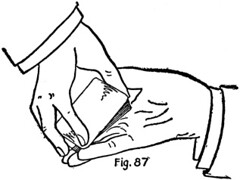
Here are two illustrations that bear on the questions of whether the book had a single illustrator or if the illustrations were traced from photos. Look at the nail of the left thumb (I am assuming that the performer in the illustrations is one individual!):
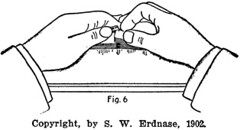
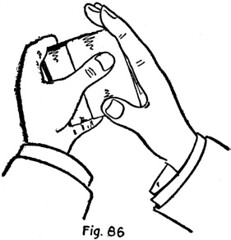
I assume a manicure of some kind between illustrations would be another explanation!
I assume a manicure of some kind between illustrations would be another explanation!
Does anyone know how many angels can dance on the point of a pin?
Quentin... it's the point of a needle, not a pin. ;)
It's the head of a pin - as apropos of ...
Eye of a needle, head of a pin... the sentiment is clear in either case... (};o)
Is is possible that that Smith did the pencil roughs and handed them to an assistant to ink or "finish?" That could explain why he didn't have a clear memory of the illustrations, but he recognized his lettering.
Is is possible that that Smith did the pencil roughs and handed them to an assistant to ink or "finish?" That could explain why he didn't have a clear memory of the illustrations, but he recognized his lettering.
In Feb 2008, I mentioned that the AAA in Washington DC had a scrapbook on Marshall Smith in their collection. Richard Hatch had already examined it (of course).
The Metropolitan Museum of Art, in their Thomas J. Watson library, has a file of "miscellaneous ephemeral material" on Smith. I've emailed to ask if it has any Erdnase-related material (but someone on the Forum has probably already checked it out . . .)
The Metropolitan Museum of Art, in their Thomas J. Watson library, has a file of "miscellaneous ephemeral material" on Smith. I've emailed to ask if it has any Erdnase-related material (but someone on the Forum has probably already checked it out . . .)
The one thing I learned from my examination of the Marshall D Smith scrapbook in DC was that his middle name was Dennison. Useful to know for trivia contests at magic conventions...
I spoke yesterday to one of his grand-nieces who has his personal belongings in her attic and has promised to prioritize going through them (I hadn't talked to her in about 6 years). I don't expect she'll find anything, but you never know until you look.
I spoke yesterday to one of his grand-nieces who has his personal belongings in her attic and has promised to prioritize going through them (I hadn't talked to her in about 6 years). I don't expect she'll find anything, but you never know until you look.
Bill Mullins wrote:The Metropolitan Museum of Art, in their Thomas J. Watson library, has a file of "miscellaneous ephemeral material" on Smith. I've emailed to ask if it has any Erdnase-related material (but someone on the Forum has probably already checked it out . . .)
Not sure when I'm going to be in Manhattan next, but I'd be happy to take a look through the file next time I'm there (again, assuming no one else has already looked into it).
-Jim
Richard Hatch wrote:Smith clearly recalled his first meeting with the author, sketching his hands in pencil from life, taking them home to ink them in after each sketch was approved by the author. He claimed the author was not concerned with the illustrations' artistic merit, so long as they accurately conveyed the information.
Smith told Gardner he thought the job took him about two weeks.
Thanks Richard - this is only speculation - if the illustrations were done in only one meeting - could Smith have done them with less detail and have after each sketch was approved by the author (Erdnase) - when he took them home to ink - added more detail to the illustrations during the two weeks he inked them at home?
Adding detail later when they inked them might have made the job faster when they met in the hotel room - as the story goes.
I did a search with the Forum Search Tool and could not locate any reference to Jay Marshall talking to Mrs. Minkley. If I missed it I am sorry to be repetitive. As you recall, she was the sister to Andrews wife. She recalled (1) that Andrews had indeed wrote a book, but remembered it a little thicker than the edition Jay showed her.
That is reasonable,there could have been multiple reasons for this.
She also talks about him doing card tricks.
Then Pratt in a letter to Gardner states that the book would not sell and Andrews was holding the bag. Then to create a market, magic was added (2).
He then said he heard of his death after being friendly with him from 1897-1904. (3)
Also when the police went through his belongings after his death they did find a book on card tricks.(4)
This is very compelling information. Between Harte, Pratt, Minkley and Audley Dunham. There is a great deal of collaboration of people that were around Andrews more than Smith if indeed Andrews was Erdnase.
(1) The Annotated Erdnase by Darwin Ortiz
(2) Letter from Pratt to Gardner
(3) The Annotated Erdnase by Darwin Ortiz
(4) San Francisco Newspaper Account
That is reasonable,there could have been multiple reasons for this.
She also talks about him doing card tricks.
Then Pratt in a letter to Gardner states that the book would not sell and Andrews was holding the bag. Then to create a market, magic was added (2).
He then said he heard of his death after being friendly with him from 1897-1904. (3)
Also when the police went through his belongings after his death they did find a book on card tricks.(4)
This is very compelling information. Between Harte, Pratt, Minkley and Audley Dunham. There is a great deal of collaboration of people that were around Andrews more than Smith if indeed Andrews was Erdnase.
(1) The Annotated Erdnase by Darwin Ortiz
(2) Letter from Pratt to Gardner
(3) The Annotated Erdnase by Darwin Ortiz
(4) San Francisco Newspaper Account
Eoin, your scanning and posting of M.D. Smiths Expert illustrations represent a ton of work on your part, and are an excellent resource in this somewhat historic thread on Erdnase.
I thank-you for your efforts!
I thank-you for your efforts!
RE: Marshall Smith and photography. In the Nov 1918 issue of American Photography, it was announced that Marshall D. Smith had taken an honorable mention prize in their monthly competition for his photograph The Artist. (as found on Google Books). Later on (ca. 1925), I found reference to him participating in the Chicago Camera Club in meetings held at the Art Institute in Chicago.

Here's the (in)famous fig 69. From the pattern of shading around the heart shape on the back of the left hand, this looks as though a section has been cut from the image rather than drawn on it.
As a general observation of the illustrations: the pictures in EATCT have been carefully chosen. They vary from performer's view, opponent/spectator view and 'exposed' view. I'd be interested to hear from Richard K and others who have experience of selecting which images to show in publications - In the process of producing illustrations, what proportion have to be re-thought (e.g. if the angle is wrong) or scrapped (e.g. when the illustration just doesn't work)? What's the attrition rate? It seems to me that there's far more to it than simply asking someone to draw (or photograph) your hands. I wonder whether Erdnase worked his way up to 101 illustrations, or worked his way down to that number by discarding surplus drawings.
My second question to those in the know is to what extent EATCT differs from other card magic/gambling books of that time in the level of detail shown in the illustrations? Does EATCT mark a departure from the norm, or is it consistent with scope and detail of similar books?
Geno Munari wrote:This is very compelling information. Between Harte, Pratt, Minkley and Audley Dunham. There is a great deal of collaboration of people that were around Andrews more than Smith if indeed Andrews was Erdnase.
Geno, I have done quite a bit of research on Harte, Pratt and Minkley. The only connection between Harte and MFA is through Pratt, who told Gardner that Harte had helped with the book. Gardner followed up and found two associates of Pratt (Charles Maly and Audley Dunham) who both confirmed that Harte claimed some association with Erdnase (but not necessary that he helped with the book, only Pratt makes that claim). Neither Dunham nor Maly have anything to say that would connect Erdnase to MFA. But because Pratt had told Gardner about the possible Harte connection, when Gardner found some corroboration for that connection it gave Pratt credibility for Gardner that had previously been lacking. I personally don't find Pratt a credible witness for MFA at all. I don't see any evidence that he know MFA personally (though he could have). Everything he told Gardner about MFA was in "THE MALTED MILK MURDERER" article that Pratt later sold to Kanter and that was published before Pratt met Gardner. He never told Gardner about that article, and he sold Kanter a photo that is almost certainly of Pratt's older brother, claiming it was a photo of MFA. Again, he never told Gardner (who by then knew enough about MFA to have called Pratt's bluff) about the photo.I think Pratt's strange behavior is most easily explained by assuming that he did not know MFA personally, but was the first to make the MFA=Erdnase connection after reading the Malted Milk Murderer article.
Minkley's testimony is very interesting. Jay Marshall visited his parents in Holyoke, Mass. and had an article published in the local paper about his interest in the MFA case, as related to the MFA=Erdnase theory, since MFA had lived there, hoping to stir up some local memories. Mrs. Minkley contacted the newspaper (as did a cousin) to tell them that she was MFA's sister-in-law. According to the newspaper editor's report to Marshall, at that time she reported knowing nothing about a book. Marshall, a local celebrity thanks to his national television appearances, calls her up from Chicago to ask her about MFA. This was likely a rather exciting surprise for her, and at that point she recalls that he had sold some typed manuscripts on gambling, but is very vague in her recollection. Gardner makes an appointment to meet with her after an upcoming televised appearance in New York. He takes the train up from New York to interview her and brings with him a copy of the book. Apparently he brought the Fleming edition, as it was handy (Marshall may not have owned a first edition at that time). When she meets him and sees it, she apparently reports that MFA's book was thicker. That would call her recollection into question, as the Fleming edition is by far the thickest, and much thicker than a first edition. Ironically, she thinks she recognizes the illustrations (unlike Marshall Smith, the illustrator!), but not much else. Now, she would have been in her late teens when MFA was living in her parent's home, so she was not a small child. Wouldn't the most remarkable thing about the book, even 50 years later, be the fact that your brother-in-law's name was not on the book he supposed authored, but instead a version of his name in reverse?
It's not that I don't want to believe her, as I actually think MFA is a very good candidate (credible last name, knowledge of gambling and interest in magic... Minkley describes some card tricks he did for her... and he died shortly after the book's publication, neatly explaining why the author so proud of his work never revealed himself to his fans once the book became a success...), but I find her testimony more in line with prompted false memories, an attempt to tell Jay Marshall what he was hoping to hear after travelling a great distance to see her immediately after a nationally televised appearance. If her claim of having seen copies of the book were credible, that would pretty much seal the case in favor of MFA. But I don't find them so. Equally damning in my opinion are MFA's older brother Alvin's lack of any knowledge of the book, though he knew all about his brother's gambling and was close enough to him to advise him to escape to Australia via Canada when wanted on murder charges. The claim that MFA didn't tell his brother about the book because he was embarrassed by it (Gardner and Whaley/Busby's conjecture) makes no sense at all to me. The author was proud of his work, not ashamed. And how does writing a book on card cheating compare with multiple murder charges on the shame scale? I think his brother would have known about the book and would have told Gardner so. Indeed, I am pretty sure that Alvin was dispatched to San Francisco to recover his brother's possessions, which would presumably have included the card magic book in the newspaper report. But Alvin knew nothing about the book and never even acknowledged Gardner's questions about it when Gardner sent him a copy with questions about whether it sounded like MFA and whether he could have written by himself.
Incidentally, I believe I cover most of this information on the Ackerman Erdnase DVDs. Check 'em out!
Cost of Photography at the Turn of the Century:
1896 ad:
4x5 print paper: 18 cents / dozen
Glass plates: 4 cents each
pocket Kodak film: 10 cents/ roll
4x5 film: 4 cents each
Glass Plate cameras: $7 to $11 each
1900 ad: Brownie Cameras, $1
1902 ad (Wanamakers Dept store, NYC):
Developing Plates: 2 - 5 cents each
Printing from plates: 3 cents and up, depending on size
Developing from film:
Rolls of 12, 15 cents each
Rolls of 6, 10 cents each
Printing from film, 3 to 6 cents each
1904 ad: "I will develop your No. 1 or No. 2 Brownie Film of 6 exposures and make 6 Velox Prints from them for the One Low Price of 15 cents."
It doesn't look like the cost of doing a 100 or so photos was so high it couldn't have been done. (But I still don't believe it was done. . . .)
1896 ad:
4x5 print paper: 18 cents / dozen
Glass plates: 4 cents each
pocket Kodak film: 10 cents/ roll
4x5 film: 4 cents each
Glass Plate cameras: $7 to $11 each
1900 ad: Brownie Cameras, $1
1902 ad (Wanamakers Dept store, NYC):
Developing Plates: 2 - 5 cents each
Printing from plates: 3 cents and up, depending on size
Developing from film:
Rolls of 12, 15 cents each
Rolls of 6, 10 cents each
Printing from film, 3 to 6 cents each
1904 ad: "I will develop your No. 1 or No. 2 Brownie Film of 6 exposures and make 6 Velox Prints from them for the One Low Price of 15 cents."
It doesn't look like the cost of doing a 100 or so photos was so high it couldn't have been done. (But I still don't believe it was done. . . .)
Not debating the cost of the actual photos, but the reproduction of them in a book. Photographic reproduction in books, as I understand it, was in its infancy back then. The cheap paper that the original edition was printed on would not have reproduced a photo well at all.
As for the necessity of photos - absent photographic reference the author would have had to have determined the exact poses he wanted to use well in advance and then be able to hold them for the requisite time for the artist to draw them. See Figures 6 and 56 and think of the POV and imagine how those were drawn if not from a photo.
As for the necessity of photos - absent photographic reference the author would have had to have determined the exact poses he wanted to use well in advance and then be able to hold them for the requisite time for the artist to draw them. See Figures 6 and 56 and think of the POV and imagine how those were drawn if not from a photo.
As I understand the process, the "heart" on the back of Fig 69 is an artifact or "ridge" of metal left over from the making of the cut. Someone just got sloppy.
I have located some interesting evidence that Andrews had left that I don't think has been reported here or any other printed articles. (1)
"Everything that could lead to a positive identification had been destroyed or taken away by Brush and the woman. He left, however, what apparently a telegraph cipher code, a private code, and written in pencil in a vest pocket memorandum book, which is accepted as evidence that he is one of a gang."
So possibly this code was used to send telegrams in code and also to make anagrams. Sending a telegram in code requires words that have some meaning that can be spoken and not just a bunch of scrambled letters, otherwise it would have drawn suspicion. This is a pattern that Andrews used; scrambled names an aliases such as Nulda Petrie=Edna Little etc.
If there was a way to search old telegrams there could be some more clues to who Erdnase really was.
Also if Andrews used codes he may have a secret message in Expert!
Notes: (1) Whaley may have found this info but I don't think it was examined to any degree in TMWWE. Gardner was not aware of this information at all.
"Everything that could lead to a positive identification had been destroyed or taken away by Brush and the woman. He left, however, what apparently a telegraph cipher code, a private code, and written in pencil in a vest pocket memorandum book, which is accepted as evidence that he is one of a gang."
So possibly this code was used to send telegrams in code and also to make anagrams. Sending a telegram in code requires words that have some meaning that can be spoken and not just a bunch of scrambled letters, otherwise it would have drawn suspicion. This is a pattern that Andrews used; scrambled names an aliases such as Nulda Petrie=Edna Little etc.
If there was a way to search old telegrams there could be some more clues to who Erdnase really was.
Also if Andrews used codes he may have a secret message in Expert!
Notes: (1) Whaley may have found this info but I don't think it was examined to any degree in TMWWE. Gardner was not aware of this information at all.
David Alexander wrote: Not debating the cost of the actual photos, but the reproduction of them in a book. Photographic reproduction in books, as I understand it, was in its infancy back then. The cheap paper that the original edition was printed on would not have reproduced a photo well at all.
It didn't take long searching in Google Books to find several books ca. 1900 - 1905 that were heavily illustrated with photographs, and by searching for their titles within the text of books, find "books in Print" listings and bookseller catalogs and book reviews which listed their prices. $1 to $2 is typical.
In other words, it doesn't seem that the presence of photographs would have made the price of the book exhorbitantly more than it already was.
Does anyone know what the first magic book to be illustrated with photographs was (probably stage illusions)? What was the first close-up/card tricks book to be so illustrated with photos?
Geno -- what is the source of this quote? A contemporary newspaper article? Can you provide specifics?Geno Munari wrote:I have located some interesting evidence that Andrews had left that I don't think has been reported here or any other printed articles. (1)
"Everything that could lead to a positive identification had been destroyed or taken away by Brush and the woman. He left, however, what apparently a telegraph cipher code, a private code, and written in pencil in a vest pocket memorandum book, which is accepted as evidence that he is one of a gang."
So possibly this code was used to send telegrams in code and also to make anagrams. Sending a telegram in code requires words that have some meaning that can be spoken and not just a bunch of scrambled letters, otherwise it would have drawn suspicion.
I think perhaps you are jumping to an unwarranted conclusion. Telegraph codes have historically been used to
1. Shorten the number of characters to be sent and
2. Encrypt (make secret) the message being sent.
These codes sometimes have a cleartext which is legible, but nonsense ("Send me 1000 decks of Cards" => "turtles boat")
or sometimes have a cleartext which appears to be gibberish ("Send me 1000 decks of Cards" => "JEXTG PEMNN")
Again, a few minutes searching in Google Books (search for "telegraph code" with dates before 1920) confirms the above. See For Example.
Yes the codes were very common in those days. Here is a link to Pinkerton's http://www.pimall.com/nais/pivintage/te ... ipher.html
All these facts about Andrews are strictly speculation and theories, which are fun to explore without drawing a definitive conclusion.
It is just interesting that this private code has never been discussed since it was found in his personal articles.
The source is San Francisco Chronicle, Oct. 14, 1905.
All these facts about Andrews are strictly speculation and theories, which are fun to explore without drawing a definitive conclusion.
It is just interesting that this private code has never been discussed since it was found in his personal articles.
The source is San Francisco Chronicle, Oct. 14, 1905.
During a discussion about Erdnase over dinner the other night, a friend - Bert Kish - who is a film director and editor by trade, suggested that it was highly unlikely that photographs were used. He suggested that the light required to film close up images of hands on the film stock available at the time, coupled with how long the person would have to hold the cards completely still in order to not have a blurry image, one that would capture detail and permit tracing, etc, rules out photographs as the source for the images.
David -- Edward Muybridge was making photographs of galloping horses 20 years before Erdnase. These were fast enough to see all four feet off the ground.
The Kodak "Brownie" started being marketed in 1900. Their selling point was that they made "snapshots" -- point and shoot.
By the time of Erdnase, photographic technology had advanced sufficiently that the photographs could have been easily taken.
The Kodak "Brownie" started being marketed in 1900. Their selling point was that they made "snapshots" -- point and shoot.
By the time of Erdnase, photographic technology had advanced sufficiently that the photographs could have been easily taken.
Yes, by 1900 photography was no longer the type of thing where a sitter had to be motionless for minutes in order to achieve an adequate exposure as had been the case even 20 years earlier.
Bill Mullins wrote:Does anyone know what the first magic book to be illustrated with photographs was (probably stage illusions)? What was the first close-up/card tricks book to be so illustrated with photos?
Unless I'm mistaken, I think the first magic book illustrated by photos is C. Lang Neil's "The Modern Conjurer", published in 1903 in England.
Marco Pusterla wrote:
Unless I'm mistaken, I think the first magic book illustrated by photos is C. Lang Neil's "The Modern Conjurer", published in 1903 in England.
I believe the first edition was published in 1902 (the same year as Expert) and was advertised as "with over 400 illustrations from photographs of Actual Tricks".
In Jason England's lecture notes, "Second thoughts: Notes on the Second Deal" ( which are excellent, by the way), he reproduces what he describes as the earliest known photograph of a strike second deal.
The photograph, highly detailed and looking like it could have been taken yesterday, is from "Combined treatise on Advantage Card Playing and Draw Poker" by F.R.Ritter published in 1905.
I'm not familiar with the actual book so I'm not sure how many photographs are in it, maybe Jason could tell us more about the book?
The photograph, highly detailed and looking like it could have been taken yesterday, is from "Combined treatise on Advantage Card Playing and Draw Poker" by F.R.Ritter published in 1905.
I'm not familiar with the actual book so I'm not sure how many photographs are in it, maybe Jason could tell us more about the book?
Don't forget the Art of Conjuring. Can't recall the year, but it's 1902 or 03 (I think). The book is notable for two things: one, it uses photographs; two, one of those photos shows a folding coin in its folded position, masquerading as two coins.
I understand the Muybridge images and process but I do not recall his camera being fixed on the extreme close ups required to capture such detail in the card work that is represented. I acquired a Muybridge series of images of hands holding a writing instrument for a friend and none of the images had that sort of clarity. I'm sure that I probably misquoted my friend but I thought that main issues was providing enough light to get the definition on the edge work. It's still a problem and I know, from shooting some 1500 photographs for the Zarrow book with a high end Nikon camera, and with lights, how difficult it is.
I do not believe, for example, that the photos in the Ritter book come even close to the mark.
I do not believe, for example, that the photos in the Ritter book come even close to the mark.
In those days large publishers could amortize the cost of the then-expensive process of reproducing photographs on large print runs and many titles. Half-tone blocks became a staple in printing photos in popular journals in the late 1890s.
That they could do this is not comparable to a small, self-published book with an apparently limited budget done by a small printer who was unlikely to have the expensive equipment to reproduce photographs.
It would be interesting to have an original copy of "The Modern Conjuror" taken to a printer to determine the number of lines on the screen used to reproduce the photos. The higher the number of lines in the screen, the finer the reproduction... and the more expensive the paper needed.
Was C. Lang Neil's book done as a commercial enterprise (to make a profit) or was it subsidized by the author as a vanity publication? That would make a difference in the decisions made about production values. Is not his wife featured throughout?
That they could do this is not comparable to a small, self-published book with an apparently limited budget done by a small printer who was unlikely to have the expensive equipment to reproduce photographs.
It would be interesting to have an original copy of "The Modern Conjuror" taken to a printer to determine the number of lines on the screen used to reproduce the photos. The higher the number of lines in the screen, the finer the reproduction... and the more expensive the paper needed.
Was C. Lang Neil's book done as a commercial enterprise (to make a profit) or was it subsidized by the author as a vanity publication? That would make a difference in the decisions made about production values. Is not his wife featured throughout?
Richard's comment regarding The Art of Modern Conjuring is very interesting. I have a first edition and the photos are interesting but quite washed out. I believe it would be difficult for an artist to work without the person who posed for them looking over his shoulder constantly to correct what should or should not be emphasized in the illustration. If he's going to do that, he might as well just stay with him as he illustrates them "from life".
If you turn to page 72 of The Art of Modern Conjuring, for example, and look at photo 2, you see two hands coming together for the French Drop. The hands are in a sort of "diagonal palm shift position" and, as there is not enough lighting, you can barely make out that the left hand is holding a coin. It's in the shadow.
If you turn to page 72 of The Art of Modern Conjuring, for example, and look at photo 2, you see two hands coming together for the French Drop. The hands are in a sort of "diagonal palm shift position" and, as there is not enough lighting, you can barely make out that the left hand is holding a coin. It's in the shadow.
David Ben wrote: If you turn to page 72 of The Art of Modern Conjuring, for example, and look at photo 2, you see two hands coming together for the French Drop. The hands are in a sort of "diagonal palm shift position" and, as there is not enough lighting, you can barely make out that the left hand is holding a coin. It's in the shadow.
But is that an artifact of the printing? What if the artist was looking at the original photograph? Wouldn't it be in better quality?
I don't believe the original photograph would have been much better for purposes of tracing. I base that on comparing the other photographs in the book - which have some degree of clarity given the distance and light available to shoot them compared to extreme close-ups of hands and technique. Also, how large an image could be pulled from the negative circa 1901, assuming that the photographer, a relatively young artist, had the latest equipment? How much time would it take to develop over 100 images to use as a base. Why would an artist - if he had anything to do with it - allow someone to say "drawn from life" when, in fact, they were traced. What does that do for his reputation, and for getting other work. (What? You traced them from photographs!)
I believe the main reason we entertain the notion of photographs is because Vernon mentioned that his father received a book on gambling with photographs. Vernon assumed that it was ECT. I personally checked the copyright registries in Ottawa - entered by hand, most likely be Vernon's father - and it was the Ritter book - as I mentioned in the biography - that was entered into the directory.
I believe the main reason we entertain the notion of photographs is because Vernon mentioned that his father received a book on gambling with photographs. Vernon assumed that it was ECT. I personally checked the copyright registries in Ottawa - entered by hand, most likely be Vernon's father - and it was the Ritter book - as I mentioned in the biography - that was entered into the directory.
David,
Are your comments directed at Expert or are you still commenting on The Art of Modern Conjuring? It is unclear to me.
Are your comments directed at Expert or are you still commenting on The Art of Modern Conjuring? It is unclear to me.
I currently have nothing to add to the Erdnase discussion at hand but...
David's observation on The Modern Conjurer struck a chord. I happen to have a copy of the earliest American edition (1902: J.B. Lippincott with Neil spelled "Niel" on the spine, apparently a rarity; this preceded the UK edition). For giggles, I took my line screen determiner to Figure 10 on page 248. My rudimentary screen tool only goes up to 133lpi, but it appears that the screen is at least 150lpi. It is somewhat surprising that the line screens were reproduced in such fine detail as it would certainly add to the cost of the book.
Seeing that no less a notable than Charles Bertram was featured in the photos (in addition to J.N. Maskelyne, Flicien Trewey, Nelson Downs, Paul Valadon, Ellis Stanyon and Mlle. Patrice (definitely Neil's wife according to Eddie Dawes), it would not surprise me if shares were offered to the contributors to raise the quality of the finished product.
That being said (and having no evidence to indicate that any shares were in fact sold), the American publisher (originated in Philadelphia), J.B. Lippincott & Co., was founded in 1836 as a publisher of Bibles, prayer books and other religious works. They expanded quite successfully into trade books, what we might refer to today as the "niche market". I don't really believe that they were a vanity press per se. With Neil's connections in the advertising world it is likely that he sought out one of the larger publishing houses. The quality and standard of their print capabilities would likely not allow them to produce an inferior product and the smaller-run trade books may well have served as their laboratory for testing more advanced techniques before adopting them on a larger scale. For what it is worth, Lippincott still exists today in merged form as Lippincott Williams & Wilkins and maintains its headquarters in Philadelphia.
One final note: according to Eddie Dawes, The Modern Conjurer does not have the distinction of being the first magic book to utilize photographs, but rather it is the first to use "full body" photographs to communicate body language [The Magic Circular 74, 83-86 (1980); from The Rich Cabinet of Magical Curiosities published by Peter Scarlett Magic / www.peterscarlett.com].
What book holds the distinction of the first to use photographs for instruction? I have no idea, but would certainly be interested in finding out the answer...
Back to our regularly-scheduled programming...
David's observation on The Modern Conjurer struck a chord. I happen to have a copy of the earliest American edition (1902: J.B. Lippincott with Neil spelled "Niel" on the spine, apparently a rarity; this preceded the UK edition). For giggles, I took my line screen determiner to Figure 10 on page 248. My rudimentary screen tool only goes up to 133lpi, but it appears that the screen is at least 150lpi. It is somewhat surprising that the line screens were reproduced in such fine detail as it would certainly add to the cost of the book.
Seeing that no less a notable than Charles Bertram was featured in the photos (in addition to J.N. Maskelyne, Flicien Trewey, Nelson Downs, Paul Valadon, Ellis Stanyon and Mlle. Patrice (definitely Neil's wife according to Eddie Dawes), it would not surprise me if shares were offered to the contributors to raise the quality of the finished product.
That being said (and having no evidence to indicate that any shares were in fact sold), the American publisher (originated in Philadelphia), J.B. Lippincott & Co., was founded in 1836 as a publisher of Bibles, prayer books and other religious works. They expanded quite successfully into trade books, what we might refer to today as the "niche market". I don't really believe that they were a vanity press per se. With Neil's connections in the advertising world it is likely that he sought out one of the larger publishing houses. The quality and standard of their print capabilities would likely not allow them to produce an inferior product and the smaller-run trade books may well have served as their laboratory for testing more advanced techniques before adopting them on a larger scale. For what it is worth, Lippincott still exists today in merged form as Lippincott Williams & Wilkins and maintains its headquarters in Philadelphia.
One final note: according to Eddie Dawes, The Modern Conjurer does not have the distinction of being the first magic book to utilize photographs, but rather it is the first to use "full body" photographs to communicate body language [The Magic Circular 74, 83-86 (1980); from The Rich Cabinet of Magical Curiosities published by Peter Scarlett Magic / www.peterscarlett.com].
What book holds the distinction of the first to use photographs for instruction? I have no idea, but would certainly be interested in finding out the answer...
Back to our regularly-scheduled programming...
I don't entertain the notion of photographs because of anything Vernon said, but because in looking at the anatomy of the drawings (as someone who has drawn about 10,000 hands), that is how I think they were drawn.
And, just because you're tracing photos doesn't require you to copy their line exactly--if you look at my drawings, Ton Onosaka's, and Earle Oakes', all generally draw from photographs I've taken, yet all the hands look entirely different (anatomy of the individual subjects aside). My drawings look very flat, Earle's look very modeled, Ton's are also flat and have a thicker look to the fingers. You can also draw more quickly when using photos and get a more accurate representation of the anatomy. It also doesn't matter if the photo is slightly dark, or washed out, or even blurry--if you can draw, you can find a line in there.
And, just because you're tracing photos doesn't require you to copy their line exactly--if you look at my drawings, Ton Onosaka's, and Earle Oakes', all generally draw from photographs I've taken, yet all the hands look entirely different (anatomy of the individual subjects aside). My drawings look very flat, Earle's look very modeled, Ton's are also flat and have a thicker look to the fingers. You can also draw more quickly when using photos and get a more accurate representation of the anatomy. It also doesn't matter if the photo is slightly dark, or washed out, or even blurry--if you can draw, you can find a line in there.
Thank you Andrew for looking at the pictures in The Modern Conjuror. One hundred and fifty lines is extremely fine screening, probably the best possible back in that day. Before the world went digital, newspapers usually printed photos at 85 lpi. High quality reproduction is still at 133 and 150 lpi, although some modern presses can go higher.
And back to Smith and his drawings - he claimed that the job probably took "two weeks." I don't buy it because it doesn't ring true. He remembered the audition, his interaction with Erdnase, the weather on the way to the hotel, the condition of the man's hands, the small board he used, what he [Smith] thought he did for his client, and a bit of magic done by Erdnase.
To my knowledge Smith never said anything about any interaction that occurred over a two week period when he, presumably, would have been sketching the various poses had this been done from life and not from photographic reference.
Had this really been a two-week job there would have been some sort of human interaction between the two men....conversation, an exchange of ideasstories. Erdnase claimed to be a reformed gambler. How many people like that had the young Smith met? How many books like this had he ever illustrated? None before, as best we can tell, and none since. It was an anomaly in his life and people tend to remember anomalies. Meeting Erdnase was an anomaly and Smith remembered one meeting.
Erdnase wanted to establish some sort of rapport with Smith given the story about being related to Dalryrmple so one presumes that sometimes during a two-week period, during breaks, a shared meal perhaps, there would have been some human contactbut Smith remembered nothing which is another reason why I believe it was a simple tracing job to make cutsrelatively unremarkable and not Smiths usual line of work since he only recognized his lettering when shown the book. For me, knowing what I know about art, thats a dead giveaway.
And back to Smith and his drawings - he claimed that the job probably took "two weeks." I don't buy it because it doesn't ring true. He remembered the audition, his interaction with Erdnase, the weather on the way to the hotel, the condition of the man's hands, the small board he used, what he [Smith] thought he did for his client, and a bit of magic done by Erdnase.
To my knowledge Smith never said anything about any interaction that occurred over a two week period when he, presumably, would have been sketching the various poses had this been done from life and not from photographic reference.
Had this really been a two-week job there would have been some sort of human interaction between the two men....conversation, an exchange of ideasstories. Erdnase claimed to be a reformed gambler. How many people like that had the young Smith met? How many books like this had he ever illustrated? None before, as best we can tell, and none since. It was an anomaly in his life and people tend to remember anomalies. Meeting Erdnase was an anomaly and Smith remembered one meeting.
Erdnase wanted to establish some sort of rapport with Smith given the story about being related to Dalryrmple so one presumes that sometimes during a two-week period, during breaks, a shared meal perhaps, there would have been some human contactbut Smith remembered nothing which is another reason why I believe it was a simple tracing job to make cutsrelatively unremarkable and not Smiths usual line of work since he only recognized his lettering when shown the book. For me, knowing what I know about art, thats a dead giveaway.
Richard Kaufman wrote:I don't entertain the notion of photographs because of anything Vernon said, but because in looking at the anatomy of the drawings (as someone who has drawn about 10,000 hands), that is how I think they were drawn.
That doesn't necessarily mean photographs. I'm an artist myself, and I've got plenty of folks to back up my abilities. It's possible to draw as well from life as from a photograph. Particularly given the nature of the Smith drawings and the level of detail: the anatomy is stellar, true, but the way it's depicted is general enough to distinguish it from the kind of work that Earl, Ton, or yourself do from photographs.
I would also consider that someone who lived as a professional artist in 1902 would possess a certain level of ability comparable to someone who made their living as a magician or card cheat in the same era.
-T
Further to Richard's observations above - good artists know anatomy and know what should be present, what must be present.
When my wife was studying anatomy for artists with Hal Reed many years ago Hal had his students draw figures from the skeleton up through the muscles and tendons and finally the skin. Good artists know what should be there so a line in a photo doesnt need to be visible to be drawn.
When my wife was studying anatomy for artists with Hal Reed many years ago Hal had his students draw figures from the skeleton up through the muscles and tendons and finally the skin. Good artists know what should be there so a line in a photo doesnt need to be visible to be drawn.
David Ben -- You seem to be making the case that because of technology, time constraints, cost, etc., it is not possible that the illustrations in EatCT were traced from photographs. If you'll check my posts over the previous few days, I think I've shown that this is not the case.
It isn't hard to find other books from that era (1900 - 1905) illustrated by a comparable number of photographs, and research shows that those books could be bought at prices comparable to that of Erdnase.
Photographic film wasn't described in ISO numbers as it is today, but indoor photographs were common, fast exposures had been done for years, and mass-production techniques had made cameras and film into consumer items, rather than costly items only seen at studios.
The photographs themselves weren't grossly expensive. Erdnase could have bought a camera, 12 rolls of 12-exposure film, had it developed at a studio or department store, and had prints made, all for under $20 or so. Not chicken feed in that era, but not a huge capital investment either.
Having said that, though, I still don't believe that is what happened. I think Smith drew from life for 3 reasons:
1. That's what the book says.
2. That's how Smith remembers it.
3. Some of the drawings are obviously (to me, at least) inconsistent with being traced from photos. (but some look to me as if they might have been traced -- I wonder if there is any correlation between those drawings and the copyright notices that appear on some?)
I believe that a well-drawn line drawing is more effective than a well-reproduced photograph in conveying the sort of information that the drawings in EatCT (or any of Kaufman's, or Onosaka's, or Oakes') try to convey. I doubt this conclusion could have been drawn in 1902, though, because there weren't enough photographically-illustrated magic books to draw a good conclusion.
It's my impression that the specific finger-placement instructions in EatCT are more detailed and accurate than those in any magic books that had gone before, but I haven't really studied this. If Erdnase went to extraordinary lengths to describe in words the particulars of how to hold a deck and move the fingers while making a sleight, wouldn't he have done likewise with the illustrations? Would he have known that photographs were simply not sufficient to convey the information that he needed the illustrations to convey (particularly since he had no way of knowing in advance how good the quality would be)?
Newspapers from that era are sometimes illustrated with drawings, and sometimes with photographs. I wonder if there is any data on which is more expensive -- to pay an artist to convert 100 pictures to line drawings, or to pay to have them screened.
It isn't hard to find other books from that era (1900 - 1905) illustrated by a comparable number of photographs, and research shows that those books could be bought at prices comparable to that of Erdnase.
Photographic film wasn't described in ISO numbers as it is today, but indoor photographs were common, fast exposures had been done for years, and mass-production techniques had made cameras and film into consumer items, rather than costly items only seen at studios.
The photographs themselves weren't grossly expensive. Erdnase could have bought a camera, 12 rolls of 12-exposure film, had it developed at a studio or department store, and had prints made, all for under $20 or so. Not chicken feed in that era, but not a huge capital investment either.
Having said that, though, I still don't believe that is what happened. I think Smith drew from life for 3 reasons:
1. That's what the book says.
2. That's how Smith remembers it.
3. Some of the drawings are obviously (to me, at least) inconsistent with being traced from photos. (but some look to me as if they might have been traced -- I wonder if there is any correlation between those drawings and the copyright notices that appear on some?)
I believe that a well-drawn line drawing is more effective than a well-reproduced photograph in conveying the sort of information that the drawings in EatCT (or any of Kaufman's, or Onosaka's, or Oakes') try to convey. I doubt this conclusion could have been drawn in 1902, though, because there weren't enough photographically-illustrated magic books to draw a good conclusion.
It's my impression that the specific finger-placement instructions in EatCT are more detailed and accurate than those in any magic books that had gone before, but I haven't really studied this. If Erdnase went to extraordinary lengths to describe in words the particulars of how to hold a deck and move the fingers while making a sleight, wouldn't he have done likewise with the illustrations? Would he have known that photographs were simply not sufficient to convey the information that he needed the illustrations to convey (particularly since he had no way of knowing in advance how good the quality would be)?
Newspapers from that era are sometimes illustrated with drawings, and sometimes with photographs. I wonder if there is any data on which is more expensive -- to pay an artist to convert 100 pictures to line drawings, or to pay to have them screened.
Bill,
Once again, it isn't a matter of what could be done back then but what Erdnase could afford. The fact that the book was printed on inexpensive pulp should be a clue. That and the logistics of actually doing 101 drawings from life which have been discussed previously.
And again, Smith did not recognize his own work at the beginning and then only thought he'd done far fewer illustrations than are actually in the book.
Once again, it isn't a matter of what could be done back then but what Erdnase could afford. The fact that the book was printed on inexpensive pulp should be a clue. That and the logistics of actually doing 101 drawings from life which have been discussed previously.
And again, Smith did not recognize his own work at the beginning and then only thought he'd done far fewer illustrations than are actually in the book.
Bill Mullins wrote:I believe that a well-drawn line drawing is more effective than a well-reproduced photograph in conveying the sort of information that the drawings in EatCT (or any of Kaufman's, or Onosaka's, or Oakes') try to convey.
could you elaborate on this point Bill?
Andrew Pinard wrote:
That being said (and having no evidence to indicate that any shares were in fact sold), the American publisher (originated in Philadelphia), J.B. Lippincott & Co., was founded in 1836 as a publisher of Bibles, prayer books and other religious works. They expanded quite successfully into trade books, what we might refer to today as the "niche market". I don't really believe that they were a vanity press per se. With Neil's connections in the advertising world it is likely that he sought out one of the larger publishing houses. The quality and standard of their print capabilities would likely not allow them to produce an inferior product and the smaller-run trade books may well have served as their laboratory for testing more advanced techniques before adopting them on a larger scale. For what it is worth, Lippincott still exists today in merged form as Lippincott Williams & Wilkins and maintains its headquarters in Philadelphia.
The book was advertised in the back of other Lippincott books, and in press releases in the NYTimes. It stayed in print until at least 1906. It went through later editions by Lippincott (1911 and 1922?).
All the appearances of a "real" book, not a vanity press book.
David Alexander wrote:Once again, it isn't a matter of what could be done back then but what Erdnase could afford. The fact that the book was printed on inexpensive pulp should be a clue.
Okay, are you saying it is more expensive to pay an artist to do drawings from life, than it is to pay for 100-odd photos, and then pay the artist to draw from them? That logic doesn't work.
If you are saying
1. He could only afford to have the book done on cheap paper,
2. That means he couldn't afford to have photographs reproduced (although photographs were commonly reproduced on newsprint of that era),
3. Therefore he had drawings done because that was all that could be reproduced,
4. Therefore the drawings were done from photographs
then I'm missing a step in this logical chain as well (particularly step 3 to 4). I'm willing to be convinced otherwise, I just don't follow the reasoning.
That and the logistics of actually doing 101 drawings from life which have been discussed previously.
Look, the drawings are GOOD. They do the job. Fingers are right, hand positions are right, angles are right. Erdnase had to have a major role in making sure that they were done properly -- Smith simply didn't have the card knowledge to do this. Either he guided Smith in drawing, or he guided a photographer (himself or another)
Consider:
1. Erdnase had a photographer who knew cards as well as did Erdnase, and gave a near-perfect set of prints to Smith who did an incredible job of transferring them to line drawings, OR
2. Erdnase took his own perfect photos, and handed them off to Smith, OR
3. Erdnase provided mediocre photos to Smith, but worked closely with him to get good drawings, OR
4. Erdnase and Smith met together and worked out the drawings together, without photos.
#4. is logistically the simplest, but requires that Smith spent more time with Erdnase than he remembered (but we already know he spent more time than he remembered, because there are more drawings than he remembered). Even with the real time feedback and cheap exposure cost of modern digital cameras, I couldn't imagine getting a set of photos as would be required for 1 and 2. Imagine doing it where you try and mentally compose the shot, take the picture, wait some length of time to get back prints, and then doing it again to fix the ones that didn't work. #3 is just as complicated as #4, except you add photos.
And again, Smith did not recognize his own work at the beginning and then only thought he'd done far fewer illustrations than are actually in the book.
There are inconsistencies in Smith's memory either way, and he was wrong on some points. If we assume he had a good memory WRT photographs, there were no photos because he didn't recall them. If his memory was so bad that he didn't remember photos, why do you put such faith in his description of the weather? You can interpret his memory in a way that supports your idea of what happened, and I do so likewise. To me, the dispositive points are that the book says "from life"; and that details in illoes #17-18; 52-54; 77-78; 90; and likely other places are inconsistent with tracing from photos.
Assuming photos were used, do you think that Erdnase took the pictures himself, or hired it out? If he did it himself, how did he pose -- with assistants, or a mirror, or trial and error with many wasted photos? Did W. E. Sanders have any experience with photography as of 1902 that you've found (on the other hand, did he have any personal artistic skills)? Were any other books by Drake/McKinney of this era illustrated by photos, or do line drawings in them look to be based on photos? Does Smith's other work from this era look different in ways that are best explained by being freehand as opposed to tracing from photos? Did light boxes for tracing exist then?
Richard Kaufman -- when you draw from "pre-illustrative photography", do you trace from prints, from transparencies over a light box, do you copy one from another, does it typically average more than one photo to get one good drawing, is it easy to pose the hands to get the photograph you want -- how efficient is the process?
I don't consider my position to be rock-solid beyond discussion (although I think I'm right), but since yours is contrary to the text, I think the burden of proof is on you to put together a case backing it up. Some circumstantial evidence is consistent with your case, but I think most isn't.
Seuss wrote:Bill Mullins wrote:I believe that a well-drawn line drawing is more effective than a well-reproduced photograph in conveying the sort of information that the drawings in EatCT (or any of Kaufman's, or Onosaka's, or Oakes') try to convey.
could you elaborate on this point Bill?
Compare any book illustrated by the above artists, or Tom Gagnon, or Steve Beam, or Steranko, to a magic instruction book illustrated by photographs (Stars of Magic, the Slydini books, one of Kaufman's Darwin Ortiz books, for example). I think it's easier to follow drawings. Your mileage may vary.
I could imagine that the photos might have been too dark, or 'busy', or too light, for Andrews to conclude that he should have them converted to line drawings. This would keep all focus on the hands.
Bill Mullins wrote:If you are saying
1. Erdnase had a photographer who knew cards as well as did Erdnase, and gave a near-perfect set of prints to Smith who did an incredible job of transferring them to line drawings, OR
2. Erdnase took his own perfect photos, and handed them off to Smith, OR
3. Erdnase provided mediocre photos to Smith, but worked closely with him to get good drawings, OR
4. Erdnase and Smith met together and worked out the drawings together, without photos.
What about? 5. Erdnase provided mediocre photos to Smith, worked closely with him to get some good drawings. Erdnase saw how Smith traced the photos. Erdnase went back home and did the rest of them himself.
One must remember that to the best of our knowledge Erdnase was an amateur book publisher and may have approached his book as a one-off project. His original intention may have been to do one run of a few hundred books, sell them through whatever sources hed developed (we know he had pupils) and then be done with it.
So, lets take Mullins points. The process of developing the material and writing the book almost certainly took Erdnase years. He may have taken pictures along the way which would possibly produce photographs of varying quality. Taking them himself would have been easy enough with a remote shutter release a bulb under his foot. As Bill has shown, photography was easy and cheap enough for Erdnase to have taken a series of pictures and had them developed. He did not need an expert photographer.
As I said earlier, newspapers reproduced photographs at 85 lines per inch because of the cheapness of newsprint. What they produced was sufficient for something that would be read and then thrown away. That a more expensive process was available is clearly evidenced by The Modern Conjuror produced contemporaneously, but that is a book printed on different quality paper with different presses with a far more expensive process in making the pictures. The two are comparable if only as evidence that Erdnase could have produced something similar had he the knowledge, willingness, and financial resources to do so.
It is possible that the quality of the photographs was not sufficient for reproduction or that McKinney (and McKinney alone, dont bring in Drake as he wasnt a part of this) did not have the equipment to either make the necessary halftones or the presses to run them. Again, comparing a small run, special-interest book that was self-published and printed by a small printer to a large newspaper or a large book publisher is not logical.
The illustrating artist does not need any special knowledge to produce quality drawings. My wife has no magic knowledge and yet she was able to do all of the illustrations for Randis book a few years back. How those came about supports Smiths experience. Randi dawdled for a year in producing the material for the book and never got around to producing the reference photography. We showed up at his hotel in Hollywood with the manuscript and pushed him to pose for the reference photos. A pillow on the bed was draped with the coat from his Armani suit to provide a dark background and the reference photos were taken. From them my wife produced the illustrations. The photos were not remotely sufficient to reproduce in the book.
How much card knowledge did Donna Allen have when she produced her beautiful drawings for Expert Card Technique?
The drawings in Erdnase are good? Not compared to Donna Allens fine work as far as Im concerned. Smiths work is sufficient for the task.
Your various scenarios are not complete. Smith could have been brought in when Erdnase was told that the photos were not sufficient for reproduction and/or too expensive for his budget to reproduce in higher quality (assuming McKinney had the equipment to make the halftones and the presses to run them and that Erdnase was willing to pay for the more expensive process and more expensive paper)or, Erdnase could have been planning all along that the photos could have been converted to cuts and the photographs were simply sufficient to the task as was our experience with the Randi project.
Number 4 is not the simplest and you draw a conclusion that Smith spent more time with Erdnase because he produced more drawings than he remembered. Again, one meeting is all it would have taken. Smith did a few quick sketches to prove his skill to Erdnase, the photos were handed over, the tracings were done at Smiths studio and later delivered to either Erdnase or McKinney. Smith got a check and that was the end of it. The meeting with Erdnase was memorable to Smith but the art work he produced was so minimal that he didnt bother to get a copy of the book for his portfolio because it wasnt representative of his work. Commercial artists normally keep a representative record of their work for selling future work. Why didnt Smith bother to obtain a copy of the book as reference?
For some reason as yet unexplained you seem to find details in illoes #17-18; 52-54; 77-78; 90; and likely other places are inconsistent with tracing from photos. Sorry Bill, to me that makes no sense. I would suggest, just as an exercise, holding the position of Fig 78 steady for ten minutes so an artist can sketch it up. Far more efficient for Erdnase to have all the poses already done, in photographic reference as the other way he would have to have the poses in his head, or suggested in notes, and it would have been a job of many hours involving prolonged interaction with Smith, something Smith did not remember.
So, lets take Mullins points. The process of developing the material and writing the book almost certainly took Erdnase years. He may have taken pictures along the way which would possibly produce photographs of varying quality. Taking them himself would have been easy enough with a remote shutter release a bulb under his foot. As Bill has shown, photography was easy and cheap enough for Erdnase to have taken a series of pictures and had them developed. He did not need an expert photographer.
As I said earlier, newspapers reproduced photographs at 85 lines per inch because of the cheapness of newsprint. What they produced was sufficient for something that would be read and then thrown away. That a more expensive process was available is clearly evidenced by The Modern Conjuror produced contemporaneously, but that is a book printed on different quality paper with different presses with a far more expensive process in making the pictures. The two are comparable if only as evidence that Erdnase could have produced something similar had he the knowledge, willingness, and financial resources to do so.
It is possible that the quality of the photographs was not sufficient for reproduction or that McKinney (and McKinney alone, dont bring in Drake as he wasnt a part of this) did not have the equipment to either make the necessary halftones or the presses to run them. Again, comparing a small run, special-interest book that was self-published and printed by a small printer to a large newspaper or a large book publisher is not logical.
The illustrating artist does not need any special knowledge to produce quality drawings. My wife has no magic knowledge and yet she was able to do all of the illustrations for Randis book a few years back. How those came about supports Smiths experience. Randi dawdled for a year in producing the material for the book and never got around to producing the reference photography. We showed up at his hotel in Hollywood with the manuscript and pushed him to pose for the reference photos. A pillow on the bed was draped with the coat from his Armani suit to provide a dark background and the reference photos were taken. From them my wife produced the illustrations. The photos were not remotely sufficient to reproduce in the book.
How much card knowledge did Donna Allen have when she produced her beautiful drawings for Expert Card Technique?
The drawings in Erdnase are good? Not compared to Donna Allens fine work as far as Im concerned. Smiths work is sufficient for the task.
Your various scenarios are not complete. Smith could have been brought in when Erdnase was told that the photos were not sufficient for reproduction and/or too expensive for his budget to reproduce in higher quality (assuming McKinney had the equipment to make the halftones and the presses to run them and that Erdnase was willing to pay for the more expensive process and more expensive paper)or, Erdnase could have been planning all along that the photos could have been converted to cuts and the photographs were simply sufficient to the task as was our experience with the Randi project.
Number 4 is not the simplest and you draw a conclusion that Smith spent more time with Erdnase because he produced more drawings than he remembered. Again, one meeting is all it would have taken. Smith did a few quick sketches to prove his skill to Erdnase, the photos were handed over, the tracings were done at Smiths studio and later delivered to either Erdnase or McKinney. Smith got a check and that was the end of it. The meeting with Erdnase was memorable to Smith but the art work he produced was so minimal that he didnt bother to get a copy of the book for his portfolio because it wasnt representative of his work. Commercial artists normally keep a representative record of their work for selling future work. Why didnt Smith bother to obtain a copy of the book as reference?
For some reason as yet unexplained you seem to find details in illoes #17-18; 52-54; 77-78; 90; and likely other places are inconsistent with tracing from photos. Sorry Bill, to me that makes no sense. I would suggest, just as an exercise, holding the position of Fig 78 steady for ten minutes so an artist can sketch it up. Far more efficient for Erdnase to have all the poses already done, in photographic reference as the other way he would have to have the poses in his head, or suggested in notes, and it would have been a job of many hours involving prolonged interaction with Smith, something Smith did not remember.
Not sure if this means anything or it could mean the un copyrighted images were traced but wnat I did was take image 11 which is copyrighted and superimposed it over image #9, which is not. With minor variations the two hands look to be the same.
Here's the link to the image.
Jeff
superimposed image
Here's the link to the image.
Jeff
superimposed image
Joe Pecore wrote:Bill Mullins wrote:If you are saying
1. Erdnase had a photographer who knew cards as well as did Erdnase, and gave a near-perfect set of prints to Smith who did an incredible job of transferring them to line drawings, OR
2. Erdnase took his own perfect photos, and handed them off to Smith, OR
3. Erdnase provided mediocre photos to Smith, but worked closely with him to get good drawings, OR
4. Erdnase and Smith met together and worked out the drawings together, without photos.
What about? 5. Erdnase provided mediocre photos to Smith, worked closely with him to get some good drawings. Erdnase saw how Smith traced the photos. Erdnase went back home and did the rest of them himself.
1. The book itself says that Smith did over 100 drawings from life. For your scenario to be true, this would be 3 misstatements: a. Smith did not do 100 drawings, b. the drawings were not from life, c. Erdnase did some of them. This fails the Occam's Razor test -- too complicated compared to the facts as we know them.
2. Also, this would mean that Erdnase (who we have no reason to believe is a trained artist) can match the style of Smith so well that there is no obvious stylistic differences. I don't buy that either.
I appreciate David taking the time to engage my points. I realize that we disagree, and probably neither of us will convince the other, but the discussion continues to be fun (and I hope that you, David, think so too). Please don't take my enthusiasm for my position as contentiousness -- I certainly don't mean it that way.
Someday, I think a really good panel at one of magic historical meetings would be for two people to take opposite sides of a position on some facet of Erdnase and debate it.
Most of the illustrations are from the point of view of the spectator, and the camera would be pointing at you to get the corresponding view. It is very difficult to imagine what the photo will look like before it is taken under those circumstances.
I just don't buy this scenario. Obviously (as you seem to agree), Erdnase spent years on the material and text. This is his life work. I just don't see him getting the artwork done with such a minimal level of feedback and involvement. Poor illustrations would ruin the book. I think he was more involved in the drawing process than Smith remembered, and the quality of the drawings shows that.
I gave explanations for each of these sets of photos in my post HERE. The only way that figs 17 and 18 are traced is that Erdnase took the photo for 17, took off his jacket, put on another jacket in which the right sleeve is significantly larger, reposed his hands, and took the next photo. In fig 22, his thumb is half as wide as the deck, but not in fig 26. In fig 16, the deck's length is less than the width of his hand; in fig 58, the deck's width is about the same as the width of his hand. In fig 61, the deck is about same length as the distance from the crotch of his right thumb to the end of his thumb nail; in fig 26, the deck is about twice as long as this distance. In fig 64, the rear card is shorter than the front one.
If the photos were traced, the geometry of the hands, clothing and cards and their relative sizes would remain consistent from illustration to illustration. It doesn't. You can't maintain that these are traced from photos without explaining these inconsistencies.
Someday, I think a really good panel at one of magic historical meetings would be for two people to take opposite sides of a position on some facet of Erdnase and debate it.
I mean "expert" in the sense of knowing how to get the pose into the image. The only way I can get a "good" photograph of my son is to take 50, and throw away 49. Top fashion photographers take many more pictures than they use. In fact, I daresay that any professional photographer who is trying to get a particular image will take multiple exposures to get the one he wants. I don't see any way in which Erdnase could do differently to get the 100 photos necessary for reference for the sketches.David Alexander wrote:So, lets take Mullins points. The process of developing the material and writing the book almost certainly took Erdnase years. He may have taken pictures along the way which would possibly produce photographs of varying quality. Taking them himself would have been easy enough with a remote shutter release a bulb under his foot. As Bill has shown, photography was easy and cheap enough for Erdnase to have taken a series of pictures and had them developed. He did not need an expert photographer.
Most of the illustrations are from the point of view of the spectator, and the camera would be pointing at you to get the corresponding view. It is very difficult to imagine what the photo will look like before it is taken under those circumstances.
Your various scenarios are not complete. Smith could have been brought in when Erdnase was told that the photos were not sufficient for reproduction and/or too expensive for his budget to reproduce in higher quality (assuming McKinney had the equipment to make the halftones and the presses to run them and that Erdnase was willing to pay for the more expensive process and more expensive paper)or, Erdnase could have been planning all along that the photos could have been converted to cuts and the photographs were simply sufficient to the task as was our experience with the Randi project.
Number 4 is not the simplest and you draw a conclusion that Smith spent more time with Erdnase because he produced more drawings than he remembered. Again, one meeting is all it would have taken. Smith did a few quick sketches to prove his skill to Erdnase, the photos were handed over, the tracings were done at Smiths studio and later delivered to either Erdnase or McKinney. Smith got a check and that was the end of it.
I just don't buy this scenario. Obviously (as you seem to agree), Erdnase spent years on the material and text. This is his life work. I just don't see him getting the artwork done with such a minimal level of feedback and involvement. Poor illustrations would ruin the book. I think he was more involved in the drawing process than Smith remembered, and the quality of the drawings shows that.
For some reason as yet unexplained you seem to find details in illoes #17-18; 52-54; 77-78; 90; and likely other places are inconsistent with tracing from photos.
I gave explanations for each of these sets of photos in my post HERE. The only way that figs 17 and 18 are traced is that Erdnase took the photo for 17, took off his jacket, put on another jacket in which the right sleeve is significantly larger, reposed his hands, and took the next photo. In fig 22, his thumb is half as wide as the deck, but not in fig 26. In fig 16, the deck's length is less than the width of his hand; in fig 58, the deck's width is about the same as the width of his hand. In fig 61, the deck is about same length as the distance from the crotch of his right thumb to the end of his thumb nail; in fig 26, the deck is about twice as long as this distance. In fig 64, the rear card is shorter than the front one.
If the photos were traced, the geometry of the hands, clothing and cards and their relative sizes would remain consistent from illustration to illustration. It doesn't. You can't maintain that these are traced from photos without explaining these inconsistencies.
I believe Erdnase could have taken the photographs required to illustrate his writings over the period of time he was actually writing the book, and taken those photographs himself.
As he completed writing each section, he could have taken the appropriate photographs needed to illustrate that section.
A remote bulb release was commonplace, and simple camera operation and film development were hardly difficult to come by in any large American city of the era.
Sitting by a sunny window would have shed plenty of light on the photographs.
It would seem unquestionable then, that interior photographs of passable quality were within the realm of the amateur photographer in 1900-1902.
Perhaps Erdnase had intended to use the photographs he had taken in the actual book, or perhaps he had intended to have them rendered as drawings all along.
If he had intended to use them as guides for drawings, then no further comment required, as that's exactly what he did.
If he had intended to use the photos in the book, perhaps the printer had informed him that photos using a Brownie size negative, and/or with the books planned paper/screen combination wouldn't reproduce in the book as well as the author required.
At that point Erdnase (a man of quick thought as we see throughout the book) would have decided to have his photos turned into drawings (by M.D. Smith, whom he auditioned in the cold hotel room) and continued towards publication undaunted.
If "from life" only implies that the drawings weren't done "from memory", then it's use is still accurate if M.D. Smith made the drawings from photos given to him by Erdnase.
As he completed writing each section, he could have taken the appropriate photographs needed to illustrate that section.
A remote bulb release was commonplace, and simple camera operation and film development were hardly difficult to come by in any large American city of the era.
Sitting by a sunny window would have shed plenty of light on the photographs.
It would seem unquestionable then, that interior photographs of passable quality were within the realm of the amateur photographer in 1900-1902.
Perhaps Erdnase had intended to use the photographs he had taken in the actual book, or perhaps he had intended to have them rendered as drawings all along.
If he had intended to use them as guides for drawings, then no further comment required, as that's exactly what he did.
If he had intended to use the photos in the book, perhaps the printer had informed him that photos using a Brownie size negative, and/or with the books planned paper/screen combination wouldn't reproduce in the book as well as the author required.
At that point Erdnase (a man of quick thought as we see throughout the book) would have decided to have his photos turned into drawings (by M.D. Smith, whom he auditioned in the cold hotel room) and continued towards publication undaunted.
If "from life" only implies that the drawings weren't done "from memory", then it's use is still accurate if M.D. Smith made the drawings from photos given to him by Erdnase.
David,
What is the source that Erdnase had pupils?
What is the source that Erdnase had pupils?
For people interested in the state of the art in printing technology ca. 1900, browse through THIS -- it is a bound volume of The Inland and American Printer and Lithographer, a professional journal for the printing trade which was published in Chicago (and coincidentally, it gives a report of a dinner for members of the Chicago printer's association, and James McKinney attended it).
Sebastien L. wrote:JeffS wrote:As an aside to Mr. Kaufman, please tell me this thread is backed up or in ten years people will be selling bound copies of this thread on EBay, or whatever has taken the place of Ebay. There is so much information here that it would be a shame to lose it.
This thread was actually the reason I started looking into how to restore the anonymous posts to their rightful owners. We're not quite there yet but it's quite a bit better than it was.
On the first couple of pages of this thread there are some posts credited to Charlie Chang which are obviously by R. Paul Wilson. Is this on purpose, or a mistake of some sort?
Must be a mistake!
And, yes, the whole Forum is backed up on a regular basis.
And, yes, the whole Forum is backed up on a regular basis.
Geno Munari wrote:David,
What is the source that Erdnase had pupils?
Erdnase himself. Who else?
Apparently he had more than one.
Jeff Pierce Magic wrote:Not sure if this means anything or it could mean the un copyrighted images were traced but wnat I did was take image 11 which is copyrighted and superimposed it over image #9, which is not. With minor variations the two hands look to be the same.
Here's the link to the image.
Jeff
superimposed image
This is an interesting observation. Thanks, Jeff.
Not to be overly picky, but as I understand the copyright act, the entire book was copyrighted. Putting individual copyright notifications on the various illustrations was unnecessary.
Geno Munari wrote:David,
What is the source that Erdnase had pupils?
Geno, p. 73 of the standard editions:
"The highest tribute that can be paid to the method is the fact that certain players whom we have instructed, can execute the stock with the greatest facility and yet confess they cannot tell why the particular action produces the result..."
Yes, that's it. Doubtless you can see the superior attitude that Erdnase takes with those he sees as beneath him because they don't understand the math.
Bill wrote:
"I mean "expert" in the sense of knowing how to get the pose into the image. The only way I can get a "good" photograph of my son is to take 50, and throw away 49. Top fashion photographers take many more pictures than they use. In fact, I daresay that any professional photographer who is trying to get a particular image will take multiple exposures to get the one he wants. I don't see any way in which Erdnase could do differently to get the 100 photos necessary for reference for the sketches."
And so what? This was a work of years. He had all the time he needed to get the pictures he wanted. Since the book was self-published he had no one demanding the finished manuscript and illustrations. I fail to see how this is pertinent.
Bill wrote:
Most of the illustrations are from the point of view of the spectator, and the camera would be pointing at you to get the corresponding view. It is very difficult to imagine what the photo will look like before it is taken under those circumstances.
You can position a mirror beside the camera and work from that.
Bill wrote:
The only way that figs 17 and 18 are traced is that Erdnase took the photo for 17, took off his jacket, put on another jacket in which the right sleeve is significantly larger, reposed his hands, and took the next photo. In fig 22, his thumb is half as wide as the deck, but not in fig 26.
OK-figure 17 is a slightly closer view than figure 18.Fig 22 has a different POV than Fig 26I could go on, but the principle should be obvious. They were to my wife who instantly saw that the POV was different, causing foreshortening in Fig 22.
That, and Smith could have traced the hands and then added the stylized French cuffs and jacket sleeve later. They do vary and this could be easily explained by Smith doing them later, freehand, which would account for the variations in size.
You also have to understand the POV of Figures 17 and 18 to see that a camera was far more practical to capture the pose.
"I mean "expert" in the sense of knowing how to get the pose into the image. The only way I can get a "good" photograph of my son is to take 50, and throw away 49. Top fashion photographers take many more pictures than they use. In fact, I daresay that any professional photographer who is trying to get a particular image will take multiple exposures to get the one he wants. I don't see any way in which Erdnase could do differently to get the 100 photos necessary for reference for the sketches."
And so what? This was a work of years. He had all the time he needed to get the pictures he wanted. Since the book was self-published he had no one demanding the finished manuscript and illustrations. I fail to see how this is pertinent.
Bill wrote:
Most of the illustrations are from the point of view of the spectator, and the camera would be pointing at you to get the corresponding view. It is very difficult to imagine what the photo will look like before it is taken under those circumstances.
You can position a mirror beside the camera and work from that.
Bill wrote:
The only way that figs 17 and 18 are traced is that Erdnase took the photo for 17, took off his jacket, put on another jacket in which the right sleeve is significantly larger, reposed his hands, and took the next photo. In fig 22, his thumb is half as wide as the deck, but not in fig 26.
OK-figure 17 is a slightly closer view than figure 18.Fig 22 has a different POV than Fig 26I could go on, but the principle should be obvious. They were to my wife who instantly saw that the POV was different, causing foreshortening in Fig 22.
That, and Smith could have traced the hands and then added the stylized French cuffs and jacket sleeve later. They do vary and this could be easily explained by Smith doing them later, freehand, which would account for the variations in size.
You also have to understand the POV of Figures 17 and 18 to see that a camera was far more practical to capture the pose.
David Alexander wrote:And so what? This was a work of years. He had all the time he needed to get the pictures he wanted.
...
That, and Smith could have traced the hands and then added the stylized French cuffs and jacket sleeve later. They do vary and this could be easily explained by Smith doing them later, freehand, which would account for the variations in size.
If we accept your suggestion above that the photos were taken individually over a period of several years, rather than in one or more sittings within a short period of time, couldn't any inconsistencies in the shirt/coat sleeve be attributed to the fact that he was wearing different clothes at different times over the course of those years?
-Jim
Jim Maloney wrote:David Alexander wrote:And so what? This was a work of years. He had all the time he needed to get the pictures he wanted.
...
That, and Smith could have traced the hands and then added the stylized French cuffs and jacket sleeve later. They do vary and this could be easily explained by Smith doing them later, freehand, which would account for the variations in size.
If we accept your suggestion above that the photos were taken individually over a period of several years, rather than in one or more sittings within a short period of time, couldn't any inconsistencies in the shirt/coat sleeve be attributed to the fact that he was wearing different clothes at different times over the course of those years?
-Jim
Sure. Good point.
Hang on a minute. Is the suggestion now that Erdnase shot photographs for the book over a long period of time, all with the long range plan of using them, some number of years later, as the foundation for illustrating the text?
Here's the thing: David's written books, I've written books -- hell, half the people in this thread have written books or something of substance, and I don't think a single one of us would propose that the most sensible way to go about it is to write a little, shoot a little, write a little, shoot a little. We generally either write all the text and shoot photos (or make drawings) to accompany it or we shoot a crapload of photos and write the text from those. But, far apart from Occams' Razor, the notion that all things being equal, the simplest explanation is generally the best one, we're asked to believe that either Erdnase left this equipment set up for a period of years or set it up repeatedly, mirrors and everything, whenever a shot was needed, despite the fact that the book says the drawings were made from life, despite the fact that Marshall Smith remembered drawing the pictures from life, and despite the fact that it's the worst way to do it. Erdnase was obviously very insightful when it came to engineering and efficiency, but I'm asked to consider the idea that when it came to putting a book together, he suddenly "didn't have a thorough understanding of what he was trying to achieve?"
With all due respect, I'm not buying it.
On another note was this:
It's not doubtless to me, because I perceive no superior attitude in that simple statement, nor do I see a belief that anyone else was beneath him. What I see is the likelihood that there were several people to whom Erdnase showed the system but didn't immediately explain the principle, and without the immediate analysis, it may very well have been difficult to perceive. That's not to say they wouldn't have been able to given a few minutes to think about it. All he's saying here, as far as I can tell, is that the method isn't readily apparent, which is as it should be.
Here's the thing: David's written books, I've written books -- hell, half the people in this thread have written books or something of substance, and I don't think a single one of us would propose that the most sensible way to go about it is to write a little, shoot a little, write a little, shoot a little. We generally either write all the text and shoot photos (or make drawings) to accompany it or we shoot a crapload of photos and write the text from those. But, far apart from Occams' Razor, the notion that all things being equal, the simplest explanation is generally the best one, we're asked to believe that either Erdnase left this equipment set up for a period of years or set it up repeatedly, mirrors and everything, whenever a shot was needed, despite the fact that the book says the drawings were made from life, despite the fact that Marshall Smith remembered drawing the pictures from life, and despite the fact that it's the worst way to do it. Erdnase was obviously very insightful when it came to engineering and efficiency, but I'm asked to consider the idea that when it came to putting a book together, he suddenly "didn't have a thorough understanding of what he was trying to achieve?"
With all due respect, I'm not buying it.
On another note was this:
Yes, that's it. Doubtless you can see the superior attitude that Erdnase takes with those he sees as beneath him because they don't understand the math.
It's not doubtless to me, because I perceive no superior attitude in that simple statement, nor do I see a belief that anyone else was beneath him. What I see is the likelihood that there were several people to whom Erdnase showed the system but didn't immediately explain the principle, and without the immediate analysis, it may very well have been difficult to perceive. That's not to say they wouldn't have been able to given a few minutes to think about it. All he's saying here, as far as I can tell, is that the method isn't readily apparent, which is as it should be.
It's pertinent in that any theory about who the author is should be self-consistent. Did he have ample financial resources (as did W. E. Sanders)? Then why did he have the book printed so cheaply? Did he spend time (several years) putting it together? Then why did he essentially "remainder" it so soon after publication?David Alexander wrote:And so what? This was a work of years. He had all the time he needed to get the pictures he wanted. Since the book was self-published he had no one demanding the finished manuscript and illustrations. I fail to see how this is pertinent.
True, you can, but it's very difficult to get the "right" image.
Bill wrote:
Most of the illustrations are from the point of view of the spectator, and the camera would be pointing at you to get the corresponding view. It is very difficult to imagine what the photo will look like before it is taken under those circumstances.
You can position a mirror beside the camera and work from that.
Bill wrote:
The only way that figs 17 and 18 are traced is that Erdnase took the photo for 17, took off his jacket, put on another jacket in which the right sleeve is significantly larger, reposed his hands, and took the next photo. In fig 22, his thumb is half as wide as the deck, but not in fig 26.
OK-figure 17 is a slightly closer view than figure 18.
No it isn't, because if it were, the deck in 17 would be bigger than it is in 18 -- and it isn't.


Not so much that you get a factor of 2 to 1 in the width of the thumbFig 22 has a different POV than Fig 26
Foreshortening comes into play when an object recedes in the field of view of the image. I specifically looked for details which went across the FOV to make this point -- the corners of the deck which define its width are more or less at the same distance from the point of view of the "camera" or artist, likewise the sides of the thumbnail which define its width. These dimensions don't foreshorten. If I had compared the length of the thumbs, or the lengths of the deck, your criticism would be valid.I could go on, but the principle should be obvious. They were to my wife who instantly saw that the POV was different, causing foreshortening in Fig 22.
This is true -- the details of the sleeve aren't important to the information that must be conveyed in the illustration. But to me, this is more supportive of the idea that Smith drew from life -- he and Erdnase focussed on the critical features when they were together, and Smith did the sleeves at a later point in time. If Erdnase gave him a stack of photos to trace, it would have been just as easy to trace sleeves accurately as it would have been to freehand them.That, and Smith could have traced the hands and then added the stylized French cuffs and jacket sleeve later. They do vary and this could be easily explained by Smith doing them later, freehand, which would account for the variations in size.
Practical? Was Erdnase holding the camera in his teeth? The POV of the camera for these shots would be somewhere behind Erdnase's shoulder blades. (If he had taken a picture from in front of his chest, he would have had to use a very short focal length lens, so much so that "fisheye" distortion would occur, and the picture would look distorted).You also have to understand the POV of Figures 17 and 18 to see that a camera was far more practical to capture the pose.
Not in this case, because figs 17 and 18 are two elements of the same sleight, 18 being a fraction of a second after 17. It doesn't make sense to photograph them separately.Jim Maloney wrote:David Alexander wrote:And so what? This was a work of years. He had all the time he needed to get the pictures he wanted.
...
That, and Smith could have traced the hands and then added the stylized French cuffs and jacket sleeve later. They do vary and this could be easily explained by Smith doing them later, freehand, which would account for the variations in size.
If we accept your suggestion above that the photos were taken individually over a period of several years, rather than in one or more sittings within a short period of time, couldn't any inconsistencies in the shirt/coat sleeve be attributed to the fact that he was wearing different clothes at different times over the course of those years?
-Jim
Richard Hatch wrote: p. 73 of the standard editions:
"The highest tribute that can be paid to the method is the fact that certain players whom we have instructed, can execute the stock with the greatest facility and yet confess they cannot tell why the particular action produces the result..."
David Alexander wrote: Yes, that's it. Doubtless you can see the superior attitude that Erdnase takes with those he sees as beneath him because they don't understand the math.
I don't see any "attitude" here. Erdnase is proud of the fact that, while he has given the theoretical basis for the stack, his instructions are clear enough that it works at a "cookbook" level -- follow these instructions and the stack works automatically.
As Bill pointed out - not everyone can make a lightbulb but many have learned to change a bulb.
Considering he wouldn't have gotten the instant feedback on the photos like we do today, isn't it possible that he got the photos back from the developer and realized that only one of those two photos was good and that he would need to reshoot?Bill Mullins wrote:Not in this case, because figs 17 and 18 are two elements of the same sleight, 18 being a fraction of a second after 17. It doesn't make sense to photograph them separately.Jim Maloney wrote:David Alexander wrote:And so what? This was a work of years. He had all the time he needed to get the pictures he wanted.
...
That, and Smith could have traced the hands and then added the stylized French cuffs and jacket sleeve later. They do vary and this could be easily explained by Smith doing them later, freehand, which would account for the variations in size.
If we accept your suggestion above that the photos were taken individually over a period of several years, rather than in one or more sittings within a short period of time, couldn't any inconsistencies in the shirt/coat sleeve be attributed to the fact that he was wearing different clothes at different times over the course of those years?
-Jim
-Jim
When Martin Gardner was doing the original research on Milton Franklin Andrews, one of his leads that petered out was trying to find out what happened to MFA's daughter, Rosella. I believe in "The Annotated Erdnase" by Darwin Ortiz, it says that relatives of MFA told him (or Jay Marshall -- the text is at home and I'm at work, going off memory) that Rosella ended up in Los Angeles, somehow associated with the police department.
At Ancestry.com, I found a passport application for Rosella, and records of a trip to England she took in 1923. These included her birthdate (21 Aug 1896) and a photograph. If you go to the Social Security Death Index, the only Rosella that they have with that birthdate is Rosell Puthoff, who died in Cuyahoga Falls, OH in Feb 1979.
Is anyone in the LA area inclined to check city directories from 1930's-1940's to see if Rosella Andrews or Puthoff can be located, and if so, associated with the police dept?
Anyone in OH williing to look up obits in the local papers to see if this is 1. the right Rosealla, and 2. does she have any living descendants?
At Ancestry.com, I found a passport application for Rosella, and records of a trip to England she took in 1923. These included her birthdate (21 Aug 1896) and a photograph. If you go to the Social Security Death Index, the only Rosella that they have with that birthdate is Rosell Puthoff, who died in Cuyahoga Falls, OH in Feb 1979.
Is anyone in the LA area inclined to check city directories from 1930's-1940's to see if Rosella Andrews or Puthoff can be located, and if so, associated with the police dept?
Anyone in OH williing to look up obits in the local papers to see if this is 1. the right Rosealla, and 2. does she have any living descendants?
Regarding obits, you should be able to contact the local library and request a copy. Shouldn't be too difficult since you know the exact date of her death. Most likely you'll just need to send a SASE. I've done this with several of the Leipziger and Chapman relatives in various cities.
-Jim
-Jim
Also, Rosella Puthoff seems to be listed on some family trees over at Ancestry. Might be worth contacting those people to get more info.
-Jim
-Jim
I don't know the exact date of her death, only the month (but I have written to the Akron library to see if they can help).
My account with Ancestry.com doesn't include the forums and community, so I can't get in contact with the other people researching Rosella Puthoff. If you are able to, please email me off-line.
Bill
My account with Ancestry.com doesn't include the forums and community, so I can't get in contact with the other people researching Rosella Puthoff. If you are able to, please email me off-line.
Bill
Sorry, but I don't have access either.
I read over your post too quickly and thought that the SSDI gave the exact date -- I see now that they only have the month/year. Still, it may be helpful. Also, if you're willing to shell out a bit of cash (I believe it's about $30 or so), you should be able to obtain a copy of her social security application, which may provide some additional info.
Is there anything in the 1930 census?
-Jim
I read over your post too quickly and thought that the SSDI gave the exact date -- I see now that they only have the month/year. Still, it may be helpful. Also, if you're willing to shell out a bit of cash (I believe it's about $30 or so), you should be able to obtain a copy of her social security application, which may provide some additional info.
Is there anything in the 1930 census?
-Jim
Also, the SSDI lists several woman born on that date with the name "Rose" -- it's possible that one of them is the woman in question as well. One was even in California (albeit, Sacramento).
-Jim
-Jim
I heard back from the Akron library. Rosella Puthoff was born in Chillicothe, not Holyoke, so she isn't MFA's daughter.
This is a bit off the current topic but Allan Holtz, who runs a comic strip history blog called Strippers Guide, was kind enough to provide some info on the death of Louis Dalrymple in answer to a question that I asked him. If you click the link below and scroll down to the entry for 8/31/09 there are two articles about his illness and his NY Times obituary. I think that the connection between Erdnase and Dalrymple is one that deserves further attention so that is what I am working on now.
www.strippersguide.blogspot.com
Jeff
www.strippersguide.blogspot.com
Jeff
Jeff, I agree that the Dalrymple angle is one that could well bear fruit. My understanding is that his death was likely due to syphilis (as mentioned in the link) and perhaps that had something to do with the unusual terms of his divorce (not allowing him to remarry in New York State... for health reasons perhaps?). I have been unable to pinpoint the time when he would have been active working for the Chicago Tribune as noted in one of the articles in your link and elsewhere. If it was circa 1901 and he left abruptly to return east, that would be exceedingly interesting, given his purported "relation" to Erdnase. The fact that his name came up in conversation with Smith and was recalled by Smith 40 years later seems telling. My pet theory (admittedly rather far fetched in the absence of any evidence!) is that Dalrymple provided the initial sketches for the book, then abandoned the project when he left town, forcing Erdnase to contract Smith to complete it. That could explain the stylistic discrepencies, the erratic copyright notices, the conversational reference to Dalrymple, and the fact that Smith was surprised to learn the book had 101 illustrations when he didn't recall making nearly that many. It would, however, not explain why the title page attributes all the illustrations to Smith, though if the author were concerned about concealing his identity (and I am not convinced he was to any great extent) and was related to Dalrymple, putting the latter's name on the title page would likely have jeopardized his anonymity more than putting Smith's name there (though putting a fictitious artist's name would have provided even greater protection, which is why I have trouble accepting the theories that the author wanted absolute anonymity. If so, putting Smith's name on the title page was potentially a big risk, in my opinion).
The two big Dalrymple questions I would like answered are: 1)When did he work for the Chicago Tribune? and 2)Who were his maternal grandparents (his paternal genealogy is quite complete, but I know only approximately where and when his mother was born - Niagara County, New York, circa 1839 - and not the names or details of her parents. I also don't know when or where she died - she is not buried with Dalrymple's father - and that information might lead to her parents' names via a death certificate. From Dalrymple's obituaries, it seems she did not survive him, as she is not mentioned in them as surviving him...). Any help answering either of those questions would be greatly appreciated!
The two big Dalrymple questions I would like answered are: 1)When did he work for the Chicago Tribune? and 2)Who were his maternal grandparents (his paternal genealogy is quite complete, but I know only approximately where and when his mother was born - Niagara County, New York, circa 1839 - and not the names or details of her parents. I also don't know when or where she died - she is not buried with Dalrymple's father - and that information might lead to her parents' names via a death certificate. From Dalrymple's obituaries, it seems she did not survive him, as she is not mentioned in them as surviving him...). Any help answering either of those questions would be greatly appreciated!
Dick,
Some time back I had someone on one the Internet genealogy boards send me an email claiming Dalrymple was related to the Edgerton family. That may provide a convenient connection to my candidate and I'm happy to see this examined.
The idea that Dalrymple did the original art is, well, fanciful is a word that comes to mind.
And putting Smiths name on the cover, as Ive mentioned to you before, would not have lead to Erdnases real identity because, almost certainly, Smith would have known him as Mr. Andrews. I suspect this was true for the printer as well and why the reversing of the name was easily accepted by them, or at the least, unquestioned.
Both the printer and the illustrator were doing a straightforward job for money. The book wasnt illegal, wasnt controversial and wasn't porn, so they simply did what they were hired to do and got on with it. The author paid, the checks cleared and there was no curiosity about yet another author-published book since everything was paid for in advance, that being the nature of self-published books.
Some time back I had someone on one the Internet genealogy boards send me an email claiming Dalrymple was related to the Edgerton family. That may provide a convenient connection to my candidate and I'm happy to see this examined.
The idea that Dalrymple did the original art is, well, fanciful is a word that comes to mind.
And putting Smiths name on the cover, as Ive mentioned to you before, would not have lead to Erdnases real identity because, almost certainly, Smith would have known him as Mr. Andrews. I suspect this was true for the printer as well and why the reversing of the name was easily accepted by them, or at the least, unquestioned.
Both the printer and the illustrator were doing a straightforward job for money. The book wasnt illegal, wasnt controversial and wasn't porn, so they simply did what they were hired to do and got on with it. The author paid, the checks cleared and there was no curiosity about yet another author-published book since everything was paid for in advance, that being the nature of self-published books.
David Alexander wrote: Both the printer and the illustrator were doing a straightforward job for money.
And exactly how do we know this?
McKinney, the printer, not only allowed the author to submit the copyright application in care of his address (indeed, may well have submitted the copyright application for the author) but was selling copies of the book after publication, hardly a common practice for a disinterested party, in my opinion. McKinney's partner, Galloway, had a first edition copy of Erdnase in his library years later. Again, not usual practice for a disinterested party.
Certainly these facts do not imply that the printer knew the author's identity nor that it was not a simple "job for money." But I think it worth considering "why this printer, why this city, why this time, why this artist, etc." in an effort to gain a better understanding of the work's history. To assume that it was a simple job for hire risks ignoring information of possible interest.
And even if neither McKinney nor Smith knew the artist's real name, surely anyone tracking them down in 1902 (once the book was published, McKinney's name and Smith's name were attached to it for anyone looking into... Unfortunately, no one thought to look until Gardner took up the chase 40 years later...) could surely have gotten a great deal of useful information in tracking the author down: the hotel and time frame of the meetings, a fresh physical description, the exact name he used, the bank he wrote the check on, the exact nature of his claimed relationship to Dalrymple, etc. McKinney and later Drake are presumed to have had dealings with the author after publication (Drake as late as 1905) and those would have yielded useful clues. In your scenario, as I understand it, Drake had to deal with Erdnase's attorney's, at the very least. Just knowing the law firm would be an interesting detail, now lost to us...
****************************
And exactly how do we know this?
****************************
Primarily because this was a self-published book, as announced on the fly title. McKinney, as I understand his business, was not a publisher so he would not have bankrolled the book. He was paid for his services in advance.
***********************************
McKinney, the printer, not only allowed the author to submit the copyright application in care of his address (indeed, may well have submitted the copyright application for the author) but was selling copies of the book after publication, hardly a common practice for a disinterested party, in my opinion. McKinney's partner, Galloway, had a first edition copy of Erdnase in his library years later. Again, not usual practice for a disinterested party.
***********************************
You make the assumption that McKinney allowed the author to submit the copyright application in care of his address when it was possibly part of the service McKinney offered the self-publishing author in order to get his business. Everything in one place would have appealed to someone interesting in privacy and it removed the necessity of Erdnase using his own address on the copyright form.
Theres no way to know at this remove.
When I was running my niche publishing business I produced over 40 books. Even though I have excellent credit and was known to my book manufacturer and a successful small publisher, full payment was required before the books were shipped to me. Indeed, even after using the same book manufacturer for years I still had to send a 50% deposit with the order.
Erdnase was not a publisher. He was an author doing a vanity book of limited interest to a narrow market. Any printer would have required payment in advance. Theres no evidence that Im aware of that McKinney did any marketing of the book. He did, apparently, provide storage and shipping of the book. Again, a service for payment. It is still done today by some printers.
Further, it depends on how you define disinterested. McKinney was interested in selling his services, so, in that definition, he was not disinterested in keeping a customer happy and spending money.
As Ive said before, Erdnase could have easily cut a deal with McKinney to handle storage and distribution for him while he was on the road. Or McKinney, to get the business, could have offered the service for a small additional fee, hence, the checking account which allowed Erdnase to work by mail. Erdnase simply sent a check to McKinney with instructions where to send books.
When I was producing wall art my printer kept one or two copies of everything he printed for me. He used them as examples of the quality of his work. Galloway could have done that. Most printers do that to one degree or another.
**************************************
Certainly these facts do not imply that the printer knew the author's identity nor that it was not a simple "job for money." But I think it worth considering "why this printer, why this city, why this time, why this artist, etc." in an effort to gain a better understanding of the work's history. To assume that it was a simple job for hire risks ignoring information of possible interest.
*****************************************
Youre asking questions that cannot be answered since those answers were in the minds of people long dead who left no paper trail that we have yet discovered. Unless there is an unknown cache of letters or an undiscovered diary that comes on the scene, I cant think of a way to determine those answers short of a sance.
************************************************
And even if neither McKinney nor Smith knew the artist's real name, surely anyone tracking them down in 1902 (once the book was published, McKinney's name and Smith's name were attached to it for anyone looking into... Unfortunately, no one thought to look until Gardner took up the chase 40 years later...) could surely have gotten a great deal of useful information in tracking the author down: the hotel and time frame of the meetings, a fresh physical description, the exact name he used, the bank he wrote the check on, the exact nature of his claimed relationship to Dalrymple, etc. McKinney and later Drake are presumed to have had dealings with the author after publication (Drake as late as 1905) and those would have yielded useful clues. In your scenario, as I understand it, Drake had to deal with Erdnase's attorney's, at the very least. Just knowing the law firm would be an interesting detail, now lost to us...
******************************************************
The book did not impinge on the general magic communitys conscience until the ad in, what, November? The amateur magic community of that time was quite small and the evidence suggests no one really cared about who Erdnase was. How many copies of the books were sold to amateur magicians? No one knows.
Had Martin Gardner been an experienced interviewer then we might have had more information, a better and more detailed description for example, but we dont.
Knowing Erdnases attorney would have yielded no information, given the attorney/client privilege. An attorney would not have even acknowledged Erdnase as a client. As Ive mentioned before, the bank, for similar reasons, would be a dead end as well.
Then theres Dai Vernon, the books Number One disciple and proponent who, apparently, made little effort to track down Erdnase. Drake was the logical place to start. Vernon, who was more than willing to drop a paying silhouette gig and drive hours to hunt down a gambler who might have some insight into a sleight (the Kennedy Center Deal being an example) apparently made little to no effort to find The Master.
In 1933 Vernon was cutting at the Chicago Century of Progress. He had plenty of opportunity to drop by Drakes offices in a search for Erdnase. As best we can determine, he never did. Why was that?
The discrepancies, if there are any that are real, are easily explained by a tired artist and the end of a long day being a bit sloppy on a job that wasnt that important since the author/publisher couldnt afford to pay him to actually draw from life.
And while a good deal of time, discussion and conjecture have been spent on the illustrations not a bit of it brings us any closer to Erdnases identity.
As I said earlier, I did receive an email from someone who claims that the Dalrymples were related to the Edgertons which may provide a connection to my candidate. Its worth checking out.
And exactly how do we know this?
****************************
Primarily because this was a self-published book, as announced on the fly title. McKinney, as I understand his business, was not a publisher so he would not have bankrolled the book. He was paid for his services in advance.
***********************************
McKinney, the printer, not only allowed the author to submit the copyright application in care of his address (indeed, may well have submitted the copyright application for the author) but was selling copies of the book after publication, hardly a common practice for a disinterested party, in my opinion. McKinney's partner, Galloway, had a first edition copy of Erdnase in his library years later. Again, not usual practice for a disinterested party.
***********************************
You make the assumption that McKinney allowed the author to submit the copyright application in care of his address when it was possibly part of the service McKinney offered the self-publishing author in order to get his business. Everything in one place would have appealed to someone interesting in privacy and it removed the necessity of Erdnase using his own address on the copyright form.
Theres no way to know at this remove.
When I was running my niche publishing business I produced over 40 books. Even though I have excellent credit and was known to my book manufacturer and a successful small publisher, full payment was required before the books were shipped to me. Indeed, even after using the same book manufacturer for years I still had to send a 50% deposit with the order.
Erdnase was not a publisher. He was an author doing a vanity book of limited interest to a narrow market. Any printer would have required payment in advance. Theres no evidence that Im aware of that McKinney did any marketing of the book. He did, apparently, provide storage and shipping of the book. Again, a service for payment. It is still done today by some printers.
Further, it depends on how you define disinterested. McKinney was interested in selling his services, so, in that definition, he was not disinterested in keeping a customer happy and spending money.
As Ive said before, Erdnase could have easily cut a deal with McKinney to handle storage and distribution for him while he was on the road. Or McKinney, to get the business, could have offered the service for a small additional fee, hence, the checking account which allowed Erdnase to work by mail. Erdnase simply sent a check to McKinney with instructions where to send books.
When I was producing wall art my printer kept one or two copies of everything he printed for me. He used them as examples of the quality of his work. Galloway could have done that. Most printers do that to one degree or another.
**************************************
Certainly these facts do not imply that the printer knew the author's identity nor that it was not a simple "job for money." But I think it worth considering "why this printer, why this city, why this time, why this artist, etc." in an effort to gain a better understanding of the work's history. To assume that it was a simple job for hire risks ignoring information of possible interest.
*****************************************
Youre asking questions that cannot be answered since those answers were in the minds of people long dead who left no paper trail that we have yet discovered. Unless there is an unknown cache of letters or an undiscovered diary that comes on the scene, I cant think of a way to determine those answers short of a sance.
************************************************
And even if neither McKinney nor Smith knew the artist's real name, surely anyone tracking them down in 1902 (once the book was published, McKinney's name and Smith's name were attached to it for anyone looking into... Unfortunately, no one thought to look until Gardner took up the chase 40 years later...) could surely have gotten a great deal of useful information in tracking the author down: the hotel and time frame of the meetings, a fresh physical description, the exact name he used, the bank he wrote the check on, the exact nature of his claimed relationship to Dalrymple, etc. McKinney and later Drake are presumed to have had dealings with the author after publication (Drake as late as 1905) and those would have yielded useful clues. In your scenario, as I understand it, Drake had to deal with Erdnase's attorney's, at the very least. Just knowing the law firm would be an interesting detail, now lost to us...
******************************************************
The book did not impinge on the general magic communitys conscience until the ad in, what, November? The amateur magic community of that time was quite small and the evidence suggests no one really cared about who Erdnase was. How many copies of the books were sold to amateur magicians? No one knows.
Had Martin Gardner been an experienced interviewer then we might have had more information, a better and more detailed description for example, but we dont.
Knowing Erdnases attorney would have yielded no information, given the attorney/client privilege. An attorney would not have even acknowledged Erdnase as a client. As Ive mentioned before, the bank, for similar reasons, would be a dead end as well.
Then theres Dai Vernon, the books Number One disciple and proponent who, apparently, made little effort to track down Erdnase. Drake was the logical place to start. Vernon, who was more than willing to drop a paying silhouette gig and drive hours to hunt down a gambler who might have some insight into a sleight (the Kennedy Center Deal being an example) apparently made little to no effort to find The Master.
In 1933 Vernon was cutting at the Chicago Century of Progress. He had plenty of opportunity to drop by Drakes offices in a search for Erdnase. As best we can determine, he never did. Why was that?
The discrepancies, if there are any that are real, are easily explained by a tired artist and the end of a long day being a bit sloppy on a job that wasnt that important since the author/publisher couldnt afford to pay him to actually draw from life.
And while a good deal of time, discussion and conjecture have been spent on the illustrations not a bit of it brings us any closer to Erdnases identity.
As I said earlier, I did receive an email from someone who claims that the Dalrymples were related to the Edgertons which may provide a connection to my candidate. Its worth checking out.
This link shows a Dalrymple cartoon from the Chicago Trib dated 11/26/1902.
I found others in the Trib at 9/12/1902 (from Philly Inquirer), 9/23/1902 (from Philly Inquirer), 10/21/1902 (labelled "Chicago" -- his first for the Trib?), 10/22/1902 (Chi), 10/23/1902(Chi), 10/24/1902(Chi), 10/25/1902 (starting with this one, there is no city below sig), 10/26/1902, 10/27/1902,10/28/1902/ 10/29/1902, 10/30/1902, 10/31/1902, etc . . . They seem to continue until 01/17/1903, after which I can't find any by Dalrymple.
Interestingly, the cartoon for 10/26/1902 shows a right hand and arm (whose sleeve is labelled "Chicago Democracy") holding a hand of five cards: 3 C, A C, J C, 8 C, and K D; with portraits of Peter Kiolbassa, Louis Altpeter, Tom Barrett, C. W. Rohe, and E. M Lahiff, respectively. The title is "Only a "Four Flush" ". There are no stylistic similarities to speak of between this illustration, and the illoes in EatCT.
Dalrymple's mother was Adelia Dalrymple (born Delia m. Seeley), born ca. 1838-1840. In 1900, she was still alive, living with her daughter and son-in-law Kate and James Byron, in Deming, NM. She married William S. Dalrymple 11/15/1856 in Henry County, IL. I found a Cordelia Seeley living with a family of Herringtons in Niagara County, NY in the 1850 census. The names of minor children are not listed in the 1840 census.
I found others in the Trib at 9/12/1902 (from Philly Inquirer), 9/23/1902 (from Philly Inquirer), 10/21/1902 (labelled "Chicago" -- his first for the Trib?), 10/22/1902 (Chi), 10/23/1902(Chi), 10/24/1902(Chi), 10/25/1902 (starting with this one, there is no city below sig), 10/26/1902, 10/27/1902,10/28/1902/ 10/29/1902, 10/30/1902, 10/31/1902, etc . . . They seem to continue until 01/17/1903, after which I can't find any by Dalrymple.
Interestingly, the cartoon for 10/26/1902 shows a right hand and arm (whose sleeve is labelled "Chicago Democracy") holding a hand of five cards: 3 C, A C, J C, 8 C, and K D; with portraits of Peter Kiolbassa, Louis Altpeter, Tom Barrett, C. W. Rohe, and E. M Lahiff, respectively. The title is "Only a "Four Flush" ". There are no stylistic similarities to speak of between this illustration, and the illoes in EatCT.
Dalrymple's mother was Adelia Dalrymple (born Delia m. Seeley), born ca. 1838-1840. In 1900, she was still alive, living with her daughter and son-in-law Kate and James Byron, in Deming, NM. She married William S. Dalrymple 11/15/1856 in Henry County, IL. I found a Cordelia Seeley living with a family of Herringtons in Niagara County, NY in the 1850 census. The names of minor children are not listed in the 1840 census.
Dalrymple did not have an easy life, as this article shows:
Washington Post 11/26/1905
Louis Dalrymple, the cartoonist, whose wife is a Baltimore woman, was removed from his home at 138 East 29th Street this afternoon, to a Long Island sanitarium. He is said to be violently insane, and small hope is given for his recovery. His condition had given much anxiety to his friends for several weeks. He brooded, they say, over the troubles caused by his divorce from his first wife, formerly Miss Letitia Carpenter, of Brooklyn. He became violent to-day, and was found wandering in the street near his home.
Dalrymple was married to Miss Carpenter about fifteen years ago, at the time when his work was making him well known to the public. Shortly after the marriage Mrs. Dalrymple obtained a divorce. The court denied Dalrymple the right to marry again in this state and awarded $75 a week alimony to his wife.
Seven years later Dalrymple married Miss Ann Good of Baltimore. The wedding took place in New Jersey. He moved to Greenwich Connecticut. In the years that followed he worked at different times for papers in Chicago, Philadelphia and Baltimore. Then he drifted back to New York. He had become a prey to all kinds of hallucinations, and was so changed that his friends hardly knew him. [Dalrymple was one of the best artists working for Puck and Life in the 1890s-ed.]
Washington Post 11/26/1905
Louis Dalrymple, the cartoonist, whose wife is a Baltimore woman, was removed from his home at 138 East 29th Street this afternoon, to a Long Island sanitarium. He is said to be violently insane, and small hope is given for his recovery. His condition had given much anxiety to his friends for several weeks. He brooded, they say, over the troubles caused by his divorce from his first wife, formerly Miss Letitia Carpenter, of Brooklyn. He became violent to-day, and was found wandering in the street near his home.
Dalrymple was married to Miss Carpenter about fifteen years ago, at the time when his work was making him well known to the public. Shortly after the marriage Mrs. Dalrymple obtained a divorce. The court denied Dalrymple the right to marry again in this state and awarded $75 a week alimony to his wife.
Seven years later Dalrymple married Miss Ann Good of Baltimore. The wedding took place in New Jersey. He moved to Greenwich Connecticut. In the years that followed he worked at different times for papers in Chicago, Philadelphia and Baltimore. Then he drifted back to New York. He had become a prey to all kinds of hallucinations, and was so changed that his friends hardly knew him. [Dalrymple was one of the best artists working for Puck and Life in the 1890s-ed.]
Bill Mullins wrote:This link shows a Dalrymple cartoon from the Chicago Trib dated 11/26/1902.
I found others in the Trib at 9/12/1902 (from Philly Inquirer), 9/23/1902 (from Philly Inquirer), 10/21/1902 (labelled "Chicago" -- his first for the Trib?), 10/22/1902 (Chi), 10/23/1902(Chi), 10/24/1902(Chi), 10/25/1902 (starting with this one, there is no city below sig), 10/26/1902, 10/27/1902,10/28/1902/ 10/29/1902, 10/30/1902, 10/31/1902, etc . . . They seem to continue until 01/17/1903, after which I can't find any by Dalrymple.
Interestingly, the cartoon for 10/26/1902 shows a right hand and arm (whose sleeve is labelled "Chicago Democracy") holding a hand of five cards: 3 C, A C, J C, 8 C, and K D; with portraits of Peter Kiolbassa, Louis Altpeter, Tom Barrett, C. W. Rohe, and E. M Lahiff, respectively. The title is "Only a "Four Flush" ". There are no stylistic similarities to speak of between this illustration, and the illoes in EatCT.
Dalrymple's mother was Adelia Dalrymple (born Delia m. Seeley), born ca. 1838-1840. In 1900, she was still alive, living with her daughter and son-in-law Kate and James Byron, in Deming, NM. She married William S. Dalrymple 11/15/1856 in Henry County, IL. I found a Cordelia Seeley living with a family of Herringtons in Niagara County, NY in the 1850 census. The names of minor children are not listed in the 1840 census.
Bill, great stuff, thanks. The Chicago dates for Dalrymple were news to me and would seem to make it even more unlikely that he had anything to do with illustrating the book, given it was coming off the presses in March 1902. Adelia Seeley in the 1900 Census in New Mexico was also welcome news and may lead to some genealogical progress on that front, thanks!
As a caveat, however, on looking at Dalrymple's illustrations and not seeing any stylistic similarity to the illustrations in EATCT, I have 5 other books illustrated by Marshall D. Smith circa 1902-1905 and none of those illustrations bear any stylistic similarity to the technical drawings in EATCT either. Of course, Smith himself did not recognize the illustrations in EATCT, leading some (including Vernon) to question whether he even did them...
Richard Kaufman wrote: His candidate has (and always has had) the one thing no other candidate has--a deck of cards in his hand. Despite the differences between Marshall Smith's recollection of what Erdnase looked like (and he couldn't even remember having illustrated the book at first)
Richard has a very good point here.
With all due respects I find great interest in the research many have provided. Some of you guys really are interesting and I hope sometime to meet you in person.
But Richard's quote hits home. Not one other candidate, besides Andrews, can be connected to a deck of cards. And after looking at the evidence available to me it is a very compelling argument that MFA was indeed Erdnase.
For instance: Andrews's family having knowledge of his magic books and tricks.
2. Testimony from Harte (Harto)
3. Testimony from Dunham.
4. Testimony from Pratt.
5. MFA's use of a form of anagram on many instances.
6. The police finding books on magic in his belongings. Why would MFA carry books like that around if he was just a card cheat?
7. Nothing more has been heard of the author EATCT, since MLF's death.
8. No one has claimed authorship, nor is there any hint of the author ever signing a copy. Surely, if the person writing the book had lived a normal life someone would have claimed authorship. The author was dead and probably never signed a copy. No other claimes were made by anyone else especially from those who were associated with MFA, such as Pratt et al.
9. It was never reported in the tome TMWWE about the private cipher code book MFA had in his belongings and reported in the newspaper. This topic has not even thoroughly discussed or researched.
10. The comments that Walter Gibson made about Erdnase pointing to MFA.
11. Even Smith's commets about Erdnase were no totally clear in his own mind.
12. MFA like to watch magic acts. (see below about Del Adelphia)
Also Whaley writes of loose ends such as:
1.The Andrews and Walsh families. Connie Barrett says Ed Minkley is unwilling to be interveiwed.
2. Info on George Taylor
3. The allegation about Hilliar's pirated books that he brought to Drake.
4. What were August Roterberg's activities in Chicago around 1901-1902. The Card in Hank effect in Expert was in Roterberg's book, New Era Card Tricks, called Penetration of Matter, and uses the same value and black color card, a 5, in the drawing.
5. Edwin Hood who claimed to be a long time friend of Erdnase.
6. The letters of Harte (Harto) that disappeared and never found. Some letters were bought possibly by Waldo Logan and J. Elder Blackledge.
7. Info on Nulda Petrie/Eva Howard. Why is the name Nulda unique to only her. It does not seem to be used any other person.
8. Julia Darby and why did MFA carry press clippings about her missing trunk.
9. Did Charles Ellis leave the US?
10. Del Adelphia and Hugh Johnston's claime they met Erdnase when they were playing the Empire Theater in Denver. We know MFA caught ever magic act possible. MFA was in Colorado then.
And there are more.....Respectfully. GM
Richard Hatch wrote:Jeff, I agree that the Dalrymple angle is one that could well bear fruit. My understanding is that his death was likely due to syphilis (as mentioned in the link) and perhaps that had something to do with the unusual terms of his divorce (not allowing him to remarry in New York State... for health reasons perhaps?). I have been unable to pinpoint the time when he would have been active working for the Chicago Tribune as noted in one of the articles in your link and elsewhere. If it was circa 1901 and he left abruptly to return east, that would be exceedingly interesting, given his purported "relation" to Erdnase. The fact that his name came up in conversation with Smith and was recalled by Smith 40 years later seems telling. My pet theory (admittedly rather far fetched in the absence of any evidence!) is that Dalrymple provided the initial sketches for the book, then abandoned the project when he left town, forcing Erdnase to contract Smith to complete it. That could explain the stylistic discrepencies, the erratic copyright notices, the conversational reference to Dalrymple, and the fact that Smith was surprised to learn the book had 101 illustrations when he didn't recall making nearly that many. It would, however, not explain why the title page attributes all the illustrations to Smith, though if the author were concerned about concealing his identity (and I am not convinced he was to any great extent) and was related to Dalrymple, putting the latter's name on the title page would likely have jeopardized his anonymity more than putting Smith's name there (though putting a fictitious artist's name would have provided even greater protection, which is why I have trouble accepting the theories that the author wanted absolute anonymity. If so, putting Smith's name on the title page was potentially a big risk, in my opinion).
The two big Dalrymple questions I would like answered are: 1)When did he work for the Chicago Tribune? and 2)Who were his maternal grandparents (his paternal genealogy is quite complete, but I know only approximately where and when his mother was born - Niagara County, New York, circa 1839 - and not the names or details of her parents. I also don't know when or where she died - she is not buried with Dalrymple's father - and that information might lead to her parents' names via a death certificate. From Dalrymple's obituaries, it seems she did not survive him, as she is not mentioned in them as surviving him...). Any help answering either of those questions would be greatly appreciated!
Richard,
I think the Dalrymple connection could be an excellent clue. One of the first things that occurred to me when I first learned of it was that it should be possible to find the names of all the men related, either by blood or marriage, to Louis Dalrymple or his wives who were the proper age in 1902 to fit Smith's description. I'm sure it would not be a small list but it wouldn't be huge either. Those of us who don't favor a particular candidate could then begin to narrow down the list by physical description or by proving that they could not have been in Chicago at the time the drawings were produced. It wouldn't prove it conclusively but it would lend weight to any proposed candidate if they could be proven to be related to Dalrynple. I am looking into the genealogy as well and will share whatever I can find.
Jeff
With all due respects I find great interest in the research many have provided. Some of you guys really are interesting and I hope sometime to meet you in person.
Geno,
I feel the same way. This mystery has so many facets and the number of different discliplines that go into investigating it is amazing.
To that end I propose, one of these years, a mini-Erdnase convention in Chicago. I think it would be interesting to have as many people as can make it share their findings and views. New avenues could be discussed and research tasks could be divided up. Also we would be in the right city for further research. Those who could not make it could possibly participate via video chat. This is just my two cents but I'd be interested to know what you guys think.
Jeff
Geno,
I feel the same way. This mystery has so many facets and the number of different discliplines that go into investigating it is amazing.
To that end I propose, one of these years, a mini-Erdnase convention in Chicago. I think it would be interesting to have as many people as can make it share their findings and views. New avenues could be discussed and research tasks could be divided up. Also we would be in the right city for further research. Those who could not make it could possibly participate via video chat. This is just my two cents but I'd be interested to know what you guys think.
Jeff
Geno Munari wrote: Not one other candidate, besides Andrews, can be connected to a deck of cards. And after looking at the evidence available to me it is a very compelling argument that MFA was indeed Erdnase.
For instance: Andrews's family having knowledge of his magic books and tricks.
2. Testimony from Harte (Harto)
3. Testimony from Dunham.
4. Testimony from Pratt.
5. MFA's use of a form of anagram on many instances.
6. The police finding books on magic in his belongings. Why would MFA carry books like that around if he was just a card cheat?
7. Nothing more has been heard of the author EATCT, since MLF's death.
8. No one has claimed authorship, nor is there any hint of the author ever signing a copy. Surely, if the person writing the book had lived a normal life someone would have claimed authorship. The author was dead and probably never signed a copy. No other claimes were made by anyone else especially from those who were associated with MFA, such as Pratt et al.
9. It was never reported in the tome TMWWE about the private cipher code book MFA had in his belongings and reported in the newspaper. This topic has not even thoroughly discussed or researched.
10. The comments that Walter Gibson made about Erdnase pointing to MFA.
11. Even Smith's commets about Erdnase were no totally clear in his own mind.
12. MFA like to watch magic acts. (see below about Del Adelphia)
Also Whaley writes of loose ends such as:
1.The Andrews and Walsh families. Connie Barrett says Ed Minkley is unwilling to be interveiwed.
2. Info on George Taylor
3. The allegation about Hilliar's pirated books that he brought to Drake.
4. What were August Roterberg's activities in Chicago around 1901-1902. The Card in Hank effect in Expert was in Roterberg's book, New Era Card Tricks, called Penetration of Matter, and uses the same value and black color card, a 5, in the drawing.
5. Edwin Hood who claimed to be a long time friend of Erdnase.
6. The letters of Harte (Harto) that disappeared and never found. Some letters were bought possibly by Waldo Logan and J. Elder Blackledge.
7. Info on Nulda Petrie/Eva Howard. Why is the name Nulda unique to only her. It does not seem to be used any other person.
8. Julia Darby and why did MFA carry press clippings about her missing trunk.
9. Did Charles Ellis leave the US?
10. Del Adelphia and Hugh Johnston's claime they met Erdnase when they were playing the Empire Theater in Denver. We know MFA caught ever magic act possible. MFA was in Colorado then.
And there are more.....Respectfully. GM
Hi Geno, thanks for weighing in on this topic of mutual interest. As you know, I have been rather critical of the MFA theory, though I do find him still to be a "person of interest" in this saga. However, I'll take a moment to comment on some of your points above:
2. Harte told several people he was in contact with Erdnase. That does not have anything to do with MFA. He told no one that MFA=Andrews. Pratt is the only one who made that connection and deserves credit for leading Gardner to that theory of authorship.
3. Durham said Harto told him he had contact with Erdnase. No connection to MFA from Durham...
4. Pratt's testimony can be attacked from many angles, chief among them the fact that he is caught in several lies, such as telling Gardner he knew nothing about any articles in the press about MFA, even though he had already sold the Malted Milk Murder article to Kanter, without ever mentioning it to Gardner. Everything Pratt told Gardner about MFA that can be verified came from that article, including a few things that are not true. It is possible that Pratt knew MFA, though he never claimed to. Instead, he claimed to have been friends with the Taylor brothers, who were friends of MFA. MFA would show the Taylor boys moves, and they would show Pratt. Later Pratt claimed to recognize some of those moves in the book and made the connection (he claimed) that MFA=Andrews. The photo he sold Kanter claiming it was Erdnase is almost certainly a photo of Pratt's older brother. It is certainly not MFA (this is the frontispiece photo in TMWWE). I credit Pratt with being the first to connect MFA to Erndase, but I don't have any high degree of confidence in his testimony, considering it conjecture, based on his reading of the Malted Milk Murder article.
5. Can you give us some examples? MFA gives several aliases in his confession/alibi letters. None of them Erdnase, and I don't recall that any of them were anagrams of his name either, though I could be wrong.
6. Not sure what this proves since we don't know what the books were. If one was EATCT, that would certainly be of interest to his case... But MFA's older brother, who went to California to collect his belongings and advised him to lay low in Australia till the heat was off (evidence of a fairly close filial bond, I think) told Gardner he knew nothing about a book his brother was supposed to have written...
7. This is a strong circumstantial argument in favor of MFA, who conveniently died before the book became a best seller...
8. With more than 3 years after publication for MFA to claim authorship and sign a few copies, I'm not sure this helps bolster his case. I know of at least one copy of the first edition that has "E. S. Andrews" written on the title page (reported in an issue of The Magical Bookie). I'd like to find that copy. Doesn't mean it is a copy signed by the author, more likely an addition by a later owner who recognized or read about the name reversal, but I'd sure like to see it!
9. This is interesting, but not sure where it leads..
10. Gibson's comments led Gardner to Pratt, who, like Gardner, lived in Philadelphia, so that is a dead end (Gibson's info came from Pratt). Strangely, in Radner's book on Poker ghosted by Gibson, he quotes from EATCT and credits the authorship to James Andrews, not MFA! Possibly Gibson was confused due to Gardner's theory of JamES Andrews being a potential candidate, as published in Gibson's CONJURERS MAGAZINE prior to the Radner book.
11. Gardner at the time called Smith's recollection "clear as a bell" and got a very good physical description which remains consistent through subsequent interrogation, and is at variance with the known facts (age and height) of MFA. And Smith is careful to distinguish what he does recall from what he is unsure of...
12. I'm pretty sure this has been discussed before, but Hugh Johnston was just 11 years old when MFA died and the Empress Theater where he recalled meeting Erdnase backstage was not built until two years after MFA died and didn't change its name to the Empress till several years after that. So if Johnston was introduced to Erdnase back stage (and I think the claim worth considering), he could not have met MFA, who had been long dead.
Phew! Back to packing for the TAOM!
PS: As I see it, here are the strong points in favor of the theory of MFA authorship:
1.Last name Andrews
2. Knowledge of material in the book (though he got caught doing the spread, which is not mentioned in the book). Another way of saying this: he is the only current candidate in whose hands we can place a deck of cards
3. Death in 1905 before the book became popular...
Those pro points must be balanced against the many negative points: Youth and lack of education in contrast to the mature voice and sophisticated original techniques in the book, lack of credible testimony tying him to the book, variance in age and height with the testimony of the only eyewitness to the creation of the book, Marshall Smith. I'll raise a point on the MFA theory that I don't think has come up before: There was a nationwide manhunt for MFA after he became the prime suspect in several killings. Surely the police forces at the time interviewed as many known associates of MFA as they could find in their hunt for him. His murder/suicide at the end of that manhunt was a front page story for weeks nationwide, perhaps comparable in our day to the O.J.Simpson saga. Does anyone else find it strange that in their hunt for information on MFA, no one ever identified him as Erdnase (if, indeed, he was Erdnase?) Wouldn't MFA have found it helpful to use the book (assuming it was one of the ones he had with him when he died) to teach his gambling partner Ellis (whom he tried to murder) better card technique? I believe the police also found several decks of marked cards in his possession. Erdnase discusses marked cards in a dismissive way in his book, would Erdnase have had several decks on him several years later (oh, how the mighty have fallen... The "expert" is caught doing the spread...)?
JeffS wrote: I think the Dalrymple connection could be an excellent clue. One of the first things that occurred to me when I first learned of it was that it should be possible to find the names of all the men related, either by blood or marriage, to Louis Dalrymple or his wives who were the proper age in 1902 to fit Smith's description. I'm sure it would not be a small list but it wouldn't be huge either. Those of us who don't favor a particular candidate could then begin to narrow down the list by physical description or by proving that they could not have been in Chicago at the time the drawings were produced. It wouldn't prove it conclusively but it would lend weight to any proposed candidate if they could be proven to be related to Dalrynple. I am looking into the genealogy as well and will share whatever I can find.
Jeff
Jeff, this exactly parallels my own thinking, which is how I stumbled upon Edwin Summer Andrews, my current favorite candidate. If you go to the Illinois Marriage Index
( http://www.cyberdriveillinois.com/depar ... riage.html )
and enter a groom named Andrews and a bride named Seely (one of several variant spellings used by Dalryple's mother), up pop two unions, the second being the marriage of Edwin Summer Andrews to Dollie F Seely in Whiteside County in 1898. At the time I was trying to connect James Dewitt Andrews, an Illinois professor of Post-Graduate Jurisprudence and author of several treatises on the law published in Chicago in the 1890s, to Dalrymple and since he was born and raised in Whiteside County, this seemed worth pursing. But the more I learned about this particular E. S. Andrews, the more he matched the profile of the author based on what I knew (age, places and times of occupation, etc.). Andrews is not a common name and the odds of an E. S. Andrews who may be related by marriage to Dalrymple and moved to Chicago in the fall of 1901 (just prior to the book's publication there) and moved away (to San Francisco) in February 1903, the month the book drops in price from $2 to just $1, that price being offered initially by an obscure magic dealer living on the same street as this E. S. Andrews, just a few blocks north of him (rather than by a big dealer downtown like Roterberg or Vernello) is something I still find incredible if it is just a coincidence (and it could be!). If the Seel(e)y genealogy could be completed to link Dollie to Adelia as cousins or second cousins (close enough to have known each other... both families came from upstate New York and settled in adjoining counties in Western Illinois at about the same time), then I would be convinced that we "have our man" even without being able to place a deck of cards in his hands.
Richard Hatch wrote:10. Gibson's comments led Gardner to Pratt, who, like Gardner, lived in Philadelphia, so that is a dead end (Gibson's info came from Pratt). Strangely, in Radner's book on Poker ghosted by Gibson, he quotes from EATCT and credits the authorship to James Andrews, not MFA! Possibly Gibson was confused due to Gardner's theory of JamES Andrews being a potential candidate, as published in Gibson's CONJURERS MAGAZINE prior to the Radner book.
Whoops, quoting myself to post a correction since I can't edit the original. I meant to say (it is late!) that "Pratt, like Gibson, lived in Philadephia." Gardner, of course, lived in Chicago at that time (1946). At the SAM convention where Gardner arranged to have Marshall Smith make an appearance, Gibson told Gardner that he should get in touch with Pratt, who claimed to know who wrote the book. Gardner contacted magic dealer Mike Kanter, who put him in touch with Pratt, eventually leading Gardner to the MFA theory of authorship by following up on Pratt's hints about MFA (all culled from The Malted Milk Murderer article. NB: This article does NOT mention Erdnase. Pratt does deserve credit for being first to make the Erdnase=MFA connection and leading Gardner to it).
Here's some background on Adelia Dalrymple and her descendants:
She lived, according to the 1900 census, with her daughter and son-in-law, Kate (Catherine E.) and James P. Byron (a druggist and Dr.), and their son, Ralph, in Deming, NM. In 1900, Deming was part of Grant County. In 1901, that part of Grant County split off and formed Luna County, and James P. Byron was the first County Commissioner. He had been a postmaster in Grant county, for various terms between 1883 to 1895 (and possibly longer). Apparently he was a man of some means, for he was an investor in a Deming Savings and Loan, and the Deming Coal Company.
From 1899 New Mexico newspaper: Mrs. J. P. [Kate] Byron returned Wednesday from San Franciso, where she has spent the past two months visiting relatives.
By 1905, J. P. had died, and Kate had remarried to John G. Moir, also a physician and surgeon, also from Deming. The 1910 census shows John Moir and Kate Moir together in Deming, without Adelia Dalrymple in the household. By this time son Ralph is a pharmacist/doctor in Los Angeles. He was born 28 Sep 1882 in Missouri, and died 18 Jul 1965 in LA. His son, Ralph L. Byron Jr., was also a doctor (b. 2/22/1914 in LA, d. 1/9/2005 in Edina, MN). At his death, he had four children, 14 grandchildren, and 7 great-grandchildren.
By the 1930 census, John G. Moir is no longer married to Kate, but has been for two years married to Minnie. (This is odd, since Kate had a sister named Minnie, per 1880 census.) No word on Kate.
This may be fairly off-topic to the main thrust of the thread, but I post it partly in response to JeffS's suggestion "that it should be possible to find the names of all the men related, either by blood or marriage, to Louis Dalrymple or his wives who were the proper age in 1902 to fit Smith's description."
It would be extraordinarily difficult to do so. If Illinois didn't have an index of 19th century marriages, we wouldn't know Dalrymple's mom's maiden name (and it's possible to find variants in spelling of both her first and last names in official records). In the 1880 census, Dalrymple has a living brother and 2 living sisters at home. We don't know who sister Minnie or brother Charles ended up marrying. We don't know if Louis Dalrymple had any maternal aunts or uncles, or first cousins on his mother's side. We don't know enough about either of Dalrymple's wives to chase relationships from that point -- what were their maiden names?
We know, for example, from the 1899 NM newspaper that Kate (Louis's sister) had relatives in San Francisco. Presumably, then Louis did as well. Who are they?
Here's an example of another problem: Louis's sister is referred to in records with five "first" names (Kittie, Catherine, Kate, Mrs. J. P. [Byron], and Mrs. J. G. [Moir]); and three last names (Dalrymple, Byron, and Moir). How do you investigate someone when you've only got a 1 in five chance of having the right first name when you're searching?
We don't know much about Louis's father's family -- Did he (William L. Dalrymple) have brothers or sisters? Nieces or nephews?
Even if the relative of Dalrymple for whom we are searching is as close as first cousin, niece, nephew, aunt or uncle, or brother/sister/mother/father-in-law, chasing most of these leads goes straight to a dead end before we can hook them to someone who is otherwise a reasonble candidate for Erdnase. That Richard Hatch even has the coincidence of similar last names is amazing to me -- not that it proves who Erdnase is one way or another, but because he's able to find out that much about a two 19th century families.
We're luck that some of the candidates for Erdnase have anything known about their families, too. W. E. Sanders was from a prominent, wealthy family, well-documented. E. S. Andrews (Richard Hatch's candidate) is somewhat well documented, but I'm sure that Richard could tell you questions he hasn't been able to answer in 10 years of research. And we don't know anything about Todd Karr's E. S. Andrews, short of his name. He could be directly related to Dalrymple, and based on what we know now, we couldn't prove it.
She lived, according to the 1900 census, with her daughter and son-in-law, Kate (Catherine E.) and James P. Byron (a druggist and Dr.), and their son, Ralph, in Deming, NM. In 1900, Deming was part of Grant County. In 1901, that part of Grant County split off and formed Luna County, and James P. Byron was the first County Commissioner. He had been a postmaster in Grant county, for various terms between 1883 to 1895 (and possibly longer). Apparently he was a man of some means, for he was an investor in a Deming Savings and Loan, and the Deming Coal Company.
From 1899 New Mexico newspaper: Mrs. J. P. [Kate] Byron returned Wednesday from San Franciso, where she has spent the past two months visiting relatives.
By 1905, J. P. had died, and Kate had remarried to John G. Moir, also a physician and surgeon, also from Deming. The 1910 census shows John Moir and Kate Moir together in Deming, without Adelia Dalrymple in the household. By this time son Ralph is a pharmacist/doctor in Los Angeles. He was born 28 Sep 1882 in Missouri, and died 18 Jul 1965 in LA. His son, Ralph L. Byron Jr., was also a doctor (b. 2/22/1914 in LA, d. 1/9/2005 in Edina, MN). At his death, he had four children, 14 grandchildren, and 7 great-grandchildren.
By the 1930 census, John G. Moir is no longer married to Kate, but has been for two years married to Minnie. (This is odd, since Kate had a sister named Minnie, per 1880 census.) No word on Kate.
This may be fairly off-topic to the main thrust of the thread, but I post it partly in response to JeffS's suggestion "that it should be possible to find the names of all the men related, either by blood or marriage, to Louis Dalrymple or his wives who were the proper age in 1902 to fit Smith's description."
It would be extraordinarily difficult to do so. If Illinois didn't have an index of 19th century marriages, we wouldn't know Dalrymple's mom's maiden name (and it's possible to find variants in spelling of both her first and last names in official records). In the 1880 census, Dalrymple has a living brother and 2 living sisters at home. We don't know who sister Minnie or brother Charles ended up marrying. We don't know if Louis Dalrymple had any maternal aunts or uncles, or first cousins on his mother's side. We don't know enough about either of Dalrymple's wives to chase relationships from that point -- what were their maiden names?
We know, for example, from the 1899 NM newspaper that Kate (Louis's sister) had relatives in San Francisco. Presumably, then Louis did as well. Who are they?
Here's an example of another problem: Louis's sister is referred to in records with five "first" names (Kittie, Catherine, Kate, Mrs. J. P. [Byron], and Mrs. J. G. [Moir]); and three last names (Dalrymple, Byron, and Moir). How do you investigate someone when you've only got a 1 in five chance of having the right first name when you're searching?
We don't know much about Louis's father's family -- Did he (William L. Dalrymple) have brothers or sisters? Nieces or nephews?
Even if the relative of Dalrymple for whom we are searching is as close as first cousin, niece, nephew, aunt or uncle, or brother/sister/mother/father-in-law, chasing most of these leads goes straight to a dead end before we can hook them to someone who is otherwise a reasonble candidate for Erdnase. That Richard Hatch even has the coincidence of similar last names is amazing to me -- not that it proves who Erdnase is one way or another, but because he's able to find out that much about a two 19th century families.
We're luck that some of the candidates for Erdnase have anything known about their families, too. W. E. Sanders was from a prominent, wealthy family, well-documented. E. S. Andrews (Richard Hatch's candidate) is somewhat well documented, but I'm sure that Richard could tell you questions he hasn't been able to answer in 10 years of research. And we don't know anything about Todd Karr's E. S. Andrews, short of his name. He could be directly related to Dalrymple, and based on what we know now, we couldn't prove it.
Bill well explains the difficulties encountered in genealogical research poor, incomplete, inaccurate, or non-existent recordsfamily histories that are fantasies or impossible to prove. The list could go on.
Smith claimed that Erdnase claimed a relationship with Louis Dalrymple. This could be 1) true; 2) a manipulative technique designed to quickly establish rapport with Smith; 3) believed by Erdnase as a family truth but not at all factual; and possibly other scenarios that I havent considered.
In short, it must be understood that the historic record is always incomplete.
Smith claimed that Erdnase claimed a relationship with Louis Dalrymple. This could be 1) true; 2) a manipulative technique designed to quickly establish rapport with Smith; 3) believed by Erdnase as a family truth but not at all factual; and possibly other scenarios that I havent considered.
In short, it must be understood that the historic record is always incomplete.
I think Vernon was pretty clear that he felt Erdnase knew The Spread, and it was an item purposefully left out of the book for the very reason that he was using it.
As for the educated tone of the writing in the book, versus Milton Franklin Andrews' lack of education, I have read things written by people who never got past highschool that would reflect the level of writing in Expert at the Card Table. (I won't name names, because some of these people are my friends, or are known in the magic community, and some never stepped into a university or, if they did, never graduated.) Smart people who read a lot can teach themselves to write.
As for the educated tone of the writing in the book, versus Milton Franklin Andrews' lack of education, I have read things written by people who never got past highschool that would reflect the level of writing in Expert at the Card Table. (I won't name names, because some of these people are my friends, or are known in the magic community, and some never stepped into a university or, if they did, never graduated.) Smart people who read a lot can teach themselves to write.
It's okay Richard. You can use my name. (Hey, Mr. Conklin, you can kiss my big, white, hairy....oh never mind.)
I wasn't referring to you, Dustin--I don't know your educational background. And who the heck is Mr. Conklin?
A high school English "teacher" who didn't like me: He claimed I didn't take the final (I did, even had friends who said I was there, but that didn't matter to him or the administrators) and failed me. He was a colossal prick.
For the record, my writing (which I have been doing since I was a kid) is "self-taught" via reading and paying attention. I also learned from my mistakes pointed out over the years by you, Max Maven, Tom Ogden, and others kind enough to tell me.
Im still learning.
For the record, my writing (which I have been doing since I was a kid) is "self-taught" via reading and paying attention. I also learned from my mistakes pointed out over the years by you, Max Maven, Tom Ogden, and others kind enough to tell me.
Im still learning.
Certainly there are excellent writers who did not have the benefit of higher formal eduction. Shakespeare and Mark Twain would be two examples. And there are writers who wrote a single masterpiece and published not much else (Harper Lee of TO KILL A MOCKINGBIRD comes to mind, though she had extensive writing training prior to that book). So the things we read into the style of the book should only be taken as loose guidelines, I think, that may tell us more about our own prejudices than about the actual author. But I don't think the content and literary style of the book should be ignored in examining the question of authorship. I think they provide a kind of "literary fingerprint" that should be useful if a candidate with other writing samples is proposed. In that regard, MFA's confession/alibi letter does not tend (in my opinion) to support his authorship of the book, even factoring in that he was writing for a different audience under vastly different circumstances... That is why nearly all the MFA supporters ring in a "ghostwriter/editor" to polish his text, which I find an unnecessary and unlikely complication at this stage...
Bill Mullins wrote:Here's some background on Adelia Dalrymple and her descendants:
She lived, according to the 1900 census, with her daughter and son-in-law, Kate (Catherine E.) and James P. Byron (a druggist and Dr.), and their son, Ralph, in Deming, NM. In 1900, Deming was part of Grant County. In 1901, that part of Grant County split off and formed Luna County, and James P. Byron was the first County Commissioner. He had been a postmaster in Grant county, for various terms between 1883 to 1895 (and possibly longer). Apparently he was a man of some means, for he was an investor in a Deming Savings and Loan, and the Deming Coal Company.
From 1899 New Mexico newspaper: Mrs. J. P. [Kate] Byron returned Wednesday from San Franciso, where she has spent the past two months visiting relatives.
By 1905, J. P. had died, and Kate had remarried to John G. Moir, also a physician and surgeon, also from Deming. The 1910 census shows John Moir and Kate Moir together in Deming, without Adelia Dalrymple in the household. By this time son Ralph is a pharmacist/doctor in Los Angeles. He was born 28 Sep 1882 in Missouri, and died 18 Jul 1965 in LA. His son, Ralph L. Byron Jr., was also a doctor (b. 2/22/1914 in LA, d. 1/9/2005 in Edina, MN). At his death, he had four children, 14 grandchildren, and 7 great-grandchildren.
By the 1930 census, John G. Moir is no longer married to Kate, but has been for two years married to Minnie. (This is odd, since Kate had a sister named Minnie, per 1880 census.) No word on Kate.
This may be fairly off-topic to the main thrust of the thread, but I post it partly in response to JeffS's suggestion "that it should be possible to find the names of all the men related, either by blood or marriage, to Louis Dalrymple or his wives who were the proper age in 1902 to fit Smith's description."
It would be extraordinarily difficult to do so. If Illinois didn't have an index of 19th century marriages, we wouldn't know Dalrymple's mom's maiden name (and it's possible to find variants in spelling of both her first and last names in official records). In the 1880 census, Dalrymple has a living brother and 2 living sisters at home. We don't know who sister Minnie or brother Charles ended up marrying. We don't know if Louis Dalrymple had any maternal aunts or uncles, or first cousins on his mother's side. We don't know enough about either of Dalrymple's wives to chase relationships from that point -- what were their maiden names?
We know, for example, from the 1899 NM newspaper that Kate (Louis's sister) had relatives in San Francisco. Presumably, then Louis did as well. Who are they?
Here's an example of another problem: Louis's sister is referred to in records with five "first" names (Kittie, Catherine, Kate, Mrs. J. P. [Byron], and Mrs. J. G. [Moir]); and three last names (Dalrymple, Byron, and Moir). How do you investigate someone when you've only got a 1 in five chance of having the right first name when you're searching?
We don't know much about Louis's father's family -- Did he (William L. Dalrymple) have brothers or sisters? Nieces or nephews?
Even if the relative of Dalrymple for whom we are searching is as close as first cousin, niece, nephew, aunt or uncle, or brother/sister/mother/father-in-law, chasing most of these leads goes straight to a dead end before we can hook them to someone who is otherwise a reasonble candidate for Erdnase. That Richard Hatch even has the coincidence of similar last names is amazing to me -- not that it proves who Erdnase is one way or another, but because he's able to find out that much about a two 19th century families.
We're luck that some of the candidates for Erdnase have anything known about their families, too. W. E. Sanders was from a prominent, wealthy family, well-documented. E. S. Andrews (Richard Hatch's candidate) is somewhat well documented, but I'm sure that Richard could tell you questions he hasn't been able to answer in 10 years of research. And we don't know anything about Todd Karr's E. S. Andrews, short of his name. He could be directly related to Dalrymple, and based on what we know now, we couldn't prove it.
Bill,
I agree that it would be a difficult task but not an impossible one. We may not be able to track down every last cousin but I believe that we should give it a try. If nothing comes of it then so be it. If this mystery is ever solved then I suspect that it will be in part because a great many people tilted at a great many windmills along the way.
As to the matter of Kate Dalrymple I thank you for the information that you have provided. That San Francisco connection is definitely worth following up on. I think that as far as her descendents go, it is probably a moot point. Smith said, as I understand it, that the man he met was middle aged. I 1901 Kate's children would be at the most in their early twenties as she was only 19 on the 1880 census. I think the same would be correct for any of Dalrymples nieces or nephews so I think first or second cousins would be a more likely possibility. I live in West Central Illinois so I am going to do what I can from my end to investigate this further.
David,
You are absolutely correct but with so few clues I think that this one should be followed up on until it dead-ends. It is also possible that a client told Smith that he was related to Dalrymple but Erdnase wasn't that client.
Jeff
You are absolutely correct but with so few clues I think that this one should be followed up on until it dead-ends. It is also possible that a client told Smith that he was related to Dalrymple but Erdnase wasn't that client.
Jeff
There's nothing on the record to suggest that Smith's recall of Erdnase's reference to Dalrymple isn't accurate.
In order to make some scenarios fit, some have suggested that Smith's memory might be faulty, but there's nothing on record to support that thought.
The consideration that Erdnase might have fabricated the statement for reasons known only to him may simply be too large a presumption to make in the absence of any factual evidence which would lead down that path.
In order to make some scenarios fit, some have suggested that Smith's memory might be faulty, but there's nothing on record to support that thought.
The consideration that Erdnase might have fabricated the statement for reasons known only to him may simply be too large a presumption to make in the absence of any factual evidence which would lead down that path.
While he didnt tell me an awful lot about himself, Im sure he told me enough to put you on the right tracks if I could remember it.
If you ―find him‖ let me know. I am anxious to hear end of story.
Very best,
Marshall D. Smith
2340 Geneva Terrace
[Pencilled on reverse:]
The more I look at the front views, the more I am sure they look like Andrews
In Smith's own words he was not sure of his recollection. This is from the Smith-Gardner letters.
If you ―find him‖ let me know. I am anxious to hear end of story.
Very best,
Marshall D. Smith
2340 Geneva Terrace
[Pencilled on reverse:]
The more I look at the front views, the more I am sure they look like Andrews
In Smith's own words he was not sure of his recollection. This is from the Smith-Gardner letters.
No, your own post repeats that Smith didn't indicate he wasn't sure of his recall, he simply said that he had passed along everything he could remember.
There's a huge difference between saying "I don't remember", and "I've told you everything I can remember".
Smith's memory is only being called into question by those folks that find it the only way to make their case stick.
Geno, I find it difficult to resolve that you want us to think Smith's memory of the event was accurate for those points that you want to support your candidate, and want to display his memory as totally inaccurate for those points which dispute your candidate.
In the end though, there's simply no reason ever been given to doubt Smith's memory of what Erdnase looked like, and what transpired in the hotel room that day.
There's a huge difference between saying "I don't remember", and "I've told you everything I can remember".
Smith's memory is only being called into question by those folks that find it the only way to make their case stick.
Geno, I find it difficult to resolve that you want us to think Smith's memory of the event was accurate for those points that you want to support your candidate, and want to display his memory as totally inaccurate for those points which dispute your candidate.
In the end though, there's simply no reason ever been given to doubt Smith's memory of what Erdnase looked like, and what transpired in the hotel room that day.
Bill Mullins wrote:
We don't know much about Louis's father's family -- Did he (William L. Dalrymple) have brothers or sisters? Nieces or nephews?
Louis Dalrymple's father, William, was one of eight children born to Jacob and Phoebe Dalrymple (nee Lewis). Jacob Dalrymple (Louis's grandfather) was himself one of nine children born to Robert and Mary Dalrymple (nee Young). I've done some work on this - but have not uncovered anyone in the family tree named Andrews/Sanders.
On a seperate note, does anyone know whether James McKinney applied for copyright on behalf of any other author of books that he printed (i.e. was it unusual for him to do so)? Following on from this, if there are other copyright applications made c/o McKinney, are these in the same handwriting as in EATCT? It's possible that the copyright application may have been made in Erdnase's own handwriting - and that this is potentially another means of establishing whether a candidate may be Erdnase.
Smith's memory with respect to the number of drawings he did was not accurate.Roger M. wrote:In order to make some scenarios fit, some have suggested that Smith's memory might be faulty, but there's nothing on record to support that thought.
We don't know that.
We know how many he thought he did, and how many are in the book, but we don't have any idea whether he drew every single drawing in the book.
There is an equal opportunity for his memory to be 100% correct as there is for there to be doubt.
In other words, still no hard facts pointing towards any reason to doubt Smith's recall.
We know how many he thought he did, and how many are in the book, but we don't have any idea whether he drew every single drawing in the book.
There is an equal opportunity for his memory to be 100% correct as there is for there to be doubt.
In other words, still no hard facts pointing towards any reason to doubt Smith's recall.
Roger M. wrote:We don't know that.
We know how many he thought he did, and how many are in the book, but we don't have any idea whether he drew every single drawing in the book.
The frontispiece says "With over one hundred drawings from life by M. D. SMITH"
It doesn't say "With over one hundred drawings from life, some of which were drawn by M. D. Smith, and some by another unnamed artist whose style is similar". The book itself says that its illustrator was Marshall Smith, and no one else.
If you want to presume that two or more artists were involved, you have to start deciding that some statements that are clear and direct from the book are wrong. That way leads to madness. You might as well state that Teddy Roosevelt wrote it -- there is no evidence to support such a conclusion, and any evidence that argues against it, you just ignore or say that it is wrong.
There is an equal opportunity for his memory to be 100% correct as there is for there to be doubt.
In other words, still no hard facts pointing towards any reason to doubt Smith's recall.
The hard facts are these. Smith thought he did substantially fewer than 100 drawings. Smith did slightly more than 100 drawings. You can believe anything else you want, but it will be a belief unsupported by evidence.
I'm not presuming two or more artists were involved at all Bill, and actually agree with the principal point in your post about the potential minefield of deciding some clear statements are not to be taken at face value.
When it's suggested that Smith didn't recall how many drawings he had done, and that idea is then used to then further imply that his memory was in fact faulty, I felt that pointing out that there is another potentially logical explanation that can be drawn without calling his memory into question was a valid process.
In actual fact, like a few others here I suspect that only a few of the drawings weren't completed by Smith, and that those drawings make themselves somewhat apparent for the viewing.
Of course you're right though Bill, and I try to refrain from ripping every single statement apart simply for the act of doing it.
I don't however, subscribe to any implication that there is credible evidence to suggest that Smith had a faulty memory, and believe that the record displays that Smith accurately recalled his meeting with Erdnase in response to Gardner's solicitation.
(your point above can easily suggest that we have no reason to doubt Smith's statements, as he did make them quite clearly, and he was quite sure of what he was saying when he recalled those points he elaborated on for Gardner).
One thing is for sure, that is this process of talking (posting acutally) about it, regardless of who your candidate might be, or how good a memory one might feel Smith had, keeps the project moving forward, and keeps folks thinking out loud.
It's the thinking out loud that may have the best chance of spiking a new idea, or examining a slightly different path than has been examined to date.
In other words, it's all good.
When it's suggested that Smith didn't recall how many drawings he had done, and that idea is then used to then further imply that his memory was in fact faulty, I felt that pointing out that there is another potentially logical explanation that can be drawn without calling his memory into question was a valid process.
In actual fact, like a few others here I suspect that only a few of the drawings weren't completed by Smith, and that those drawings make themselves somewhat apparent for the viewing.
Of course you're right though Bill, and I try to refrain from ripping every single statement apart simply for the act of doing it.
I don't however, subscribe to any implication that there is credible evidence to suggest that Smith had a faulty memory, and believe that the record displays that Smith accurately recalled his meeting with Erdnase in response to Gardner's solicitation.
(your point above can easily suggest that we have no reason to doubt Smith's statements, as he did make them quite clearly, and he was quite sure of what he was saying when he recalled those points he elaborated on for Gardner).
One thing is for sure, that is this process of talking (posting acutally) about it, regardless of who your candidate might be, or how good a memory one might feel Smith had, keeps the project moving forward, and keeps folks thinking out loud.
It's the thinking out loud that may have the best chance of spiking a new idea, or examining a slightly different path than has been examined to date.
In other words, it's all good.
More on Dalrymple's relatives:
From an obit on Louis Dalrymple, _Baltimore Sun_, 12/31/1905, p. 9
Fielding H. Lucas was a fire chief in Baltimore. His wife's name was Marie. I've seen her middle initial as either J. or V., and I've seen her mentioned as Dalrymple's sister, rather than Mary Ann Good's.
From an obit on Louis Dalrymple, _Baltimore Sun_, 12/31/1905, p. 9
The funeral of Mr. Louis Dalrymple, the cartoonist, who died Wednesday night at Amityville, L. I., will be held this afternoon from the home of his brother in law, District Chief Fielding Lucas . . . His wife was Miss Mary Goode, sister of Mrs. Lucas.
Fielding H. Lucas was a fire chief in Baltimore. His wife's name was Marie. I've seen her middle initial as either J. or V., and I've seen her mentioned as Dalrymple's sister, rather than Mary Ann Good's.
Just a few thoughts on the illustrations and how things may have come to be, please note that i am nowhere near the scholar others in this thread are; these are simply some of my thoughts on this matter.
Let's start with the Preface, here he states his PRIMARY motive, he needs the money. Perhaps there was a secondary motive?
The contents of the book could not have been put together quickly and are unlikely to have been the authors effort to get money. 'Needing the money' to me presents itself as something with some sense of urgency and i believe he saw his work (asset) as a possible solution. This would lead me to believe that the book had already been completed or nearly completed, perhaps with some plan to publish in the future (secondary motive) but with a sudden need for money the publishing was accelerated.
If one believes the author had students and had refined the text over a number of years, couldn't one also believe that he had identified during that time exactly what illustrations would be most essential to supplement the text? Perhaps even making rough sketches himself and including in the text the references to these illustrations? i see no reason he couldn't have already determined what hand positions to illustrate by the time he met Smith. This being the case, the process of going through the book, finding 101 references to the illustrations, assuming the position, and having the artist draw from the correct angle certainly wouldn't have been too daunting.
i'll leave it to those who have illustrated books to answer, but i imagine much of the time spent on the process is actually identifying the best angle necessary to illustrate a specific point in the text. i also imagine those specific points aren't always identified ahead of time and therefore requires careful reading with a student to help identify what parts require additional (illustration) clarification.
No answers in this post, but perhaps these points offer new ways of thinking about the process.
Wonderful thread regardless of the outcome. i imagine it will be a bittersweet day when the riddle is solved, but how fortunate to be the person who finds an old notebook with the text hand written and edited into the concise version we have been left to study.
-johnbodine
Let's start with the Preface, here he states his PRIMARY motive, he needs the money. Perhaps there was a secondary motive?
The contents of the book could not have been put together quickly and are unlikely to have been the authors effort to get money. 'Needing the money' to me presents itself as something with some sense of urgency and i believe he saw his work (asset) as a possible solution. This would lead me to believe that the book had already been completed or nearly completed, perhaps with some plan to publish in the future (secondary motive) but with a sudden need for money the publishing was accelerated.
If one believes the author had students and had refined the text over a number of years, couldn't one also believe that he had identified during that time exactly what illustrations would be most essential to supplement the text? Perhaps even making rough sketches himself and including in the text the references to these illustrations? i see no reason he couldn't have already determined what hand positions to illustrate by the time he met Smith. This being the case, the process of going through the book, finding 101 references to the illustrations, assuming the position, and having the artist draw from the correct angle certainly wouldn't have been too daunting.
i'll leave it to those who have illustrated books to answer, but i imagine much of the time spent on the process is actually identifying the best angle necessary to illustrate a specific point in the text. i also imagine those specific points aren't always identified ahead of time and therefore requires careful reading with a student to help identify what parts require additional (illustration) clarification.
No answers in this post, but perhaps these points offer new ways of thinking about the process.
Wonderful thread regardless of the outcome. i imagine it will be a bittersweet day when the riddle is solved, but how fortunate to be the person who finds an old notebook with the text hand written and edited into the concise version we have been left to study.
-johnbodine
Richard Evans wrote:Bill Mullins wrote:
We don't know much about Louis's father's family -- Did he (William L. Dalrymple) have brothers or sisters? Nieces or nephews?
Louis Dalrymple's father, William, was one of eight children born to Jacob and Phoebe Dalrymple (nee Lewis). Jacob Dalrymple (Louis's grandfather) was himself one of nine children born to Robert and Mary Dalrymple (nee Young). I've done some work on this - but have not uncovered anyone in the family tree named Andrews/Sanders.
On a seperate note, does anyone know whether James McKinney applied for copyright on behalf of any other author of books that he printed (i.e. was it unusual for him to do so)? Following on from this, if there are other copyright applications made c/o McKinney, are these in the same handwriting as in EATCT? It's possible that the copyright application may have been made in Erdnase's own handwriting - and that this is potentially another means of establishing whether a candidate may be Erdnase.
That is going to be a massive amount of cousins to sort through. How many of them have you tracked down? Let me know and I can take a branch that has not yet been done.
Also, has anyone obtained a copy of the marriage license of Louis Dalrymple's parents? I was going to order one but if someone already had it I would rather focus my resources elsewhere.
Thanks,
Jeff
I found you guys while doing a search for evidence of my great grandfather. I'm pretty sure he's your Erdnase. His name: James Andrews. He was a journalist and professional hoaxer. He called himself a "fakir" and had a fortune-telling head in Coney Island at around the turn of the 19th century. Family legend has it that he wrote a book called "The Confessions of a Fakir." In one of his hoaxes he pretended to be the king of Serbia. Two more bits of info: he graduated from Williams College, and before he was married to my Great Grandmother he was married to Eileen Fargo, the Wells Fargo heiress.
jos wrote:I found you guys while doing a search for evidence of my great grandfather. I'm pretty sure he's your Erdnase. His name: James Andrews. He was a journalist and professional hoaxer. He called himself a "fakir" and had a fortune-telling head in Coney Island at around the turn of the 19th century. Family legend has it that he wrote a book called "The Confessions of a Fakir." In one of his hoaxes he pretended to be the king of Serbia. Two more bits of info: he graduated from Williams College, and before he was married to my Great Grandmother he was married to Eileen Fargo, the Wells Fargo heiress.
Jos, thanks for contributing! Martin Gardner conjectured that your great-grandfather might have written Expert at the Card Table and published this theory in the August 1949 issue of CONJUROR'S MAGAZINE, which reprinted your great-grandfather's article "Confessions of a Fakir" from a 1909 Harper's Magazine. The article was published at about the same time Gardner broke the Milton Franklin Andrews' theory of authorship, which he then championed. I am personally skeptical that your great-grandfather wrote the book, but would love to have more information on him to check his candidacy against the known facts. What else can you tell us about him?
JeffS wrote:
Also, has anyone obtained a copy of the marriage license of Louis Dalrymple's parents? I was going to order one but if someone already had it I would rather focus my resources elsewhere.
I did obtain this a few years ago. I don't have it handy, but my recollection is that Adelia's maiden name was spelled in two different ways on the document! I'll try to locate it.
Quite a bit of genealogical work has been done on the Dalrymple line (though there is always more that could be done!), but relatively little on the mother's side. She had a sister who went with her to Illinois from upstate New York in the 1850s and the sister married and had descendants, so that would be another branch to tackle...
Richard Evans wrote: Louis Dalrymple's father, William, was one of eight children born to Jacob and Phoebe Dalrymple (nee Lewis). Jacob Dalrymple (Louis's grandfather) was himself one of nine children born to Robert and Mary Dalrymple (nee Young).
Go to THIS BOOK to page 647 for details on Jacob Dalrymple's family (Louis's paternal grandfather).
JeffS wrote:That is going to be a massive amount of cousins to sort through. How many of them have you tracked down? Let me know and I can take a branch that has not yet been done.
Thanks,
Jeff
I've traced Louis Dalrymple's paternal line, including cousins. Where I've been able to find spouses' names, I've traced those too. As always, there are some dead ends, where further details of uncles/aunts have proved impossible to follow. Overall, just over 100 names, but still not complete by a long way.
Would the marriage certificate register the names of the bride and groom's parents - or witnesses to the marriage? That would be one way of getting Adelia's parents' names.
Richard Evans wrote:JeffS wrote:That is going to be a massive amount of cousins to sort through. How many of them have you tracked down? Let me know and I can take a branch that has not yet been done.
Thanks,
Jeff
I've traced Louis Dalrymple's paternal line, including cousins. Where I've been able to find spouses' names, I've traced those too. As always, there are some dead ends, where further details of uncles/aunts have proved impossible to follow. Overall, just over 100 names, but still not complete by a long way.
Would the marriage certificate register the names of the bride and groom's parents - or witnesses to the marriage? That would be one way of getting Adelia's parents' names.
Richard,
That is the kind of thing that needs to be done. I would be very interested in seeing the expanded family tree that you have researched but I understand completely if you want to keep it close to the vest while you're researching. As to the marriage license Richard Hatch said awhile back that he has a copy around somewhere. I obtained a copy of the marriage record which is not the same as it only lists the people involved, the date, and I believe the person who married them. In this case it appears to be one William Ayres or Ayers although I am not 100 percent sure I reading the handwriting correctly. I have been told that the marriage licenses at that time didn't have as much information as the ones later on so it may be a dead end but I would also like to see a copy.
Jeff
Well, someone finally took the "Bible" edition to his house of worship and taped it for posterity:
Recorded using the popular "pecker cam".
Matt Field
Matt Field
Richard Hatch wrote:Well, someone finally took the "Bible" edition to his house of worship and taped it for posterity:
posterity or posterior? I suppose we've all done dumb things but do we really want the internet to save them for us for ever and ever amen?
Curious to know if there has been any thought put into the use of acorns on the spine and front of the book. Was this stylized acorn (pair) common? Has anyone come across other books, magic or otherwise, using this acorn? Perhaps from the same original printer?
Finally, there are two of these embellishments on the spine but it appears one of them has been flipped to be upside down, almost certainly insignificant noted regardless.
-johnbodine
Finally, there are two of these embellishments on the spine but it appears one of them has been flipped to be upside down, almost certainly insignificant noted regardless.
-johnbodine
For those researching the Dalrymple lineage...
Digging around in some old files I found the following that I received in the late 1990s regarding a Dalrymple-Sanders connection from an amateur researcher with whom I was in contact.
David,
I found the obit of Lewiss father in Cambridge, IL. I noted that W.L. Sanders of Peoria gave the sermon at the funeral. Today I looked at a Peoria City Directory 1886 and found W. Langdon Sanders Pastor of Park Place Baptist Church and Bethany Chapel in Peoria. He was not there very long as was not in the 1888 directory.
Cambridge, Henry County, Illinois December 31, 1885
Obituary Death of W.L. Dalrymple
After an illness of several months, during which time he had patiently undergone much suffering, William Louis Dalrymple died at his resident here last Sunday morning from dropsy.
Mr. Dalrymple was born in Knox County, Ohio April 7, 1827 and came to this county in 1853 where he has since lived. He entered the office of the county Clerk at that time and among the several county offices has been employed at the court house continuously since and it is said for fifteen years previous to his last illness he had not lost a day from his labors. He was deputy under Circuit Clerk Brainard and when that official left Mr. Dalrymple served out the term. He had also been County Treasurer. He was a most faithful official in the transaction of his duties, and was honored and respected by all of his acquaintances. He had also held the offices of Coroner and Justice of the Peace for many years.
He was married on Nov. 15, 1856 to Miss Adelia M. Seeley, who survives him. They have four children-Louis W., employed on the Graphic at New York City; Mrs. Kittie Bryon of Deming, N.M.; and Charles Rl, and Miss Minnie who are home, all of whom are grown.
Mr. Dalrymple united with the Baptist church at this place in 1873, and was a faithful and consistent member until his death. The funeral services were held in that church last Tuesday afternoon at 2 oclock, the Rev. W.L. Sanders of Peoria preaching the sermon, the ceremonies being in charge of the Masonic order of this place, of which deceased became a member in 1858.
Mrs. Geo. Gould of Moline is here this week, called to attend the funeral of her brother-in-law, W.L. Dalrymple.
**********************
I think the Seeleys were connected to the Edgertons and that may be the connection to my candidate.
Digging around in some old files I found the following that I received in the late 1990s regarding a Dalrymple-Sanders connection from an amateur researcher with whom I was in contact.
David,
I found the obit of Lewiss father in Cambridge, IL. I noted that W.L. Sanders of Peoria gave the sermon at the funeral. Today I looked at a Peoria City Directory 1886 and found W. Langdon Sanders Pastor of Park Place Baptist Church and Bethany Chapel in Peoria. He was not there very long as was not in the 1888 directory.
Cambridge, Henry County, Illinois December 31, 1885
Obituary Death of W.L. Dalrymple
After an illness of several months, during which time he had patiently undergone much suffering, William Louis Dalrymple died at his resident here last Sunday morning from dropsy.
Mr. Dalrymple was born in Knox County, Ohio April 7, 1827 and came to this county in 1853 where he has since lived. He entered the office of the county Clerk at that time and among the several county offices has been employed at the court house continuously since and it is said for fifteen years previous to his last illness he had not lost a day from his labors. He was deputy under Circuit Clerk Brainard and when that official left Mr. Dalrymple served out the term. He had also been County Treasurer. He was a most faithful official in the transaction of his duties, and was honored and respected by all of his acquaintances. He had also held the offices of Coroner and Justice of the Peace for many years.
He was married on Nov. 15, 1856 to Miss Adelia M. Seeley, who survives him. They have four children-Louis W., employed on the Graphic at New York City; Mrs. Kittie Bryon of Deming, N.M.; and Charles Rl, and Miss Minnie who are home, all of whom are grown.
Mr. Dalrymple united with the Baptist church at this place in 1873, and was a faithful and consistent member until his death. The funeral services were held in that church last Tuesday afternoon at 2 oclock, the Rev. W.L. Sanders of Peoria preaching the sermon, the ceremonies being in charge of the Masonic order of this place, of which deceased became a member in 1858.
Mrs. Geo. Gould of Moline is here this week, called to attend the funeral of her brother-in-law, W.L. Dalrymple.
**********************
I think the Seeleys were connected to the Edgertons and that may be the connection to my candidate.
Up next, Erdnase on the Food Channel:
http://www.youtube.com/watch?v=uEcy-o7g_ps&feature=fvsr
http://www.youtube.com/watch?v=LhW-tdaC ... L&index=11
http://www.youtube.com/watch?v=uEcy-o7g_ps&feature=fvsr
http://www.youtube.com/watch?v=LhW-tdaC ... L&index=11
Yummy...and the cake looked good, too.
The only image that I have seen of the first edition is the small one on erdnase.com. If someone could guide me to a better image I would appreciate it. I wouldn't think the acorns would be a clue but you never know. I would guess it was a standard affectation thaty could be applied if the customer wished. On the other hand it might have cost extra so they may be there for a reason.
Jeff
Jeff
David Alexander wrote:For those researching the Dalrymple lineage...
Digging around in some old files I found the following that I received in the late 1990s regarding a Dalrymple-Sanders connection from an amateur researcher with whom I was in contact.
David,
I found the obit of Lewiss father in Cambridge, IL. I noted that W.L. Sanders of Peoria gave the sermon at the funeral. Today I looked at a Peoria City Directory 1886 and found W. Langdon Sanders Pastor of Park Place Baptist Church and Bethany Chapel in Peoria. He was not there very long as was not in the 1888 directory.
Cambridge, Henry County, Illinois December 31, 1885
Obituary Death of W.L. Dalrymple
After an illness of several months, during which time he had patiently undergone much suffering, William Louis Dalrymple died at his resident here last Sunday morning from dropsy.
Mr. Dalrymple was born in Knox County, Ohio April 7, 1827 and came to this county in 1853 where he has since lived. He entered the office of the county Clerk at that time and among the several county offices has been employed at the court house continuously since and it is said for fifteen years previous to his last illness he had not lost a day from his labors. He was deputy under Circuit Clerk Brainard and when that official left Mr. Dalrymple served out the term. He had also been County Treasurer. He was a most faithful official in the transaction of his duties, and was honored and respected by all of his acquaintances. He had also held the offices of Coroner and Justice of the Peace for many years.
He was married on Nov. 15, 1856 to Miss Adelia M. Seeley, who survives him. They have four children-Louis W., employed on the Graphic at New York City; Mrs. Kittie Bryon of Deming, N.M.; and Charles Rl, and Miss Minnie who are home, all of whom are grown.
Mr. Dalrymple united with the Baptist church at this place in 1873, and was a faithful and consistent member until his death. The funeral services were held in that church last Tuesday afternoon at 2 oclock, the Rev. W.L. Sanders of Peoria preaching the sermon, the ceremonies being in charge of the Masonic order of this place, of which deceased became a member in 1858.
Mrs. Geo. Gould of Moline is here this week, called to attend the funeral of her brother-in-law, W.L. Dalrymple.
**********************
I think the Seeleys were connected to the Edgertons and that may be the connection to my candidate.
David,
Thanks for posting this. According the the Illinois Statewide Marriage Index an Emma F. Seeley married a George D. Gould on 1/27/1961 in Henry County, IL. I seem to recall that no one had yet located an obit for Dalrymples mother. If we can't find that then one for his Aunt Emma may provide some of the same info. I will look around for it.
Jeff
Jeff,
I notice that one of the Dalrymple daughters married and moved to Deming, NM. I know my candidate was in the New Mexico area for a time as a mining engineer. Maybe he visited them?
The problem with finding widow's obits is that they may have moved in with one of their children and lived a good long time after the death of their husband.
David
I notice that one of the Dalrymple daughters married and moved to Deming, NM. I know my candidate was in the New Mexico area for a time as a mining engineer. Maybe he visited them?
The problem with finding widow's obits is that they may have moved in with one of their children and lived a good long time after the death of their husband.
David
I know that this post might be jumped on with a reply as "we covered that....", however I may have missed this concept completely, and if I did I am sorry, however I was taught as a child that there is no such thing as a stupid question. Please accept my ignorance if it applies.
So. The scrambling of the name S.W. Erdnase. If the name was Andrews and it was reversed, there are not to many letters of the alphabet that would work to have a somewhat normal sounding name, except using the "se" on the end to complete the name.
So references and research that look for matching candidates that are named E. S. Andrews may be a moot point.
For instance: S.W. Erdna. Then adding different letters such as le giving Erdnale, le, rd, etc. Not many letters will work to form a somewhat legit sounding name. Did we cover this concept?
So. The scrambling of the name S.W. Erdnase. If the name was Andrews and it was reversed, there are not to many letters of the alphabet that would work to have a somewhat normal sounding name, except using the "se" on the end to complete the name.
So references and research that look for matching candidates that are named E. S. Andrews may be a moot point.
For instance: S.W. Erdna. Then adding different letters such as le giving Erdnale, le, rd, etc. Not many letters will work to form a somewhat legit sounding name. Did we cover this concept?
My personal feeling is that if one is going to flip something around and make a name, one name is about as good as another. In other words, "S. W. Erdna" is about as good a pseudonym as "S. W. Erdnase."
I understand that it was common practice then (and possibly now) to add random letters simply to fill out an anagram or name reversal, but my sense is that (and I know this is completely an extrapolation and wholly unprovable) using an extra "S" and "E" simply to fill out the name would have been unsatisfactory to Erdnase; indeed, it may have been offensive to his sensibilities (as it is to mine). Erdnase was too precise and complete a thinker -- a systemic thinker who dealt in the tiniest of details -- and seemingly always concerned with how every little part contributed to an outcome. I believe that he would no more use any available letters to complete a name reversal than he would put a finger in a certain place during a move "just for the hell of it."
I sometimes wonder just how concerned Erdnase was with protecting his identity. If you're trying not to be found out, simply reversing the letters in your name wouldn't seem to do it. I remember, as a child, when I saw my first copy of The Expert At The Card Table, and I INSTANTLY perceived that the name backwards was "E. S. Andrews." If a child can do it, anyone can.
If anonymity is a prime concern, but one is still vain enough to want his name in there somewhere, then a better path would be to anagram your name first and THEN reverse it. Anyone perceiving the reversal would likely stop there and hunt for one name, when in fact, they should be looking for another. That seems to be more in line with how this character might think.
I understand that it was common practice then (and possibly now) to add random letters simply to fill out an anagram or name reversal, but my sense is that (and I know this is completely an extrapolation and wholly unprovable) using an extra "S" and "E" simply to fill out the name would have been unsatisfactory to Erdnase; indeed, it may have been offensive to his sensibilities (as it is to mine). Erdnase was too precise and complete a thinker -- a systemic thinker who dealt in the tiniest of details -- and seemingly always concerned with how every little part contributed to an outcome. I believe that he would no more use any available letters to complete a name reversal than he would put a finger in a certain place during a move "just for the hell of it."
I sometimes wonder just how concerned Erdnase was with protecting his identity. If you're trying not to be found out, simply reversing the letters in your name wouldn't seem to do it. I remember, as a child, when I saw my first copy of The Expert At The Card Table, and I INSTANTLY perceived that the name backwards was "E. S. Andrews." If a child can do it, anyone can.
If anonymity is a prime concern, but one is still vain enough to want his name in there somewhere, then a better path would be to anagram your name first and THEN reverse it. Anyone perceiving the reversal would likely stop there and hunt for one name, when in fact, they should be looking for another. That seems to be more in line with how this character might think.
A sufficient amount of intelligent rationalization can get you almost any name as author and any reason for the book and perhaps even the burning down of the publishing house to cover the tracks.
IMHO it has nothing to do with the author(s) or the book itself. It's all about distraction from learning and performing. Our few historians might want to find out why the author etc was not tracked down at the time of publication. There's the lesson IMHO. The rest is ... curious.
Colonel Mustard in the print shop with a bottle of gin.
IMHO it has nothing to do with the author(s) or the book itself. It's all about distraction from learning and performing. Our few historians might want to find out why the author etc was not tracked down at the time of publication. There's the lesson IMHO. The rest is ... curious.
Colonel Mustard in the print shop with a bottle of gin.
I dunno...it doesn't seem like anyone with 25,000 posts between Genii and the Cafe needs to be talking to anyone else about being distracted from learning and performing.
Disparity1 wrote:I dunno...it doesn't seem like anyone with 25,000 posts between Genii and the Cafe needs to be talking to anyone else about being distracted from learning and performing.
You are correct, you don't know.
Our few historians are slowly making progress toward hard evidence of the book's provenance.
Some folks seem to enjoy fantasies projecting the skill they don't have and the disdain they can't own up to onto a fictional person they can claim as real.
I have a copy salvaged from the fire by an invalid who would not give his name... respect me.
This seems like the kind of post that merits a response, but I don't understand about 80% of what you've written. I sense, though, that you're sitting there with hurt feelings.
Apologies.
Apologies.
Geno Munari wrote:I know that this post might be jumped on with a reply as "we covered that....", however I may have missed this concept completely, and if I did I am sorry, however I was taught as a child that there is no such thing as a stupid question. Please accept my ignorance if it applies.
So. The scrambling of the name S.W. Erdnase. If the name was Andrews and it was reversed, there are not to many letters of the alphabet that would work to have a somewhat normal sounding name, except using the "se" on the end to complete the name.
So references and research that look for matching candidates that are named E. S. Andrews may be a moot point.
For instance: S.W. Erdna. Then adding different letters such as le giving Erdnale, le, rd, etc. Not many letters will work to form a somewhat legit sounding name. Did we cover this concept?
Two problems with this line of thinking:
1. It goes against Occam's Razor -- "E. S. Andrews" is a more reasonable, logical explanation of "S. W. Erdnase" than any other name.
2. It doesn't narrow down the avenues of research in any way. If you suppose that the author's last name was Andrews, the boundaries of the search process are too large for the problem to be solved. Ancestry.com has almost 50,000 people named "Andrews" in their index for the 1900 census.
Occam's Razor: the simplest solution that explains the most is the generally the best.
Richard Kaufman wrote:Occam's Razor: the simplest solution that explains the most is the generally the best.
Not sure if that applies so well with deceptive people and/or incomplete information about the context. In this case we almost certainly are dealing with deception at more than one level of the puzzle.
for example: the coin vanished, the magician said they used magic, same as for the other things they did, so it must have been magic. Or sway out "do as I say because I'm your (whatever)" as the explanation and notice how that gets less workable over time. :)
Um, no...the "simplest solution" must still be a credible one.
It's a strength of our craft that we optimally leave the audience with no solution but magic for what they witnessed, a solution they will not accept, for they refuse to believe it, but the only one with which they are left nonetheless.
Even if multiple layers of deception are in play, Occam's Razor holds as a general principle (and a good one, although nothing more than that).
If it were otherwise, then all quandaries would be solved, because the simplest solution in every case would be, "it's magic." Since that's unacceptable, we'll have to stay with the true intent behind the principle.
It's a strength of our craft that we optimally leave the audience with no solution but magic for what they witnessed, a solution they will not accept, for they refuse to believe it, but the only one with which they are left nonetheless.
Even if multiple layers of deception are in play, Occam's Razor holds as a general principle (and a good one, although nothing more than that).
If it were otherwise, then all quandaries would be solved, because the simplest solution in every case would be, "it's magic." Since that's unacceptable, we'll have to stay with the true intent behind the principle.
There's an unstated presupposition or two in action there about access to more complete information in context or a non-trump of other priorities in context. The "how would one know if..." test fails when discussing interpretations of text of unknown provenance. The recent story "Killing Time" offers an amusing example or three for that idea.
IMHO you hit the nail on the head with the words "credible" and "acceptable" - a nail called vanity. No need to get into specifics about things folks claim to be acceptable and credible now ... is there?
It's magic - and the latest ebook on the subject will be out shortly ;)
* the student is directed to Borges' 'Three Versions of ...' story for example by way of analogy using nested frames. Three versions of Erdnase anyone?
IMHO you hit the nail on the head with the words "credible" and "acceptable" - a nail called vanity. No need to get into specifics about things folks claim to be acceptable and credible now ... is there?
It's magic - and the latest ebook on the subject will be out shortly ;)
* the student is directed to Borges' 'Three Versions of ...' story for example by way of analogy using nested frames. Three versions of Erdnase anyone?
Hi Bill
Interesting response, however in academia, is Occam's Razor dogma? Or just a theorem? The simple way in circumstantial evidence has put many convicted persons to death.
i.e., He was spotted in the area. He hated the victim. That is simple for a jury to convict.
In many instances the simplest way is the better unless there is fraud or some other reason that we are unaware, or the suspect is just plain innocent.
The basic fact that the name was purposely changed to either confuse or conceal the real name would negate that notion of Occam's Razor .
My only conjecture is simple. How many ways can you write a name backwards that when read makes a somewhat logical name?
This suggestion is not to meant to be argumentive or absolute, but a ponder.
Interesting response, however in academia, is Occam's Razor dogma? Or just a theorem? The simple way in circumstantial evidence has put many convicted persons to death.
i.e., He was spotted in the area. He hated the victim. That is simple for a jury to convict.
In many instances the simplest way is the better unless there is fraud or some other reason that we are unaware, or the suspect is just plain innocent.
The basic fact that the name was purposely changed to either confuse or conceal the real name would negate that notion of Occam's Razor .
My only conjecture is simple. How many ways can you write a name backwards that when read makes a somewhat logical name?
This suggestion is not to meant to be argumentive or absolute, but a ponder.
Geno a deeper question might be "who would benefit from offering such an obvious plausible (specious) snipe to hunt?"
:) Have a read about the darling William of Occam and his dear rusty saw. Even the wiki article has enough to read between the lines and note the cynicism then and the irony of its use after the middle of the twentieth century.
The tough part of actually using his heuristic is to find well formed and viable working alternatives. In the real world - the story of the measurement of longitude (measurements vs a good clock) seems a pretty good example.
Probably simplest to see the idea as a counter to the how the judge decided cases in the washington irving story by weighing the submitted piles of paper.
:) Have a read about the darling William of Occam and his dear rusty saw. Even the wiki article has enough to read between the lines and note the cynicism then and the irony of its use after the middle of the twentieth century.
The tough part of actually using his heuristic is to find well formed and viable working alternatives. In the real world - the story of the measurement of longitude (measurements vs a good clock) seems a pretty good example.
Probably simplest to see the idea as a counter to the how the judge decided cases in the washington irving story by weighing the submitted piles of paper.
Interesting response, however in academia, is Occam's Razor dogma? Or just a theorem? The simple way in circumstantial evidence has put many convicted persons to death.
i.e., He was spotted in the area. He hated the victim. That is simple for a jury to convict.
Geno,
Occam's Razor is neither dogma nor a theorem, unless it's misused as either. It's a principle of logic, and it actually goes beyond, "The simplest explanation is the best." That's just how most people understand it.
The idea (or set of ideas) actually goes much farther in the past than William of Ockham...into the previous millenium, actually.
The core ideas are these:
1) Make as few assumptions as possible.
2) Disregard assumptions that do not affect plausible theories
3) Do not posit matters that lead to complexity without sufficiently answering the question ("plurality should not be posited without necessity")
When faced with more than one possible hypothesis, the actual workable summary of Occam's Razor is, "All other considerations being equal, the simplest explanation tends to be the best."
Not right or correct, just "the best," based on what is known at the moment. Not always, just "tends to be." Not in every case, but "when all other considerations are equal." Occam's Razor is a tool for analysis, not a truth-telling machine.
Applying Occam's Razor to the mystery of Erdnases's actual name would tell us that the simplest solution is the most favorable one. The odds are that the man's name was really E.S. Andrews. It's not a proclamation of fact; it's just the most likely direction in which we should proceed. Introducing other lettering schemes may turn out to be plausible, but it makes sense to first explore the possibilities with the greatest likelihood.
Applying Occam's Razor at every step in the investigation into the true identity of Erdnase would take us to...well, where Richard Hatch has brought us. It's a useful tool.
Townsend wrote:Have a read about the darling William of Occam and his dear rusty saw. Even the wiki article has enough to read between the lines and note the cynicism then and the irony of its use after the middle of the twentieth century.
I can't believe you are arguing the toss over Occam's razor. Not only that, that you cite Wikipedia as an authoritative source for controversy over a basic principle of scientific inquiry.
Disparity1 wrote:
Occam's Razor is neither dogma nor a theorem, unless it's misused as either. It's a principle of logic, and it actually goes beyond, "The simplest explanation is the best." That's just how most people understand it.
The idea (or set of ideas) actually goes much farther in the past than William of Ockham...into the previous millenium, actually.
The core ideas are these:
1) Make as few assumptions as possible.
2) Disregard assumptions that do not affect plausible theories
3) Do not posit matters that lead to complexity without sufficiently answering the question ("plurality should not be posited without necessity")
A well-stated, concise outline of the principles.
Since when does "even the wiki article" imply more than casual reference for our facile readers?
Amusingly, that was one of his principles about presuming the existence of a thing - scripture - in this case the book of E. ;)
Amusingly, that was one of his principles about presuming the existence of a thing - scripture - in this case the book of E. ;)
There is quite a bit of info on cheating in this new book on the history of poker:
http://www.amazon.com/Cowboys-Full-Stor ... 0374299242
but Erdnase is not mentioned. Hardison is mentioned. Where does Hardison fit into the chronology?
http://www.amazon.com/Cowboys-Full-Stor ... 0374299242
but Erdnase is not mentioned. Hardison is mentioned. Where does Hardison fit into the chronology?
Because magic has a body of literature going back to Erdnase, it is easy to track the book's influence on the art.
Has anyone ever tried to track Erdnase's influcence on gambling since 1902? What is the first external reference to EATCT in gambling-specific literature?
Has anyone ever tried to track Erdnase's influcence on gambling since 1902? What is the first external reference to EATCT in gambling-specific literature?
- has this been explored? Erdndase inspired Al Baker, Findley, UFGrant... - not so sure about the book being influential in its time.Bill Mullins wrote:Because magic has a body of literature going back to Erdnase, it is easy to track the book's influence on the art.
Bill Mullins wrote: Has anyone ever tried to track Erdnase's influcence on gambling since 1902? What is the first external reference to EATCT in gambling-specific literature?
Is there such an open literature of card cheating? IMHO it's close to asking whether the new BSCS curriculum in science improved meth lab efficiency.
Jonathan --
Ever consider making a post that advances the discussion, instead of going off into some weird tangent? Just a thought . . .
Ever consider making a post that advances the discussion, instead of going off into some weird tangent? Just a thought . . .
Bill Mullins wrote:Jonathan --
Ever consider making a post that advances the discussion, instead of going off into some weird tangent? Just a thought . . .
Bill, ever considered learning to make comments directed to a person via private message? Show me a few years of such basics and I'll reevaluate my position on some things I currently read as playbows awaiting rejoinders.
So, is there a card cheats journal like 9600? Old books on how to run the cons in detail?
Real question:
How would you compare the magic items in Erdnase to the "Workers" series items of today?
How would you compare the magic items in Erdnase to the "Workers" series items of today?
In the hands of a gifted performer, tricks from Erdnase or Workers can be effective. The descriptions in Workers tend to have more useful information about presentation and the mechanics of getting into and out of a trick. There are many sleights in Erdnase which could be updated to accomplish the same purpose. And the Erdnase tricks tend to be a bit "wordy", for lack of a better word.
It's only been in the last decade that so much magic literature has been digitized and made available via CD-ROMs or AskAlexander. I'm not plugged into the gambling scene, and don't know if there is an equivalent situation in gambling literature.
I felt bad about the post I made earlier, personally calling you out, so I've tried to seriously answer the questions you asked. But in doing so, I've deviated the thread into Jon and Bill one-upping each other instead of down its most recent organic path, as started by Bob Farmer, that being the relationship of Erdnase to gambling. If there was any mention of Erdnase in gambling literature before WWII, I think that might provide an interesting insight on the book from another perspective. That's all I was trying find out.
Contained within this very thread is an exploration of how Erdnase has influenced magic since its publication.Jonathan Townsend wrote:- has this been explored?Bill Mullins wrote:Because magic has a body of literature going back to Erdnase, it is easy to track the book's influence on the art.
What do you mean by "open" -- is the literature of magic "open"? Not very, I'd say. The journals are limited in distribution, the books had small print runs, there are few research libraries other than personal collections. I believe UNLV has a strong collection of gambling literature, but haven't been there and don't know, and I'd imagine that it isn't available via interlibrary loan.Jonathan Townsend wrote: Is there such an open literature of card cheating?
It's only been in the last decade that so much magic literature has been digitized and made available via CD-ROMs or AskAlexander. I'm not plugged into the gambling scene, and don't know if there is an equivalent situation in gambling literature.
If there were, would that be useful? 9600 is a bunch of script kiddies swapping stories about how they found a password to all the machines at their local Best Buy, near as I can tell. If, on the other hand, there was a journal that described the methods of Gamblers, psychology, reviewed the literature as it became available, gave points on how to improve your play, described the big tournament matches and also the underground and casino games, over a long period of time, then it'd be the gambling equivalent of something like the Linking Ring and would be germane to the discussion.Jonathan Townsend wrote: So, is there a card cheats journal like 9600?
David Maurer wrote The Big Con in 1940, and had published in academic journals on the topic before that. No doubt there are others -- searching Advanced Google Books for titles between 1800 and 1950 and the phrase "confidence men" in the book title shows several other likely examples.Jonathan Townsend wrote:Old books on how to run the cons in detail?
Jon, in your most recent posts on this thread, you've made obscure reference to BSCS, 9600, and playbows. I caught one of them, but I've got no idea WTF you are talking about with the other two. This is what I mean.Bill Mullins wrote:instead of going off into some weird tangent?
I felt bad about the post I made earlier, personally calling you out, so I've tried to seriously answer the questions you asked. But in doing so, I've deviated the thread into Jon and Bill one-upping each other instead of down its most recent organic path, as started by Bob Farmer, that being the relationship of Erdnase to gambling. If there was any mention of Erdnase in gambling literature before WWII, I think that might provide an interesting insight on the book from another perspective. That's all I was trying find out.
Hypotheses floated on unfounded presuppositions can make for good fiction if you contrive something engaging. Not sure it's a sensible way to approach history, though.
I like the idea of seeing if the Erdnase text left ripples in the sharping community's literature, presuming there exists such a thing. IMHO one might do well to look for ripples in the literature of conjuring due to the Erdnase text and seek similar. I can't say I've seen such ripples in our literature - or what might be ripples may have also been damped out by the effects of the Hoffmann and Hilliard works. So far "doc" and others online have not mentioned such a body of literature among advantage players - nor do I recall such mentioned in the Erdnase text.
I like the idea of seeing if the Erdnase text left ripples in the sharping community's literature, presuming there exists such a thing. IMHO one might do well to look for ripples in the literature of conjuring due to the Erdnase text and seek similar. I can't say I've seen such ripples in our literature - or what might be ripples may have also been damped out by the effects of the Hoffmann and Hilliard works. So far "doc" and others online have not mentioned such a body of literature among advantage players - nor do I recall such mentioned in the Erdnase text.
Unless I'm really out of touch, I think you guys mean to be referring to 2600.
As far as "ripples" go, Erdnase definitely had an impact in its time. Just off the top of my head, I know there are several citations to Erdnase in Down's "The Art of Magic", with the reader being directed to that book for instruction on false shuffles and cuts, second dealing, and bottom palming.
-Jim
As far as "ripples" go, Erdnase definitely had an impact in its time. Just off the top of my head, I know there are several citations to Erdnase in Down's "The Art of Magic", with the reader being directed to that book for instruction on false shuffles and cuts, second dealing, and bottom palming.
-Jim
Bill Mullins wrote:David Maurer wrote The Big Con in 1940, and had published in academic journals on the topic before that. No doubt there are others -- searching Advanced Google Books for titles between 1800 and 1950 and the phrase "confidence men" in the book title shows several other likely examples.Jonathan Townsend wrote:Old books on how to run the cons in detail?
In doing some research of my own some time back I spoke with David Maurer's daughter about her father's work. Unlike many academics who were kept their raw research notes and such, Maurer destroyed it all before he died. The only thing remaining, she told me, were the articles and books he wrote.
I got tired of reading about where nickle tones from blue boxes work on payphones in Slovenia.
The sort of ripple I look for for is where something is advanced from a specific source. Say where the Power of Faith travels overseas to become the power of thrift subtitled "the girls want to be with the girls". Notice the lack of a version where four wives form a supper/shopping club that meets in secret every second thursday, hey that's today, and all across town ...
The sort of ripple I look for for is where something is advanced from a specific source. Say where the Power of Faith travels overseas to become the power of thrift subtitled "the girls want to be with the girls". Notice the lack of a version where four wives form a supper/shopping club that meets in secret every second thursday, hey that's today, and all across town ...
More ripples: I don't know an exact reference, but I seem to recall that G.W. Hunter published his takes on a couple of the Erdnase shuffles in The Sphinx.
-Jim
-Jim
There is definitely a body of literature on gambling/sharping, going as far back as "Sharps and Flats" (1894), or even "Gambling Exposed" (1843 by Jonathan Green).
And surely Jon jests when he says "I can't say I've seen such ripples in our literature", referring to Erdnase's influence (or lack thereof). Is there any other book from that era that has had more influence on card magic?
And surely Jon jests when he says "I can't say I've seen such ripples in our literature", referring to Erdnase's influence (or lack thereof). Is there any other book from that era that has had more influence on card magic?
A book by an outsider ( magician in the case of Sharps and Flats ) is not what we're looking for.
Thanks for the citation to the Green book
http://books.google.com/books?id=MrhIAA ... q=&f=false
Curiously the introductions are echoed in the Erdnase text.
Now if you want a book that has ripples down our literature to the present, perhaps Modern Magic would serve as template.
Thanks for the citation to the Green book
http://books.google.com/books?id=MrhIAA ... q=&f=false
Curiously the introductions are echoed in the Erdnase text.
Now if you want a book that has ripples down our literature to the present, perhaps Modern Magic would serve as template.
PS I wish the Erdnase text had more echos and ripples in our literature. IMHO the text is erudite, concise, forthright in stated opinions and without pretensions to educate or having the best possible methods for the performing magician. Even if all folks got from that text was the habit of refining ones work to have a consistancy of action and an appearance of congruent actions we'd be doing better than we are today IMHO.
Got palaver?
Got palaver?
Jim Maloney wrote:More ripples: I don't know an exact reference, but I seem to recall that G.W. Hunter published his takes on a couple of the Erdnase shuffles in The Sphinx.
-Jim
I found an article called "False Shuffles" by G. W. Hunter in the March 1920 issue of Will Goldston's "Magazine of Magic" (which quotes Erdnase).
Yeah, I think that might be what I was thinking about.
Thanks,
Jim
Thanks,
Jim
Also, Professor Hoffmann did a long series called "Some Useful Card Sleights" which quotes Erdnase extensively starting in the first issue of the British magazine "Magic Wand" (September 1910).
I believe that the mention in "The Art of Magic" (1909) was the first reference to Erdnase in magic literature, not counting the ads in magazines.
Anyone know of anything earlier?
I think it unlikely that we could know or be able to measure Erdnase's impact on the sub-culture of card cheats because they were (and remain), secretive. It may be years or decades before some interesting technique leaps from the hands of a skilled mechanic to an interested magician and then a long time before he gives it up to more than a few close friends. In my own experience I can think of several things that I know about and a few that I do that have never appeared in the literature. My experience cannot be unique in magic and mentalism even given the ubiquity of blabbermouths on the Internet.
As was mentioned many screens ago, Erdnase does mention teaching his shuffle system to at least one person, someone he looks down on for not understanding the mechanics of the process. He may have taught others possibly in trade for something they knew or for a fee. Teaching has less risk than doing.
Anyone know of anything earlier?
I think it unlikely that we could know or be able to measure Erdnase's impact on the sub-culture of card cheats because they were (and remain), secretive. It may be years or decades before some interesting technique leaps from the hands of a skilled mechanic to an interested magician and then a long time before he gives it up to more than a few close friends. In my own experience I can think of several things that I know about and a few that I do that have never appeared in the literature. My experience cannot be unique in magic and mentalism even given the ubiquity of blabbermouths on the Internet.
As was mentioned many screens ago, Erdnase does mention teaching his shuffle system to at least one person, someone he looks down on for not understanding the mechanics of the process. He may have taught others possibly in trade for something they knew or for a fee. Teaching has less risk than doing.
I just noticed that the last line of Si Stebbins' introduction to Si Stebbins' Card Tricks reads:
Curiously similar to Erdnase's reasoning . . .
My reason for writing this book is the money I expect
to obtain from its sale.
Curiously similar to Erdnase's reasoning . . .
David Alexander wrote:I believe that the mention in "The Art of Magic" (1909) was the first reference to Erdnase in magic literature, not counting the ads in magazines.
Anyone know of anything earlier?
From The Sphinx, Sept 1902, 6th unnumbered page, col 2.
A recent book on gambling tricks has been published by S. W. Erdnase, under the title "The Expert at the Card table." It contains a chapter on ledgerdemain.
The Sphinx, Feb 1909, p 158, col 2.
Any one up in Erdnase system of false shuffles will have
no trouble in continuing to shuffle the deck and finish by placing cards on top, instead of below.
Was there a review published at the time?
Jonathan Townsend wrote:Was there a review published at the time?
To date, none has been found. The September 1902 mention in the Sphinx is the earliest known mention. It was not advertised in the Sphinx till the November issue (by Vernello, the publisher of the Sphinx). Busby and Whaley argue that the September mention was an editorial plug for the book by editor William J. Hilliar just as he was leaving that job (it was the last issue he edited). They argue that he was the "ghost-editor" of the book, as he was in Chicago at the time the book was in preparation, knew about copyright law, and worked for Drake at the time (which company began selling first edition copies in 1903 and published its own editions starting in 1905). Personally, I don't find the two sentence mention much of an editorial endorsement, especially without any information on where to obtain it. The book was published in Chicago in March 1902 and the Sphinx was first issued that same month, also in Chicago. If Hilliar had any hand in the production of the book, why did he wait until his departing issue in September to slip in a mention of the book? Makes no sense to me! There are numerous other good reasons to believe that Hilliar had nothing to do with the book, but I suspect those have been discussed earlier in this thread...
Thanks Richard. I was going to ask about how comment on Erdnase compared to comment on other books of the time to get a sense of how folks saw it back then.
"In doing some research of my own some time back I spoke with David Maurer's daughter about her father's work. Unlike many academics who were kept their raw research notes and such, Maurer destroyed it all before he died."
David Alexander
David, did Maurer's estate ever receive any royalties from the producers of the Sting?
The screenwriter David S Ward appears to have lifted the central ideas for his 'original' script from Maurer's book.
(Ward's later work did not fare so well.)
Was the Sting a sting?
I wonder who made the most out of the movie deal.
Julia Phillips' nose?
David Alexander
David, did Maurer's estate ever receive any royalties from the producers of the Sting?
The screenwriter David S Ward appears to have lifted the central ideas for his 'original' script from Maurer's book.
(Ward's later work did not fare so well.)
Was the Sting a sting?
I wonder who made the most out of the movie deal.
Julia Phillips' nose?
Per the LA Times, 5/11/1980:
In the celebrated case of "The Sting," screenwriter (and subsequent Oscar winner) David Ward was accused of appropriating the bae idea of the movie's con game from a 1941 book by David W. Maurer called "The Big Con." . . . Maurer later filed suit. . . . The insurance company decided to settle out of court, and although company officials declined comment on the sum, The Times has learned that the figure was about $600,000. . . Ward, who admitted using the book in his research along with other nonfiction sources, vehemently defended the originality of his screenplay. . .
This sort of thing happens which is why production companies hire researchers to "clear" such scripts to avoid lawsuits. Sometimes they do catch potential problems - as per the "The Trouble with Tribbles" and its similarities to Heinlein's "Martian Flat Cats." In that case a bit of charm from Gene Coon and Gene Roddenberry to Robert Heinlein eliminated any potential problem, although Heinlein was never particularly happy about it.
See also: http://en.wikipedia.org/wiki/Buchwald_v._Paramount for an interesting episode in Hollywood history.
See also: http://en.wikipedia.org/wiki/Buchwald_v._Paramount for an interesting episode in Hollywood history.
David Alexander wrote:..."The Trouble with Tribbles" and its similarities to Heinlein's "Martian Flat Cats." ...
http://www.fastcopyinc.com/orionpress/a ... ibbles.htm
http://en.wikipedia.org/wiki/The_Rolling_Stones_(novel)
http://en.wikipedia.org/wiki/Pigs_is_Pigs
Foresight good, research better?
Thanks Bill for that useful excerpt from the LA Times re. The Sting.
I wasn't aware of the court case, but I'm glad that Maurer received generous compensation.
I wasn't aware of the court case, but I'm glad that Maurer received generous compensation.
$600,000.
Not that it did him much good!
I came across this obituary:
David W. Maurer Is Dead at 75; An Expert on Underworld Slang
Published: June 14, 1981
David Warren Maurer, a professor of English Literature at the University of Louisville and an expert on underworld slang, has been found dead at his home, the apparent victim of a self-inflected gunshot wound. He was 75 years old.
A deputy coroner in Jefferson County said that said Dr. Maurer, who had taught at the university for 37 years, was found dead Thursday night in a shed at his home. He received a doctorate from Ohio State University in 1935 and spent much of his academic career studying the language of criminals and drug addicts.
Dr. Maurer was the author of ''Whiz Mob,'' which dealt with the argot and behavior of pickpockets, and ''The Big Con,'' a book published in 1940 about confidence men. In 1974 he filed a $10 million lawsuit charging that the motion picture ''The Sting'' and the book of the same name had been copied from ''The Big Con.'' The lawsuit was settled out of court in 1976.
Not that it did him much good!
I came across this obituary:
David W. Maurer Is Dead at 75; An Expert on Underworld Slang
Published: June 14, 1981
David Warren Maurer, a professor of English Literature at the University of Louisville and an expert on underworld slang, has been found dead at his home, the apparent victim of a self-inflected gunshot wound. He was 75 years old.
A deputy coroner in Jefferson County said that said Dr. Maurer, who had taught at the university for 37 years, was found dead Thursday night in a shed at his home. He received a doctorate from Ohio State University in 1935 and spent much of his academic career studying the language of criminals and drug addicts.
Dr. Maurer was the author of ''Whiz Mob,'' which dealt with the argot and behavior of pickpockets, and ''The Big Con,'' a book published in 1940 about confidence men. In 1974 he filed a $10 million lawsuit charging that the motion picture ''The Sting'' and the book of the same name had been copied from ''The Big Con.'' The lawsuit was settled out of court in 1976.
I don't recall ever having seen this before:
"Queer Family History," Boston Daily Globe; Jan 14, 1894; pg. 1
Milton F. Andrews Said to Have Confessed to Robbing a Cigar Store in Hartford
Hartford, Conn, Jan. 13 -- Soby's cigar store was entered on July 26, 1893, and property valued at $100 stolen.
There was no clue to the thief until yesterday, when William Goldbaum told the police that Milton F. Andrews had confided in him that he was the thief.
Andrews was arrested and in the police court this morning was held for trial on Monday.
In his pocket was found a package of cayenne pepper and a bottle of drugged whiskey.
Soon after the robbery he left Hartford and went to Philadelphia.
He is a brother of Mrs. Gertrude Judkin, the wife of Prof. Judkin of Boston, who about a year ago murdered her 3-months-old baby.
She is now in an insane asylum.
Milton Andrews' father, Edwin Andrews, left Hartford about 2-1/2 years ago with $2000 in his possession to go to New York and has not since been heard of.
"Found Not Guilty" The Hartford Courant Jan 22, 1894; pg. 3
"The burglary case against Milton F. Andrews, charged with breaking into Soby's cigar store last July, was finally nolled, as sufficient evidence to convict could not be secured."
"Queer Family History," Boston Daily Globe; Jan 14, 1894; pg. 1
Milton F. Andrews Said to Have Confessed to Robbing a Cigar Store in Hartford
Hartford, Conn, Jan. 13 -- Soby's cigar store was entered on July 26, 1893, and property valued at $100 stolen.
There was no clue to the thief until yesterday, when William Goldbaum told the police that Milton F. Andrews had confided in him that he was the thief.
Andrews was arrested and in the police court this morning was held for trial on Monday.
In his pocket was found a package of cayenne pepper and a bottle of drugged whiskey.
Soon after the robbery he left Hartford and went to Philadelphia.
He is a brother of Mrs. Gertrude Judkin, the wife of Prof. Judkin of Boston, who about a year ago murdered her 3-months-old baby.
She is now in an insane asylum.
Milton Andrews' father, Edwin Andrews, left Hartford about 2-1/2 years ago with $2000 in his possession to go to New York and has not since been heard of.
"Found Not Guilty" The Hartford Courant Jan 22, 1894; pg. 3
"The burglary case against Milton F. Andrews, charged with breaking into Soby's cigar store last July, was finally nolled, as sufficient evidence to convict could not be secured."
Wow! That clears up several mysteries about MFA, particularly the question of the absent father (his mother was listed in Hartford directors as living alone after a certain point, but not listed as a widow), while adding several others. No direct bearing on the question of authorship, but fascinating nonetheless! I wonder if court or police documents would confirm other known details, such as his height (at least at that date), etc. Would a photo have been taken as a result of the arrest?
In his pocket was found a package of cayenne pepper and a bottle of drugged whiskey.
What does one do with a package of cayenne pepper?
... and he was found with a pack of cards, a bottle of whiskey and a package of cayenne pepper. Got the makings of a moment there. Like the final loads for a Chop cup routine.
Jonathan Townsend wrote:David Alexander wrote:..."The Trouble with Tribbles" and its similarities to Heinlein's "Martian Flat Cats." ...
http://www.fastcopyinc.com/orionpress/a ... ibbles.htm
http://en.wikipedia.org/wiki/The_Rolling_Stones_(novel)
http://en.wikipedia.org/wiki/Pigs_is_Pigs
Foresight good, research better?
Well, not quite the full story, Jonathan, as "research better" that I did years ago shows. On page 514 of my book, Star Trek Creator: The Authorized Biography of Gene Roddenberry I detail the following:
In November, 1968 Heinlein made a consignment of items to the University of California Santa Cruz Library. The inventory is typed on Robert A. Heinlein's letter head. Itemized is a television script with the following notation listed:
Items to be filed with number 92 The Rolling Stones.
This is a TV script for Star Trek, The Trouble with Tribbles. It was purchased by Star Trek, then someone in their story department notices a strong resemblance to the chapter Flat Cats Factorial in number 92 The Rolling Stones. The executive producer telephoned me. I waived any possible redress for possible piracy and/or plagiarism. It was produced and broadcast. Ten years earlier I might have sued, but I have learned that plagiarism suits are a mugs game even if you win. Time, trouble, worry and expense.
This is the only copy of the script for The Trouble with Tribbles in the Heinlein Archive and it does not have David Gerrolds signature, but does have a short, penciled notation in Heinleins hand:
I condoned the possible literary piracy. R.A.H.
Richard Stokes wrote:$600,000.
Not that it did him much good!
I came across this obituary:
David W. Maurer Is Dead at 75; An Expert on Underworld Slang
Published: June 14, 1981
David Warren Maurer, a professor of English Literature at the University of Louisville and an expert on underworld slang, has been found dead at his home, the apparent victim of a self-inflected gunshot wound. He was 75 years old.
A deputy coroner in Jefferson County said that said Dr. Maurer, who had taught at the university for 37 years, was found dead Thursday night in a shed at his home. He received a doctorate from Ohio State University in 1935 and spent much of his academic career studying the language of criminals and drug addicts.
Dr. Maurer was the author of ''Whiz Mob,'' which dealt with the argot and behavior of pickpockets, and ''The Big Con,'' a book published in 1940 about confidence men. In 1974 he filed a $10 million lawsuit charging that the motion picture ''The Sting'' and the book of the same name had been copied from ''The Big Con.'' The lawsuit was settled out of court in 1976.
If I recall my conversation with his daughter correctly, Dr. Maurer had a nasty form of cancer and did not have a pleasant future so he chose a way of avoiding a lot of pain before the inevitable.
David Alexander wrote: If I recall my conversation with his daughter correctly, Dr. Maurer had a nasty form of cancer and did not have a pleasant future so he chose a way of avoiding a lot of pain before the inevitable.
This is what happened also with the great character actor Richard Farnsworth, right after he sstarred in the movie "Straight Story".
Farnsworth starred (his only starring role other than Straight Story) in a movie called The Grey Fox. Wonderful film, shamefully not available on DVD.
More here:
http://www.nerve.com/CS/blogs/screengra ... -1982.aspx
More here:
http://www.nerve.com/CS/blogs/screengra ... -1982.aspx
It was a wonderful movie, and used to be available on VHS tape. Worth looking up.
Richard Hatch wrote:Wow! That clears up several mysteries about MFA, particularly the question of the absent father (his mother was listed in Hartford directors as living alone after a certain point, but not listed as a widow), while adding several others. No direct bearing on the question of authorship, but fascinating nonetheless! I wonder if court or police documents would confirm other known details, such as his height (at least at that date), etc. Would a photo have been taken as a result of the arrest?
The mention of "Mrs. Gertrude Judkin" allows a new avenue for research on MFA's family. Hers is a tragic story. Anna (or Annie, as it is sometimes seen) Gertrude Andrews was MFA's older sister. She had been a teacher, and she married William L. Judkins, an art teacher from Boston, in Hartford on 4 Aug 1891 and they moved to Boston. Approximately May of 1892, they had a son Edward, and on 2 Jan 1893 in Roxbury Mass., after a few weeks during which her husband said she exhibited symptoms of insanity, she tried to smother the boy. She was not successful, so she then shot him with a revolver. She then tried to shoot herself, but the gun failed to discharge. She tried to suffocate herself with an unlit gas jet, but that didn't work either. While she was trying to stab herself with a table knife, her husband walked in on her and stopped her. A week later she was found not guilty because of insanity and went to the Westboro Asylum for the insane.
One article about the case says she was born in Corinth NY. Another says "Mrs. Andrews [MFA's mother] thinks her daughter has been made insane by overwork. Mrs. Judkins's grandmother was insane for a time from the same cause." This same article said she had a brother Edwin. This was probably Alvin E. Andrews. Another states Alvin as her father's name, and said he "died some years ago." The 1870 census shows an Alvin P. Andrews as head of the family (MFA had not yet been born).
Given the lack of diagnostic tools available at the time it is possible that Mrs. Judkin suffered from a severe case of post partum depression. Today we know that about 13% of women who give birth have a variety of PPD symptoms.
Depression has a tendency to run in families so there may be an underlying genetic predisposition. That and/or her hormones may have been severely out of balance, or her thyroid may have been malfunctioning.
Depression has a tendency to run in families so there may be an underlying genetic predisposition. That and/or her hormones may have been severely out of balance, or her thyroid may have been malfunctioning.
Cayenne pepper is considered an herbal cure and preventive for a lot of things.
Steve V wrote:Cayenne pepper is considered an herbal cure and preventive for a lot of things.
Such as bland pizza.
Yes! Seriously they used it for all kinds of stuff, they thought it could restart a heart after a heart attack.
One thing about Erdnase, there are a lot of poker players here in Nevada who don't care about magic who read the book.
One thing about Erdnase, there are a lot of poker players here in Nevada who don't care about magic who read the book.
Cayenne pepper in your food will open up your sinus' if they are blocked up.
"On Custer Hill", a POEM by Wilbur Edgerton Sanders.
The book it is from (_Contributions to the Historical Society of Montana, Vol 7_) has a biographical note on Sanders, and says: "He prepared much of the manuscript for Volume II of the Contributions, 1896, and had charge of the publication of that volume from page 140 to its completion."
So, W. E. Sanders is the only one of the major candidates for authorship of EATCT that was known to be an accomplished and experienced writer.
The book it is from (_Contributions to the Historical Society of Montana, Vol 7_) has a biographical note on Sanders, and says: "He prepared much of the manuscript for Volume II of the Contributions, 1896, and had charge of the publication of that volume from page 140 to its completion."
So, W. E. Sanders is the only one of the major candidates for authorship of EATCT that was known to be an accomplished and experienced writer.
Hmm...looks like I may need to dust off that stylometry/authorship software I was working on a few years back and compare this to the Erdnase text.
-Jim
-Jim
From what I read, these analyses need several thousand words to be of any use. It might be better to use Sanders' text on Mine Timbering, which is available on Google Books. HERE
Hey, Bill, that's very interesting! Thanks for posting the link to the poem and the other information. I suspect David Alexander already had this information (he's been researching Sanders for years and has had help from the Montana Historical Society), but it was news to me. Since it has published work by Sanders prior to and closer to the writing and publication of Erdnase, it may provide a better match in style than the book on Mine Timbering that he edited for publication in 1907. That has contributions by him, but in a scientific style that (to my ear) don't have much in common with Erdnase, though admittedly written for a very different audience. Mine Timbering does have a double copyright, as I recall, reminiscent of the unusual triple copyright in Erdnase....
The Google Book version reminded me that not only does Mine Timbering (which was reprinted last year, likely as a print on demand book) have the double copyright (USA and Britain) but the editorial preface references Canadian publications so the editor (Sanders) would certainly have known the proper Canadian copyright information reflected in Erdnase.
Actually, if you discount the differences in vocabulary in a Mining text and in EATCT, Mine Timbering might be a good book for a stylistic comparison. Both are instructional texts, written at a high level for readers who are conversant with the subject. Both have sufficient length that a comparison should be useful.
If a computer comparison won't work with these, I don't know what you'd have to use to get a better comparison -- it's not likely that another book on playing cards will turn up that we know was written by W. E. Sanders (or Edwin S. Andrews, or E. S. Andrews, or M. F. Andrews, or Edward de Vere . . . )
If a computer comparison won't work with these, I don't know what you'd have to use to get a better comparison -- it's not likely that another book on playing cards will turn up that we know was written by W. E. Sanders (or Edwin S. Andrews, or E. S. Andrews, or M. F. Andrews, or Edward de Vere . . . )
For fun, I quickly ran rough copies of the two text (Mine Timbering and EATCT) through the free Signature Stylometric System ( http://www.philocomp.net/?pageref=human ... =signature ).
I got the Mine Timbering in text format from http://www.archive.org/stream/minetimbe ... g_djvu.txt).
Here is a slideshow of the results: http://s845.photobucket.com/albums/ab11 ... =slideshow
For a more serious analysis, it would need a clean copy of the text from both books.
I got the Mine Timbering in text format from http://www.archive.org/stream/minetimbe ... g_djvu.txt).
Here is a slideshow of the results: http://s845.photobucket.com/albums/ab11 ... =slideshow
For a more serious analysis, it would need a clean copy of the text from both books.
There is, no doubt, some useful work to be done by computer analysis of Erdnase and various other texts, but it will take some real work.
You need clean texts which have been carefully proofread a stray period can skew sentence length analysis, which is a common tool.
There needs to be a set of control texts works of similar complexity and form against which Erdnase and test texts may be compared.
Erdnase and the various test texts must be broken up into sections and each section compared against the others to see if the texts are internally consistent (if chapter 1 and 2 of Erdnase are different from each other, then the fact that either of them is different from a third test text doesn't prove much).
Remember also that while Sanders was an editor of _Mine Timbering_, much of it was written by others (I think he only wrote one chapter).
You need clean texts which have been carefully proofread a stray period can skew sentence length analysis, which is a common tool.
There needs to be a set of control texts works of similar complexity and form against which Erdnase and test texts may be compared.
Erdnase and the various test texts must be broken up into sections and each section compared against the others to see if the texts are internally consistent (if chapter 1 and 2 of Erdnase are different from each other, then the fact that either of them is different from a third test text doesn't prove much).
Remember also that while Sanders was an editor of _Mine Timbering_, much of it was written by others (I think he only wrote one chapter).
Sanders was well-educated both frin home tutoring, Phillips Exeter Prep School, and Columbia School of Mines. He was an experiened writer who had kept a personal journal from a young age in addition to later writing that he did both for business and pleasure.
The Mine Timbering material is dry and impersonal engineering where Erdnase is writing in a personal style - "an unlicked cub with a fat bankroll..."
It is also possible (and likely) that Expert was written over a period of time with things written as time and interest permitted. His mood at the time may be reflected in what he wrote.
The Mine Timbering material is dry and impersonal engineering where Erdnase is writing in a personal style - "an unlicked cub with a fat bankroll..."
It is also possible (and likely) that Expert was written over a period of time with things written as time and interest permitted. His mood at the time may be reflected in what he wrote.
I found this information, which may be tongue and cheek, however interesting.
Bruce Elliott wrote in The Phoenix, Oct. 11, 1946.
There are wild and to date unconfirmed rumors that Audley Walsh and John Scarne have found Erdnases widow and bought the original holograph of the mans chef d ourve. Quite a hunk of magicana
This was before December 10, 1946: Martin Gardner writes Marshall D. Smith, H. C. Evans & Co., and the Canadian Office of the Minister of Agriculture regarding Erdnase.
December 12, 1946: Response from Marshall Smith confirming work on book as artist.
December 13, 1946: Gardner interviews Smith.
(From Richard Hatchs timeline)
I wonder how many others, prior to Martin Gardner, were trying to solve this mystery.
Bruce Elliott wrote in The Phoenix, Oct. 11, 1946.
There are wild and to date unconfirmed rumors that Audley Walsh and John Scarne have found Erdnases widow and bought the original holograph of the mans chef d ourve. Quite a hunk of magicana
This was before December 10, 1946: Martin Gardner writes Marshall D. Smith, H. C. Evans & Co., and the Canadian Office of the Minister of Agriculture regarding Erdnase.
December 12, 1946: Response from Marshall Smith confirming work on book as artist.
December 13, 1946: Gardner interviews Smith.
(From Richard Hatchs timeline)
I wonder how many others, prior to Martin Gardner, were trying to solve this mystery.
Earlier I posted that M F Andrews was arrested in 1894 for robbing a cigar store in Hartford CT. I just found out (from an article in the Syracuse Herald) that he was "arrested once when he lived in Holyoke, Mass., for breaking a letter box with a firecracker."
I've written to the Records division there to see if they still have anything on him.
I've written to the Records division there to see if they still have anything on him.
Your Tax Dollars at Work:
Check This Page(about two-thirds of the way down, search the page Ctrl-F for "Erdnase") for a govt Erdnase grant.
I'd sure like to get $15k for Erdnase purposes.
Check This Page(about two-thirds of the way down, search the page Ctrl-F for "Erdnase") for a govt Erdnase grant.
I'd sure like to get $15k for Erdnase purposes.
The grant is to a theatrical company and is to go toward the production of a show on the subject.
The production was supposed to have happened two years ago. From the description it will put forward the idea that the "real" Erdnase murdered both Nulda and Milton Andrews and made it look like a murder/suicide.
Perhaps the "real" Erdnase will be given a nice aria to sing as he kills both Nulda and Milton, arranges things to look like a murder/suicide and then vanishes leaving the bodies in a locked room.
It sounds silly.
Perhaps the "real" Erdnase will be given a nice aria to sing as he kills both Nulda and Milton, arranges things to look like a murder/suicide and then vanishes leaving the bodies in a locked room.
It sounds silly.
Notes on Sprong
John Sprong told Dai Vernon that he found out from Drake that Erdnase's real name was Andrews. Vernon wrote this up in his "Vernon Touch" column in 1970, but didn't say when Sprong told him this. He did say that he pestered Drake for months to get more info, and Richard Hatch points out that Vernon would have had this opportunity when he was in Chicago for the 1933 World's Fair, so the Sprong-Vernon conversation probably happened before 1933.
Vernon (in the same column) says that Sprong's real name was Myers, and he worked for the post office. The 1930 census has a John C Sprong, b. ca. 1866 in Holland, working for the post office and living in Chicago. He was in the 1920 census as well, but at a different address. So maybe he moved from Chicago to Michigan and back to Chicago. Vernon could be wrong about the Myers name he got several other details wrong in this column.
No one named Sprong was found in either the 1920 or 1930 census in Ludington MI.
He received a marriage license to wed Laura Peters on 11/20/1890 in Chicago.
An 1893 registry of govt employees states that Sprong was born in Germany, not Holland.
Sprong died in Cook County 17 Apr 1939. His obit (Chi Trib, 4/18/1939 p10) did not list any children surviving him.
John Sprong told Dai Vernon that he found out from Drake that Erdnase's real name was Andrews. Vernon wrote this up in his "Vernon Touch" column in 1970, but didn't say when Sprong told him this. He did say that he pestered Drake for months to get more info, and Richard Hatch points out that Vernon would have had this opportunity when he was in Chicago for the 1933 World's Fair, so the Sprong-Vernon conversation probably happened before 1933.
Vernon (in the same column) says that Sprong's real name was Myers, and he worked for the post office. The 1930 census has a John C Sprong, b. ca. 1866 in Holland, working for the post office and living in Chicago. He was in the 1920 census as well, but at a different address. So maybe he moved from Chicago to Michigan and back to Chicago. Vernon could be wrong about the Myers name he got several other details wrong in this column.
No one named Sprong was found in either the 1920 or 1930 census in Ludington MI.
He received a marriage license to wed Laura Peters on 11/20/1890 in Chicago.
An 1893 registry of govt employees states that Sprong was born in Germany, not Holland.
Sprong died in Cook County 17 Apr 1939. His obit (Chi Trib, 4/18/1939 p10) did not list any children surviving him.
Vernon was in Chicago in 1919, and in 1922. He knew Sprong from those early days, so as early as 1919.
Busby/Gardner/Whaley state in the annotated bibliography in "The Man Who Was Erdnase" that Gardner's Jan 1958 True Magazine article "The Murdering Cardshark" is the first English language mention in print that M F Andrews is Erdnase (I believe they mention a French periodical as the first mention anywhere).
In the Oakland Tribune for 9/5/1956 p E 29 in a column called "The Daily Knave" (probably written by Fred Braue), it says:
"S. W. Erdnase was for half a century a name to conjure with. Since the 1902 publication of The Expert at the Card Table dozens of persons have attempted to penetrate the pseudonym which cloaked the identity of the author of this famous book which outlined the methods of professional gamblers. It was not difficult to conclude that his name was Andrewsbut what was the given name? Who was he? For 50 years Erdnase' Chicago publisher was plagued with inquiries, but always professed that his records failed to reveal the author's true identity. . . . Now, after half a century, it is claimed that Erdnase' identity has been learned. His name is said to have been Milton C. Andrews, and he is thought to be buried in San Mateo County. Paradoxically, the disclosure has been made not through the efforts of his compatriots, the gamblers, but by two sleight-of-hand experts, Martin Gardner and Jay Marshallto whom, cheating at cards is absolutely unthinkable."
In the Oakland Tribune for 9/5/1956 p E 29 in a column called "The Daily Knave" (probably written by Fred Braue), it says:
"S. W. Erdnase was for half a century a name to conjure with. Since the 1902 publication of The Expert at the Card Table dozens of persons have attempted to penetrate the pseudonym which cloaked the identity of the author of this famous book which outlined the methods of professional gamblers. It was not difficult to conclude that his name was Andrewsbut what was the given name? Who was he? For 50 years Erdnase' Chicago publisher was plagued with inquiries, but always professed that his records failed to reveal the author's true identity. . . . Now, after half a century, it is claimed that Erdnase' identity has been learned. His name is said to have been Milton C. Andrews, and he is thought to be buried in San Mateo County. Paradoxically, the disclosure has been made not through the efforts of his compatriots, the gamblers, but by two sleight-of-hand experts, Martin Gardner and Jay Marshallto whom, cheating at cards is absolutely unthinkable."
Google Books has Vol 8 of "The Caledonian". In the Jun 1908 issue, on p 115, is an account of the banquet of the Canadian Club of New York, held at the Hotel Astor on May 14. Among the attendees (p. 117) is S. W. Erdnose.
I and others have searched high and low for evidence of anyone, anywhere, whose real name was/is Erdnase. It doesn't exist. To find, only six years later, a name which sounds equally contrived but only one letter off seems somehow significant.
(And this is the only place I've found the name -- it isn't elsewhere in census records, newspaper archives, Google books, etc. It may be a dead end, research wise.)
I and others have searched high and low for evidence of anyone, anywhere, whose real name was/is Erdnase. It doesn't exist. To find, only six years later, a name which sounds equally contrived but only one letter off seems somehow significant.
(And this is the only place I've found the name -- it isn't elsewhere in census records, newspaper archives, Google books, etc. It may be a dead end, research wise.)
Probably some amateur magician with a sense of humor.
Richard Kaufman wrote:Probably some amateur magician with a sense of humor.
And a great sense of smell, too!
And what's your point Jonathan--if you've looked at the document to which you've linked you'll see the name S.W. Erdnase in the left-hand column, 4th line, p.117. That's what Bill said. Does the link tell you or anyone else anything? No.
Richard Kaufman wrote:And what's your point Jonathan--if you've looked at the document to which you've linked you'll see the name S.W. Erdnase in the left-hand column, 4th line, p.117. That's what Bill said. Does the link tell you or anyone else anything? No.
Sorry, I got stuck between asking if it might have been a typo and frustrated at being unable to grab the page for direct inclusion and abandoned the post (and it posted).
I wanted the image to ask if it's legit compared to a physical copy anyone here might have and then to ask if any of the other names attending were known to be magicians.
Richard Kaufman wrote:And what's your point Jonathan--if you've looked at the document to which you've linked you'll see the name S.W. Erdnase in the left-hand column, 4th line, p.117. That's what Bill said. Does the link tell you or anyone else anything? No.
Actually, it appears to read 'S.W. Erdnose'. (I expanded the font size - either a typo or an '-ose').
Of course it's legit! Do you think Google just happened to scan a copy of some obscure journal that had been doctored? That's just bizarre.
Jonathan's inquiry as to whether or not other magicians are mentioned is a valid direction to pursue. i would also add it would be worth looking at names who might have been associated with Todd Karr's candidate or perhaps known gamblers of the time/place.
As for legit, i think Jonathan was referring to the scan/OCR, asking to compare it to a paper copy to see if the OCR accurately captured the letters. Easy to make mistakes with that technology.
Nice digging Bill!
-johnbodine
As for legit, i think Jonathan was referring to the scan/OCR, asking to compare it to a paper copy to see if the OCR accurately captured the letters. Easy to make mistakes with that technology.
Nice digging Bill!
-johnbodine
Richard,
While anything is possible, I would find it odd that a magician would make a joke with the name when the book was only recently published and not yet a major influence. Nor for that matter do I think the matter of the identity of the author had risen to the point where the joke would get traction.
While anything is possible, I would find it odd that a magician would make a joke with the name when the book was only recently published and not yet a major influence. Nor for that matter do I think the matter of the identity of the author had risen to the point where the joke would get traction.
Erdnase was already well-known in magic in 1908. It had been being advertised in The Sphinx for quite a while by then. I'm guessing that the common notion that The Professor somehow "introduced" the book to magic might be at work here. That is not the case at all. He did, however, stress its importance.
Dustin
Dustin
Jonathan Townsend wrote: Sorry, I got stuck . . .at being unable to grab the page for direct inclusion . . .
I wanted the image to ask if it's legit compared to a physical copy anyone here might have and then to ask if any of the other names attending were known to be magicians.
The Page
Erdnose is an anagram for Red Nose. I wonder if his real name was Rudolf? ;-) Sorry, I could not help myself.
Interesting find, Bill.
The article in The Caledonian is an account of a dinner held by the Canadian Club of New York. Have a look at the constitution and membership of that club in 1885:
http://www.archive.org/details/cihm_00430
Members include one Saram R Ellison MD, founder of the SAM.
Then take a look at Article VI of the constitution.
The article in The Caledonian is an account of a dinner held by the Canadian Club of New York. Have a look at the constitution and membership of that club in 1885:
http://www.archive.org/details/cihm_00430
Members include one Saram R Ellison MD, founder of the SAM.
Then take a look at Article VI of the constitution.
Dr. Ellison, eh? That's interesting.
By the by, David Alexander's candidate for Erdnase had something to do with the nose in the hidden meaning. "S.W. Erdnose" is possibly a typo. Or not.
By the by, David Alexander's candidate for Erdnase had something to do with the nose in the hidden meaning. "S.W. Erdnose" is possibly a typo. Or not.
Pointed out originally (I believe) by Thomas Sawyer in a privately printed monograph, in German "Erd Nase" means "earth nose." My candidate was a mining engineer who graduated from the Columbia School of Mines. He studied German and Latin.
Feeling lazy. If either of these were previously posted, my apologies. Go to the web page in question to see all the web links embedded in the relevant article.
From http://blogs.knoxnews.com/silence/archi ... in_1.shtml:
From http://www.eogn.com/archives/news0035.htm (scroll down a bit):
From http://blogs.knoxnews.com/silence/archi ... in_1.shtml:
Saturday Morning Mystery: Who Was S. W. Erdnase?
Published in 1902, The Expert at the Card Table is apparently the classic text on card manipulation, also known as cheating. The author wrote under the pseudonym of S.W. Erdnase. A hundred years later people are still searching for his true identity.
Erdnase is such as awkward false name that it seems reasonable to guess that it's a reversal or some other anagram of the author's true name. The Wikipedia entry names Franklin Andrews and Wilbur Edgerton Sanders as candidates for being Erdnase, and ends with this teaser:
Research for an upcoming documentary has uncovered correspondence between noted physicists and authors Stanley Wesley Stratton and Robert Andrews Millikan on the subject of conjuring and crooked gambling. In 1896 Stratton suggested a textbook on the subject. Further evidence suggests that Millikan and Stratton hired Professor Hoffman to write the book based (partly) on notes they provided.
An August 16, 2000 Wall Street Journal article by Rachel Emma Silverman, "Into Thin Air: Writer Reveals Magic Tricks, Then He Disappears" gave popular coverage to Erdnase. I don't have access to the article, but summaries say it mentions Erdnase candidate Wilbur Edgerton Sanders, as well as a James Andrews and an Edwin Sumner Andrews.
Todd Karr has much more information about what is known and what is supposed about Erdnase. He offers his own best guess as to the author's true identity:
On November 23, 1901, shortly before the publication of The Expert at the Card Table, the Fort Wayne News reported on a scam perpetrated in Kokomo by A stranger giving his name as E. S. Andrews of the Brandon Commercial Company, Chicago? The news report stated that the con man had a clever collections-agency scheme that succeeded in bilking forty local merchants and physicians.
Andrews had come to Kokomo three weeks prior and convinced the businessmen and doctors to hire him to collect their debts. Each participant paid Andrews a membership fee of $15 (or about $900 total). The newspaper reported that Before leaving, Andrews collected several accounts from debtors, all of which he took with him, the merchants or physicians receiving nothing.
We thus have a candidate whose name is a precise reversal of the pseudonym S. W. Erdnase, a con man based in Chicago who was clever enough to swindle businessmen and doctors, and someone who appears to have had over $900 in his pocket just before The Expert at the Card Table was published.
Another article lists several candidates, and claims that "erdnase" would translate to "earth nose" in German. That could be a clue pointing towards mining engineer Wilbur Edgerton Sanders, though it seems like a bit of a stretch.
Posted by Les Jones on February 3, 2007 at 1:14 PM
From http://www.eogn.com/archives/news0035.htm (scroll down a bit):
- Whatever Happened to S.W. Erdnase?
When poring through old records in search of your ancestors, you might keep an eye open for a few more names. S.W. Erdnase has been missing for a long time. Professional and amateur magicians alike will quickly recognize the name of S.W. Erdnase. In 1902, he published a book called, "The Expert at the Card Table." In vivid detail and elegant prose, the book revealed the secrets behind intricate card tricks and quick-fingered cheating techniques.
Erdnase obviously was a pseudonym, one that has never been revealed. Erdnase never made public appearances and never wrote another book - at least not under that name. Yet for nearly 100 years, the book has never vanished from print. It has sold hundreds of thousands of copies worldwide and been translated into many other languages. It has become the bible of card magic.
Now the search for Erdnase is heating up. Earlier this year, Steve Pepoon of Chatsworth, Calif., paid $10,259 in an eBay auction for a first edition of the "Expert" signed by its illustrator. The auction also included some of the illustrator's letters, which contained clues to the identity of Erdnase. "Everyone loves a good mystery," says the 44-year-old television scriptwriter and amateur magician. The sale made a splash inside the world of magic and ignited a new wave of Erdnase research.
S.W. Erdnase was almost certainly a pen name. But for whom? Conferences, books, magazine articles and monographs have all attempted to unmask Erdnase. Every Erdnase hunter has his own pet theory. Some believe the author was someone named "E.S. Andrews" - the name spelled backward. Magicians trawling census records, magician-society membership rosters, and other documents have yet to find an E.S. Andrews with deep card knowledge and the education necessary to write such an articulate book. Then there's the question of whether such a clever master of deception would succumb to something so obvious as the old backward-name trick.
The pioneer of Erdnase research is Martin Gardner, an 85-year-old author and mathematics columnist. He began in 1946 by interviewing Marshall D. Smith, the book's illustrator. Unfortunately, the artist remembered very little about Erdnase, whom he had last seen in 1901. But the details he did remember remain the key clues for Erdnase hunters. According to Mr. Smith, Erdnase was a handsome, well-bred East Coast man with unusually soft, well-pampered hands. He was about 5 feet 6 inches tall and about 40 years old. The illustrator couldn't remember the author's name but thought it might have been Andrews. The author also claimed to be related to Louis Dalrymple, a popular turn-of-the-century cartoonist, according to the illustrator.
Mr. Gardner corresponded with other magicians who said they had known Erdnase, conducted lengthy archival research, and by 1949 believed he had cracked the case. Erdnase, he claimed, was a man named Milton Franklin Andrews, found dead in 1905 following a grisly murder-suicide in a San Francisco apartment. In many ways, Mr. Andrews seemed a good fit. A well-bred, East Coast gambler, he died soon after the book's publication - providing a nice explanation for the silence surrounding the author. But Mr. Andrews was also much taller than the man Mr. Smith recalled. And an 18-page letter written by Mr. Andrews and found after his death was nowhere near as eloquent as "The Expert."
Some professional magicians refuse to believe that a murderer penned the card-trick masterpiece. That notion helped spur another theory: that the book was ghostwritten, perhaps by Mark Twain, a childhood chum of Mr. Andrews in Hartford, Conn.
Mr. Hatch, who brokered the eBay sale, thinks E.S. Andrews might be short for James Andrews and is investigating a man with that name. He also is focusing on another candidate, a railroad worker named Edwin Sumner Andrews, whose wife shared Louis Dalrymple's mother's maiden name of Seeley. The book dealer spends at least two hours a day searching magic-society archives, census records, Library of Congress authorship lists, and genealogy Web sites for men named Andrews who fit the author's profile. Earlier this summer, he spent several days of his family vacation digging through the genealogical archives in Salt Lake City. However, Hatch still has not located the proof that he seeks.
David Alexander has approached the Erdnase puzzle another way. Last winter, the magician and former private detective from Long Beach, Calif., assembled a "forensic profile" of the type of man who might have written the book, then conducted a complex linguistic analysis of the book's title page. He thinks S.W. Erdnase was really W.E. Sanders. Alexander came to that conclusion by studying the book itself. One Erdnase trick was a card shift called the "S.W.E. Shift," named for his initials. A shift is a furtive card action in which top cards are moved to the bottom of the deck. Performing a "shift" on the initials S.W.E. results in W.E.S.
Mr. Alexander's search through Library of Congress records and census reports turned up an Erdnase contender named Wilbur Edgerton Sanders. Mr. Sanders, a mining engineer born in Akron, Ohio, in 1861 but educated at Philips Exeter Academy, fits the profile. (In German, "Erdnase" means "earth-nose," which Mr. Alexander deems significant.) Mr. Alexander is currently reading Mr. Sanders's diaries, dated from 1875 to 1890, and believes the writing style is similar to that of Erdnase. The diaries are filled with mundane details of 19th-century life, including meals, chores and family relations, and so far make no mention of card tricks. But that, too, could be a ruse. The best tricks, after all, are those that are never revealed.
When researching old census records, death records or other sources of genealogy information, keep an eye open for a 5 foot 6 inch magician born around 1860.
That's a great discovery Bill...and right there on the internet too!
Regarding David Alexander's candidate (WIlbur Edgerton Sanders), here's an interesting google books link I just found to the 25th anniversary yearbook of the Columbia School of Mines. Sanders was deemed the unofficial class poet and historian and wrote retrospective poems and bios about his classmates (including himself) in the yearbook. I didn't find any smoking guns to connect him with Erdnase, but there were a couple of intriguing references. In particular here's part of a poem Sanders wrote about a classmate Johnson who was at the time (1910) producing shells for warfare, but which Sanders puns to mean the shell game and in the process mentions faro and poker and cheating.
Come, Johnson, cease your naughty ways,
Make simple faro, poker plays
Or roulette e'en, but stop this craze
For playin' the "Shell game."
However, Johnson, when I learn
The shell game played by your concern
Is not the western game I yearn
To see played on the square,
[...]
There's also an interesting part where Sanders refers to himself (who he calls "Billy Sanders") with a continuing refrain of "Bill, yer kaint fule me" (you can't fool me). The context isn't magic but "kaint fule me" = "can't fool me" is suggestive of it.
"It sufficeth to say that only the innate and in(co)herent modesty of the objective subject of this "story of a life" prevents the Class Historian (officiallywhen writing of Billy Sanders) from dealing in higher superlatives than these hereinafter detailed, specified and contained, to wit: lie air young an' beautifullest an' fair; he hez carroty face an' a freckled hair; he seems pure an' nobil ez he kin bebut, nixkumarouse, Bill, yer kaint fule me ! He hez wondrous grace in hiz nether pegs, when he pir-hoo-etts on hiz rear hind legs: an' he thinks he's sum with hiz hullaballoo; but he kaint fule meknow him throo an' throo! He hez tears in hiz eyes when he talks uv him; what he sez uv him, sure it ain't so slim; but 1 sez ter him, with hiz reinekaboo, naow yer kaint fule meso yer jess gaow tew ! An' ter h'ar him talk uv ther pace he's set; an' uv what he's done, fer he's braggin' yet; what a bad man he, an' so Woolly! Gee!but I know yer, Bill, an' yer kaint fule me!"
http://books.google.com/books?id=pURGAA ... 22&f=false
Regarding David Alexander's candidate (WIlbur Edgerton Sanders), here's an interesting google books link I just found to the 25th anniversary yearbook of the Columbia School of Mines. Sanders was deemed the unofficial class poet and historian and wrote retrospective poems and bios about his classmates (including himself) in the yearbook. I didn't find any smoking guns to connect him with Erdnase, but there were a couple of intriguing references. In particular here's part of a poem Sanders wrote about a classmate Johnson who was at the time (1910) producing shells for warfare, but which Sanders puns to mean the shell game and in the process mentions faro and poker and cheating.
Come, Johnson, cease your naughty ways,
Make simple faro, poker plays
Or roulette e'en, but stop this craze
For playin' the "Shell game."
However, Johnson, when I learn
The shell game played by your concern
Is not the western game I yearn
To see played on the square,
[...]
There's also an interesting part where Sanders refers to himself (who he calls "Billy Sanders") with a continuing refrain of "Bill, yer kaint fule me" (you can't fool me). The context isn't magic but "kaint fule me" = "can't fool me" is suggestive of it.
"It sufficeth to say that only the innate and in(co)herent modesty of the objective subject of this "story of a life" prevents the Class Historian (officiallywhen writing of Billy Sanders) from dealing in higher superlatives than these hereinafter detailed, specified and contained, to wit: lie air young an' beautifullest an' fair; he hez carroty face an' a freckled hair; he seems pure an' nobil ez he kin bebut, nixkumarouse, Bill, yer kaint fule me ! He hez wondrous grace in hiz nether pegs, when he pir-hoo-etts on hiz rear hind legs: an' he thinks he's sum with hiz hullaballoo; but he kaint fule meknow him throo an' throo! He hez tears in hiz eyes when he talks uv him; what he sez uv him, sure it ain't so slim; but 1 sez ter him, with hiz reinekaboo, naow yer kaint fule meso yer jess gaow tew ! An' ter h'ar him talk uv ther pace he's set; an' uv what he's done, fer he's braggin' yet; what a bad man he, an' so Woolly! Gee!but I know yer, Bill, an' yer kaint fule me!"
http://books.google.com/books?id=pURGAA ... 22&f=false
Bob Coyne wrote:Regarding David Alexander's candidate (WIlbur Edgerton Sanders), here's an interesting google books link I just found to the 25th anniversary yearbook of the Columbia School of Mines.
I had found this book a couple of weeks ago, and forwarded the link to David Alexander. I was "sitting on" the info until after next week, when I'm giving a short presentation "Martin Gardner and the Search for Erdnase" at the 9th Gathering for Gardner.
One comment on the book: Sanders gives his height in his autobiographical sketch as 5'9". This is somewhat higher than Marshall Smith remembered Erdnase as being.
Also, I've found Sanders' passport application from 1918. It includes his signature, which doesn't look like the handwriting on the copyright application for Expert. Of course, that doesn't prove anything, since the application could have been filled out by someone at McKinney, who printed the book, and whose address Erdnase gave on the copyright application.
Also, the passport application says that Sanders had a crooked little finger on his left hand. If it could be shown that this was congenital, or from an accident before 1902, I would think this would almost conclusively rule out W. E. Sanders as the author. Smith didn't remember it, nor does it show up in the illustrations in the book. Of course, it could have happened after 1902. The only picture I've seen of Sanders' hand is the one in Alexander's article in Genii Jan 2000, which is inconclusive. The finger doesn't appear bent, but it is separate from the rest of the hand. Perhaps the original photo has more detail.
Interesting about Sanders having a crooked finger on his left hand. I wonder if he got caught cheating and someone performed the appropriate punishment :-)
Regarding Sander's height, in addition to the 5'9 that he gives here, there's also the fact that he was the bow on the Columbia crew team. Bowmen tend to be the smallest/slightest of the rowers in the boat. So it at least seems compatible with Smith's recollections.
I found some other miscellaneous info about Sanders from the "The Miner" yearbooks in the 1880's when he was enrolled as a student (I don't think these aren't available on the internet yet). There were a few peripheral references to poker type things (eg. a poker club), but nothing tying any of them to Sanders. There was also in one of them a short parody "extract" of the Odyssey with "crafty Ulysses" dealing a game of five card draw poker to Penelope and Telemachus. Ulysses wins of course :-) Given Sanders' literary bent it seems possible he wrote it, but the attribution I think was "B.W." which I guess could match Billy Wilbur (since he seems to refer to himself as Billy) though perhaps that's a stretch.
I've been meaning to look at more stuff in the Columbia University archives regarding Sanders when I have time. (I've been in contact with David Alexander about all this.) There were other student publications at the time that might have some references to him.
btw, one other circumstantial link between Sanders and Erdnase that I haven't seen mentioned before is the trick "Divining Rod" in EATCT which has a mining/prospecting theme.
Regarding Sander's height, in addition to the 5'9 that he gives here, there's also the fact that he was the bow on the Columbia crew team. Bowmen tend to be the smallest/slightest of the rowers in the boat. So it at least seems compatible with Smith's recollections.
I found some other miscellaneous info about Sanders from the "The Miner" yearbooks in the 1880's when he was enrolled as a student (I don't think these aren't available on the internet yet). There were a few peripheral references to poker type things (eg. a poker club), but nothing tying any of them to Sanders. There was also in one of them a short parody "extract" of the Odyssey with "crafty Ulysses" dealing a game of five card draw poker to Penelope and Telemachus. Ulysses wins of course :-) Given Sanders' literary bent it seems possible he wrote it, but the attribution I think was "B.W." which I guess could match Billy Wilbur (since he seems to refer to himself as Billy) though perhaps that's a stretch.
I've been meaning to look at more stuff in the Columbia University archives regarding Sanders when I have time. (I've been in contact with David Alexander about all this.) There were other student publications at the time that might have some references to him.
btw, one other circumstantial link between Sanders and Erdnase that I haven't seen mentioned before is the trick "Divining Rod" in EATCT which has a mining/prospecting theme.
Houdini's copy of the first Drake edition is scanned and online at the Library of Congress HERE. Beware, though -- the file is huge (89 MB).
Please check the Buzz section for an announcement of our new e-book version of Erdnase for the iPad!
There is a Drake softbound edition on ebay right now:
HERE
HERE
There's a new hardback Dover edition available on Amazon. 130 pages with forward by MArtin Gardner.
Jeff
Jeff
Interesting to note that presumably Drake had the copyright page retypeset. Compare the copy on eBay with the Houdini copy. The one on eBay seems clearer and better typeset. The second one with slightly different verbiage was sloppily typeset with bubbles in the metal that broke cutting out parts of the letters.
One makes sense, "Entered according to the Act of the Parliament of Canada..." as opposed to "Entered according to the Act of the Parliament of Congress,..." even though it was only copyrighted in the US. Probably a less than literate linotype operator. There also seems to be a printers' union indicia on the Houdini copy and not on the original.
Also interesting to note that Drake added what appears to be an entire signature of ads for his other books.
One makes sense, "Entered according to the Act of the Parliament of Canada..." as opposed to "Entered according to the Act of the Parliament of Congress,..." even though it was only copyrighted in the US. Probably a less than literate linotype operator. There also seems to be a printers' union indicia on the Houdini copy and not on the original.
Also interesting to note that Drake added what appears to be an entire signature of ads for his other books.
However, while the seller is describing this copy as a 1902 first edition, it is not the actual 1902 first edition (which wasn't softbound) nor the 1905 drake softbound first edition (which had a yellow cover).
The seller has been repeatedly informed of this fact by various people and yet refuses to update his ebay listing. eBay has been contacted about it and has done nothing. Now the wait begins for the identification of the ultimate buyer, who will then be greatly saddened to learn that he was unceremoniously and consciously scammed by an unscrupulous seller. But of course, since the seller has a high eBay feedback score, eBay won't care and won't do anything.
To be fair, it's getting more apparant that the buyer is a shill (ref his comments to me).
Ian
Ian
Regarding the listing that sold this week, eBay does not have the resources to police every listing to ensure what is pictured is what is as described, that is the sellers responsibility. 100 million listings makes that a pretty difficult task.
In this case, if the buyer receives the item and realizes this is NOT a first edition (paperback or otherwise) they can file a SNAD (Significantly Not as Described) claim against the seller, return the item, and receive a full refund. This is a relatively painless process and the buyer protection offered by eBay offers very solid protection for buyers.
In this case, if the buyer receives the item and realizes this is NOT a first edition (paperback or otherwise) they can file a SNAD (Significantly Not as Described) claim against the seller, return the item, and receive a full refund. This is a relatively painless process and the buyer protection offered by eBay offers very solid protection for buyers.
John Bodine wrote:Regarding the listing that sold this week, eBay does not have the resources to police every listing to ensure what is pictured is what is as described, that is the sellers responsibility. 100 million listings makes that a pretty difficult task.
Of course. Unfortunately, they also don't seem to have the resources to actually read reports of infractions sent to them, since we had sent a number of reports about the seller being aware that he was mis-labeling what was being sold.
Until, equally obviously, they had more than enough resources to process the reports of the seller for harassment and auction interference, and to do so within hours of the report.
Funny how power sellers get the red carpet, even when cheating others out of hundreds of dollars and being reported for it.
I can tell everyone that thanks to this thread, the buyer in the auction was aware that the item was not as advertised, and returned it. So, good job all around!
Yay. That means the seller still got stung for costs, and is still left with a 30 dollar book he paid 700 dollars for (so he told me...)
Bet he wishes he hadn't been so snarky to Jason now :)
Ian
Bet he wishes he hadn't been so snarky to Jason now :)
Ian
Did anyone notice on the Houdini copy on the title page that next to the authors name is hand written "Samuel Robert" the "S.W." in erdnase are marked out and there is a symbol under the E in erdnase. Just thought this might be interesting if this is in Houdinis handwriting.
Jeff
Jeff
Jeff Pierce Magic wrote:Did anyone notice on the Houdini copy on the title page that next to the authors name is hand written "Samuel Robert" the "S.W." in erdnase are marked out and there is a symbol under the E in erdnase. Just thought this might be interesting if this is in Houdinis handwriting.
Jeff
An earlier bibliographer/cataloguer misidentified the author as Samuel Robert and the error spread throughout libraries. Search elsewhere in this thread for "Samuel Robert" for details.
The double dot under "Erdnase" is standard library notation meaning that for cataloging purposes, this is the correct place to start the author's name. In some Asian langagues, for example, it may be ambiguous which part of the author's name is the "last" name, and so librarian, upon acceptance of a new book, will make such a note on the title page to remvoe the ambiguity.
Thanks Bill.
Jeff
Jeff
Sebastien, it's a very complicated ecosystem and with 100 million active users and an equal number of items on the site policing is complicated. That being said, people are working on these problems every day. PM me if you have any questions or suggestions, i am always looking for ideas and now hold an interesting position at the company.
Now to keep this on topic, how would people feel about an Erdnase price guide and comprehensive list of editions and variations? What if that information was crowdsourced, following the Wiki model? i would certainly be happy to contribute and enter the prices i have paid for various editions. This would then serve as a resource for collectors and a reference for potential sellers.
This too has the problem of possibly increasing prices, transparency can do that, but could also help reduce prices by more appropriately setting expectations.
Now to keep this on topic, how would people feel about an Erdnase price guide and comprehensive list of editions and variations? What if that information was crowdsourced, following the Wiki model? i would certainly be happy to contribute and enter the prices i have paid for various editions. This would then serve as a resource for collectors and a reference for potential sellers.
This too has the problem of possibly increasing prices, transparency can do that, but could also help reduce prices by more appropriately setting expectations.
John,
I would be interested in this, mainly for information on the various editions, but the value information would be very useful to those currently collecting. I have seen many different editions offered at many different prices.
Also, currently posted on youtube is part of an interview with Martin Gardner that appears to come from the Ackerman set, which I don't own so I cannot verify that. The part I watched was interesting , not as much for the information it contained but just to hear the story from Gardner's mouth. I don't know if it was posted with permission or not but it was a very interesting thing to listen to. What this reinforces is that I really need to scrape together the hundred bucks to buy that set or find someone willing to sell me their copy of the disk with the Erdnase info on it.
I would be interested in this, mainly for information on the various editions, but the value information would be very useful to those currently collecting. I have seen many different editions offered at many different prices.
Also, currently posted on youtube is part of an interview with Martin Gardner that appears to come from the Ackerman set, which I don't own so I cannot verify that. The part I watched was interesting , not as much for the information it contained but just to hear the story from Gardner's mouth. I don't know if it was posted with permission or not but it was a very interesting thing to listen to. What this reinforces is that I really need to scrape together the hundred bucks to buy that set or find someone willing to sell me their copy of the disk with the Erdnase info on it.
John Bodine wrote:Now to keep this on topic, how would people feel about an Erdnase price guide and comprehensive list of editions and variations? What if that information was crowdsourced, following the Wiki model?
Feel free to use MagicPedia. Many editions are already listed there: http://geniimagazine.com/wiki/index.php ... Card_Table.
I can help break out the editions into it's own wiki page for this purpose.
Has anyone had the text tattooed on yet - or how about engraved on the head of a pin? Have the illustrations been used in teaching art or (or as clip-art) by art students for hand models? Is there a companion volume on the specifics of applying the techniques described and/or helpful meditations one might use when learning the works? One might consider that half the point of a tombstone is what one can learn or do with the rubbings.
I propose we call such derivative works "Urdnase" and encourage such things.
That passage in the Kalush book about questions unasked about Houdini which became unanswerable in 1962 struck home here - and I'd like to see us make better use of the past before it becomes archeology.
I propose we call such derivative works "Urdnase" and encourage such things.
That passage in the Kalush book about questions unasked about Houdini which became unanswerable in 1962 struck home here - and I'd like to see us make better use of the past before it becomes archeology.
Mr. Wiseman posted it on this thread about several years ago. It's probably about ten pages back on this thread.
Thanks Leonard, i guess by thoughts i meant any new thoughts or leads on this. In my haste i clearly left the intent out.
i'd also be interested in any developments from Todd Karr and Dick Hatch!
-johnbodine
i'd also be interested in any developments from Todd Karr and Dick Hatch!
-johnbodine
Understood John. Wiseman's work is definitely interesting. I know that David Alexander is currently studying the diaries of his candidate Wilbur E. Sanders. The pond is still right now...
It's been linked to a few times before, but Mr. Wilbur E. Sanders epic tome on Mine Timbering provides an interesting opportunity to compare language use while this thread goes through a slow period:
http://www.archive.org/stream/minetimbe ... 0/mode/2up
http://www.archive.org/stream/minetimbe ... 0/mode/2up
For Richard Hatch-
You wrote in an early post, quoted here:
"The earliest known advertisement for it is in the Sphinx in November 1902. (It is briefly mentioned in the September issue.) What was he doing with copies in the meantime? The first edition copy in the Houdini collection at the Library of Congress had been Adrian Plate's copy, and written in Plate's handwriting (at least I believe it to be Plate's handwriting!) at the bottom of the title page it says "Sold by James McKinney and Company" and gives their Chicago address. How did Plate, in New York, know this? I assume he might have seen an advertisement for it in the non-magical press. I'm looking for such an ad. If anyone spots it, please let me know!"
(Genii Forum Post by R. Hatch Feb. 7, 2003)
Did you ever get any more info on this post?
On another topic:
In Erdnase's EACT: In the magic section there are many inclusions about mentalism or "Methods for Determining a Card Thought of" and then further on, "A Mind-Reading Trick", and further on, he writes, "
Or he may assume the power of mind-reading", which is about a pre-arranged deck.
There is really a lot of information on mind reading etc. in this book of gambling sleights and legerdemain. If the collaborator, and if there was a collaborator, he or she must have had a good deal of knowledge about this subject.
Why would the main writer, who appears to be a hard core player, "because he needs the money", dabble or include mind reading in this book about cheating at cards?
Erdnase was a player and pretty unlikely to have performed mental magic. But he may have.
So the collaborator of EACT may have had a good deal of knowledge about mind reading.
Harto (Harte) could have been the collaborator as reported by many sources. He was a mentalist. Here is the listing in Magicpedia:
James S. Harto was a professional magician that performed a mind-reading act as "Chandra, The Mystic".
His first performance as at the Bristol Museum in Worcester, Massachusetts in 1886.
Interesting because Worcester was not so far away from the home of MFA.
The above are just notes and ideas that may have some interest to some of you. No dogma or proven points. Any thoughts?
Oct 10, 2010
You wrote in an early post, quoted here:
"The earliest known advertisement for it is in the Sphinx in November 1902. (It is briefly mentioned in the September issue.) What was he doing with copies in the meantime? The first edition copy in the Houdini collection at the Library of Congress had been Adrian Plate's copy, and written in Plate's handwriting (at least I believe it to be Plate's handwriting!) at the bottom of the title page it says "Sold by James McKinney and Company" and gives their Chicago address. How did Plate, in New York, know this? I assume he might have seen an advertisement for it in the non-magical press. I'm looking for such an ad. If anyone spots it, please let me know!"
(Genii Forum Post by R. Hatch Feb. 7, 2003)
Did you ever get any more info on this post?
On another topic:
In Erdnase's EACT: In the magic section there are many inclusions about mentalism or "Methods for Determining a Card Thought of" and then further on, "A Mind-Reading Trick", and further on, he writes, "
Or he may assume the power of mind-reading", which is about a pre-arranged deck.
There is really a lot of information on mind reading etc. in this book of gambling sleights and legerdemain. If the collaborator, and if there was a collaborator, he or she must have had a good deal of knowledge about this subject.
Why would the main writer, who appears to be a hard core player, "because he needs the money", dabble or include mind reading in this book about cheating at cards?
Erdnase was a player and pretty unlikely to have performed mental magic. But he may have.
So the collaborator of EACT may have had a good deal of knowledge about mind reading.
Harto (Harte) could have been the collaborator as reported by many sources. He was a mentalist. Here is the listing in Magicpedia:
James S. Harto was a professional magician that performed a mind-reading act as "Chandra, The Mystic".
His first performance as at the Bristol Museum in Worcester, Massachusetts in 1886.
Interesting because Worcester was not so far away from the home of MFA.
The above are just notes and ideas that may have some interest to some of you. No dogma or proven points. Any thoughts?
Oct 10, 2010
Has anyone researched the E.S. Andrews who wrote "Andrews' Mercantile Protective Method" in 1889 as mentioned in the Sessional Papers of the Parliament of Canada?
http://books.google.com/books?id=WTxOAA ... ws&f=false
Or the creator of the E.S. Andrews' (Chicago) Knee Splint referenced here? c1890
http://books.google.com/books?id=-0t-O5 ... ws&f=false
http://books.google.com/books?id=WTxOAA ... ws&f=false
Or the creator of the E.S. Andrews' (Chicago) Knee Splint referenced here? c1890
http://books.google.com/books?id=-0t-O5 ... ws&f=false
Geno, no additional information on the Adrian Plate/James McKinney connection or possibly non-magic ads for the book predating the November 1902 Sphinx ad.
John, those are both new "E. S. Andrews" references to me and the second seems particularly interesting, given both the "Chicago" reference and the fact that the Knee Splint looks rather like a card hold out!
John, those are both new "E. S. Andrews" references to me and the second seems particularly interesting, given both the "Chicago" reference and the fact that the Knee Splint looks rather like a card hold out!
i think the Dr. E.S. Andrews is a bit too old but a doctors hands would certainly be kept in good shape. He had 3 sons, 2 of which i've found names for and neither was an E.S. but perhaps the third son...
On a separate note... i believe Marshall Smith attended the SAM convention in May of 1947. Any idea how many people attended and if he had other contact with magicians? i'm curious to know how many copies of the book he may have signed.
And finally, yesterday was Martin Gardner's birthday, certainly someone we owe thanks to for his part in the Erdnase puzzle - a puzzle he was unable to solve before his passing.
-johnbodine
On a separate note... i believe Marshall Smith attended the SAM convention in May of 1947. Any idea how many people attended and if he had other contact with magicians? i'm curious to know how many copies of the book he may have signed.
And finally, yesterday was Martin Gardner's birthday, certainly someone we owe thanks to for his part in the Erdnase puzzle - a puzzle he was unable to solve before his passing.
-johnbodine
One thing the new iGenii access has allowed is the ability to re-read, in a linear format, some of the finest of the columns that have appeared in Genii over the years.
One of those columns is The Giorgio Letters by Tony Giorgio.
Long time readers of Genii will recall that Giorgio began the series of columns with a somewhat withering attack on Erdnase's credibility.
He vacillated initially.......finally deciding that Erdnase was in fact a magician, and had never moved under fire.
His statement is unequivocal by the end of the initial series of columns.......Erdnase was a magician masquerading as a hustler.
Now taken as a linear "weekend read" (thanks to iGenii) I've just completed reading ALL of Giorgio's columns.
I have to admit that I have mixed views on Giorgio's opinions and statements, but that he continually backs up his opinions with actual examples and hard evidence of why he thinks Erdnase wasn't a gambler or hustler......but rather a magician.
I should point out that I have consummate respect for Tony Giorgio, and that the weight of his statements as to why he thinks Erdnase wasn't a hustler seem to acquire more impact when read "all at once"......as iGenii lets us now do.
I temper Giorgio's opinion with my own opinion that Giorgio definitely was "making hay" with his initial columns taking Erdnase and those who "worship" Erdnase to task.
In fact, it would be fair to say that "The Giorgio Letters" got their initial traction by Giorgio's unrelenting "attack" on the dogma surrounding EATCT.
Nothing scores readers than somebody "taking the piss" out of a dogmatic piece of text.
I will submit though that Giorgio hardly "came up with" this theory just to get a column in Genii........as he argued endlessly with his friend Dai Vernon about this very topic years before he ever wrote for Genii.
So, the "making of hay" may be fairly offset by Giorgio's undeniable authority on the subject and re-begs the question................."could Erdnase have in fact been a magician?"
The question has been asked many times before, but personally I've always felt it to be a ridiculous question when I heard, or read it being posited.
Reading "The Giorgio Letters" one after the other this weekend, the weight that Tony Giorgio puts behind his overall argument seems to be weight that can't be simply ignored..........and weight that has never been credibly addressed or rebutted, something Giorgio gleefully points out in a recent "Giorgio Letters" column.
I suggest folks with iGenii access read The Giorgio Letters in their entirety, and then ask the question:
"Could Erdnase have been a magician"?
Personally, I'm just asking the question.......if anything, my mind is far more open after reading Giorgio's writings than it was before reading them, but I'm not convinced one way or the other just yet.
It might be fair to say that Tony Giorgio's work in his series of columns on who Erdnase might have been has never been fairly placed in the overall context of the search for the author of EATCT.
One of those columns is The Giorgio Letters by Tony Giorgio.
Long time readers of Genii will recall that Giorgio began the series of columns with a somewhat withering attack on Erdnase's credibility.
He vacillated initially.......finally deciding that Erdnase was in fact a magician, and had never moved under fire.
His statement is unequivocal by the end of the initial series of columns.......Erdnase was a magician masquerading as a hustler.
Now taken as a linear "weekend read" (thanks to iGenii) I've just completed reading ALL of Giorgio's columns.
I have to admit that I have mixed views on Giorgio's opinions and statements, but that he continually backs up his opinions with actual examples and hard evidence of why he thinks Erdnase wasn't a gambler or hustler......but rather a magician.
I should point out that I have consummate respect for Tony Giorgio, and that the weight of his statements as to why he thinks Erdnase wasn't a hustler seem to acquire more impact when read "all at once"......as iGenii lets us now do.
I temper Giorgio's opinion with my own opinion that Giorgio definitely was "making hay" with his initial columns taking Erdnase and those who "worship" Erdnase to task.
In fact, it would be fair to say that "The Giorgio Letters" got their initial traction by Giorgio's unrelenting "attack" on the dogma surrounding EATCT.
Nothing scores readers than somebody "taking the piss" out of a dogmatic piece of text.
I will submit though that Giorgio hardly "came up with" this theory just to get a column in Genii........as he argued endlessly with his friend Dai Vernon about this very topic years before he ever wrote for Genii.
So, the "making of hay" may be fairly offset by Giorgio's undeniable authority on the subject and re-begs the question................."could Erdnase have in fact been a magician?"
The question has been asked many times before, but personally I've always felt it to be a ridiculous question when I heard, or read it being posited.
Reading "The Giorgio Letters" one after the other this weekend, the weight that Tony Giorgio puts behind his overall argument seems to be weight that can't be simply ignored..........and weight that has never been credibly addressed or rebutted, something Giorgio gleefully points out in a recent "Giorgio Letters" column.
I suggest folks with iGenii access read The Giorgio Letters in their entirety, and then ask the question:
"Could Erdnase have been a magician"?
Personally, I'm just asking the question.......if anything, my mind is far more open after reading Giorgio's writings than it was before reading them, but I'm not convinced one way or the other just yet.
It might be fair to say that Tony Giorgio's work in his series of columns on who Erdnase might have been has never been fairly placed in the overall context of the search for the author of EATCT.
I also have the opinion that Erdnase was a magician. And I think that he may be one of the first magicians playing the part of the magician/card shark.
Cheers!
Cheers!
John I also stated a few pages back that I thought he might be a doctor, although I had nothing to back it up with, just a hunch.
There were over 1200 attends at the 1947 SAM convention in Chicago.
Jeff Pierce
There were over 1200 attends at the 1947 SAM convention in Chicago.
Jeff Pierce
Thanks for the information on the SAM Convention Jeff. i remember seeing a picture, maybe in TMWWE, of Smith with several magicians, signing copies of the book. Would love to get more information about the convention, handouts, etc. but imagine most of it is in the Gardner-Smith correspondence or TMWWE. Time to go reread.
As for magician vs. gambler, my money is on gambler. Working the cellar but exploring several other areas of advantage play. To describe with such clarity the moves in the book, the psychology and timing of those moves, and recognize that much of their original work was not suitable for the table and therefore moving those pieces to the legerdemain secion - in my opinion places the author more as a gambler than magician. But before passing final judgment, i'll go reread the Giorgio letters.
johnbodine
As for magician vs. gambler, my money is on gambler. Working the cellar but exploring several other areas of advantage play. To describe with such clarity the moves in the book, the psychology and timing of those moves, and recognize that much of their original work was not suitable for the table and therefore moving those pieces to the legerdemain secion - in my opinion places the author more as a gambler than magician. But before passing final judgment, i'll go reread the Giorgio letters.
johnbodine
Roger, have you read Steve Forte's article on Erdnase in Genii? It is also available on the Genii archive and may prove illuminating.
I have read that article.......but it was long enough ago that your suggestion above causes me to to read it once again tonight.
Further to my thoughts above, the gist of my post is that, if one accepts Giorgio as one of the few "real" hustlers......then his many dozens of comments as to why Erdnase wasn't a hustler should likely be addressed for the record.
It's not obligatory of course :) , and there are many who might suggest that Erdnase purposely threw in some distinctly "wrong" terminology to further conceal his tracks.
I've spent 40+ years firmly on the "he was a gambler" side of the equation......but I do hold Giorgio high in terms of respect, and consider him one of the very few true hustlers to have put his thoughts down in the popular press.
I believe one would have great difficulty with all of the "Giorgio Letters" in hand at once, and being called upon to refute each of Giorgio's points (and he made perhaps 60-100 different ones).
If anything, reading them all on iGenii has made me more open minded than I was prior.
............but off now to re-read the Forte Genii article.
Further to my thoughts above, the gist of my post is that, if one accepts Giorgio as one of the few "real" hustlers......then his many dozens of comments as to why Erdnase wasn't a hustler should likely be addressed for the record.
It's not obligatory of course :) , and there are many who might suggest that Erdnase purposely threw in some distinctly "wrong" terminology to further conceal his tracks.
I've spent 40+ years firmly on the "he was a gambler" side of the equation......but I do hold Giorgio high in terms of respect, and consider him one of the very few true hustlers to have put his thoughts down in the popular press.
I believe one would have great difficulty with all of the "Giorgio Letters" in hand at once, and being called upon to refute each of Giorgio's points (and he made perhaps 60-100 different ones).
If anything, reading them all on iGenii has made me more open minded than I was prior.
............but off now to re-read the Forte Genii article.
"how would people feel about an Erdnase price guide and comprehensive list of editions and variations? "
I propose we call such derivative works "Urdnase" and encourage such things.
I propose we call such derivative works "Urdnase" and encourage such things.
On a side note, has anyone here handled decks from back in Erdnases' era and compared it with the decks that we're used to handling today? In terms of size, card stock, etc. Were moves harder to execute on the card stock from back then? I'm just curious.
Decks from 1910 are pretty much the same in feel as now.
Thanks Walt, uh, I mean Richard!! ;)
In collecting DeLand material, I've also had a chance to handle decks of cards from the period. They were coated (shellac, I think) with a nice finish and handled very well.
Having briefly reviewed Giorgio's comments, and knowing the name by reputation only, I must say I was extremely surprised and even disappointed by many of his observations.
I did appreciate and agree with a lot of what he has to say but, in my opinion, a significant amount of his tearing down required first the erection of straw men...
As one example, consider his comments regarding using the top palm to palm off a setup of 20 cards or more. Granted, Erdnase doesn't specify a complete strategy for using his palming system to gain an advantage, but I think it is pretty clear to anybody who studies the book that Erdnase had something rather more sophisticated in mind:
He references games other than Poker throughout the book and, for example, there are games where you can bust a player by ensuring he receives just one high/low card - a stack of 4 cards is enough to bust, or at least have information on the cards held by the first 4 players. If you can't win in the long run with that kind of advantage, you shouldn't be in the game.
Further, there are games where the cards are dealt 2 at a time to players, 3 at a time etc. (as opposed to rounds of single cards) thus significantly shortening the "stack size to benefit" ratio.
Even if my specific examples are flawed it is still incorrect, in my opinion, to assume that Erdnase would have advocated the palming of a 20 or 30 card top stock and then use this assumption to ridicule him.
In anticipation of the inevitable - yes I am aware of Mr Giorgio's lofty reputation and this is not an attack on his character nor his expertise. I just happen to disagree with some of his analysis and I hope I have provided enough evidence to back up my reasoning.
I did appreciate and agree with a lot of what he has to say but, in my opinion, a significant amount of his tearing down required first the erection of straw men...
As one example, consider his comments regarding using the top palm to palm off a setup of 20 cards or more. Granted, Erdnase doesn't specify a complete strategy for using his palming system to gain an advantage, but I think it is pretty clear to anybody who studies the book that Erdnase had something rather more sophisticated in mind:
He references games other than Poker throughout the book and, for example, there are games where you can bust a player by ensuring he receives just one high/low card - a stack of 4 cards is enough to bust, or at least have information on the cards held by the first 4 players. If you can't win in the long run with that kind of advantage, you shouldn't be in the game.
Further, there are games where the cards are dealt 2 at a time to players, 3 at a time etc. (as opposed to rounds of single cards) thus significantly shortening the "stack size to benefit" ratio.
Even if my specific examples are flawed it is still incorrect, in my opinion, to assume that Erdnase would have advocated the palming of a 20 or 30 card top stock and then use this assumption to ridicule him.
In anticipation of the inevitable - yes I am aware of Mr Giorgio's lofty reputation and this is not an attack on his character nor his expertise. I just happen to disagree with some of his analysis and I hope I have provided enough evidence to back up my reasoning.
There are several signs in the book that Erdnase taught gambling techniques - eg p22, teaching a blind shuffle in 5 mins, p24 the size of hand doesn't matter, p73 refering to instructing certain players.
Of course, this doesn't prove that he was a gambler himself.
But, from my reading, I'm not convinced he performed card tricks; eg p 172 he doesnt say "I'm giving you my patter", he says he has 'garnished' the tricks to show the part that patter plays.
Nor do I see any sign that he taught the tricks to others.
p122 convinces me that he did perform the 3 card monte as an entertainment. Although the comment there about bearing repetition, and the comment on p119 about amateurs entertaining friends suggests to me that's what he did.
Of course, this doesn't prove that he was a gambler himself.
But, from my reading, I'm not convinced he performed card tricks; eg p 172 he doesnt say "I'm giving you my patter", he says he has 'garnished' the tricks to show the part that patter plays.
Nor do I see any sign that he taught the tricks to others.
p122 convinces me that he did perform the 3 card monte as an entertainment. Although the comment there about bearing repetition, and the comment on p119 about amateurs entertaining friends suggests to me that's what he did.
El Mystico,
It has long been said that the conjuring section was written by someone other than Erdnase. That would explain the inconsistencies you site.
It has long been said that the conjuring section was written by someone other than Erdnase. That would explain the inconsistencies you site.
Hi Ryan;
Sorry, I wasn't very clear.
I've followed most of the debates about Erdnase over the years; I know the two author theory.
I think I was trying to make two points.
First - in terms of Georgio's claims that he wasn't a gambler - the signs are in the book that he taought gambling techniques.
Second - if the magic section was written by someone else, he picked someone who doesn't seem to have mixed much with other magicians, didn't teach card tricks, and seems to have performed as an amateur.
Lots of "seems" in there I know!
Sorry, I wasn't very clear.
I've followed most of the debates about Erdnase over the years; I know the two author theory.
I think I was trying to make two points.
First - in terms of Georgio's claims that he wasn't a gambler - the signs are in the book that he taought gambling techniques.
Second - if the magic section was written by someone else, he picked someone who doesn't seem to have mixed much with other magicians, didn't teach card tricks, and seems to have performed as an amateur.
Lots of "seems" in there I know!
The erection of the Straw Man is an excellent point Magic Fred.
Reading your post caused me to go back and re-read a few things myself.
Reading your post caused me to go back and re-read a few things myself.
El Mystico,
Ah, ok, I see now.
I forget who was supposed to have written the magic section but I'm sure it's in this thread somewhere. Maybe Max Holden?
Interesting thoughts though.
Ah, ok, I see now.
I forget who was supposed to have written the magic section but I'm sure it's in this thread somewhere. Maybe Max Holden?
Interesting thoughts though.
To me, it is abundantly clear that the same man wrote both sections of the book.
Was that another straw man erection?
I must confess that I have no idea what you are referring to.
Another example is in using known facts about Milton Franklin Andrews to discredit Erdnase and his book.
If anyone's interested, there are also ample grounds to doubt Mr Giorgio's "strongest" piece of evidence - that of Erdnase's language.
Where does Giorgio describe issues with Erdnase's language?
In his Genii columns. He says it's his strongest evidence to suggest that Erdnase was not a gambler.
I supposed you were talking about his Genii columns. Which one is my question -- issue date?
He mentions it throughout, But for example:
"Perhaps the most persuasive evidence in support of my contention that the author of Expert was a magician and not a card cheater is found in the language employed by the author. "
-August 2003
"Perhaps the most persuasive evidence in support of my contention that the author of Expert was a magician and not a card cheater is found in the language employed by the author. "
-August 2003
I'm certainly listening................
Thanks. But his argument is one of opinion: "I don't think Erdnase sounds like a gambler." Which is hard to refute, and hard to support with evidence.
I think Erdnase was a writer.
I don't think people write something as long as Expert, especially something as technically demanding, without being a writer first. I think he was a writer who enjoyed practicing and doing (but not necessarily performing) sleight of hand. I think he studied gambling and magical techniques, as so many do who enjoy practicing and doing sleight of hand. He collected what he learned, and developed many ideas on his own, and wrote a book.
I should point out that I am not a really serious student of the subject, and I have no real argument to advance my opinion. But I know this: whoever it was that wrote the book, the only fact we know absolutely for sure about him is that he wrote a book.
I don't think people write something as long as Expert, especially something as technically demanding, without being a writer first. I think he was a writer who enjoyed practicing and doing (but not necessarily performing) sleight of hand. I think he studied gambling and magical techniques, as so many do who enjoy practicing and doing sleight of hand. He collected what he learned, and developed many ideas on his own, and wrote a book.
I should point out that I am not a really serious student of the subject, and I have no real argument to advance my opinion. But I know this: whoever it was that wrote the book, the only fact we know absolutely for sure about him is that he wrote a book.
He supports his argument with what he believes to be evidence. Therefore it is very easy to refute (or at least attempt to) either by presenting contradictory evidence or by demonstrating that his evidence is flawed.
Just because something is voiced as an opinion does not mean it can not be convincingly shown to be wrong, or at least likely to be wrong. The phrase "just my opinion" is not a magical justifier of all viewpoints. As readers of the Genii forum should certainly have realised by now!
Giorgio points out evidence that suggests the author of the book was certainly a gambler. He also presents evidence that the book must have been written by a magician. Therefore he concludes that the author enlisted the help of a gambler, thus explaining those portions which make it plainly obvious that the author was intimately familiar with gamblers and the world of hustling.
I, however, feel his logic in arriving at his conclusions to suggest a magician is flawed. If it can convincingly been shown to be the case, then we are left only with compelling evidence that Erdnase was in fact a gambler.
Of course we can never be completely sure, but if the arguments don't stand up then there is no reason to believe that the book was written by a magician. I believe there are strong grounds to believe that the book was written by one man, and that he was a gambler.
I have already highlighted one example which I believe refutes Mr Giorgio's claims that Erdnase was not writing from experience regarding his system of palming, and I believe I can cast similar doubt on most of the evidence used to conclude that he was a magician.
The language issue, for example, (assuming Mr Giorgio is correct that Erdnase does not use the terms one would expect) can be easily explained due to the fact that Erdnase informs us that he is entirely self taught. Therefore, it would be logical to assume that he did not socialise with such company where he would have picked up the common hustling terms of the times.
It is also quite probable that Erdnase dabbled in magic, and was at least familiar with a number of the classic texts of the time, thus explaining how certain phrases from the magicians world may have crept into his vocabulary. Not having been schooled by hustlers, he would have had no impulse to strictly segregate his language used when talking about the two different branches.
In short, I do not believe the language used supports the conclusion that the book was written by a magician.
Just because something is voiced as an opinion does not mean it can not be convincingly shown to be wrong, or at least likely to be wrong. The phrase "just my opinion" is not a magical justifier of all viewpoints. As readers of the Genii forum should certainly have realised by now!
Giorgio points out evidence that suggests the author of the book was certainly a gambler. He also presents evidence that the book must have been written by a magician. Therefore he concludes that the author enlisted the help of a gambler, thus explaining those portions which make it plainly obvious that the author was intimately familiar with gamblers and the world of hustling.
I, however, feel his logic in arriving at his conclusions to suggest a magician is flawed. If it can convincingly been shown to be the case, then we are left only with compelling evidence that Erdnase was in fact a gambler.
Of course we can never be completely sure, but if the arguments don't stand up then there is no reason to believe that the book was written by a magician. I believe there are strong grounds to believe that the book was written by one man, and that he was a gambler.
I have already highlighted one example which I believe refutes Mr Giorgio's claims that Erdnase was not writing from experience regarding his system of palming, and I believe I can cast similar doubt on most of the evidence used to conclude that he was a magician.
The language issue, for example, (assuming Mr Giorgio is correct that Erdnase does not use the terms one would expect) can be easily explained due to the fact that Erdnase informs us that he is entirely self taught. Therefore, it would be logical to assume that he did not socialise with such company where he would have picked up the common hustling terms of the times.
It is also quite probable that Erdnase dabbled in magic, and was at least familiar with a number of the classic texts of the time, thus explaining how certain phrases from the magicians world may have crept into his vocabulary. Not having been schooled by hustlers, he would have had no impulse to strictly segregate his language used when talking about the two different branches.
In short, I do not believe the language used supports the conclusion that the book was written by a magician.
I would find it difficult to disagree with any of that, except for my contention that he was certainly a gambler.
In fact, it is the same reasoning that is largely responsible for my conclusion. His cheating "systems" are just as beautiful and elegant as his writing style. So, as it would be logical for an accomplished writer to conclude that Erdnase was also an expert in that field, it is logical for a gambler to conclude that his cheating expertise comes from "professional" experience.
I do believe, however, that the true artistry in his methods has been somewhat clouded by the recent projects proclaiming to have brought his techniques to life in video format. They are not a fair reflection of what is described in the book.
P.S. Is there a problem with the quoting feature? I can't seem to get it to work. I hope it's clear which posts I am responding to.
In fact, it is the same reasoning that is largely responsible for my conclusion. His cheating "systems" are just as beautiful and elegant as his writing style. So, as it would be logical for an accomplished writer to conclude that Erdnase was also an expert in that field, it is logical for a gambler to conclude that his cheating expertise comes from "professional" experience.
I do believe, however, that the true artistry in his methods has been somewhat clouded by the recent projects proclaiming to have brought his techniques to life in video format. They are not a fair reflection of what is described in the book.
P.S. Is there a problem with the quoting feature? I can't seem to get it to work. I hope it's clear which posts I am responding to.
So, if you think the same man wrote both sections of the book and this man was also a gambler that was familar with working real games and cheating to make money, then why all of the card presentations with elaborate patter? What use would those ever be to a real gambler who wanted to hide his skill?
Also, there are several instances in the magic section that suggest he did in fact perform card tricks pretty often. And the fact that he included a sleight that belonged to Houdini and some of the other magic suggests that he had a subscription to Mahatma or Stanyon's Magic or at least had read them.
I'm not an Erdnase scholar at all but I also remember there being a famous exclusion of a gambling technique that was popular at the time. Someone could chime in and help me here as I can not find where I read this bit.
Vernon asserted that because Erdnase "betrays no confidences" he does not explain the currently (at that time) popular technique and surely knew of it.
But to my mind, that would also strongly suggest that he did not move in gambling circles and did NOT know about the current technique. Being self taught as he proclaimed, why would he?
Just to play devil's advocate as I do not have a strong opinion on this, but doesn't that suggest a magician with an armchair interest in gambling?
Also, there are several instances in the magic section that suggest he did in fact perform card tricks pretty often. And the fact that he included a sleight that belonged to Houdini and some of the other magic suggests that he had a subscription to Mahatma or Stanyon's Magic or at least had read them.
I'm not an Erdnase scholar at all but I also remember there being a famous exclusion of a gambling technique that was popular at the time. Someone could chime in and help me here as I can not find where I read this bit.
Vernon asserted that because Erdnase "betrays no confidences" he does not explain the currently (at that time) popular technique and surely knew of it.
But to my mind, that would also strongly suggest that he did not move in gambling circles and did NOT know about the current technique. Being self taught as he proclaimed, why would he?
Just to play devil's advocate as I do not have a strong opinion on this, but doesn't that suggest a magician with an armchair interest in gambling?
Are we getting a picture of a loner?
Someone who didn't know other gambling cheaters; which explains why he spends so little time discussing working in conjuction with partners - which I understand is the most common way of cheating at gambling.
And why his knowledge of magic is limited to a few books.
PS Ryan - what are the suggestions that he performed card magic quite often? Yes, I can believe he did three card monte as amateur entertainment. but other examples?
Someone who didn't know other gambling cheaters; which explains why he spends so little time discussing working in conjuction with partners - which I understand is the most common way of cheating at gambling.
And why his knowledge of magic is limited to a few books.
PS Ryan - what are the suggestions that he performed card magic quite often? Yes, I can believe he did three card monte as amateur entertainment. but other examples?
? we have a picture of a few poorly conducted interviews, much hard work done collecting potential leads and one burnt down printing house.
I give about as much weight to the interviews as those done with the ex mrs hofzinser about his magic and apparatus - though hold hopes that there has not been sufficient time for all trails back to the original text we call "erdnase" to have been plowed over by the progress of time and passing on of those who may have useful information on the matter.
What's the consensus about the conjuring section following the advantage play section as regards it's connection in writing content and thematic continuity of ideas from one venue to another?
I give about as much weight to the interviews as those done with the ex mrs hofzinser about his magic and apparatus - though hold hopes that there has not been sufficient time for all trails back to the original text we call "erdnase" to have been plowed over by the progress of time and passing on of those who may have useful information on the matter.
What's the consensus about the conjuring section following the advantage play section as regards it's connection in writing content and thematic continuity of ideas from one venue to another?
I'm out of my depth trying to have a conversation about this but here goes:
I'm assuming that he performed magic because of the type of material in the magic section. Where exactly does one do the traveling cards, certainly not at a poker game or after one. This is a platform piece. Or at least it is a bit more formal.
What use are the various think of a card effects to a gambler?
Having said that, the inclusion of the SWE shift (the only sleight named after the author) and 'The Three Aces: make me think that he did much in the way of anything for real people. None of it reads to me like someone who performed for people.
I think he was an educated man who did magic as a hobby and was interested in gambling enough to fancy himself a gambler,study the written works of the day and think of a few original techniques of his own.
Could the whole book be an armchair fantasy of some upper class wannabe card hustler?
PS Where did Erdnase get the color change attributed to Houdini when the published sources came after Erdnase and why is attributed to Houdini when Erdnase published it first?
I'm assuming that he performed magic because of the type of material in the magic section. Where exactly does one do the traveling cards, certainly not at a poker game or after one. This is a platform piece. Or at least it is a bit more formal.
What use are the various think of a card effects to a gambler?
Having said that, the inclusion of the SWE shift (the only sleight named after the author) and 'The Three Aces: make me think that he did much in the way of anything for real people. None of it reads to me like someone who performed for people.
I think he was an educated man who did magic as a hobby and was interested in gambling enough to fancy himself a gambler,study the written works of the day and think of a few original techniques of his own.
Could the whole book be an armchair fantasy of some upper class wannabe card hustler?
PS Where did Erdnase get the color change attributed to Houdini when the published sources came after Erdnase and why is attributed to Houdini when Erdnase published it first?
> re: Where did Erdnase get the color change attributed to Houdini
I believe it was reported that Erdnase's color change is the same as the "New Colour Changes, Fourth Method" published by Selbit in "The Magician's Handbook" in 1901, which he credits Harry Houdini for having shown it to him.
I believe it was reported that Erdnase's color change is the same as the "New Colour Changes, Fourth Method" published by Selbit in "The Magician's Handbook" in 1901, which he credits Harry Houdini for having shown it to him.
There are two printed earlier references to Houdini: the one above, plus one other I can't recall.
Giobbi cites Selbit and "Elliott's Last Legacy," which Houdini fiddled with. Obviously, we can't trust the latter book. But I'm not sure that even Selbit credits Houdini for creating the move. What he really says is: "For the knowledge of the movement I am indebted to my friend Mr. Harry Houdini..." That could mean simply that he learned of the move from Houdini.
The point is that the move was in existance and done before it was published by Erdnase. It might well have been Houdini's creation--he was quite good with a deck of cards. You'll find some remarks about that in Gaultier's Magic Without Apparatus.
In my view, the "betray no confidence" line speaks precisely to the point that he was self taught. He didn't betray any confidences because nobody took him into their confidence and taught him the ropes, so to speak.
Other than Vernon's speculation, I see no reason to believe that this line suggests he was holding back things that he had been taught.
I believe Erdnase certainly was interested in magic. Probably, but not necessarily, after he quit gambling. It seems likely to me that he performed, at least, for family and friends and there is evidence to suggest that he certainly witnessed a number of magic acts.
His familiarity with magic and his lavish patter does not, in my view, make it less likely that he was a real gambler at some stage in his life.
Other than Vernon's speculation, I see no reason to believe that this line suggests he was holding back things that he had been taught.
I believe Erdnase certainly was interested in magic. Probably, but not necessarily, after he quit gambling. It seems likely to me that he performed, at least, for family and friends and there is evidence to suggest that he certainly witnessed a number of magic acts.
His familiarity with magic and his lavish patter does not, in my view, make it less likely that he was a real gambler at some stage in his life.
The S.W.E. Shift is a wonderful piece of engineering and, when done properly, can come frighteningly close to being invisible. As Erdnase admits, it is not perfect but I would certainly not ridicule him for including it.
It demonstrates his thought process and objectives beautifully. Compare with the standard two handed shift and you begin to see the direction Erdnase was heading when striving to devise a shift "appearing as coincident card table routine; or that can be executed with the hands held stationary and not show that some manoeuvre has taken place."
There is no unnatural movement to get the little finger inserted further into a break. There is no awkward dip of the left fingers (essential when sitting at a table). The packets pass through the minimum space possible in transposing and do so with lightening speed and almost completely silently. Above all, the hands seem to remain completely at rest and under no tension whatsoever.
The move is certainly worthy of study, and thus an important inclusion in the book.
It demonstrates his thought process and objectives beautifully. Compare with the standard two handed shift and you begin to see the direction Erdnase was heading when striving to devise a shift "appearing as coincident card table routine; or that can be executed with the hands held stationary and not show that some manoeuvre has taken place."
There is no unnatural movement to get the little finger inserted further into a break. There is no awkward dip of the left fingers (essential when sitting at a table). The packets pass through the minimum space possible in transposing and do so with lightening speed and almost completely silently. Above all, the hands seem to remain completely at rest and under no tension whatsoever.
The move is certainly worthy of study, and thus an important inclusion in the book.
RE: I think he was an educated man who did magic as a hobby and was interested in gambling enough to fancy himself a gambler,study the written works of the day and think of a few original techniques of his own.
------------------------------------
Sincerely not wanting to sound patronizing, but this betrays a fundamental misunderstanding of the work. The case for him having real world gambling experience is SO convincing that even Mr Giorgio must create a phantom "second man" to account for it.
Erdnase earns our trust in so many ways. His comments regarding the system of palming and his various shifts, for example, turn out to be absolutely accurate once you have mastered them.
Various comments throughout prove that he himself has an intimate understanding of the path to mastering each particular technique.
I often marvel at his perseverance and trust in his own thought process. I'm sure the S.W.E. shift looked like trash the first time he did it too... though he did have the advantage of having mastered the "Longitudinal Shift first, a factor neglected by most.
------------------------------------
Sincerely not wanting to sound patronizing, but this betrays a fundamental misunderstanding of the work. The case for him having real world gambling experience is SO convincing that even Mr Giorgio must create a phantom "second man" to account for it.
Erdnase earns our trust in so many ways. His comments regarding the system of palming and his various shifts, for example, turn out to be absolutely accurate once you have mastered them.
Various comments throughout prove that he himself has an intimate understanding of the path to mastering each particular technique.
I often marvel at his perseverance and trust in his own thought process. I'm sure the S.W.E. shift looked like trash the first time he did it too... though he did have the advantage of having mastered the "Longitudinal Shift first, a factor neglected by most.
RE: So, if you think the same man wrote both sections of the book and this man was also a gambler that was familar with working real games and cheating to make money, then why all of the card presentations with elaborate patter? What use would those ever be to a real gambler who wanted to hide his skill?
-----------------------------------------------
This is a straw man of sorts. The answer is "those" would be of absolutely no use to a real gambler who wants to hide his skill.
It does not follow, however, that Erdnase was therefore not a gambler who wanted to hide his skill.
Perhaps his interest in magic was as a private pastime. Do you know of any accomplished magicians today who do not perform in public? I do.
Perhaps (least likely) he had a career in magic after he quit the gambling scene.
Perhaps, and in my view most likely, he was just naturally interested in the subject and liked to entertain friends and family occasionally.
-----------------------------------------------
This is a straw man of sorts. The answer is "those" would be of absolutely no use to a real gambler who wants to hide his skill.
It does not follow, however, that Erdnase was therefore not a gambler who wanted to hide his skill.
Perhaps his interest in magic was as a private pastime. Do you know of any accomplished magicians today who do not perform in public? I do.
Perhaps (least likely) he had a career in magic after he quit the gambling scene.
Perhaps, and in my view most likely, he was just naturally interested in the subject and liked to entertain friends and family occasionally.
RE: I'm not an Erdnase scholar at all but I also remember there being a famous exclusion of a gambling technique that was popular at the time. Someone could chime in and help me here as I can not find where I read this bit.
-----------------------------------------
I suppose you are referring to "the spread"? I think it is largely due to Vernon latching on to this omission that it has become a popular quote for people.
I'd say, however, that there are many many more techniques omitted by Erdnase that were in heavy use at the time.
-----------------------------------------
I suppose you are referring to "the spread"? I think it is largely due to Vernon latching on to this omission that it has become a popular quote for people.
I'd say, however, that there are many many more techniques omitted by Erdnase that were in heavy use at the time.
Magic Fred, the introduction states that that his techniques were of his own invention and 'we betray no confidences'... so it's likely that if he was shown anything he kept it to himself.
I appreciate you textual analysis as regards the rhetoric of the book. Have you read Umberto Eco's similar discourse on Victor Hugo as regards the geography of Paris?
I appreciate you textual analysis as regards the rhetoric of the book. Have you read Umberto Eco's similar discourse on Victor Hugo as regards the geography of Paris?
If I may add a few more thoughts - Erdnase said in his book or the reason that he wrote the book and self published it was that He needed the money. If he could do the info that he published in 1902 why could he not find a game - and use his system to get the money!
I think that Erdnase was a player just because of the way he wrote about - being taken with a short deck. But being a player doesnt make him a professional card cheat. But he could have learned about cheating and worked on cheating moves in a self education in the school of hard knocks as I think the book suggests - while on the road.
I also think that Erdnase was a magician - I dont know if he was a professional magician. But because the magic section - the magic has several little bits of business - such as making the moment - so he could palm cards - little things like that in my opinion are learned while on the job.
As far as being a professional magician - I dont know. He could have been a drawing room performer that performed parties and other social event kind of shows. I would guess that to make a living doing close up card magic in 1902 - one must take into consideration - what was the market for a magician in 1902. Magicians performed drawing room shows and early vaudeville?
Also I think that Erdnase must have had a job where he traveled - working for the railroad as I think was talked about in this thread - or performing as a small time drawing room performer - would fit this profile. Being a man that traveled I think fits into his - learning from many people - watching and meeting people such as meeting gamblers on trains if he worked for the railroad - also going to the town saloon and playing in saloon games while he was on the road - while working for the railroad (doing magic as a hobby and learning about card cheating).
If he was an early vaudeville performer - I have heard many stories from many performers that played cards between shows. I think that even Walter Scott who played in a group that performed in vaudeville played cards between and after shows.
I think that Erdnase was a small time performer - scratching out a living - who worked on a book that he did not have the money to publish or promote - so he self published it and did the best that he could - by putting an add in the Sphinx magazine to sell the book to magicians. Two parts of the book are written in the form of a demonstration - the section of Three card monte and the 12 card stock.
Perhaps Erdnase wrote them this way - through his experience of doing both these items as part of a drawing room performance. I dont know - one can only read the book and profile and take an educated guess as to what kind of a man Erdnase was. Magician or gambler.
Just a few thoughts and opinion.
I think that Erdnase was a player just because of the way he wrote about - being taken with a short deck. But being a player doesnt make him a professional card cheat. But he could have learned about cheating and worked on cheating moves in a self education in the school of hard knocks as I think the book suggests - while on the road.
I also think that Erdnase was a magician - I dont know if he was a professional magician. But because the magic section - the magic has several little bits of business - such as making the moment - so he could palm cards - little things like that in my opinion are learned while on the job.
As far as being a professional magician - I dont know. He could have been a drawing room performer that performed parties and other social event kind of shows. I would guess that to make a living doing close up card magic in 1902 - one must take into consideration - what was the market for a magician in 1902. Magicians performed drawing room shows and early vaudeville?
Also I think that Erdnase must have had a job where he traveled - working for the railroad as I think was talked about in this thread - or performing as a small time drawing room performer - would fit this profile. Being a man that traveled I think fits into his - learning from many people - watching and meeting people such as meeting gamblers on trains if he worked for the railroad - also going to the town saloon and playing in saloon games while he was on the road - while working for the railroad (doing magic as a hobby and learning about card cheating).
If he was an early vaudeville performer - I have heard many stories from many performers that played cards between shows. I think that even Walter Scott who played in a group that performed in vaudeville played cards between and after shows.
I think that Erdnase was a small time performer - scratching out a living - who worked on a book that he did not have the money to publish or promote - so he self published it and did the best that he could - by putting an add in the Sphinx magazine to sell the book to magicians. Two parts of the book are written in the form of a demonstration - the section of Three card monte and the 12 card stock.
Perhaps Erdnase wrote them this way - through his experience of doing both these items as part of a drawing room performance. I dont know - one can only read the book and profile and take an educated guess as to what kind of a man Erdnase was. Magician or gambler.
Just a few thoughts and opinion.
RE:Magic Fred, the introduction states that that his techniques were of his own invention and 'we betray no confidences'... so it's likely that if he was shown anything he kept it to himself.
--------------------------------------
Absolutely. I was merely making the point that this line does not necessarily mean that he was holding back or knew more than he published. The "betray no confidences" remark would not be a contradiction even were the book to represent the extent of his knowledge.
RE: I appreciate you textual analysis as regards the rhetoric of the book. Have you read Umberto Eco's similar discourse on Victor Hugo as regards the geography of Paris?
------------------------------------
Nope. ;)
--------------------------------------
Absolutely. I was merely making the point that this line does not necessarily mean that he was holding back or knew more than he published. The "betray no confidences" remark would not be a contradiction even were the book to represent the extent of his knowledge.
RE: I appreciate you textual analysis as regards the rhetoric of the book. Have you read Umberto Eco's similar discourse on Victor Hugo as regards the geography of Paris?
------------------------------------
Nope. ;)
Every question or point made can't be a 'straw man' For one, I'm not arguing with you.
It's apt that Erdnase is referred to as the cardman's bible. Like the 'other' bible, one seems to get out of it whatever one is looking for. You can start at your desired position and work backwards to reach it.
It has become almost a Rorschach test.
Everyone has long held that the book was published anonamously to hide the identity of a real card cheat. Maybe someone who was protecting their good name or family.
My question is, Is there a real reason that the book was not an anonamous fantasy by someone who was wealthy and educated enough to be embarrassed by wanting to be a gambler?
It's apt that Erdnase is referred to as the cardman's bible. Like the 'other' bible, one seems to get out of it whatever one is looking for. You can start at your desired position and work backwards to reach it.
It has become almost a Rorschach test.
Everyone has long held that the book was published anonamously to hide the identity of a real card cheat. Maybe someone who was protecting their good name or family.
My question is, Is there a real reason that the book was not an anonamous fantasy by someone who was wealthy and educated enough to be embarrassed by wanting to be a gambler?
RE: Every question or point made can't be a 'straw man' For one, I'm not arguing with you.
-------------------
The comment regarding the magic tricks being of no use to a gambler seemed to suggest either that somebody would claim the contrary, or that this would somehow prove that Erdnase was not a gambler. An opinion you asserted later in your post, so I assumed you were building up to it using this to support your view. Sorry if I misinterpreted.
It's apt that Erdnase is referred to as the cardman's bible. Like the 'other' bible, one seems to get out of it whatever one is looking for. You can start at your desired position and work backwards to reach it.
-----------------
I disagree. Erdnase is extremely explicit and precise in both his message and language. His book has not been translated, updated or otherwise tampered with over the years. The same can not be said for the "other" bible. You are right though, that some people seem to be able to read the book and get absolutely nothing out of it. Mr James I'm looking at you.
My question is, Is there a real reason that the book was not an anonamous fantasy by someone who was wealthy and educated enough to be embarrassed by wanting to be a gambler?
-----------------
And again the answer is yes. There are several very good reasons. The evidence to suggest he was a gambler with real world experience is almost overwhelming. I have referenced some of this evidence in my previous posts.
I would never be so arrogant as to say "I know" but I am as convinced of Erdnase's background in gambling as I am, say, in the non-existence of the flying spaghetti monster ;)
-------------------
The comment regarding the magic tricks being of no use to a gambler seemed to suggest either that somebody would claim the contrary, or that this would somehow prove that Erdnase was not a gambler. An opinion you asserted later in your post, so I assumed you were building up to it using this to support your view. Sorry if I misinterpreted.
It's apt that Erdnase is referred to as the cardman's bible. Like the 'other' bible, one seems to get out of it whatever one is looking for. You can start at your desired position and work backwards to reach it.
-----------------
I disagree. Erdnase is extremely explicit and precise in both his message and language. His book has not been translated, updated or otherwise tampered with over the years. The same can not be said for the "other" bible. You are right though, that some people seem to be able to read the book and get absolutely nothing out of it. Mr James I'm looking at you.
My question is, Is there a real reason that the book was not an anonamous fantasy by someone who was wealthy and educated enough to be embarrassed by wanting to be a gambler?
-----------------
And again the answer is yes. There are several very good reasons. The evidence to suggest he was a gambler with real world experience is almost overwhelming. I have referenced some of this evidence in my previous posts.
I would never be so arrogant as to say "I know" but I am as convinced of Erdnase's background in gambling as I am, say, in the non-existence of the flying spaghetti monster ;)
RE: RE: Every question or point made can't be a 'straw man'
--------------------------------
Ironically, this too is a straw man since I did not claim that every question or point was a straw man.
;)
No, every point is not a straw man but many of the issues raised by Giorgio are. As is using the fact that the card tricks are of no use to a gambler as a reason to suggest that the author was not one. Who ever said that the card tricks *would* be of use to a gambler? And why on earth would it suggest that the author wasn't a gambler?
I know it sounds tedious, but it is important to highlight such logical fallacies in a discussion like this.
--------------------------------
Ironically, this too is a straw man since I did not claim that every question or point was a straw man.
;)
No, every point is not a straw man but many of the issues raised by Giorgio are. As is using the fact that the card tricks are of no use to a gambler as a reason to suggest that the author was not one. Who ever said that the card tricks *would* be of use to a gambler? And why on earth would it suggest that the author wasn't a gambler?
I know it sounds tedious, but it is important to highlight such logical fallacies in a discussion like this.
'If I may add a few more thoughts - Erdnase said in his book or the reason that he wrote the book and self published it was that He needed the money. If he could do the info that he published in 1902 why could he not find a game - and use his system to get the money!'-Glenn Bishop
Remember what Erdnase says about "pretty money". He would still need a stake to play in a game if he could find it. Going bust happens to every gambler I ever heard of at least once. I would imagine that Erdnase is no different.
Remember what Erdnase says about "pretty money". He would still need a stake to play in a game if he could find it. Going bust happens to every gambler I ever heard of at least once. I would imagine that Erdnase is no different.
Perhaps "Erdnase" was a good writer but a lousy cheater.
Quote: Ironically, this too is a straw man since I did not claim that every question or point was a straw man.
No, but you did call everything Tony Giorgio said that you disagreed with a straw man. And then what I said as well.
You seem to really WANT to believe Erdnase was an expert gambler who really cheated in real games. Does this make the techniques taught more valid to you?
I'm sure you will call this a straw man as well, (There needs to be a moratorium on this phrase on the forum)
However, consider this: If someone handed you the book shuffled up and you read the magic section first, would you still assume he was a gambler? Judged purely by content and without the introduction.
By the way, I don't think it's a straw man to say that a real gambler in 1902 would have no use for victorian card tricks with flowery patter. Some of the effects are more than just casual tricks for family and friends. The cards to pocket is a platform piece, for example.
When you say he was self taught and all was his material are you implying that he worked out the bottom deals, palms, culls, and everything else on his own?
He was most certainly not entirely self taught when it came to magic tricks, why would you assume he was when it came to the cheating techniques?
Anyway, I have it on good authority that Erdnase had never heard of Norman Beck, so he couldn't have been a "REAL" gambler. :grin:
No, but you did call everything Tony Giorgio said that you disagreed with a straw man. And then what I said as well.
You seem to really WANT to believe Erdnase was an expert gambler who really cheated in real games. Does this make the techniques taught more valid to you?
I'm sure you will call this a straw man as well, (There needs to be a moratorium on this phrase on the forum)
However, consider this: If someone handed you the book shuffled up and you read the magic section first, would you still assume he was a gambler? Judged purely by content and without the introduction.
By the way, I don't think it's a straw man to say that a real gambler in 1902 would have no use for victorian card tricks with flowery patter. Some of the effects are more than just casual tricks for family and friends. The cards to pocket is a platform piece, for example.
When you say he was self taught and all was his material are you implying that he worked out the bottom deals, palms, culls, and everything else on his own?
He was most certainly not entirely self taught when it came to magic tricks, why would you assume he was when it came to the cheating techniques?
Anyway, I have it on good authority that Erdnase had never heard of Norman Beck, so he couldn't have been a "REAL" gambler. :grin:
I think that there is good reason to suspect at least the influence of a second author for the magic section. Note that in the gambling section he refers to "Charlie's pass". In the magic section the name is corrected. The patter for the "Exclusive Coterie" sounds nothing like the voice of the gambling section. e.g. "Don' worry bout no two han's boss." We begin with a bit of a ruffian and end up with a pompous Victorian sleight of hand artist. Do you imagine that a person who speaks like the patter in the magic section would ever make the mistake of calling it "Charlie's pass"? I can't see that happening.
John,
The quote you use from the first section is Erdnase writing in what was considered a Negro dialect in those days, specifically imitating a "colored attendant." It was not Erdnase speaking in his own voice.
The quote you use from the first section is Erdnase writing in what was considered a Negro dialect in those days, specifically imitating a "colored attendant." It was not Erdnase speaking in his own voice.
...and "Charlie's Pass" appears to just be a misprint or typo.
- T. Baxter
- T. Baxter
"There are several signs in the book that Erdnase taught gambling techniques - eg p22, teaching a blind shuffle in 5 mins, p24 the size of hand doesn't matter, p73 refering to instructing certain players."
Wow, cool, thank you for the great information.
-----------
The Legend Marilyn Monroe Classic Art Reproduction
Wow, cool, thank you for the great information.
-----------
The Legend Marilyn Monroe Classic Art Reproduction
David,
I know that he is not speaking in his own voice. He is taking advice from the speaker. The speaker is telling him not to waste time running up two hands, that the mark will most likely play any hand dealt to him. I don't see anyone who speaks of the "feminine portion of the smart set" as being part of this conversation. I think the tricks and patter are not from the author of the gambling section.
I know that he is not speaking in his own voice. He is taking advice from the speaker. The speaker is telling him not to waste time running up two hands, that the mark will most likely play any hand dealt to him. I don't see anyone who speaks of the "feminine portion of the smart set" as being part of this conversation. I think the tricks and patter are not from the author of the gambling section.
I agree with John as well as for the reasons I cited myself.
In my opinion, either someone else wrote the conjuring section of the book or Erdnase was not the gambler others have mad ehim out to be if he wrote both sections.
I, personally, can not reconcile that the same man wrote both sections without calling for a reevaluation of the mythos.
In my opinion, either someone else wrote the conjuring section of the book or Erdnase was not the gambler others have mad ehim out to be if he wrote both sections.
I, personally, can not reconcile that the same man wrote both sections without calling for a reevaluation of the mythos.
No, but you did call everything Tony Giorgio said that you disagreed with a straw man. And then what I said as well.
-----------------------------------
I was merely starting with the straw men in Giorgio's articles. I mentioned one as an example. Not everything I disagree with there is as a straw man.
You seem to really WANT to believe Erdnase was an expert gambler who really cheated in real games. Does this make the techniques taught more valid to you?
-----------------------------------
On the contrary, I believe I approach the question in a completely unbiased manner by carefully considering the evidence. It is others who seem to have a preconceived notion and will not be convinced otherwise regardless of the evidence presented.
I'd happily change my mind if I ever came across any convincing evidence to the contrary. So far though, it all points to him being a gambler.
However, consider this: If someone handed you the book shuffled up and you read the magic section first, would you still assume he was a gambler? Judged purely by content and without the introduction.
-----------------------------------
Had I read the magic section, and only the magic section I would have assumed he was a magician. What does this prove? It is a rather pointless example. Had I then gone on to read the rest of the book I would have changed my mind, as the content of the artifice section contains compelling evidence that he was a gambler.
So like I said before, I believe he was a gambler who either did magic as a hobby or turned to it later after quitting the gaming scene.
By the way, I don't think it's a straw man to say that a real gambler in 1902 would have no use for victorian card tricks with flowery patter.
-----------------------------------
It is if you are using it to counter my (or anyone else's) case that Erdnase was a gambler. Nobody is saying a real gambler would have use for them. Anyway, this neither harms the case for him being a gambler or furthers the case for him being a magician so it is another form of logical fallacy too ;)
Some of the effects are more than just casual tricks for family and friends. The cards to pocket is a platform piece, for example.
-----------------------------------
I would thoroughly agree. Most of the tricks were intended for the parlour setting. I still don't agree that this gives us any insight into whether or not Erdnase had real gambling experience.
When you say he was self taught and all was his material are you implying that he worked out the bottom deals, palms, culls, and everything else on his own?
-----------------------------------
Yes. Perhaps with a small amount of book learning thrown in. I do not believe he was specifically taught by another cheater. Maybe he saw the work, kept his mouth shut and went from there.
-----------------------------------
I was merely starting with the straw men in Giorgio's articles. I mentioned one as an example. Not everything I disagree with there is as a straw man.
You seem to really WANT to believe Erdnase was an expert gambler who really cheated in real games. Does this make the techniques taught more valid to you?
-----------------------------------
On the contrary, I believe I approach the question in a completely unbiased manner by carefully considering the evidence. It is others who seem to have a preconceived notion and will not be convinced otherwise regardless of the evidence presented.
I'd happily change my mind if I ever came across any convincing evidence to the contrary. So far though, it all points to him being a gambler.
However, consider this: If someone handed you the book shuffled up and you read the magic section first, would you still assume he was a gambler? Judged purely by content and without the introduction.
-----------------------------------
Had I read the magic section, and only the magic section I would have assumed he was a magician. What does this prove? It is a rather pointless example. Had I then gone on to read the rest of the book I would have changed my mind, as the content of the artifice section contains compelling evidence that he was a gambler.
So like I said before, I believe he was a gambler who either did magic as a hobby or turned to it later after quitting the gaming scene.
By the way, I don't think it's a straw man to say that a real gambler in 1902 would have no use for victorian card tricks with flowery patter.
-----------------------------------
It is if you are using it to counter my (or anyone else's) case that Erdnase was a gambler. Nobody is saying a real gambler would have use for them. Anyway, this neither harms the case for him being a gambler or furthers the case for him being a magician so it is another form of logical fallacy too ;)
Some of the effects are more than just casual tricks for family and friends. The cards to pocket is a platform piece, for example.
-----------------------------------
I would thoroughly agree. Most of the tricks were intended for the parlour setting. I still don't agree that this gives us any insight into whether or not Erdnase had real gambling experience.
When you say he was self taught and all was his material are you implying that he worked out the bottom deals, palms, culls, and everything else on his own?
-----------------------------------
Yes. Perhaps with a small amount of book learning thrown in. I do not believe he was specifically taught by another cheater. Maybe he saw the work, kept his mouth shut and went from there.
Personally, I see a distinct similarity within the two sections. Especially in the technical descriptions. I am open to persuasion though, but so far I have not come across anything to convince me that the author of the first section was not the author of the second.
The only objection could be his patter, but here he is merely displaying his creativity in assuming the role of a magician. I don't find it inconsistent that somebody who is such a good writer, with an obvious interest in magic, may be able to enjoy himself in coming up with such colourful patter lines.
Although this really isn't a sticking point in the debate. Erdnase may even have been an accomplished professional magician at one point in his life. He may have asked for some help in coming up with stories for the tricks. This doesn't detract from the evidence that suggests he also had a working knowledge of the hustling scene.
I wouldn't argue strongly either way on the magician question. I don't believe there is enough evidence to argue convincingly what his involvement in magic was. I am almost completely certain, however, that he was a gambler at one point in his life and I think the evidence is entirely convincing.
The only objection could be his patter, but here he is merely displaying his creativity in assuming the role of a magician. I don't find it inconsistent that somebody who is such a good writer, with an obvious interest in magic, may be able to enjoy himself in coming up with such colourful patter lines.
Although this really isn't a sticking point in the debate. Erdnase may even have been an accomplished professional magician at one point in his life. He may have asked for some help in coming up with stories for the tricks. This doesn't detract from the evidence that suggests he also had a working knowledge of the hustling scene.
I wouldn't argue strongly either way on the magician question. I don't believe there is enough evidence to argue convincingly what his involvement in magic was. I am almost completely certain, however, that he was a gambler at one point in his life and I think the evidence is entirely convincing.
RE:You seem to really WANT to believe Erdnase was an expert gambler
------------------------------------
May I respectfully suggest that, in this thread, we stick to debating the message and not the messenger. God knows, that can get ugly fast.
------------------------------------
May I respectfully suggest that, in this thread, we stick to debating the message and not the messenger. God knows, that can get ugly fast.
RE:...that the mark will most likely play any hand dealt to him....
---------------------------------------
A little off topic, but this is not entirely accurate. He is making the point, not that the mark will play any hand, but that it is "sods law" that the mark will get a good hand anyway.
---------------------------------------
A little off topic, but this is not entirely accurate. He is making the point, not that the mark will play any hand, but that it is "sods law" that the mark will get a good hand anyway.
Quote: The only objection could be his patter, but here he is merely displaying his creativity in assuming the role of a magician. I don't find it inconsistent that somebody who is such a good writer, with an obvious interest in magic, may be able to enjoy himself in coming up with such colourful patter lines.
He only has an "obvious" interest in magic if you begin with the assumption that he wrote the magic section. This is working backwards to make a case. If you have doubts, as I do, that he wrote the magic section then what is there in the gambling section that shows he has an obvious interest in magic?
As I said, I do believe that the choice of material is objectionable as well as the patter being inconsistent.
And, if you believe that Erdnase is merely displaying his creativity in assuming the role of a magician, why can't that cut both ways? He could equally be a magician assuming the role of a gambler. Or a broke writer assuming the role of both.
He only has an "obvious" interest in magic if you begin with the assumption that he wrote the magic section. This is working backwards to make a case. If you have doubts, as I do, that he wrote the magic section then what is there in the gambling section that shows he has an obvious interest in magic?
As I said, I do believe that the choice of material is objectionable as well as the patter being inconsistent.
And, if you believe that Erdnase is merely displaying his creativity in assuming the role of a magician, why can't that cut both ways? He could equally be a magician assuming the role of a gambler. Or a broke writer assuming the role of both.
Or... off the top of my head I don't recall the erdnase text containing any discussion of how the material described was proved effective in situ. Beyond the mention of paying to sit at card games and being taken in the introduction - looking for the other side of the lesson book - similarly for the conjuring section.
RE: He only has an "obvious" interest in magic if you begin with the assumption that he wrote the magic section. This is working backwards to make a case. If you have doubts, as I do, that he wrote the magic section then what is there in the gambling section that shows he has an obvious interest in magic?
As I said, I do believe that the choice of material is objectionable as well as the patter being inconsistent.
And, if you believe that Erdnase is merely displaying his creativity in assuming the role of a magician, why can't that cut both ways? He could equally be a magician assuming the role of a gambler. Or a broke writer assuming the role of both.
--------------------------
You are arguing in circles now. It is a reasonable course of action to begin with the assumption that we can take the work on face value. Without any investigation there is no reason to suggest that there were two authors involved, otherwise both would be credited as having written the book.
(So yes, we begin with the assumption that he wrote the magic section and then we see if there is any evidence to suggest that he didn't. I haven't seen any such evidence.)
The next step is to then make the suggestion that Erdnase was not a gambler but a magician and provide some reasoning for making that claim. It is this line of reasoning that I was refuting with my points regarding him having an interest in magic. Just because the author was able to write convincingly about magic, does not mean that he was not a real hustler. Even were the book written by 5 different people, there is no evidence to suggest that whoever wrote the card tricks was not a real gambler. Just as there is also no evidence to move you from the position of "don't know" when considering the question "was he a chess master?"
Regarding demonstrating his creativity, I was not stating necessarily what I believe to be true, just highlighting why the arguments presented do not support the view that Erdnase was not a gambler.
The question of two authors is a different matter. I have yet to see any convincing evidence suggesting different authors were involved. I do, however, see a mountain of evidence indicating that the two sections were written by the same person. Everything from the language, tone to the thought process, the philosophy and the attitudes are all entirely consistent across both sections of the book. He has a real talent for writing and I find it practically impossible to believe that it would not be painfully obvious were he not responsible for the whole book.
Once again, though I know this point will be ignored yet again, there is ample evidence to support the idea that he was a cheater with real world experience and thus not a magician assuming the role of a gambler. Loathed as I am to argue from authority, even Mr Giorgio must introduce a phantom gambler consultant to reconcile the overwhelming evidence that the author was the real deal.
So, in summary:
- there is compelling evidence to suggest that the author of the artifice section was a real gambler with real world experience.
- there is no evidence to suggest that the author of the artifice section was NOT a real gambler.
- there is compelling evidence to suggest that the whole book was written by the same person.
- there is no evidence to suggest that different authors are responsible.
- there is no evidence in the legerdemain to suggest the author was a gambler.
- there is no evidence in the legerdemain section to suggest the author was NOT a gambler.
- there is convincing evidence in the legerdemain section to suggest that the author had experience performing magic.
As I said, I do believe that the choice of material is objectionable as well as the patter being inconsistent.
And, if you believe that Erdnase is merely displaying his creativity in assuming the role of a magician, why can't that cut both ways? He could equally be a magician assuming the role of a gambler. Or a broke writer assuming the role of both.
--------------------------
You are arguing in circles now. It is a reasonable course of action to begin with the assumption that we can take the work on face value. Without any investigation there is no reason to suggest that there were two authors involved, otherwise both would be credited as having written the book.
(So yes, we begin with the assumption that he wrote the magic section and then we see if there is any evidence to suggest that he didn't. I haven't seen any such evidence.)
The next step is to then make the suggestion that Erdnase was not a gambler but a magician and provide some reasoning for making that claim. It is this line of reasoning that I was refuting with my points regarding him having an interest in magic. Just because the author was able to write convincingly about magic, does not mean that he was not a real hustler. Even were the book written by 5 different people, there is no evidence to suggest that whoever wrote the card tricks was not a real gambler. Just as there is also no evidence to move you from the position of "don't know" when considering the question "was he a chess master?"
Regarding demonstrating his creativity, I was not stating necessarily what I believe to be true, just highlighting why the arguments presented do not support the view that Erdnase was not a gambler.
The question of two authors is a different matter. I have yet to see any convincing evidence suggesting different authors were involved. I do, however, see a mountain of evidence indicating that the two sections were written by the same person. Everything from the language, tone to the thought process, the philosophy and the attitudes are all entirely consistent across both sections of the book. He has a real talent for writing and I find it practically impossible to believe that it would not be painfully obvious were he not responsible for the whole book.
Once again, though I know this point will be ignored yet again, there is ample evidence to support the idea that he was a cheater with real world experience and thus not a magician assuming the role of a gambler. Loathed as I am to argue from authority, even Mr Giorgio must introduce a phantom gambler consultant to reconcile the overwhelming evidence that the author was the real deal.
So, in summary:
- there is compelling evidence to suggest that the author of the artifice section was a real gambler with real world experience.
- there is no evidence to suggest that the author of the artifice section was NOT a real gambler.
- there is compelling evidence to suggest that the whole book was written by the same person.
- there is no evidence to suggest that different authors are responsible.
- there is no evidence in the legerdemain to suggest the author was a gambler.
- there is no evidence in the legerdemain section to suggest the author was NOT a gambler.
- there is convincing evidence in the legerdemain section to suggest that the author had experience performing magic.
"It is a reasonable course of action to begin with the assumption that we can take the work on face value."
Not IMHO. We have a text, two less then informative attempts at interivew and a burnt down printing house. Treated as a forensic matter - not sure even 'follow the money' has helped so much in this matter of tracing the text back to it's source.
Not IMHO. We have a text, two less then informative attempts at interivew and a burnt down printing house. Treated as a forensic matter - not sure even 'follow the money' has helped so much in this matter of tracing the text back to it's source.
RE:Not IMHO. We have a text, two less then informative attempts at interivew and a burnt down printing house. Treated as a forensic matter - not sure even 'follow the money' has helped so much in this matter of tracing the text back to it's source.
So what should we do? Start with the assumption that the author was a chess master?
My point is that it is reasonable to start essentially with no assumptions actually. The title page says "by S.W. Erdnase" not "By S.W. Erdnase and friend" so why not start there and then if we are going to suggest that two people wrote the book, provide some evidence.
So what should we do? Start with the assumption that the author was a chess master?
My point is that it is reasonable to start essentially with no assumptions actually. The title page says "by S.W. Erdnase" not "By S.W. Erdnase and friend" so why not start there and then if we are going to suggest that two people wrote the book, provide some evidence.
I'm proposing we start without assumptions - go from what is - and I encourage all in/from the area where that printing house was to scour for diaries, family letters etc that offer primary evidence. And this time - with the experience of the Hofzinser and Robert-Houdin interview history to work from - let's be nicer to those interviewed - they might still remember something of use or have some old stuff lying around that would help in the search.
The title page says "by S. W. Erdnase". So you are going to start by looking for a S. W. Erdnase?
Or can we use Bible Code on the text and look for clues to the design of a Jules Verne era machine that can alter luck in the room at which it is pointed? Reasonable is just another word for common rationalization. Not well reasoned nor even backed by evidence.
Facts please. What's a "reasonable" assumption to one may well be a "just so" fiction to another. Real historical work aside for the moment - I'd settle for a novel combination of tropes from the armchair experts and the rest who can't do a convincing double lift, false transfer or figure out how to test their s - which are IMHO about as consistent, congruent and convincing as their sleights - so often accompanied by crude flinches, tells and just short of Dug the Dog's startling "Squirrel!"
* and no i don't believe the book slipped in from an alternte mirror universe ala the TV show The Fringe where a typewriter seen in a mirror appeared to have typed a Mr. Andrews name backwards. ;) But you will notice how that "theory" accounts for far more of the "facts" of the matter than other supposed theories offered so far. :D
The title page says "by S. W. Erdnase". So you are going to start by looking for a S. W. Erdnase?
Or can we use Bible Code on the text and look for clues to the design of a Jules Verne era machine that can alter luck in the room at which it is pointed? Reasonable is just another word for common rationalization. Not well reasoned nor even backed by evidence.
Facts please. What's a "reasonable" assumption to one may well be a "just so" fiction to another. Real historical work aside for the moment - I'd settle for a novel combination of tropes from the armchair experts and the rest who can't do a convincing double lift, false transfer or figure out how to test their s - which are IMHO about as consistent, congruent and convincing as their sleights - so often accompanied by crude flinches, tells and just short of Dug the Dog's startling "Squirrel!"
* and no i don't believe the book slipped in from an alternte mirror universe ala the TV show The Fringe where a typewriter seen in a mirror appeared to have typed a Mr. Andrews name backwards. ;) But you will notice how that "theory" accounts for far more of the "facts" of the matter than other supposed theories offered so far. :D
Well (as far as I can tell from your, let's say, interesting prose) aren't we saying the same thing?
Perhaps I used the word assumption when I shouldn't have. Our starting point is that we have a book primarily on card cheating with a section on magic, written by one S.W. Erdnase. ALL of my points have been based on facts - the contents of the book.
I have yet to see any evidence to suggest that there was more than one author involved. I have, however, seen ample evidence to suggest both sections were written by the same author.
Perhaps I used the word assumption when I shouldn't have. Our starting point is that we have a book primarily on card cheating with a section on magic, written by one S.W. Erdnase. ALL of my points have been based on facts - the contents of the book.
I have yet to see any evidence to suggest that there was more than one author involved. I have, however, seen ample evidence to suggest both sections were written by the same author.
MagicFred, I almost wish I could relocate to the area and do some searching/interviewing myself to find out more about the printing house, what else they published and the neighborhood lore.
Jonathan, James McKinney & Company was not a publishing house, but a printer. They are presumed to have printed Erdnase because the copyright statement gives the author's address in care of them. According to a note at the bottom of the title page of Adrian Plate's first edition copy (now part of the Houdini Collection at the Library of Congress), McKinney was also selling copies. I have one other book they printed, a children's fantasy book, bearing no resemblance to The Expert in format, content or style.
Richard,
What is your stance on authorship of the two sections? You think it's possible the magic section was written by someone else or 'advised' by someone else?
What is your stance on authorship of the two sections? You think it's possible the magic section was written by someone else or 'advised' by someone else?
Ryan, taking the book at face value (assuming the author can be believed...), he clearly had experience gambling as he recounts having been a victim of cheating on several occasions. That does not mean that he was a professional gambler or a card cheat himself, though that is certainly one possibility.
I sense a change in outlook, though not in authorship between the two sections of the book. In the first, he writes as a knowledgeable insider, someone who has been active as a participant and observer. He refers frequently to "the expert" and "the fraternity" in a way that seems to imply that he is himself such an expert, possibly even a member of the fraternity.
However, in my reading of the legerdemain section, he seems to position himself as an outsider: He notes that all the magicians he has seen and all the magic books he has read advise the use of the pass, rather than a more natural system of blind shuffles such as discussed in the first half. In my reading, this places him outside the magic fraternity, an interested "outsider" looking in.
My armchair speculation (and I admit that is all it is!) is that he was a compulsive gambler as a youth until he realized he was being cheated. He then made a careful study of cheating methods and exchanged his compulsion for gambling into a compulsion for manipulation. This does not mean that he became a card cheat himself, though that is certainly possible.
His interest in manipulation extended to card conjuring, as he mentions (as noted above) studying the literature and watching the performances of magicians. He was almost certainly not a professional magician, since we would almost certainly have encountered references to him from colleagues had that been the case. He certainly seems to have had some performing experience, however, given his comments on three card monte (which he favors as an exhibition for entertainment than its use as a con game, even though he places it at the end of the artifice section rather than in the legerdemain section).
His reference to the back palm once having gotten him out of trouble has been speculated by Vernon to have been in the context of a card game, rather than a performance, and that is certainly possible.
So, to summarize, I think he was someone who gambled at one time, got cheated, and became fascinated with all kind of card manipulation as a result. He says he holds not grudges against the fraternity (of gamblers) which seems to imply he was not counting himself as one of them, but he is also not worried that his book will increase their lot. Nowhere does he indicate that his methods should be used to cheat, nor does he even generally provide a context for doing so. Instead, he describes the manipulations involved, which I assume was his own great interest, more than their use to "get the money".
According to the recollection of illustrator Marshall Smith, when interviewed by Martin Gardner in 1946, the author presented himself as a reformed gambler. The tone of the book is, however, not the moral one of other reformed gamblers, writing an expose to warn of the evils of gambling. But if he were himself "reformed" in the sense of being no longer active as a player for whatever reason, that would certainly explain why he wrote a book rather than simply seek out a game when he "needed the money".
I sense a change in outlook, though not in authorship between the two sections of the book. In the first, he writes as a knowledgeable insider, someone who has been active as a participant and observer. He refers frequently to "the expert" and "the fraternity" in a way that seems to imply that he is himself such an expert, possibly even a member of the fraternity.
However, in my reading of the legerdemain section, he seems to position himself as an outsider: He notes that all the magicians he has seen and all the magic books he has read advise the use of the pass, rather than a more natural system of blind shuffles such as discussed in the first half. In my reading, this places him outside the magic fraternity, an interested "outsider" looking in.
My armchair speculation (and I admit that is all it is!) is that he was a compulsive gambler as a youth until he realized he was being cheated. He then made a careful study of cheating methods and exchanged his compulsion for gambling into a compulsion for manipulation. This does not mean that he became a card cheat himself, though that is certainly possible.
His interest in manipulation extended to card conjuring, as he mentions (as noted above) studying the literature and watching the performances of magicians. He was almost certainly not a professional magician, since we would almost certainly have encountered references to him from colleagues had that been the case. He certainly seems to have had some performing experience, however, given his comments on three card monte (which he favors as an exhibition for entertainment than its use as a con game, even though he places it at the end of the artifice section rather than in the legerdemain section).
His reference to the back palm once having gotten him out of trouble has been speculated by Vernon to have been in the context of a card game, rather than a performance, and that is certainly possible.
So, to summarize, I think he was someone who gambled at one time, got cheated, and became fascinated with all kind of card manipulation as a result. He says he holds not grudges against the fraternity (of gamblers) which seems to imply he was not counting himself as one of them, but he is also not worried that his book will increase their lot. Nowhere does he indicate that his methods should be used to cheat, nor does he even generally provide a context for doing so. Instead, he describes the manipulations involved, which I assume was his own great interest, more than their use to "get the money".
According to the recollection of illustrator Marshall Smith, when interviewed by Martin Gardner in 1946, the author presented himself as a reformed gambler. The tone of the book is, however, not the moral one of other reformed gamblers, writing an expose to warn of the evils of gambling. But if he were himself "reformed" in the sense of being no longer active as a player for whatever reason, that would certainly explain why he wrote a book rather than simply seek out a game when he "needed the money".
This is an excellent analysis. The only real disagreement I would have is that, once understood, it is clear to me that his techniques and systems were refined through actual experience in cheating at cards.
On face value, and given the demonstrations of Mr James and Mr Ackerman, I completely understand why a scholar might happily conclude it to be the work of an armchair enthusiast. Once mastered and seen in context however, it is difficult for me not to be convinced that this is a result of real world experience in cheating.
It is, however, infinitely easier to swallow than a theory of the book being written by a magician with no gambling experience. It just does not stand up to the evidence.
On face value, and given the demonstrations of Mr James and Mr Ackerman, I completely understand why a scholar might happily conclude it to be the work of an armchair enthusiast. Once mastered and seen in context however, it is difficult for me not to be convinced that this is a result of real world experience in cheating.
It is, however, infinitely easier to swallow than a theory of the book being written by a magician with no gambling experience. It just does not stand up to the evidence.
Apologies if this has been mentioned, but the ever great Richard Wiseman has a new candidate.
http://www.richardwiseman.com/erdnase.html
http://www.richardwiseman.com/erdnase.html
No further info, but Wiseman's contention is quoted in a lovely looking Italian pdf file sponsored by The National Library Braidense.
Ryan Matney asked:
"Richard,
What is your stance on authorship of the two sections? You think it's possible the magic section was written by someone else or 'advised' by someone else?"
I've often felt (but I cannot prove) that the minor discrepancies in tone in the two sections of the book can be attributed to the fact that Erdnase wasn't really "writing" the Legerdemain section -- he was largely copying it.
Several of the moves in the Legerdemain section were not original to Erdnase, but had been published in the few years just prior to his book. (The SWE shift, Open shift, Longitudinal shift and a few of the transformations are the exceptions.)
Single-handed shift - it's in Sachs' Sleight of Hand, Hoffmann's Tricks With Cards, and Roterberg's New Era Card Tricks. All predate Erdnase.
Diagonal Palm Shift - Erdnase himself mentions that previous versions are in print, although in my opinion Erdnase's version is far superior to what had come before him. (See Sachs p. 96)
The Palm Change - The move belongs to Adrian Plate. See New Era Card Tricks.
The Double-Palm Change -- Hoffmann's Modern Magic or Tricks With Cards.
First Transformation -- Selbit's The Magician's Handbook
Second Transformation - Selbit and New Era.
Fifth Transformation - Selbit.
The Slide - Here, language gives Erdnase away. Sachs was the only other book from that period to use the word "slide" instead of "glide."
Favorite Sleights for Terminating Tricks - Many of these are right out of Sachs. I suspect that when Erdnase writes of a method being a "favorite" he's not talking necessarily about his own preferences, but the fact that it is a favorite amongst other magicians of the day. Just a suspicion based on the reading.
Of the 13 named effects that close the book, none were original to Erdnase. Most can be found in Sachs, in Roterberg, in Hoffmann, or in other literature of the day.
So...was there another "author" of the magic section? Well, in a sense, yes! In fact, there were several. I believe, though I have no evidence for it in the strictest sense, that having clearly read the magic books of the day (which did include actual descriptions, influenced Erdnase's writing much more than reading the gambling books of the day, which almost never included actual descriptions of the moves. In the first section of the book, his "true" writing voice is more apparent, because he was describing things to a level of detail that hadn't really been done before. In the second part of the book, he was merely re-writing things he'd already read descriptions about. That may have effected the length of his explanations, the jargon used, and the level of detail, just to name a few things. This might be especially true if the gambling section was written first, and the magic section added later as some here suspect.
Anyway, just some food for thought.
Jason
PS: There are several candidates for popular gambling moves that Erdnase didn't include. The Spread is only one.
Others include the tabled Hop, the Countdown, and the strike second deal. All were in use (and already in print) in Erdnase's time.
"Richard,
What is your stance on authorship of the two sections? You think it's possible the magic section was written by someone else or 'advised' by someone else?"
I've often felt (but I cannot prove) that the minor discrepancies in tone in the two sections of the book can be attributed to the fact that Erdnase wasn't really "writing" the Legerdemain section -- he was largely copying it.
Several of the moves in the Legerdemain section were not original to Erdnase, but had been published in the few years just prior to his book. (The SWE shift, Open shift, Longitudinal shift and a few of the transformations are the exceptions.)
Single-handed shift - it's in Sachs' Sleight of Hand, Hoffmann's Tricks With Cards, and Roterberg's New Era Card Tricks. All predate Erdnase.
Diagonal Palm Shift - Erdnase himself mentions that previous versions are in print, although in my opinion Erdnase's version is far superior to what had come before him. (See Sachs p. 96)
The Palm Change - The move belongs to Adrian Plate. See New Era Card Tricks.
The Double-Palm Change -- Hoffmann's Modern Magic or Tricks With Cards.
First Transformation -- Selbit's The Magician's Handbook
Second Transformation - Selbit and New Era.
Fifth Transformation - Selbit.
The Slide - Here, language gives Erdnase away. Sachs was the only other book from that period to use the word "slide" instead of "glide."
Favorite Sleights for Terminating Tricks - Many of these are right out of Sachs. I suspect that when Erdnase writes of a method being a "favorite" he's not talking necessarily about his own preferences, but the fact that it is a favorite amongst other magicians of the day. Just a suspicion based on the reading.
Of the 13 named effects that close the book, none were original to Erdnase. Most can be found in Sachs, in Roterberg, in Hoffmann, or in other literature of the day.
So...was there another "author" of the magic section? Well, in a sense, yes! In fact, there were several. I believe, though I have no evidence for it in the strictest sense, that having clearly read the magic books of the day (which did include actual descriptions, influenced Erdnase's writing much more than reading the gambling books of the day, which almost never included actual descriptions of the moves. In the first section of the book, his "true" writing voice is more apparent, because he was describing things to a level of detail that hadn't really been done before. In the second part of the book, he was merely re-writing things he'd already read descriptions about. That may have effected the length of his explanations, the jargon used, and the level of detail, just to name a few things. This might be especially true if the gambling section was written first, and the magic section added later as some here suspect.
Anyway, just some food for thought.
Jason
PS: There are several candidates for popular gambling moves that Erdnase didn't include. The Spread is only one.
Others include the tabled Hop, the Countdown, and the strike second deal. All were in use (and already in print) in Erdnase's time.
Re: Richard Weisman's new candidate.
It's interesting that, besides Herbert's wifes name forming the anagram "S.W. Erdnase" in reverse, so too does Herbert's sisters name!
Eliza Shipman Andrews
Depending on where Herbert's(and Eliza's) brothers lived and/or worked, this could possibly include Edwin Norton Andrews, Cornelius Andrews, and Alfred Hinsdale Andrews in the list of potential candidates as well.......each of them having a sibling connection to S.W. Erdnase as an authors name (their sisters name reversed).
Even if Herbert is the only one that appears to have lived and worked in that area of Chicago, having both his sisters, AND his wifes name reverse to precisely S.W. Erdnase seems more than coincidence :)
the reference here: http://www.tqsi.com/cgi-bin/igmget.cgi/ ... man?I12838
..........now, who can put the deck of cards into Herbert's (or possibly his brothers) hands?
It's interesting that, besides Herbert's wifes name forming the anagram "S.W. Erdnase" in reverse, so too does Herbert's sisters name!
Eliza Shipman Andrews
Depending on where Herbert's(and Eliza's) brothers lived and/or worked, this could possibly include Edwin Norton Andrews, Cornelius Andrews, and Alfred Hinsdale Andrews in the list of potential candidates as well.......each of them having a sibling connection to S.W. Erdnase as an authors name (their sisters name reversed).
Even if Herbert is the only one that appears to have lived and worked in that area of Chicago, having both his sisters, AND his wifes name reverse to precisely S.W. Erdnase seems more than coincidence :)
the reference here: http://www.tqsi.com/cgi-bin/igmget.cgi/ ... man?I12838
..........now, who can put the deck of cards into Herbert's (or possibly his brothers) hands?
What would it mean for him to write such a book (did he have time/opportunity/context?)
Were that book to be remaindered what else was he doing to support himself?
Were that book to be remaindered what else was he doing to support himself?
Wiseman's candidate is not new; he mentioned it in this very thread two years ago: HERE
Jason England used to have a web page with illustrations of the various editions of EATCT. It's gone, but remnants are
HERE
It listed only 1 Spanish edition, a 1992 version from Frakson. The Spanish National Library lists two others, from 2008 and 1998 (also from Frakson).
It listed a 1989 Japanese edition; the Japanese National Library lists a 1990 edition (cataloged erroneously as written by "Samuel Robert Erdnase")
Jason England used to have a web page with illustrations of the various editions of EATCT. It's gone, but remnants are
HERE
It listed only 1 Spanish edition, a 1992 version from Frakson. The Spanish National Library lists two others, from 2008 and 1998 (also from Frakson).
It listed a 1989 Japanese edition; the Japanese National Library lists a 1990 edition (cataloged erroneously as written by "Samuel Robert Erdnase")
I applaud Jason's research. It has always been my opinion that the conjuring section was there to disguise the books real purpose: a primer on cheating with cards. Jasons observations clearly explain the lack of Erdnases voice in the second half of the book.
This ploy worked reasonably well until the 1930s when a local sheriff seized the plates and stock from a Mid-West printer. That was the one that made the papers. We have no way of knowing how many other local authorities seized copies to give the impression they were fighting corruption, or if any copies were ever seized by anyone else.
This ploy worked reasonably well until the 1930s when a local sheriff seized the plates and stock from a Mid-West printer. That was the one that made the papers. We have no way of knowing how many other local authorities seized copies to give the impression they were fighting corruption, or if any copies were ever seized by anyone else.
David Alexander wrote: This ploy worked reasonably well until the 1930s when a local sheriff seized the plates and stock from a Mid-West printer.
Are you being literal when you say "made the papers"? I've never known the details of the sheriff-seized-the-plates story.
I would also like to see the documentation on the reported seizure of the plates. Here's what Busby/Whaley says (p. 336) regarding the Frost edition (after Drake and before Powner): "The Frost publishing Company lasted about five years until the firm was forcibly closed and William H. Frost arrested. The plates for The Expert were confiscated by the sheriff." A footnote indicates this information came from undated work notes of Martin Gardner and cites his 1947 and 1951 articles on Erdnase. I asked Gardner about this but he was unable to recall the details or documentation regarding it. I'm not a lawyer, but I don't know what laws would be violated by publishing a book on cheating at cards. I would think it would be protected speech, since it is not "pornographic" or likely to incite a riot, etc. It would be great if this "episode" could be clarified/verified!
Had the conjuring section been designed as a distraction from the advantage play content one might also expect it to be featured more prominently in the title of the work and perhaps also frame, if not sit entirely before, the table play content - which might as well hide as a sort of appendix to caution the unwary entertainer who might get invited into a game >???
Sceptically,
Jon
Sceptically,
Jon
i don't have my notes in front of me but further evidence suggesting the author focused efforts first on the Artifice section come from a study of the shifts.
First, he states that a shift has yet to be devised... yet many of the shifts are stated as original to the author. Most of these shifts (all but 1) appear in the Legerdemain section, discarded as not being workable at the card table. Further study of these and one sees that he is systematic in his approach, working the deck in different directions, finding shifts for each type of break/step one might encounter.
Add to this his note that magicians tend to use the shift even though there are better options (overhand shuffle) and it becomes clear to me that his true passion is the card table, moving items from that space to magic only because of the natural crossover and connection based on cards as the common tool.
Add Jason's fantastic work cited above, and i think the existing facts move us closer to a card player, or at least one who seriously studied what goes on at the table, and not a seasoned magician.
johnbodine
First, he states that a shift has yet to be devised... yet many of the shifts are stated as original to the author. Most of these shifts (all but 1) appear in the Legerdemain section, discarded as not being workable at the card table. Further study of these and one sees that he is systematic in his approach, working the deck in different directions, finding shifts for each type of break/step one might encounter.
Add to this his note that magicians tend to use the shift even though there are better options (overhand shuffle) and it becomes clear to me that his true passion is the card table, moving items from that space to magic only because of the natural crossover and connection based on cards as the common tool.
Add Jason's fantastic work cited above, and i think the existing facts move us closer to a card player, or at least one who seriously studied what goes on at the table, and not a seasoned magician.
johnbodine
Or a magician pretending to be a card player/sharp.
Like that would ever happen.
Cheers!
Like that would ever happen.
Cheers!
From what I've gotten as reports by way of non-magicians, the game breaks up quickly after some attempts to muffle laughter and glances around the table after a casual mention of card tricks. Still getting used to having non-magicians show me their interpretations of strip out shuffles or false deals as they tell me that the person they had at the game that night did them very well.
I would like to post a poll, but I don't think the software here allows it anymore, so I poise the question:
Have you read the book by Whaley, Busby and Gardner, The Man Who Was Erdnase, ?
Have you read the book by Whaley, Busby and Gardner, The Man Who Was Erdnase, ?
Geno Munari wrote:Have you read the book by Whaley, Busby and Gardner, The Man Who Was Erdnase, ?
Yes!
Yes I have also.
Many times!
(and reference it regularly still).
(and reference it regularly still).
The new Potter and Potter Auction catalog is now available on line and mimics the style of the first edition Erdnase (a copy of which is featured on the front cover). I particularly enjoyed the "Preface".
The catalog can be seen here:
Click here.
The catalog can be seen here:
Click here.
Richard Hatch wrote:The new Potter and Potter Auction catalog is now available on line and mimics the style of the first edition Erdnase (a copy of which is featured on the front cover). I particularly enjoyed the "Preface".
The catalog can be seen here:
http://www.potterauctions.com/LinkClick ... &tabid=949
While we're on the subject of cheeky Erdnase parodies, here is my humbly offered contribution from MonkeyShines Volume 2.
Erdnase preface
Best,
Doc
Gambling stuff aside, everyone interested in rare magic books should study the catalogue very closely. It's filled with lots of great books, including signed editions by Vernon and Slydini.
David Alexander wrote:... It has always been my opinion that the conjuring section was there to disguise the books real purpose: a primer on cheating with cards. This ploy worked reasonably well until the 1930s when a local sheriff seized the plates and stock from a Mid-West printer. That was the one that made the papers. We have no way of knowing how many other local authorities seized copies to give the impression they were fighting corruption, or if any copies were ever seized by anyone else.
Richard Hatch wrote:I would also like to see the documentation on the reported seizure of the plates. Here's what Busby/Whaley says (p. 336) regarding the Frost edition (after Drake and before Powner): "The Frost publishing Company lasted about five years until the firm was forcibly closed and William H. Frost arrested. The plates for The Expert were confiscated by the sheriff." A footnote indicates this information came from undated work notes of Martin Gardner and cites his 1947 and 1951 articles on Erdnase. I asked Gardner about this but he was unable to recall the details or documentation regarding it. I'm not a lawyer, but I don't know what laws would be violated by publishing a book on cheating at cards. I would think it would be protected speech, since it is not "pornographic" or likely to incite a riot, etc. It would be great if this "episode" could be clarified/verified!
Alas, with David Alexander's untimely passing, we may never know the source he used for his comments. But in reading the Busby/Whaley quote, I wonder if either they or Gardner read too much into this information.
For starters, if done legally, the seizure of a person's assets by a sheriff or other law enforcement entity would require a court order, usually in the form of a writ. If researching this purported event, I'd first investigate the records of the court which had jurisdiction if the sheriff was actually the one who did it, it would likely be county records.
The legal seizure of someone's assets could be done under a variety of circumstances, such as (1) pursuant to a voluntary or involuntary bankruptcy wherein the asset confiscation was done to satisfy creditors, (2) pursuant to a singular adjudicated debt wherein the property was seized to satisfy the lone creditor, or (3) to satisfy a tax debt to a governmental entity. The first two examples relate to civil proceedings and thus would not involve arrest. Depending on the circumstances of the tax debt, if fraud were involved, then perhaps both civil (asset seizure) and criminal (arrest for fraud on the government) proceedings could be implicated. An arrest in connection with a purely civil legal proceeding is extremely rare; by the 1930s, the concept of a debtor's prison was long gone and people were not arrested for failure to pay their private debts; the only example of an arrest done in connection with a civil proceeding that I can think of would be an arrest in connection with contempt of court, and that is very rare. If an arrest actually took place and was legal, absent the sheriff actually catching the publisher breaking the law, an arrest warrant would be needed and again, court records may be helpful on this question.
Bottom line: without the underlying documentation in hand, it's difficult to know if these purported events related specifically to EATCT (as David Alexander and Busby/Whaley imply), or something of a broader nature. And as we know, the fact that something is published in the newspaper doesn't make it true. Or there could be spin to the story. Who knows, maybe the newspaper editor didn't like Frost and chose to highlight the confiscation of the immoral EATCT material to leave the reader to infer that the seizure was related to such material, when in fact it wasn't.
Looking through this most recent catalog I noticed two books that used the familiar EATCT upside down triangle on the preface page.
The first gambling book is item #40 on page 11, printed in Chicago in 1890.
The second item number 273 page 51 which also might have a chicago connection printed in 1905.
Both are right around the time of EATCT
Jeff Pierce
The first gambling book is item #40 on page 11, printed in Chicago in 1890.
The second item number 273 page 51 which also might have a chicago connection printed in 1905.
Both are right around the time of EATCT
Jeff Pierce
This book is from Sweden -- not much of a Chicago connection.Jeff Pierce Magic wrote:The second item number 273 page 51 which also might have a chicago connection printed in 1905.
I think the upside down triangle motif is just a common design of the era and not much should be read into it.
The "familiar EATCT upside down triangle" type set-up has been used since books were first printed from movable type.
The rare The Story of Erdnase by Wilford Hutchinson Jr is currently on ebay.
One of the original 6 copies, the author a member of the Magic Circle.
I believe there may have been a second run of 6 as well........my memory is hazy though.
Nothing new, and pretty much duplicating what was postulated in The Man Who Was Erdnase, but considered one of the major collectibles by Erdnasophiles who focus on the written word.
Ebay
One of the original 6 copies, the author a member of the Magic Circle.
I believe there may have been a second run of 6 as well........my memory is hazy though.
Nothing new, and pretty much duplicating what was postulated in The Man Who Was Erdnase, but considered one of the major collectibles by Erdnasophiles who focus on the written word.
Ebay
I just learned that there was a Spanish language version of the Vernon book "Revelation": Here
Bill Mullins wrote:I just learned that there was a Spanish language version of the Vernon book "Revelation": Here
Not to be nitpicky, but this is a translation of the earlier edition, REVELATIONS. I have a copy and it is a nicely done paperback, very reasonably priced. Here's a link to the publisher's website for easy ordering:
http://www.librosdemagia.com/catalogo.p ... bsq=vernon
Roger M. wrote:The rare The Story of Erdnase by Wilford Hutchinson Jr is currently on ebay.
One of the original 6 copies, the author a member of the Magic Circle.
I believe there may have been a second run of 6 as well........my memory is hazy though.
Nothing new, and pretty much duplicating what was postulated in The Man Who Was Erdnase, but considered one of the major collectibles by Erdnasophiles who focus on the written word.
Ebay
Closed at $1532 -- wow.
In 1945, the American Weekly Sunday supplement had a "true crime" article about Milton Franklin Andrews, Bessie Bouton, William Ellis and Nulda Oliva. It doesn't reference Erdnase. This is the article that was read by Edgar Pratt and provided fodder for the tales he told Martin Gardner which led to Gardner and Bill Woodfield identifying MFA as Erdnase.
It's online at Google News archives: HERE
By the way, I'm surprised that the article about stylometry and Expert at the Card Table in the most recent Genii hasn't brought any comment.
It's online at Google News archives: HERE
By the way, I'm surprised that the article about stylometry and Expert at the Card Table in the most recent Genii hasn't brought any comment.
Hey, thanks for tracking down that online version. The one reproduced in THE MAN WHO WAS ERDNASE is very small type and hard to read, plus missing a chunk or two. It took me a couple of years of searching on eBay to pick up a hard copy. Pretty much everything Pratt told Gardner about MFA that is accurate and a few things that aren't are in this article, so my theory is that Pratt read the article (it appeared in the Philadelphia paper, where he lived, and the copy in TMWWE has Pratt's handwriting on the top) and made the deduction that this gambler/cheat named Andrews was Erdnase and started to tell magicians at Kanter's that he knew who Erdnase was, etc. Which lead Gardner to him, and eventually lead Gardner to the same theory. Pratt does not claim in his correspondence with Gardner to have actually known MFA, but that he knew the Taylor brothers (pals of Pratt's from Providence, Rhode Island) who knew MFA. His is (according to him) one degree removed from MFA. What MFA showed the Taylor brothers, they showed Pratt and he later recognized this as stuff in Erdnase. At least, that is his story as I read it. I don't trust Pratt's testimony at all on this issue. And Pratt is the one who made the claim to Gardner that Harto had been involved in adding the legerdemain material, another claim that is suspect, and which the recent stylometry article has some bearing on. I enjoyed the article, to the extend that I understood it!
Here is an inquiry David Alexander posted (3/15/97) re Andrews:
http://freepages.genealogy.rootsweb.anc ... linois.htm
Misc sites:
http://books.google.com/books?id=pkQ37- ... 22&f=false
http://www.cabinetmagazine.org/issues/33/allen.php
http://radaris.com/p/Franklin/Andrews/
http://paperspast.natlib.govt.nz/cgi-bi ... 51214.2.23
http://chroniclingamerica.loc.gov/lccn/ ... lin+Milton
http://www.google.com/url?sa=t&source=w ... 8Q&cad=rja
http://freepages.genealogy.rootsweb.anc ... linois.htm
Misc sites:
http://books.google.com/books?id=pkQ37- ... 22&f=false
http://www.cabinetmagazine.org/issues/33/allen.php
http://radaris.com/p/Franklin/Andrews/
http://paperspast.natlib.govt.nz/cgi-bi ... 51214.2.23
http://chroniclingamerica.loc.gov/lccn/ ... lin+Milton
http://www.google.com/url?sa=t&source=w ... 8Q&cad=rja
In Dai Vernon's "Vernon Touch" column in Genii, Oct 1970, p.68, he describes putting a trick together on the fly for Dr. J. W. Eliot which requires reversing one card in a deck. He says: "Executing the Erdnase reversal with one hand, I reversed one card on the bottom of the pack while making the gesture."
What is the Erdnase Reversal?
What is the Erdnase Reversal?
He is probably talking about the one-handed transformation - the one that reverses a card to the bottom.
Also it's probably because Erdnase doesn't write that the card ended reversed on top of the deck and the figure 90 shows the face of the card drawn by the thumb.
Thanks.
Denis says: "He is probably talking about the one-handed transformation - the one that reverses a card to the bottom." The "One Hand. First Method" Transformation moves a card from the top to the bottom, but the figures (Figs 89 and 90) and the text indicate that the card does not turn over.
In the "Second Method", immediately following, a card does turn over, but it ends up at the top of the deck, not the bottom.
Vernon's commentary in Revelations supports the idea that he was talking about "Transformations. One Hand. Second Method." He says: "this move is extremely useful for secretly reversing a top or bottom card . . ." As described by Erdnase, the move only applies to moving a bottom card to the top into a reversed state. But it is trivial to see how the action could be used to move a card from the top to the bottom and reverse it.
And this (Second Method) is one of the moves that Erdnase claims ownership for "The following process is another of our innovations"
Denis says: "He is probably talking about the one-handed transformation - the one that reverses a card to the bottom." The "One Hand. First Method" Transformation moves a card from the top to the bottom, but the figures (Figs 89 and 90) and the text indicate that the card does not turn over.
In the "Second Method", immediately following, a card does turn over, but it ends up at the top of the deck, not the bottom.
Vernon's commentary in Revelations supports the idea that he was talking about "Transformations. One Hand. Second Method." He says: "this move is extremely useful for secretly reversing a top or bottom card . . ." As described by Erdnase, the move only applies to moving a bottom card to the top into a reversed state. But it is trivial to see how the action could be used to move a card from the top to the bottom and reverse it.
And this (Second Method) is one of the moves that Erdnase claims ownership for "The following process is another of our innovations"
In the description of the "Transformations. One Hand. First Method" Erdnase uses the word "fingerends" where I would have said "fingertips." (This is probably something of a typo, as this is the only place that the word appears in the book, but elsewhere he uses the phrase "finger ends" several times.)
The recent stylometric analysis of Erdnase in Genii measured the relative use of common words. Another method of analysis measures the use of uncommon words (I believe this was how Don Foster identified Joe Klein as the author of Primary Colors). Searching other magic writings for "fingerends"/"finger ends" and other less-common words and phrases from Erdnase may prove fruitful in identifying the author.
The recent stylometric analysis of Erdnase in Genii measured the relative use of common words. Another method of analysis measures the use of uncommon words (I believe this was how Don Foster identified Joe Klein as the author of Primary Colors). Searching other magic writings for "fingerends"/"finger ends" and other less-common words and phrases from Erdnase may prove fruitful in identifying the author.
First, congratulations to the winner (and consignor) of Lot #9 in today's Potter and Potter Auction. The 1st edition copy of Erdnase went for $5000, plus buyer's premium. I'll continue to be content with my Dover edition. Martin Gardner's copy went for more than $10k, but in included correspondence with the illustrator, Marshall D. Smith. Is this a record price for only the book?
Second, I just ran across an interesting article in Google News Archives from 1903. In it, an anonymous gambler describes how easy it is to cheat magicians at cards, because they think they know so much but it fact don't. "Why, the easiest money I ever made was off those 'now you see it, now you don't' Willie boys." He describes using the pass, second dealing, bottom dealing and riffle stacking a deck to fill out his opponents' and his own hand.
The gambler is never named, and in fact may be a figment of the author's imagination, a device to frame the story. The reason the article is so interesting, though (besides the descriptions of play), is the author of the story (which is reprinted from the New York Commercial Advertiser). His full name is not given, but his initials are (at the end of the article): S. W. E.
I'd love to look over some other issues of that paper from 1902 and 1903 -- I wonder if this person wrote anything else?
Check out the article: HERE
Second, I just ran across an interesting article in Google News Archives from 1903. In it, an anonymous gambler describes how easy it is to cheat magicians at cards, because they think they know so much but it fact don't. "Why, the easiest money I ever made was off those 'now you see it, now you don't' Willie boys." He describes using the pass, second dealing, bottom dealing and riffle stacking a deck to fill out his opponents' and his own hand.
The gambler is never named, and in fact may be a figment of the author's imagination, a device to frame the story. The reason the article is so interesting, though (besides the descriptions of play), is the author of the story (which is reprinted from the New York Commercial Advertiser). His full name is not given, but his initials are (at the end of the article): S. W. E.
I'd love to look over some other issues of that paper from 1902 and 1903 -- I wonder if this person wrote anything else?
Check out the article: HERE
Good job Bill. This is very interesting. I see that the initials are written in the reverse of what you said, E.W.S. Superb!
Interesting! What a great find!!
One thing that I noticed is that the writer describes the strike second deal whereas Erdnase describes the push-off second. And the culling/stacking in the article is via riffle shuffling rather than overhand shuffling as in Erdnase. Though the idea of culling and stacking 25 cards as part of a shuffle is an obvious bit of exaggeration. I don't think these preclude the author of this article from being Erdnase, but they do raise a question.
Assuming the writer (E.W.S.) is Erdnase (S.W.E.) it seems likely that "the little chap" the gambler refers to at the end whose "work is so clean cut that it will deceive another magician" could be Erdnase himself. We know Erdnase was short from Marshall Smith's recollection.
One thing that I noticed is that the writer describes the strike second deal whereas Erdnase describes the push-off second. And the culling/stacking in the article is via riffle shuffling rather than overhand shuffling as in Erdnase. Though the idea of culling and stacking 25 cards as part of a shuffle is an obvious bit of exaggeration. I don't think these preclude the author of this article from being Erdnase, but they do raise a question.
Assuming the writer (E.W.S.) is Erdnase (S.W.E.) it seems likely that "the little chap" the gambler refers to at the end whose "work is so clean cut that it will deceive another magician" could be Erdnase himself. We know Erdnase was short from Marshall Smith's recollection.
Very interesting find, Bill. It seems the St Joseph Gazette filled it's pages with articles of interested that had been published elsewhere. The end of the article 'Clever Magicians are the easiest of Marks' indicates that it was originally published in the New York Commercial Advertiser. I wonder whether the original has any indication of the author's name other than 'EWS', or if the piece was accompanied by an advert for a book?
On a separate note, it's interesting to speculate whether the magician (the 'little chap') whose card skills are as expert as a professional player is referring to the author himself.
On a separate note, it's interesting to speculate whether the magician (the 'little chap') whose card skills are as expert as a professional player is referring to the author himself.
One thing that occurred to me is that if one assumes that this writer (E.W.S.) is Erdnase (S.W.E.), then it adds to the plausibility that David Alexander's candidate Wilber E Sanders (W.E.S.) is the real Erdnase. The scrambling of initials is something you have to accept to equate Sanders with Erdnase. So finding another instance of it tied to Erdnase fits the pattern and seems pretty significant.
It would have been interesting to hear David's reaction to this new article you've uncovered. It's such a shame he's no longer with us.
It would have been interesting to hear David's reaction to this new article you've uncovered. It's such a shame he's no longer with us.
Don't get me wrong -- I don't believe that the writer of this article is Erdnase. This is just a really unusual coincidence,
For one thing, you call easily tell the writing styles are dissimilar (without using the stylometric analysis as was described in the most recent Genii). Erdnase wrote mostly in the 1st person plural voice, for example.
Also, this gambler makes heavy use of Riffle stacking, which doesn't really show up in EATCT (Erdnase does some riffle controls of single cards and slugs, but doesn't stack -- he even says "The possibilities of the riffle, for all practical
purposes at the card table, are limited to retaining the top
or bottom stock").
Bob -- why do you think the description of the second deal is a strike? It seems very much like the (push-off) second deal described in Erdnase.
Which brings a question. Where is the first description of the push-off second deal in print?
On another subject, HERE is another contemporary description of gambling sleights. It has, I believe, the first known photograph of a second deal, predating the one in the Ritter book by 3 years. Also a bottom deal. (And the subject, Alfred Benzon, played a small role in Vernon's search for Allen Kennedy and the center deal -- See Karl Johnson's book.)
For one thing, you call easily tell the writing styles are dissimilar (without using the stylometric analysis as was described in the most recent Genii). Erdnase wrote mostly in the 1st person plural voice, for example.
Also, this gambler makes heavy use of Riffle stacking, which doesn't really show up in EATCT (Erdnase does some riffle controls of single cards and slugs, but doesn't stack -- he even says "The possibilities of the riffle, for all practical
purposes at the card table, are limited to retaining the top
or bottom stock").
Bob -- why do you think the description of the second deal is a strike? It seems very much like the (push-off) second deal described in Erdnase.
Which brings a question. Where is the first description of the push-off second deal in print?
On another subject, HERE is another contemporary description of gambling sleights. It has, I believe, the first known photograph of a second deal, predating the one in the Ritter book by 3 years. Also a bottom deal. (And the subject, Alfred Benzon, played a small role in Vernon's search for Allen Kennedy and the center deal -- See Karl Johnson's book.)
Bill
I don't think the gambler in question did any riffle stacking. It was nothing more than a poker demo, much like the Vernon poker demo years later. You can't riffle stack those combinations of hands. If he did as demonstrated, the deck would have been set up. The seal means nothing. It was common technique to call out for deck and have the set-up deck provided to you by the bartender or waiter. It is unclear who, in fact, shuffled the cards, prior to the dealing. Either way, the gambler was just as guilty in creating a story about his skill with cards as the magicians he complained about who claimed to beat gamblers.
I also believe he was using a strike second. (Although the technique had been around for decades, I believe the term "strike" was coined by MacDougall in a magazine expose of technique.) He drops down the top card, describes his brief as 1/16th of an inch. He is also dealing consecutive seconds, something that push off was not particularly well-designed to do. It is interesting that the writer spots the gambler's change in tempo when he describes him doing the deal work -- a major tell.
Fascinating article. It also suggests that if the gambler was Sanders - David Alexander's candidate - then he was definitely not Erdnase, as I believe the author of the Expert of the Card Table would not have demonstrated his work in this manner.
I don't think the gambler in question did any riffle stacking. It was nothing more than a poker demo, much like the Vernon poker demo years later. You can't riffle stack those combinations of hands. If he did as demonstrated, the deck would have been set up. The seal means nothing. It was common technique to call out for deck and have the set-up deck provided to you by the bartender or waiter. It is unclear who, in fact, shuffled the cards, prior to the dealing. Either way, the gambler was just as guilty in creating a story about his skill with cards as the magicians he complained about who claimed to beat gamblers.
I also believe he was using a strike second. (Although the technique had been around for decades, I believe the term "strike" was coined by MacDougall in a magazine expose of technique.) He drops down the top card, describes his brief as 1/16th of an inch. He is also dealing consecutive seconds, something that push off was not particularly well-designed to do. It is interesting that the writer spots the gambler's change in tempo when he describes him doing the deal work -- a major tell.
Fascinating article. It also suggests that if the gambler was Sanders - David Alexander's candidate - then he was definitely not Erdnase, as I believe the author of the Expert of the Card Table would not have demonstrated his work in this manner.
Can we freely discuss the findings of the article in the Febuary Genii or should we wait until most people have a chance to read it?
Yes, feel free to discuss.
Hey Bill thanks for the link to an interesting read.
The demo in the story reminded me of the Erdnase 12 card stocking demo in the book Expert at the card table. My guess is that he worked with a stacked deck - or a new deck but had a way to stock a set up (if needed) from the new deck order.
The 12 card stock in Erdnase has inspired several of my own routines. One routine I use a riffle shuffle (triumph) to cull and stack 12 cards from a slug.
Cheers.
The demo in the story reminded me of the Erdnase 12 card stocking demo in the book Expert at the card table. My guess is that he worked with a stacked deck - or a new deck but had a way to stock a set up (if needed) from the new deck order.
The 12 card stock in Erdnase has inspired several of my own routines. One routine I use a riffle shuffle (triumph) to cull and stack 12 cards from a slug.
Cheers.
Bill, it definitely sounds like a strike second -- here's his description: "the gambler dealt several cards, each tie drawing down the top card and returning it to place as soon as he had caught the edge of the second." Since he's drawing down just the top card (and not two cards), it wouldn't be a push-off second. This is repeated later when he also talks about the size of the brief "I do not drop the top card more than the sixteenth of an inch. That keeps the second card from showing."
On the writing style...I don't think the difference in writing style precludes Erdnase given that it's delivered by a character in a story (the gambler). The writer could just be mimicking what he thought was a plausible speaking style to fit the role, much like Erdnase does with the stylized speech of the "colored attendant" of a clubroom. If the writer is Erdnase, then it would be perfectly fitting that he put himself in the story as "little chap" mentioned at the end...and that fellow never speaks. All pure speculation of course.
On the writing style...I don't think the difference in writing style precludes Erdnase given that it's delivered by a character in a story (the gambler). The writer could just be mimicking what he thought was a plausible speaking style to fit the role, much like Erdnase does with the stylized speech of the "colored attendant" of a clubroom. If the writer is Erdnase, then it would be perfectly fitting that he put himself in the story as "little chap" mentioned at the end...and that fellow never speaks. All pure speculation of course.
Ryan Matney wrote:Can we freely discuss the findings of the article in the Febuary Genii or should we wait until most people have a chance to read it?
Also curious to read others reactions to the findings of this round of textual analysis.
On the technical side, can one do further parsing to get something close to an ANOVA on the text for phrases (vocabulary choices etc)?
David Ben wrote:I don't think the gambler in question did any riffle stacking. It was nothing more than a poker demo, much like the Vernon poker demo years later.
Maybe not, but the description was:
1. a sealed deck is produced
2. someone shuffles it
3. it is given to the gambler
4. he "rips" (riffle shuffles) it several times
5. he deals out several set-up poker hands
Sounds like riffle stacking to me.
If you want to make the argument that the entire article was a figment of the author's imagination, or that the gambler's actual actions were not what he described, I won't strongly disagree. But the article as written is a description of (an incredible display of) riffle stacking.
I've been watching the Wesley James Erdnase disc 1, which is a conversation between Simon Lovell and James about the book. Not much new there to people who have followed this forum. But a couple of thoughts:
1. James suggests that Erdnase came to Chicago for the 1893 World's Fair (I believe he said it was held in 1898, though). While possible, I think another possible explanation for Erdnase's presence in Chicago is that it was a hub of passenger travel on the ships that sailed the Great Lakes. (Others have mentioned Chicago's position as a center of passenger rail travel to the western United States).
2. James suggests that Milton Franklin Andrews had Marfan's Syndrome (a disease which wasn't recognized until 1896). MFA was tall and had a sunken chest, which is consistent with Marfan's, but his other health issues aren't necessarily signs of the disease. I can't find any evidence that stomach problems like he had are related to Marfan's, and his facial appearance doesn't seem to me to be so gaunt as to suggest the disease (such as the actor Vincent Schiavelli's was, and possibly Abraham Lincoln). I'd never heard anyone else ever link MFA to Marfan's, and it's an intriguing possibility. Did this originate with James?
1. James suggests that Erdnase came to Chicago for the 1893 World's Fair (I believe he said it was held in 1898, though). While possible, I think another possible explanation for Erdnase's presence in Chicago is that it was a hub of passenger travel on the ships that sailed the Great Lakes. (Others have mentioned Chicago's position as a center of passenger rail travel to the western United States).
2. James suggests that Milton Franklin Andrews had Marfan's Syndrome (a disease which wasn't recognized until 1896). MFA was tall and had a sunken chest, which is consistent with Marfan's, but his other health issues aren't necessarily signs of the disease. I can't find any evidence that stomach problems like he had are related to Marfan's, and his facial appearance doesn't seem to me to be so gaunt as to suggest the disease (such as the actor Vincent Schiavelli's was, and possibly Abraham Lincoln). I'd never heard anyone else ever link MFA to Marfan's, and it's an intriguing possibility. Did this originate with James?
In addition to the mistake about the date of the Chicago World's Fair, James says that:
1. The check from Erdnase to Marshall Smith was $100,
2. It was check #1 from the account,
3. And that Smith remembered the bank it was drawn on.
4. Also, he claims that Todd Karr's candidate for the author, the swindler E. S. Andrews, was in fact named James Andrews.
I don't believe any of these propositions are supported by evidence.
1. The check from Erdnase to Marshall Smith was $100,
2. It was check #1 from the account,
3. And that Smith remembered the bank it was drawn on.
4. Also, he claims that Todd Karr's candidate for the author, the swindler E. S. Andrews, was in fact named James Andrews.
I don't believe any of these propositions are supported by evidence.
Bill
I don't believe that the entire article was a figment of the author's imagination, nor that the gambler's actual actions were other than described. The gambler, however, did not riffle stack those hands. He may have said that he was doing that, that being his patter - like a demo deal. He could not have done the actual stacking on the fly. I do not believe any player - past or present - including Mr. Forte, could riffle stack those hands in that manner from a sealed deck. The simple answer is that the deck was stacked, resealed, called for and then false shuffled. The false shuffle could have easily been done by an accomplice. So, it was a demonstration of "riffle stacking" to impress a reporter - not actual riffle stacking. It was a scam.
I don't believe that the entire article was a figment of the author's imagination, nor that the gambler's actual actions were other than described. The gambler, however, did not riffle stack those hands. He may have said that he was doing that, that being his patter - like a demo deal. He could not have done the actual stacking on the fly. I do not believe any player - past or present - including Mr. Forte, could riffle stack those hands in that manner from a sealed deck. The simple answer is that the deck was stacked, resealed, called for and then false shuffled. The false shuffle could have easily been done by an accomplice. So, it was a demonstration of "riffle stacking" to impress a reporter - not actual riffle stacking. It was a scam.
I completely agree With David.
I would add the possibility of a deck switch.
If I recall the story correctly, Dad Stevens in showing Vernon the riffle stack, commented that no gambler would stack the kind of hands claimed in this article.
I would add the possibility of a deck switch.
If I recall the story correctly, Dad Stevens in showing Vernon the riffle stack, commented that no gambler would stack the kind of hands claimed in this article.
David -- I think you and I are talking around each other a little bit.
You've described a series of actions taken by the gambler, and the person who shuffled the deck before handing it to the gambler (we'll presume this person is a confederate of the gambler). You say these actions are a series of false shuffles, and the real work was ringing in a pre-stacked deck.
This kind of deception is what I meant when I said "the gambler's actual actions were not what he described".
All I'm saying is that the gambler wanted the reporter to believe he was stacking the deck by riffle shuffling. The actions he took were consistent with actual riffle stacking (except for the fact that the hands that he dealt were too complicated for actual riffle stacking work -- but the reporter, and the reporter's readers, wouldn't have known that).
The only reason this is worth discussing, I think, is because it is such an early description of riffle stacking (whether it is real or fake).
You've described a series of actions taken by the gambler, and the person who shuffled the deck before handing it to the gambler (we'll presume this person is a confederate of the gambler). You say these actions are a series of false shuffles, and the real work was ringing in a pre-stacked deck.
This kind of deception is what I meant when I said "the gambler's actual actions were not what he described".
All I'm saying is that the gambler wanted the reporter to believe he was stacking the deck by riffle shuffling. The actions he took were consistent with actual riffle stacking (except for the fact that the hands that he dealt were too complicated for actual riffle stacking work -- but the reporter, and the reporter's readers, wouldn't have known that).
The only reason this is worth discussing, I think, is because it is such an early description of riffle stacking (whether it is real or fake).
Sorry, Bill, if I misunderstood you.
No apologies necessary, I could certainly have expressed myself better the first time around.
Bill Mullins wrote:David Ben wrote:I don't think the gambler in question did any riffle stacking. It was nothing more than a poker demo, much like the Vernon poker demo years later.
Maybe not, but the description was:
1. a sealed deck is produced
2. someone shuffles it
3. it is given to the gambler
4. he "rips" (riffle shuffles) it several times
5. he deals out several set-up poker hands
Sounds like riffle stacking to me.
If you want to make the argument that the entire article was a figment of the author's imagination, or that the gambler's actual actions were not what he described, I won't strongly disagree. But the article as written is a description of (an incredible display of) riffle stacking.
Perhaps it is hard to tell but here is another way it might have worked.
1. a sealed deck is produced
2. someone shuffles it
3. it is given to the gambler
4. he "rips" (riffle shuffles) (Cold Deck) it several times
5. he deals out several set-up poker hands
He may have cold decked and said he was stacking the cards.
Just a thought.
I can think of at least one way to duplicate what the reporter saw with a high degree of similarity in most instances:
Bring out a deck that is sorted into the 13 values (i.e. four Kings, then four Queens, etc). This can be resealed if necessary to make it appear new for anyone that cares.
Legitimately shuffle this deck two times, breaking at half each time and using the smoothest shuffles possible.
Peek and second deal as you go around the table (or use a marked deck). If you're "talking" the reporter through the demo as you deal (so that he can write down the results), you'll have plenty of time to figure out who to give the seconds to and when.
Finish the deal as best you can and either claim the win or give a partner credit for receiving the winning hand.
I just tried this and got 3 full-house hands and set of trips (just like the gambler in the story), but wasn't able to quad my own hand.
I don't submit this as the method used in the story. I only mention it because it's a possible method that would meet the "criteria" presented in the story without switching decks or false shuffling at any point.
It's a variation of the "reporter got conned" solution, but without anything as exotic as a deck switch or advanced shuffle work.
Jason
Bring out a deck that is sorted into the 13 values (i.e. four Kings, then four Queens, etc). This can be resealed if necessary to make it appear new for anyone that cares.
Legitimately shuffle this deck two times, breaking at half each time and using the smoothest shuffles possible.
Peek and second deal as you go around the table (or use a marked deck). If you're "talking" the reporter through the demo as you deal (so that he can write down the results), you'll have plenty of time to figure out who to give the seconds to and when.
Finish the deal as best you can and either claim the win or give a partner credit for receiving the winning hand.
I just tried this and got 3 full-house hands and set of trips (just like the gambler in the story), but wasn't able to quad my own hand.
I don't submit this as the method used in the story. I only mention it because it's a possible method that would meet the "criteria" presented in the story without switching decks or false shuffling at any point.
It's a variation of the "reporter got conned" solution, but without anything as exotic as a deck switch or advanced shuffle work.
Jason
If I may add - New deck order of the cards was different in those days. However because the deck was shuffled before it was handed to the gambler - it makes me think cold deck.
Cheers!
Cheers!
This reminds me of an effect Jimmy Grippo would perform with a brand new sealed deck. It was one of my favorite routines and a great opener. I wrote it up in his book, The Magic of Jimmy Grippo. The effect has been around and I believe it may have appeared in the Ency. of Card Tricks???? or elsewhere, but clearly not presented in Jimmy"s style. Here it is:
A CLASSIC POKER EFFECT
This effect dates back to the early gambling halls. Jimmy Grippo likes to use it as a gambling demonstration and tells of an old time gambler named Chuck Johnson that does the dealing.
EFFECT: The magician opens a fresh pack of cards and gives them an inspection explaining how they are packaged at the factory. He then shuffles the cards and allows the spectator to cut the cards as many times as he likes. The performer then deals out to a seven handed game of five card poker, including himself.
In the dealing he explains how the old sharper, Chuck Johnson, dealt from the bottom of the deck. He does this on two occasions showing the move simply by taking the card off the bottom, rather than actually trying to deceive the onlookers. Everyone has a Full House including the dealer. Jimmy then says, "Since I took a couple of cards off the bottom, I won't use my hand, but will deal five new cards." He deals himself new cards and looks at them with a poker face and reveals a Straight Flush.
METHOD: In this old classic the subtle method of using the factory's packaging enables the performer to achieve the effect. Most cards from United States Playing Card Co. come packaged as follows. From the top down, Ace through King, Ace through King, King through Ace and King through Ace. Use the pretext of showing everyone that the cards are in order from the factory. Hold the deck face up in the left hand and deal them face up on the table Ace through King and then the second suit Ace through King. Place the remainder of the cards as is, right on top of the tabled cards. Make sure that you do not disturb the order of any card. The cards are now in the following order, the deck in a face down position: Ace through King, Ace through King, Ace through King and Ace through King. If your cards are already in this order you're set. If not, you must devise a system that appears plausible to put them in that order.
The cards can now be false shuffled by any manner so as not to disturb the cards. The cards can now be legitimately cut by a spectator, since cutting will not disturb the arrangement.
Begin dealing out seven hands of poker, including yourself as the seventh. Deal around one round and begin the second, but when you take your card on the second round (the fourteenth card) you explain that old cheaters take one off the bottom. Just simply take one off the bottom, rather than actually deal a bottom to deceive anyone. If you should care to deal an undetected bottom deal you can approach the effect from a different viewpoint and not explain that you are using cards off the bottom of the deck. This is up to you. Continue dealing and deal out a third round and then begin a fourth, but on the fourth round when you take your card, again take the bottom card and complete the deal. Jimmy likes to ask anyone if they would like to exchange their hands without looking. This is a strong part in the effect and will give a good build up. The hands must also be changed so no one will notice that the cards are in a sequence. Everyone then can expose their hand to reveal a Full House including the dealer. Jimmy will then either show his Full House or discard the odd card and count his three of a kind for four of a kind. This is done at a pace without stopping or giving the spectator a chance to question what has taken place.
Jimmy now says," I know that all was not fair." He throws his hand away and says," You don't mind if I deal myself five cards off the top of the deck, do you?" Deal the next five cards from the top of the deck. Pretend to rearrange them, and turn them over showing a Straight Flush.
NOTE: After dealing out the seven hands, sight the top card to make sure you have enough cards for the straight flush, if not cut the deck until you have enough cards.
A CLASSIC POKER EFFECT
This effect dates back to the early gambling halls. Jimmy Grippo likes to use it as a gambling demonstration and tells of an old time gambler named Chuck Johnson that does the dealing.
EFFECT: The magician opens a fresh pack of cards and gives them an inspection explaining how they are packaged at the factory. He then shuffles the cards and allows the spectator to cut the cards as many times as he likes. The performer then deals out to a seven handed game of five card poker, including himself.
In the dealing he explains how the old sharper, Chuck Johnson, dealt from the bottom of the deck. He does this on two occasions showing the move simply by taking the card off the bottom, rather than actually trying to deceive the onlookers. Everyone has a Full House including the dealer. Jimmy then says, "Since I took a couple of cards off the bottom, I won't use my hand, but will deal five new cards." He deals himself new cards and looks at them with a poker face and reveals a Straight Flush.
METHOD: In this old classic the subtle method of using the factory's packaging enables the performer to achieve the effect. Most cards from United States Playing Card Co. come packaged as follows. From the top down, Ace through King, Ace through King, King through Ace and King through Ace. Use the pretext of showing everyone that the cards are in order from the factory. Hold the deck face up in the left hand and deal them face up on the table Ace through King and then the second suit Ace through King. Place the remainder of the cards as is, right on top of the tabled cards. Make sure that you do not disturb the order of any card. The cards are now in the following order, the deck in a face down position: Ace through King, Ace through King, Ace through King and Ace through King. If your cards are already in this order you're set. If not, you must devise a system that appears plausible to put them in that order.
The cards can now be false shuffled by any manner so as not to disturb the cards. The cards can now be legitimately cut by a spectator, since cutting will not disturb the arrangement.
Begin dealing out seven hands of poker, including yourself as the seventh. Deal around one round and begin the second, but when you take your card on the second round (the fourteenth card) you explain that old cheaters take one off the bottom. Just simply take one off the bottom, rather than actually deal a bottom to deceive anyone. If you should care to deal an undetected bottom deal you can approach the effect from a different viewpoint and not explain that you are using cards off the bottom of the deck. This is up to you. Continue dealing and deal out a third round and then begin a fourth, but on the fourth round when you take your card, again take the bottom card and complete the deal. Jimmy likes to ask anyone if they would like to exchange their hands without looking. This is a strong part in the effect and will give a good build up. The hands must also be changed so no one will notice that the cards are in a sequence. Everyone then can expose their hand to reveal a Full House including the dealer. Jimmy will then either show his Full House or discard the odd card and count his three of a kind for four of a kind. This is done at a pace without stopping or giving the spectator a chance to question what has taken place.
Jimmy now says," I know that all was not fair." He throws his hand away and says," You don't mind if I deal myself five cards off the top of the deck, do you?" Deal the next five cards from the top of the deck. Pretend to rearrange them, and turn them over showing a Straight Flush.
NOTE: After dealing out the seven hands, sight the top card to make sure you have enough cards for the straight flush, if not cut the deck until you have enough cards.
Geno, thanks very much for sharing that routine - brilliant.
I recently read The Book of William by Paul Collins about the story behind the First Folios of Shakespeare. It seems it was commonplace back then to print extra copies of the title pages of books and use them as advertisements. This was in 1623 so it predates Erdnase by quite a bit but the title page is very descriptive of what's inside and it would solve the issue of how it was advertised. If Erdnase did have some kind of occupation that involved travel it would be nothing for these to appear on bulletin boards of magic shops, clubs etc. around the region with contact info to send for a copy.
It is just a theory but have any title pages been found seperate from the book itself?
It is just a theory but have any title pages been found seperate from the book itself?
apropos of what we now know - and in memory of David Alexander
and Gene Roddenberry: http://www.aintitcool.com/node/48645
enjoy the image and mention. Maybe someday we'll learn more about Roddenberry.
sometimes the fantasy is more fun when you make it happen :)
and Gene Roddenberry: http://www.aintitcool.com/node/48645
enjoy the image and mention. Maybe someday we'll learn more about Roddenberry.
sometimes the fantasy is more fun when you make it happen :)
Milton Franklin Andrews has been the "standard" candidate for having written The Expert at the Card Table for a long time. Other people have been proposed as the author, but the advantage that MFA has always held is that he was known to be familiar with a deck of cards. Other prominent candidates have had interesting circumstantial similarities to the author (usually because of a similarity of their name to "S. W. Erdnase"), but most of them don't have any known associations with or interests in playing cards. I know, for example, that one reason David Alexander spent so much time researching W. E. Sanders' private papers was looking for evidence of skill with the pasteboards.
I'm pretty familiar with what is known about who I consider to be the top three other candidates for having written Expert: W. E. Sanders (proposed by David Alexander), Edwin Sumner Andrews (proposed by Richard Hatch), and the con man E. S. Andrews (proposed by Todd Karr); and I have made modest contributions to what is known about each of these three individuals. Mostly of my research has been done by searching through digitized full-text databases free ones like Google Books and Google News Archives, and subscription ones like ProQuest Historical Newspapers, Newspaperarchive, and others. Content is being added to most of these databases all the time, so it is productive to revisit past searches occasionally.
I just (yesterday) found something I consider to be pretty exciting not up there with Bill Woodfield's 1949 telegram to Martin Gardner saying that Milton Franklin Andrews is "definitely our man", but it is clear evidence that one more of the major candidates was in fact a card player:
LINK
There is a minor error in the article Edwin is referred to as "Edward". But this is the same person that Richard Hatch identified over a decade ago. Edwin was in fact working for the Pere Marquette railroad at this time. He lived "on the other side of the bay", in Oakland CA. He is known to have travelled to Watsonville. He ran in the same circles as William F. Schmidt (they were both members of the "Transportation Club", a social organization of railroad executives).
Although the article talks about Andrews ducking a game of cards, it is clear that the other participants expected that he would be able to join them he must have been a regular player. I submit this as strong evidence that Edwin Sumner Andrews played cards at a recreational level. It is no smoking gun, and there is much that isn't said here that would be good to hear. There is no evidence that Andrews cheated, or knew any sleight of hand moves. We have no knowledge that he was familiar with card magic, or even that the card game in question was a gambling game. But we know at least that he played cards, which is more than we know about either W. E. Sanders or the con man E. S. Andrews.
I'm pretty familiar with what is known about who I consider to be the top three other candidates for having written Expert: W. E. Sanders (proposed by David Alexander), Edwin Sumner Andrews (proposed by Richard Hatch), and the con man E. S. Andrews (proposed by Todd Karr); and I have made modest contributions to what is known about each of these three individuals. Mostly of my research has been done by searching through digitized full-text databases free ones like Google Books and Google News Archives, and subscription ones like ProQuest Historical Newspapers, Newspaperarchive, and others. Content is being added to most of these databases all the time, so it is productive to revisit past searches occasionally.
I just (yesterday) found something I consider to be pretty exciting not up there with Bill Woodfield's 1949 telegram to Martin Gardner saying that Milton Franklin Andrews is "definitely our man", but it is clear evidence that one more of the major candidates was in fact a card player:
San Francisco Call 1/13/1911 p 4
MYSTERY OF THE "PIPPINS" SOLVED
Ed Andrews Can No Longer Dodge Session by Trip to Watsonville
EDWARD ANDREWS of the Pere Marquette has always boasted of a method, all his own, of being able to escape a game of cards when he does not feel so inclined. His excuse has always been that he had to journey to Watsonville and see about a shipment of "Pippins." A few days ago friends from the other side of the bay saw him in Market street conversing with several young women. It happened that there was to be an evening at cards in an Alameda home that very evening and when Ed reached home he was requested over the telephone to join in the games. "Very sorry," he said, "but I am going to Watsonville in about an hour to see about a shipment of 'Pippins.'" "How about the three 'Pippins' you were seen talking to this afternoon?" was returned to him over the 'phone. When the story came out at the club yesterday afternoon William F. Schmidt of the Missouri Pacific, who makes frequent trips to Watsonville, remarked that it was funny that he had never thought of Andrews' idea.
LINK
There is a minor error in the article Edwin is referred to as "Edward". But this is the same person that Richard Hatch identified over a decade ago. Edwin was in fact working for the Pere Marquette railroad at this time. He lived "on the other side of the bay", in Oakland CA. He is known to have travelled to Watsonville. He ran in the same circles as William F. Schmidt (they were both members of the "Transportation Club", a social organization of railroad executives).
Although the article talks about Andrews ducking a game of cards, it is clear that the other participants expected that he would be able to join them he must have been a regular player. I submit this as strong evidence that Edwin Sumner Andrews played cards at a recreational level. It is no smoking gun, and there is much that isn't said here that would be good to hear. There is no evidence that Andrews cheated, or knew any sleight of hand moves. We have no knowledge that he was familiar with card magic, or even that the card game in question was a gambling game. But we know at least that he played cards, which is more than we know about either W. E. Sanders or the con man E. S. Andrews.
Excellent research Bill!.....very exciting stuff.
You've definitively put cards in the hands of one of the three "big" candidates.
I see this as somewhat of a turning point in the search, and a tip of the hat to Richard Hatch for locating Edwin as a candidate in the first place.
To write about a man "escaping" a game of cards seems a major indicator of a serious card player.
Personally, I read into this snippet that Edwin Andrews was a well known card player.......or else why write the article in this fashion?
I've been an active card player for years, but can't see somebody writing something like this about me based on my once a week poker game.
The language in the article (and the very fact that it was written focused on "getting away" from the card table) would almost imply that Edwin Andrews was at the card table on an very regular basis, and was further well known locally as a card player.
Interested to hear what Richard Hatch thinks about this exciting find.
You've definitively put cards in the hands of one of the three "big" candidates.
I see this as somewhat of a turning point in the search, and a tip of the hat to Richard Hatch for locating Edwin as a candidate in the first place.
To write about a man "escaping" a game of cards seems a major indicator of a serious card player.
Personally, I read into this snippet that Edwin Andrews was a well known card player.......or else why write the article in this fashion?
I've been an active card player for years, but can't see somebody writing something like this about me based on my once a week poker game.
The language in the article (and the very fact that it was written focused on "getting away" from the card table) would almost imply that Edwin Andrews was at the card table on an very regular basis, and was further well known locally as a card player.
Interested to hear what Richard Hatch thinks about this exciting find.
Bill Mullins is a genius at ferreting out information from digitized searches. This is pretty exciting, thanks, Bill!
This E. S. Andrews stayed at the Hotel Jerome in Aspen in September 1899 (thanks, Bill, for that reference, too!). Eric Mead performs regularly at the Hotel Jerome (built 1889). Coincidence?
Actually, I'm hoping perhaps Eric can see if there is a guest book dating back that far so we can compare E. S. Andrews' handwriting with that on the copyright application (I do have E. S. Andrews' signature on his marriage certificate, so it may not add anything, but you never know what you will find until you look...)
Actually, I'm hoping perhaps Eric can see if there is a guest book dating back that far so we can compare E. S. Andrews' handwriting with that on the copyright application (I do have E. S. Andrews' signature on his marriage certificate, so it may not add anything, but you never know what you will find until you look...)
Perhaps this image helps explain the humor in the "Pippins" remark:
http://images.cloud.worthpoint.com/wpim ... ffded5.jpg
Incidentally, this E. S. Andrews' interest in apples may have been genuine, as by 1920 he is listed in the census records as being a fruit farmer in San Jose (he died there in 1922, possibly explaining the non-renewal of the copyright a few years later...)
http://images.cloud.worthpoint.com/wpim ... ffded5.jpg
Incidentally, this E. S. Andrews' interest in apples may have been genuine, as by 1920 he is listed in the census records as being a fruit farmer in San Jose (he died there in 1922, possibly explaining the non-renewal of the copyright a few years later...)
Bill
That is very interesting information and wonderful research. I really enjoy your zeal.
Richard,
There is no evidence that he was a gambler or magician. Playing Whist, Honeymoon Bridge and other parlor games is not the same thing as going for the money.
Perhaps there may be some connections to some magicians that he knew? And assuming there were other writers to Expert,are there any connections or clues to these persons?
And for "the non-renewal of the copyright a few years later", that is a real speculitive conjecture. Same as saying that is why MFA didn't renew his copyright. (If he was the copyright holder)
Also what were his statistics: i.e. height, weight etc.
And did he travel to Chicago? Or have any connections in an around the area? Friends of other hustlers, etc.
I think he could be a good candidate, but still, "Can we put a deck of cards in his hands"?
That is very interesting information and wonderful research. I really enjoy your zeal.
Richard,
There is no evidence that he was a gambler or magician. Playing Whist, Honeymoon Bridge and other parlor games is not the same thing as going for the money.
Perhaps there may be some connections to some magicians that he knew? And assuming there were other writers to Expert,are there any connections or clues to these persons?
And for "the non-renewal of the copyright a few years later", that is a real speculitive conjecture. Same as saying that is why MFA didn't renew his copyright. (If he was the copyright holder)
Also what were his statistics: i.e. height, weight etc.
And did he travel to Chicago? Or have any connections in an around the area? Friends of other hustlers, etc.
I think he could be a good candidate, but still, "Can we put a deck of cards in his hands"?
Hi Geno. You are right that Bill's new information about Edwin S. Andrews, the train agent, does not show he was a gambler or cheat. But it certainly gets him a step closer to that direction. Incidentally, there is no internal evidence that the author of the book was a cheat. Nowhere does the author say that he won money using the methods described in the book. He does admit in several places to having been cheated. Three Card Monte, while in the Card Table Artifice section, is presented as entertainment, not as a way to win money. That doesn't mean he wasn't a card cheat, but one can't prove that he was from a careful reading of the book. That Erdnase was, at one time, a gambler is clear from the anecdotes he gives, but not that he was a cheat himself. He makes frequent references to "the expert" and "the professional" but it is not clear that he counts himself in that group.
On Edwin S. Andrews' other circumstantial qualifications, may I suggest you check out the excellent DVD set on Erdnase that Houdini's Magic Shop sells? Lots of good information there, including the fact that he lived in Chicago from 1888 till 1896, working as a clerk for the Chicago & NW RR. He was transfered to another gambling center, Denver, in February 1896 and remained based there (with frequent trips to Chicago) until October 1901, when he transfered to DeKalb, Illinois, though he actually lived in Oak Park, an enclave of Chicago. Thus he arrived in Chicago just in time (if he's the author) to open a new bank account there and find the illustrator to finish the book for publication in March 1902. He is transferred to yet another gambling center, San Francisco, in February 1903, the very month that an obscure magic company, the Atlas Novelty Company, which was on the same street he lived on, just a few blocks north of him, begins to sell the book for half price. Born in 1859, he is the age recalled by Marshall Smith (40-45 circa 1901). From the one photo I have found, he is also likely the right height (he is smaller than his teenage children and about the same height as his wife, not the very tall (especially for the time) height of 6' 1.5" that was one of Milton Franklin Andrews' (just 29, only two weeks older than the illustrator, who recalled a man more than a decade older than himself) most conspicuous features. I think he's a great "circumstantial fit" and if I could prove that he was related to Louis Dalrymple in a straightforward way (I found him looking for relatives of Dalrymple named Andrews, but can't yet complete the necessary genealogy. Would welcome help there!), I'd say "case closed." Absent that, however, I agree that he is just one of several "persons of interest" in this mystery. Milton Franklin Andrews remains the standard to beat, being the only candidate to date that was known to have some of the necessary skill set (cheating knowledge), is named Andrews, and conveniently died just a few years after the book's publication, neatly explaining his subsequent anonymity. The facts that MFA is not the height or age recalled by the illustrator and does not seem to have the "voice" of the book (based on the surviving samples of his writing) do no rule him out. But I think Bill's revelation has significantly boosted the Edwin S. Andrews candidacy.
On Edwin S. Andrews' other circumstantial qualifications, may I suggest you check out the excellent DVD set on Erdnase that Houdini's Magic Shop sells? Lots of good information there, including the fact that he lived in Chicago from 1888 till 1896, working as a clerk for the Chicago & NW RR. He was transfered to another gambling center, Denver, in February 1896 and remained based there (with frequent trips to Chicago) until October 1901, when he transfered to DeKalb, Illinois, though he actually lived in Oak Park, an enclave of Chicago. Thus he arrived in Chicago just in time (if he's the author) to open a new bank account there and find the illustrator to finish the book for publication in March 1902. He is transferred to yet another gambling center, San Francisco, in February 1903, the very month that an obscure magic company, the Atlas Novelty Company, which was on the same street he lived on, just a few blocks north of him, begins to sell the book for half price. Born in 1859, he is the age recalled by Marshall Smith (40-45 circa 1901). From the one photo I have found, he is also likely the right height (he is smaller than his teenage children and about the same height as his wife, not the very tall (especially for the time) height of 6' 1.5" that was one of Milton Franklin Andrews' (just 29, only two weeks older than the illustrator, who recalled a man more than a decade older than himself) most conspicuous features. I think he's a great "circumstantial fit" and if I could prove that he was related to Louis Dalrymple in a straightforward way (I found him looking for relatives of Dalrymple named Andrews, but can't yet complete the necessary genealogy. Would welcome help there!), I'd say "case closed." Absent that, however, I agree that he is just one of several "persons of interest" in this mystery. Milton Franklin Andrews remains the standard to beat, being the only candidate to date that was known to have some of the necessary skill set (cheating knowledge), is named Andrews, and conveniently died just a few years after the book's publication, neatly explaining his subsequent anonymity. The facts that MFA is not the height or age recalled by the illustrator and does not seem to have the "voice" of the book (based on the surviving samples of his writing) do no rule him out. But I think Bill's revelation has significantly boosted the Edwin S. Andrews candidacy.
Geno Munari wrote: I think he could be a good candidate, but still, "Can we put a deck of cards in his hands"?
????
The whole point of my post was to show that yes, we can put a deck of cards in his hands.
"Can we put a deck of cards in his hands"
YES
"did he travel to Chicago"
YES
"what were his statistics"
You answered your question on your DVD's :)
YES
"did he travel to Chicago"
YES
"what were his statistics"
You answered your question on your DVD's :)
i guess i'm wondering why this article would have been written in the first place. Was there a real "mystery" that was needed to be solved? i highly doubt someone dodging a game occasionally would merit an article in the newspaper, but i don't know enough about the circulation or popularity of these people.
Lots of information on Andrews in that database, wonderful find!
johnbodine
Lots of information on Andrews in that database, wonderful find!
johnbodine
"EDWARD ANDREWS of the Pere Marquette has always boasted of a method, all his own, of being able to escape a game of cards when he does not feel so inclined."
This may be reading too much into things, but I find the word choice of "method" and the phrase "all his own" to be interesting. We don't know if "method" was the author's word choice or if was he merely repeating the phraseology used in the boast by Andrews? If I knew nothing about magic (no comments, please) and I was going to formulate a sentence conveying this meaning, I am not sure I would use the word "method." "Ruse" maybe. "way" possible. "Techinique" likely. But "method?" Maybe - but maybe not.
"Method" is of course used repeatedly throughout Expert. Perhaps (like the old Carroll Priest telepathy phone call trick) this is a case of the reporter repeating a particular word used by his subject.
But, more interesting perhaps, is the fact he chose to clarify the ruse as being of his own device. He is "betraying no confidence". And, if I recall - not being nearly the expert on the Expert as many here all - that Erdnase himself makes habit of calling attention to ideas of his own devising.
Perhaps I am seeing rabbits in the clouds, but those two things stuck out to me.
This may be reading too much into things, but I find the word choice of "method" and the phrase "all his own" to be interesting. We don't know if "method" was the author's word choice or if was he merely repeating the phraseology used in the boast by Andrews? If I knew nothing about magic (no comments, please) and I was going to formulate a sentence conveying this meaning, I am not sure I would use the word "method." "Ruse" maybe. "way" possible. "Techinique" likely. But "method?" Maybe - but maybe not.
"Method" is of course used repeatedly throughout Expert. Perhaps (like the old Carroll Priest telepathy phone call trick) this is a case of the reporter repeating a particular word used by his subject.
But, more interesting perhaps, is the fact he chose to clarify the ruse as being of his own device. He is "betraying no confidence". And, if I recall - not being nearly the expert on the Expert as many here all - that Erdnase himself makes habit of calling attention to ideas of his own devising.
Perhaps I am seeing rabbits in the clouds, but those two things stuck out to me.
Magic Fred wrote:RE:Not IMHO. We have a text, two less then informative attempts at interivew and a burnt down printing house. Treated as a forensic matter - not sure even 'follow the money' has helped so much in this matter of tracing the text back to it's source.
So what should we do? Start with the assumption that the author was a chess master?...
I suggest starting with the text, respecting the results of the analysis we have to date (see genii article) and from that formulate hypotheses which address the components of the text. It would not likely hurt to presume that some amount of consideration was given to the matter of the text's presentation when the text shows evidence of much considered phrasing.
If, like me, you found JT's post above to be something of a non sequitur, it may be helpful to know that he is reaching back nearly four months to a post HERE.
I can explain what he does. I cannot explain why.
I can explain what he does. I cannot explain why.
Bill, I'm going from the article in this month's issue of genii magazine - the one about the authorship of the text. Why? Sometimes I wonder too. Though if folks want to go back to an old post on the matter - I stated my hypothesis here in response to Pete's post.
I hold that "ERDNASE" is a composite work, with at least two components and perhaps more than a few hands in the writing.
While the SF Call article is interesting, I'd be careful about reading too much into it. As the rest of the column deals with bits of news and info concerning the rail industry, it may just be that Andrews was popular among his co-workers or a friend of the author and that the anecdote was more of a ribbing than anything else. I don't think it was intended to be particularly newsworthy or indicates that Andrews was a big time card player.
Also, out of curiosity, what percentage of the population would have been regular card players (e.g. once or twice a week) in 1911? I'd assume it was be pretty high among single men.
Also, out of curiosity, what percentage of the population would have been regular card players (e.g. once or twice a week) in 1911? I'd assume it was be pretty high among single men.
Agreed. This is no smoking gun, just an interesting tidbit -- but one which links Edwin S. Andrews more strongly to Erdnase than he was before.Grant McSorley wrote:While the SF Call article is interesting, I'd be careful about reading too much into it.
Edwin S. Andrews was not single.Also, out of curiosity, what percentage of the population would have been regular card players (e.g. once or twice a week) in 1911? I'd assume it was be pretty high among single men.
But your question is valid, and probably unanswerable. I'd be interested in knowing how many decks of cards were sold in the U.S. in 1902, per capita, compared to today.
Sorry, I'll have to put more into the article than Grant does.
The concept of an article about a lumberjack, miner, accountant, whatever........that makes very specific mention ("at length" relative to the entire article) about a mans technique for avoiding a game of cards is (IMO) more than just a passing reference to something commonly written about.
It's like a 1902 article saying Joe Blow dresses up in ladies clothing, and then asking "OK, that doesn't mean anything, besides, how many men dressed up in ladies clothing in 1902"?
OK.........maybe not exactly like that, but you get the point :)
The concept of an article about a lumberjack, miner, accountant, whatever........that makes very specific mention ("at length" relative to the entire article) about a mans technique for avoiding a game of cards is (IMO) more than just a passing reference to something commonly written about.
It's like a 1902 article saying Joe Blow dresses up in ladies clothing, and then asking "OK, that doesn't mean anything, besides, how many men dressed up in ladies clothing in 1902"?
OK.........maybe not exactly like that, but you get the point :)
Just to be clear, Bill, I'm not trying to be dismissive of your or Richard's research, I find it all fascinating and it's definitely a step in the right direction.
Roger, I understand your point, but considering the story is from a gossip column for railway men, I thought the point was more about Andrews going to see his young "pippins" than getting away from the cards, but I've been wrong before.
Grant
Roger, I understand your point, but considering the story is from a gossip column for railway men, I thought the point was more about Andrews going to see his young "pippins" than getting away from the cards, but I've been wrong before.
Grant
Grant McSorley wrote:Just to be clear, Bill, I'm not trying to be dismissive of your . . . research,
I didn't think you were. I'll be the first to admit that this isn't the same as a diary entry saying "My new book on cheating at cards just came out".
Bill, even that would hardly prove authorship. It might suggest some involvement in the project or that the writer presumed to claim a form of ownership which would be valueable in this investigation.
I'm still wondering what a "pippin" is and whether they wore women's clothes.
Are we willing to forge artifacts to create a fictitious historical figure? Or perhaps this continued discourse about a single person who never was will help us out later when we get on to belief formation and mythmaking?
See the Borges story for an outline or ask your clever neighbors who prattle in Klingon.
I'm still wondering what a "pippin" is and whether they wore women's clothes.
Are we willing to forge artifacts to create a fictitious historical figure? Or perhaps this continued discourse about a single person who never was will help us out later when we get on to belief formation and mythmaking?
See the Borges story for an outline or ask your clever neighbors who prattle in Klingon.
From Websters "pippin: a crisp tart apple having usually yellow or greenish-yellow skin strongly flushed with red and used especially for cooking."
Thanks - I was wondering as the text in question
left me puzzled as to the writer's use of scare quotes to signal allusion and/or inuendo.His excuse has always been that he had to journey to Watsonville and see about a shipment of "Pippins." A few days ago friends from the other side of the bay saw him in Market street conversing with several young women.
Looks like it can also mean "[Informal]- A person or thing that is admired."
Jonathan Townsend wrote:Bill, even that would hardly prove authorship. It might suggest some involvement in the project or that the writer presumed to claim a form of ownership which would be valueable in this investigation.
Maybe it wouldn't be proof, but it would be so persuasive when combined with the circumstantial evidence already found by Richard Hatch that I would treat it as proof.
Nobody's talking about forging anything. Why do you raise such a wild tangent? And who is the "fictitious historical figure"?Are we willing to forge artifacts to create a fictitious historical figure?
Who, again, is the "single person who never was"? Erdnase existed -- he wrote a book. Andrews existed -- he was in the papers.Or perhaps this continued discourse about a single person who never was will help us out later when we get on to belief formation and mythmaking?
Again, where do you get this stuff? As Norm Peterson once said to Cliff Clavin, "What color is the sky in your world?"See the Borges story for an outline or ask your clever neighbors who prattle in Klingon.
Bill,
It seems to me that the study of the text itself pretty much put a "no" to any further fretting over a single author.
Not knowing the Borges story is, at this point and after being referenced a few times here, IMHO kinda sad. Here's a link to a discussion. The creation of an artificial culture by way of forged artifacts and well intended interpolations/extrapolations is disscussed there and actually happening in our real world, Klingon being one example. Not sure if the original of the Borges work is in the public domain though it is on varous sites in text format. There are treasures in the literature of the fantastic which inform much in our craft. Just because we have folks who think they live on Uqbar here does not mean the rest of us don't catch the flights of fancy when they happen.
Cliff Claven and Norm Paterson are also fictitious characters. Or is there a special entrance to the Bull and Finch that leads to "Cheers" in your world?
Jon
It seems to me that the study of the text itself pretty much put a "no" to any further fretting over a single author.
Not knowing the Borges story is, at this point and after being referenced a few times here, IMHO kinda sad. Here's a link to a discussion. The creation of an artificial culture by way of forged artifacts and well intended interpolations/extrapolations is disscussed there and actually happening in our real world, Klingon being one example. Not sure if the original of the Borges work is in the public domain though it is on varous sites in text format. There are treasures in the literature of the fantastic which inform much in our craft. Just because we have folks who think they live on Uqbar here does not mean the rest of us don't catch the flights of fancy when they happen.
Cliff Claven and Norm Paterson are also fictitious characters. Or is there a special entrance to the Bull and Finch that leads to "Cheers" in your world?
Jon
Pointless..........utterly pointless.
Jonathan Townsend wrote:It seems to me that the study of the text itself pretty much put a "no" to any further fretting over a single author.
Disagree. Disagree STRONGLY. The text represents itself as a single work, by a single author. I've read many of arguments for the position that two or more people were responsible, and don't find them persuasive.
Let me be careful, here. I am not stating that only one person is responsible for book. I am stating that those who argue otherwise have not proved their case. And since the book itself indicates only 1 author, then the presumption should be 1 author. Any other theory of authorship is suspect ab initio, and must overcome that problem.
If my lack of familiarity with your oblique allusions to an Argentinian poet saddens you, then that's too bad. My leisure reading is driven by factors other than "What arcane references did JT make today?"Not knowing the Borges story is, at this point and after being referenced a few times here, IMHO kinda sad.
If your reading of Erdnase makes you think that more than one person wrote it, I''d love to hear your reasoning, and debate (in the best sene of the word) the position with you. That would be a much more constructive use of this thread than figuring out why you think Klingon has anything to do with "The Expert At the Card Table".
Kindly turn to page 72 of the article to the statistical analysis of the text itself.
We are agreed that there is a text, that there was a publisher, a burnt publishing house, a couple of reported and dubiously performed interviews... and lots of Andrews in the world that might have had some part in inspiring the name used as "author" of the text.
Artifacts like checks, signed registers and applications are useful here. Is there even one check or note from the author (or even agent for) to the artist or publisher or ... ?
We are agreed that there is a text, that there was a publisher, a burnt publishing house, a couple of reported and dubiously performed interviews... and lots of Andrews in the world that might have had some part in inspiring the name used as "author" of the text.
Artifacts like checks, signed registers and applications are useful here. Is there even one check or note from the author (or even agent for) to the artist or publisher or ... ?
Roger M. wrote:Pointless..........utterly pointless.
IMHO it's pretty telling, almost a thematic apperception test for magicians who can read.
Jonathan, please stop writing stuff that exists at such an esoteric level that it makes no sense to most of us.
Jonathan Townsend wrote:Kindly turn to page 72 of the article to the statistical analysis of the text itself.
Unfortunately, the article by Wiseman and Holmes represents more of a start of an investigation, than the end of one. The graph on p. 72 of the Feb 2011 issue is difficult to understand, and I don't think any real conclusions about authorship can be drawn from it. The authors assert that the data presented in their Fig 1 shows that Sec 3 and part of Sec 1 are more stylistically similar to each other than to the rest of the book, and thus are likely to have been written by the same author. But Fig 2 indicates that the same part of Sec 1 is more similar to a third author (Gerritt Evans) than it is to the Sec 3 of Erdnase (which is more similar to the writings of Edwin Sachs than to the other parts of Erdnase). So, is Sec 3 (the card tricks) written by the same author as the remainder of the book; or by Edwin Sachs; or by the person who wrote Sec 1a (who may or may not have been Evans, or copied from him)?
And how close together would Sec 1a/3 have to be to the rest of the book stylistically to indicate that the author was the same person? Wiseman and Holmes put quantitative values on their stylistic distance measurements, but don't tell us at what point the numbers get so big that they indicate different authors.
Where is their control analysis? What if you subjected a book with a single, known author, like one of Richard Kaufman's books (or perhaps someone with a more distinctive voice, like Racherbaumer) to this sort of analysis - would the results show similar variations in style? How big is the "spread" of a talented writer of a book of similar size and topic - more or less than that shown by the analysis of Erdnase?
Further, I would submit that the way they have divided the text into smaller groups, particularly within Sec 3, skews the results. Sec 3 has 3 distinct authorial voices:
a. Patter -- much more flowery language than elsewhere in the book. Within quote marks.
b. Straightforward expository text (such as that between the words "Card Tricks" on p 171 of most standard editions and "Patter and execution" on p 172).
c. Direct instruction -- commands within parentheses in the Card Tricks section. Many articles ("a", "an", "the") are omitted here, and that would corrupt any statistical analysis of the frequency of small words. (This omission is a stylistic preference exercised by the author; and not due to the fact that one author uses the words with a different frequency than another).
Note, for example, that the Patter of the card tricks is the only place in the book where the author uses the first person singular pronoun "I" everywhere else he uses the editorial "we". Again, this should be accounted for in any statistical analysis of small word frequencies
Wiseman and Holmes' failure to segregate the text by authorial voice in the Card Tricks section, as opposed to separating it into contiguous blocks of text, has perturbed their results.
And despite these critiques (which I've discussed with the authors when the article came out), I think this is an important analysis and needed to be done. EATCT should be compared to itself and to other relevant works with as many tools as possible, and by as many investigators as possible.
Maybe this program will help with further explorations.
Jonathan Townsend wrote:Maybe this program will help with further explorations.
Maybe it will. We await, with bated breath, your results.
Quoting Bill Mullins, "Disagree. Disagree STRONGLY. The text represents itself as a single work, by a single author. I've read many of arguments for the position that two or more people were responsible, and don't find them persuasive."
Well spoken yet there are facts you can't disprove.
Common sense may sway you.
This gambler had more than 101 drawings made about his sleights on all the moves in the book speak for itself. Yet there are no drawings on the sections on mentalism, i.e. the set-up deck (Eight Kings). Maybe because the writing was completed after the first section was finished by a different writer? It just doesnt follow. Non sequitur.
Why would a hard core player write about a set-up deck that had zero chance of "getting the money"? The writer could have never used the set-up deck material for poker, could he? Non sequitur.
And please don't destroy this sentence because it is not exactly as written in Expert.
Harte performed very close to Andrews as a mind reader; he lived about 60 miles way. He may or may not have written the 8 Kings section. Yet he had a mind reading act. Many pages in Expert are devoted to this subject. A gambler would not even have knowledge of this unless he was a magician or had magician friends, and more likely a magician who really knew his set-up deck.
This is interesting. Yet you et al have this mission to dismiss these facts. Harte (Harto) had a connection to Erdnase. Yet because Hatch says no, you et al dismiss this connection.
The Man Who Was Erdnase has all of the points and footnotes that you et al have not disproven.
Well spoken yet there are facts you can't disprove.
Common sense may sway you.
This gambler had more than 101 drawings made about his sleights on all the moves in the book speak for itself. Yet there are no drawings on the sections on mentalism, i.e. the set-up deck (Eight Kings). Maybe because the writing was completed after the first section was finished by a different writer? It just doesnt follow. Non sequitur.
Why would a hard core player write about a set-up deck that had zero chance of "getting the money"? The writer could have never used the set-up deck material for poker, could he? Non sequitur.
And please don't destroy this sentence because it is not exactly as written in Expert.
Harte performed very close to Andrews as a mind reader; he lived about 60 miles way. He may or may not have written the 8 Kings section. Yet he had a mind reading act. Many pages in Expert are devoted to this subject. A gambler would not even have knowledge of this unless he was a magician or had magician friends, and more likely a magician who really knew his set-up deck.
This is interesting. Yet you et al have this mission to dismiss these facts. Harte (Harto) had a connection to Erdnase. Yet because Hatch says no, you et al dismiss this connection.
The Man Who Was Erdnase has all of the points and footnotes that you et al have not disproven.
I briefly tried that Textual Analysis system on the Erdnase and the Mine Timbering text last year: http://www.geniimagazine.com/forums/ubb ... Post216808
At least, to me, the difference in the voice from the "card table artifice" and "legerdemain" sections is readily apparent. The voice in the latter section is not the type of voice usually found in the type that might be capable of the voice in the first part. I have no proof of this from mathematical analysis of the text in any manner. All I know is what god damned gamblers sound like versus magicians and the single author theory loses weight for me, personally...
Bill Mullins wrote:Jonathan Townsend wrote:Maybe this program will help with further explorations.
Maybe it will. We await, with bated breath, your results.
It falls to others to prove the text is not an assembled work proffered by the publisher - Occam's razor and all that.
Let's imagine this situation as if in detective fiction: It's no great leap to have Doyle's version, "The Missing Expert", include an early moment where Holmes points out the mystery of the title page. Watson notices the reversed name option and Lestrade goes running off to round up any likely Andrews. For now I go with the Garden of Forking Paths version and will be there waiting for you with "bated breath".
Sceptically yours,
Jon
Edit - that probably should be "Death and the Compass" as model story. Perhaps our next generation will find this matter reads more like an Adams "Dirk Gently" story after the dust settles.
Jonathan Townsend wrote:
It falls to others to prove the text is not an assembled work proffered by the publisher - Occam's razor and all that.
Fail.
Magic Fred wrote:Fail.
That word is about what I feel like writing whenever I find a flight of fancy in place of a reasoned argument.
Kindly offer a better hypothtesis as regards the origins of the text in question.
I have explained at length in previous posts. Briefly, following Occam's Razor (which suggests eliminating all unnecessary assumptions) would indicate that the book had one author, who was also the publisher, who also needed the money for some unknown reason.
There is no reason at all to assume, without evidence, that S.W. Erdnase (whoever this refers too) was not the sole author.
The burden of proof (especially according to Occam) lies with those who want to introduce the idea that the book was a collaborative effort.
There is no reason at all to assume, without evidence, that S.W. Erdnase (whoever this refers too) was not the sole author.
The burden of proof (especially according to Occam) lies with those who want to introduce the idea that the book was a collaborative effort.
Jonathan Townsend wrote:Magic Fred wrote:Fail.
That word is about what I feel like writing whenever I find a flight of fancy in place of a reasoned argument.
Kindly offer a better hypothtesis as regards the origins of the text in question.
Quite right, please excuse me. Previous reasoned arguments have been blindly ignored. I fancied an alternative approach for a moment.
The burden of proof must rest with one who wishes to introduce a person other than the publisher in this matter. Did Vernon meet the author? Did Gardner? Did the Illustrator?
Fail?
Nicolas Bourbaki
...that S.W. Erdnase (whoever this refers too) was not the sole author...
Fail?
Nicolas Bourbaki
Jonathan Townsend wrote:that S.W. Erdnase (whoever this refers too) was not the sole author...
Fail. Really. Laughably.
ROFL,
Nicolas Bourbaki
So, according to Occam's Razor, this post was written by multiple authors?
Keep digging.
Magic Fred wrote:Jonathan Townsend wrote:that S.W. Erdnase (whoever this refers too) was not the sole author...
Fail. Really. Laughably.
ROFL,
Nicolas Bourbaki
So, according to Occam's Razor, this post was written by multiple authors?
Keep digging.
Why yes "Magic Fred" - there appear to be at least two authors in the post you cited and quoted.
Per policy at this BBS each participant is expected to be a distinct person.
While I am digging deeply into the denial and vanity of some - this is not to diminish the magic or even the value of the text in question.
Kindly consider the matter as understood (material evidence in hand) as set in a detective story. Where would you expect it to go? I'd go right to the fire at the publishing house and see a very simple story.
Forgiving my incompetence in using the quoting feature, most readers will get the point I was making.
A point which has been explained, and thoroughly substantiated.
Happy to leave it to the readers to decide if Occam's Razor would suggest a single author, or the assumption of multiple authors.
You overestimate yourself, sir.
A point which has been explained, and thoroughly substantiated.
Happy to leave it to the readers to decide if Occam's Razor would suggest a single author, or the assumption of multiple authors.
While I am digging deeply into the denial and vanity of some - this is not to diminish the magic or even the value of the text in question.
You overestimate yourself, sir.
Just for the record, Occam's Razor is helpful when trying to choose which of several hypotheses to explore, but it can never be used as a point in a actual (i.e. formal, logical) argument, as it carries no weight whatsoever. It never proves anything.
Pete McCabe wrote:Just for the record, Occam's Razor is helpful when trying to choose which of several hypotheses to explore, but it can never be used as a point in a actual (i.e. formal, logical) argument, as it carries no weight whatsoever. It never proves anything.
Absolutely. I was pointing out the absurdity of invoking Occam's Razor in reference to assumptions about the authorship. Taken at face value, there was one author who decided to use a pseudonym.
Applying Occam's Razor would favor this hypothesis over the one of multiple authorship...
Geno Munari wrote:
The Man Who Was Erdnase has all of the points and footnotes that you et al have not disproven.
The problem with your theory is that MFA couldn't write a single word that would (or could) be mistaken for some of other well crafted text as written by Erdnase in EATCT.
"The Man Who Was Erdnase" is an important, but grossly flawed book. If it was researched in such a way that it wasn't flawed.........this thread would have ended years ago, and we'd all be agreeing that MFA was Erdnase.
That's simply not the case, and the book doesn't hold up to incisive investigation.
I posted this example of a letter written by MFA, then some text from EATCT here on the Genii Forum in 2008 as an example of exactly why the book fails on this one major point. In both examples, the topic is referenced to "shooting", so similarity in topic could highlight similarity in writing style.........so obviously not the case here:
S.W. Erdnase:
"...the jars to our pocketbook caused far less anguish than the heartrending jolts to our insufferable conceit".
"Boldness and nerve are also absolutely essential. Ability in card handling does not necessarily insure success. Proficiency in target practice is not the sole qualification of the trap shooter. Many experts with the gun who can nonchalantly ring up the bull's eye in a shooting gallery could not hit the side of a barn in a duel. The greater the emergency, or the greater the stakes, the greater the nerve required".
"We have not been impelled to our task by the qualms of a guilty conscience, nor through the hope of reforming the world. Man cannot change his temperament, and few care to control it".
M.F. Andrews:
"I caught her playing sneak on me and going to the Alhambra Hotel district, in which she became a well known character. We split up several times on the strength of it, but each time I took the bag of diamonds".
"As I realize my life is at stake, and as I am a crack shot, being an old-time bear hunter in the Maine woods, whoever tries to get me, make your will".
"In Holyoke, Mass., I have a wife living. I wish I had a divorce".
"I have consumption, heart failure, lots of crushed ribs and catarrh of the intestines. One month in jail and I would be dead as a herring".
(To which I added my own thoughts):
........Anybody who think the same person wrote these samples might consider seeking remedial english lessons.
It's obvious they were written by different people, and when this information is taken in consort with M.D. Smiths memory of what S.W. Erdnase actually looked like, M.F. Andrews as a candidate becomes what he's always been, an obvious distraction in the search for the identity of our friend S.W. Erdnase.
Occams Razor seems to require that one deduce their answer by making the fewest assumptions possible.
So given a book, indicating a single author on the title page..........Occams Razor suggests one work with the "single author theory" until provable evidence suggests otherwise.
The textual analysis in last months Genii magazine was enjoyable and very interesting as presented, but it really is just the opening salvo in that field of investigation.
It's precisely that "face value" matter of authorship that is put in question by the use of a fairly obvious fiction in place of the author's name (or authors), the inclusion of a magic section and the oddly set introduction. It's also the lack of direct evidence of checks/documents of a distinct person to put in the place of an author (or even delegate/agent) that puts the question to the fore in my analysis.
We agree there was a printing house. We agree there are mentions of royalties and some memories recalled long after by an artist. What I'm doing is going to the hard facts and then weighting in the recollections etc as if this were a detective story.
This is our detective story. We have a text and some records and some good ideas. From there it's very hard not to get into fiction and creative writing. I have a conservative lean on matters historical. When given a choice of author is printer or author is distinct but no evidence - i go with the simpler, while not rejecting any flights of fancy as satisfying fiction as long as we keep them distinct from our historical concerns.
We agree there was a printing house. We agree there are mentions of royalties and some memories recalled long after by an artist. What I'm doing is going to the hard facts and then weighting in the recollections etc as if this were a detective story.
This is our detective story. We have a text and some records and some good ideas. From there it's very hard not to get into fiction and creative writing. I have a conservative lean on matters historical. When given a choice of author is printer or author is distinct but no evidence - i go with the simpler, while not rejecting any flights of fancy as satisfying fiction as long as we keep them distinct from our historical concerns.
Jonathan Townsend wrote:It's precisely that "face value" matter of authorship that is put in question by the use of a fairly obvious fiction in place of the author's name (or authors), the inclusion of a magic section and the oddly set introduction. It's also the lack of direct evidence of checks/documents of a distinct person to put in the place of an author (or even delegate/agent) that puts the question to the fore in my analysis.
We agree there was a printing house. We agree there are mentions of royalties and some memories recalled long after by an artist. What I'm doing is going to the hard facts and then weighting in the recollections etc as if this were a detective story.
This is our detective story. We have a text and some records and some good ideas. From there it's very hard not to get into fiction and creative writing. I have a conservative lean on matters historical. When given a choice of author is printer or author is distinct but no evidence - i go with the simpler, while not rejecting any flights of fancy as satisfying fiction as long as we keep them distinct from our historical concerns.
This is a fundamentally flawed analysis. Before I refute your points, you might be so kind as to substantiate them.
- what is your line of reasoning to suggest that an obvious pseudonym casts doubt on the NUMBER of authors?
- what specifically about the inclusion of a magic section might suggest favoring multiple authors? It suggests a number of things to me, none of which is a higher probability of multiple authors.
- what specifically do you find odd about the introduction, and how might this suggest multiple authorship over a single author? How and why does it add weight to one hypothesis over the other?
- why would the lack of evidence for the existence of a distinct person suggest that there were multiple authors any more than it would suggest that there was a single author? I see no way to justify this as a logical line of reasoning....
"we can't find the supposed author, therefore it must have been written by several authors (none of whom we can find either!)"
It just doesn't follow.
I don't see what point you are trying to make regarding the presence of a printer. It is a book, yes there is a printer. In what world does it follow that there is therefore a higher probability that the book had multiple authors?
I also do not concur that the multiple author hypothesis is the simpler of the two.
Disregarding the actual contents of the book itself (which convinces me overwhelmingly that the book was written by one man), I have not yet seen a single piece of evidence to lend weight to either side of the debate.
Tony Giorgio has written about both magic and gambling. He must, therefore, be two people.
Likewise Jim Swain, Darwin Ortiz, etc., etc. . . .
Likewise Jim Swain, Darwin Ortiz, etc., etc. . . .
My recent posts are about treating the text as something assembled by the printer. That the printer sent someone to meet the artist to demonstrate some sleights for the first section.
Jonathan Townsend wrote:My recent posts are about treating the text as something assembled by the printer. That the printer sent someone to meet the artist to demonstrate some sleights for the first section.
flights of fancy...
Magic Fred wrote:Jonathan Townsend wrote:My recent posts are about treating the text as something assembled by the printer. That the printer sent someone to meet the artist to demonstrate some sleights for the first section.
flights of fancy...
yes, I will review to see if that could have been the printer himself.
Fred, folks, picture yourselves as characters in a detective story.
Some Sherlockian observations are welcome.
Not sure about the comedy of Lestrade or bumbling of Watson.
Any statistical findings from using that program on random samples of erdnase text yet?
Jonathan Townsend wrote: That the printer sent someone to meet the artist to demonstrate some sleights for the first section.
But what about the illustrations for the magic section(s)? Did the printer send someone else to demonstrate those (not supported by Smith's recollections)? Or did the same person model for those illustrations as well? (If so, then he was competent in gambling sleights as well as conjuring -- therefore why couldn't that person have been able to write competently both the gambling and conjuring sections of the book?)
Jonathan Townsend wrote:Magic Fred wrote:Jonathan Townsend wrote:My recent posts are about treating the text as something assembled by the printer. That the printer sent someone to meet the artist to demonstrate some sleights for the first section.
flights of fancy...
yes, I will review to see if that could have been the printer himself.
Perhaps the illustrator was a plant, and his recollections were purposely obfuscated. Seems to comply with your application of Occam's Razor, and your reasoning in general.
Geno Munari wrote: Yet there are no drawings on the sections on mentalism, i.e. the set-up deck (Eight Kings). Maybe because the writing was completed after the first section was finished by a different writer? It just doesnt follow. Non sequitur.
There are no drawings on the section of mentalism/8K because the topic (mentalism) is one that doesn't lend itself to explanation via artwork.
Billfred,
Do you believe the magic section is of a piece with the advantage play section? A graduate course? The entire calendar of options set before the advanced student?
Jon
Bill - I'm likely in agreement about illustrations not being needed in the mentalism section. I'm in the middle of a huge reading of Clarke for the "magic/technology" item but will review that in in the erdnase text.
Do you believe the magic section is of a piece with the advantage play section? A graduate course? The entire calendar of options set before the advanced student?
Jon
Bill - I'm likely in agreement about illustrations not being needed in the mentalism section. I'm in the middle of a huge reading of Clarke for the "magic/technology" item but will review that in in the erdnase text.
Jonathan Townsend wrote:Billfred,
Do you believe the magic section is of a piece with the advantage play section? A graduate course? The entire calendar of options set before the advanced student?
Jon
Again your logic is flawed. The Legerdemain section probably isn't, and probably wasn't intended to be, a "post-graduate" course. Nor was it intended to present "the entire calendar... " Or maybe it was. Either way, so what?
This no more suggests multiple authors than it suggests one author who was a gambler with an interest in magic.
If you are suggesting the magic section indicates a less accomplished author... then I'd suggest that this no more indicates multiple authors than a single author who knew more about gambling than he did about magic.
At face value, the book was written by a gambler who had some sort of interest in card tricks. I have yet to see a shred of even mildly persuasive evidence to suggest anything to the contrary.
Analysing the language, tone and attitudes, I find both sections to be convincingly consistent. Overwhelmingly so.
Still conflating the arguments.
I posted that IMHO the tricks section does not justify inclusion or a pseudonym and that it felt out of place given the nature of the introduction.
One might argue that a book which was congruent to the introduction would describe the observed hows and their tells rather than offer instruction on how-to or why.
I posted that IMHO the tricks section does not justify inclusion or a pseudonym and that it felt out of place given the nature of the introduction.
One might argue that a book which was congruent to the introduction would describe the observed hows and their tells rather than offer instruction on how-to or why.
Jonathan Townsend wrote:Still conflating the arguments.
I posted that IMHO the tricks section does not justify inclusion or a pseudonym and that it felt out of place given the nature of the introduction.
Yes, and even were this verifiably true, how would it suggest multiple authors more than it would suggest a gambler who knew more about cheating than he did about magic? Or a gambler who thought that adding a section on card tricks might help increase sales?
I just don't see how any of this increases the probability of there being multiple authors over a single author.
You still haven't substantiated any of your reasoning. You have given a number of points and made a leap in each case to the assertion that the case for multiple authors has been advanced.
I posed some questions in a previous message, which you completely ignored.
Lets break it down then. One of your unintelligible arguments was regarding the use of a pseudonym.
" ...put in question by the use of a fairly obvious fiction in place of the author's name ... "
Please explain how this furthers the case for multiple authorship.
I don't believe it does, and I don't believe you would argue that it does. I can only guess that you are suggesting that the use of such an obvious pseudonym indicates that it wasn't used in order to hide anybody's identity. If that is the case, then please clarify and we can move on to your other claims of evidence for multiple authorship.
P.S. I think the pseudonym tells us absolutely nothing. In the absence of further evidence we just don't know why someone would decide on such a thing. Of course, he (if it was a single author) would not be so naive to think that nobody would crack his code... but maybe he was more concerned about his name coming up in searchable indexes or something like that? The simple reversal would be adequate to relieve such concerns. But we don't even need a logical reason... maybe he just wanted to, maybe he was paying homage to a favourite author in some other discipline who published under a reversed name.
I posed some questions in a previous message, which you completely ignored.
Lets break it down then. One of your unintelligible arguments was regarding the use of a pseudonym.
" ...put in question by the use of a fairly obvious fiction in place of the author's name ... "
Please explain how this furthers the case for multiple authorship.
I don't believe it does, and I don't believe you would argue that it does. I can only guess that you are suggesting that the use of such an obvious pseudonym indicates that it wasn't used in order to hide anybody's identity. If that is the case, then please clarify and we can move on to your other claims of evidence for multiple authorship.
P.S. I think the pseudonym tells us absolutely nothing. In the absence of further evidence we just don't know why someone would decide on such a thing. Of course, he (if it was a single author) would not be so naive to think that nobody would crack his code... but maybe he was more concerned about his name coming up in searchable indexes or something like that? The simple reversal would be adequate to relieve such concerns. But we don't even need a logical reason... maybe he just wanted to, maybe he was paying homage to a favourite author in some other discipline who published under a reversed name.
maybe that's just more fantasy, Fred.
If we stick to the facts - what is simpler than a printer cobbling together a manuscript and selling it?
If we stick to the facts - what is simpler than a printer cobbling together a manuscript and selling it?
Jonathan Townsend wrote:maybe that's just more fantasy, Fred.
If we stick to the facts - what is simpler than a printer cobbling together a manuscript and selling it?
Dear god. Given the contents of the book, almost anything is simpler...
Sticking to the facts, what on earth would cause you to jump to that assumption?
How's this for simpler: a gambler wrote a book on cheating and added a section of card tricks to help increase sales.
Keep digging my friend, keep digging.
Let's go with the gambler hypothesis. A few games winnings with those hard won skills compared to what one might gain in royalties on a book - so, IMHO not an advantage player.
That puts two further hypotheses to the test as well- from which you may conclude...
1) hard won skills tested how?
2) introduction is to be taken at face value?
That puts two further hypotheses to the test as well- from which you may conclude...
1) hard won skills tested how?
2) introduction is to be taken at face value?
Jonathan Townsend wrote:Let's go with the gambler hypothesis. A few games winnings with those hard won skills compared to what one might gain in royalties on a book - so, IMHO not an advantage player.
That puts two further hypotheses to the test as well- from which you may conclude...
1) hard won skills tested how?
2) introduction is to be taken at face value?
Still avoiding all previous questions.
You are basing this whole thing on the assumption that a real gambler couldn't possibly "need the money."
A pretty flimsy case, that needs no refutation from me! Others, if they have the patience and will, may knock down this assumption for you. For now, I'm happy to rest my case. I think the decision will be unanimous...
I'm not pleading a case Magic Fred. Just exploring a simple hypothesis - what if the printer did it. No magic unfound expert named "erdnase". The hook of a reversed name rejected as bait for the "clever" spat out and "Andrews" left as "whatever" to be addressed later as detail rather than central mystery. Free to examine the text and untangle its mysteries wherever they lead.
My issues with the text are simply about the text as a whole. IMHO it's cobbled together. The introduction does not relate to the approach of the advantage section or justify the inclusion of the tricks section IMHO.
Add into the situation that there's no direct evidence for an author (beyond what appears to some as a reversed name on the page once) - I'm fine with my hypothesis.
My issues with the text are simply about the text as a whole. IMHO it's cobbled together. The introduction does not relate to the approach of the advantage section or justify the inclusion of the tricks section IMHO.
Add into the situation that there's no direct evidence for an author (beyond what appears to some as a reversed name on the page once) - I'm fine with my hypothesis.
Fair enough, then let's move on to: what if Edwin Sachs did it?
Interesting idea about other magicians. I expect to explore that area after the Clarke project. If folks have Sachs's work in text form they can try out that program and see what sort of textual statistical match it comes up with. My plan on that is to start with random snippets of various sizes from the erdnase text and look at what it finds in comparison to get a base measure of within text variance. Similarly for other known texts. Then if meaningful within text measures are evident I would go for between text measures and between author measures.
What if Houdini did it?
Jonathan Townsend wrote:maybe that's just more fantasy, Fred.
If we stick to the facts - what is simpler than a printer cobbling together a manuscript and selling it?
If you had any understanding of the work at all, you'd appreciate that it is absolutely impossible for it to have been "cobbled" together.
There is woven an elegant thread of consistent and profoundly inspired thinking throughout the book.
The author establishes sound objectives in both the art and the science of handling playing cards. Not only is the language consistent throughout the work, but the philosophy and the scientific engineering of moves are equally persistent.
Analyze the introductory remarks of each of the two sections. The language is consistently distinctive, elegant and accomplished.
Explain to me the specific objectives and solutions evident in the engineering of the Erdnase one handed shift (card table artifice) and the S.W.E. shift (legerdemain) and explain how these can possibly be the work of two different authors.
Master the material in the book. Then you may understand. There is absolutely nothing "cobbled" about it.
The evidence is extremely convincing. The book is the work of a single author. The author had extensive experience in gambling and cheating. He was interested in magic at least to the extent that he was familiar with some texts of the time, and his comments regarding the back palm practically prove that he had seen an elegant manipulation act, or performed one himself (I favor the former).
There is no evidence "Magic Fred". And that's the start of the mystery.
"S. W. Erdnase" is IMHO just a bit of bait for those who imagine themselves clever, a red herring, a literary playbow or an invitation down a cognitive rabbithole.
When I'm done with the Clarke thing I will re-re-re-re-re-reread the erdnase text and continue my explorations there. In the mean time - the ECT project remains, IMHO, still doable but more difficult now with Chosse gone - and remains a much more productive effort for this community. Again IMHO.
"S. W. Erdnase" is IMHO just a bit of bait for those who imagine themselves clever, a red herring, a literary playbow or an invitation down a cognitive rabbithole.
When I'm done with the Clarke thing I will re-re-re-re-re-reread the erdnase text and continue my explorations there. In the mean time - the ECT project remains, IMHO, still doable but more difficult now with Chosse gone - and remains a much more productive effort for this community. Again IMHO.
Jonathan Townsend wrote:There is no evidence "Magic Fred". And that's the start of the mystery.
Funny man.
Plenty of evidence throughout the pages.
What you mean to say, is that there is no proof.
Thanks, I do prefer to amuse rather than to confront or denigrate.
"Evidence" requires both a chain of custody and provinence - otherwise it's just an artifact of some sort. All we have is a text, a printing house and a couple of reported interviews. Basically two or three tales told by the self-interested and a book sold by a printing house that failed.
Till magic has a much better track record of recovering lost history than the Robert-Houdin and Hofzinser and ECT works demonstrate it's really not worth asking for trust or respect on those matters IMHO.
Again, findings from the text and actual documents from real people in context are welcome additions to the project of solving this mystery. With the "erdnose" scan in google finding we are, IMHO, also very close to pranksters adding specious items into the mix. Let's hope the lazy on the \b\tard side are slower than those who waited so very long to get serious about finding the origins of the erdnase text.
"Evidence" requires both a chain of custody and provinence - otherwise it's just an artifact of some sort. All we have is a text, a printing house and a couple of reported interviews. Basically two or three tales told by the self-interested and a book sold by a printing house that failed.
Till magic has a much better track record of recovering lost history than the Robert-Houdin and Hofzinser and ECT works demonstrate it's really not worth asking for trust or respect on those matters IMHO.
Again, findings from the text and actual documents from real people in context are welcome additions to the project of solving this mystery. With the "erdnose" scan in google finding we are, IMHO, also very close to pranksters adding specious items into the mix. Let's hope the lazy on the \b\tard side are slower than those who waited so very long to get serious about finding the origins of the erdnase text.
Check your dictionary.
You are on your own when you suggest there is no evidence to be found within the pages of the book.
Never before have I encountered such a consistently low ratio of "substance to gibberish" from a single person.
Seriously, it's a struggle to stop the eyes glazing over.
I'm happy to concede though, that it might be a result of my own shortcomings. Perhaps you are a literary genius and I am just not up to appreciating the clarity with which you make your points.
I'll bow out now, because I simply and honestly can't extract anything meaningful from your excessively extravagant prose.
You are on your own when you suggest there is no evidence to be found within the pages of the book.
Never before have I encountered such a consistently low ratio of "substance to gibberish" from a single person.
Seriously, it's a struggle to stop the eyes glazing over.
I'm happy to concede though, that it might be a result of my own shortcomings. Perhaps you are a literary genius and I am just not up to appreciating the clarity with which you make your points.
I'll bow out now, because I simply and honestly can't extract anything meaningful from your excessively extravagant prose.
Magic Fred wrote:What if Houdini did it?
Himself - that would be quite a surprise. Anyone got anything from him that shows signs such writing? IMHO it would be more likely that any involvement would be by way of having the work done than as author himself.
Still that is a provokative thought. What else would have to be true for him to be the author of that text? Big smile here for the suggestion as avenue to consider even if only as a flight of fancy. :)
The name sw erdnase is acctually a sudonym for E S Andrews spelled backwards.
and decoding the name using a polyalphabetic substitution Cryptograph it spells April Fools Day....
When I type Erdnase into the quick reply box the spell checker flags it and offers me Eridanus, Eraser, Ordinance and Erase. Yet I don't entirely trust using the Firefox spell checker as a magic oracle to find true names from specious text.
The possibility that the pseudonym used on the title page of the book refers to a person named Andrews is IMHO too obvious and even so we have yet to find a suitable person with that name whose writing, reputation or artifacts link them to the text of the book.
Still a fine piece of writing and well worth the effort to study.
The possibility that the pseudonym used on the title page of the book refers to a person named Andrews is IMHO too obvious and even so we have yet to find a suitable person with that name whose writing, reputation or artifacts link them to the text of the book.
Still a fine piece of writing and well worth the effort to study.
Jonathan Townsend wrote:The possibility that the pseudonym used on the title page of the book refers to a person named Andrews is IMHO too obvious
If the author's name wasn't Andrews, what was it? And if it was something other than E. S. Andrews, why would the author use a pseudonym which leads so obviously to "E. S. Andrews"? These are questions which need to be answered before rejecting "E. S. Andrews" (or, possibly, anagrams of it) as the name of the author.
And we have yet to find a suitable person whose name is not E. S. Andrews whose writing, reputation or artifacts link them to the text of the book. That being the case, it makes some sense to focus on the smaller set of potential candidates -- the one named "E. S. Andrews".and even so we have yet to find a suitable person with that name whose writing, reputation or artifacts link them to the text of the book.
Jonathan, several times you have mentioned a desire for artifacts, diaries, or some other hard physical proof. It's unrealistic to expect to find them, and unrealistic to reject any evidence that isn't based on them. All of us who are interested in the identity of the author would welcome such unequivocal evidence, but it isn't currently known, likely doesn't exist, and probably won't ever be found. In the meantime, we settle for best circumstantial evidence.
This is a "preponderance of the evidence" search, not a "beyond reasonable doubt" search.
:) it's okay Bill, most likely where we disagree is about proceeding from the name on the page. I just happen to feel drawn to treat that as a detail rather than a great clue. Outside of that wrinkle (still feels like a too obvious/perfect/trap to me) I'm all for following any avenue that looks hopeful toward finding the origins of the text and maybe even a single talented author.
Erdnase presentations schedules at the upcoming MCA weekend:
http://magicol.wordpress.com/2011/04/04 ... -yadrutas/
http://magicol.wordpress.com/2011/04/04 ... -yadrutas/
I'm choked I can't attend this.
Does the MCA put out any sort of "post show" documentation, books or catalogs on the events that took place?
Does the MCA put out any sort of "post show" documentation, books or catalogs on the events that took place?
Roger, join the MCA and you will receive Magicol. That will dampen your disappointment.
We are starting to put some of the conference-related material in the pages of Magicol. For those interested in Erdnase, you will be pleased to know that the August issue of Magicol will feature several articles related to the book. It will be a very special issue. It will only be made available, however, to subscribers of Magicol.
I shall be subscribing (which I'm guessing is also joining) the MCA forthwith!
i for one would love to see discussions and lectures of this nature put online for all to see, follow the TED model. i suspect attendance would not decrease, but instead the interest in subscriptions would in fact increase. At any rate, as one of a short list of Erdnase collectors i am very sad i won't be able to attend.
johnbodine
johnbodine
John, I hear ya, but it costs money to get this stuff created and printed. Do you subscribe to Magicol? If not, I can tell you that $40/year for 4 issues (about 340 to 400 pages per year) chock full of very interesting articles of collecting and historical interest, and well designed to boot by the talented Michael Albright, is a bargain. Other than the writing of one regular contributor (who's a certified bibliomaniac and just won't shut the hell up about books) I devour every word of every issue and learn tons of stuff.
See http://www.magicana.com/mca/membership.php?vSec=mem.
See http://www.magicana.com/mca/membership.php?vSec=mem.
John, I don't believe that the TED model is a good or fair model for the MCW. I have spoken at IdeaCity, based on the TED model, and have agreed to the copyright common for my presentation to be posted on the TED website. (My presentation, by the way, was on the Riffle Cull.) TED presentations are basically focused on ideas, ideas and subjects that are presented in 18 minutes or less. Generally, much less. They are meant to be conversation starters, initially for the delegates who attend, and now theoretically, for a much wider audience. The people who attend the TED conference, which number in the 1000s, pay up to $3,750 for the privilege of attending, and the conference receives hundreds of thousands of dollars, if not more, in the way of corporate sponsorship. None of the speakers are paid, and they are not meant to be reimbursed even for their hotel or travel expenses. The primary purpose of TED is networking.
As for online viewing, people pay around $500 for live-streaming of the presentations. Only afterward, and sometimes much afterward, are a portion of the presentations made available to the general public online.
So, to have the Magic Collector Weekend Conference presented on the TED model, we would have to charge thousands of dollars for people to attend, not reimburse anyone for their hotel or transportation charges, pay absolutely nothing for talent, restrict the length of presentation to 18 minutes or less, and charge for the online streaming of the event, and then consider releasing a portion of the programming for the general populace.
I understand that your probably meant that, by the TED model, access was free to those on the internet, but my argument is that it is not free, that someone has to paid for it. Magicians have been spoiled by the quality of conferences and conventions, and the price point to attend them, particularly when compared to what other non-magic associations or forums charge for business-related conferences. I do not believe they will pay for much more. Also, I don't believe the bump you imagine in attendance or subscriptions will be sufficient.
If you are really interested in Erdnase, you will consider subscribing to Magicol to receive the Erdnase-related issue or acquire a copy on the secondary market. The magazine is bargain, as Clay Shelvin has suggested, because it is heavily subsidized like most magic magazines, by the many people donating time and talent to make each issue happen.
I'm not trying to single you out so please do not take offense. I have just heard so much about the "TED model" over the past few years and, having participated in it, wanted to bring some clarity to what it is - and isn't - at least from my experience.
As for online viewing, people pay around $500 for live-streaming of the presentations. Only afterward, and sometimes much afterward, are a portion of the presentations made available to the general public online.
So, to have the Magic Collector Weekend Conference presented on the TED model, we would have to charge thousands of dollars for people to attend, not reimburse anyone for their hotel or transportation charges, pay absolutely nothing for talent, restrict the length of presentation to 18 minutes or less, and charge for the online streaming of the event, and then consider releasing a portion of the programming for the general populace.
I understand that your probably meant that, by the TED model, access was free to those on the internet, but my argument is that it is not free, that someone has to paid for it. Magicians have been spoiled by the quality of conferences and conventions, and the price point to attend them, particularly when compared to what other non-magic associations or forums charge for business-related conferences. I do not believe they will pay for much more. Also, I don't believe the bump you imagine in attendance or subscriptions will be sufficient.
If you are really interested in Erdnase, you will consider subscribing to Magicol to receive the Erdnase-related issue or acquire a copy on the secondary market. The magazine is bargain, as Clay Shelvin has suggested, because it is heavily subsidized like most magic magazines, by the many people donating time and talent to make each issue happen.
I'm not trying to single you out so please do not take offense. I have just heard so much about the "TED model" over the past few years and, having participated in it, wanted to bring some clarity to what it is - and isn't - at least from my experience.
Hi David and Clay,
i immediately subscribed to Magicol when i heard about the article. i have no problem whatsoever supporting magazines of this nature, creators, and contributors, authors, publishers, etc.
i would love to continue the discussion on the TED model but don't feel it is appropriate in this message thread. Another day for certain.
johnbodine
i immediately subscribed to Magicol when i heard about the article. i have no problem whatsoever supporting magazines of this nature, creators, and contributors, authors, publishers, etc.
i would love to continue the discussion on the TED model but don't feel it is appropriate in this message thread. Another day for certain.
johnbodine
Off Topic:
Richard.....how about a MCA/Magicol forum here on Genii?
A place to discuss Magicol articles, MCA conferences, etc.
I think some of the value of the TED model (at least the ones that appeal to some folks) is the ability to not only access the source material, but also the ability to continue to develop and discuss those ideas somewhere else beyond the TED conference.
The Magic Cafe has half a dozen (or more) forums that focus on outside organizations.......I can see a Magicol forum here on Genii as being very well received, likely becoming the place for scholarly discussion related to the history of magic and related crafts.
I don't know how David feels about such an idea, but now that I'm a member of the MCA, it would certainly work for me!
Anyway, just a thought.
BTW, I didn't know Magicol was designed by Michael Albright until Clay pointed it out above. To me, that's a huge selling point in addition to the contents of the magazine itself.....as MA's an absolute genius when it comes to design.
I also didn't realize that each issue was so big. I was an MCA member many moons ago, and the issues were (at that time) rather tiny.
Richard.....how about a MCA/Magicol forum here on Genii?
A place to discuss Magicol articles, MCA conferences, etc.
I think some of the value of the TED model (at least the ones that appeal to some folks) is the ability to not only access the source material, but also the ability to continue to develop and discuss those ideas somewhere else beyond the TED conference.
The Magic Cafe has half a dozen (or more) forums that focus on outside organizations.......I can see a Magicol forum here on Genii as being very well received, likely becoming the place for scholarly discussion related to the history of magic and related crafts.
I don't know how David feels about such an idea, but now that I'm a member of the MCA, it would certainly work for me!
Anyway, just a thought.
BTW, I didn't know Magicol was designed by Michael Albright until Clay pointed it out above. To me, that's a huge selling point in addition to the contents of the magazine itself.....as MA's an absolute genius when it comes to design.
I also didn't realize that each issue was so big. I was an MCA member many moons ago, and the issues were (at that time) rather tiny.
I'll leave it Mr. Ben--but I like the idea.
Magicol is a much better journal than it used to be (and that's not a slam on the old version).
Rather than the "TED model", I'd like to see more magic events use the Essential Magic Conference model -- make DVDs of panels available after the fact.
I can't make it to the LA Conference on Magic History, the Yankee Gathering, MCA Weekend, 51 Faces North, etc. (at least, I can't make it to all of them) -- but I'd be willing to buy DVDs of the panels and discussions (and lectures and performances, if the magicians involved wanted to disseminate their material).
Likewise special events at the Magic Castle. Several weeks back, wasn't there a Magic History week? I hope that it was recorded for posterity.
Rather than the "TED model", I'd like to see more magic events use the Essential Magic Conference model -- make DVDs of panels available after the fact.
I can't make it to the LA Conference on Magic History, the Yankee Gathering, MCA Weekend, 51 Faces North, etc. (at least, I can't make it to all of them) -- but I'd be willing to buy DVDs of the panels and discussions (and lectures and performances, if the magicians involved wanted to disseminate their material).
Likewise special events at the Magic Castle. Several weeks back, wasn't there a Magic History week? I hope that it was recorded for posterity.
Thank you very much.
The upcoming (April 20th) Christopher auction has one of Dr. Jacob Daley's copies of Erdnase (apparently a rebound copy of the 1937 Drake edition) listed:
http://www.liveauctioneers.com/item/8964836
Curious (to me) that the silhouette of Daley is by Jeanne Vernon rather than Dai. I knew she was an artist, but didn't realize she shared that particular skill with her husband (I assume he taught her, as he did several others).
http://www.liveauctioneers.com/item/8964836
Curious (to me) that the silhouette of Daley is by Jeanne Vernon rather than Dai. I knew she was an artist, but didn't realize she shared that particular skill with her husband (I assume he taught her, as he did several others).
A number of paintings by Marshall D. Smith, Erdnase's illustrator.
The Marriage Record of Milton Franklin Andrews. His mother's maiden name was Johnson and his in-laws family name was Whitcomb (may be useful for checking relationship with Dalrymple).
And THIS is Edwin Sumner Andrews' marriage license. I believe Richard Hatch has had a copy of this for years, but now it's online for anyone who wants.
And THIS is Edwin Sumner Andrews' marriage license. I believe Richard Hatch has had a copy of this for years, but now it's online for anyone who wants.
Congrats Bill, that'a a totally cool find.
Are there living relatives to help out with the family tree process?
Are there living relatives to help out with the family tree process?
Very cool, Bill. I do have a question about the Edwin Summer one though. Illinois has a marriage index that you can search here:
http://www.ilsos.gov/GenealogyMWeb/marrsrch.html and it lists Edwin S as marrying Elizabeth Crosby in 1883 and then an Edwin Summer Andrews marrying Dollie Seely. I had heard of the Seely surname as related to Erdnase but had never heard about this earlier marriage. If both marriages are Edwin Summer do we know what happened to Elizabeth? It is probably too much to hope for that she divorced him for gambling too much ....
http://www.ilsos.gov/GenealogyMWeb/marrsrch.html and it lists Edwin S as marrying Elizabeth Crosby in 1883 and then an Edwin Summer Andrews marrying Dollie Seely. I had heard of the Seely surname as related to Erdnase but had never heard about this earlier marriage. If both marriages are Edwin Summer do we know what happened to Elizabeth? It is probably too much to hope for that she divorced him for gambling too much ....
JeffS wrote:Very cool, Bill. I do have a question about the Edwin Summer one though. Illinois has a marriage index that you can search here:
http://www.ilsos.gov/GenealogyMWeb/marrsrch.html and it lists Edwin S as marrying Elizabeth Crosby in 1883 and then an Edwin Summer Andrews marrying Dollie Seely. I had heard of the Seely surname as related to Erdnase but had never heard about this earlier marriage. If both marriages are Edwin Summer do we know what happened to Elizabeth? It is probably too much to hope for that she divorced him for gambling too much ....
Elizabeth died on May 1, 1897, leaving Edwin a widower with two young children. He married Dollie a year later on July 6, 1898. I have a hard copy of the first and second marriage certificates (obtainable from the State of Illinois), but if a digital copy of the second becomes available online, please let me know (it is double sided. One side is reproduced in my original article on this topic in the December 1999 issue of MAGIC).
I have recently been put in charge of a large number of editions of Erdnase that I'm trying to place in good homes.
No first editions or hardback Drake editions (sorry) here, but lots of other tough to find editions of the book, including at least one foreign edition. All are in good to excellent shape considering their ages.
If you're a collector of the various editions/printings of EATCT, please contact me at the email address below. Just replace the AT with the appropriate @ symbol.
Thanks.
Jason
jasonATjasonengland.com
No first editions or hardback Drake editions (sorry) here, but lots of other tough to find editions of the book, including at least one foreign edition. All are in good to excellent shape considering their ages.
If you're a collector of the various editions/printings of EATCT, please contact me at the email address below. Just replace the AT with the appropriate @ symbol.
Thanks.
Jason
jasonATjasonengland.com
Be sure to watch Kaufman's "More Genii Speaks" video in electronic version the June 2001 Genii for an interesting announcement about Erdnase. :)
I've never watched one of the "More Genii Speaks" videos. Where are they and how does one access them?
Jason
Jason
Jason:
Go on ask Alexander and access the latest issue of Genii magazine.
In Richard's Genii Speaks column, you will see an icon on the top of the page labeled "More Genii Speaks" (with a picture of Richard and an "eye" icon labeled "Watch") and click on it.
For example, see page 11 in the May 2011 issue--it's at the top of the page.
Go on ask Alexander and access the latest issue of Genii magazine.
In Richard's Genii Speaks column, you will see an icon on the top of the page labeled "More Genii Speaks" (with a picture of Richard and an "eye" icon labeled "Watch") and click on it.
For example, see page 11 in the May 2011 issue--it's at the top of the page.
You have to be a subscriber in order to view the digital edition of Genii. If Jason is a subscriber, he has never sent us his email address and is not in the electronic database which allows subscribers to activate their iGenii accounts.
I know who Erdnase is, and when you get our September issue, all of you will know, too.
I know who Erdnase is, and when you get our September issue, all of you will know, too.
Will any of us know this Saturday morning?
No.
So this isn't any part of the MCA presentations?
Wherever it comes from, I prefer to be my own judge of the evidence, as we've already been down this road once with Gardner/Busby/Whaley.
They had "indisputable" evidence as well.
Time (and the quality of the research) will tell.
I do eagerly await the various bits of proprietary Erdnase information coming out over the next little while, from the MCA and now from Genii.
Wherever it comes from, I prefer to be my own judge of the evidence, as we've already been down this road once with Gardner/Busby/Whaley.
They had "indisputable" evidence as well.
Time (and the quality of the research) will tell.
I do eagerly await the various bits of proprietary Erdnase information coming out over the next little while, from the MCA and now from Genii.
Not part of the MCA.
Of course each person will their own judge of the facts. There will always be those who dispute the evidence of any candidate. But this candidate's evidence is pretty strong ... really strong. Short of a signed contract with the printer, I don't think it's going to get any tighter.
Of course each person will their own judge of the facts. There will always be those who dispute the evidence of any candidate. But this candidate's evidence is pretty strong ... really strong. Short of a signed contract with the printer, I don't think it's going to get any tighter.
Richard, I picture you in the center of a feeding frenzy at MCA. Good luck!
Let's hope the MCA hasn't approved any enhanced interrogation techniques. :)
Let's hope the MCA hasn't approved any enhanced interrogation techniques. :)
Much enjoying this latest cause for folks to go all "shivering with anticipation" over that book.
Best wishes for the rest of the buildup and reveal in September's issue.
_j
Best wishes for the rest of the buildup and reveal in September's issue.
_j
Most do, the work it's based on has been around for a while.
If you don't have it already, and want that "Erdnase vibe" on a Sunday morning while drinking your coffee, pick up Bryars "A Man in a Room, Gambling".
I listen to it quite often............my 13 year old daughter on the other hand........not so much.
If you don't have it already, and want that "Erdnase vibe" on a Sunday morning while drinking your coffee, pick up Bryars "A Man in a Room, Gambling".
I listen to it quite often............my 13 year old daughter on the other hand........not so much.
Bart Whaley tells us (in The Man Who Was Erdnase) that Mickey MacDougall came up with the term "mechanic's grip" in his 1939 book Gamblers Don't Gamble. Historical lexicographers (like those who edit the Oxford English Dictionary) always search for the first printed use of a word or phrase when researching. Gamblers Don't Gamble was published Feb 23 1939. But Life magazine, in their Feb 6 1939 issue, had an article about gambling and included a few pages of MacDougall demonstrating some sleights, and it used the phrase two weeks ahead of MacDougall's book (although it's pretty obvious that they got it from MacDougall). So, Life, not MacDougall, gets credit for the first use in print of the term (unless someone finds an earlier citation).
Bill, was that in a quote or borrow from the text of the book or an interview ... ? *thinking that the filing for copyright and the manuscript text was long done before Life did their article*
Jon If you re-examine my post, you will see that I cleverly provided a link to the Life article just so you can investigate questions like these. RTFA.
But to save you the trouble of doing the even the minimal effort required, Ill tell you that the copyright date of the book is the same as the publication date.
Lexicographers use dated written examples as a standard. The Life article came out before the book, so it wins. This doesnt mean that Life invented the term (as I pointed out above, its clear that they got it from MacDougall), just that they got into print first. It is an arbitrary standard, but has the virtue of being workable.
If you should find the manuscript, and it is dated before Feb 6, 1939, let me know and Ill give you the email address of the OED so you can report it.
But to save you the trouble of doing the even the minimal effort required, Ill tell you that the copyright date of the book is the same as the publication date.
Lexicographers use dated written examples as a standard. The Life article came out before the book, so it wins. This doesnt mean that Life invented the term (as I pointed out above, its clear that they got it from MacDougall), just that they got into print first. It is an arbitrary standard, but has the virtue of being workable.
If you should find the manuscript, and it is dated before Feb 6, 1939, let me know and Ill give you the email address of the OED so you can report it.
At home we used to get Life Magazine, a weekly - and that got me wondering about the dates in question being those of publication or copyright filing in the matter of precidence brought up.
The article also cites another magazine, Cosmopolitan as currently running more about cheating at the time - intersting - google brought up some from 1939 linked to Hearst - so there's more to find.
The article also cites another magazine, Cosmopolitan as currently running more about cheating at the time - intersting - google brought up some from 1939 linked to Hearst - so there's more to find.
'ya know..........considering the length of this thread, how long it's been running for, and some of the strong opinions held by some of the regular posters, I'm frankly amazed!
Richard has basically said "Erdnase has been found", I posted commenting on his statement.........and then we totally changed subjects and carried on as if it was nothing new worth discussing!!
Are there really no comments on RK's statement of this pending announcement/article?
Richard has basically said "Erdnase has been found", I posted commenting on his statement.........and then we totally changed subjects and carried on as if it was nothing new worth discussing!!
Are there really no comments on RK's statement of this pending announcement/article?
Wasn't karr about to make an announcement about his guy. Maybe this is it.
Perhaps we have finally reached our fill when it comes to hype in magic (as if!) ... I suppose most are waiting to see if Mr. K. actually has anything of substance before getting excited about it.
Me, I'm guessing it's going to be some kind of satirical piece.
I'll keep an open mind though. If Mr. K. actually can prove the identity of the author beyond any reasonable doubt, then maybe he'd make a good candidate for an inaugural "Nobel Prize" of magic, or some such.
Then again, maybe not. It seems to matter very little to most.
Wouldn't you rather see someone actually do the moves from the book?
Me, I'm guessing it's going to be some kind of satirical piece.
I'll keep an open mind though. If Mr. K. actually can prove the identity of the author beyond any reasonable doubt, then maybe he'd make a good candidate for an inaugural "Nobel Prize" of magic, or some such.
Then again, maybe not. It seems to matter very little to most.
Wouldn't you rather see someone actually do the moves from the book?
MF - agreed about seeing the material described in that book done in such a way as to be both deceptive and effective.
IMHO the magic market is, by and large, about hype for hobbyist and armchair expositionists so what's a little more hype as entertainment for this summer along with Hollywood's latest at the cinema and perhaps Charles Stross's latest on the bookshelf?
The notion of a magic based Nobel type prize... founded by someone who invented and deployed a hugely destructive force that will haunt humanity for generations (dynamite in Nobel's case) so perhaps we should call it the "Valentino"?? The "expose it so they will have to invent new and better stuff" meme that reduces mystery to trivia and lifetimes of work in performance to amusing semifiction for readers?
The question of why some in our craft would wish to treat a "non-father" figure person as if they could be a father figure ... is IMHO well worth the work to explore.
Is there corollary to "self fulfilling prophesy" about things that could never be and so are safe to pursue?
We found "Waldo" - so why not "Erdnase" as well?
IMHO the magic market is, by and large, about hype for hobbyist and armchair expositionists so what's a little more hype as entertainment for this summer along with Hollywood's latest at the cinema and perhaps Charles Stross's latest on the bookshelf?
The notion of a magic based Nobel type prize... founded by someone who invented and deployed a hugely destructive force that will haunt humanity for generations (dynamite in Nobel's case) so perhaps we should call it the "Valentino"?? The "expose it so they will have to invent new and better stuff" meme that reduces mystery to trivia and lifetimes of work in performance to amusing semifiction for readers?
The question of why some in our craft would wish to treat a "non-father" figure person as if they could be a father figure ... is IMHO well worth the work to explore.
Is there corollary to "self fulfilling prophesy" about things that could never be and so are safe to pursue?
We found "Waldo" - so why not "Erdnase" as well?
Roger M is correct. Looking back into the massive submissions and replies on ERDNASE in this forum, it seemes like we all went in "silence of the lambs".
I am eagerly awaiting to ponder the material that Richard is sandbagging. It should provoke even more conversation.
Interesting though, that I certainly believe that he can't be the only Christopher Columbus on this voyage. His crew has kept it close to the vest.
I am eagerly awaiting to ponder the material that Richard is sandbagging. It should provoke even more conversation.
Interesting though, that I certainly believe that he can't be the only Christopher Columbus on this voyage. His crew has kept it close to the vest.
I agree with Geno.......somebody, or a few "somebodies" are keeping this news a very well secured secret.
Normally, there'd be at least some buzz out there, and with the Magic Collectors weekend taking place, I'd have suspected even more chatter!
Jon, perhaps you're in the wrong thread. This thread is about Erdnase the man.
If you don't want to be part of the simple joy that this Mr. Erdnase "discovery process" brings to some folks.......(myself included, be it hype or reality), then this is the wrong thread for you.
The "Let's Keep it Honest" award goes to Magic Fred for reminding us all that Steve Freeman still hasn't made a DVD :)
Normally, there'd be at least some buzz out there, and with the Magic Collectors weekend taking place, I'd have suspected even more chatter!
Jon, perhaps you're in the wrong thread. This thread is about Erdnase the man.
If you don't want to be part of the simple joy that this Mr. Erdnase "discovery process" brings to some folks.......(myself included, be it hype or reality), then this is the wrong thread for you.
The "Let's Keep it Honest" award goes to Magic Fred for reminding us all that Steve Freeman still hasn't made a DVD :)
Silence of the Lambs Geno?
Christopher Columbus was on his way to India.
Christopher Columbus was on his way to India.
Roger, "erdnase" is a string of characters - perhaps a reflection of "andrews" in some sense - but to impute humanity upon such is a form of magic I have yet to study.
As to authorship of the text of the book with that character string in place of a person's name - open minded here and looking forward to reading what Richard has to offer on the subject comes the September issue.
As to authorship of the text of the book with that character string in place of a person's name - open minded here and looking forward to reading what Richard has to offer on the subject comes the September issue.
The piece on Erdnase will not be satirical. It's research-based reporting.
As I wrote somewhere else, the only single piece of evidence that would be conclusive is a contract between the candidate and the printer of Expert at the Card Table. Letters wouldn't be conclusive since anyone could have claimed to be the author and written to his friends about it.
The identity of S.W. Erdnase can only be ascertained through circumstantial evidence, but no candidate has ever been put forth that a genuinely convincing case could be made for.
Until now.
As I wrote somewhere else, the only single piece of evidence that would be conclusive is a contract between the candidate and the printer of Expert at the Card Table. Letters wouldn't be conclusive since anyone could have claimed to be the author and written to his friends about it.
The identity of S.W. Erdnase can only be ascertained through circumstantial evidence, but no candidate has ever been put forth that a genuinely convincing case could be made for.
Until now.
Richard Kaufman wrote:Letters wouldn't be conclusive since anyone could have claimed to be the author and written to his friends about it.
True. Unless there were letters written prior to publication giving details that would have only been known to the author at the time.
The printer probably had many contracts with other customers. Are there any of these contracts available to compare the paragraphs, clauses and of course signatures, to the alledged Erdnase contract?
The paper should also be similar as well as natural errors found in printer's type. Printer's type is subject to defects just from the constant pressure and impression count. The paper grain of other contracts could also be compared.
Are there any errors in the contract's proof? Are the same errors on the same fonts that are published in the Erdnase first edition? These errors are like fingerprints. Also, there may be fingerprints still on the contract.
Clearly this will be dicernable if alowed to examine the actual contract, rather than a digital impression. A new modern dating method could pinpoint the exact year of the paper manufacture. Does the paper have watermarks that indicated wherein the stock was manufactured? One can then go and check the records of paper manufacturers.
And one more thing, in the US Copyright office we know that the copyright application was signed by a member of the printing company. Does the handwriting match?
And there are many more forensic and invetigative questions to be applied. I hope Richard et al are ready for this.
The paper should also be similar as well as natural errors found in printer's type. Printer's type is subject to defects just from the constant pressure and impression count. The paper grain of other contracts could also be compared.
Are there any errors in the contract's proof? Are the same errors on the same fonts that are published in the Erdnase first edition? These errors are like fingerprints. Also, there may be fingerprints still on the contract.
Clearly this will be dicernable if alowed to examine the actual contract, rather than a digital impression. A new modern dating method could pinpoint the exact year of the paper manufacture. Does the paper have watermarks that indicated wherein the stock was manufactured? One can then go and check the records of paper manufacturers.
And one more thing, in the US Copyright office we know that the copyright application was signed by a member of the printing company. Does the handwriting match?
And there are many more forensic and invetigative questions to be applied. I hope Richard et al are ready for this.
"Jon, perhaps you're in the wrong thread. This thread is about Erdnase the man...."
Well to be fair, the thread was started to discuss the contents of the book and recommended approaches to its study...
Has it now become the official "Who the **** was Erdnase" thread? If so, I'll gladly butt out because I really couldn't give a ****.
;)
In all seriousness though, I hope Mr. K's candidate can be identified as a card player. It would take some seriously weighty evidence to disabuse me of the notion that our suspect had first had experience of that about which he writes.
Well to be fair, the thread was started to discuss the contents of the book and recommended approaches to its study...
Has it now become the official "Who the **** was Erdnase" thread? If so, I'll gladly butt out because I really couldn't give a ****.
;)
In all seriousness though, I hope Mr. K's candidate can be identified as a card player. It would take some seriously weighty evidence to disabuse me of the notion that our suspect had first had experience of that about which he writes.
Geno,
Richard did not say he has the Erdnase contract. He said a contract would be the only conclusive evidence.
He said he has convincing evidence, but not conclusive evidence. Therefore, I think we can safely assume there is no contract to submit to forensic study.
Richard did not say he has the Erdnase contract. He said a contract would be the only conclusive evidence.
He said he has convincing evidence, but not conclusive evidence. Therefore, I think we can safely assume there is no contract to submit to forensic study.
This is really exciting to hear! I can't wait to read the article.
Magic Fred wrote:Well to be fair, the thread was started to discuss the contents of the book and recommended approaches to its study...
Has it now become the official "Who the **** was Erdnase" thread? If so, I'll gladly butt out because I really couldn't give a ****.
To be fair, knowing who the man is may change the way the text is interpreted.
Also, the mystery of Erdnase is hard not to talk about. This is a group of people who like to know secrets, and this is a pretty big one. I can't wait for the article either.
Mike Vance wrote:Magic Fred wrote:Well to be fair, the thread was started to discuss the contents of the book and recommended approaches to its study...
Has it now become the official "Who the **** was Erdnase" thread? If so, I'll gladly butt out because I really couldn't give a ****.
To be fair, knowing who the man is may change the way the text is interpreted.
Also, the mystery of Erdnase is hard not to talk about. This is a group of people who like to know secrets, and this is a pretty big one. I can't wait for the article either.
Well you kind of took me out of context by excluding my subsequent comments... but that's ok. Personally, it wouldn't change a thing for me were I to discover who the author was. The work stands on its own merits.
But yes, of course it's interesting. For me, only mildly so as I'm much more interested in the contents of the book. Others are more interested in the identity of the author.
It reminds me of Hitchins remarking that it matters little to him if Socrates actually existed or not, as the principles and conversations attributed to him stand on their own, and wouldn't need to be reinterpreted were we to suddenly discover that the works were actually written by a mentally unstable criminal or something.
Fred,
Didn't mean to take you out of context. Just trying to make a point. No offense intended.
I agree that the book is very important. It should be studied and learned, as should a number of other books.
However, I'm equally captivated by the mystery; I love a good mystery. I don't know that finding out Erdnase's identity will allow us to completely reinterpret his book, but it should allow some additional context for those that love reading the book.
Didn't mean to take you out of context. Just trying to make a point. No offense intended.
I agree that the book is very important. It should be studied and learned, as should a number of other books.
However, I'm equally captivated by the mystery; I love a good mystery. I don't know that finding out Erdnase's identity will allow us to completely reinterpret his book, but it should allow some additional context for those that love reading the book.
The provenance of a text is crucial to its interpretation.
An argument in support of that position is described here.
The story cited to illustrate and discuss the matter is IMHO well worth the reading as well.
An argument in support of that position is described here.
The story cited to illustrate and discuss the matter is IMHO well worth the reading as well.
I am also very anxious to read the article; however, I kind of feel about Erdnase the same way that I do about Shakespeare. We may never know who wrote the works attributed to Shakespeare, but the important thing is that someone did, and that someone was a genius.
Yes, that someone was definitely a unique and gifted individual. Erdnase, that is; not Shakespeare. OK, Shakespeare, too. :)
Mike Vance wrote:Fred,
Didn't mean to take you out of context. Just trying to make a point. No offense intended.
I agree that the book is very important. It should be studied and learned, as should a number of other books.
However, I'm equally captivated by the mystery; I love a good mystery. I don't know that finding out Erdnase's identity will allow us to completely reinterpret his book, but it should allow some additional context for those that love reading the book.
Quite alright, your quote just made it appear that I was being a complete [censored], as opposed to a mildly playful one...
The Shakespeare analogy is a good one too. In terms of what I personally get out of Expert, and where it has taken me, it matters not who penned the words.
I do appreciate though, that those who read the book more for its literary significance than to learn a near perfect system of card artifice, will be much more excited than I at the prospect of learning its provenance.
But I will admit to my own dirty little curiosity...perhaps the mystery can finally be laid to rest. Bated breath though? No. ;)
Good thread.
Bill Mullins wrote:Bart Whaley tells us (in The Man Who Was Erdnase) that Mickey MacDougall came up with the term "mechanic's grip" in his 1939 book Gamblers Don't Gamble. Historical lexicographers (like those who edit the Oxford English Dictionary) always search for the first printed use of a word or phrase when researching. Gamblers Don't Gamble was published Feb 23 1939. But Life magazine, in their Feb 6 1939 issue, had an article about gambling and included a few pages of MacDougall demonstrating some sleights, and it used the phrase two weeks ahead of MacDougall's book (although it's pretty obvious that they got it from MacDougall). So, Life, not MacDougall, gets credit for the first use in print of the term (unless someone finds an earlier citation).
Bill, I have done a great deal of research into the life and career of Michael MacDougall and found your above post to be of interest (although it seems to be a sort of non sequiter to this thread on Erdnase). Would you consider it incorrect to say that MacDougall coined the term "mechanic's grip"? The Life magazine article is the first time the term appeared in print (in a 1938 American Weekly article, MacDougall refers to it as the "gambler's grip"). There was no writing credit listed in the Life article. I believe that it would have been a collaboration between a staff writer, and MacDougall himself.
Gentlemen,
I have the Life magazine mentioned as well as the Cosmopolitan issue(s) that are referenced in the Life article.
The article in Life appears to have been indeed written by a staff writer, but there is no concrete evidence that I can find. The Cosmopolitan article is split between the Feb and Mar issues but clearly list MacDougall (as told to J.C. Furnas) as the author. The Cosmopolitan article(s) also state that they are an excerpt from the book Gambler's Don't Gamble, MacDougall's first book.
I've always maintained that MacDougall coined the term "mechanic's grip" and was the first to caution the public to be on the lookout for it. Scarne eventually did the same thing.
The Cosmopolitan article seems to be the actual first publication of the term, as it predates the Life article by a few days.
Jason England
I have the Life magazine mentioned as well as the Cosmopolitan issue(s) that are referenced in the Life article.
The article in Life appears to have been indeed written by a staff writer, but there is no concrete evidence that I can find. The Cosmopolitan article is split between the Feb and Mar issues but clearly list MacDougall (as told to J.C. Furnas) as the author. The Cosmopolitan article(s) also state that they are an excerpt from the book Gambler's Don't Gamble, MacDougall's first book.
I've always maintained that MacDougall coined the term "mechanic's grip" and was the first to caution the public to be on the lookout for it. Scarne eventually did the same thing.
The Cosmopolitan article seems to be the actual first publication of the term, as it predates the Life article by a few days.
Jason England
Jason, The Cosmopolitan article does predate the Life article by six days, but nowhere in the Cosmopolitan article does it mention the term "mechanic's grip".
I, like you, have always attributed the term to MacDougall. Vernon was of the same opinion, making mention of this in his Revelation videos.
I was just wondering if it is ever correct to say that a magazine coined a phrase. Bill states that "historical lexicographers always search for the first use of a word or phrase when researching" and that the term "mechanic's grip" first appeared in Life magazine. But what does this mean - that the coining of the term should therefore be credited to Life magazine? It would seem to me that the coining of a phrase can only be attributed to a person, and that person, in this case, is clearly Mickey MacDougall.
I, like you, have always attributed the term to MacDougall. Vernon was of the same opinion, making mention of this in his Revelation videos.
I was just wondering if it is ever correct to say that a magazine coined a phrase. Bill states that "historical lexicographers always search for the first use of a word or phrase when researching" and that the term "mechanic's grip" first appeared in Life magazine. But what does this mean - that the coining of the term should therefore be credited to Life magazine? It would seem to me that the coining of a phrase can only be attributed to a person, and that person, in this case, is clearly Mickey MacDougall.
As to the usefulness of the book, I have to say that it is definitely not a good recommendation for a young person attempting to learn sleight of hand. This was one of my first magic books as a kid, and I was very frustrated at trying to learn most of the sleights. My enthusiasm for learning magic was seriously dampened as I believed at the time that a real magician had to master all of these techniques. I have recently re-read the book and find it less daunting, but still "advanced." I am no expert at cards.
As far as the author goes, I read some 50 years ago that he was a gambler named E. S Andrews (the reverse of S. W. Erdnase), but at least one person has already suggested that name.
As far as the author goes, I read some 50 years ago that he was a gambler named E. S Andrews (the reverse of S. W. Erdnase), but at least one person has already suggested that name.
LeMarq wrote:As to the usefulness of the book, I have to say that it is definitely not a good recommendation for a young person attempting to learn sleight of hand...
I concur. As would the author.
"...it may enable the skilled in deception to take a post-graduate course in the highest and most artistic branches of his vocation."
I was just wondering if it is ever correct to say that a magazine coined a phrase. Bill states that "historical lexicographers always search for the first use of a word or phrase when researching" and that the term "mechanic's grip" first appeared in Life magazine. But what does this mean - that the coining of the term should therefore be credited to Life magazine? It would seem to me that the coining of a phrase can only be attributed to a person, and that person, in this case, is clearly Mickey MacDougall.
At this date, it is impossible to know who "coined" the phrase "mechanic's grip". Did MacDougall do so? Did he pick it up from someone else? There is no way of knowing. All we can know now is that the Life magazine article is the first documented occurrence in print of the term, that has so far been discovered. Someone (MacDougall or someone else) may have used it in print before then. Perhaps we'll find it, and antedate this usage (as the Life article antedates Gamblers Dont Gamble.) Someone (MacDougall or someone else) may have used it verbally before then.
I agree that the Life usage almost certainly came from MacDougall himself. There's no reason to think that the staff writer for the article or the editor for that article came up with it on his own. It's just that we can't know.
It is obvious that MacDougall should get credit for spreading and popularizing the term if it existed before 1939, it was obscure, and Gamblers Don't Gamble pushed it into the mainstream.
That's why I tried to be precise in what I said that the first printed occurrence is important within a particular field (lexicography), and Life currently is that first documented occurence.
It strikes me that there are certain similarities between this, and the provenances of certain sleights and tricks - whoever got something into print first may not have been the originator. (Which is why I made the post in the first place sorry if it seems to some to be a "non sequitur").
The mechanics grip is an interesting term derived from the word mechanic, meaning card mechanic. Before Las Vegas and Reno had legal gambling there werent many honest games to be found. Then even after gaming became legal almost every casino had a bust out dealer referred to as a mechanic.
My cousin Frank Schivo, was one of the original owners of the Club Bingo, that eventually became the Sahara Hotel. Right out of high school I moved to Las Vegas and wanted to get in the gaming business. I enrolled in Nevada Southern, which is now called UNLV and got a job at the Sahara as a busboy in the dealers room (break room) and loved every minute of it. I met many dealers and got to know what they drank on their break and had it ready by the time they sat down for a 20 minute break-time.
Bunny Johnson was a cracker-jack bust out 21 dealer who worked in Jackson Hole, Wyoming. Bunny used to say about Jackson Hole, When the season is short, so is the deck.
Bill Sharp was another great deuce dealer. Bill had an airplane and he would be hired to fly all over the country to get the money for various casino operators. Nate Yovis was another extremely skilled blackjack dealer from Detroit. He could deal a second as good as anyone. In Detroit they had a game called Stuss, a form of blackjack where 1, 2, 3, and even 4 people could play on one hand.
I wanted to learn the business so I listened to everything they talked about and asked questions. Finally, one of the guys agreed to teach me to deal. There werent any gaming schools per se as there are today. You HAD to have a friend teach you. The first thing on their agenda was to teach you to protect the game and be a polished as possible. The term mechanics grip was a key word that Nate used many times. The mechanics grip was used as the main way to hold the cards as you pitched them to a player, and then the cards would retreat into a less exposed grip so that the corners were hidden and the top card could not be seen. Upon paying and taking bets, the cards would be shifted deeper into the base of the 3rd and 4th fingers so the thumb and first fingers could be utilized for the action.
For the next round of play the cards would be pushed back into the mechanics grip and fanned at the rear with the right finger (for a right handed dealer) and then pitched again.
The Life article says, Beware dealer who holds cards thus. The fact of the matter is that every dealer holds the cards this way in a hand held blackjack game or poker game. The writer of this story just did not understand the operations of hand held dealing.
The article then shows dealing from the bottom and the first finger of the left hand is curled under the deck. A good bottom dealer doesnt hold the deck as Life portrays.
Bill you are right. Life Magazine may have used the term first in print, but the writer nor Life had no idea of right or wrong procedure in my opinion.
There are many more terms that the mechanics used that never appeared in print until John Scarne started writing about gambling.
For instance the toppit was basically a device called a sub. That is a tail of a shirt turned up into a catch-all and pinned to the belt line. The operator would simply pull in his gut and chips could be deposited into the secret device. (Scarne did not write about this item.)
There were many skilled mechanics that never were arrested and basically invisible as to what they really did. They roamed the country and dealt to get the money.
I doubt that Nate ever heard of Mickey MacDougall and am sure that he was a skilled dealer long before Mickey ever surfaced. However Mickey was great at getting PR, which is what he was all about.
Jimmy Grippo commented to me about MacDougall several times after we were playing with gambling moves. Jimmy seemed to think he blew his own horn a little too loud and was not capable of doing the moves he wrote about. Scarne felt the same.
My cousin Frank Schivo, was one of the original owners of the Club Bingo, that eventually became the Sahara Hotel. Right out of high school I moved to Las Vegas and wanted to get in the gaming business. I enrolled in Nevada Southern, which is now called UNLV and got a job at the Sahara as a busboy in the dealers room (break room) and loved every minute of it. I met many dealers and got to know what they drank on their break and had it ready by the time they sat down for a 20 minute break-time.
Bunny Johnson was a cracker-jack bust out 21 dealer who worked in Jackson Hole, Wyoming. Bunny used to say about Jackson Hole, When the season is short, so is the deck.
Bill Sharp was another great deuce dealer. Bill had an airplane and he would be hired to fly all over the country to get the money for various casino operators. Nate Yovis was another extremely skilled blackjack dealer from Detroit. He could deal a second as good as anyone. In Detroit they had a game called Stuss, a form of blackjack where 1, 2, 3, and even 4 people could play on one hand.
I wanted to learn the business so I listened to everything they talked about and asked questions. Finally, one of the guys agreed to teach me to deal. There werent any gaming schools per se as there are today. You HAD to have a friend teach you. The first thing on their agenda was to teach you to protect the game and be a polished as possible. The term mechanics grip was a key word that Nate used many times. The mechanics grip was used as the main way to hold the cards as you pitched them to a player, and then the cards would retreat into a less exposed grip so that the corners were hidden and the top card could not be seen. Upon paying and taking bets, the cards would be shifted deeper into the base of the 3rd and 4th fingers so the thumb and first fingers could be utilized for the action.
For the next round of play the cards would be pushed back into the mechanics grip and fanned at the rear with the right finger (for a right handed dealer) and then pitched again.
The Life article says, Beware dealer who holds cards thus. The fact of the matter is that every dealer holds the cards this way in a hand held blackjack game or poker game. The writer of this story just did not understand the operations of hand held dealing.
The article then shows dealing from the bottom and the first finger of the left hand is curled under the deck. A good bottom dealer doesnt hold the deck as Life portrays.
Bill you are right. Life Magazine may have used the term first in print, but the writer nor Life had no idea of right or wrong procedure in my opinion.
There are many more terms that the mechanics used that never appeared in print until John Scarne started writing about gambling.
For instance the toppit was basically a device called a sub. That is a tail of a shirt turned up into a catch-all and pinned to the belt line. The operator would simply pull in his gut and chips could be deposited into the secret device. (Scarne did not write about this item.)
There were many skilled mechanics that never were arrested and basically invisible as to what they really did. They roamed the country and dealt to get the money.
I doubt that Nate ever heard of Mickey MacDougall and am sure that he was a skilled dealer long before Mickey ever surfaced. However Mickey was great at getting PR, which is what he was all about.
Jimmy Grippo commented to me about MacDougall several times after we were playing with gambling moves. Jimmy seemed to think he blew his own horn a little too loud and was not capable of doing the moves he wrote about. Scarne felt the same.
Brad,
You're right about the term not appearing the in Cosmopolitan article. I was remembering the photos of the second and bottom deals that appear in the 2nd part of that article (the March issue).
Thanks for the correction.
Jason
You're right about the term not appearing the in Cosmopolitan article. I was remembering the photos of the second and bottom deals that appear in the 2nd part of that article (the March issue).
Thanks for the correction.
Jason
Geno:
Great notes--keep going! There's a Genii column there.
Great notes--keep going! There's a Genii column there.
Geno, that's some of the most interesting stuff I've read in a long while.
Excellent picture of a time long past......and I'd like to read a lot more.
Excellent picture of a time long past......and I'd like to read a lot more.
Many thanks for this, Geno. Most enjoyable.
Matt Field
Matt Field
Stratton and Millikan
From 2006 until 2008, the Wikipedia entry for Erdnase contained the following:
Richard Hatch recently alluded to this theory in his presentation at the most recent MCA meeting in Chicago, and Steve Bryant also brought it up (in a second hand fashion, referring to Hatchs talk) in his most recent Little Egypt Gazette posting.
For various reasons, I always assumed this addition to the Erdnase entry was a hoax, or possibly even the work of a troll. Before the theory gains any more traction, Id like to discuss those reasons.
1. The addition was originally made on April 1, 2006. April Fools day is a traditional day for pulling pranks. It was made from IP address 86.132.171.39, which is currently assigned to British Telecom (I dont know how to research to whom it was assigned 5 years ago).
2. Ive made detailed searches through Ask Alexander, and I cant find any reference in any magic literature referring to Stratton or Millikan in a conjuring context. The only way either of them comes up is that some of the Long Beach Mystics went to Millikan High School in Long Beach, and several magic shows have been held there.
3. Ive read a great deal of biographical material on both men, and found nothing to indicate that either was the least bit interested in gambling, magic, cards, or anything else related to the Erdnase book. Both men were public figures (Millikan was awarded a Nobel prize; Stratton ran the National Bureau of Standards, and later, MIT), with biographical articles published about them. Millikan wrote an autobiography. Both were mentioned prominently and often in national newspapers. The Tech, the student newspaper of MIT, is online and has extensive coverage of Stratton both when he took office and when he died. Both had obituaries circulated when they died. Both have archival material, including personal papers and correspondence, deposited in various research libraries.
Stratton and Millikan definitely knew each other. They co-wrote A College Course of Laboratory Experiments in General Physics Chicago: The Univ of Chicago Press, 1898 LINK . They were both members of the Physics Department of the Univ of Chicago in the late 1890s, and served on the National Research Council together during WWI. They moved in many of the same circles and had many friends in common.
I can find no evidence or record of correspondence with Hoffman from either man.
Both men had many prominent friends (a Whos Who of American science in the first few decades of the 20th century) who wrote prolifically about them and corresponded with them. None of their friends seems to have mentioned that either of them played cards, or performed magic, or gambled, or practiced sleight of hand.
These men left large paper trails, and there is no mention of anything like what you would expect the author of Expert at the Card Table to have done left in their wakes.
4. Both men were very busy developing their careers in physics during the 1890s, the time youd expect them to be playing cards if they were (singly or collaboratively) Erdnase. A grad student in physics may have time to play an occasional game of cards, but not to develop the body of work that Expert represents.
5. The documentary mentioned above seems to have gone nowhere. At the time the Stratton/Millikan theory was revealed, I couldnt find anything else about the documentary, and havent been able to do so since.
The only evidence supporting the idea that either Stratton or Millikan had anything to do with Erdnase is an anonymous, unsupported Wikipedia entry, and that entry is not at all consistent with what we know about the men, or can be otherwise documented.
I think Stratton and Millikan should be ignored as author candidates from here on out.
From 2006 until 2008, the Wikipedia entry for Erdnase contained the following:
[Note: the mans name is Samuel Wesley Stratton I presume Stanley is a typo.]Research for an upcoming documentary has uncovered correspondence between noted physicists and authors Stanley [sic] Wesley Stratton and Robert Andrews Millikan on the subject of conjuring and crooked gambling. In 1896 Stratton suggested a textbook on the subject. Further evidence suggests that Millikan and Stratton hired Professor Hoffman to write the book based (partly) on notes they provided.
Richard Hatch recently alluded to this theory in his presentation at the most recent MCA meeting in Chicago, and Steve Bryant also brought it up (in a second hand fashion, referring to Hatchs talk) in his most recent Little Egypt Gazette posting.
For various reasons, I always assumed this addition to the Erdnase entry was a hoax, or possibly even the work of a troll. Before the theory gains any more traction, Id like to discuss those reasons.
1. The addition was originally made on April 1, 2006. April Fools day is a traditional day for pulling pranks. It was made from IP address 86.132.171.39, which is currently assigned to British Telecom (I dont know how to research to whom it was assigned 5 years ago).
2. Ive made detailed searches through Ask Alexander, and I cant find any reference in any magic literature referring to Stratton or Millikan in a conjuring context. The only way either of them comes up is that some of the Long Beach Mystics went to Millikan High School in Long Beach, and several magic shows have been held there.
3. Ive read a great deal of biographical material on both men, and found nothing to indicate that either was the least bit interested in gambling, magic, cards, or anything else related to the Erdnase book. Both men were public figures (Millikan was awarded a Nobel prize; Stratton ran the National Bureau of Standards, and later, MIT), with biographical articles published about them. Millikan wrote an autobiography. Both were mentioned prominently and often in national newspapers. The Tech, the student newspaper of MIT, is online and has extensive coverage of Stratton both when he took office and when he died. Both had obituaries circulated when they died. Both have archival material, including personal papers and correspondence, deposited in various research libraries.
Stratton and Millikan definitely knew each other. They co-wrote A College Course of Laboratory Experiments in General Physics Chicago: The Univ of Chicago Press, 1898 LINK . They were both members of the Physics Department of the Univ of Chicago in the late 1890s, and served on the National Research Council together during WWI. They moved in many of the same circles and had many friends in common.
I can find no evidence or record of correspondence with Hoffman from either man.
Both men had many prominent friends (a Whos Who of American science in the first few decades of the 20th century) who wrote prolifically about them and corresponded with them. None of their friends seems to have mentioned that either of them played cards, or performed magic, or gambled, or practiced sleight of hand.
These men left large paper trails, and there is no mention of anything like what you would expect the author of Expert at the Card Table to have done left in their wakes.
4. Both men were very busy developing their careers in physics during the 1890s, the time youd expect them to be playing cards if they were (singly or collaboratively) Erdnase. A grad student in physics may have time to play an occasional game of cards, but not to develop the body of work that Expert represents.
5. The documentary mentioned above seems to have gone nowhere. At the time the Stratton/Millikan theory was revealed, I couldnt find anything else about the documentary, and havent been able to do so since.
The only evidence supporting the idea that either Stratton or Millikan had anything to do with Erdnase is an anonymous, unsupported Wikipedia entry, and that entry is not at all consistent with what we know about the men, or can be otherwise documented.
I think Stratton and Millikan should be ignored as author candidates from here on out.
think Stratton and Millikan should be ignored as author candidates from here on out.
Barring any correspondence from/to Angelo Lewis I'd also drop that line of inquiry as a prank with the mention of 'Hoffmann'.
I agree with Bill that the posting was likely a prank/hoax. My interest in it was only rekindled the night before my presentation at the MCA weekend in Chicago this past May, due to speculation concerning the upcoming article about Erdnase in the September GENII. So I took another look to see what I could find out about the Stratton/Millikan theory. The best I could do on short notice (a few hours late at night at the hotel!) to develop it was to note that Millikan's middle name was Andrews (his mother's maiden name, I believe), his first name was Robert, Stratton's first name was Samuel (not Stanley, as rendered in the original Wikipedia posting) and in 1904 Drake had issued a catalog attributing the book to "Samuel Robert Erdnase", which has never been satisfactorily explained (the Library of Congress listed that as the author's name for several decades as a result). As Bill noted, both were active in Chicago at the time the book would have been in preparation (though I believe Stratton went to Washington in 1901 to head up the Bureau of Standards) and Millikan was there when it was published. The closest thing I could find in their co-authored 1898 textbook to Erdnase was a reference to overcoming friction. I think it incredibly unlikely that a Nobel Prize winning Physicist (Millkan was the first to measure the charge on an electron) and a future President of MIT would have written such a book. Fantasizing about the possibility though did lead to one ironic thought: Martin Gardner as a teenager had ambitions of attending Caltech in order to study physics there, one of the main attractions being the presence there of Robert Millikan. He might have ended up studying with Erdnase! Instead, he went to the University of Chicago and studied Philosophy.
To Bill,
I appreciate you never ending work to find out the true facts about a topic. If you had not looked into this it may have gone unnoticed. Who knows how long it would have taken to have someone question this statement. I know this may sound like a stretch, but eventually there are many people who will believe this is the truth. As it was, it was generated three more times.
There are good and bad researchers. There are good and bad collectors. You are one great researcher.
I appreciate you never ending work to find out the true facts about a topic. If you had not looked into this it may have gone unnoticed. Who knows how long it would have taken to have someone question this statement. I know this may sound like a stretch, but eventually there are many people who will believe this is the truth. As it was, it was generated three more times.
There are good and bad researchers. There are good and bad collectors. You are one great researcher.
From an ad in the current (July 2011) issue of Genii --
http://erdnaseum.com/
http://erdnaseum.com/
One of the variant editions of The Expert at the Card Table is Card Secrets Exposed, a reprint sold by KC Card Co. and others. See HERE for an ad for what may be that book.
When Magic Makers release the Wesley James Erdnase videos, the package included a copy of the book. Was it a new printing/edition, or just a copy of a stock edition (Dover, for example)?
Bill Mullins wrote:When Magic Makers release the Wesley James Erdnase videos, the package included a copy of the book. Was it a new printing/edition, or just a copy of a stock edition (Dover, for example)?
They issued their own reprint. You can see the cover of their edition in this photo:
http://www.marketmagicshop.com/cart/ind ... ductId=680
Thanks, Richard. Anybody got one of these they want to get rid of?
Also, this 1905 ad from Stanyon's Magic HERE uses an illustration of the book that isn't consistent with any edition I've ever seen (different font for the title, and a King of Clubs instead of the King of Hearts as usually seen). I wonder if it represents an edition that isn't well known, or if Stanyon used a little artistic license in the ad.
Also, this 1905 ad from Stanyon's Magic HERE uses an illustration of the book that isn't consistent with any edition I've ever seen (different font for the title, and a King of Clubs instead of the King of Hearts as usually seen). I wonder if it represents an edition that isn't well known, or if Stanyon used a little artistic license in the ad.
Bill, pretty sure that Stanyon got that cut from Roterberg's catalog ad copy (don't have it handy to double check). I am not aware of any edition with the King of Clubs cover as shown, particularly from that early date (there are later paperback editions with no suit). My guess is that the artist changed the red heart to a black club since the ad would run in black and white (and a black heart would not look as good). Roterberg is presumed to have gotten his first edition copies from Atlas Trick and Novelty Co (Emil Sorensen, aka E. S. Burns) whose company and inventory he purchased. Of course, this copy appears to be a paperback, which would have been a Drake at that time so Stanyon could have been getting those directly from Drake, or perhaps also from Roterberg, who had close relations with Drake (as they reprinted one of his books).
This site was updated recently, offering an additional clue:
http://www.erdnaseum.com/
http://www.erdnaseum.com/
Erdnase was hiding in the bushes?
Leonard,
Not just any bushes, the ones near Silver Springs!
Not just any bushes, the ones near Silver Springs!
I moved here in 1984. Never had a chance.
Silver Spring (singular) is in Maryland.
Silver Springs (plural) is in Florida.
I am sure that there are other communities with similar titles.
Silver Springs (plural) is in Florida.
I am sure that there are other communities with similar titles.
And similar bushes perhaps?
we will all know in a couple of weeks
I'm surprised Genii's announcement that it was going to expose Erdnase's identity hasn't led to a bit more fun speculation on this site. I have no smoking gun, but have decided to take a stab at identifying Erdnase to see if can stir things up a bit.
Compare these two passages:
There is no branch of conjuring that so fully repays the amateur for his labor and study as slight-of-hand with cards. The artist is always sure of a comprehensive and appreciative audience. There is no amusement or pastime in the civilized world so prevalent as card games, and almost everybody loves a good trick. But the special advantage in this respect is that the really clever card-handler can dispense with the endless devices and preparations that encumber the performer in other branches.
And:
Among the various branches of the conjurer's art none will better repay the labor of the student, whether artist or amateur, than the magic of cards. It has the especial advantage of being, in a great measure, independent of time and place. The materials for half its mysteries are procurable at five minutes notice in every home circle, and even in the case of those tricks for which specially prepared cards, etc., are requisite the necessary appliances cost little and are easily portabletwo virtues not too common in magical apparatus.
The first excerpt is from Erdnase, the second from William Hilliar's Modern Magician's Handbook. Again, look at these two excerpts. First the Erdnase from his introduction:
A colored attendant of a "club-room," overhearing a discussion about running up two hands at poker ventured the following interpolation: "Don't trouble bout no two han's, Boss. Get yo' own han'. De suckah, he'll get a han' all right, suah!"
Next, from a column in the Sphinx by Hilliar:
Across the street an old colored woman
stood beside her lunch stand. "Yes-sum. Dar air no use
talkin," she said to a passerby. "I feel mighty queer
tonight. I dun know dat spooks is 'roun yere. Yas-sum, I got
a feelin' dat the debble is prowling aroun."
The Hilliar column ran in the September 1902 edition of The Sphinx in which Hilliar first mentions The Expert at the Card Table. Could this be a subtle hint at his own authorship?
Hilliar was the first editor of the Sphinx. He was also a prolific magic writer, ghostwriter and plagiarist. He was a good enough magician to substitute for Thurston on one of his Chicago shows. He was in Chicago at the right time.
The scenario in which he would be Erdnase would run something like this. He sells the idea for a book about cheating at gambling to Drake. However because of the Comstock Law in effect at the time - I spoke about the Comstock Law at the last Magicana Conference, and the talk is to be published in a future edition of Magicol - both publisher and author needed to remain anonymous and used Erdnase as a double pseudonym to cover both of them.
Of course this theory loses the anagram in the name. Still it will be remembered that when Jeff Busby ran a computer analysis of Erdnase's writing he found a very close identification with Hilliar's style. Perhaps the computer was on to something. Hilliar had the knowledge; he had the experience as a writer; he has the rather amoral sensibility, and he was in the right place at the right time.
--Hurt McDermott
Compare these two passages:
There is no branch of conjuring that so fully repays the amateur for his labor and study as slight-of-hand with cards. The artist is always sure of a comprehensive and appreciative audience. There is no amusement or pastime in the civilized world so prevalent as card games, and almost everybody loves a good trick. But the special advantage in this respect is that the really clever card-handler can dispense with the endless devices and preparations that encumber the performer in other branches.
And:
Among the various branches of the conjurer's art none will better repay the labor of the student, whether artist or amateur, than the magic of cards. It has the especial advantage of being, in a great measure, independent of time and place. The materials for half its mysteries are procurable at five minutes notice in every home circle, and even in the case of those tricks for which specially prepared cards, etc., are requisite the necessary appliances cost little and are easily portabletwo virtues not too common in magical apparatus.
The first excerpt is from Erdnase, the second from William Hilliar's Modern Magician's Handbook. Again, look at these two excerpts. First the Erdnase from his introduction:
A colored attendant of a "club-room," overhearing a discussion about running up two hands at poker ventured the following interpolation: "Don't trouble bout no two han's, Boss. Get yo' own han'. De suckah, he'll get a han' all right, suah!"
Next, from a column in the Sphinx by Hilliar:
Across the street an old colored woman
stood beside her lunch stand. "Yes-sum. Dar air no use
talkin," she said to a passerby. "I feel mighty queer
tonight. I dun know dat spooks is 'roun yere. Yas-sum, I got
a feelin' dat the debble is prowling aroun."
The Hilliar column ran in the September 1902 edition of The Sphinx in which Hilliar first mentions The Expert at the Card Table. Could this be a subtle hint at his own authorship?
Hilliar was the first editor of the Sphinx. He was also a prolific magic writer, ghostwriter and plagiarist. He was a good enough magician to substitute for Thurston on one of his Chicago shows. He was in Chicago at the right time.
The scenario in which he would be Erdnase would run something like this. He sells the idea for a book about cheating at gambling to Drake. However because of the Comstock Law in effect at the time - I spoke about the Comstock Law at the last Magicana Conference, and the talk is to be published in a future edition of Magicol - both publisher and author needed to remain anonymous and used Erdnase as a double pseudonym to cover both of them.
Of course this theory loses the anagram in the name. Still it will be remembered that when Jeff Busby ran a computer analysis of Erdnase's writing he found a very close identification with Hilliar's style. Perhaps the computer was on to something. Hilliar had the knowledge; he had the experience as a writer; he has the rather amoral sensibility, and he was in the right place at the right time.
--Hurt McDermott
Maybe he was writing across the street from a place that had Andrews in the name and saw its reflection. IMHO the name is wild goose chase bait. Today one might use the word snipes in such a pseudonym ;)
Anyway, I for one am keeping an open mind and eager to read what's offered in the September issue.
Anyway, I for one am keeping an open mind and eager to read what's offered in the September issue.
SwanJr wrote:I'm surprised Genii's announcement that it was going to expose Erdnase's identity hasn't led to a bit more fun speculation on this site. I have no smoking gun, but have decided to take a stab at identifying Erdnase to see if can stir things up a bit.
Compare these two passages:
There is no branch of conjuring that so fully repays the amateur for his labor and study as slight-of-hand with cards. The artist is always sure of a comprehensive and appreciative audience. There is no amusement or pastime in the civilized world so prevalent as card games, and almost everybody loves a good trick. But the special advantage in this respect is that the really clever card-handler can dispense with the endless devices and preparations that encumber the performer in other branches.
And:
Among the various branches of the conjurer's art none will better repay the labor of the student, whether artist or amateur, than the magic of cards. It has the especial advantage of being, in a great measure, independent of time and place. The materials for half its mysteries are procurable at five minutes notice in every home circle, and even in the case of those tricks for which specially prepared cards, etc., are requisite the necessary appliances cost little and are easily portabletwo virtues not too common in magical apparatus.
The first excerpt is from Erdnase, the second from William Hilliar's Modern Magician's Handbook. Again, look at these two excerpts. First the Erdnase from his introduction:
A colored attendant of a "club-room," overhearing a discussion about running up two hands at poker ventured the following interpolation: "Don't trouble bout no two han's, Boss. Get yo' own han'. De suckah, he'll get a han' all right, suah!"
Next, from a column in the Sphinx by Hilliar:
Across the street an old colored woman
stood beside her lunch stand. "Yes-sum. Dar air no use
talkin," she said to a passerby. "I feel mighty queer
tonight. I dun know dat spooks is 'roun yere. Yas-sum, I got
a feelin' dat the debble is prowling aroun."
The Hilliar column ran in the September 1902 edition of The Sphinx in which Hilliar first mentions The Expert at the Card Table. Could this be a subtle hint at his own authorship?
Hilliar was the first editor of the Sphinx. He was also a prolific magic writer, ghostwriter and plagiarist. He was a good enough magician to substitute for Thurston on one of his Chicago shows. He was in Chicago at the right time.
The scenario in which he would be Erdnase would run something like this. He sells the idea for a book about cheating at gambling to Drake. However because of the Comstock Law in effect at the time - I spoke about the Comstock Law at the last Magicana Conference, and the talk is to be published in a future edition of Magicol - both publisher and author needed to remain anonymous and used Erdnase as a double pseudonym to cover both of them.
Of course this theory loses the anagram in the name. Still it will be remembered that when Jeff Busby ran a computer analysis of Erdnase's writing he found a very close identification with Hilliar's style. Perhaps the computer was on to something. Hilliar had the knowledge; he had the experience as a writer; he has the rather amoral sensibility, and he was in the right place at the right time.
--Hurt McDermott
Hurt, the quotation on card magic which you attribute to Hilliar was actually plagiarized by Hilliar from Professor Hoffmann's MODERN MAGIC, p. 11 (the introductory remarks to Chapter II). It would not be surprising that Hoffmann's writing style might have influenced Erdnase, who admits to studying works on conjuring. I personally find it extremely unlikely that Hilliar had anything to do with the writing or publishing of Erdnase. The circumstantial case in his favor is as follows: He was in Chicago at the time (working for both Frederick J. Drake and for the Vernelos, as editor of The Sphinx), he had knowledge of copyright law, he had experience as a ghostwriter, he obviously had knowledge of magic and literary experience as an editor. Conspiring against his active involvement are the following points: He arrived in Chicago rather late in 1901 (I believe in December) and was busy starting the Sphinx, passing books onto Drake for publication and cobbling together the Magicians Handbook for them, not to mention performing. The first issue of the Sphinx came out in March 1902, at almost exactly the same time that Erdnase was submitted for copyright. Yet it is not mentioned in the Sphinx until the September issue you cited, a full six months later. The mention is a cursory two line notice: "A recent book on gambling tricks has been published by S. W. Erdnase under the title "The Expert at the Card Table." It contains a chapter on ledgerdemain [sic]." This hardly sounds like an editorial endorsement by an interested and informed party. He doesn't give the correct title, he doesn't tell where it can be had, he doesn't even give any details or opinion of the content. That was Hilliar's last issue as editor. It was not until two months later, in the November issue, that the first ad for it appears. In contrast, the first issue of the Sphinx has a full page back cover ad from Hilliar's other employer, Frederick J. Drake, advertising their line of books. Most significantly, Hilliar did not die until 1936 (a suicide) and was active in the magic community that entire time, writing a gossip column on magicians' activities for the Billboard for much of it. In one of his Billboard columns he mentions meeting a fellow at Felsman's in Chicago and being reminded that he had translated Robert-Houdin's Cardsharping book. He said he'd forgotten having done so. Perhaps not surprising (as Houdini pointed out to him in correspondence!) since his only work on that book was bringing it to the attention of Drake and adding his name on the title page as translator! My point here is simply that he had a habit of taking credit where none was deserved, so why would he not brag about having written what by then was widely regarded as a masterpiece of the conjuring literature? I simply cannot imagine that he would not have told the world about his involvement with the book during that entire period, had there been any.
The Busby/Whaley computer analysis of the text was way ahead of its time, but crude by today's standards. It found that the confession/alibi letters of Milton Franklin Andrews were a close match to the text of Erdnase, and it found that the writings of Hilliar were also a close match for Erdnase. Logically, one could then argue that the letters of MFA might have been ghost written by Hilliar, an absurdity.
I believe Steve Burton years ago compared Hilliar's description of the glide (or slide?) to the one in Erdnase and found them completely at variance (though he found that of Edwin Sachs, note the initials!, to be very close to Erdnase).
I am convinced the book was written by an American (he gives that as his nationality on the copyright application and the style implies it, and the illustrator recalled him as such), Hilliar was an Englishman. Busby argues that he edited the book for MFA, but that presupposed that the book was written by someone unable to write well himself. I don't think we have evidence to support that claim yet and find the ghostwriter/editor supposition an unnecessary complication at this point.
Richard,
Thanks for the clarification on the plagiarism from Prof. Hoffman. I admit Hilliar is a dark horse. If the time for trying to identify Erdnase on one's own might not be drawing to a close, I would have undoubtedly waited for more evidence. R. F. Foster and Roterberg tempt me as well, which is funny, because you would point out that not one of them is an American, though Roterberg may have considered himself one.
Still, I'll stick with Hilliar provisionally. I also just want to clarify that I'm not suggesting Hilliar as an editor but as the sole author.
--Hurt McDermott
Thanks for the clarification on the plagiarism from Prof. Hoffman. I admit Hilliar is a dark horse. If the time for trying to identify Erdnase on one's own might not be drawing to a close, I would have undoubtedly waited for more evidence. R. F. Foster and Roterberg tempt me as well, which is funny, because you would point out that not one of them is an American, though Roterberg may have considered himself one.
Still, I'll stick with Hilliar provisionally. I also just want to clarify that I'm not suggesting Hilliar as an editor but as the sole author.
--Hurt McDermott
We're sending the September issue to the printer on Monday, I hope to have the digital version online on August 10th. On that day subscribers can read the story.
Let the games begin!!!!
JMD
JMD
Richard Hatch wrote:The Busby/Whaley computer analysis of the text was way ahead of its time, but crude by today's standards. It found that the confession/alibi letters of Milton Franklin Andrews were a close match to the text of Erdnase,
Any "analysis" that finds similarity in the letters of MFA to the text of Erdnase is suspect from the get-go. The style (if you can call it that) of the unsophisticated letters pales in comparison to the erudition of the text. More than the differences in appearance in MFA as compared to Erdnase (as described by Marshall Smith), more than the youth of MFA compared to the wisdom-of-age from the text, this dissimilarity is the biggest hurdle to jump in saying that MFA wrote "Expert".
I didn't think that anyone still believed that Milton Franklin Andrews wrote Expert.
Did Martin Gardner ever move off that position?
Richard Kaufman wrote:I didn't think that anyone still believed that Milton Franklin Andrews wrote Expert.
Geno Munari, Bart Whaley, Jeff Busby, probably most audience members after attending Guy Hollingworth's performance of EXPERT AT THE CARD TABLE.
He is still the only known card cheat named Andrews from the period in question, which weighs heavily in his favor, if one is looking for a card cheat named Andrews...
Richard Hatch wrote:
This site was updated recently, offering an additional clue:
http://www.erdnaseum.com/
_________________________
Lenard Hevia wrote:
Erdnase was hiding in the bushes?
Maybe the clue was He was hiding in the Brush, that is William Brush
Could not resist that. Haha
This site was updated recently, offering an additional clue:
http://www.erdnaseum.com/
_________________________
Lenard Hevia wrote:
Erdnase was hiding in the bushes?
Maybe the clue was He was hiding in the Brush, that is William Brush
Could not resist that. Haha
My big questions. These are a YES or NO question only ;)
Is there a smoking gun in the article?
Are we 100% sure this is Erdnase?
Is this proved beyond a shadow of a doubt?
Is there a smoking gun in the article?
Are we 100% sure this is Erdnase?
Is this proved beyond a shadow of a doubt?
Richard Kaufman wrote:Of course each person will their own judge of the facts. There will always be those who dispute the evidence of any candidate. But this candidate's evidence is pretty strong ... really strong. Short of a signed contract with the printer, I don't think it's going to get any tighter.
Richard Kaufman wrote:The piece on Erdnase will not be satirical. It's research-based reporting.
As I wrote somewhere else, the only single piece of evidence that would be conclusive is a contract between the candidate and the printer of Expert at the Card Table. Letters wouldn't be conclusive since anyone could have claimed to be the author and written to his friends about it.
The identity of S.W. Erdnase can only be ascertained through circumstantial evidence, but no candidate has ever been put forth that a genuinely convincing case could be made for.
Until now.
We can scratch out MFA in the upcoming issue. I'm wondering if Genii's answer is one of the candidates proposed by Erdnase scholars. Was it Todd Karr's candidate? David Alexander's? If David was wrong, at least we know more about Wilbur Sanders. David was studyng Sanders' diaries before he passed away. Is it Richard Hatch's candidate? Mr. Hatch's level of research was amazing. I can't believe it would be someone from left field. The suspense is killing me.
You'll all know soon enough. The issue goes to the printer tomorrow.
Perhaps RK was giving us a broad hint with his non sequitur in the current video comments in "Genii Speak".
"Wilbur" that is, probably referring to David Alexander's candidate "Wilbur Sanders".
Or perhaps not.
"Wilbur" that is, probably referring to David Alexander's candidate "Wilbur Sanders".
Or perhaps not.
Since there is still time for idle (idol?) speculation, I'll chime in with my favorite candidate: L'Homme Masque. Like most things that come from the mind of Juan Tamariz, I think it's brilliant. It reminds us we are looking for someone who hid his identity--not someone who was likely to leave a dramatic confession. And it's silly. Erdnase, after all, is a dead man who obviously said everything he wanted to say about the subject of manipulating playing cards. How seriously should we take that?
This is a wonderful thread. I'm glad to see it perking up again.
This is a wonderful thread. I'm glad to see it perking up again.
Richard Kaufman wrote:You'll all know soon enough. The issue goes to the printer tomorrow.
LOL, I didnt ask who it was.. I just wanted the yes or no quesions answered.
You are SUCH a tease ;)
cage wrote:Since there is still time for idle (idol?) speculation, I'll chime in with my favorite candidate: L'Homme Masque. Like most things that come from the mind of Juan Tamariz, I think it's brilliant. It reminds us we are looking for someone who hid his identity--not someone who was likely to leave a dramatic confession. And it's silly. Erdnase, after all, is a dead man who obviously said everything he wanted to say about the subject of manipulating playing cards. How seriously should we take that?
This is a wonderful thread. I'm glad to see it perking up again.
This thread is 8 years old.. and now we should finally find out. The question is like in a trial. Is the proof beyond a shadow of a doubt. Will this once and for all end all the questions?
And if we can prove his identity, will we feel disappointed that the mystery is solved?
The answer will arrive in our lifetime. Many magicians who were interested in solving the mystery passed on without ever knowing.
I won't be disappointed.
I won't be disappointed.
I think that this new information will be interesting and prompt a great deal of discussion, very much like the other candidates discussions. The facts and statements of these entries have churned up passionate fever. This new information, which our Grand Lama Chief Genii handicaps away from the field, will be under a great big microscope that all of the participants of this forum are peering into. I welcome the new candidate.
And on a another note: Somewhere back in this thread somebody suggested an Erdnase Get-together or Summit. I would be willing to sponsor the event and provide the meeting facility and discussion areas for the event. Anyone interested. It would be fun to meet face to face and exchange theories about the candidates etc.
Anyone game for this idea?
And on a another note: Somewhere back in this thread somebody suggested an Erdnase Get-together or Summit. I would be willing to sponsor the event and provide the meeting facility and discussion areas for the event. Anyone interested. It would be fun to meet face to face and exchange theories about the candidates etc.
Anyone game for this idea?
Geno Munari wrote:I think that this new information will be interesting and prompt a great deal of discussion, very much like the other candidates discussions. The facts and statements of these entries have churned up passionate fever. This new information, which our Grand Lama Chief Genii handicaps away from the field, will be under a great big microscope that all of the participants of this forum are peering into. I welcome the new candidate.
And on a another note: Somewhere back in this thread somebody suggested an Erdnase Get-together or Summit. I would be willing to sponsor the event and provide the meeting facility and discussion areas for the event. Anyone interested. It would be fun to meet face to face and exchange theories about the candidates etc.
Anyone game for this idea?
Lets do it.. Id be in if work cooperates
Geno Munari wrote:Anyone game for this idea?
I'm up for it. I'd propose calling it the "Erdnaseum" but someone has beat you to that...
Great!
How about calling it:
1) ?
2) Erdnase ?
3) E=?
How about calling it:
1) ?
2) Erdnase ?
3) E=?
Chris Aguilar wrote:Perhaps RK was giving us a broad hint with his non sequitur in the current video comments in "Genii Speak".
"Wilbur" that is, probably referring to David Alexander's candidate "Wilbur Sanders".
Or perhaps not.
Good catch! I bet you're right. It seems possible David had some additional evidence for his candidate that is now coming out. In any case, I always thought Wilbur Edgerton Sanders (David's candidate) was the most likely (and interesting) of those proposed. I guess we'll find out soon.
Geno Munari wrote:
Anyone game for this idea?
I'd be there, especially if it was in Vegas.
In the void that is considered "indisputable hard proof", I'm currently considering this Genii article and its candidate as just that, another "candidate".
I'd love to be proven wrong though, and finally see the face to go with the name (that is, if I haven't already seen it).
Gino,
This thread is one of the greatest things on the web, bar none.
It has been educational in not only the discussion of Erdnase but aspects of history,gambling, art, research technology and much more. A conclave of the many contributors would be an important event.
I would love to attend.
Larry
This thread is one of the greatest things on the web, bar none.
It has been educational in not only the discussion of Erdnase but aspects of history,gambling, art, research technology and much more. A conclave of the many contributors would be an important event.
I would love to attend.
Larry
Bob Coyne wrote: It seems possible David had some additional evidence for his candidate that is now coming out. In any case, I always thought Wilbur Edgerton Sanders (David's candidate) was the most likely (and interesting) of those proposed. I guess we'll find out soon.
While Sanders is an interesting candidate, once you take away the fact that W. E. Sanders is an anagram for S. W. Erdnase, is there anything that could be called evidence that he wrote Expert at the Card Table?
If the upcoming article has something like that, it will be a feather in the cap of whoever discovered it.
Well played
Richard Hatch wrote:'m up for it. I'd propose calling it the "Erdnaseum" but someone has beat you to that...
Almost an anagram for Ad nauseam :D
Bill Mullins wrote: While Sanders is an interesting candidate, once you take away the fact that W. E. Sanders is an anagram for S. W. Erdnase, is there anything that could be called evidence that he wrote Expert at the Card Table?
Other suggestive/supporting evidence for Sanders (as David described out in his article and elsewhere):
1) height matches Smith's recollection
2) age matches Smith's recollection
3) Education level, intelligence, and writing ability matches what we'd expect from the author
4) Sanders interest in dialects and regional speech patterns (Erdnase shows this in the book)
5) Erd-nase in german can be translated as "earth nose" (sanders was a mining engineer)
6) Sanders interest in wordplay with his own name (evidenced in his diaries where he wrote his name as "WES ANDERSon")
7) Sanders was the victim of some sort of scam (erdnase refers to suffering the same)
Obviously nothing definitive in the above, but these help build the circumstantial case.
A couple things I've noticed/discovered beyond these:
1) Erdnase has a mining-themed trick called "the divining rod"
2) Further evidence that Sanders was short (matching Smith's recollection) is that he was the "bow" on the rowing team in college which is typically the smallest/lightest person on the team.
Here are the points in favor of W.E. Sanders that I listed in my summary of candidates at the recent MCA weekend:
W. E. Sanders is an anagram of S. W. Erdnase, with the same initials shifted
Right age (as recalled by the illustrator)
"Right" height range (59, 160 lbs. in 1910)
Authored/edited books and articles, some with a Canadian copyright
As a mining engineer, he would have opportunities for card play
Well educated: Phillips Exeter Academy, Columbia School of Mines, Class of 1885
Mining engineer, Erd-Nase = Earth-Nose in German
Championed by David Alexander (a very thoughtful investigator!)
On the negative side, I am not aware of any relationship to Louis Dalrymple, nor have I seen any published writing samples that sound anything like Erdnase. I think if any of the plausible candidates could be closely linked to Dalrymple or convincingly shown to "sound" like Erdnase, it would greatly boost their candidacy.
W. E. Sanders is an anagram of S. W. Erdnase, with the same initials shifted
Right age (as recalled by the illustrator)
"Right" height range (59, 160 lbs. in 1910)
Authored/edited books and articles, some with a Canadian copyright
As a mining engineer, he would have opportunities for card play
Well educated: Phillips Exeter Academy, Columbia School of Mines, Class of 1885
Mining engineer, Erd-Nase = Earth-Nose in German
Championed by David Alexander (a very thoughtful investigator!)
On the negative side, I am not aware of any relationship to Louis Dalrymple, nor have I seen any published writing samples that sound anything like Erdnase. I think if any of the plausible candidates could be closely linked to Dalrymple or convincingly shown to "sound" like Erdnase, it would greatly boost their candidacy.
Richard Hatch wrote: On the negative side, I am not aware of any relationship to Louis Dalrymple, nor have I seen any published writing samples that sound anything like Erdnase. I think if any of the plausible candidates could be closely linked to Dalrymple or convincingly shown to "sound" like Erdnase, it would greatly boost their candidacy.
Actually, I think the word choice and stock phrases used by Sanders/Erdnase are often very similar. Here are some examples culled from Sanders' published writing that struck me as sounding like Erdnase (with the equivalent examples from Erdnase):
erd: but it has been MY VERY GREAT GOOD FORTUNE to discover...
sanders: we know the VERY GREAT AND GOOD FORTUNE we had in studying under you
erdnase: I have mapped out a plan of experiment and study that will in time, I TRUST, enable me...
sanders: However, I TRUST I shall be able so to mix the joyous with the serious as to yield a proper "blend" suited to every palate
sanders: during the following year he took A POST-GRADUATE COURSE in Civil Engineering
erdnase: it may enable the skilled in deception to take A POST-GRADUATE COURSE in the highest and most artistic branches of his vocation
erdnase: An INTIMATE ACQUAINTANCE with the modus operandi of card table artifice
sanders: the INTIMATE ASSOCIATIONS which in youths of generous minds form a mutual regard
sanders: the average mining engineer
erdnase: the average card player
sanders: Has "MADE GOOD" at the bar, where he shines
erdnase: he coolly proposes to "MAKE GOOD" by transforming the wrong card
erdnase: It is almost AN AXIOM that a novice will win his first stake.
sanders: this latter is AN AXIOM in mining during this period of development, and should be invariably followed where possible.
erdnase: The first described is AN EXCELLENT ONE for retaining either the top or bottom stock...
erdnase: The position is AN EXCELLENT ONE for ordinary dealing, and should never be changed.
erdnase: The latter position is AN EXCELLENT ONE when it is necessary to make a shift that is apparently a simple cut ...
erdnase: It is AN EXCELLENT MANNER of holding the deck for the true shuffle...
sanders: this joint is without doubt AN EXCELLENT ONE when, and only when, .... the entire pressure upon the frame comes from the direction a or c.
Some of the other evidence is interesting, but I still find the "earth nose" idea a bit tenuous. Surely it would be almost too much of a coincidence if someone was able to rearrange the letters of his name to come up with an anagram that was an obscure reference to his profession in another language which he (presumably) didn't speak.
Bob. You convinced me. If Wilbur Sanders isn't Erdnase, it's one hell of a coincidence that both these men favor the same type of phrases.
Bob Coyne wrote:
Actually, I think the word choice and stock phrases used by Sanders/Erdnase ...
This line of reasoning might also lead to the conclusion that Paul Gordon is, in fact, Harry Lorayne.
Just a light chiding, very interesting quotes and no offence intended.
I used to be Harry Lorayne, too.
Richard Kaufman wrote:I used to be Harry Lorayne, too.
:grin:
Bob Coyne wrote: Actually, I think the word choice and stock phrases used by Sanders/Erdnase are often very similar. Here are some examples culled from Sanders' published writing that struck me as sounding like Erdnase (with the equivalent examples from Erdnase):
erd: but it has been MY VERY GREAT GOOD FORTUNE to discover...
sanders: we know the VERY GREAT AND GOOD FORTUNE we had in studying under you
Theodore Roosevelt: It is my VERY GREAT GOOD FORTUNE to have the right to claim that my blood is half Southern and half Northern . . .
erdnase: I have mapped out a plan of experiment and study that will in time, I TRUST, enable me...
sanders: However, I TRUST I shall be able so to mix the joyous with the serious as to yield a proper "blend" suited to every palate
Theodore Roosevelt: I TRUST I need hardly say how great it is my pleasure at speaking in this historic capital . . .
sanders: during the following year he took A POST-GRADUATE COURSE in Civil Engineering
erdnase: it may enable the skilled in deception to take A POST-GRADUATE COURSE in the highest and most artistic branches of his vocation
Theodore Roosevelt: Probably most young fellows when they have graduated from college, or from their POST-GRADUATE COURSE, if they take any, feel pretty dismal for the first few years. . .
erdnase: An INTIMATE ACQUAINTANCE with the modus operandi of card table artifice
sanders: the INTIMATE ASSOCIATIONS which in youths of generous minds form a mutual regard
Theodore Roosevelt: A railway-mail clerk is required to show a knowledge of the railway systems along the route where he is to serve, a tolerably INTIMATE ACQUAINTANCE with the geography of the United States. . .
sanders: the average mining engineer
erdnase: the average card player
Theodore Roosevelt: Very few students of naval history will deny that in 1812 the AVERAGE American ship was superior . . .
sanders: Has "MADE GOOD" at the bar, where he shines
erdnase: he coolly proposes to "MAKE GOOD" by transforming the wrong card
T. Roosevelt: I did not make a strong effort to MAKE GOOD afterward
T. Roosevelt: but never in one case has he MADE GOOD the promise of his platform.
erdnase: It is almost AN AXIOM that a novice will win his first stake.
sanders: this latter is AN AXIOM in mining during this period of development, and should be invariably followed where possible.
T. Roosevelt: It is almost AN AXIOM of naval life that the successful commander is . . .
erdnase: The first described is AN EXCELLENT ONE for retaining either the top or bottom stock...
erdnase: The position is AN EXCELLENT ONE for ordinary dealing, and should never be changed.
erdnase: The latter position is AN EXCELLENT ONE when it is necessary to make a shift that is apparently a simple cut ...
erdnase: It is AN EXCELLENT MANNER of holding the deck for the true shuffle...
sanders: this joint is without doubt AN EXCELLENT ONE when, and only when, .... the entire pressure upon the frame comes from the direction a or c.
T. Roosevelt: Munro Ferguson's suggestion as to how you should make what communications we have to make IS AN EXCELLENT ONE.
Other quotes:
"and the WHOLE CALENDAR OF social and industrial injustice"
He liked magic:
"Today, after lunch, Mother took Ethel, Archie and Quentin, each with a friend, to see some most wonderful juggling and sleight of hand tricks by Kellar. I went along . . ." (letter to his son, 1904)
He was 43 in 1902, an accomplished author, and had lived out west amongst poker players. Some would say he was "Machiavellian". He referred to having had political meetings in a "club room".
Except for the fact that TR lived in Washington DC in the winter of 1901-02 (he was president then), which would have made it difficult for him to get the book published in Chicago, it is obvious that he wrote "Expert at the Card Table".
[/sarcasm off]
Don't be convinced by a list of post-hoc coincidences. They are easy to find and construct. Martin Gardner's writings about numerology, and his alter ego Irving Joshua Matrix, show that this is folly.
Well, it's obvious that Theodore Roosevelt wrote Expert at the Card Table.
Bully for you Bill!
Bully for you Bill!
Richard Kaufman wrote:Well, it's obvious that Theodore Roosevelt wrote Expert at the Card Table.
Bully for you Bill!
Teddy Roosevelt's daughter Alice was an accomplished magician, specializing in card tricks. And one candidate, James DeWitt Andrews was a good friend (self described as such) of Teddy Roosevelt. Coincidence?
In his autobiography, TR mentioned having played "old sledge" (a card game) while on his Montana ranch. His hunting partner, John Willis, had previously been a professional gambler.
Well, I think you fellows have stumbled across the truth. Just think, every Teddy bear in every home provided evidence of the author of Expert all along.
The Erdnase gathering should be called the "N.O. Itnevnoc"
Bill Mullins wrote:Bob Coyne wrote: Actually, I think the word choice and stock phrases used by Sanders/Erdnase are often very similar. Here are some examples culled from Sanders' published writing that struck me as sounding like Erdnase (with the equivalent examples from Erdnase): [...]
Don't be convinced by a list of post-hoc coincidences. They are easy to find and construct. Martin Gardner's writings about numerology, and his alter ego Irving Joshua Matrix, show that this is folly.
These correspondences weren't meant as convincing evidence that the two are the same (though I think it does add some support to that claim). Instead, they were offered to argue against Richard Hatch's fairly strong assertion "nor have I seen any published writing samples that sound *anything* like Erdnase".
As to your use of Theodore Roosevelt (TR) quotes similar to Erdnase. A few points:
1) There's a *much* larger corpus of text authored by TR to draw upon than for Sanders (who wrote a single technically-oriented book and a few miscellaneous articles). So clearly, it would be easier to find matching examples with TR. If you found someone with comparable literary output as Sanders, it would make a more convincing case. Of course there are many other variables like the genre of writing etc that will have a big effect on language use. The fact that my examples were found in a relatively small set of texts (Mine Timbering (talk about a dry subject) and a few more lively writings of Sanders) I think the correspondences to Erdnase are actually fairly striking.
2) Your TR examples miss some of the signicant combinations and nuances.
- the coupling of TAKE/TOOK with "post-graduate course" in sanders/erdnase versus GRADUATED FROM (in TR). i.e. "TAKE a degree" is idiomatic and a different usage.
- "I trust" paired with ABLE/ENABLE (in sanders/erdnase) versus with I NEED (in TR)
- The "scare quotes" around "MADE/MAKE GOOD" in Sanders/Erdnase versus none (in TR)
3) Even ignoring the above two points and taking your examples at face value, at best that would indicate that one might not want to *rule out* TR as Erdnase based *solely* on his writing style. i.e. every piece of evidence can add to or subtract from the case for a given candidate. For Sanders as Erdnase, I think the similarity in use of language actually adds to the case (rather than subtracts as Richard Hatch seems to feel).
btw, Following up on the "MAKE/MADE GOOD" examples above, it seemed to me (when looking at this originally a couple years ago) that both Sanders and Erdnase used lots of scare quotes. It would be interesting to find out if they're statistically more frequent than the norm from that era. There are many statistical tests of that sort that could be performed.
Actually I think one of the strongest pieces of evidence for Sanders to date is Richard Kaufman's "wilbur" non-sequitur pointed out in an earlier post. I think that really gives it away. :-)
Pete McCabe wrote:The Erdnase gathering should be called the "N.O. Itnevnoc"
Not with the candidates proposed so far it shouldn't!
Bob Coyne -- The TR quotes weren't meant to prove TR as an authorial candidate, nor to disprove W. E. Sanders as one. They are only meant to show that coincidences aren't as unlikely as they may initially seem, and similarities in the works of two separate authors are easy enough to find.
Yes, TR has a much larger body of work to choose from. But, he was the first name I pulled out of a hat; I was able to match every Erdnase/Sanders quote to something similar in TR's writings; and it wasn't particularly hard to do so.
I'm pretty sure that if I took authors with more limited outputs, I'd be able to find similar phrasings in a similar way. It won't prove anything other than if you take two sets of a few hundred thousand letters, organized in sentences and paragraphs of English writing, you'll be able to find matching substrings.
The body of Skeptic literature is full of taking sets of coincidences that are purported to "prove" something, and deconstructing them. And unfortunately, much of the evidence for the major candidates for being the author of "Expert" is just that -- sets of coincidences. I've done my share of chasing these, and even identifying some new coincidences -- I once sent David Alexander some newspaper articles that showed W. E. Sanders had been in some legal trouble in the early 1890s, to help establish that he was something of a "rogue" (but not to the extent of Todd Karr's E. S. Andrews); and I demonstrated that Hatch's E. S. Andrews was a card player. Listing coincidences is fun, and it is, in a very limited way, circumstantial evidence. But it isn't solid enough evidence (in my mind) to say that one or the other was the author of "Expert".
I'm really looking forward to the new article in the Sept Genii because I'm hoping that it will provide something more solid than further parallels between the life of someone whose name is Andrews or Sanders or such, and what we believe to be the life of Erdnase.
Yes, TR has a much larger body of work to choose from. But, he was the first name I pulled out of a hat; I was able to match every Erdnase/Sanders quote to something similar in TR's writings; and it wasn't particularly hard to do so.
I'm pretty sure that if I took authors with more limited outputs, I'd be able to find similar phrasings in a similar way. It won't prove anything other than if you take two sets of a few hundred thousand letters, organized in sentences and paragraphs of English writing, you'll be able to find matching substrings.
The body of Skeptic literature is full of taking sets of coincidences that are purported to "prove" something, and deconstructing them. And unfortunately, much of the evidence for the major candidates for being the author of "Expert" is just that -- sets of coincidences. I've done my share of chasing these, and even identifying some new coincidences -- I once sent David Alexander some newspaper articles that showed W. E. Sanders had been in some legal trouble in the early 1890s, to help establish that he was something of a "rogue" (but not to the extent of Todd Karr's E. S. Andrews); and I demonstrated that Hatch's E. S. Andrews was a card player. Listing coincidences is fun, and it is, in a very limited way, circumstantial evidence. But it isn't solid enough evidence (in my mind) to say that one or the other was the author of "Expert".
I'm really looking forward to the new article in the Sept Genii because I'm hoping that it will provide something more solid than further parallels between the life of someone whose name is Andrews or Sanders or such, and what we believe to be the life of Erdnase.
For the Erdnase gathering, how about we hold the event at Erdnase's childhood home? Maybe near his birthday?
I think that the only thing that would be 100% proof for some people would be a signed publishing contract. However, if the contract is not forthcoming, I guess the question we need to ask is: "How much evidence, documented and/or circumstantial, would it take to convince you that it is one candidate in particular?" Would satisfying Todd Karr's checklist (http://www.miraclefactory.net/mpt/view. ... e=articles) be enough for you? How high is the bar that needs to be cleared? I know the level of proof will differ from person to person, but I'm curious what it would take. How would YOU respond?
9 days left!
I think that the only thing that would be 100% proof for some people would be a signed publishing contract. However, if the contract is not forthcoming, I guess the question we need to ask is: "How much evidence, documented and/or circumstantial, would it take to convince you that it is one candidate in particular?" Would satisfying Todd Karr's checklist (http://www.miraclefactory.net/mpt/view. ... e=articles) be enough for you? How high is the bar that needs to be cleared? I know the level of proof will differ from person to person, but I'm curious what it would take. How would YOU respond?
9 days left!
Bill, I with much of what you say above. But as I said before, I never claimed that the parallel wording examples were anything like solid evidence or proof. I *do* think they're suggestive though and provide counterexamples to Richard Hatch's assertion that Sanders' use of language didn't sound at all like Erdnase. Also, I think it would be more difficult than you think to line up texts in a similar way when their sizes are more comparable. i.e. Picking TR as an example makes a nice demonstration but doesn't really show much given its huge size compared with Sanders.
That's interesting about Sanders being in legal trouble and something of a rogue.
I'm really looking forward to the Sept Genii article too. I hope/expect to find out much more about Sanders when I read it :-)
That's interesting about Sanders being in legal trouble and something of a rogue.
I'm really looking forward to the Sept Genii article too. I hope/expect to find out much more about Sanders when I read it :-)
The problem with a coincidence is that it looks _exactly_ like a meaningful correspondence. And a meaningful correspondence looks _exactly_ like a coincidence. But two coincidences? Three? A dozen? More? To quote David Alexander's article in Genii, January 2000: "At some point the idea of endless coincidences becomes unreasonable and the evidence, even though circumstantial, becomes overwhelming."
This was already mentioned a while ago in this thread, but one other interesting piece of support for Sanders (showing at least superficial familiarity/interest in gambling/cheating) is this poem he wrote about a classmate for this 25th college reunion:
Come, Johnson, cease your naughty ways,
Make simple faro, poker plays
Or roulette e'en, but stop this craze
For playin' the "Shell game."
However, Johnson, when I learn
The shell game played by your concern
Is not the western game I yearn
To see played on the square,
[...]
Come, Johnson, cease your naughty ways,
Make simple faro, poker plays
Or roulette e'en, but stop this craze
For playin' the "Shell game."
However, Johnson, when I learn
The shell game played by your concern
Is not the western game I yearn
To see played on the square,
[...]
IMHO the Karr checklist is an interesting read, entertaining etc though not a solid foundation to build a case. I've put in a few italicized comments simply challenging the presuppositions.
The Basic Evidence
The most (ONLY) solid evidence we have are the book itself and (interview* reports of) the 1940s recollections of its illustrator, artist Marshall D. Smith. These two sources offer us the following basic possibilities:
1. The author may have been named E. S. Andrews, reversing his name to spell S. W. Erdnase.
Irrelevant. Consider the public trademark name/person of "Betty Crocker". Looking for someone of that name who was a good cook would likewise turn up lots of close partial matches the further one stretched the anagram taffy.
2. Based on the level of subtlety in his explanations, the author seems to have been highly skilled in psychology, deception, and of course gambling. possibly: the author and person (or persons) relating the subject need not be the same person. Such is part of the literary craft involving narrators.
3. The author (or agent thereof) had some connection with Chicago, where the book was printed and published, and would most likely have been in the Midwest at the time of the books publication in 1902.
4. Erdnase had knowledge of the law or access to legal advice, judging from the elaborate copyright notices throughout the book. Just because technical text is included in a work does not imply that any particular hand in that text's accretion was skilled in any particular trade or area of expertise. By way of absurd/extreme example consider: Does the artist also transmute base lead into the rest of the metals he uses to make is paints? Does he likewise make and stretch his own canvases?
5. The author may be characterized as intelligent (the prose is direct and perceptive), ambitious (based on the scale of the book), and meticulous about detail (he misses very few nuances in his explanations and appears to have hand-corrected, or asked someone to correct, many of Smiths drawings to improve their accuracy). Erdnase also seems to have lacked pity for the victims of con games (as we read in his book).
This looks like a cold reading bit. Kindly see Eco on Hugo for more about how the writer can greatly enlist the reader by way of willing suspension of credulity and even into complicity in creating fictitious worlds.
6. Erdnase also seems to have been in need of money at times, as he points out at the end of his introduction. As mentioned above, Marshall Smiths illustrations seem to have been crudely altered by an amateur, an indication perhaps that Erdnase did not have sufficient funds to commission professional corrections. While these claims are consonant with the introductory statement about the author's purpose in writing the book they are not self consistent with the claims of expertise and competence purported to be discussed in the book. Why sell a book on fishing to raise a few dollars when one can catch ones own fish?
7. Smith described Erdnase as well-spoken and gentlemanly, short of stature, with a pleasant, smooth tone.
Smith claims to have met a person. The rest is questionable inference. Is there any additional evidence or corroborating evidence of this event - second party?
8. Erdnase met Smith in a hotel room and paid for his artwork with a check, as Smith recalled.
Smith claims to have met with a person. The rest is questionable inference.
9. Smith also said that Erdnase had mentioned a family connection to artist Louis Dalrymple.
More hearsay from Smith. Wasn't there a Smith person also associated with making sure the newspapers reflected the correct data and perspective on historical events?
...
11. Magician James Harto, based in Indiana, claimed to have been friends with Erdnase and to possess letters he received from Erdnase. While an interesting story this too is unsubstantiated and less interesting than the story of Santa Claus or the Easter Rabbit who may also be advantage players at the card table.
The propensity to look at a pile of circumstantial evidence and make claims of truth is one of our less admirable traits. Does it really only rain when you don't bring your umbrella?
Additional findings and stories are welcome as far as I'm concerned. I like stories and also curious to find out what happens when there is a settled certainty on the origins of the "erdnase" text.
Much enjoying the suspense,
Jon
*See Royal and Schutt (or similar) on the art of interviewing and interrogation.
The Basic Evidence
The most (ONLY) solid evidence we have are the book itself and (interview* reports of) the 1940s recollections of its illustrator, artist Marshall D. Smith. These two sources offer us the following basic possibilities:
1. The author may have been named E. S. Andrews, reversing his name to spell S. W. Erdnase.
Irrelevant. Consider the public trademark name/person of "Betty Crocker". Looking for someone of that name who was a good cook would likewise turn up lots of close partial matches the further one stretched the anagram taffy.
2. Based on the level of subtlety in his explanations, the author seems to have been highly skilled in psychology, deception, and of course gambling. possibly: the author and person (or persons) relating the subject need not be the same person. Such is part of the literary craft involving narrators.
3. The author (or agent thereof) had some connection with Chicago, where the book was printed and published, and would most likely have been in the Midwest at the time of the books publication in 1902.
4. Erdnase had knowledge of the law or access to legal advice, judging from the elaborate copyright notices throughout the book. Just because technical text is included in a work does not imply that any particular hand in that text's accretion was skilled in any particular trade or area of expertise. By way of absurd/extreme example consider: Does the artist also transmute base lead into the rest of the metals he uses to make is paints? Does he likewise make and stretch his own canvases?
5. The author may be characterized as intelligent (the prose is direct and perceptive), ambitious (based on the scale of the book), and meticulous about detail (he misses very few nuances in his explanations and appears to have hand-corrected, or asked someone to correct, many of Smiths drawings to improve their accuracy). Erdnase also seems to have lacked pity for the victims of con games (as we read in his book).
This looks like a cold reading bit. Kindly see Eco on Hugo for more about how the writer can greatly enlist the reader by way of willing suspension of credulity and even into complicity in creating fictitious worlds.
6. Erdnase also seems to have been in need of money at times, as he points out at the end of his introduction. As mentioned above, Marshall Smiths illustrations seem to have been crudely altered by an amateur, an indication perhaps that Erdnase did not have sufficient funds to commission professional corrections. While these claims are consonant with the introductory statement about the author's purpose in writing the book they are not self consistent with the claims of expertise and competence purported to be discussed in the book. Why sell a book on fishing to raise a few dollars when one can catch ones own fish?
7. Smith described Erdnase as well-spoken and gentlemanly, short of stature, with a pleasant, smooth tone.
Smith claims to have met a person. The rest is questionable inference. Is there any additional evidence or corroborating evidence of this event - second party?
8. Erdnase met Smith in a hotel room and paid for his artwork with a check, as Smith recalled.
Smith claims to have met with a person. The rest is questionable inference.
9. Smith also said that Erdnase had mentioned a family connection to artist Louis Dalrymple.
More hearsay from Smith. Wasn't there a Smith person also associated with making sure the newspapers reflected the correct data and perspective on historical events?
...
11. Magician James Harto, based in Indiana, claimed to have been friends with Erdnase and to possess letters he received from Erdnase. While an interesting story this too is unsubstantiated and less interesting than the story of Santa Claus or the Easter Rabbit who may also be advantage players at the card table.
The propensity to look at a pile of circumstantial evidence and make claims of truth is one of our less admirable traits. Does it really only rain when you don't bring your umbrella?
Additional findings and stories are welcome as far as I'm concerned. I like stories and also curious to find out what happens when there is a settled certainty on the origins of the "erdnase" text.
Much enjoying the suspense,
Jon
*See Royal and Schutt (or similar) on the art of interviewing and interrogation.
Jonathan Townsend wrote:The propensity to look at a pile of circumstantial evidence and make claims of truth is one of our less admirable traits. Does it really only rain when you don't bring your umbrella?
Jonathan, I don't think anyone here is making claims of truth. Given the sparsity of the so-far-existing evidence, it's really all about hypothesizing about what's most likely. Any of the candidates could easily be disproven (or proven) by some strong new data/evidence without anyone having to revisit their world view. And presumably that's what will happen in a few days when the article comes out.
Also, I'd actually modify your statement and say that the propensity to look at a pile of circumstantial evidence and *form hypotheses* is one of our *most* admirable traits. That's a key part of the process by which we attain knowledge.
Bob, I'm with you about hypothesis formation (when accompanied by testing) as *most* admirable.
How can you know if X
How can you know if anything but X
Around here we still have statements like: If you had any understanding of the work at all, you'd appreciate that it is absolutely impossible for it to have been "cobbled" together. posted regularly. Not sure what the hypothesis is though IMHO the evident presuppositions don't look too sanitary. Just because everyone has an "opinion" does necessarily imply the community is best served its expression** in public. IMHO we have much room for improvement separating what we might bluster about for audiences and how we address each other when away from the folks looking to be entertained and deceived.
Ultimately what one knows depends on what one chooses to believe. I find the process of story/myth formation of interest. Folks may have noticed I distinguish between the artifacts and the interpretations, development of a story and the way that story is defended. Not challenging any of the artifacts or actual historical research here.
In some world Sachs wrote the book,
Jon
PS what's the distance between any two of the many worlds? ;)
** yup he went there with the joke.
How can you know if X
How can you know if anything but X
Around here we still have statements like: If you had any understanding of the work at all, you'd appreciate that it is absolutely impossible for it to have been "cobbled" together. posted regularly. Not sure what the hypothesis is though IMHO the evident presuppositions don't look too sanitary. Just because everyone has an "opinion" does necessarily imply the community is best served its expression** in public. IMHO we have much room for improvement separating what we might bluster about for audiences and how we address each other when away from the folks looking to be entertained and deceived.
Ultimately what one knows depends on what one chooses to believe. I find the process of story/myth formation of interest. Folks may have noticed I distinguish between the artifacts and the interpretations, development of a story and the way that story is defended. Not challenging any of the artifacts or actual historical research here.
In some world Sachs wrote the book,
Jon
PS what's the distance between any two of the many worlds? ;)
** yup he went there with the joke.
Jon -- why are you so dismissive of Marshall Smith's statements?
Bill Mullins wrote:Jon -- why are you so dismissive of Marshall Smith's statements?
Where specifically have I made any statment about Marshall Smith? Sceptical of reports given by magicans as second hand uncorroborated evidence - especially after what happened with Hofzinser's wife and Robert-Houdin's wife (by way of Houdini no less) - you betcha.
Stories are fine. As stories. I like stories.
Another erdnaseum teaser video ("where's erdnase's office?") has appeared on youtube:
http://www.youtube.com/watch?v=PXzDdoOrULA
http://www.youtube.com/watch?v=PXzDdoOrULA
Jonathan Townsend wrote:Sceptical of reports given by magicans as second hand uncorroborated evidence - especially after what happened with Hofzinser's wife and Robert-Houdin's wife (by way of Houdini no less) - you betcha.
Stories are fine. As stories. I like stories.
According to Magic Christian's recent research, the story about Hofzinser's manuscripts was itself one of these "reports given by magicans as second hand uncorroborated evidence":
Important new facts:
His widow did not burn the manuscripts after his death like reported by O. FISCHER.
http://www.hofzinser.com/hofzinserlife_en.html
Magic Christian's book has completely changed a lot of what we thought we knew about Hofzinser.
Like I said earlier, if the article has the 'smoking gun', then all the speculation is over.
I think the problem lies with calling the Karr checklist "evidence". Evidence by definition is something that furnishes proof. What Mr. Karr has actually supplied is a list of clues. When looked at in that light I think it is a fine beginning to the investigation into Erdnase's true identity. I have a problem with a few of the items but most of them are perfectly logical assumptions to make in order to hopefully get started on the right track.
RE: Richard Kaufman's braying of "Willllbbburrr" at the end of the online MORE GENII SPEAKS video: Taking it at face value as a reference to one of Richard's favorite shows: "Mr. Ed, the Talking Horse". One of the writers (I believe the head writer) for that show was longtime charter Magic Castle Member Lou Derman. Derman was one of Dai Vernon's best friends. Vernon idolized Erdnase. Coincidence?
By Jove!
Erdnase was a talking horse?!!
Erdnase was a talking horse?!!
Can you imagine 'that' voice on the phone saying "can you work from a model if I send one over, and take dictation? I'll send my secratary Wilbur over with a draft" :D
we need another GOOD hint..
Hmm... "Authentic chocolate malt..." M.F. Andrews was known as "The Malted Milk Murderer."
Hm. I wouldn't be surprised if RK and a few others aren't throwing out multiple red herrings at this point.
That's what I would do if I had an article like this coming out and wanted to further stoke interest.
That's what I would do if I had an article like this coming out and wanted to further stoke interest.
I had a chocolate malt last night. Perhaps I am erdnase
Now all you need is a picture of me holding a deck of cards in one hand, a dq shake in the other, and it's settled.
Now all you need is a picture of me holding a deck of cards in one hand, a dq shake in the other, and it's settled.
Mmmm ... I love DQ! Nothing beats a chocolate dip!
I got it! That final clue from RK did it.
DQ= Dairy Queen
Dairy=milk=wholesome
Queen=woman
The elusive author is one of The Andrew Sisters
DQ= Dairy Queen
Dairy=milk=wholesome
Queen=woman
The elusive author is one of The Andrew Sisters
Richard Kaufman wrote:Mmmm ... I love DQ! Nothing beats a chocolate dip!
Maybe Richard is leading us astray here. Should we be considering other restaurant connections besides DQ? What about Burger King?
Larry Horowitz wrote:I got it! That final clue from RK did it.
DQ= Dairy Queen
Dairy=milk=wholesome
Queen=woman
The elusive author is one of The Andrew Sisters
no no!
Dairy=milk=boobs=woman
So we are looking for a woman's woman
Richard Kaufman wrote:Mmmm ... I love DQ! Nothing beats a chocolate dip!
You are really enjoying this, aren't you?
Rick Ruhl wrote:Larry Horowitz wrote:I got it! That final clue from RK did it.
DQ= Dairy Queen
Dairy=milk=wholesome
Queen=woman
The elusive author is one of The Andrew Sisters
no no!
Dairy=milk=boobs=woman
So we are looking for a woman's woman
Mae West?
She came up around that time.
We seem to be entering a period where mysterious figures are finally being identified:
http://news.yahoo.com/fbi-found-db-coop ... 00392.html
http://news.yahoo.com/fbi-found-db-coop ... 00392.html
Sometimes, I order a vanilla cone with cherry dip at DQ.
Rick Ruhl wrote:Richard Kaufman wrote:Mmmm ... I love DQ! Nothing beats a chocolate dip!
You are really enjoying this, aren't you?
I think he really is.
Leonard Hevia wrote:We seem to be entering a period where mysterious figures are finally being identified:
http://news.yahoo.com/fbi-found-db-coop ... 00392.html
yup
http://www.huffingtonpost.com/2010/12/1 ... 98607.html
Richard Kaufman wrote:Sometimes, I order a vanilla cone with cherry dip at DQ.
There are some keywords in here..
You didnt say Dairy Queen, you said DQ.....
That was the punchline to one of the few jokes they bleeped on The Gong Show. "What do you call a milkman in high heels?".
Just a couple of weeks till we get more on the erdnase authorship.
In the mean time is someone gonna suggest it's a Ralph Ellison type Invisible Man who was there for so much of the play yet unobserved?
Just a couple of weeks till we get more on the erdnase authorship.
In the mean time is someone gonna suggest it's a Ralph Ellison type Invisible Man who was there for so much of the play yet unobserved?
My original opening paragraph of "Genii Speaks" in the September issue cited several instances of people whose real identities would likely never be known--"D.B. Cooper" being one of them. Good thing I cut it out!
That's a really beautiful cover.
Thanks.
The issue gets stitched Monday and mails Tuesday.
Digital edition should be up Wednesday.
The issue gets stitched Monday and mails Tuesday.
Digital edition should be up Wednesday.
Richard Kaufman wrote:
Is that a real silhouette of The Man Who? Can we guess who it is?
Oh yes, that's the real silhouette.
Aha! I've seen that picture before! It will be fascinating to read the evidence.
Not to interrupt the discussion of what I am sure will be a well-received issue of Genii, but . . .
There is currently on ebay LINK a copy of William Hilliar's book Card Sharper Their Tricks Exposed. The front cover is _very_ similar stylistically to the front cover of the pictorial hardback Drake edition (the 1st Drake edition??). Both include silhouetted figures, and the artwork is mostly black, with spot red color. This isn't too suprising since both were contemporaneously printed by Drake, but it struck me as worth noting (especially given the speculation that Hilliar may have ghosted portions of Erdnase).
Now back to your regularly scheduled anticipatory disucussion.
There is currently on ebay LINK a copy of William Hilliar's book Card Sharper Their Tricks Exposed. The front cover is _very_ similar stylistically to the front cover of the pictorial hardback Drake edition (the 1st Drake edition??). Both include silhouetted figures, and the artwork is mostly black, with spot red color. This isn't too suprising since both were contemporaneously printed by Drake, but it struck me as worth noting (especially given the speculation that Hilliar may have ghosted portions of Erdnase).
Now back to your regularly scheduled anticipatory disucussion.
Another clue at http://erdnaseum.com/
Richard Hatch wrote:Another clue at http://erdnaseum.com/
Curiously, there are two typos (intentional?) in the spelling of "Erdnase" in this clip:
It is captioned "Want to visit Erdanse's office?"
And then the video says: "Where was Erndase's office?"
Another clue, perhaps?
I can't make head or tail out of those Erdnaseum clues. The Genii cover clue on the other hand...
If I buy some writing as work for hire, can I alter it and/or put my name on it as author?
Jonathan Townsend wrote:If I buy some writing as work for hire, can I alter it and/or put my name on it as author?
Yes you can. What are you paying?
Yet another erdnaseum clue has appeared...this time on Erdnase's hobby. Multiple clues are pointing in the same direction.
http://erdnaseum.com
http://erdnaseum.com
"No man but a blockhead ever wrote except for money."
Samuel Johnson
Samuel Johnson
Sam Johnson lived before Facebook and Twitter, but he still nailed it completely.
Leonard Hevia wrote:"No man but a blockhead ever wrote except for money."
Samuel Johnson
Consider that in context of our attention based economy
Pete/Jonathan--Your posts reminded me of that cartoon of the guy panhandling on a city street corner. Instead of asking for money, his sign said "Need hits on my blog."
One thing's for sure, Erdnase was no blockhead. A rock collector?
I wonder who that could be...
One thing's for sure, Erdnase was no blockhead. A rock collector?
I wonder who that could be...
Bill Mullins wrote:Not to interrupt the discussion of what I am sure will be a well-received issue of Genii, but . . .
There is currently on ebay LINK a copy of William Hilliar's book Card Sharper Their Tricks Exposed. The front cover is _very_ similar stylistically to the front cover of the pictorial hardback Drake edition (the 1st Drake edition??). Both include silhouetted figures, and the artwork is mostly black, with spot red color. This isn't too suprising since both were contemporaneously printed by Drake, but it struck me as worth noting (especially given the speculation that Hilliar may have ghosted portions of Erdnase).
Now back to your regularly scheduled anticipatory disucussion.
Bill, look at this
http://www.liveauctioneers.com/item/735093
Richard Kaufman wrote:Thanks.
The issue gets stitched Monday and mails Tuesday.
Digital edition should be up Wednesday.
grumble.. torture.. send me the FLV file and Ill put it up! LOL
Hilliar had nothing to do with Expert at the Card Table.
As David Alexander mentioned way earlier in this thread, the Montana house that Wilbur Edgerton Sanders grew up in is now a B&B. Here's the link to it.
http://www.sandersbb.com/sanders.htm
It looks like two of the Erdnaseum videos were shot there.
http://www.sandersbb.com/sanders.htm
It looks like two of the Erdnaseum videos were shot there.
What is interesting to me about the speculation as to who Erdnase himself was is the absence of any public speculation as to who has apparently found the smoking gun. That is, is he/she one of the usual scholars (and, if so, is doing a bang up job at keeping mum) or a new kid on the block?
New kid on the block.
I believe everyone interested in Erdnase is privately speculating on the who and how of the smoking gun. If it's W.E. Sanders, I imagine David Alexander may have found something in Sanders' diaries or possibly some other piece of evidence that put gambling and a deck of cards in Sanders' hands.
It's possible David was planning to spring it on us at the MCA gathering in Chicago this past May. There was an Erdnase lecture at the MCA. Fate intervened and perhaps David's widow passed the papers on to Genii.
It's possible David was planning to spring it on us at the MCA gathering in Chicago this past May. There was an Erdnase lecture at the MCA. Fate intervened and perhaps David's widow passed the papers on to Genii.
I'm pondering what it would mean to find a letter describing the magic market and books of trick/mechanical how-to vs a teaching type book and how to get such a book into the market so close to the Hoffmann and Roteberg items.
The article we are presenting is an original piece of work from a new author.
Richard, is the Marty in the videos the author?
Bob, where are you seeing anything that indicates the Erdnaseum videos were shot there? There doesn't appear to be an ice cream parlor at the B&B nor did the web site show any piano or office photos.
Bob Coyne wrote:As David Alexander mentioned way earlier in this thread, the Montana house that Wilbur Edgerton Sanders grew up in is now a B&B. Here's the link to it.
http://www.sandersbb.com/sanders.htm
It looks like two of the Erdnaseum videos were shot there.
Bob, where are you seeing anything that indicates the Erdnaseum videos were shot there? There doesn't appear to be an ice cream parlor at the B&B nor did the web site show any piano or office photos.
Bob Coyne wrote:As David Alexander mentioned way earlier in this thread, the Montana house that Wilbur Edgerton Sanders grew up in is now a B&B. Here's the link to it.
http://www.sandersbb.com/sanders.htm
It looks like two of the Erdnaseum videos were shot there.
Excuse the partially off topic post, but your mention of the late Mr. Alexander made me remember (once again) how much wit and experience he added to this forum. Still missed.
DD
Yes, he is still missed.
Frank Yuen wrote:Bob, where are you seeing anything that indicates the Erdnaseum videos were shot there? There doesn't appear to be an ice cream parlor at the B&B nor did the web site show any piano or office photos.
1) The rock collection in the erdnaseum "hobby" video is in the hallway of the house (see the guest remarks section). And here's a separate photo in flickr to it that's very clearly the same as in the video.
http://www.flickr.com/photos/stefohnee/ ... otostream/
So this one is for certain.
2) The wainscotting in the room of the erdnaseum "sing" video is of the same style as to that in rooms in the house. The B&B does have a piano (it's listed/advertised in other links for the B&B). So this one isn't certain but seems very likely to me.
Bob--are you certain, or not certain?
I'm beginning to wonder if the proprietors of the Sanders Bed and Breakfast keep a copy of The Expert at the Card Table in the drawer of each bedroom.
Well, Vernon considered it his bible.
I'm beginning to wonder if the proprietors of the Sanders Bed and Breakfast keep a copy of The Expert at the Card Table in the drawer of each bedroom.
Well, Vernon considered it his bible.
Good catch on that Flickr photo Bob. If you look fast in the "sing" video you can also see what looks like a monogram of an S on the window of the door. It will be interesting to see the new evidence that was found that would make Richard say, "Short of a signed contract with the printer, I don't think it's going to get any tighter." Can't wait for the 10th!
Bob Coyne wrote:Frank Yuen wrote:Bob, where are you seeing anything that indicates the Erdnaseum videos were shot there? There doesn't appear to be an ice cream parlor at the B&B nor did the web site show any piano or office photos.
1) The rock collection in the erdnaseum "hobby" video is in the hallway of the house (see the guest remarks section). And here's a separate photo in flickr to it that's very clearly the same as in the video.
http://www.flickr.com/photos/stefohnee/ ... otostream/
So this one is for certain.
2) The wainscotting in the room of the erdnaseum "sing" video is of the same style as to that in rooms in the house. The B&B does have a piano (it's listed/advertised in other links for the B&B). So this one isn't certain but seems very likely to me.
Look at the bottle in the pic and the one in vid.. second shelf..on the right
100% match
Will the print run of the September Genii be higher? It may be the highest selling issue ever.
I've lightened up the rock collection frame from the "What was Erdnase's hobby" clip and as mentioned, it seems to be an exact match for the flicker photo at the Sander's house.
Flicker photo taken at Sander's house.

Flicker photo taken at Sander's house.
I'm guessing that is a photo of the father, not the son.
A chapter in a book that W E Sanders wrote in 1910
http://books.google.com/books?id=WYs-AA ... rs&f=false
http://books.google.com/books?id=WYs-AA ... rs&f=false
Frank Yuen wrote:Good catch on that Flickr photo Bob. If you look fast in the "sing" video you can also see what looks like a monogram of an S on the window of the door. It will be interesting to see the new evidence that was found that would make Richard say, "Short of a signed contract with the printer, I don't think it's going to get any tighter." Can't wait for the 10th!
I think you mean the "S" on the door window in the "hobby" video (not the "sing" one) when Marty comes in to show the rock collection. Yeah, I noticed that too...another piece that fits together.
btw, If you want more proof that the article is about Sanders... the silhouette picture on the Genii cover that Richard posted is made from a particular photo of Sanders. You can find it online in google books by searching for: wilbur edgerton sanders columbia reunion
I can't wait to read the article also! I wonder what the new evidence is...
Bob Coyne wrote:btw, If you want more proof that the article is about Sanders... the silhouette picture on the Genii cover that Richard posted is made from a particular photo of Sanders. You can find it online in google books by searching for: wilbur edgerton sanders columbia reunion
I can't wait to read the article also! I wonder what the new evidence is...
You're right.
Looks just like the Image on the upcoming Genii Cover.

It's not him.
Richard Kaufman wrote:It's not him.
Wow, this is getting really interesting!
hmmm...since we know the Sanders house is where Erdnase's rock collection is kept, then it's likely that Erdnase is another member of the family (other than WIlbur). He had some brothers. Interesting twists going on here!
Richard,
Are you saying that you used the image of Sanders on the cover as a throw off of some sort?
Because when I overlay the known photo of Sanders with the Genii cover, the match is exceptionally close.

Are you saying that you used the image of Sanders on the cover as a throw off of some sort?
Because when I overlay the known photo of Sanders with the Genii cover, the match is exceptionally close.
And the Holy Ghost???
I'd probably do best to wait a week or two to post this, but I'd probably forget. So pardon the interruption.
HERE is a 1904 letterhead from Frederick J. Drake, who sold (or at least advertised) 1st edition copies, and published later editions, of The Expert At The Card Table.
J. Milton Trainer (VP) was married to Frederick's sister. His primary occupation seemed to be real estate development; it's not obvious he had any role other than figurehead within Drake's company. Likewise Chas. H Baldwin
Wm. Young Stafford edited Toasts and After Dinner Speeches published by Drake. (Online HERE ; see the Erdnase ad on p 184)
HERE is a 1904 letterhead from Frederick J. Drake, who sold (or at least advertised) 1st edition copies, and published later editions, of The Expert At The Card Table.
J. Milton Trainer (VP) was married to Frederick's sister. His primary occupation seemed to be real estate development; it's not obvious he had any role other than figurehead within Drake's company. Likewise Chas. H Baldwin
Wm. Young Stafford edited Toasts and After Dinner Speeches published by Drake. (Online HERE ; see the Erdnase ad on p 184)
Bob Coyne wrote:Richard Kaufman wrote:It's not him.
Wow, this is getting really interesting!
hmmm...since we know the Sanders house is where Erdnase's rock collection is kept, then it's likely that Erdnase is another member of the family (other than WIlbur). He had some brothers. Interesting twists going on here!
Richard could also be answering a previous question whether Marty in the videos is the author of the article in Genii :)
Asser Andersen wrote:Richard could also be answering a previous question whether Marty in the videos is the author of the article in Genii :)
Good catch.
RK did not say "It's not Wilbur Sanders".
Richard,
Was Erdnase Wilbur Sanders?
This is a yes or no question!
Rick
Was Erdnase Wilbur Sanders?
This is a yes or no question!
Rick
Second question, yes or no:
Does the cover article of the September 2011 issue of Genii Magazine support the position that Erdnase was Wilbur Sanders?
Does the cover article of the September 2011 issue of Genii Magazine support the position that Erdnase was Wilbur Sanders?
First, does anyone really believe that Kaufman is going to tip the name two days before the article comes out? Come on people. You can give up on the direct questioning.
Secondly, regarding:
This article is completely new research, not David Alexander's work. Whether or not it is an extension of David Alexander's work will become apparent on the 10th.
2 more days!!
Secondly, regarding:
Leonard Hevia wrote:I believe everyone interested in Erdnase is privately speculating on the who and how of the smoking gun. If it's W.E. Sanders, I imagine David Alexander may have found something in Sanders' diaries or possibly some other piece of evidence that put gambling and a deck of cards in Sanders' hands.
It's possible David was planning to spring it on us at the MCA gathering in Chicago this past May. There was an Erdnase lecture at the MCA. Fate intervened and perhaps David's widow passed the papers on to Genii.
This article is completely new research, not David Alexander's work. Whether or not it is an extension of David Alexander's work will become apparent on the 10th.
2 more days!!
Thanks for the heads up Mike. When I wrote that post and submitted it, the Chief Genii had already posted a minute or two ahead of me that it was a new kid on the block. If it's W. E. Sanders, I'm certain that whoever discovered the new information must have leaned on at least some of David and Richard Kyle's work.
The author of this new article sees far because he stands on the shoulders of giants.
The author of this new article sees far because he stands on the shoulders of giants.
Richard was clear that the silhouette on the cover was Erdnase.
The overlay of that cover image with a known image of W.E. Sanders seems to pretty convincingly show that one image was derived from the other. Even the lighting (highlights) matches precisely.
Perhaps I'm mistaken, but the evidence shown so far (rock collection, cover image/Sanders photo, etc.) has convinced me that we will be reading new evidence supporting W.E. Sanders as Erdnase in two days.
The overlay of that cover image with a known image of W.E. Sanders seems to pretty convincingly show that one image was derived from the other. Even the lighting (highlights) matches precisely.
Perhaps I'm mistaken, but the evidence shown so far (rock collection, cover image/Sanders photo, etc.) has convinced me that we will be reading new evidence supporting W.E. Sanders as Erdnase in two days.
Aside from learning Erdnase's identity, it'll be interesting to see whether the new research illuminates various other issues such as:
1) Was Erdnase primarily a gambler or magician?
2) Were there any magic publications due to him under some other pseudonym?
3) Any accounts of his gambling experiences?
4) Any influences on his work (who he learned from, etc)
5) Were there multiple authors of EATCT? Maybe he had a gambling partner who he worked with.
I guess it's unlikely we'll learn much of this sort of thing, but one can hope :-)
1) Was Erdnase primarily a gambler or magician?
2) Were there any magic publications due to him under some other pseudonym?
3) Any accounts of his gambling experiences?
4) Any influences on his work (who he learned from, etc)
5) Were there multiple authors of EATCT? Maybe he had a gambling partner who he worked with.
I guess it's unlikely we'll learn much of this sort of thing, but one can hope :-)
Mike Vance wrote:First, does anyone really believe that Kaufman is going to tip the name two days before the article comes out? Come on people. You can give up on the direct questioning.
he's gonna answer my questions the day it comes out. I knew that.. LOL... he doesnt owe me money so I dont have anything to blackmail him with, except for those pictures at the 1982 IBM convention.....
We all finally know the answer, now to read the proof.
Rick Ruhl wrote:he's gonna answer my questions the day it comes out. I knew that.. LOL... he doesnt owe me money so I dont have anything to blackmail him with, except for those pictures at the 1982 IBM convention.....
Those '82 pictures sound interesting... :)
Mike Vance wrote:Rick Ruhl wrote:he's gonna answer my questions the day it comes out. I knew that.. LOL... he doesnt owe me money so I dont have anything to blackmail him with, except for those pictures at the 1982 IBM convention.....
Those '82 pictures sound interesting... :)
Interesting, but it wasn't pretty! LOL
Richard Hatch wrote:Curiously, there are two typos (intentional?) in the spelling of "Erdnase" in this clip:
It is captioned "Want to visit Erdanse's office?"
And then the video says: "Where was Erndase's office?"
Another clue, perhaps?
I was wondering about that too. I think they're almost surely intentional. The question is what they mean. Maybe there's evidence that Erdnase considered using these two pseudonyms before settling on Erdnase.
I can't believe I'm so interested in something that has nothing to do with Houdini.
Wait! Unless...
:p
Wait! Unless...
:p
JohnCox wrote:I can't believe I'm so interested in something that has nothing to do with Houdini.
Well, The Erdnase Change, a color change from Expert at the Card Table, is the same handling credited to Harry Houdini, in Selbit's The Magician's Handbook (New Colour Changes, Fourth Method) (1901) and later in Elliott's Last Legacy (1923) under "Two Effective Moves by Houdini".
We all know that Erdnase told Marshall D. Smith that he was related to the famous editorial cartoonist of the day Louis Dalrymple. A loose end here is W. Sanders' connection with Dalrymple.
Did the "New Kid on the Block" discover this connection? Could this be the smoking gun?
Did the "New Kid on the Block" discover this connection? Could this be the smoking gun?
Even if he did discover it, would that be considered a smoking gun?
I believe David Alexander already had the connection or at least new of a connection but had yet to verify it conclusively. He mentions earlier in this thread receiving the info from a geneology board.
Frank Yuen wrote:I believe David Alexander already had the connection or at least new of a connection but had yet to verify it conclusively. He mentions earlier in this thread receiving the info from a geneology board.
I believe that David's original GENII article on Sanders mentions that a Reverend Sanders officiated at the funeral of William Dalrymple, the father of Louis. That seemed a bit weak at the time.
Bob Coyne wrote:Richard Hatch wrote:Curiously, there are two typos (intentional?) in the spelling of "Erdnase" in this clip:
It is captioned "Want to visit Erdanse's office?"
And then the video says: "Where was Erndase's office?"
Another clue, perhaps?
I was wondering about that too. I think they're almost surely intentional. The question is what they mean. Maybe there's evidence that Erdnase considered using these two pseudonyms before settling on Erdnase.
Bob, David Alexander's original research did indicate that Sanders engaged in anagramatic wordplay with his name in his diaries. If these two variants are among them, that would be a very interesting development!
I'll tell you what would be a smoking gunSanders' (or anyone's) diary with "S. W. Erdnase" written in it somewhere.
Richard Hatch wrote:Frank Yuen wrote:I believe David Alexander already had the connection or at least new of a connection but had yet to verify it conclusively. He mentions earlier in this thread receiving the info from a geneology board.
I believe that David's original GENII article on Sanders mentions that a Reverend Sanders officiated at the funeral of William Dalrymple, the father of Louis. That seemed a bit weak at the time.
On Dec. 20, 2006 David Alexander posted this:
"By the way, I've learned that my candidates family is related to the Dalrymple family through an uncle, or so I was informed a few years ago by someone off a genealogy bulletin board."
and then on Nov 23, 2007 posted this:
"All that and one other thing: some time back someone sent me info linking Wilbur's family with the Dalrymple family. I have to follow that more closely, but it looks good."
I can't wait to see what you guys think about the article tomorrow. It's an incredible read that I'm sure you'll love. I know I enjoyed it.
This is going to be fun to watch unfold.
This is going to be fun to watch unfold.
Mike Vance wrote:I can't wait to see what you guys think about the article tomorrow. It's an incredible read that I'm sure you'll love. I know I enjoyed it.
This is going to be fun to watch unfold.
How did you get to look at an early copy? Do you have something on Richard? LOL
Rick Ruhl wrote:Mike Vance wrote:I can't wait to see what you guys think about the article tomorrow. It's an incredible read that I'm sure you'll love. I know I enjoyed it.
This is going to be fun to watch unfold.
How did you get to look at an early copy? Do you have something on Richard? LOL
The author is a good friend of mine. I also helped edit the article a little for him as well as dismantle a desk (check out the digital Genii for the explanation of that one). You guys are in for a real treat tomorrow.
I'm sorry, but if the big "reveal" contains additional conjecture, or even hard proof that Sanders was Erdnase, it's not a derivative (or "new") bit of work........it's David Alexanders work.
Sanders is David Alexanders candidate.
It's somewhat insane to imagine that anybody working with Sanders as a candidate wasn't 100% working on the back of David Alexanders hard won research.
Coming up with something "new" is fine, and credit can certainly be given for whatever "new" is put to print............but this isn't "new" work if it's Sanders being probed.
David Alexander (whom I exchanged emails on the topic over quite a few years) was tireless in his research.
Sanders is David's work, and is David's candidate.
I doesn't matter whats "added" (if anything)........it doesn't change the fact that it's David's hard work that got us there.
If it's not Sanders, but somebody he knew, or another member of his family.......same as the above.........it was David's gig.
Nobody would even know who Sanders was if it wasn't for David.
Rant over. (it may not even be Sanders, although that does appear to be Sanders on the cover.......).
Sanders is David Alexanders candidate.
It's somewhat insane to imagine that anybody working with Sanders as a candidate wasn't 100% working on the back of David Alexanders hard won research.
Coming up with something "new" is fine, and credit can certainly be given for whatever "new" is put to print............but this isn't "new" work if it's Sanders being probed.
David Alexander (whom I exchanged emails on the topic over quite a few years) was tireless in his research.
Sanders is David's work, and is David's candidate.
I doesn't matter whats "added" (if anything)........it doesn't change the fact that it's David's hard work that got us there.
If it's not Sanders, but somebody he knew, or another member of his family.......same as the above.........it was David's gig.
Nobody would even know who Sanders was if it wasn't for David.
Rant over. (it may not even be Sanders, although that does appear to be Sanders on the cover.......).
[quote=Mike Vance
I also helped edit the article a little for him as well as dismantle a desk (check out the digital Genii for the explanation of that one). You guys are in for a real treat tomorrow. [/quote]
The draft of expert in the card table was hidden in a secret drawer on the site of the Resolute Desks? Shades of National Treasure Book 2.
I also helped edit the article a little for him as well as dismantle a desk (check out the digital Genii for the explanation of that one). You guys are in for a real treat tomorrow. [/quote]
The draft of expert in the card table was hidden in a secret drawer on the site of the Resolute Desks? Shades of National Treasure Book 2.
Roger,
I don't think anyone is trying to take anything away from Alexander. He and his research were very much respected in this process.
Supposing for the moment that Sanders is the guy, then the process could be likened to a criminal case. A detective, Alexander (figuratively and literally, in this case), identifies a suspect and collects evidence. This then passed on to the prosecutor, who collects additional evidence and prosecutes the case to obtain the conviction. The case doesn't get closed without both parties. And, while they may both feel some ownership, neither one has anything in isolation.
Again, I haven't heard anyone try to take anything away from Alexander during this process. His work has been very much valued and respected. And, yes, Alexander may have identified the suspect, but he unfortunately passed away before he could prosecute the case. This would lead the way to a "new" research effort to close the case.
As you will see, this is not just a few new bits of information. Then you could rightly call it derivative of Alexander's work. This was exhaustive and extensive research that stands on its own. I haven't heard anyone denigrate Vernon by calling his card handling derivative just because Erdnase came first. Alexander rightly deserves respect, but it is insulting to presume that other do not.
Maybe Isaac Newton put it best when he said, "If I have seen further it is by standing on the shoulders of giants."
I don't think anyone is trying to take anything away from Alexander. He and his research were very much respected in this process.
Supposing for the moment that Sanders is the guy, then the process could be likened to a criminal case. A detective, Alexander (figuratively and literally, in this case), identifies a suspect and collects evidence. This then passed on to the prosecutor, who collects additional evidence and prosecutes the case to obtain the conviction. The case doesn't get closed without both parties. And, while they may both feel some ownership, neither one has anything in isolation.
Again, I haven't heard anyone try to take anything away from Alexander during this process. His work has been very much valued and respected. And, yes, Alexander may have identified the suspect, but he unfortunately passed away before he could prosecute the case. This would lead the way to a "new" research effort to close the case.
As you will see, this is not just a few new bits of information. Then you could rightly call it derivative of Alexander's work. This was exhaustive and extensive research that stands on its own. I haven't heard anyone denigrate Vernon by calling his card handling derivative just because Erdnase came first. Alexander rightly deserves respect, but it is insulting to presume that other do not.
Maybe Isaac Newton put it best when he said, "If I have seen further it is by standing on the shoulders of giants."
Roger M. wrote:I'm sorry, but if the big "reveal" contains additional conjecture, or even hard proof that Sanders was Erdnase, it's not a derivative (or "new") bit of work........it's David Alexanders work.
Sanders is David Alexanders candidate.
It's somewhat insane to imagine that anybody working with Sanders as a candidate wasn't 100% working on the back of David Alexanders hard won research.
Coming up with something "new" is fine, and credit can certainly be given for whatever "new" is put to print............but this isn't "new" work if it's Sanders being probed.
David Alexander (whom I exchanged emails on the topic over quite a few years) was tireless in his research.
Sanders is David's work, and is David's candidate.
I doesn't matter whats "added" (if anything)........it doesn't change the fact that it's David's hard work that got us there.
If it's not Sanders, but somebody he knew, or another member of his family.......same as the above.........it was David's gig.
Nobody would even know who Sanders was if it wasn't for David.
Rant over. (it may not even be Sanders, although that does appear to be Sanders on the cover.......).
I strongly object to this line of reasoning...If the candidate is Sanders and there is hard (or harder) new proof that he was the one, then this IS new crucial work, period. Whoever did the work (perhaps David himself) must be duly credited, whether it's a continuation of David's research, or a new independent finding.
Roger M. wrote:I'm sorry, but if the big "reveal" contains additional conjecture, or even hard proof that Sanders was Erdnase, it's not a derivative (or "new") bit of work........it's David Alexanders work.
Sorry, this is very harsh and just wrong. It's like saying that any of the myriads of advances made in classical physics *are* the work of Newton, or that the people who sent a rocket to the moon didn't do anything new because it all depended on the application of Newton's Laws. Of course, David made the huge breakthrough of identifying Sanders as a candidate and finding some interesting circumstantial evidence. His thinking and research that led to Sanders and the case he built for Sanders as a candidate was brilliant. But if this new work goes significantly beyond that, then it should also be celebrated as new and important.
The issue is being mailed today.
The digital edition should be online sometime tomorrow, but it will probably be noon or later in the day.
The digital edition should be online sometime tomorrow, but it will probably be noon or later in the day.
Did anyone before David Alexander opine that the anagram might be something other than "Andrews"?
Richard Kaufman wrote:The issue is being mailed today.
The digital edition should be online sometime tomorrow, but it will probably be noon or later in the day.
Woo hoo!
Thomas Sawyer, who's been writing and thinking about Erdnase for a lot longer than I have, weighs in.
Bill Mullins wrote:Thomas Sawyer, who's been writing and thinking about Erdnase for a lot longer than I have, weighs in.
Hey, thanks, Bill, that was neat. Anyone else disagree with Sawyer's statement: "Now, if you absolutely had to choose one of these guys as being S.W. Erdnase, I think everyone would agree that it would be the guy in the center."? I have no problem with the fellow in the lower right corner being him (E. C. Howells. Same initials as Edwin C. Hood of H. C. Evans & Co. Coincidence?) based on appearance alone, especially as Smith described the author as being clean shaven and the others in those photos are quite heavily bearded... A moot point since none of them is Erdnase, but I wondered why Sawyer finds the image of Foster in a line up of Erdnase candidates so attractive?
Chris Aguilar wrote:Did anyone before David Alexander opine that the anagram might be something other than "Andrews"?
Chris, there's been extensive exploration over the last thirty odd years on that and about anything else that could be done in an armchair on this topic. David Alexander did a fine job of persuing a "reasonable" avenue toward logical candidates and even though he selected one as seeming most likely as detailed in his feature article he continued to be active in the process as you can read from his posts.
IMHO there's little to be gained in getting arugmentative about "who gets credit" till we read the discussion and the crediting given - in just a few days.
Jon,
I wasn't trying to get into some crediting kerfuffle. As I haven't really followed this "Erdnase Hunt" that much over the years, I was curious if other anagram (but non "Andrews") candidates have been put forth before D. Alexander.
I wasn't trying to get into some crediting kerfuffle. As I haven't really followed this "Erdnase Hunt" that much over the years, I was curious if other anagram (but non "Andrews") candidates have been put forth before D. Alexander.
Richard Kaufman wrote:The issue is being mailed today.
The digital edition should be online sometime tomorrow, but it will probably be noon or later in the day.
Are you gonna let the cat out of the bag at midnight? Like a midnight showing of a movie?
S
W
E
Now let's all do the Shift.
Regarding: "..do the shift", and the two other initial hints from Richard:
That was directly from David Alexander's article in 2000 or thereabouts.
That was directly from David Alexander's article in 2000 or thereabouts.
W
E
S
Geno Munari wrote:Regarding: "..do the shift", and the two other initial hints from Richard:
That was directly from David Alexander's article in 2000 or thereabouts.
Right.
"David Alexander" wrote:A "shift" is a secret action with cards, moving the top
block of cards to the bottom. If we follow his instructions in
the "S.W.E. Shift" and move or shift the "S" in "S.W.E." to
the bottom (instead of simply reading it backward), we get
the initials "W.E.S." which are, exactly, the initials of one of
the remaining two names contained in the anagram.
So, in his own words, S.W Erdnase tells us his real
name through the use of Artifice Ruse and Subterfuge.
The true name of The Expert at the Card Table is:
W.E. Sanders
Chris Aguilar wrote:Geno Munari wrote:Regarding: "..do the shift", and the two other initial hints from Richard:
That was directly from David Alexander's article in 2000 or thereabouts.
Right."David Alexander" wrote:A "shift" is a secret action with cards, moving the top
block of cards to the bottom. If we follow his instructions in
the "S.W.E. Shift" and move or shift the "S" in "S.W.E." to
the bottom (instead of simply reading it backward), we get
the initials "W.E.S." which are, exactly, the initials of one of
the remaining two names contained in the anagram.
So, in his own words, S.W Erdnase tells us his real
name through the use of Artifice Ruse and Subterfuge.
The true name of The Expert at the Card Table is:
W.E. Sanders
Which is what Richard just said... WES!!!!!!!!!
I really hated "Mr. Ed."
But will we hate Wilbur?
The lead-up to the article (Mr Ed clue, Erdnaseum videos, Genii cover preview, etc) and ensuing discussion here was great fun. It definitely helped build the excitement and raise the level of anticipation. I, for one, can't wait for tomorrow to finally read it! Congratulations ahead of time to everyone involved!
Richard, after the reveal, I feel this thread should be locked. It started in 2003 with a massive amount of information passed. it had now come full circle and we need to start a new thread.
This has been an amazing journey. Richard and I are near the same age, so this has been a lifetime mystery.
The journey has ended and a new chapter begins.
Part II, W E Sanders IS S W Erdnase.
Rick
This has been an amazing journey. Richard and I are near the same age, so this has been a lifetime mystery.
The journey has ended and a new chapter begins.
Part II, W E Sanders IS S W Erdnase.
Rick
I have a black and white snapshot of Vernon, Jay Ose, and Fawcett Ross posing next to Mr. Ed, the palomino horse. Vernon is patting it on the neck, Ose is looking down at the horse's face, and Ross is staring at the camera. If only Vernon knew how close he was to the answer he had been seeking for many years.
In his January 2000 Genii article, David wrote "Many questions remain unanswered, many areas need to be explored." He would have been the first person to acknowledge the work of his successors.
I want to thank Richard Hatch and Todd Karr for publishing their research. Reading their results was...fun.
In his January 2000 Genii article, David wrote "Many questions remain unanswered, many areas need to be explored." He would have been the first person to acknowledge the work of his successors.
I want to thank Richard Hatch and Todd Karr for publishing their research. Reading their results was...fun.
Joe Pecore wrote:JohnCox wrote:I can't believe I'm so interested in something that has nothing to do with Houdini.
Well, The Erdnase Change, a color change from Expert at the Card Table, is the same handling credited to Harry Houdini, in Selbit's The Magician's Handbook (New Colour Changes, Fourth Method) (1901) and later in Elliott's Last Legacy (1923) under "Two Effective Moves by Houdini".
Oh, that's cool. Didn't know that. Thank you, Joe.
I'm convinced. :)
I've gotta say that I am surprised by the number of people who seem willing to accept the conclusions of an article they haven't yet read. I, for one, am reserving judgement until I have a chance to read the article. Greatly looking forward to it, regardless, and to the discussion in engenders.
Just finished recording my "More Genii Speaks" video, and now have to import it into iMove to top and tail it. Then will now upload it, plus all the other audio and video to our printer.
Hopefully things will fall into place nicely and we'll be live tomorrow.
Just a note: while the issue may appear to be available in our iPad app tomorrow, it's possible that the audio and video might not be converted and placed by then. So, while you can download and read the issue, if you try and play a video and find that nothing happens or it freezes up, that's why. If you delete that version of the September issue and download it again the next day, the video and audio should play without problem. Or it might work the first time tomorrow. Who knows?
I don't know. I only work here.
But I wanted you to be able to read it as soon as possible instead of waiting another day for the audio and video.
Hopefully things will fall into place nicely and we'll be live tomorrow.
Just a note: while the issue may appear to be available in our iPad app tomorrow, it's possible that the audio and video might not be converted and placed by then. So, while you can download and read the issue, if you try and play a video and find that nothing happens or it freezes up, that's why. If you delete that version of the September issue and download it again the next day, the video and audio should play without problem. Or it might work the first time tomorrow. Who knows?
I don't know. I only work here.
But I wanted you to be able to read it as soon as possible instead of waiting another day for the audio and video.
Richard Hatch is absolutely correct: everyone has to make up their own mind after reading the piece as to whether the evidence is sufficiently convincing. It is to me, but your mileage might vary. I'm sure there will be dissenting views, and so the thread will remain open.
Richard Hatch wrote:I've gotta say that I am surprised by the number of people who seem willing to accept the conclusions of an article they haven't yet read.
I'm not really seeing that.
For instance, if I quote David Alexander supporting his candidate, that doesn't necessarily mean that I support his candidate without more (or convincing) evidence.
Chris Aguilar wrote:Richard Hatch wrote:I've gotta say that I am surprised by the number of people who seem willing to accept the conclusions of an article they haven't yet read.
I'm not really seeing that.
For instance, if I quote David Alexander supporting his candidate, that doesn't necessarily mean that I support his candidate without more evidence.
Right -- I think much of the agreement being expressed here is on what the various pre-release clues point to (WE Sanders)...i.e. who the article is about. That's a very different matter than agreeing with the article itself, which can't be done before actually reading it. I do hope and expect, however, that the article makes a convincing case. We'll soon find out!
You want a candidate who did card magic.
You want a candidate who played cards a lot.
You want a candidate who matches M.D. Smith's description.
You want a candidate who has a connection to Dalrymple.
You want a candidate with a good reason to remain anonymous.
You want a candidate who was not only a writer, but a writer who would could switch styles readily.
You want a candidate who knew Del Adelphia.
You want a candidate who played cards a lot.
You want a candidate who matches M.D. Smith's description.
You want a candidate who has a connection to Dalrymple.
You want a candidate with a good reason to remain anonymous.
You want a candidate who was not only a writer, but a writer who would could switch styles readily.
You want a candidate who knew Del Adelphia.
Edwin Corrie wrote:Some of the other evidence is interesting, but I still find the "earth nose" idea a bit tenuous. Surely it would be almost too much of a coincidence if someone was able to rearrange the letters of his name to come up with an anagram that was an obscure reference to his profession in another language which he (presumably) didn't speak.
The "earth nose" factor is, imo, one of the strongest, not weakest, corroborating factors. Anagrammatists often calculate as many combinations as possible in search of one that has some topical relevance. This is done especially with personal names. Likewise, it's hardly a stretch that a student at Exeter would have some exposure to elementary German.
(BTW, the Sanders faction should start pronouncing "Erdnase" correctly. Three syllables, long 'a', schwa. ;) )
David Byron wrote:The "earth nose" factor is, imo, one of the strongest, not weakest, corroborating factors. Anagrammatists often calculate as many combinations as possible in search of one that has some topical relevance. This is done especially with personal names. Likewise, it's hardly a stretch that a student at Exeter would have some exposure to elementary German.
It's likely that Sanders knew some German since it was a primary language for engineering texts back in those days. He would probably have to learned it to get his engineering degree. I also think David Alexander had some explicit evidence that Sanders studied German.
Yes Bob, David wrote "In the summer of 1879 he attended the Wooster School of Language where he studied Greek, two classes of Latin, and German."
At the age of eighteen, this guy spent his summer cooped up inside various classrooms studying languages instead of playing outside and chasing girls.
The Del Adelphia connection is interesting. I wonder if the NKOTB has uncovered more information on this. Is there correspondence or a candid photo of both these men?
At the age of eighteen, this guy spent his summer cooped up inside various classrooms studying languages instead of playing outside and chasing girls.
The Del Adelphia connection is interesting. I wonder if the NKOTB has uncovered more information on this. Is there correspondence or a candid photo of both these men?
Richard Kaufman wrote:You want a candidate who did card magic.
You want a candidate who played cards a lot.
You want a candidate who matches M.D. Smith's description.
You want a candidate who has a connection to Dalrymple.
You want a candidate with a good reason to remain anonymous.
You want a candidate who was not only a writer, but a writer who would could switch styles readily.
You want a candidate who knew Del Adelphia.
Proof beyond a shadow of a doubt. Would hold up in court.
I'm looking forward to reading more about the candidate, his other writing and how this text fits in with the rest of his life.
This is going to be odd for those of us outside the US and still relying on paper copies: to be reading the discussion on this (until now) contentious topic, without yet having the evidence.
The digital issue will be active shortly.
It just came up.
The digital issue is NOW live!
NOTE: If you are using the iPad, do NOT check the box to also download multimedia because those files are not ready yet. (You can delete the issue from your iPad tomorrow, then re-download tomorrow and they'll be there.) I don't want your issue to freeze up, so don't attempt to utilize any audio or video until tomorrow. But you CAN read the issue now.
NOTE: If you are using the iPad, do NOT check the box to also download multimedia because those files are not ready yet. (You can delete the issue from your iPad tomorrow, then re-download tomorrow and they'll be there.) I don't want your issue to freeze up, so don't attempt to utilize any audio or video until tomorrow. But you CAN read the issue now.
Off to do something I hate - reading text on the computer.
Fascinating.
Excellent article. Answers many questions/motivations in a clear, logical manner.
Richard Kaufman wrote:You want a candidate who did card magic.
You want a candidate who played cards a lot.
You want a candidate who matches M.D. Smith's description.
You want a candidate who has a connection to Dalrymple.
You want a candidate with a good reason to remain anonymous.
You want a candidate who was not only a writer, but a writer who would could switch styles readily.
You want a candidate who knew Del Adelphia.
Wow! An excellent article and a fascinating read. The only one of the above that doesn't really have strong evidence would be that he knew Del Adelphia but the opportunity to know him certainly appears to be there. May I suggest Richard, that you invite Mr. Demarest to join our discussion here?
Compelling. He must certainly leap to the forefront of S.W.E. candidates.
Still... it is circumstantial evidence.
Still... it is circumstantial evidence.
Frank Yuen wrote:Wow! An excellent article and a fascinating read. The only one of the above that doesn't really have strong evidence would be that he knew Del Adelphia but the opportunity to know him certainly appears to be there. May I suggest Richard, that you invite Mr. Demarest to join our discussion here?
I believe he already monitors the discussion here.
So how many people are swayed? When I first read it (I got a small head start, and it's been hard to sit on it), I said "I'm convinced. [Marty's] made a believer out of one person." Some of that was giddiness at seeing such a fascinating article about a subject that I hold great interest in (some would say, too much interest . . .) But it was also recognition of the strong case made by Demarest. This is good work.
Over the years, I've gone from believing that Erdnase will never be found -- that the lifestyle that leads one to write a book about excellence at a cheating at cards is a solitary, a-social, lonely pursuit, and it does not tend to leave the sort of documentary trail that one could call "proof" -- to being amazed at the coincidences in the lives of the major candidates with what we know (or think we know) about Erdnase, and thinking that one of these guys will eventually win out. Then I go back again.
Up until a week ago I probably felt that Edwin Sumner Andrews was the strongest candidate, but I still wouldn't say that he was more likely than not to be Erdnase. Now W. E. Sanders holds that position; and I would say that he more likely was Erdnase than was not. But we still don't have documentary evidence tying him to the book, or knowledge that he actually cheated, or performed sleight of hand. The book is about cheating and sleight of hand, and those are important missing pieces -- so much so that MFA has remained a "person of interest" despite all the obvious reasons not to think he wrote the book. I still think there is room to establish someone else as a stronger candidate.
So, I've backed off (a little) from my first reaction. On a scale of 1 to 10 (with 10 being evidence of the level of a signed contract between Sanders and James McKinney; 1 being speculation that Mark Twain wrote it), I'm putting Sanders at an 8 (with sincere surprise that such a strong case could be developed). I still put Hatch's Andrews at about a 5, Karr's Andrews at maybe 3-1/2, MF Andrews at a 2, and other suggested names (Hilliar, Harto, R. F. Foster, etc.) farther down the scale.
Over the years, I've gone from believing that Erdnase will never be found -- that the lifestyle that leads one to write a book about excellence at a cheating at cards is a solitary, a-social, lonely pursuit, and it does not tend to leave the sort of documentary trail that one could call "proof" -- to being amazed at the coincidences in the lives of the major candidates with what we know (or think we know) about Erdnase, and thinking that one of these guys will eventually win out. Then I go back again.
Up until a week ago I probably felt that Edwin Sumner Andrews was the strongest candidate, but I still wouldn't say that he was more likely than not to be Erdnase. Now W. E. Sanders holds that position; and I would say that he more likely was Erdnase than was not. But we still don't have documentary evidence tying him to the book, or knowledge that he actually cheated, or performed sleight of hand. The book is about cheating and sleight of hand, and those are important missing pieces -- so much so that MFA has remained a "person of interest" despite all the obvious reasons not to think he wrote the book. I still think there is room to establish someone else as a stronger candidate.
So, I've backed off (a little) from my first reaction. On a scale of 1 to 10 (with 10 being evidence of the level of a signed contract between Sanders and James McKinney; 1 being speculation that Mark Twain wrote it), I'm putting Sanders at an 8 (with sincere surprise that such a strong case could be developed). I still put Hatch's Andrews at about a 5, Karr's Andrews at maybe 3-1/2, MF Andrews at a 2, and other suggested names (Hilliar, Harto, R. F. Foster, etc.) farther down the scale.
Great article, great issue!
It's a very well written article, and Marty is to be congratulated for getting it published, and the interest folks obviously have in reading it.
It's most definitely a keeper, and I'm very pleased to have it on my (digital for now) shelf.
I take away the following after having read and re-read the article a half a dozen times.
At least 50% of the article is a well written restatement of what David Alexander wrote for Genii, combined with (well written) material culled from this very ERDNASE thread.
Although very detailed, the only real hard evidence presented that would qualify as "new" and/or revealing is the fact that Erdnase wrote "Mutus Nomen".... in his notebook.
Simply penning Mutus Nomen down in a note book and being a hard core card magician dont always go hand in hand.
Having said that, this in and of itself is quite a major find, but not a smoking gun that would let us say Sanders was Erdnase.
The fact that Sanders played a few games like Whist and Coon-Can would pretty much make him like the rest of the guys living in Montana at the time........they all liked to play cards. Playing cards was one of the (if not THE) most popular social activity at the time.
Marty himself writes in this article: "cards were everywhere in Montana during the late 19th century"
........so this wouldn't qualify as "hard" evidence that Sanders is Erdnase.
Del Adelphia lived in Montana, and so did between 250,000 and 300,000 other folks in that same time period.
This wouldn't go very far in implying that Sanders met or knew Del Adelphia. More than a quarter of a million people living in one state cant (and doesnt) result in everybody knowing each other.
So Adelphia living in Montana doesnt lead us anywhere close to a place where we can call Sanders Erdnase with conviction.
Sanders wrote his name in various forms in his notebooks, moving the letters around and apparently being interested in combinations of the letters in his name. This is certainly new and powerfulbut I dont see S.W. Erdnase written anywhere in those notebooks, so I dont find it conclusive..but do find it extremely interesting.
....Sanders matched M.D. Smiths description of Erdnase in appearance.. Yes he did, as Alexander pointed out years ago in his Genii article.
....Sanders was a writeryes he was, we knew that from that same Genii article, and this thread as pointed out by Alexander.
So in the end, we know what we knew before, with the addition of the fact that Sanders wrote Mutus Nomen in one of his notebooks, and liked to scrawl his name with the letters juggled around..or at least even if he didnt like to do it, he did it once or twice as shown by Marty in this article.
Frankly, Ive long held that David Alexanders candidate and Richard Hatchs candidate were quite equal in their possibilities as having authored EATCT.
Martys article certainly keeps them neck and neckand possibly may convince some folks that Sanders should be moved to the front of the line in terms of Erdnase candidates.
I find Richard Hatches candidate, and some of the evidence that Richard has presented previously to be at least as compelling as that presented in Martys article.possibly more so if one were to actually stand back and examine all the facts. Richard Hatchs candidate comes a lot closer to actually having the book in his hand (literally) than does Mr. Sanders.
A great article, one of the best Ive ever read in Geniibut it convinces me of nothing I wasnt already long convinced of, and certainly doesnt result in my affirmation that Sanders was Erdnase.
Sanders remains a very highly ranked candidate, but then he was a very highly ranked candidate 24 hours ago........or a few years ago for that matter.
The take-away?, I would quote from Marty's article directly, from the closing paragraphs........"If he wrote "The Expert" (emphasis mine).
Bravo on the article Richard and Marty!!
As a long time fan of Erdnase and his book, this is a treat without equal in terms of entertaining, enjoyable, and well researched reading.
It's most definitely a keeper, and I'm very pleased to have it on my (digital for now) shelf.
I take away the following after having read and re-read the article a half a dozen times.
At least 50% of the article is a well written restatement of what David Alexander wrote for Genii, combined with (well written) material culled from this very ERDNASE thread.
Although very detailed, the only real hard evidence presented that would qualify as "new" and/or revealing is the fact that Erdnase wrote "Mutus Nomen".... in his notebook.
Simply penning Mutus Nomen down in a note book and being a hard core card magician dont always go hand in hand.
Having said that, this in and of itself is quite a major find, but not a smoking gun that would let us say Sanders was Erdnase.
The fact that Sanders played a few games like Whist and Coon-Can would pretty much make him like the rest of the guys living in Montana at the time........they all liked to play cards. Playing cards was one of the (if not THE) most popular social activity at the time.
Marty himself writes in this article: "cards were everywhere in Montana during the late 19th century"
........so this wouldn't qualify as "hard" evidence that Sanders is Erdnase.
Del Adelphia lived in Montana, and so did between 250,000 and 300,000 other folks in that same time period.
This wouldn't go very far in implying that Sanders met or knew Del Adelphia. More than a quarter of a million people living in one state cant (and doesnt) result in everybody knowing each other.
So Adelphia living in Montana doesnt lead us anywhere close to a place where we can call Sanders Erdnase with conviction.
Sanders wrote his name in various forms in his notebooks, moving the letters around and apparently being interested in combinations of the letters in his name. This is certainly new and powerfulbut I dont see S.W. Erdnase written anywhere in those notebooks, so I dont find it conclusive..but do find it extremely interesting.
....Sanders matched M.D. Smiths description of Erdnase in appearance.. Yes he did, as Alexander pointed out years ago in his Genii article.
....Sanders was a writeryes he was, we knew that from that same Genii article, and this thread as pointed out by Alexander.
So in the end, we know what we knew before, with the addition of the fact that Sanders wrote Mutus Nomen in one of his notebooks, and liked to scrawl his name with the letters juggled around..or at least even if he didnt like to do it, he did it once or twice as shown by Marty in this article.
Frankly, Ive long held that David Alexanders candidate and Richard Hatchs candidate were quite equal in their possibilities as having authored EATCT.
Martys article certainly keeps them neck and neckand possibly may convince some folks that Sanders should be moved to the front of the line in terms of Erdnase candidates.
I find Richard Hatches candidate, and some of the evidence that Richard has presented previously to be at least as compelling as that presented in Martys article.possibly more so if one were to actually stand back and examine all the facts. Richard Hatchs candidate comes a lot closer to actually having the book in his hand (literally) than does Mr. Sanders.
A great article, one of the best Ive ever read in Geniibut it convinces me of nothing I wasnt already long convinced of, and certainly doesnt result in my affirmation that Sanders was Erdnase.
Sanders remains a very highly ranked candidate, but then he was a very highly ranked candidate 24 hours ago........or a few years ago for that matter.
The take-away?, I would quote from Marty's article directly, from the closing paragraphs........"If he wrote "The Expert" (emphasis mine).
Bravo on the article Richard and Marty!!
As a long time fan of Erdnase and his book, this is a treat without equal in terms of entertaining, enjoyable, and well researched reading.
This is a marvelous article! Congratulations to Marty, David and Richard. I'm a believer.
I especially enjoyed the concrete Dalrymple connection and the very logical reason for desiring anonymity.
As mentioned in the article, this likely isn't the last information to come on this subject from Marty.
As mentioned in the article, this likely isn't the last information to come on this subject from Marty.
Richard, is there a way to see this article without being a subscriber. Would love to be able to pay a one off charge for this issue if it allowed me access to a digital edition?
Respectfully,
Brendan
Respectfully,
Brendan
Hopefully the next issue of Magicol will provide some clarity to this debate. I am in the process of assembling the issue for layout now.
Sorry, Brendan, but there is no way to view the article if you're not a subscriber other than by purchasing a single copy of the regular magazine and having us send it to you.
Richard, when will the single issue be for sale?
Now!
Thanks for the great posts Bill and Roger. Your thoughts on this new article are insightful. Was there any mention in the article on the Sanders-Dalrymple connection? Any compelling evidence on this?
I know that Richard Hatch lectured on Erdnase at the MCA back in May. Will he publish any new findings since his 1999 article in Magic?
I know that Richard Hatch lectured on Erdnase at the MCA back in May. Will he publish any new findings since his 1999 article in Magic?
Leonard Hevia wrote:Was there any mention in the article on the Sanders-Dalrymple connection?
Yes. And even an illustration.
Yes, the Dalrymple connection is given in the article (Dalrymple's illustration of Sanders' father is shown).
Thanks guys! That information is unbelievable!
After watching the "More Genii Speaks" I have to give a shout out to my friend Tommy Brown for being the first person that I know of to suss out Richards "Wiiiiillllbur" clue.
I hadn't watched that particular clip when Tommy asked me if it meant what he thought it meant (i.e. Sanders). After watching it (and remembering Sanders from the 2000 Genii article) I agreed and then asked Tommy if he minded my mentioning the clue here :)
I hadn't watched that particular clip when Tommy asked me if it meant what he thought it meant (i.e. Sanders). After watching it (and remembering Sanders from the 2000 Genii article) I agreed and then asked Tommy if he minded my mentioning the clue here :)
Chris Aguilar wrote:After watching the "More Genii Speaks" I have to give a shout out to my friend Tommy Brown for being the first person that I know of to suss out Richards "Wiiiiillllbur" clue.
I hadn't watched that particular clip when Tommy asked me if it meant what he thought it meant (i.e. Sanders). After watching it (and remembering Sanders from the 2000 Genii article) I agreed and then asked Tommy if he minded my mentioning the clue here :)
Yes, that wiiiilllbur clue really set off the whole chain of events leading to being able to interpret some of the other clues from Richard and Marty. Of course that part was all fun and games. The real thing is the new research and article itself which certainly delivered the goods. I was spellbound reading it.
Chris Aguilar wrote: As mentioned in the article, this likely isn't the last information to come on this subject from Marty.
Yeah, that caught my eye too -- the intriguing possibility of ongoing research turning up more information on Sanders/Erdnase, and maybe leading to a book on the subject. The article didn't mention any "future work" -- ie.. what leads haven't been followed yet, etc. It would be nice to know what those are if any!
BTW, Mark Twain's name has come up a couple of times previously in regards to Erdnase.
In 1895, Twain gave a lecture in Butte, MT He visited Helena, and on Aug 6 had his picture taken with Wilbur F. Sanders, W.E.'s father. It's a small world.
In 1895, Twain gave a lecture in Butte, MT He visited Helena, and on Aug 6 had his picture taken with Wilbur F. Sanders, W.E.'s father. It's a small world.
If you watch the video supplement to the Erdnase article, you'll see Marty display that photograph of Twain with Wilbur Fisk Sanders.
You can see the photo of Wilbur F. Sander with Mark Twain online here (scroll down):
http://www.lifelikecharm.com/Broadwater_miscellany.htm
This link was posted in this thread back in 2007.
Also in the photo is Harriet Beecher Stowe, author of UNCLE TOM'S CABIN, another possible influence on Erdnase, given his quoting of dialect...
http://www.lifelikecharm.com/Broadwater_miscellany.htm
This link was posted in this thread back in 2007.
Also in the photo is Harriet Beecher Stowe, author of UNCLE TOM'S CABIN, another possible influence on Erdnase, given his quoting of dialect...
One of the Erdnaseum clues was "where did Erdnase hide?". I read the article a couple times and don't remember anything related to that. Did anyone notice anything answering that?
Bob Coyne wrote:One of the Erdnaseum clues was "where did Erdnase hide?". I read the article a couple times and don't remember anything related to that. Did anyone notice anything answering that?
Ok, I found it -- there's a sentence in the article about how Sanders at one point hid from patrolling Native Americans in the Blackfeet Indian Reserve. (The same paragraph also answers the "What did Erdnase sing" question. )
The Wikipedia entry on Erdnase has been edited to include the statement:
"Genii Magazine in September 2011 has proof that his real idenity is W. E. Sanders."
Seems a bit too strong a statement to me.
http://en.wikipedia.org/wiki/S._W._Erdnase
"Genii Magazine in September 2011 has proof that his real idenity is W. E. Sanders."
Seems a bit too strong a statement to me.
http://en.wikipedia.org/wiki/S._W._Erdnase
For those who can't access the GENII article online yet, here's a link to the Dalrymple cartoon featuring (among many others) a caricature of W. F. Sanders (W. E. Sanders father):
http://www.senate.gov/artandhistory/art ... _00579.htm
http://www.senate.gov/artandhistory/art ... _00579.htm
http://erdnaseum.com/ has been updated with info about the upcoming symposium. Should be an excellent event!
Can anyone make out what was on the bookmark that Demarest shows in the Genii Speaks video?
I don't remember it exactly and there was one word I couldn't quite make out, but the top half said something like "there are still a few [something] of magic left in the world". And I think the bottom half just had the name of the Sanders B&B, or something like that. Maybe someone else wrote it down or remembers exactly.
Richard Hatch wrote:The Wikipedia entry on Erdnase has been edited to include the statement:
"Genii Magazine in September 2011 has proof that his real idenity is W. E. Sanders."
Seems a bit too strong a statement to me.
http://en.wikipedia.org/wiki/S._W._Erdnase
Looks like it's been changed. The current intro, however, is both too weak and misleading: "S. W. Erdnase was most likely a way for the author to conceal his real identity, so he wouldn't be arrested, but so that people could figure out his real identity later. Genii Magazine in September 2011 has proposed that his real idenity is W. E. Sanders."
So he wouldn't be arrested??? And so people could figure out his identity later??? I don't interpret it that way.
Also, the new Genii article has done more than "propose" Sanders...instead, it has provided persuasive/convincing [pick your adjective] evidence. (Also it was the original David Alexander article in 2001 or whatever that proposed him...not this article)
Richard Hatch wrote:For those who can't access the GENII article online yet, here's a link to the Dalrymple cartoon featuring (among many others) a caricature of W. F. Sanders (W. E. Sanders father):
http://www.senate.gov/artandhistory/art ... _00579.htm
And HERE is the cartoon as originally printed in Puck.
Note that in neither place is the "Montana" character specifically identified as Sanders. The senators on the left side of the image (Quay, Hoar, Sawyer, Hiscock) are named and can be clearly identified as republican members of the senate in 1891. The men manning the cannon in the middle are only named by states (Montana, Idaho, Dakota) as representing the mining states of the West. The Montana character resembles Sanders, but isn't as accurate a likeness as the named senators above.
I think it is possible that the Montana character is simply supposed to represent the interests of the Montana miners, and may not be intended to be a likeness of W. F. Sanders (perhaps Dalrymple didn't have a photograph or other source material to use to make the picture resemble Sanders, who had only been in the Senate for a year at that point).
Frank Yuen wrote:Can anyone make out what was on the bookmark that Demarest shows in the Genii Speaks video?
"There are still a few remnants of magic left in the world"
Bob Coyne wrote:..........the new Genii article has done more than "propose" Sanders...instead, it has provided persuasive/convincing [pick your adjective] evidence. (Also it was the original David Alexander article in 2001 or whatever that proposed him...not this article)
As it remains circumstantial evidence Bob, it's hard to consider it anything but a "proposal".
Perhaps "strongly proposed" might be more appropriate.
It may be my reading skills askew, but nowhere in the article did I read any hard statement made by Marty (made outside of his first-person Erdnase voice) which declared "I've found S.W. Erdnase, and he was Wilbur Sanders. Everybody should stop looking now, and don't question my article".
In fact, it appeared to me that Marty made sure not to say that. In his concluding paragraph, as I pointed out above, Marty writes "IF he wrote the book"............which is very different from "he wrote the book".
Richard Kaufman is really the only person who all but stated that Erdnase had been found. He did that both online and in his Editors page in the magazine. I didn't read anything similar from Marty.
Richard, like us all, is entitled to his own opinion as to whether the articles circumstantial evidence is strong enough to "convict".
Marty presented his new circumstantial evidence in a brilliantly written piece, but didn't appear to presume to make a final statement which would stop all further questioning for the duration.
Personally, I would find it important to avoid the Busby, Gardner, Whaley trap.
That trap tied the hands of one of those authors for the remainder of his life. They were absolutely resolute in their MFA candidate, and would look at no other candidate.
Not a great position to be taking IMO, considering the fall from grace of MFA as a candidate over the years.
(I'm not sure if we know the status of Busby these days, is he still living?.....and I believe that Bart still stands strongly by his MFA conclusion.)
I certainly wouldn't be comfortable stating as fact that Sanders was Erdnase. There's just nothing that could be considered hard enough evidence to support that statement.
Although it remains a strong and convincing "proposal".
Is the iPad edition complete and ready yet?
Roger M. wrote:Although it remains a strong and convincing "proposal".
Richard did say there are more articles coming.. perhaps he is privy to some other information that we dont know yet.
He's known about this article since May.. and he's damn good at keeping his mouth shut... dammit...
Roger is correct: Marty is a good journalist and never makes a broad statement about Sanders.
As an editor, I know a good story when I see it. I think his case for Sanders is very compelling, and will become even moreso as he furthers his research.
I agree entirely with both David Alexander and Marty that the name "E.S. Andrews" is NOT and can't possibly be the name of the true author because the writing in the book is far too intelligent for the author to have barely concealed his name by a simple reversal of letters if he wanted to be anonymous. That is one of the MOST compelling reasons that Sanders is a viable candidate and all the others are not.
As an editor, I know a good story when I see it. I think his case for Sanders is very compelling, and will become even moreso as he furthers his research.
I agree entirely with both David Alexander and Marty that the name "E.S. Andrews" is NOT and can't possibly be the name of the true author because the writing in the book is far too intelligent for the author to have barely concealed his name by a simple reversal of letters if he wanted to be anonymous. That is one of the MOST compelling reasons that Sanders is a viable candidate and all the others are not.
Roger M. wrote:Bob Coyne wrote:..........the new Genii article has done more than "propose" Sanders...instead, it has provided persuasive/convincing [pick your adjective] evidence. (Also it was the original David Alexander article in 2001 or whatever that proposed him...not this article)
As it remains circumstantial evidence Bob, it's hard to consider it anything but a "proposal".
Perhaps "strongly proposed" might be more appropriate.
[...]
I certainly wouldn't be comfortable stating as fact that Sanders was Erdnase. There's just nothing that could be considered hard enough evidence to support that statement.
Although it remains a strong and convincing "proposal".
I was trying to make two points:
1) <b>Use of language:</b> Saying "to propose" usually implies something new (at least in context). You don't have people "proposing" the same thing over and over as they argue for it. It's proposed once. The proposal that Sanders was Erdnase came from David Alexander several years ago. So it sounds strange (to me anyway) to say that this new article proposed it since the proposal had already been made. Instead, what this article did is add evidence to the claim, flesh out the details, etc.
2) <b>Level of certainty:</b> Even ignoring this "newness" connotation of "propose", it's still too weak to merely say "propose" without any qualifier about the strength of the evidence. i.e. at this point there's a difference between the proposition that "Erdnase was Sanders" vs "Erdnase was Milton Andrews". If the intro paragraph is going to single out Sanders explicitly (which I think it should), then it should say more than that he is a proposed candidate.
I am 95% convinced that Sanders is Erdnase (up from 50% before). So I agree it's not an ironclad case, but seems safe to say that the substantial weight of the evidence points to Sanders.
Being personally convinced (95% convinced) that Sander is Erdnase is great, but it may not be thinking that is universally shared.
Well, it's pretty obvious that it's not going to be universally shared.
Roger M. wrote:Being personally convinced (95% convinced) that Sander is Erdnase is great, but it may not be thinking that is universally shared.
I'm reasonably certain that Bob wasn't demanding that sort of consensus as necessary or even expected.
Roger M. wrote:Being personally convinced (95% convinced) that Sander is Erdnase is great, but it may not be thinking that is universally shared.
I didn't say it was universally shared (or not) -- just giving my opinion.
Maybe someone should conduct a poll. (Does this forum provide that functionality?) I wouldn't be surprised if a large majority would now pick Sanders. It would be interesting to know, though it wouldn't affect my evaluation of the evidence, which I find very compelling.
What odds would you place on it?
How about this?
It is unlikely we will ever KNOW for sure.
I say this as I wistfully gaze at the 121 books and papers on my shelf relevant to the Kennedy Assassination.
Also, is it time we revisit and watch the film, "Who Shot Liberty Valance?"
Meanwhile, I'm enjoyed all of the "stories" and "versions"...
Onward...
It is unlikely we will ever KNOW for sure.
I say this as I wistfully gaze at the 121 books and papers on my shelf relevant to the Kennedy Assassination.
Also, is it time we revisit and watch the film, "Who Shot Liberty Valance?"
Meanwhile, I'm enjoyed all of the "stories" and "versions"...
Onward...
Jon Racherbaumer wrote:How about this?
It is unlikely we will ever KNOW for sure.
I say this as I wistfully gaze at the 121 books and papers on my shelf relevant to the Kennedy Assassination.
Also, is it time we revisit and watch the film, "Who Shot Liberty Valance?"
Meanwhile, I'm enjoyed all of the "stories" and "versions"...
Onward...
And you live in the center of the movie JFK!
Language issues:
David Alexander proposed Wilbur E. Sanders as a candidate, presented preliminary evidence and argued his case.
Marty Demarest presents additional evidence and more fully develops the argument that Sanders was Erdnase.
David Alexander proposed Wilbur E. Sanders as a candidate, presented preliminary evidence and argued his case.
Marty Demarest presents additional evidence and more fully develops the argument that Sanders was Erdnase.
The article was very well written and certainly interesting.
Many of you have beat me to the punch on several points with valid arguments.
One thing we have as evidence for the first time (possibly)is the sampling of the handwriting of the candidate and the Copyright Office document that probably has Erdnase actual signature. One could argue that someone else filed the document for Erdnase. I say no. It would be inconsistent in keeping the author private. Why have another person on the need to know basis? But if it where another person might it had been a collaborator?
I am not a handwriting expert but possibly Richard Hatch may want to do a cursory look since he as an official copy of that document. The science of handwriting is proven and valid.
He also talks about this document on the DVD set I produced.
Incidentally, my entire family migrated from Italy to Butte,Billings, Roundup and Klein Montana in 1912? There is no question that gambling and saloons were everywhere. My grandfather was a miner.
There were as many or more card cheats there than anywhere.
In my early days at the California Club the "eye", Mike Sarkis, was from Butte.
Then at the Dunes in early '68 I met Lloyd McQory (sic) who was the best handmucker I have ever seen.
I am glad that the topic will stay open as the investigation continues.
Please excuse typoraphical errors as this from my Blackberry.
Many of you have beat me to the punch on several points with valid arguments.
One thing we have as evidence for the first time (possibly)is the sampling of the handwriting of the candidate and the Copyright Office document that probably has Erdnase actual signature. One could argue that someone else filed the document for Erdnase. I say no. It would be inconsistent in keeping the author private. Why have another person on the need to know basis? But if it where another person might it had been a collaborator?
I am not a handwriting expert but possibly Richard Hatch may want to do a cursory look since he as an official copy of that document. The science of handwriting is proven and valid.
He also talks about this document on the DVD set I produced.
Incidentally, my entire family migrated from Italy to Butte,Billings, Roundup and Klein Montana in 1912? There is no question that gambling and saloons were everywhere. My grandfather was a miner.
There were as many or more card cheats there than anywhere.
In my early days at the California Club the "eye", Mike Sarkis, was from Butte.
Then at the Dunes in early '68 I met Lloyd McQory (sic) who was the best handmucker I have ever seen.
I am glad that the topic will stay open as the investigation continues.
Please excuse typoraphical errors as this from my Blackberry.
The hunt for Erdnase has always been somewhat ephemeral.
If one finds solace in declaring Sanders as Erdnase based on the circumstantial evidence presented to date, that's great and I fully support (and enjoy reading) those divergent personal opinions.
Much as many found solace (and still, apparently find that same solace) in declaring that MFA was Erdnase, it's something that's rendered as a personal opinion.
Circumstantial evidence, no smoking gun, and at least one other candidate that can be shown to have been physically much closer to the First Edition of the book than Sanders has been to date.
I'd find a "poll" somewhat unsatisfying. I welcome the fact that this is a bunch of personal opinions and that they're all different.
I like the fact that there are those who have been swayed, and those that haven't yet "drunk the kool-aid".
That's been the way of the hunt for Erdnase, and this thread since day #1.
I also feel that if it wasn't a series of personal opinions, we wouldn't be as far along the search as we are, and we wouldn't eventually be in possession of the smoking gun that would satisfy everybody that it was safe to say "search over".
As an aside........I was a supporter of Sanders as a possible author of EATCT long before this article was published, in fact I've been "on-board" since Richard published David's article a decade ago.
It's for precisely this reason that I'll not take a round of new, but only circumstantial evidence as carrying enough weight to declare victory in the search.
There are undeniable aspects to the candidate proposed by Richard Hatch that have not yet been fully addressed, and that speak strongly to a possible attachment of that candidate to EATCT.
I look forward to hearing and reading much more from Richard Hatch, and hearing and reading much more from Marty.
Davids article of a decade ago and Marty's article this month. The contributions of Richard Hatch in this thread and other media.
The subjective and research based portions of Geno's DVD set.
The contributions of guys like Bill Mullins in this thread.
..........it's all important, and it's all relevant.
I'm glad the thread isn't going to be locked, and I think in not locking it, the possibility still exists that we'll one day be reading (or seeing) the smoking gun that would end this search for good.
I also think that it may be important to maintain this thread as a bastion of free thinking on the subject, and to not let it become a battleground for different camps declaring who may, or who may not be a more profoundly acceptable candidate.
As I said earlier, Marty's article was excellent...brilliant even.
Undoubtedly the best I've ever read on Erdanse.
He deserves much credit for his work, and I truly do believe that David Alexander would have been thrilled to see the development work that Marty did with Sanders.
If one finds solace in declaring Sanders as Erdnase based on the circumstantial evidence presented to date, that's great and I fully support (and enjoy reading) those divergent personal opinions.
Much as many found solace (and still, apparently find that same solace) in declaring that MFA was Erdnase, it's something that's rendered as a personal opinion.
Circumstantial evidence, no smoking gun, and at least one other candidate that can be shown to have been physically much closer to the First Edition of the book than Sanders has been to date.
I'd find a "poll" somewhat unsatisfying. I welcome the fact that this is a bunch of personal opinions and that they're all different.
I like the fact that there are those who have been swayed, and those that haven't yet "drunk the kool-aid".
That's been the way of the hunt for Erdnase, and this thread since day #1.
I also feel that if it wasn't a series of personal opinions, we wouldn't be as far along the search as we are, and we wouldn't eventually be in possession of the smoking gun that would satisfy everybody that it was safe to say "search over".
As an aside........I was a supporter of Sanders as a possible author of EATCT long before this article was published, in fact I've been "on-board" since Richard published David's article a decade ago.
It's for precisely this reason that I'll not take a round of new, but only circumstantial evidence as carrying enough weight to declare victory in the search.
There are undeniable aspects to the candidate proposed by Richard Hatch that have not yet been fully addressed, and that speak strongly to a possible attachment of that candidate to EATCT.
I look forward to hearing and reading much more from Richard Hatch, and hearing and reading much more from Marty.
Davids article of a decade ago and Marty's article this month. The contributions of Richard Hatch in this thread and other media.
The subjective and research based portions of Geno's DVD set.
The contributions of guys like Bill Mullins in this thread.
..........it's all important, and it's all relevant.
I'm glad the thread isn't going to be locked, and I think in not locking it, the possibility still exists that we'll one day be reading (or seeing) the smoking gun that would end this search for good.
I also think that it may be important to maintain this thread as a bastion of free thinking on the subject, and to not let it become a battleground for different camps declaring who may, or who may not be a more profoundly acceptable candidate.
As I said earlier, Marty's article was excellent...brilliant even.
Undoubtedly the best I've ever read on Erdanse.
He deserves much credit for his work, and I truly do believe that David Alexander would have been thrilled to see the development work that Marty did with Sanders.
Roger M. wrote:It's for precisely this reason that I'll not take a round of new, but only circumstantial evidence as carrying enough weight to declare victory in the search.
....
I like the fact that there are those who have been swayed, and those that haven't yet "drunk the kool-aid".
Who is asking (or expecting) you to "declare victory" or "drink the kool-aid" here?
Roger M. wrote:Being personally convinced (95% convinced) that Sander is Erdnase is great, but it may not be thinking that is universally shared.
Given the lengthy opinions of yours we've been reading, I'd think you could tolerate someone else's opinion a little better. It's an opinion. You don't have to agree with it, or even with this one for that matter.
Hi Chris,
You're looking for something that isn't there.
Nobody is asking (or expecting) anything of me, nor am I asking for anything from anybody.
They were simple sentences in a forum post, no "intent" behind either of them.
You're looking for something that isn't there.
Nobody is asking (or expecting) anything of me, nor am I asking for anything from anybody.
They were simple sentences in a forum post, no "intent" behind either of them.
Other than the obvious/big pieces of new evidence like the decks of cards, magic trick ref, gambling debt letters, I particularly enjoyed these:
1) The use of "(?)" mid-sentence next to words being used to denote doubt or irony. That's something that strikes me as characteristic of Erdnase's writing and it's revealing that Sanders does the same. This is a similar device to something I noticed (and mentioned here a few days ago) that both Sanders and Erdnase seem to use lots of scare quotes (eg. "he cooly proposes to 'make good'...")
2) I'm not sure how to weigh it, but I think perhaps the most clever/interesting (and unexpected) new piece of evidence is the explanation for the "Charlies" misspelling or "Charlier" being due to Sanders' handwriting style with raised r's looking like s's. Sanders' classical/Latin education as an explanation for the Stratagem/Strategem misspelling is equally interesting and clever.
1) The use of "(?)" mid-sentence next to words being used to denote doubt or irony. That's something that strikes me as characteristic of Erdnase's writing and it's revealing that Sanders does the same. This is a similar device to something I noticed (and mentioned here a few days ago) that both Sanders and Erdnase seem to use lots of scare quotes (eg. "he cooly proposes to 'make good'...")
2) I'm not sure how to weigh it, but I think perhaps the most clever/interesting (and unexpected) new piece of evidence is the explanation for the "Charlies" misspelling or "Charlier" being due to Sanders' handwriting style with raised r's looking like s's. Sanders' classical/Latin education as an explanation for the Stratagem/Strategem misspelling is equally interesting and clever.
Bob, there are so many small (and new) details which Marty dug up that I find them, in total, to present a very compelling case. Marty's realization that the misreading of handwriting could produce "Charlies Pass" instead of "Charlier" is a great bit of clear thinking.
It is the accumlation of these types of details that will make the case.
It is the accumlation of these types of details that will make the case.
Hi Mike,
Would you rather I not post?
I'm not sure what the "length" of my posts has to do with anything?
If you could please highlight where I've been remiss in tolerating somebodies post, that would help me understand what you're referencing.
My "opinion" is simply my opinion. If it's different than yours, that means absolutely nothing beyond the fact that we have different opinions.
If you've difficulty with my post lengths, I'm sorry.........I'm not willing to change them, but don't mean to offend you by putting in more content than you feel is required.
Would you rather I not post?
I'm not sure what the "length" of my posts has to do with anything?
If you could please highlight where I've been remiss in tolerating somebodies post, that would help me understand what you're referencing.
My "opinion" is simply my opinion. If it's different than yours, that means absolutely nothing beyond the fact that we have different opinions.
If you've difficulty with my post lengths, I'm sorry.........I'm not willing to change them, but don't mean to offend you by putting in more content than you feel is required.
Roger M. wrote: If one finds solace in declaring Sanders as Erdnase based on the circumstantial evidence presented to date, that's great and I fully support (and enjoy reading) those divergent personal opinions.
Solace?? Definition: comfort in sorrow, misfortune, or trouble; alleviation of distress or discomfort.
I think people who find the case for Sanders compelling are just impressed by the evidence (and excited to learn more about who wrote the book). There's nothing negative about that. I would have been disappointed if the article proved to be a dud -- only in that case would I have needed some solace! :-)
I'm sure there are people who are much more critical of the article who haven't posted their opinions here.
Actually, I know that for a fact--one of my friends, and someone who I deeply respect as both a magician and scholar, summed up his response to Marty's article as a lot of "nonsense." Skepticism is a healthy thing for journalists. It prods them to dig deeper.
I have a feeling that the next issue of Magicol that David Ben refers to is going to carry something about Richard Hatch's candidate, though I don't know that for a fact. Just a guess.
Actually, I know that for a fact--one of my friends, and someone who I deeply respect as both a magician and scholar, summed up his response to Marty's article as a lot of "nonsense." Skepticism is a healthy thing for journalists. It prods them to dig deeper.
I have a feeling that the next issue of Magicol that David Ben refers to is going to carry something about Richard Hatch's candidate, though I don't know that for a fact. Just a guess.
I respect Roger M.'s posts--it's exactly the kind of discourse we want here on the Forum. So, let's please not start picking at each other.
Bob,
I liked the Dalrymple connection, the idea that the "family connection" may not have anything to do with genealogy.
I liked the Dalrymple connection, the idea that the "family connection" may not have anything to do with genealogy.
The only thing M.D. Smith remembered about the name of the man he met was that it was something with a "W."
Wilber Sanders' first name obviously begins with a "W."
No candidate named E.S. Andrews has a name that would be remembered as having been something with a "W."
Just one more detail that makes Sanders fit.
Wilber Sanders' first name obviously begins with a "W."
No candidate named E.S. Andrews has a name that would be remembered as having been something with a "W."
Just one more detail that makes Sanders fit.
Roger M. wrote:Hi Chris,
You're looking for something that isn't there.
Nobody is asking (or expecting) anything of me, nor am I asking for anything from anybody.
They were simple sentences in a forum post, no "intent" behind either of them.
You were obviously referring to other people (or why bother posting that at all?) Especially with the "Kool-Aid" comment.
Since I'm really not seeing that here, my hope was that you could clarify exactly who you were referring to for the sake of clarity.
Bob Coyne wrote:I am 95% convinced that Sanders is Erdnase
Bob, I'd say I'm a little north of 95%. Marty's work sets a new bar for the other candidates to attempt to reach, in my opinion.
Roger M. wrote:Hi Mike,
Would you rather I not post?
I'm not sure what the "length" of my posts has to do with anything?
If you could please highlight where I've been remiss in tolerating somebodies post, that would help me understand what you're referencing.
My "opinion" is simply my opinion. If it's different than yours, that means absolutely nothing beyond the fact that we have different opinions.
If you've difficulty with my post lengths, I'm sorry.........I'm not willing to change them, but don't mean to offend you by putting in more content than you feel is required.
Way to take things out of context. "Length" was obviously the point I was trying to make. Post away. No one is stopping you.
Richard Kaufman wrote:The only thing M.D. Smith remembered about the name of the man he met was that it was something with a "W."
Wilber Sanders' first name obviously begins with a "W."
No candidate named E.S. Andrews has a name that would be remembered as having been something with a "W."
I was impressed with that because it's a piece of fairly hard evidence from a first hand source (Smith). As you say, if another candidate can't reconcile that, it would (to me at least) go strongly against them.
I created a stub page for W. E. on Wikipedia:
http://en.wikipedia.org/wiki/Wilbur_Edgerton_Sanders
Anyone so inclined can add to it.
http://en.wikipedia.org/wiki/Wilbur_Edgerton_Sanders
Anyone so inclined can add to it.
I'm enjoying the consideration of a writer as the author, with the magician/gambler matters set in background. Gets me wondering if he'd read Neve's Merrie Companion book and saw his book as a contrast to the apparatus heavy books of the time (Roteberg/Hoffmann).
Once again Chris, you seem to want some sort of hostile discourse on the subject.
Not interested.
My position hasn't changed one iota from ten years ago, and I'm certainly not trying to change yours (or anybody else's).
I'm not selling any theories, and I'm not looking for an argument.
Hope I'm clear on that?
Not interested.
My position hasn't changed one iota from ten years ago, and I'm certainly not trying to change yours (or anybody else's).
I'm not selling any theories, and I'm not looking for an argument.
Hope I'm clear on that?
Mike Vance wrote:
Way to take things out of context. "Length" was obviously the point I was trying to make. Post away. No one is stopping you.
The length of my posts Mike, is frankly none of your concern.
I'm a bit surprised that you'd even comment on it.......it's called "substance", and the complete opposite of snide little retorts.
You're always free to pass my posts by, although I feel there may be some valid (and even interesting) points contained within.........you may disagree, which I have no problem with.
Wow, the personal commentary/distractions are getting close to Vernon's legendary rebukes to those he felt were not offering a poetic/artistic recital in what they were showing.
The erdnase text will be what it is. How you participate in the dialog and the record you leave is yours.
The erdnase text will be what it is. How you participate in the dialog and the record you leave is yours.
Roger M. wrote:Once again Chris, you seem to want some sort of hostile discourse on the subject.
Hostile? Certainly not.
"Roger M." wrote:I like the fact that there are those who have been swayed, and those that haven't yet "drunk the kool-aid".
I just asked for clarification (i.e. "Who are these Kool-aid drinkers you mention") of the above.
I'm genuinely curious because I'm not seeing that here at all. To me "kool-aid drinker" would imply someone claiming 100% certainty. Even the author, Marty doesn't do that.
If someone espouses even a small amount of uncertainty, I would question referring to them in that manner.
Mike Vance wrote:Bob,
I liked the Dalrymple connection, the idea that the "family connection" may not have anything to do with genealogy.
Yes, another ingenious one that builds the case by reframing the question slightly. It's not as convincing as if it had been a family connection as Smith remembered, but the fact that there's a direct connection of a different sort does seem to me to add weight to the case. The exact connection seems like an easy thing for Smith to misremember 30 years later. It is still an open question whether Sanders was related to Dalrymple, so this other/new connection could be a coincidence.
I'm not seeing any sort of Dalrymple "family connection" as per Smith's memory of conversation he had with Erdnase in Chicago.
The cartoon is one in which the proposed Sanders Sr. character is actually one of about 20 detailed caricatures represented in the scene, along with another 20 or so "undetailed" background folks.
Even if you do accept that the proposed Sanders Sr. is represented in the cartoon (and he's not identified by Dalrymple as such), having a popular political cartoonist draw a cartoon featuring a popular Montana politician doesn't seem to me to be any sort of family connection?
If anything, it seems a political cartoonist drawing a politician.......business as usual for political cartoonists, and something that appears to contribute little to establishing a connection between what M.D. Smith recalled ("a family connection"), and the cartoon itself.
The cartoon is one in which the proposed Sanders Sr. character is actually one of about 20 detailed caricatures represented in the scene, along with another 20 or so "undetailed" background folks.
Even if you do accept that the proposed Sanders Sr. is represented in the cartoon (and he's not identified by Dalrymple as such), having a popular political cartoonist draw a cartoon featuring a popular Montana politician doesn't seem to me to be any sort of family connection?
If anything, it seems a political cartoonist drawing a politician.......business as usual for political cartoonists, and something that appears to contribute little to establishing a connection between what M.D. Smith recalled ("a family connection"), and the cartoon itself.
I would not call the "Montana" illustration undetailed. While it's a bit smaller in frame, it seems to hold as much detail as the named senator caricatures.
http://www.senate.gov/artandhistory/art ... _00579.htm
The drawing purported to be W.F. Sanders doesn't seem particularly generic to me. Perhaps looking at other (more clearly) generic type characters in Dalryples other works might shed some light on his style.
http://www.senate.gov/artandhistory/art ... _00579.htm
The drawing purported to be W.F. Sanders doesn't seem particularly generic to me. Perhaps looking at other (more clearly) generic type characters in Dalryples other works might shed some light on his style.
Chris, with "undetailed", I was referring to the large contingent of apparent "horsemen" that are faded into the background, and not colored in......... not the hatted "Montana" representative.
He's obviously included in the group of detailed chaps in the foreground.
Regardless, it's got nothing to do with apparently demonstrating any sort of family connection.
He's obviously included in the group of detailed chaps in the foreground.
Regardless, it's got nothing to do with apparently demonstrating any sort of family connection.
No, at this point there has not been a family relation established to Darlrymple. However, having had your father caricatured by one of the most famous illustrators of the day is certainly the type of thing Sanders might mention to another illustrator--in this case the man who is going to illustrate your book, M.D. Smith.
Now I want you fellows to STOP sniping at one another. NOW, please.
Now I want you fellows to STOP sniping at one another. NOW, please.
Richard Kaufman wrote:Now I want you fellows to STOP sniping at one another. NOW, please.
My apologies, Richard.
If you'd prefer Richard, I be willing to stop posting.
I should state right up front that I'm not inclined to change the direction my posts are taking, so if folks don't agree with me, perhaps there's nothing constructive to be gained by offering a counterpoint to specific elements of Marty's article.
Insults disguised as questions can be difficult to respond to, although I believe I was polite in my efforts to clarify statements, or answer questions that were, frankly, hardly constructive and not really honest in their intent.
I should state right up front that I'm not inclined to change the direction my posts are taking, so if folks don't agree with me, perhaps there's nothing constructive to be gained by offering a counterpoint to specific elements of Marty's article.
Insults disguised as questions can be difficult to respond to, although I believe I was polite in my efforts to clarify statements, or answer questions that were, frankly, hardly constructive and not really honest in their intent.
Richard Kaufman wrote: However, having had your father caricatured by one of the most famous illustrators of the day is certainly the type of thing Sanders might mention to another illustrator--in this case the man who is going to illustrate your book, M.D. Smith.
I find that line of reasoning to be, well, reasonable. A "family connection" can mean all sorts of things that have nothing to do with genealogy.
Bob Coyne wrote:Mike Vance wrote:Bob,
I liked the Dalrymple connection, the idea that the "family connection" may not have anything to do with genealogy.
Yes, another ingenious one that builds the case by reframing the question slightly. It's not as convincing as if it had been a family connection as Smith remembered, but the fact that there's a direct connection of a different sort does seem to me to add weight to the case. The exact connection seems like an easy thing for Smith to misremember 30 years later. It is still an open question whether Sanders was related to Dalrymple, so this other/new connection could be a coincidence.
I'm not sure he had misremeber anything exactly. Everyone assumes that "family connection" means that you are a relative in some way, but a connection to a family doesn't have to be by blood. It could just be an association to the family. It was some good out-of-the-box thinking by Marty.
I agree that a genealogical connection is still the most likely interpretation. It needs to be checked out, especially given Alexander's claim that there may be a direct connection.
Roger M. wrote:Insults disguised as questions can be difficult to respond to, although I believe I was polite in my efforts to clarify statements, or answer questions that were, frankly, hardly constructive and not really honest in their intent.
And impugning the honesty of others as you're doing here is constructive?
If you think my asking you a question about one of your posts (i.e. "kool-aid drinkers", "those claiming victory", etc. ) was an insult, then you have my apologies. That was certainly not my intent.
Per Richards request, I will refrain asking you about this again.
Chris,
As reasonable discussion is not always possible, we should probably stop letting ourselves get baited. Let's keep things positive and ignore the noise.
BTW, that was a nice catch on the Sanders picture the other day. Bravo.
As reasonable discussion is not always possible, we should probably stop letting ourselves get baited. Let's keep things positive and ignore the noise.
BTW, that was a nice catch on the Sanders picture the other day. Bravo.
Richard Kaufman wrote:I have a feeling that the next issue of Magicol that David Ben refers to is going to carry something about Richard Hatch's candidate, though I don't know that for a fact. Just a guess.
How about it, Richard? Is something forthcoming?
Mike Vance wrote:BTW, that was a nice catch on the Sanders picture the other day. Bravo.
That was all Bob Coyne. He told us in this thread where to find it and I just did that and created a quick overlay.
You know, even after watching the video clip, I'm still not clear what you were looking for when you disassembled the Sanders desk. Just the "W" initial or hoping to find something else?
I've got family connections to Garibaldi and A A Milne, but I'm not related to them.
I've not read the article yet, but it seems to be interesting. Think I'll dig out the older version for a bit of preparatory homework.
I've not read the article yet, but it seems to be interesting. Think I'll dig out the older version for a bit of preparatory homework.
Chris,
I was on my way to visit Marty, so I had to drive through Helena. He was kind enough to let me help with the research. One assignment was to take apart the desk and to examine every inch to see if anything was there. I was hoping to find: "It was me. I did it. I was Erdnase." written somewhere, but I didn't find that. I did find an old pen nib, a receipt for nylons (not for Sanders, although that would have been an interesting revelation), and a letter a female relative wrote behind one of the drawers. There was also the mark in the side that looks somewhat like a "W."
It was actually kind of funny at one point. I was alone in the house taking apart the desk. I forgot to bring the flashlight Marty suggested I bring, so I took the shade off of a lamp. In walks a guest to see me in the middle of the floor on my back holding a lamp up under the desk. I said, "Hi." He said, "Hi," and then he walked into his room unperturbed by my presence or the desk in pieces.
I was on my way to visit Marty, so I had to drive through Helena. He was kind enough to let me help with the research. One assignment was to take apart the desk and to examine every inch to see if anything was there. I was hoping to find: "It was me. I did it. I was Erdnase." written somewhere, but I didn't find that. I did find an old pen nib, a receipt for nylons (not for Sanders, although that would have been an interesting revelation), and a letter a female relative wrote behind one of the drawers. There was also the mark in the side that looks somewhat like a "W."
It was actually kind of funny at one point. I was alone in the house taking apart the desk. I forgot to bring the flashlight Marty suggested I bring, so I took the shade off of a lamp. In walks a guest to see me in the middle of the floor on my back holding a lamp up under the desk. I said, "Hi." He said, "Hi," and then he walked into his room unperturbed by my presence or the desk in pieces.
Chris Aguilar wrote:Mike Vance wrote:BTW, that was a nice catch on the Sanders picture the other day. Bravo.
That was all Bob Coyne. He told us in this thread where to find it and I just did that and created a quick overlay.
Then that was a nice catch, Bob. Bravo.
Ian Kendall wrote:I've got family connections to Garibaldi and A A Milne, but I'm not related to them.
I've not read the article yet, but it seems to be interesting. Think I'll dig out the older version for a bit of preparatory homework.
Ian, the Alexander article has been reprinted in this issue of Genii if you can't find it.
Maybe it has been written before, but who owns the Helena house now? Are they related somehow to the Sanders' family? I saw a couple of names on the B&B website. Did they just let you go in and take apart furniture? Are they acknowledged anywhere?
I am also curious about the "secret compartment" inside the wall, mentioned in the video...was that something that was not allowed to be explored?
I am also curious about the "secret compartment" inside the wall, mentioned in the video...was that something that was not allowed to be explored?
Thanks Mike; earlier in the year I sorted all my magazines into date order, so finding back issues is a lot easier. I'll probably not see the current issue for a few months, so it will have to do :)
Carlo Morpurgo wrote:Maybe it has been written before, but who owns the Helena house now? Are they related somehow to the Sanders' family? I saw a couple of names on the B&B website. Did they just let you go in and take apart furniture? Are they acknowledged anywhere?
I am also curious about the "secret compartment" inside the wall, mentioned in the video...was that something that was not allowed to be explored?
Carlo, the B&B is owned by Rock Ringling (of the circus folk) and Bobbi Uecker. I don't believe they are related to the Sanders family. At the time, they knew Marty quite well, and he asked that they let me in to thoroughly examine the desk.
The secret compartment was a joke by Marty. Technically, that space is one of the few unexamined spaces, but I doubt anything was put back there when it was built into the wall. You'd have to tear the whole thing out of the wall to find out. If there were extra copies of the Expert anywhere, they would have been in Wilbur's office, which burned down.
Mike Vance wrote:If there were extra copies of the Expert anywhere, they would have been in Wilbur's office, which burned down.
I suspect that the house will be subject to much further scrutiny....loose floor tiles, hidden knobs, pulls...
There was a ton of Houdini's stuff that sat in the basement of his brownstone in Manhattan, untouched, from the time of his death in 1926 until 1961 (or so).
Is that where Jay Marshall helped Bess move from and was given Houdini's tooth?
Was never sure if this was a joke or not.
Was never sure if this was a joke or not.
Carlo Morpurgo wrote:I suspect that the house will be subject to much further scrutiny....loose floor tiles, hidden knobs, pulls...
The house has been fully restored, so any secret passage would likely have been found by now.
I recently found a source which told of Bess Houdini offering James Thurber the pick of Houdini's library, about a year after Houdini's death. Thurber took her up on it.
Roger M. wrote:If you'd prefer Richard, I be willing to stop posting.
I should state right up front that I'm not inclined to change the direction my posts are taking, so if folks don't agree with me, perhaps there's nothing constructive to be gained by offering a counterpoint to specific elements of Marty's article.
Insults disguised as questions can be difficult to respond to, although I believe I was polite in my efforts to clarify statements, or answer questions that were, frankly, hardly constructive and not really honest in their intent.
Roger, I hope you continue to post. It's valuable to have many points of view and challenges of the evidence. Weak arguments *should* be weeded out, and strong ones should be forced to stand up to the scrutiny. This should be an ongoing process as other new arguments and evidence (both pro and con) are introduced over time. This forum is a great place for that to happen.
However, it's overly provocative and insulting when you call people "kool-aid drinkers" and claim they're looking for "solace" etc if they look at the evidence differently than you. Plus it really mischaracterizes the excitement people feel at all the new evidence.
btw, I'm still interested in the odds you would place on Sanders being Erdnase (and why) -- you haven't said.
The Bonanno family bought the house directly from Bessie. They were neighbors on the block when the Houdini's lived in the house.
Most here will recall that Houdini refused to live in the house between when his mother died, and the time he himself passed away.
He did use it for all his storage, and as pictures of the house show, Houdini had literally a ton of "stuff" in the house.
Rose Bonanno (daughter, grandaughter....I'm not sure?) maintained ownership, and lived in the house until the 70's.
Anything that Houdini and Bess left in the basement or elsewhere in the house, and that Rose didn't get around to removing, was still in place until 1970 and beyond.
There are references online to the current owner (who lives on the first two floors) finding Houdini memorabilia in the nooks and crannies of the basement right up into the 1990's.
EDIT: Just saw your post Bob, and must offer up apologies if I came on too strong for some. Not my intent to do so. I'll continue to post.....I was just pouting :)
Most here will recall that Houdini refused to live in the house between when his mother died, and the time he himself passed away.
He did use it for all his storage, and as pictures of the house show, Houdini had literally a ton of "stuff" in the house.
Rose Bonanno (daughter, grandaughter....I'm not sure?) maintained ownership, and lived in the house until the 70's.
Anything that Houdini and Bess left in the basement or elsewhere in the house, and that Rose didn't get around to removing, was still in place until 1970 and beyond.
There are references online to the current owner (who lives on the first two floors) finding Houdini memorabilia in the nooks and crannies of the basement right up into the 1990's.
EDIT: Just saw your post Bob, and must offer up apologies if I came on too strong for some. Not my intent to do so. I'll continue to post.....I was just pouting :)
Roger M. wrote: Just saw your post Bob, and must offer up apologies if I came on too strong for some. Not my intent to do so. I'll continue to post.....I was just pouting :)
Great, good to hear!
To answer Bobs question.
Sanders has always been in and out as my top contender for the part of Erdnase in my time following the story.
Always #1 or #2.
Truthfully, as Richard Hatch and David Alexander each presented additional evidence over the years, I went back and forth between their two candidates.
I'll reserve putting an actual percentage on it until I read the next issue of Magicol. I joined Magicol a few months ago when David Ben hinted that the September issue would include something compelling on Erdnase.
I couldn't really consider Sanders any higher than I already do without stating with absolute assurance that I believe he's Erdnase.
I'm just not there at this point in time. As I've stated many times in the last couple of days, Marty's article (as excellent as it was) didn't get me there. I know there are other regulars in this forum who "didn't get there" either, those folks can post their thoughts when they see fit to ......or maybe not, it seems to be a personal choice as to how folks are inclined to respond to Marty's article.
SO.......I'll see what the September issue of Magicol brings to the table, will re-read The Man Who Was Erdnase(which I totally disagree with, but which still remains one of the best overall Erdnase resources available), will re-read Marty and David's Genii articles, and then likely re-read this thread (which I've got printed out and bound, and as a .pdf on an iPad).
Then I'll see where it all leaves me. It's been such a compelling "hobby", I begin to wonder if I'm not intentionally trying to put the brakes on accepting a final answer........any final answer :)
Sanders has always been in and out as my top contender for the part of Erdnase in my time following the story.
Always #1 or #2.
Truthfully, as Richard Hatch and David Alexander each presented additional evidence over the years, I went back and forth between their two candidates.
I'll reserve putting an actual percentage on it until I read the next issue of Magicol. I joined Magicol a few months ago when David Ben hinted that the September issue would include something compelling on Erdnase.
I couldn't really consider Sanders any higher than I already do without stating with absolute assurance that I believe he's Erdnase.
I'm just not there at this point in time. As I've stated many times in the last couple of days, Marty's article (as excellent as it was) didn't get me there. I know there are other regulars in this forum who "didn't get there" either, those folks can post their thoughts when they see fit to ......or maybe not, it seems to be a personal choice as to how folks are inclined to respond to Marty's article.
SO.......I'll see what the September issue of Magicol brings to the table, will re-read The Man Who Was Erdnase(which I totally disagree with, but which still remains one of the best overall Erdnase resources available), will re-read Marty and David's Genii articles, and then likely re-read this thread (which I've got printed out and bound, and as a .pdf on an iPad).
Then I'll see where it all leaves me. It's been such a compelling "hobby", I begin to wonder if I'm not intentionally trying to put the brakes on accepting a final answer........any final answer :)
Is there anyone who has got an archive of the thread (printed or electronic) with the names still attached to posts? I go back and see posts that I'm pretty sure I wrote, but are labeled "anonymous".
this thread is a book in itself.. 5 years from now I can see Richard printing it as 'the erdnase talks'
I don't own the right to reprint it. All posts are owned by the person who made them.
Rick, if you go to the top of the forum page, under Topic Options, you can select print topic from the menu, which quite beautifully (and almost instantly) formats this entire thread for either a complete hard copy print out, or (for those using a Mac) "saving" as a .pdf, to read on your iPad (or similar).
I keep a bound version (which includes up to March 2011), and an iPad .pdf version that I keep relatively up to date for those times when I'm away from any online connectivity.
........I recently went camping, and the iPad version made for some damn fine late night reading, no nightlight required :)
I keep a bound version (which includes up to March 2011), and an iPad .pdf version that I keep relatively up to date for those times when I'm away from any online connectivity.
........I recently went camping, and the iPad version made for some damn fine late night reading, no nightlight required :)
Compolation Copyright.. the posts remain the copyright of the people and your are compiling it in a compolation. This happend years ago with the messages from Compuserve.
I just noticed this too, to change the subject
ERDNASE
ERDNAS (drop traling e)
SANDER (backwards and the R and E inverted)
Has anyone seen that before?
I just noticed this too, to change the subject
ERDNASE
ERDNAS (drop traling e)
SANDER (backwards and the R and E inverted)
Has anyone seen that before?
Rick,
Your last post jogged my memory of some notes on anagrams:
This interesting. Back to anagrams.
Roterberg's New Era Card Tricks has a few names scrambled in the title:
New era card tricks
Erdnase car trick
New era card tricks
Andrews. Trick car
Some say the Erdnase must have read this 1897 book.
Probably just a coincidence.
Your last post jogged my memory of some notes on anagrams:
This interesting. Back to anagrams.
Roterberg's New Era Card Tricks has a few names scrambled in the title:
New era card tricks
Erdnase car trick
New era card tricks
Andrews. Trick car
Some say the Erdnase must have read this 1897 book.
Probably just a coincidence.
There's no question he read it, because that's where Adrian Plate's Excelsior Change is published, and Erdnase took it and changed the name to Palm Change and put it in Expert at the Card Table.
Richard,
Not trying to be wise here but is there any chance of Erdnase's reinvention of the Adrian Plate change and/or the Houdini change?
I've always thought the idea of published moves being in the book and the slight tonal shift of the magic section made it seem plausible there were two authors.
Then, you published the writing analysis a little while back that said it was very possible that there were two authors!
I'm still waiting for the new issue to get here so I don't know if this is addressed in the new article or not.
Not trying to be wise here but is there any chance of Erdnase's reinvention of the Adrian Plate change and/or the Houdini change?
I've always thought the idea of published moves being in the book and the slight tonal shift of the magic section made it seem plausible there were two authors.
Then, you published the writing analysis a little while back that said it was very possible that there were two authors!
I'm still waiting for the new issue to get here so I don't know if this is addressed in the new article or not.
I don't think Erdnase reinvented anything: he read the items in earlier books, such as Roterburg and Selbit.
I'm bothered by that writing analysis article.
This all has me thinking. In programming, some coders will try to hide their code by using obfuscation. Perhaps it's even more than anagrams that Sanders used in the text to disguise his idenity and for someone to figure it out.
Also, it could even be that someone else wrote it in Sanders style and made it look like Sanders would be the author if someone ever tried to find out who wrote it. It could have been another gambler, who wanted to get even with Sanders or his dad. His dad was a Senator so Im sure he made a few enemy's along the way.
Wow, this opens up even more of a can of worms.
Also, it could even be that someone else wrote it in Sanders style and made it look like Sanders would be the author if someone ever tried to find out who wrote it. It could have been another gambler, who wanted to get even with Sanders or his dad. His dad was a Senator so Im sure he made a few enemy's along the way.
Wow, this opens up even more of a can of worms.
Rick Ruhl wrote:This all has me thinking...
Let me introduce you to Mr. Ockham...
;)
I look forward to reading the article at some point. Maybe it'll sway my opinion that the book was written by a gambler called Andrews.
Am I the only one who does not see where it says "Playing Cards" on the 1896 list? I can't make out the word cards.
Is the ancient card trick he performed "MUTUS NOMEN DEDIT COCIS" so old it could be considered the 21 card trick of it's day? The trick every kid knows how to do.
Jeff Pierce
Is the ancient card trick he performed "MUTUS NOMEN DEDIT COCIS" so old it could be considered the 21 card trick of it's day? The trick every kid knows how to do.
Jeff Pierce
Jeff, it definitely reads "1/2 doz playing cards."
Jeff, I thought the word being presented as "cards" actually looks like it begins with an "l" or a "t".
If you look at his writing in the same list above that entry, you can see he makes both of those letters (L and T) in a similar fashion.
He doesn't cross his "t".
What Marty is proposing as the word "cards" doesn't look at all like it begins with the letter "c".
Also, as demonstrated by the author in the actual article, there is also the possibility that the letter being presented as an "r" could also be an "s"......(but still can't think of any words that would make sense following "Playing" other than "cards")
Whatever "they" are, they seems to cost 75 for half a dozen of them. I've not had any luck in accurately finding out what the cost of a deck of cards was.
It looks like, if they really were playing cards, they'd need to be around 13 a pack.
Were playing cards going for 13 a pack when he made his trip North?
EDIT: Sorry Richard, you posted while I was writing..........what do you see as that first letter of "cards"?
Does it not look like an "l" or a "t" to you?
If you look at his writing in the same list above that entry, you can see he makes both of those letters (L and T) in a similar fashion.
He doesn't cross his "t".
What Marty is proposing as the word "cards" doesn't look at all like it begins with the letter "c".
Also, as demonstrated by the author in the actual article, there is also the possibility that the letter being presented as an "r" could also be an "s"......(but still can't think of any words that would make sense following "Playing" other than "cards")
Whatever "they" are, they seems to cost 75 for half a dozen of them. I've not had any luck in accurately finding out what the cost of a deck of cards was.
It looks like, if they really were playing cards, they'd need to be around 13 a pack.
Were playing cards going for 13 a pack when he made his trip North?
EDIT: Sorry Richard, you posted while I was writing..........what do you see as that first letter of "cards"?
Does it not look like an "l" or a "t" to you?
The written phrase clearly appears to be "1/2 Doz Playing Cards" to me.
But let's assume that it's not a "C."
Then you get "1/2 Doz Playing Tards" or "1/2 Doz Playing Lards," neither of which makes any sense at all.
But let's assume that it's not a "C."
Then you get "1/2 Doz Playing Tards" or "1/2 Doz Playing Lards," neither of which makes any sense at all.
The "C" in "Cards" is the same as the "C" in "Lamp Chimnys" one line below it.
There are other options if the "r" is an "s" as per Marty's suggestion that Sanders made the two letters pretty much identically.
I don't know about you, but other than what would be the common sense deduction that "cards" would likely have to follow "Playing" to make any sense........that second word sure looks like it starts with an "l" or a "t" to me.
I don't know about you, but other than what would be the common sense deduction that "cards" would likely have to follow "Playing" to make any sense........that second word sure looks like it starts with an "l" or a "t" to me.
Roger I agree with you. it seems a stretch. I found an ad on Google books that refelected the price of .23 In 1896 for a pack of Bicycle US Playing Cards.
I thought the first letter looked more like a "l" than a "t" because the "t" has more a sharp angle at the connector between letters.
What is the first item on the list? something 9#?
Jeff
I thought the first letter looked more like a "l" than a "t" because the "t" has more a sharp angle at the connector between letters.
What is the first item on the list? something 9#?
Jeff
Roger, if you can find one phrase that makes sense using a letter other than "c" then you may have a point. But I can't imagine anything other then "cards" following "1/2 Doz Playing ..."
Despite trying, neither can I Richard.
But he seems to have decent penmanship.......and not inclined to make a somewhat well defined "l" as the first letter of "cards".
But as you say, there's really nothing else that makes sense.
Does anybody know if a deck of cards was priced around 13 at the turn of the century?
But he seems to have decent penmanship.......and not inclined to make a somewhat well defined "l" as the first letter of "cards".
But as you say, there's really nothing else that makes sense.
Does anybody know if a deck of cards was priced around 13 at the turn of the century?
Roger M. wrote: Whatever "they" are, they seems to cost 75 for half a dozen of them. I've not had any luck in accurately finding out what the cost of a deck of cards was.
It looks like, if they really were playing cards, they'd need to be around 13 a pack. Were playing cards going for 13 a pack when he made his trip North?
HERE is an 1898 price -- a gross of Steamboats for $12.00, or a little over 8 cents a deck.
THIS interesting 1895 article gives stats on playing card production (20 million decks a year), and quotes retail prices as low as 5 cents a deck.
.23 a pack in 1896
The price of playing cards varied by type. Steamboats were the least expensive, Bicycle Rider Backs more expensive.
It's a capital letter, because he capitalizes each significant word in his list.
As Bill points out, its form matches the capital C in "Chimnys" on the next line down.
Its form matches neither the capital T in "Tobacco" (2 lines up), nor the capital L in "Lamp" (1 line down).
It's very clearly "1/2 Doz Playing Cards".
As Bill points out, its form matches the capital C in "Chimnys" on the next line down.
Its form matches neither the capital T in "Tobacco" (2 lines up), nor the capital L in "Lamp" (1 line down).
It's very clearly "1/2 Doz Playing Cards".
Bill Mullins wrote:Google Books has Vol 8 of "The Caledonian". In the Jun 1908 issue, on p 115, is an account of the banquet of the Canadian Club of New York, held at the Hotel Astor on May 14. Among the attendees (p. 117) is S. W. Erdnose.
I and others have searched high and low for evidence of anyone, anywhere, whose real name was/is Erdnase. It doesn't exist. To find, only six years later, a name which sounds equally contrived but only one letter off seems somehow significant.
(And this is the only place I've found the name -- it isn't elsewhere in census records, newspaper archives, Google books, etc. It may be a dead end, research wise.)
This finding of Bill Mullins always intrigued me. And now that Sanders diaries and life are being actively explored, it occurred to me that maybe more is known about where Sanders was and when, particularly if he was in New York during this event.
The write-up in this article says this banquet took place on May 14th, but doesn't say the year. The publication itself is dated April 1908, so depending when the publication actually came out, it seems this banquet could have been either May 14 1907 or May 14 1908.
I've wondered about this as well, however it could have been almost anyone who knew about the book playing a joke.
OK I can see it now that I look at the word "Chimnys" thanks Bill.
Can anyone shed some light on the magic trick and my question above regarding it?
Jeff
Can anyone shed some light on the magic trick and my question above regarding it?
Jeff
it's obviously "playing cards" - not least because, as RK points out, absolutely nothing else makes sense. the price is indirect confirmation. not even close to being something in dispute.
Also he seems to be paying around half retail price for the other items on the list.
5 pr Mitts 1.25 Retail 3.25
...
5 Undershirts 1.75 " 5.00
3 Drawers " 3.00
2 Undershirts 1.50 " 1.50
So paying 13 cents for a 23 cent pack of cards is in line with the other entries.
5 pr Mitts 1.25 Retail 3.25
...
5 Undershirts 1.75 " 5.00
3 Drawers " 3.00
2 Undershirts 1.50 " 1.50
So paying 13 cents for a 23 cent pack of cards is in line with the other entries.
Richard Kaufman wrote:I've wondered about this as well, however it could have been almost anyone who knew about the book playing a joke.
I agree. Though it would be a strange coincidence if such a joke just happened to occur when Sanders was in NY.
I thought I should drop by and introduce myself. I wrote "Unshuffling Erdnase."
Thank you to everyone on this forum for engaging in such a lively and interesting discussion over the years.
And thank you particularly to Richard Kaufman for hosting this space, and for doing a wonderful job as editor. Better even than publishing what I wrote, you published what I meant to write. I hope that everyone enjoys the article. I'm eager to get my copy of Genii in the mail.
As time permits, I'll try to address some of the questions that have been asked on this forum. Many of them are ones I have already asked myself, so I'm happy to share my answers.
For starters, however, I'd like to say that I have nothing but respect for David Alexander and his work. I would never have written "Unshuffling Erdnase" without him. I can think of no greater compliment to someone's work than to extend it.
Thank you to everyone on this forum for engaging in such a lively and interesting discussion over the years.
And thank you particularly to Richard Kaufman for hosting this space, and for doing a wonderful job as editor. Better even than publishing what I wrote, you published what I meant to write. I hope that everyone enjoys the article. I'm eager to get my copy of Genii in the mail.
As time permits, I'll try to address some of the questions that have been asked on this forum. Many of them are ones I have already asked myself, so I'm happy to share my answers.
For starters, however, I'd like to say that I have nothing but respect for David Alexander and his work. I would never have written "Unshuffling Erdnase" without him. I can think of no greater compliment to someone's work than to extend it.
El Harvey Oswald wrote: not even close to being something in dispute.
Nobody is disputing anything, but rather undertaking a critical questioning of the evidence provided by Marty in support of his article.
In this case, and as a result of the question actually being asked......that Sanders created a "packing list" and included six decks of playing cards on it does stand up to critical examination.
Hey Marty, good to see you here.
For those of you who'd like to meet Marty in person and take a tour of Wilbur Sanders' home, the Erdnaseum is taking place in Montana at the end of this month.
Go West, young man!
For those of you who'd like to meet Marty in person and take a tour of Wilbur Sanders' home, the Erdnaseum is taking place in Montana at the end of this month.
Go West, young man!
Richard Kaufman wrote:Hey Marty, good to see you hear.
For those of you who'd like to meet Marty in person and take a tour of Wilbur Sanders' home, the Erdnaseum is taking place in Montana at the end of this month.
Go West, young man!
Hey, that's North for some of us.
Hi Marty,
Congratulations on a fantastic article, and all the renewed interest it's generated in Erdnase.
I applaud your research, and look forward to any further articles or books you might undertake on the subject.
Thanks for your hard work.
Congratulations on a fantastic article, and all the renewed interest it's generated in Erdnase.
I applaud your research, and look forward to any further articles or books you might undertake on the subject.
Thanks for your hard work.
I'd address the handwriting comments to Marty. Sanders handwriting was, I believe, a pain to translate. In one diary, he even turned the page upside-down and wrote in the spaces between lines.
"Nobody is disputing anything, but rather undertaking a critical questioning of the evidence provided by Marty in support of his article.
In this case, and as a result of the question actually being asked......that Sanders created a "packing list" and included six decks of playing cards on it does stand up to critical examination."
Fair enough. It just struck me as self evident that this would stand up to critical examination. However, it's probably a measure of how influential this article and its future manifestations will be that every detail is scrutinized. And by reinforcing how well researched and reasoned the article is, even the lock-down confirmation of facts beyond reasonable disput illuminates that this is first-rate scholarship, and quite possibly compelling enough to attract a broad audience.
In this case, and as a result of the question actually being asked......that Sanders created a "packing list" and included six decks of playing cards on it does stand up to critical examination."
Fair enough. It just struck me as self evident that this would stand up to critical examination. However, it's probably a measure of how influential this article and its future manifestations will be that every detail is scrutinized. And by reinforcing how well researched and reasoned the article is, even the lock-down confirmation of facts beyond reasonable disput illuminates that this is first-rate scholarship, and quite possibly compelling enough to attract a broad audience.
Bob Coyne wrote:Richard Kaufman wrote:I've wondered about [Erdnose] as well, however it could have been almost anyone who knew about the book playing a joke.
I agree. Though it would be a strange coincidence if such a joke just happened to occur when Sanders was in NY.
I think Richard Evans pointed out that Saram Ellison, founder of the Society of American Magicians, was also a founding member of the Caledonian club. While he doesn't show up as an attending member at this banquet, the line below "Erdnose" shows William B. Ellison, which was the name of Saram's brother.
Everyone is invited to the Erdnaseum in Helena, MT, August 26 and 27. Mingle and meet with some of the best minds in Erdnaseana. The event is casual and open, with everyone welcome and encouraged to bring their insights, questions and opinions.
Among the planned events:
--A live presentation by Richard Hatch on the history and mystery of The Expert at the Card Table, followed by a live presentation by Marty Demarest on W.E. Sanders, including current developments and work in progress. (Wilbur played cards--but how did his friends want him to play? Why two titles? The mind behind the mechanics...)
--A symposium on Erdnase's shifts led by Jason England.
--A symposium about Erdnase's cheating led by R. Paul Wilson.
--A symposium about Erdnase's identity led by Richard Hatch.
Plus more! And surprises...
Visit www.erdnaseum.com for more information, or contact Mike Vance through this forum.
I hope to meet you in Helena!
Among the planned events:
--A live presentation by Richard Hatch on the history and mystery of The Expert at the Card Table, followed by a live presentation by Marty Demarest on W.E. Sanders, including current developments and work in progress. (Wilbur played cards--but how did his friends want him to play? Why two titles? The mind behind the mechanics...)
--A symposium on Erdnase's shifts led by Jason England.
--A symposium about Erdnase's cheating led by R. Paul Wilson.
--A symposium about Erdnase's identity led by Richard Hatch.
Plus more! And surprises...
Visit www.erdnaseum.com for more information, or contact Mike Vance through this forum.
I hope to meet you in Helena!
Ted M wrote:Also he seems to be paying around half retail price for the other items on the list.
5 pr Mitts 1.25 Retail 3.25
...
5 Undershirts 1.75 " 5.00
3 Drawers " 3.00
2 Undershirts 1.50 " 1.50
So paying 13 cents for a 23 cent pack of cards is in line with the other entries.
Maybe he bought them at Costco. I know that's where I get mine.
A
Bill Mullins wrote:Bob Coyne wrote:Richard Kaufman wrote:I've wondered about [Erdnose] as well, however it could have been almost anyone who knew about the book playing a joke.
I agree. Though it would be a strange coincidence if such a joke just happened to occur when Sanders was in NY.
I think Richard Evans pointed out that Saram Ellison, founder of the Society of American Magicians, was also a founding member of the Caledonian club. While he doesn't show up as an attending member at this banquet, the line below "Erdnose" shows William B. Ellison, which was the name of Saram's brother.
Yeah, I remember that. It seems there are a couple different scenarios and variations. And it's probably the case that Sanders wasn't in NY at that time and someone else (maybe related to Ellison) was there as Erdnose/Erdnase. However, I still think that *if* (big if) Sanders was in New York at that time, then this would be a significant finding.
In general, it would be great if a timeline could be established for where Sanders was throughout his life. It would help rule in or out other location-related events like this. Maybe Marty can shed some light on that! :-)
"Unshuffling Erdnase" -- that's a clever title. Maybe it was obvious to everyone already and I was just being dense, but I just realized that it refers not just to cards (shuffling) and unravelling the mystery (metaphorically putting back together the pieces of evidence), but also to unshuffling the anagram (i.e. permuting the letters from SW Erdnase to ES Andrews to WE Sanders).
Richard & Marty,
What a great read. Never really considered myself a history kinda guy but having read David Alexanders original piece about 10 years ago, watched presentation by Mike Caveny at EMC and now this I am getting more and more interested in the giants on whose shoulders we stand.
Thank you,
Brendan
PS An anagram of Demarest is Mastered. A masterful job on this Marty.
What a great read. Never really considered myself a history kinda guy but having read David Alexanders original piece about 10 years ago, watched presentation by Mike Caveny at EMC and now this I am getting more and more interested in the giants on whose shoulders we stand.
Thank you,
Brendan
PS An anagram of Demarest is Mastered. A masterful job on this Marty.
While David Alexander is receiving justly deserved credit for his preliminary investigation of Erdnase, we shouldn't forget that he had quite a bit of assistance from his research partner Richard Kyle. In his article, David writes:
After my preliminary investigation I sought the assistance of an old friend, Richard Kyle. Richard had been a successful writer for many years, was an expert on the pulps, comic history, and was the writer/publisher who had coined the term "graphic novel." For many years he owned Richard Kyle Books in my home town and I admired his insightful and analytical mind. It took both of us working on the case to come to the conclusions we have and Richard deserves as much credit as I do.
After my preliminary investigation I sought the assistance of an old friend, Richard Kyle. Richard had been a successful writer for many years, was an expert on the pulps, comic history, and was the writer/publisher who had coined the term "graphic novel." For many years he owned Richard Kyle Books in my home town and I admired his insightful and analytical mind. It took both of us working on the case to come to the conclusions we have and Richard deserves as much credit as I do.
Does anyone know when Drake published their first book? Did they publish anything before 1903?
SwanJr wrote:Does anyone know when Drake published their first book? Did they publish anything before 1903?
Drake was publishing books before 1900, though they re-organized in 1903. Many of their classic magic books were published in 1902 and are advertised on the back cover of the very first issue of THE SPHINX (March 1902). They sold first edition copies of Erdnase for $1 starting in 1903 and published their first hardback and paperback editions of it in 1905, keeping it in print as late as 1937 in various editions (hardback and paperback, 205, 190 and 178 page versions).
Thank you, Richard, for your prompt reply.
-Hurt
-Hurt
Hurt, am I correct in summarizing one aspect of your MCA talk by saying that anyone writing and publishing a book such as Expert at the Card Table in 1902 (which could not be classed as an anti-gambling treatise and therefore might be viewed as immoral literature) would have wanted/needed the protection that some level of anonymity provides due to the Comstock Laws?
If so, then I think the anonymity debate becomes one of whether the author wanted/needed strong (absolute) anonymity or whether his ego favored weak anonymity. The former case favors a candidate whose real name bears no relation to the pseudonym, S. W. Erdnase, the later favors the simplest relationship, E. S. Andrews. In between are the more complex decipherings of the name (M. F. Andrews, W. E. Sanders, etc.).
I would argue that the inclusion of the illustrator's real name on the title page, M. D. Smith, plus the proclamation that the book was published "by the author" and not some dummy corporation set up to protect his identity are either grossly negligent if the author wanted absolute anonymity or (more likely) indicate the author felt only a weak need for anonymity. The fact that no one bothered to track down Smith for 40 years or even recognize the backwards reading of the pseudonym for more than 20 are simply accidents of history which the author could not have anticipated.
If so, then I think the anonymity debate becomes one of whether the author wanted/needed strong (absolute) anonymity or whether his ego favored weak anonymity. The former case favors a candidate whose real name bears no relation to the pseudonym, S. W. Erdnase, the later favors the simplest relationship, E. S. Andrews. In between are the more complex decipherings of the name (M. F. Andrews, W. E. Sanders, etc.).
I would argue that the inclusion of the illustrator's real name on the title page, M. D. Smith, plus the proclamation that the book was published "by the author" and not some dummy corporation set up to protect his identity are either grossly negligent if the author wanted absolute anonymity or (more likely) indicate the author felt only a weak need for anonymity. The fact that no one bothered to track down Smith for 40 years or even recognize the backwards reading of the pseudonym for more than 20 are simply accidents of history which the author could not have anticipated.
Richard Kaufman wrote:The only thing M.D. Smith remembered about the name of the man he met was that it was something with a "W."
Wilber Sanders' first name obviously begins with a "W."
No candidate named E.S. Andrews has a name that would be remembered as having been something with a "W."
Just one more detail that makes Sanders fit.
When Smith told Martin Gardner that he did not recognize the name "Erdnase" and thought the name had a "W" in it, Gardner asked Smith if the author's name might have been "Andrews" (a name with a "W" in it). Smith immediately affirmed that the man he met was named "Andrews" and that is how they refer to him in the discussions from that point on. This is clearly a "prompted" recollection, not an independent one from Smith's memory, but Smith is very definite in confirming the last name Andrews. David Alexander's reconstruction of this has Sanders using the name "Andrews" in his dealings with the printer and illustrator (and possibly the bank) in order to preserve his anonymity. "Andrews" is another "ruse" of the author. I don't think Smith's recollection that the author's name had a "W" in it should weigh too much in favor of Wilbur, since Smith is referring to the author's last name, and is unlikely to have known the author's first name or recalled his initials 40 years later. Indeed, Gardner tells us that Smith did NOT recall the author's first name or initials, so Smith was clearly NOT thinking the "W" was one of the author's initials (later Gardner would claim in correspondence with the copyright office that Smith subsequently recalled the author's first name as "James"). How much weight should be given to Smith's recollection is a major debating point in the identity question, obviously. Personally, I favor sticking with those recollections Smith is clear on until compelling evidence to the contrary presents itself. He is our only credible eyewitness at this point, alas.
Thanks, Richard, for your query. My research is going to be published in the Magicana Erdnase issue, but in quick summary: by publishing in Chicago where the Comstock Laws were almost universally ignored, Erdnase would have much less need of anonymity than in most cities in the United States, including New York where the law was enforced vigorously. However for reason's of safety while travelling, it was prudent to use a false name, since you could be arrested anywhere in the States if you used the U. S. Mail to distribute your work; therefore almost everyone who sold gambling supplies from Chicago used a pseudonym to sell their wares. Most did not go to too much trouble beyond that to remain anonymous.
- Hurt McDermott
- Hurt McDermott
Hurt's article related to this subject is terrific, and will be part of the Erdnase issue of Magciol.
Brendan, I had no idea about my own name. Thank you for pointing that out, and for the compliment.
It's amazing what we often fail to notice, even when it's been in plain sight for so long. One of my favorite things about David Alexander and Richard Kyle's research was their willingness to reexamine details from a new perspective--re-annagramizing Erdnase and reading "Andrews artifice" on the title page for example.
I agree with Richard Hatch. I find no reason to abandon Marshall D. Smith's recollections, especially because they come from our only first-hand Erdnase witness. However, I do differentiate between the memories that Smith stated himself (in his letters to Martin Gardner), and those memories that come to us second-hand through Martin Gardner's notes.
From Smith's own letters (published in the Gardner-Smith Correspondence--thank you Richard Hatch and Charlie Randall!), we learn that Erdnase was relatively short, well-mannered and had soft, well-attended hands. He was a good dresser and Smith thought he was from the "East." He also politely discounts the picture of Milton Franklin Andrews, and, to my mind, fails to confirm the name Andrews at all. He discounts the names "Milton" and "Franklin," and often skirts "Andrews," using the phrases "The man I met..." "this fellow" and "that guy" when he clearly means Erdnase. When Smith does refer specifically to Andrews, he usually seems to be referring to M.F. Andrews, not Erdnase. In my opinion, Smith is politely declining to confirm "Andrews" as a name he remembered.
However... According to Gardner's notes, during his initial interview with Gardner, Smith remembered Erdnase's (possibly) real name as "something with a W." Gardner suggested "Andrews" and "his face lighted up and he was sure that was it. Does not recall first name or initials."
I put a substantial question mark next to Gardner's notes. As Richard Hatch has pointed out above, he contradicts himself by later stating that Smith remembered Erdnase's first name as "James." He also states that Smith remembered drawing only "twenty or thirty" figures, but he mentions that nowhere in the notes of his initial interview with Smith. As far as I can tell, the first time he states it is in his essay "The Mystery of Erdnase," published the following year. Why didn't he make note of it? What else did he omit? And what might have been mis-remembered during that time?
In my opinion, we must be careful to note when we are dealing with Smith's (45-year-old) recollections and Gardner's second-hand, Andrews-oriented synopses of Smith's recollections. The two are very different types of evidence.
It's amazing what we often fail to notice, even when it's been in plain sight for so long. One of my favorite things about David Alexander and Richard Kyle's research was their willingness to reexamine details from a new perspective--re-annagramizing Erdnase and reading "Andrews artifice" on the title page for example.
I agree with Richard Hatch. I find no reason to abandon Marshall D. Smith's recollections, especially because they come from our only first-hand Erdnase witness. However, I do differentiate between the memories that Smith stated himself (in his letters to Martin Gardner), and those memories that come to us second-hand through Martin Gardner's notes.
From Smith's own letters (published in the Gardner-Smith Correspondence--thank you Richard Hatch and Charlie Randall!), we learn that Erdnase was relatively short, well-mannered and had soft, well-attended hands. He was a good dresser and Smith thought he was from the "East." He also politely discounts the picture of Milton Franklin Andrews, and, to my mind, fails to confirm the name Andrews at all. He discounts the names "Milton" and "Franklin," and often skirts "Andrews," using the phrases "The man I met..." "this fellow" and "that guy" when he clearly means Erdnase. When Smith does refer specifically to Andrews, he usually seems to be referring to M.F. Andrews, not Erdnase. In my opinion, Smith is politely declining to confirm "Andrews" as a name he remembered.
However... According to Gardner's notes, during his initial interview with Gardner, Smith remembered Erdnase's (possibly) real name as "something with a W." Gardner suggested "Andrews" and "his face lighted up and he was sure that was it. Does not recall first name or initials."
I put a substantial question mark next to Gardner's notes. As Richard Hatch has pointed out above, he contradicts himself by later stating that Smith remembered Erdnase's first name as "James." He also states that Smith remembered drawing only "twenty or thirty" figures, but he mentions that nowhere in the notes of his initial interview with Smith. As far as I can tell, the first time he states it is in his essay "The Mystery of Erdnase," published the following year. Why didn't he make note of it? What else did he omit? And what might have been mis-remembered during that time?
In my opinion, we must be careful to note when we are dealing with Smith's (45-year-old) recollections and Gardner's second-hand, Andrews-oriented synopses of Smith's recollections. The two are very different types of evidence.
"Google Books has Vol 8 of "The Caledonian". In the Jun 1908 issue, on p 115, is an account of the banquet of the Canadian Club of New York, held at the Hotel Astor on May 14. Among the attendees (p. 117) is S. W. Erdnose."
more likely that it was (1) the actual author of Expert at the Card Table (using his pseudonym) or (2) a fan of the book (also using a pseudonym) or simply (3) someone with that name? (2) and (3) are both more probable than (1).
an awful lot rides on the author's name being an anagram. but the first-level anagram-based inferences at least aren't absurdly attenuated the way aligning the German meaning of "erdnase" - "earth nose" - with "miner" is, by the unsatisfying construction that miners have their noses close to the earth. he could have chosen to re-formulate his name into an anagram, and even perhaps one with a deliberate palindromic message about "andrews" being a ruse in it. but it begins to sound like batman making rapid crime-solving associations and dubious logical leaps when the "earth nose" speculation is invoked. that's really where the alexander analysis went off the rails. demarest didn't have a great deal to work with, but he does seem to have brought to bear what available facts there are to make a reasonably compelling case. a deck of cards has at least been put if not in this candidates hands in his travel bag, and more than a casual supply of cards.
more likely that it was (1) the actual author of Expert at the Card Table (using his pseudonym) or (2) a fan of the book (also using a pseudonym) or simply (3) someone with that name? (2) and (3) are both more probable than (1).
an awful lot rides on the author's name being an anagram. but the first-level anagram-based inferences at least aren't absurdly attenuated the way aligning the German meaning of "erdnase" - "earth nose" - with "miner" is, by the unsatisfying construction that miners have their noses close to the earth. he could have chosen to re-formulate his name into an anagram, and even perhaps one with a deliberate palindromic message about "andrews" being a ruse in it. but it begins to sound like batman making rapid crime-solving associations and dubious logical leaps when the "earth nose" speculation is invoked. that's really where the alexander analysis went off the rails. demarest didn't have a great deal to work with, but he does seem to have brought to bear what available facts there are to make a reasonably compelling case. a deck of cards has at least been put if not in this candidates hands in his travel bag, and more than a casual supply of cards.
Bob, you bring up an interesting clue with the Caledonian Club. I was first informed about "S.W. Erdnose" by Bill Kalush. My research into that document has led me to make both a detailed timeline of Sanders' life (sometimes down to the hour, where train schedules can be obtained), and a database of his friends and acquaintances.
I did not include the Caledonian Club in "Unshuffling Erdnase" because I'm still not satisfied with the answers. However, I'm happy to share the news that W.E. Sanders WAS in the New York area April-May 1907. He was probably NOT in the New York area April-May 1908. (He was in Yubaland, California.)
I think the Caledonian banquet took place in 1908, but others might read the evidence differently. If so, it is unlikely that W.E. went from California to New York for the dinner, while skipping one of his class reunions six days earlier. But he was an eccentric, so...
There are some interesting names on that list. "But that is another story," as Erdnase wrote.
I did not include the Caledonian Club in "Unshuffling Erdnase" because I'm still not satisfied with the answers. However, I'm happy to share the news that W.E. Sanders WAS in the New York area April-May 1907. He was probably NOT in the New York area April-May 1908. (He was in Yubaland, California.)
I think the Caledonian banquet took place in 1908, but others might read the evidence differently. If so, it is unlikely that W.E. went from California to New York for the dinner, while skipping one of his class reunions six days earlier. But he was an eccentric, so...
There are some interesting names on that list. "But that is another story," as Erdnase wrote.
Bob Coyne very correctly observes that W.E. Sanders uses "scare quotes" as habitually as Erdnase. These are common not only in his published writings, but they're very abundant in the journals as well.
I may have to find some kind of prize for Bob Coyne (who figured out where the rock collection was), Chris Aguilar (who matched Wilbur's images) and Brent Cromley (who, as a good Montanan, recognized The Parrot as the setting for the office video). Good sleuthing, gentlemen. I hope it was fun.
the mid-sentence insertion of parenthetical questions marks was a pretty compelling parallel
Marty Demarest wrote:I think the Caledonian banquet took place in 1908, but others might read the evidence differently.
The evidence says "Thursday, May 14". Hence, it cannot be 1907...(since it was a Tuesday).
Carlo Morpurgo wrote:Marty Demarest wrote:I think the Caledonian banquet took place in 1908, but others might read the evidence differently.
The evidence says "Thursday, May 14". Hence, it cannot be 1907...(since it was a Tuesday).
Good thinking to figure out the year that way. Well that seems to pretty much rule out Sanders being there (given Marty's timeline).
Marty Demarest wrote:I may have to find some kind of prize for Bob Coyne (who figured out where the rock collection was), Chris Aguilar (who matched Wilbur's images) and Brent Cromley (who, as a good Montanan, recognized The Parrot as the setting for the office video). Good sleuthing, gentlemen. I hope it was fun.
The whole lead-up to the article was super fun. Fortunately the clues you and RK provided were easier to crack and more definitive than the ones Sanders left behind :-)
btw, The key to finding the rock collection and the Sanders photo (which Chris Aguilar then nicely composited/aligned with the Genii cover) was working backwards from having confidence that the article was about Sanders=Erdnase (thanks to the "wiiilllbur" clue). A little online searching and reviewing of Sanders' writings turned up the answers.
One clue (?) that didn't seem to lead anywhere was the anagramatic misspelling of "erdnase" as "erdanse" and "erndase" in the "office" video. I guess that was just a generic clue as to the name being an anagram rather than anything specific...
... or it could have been sloppy typing.
VERY sloppy typing. But they remined intentionally.
Sometimes a mistake is just a misteak.
Sometimes a mistake is just a misteak.
Jeff, I too am interested in the history of Mutus Nomen. I've done some research, and while it seems to be a very old trick, it proliferated greatly during the early 20th Century.
Jack Potter compiled a good bibliography of it in the November 1955 Linking Ring (vol 33, no. 9, p. 78).
My main interest is in sources from which W.E. could have learned it. Based on the dates (pre-1881), he might have gotten it from one of the books listed below. I haven't been able to check/date them all. It's also important to note that the trick is not always "Mutus Nomen Dedit Cocis." Sometimes the words are in a different order. That helps narrow my search.
--The Secret Out, W.H. Cremer
--The Boy's Own Conjuring Book, Anon.
--Card Tricks and Puzzles, "Berkeley" Rowlands
--Hanky Panky, W.H. Cremer
--The Magician's Own Book, Anon. (Jonathan Green?)
--An Exposition on Games and Tricks with Cards, Jonathan Green
Of course, other magicians knew the trick, so books were not the only source.
The trick was common enough for Hilliard to write, in "Greater Magic": "But unfortunately it has been so widely publicized down the years--in books, magazines, newspapers, and the throw-out pamphets magicians have been peddling among their audiences since the time of Bosco and Pinetti--that he would be a bold performer who would attempt the feat today before even an unspohisticated parlor audience."
By 1938, that might have been true, though the publication of the effect seems to have been markedly rarer in the mid-to-late 19th Century.
I do think it is much more sophisticated than the 21 Card Trick. Hilliard's own presentation is remarkable, and I think there are none better than Jim Steinmeyer's variation, "The Tuzot Sensu Mystery" published in Genii, August 2011. Even in its plain form, however, "Mutus Nomen" takes a lot of work and attention, not to mention showmanship. As Steinmeyer wrote, "It looks complicated."
Jack Potter compiled a good bibliography of it in the November 1955 Linking Ring (vol 33, no. 9, p. 78).
My main interest is in sources from which W.E. could have learned it. Based on the dates (pre-1881), he might have gotten it from one of the books listed below. I haven't been able to check/date them all. It's also important to note that the trick is not always "Mutus Nomen Dedit Cocis." Sometimes the words are in a different order. That helps narrow my search.
--The Secret Out, W.H. Cremer
--The Boy's Own Conjuring Book, Anon.
--Card Tricks and Puzzles, "Berkeley" Rowlands
--Hanky Panky, W.H. Cremer
--The Magician's Own Book, Anon. (Jonathan Green?)
--An Exposition on Games and Tricks with Cards, Jonathan Green
Of course, other magicians knew the trick, so books were not the only source.
The trick was common enough for Hilliard to write, in "Greater Magic": "But unfortunately it has been so widely publicized down the years--in books, magazines, newspapers, and the throw-out pamphets magicians have been peddling among their audiences since the time of Bosco and Pinetti--that he would be a bold performer who would attempt the feat today before even an unspohisticated parlor audience."
By 1938, that might have been true, though the publication of the effect seems to have been markedly rarer in the mid-to-late 19th Century.
I do think it is much more sophisticated than the 21 Card Trick. Hilliard's own presentation is remarkable, and I think there are none better than Jim Steinmeyer's variation, "The Tuzot Sensu Mystery" published in Genii, August 2011. Even in its plain form, however, "Mutus Nomen" takes a lot of work and attention, not to mention showmanship. As Steinmeyer wrote, "It looks complicated."
Marty Demarest wrote:Everyone is invited to the Erdnaseum in Helena, MT, August 26 and 27. Mingle and meet with some of the best minds in Erdnaseana. The event is casual and open, with everyone welcome and encouraged to bring their insights, questions and opinions.
Among the planned events:
--A live presentation by Richard Hatch on the history and mystery of The Expert at the Card Table, followed by a live presentation by Marty Demarest on W.E. Sanders, including current developments and work in progress. (Wilbur played cards--but how did his friends want him to play? Why two titles? The mind behind the mechanics...)
--A symposium on Erdnase's shifts led by Jason England.
--A symposium about Erdnase's cheating led by R. Paul Wilson.
--A symposium about Erdnase's identity led by Richard Hatch.
Plus more! And surprises...
Visit www.erdnaseum.com for more information, or contact Mike Vance through this forum.
I hope to meet you in Helena!
No Wesley James then?

[size:11pt]Erdnose and Sanders[/size]
May 14 was a Thursday in 1908; this was the year that "Erdnose" attended.
There is no reason to think that Sanders would attend the Canadian Club banquet that year (or any other year). The society was for people of Canadian Heritage, and Sanders was born in Ohio, and his parents were born in New York and Ohio. His paternal grandparents were both born in New York, and his maternal grandparents were born in Connecticut and Pennsylvania. Any links he had to Canadian society were weak, at best.
I've searched the other issues of the Caledonian, and found no reference to Sanders (although an anonymous writer in vol. 19 mentions having done some mining business with Wilbur Fisk, W. E.'s father).
As for who "Erdnose" really was, I think the fact that Saram Ellison was a founding member is telling, and that his brother attended the same year is also worth considering.
May 14 was a Thursday in 1908; this was the year that "Erdnose" attended.
There is no reason to think that Sanders would attend the Canadian Club banquet that year (or any other year). The society was for people of Canadian Heritage, and Sanders was born in Ohio, and his parents were born in New York and Ohio. His paternal grandparents were both born in New York, and his maternal grandparents were born in Connecticut and Pennsylvania. Any links he had to Canadian society were weak, at best.
I've searched the other issues of the Caledonian, and found no reference to Sanders (although an anonymous writer in vol. 19 mentions having done some mining business with Wilbur Fisk, W. E.'s father).
As for who "Erdnose" really was, I think the fact that Saram Ellison was a founding member is telling, and that his brother attended the same year is also worth considering.
El Harvey Oswald wrote:an awful lot rides on the author's name being an anagram. but the first-level anagram-based inferences at least aren't absurdly attenuated the way aligning the German meaning of "erdnase" - "earth nose" - with "miner" is, by the unsatisfying construction that miners have their noses close to the earth.
Sanders was not a miner, he was a mining engineer. One of his chief jobs was to figure out whether a particular deposit of ore was of sufficient quality that it could be profitably mined. He did have to "sniff out" the quality veins and seams of gold, silver, etc.
The construction is a figurative one, not a literal one, but it holds true because of Sanders' occupation.
The analysis of the name "Erdnase" often starts with the pseudonym, and works back to a particular candidate's name. This is backwards, to my way of thinking. We should start with a candidate, and find a train of thought that would lead to "S. W. Erdnase". If the train of thought is logical, don't eliminate the candidate from contention.
For anyone who is "E. S. Andrews", that train is logical a simple reversal.
For "W. E. Sanders", the reversal is "S. R. Ednasew", which is even more cumbersome than "S. W. Erdnase". But if you are a mining engineer, and used to scrambling the letters of your name, then "S. W. Erdnase" is a logical choice compared to other scramblings such as "Dr. Weenass" or "S. N. Sarweed" or "Ned Sarwess".
I met a Dr. Weenas once ...
One piece of evidence that seems to be universally swept aside is the comment made by Vernon on the Revelations videotapes.
Perhaps the Professor had been known to mix up his stories, especially in old age, but have we any reason to doubt his claim regarding Sprong's visit with Drake?
Drake, who knew the identity of the author, apparently told Sprong simply and directly that if you spell the name backwards, you have your author.
This is one of the reasons I still lean strongly towards a James Andrews or E.S. Andrews.
Perhaps the Professor had been known to mix up his stories, especially in old age, but have we any reason to doubt his claim regarding Sprong's visit with Drake?
Drake, who knew the identity of the author, apparently told Sprong simply and directly that if you spell the name backwards, you have your author.
This is one of the reasons I still lean strongly towards a James Andrews or E.S. Andrews.
Richard Kaufman wrote:I met a Dr. Weenas once ...
That's nothing, the tech on one of my servers is called Rommel Suganob.
True story. Really.
Magic Fred wrote:...
Drake, who knew the identity of the author, apparently told Sprong simply and directly that if you spell the name backwards, you have your author...
How do we know that Drake knew the identity of the author?
And what verification do we have of Sprong's report?
That's basically what I'm asking. If Vernon is to be believed, Drake promised the author directly that he would not reveal his identity.
It seems to me that there is not much motive anywhere along the trail of this particular anecdote for anybody to make things up.
The only question, for me, is the accuracy of Vernon's recollection.
It seems to me that there is not much motive anywhere along the trail of this particular anecdote for anybody to make things up.
The only question, for me, is the accuracy of Vernon's recollection.
It's third of fourth hand heresay evidence. You have to believe Vernon's accurate and Sprong was accurate and Drake was accurate.
Something may likely have been lost in the retelling and the passage of time.
It's likely that Drake knew the name S.W. Erdnase was an annagram but may have been confused later as to exactly how to descrmable the letters.
OR, the simplest explanation of all: if David Alexander's thinking was correct and the name Andrews was intentionally left as a red herring. (Andrews Artifice) then it's likely that Sanders TOLD Drake something like "Don't tell anyone but my real name is Erdnase reversed."
I personally think that is believable, espcially if you believe that Sanders left the clues about Andrews being a false lead intentionally.
I previously thought this was David Alexander reaching for evidence but now...I'm inclinded to believe it.
Something may likely have been lost in the retelling and the passage of time.
It's likely that Drake knew the name S.W. Erdnase was an annagram but may have been confused later as to exactly how to descrmable the letters.
OR, the simplest explanation of all: if David Alexander's thinking was correct and the name Andrews was intentionally left as a red herring. (Andrews Artifice) then it's likely that Sanders TOLD Drake something like "Don't tell anyone but my real name is Erdnase reversed."
I personally think that is believable, espcially if you believe that Sanders left the clues about Andrews being a false lead intentionally.
I previously thought this was David Alexander reaching for evidence but now...I'm inclinded to believe it.
"Sanders was not a miner, he was a mining engineer. One of his chief jobs was to figure out whether a particular deposit of ore was of sufficient quality that it could be profitably mined. He did have to "sniff out" the quality veins and seams of gold, silver, etc.
The construction is a figurative one, not a literal one, but it holds true because of Sanders' occupation"
yes, i understand there's not the actual contention that miners or engineers or anyone in the industry actually worked with their noses to the ground. but this particular word play is so "figurative" -- first requiring translation to German and then back to the English "sniff out" idiom -- as to not be meaningful evidence of Erndase's identity. it's just not compelling and its inclusion risks making the other far more plausible proposed word coding appear just as silly and attenuated.
The construction is a figurative one, not a literal one, but it holds true because of Sanders' occupation"
yes, i understand there's not the actual contention that miners or engineers or anyone in the industry actually worked with their noses to the ground. but this particular word play is so "figurative" -- first requiring translation to German and then back to the English "sniff out" idiom -- as to not be meaningful evidence of Erndase's identity. it's just not compelling and its inclusion risks making the other far more plausible proposed word coding appear just as silly and attenuated.
Considering the important family/political reasons for hiding his identity as described by Marty D, might Sanders not also have protected himself by using a pseudonym during production of the book, rather than trusting the illustrator and/or publisher not to accidentally divulge his identity? (After all, it appears from the Sprong story that the publisher was willing to do just that.)
Might Sanders have first anagrammed himself to become E.S. Andrews -- a very natural-sounding name, neither suggesting fakery nor inviting scrutiny -- to deal with Drake and Smith?
If Drake then advised publishing Andrews' book under a pseudonym due to the Comstock laws... presto, enter Erdnase via simple reversal.
That could square with Drake believing that reversing Erdnase's name would reveal the author's real name, and could also allow for Smith responding to the name Andrews when suggested by Gardner.
Might Sanders have first anagrammed himself to become E.S. Andrews -- a very natural-sounding name, neither suggesting fakery nor inviting scrutiny -- to deal with Drake and Smith?
If Drake then advised publishing Andrews' book under a pseudonym due to the Comstock laws... presto, enter Erdnase via simple reversal.
That could square with Drake believing that reversing Erdnase's name would reveal the author's real name, and could also allow for Smith responding to the name Andrews when suggested by Gardner.
That's very plausible Ted and it may have been just like that.
However, I tend to think that if someone delighted in word play and clues, then they probably intentionally started people looking for Andrews.
For this reason, I don't really think that he waited for Drake to suggest a pen name.
But yes, Drake may have ONLY ever known him as ES Andrews. That's likely and explains Drake's story.
However, I tend to think that if someone delighted in word play and clues, then they probably intentionally started people looking for Andrews.
For this reason, I don't really think that he waited for Drake to suggest a pen name.
But yes, Drake may have ONLY ever known him as ES Andrews. That's likely and explains Drake's story.
Ryan Matney wrote:It's third of fourth hand heresay evidence...
And yet still more direct and convincing than anything else that's been offered. Once you've decided that it was Sanders, there's an infinite number of seemingly logical ways to make the name fit.
Me? I'm still waiting for an Andrews with gambling experience...
Magic Fred wrote:
Me? I'm still waiting for an Andrews with gambling experience...
How about an E.S. Andrews living a few blocks from the shop in Chicago that remaindered all the first editions of EATCT?
"Once you've decided that it was Sanders, there's an infinite number of seemingly logical ways to make the name fit"
once you've decided it's lots of people there are lots of way to make the available evidence fit. sanders is plausible, and more probable than other candidates; but that doesn't necessarily make sanders more probable than not. it still feels a bit thin, and in need of more direct evidence. while it is perhaps entirely likely that there is noting putting sanders directly in a gambling setting - the best we seem to have is some seemingly illogical movement in his finances on the train trip to new york -- that feels like the still missing piece. similarly, had the the legerdemain section included the card trick that he's documented as performing and jotting the three-part latin name of in his journal, that would have been compelling. as it is, the exclusion is frustrating.
once you've decided it's lots of people there are lots of way to make the available evidence fit. sanders is plausible, and more probable than other candidates; but that doesn't necessarily make sanders more probable than not. it still feels a bit thin, and in need of more direct evidence. while it is perhaps entirely likely that there is noting putting sanders directly in a gambling setting - the best we seem to have is some seemingly illogical movement in his finances on the train trip to new york -- that feels like the still missing piece. similarly, had the the legerdemain section included the card trick that he's documented as performing and jotting the three-part latin name of in his journal, that would have been compelling. as it is, the exclusion is frustrating.
El Harvey,
I think all of the little circumstanial details add up to better evidence than just the money situation on the train trip to new york. If anything that is a stretch to say as Marty did in the article that perhaps it was the beginning of Sanders leading a double life.
Perhaps it was, but I think that is making something fit your point of view. There's better evidence in the article but the best evidence is...all of the evidence, no single piece.
I think all of the little circumstanial details add up to better evidence than just the money situation on the train trip to new york. If anything that is a stretch to say as Marty did in the article that perhaps it was the beginning of Sanders leading a double life.
Perhaps it was, but I think that is making something fit your point of view. There's better evidence in the article but the best evidence is...all of the evidence, no single piece.
Actually, the best evidence is in the article that follows Marty's article in this issue of Genii (the 10 year old one).
It's the anagram work that David Alexander et al proposed which forms the core evidence, and provides any foundation to be had.
It would be overstating the obvious to say that the recent circumstantial evidence, when taken by itself, would apply to millions of American men at the turn of the century.
All the "little circumstantial details" really don't add up to anything one could call evidence, outside of the full acceptance of Alexanders anagram positing.
First you do have to believe that David Alexander was 100% correct in his article, and if you don't fully and completely buy into Alexanders anagram proposals, then Sanders can't assume the title of Erdnase.
Further, you have to believe that the other strong candidate as proposed by Richard Hatch is supported by NO evidence worth considering further, and that he offers NO questions which require answers before one can erase him permanently from the candidacy list.
Until you can erase the Hatch candidate with 100% certainty backed up by hard facts and strong evidence (or any other candidate for that matter), then Sanders can't assume the title of Erdnase.
Marty has brought us a long way with his article, but as was pointed out earlier, Marty was careful not to make any declaration that this was all over.......Erdnase found......quit looking.
There's work to be done with all the candidates, and even if one chooses not to support any of the candidates named "Andrews", there's still work to be done documenting how they couldn't be Erdnase, at least before Sanders can assume the title.
And of course, as before, a smoking gun would end it once and for all........but that's been difficult to find, and suggests that continued consideration of all the evidence provided, and full examination of all the candidates remains the best course of action.
It's the anagram work that David Alexander et al proposed which forms the core evidence, and provides any foundation to be had.
It would be overstating the obvious to say that the recent circumstantial evidence, when taken by itself, would apply to millions of American men at the turn of the century.
All the "little circumstantial details" really don't add up to anything one could call evidence, outside of the full acceptance of Alexanders anagram positing.
First you do have to believe that David Alexander was 100% correct in his article, and if you don't fully and completely buy into Alexanders anagram proposals, then Sanders can't assume the title of Erdnase.
Further, you have to believe that the other strong candidate as proposed by Richard Hatch is supported by NO evidence worth considering further, and that he offers NO questions which require answers before one can erase him permanently from the candidacy list.
Until you can erase the Hatch candidate with 100% certainty backed up by hard facts and strong evidence (or any other candidate for that matter), then Sanders can't assume the title of Erdnase.
Marty has brought us a long way with his article, but as was pointed out earlier, Marty was careful not to make any declaration that this was all over.......Erdnase found......quit looking.
There's work to be done with all the candidates, and even if one chooses not to support any of the candidates named "Andrews", there's still work to be done documenting how they couldn't be Erdnase, at least before Sanders can assume the title.
And of course, as before, a smoking gun would end it once and for all........but that's been difficult to find, and suggests that continued consideration of all the evidence provided, and full examination of all the candidates remains the best course of action.
To assume the title of Erdnase. Interesting term. Thanks.
Those with a smidgen of historical insight have something to mull over.
Those with a smidgen of historical insight have something to mull over.
"Until you can erase the Hatch candidate with 100% certainty backed up by hard facts and strong evidence (or any other candidate for that matter), then Sanders can't assume the title of Erdnase."
it's not at all clear why Sanders can't be considered (or "assume the title," whatever that means) until others, seemingly all others, have been eliminated, and to an impossible degree of certainty. perhaps you could elaborate on your prescribed methodology.
in any event, that doesn't sound like how history works. even widely accepted historical events -- e.g., "Caesar crossed the Rubicon," "Washington crossed the Delaware" -- are only probabilistic statements, often challenged by other, nearly as probable statements. at most, a "definitive" conclusion will be something like "55% probability Erdnase was Sanders, 20% Andrews, 25% someone else." under the circumstances, 55% would be enormously compelling.
it's not at all clear why Sanders can't be considered (or "assume the title," whatever that means) until others, seemingly all others, have been eliminated, and to an impossible degree of certainty. perhaps you could elaborate on your prescribed methodology.
in any event, that doesn't sound like how history works. even widely accepted historical events -- e.g., "Caesar crossed the Rubicon," "Washington crossed the Delaware" -- are only probabilistic statements, often challenged by other, nearly as probable statements. at most, a "definitive" conclusion will be something like "55% probability Erdnase was Sanders, 20% Andrews, 25% someone else." under the circumstances, 55% would be enormously compelling.
Simply put, the Hatch candidate presents extremely compelling questions, questions that quite obviously require answering before discarding him as a primary candidate.
That's simply a fact.
My point was, Sanders can't legitimately assume sole position as the Erdnase candidate until all other candidates are resolved to some semblance of satisfaction to those doing the searching.
Considering my long term support of Sanders as the #1 candidate, it's tempting to just discard all other candidates and state "case closed".
But not only would that be "wrong", it's also an incredibly bad way to undertake historical research.
There's still answers needed on both the Andrews and Sanders front.
Take it or leave it, until those answers are found, there can be no final conclusion drawn.
.......and that's all just personal opinion of course........YMMV.
That's simply a fact.
My point was, Sanders can't legitimately assume sole position as the Erdnase candidate until all other candidates are resolved to some semblance of satisfaction to those doing the searching.
Considering my long term support of Sanders as the #1 candidate, it's tempting to just discard all other candidates and state "case closed".
But not only would that be "wrong", it's also an incredibly bad way to undertake historical research.
There's still answers needed on both the Andrews and Sanders front.
Take it or leave it, until those answers are found, there can be no final conclusion drawn.
.......and that's all just personal opinion of course........YMMV.
"it's tempting to just discard all other candidates and state "case closed"."
Who is advocating this straw man approach?
Who is advocating this straw man approach?
Roger M. wrote:It's the anagram work that David Alexander et al proposed which forms the core evidence, and provides any foundation to be had.
I agree. And it's not just the insight that SW Erdnase is a full anagram (as opposed to a simple reversal) but the crucial evidence that WE Sanders (whose name was one of those anagrams) had experimented with anagrams based on his name in his diaries. That was a truly amazing finding, which Marty seems to have added new instances of.
Roger M. wrote: First you do have to believe that David Alexander was 100% correct in his article, and if you don't fully and completely buy into Alexanders anagram proposals, then Sanders can't assume the title of Erdnase.
I don't agree with this. For example, I'm not convinced about the "and ruse artifice" = "andrews artifice" thing. The theory that a full anagram was used makes sense on its own (with the simple reversal being misdirection). And the evidence in Sanders' diaries about playing with anagrams also remains relevant without having to accept the "andrews artifice" part of his argument.
Roger M. wrote:Magic Fred wrote:
Me? I'm still waiting for an Andrews with gambling experience...
How about an E.S. Andrews living a few blocks from the shop in Chicago that remaindered all the first editions of EATCT?
Convince me that he was a card player and I'd probably be ready to hammer the Gavel.
Magic Fred wrote:Roger M. wrote:Magic Fred wrote:
Me? I'm still waiting for an Andrews with gambling experience...
How about an E.S. Andrews living a few blocks from the shop in Chicago that remaindered all the first editions of EATCT?
Convince me that he was a card player and I'd probably be ready to hammer the Gavel.
Bill Mullins posted evidence that this particular candidate (Edwin Sumner Andrews) was indeed a card player on this very thread earlier this year. Does it prove he was Erdnase? Hardly, but it adds additional circumstantial evidence to his case.
Richard Hatch wrote:Magic Fred wrote:Roger M. wrote:Magic Fred wrote:
Me? I'm still waiting for an Andrews with gambling experience...
How about an E.S. Andrews living a few blocks from the shop in Chicago that remaindered all the first editions of EATCT?
Convince me that he was a card player and I'd probably be ready to hammer the Gavel.
Bill Mullins posted evidence that this particular candidate (Edwin Sumner Andrews) was indeed a card player on this very thread earlier this year. Does it prove he was Erdnase? Hardly, but it adds additional circumstantial evidence to his case.
In that case, I should obviously go back and re-read the thread properly before opening my big mouth.
Just a quick half playful/half serious observation:
Mr Mullins said "There is no evidence that Andrews cheated, or knew any sleight of hand moves."
In my opinion, that strengthens, not weakens his case... ;)
Mr Mullins said "There is no evidence that Andrews cheated, or knew any sleight of hand moves."
In my opinion, that strengthens, not weakens his case... ;)
[quote=El Harvey Oswald
at most, a "definitive" conclusion will be something like "55% probability Erdnase was Sanders, 20% Andrews, 25% someone else." under the circumstances, 55% would be enormously compelling. [/quote]
Would 55% be enough in a court of law for a civil suit for one of his family to be able to take control of the book?
at most, a "definitive" conclusion will be something like "55% probability Erdnase was Sanders, 20% Andrews, 25% someone else." under the circumstances, 55% would be enormously compelling. [/quote]
Would 55% be enough in a court of law for a civil suit for one of his family to be able to take control of the book?
I'm at least fifty five percent sure a guy named Watson wrote the Sherlock Holmes stories. So maybe we should go looking for someone of that name and when found (must be dozens in the London area at the time) give his family the rights to the works unless the Doyle family can produce something more than a work for hire agreement. Hmmm?
Think of the implications for the heirs of Francis Bacon!
Rick Ruhl wrote:Would 55% be enough in a court of law for a civil suit for one of his family to be able to take control of the book?
No one can take control of the book. Like all books in the U.S. written before 1923, it's in the public domain.
Chris Aguilar wrote:Rick Ruhl wrote:Would 55% be enough in a court of law for a civil suit for one of his family to be able to take control of the book?
No one can take control of the book. Like all books in the U.S. written before 1923, it's in the public domain.
I didnt mean in litterly, I meant it a court of law, could the 55% prove ownership by the decendants of the Sanders family.
I know the book is PD... but just wondering if 55% would be enough if it wasnt?
Bob Cunningham wrote:Think of the implications for the heirs of Francis Bacon!
Except that Bacon didn't write Shakespeare's works...the actual author was Edward de Vere, Earl of Oxford. :-)
"Would 55% be enough in a court of law for a civil suit for one of his family to be able to take control of the book?"
it's enough to win a civil suit; the "preponderance of evidence" standard is 51% -- though of course how a particular judge or jury construes that can vary a lot.
as for "tak[ing] control of the book," that's not an option with this book, which long ago went into the public domain. the copyright laws are as they are in part to avoid the circumstance where, as here, the author didn't bother to renew the copyright or was dead, and then long after his "family" tries to claim a stake in something they had no part in creating.
it's enough to win a civil suit; the "preponderance of evidence" standard is 51% -- though of course how a particular judge or jury construes that can vary a lot.
as for "tak[ing] control of the book," that's not an option with this book, which long ago went into the public domain. the copyright laws are as they are in part to avoid the circumstance where, as here, the author didn't bother to renew the copyright or was dead, and then long after his "family" tries to claim a stake in something they had no part in creating.
Folks, what you're doing is upping the standard for what one may consider a likely "candidate" based on available data. That's a good thing IMHO. Claiming any of the people proffered so far as the author of the work or talk of "the title of Erdnase" still looks like humor or foolishness.
I particularly like the sidebars about data from other magic texts filtered into the EACT text. Also recent/greater notice of a literary perspective for the palavar at the start of the text and the conjuring presentation given as example.
Are there clues in the text that the author has experience using the advantage play techniques - or those of the conjuring section? It's one thing to write about a topic, as Chris Priest did, and quite another to spend some time in its real world application.
I particularly like the sidebars about data from other magic texts filtered into the EACT text. Also recent/greater notice of a literary perspective for the palavar at the start of the text and the conjuring presentation given as example.
Are there clues in the text that the author has experience using the advantage play techniques - or those of the conjuring section? It's one thing to write about a topic, as Chris Priest did, and quite another to spend some time in its real world application.
Jonathan Townsend wrote:...Are there clues in the text that the author has experience using the advantage play techniques..
No clues. Solid evidence. Almost irrefutable. We've been over it before and the details are too intricate and plentiful to discuss fully here. For all intents and purposes it is fair to say that the author definitely had working knowledge and experience with the cheating techniques.
I defy anybody who has actually mastered the material to claim otherwise.
Even today we don't have the modeling of "what do to", "when to do it" and "how to know when/what" for magic or card table stuff. Of course folks did not have the "how to know if, how to know if anything but" language back then but modeling is still criticial in transmitting expertise. The rest is, to be kind, literature. And the Chris Priest reference is not given lightly.
The only solid thing we have is a text. Let's not be muggles about it confusing statistical findings with solid narrative. Good palaver it may be, but not evidence of more than good writing IMHO.
I hold that 1: if you can cheat - you don't teach that way or in public. And 1a you don't expect to make as much from a book as from doing what you spent all that time learning to do. And 2: if you understand magic as a performer you don't teach "what to" but instead "how to".
If anyone who cheats at cards for a living and has taught proteges to cheat, or does magic for a living and has taught proteges wishes to go after the "what to"/"how to" matter I'm interested.
@Fred: Asking others to call you on that line seems less than useful. The claims in the palaver at the start of the text are about paying for the card table experience are not the same as claims to functional expertise under fire. Same for conjuring.
The only solid thing we have is a text. Let's not be muggles about it confusing statistical findings with solid narrative. Good palaver it may be, but not evidence of more than good writing IMHO.
I hold that 1: if you can cheat - you don't teach that way or in public. And 1a you don't expect to make as much from a book as from doing what you spent all that time learning to do. And 2: if you understand magic as a performer you don't teach "what to" but instead "how to".
If anyone who cheats at cards for a living and has taught proteges to cheat, or does magic for a living and has taught proteges wishes to go after the "what to"/"how to" matter I'm interested.
@Fred: Asking others to call you on that line seems less than useful. The claims in the palaver at the start of the text are about paying for the card table experience are not the same as claims to functional expertise under fire. Same for conjuring.
Jonathan Townsend wrote: I particularly like the sidebars about data from other magic texts filtered into the EACT text.
I like this too. Maybe someone has already done it, but it would be interesting to see a list for each item (trick/sleight/subtlety) in Erdnase what possible sources it came from.
The same sort of research into sources is done with Shakespeare and is used to argue for/against candidates in that authoring controversy (as well as shedding light on the meaning of the texts themselves).
I refer not to any claims made by the author.
Mastering the material requires the student to go through a process. It is that process which will convince those knowledgable in the subject that the author is indeed talking from experience.
The evidence ranges in category and is entirely convincing. From the abstract to concrete, the indications of practical experience are so compelling that it is just not reasonable to entertain the idea that the author was writing from the sidelines.
As for the magic section, I would agree that the author seems to be but a hobbyist. A gambler with an interest in card tricks, if you will.
Mastering the material requires the student to go through a process. It is that process which will convince those knowledgable in the subject that the author is indeed talking from experience.
The evidence ranges in category and is entirely convincing. From the abstract to concrete, the indications of practical experience are so compelling that it is just not reasonable to entertain the idea that the author was writing from the sidelines.
As for the magic section, I would agree that the author seems to be but a hobbyist. A gambler with an interest in card tricks, if you will.
By the way, I hope you don't take it too personally if I suggest that you might learn a little from his prose. He had mastered the knack of employing elegant, correct language whilst still conveying his meaning with crystal like clarity...
;)
;)
I understand, respect and yet disagree with the claim of recognizing expertise in this case. Here's where I get a "no go" gage on the card cheat veracity: the want of "when to" and full discussion of the spread and other effective resources in use at the time. The focus on unprepared and unassisted methods also seems restrictive for a book that purports to explore the calendar of available resources. This is just my feeling - that of being toyed with by an author rather that taught by an expert. Exactly the opposite of what I found looking through Aristotle, Newton, Eco (on semiotics) or even when trying to read Dirac's book on Relativity. Again, my perspective and gut feeling when looking at this area as an outsider. I am interested in the perceptions of an expert card cheat on this matter and the text.
There are logical and justified reasons for the omissions you cite. Both explicitly given by the author and easily inferred.
There is absolutely no reason, for example, to assume that the author would be conversant with "the spread" or any other stratagem that we now know to have been in use at the time.
The author, remember, was astute in not claiming to know it all...
There is absolutely no reason, for example, to assume that the author would be conversant with "the spread" or any other stratagem that we now know to have been in use at the time.
The author, remember, was astute in not claiming to know it all...
Back to the center of this topic - the Sanders discussion interests me as he was also a writer. That background looks promsing for peripheral details that could give further clues/match elements in the text.
W.E.'s status as a writer is a crucial detail.
We can plausibly debate and question M.D. Smith's testimony, the provenance of first edition copies, Erdnase's actual gambling skills, etc. But anyone who holds a copy of The Expert has two irrefutable pieces of evidence in hand: The author was a writer, and a self-publisher.
Before any candidate can be considered, the questions must be asked: Is this person a writer? Does this person have self-publishing skills?
As I explain in "Unshuffling Erdnase," the answer for W.E. Sanders is "yes" on both counts.
We can plausibly debate and question M.D. Smith's testimony, the provenance of first edition copies, Erdnase's actual gambling skills, etc. But anyone who holds a copy of The Expert has two irrefutable pieces of evidence in hand: The author was a writer, and a self-publisher.
Before any candidate can be considered, the questions must be asked: Is this person a writer? Does this person have self-publishing skills?
As I explain in "Unshuffling Erdnase," the answer for W.E. Sanders is "yes" on both counts.
Can someone fill me in a bit more on E.S. Andrews? I am guessing this is Richard Hatch's suggestion?
Somebody mentioned there was an E.S. Andrews who lived round the corner from a shop selling a bunch of remaindered first-editions. That is pretty neat. Just curious if anything else is known about this character?
Also - if Richard is reading this - do you still stick by E.S. Andrews - or are you swinging towards Wilbur?
Sorry for all the questions!
Joe
Somebody mentioned there was an E.S. Andrews who lived round the corner from a shop selling a bunch of remaindered first-editions. That is pretty neat. Just curious if anything else is known about this character?
Also - if Richard is reading this - do you still stick by E.S. Andrews - or are you swinging towards Wilbur?
Sorry for all the questions!
Joe
Joe Mckay wrote:Can someone fill me in a bit more on E.S. Andrews? I am guessing this is Richard Hatch's suggestion?
Somebody mentioned there was an E.S. Andrews who lived round the corner from a shop selling a bunch of remaindered first-editions. That is pretty neat. Just curious if anything else is known about this character?
Also - if Richard is reading this - do you still stick by E.S. Andrews - or are you swinging towards Wilbur?
Sorry for all the questions!
Joe
it was Todd Karr
http://www.miraclefactory.net/mpt/view. ... e=articles
Rick Ruhl wrote:Joe Mckay wrote:Can someone fill me in a bit more on E.S. Andrews? I am guessing this is Richard Hatch's suggestion?
Somebody mentioned there was an E.S. Andrews who lived round the corner from a shop selling a bunch of remaindered first-editions. That is pretty neat. Just curious if anything else is known about this character?
it was Todd Karr
http://www.miraclefactory.net/mpt/view. ... e=articles
No, it was not Todd Karr. It was Edwin Sumner Andrews. See Richard Hatch's post of 3/11/2011:
[Edwin S. Andrews] is transferred to yet another gambling center, San Francisco, in February 1903, the very month that an obscure magic company, the Atlas Novelty Company, which was on the same street he lived on, just a few blocks north of him, begins to sell the book for half price.
E.S. Andrews with a deck of cards in his hands such that he has to "escape from the card table".......a set of matching dates to those required to place him in geographically correct locales,........and a stack of remaindered First Editions just around the corner from his domicile.
Pretty compelling stuff.
Pretty compelling stuff.
Roger M. wrote:E.S. Andrews with a deck of cards in his hands such that he has to "escape from the card table".......a set of matching dates to those required to place him in geographically correct locales,........and a stack of remaindered First Editions just around the corner from his domicile.
Pretty compelling stuff.
For a set up patsy? Maybe. Did the guy write?
theatrically compelling, perhaps; but being able to encapsulate this experience in a phrase that's similar to the book's title has no persuasive force. lots of people - but not me - live around the corner from stores with remaindered copies of my book. that's a coincidence without implications about authorship. by contrast, the matching dates are persuasive; likewise for sanders, though.
I don't find the "living around the corner from a bookstore with remaindered copies of EATCT" thing compelling (or even relevant) at all. It seems like a real stretch compared to other, more compelling evidence (dates, physical descriptions, etc.)
Chris, I'm not trying to convince you of anything........but just point out that these were First Editions.
In that it was self-published by the author, it would (or could) imply that the author (there was no publisher) had to walk in the front door and make the deal, and then hand off the books.
An E.S. Andrews who played a lot of cards, and lived a few blocks away from said novelty company thus is of interest to those who search.
The USA is a big enough place that, with the above taken as a whole, I have chosen (as have many others) to find it compelling enough to want to know more.
In that it was self-published by the author, it would (or could) imply that the author (there was no publisher) had to walk in the front door and make the deal, and then hand off the books.
An E.S. Andrews who played a lot of cards, and lived a few blocks away from said novelty company thus is of interest to those who search.
The USA is a big enough place that, with the above taken as a whole, I have chosen (as have many others) to find it compelling enough to want to know more.
The book remainder thing seems to have no logical connection at all. It presumes far too much for me. I see no special significance that a bookstore in San Francisco might have had first editions to remainder. I assume that the same could have been said for any city that got a shipment of the book (which need not have necessarily come directly from Erdnase) and didn't sell out of them. And since a few of the candidates traveled extensively, we have no evidence that any particular candidate provided books to any particular bookstore.
The card game thing is slightly better, but I'd question "played a lot of cards". I suspect that you're getting that from the following, but I just don't see it. We get a reference of a guy (called "Edward" no "Edwin") ducking a single game of cards one time. Seeing how popular such games were, I don't see it as particularly significant. Mullin's presumes from the article the "Edwards" was a regular player, but it provide no evidences for his actual reason for ducking out. It's certainly interesting, but not terribly (at least to me)compelling without further evidence.
The card game thing is slightly better, but I'd question "played a lot of cards". I suspect that you're getting that from the following, but I just don't see it. We get a reference of a guy (called "Edward" no "Edwin") ducking a single game of cards one time. Seeing how popular such games were, I don't see it as particularly significant. Mullin's presumes from the article the "Edwards" was a regular player, but it provide no evidences for his actual reason for ducking out. It's certainly interesting, but not terribly (at least to me)compelling without further evidence.
San Francisco Call 1/13/1911 p 4
MYSTERY OF THE "PIPPINS" SOLVED
Ed Andrews Can No Longer Dodge Session by Trip to Watsonville
EDWARD ANDREWS of the Pere Marquette has always boasted of a method, all his own, of being able to escape a game of cards when he does not feel so inclined. His excuse has always been that he had to journey to Watsonville and see about a shipment of "Pippins." A few days ago friends from the other side of the bay saw him in Market street conversing with several young women. It happened that there was to be an evening at cards in an Alameda home that very evening and when Ed reached home he was requested over the telephone to join in the games. "Very sorry," he said, "but I am going to Watsonville in about an hour to see about a shipment of 'Pippins.'" "How about the three 'Pippins' you were seen talking to this afternoon?" was returned to him over the 'phone. When the story came out at the club yesterday afternoon William F. Schmidt of the Missouri Pacific, who makes frequent trips to Watsonville, remarked that it was funny that he had never thought of Andrews' idea.
Until there's some evidence that Edwin Sumner Andrews was a writer, and interested in magic (both things we have with W.E. Sanders), he is not in the top tier of candidates from my point of view.
However, Marty's point that Sanders knew a lot about card cheating, but was not a professional cheat himself, is important: Sanders was neither a cheat nor a magician, yet knew a lot about both. Erdnase was almost certainly not a cheat for reasons cited many times by both Tony Giorgio and Marty.
However, Marty's point that Sanders knew a lot about card cheating, but was not a professional cheat himself, is important: Sanders was neither a cheat nor a magician, yet knew a lot about both. Erdnase was almost certainly not a cheat for reasons cited many times by both Tony Giorgio and Marty.
Richard Kaufman wrote: However, Marty's point that Sanders knew a lot about card cheating . . .
From p. 58 of the article:
But there are no records that W.E. was ever caught cheating at cards.
Bill Mullins wrote:Richard Kaufman wrote: However, Marty's point that Sanders knew a lot about card cheating . . .
From p. 58 of the article:
But there are no records that W.E. was ever caught cheating at cards.
Those two quotes are not mutually exclusive.
Where did Marty make the point that "Sanders knew a lot about cheating"?
Richard Kaufman wrote: Erdnase was almost certainly not a cheat for reasons cited many times by both Tony Giorgio and Marty.
If you are referring to Giorgio's articles in Genii, he does not provide a single convincing argument against Erdnase being a cheat.
I maintain that the evidence within the book itself proves beyond any reasonable doubt that the author was a highly experienced and accomplished card cheat.
"W.E.'s status as a writer is a crucial detail."
It is perhaps the single most compelling angle. Sanders' experience, education, and social position all comport with the book's tone, intellectual rigor, and ironic edge.
It is perhaps the single most compelling angle. Sanders' experience, education, and social position all comport with the book's tone, intellectual rigor, and ironic edge.
All other things being equal, lack of evidence indicating Sanders was a gambler speaks as much in his favor as against.
Having used a fake name in writing a book on his nefarious activities, it might be reasonable to assume that he would have taken similar, if not more stringent, precautions whilst actually indulging in them...
Having used a fake name in writing a book on his nefarious activities, it might be reasonable to assume that he would have taken similar, if not more stringent, precautions whilst actually indulging in them...
"All other things being equal, lack of evidence indicating Sanders was a gambler speaks as much in his favor as against."
how does his not having been a gambler make his having written a book about gambling methods more likely? (and in equal measure to also making it less likely, thereby conveniently canceling out the gambler variable) that Sanders was a writer of some ability, a distinctive voice, and with certain repeating flourishes is quite possibly the most important variable of all. but gambling experience, or lack of it, is similarly important, and it points in only one causal direction. if Sanders gambled, it's more likely he wrote the book; if he didn't, less likely. if the idea is that a non-gambler is somehow more consistent with Sanders' background and family, that's circular, amounting to little more than saying Sanders was Sanders. if he wasn't a gambler (honest or not), it doesn't negate, or even affect the potent writer variable. but it reduces the overall likelihood that he wrote the book - assuming the premise that, more likely than not, the author of what was by far the most comprehensive treatise on gambling methods was himself a gambler. (and in anticipation of magic cafe-types offering an ALL-CAPS intellectual revelation fully a century past its "sell by" date -- in this instance that he didn't HAVE TO have been a gambler: yes, that's right; that's how probability works.)
"Having used a fake name in writing a book on his nefarious activities, it might be reasonable to assume that he would have taken similar, if not more stringent, precautions whilst actually indulging in them..."
yes, it's likely he'd have used a fake name while gambling. but i don't quite feel the ominousness suggested by the pregnant ellipsis.
how does his not having been a gambler make his having written a book about gambling methods more likely? (and in equal measure to also making it less likely, thereby conveniently canceling out the gambler variable) that Sanders was a writer of some ability, a distinctive voice, and with certain repeating flourishes is quite possibly the most important variable of all. but gambling experience, or lack of it, is similarly important, and it points in only one causal direction. if Sanders gambled, it's more likely he wrote the book; if he didn't, less likely. if the idea is that a non-gambler is somehow more consistent with Sanders' background and family, that's circular, amounting to little more than saying Sanders was Sanders. if he wasn't a gambler (honest or not), it doesn't negate, or even affect the potent writer variable. but it reduces the overall likelihood that he wrote the book - assuming the premise that, more likely than not, the author of what was by far the most comprehensive treatise on gambling methods was himself a gambler. (and in anticipation of magic cafe-types offering an ALL-CAPS intellectual revelation fully a century past its "sell by" date -- in this instance that he didn't HAVE TO have been a gambler: yes, that's right; that's how probability works.)
"Having used a fake name in writing a book on his nefarious activities, it might be reasonable to assume that he would have taken similar, if not more stringent, precautions whilst actually indulging in them..."
yes, it's likely he'd have used a fake name while gambling. but i don't quite feel the ominousness suggested by the pregnant ellipsis.
Magic Fred wrote:All other things being equal, lack of evidence indicating Sanders was a gambler speaks as much in his favor as against.
Having used a fake name in writing a book on his nefarious activities, it might be reasonable to assume that he would have taken similar, if not more stringent, precautions whilst actually indulging in them...
I thought it was pretty clear from Marty's article that Sanders did play cards and gamble, with various references to his knowledge of card games, frequenting card club, etc. Also, the letters to him about repayment of gambling debts are hard evidence supporting this point. Of course, whether he cheated at gambling is separate issue.
El Harvey Oswald wrote:
how does his not having been a gambler make his having written a book about gambling methods more likely?
Not quite what I said. I was saying that, all other things being equal, an absence of evidence for card playing would not sway me in the least.
My point being that the author was obviously extremely intelligent and accomplished in artifice, so it would not surprise me had he left not a trace of evidence from his card playing days.
So, if a compelling candidate was presented with the one stumbling block that you can't attach him to any card playing activities, I wouldn't see that as a stumbling block at all...
*my use of Sanders as an example of a candidate who can't be attached to card playing activity was a result of reading another post to quickly... apologies.
Just wanted to make the point that the absence of such evidence is almost to be expected. In fact, were there plentiful evidence indicating that a candidate was an avid card player under his real name, I'd be somewhat suspicious.
Not to say that it's impossible that the author played openly under his real name. That's the point. :)
Just wanted to make the point that the absence of such evidence is almost to be expected. In fact, were there plentiful evidence indicating that a candidate was an avid card player under his real name, I'd be somewhat suspicious.
Not to say that it's impossible that the author played openly under his real name. That's the point. :)
El Harvey Oswald wrote:"W.E.'s status as a writer is a crucial detail."
It is perhaps the single most compelling angle. Sanders' experience, education, and social position all comport with the book's tone, intellectual rigor, and ironic edge.
Yes, this is what really seals the deal for me too. In fact, I think EATCT is such good writing that it should be viewed as literature as much as an inventory of card technique. It's a great piece of writing, pure and simple. And it's the writing style and voice of the writer as much as anything that has inspired the many readers of the book.
btw, I noticed another instance in Sanders/Erdnase writing similar to his ironic use of scare quotes and those parenthetical mid-sentence "(?)". In this case Sanders inserts parenthetical letters mid-word (in "in(co)herent") to make the word do double duty, again in an ironic tone.
"It sufficeth to say that only the innate and in(co)herent modesty of the objective subject of this 'story of a life' prevents the Class Historian (officially -- when writing of Billy Sanders) from dealing in higher superlatives than these hereinafter detailed, specified and contained, to wit: ..."
(Sanders writing about himself in the Columbia 1885-1910 25 year reunion book)
Has anyone [Marty?] looked at the correspondence and diaries of James Sanders (the elder brother of Wilbur)? They seem to be available in the Montana Historical Society. Perhaps they'd contain information pertaining to Wilbur.
http://nwda-db.wsulibs.wsu.edu/findaid/ ... 44/xv80716
[James Sanders (1859-1923) was a Helena, Montana, attorney and librarian of the Montana Historical Society. Papers include general correspondence (1878-1922), writings, and diaries (1875-1888) covering his boyhood, education, travels, and early legal career. [Diary includes a copy of Harriet P. Sanders' diary (1867). Separated from Wilbur Fisk Sanders Papers (MC 53).] ]
http://nwda-db.wsulibs.wsu.edu/findaid/ ... 44/xv80716
[James Sanders (1859-1923) was a Helena, Montana, attorney and librarian of the Montana Historical Society. Papers include general correspondence (1878-1922), writings, and diaries (1875-1888) covering his boyhood, education, travels, and early legal career. [Diary includes a copy of Harriet P. Sanders' diary (1867). Separated from Wilbur Fisk Sanders Papers (MC 53).] ]
As I mention in Genii, one thing that is notable in James' papers is his correspondence to his brother regarding the posthumous publication of their father's speeches and essays. I find it very telling that James sought Wilbur's advice on self-publishing, even down the quality of the paper used. I suspect that if anyone knew about Wilbur's work on The Expert, it was James. The two of them shared an office during 1902--the year of The Expert's publication.
A knowledge of self-publishing is one of Erdnase's demonstrable traits. I think any credible candidate for Erdnase must be both a writer and a self-publisher.
A knowledge of self-publishing is one of Erdnase's demonstrable traits. I think any credible candidate for Erdnase must be both a writer and a self-publisher.
"It sufficeth to say that only the innate and in(co)herent modesty of the objective subject of this 'story of a life' prevents the Class Historian (officially -- when writing of Billy Sanders) from dealing in higher superlatives than these hereinafter detailed, specified and contained, to wit: ..."
I have to say, in all honesty, this sounds nothing like Erdnase to me.
Granted, I'm not academically qualified to make a literary analysis, but I think I have a decent grasp of the language (and certainly a familiarity with Erdnase).
I look forward to reading more examples when I get my hands on the article.
I have to say, in all honesty, this sounds nothing like Erdnase to me.
Granted, I'm not academically qualified to make a literary analysis, but I think I have a decent grasp of the language (and certainly a familiarity with Erdnase).
I look forward to reading more examples when I get my hands on the article.
Magic Fred wrote:"It sufficeth to say that only the innate and in(co)herent modesty of the objective subject of this 'story of a life' prevents the Class Historian (officially -- when writing of Billy Sanders) from dealing in higher superlatives than these hereinafter detailed, specified and contained, to wit: ..."
I have to say, in all honesty, this sounds nothing like Erdnase to me.
Granted, I'm not academically qualified to make a literary analysis, but I think I have a decent grasp of the language (and certainly a familiarity with Erdnase).
I look forward to reading more examples when I get my hands on the article.
As Marty pointed out in the article, Sanders is adept at changing his writing style for the situation. In this case he's writing it in a facetious tone, intentionally mimicking overly formal language as an effect ("towit", "hereinafter detailed..."). If you read it in full context, that's apparent. He puts on different voices, not just at the word-level but in the pronunciation too (by varying the spelling) throughout this same document.
So in some sense you could flip your observation around and say that Sanders doesn't sound like Sanders! For example, in the very same paragraph as the "towit" stuff, he abruptly switches voices and describes himself with: "lie air young an' beautifullest an' fair; he hez carroty face an' a freckled hair; he seems pure an' nobil ez he kin bebut, nixkumarouse, Bill, yer kaint fule me ! He hez wondrous grace in hiz nether pegs, when he pir-hoo-etts on hiz rear hind legs: an' he thinks he's sum with hiz hullaballoo; but he kaint fule meknow him throo an' throo! "
We actually see a bit of that same ability to mimic different speaking styles in Erdnase, albeit in a completely different voice, with "Dont trouble bout no two hans, Boss. Get yo own han. De suckah, hell get a han all right, suah!.
But that wasn't my point anyway -- instead I thought this example of using mid-word parenthetical letters in "in(co)herent" was in the same vein as the mid-sentence use of parenthetical question marks "(?)" and the heavy use of scare quotes in both Erdnase and Sanders. All used in a humorous or ironic manner.
it "sounds like Eardnase" only insofar as it reflects his adeptness with language, innovative use of parentheses, deliberate use of pompous phrases like "to wit," and ability to inhabit multiple "voices" (perhaps explaining the differences some have noted in the legerdemain section as a deliberate tonal shift), which is of course a useful skill for someone concealing his identity. no one thinks the tone and content of a farcical alumni magazine entry are directly akin to the book.
So his ability to sound unlike Erdnase furthers his candidacy... hmm. Maybe Tamariz was right after all!
So,
If we don't know he gambled, that supports the idea that he was Erdnase.
If his writing doesn't match the style of "Expert", that supports the idea he was Erdnase.
Hmm.
I think that if we can conclusively show that Sanders was not related to Dalrymple, then case closed!
If we don't know he gambled, that supports the idea that he was Erdnase.
If his writing doesn't match the style of "Expert", that supports the idea he was Erdnase.
Hmm.
I think that if we can conclusively show that Sanders was not related to Dalrymple, then case closed!
The Dalrymple family was related to the Edgerton family.
Alas, Bill, it won't be so easy.
Alas, Bill, it won't be so easy.
Marty Demarest wrote:The Dalrymple family was related to the Edgerton family.
Wow, that's quite a big bit of news!! Solid evidence for it? Close enough relation to have been known and mentioned to Smith by Erdnase/Sanders?
Marty
If you could please, please be more specific. What evidence do you have of the relationship between Dalrymple and Sanders, other than the political cartoon? Would you be kind enough to name the actual source of this information and, or produce the document?
Thanking you in advance.
David
If you could please, please be more specific. What evidence do you have of the relationship between Dalrymple and Sanders, other than the political cartoon? Would you be kind enough to name the actual source of this information and, or produce the document?
Thanking you in advance.
David
Bill Mullins wrote:
If we don't know he gambled, that supports the idea that he was Erdnase....
I agree entirely with the sentiment of your post :)
I'd just like to clarify my thoughts regarding a candidate having been a gambler: it is quite a different thing to say there is no evidence that he was a gambler, as opposed to "we can demonstrate he was (or was not) a card player."
So my position on the matter would be:
- demonstrate that he never played cards and it's obviously not Erdnase.
- demonstrate he was a known card player under his own name: still possible that he was Erdnase, but I'd be very suspicious.
- no evidence either way of having been a card player under his own name: this would be the most likely candidate, for me.
Edit: of course there is a fourth option, if you can demonstrate he was a card player under a fake name then that'd probably further his case.
Just finished reading the article, and I'm surprised no one has mentioned the fact that Sanders' parents were staying at the Windsor Clifton Hotel in Chicago during the winter of 1901-02. Sanders was in Duluth, Minnesota in early November 1901. It's not a stretch to believe that he traveled to Chicago to visit them, among other things. Smith remembered meeting Erdnase at a hotel that was nearby the Windsor Clifton, possibly the Globe Hotel.
Other items in Marty's article that stood out for me were:
1. Marty's explanation for the misspelling of the word "Charlier" to "Charlies" in Expert. It was easy for the printer to mistake the lower case letter "R" in Sanders' cursive writing for an "S"--if Sanders was the author.
2. Sanders' preoccupation with the condition of his hands. This is in keeping with someone such as a card gambler or magician who handles a deck of cards on a continual basis. The "hand protection" Sanders' purchased among the other items for his ten-week trip into the Rocky Mountains is evidence of this.
3. The fact that Sanders purchased six decks for his Rocky Mountain trip suggests a real love for the pasteboards. Laymen don't usually purchase six decks at once.
4. The fact that Sanders was a highly skilled writer who could slip in and out of different writing styles as easily as he could his mining boots. Marty also included examples of Sanders' prose in the vernacular speech. The fact that both Erdnase and Sanders could wrote in vernacular speech is striking.
We know that Erdnase may have had a copy of P. T. Selbit's The Magician's Handbook as a source for the color changes in Expert. Since Sanders must have owned books and journals, could there have been gambling and magic books in Sanders' library? Since Sanders had no children, what happened to his library at the Berkeley home?
Other items in Marty's article that stood out for me were:
1. Marty's explanation for the misspelling of the word "Charlier" to "Charlies" in Expert. It was easy for the printer to mistake the lower case letter "R" in Sanders' cursive writing for an "S"--if Sanders was the author.
2. Sanders' preoccupation with the condition of his hands. This is in keeping with someone such as a card gambler or magician who handles a deck of cards on a continual basis. The "hand protection" Sanders' purchased among the other items for his ten-week trip into the Rocky Mountains is evidence of this.
3. The fact that Sanders purchased six decks for his Rocky Mountain trip suggests a real love for the pasteboards. Laymen don't usually purchase six decks at once.
4. The fact that Sanders was a highly skilled writer who could slip in and out of different writing styles as easily as he could his mining boots. Marty also included examples of Sanders' prose in the vernacular speech. The fact that both Erdnase and Sanders could wrote in vernacular speech is striking.
We know that Erdnase may have had a copy of P. T. Selbit's The Magician's Handbook as a source for the color changes in Expert. Since Sanders must have owned books and journals, could there have been gambling and magic books in Sanders' library? Since Sanders had no children, what happened to his library at the Berkeley home?
Richard, in your Genii Speaks column you wrote that you saw some inconsistencies with the illustrations. Care to elaborate?
I've been looking more at the similarity of language used by Sanders and Erdnase. Sanders' chapter (50 pages) in Mine Timbering (MT) is actually quite similar to the technical descriptions in Erdnase (EATCT) in tone, terminology, and clarity. The prefaces and introductory sections in both works also share similarities, including their way of delineating the scope and approach of the respective works.
-----
Both offer the reader a treatise (of sorts) and stress the importance of details.
EATCT: A TREATISE on the Science and Art of Manipulating Cards
EATCT: the sum of our present knowledge is PROFFERED THIS IN VOLUME
EATCT: IMPORTANCE of DETAILS (full section heading)
MT: it has appeared worth while to make the present COLLECTION WHICH IS OFFERED not as a complete TREATISE on the subject, but rather as a series of essays which go fully into many IMPORTANT DETAILS
-----
Both give disclaimers, describing the limitations of what is covered:
EATCT: IT IS NOT OUR PURPOSE TO DESCRIBE the various kinds of apparatus, or prepared or mechanical cards, that play so great a part in the professional conjurer's startling exhibitions.
MT: IT IS NOT THE PROVINCE OF THIS ARTICLE TO TOUCH UPON methods of mining in use above ground, whether by hydraulic mining, or other processes, but rather to deal with the support of underground excavations by the use of timbers, and the details of mining therewith connected. NOR IS IT INTENDED TO ...
---
Both take time to describe the relevance of the illustrations:
EATCT: Therefore the writer has expended much time and care in illustrating many manoeuvres that at first may seem unimportant, but all of which are essential to the curriculum of artistic card handling.
MT: in the figures drawn to illustrate the article, sizes of timber most frequently used have been arbitrarily taken for convenience. The figures giving dimensions are working drawings showing the methods of framing, as explained, and can easily be applied to frames and timbers of any desired dimensions.
---
Various other parallel wordings/concepts:
EATCT: DESCRIBING with detail and illustration EVERY KNOWN expedient, manoeuvre and strategm of the expert card handler
MT: the mines operated under these methods PRESENT EVERY KNOWN characteristic of lode formation.
EATCT: LITTLE OR NO skill is required, BUT a practiced hand can locate and bring the cards to the top
MT: large excavations may be supported with LITTLE OR NO timbering, BUT usually...
EATCT: various METHODS OF LOCATING AND PRODUCING selected cards
MT: the METHODS OF LOCATING AND ALIGNING the sets are those used for...
EATCT: and the tip SHOULD BE HELD SUFFICIENTLY ABOVE IT TO RECEIVE the lower packet
MT: with sides that SHALL PROJECT BEYOND THE SIDE of the chute into the tramway SUFFICIENTLY FAR TO ALLOW the rock to fall...
EATCT: An expert can run the whole deck WITH THE UTMOST rapidity
MT: huge timbers that have been framed WITH THE UTMOST precision
EATCT: though this method IS now BY FAR THE MORE prevalent among men who play for money
MT: this station, while requiring more excating to construct, IS BY FAR THE MOST economical in the end
EATCT: we shall describe several of the BEST METHODS known for secretly exchanging
EATCT: the BEST AND SIMPLEST METHODS of accomplishing the sleights
MT: probably the SIMPLEST METHOD OF aligning the side plates of inclined-shaft sets
MT: being the SIMPLEST AND CHEAPEST METHOD OF framing
EATCT: the other fingers and thumb HOLDING the packet FIRMLY TOGETHER.
MT: in order to BIND the frames FIRMLY TOGETHER at this point
-----
Both offer the reader a treatise (of sorts) and stress the importance of details.
EATCT: A TREATISE on the Science and Art of Manipulating Cards
EATCT: the sum of our present knowledge is PROFFERED THIS IN VOLUME
EATCT: IMPORTANCE of DETAILS (full section heading)
MT: it has appeared worth while to make the present COLLECTION WHICH IS OFFERED not as a complete TREATISE on the subject, but rather as a series of essays which go fully into many IMPORTANT DETAILS
-----
Both give disclaimers, describing the limitations of what is covered:
EATCT: IT IS NOT OUR PURPOSE TO DESCRIBE the various kinds of apparatus, or prepared or mechanical cards, that play so great a part in the professional conjurer's startling exhibitions.
MT: IT IS NOT THE PROVINCE OF THIS ARTICLE TO TOUCH UPON methods of mining in use above ground, whether by hydraulic mining, or other processes, but rather to deal with the support of underground excavations by the use of timbers, and the details of mining therewith connected. NOR IS IT INTENDED TO ...
---
Both take time to describe the relevance of the illustrations:
EATCT: Therefore the writer has expended much time and care in illustrating many manoeuvres that at first may seem unimportant, but all of which are essential to the curriculum of artistic card handling.
MT: in the figures drawn to illustrate the article, sizes of timber most frequently used have been arbitrarily taken for convenience. The figures giving dimensions are working drawings showing the methods of framing, as explained, and can easily be applied to frames and timbers of any desired dimensions.
---
Various other parallel wordings/concepts:
EATCT: DESCRIBING with detail and illustration EVERY KNOWN expedient, manoeuvre and strategm of the expert card handler
MT: the mines operated under these methods PRESENT EVERY KNOWN characteristic of lode formation.
EATCT: LITTLE OR NO skill is required, BUT a practiced hand can locate and bring the cards to the top
MT: large excavations may be supported with LITTLE OR NO timbering, BUT usually...
EATCT: various METHODS OF LOCATING AND PRODUCING selected cards
MT: the METHODS OF LOCATING AND ALIGNING the sets are those used for...
EATCT: and the tip SHOULD BE HELD SUFFICIENTLY ABOVE IT TO RECEIVE the lower packet
MT: with sides that SHALL PROJECT BEYOND THE SIDE of the chute into the tramway SUFFICIENTLY FAR TO ALLOW the rock to fall...
EATCT: An expert can run the whole deck WITH THE UTMOST rapidity
MT: huge timbers that have been framed WITH THE UTMOST precision
EATCT: though this method IS now BY FAR THE MORE prevalent among men who play for money
MT: this station, while requiring more excating to construct, IS BY FAR THE MOST economical in the end
EATCT: we shall describe several of the BEST METHODS known for secretly exchanging
EATCT: the BEST AND SIMPLEST METHODS of accomplishing the sleights
MT: probably the SIMPLEST METHOD OF aligning the side plates of inclined-shaft sets
MT: being the SIMPLEST AND CHEAPEST METHOD OF framing
EATCT: the other fingers and thumb HOLDING the packet FIRMLY TOGETHER.
MT: in order to BIND the frames FIRMLY TOGETHER at this point
Wilbur Sanders, literary critic:
From Mining and Scientific Press, Aug 9, 1913 p. 233.
Sir Some time ago, a report that was stated to have been the result of an examination made upon a mining property . . . came into my hands and has been carefully preserved by me as a classic. . . . Certainly in part it is too good to keep, and in a spirit of benevolence and as an offering upon the shrine of professional goodwill toward professional brethren, the following extracts have been exhumed from their obscure place of burial among files containing many another mining report that is less pictureseque, less unique. The following contains the rich kernel removed from the enclosing shell.
[ Extended quote follows.]
How plain and simple it all is to write a mining report. Not necessarily one that will 'stick,' but a picturesque and unique document that is readable and fairly well filled with data culled in a measure from geologic reports and folios of the region or from other vicarious sources and containing more or less uncertain assumptions and statements as to ore values and to positive, probable, and possible ore reserves that from their very artlessness and ingenuousness should convince, but which somehow fail to carry a satisfactory weight when their authors are brought 'upon the carpet.' And how many reports presuming to describe mining properties are written that should never have been penned because of the wicked waste of ink resulting therefrom.
Wilbur E. Sanders
Sonora, California, July 6.
From Mining and Scientific Press, Aug 9, 1913 p. 233.
Just fooling around with the title page (and nothing more...)
http://tinyurl.com/3gc7bzq
Can you read W.E. Sanders?
http://tinyurl.com/3gc7bzq
Can you read W.E. Sanders?
Great find Carlo.
That right there is pushing the boundaries of "pure chance".
I find it especially interesting that you didn't have to move any of the text (hand-set type in its day) off the page in order to find the hidden name.
I'm interested in what others have to say about Carlo's find?
That right there is pushing the boundaries of "pure chance".
I find it especially interesting that you didn't have to move any of the text (hand-set type in its day) off the page in order to find the hidden name.
I'm interested in what others have to say about Carlo's find?
That's pretty remarkable! What other names can be generated by sliding the text back and forth?
Andrew Pinard wrote:That's pretty remarkable! What other names can be generated by sliding the text back and forth?
who knows, probably thousands...certainly Andrews, but not ES (or MF) Andrews. I just wanted to see if I could come up with WE Sanders, assuming that 1. he wrote the book 2. he liked to play with words 3. he played with the first part of the title, and given that 4. he decided to split the words and sentences in that weird way (especially "conjurer" and "illustration". again, just playing around....
Well... Just thought I would try a couple of the obvious examples...
Ummm... E.S. Andrews doesn't work.
M.F. Andrews doesn't work.
S.W. Erdnase doesn't work.
Huh! Possibly thousands would work, but this is still pretty remarkable considering the recent scholarship. Talk about staring you in the face.
ajp
Ummm... E.S. Andrews doesn't work.
M.F. Andrews doesn't work.
S.W. Erdnase doesn't work.
Huh! Possibly thousands would work, but this is still pretty remarkable considering the recent scholarship. Talk about staring you in the face.
ajp
This is interesting!
Here's one simple way to think about the chances. If we assume the constraint of the typography making the pyramid of the same shape and size, then the number of letters on each line is fixed. Ignoring spaces, the first line has 38 letters, the second has 29, etc. We can then calculate the chance that every line would have the corresponding required letter in "WESanders" somewhere on it. The probability that the first line *wouldn't* have a W is (25/26)^38 (i.e. that all 38 letters on that line are something other than a W). The chance that the first line *would* have at least one W would be 1 minus that, or .77. The chance that every line would have at least one instance of its required letter is the product of these per-line probabilities. This turns out to be .0055, or less than 1 in a hundred.
So it's not very likely that WESanders would appear there by chance given those assumptions -- which implies it's intentional. Some of the above assumptions, however, are bogus. For example, the letters in WESanders are fairly common and hence more likely than other letters to appear in any given text. If you take relative letter frequencies into account, the probability comes to about .05 (or 1/20). So, it's still on the unlikely side that his name would be there just be chance. Of course, other assumptions made above would change the odds in different ways.
Here's one simple way to think about the chances. If we assume the constraint of the typography making the pyramid of the same shape and size, then the number of letters on each line is fixed. Ignoring spaces, the first line has 38 letters, the second has 29, etc. We can then calculate the chance that every line would have the corresponding required letter in "WESanders" somewhere on it. The probability that the first line *wouldn't* have a W is (25/26)^38 (i.e. that all 38 letters on that line are something other than a W). The chance that the first line *would* have at least one W would be 1 minus that, or .77. The chance that every line would have at least one instance of its required letter is the product of these per-line probabilities. This turns out to be .0055, or less than 1 in a hundred.
So it's not very likely that WESanders would appear there by chance given those assumptions -- which implies it's intentional. Some of the above assumptions, however, are bogus. For example, the letters in WESanders are fairly common and hence more likely than other letters to appear in any given text. If you take relative letter frequencies into account, the probability comes to about .05 (or 1/20). So, it's still on the unlikely side that his name would be there just be chance. Of course, other assumptions made above would change the odds in different ways.
That was an amazing discovery Carlo. It might even be the explanation for the pyramid design on the title page. Without that pyramid layout of the sentences, you wouldn't be able to slide the sentences left and right and stay within the margins of the page.
Bob Coyne wrote:This is interesting!
Here's one simple way to think about the chances. If we assume the constraint of the typography making the pyramid of the same shape and size, then the number of letters on each line is fixed. Ignoring spaces, the first line has 38 letters, the second has 29, etc. We can then calculate the chance that every line would have the corresponding required letter in "WESanders" somewhere on it. The probability that the first line *wouldn't* have a W is (25/26)^38 (i.e. that all 38 letters on that line are something other than a W). The chance that the first line *would* have at least one W would be 1 minus that, or .77. The chance that every line would have at least one instance of its required letter is the product of these per-line probabilities. This turns out to be .0055, or less than 1 in a hundred.
So it's not very likely that WESanders would appear there by chance given those assumptions -- which implies it's intentional. Some of the above assumptions, however, are bogus. For example, the letters in WESanders are fairly common and hence more likely than other letters to appear in any given text. If you take relative letter frequencies into account, the probability comes to about .05 (or 1/20). So, it's still on the unlikely side that his name would be there just be chance. Of course, other assumptions made above would change the odds in different ways.
Glad you (and others) found it interesting...but I am not entirely convinced about the "a posteriori" probability argument, just based on occurrences of letters. You'd have to think about the fact that letters cannot be randomly chosen, they need to form words, and words need to form sentences etc. But even then I'd argue that a calculation "after the fact" should not be interpreted as likelihood of "intentions". For example, I could argue the the probability that you start a post in this forum with a "T" and end it with an "S" is about 0.0015, which does not indicate to me that in your post above you intentionally wanted to start with T and end with S...this is a silly example I know, maybe you can come up with a better one....
Carlo Morpurgo wrote:
Glad you (and others) found it interesting...but I am not entirely convinced about the "a posteriori" probability argument, just based on occurrences of letters. You'd have to think about the fact that letters cannot be randomly chosen, they need to form words, and words need to form sentences etc. But even then I'd argue that a calculation "after the fact" should not be interpreted as likelihood of "intentions". For example, I could argue the the probability that you start a post in this forum with a "T" and end it with an "S" is about 0.0015, which does not indicate to me that in your post above you intentionally wanted to start with T and end with S...this is a silly example I know, maybe you can come up with a better one....
On the first point...I don't think the constraints on which letters can appear in which words would make too much difference in the probabilities since the overall frequencies of letters is derived from words they occur in (e.g. that E is 12% and W is 2% is based on their occurances in words in actual text). And as you say, there are also other issues like what words can most likely follow each other and how that might affect the letter frequencies for a given number of words on a line. But for a rough estimate I think it's OK to ignore those sorts of things.
On the second point, I agree. You'd have to take into account all the plausible different ways Sanders' name could have been inserted into the text (upside down, first letter of each word, spelling out w-i-l-b-u-r, etc) and then penalize those for *not* occurring. So it sort of becomes like a magic trick with multiple outs where you can always spell in some way to the card or whatever. That's why I put in the caveats about how the calculation (and its interpretation) was based on the assumptions being made. btw, the constraint that the letters can only slide within the page and not off (an assumption I didn't make) would make WESanders appearing there by chance alone less likely.
Bob Coyne wrote: btw, the constraint that the letters can only slide within the page and not off (an assumption I didn't make) would make WESanders appearing there by chance alone less likely.
Yes...that is a stronger case...In the sense that it's reasonable that if Sanders wanted to have his name appear in that sort of way, then the easiest way (and safest perhaps) was by shortening the sentences (as Leonard also pointed out above). The alternative of course was to use a fixed width, with the letters in his name already aligned vertically or in some other "intentional" shape....within a longer paragraph.
There are some influential people in our field who think that the entire argument for Wilbur Sanders is "nonsense" and they don't accept the conclusion AT ALL. I expect we'll see and hear more about this in coming months.
Are these "influential people" folks who have publicly weighed in on the topic before?
Wilbur Sanders, literary critic, via Bill Mullins: wrote: ...the following extracts have been exhumed from their obscure place of burial
Ah, perhaps this is the same place where one can also exhume some "antiquated moss-covered ruses" :-)
Wilbur Sanders, literary critic, via Bill Mullins: wrote: ...data culled in a measure from geologic reports and folios of the region
Undoubtably via the Erdnase System of Culling....
Wilbur Sanders, literary critic, via Bill Mullins: wrote: ...And how many reports presuming to describe mining properties are written that should never have been penned because of the wicked waste of ink resulting therefrom.
Presumably by the same "Self-styled 'ex-professionals'" (responsible for the aforementioned exhumations, btw) who have "regaled the public with astounding disclosures of their former wiles and wickedness"
Carlo Morpurgo wrote:Just fooling around with the title page (and nothing more...)
http://tinyurl.com/3gc7bzq
Can you read W.E. Sanders?
David Alexander said in his article that that page is the only one needed to find the true name of the author.
And this is from TOP to BOTTOM. Its has to be intentional.
Also I was playing around with the name..
S W Erdnase
E S Andrews
Pop the W to the top and invert the RE
W E Sanders
Im thinking this relates to three magic tricks.
The first, of couse, is reversing the order of the deck.
The others are a double lift and a shift....
S W Erdnase
E S Andrews
Pop the W to the top and invert the RE
W E Sanders
Im thinking this relates to three magic tricks.
The first, of couse, is reversing the order of the deck.
The others are a double lift and a shift....
Carlo's work is very interesting, and quite in keeping with David Alexander's original research. Fascinating!
It points up one of S.W. Erdnase's unquestionable qualities: He disguised his name.
Along with being a writer and a self-publisher, we can be fairly certain that S.W. Erdnase disguised his real name. Any credible candidate for Erdnase must be a writer, a self-publisher and have reason to use a pseudonym.
Of course authors have many reasons for disguising their real names, ranging from personal to legal. But since S.W. Erdnase did not attempt to hide his illustrator's name, and since he never emerged to claim his work after laws and legal rulings began to change in the early part of the 20th Century, it seems likely that S.W. Erdnase had a personal reason to disguise his name.
I discuss W.E. Sanders' personal reasons for maintaining his anonymity in the September issue of Genii. I also provide examples of Wilbur's fondness for rearranging the letters of his name in different ways, including stacking them in columns.
It points up one of S.W. Erdnase's unquestionable qualities: He disguised his name.
Along with being a writer and a self-publisher, we can be fairly certain that S.W. Erdnase disguised his real name. Any credible candidate for Erdnase must be a writer, a self-publisher and have reason to use a pseudonym.
Of course authors have many reasons for disguising their real names, ranging from personal to legal. But since S.W. Erdnase did not attempt to hide his illustrator's name, and since he never emerged to claim his work after laws and legal rulings began to change in the early part of the 20th Century, it seems likely that S.W. Erdnase had a personal reason to disguise his name.
I discuss W.E. Sanders' personal reasons for maintaining his anonymity in the September issue of Genii. I also provide examples of Wilbur's fondness for rearranging the letters of his name in different ways, including stacking them in columns.
It's disappointing to read that some think Sanders candidacy is "nonsense".
Making broad or definitive statements in either direction doesn't help the search at all.
Making broad or definitive statements in either direction doesn't help the search at all.
It helps THEIR search if they have a different candidate that they are supporting, for whatever reason.
I agree with Roger. There is a great deal of circumstantial evidence that is getting stronger. Carl's discovery is really amazing.
I'll be most interested in seeing any forthcoming evidence (for or against any viable candidate) that these "influential people" choose to share with us.
Once one makes a statement as strong as "Nonsense!" it's unequivocally "put up or shut up" time.
----- Grabbing my popcorn and settling in for some interesting times -------
Once one makes a statement as strong as "Nonsense!" it's unequivocally "put up or shut up" time.
----- Grabbing my popcorn and settling in for some interesting times -------
Can someone point out what I am meant to see in carlos's picture? Reading on iPhone. Perhaps it isn't visible so readily there?
A few days ago in this thread, David Ben said "Hopefully the next issue of Magicol will provide some clarity to this debate. I am in the process of assembling the issue for layout now."
David more recently in this thread asked Marty for documentation to support the new claim that the Edgertons (Sanders Mother's family) were related to Dalrymple.
So it sounds to me that at least some counterarguments will be presented there.
David more recently in this thread asked Marty for documentation to support the new claim that the Edgertons (Sanders Mother's family) were related to Dalrymple.
So it sounds to me that at least some counterarguments will be presented there.
Brad Henderson wrote:Can someone point out what I am meant to see in carlos's picture? Reading on iPhone. Perhaps it isn't visible so readily there?
The nine lines of text that says "Embracing the whole calendar..." were all shifted left or right so that a vertical column of letters spells out "WESANDERS".
It starts with the W in "whole", the second E in "employed", the S in "Describing", the A in "tration", the N in "manoevre" etc.
Brad, starting with the "W" in "Whole", read in a vertical line going straight down.
WESANDERS
Might be tough to see on an iPhone.
Edit: Bob beat me to it!
WESANDERS
Might be tough to see on an iPhone.
Edit: Bob beat me to it!
It took me a few minutes to see it.
Here's Carlo's photo ( I hope you don't mind) with the name circled.


wow; that would be an extraordinary coincidence, and the weird margin justification suggests it was deliberate
i see now that's not in fact how it was arranged on the original title page; not so remarkable
I do not recall if this has been mentioned previously;
But can any significance, in light of latest findings, be attached to the credit for illustration going to M.D. Smith and not his full name.
Just as we have only S.W. we only get M.D. Why no full name for the artist? Why no Full false name for the author?
But can any significance, in light of latest findings, be attached to the credit for illustration going to M.D. Smith and not his full name.
Just as we have only S.W. we only get M.D. Why no full name for the artist? Why no Full false name for the author?
"Just as we have only S.W. we only get M.D. Why no full name for the artist? Why no Full false name for the author?"
initials for both: just parallelism.
initials for the author: arguably more concealment, as a full name might give clues, even unintentionally. also, it is gender neutral, though the probability of a female author is likely close to zero.
initials for both: just parallelism.
initials for the author: arguably more concealment, as a full name might give clues, even unintentionally. also, it is gender neutral, though the probability of a female author is likely close to zero.
Happy 150th Birthday, W.E. Sanders!
El Harvey Oswald wrote:i see now that's not in fact how it was arranged on the original title page; not so remarkable
If Erdnase had arranged it as Carlo did, wouldn't it have been too obvious to ascertain his real name? There was a deliberate reason for the pyramid shape of the title page. If Erdnase designed it that way for purely aesthetic reasons, then we have a hell of a coincidence. If not, we have W.E. Sanders.
Thanks!
It's yet another SWE "shift" that produces the name of the author.
I was working on this even more and needed to add what I think are moves in the book that relate to the name.
S W Erdnase
E S Andrews
Reversing the order of the cards as described in the Stock Shuffle.
E S Andrews
W E S Andres
Use the Slide to bring the W to the top. In his description of the slide, he says "It is a form of exchage that may be occasionaly employed".
I still havent figured out which move would reverse the r and e.
Rick
S W Erdnase
E S Andrews
Reversing the order of the cards as described in the Stock Shuffle.
E S Andrews
W E S Andres
Use the Slide to bring the W to the top. In his description of the slide, he says "It is a form of exchage that may be occasionaly employed".
I still havent figured out which move would reverse the r and e.
Rick
Who's gonna be first with "bible code" revelations from this text?
I found this interesting post. It mentions a different name for Wilbur's son. Perhaps he had another son, other than James, as mentioned in the article. If I missed this, my apology.
http://genforum.genealogy.com/sanders/m ... 10354.html
http://genforum.genealogy.com/sanders/m ... 10354.html
Wilbur Fisk had three sons if memory serves: Wilber Sanders had two brothers.
Wilbur's younger brother was named Louis, according to the sidebar in Marty's article.
"If Erdnase had arranged it as Carlo did, wouldn't it have been too obvious to ascertain his real name? There was a deliberate reason for the pyramid shape of the title page. If Erdnase designed it that way for purely aesthetic reasons, then we have a hell of a coincidence. If not, we have W.E. Sanders."
i suppose so; i'm kind of drifting back toward finding it pretty compelling
i suppose so; i'm kind of drifting back toward finding it pretty compelling
Can you slide the lines around to find other names of candidate magicians, writers or card sharps?
El Harvey Oswald wrote:"If Erdnase had arranged it as Carlo did, wouldn't it have been too obvious to ascertain his real name? There was a deliberate reason for the pyramid shape of the title page. If Erdnase designed it that way for purely aesthetic reasons, then we have a hell of a coincidence. If not, we have W.E. Sanders."
i suppose so; i'm kind of drifting back toward finding it pretty compelling
I'm drifting around on this too. The letters in his name (E, S, A, ...) are almost all very common. So there's roughly a 1 in 10 chance that WESANDERS would appear either forward or backwards within a block of text of that size/shape (with each line of text containing the corresponding letter of his name). Plus there are other variants of picking letters or choices he could make for how he wrote his name. So it doesn't seem like that huge of a coincidence to find something.
Also, if Sanders wanted to conceal his name, wouldn't he have chosen a way that couldn't be chalked up as easily to chance? Eg, with the SW Erdnase anagram there are only a small handful of ways to unscramble that to an actual name. So that makes a much stronger (though well hidden) connection to his name.
Glad to see that some more people found this "discovery" interesting...! I am personally entertained by it, but I would be cautious about claiming that it really means something... To entertain myself even more I came up quickly with a similar "pyramidal scheme" with my own name (not very creative, I admit), and when I was almost done I read Bob's message above and found out that I had already the first 6 letters in WESanders...I just tweaked it a little to have them all:
http://tinyurl.com/3hgqgfw
http://tinyurl.com/3hgqgfw
Puzzle boxes in text form?
Is this a common practice?
Is this a common practice?
I don't know much about this sort of thing, but what are the odds that the letters WESANDERS would appear in perfect order from top to bottom merely by shifting some of the lines from side to side? It would seem that the odds are very great AGAINST it happening, which makes it much more likely to have been done purposefully.
this is the correct link: http://tinyurl.com/42b8mjr
Carlo,I find this so compelling.
I just am amazed,however it is similar to the problem with imperfect anagrams. For instance, In New Era Card Tricks, you can find Erdnase car trick. However I am afraid that anagrams are much like a Google search. You can put two different names together and find items in the search that are not relevant.
I still am pondering the theories pro/con, allowing the use of Marshall Smith's name to remain on the cover. Any thoughts on this?
I just am amazed,however it is similar to the problem with imperfect anagrams. For instance, In New Era Card Tricks, you can find Erdnase car trick. However I am afraid that anagrams are much like a Google search. You can put two different names together and find items in the search that are not relevant.
I still am pondering the theories pro/con, allowing the use of Marshall Smith's name to remain on the cover. Any thoughts on this?
Geno Munari wrote:I found this interesting post. It mentions a different name for Wilbur's son. Perhaps he had another son, other than James, as mentioned in the article. If I missed this, my apology.
Wilbur Fisk had five sons. WE, James Upson and Louis Peck lived to adulthood. Henry and Walter, both born in 1872, died in infancy.
Carlo's recent exploration of the "Erdnase Triange," along with some interesting blog posts by Tom Sawyer (http://rulebooklets.wordpress.com) have started me thinking about coincidences.
David Alexander pointed out that at some point, endless coincidences become irrational. And I agree with him.
I also agree with many posters on this forum that many congruities between W.E. Sanders and S.W. Erdnase could be coincidences.
But no person is a series of discrete qualities. Each person is a aggregate of those qualities.
Take a sample group of every man alive in America ca. 1901. Then have those who were writers stand up. (Then everyone sit down.) Then have those who had self-publishing skills stand up. (Sit down again.) Then have those whose names have a realationship to S.W. Erdnase stand up... Etc.
Each time a different group of men would stand. Coincidences.
But if you have all the writers stand. Then ask those who don't have self-publishing skills to sit. Those whose names don't have a relationship to S.W. Erdnase sit... Etc.
You'd be left with a single group. Very, very small. Coincidence?
A coincidence is rare enough. But as coincidences aggregate, the rarity exponentiates. More than becoming irrational, it becomes unique.
David Alexander pointed out that at some point, endless coincidences become irrational. And I agree with him.
I also agree with many posters on this forum that many congruities between W.E. Sanders and S.W. Erdnase could be coincidences.
But no person is a series of discrete qualities. Each person is a aggregate of those qualities.
Take a sample group of every man alive in America ca. 1901. Then have those who were writers stand up. (Then everyone sit down.) Then have those who had self-publishing skills stand up. (Sit down again.) Then have those whose names have a realationship to S.W. Erdnase stand up... Etc.
Each time a different group of men would stand. Coincidences.
But if you have all the writers stand. Then ask those who don't have self-publishing skills to sit. Those whose names don't have a relationship to S.W. Erdnase sit... Etc.
You'd be left with a single group. Very, very small. Coincidence?
A coincidence is rare enough. But as coincidences aggregate, the rarity exponentiates. More than becoming irrational, it becomes unique.
Bob Coyne wrote:
I'm drifting around on this too. The letters in his name (E, S, A, ...) are almost all very common. So there's roughly a 1 in 10 chance that WESANDERS would appear either forward or backwards within a block of text of that size/shape (with each line of text containing the corresponding letter of his name). Plus there are other variants of picking letters or choices he could make for how he wrote his name. So it doesn't seem like that huge of a coincidence to find something.
Isn't the relative letter frequency already taking into account the fact that those letters are very common? I tried the calculation myself, without the additional constraint that the lines can't slide outside the margins, and I came up with 0.012 (assuming that lines have 38, 29, 33...9, words in them)
Note in passing that the last 4 letters of the name are already pretty much aligned in the original pyramid. But it could be chance as well.
Bob Coyne wrote:
Also, if Sanders wanted to conceal his name, wouldn't he have chosen a way that couldn't be chalked up as easily to chance? Eg, with the SW Erdnase anagram there are only a small handful of ways to unscramble that to an actual name. So that makes a much stronger (though well hidden) connection to his name.
I doubt that Erdnase went through all the anagrams (by hand) to find out that only a few are reasonable names. In all this, it seems reasonable to assume that if he concealed his real name then he must have also left some clues on how to find it, without the use of modern technology. Otherwise almost anything is possible, if it was "for his eyes only".
If the "S.W.E. shift" is such a clue then the anagram search is reduced considerably (either WES or ESW as first block). If one absolutely wants to push the pyramid scheme (and I am not), then ESW is out, DERS is in (assuming that the originally aligned "DERS" is a clue related to the last 4 letters). One is then left with only 2 possibilities, one of which is not reasonable, (WESNADERS - note however that "Snaders" today appears as a proper name in the white pages).
I find this argument a bit weak, but it's all I could come up with in order to justify the "lines in the pyramid" thing (no pun intended!), and putting it together with what's known...
Marty Demarest wrote:Carlo's recent exploration of the "Erdnase Triange," along with some interesting blog posts by Tom Sawyer (http://rulebooklets.wordpress.com) have started me thinking about coincidences.
David Alexander pointed out that at some point, endless coincidences become irrational. And I agree with him.
I also agree with many posters on this forum that many congruities between W.E. Sanders and S.W. Erdnase could be coincidences.
But no person is a series of discrete qualities. Each person is a aggregate of those qualities.
Take a sample group of every man alive in America ca. 1901. Then have those who were writers stand up. (Then everyone sit down.) Then have those who had self-publishing skills stand up. (Sit down again.) Then have those whose names have a realationship to S.W. Erdnase stand up... Etc.
Each time a different group of men would stand. Coincidences.
But if you have all the writers stand. Then ask those who don't have self-publishing skills to sit. Those whose names don't have a relationship to S.W. Erdnase sit... Etc.
You'd be left with a single group. Very, very small. Coincidence?
A coincidence is rare enough. But as coincidences aggregate, the rarity exponentiates. More than becoming irrational, it becomes unique.
Could it be that since we may have found the author, it's much easier to 'reverse engineer' the hidden anagrams and clues in the book, since we have a name to go by.
+1 "The Erdnase Triangle"
We've had the name of Sanders to go by for the past decade though.
These were waiting to be discovered since David Alexander first gave us the name.
This is just excellent research, and keen observation IMO.
.............and apparently more to come shortly!
These were waiting to be discovered since David Alexander first gave us the name.
This is just excellent research, and keen observation IMO.
.............and apparently more to come shortly!
"You'd be left with a single group. Very, very small."
what's "small"? 10? 100? 1000? "small" when finding subgroups from among millions of people -- subgroups defined by criteria not altogether common, but not rare, either -- is a pretty big number next to what "small" is relative to the resources of the magic community to determine the identity of a long-dead person who left few clues.
what's "small"? 10? 100? 1000? "small" when finding subgroups from among millions of people -- subgroups defined by criteria not altogether common, but not rare, either -- is a pretty big number next to what "small" is relative to the resources of the magic community to determine the identity of a long-dead person who left few clues.
Carlo Morpurgo wrote:
I tried the calculation myself, without the additional constraint that the lines can't slide outside the margins, and I came up with 0.012 (assuming that lines have 38, 29, 33...9, words in them)
there was a small typo in my numbers...the correct answer should be 0.055. More interesting (and difficult) is the calculation WITH the line constraint...if I have time I'll try some toy version later, just to see how much smaller the numbers get.
Roger M. wrote:We've had the name of Sanders to go by for the past decade though.
These were waiting to be discovered since David Alexander first gave us the name.
This is just excellent research, and keen observation IMO.
.............and apparently more to come shortly!
Just seems to me things are falling into place...
Jonathan Townsend wrote:+1 "The Erdnase Triangle"
Yeah, I guess "triangle" or "trapezoid" would be a bit more appropriate, although I see it more in terms of blocks stacked on top of each other....
" the odds are very great AGAINST it happening, which makes it much more likely to have been done purposefully."
Intuitively, perhaps; but probability doesn't assign causation that way.
Intuitively, perhaps; but probability doesn't assign causation that way.
I was looking at a map of 1902 Chicago.
It seems the corner of Congress and State Street where Smith and Erdnase met, was only a block or two from the Chicago Board of Trade.
It seems the corner of Congress and State Street where Smith and Erdnase met, was only a block or two from the Chicago Board of Trade.
Roger M. wrote:It's disappointing to read that some think Sanders candidacy is "nonsense".
Making broad or definitive statements in either direction doesn't help the search at all.
I tend to agree with you Roger. (Just catching up... This discussion is really moving along.)
However, strong opinions re. Erdnase are nothing new. I've read that Martin Gardner declared David Alexander's work to be "pure baloney!"
One of the pleasures I've had in doing this work is meeting many people who take Erdnase and his identity very, very seriously. It has genuinely been a delight. And one of the joys I'm finding in my further work on the subject is that it is allowing me to also write about these people. There are some big personalities in this little world!
But rancor doesn't help further the content of the discussion. Nor do closed minds. I was dismayed to read, on Thomas Sawyer's new Erdnase-blog (http://swerdnase2011.wordpress.com/), that he withdrew from publishing some of his work because of the spirit of the general discussion. I'm glad he decided to publish his work on Erdnase's identity, which in my opinion represents some of the most innovative thinking on the subject.
I can't say that I see the situation the same as Thomas did. (But when asked to publicly share my work for free, I do admit to having a response akin to "Nonsense!")
That said, I'm hoping the upcoming Erdnaseum proves to be full of enjoyable discussion and freely shared ideas. It should be fun.
Martin Gardner was a brilliant man, it's so hard for me to accept that he championed Andrews till the very end.
Whether you believe Marty's work that Sanders wrote Expert at the card Table or not, MD Smith's description of the man he met and the fact that Andrews wrote like a street thug convince me that Andrews could not ever have been Erdnase.
Whether you believe Marty's work that Sanders wrote Expert at the card Table or not, MD Smith's description of the man he met and the fact that Andrews wrote like a street thug convince me that Andrews could not ever have been Erdnase.
Marty Demarest wrote:That said, I'm hoping the upcoming Erdnaseum proves to be full of enjoyable discussion and freely shared ideas. It should be fun.
Marty, are there any plans regarding "Proceedings" of some sort?
Marty Demarest wrote: I've read that Martin Gardner declared David Alexander's work to be "pure baloney!"
Marty, I've long felt that Gardner based a lot of the veracity of what he said about MFA being Erdnase on the boots on the ground research of Bart Whaley.
I'll go on record as saying that I think Bart Whaley is one of the finest researchers in magic history. His recent work on the true identity of "An Adept", the author of "A Grand Expose" is an example of his very fine style of research.
BUT......the above doesn't mean Gardner/Whaley can't be wrong about the identity of Erdnase......and in fact, I think most here would say that they were indeed quite wrong.
It doesn't mean Whaley isn't a fine researcher (and Gardner isn't a good friend, each of them supporting the others research).
Gardner would have to say DA's work was "pure baloney", simply because he and Whaley had made concrete decisions as to the identity of Erdnase, and then shared them with the public with absolutely no wiggle room to be corrected if they were eventually proven wrong, or had some serious push-back from those who may not believe MFA could have been Erdnase.
It's for the above reason that I keep "The Man Who Was Erdnase" as one of the cornerstone pieces of research on Erdnase........it's great research, but Gardner et al reached the wrong conclusion.
alexander's work wasn't very compelling, in itself, and it often veered into weirdness. Marty Demarest, by contrast, is far more rigorous.
Roger M. wrote: I'll go on record as saying that I think Bart Whaley is one of the finest researchers in magic history. His recent work on the true identity of "An Adept", the author of "A Grand Expose" is an example of his very fine style of research.
I knew that Whaley had done research on Gerrit Evans ("How Gamblers Win"), but was not aware of any work he'd done on "A Grand Expose". Is it published?
WOW......you're absolutely correct Bill, total brain drain on my part.
Not "A Grand Expose", but indeed, How Gamblers Win.
I'm getting my Magicana re-release editions mixed up.
Not "A Grand Expose", but indeed, How Gamblers Win.
I'm getting my Magicana re-release editions mixed up.
El Harvey Oswald wrote:alexander's work wasn't very compelling, in itself, and it often veered into weirdness. Marty Demarest, by contrast, is far more rigorous.
I find this post somewhat disrespectful.
Not in its observation of the excellence of Marty's research (which indeed is excellent), but in the need to insult the memory of David Alexander.
Your post doesn't advance the topic in the slightest.
I can assure you that David Alexander would not have been offended by the remark, and would have relished a fine argument about El Harvey's position.
"Your post doesn't advance the topic in the slightest."
commenting on the prior research having made silly leaps of logic doesn't "advance the topic"? but praising better, subsequent research by a living person on precisely the same topic does? i doubt very much that "the memory" of anyone feels much affront. and as RK suggests, people who publicly advance ideas with competing versions typically welcome chances to defend their positions. should we also dull our critiques of capitalism, in deference to "the memory" of adam smith? or does analytical pollysanism apply only to the relatively recently deceased?
commenting on the prior research having made silly leaps of logic doesn't "advance the topic"? but praising better, subsequent research by a living person on precisely the same topic does? i doubt very much that "the memory" of anyone feels much affront. and as RK suggests, people who publicly advance ideas with competing versions typically welcome chances to defend their positions. should we also dull our critiques of capitalism, in deference to "the memory" of adam smith? or does analytical pollysanism apply only to the relatively recently deceased?
Please clarify what "silly leap of logic" you feel David thrust upon you?
Your recent inability to identify the layout of the title page aside, you seem short on facts and long on well written but uninformed opinion.........I'd like to know exactly what you feel was offered by Alexander that rates as "silly".
Your recent inability to identify the layout of the title page aside, you seem short on facts and long on well written but uninformed opinion.........I'd like to know exactly what you feel was offered by Alexander that rates as "silly".
I felt the same way about D. Alexander's initial article from a decade+ ago. It was very interesting, but not completely compelling to me. Marty's research builds on and goes further in depth, making (in my view) a better overall case.
Expressing that notion isn't disrespecting D.Alexander or his work.
Expressing that notion isn't disrespecting D.Alexander or his work.
Sure Chris, whatever you say.
I found David's article compelling ten years ago, and found Marty's article equally compelling a week ago.
This passive/aggressive "playing of sides" however, is counterproductive........so I'll leave you and the rest of Marty's (probably unwanted) sycophants to chat amongst yourselves.
I found David's article compelling ten years ago, and found Marty's article equally compelling a week ago.
This passive/aggressive "playing of sides" however, is counterproductive........so I'll leave you and the rest of Marty's (probably unwanted) sycophants to chat amongst yourselves.
"I'd like to know exactly what you feel was offered by Alexander that rates as "silly""
-that "eardnase" means "earth nose," in german, and is thus a coded reference to sanders' experience in mining;
-that by an absurd sequence of reconfiguration the phrase "artifice, ruse and subterfuge" yields "andrews artifice" (and, relatedly, his unfamiliarity with the fact that seemingly arbitrary differences in font sizes was fairly common in contemporaneous title pages).
finally, it is accurate that i initially thought that the point about the title page was offered with reference to the actual alignment of the title page, not after it was reconfigured. it was only conceivably an interesting point, meaningfully bearing on the identity, if it took the title page as it actually was; thus the assumption.
-that "eardnase" means "earth nose," in german, and is thus a coded reference to sanders' experience in mining;
-that by an absurd sequence of reconfiguration the phrase "artifice, ruse and subterfuge" yields "andrews artifice" (and, relatedly, his unfamiliarity with the fact that seemingly arbitrary differences in font sizes was fairly common in contemporaneous title pages).
finally, it is accurate that i initially thought that the point about the title page was offered with reference to the actual alignment of the title page, not after it was reconfigured. it was only conceivably an interesting point, meaningfully bearing on the identity, if it took the title page as it actually was; thus the assumption.
We ALL agree to disagree.
Not me.
finally, it is accurate that i initially thought that the point about the title page was offered with reference to the actual alignment of the title page, not after it was reconfigured. it was only conceivably an interesting point, meaningfully bearing on the identity, if it took the title page as it actually was; thus the assumption
Mr. Oswald--based on your quote, you would have found it more interesting if Sanders' name was clearly vertically visible on the title page before Carlo changed the pyramid alignment? Wouldn't that have been too obvious a clue? As David wrote in his article (You did read it?), Erdnase had a "healthy ego" and was "shrewed beyond words." He wasn't going to make it easy to figure out his real identity. David also pointed out that Erdnase could have chosen an "impenetrable literay device" such as "Anonymous" or "A Reformed Gambler" to obliterate the trail, but he didn't. He left the trail open (barely) for those intelligent enough to figure it out.
Reading the title page backward to get "Cardtable Subterfuge And-ruse Artifice" as David suggested might initially seem a bit far fetched--but not impossible. Erdnase knew that investigators would read his name backwards to get E.S. Andrews. When you read the title page backwards, as David suggested, Erdnase seems to say "Gotcha, didn't I?" This is not at odds with Sanders' mischievous nature. Remember, he got caught stealing ore from a mine, and kept falling into debt each time he visited New York. Hmmm...
I don't see anything improbable about the Erdnase/earthnose connection. If you were a mining engineer named W.E. Sanders who had studied the German language, and was fond of rearranging your name, wouldn't the name "S.W. Erdnase" make sense?
I keep going back to the photo of Sanders' writing desk in Marty's article. Why would anyone have a writing desk with a top that unfolds to two green baize-covered panels? Unless you needed the baize top for table riffle shuffling and other card work while you wrote your manuscript.
Mr. Oswald--based on your quote, you would have found it more interesting if Sanders' name was clearly vertically visible on the title page before Carlo changed the pyramid alignment? Wouldn't that have been too obvious a clue? As David wrote in his article (You did read it?), Erdnase had a "healthy ego" and was "shrewed beyond words." He wasn't going to make it easy to figure out his real identity. David also pointed out that Erdnase could have chosen an "impenetrable literay device" such as "Anonymous" or "A Reformed Gambler" to obliterate the trail, but he didn't. He left the trail open (barely) for those intelligent enough to figure it out.
Reading the title page backward to get "Cardtable Subterfuge And-ruse Artifice" as David suggested might initially seem a bit far fetched--but not impossible. Erdnase knew that investigators would read his name backwards to get E.S. Andrews. When you read the title page backwards, as David suggested, Erdnase seems to say "Gotcha, didn't I?" This is not at odds with Sanders' mischievous nature. Remember, he got caught stealing ore from a mine, and kept falling into debt each time he visited New York. Hmmm...
I don't see anything improbable about the Erdnase/earthnose connection. If you were a mining engineer named W.E. Sanders who had studied the German language, and was fond of rearranging your name, wouldn't the name "S.W. Erdnase" make sense?
I keep going back to the photo of Sanders' writing desk in Marty's article. Why would anyone have a writing desk with a top that unfolds to two green baize-covered panels? Unless you needed the baize top for table riffle shuffling and other card work while you wrote your manuscript.
kind of perilous proclaiming a perfect consensus.
i find sanders a more compelling candidate than andrews, or anyone else -- but without finding every last tortured construction of the available data compelling, and on the strength of demerest's analysis, not alexander's.
consistency: hobgoblin of small minds, and all
i find sanders a more compelling candidate than andrews, or anyone else -- but without finding every last tortured construction of the available data compelling, and on the strength of demerest's analysis, not alexander's.
consistency: hobgoblin of small minds, and all
I think that green baize covered writing desks were common at that time. I've seen plenty of them in antique shows.
"Mr. Oswald--based on your quote, you would have found it more interesting if Sanders' name was clearly vertically visible on the title page before Carlo changed the pyramid alignment? Wouldn't that have been too obvious a clue?"
maybe; but it would have been more interesting. as actually constructed, it's too obscure, and too likely to have resulted from pure chance. likewise, assessments of a "healthy ego" are just too thin to be confirmation of something that, all things considered, is more unlikely than likely.
as for your infantile "(you did read it?)" aside, i obviously did. none of it is impossible -- so much so that i'd say sanders was erdnase. some of it, though, i don't find compelling, particularly where very attenuated word-play is attributed to sanders. congratulations on finding every last word of it accurate. chances are, though, some of it is in fact off them mark -- and it can be, without destroying the ultimate conclusion, which, now for the fifth time, i'm fully inclined to agree with.
but if it matters to you, i'd suggest that if someone is already convinced that it's sanders, you start pushing them the other way by insisting that the "earth nose" theory is plainly accurate. yes, it "makes sense," in that it logically coheres. i just don't think sanders engaged that particular association, which carried too much weight in the Alexander article. and the alexander article didn't exactly catch on as the demerest article has; so among the least controversial things that can be said is that demarest's presentation is far more persuasive. in that this exchange began with a visceral response that it was somehow "inappropriate" to be critical of Alexander, it seems that's what would continue to fuel it. alexander made a huge, important contribution, which also included some sub-scholarly speculation. demarest followed it up and sold me that sanders was erdnase. what more would you like?
maybe; but it would have been more interesting. as actually constructed, it's too obscure, and too likely to have resulted from pure chance. likewise, assessments of a "healthy ego" are just too thin to be confirmation of something that, all things considered, is more unlikely than likely.
as for your infantile "(you did read it?)" aside, i obviously did. none of it is impossible -- so much so that i'd say sanders was erdnase. some of it, though, i don't find compelling, particularly where very attenuated word-play is attributed to sanders. congratulations on finding every last word of it accurate. chances are, though, some of it is in fact off them mark -- and it can be, without destroying the ultimate conclusion, which, now for the fifth time, i'm fully inclined to agree with.
but if it matters to you, i'd suggest that if someone is already convinced that it's sanders, you start pushing them the other way by insisting that the "earth nose" theory is plainly accurate. yes, it "makes sense," in that it logically coheres. i just don't think sanders engaged that particular association, which carried too much weight in the Alexander article. and the alexander article didn't exactly catch on as the demerest article has; so among the least controversial things that can be said is that demarest's presentation is far more persuasive. in that this exchange began with a visceral response that it was somehow "inappropriate" to be critical of Alexander, it seems that's what would continue to fuel it. alexander made a huge, important contribution, which also included some sub-scholarly speculation. demarest followed it up and sold me that sanders was erdnase. what more would you like?
what more would you like?
Correct use of capitalization for one thing. I find your complete dismissal of basic punctuation...well...infantile.
Correct use of capitalization for one thing. I find your complete dismissal of basic punctuation...well...infantile.
but it's so heavy with hidden clues that way.
strong, substantive response, leonard. but capital letters aren't really "punctuation." i recognize that you guys with all your self-published houdini diatribes have to make things look "professional" by your own proofreading before going down to kinko's for binding; but i've perhaps gotten accoustomed to having people take care of non-substantive details like big letters and little letters. or are you appalled by the way the younger set don't read books and go all e.e. cummings on their message boards? either way, just keep working the "earth nose" angle and sounding as creative and intelligent as a politician.
strong, substantive response, leonard. but capital letters aren't really "punctuation." i recognize that you guys with all your self-published houdini diatribes have to make things look "professional" by your own proofreading before going down to kinko's for binding; but i've perhaps gotten accoustomed to having people take care of non-substantive details like big letters and little letters. or are you appalled by the way the younger set don't read books and go all e.e. cummings on their message boards? either way, just keep working the "earth nose" angle and sounding as creative and intelligent as a politician.
Gentlemen, please stop sniping.
El Harvey, you used to know where the caps key was. Please find it again.
El Harvey, you used to know where the caps key was. Please find it again.
Punctuation, grammar--you know what I mean. It isn't really about imitating a politician or being a professional. It's about correct writing skills and the fact that you are too lazy to utilize the shift key on your computer.
You probably aren't aware that when you write like this, it has the effect of..what is that word you are so fond of using...I keep seeing it in your posts...attenuating your messages.
Attenuate-to weaken or dilute.
You probably aren't aware that when you write like this, it has the effect of..what is that word you are so fond of using...I keep seeing it in your posts...attenuating your messages.
Attenuate-to weaken or dilute.
Roger M. wrote:This passive/aggressive "playing of sides" however, is counterproductive........so I'll leave you and the rest of Marty's (probably unwanted) sycophants to chat amongst yourselves.
Passive/ aggressive?
Sycophants?
Not sure why you feel the need to be so negative Roger.
I just happened to agree with someone who doesn't share your opinion. I'd like to think we can all discuss this topic without resorting to such unwarranted nastiness / name calling.
yearning to get back to grading papers, mr. h?
you don't like it when people don't capitalize. we get it. that's two posts. yet you seem fond of ellipses, and that fatuous "well" construction you carted out up above. here's another little hint for you: With just one syllable you can say "use" and get the same meaning as "utilize" -- albeit without advancing your pedantic jack-off persona.
again, i'm inclined to think sanders was eardnase. you?
you don't like it when people don't capitalize. we get it. that's two posts. yet you seem fond of ellipses, and that fatuous "well" construction you carted out up above. here's another little hint for you: With just one syllable you can say "use" and get the same meaning as "utilize" -- albeit without advancing your pedantic jack-off persona.
again, i'm inclined to think sanders was eardnase. you?
I'm still not sold on the whole "Earth Nose" thing.
Seemed like a stretch with D.Alexander wrote about it and it still seems like a stretch.
Most of the other evidence strikes me as far more compelling.
Seemed like a stretch with D.Alexander wrote about it and it still seems like a stretch.
Most of the other evidence strikes me as far more compelling.
"El Harvey, you used to know where the caps key was. Please find it again."
ironic; i forgot to keep concealing my identity. For you, OK.
ironic; i forgot to keep concealing my identity. For you, OK.
El Harvey Oswald wrote:"I'd like to know exactly what you feel was offered by Alexander that rates as "silly""
-that "eardnase" means "earth nose," in german, and is thus a coded reference to sanders' experience in mining;
-that by an absurd sequence of reconfiguration the phrase "artifice, ruse and subterfuge" yields "andrews artifice" (and, relatedly, his unfamiliarity with the fact that seemingly arbitrary differences in font sizes was fairly common in contemporaneous title pages).
I've only been sporadically following the Erdnase discussion during the past several years, but I finally did read David's article for the first time, exactly two weeks ago. I then realized how much I was missing...there was a lot more going on than just the mere anagram.
In my opinion, David had a VISION that was pretty consistent and solid, and also the humility to admit that he did not yet nail Erdnase's identity in full ("we cannot say with certainty", "..much is left to be done", "Many questions remain unanswered", etc etc).
The "and ruse artifice" sounds perfectly reasonable to me, but only if Erdnase actually used the name "Andrews", as conjectured by David. If you accept that device, then the "earth nose" thing seems to me more of a coincidence than a plan, so I would not have used this argument to strengthen the theory (maybe as a side "fun fact"). Honestly I don't think that David made such a big deal out of this as you are claiming.
Likewise, I think it's not correct to use David's questionable "erd nose" idea in order to support the claim that the theory is not compelling, or silly. You have to look at the theory as a whole, the profiles of Erdnase/Sanders being the strongest points in my opinion. It makes a lot of sense, even before Marty's article, and now even more.
Just to be precise, I meant to write:
Likewise, I think it's not correct to use David's questionable "erd nose" idea in order to support the claim that his work was not compelling.
Likewise, I think it's not correct to use David's questionable "erd nose" idea in order to support the claim that his work was not compelling.
El Harvey Oswald wrote:............ and the alexander article didn't exactly catch on as the demerest article has
You're simply wrong Mr. "Oswald".
In fact, David Alexanders article in Genii coincided with his presentation at the Los Angeles Conference on Magic History.
To say that it left the audience (an audience of the most senior representatives) somewhat breathless would be a serious understatement.
Along with Richard Hatch's presentation on the same topic, it was in effect all everybody was talking about post event, and in effect his original article and continued discussion helped drive this very thread for the past 9 years or so.
Really sir, to state that Alexanders article (written over a decade ago) "didn't catch on" betrays you as somewhat of an uninformed amateur........not somebody who should be positing inflexibly on subject matter they're mostly unfamiliar with.
While David Alexander and others in this thread have been keeping the polite (but vigorous) discussion going for the past decade, I can't help but note that your contributions began only a month ago.
Perhaps you should spend some more time investigating precisely what's gone on to date before you inadvertently make statements that are just patently wrong.
Is there any chance that we can lay off the vitriol and get back to actually discussing Erdnase and the actual content of Marty's excellent article?
I am aware of the LA Conference on Magic History more than you know, but I simply don't find that or the whole of Alexander's work, without more (I.e., Demarest's expansion of it) compelling. And as for how much something "caught on," that's a matter of opinion, not quite capable of being "patently wrong.". His article speaks for itself. And it is apparent that nine years of tendentious discussion about a five-page article doesn't deepen the quality of analysis. That said, I will concede to being influenced on the margin by people who are typically regarded as opinion leaders in this magazine and in the field generally, to the effect that Alexander wasn't a particularly rigorous thinker, to put it politely. No doubt you have a different view, perhaps influenced by friendship. If so, then the resort to invective and thread-posting seniority are understandable, probably admirable. But while you've been invested in this thread and whatever your personal crusade is, over those past nine years the surrounding world reverted to the standing assumption that Erdnase was Andrews, however much "everyone was talking about" these little gatherings that you so fondly recall. I might be wrong, but it appears very likely that Demarest has now actually shifted the paradigm, and, only now, the predominant assumption will shift, and Sanders will be regarded as the most likely Erdnase. Alexander obviously is essential in that transformation, and Demarest appears rational and large-minded enough to give him his full due, notwithstanding the tendency of Alexander's acolytes, like you, to reinforce the impression of him not being quite up to producing first-rate, dispositive scholarship.
I can't dispute any of that, factually or logically. It's a reasonable take. You find some things likely that I find unlikely. Ultimately, though, I gather that we find the Sanders theory more persuasive than anything that's previously been advanced. As for how the credit is apportioned, between Demarest and Alexander, I really don't care; those things tend to work themselves. That the Alexander advocates tend to respond to any, even inconsequential, criticism with weird vitriol only reinforces the perceptions of Alexander. Unfortunately, as you point out Alexander himself qualified his work as preliminary, fractional, and speculative. I gather that the same self- awareness would allow him to distinguish between someone finding some ultimately inconsequential part of his presentation "silly" and that same person also finding his work provocative, important and factually right. It's difficult to begrudge him including those points that might seem silly as they are, if nothing else, "fun facts" that deepen the intrigue around a genuine mystery. And, as you also note, there's they quite real possibility that they aren't at all silly. I just don't think so.
In any event, thanks for an interested and well-stated response. You've lessened my own certainty, which can be a very satisfying sensation when you just let it happen.
In any event, thanks for an interested and well-stated response. You've lessened my own certainty, which can be a very satisfying sensation when you just let it happen.
How cool! You did manage to find the caps key. And, to think, I thought you were being facetious. Silly me.
JMD
JMD
*courtesy laugh*
Not to get the thread off of this contentious sidebar but this month's special honored guest at the Magic Cafe is SW Erdnase. Questions & comments open tomorrow and he's posted a short intro (http://www.themagiccafe.com/forums/view ... orum=300&0).
Any ideas who is filling in as SWE on the Cafe?
Any ideas who is filling in as SWE on the Cafe?
I agree with El Harvey regarding his assessment of how many folks viewed David Alexander's original lecture and article. While I admired David Alexander greatly and he was a close friend, his candidate seemed to be a far stretch, and his conclusions not quite ready for public analysis. Many comments after his lecture and after the article on Sanders appeared in Genii were those of people who were completely unconvinced.
David gave his lecture at the History Conference and published at that time because Hatch was doing likewise, giving a talk and publishing HIS article (in MAGIC). If not for Hatch, I don't think David would have gone public at that point with W.E. Sanders because he was clearly at an early stage in researching Sanders.
When we heard nothing from David over the ensuing decade about Sanders, it seemed even less likely that his candidate was Erdnase. I have no idea how much time he spent on researching Sanders over that time--he was busy with many other projects.
Marty had the great advantage of being a native of Montana and able to spend a lot of time on the ground where Sanders walked and lived and he took full advantage of that. Marty is also a superb journalist and writer, and as I noted in Genii, that when you read Marty's piece and then go back to David Alexander's piece, the latter seems less contrived.
David gave his lecture at the History Conference and published at that time because Hatch was doing likewise, giving a talk and publishing HIS article (in MAGIC). If not for Hatch, I don't think David would have gone public at that point with W.E. Sanders because he was clearly at an early stage in researching Sanders.
When we heard nothing from David over the ensuing decade about Sanders, it seemed even less likely that his candidate was Erdnase. I have no idea how much time he spent on researching Sanders over that time--he was busy with many other projects.
Marty had the great advantage of being a native of Montana and able to spend a lot of time on the ground where Sanders walked and lived and he took full advantage of that. Marty is also a superb journalist and writer, and as I noted in Genii, that when you read Marty's piece and then go back to David Alexander's piece, the latter seems less contrived.
As Carl Morpurgo noted, David Alexander provided a vision. That vision and a lot of work allowed him to uncover some tantalizing initial evidence which Marty has added to tremendously. What David did is amazing and a sign of real brilliance (at least to those of us who find the Sanders case compelling). Whether or not David was a "rigorous thinker" is secondary. And premature rigorous thinking can bind you into boxes. It's often better to follow hunches and vision in the process of inquiry.
Well said. All aspects apart from that core vision are secondary. Or, alternatively, if the things I and some others find unpersuasive were integral to his process (or, moreover, if Sanders did in fact plant the more questionable clues), then he's in the creative realm, which I'll take over "rigor" any day.
Any conjecture on whether this likely "erdnase" actually moved in card games?
Here is a tentative Erdnaseum schedule:
Friday, August 26th
7:00 PM - Richard Hatch discusses the publication and mystery surrounding The Expert at the Card Table
~7:30 PM - W.E. Sanders Presentation by Marty Demarest
8:30 PM - Q&A
~9:30 PM - W.E. Sanders' 150th Birthday Party with cake
Saturday, August 27th
10:30 AM - Tour of Journals, Grave site and other Erdnase hotspots around town
12:30 PM - Lunch Break
2:30 PM - Erdnase's Identity: Who was S.W. Erdnase and why should we care?
3:30 PM - Erdnase's Cheating: How good are the ruses and subterfuges S.W. Erdnase describes? Could he have been a working cheat, or was he just a hobbyist? R. Paul Wilson, star of "The Real Hustle" and the upcoming History Channel special "Scammed," leads this symposium.
4:30 PM - Erdnase's Shifts: Jason England, finished expert, demonstrates and discusses S.W. Erdnase's original (and controversial) shifts.
6:30 PM - Dinner - Eat one of W.E. Sanders' favorite foods (aside from butter), Montana Beef, free range and grass fed. BYOB and other things.
8:30 PM - Erdnase in Magic History: What was magic like before S.W. Erdnase? How has he changed it? From the sleights that Erdnase used as his foundation, to modern creations based on Erdnase's work (like Dan and Dave Buck's "Revolution E"), an open discussion of the role Erdnase has played in the development of magic.
Plus some very exciting surprises for lovers of The Expert at the Card Table.
Friday, August 26th
7:00 PM - Richard Hatch discusses the publication and mystery surrounding The Expert at the Card Table
~7:30 PM - W.E. Sanders Presentation by Marty Demarest
8:30 PM - Q&A
~9:30 PM - W.E. Sanders' 150th Birthday Party with cake
Saturday, August 27th
10:30 AM - Tour of Journals, Grave site and other Erdnase hotspots around town
12:30 PM - Lunch Break
2:30 PM - Erdnase's Identity: Who was S.W. Erdnase and why should we care?
3:30 PM - Erdnase's Cheating: How good are the ruses and subterfuges S.W. Erdnase describes? Could he have been a working cheat, or was he just a hobbyist? R. Paul Wilson, star of "The Real Hustle" and the upcoming History Channel special "Scammed," leads this symposium.
4:30 PM - Erdnase's Shifts: Jason England, finished expert, demonstrates and discusses S.W. Erdnase's original (and controversial) shifts.
6:30 PM - Dinner - Eat one of W.E. Sanders' favorite foods (aside from butter), Montana Beef, free range and grass fed. BYOB and other things.
8:30 PM - Erdnase in Magic History: What was magic like before S.W. Erdnase? How has he changed it? From the sleights that Erdnase used as his foundation, to modern creations based on Erdnase's work (like Dan and Dave Buck's "Revolution E"), an open discussion of the role Erdnase has played in the development of magic.
Plus some very exciting surprises for lovers of The Expert at the Card Table.
"I'm moving to Montana now..." - A. P. Paz
Richard Hatch wrote:"I'm moving to Montana now..." - A. P. Paz
Like Erdnase, Paz was "only in it for the money".
Bill Mullins wrote:Richard Hatch wrote:"I'm moving to Montana now..." - A. P. Paz
Like Erdnase, Paz was "only in it for the money".
Hmmm... Erdnase gives his need for money as the "primary motive", not necessarily the "only motive" for writing the book...
what were his stated secondary motives?
I think Mike Vance forgot to mention the Diagonal Palm-Shifting Contest and the Twelve-Card Stock Run Up Race...
I was just sent this link:
http://s845.photobucket.com/albums/ab11 ... ?start=all
I was just sent this link:
http://s845.photobucket.com/albums/ab11 ... ?start=all
Marty Demarest wrote:I was just sent this link:
http://s845.photobucket.com/albums/ab11 ... ?start=all
meh...to me it's just corroborating standard statistics for the English language. To give it meaning there should be a "control group", including writings of unrelated individuals from the same time period.
I am a little bit puzzled by the average sentence length though....there should be a peak around 12 words, not 1 or 2.
Carlo Morpurgo wrote:
meh...to me it's just corroborating standard statistics for the English language. To give it meaning there should be a "control group", including writings of unrelated individuals from the same time period.
I am a little bit puzzled by the average sentence length though....there should be a peak around 12 words, not 1 or 2.
Here is the post from when I originally ran that analysis just for fun and to see what kinds of reports it produced:
http://www.geniimagazine.com/forums/ubb ... Post216808
I did not have clean copies of the text.
Yes...I agree with Bill...I was not aware of that part of the thread...obviously there is a problem with periods or the like, since the average sentence length is not right. But the rest (especially letter and word length frequencies) seems to be in line. Can you run another similar book? For fun of course....that is the whole point....no matter what comes up!
Was all of Mine Timbering used as input? Or just Sanders' section?
Bob Coyne wrote:Was all of Mine Timbering used as input? Or just Sanders' section?
The whole book. I could probably dig up the application again if someone could get me cleaned up text to run through it.
How common was it to title subsections in the form
Italics text.-
This probably means nothing, but I noticed 31 of them in Sanders' article and that Erdnase also uses them quite a bit (starting from page 1). A couple other folks in the same book use them, but not as much. I wonder if that was a particular style of technical journals of that time period.
Italics text.-
This probably means nothing, but I noticed 31 of them in Sanders' article and that Erdnase also uses them quite a bit (starting from page 1). A couple other folks in the same book use them, but not as much. I wonder if that was a particular style of technical journals of that time period.
Bob Coyne wrote:Was all of Mine Timbering used as input? Or just Sanders' section?
As suggested - running the chapters in the erdnase text against the chapters in the timbering book would help argue for its place as closer to one particular chapter than another or the chapters closer to each other in that book than to the erdnase text. Pretty much an ANOVA corrected for vocabulary.
The null hypothesis here being "the chapters in the mining text are approximately equally different from each other as they are from the erdnase text and that the chapters in the erdnase text are approximately equally different from each chapter in the mining text"
Some more text from Sanders, "A Reference-Scheme for Mine-Workings": http://books.google.com/books?id=12RVAA ... rs&f=false
And here is Sanders bio and picture from the Twenty-fifth anniversary reunion, Columbia University, School of Mines. Class of 1885 : http://books.google.com/books?id=pURGAA ... rs&f=false
Another online biographical sketch and picture of Sanders from "Universities and their sons" (1900): http://books.google.com/books?id=6TQcAQ ... rs&f=false
Joe Pecore wrote:And here is Sanders bio and picture from the Twenty-fifth anniversary reunion, Columbia University, School of Mines. Class of 1885 : http://books.google.com/books?id=pURGAA ... rs&f=false
Has anyone noticed how similar the picture on the right is to the drawing of Erdnase on the joker in the Conjuring Arts Research Center Erdnase decks? What a weird coincidence.
Good find, Joe--haven't seen that photo of Sanders before!
Marty, could you give us more details on the manuscript Sanders had with him in Minnesota? Did he just tell the reporter about it? Or did the reporter see it himself?
Interesting tidbit from THE KANSAS CITY JOURNAL, MONDAY, MARCH 15, 1897 (http://chroniclingamerica.loc.gov/lccn/sn86063615/1897-03-15/ed-1/seq-3/;words=Sanders) :
"Bessie Bon, an unfortunate woman, who shot herself in the Auburn rooming house at 1311 Grand avenue April 1 1896, because W. E. Sanders had spurned her, borrowed his revolver for the purpose of ending her career. She lived 21 hours. The revolver, which was a 38-callber, had a pearl handle with a dove carved on It. It was not returned to Sanders."
(Sanders was the manager of the Norton-Bothwell Mines in Jopin, MO at that time)
"Bessie Bon, an unfortunate woman, who shot herself in the Auburn rooming house at 1311 Grand avenue April 1 1896, because W. E. Sanders had spurned her, borrowed his revolver for the purpose of ending her career. She lived 21 hours. The revolver, which was a 38-callber, had a pearl handle with a dove carved on It. It was not returned to Sanders."
(Sanders was the manager of the Norton-Bothwell Mines in Jopin, MO at that time)
Joe Pecore wrote:Interesting tidbit from THE KANSAS CITY JOURNAL, MONDAY, MARCH 15, 1897 (http://chroniclingamerica.loc.gov/lccn/sn86063615/1897-03-15/ed-1/seq-3/;words=Sanders) :
"Bessie Bon, an unfortunate woman, who shot herself in the Auburn rooming house at 1311 Grand avenue April 1 1896, because W. E. Sanders had spurned her, borrowed his revolver for the purpose of ending her career. She lived 21 hours. The revolver, which was a 38-callber, had a pearl handle with a dove carved on It. It was not returned to Sanders."
(Sanders was the manager of the Norton-Bothwell Mines in Jopin, MO at that time)
Wow, this guy is getting more interesting by the minute! This makes him sound like Milton Franklin Andrews' twin!
Something else written by Sanders in 1909 to compare with Expert: M0NTANA Organization, Name and Naming
No, it just means he got a lady very upset. He didn't shoot anyone, and I'm sure everyone carried a gun in those days in that part of the country.
I think it's mentioned in the article that Wilbur Sanders enjoyed writing poetry.
Thomas Sawyer's reactions to Marty's article have now been posted in his Erdnase blog:
http://swerdnase2011.wordpress.com/
http://swerdnase2011.wordpress.com/
Tom Sawyer has just posted a very interesting advertisement from 1896 for M. D. Smith's services as an illustrator:
http://swerdnase2011.wordpress.com/
http://swerdnase2011.wordpress.com/
Hi
I just wanted to add that when we did our textual analysis of Erdnase (see my Genii article on Erdnase with David Homes), we did look at Saunders' book on mining. I have attached the graph (showing Erdnase, Saunders and Harto) - the styles are VERY different, but there again the genre of the mining book is different to Erdnase, so that might account for it. If anyone can find any other writings by Saunders, email them to me and I would be happy to get them analysed.
Cheers
Richard
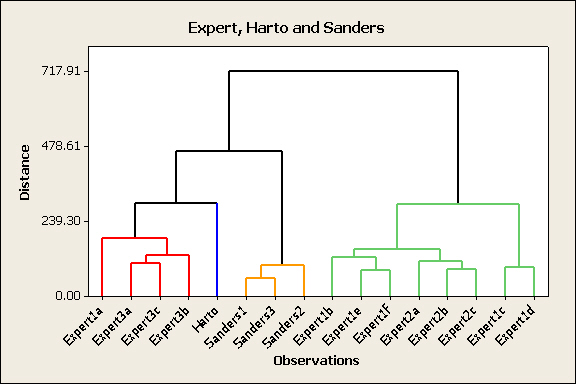
I just wanted to add that when we did our textual analysis of Erdnase (see my Genii article on Erdnase with David Homes), we did look at Saunders' book on mining. I have attached the graph (showing Erdnase, Saunders and Harto) - the styles are VERY different, but there again the genre of the mining book is different to Erdnase, so that might account for it. If anyone can find any other writings by Saunders, email them to me and I would be happy to get them analysed.
Cheers
Richard
Richard Hatch wrote:Tom Sawyer has just posted a very interesting advertisement from 1896 for M. D. Smith's services as an illustrator:
http://swerdnase2011.wordpress.com/
Nice catch!
W. E. Sanders Bibliography
Practical mining. Sanders, Wilbur E. and George Barstow Lee. 1884. Columbia University thesis/essay.
The Drainage of Mines. 1885, Columbia Univ thesis.
Letter to J. V. Brower, dated 4/23/1896. Reproduced in Brower, J. V., The Missouri River and Its Utmost Source. St. Paul: Pioneer Press, 1897 pp 178-179.
"Mine Timbering" by W. E. Sanders, The Mineral Industry Its Statistics, Technology and Trade, Vol VIII., NY, London: The Scientific Publishing Co., 1900. p. 715 743. (Reprinted in Mine Timbering 1907.)
"Mine Timbering and the Support of Earthworks." in The Mineral Industry, Its Statistics, Technology and Trade for 1901, Vol X. Edited by Joseph Struthers. NY: Engineering and Mining Journal, 1901.
"The Framing of Rectangular Shaft Sets." Eng & Min JourMarch 10, 1904, Vol 77. pp 396-398. Illustrates and describes the methods of framing almost universally accepted as affording the greatest possible strength. 2000 w. Reprinted in Mine Timbering 1907 with new illustrations.
"A Reference Scheme for Mine-Workings." Bul Am Inst of Min EngrsMay, 1906. Explains the need and gives a reference scheme for numbering and naming points and parts of mine-workings. Plans. 3000 w. This paper was also presented at the 2/1906 conference of the American Institute of Mining Engineers held in Bethlehem PA (Transactions of the American Institute of Mining Engineers, vol 37 1907 p 128 139) and was summarized in Mining Magazine vol 13 no. 7 1906, p. 581 583.
"Reference Scheme for Mines" Ores and Metals vol 15 no 12 June 15 1906
Mine Timbering. By Wilbur E. Sanders. Bernard McDonald and Norman W. Parlee. New York: Hill Publishing Co., 1907. 180 pages; illustrated. Bound in cloth. $2.00
"Scheme for Filing Mining and Industrial Notes." Paper "was read by title for future publication" at meeting of American Institute of Mining Engineers, New Haven CT, Feb 25 1909. Not clear if the paper was ever published anywhere, though.
"The Word Montana, its significance, derivation and historical use." Mont. His. S. 7: 15-60, 1910.
"On Custer Hill" (poem) Mont. His. S. 7: xxx, 1910.
Class of 1885, School of Mines, twenty-fifth anniversary reunion. Edited by R. V. Norris, W. E Sanders and Joseph Struthers.
"Mining Reports" [letter] Mining And Scientific Press, 8/9/1913 p 233
"Improved Type of Ore Bin," Eng & Min J 97:1003-4 May 16, 1914. Reprinted in Details of Practical Mining. NY: McGraw-Hill, 1916, p. 256.
"Our Dear Old School of Mines" (song lyrics) Columbia Alumni News V5n36 7/10/1914 p. 757.
I need to add the 25th Class Reunion book.
With the exception of the theses and the article in Ores and Metals, I think all of these can be found on Google Books and/or Hathi Trust.
Practical mining. Sanders, Wilbur E. and George Barstow Lee. 1884. Columbia University thesis/essay.
The Drainage of Mines. 1885, Columbia Univ thesis.
Letter to J. V. Brower, dated 4/23/1896. Reproduced in Brower, J. V., The Missouri River and Its Utmost Source. St. Paul: Pioneer Press, 1897 pp 178-179.
"Mine Timbering" by W. E. Sanders, The Mineral Industry Its Statistics, Technology and Trade, Vol VIII., NY, London: The Scientific Publishing Co., 1900. p. 715 743. (Reprinted in Mine Timbering 1907.)
"Mine Timbering and the Support of Earthworks." in The Mineral Industry, Its Statistics, Technology and Trade for 1901, Vol X. Edited by Joseph Struthers. NY: Engineering and Mining Journal, 1901.
"The Framing of Rectangular Shaft Sets." Eng & Min JourMarch 10, 1904, Vol 77. pp 396-398. Illustrates and describes the methods of framing almost universally accepted as affording the greatest possible strength. 2000 w. Reprinted in Mine Timbering 1907 with new illustrations.
"A Reference Scheme for Mine-Workings." Bul Am Inst of Min EngrsMay, 1906. Explains the need and gives a reference scheme for numbering and naming points and parts of mine-workings. Plans. 3000 w. This paper was also presented at the 2/1906 conference of the American Institute of Mining Engineers held in Bethlehem PA (Transactions of the American Institute of Mining Engineers, vol 37 1907 p 128 139) and was summarized in Mining Magazine vol 13 no. 7 1906, p. 581 583.
"Reference Scheme for Mines" Ores and Metals vol 15 no 12 June 15 1906
Mine Timbering. By Wilbur E. Sanders. Bernard McDonald and Norman W. Parlee. New York: Hill Publishing Co., 1907. 180 pages; illustrated. Bound in cloth. $2.00
"Scheme for Filing Mining and Industrial Notes." Paper "was read by title for future publication" at meeting of American Institute of Mining Engineers, New Haven CT, Feb 25 1909. Not clear if the paper was ever published anywhere, though.
"The Word Montana, its significance, derivation and historical use." Mont. His. S. 7: 15-60, 1910.
"On Custer Hill" (poem) Mont. His. S. 7: xxx, 1910.
Class of 1885, School of Mines, twenty-fifth anniversary reunion. Edited by R. V. Norris, W. E Sanders and Joseph Struthers.
"Mining Reports" [letter] Mining And Scientific Press, 8/9/1913 p 233
"Improved Type of Ore Bin," Eng & Min J 97:1003-4 May 16, 1914. Reprinted in Details of Practical Mining. NY: McGraw-Hill, 1916, p. 256.
"Our Dear Old School of Mines" (song lyrics) Columbia Alumni News V5n36 7/10/1914 p. 757.
I need to add the 25th Class Reunion book.
With the exception of the theses and the article in Ores and Metals, I think all of these can be found on Google Books and/or Hathi Trust.
I'm trying to get to Montana, but Delta is screwing with me.
I think that Sanders' writings in his many diaries will need to be transcribed and used in the Stylometric comparison, and I look forward to that.
Good luck Bill!
Good luck Bill!
FYI...Mr. Erdnase is the VIP this week in a certain green site. He is available for questions until the 31st.
Brian
Brian
Since Mr.E is long dead, why is anyone interested in someone pretending to be him?
Sawyer mentions "promontory" as a sense of "Erdnase" that might be intelligible to a native speaker of German. It appears from 19th-century philological materials available in Google Books that this definition (in the sense of a peninsula) derives from a literal translation from Ainu.
I believe this has been mentioned previously in this thread.
What Sawyer doesn't emphasize is the much more natural sense of "Erdnase" that would jump perhaps much more quickly to the mind of a native speaker: Erdnase == swine.
A pig explores nose to the ground in search of truffles. That is the obvious and immediate connotation of the neologism "Erdnase".
In considering the question of whether "Erdnase" as "earth-nose" is the sort of nom-de-plume an anagrammatically inclined mining engineer might adopt, I reckon it would make sense to go by way of the pig image: would a mining engineer liken what a miner does (uncover treasure beneath the earth) to what a pig does (uncover truffles beneath the earth).
I believe this has been mentioned previously in this thread.
What Sawyer doesn't emphasize is the much more natural sense of "Erdnase" that would jump perhaps much more quickly to the mind of a native speaker: Erdnase == swine.
A pig explores nose to the ground in search of truffles. That is the obvious and immediate connotation of the neologism "Erdnase".
In considering the question of whether "Erdnase" as "earth-nose" is the sort of nom-de-plume an anagrammatically inclined mining engineer might adopt, I reckon it would make sense to go by way of the pig image: would a mining engineer liken what a miner does (uncover treasure beneath the earth) to what a pig does (uncover truffles beneath the earth).
Richard Kaufman wrote:Since Mr.E is long dead, why is anyone interested in someone pretending to be him?
Really, this is as lame as it gets.
Trying to cash in on the very recent swelling of interest in Erdnase by having "who" pretend to be Erdnase?
What on earth could ever be posted either as a question, or as an answer that would even be of any interest whatsoever to anybody?
Does he prefer red or blue backed cards? Satin or Linnen finish? Can he XCM?
I just read a new edition of one of my favorite books!
Damn tease.
And what book would that be?
And what book would that be?
Way cool! I'll let Marty make the announcement.
Newly arrived at the Sanders B&B in Helena and the book is a great edition to my collection! Worth the trip and the conference doesn't even start for another 30 minutes!
In Salt Lake City. Slowly getting there. Can you guys just do boring stuff until I arrive?
Jeez, Bill you really had a crappy flight delay! I'm sure Marty will make it up to you.
An article about the Erdnaseum titled Magicians gather in Helena.
Go to:
http://www.beartoothnbc.com/news/helena ... elena.html
Go to:
http://www.beartoothnbc.com/news/helena ... elena.html
Richard Kaufman wrote:Way cool! I'll let Marty make the announcement.
Marty...?
So I get to the Helena Airport, and Mike Vance's wife is there to make sure I can get to the Erdnaseum with a minimum of delay. What a nice gesture! I follow her to the Sanders B&B, and we walk in literally as Marty is wrapping up his presentation.
But I got some W. E. Sanders birthday cake.
And got to stand around talking with people for 3 hours, which was really the whole point, anyway.
But I got some W. E. Sanders birthday cake.
And got to stand around talking with people for 3 hours, which was really the whole point, anyway.
Is the Erdnaseum going to be filmed and released on DVD for the unfortunates who could not make it?
I wonder if the Professor unwittingly ever crossed paths with Sanders?
Possible breakthrough: Discovered in the 2nd story bathroom (believed to be W. E. Sanders' boyhood loo), a book with the admonition: "...artfully avoid ambiguous anagrams"!
Possible breakthrough: Discovered in the same boyhood Sanders bathroom (by Ricky Smith), hand lotion (the author told Marshall Smith he "greased" his hands). Clearly set off in a box above the ingredients on the bottle of hand lotion, in large capital letters, are the initials "ESA". Coincidence?
http://www.amazon.com/dp/B005JDRYTS/
That is a link to Marty's new edition of The Expert at the Card Table for your Kindle (also can be read on the iPad using the Kindle app, which is how I viewed it).
Beautifully done and only $2.99
That is a link to Marty's new edition of The Expert at the Card Table for your Kindle (also can be read on the iPad using the Kindle app, which is how I viewed it).
Beautifully done and only $2.99
Richard Hatch wrote:Possible breakthrough: Discovered in the same boyhood Sanders bathroom (by Ricky Smith), hand lotion (the author told Marshall Smith he "greased" his hands). Clearly set off in a box above the ingredients on the bottle of hand lotion, in large capital letters, are the initials "ESA". Coincidence?
can you guys take photos of these "breakthroughs" for the rest of us..?
So, how has this stuff been in that house for 100 years and nobody has moved it or tampered with it?
I'm assuming the items were found before the convention/meeting. I get a mental image of everyone breaking off into groups in the house and walking around like The Goonies looking for clues.
I'm assuming the items were found before the convention/meeting. I get a mental image of everyone breaking off into groups in the house and walking around like The Goonies looking for clues.
Intentional plants???
Ryan Matney wrote:So, how has this stuff been in that house for 100 years and nobody has moved it or tampered with it?
Convention fun and good humor?
..........wish I was there.
BTW, how are you getting the Kindle edition Richard? When I click on the Amazon link in your post it says "not available"?
Will there be a hard edition, I don't have a Kindle?
Jeff
Jeff
When I click on the link, I see that it's available, and that I purchased it. Hmmmm ... go to amazon and try searching on "Erdnase Demarest" and tell me if you find it.
You don't need a Kindle. You can get a Kindle app for iPad, or a Kindle "viewer" for your PC.
You don't need a Kindle. You can get a Kindle app for iPad, or a Kindle "viewer" for your PC.
Richard Kaufman wrote:http://www.amazon.com/dp/B005JDRYTS/
That is a link to Marty's new edition of The Expert at the Card Table for your Kindle (also can be read on the iPad using the Kindle app, which is how I viewed it).
Beautifully done and only $2.99
Worked for me and it's super :)
Interesting........the page shows up, but it clearly says "Not Currently Available", and where the price would normally be, it says "pricing information not available".
The above occurs when I click on your link, when I search for "Erdnase Demarest", the page doesn't come up at all.....not even the page your link takes me to.
Perhaps it's because Amazon sees my IP address as being in Canada?
Don't know, it's a mystery, and a drag......I'd like Marty's edition on my iPad :(
The above occurs when I click on your link, when I search for "Erdnase Demarest", the page doesn't come up at all.....not even the page your link takes me to.
Perhaps it's because Amazon sees my IP address as being in Canada?
Don't know, it's a mystery, and a drag......I'd like Marty's edition on my iPad :(
Roger, are you outside the USA?
We cross posted Richard, yes I'm in Canada.
It could be because you're outside the US.
Yes, I think that's it.
Although I've purchased many books directly from amazon.com, I've not ever tried a Kindle download.
Marty, could you put it on amazon.ca?
.......or make it available on amazon.com to those outside of the USA?
Although I've purchased many books directly from amazon.com, I've not ever tried a Kindle download.
Marty, could you put it on amazon.ca?
.......or make it available on amazon.com to those outside of the USA?
For the detail oriented, the edition of The Expert on the cover of this months Genii is the facsimile edition.
Great article, thank you Marty and Richard and all other contributors. I can't wait to see what comes next!
Great article, thank you Marty and Richard and all other contributors. I can't wait to see what comes next!
As a side note, Sandy Marshall and I have been conversing in email. Seems Jay had in his collection 2 EATCT from 1918 and one has M.D. Smith's autograph from 1947 in it. The other doesn't.
I was autographed to Ewd. J. McLaughline.
I was autographed to Ewd. J. McLaughline.
Hi Rick, those sound like great editions. M.D. Smith was at the '47 SAM convention and signed books. I have a nice 1905 with his signature but not signed to anyone specific. Not sure how many he signed there but am assuming it was a relatively small number.
Now to find a first edition with Sanders autograph.
Also, has anyone compared the writing on the copyright application to that of Sanders yet? Dick Hatch perhaps? :)
Now to find a first edition with Sanders autograph.
Also, has anyone compared the writing on the copyright application to that of Sanders yet? Dick Hatch perhaps? :)
It's not a first edition, it's the 1918 edition, but still, these are few and far between.
More information from the publisher of the new ebook version of "The Expert at the Card Table":
Just wanted to let your readers know that the ErdEd (for short) is also available for the Nook (search for "Erdnaseum Edition"-- their links aren't very concrete), and an iBooks edition should be available soon as well.
Also--since there was some confusion about it earlier-- Amazon has notified me that Canadian customers can purchase the book from the Amazon.com site, in the Kindle store.
Links to all editions are going to be maintained on our company website:
http://charlesandwonder.com
Just wanted to let your readers know that the ErdEd (for short) is also available for the Nook (search for "Erdnaseum Edition"-- their links aren't very concrete), and an iBooks edition should be available soon as well.
Also--since there was some confusion about it earlier-- Amazon has notified me that Canadian customers can purchase the book from the Amazon.com site, in the Kindle store.
Links to all editions are going to be maintained on our company website:
http://charlesandwonder.com
Hi John
I have hired a certified handwriting examiner to look at this, and awaiting a copy of the Copyright Application from the Library of Congress.
Geno
I have hired a certified handwriting examiner to look at this, and awaiting a copy of the Copyright Application from the Library of Congress.
Geno
Since no one knows who filled out the copyright application (it doesn't necessarily have to be the person who owns it), the handwriting doesn't necessarily have to match.
Correct, but this step is necessary so we can verify if he did sign the document.
The Erdnasium Edition still shows up (in Canada) as "Not Currently Available".
And still says "pricing information not available".
Must be me, although I'm on the other side of town from whence I first tried, at work, on a PC rather than a Mac, and have tried signed into Amazon, and signed out of Amazon.
........or maybe Amazon.com knows not of what they speak.
And still says "pricing information not available".
Must be me, although I'm on the other side of town from whence I first tried, at work, on a PC rather than a Mac, and have tried signed into Amazon, and signed out of Amazon.
........or maybe Amazon.com knows not of what they speak.
Richard,
Although your statement is accurate; "Since no one knows who filled out the copyright application (it doesn't necessarily have to be the person who owns it), the handwriting doesn't necessarily have to match".
Another person filling out the application would imply the author DID NOT keep his secret. Thus putting into question the whole point of the mystery. Of course we come back to why not just sign the book anonymous.
Although your statement is accurate; "Since no one knows who filled out the copyright application (it doesn't necessarily have to be the person who owns it), the handwriting doesn't necessarily have to match".
Another person filling out the application would imply the author DID NOT keep his secret. Thus putting into question the whole point of the mystery. Of course we come back to why not just sign the book anonymous.
But if the handwriting does match....
We have another clue... :)
We have another clue... :)
What happend in Montana this weekend? Did Marty and all of the gatherers take a time machine back to 1901 Chicago?
A very impressive turnout: R. Paul Wilson from Scotland, Jason England and Geno Munari from Las Vegas, Derek DelGaudio, Michael Weber, Dan and Dave Buck from Las Angeles, Eric Mead from Aspen, Ricky Smith and Bill Kalush from CARC, Bill Mullins from Alabama and others. Some great discussions that moved the conversation forward. A good time was had by all. Thanks to Marty Demarest and Mike Vance for organizing a most memorable event! I'd say more, but I don't want to betray any confidences...Rick Ruhl wrote:What happend in Montana this weekend? Did Marty and all of the gatherers take a time machine back to 1901 Chicago?
... and Jim Steinmeyer from Los Angeles was there...
Richard Hatch wrote:... and Jim Steinmeyer from Los Angeles was there...
This is right up Jim's alley too.
"Really, this is as lame as it gets.
Trying to cash in on the very recent swelling of interest in Erdnase by having "who" pretend to be Erdnase?
What on earth could ever be posted either as a question, or as an answer that would even be of any interest whatsoever to anybody?"
agree completely; it's a silly conceit
Trying to cash in on the very recent swelling of interest in Erdnase by having "who" pretend to be Erdnase?
What on earth could ever be posted either as a question, or as an answer that would even be of any interest whatsoever to anybody?"
agree completely; it's a silly conceit
Gotta say that I have found some of "Erdnase's" comments on the green site both insightful and funny. Whoever is doing it has a good sense of humor and an ability to sound more like Erdnase than some of the current candidates.
And come on, there's a discussion going on between Erdnase and Wesley James. That alone is worth a peek.
It's like reading a magician's version of Umberto Eco's story Foucalt's Pendulum.
Richard Hatch wrote:I'd say more, but I don't want to betray any confidences...
this comment, combined with this sudden "silence" after the big hype, reminds me of a similar situation that happened about 4 years ago.....
Here's what happened.
Friday, we talked about Erdnase, then ate cake.
Saturday morning, we talked about Erdnase. Then ate lunch.
Saturday afternoon, we talked about Erdnase some more, then ate supper (burgers). Then we talked about Erdnase.
Sunday morning, those who were still in the area met at the Sanders B&B for breakfast, during which we talked about Erdnase.
I'm not speaking for everyone here, but your average Erdnasian could aford to lose 10-20 lbs.
Friday, we talked about Erdnase, then ate cake.
Saturday morning, we talked about Erdnase. Then ate lunch.
Saturday afternoon, we talked about Erdnase some more, then ate supper (burgers). Then we talked about Erdnase.
Sunday morning, those who were still in the area met at the Sanders B&B for breakfast, during which we talked about Erdnase.
I'm not speaking for everyone here, but your average Erdnasian could aford to lose 10-20 lbs.
Curtis Kam wrote:And come on, there's a discussion going on between Erdnase and Wesley James. That alone is worth a peek.
Wesley James comes across as the type of fellow who is never actually seeking an answer when he asks a question...
In reality, that's one "discussion" which wouldn't last long.
Bill Mullins wrote:Here's what happened.
Friday, we talked about Erdnase, then ate cake.
Saturday morning, we talked about Erdnase. Then ate lunch.
Saturday afternoon, we talked about Erdnase some more, then ate supper (burgers). Then we talked about Erdnase.
Sunday morning, those who were still in the area met at the Sanders B&B for breakfast, during which we talked about Erdnase.
I'm not speaking for everyone here, but your average Erdnasian could aford to lose 10-20 lbs.
Thank you my friend... now I know I missed a good time ;)
I had a wonderful time at Erdnaseum! Aside from all the Erdnase and food (both of which I have a healthy appetite for), I really devoured R. Paul Wilson's discussion about the viability of Erdnase's cheating techniques, and Jason England's examination of Erdnase's passes. Erdnase invented five passes--and we're still talking about them more than a century later--a great perspective on the author's genius.
Also of note: Viewing Jason's collection of Expert at the Card Table editions, and getting an online research overview from Bill Mullins. It was fun.
Also of note: Viewing Jason's collection of Expert at the Card Table editions, and getting an online research overview from Bill Mullins. It was fun.
Carlo Morpurgo wrote:Richard Hatch wrote:I'd say more, but I don't want to betray any confidences...
this comment, combined with this sudden "silence" after the big hype, reminds me of a similar situation that happened about 4 years ago.....
Which was?
Rick Ruhl wrote:Which was?
I was half joking...but was referring to the aftermath of the Hooker Card Rise performances, in 2007....
Not that it matters in the scheme of things, but the visit by S.W.ERDNASE at the green place has been in the works for at least three years and has nothing whatsoever to do with the so-called recent interest in the man or his work.
Thank you.
Thank you.
"So-called recent interest"?
It's called a resurgence of interest based upon information that gives good cause to believe the identity of Erdnase has been uncovered.
It's called a resurgence of interest based upon information that gives good cause to believe the identity of Erdnase has been uncovered.
I apologize Richard if my post appeared a bit sarcastic. I imagine my tone had something to do with people assuming my guest this week was done because of all the recent Erdnase discussions...that would be further from the truth.
Hey Steve, what's with shaking someone's hand, praising them for being willing to hold strong opinions - like yourself, and then banning them without explanation the next day? Sent you an email requesting the courtesy of an explanation. Your behavior strikes me as cowardly and hypocritical. I would have expected better from you. Perhaps I will finally get that reply. You have my email in your inbox.
Is this going to turn into a "why was I banned from the magic cage?"
Me too! Me too! Why was I banned?!
Me too! Me too! Why was I banned?!
Steve Brooks wrote:I apologize Richard if my post appeared a bit sarcastic. I imagine my tone had something to do with people assuming my guest this week was done because of all the recent Erdnase discussions...that would be further from the truth.
But so what if it was, it's a great idea and hits at the right time. It's good marketing.
Both you and Richard have a tough enough job running the boards, much less the other stuff.
Erdnase is hot, strike while the kettle is hot.
It's speculated that WE Sanders held a "double life", part of which was concerned with the perfecting of card sharp techniques, and gambling. If it's true that he rightly wanted to hide this part of his life, then it seems reasonable to me that one should look at what *other people* had to say about WE Sanders, other than the man himself, starting from his own father (whose diaries seem to be available).
One would look for signs indicating suspicions of his putative double life, or even better, comments about his dexterity with cards, time spent with a deck of cards in his hands etc.
One would look for signs indicating suspicions of his putative double life, or even better, comments about his dexterity with cards, time spent with a deck of cards in his hands etc.
Carlo Morpurgo wrote:then it seems reasonable to me that one should look at what *other people* had to say about WE Sanders, other than the man himself, starting from his own father (whose diaries seem to be available).
In his article, Marty D. does some of that by using Sander's letters from his brothers.
Chris Aguilar wrote:Carlo Morpurgo wrote:then it seems reasonable to me that one should look at what *other people* had to say about WE Sanders, other than the man himself, starting from his own father (whose diaries seem to be available).
In his article, Marty D. does some of that by using Sander's letters from his brothers.
Yes, but my point is to check documents that were NOT in W.E. Sanders possession...thereby eliminating the possibility of their destruction (in case they contained "revealing details" or something controversial)
Some people won't do the right thing unless pressured in front of their peers, apparently. Having said that, I do not want this thread to derail. Hopefully Brooks will reply to my email as per my request. Or perhaps he is not nearly the strongly opinionated independent man he wants so badly to believe he is.
Back to erdnase - sorry for the digression.
Back to erdnase - sorry for the digression.
Brooks let the threads on The Berglas Effects go right into the dumper because of Mark Lewis--he did nothing to stop it, nor did he go back and clean them up. The mods just closed them.
Anyway, yes, BACK TO ERDNASE.
Anyway, yes, BACK TO ERDNASE.
Carlo Morpurgo wrote:Chris Aguilar wrote:Carlo Morpurgo wrote:then it seems reasonable to me that one should look at what *other people* had to say about WE Sanders, other than the man himself, starting from his own father (whose diaries seem to be available).
In his article, Marty D. does some of that by using Sander's letters from his brothers.
Yes, but my point is to check documents that were NOT in W.E. Sanders possession...thereby eliminating the possibility of their destruction (in case they contained "revealing details" or something controversial)
I would think that Sanders father would be the one he'd most want to hide any dodgy behavior from. As such, I doubt his fathers papers would shed much light. No harm in checking though.
Chris Aguilar wrote:Carlo Morpurgo wrote:Chris Aguilar wrote:Carlo Morpurgo wrote:then it seems reasonable to me that one should look at what *other people* had to say about WE Sanders, other than the man himself, starting from his own father (whose diaries seem to be available).
In his article, Marty D. does some of that by using Sander's letters from his brothers.
Yes, but my point is to check documents that were NOT in W.E. Sanders possession...thereby eliminating the possibility of their destruction (in case they contained "revealing details" or something controversial)
I would think that Sanders father would be the one he'd most want to hide any dodgy behavior from. As such, I doubt his fathers papers would shed much light. No harm in checking though.
I do not consider having or showing dexterity with cards in itself to be a dodgy behavior, especially if related (apparently perhaps) to magic -- you out of all people should agree with this... ;). It is more of a revealing detail, to us, after knowing about EATC.
I guess that the "W.E.S theory" requires us to buy into the idea that Sanders was cultivating his passion for card techniques, at that very sophisticated level of details, without ever being seen around or in his room fooling around with cards.
Carlo Morpurgo wrote:I guess that the "W.E.S theory" requires us to buy into the idea that Sanders was cultivating his passion for card techniques, at that very sophisticated level of details, without ever being seen around or in his room fooling around with cards.
Who knows how much "alone time" he had in his various travels or work learning the mining business?
"I guess that the 'W.E.S theory' requires us to buy into the idea that Sanders was cultivating his passion for card techniques, at that very sophisticated level of details, without ever being seen around or in his room fooling around with cards."
This is incorrect.
There is no reason to assume that Wilbur Fisk Sanders would have found it compulsive to write about his son's hobby of doing magic tricks with cards in his diaries--it's trivial, and perhaps even more so to a crusading do-gooder and senator with more important things on his mind. Just because the father doesn't write about it, doesn't mean his son didn't do it.
This is incorrect.
There is no reason to assume that Wilbur Fisk Sanders would have found it compulsive to write about his son's hobby of doing magic tricks with cards in his diaries--it's trivial, and perhaps even more so to a crusading do-gooder and senator with more important things on his mind. Just because the father doesn't write about it, doesn't mean his son didn't do it.
Richard Kaufman wrote:"I guess that the 'W.E.S theory' requires us to buy into the idea that Sanders was cultivating his passion for card techniques, at that very sophisticated level of details, without ever being seen around or in his room fooling around with cards."
This is incorrect.
There is no reason to assume that Wilbur Fisk Sanders would have found it compulsive to write about his son's hobby of doing magic tricks with cards in his diaries--it's trivial, and perhaps even more so to a crusading do-gooder and senator with more important things on his mind. Just because the father doesn't write about it, doesn't mean his son didn't do it.
True, if his hobby was magic with cards that does not mean that his father diaries must contain this information. I have no clue as to what WFS's diaries are about. But usually diaries have stuff in them that reveal more intimate details about one's private life.
Anyway, we do not know yet that the father did not write about it (or do we?) If he wrote about it ....that would be great! If he didn't, well, it depends on what else he's written, especially about his son, I guess.
It's also possible that Sanders' father did know about his son's penchant for cheating techniques, and that a very loud conversation about the value of the family name may be the reason Expert was published anonymously.
It would be great to learn what, if anything, Sanders' father or anyone else, for that matter, wrote about him. It really doesn't have to be about cards or magic to be useful. Any information about his interests, skills, habits, travels, acquaintances, personality, etc could help add detail and put together pieces of the overall puzzle. Of course, a direct mention of card playing or magic would be even better, but that seems unlikely.
Pete McCabe wrote:It's also possible that Sanders' father did know about his son's penchant for cheating techniques, and that a very loud conversation about the value of the family name may be the reason Expert was published anonymously.
True!
By the way, I made a mistake in my search at the library's web site. I now notice only a few diaries by WFS dated 1866-1867 - those can't be helpful. But I do see personal letters, and diaries written by WES 's mother and especially several diaries by his brother James....
I would look at the brother's diaries pronto. You can hide your magic hobby from your dad, especially if he's a bigshot with a busy life. But not your brother. Someone had to pick all the cards. Who did Erdnase try all his tricks on?
As an aside, for anybody that remembers the origins of The Giorgio Letters, and the original intent of Tony Giorgio's Genii column, they might also see how Sanders as a candidate is almost pushed over the top when Tony's original thoughts about Erdnase are applied to Sanders.
Taking Giorgio's thinking on Erdnase and applying it to Sanders gives us a KISS example of why Sanders might not have left much of a trail as a gambler or cheater.
He was neither cheat nor hustler, maybe a weekend gambler, and maybe a amateur card magician............just like Tony said.
I'm playing devils advocate here, as I never really felt that Erdnase was the "poseur" that Tony did.
But if you accept Tony's account of Erdnase (and remember that in the world of hustling, there are few living that have Tony's credentials), and maintain the KISS or Occams Razor approach to Sanders and the apparent lack of hard evidence to support him being a cheat or gambler, then you'll also realize that there's really nothing more to find, and Tony was right all along.
Sanders was a great writer, but he was a fake?
Sanders consolidated information from the card table, but was merely a passive observer?
As per Tonys thinking, Erdnase/Sanders really didn't know much about hustling at all.
Perhaps between existing books, and his own seemingly above average intellect, Sanders simply "figured out" much of EATCT through sheer force of will and a desire to commit his thinking to paper.
Tony's original series of letters is a massive piece of missing support if one wishes to accept that Sanders is the best candidate for Erdnase........to date anyway, things are always prone to changing :)
Even if you profoundly disagree with the above (which I'm inclined to do), for those who have access to the first half a dozen or so Giorgio Letters (with your Genii subscription you do through Ask Alexander) it's worth it to go back and read once again Tony's thinking on just what Erdnase might actually have known, and why Tony's thinking strongly supports Sanders as the author of EATCT.
(Note that Tony put his thoughts to paper long before there were any candidates in the offering other than MFA, so he wrote what he wrote knowing only that MFA was proposed as the author of EATCT).
Taking Giorgio's thinking on Erdnase and applying it to Sanders gives us a KISS example of why Sanders might not have left much of a trail as a gambler or cheater.
He was neither cheat nor hustler, maybe a weekend gambler, and maybe a amateur card magician............just like Tony said.
I'm playing devils advocate here, as I never really felt that Erdnase was the "poseur" that Tony did.
But if you accept Tony's account of Erdnase (and remember that in the world of hustling, there are few living that have Tony's credentials), and maintain the KISS or Occams Razor approach to Sanders and the apparent lack of hard evidence to support him being a cheat or gambler, then you'll also realize that there's really nothing more to find, and Tony was right all along.
Sanders was a great writer, but he was a fake?
Sanders consolidated information from the card table, but was merely a passive observer?
As per Tonys thinking, Erdnase/Sanders really didn't know much about hustling at all.
Perhaps between existing books, and his own seemingly above average intellect, Sanders simply "figured out" much of EATCT through sheer force of will and a desire to commit his thinking to paper.
Tony's original series of letters is a massive piece of missing support if one wishes to accept that Sanders is the best candidate for Erdnase........to date anyway, things are always prone to changing :)
Even if you profoundly disagree with the above (which I'm inclined to do), for those who have access to the first half a dozen or so Giorgio Letters (with your Genii subscription you do through Ask Alexander) it's worth it to go back and read once again Tony's thinking on just what Erdnase might actually have known, and why Tony's thinking strongly supports Sanders as the author of EATCT.
(Note that Tony put his thoughts to paper long before there were any candidates in the offering other than MFA, so he wrote what he wrote knowing only that MFA was proposed as the author of EATCT).
The latest Erdnase blog from Thomas Sawyer (http://swerdnase2011.wordpress.com/) shows that an "H. M. Andrews" was housed in the same location as printer James McKinney in early 1902, when the book was in active production. The title page triangle can be re-arranged so that the letters spelling out "H. M. Andrews" line up perfectly, as was done earlier with "W. E. Sanders". Coincidence? Certainly one of them is, and I suspect both are.
Similar to the above, Richard Wiseman's candidate, H. L. Andrews, who worked near McKinney and had a wife named "E. S. Andrews" can also have his name spelled out by choosing one letter from each of the 9 lines of the inverted triangle on the title page. As can the brother for whom he worked, "A. H. Andrews" and the brother who wrote about the family history, "H. C. Andrews". Coincidences all, in my opinion.
Here's a link to the information on Wiseman's candidate:
http://www.richardwiseman.com/erdnase.html
Here's a link to the information on Wiseman's candidate:
http://www.richardwiseman.com/erdnase.html
You can choose one letter per line, but you can't slide the lines and align either of those names vertically....coincidence? ;)
If you assume that the lines can move around freely and if you take into account letter AND space frequencies, then the ballpark chances of getting WESANDERS are about 3%.
If you impose additional restrictions on how much the lines can slide then this number goes down quite a bit. With some less restrictive constraints than "not go over the margins" I calculated about 2/1000 of getting WESANDERS.
But, remember that in all this we are assuming that we're dealing already with 9 lines, as many as the letters in the name... This should be taken into account also when evaluating "coincidences"....
Having said so, to me this is a "fun fact" to add to the theory, and it will remain so even after a conclusive proof of Erdnase being Sanders. Maybe he just wanted the subtitle to form a nice wine chalice....
If you assume that the lines can move around freely and if you take into account letter AND space frequencies, then the ballpark chances of getting WESANDERS are about 3%.
If you impose additional restrictions on how much the lines can slide then this number goes down quite a bit. With some less restrictive constraints than "not go over the margins" I calculated about 2/1000 of getting WESANDERS.
But, remember that in all this we are assuming that we're dealing already with 9 lines, as many as the letters in the name... This should be taken into account also when evaluating "coincidences"....
Having said so, to me this is a "fun fact" to add to the theory, and it will remain so even after a conclusive proof of Erdnase being Sanders. Maybe he just wanted the subtitle to form a nice wine chalice....
Carlo Morpurgo wrote:You can choose one letter per line, but you can't slide the lines and align either of those names vertically....coincidence? ;)
Sorry, I don't understand the constraint on sliding the lines. Why can't they be lined up vertically?
Richard Hatch wrote:Carlo Morpurgo wrote:You can choose one letter per line, but you can't slide the lines and align either of those names vertically....coincidence? ;)
Sorry, I don't understand the constraint on sliding the lines. Why can't they be lined up vertically?
Because the whole point was that you can form WESANDERS by sliding the lines while staying within the margins of the page.
Carlo Morpurgo wrote:Richard Hatch wrote:Carlo Morpurgo wrote:You can choose one letter per line, but you can't slide the lines and align either of those names vertically....coincidence? ;)
Sorry, I don't understand the constraint on sliding the lines. Why can't they be lined up vertically?
Because the whole point was that you can form WESANDERS by sliding the lines while staying within the margins of the page.
Ah... I apparently missed the "whole point", my bad. Thanks!
Ok, I guess I'm still confused on the sliding of letters issue: If from the first line one uses the H in SLIGHTS, the second line, the L in GAMBLER, 3rd the A in DETAIL, 4th the N at the end of KNOWN, 5th the D in AND, 6th the R in CARD, 7 the E in ONE, 8th the W in DRAWINGS and finally the S in SMITH, does the sliding of the lines exceed the margins of the page? Not to my untrained eye, spelling out vertically, "H. L. ANDREWS", Wiseman's candidate...
Similarly, by using the M in GAMBLER on the 2nd line in place of the L in the same word, you get the fellow Sawyer spotted in the same building as McKinney at the time the book was in production. What am I missing about the special character of the WESANDERS sliding?
Similarly, by using the M in GAMBLER on the 2nd line in place of the L in the same word, you get the fellow Sawyer spotted in the same building as McKinney at the time the book was in production. What am I missing about the special character of the WESANDERS sliding?
Richard Hatch wrote:Ok, I guess I'm still confused on the sliding of letters issue: If from the first line one uses the H in SLIGHTS, the second line, the L in GAMBLER, 3rd the A in DETAIL, 4th the N at the end of KNOWN, 5th the D in AND, 6th the R in CARD, 7 the E in ONE, 8th the W in DRAWINGS and finally the S in SMITH, does the sliding of the lines exceed the margins of the page?
I can't make it work with the original text. Even if you manage somehow to align the H and the L then you have a problem with the D in the fifth line.... (the word "OF" is cut off on the right).
Richard Hatch wrote:Similarly, by using the M in GAMBLER on the 2nd line in place of the L in the same word, you get the fellow Sawyer spotted in the same building as McKinney at the time the book was in production.
this is obviously worse than the previous situation, due to the second line.
ps:
This makes me think that perhaps we are not using the same original title page....The one I am using is the one publiahed in David Alexander's article. Maybe the original page in the book was wider?
Carlo Morpurgo wrote:This makes me think that perhaps we are not using the same original title page....The one I am using is the one publiahed in David Alexander's article. Maybe the original page in the book was wider?
Ah, thanks Carlo. The title page reproduced in the David Alexander article is severely trimmed on all sides (likely unintentionally due to space in the article). The first edition margins are much wider.
I am glad we sorted this out... Anyway I think that the WES alignment fits better with other aspects of the Sanders theory (without proving anything)
1. playing with his name, vertically or otherwise
2. wanting to use a full anagram as an author
3. wanting to leave traces on how to discover his identity
4. eliminating "andrews" via the "and ruse artifice"
5. using "SWE shift" to identify the first three letters
6. "artfully avoiding ambiguous anagrams" (?)
If we had solid proof that the above Andrews were the authors, then the vertical alignment of their names in my mind would be as much fun.
By the way, can you say more about 6. above?
1. playing with his name, vertically or otherwise
2. wanting to use a full anagram as an author
3. wanting to leave traces on how to discover his identity
4. eliminating "andrews" via the "and ruse artifice"
5. using "SWE shift" to identify the first three letters
6. "artfully avoiding ambiguous anagrams" (?)
If we had solid proof that the above Andrews were the authors, then the vertical alignment of their names in my mind would be as much fun.
By the way, can you say more about 6. above?
Carlo Morpurgo wrote:I am glad we sorted this out... Anyway I think that the WES alignment fits better with other aspects of the Sanders theory (without proving anything)
1. playing with his name, vertically or otherwise
2. wanting to use a full anagram as an author
3. wanting to leave traces on how to discover his identity
4. eliminating "andrews" via the "and ruse artifice"
5. using "SWE shift" to identify the first three letters
6. "artfully avoiding ambiguous anagrams" (?)
If we had solid proof that the above Andrews were the authors, then the vertical alignment of their names in my mind would be as much fun.
I meant "would NOT be as much fun".....
Carlo Morpurgo wrote:Because the whole point was that you can form WESANDERS by sliding the lines while staying within the margins of the page.
Maybe a better and more reasonable way to state this would be "while staying within the margins of the text". I am not sure how they where printing books back then, but I assume that even then the text had to stay within a certain boundary, well inside the actual page by a predetermined amount.
Havent read the Genii article or sunk my teeth into the Erdnase literature for years, but FWIW offer two observations, which may have been previously made by others.
First, the inverted pyramid graphic design on the title page is nothing novel. This design has been used in many books printed over the past 500 years.
Second, what significance, if any, do we attach to the fact that the first three primary words of the proper title of Erdnases book (artifice, ruse, subterfuge) are all synonyms for each other, meaning trickery or deception? Why would the author indulge in such high-profile pleonasms? To demonstrate his deep vocabulary? (Doubtful.) To show that he used a copy of Rogets Thesaurus? (Also doubtful.)
First, the inverted pyramid graphic design on the title page is nothing novel. This design has been used in many books printed over the past 500 years.
Second, what significance, if any, do we attach to the fact that the first three primary words of the proper title of Erdnases book (artifice, ruse, subterfuge) are all synonyms for each other, meaning trickery or deception? Why would the author indulge in such high-profile pleonasms? To demonstrate his deep vocabulary? (Doubtful.) To show that he used a copy of Rogets Thesaurus? (Also doubtful.)
Carlo Morpurgo wrote:6. "artfully avoiding ambiguous anagrams" (?)
Sorry, this was a joke for those at the Erdnaseum. I did find a book with this quote in it in the Sanders' B&B 2nd story bathroom (Ricky Smith and I were staying in what was believed to have been Wilbur's room), but the book was a contemporary object, as was a bottle of hand lotion with the bold initials ESA printed on the label. "Finding" them added to the fun of the weekend, but not to the scholarship of Erdnase identity research!
Just yesterday I was browsing a brand new calculus book and I found thismagicam wrote:First, the inverted pyramid graphic design on the title page is nothing novel. This design has been used in many books printed over the past 500 years.
http://tinyurl.com/3p6ypey
(it's the very last page of the book)
could not help smiling...and no, I am not going to try to find hidden names in it...
Thomas Sawyer's Erdnase Blog has recently been focussed on 73 Plymouth Place/Court in Chicago, the address of James McKinney when he printed the book.
A 1905 map shows the building there. 73-75 Plymouth are all 1 building, and it is 80 feet tall.
[Tom - if you are following this, and want a copy of the map, email me offline and I'll send it to you.]
It would appear that the street numbers have been changed (it is now the 500 block), and that the building has been torn down. The east-bound lane of W. Congress pkwy occupies the space now.
A 1905 map shows the building there. 73-75 Plymouth are all 1 building, and it is 80 feet tall.
[Tom - if you are following this, and want a copy of the map, email me offline and I'll send it to you.]
It would appear that the street numbers have been changed (it is now the 500 block), and that the building has been torn down. The east-bound lane of W. Congress pkwy occupies the space now.
Rick Ruhl wrote:As a side note, Sandy Marshall and I have been conversing in email. Seems Jay had in his collection 2 EATCT from 1918 and one has M.D. Smith's autograph from 1947 in it. The other doesn't.
This is interesting considering that Whaley, Gardner and Busby, in The Man Who was Erdnase, state: "This [first edition] copy of The Expert, bearing Gallaway's bookplate [Edward Gallaway--typesetter for James McKinney and Company], still rests in Chicago in the collection of Jay Marshall..."
I wonder what happened to that particular first edition.
Marty Demarest wrote:Rick Ruhl wrote:As a side note, Sandy Marshall and I have been conversing in email. Seems Jay had in his collection 2 EATCT from 1918 and one has M.D. Smith's autograph from 1947 in it. The other doesn't.
This is interesting considering that Whaley, Gardner and Busby, in The Man Who was Erdnase, state: "This [first edition] copy of The Expert, bearing Gallaway's bookplate [Edward Gallaway--typesetter for James McKinney and Company], still rests in Chicago in the collection of Jay Marshall..."
I wonder what happened to that particular first edition.
See Lot #101.
It occurs to me, while peering into this issue just a bit, that we are still within the golden period of research on WE Sanders. That is, given his death date, there are almost certainly still people alive who knew him.
Finding those people and interviewing them would be a great accomplishment.
Finding those people and interviewing them would be a great accomplishment.
Bill Mullins wrote:Marty Demarest wrote:Rick Ruhl wrote:As a side note, Sandy Marshall and I have been conversing in email. Seems Jay had in his collection 2 EATCT from 1918 and one has M.D. Smith's autograph from 1947 in it. The other doesn't.
This is interesting considering that Whaley, Gardner and Busby, in The Man Who was Erdnase, state: "This [first edition] copy of The Expert, bearing Gallaway's bookplate [Edward Gallaway--typesetter for James McKinney and Company], still rests in Chicago in the collection of Jay Marshall..."
I wonder what happened to that particular first edition.
See Lot #101.
Ok So Sandy has a first edition and a 1918 edition. The 1918 edition has the autograph, as it has the King of Diamonds with no diamonds on the cover.
he sold me the other 1918 edition without the autograph. He had thought the the autograph was the first edition.
Marty, Bill, Ill email you guys the photos Sandy took of the autographed edition.
Looking at the list, he must have the 1902 edition too. Bill I emailed you the pics, Marty, I sent them to richard to forward to you, as I dont have your email address.
This is the 1918 edition that has the MD smith sig on it from 1947.
Still worth about $3000-$5000...
This is the 1918 edition that has the MD smith sig on it from 1947.
Still worth about $3000-$5000...
For what it's worth, there are at least 6 different versions of the c1918 edition. I say circa because there is no date on that edition. Slight variations include different ads on the back, KH with and without the pips, number of blank pages, green/grey paper wraps, and 1 HB edition in light blue cloth.
My current count shows about 100 different editions/printing variations, many mentioned on the Genii page for the book.
John Bodine
My current count shows about 100 different editions/printing variations, many mentioned on the Genii page for the book.
John Bodine
^^^
John, Id love to see that list someday! Thats a helluva lot of variants!
As a general comment (i.e., not directed at John), perhaps not now, but hopefully at some point in time the bibliographical study of TEATCT will reach a level where the correct use of terms like edition, issue, and state is essential/helpful to good communication about all the variants of this book. For example, if two copies of a book are identical except that one copy is bound in publishers wraps, and the other in publishers cloth, then these copies represent different issues, not different editions. Bibliographically speaking, there is no such thing as a hardbound edition or a softbound edition. Edition can only be determined by figuratively ripping the covers off a book and examining the text block only.
John, Id love to see that list someday! Thats a helluva lot of variants!
As a general comment (i.e., not directed at John), perhaps not now, but hopefully at some point in time the bibliographical study of TEATCT will reach a level where the correct use of terms like edition, issue, and state is essential/helpful to good communication about all the variants of this book. For example, if two copies of a book are identical except that one copy is bound in publishers wraps, and the other in publishers cloth, then these copies represent different issues, not different editions. Bibliographically speaking, there is no such thing as a hardbound edition or a softbound edition. Edition can only be determined by figuratively ripping the covers off a book and examining the text block only.
My own collection of editions/printings/states/issues is pretty modest*, but I was able to quickly add a couple of entries to the Magicpedia page.
*Jason England brought his collection to the Erdaseum. It was a privilege to examine and handle not only two separate 1st edition copies, but also multiple Drake hardbacks, foreign editions, and a huge stack of the various "classic" paperbacks from Drake, Wehman, Powner, KC Card, etc. Also predecessors and related works such as different editions of "How Gamblers Win" and "A Grand Expose" and Hardison's "Poker". Thanks Jason!
*Jason England brought his collection to the Erdaseum. It was a privilege to examine and handle not only two separate 1st edition copies, but also multiple Drake hardbacks, foreign editions, and a huge stack of the various "classic" paperbacks from Drake, Wehman, Powner, KC Card, etc. Also predecessors and related works such as different editions of "How Gamblers Win" and "A Grand Expose" and Hardison's "Poker". Thanks Jason!
"Second, what significance, if any, do we attach to the fact that the first three primary words of the proper title of Erdnases book (artifice, ruse, subterfuge) are all synonyms for each other, meaning trickery or deception? Why would the author indulge in such high-profile pleonasms? To demonstrate his deep vocabulary? (Doubtful.) To show that he used a copy of Rogets Thesaurus? (Also doubtful.)"
None; redundancy for emphasis, or just commonplace redundancy without either an overt or meaningfully subconscious motive. Probabably not every gesture capable of being commented on was a deliberately coded message about his identity. And I suspect he didn't need a thesaurus to come up with those synonyms.
None; redundancy for emphasis, or just commonplace redundancy without either an overt or meaningfully subconscious motive. Probabably not every gesture capable of being commented on was a deliberately coded message about his identity. And I suspect he didn't need a thesaurus to come up with those synonyms.
^^ Your guess is as good as mine (or maybe better). I dont know that such redundancy was intended as a clue to the authors identity, but do think it was intentional/conscious.
I am only now reading the new October Genii....I was shocked to see my name and all the "sliding stuff"!...Richard, I can't believe you put me in there! I hope you won't regret it... ;) Thanks!
Hi all,
I have spent the last few days reading through this fascinating thread here on the Genii forums. I am a member of other forums not just about magic, and (I know it's been said before) this has to be the most interesting and engrossing thread I have seen online.
Many thanks to the tireless and insightful research that has gone into this subject by the many members of the forum, your work has been much appreciated.
Look forward to further development on this topic.
Ps I have always wandered why M. D. Smith was never asked to do a quick sketch of the man he met in the hotel room. Many questions were posed to him about the mans appearance etc, I would have thought being an experience illustrator, he would have been able to produce something that could be compared to the candidates for Erdnase. I understand it was 40 years since he'd met him, but I would've thought that it could have provided an excellent piece of information.
I apologize if this has been mentioned before.
I have spent the last few days reading through this fascinating thread here on the Genii forums. I am a member of other forums not just about magic, and (I know it's been said before) this has to be the most interesting and engrossing thread I have seen online.
Many thanks to the tireless and insightful research that has gone into this subject by the many members of the forum, your work has been much appreciated.
Look forward to further development on this topic.
Ps I have always wandered why M. D. Smith was never asked to do a quick sketch of the man he met in the hotel room. Many questions were posed to him about the mans appearance etc, I would have thought being an experience illustrator, he would have been able to produce something that could be compared to the candidates for Erdnase. I understand it was 40 years since he'd met him, but I would've thought that it could have provided an excellent piece of information.
I apologize if this has been mentioned before.
Jason England used to host a web page with picture of numerous editions of Expert (you can still find remnants of the page on The Internet Archive, and there is a Spanish language "borrowing" of it out there somewhere).
It appears that he's involved in a new site which is documenting the various printings and editions in much greater depth. When the site is ready, a link will be posted.
It appears that he's involved in a new site which is documenting the various printings and editions in much greater depth. When the site is ready, a link will be posted.
Just reread the Genii article again (great work Marty), and I was looking at the photos of the diary pages. One of them has "James" written on it and the other page has the surname rearranged to "Saunders" adding a U. We know that Wilbur's brother was called James, am I right in saying that his full name is James U Sanders? If so then that could be were the U comes from in this rearrangement. Am I also correct in saying that James was only 2 years older? this could be where the E.S. comes from in the pseudonym. It could also have been a collaborative effort from the brothers?
Please ignore if these avenues have been previously explored or make no sense, I'm just having fun analyzing all this wonderful information.
Please ignore if these avenues have been previously explored or make no sense, I'm just having fun analyzing all this wonderful information.
This is a very interesting concept. Thank you for thinking of this idea. I also wonder why Smith was not asked to draw a resemblance of Erdnase, or maybe he has, and it is hidden away in some persoanl effects.
Great question.
Great question.
Hindsight is 20/20 and I sure many wish that Martin Gardner had asked Marshall Smith to do a portrait of the man he met. Smith did do a caricature of a magician doing card flourishes, which he gave to Gardner, but there was no indication that this was supposed to resemble Erdnase. This caricature is reproduced in TMWWE and the original sold with the large lot of Gardner's Erdnase research materials and first edition on eBay back in 2000
I am sorry for being remiss, but I want to sincerely thank all the organizers of the Erdaseum in Helena, Montana, especially Mike Vance, Marty, Dick Hatch, Bill Kalush, the Buck Brothers, (Wow do I like the playing cards they issued), the owners of the Sanders B&B, and all others I may have missed.
It was one of the great times I have ever had. Let's do it again!
It was one of the great times I have ever had. Let's do it again!
We did "do it again" Geno. We did it again on Saturday night. Where were you?
Jason
Jason
I wish someone would find a B&B here that Erdnase stayed/lived in.
This has apparently been up for a while but I only just now ran across it. Not sure it adds much to the discussion:
http://www.youtube.com/watch?v=PPjH_cZRl1o
http://www.youtube.com/watch?v=PPjH_cZRl1o
Below the video, a misinformed dolt posted:
"For the Record it was Marty Demarest presenting David Alexander's theory first proposed in Genii that S E Sanders was Erdnase."
"For the Record it was Marty Demarest presenting David Alexander's theory first proposed in Genii that S E Sanders was Erdnase."
Has anybody been able to run down the Sunday News Tribune of Duluth for Nov 10,1901? I'd love to see the article on Sanders' writing plans.
Hi
What article are you referring? The Historical Newspaper base doesn't have any records on this.
What article are you referring? The Historical Newspaper base doesn't have any records on this.
Geno--
He is referring to the November 10, 1901 article in the Duluth, Minnesota Sunday News Tribune. Sanders was in Duluth, Minnesota by November the 9th and the article discussed Sanders' intention of writing a text book on mine timbering. Sanders had a manuscript with him at that time that was supposed to be the draft of the mine timbering book.
A reporter from the Tribune probably saw Sanders with a manuscript under his arm and might have asked him questions about it. Sanders may have thrown the mine timbering text book story to keep his manuscript of TEATCT sub rosa. That manuscript could have actually been his draft for TEATCT because Demarest notes that the mine timbering book actually consisted entirely of previously published articles, only two of which Sanders wrote.
Right after this Sanders heads out to Chicago to visit his parents. They are staying in the Windsor Clifton Hotel which is not far from the hotel where Smith met Erdnase.
He is referring to the November 10, 1901 article in the Duluth, Minnesota Sunday News Tribune. Sanders was in Duluth, Minnesota by November the 9th and the article discussed Sanders' intention of writing a text book on mine timbering. Sanders had a manuscript with him at that time that was supposed to be the draft of the mine timbering book.
A reporter from the Tribune probably saw Sanders with a manuscript under his arm and might have asked him questions about it. Sanders may have thrown the mine timbering text book story to keep his manuscript of TEATCT sub rosa. That manuscript could have actually been his draft for TEATCT because Demarest notes that the mine timbering book actually consisted entirely of previously published articles, only two of which Sanders wrote.
Right after this Sanders heads out to Chicago to visit his parents. They are staying in the Windsor Clifton Hotel which is not far from the hotel where Smith met Erdnase.
Thanks Leonard. I finally found it.
Magicana has just sent a note out indicating that the August issue (it's quite late :) ) of Magicol will be mailed out shortly.
It's made clear in the mail out that there will be an article(s) on the possible identity of Erdnase.....among many other articles.
The issue has EATCT as its singular topic.
It will be most interesting to see what direction the author, or authors of said articles will go in.
I got the distinct impression, based on what LIMITED (factual) information actually made it out of the Erdnaseum event, that there was, shall we say, a complete lack of agreement as to whether the Sanders theory was solid enough to warrant any sort of declaration regarding Erdnases identity being "solved" once and for all.
In fact, it seems (in the limited communications from attendees) that there was more disagreement at said event that there was anything resembling an agreement.
Regardless, I await the Magicol issue, and will enjoy re-reading the Genii/Sanders issue in the meantime.
It's made clear in the mail out that there will be an article(s) on the possible identity of Erdnase.....among many other articles.
The issue has EATCT as its singular topic.
It will be most interesting to see what direction the author, or authors of said articles will go in.
I got the distinct impression, based on what LIMITED (factual) information actually made it out of the Erdnaseum event, that there was, shall we say, a complete lack of agreement as to whether the Sanders theory was solid enough to warrant any sort of declaration regarding Erdnases identity being "solved" once and for all.
In fact, it seems (in the limited communications from attendees) that there was more disagreement at said event that there was anything resembling an agreement.
Regardless, I await the Magicol issue, and will enjoy re-reading the Genii/Sanders issue in the meantime.
Leonard Hevia wrote:Right after this Sanders heads out to Chicago to visit his parents. They are staying in the Windsor Clifton Hotel which is not far from the hotel where Smith met Erdnase.
Leo, just wanted to point out that the above is plausible conjecture, not proven fact. The shortest route for Sanders to Montana by rail would not have taken him to Chicago, but the fact that his parents were in Chicago at the time, and that a typed letter from his father may have been typed by WES (as argued by Marty) do make the side trip to Chicago a distinct possibility.
Roger M. wrote: I got the distinct impression, based on what LIMITED (factual) information actually made it out of the Erdnaseum event, that there was, shall we say, a complete lack of agreement as to whether the Sanders theory was solid enough to warrant any sort of declaration regarding Erdnases identity being "solved" once and for all.
In fact, it seems (in the limited communications from attendees) that there was more disagreement at said event that there was anything resembling an agreement.
I don't believe the attendees of the Erdnaseum left with a consensus about the identity of the author, so strictly speaking, what Roger says above is true. But I hope no one reads his post and is left with the impression that the meeting was any thing other than collegial, supportive, and (most of all) fun. I renewed old friendships and made new ones. The fact that I disagree with some of them about various elements of the Erdnase story is the least important part of the weekend.
Let's face it, there is a certain element of geekdom in people flying and driving from all over the country to Montana to discuss who may or may not have written an obscure century old book (as one attendee put it, maybe the event should have been called "Nerd-ways-eum"). But being geeks, we reveled in it rather than argued over it.
Geno,
I had the pleasure of meeting you in Helena MT during the Erdnaseum. I just finished reading Steinmeyers book on Thurston and I got a kick out of Thurston spending time in Belt Montana and devising his version of the Rising Card Trick there.
Anyhow, I could not remember if it was actually answered during the Erdnaseum weekend if Houdini actually ever made it to Butte Montana, during his vaudville days. You mentioned some "notes?" that may be able to answer my question, but I cannot recall what it was.
I had the pleasure of meeting you in Helena MT during the Erdnaseum. I just finished reading Steinmeyers book on Thurston and I got a kick out of Thurston spending time in Belt Montana and devising his version of the Rising Card Trick there.
Anyhow, I could not remember if it was actually answered during the Erdnaseum weekend if Houdini actually ever made it to Butte Montana, during his vaudville days. You mentioned some "notes?" that may be able to answer my question, but I cannot recall what it was.
Hi
It was a pleasure meeting you as well. What I was referring to are the booklets written by Frank Koval, The Illustrated Houdini Research Diaries, wherein Houdini was tracked on a daily basis. I don't have my copy with me so I can't say for sure about his visiting Butte, however he was in Colorado at some time.
If someone has a copy, please check this out.
It was a pleasure meeting you as well. What I was referring to are the booklets written by Frank Koval, The Illustrated Houdini Research Diaries, wherein Houdini was tracked on a daily basis. I don't have my copy with me so I can't say for sure about his visiting Butte, however he was in Colorado at some time.
If someone has a copy, please check this out.
Geno that is it, the Koval diaries! I have spoken to a Tracy Thornton with the Butte Newspaper. She helped me track down an article from March 26, 1995 by Alan Goddard. In it, it lists a number of Entertainers who performed in Butte Montana and Houdini being one of them mentioned in the article.
I have also found this link http://montanahistoricalsociety.org/mus ... Conf07.pdf
Which is the Montana Historical Society 34th Annual Conference Oct 18-20th 2007. On page 7 of the Brochure there is a talk given by George Everett titled "How Vaudeville Fell in Love with Butte." mentioning Houdini as well.
Chad
I have also found this link http://montanahistoricalsociety.org/mus ... Conf07.pdf
Which is the Montana Historical Society 34th Annual Conference Oct 18-20th 2007. On page 7 of the Brochure there is a talk given by George Everett titled "How Vaudeville Fell in Love with Butte." mentioning Houdini as well.
Chad
You fans of Erdnase really need to check out the MCA. Issue 180 of Magicol will be dedicated to the book and the identity of its author. Check my post here:
http://www.geniimagazine.com/forums/ubb ... Post256300
http://www.geniimagazine.com/forums/ubb ... Post256300
Dustin Stinett wrote:You fans of Erdnase really need to check out the MCA. Issue 180 of Magicol will be dedicated to the book and the identity of its author. Check my post here:
http://www.geniimagazine.com/forums/ubb ... Post256300
We're happy to have anyone interested as a subscriber and you're welcome to join us for 2012.
We've closed off subscriptions for 2011, but the All Erdnase Issue will be available as a special limited edition booklet titled Erdnase Unmasked. It features the contributions from David Ben, Jason England, Richard Hatch & Hurt McDermott plus a reprint of a Martin Gardner piece on Erdnase which originally appeared in Magicol in 1951.
We expect the books to ship in early December. Copies will be available through your favourite dealer. Advance copies are available here: http://www.magicana.com/unmasked-book.p ... b=unmasked
You can also join us as a subscriber for 2012 here: http://www.magicana.com/mca/membership.php?vSec=mem
Very interesting news.....exciting even!
As a subscriber to Magicol, I have a question for Magicana.
Is the limited edition book something different than the Magicol issue mailed out to subscribers?
Are the contents the same?
Is the book bound differently, or presented differently from the magazine?
I'd love to have a copy of the book, as long as it's something different than the Magicol issue that's showing up in my mail box shortly :)
As a subscriber to Magicol, I have a question for Magicana.
Is the limited edition book something different than the Magicol issue mailed out to subscribers?
Are the contents the same?
Is the book bound differently, or presented differently from the magazine?
I'd love to have a copy of the book, as long as it's something different than the Magicol issue that's showing up in my mail box shortly :)
Interesting to see what (if any) new evidence (smoking gun?) Hatch has unearthed to support his candidate (E.S. Andrews).
Is the photo on the cover Andrews?

Is the photo on the cover Andrews?
Roger
"Erdnase Unmasked" will be slightly different, but just slightly.
The Magicol "Erdnase" issue (No. 180) is the bulk of the material for "Erdnase Unmasked". The difference is that the Magicol issue will also have book reviews, obituaries, and advertisements from sponsors, as per previous issues.
As we have reached the end of the 2011 subscription year, and do not have enough back issues to fill subscription orders for 2011, we decided to release "Erdnase Unmasked". "Erdnase Unmasked" will have a different cover. We have also removed the book reviews, obituaries, and advertisements from it. To add to the page count, we have reproduced the text of Martin Gardner's article "Editions of Erdnase" which appeared in 1951. You can read this article for free, however, at the online exhibition, www.everythingerdnase.com.
If you are a 'collector', you might want to add "Erdnase Unmasked" to your collection. If you are just interested in the information, you should be fine with just Magicol No. 180, and a visit to the online exhibition.
Erdnase Unmasked is really for non-Magicol subscribers. Hopefully, they will enjoy it so much that they will also consider subscribing to the journal.
Hope this helps.
"Erdnase Unmasked" will be slightly different, but just slightly.
The Magicol "Erdnase" issue (No. 180) is the bulk of the material for "Erdnase Unmasked". The difference is that the Magicol issue will also have book reviews, obituaries, and advertisements from sponsors, as per previous issues.
As we have reached the end of the 2011 subscription year, and do not have enough back issues to fill subscription orders for 2011, we decided to release "Erdnase Unmasked". "Erdnase Unmasked" will have a different cover. We have also removed the book reviews, obituaries, and advertisements from it. To add to the page count, we have reproduced the text of Martin Gardner's article "Editions of Erdnase" which appeared in 1951. You can read this article for free, however, at the online exhibition, www.everythingerdnase.com.
If you are a 'collector', you might want to add "Erdnase Unmasked" to your collection. If you are just interested in the information, you should be fine with just Magicol No. 180, and a visit to the online exhibition.
Erdnase Unmasked is really for non-Magicol subscribers. Hopefully, they will enjoy it so much that they will also consider subscribing to the journal.
Hope this helps.
It most definitely helped.
You answered my question completely.
You answered my question completely.
So who else has read the new issue of Magicol? Any thoughts? I have a couple --
1. Chris Aguilar -- the answer to your question is "yes".
2. If we regard Marty's article as the definitive case summary for the W. E. Sanders position, Richard Hatch's new article must stand beside it as the definitive argument for Edwin S. Andrews. It's great to have so much of what's been posted here on the forum since Richard's Magic article that first laid out the case for Andrews, all neatly tied up in one package.
3. I missed Hurt's presentation at the MCA weekend, and am glad to see what he had to say. There's a lot of good (and interesting, and relevant) information in it. But I'm not sure I agree with his conclusion (that Chicago is the only place that "Expert" could have been published, given the way authorities turned a blind eye to the Comstock Laws). How to explain F. R. Ritter's "Combined treatise on advantage card playing and draw poker", published only 3 years later in Columbus -- a much more overt instruction on how to cheat. At least "Expert" can make the claim that it was a "gambling protection" book.
1. Chris Aguilar -- the answer to your question is "yes".
2. If we regard Marty's article as the definitive case summary for the W. E. Sanders position, Richard Hatch's new article must stand beside it as the definitive argument for Edwin S. Andrews. It's great to have so much of what's been posted here on the forum since Richard's Magic article that first laid out the case for Andrews, all neatly tied up in one package.
3. I missed Hurt's presentation at the MCA weekend, and am glad to see what he had to say. There's a lot of good (and interesting, and relevant) information in it. But I'm not sure I agree with his conclusion (that Chicago is the only place that "Expert" could have been published, given the way authorities turned a blind eye to the Comstock Laws). How to explain F. R. Ritter's "Combined treatise on advantage card playing and draw poker", published only 3 years later in Columbus -- a much more overt instruction on how to cheat. At least "Expert" can make the claim that it was a "gambling protection" book.
@ Bill Mullins.
So the Magicol (the Richard Hatch material) is basically a nicely wrapped up version of the information Richard Hatch has already posted up here?
Nothing new? Does Hatch speak to the possibility of W.E. Sanders at all? Even to debunk it?
So the Magicol (the Richard Hatch material) is basically a nicely wrapped up version of the information Richard Hatch has already posted up here?
Nothing new? Does Hatch speak to the possibility of W.E. Sanders at all? Even to debunk it?
Bill Mullins wrote:So who else has read the new issue of Magicol? Any thoughts?
Not to minimize the information and research behind it, but I think most of the info about ES Andrews was already posted here or elsewhere. It seemed familiar to me anyway. So it wasn't at all the "wow" experience I had when reading Marty's new findings on Sanders. If the possible connection to Dalrymple through Andrew's wife (Seely) could be established, then that would certainly add substantial weight to this candidate. But that possibility was something we knew already.
I didn't find David Ben's railroad worker profile convincing -- certainly not to the level of it being "obvious" that Erdnase "worked on the railroad" as claimed. Erdnase talks about playing in clubrooms etc, not on trains. So the railroad profile seemed like a force fit to match the candidate rather than the other way around. Even less convincing was the inflated claim (based on very little new evidence) that the case for ES Andrews being Erdnase was now established "beyond a reasonable doubt". Also unnecessary was the gratuitous comparison of the groundswell of support for Sanders with "popular delusions and the madness of crowds".
Anyway, I enjoyed reading the issue, but continue to find the Sanders case much more compelling. With Sanders we not only have the name (as anagram), the Chicago location (which he visited), a tenuous Dalrymple connection, matching height/age...but much more: his playing with anagrams in his notebooks, his buying multiple decks of cards, his gambling (and gambling debts), his doing magic, his education/intelligence and writing ability (and stylistic similarities), and the possible Del Adelphia connection. And I'm probably forgetting other items.
I just posted my chat with David Ben & Julie Eng of Magicana in which we discuss the latest edition of Magicol & their EverythingErdnase.com exhibit. In addition to Mr. Hatch, Mr. Mullins is mentioned as well! Enjoy: http://bit.ly/EE
Interesting to hear David Ben (in the Magic Newswire interview) refer to Marty's research as "Utter, complete nonsense."
Does Ben go into detail as to why he feels that way in the Magicol article? What facts does he bear to support that opinion? Or is it all pretty subjective?
Did people really think that David Alexander was "pretty much out of his mind" as Ben opines concerning the initial release of Alexander's research?
Is there anything to back up Ben's opinion that Marty's primary interest in stirring the Erdnase pot lies with an interest in writing a screenplay about it?
For the record, I don't think Marty's take is the final word. And based on what Hatch has posted here, I don't don't feel any more confidence in his take. Lacking a "smoking gun" of some sort, I can't buy claims "case closed" as RK has (to some extent) put forward for Sanders or that Mr. Ben has more bluntly claimed for Hathch's candidate. It seems very presumptuous based on the thin nature of the of the evidence. I do give Richard credit for at least admitting other points of view exist without questioning the motives of the researchers involved. It would be nice to see both sides follow that example.
I think if either take is debunked or seen in a lesser light, it has to be in light of actual evidence to support that. I wish I were hearing more of that from both sides.
Does Ben go into detail as to why he feels that way in the Magicol article? What facts does he bear to support that opinion? Or is it all pretty subjective?
Did people really think that David Alexander was "pretty much out of his mind" as Ben opines concerning the initial release of Alexander's research?
Is there anything to back up Ben's opinion that Marty's primary interest in stirring the Erdnase pot lies with an interest in writing a screenplay about it?
For the record, I don't think Marty's take is the final word. And based on what Hatch has posted here, I don't don't feel any more confidence in his take. Lacking a "smoking gun" of some sort, I can't buy claims "case closed" as RK has (to some extent) put forward for Sanders or that Mr. Ben has more bluntly claimed for Hathch's candidate. It seems very presumptuous based on the thin nature of the of the evidence. I do give Richard credit for at least admitting other points of view exist without questioning the motives of the researchers involved. It would be nice to see both sides follow that example.
I think if either take is debunked or seen in a lesser light, it has to be in light of actual evidence to support that. I wish I were hearing more of that from both sides.
In retrospect, I think that one of Marty's biggest "stretches" was the Dalyrymple connection to his candidate Sanders. But now, after hearing David Ben's attempt to make a similar linkage with his candidate (in the audio interview) I'm struck by how equally weak his attempt at finding a connection seems.
Unless I am reading it incorrectlywhich is certainly a possibility given my addled brainI dont think Marty claims a relationship with the cartoonist beyond the fact that a family member appeared in a Dalyrymple drawing. The way I read it, it was Smith who remembered that Erdnase brought up the relationship aspect. But its quite possible that all Erdnase said was that his father was in the drawing and Smith subsequently remembered it as more than that. If Erdnase was W.E. Sanders, it certainly would have made sense for him to mention, in conversation, that his father was in the cartoon. So from that point of view, there is, in fact, a connection between the Sanders family and Daylrymple: the proof is in the drawing.
Dustin
Dustin
I don't disagree with you about the Dalrymple thing Dustin. I'll have to re-read the article to remind myself what kind of weight hid put (or didn't put) on the cartoon. I think I've mentioned before that I'm unwilling to assume that a "family connection" absolutely means "related by blood or marriage".
Compared to some of the other material, I still think it's one of the weaker bits of Marty's evidence. I do find it much more plausible compared to the supposed connection that David Ben mentions vis a vis his chosen candidate (Andrews.)
Compared to some of the other material, I still think it's one of the weaker bits of Marty's evidence. I do find it much more plausible compared to the supposed connection that David Ben mentions vis a vis his chosen candidate (Andrews.)
For me (and I am far from being invested in this whole thing; I just find it interesting), its not any single thing that makes the Alexander/Demarest candidate so compelling: Its the number of little things combined that does it:
Erdnase was educated: Sanders was educated
Erdnase could write: Sanders could write
Erdnase was certainly into playing cards: Cards can placed in Sanders hands
Erdnase was a sporting man: Sanders was a sporting man
Erdnase was into magic: Sanders was into magic
Erdnase brought up Dalyrymple: Sanders father was in the cartoon
Erdnase had reason to remain anonymous: Sanders had reason(s) to remain anonymous
Erdnase was in Chicago to meet with Smith: Sanders family was in Chicago at that time
Erdnase certainly played games with his name: Sanders played games with his name
Erdnase knew Del Adelphia: Adelphia and Sanders probably crossed paths many times
I know everyone wants to see the smoking gun, but even today, mysteries dont always have that level of evidence. Its usually a preponderance of circumstantial evidence that makes the case.
Theres a part of me that hopes that smoking gun is never found.
Dustin
Erdnase was educated: Sanders was educated
Erdnase could write: Sanders could write
Erdnase was certainly into playing cards: Cards can placed in Sanders hands
Erdnase was a sporting man: Sanders was a sporting man
Erdnase was into magic: Sanders was into magic
Erdnase brought up Dalyrymple: Sanders father was in the cartoon
Erdnase had reason to remain anonymous: Sanders had reason(s) to remain anonymous
Erdnase was in Chicago to meet with Smith: Sanders family was in Chicago at that time
Erdnase certainly played games with his name: Sanders played games with his name
Erdnase knew Del Adelphia: Adelphia and Sanders probably crossed paths many times
I know everyone wants to see the smoking gun, but even today, mysteries dont always have that level of evidence. Its usually a preponderance of circumstantial evidence that makes the case.
Theres a part of me that hopes that smoking gun is never found.
Dustin
In the interest of accuracy, let's not "declare" that Dalrymple identified Sanders in the cartoon.......he didn't.
Although Dalrymple identified other State Senators in the cartoon by their actual name, and although he undertook to draw them with great accuracy, he identified the character we're talking about simply as "Montana"......and it's debatable whether it resembles Sanders with the same level of accuracy as the remainder of the characters present in the cartoon.
I took from Marty's article that he brought forward only the possibility that "Montana" was Sanders.
Taking no great leaps of faith, it may be said that there is a character in a Dalrymple cartoon who is identified as "Montana"......nowhere does it identify him as Senator Sanders......and it can also be said that other characters in the same cartoon are Senators who are identified with their actual names.
Although Dalrymple identified other State Senators in the cartoon by their actual name, and although he undertook to draw them with great accuracy, he identified the character we're talking about simply as "Montana"......and it's debatable whether it resembles Sanders with the same level of accuracy as the remainder of the characters present in the cartoon.
I took from Marty's article that he brought forward only the possibility that "Montana" was Sanders.
Taking no great leaps of faith, it may be said that there is a character in a Dalrymple cartoon who is identified as "Montana"......nowhere does it identify him as Senator Sanders......and it can also be said that other characters in the same cartoon are Senators who are identified with their actual names.
Nice list Dustin. Looking at it, I'll modify my opinion a bit and say that the Dalyrymple evidence seems a lot stronger than the Del Adelphia connection.
I will note that while I actually would like a "smoking gun" of some sort, when I see your list and re-read the full article of course) vs. some of the lists people have made concerning Andrews, I prefer the circumstantial case for Sanders. Perhaps reading the full text of Mr. Ben's and Mr. Hatch's new opus will change my mind, but lacking information far beyond what has already been published here, I kind of doubt it'll happen.
Mr.Ben goes on about how other candidates (other than his own of course) are ruled out in some way, but doesn't specify in the interview (perhaps he does in the actual magicol article.)
Short of a smoking gun, I find it hard to take any candidate seriously unless it can be shown that they were not only a writer, but a damn good writer. EATCT is a superbly written book. This certainly weighs in favor of Sanders, who could not only write, but exhibited certain idiosyncrasies in his writing that correlate closely with the style of EATCT.
While I do not believe Marty (or anyone) has made a 100% solid case, I certainly do not share Mr. Ben's dismissive attitude toward it.
I will note that while I actually would like a "smoking gun" of some sort, when I see your list and re-read the full article of course) vs. some of the lists people have made concerning Andrews, I prefer the circumstantial case for Sanders. Perhaps reading the full text of Mr. Ben's and Mr. Hatch's new opus will change my mind, but lacking information far beyond what has already been published here, I kind of doubt it'll happen.
Mr.Ben goes on about how other candidates (other than his own of course) are ruled out in some way, but doesn't specify in the interview (perhaps he does in the actual magicol article.)
Short of a smoking gun, I find it hard to take any candidate seriously unless it can be shown that they were not only a writer, but a damn good writer. EATCT is a superbly written book. This certainly weighs in favor of Sanders, who could not only write, but exhibited certain idiosyncrasies in his writing that correlate closely with the style of EATCT.
While I do not believe Marty (or anyone) has made a 100% solid case, I certainly do not share Mr. Ben's dismissive attitude toward it.
Roger's point about the cartoon is valid.
However, Sanders was well known as the (very first State)Senator from Montana at that point and the cartoon (in my view) was drawn to closely resemble him. And the fact that he's drawn in a group of Senators and clearly labelled "Montana" makes it pretty hard to mistake him for anyone else. Is it coincidence that the guy in the cartoon is a state senator (and Montana only had one Senator at the time) of Montana who just happens to look like the well known Sanders? I certainly concede the possibility if not the probability.
So while I can't (and wont')assume 100% that it's Sanders in the cartoon, it's not implausible in any way to me that it easily could be.
David Ben's attempt at making a connection to Andrews (which boils down to "Well, the mention made wasn't to *those* Dalyrymples, but the person might have mistaken them for the cartoonist") doesn't (in my view) seem particularly more plausible or compelling.
However, Sanders was well known as the (very first State)Senator from Montana at that point and the cartoon (in my view) was drawn to closely resemble him. And the fact that he's drawn in a group of Senators and clearly labelled "Montana" makes it pretty hard to mistake him for anyone else. Is it coincidence that the guy in the cartoon is a state senator (and Montana only had one Senator at the time) of Montana who just happens to look like the well known Sanders? I certainly concede the possibility if not the probability.
So while I can't (and wont')assume 100% that it's Sanders in the cartoon, it's not implausible in any way to me that it easily could be.
David Ben's attempt at making a connection to Andrews (which boils down to "Well, the mention made wasn't to *those* Dalyrymples, but the person might have mistaken them for the cartoonist") doesn't (in my view) seem particularly more plausible or compelling.
For me, If I approach Marty's work with the mindset that "Sanders IS Erdnase", then his evidence is both compelling and convincing. If, however, I consider simply the evidence without holding the pre-judgmental in mind, I find myself less compelled and convinced.
Some folks have previously noted that, in a cartoon full of Senators identified by their names.....placing another figure NOT identified by his name, but rather by the notation "Montana" was done to ensure that he wasn't to be considered a Senator.
Some posts in this thread back in August considered that he might be designed to represent Montana miners as a group, thus the moniker "Montana"......and no name.
One thing that's gone by the wayside in this thread though, was back in August, Marty made the following statement in one of his posts:
Originally Posted By: Marty Demarest
The Dalrymple family was related to the Edgerton family.
.........to which David Ben responded:
If you could please, please be more specific. What evidence do you have of the relationship between Dalrymple and Sanders, other than the political cartoon? Would you be kind enough to name the actual source of this information and, or produce the document?
Thanking you in advance.
David
Marty didn't respond to David's request, and there's been no further discussion on the topic (there probably should have been).
I believe that, when making absolute statements, it's important to follow them up or to offer substantive evidence in support of those statements.
The danger of not doing so is that these "comments" over time become accepted by the uninformed as simple facts, when in reality they're nothing more than unsupported conjecture.
When the statement like the above is made by a gentlemen who has become an important figure in the discussion (Marty), I believe it's even more important to follow up on these kinds of statements with supporting comments.
So in taking Dustin's comment of earlier today, where he said:
I dont think Marty claims a relationship with the cartoonist beyond the fact that a family member appeared in a Dalyrymple drawing.
.......in fact, Marty did make a claim far stronger than the simple cartoon connection. He didn't make it in the Genii article, but made it here in the Genii forum.
It remains completely unsupported however.
Some posts in this thread back in August considered that he might be designed to represent Montana miners as a group, thus the moniker "Montana"......and no name.
One thing that's gone by the wayside in this thread though, was back in August, Marty made the following statement in one of his posts:
Originally Posted By: Marty Demarest
The Dalrymple family was related to the Edgerton family.
.........to which David Ben responded:
If you could please, please be more specific. What evidence do you have of the relationship between Dalrymple and Sanders, other than the political cartoon? Would you be kind enough to name the actual source of this information and, or produce the document?
Thanking you in advance.
David
Marty didn't respond to David's request, and there's been no further discussion on the topic (there probably should have been).
I believe that, when making absolute statements, it's important to follow them up or to offer substantive evidence in support of those statements.
The danger of not doing so is that these "comments" over time become accepted by the uninformed as simple facts, when in reality they're nothing more than unsupported conjecture.
When the statement like the above is made by a gentlemen who has become an important figure in the discussion (Marty), I believe it's even more important to follow up on these kinds of statements with supporting comments.
So in taking Dustin's comment of earlier today, where he said:
I dont think Marty claims a relationship with the cartoonist beyond the fact that a family member appeared in a Dalyrymple drawing.
.......in fact, Marty did make a claim far stronger than the simple cartoon connection. He didn't make it in the Genii article, but made it here in the Genii forum.
It remains completely unsupported however.
Roger M. wrote:I believe that, when making absolute statements, it's important to follow them up or to offer substantive evidence in support of those statements.
The danger of not doing so is that these "comments" over time become accepted by the uninformed as simple facts, when in reality they're nothing more than unsupported conjecture.
A very fair point.
Can we assume that you'll hold Mr. Hatch and Mr. Ben to the same standard in regards to their candidate Andrews?
Mr. Ben is making very strong claims for Andrew's and I look forward to seeing how he supports that (i.e. specifically, what are the facts and how that shapes his opinion.)
Any new substantive evidence brought to the table is much appreciated.
Chris, I absolutely assure you that once my VERY LATE copy of Magicol actually arrives at my door, I'll be applying the very same critical eye to the article(s) as I have to every other Erdnase article or book I've ever read.
Note that, as I've posted here previously......For me, Mr. Alexander's W.S. Sanders candidate alternated with Mr. Hatch's candidate as each brought forth more information over time.
I can honestly say I've got no horse in this race......not one.
I only seek an answer to the question that's been of great interest to me since the late 60's.
Honestly, I learned my lesson when I bought in far to early to the conclusions reached in "The Man Who Was Erdnase", in that simply because something is published (in TMWWE's case by at least two brilliant and respected authors)....there's no assurance that it's historically accurate, or even remotely correct in it's conclusions.
I won't be making that mistake again :)
Note that, as I've posted here previously......For me, Mr. Alexander's W.S. Sanders candidate alternated with Mr. Hatch's candidate as each brought forth more information over time.
I can honestly say I've got no horse in this race......not one.
I only seek an answer to the question that's been of great interest to me since the late 60's.
Honestly, I learned my lesson when I bought in far to early to the conclusions reached in "The Man Who Was Erdnase", in that simply because something is published (in TMWWE's case by at least two brilliant and respected authors)....there's no assurance that it's historically accurate, or even remotely correct in it's conclusions.
I won't be making that mistake again :)
Did people really think that David Alexander was "pretty much out of his mind" as Ben opines concerning the initial release of Alexander's research?
Yes, many people I spoke to thought David Alexander's case for Sanders sounded like utter lunacy, as did I. And therefore, with the publication of the recent article, I, and many other people, were surprised that the case for Sanders is as strong as it is--it's not completely convincing but much stronger than we expected it to be.
On the Dalrymple/Sanders connection, I believe David Alexander's original article mentioned (and if it didn't then it was a later comment he made to me) that a Rev. Sanders officiated at the funeral of William Dalrymple, Louis' father. That would certainly be a lead worth following as well, and perhaps Marty has.
Chris Aguilar wrote: and Montana only had one Senator at the time
Both Wilbur Fiske Sanders and Charles Thomas Power took office in the Senate in Jan 1890. The Puck illustration was in a Jan 1891 issue. So, Montana had two senators at the time (and to my unsophisticated eye, the cartoon doesn't particularly resemble either of them).
Roger M. wrote:Chris, I absolutely assure you that once my VERY LATE copy of Magicol actually arrives at my door, I'll be applying the very same critical eye to the article(s) as I have to every other Erdnase article or book I've ever read.
I look forward to seeing you tear into that with the same tenacity that you've brought to the discussion of Sanders.
It's funny how folks can read the identical article, and take very different things from it.
I've probably read David Alexanders article in Genii three dozen times since it was written, and I've only ever thought about how incredibly clever his conclusions were........especially the anagram element.
Alexanders research never struck me as even slightly "crazy".
"Creative" maybe.......but "crazy", no.
Alexander took some rather large leaps of faith, as has Marty in his furtherance of Alexanders work.
Those small to large leaps of faith are all you've really got when there's no smoking gun yet found..........but those same leaps of faith can be difficult to use in an effort to actually come to any sort of conclusion on the subject.
Although I haven't yet read it, and don't really like to comment on things I haven't read.......it does appear that Mr. Ben has taken some similar leaps of faith in some of his conclusions.
I look forward to having all the information at hand, in one place (my bookshelf), and available for further research and study.
I've probably read David Alexanders article in Genii three dozen times since it was written, and I've only ever thought about how incredibly clever his conclusions were........especially the anagram element.
Alexanders research never struck me as even slightly "crazy".
"Creative" maybe.......but "crazy", no.
Alexander took some rather large leaps of faith, as has Marty in his furtherance of Alexanders work.
Those small to large leaps of faith are all you've really got when there's no smoking gun yet found..........but those same leaps of faith can be difficult to use in an effort to actually come to any sort of conclusion on the subject.
Although I haven't yet read it, and don't really like to comment on things I haven't read.......it does appear that Mr. Ben has taken some similar leaps of faith in some of his conclusions.
I look forward to having all the information at hand, in one place (my bookshelf), and available for further research and study.
So, Montana had two senators at the time (and to my unsophisticated eye, the cartoon doesn't particularly resemble either of them).
Ah, definitely my mistake. Didn't look hard enough for the second senator.
That being said, I do not agree that the Puck cartoon did not resemble Sanders.
In my view, the cartoon looked quite a bit like the above (Sanders) and very little like the following (Second Senator).

I still don't find this connection particularly strong, but I do think the Senator in the cartoon resembles Sanders.
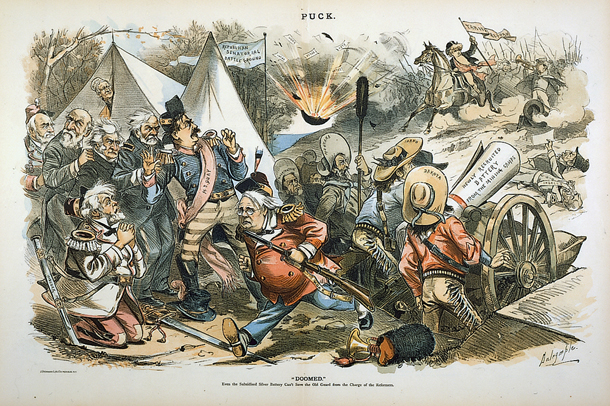
Roger M. wrote:It's funny how folks can read the identical article, and take very different things from it.
...
There's a line in the song "the boxer" - "a man hears what he wants to hear and disregards the rest" that's pretty informative on the matter. Confirmation bias for the knowing. Terms like "obviously", "plainly be seen", "self evident" are pretty good markers for items worthy of further investigation. They might serve in rhetoric after you've gotten the pathos happening but to a skeptical reader/listener they may beg questions.
Bill,
I don't believe I claimed in my article that Chicago was the only city that Erdnase could have published The Expert. It was probably the most prominently known safe place to publish such a book, which might well explain why an author would take the trouble to travel there to publish -- or it might explain why a gambler would find himself in Chicago in the first place. I certainly didn't mean to suggest there was absolutely no other location in the States in which the book could be published.
Hurt McDermott
I don't believe I claimed in my article that Chicago was the only city that Erdnase could have published The Expert. It was probably the most prominently known safe place to publish such a book, which might well explain why an author would take the trouble to travel there to publish -- or it might explain why a gambler would find himself in Chicago in the first place. I certainly didn't mean to suggest there was absolutely no other location in the States in which the book could be published.
Hurt McDermott
SwanJr wrote:Bill,
I don't believe I claimed in my article that Chicago was the only city that Erdnase could have published The Expert. It was probably the most prominently known safe place to publish such a book, which might well explain why an author would take the trouble to travel there to publish -- or it might explain why a gambler would find himself in Chicago in the first place. I certainly didn't mean to suggest there was absolutely no other location in the States in which the book could be published.
Hurt McDermott
Hurt -- my apologies for mischaracterizing your article. I can only offer "laziness" as an excuse -- I was on one side of the room typing my post, and your article was all the way on the other side of the room, too far to check for accuracy. <G>
Regardless, though, of my poor criticism of your work, you should be commended for coming at the problem from a completely different direction. This "thinking outside the box" is a great way to gain new insights, and sets up a whole 'nother paradigm that candidates must be measured against.
Comparing candidates against a checklist of "did he cheat?" "did he write?" "did he live in Chicago?" etc. is a mechanical way of identifying the author. Figuring out how and why the book was written the way it was, though, yields greater insights into the text itself (I feel like Jon Racherbaumer here . . . someone hand me a thesaurus!), and is ultimately much more satisfying.
Chris Aguilar wrote: I do think the Senator in the cartoon resembles Sanders.
Really? The guy in the cartoon has a hat, and Sanders doesn't.
Seriously, though, any argument that says "Montana" in the Puck cartoon is a senator must also apply to "Idaho", "Oregon", "Washington" and "Dakota" -- they occupy the same position in the cartoon as does "Montana". Which senators do they represent?
And the Montana cartoon has a much more hooked nose than does Sanders. A caricaturist as skilled as Dalrymple would have been more faithful to Sanders' appearance.
(And also, Chris, would you be so kind as to contact me off-line? I've tried to email you a couple times and had no luck. Thanks.)
It appears that there was a temporary issue with the MP3 file for my chat with David Ben & Julie Eng. If you had trouble, please try again: http://bit.ly/EE
Bill Mullins wrote:And the Montana cartoon has a much more hooked nose than does Sanders. A caricaturist as skilled as Dalrymple would have been more faithful to Sanders' appearance.
I'm not saying I'm convinced it's Sanders, just that it could very reasonably be Sanders. To me, it (very subjectively I'll admit) looks very much like him.
(And also, Chris, would you be so kind as to contact me off-line? I've tried to email you a couple times and had no luck. Thanks.)
Weird.
Try e-mailing me at both conjurenation@gmail.com (I can also be found on google plus via that address) and chris@conjurenation.com and I'm sure your message will get to me.
Wow.. Not my best day. Here is the correct link. Sorry guys : http://bit.ly/EErdnase
Bill, no apology necessary. I always look forward to your posts and appreciate the great amount of original material you have found and shared freely. I feel all of us writing about Erdnase are in your debt.
Hurt McDermott
Hurt McDermott
Thanks for the correction Mr. Hatch. Without further evidence, we can't be absolutely sure that Sanders went to visit his parents in Chicago. I very much enjoyed your essay "Reading Erdnase Backwards" in the new issue of Magicol. After finishing it, I felt like an insider who was was kept current on the progress of your research.
I did notice that David Ben's essay "Extraordinary Popular Delusions and the Madness of Erdnase" is missing footnote number six at the bottom of page 29. That footnote was to provide Ben's source for his suggestion "...that Alexander was not sufficiently familiar with the content of the book to extrapolate from it the information that could contribute to a profile."
In his essay, Ben explores an aspect of Erdnase's life that I haven't read about yet. At some point in his formative years, Erdnase must have devoted a considerable amount of time to study and practice card table artifice and card magic. He also needed the spare time and place to do it.
I did notice that David Ben's essay "Extraordinary Popular Delusions and the Madness of Erdnase" is missing footnote number six at the bottom of page 29. That footnote was to provide Ben's source for his suggestion "...that Alexander was not sufficiently familiar with the content of the book to extrapolate from it the information that could contribute to a profile."
In his essay, Ben explores an aspect of Erdnase's life that I haven't read about yet. At some point in his formative years, Erdnase must have devoted a considerable amount of time to study and practice card table artifice and card magic. He also needed the spare time and place to do it.
Leonard Hevia wrote:At some point in his formative years, Erdnase must have devoted a considerable amount of time to study and practice card table artifice and card magic. He also needed the spare time and place to do it.
The time that someone of means during that period would have had.
...a man of means, by no means--King of the Road.
If we're talking about Sanders, it would have been during his time at Phillips Exeter Academy and later Columbia University. One can picture a young Sanders in the classrooms, halls, cafeteria, and in his dorm with a deck of cards in his hands.
Proponents of Andrews might see him as a clerk on the C&NW Railroad working on the pasteboards.
If we're talking about Sanders, it would have been during his time at Phillips Exeter Academy and later Columbia University. One can picture a young Sanders in the classrooms, halls, cafeteria, and in his dorm with a deck of cards in his hands.
Proponents of Andrews might see him as a clerk on the C&NW Railroad working on the pasteboards.
Leonard Hevia wrote: I did notice that David Ben's essay "Extraordinary Popular Delusions and the Madness of Erdnase" is missing footnote number six at the bottom of page 29.
The missing footnotes were posted on http://magicol.wordpress.com/2011/12/01/some-edits/
In reading David Ben's article in MAGICOL, he notes that in criminal cases a person has be judged guilty, "Beyond a reasonable doubt." Then says it is generally(?) thought to be a standard of 90% or higher.
Not a lawyer, (Ben is) I remember sitting on a jury in California, where we were instructed that the burden of proof had to be, "Beyond a reasonable doubt, TO A MORAL CERTAINTY."
Would that suggest a need for better than 90%? Is the burden of proof different in Canada or different States in the U.S.? If I thought there was a 10% chance the defendent was innocent, I would be very careful and would need to hear more.
Saying that, I question if E.S. Andrews was proven to be at the "scene of the crime", and could be so judged with the certainty David has.
Not a lawyer, (Ben is) I remember sitting on a jury in California, where we were instructed that the burden of proof had to be, "Beyond a reasonable doubt, TO A MORAL CERTAINTY."
Would that suggest a need for better than 90%? Is the burden of proof different in Canada or different States in the U.S.? If I thought there was a 10% chance the defendent was innocent, I would be very careful and would need to hear more.
Saying that, I question if E.S. Andrews was proven to be at the "scene of the crime", and could be so judged with the certainty David has.
It would seem to me that a man named E.S. Andrews, a supposed con-man, would be a very obvious answer to the S.W. Erdnase question.
Since there is no solid "proof" and a great deal of suspects, I think we allow our desire to have one last "secret" to outweigh our common sense.
Since there is no solid "proof" and a great deal of suspects, I think we allow our desire to have one last "secret" to outweigh our common sense.
I don't believe the recent issue of Magicol contains enough information to declare that Erdnase has been "found".
In fact, both Genii and Magicol seem to have broken more than one rule of journalism as it relates to jumping to an unproven conclusion, in the case of Genii it wasn't within the article itself (Marty was quite careful to not definitively state that he'd found Erdnase).
Having said that, I'll comment on the Magicol issue, and it's conclusion that E.S. Andrews was Erdnase.
First off, I'll state that one thing that becomes apparent quickly is that Richard Hatch is IMO the most knowledgable person on record functioning as an Erdnase researcher. I don't believe anybody else who has commented publicly has the depth of understanding, and the details of the timeline that Richard does.
Frankly, his research is superior to all else out there, on DVD, in print, or on the internet.
His motives are clear and concise..he wants to find out who wrote EATCT, and he wants to find that out for the benefit of the fraternity as a whole.
If anybody is primed to produce the definitive statement, complete with proof as to who Erdnase was, it's Richard.
Richard paints a picture which leaves the reader short one piece of information, and that's the proven relationship between Andrews wife, and Dalrymple's mother (both share the same somewhat uncommon last name).
Richard makes clear that this is, to date, the best shot at closing the case.
I agree with him that this piece of information (if in the positive) would cement Andrews as Erdnase without further debate.
This article by Hatch will form a major cornerstone in the available Erdnase research.
(It should be made clear that Richard Hatch does not declare that he's found Erdnase, that statement was made by David Ben in a separate article.)
The David Ben article contains some serious points, and causes some serious questions to be askedand subsequently answered.
David's knowledge is a product of his background and his ongoing interests. Publisher, magician, researcher, writer, executor of the Vernon estate, and a man who has a deep understanding of The Expert At The Card Table in its entirety.
It's this last statement that forms a sizable portion of the gist of David's article. He has undertaken to use the actual material in the book as a compass to point to Erdnase. This use of the material that's actually written in the pages of EATCT can't be understated. It's fine to say you're going to undertake such a project..but the actual material is (as David points out) literally a life's work to fully comprehend.
Very few people can leverage the material on the pages to try and paint a picture of the Erdnase the man, simply because very few people truly understand the entirety of the work in EATCT.
Ben has a complete grasp of EATCT.
Ben paints a compelling picture of Erdnase as Andrews, a train worker, and a man who could only have accomplished what he did by practicing for nearly every waking hour of the day, for years on end.
Such a comment can only come from somebody who understands what it takes to master every move in EATCT such that the author could clearly explain it in writing. David Ben understands this concept.
In a nutshell, David's comments fully support Richards E.S. Andrews candidate, and his comments support him quite throughly.
I will diverge slightly here to say that David has done exactly what Marty has done.he's taken one of the two main candidates, as proposed by Alexander and Hatch, and he's essentially molded his "proof" to fit the candidate.
Neither Marty of David came up with their candidate from scratch..each was essentially a champion for another researchers candidate.
I strongly believe that what it really comes down to is the quality of the original research which led to the choice of the candidates long before David Ben or Marty Demarest were on the scene.
If David Alexander was wrong in who he chose as his original candidate (Sanders), then Marty is wrong.
If Richard Hatch was wrong in who he chose as his original candidate (Andrews), then David Ben is wrong.
In terms of original research, I would give the weight to Richard Hatch. His research is not only more extensive and ongoing, it's also the least "reaching" in its conclusions. It simply states the facts as they are found to be, and draws together those facts into a concise picture of where the E.S. Andrews and S.W. Erdnase lines cross each other.
Unfortunately, with David's passing, his "original" research can be developed no further. While I'm a fan (from the days of the Genii article) of David's research, I would honestly state that one must make many leaps of faith in order to arrive at the W.S. Sanders conclusion.
It's not a straight road, and as clever as much of it is.it simply isn't as robust as the Hatch research.
I believe those who fervently support Marty's findings must first go back and understand fully and clearly the somewhat jagged path David took to get to Sanders in the first place.
I will conclude by saying that I believe the E.S. Andrews candidate is, based on all the available information, a stronger candidate than the W.S. Sanders candidate.
I also believe the Andrews candidate is (as Richard Hatch has pointed out) only one piece of information away from being proven to be Erdnase.
I'm not convinced the Sanders candidate has progressed that far, based on the available research.
One final thing in this overly-long post.
It was noted above that David Ben made some comments on David Alexanders "abilities". By parsing Ben's writings into internet posts, it can be made to seem that Mr. Ben was somehow insulting David Alexander.
This is simply not the case.
Ben's comments as they relate to Alexander (and Marty) are polite, professional, and made in a friendly tone throughout.
In fact, both Genii and Magicol seem to have broken more than one rule of journalism as it relates to jumping to an unproven conclusion, in the case of Genii it wasn't within the article itself (Marty was quite careful to not definitively state that he'd found Erdnase).
Having said that, I'll comment on the Magicol issue, and it's conclusion that E.S. Andrews was Erdnase.
First off, I'll state that one thing that becomes apparent quickly is that Richard Hatch is IMO the most knowledgable person on record functioning as an Erdnase researcher. I don't believe anybody else who has commented publicly has the depth of understanding, and the details of the timeline that Richard does.
Frankly, his research is superior to all else out there, on DVD, in print, or on the internet.
His motives are clear and concise..he wants to find out who wrote EATCT, and he wants to find that out for the benefit of the fraternity as a whole.
If anybody is primed to produce the definitive statement, complete with proof as to who Erdnase was, it's Richard.
Richard paints a picture which leaves the reader short one piece of information, and that's the proven relationship between Andrews wife, and Dalrymple's mother (both share the same somewhat uncommon last name).
Richard makes clear that this is, to date, the best shot at closing the case.
I agree with him that this piece of information (if in the positive) would cement Andrews as Erdnase without further debate.
This article by Hatch will form a major cornerstone in the available Erdnase research.
(It should be made clear that Richard Hatch does not declare that he's found Erdnase, that statement was made by David Ben in a separate article.)
The David Ben article contains some serious points, and causes some serious questions to be askedand subsequently answered.
David's knowledge is a product of his background and his ongoing interests. Publisher, magician, researcher, writer, executor of the Vernon estate, and a man who has a deep understanding of The Expert At The Card Table in its entirety.
It's this last statement that forms a sizable portion of the gist of David's article. He has undertaken to use the actual material in the book as a compass to point to Erdnase. This use of the material that's actually written in the pages of EATCT can't be understated. It's fine to say you're going to undertake such a project..but the actual material is (as David points out) literally a life's work to fully comprehend.
Very few people can leverage the material on the pages to try and paint a picture of the Erdnase the man, simply because very few people truly understand the entirety of the work in EATCT.
Ben has a complete grasp of EATCT.
Ben paints a compelling picture of Erdnase as Andrews, a train worker, and a man who could only have accomplished what he did by practicing for nearly every waking hour of the day, for years on end.
Such a comment can only come from somebody who understands what it takes to master every move in EATCT such that the author could clearly explain it in writing. David Ben understands this concept.
In a nutshell, David's comments fully support Richards E.S. Andrews candidate, and his comments support him quite throughly.
I will diverge slightly here to say that David has done exactly what Marty has done.he's taken one of the two main candidates, as proposed by Alexander and Hatch, and he's essentially molded his "proof" to fit the candidate.
Neither Marty of David came up with their candidate from scratch..each was essentially a champion for another researchers candidate.
I strongly believe that what it really comes down to is the quality of the original research which led to the choice of the candidates long before David Ben or Marty Demarest were on the scene.
If David Alexander was wrong in who he chose as his original candidate (Sanders), then Marty is wrong.
If Richard Hatch was wrong in who he chose as his original candidate (Andrews), then David Ben is wrong.
In terms of original research, I would give the weight to Richard Hatch. His research is not only more extensive and ongoing, it's also the least "reaching" in its conclusions. It simply states the facts as they are found to be, and draws together those facts into a concise picture of where the E.S. Andrews and S.W. Erdnase lines cross each other.
Unfortunately, with David's passing, his "original" research can be developed no further. While I'm a fan (from the days of the Genii article) of David's research, I would honestly state that one must make many leaps of faith in order to arrive at the W.S. Sanders conclusion.
It's not a straight road, and as clever as much of it is.it simply isn't as robust as the Hatch research.
I believe those who fervently support Marty's findings must first go back and understand fully and clearly the somewhat jagged path David took to get to Sanders in the first place.
I will conclude by saying that I believe the E.S. Andrews candidate is, based on all the available information, a stronger candidate than the W.S. Sanders candidate.
I also believe the Andrews candidate is (as Richard Hatch has pointed out) only one piece of information away from being proven to be Erdnase.
I'm not convinced the Sanders candidate has progressed that far, based on the available research.
One final thing in this overly-long post.
It was noted above that David Ben made some comments on David Alexanders "abilities". By parsing Ben's writings into internet posts, it can be made to seem that Mr. Ben was somehow insulting David Alexander.
This is simply not the case.
Ben's comments as they relate to Alexander (and Marty) are polite, professional, and made in a friendly tone throughout.
Whether you agree or disagree, the Magicol issue is just a fantastic read.
Roger M. wrote:
I will diverge slightly here to say that David has done exactly what Marty has done.he's taken one of the two main candidates, as proposed by Alexander and Hatch, and he's essentially molded his "proof" to fit the candidate.
But the difference is that the *profile* for Sanders was created by David Alexander, not Marty. And that profile was created before finding the candidate. So David Ben and Marty have done very different things. Marty found lots of new evidence for an existing candidate, whereas David Ben constructed a profile arguing for an existing candidate. I don't think David Ben offered any new evidence. The evidence for Andrews was found by Richard Hatch, absent a profile (as far as I can tell).
Roger M. wrote:
I will conclude by saying that I believe the E.S. Andrews candidate is, based on all the available information, a stronger candidate than the W.S. Sanders candidate.
I also believe the Andrews candidate is (as Richard Hatch has pointed out) only one piece of information away from being proven to be Erdnase.
What's the stronger evidence for Andrews over Sanders? It seems to me the main items would be 1) the possible Seely/Dalrymple connection and 2) whether you think a direct backwards spelling (ES Andrews) is stronger evidence than a full anagram (WE Sanders). I'm not sure the backwards spelling is stronger evidence -- I liked David's argument that the simple backwards spelling was misdirection. Plus the anagram angle is reinforced by the fact that his candidate was playing with anagrams in his diary. Regarding the Seely connection -- it hasn't been established that it's the same Seely and Dalrymple. Plus we have some suggestions of a connection between Sanders and Dalrymple. So the Dalrymple angle seems like it could go either way.
I really don't see any other evidence for Andrews. Very little seems to be known about him. On the other hand, there's quite a bit of circumstantial evidence for Sanders with his gambling history, doing magic tricks, writing style/education, buying decks of cards, playing with anagrams, etc. Did I miss some compelling evidence for ES Andrews?
My point was that Ben and Demarest each championed the candidates of other researchers.
Neither man claimed to have, on his own, discovered anybody new.
The original footwork in both cases was done by David Alexander and Richard Hatch.
I'm aware that Alexander and Hatch arrived at their candidate by completely different means, but neither Ben nor Demarest brought any "new" candidates to the table......which was my point.
The Dalrymple evidence is (IMO) far more compelling in the Andrews case.
An actual name, as opposed to a nebulous figure in a cartoon would seem to carry enough weight to proceed with further investigation.
The cartoon is what it is, and can be taken no further.
I don't attach weight to the cartoon in terms of accepting that the character is Sanders father.
Bring up the spectre of Occams Razor, the K.I.S.S. principle, or whatever works for you.......and the reversal of E.S. Andrews simply is easier to accept than the machinations David Alexander postulated in order to arrive at W.S. Sanders.
Once again, I suggest folks actually dig deep into understanding how David Alexander got to the W.S. Sanders name (if they're unaware of his process). It was hardly anything resembling a straight line.
If you choose to attach weight to Marty's additional findings, as you have in your last sentence, Sanders does indeed continue to appear interesting.
I don't attach the same weight to Marty's findings as you do.
Hatch has demonstrated that there were physical associations between Andrews, the man...... and either the book, dealers for the book, or the holder of the books plates.
In the end though, neither candidate was shown definitively to have been Erdnase, and realistically, no major new evidence was presented in either series of articles.
Which candidate is currently a stronger candidate is a subjective decision to be made by those who've read all the information available to date.
I find E.S. Andrews to be a stronger candidate.
As to how much stronger a candidate?...........55% vs. 45% in favor of Andrews over Sanders.
..........and of course the very distinct possibility remains that Erdnase was actually neither of them.
Neither man claimed to have, on his own, discovered anybody new.
The original footwork in both cases was done by David Alexander and Richard Hatch.
I'm aware that Alexander and Hatch arrived at their candidate by completely different means, but neither Ben nor Demarest brought any "new" candidates to the table......which was my point.
The Dalrymple evidence is (IMO) far more compelling in the Andrews case.
An actual name, as opposed to a nebulous figure in a cartoon would seem to carry enough weight to proceed with further investigation.
The cartoon is what it is, and can be taken no further.
I don't attach weight to the cartoon in terms of accepting that the character is Sanders father.
Bring up the spectre of Occams Razor, the K.I.S.S. principle, or whatever works for you.......and the reversal of E.S. Andrews simply is easier to accept than the machinations David Alexander postulated in order to arrive at W.S. Sanders.
Once again, I suggest folks actually dig deep into understanding how David Alexander got to the W.S. Sanders name (if they're unaware of his process). It was hardly anything resembling a straight line.
If you choose to attach weight to Marty's additional findings, as you have in your last sentence, Sanders does indeed continue to appear interesting.
I don't attach the same weight to Marty's findings as you do.
Hatch has demonstrated that there were physical associations between Andrews, the man...... and either the book, dealers for the book, or the holder of the books plates.
In the end though, neither candidate was shown definitively to have been Erdnase, and realistically, no major new evidence was presented in either series of articles.
Which candidate is currently a stronger candidate is a subjective decision to be made by those who've read all the information available to date.
I find E.S. Andrews to be a stronger candidate.
As to how much stronger a candidate?...........55% vs. 45% in favor of Andrews over Sanders.
..........and of course the very distinct possibility remains that Erdnase was actually neither of them.
Bob Farmer wrote:Whether you agree or disagree, the Magicol issue is just a fantastic read.
I agree Bob, and put the Genii issue(s) entirely on par with it.
Combined, they put everything (almost) in this thread into a well written series of articles.
Both Genii and Magicol bring some welcome new thinking to the search.
Roger M. wrote: Hatch has demonstrated that there were physical associations between Andrews, the man...... and either the book, dealers for the book, or the holder of the books plates.
I think youre mistaken about that, Roger.
What evidence demonstrates such physical connections?
For starters, Atlas Novelty, remaindering First Editions.....and E.S. Andrews living on the same street, at the same time, a few doors down.
That's a physical association that one might consider as "abnormally close proximity".
In a country as large as the U.S.A., having a man proposed as the author of EATCT (E.S. Andrews) living somewhat less than 5000 feet away from a novelty company selling stacks of First Editions of EATCT might be considered something a bit stronger than merely circumstantial.
I see it as more than circumstantial, others are free to put appropriate weight to it as they see fit.
That's a physical association that one might consider as "abnormally close proximity".
In a country as large as the U.S.A., having a man proposed as the author of EATCT (E.S. Andrews) living somewhat less than 5000 feet away from a novelty company selling stacks of First Editions of EATCT might be considered something a bit stronger than merely circumstantial.
I see it as more than circumstantial, others are free to put appropriate weight to it as they see fit.
The geographical proximity could easily be happinstance. You can read into it what you like if it supports your theory.
You could I suppose, if you had a theory.
I don't have a theory though, so I follow the evidence and form opinions.
I don't have a theory though, so I follow the evidence and form opinions.
Roger M. wrote:For starters, Atlas Novelty, remaindering First Editions.....and E.S. Andrews living on the same street, at the same time, a few doors down.magicam wrote:I think youre mistaken about that, Roger.Roger M. wrote: Hatch has demonstrated that there were physical associations between Andrews, the man...... and either the book, dealers for the book, or the holder of the books plates.
What evidence demonstrates such physical connections?
That's a physical association that one might consider as "abnormally close proximity".
In a country as large as the U.S.A., having a man proposed as the author of EATCT (E.S. Andrews) living somewhat less than 5000 feet away from a novelty company selling stacks of First Editions of EATCT might be considered something a bit stronger than merely circumstantial.
I see it as more than circumstantial, others are free to put appropriate weight to it as they see fit.
Everyone is entitled to their own opinion, but not their own facts.
Did Andrews live a few doors down or nearly a mile away? Seems a significant factual difference in distance for 1902.
There are only two kinds of evidence, direct and circumstantial. One can put as much weight as one wants to a set of circumstantial facts, but that will never change the essential (circumstantial) character of such facts, which will always require inferences to be drawn in order to prove the ultimate fact. Thus, there is no such thing as more than circumstantial evidence, unless by that phrase one is referring to direct evidence. Abnormally close proximity even insanely, ungodly, are-you-frickin-kidding-me? close proximity is not direct evidence, and thus far there is no direct evidence of Andrews selling copies of EATCT to Atlas. If there were, the location of his living quarters would probably be irrelevant. Andrews could have shared the same office space with Atlas, but that, without more, would still only be circumstantial evidence.
Thats not to say that circumstantial evidence cant be compelling. Judges and juries decide civil and criminal actions all the time on circumstantial evidence. But based on what Ive read of Richards admirable research, he has not demonstrated any kind of physical associations between Andrews and EATCT none whatsoever, and I dont think Richard would claim that. You open the reply with For starters . Id be interested in hearing what other evidence exists that demonstrates such physical connections.
Moving on to the essays and work by our Erdnase scholars, with this disclaimer at the outset: I am no Erdnase expert.
First, what evidence is there to support the notion that the author (whoever he was) actually sold copies of his book? Does any such evidence exist, or is this pure speculation/assumption? The authors stated desire to profit from publication of the book does not perforce mean that he actually sold copies of the book, retail or wholesale.
With respect to my friend Richard Hatch, I am not convinced of the significance of Atlas Noveltys sales of EATCT. If I understand Richards argument, Atlas sales of EATCT was significant because it was rather uncharacteristic of Atlas to do so, thereby implying that Atlas carried stock of EATCT for reasons other than to simply sell a new book on magic, which of course then makes Andrews proximity to Atlas a possible important fact. But was it really uncharacteristic for Atlas to carry this book? Richard argues that Atlas was an obscure Chicago magic dealer which heretofore specialized in selling slum magic to pitchmen. With the use of the word heretofore, Richards argument seems to be that Atlas sales of EATCT signaled a shift in its business plan, i.e., what Atlas sold, to whom it marketed products, etc. But Hurt McDermotts article states that part of Atlas business was selling slot machines and devices to cheat patrons (trade stimulators). If thats true, I do not see Atlas sales of EATCT as being uncharacteristic or unusual at all. EATCT was about gambling, cheating and magic seemingly right in keeping with Atlas business. And if Atlas was indeed a slum (low cost) magic dealer, then it would not seem unusual for Atlas to sell a book at half its published price, as Atlas did with EATCT.
There is another problem with the theory that Atlas only sold slum magic and that its sales of EATCT was somehow unusual for Atlas. How do we explain the fact that Atlas stocked and sold C. Lang Neils The Modern Conjurer at the full price of $2.00 upon its publication, as evidenced by Atlas ad in the February 1903 issue of The Sphinx? Neils book proved to be a classic and was far from low brow conjuring; in other words, Atlas sales of The Modern Conjurer represents the antithesis of Richards theory about the kind of business that Atlas was.
In summary, with the limited knowledge at my disposal, vis--vis Andrews presence in Chicago I do not see any significance to Atlas sales of EATCT. But to the extent that one wants to argue that Atlas sales of EATCT was at all unusual (and I dont think it was), there seems to be a very plausible reason for this which has nothing to do with Andrews. Accepting, for the sake of argument, that Atlas sales of EATCT was odd, the fact that Atlas was selling the book at half price suggests that whoever was handling the wholesaling of EATCT really wanted to see the book sold in as many stores as possible. Are there any facts to support such a motivation to wholesale to any possible retailer? Yes. McKinneys adjudicated bankruptcy in late January, 1903. Sure, the facts are circumstantial, but from Adrian Plates comments we are told that McKinney sold copies of EATCT. If thats true, would it not make sense for a financially-troubled McKinney to get copies of EATCT in the hands of as many Chicago-area dealers as possible in late 1902 and January, 1903, and possible in early February, 1903? If the heavy discounting of EATCT started in February, 1903, such timing would tie in neatly with McKinneys bankruptcy.
And if McKinney was the one selling copies of EATCT, both retail and wholesale, this might also provide a clue to the business arrangement that he had with Erdnase. After all, if the author did not want to be associated with his book, any sort of significant efforts by him to sell copies, individually or in wholesale quantities, would create the risk of being connected with his book. Again, what evidence do we have that the author actually sold copies of EATCT?
If the author really was concerned about his anonymity, for legal, family or retribution (from gambling cheats who figured out who he was) reasons, it would make sense to keep his distance from sales of the book. It would make sense for him to have a one and done financial arrangement with a man like McKinney. If Andrews was the author, he seems to have been gainfully employed, with a decent income for his family, which might suggest that his need for money in connection with publication of EATCT was not that great, so his business arrangement with McKinney might have been rather modest. And assuming that the author did have other sources of reasonably comfortable income, one could even argue that the statement that he wrote the book for money was another attempt at misdirection re his identity, in that a logical assumption from such statement would be that he needed the money.
For what its worth, the U.S. copyright application tells us nothing about the true ownership of the copyright, in part due to the pseudonymous nature of the authors name and the fact that copyrights were (and to this day continue to be) easily transferable. As an aside, Id add that the copyright application tells us nothing about the authors true nationality either.
Finally, if Andrews was the author and the knowledge of his true identity actually did pose serious legal risks to him as author of this obscene work (as McDermott suggests with his account of Comstocks activities), it seems odd that Andrews (McKinney, or someone else?) would select the rather weak S. W. Erdnase pseudonym.
Is this supposed to be a magician's version of Lem's story "The Investigation" or similar?
The artist said somebody visited him.
Somebody had a specific style or tone in their writing which gives the book its distinctive flavor.
Beyond that - kind of tough to rule in/out too much.
The artist said somebody visited him.
Somebody had a specific style or tone in their writing which gives the book its distinctive flavor.
Beyond that - kind of tough to rule in/out too much.
magicam wrote:First, what evidence is there to support the notion that the author (whoever he was) actually sold copies of his book?
The title page of the 1st edition says:
"Published by the author."
To me, that means that the author hired the printing, owned the books after they were printed, and distributed them. At a minimum, he sold them wholesale. He may have sold a few retail. At some point, he may have remaindered existing stock.
Given that the book was self-published, I can't put together any reasonable scenario in which he didn't sell them.
Isn't it possible that the author self-published the book with the plan to simply then turn over the entire printing to a single distributor? The book is still self-published, but the author doesn't sell any copies.
Would that distributor wait as long as was waited before advertising the book for the first time (that we know of)?
Seems more likely that a self-published, self-distributed one man operation (Erdnase publishing and selling) would try the low budget, no advertising route before a distributor finally got a hold of the first editions, got them out and into inventory, and an ad then shows up for the first time in a national publication, The Sphinx.
If it was a big distributor right off the bat, doesn't it make sense that the ads would have started showing up much sooner than they did?
Seems more likely that a self-published, self-distributed one man operation (Erdnase publishing and selling) would try the low budget, no advertising route before a distributor finally got a hold of the first editions, got them out and into inventory, and an ad then shows up for the first time in a national publication, The Sphinx.
If it was a big distributor right off the bat, doesn't it make sense that the ads would have started showing up much sooner than they did?
To Richards point, yes, under the circumstances it seems entirely possible (and plausible) that Erdnase paid for the printing and binding with the plan that someone else would sell the book. This brings up another point: what evidence do we have, other than the statement on the title page noted by Bill Mullins, that Erdnase actually paid for the printing and binding (which acts of payment are the very things that define what a publisher is)?
To Rogers points and argument, if McKinney was in fact the distributor, why wouldnt Rogers same scenario (economic distribution without advertisement) be equally applicable? Ill add that until a thorough search is done of the newspapers and magazines in which EATCT ads would have likely been run, were on very shaky ground by assuming that the book wasnt advertised earlier in 1902.
But theres a good reason why the book wouldnt have been advertised at the outset. See Hugh McDermotts article in Magicol.
Bill, I generally agree with your characterization of what a modern-day publisher does, but will have to disagree that the Published by the author statement on the title page is very indicative of the authors role in selling copies, directly or wholesale. For example, also on the title page, we are told that S. W Erdnase wrote the book, but few people seem to believe that. So why should the Published by the author statement be credible?
I think there is a very plausible and reasonable scenario for how the Published by the author statement could appear on the title page without the author having anything to do with its sale, and the motivating reason is effectively outlined in Hugh McDermotts article: publishers could be prosecuted under the Comstock and related obscenity laws, but almost certainly not printers, who, unlike authors and publishers, had nothing to do with a books content. So in EATCT the identities of the author and publisher the two parties who could be prosecuted are hidden. Makes perfect sense to me. Of course, that doesnt prove that the author didnt sell copies of his book, but for the reasons discussed in my earlier post, it stands to reason that the author would have good reason to distance himself from his book.
If the Published by the author statement is the only basis we have for assuming that the author sold the book himself (retail or wholesale), IMHO that is very thin evidence indeed and, all things considered, its probative value is minimal. To the extent that the authors personal involvement in the sale of EATCT is a critical component of anyones theory of authorship, IMHO any such theory has a very weak foundation.
To Rogers points and argument, if McKinney was in fact the distributor, why wouldnt Rogers same scenario (economic distribution without advertisement) be equally applicable? Ill add that until a thorough search is done of the newspapers and magazines in which EATCT ads would have likely been run, were on very shaky ground by assuming that the book wasnt advertised earlier in 1902.
But theres a good reason why the book wouldnt have been advertised at the outset. See Hugh McDermotts article in Magicol.
Bill, I generally agree with your characterization of what a modern-day publisher does, but will have to disagree that the Published by the author statement on the title page is very indicative of the authors role in selling copies, directly or wholesale. For example, also on the title page, we are told that S. W Erdnase wrote the book, but few people seem to believe that. So why should the Published by the author statement be credible?
I think there is a very plausible and reasonable scenario for how the Published by the author statement could appear on the title page without the author having anything to do with its sale, and the motivating reason is effectively outlined in Hugh McDermotts article: publishers could be prosecuted under the Comstock and related obscenity laws, but almost certainly not printers, who, unlike authors and publishers, had nothing to do with a books content. So in EATCT the identities of the author and publisher the two parties who could be prosecuted are hidden. Makes perfect sense to me. Of course, that doesnt prove that the author didnt sell copies of his book, but for the reasons discussed in my earlier post, it stands to reason that the author would have good reason to distance himself from his book.
If the Published by the author statement is the only basis we have for assuming that the author sold the book himself (retail or wholesale), IMHO that is very thin evidence indeed and, all things considered, its probative value is minimal. To the extent that the authors personal involvement in the sale of EATCT is a critical component of anyones theory of authorship, IMHO any such theory has a very weak foundation.
magicam wrote: To Richards point, yes, under the circumstances it seems entirely possible (and plausible) that Erdnase paid for the printing and binding with the plan that someone else would sell the book.
If Erdnase paid for the printing and binding, did he not own the books at that point? And if he lost ownership of the books but received money in return, did he not sell them? I guess I'm not understanding how one can be a publisher, and not sell the publication.
This brings up another point: what evidence do we have, other than the statement on the title page noted by Bill Mullins, that Erdnase actually paid for the printing and binding (which acts of payment are the very things that define what a publisher is)?
As I've said previously in the thread, if we discount what appear to be statements of fact from primary sources, we aren't left with anything at all other than suppositions, and there's no point in pretending what we are doing is "research". To me, Occam's Razor guides me to believe that the book was published by the author. It may not have been, but without pretty convincing fact-based or documentary evidence, I won't spend much time entertaining the possibility.
publishers could be prosecuted under the Comstock and related obscenity laws, but almost certainly not printers, who, unlike authors and publishers, had nothing to do with a books content.
HERE
ARE
THREE articles about a printer, arrested by Comstock himself, who was tried and convicted for printing gambling literature.
AND ANOTHERprinter arrested.
It's hard to believe that David Alexander passed away suddenly one year ago.
Remembering a friend whose research skills and persistence, helped many.
Remembering a friend whose research skills and persistence, helped many.
Bill, I could not open the third, gambling link you provided, but the other three clippings are readily distinguishable from the risk of McKinney being convicted under the Comstock or a related law for printing EATCT. The first two clippings concern a man named Marvin, who was engaged in the act of counterfeiting (green-goods) he was arrested because of the counterfeiting, not the printing per se. Moreover, it was clear he knew what he was doing by the back-room location of the counterfeit printing operations the surreptitious nature of his activities suggest knowledge of guilt. In criminal law, except for the small handful of strict liability criminal statutes, proving mens rea (loosely translated, guilty mind) is an indispensable part of convicting someone of a crime. As for the Hollaman case, I have to admit that this clipping undercuts my assumption, but I will add that there is nothing to indicate that Hollaman was actually convicted of printing the lottery ad in the program, just that he was arrested. According to McDermott, Comstocks conviction rate was only about 60%, which certainly indicates that Comstock made or caused a high percentage of ineffectual/unsubstantiated arrests.
But let me concede your point and agree, for the sake of argument, that McKinney could have been not only arrested, but also convicted, of the simple act of printing EATCT. Of what import is that concession for the subjects and theories being discussed? IMHO, not much.
Cmon Bill! Im clearly talking about Erdnase taking an active role in the sales of the book to third parties, by retail or wholesale. Youre now talking about the hyper-abstract notion of a sale of the book to divest ownership. Dont you think theres a huge difference between the two concepts? In essence, if you believe that Published by the author equates with Erdnase taking an active role in selling copies of his book (retail or wholesale), so be it. I think thats a risky and unfounded inference/assumption, but thats just my opinion, obviously.
Bill, the primary source is a known liar! He used a false name. To the extent that using Occams Razor is even apt in this case, which Razor you gonna pick? :) The one saying that since the author clearly wanted to disguise his identity and role concerning EATCT, all other statements which might provide clues about his real name and role should be equally suspect, or the Razor that says its printed on the title page, so absent convincing evidence to the contrary it must be a true statement? You ignored my point about the authors apparent use of a pseudonym on the title page, but by the logic quoted above, it seems like youd be prepared to argue that the search for an author whose name isnt S.W. Erdnase means that were not doing research on the authors identity.
But let me concede your point and agree, for the sake of argument, that McKinney could have been not only arrested, but also convicted, of the simple act of printing EATCT. Of what import is that concession for the subjects and theories being discussed? IMHO, not much.
Bill Mullins wrote:If Erdnase paid for the printing and binding, did he not own the books at that point? And if he lost ownership of the books but received money in return, did he not sell them? I guess I'm not understanding how one can be a publisher, and not sell the publication.magicam wrote: To Richards point, yes, under the circumstances it seems entirely possible (and plausible) that Erdnase paid for the printing and binding with the plan that someone else would sell the book.
Cmon Bill! Im clearly talking about Erdnase taking an active role in the sales of the book to third parties, by retail or wholesale. Youre now talking about the hyper-abstract notion of a sale of the book to divest ownership. Dont you think theres a huge difference between the two concepts? In essence, if you believe that Published by the author equates with Erdnase taking an active role in selling copies of his book (retail or wholesale), so be it. I think thats a risky and unfounded inference/assumption, but thats just my opinion, obviously.
Bill Mullins wrote:As I've said previously in the thread, if we discount what appear to be statements of fact from primary sources, we aren't left with anything at all other than suppositions, and there's no point in pretending what we are doing is "research". To me, Occam's Razor guides me to believe that the book was published by the author. It may not have been, but without pretty convincing fact-based or documentary evidence, I won't spend much time entertaining the possibility.magicam wrote:This brings up another point: what evidence do we have, other than the statement on the title page noted by Bill Mullins, that Erdnase actually paid for the printing and binding (which acts of payment are the very things that define what a publisher is)?
Bill, the primary source is a known liar! He used a false name. To the extent that using Occams Razor is even apt in this case, which Razor you gonna pick? :) The one saying that since the author clearly wanted to disguise his identity and role concerning EATCT, all other statements which might provide clues about his real name and role should be equally suspect, or the Razor that says its printed on the title page, so absent convincing evidence to the contrary it must be a true statement? You ignored my point about the authors apparent use of a pseudonym on the title page, but by the logic quoted above, it seems like youd be prepared to argue that the search for an author whose name isnt S.W. Erdnase means that were not doing research on the authors identity.
Clay The Comstock laws, like many laws today which regulate "morality", were used arbitrarily and capriciously. The examples I provided may not have been the best, but they were ones I could find quickly, and they were not behind pay walls. I've also found examples where people were arrested (by Comstock) for printing post cards reproducing artwork containing naked women images that may be found in art books in schools everywhere. And cases where minions were arrested along with their bosses, perhaps to compel their cooperation (just as low-level drug dealers are arrested to get to suppliers). At any rate, my (so far, cursory) research doesn't support the idea that printers, being parties of lesser culpability, would be less likely to be arrested than publisher. And that being the case, the logic of "the printer wanted to divert responsibility to the author, thus the 'published by the author' statement is false, to protect the printer" theory doesn't hold up.
I took "green-goods" to refer to the green baize cloth on gaming tables, and thought it meant "gambling literature". If it meant counterfeit, that does undercut the point I was making. (and the Oxford English Dictionary does support the "counterfeit" meaning). So, my bad there.
As far as "publishing" directly implying "selling", I guess we disagree. A publisher of books, sells books. Someone had to have taken "an active role in the sales of the book to third parties, by retail or wholesale." The book was marked as self-published. From all indications, it was a fairly small print run I think Richard Hatch has speculated that maybe a thousand were printed, and I see no reason to strongly disagree with that estimate (while conceding that it is only an estimate). We don't know who moved it to the magic shops that were known to have sold it, but what little evidence there is points to the author, or at least is not supportive of any other party. The publication of "Expert" was a small enterprise, without much room for multiple parties. If you disbelieve the "published by the author" statement, the rest of the chain falls apart, but any other theory would be more compelling if supported by direct evidence, than if by denying contrary evidence.
I believe so, for two reasons:
1. The book states just that, and the arguments for the statement being false just aren't convincing to me
2. Someone had to sell the book, and the author is the best candidate, given the known circumstances of its publication. Compare it to "New Era Card Tricks" a book comparable in many ways. It was stated to be published by the author, Roterberg. It was sold directly by him. It was copyrighted by him.
And I don't the use of a pseudonym (in and of itself) makes other statements suspect. Pseudonyms are a special class of "lie" (a word that I don't really think is appropriate here, but I don't know a better one). Your comments about "mens rea" seem relevant here without knowing the author's intent in the (mild) deception, it's difficult to say he was an out-and-out liar. Sometimes pseudonyms are an "open secret" everyone knew that Mark Twain was Sam Clemens. It may be that Erdnase thought people would know that Erdnase wasn't really his name, and today it is only an accident of history that we don't know now who wrote the book.
(The title page of "Running Man" says that the author was Richard Bachman (pseud. of Stephen King); should we disbelieve that it was published by New American Library?)
I took "green-goods" to refer to the green baize cloth on gaming tables, and thought it meant "gambling literature". If it meant counterfeit, that does undercut the point I was making. (and the Oxford English Dictionary does support the "counterfeit" meaning). So, my bad there.
As far as "publishing" directly implying "selling", I guess we disagree. A publisher of books, sells books. Someone had to have taken "an active role in the sales of the book to third parties, by retail or wholesale." The book was marked as self-published. From all indications, it was a fairly small print run I think Richard Hatch has speculated that maybe a thousand were printed, and I see no reason to strongly disagree with that estimate (while conceding that it is only an estimate). We don't know who moved it to the magic shops that were known to have sold it, but what little evidence there is points to the author, or at least is not supportive of any other party. The publication of "Expert" was a small enterprise, without much room for multiple parties. If you disbelieve the "published by the author" statement, the rest of the chain falls apart, but any other theory would be more compelling if supported by direct evidence, than if by denying contrary evidence.
In essence, if you believe that Published by the author equates with Erdnase taking an active role in selling copies of his book (retail or wholesale), so be it.
I believe so, for two reasons:
1. The book states just that, and the arguments for the statement being false just aren't convincing to me
2. Someone had to sell the book, and the author is the best candidate, given the known circumstances of its publication. Compare it to "New Era Card Tricks" a book comparable in many ways. It was stated to be published by the author, Roterberg. It was sold directly by him. It was copyrighted by him.
And I don't the use of a pseudonym (in and of itself) makes other statements suspect. Pseudonyms are a special class of "lie" (a word that I don't really think is appropriate here, but I don't know a better one). Your comments about "mens rea" seem relevant here without knowing the author's intent in the (mild) deception, it's difficult to say he was an out-and-out liar. Sometimes pseudonyms are an "open secret" everyone knew that Mark Twain was Sam Clemens. It may be that Erdnase thought people would know that Erdnase wasn't really his name, and today it is only an accident of history that we don't know now who wrote the book.
(The title page of "Running Man" says that the author was Richard Bachman (pseud. of Stephen King); should we disbelieve that it was published by New American Library?)
A person (or entity) would be considered the "publisher" of a work if:
1. He paid for the printing or someone else paid for the printing on his behalf.
2. He sold the entire lot of printed books en masse to a single entity before or after they were actually printed.
3. He sold all the books one at a time.
4. He sold some of the books one at a time and sold large quantities to other entities (one or many).
In other words, the title of "publisher" can be conveyed very loosely.
1. He paid for the printing or someone else paid for the printing on his behalf.
2. He sold the entire lot of printed books en masse to a single entity before or after they were actually printed.
3. He sold all the books one at a time.
4. He sold some of the books one at a time and sold large quantities to other entities (one or many).
In other words, the title of "publisher" can be conveyed very loosely.
Bill Mullins wrote:I took "green-goods" to refer to the green baize cloth on gaming tables, and thought it meant "gambling literature". If it meant counterfeit, that does undercut the point I was making. (and the Oxford English Dictionary does support the "counterfeit" meaning).
From the context of the newspaper accounts, I'm pretty sure the "green goods" here is in reference to this very interesting scam:
http://en.wikipedia.org/wiki/Green_goods_scam
No bills are actually counterfeited. Real bills are represented as excellent counterfeits, sold at a discount, then switched for worthless paper. Pretty clever, since the victim is unlikely to go to the authorities and admit to an attempt to purchase counterfeit bills.
Is there anything in the text that indicates the author was a Freemason?
Bill,
Im not saying that Erdnase didnt publish the book. Im simply stating my opinion that under the circumstances as we know them, its unwise to blindly accept the Published by the author statement as true, in part because we know (at least believe strongly) that S. W. Erdnase was not the authors real name.
My next argument, boiled down to its essence, is that its a pretty big and untenable leap to conclude that the author had anything to do with actual book sales simply because the title page says Published by the author. Sure, at some level of abstraction, all publishers do indeed sell books, and youre also correct in saying that someone had to sell copies of the book (retail and wholesale). But as RK has correctly pointed out, one could be a publisher and have absolutely nothing to do with "an active role in the sales of the book to third parties, by retail or wholesale." Thus, the argument that if one disbelieves the published by the author statement, the rest of the chain falls apart must fail because it incorrectly assumes that all publishers in Erdnases position actively participate in the sales of their books.
I believe the claim that what little evidence there is points to the author, or at least is not supportive of any other party is incorrect. What evidence is there that the author actually sold copies? None, I believe. But there are two bits of evidence that are indeed supportive of another party McKinney. The best of the two is Adrian Plates notation in a copy of EATCT that it was sold by McKinney. The second bit of evidence is weaker, but still very interesting given Plates notation and the timing, and thats the fact that discounted copies seem to have appeared on the market only after McKinneys bankruptcy.
Well, Im beating a dead horse here, but just to make the point (again! :) ). Yes, the book says Published by the author, but it does not say, and such statement does not equate with taking an active role in selling copies of his book!!! Im afraid the Roterberg analogy does not work, if only because Roterberg used his real name and (so far as I know) had no reason to fear prosecution by the likes of Comstock for NECT. Even if you could find a closer analogy, Im not sure it would prove anything vis--vis Erdnase. Think of it the other way: if I offered one or more examples of a book printed under a pseudonym with the statement Published by the author on the title page, when in fact it was known that the author didnt publish such book, would you accept my argument that this somehow was a significant element of proof for showing that Erdnase didnt publish EATCT? I have no doubt that such books exist, but I dont think their existence proves anything about who published (or who didnt publish) EATCT.
Actually, to properly analogize to the Erdnase situation, the question should be: The title page of "Running Man" says that the author was Richard Bachman (pseud. of Stephen King) and the publisher was Richard Bachman; should we disbelieve that it was published by Richard Bachman? The answer of course is Yes! And I think that provides some support for waiving the caution flag re assuming that Erdnase actually published EATCT. ;)
Well, I think weve gone through enough iterations of trying to convince each other. Ill leave you with the last word and will hope that our exchanges may, in some small way, provide food for thought to Erdnase scholars.
Clay
Im not saying that Erdnase didnt publish the book. Im simply stating my opinion that under the circumstances as we know them, its unwise to blindly accept the Published by the author statement as true, in part because we know (at least believe strongly) that S. W. Erdnase was not the authors real name.
My next argument, boiled down to its essence, is that its a pretty big and untenable leap to conclude that the author had anything to do with actual book sales simply because the title page says Published by the author. Sure, at some level of abstraction, all publishers do indeed sell books, and youre also correct in saying that someone had to sell copies of the book (retail and wholesale). But as RK has correctly pointed out, one could be a publisher and have absolutely nothing to do with "an active role in the sales of the book to third parties, by retail or wholesale." Thus, the argument that if one disbelieves the published by the author statement, the rest of the chain falls apart must fail because it incorrectly assumes that all publishers in Erdnases position actively participate in the sales of their books.
I believe the claim that what little evidence there is points to the author, or at least is not supportive of any other party is incorrect. What evidence is there that the author actually sold copies? None, I believe. But there are two bits of evidence that are indeed supportive of another party McKinney. The best of the two is Adrian Plates notation in a copy of EATCT that it was sold by McKinney. The second bit of evidence is weaker, but still very interesting given Plates notation and the timing, and thats the fact that discounted copies seem to have appeared on the market only after McKinneys bankruptcy.
I believe so, for two reasons:In essence, if you believe that Published by the author equates with Erdnase taking an active role in selling copies of his book (retail or wholesale), so be it.
1. The book states just that, and the arguments for the statement being false just aren't convincing to me
2. Someone had to sell the book, and the author is the best candidate, given the known circumstances of its publication. Compare it to "New Era Card Tricks" a book comparable in many ways. It was stated to be published by the author, Roterberg. It was sold directly by him. It was copyrighted by him.
Well, Im beating a dead horse here, but just to make the point (again! :) ). Yes, the book says Published by the author, but it does not say, and such statement does not equate with taking an active role in selling copies of his book!!! Im afraid the Roterberg analogy does not work, if only because Roterberg used his real name and (so far as I know) had no reason to fear prosecution by the likes of Comstock for NECT. Even if you could find a closer analogy, Im not sure it would prove anything vis--vis Erdnase. Think of it the other way: if I offered one or more examples of a book printed under a pseudonym with the statement Published by the author on the title page, when in fact it was known that the author didnt publish such book, would you accept my argument that this somehow was a significant element of proof for showing that Erdnase didnt publish EATCT? I have no doubt that such books exist, but I dont think their existence proves anything about who published (or who didnt publish) EATCT.
The title page of "Running Man" says that the author was Richard Bachman (pseud. of Stephen King); should we disbelieve that it was published by New American Library?
Actually, to properly analogize to the Erdnase situation, the question should be: The title page of "Running Man" says that the author was Richard Bachman (pseud. of Stephen King) and the publisher was Richard Bachman; should we disbelieve that it was published by Richard Bachman? The answer of course is Yes! And I think that provides some support for waiving the caution flag re assuming that Erdnase actually published EATCT. ;)
Well, I think weve gone through enough iterations of trying to convince each other. Ill leave you with the last word and will hope that our exchanges may, in some small way, provide food for thought to Erdnase scholars.
Clay
The only "last word" I'll take advantage of is that it is good to go up and down both sides of issues such as this with people who have well-developed arguments for what they are saying. I did it several times with David Alexander, and I miss disagreeing with him.
Any feedback/contributions from community of historians in Chicago on the book?
The new issue of Magic has an ad from Lybrary.com featuring Hurt McDermott's new book Artifice, Ruse and Erdnase.
There must have been dozens of people with the initials/name "E. S. Andrews" in the U. S. ca. 1900. I've identified several beyond those we discuss here (the NM Sheriff, the WI/New England insurance executive, the Chicago Board of Trade official, etc., etc.). Every now and then one turns up that is a little more interesting than average.
I haven't located this guy in the census or city directories, so I don't know how old he was in 1902. Everything I know about him (so far), you know as well. I am not asserting that he wrote Expert. Right now, he's just an interesting guy . . .
Casper WY Daily Tribune 5/23/1919 p 8 [classified ad]
Colonial Oil, Jumbo of Burkburnett Fields, have drilled 1000 feet, passed thru 2 proven sands; only 700 feet to big production; stock advances Monday, May 26, to 35 cents. Buy now at 25 cents. Communicate with E. S. Andrews no later than Sunday night. Box E. S., Tribune, or call 754-R. Residence 946 S. Walnut.
Casper WY Daily Tribune 10/24/1919 p 6, repeats in 10/28/1919 p 7 [classified ad]
I candidly recommend Ferris O'Brien stock in the Ferris O'Brien field as one of the biggest investments in Wyoming. Big doings in the field this week. See me at the Wyatt Hotel. E. S. Andrews.
Casper WY Herald 12/16/1919 p 5
E. S. Andrews is leaving this evening for Douglas, and after a several days' business visit in that city, will leave for the Black Hills, where he will spend the holidays at Bellefourche, with his wife who is visiting with her parents, Mr. and Mrs. Hurley, prominent stock owners and farmers of that vicinity.
Casper WY Daily Tribune 4/6/1920 p 1
CHECK ARTIST UP FOR TRIAL
E. S. Andrews, who was arrested Monday on a charge of passing fraudulent checks, is to be tried tomorrow morning before Justice of the Peace W. E. Tubbs. Andrews cashed one check for $75, the warrant charges.
Casper WY Daily Tribune 4/8/1920 p 4
Alleged Forger Bound Over To District Court
E. S. Andrews, who is charged with forging the name of Mrs. Kate Winkler to a check, was bound over to the district court under bond of $1000 when his case was heard before Justice W. E. Tubbs today. Andrews is alleged to have sold Mrs. Winkler a fraudulent oil stock and to have defrauded her in other ways.
Casper WY Herald, 9/15/1920 p. 1
Defendant Disappears; Another is Discharged
When the case of E. S. Andrews who was charged with passing a fraudulent check was called in court before Judge Kimball yesterday it was discovered that the defendant had apparently left town, for he failed to put in an appearance to answer the charge against him. He was under bond of $500 for his appearance.
I haven't located this guy in the census or city directories, so I don't know how old he was in 1902. Everything I know about him (so far), you know as well. I am not asserting that he wrote Expert. Right now, he's just an interesting guy . . .
Sorry if this is a repost as I have not personally read every single letter of all 27+ pages.
However I was wondering what had been "decided" in regards to the frequent use of "we and "us" and "our" in Erdnase?
This seems to me to point to the publishing house themselves writing it as there would be more than one person then, not just an E.S. Andrews.
Does anyone have any descriptions of what the publishers looked like? Do they jive with what the artist describe Erdnase to look like?
However I was wondering what had been "decided" in regards to the frequent use of "we and "us" and "our" in Erdnase?
This seems to me to point to the publishing house themselves writing it as there would be more than one person then, not just an E.S. Andrews.
Does anyone have any descriptions of what the publishers looked like? Do they jive with what the artist describe Erdnase to look like?
I don't know if it's been "decided", but I think the general consensus is that the author is using the authorial "we", and it is not necessarily indicative of group authorship.
I've never seen a picture of Drake, Galloway, or any of the others who were involved in the printing of the book.
I've never seen a picture of Drake, Galloway, or any of the others who were involved in the printing of the book.
Regarding the appearance of Frederick J. Drake (that is, what he looked like), here are a few comments.
The Frederick J. Drake & Co. catalog for 1912 was 82 pages long. The third page has "A Word from Our President to Those Who Receive This Catalogue." It also has a halftone portrait of Drake. That catalog is included in a volume (August 1912) of the Publishers' Trade List Annual. I examined it many years ago at the research library of my alma mater, UCLA, when I was working on S.W. Erdnase: Another View.
I don't remember much about the portrait, but overall, he did not look as I imagine Erdnase to have looked.
The Frederick J. Drake & Co. catalog for 1912 was 82 pages long. The third page has "A Word from Our President to Those Who Receive This Catalogue." It also has a halftone portrait of Drake. That catalog is included in a volume (August 1912) of the Publishers' Trade List Annual. I examined it many years ago at the research library of my alma mater, UCLA, when I was working on S.W. Erdnase: Another View.
I don't remember much about the portrait, but overall, he did not look as I imagine Erdnase to have looked.
Welcome, Tom!
Today as I was sitting in the car waiting for the wife, I was leafing thru one of my Erdnase copies. ( I am one of those rare guys that only has 2 copies in the car, plus the electronic version in the phone). I just letting my eyes read whatever I landed on as I leafed the pages. I found some words or phrases that I had not noticed before. They may mean nothing. Or they may spark some thought.
We have often discussed whether the book was written by a gambler or magician. Or whether there were two authors of the two sections.
Throughout the gambling section three words are used to describe the person with the cards; player, dealer, operator. Yet the last line of the section on the Bottom deal reads,
But neither of the manoeuvers is desirable, or necessary to a god PERFORMER (emphasis mine).
Is the last word performer a Freudian slip?
In the section regarding the Erdnase System Of Stock Shuffling, sub-section, Four-Card Stock, we see the following
The highest tribute that can be paid to the method is the fact that certain players we have instructed ..
Whoa!! Erdnase instructed someone in his methods. This implies personal contact and personal transference of knowledge. Somewhere someone was walking around saying oh yeah, Ive known that move for years.
Finally the last little anomaly I noticed, in the section, The Erdnase System Of Cull Shuffling;
Lightning DONT strike in the same place often, and the dealer would naturally feel a little DIFFIDENT about holding the same good cards that were contained in the last hand shown.
The word DONT is the incorrect word. It should be DOESNT. This is clearly a play on the words. A very street wise turn of phrase. Predating boxing promoter Joe Jacobs (1934) I shoulda stood in bed. I dont believe this is a grammatical error. I find it hard to believe the author that uses the word DIFFIDENT in the same sentence would make this error without intent.
Why that turn of phrase, I cant say. But as we have begun of late to dissect and analyze the writing to profile the author maybe these little items that catch my eye mean something..or not.
We have often discussed whether the book was written by a gambler or magician. Or whether there were two authors of the two sections.
Throughout the gambling section three words are used to describe the person with the cards; player, dealer, operator. Yet the last line of the section on the Bottom deal reads,
But neither of the manoeuvers is desirable, or necessary to a god PERFORMER (emphasis mine).
Is the last word performer a Freudian slip?
In the section regarding the Erdnase System Of Stock Shuffling, sub-section, Four-Card Stock, we see the following
The highest tribute that can be paid to the method is the fact that certain players we have instructed ..
Whoa!! Erdnase instructed someone in his methods. This implies personal contact and personal transference of knowledge. Somewhere someone was walking around saying oh yeah, Ive known that move for years.
Finally the last little anomaly I noticed, in the section, The Erdnase System Of Cull Shuffling;
Lightning DONT strike in the same place often, and the dealer would naturally feel a little DIFFIDENT about holding the same good cards that were contained in the last hand shown.
The word DONT is the incorrect word. It should be DOESNT. This is clearly a play on the words. A very street wise turn of phrase. Predating boxing promoter Joe Jacobs (1934) I shoulda stood in bed. I dont believe this is a grammatical error. I find it hard to believe the author that uses the word DIFFIDENT in the same sentence would make this error without intent.
Why that turn of phrase, I cant say. But as we have begun of late to dissect and analyze the writing to profile the author maybe these little items that catch my eye mean something..or not.
Richard, thank you! --Tom
Sidney Huttner has indexed the Publisher's Trade List Annual from 1873 - 1947. Listings for Drake:
Drake, Frederick J., & Co., Chicago, 1903-1907, 1909-1910, 1912-1915; Co., 1922-1934; & Co., 1937-1947
From The Bookseller, Newsdealer and Stationer Jan 15, 1900 p 660:
Mr. F. J. Drake, formerly with the Werner Company of Akron, O., will start a publishing business of his own in Chicago and will also do a general agency business for eastern publishing.
The 1900 census shows that by Jun 9, 1900, Frederick J Drake and his wife Julia, and his sons Logan (?), Frederick J, and Stafford were all already living in Chicago.
Drake, Frederick J., & Co., Chicago, 1903-1907, 1909-1910, 1912-1915; Co., 1922-1934; & Co., 1937-1947
From The Bookseller, Newsdealer and Stationer Jan 15, 1900 p 660:
Mr. F. J. Drake, formerly with the Werner Company of Akron, O., will start a publishing business of his own in Chicago and will also do a general agency business for eastern publishing.
The 1900 census shows that by Jun 9, 1900, Frederick J Drake and his wife Julia, and his sons Logan (?), Frederick J, and Stafford were all already living in Chicago.
Does anyone know where one could find a copy of James Harto's Chandra, Mind Reading System?
[img:left]http://mnw.squarespace.com/storage/HatchEnglandID3250.jpg[/img] As promised, I have just published a new episode of the "Spirit of Magic" podcast with Jason England as a guest co-host and Richard Hatch as our guest. What could we possibly be talking about? Well, obviously, it must be Erdnase. It's a long but fascinating discussion on the search for the author of one of the seminal texts in the art of close-up magic. Enjoy! Here's the link: http://bit.ly/EngHatch
In my mind, the name that is most likely to be anagrammed into "S W Erdnase" is "E S Andrews"; therefore anyone who had that name ca. 1902 is worth entering into the record.
Billboard, 4/14/1906 p 32.
The circus seems as viable a profession for a card manipulator as does a mining engineer, or railroad travelling agent.
Billboard, 4/14/1906 p 32.
WASHBURN & D'ALMAS OPEN
The Washburn & D'Alamas Trained Animal Show opened at Richmond, Va., April 9, for a week's engagement. The roster is as follows: D. G. Markell, ring master and principal trainer; J. W. Brownlee, treasurer; Lew Foster, boss canvasman; Thos. Watson, boss hostler; Nick Family, caliope player; Burt Artist, trainer and wardrobe; Billy Waggon, master of transportation; H. M. Martin, chandelierman, and E. S. Andrews, general agent, with eight assistants.
The circus seems as viable a profession for a card manipulator as does a mining engineer, or railroad travelling agent.
Bill Mullins asked me to say something about my book, ARTIFICE, RUSE & ERDNASE: The Search For One Who May Not Want To Be Found, scheduled to come out on or around March 19th, both in an e-edition and in hard cover.
I just want to make a couple of points about the book. When I started researching it, I had no opinion as to Erdnase's identity. It was in writing the book that I came to certain conclusions. I did my best to keep putting off judgement as long as possible, not only until all the evidence was gathered but also until after I had plenty of time to think about the evidence within historical context.
I tried to make my thought process as absolutely clear as possible so the reader would know not only what my thoughts were, but also the process by which I reached them - and by extension whether he or she, the reader, agrees or disagrees. In the end my hope is that the reader will have attained greater clarity as to what he or she believes, not that my readers will have all come blindly to agree with my conclusions.
Hurt McDermott
I just want to make a couple of points about the book. When I started researching it, I had no opinion as to Erdnase's identity. It was in writing the book that I came to certain conclusions. I did my best to keep putting off judgement as long as possible, not only until all the evidence was gathered but also until after I had plenty of time to think about the evidence within historical context.
I tried to make my thought process as absolutely clear as possible so the reader would know not only what my thoughts were, but also the process by which I reached them - and by extension whether he or she, the reader, agrees or disagrees. In the end my hope is that the reader will have attained greater clarity as to what he or she believes, not that my readers will have all come blindly to agree with my conclusions.
Hurt McDermott
I'm really looking forward to this Hurt!
Who's publishing it in hardcover?
Who's publishing it in hardcover?
Does anyone have a theory as to why here,
http://lcweb2.loc.gov/cgi-bin/ampage?co ... b&recNum=4 , on the title page of Houdini's copy, S.W. was changed to Samuel Edward?
http://lcweb2.loc.gov/cgi-bin/ampage?co ... b&recNum=4 , on the title page of Houdini's copy, S.W. was changed to Samuel Edward?
Someone should be able to tell us if that's Houdini's handwriting, or Clinton Burgess, or someone else.
Looks like it says "Samuel Robert" (not Samuel Edward) to me.
I believe David Alexander had a theory about the "Samuel Robert Erdnase" name in this thread.
Also earlier in this thread, Hatch states that a Drake catalog of 1904 list the author as "Samuel Robert Erdnase" along with "204 pages" (rather than 205) with just "45 illustrations" (rather than 101).
I believe David Alexander had a theory about the "Samuel Robert Erdnase" name in this thread.
Also earlier in this thread, Hatch states that a Drake catalog of 1904 list the author as "Samuel Robert Erdnase" along with "204 pages" (rather than 205) with just "45 illustrations" (rather than 101).
There is also a chance that the handwriting could be Houdini's full time librarian, Alfred Becks (who I believe spent over 10 years cataloging all of Houdini's books.)
The "Samuel Robert Erdnase" moniker is a catalogers error that has stuck to the book like glue down through the ages.
There are literally hundreds of references to that name to be found on the internet.......all related to (what is thought to be) the original catalog error.
In 1904, when Drake advertised a re-print in "United States Catalog: Books in America", they identified the author as Samuel Robert Erdnase.
Folks have also noticed some other discrepancies with the same catalog listing.
The listing also indicates 204 pages rather than 205, and only 45 illustrations rather than the now well known 101.
There are also no known copies of this listed edition........so the entire thing is odd.
The entire Samuel Robert Erdnase matter is referenced a few times in this thread, and is detailed on page 331 of "The Man Who Was Erdnase"
There are literally hundreds of references to that name to be found on the internet.......all related to (what is thought to be) the original catalog error.
In 1904, when Drake advertised a re-print in "United States Catalog: Books in America", they identified the author as Samuel Robert Erdnase.
Folks have also noticed some other discrepancies with the same catalog listing.
The listing also indicates 204 pages rather than 205, and only 45 illustrations rather than the now well known 101.
There are also no known copies of this listed edition........so the entire thing is odd.
The entire Samuel Robert Erdnase matter is referenced a few times in this thread, and is detailed on page 331 of "The Man Who Was Erdnase"
Joe Pecore wrote:There is also a chance that the handwriting could be Houdini's full time librarian, Alfred Becks (who I believe spent over 10 years cataloging all of Houdini's books.)
Alfred Becks spent ten years in charge of the Harvard theater library arranging Robert Gould Shaw's collection. He moved into Houdini's townhouse in July 1920 and worked there until his death 18 months later.
Leonard Hevia wrote:
Alfred Becks spent ten years in charge of the Harvard theater library arranging Robert Gould Shaw's collection. He moved into Houdini's townhouse in July 1920 and worked there until his death 18 months later.
From Silverman's book on Houdini: "Houdini's ambitions, and his affections, suffered from the death in April 1925 of his eighty-year-old librarian, Alfred Becks. On and off the genteel old man had indexed and catalogued for him for more than a decade."
Silverman has given us two conficting pieces of information: "This "'well bred courteous gentleman,'" as Houdini described him took over a small bedroom at 278 in July 1920, eating and sleeping at the house for the next eighteen months.
Since Becks passed away in 1925, he could not have worked for Houdini for more than five years.
Since Becks passed away in 1925, he could not have worked for Houdini for more than five years.
Leonard Hevia wrote:Silverman has given us two conficting pieces of information: "This "'well bred courteous gentleman,'" as Houdini described him took over a small bedroom at 278 in July 1920, eating and sleeping at the house for the next eighteen months.
Since Becks passed away in 1925, he could not have worked for Houdini for more than five years.
Not necessary conflicting. He could have started earlier but not moved in until 1920 and moved out in 18 months, but still kept working.
Although the reason I brought Becks up was that he was the librarian and those look like librarian markings in the book mentioned above.
Christopher also has Becks as working for five years under Houdini on page 212 of Untold Story.
But I think we can both agree that Samuel Roberts is a dead end.
But I think we can both agree that Samuel Roberts is a dead end.
I'm running a blog series on S.W. Erdnase as a literary and historical figure. This is to build interest in him among those who don't know who he is. I don't address the identity question.
The first posting for anyone interested is on Erdnase's place in the Chicago Renaissance, the intense flurry of books of lasting interest published in Chicago which began with Theodore Dreiser and L.Frank Baum, extending through to such writers as Ring Lardner and Ben Hecht. Almost every single "Renaissance" writer ended up somewhere else:
http://theinevitablehurt.blogspot.com
Hurt McDermott
The first posting for anyone interested is on Erdnase's place in the Chicago Renaissance, the intense flurry of books of lasting interest published in Chicago which began with Theodore Dreiser and L.Frank Baum, extending through to such writers as Ring Lardner and Ben Hecht. Almost every single "Renaissance" writer ended up somewhere else:
http://theinevitablehurt.blogspot.com
Hurt McDermott
New posting on Erdnase & the 1893 World's Fair, two instigators of modernism.
http://theinevitablehurt.blogspot.com
Hurt McDermott
http://theinevitablehurt.blogspot.com
Hurt McDermott
I'm not going to post buying information for my book on this forum; but I want to let you know that I will sign copies for participants on this thread. Just identify yourself as such in the buyer's comments section of the order form and let us know you'd like it signed. You can check my blog (see above) if you want more info.
Hurt
Hurt
The search for Erdnase makes the German press:
http://tinyurl.com/7kmf7ap
Isn't the image given there as Wilbur E. Sanders really of his father?
http://tinyurl.com/7kmf7ap
Isn't the image given there as Wilbur E. Sanders really of his father?
Thomas Sawyer, who has been seriously studying the authorship question for longer than most of us, started an Erdnase blog about the time that Marty Demarest's article came out in Genii last year. Sawyer's blog is idiosyncratic, to be sure, but there is much good information in it.
He has recently announced that he will be taking it down. Perhaps he has run out of stuff to say, or maybe he perceives a lack of interest/readership. This is a shame -- I always looked forward to anything he had to say on the subject. At any rate, I've archived it for future reference. Perhaps you should too.
He has recently announced that he will be taking it down. Perhaps he has run out of stuff to say, or maybe he perceives a lack of interest/readership. This is a shame -- I always looked forward to anything he had to say on the subject. At any rate, I've archived it for future reference. Perhaps you should too.
Bill,
I had been following that blog as well...good reading.
I had been following that blog as well...good reading.
Tom's blog is a mine of useful information and thoughtful insights.
Has anyone had a chance to read Hurt McDermot's new book (Artifice, Ruse and Erdnase) yet?
Has anyone had a chance to read Hurt McDermot's new book (Artifice, Ruse and Erdnase) yet?
Richard Evans wrote:Has anyone had a chance to read Hurt McDermot's new book (Artifice, Ruse and Erdnase) yet?
I had a chance to read it in several early drafts and liked it a lot. Just received the hard copy version this past week and like it even more (I'm not much of an eBook reader yet).
Thanks Richard. I went for the hard copy too & hope it'll arrive in the UK this week. Looking forward to it.
Got mine today, and am about half way through it. You will enjoy it. No smoking guns (as yet). It is an excellent survey of what is known, and what is speculated. McDermott is a relatively new player in the Erdnase game, and it is good to see things through a new set of eyes. He's already helped me ask and answer some new questions; and to reconsider some things that I thought I knew.
Sure could have used an index, though.
Sure could have used an index, though.
Bill Mullins wrote:
Sure could have used an index, though.
Good point. Artifice, Ruse & Erdnase was first conceived as an ebook, in which of course keywords can be easily searched for.
Hurt McDermott
Hi All,
I wanted to mention a couple of things in Hurt McDermotts new book, which dealt with certain things in my book on Erdnase.
First, I appreciate the kind references by Hurt to me and my book!
Secondly, on page 153, Hurt is quite right that my Wes Sanders re-jumbling doesnt work!
In fact, that (the re-jumbling) appeared in both the 1991 and 1997 editions of my Erdnase book. I didnt notice that problem myself until I think the middle of 2011. (I actually thought I had drawn attention to that on my Erdnase blog, but now, upon checking, it seems pretty clear that I did not.)
I did find the following in some draft material I wrote: No one ever brought it to my attention, but I did make at least one mistake in S.W. Erdnase: Another View. I said that Wes Sanders was a possible name -- that it used each letter once and added no extra letters. Wrong! I added an extra s.
(My draft actually continued that last sentence somewhat.)
Thirdly, here is a comment relating to pages 154-155 in Hurts Erdnase book.
In my Erdnase book, I mentioned that you can isolate the sequence ...E RUSE AND SU... from the Erdnase title-page and rearrange those letters into S. UU. Erdnase. I dont think I mentioned there that that was supposed to equate with S. Double-u. Erdnase, or S.W. Erdnase.
--Tom Sawyer
I wanted to mention a couple of things in Hurt McDermotts new book, which dealt with certain things in my book on Erdnase.
First, I appreciate the kind references by Hurt to me and my book!
Secondly, on page 153, Hurt is quite right that my Wes Sanders re-jumbling doesnt work!
In fact, that (the re-jumbling) appeared in both the 1991 and 1997 editions of my Erdnase book. I didnt notice that problem myself until I think the middle of 2011. (I actually thought I had drawn attention to that on my Erdnase blog, but now, upon checking, it seems pretty clear that I did not.)
I did find the following in some draft material I wrote: No one ever brought it to my attention, but I did make at least one mistake in S.W. Erdnase: Another View. I said that Wes Sanders was a possible name -- that it used each letter once and added no extra letters. Wrong! I added an extra s.
(My draft actually continued that last sentence somewhat.)
Thirdly, here is a comment relating to pages 154-155 in Hurts Erdnase book.
In my Erdnase book, I mentioned that you can isolate the sequence ...E RUSE AND SU... from the Erdnase title-page and rearrange those letters into S. UU. Erdnase. I dont think I mentioned there that that was supposed to equate with S. Double-u. Erdnase, or S.W. Erdnase.
--Tom Sawyer
I just want to thank Thomas Sawyer for commenting on my Artifice, Ruse & Erdnase. Anyone who has read Artifice knows how enormously I respect his monograph on The Man Who Was Erdnase. An appropriate title for it - given how many German references pop up when looking into Erdnase's identity - would be Prologomena to Any Future Erdnase Studies.
- Hurt McDermott
- Hurt McDermott
This seems a bit pricey for a water damaged copy of a fairly recent GENII, especially as the article was reprinted just last year, but perhaps not:
http://www.ebay.com/itm/Genii-Magazine- ... 500wt_1287
http://www.ebay.com/itm/Genii-Magazine- ... 500wt_1287
The market decides the value.
Not to nit pick, but the market merely decides the price. What you do with it determines its value.
Thought for the day: Marshall Smith was Erdnase.
Hi All,
I have been pondering the 1905 Drake clothbound copy of Erdnase (with a pictorial front-cover) that recently sold at auction.
I have never seen any of the Drake books being addressed below in this post.
However, in The Man Who Was Erdnase, an excellent case is made (pages 331-334) to the effect that there were two Drake printings previous to the 1905 basic version with the pictorial cover. I think that analysis was Jeff Busbys -- he wrote the introduction to the relevant bibliographical material on the Erdnase book. (The overall discussion there is more nuanced that this. For instance, Jeff speculated -- for reasons he mentioned -- that one of those printings was not for general release.)
I don't know whether anyone else has addressed the subject.
Above, I said basic version, because (from the Everything Erdnase site), we know there were at least two colors of cloth used on that.
--Tom Sawyer
I have been pondering the 1905 Drake clothbound copy of Erdnase (with a pictorial front-cover) that recently sold at auction.
I have never seen any of the Drake books being addressed below in this post.
However, in The Man Who Was Erdnase, an excellent case is made (pages 331-334) to the effect that there were two Drake printings previous to the 1905 basic version with the pictorial cover. I think that analysis was Jeff Busbys -- he wrote the introduction to the relevant bibliographical material on the Erdnase book. (The overall discussion there is more nuanced that this. For instance, Jeff speculated -- for reasons he mentioned -- that one of those printings was not for general release.)
I don't know whether anyone else has addressed the subject.
Above, I said basic version, because (from the Everything Erdnase site), we know there were at least two colors of cloth used on that.
--Tom Sawyer
For those who consider themselves serious about the bibliographical aspects of TEATCT, its time to properly use bibliographical terms. The correct use of bibliographical terms will in turn lead to much clearer thinking and analysis of the various editions (not) of Erdnase. For example, please stop referring to Drake hardbound editions no such things exist. At best, there may exist Drake hardbound issues. Ignore the window dressing (the binding) of the book and focus on the text block (the printed pages). Only then will one establish the proper foundations for analysis with respect to edition, issue, and state.
P.S. This is not a comment on Tom's post above, only a general comment given all the interest in Erdnase "bibliography" nowadays.
P.S. This is not a comment on Tom's post above, only a general comment given all the interest in Erdnase "bibliography" nowadays.
Tom, Busby's speculation that the 178 page undated clothbound Drake in the UNLV library was an earlier (pre-1905) edition now seems unlikely, at least to me. There were 190 page and 178 page Drake versions and the chronological progression seems to be from 205 pages, to 190 pages to 178 pages, though the precise dates of the 190 page and some of the 178 page versions is not clear. It makes sense that they would gradually reduced the page count in an attempt to save costs and I know of one 178 page copy that has the 190 page Table of Contents, which to my way of thinking implies the 190 page version predates the 178 page version (they eliminated the pages but forgot to change the Table of Contents initially, would be my explanation). I believe some of the 178 page versions are dated (1934 in one case, I believe). My speculation based on Drake catalog listings was that the hardback 178 page clothbound copy (of which several copies are now known) would have likely been from about 1917-1920. But that is my "best guess" at present, and it is just a guess. I am convinced that a cloth bound 190 page Drake version was issued, though none have turned up to date, that I know of. The 178 page clothbound version seems to be the scarcest of the known Drake variants. Offhand, I know of only 3 copies, including the one at UNLV. Working from memory here, so apologies for any imprecision! My recollection is that Busby was basing his "printer's proof" speculation on the 1904 Drake catalog entry listing the book with several strange features (page count, illustration count and author's name) and the fact that the UNLV copy was the only hard cover known to Busby with 178 pages and the blank pages at the back.
Has anyone (Jason? Geno?) checked to see if UNLV has provenance information on their copy?
Nice first edition copy on eBay:
http://tinyurl.com/7eeg5ux
http://tinyurl.com/7eeg5ux
Used to have one! Sold it for too little money. :)
In the future I may post a more detailed post concerning Richard Hatch's post of yesterday on this thread.
As to the provenance of the UNLV book under discussion, I am not venturing a guess. (That book is described by Jeff Busby in The Man Who Was Erdnase. Jeff's description shows (page 332) that it is a (basically) 178-page book with blind-stamping, and with the title (Expert at the Card Table) in black on the front.
The following, taken from something I wrote in Aphelion, November 1993, has some relevance. I was discussing a certain specific copy of a Fleming version of Erdnase, which I had obtained from John Luckman, in Las Vegas, back in the early 1970s or so. I have changed the paragraphing a little:
That seems somewhat relevant to the things being discussed.
--Tom Sawyer
As to the provenance of the UNLV book under discussion, I am not venturing a guess. (That book is described by Jeff Busby in The Man Who Was Erdnase. Jeff's description shows (page 332) that it is a (basically) 178-page book with blind-stamping, and with the title (Expert at the Card Table) in black on the front.
The following, taken from something I wrote in Aphelion, November 1993, has some relevance. I was discussing a certain specific copy of a Fleming version of Erdnase, which I had obtained from John Luckman, in Las Vegas, back in the early 1970s or so. I have changed the paragraphing a little:
In reviewing The Man Who Was Erdnase (Whaley, Gardner, and Busby) a couple of years ago, I was interested in Busby's description of a very early copy of The Expert at the Card Table at the University of Nevada at Las Vegas. He mentions that the triangular subtitle has been [largely] cut and scotch-taped back.
Something similar has been done with the title page of my copy under discussion. The words "WITH CRITICAL COMMENTS / BY / PROFESSOR HOFFMANN" have apparently been cut out (by a rectangular cut) and then taped back into place.
I have always thought that this was done in connection with the laying out of the page for photographing. A small slip of paper with the GBC logo and the address BOX 4115 / LAS VEGAS, NEVADA 89106 has been taped onto the title page, on top of the imprint (CHICAGO / THE CHARLES T. POWNER CO. / 1944).
Needless to say, I don't consider this anything like a definitive answer to the questions posed by the book described by Busby. But it does show, I think, why I was not especially surprised by the description of that book.
That seems somewhat relevant to the things being discussed.
--Tom Sawyer
Hi All,
Ill keep this post very short. That means that it is definitely oversimplified and maybe even kind of wrong in places!
It looks to me as though the following list is probably pretty accurate for determining certain aspects of the priorities among various early Drake versions of Erdnase, based on addresses found in Drake advertisements included within the books:
(a) First, books with advertisements showing only the 211-213 East Madison Street address.
(b) Next, books showing both the 211-213 East Madison Street and 350-352 Wabash Avenue addresses.
(c) Next, books showing only the 350-352 Wabash Avenue address.
The following are a few examples of how the foregoing might apply.
1. On page 333 of The Man Who Was Erdnase is a picture of a clothbound Drake version, with the cover showing Expert at the Card Table in script. Jeff Busby indicates that it includes advertisements with the earliest address above. If it shows no other addresses, it belongs in category (a).
2. In my own collection, I have a paper-covered Drake version with 1905 on the title page. It has many interior advertisements showing the 211-213 Madison Street address. The back cover shows the 350-352 Wabash Avenue address. It belongs in category (b)" -- a later category.
3. From the Library of Congress scans (see Brad Jefferss nearby post [March 4] for a link) -- we know that the Houdini 1905 copy had Drake advertisements showing the 350-352 Wabash Avenue address, fifteen or so times. And I believe that no advertisements show any other addresses. It belongs in category (c)" -- a still later category.
The foregoing approach is not necessarily one-hundred-percent reliable. In theory, it is not the most reliable evidence.
The foregoing is based primarily upon the addresses at which Drake was located at various times (or, at least, on addresses that were used). Generally they are as shown in advertisements in periodicals. But above I tossed in a little bit of judgment.
Here is an extract from my Erdnase blog (not currently viewable), augmented by seven other references (marked with an asterisk), that shows some relevant information and references (all findable on Google Books):
--Tom Sawyer
Ill keep this post very short. That means that it is definitely oversimplified and maybe even kind of wrong in places!
It looks to me as though the following list is probably pretty accurate for determining certain aspects of the priorities among various early Drake versions of Erdnase, based on addresses found in Drake advertisements included within the books:
(a) First, books with advertisements showing only the 211-213 East Madison Street address.
(b) Next, books showing both the 211-213 East Madison Street and 350-352 Wabash Avenue addresses.
(c) Next, books showing only the 350-352 Wabash Avenue address.
The following are a few examples of how the foregoing might apply.
1. On page 333 of The Man Who Was Erdnase is a picture of a clothbound Drake version, with the cover showing Expert at the Card Table in script. Jeff Busby indicates that it includes advertisements with the earliest address above. If it shows no other addresses, it belongs in category (a).
2. In my own collection, I have a paper-covered Drake version with 1905 on the title page. It has many interior advertisements showing the 211-213 Madison Street address. The back cover shows the 350-352 Wabash Avenue address. It belongs in category (b)" -- a later category.
3. From the Library of Congress scans (see Brad Jefferss nearby post [March 4] for a link) -- we know that the Houdini 1905 copy had Drake advertisements showing the 350-352 Wabash Avenue address, fifteen or so times. And I believe that no advertisements show any other addresses. It belongs in category (c)" -- a still later category.
The foregoing approach is not necessarily one-hundred-percent reliable. In theory, it is not the most reliable evidence.
The foregoing is based primarily upon the addresses at which Drake was located at various times (or, at least, on addresses that were used). Generally they are as shown in advertisements in periodicals. But above I tossed in a little bit of judgment.
Here is an extract from my Erdnase blog (not currently viewable), augmented by seven other references (marked with an asterisk), that shows some relevant information and references (all findable on Google Books):
May 9, 1903, 352-356 Dearborn Street (The Publishers Weekly)
March 1904, 211 East Madison Street(The Engineering Magazine)
May 1904, 211-213 East Madison Street (The National Builder)
December 1904, 211 Madison Street (The National Builder)
May 1905, 200-211 East Madison Street(Popular Mechanics)
July 1905, 200-211 East Madison Street(The Technical World)
November 1905, 211 East Madison Street(The Railway Conductor)
November 1905, 214 Madison Street (Cosmopolitan Magazine)*
December 1905, 207 East Madison Street (Success Magazine)*
December 1905, 243 East Madison Street (The World To-Day)*
Circa February 10, 1906, 211 East Madison Street (The Int. Dir. of Booksellers)
April 1906, 350-352 Wabash Avenue (The Publishers Weekly)*
September 1906, 349B Wabash Avenue (The Business Philosopher)*
October 1906, 350 Wabash Avenue (Popular Mechanics)
Early 1907, 350-2 Wabash Avenue (The Electric Journal)*
November 1907, 350 Wabash Avenue(The American Thresherman)
December 1907, 350 Wabash Avenue (Popular Mechanics)
July 1908, 350 Wabash Avenue (Popular Mechanics)*
--Tom Sawyer
^^^ Tom, great work! Your efforts reflect the kind of bibliographically-related digging that is sometimes necessary. I agree with you that one should not use addresses as a foolproof method of dating a book (for one reason, because the sheets and/or wrappers for a book bearing an old (i.e., out of date) address could be bound at a much later date), but addresses can be very useful in that regard.
Hi Clay! Very kind of you! Thank you! --Tom
Hi Tom, thank you for the great information on dates that Drake operated. Many years ago Dick Hatch was kind enough to send me his notes on various printings/variants and I have expanded on it as I try to understand and catalog all of the different versions available to the public.
Below are examples from my collection that support your dating of printings.
Example 1 - Category (a)
Red clothbound, script "Expert at the card table" on the cover and spine
Block F.J. Drake on the spine
1905 and title page has the earlier eagle behind an FDC shield
Allied Printing printing bug on the copyright page
211-213 East Madison Street address on advertisements
Example 2 - Category (a)
Green pictorial cloth
Script "Expert at the card tale" on spine, block F.J. & CO. on spine
Allied printing bug on copyright page
1905 and eagle behind shield on title page
211-213 East Madison Street on advertisements
Example 3 - Category (d)
Grey pictorial cloth
Script "Expert at the card tale" on spine, block Fred.J.Drake. & CO. on spine
No printing bug
1905 and coat of arms style shield on title page
No addresses on any of the advertisements
Example 4 - Caegory (e)
Blue embossed cloth, "Expert at the Card Table" in script on cover and spine
Block letter DRAKE at foot of spine
No dates, no advertisements
Note: these colored non-pictorial cloth copies with script titles also include an embossed cover, this variant and the earlier (dated) red copy have the same embossing pattern and what appears to be the same font on the cover and spine
Example 5 - Category (c)
1905 paperback
350-352 Wabash Ave only on ad on back cover, no address on other advertisements
After these the addresses move to
1004 Michigan Ave
179 N. Michigan Ave
Below are examples from my collection that support your dating of printings.
Example 1 - Category (a)
Red clothbound, script "Expert at the card table" on the cover and spine
Block F.J. Drake on the spine
1905 and title page has the earlier eagle behind an FDC shield
Allied Printing printing bug on the copyright page
211-213 East Madison Street address on advertisements
Example 2 - Category (a)
Green pictorial cloth
Script "Expert at the card tale" on spine, block F.J. & CO. on spine
Allied printing bug on copyright page
1905 and eagle behind shield on title page
211-213 East Madison Street on advertisements
Example 3 - Category (d)
Grey pictorial cloth
Script "Expert at the card tale" on spine, block Fred.J.Drake. & CO. on spine
No printing bug
1905 and coat of arms style shield on title page
No addresses on any of the advertisements
Example 4 - Caegory (e)
Blue embossed cloth, "Expert at the Card Table" in script on cover and spine
Block letter DRAKE at foot of spine
No dates, no advertisements
Note: these colored non-pictorial cloth copies with script titles also include an embossed cover, this variant and the earlier (dated) red copy have the same embossing pattern and what appears to be the same font on the cover and spine
Example 5 - Category (c)
1905 paperback
350-352 Wabash Ave only on ad on back cover, no address on other advertisements
After these the addresses move to
1004 Michigan Ave
179 N. Michigan Ave
I should also add that I am aware of 10 different dated 1905 variants (assuming the plum and red are indeed different) and 7 undatd variants circa 1917-1918. Beginning in 1934 still at 179 N. Michigan and until 1937 Drake put the date back on the title page although not on every printing variant.
I forgot to add that the blue embossed described above iona has 178 pages and is therefore likely a later (circa 1918) variant.
I forgot to add that the blue embossed described above iona has 178 pages and is therefore likely a later (circa 1918) variant.
Hi John:
That is an amazing listing! I imagine that a lot of work, time, dedication, and ingenuity was necessary for you to assemble such a grouping.
The list definitely advanced my own knowledge regarding what was going on with Drake and the Erdnase book in those early days.
Here are a few additional fairly early Drake addresses (findable on Google Books). The asterisks indicate information that was not on my Erdnase blog (which is not now viewable):
Drake also used the address 354 Michigan Avenue. I have seen it on Google Books in Drake books dated (on the title page) 1906 and 1908.
--Tom Sawyer
That is an amazing listing! I imagine that a lot of work, time, dedication, and ingenuity was necessary for you to assemble such a grouping.
The list definitely advanced my own knowledge regarding what was going on with Drake and the Erdnase book in those early days.
Here are a few additional fairly early Drake addresses (findable on Google Books). The asterisks indicate information that was not on my Erdnase blog (which is not now viewable):
December 1905, 216 East Madison Street (Popular Mechanics)*
March 1906, 216 East Madison Street (Popular Mechanics)*
April 1906, 216 East Madison Street (Popular Mechanics)*
August 1910, 1323-5 Michigan Avenue(Directory of Booksellers [etc.])
May 1911, 1327 Michigan Avenue (Popular Mechanics)
Drake also used the address 354 Michigan Avenue. I have seen it on Google Books in Drake books dated (on the title page) 1906 and 1908.
--Tom Sawyer
Hi All,
Concerning the Drake blind-stamped-cover versions (with script title--not the pictorial-cloth Drake versions) of The Expert at the Card Table . . .
I do not know whether it is generally known that that basic cover design or style (blind-stamped, with script title) was also used by Drake on a number of other Drake books, including those listed below, that are of particular interest to magic collectors and gambling collectors. The first copy is not now for sale (I contacted the person who posted the images), and the second copy has been sold:
1. Card-Sharpers, by Robert-Houdin. An eBay seller posted several images on an eBay discussion board back in 2009.
2. Tricks With Coins, by T. Nelson Downs. Here is a link to an image on a bookseller website:
Link to image of "Tricks With Coins"
I think that elsewhere on this thread, it is mentioned that William J. Hilliar was not actually the translator of the Drake Card-Sharpers. (I believe that it is generally reported that that translation was by Joseph Forster.)
Although Drake used the blind-stamped cover (with script title) on a number of books, I don't think I know for certain of a single case of such books where there were not other covers as well. I think that typically there was at least one other basic clothbound version and also at least one other basic paper-cover version for each title, though I have not verified that.
--Tom Sawyer
Concerning the Drake blind-stamped-cover versions (with script title--not the pictorial-cloth Drake versions) of The Expert at the Card Table . . .
I do not know whether it is generally known that that basic cover design or style (blind-stamped, with script title) was also used by Drake on a number of other Drake books, including those listed below, that are of particular interest to magic collectors and gambling collectors. The first copy is not now for sale (I contacted the person who posted the images), and the second copy has been sold:
1. Card-Sharpers, by Robert-Houdin. An eBay seller posted several images on an eBay discussion board back in 2009.
2. Tricks With Coins, by T. Nelson Downs. Here is a link to an image on a bookseller website:
Link to image of "Tricks With Coins"
I think that elsewhere on this thread, it is mentioned that William J. Hilliar was not actually the translator of the Drake Card-Sharpers. (I believe that it is generally reported that that translation was by Joseph Forster.)
Although Drake used the blind-stamped cover (with script title) on a number of books, I don't think I know for certain of a single case of such books where there were not other covers as well. I think that typically there was at least one other basic clothbound version and also at least one other basic paper-cover version for each title, though I have not verified that.
--Tom Sawyer
Correction: In a recent post, toward the end, I mentioned "354 Michigan Avenue." That was a mistake. I should have mentioned "354 Wabash Avenue," instead.
--Tom Sawyer
--Tom Sawyer
October 20, 1920, 1004 Michigan Ave. (Scientific American)
January 1931, 179 N Michigan Ave. (Popular Mechanics)
I didn't do much digging to find the earliest referenced date for these addresses but include them here as I referenced printing variants with these addresses.
January 1931, 179 N Michigan Ave. (Popular Mechanics)
I didn't do much digging to find the earliest referenced date for these addresses but include them here as I referenced printing variants with these addresses.
I also found a 1903 reference to Drake at 350-352 Wabash in "the complete songster" with copies of "The Expert" priced at $1. This book also includes the same Allied printing bug Found in the earlier copies of Erdnase.
And now my memory tells me Dick Hatch has already done all of this research...
Perhaps a The Genii wiki page would be a good location for all of this consolidated research on Drake, then Frost,, then Powner, etc.
And now my memory tells me Dick Hatch has already done all of this research...
Perhaps a The Genii wiki page would be a good location for all of this consolidated research on Drake, then Frost,, then Powner, etc.
To what extent do the advertisments in the back of the book help to date the editions? Are the ads always the same in the various editions?
Richard, I have found the advertisements in the back, like the address information when given, to be very helpful in dating the various copies. The ads do change and often make reference to dated editions of other books ("new 1904 edition"), or one can track the publication dates of new titles advertised to put a lower bound on the books. The pricing information also helps. Drake consistently advertised the first edition copies (the true first, not the first Drake version) at $1, and initially its own editions at 25 cents and 50 cents for the paperback and cloth bound editions respectively. Eventually Drake priced the paperbacks at 35 cents, but by then I believe they were no longer issuing the book in a cloth bound variant. Hopefully John Bodine will issue an updated checklist of variants with such information.
Thanks Richard - very interesting
The ebay copy just sold for $4500. Too rich for my blood.
And the shipping was just $5.35?! Hopefully the buyer got some insurance added...
1+ Hopefully, for that price, overnight shipping and insurance would be included.
One of the things some researchers have done is to compare S.W. Erdnases writing to texts of known authorship. For example, people have compared Erdnases text to various writings of W.E. Sanders, to see whether similarities or differences are detected.
This post is not anything like a treatment of that topic. But a while back, on my blog about S.W. Erdnase (not now viewable), I showed extracts from a number of works, so that readers who felt so inclined could, for fun, see whether they noticed any similarities or differences among the texts. (I also had some extracts from mining publications, but all of the extracts below deal with playing cards.)
The following is a much simplified version of that. I shortened the extracts. If -- for fun (no prizes or rewards) -- you wish to try your hand, here are the (shortened) extracts.
I dont think this proves much of anything, for a variety of reasons. (Just as one example, the extracts are quite short.) But it might tend to show that it can be difficult to be successful at guessing who wrote what.
It is very easy to search for extracts from the quotations below (on Google Books) and determine the sources. That is not the idea. The idea is to see whether you can guess who wrote each of the extracts. (Of course, if you recognize an extract, all the better.)
Ill probably post the answers (that is, basically, the book titles) on Wednesday. I am neither encouraging nor discouraging people from posting their own results.
Just to be clear, I am not trying to find the sources of the quotations. I already know who wrote them. Uh, I mean, I have it written down.
Again, this exercise is just for fun. There are no prizes or rewards of any kind!
Oh, and FYI, at least one, and at most all ten, are from The Expert at the Card Table.
--Tom Sawyer
This post is not anything like a treatment of that topic. But a while back, on my blog about S.W. Erdnase (not now viewable), I showed extracts from a number of works, so that readers who felt so inclined could, for fun, see whether they noticed any similarities or differences among the texts. (I also had some extracts from mining publications, but all of the extracts below deal with playing cards.)
The following is a much simplified version of that. I shortened the extracts. If -- for fun (no prizes or rewards) -- you wish to try your hand, here are the (shortened) extracts.
I dont think this proves much of anything, for a variety of reasons. (Just as one example, the extracts are quite short.) But it might tend to show that it can be difficult to be successful at guessing who wrote what.
It is very easy to search for extracts from the quotations below (on Google Books) and determine the sources. That is not the idea. The idea is to see whether you can guess who wrote each of the extracts. (Of course, if you recognize an extract, all the better.)
Ill probably post the answers (that is, basically, the book titles) on Wednesday. I am neither encouraging nor discouraging people from posting their own results.
Just to be clear, I am not trying to find the sources of the quotations. I already know who wrote them. Uh, I mean, I have it written down.
Again, this exercise is just for fun. There are no prizes or rewards of any kind!
Oh, and FYI, at least one, and at most all ten, are from The Expert at the Card Table.
Extract No. 1
The art of card palming can be brought to a degree of perfection that borders on the wonderful.
Extract No. 2
After the necessary degree of proficiency in the sleights has been acquired, each trick that the beginner intends to perform, must be carefully laid out and clothed, as it were, with a certain speech, technically termed patter, the object of which is to cause the trick itself to assume, in the minds of the spectators, a plausible appearance.
Extract No. 3
This is a capital trick with which to commence an entertainment; when coming, as it should do, unannounced, and before the performance proper has commenced, it has an air of improvisation, which greatly enhances its effect, and at once awakens the attention of the audience.
Extract No. 4
The performer circles the knife over the cards with a slight trembling movement of the hand, and suddenly plunges the knife into a card.
Extract No. 5
With the third finger of the left hand, which is now immediately below the card, press it upwards into the right hand, which should half close over it. You must not mind about bending the card, which will lie curled up against the inside of the hand.
Extract No. 6
Of course, in each instance the performer has noted the bottom card after the cut was made, and before he placed the deck on the table. We have formulated the following rules for determining the card that will be found at the number given, and for ascertaining the number at which any particular card called for will be located.
Extract No. 7
We consider this trick a capital one if performed with some address. Of course the patter is all a matter of taste and any invention may answer. The possibility of getting a perfect view of the table when the eyes are bandaged is never suspected by the uninitiated, but it is a fact well known to conjurers.
Extract No. 8
The performers manner should be suave, but not over polite, a mistake made by most beginners. Over politeness tends to reduce the performer to a level below that of the spectators; whereas, his object is to convey the impression that he is a being gifted with an inexplicable power.
Extract No. 9
A glance at the cards acquaints the performer with the position of the reversed card, and he forces that row on the spectators, taking away the other row.
Extract No. 10
The usual plan is to arrange the whole pack in the order suggested by the following jingle, viz.:
Eight Kings threatened to save
Ninety-five Queens from one sick Knave.
Thus indicating the order of the thirteen values, as Eight, King, Three, Ten, Two, Seven, Nine, Five, Queen, Four, Ace, Six, Jack. The suits are taken in a regular order, say, Diamonds, Clubs, Hearts, Spades.
--Tom Sawyer
Excellent, Tom ... excellent.
C'mon, folks, let's show some brains here.
C'mon, folks, let's show some brains here.
This is so fascinating, all of this work, that everyone has contributed and put together. Has anyone put a timeline together, that I may have missed?
Thank you again for all of this Brillant Work!
Chad Randash
Bozeman MT
Thank you again for all of this Brillant Work!
Chad Randash
Bozeman MT
Regarding the little "no-prizes challenge" stated in my most recent post on this thread . . .
It seems possible that some people are not posting their "guesses" for fear of spoiling the fun for others.
At this point, I don't think that needs to be a concern.
I'll wait till sometime tomorrow morning (California time), and then I'll post the answers--unless some kind of discussion on the topic gets going here before that.
--Tom Sawyer
It seems possible that some people are not posting their "guesses" for fear of spoiling the fun for others.
At this point, I don't think that needs to be a concern.
I'll wait till sometime tomorrow morning (California time), and then I'll post the answers--unless some kind of discussion on the topic gets going here before that.
--Tom Sawyer
Hi All,
Here are the answers:
S.W. Erdnase, The Expert at the Card Table: 1, 2, 6, 7, 10
Professor Hoffmann, Modern Magic: 3, 5
Downs/Hilliard, The Art of Magic: 4, 9
August Roterberg, New Era Card Tricks: 8
--Tom Sawyer
Here are the answers:
S.W. Erdnase, The Expert at the Card Table: 1, 2, 6, 7, 10
Professor Hoffmann, Modern Magic: 3, 5
Downs/Hilliard, The Art of Magic: 4, 9
August Roterberg, New Era Card Tricks: 8
--Tom Sawyer
You definitely had me on a few, Tom.
Richard, thank you for participating.
I very much appreciated your kind words right after my post that had the ten quotations!
--Tom
I very much appreciated your kind words right after my post that had the ten quotations!
--Tom
This one, in particular, is tricky:
"Extract No. 5: With the third finger of the left hand, which is now immediately below the card, press it upwards into the right hand, which should half close over it. You must not mind about bending the card, which will lie curled up against the inside of the hand."
Many excellent thoughts in that sentence!
"Extract No. 5: With the third finger of the left hand, which is now immediately below the card, press it upwards into the right hand, which should half close over it. You must not mind about bending the card, which will lie curled up against the inside of the hand."
Many excellent thoughts in that sentence!
I was lucky enough to read the blog before it was private, and it was terrific. It's amazing how much really great magical advice was written in all the early literature, and especially in Erdnase. Bob White has mentioned several times that in Erdnase is almost everything you need to know about not just card magic, but about magic as a whole.
Thanks, Tom for the great refresher course. I really enjoyed this!
Thanks, Tom for the great refresher course. I really enjoyed this!
I agree with Richard that this one (#5) is especially tricky as the precision with which the writer describes the working of the 3rd finger of the left hand sounds very much like Erdnase.
However the colloquial tone in which Prof. Hoffmann cloaked the imperative of the second sentence just isn't Erdnase "the magisterial".
I guess it's not surprising Hoffmann would sound like Erdnase at times, given the influence ARTIFICE, RUSE had on him and how deeply he immersed himself in THE EXPERT.
--Hurt McDermott
However the colloquial tone in which Prof. Hoffmann cloaked the imperative of the second sentence just isn't Erdnase "the magisterial".
I guess it's not surprising Hoffmann would sound like Erdnase at times, given the influence ARTIFICE, RUSE had on him and how deeply he immersed himself in THE EXPERT.
--Hurt McDermott
Hurt
I think you have it backwards. Modern Magic was much more of an influence on Erdnase than Erdnase was on Hoffmann. Modern Magic, in particular, was published decades before The Expert.
David
I think you have it backwards. Modern Magic was much more of an influence on Erdnase than Erdnase was on Hoffmann. Modern Magic, in particular, was published decades before The Expert.
David
CORRECTION!
Extract 2 is from New Era Card Tricks, by August Roterberg.
Extract 2 is from New Era Card Tricks, by August Roterberg.
Hi All,
I am sure that Clay Shevlin knows a lot more about bibliographical terminology and its application than I do, and probably about book-collecting terminology as well. However, I thought I would take a stab at mentioning a few things I think I know with respect to The Expert at the Card Table:
1. From the standpoint of the collector, the "first edition" consists of "the first impression" of the first edition. In other words, normally the "first edition," to the book-collector, is the first printing. In the case of The Expert at the Card Table, that term refers to the edition printed by (apparently) McKinney in (apparently) 1902. I say "apparently," because having your address be in care of McKinney on a copyright form (see Whaley, et al.) doesn't necessarily mean he printed the book. And having the book be released in February or March of 1902 does not necessarily mean that the book was printed in 1902.
2. From the standpoint of the bibliographer, all of the copies of The Expert at the Card Table published by the author, as well as all those published by Drake, are part of the first edition. This includes copies with 178 pages and copies with 190 pages, and in making that determination, it doesn't matter what kinds of advertisements are in them. (Certain other books -- many, in fact -- are also part of that edition.)
3. Some people may disagree on the 178-page and 190-page versions. I think it's probably subjective.
4. The first version released by Drake would be the second "issue."
5. After Drake began creating the Drake versions, various "states" were involved. The various versions with differing numbers of pages would be different states. The varying advertisements represent different states as to the advertisements.
6. The various Drake covers do not represent ipso facto varying editions -- in fact, in the case of The Expert at the Card Table, from a bibliographical standpoint, they do not.
7. Not to complicate matters, but even from a collector's viewpoint, varying covers do not necessarily by themselves indicate much.
8. The varying covers of The Expert at the Card Table do not represent different states.
The reason I say "I think" I know those things is that, well, I am not sure that everything above is accurate. But I thought I would mention the foregoing, in part because, as far as I know, no one else has (publicly) really gotten into the subject of how the different variants of The Expert at the Card Table "should" be classified from (a) a bibliographer's standpoint, or (b) from a collector's standpoint.
Also, above I have just hit a few of the highlights, and I have not gone into any detail. So, yes, even I could probably pick the above apart, if I wanted to.
--Tom Sawyer
I am sure that Clay Shevlin knows a lot more about bibliographical terminology and its application than I do, and probably about book-collecting terminology as well. However, I thought I would take a stab at mentioning a few things I think I know with respect to The Expert at the Card Table:
1. From the standpoint of the collector, the "first edition" consists of "the first impression" of the first edition. In other words, normally the "first edition," to the book-collector, is the first printing. In the case of The Expert at the Card Table, that term refers to the edition printed by (apparently) McKinney in (apparently) 1902. I say "apparently," because having your address be in care of McKinney on a copyright form (see Whaley, et al.) doesn't necessarily mean he printed the book. And having the book be released in February or March of 1902 does not necessarily mean that the book was printed in 1902.
2. From the standpoint of the bibliographer, all of the copies of The Expert at the Card Table published by the author, as well as all those published by Drake, are part of the first edition. This includes copies with 178 pages and copies with 190 pages, and in making that determination, it doesn't matter what kinds of advertisements are in them. (Certain other books -- many, in fact -- are also part of that edition.)
3. Some people may disagree on the 178-page and 190-page versions. I think it's probably subjective.
4. The first version released by Drake would be the second "issue."
5. After Drake began creating the Drake versions, various "states" were involved. The various versions with differing numbers of pages would be different states. The varying advertisements represent different states as to the advertisements.
6. The various Drake covers do not represent ipso facto varying editions -- in fact, in the case of The Expert at the Card Table, from a bibliographical standpoint, they do not.
7. Not to complicate matters, but even from a collector's viewpoint, varying covers do not necessarily by themselves indicate much.
8. The varying covers of The Expert at the Card Table do not represent different states.
The reason I say "I think" I know those things is that, well, I am not sure that everything above is accurate. But I thought I would mention the foregoing, in part because, as far as I know, no one else has (publicly) really gotten into the subject of how the different variants of The Expert at the Card Table "should" be classified from (a) a bibliographer's standpoint, or (b) from a collector's standpoint.
Also, above I have just hit a few of the highlights, and I have not gone into any detail. So, yes, even I could probably pick the above apart, if I wanted to.
--Tom Sawyer
David,
You're absolutely right. I was thinking of Hoffmann's commentaries on THE EXPERT and not the work he is mainly known for today. That's the danger of coming at a subject too much from your own field of interest.
Hurt
You're absolutely right. I was thinking of Hoffmann's commentaries on THE EXPERT and not the work he is mainly known for today. That's the danger of coming at a subject too much from your own field of interest.
Hurt
Below are a few more Frederick J. Drake addresses, compiled from Google Books. Actually, the addresses listed below are all the same, but I went ahead and kept the usual format:
--Tom Sawyer
November 1910, 1325 Michigan Avenue (Locom. Firemen and Enginemen's Mag.)
January 1912, 1325 Michigan Avenue (Popular Mechanics)
February 1913, 1325 Michigan Avenue (Telephony)
September 1914, 1325 Michigan Avenue (The Publishers' Weekly)
October 1914, 1325 Michigan Avenue (The Publishers' Weekly)
February 1915, 1325 Michigan Avenue (Electrical World)
--Tom Sawyer
Another first edition on eBay, starting at just $1,000. The last one listed there sold a few weeks ago for $4,500. And there is a copy in the Potter and Potter auction. Here's a link to the current eBay one: http://www.ebay.com/itm/The-Expert-At-T ... 500wt_1287
How much did the Potter & Potter copy bring?
First edition Erdnase sold at yesterday's auction for $6,000 ($5,000 plus 20% buyer's premium).
http://www.liveauctioneers.com/item/117 ... ble-1st-ed
1905 softcover Drake Edition signed by illustrator Marshall D. Smith sold for $2,880 ($2,400 plus 20% buyer's premium).
http://www.liveauctioneers.com/item/117 ... ble-signed
http://www.liveauctioneers.com/item/117 ... ble-1st-ed
1905 softcover Drake Edition signed by illustrator Marshall D. Smith sold for $2,880 ($2,400 plus 20% buyer's premium).
http://www.liveauctioneers.com/item/117 ... ble-signed
Hi everyone,
I have to say that this is the most interesting topic on the internet so far.Even though i haven't red the entire topic and i do not know if you have reached to a certain conclusion i would like to express a thought about the mysterious identity of Erdnase.
To begin with i was watching Dai Vernon's Revelations series and i noticed that Dai Vernon mentoned some times the name of a Greek gambler Johnny Rakianakis(?),if i heard it right,and so as a Greek myself i wanted to know more about this guy.I started googling his name but no results came up with this name.Then i tried to google 'greek gamblers' and of course the very first result was the famous Nicholas Dandalos aka Nick The Greek.As i started reading his bio i noticed something interesting(i dont know if somebody has mentioned Nick The Greek before on the topic).
Nicholas Andreas Dandalos which is his full name was born in 1883,and studied and got his degree in philosophy from the Greek Evangelical College.He was sent to USA(and was settled in Chicago) when he was 18 years old(which is around 1901).It is also known that Dandalos moved to Montreal at some point(i dont know the exact time) where he used to gamble on horse races.Dandalos used to win big amounts of money and also lost a lot of money on that races.Dandalos then moved back to Chicago where he lost almost everything on card and dice games.Without a doubt Dandalos was a master at card games and other forms of gambling.
A few things to point out.Dandalos at the time The Expert At The Card Table was written was at Chicago.Dandalos can be also put at Canada which may also explains the Canadian copyright declaration on the book.He had a strong passion for gambling and also won and lost lots of money(which may explain the statement on the book as he needs the money).Dandalos middle name was Andreas which is an anagram of Erdnase(if you change one 'a' to 'e' maybe for making it sound better).Dandalos was from a wealthy family and he had a degree in philosophy which also explains the beautiful writing of the book.We can certainly put a deck of cards in his hands.
BUT! We cant link him to the illustrator of the book.
I certainly cant prove that Nick The Greek was Erdnase but there are many coincidences(as with many of the candidates mentioned before) that one could think that he could be a candidate too.
I am not an expert about Erdnase nor claiming that i have done any sort of research.But the whole mystery around he true identity of S.W.Erdnase is fascinating at least and had me wondering of who that man really was.
Anyway you guys here have done great work so far.
I have to say that this is the most interesting topic on the internet so far.Even though i haven't red the entire topic and i do not know if you have reached to a certain conclusion i would like to express a thought about the mysterious identity of Erdnase.
To begin with i was watching Dai Vernon's Revelations series and i noticed that Dai Vernon mentoned some times the name of a Greek gambler Johnny Rakianakis(?),if i heard it right,and so as a Greek myself i wanted to know more about this guy.I started googling his name but no results came up with this name.Then i tried to google 'greek gamblers' and of course the very first result was the famous Nicholas Dandalos aka Nick The Greek.As i started reading his bio i noticed something interesting(i dont know if somebody has mentioned Nick The Greek before on the topic).
Nicholas Andreas Dandalos which is his full name was born in 1883,and studied and got his degree in philosophy from the Greek Evangelical College.He was sent to USA(and was settled in Chicago) when he was 18 years old(which is around 1901).It is also known that Dandalos moved to Montreal at some point(i dont know the exact time) where he used to gamble on horse races.Dandalos used to win big amounts of money and also lost a lot of money on that races.Dandalos then moved back to Chicago where he lost almost everything on card and dice games.Without a doubt Dandalos was a master at card games and other forms of gambling.
A few things to point out.Dandalos at the time The Expert At The Card Table was written was at Chicago.Dandalos can be also put at Canada which may also explains the Canadian copyright declaration on the book.He had a strong passion for gambling and also won and lost lots of money(which may explain the statement on the book as he needs the money).Dandalos middle name was Andreas which is an anagram of Erdnase(if you change one 'a' to 'e' maybe for making it sound better).Dandalos was from a wealthy family and he had a degree in philosophy which also explains the beautiful writing of the book.We can certainly put a deck of cards in his hands.
BUT! We cant link him to the illustrator of the book.
I certainly cant prove that Nick The Greek was Erdnase but there are many coincidences(as with many of the candidates mentioned before) that one could think that he could be a candidate too.
I am not an expert about Erdnase nor claiming that i have done any sort of research.But the whole mystery around he true identity of S.W.Erdnase is fascinating at least and had me wondering of who that man really was.
Anyway you guys here have done great work so far.
Those are interesting findings Athan. Would you post links to your source data for those findings?
Jonathan Townsend wrote:Those are interesting findings Athan. Would you post links to your source data for those findings?
As i said i didnt do any in depth research about Dandolos(or if the information i found about him is true).The only thing i did is to google 'greek gamblers', 'Nicholas Dandolos' and 'Nick The Greek'.I found the information i mentioned here:
http://www.hellenism.net/cgi-bin/displa ... html?c=105
but again this is a very brief description of his life without many details.I am sure you could find a lot more about Dandolos than i did.
I doubt very, very much that Nick D. was Erdnase. I saw him play on a few occasions at the Stardust when the Bank was still in operation at the Stardust Hotel and at the Dunes in 1964 in the poker room.
There are many reasons in my opinion that would negate the candidate as writing the EATCT that I will not get into here. Jimmy Grippo's brother Jan Grippo actually wrote a screen play on the story of Nick the Greek that never hit the screen
But still great that theories are still emerging.
There are many reasons in my opinion that would negate the candidate as writing the EATCT that I will not get into here. Jimmy Grippo's brother Jan Grippo actually wrote a screen play on the story of Nick the Greek that never hit the screen
But still great that theories are still emerging.
"Dandalos then moved back to Chicago where he lost almost everything on card and dice games.Without a doubt Dandalos was a master at card games and other forms of gambling."
Irony much?
Irony much?
Ian
Maybe the way i wrote it in the post seems like that but it wasn't my intention. In fact Dandolos during his lifetime made lots of millions from gambling($500 million according to some websites).But he was a passionate gambler and near the end of his life this high roller ended up playing $5 limit poker.I am sure that every proffesional gambler has his ups and downs in his carreer.
Again i am just pointing out some coincidences(most probably) that in my imagination Dandolos would fit Erdnase's profile.As Geno mentions above he has seen him play some times and has his reasons that Dandolos couldnt have been the writer of The Expert and i must say that i believe him. Anyway there are other candidates mentioned before that indications link them with Erdnase.
Maybe the way i wrote it in the post seems like that but it wasn't my intention. In fact Dandolos during his lifetime made lots of millions from gambling($500 million according to some websites).But he was a passionate gambler and near the end of his life this high roller ended up playing $5 limit poker.I am sure that every proffesional gambler has his ups and downs in his carreer.
Again i am just pointing out some coincidences(most probably) that in my imagination Dandolos would fit Erdnase's profile.As Geno mentions above he has seen him play some times and has his reasons that Dandolos couldnt have been the writer of The Expert and i must say that i believe him. Anyway there are other candidates mentioned before that indications link them with Erdnase.
Hi All,
I just noticed a rather interesting old advertisement which I had never heard of before -- for The Expert at the Card Table. The advertisement was in a booklet that was offered in an auction back in 2010. The booklet was an Atlas Trick and Novelty Co. item, and the street address was (from the images) 113 W. Illinois St., Chicago, Ill.
On what appears to be the front cover of the booklet, it says, in part: How to Do Tricks With Cards by Salvail. The seller indicated that the item was an undated 10-page catalog, so I don't know how much Salvail material was included.
The full-page advertisement for the Erdnase book was headed, Another New Book of Great Interest to Conjurers. The price for The Expert at the Card Table was stated as 25c.
The advertisement also says:
PUBLISHERS ORIGINAL PRICE, $2.00
(That may not be exact, because the image is a little unclear.)
Details above are based on the listing and on the images that were included there.
--Tom Sawyer
I just noticed a rather interesting old advertisement which I had never heard of before -- for The Expert at the Card Table. The advertisement was in a booklet that was offered in an auction back in 2010. The booklet was an Atlas Trick and Novelty Co. item, and the street address was (from the images) 113 W. Illinois St., Chicago, Ill.
On what appears to be the front cover of the booklet, it says, in part: How to Do Tricks With Cards by Salvail. The seller indicated that the item was an undated 10-page catalog, so I don't know how much Salvail material was included.
The full-page advertisement for the Erdnase book was headed, Another New Book of Great Interest to Conjurers. The price for The Expert at the Card Table was stated as 25c.
The advertisement also says:
PUBLISHERS ORIGINAL PRICE, $2.00
(That may not be exact, because the image is a little unclear.)
Details above are based on the listing and on the images that were included there.
--Tom Sawyer
Hi All,
Clay Shevlin (who, by the way, has been a friend of mine for multiple decades) showed clearly -- in an earlier post -- certain problems with the nine blocks proximity argument, regarding the distance between the Atlas Trick and Novelty Co. and E.S. Andrewss dwelling on Austin Avenue in early 1903. (I believe that Richard Hatch was the first to determine the relevant addresses and to draw attention to that proximity.)
Although I do find the proximity interesting, another problem with it (it seems to me) is as follows. Again, the following are basically opinions.
First, in general, if E.S. Andrews (the railroad man) really was Erdnase, and if he lived close to any magic dealer, I pretty much assume that is a simple coincidence, which proves nothing relating to the authorship question. Well, it might be more than a coincidence if (for example) I knew that Erdnase selected that exact residence. (I might assume that he had some reason for selecting it -- the reason being, perhaps, to live near a magic dealer.)
At least, that is what I pretty much have to assume, in the absence of any information suggesting that Andrews intentionally moved to a place near Atlas, or that Atlas set up business there because the proprietor knew Andrews was living in the area.
But that is nothing like the present situation. In the present case, Andrews simply moved into his parents dwelling there on Austin Avenue, in October 1901, months before the book was published. (See Richard Hatchs Reading Erdnase Backwards.) The apparent reasonable assumption (though I dont know for certain) is that the Austin address was chosen by his parents completely independent of any writing of The Expert at the Card Table. Yes, it is possible that there is a more involved factual situation (unknown to anyone) that would demolish that assumption, but that seems unlikely.
If Andrews had moved to that Austin Avenue address in early 1903, then I would probably think, Hey, he moved there so that he would have easy access to a dealer who might sell his book. But no--it appears that the fact that Andrews lived near the Atlas Trick and Novelty Co. is nothing more than happenstance.
Anyway, the foregoing is part of how I myself view the proximity argument. The above is a quite simplified treatment. Also, the foregoing comments are kind of inextricably wound-up with other aspects of the situation -- but I have not gotten into that above.
--Tom Sawyer
Clay Shevlin (who, by the way, has been a friend of mine for multiple decades) showed clearly -- in an earlier post -- certain problems with the nine blocks proximity argument, regarding the distance between the Atlas Trick and Novelty Co. and E.S. Andrewss dwelling on Austin Avenue in early 1903. (I believe that Richard Hatch was the first to determine the relevant addresses and to draw attention to that proximity.)
Although I do find the proximity interesting, another problem with it (it seems to me) is as follows. Again, the following are basically opinions.
First, in general, if E.S. Andrews (the railroad man) really was Erdnase, and if he lived close to any magic dealer, I pretty much assume that is a simple coincidence, which proves nothing relating to the authorship question. Well, it might be more than a coincidence if (for example) I knew that Erdnase selected that exact residence. (I might assume that he had some reason for selecting it -- the reason being, perhaps, to live near a magic dealer.)
At least, that is what I pretty much have to assume, in the absence of any information suggesting that Andrews intentionally moved to a place near Atlas, or that Atlas set up business there because the proprietor knew Andrews was living in the area.
But that is nothing like the present situation. In the present case, Andrews simply moved into his parents dwelling there on Austin Avenue, in October 1901, months before the book was published. (See Richard Hatchs Reading Erdnase Backwards.) The apparent reasonable assumption (though I dont know for certain) is that the Austin address was chosen by his parents completely independent of any writing of The Expert at the Card Table. Yes, it is possible that there is a more involved factual situation (unknown to anyone) that would demolish that assumption, but that seems unlikely.
If Andrews had moved to that Austin Avenue address in early 1903, then I would probably think, Hey, he moved there so that he would have easy access to a dealer who might sell his book. But no--it appears that the fact that Andrews lived near the Atlas Trick and Novelty Co. is nothing more than happenstance.
Anyway, the foregoing is part of how I myself view the proximity argument. The above is a quite simplified treatment. Also, the foregoing comments are kind of inextricably wound-up with other aspects of the situation -- but I have not gotten into that above.
--Tom Sawyer
Hi Tom, thanks for continuing to share your opinions and insights on this topic. I really appreciate and value your thoughts and have learned a great deal from your scholarship. Just to make clear my own opinion on the proximity issue of Atlas in 1902-1903 and E. S. Andrews at the same period: I do believe that the proximity was accidental. Atlas happened to have its location on the same street, same side of the street as E. S. Andrews' parents (they had been there for some years already), into whose home he moved when transferred from Denver to Dekalb, Illinois by the railroad in October 1901. What I suspect is not so accidental (if E. S Andrews is Erdnase) is that Atlas wound up with copies of the book when E. S. was transferred to San Francisco by the railroad in Feb/March 1903 (working from memory so don't have the exact dates, but it was essentially within a month of when Atlas began to advertise copies at half price). My only explanation for why Atlas would choose to devote ad space in the Sphinx and elsewhere (Police Gazette, that we know of) to this title, previously only advertised once (that we know of) in the Sphinx (from Vernelo at full price a few months earlier) and even offer to send a brochure of the contents, is that Atlas had recently obtained a quantity of copies on very favorable terms. Why Atlas and not Vernelo or Roterberg or Burlingame? If the author was not (as I believe) part of the magic fraternity (his own words in the legerdemain section indicate his distance from the magic community), it would make sense for him to dump unsold copies on the most convenient magic dealer, which for E. S. Andrews would have been Atlas. And the fact that they end up with these copies at the very moment he moves from that location to the West Coast neatly explains his motivation and timing of the sale (not wanting to drag them with him). I find the overall circumstantial case ("right" name, right age, possible relationship by marriage with Dalrymple, in Chicago at the right time, evidence of card playing activity, association with Denver as recalled by Hugh Johnston, interesting profession) strengthened by the timing of the Atlas ads (just when he leaves Chicago) and the location of Atlas at that time (closest magic dealer to him). Certainly not proof by a long shot, but I find it hard not to like him!
Sperber's Checklist of Conjuring Catalogues lists a 1901 catalog from Atlas, and other undated copies that likely are soon after.
Has anyone specifically examined these for possible listings of Expert?
There has been some discussion of Atlas as primarily a dealer in "slum" magic, and that it may be out of character of them to be selling a book like Expert, and thus their offering of the book is of some small significance. My own cursory look at contemporary ads (Billboard, Sphinx, etc.) shows that, yes, they did advertise a number of "pitch" products, but the also advertised apparatus and other items we'd associate with a "standard" magic store. A detailed examination of their catalogs from 1902 - 1905 or thereabouts might be interesting in this context.
Has anyone specifically examined these for possible listings of Expert?
There has been some discussion of Atlas as primarily a dealer in "slum" magic, and that it may be out of character of them to be selling a book like Expert, and thus their offering of the book is of some small significance. My own cursory look at contemporary ads (Billboard, Sphinx, etc.) shows that, yes, they did advertise a number of "pitch" products, but the also advertised apparatus and other items we'd associate with a "standard" magic store. A detailed examination of their catalogs from 1902 - 1905 or thereabouts might be interesting in this context.
Richard Hatch:
Thank you for the kind words and also for your further explanation of your views regarding the addresses on Austin Avenue!
--Tom Sawyer
Thank you for the kind words and also for your further explanation of your views regarding the addresses on Austin Avenue!
--Tom Sawyer
Hi All,
In the March 17, 1906, issue of The Billboard, there is an Atlas Trick and Novelty Co. advertisement. It says, in part:
I may have tossed in a few periods that are not quite obvious from the image on the internet. In view of the date, I don't think their "new book" was the S.W. Erdnase book.
As I have mentioned elsewhere, the item described at this link may imply some kind of a connection between William J. Hilliar and the Atlas Trick and Novelty Co.
--Tom Sawyer
In the March 17, 1906, issue of The Billboard, there is an Atlas Trick and Novelty Co. advertisement. It says, in part:
We are the oldest in the country. Goods always on hand. Successor to M. Inez and Victor Novelty House. Our new book is a peach.
I may have tossed in a few periods that are not quite obvious from the image on the internet. In view of the date, I don't think their "new book" was the S.W. Erdnase book.
As I have mentioned elsewhere, the item described at this link may imply some kind of a connection between William J. Hilliar and the Atlas Trick and Novelty Co.
--Tom Sawyer
It's refreshing that Tom has regenerated serious academic discussion in this thread, inspiring Bill and Richard to respond :)
Personally, I've never thought that Richard's observation about the geographical proximity had anything to do with any predisposition to Andrews having any sort of desire to be near Atlas.
Rather I had envisioned a man, living where he did, out and about ........walking to a bus, taking in the night air, walking his dog, or just generally noting the various business in his neighborhood while going about his day to day business (as we all do, and come to know our neighborhoods like the backs of our hands).
In his travels he would have invariably noted the business called Atlas Trick and Novelty Co.
At a later time, when he wanted to dispose of his remaining inventory of EATCT, he wandered a few blocks and engaged in a discussion with the Atlas Trick and Novelty Co. to determine their interest in remaindering his books.
One could then posit that Atlas said "yes", they were interested in his books, and from there we get the vector leading to Atlas making EATCT available for sale.
Personally, I've never thought that Richard's observation about the geographical proximity had anything to do with any predisposition to Andrews having any sort of desire to be near Atlas.
Rather I had envisioned a man, living where he did, out and about ........walking to a bus, taking in the night air, walking his dog, or just generally noting the various business in his neighborhood while going about his day to day business (as we all do, and come to know our neighborhoods like the backs of our hands).
In his travels he would have invariably noted the business called Atlas Trick and Novelty Co.
At a later time, when he wanted to dispose of his remaining inventory of EATCT, he wandered a few blocks and engaged in a discussion with the Atlas Trick and Novelty Co. to determine their interest in remaindering his books.
One could then posit that Atlas said "yes", they were interested in his books, and from there we get the vector leading to Atlas making EATCT available for sale.
Roger, thank you. --Tom
For those who are keeping score, HERE is another early advertisement for Expert -- from Sept 5, 1903.
And I just noticed that this thread has received over a MILLION views. Wow.
And I just noticed that this thread has received over a MILLION views. Wow.
Hey, thanks for finding that, Bill! The Billboard ad text is identical (though the typography is different) to what Atlas had in The Police Gazette a few months early (March 28, 1903). Curious that they are still (in September) saying the book has 204 rather than 205 pages. Wish someone would turn up their advertised "List of Contents free". In answer to your earlier inquiry about checking Atlas Catalogs from the period, I have checked all those I have found in the major magic catalog collections I have had access to (Sperber, Ray Goulet, and George Daily come to mind) and have not found anything of interest (yet!) on this topic, alas.
Again, to me the fact that Atlas is flogging the book aggressively (Sphinx, Police Gazette, Billboard) at half price strongly implies that they took stock of a goodly quantity on very favorable terms in February 1903. Did they get them from the author and supply Drake, or did Drake get them and supply Atlas (E. S. Burns)? And who did the Mahatma Offices get their copies from (advertised at the $1 price on Feb. 1st, two weeks before the Sphinx Atlas ad)? Atlas' proximity to one of the candidates (Edwin S. Andrews) and the ad campaign and price drop coincident with his transfer to the West Coast inclines me to think that Atlas got them from him (if he is Erdnase) and supplied both Mahatma (who beat him to the punch with their ad) and Drake (and Roterberg, who took over his inventory when they bought out Atlas shortly thereafter. Atlas later re-opened at the old Roterberg address when he moved, but Roterberg continued to offer the first edition copies on wholesale terms off the $1 price to other dealers as late as 1911, so I assume he got and kept most of the Atlas stock...)
Again, to me the fact that Atlas is flogging the book aggressively (Sphinx, Police Gazette, Billboard) at half price strongly implies that they took stock of a goodly quantity on very favorable terms in February 1903. Did they get them from the author and supply Drake, or did Drake get them and supply Atlas (E. S. Burns)? And who did the Mahatma Offices get their copies from (advertised at the $1 price on Feb. 1st, two weeks before the Sphinx Atlas ad)? Atlas' proximity to one of the candidates (Edwin S. Andrews) and the ad campaign and price drop coincident with his transfer to the West Coast inclines me to think that Atlas got them from him (if he is Erdnase) and supplied both Mahatma (who beat him to the punch with their ad) and Drake (and Roterberg, who took over his inventory when they bought out Atlas shortly thereafter. Atlas later re-opened at the old Roterberg address when he moved, but Roterberg continued to offer the first edition copies on wholesale terms off the $1 price to other dealers as late as 1911, so I assume he got and kept most of the Atlas stock...)
... and therein lies the real secret to the identity of Mr. Andrews.
Richard Hatch wrote:... Again, to me the fact that Atlas is flogging the book aggressively (Sphinx, Police Gazette, Billboard) at half price strongly implies that they took stock of a goodly quantity on very favorable terms in February 1903. Did they get them from the author and supply Drake, or did Drake get them and supply Atlas (E. S. Burns)? And who did the Mahatma Offices get their copies from (advertised at the $1 price on Feb. 1st, two weeks before the Sphinx Atlas ad)? Atlas' proximity to one of the candidates (Edwin S. Andrews) and the ad campaign and price drop coincident with his transfer to the West Coast inclines me to think that Atlas got them from him (if he is Erdnase) and supplied both Mahatma (who beat him to the punch with their ad) and Drake (and Roterberg, who took over his inventory when they bought out Atlas shortly thereafter. Atlas later re-opened at the old Roterberg address when he moved, but Roterberg continued to offer the first edition copies on wholesale terms off the $1 price to other dealers as late as 1911, so I assume he got and kept most of the Atlas stock...)
Again, what evidence do we have that the author actually sold copies of EATCT?
Seems to me that McKinneys bankruptcy may have better explanatory power re the timeline noted by RH.
From an earlier post:
magicam wrote:In summary, with the limited knowledge at my disposal, vis--vis Andrews presence in Chicago I do not see any significance to Atlas sales of EATCT. But to the extent that one wants to argue that Atlas sales of EATCT was at all unusual (and I dont think it was), there seems to be a very plausible reason for this which has nothing to do with Andrews. Accepting, for the sake of argument, that Atlas sales of EATCT was odd, the fact that Atlas was selling the book at half price suggests that whoever was handling the wholesaling of EATCT really wanted to see the book sold in as many stores as possible. Are there any facts to support such a motivation to wholesale to any possible retailer? Yes. McKinneys adjudicated bankruptcy in late January, 1903. Sure, the facts are circumstantial, but from Adrian Plates comments we are told that McKinney sold copies of EATCT. If thats true, would it not make sense for a financially-troubled McKinney to get copies of EATCT in the hands of as many Chicago-area dealers as possible in late 1902 and January, 1903, and possible in early February, 1903? If the heavy discounting of EATCT started in February, 1903, such timing would tie in neatly with McKinneys bankruptcy.
And if McKinney was the one selling copies of EATCT, both retail and wholesale, this might also provide a clue to the business arrangement that he had with Erdnase.
magicam wrote:
Again, what evidence do we have that the author actually sold copies of EATCT?
Seems to me that McKinneys bankruptcy may have better explanatory power re the timeline noted by RH.
Hi Clay, I fully agree that if McKinney did indeed have a large inventory of The Expert on hand when they declared bankruptcy, that could have been one source of the half price copies. The newspaper notices announcing their pending bankruptcy mention a law firm that had an inventory list of their assets. Wish someone in Chicago could track that list down!
I don't see evidence, though, that the half price copies were widely distributed coincident with the bankruptcy. I don't think Vernelo, who was first to advertise the book to magicians (at full price in November 1902), advertised the book at half price, nor did Roterberg until after he acquired Atlas, as best I can tell. It is not yet clear when in 1903 Drake began to advertise the first edition copies (at $1). Other companies did offer the book at half price not long after the Atlas ads, but Atlas is clearly the leader in focusing attention on the book at that price in its ads, with the exception of the very small mention in Mahatma that "scooped" Atlas by two weeks. The others, like Mahatma, mention the book at that price among many other offerings. Atlas has ads featuring the book and nothing else (and not limited to the magical press) and offering to send a list of contents free (an offer I don't believe any others made). To me, Atlas' priority and focus on the book are significant, and their address and proximity to one of the candidates of interest.
Richard, in the spirit of rigorous debate
Lets step back for a moment. You wrote that McKinneys stock of The Expert (assuming he had any copies, which is clearly an assumption, although not unreasonable if Adrian Plates comments are correct, and there is no reason I know of to doubt Plates assertion or to imagine why Plate would conjure up such a fact out of thin air) could have been one source of the half price copies. Why stop at accepting the possibility that McKinney could only have been one source? How about the possibility that McKinney was the only source? Is it unreasonable to hypothesize that McKinney was the distributor of The Expert on behalf of the author, or that the author sold the entire stock of copies to McKinney and thus cashed out shortly before or after publication? I think such theories are entirely reasonable.
Weve already addressed the proximity issue. I agree that it could be relevant, but see no compelling evidence to suggest that it is relevant. But the question is, how is Atlas' priority and focus on the book incompatible with the theory that Atlas acquired McKinneys entire stock of TEATCT? You seem to imply that the lack of widespread distribution somehow undercuts the theory that McKinney held the entire stock of The Expert or that Atlas bought all of McKinneys stock in bankruptcy liquidation. I dont see how that is, though. Please explain if that is indeed one of your points.
To me, its not at all unreasonable to postulate that (i) McKinney owned or controlled the entire stock of unsold copies of The Expert and (ii) when he went bankrupt, Atlas bought such stock for a song, which would in turn enable Atlas to wholesale some of the copies to others. The fact that Atlas was arguably more aggressive in marketing copies of The Expert is not at all inconsistent with the foregoing.
Finally, you argue that Atlas is clearly the leader in focusing attention on the book at that price, to which my counterpoint would be: Well, what of it? What, if anything, does that prove or imply? Could it be that this was simply a marketing choice made by a company? Perhaps other companies simply didnt feel moved to promote The Expert so heavily? Is that so unusual? (I dont think it is.)
Lets step back for a moment. You wrote that McKinneys stock of The Expert (assuming he had any copies, which is clearly an assumption, although not unreasonable if Adrian Plates comments are correct, and there is no reason I know of to doubt Plates assertion or to imagine why Plate would conjure up such a fact out of thin air) could have been one source of the half price copies. Why stop at accepting the possibility that McKinney could only have been one source? How about the possibility that McKinney was the only source? Is it unreasonable to hypothesize that McKinney was the distributor of The Expert on behalf of the author, or that the author sold the entire stock of copies to McKinney and thus cashed out shortly before or after publication? I think such theories are entirely reasonable.
To me, Atlas' priority and focus on the book are significant, and their address and proximity to one of the candidates of interest.
Weve already addressed the proximity issue. I agree that it could be relevant, but see no compelling evidence to suggest that it is relevant. But the question is, how is Atlas' priority and focus on the book incompatible with the theory that Atlas acquired McKinneys entire stock of TEATCT? You seem to imply that the lack of widespread distribution somehow undercuts the theory that McKinney held the entire stock of The Expert or that Atlas bought all of McKinneys stock in bankruptcy liquidation. I dont see how that is, though. Please explain if that is indeed one of your points.
To me, its not at all unreasonable to postulate that (i) McKinney owned or controlled the entire stock of unsold copies of The Expert and (ii) when he went bankrupt, Atlas bought such stock for a song, which would in turn enable Atlas to wholesale some of the copies to others. The fact that Atlas was arguably more aggressive in marketing copies of The Expert is not at all inconsistent with the foregoing.
Finally, you argue that Atlas is clearly the leader in focusing attention on the book at that price, to which my counterpoint would be: Well, what of it? What, if anything, does that prove or imply? Could it be that this was simply a marketing choice made by a company? Perhaps other companies simply didnt feel moved to promote The Expert so heavily? Is that so unusual? (I dont think it is.)
Clay, I have no problem with McKinney having the entire inventory of the book, distributing it, and selling copies on favorable terms to Atlas (and possibly others) as a result of the bankruptcy. But I also see no evidence of this yet, other than the one known copy that Adrian Plate apparently obtained from them (and the copy owned by Galloway). My basic working assumption is that the mysterious author (and publisher) of the book was initially selling copies, since his stated purpose in writing it was that he needed the money. The fact that we don't yet know how or to whom he was selling copies (possibly only to McKinney, but that seems unlikely to me. McKinney was a printer, not a publisher or bookseller) doesn't mean he wasn't doing so.
I have no problem with McKinney having the entire inventory of the book, distributing it, and selling copies on favorable terms to Atlas (and possibly others) as a result of the bankruptcy. But I also see no evidence of this yet, other than the one known copy that Adrian Plate apparently obtained from them
Sure there is! Its not direct evidence, but rather good circumstantial evidence: the timing of McKinneys bankruptcy and the very nature of bankruptcy proceedings. The timing of McKinneys BK and the heavy discounting of The Expert are just about perfect. By their nature, bankruptcies are about liquidating the bankrupts estate, which nearly always means selling for pennies on the dollar. Seems pretty clear that Atlas bought a stock of The Expert cheap.
Richard, I think your willingness to accept alternate theories is admirable it is, indeed, a necessity for historical scholarship. But I think its a mistake to indulge to any significant degree the assumption that the mysterious author (and publisher) of the book was initially selling copies. To my knowledge, there is absolutely no evidence of that, circumstantial or otherwise. What evidence, direct or indirect, exists other than the extremely weak inference drawn by the title-page statement, Published by the Author that the author actually sold copies of his book?
It is also, in my view, a mistake to place too much weight on the veracity of the authors statement that he was writing the book for the money. It is also perilous to equate making money with obtaining a living wage. It appears that the candidate E. S. Andrews was gainfully employed throughout the period in question were his wages so poor that he couldnt earn a living? Did he really need the money, or was he simply seeking to supplement his income and stating his reason therefor in the book?
It seems reasonable to assume that the author knew quite a bit about gambling and cheating, and somehow ran in, or was closely associated with, the inner circles of gamblers. It also seems a given that The Expert laid bare many of the gamblers subterfuges then in vogue. Doesnt it stand to reason that the physical well-being of the author would be in peril if gamblers found out that he wrote a book exposing their secrets? Seems to me that the author would have good reason to remain anonymous and steer clear of association with the book. That he wrote it for the money is at least better nominal reason than I wanted to screw all my gambling friends/associates.
That McKinney was a printer and not a publisher per se means little to me. That he was clearly associated with the author in some manner means much more. Do we know anything about how the author paid for the printing and binding of the book? Have any facts been adduced in this area? Given the reasonable assumption that author anonymity might have been very desirable considering the expos nature of the book, why would it be unreasonable to guess that McKinney played some role in the distribution from the start?
On a side note: have we assumed that McKinney bound the book as well? Has anybody explored what company may have bound the book, or made any inquiry into binders that McKinney used? Compared cloth and stamping styles to other contemporary publications in Chicago? Perhaps there are clues there?
magicam wrote:It appears that the candidate E. S. Andrews was gainfully employed throughout the period in question were his wages so poor that he couldnt earn a living? Did he really need the money, or was he simply seeking to supplement his income and stating his reason therefor in the book?
It seems reasonable to assume that the author knew quite a bit about gambling and cheating, and somehow ran in, or was closely associated with, the inner circles of gamblers. It also seems a given that The Expert laid bare many of the gamblers subterfuges then in vogue. Doesnt it stand to reason that the physical well-being of the author would be in peril if gamblers found out that he wrote a book exposing their secrets? Seems to me that the author would have good reason to remain anonymous and steer clear of association with the book.
The train agent E. S. Andrews was a widower supporting two teenaged children, a second(non-income producing) wife and an invalided father and aged mother. I think he could have used the money.
Magicians seem to think that the author of the book was in danger of violence from the gambling community for having written the book. I have never heard from anyone in the gambling community who felt that was even remotely likely. I don't think gamblers view exposure the way magicians do. As the author states up front, the book would not "curtail the annual crop of suckers" nor was that his stated intent. Gamblers don't seem to have cared about the book one way or the other.
Hi All,
I have found the recent comments above (relating to the Atlas Trick and Novelty Co.) to be interesting and educational.
The following is from the "Answers to Correspondents section of William J. Hilliars Magic & Magicians column in the November 1, 1919, issue of The Billboard:
This would be Frank Van Hoven and E.S. Burns.
Richard Hatch discusses Atlas's E.S. Burns in I think a number of places, including his article "Reading Erdnase Backwards."
Hurt McDermott discusses Burns in his Artifice, Ruse & Erdnase as well as in his article "Erdnase in Chicago."
It seems to me that the stronger the connection between Hilliar and Atlas, the more likely it is that Hilliar had some role in the book's creation.
I do not have a link to the page with the quoted text, but you can easily find it by going to the Fulton History website, then going to a search page, then searching for (for example):
Hilliar Hoven Friend Burns Atlas
--Tom Sawyer
I have found the recent comments above (relating to the Atlas Trick and Novelty Co.) to be interesting and educational.
The following is from the "Answers to Correspondents section of William J. Hilliars Magic & Magicians column in the November 1, 1919, issue of The Billboard:
Van Hoven billed himself as the Dippy Mad Magician, and made a great hit with his nut style of magic. He is at present a big feature in England. We believe he originally came from Chicago, in fact Friend Burns of the old Atlas Trick & Novelty Co., told us once that Van Hoven when a kid used to come around his store every paynight and invest most of his salary in tricks.
This would be Frank Van Hoven and E.S. Burns.
Richard Hatch discusses Atlas's E.S. Burns in I think a number of places, including his article "Reading Erdnase Backwards."
Hurt McDermott discusses Burns in his Artifice, Ruse & Erdnase as well as in his article "Erdnase in Chicago."
It seems to me that the stronger the connection between Hilliar and Atlas, the more likely it is that Hilliar had some role in the book's creation.
I do not have a link to the page with the quoted text, but you can easily find it by going to the Fulton History website, then going to a search page, then searching for (for example):
Hilliar Hoven Friend Burns Atlas
--Tom Sawyer
^^^ Interesting, Tom. I believe Hilliar had the background to write or provide information for such a book, although if memory serves, his physique would not appear to jibe well with that of the person Smith recalls meeting in the hotel room.
Richard, thanks for the info. I agree, a man in Andrews position would likely have found the extra income useful.
I dont know how deeply you have explored the possible repercussions accruing to an author of a gambling expose in that era, so I must take what you say at face value. The only quibble Ill raise is with the comment that [g]amblers don't seem to have cared about the book one way or the other. You have been circumspect with the expression of that view, and appropriately so in my view, for how can there be any reasonable certainty that there was either indifference or antipathy in the inner circles of gamblers? If gamblers did resent the publication of The Expert, it seems highly unlikely that they would have publicized it why call attention to something that could adversely affect ones living?
Lets assume for a moment that Andrews is our man. If I recall correctly, Andrews spent a considerable amount of time traveling as part of his career. So when it comes to the assumption that he sold copies of his book, how practical would it be to handle sales and distribution while on the road? Did he sell copies individually? If so, how? Did he approach people on the train to sell this book? And if he were wholesaling copies, how practical would it be to fill orders to dealers while he was traveling? Given Andrews career, it does not seem unreasonable to postulate that he would have asked someone else to wholesale and/or sell the book for him. McKinney would have been an excellent candidate for that, because Andrews already knew the printer, who was clearly familiar with the book trade; moreover, Andrews would not have to face or answer any questions from someone new as to where the book came from or who S. W. Erdnase was.
I dont know if the research has been done, but it seems to me that if Andrews were the author, we should be able to find evidence of copies of his book being offered for sale by dealers located in the major towns and cities along the routes frequented by Andrews in his work.
Finally, to those reading my comments to Richard, I want to make clear something that Richard already knows: I have great respect for Richards research, and no matter how pointed my comments, they are made in the spirit of vigorous debate and a desire to fully vet the facts and theories in play about the author of TEATCT. As Im sure Richard would attest, attacking a theory, including questioning the very foundations which underpin it, from all possible angles can only make such theory stronger if it has any legs to it, or at least expose its potential weaknesses.
Richard, thanks for the info. I agree, a man in Andrews position would likely have found the extra income useful.
I dont know how deeply you have explored the possible repercussions accruing to an author of a gambling expose in that era, so I must take what you say at face value. The only quibble Ill raise is with the comment that [g]amblers don't seem to have cared about the book one way or the other. You have been circumspect with the expression of that view, and appropriately so in my view, for how can there be any reasonable certainty that there was either indifference or antipathy in the inner circles of gamblers? If gamblers did resent the publication of The Expert, it seems highly unlikely that they would have publicized it why call attention to something that could adversely affect ones living?
Lets assume for a moment that Andrews is our man. If I recall correctly, Andrews spent a considerable amount of time traveling as part of his career. So when it comes to the assumption that he sold copies of his book, how practical would it be to handle sales and distribution while on the road? Did he sell copies individually? If so, how? Did he approach people on the train to sell this book? And if he were wholesaling copies, how practical would it be to fill orders to dealers while he was traveling? Given Andrews career, it does not seem unreasonable to postulate that he would have asked someone else to wholesale and/or sell the book for him. McKinney would have been an excellent candidate for that, because Andrews already knew the printer, who was clearly familiar with the book trade; moreover, Andrews would not have to face or answer any questions from someone new as to where the book came from or who S. W. Erdnase was.
I dont know if the research has been done, but it seems to me that if Andrews were the author, we should be able to find evidence of copies of his book being offered for sale by dealers located in the major towns and cities along the routes frequented by Andrews in his work.
Finally, to those reading my comments to Richard, I want to make clear something that Richard already knows: I have great respect for Richards research, and no matter how pointed my comments, they are made in the spirit of vigorous debate and a desire to fully vet the facts and theories in play about the author of TEATCT. As Im sure Richard would attest, attacking a theory, including questioning the very foundations which underpin it, from all possible angles can only make such theory stronger if it has any legs to it, or at least expose its potential weaknesses.
magicam wrote: Doesnt it stand to reason that the physical well-being of the author would be in peril if gamblers found out that he wrote a book exposing their secrets? Seems to me that the author would have good reason to remain anonymous and steer clear of association with the book.
Not so much. Only a few years before (1896), also in Chicago, Henry Royal (aka "Kid Royal") started his second career as a gambling exposer, giving lectures not only to educate the public, but to expose those behind the gambling rackets (both the gambling bosses, and the civic officials who accepted bribes and otherwise tolerated the vice). "The gamblers and their political allies made every effort to prevent me from getting [an amusement license to give lectures]." His lectures included demonstrations of cheating techniques, gaffs, and a confessional (although his talks were not religious).
Royal went on for several years in a very public and non-anonymous manner that included writing, publishing and selling "The Only Reformed Confidence-Man and Gambler That Exposes and Executes Confidence and Gambling Tricks" (Chicago: 1896).
Royal did his exposes all over the country Chicago, NY, Atlantic City, Minneapolis, Baltimore, St. Louis, etc. He was much less anonymous than Erdnase, and much more of a rabble-rouser; some of his statements seemed calculated to incite those whose methods he was exposing. "I was 'done' by the gamblers of Chicago, and I am after them because they 'did' me."
I think that the way that Royal operated overtly, exposing the same type of secrets in the same environment that Erdnase would, argues against the theory that Erdnase needed anonymity for his own safety. Further, Royal did make money as an exposer. Perhaps Erdnase intended to follow up on his book with a lecture tour (that never panned out).
[Note: For a while, I was _very_ interested in Royal as a "person of interest" in the Erdnase mystery. He was from Chicago, used pseudonyms, skilled in gambling sleights and magic, wrote a book that included card sleights that was self-published, and had a publishig/writing background having worked at a newspaper in Atlanta. But after I read his book, I realized that the writing style and content had nothing to do with EATCT, and that the likelihood that Royal was Erdnase was very small. But I continue to think it possible, if not likely, that Erdnase may have seen Royal speak, and read his book.]
Bill, I dont know how important the anonymity for safety argument is and am not sure that its worth pressing much more. It seems a given that cheating was a shadowy culture and rough justice could be meted out in that world, so to me the matter of an exposers personal safety seems a natural concern. In any case, besides offering some possible distinctions to Royal's situation in your good post, Ill pose a fairly obvious follow-up question:
If not to avoid backlash from the gambling community, why did the author of The Expert wish to hide his true identity? David Alexander had a plausible answer for his candidate, but what of Andrews motivation?
Whether they are valid or not, I can see potentially important distinctions between Henry Royals situation and that of The Experts author. For starters, how much of the real work was exposed in Royals lectures and book? Was Royal exposing state-of-the-art methods of cheating? Second, if harm came to Royal, people in gambling circles would probably be suspected. But if harm came to the anonymous Expert author, who would suspect gamblers if they didnt know he wrote The Expert? IMO, its much easier to get away with a crime if the motives therefor are unknown.
Edit:
In a prior post, I wrote:
"I dont know if the research has been done, but it seems to me that if Andrews were the author, we should be able to find evidence of copies of his book being offered for sale by dealers located in the major towns and cities along the routes frequented by Andrews in his work."
I meant to write the following:
"I dont know if the research has been done, but it seems to me that if Andrews were the author and engaged in the sale and/or distribution of his book, we should be able to find evidence of copies of his book being offered for sale by dealers located in the major towns and cities along the routes frequented by Andrews in his work."
If not to avoid backlash from the gambling community, why did the author of The Expert wish to hide his true identity? David Alexander had a plausible answer for his candidate, but what of Andrews motivation?
Whether they are valid or not, I can see potentially important distinctions between Henry Royals situation and that of The Experts author. For starters, how much of the real work was exposed in Royals lectures and book? Was Royal exposing state-of-the-art methods of cheating? Second, if harm came to Royal, people in gambling circles would probably be suspected. But if harm came to the anonymous Expert author, who would suspect gamblers if they didnt know he wrote The Expert? IMO, its much easier to get away with a crime if the motives therefor are unknown.
Edit:
In a prior post, I wrote:
"I dont know if the research has been done, but it seems to me that if Andrews were the author, we should be able to find evidence of copies of his book being offered for sale by dealers located in the major towns and cities along the routes frequented by Andrews in his work."
I meant to write the following:
"I dont know if the research has been done, but it seems to me that if Andrews were the author and engaged in the sale and/or distribution of his book, we should be able to find evidence of copies of his book being offered for sale by dealers located in the major towns and cities along the routes frequented by Andrews in his work."
Clay I can't fundamentally disagree I have no idea how much Erdnase may have feared repercussions. All I'm doing is offering a counter-example of someone who would seem to have put himself at even greater risk, but didn't let that stop him from working under his own name. I just don't think "it stands to reason" is a good way to argue much of what is said about either side of so many of the issues that come up in the Erdnase mystery. So much of it is supposition. You can take a particular set of facts and draw one circumstantial conclusion. I can look at the same set, add a couple of new facts or look at the old ones from a slightly different perspective, and draw a different one. I don't think that makes either of us wrong (although we certainly could both _be_ wrong).
Hurt McDermott has offered the theory that it was dangerous to publish EATCT in any city other than Chicago because of the Comstock laws. That made perfect sense to me, until I started to realize that gambling literature was offered in other cities at that time with no action against the non-anonymous authors or publishers publishing in NY may not have been all that dangerous. You've suggested that McKinney offered Atlas the stock of EATCT as part of his bankruptcy, and that is just as valid an explanation of Atlas having a bunch of books for sale as the proximity to Edwin Andrews. Again, a reasonable conclusion, but it begs the question of why McKinney would go to Atlas, rather than the other magic dealers in Chicago, none of whom other than Vernelo (that we know about) offered it for sale at that time (and I agree with Richard, Atlas was pushing it harder than Vernelo). Richard has described Atlas as a dealer in pitch and slum products, which they did, but they also offered items consistent with a mainstream retail operation. When I got a sneak peak at Marty Demarest's article, my first reaction was "case closed", but on reflection I backed down from that enthusiasm. On those four separate issues associated with Erdnase (as well as many others), I've been on the side of two different conclusions at different times because I've learned new things about the issue, or reconsidered old things in a newer light.
I think we only know 1% of anything about Erdnase or his book (other than the actual text, itself). We know so little, that when we find out anything new, it has the potential to completely upset everything that we thought we knew before. Even though we think we know a lot about Edwin S. Andrews or Wilbur E. Sanders, remember that it all can be summarized in a few paragraphs. I can think of at least 3 other "E S Andrews" who lived in 1902 that I started researching, and when I was able to accumulate a bare minimum of information about them, I started finding similarities to what I suppose Erdnase must have been like. There are many similarities between Edwin or Wilbur and Erdnase because we know enough about Edwin and Wilbur to find similarities not so much because either Edwin or Wilbur _is_ Erdnase. If we find out more about E. S. Andrews from Wisconsin who later became an insurance executive with Hartford Insurance, I'm sure some of it can support the conclusion that he could have written Erdnase. Likewise the newspaper printer E. S. Andrews whom Richard has mentioned in the Forum.
My post of earlier tonight was mainly intended to get on the record some interesting things about Kid Royal. This one is mostly to discuss how fragile (to me, at least) are the conclusions we have drawn about Erdnase they could so easily be overturned by a single "real" piece of data (a signed contract, a cancelled check, a contemporary letter saying "so and so wrote Expert", a signed inscription from the author, publishing records, etc.) And such new conclusions would in no way call into questions the facts we base the old conclusions on we weren't wrong up until then, we just didn't know.
And I need to correct something I said earlier that Kid Royal's book was published in Chicago. I was going from memory, and upon reflection, it may have been published in NY (some online evidence indicates that, at least, and I'm too lazy and tired right now to dig out my copy and check).
As far as your question:
If not to avoid backlash from the gambling community, why did the author of The Expert wish to hide his true identity? David Alexander had a plausible answer for his candidate, but what of Andrews motivation?
As I think I've mentioned before, are we sure the author wanted to be anonymous? If his name truly was "E S Andrews", the pseudonym is weak. "Erdnase" is contrived under any circumstances true anonymity that did not wish to draw attention to itself would go for "John Smith" or "James Jones" or the like. The illustrator's name is there in black and white while Smith's recollections of 45 years later didn't answer all of Martin Gardner's questions, I'll bet he could have been much more informative in 1903. The copyright application leads to an easy to find Chicago printer. Who's to say that E. S. Burns or William Hilliar or Roterburg or Vernelo or other Chicagoans active in magic didn't know who wrote EATCT? The identity of Erdnase may have been an open secret in a small Chicago subset of either the magic or gambling community, and it is simply an accident of history that nobody who knew who he was back then bothered to write it down somewhere that we can find today.
Sam Clemens used a pseudonym but he didn't want to be anonymous.
Here's something to consider the publisher of the Centennial edition of EACTC wished to remain anonymous. What conclusions can we (or should we) draw from that fact? Is he scared of repercussions? Would it embarrass his family or a professional reputation? Is he publicity shy?
And finally, let me say "Amen" to the final paragraph of your post #271369 above.
Hurt McDermott has offered the theory that it was dangerous to publish EATCT in any city other than Chicago because of the Comstock laws. That made perfect sense to me, until I started to realize that gambling literature was offered in other cities at that time with no action against the non-anonymous authors or publishers publishing in NY may not have been all that dangerous. You've suggested that McKinney offered Atlas the stock of EATCT as part of his bankruptcy, and that is just as valid an explanation of Atlas having a bunch of books for sale as the proximity to Edwin Andrews. Again, a reasonable conclusion, but it begs the question of why McKinney would go to Atlas, rather than the other magic dealers in Chicago, none of whom other than Vernelo (that we know about) offered it for sale at that time (and I agree with Richard, Atlas was pushing it harder than Vernelo). Richard has described Atlas as a dealer in pitch and slum products, which they did, but they also offered items consistent with a mainstream retail operation. When I got a sneak peak at Marty Demarest's article, my first reaction was "case closed", but on reflection I backed down from that enthusiasm. On those four separate issues associated with Erdnase (as well as many others), I've been on the side of two different conclusions at different times because I've learned new things about the issue, or reconsidered old things in a newer light.
I think we only know 1% of anything about Erdnase or his book (other than the actual text, itself). We know so little, that when we find out anything new, it has the potential to completely upset everything that we thought we knew before. Even though we think we know a lot about Edwin S. Andrews or Wilbur E. Sanders, remember that it all can be summarized in a few paragraphs. I can think of at least 3 other "E S Andrews" who lived in 1902 that I started researching, and when I was able to accumulate a bare minimum of information about them, I started finding similarities to what I suppose Erdnase must have been like. There are many similarities between Edwin or Wilbur and Erdnase because we know enough about Edwin and Wilbur to find similarities not so much because either Edwin or Wilbur _is_ Erdnase. If we find out more about E. S. Andrews from Wisconsin who later became an insurance executive with Hartford Insurance, I'm sure some of it can support the conclusion that he could have written Erdnase. Likewise the newspaper printer E. S. Andrews whom Richard has mentioned in the Forum.
My post of earlier tonight was mainly intended to get on the record some interesting things about Kid Royal. This one is mostly to discuss how fragile (to me, at least) are the conclusions we have drawn about Erdnase they could so easily be overturned by a single "real" piece of data (a signed contract, a cancelled check, a contemporary letter saying "so and so wrote Expert", a signed inscription from the author, publishing records, etc.) And such new conclusions would in no way call into questions the facts we base the old conclusions on we weren't wrong up until then, we just didn't know.
And I need to correct something I said earlier that Kid Royal's book was published in Chicago. I was going from memory, and upon reflection, it may have been published in NY (some online evidence indicates that, at least, and I'm too lazy and tired right now to dig out my copy and check).
As far as your question:
If not to avoid backlash from the gambling community, why did the author of The Expert wish to hide his true identity? David Alexander had a plausible answer for his candidate, but what of Andrews motivation?
As I think I've mentioned before, are we sure the author wanted to be anonymous? If his name truly was "E S Andrews", the pseudonym is weak. "Erdnase" is contrived under any circumstances true anonymity that did not wish to draw attention to itself would go for "John Smith" or "James Jones" or the like. The illustrator's name is there in black and white while Smith's recollections of 45 years later didn't answer all of Martin Gardner's questions, I'll bet he could have been much more informative in 1903. The copyright application leads to an easy to find Chicago printer. Who's to say that E. S. Burns or William Hilliar or Roterburg or Vernelo or other Chicagoans active in magic didn't know who wrote EATCT? The identity of Erdnase may have been an open secret in a small Chicago subset of either the magic or gambling community, and it is simply an accident of history that nobody who knew who he was back then bothered to write it down somewhere that we can find today.
Sam Clemens used a pseudonym but he didn't want to be anonymous.
Here's something to consider the publisher of the Centennial edition of EACTC wished to remain anonymous. What conclusions can we (or should we) draw from that fact? Is he scared of repercussions? Would it embarrass his family or a professional reputation? Is he publicity shy?
And finally, let me say "Amen" to the final paragraph of your post #271369 above.
What does the graph of all this research and conjecture look like? Are there some nodes of conjecture that are very high in degree (nummber of fact-nodes) that could be priority research items? Are there some people that are referenced in so much of the conjecture (again high degree) that they might be worth seeking out in terms of diaries/correspondence?
Whether or not the graph also presents an updated Mayan calendar is besides the point.
Whether or not the graph also presents an updated Mayan calendar is besides the point.
Ah, Jonathan, once again applying centrifugal force to a fixed circle And BTW, the Mayans may well regard your phrase updated Mayan calendar as a double pleonasm.
Bill, I take your points about a weak pseudonym. But I still wonder: why bother? And whos Sam Clemens?
Bill, I take your points about a weak pseudonym. But I still wonder: why bother? And whos Sam Clemens?
Jonathan Townsend wrote: Are there some nodes of conjecture that are very high in degree (nummber of fact-nodes) that could be priority research items?
Jon -- the point of my post above was to say that if we have many clues about an individual with respect to Erdnase, it is because we have a lot of source material about that individual to search, not because a lot of random relevant facts all point to that individual.
To rephrase in Jon-speak, yes there are many fact-nodes about W.E. Sanders. You are suggesting (I think) that therefore research should focus on Sanders. But research has already focussed on Sanders; which is why we have many fact-nodes. You are reversing cause and effect.
One of the problems of Erdnase research is that what we know is driven at least as much by what research resources are available, as by the questions we'd like answered. When the two overlap, we are happy, but the intersection is small and almost random; it seldom lies on the places that are really informative.
Edwin Andrews lived in Chicago, Colorado, and California, all of which have extensive digitized newspaper databases. That is one reasonwhy he is a strong candidate. Not the only one, but a big one.
magicam wrote: Bill, I take your points about a weak pseudonym. But I still wonder: why bother?
Well, that's the $64,000 question, isn't it?
And whos Sam Clemens?
Mark Twain
Hi magicam, folks,
Re: "Who's Sam Clemens?": You may go to see Mark Twain or read works by Mark Twain but Sam Clemens is the guy who gets paid. :)
This entry into the larger dialog is about adding tools to the project.
I was shown something by a student in an anthropology course where they were asked to group artifacts and come to some conclusions about which are from the same culture and which might be from other cultures. To do that they were asked to build a table of characteristics and put check-marks in the column for each applicable for each item and then sort/group the rows to make our cases. I was asked to write a program to help do some sorting.
The graph approach mentioned earlier is similar - where each person, place or thing introduced gets a node, a point on the graph, and every connection, textual, physical or hypothetical becomes a line between two of those nodes. Some nodes will have lots of connecting edges and some will have next to none. The same kind of analysis as done using a table for the artifacts can then proceed and cases made for each path between the text and the person in question can be "weighed" in a sense.
All reads lead to Erdnase?
-J
PS and maybe not BS:
First, per agreement with our host I'm not going to distract from historical explorations or justify things using occult tools from other fields. I'll challenge stories that seem "just so" but I'm done suggesting authors from other species, planets, dimensions or why the text could be evidence of the big bang... on this thread. As another Jon likes to put it, "forward".
I'm about done with the story of the text per se. Some time ago I discussed the narrative here of "finding the ideal author of a text" and its relation to works by Eco and Borges. JLBorges had much to say about interpreting text by mis-attribution of authorship in his tale of Pierre Menard and the text of Don Quixote. He (Borges) also discussed the importance of the reader's needs in how a historical character is to be perceived in his tale "Three Versions of Judas". I'm fine with folks creating their ideal writer for the text as their preferred author. It's telling and that's fine too.
Last time around I discussed how applying Occam's Razor leads to "the printer (or his immediate circle) did it". That such a tale does not meet other's demand that the claimed model for the images was necessarily the same person as the contact for the printing as well as the sole author of the text is understandable. That's about the mythos desired by some in this community. One could distract by arguing rhetorically "Was someone named Kilroy the author and the artist for all those graffiti found?" - but not here/now on this visit to the thread. Let's leave off textual analysis and Occam's Razer which may cut too deep for some and instead explore using another tool used by researchers.
Re: "Who's Sam Clemens?": You may go to see Mark Twain or read works by Mark Twain but Sam Clemens is the guy who gets paid. :)
This entry into the larger dialog is about adding tools to the project.
I was shown something by a student in an anthropology course where they were asked to group artifacts and come to some conclusions about which are from the same culture and which might be from other cultures. To do that they were asked to build a table of characteristics and put check-marks in the column for each applicable for each item and then sort/group the rows to make our cases. I was asked to write a program to help do some sorting.
The graph approach mentioned earlier is similar - where each person, place or thing introduced gets a node, a point on the graph, and every connection, textual, physical or hypothetical becomes a line between two of those nodes. Some nodes will have lots of connecting edges and some will have next to none. The same kind of analysis as done using a table for the artifacts can then proceed and cases made for each path between the text and the person in question can be "weighed" in a sense.
All reads lead to Erdnase?
-J
PS and maybe not BS:
First, per agreement with our host I'm not going to distract from historical explorations or justify things using occult tools from other fields. I'll challenge stories that seem "just so" but I'm done suggesting authors from other species, planets, dimensions or why the text could be evidence of the big bang... on this thread. As another Jon likes to put it, "forward".
I'm about done with the story of the text per se. Some time ago I discussed the narrative here of "finding the ideal author of a text" and its relation to works by Eco and Borges. JLBorges had much to say about interpreting text by mis-attribution of authorship in his tale of Pierre Menard and the text of Don Quixote. He (Borges) also discussed the importance of the reader's needs in how a historical character is to be perceived in his tale "Three Versions of Judas". I'm fine with folks creating their ideal writer for the text as their preferred author. It's telling and that's fine too.
Last time around I discussed how applying Occam's Razor leads to "the printer (or his immediate circle) did it". That such a tale does not meet other's demand that the claimed model for the images was necessarily the same person as the contact for the printing as well as the sole author of the text is understandable. That's about the mythos desired by some in this community. One could distract by arguing rhetorically "Was someone named Kilroy the author and the artist for all those graffiti found?" - but not here/now on this visit to the thread. Let's leave off textual analysis and Occam's Razer which may cut too deep for some and instead explore using another tool used by researchers.
Jonathan raised some points (in the "nodes" post earlier today) that I think really were not addressed. I think he was raising the issue of whether there are some good topics for research that are for some reason being ignored, and that he suggested criteria that might be used for determining what should perhaps be explored.
It does occur to me that overall the "search for Erdnase" does seem quite unorganized -- again, overall. Some people are undoubtedly very organized in their own search activities. (I am not, though.)
Back in June 2005 there was a little discussion (on this thread) of possibly tracking down the records from Erdnases bank. I have wondered whether anyone ever followed up on that. Maybe a broader idea was to check with all of the likely banks.
I'm not sure why the whole "Seely" (and the possible Dalrymple connection) issue hasn't been answered unequivocally one way or another. I don't know much about genealogy, but I was under the impression that such questions were generally not impossible to find answers to. I gather that that issue (regarding the railroad man's wife) has been there for well over a decade.
Also, I kind of wonder about the E.S. Andrewss (the railroad mans) descendants. I would have thought them rather easy to track down. I guess I am wrong on that. But I dont think I have even heard of anyone attempting to find them.
IMPORTANT: I am not even remotely criticizing anyone in this post. And I am not in this post challenging anyone, and I am not here asking anyone to do anything, or suggesting that they do anything!
I would have thought that certain things would have been discussed a little more -- even if it is just people saying, "I haven't done this [for such and such a reason]."
Oh, also, the comments above may reflect incomplete knowledge on my part. (Maybe people have discussed these things in detail, for instance.)
--Tom Sawyer
It does occur to me that overall the "search for Erdnase" does seem quite unorganized -- again, overall. Some people are undoubtedly very organized in their own search activities. (I am not, though.)
Back in June 2005 there was a little discussion (on this thread) of possibly tracking down the records from Erdnases bank. I have wondered whether anyone ever followed up on that. Maybe a broader idea was to check with all of the likely banks.
I'm not sure why the whole "Seely" (and the possible Dalrymple connection) issue hasn't been answered unequivocally one way or another. I don't know much about genealogy, but I was under the impression that such questions were generally not impossible to find answers to. I gather that that issue (regarding the railroad man's wife) has been there for well over a decade.
Also, I kind of wonder about the E.S. Andrewss (the railroad mans) descendants. I would have thought them rather easy to track down. I guess I am wrong on that. But I dont think I have even heard of anyone attempting to find them.
IMPORTANT: I am not even remotely criticizing anyone in this post. And I am not in this post challenging anyone, and I am not here asking anyone to do anything, or suggesting that they do anything!
I would have thought that certain things would have been discussed a little more -- even if it is just people saying, "I haven't done this [for such and such a reason]."
Oh, also, the comments above may reflect incomplete knowledge on my part. (Maybe people have discussed these things in detail, for instance.)
--Tom Sawyer
Tom Sawyer wrote:Also, I kind of wonder about the E.S. Andrewss (the railroad mans) descendants. I would have thought them rather easy to track down. I guess I am wrong on that. But I dont think I have even heard of anyone attempting to find them.
The one photo I have of E. S. Andrews came from the widow of his last surviving heir (a grandson). She knew nothing about the book but did provide me with a copy of a short letter he had written to his infant grandson. Other than providing a sample of his handwriting, it didn't seem too useful (content was not relevant to compare with Erdnase, alas).
Similarly I tracked down and spoke with two grandchildren of James DeWitt Andrews, a candidate I favored early on. Only one of the two had met him, and that was when she was an infant. Neither knew anything about the book.
I think at the time (this was about 10 years ago), I expected the grandkids to tell me that they had the original manuscript or a signed first edition or some other compelling clue. I was disappointed that was not the case in these instances, but you never know what you'll find until you look...
I also tried to track down bank records, which led me to the archivist of Bank One, the successor the the First Bank of Chicago (working from memory here, but I think that was the Bank. It was one that M. D. Smith though the check he received might have been written on). Alas, I was told that no records from that period would have survived the many business changes, which was certainly disappointing. Jay Marshall had made similar inquiries at Chicago banks in the 1950s on behalf of Martin Gardner, with null results, but he was focused on Milton Franklin Andrews accounts and came up empty.
Richard Hatch -- thanks for the great reply!
I saw that photo in your article, "Reading Erdnase Backwards," as well as in Hurt McDermott's book on Erdnase, and wondered where that photo came from.
It's a fabulous photo!
Thanks for that other information as well -- I was aware of little, if any, of it.
I suppose it is possible (though I am sure you have thought about this) that other relatives of Andrews might have some interesting information.
I am in possession of quite a number of old (like maybe 70 to 100 years old) photographs of relatives of my own, taken in Norway. (To be clear, the photos are of some of my own relatives.) I seriously doubt that any of my Norwegian relatives would know I have them. (My mother's parents were born in Norway.)
--Tom Sawyer
I saw that photo in your article, "Reading Erdnase Backwards," as well as in Hurt McDermott's book on Erdnase, and wondered where that photo came from.
It's a fabulous photo!
Thanks for that other information as well -- I was aware of little, if any, of it.
I suppose it is possible (though I am sure you have thought about this) that other relatives of Andrews might have some interesting information.
I am in possession of quite a number of old (like maybe 70 to 100 years old) photographs of relatives of my own, taken in Norway. (To be clear, the photos are of some of my own relatives.) I seriously doubt that any of my Norwegian relatives would know I have them. (My mother's parents were born in Norway.)
--Tom Sawyer
Bill Mullins wrote:CHS wrote:And whos Sam Clemens?
Mark Twain
And who's Mark Twain?
Wait, didn't Mark Twain write about Tom Sawyer, who's writing about Erdnase? I'm confused...
You have probably seen this, and if so sorry to be repetitive.
Geno
http://www.fourmilab.ch/etexts/www/drak ... logue1903/
Geno
http://www.fourmilab.ch/etexts/www/drak ... logue1903/
Geno, although the catalog is listed as a 1903 Drake catalog, if one examines the entries, two books are listed in it as new for 1904 and one is listed as new for 1905! So I would have dated it as late 1904 or early 1905 based on those entries. Curious that it does not include (that I could see) Erdnase...
Maybe I missed these items:
Are there diary/letter references to folks learning the blind shuffles from someone of even remotely similar descrition to the author of the text?
Are there contemporary reviews of the book? - dialog about its utility?
Are there diary/letter references to folks learning the blind shuffles from someone of even remotely similar descrition to the author of the text?
Are there contemporary reviews of the book? - dialog about its utility?
Hi All,
Concerning that "1903" Drake catalog, the "350-352 Wabash" address may place it around 1906 or later.
It looks to me as though it is a Drake catalog from the back of one of the books published by Drake. Not including the series of law books, it looks as though it lists 45 or so books.
Anyway, I consider such catalogs (in the back of many Drake books) to be more like regular advertisements, even though Drake calls the "1903" one (in the very first word) "Catalogue." (That may have been semi-routine for such lists.)
The actual original Drake catalogs for that early era that I have seen (in volumes of PTLA) were, as I recall, much larger format than the typical 12mo or so Drake book (such as The Expert at the Card Table). As I seem to recall, they may have been printed on glossy paper, and perhaps with colored ink. (Some Drake advertisements actually picture a catalog with a regular cover.)
I imagine that actual freestanding Drake catalogs from the early 1900s would be considered scarce or even rare -- outside of libraries which have originals of the relevant volumes of PTLA. Of course, bound-up in PTLA, I guess they are not freestanding.
On the other hand, the ones in the backs of books are overall extremely common -- but the point I am trying to make is that I don't think that there is much similarity between the two general types.
A "Catalogue" in the back of a Drake book with a 1902 copyright date (Photography Self Taught) has six pages of illustrated advertisements for books, followed by a rather plain listing of about 100 books (all of which were "Practical Mechanical Books for Home Study"). I think their formal catalogs listed a larger number of books.
Another advertisement in the photography book shows the address 1006 Michigan Avenue. From The Editor, May 20, 1916, it looks like Drake moved there (the 1006 address) in 1916 -- so now I wish I had chosen an earlier book to discuss in this post.
--Tom Sawyer
Concerning that "1903" Drake catalog, the "350-352 Wabash" address may place it around 1906 or later.
It looks to me as though it is a Drake catalog from the back of one of the books published by Drake. Not including the series of law books, it looks as though it lists 45 or so books.
Anyway, I consider such catalogs (in the back of many Drake books) to be more like regular advertisements, even though Drake calls the "1903" one (in the very first word) "Catalogue." (That may have been semi-routine for such lists.)
The actual original Drake catalogs for that early era that I have seen (in volumes of PTLA) were, as I recall, much larger format than the typical 12mo or so Drake book (such as The Expert at the Card Table). As I seem to recall, they may have been printed on glossy paper, and perhaps with colored ink. (Some Drake advertisements actually picture a catalog with a regular cover.)
I imagine that actual freestanding Drake catalogs from the early 1900s would be considered scarce or even rare -- outside of libraries which have originals of the relevant volumes of PTLA. Of course, bound-up in PTLA, I guess they are not freestanding.
On the other hand, the ones in the backs of books are overall extremely common -- but the point I am trying to make is that I don't think that there is much similarity between the two general types.
A "Catalogue" in the back of a Drake book with a 1902 copyright date (Photography Self Taught) has six pages of illustrated advertisements for books, followed by a rather plain listing of about 100 books (all of which were "Practical Mechanical Books for Home Study"). I think their formal catalogs listed a larger number of books.
Another advertisement in the photography book shows the address 1006 Michigan Avenue. From The Editor, May 20, 1916, it looks like Drake moved there (the 1006 address) in 1916 -- so now I wish I had chosen an earlier book to discuss in this post.
--Tom Sawyer
Hi All,
I thought I might mention at this time one of the reasons why I am not convinced that E.S. Andrews (the railroad man) is S.W. Erdnase.
I will start out by saying that there are some quite good arguments that support the proposition that he was Erdnase, and many of them were developed at some length by Richard Hatch in his article Reading Erdnase Backwards, and many have been discussed in some depth on this thread -- and elsewhere, for that matter.
Also, I am not super-comfortable about the views stated in this post -- I am just not all that sure of them. I think they are plausible, but they are pretty subjective. I guess that some of the comments below are based to some extent on stereotypes, or preconceived views on what S.W. Erdnase should look like.
Anyway, the point I want to mention in this post has to do with the photograph of E.S. Andrews and his family. The photograph was discovered by Richard Hatch, as discussed recently on this thread. The places I have seen the photograph are:
1. Richard Hatchs article Reading Erdnase Backwards
2. Hurt McDermotts book Artifice, Ruse & Erdnase (a less-cropped version of the photograph, though it does not show any of the people to a greater extent)
I suppose that the first issue that may exist is whether the photograph has any probative value whatsoever in connection with the authorship controversy. Some people might say that it has no such value whatsoever, because, hey, it just shows a man and his family, and that, ipso facto, such a photo can't prove anything as to whether he wrote the book. (I suppose that a photograph could show certain physical attributes that might render it highly unlikely that a person portrayed could have written the book. But I am speaking generally.)
On the other hand, I think such things are a matter of degree. If you had photographs of people with certain widely varying occupations, you might be able to tell which person was which at a glance (depending on the occupations). I know there are probably many exceptions which make it hard to generalize, but one were a guitar-player in a rock band, and the other were a professional weightlifter, I imagine that typically you would be able to tell which was which from typical photographs.
So, maybe it is a matter of degree. In the case of the E.S. Andrews photograph, the indicators -- if they exist -- are apt to be somewhat subtle.
There is essentially nothing about the photograph, in my mind, that supports the idea that this E.S. Andrews was Erdnase. Maybe if it were a photo of Andrews and his pals, hanging around the railroad station, that would be different. But no, it shows him, next to his (second) wife, with his daughter and son. A family like that doesnt usually just appear without significant time and effort by (I would suppose in this case) both parents, and a reasonable conclusion might be that Andrews spent a lot of time with his family, and not in practicing card sleights.
I realize that wonderful families have been raised under widely varying circumstances. I am just saying that from this photograph, I infer that both parents were closely involved in raising the children. The main reasons I say this are perhaps too subtle and involved to easily go into in this post.
I have seen enough old photographs to be of the opinion that something of the personality of the people depicted sometimes shows through, even in somewhat serious, posed photographs. Admittedly, this often could be my imagination. But I think it does in this case -- and I cannot easily reconcile that with the personality of S.W. Erdnase as apparently (or possibly) demonstrated by certain aspects of Erdnases book.
I guess that most people interested in the Erdnase authorship questions have seen photographs of W.E. Sanders and Milton Franklin Andrews. Such photos seem of a completely different genre from the E.S. Andrews photograph. I dont particularly think either of them (W.E.S. or M.F.A.) is Erdnase, but at least (to my mind) the photographs of them are consistent with the idea that they could be Erdnase.
As to concrete things, it seems pretty plain that, in the photograph located by Richard Hatch, Dollie (Andrewss second wife) is smiling. It also appears to me that Andrews is smiling slightly. And his daughter seems to have the trace of a smile. This all seems inconsistent with some of Erdnases often dry, and sometimes (I believe) negative, way of expressing himself.
Now that I have read through the foregoing, I see that it only scratches the surface and may not be very persuasive. But I think it sketches the basic idea. The photograph does not fit my idea of S.W. Erdnase, and it does not fit my idea of S.W. Erdnases family.
In another post, I may get into certain things I have read about E.S. Andrews which seem to support the above view of who he was. In other words, I am not basing the foregoing strictly on my interpretation of the photograph -- I think my interpretation has been colored by some things I have read.
Also, I fully realize that photographs can be very deceiving. But if the Richard Hatch photograph is to be treated as being even in the least bit helpful in resolving the S.W. Erdnase authorship questions, well, then it must mean something, even if the suggestions it makes are extremely weak and unconvincing. And to me, even if ever so weakly, it suggests that E.S. Andrews is not Erdnase.
--Tom Sawyer
I thought I might mention at this time one of the reasons why I am not convinced that E.S. Andrews (the railroad man) is S.W. Erdnase.
I will start out by saying that there are some quite good arguments that support the proposition that he was Erdnase, and many of them were developed at some length by Richard Hatch in his article Reading Erdnase Backwards, and many have been discussed in some depth on this thread -- and elsewhere, for that matter.
Also, I am not super-comfortable about the views stated in this post -- I am just not all that sure of them. I think they are plausible, but they are pretty subjective. I guess that some of the comments below are based to some extent on stereotypes, or preconceived views on what S.W. Erdnase should look like.
Anyway, the point I want to mention in this post has to do with the photograph of E.S. Andrews and his family. The photograph was discovered by Richard Hatch, as discussed recently on this thread. The places I have seen the photograph are:
1. Richard Hatchs article Reading Erdnase Backwards
2. Hurt McDermotts book Artifice, Ruse & Erdnase (a less-cropped version of the photograph, though it does not show any of the people to a greater extent)
I suppose that the first issue that may exist is whether the photograph has any probative value whatsoever in connection with the authorship controversy. Some people might say that it has no such value whatsoever, because, hey, it just shows a man and his family, and that, ipso facto, such a photo can't prove anything as to whether he wrote the book. (I suppose that a photograph could show certain physical attributes that might render it highly unlikely that a person portrayed could have written the book. But I am speaking generally.)
On the other hand, I think such things are a matter of degree. If you had photographs of people with certain widely varying occupations, you might be able to tell which person was which at a glance (depending on the occupations). I know there are probably many exceptions which make it hard to generalize, but one were a guitar-player in a rock band, and the other were a professional weightlifter, I imagine that typically you would be able to tell which was which from typical photographs.
So, maybe it is a matter of degree. In the case of the E.S. Andrews photograph, the indicators -- if they exist -- are apt to be somewhat subtle.
There is essentially nothing about the photograph, in my mind, that supports the idea that this E.S. Andrews was Erdnase. Maybe if it were a photo of Andrews and his pals, hanging around the railroad station, that would be different. But no, it shows him, next to his (second) wife, with his daughter and son. A family like that doesnt usually just appear without significant time and effort by (I would suppose in this case) both parents, and a reasonable conclusion might be that Andrews spent a lot of time with his family, and not in practicing card sleights.
I realize that wonderful families have been raised under widely varying circumstances. I am just saying that from this photograph, I infer that both parents were closely involved in raising the children. The main reasons I say this are perhaps too subtle and involved to easily go into in this post.
I have seen enough old photographs to be of the opinion that something of the personality of the people depicted sometimes shows through, even in somewhat serious, posed photographs. Admittedly, this often could be my imagination. But I think it does in this case -- and I cannot easily reconcile that with the personality of S.W. Erdnase as apparently (or possibly) demonstrated by certain aspects of Erdnases book.
I guess that most people interested in the Erdnase authorship questions have seen photographs of W.E. Sanders and Milton Franklin Andrews. Such photos seem of a completely different genre from the E.S. Andrews photograph. I dont particularly think either of them (W.E.S. or M.F.A.) is Erdnase, but at least (to my mind) the photographs of them are consistent with the idea that they could be Erdnase.
As to concrete things, it seems pretty plain that, in the photograph located by Richard Hatch, Dollie (Andrewss second wife) is smiling. It also appears to me that Andrews is smiling slightly. And his daughter seems to have the trace of a smile. This all seems inconsistent with some of Erdnases often dry, and sometimes (I believe) negative, way of expressing himself.
Now that I have read through the foregoing, I see that it only scratches the surface and may not be very persuasive. But I think it sketches the basic idea. The photograph does not fit my idea of S.W. Erdnase, and it does not fit my idea of S.W. Erdnases family.
In another post, I may get into certain things I have read about E.S. Andrews which seem to support the above view of who he was. In other words, I am not basing the foregoing strictly on my interpretation of the photograph -- I think my interpretation has been colored by some things I have read.
Also, I fully realize that photographs can be very deceiving. But if the Richard Hatch photograph is to be treated as being even in the least bit helpful in resolving the S.W. Erdnase authorship questions, well, then it must mean something, even if the suggestions it makes are extremely weak and unconvincing. And to me, even if ever so weakly, it suggests that E.S. Andrews is not Erdnase.
--Tom Sawyer
When Richard sent me a copy of the photo a couple of years ago, he estimated its date as 1907 or so. A person can change a lot in five years.
Also, if a man travels a bunch, then surely he would be happy to be home in the bosom of his family.
And even really morose, dry, cynical, negative people can put on a smile for the few seconds it takes to make a photograph.
I guess I'm saying that I don't interpret the (apparently) pleasant demeanors of Mr. and Mrs. Andrews as being evidence that Andrews was not Erdnase. (nor do I find it to be evidence that he was Erdnase -- the photo is mute on the issue, and serves only to show what the Andrews family looked like)
Also, if a man travels a bunch, then surely he would be happy to be home in the bosom of his family.
And even really morose, dry, cynical, negative people can put on a smile for the few seconds it takes to make a photograph.
I guess I'm saying that I don't interpret the (apparently) pleasant demeanors of Mr. and Mrs. Andrews as being evidence that Andrews was not Erdnase. (nor do I find it to be evidence that he was Erdnase -- the photo is mute on the issue, and serves only to show what the Andrews family looked like)
The only information I draw from the photo concerning the identity issue is that it seems to support his candidacy weakly on the height issue, based on the recollection of the artist, M. D. Smith. The photo shows him to be about the same height as his wife and slightly shorter than his two teenage kids, supporting the idea that he was not tall (relatively speaking!). Other than that, I have a hard time drawing any conclusions from it on the candidacy issue. (At one point I tried to estimate his height by measuring it against the width of the bricks - if that's what they are, assumed to be a standard size, on the structure behind them. I came up with a height of 5'6", exactly the height recalled by Smith. I give this no weight whatsoever. But it was fun!)
I believe most folks are capable of some serious chameleon-like behavior....be it good, or bad :)
It seems almost any newspaper story with a personal bent speaks to the ability of pretty much anybody to morph (if even temporarily) into something that leaves even people who know them well saying "I'd have never believed he/she was capable of something like that".
There are so many examples of pictures of people looking peaceful and happy, those pictures usually having been published after that person has done something quite unappealing.
That said, I'm not sure pictures are a good measuring tool as to what a person might be capable of.
I recall seeing the Sanders picture for the first time, and having it send a few shivers up my spine...thinking that I may be looking at Erdnase. In the end though, the evidence itself (despite my "feelings" towards the picture) seemed less than compelling.
It seems almost any newspaper story with a personal bent speaks to the ability of pretty much anybody to morph (if even temporarily) into something that leaves even people who know them well saying "I'd have never believed he/she was capable of something like that".
There are so many examples of pictures of people looking peaceful and happy, those pictures usually having been published after that person has done something quite unappealing.
That said, I'm not sure pictures are a good measuring tool as to what a person might be capable of.
I recall seeing the Sanders picture for the first time, and having it send a few shivers up my spine...thinking that I may be looking at Erdnase. In the end though, the evidence itself (despite my "feelings" towards the picture) seemed less than compelling.
Richard Hatch wrote:magicam wrote:
Hi Clay, I fully agree that if McKinney did indeed have a large inventory of The Expert on hand when they declared bankruptcy, that could have been one source of the half price copies. The newspaper notices announcing their pending bankruptcy mention a law firm that had an inventory list of their assets. Wish someone in Chicago could track that list down!
All right, Richard, I'll run down to the Chicago Historical Society and see if this law firm's records are still extant and accessible. Long shot I bet!
Hurt McDermott
Hi All,
There are now a large number of facts that have been stated on this thread and elsewhere relating to the S.W. Erdnase authorship controversy. Personally, it would be an exaggeration for me to say that I am "having trouble" keeping them straight -- because I am NOT keeping them straight. Also, I have not seen everything relating to the topic.
But I don't think I have ever seen the name of any law firm in connection with the James McKinney (the apparent printer of the book) bankruptcy. A rather interesting post by BIll Mullins in early 2008 quotes from a 1903 item that mentions The Equitable Trust Company as "Receiver in Bankruptcy for the Estate of James McKinney."
That company was also mentioned by Richard Hatch in his article "Reading Erdnase Backwards."
However, another highly germane post on this thread, by Richard Lane, is this one: Richard Lane post.
I gather that Richard Lane has posted many times on the Genii Forum, but I didn't see any Erdnase posts from him after the one mentioned.
--Tom Sawyer
There are now a large number of facts that have been stated on this thread and elsewhere relating to the S.W. Erdnase authorship controversy. Personally, it would be an exaggeration for me to say that I am "having trouble" keeping them straight -- because I am NOT keeping them straight. Also, I have not seen everything relating to the topic.
But I don't think I have ever seen the name of any law firm in connection with the James McKinney (the apparent printer of the book) bankruptcy. A rather interesting post by BIll Mullins in early 2008 quotes from a 1903 item that mentions The Equitable Trust Company as "Receiver in Bankruptcy for the Estate of James McKinney."
That company was also mentioned by Richard Hatch in his article "Reading Erdnase Backwards."
However, another highly germane post on this thread, by Richard Lane, is this one: Richard Lane post.
I gather that Richard Lane has posted many times on the Genii Forum, but I didn't see any Erdnase posts from him after the one mentioned.
--Tom Sawyer
Tom Sawyer wrote:There are now a large number of facts that have been stated on this thread and elsewhere relating to the S.W. Erdnase authorship controversy. Personally, it would be an exaggeration for me to say that I am "having trouble" keeping them straight -- because I am NOT keeping them straight.
Is there any free software out there (possibly used by detectives) for keeping track of facts, theories, etc. and help with analyzing their relationships?
I'd help set it up if it was something that could be used on a server.
You could use MagicPedia to start collecting some of data http://geniimagazine.com/magicpedia/Erdnase , but that probably isn't the ideal software for debating theories and analyzing relationships.
Perhaps Mind Mapping tools? like FreeMind?
I've never used this software, or the technique, although I seem to recall Roberto Giobbi using in his Dai Vernon notes.
I've never used this software, or the technique, although I seem to recall Roberto Giobbi using in his Dai Vernon notes.
I had integrated a mindmapping tool into MagicPedia, which will automatically mindmap the information on the page and links to and from the page. To see the Erdnase MindMap: http://geniimagazine.com/mindmap/index. ... ic=erdnase
Not sure how helpful it is or not.
Not sure how helpful it is or not.
Tom Sawyer wrote:But I don't think I have ever seen the name of any law firm in connection with the James McKinney (the apparent printer of the book) bankruptcy. A rather interesting post by BIll Mullins in early 2008 quotes from a 1903 item that mentions The Equitable Trust Company as "Receiver in Bankruptcy for the Estate of James McKinney."
My bad, I was working from memory when I said "law firm" and it was indeed the entry found by Bill Mullins that I was thinking of, as they note at the end:
"An inventory of the property of said estate may be seen at the office of the undersigned, No. 152 Monroe street, Chicago, Illinois, and the property is open to inspection at the shop lately occupied by said bankrupt, No. 73 Plymouth Place, Chicago, Illinois.
THE EQUITABLE TRUST COMPANY
Receiver in Bankruptcy of the Estate of James McKinney."
Naturally it would be interesting to learn if their inventory included copies of Erdnase and equally interesting who purchased them.
Alas, it appears Richard Lane searched in vain for those records, but perhaps Hurt McDermott will be more successful in turning something up? Good luck,Hurt, and thanks for looking!
Bankruptcy records might be found in the records of the receiver; in the records of McKinney's attorney (if he had one); and on file with the relevant court.
I found the free online tool http://debategraph.org/ which provides a way for "geographically distributed groups to collaborate in thinking through complex issues".
It seems like it might be useful for organizing all the issues and positions found in this thread.
I created a "map" for Erdnase to check out it's capabilities. I made it "public" and it's at http://debategraph.org/who_was_erdnase if anyone else would like to register (for free) and check it out.
It seems like it might be useful for organizing all the issues and positions found in this thread.
I created a "map" for Erdnase to check out it's capabilities. I made it "public" and it's at http://debategraph.org/who_was_erdnase if anyone else would like to register (for free) and check it out.
Hi All,
I have been thinking a little about some of the things that (in my view) are not known with certainty about The Expert at the Card Table (when one is looking only at the book itself). I know that topic has been explored on this thread, but there could be something new below.
Of course, we do know that the title page of the book says by S.W. Erdnase.
But I don't think anyone really knows (just from the book) what that means. It could refer to someone named S.W. Erdnase (highly unlikely). It could refer to someone named E.S. Andrews (the reversal) or someone whose name is otherwise made up of those letters. Or it could refer to someone else. But if it does refer to any of those people, that does not appear to be demonstrated by the wording of the title page.
But we dont even know (from that title page wording) that one specific person (as opposed to more than one person) wrote the book.
Some people more or less assume that one person wrote it, the basic position being, I suppose, that there is not much proof that more than one person wrote it. And I think that maybe some people look at Occam's Razor and figure that the simplest explanation is that there was one author, maybe somehow based in part on the fact that the title page does not list multiple authors.
And yet . . .
Many of us have seen magic books that say, on the title page, by Professor Romanoff, or which have the name of "Professor Lorento," or which perhaps name other authors, where we know that is not a very good representation of the authorship. In fact, I suspect that some collectors could name many magic books for which the title page is not a very good guide as to who the author was (even apart from ghostwritten books and books written under pen names).
You might say, well, the Romanoff book basically has somewhat-edited Hoffmann material (i.e., material by one author). I think that is so, but I believe that the Lorento book Amateur Amusements has material by more than one author.
By the way, those who are interested can get some idea of how "messy" things sometimes can be regarding magic-book authorship by looking at Charles L. Rulfs's fine article "Origins of Some Conjuring Works," which was originally published in Magicol. I remember when I first saw that article (back in the olden days, when I was an MCA member), and, wow, to me it was like Greek! But it is really a great article.
We also know that the Erdnase book says, Published by the Author, but we dont know exactly what that means. This has been discussed at length elsewhere in this thread, but in the end there are varying sensible opinions.
Those two facts (author and publisher) are actually pretty basic facts to be lacking definite information upon.
I'm not speaking for Jonathan Townsend, but I suspect that it is in part the existence of considerations such as the foregoing that lead him away from the one-author hypothesis.
If one considers that magic classic, Modern Magic, by Professor Hoffmann, the situation is vastly different. There exists a ton of evidence of various types, which confirm Hoffmanns authorship of the book. Hoffmanns contract with Routledge, in Hoffmanns handwriting, exists, or did back when Roland Winder saw it. A letter from Hoffmann to a relative, transmitting a copy of the book and discussing it a little, was in Adrian Smiths collection. Hoffmann discussed his authorship of the book in an article by George Knight in 1896, and Hoffmann himself stated a similar account of his authorship in one of Will Goldstons annuals.
So, if the usual Hoffmann title-page (from, say, Routledge) is at one end of the spectrum, then I suppose that the title page of The Expert at the Card Table is at the other end.
(I could not find my copy of the Lorento book to confirm what I said about it above, but an advertisement for the book almost confirms the "authorship" part of what I said about it.)
--Tom Sawyer
I have been thinking a little about some of the things that (in my view) are not known with certainty about The Expert at the Card Table (when one is looking only at the book itself). I know that topic has been explored on this thread, but there could be something new below.
Of course, we do know that the title page of the book says by S.W. Erdnase.
But I don't think anyone really knows (just from the book) what that means. It could refer to someone named S.W. Erdnase (highly unlikely). It could refer to someone named E.S. Andrews (the reversal) or someone whose name is otherwise made up of those letters. Or it could refer to someone else. But if it does refer to any of those people, that does not appear to be demonstrated by the wording of the title page.
But we dont even know (from that title page wording) that one specific person (as opposed to more than one person) wrote the book.
Some people more or less assume that one person wrote it, the basic position being, I suppose, that there is not much proof that more than one person wrote it. And I think that maybe some people look at Occam's Razor and figure that the simplest explanation is that there was one author, maybe somehow based in part on the fact that the title page does not list multiple authors.
And yet . . .
Many of us have seen magic books that say, on the title page, by Professor Romanoff, or which have the name of "Professor Lorento," or which perhaps name other authors, where we know that is not a very good representation of the authorship. In fact, I suspect that some collectors could name many magic books for which the title page is not a very good guide as to who the author was (even apart from ghostwritten books and books written under pen names).
You might say, well, the Romanoff book basically has somewhat-edited Hoffmann material (i.e., material by one author). I think that is so, but I believe that the Lorento book Amateur Amusements has material by more than one author.
By the way, those who are interested can get some idea of how "messy" things sometimes can be regarding magic-book authorship by looking at Charles L. Rulfs's fine article "Origins of Some Conjuring Works," which was originally published in Magicol. I remember when I first saw that article (back in the olden days, when I was an MCA member), and, wow, to me it was like Greek! But it is really a great article.
We also know that the Erdnase book says, Published by the Author, but we dont know exactly what that means. This has been discussed at length elsewhere in this thread, but in the end there are varying sensible opinions.
Those two facts (author and publisher) are actually pretty basic facts to be lacking definite information upon.
I'm not speaking for Jonathan Townsend, but I suspect that it is in part the existence of considerations such as the foregoing that lead him away from the one-author hypothesis.
If one considers that magic classic, Modern Magic, by Professor Hoffmann, the situation is vastly different. There exists a ton of evidence of various types, which confirm Hoffmanns authorship of the book. Hoffmanns contract with Routledge, in Hoffmanns handwriting, exists, or did back when Roland Winder saw it. A letter from Hoffmann to a relative, transmitting a copy of the book and discussing it a little, was in Adrian Smiths collection. Hoffmann discussed his authorship of the book in an article by George Knight in 1896, and Hoffmann himself stated a similar account of his authorship in one of Will Goldstons annuals.
So, if the usual Hoffmann title-page (from, say, Routledge) is at one end of the spectrum, then I suppose that the title page of The Expert at the Card Table is at the other end.
(I could not find my copy of the Lorento book to confirm what I said about it above, but an advertisement for the book almost confirms the "authorship" part of what I said about it.)
--Tom Sawyer
Joe Pecore wrote:I found the free online tool http://debategraph.org/ which provides a way for "geographically distributed groups to collaborate in thinking through complex issues".
It seems like it might be useful for organizing all the issues and positions found in this thread.
I created a "map" for Erdnase to check out it's capabilities. I made it "public" and it's at http://debategraph.org/who_was_erdnase if anyone else would like to register (for free) and check it out.
Thanks, great find. Impressive resource. We now have both rhetorical and graphical tools at our disposal. Graph Theory may offer some useful results to apply along with Aristotle's Logic. Do elegant arguments correspond to elegant graphs? Do specific path lengths and cycles factor in persuasive argumentation? IE does effective argumentation come in recognizable shapes?
Jon
Interesting, Tom. Things can be made even messier with the 'anagram' of the author's name in order to make the case for multiple authors.
I don't think the following possibility has been discussed previously -
Although most people have traditionally reversed the 'SW ERDNASE' to create 'ES ANDREWS', the name can also be reversed in a slighly different way: by reversing pairs of letters around the central letters 'DNA', making the author(s):
SW ERDNASE --> WS ER and ES
Several names spring to mind immediately!
There are several different ways the pairings can be read in this way and could possibly explain why the plain reversal is a red herring (referencing the reversal of the book's title: 'and Ruse [Andrews] Subterfuge').
Slightly lateral thinking, but food for thought...
Richard
I don't think the following possibility has been discussed previously -
Although most people have traditionally reversed the 'SW ERDNASE' to create 'ES ANDREWS', the name can also be reversed in a slighly different way: by reversing pairs of letters around the central letters 'DNA', making the author(s):
SW ERDNASE --> WS ER and ES
Several names spring to mind immediately!
There are several different ways the pairings can be read in this way and could possibly explain why the plain reversal is a red herring (referencing the reversal of the book's title: 'and Ruse [Andrews] Subterfuge').
Slightly lateral thinking, but food for thought...
Richard
Wilbur Sanders, ER, Edwin Sachs.
Who would be ER?
Who would be ER?
Hi All,
This post is an effort to clarify things a little regarding my discussion of Professor Hoffmann in my most recent post on this thread.
Jonathan Townsend very kindly alerted me to the fact that my post did not mention the other identity issue relating to Professor Hoffmann, namely the fact that "Professor Hoffmann" was a pen name that referred to Angelo Lewis.
That's a great point, especially since the post deals with identity issues.
Thus, in some ways, Professor Hoffmann was not the greatest example for me to use. That is to say, some people might say, "Fine, we know that Professor Hoffmann wrote Modern Magic, but how do we know who Professor Hoffmann was?"
For magicians today, the names of Professor Hoffmann and Angelo John Lewis are nearly synonymous, and the fact that they were the same person is an unshakeable "truth."
But at one time, the mysteries surrounding his real name were pretty profound, for many of his readers, especially in the early days.
Also, I noticed that two of the items of "proof" I mentioned (the handwritten contract and the letter to a relative) would prove that Angelo Lewis wrote the book -- not necessarily that Professor Hoffmann did so, because neither specified his pen name!
But the fact that Angelo Lewis and Professor Hoffmann were the same can be shown conclusively by various other items of evidence.
To me, it has long been almost an axiom that they are the same person. For a long time, I have been interested in Hoffmann's pen name, as part of a wider interest in Angelo Lewis and his works.
One of my theories was that Hoffmann first became comfortable with minimizing the use of his pen name in 1885.
The first edition of Conjurer Dick, which was published in late 1885, carried both his pen name and his real name on the title page. This was shortly after Lewis had won a $500 short-story prize offered by The Youth's Companion. His authorship of the short story ("Better than Victory") was also mentioned on that title page.
I actually think he probably wanted to drop the use of the pen name at that time, but if so, that was a wish that was not fulfilled.
--Tom Sawyer
This post is an effort to clarify things a little regarding my discussion of Professor Hoffmann in my most recent post on this thread.
Jonathan Townsend very kindly alerted me to the fact that my post did not mention the other identity issue relating to Professor Hoffmann, namely the fact that "Professor Hoffmann" was a pen name that referred to Angelo Lewis.
That's a great point, especially since the post deals with identity issues.
Thus, in some ways, Professor Hoffmann was not the greatest example for me to use. That is to say, some people might say, "Fine, we know that Professor Hoffmann wrote Modern Magic, but how do we know who Professor Hoffmann was?"
For magicians today, the names of Professor Hoffmann and Angelo John Lewis are nearly synonymous, and the fact that they were the same person is an unshakeable "truth."
But at one time, the mysteries surrounding his real name were pretty profound, for many of his readers, especially in the early days.
Also, I noticed that two of the items of "proof" I mentioned (the handwritten contract and the letter to a relative) would prove that Angelo Lewis wrote the book -- not necessarily that Professor Hoffmann did so, because neither specified his pen name!
But the fact that Angelo Lewis and Professor Hoffmann were the same can be shown conclusively by various other items of evidence.
To me, it has long been almost an axiom that they are the same person. For a long time, I have been interested in Hoffmann's pen name, as part of a wider interest in Angelo Lewis and his works.
One of my theories was that Hoffmann first became comfortable with minimizing the use of his pen name in 1885.
The first edition of Conjurer Dick, which was published in late 1885, carried both his pen name and his real name on the title page. This was shortly after Lewis had won a $500 short-story prize offered by The Youth's Companion. His authorship of the short story ("Better than Victory") was also mentioned on that title page.
I actually think he probably wanted to drop the use of the pen name at that time, but if so, that was a wish that was not fulfilled.
--Tom Sawyer
Well, the recent post by Richard Evans shows that the possibilities of the title page have not been exhausted.
--Tom
--Tom
The letter pairing idea offers intriguing possibilities. Is there any reference to nuclein in the erdnease text? In this case, since Johann Friedrich Miescher's discovery of 1871 was not so well known, I'm less than convinced that DNA and base pairing is a decryption key.
One may as well consider the DNA as "and" in reflection and go from there using both two and three letter combinations for initials.
One may as well consider the DNA as "and" in reflection and go from there using both two and three letter combinations for initials.
Jonathan Townsend wrote:The letter pairing idea offers intriguing possibilities. Is there any reference to nuclein in the erdnease text? In this case, since Johann Friedrich Miescher's discovery of 1871 was not so well known, I'm less than convinced that DNA and base pairing is a decryption key.
One may as well consider the DNA as "and" in reflection and go from there using both two and three letter combinations for initials.
The term DNA was introduced in the 1920's and the concept of base pairing was not known before Watson & Crick published their classical discovery of the structure of DNA in 1953, so I think that interpretation of Erdnase is unlikely :)
Richard Evans wrote:Although most people have traditionally reversed the 'SW ERDNASE' to create 'ES ANDREWS', the name can also be reversed in a slighly different way: by reversing pairs of letters around the central letters 'DNA', making the author(s):
SW ERDNASE --> WS ER and ES
Perhaps I misunderstand (which wouldn't surprise me!), but wouldn't reversing the pairs around the DNA yield WS RE and ES (not WS ER and ES)? Gotta say my "intuition" tells me that such parsing of the title page can yield almost any desired result and is likely to be more distracting than productive.
I think the simple reversal of the pseudonym is unlikely to be a coincidence, so the question becomes, is it a clue (and if so, what does the clue tell us) or is it a "red herring"?
Hi All,
Still on the subject of the title page, Clay Shevlin, in an earlier post, drew attention to the use of three words with pretty similar meanings ("Artifice," "Ruse," and "Subterfuge").
Even if you place some significance on the "Ruse and" reversal producing "and Ruse" (Andrews), that still would not explain the use of three words, since the title could have been (say) Ruse and Subterfuge at the Card Table, and the "Ruse and" would be preserved.
In short, I can't remember seeing any purported explanations of the use of those three words.
Also, if I had been putting that title page together, I think I would have placed . . .
ARTIFICE, RUSE,
. . . on the first line. There was a ton of space for that.
And it seems a little unforeseen that there are zero commas in the title shown on the title page.
I know that David Alexander placed importance on the size of type, and certain other features of the title page.
--Tom Sawyer
Still on the subject of the title page, Clay Shevlin, in an earlier post, drew attention to the use of three words with pretty similar meanings ("Artifice," "Ruse," and "Subterfuge").
Even if you place some significance on the "Ruse and" reversal producing "and Ruse" (Andrews), that still would not explain the use of three words, since the title could have been (say) Ruse and Subterfuge at the Card Table, and the "Ruse and" would be preserved.
In short, I can't remember seeing any purported explanations of the use of those three words.
Also, if I had been putting that title page together, I think I would have placed . . .
ARTIFICE, RUSE,
. . . on the first line. There was a ton of space for that.
And it seems a little unforeseen that there are zero commas in the title shown on the title page.
I know that David Alexander placed importance on the size of type, and certain other features of the title page.
--Tom Sawyer
Thanks for the comments. I'm by no means trying to say that the different way of reversing Erdnase's name is in any way proof of multiple authorship: merely an observation that the 'pseudonym' can be looked at in a slightly different way and that this throws up other possibilities.
There was an error in my previous post about the pairings, hopefully this will set that straight -
Thanks, Dick: Completely agree that the simple reversal of the name is by far the most likely solution. And thanks for pointing out my typo.
As with other interpretations of the 'anagram' there different permutations. I just found it interesting that the central letters 'DNA' could be reversed to form 'AND', which led to other possible interpretations. I think there are only two ways of doing this though:
SW ERDNASE = SW ER DNA SE
You could keep the three pairs of 'initials' in the same order and just reverse the 'DNA', making:
SW ER and SE
Or, you could reverse each of the 'sets' of letters, making;
WS RE and ES
(I forgot to reverse the 'ER' in my previous post)
I agree with others that there may be a clue in the difference between the cover title (TEATCT) and the title on the first page (AR&S ATCT) - though this could simply have been a means of partially disguising the book's contents in light of the Comstock Law. The cover title suggests that there is just one 'Expert'.
However, might there also be a case to argue that the use of three synonyms in the registered title alludes to multiple authors - eponymously called 'Artifice', 'Ruse' and 'Subterfuge', and the fact that all three are 'at the Card Table'? Just putting that one out there for consideration!
Richard
There was an error in my previous post about the pairings, hopefully this will set that straight -
Richard Hatch wrote:Perhaps I misunderstand (which wouldn't surprise me!), but wouldn't reversing the pairs around the DNA yield WS RE and ES (not WS ER and ES)? Gotta say my "intuition" tells me that such parsing of the title page can yield almost any desired result and is likely to be more distracting than productive.
I think the simple reversal of the pseudonym is unlikely to be a coincidence, so the question becomes, is it a clue (and if so, what does the clue tell us) or is it a "red herring"?
Thanks, Dick: Completely agree that the simple reversal of the name is by far the most likely solution. And thanks for pointing out my typo.
As with other interpretations of the 'anagram' there different permutations. I just found it interesting that the central letters 'DNA' could be reversed to form 'AND', which led to other possible interpretations. I think there are only two ways of doing this though:
SW ERDNASE = SW ER DNA SE
You could keep the three pairs of 'initials' in the same order and just reverse the 'DNA', making:
SW ER and SE
Or, you could reverse each of the 'sets' of letters, making;
WS RE and ES
(I forgot to reverse the 'ER' in my previous post)
I agree with others that there may be a clue in the difference between the cover title (TEATCT) and the title on the first page (AR&S ATCT) - though this could simply have been a means of partially disguising the book's contents in light of the Comstock Law. The cover title suggests that there is just one 'Expert'.
However, might there also be a case to argue that the use of three synonyms in the registered title alludes to multiple authors - eponymously called 'Artifice', 'Ruse' and 'Subterfuge', and the fact that all three are 'at the Card Table'? Just putting that one out there for consideration!
Richard
We are ssuming that S W Erdnase is
1. A pseudonym and
2. An anagram or other combination of letters that reflect the real author(s) names or initials.
If we go from Erdnase to presumed names/initials of author(s), we may come up with something that we can convince ourselves makes sense, and settle on a name. But that is backwards from what the original author did -- he went from his name(s)/initials, and came up with S. W. Erdnase.
Now to me, "S. W. Erdnase" is such a contrived sounding name that you have to have an explanation for why the original author ended up there. For E. S. Andrews, it's easy -- a simple reversal. For Wilbur Edgerton Sanders, Tom Sawyer and David Alexander provide an answer -- "Erdnase" can be read as German for "earth nose", and Sanders was a mining engineer whose job it was to sniff out high-grade ores.
But if you come up with other names or initials that might "work", you have to justify them as well. If you have three magicians (Walter Scott, Richard Evans, and Edwin Sachs) and you surmise that they took their initials and cobbled them into "S. W. Erdnase", it seems to me that you also have to answer the question of why they took that particular annagramatic pseudonym, instead of something that would sound more natural, like "Ward Essen" or "Dan Sewers" or "Ed Warness" or something.
1. A pseudonym and
2. An anagram or other combination of letters that reflect the real author(s) names or initials.
If we go from Erdnase to presumed names/initials of author(s), we may come up with something that we can convince ourselves makes sense, and settle on a name. But that is backwards from what the original author did -- he went from his name(s)/initials, and came up with S. W. Erdnase.
Now to me, "S. W. Erdnase" is such a contrived sounding name that you have to have an explanation for why the original author ended up there. For E. S. Andrews, it's easy -- a simple reversal. For Wilbur Edgerton Sanders, Tom Sawyer and David Alexander provide an answer -- "Erdnase" can be read as German for "earth nose", and Sanders was a mining engineer whose job it was to sniff out high-grade ores.
But if you come up with other names or initials that might "work", you have to justify them as well. If you have three magicians (Walter Scott, Richard Evans, and Edwin Sachs) and you surmise that they took their initials and cobbled them into "S. W. Erdnase", it seems to me that you also have to answer the question of why they took that particular annagramatic pseudonym, instead of something that would sound more natural, like "Ward Essen" or "Dan Sewers" or "Ed Warness" or something.
Bill Mullins wrote:But if you come up with other names or initials that might "work", you have to justify them as well. If you have three magicians (Walter Scott, Richard Evans, and Edwin Sachs) and you surmise that they took their initials and cobbled them into "S. W. Erdnase", it seems to me that you also have to answer the question of why they took that particular annagramatic pseudonym, instead of something that would sound more natural, like "Ward Essen" or "Dan Sewers" or "Ed Warness" or something.
Agree, but the reversal as described is a way of preserving the three (hypothetical!) authors' initials in the correct order within the pseudonym. That is the justification in this case.
It comes back to the interesting thought about psudonymous authors somehow half-wanting to conceal their true name while at the same time wishing to recognise it themselves. If Erdnase was ES Andrews, he could equally have buried his identity in a more complex (and plausible?) anagram.
Aside from those assumptions discussed elsewhere something about ES and REWS simply does not satisfy.
The "expert" being a fourth player at the table with ES, RE and WS appeals though to be fair it also seems too contrived IMHO.
The "expert" being a fourth player at the table with ES, RE and WS appeals though to be fair it also seems too contrived IMHO.
Sorry, to clarify -
I wasn't suggesting the 'Expert' as a fourth author - that would indeed be a step too far from what is already something of a left-field idea! I was simply observing a discrepancy: that the cover title (The Expert) suggests a single author, while the title page (Artifice, Ruse and Subterfuge) could possibly be interpreted as supporting the case for three authors...if you chose to take on the multi-author case as presented.
I wasn't suggesting the 'Expert' as a fourth author - that would indeed be a step too far from what is already something of a left-field idea! I was simply observing a discrepancy: that the cover title (The Expert) suggests a single author, while the title page (Artifice, Ruse and Subterfuge) could possibly be interpreted as supporting the case for three authors...if you chose to take on the multi-author case as presented.
Some thoughts and questions about the check Erdnase wrote to M.D. Smith in order to pay for the illustrations.
That Erdnase used a (possibly First National) check to pay Smith for the illustrations is known through a first party reference made by Smith in one of his letters to Martin Gardner.
That he may have used other checks from the (possibly) First National to pay for printing and binding is likely, but not confirmed in the same sense as M.D. Smith saying, "he paid me by check".
The use of cancelled checks could have been one of the methods Mr. Erdnase might have used to support his copyright if he were required to.
Personalized checks were first used in the UK in the early 1800's, and were commonplace in the UK and North America in 1902.
My question is, does M.D. Smith take a counter check or a personalized check from Erdnase?
As the check was numbered #1, and if Erdnase knew that checks were a worthy paper trail were he ever required to prove copyright (which he might need to do if he were to sell the rights to the book) it would seem that the check would have had to be personalized.
If it was personalized, what name was it personalized with?
Although M.D. Smith doesn't outright state that the check was personalized (and thus whose name it might have been personalized with), he does strongly imply through a comment made in his letter to Gardner on October 18, 1949 that the check may have very probably been a key piece of evidence when he says "I should have framed that check".
Why does Smith believe the check to be such a strong piece of evidence? What exactly is written or printed on it that he might think would be of great assistance to Gardner?
It's 1949, can M.D. Smith be thinking of handwriting analysis in the sense we think of it today? (something that check could prove invaluable for in 2012, if not to prove who Erdnase was, but who he wasn't :) )
If it's assumed that the check wasn't a counter check, but was in fact personalized, was it personalized with S.W. Erdnase, or with something else? (Smith doesn't comment directly on this question, but once again he strongly implies "something" is important about the check through his statement re: framing the check).
Banking in 1902 would be entirely a "hand done" affair. I wonder what the identification required might be to open a checking account in 1902?
If there were no ID requirement, and one was simply taken at their word, with their word supported through an initial cash deposit......then Erdnase would have simply have said "I'm S.W. Erdnase" and deposited some cash. One might posit that he would have to supply something beyond S.W. though, perhaps indicating to the teller one or both of the names those initials stood for.........is this (the given names) what M.D. Smith thought might be of such great value?
But......if there actually were any form of I.D. required to open a checking account in 1902, it would imply that Mr. Erdnase would have had to engaged in the creation of some sort of fraudulent identification, either having made it himself, or having it made for him.
It would seem near impossible that the check was drawn on an account of the authors actual name, with that name personalized on the check........although once again, M.D. Smith doesn't state anywhere (that I can find) exactly what was on the check aside from the reference to it being #1 of a series......and he did feel that something on the check would have made it worth framing, and would have (as he implied in his letter to Gardner) perhaps been the key to Gardners search.
A by-product of this search vector might be a discovery as to what degree Mr. Erdnase went about Chicago as "Mr. Erdnase". There is the distinct possibility that he was only "Mr. Erdnase" for an hour or so in grand total.......throughout the entire process. He'd only need the masquerade for a bit of banking, a bit of drawing, checking into a hotel room, and perhaps a bit of printing and binding.
But there is also the possibility that he was "Mr. Erdnase" on a fairly fulltime basis, writing checks as Mr. Erdnase, and becoming known to various and sundry folks (like the H.C. Evans clan) as S.W. Erdnase.
That Erdnase used a (possibly First National) check to pay Smith for the illustrations is known through a first party reference made by Smith in one of his letters to Martin Gardner.
That he may have used other checks from the (possibly) First National to pay for printing and binding is likely, but not confirmed in the same sense as M.D. Smith saying, "he paid me by check".
The use of cancelled checks could have been one of the methods Mr. Erdnase might have used to support his copyright if he were required to.
Personalized checks were first used in the UK in the early 1800's, and were commonplace in the UK and North America in 1902.
My question is, does M.D. Smith take a counter check or a personalized check from Erdnase?
As the check was numbered #1, and if Erdnase knew that checks were a worthy paper trail were he ever required to prove copyright (which he might need to do if he were to sell the rights to the book) it would seem that the check would have had to be personalized.
If it was personalized, what name was it personalized with?
Although M.D. Smith doesn't outright state that the check was personalized (and thus whose name it might have been personalized with), he does strongly imply through a comment made in his letter to Gardner on October 18, 1949 that the check may have very probably been a key piece of evidence when he says "I should have framed that check".
Why does Smith believe the check to be such a strong piece of evidence? What exactly is written or printed on it that he might think would be of great assistance to Gardner?
It's 1949, can M.D. Smith be thinking of handwriting analysis in the sense we think of it today? (something that check could prove invaluable for in 2012, if not to prove who Erdnase was, but who he wasn't :) )
If it's assumed that the check wasn't a counter check, but was in fact personalized, was it personalized with S.W. Erdnase, or with something else? (Smith doesn't comment directly on this question, but once again he strongly implies "something" is important about the check through his statement re: framing the check).
Banking in 1902 would be entirely a "hand done" affair. I wonder what the identification required might be to open a checking account in 1902?
If there were no ID requirement, and one was simply taken at their word, with their word supported through an initial cash deposit......then Erdnase would have simply have said "I'm S.W. Erdnase" and deposited some cash. One might posit that he would have to supply something beyond S.W. though, perhaps indicating to the teller one or both of the names those initials stood for.........is this (the given names) what M.D. Smith thought might be of such great value?
But......if there actually were any form of I.D. required to open a checking account in 1902, it would imply that Mr. Erdnase would have had to engaged in the creation of some sort of fraudulent identification, either having made it himself, or having it made for him.
It would seem near impossible that the check was drawn on an account of the authors actual name, with that name personalized on the check........although once again, M.D. Smith doesn't state anywhere (that I can find) exactly what was on the check aside from the reference to it being #1 of a series......and he did feel that something on the check would have made it worth framing, and would have (as he implied in his letter to Gardner) perhaps been the key to Gardners search.
A by-product of this search vector might be a discovery as to what degree Mr. Erdnase went about Chicago as "Mr. Erdnase". There is the distinct possibility that he was only "Mr. Erdnase" for an hour or so in grand total.......throughout the entire process. He'd only need the masquerade for a bit of banking, a bit of drawing, checking into a hotel room, and perhaps a bit of printing and binding.
But there is also the possibility that he was "Mr. Erdnase" on a fairly fulltime basis, writing checks as Mr. Erdnase, and becoming known to various and sundry folks (like the H.C. Evans clan) as S.W. Erdnase.
Hi All,
On the subject of the title page . . .
I have the impression that a number of people have assumed that S.W. Erdnase himself wrote the wording of the title page of the first edition. However, I do not recollect ever having read any of the reasons why anyone believed that to be true. Maybe reasons have been set forth -- but I don't remember seeing any.
To me, an analysis of the title page that seems to give forth clues as to authorship might be considered (by some people) to be incomplete without some proof that Erdnase wrote the title page -- or without some indication of why the "authorship" of the title page doesn't matter.
This always vaguely bothered me. If someone found something unequivocal and undeniable about the title page, like some hidden code that explained some things in detail, that would be one thing. But for the most part, I would have been more comfortable if I had established a solid premise that Erdnase was responsible for the title page wording -- other than, "He wrote the book, so, hey, he wrote the title page."
After a little research, I came up with a few things which to me make it fairly likely that Erdnase was at least largely responsible for the wording of the title page. Numbers below in parentheses are page numbers. Again, the following may be old news to many.
1. All three of the main synonyms (or semi-synonyms) -- the first three words of the title, namely "artifice," "ruse," and "subterfuge" -- are mentioned in the text.
2. The phrase "card table" is used in the text.
3. The word "calendar" is used in the text: "single card feat in the whole calendar" (122) and "every slight in the calendar" (127).
4. The word "expedient" is used at least twice (96 and 116).
5. The word "manoeuvre" is used at least once (137).
6. The word "stratagem" (correctly spelled) is used at least once (167).
7. The phrase "card handler" is used several times in the book.
Some may say, "Wow, Tom, that's pretty flimsy proof."
And maybe it is.
I think the most compelling item is number 3, relating to the use of the word "calendar."
--Tom Sawyer
On the subject of the title page . . .
I have the impression that a number of people have assumed that S.W. Erdnase himself wrote the wording of the title page of the first edition. However, I do not recollect ever having read any of the reasons why anyone believed that to be true. Maybe reasons have been set forth -- but I don't remember seeing any.
To me, an analysis of the title page that seems to give forth clues as to authorship might be considered (by some people) to be incomplete without some proof that Erdnase wrote the title page -- or without some indication of why the "authorship" of the title page doesn't matter.
This always vaguely bothered me. If someone found something unequivocal and undeniable about the title page, like some hidden code that explained some things in detail, that would be one thing. But for the most part, I would have been more comfortable if I had established a solid premise that Erdnase was responsible for the title page wording -- other than, "He wrote the book, so, hey, he wrote the title page."
After a little research, I came up with a few things which to me make it fairly likely that Erdnase was at least largely responsible for the wording of the title page. Numbers below in parentheses are page numbers. Again, the following may be old news to many.
1. All three of the main synonyms (or semi-synonyms) -- the first three words of the title, namely "artifice," "ruse," and "subterfuge" -- are mentioned in the text.
2. The phrase "card table" is used in the text.
3. The word "calendar" is used in the text: "single card feat in the whole calendar" (122) and "every slight in the calendar" (127).
4. The word "expedient" is used at least twice (96 and 116).
5. The word "manoeuvre" is used at least once (137).
6. The word "stratagem" (correctly spelled) is used at least once (167).
7. The phrase "card handler" is used several times in the book.
Some may say, "Wow, Tom, that's pretty flimsy proof."
And maybe it is.
I think the most compelling item is number 3, relating to the use of the word "calendar."
--Tom Sawyer
^^^ Thoughtful post, Tom! Thank you.
Spot-on.
From a rather run-of-the-mill Published by the Author statement on the title page, a whole host of (as yet) unproven assumptions have been made, e.g., that the author designed the title page and selected its wording, and that the author had something to do with the actual sales of the book, either retail or wholesale.
That said, IMHO Toms points are worthy considerations for the premise that the author did have something to do with at least the wording of the full title.
In the spirit of spit-balling
Does anyone know much about McKinney? What other books did he print? What did those books look like? How were they designed and composed? What if we discovered that some of McKinneys work was very similar in look and feel to The Expert?
I have the impression that a number of people have assumed that S.W. Erdnase himself wrote the wording of the title page of the first edition. However, I do not recollect ever having read any of the reasons why anyone believed that to be true. Maybe reasons have been set forth -- but I don't remember seeing any.
To me, an analysis of the title page that seems to give forth clues as to authorship might be considered (by some people) to be incomplete without some proof that Erdnase wrote the title page -- or without some indication of why the "authorship" of the title page doesn't matter.
This always vaguely bothered me. If someone found something unequivocal and undeniable about the title page, like some hidden code that explained some things in detail, that would be one thing. But for the most part, I would have been more comfortable if I had established a solid premise that Erdnase was responsible for the title page wording -- other than, "He wrote the book, so, hey, he wrote the title page."
Spot-on.
From a rather run-of-the-mill Published by the Author statement on the title page, a whole host of (as yet) unproven assumptions have been made, e.g., that the author designed the title page and selected its wording, and that the author had something to do with the actual sales of the book, either retail or wholesale.
That said, IMHO Toms points are worthy considerations for the premise that the author did have something to do with at least the wording of the full title.
In the spirit of spit-balling
Does anyone know much about McKinney? What other books did he print? What did those books look like? How were they designed and composed? What if we discovered that some of McKinneys work was very similar in look and feel to The Expert?
I think Tom has squeezed the title page text about as hard as it can be, and his analysis seems sound to me.
A couple of other notes: "Slight" for "sleight" appears on the title page text, and also in the body of the book (on pp. 125, 127 (5 times), 128 (3x), 137, 149 and 177. However, the body also uses "sleight" on pp. 8, 12, 24, 60, 82, 152, 153, 169, 171 (3x), 172, 175, 185, 191 (2x), 194, 197, 200, 202, 204
Using the Google Books N-Gram viewer, "slight of hand" was just as common as "sleight of hand" in the first part of the 19th century, and then "sleight of hand" started to dominate at 1820 or so; by 1902, "sleight of hand" looks to be about ten times as common as "slight of hand".
(Note that the CARC "bible edition" page numbers don't always correspond to the original page numbers, and that they "corrected" the "slight" on original pp. 125, 127, 128 137 to "sleight" on bible pp. 127 129 130 140 )
Is it of significance that all uses in the body of the book that use "slight" are in the legerdemain/card tricks sections? The uses in the card table artifice sections all are of the conventional spelling "sleight". The body of the book uses the word "magician" twice, both times in the magic sections, while "conjurer" appears in both the magic and gambling sections. Others have surmised that the two sections were written by different people, but I'm not aware of any other quantitative analyses.
A couple of other notes: "Slight" for "sleight" appears on the title page text, and also in the body of the book (on pp. 125, 127 (5 times), 128 (3x), 137, 149 and 177. However, the body also uses "sleight" on pp. 8, 12, 24, 60, 82, 152, 153, 169, 171 (3x), 172, 175, 185, 191 (2x), 194, 197, 200, 202, 204
Using the Google Books N-Gram viewer, "slight of hand" was just as common as "sleight of hand" in the first part of the 19th century, and then "sleight of hand" started to dominate at 1820 or so; by 1902, "sleight of hand" looks to be about ten times as common as "slight of hand".
(Note that the CARC "bible edition" page numbers don't always correspond to the original page numbers, and that they "corrected" the "slight" on original pp. 125, 127, 128 137 to "sleight" on bible pp. 127 129 130 140 )
Is it of significance that all uses in the body of the book that use "slight" are in the legerdemain/card tricks sections? The uses in the card table artifice sections all are of the conventional spelling "sleight". The body of the book uses the word "magician" twice, both times in the magic sections, while "conjurer" appears in both the magic and gambling sections. Others have surmised that the two sections were written by different people, but I'm not aware of any other quantitative analyses.
magicam wrote: Does anyone know much about McKinney? What other books did he print? What did those books look like? How were they designed and composed? What if we discovered that some of McKinneys work was very similar in look and feel to The Expert?
How would one identify other McKinney printed books?. And remember, we are only assuming that McKinney printed Expert (from his name on the copyright application, from Adrian Plate's notation that a copy had been sold by McKinney, and from the connection between Galloway, who owned a copy, and McKinney, for whom he worked).
magicam wrote:Does anyone know much about McKinney? What other books did he print? What did those books look like? How were they designed and composed? What if we discovered that some of McKinneys work was very similar in look and feel to The Expert?
I've done a fair amount of research on McKinney (and his company), including tracking down and speaking to one of his grandsons. I also own a copy of another book he printed, Moon Children by Laura Dayton Fessende. It is an illustrated children's book, published in Chicago in 1902 by Jamieson Higgins Co. It bears no resemblance to Erdnase that I can see: different size (much larger), different paper (much thicker), full color illustrated pages. Opposite the title page in green ink is printed: "Press of James McKinney & Co., 73-75 Plymouth Place, Chicago." That book is not too hard to obtain. I believe there are other books he printed and similarly noted, but this is the one that comes up first in search engines. I believe someone here on the forum was first to point this out to me (Richard Lane or Richard Evans, perhaps?)
_The Printing Trade News_ Dec 12, 1911 p 31
"Since James McKinney died the business of McKinney & Co., 618 Sherman street, Chicago, has been carried on by the widow. This adds another to the list of ladies who manage printing establishments."
"Since James McKinney died the business of McKinney & Co., 618 Sherman street, Chicago, has been carried on by the widow. This adds another to the list of ladies who manage printing establishments."
Hi All,
The "Press of James McKinney & Co., Chicago" also printed Fuzzy Four-Footed Folks, by Ada May Krecker (Chicago, Jamieson-Higgins Co.).
It is viewable on the Hathi Trust Digital Library website.
The front cover is very different from that of The Expert at the Card Table.
The title page is somewhat similar to certain title-page designs of Drake books that use rectangles -- not saying that is necessarily important, just saying it is so.
Also, here is a link to a Yale University Library catalog entry for Old Mother Hubbard, printed by McKinney. The listing shows Chicago Book Binding Co. as the binder (not McKinney).
--Tom Sawyer
The "Press of James McKinney & Co., Chicago" also printed Fuzzy Four-Footed Folks, by Ada May Krecker (Chicago, Jamieson-Higgins Co.).
It is viewable on the Hathi Trust Digital Library website.
The front cover is very different from that of The Expert at the Card Table.
The title page is somewhat similar to certain title-page designs of Drake books that use rectangles -- not saying that is necessarily important, just saying it is so.
Also, here is a link to a Yale University Library catalog entry for Old Mother Hubbard, printed by McKinney. The listing shows Chicago Book Binding Co. as the binder (not McKinney).
--Tom Sawyer
Here's a listing for the OLD MOTHER HUBBARD book printed by McKinney for sale from a German vendor:
http://www.en.zvab.com/displayBookDetai ... 222&ref=bf
The cover and taped spine binding appear quite similar to that on the copy of Moon Children that I have. Jamieson-Higgins also published YANKEE MOTHER GOOSE by Benjamin F. Cobb in 1902. This same author in 1902 had a book published in Chicago that was illustrated by Marshall D. Smith. If (as seems likely) YANKEE MOTHER GOOSE was printed by McKinney, perhaps the Cobb-McKinney-Smith connection might yield useful information if it can be developed. Gardner-Whaley-Busby speculated that author had likely been put in touch with the illustrator by the printer.
According to a 1903 entry in Bookseller, volume 8, which may be found on Google books, Jamieson-Higgins introduced a number of juveniles in 1902 and failed that same season (perhaps contributing to the bankruptcy of McKinney?). Their line of copyrighted juveniles was taken over by Hurst & Co., perhaps not coincidentally the publishers of B. F. Cobb's books illustrated by Marshall D. Smith...
http://www.en.zvab.com/displayBookDetai ... 222&ref=bf
The cover and taped spine binding appear quite similar to that on the copy of Moon Children that I have. Jamieson-Higgins also published YANKEE MOTHER GOOSE by Benjamin F. Cobb in 1902. This same author in 1902 had a book published in Chicago that was illustrated by Marshall D. Smith. If (as seems likely) YANKEE MOTHER GOOSE was printed by McKinney, perhaps the Cobb-McKinney-Smith connection might yield useful information if it can be developed. Gardner-Whaley-Busby speculated that author had likely been put in touch with the illustrator by the printer.
According to a 1903 entry in Bookseller, volume 8, which may be found on Google books, Jamieson-Higgins introduced a number of juveniles in 1902 and failed that same season (perhaps contributing to the bankruptcy of McKinney?). Their line of copyrighted juveniles was taken over by Hurst & Co., perhaps not coincidentally the publishers of B. F. Cobb's books illustrated by Marshall D. Smith...
Richard Hatch:
That is a great post immediately above this one -- regarding Old Mother Hubbard, Yankee Mother Goose, Jamieson-Higgins, Benjamin F. Cobb, and M.D. Smith.
I found the following, from The Bookseller, Volume 8, which you mention, quite fascinating. It is from the January 1903 issue:
There may be a few implications there as to the types of things that McKinney's had available, or didn't have available, at the time of the McKinney bankruptcy. Of course, Jamieson-Higgins was a publisher, and McKinney a printer.
Maybe it is too obvious to mention, but it is my assumption that "James Kinney" is "our" James McKinney. (If he is not, that would certainly be an unforeseen wrinkle.)
If McKinney was a creditor of Jamieson-Higgins, the latter's financial condition probably didn't help McKinney. If, as hinted in the article, McKinney was a "heavy stockholder" in Jamieson-Higgins, and since Jamieson-Higgins was stated to be "tangled up with the printing business of James Kinney," I find it hard to speculate upon the impact each business had upon the other!
--Tom Sawyer
That is a great post immediately above this one -- regarding Old Mother Hubbard, Yankee Mother Goose, Jamieson-Higgins, Benjamin F. Cobb, and M.D. Smith.
I found the following, from The Bookseller, Volume 8, which you mention, quite fascinating. It is from the January 1903 issue:
FAILURE OF JAMIESON-HIGGINS COMPANY.
The Jamieson-Higgins Company incorporated, of this city, was placed in the hands of George W. Stanford as receiver by Judge Kohlsaat on December 23. The house was organized in 1900 by Charles Higgins and Samuel W. Jamieson, and had of late made a specialty of new juvenile books with colored pictures. Indications have pointed to this failure for some months back, but it was hoped that the holiday sales would enable the company to tide over the danger.
The house was tangled up with the printing business of James Kinney, which is also in the hands of a receiver. Mr. Kinney is said to be a heavy stockholder in the publishing business. Liabilities are placed at about $40,000, with assets nominally valued at $30,000. The books show to be due by the company in open accounts $4,231.27, notes $31.791.60. Books sold on consignment all over the country, with a small stock on hand, plates and copyrights comprise the principal assets.
There may be a few implications there as to the types of things that McKinney's had available, or didn't have available, at the time of the McKinney bankruptcy. Of course, Jamieson-Higgins was a publisher, and McKinney a printer.
Maybe it is too obvious to mention, but it is my assumption that "James Kinney" is "our" James McKinney. (If he is not, that would certainly be an unforeseen wrinkle.)
If McKinney was a creditor of Jamieson-Higgins, the latter's financial condition probably didn't help McKinney. If, as hinted in the article, McKinney was a "heavy stockholder" in Jamieson-Higgins, and since Jamieson-Higgins was stated to be "tangled up with the printing business of James Kinney," I find it hard to speculate upon the impact each business had upon the other!
--Tom Sawyer
I concur that "James Kinney" found by Tom Sawyer is in fact "James McKinney", the printer.
The next statement in the passage quoted by Tom is
This would have been Jan 19, 1903; it was Jan 30 of 1903 when James McKinney's bankruptcy was announced in the Chicago Tribune.
Looks possible that the bankruptcy of Jamieson-Higgins dominoed into the bankruptcy of McKinney.
From _Publisher's Weekly_ Mar 28 1903, p 908
Other contemporary articles and ads indicate that Hurst & Co. of New York bought the plates of JH. Hurst may be a subdivision or imprint of Western News.
The next statement in the passage quoted by Tom is
The receiver has advertised for bids for the whole or any part of the assets, to be received up to January 19.
This would have been Jan 19, 1903; it was Jan 30 of 1903 when James McKinney's bankruptcy was announced in the Chicago Tribune.
Looks possible that the bankruptcy of Jamieson-Higgins dominoed into the bankruptcy of McKinney.
From _Publisher's Weekly_ Mar 28 1903, p 908
The assets of the Jamieson-Higgins Company were sold on the 10th inst., the Western News Company buying most of the books and plates.
Other contemporary articles and ads indicate that Hurst & Co. of New York bought the plates of JH. Hurst may be a subdivision or imprint of Western News.
Hi All,
Here are a few follow-up comments on McKinney.
I have long thought -- and I am not the only one -- that an intense investigation of James McKinney, including those whom he worked for, and those who worked for him, and of people who worked near him (for example, other printers), might yield significant results. I think Jonathan Townsend has suggested basically the same thing, but for some reason the idea does not seem to have gained much footing (as far as I know).
Even if everything relating to McKinney's own records has disappeared, one might think that something findable and useful relating to other businesses in the area might exist -- such as records of the binder of the book (if the binder was not McKinney). But interestingly, it does not appear to be generally known whether McKinney bound the book, or whether printers in that place and time normally had binding capabilities!
Of course, all this kind of assumes James McKinney & Co. printed the book, which, as Bill Mullins points out, is not known for certain -- although I suppose the company must have had some relationship to the book.
The following is a greatly shortened (and maybe a little edited) extract from a post I made on my old blog on S.W. Erdnase (now not viewable):
I'm not sure whether anyone has ever discussed the issue of why Erdnase would have chosen McKinney. It is not as though McKinney was a small "mom and pop" operation -- I gather it was nothing like that.
Bill Mullins pointed out elsewhere in this thread that the building at 73-75 Plymouth Place was 80 feet tall. On my old Erdnase blog, I mentioned that it had a frontage of 50 feet and a depth of 100 feet -- according to an 1895 Illinois Bureau of Labor Statistics report. (Yes, I don't think McKinney was the only tenant there. But it was not a small building.)
A Miehle advertisement in The American Printer, April 30, 1901, seems to show that McKinney had three Miehle printing presses at about that time.
--Tom Sawyer
Here are a few follow-up comments on McKinney.
I have long thought -- and I am not the only one -- that an intense investigation of James McKinney, including those whom he worked for, and those who worked for him, and of people who worked near him (for example, other printers), might yield significant results. I think Jonathan Townsend has suggested basically the same thing, but for some reason the idea does not seem to have gained much footing (as far as I know).
Even if everything relating to McKinney's own records has disappeared, one might think that something findable and useful relating to other businesses in the area might exist -- such as records of the binder of the book (if the binder was not McKinney). But interestingly, it does not appear to be generally known whether McKinney bound the book, or whether printers in that place and time normally had binding capabilities!
Of course, all this kind of assumes James McKinney & Co. printed the book, which, as Bill Mullins points out, is not known for certain -- although I suppose the company must have had some relationship to the book.
The following is a greatly shortened (and maybe a little edited) extract from a post I made on my old blog on S.W. Erdnase (now not viewable):
Although a lot of evidence is now gone, there must be many records public records, newspapers, and periodicals, for example that now are in essence permanent. Even if the results might do nothing whatsoever to advance the Erdnase-identity investigation, at least some interesting information relating to the era and vicinity could probably be found.
For example, I see on the website of the University of Notre Dame Archives that the university is in possession of an archive of Notre Dame Presidents Letters, 1856-1906. One of the letters has as an attachment, apparently from 1895 a letter from James McKinney, The Gothic Printing House. So that might be a means of determining James McKinneys handwriting, or possibly at least his signature, for comparison to the writing on the Erdnase copyright application.
Advertisements exist from that era, showing James McKinney as Agent for The Gothic Printing House, or referring to The Gothic Printing House of James McKinney.
Then there is the situation regarding 73 Plymouth Place and its environs during the period in which The Expert at the Card Table was produced.
A significant point at the moment is that there were a lot of printers in the area, and it is possible that Erdnase had some reasons for choosing McKinney that no one has hypothesized about.
I'm not sure whether anyone has ever discussed the issue of why Erdnase would have chosen McKinney. It is not as though McKinney was a small "mom and pop" operation -- I gather it was nothing like that.
Bill Mullins pointed out elsewhere in this thread that the building at 73-75 Plymouth Place was 80 feet tall. On my old Erdnase blog, I mentioned that it had a frontage of 50 feet and a depth of 100 feet -- according to an 1895 Illinois Bureau of Labor Statistics report. (Yes, I don't think McKinney was the only tenant there. But it was not a small building.)
A Miehle advertisement in The American Printer, April 30, 1901, seems to show that McKinney had three Miehle printing presses at about that time.
--Tom Sawyer
I believe I have pointed this out elsewhere, but the nearest neighbor to the future train agent E. S. Andrews when he was born in Eliota, Minnesota was an Irish immigrant farmer named James McKinney who had a son named Patrick. These are not the same James and Patrick McKinney of the printing company, whose father was an Irish immigrant, but McKinney is not a common name and there may be a family connection there, which might explain why this printer was chosen, if the train agent was Erdnase. I suspect this is merely a coincidence. But perhaps not...
(PS: working from memory here and may not have all the name details correct.)
(PS: working from memory here and may not have all the name details correct.)
My memory on the McKinney/Andrews connection was a bit off, here are the details:
In the 1865 Minnesota census (when future train agent, E. S Andrews, was just 6 years old), their nearest neighbor is listed as an Irish immigrant farmer named Patrick (not James) McKinney. The printer James McKinney had a brother named Patrick who worked for him, but the brothers James and Patrick were the son's of an Irish immigrant laborer named Thomas. I have not established a relationship between Thomas McKinney in Illinois and Patrick McKinney in Minnesota and my gut tells me this is a coincidence, but one worth exploring if this E. S. Andrews is believed to be Erdnase, since it might "explain" why McKinney the printer got the job. (I vaguely recall - and I could well be wrong - that the farmer had a son named James...)
In the 1865 Minnesota census (when future train agent, E. S Andrews, was just 6 years old), their nearest neighbor is listed as an Irish immigrant farmer named Patrick (not James) McKinney. The printer James McKinney had a brother named Patrick who worked for him, but the brothers James and Patrick were the son's of an Irish immigrant laborer named Thomas. I have not established a relationship between Thomas McKinney in Illinois and Patrick McKinney in Minnesota and my gut tells me this is a coincidence, but one worth exploring if this E. S. Andrews is believed to be Erdnase, since it might "explain" why McKinney the printer got the job. (I vaguely recall - and I could well be wrong - that the farmer had a son named James...)
Anyone know anything about the "teaser" Gazzo has dropped about a letter revealing Erdnase's identity?
This is old Genii revealed him a while ago, Is it real?? no idea they say they did. If you get a chance find the issue with it, or I think there is a book out now that is all about Erdnase. He is still the ONLY man I think that all magicians use his method in cheating magicians & card cheats... & He is the MAN!!! Good luck on your journey on what gazzo is talking about.
Hi All,
Ive always been interested in the situation surrounding the copyright and copyright notices relating to The Expert at the Card Table. One of the reasons for this, I suppose, is the fact that, when taken as a whole, the published information relating to the Erdnase copyright possesses enchanting inconsistencies. Also, no one, as far as I know (and I could be wrong) has seen fit to publish the entirety of the copyright application.
I imagine that there is no more complete, or more accurate, account of the main facts (relating to the copyright) than that at the beginning of Richard Hatch's article Reading Erdnase Backwards, although the facsimile of a portion of the form on page 274 of The Man Who Was Erdnase is also rather revelatory (though the corresponding text is not necessarily completely accurate). (This is not imply criticism of other works that may be just as complete and accurate on the topic.)
I recently ran across a booklet on Google Books entitled Directions for the Registration of Copyrights Under the Laws of the United States. Here is a link.
The little book is dated "July, 1901," on the title page, and though I cannot vouch for the booklet or its applicability to The Expert at the Card Table, it seems quite possible that it deals with the situation as of the time the Erdnase application was submitted. It also seems likely that the booklet on copyright was at least pretty accurate as to the time the booklet (the copyright booklet) was published (apparently July 1901).
The copyright application form reproduced in the little book is quite different from the segment reproduced in TMWWE.
Here is an excerpt from the booklet.
I suppose that the following section is of one of the more interesting segments:
So much for Erdnase's vaunted knowledge of copyright law!
Please note, I am not claiming that anything in this post is definitely accurate. I am not any kind of expert on copyright law, past or present.
--Tom Sawyer
Ive always been interested in the situation surrounding the copyright and copyright notices relating to The Expert at the Card Table. One of the reasons for this, I suppose, is the fact that, when taken as a whole, the published information relating to the Erdnase copyright possesses enchanting inconsistencies. Also, no one, as far as I know (and I could be wrong) has seen fit to publish the entirety of the copyright application.
I imagine that there is no more complete, or more accurate, account of the main facts (relating to the copyright) than that at the beginning of Richard Hatch's article Reading Erdnase Backwards, although the facsimile of a portion of the form on page 274 of The Man Who Was Erdnase is also rather revelatory (though the corresponding text is not necessarily completely accurate). (This is not imply criticism of other works that may be just as complete and accurate on the topic.)
I recently ran across a booklet on Google Books entitled Directions for the Registration of Copyrights Under the Laws of the United States. Here is a link.
The little book is dated "July, 1901," on the title page, and though I cannot vouch for the booklet or its applicability to The Expert at the Card Table, it seems quite possible that it deals with the situation as of the time the Erdnase application was submitted. It also seems likely that the booklet on copyright was at least pretty accurate as to the time the booklet (the copyright booklet) was published (apparently July 1901).
The copyright application form reproduced in the little book is quite different from the segment reproduced in TMWWE.
Here is an excerpt from the booklet.
2. When application is made for a book, chromo, lithograph, or photograph, it is necessary to state where the article is printed or made, or whether it is printed or made, or to be printed or made, in the United States.
3. It is not necessary to state the name of the author if it is desired to keep the book or other article anonymous, but the nationality of the author of any literary, dramatic, musical, or artistic work is required in order to determine the fee to be charged, and also to determine whether the article, in the case of a foreign work, is the production of a citizen of some country to the subjects of which country the privilege of copyright in the United States has been extended.
In the case of an author who is a native of a foreign country but a legal or permanent resident of the United States, that fact should be stated, or the citizenship should be given as of the United States. If the author is of foreign nativity but has declared his intention to become a citizen of the United States, that fact should be stated.
4. An entry of copyright claim can not be made unless the application for such entry contains a distinct statement in whose name the claim of copyright is to be registered. The Copyright Office can not infer from the form of application who is the intended claimant. The application must distinctly state the full name and address of the person who claims to be the proprietor of the copyright. No entry can be made in a fictitious name, such as a nom de plume or pseudonym. The real name of the claimant should be stated. Not only does the law require that the real name of the copyright claimant shall be printed in the notice of copyright which it is obligatory to print upon each copy of any article copyrighted, but it also requires that the name of the copyright claimant shall be printed in the catalogue of copyright entries. If an author desires to preserve his anonymity and to avoid putting his name on record, he should arrange to have some other person make the copyright entry in such persons name as proprietor, under an arrangement with himself as author. Entry may be made in the name of a firm, of a corporation, or trustee, or in two or more names as joint authors or proprietors.
5. The blank should be filled up to state whether the copyright is claimed as author or as proprietor of the work whose title is recorded.
I suppose that the following section is of one of the more interesting segments:
No entry can be made in a fictitious name, such as a nom de plume or pseudonym. The real name of the claimant should be stated. Not only does the law require that the real name of the copyright claimant shall be printed in the notice of copyright which it is obligatory to print upon each copy of any article copyrighted, but it also requires that the name of the copyright claimant shall be printed in the catalogue of copyright entries.
So much for Erdnase's vaunted knowledge of copyright law!
Please note, I am not claiming that anything in this post is definitely accurate. I am not any kind of expert on copyright law, past or present.
--Tom Sawyer
In my research on Edwin S. Andrews, the train agent, one of the things that made him attractive to me was that the more I found out about him, the better he seemed to fit my expectations for the author. I stumbled across him looking for a possible relationship between Louis Dalrymple and attorney James DeWitt Andrews (my preferred candidate at that time, in late 1999). Edwin married Dollie Seely in Sterling, Illinois, J. D. Andrews' hometown. But I soon learned that this E. S. Andrews was living in Denver at that time (1898), working as a travelling agent for the Chicago and Northwestern RR. Denver was of interest as the site of a possible Erdnase sighting (by Hugh Johnston). Andrews dropped out of the Denver directories in 1901 and I found he had been transferred to DeKalb, Illinois, about 60 miles west of Chicago, a move in the right direction since we need the author near Chicago at about that time to meet with the illustrator and printer. I soon learned that although he was stationed in DeKalb, he was actually living in Oak Park, an enclave of Chicago, just minutes by train from downtown Chicago where the author would meet with the illustrator and printer. When I learned that the street he was living on was Austin Blvd, and that the second company to advertise the book in the Sphinx (and at half price the very month he was transferred to San Francisco) was Atlas Novelty Co on Austin Ave in Chicago, this pretty much "clinched" my conviction in him, since it seemed to me extremely unlikely that an E. S. Andrews living on the same street as Atlas and moving away the same month the book dropped in price would be a coincidence. However, thanks to the research of Bill Mullins, I am now convinced that the "proximity" issue (117 S. Austin Blvd. in Oak Park and 295 Austin Ave in Chicago) is just that, a coincidence. We both agree that 117 S. Austin Blvd in Oak Park in 1902 was about 1/3 of a block south of the C & NW RR line which runs east to west. While I had been bothered that Austin Blvd in Oak Park became Austin Ave in Chicago (as shown on maps), I had not taken into account the possibility of a second Austin Ave in Chicago at that time. Bill took a closer look than I had at the 1900 census records for Emil Sorensen (a.k.a., E. S. Burns, owner of Atlas) which do show him residing at 295 Austin Ave in Chicago (his profession is listed as grocery salesman). But Bill took a closer look at the Enumeration District for the census and neighboring streets and found that this particular Austin Ave. was a totally different street, running east-west rather than north-south and was about 5 miles east of E. S. Andrews' residence in Oak Park (both within easy access of the C&NW RR line). While I still personally favor Edwin S. Andrews among the current crop of candidates, the fact that he was not living in the same neighborhood (let alone on the same street) as Atlas certainly weakens the argument in his favor on those grounds.
Thanks to Bill Mullins for sharing his research with me privately and allowing me to post this report here.
Thanks to Bill Mullins for sharing his research with me privately and allowing me to post this report here.
That's a big piece of news Richard, thanks for sharing it (and thanks to Bill for his simply excellent research).
For anyone who cares, some details on what Richard Hatch posted above.
I believe that Edwin Sumner Andrews did live at 117 S Austin at the times that Richard placed him there. I think we could go to Austin Ave on the east border of Oak Park, and go a couple hundred feet south of what is now South Blvd (Oak Park)/ W. Corcoran Pl (Chicago), and stand in front of the large white apt building that is visible on Google Mapsat 328 Austin, Oak Park, IL and wed be very close to where Edwin Sumner Andrews lived during the time that EATCT was finalized. In fact, the white house just to the left (south) of the apt building may be 117 (but I think it is more likely that it was 115). (You can zoom in tighter and use "Street View" to see the facades of the buildings in question).
But that doesnt locate 295 Austin. Sanborn Fire Insurance maps for 1908 show that 295 Austin in Oak Park (west side of the street) isnt occupied. If you go across the street to the Chicago Side, those are even numbered addresses, and all of the buildings on that side of the street appear to have street addresses located on the cross streets; not on Austin. If you go far enough north on Austin so that you are out of Oak Park altogether, that doesnt work either.
I started searching for E. S. Burns. I found Emil Sorensons 1900 census record HERE.
Hes living at 295 Austin, and is listed as a grocery salesman. I figure that either he hasnt established Atlas as a business yet, or hes lied to the census taker. But the match of name and address makes me believe that this 295 Austin is the same one that Atlas came to operate from.
Censuses were (and are) conducted in Enumeration Districts small geographically contiguous areas. If you page forward and backwards from the page that Sorenson is on, you can find other streets in the same Enumeration District: Ohio, Centre, Grand, Elizabeth, Sinnott. Grand and Austin intersect a couple miles north of 117 S. Austin, but otherwise you cant find these streets near the Oak Park area that Andrews lived in.
And note that the Enumeration District is called West Town. Google Maps shows an area with that name about 5 miles to the east, near the intersection of Damen and Grand. If look at contemporary Chicago maps for the area little farther still to the east, you get a neighborhood that has all the right streets. If you compare the historical maps for that district to current Google Maps and allow for the facts that Centre is now called Racine, that N Ogden has obliterated Sinnott, and that Austin is now called Hubbard (it was renamed in early 1936), you are in the neighborhood that Sorenson lived in. Tom Sawyer posted on his blog a document listing the re-numbering of many Chicago streets in 1909; what was 295 Austin has been renumbered to 1208. I think 1208 Hubbard used to be called 295 Austin, and is the lot where Atlas used to be located (but probably not the same building).
Conclusions:
Edward Sumner Andrews lived at 117 S. Austin Blvd in Oak Park in 1902, a few hundred feet south of the C&NW Railway for which he worked. At the time he moved away, Atlas Trick and Novelty was located on 295 Austin Ave in Chicago, five or so miles east, in a building across the street from, and facing, the same rail line. If Andrews' work for the railway took him into Chicago, he would have gone right by Atlas. In fact, it probably would have taken Andrews no more time to ride the train east from his home to Atlas than it would have taken him to walk 9 blocks north to the location that we've been suspecting for Atlas for several years.
To the extent that this new understanding of the geography "weakens" the case for E. S. Andrews = Erdnase, I don't think it is by very much.
I believe that Edwin Sumner Andrews did live at 117 S Austin at the times that Richard placed him there. I think we could go to Austin Ave on the east border of Oak Park, and go a couple hundred feet south of what is now South Blvd (Oak Park)/ W. Corcoran Pl (Chicago), and stand in front of the large white apt building that is visible on Google Mapsat 328 Austin, Oak Park, IL and wed be very close to where Edwin Sumner Andrews lived during the time that EATCT was finalized. In fact, the white house just to the left (south) of the apt building may be 117 (but I think it is more likely that it was 115). (You can zoom in tighter and use "Street View" to see the facades of the buildings in question).
But that doesnt locate 295 Austin. Sanborn Fire Insurance maps for 1908 show that 295 Austin in Oak Park (west side of the street) isnt occupied. If you go across the street to the Chicago Side, those are even numbered addresses, and all of the buildings on that side of the street appear to have street addresses located on the cross streets; not on Austin. If you go far enough north on Austin so that you are out of Oak Park altogether, that doesnt work either.
I started searching for E. S. Burns. I found Emil Sorensons 1900 census record HERE.
Hes living at 295 Austin, and is listed as a grocery salesman. I figure that either he hasnt established Atlas as a business yet, or hes lied to the census taker. But the match of name and address makes me believe that this 295 Austin is the same one that Atlas came to operate from.
Censuses were (and are) conducted in Enumeration Districts small geographically contiguous areas. If you page forward and backwards from the page that Sorenson is on, you can find other streets in the same Enumeration District: Ohio, Centre, Grand, Elizabeth, Sinnott. Grand and Austin intersect a couple miles north of 117 S. Austin, but otherwise you cant find these streets near the Oak Park area that Andrews lived in.
And note that the Enumeration District is called West Town. Google Maps shows an area with that name about 5 miles to the east, near the intersection of Damen and Grand. If look at contemporary Chicago maps for the area little farther still to the east, you get a neighborhood that has all the right streets. If you compare the historical maps for that district to current Google Maps and allow for the facts that Centre is now called Racine, that N Ogden has obliterated Sinnott, and that Austin is now called Hubbard (it was renamed in early 1936), you are in the neighborhood that Sorenson lived in. Tom Sawyer posted on his blog a document listing the re-numbering of many Chicago streets in 1909; what was 295 Austin has been renumbered to 1208. I think 1208 Hubbard used to be called 295 Austin, and is the lot where Atlas used to be located (but probably not the same building).
Conclusions:
Edward Sumner Andrews lived at 117 S. Austin Blvd in Oak Park in 1902, a few hundred feet south of the C&NW Railway for which he worked. At the time he moved away, Atlas Trick and Novelty was located on 295 Austin Ave in Chicago, five or so miles east, in a building across the street from, and facing, the same rail line. If Andrews' work for the railway took him into Chicago, he would have gone right by Atlas. In fact, it probably would have taken Andrews no more time to ride the train east from his home to Atlas than it would have taken him to walk 9 blocks north to the location that we've been suspecting for Atlas for several years.
To the extent that this new understanding of the geography "weakens" the case for E. S. Andrews = Erdnase, I don't think it is by very much.
"So much for Erdnase's vaunted knowledge of copyright law!"
His using a pseudonym doesn't likely implicate his knowledge of copyright law. In all of time, I doubt anyone has been criminally or civilly prosecuted for violating this provision.
His using a pseudonym doesn't likely implicate his knowledge of copyright law. In all of time, I doubt anyone has been criminally or civilly prosecuted for violating this provision.
In my post yesterday, I suggested that E. S. Andrews' work for the C&NW railroad may have taken him from Oak Park into Central Chicago, in which case it would have gone right by Atlas.
In fact, the C&NW's Wells Street Station was only 1.2 miles east of 295 Austin on the C&NW line (located approximately where the Merchandise Mart is now), and it was 7.2 miles east of 117 S Austin, where Andrews lived.
In fact, the C&NW's Wells Street Station was only 1.2 miles east of 295 Austin on the C&NW line (located approximately where the Merchandise Mart is now), and it was 7.2 miles east of 117 S Austin, where Andrews lived.
Hi All,
A number of the issues that have been raised by some of the recent posts have to do with the locations of various people and businesses.
Specifically, for example, it is kind of surprising how little is generally known (overall) about the locations (home addresses) of many of the people who are important to the S.W. Erdnase story, during the period of, say, mid-1901 through, say, mid-1903. (The same applies to the addresses of many of the relevant businesses.)
It might not be immediately apparent how such information might be useful. But if (as a made-up example) it turned out that James McKinney lived one door down from E.S. Andrews, that would be rather interesting.
When I saw those census records that Bill Mullins provided a link to, I definitely looked at the names of some of Emil Sorenson's neighbors, to see if I recognized any names (which I didn't).
--Tom Sawyer
A number of the issues that have been raised by some of the recent posts have to do with the locations of various people and businesses.
Specifically, for example, it is kind of surprising how little is generally known (overall) about the locations (home addresses) of many of the people who are important to the S.W. Erdnase story, during the period of, say, mid-1901 through, say, mid-1903. (The same applies to the addresses of many of the relevant businesses.)
It might not be immediately apparent how such information might be useful. But if (as a made-up example) it turned out that James McKinney lived one door down from E.S. Andrews, that would be rather interesting.
When I saw those census records that Bill Mullins provided a link to, I definitely looked at the names of some of Emil Sorenson's neighbors, to see if I recognized any names (which I didn't).
--Tom Sawyer
Mr. Mullins's skills at research enabled me to discover just the type of odd connection to which Tom refers to in the preceding post. I refer to Theodore DeLand, whom at one point used the name "Espenship" for a front as a magic dealer in an ad in The Sphinx. Looking at the other names on a document of DeLand's co-workers at the US Mint provided by Mr. Mullins, I found a guy named "Espenship"! I wonder if the guy ever knew that DeLand was using his name.
Some cartoons by Marshall D. Smith.
A photograph of Smith in his studio. (Or perhaps a self-portrait painting?)
A photograph of Smith in his studio. (Or perhaps a self-portrait painting?)
Hi All,
The way I interpret that photograph, it is not necessarily a portrait of Marshall D. Smith. It is a photograph which Smith made. (More precisely, it is a halftone of a photograph that Smith made with a camera.)
I realize that Smith's name is listed as an "Illustrator" in the bound volume, but then so are the names of others, photographs (halftones) by whom (not "of" whom) are shown.
An example that is probably parallel is a portrait of an artist (William Paul) by photographer Norman Butler, on page 5 of the same bound volume of American Photography.
Still, the picture on page 71 definitely could be a self-portrait of Smith. (For instance, he could have composed everything, and then left it to someone else to snap the picture.)
The foregoing is based on a little spot-check, not on any comprehensive analysis of the periodical!
--Tom Sawyer
The way I interpret that photograph, it is not necessarily a portrait of Marshall D. Smith. It is a photograph which Smith made. (More precisely, it is a halftone of a photograph that Smith made with a camera.)
I realize that Smith's name is listed as an "Illustrator" in the bound volume, but then so are the names of others, photographs (halftones) by whom (not "of" whom) are shown.
An example that is probably parallel is a portrait of an artist (William Paul) by photographer Norman Butler, on page 5 of the same bound volume of American Photography.
Still, the picture on page 71 definitely could be a self-portrait of Smith. (For instance, he could have composed everything, and then left it to someone else to snap the picture.)
The foregoing is based on a little spot-check, not on any comprehensive analysis of the periodical!
--Tom Sawyer
Bill Mullins wrote:A photograph of Smith in his studio. (Or perhaps a self-portrait painting?)
Bill,
Prove it.
C.
???
I can't. It's a link to a picture, with speculation about what it is. I don't mean to assert more than that.
I can't. It's a link to a picture, with speculation about what it is. I don't mean to assert more than that.
Let's not get into a back and forth about it.
Hi All,
By the way, complicated notices similar to those typically on the back of the title page of The Expert at the Card Table are not unheard of elsewhere. An example that is easily findable at the Hathi Trust Digital Library website is:
Ropps New Calculator and Short-Cut Arithmetic, by C. Ropp, Chicago, (1903).
The back of the title page includes the following:
I do not know whether that, or that type of thing, is (or was) considered a good approach -- I don't know anything about the legal ramifications of such notices.
--Tom Sawyer
By the way, complicated notices similar to those typically on the back of the title page of The Expert at the Card Table are not unheard of elsewhere. An example that is easily findable at the Hathi Trust Digital Library website is:
Ropps New Calculator and Short-Cut Arithmetic, by C. Ropp, Chicago, (1903).
The back of the title page includes the following:
Copyright, 1903, by C. Ropp.
Entered at Stationers' Hall, London, 1903.
Entered according to act of the Parliament of Canada, in the year 1903,
By C. Ropp, at the Department of Agriculture.
I do not know whether that, or that type of thing, is (or was) considered a good approach -- I don't know anything about the legal ramifications of such notices.
--Tom Sawyer
Ray Eden wrote:Anyone know anything about the "teaser" Gazzo has dropped about a letter revealing Erdnase's identity?
I just listened to the Gazzo interview on Magic Newswire and heard him mention this letter too. It'll be very interesting to find out if it's for real and what it actually says.
No single letter will identify the true identity of Erdnase with certainty for obvious reasons.
I guess it depends on what it says :-)
But failing absolute certainty, any new evidence one way or the other for any candidate would be great.
But failing absolute certainty, any new evidence one way or the other for any candidate would be great.
Frankly, it doesn't matter what the letter says--anyone could have claimed to be the author of Expert Card Technique.
The only kind of letter that would offer some genuine proof would be dated (including its postmarked envelope) prior to the publication of the book and evidence knowledge of the contents.
The postmarked envelope is necessary because anyone could have written a letter and back-dated it, and even the postmarked envelope wouldn't be conclusive because it could have been from an earlier unrelated letter.
The only kind of letter that would offer some genuine proof would be dated (including its postmarked envelope) prior to the publication of the book and evidence knowledge of the contents.
The postmarked envelope is necessary because anyone could have written a letter and back-dated it, and even the postmarked envelope wouldn't be conclusive because it could have been from an earlier unrelated letter.
Richard Kaufman wrote:Frankly, it doesn't matter what the letter says--anyone could have claimed to be the author of Expert Card Technique.
Wasn't that written by D. R. Aguh and E. U. Arb?
Dang. You caught me.
Both the authenticity and content of the letter matter. For example it might be authentic (proved by whatever means you wish) but have vague or ambiguous content and not really be that conclusive or illuminating. Conversely, as you note, it could have very specific content saying exactly who Erdnase is, but be a forgery or an empty claim. And all sorts of variations of the above.
Also, it's not necessary that the letter be dated prior to the publication of the book. If the letter said "Erdnase is a mining engineer named wilbur sanders" prior to david alexander's article, that would be good enough for me! And there are other ways to establish a date besides a postmark. It would depend on how the letter was discovered, who could vouch for how it was discovered, what the letter actually says, its consistency with other evidence (are there other letters by the same person), etc.
Anyway, it's hard to say much without knowing more about it. But I find this intriguing and hope it actually pans out to be something...even if inconclusive.
Also, it's not necessary that the letter be dated prior to the publication of the book. If the letter said "Erdnase is a mining engineer named wilbur sanders" prior to david alexander's article, that would be good enough for me! And there are other ways to establish a date besides a postmark. It would depend on how the letter was discovered, who could vouch for how it was discovered, what the letter actually says, its consistency with other evidence (are there other letters by the same person), etc.
Anyway, it's hard to say much without knowing more about it. But I find this intriguing and hope it actually pans out to be something...even if inconclusive.
Galloway or Gallaway?
Jay Marshall owned a copy of the first edition of Expert with a bookplate from Edward Gallaway, a printer. This is often said to be the person with whom James McKinney formed a partnership "McKinney & Galloway". I think there is reason to believe that they were two different people.
Gallaway:
The May 2007 auction from Jay Marshall's estate includes the above copy of Expert (lot 101), and the auction catalog reproduces a copy of a note from Marshall referring to Edward Gallaway (unfortunately, the bookplate is not pictured).
TMWWE makes multiple references to Edward Gallaway, but all can be traced back to research by Marshall.
1910 census
Edward Gallaway, age 41, address 3353 Polk St. Occupation printer, works at a print shop. Born Ohio, mother born Ireland, father born US. Wife Rose (age 37), daughter Julia (age 16), son William (age 7)
The American Printer (May 20, 1922, p. 62) tells of Edward Galloway of Chicago offering a class in estimating (I think this is Edward Gallaway with the name misspelled).
From the Chicago Tribune, May 11, 1930, p. 16
Galloway:
Chicago Daily Tribune, 3 Feb 1903 p. 11
1905 Biennial Report of the Secretary of State of the State of Illinois (for years 1 Oct 1902 30 Sept 1904) (online at Archive.org)
McKinney & Galloway, incorporated Feb 19 1903
1900 census has William J Galloway, printer, 6032 Halsted St
1901 Chicago City Directory has:
Edward Gallaway printer h 147 Dearborn Av
William J Galloway printer h 6032 Union av
I think it is entirely possible that McKinney formed a partnership with William Galloway, not Edward Gallaway. If the incorporation papers from the Illinois Secretary of State could be examined, that could resolve the ambiguities from the two different spellings of "Galloway/Gallaway".
Jay Marshall owned a copy of the first edition of Expert with a bookplate from Edward Gallaway, a printer. This is often said to be the person with whom James McKinney formed a partnership "McKinney & Galloway". I think there is reason to believe that they were two different people.
Gallaway:
The May 2007 auction from Jay Marshall's estate includes the above copy of Expert (lot 101), and the auction catalog reproduces a copy of a note from Marshall referring to Edward Gallaway (unfortunately, the bookplate is not pictured).
TMWWE makes multiple references to Edward Gallaway, but all can be traced back to research by Marshall.
1910 census
Edward Gallaway, age 41, address 3353 Polk St. Occupation printer, works at a print shop. Born Ohio, mother born Ireland, father born US. Wife Rose (age 37), daughter Julia (age 16), son William (age 7)
The American Printer (May 20, 1922, p. 62) tells of Edward Galloway of Chicago offering a class in estimating (I think this is Edward Gallaway with the name misspelled).
From the Chicago Tribune, May 11, 1930, p. 16
Ed. Gallaway, Printing Trade Estimator, Dies
Edward Gallaway, 67 years old, 5429 West Harrison street, president of the Printers' Estimating school, died Friday afternoon. He was widely known as a printing estimator. He established the school in the Transportation building six year ago, at which time he was chief estimator for R. R. Donnelly & Sons company.
Galloway:
Chicago Daily Tribune, 3 Feb 1903 p. 11
New Incorporations. . . .
The McKinney and Galloway company, Chicago: capital, $2,500; printing, publishing and engraving:
incorporators, James McKinney, Patrick J. McKinney, and Arthur Stern.
1905 Biennial Report of the Secretary of State of the State of Illinois (for years 1 Oct 1902 30 Sept 1904) (online at Archive.org)
McKinney & Galloway, incorporated Feb 19 1903
1900 census has William J Galloway, printer, 6032 Halsted St
1901 Chicago City Directory has:
Edward Gallaway printer h 147 Dearborn Av
William J Galloway printer h 6032 Union av
I think it is entirely possible that McKinney formed a partnership with William Galloway, not Edward Gallaway. If the incorporation papers from the Illinois Secretary of State could be examined, that could resolve the ambiguities from the two different spellings of "Galloway/Gallaway".
Hi All,
In a recent post, I discussed one of the reasons why I am not convinced that Edwin S. Andrews (the railroad guy) was S.W. Erdnase. That had to do with the photograph of E.S. Andrews and his family.
By the way, I am not necessarily super-enamored of such arguments, even though I did make that argument. It seems to be such a hyper-subjective type of thing, at least the way I made the argument, and based a lot on "feelings" or "impressions."
In this post, I am going to summarize one of the other main reasons I am not convinced. The argument below is also quite subjective, or so it seems to me. It is certainly not enough to demolish any clear proof to the contrary.
Anyway . . .
I do not intend this post to be anything like an exhaustive treatment of the topic. I realize that people can and sometimes do change. I realize that no one person can be placed into one simple category, even for any short period of the persons life. I realize that S.W. Erdnase might have been nothing like the way the book portrayed him. So this post represents some impressions and opinions, but it is based on much of what I have seen regarding The Expert at the Card Table and about E.S. Andrews (the railroad man).
But from what I have observed, the following seems un-"Erdnase-like."
In an obituary for E.S. Andrews, in the October 1922 issue of Pere Marquette Magazine, it is stated, in part:
I have discussed that a little on one of my blogs, but really, the foregoing depiction of Andrews seems completely inconsistent with the image of Erdnase as portrayed by his book (as far as my incomplete knowledge of the book goes).
Hmmm . . .
To me, that doesn't sound like S.W. Erdnase.
--Tom Sawyer
In a recent post, I discussed one of the reasons why I am not convinced that Edwin S. Andrews (the railroad guy) was S.W. Erdnase. That had to do with the photograph of E.S. Andrews and his family.
By the way, I am not necessarily super-enamored of such arguments, even though I did make that argument. It seems to be such a hyper-subjective type of thing, at least the way I made the argument, and based a lot on "feelings" or "impressions."
In this post, I am going to summarize one of the other main reasons I am not convinced. The argument below is also quite subjective, or so it seems to me. It is certainly not enough to demolish any clear proof to the contrary.
Anyway . . .
I do not intend this post to be anything like an exhaustive treatment of the topic. I realize that people can and sometimes do change. I realize that no one person can be placed into one simple category, even for any short period of the persons life. I realize that S.W. Erdnase might have been nothing like the way the book portrayed him. So this post represents some impressions and opinions, but it is based on much of what I have seen regarding The Expert at the Card Table and about E.S. Andrews (the railroad man).
But from what I have observed, the following seems un-"Erdnase-like."
In an obituary for E.S. Andrews, in the October 1922 issue of Pere Marquette Magazine, it is stated, in part:
He was undoubtedly the best liked railroad man in California is the succinct statement made by one of his friends. He was generous to a fault.
. . . Piedmont Columbaria chapel at Oakland, where the services were held, was crowded to the doors for the first time in its history. Friends, among the railroad fraternity, attended the services from all parts of California.
I have discussed that a little on one of my blogs, but really, the foregoing depiction of Andrews seems completely inconsistent with the image of Erdnase as portrayed by his book (as far as my incomplete knowledge of the book goes).
Hmmm . . .
". . . generous to a fault."
". . . undoubtedly the best liked railroad man in California."
". . . crowded to the doors for the first time in its history."
To me, that doesn't sound like S.W. Erdnase.
--Tom Sawyer
Hi All,
A man named David Levy is a collector and bibliographer of books on card games and related subjects, primarily of works by Edmond Hoyle. He operates a blog called Edmond Hoyle, Gent.
Even though it is only remotely related to magic, I imagine that most magic collectors and people interested in magic history would find it of considerable interest.
In a recent post, David sets forth the five top questions he would pose to Edmond Hoyle, if he had the opportunity.
When I saw that post, I immediately thought something like this: What five questions would I ask S.W. Erdnase if I had the opportunity?
Fairly quickly, three things dawned on me:
1. I dont have any well thought-out questions ready to ask S.W. Erdnase.
2. To come up with decent questions would take quite a bit of thought.
3. The less one knows about S.W. Erdnase and his book, the more difficult it is to come up with good questions.
There may possibly be a tendency to come up with questions which are probably more or less mundane, or a waste of the opportunity.
For instance, I seriously doubt that one of my top questions would be, Did you really 'need the money'? That question could probably be answered yes, or no, so unless Erdnase were in talking mood, I might regret having asked such a question.
I know that many people have pondered that question, but I doubt that it would be in my top five.
If I could ask him a hundred questions, it wouldnt be so hard.
Limiting it to five makes it a bit difficult.
On the other hand, if I could ask him only one question, I think I know what that would be!
--Tom Sawyer
A man named David Levy is a collector and bibliographer of books on card games and related subjects, primarily of works by Edmond Hoyle. He operates a blog called Edmond Hoyle, Gent.
Even though it is only remotely related to magic, I imagine that most magic collectors and people interested in magic history would find it of considerable interest.
In a recent post, David sets forth the five top questions he would pose to Edmond Hoyle, if he had the opportunity.
When I saw that post, I immediately thought something like this: What five questions would I ask S.W. Erdnase if I had the opportunity?
Fairly quickly, three things dawned on me:
1. I dont have any well thought-out questions ready to ask S.W. Erdnase.
2. To come up with decent questions would take quite a bit of thought.
3. The less one knows about S.W. Erdnase and his book, the more difficult it is to come up with good questions.
There may possibly be a tendency to come up with questions which are probably more or less mundane, or a waste of the opportunity.
For instance, I seriously doubt that one of my top questions would be, Did you really 'need the money'? That question could probably be answered yes, or no, so unless Erdnase were in talking mood, I might regret having asked such a question.
I know that many people have pondered that question, but I doubt that it would be in my top five.
If I could ask him a hundred questions, it wouldnt be so hard.
Limiting it to five makes it a bit difficult.
On the other hand, if I could ask him only one question, I think I know what that would be!
--Tom Sawyer
1. Why did you write the book? (Was it really because you "need the money"?)
2. Have you ever used any of the moves you described to cheat in a game?
3. Have you ever performed magic for a paying audience?
4. When describing the back palm, you say it helped you out of a difficult situation -- "but that is another story." What is the story?
5. [s]Who was your teacher?[/s] or better still, How did you come to learn the material in your book?
While some of these could be answered with a single word, I'd hope he is a talkative sort, and would elaborate.
2. Have you ever used any of the moves you described to cheat in a game?
3. Have you ever performed magic for a paying audience?
4. When describing the back palm, you say it helped you out of a difficult situation -- "but that is another story." What is the story?
5. [s]Who was your teacher?[/s] or better still, How did you come to learn the material in your book?
While some of these could be answered with a single word, I'd hope he is a talkative sort, and would elaborate.
Richard Kaufman wrote:I have just received the facsimile first edition of Expert at the Card Table which is being distributed by Michael Canick and it is THE edition to have if you love this book. I do have a first edition and it looks virtually identical.
Are these first edition copies still available?
I realise this is a post from 2003 I was just wondering as I'd love to get my hands in a first Ed. fake or not.
That facsimile now sells for a high price and has become a collectible.
I don't know if "fake" would be the right word Neil, nobody is now, or ever was trying to fob it off as an actual first edition.
It's a near perfect facsimile, which due to acid free paper, modern bindings, etc should last a very long while.
But for all that's identical between this and a first edition, the facsimile is clearly identified as a such on the title page.
These facsimiles have been going for anywhere from $250.00 to a high of just over $350.00 lately.
It's a near perfect facsimile, which due to acid free paper, modern bindings, etc should last a very long while.
But for all that's identical between this and a first edition, the facsimile is clearly identified as a such on the title page.
These facsimiles have been going for anywhere from $250.00 to a high of just over $350.00 lately.
I wasn't intending to imply anything by the word "fake"
Though for fear of sounding cheeky the word facsimile is a synonym of the word fake
The price is too rich for my blood right now but I'll keep an eye open.
Though for fear of sounding cheeky the word facsimile is a synonym of the word fake
The price is too rich for my blood right now but I'll keep an eye open.
OK, if you risk being cheeky, I'll tread into being boringly pedantic :)
I believe "fake" implies an intended element of deception to some degree, whereas "facsimile" only indicates that there's been an effort to "make alike", with absolutely no deception intended or resultant.
There, seriously pedantic :)
I believe "fake" implies an intended element of deception to some degree, whereas "facsimile" only indicates that there's been an effort to "make alike", with absolutely no deception intended or resultant.
There, seriously pedantic :)
So what your saying in less words "facsimile" is a nicer less offensive way of saying "fake"?
Ok I'll agree with that.
;)
Ok I'll agree with that.
;)
Let's just stop this now. A "facsimile" is a self-proclaimed reproduction. A "fake" is attempting to pass itself off as original.
It was all in good humor Richard.
Thus the numerous emoticons from both Neil and myself.
Geez.
Thus the numerous emoticons from both Neil and myself.
Geez.
I misinterpreted your messages as facsimiles of a genuine disagreement. :)
Hi All,
Those are five really good "questions for S.W. Erdnase" that Bill Mullins stated, in my opinion.
One that I might have might be similar to one of David Levy's questions that he would ask Hoyle. I would probably want to ask S.W. Erdnase something like this. I would count this as one question:
What were the names of your students? Where did you meet them? What did you teach them? How did you teach them? Where did you teach them? How long did you spend with each student?
--Tom Sawyer
Those are five really good "questions for S.W. Erdnase" that Bill Mullins stated, in my opinion.
One that I might have might be similar to one of David Levy's questions that he would ask Hoyle. I would probably want to ask S.W. Erdnase something like this. I would count this as one question:
What were the names of your students? Where did you meet them? What did you teach them? How did you teach them? Where did you teach them? How long did you spend with each student?
--Tom Sawyer
Tom Sawyer recently linked to David Levy's fascinating blog on Edmond Hoyle. Although Levy's interest are mainly 150 years prior to Erdnase, some of his posts are quite relevant to our discussion.
For example, in this post he discusses reasons that a copyright holder might wish to obscure who published a book -- sound familiar?
For example, in this post he discusses reasons that a copyright holder might wish to obscure who published a book -- sound familiar?
Tom Sawyer wrote:Hi All,
Those are five really good "questions for S.W. Erdnase" that Bill Mullins stated, in my opinion.
One that I might have might be similar to one of David Levy's questions that he would ask Hoyle. I would probably want to ask S.W. Erdnase something like this. I would count this as one question:
What were the names of your students? Where did you meet them? What did you teach them? How did you teach them? Where did you teach them? How long did you spend with each student?
--Tom Sawyer
Hmmm.... I suppose I'd ask: What is your real full name, where were you born, and how and where did you acquire your knowledge about card manipulation?!
Daniel, to me those seem like excellent questions.
If you asked him his name, and no other questions regarding his identity, and if he said "E.S. Andrews," that might not help much in establishing who he was! Hence, asking his place of birth is a good idea.
However, I would like to think that one could ask, "Who are you" (or "Who were you"--not sure what the tense should be), and that he would give enough information to establish his identity.
--Tom
If you asked him his name, and no other questions regarding his identity, and if he said "E.S. Andrews," that might not help much in establishing who he was! Hence, asking his place of birth is a good idea.
However, I would like to think that one could ask, "Who are you" (or "Who were you"--not sure what the tense should be), and that he would give enough information to establish his identity.
--Tom
1. How are you still alive? You must be 140 years old.
2. Do you follow the thread about your book on the Genii forum?
3. Did Houdini really invent the First Transformation, Two Hands?
4. Did you ever use any of the moves in your book to cheat people out of money, and if so, can I have some? Answer the second question first.
5. Are you thinking of making a video?
2. Do you follow the thread about your book on the Genii forum?
3. Did Houdini really invent the First Transformation, Two Hands?
4. Did you ever use any of the moves in your book to cheat people out of money, and if so, can I have some? Answer the second question first.
5. Are you thinking of making a video?
I have really enjoyed the previous posts on the questions.
One more:
Where did you get the material for the 8 King set up?
One more:
Where did you get the material for the 8 King set up?
Question: If you needed the money, why didn't you just use you knowledge and win it?
Question: Why did you want anonymity ?
Question: Why are there two sections in the book? Who was your target audience?
Question: Why did you want anonymity ?
Question: Why are there two sections in the book? Who was your target audience?
Hi All,
Concerning the "Eight Kings" arrangement that Geno Munari mentioned, one of the interesting features of the Erdnase version is that it says "from one sick knave." I suspect, but am not sure, that "for one sick knave" was more prevalent.
New Era Card Tricks and Modern Magic both show "for one sick knave."
It seems that there were (and are) a number of variations of that mnemonic, some of which may make the meaning a little more obscure than others.
The Man Who Was Erdnase mentions a number of references to the arrangement that predate Erdnase.
--Tom Sawyer
Concerning the "Eight Kings" arrangement that Geno Munari mentioned, one of the interesting features of the Erdnase version is that it says "from one sick knave." I suspect, but am not sure, that "for one sick knave" was more prevalent.
New Era Card Tricks and Modern Magic both show "for one sick knave."
It seems that there were (and are) a number of variations of that mnemonic, some of which may make the meaning a little more obscure than others.
The Man Who Was Erdnase mentions a number of references to the arrangement that predate Erdnase.
--Tom Sawyer
Hi All,
One of the "Eight Kings" or related mnemonics that uses "from one sick knave" is found in The Games Book for Boys and Girls.
The version in that book is:
I believe that the book is undated, and that no name is given for the author. The Hathi Trust Digital Library shows [1906].
Here is a link.
Obviously, the foregoing was apparently published after The Expert at the Card Table.
A much earlier version that includes the phrase from one sick knave is found in the May 9, 1863, issue of The Saturday Review, in an anonymous review of an 1863 edition of Robert-Houdin's The Sharper Detected and Exposed.
The review says:
Here is a link.
Those two, and Erdnase, are the only ones I know of from 1906 or before that say "from one sick knave," but none of the three are wholly identical to each other. However, the basic jingle, with variations, appeared in quite a few places earlier than 1902, a number of which I am not familiar with. (The 1906 item, because of the year, probably is not super-relevant, and I am not completely sure why I mentioned it.)
The following is part of what Erdnase said. He capitalized "Knave." I suppose that probably makes no difference:
--Tom Sawyer
One of the "Eight Kings" or related mnemonics that uses "from one sick knave" is found in The Games Book for Boys and Girls.
The version in that book is:
Eighty kings threatened to save
Ninety-five ladies from one sick knave.
I believe that the book is undated, and that no name is given for the author. The Hathi Trust Digital Library shows [1906].
Here is a link.
Obviously, the foregoing was apparently published after The Expert at the Card Table.
A much earlier version that includes the phrase from one sick knave is found in the May 9, 1863, issue of The Saturday Review, in an anonymous review of an 1863 edition of Robert-Houdin's The Sharper Detected and Exposed.
The review says:
All schoolboy conjurors in England are familiar with the deep meaning which underlies the surface of
Eight kings threaten to save
Nine fine queens from one sick knave.
Here is a link.
Those two, and Erdnase, are the only ones I know of from 1906 or before that say "from one sick knave," but none of the three are wholly identical to each other. However, the basic jingle, with variations, appeared in quite a few places earlier than 1902, a number of which I am not familiar with. (The 1906 item, because of the year, probably is not super-relevant, and I am not completely sure why I mentioned it.)
The following is part of what Erdnase said. He capitalized "Knave." I suppose that probably makes no difference:
The usual plan is to arrange the whole pack in the order suggested by the following jingle, viz.:
Eight Kings threatened to save
Ninety-five Queens from one sick Knave.
--Tom Sawyer
Tom
Thanks for the link. Most fascinating.
Thanks for the link. Most fascinating.
From time to time I see queries about hardback copies of Erdnase. Right now, there are a couple of copies of "Card Mastery" by Mickey/Michael Macdougall in HB available on Abebooks for $40-45. This includes the full text of "Expert at the Card Table".
This is substantially less than I see the HB 1944 Fleming/Powner editions offered for lately.
As to whether either of them are "worth" these figures, I won't say (I got a HB "Card Mastery", with DJ, for about $15 on Abebooks a year or so ago, and a HB copy with DJ went for $17 plus shipping on ebay last month.)
This is substantially less than I see the HB 1944 Fleming/Powner editions offered for lately.
As to whether either of them are "worth" these figures, I won't say (I got a HB "Card Mastery", with DJ, for about $15 on Abebooks a year or so ago, and a HB copy with DJ went for $17 plus shipping on ebay last month.)
The prices for the 1944 Powner editions are rising out of control. The late McKinven's copy from the last Potter Auction sold for well over $100.00. Copies on eBay have sold for more than $200.00. One copy did sell for $9.95 on eBay this past August by a seller who had no idea of the value of this book. I can imagine the buyer grinning from ear to ear like the Cheshire cat from Alice in Wonderland.
A regression to a few "pages" ago in this thread.
I'm reading Hurt's book, "Artifice, Ruse & Erdnase" for the third time over, and I'd just like to give a shout out to just how well written, and well researched it is.
Although I can't really imagine any serious Erdnase researcher not already having a copy, if in fact you don't have a copy, you might definitely consider picking one up.
It's tempting to (based on posts in this thread) think of Hurt's book as only a summation of pre-existing Erdnase research (which it does contain), but Hurt also introduces new and different ways of looking at elements of the case, such that he definitely provides new insight in to some of the old nuggets and theories that folks hold as their own.
Hurt cautions folks not to let their predisposed ideas and theories about who Erdnase is (or isn't) interfere in a negative manner with keeping an open mind and continuing the search until something of substance is found.
This Genii thread (IMO) remains the most important written document on the search for Erdnase, and Hurt references this thread (along with many other sources) in his book. Although there are many points in this thread that he doesn't reference, those he does are certainly important enough to warrant specific re-reading.
I find that there are two critically important books in the timeline of Erdnase research.
They are "S.W. Erdnase: Another View" by Thomas A. Sawyer, and
"Artifice, Ruse & Erdnase" by Hurt McDermott.
"The Man Who Was Erdnase" remains an important, reference, but doesn't (IMO) hit the mark of the two books above due to the multiple unconfirmed leaps of faith taken by the authors, and the utter failure (of the authors) to consider that their conclusion could be in error.
Hurt's book...it's a winner...buy it, read it, enjoy it!
(I don't know Hurt, have never met him or conversed with him, and know very little about him...I just appreciate the quality of the work he put into his book).
I'm reading Hurt's book, "Artifice, Ruse & Erdnase" for the third time over, and I'd just like to give a shout out to just how well written, and well researched it is.
Although I can't really imagine any serious Erdnase researcher not already having a copy, if in fact you don't have a copy, you might definitely consider picking one up.
It's tempting to (based on posts in this thread) think of Hurt's book as only a summation of pre-existing Erdnase research (which it does contain), but Hurt also introduces new and different ways of looking at elements of the case, such that he definitely provides new insight in to some of the old nuggets and theories that folks hold as their own.
Hurt cautions folks not to let their predisposed ideas and theories about who Erdnase is (or isn't) interfere in a negative manner with keeping an open mind and continuing the search until something of substance is found.
This Genii thread (IMO) remains the most important written document on the search for Erdnase, and Hurt references this thread (along with many other sources) in his book. Although there are many points in this thread that he doesn't reference, those he does are certainly important enough to warrant specific re-reading.
I find that there are two critically important books in the timeline of Erdnase research.
They are "S.W. Erdnase: Another View" by Thomas A. Sawyer, and
"Artifice, Ruse & Erdnase" by Hurt McDermott.
"The Man Who Was Erdnase" remains an important, reference, but doesn't (IMO) hit the mark of the two books above due to the multiple unconfirmed leaps of faith taken by the authors, and the utter failure (of the authors) to consider that their conclusion could be in error.
Hurt's book...it's a winner...buy it, read it, enjoy it!
(I don't know Hurt, have never met him or conversed with him, and know very little about him...I just appreciate the quality of the work he put into his book).
Roger,
Thank you so much for your words about Artifice, Ruse & Erdnase. Knowing it has brought pleasure and, hopefully, enlightenment to such a careful reader has really made my day.
Thanks again,
Hurt
Thank you so much for your words about Artifice, Ruse & Erdnase. Knowing it has brought pleasure and, hopefully, enlightenment to such a careful reader has really made my day.
Thanks again,
Hurt
Hear, hear.
It is unimaginable that any future writings about Erdnase will fail to build on what Hurt has written.
An excellent book, and no one who is interested in the subject should be without it.
It is unimaginable that any future writings about Erdnase will fail to build on what Hurt has written.
An excellent book, and no one who is interested in the subject should be without it.
Hi All,
I thought about posting something in reply to Rogers post about Hurt McDermotts outstanding book Artifice, Ruse & Erdnase. I even wrote something I was thinking about posting, but I didnt post it.
It is hard for me to write something that is adequately refined, and expresses certain nuances that I might want to include.
I am still leaving out the nuances, at least for now.
However -- from what I have read of Hurts book -- I think I can say that it is easily the best book out there with regard to coverage of the S.W. Erdnase authorship controversy.
I have not read everything relating to the authorship of The Expert at the Card Table, but I have read a lot of it, and as of now it would be hard for me to imagine that anything else out there is in the same league as Hurts book.
I have corresponded a little with Hurt about the book, but I dont think that influenced the foregoing opinions!
--Tom Sawyer
I thought about posting something in reply to Rogers post about Hurt McDermotts outstanding book Artifice, Ruse & Erdnase. I even wrote something I was thinking about posting, but I didnt post it.
It is hard for me to write something that is adequately refined, and expresses certain nuances that I might want to include.
I am still leaving out the nuances, at least for now.
However -- from what I have read of Hurts book -- I think I can say that it is easily the best book out there with regard to coverage of the S.W. Erdnase authorship controversy.
I have not read everything relating to the authorship of The Expert at the Card Table, but I have read a lot of it, and as of now it would be hard for me to imagine that anything else out there is in the same league as Hurts book.
I have corresponded a little with Hurt about the book, but I dont think that influenced the foregoing opinions!
--Tom Sawyer
I want to thank Tom Sawyer and Bill Mullins for taking the time to take notice of my work, ARTIFICE, RUSE & ERDNASE. Given the great respect I feel for both these men's work and the influence Thomas Sawyer's work in particular has had on my own thinking concerning the authorship question, nothing could be more gratifying than the positive feelings they express towards my book. Thank you both.
--Hurt McDermott
--Hurt McDermott
After reading Hurt's book. I went back and looked at the illustrations.
Has anyone noticed that none of them have a wedding band, or any sort of ring, on Erdnase fingers?
Could that narrow it down?
Has anyone noticed that none of them have a wedding band, or any sort of ring, on Erdnase fingers?
Could that narrow it down?
Did married men typically wear wedding bands in 1902?
Male wedding rings didn't become commonplace until 1930s or so.
Commonplace among the wealthy? among Americans?
Okay, where do you look to see if a wedding ring is male?
Okay, where do you look to see if a wedding ring is male?
More 'out loud' thinking.
Let's 'assume' the notation in Houdini's copy of EATCT is correct. Just at a glance and I'm no handwriting expert, it looks like Bess's handwriting.
So if we do a search on Samuel Roberts Andrews, we find one in East Fallowfield, PA Born in 1861.
According to E.L. Pratt, Erdnase was identified as Andrews but not with the E.S and that he was from PA.
According to Marshall Smith, we have a man in his 30's or 40's (which would fit this person)
Louis Dalrymple was born in 1865, so that would put these two men at the same age.
And there were many Dalrymple's in PA at the time.
Nothing conclusive here.. just thoughts... but you take that one leap of faith and things start to fall into place.
Rick
Let's 'assume' the notation in Houdini's copy of EATCT is correct. Just at a glance and I'm no handwriting expert, it looks like Bess's handwriting.
So if we do a search on Samuel Roberts Andrews, we find one in East Fallowfield, PA Born in 1861.
According to E.L. Pratt, Erdnase was identified as Andrews but not with the E.S and that he was from PA.
According to Marshall Smith, we have a man in his 30's or 40's (which would fit this person)
Louis Dalrymple was born in 1865, so that would put these two men at the same age.
And there were many Dalrymple's in PA at the time.
Nothing conclusive here.. just thoughts... but you take that one leap of faith and things start to fall into place.
Rick
Whoops and it's Samuel Robert Andrews not Roberts, Birthday March 5, 1861. Lived in Crump MI, also.
Theo Hardison's Poker (1914) is of some interest to Erdnase enthusiasts -- it covers some of the same ground, and copies some of the text.
Potter and Potter sold a copy last June for $450. It looks like Natalie Galustian got it.
Potter and Potter sold a copy last June for $450. It looks like Natalie Galustian got it.
Interesting...no one claimed copyright infringement then?
Excuse me if this has been covered previously, I had an opportunity to visit the special archives at UNLV this past week. I spent some time with the 1918?? Drake Edition Embossed copy. I found it strange that the book only has 178 pages finishing with the Invisible Flight.
And the other 11 card tricks as well as the additional 27 pages were left out of this edition.
Chad Randash
And the other 11 card tricks as well as the additional 27 pages were left out of this edition.
Chad Randash
crandash wrote:Excuse me if this has been covered previously, I had an opportunity to visit the special archives at UNLV this past week. I spent some time with the 1918?? Drake Edition Embossed copy. I found it strange that the book only has 178 pages finishing with the Invisible Flight.
And the other 11 card tricks as well as the additional 27 pages were left out of this edition.
Chad Randash
Noted in previous bibliographies. Busby/Whaley speculated that this might have been an earlier prototype, but at that time it was the only known such copy (undated 178 page Drake Hardback). Since then, other copies of this edition have surfaced. Many of the later Drake editions had just 178 pages. There was also a 190 page edition, which seems to be the scarcest of the Drake editions. To date, no hardbound 190 page editions have surfaced, though it seems likely one was issued.
Thank you for that Sir!
Thank you, Roger, for being the 1st one to call attention to my book, ARTIFICE, RUSE & ERDNASE on the Genii thread. I really appreciate your public support!
With Warm Regards,
Hurt McDermott
With Warm Regards,
Hurt McDermott
Longtime readers of this thread know that Edwin Sumner Andrews, a traveling railroad agent who Richard Hatch has put forward as a possible author of Expert, lived in Denver in the late 1890s. We think of these potential authors as magicians or card players, but it's easy to forget that their lives included the same mundane concerns as we all do.
From the Denver Rocky Mountain News, of 3/16/1899:
Lost 2 Fox terrier dogs, white with black spots; return E. S. Andrews 1434 Champa; reward.
And two weeks later, in the Denver Post of 3/29 and 3/30:
Lost Two fox terrier dogs, white, two black spots and three black spots. Drop card or return E. S. Andrews, 1434 Champa; reward.
Something must have happened about that time, because the next ad (Denver Post, 4/1 and 4/2) is of a much stronger tone:
Lost Fox terrier dog, white, three black spots; reward. E. S. Andrews, 1434 Champa; will pay $5 for information that enables me to successfully prosecute any person detaining this dog.
I wonderdid one dog get returned or come home? Or did he have evidence that someone had taken them?
From the Denver Rocky Mountain News, of 3/16/1899:
Lost 2 Fox terrier dogs, white with black spots; return E. S. Andrews 1434 Champa; reward.
And two weeks later, in the Denver Post of 3/29 and 3/30:
Lost Two fox terrier dogs, white, two black spots and three black spots. Drop card or return E. S. Andrews, 1434 Champa; reward.
Something must have happened about that time, because the next ad (Denver Post, 4/1 and 4/2) is of a much stronger tone:
Lost Fox terrier dog, white, three black spots; reward. E. S. Andrews, 1434 Champa; will pay $5 for information that enables me to successfully prosecute any person detaining this dog.
I wonderdid one dog get returned or come home? Or did he have evidence that someone had taken them?
"Luca Brassi sleeps with the fishes"
Do you think Giorgio was involved?
While reading Roberto Giobbi's book "Confidences" I encountered the following sentence:One of the hotest theories I've recently heard is one by Jaun Tamariz, who believes l'Homme Masque (1835-1913), Peru's Jose Antenor de Gago y Zavala, was Erdnase, or at least behind part if not all of the text, text that some think was written by William Hilliar (1876-1936), founder of the Sphinx magazine and ghost writer of several magic books of the period.
Giobbi goes on to say that Tamariz also mentioned that de Gago may have passed along information from the enigmatic Charlier.
Wow! Anyone know anything about this? I co-authored a biographical piece about l'Homme Masque published in Genii, Vol. 63, No. 7, July 2000 don't recall anything hinting at a connection between de Gago and the writing and publication of the Expert at the Card Table.
Giobbi goes on to say that Tamariz also mentioned that de Gago may have passed along information from the enigmatic Charlier.
Wow! Anyone know anything about this? I co-authored a biographical piece about l'Homme Masque published in Genii, Vol. 63, No. 7, July 2000 don't recall anything hinting at a connection between de Gago and the writing and publication of the Expert at the Card Table.
I believe that Tamariz explained his reasons for l'Homme Masque as a candidate for Erdnase during the 9th Congress of the Latin American Federation of Magic Societies (FLASOMA 2009) held in Peru.
Joe, thanks for the information. Would you share some of his evidence for such a claim?
De Gago is one of the few performers of the period known to have been equally active in the worlds of gambling and magic. He was also highly regarded for his creative sleight of hand skills. He was also a close friend and associate of T. Nelson Downs (they roomed together for several months in Monte Carlo I believe) and Downs, in turn, was associated with Hilliar, to whom Busby/Whaley give ghostwriting/editing credit on the book. He also clearly enjoyed disguising his identity. Those seem to be the primary points in his favor. Alas, the circumstantial evidence against him being the author (did not speak English well, never came to America, nothing like the man remembered by M D Smith) seems pretty overwhelming.
Good to hear from you Richard. Some of those reasons are why I was so surprised to read the statement in Giobbi's book.
I assume this has nothing to do with Gazzo's letter. So Tamariz had no real evidence for his supposition?
Tamariz is not a dummy--he must have some very strong reasons for his beliefs.
Bill Mullins wrote:From the Denver Rocky Mountain News, of 3/16/1899:
Lost 2 Fox terrier dogs, white with black spots; return E. S. Andrews 1434 Champa; reward.
And two weeks later, in the Denver Post of 3/29 and 3/30:
Lost Two fox terrier dogs, white, two black spots and three black spots. Drop card or return E. S. Andrews, 1434 Champa; reward.
Something must have happened about that time, because the next ad (Denver Post, 4/1 and 4/2) is of a much stronger tone:
Lost Fox terrier dog, white, three black spots; reward. E. S. Andrews, 1434 Champa; will pay $5 for information that enables me to successfully prosecute any person detaining this dog.
Card revelation(s) via newspaper?
Trouble, Huey and I always suspected Erdnase was a dog lover. This clinches it.
Jason
Jason
This may be related to Todd Karr's candidate for Erdnase, a swindler who went by the name of E. S. Andrews.
Nevada State Journal 8/30/1939 p 1
TWO SWINDLING SUSPECTS HELD
Sparks Woman Fails To Bite Bait
SPARKS, Aug. 29. Chief of Police Al Bassimier and Officer M. O. Anderson, set and baited the trap that landed two swindlers behind prison bars late Tuesday night.
Anderson received a call early Tuesday from Mrs. M. A. Benson on C street explaining an unusual offer that had been made to her by two strange men. Anderson in turn called the chief of police who went to see Mrs. Benson.
She had been told by the men that her husband, who died several years ago, had owned property in Texas and that taxes had to be met at this time, and other miscellaneous bills had to be paid, the sum amounting to $98. She stalled the men off and sent a telegram to Texas and found that no property had been owned by her husband.
The men had been told by her, after instructions by the chief of police, to return at 7:30 when she would pay them the money, as she had to borrow it from a friend. Bassimier went to Mrs. Benson's home at 6:30 and there had one of the men tell him the story and asked him if he could prove his claim of having the lease on the property. The man said he could and showed him the lease, a forgery. He was told that there was no property of that nature in Texas owned by Mr. Benson and was arrested. His partner was arrested outside in a parked automobile by Police Officer Anderson and the pair admitted the charge of swindling after questioning.
J. B. Mitchell, alias J B. Crawford, alias E. S. Andrews has served time in San Quentin, Folsom, Los Angeles county jail, and is wanted in Woodland, Calif., for swindling. His accomplice is also wanted in connection with the swindling in Woodland. They are now lodged in the Washoe county jail awaiting trial.
Very interesting, Bill. Would be good to know how old they were.
Richard
Richard
What happened in the book of Hurt Mc Dermott Artifice , Ruse and Erdnase on page 183 ?? He asks what Erdnase mean with "rimed" and takes this for an evidence supporting Erdnase`s authorship......
It took me some time to figuer it out: it is a misprinting in the online lybrary.com version of the Expert on page 90. It must be read " riffle "and not "rimed" !!!! - thats all. No need to ask OED!
It took me some time to figuer it out: it is a misprinting in the online lybrary.com version of the Expert on page 90. It must be read " riffle "and not "rimed" !!!! - thats all. No need to ask OED!
Since that paper report was from 1939, and the ES Andrews name appears to be an alias, would it be far from possible that Mitchell was familiar with the book, and chose the name as an inside joke?
At least he didn't call himself Hemmingway...
At least he didn't call himself Hemmingway...
To me, a major reason to discount Milton Franklin Andrews as author of Expert is that the style of writing of the book is strongly dissimilar to the known samples of MFA's writing.
Busby and Whaley, in TMWWE, made a comparison of the Alibi letters written by MFA (1 complete letter, another partial letter, both reprinted as Appendix A in TMWWE) but found them to be similar. Holmes and Wiseman, in their stylometric analysis of Expert and other texts published in Genii Feb 2011, did not find MFA's writing to be strongly similar to Expert.
One weakness of these analyses is that there is so little of MFA's writing to work with. Busby and Whaley used a computer program called Corporate Voice which they said worked best when the writing sample being analyzed contained at least 20,000 words, but the total word count of the two Alibi letters was only 7573 words. Holmes and Wiseman needed only a few thousand words for their software package. They used only the first Alibi letter from MFA for analysis, about 6500 words.
I recently ran across another sample of MFA's writing. In 1906, Jennie Andrews (MFA's widow) gave a deposition in support of her efforts to claim her late husband's estate. The deposition included Jennie's descriptions of MFA and some of his effects, including the jewelry which she was claiming. It also reproduced a letter she had received from MFA. The San Jose Evening News of Oct 2, 1906 reproduced the letter in its entirety on page 5.
This letter, to my non-computer-aided mind, seems consistent in tone and voice to the Alibi letters previously published. It does not sound like the writing in Expert. I have not subjected it to any digital analysis, but it should be made public for researchers who wish to do so.
Busby and Whaley, in TMWWE, made a comparison of the Alibi letters written by MFA (1 complete letter, another partial letter, both reprinted as Appendix A in TMWWE) but found them to be similar. Holmes and Wiseman, in their stylometric analysis of Expert and other texts published in Genii Feb 2011, did not find MFA's writing to be strongly similar to Expert.
One weakness of these analyses is that there is so little of MFA's writing to work with. Busby and Whaley used a computer program called Corporate Voice which they said worked best when the writing sample being analyzed contained at least 20,000 words, but the total word count of the two Alibi letters was only 7573 words. Holmes and Wiseman needed only a few thousand words for their software package. They used only the first Alibi letter from MFA for analysis, about 6500 words.
I recently ran across another sample of MFA's writing. In 1906, Jennie Andrews (MFA's widow) gave a deposition in support of her efforts to claim her late husband's estate. The deposition included Jennie's descriptions of MFA and some of his effects, including the jewelry which she was claiming. It also reproduced a letter she had received from MFA. The San Jose Evening News of Oct 2, 1906 reproduced the letter in its entirety on page 5.
This letter, to my non-computer-aided mind, seems consistent in tone and voice to the Alibi letters previously published. It does not sound like the writing in Expert. I have not subjected it to any digital analysis, but it should be made public for researchers who wish to do so.
Colorado Springs, Sept. 24, 1905
My own poor, sweet bird,
I am so sorry you are so lonesome, but as I am the same I suppose it evens things up a little. I just received your two letters to Colorado Springs and it is a miracle I did get them, as I had been to the postoffice every day asking for mail for Milton Hart.
Do you remember the telegram I sent you from California, telling you to address me instantly in Colorado Springs as Milton Hart? I distinctly said in the telegram address 'Milton Hart, Colorado Springs,' and when I got there what reason should I have to call for mail in any other name than the one I told you to address it to. I began to think after I got sick of going to the postoffice, that you probably had went for a visit in Hartford and did not get the telegram from California.
As days went by I had lots of reasons pass through my mind, but finally it struck me like a shot. 'Suppose through forgetfulness she forgot,' I said, 'to address M. Hart, and she put Andrews instead.' So I sent a messenger boy with a note to the postoffice to see if there was any mail for 'Andrews,' as the general delivery clerk remembered my face has having called for M. Hart's mail, and I will be darned if the boy didn't bring me back two letters. Well, I suppose you will not forget to follow directions next time, so we will forget it. I am sorry, as I know it caused you to worry. I am glad you are lonesome for me, as that shows true love and I am going to manage to be with you very shortly.
I will not come to Holyoke, never, but I will probably come to Hartford, and have you meet me there, as I have made quite a little money. When you come only bring the very extremely best clothes you have for yourself and Rosella, as my poor bird you are going to have the best clothes, when we meet again, that you ever had in your life. In the last couple of months I have been watching the styles in the best drygoods windows, and I found out just how many yards of material it takes for a skirt, suit, shirtwaist, coat and so forth, and I have twenty yards of the swellest blue velvet, with square white dots it in, you ever saw. It is to make you a suit and an extra skirt, and I bought twelve yards of thin lavender cloth with black markings, that is a peach for a suit for you in mild weather, and I brought some blue shirtwaist cloth with extra trimmings. I am going today or tomorrow to buy six yards of swell broadcloth for a black suit for you and when you see the swell trimmings I bought for three of your suits you will drop dead with pleasure. I bought four yards of trimmings at three dollars and a half a yard, fourteen dollars for just the trimmings alone for one dress, so you can see what you are going to wear. The other trimmings cost me two dollars and a half a yard, four yards to each suit.
We are going to live in the very best hotels in the land, as I do business among such a high class of people nowadays that I have to do so for appearance sake. I do not stop in them for any other reason that to butt in with the wealthiest class of people.
I will explain my system better to you when I see you. I have a trunk full of the very best clothes myself, and I am now capable of making our fortune in short order. I am done forever with the small class of business you used to see me do.
When I come to Hartford and send for you, bring Rosella with you, and as you will not be able to wear any plain clothes of any description, give them away, and bring only the very best you have. I bought a couple of swell ostrich feathers to trim a couple of hats for you. I paid $23 for one immense one, and $12 for a medium sized one.
Well, you may expect to hear from me at Hartford inside of two weeks at the longest, and possibly in one week get ready, and I will send a telegram the minute I get there, and you grab the next train that leaves Holyoke. Do not bring any household dishes or anything like that, but just yourself and Rosella, and a big smile and we will be happy. I will explain all about Catalina Island when I see you and all my other business. Well, good luck and good bye.
Don't tell everybody I am a millionaire. Don't buy any clothes whatever with it for Rosella or yourself. Just put it in your pocket, and I want to buy all your clothes myself, as I know what you will need in the places we are going to better than you do. Love to our Rosella and everybody else.
Do not answer the letter as I may leave here. I do not want everybody to know that I am going to be in Hartford, except my folks and your folks. No outsiders whatever. I have also a pleasant surprise for you and Rosella, which I will explain when I see you. I have a little money for your folks. You can send it to them from Hartford. Good-bye, my own true, sweet wife,
Your own, Milton.
A new letter from MFA!!!
Nope, he's still not Erdnase.
Nope, he's still not Erdnase.
Bill, the date and place of the letter would seem to be a misprint. According to Busby/Whaley's account (which I think is correct in this regard), MFA was in Honolulu (en route from Australia to California) on Sept. 24, 1905. He would have been in Colorado Springs a year earlier, so possibly the letter is from Sept. 24, 1904?
Richard Hatch wrote:Bill, the date and place of the letter would seem to be a misprint. According to Busby/Whaley's account (which I think is correct in this regard), MFA was in Honolulu (en route from Australia to California) on Sept. 24, 1905. He would have been in Colorado Springs a year earlier, so possibly the letter is from Sept. 24, 1904?
Classic blunders:
1. Never get involved in a land war in Asia
2. Never go against a Sicilian when death is on the line.
3. Never make an Erdnase post without checking every detail first, lest Richard Hatch catch your blunder.
Although the mistake comes from the San Jose paper, I should have caught it.
The date I quoted is an accurate transcription of the original newspaper article (I just double checked it), but Richard is right -- the letter must have been written in 1904.
As you all know today is the 111th anniversary of Erdnase being granted copyright protection for The Expert At The Card Table.
To celebrate we wanted to break the news that we found an interesting angle on Erdnase that hasn't been discussed in a huge way previously; the decks of cards that were around at the time and what the ones Erdnase himself might have used were like.
For a teaser you can go to http://erdnase.com. More information will be posted over the next few days.
To celebrate we wanted to break the news that we found an interesting angle on Erdnase that hasn't been discussed in a huge way previously; the decks of cards that were around at the time and what the ones Erdnase himself might have used were like.
For a teaser you can go to http://erdnase.com. More information will be posted over the next few days.
Two things:
1. Aaaaaaahhhhhhhhhhhh!!! Bill Kalush posted on the Genii Forum. That's a big day.
2. You guys want to click on that link in his post, and then get ready to open your wallets.
1. Aaaaaaahhhhhhhhhhhh!!! Bill Kalush posted on the Genii Forum. That's a big day.
2. You guys want to click on that link in his post, and then get ready to open your wallets.
This W Kalush has only one post? He's obviously a teenager shilling his friend's product. I can't wait until the goat gets a hold of him.
"W Kalush" wrote:For a teaser you can go to http://erdnase.com. More information will be posted over the next few days.


I don't see much resemblance at all.
Hopefully the final product is more attractive than this rather unappealing image.
Hmmm...
I don't see it either, but I've seen what's in the illustrations quite a lot during my life.
My late father used to paint as a hobby. He used that squiggle to denote a shadow or a reflection in his pre-paint sketches. I wonder if it was an old school sketching thing he learned along the line (he went to classes and had a ton of books).
I picked it up as a kid in my own drawings. To this day anyone who receives a note from me might see a similar squiggle under my name at the end (not as tight, but a squiggle).
Dustin
I don't see it either, but I've seen what's in the illustrations quite a lot during my life.
My late father used to paint as a hobby. He used that squiggle to denote a shadow or a reflection in his pre-paint sketches. I wonder if it was an old school sketching thing he learned along the line (he went to classes and had a ton of books).
I picked it up as a kid in my own drawings. To this day anyone who receives a note from me might see a similar squiggle under my name at the end (not as tight, but a squiggle).
Dustin
Chris Aguilar wrote:"W Kalush" wrote:For a teaser you can go to http://erdnase.com. More information will be posted over the next few days.
I don't see much resemblance at all.
Hopefully the final product is more attractive than this rather unappealing image.
The image states that it ''MAY be a coincidence that M.D. Smith used wavy lines to illustrate the backs of the cards throughout THE EXPERT'' cause you have to admit...
They look pretty wavy! So, it MIGHT be that as a shortcut Smith used a scribble line to resemble this Bee 216 back design...
Considering the limited variety of card types available in and around 1900, and taking into account that nobody is actually making any concrete claims about anything......I can certainly see enough of a resemblence between the Bee 216's and the diagrams in EATCT to stop and take note.
I can (with even more certainty) not see evidence such that one could accurately claim that Bee 216 backs defintely weren't the cards used in the EATCT illustrations.
The fact that the folks at CARC continue to entertain us while making a little profit (as much as a non-profit org can "profit") off the Erdnase story and Erdnase fans is great fun all around.
I can (with even more certainty) not see evidence such that one could accurately claim that Bee 216 backs defintely weren't the cards used in the EATCT illustrations.
The fact that the folks at CARC continue to entertain us while making a little profit (as much as a non-profit org can "profit") off the Erdnase story and Erdnase fans is great fun all around.
I see horizontal lines versus vertical, and I consider that a major difference in my opinion of what I am seeing. But, using the same logic of what they have not been proven to be, these Steamboats have just as good a chance of being the cards used (though they would not have been new, but who's to say SWE didn't prefer them and kept a stash)...
http://a.trionfi.eu/WWPCM/decks05/d02297/d02297r02.jpg
Of course, none of it matters to me: I still can't aford to buy all the cards I wish I could buyincluding thesefrom CARC!!!
http://a.trionfi.eu/WWPCM/decks05/d02297/d02297r02.jpg
Of course, none of it matters to me: I still can't aford to buy all the cards I wish I could buyincluding thesefrom CARC!!!
Not sure about the Steamboats, when figure 101 clearly shows a Bee ace of spades?
Okay, good point. (But I really don't care because we're never going to know for sure.) I just don't see the resemblance in CARC's new back design to the squiggles in the book.
Regardless of whether the reproductions of the old deck look like the illustrations in Erdnase, I think they're a beautiful and unusual back. Probably be nice for a Pass, too. :)
There's zero chance they're Steamboats, or any other non-Bee brand for that matter.
Not to put too fine a point on it, but there's a pretty good chance that, with the back design drawn as it was by M.D. Smith the cards Erdnase used were likely either Bee 35's (Worm Back), or the 216's as per the pending CARC release.
Not to put too fine a point on it, but there's a pretty good chance that, with the back design drawn as it was by M.D. Smith the cards Erdnase used were likely either Bee 35's (Worm Back), or the 216's as per the pending CARC release.
I don't think the illustrator is portraying a back design. I think he's found a very efficient way of showing a surface in perspective.
Eric Fry wrote:I don't think the illustrator is portraying a back design. I think he's found a very efficient way of showing a surface in perspective.
Well sure, but something like that wouldn't help sell these new decks.
Right. I made my comment because some posters seem to be discussing whether the illustrations are of this or that back design. My point is the illustration doesn't represent any back design at all.
Not to put too fine a point on it, but it's entirely possible that Erdnase didn't use Bee cards at all.
M.D. Smith could have sketched the general shape of the deck SWE was using and then added in details from his own deck of cards at home that was just lying around.
I don't necessarily believe this, but it's well within the realm of possibility. All we know for sure is that a single Bee face (the Ace of Spades) is depicted in a single illustration. We can't know for certain how it came to be depicted there.
Jason
M.D. Smith could have sketched the general shape of the deck SWE was using and then added in details from his own deck of cards at home that was just lying around.
I don't necessarily believe this, but it's well within the realm of possibility. All we know for sure is that a single Bee face (the Ace of Spades) is depicted in a single illustration. We can't know for certain how it came to be depicted there.
Jason
Jason England wrote:Not to put too fine a point on it, but it's entirely possible that Erdnase didn't use Bee cards at all.
M.D. Smith could have sketched the general shape of the deck SWE was using and then added in details from his own deck of cards at home that was just lying around.
I don't necessarily believe this, but it's well within the realm of possibility. All we know for sure is that a single Bee face (the Ace of Spades) is depicted in a single illustration. We can't know for certain how it came to be depicted there.
Jason
True. But the title page says "drawings from life", so it's not unreasonable to say Bee cards.
Eric Fry wrote:I don't think the illustrator is portraying a back design. I think he's found a very efficient way of showing a surface in perspective.
I don't think it is perspective so much as it is shading, to add visual interest to what would otherwise be a blank back. Fig 100, for example, doesn't really have perspective since the back of the card is perpendicular to the reader's line of sight.
Eric Fry wrote:Right. I made my comment because some posters seem to be discussing whether the illustrations are of this or that back design. My point is the illustration doesn't represent any back design at all.
Agreed. Attributing a back based on a few squiggles (and an AS that might well have been added later) seems pretty unsupportable to me.
Ruh roh
I guess when M.D. Smith went to great lengths to portray the Bee Ace of Spades he then went on to decide that there was no need to make any effort whatsoever to represent the back design with any accuracy.
Makes total sense.......draw the front of the card with great accuracy, and draw the back of the card with no accuracy whatsoever.
M.D. Smith wasn't some hack, he was a well regarded painter and illustrator.
I think it may be safer to ascribe that he drew what he saw, rather than assign a silly notion that he scribbled something for a card back which looked nothing like the cards Erdnase was using in the hotel room that day.
No way to know with any certainty, but deductive reasoning never hurts when making statements one way or the other. With the Bee Ace of Spades illustrated in the book, one can more safely presume a Bee deck was used than one can presume a Bee deck wasn't used.
But, as noted above, nobody can know for sure.
Of course common sense indicates quite strongly that a Bee deck was most likely the deck used.
Makes total sense.......draw the front of the card with great accuracy, and draw the back of the card with no accuracy whatsoever.
M.D. Smith wasn't some hack, he was a well regarded painter and illustrator.
I think it may be safer to ascribe that he drew what he saw, rather than assign a silly notion that he scribbled something for a card back which looked nothing like the cards Erdnase was using in the hotel room that day.
No way to know with any certainty, but deductive reasoning never hurts when making statements one way or the other. With the Bee Ace of Spades illustrated in the book, one can more safely presume a Bee deck was used than one can presume a Bee deck wasn't used.
But, as noted above, nobody can know for sure.
Of course common sense indicates quite strongly that a Bee deck was most likely the deck used.
Perhaps Smith chose to simplify the back illustrations for the sake of clarity, a decision that has been used by many magic illustrators over the years. Or maybe it was just a shortcut to save time when having to draw a lot of such illustrations. Such simplification would allow him to devote more time/detail to the hands and other more important parts of the illustration.
Smith wasn't a magic illustrator though, he was a fine artist who did illustrations on the side for cash (or cheques in Erdnase's case).......as many artists do.
Considering the time and effort put into some of his brilliant paintings, Smith doesn't seem like an artist who ever took "short cuts".
Again, the Bee Ace of Spades in EATCT speaks volumes, and speaks them loudly.
Considering the time and effort put into some of his brilliant paintings, Smith doesn't seem like an artist who ever took "short cuts".
Again, the Bee Ace of Spades in EATCT speaks volumes, and speaks them loudly.
I agree that the drawing of the Bee ace of spades shows that Erdnase was using a Bee deck. But there would be no need to draw the backs with accuracy. That kind of detail is not relevant to conveying hand positions on a deck of cards. It would muddy the drawings, as Chris said. It has nothing to do with the illustrator being lazy or a poor craftsman. It has to do with suiting the drawings to their purpose. Besides, has anyone seen an old Bee deck that looks like the backs on those drawings?
Roger M. wrote: of Spades in EATCT speaks volumes, and speaks them loudly.
Ok, what exactly does it mean in terms of the backs used?
You go on about the "great lengths" needed to portray the ace, but it's a pretty crude job really, just a few squiggles and the word "bee". I wouldn't exactly think of it as fine art or as something that required much thought or effort.
It only means that the chances are extremely high that, having clearly using a Bee Ace of Spades in his illustration, Smith was referencing that a Bee deck was being used by Erdnase, "drawn from life" and all that.
Taking that thinking one step further, other than the Bee Worm Back 35's, the Bee 216 most closely resembles the backs as drawn by Smith in the book.
We don't agree Chris, and that's OK......but for over 35 years, I've been of the opinion that Erdnase used Bee cards based on the Ace in the book......and that thinking still works extremely well for me. There's absolutely nothing presented by anybody that would indicate Erdnase used any other brand of card......absolutely nothing!
Taking that thinking one step further, other than the Bee Worm Back 35's, the Bee 216 most closely resembles the backs as drawn by Smith in the book.
We don't agree Chris, and that's OK......but for over 35 years, I've been of the opinion that Erdnase used Bee cards based on the Ace in the book......and that thinking still works extremely well for me. There's absolutely nothing presented by anybody that would indicate Erdnase used any other brand of card......absolutely nothing!
Are any of the tricks in the book reliant on a reversed card? I can't recall offhand. But you can't really do tricks with reversed cards in a deck with an all-over back design (unless it's white).
Roger M. wrote:It only means that the chances are extremely high that, having clearly using a Bee Ace of Spades in his illustration, Smith was referencing that a Bee deck was being used by Erdnase, "drawn from life" and all that.
Taking that thinking one step further, other than the Bee Worm Back 35's, the Bee 216 most closely resembles the backs as drawn by Smith in the book.
We don't agree Chris, and that's OK......but for over 35 years, I've been of the opinion that Erdnase used Bee cards based on the Ace in the book......and that thinking still works extremely well for me. There's absolutely nothing presented by anybody that would indicate Erdnase used any other brand of card......absolutely nothing!
I don't put as much stock in "drawn from life" as you do. It's quite possible that the artist did quick sketches/thumbnails and then finished off the detail work later. That sort of thing is quite common. Or that Smith simply liked the look of the Bee Ace and used it. Or that perhaps Erdnase used what was available at the time and that deck just happened to be on hand that day (in which case, little or no case could be made that those were his preferred brand) Or (as been mentioned before) there could simply be no relationship between a single Ace and the card back that were illustrated. It's quite possible (and quite believable) that the backs illustrated were just generic and didn't represent any true back. Or how do we know that Smith didn't provide the cards to Erdnase?
To me, the squiggled card back illustrations look almost nothing like that weird Bee back they will soon be selling. I've given it an honest shot at finding similarities, but I guess my imagination (or desire to support a desired notion) simply isn't up to it.
I know it's tough to question a 30 years old, cherished pre-conceived notion ("Bees!)and perhaps it's unfair of me to expect you to entertain any possibilities beyond that.
........or perhaps Chris you're just failing to see the perfect simplicity of the fact that a Bee ace would indicate that a Bee deck was being used!
Perhaps it's unfair of me to expect you to entertain that simple and logical line of thinking.
Your somewhat abundant "other" options have no real grounding in fact, and by and large make little actual sense in light of the facts and observations that have long been available to us.
Perhaps it's unfair of me to expect you to entertain that simple and logical line of thinking.
Your somewhat abundant "other" options have no real grounding in fact, and by and large make little actual sense in light of the facts and observations that have long been available to us.
Bill Mullins wrote:
True. But the title page says "drawings from life", so it's not unreasonable to say Bee cards.
Of course it isn't unreasonable. In fact, it's the one piece of evidence we DO have. I'm "convinced" for all practical purposes - but if we were to somehow find out one day that it was just something MD Smith added later I wouldn't exactly fall out of my chair gobsmacked. I'd just shrug and say, "Huh. That's interesting."
Jason
PS: I happen to really like the new CARC Erdnase cards and added the few decks I have to my Erdnase shelf immediately.
The back design appears to be an anamorphic illusion, of sorts, if the design is viewed end on, a series of squiggles is the dominant design. Viewed side on, at an acute angle, and the dominant design seen is a series of parallel lines. (I'm doing this on an iPhone and the illusion is pretty clear)
If you had to illustrate this back design, wouldn't the squiggle Smith came up with, a line zig zagging from side to side and meandering from end to end, be a simple and elegant solution to suggest these two conditions.
If you had to illustrate this back design, wouldn't the squiggle Smith came up with, a line zig zagging from side to side and meandering from end to end, be a simple and elegant solution to suggest these two conditions.
Jason England wrote: I'd just shrug and say, "Huh. That's interesting."
Isnt this what this whole thing is about?
Erdnase liked his cards "new, thin, flexible and of best quality." Just like he liked his women.
When the artist drew the cards as Bees, it seems to be more than just a "cherished pre-conceived notion."
Obviously we don't, but: Erdnase arrived prepared. He brought his own baize-covered board. Surely he brought his own cards.Chris Aguilar wrote: Or how do we know that Smith didn't provide the cards to Erdnase?
I know it's tough to question a 30 years old, cherished pre-conceived notion ("Bees!)and perhaps it's unfair of me to expect you to entertain any possibilities beyond that.
When the artist drew the cards as Bees, it seems to be more than just a "cherished pre-conceived notion."
Or how do we know that Smith didn't provide the cards to Erdnase?
I don't have Revelations, or access to Smith's letters, but I remember something about him not knowing in advance that he was to illustrate a magic book (or am I completely wrong here?). I cannot see how the illustrator would supply the cards for the 'expert' to use. I'm having a hard time even considering that this might be the case.
Would someone please look at hand drawn magic illustrations in a book from the same era and see how card backs are depicted.
Larry Horowitz wrote:Would someone please look at hand drawn magic illustrations in a book from the same era and see how card backs are depicted.
I just looked at Roterberg (before Erdnase) and it has ornate card backs. Hatton & Plate (after) also uses detailed (diamond backed) drawings.
Larry Horowitz wrote:Would someone please look at hand drawn magic illustrations in a book from the same era and see how card backs are depicted.
More Magic More Magic, Hoffman 1890
New Era Card Tricks, Roterberg, 1897
Magician's Tricks: How they are Done, Hatton & Plate, 1910
Sharps and Flats, Maskelyne, 1894
Art of Magic, Downs, 1909
They are done lots of different ways, depending on the artist.
Smith's artwork is far more advanced, and realistic in its depiction of anatomy, than that which appears in any earlier magic books.
The drawings for the Hoffmann and Roterberg books are examples of the clutter of too much information.
Not to deviate too far from the actual illustrations in EATCT, but the M.D. Smith oeuvre contains some quite stunning paintings of Old New Orleans, amongst other exotic locations.
http://thejohnsoncollection.org/marshal ... w-orleans/
Viewing Smith in light of some of his other artwork tends to indicate that things like shortcuts, quick fixes, and a lack of accuracy really don't seem to fit his style.
Taking into account what's already been highlighted over the past day or so, it is quite safe to consider that Smith drew the very cards that Erdnase used that day, and drew them accurately.
There is no factual evidence or reason to believe that Smith undertook any complex (or otherwise contrived) process whereby Smith might have a reason to illustrate a brand of card other than the one that would have been used by Erdnase, whom one could presume further that (as Bill noted above) having brought his train table to the cold hotel room, Erdnase would have also brought the deck of cards he intended to use on his train table.
Considering the sole undertaking that day was for Smith to illustrate the playing cards in Erdnase's hands, it's safe to proceed knowing that Smith did just that, and did it with the accuracy of a professional illustrator and fine artist.
Smith drew Bee's for no other reason than Erdnase used Bee's as he posed his hands for Smith.
Beyond that, nothing has ever been presented to date that would remotely indicate any other brand of card being used that day. Throwing out a bullet list of unrelated "possibilities" the cards used were a brand other than Bee is simply baseless.
I'll be glad to eat my words should I be proven wrong. Until that time, the fact that Smith illustrated Erdnase using Bee cards should carry the day.
http://thejohnsoncollection.org/marshal ... w-orleans/
Viewing Smith in light of some of his other artwork tends to indicate that things like shortcuts, quick fixes, and a lack of accuracy really don't seem to fit his style.
Taking into account what's already been highlighted over the past day or so, it is quite safe to consider that Smith drew the very cards that Erdnase used that day, and drew them accurately.
There is no factual evidence or reason to believe that Smith undertook any complex (or otherwise contrived) process whereby Smith might have a reason to illustrate a brand of card other than the one that would have been used by Erdnase, whom one could presume further that (as Bill noted above) having brought his train table to the cold hotel room, Erdnase would have also brought the deck of cards he intended to use on his train table.
Considering the sole undertaking that day was for Smith to illustrate the playing cards in Erdnase's hands, it's safe to proceed knowing that Smith did just that, and did it with the accuracy of a professional illustrator and fine artist.
Smith drew Bee's for no other reason than Erdnase used Bee's as he posed his hands for Smith.
Beyond that, nothing has ever been presented to date that would remotely indicate any other brand of card being used that day. Throwing out a bullet list of unrelated "possibilities" the cards used were a brand other than Bee is simply baseless.
I'll be glad to eat my words should I be proven wrong. Until that time, the fact that Smith illustrated Erdnase using Bee cards should carry the day.
Roger M. wrote:Taking into account what's already been highlighted over the past day or so, it is quite safe to consider that Smith drew the very cards that Erdnase used that day, and drew them accurately.
I wouldn't go that far. The cards in Fig 2 have no indices, only pips. The cards in other figures have indices. I don't recall many decks like that.
Other shortcuts/licenses/places where the illustrations don't reflect reality:
Fig 8 shows shading/reflections on the table, while Fig 7 does not.
In Fig 22 the left hand thumbnail is 1/3 the width of the deck; in others, it is much smaller (this is an example of why I don't think the drawings were traced from photos).
Erdnase's jacket appears to be white. No one as sophisticated as the author would have worn white before Memorial Day. :/
I don't think Smith was trying to do photorealistic drawings that reflected as accurately as possible what he saw in all details. He was making technical illustrations designed to convey particular points of information, as described by the author in their meetings. If the detail (position of fingers) was important to the author's text, it is probably good (and the expert opinion of much better card men than me tends to confirm this). If the detail was superfluous (French cuffs or not?), then it wasn't conveyed as rigorously.
I would posit Bill, that Smith simply had no reason to draw anything but the cards Erdnase was using.
I think you're accurate in your representation that Smith only drew details to the point where he felt Erdnase's message was clear enough to come across to the viewer......but in my view that's still no reason to draw any card other than the one Erdnase actually used.
It remains guesswork of course, using the evidence Smith provided......we simply can't know for sure.
I noted it was "quite safe" to consider the cards Erdnase used to be Bee brand.......but stopped far short of saying I absolutely knew it to be true :)
I think you're accurate in your representation that Smith only drew details to the point where he felt Erdnase's message was clear enough to come across to the viewer......but in my view that's still no reason to draw any card other than the one Erdnase actually used.
It remains guesswork of course, using the evidence Smith provided......we simply can't know for sure.
I noted it was "quite safe" to consider the cards Erdnase used to be Bee brand.......but stopped far short of saying I absolutely knew it to be true :)
Nattering and wishful thinking about a single bee ace illustration aside, I still don't seen the resemblance at all.
In the interest of not overreaching, I would amend the text above to read "It's probably a coincidence that M.D. Smith used wavy lines..."
Now that the other shoe has dropped and the reproduction deck has officially been announced , at least they've dialed back the claims to:
The demo photo for the reproduction deck (and also the the original deck) looks visually unappealing to me, but I'm sure the decks will be nicely produced and appeal to the deck collectors out there.
In the interest of not overreaching, I would amend the text above to read "It's probably a coincidence that M.D. Smith used wavy lines..."
Now that the other shoe has dropped and the reproduction deck has officially been announced , at least they've dialed back the claims to:
Available Soon:
Erdnase 216 Playing Cards
Conjuring Arts' attempt to produce a deck that looks and feels just like the cards from Erdnase's time. Available in Green and Tan soon.
The demo photo for the reproduction deck (and also the the original deck) looks visually unappealing to me, but I'm sure the decks will be nicely produced and appeal to the deck collectors out there.
Wishful thinking is not required about that Bee Ace of Spades in figure 101. It's already there in the illustration. Smith obviously knew what a Bee Ace of Spades was.
There had to be a Bee deck somewhere in the business deal between S.W.E and Smith. It's possible Smith had a Bee deck at his place and whipped out the Ace of Spades to put in the finishing touches on figure 101--or--S.W.E. loaned Smith the deck so that he could use it as reference to finish the drawings.
Smith did not illustrate any borders on the backs of the cards. If S.W.E. posed with a bordered deck, it is possible that Smith would have drawn the borders in.
I Like the back design and hope that CARC will also issue this new Erdnase deck in a Cambric finish. I prefer the feel of Cambric or air cushion to a smooth finish.
There had to be a Bee deck somewhere in the business deal between S.W.E and Smith. It's possible Smith had a Bee deck at his place and whipped out the Ace of Spades to put in the finishing touches on figure 101--or--S.W.E. loaned Smith the deck so that he could use it as reference to finish the drawings.
Smith did not illustrate any borders on the backs of the cards. If S.W.E. posed with a bordered deck, it is possible that Smith would have drawn the borders in.
I Like the back design and hope that CARC will also issue this new Erdnase deck in a Cambric finish. I prefer the feel of Cambric or air cushion to a smooth finish.
It seems to me that if this is the deck, then Smith both simplified/abstracted the pattern and rotated it 90 degrees so that the wavy lines go across the width of the deck (rather than across the length of the deck). If you visualize the pattern on the actual deck rotated like that, then I think the match with his illustrations is much more convincing. It seems possible that Smith remembered the wavy pattern but misremembered the direction (or found it stylistically easier or better to depict it the way he did).
I'm out guys.
This whole "Cards that may have been used by Erdnase!" nonsense has served as a reminder of the unpalatable taste of constant confirmation bias and fairy tales.
Here's hoping that the new cards turn out well and that CARC sells plenty of them to collectors and those willing to buy into the fantasy.
This whole "Cards that may have been used by Erdnase!" nonsense has served as a reminder of the unpalatable taste of constant confirmation bias and fairy tales.
Here's hoping that the new cards turn out well and that CARC sells plenty of them to collectors and those willing to buy into the fantasy.
Why are these called Bee 216s? The box says Bee No. 92 -- do the cards not belong with this particular box?
Bill Mullins wrote:Why are these called Bee 216s? The box says Bee No. 92 -- do the cards not belong with this particular box?
View this image of the original box: http://conjuringarts.org/wp-content/upl ... No-216.jpg
:)
Kind regards,
Aron
It can be difficult to hold a structured conversation with somebody when they have an agenda unrelated to the discussion thats ongoing (and that they're taking part in).
I had been thinking we were speaking about the Bee Ace illustrated in the EATCT, combined with the multiple illustrations of the back of the (same?) playing card......and how that evidence might lead us to ponder what brand of card Erdnase used in his hotel room while demonstrating for Smith.
In fact, it appears much of the recent discussion was egged on by a desire to disparage CARC and be contrary for contraries sake in order to defeat the much broader issue of perceived confirmation bias.
It's a shame, because it's never a bad idea to oblige forum posters to explain their statements, and Chris was obliging me to explain statements I was making here (something that I believe is always a good thing).
Frankly, I don't see any of this as "nonsense", but rather a quality discussion on a topic of mutual interest, combined with a bit of fun offered by CARC related to a deck of 1900 playing cards that most of us have never seen before.
I also see the bulk of this very thread not as fantasy, but as history. Making history interesting is CARC's specialty, and they do it very well.
I had been thinking we were speaking about the Bee Ace illustrated in the EATCT, combined with the multiple illustrations of the back of the (same?) playing card......and how that evidence might lead us to ponder what brand of card Erdnase used in his hotel room while demonstrating for Smith.
In fact, it appears much of the recent discussion was egged on by a desire to disparage CARC and be contrary for contraries sake in order to defeat the much broader issue of perceived confirmation bias.
It's a shame, because it's never a bad idea to oblige forum posters to explain their statements, and Chris was obliging me to explain statements I was making here (something that I believe is always a good thing).
Frankly, I don't see any of this as "nonsense", but rather a quality discussion on a topic of mutual interest, combined with a bit of fun offered by CARC related to a deck of 1900 playing cards that most of us have never seen before.
I also see the bulk of this very thread not as fantasy, but as history. Making history interesting is CARC's specialty, and they do it very well.
Smith, I believe, made sketches from life and then actually drew the illustrations later. It would be very easy for a non-magician to falsely remember which direction the lines on the backs of the cards were going, (i.e., from end to end or from side to side). That could easily account for the difference in the direction of the lines between the deck and the drawings in the book.
Roger M. wrote:It can be difficult to hold a structured conversation with somebody when they have an agenda unrelated to the discussion thats ongoing (and that they're taking part in).
I had been thinking we were speaking about the Bee Ace illustrated in the EATCT, combined with the multiple illustrations of the back of the (same?) playing card......and how that evidence might lead us to ponder what brand of card Erdnase used in his hotel room while demonstrating for Smith.
In fact, it appears much of the recent discussion was egged on by a desire to disparage CARC and be contrary for contraries sake in order to defeat the much broader issue of perceived confirmation bias.
It's a shame, because it's never a bad idea to oblige forum posters to explain their statements, and Chris was obliging me to explain statements I was making here (something that I believe is always a good thing).
Frankly, I don't see any of this as "nonsense", but rather a quality discussion on a topic of mutual interest, combined with a bit of fun offered by CARC related to a deck of 1900 playing cards that most of us have never seen before.
I also see the bulk of this very thread not as fantasy, but as history. Making history interesting is CARC's specialty, and they do it very well.
Ok, that sort of personal attack (i.e. "agenda") requires a response.
I like CARC. A lot. They have a great team there and I support what they do. I even support buying their decks as I feel it probably provides good margin for them and helps continue their mission. I would recommend their services (e.g. "Ask Alexander") strongly. And, to their credit, their new advertising text for this deck now more accurately reflects it as a product of Erdnase's time, not necessarily (or verifiably) used by him.
However, my "agenda" (which doesn't exist and is actually just my opinion and disagreement with you) has almost nothing to do with CARC, but rather with the nature of what constitutes true (or useful) evidence and a bit of distaste and the lengths people here will spin even the smallest, least convincing (and in this case obviously commercially based) nugget into some grand conclusion.
After recent years of seeing this sort of highly questionable "evidence" proliferate (often drowning out good thoughts and actual history) I've wearied of the trend toward fantasy, confirmation bias and sometimes just making crap up. I'm admittedly guilty of this myself. It's fun to spin stories and theories out of essentially nothing and I do understand the appeal. But I think we look increasingly desperate (and frankly kind of foolish) when we deign to equate solemn discussion of such trifles as examples of validated history.
Now unless Roger would like to continue to spin my simple disagreement with him into more sinister motives, I'll leave everyone to their further discussion of this momentous new "discovery".
I've discovered a relic from Wilber Sanders that proves he was S.W. Erdnase--it's the bone of his little finger, which has wear on it that could only have been caused by repeated bottom dealing over a period of many years.
I will be donating (not selling!) this amazing artifact to a famous instituion shortly, where all will be able to view it.
Yes, I am giving Erdnase the finger.
I will be donating (not selling!) this amazing artifact to a famous instituion shortly, where all will be able to view it.
Yes, I am giving Erdnase the finger.
Is there anyone here who really thinks the drawings in the book are actually meant to depict Bee No. 216s? (and thanks, Aron, I missed that photo)
I never took the CARC statements to be more than tongue-in-cheek marketing.
I never took the CARC statements to be more than tongue-in-cheek marketing.
In light of the selection of Bee cards available in 1900, and in my own personal opinion, the 216's fit the bill of "squiggly lines" somewhat better than some of the other, more pictorial Bee back examples.
At the least, the 216's might be considered "closer to" rather than "further from" whatever card Erdnase used with Smith that day.
But all this fantasy and occasional bit of fun seems to rub folks the wrong way, so I wonder how many here really give a crap one way or another.
At the least, the 216's might be considered "closer to" rather than "further from" whatever card Erdnase used with Smith that day.
But all this fantasy and occasional bit of fun seems to rub folks the wrong way, so I wonder how many here really give a crap one way or another.
Earlier today, I made a post in this thread about an classified ad from 1879 in which someone would teach deceit at the card table. Richard Kaufman commented on it, as did Joe Pecore.
Now all three posts are gone. What happened???
Now all three posts are gone. What happened???
Bill-can you repost it? An 1879 ad on the pedagogy of card cheating sounds interesting.
I tried to locate any reversed card maneuver in the Card Tricks section with no luck. I also studied the sections on the Pass, Second Deal, Bottom Deal and Top Change for any mention of the design of the card backs or the borders, but S.W.E. remains tight-lipped on this issue as well.
I tried to locate any reversed card maneuver in the Card Tricks section with no luck. I also studied the sections on the Pass, Second Deal, Bottom Deal and Top Change for any mention of the design of the card backs or the borders, but S.W.E. remains tight-lipped on this issue as well.
Leonard Hevia wrote:Bill-can you repost it? An 1879 ad on the pedagogy of card cheating sounds interesting.
It went something like this . . .
***********repost starts**************
I just ran across an interesting 1879 classified ad from the NY Herald (bold type is mine, and isn't in the original ad):
INSIGHT AND EXPLANATIONS GIVEN TO DECEIT
at all games of cards; will teach any one how to protect
themselves from the most expert at the card table by ad-
dressing C, box 140 Herald offices.
I wonder if the man who placed the ad was named Andrews . . . .
*****************repost ends********************
Then Joe Pecore followed up with an observation that Marty Demarest's article about W. E. Sanders mentioned that Sanders went east about this time. Coincidence?
Bill Mullins wrote:Bart Whaley tells us (in The Man Who Was Erdnase) that Mickey MacDougall came up with the term "mechanic's grip" in his 1939 book Gamblers Don't Gamble. Historical lexicographers (like those who edit the Oxford English Dictionary) always search for the first printed use of a word or phrase when researching. Gamblers Don't Gamble was published Feb 23 1939. But Life magazine, in their Feb 6 1939 issue, had an article about gambling and included a few pages of MacDougall demonstrating some sleights, and it used the phrase two weeks ahead of MacDougall's book (although it's pretty obvious that they got it from MacDougall). So, Life, not MacDougall, gets credit for the first use in print of the term (unless someone finds an earlier citation).
Today, I found an AP article in the Trenton Evening Times (Trenton NJ) dated March 27, 1938. The headline is "Woman with Shiny Nose May Be Gambling Cheat, Declares Card Sleuth, Exposing Racket". In the article, Mickey MacDougall uses the term "mechanic's grip". As far as I am aware, this is the first use of the term in print.
The exact quote is, "There's one best way to spot a cheat. Beware if you see a player holding the deck with his index finger backing up one end of the pack, three fingers curled on the side, and the thumb held diagonally across the top. That's the mechanic's grip, the only grip that permits the bottom deal, the second deal and the top deal with the same hold."
Bill Mullins wrote: I just ran across an interesting 1879 classified ad from the NY Herald (bold type is mine, and isn't in the original ad):INSIGHT AND EXPLANATIONS GIVEN TO DECEIT
at all games of cards; will teach any one how to protect
themselves from the most expert at the card table by ad-
dressing C, box 140 Herald offices.
I wonder if the man who placed the ad was named Andrews . . . .
From Unshuffling Erdnase by Marty Demarest in Genii September 2011
"In 1878, Wilbur Fisk and Harriet decided that the boys needed to complete their education someplace more sophisticated than Helena. So they arranged for them to attend Phillips Exeter Academy, late that summer W.E. and James travelled by train to the East Coast. Upon ariving in New York they discovered they were short on funds. Somehow or other, along the way, they had lost their money. To make up the difference, W.E. traded in a gold nugget that he wore on a pin. W.E. wrote to his mother about the incident, but did not write about it to himself. According to his diary, it is clear that before and after their stop in New York City, money was not a problem. The Sanders parents had sent their children across the country with sufficient funds. And the boys did not spend excessively. But for some reason that he never specified, afterr departing Chicago, something happened that forced W.E. to conduct some "business," as he put it, when he reached New York. It is the first evidence that W.E. Sanders was beginning to lead a double life."
Is there a link to a photo of the actual ad?
Once again, Sanders is at the right place at the right time. In the future, he would be in or near Chicago in 1901-1902. It's easy to think that Sanders may have placed this ad, but I wonder if in this instance he might have been the student. He was 18 years old in 1879, still an "unlicked cub" who might have needed "karate lessons" to defeat those who had cheated him at cards.
If Sanders answered this ad and took classes, who then was the master here? Somebody in New York who was damm good at cards in 1879.
Once again, Sanders is at the right place at the right time. In the future, he would be in or near Chicago in 1901-1902. It's easy to think that Sanders may have placed this ad, but I wonder if in this instance he might have been the student. He was 18 years old in 1879, still an "unlicked cub" who might have needed "karate lessons" to defeat those who had cheated him at cards.
If Sanders answered this ad and took classes, who then was the master here? Somebody in New York who was damm good at cards in 1879.
Is there a link to a photo of the actual ad?
It is behind a pay wall.
Leonard Hevia wrote:
If Sanders answered this ad and took classes, who then was the master here? Somebody in New York who was damm good at cards in 1879.
An interesting concept indeed. That Erdnase might have been a astute student of a single master.
He always seemed to write (at least to my eye) as if he had accumulated his knowledge from his varied travels and experiences, but he never writes anything so explicitly that one could reject that he (in fact) only had a single teacher.
For the record, I don't really think that the 1879 ad has anything to do with Erdnase or his book. More of an amusing coincidence than anything else.
Or perhaps more than a coincidence. Bill, how often do you find that the phrase "expert at the card table" in print at that time?
Richard Kaufman wrote:Or perhaps more than a coincidence. Bill, how often do you find that the phrase "expert at the card table" in print at that time?
I'm thinking the same thing. This is the first time that I have seen this phrase in print before the book was published, and for me, this is too compelling to ignore. If this ad had been published in 1869 when Sanders was 8 years old, or if Sanders had been in Montana when this ad came out, then I would at least dismiss Sanders from any connection.
If Sanders is connected in some way to this ad, I believe he might have been the student because 18 years of age is not a considerable amount of time to be an expert at card cheating. He would have been too young while growing up in Montana to gain admittance to the gambling clubs that hosted the big guys who smoked cigars and drank brandy as they cut and shuffled the cards.
This ad raises more interesting points. David Alexander pointed out in his essay that although S.W.E. mentioned in The Expert that he authored his book because of financial difficulties, the profits in book publishing were not substantial. Is it possible that S.W.E began to publish ads in newspapers in New York and Chicago at the turn of the century to teach card cheating techniques and pad his income?
I've been scanning The Expert for the words "teacher" and "student" and found each word once so far. I haven't completed this yet and will continue to search for these two words and see what I come up with. This book has the appearance of a companion textbook to a course in card cheating. Is it possible that S.W.E. had already accepted students from his ads and decided that at some point that he needed to write a companion textbook?
Richard Kaufman wrote:Or perhaps more than a coincidence. Bill, how often do you find that the phrase "expert at the card table" in print at that time?
I wouldn't consider the phrase to be common, but neither is it unknown before Erdnase's book.
_The Publishers' Circular_ 12/6/1879 p 1193
"Here we have another form of "sport" discussed by as accomplished an expert at the card-table as the previous author is with a rifle." [a UK publication, from Google Books. A book review reprinted from _The Globe_]
_Galveston Daily News_ 4/6/1882 p 2
"In fact gambling is, if not so respectable, less demoralizing, and causes less suffering to the innocent, because these speculations in futures, when applied to the necessities of life, frequently distress the poorer class who take no part in the speculation, but suffer the consequences, while only the dupe and those dependent on him suffer from the expert at the card table." [reprinted from the _Victoria Advocate_]
_Trenton [NJ] Evening Times_ 7/27/1890 p 4
"Miss Louise Decker, of Trenton, is very expert at the card table. At a progressive euchre party given by a leading hotel, she capture a fine cracker jug, as third prize."
_Ft. Worth Daily Gazette_ 12/21/1890 p 16
"Gambling, in other forms than betting on the race track, is greatly on the increase in London. In all the clubs frequented by the golden youth, cards are played for money, and some men of high aristocratic pretensions are known to act as cappers or ropers in for gentlemanly experts at the card table."
Given that only a fraction of 19th century literature is digitized and searchable, and given that much of what has been scanned is poorly OCR'ed, I'd bet that the phrase exists dozens of times in print before 1902.
Leonard Hevia wrote: If Sanders is connected in some way to this ad, I believe he might have been the student because 18 years of age is not a considerable amount of time to be an expert at card cheating.
Though most 18 year olds 'think' they know a considerable amount at that age

I see that Joe now fancies himself as Harry Houdini from his new avatar! I like it.
It was the Genii cover when I was born.
Joe Pecore wrote:Leonard Hevia wrote: If Sanders is connected in some way to this ad, I believe he might have been the student because 18 years of age is not a considerable amount of time to be an expert at card cheating.
Though most 18 year olds 'think' they know a considerable amount at that age
You got that right, Joe!
Joe Pecore wrote:It was the Genii cover when I was born.
Joe's Birth Certificate says that issue's date, but he was running behind schedule and was actually born a few months later . . .
Erdnase mentions, in passing, the back palm. It is described in detail by Roterberg in 1897, with illustrations.
HERE is a 1903 photograph of it being performed/demonstrated by Imro Fox.
HERE is a 1903 photograph of it being performed/demonstrated by Imro Fox.
Earlier in this thread are a number of discussions of Erdnase color change, which is more or less the same as the one in Selbit and attributed to Houdini. The earliest known mention prior to Erdnase (1902) is Selbit (1901), so the timeline is interesting -- how did Erdnase learn about it in time to get it into the book?
In the Watertown NY Daily Times, 3/10/1900, is a copy of an article taken from the Buffalo Express describing a Houdini performance given to a group of reporters prior to the evening public show. First he does a handcuff and a strait jacket escape. Then the needle trick. Then he does a number of card effects in which he "proved himself the equal of any of the famous magicians who have made card tricks a specialty and the superior of most of them."
His performance included a multiple selection routine, 3 card monte, a poker deal, and a blindfolded card stab. He also did some color changes:
"Then he took the pack of cards which a reporter had provided and , after performing several difficult shuffles with apparent ease, held the pack face upward, showing the ten of hearts on top. He passed his right hand lightly over the top of the pack and the ten of clubs appeared. It looked as if he had dexterously palmed the ten of hearts. He passed his hand over the pack again and the ten of hearts appeared on top. Once more he passed his hand over the pack. The queen of clubs was on top. Those who saw it and were more or less familiar with conjurer's tricks asked him to turn over his right hand expecting to find two cards palmed there. The hand was empty."
I think this sequence included the Erdnase change (along with some other stuff). This would be the earliest we know of it being performed (although not explained) – plenty early for Erdnase to have either seen it and worked it out himself, or to have had it explained to him by Houdini (or someone else).
In the Watertown NY Daily Times, 3/10/1900, is a copy of an article taken from the Buffalo Express describing a Houdini performance given to a group of reporters prior to the evening public show. First he does a handcuff and a strait jacket escape. Then the needle trick. Then he does a number of card effects in which he "proved himself the equal of any of the famous magicians who have made card tricks a specialty and the superior of most of them."
His performance included a multiple selection routine, 3 card monte, a poker deal, and a blindfolded card stab. He also did some color changes:
"Then he took the pack of cards which a reporter had provided and , after performing several difficult shuffles with apparent ease, held the pack face upward, showing the ten of hearts on top. He passed his right hand lightly over the top of the pack and the ten of clubs appeared. It looked as if he had dexterously palmed the ten of hearts. He passed his hand over the pack again and the ten of hearts appeared on top. Once more he passed his hand over the pack. The queen of clubs was on top. Those who saw it and were more or less familiar with conjurer's tricks asked him to turn over his right hand expecting to find two cards palmed there. The hand was empty."
I think this sequence included the Erdnase change (along with some other stuff). This would be the earliest we know of it being performed (although not explained) – plenty early for Erdnase to have either seen it and worked it out himself, or to have had it explained to him by Houdini (or someone else).
Bill Mullins wrote:Earlier in this thread are a number of discussions of Erdnase color change, which is more or less the same as the one in Selbit and attributed to Houdini. The earliest known mention prior to Erdnase (1902) is Selbit (1901), so the timeline is interesting -- how did Erdnase learn about it in time to get it into the book?
I think this sequence included the Erdnase change (along with some other stuff). This would be the earliest we know of it being performed (although not explained) – plenty early for Erdnase to have either seen it and worked it out himself, or to have had it explained to him by Houdini (or someone else).
Erdnase had enough time to purchase Selbit's book and practice this color change before publishing it in his own book. The time line here does make sense. Houdini performs this in 1900 months before his summer trip to Europe, and it appears in Selbit's book with credit to Houdini in 1901. It then surfaces again in Erdnase's book a year later.
This is pretty amazing: this thread is up to almost one million, three hundred thousand views so far. And where is Mr. Andrews?
I know where his body lies, Richard, but I am not prepared to show my hand just yet. The research is done, now all I have to do is write the book 
It took me four years to find the name of the man who wrote the Shakespeare works. It only took me two days to find a candidate for Erdnase. A two week free trial with ancestry.com gave me an outline of his biography; now I am just filling in. He ticks ALL the boxes.
Thanks for an interesting thread, everybody, but, I am pleased to say, nobody has even mentioned my man. I am travelling in virgin territory.
Best wishes,
Peter Zenner
It took me four years to find the name of the man who wrote the Shakespeare works. It only took me two days to find a candidate for Erdnase. A two week free trial with ancestry.com gave me an outline of his biography; now I am just filling in. He ticks ALL the boxes.
Thanks for an interesting thread, everybody, but, I am pleased to say, nobody has even mentioned my man. I am travelling in virgin territory.
Best wishes,
Peter Zenner
Zenner wrote:It took me four years to find the name of the man who wrote the Shakespeare works.
That name would be William Shakespeare, I believe.
Zenner wrote:
Thanks for an interesting thread, everybody, but, I am pleased to say, nobody has even mentioned my man.
Peter Zenner
Well I'm sure everybody who's contributed to this thread over the years is glad for the "thank-you".
BTW, have you ever looked up the definition of "hubris"?...........you should.
I found an image of Zenner's candidate. It's either the man on the left, or the man on the right:
In regards to Bill Mullins post regarding the "Erdnase Color Change" or First Method, I have always wondered about the Houdini connection. As I recall the change was put into Selbits book which appeared in Print in 1901 as previously discussed. In addition I recall that Selbeit credited Houdini "for knowledge of the movement" in latter additions.
I am unsure if the credit to Houdini appeared in the first addition. If it did not appear in the first edition, is it safe to assume Selbit received feedback from Houdini, therefore crediting him in later editions?
On page 176 of the Annotated Erdnase, Mr. Ortiz credits the invention of the color change to Harry Houdini and goes on to say, "The Selbit description is accompanied by an illustration which is almost an exact duplicate of Erdnase' fig 84."
I also recall reading somewhere, of Dai Vernon showing the ambitous routine to Houdini over and over going against the boast of Houdini, that if shown a trick twice he could figure it out. But failed on this particular night, as Bess dragged Houdini away. I believe Mr. Vernon went with the moniker of the "Man who fooled Houdini."
In the Vernon Chronicles, Vernon discusses that Houdini was not much of a Card Magician.
In earlier posts on this Forum it has been mentioned that in Houdini's vast library he did have a copy of TEATCT. And I also believe that the Houdini's were God-Parents to 1 or both of Vernon's sons.
My question is as follows:
If Houdini had such a huge ego, it must have burnt him up that Vernon fooled him with the card trick and went about using that as his moniker? And as they appeared to have a relationship later on. I am merley speculating, that, Houdini knowing Vernons love of Erdnase, the greatest "poke" would be to open up the book that Vernon valued as his bible, to the Houdini Color Change and set the record straight?
Any thoughts on this...
Chad Randash
I am unsure if the credit to Houdini appeared in the first addition. If it did not appear in the first edition, is it safe to assume Selbit received feedback from Houdini, therefore crediting him in later editions?
On page 176 of the Annotated Erdnase, Mr. Ortiz credits the invention of the color change to Harry Houdini and goes on to say, "The Selbit description is accompanied by an illustration which is almost an exact duplicate of Erdnase' fig 84."
I also recall reading somewhere, of Dai Vernon showing the ambitous routine to Houdini over and over going against the boast of Houdini, that if shown a trick twice he could figure it out. But failed on this particular night, as Bess dragged Houdini away. I believe Mr. Vernon went with the moniker of the "Man who fooled Houdini."
In the Vernon Chronicles, Vernon discusses that Houdini was not much of a Card Magician.
In earlier posts on this Forum it has been mentioned that in Houdini's vast library he did have a copy of TEATCT. And I also believe that the Houdini's were God-Parents to 1 or both of Vernon's sons.
My question is as follows:
If Houdini had such a huge ego, it must have burnt him up that Vernon fooled him with the card trick and went about using that as his moniker? And as they appeared to have a relationship later on. I am merley speculating, that, Houdini knowing Vernons love of Erdnase, the greatest "poke" would be to open up the book that Vernon valued as his bible, to the Houdini Color Change and set the record straight?
Any thoughts on this...
Chad Randash
Vernon fooled Houdini in 1922; Houdini died only 4-1/2 years later. "The Man Who Fooled Houdini" sounds like a moniker that grew over time. David Ben would be the guy to ask, but I bet Vernon wasn't using it immediately after the incident, but rather some time later; and I bet further that Houdini never heard Vernon say it.
Yes, Houdini had an ego, but it sprang from supreme self-confidence. That Vernon did a trick that Houdini couldn't figure out didn't threaten Houdini.
Also, the importance of Expert wasn't nearly as well recognized in the 1920s as it is now. While Vernon may have been saying privately to people how good a book it was, I see no evidence that he was publicly proselytizing it the way he caem to do in later years.
Put all this together, and the scenario that you lay out -- that Houdini took satisfaction at his trick being in Vernon's favorite book -- doesn't seem likely.
(A copy of Expert formerly owned by Houdini is scanned and is on the Library of Congress web page. Too bad he didn't make any marginal notes about the paternity of the sleight.)
Yes, Houdini had an ego, but it sprang from supreme self-confidence. That Vernon did a trick that Houdini couldn't figure out didn't threaten Houdini.
Also, the importance of Expert wasn't nearly as well recognized in the 1920s as it is now. While Vernon may have been saying privately to people how good a book it was, I see no evidence that he was publicly proselytizing it the way he caem to do in later years.
Put all this together, and the scenario that you lay out -- that Houdini took satisfaction at his trick being in Vernon's favorite book -- doesn't seem likely.
(A copy of Expert formerly owned by Houdini is scanned and is on the Library of Congress web page. Too bad he didn't make any marginal notes about the paternity of the sleight.)
The newspaper reporters who saw Houdini do card work in the 1890s and wrote about it would disagree. Pretty strongly.In the Vernon Chronicles, Vernon discusses that Houdini was not much of a Card Magician.
The Vernon's were particularly friendly with Houdini's wife Bess. That is most likely how the God-parentage came about.
Houdini was widely known to be quite expert with cards. He can be seen performing flourishes as well as other sleights in short films made by Pathe, I believe. He was also noted (by Gaultier, I think) for doing an excellent Classic Pass: putting the selected card in the middle of the deck and doing the Pass to make it appear on top.
As far as Vernon fooling Houdini, Vernon used a double-backed card which, aside from two tricks by Theodore DeLand, was entirely unknown in the United States. Vernon was the first person that I know of to put a single double-backed card into a regular deck and do something with it.
As far as Vernon fooling Houdini, Vernon used a double-backed card which, aside from two tricks by Theodore DeLand, was entirely unknown in the United States. Vernon was the first person that I know of to put a single double-backed card into a regular deck and do something with it.
I'm afraid I don't have any additional information on the man himself, but I have started studying Erdnase's book in detail, and I'm posting my thoughts on my blog. You can read all of my Erdnase related posts on one page here:
http://www.magiconthebrain.com/tag/exploring-erdnase/
Marty
P.S. Here's the direct link to the scan of Houdini's 1905 edition of The Expert at the Library of Congress. Thanks for mentioning this in your post Bill.
http://www.magiconthebrain.com/tag/exploring-erdnase/
Marty
P.S. Here's the direct link to the scan of Houdini's 1905 edition of The Expert at the Library of Congress. Thanks for mentioning this in your post Bill.
Per the title page of the text:
A whole calendar of slights? Might make an amusing title for a companion to Max's Protocols book. IMHO, as per the introduction, it will not "make the fool wise, or curtail the annual crop of suckers".
Is a confidence game a betrayal?
A whole calendar of slights? Might make an amusing title for a companion to Max's Protocols book. IMHO, as per the introduction, it will not "make the fool wise, or curtail the annual crop of suckers".
Is a confidence game a betrayal?
Ahhh, great information! 2 more questions, In Selbit's 1st edition is Houdini credited, or does the credit come after the first edition?
Bill, I understand what you said regarding the timeline of the moniker and the death of Houdini. Going with your hypothesis, I am making one more stab, that in all of these years, in all of the road trips with various friends, and as found in "REVELATIONS" 1984 page i....Diaconis talks about road trips around 1959 where Vernon would not only discuss the book but would quiz him...
"Where does Ernase ever mention a pair of shoes?"
"Where does Erdnase talk about overcoming friction?"
Etc...
In the 50's when Martin Gardner searches for Erdnase and Vernon's conversation(s) with Sprong, I just think it odd that this was not a big enough deal to point out in print or in either of the Revelations/Revelation books (unless I missed it) from the individuals that are/were still around during the time of the printings.
Am I trying to make too much of this connection?
Bill, I understand what you said regarding the timeline of the moniker and the death of Houdini. Going with your hypothesis, I am making one more stab, that in all of these years, in all of the road trips with various friends, and as found in "REVELATIONS" 1984 page i....Diaconis talks about road trips around 1959 where Vernon would not only discuss the book but would quiz him...
"Where does Ernase ever mention a pair of shoes?"
"Where does Erdnase talk about overcoming friction?"
Etc...
In the 50's when Martin Gardner searches for Erdnase and Vernon's conversation(s) with Sprong, I just think it odd that this was not a big enough deal to point out in print or in either of the Revelations/Revelation books (unless I missed it) from the individuals that are/were still around during the time of the printings.
Am I trying to make too much of this connection?
I think most of the "individuals" who were (and are) still around when the book(s) were written had long ago quit discussing in public any specific, or personal details of this era.
Other than a few short, repeated, and terribly glib and pat comments in assorted magazines and perhaps a recent publication, the "individuals" in queston don't speak about any of it, to anybody (perhaps they share with each other, who knows?).
Other than a few short, repeated, and terribly glib and pat comments in assorted magazines and perhaps a recent publication, the "individuals" in queston don't speak about any of it, to anybody (perhaps they share with each other, who knows?).
crandash wrote: In the 50's when Martin Gardner searches for Erdnase and Vernon's conversation(s) with Sprong, I just think it odd that this was not a big enough deal to point out in print or in either of the Revelations/Revelation books (unless I missed it) from the individuals that are/were still around during the time of the printings.
Am I trying to make too much of this connection?
Remember, Vernon's point in annotating Expert in Revelations was to explain the text of Expert. Not to explore or identify the mysterious author.
Gardner did work on the identity problem, and assumed he was correct in identifying M. F. Andrews in the late forties. Once that I.D. was made, the mystery was "Case Closed" with no further investigation required, until David Alexander and Richard Hatch re-opened it at the LA History conference a dozen or so years ago (by which time anyone who would have been able to shed first-hand light on the subject was long dead).
Didn't Vernon speak with Sprong in the 1930s?
Bill Mullins wrote:Zenner wrote:It took me four years to find the name of the man who wrote the Shakespeare works.
That name would be William Shakespeare, I believe.
Zenner comes to a different, although, I think, bogus conclusion. If his Erdnase candidate is no more credible than his Shakespeare canidate, it will not cause a ripple in the Erdnase debate.
He doesn't think that Expert was written by Edward de Vere, 17th Earl of Oxford, does he?
From time to time I see people looking for a hardbound copy of Expert. Right now, George Daily is offering the late Earle Oakes's copy of Mickey MacDougall's Card Mastery, which includes the full text of Expert. This is probably the least expensive HB way to get it.
Hi All,
It's interesting the way this thread seems largely to move forward in "waves" of posts. In the past ninety days or so there has been only one new post I see on this thread. I guess that we are now in the trough of a wave, and I don't imagine that this post will lift the thread into a new wave crest.
But I wanted to mention that my most recent video posted to my YouTube channel deals with a 1905 Drake version of The Expert at the Card Table, in paper covers. Here is a link:
http://www.youtube.com/user/TomSawyerTV/videos
As I mentioned in the following post in this thread . . .
viewtopic.php?f=1&t=1240&start=2400#p266842
. . . it would appear that there were at least three different variants of the book dated 1905, which can (it seems) probably be set into a more-or-less definite chronological sequence. Based on the information in that post, the copy I discuss on YouTube is an example of the second of the three.
--Tom Sawyer
It's interesting the way this thread seems largely to move forward in "waves" of posts. In the past ninety days or so there has been only one new post I see on this thread. I guess that we are now in the trough of a wave, and I don't imagine that this post will lift the thread into a new wave crest.
But I wanted to mention that my most recent video posted to my YouTube channel deals with a 1905 Drake version of The Expert at the Card Table, in paper covers. Here is a link:
http://www.youtube.com/user/TomSawyerTV/videos
As I mentioned in the following post in this thread . . .
viewtopic.php?f=1&t=1240&start=2400#p266842
. . . it would appear that there were at least three different variants of the book dated 1905, which can (it seems) probably be set into a more-or-less definite chronological sequence. Based on the information in that post, the copy I discuss on YouTube is an example of the second of the three.
--Tom Sawyer
Earlier in the thread the subject of the Houdini/Erdnase color change has come up.
This magazine from Spain ("Por Esos Mundos" of Apr 1901) shows a photograph of someone doing the color change, and attributes it to Houdini:
I don't understand Spanish, but believe the passage says something like:
Note also on the page a photo of what I believe is the classic pass, being used to reveal a face-up selection which has previously been inserted into a face-down deck. And the previous page shows a photo of the back palm, predating the one from Imro Fox by two years.
This magazine from Spain ("Por Esos Mundos" of Apr 1901) shows a photograph of someone doing the color change, and attributes it to Houdini:
El notable professor de cartomancia, Houdini . . . practicaba un bonito juego titulado el nuevo cambio, que consiste en tomar una baraja con las cartas vueltas hacia el público.
Se ruega á uno de los espectadores mostrándole la primera carta que diga el palo que es, y enseguida se pasa la mano sobre la carta y como si al hacerlo se hubiera borrado el palo, debe aparecer otra carta distinta causando la admiración de los concurrentes.
I don't understand Spanish, but believe the passage says something like:
The notable professor of card magic, Houdini . . . practiced a nice trick entitled the new change, that involves taking a deck with the cards turned toward the audience.
Request to one of the spectators by showing the first card stating what it is, and then passes his hand over the card as if doing so would have vanished it, a different card should appear causing the admiration of the audience.
Note also on the page a photo of what I believe is the classic pass, being used to reveal a face-up selection which has previously been inserted into a face-down deck. And the previous page shows a photo of the back palm, predating the one from Imro Fox by two years.
Houdni is cited by Gaultier, I believe, for being a master at doing the Pass with a face-up card inserted into the face-down deck and bringing it to the top.
The article and photographs of Houdini from "Por Esos Mundos" are the same as printed in "The New Penny Magazine," No. 120, Vol. X. "The New Penny Magazine" doesn't give any date, but a copy in the New York Public Library was sent from Howard Thurston to Saram Ellison in January of 1902. (According to a hand annotation on the article.)
The text in "The New Penny Magazine" states that the photographs were taken for that article, so it presumably predates the 1901 Spanish magazine. Houdini posed for the photos himself at the Press Studio. The face-up card is being used in the classic pass simply to better illustrate its position in the deck. Also exposed are a quadruple pass, crimping, bridging, second dealing, the waterfall cascade and the back palm.
The color change is not explicitly claimed as original by Houdini, but it is titled "The New Change," and it is identical with Erdnase's First Transformation. I think that there is more than enough evidence that Houdini originated this sleight, especially considering that Houdini's name is the only one associated with it prior to the publication of The Expert at the Card Table.
As for Houdini's skill with cards, the article certainly reveals him to be widely knowledgeable, both with regards to magic and cheating. And as Richard noted, there are testaments to his card skill. But I'll also add this quote from Fred Keating's essay "Magic as Theatre" in Tarbell 6: "I have seen audiences sit spellbound as Houdini, stalling for time when something went wrong backstage, performed (and none too well at that) the back and front hand palm with a deck of cards."
The text in "The New Penny Magazine" states that the photographs were taken for that article, so it presumably predates the 1901 Spanish magazine. Houdini posed for the photos himself at the Press Studio. The face-up card is being used in the classic pass simply to better illustrate its position in the deck. Also exposed are a quadruple pass, crimping, bridging, second dealing, the waterfall cascade and the back palm.
The color change is not explicitly claimed as original by Houdini, but it is titled "The New Change," and it is identical with Erdnase's First Transformation. I think that there is more than enough evidence that Houdini originated this sleight, especially considering that Houdini's name is the only one associated with it prior to the publication of The Expert at the Card Table.
As for Houdini's skill with cards, the article certainly reveals him to be widely knowledgeable, both with regards to magic and cheating. And as Richard noted, there are testaments to his card skill. But I'll also add this quote from Fred Keating's essay "Magic as Theatre" in Tarbell 6: "I have seen audiences sit spellbound as Houdini, stalling for time when something went wrong backstage, performed (and none too well at that) the back and front hand palm with a deck of cards."
You can judge Houdni's ability with cards for yourself. Pretty good, I'd say.
Of Houdini's skill with cards, Vernon used to say, "He was a BUTCHER!"
Yes, Vernon used to say that, but he hated Houdini as a magician.
Indeed.
Camille Gautier hated Houdini for his attacks on Robert-Houdin but confessed that he never saw such an skillful manipulator.
Regards
Thomas
Camille Gautier hated Houdini for his attacks on Robert-Houdin but confessed that he never saw such an skillful manipulator.
Regards
Thomas
Marty Demarest wrote:The article and photographs of Houdini from "Por Esos Mundos" are the same as printed in "The New Penny Magazine," No. 120, Vol. X. "The New Penny Magazine" doesn't give any date, but a copy in the New York Public Library was sent from Howard Thurston to Saram Ellison in January of 1902. (According to a hand annotation on the article.)
This would indicate that the date of the magazine is Feb 9, 1901.
Bill Mullins wrote:Zenner wrote:It took me four years to find the name of the man who wrote the Shakespeare works.
That name would be William Shakespeare, I believe.
Zenner's book on Shakespeare is as wacko as anything you will ever read. It has been out for a while now and most serious Shakespeare scholars have yet to hear of it.
Richard Kaufman wrote:You can judge Houdni's ability with cards for yourself. Pretty good, I'd say.
Disagree. Although it's very difficult to judge from this sort of footage, it seems to corroborate Vernon's sentiment.
Yeah, I have to say that if Vernon saw that footage, I don't think he'd praise it.
Let us not forget we have the benefit of judging houdini's technique after experiencing the effects of Vernon's influence re naturalness and technique. We have in our experience acts of manipulation that would have been inconceivable in that day. Shoulders of giants, and all.
The back and front palms were still novel at that time - was Thurston's handling more refined?
I'm sure the first cave man who pretended to take a rock from one hand and vanished it into the air with the other would be considered a butcher by our standards.
Yet they called him Preist.
The back and front palms were still novel at that time - was Thurston's handling more refined?
I'm sure the first cave man who pretended to take a rock from one hand and vanished it into the air with the other would be considered a butcher by our standards.
Yet they called him Preist.
Richard Kaufman wrote:Houdni is cited by Gaultier, I believe, for being a master at doing the Pass with a face-up card inserted into the face-down deck and bringing it to the top.
You mean he fooled Gaultier by doing that? ... That's impressive.
Oh come on put the card back in the middle
No way - it's back on top. How did you do that?
No wonder Vernon messed with him using just the second card.
There are several pdf versions of the book online. (Erdnase Bible from CARC, the Library of Congress scan of the 1st Drake hardcover, the Learned Pig version, etc.).
I just ran across this version, reformatted and retypeset by Marty Jacobs.
I just ran across this version, reformatted and retypeset by Marty Jacobs.
And Daniel Madison has a printed edition I just learned about.
Has anyone seen it? Any comments, good, bad or indifferent?
Has anyone seen it? Any comments, good, bad or indifferent?
Bill Mullins wrote:And Daniel Madison has a printed edition I just learned about.
Has anyone seen it? Any comments, good, bad or indifferent?
Hello, Bill!
My comment would be: Irregardless of what is on offer, when the offer itself is done with subterfuge/blatant misleading, I wish no further part in the endeavor.
(I understand Daniel makes his living with the image he has carefully crafted/great mechanics. However, to me the image becomes a falsity when used to garner money.)
MarkAndrew wrote: when the offer itself is done with subterfuge/blatant misleading,
The offer is pretty straightforward: "Send me 25 pounds, I'll send you a book."
Not much subterfuge.
I'm missing your point, I guess.
Bill Mullins wrote:MarkAndrew wrote: when the offer itself is done with subterfuge/blatant misleading,
The offer is pretty straightforward: "Send me 25 pounds, I'll send you a book."
Not much subterfuge.
I'm missing your point, I guess.
Hi, Bill,
Maybe you did not read the "offer" for the book? "The author wishes to remain anonymous..." We are to believe that it is not DM? Even though it is his personal website, and he has said elsewhere that it is him? Also, the reason they are on offer: "left over" from a print run he made for his friends? Unless he is that wealthy (which he seems to not be, because he is now selling them instead of giving them away) where he told the printer to run as many as the printer felt like, or he lost dozens of friends recently, that dog doesn't hunt.
If you are familiar with him, as you are, many of his sales pitches are premised on misleading/false advertising. The 'reformed' card sharp? Gotcha. An image that has held sway in magic since at least the book in question was put on the biblical pedestal by The Professor. But claiming rarity/originality for work and pieces that you've only added the cool, dark, 'extreme' facade to established thoughts and mechanics to me is subterfuge at its' worst connotation.
I don't know if Daniel Madison's persona reflects his actual life history, or not. Johnny Thompson's presents himself as a slightly baffled Polish aristocrat. Pretty sure he's not from Poland.
Not everything on the order page is the literal truth (and that is probably true of many order pages for many magic products . . . .). I was interested in the product itself -- is it a quality binding? Is there any content beyond the original text? Has it been reformatted and typeset?
Not everything on the order page is the literal truth (and that is probably true of many order pages for many magic products . . . .). I was interested in the product itself -- is it a quality binding? Is there any content beyond the original text? Has it been reformatted and typeset?
Bill Mullins wrote:I don't know if Daniel Madison's persona reflects his actual life history, or not. Johnny Thompson's presents himself as a slightly baffled Polish aristocrat. Pretty sure he's not from Poland.
Not everything on the order page is the literal truth (and that is probably true of many order pages for many magic products . . . .). I was interested in the product itself -- is it a quality binding? Is there any content beyond the original text? Has it been reformatted and typeset?
Johnny is Polish, but I don't believe he sells his services and ideas by conning people into believing he is a Polish aristocrat? His sells his 'persona'/act as that. (Hence you pointing out the obvious, that we know the difference). That was my point above. And I would add for me, if there are other magic products that are SOLD with deception, that is a condemnation of the many, rather than a buttress for DM. (To clarify this point, Bill: No problem with persona. Problem with actual falsities to take my money out of my pocket. Would you yourself sell an effect that wasn't yours, and claim it was, because it fit with your gestalt? Or Ortiz pull a con on the consumer, because that is part of 'what he does'?) OKAY: I am paying homage to SWE. Here is my book and why you should buy it. NOT okay: Here is a secret book that was never intended for the public, but because I'm a good guy, I'll let you have one of only a 'few' limited editions that I happen to have.
As for the book itself, the binding is not what I would call 'quality', but it is not cheaply done. (The money seems to have been spent on the paper, and having it feel like quality). The text is a reprint of the original: nothing added, nothing taken away. For those who have mentioned frequently cropping editions or printing parts to carry in back pockets, this is exactly what this book was meant to be: carried with, studied, always at hand. (Although I would like to echo John Racherbaumer; I have yet to see anything other than DV's echos as to WHY this manuscript is imbued with such scholarly enigmas?)
Here is a link to DM's Erdnase green deck sold on Ellusionist http://www.ellusionist.com/madison-dealers-green.html You can get a glimpse of the book at 25 seconds in or so. Or at least the page size/format.
So you bought one?
Bill Mullins wrote:So you bought one?
My cousin, who I introduced to card magic many years ago, is a fan of DM's style (ellusionist, Dan & Dave, XCM) and a collector as well. He will purchase almost any book or magazine that pertains to cards in magic or poker. (I am a huge bibliophile as well) He lives three towns from me, so there is not much we miss between the two of us!
 (anytime you see a readership to a serious card magazine such as Antinomy, any of Fulves whenever they are shipped
  , etc., a subscription or two can be counted from us.)
So, I have held his. If you are looking for another in your collection of Artifice Ruse And Subterfuge, it is probably worth the price. If you are looking for anything other than a scaled down facsimile of the 1902 edition, probably not worth it.
Via private channels, I have received several questions about an article I wrote that is published in the current (Winter 2013) issue of Montana, the Magazine of Western History. The title of the article, "Montana's Conjurers, Con Men and Card Cheats," sums up the general subject. But the specific focus is on W.E. Sanders and S.W. Erdnase. Since this forum is the best place to go for Erdnaseana, I thought it best to answer the questions here, publicly.
The Montana article is based fundamentally on a different article of mine, "Unshuffling Erdnase," that was published in the September 2011 issue of Genii magazine. The two articles take the same starting point--David Alexander's and Richard Kyle's theory that The Expert at the Card Table was written by Wilbur Edgerton Sanders. But, while the basic facts of the matter haven't changed--history hasn't been rewritten in the past few years--the context and presentation of many of those facts is substantially different in the Montana article.
So in response to the question of whether the current article is "merely a reprint or a retread" of the earlier article, I would say that no, it's not a reprint or a retread. Several sections of prose are similar or identical between the two articles. Some of the same photos appear in both articles. And, as noted above, the basic facts of the story haven't changed--they are a matter of historic record. But the current article introduces new information, both about The Expert at the Card Table and W.E. Sanders. And it offers an analysis of the previously unexamined worlds of magic and card cheating in frontier Montana. These subjects are tied together in an attempt to see how the Sanders theory fits with historic evidence.
But it would be misleading to imply that the Montana article is profoundly different from the Genii article. If someone has read the Genii article and feels the need to pursue the subject no further, I'm not sure the Montana article will add very much to the pleasure of their lives. However, if the Sanders theory, or Erdnase in general, is of interest to someone, then they may well find something new to enjoy in the Montana article. I certainly hope so.
I have also been asked why I chose to write another article about the same subject, and the short answer is: Because the mystery still hasn't been solved. The identity of the author of The Expert at the Card Table is still unknown, and so I don't feel the need to cease my investigation. Moreover, the current article was written for a scholarly reviewed, widely respected history journal, and I wanted to take the opportunity to introduce other readers to the Erdnase subject. The magic community, while fostering Erdnase's work for years, has also burdened it with a cult of personality and exclusivity. Haphazard, sloppy editions of this "bible" have proliferated, and the investigation into its origins has regularly devolved into armchair punditry. Invective has often replaced analysis, and ego has come to dominate a discussion about art and history. I think The Expert at the Card Table deserves better. The Montana article is one attempt to accomplish that.
I was also inspired by Richard Hatch's excellent article, "Reading Erdnase Backwards" (first published in Magicol and then reprinted in the booklet Erdnase Unmasked). I found Richard's article to be a coherent and comprehensive presentation of evidence relating to E.S. Andrews and The Expert at the Card Table--a well-written summation of Richard's work, composed with the perspective of time and analysis. It encouraged me to do the same for W.E. Sanders, since my investigation had unearthed and verified new information after the Genii article's publication. Also, much as I hope that Richard's article doesn't represent his final word on the subject, I'm also far from finished. The Montana article should not be seen as the conclusion of this project. There is more to come.
The Montana article is based fundamentally on a different article of mine, "Unshuffling Erdnase," that was published in the September 2011 issue of Genii magazine. The two articles take the same starting point--David Alexander's and Richard Kyle's theory that The Expert at the Card Table was written by Wilbur Edgerton Sanders. But, while the basic facts of the matter haven't changed--history hasn't been rewritten in the past few years--the context and presentation of many of those facts is substantially different in the Montana article.
So in response to the question of whether the current article is "merely a reprint or a retread" of the earlier article, I would say that no, it's not a reprint or a retread. Several sections of prose are similar or identical between the two articles. Some of the same photos appear in both articles. And, as noted above, the basic facts of the story haven't changed--they are a matter of historic record. But the current article introduces new information, both about The Expert at the Card Table and W.E. Sanders. And it offers an analysis of the previously unexamined worlds of magic and card cheating in frontier Montana. These subjects are tied together in an attempt to see how the Sanders theory fits with historic evidence.
But it would be misleading to imply that the Montana article is profoundly different from the Genii article. If someone has read the Genii article and feels the need to pursue the subject no further, I'm not sure the Montana article will add very much to the pleasure of their lives. However, if the Sanders theory, or Erdnase in general, is of interest to someone, then they may well find something new to enjoy in the Montana article. I certainly hope so.
I have also been asked why I chose to write another article about the same subject, and the short answer is: Because the mystery still hasn't been solved. The identity of the author of The Expert at the Card Table is still unknown, and so I don't feel the need to cease my investigation. Moreover, the current article was written for a scholarly reviewed, widely respected history journal, and I wanted to take the opportunity to introduce other readers to the Erdnase subject. The magic community, while fostering Erdnase's work for years, has also burdened it with a cult of personality and exclusivity. Haphazard, sloppy editions of this "bible" have proliferated, and the investigation into its origins has regularly devolved into armchair punditry. Invective has often replaced analysis, and ego has come to dominate a discussion about art and history. I think The Expert at the Card Table deserves better. The Montana article is one attempt to accomplish that.
I was also inspired by Richard Hatch's excellent article, "Reading Erdnase Backwards" (first published in Magicol and then reprinted in the booklet Erdnase Unmasked). I found Richard's article to be a coherent and comprehensive presentation of evidence relating to E.S. Andrews and The Expert at the Card Table--a well-written summation of Richard's work, composed with the perspective of time and analysis. It encouraged me to do the same for W.E. Sanders, since my investigation had unearthed and verified new information after the Genii article's publication. Also, much as I hope that Richard's article doesn't represent his final word on the subject, I'm also far from finished. The Montana article should not be seen as the conclusion of this project. There is more to come.
Marty Demarest wrote: If someone has read the Genii article and feels the need to pursue the subject no further, I'm not sure the Montana article will add very much to the pleasure of their lives.
Marty is far too modest. Owning a copy of the current issue of [img]Montana[/img] will add greatly to the pleasure of your life. It will also reduce your cholesterol, tone up your abs, relieve the aches of rheumatism, improve your complexion, conquer biliousness, and encourage a natural and healthy action of the bowels.
All kidding aside, even if you have only a passing interest in the subject of Erdnase, serious and scholarly articles like this are exactly what magicians should be supporting -- they are a wonderful antidote to the far too-common "Burt Wonderstone" stereotypes. Magic has a rich and fascinating history that for the most part doesn't include coins from behind ears and sponge bunnies, and it is to the benefit of all that the popular press explore that history. (And there is a good chance that this will be a collectible in its own right in years to come.)
Marty Demarest wrote:The title of the article, "Montana's Conjurers, Con Men and Card Cheats," sums up the general subject. But the specific focus is on W.E. Sanders and S.W. Erdnase.
Is this article available online in some form?
Bob Coyne wrote:Is this article available online in some form?
No.
Bob, the article is not available online. But according to the ever-helpful Julie Eng:
I know that some bookstores and museums can order copies of the magazine, too, which might save on shipping costs. Around Montana you can buy it in gas stations.
And thanks, Bill, for your comments. But I must disagree with you about one thing: Burt Wonderstone was an incredibly accurate movie. To my reporter's eyes it captured magicians perfectly.
Julie Eng wrote:If you are interested in purchasing a back issue of the Winter 2013 Vol 63, No. 4, Tammy Ryan from subscriptions is a very helpful lady who suggests that you either email her or call her to place your order: Email tryan@mt.gov or Phone 406-444-4708.
I know that some bookstores and museums can order copies of the magazine, too, which might save on shipping costs. Around Montana you can buy it in gas stations.
And thanks, Bill, for your comments. But I must disagree with you about one thing: Burt Wonderstone was an incredibly accurate movie. To my reporter's eyes it captured magicians perfectly.
Shame on you, Marty!
So I got my copy of Montana now, and I look forward to reading it in depth. But a couple of quick comments.
1. I like footnotes better than endnotes.
2. Marty does not assert that WES was SWE. In fact, at the end of the article, in his conclusions, he explicitly says "If W. E. Sanders wrote The Expert at the Card Table . . . "
3. The notes about Marty Demarest at the end of the article says he is "the author of a forthcoming article about S. W. Erdnase in Genii: The Conjurer's Magazine." When is this coming out, Richard?
1. I like footnotes better than endnotes.
2. Marty does not assert that WES was SWE. In fact, at the end of the article, in his conclusions, he explicitly says "If W. E. Sanders wrote The Expert at the Card Table . . . "
3. The notes about Marty Demarest at the end of the article says he is "the author of a forthcoming article about S. W. Erdnase in Genii: The Conjurer's Magazine." When is this coming out, Richard?
Don't miss your chance to purchase a first edition of Erdnase and the ultra rare Hutchinson book, at the Saturday's Potter & Potter Sperber auction.
If you want a copy of the Hutchinson book, this is likely your only shot for a while. If you only want the material, Sperber reprinted it twice -- the book in linked auction, and in one of the issues of his "A Real Miracle" series. Neither is as costly as the original book.
Brad Jeffers wrote:Don't miss your chance to purchase a first edition of Erdnase and the ultra rare Hutchinson book, at the Saturday's Potter & Potter Sperber auction.
The first ed Erdnase went for $13,000 plus 23% -- right at $16,000. A new record.
(I dropped out at a level SUBSTANTIALLY below that.)
Bill Mullins wrote:Brad Jeffers wrote:Don't miss your chance to purchase a first edition of Erdnase and the ultra rare Hutchinson book, at the Saturday's Potter & Potter Sperber auction.
The first ed Erdnase went for $13,000 plus 23% -- right at $16,000. A new record.
(I dropped out at a level SUBSTANTIALLY below that.)
It didn't look in quite as good condition as others I've seen for auction in the last few years. Was there anything special about this one?
I'm sure that Gabe would have noted any special issues with the book. I think it's just a situation where a couple of people wanted it badly. It is probably the most desirable/important (pick your adjective) 20th century magic book.
It looks like Potter and Potter are having a good day. The Discoverie of Witchcraft went for $25k, I think, and the other stuff I was interested in (the lots of trade cards from 250 to 261) mostly went for at least twice high estimate.
It looks like Potter and Potter are having a good day. The Discoverie of Witchcraft went for $25k, I think, and the other stuff I was interested in (the lots of trade cards from 250 to 261) mostly went for at least twice high estimate.
Thanks Bill. As ever, the price depends on how badly someone wants it!. It's always interesting to watch the auctions live online. It was a beautiful first edition of Discoverie. The reprint of Hutchinson's book on Erdnase did well too (almost as well as the first ed). Burt Sperber had quite a collection.
It did seem a crazy price for the Erdnase but then desirability does that if you have two people who want something badly enough!
I have to disagree with the first edition Scot being a beautiful copy. It had been restored well but with many facsimile pages, including the entire section on conjuring, it was not a great copy and the price achieved ($19,200) was really quite high considering. The second edition was a much better buy.
I have to disagree with the first edition Scot being a beautiful copy. It had been restored well but with many facsimile pages, including the entire section on conjuring, it was not a great copy and the price achieved ($19,200) was really quite high considering. The second edition was a much better buy.
James Smith wrote:It did seem a crazy price for the Erdnase but then desirability does that if you have two people who want something badly enough!
I have to disagree with the first edition Scot being a beautiful copy. It had been restored well but with many facsimile pages, including the entire section on conjuring, it was not a great copy and the price achieved ($19,200) was really quite high considering. The second edition was a much better buy.
I hadn't appreciated that about the first ed of Discoverie. That was a high price in that case. The 1886 edition was a nice one too.
I found Marty's article in Montana quite insightful, informative, and just plain fun reading. I knew that there would be no smoking gun, but four items stood out to me:
1. Sanders and Erdnase spelled the 19th century card game "cassino" the same way with the double letter "s".
2. Sanders had some knowledge of self-publishing and copyright law before The Expert was published.
3. The connection between the Dalrymple and Sanders family appears to be substantiated from a Sanders family genealogist who corresponded with Demarest. This would corroborate Smith's recall that Erdnase mentioned a family relationship to Louis Dalrymple, the political cartoonist.
4. It was in the winter of 1901-02 yet Erdnase was not wearing an overcoat when he met Smith in the unheated hotel room. Since the Windsor Clifton Hotel where Sanders' parents were staying was only a few blocks away, it's not inconceivable that he would skip the coat and head quickly to the hotel room to rendezvous with Smith.
1. Sanders and Erdnase spelled the 19th century card game "cassino" the same way with the double letter "s".
2. Sanders had some knowledge of self-publishing and copyright law before The Expert was published.
3. The connection between the Dalrymple and Sanders family appears to be substantiated from a Sanders family genealogist who corresponded with Demarest. This would corroborate Smith's recall that Erdnase mentioned a family relationship to Louis Dalrymple, the political cartoonist.
4. It was in the winter of 1901-02 yet Erdnase was not wearing an overcoat when he met Smith in the unheated hotel room. Since the Windsor Clifton Hotel where Sanders' parents were staying was only a few blocks away, it's not inconceivable that he would skip the coat and head quickly to the hotel room to rendezvous with Smith.
Leonard Hevia wrote:I found Marty's article in Montana quite insightful, informative, and just plain fun reading.
Agreed
1. Sanders and Erdnase spelled the 19th century card game "cassino" the same way with the double letter "s".
Robert Frederick Foster has been proposed as a candidate by Peter Kane and Jerry Sadowitz. See here, where Foster also spelled the game as "cassino".
2. Sanders had some knowledge of self-publishing and copyright law before The Expert was published.
Whether or not a particular candidate had knowledge of copyright law seems to be something of a red herring, since the copyright notice in Expert is, at best, awkwardly worded. It doesn't inspire confidence that Erdnase himself had any specific knowledge of copyright law.
Leonard Hevia wrote:4. It was in the winter of 1901-02 yet Erdnase was not wearing an overcoat when he met Smith in the unheated hotel room. Since the Windsor Clifton Hotel where Sanders' parents were staying was only a few blocks away, it's not inconceivable that he would skip the coat and head quickly to the hotel room to rendezvous with Smith.
Smith recalled to Martin Gardner that he'd met Erdnase at a hotel possibly at the intersection of Congress and State. The Windsor Clifton was at the NW corner of Monroe and Wabash, 1 block East and 4 blocks North of Congress and State.
This 1898 map shows the area.
I just received a copy of Montana and Marty's article. I really enjoyed it -- well worth getting and reading!
As Marty mentions, it covers mostly the same ground as the Genii article, but from a different context. Plus there's new stuff also. To my thinking, the most significant piece of information is something Marty briefly mentioned on this thread a while ago -- namely that the Sanders and Dalrymple families were related. The article supplies a bit more on that, though still no details. Hopefully there will be more about that in the future.
The Montana history and context was interesting as was some of the magic background pointing to what sources and influences Sanders may have used or encountered.
There were also some new (unpublished) quotes from Sanders' diaries in the both the body of the article and the endnotes section. It would be *great* if those diaries were transcribed or scanned and available for all to see...
Yes, and there was a nice teaser at the end about a forthcoming article in Genii. So seems like there's more to look forward to!
As Marty mentions, it covers mostly the same ground as the Genii article, but from a different context. Plus there's new stuff also. To my thinking, the most significant piece of information is something Marty briefly mentioned on this thread a while ago -- namely that the Sanders and Dalrymple families were related. The article supplies a bit more on that, though still no details. Hopefully there will be more about that in the future.
The Montana history and context was interesting as was some of the magic background pointing to what sources and influences Sanders may have used or encountered.
There were also some new (unpublished) quotes from Sanders' diaries in the both the body of the article and the endnotes section. It would be *great* if those diaries were transcribed or scanned and available for all to see...
Yes, and there was a nice teaser at the end about a forthcoming article in Genii. So seems like there's more to look forward to!
There is always more to look forward to in Genii.
Leonard and Bob--thanks for your thoughts on the Montana article. I'm glad that you enjoyed it.
I'm happy to answer your Dalrymple/Sanders question--but only to an extent. The genealogical material is just too vast to summarize here, and I must give credit to Ben Sanders for doing some heroic work! There will be more details to reveal later, but the initial family connection between the Dalrymples and Sanders seems to date back to at least the 18th Century. From Ben:
That's a pretty old connection, and it should be placed in W.E. Sanders' context. The Sanders family was remarkably well-informed about even its most distant family connections, and the Dalrymple relation dates back only 100 years before the time period in question. One of the most interesting aspects of W.E.'s journal-keeping is how detailed and informed he is about his family connections. And of course, closeness isn't something that's conveyed only by a family tree. Physical proximity to even distant relations will often make them more familiar than immediate family members. So it becomes a matter of working out HOW the families were related, and HOW W.E. might have known this. Regardless, there is a family connection.
Just a note about the Montana article: It does not reproduce the Puck illustration in which Wilbur Fisk Sanders was caricatured by Dalrymple. That's only in the Genii article. However, Montana does include a number of very good reproductions of photos of W.E. Sanders, including one not reproduced in Genii. It's a picture of W.E. on a camping trip, and the reproduced image is actually one side of a stereoscope. (So if anyone wants to visit the Montana Historical Society, it might be possible to see Erdnase in 3D!)
One thing that struck me upon looking at the photos was how nicely W.E. always dressed. Even out in the midst of a camping trip, he posed in what looks like a well-cut jacket, collar and tie with his guns fashionably displayed. It recalled M.D. Smith's first-person testimony that described Erdnase "as a good dresser (quiet)."[sic] (M.D. Smith to Martin Gardner, 7/17/1950)
I'm happy to answer your Dalrymple/Sanders question--but only to an extent. The genealogical material is just too vast to summarize here, and I must give credit to Ben Sanders for doing some heroic work! There will be more details to reveal later, but the initial family connection between the Dalrymples and Sanders seems to date back to at least the 18th Century. From Ben:
Sir John Dalrymple is a prominent a surname in and around the same areas occupied by Sanders and their kin and at a minimum the families new, traded, bought and sold property to and from each other and in one instance have likely produced offspring together from legitimate unions. On 18 Feb 1790, Elizabeth Dalrymple, of Stair, Cumberland, England married Sir. Myles Sandys of Edinburgh, Midlothian, Scotland. This is significant because the likelihood of this being a direct family link to today's Sanders and Dalrymple is fairly high.
That's a pretty old connection, and it should be placed in W.E. Sanders' context. The Sanders family was remarkably well-informed about even its most distant family connections, and the Dalrymple relation dates back only 100 years before the time period in question. One of the most interesting aspects of W.E.'s journal-keeping is how detailed and informed he is about his family connections. And of course, closeness isn't something that's conveyed only by a family tree. Physical proximity to even distant relations will often make them more familiar than immediate family members. So it becomes a matter of working out HOW the families were related, and HOW W.E. might have known this. Regardless, there is a family connection.
Just a note about the Montana article: It does not reproduce the Puck illustration in which Wilbur Fisk Sanders was caricatured by Dalrymple. That's only in the Genii article. However, Montana does include a number of very good reproductions of photos of W.E. Sanders, including one not reproduced in Genii. It's a picture of W.E. on a camping trip, and the reproduced image is actually one side of a stereoscope. (So if anyone wants to visit the Montana Historical Society, it might be possible to see Erdnase in 3D!)
One thing that struck me upon looking at the photos was how nicely W.E. always dressed. Even out in the midst of a camping trip, he posed in what looks like a well-cut jacket, collar and tie with his guns fashionably displayed. It recalled M.D. Smith's first-person testimony that described Erdnase "as a good dresser (quiet)."[sic] (M.D. Smith to Martin Gardner, 7/17/1950)
So Erdnase says: "It is not our purpose to describe the various kinds of . . . prepared or mechanical cards, that play so great a part in the professional conjurer’s startling exhibitions."
What was he talking about WRT "mechanical cards"? DeLand hadn't started doing his thing yet, in 1902. Hofzinser would not have been well known in the United States at this time. "Mechanical" doesn't seem to be an apt term to describe Stripper decks (which were well known).
Acrobatic cards show up in Roterberg's "New Era Card Tricks"; perhaps this is what Erdnase is referring to?
What was he talking about WRT "mechanical cards"? DeLand hadn't started doing his thing yet, in 1902. Hofzinser would not have been well known in the United States at this time. "Mechanical" doesn't seem to be an apt term to describe Stripper decks (which were well known).
Acrobatic cards show up in Roterberg's "New Era Card Tricks"; perhaps this is what Erdnase is referring to?
I've always thought that Erdnase's "mechanical cards" were things like the cards described in the "Prepared and Mechanical Cards" chapter of Roterberg's New Era Card Tricks (1897), which include things like mechanically diminishing cards and moving pip cards. Likewise in Hoffmann's Modern Magic (1876), where he includes a mechanical torn corner card and a card that stands on edge. The Secret Out (1859) includes specially-printed cards and a hollowed-out deck.
The term "mechanical" playing card gaffs was used to describe gimmicks with moving parts, such as those cited above (moving pips, restored corner, flower appearing on a playing card--there are a lot of them). I believe the first person to use the term "mechanical" in relation to gimmicked cards that were specially printed, and had no moving parts, was Theodore DeLand.
His definition of "mechanical" was that the cards did the work for you and required no sleight of hand.
His definition of "mechanical" was that the cards did the work for you and required no sleight of hand.
Wow!!! It's hard to believe that almost 11 years ago I started this thread in search of how to best tackle The Expert at The Card Table and the thread is still going strong. This is pretty awesome. I've been out of the magic scene for some time, looks like I have some catching up to do. Good to be back.
Roberto
Roberto
Am I the only person just now finding out about this?
I figured it would have been posted in this thread if anyone else knew about it, but I can't find anything.
Very sad news.
http://www.legacy.com/obituaries/chicag ... =162108796
Jason
I figured it would have been posted in this thread if anyone else knew about it, but I can't find anything.
Very sad news.
http://www.legacy.com/obituaries/chicag ... =162108796
Jason
Sad news, and I hadn't heard. Thanks for posting.
His book was a thorough review of the "State of the Art" of Erdnase research when it came out.
I knew he had some sort of cancer soon after it was published, but hadn't heard any status since then.
His book was a thorough review of the "State of the Art" of Erdnase research when it came out.
I knew he had some sort of cancer soon after it was published, but hadn't heard any status since then.
Hurt authored the Grand Overview of the search for Erdnase.
He wrote a completely fair and accurate account of where each of the "searchers" stood at the time in their individual searches.
He gave every searcher fair and balanced exposure, and whatever his personal opinion might have been, Hurt really did know how to write such that there was no appearance of "playing favorites".
I was impressed throughout as I read the book, as such a balanced presentation was something that could have proved difficult to do on this particular subject matter.
I absolutely treasure his book.
Thanks for bringing this to our attention Jason, albeit truly sad news.
He wrote a completely fair and accurate account of where each of the "searchers" stood at the time in their individual searches.
He gave every searcher fair and balanced exposure, and whatever his personal opinion might have been, Hurt really did know how to write such that there was no appearance of "playing favorites".
I was impressed throughout as I read the book, as such a balanced presentation was something that could have proved difficult to do on this particular subject matter.
I absolutely treasure his book.
Thanks for bringing this to our attention Jason, albeit truly sad news.
Jason, thank you for letting us know. I did not know that Hurt passed away. I was in loose contact with him because he was working on a book on mentalism and I helped him with source material. I knew he had cancer but he wanted to push it aside and lead a productive life despite it.
It is worth telling the story how it came to Hurt writing his exceptional book on Erdnase. In summer of 2009 I posted a somewhat cryptic request in my newsletter looking for writers for a challenging but rewarding project. I received a good amount of replies among them Hurt with whom I had no prior contact. I had several qualified candidates for my idea but something struck me with Hurt's email and I pitched my idea first to him. The idea was to write an objective book on all major Erdnase candidates. The goal was not to find Erdnase or to conclude with the most likely candidate, but rather to summarize all existing research and present and evaluate it in an objective manner. He liked the idea and dug himself into the problem matter. I really did not expect him to do it that well. He had no prior knowledge of Erdnase and the mystery about who it might be. But that was also his biggest advantage, because he could objectively approach the matter not having been exposed to the issue before and not having already acquired his favorite candidate. And I must say that Hurt really took his objectivity very serious and paid particular attention to not having any personal bias enter his writing.
He also delivered much more than I ever asked him to do. The entire linguistic analysis was his doing, the search for the hotel also completely his own work. I think he got so fascinated that he did not only write the summary as I asked him to, but that he spent a lot of time adding his own research. It is a book I am extremely proud of as publisher, even though I merely initiated the idea. Hurt delivered beyond my wildest dreams. I think it is fair to say that it is by far the most objective and scientific work on Erdnase to date.
For those looking for the link to purchase it: http://www.lybrary.com/artifice-ruse-er ... 51122.html
It is worth telling the story how it came to Hurt writing his exceptional book on Erdnase. In summer of 2009 I posted a somewhat cryptic request in my newsletter looking for writers for a challenging but rewarding project. I received a good amount of replies among them Hurt with whom I had no prior contact. I had several qualified candidates for my idea but something struck me with Hurt's email and I pitched my idea first to him. The idea was to write an objective book on all major Erdnase candidates. The goal was not to find Erdnase or to conclude with the most likely candidate, but rather to summarize all existing research and present and evaluate it in an objective manner. He liked the idea and dug himself into the problem matter. I really did not expect him to do it that well. He had no prior knowledge of Erdnase and the mystery about who it might be. But that was also his biggest advantage, because he could objectively approach the matter not having been exposed to the issue before and not having already acquired his favorite candidate. And I must say that Hurt really took his objectivity very serious and paid particular attention to not having any personal bias enter his writing.
He also delivered much more than I ever asked him to do. The entire linguistic analysis was his doing, the search for the hotel also completely his own work. I think he got so fascinated that he did not only write the summary as I asked him to, but that he spent a lot of time adding his own research. It is a book I am extremely proud of as publisher, even though I merely initiated the idea. Hurt delivered beyond my wildest dreams. I think it is fair to say that it is by far the most objective and scientific work on Erdnase to date.
For those looking for the link to purchase it: http://www.lybrary.com/artifice-ruse-er ... 51122.html
Alibris (aggregator for booksellers) uses this
as sort of a "stock" illustration for several of their listings of EATCT.
Anyone have any idea where it comes from?
as sort of a "stock" illustration for several of their listings of EATCT.
Anyone have any idea where it comes from?
Bill, Could that be the cover of the 2010 Obscure Press edition?: http://www.amazon.com/Expert-At-Card-Ta ... 444656821/
Possibly. But Obscure Press, I think, finds public domain digitized books (like on googlebooks) and prints them out. I don't get the impression that they do much artwork or design on their own. Are they the original source for the cover design?
It's by "Read Books" out of the UK, printed in 2013. It is indeed the cover, 226 pages, includes a 3 page intro discussing magic and a few of the greats in magic. This is followed by1.5 pages about Erdnase referencing potential candidates and possible reasons to remain anonymous.
Paperback, glossy cover, references Lightning Source UK and Milton Keynes UK on the last page. Print on demand I think.
Paperback, glossy cover, references Lightning Source UK and Milton Keynes UK on the last page. Print on demand I think.
And some day I'll put online the complete (as complete as I know of) list of variants. I have listed over 90 variants.
Now who has some of those 1905's to fill the gaps in my collection!
John Bodine
Now who has some of those 1905's to fill the gaps in my collection!
John Bodine
I'd be interested in seeing that list, John.
I was surprised and definitely saddened to see the discussion above about Hurt McDermott having passed away. I just saw this today for the first time. In an earlier post, I summarized my views on Hurt's book about the Erdnase authorship controversy. Overall, I like the book better than my own works on that subject.
I corresponded with Hurt quite a bit in mid-2012 regarding the hotel. He seemed very modest and unassuming.
I don't think Hurt's Erdnase book has been discussed all that much on this thread. At least, though, several people (including me) did say nice things here about his book, and Hurt replied on this thread. So, at least we (or some of us) don't have to think, "Gee, if only I had said something nice when he was living." But that is not much of a consolation.
Anyway, very sad -- a great loss to magic.
I corresponded with Hurt quite a bit in mid-2012 regarding the hotel. He seemed very modest and unassuming.
I don't think Hurt's Erdnase book has been discussed all that much on this thread. At least, though, several people (including me) did say nice things here about his book, and Hurt replied on this thread. So, at least we (or some of us) don't have to think, "Gee, if only I had said something nice when he was living." But that is not much of a consolation.
Anyway, very sad -- a great loss to magic.
Very sad to read that McDermott passed away. I found his book a highly informative and entertaining read on Erdnase. McDermott believed that the best candidates are M.F. Andrews and Edwin Sumner Andrews. He stated his concluding reasons in the book's epilog.
A copy of the Centennial edition just went for $455 on eBay.
I wish I had bought two.
I wish I had bought two.
Bill,
eBay is strange... I just won one in shrink wrap for $300....
It will stay in the shrink wrap.
eBay is strange... I just won one in shrink wrap for $300....
It will stay in the shrink wrap.
Reading through the book again and I'm curious to know if anyone has researched or created a family tree of shifts. Specifically, the author claims to have created a number of the shifts in the book but perhaps there is something to be learned about the author by tracing backward from the shifts. For example, was the open shift or a variant of it ever in print before 1902?
John Bodine
John Bodine
Hi All,
I am now working on another book about many of the S.W. Erdnase authorship questions.
In connection with that, I recently started a new blog, called "My Quest for S.W. Erdnase." If you are interested in the authorship of The Expert at the Card Table, you may find the blog of interest. Here is a link: https://erdnasequest.wordpress.com/.
At least for the present, I expect to post a new post very frequently -- probably every day, and perhaps more often than that.
--Tom Sawyer
I am now working on another book about many of the S.W. Erdnase authorship questions.
In connection with that, I recently started a new blog, called "My Quest for S.W. Erdnase." If you are interested in the authorship of The Expert at the Card Table, you may find the blog of interest. Here is a link: https://erdnasequest.wordpress.com/.
At least for the present, I expect to post a new post very frequently -- probably every day, and perhaps more often than that.
--Tom Sawyer
Great blog, Tom!
Richard, thank you. I appreciate that! --Tom
Good stuff, Tom.
makes me wish I could take the next 5 years of my life and focus on the authorship.
makes me wish I could take the next 5 years of my life and focus on the authorship.
That's great. Best of luck in the project.
Post graduate work on card magic is beyond me - still working on the basics here.
Post graduate work on card magic is beyond me - still working on the basics here.
This is fantastic news Tom!
It was when I finally got my hands on your S.W. Erdnase: Another View that the search for Erdnase began to make sense to me, and I began to read all that was available on Erdnase and his book.
It was when I finally got my hands on your S.W. Erdnase: Another View that the search for Erdnase began to make sense to me, and I began to read all that was available on Erdnase and his book.
Hi Rick Ruhl, Jonathan Towsend, and Roger M. --
Thank you all very much for the kind and encouraging comments. I especially appreciate the comments because I know from the Genii Forum that all three of you have done serious thinking about the Erdnase authorship controversy. (This applies to Richard Kaufman's comment, as well.)
Roger, that is really nice to hear about my S.W. Erdnase: Another View. Thanks for saying that.
I was recently reviewing some information on that book. The first run (1991) was a 67-page book, and there were only 100 copies. The second run (1997) was revised and enlarged, and it was 87 pages. That run consisted of only 65 copies!
Thanks again,
Tom Sawyer
Thank you all very much for the kind and encouraging comments. I especially appreciate the comments because I know from the Genii Forum that all three of you have done serious thinking about the Erdnase authorship controversy. (This applies to Richard Kaufman's comment, as well.)
Roger, that is really nice to hear about my S.W. Erdnase: Another View. Thanks for saying that.
I was recently reviewing some information on that book. The first run (1991) was a 67-page book, and there were only 100 copies. The second run (1997) was revised and enlarged, and it was 87 pages. That run consisted of only 65 copies!
Thanks again,
Tom Sawyer
And if you'd be willing to do a second printing of either version, I'd sure buy one!
Or even a password controled PDF. I would think most of us Erdnase hunters have ethics..
Great blog idea--and good to see you writing again about Erdnase, Tom! I'll add my voice to those asking for reprints. Or maybe just bind all your Erdnase work together? In any case, it's well worth seeking out.
Hi Bill, and Rick, and Marty,
Thanks for the interest in my old S.W. Erdnase: Another View!
I'll think about your above suggestions on that, and I'll probably discuss that subject on my new S.W. Erdnase blog within the next few days.
--Tom Sawyer
Thanks for the interest in my old S.W. Erdnase: Another View!
I'll think about your above suggestions on that, and I'll probably discuss that subject on my new S.W. Erdnase blog within the next few days.
--Tom Sawyer
If you're looking for an eager publisher ...
Hi Richard,
I don't think I am, but that definitely kinda made me smile!
Thanks,
Tom
I don't think I am, but that definitely kinda made me smile!
Thanks,
Tom
Hi All,
Thank you to everyone who has visited my new S.W. Erdnase blog!
The blog has been up for less than a week, and yet I have managed to post 18 posts so far. As of now, I have definitely kept up with my stated intention (for the time being) of at least one post per day.
There has not been as much “audience participation” as I would like to have seen. So far, none!
Posts have dealt with Marshall D. Smith, people’s views after the Whaley-Busby-Gardner book appeared, David Ben’s “Erdnase profile” versus David Alexander’s, a few problems I have with certain “profiling,” and the use of computers in analyzing Erdnase.
--Tom Sawyer
Thank you to everyone who has visited my new S.W. Erdnase blog!
The blog has been up for less than a week, and yet I have managed to post 18 posts so far. As of now, I have definitely kept up with my stated intention (for the time being) of at least one post per day.
There has not been as much “audience participation” as I would like to have seen. So far, none!
Posts have dealt with Marshall D. Smith, people’s views after the Whaley-Busby-Gardner book appeared, David Ben’s “Erdnase profile” versus David Alexander’s, a few problems I have with certain “profiling,” and the use of computers in analyzing Erdnase.
--Tom Sawyer
Tom Sawyer wrote: There has not been as much “audience participation” as I would like to have seen. So far, none!
Until now, I didn't realize that your blog accepted comments. It's not real obvious.
Bill, thank you for mentioning that! I intend to do something about it. I looked at a post just now and did not discern any place to comment. I did some research and finally found the answer.
For those who wonder "how to comment" on the blog, there is a little "speech balloon" by the title of each post -- you can click on that little icon.
I may end up overhauling the look of the blog. On my other blogs that allow comments, there is a clear place to comment at the end of each post.
Thanks again,
Tom
For those who wonder "how to comment" on the blog, there is a little "speech balloon" by the title of each post -- you can click on that little icon.
I may end up overhauling the look of the blog. On my other blogs that allow comments, there is a clear place to comment at the end of each post.
Thanks again,
Tom
The movie 'Somewhere in Time' has been in my mind about this. As most of you know, the late Christoper Reeves character goes to an older Hotel and looks through the guestbook and sees he was there in the 20's.
There are many upscale Hotels in Chicago near State Street... wonder if they have guestbooks for their history archives?
The other thing is, could Martin Gardener have prompted M.D. Smith on what to answer for certain questions? That we will never know, but could we have been led astray due to the goal of finding Erdnase?
There are many upscale Hotels in Chicago near State Street... wonder if they have guestbooks for their history archives?
The other thing is, could Martin Gardener have prompted M.D. Smith on what to answer for certain questions? That we will never know, but could we have been led astray due to the goal of finding Erdnase?
Rick, the interaction between Martin Gardner and M.D. Smith is covered in the limited edition booklet, The Gardner-Smith Correspondence released by H&R Magic Books in 1999.
The actual exchange of letters (contained in the book) between the two men don't appear to demonstrate any level of conspiracy or coaching taking place.
Although I don't believe Gardner fabricated answers, or coached Smith in what to say, Gardner did ask some leading questions of Smith, and when he got an answer from Smith that he didn't like, it could be said that on a couple of occasions Gardner appeared to rephrase the question until he got an answer he did like.
But they were all Smith's own answers, as shown in the actual Smith letters to Gardner in The Gardner - Smith Correspondence.
Although the book was initially released in a limited edition of 250 copies, I believe it was recently included electronically on one of the Erdnase DVD sets, and is now easy to get a hold of.
As an aside, a question for Tom.
Do you have a copy of the Gardner-Smith book noted above?
Contained within it on page 12 is a drawing that Smith did for Gardner that is done very much in the style of the Wayside drawings in your blog post of a couple of days ago.
This doesn't resolve your thinking that the drawings in EATCT don't seem to match the style Smith used in the Wayside drawings, but does indicate that the style Smith used in the Wayside drawings in 1922 most definitely match the style used by Smith in the drawing he did for Gardner in 1946.
The actual exchange of letters (contained in the book) between the two men don't appear to demonstrate any level of conspiracy or coaching taking place.
Although I don't believe Gardner fabricated answers, or coached Smith in what to say, Gardner did ask some leading questions of Smith, and when he got an answer from Smith that he didn't like, it could be said that on a couple of occasions Gardner appeared to rephrase the question until he got an answer he did like.
But they were all Smith's own answers, as shown in the actual Smith letters to Gardner in The Gardner - Smith Correspondence.
Although the book was initially released in a limited edition of 250 copies, I believe it was recently included electronically on one of the Erdnase DVD sets, and is now easy to get a hold of.
As an aside, a question for Tom.
Do you have a copy of the Gardner-Smith book noted above?
Contained within it on page 12 is a drawing that Smith did for Gardner that is done very much in the style of the Wayside drawings in your blog post of a couple of days ago.
This doesn't resolve your thinking that the drawings in EATCT don't seem to match the style Smith used in the Wayside drawings, but does indicate that the style Smith used in the Wayside drawings in 1922 most definitely match the style used by Smith in the drawing he did for Gardner in 1946.
Hi Roger,
I do not have a copy of The Gardner-Smith Correspondence. However, I am guessing that the drawing you are discussing is the same as the drawing on page 270 of The Man Who Was Erdnase. With that assumption as a premise, here are a few comments.
Your observation about that drawing is very perceptive.
As you said, that drawing and the Wayside Tales drawings are all similar in style. Not only that, but to my eye, those drawings, which were obviously (in their original form) pen-and-ink drawings, seem markedly superior, as art, to most if not all of the other Smith art I have seen in mediums other than pen-and-ink.
His oil paintings I have seen seem to vary significantly in their quality. His non-pen-and-ink illustrations -- the ones I have seen -- have usually seemed rather primitive and non-memorable. (The one from The Mother's Magazine on my blog is an example of that.)
But the pen-and-ink drawings are beautifully executed, and that seems (to me) to be where his art really came to life.
This may seem like, "Oh, great. Now Tom thinks he is an art critic." But for decades one of my major interests has been American illustration art, and I am pretty familiar with works of many of the major American illustrators of the early twentieth century.
--Tom Sawyer
I do not have a copy of The Gardner-Smith Correspondence. However, I am guessing that the drawing you are discussing is the same as the drawing on page 270 of The Man Who Was Erdnase. With that assumption as a premise, here are a few comments.
Your observation about that drawing is very perceptive.
As you said, that drawing and the Wayside Tales drawings are all similar in style. Not only that, but to my eye, those drawings, which were obviously (in their original form) pen-and-ink drawings, seem markedly superior, as art, to most if not all of the other Smith art I have seen in mediums other than pen-and-ink.
His oil paintings I have seen seem to vary significantly in their quality. His non-pen-and-ink illustrations -- the ones I have seen -- have usually seemed rather primitive and non-memorable. (The one from The Mother's Magazine on my blog is an example of that.)
But the pen-and-ink drawings are beautifully executed, and that seems (to me) to be where his art really came to life.
This may seem like, "Oh, great. Now Tom thinks he is an art critic." But for decades one of my major interests has been American illustration art, and I am pretty familiar with works of many of the major American illustrators of the early twentieth century.
--Tom Sawyer
Hi Tom, yes that's the same drawing as in the Gardner-Smith booklet.
It would appear that Smith had a few fundamentally different styles he could draw from as the situation required ... his pen and ink drawings, his New Orleans style paintings, and the drawing you highlighted in your blog from The Mothers Magazine ... a drawing which seems very different again from the two styles highlighted above.
It would appear that Smith had a few fundamentally different styles he could draw from as the situation required ... his pen and ink drawings, his New Orleans style paintings, and the drawing you highlighted in your blog from The Mothers Magazine ... a drawing which seems very different again from the two styles highlighted above.
Hi All,
One of the more interesting aspects of the whole S.W. Erdnase case has to do with the publisher known as the Jamieson-Higgins Company, which appears to have been connected with James Kinney's printing company. Everyone will recall that there is pretty good (but in my view not 100% conclusive) evidence that McKinney printed The Expert at the Card Table.
A quotation from The Bookseller, January 1903, earlier in this thread, says that Jamieson-Higgins "was tangled up with the printing business of James Kinney, which is also in the hands of a receiver."
It has been shown earlier in this thread (in a post by Bill Mullins) that a contemporary issue of Publisher's Weekly indicated that the "Western News Company" bought "most of the books and plates" of Jamieson-Higgins.
However, for those interested in the relationships of the various companies that were possibly connected in some way (even though maybe remotely) with McKinney, the following might be of interest. The April 1903 issue of The Bookseller (easily viewable on Google Books) says in part:
To be clear, that refers to the purchase of materials of the Jamieson-Higgins Company.
--Tom Sawyer
One of the more interesting aspects of the whole S.W. Erdnase case has to do with the publisher known as the Jamieson-Higgins Company, which appears to have been connected with James Kinney's printing company. Everyone will recall that there is pretty good (but in my view not 100% conclusive) evidence that McKinney printed The Expert at the Card Table.
A quotation from The Bookseller, January 1903, earlier in this thread, says that Jamieson-Higgins "was tangled up with the printing business of James Kinney, which is also in the hands of a receiver."
It has been shown earlier in this thread (in a post by Bill Mullins) that a contemporary issue of Publisher's Weekly indicated that the "Western News Company" bought "most of the books and plates" of Jamieson-Higgins.
However, for those interested in the relationships of the various companies that were possibly connected in some way (even though maybe remotely) with McKinney, the following might be of interest. The April 1903 issue of The Bookseller (easily viewable on Google Books) says in part:
. . . the plates and books on hand were purchased by the Western Book and Stationery Company, not the Western News Company.
To be clear, that refers to the purchase of materials of the Jamieson-Higgins Company.
--Tom Sawyer
I don't use Facebook, Google+, or Twitter, so can't sign into your blog Tom.
Regarding your recent post about the Centennial Edition Tom, and the reference to the loose one page Colophon sheet that came in the book.
The reference to "Fouled and broken type and illustrations were restored" as you noted indeed is on the sheet ... but it's important to note the sentence immediately preceding it, which was there to give the paragraph its context.
The full text reads:
Current techniques were used to create a modern version of the original plates. Fouled and broken type and illustrations were restored.
(the underlining and bolding are mine)
It's safe to assume that the Publisher had a true First Edition, and the reference in the Centennial Edition was to restoring condition to the original plates used to print the first edition, which in the absence of a true First Edition in my collection I will have to presume was in the publisher of the Centennial Editions hands at the time.
As the note from the Publisher states, "Research was conducted and every effort has been made to create a replica as true as possible to the original at the time it was printed, rather than as copies appear today, which have been altered by the passing of time".
(again, underlining and bolding is mine).
The publisher goes on to state, "The only features that have been altered from the original are in the use of archival-grade materials and a modern binding technique to better withstand handling and use".
The above is a more complete take of the text off the Publishers note and the Colophon attached to the Centennial Edition.
Regarding your recent post about the Centennial Edition Tom, and the reference to the loose one page Colophon sheet that came in the book.
The reference to "Fouled and broken type and illustrations were restored" as you noted indeed is on the sheet ... but it's important to note the sentence immediately preceding it, which was there to give the paragraph its context.
The full text reads:
Current techniques were used to create a modern version of the original plates. Fouled and broken type and illustrations were restored.
(the underlining and bolding are mine)
It's safe to assume that the Publisher had a true First Edition, and the reference in the Centennial Edition was to restoring condition to the original plates used to print the first edition, which in the absence of a true First Edition in my collection I will have to presume was in the publisher of the Centennial Editions hands at the time.
As the note from the Publisher states, "Research was conducted and every effort has been made to create a replica as true as possible to the original at the time it was printed, rather than as copies appear today, which have been altered by the passing of time".
(again, underlining and bolding is mine).
The publisher goes on to state, "The only features that have been altered from the original are in the use of archival-grade materials and a modern binding technique to better withstand handling and use".
The above is a more complete take of the text off the Publishers note and the Colophon attached to the Centennial Edition.
Roger, thanks!
If I were to do a facsimile edition of the first edition of The Expert at the Card Table, I would want all of the typographical components to be precisely the same as in a certain specific exemplar of the first edition.
On page 273 of The Man Who Was Erdnase is a reproduction of the text on the verso of an Erdnase title page. I’m not sure, but in context, it seems as though that is from the first edition. The first line includes the name “Erdnase,” but the name is essentially illegible.
Maybe it was that way on all copies of the first edition.
In any event, if I were doing a facsimile edition, I would not change that, if it was that way in the copy I was reproducing.
(I have never examined a copy of the centennial edition, and I have no knowledge as to what the back of the title page looks like.)
--Tom
If I were to do a facsimile edition of the first edition of The Expert at the Card Table, I would want all of the typographical components to be precisely the same as in a certain specific exemplar of the first edition.
On page 273 of The Man Who Was Erdnase is a reproduction of the text on the verso of an Erdnase title page. I’m not sure, but in context, it seems as though that is from the first edition. The first line includes the name “Erdnase,” but the name is essentially illegible.
Maybe it was that way on all copies of the first edition.
In any event, if I were doing a facsimile edition, I would not change that, if it was that way in the copy I was reproducing.
(I have never examined a copy of the centennial edition, and I have no knowledge as to what the back of the title page looks like.)
--Tom
Hi Tom,
I don’t have all the various editions, but I do have a few.
Here’s a few interesting things I’ve found by taking your note about the damaged type in TMWWE on page 273, and comparing it to the reverse of the title pages of the editions I do have in my library.
In no particular order:
1) The 1944 Fleming hardcover (blue) does not include the reverse of the 1st Ed. title page in this edition.
2) The Casino Press edition does not include the reverse of the 1st. Ed. title page.
3) Both the comb bound and the perfect bound editions of the Gamblers Book Club editions do not include the reverse of the 1st. Ed. title page.
4) The Coles edition doesn’t include the reverse of the title page.
5) On the K.C. Card Co. Edition, the 1st. Ed. reverse title page text is present, and it’s been completely repaired.
6) On the Frost paperback edition, the 1st. Ed. reverse title page text is present, and it’s been completely repaired. (Frost printed for K.C. Card, so this isn’t surprising).
Now for the editions that match the damaged type exactly as noted in your post:
I have two paperback copies of what Jason England describes as the “Drake-Undated-Green” (link below).
Interestingly, both copies appear identical except for the reverse of the title page. In one copy, the type has been fully repaired, and in the other copy the type is damaged exactly as it is on page 273 of TMWWE.
This would seem to imply that at some point Drake made efforts to repair what were becoming seriously damaged printing plates.
I also have what I refer to as a Wheman Brothers edition, which is damaged in exactly the same way as the one copy of the Drake edition and the illustration on page 273 of TMWWE.
I haven’t pulled these old editions out in a while, and my memory is hazy, but I believe the Wheman Brothers edition is actually an edition that was printed by somebody else … perhaps Drake. I just can’t recall, and it’s not specified in Jason Englands excellent lecture notes on Erdnase editions, which form the basis of the Magicana website section on Erdnase editions linked below. (Perhaps Jason is reading this thread and could clarify?).
So it might appear that the broken and damaged printing plates were simply getting too banged up to use, as shown on page 273 of TMWWE, and that at some point while the plates were in the possession of Drake, efforts were made to restore the plates, as indicated by my two copies of the Drake Undated Green edition, one with damaged type, the other with perfect type.
What does all this mean? … Probably not much, but I found it all quite interesting and it was a nice way to kill an hour looking further into your reference to the damaged type as shown on page 273 in The Man Who Was Erdnase.
It was also the first time I’d had all the old, delicate Erdnase editions out of their plastic sleeves in at least a few years
Jason Englands Erdnase edition notes linked here:
Magicana-Erdnase site - http://www.everythingerdnase.com/exhibi ... ated-green
I don’t have all the various editions, but I do have a few.
Here’s a few interesting things I’ve found by taking your note about the damaged type in TMWWE on page 273, and comparing it to the reverse of the title pages of the editions I do have in my library.
In no particular order:
1) The 1944 Fleming hardcover (blue) does not include the reverse of the 1st Ed. title page in this edition.
2) The Casino Press edition does not include the reverse of the 1st. Ed. title page.
3) Both the comb bound and the perfect bound editions of the Gamblers Book Club editions do not include the reverse of the 1st. Ed. title page.
4) The Coles edition doesn’t include the reverse of the title page.
5) On the K.C. Card Co. Edition, the 1st. Ed. reverse title page text is present, and it’s been completely repaired.
6) On the Frost paperback edition, the 1st. Ed. reverse title page text is present, and it’s been completely repaired. (Frost printed for K.C. Card, so this isn’t surprising).
Now for the editions that match the damaged type exactly as noted in your post:
I have two paperback copies of what Jason England describes as the “Drake-Undated-Green” (link below).
Interestingly, both copies appear identical except for the reverse of the title page. In one copy, the type has been fully repaired, and in the other copy the type is damaged exactly as it is on page 273 of TMWWE.
This would seem to imply that at some point Drake made efforts to repair what were becoming seriously damaged printing plates.
I also have what I refer to as a Wheman Brothers edition, which is damaged in exactly the same way as the one copy of the Drake edition and the illustration on page 273 of TMWWE.
I haven’t pulled these old editions out in a while, and my memory is hazy, but I believe the Wheman Brothers edition is actually an edition that was printed by somebody else … perhaps Drake. I just can’t recall, and it’s not specified in Jason Englands excellent lecture notes on Erdnase editions, which form the basis of the Magicana website section on Erdnase editions linked below. (Perhaps Jason is reading this thread and could clarify?).
So it might appear that the broken and damaged printing plates were simply getting too banged up to use, as shown on page 273 of TMWWE, and that at some point while the plates were in the possession of Drake, efforts were made to restore the plates, as indicated by my two copies of the Drake Undated Green edition, one with damaged type, the other with perfect type.
What does all this mean? … Probably not much, but I found it all quite interesting and it was a nice way to kill an hour looking further into your reference to the damaged type as shown on page 273 in The Man Who Was Erdnase.
It was also the first time I’d had all the old, delicate Erdnase editions out of their plastic sleeves in at least a few years
Jason Englands Erdnase edition notes linked here:
Magicana-Erdnase site - http://www.everythingerdnase.com/exhibi ... ated-green
A few years ago, I found an article about Edwin S. Andrews that linked him to Watsonville CA. The article was punning on the word "pippins", using it to mean young girls but also referring to its actual meaning of "apples". Apples were (and are) a major export from Watsonville.
I just found out that Andrews spent some time as a Watsonville agent for J. and H. Goodwin, an apple exporter. LINK. Similar ads run from July to Sept of 1919.
I just found out that Andrews spent some time as a Watsonville agent for J. and H. Goodwin, an apple exporter. LINK. Similar ads run from July to Sept of 1919.
I have the drake undated green only and it has the repaired reverse title page.
The quality of your research continues to amaze Bill!
I still believe your 2011 research putting E.S. Andrews at a card table such that he was specifically contacted by other players and asked to play cards carries substantial weight.
You succeeded in putting a deck of cards in E.S. Andrews hands, and in at least as compelling manner as some of the competing candidates have had decks of cards put in theirs.
I still believe your 2011 research putting E.S. Andrews at a card table such that he was specifically contacted by other players and asked to play cards carries substantial weight.
You succeeded in putting a deck of cards in E.S. Andrews hands, and in at least as compelling manner as some of the competing candidates have had decks of cards put in theirs.
Thanks, Roger.
While I was glad to be able to check that particular box for Edwin S. Andrews, I don't think it is really dispositive. My assumption is that any man who would be old enough to have written the book would also have some familiarity with playing cards -- they are just too common throughout society. I suppose that there are some segments of society that have a moral problem with cards in general -- certain religious groups -- but otherwise, everyone plays cards.
As of 1902, Hoyle's had gone through multiple editions and was continuously in print. "According to Hoyle" had already become a commonly used expression, as had other phrases from the card table such as "pass the buck" and "deal from the bottom". Newspapers carried regular columns on whist (contract bridge hadn't overtaken it yet) and reported the results of the big tournaments.
What would be unusual would be to show that someone did NOT play cards.
While I was glad to be able to check that particular box for Edwin S. Andrews, I don't think it is really dispositive. My assumption is that any man who would be old enough to have written the book would also have some familiarity with playing cards -- they are just too common throughout society. I suppose that there are some segments of society that have a moral problem with cards in general -- certain religious groups -- but otherwise, everyone plays cards.
As of 1902, Hoyle's had gone through multiple editions and was continuously in print. "According to Hoyle" had already become a commonly used expression, as had other phrases from the card table such as "pass the buck" and "deal from the bottom". Newspapers carried regular columns on whist (contract bridge hadn't overtaken it yet) and reported the results of the big tournaments.
What would be unusual would be to show that someone did NOT play cards.
I agree with you Bill.
My observation speaks primarily to the fact that in the broader search involving multiple candidates, importance has come to be placed on placing a deck of cards in the candidates hands ... something your research demonstrated in the positive for Andrews.
I guess the distinguishing factor is that (as you noted) there were obviously some folks who didn't engage in card play, so actually putting a deck of cards in somebodies hands is one small step closer to being able to note that they at least had some knowledge of card play in general.
But I agree that sitting down and playing cards was likely a primary form of entertainment for a majority of Americans at that point in history, and that noting a man actually played cards would be peripherally similar to noting that a man wore a hat ... somewhat standard stuff for the time period.
My observation speaks primarily to the fact that in the broader search involving multiple candidates, importance has come to be placed on placing a deck of cards in the candidates hands ... something your research demonstrated in the positive for Andrews.
I guess the distinguishing factor is that (as you noted) there were obviously some folks who didn't engage in card play, so actually putting a deck of cards in somebodies hands is one small step closer to being able to note that they at least had some knowledge of card play in general.
But I agree that sitting down and playing cards was likely a primary form of entertainment for a majority of Americans at that point in history, and that noting a man actually played cards would be peripherally similar to noting that a man wore a hat ... somewhat standard stuff for the time period.
Bill and Roger,
I too found the additional facts pretty interesting, and for a couple of reasons.
First, and maybe foremost, it gives a more complete picture of what Edwin Sumner Andrews was all about. Even if he was not an agent for Goodwin as far back as the "pippin" article, it tends to show that that his excuse was plausible.
Also, the advertisement tends to validate the original story, and that support is nice, because newspaper articles as a class are not necessarily the most reliable source of information.
Also, regarding the card-playing evidence . . .
It seems to me that if a person rarely plays cards, an article such as the original "pippins" article is not too likely to appear. (I have a feeling that others may already have said something like this.)
And as you two (Bill and Roger) basically have said, it is just comforting to know that it is unlikely that anyone will come up with evidence that he never played cards.
--Tom Sawyer
I too found the additional facts pretty interesting, and for a couple of reasons.
First, and maybe foremost, it gives a more complete picture of what Edwin Sumner Andrews was all about. Even if he was not an agent for Goodwin as far back as the "pippin" article, it tends to show that that his excuse was plausible.
Also, the advertisement tends to validate the original story, and that support is nice, because newspaper articles as a class are not necessarily the most reliable source of information.
Also, regarding the card-playing evidence . . .
It seems to me that if a person rarely plays cards, an article such as the original "pippins" article is not too likely to appear. (I have a feeling that others may already have said something like this.)
And as you two (Bill and Roger) basically have said, it is just comforting to know that it is unlikely that anyone will come up with evidence that he never played cards.
--Tom Sawyer
Roger M. wrote:. . . and that noting a man actually played cards would be peripherally similar to noting that a man wore a hat ... somewhat standard stuff for the time period.
The last magic effect in Expert is "The Card in Hat". In it, the performer has to borrow a hat -- HE DOESN'T OWN ONE!
The only known picture of Edwin Sumner Andrews shows an uncovered head -- HE DOESN'T OWN A HAT!
Need I say more? Case closed . . . .
The 1920 census showed Edwin Andrews as a fruit farmer on Fruitvale Ave in Saratoga, CA. While much of that region is now developed into housing, there are still orchards on Fruitvale:
LINK
That orchard is Novakovich Orchards.
LINK
That orchard is Novakovich Orchards.
Hi All,
One of the things that isn't talked about too much (as far as I know) is the possibility of name confusion. I'm talking about situations where "everything" points to the conclusion that a specific published name refers to a specific candidate. But sometimes maybe it doesn't. (I'm not talking about the related, broader problem of seeing a name more or less in isolation, and having no idea of which specific person is being mentioned.)
So, anyway, I recently searched on Google for:
E.S. Andrews Saratoga
And, of course, various things came up, including the results of some 2001 genealogical investigations by Richard Hatch.
But one of the things that came up was the May 17, 1902, issue of United States Investor, with the following:
Now in this example, there is no possibility of confusion.
But if the name had been "W.E. Sanders," instead of "E.S. Andrews," I think most people would assume that the reference was to Wilbur Edgerton Sanders, because of the date, the mining connection, and the location. But in essence, there would be no solid reason to assume that.
--Tom Sawyer
One of the things that isn't talked about too much (as far as I know) is the possibility of name confusion. I'm talking about situations where "everything" points to the conclusion that a specific published name refers to a specific candidate. But sometimes maybe it doesn't. (I'm not talking about the related, broader problem of seeing a name more or less in isolation, and having no idea of which specific person is being mentioned.)
So, anyway, I recently searched on Google for:
E.S. Andrews Saratoga
And, of course, various things came up, including the results of some 2001 genealogical investigations by Richard Hatch.
But one of the things that came up was the May 17, 1902, issue of United States Investor, with the following:
. . . the Saratoga Pyritic Smelting Company, of Ironton, Ouray county, Colo. E.S. Andrews is president . . . .
Now in this example, there is no possibility of confusion.
But if the name had been "W.E. Sanders," instead of "E.S. Andrews," I think most people would assume that the reference was to Wilbur Edgerton Sanders, because of the date, the mining connection, and the location. But in essence, there would be no solid reason to assume that.
--Tom Sawyer
Over years, I've found at least half a dozen people who were named E. S. Andrews ca. 1902 and were prominent enough to be mentioned in digitized magazines or newspapers or books enough times that I can reognize them and remember them as individuals. These include:
Edwin S. Andrews (Richard Hatch's guy)
E. S. Andrews, con man (Todd Karr's guy)
E. S. Andrews, newspaper publisher of Williamston MI
E. S. Andrews, insurance executive from WI and CT
E. S. Andrews, NM Bicycle dealer (also on local board of education)
E. S. Andrews, the mining guy mentioned by Tom above
I've also occasionally mentioned specific individuals in this forum.
This doesn't include dozens of other people with the initials that show up -- enter "E. S. Andrews" into any searchable text database, and all sorts of people fall out. And while I haven't exhaustively looked at the matter, my guess is that the 1900 U.S. Census has at least 25 and maybe 50 or so people named "E. S. Andrews" who were adult males in that year.
Just finding someone named "E. S. Andrews" doesn't make them a strong candidate for having writting EATCT. It's other supporting facts that make them interesting -- the fact that Todd's guy is a swindler, for example, or the many coincidences of time and place for Richard's. There were multiple people named "W. E. Sanders" in 1900 as well, but David Alexander/Marty Demarest's guy also has other supporting information that makes them a "person of interest". When Marty's Genii article first came out, I found at least one other guy named W. E. Sanders in Montana, and it was complicated to keep him separate from Wilbur E. (and I'm not sure I was completely successful -- some of the references that I suppose are for Wilbur may be for the other guy, and some of those that I discounted as being the other guy, may in fact be Wilbur).
Edwin S. Andrews (Richard Hatch's guy)
E. S. Andrews, con man (Todd Karr's guy)
E. S. Andrews, newspaper publisher of Williamston MI
E. S. Andrews, insurance executive from WI and CT
E. S. Andrews, NM Bicycle dealer (also on local board of education)
E. S. Andrews, the mining guy mentioned by Tom above
I've also occasionally mentioned specific individuals in this forum.
This doesn't include dozens of other people with the initials that show up -- enter "E. S. Andrews" into any searchable text database, and all sorts of people fall out. And while I haven't exhaustively looked at the matter, my guess is that the 1900 U.S. Census has at least 25 and maybe 50 or so people named "E. S. Andrews" who were adult males in that year.
Just finding someone named "E. S. Andrews" doesn't make them a strong candidate for having writting EATCT. It's other supporting facts that make them interesting -- the fact that Todd's guy is a swindler, for example, or the many coincidences of time and place for Richard's. There were multiple people named "W. E. Sanders" in 1900 as well, but David Alexander/Marty Demarest's guy also has other supporting information that makes them a "person of interest". When Marty's Genii article first came out, I found at least one other guy named W. E. Sanders in Montana, and it was complicated to keep him separate from Wilbur E. (and I'm not sure I was completely successful -- some of the references that I suppose are for Wilbur may be for the other guy, and some of those that I discounted as being the other guy, may in fact be Wilbur).
Bill, that's an interesting list.
If the E.S. Andrews who was a publisher had been located in Chicago -- bingo! (Not really.)
Another E.S. Andrews was one mentioned by John Bodine in a post back in 2010. Here is the link John posted (or a similar link):
http://books.google.com/books?id=-0t-O5 ... ws&f=false
The page before that refers to "E. Andrews, M.D."
The following (from 1902) may be a reference to the same person (line 13 from bottom):
http://books.google.com/books?id=u7ZXAA ... 312&dq=Homœopathic+%22E.+Andrews%22&hl=en&sa=X&ei=XUzxU46EG4vuoASf9IJw&ved=0CCUQ6AEwAQ#v=onepage&q=Homœopathic%20%22E.%20Andrews%22&f=false
The foregoing references overall make clear the Chicago location.
The following (also from 1902 or thereabouts) is a reference to an E.S. Andrews, M.D., who was apparently based in Delaware. (The information is after a "Delaware" heading.)
http://books.google.com/books?id=Og42AQ ... 22&f=false
--Tom Sawyer
If the E.S. Andrews who was a publisher had been located in Chicago -- bingo! (Not really.)
Another E.S. Andrews was one mentioned by John Bodine in a post back in 2010. Here is the link John posted (or a similar link):
http://books.google.com/books?id=-0t-O5 ... ws&f=false
The page before that refers to "E. Andrews, M.D."
The following (from 1902) may be a reference to the same person (line 13 from bottom):
http://books.google.com/books?id=u7ZXAA ... 312&dq=Homœopathic+%22E.+Andrews%22&hl=en&sa=X&ei=XUzxU46EG4vuoASf9IJw&ved=0CCUQ6AEwAQ#v=onepage&q=Homœopathic%20%22E.%20Andrews%22&f=false
The foregoing references overall make clear the Chicago location.
The following (also from 1902 or thereabouts) is a reference to an E.S. Andrews, M.D., who was apparently based in Delaware. (The information is after a "Delaware" heading.)
http://books.google.com/books?id=Og42AQ ... 22&f=false
--Tom Sawyer
Hi All,
Well, it has been over two weeks (I think) since I have talked here about my new S.W. Erdnase blog. This is a little update.
The most recent nine posts have discussed the illustrations in The Expert at the Card Table -- so even those of you who may have burned out on the authorship issues might see something of interest.
The blog has now been "up" for about 23 days. I have now posted a total of 59 posts during that period -- so I have been averaging more than two posts per day there.
Also, thanks to those of you who have submitted comments -- I think five different people have submitted at least one comment.
--Tom Sawyer
Well, it has been over two weeks (I think) since I have talked here about my new S.W. Erdnase blog. This is a little update.
The most recent nine posts have discussed the illustrations in The Expert at the Card Table -- so even those of you who may have burned out on the authorship issues might see something of interest.
The blog has now been "up" for about 23 days. I have now posted a total of 59 posts during that period -- so I have been averaging more than two posts per day there.
Also, thanks to those of you who have submitted comments -- I think five different people have submitted at least one comment.
--Tom Sawyer
And here is a book that lists E.S. Andrews as the printer/publisher out of Michigan.
http://www.ebay.com/itm/380837487716
http://www.ebay.com/itm/380837487716
Hi All,
I've been thinking some about the writing of The Expert at the Card Table, and about how little is really known about the process of writing that book.
Although the writing may have been spread over a number of years, it seems semi-accepted that Erdnase probably relied to some degree on a book by Selbit that was released in late 1901. (That release date was discussed by Richard Hatch on this thread back in 2009.)
A transformation described beginning on page 151 of Erdnase has been mentioned many times in this connection.
It is illustrated by Fig. 84, and this situation may have implications for the order in which Erdnase wrote the book, as well as the sequence in which the illustrations were produced.
Anyway, one wonders -- if the book was basically completed in late 1901, and it pretty much must have been -- why Erdnase felt compelled to include that sleight. My own attitude perhaps would have been, well, I would like to include it, but I have already completed the book!
It was also a matter of possibly redoing work that had already been done. Depending on how late in the process the information was added, a new illustration might have been needed after everything else was already drawn. (My own solution to this -- if I thought a new illustration was really needed -- might be to delete the old Fig. 84 and substitute the new one.)
Overall, it seems unexpected that Erdnase would be adding things at the last minute, but I think he probably did so.
--Tom Sawyer
I've been thinking some about the writing of The Expert at the Card Table, and about how little is really known about the process of writing that book.
Although the writing may have been spread over a number of years, it seems semi-accepted that Erdnase probably relied to some degree on a book by Selbit that was released in late 1901. (That release date was discussed by Richard Hatch on this thread back in 2009.)
A transformation described beginning on page 151 of Erdnase has been mentioned many times in this connection.
It is illustrated by Fig. 84, and this situation may have implications for the order in which Erdnase wrote the book, as well as the sequence in which the illustrations were produced.
Anyway, one wonders -- if the book was basically completed in late 1901, and it pretty much must have been -- why Erdnase felt compelled to include that sleight. My own attitude perhaps would have been, well, I would like to include it, but I have already completed the book!
It was also a matter of possibly redoing work that had already been done. Depending on how late in the process the information was added, a new illustration might have been needed after everything else was already drawn. (My own solution to this -- if I thought a new illustration was really needed -- might be to delete the old Fig. 84 and substitute the new one.)
Overall, it seems unexpected that Erdnase would be adding things at the last minute, but I think he probably did so.
--Tom Sawyer
Fig 2 shows a card with pips only and no numbers, while other figures (see Figs 30 or 43, for example) show the number/letters.
Were cards without numerical indices still fairly common in 1902? I think of such cards as being older, and most of the cards I've seen from the turn of the century have numbers.
Does the use of two different styles of cards imply two different posing sessions, or that Erdnase brought two different decks with him at one session?
Or does it simply mean that Smith cut a few corners while drawing the pictures, and left out some non-pertinent details?
Were cards without numerical indices still fairly common in 1902? I think of such cards as being older, and most of the cards I've seen from the turn of the century have numbers.
Does the use of two different styles of cards imply two different posing sessions, or that Erdnase brought two different decks with him at one session?
Or does it simply mean that Smith cut a few corners while drawing the pictures, and left out some non-pertinent details?
Bill, great questions.
I’m not what I would call an expert on playing-card evolution, but I do discuss certain playing cards of the latter part of the nineteenth century on my card-game booklet blog (not my Erdnase blog), largely because of my interest in questions like, “What kind of playing cards did Professor Hoffmann use?”
But I have never been clear on when the transition to cards with indices can be said to have ended, as to mainstream US cards. R.F. Foster, in his Foster’s Whist Manual (in an edition dated 1890), says:
The foregoing can be seen on Google Books, in a copy digitized by Google from an example at Harvard University. The particular copy referred to is actually inscribed by Foster to the Harvard College Library!
In any event, it is difficult to generalize. And I have the impression that a lot of people writing about with the indices don’t really have a handle on when the transition can be said to have concluded, in part because you will see many generalizations that don't add up to much.
Personally, I doubt that Erdnase posed with different styles at different times, but it is quite possible that the differences portrayed in the illustrations are significant in various ways.
--Tom Sawyer
I’m not what I would call an expert on playing-card evolution, but I do discuss certain playing cards of the latter part of the nineteenth century on my card-game booklet blog (not my Erdnase blog), largely because of my interest in questions like, “What kind of playing cards did Professor Hoffmann use?”
But I have never been clear on when the transition to cards with indices can be said to have ended, as to mainstream US cards. R.F. Foster, in his Foster’s Whist Manual (in an edition dated 1890), says:
The card next demanding attention is the Jack. This card was formerly called the Knave; but since the general adoption of the index, or squeezer mark, on the edges of playing cards, it has come to be known by the initial J, which stands for "Jack."
The foregoing can be seen on Google Books, in a copy digitized by Google from an example at Harvard University. The particular copy referred to is actually inscribed by Foster to the Harvard College Library!
In any event, it is difficult to generalize. And I have the impression that a lot of people writing about with the indices don’t really have a handle on when the transition can be said to have concluded, in part because you will see many generalizations that don't add up to much.
Personally, I doubt that Erdnase posed with different styles at different times, but it is quite possible that the differences portrayed in the illustrations are significant in various ways.
--Tom Sawyer
Hi All,
One of the reasons Bill Mullins’s most recent post on this thread is so interesting is that the presence or absence of indices on the fronts of the cards is an objective way of discriminating between different types of drawings in The Expert at the Card Table.
In that sense, it is somewhat parallel to the presence or absence of individual copyright notices on the pictures, as discussed a long time ago on this thread by Richard Hatch.
With regard to the indices, Bill’s post more or less presupposes that all of the illustrations were produced by one person -- and Bill provides a few possible explanations for the differences. (I don’t know what Bill’s opinion is on the question of whether more than one artist might have been involved.)
But if one surmises that more than one artist was involved, I guess a hypothesis would be that the drawings with indices were drawn by one artist, and that the ones without were drawn by a different artist.
Upon quickly going through all of the illustrations, the ones I see that portray cards without indices are Fig. 2, Fig. 33, and Fig. 83.
At the moment, I don’t see anything about those three that particularly distinguishes those illustrations as a group from the ones showing indices. (I see maybe 27 that seem to portray indices.)
Also, Fig. 33 is one of the illustrations for "Two-Card Stock," which starts on page 69. There are also two other illustrations in the section, Fig. 34 and Fig. 35. Fig. 35 shows only the backs, but Fig. 34 appears to show a little of one index, toward the right of the illustration. It seems reasonable to presume that those three illustrations were all drawn by the same person, and if this is the case, then one artist drew a card with an index and without an index.
Of course, the majority of the illustrations do not show the fronts of any cards. (By the way, I don’t necessarily think all of the illustrations were drawn by one person.)
--Tom Sawyer
One of the reasons Bill Mullins’s most recent post on this thread is so interesting is that the presence or absence of indices on the fronts of the cards is an objective way of discriminating between different types of drawings in The Expert at the Card Table.
In that sense, it is somewhat parallel to the presence or absence of individual copyright notices on the pictures, as discussed a long time ago on this thread by Richard Hatch.
With regard to the indices, Bill’s post more or less presupposes that all of the illustrations were produced by one person -- and Bill provides a few possible explanations for the differences. (I don’t know what Bill’s opinion is on the question of whether more than one artist might have been involved.)
But if one surmises that more than one artist was involved, I guess a hypothesis would be that the drawings with indices were drawn by one artist, and that the ones without were drawn by a different artist.
Upon quickly going through all of the illustrations, the ones I see that portray cards without indices are Fig. 2, Fig. 33, and Fig. 83.
At the moment, I don’t see anything about those three that particularly distinguishes those illustrations as a group from the ones showing indices. (I see maybe 27 that seem to portray indices.)
Also, Fig. 33 is one of the illustrations for "Two-Card Stock," which starts on page 69. There are also two other illustrations in the section, Fig. 34 and Fig. 35. Fig. 35 shows only the backs, but Fig. 34 appears to show a little of one index, toward the right of the illustration. It seems reasonable to presume that those three illustrations were all drawn by the same person, and if this is the case, then one artist drew a card with an index and without an index.
Of course, the majority of the illustrations do not show the fronts of any cards. (By the way, I don’t necessarily think all of the illustrations were drawn by one person.)
--Tom Sawyer
If the artist was working very quickly, the easiest thing to leave out are the indices, because they're a pain in the ass to draw because they're so small.
Tom Sawyer wrote: (I don’t know what Bill’s opinion is on the question of whether more than one artist might have been involved.)
I believe:
1. That all illustrations were done by Marshall Smith.
2. That the illustrations were from life (not traced from photographs).
3. That Smith did a good job of conveying important details (for example, finger placement), and was sloppy on unimportant details (cuffs, indices, fingernails, etc.)
4. That the squiggle lines on the card backs were not meant to convey that the cards used were Bee 216s.
5. That Lee Harvey Oswald acted alone.
6. That there ought to be a constitutional amendment outlawing Astroturf and the designated hitter (oh, sorry, went off on a Bull Durham tangent there).
Smith probably didn't get paid a lot, and he didn't put more into the drawings than they required. Court cards take more effort to draw than low-value number cards, so we get lots of low-value number cards. The only illustration that requires specificity and accuracy in the values of the cards is the last one, so it is detailed.
(I've always been amazed at how much detail Kelly Lyles puts into Bicycle card backs.)
Just an FYI, by 1902 it would have been very difficult to find a deck of cards intended for serious play that did NOT have indices. They start showing up in the mid-1860s, roughly 35 years before TEATCT was published. Just a few years later in 1905, the Ritter book puts dozens of marked decks on display (he mostly shows the backs) and every single one of them is a deck of cards with indices.
Indices caught on so quickly that it's entirely possible Erdnase never saw a deck of cards without them.
Jason
Indices caught on so quickly that it's entirely possible Erdnase never saw a deck of cards without them.
Jason
I don't know if anyone has brought this up before, but for some time now I've believed that the copyright notices were placed only under the illustrations where Erdnase felt he had some original thinking or innovation.
For instance, the Erdnase system of shuffling has plenty of copyright notices. Some of the more common shuffling moves do not. His system of palming has them, but not cutting to bridges, crimps or jogs. The Erdnase bottom deal section has them, as does the first second deal (the one he prefers). The other does not.
The vast majority of the Erdnase-invented shifts have them. The classic pass which is mush older than Erdnase, does not. Three card monte, which was ancient, does not.
Incidentally, the Erdnase first transformation has them, but the back palm and top change (2 moves we know he didn't invent) do not.
You guys get the idea.
Now, I'm not saying Erdnase was always correct when he assigned or omitted a copyright notice to/from something, and of course copyrighting an illustration doesn't protect the idea presented in that illustration, but I still think there's something to this theory. I think Erdnase thought he was protecting his ideas by copyrighting the illustrations that depicted those ideas. When the idea being illustrated wasn't his idea, he didn't add the notice.
By the way, considering the strange copyright notice at the front of the book, this sort of makes sense that the author misunderstood the kinds of protections he was or wasn't getting by adding a bunch of individual copyright notices throughout the illustrations.
Jason
For instance, the Erdnase system of shuffling has plenty of copyright notices. Some of the more common shuffling moves do not. His system of palming has them, but not cutting to bridges, crimps or jogs. The Erdnase bottom deal section has them, as does the first second deal (the one he prefers). The other does not.
The vast majority of the Erdnase-invented shifts have them. The classic pass which is mush older than Erdnase, does not. Three card monte, which was ancient, does not.
Incidentally, the Erdnase first transformation has them, but the back palm and top change (2 moves we know he didn't invent) do not.
You guys get the idea.
Now, I'm not saying Erdnase was always correct when he assigned or omitted a copyright notice to/from something, and of course copyrighting an illustration doesn't protect the idea presented in that illustration, but I still think there's something to this theory. I think Erdnase thought he was protecting his ideas by copyrighting the illustrations that depicted those ideas. When the idea being illustrated wasn't his idea, he didn't add the notice.
By the way, considering the strange copyright notice at the front of the book, this sort of makes sense that the author misunderstood the kinds of protections he was or wasn't getting by adding a bunch of individual copyright notices throughout the illustrations.
Jason
Thanks, Jason, for the info on indices. Your comments reminded me of the 1900 article on Alfred Benzon. Those photographs also show cards with indices.
Also intriguing thoughts about copyright notices. Under current law, I believe, if the book were assembled and published today, the copyright to the illustrations would be held by Smith even if Erdnase put a notice under them. For Erdnase to hold the copyright, his agreement with Smith would have to explicitly transfer them, either as "work for hire", or another agreement in which Smith conveys them outright.
I don't know how it worked 100 years ago.
Also intriguing thoughts about copyright notices. Under current law, I believe, if the book were assembled and published today, the copyright to the illustrations would be held by Smith even if Erdnase put a notice under them. For Erdnase to hold the copyright, his agreement with Smith would have to explicitly transfer them, either as "work for hire", or another agreement in which Smith conveys them outright.
I don't know how it worked 100 years ago.
Jason, thanks for the clarification regarding the timeline of card indices. As for the hypothesis that Erdnase's copyright notices match techniques that he invented, I also followed that line of inquiry a few years ago.
I won't reiterate your examples, but I will note that there are meaningful exceptions. A few:
--Copyright notice for the first two illustrations of the Diagonal Palm-Shift (an Erdnase original), but not for the final illustration.
--Copyright notice for the First Method Transformation, as you point out. But that move had been previously published in several sources (in all cases attributed to Houdini), and as Darwin Ortiz observes, even the illustration closely matches one previously published.
--Some of Erdnase's original techniques are not marked with a copyright. His system of palming, for example, gives several methods for palming, but includes copyright notice for only some of the illustrations. More obvious might be the Sixth Method Transformation or the Longitudinal Shift--both explicitly Erdnase originals that lack copyright notices on their illustrations.
--Some of the techniques that we assume as ancient may not have been so old--at least not in the way that Erdnase describes them. Three Card Monte, as you say, was ancient. But Erdnase's methodology (or at least his writeup of it) was, as far as I can tell, original to him. (Just try learning Erdnase's Monte from Robert-Houdin or Maskelyne's write-ups! For that matter, try learning Vernon's from Erdnase's...) The same is true of the Mexican Turnover. While we have ample evidence that these moves were being used before Erdnase wrote his book, we don't have very good evidence that Erdnase was describing commonly used moves. Despite his lack of sticking his name on them, I think it's important to put an asterisk next to things such as his Monte hypes and his Mexican Turnover. Until evidence proves otherwise, they may be original.
In any case, I think it's a useful line of inquiry, but that there are too many exceptions to prove the rule.
(I do have a personal theory about the copyright notices. "But that is another story.")
I won't reiterate your examples, but I will note that there are meaningful exceptions. A few:
--Copyright notice for the first two illustrations of the Diagonal Palm-Shift (an Erdnase original), but not for the final illustration.
--Copyright notice for the First Method Transformation, as you point out. But that move had been previously published in several sources (in all cases attributed to Houdini), and as Darwin Ortiz observes, even the illustration closely matches one previously published.
--Some of Erdnase's original techniques are not marked with a copyright. His system of palming, for example, gives several methods for palming, but includes copyright notice for only some of the illustrations. More obvious might be the Sixth Method Transformation or the Longitudinal Shift--both explicitly Erdnase originals that lack copyright notices on their illustrations.
--Some of the techniques that we assume as ancient may not have been so old--at least not in the way that Erdnase describes them. Three Card Monte, as you say, was ancient. But Erdnase's methodology (or at least his writeup of it) was, as far as I can tell, original to him. (Just try learning Erdnase's Monte from Robert-Houdin or Maskelyne's write-ups! For that matter, try learning Vernon's from Erdnase's...) The same is true of the Mexican Turnover. While we have ample evidence that these moves were being used before Erdnase wrote his book, we don't have very good evidence that Erdnase was describing commonly used moves. Despite his lack of sticking his name on them, I think it's important to put an asterisk next to things such as his Monte hypes and his Mexican Turnover. Until evidence proves otherwise, they may be original.
In any case, I think it's a useful line of inquiry, but that there are too many exceptions to prove the rule.
(I do have a personal theory about the copyright notices. "But that is another story.")
Marty,
Completely agree with your exceptions to the "rule" as it were. I'm just wondering if the intent was to protect the images he felt contained information that was completely original with him vs ones where he was building on other work.
Somewhere between that intent and the actual execution could account for the discrepancies.
By the way, I know of one place the First Transformation was published prior to Erdnase, but the author (Selbit) only credits Houdini for showing him the move, not necessarily inventing it. Where is another?
Jason
Completely agree with your exceptions to the "rule" as it were. I'm just wondering if the intent was to protect the images he felt contained information that was completely original with him vs ones where he was building on other work.
Somewhere between that intent and the actual execution could account for the discrepancies.
By the way, I know of one place the First Transformation was published prior to Erdnase, but the author (Selbit) only credits Houdini for showing him the move, not necessarily inventing it. Where is another?
Jason
Jason England wrote:By the way, I know of one place the First Transformation was published prior to Erdnase, but the author (Selbit) only credits Houdini for showing him the move, not necessarily inventing it. Where is another?
Jason -- Here is a description of Houdini doing what appears to be the color change. Here is a description of the change, credited to Houdini (and the New Penny Magazine of 2/9/1901 it is reprinted from would also contain it). Both predate Erdnase. They don't explain it but do describe it. (check your email for the newspaper account and the New Penny Magazine article)
Here some guy named Kaufman mentions that there are multiple publications linking the color change to Houdini. Maybe he follows the forum, and can list them.
Sorry, Jason, I should have included those references. Thanks Bill!
I will say that although we don't have an explicit statement along the lines of "Harry Houdini invented this lovely color change..." in the early literature, the first pictures of the effect show Houdini performing it, and the earliest appearances of the effect in magic literature name Houdini as the source. So for my money, it's Houdini's.
The only thing we really don't have--that I think we should have--is Houdini thumping his chest about "his" move being in Vernon's favorite book.
I will say that although we don't have an explicit statement along the lines of "Harry Houdini invented this lovely color change..." in the early literature, the first pictures of the effect show Houdini performing it, and the earliest appearances of the effect in magic literature name Houdini as the source. So for my money, it's Houdini's.
The only thing we really don't have--that I think we should have--is Houdini thumping his chest about "his" move being in Vernon's favorite book.
Marty,
I agree that Houdini has the strongest case. If I had to vote, I'd vote for him due to the published record.
But Houdini's reputation as a sub-par card handler makes you wonder if a third party (not Erdnase) didn't show it to him and Houdini got it into print first.
Jason
I agree that Houdini has the strongest case. If I had to vote, I'd vote for him due to the published record.
But Houdini's reputation as a sub-par card handler makes you wonder if a third party (not Erdnase) didn't show it to him and Houdini got it into print first.
Jason
Richard Hatch once asked
David Alexander asked the same question.
Some data points:
Martinka advertised the book for sale in early Jan 1902.
Mahatma Jan 1902 lists the book for sale from the Mahatma offices.
The 11/29/1901 issue of The Showman has a letter from Arizona Bill of San Francisco, dated 11/7/1901, saying the book has arrived.
Henry Ridgely Evans, writing in the 11/8/1901 issue of The Showman, says "We are all waiting for Selbit's book to arrive in America." Two pages later in the same issue are excerpts of reviews of the book from The Star, the Glasgow Herald, and Sporting Life.
The 11/1/1901 issue of The Showman has letter from T. Nelson Downs and will Goldston favorably reviewing the book.
The Oct 11 1901 issue of The Showman lists the book as being "on the market". However, in the 9/20/1901 issue is a letter from a Arizona Bill, now of Los Angeles, asking "Please forward me a copy of the Magician's Handbook, by the showman's friend, "Selbit," to whom kindly convey my compliments." So word of the book had gotten out in America by Sept 1901. Note that the 9/1901 issue of Mahatma said that Selbit was a sub-editor of The Showman, and he did in fact have regular conjuring columns in the magazine. There was an unsigned profile of Houdini in the 1/18/1901 issue which may have been done by Selbit, offering an occasion at which Houdini could have taught the transformation to him.
The 10/4/1901 (a Friday) issue of The Showman says that " "The Magicians' Handbook" will be ready next Monday [10/7/1901]".
The 9/27/1901 issue of The Showman has this exchange in letters to the editor:
Selbit was on the front cover of the Sep 1901 issue of Mahatma, and the text says "He is just putting the finishing touches to an encyclopedia of the magic art, a work entitled "The Magician's Handbook"."
So, best guess is that the book was published in the UK on or about 10/7/1901, and copies were in America by the first week of November. It was widely available (as these things go) by the first of the year. It is possible that people who knew Selbit had advance notice of the book and its contents (Arizona Bill did a snake handling act and was a regular correspondent of The Showman).
after having just previously postedAnyone know . . . the date of publication of Selbit's book?
.But Selbit's book also reached the States quickly and could well have been read by Erdnase while preparing his book. Frederick J. Drake advertised copies of Selbit's book in 1901,
David Alexander asked the same question.
Some data points:
Martinka advertised the book for sale in early Jan 1902.
Mahatma Jan 1902 lists the book for sale from the Mahatma offices.
The 11/29/1901 issue of The Showman has a letter from Arizona Bill of San Francisco, dated 11/7/1901, saying the book has arrived.
Henry Ridgely Evans, writing in the 11/8/1901 issue of The Showman, says "We are all waiting for Selbit's book to arrive in America." Two pages later in the same issue are excerpts of reviews of the book from The Star, the Glasgow Herald, and Sporting Life.
The 11/1/1901 issue of The Showman has letter from T. Nelson Downs and will Goldston favorably reviewing the book.
The Oct 11 1901 issue of The Showman lists the book as being "on the market". However, in the 9/20/1901 issue is a letter from a Arizona Bill, now of Los Angeles, asking "Please forward me a copy of the Magician's Handbook, by the showman's friend, "Selbit," to whom kindly convey my compliments." So word of the book had gotten out in America by Sept 1901. Note that the 9/1901 issue of Mahatma said that Selbit was a sub-editor of The Showman, and he did in fact have regular conjuring columns in the magazine. There was an unsigned profile of Houdini in the 1/18/1901 issue which may have been done by Selbit, offering an occasion at which Houdini could have taught the transformation to him.
The 10/4/1901 (a Friday) issue of The Showman says that " "The Magicians' Handbook" will be ready next Monday [10/7/1901]".
The 9/27/1901 issue of The Showman has this exchange in letters to the editor:
I sent you 2/9 for "The Magician's Handbook" last week, and received a receipt, but no book. How is this?
The book is not quite ready yet. At the last moment it was decided to put some more matter into the work, and consequently this delayed the date of publication. It is almost ready to be sent out now, and will be published during the next fortnight.
Selbit was on the front cover of the Sep 1901 issue of Mahatma, and the text says "He is just putting the finishing touches to an encyclopedia of the magic art, a work entitled "The Magician's Handbook"."
So, best guess is that the book was published in the UK on or about 10/7/1901, and copies were in America by the first week of November. It was widely available (as these things go) by the first of the year. It is possible that people who knew Selbit had advance notice of the book and its contents (Arizona Bill did a snake handling act and was a regular correspondent of The Showman).
I have linked several times to a set of photos of Alfred Benzon doing some gambling sleights. They include the earliest photos that I know of anyone doing either a second deal or a bottom deal.
Here is another early photograph of bottom dealing, from The Harmsworth London Magazine v10 #58, May 1903. An odd technique is depicted -- the card is withdrawn lengthwise, instead of from the side.
Here is another early photograph of bottom dealing, from The Harmsworth London Magazine v10 #58, May 1903. An odd technique is depicted -- the card is withdrawn lengthwise, instead of from the side.
I'm sure this data is either not available or it has been discussed but it occurred to me while reading the 1902 ad for EATCT in the Sphinx that Erdnase was most likely a subscriber to The Sphinx. I wondered if anyone did a cross check on the old Sphinx subscriber list with the names of the usual suspects when it comes to his identity. That would assume there was an extant subscriber list for the Sphinx, which is a big assumption.
I never heard of Erdnase, I was going to go back and read throught the thread but I don't have a month to go through the thousands of posts. This topic has more than 1.3 million views, amazing. I read up on Erdnase on Wikipedia so at least I know what it is about. Pretty interesting.
You've never heard of Erdnase? You must not read magic books or do close-up magic. What type of magic do you do?
I like close-up but don't have any books (at least not yet).
Bill McCloskey . . .
I can’t remember having heard that idea before. It seems like quite a good idea, too, though as you say it seems pretty unlikely that a subscriber list from The Sphinx (or, say, Mahatma) in those days would have been preserved -- but maybe such exists somewhere.
Also, it seems conceivable that Erdnase might have contributed articles (under his real name) to one or more magic magazines of that era. Or at least he might have been mentioned in some context or other. And I believe that membership rosters of the SAM exist, but I am not sure when the earliest ones date from.
I do think at least some checking of known names has been done already (people have said that R.F. Foster -- who some consider to be a candidate -- was an SAM member), but it occurs to me that such lists (membership rosters and such) might be the source of new names that could be considered.
(Personally, I don't consider Foster a candidate, in part because he was very concerned about protecting people from being cheated.)
Again, it's possible that these lines have already been investigated.
--Tom Sawyer
I can’t remember having heard that idea before. It seems like quite a good idea, too, though as you say it seems pretty unlikely that a subscriber list from The Sphinx (or, say, Mahatma) in those days would have been preserved -- but maybe such exists somewhere.
Also, it seems conceivable that Erdnase might have contributed articles (under his real name) to one or more magic magazines of that era. Or at least he might have been mentioned in some context or other. And I believe that membership rosters of the SAM exist, but I am not sure when the earliest ones date from.
I do think at least some checking of known names has been done already (people have said that R.F. Foster -- who some consider to be a candidate -- was an SAM member), but it occurs to me that such lists (membership rosters and such) might be the source of new names that could be considered.
(Personally, I don't consider Foster a candidate, in part because he was very concerned about protecting people from being cheated.)
Again, it's possible that these lines have already been investigated.
--Tom Sawyer
Hi All,
To my way of thinking, any Chicago publisher which was operating in that city around the time The Expert at the Card Table was first published (in 1902) should be of some interest -- at least, if they published magic books.
One Chicago publisher which many magicians know is the Max Stein Publishing House. A predecessor of that company was The Stein Co., which was in operation in Chicago during the Erdnase era (though I don’t know whether Stein issued any magic books during that era).
The Stein Co. was at 348-350 State Stret in 1902, according to The Publishers' Weekly, January 25, 1902.
This is within what one might consider the "Erdnase area" of town.
--Tom Sawyer
To my way of thinking, any Chicago publisher which was operating in that city around the time The Expert at the Card Table was first published (in 1902) should be of some interest -- at least, if they published magic books.
One Chicago publisher which many magicians know is the Max Stein Publishing House. A predecessor of that company was The Stein Co., which was in operation in Chicago during the Erdnase era (though I don’t know whether Stein issued any magic books during that era).
The Stein Co. was at 348-350 State Stret in 1902, according to The Publishers' Weekly, January 25, 1902.
This is within what one might consider the "Erdnase area" of town.
--Tom Sawyer
Interesting. So it was maybe 400-500 feet south of where State met Congress. In other words, a short walk from where Smith recalled meeting Erdnase.
And while recent posts on your blog seem to rule out the existence of a hotel at the SE corner of State and Congress in 1902, a 1906 Sanborn Fire Insurance shows that west side of State, from Vanburen (1 block north of Congress) to Harrison (1 block south of Congress; Congress started at State and went east, and State was uninterrupted from Vanburen to Harrison on the west) had several hotels. It also had two theaters (the Trocadero, which seems to have been a burlesque house, and an unnamed Dime Museum).
Stein was a bit of a seedy outfit. In Nov 1898, one Max Weiss was arrested there and charged with printing and circulating immoral literature and pictures.
The Chicago History Museum has some records from Max Stein Publishing in their archives.
And while recent posts on your blog seem to rule out the existence of a hotel at the SE corner of State and Congress in 1902, a 1906 Sanborn Fire Insurance shows that west side of State, from Vanburen (1 block north of Congress) to Harrison (1 block south of Congress; Congress started at State and went east, and State was uninterrupted from Vanburen to Harrison on the west) had several hotels. It also had two theaters (the Trocadero, which seems to have been a burlesque house, and an unnamed Dime Museum).
Stein was a bit of a seedy outfit. In Nov 1898, one Max Weiss was arrested there and charged with printing and circulating immoral literature and pictures.
The Chicago History Museum has some records from Max Stein Publishing in their archives.
Hi All,
Bill Mullins makes a very good point about other hotels, and there were undoubtedly yet others in the general area as well. The State Hotel (or Bartl's Hotel) looked like the best candidate, and maybe it still is, even though it turns out to be a little further away from the intersection of State Street and Congress Street than previously thought. I have the vibe that Smith's account leaned toward the east side of State Street.
The Stein Co., and Bartl's Hotel, and Drake, and McKinney were all extremely close to each other. (The Publishers' Weekly, February 22, 1902, shows Drake's location as 352-356 Dearborn Street. McKinney's address is often seen as 73 Plymouth Place. The other two addresses are shown a couple of posts ago. Of course, modern Chicago maps are very different than maps from the 1902 era.)
--Tom Sawyer
Bill Mullins makes a very good point about other hotels, and there were undoubtedly yet others in the general area as well. The State Hotel (or Bartl's Hotel) looked like the best candidate, and maybe it still is, even though it turns out to be a little further away from the intersection of State Street and Congress Street than previously thought. I have the vibe that Smith's account leaned toward the east side of State Street.
The Stein Co., and Bartl's Hotel, and Drake, and McKinney were all extremely close to each other. (The Publishers' Weekly, February 22, 1902, shows Drake's location as 352-356 Dearborn Street. McKinney's address is often seen as 73 Plymouth Place. The other two addresses are shown a couple of posts ago. Of course, modern Chicago maps are very different than maps from the 1902 era.)
--Tom Sawyer
The Expert at the Card Table exhibits an interesting mix of printing variations across the first edition. These aren't major changes--I've not seen evidence that any of the book was re-set during the first edition. But there are still differences that enter the print run, probably due to the technology used.
As Tom and others have discussed, the copyright page (page 2, unnumbered, first edition) seems to have suffered some damage. I've not seen a first edition copy with any major differences from the errors that have already been discussed.
Similar damage is noticeable on page 29 (first edition), but I have seen some variety in how that damage printed across the first run. The copy that I have seen with the least damage is, interestingly, Edward Gallaway's copy at the Conjuring Arts Research Center. (I believe Gallaway was the main typesetter of the first edition.) Regardless, every first edition I've seen has damaged text on that page, and as a result you will see some punctuation variance--a colon or semicolon after the word "dealing," for example--in editions of the book that have been re-typeset (the "bible" edition) or copied and repaired (Revelations).
However, it's not always reliable to examine only first editions in order to determine the author's original text. Because of the printing and plate-making processes that were probably used, there are various artifacts that entered the first edition. A notable example would be on page 181 (first edition), where it appears that a semicolon follows the phrase "the two-handed shift" near the middle of the page. But an examination of subsequent editions reveals that the dot on the semicolon disappears, suggesting that the actual text might be a simple comma that has been joined by a printing error in the first edition. Indeed, an inspection of the layout standards that were used in the first edition show that it was intended to be a comma--the dot does not aline perfectly with the comma, it is misshaped according to other semicolons used, and the spacing used in the text differentiates between commas and semicolons.
So what matters more: the particular way that the first edition was printed, or Erdnase's original text? That was the question I confronted while editing a new edition of The Expert at the Card Table.
SHAMELESS PLUG: It is now available for sale here:
https://www.createspace.com/4585106
It should be available through Amazon.com shortly. This edition re-sets the original text in a slightly larger format, preserving the page- and line-breaks of the first edition, but determines its text and punctuation from an examination of a variety of copies and editions. (It also includes a 20-page index to the entire book, along with a few other extras.)
It's not always possible to know Erdnase's original text. But I'd rather aim for using his work as a standard, instead of accepting the quirks of any particular printing.
As Tom and others have discussed, the copyright page (page 2, unnumbered, first edition) seems to have suffered some damage. I've not seen a first edition copy with any major differences from the errors that have already been discussed.
Similar damage is noticeable on page 29 (first edition), but I have seen some variety in how that damage printed across the first run. The copy that I have seen with the least damage is, interestingly, Edward Gallaway's copy at the Conjuring Arts Research Center. (I believe Gallaway was the main typesetter of the first edition.) Regardless, every first edition I've seen has damaged text on that page, and as a result you will see some punctuation variance--a colon or semicolon after the word "dealing," for example--in editions of the book that have been re-typeset (the "bible" edition) or copied and repaired (Revelations).
However, it's not always reliable to examine only first editions in order to determine the author's original text. Because of the printing and plate-making processes that were probably used, there are various artifacts that entered the first edition. A notable example would be on page 181 (first edition), where it appears that a semicolon follows the phrase "the two-handed shift" near the middle of the page. But an examination of subsequent editions reveals that the dot on the semicolon disappears, suggesting that the actual text might be a simple comma that has been joined by a printing error in the first edition. Indeed, an inspection of the layout standards that were used in the first edition show that it was intended to be a comma--the dot does not aline perfectly with the comma, it is misshaped according to other semicolons used, and the spacing used in the text differentiates between commas and semicolons.
So what matters more: the particular way that the first edition was printed, or Erdnase's original text? That was the question I confronted while editing a new edition of The Expert at the Card Table.
SHAMELESS PLUG: It is now available for sale here:
https://www.createspace.com/4585106
It should be available through Amazon.com shortly. This edition re-sets the original text in a slightly larger format, preserving the page- and line-breaks of the first edition, but determines its text and punctuation from an examination of a variety of copies and editions. (It also includes a 20-page index to the entire book, along with a few other extras.)
It's not always possible to know Erdnase's original text. But I'd rather aim for using his work as a standard, instead of accepting the quirks of any particular printing.
Bill Mullins wrote:
6. That there ought to be a constitutional amendment outlawing Astroturf and the designated hitter (oh, sorry, went off on a Bull Durham tangent there).
They didn't have AstroTurf or the DH in 1902...
I found Marty Demarest's post of earlier today to be of high fascination, in part because I have been intrigued by the possibilities of variations within the first printing of The Expert at the Card Table.
As I mentioned on my blog, John Bodine provided me with information regarding the verso of the title pages of four different copies of the first edition. They all seem to exhibit the same degree of damage, type-wise.
I'm pretty sure that the first edition was printed from plates, and generally any further plates derived directly or indirectly from those are going to be basically the same, or, more likely, become worse with each new plate. But with all of the publishers involved, it is possible that there was some branching along the way, and a publisher may have gone back to an earlier printing and derived new plates from there. (This could even happen where the publisher doesn't change.)
I'm wondering how Marty -- in his new version of the book -- handled the oft-mentioned "five mistakes" in Erdnase.
--Tom Sawyer
As I mentioned on my blog, John Bodine provided me with information regarding the verso of the title pages of four different copies of the first edition. They all seem to exhibit the same degree of damage, type-wise.
I'm pretty sure that the first edition was printed from plates, and generally any further plates derived directly or indirectly from those are going to be basically the same, or, more likely, become worse with each new plate. But with all of the publishers involved, it is possible that there was some branching along the way, and a publisher may have gone back to an earlier printing and derived new plates from there. (This could even happen where the publisher doesn't change.)
I'm wondering how Marty -- in his new version of the book -- handled the oft-mentioned "five mistakes" in Erdnase.
--Tom Sawyer
I'm wondering how Marty -- in his new version of the book -- handled the oft-mentioned "five mistakes" in Erdnase.
Tom, the short answer to your question is that "The Indexed Expert" (as I've come to think of the new edition) handles the famous "five errors" by including nineteen of them.
The long answer is that, in addition to the complete, original text of The Expert at the Card Table and a full index, the book also features an "Errata" that describes and corrects nineteen errors of description and depiction that are in The Expert at the Card Table. (The errors are retained in the main text of the book.) These errors are purely instructional--they are those that might mislead or confuse a reader with regard to Erdnase's techniques and tricks. An example of one of the "Errata" listings is below:
Page 53, BOTTOM DEALING.
"The [s]second[/s] [third] finger and thumb do the work." (DAI VERNON)
(The word "second" is struck-through, but I don't know how to display that here.)
Each of the nineteen errors is credited to the person who first openly explained and corrected it. This crediting may not be exact, given the underground nature of Erdnase's "scholars." (I use the word "scholar" with a deliberate dose of sarcasm. The notion of tallying and hoarding Erdnase's errors like so many secret treasures is, I find, ridiculous and unscholarly.) For example, Dai Vernon spoke of three technical errors in the book, and yet I could only find a single one of those errors that he first explained himself, either in print, audio or video. As a result, some of Vernon's discoveries are probably credited to Ray Grismer in the "Errata," because it was Grismer who discussed them openly.
Typographical, grammatical, mechanical and linguistic errors have been left unchanged and unnoted in the text of the book. One reason for doing this was to restore Erdnase's text to the publisher/author's original version. The Expert at the Card Table has become so edited, annotated and expurgated in recent years, that I felt it was time to make a serious effort to conserve a masterpiece of literature. I also think that Erdnase's errors are characteristic of the author, and lend a distinct flavor to his book. They can even provide clues to his identity. Anyone professing to make a textual comparison between Erdnase and another writer should probably be working with Erdnase's original text, and not the many erroneous versions that have been published. The difference between a comma and a semicolon, or the words "sleight" and "slight," are essential in that sort of work.
However, I am also personally very interested in all the variations that creep into a book--especially first editions of The Expert at the Card Table. I've greatly enjoyed the posts on your blog, Tom, that delve deeply into that aspect. It would also be interesting to hear, from collectors and scholars who have substantial Erdnase collections, about the changes that gradually entered into subsequent editions. For example: Who changed the "Table of Contents" on page 5 (first edition), from "Top Loosing One Card" to "Top Losing One Card"? And why were two illustrations and more than two dozen important pages--by Erdnase and Vernon's own admissions--cut from Revelation? (Even more mysterious to me: How could magicians praise that book for including "the entire working content" with "all the original illustrations," as it was in reviews such as Jamy Ian Swiss's in Genii?)
The Expert at the Card Table has an extensive and fascinating history of publication. I'm happy to have been able to add to that legacy, and I hope that the restoration of the book's text, the creation of a full index and the inclusion of an "Errata" will be useful to all readers of Erdnase.
Marty, thank you for all your contributions,,I look forward to the new book
I believe that between Jason England's collection and my collection of various printings we have the most complete printed history of Erdnase. I have been assembling a document that lists all of the known (to me) variants and plan to out it onto the web before long. This includes minor variations such as changes to advertising, binding, printing bugs (early Drake) and color variants of both paper and hardback. I would be happy to share the current list with anyone who is interested ahead of it going online. I believe my collection spans approximately 80 of the over 90 known variants. Should you be interested in me looking anything up in any of my copies I'm also happy to do that.
John Bodine
I believe that between Jason England's collection and my collection of various printings we have the most complete printed history of Erdnase. I have been assembling a document that lists all of the known (to me) variants and plan to out it onto the web before long. This includes minor variations such as changes to advertising, binding, printing bugs (early Drake) and color variants of both paper and hardback. I would be happy to share the current list with anyone who is interested ahead of it going online. I believe my collection spans approximately 80 of the over 90 known variants. Should you be interested in me looking anything up in any of my copies I'm also happy to do that.
John Bodine
John--yes please! (Will try to contact you through other channels.) Jason England brought some of his collection to The Erdnaseum and it was inspiring to see the extent of The Expert's printed history.
One of the variations that interests me the most is the change made to page 5 (first edition). As far as I know it's the first example of Erdnase's text being entirely reset in an edition of The Expert. When did that happen? And did the "new" page 5 replace the old one in all subsequent editions, or is there evidence that the original survived?
The new edition--"The Indexed Expert"--is now available through Amazon.com. Shipping should be faster than they state. For my money, the index is my second favorite part of the book: 20 tightly packed pages of reasons and ways to reencounter the original.
John, can you tell me if this is the first complete index?
One of the variations that interests me the most is the change made to page 5 (first edition). As far as I know it's the first example of Erdnase's text being entirely reset in an edition of The Expert. When did that happen? And did the "new" page 5 replace the old one in all subsequent editions, or is there evidence that the original survived?
The new edition--"The Indexed Expert"--is now available through Amazon.com. Shipping should be faster than they state. For my money, the index is my second favorite part of the book: 20 tightly packed pages of reasons and ways to reencounter the original.
John, can you tell me if this is the first complete index?
Marty, thanks for the kind words about my current S.W. Erdnase blog a few posts ago.
The index (as portrayed on Amazon.com) to your new edition looks amazingly detailed.
I'm sure that John Bodine will have a better answer regarding page 5, but I have a copy with one page of advertisements in the back, showing the Drake address of 179 North Michigan Avenue.
The book's main text ends on page 178. There is no page number whatsoever at the bottom of page 5. (I suppose it had worn away from the plate, or someone may have removed the remaining fragment.) That page uses the word "Loosing."
The Publishers' Weekly, Volume 113, Part 2, 1928 (based on a "snippet view" on Google Books) appears to show that Drake planned to move to that address on April 1, 1928. The same source also confirms that a move to that address took place.
I believe they used that address until probably 1940.
In summary, I have a copy from 1928 or later that has the word "Loosing" on page 5.
--Tom Sawyer
The index (as portrayed on Amazon.com) to your new edition looks amazingly detailed.
I'm sure that John Bodine will have a better answer regarding page 5, but I have a copy with one page of advertisements in the back, showing the Drake address of 179 North Michigan Avenue.
The book's main text ends on page 178. There is no page number whatsoever at the bottom of page 5. (I suppose it had worn away from the plate, or someone may have removed the remaining fragment.) That page uses the word "Loosing."
The Publishers' Weekly, Volume 113, Part 2, 1928 (based on a "snippet view" on Google Books) appears to show that Drake planned to move to that address on April 1, 1928. The same source also confirms that a move to that address took place.
I believe they used that address until probably 1940.
In summary, I have a copy from 1928 or later that has the word "Loosing" on page 5.
--Tom Sawyer
John Bodine wrote:I would be happy to share the current list with anyone who is interested ahead of it going online. I believe my collection spans approximately 80 of the over 90 known variants. Should you be interested in me looking anything up in any of my copies I'm also happy to do that.
John Bodine
Hi John - I'd most definitely be interested to take you up on that offer. I've sent you a PM. Thank you.
Richard
Regarding page 5, the number 5 was clear on the first edition first printing but my 1905 dated copies all have the 5 all but gone, just a little bit of I but not at all discernible. By c1918, none of the copies I have show signs of the number 5 at the bottom of the page.
The first time the wording is changed from loosing to losing is in the 1934 Powner edition.
As Richard Hatch has previously noted, the plates moved from McKinney to Drake to Frost and then to Powner. The Frost variants also have the broken Chicago and misspelled "loosing" on page 5.
John Bodine
The first time the wording is changed from loosing to losing is in the 1934 Powner edition.
As Richard Hatch has previously noted, the plates moved from McKinney to Drake to Frost and then to Powner. The Frost variants also have the broken Chicago and misspelled "loosing" on page 5.
John Bodine
Not about typesetting but about binding. A while back I spoke with someone who has done lots of research on the Oz books (first printed and published in 1899/1900) and he has found that it was not uncommon for a printing house to print many copies of the signatures but not bind them all immediately. He also found that with the Oz books there were copies with the same signatures inside but different color boards, as is the case with the different variations of Erdnase.
I suspect this accounts for the differences in color for both the 1905 pictorial HB and the later c1918 HB that can be found in different colors but with exactly the same cover art.
This could also explain why some HB variants have the script "the expert at the card table" on the front board but have a 1905 date and others of the same HB style are c1918. Drake could have been using up earlier printings of the signatures with a newer style binding. This would imply that despite the 1905 date in some of the HB, the signatures had been printed in 1905 but the binding and shipping was done later.
From what I gather, at the time it wasn't uncommon to grab the next piece of cloth, bind some of the signatures, and ship the book. When the printing house ran out, they would grab the next available piece of cloth for the next binding run, having already printed a stack of signatures that may have been sitting a while in the stock room.
I know of 3 variants (maybe 4 as I think Jason has one I haven't accounted for) with the 1905 date, 205 pages, embossed script boards and I know of 2 variants with only 178 pages and the same board treatment.
Also worth noting, one of the first editions I have is signed by G. R. Reeves, Aug. 1903. Mr. Reeves was a magician from Australia. I suspect that he subscribed to the Sphinx and ordered shortly after the first advertisement, giving enough time for the book to be shipped to Australia by the time he dated it.
John Bodine
I suspect this accounts for the differences in color for both the 1905 pictorial HB and the later c1918 HB that can be found in different colors but with exactly the same cover art.
This could also explain why some HB variants have the script "the expert at the card table" on the front board but have a 1905 date and others of the same HB style are c1918. Drake could have been using up earlier printings of the signatures with a newer style binding. This would imply that despite the 1905 date in some of the HB, the signatures had been printed in 1905 but the binding and shipping was done later.
From what I gather, at the time it wasn't uncommon to grab the next piece of cloth, bind some of the signatures, and ship the book. When the printing house ran out, they would grab the next available piece of cloth for the next binding run, having already printed a stack of signatures that may have been sitting a while in the stock room.
I know of 3 variants (maybe 4 as I think Jason has one I haven't accounted for) with the 1905 date, 205 pages, embossed script boards and I know of 2 variants with only 178 pages and the same board treatment.
Also worth noting, one of the first editions I have is signed by G. R. Reeves, Aug. 1903. Mr. Reeves was a magician from Australia. I suspect that he subscribed to the Sphinx and ordered shortly after the first advertisement, giving enough time for the book to be shipped to Australia by the time he dated it.
John Bodine
Speaking of Drake's involvement with The Expert, I've always had my doubts about any direct, personal connection between Erdnase and the firm. I believe that there have been claims and implications of a relationship between Drake and Erdnase, but I've never seen any evidence for it.
The evidence suggests that Drake could have acquired the plates for the book during McKinney's bankruptcy sale, and that might have been the extent of their involvement.
Moreover, Drake was publishing card books at the same time Erdnase published his. (Card Tricks and How to Do Them, for example, was published by Drake in 1902.) If there were a relationship between Erdnase and Drake, it doesn't seem to have prompted Erdnase to use the firm as either a publisher or a printer.
The evidence suggests that Drake could have acquired the plates for the book during McKinney's bankruptcy sale, and that might have been the extent of their involvement.
Moreover, Drake was publishing card books at the same time Erdnase published his. (Card Tricks and How to Do Them, for example, was published by Drake in 1902.) If there were a relationship between Erdnase and Drake, it doesn't seem to have prompted Erdnase to use the firm as either a publisher or a printer.
A couple of points of possible interest to Erdnasians:
--As Tom implied above, it is possible to preview the index to the new edition of The Expert at Amazon.com.
--I will be discussing some new Erdnase evidence at an upcoming history conference in Helena, Montana, next weekend. However, before you buy your ticket, please note that the presentation I'm giving is not specifically about Erdnase, and is directed toward (an albeit very informed) layman audience. A small amount of the Erdnase material will only be touched upon as it relates to the subject at hand. Nevertheless, it is new, evidence-based material that hasn't been discussed elsewhere. There will be a Q&A after my talk, and I'd be happy to discuss more in person with anyone there. (At some point, I'm sure, it will find its way to magicians. I know Richard--an article is coming...)
--As Tom implied above, it is possible to preview the index to the new edition of The Expert at Amazon.com.
--I will be discussing some new Erdnase evidence at an upcoming history conference in Helena, Montana, next weekend. However, before you buy your ticket, please note that the presentation I'm giving is not specifically about Erdnase, and is directed toward (an albeit very informed) layman audience. A small amount of the Erdnase material will only be touched upon as it relates to the subject at hand. Nevertheless, it is new, evidence-based material that hasn't been discussed elsewhere. There will be a Q&A after my talk, and I'd be happy to discuss more in person with anyone there. (At some point, I'm sure, it will find its way to magicians. I know Richard--an article is coming...)
Marty -- I note that one of the other participants in the conference is Martha Edgerton Plassmann. Is she related to Wilber Edgerton Sanders?
Just got my copy of Marty Demarest's new edition of Erdnase and am very favorably impressed! Great job, Marty and designer Jake Spatz! I can't imagine anyone interested in the text not needing/benefiting from this fine and affordable edition.
I did spot one errata omission: The only magician (other than Erdnase, who may not have been one!) who is referenced by name in the text is Charlier, but his name is misspelled in the original, as it is here, as "Charlies" on page 128. The index does show the "Charlier" reference on p. 128, but the Errata section doesn't mention the typo. It may have been a typesetter error in the original, or it may be that the author misremembered the name of the sleight, which might tell us something about his familiarity with the magic community and conjuring literature.
In any case, great job and I encourage everyone to order copies! I got mine from Amazon, ordered on Sunday, September 7th and received it today, Wednesday, September 10th (I do have amazon prime, so got free 2 day shipping...).
I did spot one errata omission: The only magician (other than Erdnase, who may not have been one!) who is referenced by name in the text is Charlier, but his name is misspelled in the original, as it is here, as "Charlies" on page 128. The index does show the "Charlier" reference on p. 128, but the Errata section doesn't mention the typo. It may have been a typesetter error in the original, or it may be that the author misremembered the name of the sleight, which might tell us something about his familiarity with the magic community and conjuring literature.
In any case, great job and I encourage everyone to order copies! I got mine from Amazon, ordered on Sunday, September 7th and received it today, Wednesday, September 10th (I do have amazon prime, so got free 2 day shipping...).
Marty, just ordered it!
Bill--Martha Edgerton Plassmann was indeed related to Wilbur Edgerton Sanders. She was the daughter of Sidney Edgerton, Montana Territory's first Territorial Governor, and a second cousin of WES. Unfortunately, she died in 1936, so I've been unable to ask her about her cousin! The Martha Edgerton Plassmann mentioned in the Conference brochure is (I assume) a part that is being reenacted for a fictional "debate" between Wilbur Fisk Sanders (WES's father) and Samuel Word. I do not know who is taking Plassmann's part.
Dick--thanks for the nice words! It's great to see you posting here again as well as on Tom Sawyer's blog.
Just a note, the omission of "Charlies" [Charlier] from the "Errata" is deliberate. The "Errata" in the new edition only lists The Expert's nineteen technical errors--errors of description or depiction that might confuse students of Erdnase's techniques and tricks. Since "Charlies" doesn't really lead to any misunderstanding of the technique itself, it is treated as a typo or printing error. Those are reproduced in the text of the book, but not noted in the "Errata."
I contend that "Charlies" is either a printer's error or a typo on the part of the author, since it is correctly spelled "Charlier" in "The Acrobatic Jacks," p. 192 (first edition). It is indexed in that context under "Shift (One Hand)," since it is a technique, not a person that Erdnase is discussing there.
Dick--thanks for the nice words! It's great to see you posting here again as well as on Tom Sawyer's blog.
Just a note, the omission of "Charlies" [Charlier] from the "Errata" is deliberate. The "Errata" in the new edition only lists The Expert's nineteen technical errors--errors of description or depiction that might confuse students of Erdnase's techniques and tricks. Since "Charlies" doesn't really lead to any misunderstanding of the technique itself, it is treated as a typo or printing error. Those are reproduced in the text of the book, but not noted in the "Errata."
I contend that "Charlies" is either a printer's error or a typo on the part of the author, since it is correctly spelled "Charlier" in "The Acrobatic Jacks," p. 192 (first edition). It is indexed in that context under "Shift (One Hand)," since it is a technique, not a person that Erdnase is discussing there.
Understood, thanks, Marty! Again, I'm very impressed with the work that has gone into this, as well as the production value, and it certain deserves to become the "standard" edition for students of the work for some time to come...
I'm surprised I haven't seen this posted before now.
Back in the spring, Jason England did a streaming "At the Table" lecture that is available now for download from various dealers. I'm watching the DVD version as we speak (which I got from Jason). During the lecture, Richard Hatch emailed a question: "Jason, is it true that Steve Forte is doing a commentary on Erdnase?"
Jason hemmed and hawed a bit, and said the question put him on the spot, but did end up saying that, yes, Forte is doing a book for magicians on cards, and it will include a section on Erdnase.
So there's that to look forward to.
(And by the way, Jason's lecture is excellent. No surprise there -- he's one of the best card men working today.)
Back in the spring, Jason England did a streaming "At the Table" lecture that is available now for download from various dealers. I'm watching the DVD version as we speak (which I got from Jason). During the lecture, Richard Hatch emailed a question: "Jason, is it true that Steve Forte is doing a commentary on Erdnase?"
Jason hemmed and hawed a bit, and said the question put him on the spot, but did end up saying that, yes, Forte is doing a book for magicians on cards, and it will include a section on Erdnase.
So there's that to look forward to.
(And by the way, Jason's lecture is excellent. No surprise there -- he's one of the best card men working today.)
I wanted to follow up the recent discussion of the color change that is commonly called "The Erdnase Color Change." In addition to the (much older) sources cited above that attribute the move to Houdini, it is claimed outright by Houdini in his editing of Elliott's Last Legacy (1923) under the heading "Two Effective Moves by Houdini," pp. 133-134.
FWIW, in the new edition of The Expert at the Card Table that I edited, the move is directly indexed under "Houdini Color Change." The index listing for "Erdnase Color Change" says "See Houdini Color Change." I'll stand by that.
FWIW, in the new edition of The Expert at the Card Table that I edited, the move is directly indexed under "Houdini Color Change." The index listing for "Erdnase Color Change" says "See Houdini Color Change." I'll stand by that.
Marty
Any plans for your book to be made available on Amazon.co.uk?
Andrew
Any plans for your book to be made available on Amazon.co.uk?
Andrew
Also amazon.ca
"INDEXED EXPERT" INT'L ORDERS
To purchase our new edition of the Expert from outside the US, please order directly from the listing at https://www.createspace.com/4585106. (There should be a few options for international shipping, so you can choose what you like.)
We hope to list the book on Amazon sites in Europe very soon. I'm awaiting a response about that now, and I'll try to post any news here. [EDIT: It's available as of 25 Sept. 2014. See the post below.]
We have no option to list the book on Amazon.ca right now (I'm told they don't carry any titles manufactured by CreateSpace), so customers in Canada must order via the link above. If Amazon.ca change their policy in the future, we'll update accordingly.
In the meantime, thanks for the kind words about the new edition! We hope you enjoy it
To purchase our new edition of the Expert from outside the US, please order directly from the listing at https://www.createspace.com/4585106. (There should be a few options for international shipping, so you can choose what you like.)
We hope to list the book on Amazon sites in Europe very soon. I'm awaiting a response about that now, and I'll try to post any news here. [EDIT: It's available as of 25 Sept. 2014. See the post below.]
We have no option to list the book on Amazon.ca right now (I'm told they don't carry any titles manufactured by CreateSpace), so customers in Canada must order via the link above. If Amazon.ca change their policy in the future, we'll update accordingly.
In the meantime, thanks for the kind words about the new edition! We hope you enjoy it
Here is my bit of Erdnase fame:
Back in the late 90's before the internet boom, I was working for an internet startup. The founder was friends with a young woman from the Wall Street Journal and we went out for lunch one day. I was fairly new into magic at the time and I told her the story about Erdnase and how no one knew who he was, but that it was this bible for magicians. She was intrigued and decided to write a story on it. She interviewed folks like Ricky Jay and about a week or so later, the Erdnase story ran on the front page of the WSJ.
Immediately after that, the book sold out.
Back in the late 90's before the internet boom, I was working for an internet startup. The founder was friends with a young woman from the Wall Street Journal and we went out for lunch one day. I was fairly new into magic at the time and I told her the story about Erdnase and how no one knew who he was, but that it was this bible for magicians. She was intrigued and decided to write a story on it. She interviewed folks like Ricky Jay and about a week or so later, the Erdnase story ran on the front page of the WSJ.
Immediately after that, the book sold out.
Hi All,
Regarding the origin of the color change . . .
The following post by Jeff Pierce quotes from an earlier post of Jeff's, which stemmed from a post by Richard Hatch on a different thread.
Richard had discussed an item by Victor Farelli in The Magic Wand -- in which Farelli discussed what Houdini told him about the sleight.
viewtopic.php?f=1&t=1240&p=186414#p186414
I don’t know whether the exact issue is mentioned, but from the listing of contents on the Lybrary website, it must be the June 1947 issue of The Magic Wand.
--Tom Sawyer
Regarding the origin of the color change . . .
The following post by Jeff Pierce quotes from an earlier post of Jeff's, which stemmed from a post by Richard Hatch on a different thread.
Richard had discussed an item by Victor Farelli in The Magic Wand -- in which Farelli discussed what Houdini told him about the sleight.
viewtopic.php?f=1&t=1240&p=186414#p186414
I don’t know whether the exact issue is mentioned, but from the listing of contents on the Lybrary website, it must be the June 1947 issue of The Magic Wand.
--Tom Sawyer
Hi All,
I’ve been thinking a little about the possible dates for the meeting between S.W. Erdnase and M.D. Smith. In his Genii article on Erdnase, David Alexander focused on December 14 or 15, 1901.
However, one assumption David made, which may not have been very solid, was that the hotel room was unheated because of an unexpected cold snap. Hurt McDermott showed pretty well in Artifice, Ruse & Erdnase that an unheated room likely would have been the norm.
According to the National Weather Service, here are the highs and lows for a string of dates in December 1901:
Dec. 13: 49 . . . 8
Dec. 14: 8 . . . minus 9
Dec. 15: minus 2 . . . minus 12
Dec. 16: 9 . . . minus 5
Dec. 17: 9 . . . 3
Dec. 18: 4 . . . minus 1
Dec. 19: 13 . . . minus 5
Dec. 20: 4 . . . minus 8
Dec. 21: 17 . . . minus 2
Dec. 22: 33 . . . minus 14
This link is of interest:
http://www.nws.noaa.gov/climate/xmacis.php?wfo=lot
Apart from the lows stated above, in December 1901 there were 14 other lows that were below 30. So, there were a lot of extremely cold days to choose from, even if you limit yourself to December 1901. I do have problems with December 1901 in general, in part because it was so close to the completion of the manufacturing of the Erdnase book. (The Library of Congress received copies on March 8, 1902.) I realize that Selbit's The Magician's Handbook appeared in late 1901, and that complicates things a little.
--Tom Sawyer
I’ve been thinking a little about the possible dates for the meeting between S.W. Erdnase and M.D. Smith. In his Genii article on Erdnase, David Alexander focused on December 14 or 15, 1901.
However, one assumption David made, which may not have been very solid, was that the hotel room was unheated because of an unexpected cold snap. Hurt McDermott showed pretty well in Artifice, Ruse & Erdnase that an unheated room likely would have been the norm.
According to the National Weather Service, here are the highs and lows for a string of dates in December 1901:
Dec. 13: 49 . . . 8
Dec. 14: 8 . . . minus 9
Dec. 15: minus 2 . . . minus 12
Dec. 16: 9 . . . minus 5
Dec. 17: 9 . . . 3
Dec. 18: 4 . . . minus 1
Dec. 19: 13 . . . minus 5
Dec. 20: 4 . . . minus 8
Dec. 21: 17 . . . minus 2
Dec. 22: 33 . . . minus 14
This link is of interest:
http://www.nws.noaa.gov/climate/xmacis.php?wfo=lot
Apart from the lows stated above, in December 1901 there were 14 other lows that were below 30. So, there were a lot of extremely cold days to choose from, even if you limit yourself to December 1901. I do have problems with December 1901 in general, in part because it was so close to the completion of the manufacturing of the Erdnase book. (The Library of Congress received copies on March 8, 1902.) I realize that Selbit's The Magician's Handbook appeared in late 1901, and that complicates things a little.
--Tom Sawyer
Jake Spatz wrote:"INDEXED EXPERT" INT'L ORDERS
[...] We hope to list the book on Amazon sites in Europe very soon
Update: The "Indexed Expert" is now available from EU Amazon sites, as well as the US site and our CreateSpace page. Take your pick---
- https://www.createspace.com/4585106
http://www.amazon.com/dp/1937620026/
http://www.amazon.co.uk/dp/1937620026/
http://www.amazon.fr/dp/1937620026/
http://www.amazon.de/dp/1937620026/
http://www.amazon.it/dp/1937620026/
http://www.amazon.es/dp/1937620026/
Tom--did you eventually follow up on the Victor Farelli article in the June 1947 issue of The Magic Wand? It's probably in Ask Alexander but I still haven't signed up for that. Farelli supposedly discusses what Houdini told him about the color change.
Interesting that you pointed out in your blog that Erdnase possibly met up with Gardner the winter before December 1901, since the publication date was cutting it close. Demarest points out that Sanders was not far from the area at this timeline. If one believes that Sanders is a viable candidate, then the December 1901 meeting holds.
Interesting that you pointed out in your blog that Erdnase possibly met up with Gardner the winter before December 1901, since the publication date was cutting it close. Demarest points out that Sanders was not far from the area at this timeline. If one believes that Sanders is a viable candidate, then the December 1901 meeting holds.
Leonard Hevia wrote:. Demarest points out that Sanders was not far from the area at this timeline. If one believes that Sanders is a viable candidate, then the December 1901 meeting holds.
According to the Duluth News Tribune, Sanders was in Duluth on November 10 1901, to prepare his book on mine timbering (which wasn't published until 1907, in New York). He had had two technical articles on the subject published in mining journals in 1900 and 1901.
Google maps tells us that Duluth is 468 miles from Chicago by road (by comparison, Butte MT to Chicago is 1500 miles). A rail trip via the Wisconsin Central Railway in Dec 1901 would have departed Chicago at 6:15 p.m. and arrived at Duluth the next morning at 9:38 a.m. -- 15 hours. The Duluth Limited, on the Chicago and Northwestern (and the line that Edwin S. Andrews worked on), departed at 10:00 p.m. and arrived at 7:00 a.m., still an overnight journey but somewhat faster. (I can't find details of the Duluth to Chicago trip, but assume it would have taken about as long).
Demarest's article in Genii mentions that Sanders's parents were at the Windsor Clifton hotel in Chicago that winter, and he surmises that Sanders went from Duluth to Chicago to visit them, providing an opportunity to meet M. D. Smith.
Leonard--
Well, after your post, I delved into the color change again. Based on a quotation of the pertinent part of the Victor Farelli article (on the Magic Cafe, in a discussion by Hideo Kato in 2007), it appears to me that Farelli’s understanding was that Houdini invented it. His article was based on that premise. Farelli indicates that in Houdini’s view Selbit’s description of the operation was not correct in all particulars. Farelli also says that Erdnase’s description was “better.” Of course, this is just a paraphrase, but it shows the general idea.
To me, this opens up a can of worms.
According to Farelli, Houdini’s problem with Selbit’s description was that the “wrong card” (that's me using Erdnase’s term) is slid forward “openly.” This problem, if it is one, does not necessarily exist in Erdnase’s account.
Again, the foregoing involves paraphrasing.
What does all the above mean? Well, although it isn’t totally clear, it looks to me as though Houdini invented the color change, but that Erdnase may well have picked it up from a source other than Selbit -- since the "sliding" of the "wrong card" in Erdnase's version is not handled in the same way that Selbit handled it. Erdnase's method seems more in keeping with Houdini's. (I'm not saying this is a new theory, but maybe the basis of the theory is.)
This is a rather abbreviated discussion!
--Tom Sawyer
Well, after your post, I delved into the color change again. Based on a quotation of the pertinent part of the Victor Farelli article (on the Magic Cafe, in a discussion by Hideo Kato in 2007), it appears to me that Farelli’s understanding was that Houdini invented it. His article was based on that premise. Farelli indicates that in Houdini’s view Selbit’s description of the operation was not correct in all particulars. Farelli also says that Erdnase’s description was “better.” Of course, this is just a paraphrase, but it shows the general idea.
To me, this opens up a can of worms.
According to Farelli, Houdini’s problem with Selbit’s description was that the “wrong card” (that's me using Erdnase’s term) is slid forward “openly.” This problem, if it is one, does not necessarily exist in Erdnase’s account.
Again, the foregoing involves paraphrasing.
What does all the above mean? Well, although it isn’t totally clear, it looks to me as though Houdini invented the color change, but that Erdnase may well have picked it up from a source other than Selbit -- since the "sliding" of the "wrong card" in Erdnase's version is not handled in the same way that Selbit handled it. Erdnase's method seems more in keeping with Houdini's. (I'm not saying this is a new theory, but maybe the basis of the theory is.)
This is a rather abbreviated discussion!
--Tom Sawyer
Quiz Question
(No prizes. The answer is below.)
What is the title of a 1911 magic book that has about thirty references to The Expert at the Card Table?
Answer: Our Magic, by Maskelyne and Devant. The Erdnase book is referred to many times in Professor Hoffmann's "Bibliographical Index of Card Tricks," as found in that book.
--Tom Sawyer
(No prizes. The answer is below.)
What is the title of a 1911 magic book that has about thirty references to The Expert at the Card Table?
Answer: Our Magic, by Maskelyne and Devant. The Erdnase book is referred to many times in Professor Hoffmann's "Bibliographical Index of Card Tricks," as found in that book.
--Tom Sawyer
I just saw a Q&A that Jason England conducted on the Magic Café last month, and since some of it relates directly to Erdnase, I think it's worth linking to it. It's interesting material. I'm sorry I missed the discussion, as I would have responded there. But since I prefer this forum--and since I know Jason occasionally visits--I'll post my response and questions below.
I agree with much of Jason's profile of a credible candidate for Erdnase. In fact--name aside--Jason provides an excellent description of W.E. Sanders. (I'll omit profiling Sanders here, since I've written two substantial articles about the subject: Genii, September, 2011; and Montana: The Magazine of Western History, Winter, 2013.) Additionally, I don't think Jason's description fits any of the other proposed candidates.
However, in the discussion, Jason clearly states that he doesn't think that W.E. Sanders could have been Erdnase, but he doesn't give any of his reasoning behind that conclusion. So I'm curious: What evidence suggests that W.E. Sanders COULDN'T have been Erdnase?
I'm also curious about why Jason (as well as Richard Hatch, earlier in this thread) casts doubt upon Erdnase's status as a magician. What evidence suggests that Erdnase might NOT have been a magician?
Leaving aside the equivocating fact that we don't know much about Erdnase, and that he therefore could (or could not) be anyone or anything, I find it strange to give much credence to the notion that Erdnase wasn't a magician. I think that Erdnase MUST have at least been an amateur magician. As evidence, I'll first point to his creation of the Diagonal Palm-Shift. Who, but a magician, would devise that move? Moreover, the logic that Erdnase demonstrates in his discussion of how a selected card might best be returned to the deck and controlled (pp. 126-127), and the role that the Diagonal Palm-Shift can play in that procedure (pp. 127, 141) evince thinking that no one other than a magician--at least an enlightened amateur--would use. Finally, as I show in my article in Montana, Erdnase displays a familiarity with more general sleight-of-hand magic, and not just card manipulation. I can't imagine Erdnase NOT being a magician. Notably, evidence shows that W.E. Sanders was likely an amateur magician.
I'd also like to point out what I consider to be major flaws in Jason's profile. I think it is essential--primary, even--that a candidate for Erdnase be both a writer and a self-publisher. The text of The Expert is too polished and professional to be the work of anything other than a practiced writer. (I think anyone who asserts that a raw beginner can produce a work of the caliber of The Expert doesn't know much about writing. It would be like claiming that I can deal flawless seconds under fire without ever practicing. Statistically possible, perhaps--but so unlikely as to be absurd.) The evidence demonstrates that Erdnase was an educated, skilful writer.
Additionally, Erdnase refers to himself as the publisher of The Expert, and evidence suggests that is the case. (No credible evidence of a collaborator or ghost writer has emerged, and the only eyewitness account we have of Erdnase has him procuring the illustrations himself.) I would say that a candidate for Erdnase must show some skill as a publisher.
E.S. Andrews shows no capacity to write at anything other than an elementary level, and has no demonstrable publishing experience or knowledge. In contrast, W.E. Sanders was a highly educated, professional writer with great stylistic diversity and skill, and was a publisher with knowledge of Chicago printers, the process of obtaining illustrations, and the functional skills needed to create a book.
To my mind, even in light of Jason's profile, W.E. Sanders is the most credible candidate to be S.W. Erdnase.
I agree with much of Jason's profile of a credible candidate for Erdnase. In fact--name aside--Jason provides an excellent description of W.E. Sanders. (I'll omit profiling Sanders here, since I've written two substantial articles about the subject: Genii, September, 2011; and Montana: The Magazine of Western History, Winter, 2013.) Additionally, I don't think Jason's description fits any of the other proposed candidates.
However, in the discussion, Jason clearly states that he doesn't think that W.E. Sanders could have been Erdnase, but he doesn't give any of his reasoning behind that conclusion. So I'm curious: What evidence suggests that W.E. Sanders COULDN'T have been Erdnase?
I'm also curious about why Jason (as well as Richard Hatch, earlier in this thread) casts doubt upon Erdnase's status as a magician. What evidence suggests that Erdnase might NOT have been a magician?
Leaving aside the equivocating fact that we don't know much about Erdnase, and that he therefore could (or could not) be anyone or anything, I find it strange to give much credence to the notion that Erdnase wasn't a magician. I think that Erdnase MUST have at least been an amateur magician. As evidence, I'll first point to his creation of the Diagonal Palm-Shift. Who, but a magician, would devise that move? Moreover, the logic that Erdnase demonstrates in his discussion of how a selected card might best be returned to the deck and controlled (pp. 126-127), and the role that the Diagonal Palm-Shift can play in that procedure (pp. 127, 141) evince thinking that no one other than a magician--at least an enlightened amateur--would use. Finally, as I show in my article in Montana, Erdnase displays a familiarity with more general sleight-of-hand magic, and not just card manipulation. I can't imagine Erdnase NOT being a magician. Notably, evidence shows that W.E. Sanders was likely an amateur magician.
I'd also like to point out what I consider to be major flaws in Jason's profile. I think it is essential--primary, even--that a candidate for Erdnase be both a writer and a self-publisher. The text of The Expert is too polished and professional to be the work of anything other than a practiced writer. (I think anyone who asserts that a raw beginner can produce a work of the caliber of The Expert doesn't know much about writing. It would be like claiming that I can deal flawless seconds under fire without ever practicing. Statistically possible, perhaps--but so unlikely as to be absurd.) The evidence demonstrates that Erdnase was an educated, skilful writer.
Additionally, Erdnase refers to himself as the publisher of The Expert, and evidence suggests that is the case. (No credible evidence of a collaborator or ghost writer has emerged, and the only eyewitness account we have of Erdnase has him procuring the illustrations himself.) I would say that a candidate for Erdnase must show some skill as a publisher.
E.S. Andrews shows no capacity to write at anything other than an elementary level, and has no demonstrable publishing experience or knowledge. In contrast, W.E. Sanders was a highly educated, professional writer with great stylistic diversity and skill, and was a publisher with knowledge of Chicago printers, the process of obtaining illustrations, and the functional skills needed to create a book.
To my mind, even in light of Jason's profile, W.E. Sanders is the most credible candidate to be S.W. Erdnase.
I don't think Erdnase was a magician in the sense of being a part of the magic community of his time. And although he was clearly interested in magic and likely performed tricks for his social circle, he doesn't seem to regard himself as a magician, based on his writing in the legerdemain section. He sounds more like an interested outsider looking in: "We are aware that all conjurers advise the shift or the pass, as the first accomplishment... But as far as we can learn from the exhibitions and literature of conjurers, not one of them knows of, or at least employs or writes of, a satisfactory substitute..." This doesn't sound to me like someone who regards himself as a conjurer, but rather an "enthusiast" who felt "acquiring the art is in itself a most fascinating pastime" and who did not rest until every "slight in the calendar" had been perfectly mastered (see pp. 125-7 of the Charles & Wonder and first, Drake, Frost and Powner editions).
While I agree with Jason in not thinking Erdnase was a professional card cheat, his attitude in the card table artifice section is different than in the legerdemain section. He professes no grievance against "the fraternity" (p. 10), nor sympathy with their victims, despite several references in the text to his having been such a victim himself. Most of the text references to "the expert" are references to gamblers, not magicians, and I suspect he identified more with the ideal of "the expert at the card table" than the conjurer of the legerdemain section. Had he been a magician in the sense of being active in the magic community, I think it unlikely that his identity would remain a secret to this day. Magicians are very poor at keeping such secrets!
While I agree with Jason in not thinking Erdnase was a professional card cheat, his attitude in the card table artifice section is different than in the legerdemain section. He professes no grievance against "the fraternity" (p. 10), nor sympathy with their victims, despite several references in the text to his having been such a victim himself. Most of the text references to "the expert" are references to gamblers, not magicians, and I suspect he identified more with the ideal of "the expert at the card table" than the conjurer of the legerdemain section. Had he been a magician in the sense of being active in the magic community, I think it unlikely that his identity would remain a secret to this day. Magicians are very poor at keeping such secrets!
I think Jason's post describing Erdnase is probably the best one I've read to date from anybody.
In his search for insight into the manipulation of playing cards, it makes sense that Erdnase would investigate any and all crafts of which such card manipulation was a major factor.
In this case the two most logical fields of investigation would be card cheating, and card magic.
Erdnase would however, have to be involved in at least one of these fields at some level in order to develop the interest in the first place.
Based on the tone of EATCT, it's far more likely he was interested in card cheating originally than it is he was interested in card magic, although this doesn't automatically imply that he was a professional card cheater.
That he would (as a person interested in card cheating) choose to delve further into card magic makes perfect sense.
I feel Jason gets the closest (in his Cafe description) so far in describing a personality that is, in many ways, similar (or very similar) to the kind of folks who post their thoughts in this very thread.
Few, if any, professional cheaters here in this thread, but lots of folks who have a working knowledge of card cheating and some others with an abiding interest in learning as much as they can about different elements of hustling with a deck of cards.
Further, although I wouldn't call Erdnase's interest in card cheating a "hobby", it certainly tends to reflect a man who had a compulsion to fully explore all that could be accomplished by the practiced card cheat ... and could in many ways also be similar to hobbyists of varying interests whose hobbies came to be a major element of their lives, some of whom even have experienced their chosen hobbies quite literally taking over their lives.
As I have noted previously, I see Sanders today in the same light as when David Alexander first presented him to us. A candidate, but no more a "done deal" now than he was when David first brought his name to light.
In his search for insight into the manipulation of playing cards, it makes sense that Erdnase would investigate any and all crafts of which such card manipulation was a major factor.
In this case the two most logical fields of investigation would be card cheating, and card magic.
Erdnase would however, have to be involved in at least one of these fields at some level in order to develop the interest in the first place.
Based on the tone of EATCT, it's far more likely he was interested in card cheating originally than it is he was interested in card magic, although this doesn't automatically imply that he was a professional card cheater.
That he would (as a person interested in card cheating) choose to delve further into card magic makes perfect sense.
I feel Jason gets the closest (in his Cafe description) so far in describing a personality that is, in many ways, similar (or very similar) to the kind of folks who post their thoughts in this very thread.
Few, if any, professional cheaters here in this thread, but lots of folks who have a working knowledge of card cheating and some others with an abiding interest in learning as much as they can about different elements of hustling with a deck of cards.
Further, although I wouldn't call Erdnase's interest in card cheating a "hobby", it certainly tends to reflect a man who had a compulsion to fully explore all that could be accomplished by the practiced card cheat ... and could in many ways also be similar to hobbyists of varying interests whose hobbies came to be a major element of their lives, some of whom even have experienced their chosen hobbies quite literally taking over their lives.
As I have noted previously, I see Sanders today in the same light as when David Alexander first presented him to us. A candidate, but no more a "done deal" now than he was when David first brought his name to light.
Marty,
I should’ve probably clarified some of my comments at the Café, but they lock the doors on you after a week!
When I say Erdnase probably wasn’t a cheater – I mean a professional cheater making his living from gambling on a daily basis. We know from his book that he gambled at faro and I don’t think it’s unreasonable to assume he gambled at other games as well. I also don’t put up much of a fuss when someone says that he must have cheated in at least some of his games on occasion at some point during his lifetime. I’m fine with all of that, although I always point out that we’re purely speculating whether he cheated (ever) or not. He never once claims to have done so.
I feel the same way about him as a magician. Did he read magic books? Undoubtedly. Did he play around with card tricks and even offer improvements when he thought he could? Yes. But was he a working, professional magician? I seriously doubt it. So, an “interested amateur” might be the best way to describe him.
More speculation: A strange thing about Erdnase though is that to me, reading the book 100 years later, I get the distinct feeling that performing magic wasn’t really his thing. I think he was more akin to a tinkerer with a strong fascination for sleight of hand. That’s why I made the comparison to Ernest Earick on the Café. Ernest loved card sleights and invented several of his own while improving others. But not only did he not perform any actual card magic – he was borderline incapable of it! I met him in Colorado Springs in 1999 and when I asked him to do some magic he told me flat out that he didn’t really do any magic. He did show me about 6 hours worth of fantastic sleights though. That’s what he loved. I’m convinced Erdnase was very similar; the only difference being Erdnase appears a bit more interested in complete effects than Ernest was.
Another thing that I don’t agree with is the assertion that Erdnase must be a practiced writer and self-publisher. The fact that he wrote and self-published Expert isn’t really in contention, but what on Earth makes you think he has to have done that before? Since the writing part is clearly the most difficult part, let’s focus just on that. What you seem to be saying is that an author can’t produce a great first book. But we know that’s not true. To Kill a Mockingbird, Invisible Man, and Gone With the Wind were not only first books, but also they were the only books written by Lee, Ellision, and Mitchell. Clearly it can be done. For whatever reason, sometimes an author writes a great first book and then never writes another one. Other times, you write a great first book and then go on to write many other great (or not so great) books. The point is, arguing against Erdnase writing a great book without any other serious writing under his belt is arguing against any great book coming from a first-time author.
Second to that point – I’m not convinced Erdnase is all that well written. It’s a very clear magic book to be sure and it’s much better than other magic books published before it. But I don’t know if it’s great literature, nor should it be. That type of writing isn’t nearly as difficult to do as great fiction. I’ve never written much of anything before apart from some Internet posts and a few sets of lecture notes. But if you told me to write a book on how to rebuild an automobile engine (assuming I knew how) I think I could handle it. Instructional text with accompanying illustrations for 200 pages isn’t the same thing as writing a 400-page novel. I couldn’t do that if my life depended on it.
My take is that Erdnase having previous professional or semi-professional writing is a complete toss up. Maybe he had tons; maybe he had none and this was a great first book (for the genre).
As for W. E. Sanders – I think you’ve done a fantastic job of following up on David Alexander’s original theory. I’ve really enjoyed meeting you and reading your continuing research into Sanders. I bought 4 copies of the Montana magazine article that you wrote because I liked it so much. I’m impressed with your passion for the search for the author and I think you’re a great guy.
But….
You have a huge hurdle that I don’t think you’ve overcome yet. One that prevents me from thinking that Sanders is a serious candidate in any way. It’s the same hurdle that Alexander had – in fact, he created the hurdle in the first place.
First a story: You’ve heard of the old farmer that shot bullet holes into the side of his barn and then painted targets around the holes to make himself look like a crack shot? We’ll come back to that.
Now, let me give you an analogy. Imagine we were looking for who killed J.F.K. We open the Dallas phone book and throw a dart that lands on a man’s name. What are the odds that we’ve landed on the right guy? Astronomical, right? So we do some digging.
Turns out the guy was in Dallas on November 22!
And he owns a rifle!
And he works 3 blocks from Dealey Plaza!
And he’s a Republican!
Got to be our guy right? Well…no. Throwing a dart was a massive step backwards. Just because we’ve made a few steps forward doesn’t overcome in any significant way the fact that you started with such a long shot (pardon the pun).
I think rearranging the letters in S.W. Erdnase is the equivalent to throwing a dart at the phone book. Sure it brought up the name W.E. Sanders, but it’s such a preposterous initial condition that it overshadows any small steps forward you might make with Sanders after that.
David Alexander’s decision to rearrange the letters in S.W. Erdnase was not an evidence-based decision. He didn’t find an old document in Drake’s archives (if they existed) that said Andrews wasn’t the right name. He simply made the assertion that E.S Andrews wasn’t the right name and ran with that. He then started painting targets all around his dart.
What it boils down to is that we only have two options. Either Sanders is not Erdnase or David Alexander’s complex anagram theory (and subsequent location of Sanders) is the single greatest piece of insight and amateur detective work in the history of mankind. I’m voting for the former.
I should’ve probably clarified some of my comments at the Café, but they lock the doors on you after a week!
When I say Erdnase probably wasn’t a cheater – I mean a professional cheater making his living from gambling on a daily basis. We know from his book that he gambled at faro and I don’t think it’s unreasonable to assume he gambled at other games as well. I also don’t put up much of a fuss when someone says that he must have cheated in at least some of his games on occasion at some point during his lifetime. I’m fine with all of that, although I always point out that we’re purely speculating whether he cheated (ever) or not. He never once claims to have done so.
I feel the same way about him as a magician. Did he read magic books? Undoubtedly. Did he play around with card tricks and even offer improvements when he thought he could? Yes. But was he a working, professional magician? I seriously doubt it. So, an “interested amateur” might be the best way to describe him.
More speculation: A strange thing about Erdnase though is that to me, reading the book 100 years later, I get the distinct feeling that performing magic wasn’t really his thing. I think he was more akin to a tinkerer with a strong fascination for sleight of hand. That’s why I made the comparison to Ernest Earick on the Café. Ernest loved card sleights and invented several of his own while improving others. But not only did he not perform any actual card magic – he was borderline incapable of it! I met him in Colorado Springs in 1999 and when I asked him to do some magic he told me flat out that he didn’t really do any magic. He did show me about 6 hours worth of fantastic sleights though. That’s what he loved. I’m convinced Erdnase was very similar; the only difference being Erdnase appears a bit more interested in complete effects than Ernest was.
Another thing that I don’t agree with is the assertion that Erdnase must be a practiced writer and self-publisher. The fact that he wrote and self-published Expert isn’t really in contention, but what on Earth makes you think he has to have done that before? Since the writing part is clearly the most difficult part, let’s focus just on that. What you seem to be saying is that an author can’t produce a great first book. But we know that’s not true. To Kill a Mockingbird, Invisible Man, and Gone With the Wind were not only first books, but also they were the only books written by Lee, Ellision, and Mitchell. Clearly it can be done. For whatever reason, sometimes an author writes a great first book and then never writes another one. Other times, you write a great first book and then go on to write many other great (or not so great) books. The point is, arguing against Erdnase writing a great book without any other serious writing under his belt is arguing against any great book coming from a first-time author.
Second to that point – I’m not convinced Erdnase is all that well written. It’s a very clear magic book to be sure and it’s much better than other magic books published before it. But I don’t know if it’s great literature, nor should it be. That type of writing isn’t nearly as difficult to do as great fiction. I’ve never written much of anything before apart from some Internet posts and a few sets of lecture notes. But if you told me to write a book on how to rebuild an automobile engine (assuming I knew how) I think I could handle it. Instructional text with accompanying illustrations for 200 pages isn’t the same thing as writing a 400-page novel. I couldn’t do that if my life depended on it.
My take is that Erdnase having previous professional or semi-professional writing is a complete toss up. Maybe he had tons; maybe he had none and this was a great first book (for the genre).
As for W. E. Sanders – I think you’ve done a fantastic job of following up on David Alexander’s original theory. I’ve really enjoyed meeting you and reading your continuing research into Sanders. I bought 4 copies of the Montana magazine article that you wrote because I liked it so much. I’m impressed with your passion for the search for the author and I think you’re a great guy.
But….
You have a huge hurdle that I don’t think you’ve overcome yet. One that prevents me from thinking that Sanders is a serious candidate in any way. It’s the same hurdle that Alexander had – in fact, he created the hurdle in the first place.
First a story: You’ve heard of the old farmer that shot bullet holes into the side of his barn and then painted targets around the holes to make himself look like a crack shot? We’ll come back to that.
Now, let me give you an analogy. Imagine we were looking for who killed J.F.K. We open the Dallas phone book and throw a dart that lands on a man’s name. What are the odds that we’ve landed on the right guy? Astronomical, right? So we do some digging.
Turns out the guy was in Dallas on November 22!
And he owns a rifle!
And he works 3 blocks from Dealey Plaza!
And he’s a Republican!
Got to be our guy right? Well…no. Throwing a dart was a massive step backwards. Just because we’ve made a few steps forward doesn’t overcome in any significant way the fact that you started with such a long shot (pardon the pun).
I think rearranging the letters in S.W. Erdnase is the equivalent to throwing a dart at the phone book. Sure it brought up the name W.E. Sanders, but it’s such a preposterous initial condition that it overshadows any small steps forward you might make with Sanders after that.
David Alexander’s decision to rearrange the letters in S.W. Erdnase was not an evidence-based decision. He didn’t find an old document in Drake’s archives (if they existed) that said Andrews wasn’t the right name. He simply made the assertion that E.S Andrews wasn’t the right name and ran with that. He then started painting targets all around his dart.
What it boils down to is that we only have two options. Either Sanders is not Erdnase or David Alexander’s complex anagram theory (and subsequent location of Sanders) is the single greatest piece of insight and amateur detective work in the history of mankind. I’m voting for the former.
Jason England wrote:Marty,
...
First a story: You’ve heard of the old farmer that shot bullet holes into the side of his barn and then painted targets around the holes to make himself look like a crack shot? We’ll come back to that.
Yep, Confirmation bias.
Jason,
I agree with most of your thoughts. However, I am firmly in the camp that believes this was a very experienced writer.
In point of fact, both Harper Lee and Ralph Ellison were published writers prior to their breakout books. Ellison had numerous short story and book reviews published in magazines. Lee had also been a literary critic and assistant to Truman Capote during the writing of In Cold Blood. There has always been speculation that Capote had a hand in To Kill a Mockingbird.
While you could definitely write a fine technical treatise on the first try; i.e. how to do these moves. The flow of nuances described by Erdnase with regards to mannerisms, the telling of stories, the very turning of a phrase, "In offering this book to the public the writer uses no sophistry as an excuse for its existence...." suggests a skilled, competent and confident writer.
Larry
I agree with most of your thoughts. However, I am firmly in the camp that believes this was a very experienced writer.
In point of fact, both Harper Lee and Ralph Ellison were published writers prior to their breakout books. Ellison had numerous short story and book reviews published in magazines. Lee had also been a literary critic and assistant to Truman Capote during the writing of In Cold Blood. There has always been speculation that Capote had a hand in To Kill a Mockingbird.
While you could definitely write a fine technical treatise on the first try; i.e. how to do these moves. The flow of nuances described by Erdnase with regards to mannerisms, the telling of stories, the very turning of a phrase, "In offering this book to the public the writer uses no sophistry as an excuse for its existence...." suggests a skilled, competent and confident writer.
Larry
Larry,
I freely admit that the author may have been an experienced writer. I'm just saying that good/great first works do come along from time to time (especially in a genre where instruction instead of narrative is the goal).
But I think it's dangerous to assume a priori that the author "had to be" an experienced writer.
As for the Preface to Erndase (where the "sophistry" line comes from), take a look at this:
"The main object of this book is to let the public into the secrets of professional gamblers, and it may as well be stated here, that the revelations in the following pages are all founded on professional experience. Attempts have been repeatedly made to take the tyro behind the scenes, and induct him into the arts and mysteries of card-sharping; but hitherto these attempts have all been more or less failures. The explanations have been confusing rather than enlightening, and it is questionable if any of them have answered their ostensible purpose - that of protecting the honest card-player against the dexterity of the practiced advantage player. The author of the following work, who is of the opinion that he knows everything that can be known about he manipulation of cards, has endeavored, and the thinks successfully, to make the whole theory and practice of the "advantage player" so clear and intelligible that "he who runs may read," and reading, comprehend."
And also look at Erdnase's "In offering this book to the public the writer uses no sophistry as an excuse for its existence. The hypocritical cant of reformed (?) gamblers, or whining, mealy-mouthed pretensions of piety, are not foisted as a justification for imparting the knowledge it contains."
Compare that to: "In writing this book, we intend to come out flat-footed. Hypocritical cant we despise."
Does this language sound familiar to you? There are several more examples. These other quotes come from How Gamblers Win which was published in 1865/1868.
I'm convinced that Erdnase read this and other books on gambling. In fact, he practically tells us as much in his introduction.
It's not hard to sound like a good writer when you're copying from someone else (at the worst) or simply aping another writer's style (at best).
Jason
I freely admit that the author may have been an experienced writer. I'm just saying that good/great first works do come along from time to time (especially in a genre where instruction instead of narrative is the goal).
But I think it's dangerous to assume a priori that the author "had to be" an experienced writer.
As for the Preface to Erndase (where the "sophistry" line comes from), take a look at this:
"The main object of this book is to let the public into the secrets of professional gamblers, and it may as well be stated here, that the revelations in the following pages are all founded on professional experience. Attempts have been repeatedly made to take the tyro behind the scenes, and induct him into the arts and mysteries of card-sharping; but hitherto these attempts have all been more or less failures. The explanations have been confusing rather than enlightening, and it is questionable if any of them have answered their ostensible purpose - that of protecting the honest card-player against the dexterity of the practiced advantage player. The author of the following work, who is of the opinion that he knows everything that can be known about he manipulation of cards, has endeavored, and the thinks successfully, to make the whole theory and practice of the "advantage player" so clear and intelligible that "he who runs may read," and reading, comprehend."
And also look at Erdnase's "In offering this book to the public the writer uses no sophistry as an excuse for its existence. The hypocritical cant of reformed (?) gamblers, or whining, mealy-mouthed pretensions of piety, are not foisted as a justification for imparting the knowledge it contains."
Compare that to: "In writing this book, we intend to come out flat-footed. Hypocritical cant we despise."
Does this language sound familiar to you? There are several more examples. These other quotes come from How Gamblers Win which was published in 1865/1868.
I'm convinced that Erdnase read this and other books on gambling. In fact, he practically tells us as much in his introduction.
It's not hard to sound like a good writer when you're copying from someone else (at the worst) or simply aping another writer's style (at best).
Jason
It does suggest that Erdnase was probably Jon Racherbaumer...
I would say that writing technical prose well is harder than fiction. It is something that does get easier with time, however. The verbosity could be anything from a quirk of the period, to a deliberate attempt to obfuscate the plagiarism.
I don't have a horse in this race, but I think that the authour had more than a little writing experience in one form or another.
I would say that writing technical prose well is harder than fiction. It is something that does get easier with time, however. The verbosity could be anything from a quirk of the period, to a deliberate attempt to obfuscate the plagiarism.
I don't have a horse in this race, but I think that the authour had more than a little writing experience in one form or another.
Larry Horowitz wrote:The flow of nuances described by Erdnase with regards to mannerisms, the telling of stories, the very turning of a phrase, "In offering this book to the public the writer uses no sophistry as an excuse for its existence...." suggests a skilled, competent and confident writer.
Skilled, competent, confident -- yes. Experienced, not necessarily.
Just because we perceive EATCT to be well-written does not necessarily prove that Erdnase had been writing before that (every good writer has a first book), or that there are other examples from his pen waiting to be found (see Gone with the Wind, as Jason pointed out, or Wuthering Heights). It may be that Erdnase was naturally good at expressing himself by writing, and had only one thing that was important enough to him to make the effort to write and publish a book.
Ian Kendall wrote: I would say that writing technical prose well is harder than fiction.
I would say that it depends on the writer, on the subject, and on how much interest the writer has in the subject.
I write technical stuff at work all the time, and I think I'm pretty good at it. The few times I've tried to write fiction, I end up abandoning it. (Ian's a pretty good writer, from the articles I've read -- does he think himself to be a better fiction writer?)
Some people may be better at fiction than prose. Some folks can't write their way out of a paper bag, and some folks write both fiction and nonfiction well.
I don't necessarily buy that the existence of the self-published EATCT indicates that he had experience in publishing. McKinney would have been able to hold his hand (or any other paying customer's) through that process.
It has also been said that the style of writing of EATCT indicates that Erdnase was well-educated. I don't think it proves anything about him having been to college, though; there are numerous examples in the 19th century of people who wrote well without higher levels of education -- consider Abraham Lincoln, for example.
Writing well may correlate more with how much you read, rather than how much school you've had.
Perhaps I should expand; writing technical prose and writing fiction are very different beasts. However, I think it is easier to be good at fiction out of the gate than it is to be good at prose. For the most part, writers will have written before; if they are educated then there is a good chance that they have written essays or stories in school. Jo Rowling had been writing short stories since she was a child, but her first novel turned out quite well.
I was lucky in that my English teacher at school made us write instructions for tying a tie and shoe laces; that taught me at an early age the importance of clarity in writing. When I worked in IT in the banks I wrote a ton of documentation on systems, and I have several teaching qualifications. This meant that when I started writing for magazines, I had a head start. If you have a look at some of the ebooks that have been released by first timers, you will see how bad it can be.
Now, it could be argued that Erdnase hadn't written anything substantial since school, but given the period, I find this unlikely. Also, it's unlikely that he would have written anything similar in school - there are few opportunities to practice that style. I believe that painting a target around a few outstanding first novels is a bad move.
I was lucky in that my English teacher at school made us write instructions for tying a tie and shoe laces; that taught me at an early age the importance of clarity in writing. When I worked in IT in the banks I wrote a ton of documentation on systems, and I have several teaching qualifications. This meant that when I started writing for magazines, I had a head start. If you have a look at some of the ebooks that have been released by first timers, you will see how bad it can be.
Now, it could be argued that Erdnase hadn't written anything substantial since school, but given the period, I find this unlikely. Also, it's unlikely that he would have written anything similar in school - there are few opportunities to practice that style. I believe that painting a target around a few outstanding first novels is a bad move.
Ian,
I'm not painting any targets! I don't have a claim one way or another here. I'm perfectly willing to admit that Erdnase may have written before and on a serious level. I just don't see hard evidence for it, so I'm willing to allow for the possibility that he didn't. I merely argue for the "maybe he didn't" side because so few others seem to be willing to do so.
Since his previous writing is only a supposition on our part, I think it's a big mistake to build into your "profile" of the author that he MUST have been a writer/publisher ala David Alexander.
That type of dogmatic thinking might cause you to discard the right guy someday because he didn't fit your profile.
Jason
I'm not painting any targets! I don't have a claim one way or another here. I'm perfectly willing to admit that Erdnase may have written before and on a serious level. I just don't see hard evidence for it, so I'm willing to allow for the possibility that he didn't. I merely argue for the "maybe he didn't" side because so few others seem to be willing to do so.
Since his previous writing is only a supposition on our part, I think it's a big mistake to build into your "profile" of the author that he MUST have been a writer/publisher ala David Alexander.
That type of dogmatic thinking might cause you to discard the right guy someday because he didn't fit your profile.
Jason
Jason, what do you think about the way that W.E. Sanders' name is spelled out vertically by shifting one of the lines in the triangular block of text on the title page?
I wasn't aware that authorship was still being debated. This is starting to feel like the magic equivalent of denying climate change or claiming that the moon landing was fake. I'm certainly not an expert, but with an abundance of remarkable research as detailed in the Genii articles, if that's not sufficient evidence then what will be? Ignoring all that, how can the title page be ignored. As Richard so succinctly stated earlier in this thread:
what are the odds that the letters WESANDERS would appear in perfect order from top to bottom merely by shifting some of the lines from side to side? It would seem that the odds are very great AGAINST it happening, which makes it much more likely to have been done purposefully.
Richard,
I think it's an absolutely fascinating coincidence. The problem with it and all of the other "Bible code-type" discoveries lying latent in any body of text, is that you decide their relevance after you find them.
You might've also accepted "Sanders" (minus the W. E.), or "W. Sanders." or "srednas e w" running up from the bottom, or "Montana", or "Senators son" or "Wilber" or any of a hundred other pseudo-interesting combinations. The right question isn't "What are the odds we'll find W.E. Sanders running vertically in a given body of text, the proper question is "What are the odds we'll find something eerily coincidental in a given body of text?" The answer to the second question is "highly likely." That's why it appears significant in a spooky sort of way, but isn't really all that impressive. The odds that we'll find something "Sanders-ish" may be as high as 1 in 10 or 1 in 8. Nothing to get too excited over in my opinion.
These things are only interesting when you predict them ahead of time and then find them exactly as you predict them.
With regard to the specifics of W.E. Sanders, I'd also like to point out that we as a community might've accepted any of a dozen different "line shifts" to arrive at that particular spelling. Apart from the W, all of the other letters are pretty much in the top 10 most frequently used letters in the English language. So what you're really asking is, what are the odds that there is a W in the first line, an E in the second line, an S in the third line, and so on.
I think you'll find that if you crunch those numbers only the W is a "tough" letter to get to. Everything else would be there no matter what you were writing about. After that W falls by pure luck, the rest of the letters are damn near a shoe-in.
Jason
I think it's an absolutely fascinating coincidence. The problem with it and all of the other "Bible code-type" discoveries lying latent in any body of text, is that you decide their relevance after you find them.
You might've also accepted "Sanders" (minus the W. E.), or "W. Sanders." or "srednas e w" running up from the bottom, or "Montana", or "Senators son" or "Wilber" or any of a hundred other pseudo-interesting combinations. The right question isn't "What are the odds we'll find W.E. Sanders running vertically in a given body of text, the proper question is "What are the odds we'll find something eerily coincidental in a given body of text?" The answer to the second question is "highly likely." That's why it appears significant in a spooky sort of way, but isn't really all that impressive. The odds that we'll find something "Sanders-ish" may be as high as 1 in 10 or 1 in 8. Nothing to get too excited over in my opinion.
These things are only interesting when you predict them ahead of time and then find them exactly as you predict them.
With regard to the specifics of W.E. Sanders, I'd also like to point out that we as a community might've accepted any of a dozen different "line shifts" to arrive at that particular spelling. Apart from the W, all of the other letters are pretty much in the top 10 most frequently used letters in the English language. So what you're really asking is, what are the odds that there is a W in the first line, an E in the second line, an S in the third line, and so on.
I think you'll find that if you crunch those numbers only the W is a "tough" letter to get to. Everything else would be there no matter what you were writing about. After that W falls by pure luck, the rest of the letters are damn near a shoe-in.
Jason
I don't know. Finding the guy's name perfectly spelled out seems to be possibly more than a coincidence. Has anyone played around with moving the lines and trying to find any of the other "Sanders-ish" things Jason has cited as possible points of false interest?
Are there any other names that are spelled out by sliding a line in the triangle right or left?
Are there any other proper nouns or geographical locations that are spelled out by sliding a line in the triangle to the right or left?
If the answer is no to all of these questions, then I would say that we have to consider the fact that "W E Sanders" is spelled out properly to be of great significance.
Are there any other names that are spelled out by sliding a line in the triangle right or left?
Are there any other proper nouns or geographical locations that are spelled out by sliding a line in the triangle to the right or left?
If the answer is no to all of these questions, then I would say that we have to consider the fact that "W E Sanders" is spelled out properly to be of great significance.
Jason England wrote:Marty,
What it boils down to is that we only have two options. Either Sanders is not Erdnase or David Alexander’s complex anagram theory (and subsequent location of Sanders) is the single greatest piece of insight and amateur detective work in the history of mankind. I’m voting for the former.
David Alexander was a Renaissance man. He was a professional magician, silhouette artist, author, and a private detective. Alexander's research on the identity of Erdnase was approached from the perspective of a professional detective. Alexander's work was not armchair study by an amateur. Also, there is no need to speak in absolutes here about Alexander's work being possibly "the single greatest piece of insight and amateur detective work in the history of mankind." But it is well thought out and the anagram theory is not really complex.
W.E. Sanders is an anagram for S.W. Erdnase. Alexander discovered that Sanders liked to write anagrams of his name in his school notebooks. It is therefore not unreasonable to believe that Sanders created the name S.W. Erdnase as an anagram of his own. Alexander also reasoned that S.W. Erdnase spelled backwards--E.S. Andrews--was just too easy a trail to follow.
The backward spelling of your true name is just too obvious if you were trying to hide under a pseudonym. If you don't believe this, write down your own name backwards on a piece of paper and ask a ten year old child that is acquainted with you to guess the identity of that strange name. The name E.S. Andrews is a red herring to throw would be sleuths off the trail. I wholeheartedly believe that anyone tracking down the true identity of Erdnase with E. S. Andrews as their compass is wasting their time.
Leonard,
I didn't mean Alexander's theory was complex (preposterous is the word I'd use). What I meant was that W.E. Sanders is a "complex anagram" as opposed to a simple anagram (backwards).
You don't just get to make that leap without evidence. Remind me again what David Alexander's evidence was that E.S. Andrews was the wrong anagram? From what I can tell David just leapt to that conclusion after striking out on finding anyone named E.S. Andrews. If that supposition is wrong, then EVERYTHING that comes after it is wrong too, no matter how many small pieces of seemingly corroborating evidence turn up in the mean time.
Because it's not an evidence-based claim, I feel it's too much of a shot in the dark. If something drove David Alexander to that conclusion (like finding an old document that cast doubt on Andrews being the right name) then I'd like the theory a lot more.
And I don't doubt David Alexander's skill as a detective. I think finding Sanders was great detective work - but great detective work proceeding from a false premise. (That Andrews isn't the correct name.)
On anonymity: I'm not sure why everyone thinks that Erdnase wanted strong anonymity. If you want strong anonymity you use a completely fake name or publish anonymously just like many of the others that published gambling expose works in those days. I think Erdnase was looking for weak anonymity and spelled his name backwards. That would throw off the idly curious (as it did everyone in magic for a few decades) but would allow him to "claim" the book at any point if he wished.
Now if only we could find an E.S. Andrews that was definitely living in Chicago at the end of 1901 - beginning of 1902 that was approximately the right age. Oh wait....
Jason
I didn't mean Alexander's theory was complex (preposterous is the word I'd use). What I meant was that W.E. Sanders is a "complex anagram" as opposed to a simple anagram (backwards).
You don't just get to make that leap without evidence. Remind me again what David Alexander's evidence was that E.S. Andrews was the wrong anagram? From what I can tell David just leapt to that conclusion after striking out on finding anyone named E.S. Andrews. If that supposition is wrong, then EVERYTHING that comes after it is wrong too, no matter how many small pieces of seemingly corroborating evidence turn up in the mean time.
Because it's not an evidence-based claim, I feel it's too much of a shot in the dark. If something drove David Alexander to that conclusion (like finding an old document that cast doubt on Andrews being the right name) then I'd like the theory a lot more.
And I don't doubt David Alexander's skill as a detective. I think finding Sanders was great detective work - but great detective work proceeding from a false premise. (That Andrews isn't the correct name.)
On anonymity: I'm not sure why everyone thinks that Erdnase wanted strong anonymity. If you want strong anonymity you use a completely fake name or publish anonymously just like many of the others that published gambling expose works in those days. I think Erdnase was looking for weak anonymity and spelled his name backwards. That would throw off the idly curious (as it did everyone in magic for a few decades) but would allow him to "claim" the book at any point if he wished.
Now if only we could find an E.S. Andrews that was definitely living in Chicago at the end of 1901 - beginning of 1902 that was approximately the right age. Oh wait....
Jason
Richard Kaufman wrote:I don't know. Finding the guy's name perfectly spelled out seems to be possibly more than a coincidence. Has anyone played around with moving the lines and trying to find any of the other "Sanders-ish" things Jason has cited as possible points of false interest?
Are there any other names that are spelled out by sliding a line in the triangle right or left?
Are there any other proper nouns or geographical locations that are spelled out by sliding a line in the triangle to the right or left?
If the answer is no to all of these questions, then I would say that we have to consider the fact that "W E Sanders" is spelled out properly to be of great significance.
But Richard, it ISN'T perfectly spelled out. You have to slide the lines around! I'm assuming that if the first letter of every word had spelled out some pseudo-significant word we would all be fawning over that "discovery" as well. What about an obvious extended letter sequence? Every third letter spells out "Wilbur wrote it!" or some such nonsense. The point is, once you start allowing for ANY manipulation of the letters the branching possibilities become very big very quickly. What might've been a 100,000:1 shot if stated ahead of time and then located suddenly becomes a 10:1 shot when you allow for manipulation and don't state the target word(s) ahead of time.
It's the Bible-code meets Dr. Matrix once you start allowing for manipulation of the letters/lines/words.
And it's mathematically quite boring.
Jason
Although I can't be bothered to format it so that you can read it, taking one letter from each line of the introduction you can find: "The name is ES Andrews. It has been staring us in the face. Sanders is not the authors name on the title page. Why are they not able to see this RK?"
Is this significant? Absolutely not.
Would it be significant if I had claimed it would be there before I went looking for it? You bet it would!
The chances of finding that exact set of phrases after predicting them ahead of time are staggeringly small. The chances of manipulating the lines of the introduction to "spell" out something that seems significant is not only easy, but it's practically guaranteed if you work at it long enough.
Took me less than an hour and it's completely meaningless. As is every other "coincidence" unless you specify them ahead of time.
Jason
Is this significant? Absolutely not.
Would it be significant if I had claimed it would be there before I went looking for it? You bet it would!
The chances of finding that exact set of phrases after predicting them ahead of time are staggeringly small. The chances of manipulating the lines of the introduction to "spell" out something that seems significant is not only easy, but it's practically guaranteed if you work at it long enough.
Took me less than an hour and it's completely meaningless. As is every other "coincidence" unless you specify them ahead of time.
Jason
For the "W E Sanders in the pyramid anagram theory" to make sense, you've got to believe that the author hired Smith not because of his artistic skill, but because he had "S" in his name.
That statement presumes that the "pyramid anagram" was conceived before and not after the fact that it could be created (an act of opportunism on behalf of its creator).
Dustin
(just a lowly member of the jury)
Dustin
(just a lowly member of the jury)
Here's another way of finding the same phrase. Somehow this isn't quite as impressive. But it HAS to be meaningful right?! I mean what are the odds that there would be two ways to spell the same name? Is it possible there's a third way?!
xxxxxxxxxxxxxxxxxxxxxxxxxxxEmbracing the whole calender of slights that
xxxxxxxxxxxxxxxxxare employed by the gambler and con-
xxxxxxxxxxjurer, describing with detail and illus-
xxxxxxxxxxxxxxxxxxxxxxxxxxxxxxxxxxxxxxxtration every known expedient,
xxxxxxxxxxxxxxxxxxxxxxxxxxxxxxxxxxxxxxmanoeuvre and strategem of
xxxxxxxxxxxxxxxxxxxxxxxxthe expert card handler,
xxxxxxxxxxxxxxxxxxxxxxxxxxxxxxxxxxxwith over one hundred
xxxxxxxxxxxxxxxxxxxxxxxxxxxxxxxxxxxxxxxxdrawings from life
xxxxxxxxxxxxxxxxxxxxxxxxxxxxxxxxxby M. D. Smith
Jason
PS: It looks like there's about 200 different ways to slide those lines around and still spell WESANDERS in a vertical column. I bet it took forever for Wilbur to work that out. You guys have convinced me - it's him.
xxxxxxxxxxxxxxxxxxxxxxxxxxxEmbracing the whole calender of slights that
xxxxxxxxxxxxxxxxxare employed by the gambler and con-
xxxxxxxxxxjurer, describing with detail and illus-
xxxxxxxxxxxxxxxxxxxxxxxxxxxxxxxxxxxxxxxtration every known expedient,
xxxxxxxxxxxxxxxxxxxxxxxxxxxxxxxxxxxxxxmanoeuvre and strategem of
xxxxxxxxxxxxxxxxxxxxxxxxthe expert card handler,
xxxxxxxxxxxxxxxxxxxxxxxxxxxxxxxxxxxwith over one hundred
xxxxxxxxxxxxxxxxxxxxxxxxxxxxxxxxxxxxxxxxdrawings from life
xxxxxxxxxxxxxxxxxxxxxxxxxxxxxxxxxby M. D. Smith
Jason
PS: It looks like there's about 200 different ways to slide those lines around and still spell WESANDERS in a vertical column. I bet it took forever for Wilbur to work that out. You guys have convinced me - it's him.
Dustin Stinett wrote:That statement presumes that the "pyramid anagram" was conceived before and not after the fact that it could be created (an act of opportunism on behalf of its creator).
Dustin
(just a lowly member of the jury)
But if it was created after, then it is as Jason says -- post-hoc Bible Code manipulation, and is meaningless. The only way it can be considered a "clue" of some sort is if it was planned.
Bill Mullins wrote:The only way it can be considered a "clue" of some sort is if it was planned.
The ONLY way? You are saying that it is absolutely impossible that once he was done with the manuscript of his book, that some guy named Sanders—who liked creating word puzzles with his name—could not possibly see an opportunity for creating this one before the layout was done? That he could only have come up with the idea beforehand so he had to pick an illustrator with the name Smith to create such a puzzle?
That makes less sense to me than the whole pyramid anagram deal.
You need to do better than that to convince this jurist to completely dismiss the anagram.
? some time ago I sent our host an image of the shifted lines where it spelled out "ed marlo".
it keeps folks amused - carry on.
it keeps folks amused - carry on.
Getting wedded to a single candidate and not letting him go despite there being not a shred of hard evidence to support him is somewhat counterproductive.
It stalled the Gardner/Whalley/Busby crew far too early, ending a search for a team that definitely had the skill set to do a lot more than they did.
Because this thread is getting so long, we often tend to gloss over major discoveries past.
It's important to remember that there are some very credible folks involved in this search who have put forth some very convincing evidence for E.S. Andrews, and who don't for a second believe that W.E. Sanders is in the running.
These counterpoints are important to remember in all Erdnase related discussion, as they offer perspective that is all to easily lost when one weds themselves to a specific candidate too early in the search.
Having learned that making definitive statements regarding the search for Erdnase is never a great idea sans hard evidence makes it far easier to see that W.E. Sanders is actually no further along as a candidate than he was when David first noted him years ago.
Sanders has become part of the story now, but that doesn't make him Erdnase.
It stalled the Gardner/Whalley/Busby crew far too early, ending a search for a team that definitely had the skill set to do a lot more than they did.
Because this thread is getting so long, we often tend to gloss over major discoveries past.
It's important to remember that there are some very credible folks involved in this search who have put forth some very convincing evidence for E.S. Andrews, and who don't for a second believe that W.E. Sanders is in the running.
These counterpoints are important to remember in all Erdnase related discussion, as they offer perspective that is all to easily lost when one weds themselves to a specific candidate too early in the search.
Having learned that making definitive statements regarding the search for Erdnase is never a great idea sans hard evidence makes it far easier to see that W.E. Sanders is actually no further along as a candidate than he was when David first noted him years ago.
Sanders has become part of the story now, but that doesn't make him Erdnase.
Uh oh ... there's something weird happening ... I agree with Roger!
Bill Kalush once told me that he believes that one day a letter will come to light that finally settles this whole thing. That it will have one simple, innocent sentence in it that talks about [insert name here] and the book he did as "Erdnase."
I'm beginning to wish that day would hurry up and get here.
Bill Kalush once told me that he believes that one day a letter will come to light that finally settles this whole thing. That it will have one simple, innocent sentence in it that talks about [insert name here] and the book he did as "Erdnase."
I'm beginning to wish that day would hurry up and get here.
Geez Dustin, now you've got me worried, are you feeling light headed or dizzy at all?
Seriously though, I do think circumstantial evidence and hard evidence need to have the space between them maintained throughout our ongoing discussion.
One is most definitely not like the other, and being open to new evidence is probably more important than buying into any one candidate such that one is ready to make a definitive pronouncement as to who Mr. Erdnase actually was.
Things like the "sliding sentence" excercise are definitely interesting (perhaps even enthralling, it certainly caught my attention) ... but it may be a stretch to call a sliding sentence anagram even circumstantial evidence, let alone hard evidence.
Seriously though, I do think circumstantial evidence and hard evidence need to have the space between them maintained throughout our ongoing discussion.
One is most definitely not like the other, and being open to new evidence is probably more important than buying into any one candidate such that one is ready to make a definitive pronouncement as to who Mr. Erdnase actually was.
Things like the "sliding sentence" excercise are definitely interesting (perhaps even enthralling, it certainly caught my attention) ... but it may be a stretch to call a sliding sentence anagram even circumstantial evidence, let alone hard evidence.
Leonard Hevia wrote: Alexander discovered that Sanders liked to write anagrams of his name in his school notebooks. It is therefore not unreasonable to believe that Sanders created the name S.W. Erdnase as an anagram of his own.
If I were named W.E. Sanders and had been working on anagrams of my name for several years, I think the best I could come up with would be E.S. Andrews. It's a perfectly legitimate name and far superior to the awkward S.W. Erdnase.
Jason England wrote:I think Erdnase was looking for weak anonymity and spelled his name backwards.
I agree.
Dustin Stinett wrote:The ONLY way? You are saying that it is absolutely impossible that once he was done with the manuscript of his book, that some guy named Sanders—who liked creating word puzzles with his name—could not possibly see an opportunity for creating this one before the layout was done? That he could only have come up with the idea beforehand so he had to pick an illustrator with the name Smith to create such a puzzle?
I suppose you're right, that it could be something he composed after the ms. was complete. But it's much more likely that it is only a coincidence.
Brad Jeffers wrote:If I were named W.E. Sanders and had been working on anagrams of my name for several years, I think the best I could come up with would be E.S. Andrews. It's a perfectly legitimate name and far superior to the awkward S.W. Erdnase.
If Sanders hadn't been a mining engineer, this would be true. However, Erdnase = "earth nose" in German, so the pseudonym is uniquely appropriate to Sanders. He had spent the previous years sniffing out ore throughout the Pacific NW and elsewhere.
Roger M. wrote: W.E. Sanders is actually no further along as a candidate than he was when David first noted him years ago.
While I don't consider Sanders to be a "slam dunk" for Erdnase, I've got to give Marty credit for how much he has strengthened his candidacy.
1. The "Mutus Nomen" evidence shows he was interested in magic.
2. His gambling debts show he was a "sporting man", further supported by the purchase of multiple decks of cards.
3. Marty developed a time line that allows for his being in Chicago in the winter of 1901-02, when the book was published (although I think he spent more time developing the Snow Creek mine in Idaho that winter than Marty seems to).
To be sure, these are all only coincidences, but that's all we have for MF Andrews, or E.S. Andrews, or Edwin Sumner Andrews.
The whole "Erdnase" = "Earth Nose" in German is one of the dumbest things I've ever heard.
It might be interesting if "Earth Nose" meant something in German (or English for that matter), but it's not like mining engineers in German-speaking countries are actually called "Earth Noses" or any such nonsense.
We're back in Dr. Matrix land again.
Jason
PS: For those who don't know the Dr. Matrix reference, he was one of Martin Gardner's alter egos and was constantly pointing out fascinating coincidences within numbers, bodies of text and so on.
It might be interesting if "Earth Nose" meant something in German (or English for that matter), but it's not like mining engineers in German-speaking countries are actually called "Earth Noses" or any such nonsense.
We're back in Dr. Matrix land again.
Jason
PS: For those who don't know the Dr. Matrix reference, he was one of Martin Gardner's alter egos and was constantly pointing out fascinating coincidences within numbers, bodies of text and so on.
Brad Jeffers wrote:If I were named W.E. Sanders and had been working on anagrams of my name for several years, I think the best I could come up with would be E.S. Andrews. It's a perfectly legitimate name and far superior to the awkward S.W. Erdnase.
Not necessarily. Part of the purpose of the pseudonym could well be to sound like a pseudonym…to let people know there's a secret behind it and to invoke an air of mystery…very apropos for a book on card sharping and magic. If the book was published as E.S. Andrews, it would just sound like a regular ("legitimate") name and be frankly less interesting. The name "Erdnase" definitely stuck in my mind when I first read it and fit well with the careful/cloaked tone of writing in the book itself.
The fact that "Erdnase" is foreign sounding and has meaning (in German) makes it an even more intriguing pseudonym. So given Sanders involvement with anagrams and the fact that he was a mining engineer and knew German, I can't think of a better pseudonym than SW Erdnase. The misdirection and red herring with ES Andrews just makes it better. He must have been very happy with that.
Bill Mullins wrote:Roger M. wrote: W.E. Sanders is actually no further along as a candidate than he was when David first noted him years ago.
While I don't consider Sanders to be a "slam dunk" for Erdnase, I've got to give Marty credit for how much he has strengthened his candidacy.
1. The "Mutus Nomen" evidence shows he was interested in magic.
2. His gambling debts show he was a "sporting man", further supported by the purchase of multiple decks of cards.
3. Marty developed a time line that allows for his being in Chicago in the winter of 1901-02, when the book was published (although I think he spent more time developing the Snow Creek mine in Idaho that winter than Marty seems to).
The Dalrymple connection was another new significant discovery made by Marty.
Bill Mullins wrote:1. The "Mutus Nomen" evidence shows he was interested in magic.
2. His gambling debts show he was a "sporting man", further supported by the purchase of multiple decks of cards.
3. Marty developed a time line that allows for his being in Chicago in the winter of 1901-02, when the book was published (although I think he spent more time developing the Snow Creek mine in Idaho that winter than Marty seems to).
This is what I have always found compelling. This and the fact that he was a writer. Sorry Jason, but as a writer, I can tell you that writing is not easy and a "first time out" hit is rarely—if ever—the "first time": there's been a LOT of practice that is either unseen and/or ignored. And THE hardest thing I find to write: trick and sleight of hand instruction.
I also like the possible Del Adelphia connection. I wonder if someone is trying to ferret out his letters and other effects (effects as in "stuff" not magic) to see if there is more there. Who knows; maybe Kalush's letter is there.
Keep digging guys; I think that you have a long way to go.
Bob Coyne wrote:Brad Jeffers wrote:If I were named W.E. Sanders and had been working on anagrams of my name for several years, I think the best I could come up with would be E.S. Andrews. It's a perfectly legitimate name and far superior to the awkward S.W. Erdnase.
Not necessarily. Part of the purpose of the pseudonym could well be to sound like a pseudonym…to let people know there's a secret behind it and to invoke an air of mystery…very apropos for a book on card sharping and magic. If the book was published as E.S. Andrews, it would just sound like a regular ("legitimate") name and be frankly less interesting. The name "Erdnase" definitely stuck in my mind when I first read it and fit well with the careful/cloaked tone of writing in the book itself.
The fact that "Erdnase" is foreign sounding and has meaning (in German) makes it an even more intriguing pseudonym. So given Sanders involvement with anagrams and the fact that he was a mining engineer and knew German, I can't think of a better pseudonym than SW Erdnase. The misdirection and red herring with ES Andrews just makes it better. He must have been very happy with that.
Thank you Bob! I was going to respond to Brad Jeffers but you articulated exactly what I was thinking. Jason believes that Alexander's theory is preposterous, but a close reading of David's article in Genii will reveal that it is far from it. By his own admission, David spent two years searching for an E.S. Andrews that fit his loose criteria and found it unproductive.
I also found David's thoughts on "The S.W.E. Shift" fascinating. It is an interesting coincidence that W. E. Sanders' initials are exactly the same as this shift. Admittedly, the letter "S" has been shifted to the top, but then this is the title of a...shift.
I don't know if this has been mentioned in this thread before, but the term 'Erdnase' or the plural of it 'Erdnasen' is a term that has been used in German literature. See for example http://books.google.com/books?id=mM6CAA ... en&f=false
And it basically means hill or ground wave or some other elevated feature of the ground.
And it basically means hill or ground wave or some other elevated feature of the ground.
Bob Coyne wrote: The Dalrymple connection was another new significant discovery made by Marty.
I debated mentioning the Sanders/Dalrymple issue, but ended up not doing so because I don't think Marty has demonstrated it to the same extent he's done with some of the other pieces of evidence.
He's developed two links:
The first is an illustration in Puck magazine by Dalrymple, which purports to picture Wilbur Fisk Sanders (WE's father). Note that an illustration doesn't show familial relationship, which is what Erdnase told Smith existed. Also, as I have said elsewhere, I think the person that Marty says is WFS is not him, but rather a grizzled miner character meant to personify Montana.
The second is standard genealogical research. Ben Sanders told Marty "On 18 Feb 1790, Elizabeth Dalrymple, of Stair, Cumberland, England married Sir Myles Sandys of Edinburgh, Midlothian, Scotland."
and from that marriage, Marty and Ben posit that there was a familial relationship between Dalrymple the cartoonist and W. E. Sanders. (Note that this detail doesn't come out in Marty's original Genii article, but is in his Montana article of about a year ago).
If they families did connect at some point, I suspect it was well before 1790. On Ancestry.com is a family tree for the Montana Sanders family (maintained by Benjamin E. Sanders – is it he who Marty quotes above?) that shows that WE's and WF's Sanders ancestors lived in America since well before 1790. WE's GGGGGrandfather, Tobias Saunders, lived and died in Rhode Island but was born in 1629 in Buckinghamshire, England (not Midlothian, Scotland). So if the relationship is in this line, Dalrymple and WE Sanders must be very, very distant cousins.
Neither of these links seems sufficiently strong to me to confirm Erdnase's statement to Smith that he and Dalrymple were related.
Hi All,
Well, this has been a particularly interesting group of recent posts!
The series does "round out" better several of the arguments that have been raised in the past.
Actually, though, to me it is more notable for the insights it provides into the different ways different people think and reason, and into the various things that various people think are important (or unimportant). It is striking that such a variety of opposing conclusions have been drawn from basically the same set of known facts.
Also, it is interesting to see the differing personalities of participants, to the degree that those personalities are reflected in the posts.
--Tom Sawyer
Well, this has been a particularly interesting group of recent posts!
The series does "round out" better several of the arguments that have been raised in the past.
Actually, though, to me it is more notable for the insights it provides into the different ways different people think and reason, and into the various things that various people think are important (or unimportant). It is striking that such a variety of opposing conclusions have been drawn from basically the same set of known facts.
Also, it is interesting to see the differing personalities of participants, to the degree that those personalities are reflected in the posts.
--Tom Sawyer
Glad to have been entertaining Tom! Remember that scene in Gladiator when Russell Crowe says "Are you not entertained?!!!"
Today's Tom Sawyer
He gets high on you
And the space he invades
He gets by on you
Today's Tom Sawyer
He gets high on you
And the space he invades
He gets by on you
Oh, and by the way, I thought Chris Wasshuber's comment above about "Erdnasen" was quite edifying.
I do not remember seeing that pointed out by anyone else.
I believe that the focus heretofore has mainly been on "Erdnase," not "Erdnasen," though the existence of the latter as a bona fide word lends credence to Erdnase as a word.
--Tom Sawyer
I do not remember seeing that pointed out by anyone else.
I believe that the focus heretofore has mainly been on "Erdnase," not "Erdnasen," though the existence of the latter as a bona fide word lends credence to Erdnase as a word.
--Tom Sawyer
Tom, further to the plural form "Erdnasen" you will find that it has been in use not just to describe hills and mountains, but also to describe animals (dogs, pigs, ...) and children that do a lot of digging in the ground. With animals it is easy to understand, because their noses (German "Nasen") literally get full of dirt/soil (German "Erde"), hence "Erdnasen". But it is also used for children that constantly have their face/nose close to the ground and dig and play around with soil.
While I have not yet found usage of "Erdnasen" for adults and in particular miners or other professions, the gap of proof has been considerably closed by the existing usage we have established so far.
Hurt McDermott and myself thought that this also strengthened the case for August Roterberg since Roter-Berg literally means in German "Red Mountain or Red Hill" - so two ways of describing the same thing: 'Berg' and 'Erdnasen'. Roterberg has been put forward as Erdnase before for many good reasons but it seems there is no current champion for him. I think that the Erdnasen term usage to describe hills and mountains does strengthen the Roterberg case.
While I have not yet found usage of "Erdnasen" for adults and in particular miners or other professions, the gap of proof has been considerably closed by the existing usage we have established so far.
Hurt McDermott and myself thought that this also strengthened the case for August Roterberg since Roter-Berg literally means in German "Red Mountain or Red Hill" - so two ways of describing the same thing: 'Berg' and 'Erdnasen'. Roterberg has been put forward as Erdnase before for many good reasons but it seems there is no current champion for him. I think that the Erdnasen term usage to describe hills and mountains does strengthen the Roterberg case.
Richard Kaufman wrote:I don't know. Finding the guy's name perfectly spelled out seems to be possibly more than a coincidence. Has anyone played around with moving the lines and trying to find any of the other "Sanders-ish" things Jason has cited as possible points of false interest?
Are there any other names that are spelled out by sliding a line in the triangle right or left?
Are there any other proper nouns or geographical locations that are spelled out by sliding a line in the triangle to the right or left?
If the answer is no to all of these questions, then I would say that we have to consider the fact that "W E Sanders" is spelled out properly to be of great significance.
Drawing targets around the holes, It is possible to arrange the “pyramid” text in a way that reads E S Andrews.
Since E and S seem to be the author’s given names initials, they are found in the same line, and then if we skip a line to show a separation between them and his family name, we can arrange the remaining seven lines to read Andrews. (There are other ways to arrange the lines to obtain the same result.)
Embracing the whole calendar of Slights that
are employed by the gambler and con-
jurer, describing with detAil and illus-
tration every knowN expedient,
manoeuvre anD strategem of
the expeRt card handler,
with over onE hundred
draWings from life
by M. D. Smith
I've e-mailed Prof Richard Wiseman hoping that he might offer his opinion as a psychologist about the debate regarding the pyramid and the hidden name.
I have been unable to spell another name or word vertically as has been accomplished with WESANDERS. Luis' suggestion requires skipping a line which I think is an inherent flaw.
However, several lines contain multiple letters to spell WESANDERS. If it was indeed intended as a clue about his identity, lacking any other research that has been compiled, how would someone use the pyramid to deduce the name?
But if W.E. Sanders was the author, as many believe, is it not an amazing coincidence that his name can be spelled vertically at all.
It would have been much stronger if the first letter of each word in one sentence spelled the name, or the first letter of each line. Shifting the lines to place the letters in a column does impose an order. It is much less impressive when the letters are merely bolded and appear random.
EMBRACING THE WHOLE CALENDAR OF SLIGHTS THAT
ARE EMPLOYED BY THE GAMBLER AND CON-
JURER, DESCRIBING WITH DETAIL AND ILLUS-
TRATION EVERY KNOWN EXPEDIENT,
MANOEUVRE AND STRATEGEM OF
THE EXPERT CARD HANDLER,
WITH OVER ONE HUNDRED
DRAWINGS FROM LIFE
BY M. D. SMITH
Regardless of this debate, I am still convinced that W.E. Sanders is the author based on the research that has been published. Hopefully more information about his life will be found to augment this.
I have been unable to spell another name or word vertically as has been accomplished with WESANDERS. Luis' suggestion requires skipping a line which I think is an inherent flaw.
However, several lines contain multiple letters to spell WESANDERS. If it was indeed intended as a clue about his identity, lacking any other research that has been compiled, how would someone use the pyramid to deduce the name?
But if W.E. Sanders was the author, as many believe, is it not an amazing coincidence that his name can be spelled vertically at all.
It would have been much stronger if the first letter of each word in one sentence spelled the name, or the first letter of each line. Shifting the lines to place the letters in a column does impose an order. It is much less impressive when the letters are merely bolded and appear random.
EMBRACING THE WHOLE CALENDAR OF SLIGHTS THAT
ARE EMPLOYED BY THE GAMBLER AND CON-
JURER, DESCRIBING WITH DETAIL AND ILLUS-
TRATION EVERY KNOWN EXPEDIENT,
MANOEUVRE AND STRATEGEM OF
THE EXPERT CARD HANDLER,
WITH OVER ONE HUNDRED
DRAWINGS FROM LIFE
BY M. D. SMITH
Regardless of this debate, I am still convinced that W.E. Sanders is the author based on the research that has been published. Hopefully more information about his life will be found to augment this.
Given the letter frequencies in English, the letters of the name, and the number of letters in each line I calculate an almost 10% probability that one can spell WESANDERS. That is just way too high a probability that one could put any significance on it, in my opinion.
Buried inside the name "S. W. Erdnase" is the name "Ed Asner". Lou Grant fans take note.
Bill, you've got spunk.
I hate spunk.
I hate spunk.
Hi All,
In view of the first two paragraphs of Chris Wasshuber's follow-up post (above) about the word "Erdnasen" (October 25), the whole “Earth-nose” or “Earth-promontory” idea has now gained much more plausibility in my mind.
I suppose it will take some time for all that to become further developed and further analyzed. However, it appears to me that the clearer it is that “Erdnase” is a “legitimate” word, the less power the whole “name reversal” argument becomes. The situation instead becomes more of a toss-up between the following two things:
1. A pen name based on a reversal of the author’s name into S.W. Erdnase (giving the name E.S. Andrews as the author’s “real” name).
2. A pen name based on a German word, “Erdnase.” (The author’s real name might be completely unrelated, like “John Smith.” Or an anagram could also be involved.)
Of course, other possibilities exist (but I still don’t think anyone is claiming that Erdnase is a real name).
--Tom Sawyer
In view of the first two paragraphs of Chris Wasshuber's follow-up post (above) about the word "Erdnasen" (October 25), the whole “Earth-nose” or “Earth-promontory” idea has now gained much more plausibility in my mind.
I suppose it will take some time for all that to become further developed and further analyzed. However, it appears to me that the clearer it is that “Erdnase” is a “legitimate” word, the less power the whole “name reversal” argument becomes. The situation instead becomes more of a toss-up between the following two things:
1. A pen name based on a reversal of the author’s name into S.W. Erdnase (giving the name E.S. Andrews as the author’s “real” name).
2. A pen name based on a German word, “Erdnase.” (The author’s real name might be completely unrelated, like “John Smith.” Or an anagram could also be involved.)
Of course, other possibilities exist (but I still don’t think anyone is claiming that Erdnase is a real name).
--Tom Sawyer
I think attaching importance of any kind to the word "Erdnasen" is even more patently silly than attempting to legitimize "Erdnase" as a defined word.
The entire "Earthnose" pursuit, including all of its derivatives is an utterly pointless detour.
S.W. Erdnase is E.S. Andrews in reverse....there you go!
The entire "Earthnose" pursuit, including all of its derivatives is an utterly pointless detour.
S.W. Erdnase is E.S. Andrews in reverse....there you go!
Hi All,
When I wrote S.W. Erdnase: Another View back in 1991, my attitude on this specific issue was basically as follows: S.W. Erdnase's real name was probably Andrews, but it didn't have to be "E.S. Andrews." I think I got drawn into that last part by arguments that had been made relating to people named Andrews, but with different first and middle initials.
But I was not locked into that view.
In time -- relatively recently, like probably during the past three or four years -- I began to lean more toward the straightforward analysis stated by Roger in the final sentence of his post immediately above. I figured that the author's real name was probably (not certainly) E.S. Andrews.
However, this was predicated on my belief that "Erdnase" probably was not really a "normal" German word -- even though it had that flavor. Of course, the name all along still seemed to say "earth promontory," and no one has really explained that away.
Based largely on what Chris Wasshuber has said recently on this thread, and also on the fact that I am unaware of anyone claiming that "Erdnase" for some reason is not a "legitimate" word (even if it is used only rarely), I have changed my view on the word.
This, in turn, has to my mind significantly weakened the straight name-reversal theory.
I go into this in great detail in a post I made on my S.W. Erdnase blog yesterday.
--Tom Sawyer
When I wrote S.W. Erdnase: Another View back in 1991, my attitude on this specific issue was basically as follows: S.W. Erdnase's real name was probably Andrews, but it didn't have to be "E.S. Andrews." I think I got drawn into that last part by arguments that had been made relating to people named Andrews, but with different first and middle initials.
But I was not locked into that view.
In time -- relatively recently, like probably during the past three or four years -- I began to lean more toward the straightforward analysis stated by Roger in the final sentence of his post immediately above. I figured that the author's real name was probably (not certainly) E.S. Andrews.
However, this was predicated on my belief that "Erdnase" probably was not really a "normal" German word -- even though it had that flavor. Of course, the name all along still seemed to say "earth promontory," and no one has really explained that away.
Based largely on what Chris Wasshuber has said recently on this thread, and also on the fact that I am unaware of anyone claiming that "Erdnase" for some reason is not a "legitimate" word (even if it is used only rarely), I have changed my view on the word.
This, in turn, has to my mind significantly weakened the straight name-reversal theory.
I go into this in great detail in a post I made on my S.W. Erdnase blog yesterday.
--Tom Sawyer
The discussion of Erdnase as a German word is fascinating and I find name reversal argument too easy. I groan every time I see a character named Alucard in a vampire story.
This thread is enormous and it's been a while since I read the Genii article expounding on the W.E. Sanders research. Have there been any suggestions as to what the SW in the pseudonym would represent, if anything. Or are they just leftover letters. I thought it could refer to location, as in southwest, but that's just a vague idea.
This thread is enormous and it's been a while since I read the Genii article expounding on the W.E. Sanders research. Have there been any suggestions as to what the SW in the pseudonym would represent, if anything. Or are they just leftover letters. I thought it could refer to location, as in southwest, but that's just a vague idea.
I thought 'Alucard' is a playing card made from aluminum 
This pdf contains the word "erdnase" in a discussion that is clearly not about magic, but about nature and other things that make it more likely it refers to earth. Google does not translate "Erdnase," though.
http://www.spielgruppe.ch/cm_data/fachtagung_programm__erdnasen_und_mooshaende.pdf
I found this in a few minutes but it does seem to me as if the basic question of whether erdnase "means" anything to a German speaker should be fairly easy to establish.
http://www.spielgruppe.ch/cm_data/fachtagung_programm__erdnasen_und_mooshaende.pdf
I found this in a few minutes but it does seem to me as if the basic question of whether erdnase "means" anything to a German speaker should be fairly easy to establish.
That .pdf is interesting.
Above, Chris Wasshuber brings up the "Erdnasen" connection, and in the .pdf, the footer contains the following text (bolding and colored font by me):
KURSLEITUNG: Andrea Schneider (Waldzauber) & Daniel Mülli (Rucksackschule), mit zahlreichen
"Waldzauber" in the .pdf, and Chris's last name is "Wasshuber" ... and with that, I rest my case!! Chris Wasshuber is obviously ... well, Chris Wasshuber.
... I guess I don't have a case to rest after all
Myside or confirmation bias will pretty much let you find anything you want to find if you go into the process looking for proof of something that you already either believe, or strongly support.
Above, Chris Wasshuber brings up the "Erdnasen" connection, and in the .pdf, the footer contains the following text (bolding and colored font by me):
KURSLEITUNG: Andrea Schneider (Waldzauber) & Daniel Mülli (Rucksackschule), mit zahlreichen
"Waldzauber" in the .pdf, and Chris's last name is "Wasshuber" ... and with that, I rest my case!! Chris Wasshuber is obviously ... well, Chris Wasshuber.
... I guess I don't have a case to rest after all
Myside or confirmation bias will pretty much let you find anything you want to find if you go into the process looking for proof of something that you already either believe, or strongly support.
Hi All,
It is definitely useful to be familiar with the term "confirmation bias," if one is going to talk about possible weaknesses in the things people say about "who Erdnase really was."
On the other hand, it appears to me that the mere fact that arguments or facts resulted from a confirmation bias does not necessarily impair the arguments or facts.
Basically, in the case of Erdnase, the facts gathered as a result of a confirmation bias (as well as arguments derived from those facts) may well be weaker than other facts and arguments -- or they might not be.
Thus -- again, in the context of Erdnase discussions -- one is simply left with determining how good (or poor) an argument or facts are, regardless of whether or not the person locating the facts (or making the argument) was significantly influenced by a confirmation bias. (Wikipedia has what appears to be an excellent article on confirmation bias, for those who may disagree with what I just said.)
--Tom Sawyer
It is definitely useful to be familiar with the term "confirmation bias," if one is going to talk about possible weaknesses in the things people say about "who Erdnase really was."
On the other hand, it appears to me that the mere fact that arguments or facts resulted from a confirmation bias does not necessarily impair the arguments or facts.
Basically, in the case of Erdnase, the facts gathered as a result of a confirmation bias (as well as arguments derived from those facts) may well be weaker than other facts and arguments -- or they might not be.
Thus -- again, in the context of Erdnase discussions -- one is simply left with determining how good (or poor) an argument or facts are, regardless of whether or not the person locating the facts (or making the argument) was significantly influenced by a confirmation bias. (Wikipedia has what appears to be an excellent article on confirmation bias, for those who may disagree with what I just said.)
--Tom Sawyer
Hi All,
One of the better-known publishers of The Expert at the Card Table is the Gambler’s Book Club, in Las Vegas. I looked at their website, and it appears as though the version they are now selling is a Dover version.
Back in the olden days, like the early 1970s, I would occasionally visit the Gambler’s Book Shop in Las Vegas, typically with other members of my family. I don’t remember too many details, but on one of those visits, John Luckman gave me the copy of The Expert at the Card Table that the GBC was using (or had used) to produce a GBC version of the book. The book he gave me was basically a copy with the spine chopped off. I have discussed that elsewhere in some detail.
Well, he probably gave it to me -- but if he sold it to me, it was at some very nominal price, like a dollar.
The idea for this post actually stemmed from my thinking about a little discovery I made at the Gambler's Book Shop. It had to do with the small blind-stamped picture on the back cover of early London editions of Modern Magic.
If you have studied that stamping, you know that it shows playing cards, dice, counters, and what I assume is a dice-shaker -- not what one would necessarily expect to find on the cover of a magic book. Well, at the Gambler's Book Shop I saw a completely different book with that same blind-stamped image on the back. It was probably a Hoyle published by Routledge before Modern Magic.
--Tom Sawyer
One of the better-known publishers of The Expert at the Card Table is the Gambler’s Book Club, in Las Vegas. I looked at their website, and it appears as though the version they are now selling is a Dover version.
Back in the olden days, like the early 1970s, I would occasionally visit the Gambler’s Book Shop in Las Vegas, typically with other members of my family. I don’t remember too many details, but on one of those visits, John Luckman gave me the copy of The Expert at the Card Table that the GBC was using (or had used) to produce a GBC version of the book. The book he gave me was basically a copy with the spine chopped off. I have discussed that elsewhere in some detail.
Well, he probably gave it to me -- but if he sold it to me, it was at some very nominal price, like a dollar.
The idea for this post actually stemmed from my thinking about a little discovery I made at the Gambler's Book Shop. It had to do with the small blind-stamped picture on the back cover of early London editions of Modern Magic.
If you have studied that stamping, you know that it shows playing cards, dice, counters, and what I assume is a dice-shaker -- not what one would necessarily expect to find on the cover of a magic book. Well, at the Gambler's Book Shop I saw a completely different book with that same blind-stamped image on the back. It was probably a Hoyle published by Routledge before Modern Magic.
--Tom Sawyer
Jason, I'm glad you took the opportunity to continue your discussion here. I know that the Genii Forum only pays a fraction of what you make at The Magic Café, but at least it stays open later, eh?
It's interesting to have read both your and Richard Hatch's thoughts regarding Erdnase's engagement with magic. I think we're looking at the term "magician" in slightly different context, but I suspect we are all in general agreement in the nature of our speculations. Erdnase was the kind of nerd who would travel around with six decks of cards in his personal belongings, right?
We also agree about David Alexander and Richard Kyle's work. I have my own doubts, which is why I investigated their work thoroughly before devoting much time to examining Sanders. But while you and I probably share some questions and caveats, we disagree about the basic facts. David Alexander was not an amateur detective, he was a respected professional. He did not fabricate or insert evidence into the case they constructed. And he didn't modify their work to accommodate their conclusions.
I'm grateful that you bought four copies of the Winter, 2013 Montana: The Magazine of Western History. Thank you. But please be sure to also pick up a copy of David Alexander's original article in Genii, January, 2000. (It was also reprinted with my article in the September, 2011 Genii.) In that text, Alexander makes clear the timeline that he and Richard Kyle followed, the standards they used and the method they followed. Their investigation was not arbitrary and their conclusions were not random. They weren't just spouting their own opinions and they had evidence behind their claims.
If you are like me and want to investigate a little further (it is, after all, quite a deductive leap they make!) you can track down the (exceedingly collectible) booklet The S. W. Erdnase Report, which recounts Kyle and Alexander's process with the aid of contemporary notes and letters. Or you could contact Richard Kyle himself--he's quite clear about the events, and has retained a lot of evidence from that period. Penny Alexander has also shared her recollections, and many of Alexander's friends have related details about his long investigation into Erdnase--including his rigorous search for an "Andrews."
When considering the plausibility of Alexander and Kyle's hypothesis, I found it useful to learn how word games and anagrams were commonly played in America at the end of the 19th Century. Periodicals such as The Youth's Companion, and books such as Magic No Mystery and Cassell's Book of Indoor Amusements are, I think, representative references. I've also looked into the authorial use of pseudonyms. See Carmela Ciuraru's book-length Nom de Plume for a good overview of the phenomenon. And there are numerous examples of both pseudonyms and word games in all kinds of literature circa 1900.
I don't say all this to baffle you with facts. These are a few examples of investigations I've done. I have compared my subjective skepticism with objective answers. I consider it good reasoning, and I assume you've been at least as diligent.
I have not found any evidence that Alexander fabricated evidence or proceeded according to any random or personal whim. What evidence do you have?
Meanwhile, I also wonder: What evidence necessarily links the name "Andrews" with The Expert? I think that insisting Erdnase's name must be "Andrews" is exactly like painting a target around a bullet hole. Aside from reading the author's name backward, what evidence links the name "Andrews" with the publication of the book? And if you do insist on reading the author's name backward, what evidence suggests that it is the only thing you should read backward? Why should anything be read backward at all? Why overlook the fact that the name "Erdnase" makes linguistic sense to a large portion of the world's population? (My grandmother, whose native language was German, thought Erdnase's name was a nickname, like "Jimmy Half-Thumb" or "Tom Rosycheeks." Why would you ignore a name like that?)
Devotion to the name "Andrews" has led to some of the most egregious examples of confirmation bias in the whole Erdnase investigation. Martin Gardner bent himself (and the truth) trying to justify "Andrews." He made a baseless claim to the Library of Congress, assuring them that he had evidence that the book was written by a "James Andrews." He also clearly demonstrated plenty of confirmation bias when, after Marshall D. Smith remembered Erdnase's real name as "something with a W," Gardner leapt in with "Andrews?!" I'm not saying Gardner's Erdnase work is all bad, but some of it gets pretty close to painting targets. And how about David Ben's self-citing, after-the-investigation "profile" of Erdnase? I have no reason to believe that it wasn't tailored to suit Richard Hatch's research into E. S. Andrews.
I think David Alexander and Richard Kyle tried explicitly to eliminate that sort of bias from their work, and I think they did a pretty good job of it.
Where we'll probably never agree is on The Expert's status as a work of literature. Jason, if you can easily write an engine repair manual that will stay in print for more than a century, and which will inspire people with no interest or special knowledge in engines to take up engine repair as a hobby and a career, and even seek to understand Jason England the man and mechanic, to quote your book, to sell Jason England T-shirts and limited-edition Jason England wrenches--then I say: Why are you waiting? I assume it's at least as good a gig as being an instant download superstar.
Erdnase has attained a degree of literary success that few authors will ever attain. And I'm not just talking about more than 100 years in print and trophy prices for first editions. Erdnase wrote something much more sophisticated than a mere "how-to" book. Instead, he gives card manipulation the literary treatment of artistry. (Contrast the index entries for "Mechanics" and "Art" in the edition I just edited. How's that for embedding a shameless plug?) Erdnase's legacy goes far beyond "the moves," which, frankly, seem to be in eclipse even among Erdnase "experts." Erdnase's success transcends the technical qualities of his educated prose and his adroitness with tricky literary qualities such as voice and perspective. Even more impressive than all that, is that Erdnase created a HE to talk about. The author of The Expert not only wrote a great book, but he created the singular and indelible character: S.W. Erdnase.
Fortunately, we don't need to haul out our respective levels of experience and education in order to evaluate The Expert's status as a work of literature. Generations of readers have judged the book for us. I've edited two editions for the general public, and I can assure you, readers find Erdnase's voice, topic, style, and the mystery of the book to be fascinating. They don't consider it to be the equivalent of an engine repair manual.
Not all writing is art, but every bit of writing is craft. And like card artists, verbal artists must master their craft. It takes practice to write well professionally.
But unlike card manipulation, writing leaves a trace--the writing itself. And while writing--they physical object--can be destroyed, some record almost always remains: snippets of compositions in notebooks, sightings in the company of papers and manuscripts, schedules that accommodate plenty of compositional time, a literary education and interests, habits of curious observation and note taking, abandoned poems and stories... I assure you that if you were to remove all evidence of the great first novels you named, you would still find evidence that their authors were professional writers.
I peg Erdnase as being someone who was a writer, a publisher, and had a reason to disguise his name. Everything else we say about him is pure speculation. Every conclusion we draw about how Erdnase handled cards, how much Erdnase cheated, to what extent Erdnase performed magic--it's all guessing. The only primary evidence we have is a book.
It's interesting to have read both your and Richard Hatch's thoughts regarding Erdnase's engagement with magic. I think we're looking at the term "magician" in slightly different context, but I suspect we are all in general agreement in the nature of our speculations. Erdnase was the kind of nerd who would travel around with six decks of cards in his personal belongings, right?
We also agree about David Alexander and Richard Kyle's work. I have my own doubts, which is why I investigated their work thoroughly before devoting much time to examining Sanders. But while you and I probably share some questions and caveats, we disagree about the basic facts. David Alexander was not an amateur detective, he was a respected professional. He did not fabricate or insert evidence into the case they constructed. And he didn't modify their work to accommodate their conclusions.
I'm grateful that you bought four copies of the Winter, 2013 Montana: The Magazine of Western History. Thank you. But please be sure to also pick up a copy of David Alexander's original article in Genii, January, 2000. (It was also reprinted with my article in the September, 2011 Genii.) In that text, Alexander makes clear the timeline that he and Richard Kyle followed, the standards they used and the method they followed. Their investigation was not arbitrary and their conclusions were not random. They weren't just spouting their own opinions and they had evidence behind their claims.
If you are like me and want to investigate a little further (it is, after all, quite a deductive leap they make!) you can track down the (exceedingly collectible) booklet The S. W. Erdnase Report, which recounts Kyle and Alexander's process with the aid of contemporary notes and letters. Or you could contact Richard Kyle himself--he's quite clear about the events, and has retained a lot of evidence from that period. Penny Alexander has also shared her recollections, and many of Alexander's friends have related details about his long investigation into Erdnase--including his rigorous search for an "Andrews."
When considering the plausibility of Alexander and Kyle's hypothesis, I found it useful to learn how word games and anagrams were commonly played in America at the end of the 19th Century. Periodicals such as The Youth's Companion, and books such as Magic No Mystery and Cassell's Book of Indoor Amusements are, I think, representative references. I've also looked into the authorial use of pseudonyms. See Carmela Ciuraru's book-length Nom de Plume for a good overview of the phenomenon. And there are numerous examples of both pseudonyms and word games in all kinds of literature circa 1900.
I don't say all this to baffle you with facts. These are a few examples of investigations I've done. I have compared my subjective skepticism with objective answers. I consider it good reasoning, and I assume you've been at least as diligent.
I have not found any evidence that Alexander fabricated evidence or proceeded according to any random or personal whim. What evidence do you have?
Meanwhile, I also wonder: What evidence necessarily links the name "Andrews" with The Expert? I think that insisting Erdnase's name must be "Andrews" is exactly like painting a target around a bullet hole. Aside from reading the author's name backward, what evidence links the name "Andrews" with the publication of the book? And if you do insist on reading the author's name backward, what evidence suggests that it is the only thing you should read backward? Why should anything be read backward at all? Why overlook the fact that the name "Erdnase" makes linguistic sense to a large portion of the world's population? (My grandmother, whose native language was German, thought Erdnase's name was a nickname, like "Jimmy Half-Thumb" or "Tom Rosycheeks." Why would you ignore a name like that?)
Devotion to the name "Andrews" has led to some of the most egregious examples of confirmation bias in the whole Erdnase investigation. Martin Gardner bent himself (and the truth) trying to justify "Andrews." He made a baseless claim to the Library of Congress, assuring them that he had evidence that the book was written by a "James Andrews." He also clearly demonstrated plenty of confirmation bias when, after Marshall D. Smith remembered Erdnase's real name as "something with a W," Gardner leapt in with "Andrews?!" I'm not saying Gardner's Erdnase work is all bad, but some of it gets pretty close to painting targets. And how about David Ben's self-citing, after-the-investigation "profile" of Erdnase? I have no reason to believe that it wasn't tailored to suit Richard Hatch's research into E. S. Andrews.
I think David Alexander and Richard Kyle tried explicitly to eliminate that sort of bias from their work, and I think they did a pretty good job of it.
Where we'll probably never agree is on The Expert's status as a work of literature. Jason, if you can easily write an engine repair manual that will stay in print for more than a century, and which will inspire people with no interest or special knowledge in engines to take up engine repair as a hobby and a career, and even seek to understand Jason England the man and mechanic, to quote your book, to sell Jason England T-shirts and limited-edition Jason England wrenches--then I say: Why are you waiting? I assume it's at least as good a gig as being an instant download superstar.
Erdnase has attained a degree of literary success that few authors will ever attain. And I'm not just talking about more than 100 years in print and trophy prices for first editions. Erdnase wrote something much more sophisticated than a mere "how-to" book. Instead, he gives card manipulation the literary treatment of artistry. (Contrast the index entries for "Mechanics" and "Art" in the edition I just edited. How's that for embedding a shameless plug?) Erdnase's legacy goes far beyond "the moves," which, frankly, seem to be in eclipse even among Erdnase "experts." Erdnase's success transcends the technical qualities of his educated prose and his adroitness with tricky literary qualities such as voice and perspective. Even more impressive than all that, is that Erdnase created a HE to talk about. The author of The Expert not only wrote a great book, but he created the singular and indelible character: S.W. Erdnase.
Fortunately, we don't need to haul out our respective levels of experience and education in order to evaluate The Expert's status as a work of literature. Generations of readers have judged the book for us. I've edited two editions for the general public, and I can assure you, readers find Erdnase's voice, topic, style, and the mystery of the book to be fascinating. They don't consider it to be the equivalent of an engine repair manual.
Not all writing is art, but every bit of writing is craft. And like card artists, verbal artists must master their craft. It takes practice to write well professionally.
But unlike card manipulation, writing leaves a trace--the writing itself. And while writing--they physical object--can be destroyed, some record almost always remains: snippets of compositions in notebooks, sightings in the company of papers and manuscripts, schedules that accommodate plenty of compositional time, a literary education and interests, habits of curious observation and note taking, abandoned poems and stories... I assure you that if you were to remove all evidence of the great first novels you named, you would still find evidence that their authors were professional writers.
I peg Erdnase as being someone who was a writer, a publisher, and had a reason to disguise his name. Everything else we say about him is pure speculation. Every conclusion we draw about how Erdnase handled cards, how much Erdnase cheated, to what extent Erdnase performed magic--it's all guessing. The only primary evidence we have is a book.
Is there a wiki for the erdnase text?
For example, is he the "reformed gambler" ?
here's one for a book by Eco as an example: http://eco.ids-mannheim.de/wiki/Hokhmah
For example, is he the "reformed gambler" ?
here's one for a book by Eco as an example: http://eco.ids-mannheim.de/wiki/Hokhmah
Marty, great post!
Can you provide more details about The S. W. Erdnase Report? I'm sadly not familiar with it and would hope to remedy that!
Can you provide more details about The S. W. Erdnase Report? I'm sadly not familiar with it and would hope to remedy that!
In the spirit of Marlo, Randi, and Ockham (for very different reasons), the time seems right to introduce a competing, radically different, and not nearly as interesting Erdnase theory.
Assumption 1: Your typical gambler would neither know nor need to know 90% of EATCT's contents to obtain a sufficient gaming advantage.
Assumption 2: The proximity of copyright dates for EATCT (2/17/1902) and Drake's Roterberg reprint entitled "Card Tricks, How to Do Them..." (2/15/1902) is no coincidence.
Assumption 3: The length and intensity of Erdnase research to date - largely inconclusive research - means something in terms of what hasn't been found.
Assumption 4: The author's numerous references to "we" mean something.
My takeaway: There was no Erdnase, or Andrews, or any single author. The book was a house job perpetrated by Drake, compiled from a number of sources - including (but not limited to) Roterberg. The TINE theory.
Commence the tomato hurling!
Assumption 1: Your typical gambler would neither know nor need to know 90% of EATCT's contents to obtain a sufficient gaming advantage.
Assumption 2: The proximity of copyright dates for EATCT (2/17/1902) and Drake's Roterberg reprint entitled "Card Tricks, How to Do Them..." (2/15/1902) is no coincidence.
Assumption 3: The length and intensity of Erdnase research to date - largely inconclusive research - means something in terms of what hasn't been found.
Assumption 4: The author's numerous references to "we" mean something.
My takeaway: There was no Erdnase, or Andrews, or any single author. The book was a house job perpetrated by Drake, compiled from a number of sources - including (but not limited to) Roterberg. The TINE theory.
Commence the tomato hurling!
Assumption 4: The author's reference(s) to "we" mean something.
Do you think that we could refer to a single author and the illustrator?
MManchester wrote:Assumption 4: The author's reference(s) to "we" mean something.
Do you think that we could refer to a single author and the illustrator?
No - not in context. To wit:
Works on conjuring invariably devote much space to the consideration of card tricks, and many have been written exclusively for that purpose, yet we have been unable to find in the whole category more than an incidental reference to any card table artifice; and in no instance are the principal feats even mentioned.
We modestly claim originality for the particular manner of accomplishing many of the manoeuvres described…
Etc. etc. etc. The "we" here is more of an equal (or group of collaborators), not a hired gun illustrator. Of course, the word "we" could simply have been a stylized version of "I..." but that would leave me with only three bases for TINE.

I like the theory. No tomatoes from me I think looking more carefully at Roterberg's involvement, be it directly or indirectly, is warranted.
I think looking more carefully at Roterberg's involvement, be it directly or indirectly, is warranted.I believe that Roterberg's involvement has already been postulated by some folks, and also dismissed for various reasons.
For me reading Erdnase reminds me of somebody who grew up speaking German and then later switching to English. The primary reason for this is that Erdnase likes to use noun constructs which are very typical German. This is not something one would use if you learned German as a second language in my opinion. Therefore Erdnase was in my opinion an immigrant from Germany. This makes Roterberg the primary suspect. Many of the facts that we try to line up with Erdnase, placing him in Chicago at the right time for example, or putting a deck of cards in his hands, etc. are trivially true for Roterberg. Why he has been so easily dismissed by the larger Erdnase research community is beyond me. If it wasn't Roterberg himself maybe it was somebody he knew, a fellow immigrant from Germany who saw how Roterberg earned a nice amount with New Era Card Tricks, and tried to replicate his success with his own book. Roterberg perhaps was only helping that person.
Tossing specific names into the ring with absolutely no evidence to support them seems completely counterproductive.
Once you remove the need to actually provide evidence in support of a specific candidate, and further to make that evidence of some substance, the search deteriorates into a pointless joke.
Once you remove the need to actually provide evidence in support of a specific candidate, and further to make that evidence of some substance, the search deteriorates into a pointless joke.
Roger M. wrote:Tossing specific names into the ring with absolutely no evidence to support them seems completely counterproductive.
Once you remove the need to actually provide evidence in support of a specific candidate, and further to make that evidence of some substance, the search deteriorates into a pointless joke.
I'm not sure which post you're commenting on, but perhaps you should re-read mine. No one "tossed out a name with no evidence." I simply suggested that the book was likely a group effort, and that Roterberg may have participated - the evidence (YES!) being that both his and "Erdnase's" books were submitted for copyright within two days of each other... and, coincidentally (?), Roterberg's book was published by Drake.
If you feel the need to join the "Earth Nose" crowd, or compelled to assume the existence of only one primary author, more power to you. The hunt is fabulously entertaining. All things considered, the proximity of those two copyright dates - which I don't recall anyone ever mentioning - provides a more robust clue than many of the endlessly rehashed word games and flimsy "psychological profiles" we continue to produce.
Perhaps someone in the know can advise me on exactly how Roterberg has been ruled out. At this point, I'm not sure we could rule out Maurice Ravel. (Look hard enough and you'll find "BOLERO" in the text.)
I was never a big supporter myself of the pyramid thing, as a mean of proving Erdnase's identity. It was a curiosity for me. However, I recall that the idea was to slide the lines so that they remain within the text frame. It's a lot harder to come up with stuff with that restriction.
JHostler wrote:In the spirit of [...] Occam [...]a not nearly as interesting Erdnase theory. [was posited on this thread some time ago that the ] book was a house job perpetrated by Drake, compiled from a number of sources
There's something about holding a mirror up to nature as it were... for some who want to find an author in their reflections. Perhaps the scene is still lit by some afterglow of Vernon's approval?
Any thoughts on the reformed gambler?
Carlo Morpurgo wrote:I was never a big supporter myself of the pyramid thing, as a mean of proving Erdnase's identity. It was a curiosity for me. However, I recall that the idea was to slide the lines so that they remain within the text frame. It's a lot harder to come up with stuff with that restriction.
And why that particular restriction? I find these combinatorial "Dr. Matrix" games completely pointless. This is on a 3rd or 4th level removed from any actual evidence and therefore pure fantasy.
Jonathan Townsend wrote:Any thoughts on the reformed gambler?
Which one? J. H. Green was dead. Kid Royal had been active in Chicago in the 1890s and wrote a pitchbook that covered some of the same ground as Expert. There was John Philip Quinn, and Steve Holcomb out of Louisville. Harry Brolaski wrote an expose book called Easy Money in 1911. Kid Canfield got started about 10 years after Expert.
lybrary wrote:Carlo Morpurgo wrote:I was never a big supporter myself of the pyramid thing, as a mean of proving Erdnase's identity. It was a curiosity for me. However, I recall that the idea was to slide the lines so that they remain within the text frame. It's a lot harder to come up with stuff with that restriction.
And why that particular restriction? I find these combinatorial "Dr. Matrix" games completely pointless. This is on a 3rd or 4th level removed from any actual evidence and therefore pure fantasy.
I was trying to come up with a reasonable restriction, assuming that the author indeed wanted to leave such a clue (which I am not claiming nor supporting). For example, a restriction due to physical constraints, where the letters were placed before being printed. I am not sure how that process worked exactly, but I am guessing there was a set rectangular frame. (like this one maybe? http://2.bp.blogspot.com/_GPQlpwames8/T ... C_0082.JPG)
Out of curiosity, would you still claim no evidence if WESANDERS were spelled using the first letters of each line?
Bill Mullins wrote:Jonathan Townsend wrote:Any thoughts on the reformed gambler?
Which one? J. H. Green was dead. Kid Royal had been active in Chicago in the 1890s and wrote a pitchbook that covered some of the same ground as Expert. There was John Philip Quinn, and Steve Holcomb out of Louisville. Harry Brolaski wrote an expose book called Easy Money in 1911. Kid Canfield got started about 10 years after Expert.
It's the line about reformed(?) gamblers that drew my attention. What/Who was around at the time?
Carlo Morpurgo wrote:Out of curiosity, would you still claim no evidence if WESANDERS were spelled using the first letters of each line?
It would certainly be a lot stronger. However, the real problem starts much earlier. What evidence is there that the name is an anagram or a simple backwards spelling? The only evidence I am aware of is hearsay. That's all. So all the work that has been done on anagrammatical theories, be it the simple backward spelling, or the complex anagram, dangles on an extremely thin thread without any solid evidence.
I personally am not at all a believer in the anagram theory. The fact that the author wanted to hide his real name is nothing unusual nor hard to believe. Many authors choose to do that, and with a subject like gambling it is even more natural. But what evidence is there that the author used an anagram?
Lewis Carroll is an anagram for Charles Lutwidge Dodgson, just like Robert Galbraith is an anagram for J. K. Rowling.
A casual observation that "andrews" kinda looks like a name when reversed becomes misdirection.
A casual observation that "andrews" kinda looks like a name when reversed becomes misdirection.
lybrary wrote:Carlo Morpurgo wrote:Out of curiosity, would you still claim no evidence if WESANDERS were spelled using the first letters of each line?
It would certainly be a lot stronger. However, the real problem starts much earlier. What evidence is there that the name is an anagram or a simple backwards spelling? The only evidence I am aware of is hearsay. That's all. So all the work that has been done on anagrammatical theories, be it the simple backward spelling, or the complex anagram, dangles on an extremely thin thread without any solid evidence.
I personally am not at all a believer in the anagram theory. The fact that the author wanted to hide his real name is nothing unusual nor hard to believe. Many authors choose to do that, and with a subject like gambling it is even more natural. But what evidence is there that the author used an anagram?
There's absolutely nothing wrong in making assumptions when solving a case, and see where those assumptions lead - in fact I think it's a very effective procedure. If you only make a move after you see a hard piece of evidence you may be immobile forever. Especially in a case like this one, where hard evidence for anything at all is pretty hard to get.
Carlo Morpurgo wrote:There's absolutely nothing wrong in making assumptions when solving a case, and see where those assumptions lead ...
There is a text. It came from the Chicago area around 1900-1901. Not sure what the case is supposed to be beyond a Thematic Apperception Test. Any photos of the publishers around?
JHostler wrote: I simply suggested that the book was likely a group effort, and that Roterberg may have participated - the evidence (YES!) being that both his and "Erdnase's" books were submitted for copyright within two days of each other... and, coincidentally (?), Roterberg's book was published by Drake.
All things considered, the proximity of those two copyright dates - which I don't recall anyone ever mentioning - provides a more robust clue than many of the endlessly rehashed word games
An interesting observation.
But why the two days?
That is to say, if you have two books to submit for copyright, why not submit them on the same day? Why submit one on Saturday and then wait until Monday to submit the other one?
Jonathan Townsend wrote:Lewis Carroll is an anagram for Charles Lutwidge Dodgson, just like Robert Galbraith is an anagram for J. K. Rowling.
Those are pseudonyms, not anagrams.
Was our man Erdnase actually Roterberg?
-----no, he wasn't. as noted in David Ben's "Erdnase Unmasked" when describing the exact same sleight, one man thought it was brilliant, the other man despised it. Beyond this type of circumstantial evidence as to why they're NOT one and the same, there is no evidence - circumstantial or otherwise to suggest they are.
Did Roterberg know Erdnase?
-----Very likely he did. Not only was it likely that Erdnase personally dropped off those first editions that were being remaindered to Roterbergs shop, he also may very well have bumped into Houdini in the shop whereupon he showed him the change as described in EATCT, one which Houdini then took as his own, knowing full well the "unknown" Erdnase would never be the wiser. It's also a distinct possibility that Erdnase purchased some of those magic tomes we all know he had read prior to writing EATCT from Roterberg's shop, perhaps even Roterberg himself.
Are some folks getting more than a bit lazy in their research, revisiting old candidates and previously researched happenstances without first performing a comprehensive personal review of the Genii thread, or Marty or Hurt or David A's and David B's exhaustive research on the subject matter?
-----yes, very much so. For example bringing Roterberg up as a serious candidate long after he's been dispatched in detail is of absolutely no value to anybody.
Have "new" contributors to this thread actually read and re-read and understood David Ben's "Erdnase Unmasked", Marty Demarest's very detailed articles, Richard Hatch's exhaustive writing and video, Bill Mullins impeccable research and Hurt (actually James K. Jr.) McDermott's "Artifice, Ruse, and Erdnase"?
-----apparently not.
What's my point?
There is FAR more evidence to support W.E. Sanders and E.S. Andrews than there is for ANY other candidate.
Until one can reasonably present at least as strong a circumstantial or factual evidence as exists for Sanders or Andrews, presenting "new" names as legitimate candidates sans any evidence whatsoever, and expecting to be taken seriously will only result in disappointment.
-----no, he wasn't. as noted in David Ben's "Erdnase Unmasked" when describing the exact same sleight, one man thought it was brilliant, the other man despised it. Beyond this type of circumstantial evidence as to why they're NOT one and the same, there is no evidence - circumstantial or otherwise to suggest they are.
Did Roterberg know Erdnase?
-----Very likely he did. Not only was it likely that Erdnase personally dropped off those first editions that were being remaindered to Roterbergs shop, he also may very well have bumped into Houdini in the shop whereupon he showed him the change as described in EATCT, one which Houdini then took as his own, knowing full well the "unknown" Erdnase would never be the wiser. It's also a distinct possibility that Erdnase purchased some of those magic tomes we all know he had read prior to writing EATCT from Roterberg's shop, perhaps even Roterberg himself.
Are some folks getting more than a bit lazy in their research, revisiting old candidates and previously researched happenstances without first performing a comprehensive personal review of the Genii thread, or Marty or Hurt or David A's and David B's exhaustive research on the subject matter?
-----yes, very much so. For example bringing Roterberg up as a serious candidate long after he's been dispatched in detail is of absolutely no value to anybody.
Have "new" contributors to this thread actually read and re-read and understood David Ben's "Erdnase Unmasked", Marty Demarest's very detailed articles, Richard Hatch's exhaustive writing and video, Bill Mullins impeccable research and Hurt (actually James K. Jr.) McDermott's "Artifice, Ruse, and Erdnase"?
-----apparently not.
What's my point?
There is FAR more evidence to support W.E. Sanders and E.S. Andrews than there is for ANY other candidate.
Until one can reasonably present at least as strong a circumstantial or factual evidence as exists for Sanders or Andrews, presenting "new" names as legitimate candidates sans any evidence whatsoever, and expecting to be taken seriously will only result in disappointment.
Dick, the S. W. Erdnase Report came from a small printing, and Richard Kyle loaned me a copy to use in my research. To my knowledge, there are a few copies floating around the world.
It was written and compiled by Elyk D. Rahcir--a very mysterious author. I haven't been able to learn anything about him. Anyone who can crack the code of his identity should tackle the Erdnase mystery...
I used it for details in my Genii and Montana articles. It contains a nice chronological summary of the collaboration and research between Alexander and Kyle, much of it drawn from notes taken during their meetings.
Elyk D. Rahcir, The S. W. Erdnase Report (Long Beach, CA, 2000)
It was written and compiled by Elyk D. Rahcir--a very mysterious author. I haven't been able to learn anything about him. Anyone who can crack the code of his identity should tackle the Erdnase mystery...
I used it for details in my Genii and Montana articles. It contains a nice chronological summary of the collaboration and research between Alexander and Kyle, much of it drawn from notes taken during their meetings.
Elyk D. Rahcir, The S. W. Erdnase Report (Long Beach, CA, 2000)
Carlo Morpurgo wrote:There's absolutely nothing wrong in making assumptions when solving a case, and see where those assumptions lead - in fact I think it's a very effective procedure. If you only make a move after you see a hard piece of evidence you may be immobile forever. Especially in a case like this one, where hard evidence for anything at all is pretty hard to get.
Correct, there is nothing wrong with assumptions, but when you stack one assumption on top of another one, and on top of that yet another one then you arrive in Lala land. It is not particularly productive. It adds more noise than signal. On that basis one could derive all kind of nonsense 'evidence'.
Chris, it would be more effective if you summarized the assumptions being made and criticized those directly.
Assumptions:
1) SW Erdnase is a name derived by spelling the real name backwards.
2) Expanding 1) to a complex anagram.
3) Assuming that the author also hid his name in the front matter somehow
4) Finding that name by a particular rule of how lines of text can be moved around.
Really?! And that is what some consider the leading theory. In my humble opinion this is pure nonsense.
1) SW Erdnase is a name derived by spelling the real name backwards.
2) Expanding 1) to a complex anagram.
3) Assuming that the author also hid his name in the front matter somehow
4) Finding that name by a particular rule of how lines of text can be moved around.
Really?! And that is what some consider the leading theory. In my humble opinion this is pure nonsense.
lybrary wrote:Carlo Morpurgo wrote:There's absolutely nothing wrong in making assumptions when solving a case, and see where those assumptions lead - in fact I think it's a very effective procedure. If you only make a move after you see a hard piece of evidence you may be immobile forever. Especially in a case like this one, where hard evidence for anything at all is pretty hard to get.
Correct, there is nothing wrong with assumptions, but when you stack one assumption on top of another one, and on top of that yet another one then you arrive in Lala land. It is not particularly productive. It adds more noise than signal. On that basis one could derive all kind of nonsense 'evidence'.
If you are doing it like a Lala-lander you will most likely arrive there, i.e. where you started from. What if you make a reasonable assumption that it's E.S Andrews, say, you do an intelligent search on all such guys back then, filter them out and then stumble on a handwritten copy of the book (or some other hard evidence)? After all an effort HAS been made in this direction, admitedly with no luck, but that is not the point...(what IF). This is how difficult cases are solved.
lybrary wrote:Assumptions:
1) SW Erdnase is a name derived by spelling the real name backwards.
2) Expanding 1) to a complex anagram.
3) Assuming that the author also hid his name in the front matter somehow
4) Finding that name by a particular rule of how lines of text can be moved around.
Really?! And that is what some consider the leading theory. In my humble opinion this is pure nonsense.
Each theory involving anagrams and such has a lot more going on than what you are posting here. Do your homework and read the articles. Just to be clear one more time, I am not considering the line shifting of the pyramid particularly enlightening myself, just a bit of a curiostity supporting Marty's theory, which is far more complex than your 1)-4) points.
By the way, you wrote
"Hurt McDermott and myself thought that this also strengthened the case for August Roterberg since Roter-Berg literally means in German "Red Mountain or Red Hill" - so two ways of describing the same thing: 'Berg' and 'Erdnasen'. Roterberg has been put forward as Erdnase before for many good reasons but it seems there is no current champion for him. I think that the Erdnasen term usage to describe hills and mountains does strengthen the Roterberg case."
How is that ANY better than the anagram idea? Seems pure fantasy to me! Where's the evidence?
Chris -- Assumption 1 and assumptions 3/4 don't lead to the same name (1 -> E. S. Andrews, 3/4 -> W. E. Sanders).
Roger M. -
Your entire Erdnase "worldview" - like that of many others - is based on an unproven assumption: that there was but a single primary author. And how can you be 100% certain that Roterberg played absolutely no role when there's so little to be certain about across the board?
Jon Townsend -
The correct spelling is, indeed, Ockham as I was referring to William himself.
While I appreciate the research conducted by our esteemed scholars thus far, none of it has led to a truly compelling candidate... one that just screams "it's me." In fact, much of this research has been plagued with good intentions, conjecture and wishful thinking... and I simply refuse to value candidates based on the number of words written about them. Groupthink, anyone?
Consider the technology driving office administration in 1902. Is it within the realm of possibility that two copyright applications received on the same day might be processed and/or dated two days apart? What are the odds that two magic-related publications from Chicago, under these circumstances (i.e., having the same ultimate publisher), would be copyrighted at virtually the same time? Does "Earth Nose" trump this? Really??
Again, I'm not proposing Roterberg as "the author." I believe this was a group effort.
Your entire Erdnase "worldview" - like that of many others - is based on an unproven assumption: that there was but a single primary author. And how can you be 100% certain that Roterberg played absolutely no role when there's so little to be certain about across the board?
Jon Townsend -
The correct spelling is, indeed, Ockham as I was referring to William himself.
While I appreciate the research conducted by our esteemed scholars thus far, none of it has led to a truly compelling candidate... one that just screams "it's me." In fact, much of this research has been plagued with good intentions, conjecture and wishful thinking... and I simply refuse to value candidates based on the number of words written about them. Groupthink, anyone?
Consider the technology driving office administration in 1902. Is it within the realm of possibility that two copyright applications received on the same day might be processed and/or dated two days apart? What are the odds that two magic-related publications from Chicago, under these circumstances (i.e., having the same ultimate publisher), would be copyrighted at virtually the same time? Does "Earth Nose" trump this? Really??
Again, I'm not proposing Roterberg as "the author." I believe this was a group effort.
Bill Mullins wrote:Chris -- Assumption 1 and assumptions 3/4 don't lead to the same name (1 -> E. S. Andrews, 3/4 -> W. E. Sanders).
Bill you are correct, but I am showing the line of argumentation how one assumption was added on top of another. Originally it was one assumption, the name is spelled backwards. That by itself is a huge leap of faith but by itself a fair assumption to make and to explore. But when that didn't reveal a promising enough candidate another assumption is added - well let's expand this to a complex anagram rather than a simple backwards spelling. And now to justify this arbitrary business we are searching for names that are hidden in text with further arbitrary assumptions. To justify these arbitrary assumptions we find additional boundary conditions that have to be met, etc.
If we consider this entertainment then I have no problem with it. It is all fun. But if anybody tries to argue that this has anything to do with good research then I have to respectfully disagree.
JHostler wrote:Roger M. -
Your entire Erdnase "worldview" - like that of many others - is based on an unproven assumption: that there was but a single primary author.
M.D. Smith has informed us that he sat down in a Chicago hotel room with the sole author, S.W. Erdnase and drew a few pictures of his hands.
There were no photos taken that day, and there was no other guests in the room to back up the story, but that Smith was drawing pictures of the hands of the author of the book that cold day is one of the few facts we have in the Erdnase story.
This in and of itself is 1000% more convincing than an opinion sans one whit of evidence that there was more than one author.
Perhaps there was more than one author, perhaps there were five authors ... but the evidence to date (noted above) indicates there was one author.
If you've got solid evidence to counter this existing (and longstanding) evidence, bring it forward.
If all you've got is a "feeling", that and 5 bucks will get you a cup of strong coffee.
Roger M. wrote:JHostler wrote:Roger M. -
Your entire Erdnase "worldview" - like that of many others - is based on an unproven assumption: that there was but a single primary author.
M.D. Smith has informed us that he sat down in a Chicago hotel room with the sole author, S.W. Erdnase and drew a few pictures of his hands.
There were no photos taken that day, and there was no other guests in the room to back up the story, but that Smith was drawing pictures of the hands of the author of the book that cold day is one of the few facts we have in the Erdnase story.
This in and of itself is 1000% more convincing than an opinion sans one whit of evidence that there was more than one author.
Perhaps there was more than one author, perhaps there were five authors ... but the evidence to date (noted above) indicates there was one author.
If you've got solid evidence to counter this existing (and longstanding) evidence, bring it forward.
If all you've got is a "feeling", that and 5 bucks will get you a cup of strong coffee.
How did Smith know he was dealing with the "sole author?" Or are you simply assuming this belief because only one person met with him?
Your characterization of the multiple author theory as lacking "one whit of evidence" is absurd and betrays your bias. The numerous references to "we..." the apparent tacking-on of a magic section... the fact that no single candidate seems to fit the bill... similarities in the the style and content of EATCT's "Preface" versus those of other Drake publications (when Drake purportedly played no role in the book's development). The fact that this path has been virtually ignored in favor of wishful anagrams, flawed German translations of "erdnase," and wild speculation makes it no less valid.
JHostler wrote: ... similarities in the the style and content of EATCT's "Preface" versus those of other Drake publications (when Drake purportedly played no role in the book's development).
This is interesting and something I don't remember seeing. Do you have any examples of these other Drake prefaces that are similar and make you think they were written by the same person as the Erdnase preface?
I have put my thinking on the Roterberg involvement in writing. It is a work in progress. My Erdnase profile is as follows:
-------------------------------------------
I believe that Erdnase was a magician friend, colleague or customer of Roterberg - a fellow immigrant from Germany - who saw Roterberg's success with his magic books and who wanted to copy this success for his own benefit. Being a gambler who used his sleight-of-hand to gain an advantage in gambling he did not want to use his real name and thus he wrote it under the pseudonym S.W. Erdnase, his childhood nickname. Roterberg showed him the ropes, potentially helped with the writing/editing, and connected him with the publisher Drake or perhaps even did all the administrative work for Erdnase.
-------------------------------------------
The details of my thinking can be found here http://www.lybrary.com/the-hunt-for-erd ... -a-27.html
I am looking for anybody who would like to help to research August Roterberg in more detail. I believe that the key to finding Erdnase is Roterberg.
-------------------------------------------
I believe that Erdnase was a magician friend, colleague or customer of Roterberg - a fellow immigrant from Germany - who saw Roterberg's success with his magic books and who wanted to copy this success for his own benefit. Being a gambler who used his sleight-of-hand to gain an advantage in gambling he did not want to use his real name and thus he wrote it under the pseudonym S.W. Erdnase, his childhood nickname. Roterberg showed him the ropes, potentially helped with the writing/editing, and connected him with the publisher Drake or perhaps even did all the administrative work for Erdnase.
-------------------------------------------
The details of my thinking can be found here http://www.lybrary.com/the-hunt-for-erd ... -a-27.html
I am looking for anybody who would like to help to research August Roterberg in more detail. I believe that the key to finding Erdnase is Roterberg.
In favor of a single author:
1. Smith met one man as the author.
2. Drake's statements to Sprong that Andrews was "the" author.
3. Statement by Del Adelphia that he met Erdnase, and it was only one guy.
4. If Erdnase had been more than one guy, it would have been less likely that his identity would still be unknown at this date ("one can keep a secret, two can't").
5. The use of "we" is obviously the editorial we (although some grammarians might say it is improperly used). I don't see anywhere where "we" is used that the context requires that it mean more than one person.
6. And despite its use, the author clearly refers to himself in the singular as well, in one of the most well-known quotes from the book: "if it sells it will accomplish the primary motive of the author, as he needs the money." See also "the writer [singular] uses no sophistry" and "The writer has expended much time and care . . .".
7. Neither the copyright application nor the attribution of the author on the title page refer to more than one author.
8. While reference is made to partners, allies, collusion, etc., the book is written primarily for the lone player. The methods taught are for the single advantage player, rather than for partners (for example, the "spread" isn't included in the book). Erdnase preferred to work alone at the table -- why assume he wanted partners in writing?
9. The author claims originality with respect to several sleights, a statement which makes much more sense if the author were one person rather than several. The sleights in question aren't performed by a group, but by a single player or performer.
To me, the evidence leans to a single-author theory.
1. Smith met one man as the author.
2. Drake's statements to Sprong that Andrews was "the" author.
3. Statement by Del Adelphia that he met Erdnase, and it was only one guy.
4. If Erdnase had been more than one guy, it would have been less likely that his identity would still be unknown at this date ("one can keep a secret, two can't").
5. The use of "we" is obviously the editorial we (although some grammarians might say it is improperly used). I don't see anywhere where "we" is used that the context requires that it mean more than one person.
6. And despite its use, the author clearly refers to himself in the singular as well, in one of the most well-known quotes from the book: "if it sells it will accomplish the primary motive of the author, as he needs the money." See also "the writer [singular] uses no sophistry" and "The writer has expended much time and care . . .".
7. Neither the copyright application nor the attribution of the author on the title page refer to more than one author.
8. While reference is made to partners, allies, collusion, etc., the book is written primarily for the lone player. The methods taught are for the single advantage player, rather than for partners (for example, the "spread" isn't included in the book). Erdnase preferred to work alone at the table -- why assume he wanted partners in writing?
9. The author claims originality with respect to several sleights, a statement which makes much more sense if the author were one person rather than several. The sleights in question aren't performed by a group, but by a single player or performer.
To me, the evidence leans to a single-author theory.
Noted JHostler, it's a "feeling" you've got, and it's as valid as anybody else's opinion as to authorship.
In support of my statement though, I'll highlight an actual fact regarding when Smith met Erdnase in the cold hotel room.
Smith felt he was meeting with the author of the book because that's how Erdnase presented himself, and did the business at hand with Smith ... as the author of the book.
So as not to make that statement in a vacuum, Smith said this of Erdnase:
"The man I met, I'm sure was the real article. He was good, he was honest with me. By that I do not mean the money, I have in mind the way he talked to me. He put more cards on the table than was necessary. He withheld nothing. I liked his ways. He sold himself to me".
In support of my statement though, I'll highlight an actual fact regarding when Smith met Erdnase in the cold hotel room.
Smith felt he was meeting with the author of the book because that's how Erdnase presented himself, and did the business at hand with Smith ... as the author of the book.
So as not to make that statement in a vacuum, Smith said this of Erdnase:
"The man I met, I'm sure was the real article. He was good, he was honest with me. By that I do not mean the money, I have in mind the way he talked to me. He put more cards on the table than was necessary. He withheld nothing. I liked his ways. He sold himself to me".
lybrary wrote:I am looking for anybody who would like to help to research August Roterberg in more detail. I believe that the key to finding Erdnase is Roterberg.
Chris -- your Roterberg CD includes an essay on Roterberg by Richard Hatch. Is it the same essay as the one which appeared in Perennial Mystics in 2004?
And relative to your proposal:
In Roterberg's catalog No. 8 (ca. 1915), he claims credit for a number of piecees of apparatus (Roterberg's Wonderful Quadruple Changing Card, Roterberg's Multum in Parvo, Roterberg's New Diminishing Card, etc.). Why wouldn't he, then, claim credit for Expert?
Bill, as I wrote, I think Roterberg is most likely not the author, but a colleague, friend or customer of Roterberg is in my opinion Erdnase. Naturally, Roterberg wouldn't claim authorship for it, even if he was involved on some level.
I would assume the essay is the same, but perhaps Richard Hatch can comment on this himself.
I would assume the essay is the same, but perhaps Richard Hatch can comment on this himself.
I believe that any profile of "Erdnase" must include his occupation.
His occupation is important as it provides the framework for how Erdnase managed to put in the 10 or 20 thousand hours of practice to not only develop the sleights in the book, but also to become proficient enough at them that he could execute them, which we know he did for Smith.
It would seem that pursuing a candidate who worked at a desk alongside 20 other office workers for 40 hours a week for a decade, might not be as solid a lead as a man who spent that decade or more sitting in the caboose of a train, by himself, deck of cards in hand.
Chris, what does your profile do for a living, such that he would have the immense amount of time required to develop the sleights, perfect the sleights, and then write the book?
Also Chris, some luminaries are on the record commenting that the book is obviously unedited, where do you see a second writers hand helping with the editing?
As much as I love the book, I do feel it is a poorly edited mish-mash of otherwise amazing information, and containing far too many errors, and too much complex "inside" word play to have seen the hand of an experienced editor.
His occupation is important as it provides the framework for how Erdnase managed to put in the 10 or 20 thousand hours of practice to not only develop the sleights in the book, but also to become proficient enough at them that he could execute them, which we know he did for Smith.
It would seem that pursuing a candidate who worked at a desk alongside 20 other office workers for 40 hours a week for a decade, might not be as solid a lead as a man who spent that decade or more sitting in the caboose of a train, by himself, deck of cards in hand.
Chris, what does your profile do for a living, such that he would have the immense amount of time required to develop the sleights, perfect the sleights, and then write the book?
Also Chris, some luminaries are on the record commenting that the book is obviously unedited, where do you see a second writers hand helping with the editing?
As much as I love the book, I do feel it is a poorly edited mish-mash of otherwise amazing information, and containing far too many errors, and too much complex "inside" word play to have seen the hand of an experienced editor.
My profile above was not written in the correct priority order. First and foremost I believe Erdnase was an immigrant from Germany and Erdnase was his childhood nickname. This is a new and different explanation of the name and opens up a new line of inquiry. My supporting facts for this are
- the word Erdnase(n) has been in use in German literature before EATCT was published
- plenty of evidence that Erdnase is being used as nickname for kids and pets in Germany
- linguistic analysis of EATCT reveals noun phrases which are common in German
On top of this I propose that Erdnase and Roterberg knew each other. This is a weaker assumption but nevertheless quite plausible. Exactly what kind of relationship that might have been - friend, colleague, customer - I don't know.
- the word Erdnase(n) has been in use in German literature before EATCT was published
- plenty of evidence that Erdnase is being used as nickname for kids and pets in Germany
- linguistic analysis of EATCT reveals noun phrases which are common in German
On top of this I propose that Erdnase and Roterberg knew each other. This is a weaker assumption but nevertheless quite plausible. Exactly what kind of relationship that might have been - friend, colleague, customer - I don't know.
Chris, you note "plenty of evidence" for Erdnase as a nickname.
If you would, what (or where) is that evidence?
I recall Hurt posting on a few forums related to fairy tales, and specifically European fairy tales - asking about the use of the name "Erdnase" in German fairy tales.
Most of those posts were (and still are) unanswered by others.
Is there some other source for the information related to Erdnase as a common nickname for kids and/or pets?
If you would, what (or where) is that evidence?
I recall Hurt posting on a few forums related to fairy tales, and specifically European fairy tales - asking about the use of the name "Erdnase" in German fairy tales.
Most of those posts were (and still are) unanswered by others.
Is there some other source for the information related to Erdnase as a common nickname for kids and/or pets?
Roger, my best guess at Erdnase's occupation is jobless. I picture him as a relatively poor German immigrant who came to the US with big dreams but they didn't quite pan out the way he imagined. So he spends most of his time practicing card sleights and scrapes out a living gambling with his sleight-of-hand advantage. Now he sees Roterberg doing quite well as author of magic books and card magic books. Erdnase being an expert with cards decides to write his own book modeled on Roterberg's.
His friendship with Roterberg is not essential. Maybe he didn't know Roterberg, just his books, and learned from them how to write a book and get it published.
So my Roterberg association argument is only one possible line to pursue, but not essential. I personally think it is likely that he knew Roterberg, had contact with him on some level, but it is not essential. How much involvement Roterberg had is also open to further analysis. Maybe Roterberg was kind of the editor, or maybe Roterberg was simply there to connect Erdnase with Drake and give Erdnase some other publishing pointers, or perhaps no connection at all.
It is work in progress.
His friendship with Roterberg is not essential. Maybe he didn't know Roterberg, just his books, and learned from them how to write a book and get it published.
So my Roterberg association argument is only one possible line to pursue, but not essential. I personally think it is likely that he knew Roterberg, had contact with him on some level, but it is not essential. How much involvement Roterberg had is also open to further analysis. Maybe Roterberg was kind of the editor, or maybe Roterberg was simply there to connect Erdnase with Drake and give Erdnase some other publishing pointers, or perhaps no connection at all.
It is work in progress.
Roger M. wrote:Chris, you note "plenty of evidence" for Erdnase as a nickname.
If you would, what (or where) is that evidence?
Google Erdnasen and you will find lots of evidence from people using the term as usernames, to how they call their pets and kids.
For example see here http://www.spielgruppe.ch/cm_data/Facht ... ha_nde.pdf
This children group calls itself "Erdnasen und Mooshaende" which means earth-noses and moss-hands. This is a group that goes out in the forest and discovers nature.
This children group calls itself "Erdnasen und Mooshaende" which means earth-noses and moss-hands. This is a group that goes out in the forest and discovers nature.
Or here somebody calls their dog Erdnase http://jiapey.blogspot.com/2010/11/erdn ... ation.html and they even show you a photo of why they call him that.
Or here 'Erdnasen Geschichten' - stories of Erdnase http://www.fotocommunity.de/pc/pc/display/12279399
Or here horses being called Erdnasen http://monespelznasen.wordpress.com/201 ... /erdnasen/
Or here somebody calls his novel "Die Erdnasen" http://www.wolfram-eicke.de/werke/notizen.html
Need more?
Or here horses being called Erdnasen http://monespelznasen.wordpress.com/201 ... /erdnasen/
Or here somebody calls his novel "Die Erdnasen" http://www.wolfram-eicke.de/werke/notizen.html
Need more?
Roger M. wrote:I recall Hurt posting on a few forums related to fairy tales, and specifically European fairy tales - asking about the use of the name "Erdnase" in German fairy tales.
Most of those posts were (and still are) unanswered by others.
Link
I am now officially calling my theory "The Nickname Theory and the Connection to August Roterberg" http://www.lybrary.com/the-hunt-for-erd ... -a-27.html
Chris -- You say "The author of The Expert at the Card Table uses noun phrases which are extremely common in German. As a native German speaker I would go so far as to say that these noun phrases are quintessential German. I am therefore convinced that the author's first language was German. "
Roterberg was a native German speaker -- do you see similar stylistic quirks in his writings? How about in the writings of Ted Lesley, Denis Behr, Roberto Giobbi, or other native German speakers? I believe Houdini grew up in a German-speaking home -- what about him?
Roterberg was a native German speaker -- do you see similar stylistic quirks in his writings? How about in the writings of Ted Lesley, Denis Behr, Roberto Giobbi, or other native German speakers? I believe Houdini grew up in a German-speaking home -- what about him?
Bill, if you read Hurt's book you will find his linguistic analysis of Roterberg. Hurt's conclusion is that Roterberg was not Erdnase based on the linguistics. But he also notes the noun phrases. I myself have not made a detailed comparison with other authors. I don't think I am the right person for this. But being bilingual I am sharing my own observations and my hunch that the author had German roots.
For example, my wife who is a language maven - she speaks several languages fluently and is particularly good with English - constantly complains about my noun-phrases and that my sentences, particularly if I write something formal, use way too many nouns when one could use verbs much more elegantly. In some way, I see Erdnase suffering a similar habit albeit less drastically than my own. At the very least I see him using more noun-phrases than I would expect from a native English speaker. This is me the engineer talking. I am not a linguistic beyond being bilingual.
For example, my wife who is a language maven - she speaks several languages fluently and is particularly good with English - constantly complains about my noun-phrases and that my sentences, particularly if I write something formal, use way too many nouns when one could use verbs much more elegantly. In some way, I see Erdnase suffering a similar habit albeit less drastically than my own. At the very least I see him using more noun-phrases than I would expect from a native English speaker. This is me the engineer talking. I am not a linguistic beyond being bilingual.
Chris, it would seem difficult to be jobless for the length of time it would take to develop the sleights in the book, to perfect them with practice, and then to self-publish a book describing them in explicit detail.
As I noted earlier, this process Erdnase undertook would take years, if not a full decade or longer to develop from an idea to completion.
One would seem to require a source of income for food and lodging, let alone the money required to get the book to market.
The late 1800's were somewhat merciless on the have-nots, with few social safety nets.
I would posit (for a multitude of reasons) that Erdnase had a job, and that it is highly likely he performed that job on a train.
For those who have made the journey through the book with deck of cards in-hand, working on each sleight to perfection along the way ... the decade or more Erdnase would have required to go from concept to completion noted above is simply a given.
As I noted earlier, this process Erdnase undertook would take years, if not a full decade or longer to develop from an idea to completion.
One would seem to require a source of income for food and lodging, let alone the money required to get the book to market.
The late 1800's were somewhat merciless on the have-nots, with few social safety nets.
I would posit (for a multitude of reasons) that Erdnase had a job, and that it is highly likely he performed that job on a train.
For those who have made the journey through the book with deck of cards in-hand, working on each sleight to perfection along the way ... the decade or more Erdnase would have required to go from concept to completion noted above is simply a given.
Roger, so you don't think that somebody can scrape out a living gambling with a sleight of hand advantage back then?
Most of the sleight of hand magicians learn is in their teens, if they got bitten by the magic bug early enough. I myself got into magic relatively late in my early twenties. But I learned most of the sleight of hand I do today while being a student. I therefore would assume that most of Erdnase's sleight of hand was learned during his teens while he possibly was still in Germany attending school or doing other things while being supported by somebody. Then he comes to the US, probably tries out different odd jobs, and continues to practice his card skills. Eventually he starts to earn some money gambling. But he could have done any number of odd jobs to survive, all of which could have left him enough time to practice with his cards.
Even if you have an 8-hour job you could fit in an additional 4 hours practicing every day, particularly if you are dedicated and single. On the weekend you can do even more. This would allow you to practice 1500 hours a year. I say plenty of time regardless of what job he did - particularly for a hard working German
Most of the sleight of hand magicians learn is in their teens, if they got bitten by the magic bug early enough. I myself got into magic relatively late in my early twenties. But I learned most of the sleight of hand I do today while being a student. I therefore would assume that most of Erdnase's sleight of hand was learned during his teens while he possibly was still in Germany attending school or doing other things while being supported by somebody. Then he comes to the US, probably tries out different odd jobs, and continues to practice his card skills. Eventually he starts to earn some money gambling. But he could have done any number of odd jobs to survive, all of which could have left him enough time to practice with his cards.
Even if you have an 8-hour job you could fit in an additional 4 hours practicing every day, particularly if you are dedicated and single. On the weekend you can do even more. This would allow you to practice 1500 hours a year. I say plenty of time regardless of what job he did - particularly for a hard working German
is 'an author' necessarily the same as 'the writer' ?
if 'he' needs the money why the reference to 'we'? I realize 'we' is a stylistic convention and do not think that it points to multiple authors BUT is the difference in usage in the preface significant? Did 'erdnase' write the preface? if so, why not 'I' need the money OR maintain the 'we' convention used throughout the text?
do similar Drake prefaces suggest that perhaps this one section was not penned by either the writer or the author but the publisher?
Did smith comment on the language of the man he met? I know that if I found an extra ordinary person with extraordinary gifts who had the making of a book but not the ability to realize it, I might step in as 'the writer'. but I would still feel he was 'the author'. he I would send to the illustrator.
just observations of someone reading the ideas of the experts and seeing lines that are present in these posts albeit not necessarily backed up with the objective historical data.
if 'he' needs the money why the reference to 'we'? I realize 'we' is a stylistic convention and do not think that it points to multiple authors BUT is the difference in usage in the preface significant? Did 'erdnase' write the preface? if so, why not 'I' need the money OR maintain the 'we' convention used throughout the text?
do similar Drake prefaces suggest that perhaps this one section was not penned by either the writer or the author but the publisher?
Did smith comment on the language of the man he met? I know that if I found an extra ordinary person with extraordinary gifts who had the making of a book but not the ability to realize it, I might step in as 'the writer'. but I would still feel he was 'the author'. he I would send to the illustrator.
just observations of someone reading the ideas of the experts and seeing lines that are present in these posts albeit not necessarily backed up with the objective historical data.
Brad Jeffers wrote: But why the two days? That is to say, if you have two books to submit for copyright, why not submit them on the same day? Why submit one on Saturday and then wait until Monday to submit the other one?
The Internet has made it possible to submit an application and make payment to the Copyright Office online. Having personally copyrighted material prior to this advance, I remember having to fill out the necessary paperwork by hand, get a money order and package everything for delivery. This was in the mid-90s. I can only imagine how laborious it might have been at the beginning of the century.
I can only surmise that he worked on the first application and submitted it. Then spent the remainder of the weekend finalizing the second. It depends on his method of working. Some might complete both first, others might like to finish one then another to focus on the details.

The PBS program American Experience describes itself as TV's most-watched history series. Admittedly the subject matter may be very esoteric, but it's a fascinating mystery. There are so many elements, with new avenues of exploration being suggested on this forum in recent months.
It would be great if someone would approach a network with a proposal for a program about the search for Erdnase. It's not without precedent as both Steve Cohen and Penn and Teller have had magic history series.
CARC seems like the most likely candidate. PBS may dismiss it as too lightweight, although they have had profiles of individuals in the past (Annie Oakley) and less sombre subjects (Tupperware). The enduring appeal and importance of EATCT to card magic as an art form are arguments in its favor.
Of course, the History Channel is also an option and they seem more willing to accept something of this nature. Though they may require a completed film to be submitted rather than providing funding and resources for its production. If so, Kickstarter anyone?
I think the use of the name "S. W. Erdnase" seems very contrived, and deserves examination on all fronts. There's the backward reading, the German connotation and the word-game approach.
I think it certainly could be an anagram. And the German wordplay even suggests it. From W. H. Cremer, ed., Magic No Mystery, (London, 1876), p. 235, "Tricks with Words":
"No one knows who first mangled a name so as to make an anagram, and probably nobody wishes to know. Like most other things on earth, either very good ones or atrociously bad ones are amusing and delightful.
"Simply defined, the art of anagram-making lies in using the letters of one word to make, by altered placing, such another word as will have increased force by relation to the former. When we find in 'Horatio Nelson' the motto 'Honor est a Niko!' we have something excellently apt, and a credit to the maker. For greater facility, the letters I and j are interchangeable, and, in humorous trials or on great pressure, liberties in the way of phonetic or other misspelling and leaving out of letters may be perpetrated.
"We subjoin some which will serve as models for those caring to seek out the innuendoes concealed in the name of a friend or foe.
"John bunyan: Nu hony in a B
Maria Steuarda: Scotorum regina"
I think it certainly could be an anagram. And the German wordplay even suggests it. From W. H. Cremer, ed., Magic No Mystery, (London, 1876), p. 235, "Tricks with Words":
"No one knows who first mangled a name so as to make an anagram, and probably nobody wishes to know. Like most other things on earth, either very good ones or atrociously bad ones are amusing and delightful.
"Simply defined, the art of anagram-making lies in using the letters of one word to make, by altered placing, such another word as will have increased force by relation to the former. When we find in 'Horatio Nelson' the motto 'Honor est a Niko!' we have something excellently apt, and a credit to the maker. For greater facility, the letters I and j are interchangeable, and, in humorous trials or on great pressure, liberties in the way of phonetic or other misspelling and leaving out of letters may be perpetrated.
"We subjoin some which will serve as models for those caring to seek out the innuendoes concealed in the name of a friend or foe.
"John bunyan: Nu hony in a B
Maria Steuarda: Scotorum regina"
In 1880, Henry Jones (writing under the pseudonym "Cavendish" published the book Card Essays, Clay's Decisions and Card-Table Talk. The Mar 2 1880 issue of The Bookseller (a trade journal) quoted a review from the London newspaper, The Globe that called Cavendish "an expert at the card-table".
lybrary wrote:Roger, so you don't think that somebody can scrape out a living gambling with a sleight of hand advantage back then?
Chris, I do indeed think a cheater could scrape out a living cheating, certainly lots of them did just that.
BUT, my expertise is in hustling/cheating as opposed to magic, and my experience to date (backed up by a generous amount of historical documentation) is that a guy like Mr. Erdnase would very quickly burn games out in his neighborhood, city, and even state.
This was true of cheaters across America. They had to move around in order to ply their trade.
Our Mr. Devol details this transient nature extremely well in his "40 Years A Gambler on the Mississippi".
Erdnase (IMO) wasn't a professional cheater or a professional magician, but could move back and forth seamlessly between the two fields while working a regular job.
I think he cheated to a degree while playing cards, certainly enough that he had to maintain an ongoing search for new chumps, new territory, and new games.
I also think he may have inspired interest from potential marks by showing them a few card tricks to get them interested in talking about cards and card games.
I think EATCT and David Ben and Richard Hatch's work reflects the above thinking extremely well.
The hustlers domain was first the steamboat, and later the train.
Mr. Erdnase was born too late for the steamboat, and I believe he spent a great deal of time on the train as the hustlers venue of choice in the late 1800's.
BUT again, I don't believe Mr. Erdnase was a professional hustler (as noted above), but rather a clever fellow who discovered that his skills with a deck of cards might be put to good use on the trains he regularly worked and traveled on.
A long answer to your question Chris, but shortened up the answer would be "yes, professional cheaters could have scrapped by hustling cards ... but I don't believe Erdnase was a professional cheater".
Just a quick thought on all the speculation concerning how much time it would have taken "Erdnase" (if there was such a fellow) to master the material contained in EATCT:
What evidence suggests "he" had mastered it all?
First, a successful cheat would never require so many "tools." Second, for this stuff to pass muster at an actual table - one likely populated with less-than-gentle men - a gargantuan amount of work would be required. Diminishing returns and all...
This is one of several reasons I don't believe the material was sourced from a single individual.
What evidence suggests "he" had mastered it all?
First, a successful cheat would never require so many "tools." Second, for this stuff to pass muster at an actual table - one likely populated with less-than-gentle men - a gargantuan amount of work would be required. Diminishing returns and all...
This is one of several reasons I don't believe the material was sourced from a single individual.
John, I think this is a very good point. Being able to demonstrate a move for an illustrator and actually using a move under fire are two entirely different things.
I find the occupational argument very weak in general. I think there are many occupations that would allow a passionate and hard working fellow acquire enough expertise to cheat on the side and develop enough expertise to write and demo the material for an illustrator.
I find the occupational argument very weak in general. I think there are many occupations that would allow a passionate and hard working fellow acquire enough expertise to cheat on the side and develop enough expertise to write and demo the material for an illustrator.
I think there is also a bit of glorification of Erdnase going on. Yes, he clearly was skilled with cards and he wrote a great book, but how good he really was as a gambler or magician isn't entirely clear and for how long he maintained his skills is also not known.
Erdnase claimed to have copyrighted his book in England. I don't think anyone has been able to confirm that he did (it's an open question, since the relevant records were destroyed in WWII). If you want to know what the procedure was ca. 1902, look at this.
Some thoughts (and please don't take this as "tomato hurling")
If it was a "house job" by Drake, why did they not publish it as a Drake imprint?
Why did they apply for copyright in the name of "Erdnase"? (And were such statements made under penalty of perjury?)
Is there any known connection between Drake and McKinney at this point, other than geographic proximity? Did Drake use McKinney as a printer for any of their other books?
Is there any known connection between Drake and Smith?
And why do you say that Roterberg's book was copyrighted in Feb 1902? The Catalogue of Copyrights from the Library of Congress includes Erdnase here, but has no entry for Roterberg (if it did, it would be here between Rostetter and Roth.)
JHostler wrote: Assumption 2: The proximity of copyright dates for EATCT (2/17/1902) and Drake's Roterberg reprint entitled "Card Tricks, How to Do Them..." (2/15/1902) is no coincidence.
. . .
My takeaway: There was no Erdnase, or Andrews, or any single author. The book was a house job perpetrated by Drake, compiled from a number of sources - including (but not limited to) Roterberg. The TINE theory.
Some thoughts (and please don't take this as "tomato hurling")
If it was a "house job" by Drake, why did they not publish it as a Drake imprint?
Why did they apply for copyright in the name of "Erdnase"? (And were such statements made under penalty of perjury?)
Is there any known connection between Drake and McKinney at this point, other than geographic proximity? Did Drake use McKinney as a printer for any of their other books?
Is there any known connection between Drake and Smith?
And why do you say that Roterberg's book was copyrighted in Feb 1902? The Catalogue of Copyrights from the Library of Congress includes Erdnase here, but has no entry for Roterberg (if it did, it would be here between Rostetter and Roth.)
Bill Mullins wrote:Some thoughts (and please don't take this as "tomato hurling")
If it was a "house job" by Drake, why did they not publish it as a Drake imprint?
Why did they apply for copyright in the name of "Erdnase"? (And were such statements made under penalty of perjury?)
Is there any known connection between Drake and McKinney at this point, other than geographic proximity? Did Drake use McKinney as a printer for any of their other books?
Is there any known connection between Drake and Smith?
And why do you say that Roterberg's book was copyrighted in Feb 1902? The Catalogue of Copyrights from the Library of Congress includes Erdnase here, but has no entry for Roterberg (if it did, it would be here between Rostetter and Roth.)
No hurling taken.
You can find the copyright info for Drake's reissue of Roterberg's book here: https://archive.org/stream/catalogoftit ... r_djvu.txt
Roterberg, A[ugust] Card tricks, how to do them, and sleight of hand; designed for parlor and stage entertainments, for the instruction of professionals and amateurs . . . Chicago, F. J. Drake & company [ c 1903] 3 p. 1., [5]-168p. illus. 17* cm. 6—16197 43584
F. J. Drake &co., Chicago, 111. A 27074, Feb. 15, 1902; 2 c. Apr. 23, 1906.
As to why Drake would initiate or support the "side publication" of a book on cheating: I have no idea. (Actually, I do... several... but it's speculation of the variety that's fueled dozens of other theories.)
Thanks for the link. So whoever published/copyrighted Erdnase submitted printed copies in a timely manner (they arrived the following month), but Drake waited four years after submission of copyright application to send in the required two copies of the Roterberg book.
Bob Coyne wrote:JHostler wrote: ... similarities in the the style and content of EATCT's "Preface" versus those of other Drake publications (when Drake purportedly played no role in the book's development).
This is interesting and something I don't remember seeing. Do you have any examples of these other Drake prefaces that are similar and make you think they were written by the same person as the Erdnase preface?
Note how all begin with a sentence explaining the reason for the book's existence. No slam dunk, but interesting:
http://books.google.com/books?id=_7wyAQ ... se&f=false
https://archive.org/stream/artofcaricat ... 9/mode/2up
https://archive.org/stream/20thcenturyt ... 9/mode/2up
lybrary wrote:John, I think this is a very good point. Being able to demonstrate a move for an illustrator and actually using a move under fire are two entirely different things.
He invented most of the moves Chris (and John) ... think about that for a second.
Roger M. wrote:lybrary wrote:John, I think this is a very good point. Being able to demonstrate a move for an illustrator and actually using a move under fire are two entirely different things.
He invented most of the moves Chris (and John) ... think about that for a second.
Not necessarily. He just published them. But let's say he did invent them... how much virtually unperformable magic has been published over the last 100 years? A TON. The fact that something makes print has absolutely no bearing on the author's skill or ability to execute.
lybrary wrote:I think there is also a bit of glorification of Erdnase going on.
There's no "glorification" going on, simply an acknowledgement a genius who created from scratch many card sleights previously unseen, and one who has elevated all card sleights to a height never seen prior to the publication of his book.
JHostler wrote:Roger M. wrote:lybrary wrote:John, I think this is a very good point. Being able to demonstrate a move for an illustrator and actually using a move under fire are two entirely different things.
He invented most of the moves Chris (and John) ... think about that for a second.
Not necessarily. He just published them. But let's say he did invent them... how much virtually unperformable magic has been published over the last 100 years? A TON. The fact that something makes print has absolutely no bearing on the author's skill.
John, I get where you're coming from, I really do - and I don't agree with some of your conclusions.
Let's leave it at that - OK?
JHostler wrote:Note how all begin with a sentence explaining the reason for the book's existence. No slam dunk, but interesting:
http://books.google.com/books?id=_7wyAQ ... se&f=false
https://archive.org/stream/artofcaricat ... 9/mode/2up
https://archive.org/stream/20thcenturyt ... 9/mode/2up
Fascinating. A quick question: in the Smith book, the Preface has Smith's name at the bottom, and is clearly written by the author to the reader. But neither Expert nor the Holford book have the author's name, and they are not written as personal communications. They read like advertisements. They sound like they were written by the publisher.
I have no knowledge of the practices of the day; was it common for prefaces to be written by the publisher? What do the Erdnasen who know much more about this subject than I do think? Who wrote the preface of Expert?
lybrary wrote: Being able to demonstrate a move for an illustrator and actually using a move under fire are two entirely different things.
How true.
The Complete Illustrated Book of Card Magic has 378 photographic illustrations of, "the author's hands demonstrating the sleights for this book".
I don't for a second believe that Walter Gibson was capable of flawless execution of all the sleights and maneuvers in that encyclopedic work.
lybrary wrote:I think there is also a bit of glorification of Erdnase going on.
The glorification is for the book, not for the man.
How can we glorify the man, when we have no idea of who he was, what he did or what he was capable of doing?
All we know for sure is that he was the author of the most influential book of it's kind. A book that has indeed been glorified, and rightly so.
Erdnase the man, anonymously basks in that glory.
Deservedly so!
Hi All,
Regarding the "similar prefaces" hypothesis discussed above, it might be noted that "our" Frederick J. Drake passed away in 1912. That date is clear from The Publishers' Weekly.
--Tom Sawyer
Regarding the "similar prefaces" hypothesis discussed above, it might be noted that "our" Frederick J. Drake passed away in 1912. That date is clear from The Publishers' Weekly.
--Tom Sawyer
Coincidences can really be weird. The January 1965 issue of Genii is the month and year of my birth. Leo Behnke is on the cover with the name "Leo" on the bottom of the front. My month and birth year issue of Genii has my name on the cover! You bet I already put in an order for it!
But as David Alexander wrote in his Erdnase article: "At some point the idea of endless coincidences becomes unreasonable and the evidence, even though circumstantial, becomes overwhelming."
But as David Alexander wrote in his Erdnase article: "At some point the idea of endless coincidences becomes unreasonable and the evidence, even though circumstantial, becomes overwhelming."
Hi All,
The following ties in with some of the discussion above.
At least in the early days, a lot of Drake’s books dealt with “performance-related” subjects, including magic, card-sharping, hypnotism, fortune-telling, and recitations. This applies at least to the period 1905 and before.
If you look at a certain “Index to Second Quarter, 1902” you can see some relevant information. Here is a link:
http://books.google.com/books?id=CP83AQ ... 22&f=false
(You may need to scroll down a couple of pages.)
A quick glance at that index (under Drake) and related information in the larger volume show that Drake submitted over a dozen works for copyright during the first half of the year 1902, including two magic books (not including the Roterberg book).
--Tom Sawyer
The following ties in with some of the discussion above.
At least in the early days, a lot of Drake’s books dealt with “performance-related” subjects, including magic, card-sharping, hypnotism, fortune-telling, and recitations. This applies at least to the period 1905 and before.
If you look at a certain “Index to Second Quarter, 1902” you can see some relevant information. Here is a link:
http://books.google.com/books?id=CP83AQ ... 22&f=false
(You may need to scroll down a couple of pages.)
A quick glance at that index (under Drake) and related information in the larger volume show that Drake submitted over a dozen works for copyright during the first half of the year 1902, including two magic books (not including the Roterberg book).
--Tom Sawyer
Hi All,
I've been thinking about S.W. Erdnase, and the whole authorship controversy.
I was thinking of writing a very brief assessment of the present status of “the Erdnase investigation,” with emphasis on the recent discussion on this thread -- as an introductory segment to this post. I started writing it, but I found myself hedging and qualifying my comments, in part so that I would not cause pointless arguments here. I do recognize that a certain amount of subjectivity is involved, but then again there are some things that tend to transcend subjectivity, becoming . . . objective! To me, anyway,
It does appear to me that different people have different capabilities when it comes to looking at evidence, and it also appears that certain people may not be too concerned about making their arguments in a fashion that is palatable to all those who might disagree. It would be nice for everyone to be able to say, in all cases, “Well, I don’t agree with him (or her), but he (or she) made a good argument for his (or her) position.”
Anyway, I wanted to say a few words in this post about the name of the author as stated on the title page of The Expert at the Card Table. In spite of the attention that has been given to the name, I doubt that it has been analyzed fully.
Boiled down, one can say that the author’s real name is either (a) Andrews, or (b) not Andrews. For a long time, it seemed to me that there was a good chance that author’s name was Andrews, but not necessarily E.S. Andrews. Later, it seemed to me that good arguments could be made that his name -- if Andrews -- was probably E.S. Andrews.
I still developing my views on the subject, but now I am not so sure that I like the argument much that his name was Andrews at all. I was never very sure on that, but now I may be leaning more against that.
Part of this probably has to do with Chris Wasshuber’s recent comments on the meaning of Erdnase and uses of that word that have been mentioned by him. But it also has to do with further thinking that I have done regarding the title page.
It strikes me that there are actually two notable letter-sequences in the context of the author’s name as found on the title page. I have gone into this somewhat on my S.W. Erdnase blog, but below I am explaining it differently. The two key letter-sequences (or letter segments) are as follows:
ERDNASE (which is the surname of the author as stated on the title page)
SWERDNA (which, when reversed, is a frequently suggested surname for the author)
Both of the sequences stated above are present on the title page of the first edition of The Expert at the Card Table. Both make some sense.
But it appears to me that the sense made by the second one (SWERDNA) is weaker than the sense made by the first one (ERDNASE). This weakness is a result of the fact that SWERDNA does not appear on the title page as a discrete unit. ERDNASE, on the other hand, does appear, separate and alone, with nothing added and nothing subtracted.
To arrive at SWERDNA, you need to take ERDNASE, then add SW to the beginning, then subtract SE from the end.
If you allow yourself (1) to compress all of the letters in the name into one “word,” and (2) to consider a segment of that word -- then it seems to me that the case for the reversal becomes weaker.
The question here is, “How do you know what to reverse?” And the perhaps somewhat lame answer is, “Well, I add letters to the strange word ERDNASE, until I find something I can reverse! And if necessary, I will subtract letters as well!”
The ERDNASE sequence, on the other hand, is just “there.” It does not need to be modified, and it has meaning (see Chris Wasshuber’s comments in earlier posts).
--Tom Sawyer
I've been thinking about S.W. Erdnase, and the whole authorship controversy.
I was thinking of writing a very brief assessment of the present status of “the Erdnase investigation,” with emphasis on the recent discussion on this thread -- as an introductory segment to this post. I started writing it, but I found myself hedging and qualifying my comments, in part so that I would not cause pointless arguments here. I do recognize that a certain amount of subjectivity is involved, but then again there are some things that tend to transcend subjectivity, becoming . . . objective! To me, anyway,
It does appear to me that different people have different capabilities when it comes to looking at evidence, and it also appears that certain people may not be too concerned about making their arguments in a fashion that is palatable to all those who might disagree. It would be nice for everyone to be able to say, in all cases, “Well, I don’t agree with him (or her), but he (or she) made a good argument for his (or her) position.”
Anyway, I wanted to say a few words in this post about the name of the author as stated on the title page of The Expert at the Card Table. In spite of the attention that has been given to the name, I doubt that it has been analyzed fully.
Boiled down, one can say that the author’s real name is either (a) Andrews, or (b) not Andrews. For a long time, it seemed to me that there was a good chance that author’s name was Andrews, but not necessarily E.S. Andrews. Later, it seemed to me that good arguments could be made that his name -- if Andrews -- was probably E.S. Andrews.
I still developing my views on the subject, but now I am not so sure that I like the argument much that his name was Andrews at all. I was never very sure on that, but now I may be leaning more against that.
Part of this probably has to do with Chris Wasshuber’s recent comments on the meaning of Erdnase and uses of that word that have been mentioned by him. But it also has to do with further thinking that I have done regarding the title page.
It strikes me that there are actually two notable letter-sequences in the context of the author’s name as found on the title page. I have gone into this somewhat on my S.W. Erdnase blog, but below I am explaining it differently. The two key letter-sequences (or letter segments) are as follows:
ERDNASE (which is the surname of the author as stated on the title page)
SWERDNA (which, when reversed, is a frequently suggested surname for the author)
Both of the sequences stated above are present on the title page of the first edition of The Expert at the Card Table. Both make some sense.
But it appears to me that the sense made by the second one (SWERDNA) is weaker than the sense made by the first one (ERDNASE). This weakness is a result of the fact that SWERDNA does not appear on the title page as a discrete unit. ERDNASE, on the other hand, does appear, separate and alone, with nothing added and nothing subtracted.
To arrive at SWERDNA, you need to take ERDNASE, then add SW to the beginning, then subtract SE from the end.
If you allow yourself (1) to compress all of the letters in the name into one “word,” and (2) to consider a segment of that word -- then it seems to me that the case for the reversal becomes weaker.
The question here is, “How do you know what to reverse?” And the perhaps somewhat lame answer is, “Well, I add letters to the strange word ERDNASE, until I find something I can reverse! And if necessary, I will subtract letters as well!”
The ERDNASE sequence, on the other hand, is just “there.” It does not need to be modified, and it has meaning (see Chris Wasshuber’s comments in earlier posts).
--Tom Sawyer
A considerable weight has been given to M.D. Smith words, but has anybody thought of him as the real author not just the illustrator? Has anybody investigated his familiarity with a deck pf cards? Do we have examples of his writing? Could he be Erdnase with his real identity hidden in plain sight?
While anything remains a possibility, M.D. Smith was (and is) a well known artist with a solid catalog of work.
His life, and his history are not mysteries, are well established, and are easily referenced.
Recall that Gardner actually found the then 70 year old Smith using only the Chicago telephone book.
Perhaps most importantly, at the 1947 SAM Convention, Smith met with and spoke with Dai Vernon and Fawcett Ross, amongst other magicians also attending.
If ever there was a possibility of discovering that M.D. Smith had "mad" card skills, one might safely presume that Vernon would have been the first one to note such skill.
Smith signed EATCT editions, spoke with Vernon et al, and presumably was surrounded with card magic for the duration of his SAM attendance - an opportunity for the discovery that Smith was Erdnase if ever there was one!
But no such suggestion was ever made by anybody associated with the event.
In 1923, Smith left the world of commercial and editorial art, and lived the remainder of his life as a fine artist.
His life, and his history are not mysteries, are well established, and are easily referenced.
Recall that Gardner actually found the then 70 year old Smith using only the Chicago telephone book.
Perhaps most importantly, at the 1947 SAM Convention, Smith met with and spoke with Dai Vernon and Fawcett Ross, amongst other magicians also attending.
If ever there was a possibility of discovering that M.D. Smith had "mad" card skills, one might safely presume that Vernon would have been the first one to note such skill.
Smith signed EATCT editions, spoke with Vernon et al, and presumably was surrounded with card magic for the duration of his SAM attendance - an opportunity for the discovery that Smith was Erdnase if ever there was one!
But no such suggestion was ever made by anybody associated with the event.
In 1923, Smith left the world of commercial and editorial art, and lived the remainder of his life as a fine artist.
Tom, your recent post about the name "Andrews" and the various strands of letters is very interesting, and--as your work often does--evinces thinking that gets off familiar paths without straining to reach a particular conclusion. I think the simple name "Erdnase" deserves more examination. The author clearly uses that single word to designate himself, and its emphasis makes it an arguable stand-in for the author. (Should we be looking for an E.S. Andre?) On the other hand, the S.W.E. Shift suggests that both of the initials are also important when considering the author's naming of himself. It's intriguing to consider.
Personally, I love the clue of "E.S. Andrews." It looks like a solid lead. It's a fact that S.W. Erdnase, reversed, is E.S. Andrews. The first suspect on my list of candidates is E.S. Andrews, and I've followed Dick Hatch's research with great interest. I've also conducted my own investigation into Edwin Sumner Andrews. But I think that Dick's work is excellent. And while I might interpret some of the evidence a bit differently, I've found no reason not to rely on his findings.
"E.S. Andrews" is an outstanding candidate. The name is an armchair detective's dream. The answer is handed to us. "E.S. Andrews" = bull's eye. And that's the problem.
If E.S. Andrews is indeed Erdnase's real name, then he should be increasingly easy to find. If it is a real name, I think it's safe to presume that Mr. Andrews used his name elsewhere. There must be some record of him. Moreover, we can expect that record to coincide in some (perhaps oblique) ways with the image or profile of the author we are reading. That's why I consider it important to analyze the book, and to ask questions such as "Did Erdnase ever really cheat?" "What games did he play?" "Which languages does he use for effect?" "How much of a magician was Erdnase?" "How much of a writer was Erdnase?"
Unfortunately, every single candidate named "Andrews" that I have investigated reveals very little "Erdnasian" evidence. Milton Franklin Andrews yields evidence that fits Erdnase in some respect, but also yields plenty of contraindicatory evidence. As far as I can see with Edwin Sumner Andrews, only his name and location relate to Erdnase. (He did play cards, but not necessarily faro and casino.)
Because he used the name "S.W. Erdnase," I'm quite willing to believe that the author of The Expert was "E.S. Andrews." The clue makes the name a compelling theory. But the evidence it yields doesn't support it.
On the other hand, David Alexander and Richard Kyle provided evidence for another name--perhaps even questionable evidence. I could dismiss it as being so much wordplay (assuming that wordplay is irrelevant when considering a book). And I could decide (for some reason) that the author's name is unlikely to be an anagram. But I prefer to subject Alexander and Kyle's theory to the same empirical scrutiny that I give the name "E.S. Andrews."
The evidence for Sanders is at least as compelling as the clue for Andrews. With W.E. Sanders, we see decades of multifaceted engagement with cards and "sporting" men, proof of his writing and publishing skill, and a solid reason for disguising his name. He matches the physical description we have, and coincides with Erdnase in time, place and circumstance.
Given that it's been 90 years since Frederick J. Drake (talking with John C. Sprong) and Leo Rullman (writing in The Sphinx) pointed out the reversal of Erdnase's name, and decades of research have been conducted looking for the Andrews who wrote the book, I would expect the best Andrews candidate to have at least as much evidence--ideally more, and harder--than Sanders. But it's not there. Sanders shows more in common with Erdnase than Andrews. That doesn't make Sanders Erdnase, but it makes him more likely than a century's worth of Andrews.
If a name drawn randomly from a phone book (to repurpose Jason's remarkable analogy) yields more evidence than the name we were handed as a clue, maybe we need to ask ourselves if we're following a false clue.
Personally, I love the clue of "E.S. Andrews." It looks like a solid lead. It's a fact that S.W. Erdnase, reversed, is E.S. Andrews. The first suspect on my list of candidates is E.S. Andrews, and I've followed Dick Hatch's research with great interest. I've also conducted my own investigation into Edwin Sumner Andrews. But I think that Dick's work is excellent. And while I might interpret some of the evidence a bit differently, I've found no reason not to rely on his findings.
"E.S. Andrews" is an outstanding candidate. The name is an armchair detective's dream. The answer is handed to us. "E.S. Andrews" = bull's eye. And that's the problem.
If E.S. Andrews is indeed Erdnase's real name, then he should be increasingly easy to find. If it is a real name, I think it's safe to presume that Mr. Andrews used his name elsewhere. There must be some record of him. Moreover, we can expect that record to coincide in some (perhaps oblique) ways with the image or profile of the author we are reading. That's why I consider it important to analyze the book, and to ask questions such as "Did Erdnase ever really cheat?" "What games did he play?" "Which languages does he use for effect?" "How much of a magician was Erdnase?" "How much of a writer was Erdnase?"
Unfortunately, every single candidate named "Andrews" that I have investigated reveals very little "Erdnasian" evidence. Milton Franklin Andrews yields evidence that fits Erdnase in some respect, but also yields plenty of contraindicatory evidence. As far as I can see with Edwin Sumner Andrews, only his name and location relate to Erdnase. (He did play cards, but not necessarily faro and casino.)
Because he used the name "S.W. Erdnase," I'm quite willing to believe that the author of The Expert was "E.S. Andrews." The clue makes the name a compelling theory. But the evidence it yields doesn't support it.
On the other hand, David Alexander and Richard Kyle provided evidence for another name--perhaps even questionable evidence. I could dismiss it as being so much wordplay (assuming that wordplay is irrelevant when considering a book). And I could decide (for some reason) that the author's name is unlikely to be an anagram. But I prefer to subject Alexander and Kyle's theory to the same empirical scrutiny that I give the name "E.S. Andrews."
The evidence for Sanders is at least as compelling as the clue for Andrews. With W.E. Sanders, we see decades of multifaceted engagement with cards and "sporting" men, proof of his writing and publishing skill, and a solid reason for disguising his name. He matches the physical description we have, and coincides with Erdnase in time, place and circumstance.
Given that it's been 90 years since Frederick J. Drake (talking with John C. Sprong) and Leo Rullman (writing in The Sphinx) pointed out the reversal of Erdnase's name, and decades of research have been conducted looking for the Andrews who wrote the book, I would expect the best Andrews candidate to have at least as much evidence--ideally more, and harder--than Sanders. But it's not there. Sanders shows more in common with Erdnase than Andrews. That doesn't make Sanders Erdnase, but it makes him more likely than a century's worth of Andrews.
If a name drawn randomly from a phone book (to repurpose Jason's remarkable analogy) yields more evidence than the name we were handed as a clue, maybe we need to ask ourselves if we're following a false clue.
Great post Marty! I also believe that E.S. Andrews is an interesting suspect with, albeit, not enough evidence so far to support his candidacy. Sanders had one or two brothers and I'm wondering what they can bring to the table.
Perhaps one or both of them commented in a letter about their no good gambling brother Wilbur. If W.E. was Erdnase and managed to hide this from his parents, he might not have been able to do so with his siblings.
Perhaps one or both of them commented in a letter about their no good gambling brother Wilbur. If W.E. was Erdnase and managed to hide this from his parents, he might not have been able to do so with his siblings.
Marty, thanks for the kind words in the post right above Leonard's. Much appreciated. You raise some excellent points about methodologies that have been applied so far.
Without commenting on W.E. Sanders, it is easy for me to agree that (potentially) the evidence that a person is Erdnase can readily trump the “evidence” that might be found in someone’s name. As has probably been noted elsewhere by others, all of the anagrams of “S.W. Erdnase” are basically ways of initially limiting the field. It’s just one way, though, and it is not a flawless way. (The author’s real name might be the very common one of John Smith, or it might be an unusual one like Tom Sawyer.)
Alexander’s (and Kyle’s) methodology -- in its basic form -- was quite good, but his reasons for ultimately eliminating the name “E.S. Andrews” from consideration -- at least in retrospect -- were not as conclusive as he apparently believed at the time. Even though it was a good basic method, it was not necessarily a route to the correct real name.
In reply to some of Jason’s discussion above, it seems to me that any of the anagrams of the author’s name as shown on the title page (S.W. Erdnase) would be a better starting point than a randomly selected name. If one wants to use a name as a starting point in an investigation of the authorship, the best one is E.S. Andrews, and then there are others of varying degrees of strength, such as S.E. Andrews, or Andre Wess, or E.W. Sanders, or W.E. Sanders, or Wes Anders.
But, of course, one does not need to start with a name at all.
--Tom Sawyer
Without commenting on W.E. Sanders, it is easy for me to agree that (potentially) the evidence that a person is Erdnase can readily trump the “evidence” that might be found in someone’s name. As has probably been noted elsewhere by others, all of the anagrams of “S.W. Erdnase” are basically ways of initially limiting the field. It’s just one way, though, and it is not a flawless way. (The author’s real name might be the very common one of John Smith, or it might be an unusual one like Tom Sawyer.)
Alexander’s (and Kyle’s) methodology -- in its basic form -- was quite good, but his reasons for ultimately eliminating the name “E.S. Andrews” from consideration -- at least in retrospect -- were not as conclusive as he apparently believed at the time. Even though it was a good basic method, it was not necessarily a route to the correct real name.
In reply to some of Jason’s discussion above, it seems to me that any of the anagrams of the author’s name as shown on the title page (S.W. Erdnase) would be a better starting point than a randomly selected name. If one wants to use a name as a starting point in an investigation of the authorship, the best one is E.S. Andrews, and then there are others of varying degrees of strength, such as S.E. Andrews, or Andre Wess, or E.W. Sanders, or W.E. Sanders, or Wes Anders.
But, of course, one does not need to start with a name at all.
--Tom Sawyer
Hi All,
One of the things Marty Demarest mentions (a number of posts back) is his skepticism over the existence of “any direct, personal connection” between Frederick J. Drake & Co. and S.W. Erdnase.
I agree with that, based on what I have seen.
Of course, any demonstrable connection between Drake and Erdnase is going to be of interest, for several reasons. For one thing, it’s nice to be able to put together Erdnase’s story, and Drake may be an important part of that. Also, information on that topic can help one construct an accurate publishing history of the book, and such information even might help establish the identity of S.W. Erdnase.
The Man Who Was Erdnase talks about Drake obtaining the plates from Erdnase. I do not know where that information came from, and I suppose that it is an educated guess.
The most definite information I can think of relating to a connection between Drake and Erdnase is quoted by Jim Maloney_dup1 in this thread on November 27, 2006. Jim quotes Leo Rullman, from the February 1929 issue of The Sphinx. Without getting into detail, the material quoted does not seem very concrete, and it is difficult to know exactly what Rullman based his statements on.
Immediately, someone (I think I know who, but I do not want to guess on that) pounced on Rullman's account, while still allowing that Drake wound up in possession of the plates.
A fact that has been noted by several people is that Frederick J. Drake passed away in 1912. According to The Publishers’ Weekly, a son, Stafford W. Drake became the manager of the company in 1930.
--Tom Sawyer
One of the things Marty Demarest mentions (a number of posts back) is his skepticism over the existence of “any direct, personal connection” between Frederick J. Drake & Co. and S.W. Erdnase.
I agree with that, based on what I have seen.
Of course, any demonstrable connection between Drake and Erdnase is going to be of interest, for several reasons. For one thing, it’s nice to be able to put together Erdnase’s story, and Drake may be an important part of that. Also, information on that topic can help one construct an accurate publishing history of the book, and such information even might help establish the identity of S.W. Erdnase.
The Man Who Was Erdnase talks about Drake obtaining the plates from Erdnase. I do not know where that information came from, and I suppose that it is an educated guess.
The most definite information I can think of relating to a connection between Drake and Erdnase is quoted by Jim Maloney_dup1 in this thread on November 27, 2006. Jim quotes Leo Rullman, from the February 1929 issue of The Sphinx. Without getting into detail, the material quoted does not seem very concrete, and it is difficult to know exactly what Rullman based his statements on.
Immediately, someone (I think I know who, but I do not want to guess on that) pounced on Rullman's account, while still allowing that Drake wound up in possession of the plates.
A fact that has been noted by several people is that Frederick J. Drake passed away in 1912. According to The Publishers’ Weekly, a son, Stafford W. Drake became the manager of the company in 1930.
--Tom Sawyer
I don't think it is too presumptuous to think that sometime between 1902, when Erdnase copyrighted his own book, and 1905, when Drake started selling the "second" editions, that the two met to make some business arrangement. There is no proof of a meeting, and it could be that Drake simply started selling bootleg copies, but I doubt it.
Bill,
I see such a meeting as something that "may" have happened. If a meeting between Drake and Erdnase took place, it could easily have taken place (as you indicate) at any time during 1902, 1903, 1904, or 1905. If I had to guess, I might prefer something like 1903.
Presumably, Drake's sale of first-edition copies, and his publication of subsequent printings, was based on a agreement between Drake and someone, but Erdnase's activities during the period 1902-1905 seem quite mysterious, and perhaps somewhat exempt from what would be normal speculations that might otherwise be fairly powerful.
For all we know, Erdnase may have allowed McKinney to have the plates (and copies of the first edition) in payment (or partial payment) for the printing. It has long seemed to me that Erdnase may have moved from the area, or otherwise disappeared, and perhaps washed his hands of the whole project.
It seems quite possible that Erdnase may have transferred the copyright to McKinney. If that is the case, then Drake might have made an arrangement with McKinney.
One of the persistent sub-mysteries in the whole Erdnase case is why the copyright apparently was not renewed. As someone pointed out earlier in this thread, one would think that Drake would have renewed the copyright, if Drake had purchased the copyright.
--Tom Sawyer
I see such a meeting as something that "may" have happened. If a meeting between Drake and Erdnase took place, it could easily have taken place (as you indicate) at any time during 1902, 1903, 1904, or 1905. If I had to guess, I might prefer something like 1903.
Presumably, Drake's sale of first-edition copies, and his publication of subsequent printings, was based on a agreement between Drake and someone, but Erdnase's activities during the period 1902-1905 seem quite mysterious, and perhaps somewhat exempt from what would be normal speculations that might otherwise be fairly powerful.
For all we know, Erdnase may have allowed McKinney to have the plates (and copies of the first edition) in payment (or partial payment) for the printing. It has long seemed to me that Erdnase may have moved from the area, or otherwise disappeared, and perhaps washed his hands of the whole project.
It seems quite possible that Erdnase may have transferred the copyright to McKinney. If that is the case, then Drake might have made an arrangement with McKinney.
One of the persistent sub-mysteries in the whole Erdnase case is why the copyright apparently was not renewed. As someone pointed out earlier in this thread, one would think that Drake would have renewed the copyright, if Drake had purchased the copyright.
--Tom Sawyer
Marty Demerest posited that the copyright was not renewed because W.E. Sanders had died.
If given the two scenarios, one of Erdnase dying and not renewing his copyright, and the other of him losing interest in the book and either selling it or just walking away from it ... I think many Erdnase history buffs would posit that he died while still holding the copyright.
However, Hurt Mcdermott wondered if perhaps Erdnase had a verbal copyright sale agreement with F. Drake, one that effectively died when Drake died due to the inability of his heirs to prove the verbal agreement existed.
An interesting aside (at least to me) related to the failure to renew copyright is that Erdnase, while holding the copyright, may have left the United States and not ever come back.
Even though the Gardner/Whalley/Busby crew didn't address the death of Erdnase (one of the many fatal flaws in their book that presumes the death of Milton was also the death of Erdnase) they did tuck away an often overlooked footnote on page 391 of TMWWE where they note that "Oddly, first editions of The Expert seem to be more common in Britain than in the U.S."
Because their logic on these specifics is dependent on Milton giving books to Roterberg, who then sends them to his dealer, Hamley's in Britain, if you reject Milton (as many did after reading Tom Sawyers book), then you may also feel compelled to re-evaluate how so many first editions of EATCT got to Britain in the fist place?
Perhaps they were carried there by the author, who could have (sooner or later) also died there.
However, Hurt Mcdermott wondered if perhaps Erdnase had a verbal copyright sale agreement with F. Drake, one that effectively died when Drake died due to the inability of his heirs to prove the verbal agreement existed.
An interesting aside (at least to me) related to the failure to renew copyright is that Erdnase, while holding the copyright, may have left the United States and not ever come back.
Even though the Gardner/Whalley/Busby crew didn't address the death of Erdnase (one of the many fatal flaws in their book that presumes the death of Milton was also the death of Erdnase) they did tuck away an often overlooked footnote on page 391 of TMWWE where they note that "Oddly, first editions of The Expert seem to be more common in Britain than in the U.S."
Because their logic on these specifics is dependent on Milton giving books to Roterberg, who then sends them to his dealer, Hamley's in Britain, if you reject Milton (as many did after reading Tom Sawyers book), then you may also feel compelled to re-evaluate how so many first editions of EATCT got to Britain in the fist place?
Perhaps they were carried there by the author, who could have (sooner or later) also died there.
Roger, thanks for giving credit to my book of long ago.
You make some interesting observations regarding Erdnase and Drake.
I remember that comment in The Man Who Was Erdnase regarding the number of copies of the first edition in Britain. I’m not sure what they meant by “Britain,” and I suppose they could have said England, or even London!
Anyway, it seems that even if one accepts the Milton Franklin Andrews hypothesis, the reasons for an abundance of copies in England still deserve a rethinking. Your theory about Erdnase possibly moving to England, I do not think I have heard before -- at least in connection with copies of the book being found there.
I would think that, at least in the early days, the market for the book would have been much greater in the US than in England, which would make it doubly interesting that there were a lot of copies of the first edition there.
On the other hand, it isn’t really clear how many copies of the first edition made it over there. The statement in The Man Who Was Erdnase may have been based on a relatively small quantity of data.
You mentioned Hurt McDermott, and I gather that this was an area of particular interest for him, because his discussion in Artifice, Ruse & Erdnase is probably the most extended discussion I have seen relating to Drake’s possible early roles. He makes quite a few bright observations regarding the Erdnase-Drake issues, though my opinions differ from his in a number of respects.
If there was an agreement between Drake and Erdnase (or McKinney), I would think that it would have been in writing. On the other hand, I doubt that such records would exist today, though Hurt seemed to attach significance to the apparent absence of records relating to any transfer.
--Tom Sawyer
You make some interesting observations regarding Erdnase and Drake.
I remember that comment in The Man Who Was Erdnase regarding the number of copies of the first edition in Britain. I’m not sure what they meant by “Britain,” and I suppose they could have said England, or even London!
Anyway, it seems that even if one accepts the Milton Franklin Andrews hypothesis, the reasons for an abundance of copies in England still deserve a rethinking. Your theory about Erdnase possibly moving to England, I do not think I have heard before -- at least in connection with copies of the book being found there.
I would think that, at least in the early days, the market for the book would have been much greater in the US than in England, which would make it doubly interesting that there were a lot of copies of the first edition there.
On the other hand, it isn’t really clear how many copies of the first edition made it over there. The statement in The Man Who Was Erdnase may have been based on a relatively small quantity of data.
You mentioned Hurt McDermott, and I gather that this was an area of particular interest for him, because his discussion in Artifice, Ruse & Erdnase is probably the most extended discussion I have seen relating to Drake’s possible early roles. He makes quite a few bright observations regarding the Erdnase-Drake issues, though my opinions differ from his in a number of respects.
If there was an agreement between Drake and Erdnase (or McKinney), I would think that it would have been in writing. On the other hand, I doubt that such records would exist today, though Hurt seemed to attach significance to the apparent absence of records relating to any transfer.
--Tom Sawyer
Tom, your book profoundly influenced me, and was the igniter of what has become a most enjoyable personal interest in Erdnase, and who he might have been.
Although death by misadventure can happen anywhere in the world, I've often wondered if Erdnase might not have met his abroad, perhaps after a lengthy period of travel.
For example, WW1 took many American lives, and such a death would have been sudden, with no opportunity to make arrangements for such minor concerns (under the circumstances) as a copyright.
Erdnase effectively evaporates sometime after he transfers the plates out of his possession.
Taking into account the fact that his efforts to "hide" were somewhat compromised by the fact that he clearly choose to indicate M.D. Smith on the cover of the book as the illustrator, seems to imply that he really wasn't trying too hard with efforts to remain completely anonymous.
Perhaps the reason he so effectively disappeared from the scene was that he not only left the United States, but then had the misfortune to die abroad?
Such an occurrence would tend to support the rather complete disappearance of our Mr. Erdnase.
My thoughts above, in the complete absence of supporting evidence, are really just talking points.
Although death by misadventure can happen anywhere in the world, I've often wondered if Erdnase might not have met his abroad, perhaps after a lengthy period of travel.
For example, WW1 took many American lives, and such a death would have been sudden, with no opportunity to make arrangements for such minor concerns (under the circumstances) as a copyright.
Erdnase effectively evaporates sometime after he transfers the plates out of his possession.
Taking into account the fact that his efforts to "hide" were somewhat compromised by the fact that he clearly choose to indicate M.D. Smith on the cover of the book as the illustrator, seems to imply that he really wasn't trying too hard with efforts to remain completely anonymous.
Perhaps the reason he so effectively disappeared from the scene was that he not only left the United States, but then had the misfortune to die abroad?
Such an occurrence would tend to support the rather complete disappearance of our Mr. Erdnase.
My thoughts above, in the complete absence of supporting evidence, are really just talking points.
Roger M. wrote:... first editions of The Expert seem to be more common in Britain than in the U.S."[/i]...
Where and how is this claim substantiated?
What other books on card sleights were in common use in England around 1900?
Roger M. wrote: Erdnase effectively evaporates sometime after he transfers the plates out of his possession. Taking into account the fact that his efforts to "hide" were somewhat compromised by the fact that he clearly choose to indicate M.D. Smith on the cover of the book as the illustrator, seems to imply that he really wasn't trying too hard with efforts to remain completely anonymous.
1. It was probably McKinney, not Erdnase, who transferred the plates. But like I said above, it was most likely with Erdnase's direction, or with his blessing.
2. As to whether he was trying hard or not to be anonymous. I've speculated before that he wasn't really trying at all to be anonymous -- it's just an accident of history that his identity was not overtly made public when he was alive, and we assume today that he wanted to be anonymous. The only evidence that supports secrecy on his part is that he used a pseudonym, but other authors who have done so weren't necessarily trying to stay hidden. The identities of Mark Twain and Professor Hoffmann were openly known during their lifetimes. They were prominent enough that their identities became widely known and were recorded by history, and we know who they were. Erdnase, on the other hand, wrote what at the time was a minor, obscure book that targeted a niche market. His "fan base" wasn't large enough for literary critics to want to interview him, or for reviews to appear in the popular press, and so he never got his fifteen minutes of fame.
It may have been that if you asked the right person in the Chicago magic community around 1905 -- Roterberg or Hilliar -- or maybe someone associated with the book -- Smith, McKinney, Drake -- they would have said, "yeah, Erdnase is living out by Lincoln Park. His name is Eddie Johnson. You take the #3 streetcar and . . . ".
Go through a year of The Sphinx around that time. There are a lot of names of people associated with magic, and we don't know very much about most of them. That doesn't mean they were hiding, just that we don't know.
3. One reason that there are no records associated with the copyrights after the initial application is that maybe they weren't worth enough for anyone to go to the trouble of renewing them. If the printing plates had more value than the copyright, then Drake (and successively Frost) wouldn't have needed to renew the copyright in 1930 to keep exclusivity. And in fact it wasn't until 1942, when Powner/Fleming and Mickey MacDougall came out with competing editions, that ownership of a renewed copyright would have been useful. Given that Frost had sales sufficient to keep the book in print even though others were also publishing editions shows that copyright exclusivity may have been something they didn't need in order to make money printing and selling the book.
Jonathan Townsend wrote:Roger M. wrote:... first editions of The Expert seem to be more common in Britain than in the U.S."[/i]...
Where and how is this claim substantiated?
They didn't offer their evidence as part of the footnote.
With the authors all passed on now, it's likely that unless somebody comes up with their working notes for TMWWE, we'll never know from whence that footnote came.
One thing though, as a brilliant and impeccable researcher, Barton Whaley rarely made statements without supporting documentation or information. We just don't know what documentation or information it was that that supported this particular footnote.
Roger M. wrote:Jonathan Townsend wrote:Roger M. wrote:... first editions of The Expert seem to be more common in Britain than in the U.S."[/i]...With the authors are all passed now, it's likely that unless somebody comes up with their working notes for TMWWE, we'll never know from whence that footnote came.
Looking through previous posts in regards to the passing of Barton Whaley, it appears that Geno Munari had a personal friendship with Mr. Whaley. I wonder if he has access to the notes?
I am not an expert on the pre WWI printing technology, but I would assume that back then owning the plates was equivalent with controlling the copyrights because only the one with the plates can realistically reprint. Therefore I think that Erdnase transfered the copyrights with the plates.
There are essentially three ways copyright could have been transfered:
1) in writing
2) verbally
3) implicitly, demonstrated by handing over the plates
The fourth option of course is that no copyright was ever transfered, either verbally, in writing, or by implication.
Any one of the above four options could easily be the correct answer, and without a doubt, one of them factually reflects what actually took place!
1) in writing
2) verbally
3) implicitly, demonstrated by handing over the plates
The fourth option of course is that no copyright was ever transfered, either verbally, in writing, or by implication.
Any one of the above four options could easily be the correct answer, and without a doubt, one of them factually reflects what actually took place!
Roger M. wrote:Jonathan Townsend wrote:Roger M. wrote:... first editions of The Expert seem to be more common in Britain than in the U.S."[/i]...
Where and how is this claim substantiated?
They didn't offer their evidence as part of the footnote....
Would anyone over in Britain care to comment on number of copies of the book available at the time?
I'd like to believe our community can do better than Borges' research on Uqbar with its references and footnotes.
Jonathan Townsend wrote:
Would anyone over in Britain care to comment on number of copies of the book available at the time?
That is probably an unanswerable question. It's not like there some master list of copies of Erdnase in Great Britain ca. 1991.
Bill Mullins wrote:Jonathan Townsend wrote:
Would anyone over in Britain care to comment on number of copies of the book available at the time?
That is probably an unanswerable question. It's not like there some master list of copies of Erdnase in Great Britain ca. 1991.
I'd like to stick with positive/evidence based history. I suspect there are publishers in Britain who carried the book, libraries which have copies... and some rough measure of the books presence could be estimated. It might be as simple as doing a few samples off ebay here and there for copies dating to 1905 or before. This can't be the first time anyone's asked to estimate how widely and how deeply a book as spread.
Hi All,
I’m glad Jonathan has been fairly persistent on this topic, because I find that whole question quite interesting -- and of course it is always possible that information on the distribution of The Expert at the Card Table will have some significance in determining who Erdnase was. I’ll make a few comments below, but these are just informal observations, which to some people may seem obvious.
When Jonathan said “at the time,” I think he meant back in the 1902-1905 period. Obviously, the footnote in the Whaley book referred to 1991 or so, but that specific period would mainly be of interest if you wanted to find out the degree of support for Whaley’s footnote. I suspect Whaley was largely relying on discussions with Jeff Busby.
Some may remember that T.A. Waters wrote a scathing review of The Man Who Was Erdnase for Genii magazine soon after the book came out, and Waters was highly critical of (among other things) the way footnotes were used in the book. I didn’t necessarily agree completely with Waters’s review, and actually I wrote an analysis of the review, which I published as Further Thoughts in S.W. Erdnase (which was pretty much reprinted in the enlarged edition of S.W. Erdnase: Another View, in 1996).
Now, I think no one has commented on the following aspect of the relative quantities of the first edition in (say) Britain and America. Specifically, there is normally a great deal of inertia in the supplies of books in various countries. If you collect books that were published in England a century ago -- they tend to be found, well, in England. I collect card-game booklets published by Charles Goodall & Son, nearly all of which were published in London or Birmingham, and I would guess that 80 percent of those I have acquired were located in England -- and we are talking about booklets published largely 100 years ago, or more.
So, what does this have to do with Erdnase? Well, obviously some quantity of the first edition made it over to England, so that is more or less one of the initial conditions. The question is, has the ratio of copies in England to copies in the US changed much in the ensuing century or more. My guess is that the answer there is “no.”
So, if you determined roughly how many first-edition copies are now in England, and compared that to the number of first-edition copies now in the United States, that would probably be a decent proxy for the relative quantities that existed in (say) the 1902-1903 era.
--Tom Sawyer
I’m glad Jonathan has been fairly persistent on this topic, because I find that whole question quite interesting -- and of course it is always possible that information on the distribution of The Expert at the Card Table will have some significance in determining who Erdnase was. I’ll make a few comments below, but these are just informal observations, which to some people may seem obvious.
When Jonathan said “at the time,” I think he meant back in the 1902-1905 period. Obviously, the footnote in the Whaley book referred to 1991 or so, but that specific period would mainly be of interest if you wanted to find out the degree of support for Whaley’s footnote. I suspect Whaley was largely relying on discussions with Jeff Busby.
Some may remember that T.A. Waters wrote a scathing review of The Man Who Was Erdnase for Genii magazine soon after the book came out, and Waters was highly critical of (among other things) the way footnotes were used in the book. I didn’t necessarily agree completely with Waters’s review, and actually I wrote an analysis of the review, which I published as Further Thoughts in S.W. Erdnase (which was pretty much reprinted in the enlarged edition of S.W. Erdnase: Another View, in 1996).
Now, I think no one has commented on the following aspect of the relative quantities of the first edition in (say) Britain and America. Specifically, there is normally a great deal of inertia in the supplies of books in various countries. If you collect books that were published in England a century ago -- they tend to be found, well, in England. I collect card-game booklets published by Charles Goodall & Son, nearly all of which were published in London or Birmingham, and I would guess that 80 percent of those I have acquired were located in England -- and we are talking about booklets published largely 100 years ago, or more.
So, what does this have to do with Erdnase? Well, obviously some quantity of the first edition made it over to England, so that is more or less one of the initial conditions. The question is, has the ratio of copies in England to copies in the US changed much in the ensuing century or more. My guess is that the answer there is “no.”
So, if you determined roughly how many first-edition copies are now in England, and compared that to the number of first-edition copies now in the United States, that would probably be a decent proxy for the relative quantities that existed in (say) the 1902-1903 era.
--Tom Sawyer
Tom Sawyer wrote: Some may remember that T.A. Waters wrote a scathing review of The Man Who Was Erdnase for Genii magazine soon after the book came out, and Waters was highly critical of (among other things) the way footnotes were used in the book.
For anyone who has AskAlexander access, here is T.A.'s review of TMWWE. (Sep 1991, p. 770)
Richard Hatch or John Bodine or Jason England could probably provide a better list than this, but here are some sales of first edition copies that I know of in the past decade or so. It is not particularly comprehensive.
U.S.
Potter and Potter: 5/2007, 7/2008, 1/2011/ 6/2012, 2/2014
Owen Magic/Les Smith: 6/2009
Random Treasures: 1/2007
Haversat: 11/2014
Swann: 1/2004, 10/2006
Ebay: (copy brokered by R. Hatch a couple years ago); (Richard Kaufman's copy from maybe a decade ago)
Martinka: 5/2008
U.K.
Bloomsbury: 3/2007
???
Jason England bought what had been Jack Avis's copy on ebay in 2004. Don't know if the seller was in the UK or US, but it obviously had been in the UK at one point.
Obviously some of the copies auctioned in the U.S. could have been consigned from U.K. owners.
U.S.
Potter and Potter: 5/2007, 7/2008, 1/2011/ 6/2012, 2/2014
Owen Magic/Les Smith: 6/2009
Random Treasures: 1/2007
Haversat: 11/2014
Swann: 1/2004, 10/2006
Ebay: (copy brokered by R. Hatch a couple years ago); (Richard Kaufman's copy from maybe a decade ago)
Martinka: 5/2008
U.K.
Bloomsbury: 3/2007
???
Jason England bought what had been Jack Avis's copy on ebay in 2004. Don't know if the seller was in the UK or US, but it obviously had been in the UK at one point.
Obviously some of the copies auctioned in the U.S. could have been consigned from U.K. owners.
Bill, thanks for posting that information on copies of the first edition.
There is a "first edition count" on the Everything Erdnase site which mentions 16 copies, mostly in the United States.
On December 20, 2006, Richard Hatch (I believe it was him) mentioned that he knew of about 80 copies of the first edition. That's a pretty large number of copies -- for someone to know the whereabouts of.
I have no idea of what the locations of those books were.
Oh, and by the way, I believe that if anyone gathers the available information, I think the number of copies in Britain will be found to be quite a small number when compared to those in the United States.
I hate to vivisect what Bart said, but it seems unclear what he meant by "more common." I suspect that he meant something along these lines:
a. Copies have emerged into the daylight more often (in recent memory) in Britain, but this does not mean much about the actual numbers of copies in existence.
b. In the alternative, regardless of how many have emerged, there are more books in Britain (probably more like England) on a per capita basis.
As I said, it is almost beyond my imagination, to think that there might be more copies in England than in the United States -- now or at any previous time.
And by the way, when I started being interested in magic literature (around the mid-1960s), and continuing maybe through the 1991 year that The Man Who Was Erdnase was released, I don't think I ever saw any copies of the first edition of The Expert at the Card Table for sale from the usual sellers, such as Heyl, Jenness, Vander Linden, Kohrs, or Carrandi, at least in the catalogs I saw. Of course, I was not particularly looking for the book.
I know Stephen Patrick offered a "1905" Drake copy, which I bought from him, probably in the mid-1970s. As I recall, Stephen issued short occasional lists. He edited and published The Magical Bookie, which was one of the all-time great periodicals directed at magic collectors.
I assume that a copy of the first edition was sold during the course of the Findlay auctions.
Anyway, if one kind of asked around among collectors in 1991, one might find quite a few collectors in England with copies of the first edition -- because England has always had a relatively large number of serious, knowledgeable collectors with extensive book collections. During the short term (say a ten-year period), you might have found more copies coming up for sale in England than in the United States, though I guess in recent years the number of sales in the US has far exceeded those in England (see Bill Mullins's post immediately above).
--Tom Sawyer
There is a "first edition count" on the Everything Erdnase site which mentions 16 copies, mostly in the United States.
On December 20, 2006, Richard Hatch (I believe it was him) mentioned that he knew of about 80 copies of the first edition. That's a pretty large number of copies -- for someone to know the whereabouts of.
I have no idea of what the locations of those books were.
Oh, and by the way, I believe that if anyone gathers the available information, I think the number of copies in Britain will be found to be quite a small number when compared to those in the United States.
I hate to vivisect what Bart said, but it seems unclear what he meant by "more common." I suspect that he meant something along these lines:
a. Copies have emerged into the daylight more often (in recent memory) in Britain, but this does not mean much about the actual numbers of copies in existence.
b. In the alternative, regardless of how many have emerged, there are more books in Britain (probably more like England) on a per capita basis.
As I said, it is almost beyond my imagination, to think that there might be more copies in England than in the United States -- now or at any previous time.
And by the way, when I started being interested in magic literature (around the mid-1960s), and continuing maybe through the 1991 year that The Man Who Was Erdnase was released, I don't think I ever saw any copies of the first edition of The Expert at the Card Table for sale from the usual sellers, such as Heyl, Jenness, Vander Linden, Kohrs, or Carrandi, at least in the catalogs I saw. Of course, I was not particularly looking for the book.
I know Stephen Patrick offered a "1905" Drake copy, which I bought from him, probably in the mid-1970s. As I recall, Stephen issued short occasional lists. He edited and published The Magical Bookie, which was one of the all-time great periodicals directed at magic collectors.
I assume that a copy of the first edition was sold during the course of the Findlay auctions.
Anyway, if one kind of asked around among collectors in 1991, one might find quite a few collectors in England with copies of the first edition -- because England has always had a relatively large number of serious, knowledgeable collectors with extensive book collections. During the short term (say a ten-year period), you might have found more copies coming up for sale in England than in the United States, though I guess in recent years the number of sales in the US has far exceeded those in England (see Bill Mullins's post immediately above).
--Tom Sawyer
Hi All,
I’ve been thinking about the Dalrymple-Erdnase connection that M.D. Smith mentioned. To me it isn’t completely clear what Erdnase told Smith. I assume that the most complete version is found in The Gardner-Smith Correspondence, but I think that does not add much (on that topic) to what was said in (for example) Whaley-Gardner-Busby and in McDermott.
Even if you are looking only for ancestors, there is still a lot of branching within a few generations. On the other hand, if you are looking at people related by marriage, the branching can quickly become extremely complicated.
If you look at two complex family trees, I would think at some point they are going to overlap.
Presumably the probabilities of a relationship depend on many factors, including name, date, and location.
In short, I am not sure how much weight can be given to remote connections.
After writing the above, I found an amusing post by Brad Templeton called “Everybody is Your 16th Cousin.” The math is largely beyond me, but the final paragraph of his post seems to confirm my main point. Here is a link:
http://ideas.4brad.com/everybody-your-16th-cousin
You can read an article about Brad on Wikipedia:
http://en.wikipedia.org/wiki/Brad_Templeton
--Tom Sawyer
I’ve been thinking about the Dalrymple-Erdnase connection that M.D. Smith mentioned. To me it isn’t completely clear what Erdnase told Smith. I assume that the most complete version is found in The Gardner-Smith Correspondence, but I think that does not add much (on that topic) to what was said in (for example) Whaley-Gardner-Busby and in McDermott.
Even if you are looking only for ancestors, there is still a lot of branching within a few generations. On the other hand, if you are looking at people related by marriage, the branching can quickly become extremely complicated.
If you look at two complex family trees, I would think at some point they are going to overlap.
Presumably the probabilities of a relationship depend on many factors, including name, date, and location.
In short, I am not sure how much weight can be given to remote connections.
After writing the above, I found an amusing post by Brad Templeton called “Everybody is Your 16th Cousin.” The math is largely beyond me, but the final paragraph of his post seems to confirm my main point. Here is a link:
http://ideas.4brad.com/everybody-your-16th-cousin
You can read an article about Brad on Wikipedia:
http://en.wikipedia.org/wiki/Brad_Templeton
--Tom Sawyer
The "facts" behind the Erdnase-Dalrymple connection are sparse, at best. They all come from Gardner's interview with Smith in 1946 (which was at least 42 years after Smith and Erdnase met). Gardner's undated notes in The Gardner-Smith Correspondence say "[Erdnase] mentioned to Smith that he was related to Dalrymple, a well known cartoonist of the day, who worked for Puck, a democratic weekly magazine published in N. Y." Gardner followed up on this via letter to Smith which asked for more details, but if Smith ever recalled anything further on the subject, it isn't recorded.
The statement is repeated in Gardner's essay "The Mystery of Erdnase" in Ortiz's Annotated Erdnase, without further details. In The Man Who Was Erdnase, it is suggested without justification (by Busby? Whaley?) that Erdnase was lying when he said this. (I wonder what Gardner thought of this passage.)
The statement shows up elsewhere, in essentially every article that discusses the identity question in depth. But they all are reporting a single statement from Gardner's interview notes of Smith.
The statement is repeated in Gardner's essay "The Mystery of Erdnase" in Ortiz's Annotated Erdnase, without further details. In The Man Who Was Erdnase, it is suggested without justification (by Busby? Whaley?) that Erdnase was lying when he said this. (I wonder what Gardner thought of this passage.)
The statement shows up elsewhere, in essentially every article that discusses the identity question in depth. But they all are reporting a single statement from Gardner's interview notes of Smith.
Hi All,
As Bill notes above, the answers to the questions of who wrote what, and who is responsible for what, in The Man Who Was Erdnase, can be a bit unclear.
The key passage in the book (relating to authorship) may be the bottom of page viii and the top of page ix. But it leaves one scratching his or her head.
Whaley says that "most of the essential documentation" . . . "was simply given me" by Gardner and Busby. Thus Whaley kind of "plays down" his role. In keeping with that, he says the book "is really their book," which is unclear, in part because it is not always clear whether a conclusion is Whaley's or Gardner's or Busby's (or some combination)--regardless of who actually composed various parts of the book.
Whaley also indicates that Busby wrote "six technical, biographical, and bibliographical chapters."
Well, Busby wrote an introduction to chapters 9, 10, and 11. That introduction is on page 146.
He also wrote an introduction to (apparently) chapters 16 and 17. That introduction appears on pages 328-329.
He also wrote an "Afterword," which appeared on page 366.
Based on the foregoing, I imagine that chapters 9, 10, 11, 16, and 17 constitute five of the six chapters that Busby wrote.
Martin Gardner wrote a "Foreword," which appeared on page vii. There he refers to "Bart Whaley, encouraged and assisted by Jeff Busby"--regarding the gathering of information. I think Gardner was being gracious, but that almost suggests that Gardner's role was a slight one, which I do not think was the case.
There is also an apparent error in this sentence by Whaley, starting on page viii: "Thus my main contribution--aside from the two given me by two of them, Martin Gardner and Jeff Busby." Needless to say, that does not clarify matters.
It would not surprise me if there are other statements related to "who wrote what," here and there in the book.
Anyway, based on the foregoing, it seems possible that Busby may have written something like (very roughly speaking) 40 percent of the book.
--Tom Sawyer
As Bill notes above, the answers to the questions of who wrote what, and who is responsible for what, in The Man Who Was Erdnase, can be a bit unclear.
The key passage in the book (relating to authorship) may be the bottom of page viii and the top of page ix. But it leaves one scratching his or her head.
Whaley says that "most of the essential documentation" . . . "was simply given me" by Gardner and Busby. Thus Whaley kind of "plays down" his role. In keeping with that, he says the book "is really their book," which is unclear, in part because it is not always clear whether a conclusion is Whaley's or Gardner's or Busby's (or some combination)--regardless of who actually composed various parts of the book.
Whaley also indicates that Busby wrote "six technical, biographical, and bibliographical chapters."
Well, Busby wrote an introduction to chapters 9, 10, and 11. That introduction is on page 146.
He also wrote an introduction to (apparently) chapters 16 and 17. That introduction appears on pages 328-329.
He also wrote an "Afterword," which appeared on page 366.
Based on the foregoing, I imagine that chapters 9, 10, 11, 16, and 17 constitute five of the six chapters that Busby wrote.
Martin Gardner wrote a "Foreword," which appeared on page vii. There he refers to "Bart Whaley, encouraged and assisted by Jeff Busby"--regarding the gathering of information. I think Gardner was being gracious, but that almost suggests that Gardner's role was a slight one, which I do not think was the case.
There is also an apparent error in this sentence by Whaley, starting on page viii: "Thus my main contribution--aside from the two given me by two of them, Martin Gardner and Jeff Busby." Needless to say, that does not clarify matters.
It would not surprise me if there are other statements related to "who wrote what," here and there in the book.
Anyway, based on the foregoing, it seems possible that Busby may have written something like (very roughly speaking) 40 percent of the book.
--Tom Sawyer
Can somebody summarize the information about the printing plates of EATCT? How often have the plates been transfered and to whom? How many print runs have been printed from these plates and how many books for each print run or estimates for these numbers. What is the source of this information? Does anybody have a photo or high resolution scan of any page of the first edition? With high resolution I mean at least 1200dpi. Do we know the printing machines used by McKinney?
Hi All,
The following observations do not address every point mentioned by Chris.
However . . .
It has always seemed to me that the discussions of Drake receiving the McKinney plates are based on assumptions. I don’t think there is any real proof that Drake ever came into possession of the McKinney plates.
I do think the first edition of The Expert at the Card Table was probably printed with plates. However, as far as I know, no one really knows what happened to those plates.
The first Drake edition was apparently printed two or three years after the first edition. Drake could have made his own plates from a copy of the first edition, and he would not have needed to reset any type.
As to McKinney’s printing equipment, the May 1901 issue of The American Printer (from the Hathi Trust Digital Library) carries an illuminating two-page advertisement for The Miehle Printing Press and Mfg. Co.
In short, the advertisement indicates that McKinney had three Miehle presses. The advertisement shows that Miehle offered at least four different presses, with a grand total of 24 different sizes. The smallest mentioned was 25 by 30, and the largest was 48 by 65. I would think McKinney had other presses as well.
--Tom Sawyer
The following observations do not address every point mentioned by Chris.
However . . .
It has always seemed to me that the discussions of Drake receiving the McKinney plates are based on assumptions. I don’t think there is any real proof that Drake ever came into possession of the McKinney plates.
I do think the first edition of The Expert at the Card Table was probably printed with plates. However, as far as I know, no one really knows what happened to those plates.
The first Drake edition was apparently printed two or three years after the first edition. Drake could have made his own plates from a copy of the first edition, and he would not have needed to reset any type.
As to McKinney’s printing equipment, the May 1901 issue of The American Printer (from the Hathi Trust Digital Library) carries an illuminating two-page advertisement for The Miehle Printing Press and Mfg. Co.
In short, the advertisement indicates that McKinney had three Miehle presses. The advertisement shows that Miehle offered at least four different presses, with a grand total of 24 different sizes. The smallest mentioned was 25 by 30, and the largest was 48 by 65. I would think McKinney had other presses as well.
--Tom Sawyer
Tom, thanks for the info. If Drake made his own plates by essentially copying the book photographically on zinc plates, as was usually the process used for illustrations, then I would assume this could be identified by a careful comparison of a printed copy of each print run. That is part of the reason I would like to get a photo or a high resolution scan of the first edition.
I can also say that moving print plates, which at that time were made from lead is logistically almost impossible, because they are very heavy, need two or more people to carry one plate. Printers use special mechanical tables to lift print plates into printing machines. Moving them from one printing house to another is a logistical nightmare. It is therefore more likely that Drake made new plates. But this I think could be determined by careful study of print copies as mentioned above.
I can also say that moving print plates, which at that time were made from lead is logistically almost impossible, because they are very heavy, need two or more people to carry one plate. Printers use special mechanical tables to lift print plates into printing machines. Moving them from one printing house to another is a logistical nightmare. It is therefore more likely that Drake made new plates. But this I think could be determined by careful study of print copies as mentioned above.
Chris -- you are probably aware of these, but there is a good scan of Houdini's copy of the 1st Drake HB edition here.
Compare it to the later Drake paperback at HathiTrust. It is from between 1927 (based on Drake's address 179 N. Michigan, where they moved to in 1927 per Thomas Sawyer) and 1932 (from inscription on an inner leaf).
The 1984 edition of Vernon's Revelations has a scan of a first edition, but it shouldn't be used for comparison because it was retouched to clean up blemishes. Likewise the Centennial Edition hardback was retouched.
I've seen it written several times that Mickey MacDougal's Card Mastery includes a facsimile first edition of Erdnase. But if you look at it, it is clear that the title page reproduced comes from a Drake edition.
The 1940s Fleming Hardbound edition has larger pages than the original but was photographically reproduced "from an early copy of the first edition, and thus avoids many defects (such as broken type-faces) which have marred recent printings of the
book." (quote from Paul Fleming book reviews)
Compare it to the later Drake paperback at HathiTrust. It is from between 1927 (based on Drake's address 179 N. Michigan, where they moved to in 1927 per Thomas Sawyer) and 1932 (from inscription on an inner leaf).
The 1984 edition of Vernon's Revelations has a scan of a first edition, but it shouldn't be used for comparison because it was retouched to clean up blemishes. Likewise the Centennial Edition hardback was retouched.
I've seen it written several times that Mickey MacDougal's Card Mastery includes a facsimile first edition of Erdnase. But if you look at it, it is clear that the title page reproduced comes from a Drake edition.
The 1940s Fleming Hardbound edition has larger pages than the original but was photographically reproduced "from an early copy of the first edition, and thus avoids many defects (such as broken type-faces) which have marred recent printings of the
book." (quote from Paul Fleming book reviews)
lybrary wrote:I can also say that moving print plates, which at that time were made from lead is logistically almost impossible, because they are very heavy, need two or more people to carry one plate. Moving them from one printing house to another is a logistical nightmare.
Two or more people to carry one plate!? I don't think so. Individual lead plates for a book the size of EATCT would resemble THESE, and probably weigh about 2 pounds each.
The entire set of plates for the book might weigh in at about 400 pounds, but moving them from one house to another would not be difficult at all. Certainly not a logistical nightmare.
lybrary wrote:
I can also say that moving print plates, which at that time were made from lead is logistically almost impossible......
Good grief Chris, this isn't at all accurate.
This kind of guessing, presented as "fact" ("I can also say") doesn't help anybody.
My information comes from an expert, one of the few people alive who have hands-on experience with all mayor printing technologies. Are any of you printers? Has any of you typeset a page? Printed a book?
According to this expert it is highly unlikely that each page was printed separately. Most likely one plate held multiple pages, likely 8 or 16. Therefore print plates are big and heavy. Moving such plates is a nightmare. Is it impossible? No. Is it unlikely? Yes. It is much more likely that Drake made his own new plates. Unless we have any further information It is of course all speculation, but I rather go with the opinion of a print technology expert than some of the uninformed remarks offered here.
According to this expert it is highly unlikely that each page was printed separately. Most likely one plate held multiple pages, likely 8 or 16. Therefore print plates are big and heavy. Moving such plates is a nightmare. Is it impossible? No. Is it unlikely? Yes. It is much more likely that Drake made his own new plates. Unless we have any further information It is of course all speculation, but I rather go with the opinion of a print technology expert than some of the uninformed remarks offered here.
Hi All,
Well, I would like to make a few more comments in this post, relating to the matters recently discussed. I wrote almost all of this post before seeing Chris’s latest post, but I thought I would go ahead and post it anyway, because it sort of fleshes things out a little.
I formerly owned a hand-press, and set a certain amount of type by hand, arduously, and printed a few miniature magic-related booklets -- but honestly I'm not sure that helped much in discussing these issues.
I am not trying to support or oppose any of the recent comments -- just stating a few things. One of the problems is that printing methods have evolved over time, and have always been subject to variation, and it is difficult to make statements that are true in all places at all times.
Back in that era (the turn of the century, circa 1900), a printing forme with set type, for printing without electrotype or other plates, could be extremely heavy. An article by Vernon Possnett in The British Printer for January-February 1901 alludes to formes that would be difficult for two men to lift, and makes suggestions as to the preferred method for removing the form from the table.
Based on estimates discussed below, I could see that such a forme (with say 16 pages of type) for The Expert at the Card Table might easily weigh around 200 pounds, especially when one includes the chase and probably other hardware.
And if then there would be maybe a dozen of these, with a total weight of perhaps well over a ton. My impression is that those are not the kind of thing that you would want to move any noticeable distance.
But under usual printing terminology, it would not be best to refer to those formes as plates.
So, that’s if The Expert at the Card Table were printed directly from set type, which (or so it seems) nobody thinks it was. Instead, the consensus appears to be that it was printed from plates, presumably stereotype plates or electrotype plates.
The main reason I think the book was printed from plates is that some of the damage to the type that is evident in early printings appears to me to be consistent with damage to molds created during the platemaking process. John Bodine sent me images of the backs of the title pages on several copies of the first edition, and they all exhibited the same damage.
A book that is often cited regarding nineteenth-century printing methods is The Harper Establishment, by Jacob Abbott (1855), a reprint of which is on the Hathi Trust site. Some factors:
Abbott intimates that a plate weighed roughly one-fifth the weight of the set type, and that plates might be about 3/16 of an inch thick. That thickness is about one-fifth the height of type, so that estimate makes sense.
According to what Abbott says, the norm for Harper was one plate per page.
Set type would be about 0.9186 inches in height.
Lead weighs about 708 pounds per cubic foot. Type metal (an alloy of lead and other metals) would be somewhat less.
After spending quite a bit of time working with numbers, my estimate of the weight of a plate plus corresponding wood block in the case of The Expert at the Card Table is something like 2.2 pounds, actually probably somewhat less. That is in very close agreement with the estimate that Brad gives above. This assumes one page per plate. There are lots of variables, though.
Still, even if you figure a total of 400 pounds, and 205 or so plates -- that’s pretty heavy and would take up a moderate amount of space, unless, for example, as in cases mentioned by Abbott, the plates were removed from the blocks for storage.
But -- given the McKinney bankruptcy, and S.W. Erdnase’s possible disappearance soon after the book was printed, and the fact that it was years before Drake printed his own first printing, it seems simpler to assume that the plates, if any existed, were separated from the blocks and melted down, or disposed of in some way. This is somewhat related to the weight of the plates, but it doesn't matter much whether we are talking a ton, or 400 pounds.
On the other hand, it still seems quite possible to me that the first edition was not printed from plates, in which case the possibility that McKinney would just leave to type standing seems remote, since the absence of plates could well have been predicated on the assumption that future printings would not be needed.
Assuming one plate per page, with a type-height of 0.9186 inches, the blocks would make a conceptual stack nearly 16 feet tall--or eight stacks two feet tall.
Eight stacks, two feet tall, weighing a total of 400 pounds . . . definitely not impossible to move, but, I would think, extremely inconvenient.
I just quickly looked at a 1946 Powner copy of the book. It is very hard to tell, but it looks as though there are six gatherings, which would mean an average of a little more than 34 pages per gathering. That borders on impossible (for reasons that are a little beyond the scope of this post), so let’s assume 32 pages per signature. That would mean 16 pages per forme. Based on Abbott, the usual practice would be to lock the 16 (or however many) blocks into place in the forme (or perhaps more precisely, into the chase, creating the forme). Then they could be released therefrom after printing.
Again, I’m not trying to argue with anyone -- just stating a few of my perceptions.
--Tom Sawyer
Well, I would like to make a few more comments in this post, relating to the matters recently discussed. I wrote almost all of this post before seeing Chris’s latest post, but I thought I would go ahead and post it anyway, because it sort of fleshes things out a little.
I formerly owned a hand-press, and set a certain amount of type by hand, arduously, and printed a few miniature magic-related booklets -- but honestly I'm not sure that helped much in discussing these issues.
I am not trying to support or oppose any of the recent comments -- just stating a few things. One of the problems is that printing methods have evolved over time, and have always been subject to variation, and it is difficult to make statements that are true in all places at all times.
Back in that era (the turn of the century, circa 1900), a printing forme with set type, for printing without electrotype or other plates, could be extremely heavy. An article by Vernon Possnett in The British Printer for January-February 1901 alludes to formes that would be difficult for two men to lift, and makes suggestions as to the preferred method for removing the form from the table.
Based on estimates discussed below, I could see that such a forme (with say 16 pages of type) for The Expert at the Card Table might easily weigh around 200 pounds, especially when one includes the chase and probably other hardware.
And if then there would be maybe a dozen of these, with a total weight of perhaps well over a ton. My impression is that those are not the kind of thing that you would want to move any noticeable distance.
But under usual printing terminology, it would not be best to refer to those formes as plates.
So, that’s if The Expert at the Card Table were printed directly from set type, which (or so it seems) nobody thinks it was. Instead, the consensus appears to be that it was printed from plates, presumably stereotype plates or electrotype plates.
The main reason I think the book was printed from plates is that some of the damage to the type that is evident in early printings appears to me to be consistent with damage to molds created during the platemaking process. John Bodine sent me images of the backs of the title pages on several copies of the first edition, and they all exhibited the same damage.
A book that is often cited regarding nineteenth-century printing methods is The Harper Establishment, by Jacob Abbott (1855), a reprint of which is on the Hathi Trust site. Some factors:
Abbott intimates that a plate weighed roughly one-fifth the weight of the set type, and that plates might be about 3/16 of an inch thick. That thickness is about one-fifth the height of type, so that estimate makes sense.
According to what Abbott says, the norm for Harper was one plate per page.
Set type would be about 0.9186 inches in height.
Lead weighs about 708 pounds per cubic foot. Type metal (an alloy of lead and other metals) would be somewhat less.
After spending quite a bit of time working with numbers, my estimate of the weight of a plate plus corresponding wood block in the case of The Expert at the Card Table is something like 2.2 pounds, actually probably somewhat less. That is in very close agreement with the estimate that Brad gives above. This assumes one page per plate. There are lots of variables, though.
Still, even if you figure a total of 400 pounds, and 205 or so plates -- that’s pretty heavy and would take up a moderate amount of space, unless, for example, as in cases mentioned by Abbott, the plates were removed from the blocks for storage.
But -- given the McKinney bankruptcy, and S.W. Erdnase’s possible disappearance soon after the book was printed, and the fact that it was years before Drake printed his own first printing, it seems simpler to assume that the plates, if any existed, were separated from the blocks and melted down, or disposed of in some way. This is somewhat related to the weight of the plates, but it doesn't matter much whether we are talking a ton, or 400 pounds.
On the other hand, it still seems quite possible to me that the first edition was not printed from plates, in which case the possibility that McKinney would just leave to type standing seems remote, since the absence of plates could well have been predicated on the assumption that future printings would not be needed.
Assuming one plate per page, with a type-height of 0.9186 inches, the blocks would make a conceptual stack nearly 16 feet tall--or eight stacks two feet tall.
Eight stacks, two feet tall, weighing a total of 400 pounds . . . definitely not impossible to move, but, I would think, extremely inconvenient.
I just quickly looked at a 1946 Powner copy of the book. It is very hard to tell, but it looks as though there are six gatherings, which would mean an average of a little more than 34 pages per gathering. That borders on impossible (for reasons that are a little beyond the scope of this post), so let’s assume 32 pages per signature. That would mean 16 pages per forme. Based on Abbott, the usual practice would be to lock the 16 (or however many) blocks into place in the forme (or perhaps more precisely, into the chase, creating the forme). Then they could be released therefrom after printing.
Again, I’m not trying to argue with anyone -- just stating a few of my perceptions.
--Tom Sawyer
Tom Sawyer wrote:But -- given the McKinney bankruptcy, and S.W. Erdnase’s possible disappearance soon after the book was printed, and the fact that it was years before Drake printed his own first printing, it seems simpler to assume that the plates, if any existed, were separated from the blocks and melted down, or disposed of in some way.
McKinney went bankrupt around Dec 1902/Jan 1903. Drake was advertising 1st edition copies in 1903.
One explanation is that as part of the original printing business arrangements, Erdnase transferred copyright to McKinney (remember, McKinney did the paperwork for the copyright). When McKinney went bankrupt, Drake acquired remaining 1st edition stock, copyright, and plates, perhaps purchased at a bankruptcy auction. It took a couple of years for the existing stock to sell out, and Drake issued their own editions starting in 1905. When the copyright expired Drake didn't renew, but didn't really need to since they owned the plates and thus had a de facto exclusivity on the book. It wasn't until 1942 when both Fleming/Powner and Mickey MacDougall decided the market would bear new improved editions that owning a renewed copyright would have been any use to Drake.
lybrary wrote: Unless we have any further information It is of course all speculation,........
Excellent point.
Bill,
Well, obviously Drake may have acquired first-edition copies via the bankruptcy.
But the main relevant thing we "know" is that Drake was selling copies of the first edition sooner or later. We don't really know how or exactly when he obtained those copies.
Once the printing of the book was completed (no later than sometime in March 1902), there would be almost no reason for McKinney to keep the plates around. The best reason for that would be that he agreed to keep them until Erdnase figured out whether the book was selling well -- to allow an easy reprint. I think everyone agrees that it was not a particularly great seller at the time, at least at the $2.00 price stated on the first-edition title page.
I don't think McKinney would have wanted to keep the set type. He might not mind too much about hanging on to the plates (if there were plates) for a while, but I suspect that to him the plates were valueless, so it is not as though there are good arguments (that I know of) that McKinney kept the plates as collateral, or as partial payment for the printing job.
The more I think about it, the more I wonder whether plates were even used for the first edition.
I realize that it has been said that McKinney sold copies of the book, but the evidence of that (based on a notation in a copy at the Library of Congress, as discussed or mentioned many times in this thread), seems kinda thin to me, and the exact meaning of the notation seems unclear to me. Either way, I don't think that has much impact on what I am saying above.
Boiled down, there is a lot of hoop-jumping that needs to be done before one can say persuasively that Drake probably came into the possession of the plates. We don't know that happened, and there does not appear to be much reason to believe that it happened.
Of course, it is always possible that Erdnase himself arranged for the plates to be transferred to Drake, as Jeff Busby suggests on page 77 ( in Chapter 4) of The Man Who Was Erdnase. (And yes, it appears that Chapter 4 was another chapter written by Jeff -- see page 52 of the book.) I'm not discussing that statement in this post, but that thesis has its own problems.
--Tom Sawyer
Well, obviously Drake may have acquired first-edition copies via the bankruptcy.
But the main relevant thing we "know" is that Drake was selling copies of the first edition sooner or later. We don't really know how or exactly when he obtained those copies.
Once the printing of the book was completed (no later than sometime in March 1902), there would be almost no reason for McKinney to keep the plates around. The best reason for that would be that he agreed to keep them until Erdnase figured out whether the book was selling well -- to allow an easy reprint. I think everyone agrees that it was not a particularly great seller at the time, at least at the $2.00 price stated on the first-edition title page.
I don't think McKinney would have wanted to keep the set type. He might not mind too much about hanging on to the plates (if there were plates) for a while, but I suspect that to him the plates were valueless, so it is not as though there are good arguments (that I know of) that McKinney kept the plates as collateral, or as partial payment for the printing job.
The more I think about it, the more I wonder whether plates were even used for the first edition.
I realize that it has been said that McKinney sold copies of the book, but the evidence of that (based on a notation in a copy at the Library of Congress, as discussed or mentioned many times in this thread), seems kinda thin to me, and the exact meaning of the notation seems unclear to me. Either way, I don't think that has much impact on what I am saying above.
Boiled down, there is a lot of hoop-jumping that needs to be done before one can say persuasively that Drake probably came into the possession of the plates. We don't know that happened, and there does not appear to be much reason to believe that it happened.
Of course, it is always possible that Erdnase himself arranged for the plates to be transferred to Drake, as Jeff Busby suggests on page 77 ( in Chapter 4) of The Man Who Was Erdnase. (And yes, it appears that Chapter 4 was another chapter written by Jeff -- see page 52 of the book.) I'm not discussing that statement in this post, but that thesis has its own problems.
--Tom Sawyer
The only thing I can add to this discussion of the printing plates, is that when I licensed the right to reprint Greater Magic from the Jones family, one of Carl Jones's sons (either Winton or Waring) told me about the day they carried all the lead printing plates from Greater Magic out to the curb for the garbage man to haul away.
He said the plates were enormously heavy and took up a great deal of space (which is why they were pitching them). Now, Greater Magic was over 1,000 pages, a much larger book than Expert at the Card Table.
He said the plates were enormously heavy and took up a great deal of space (which is why they were pitching them). Now, Greater Magic was over 1,000 pages, a much larger book than Expert at the Card Table.
More comments from the print expert who I am consulting with, which echoes some of what has been mentioned above. Regardless of if you agree with print plates being heavy or not, they took up storage space. Typically printers did not keep them around unless there was a very good possibility for a reprint. It is not economical to keep the plates of hundreds of books. I think it highly unlikely that McKinney would keep the plates, if he made plates at all, for a self-published book of a first time author.
I personally think the most likely scenario is that Drake acquired unsold but already printed copies and not the plates. Perhaps these copies where not yet bound, just printed sheets. Later when Drake sold out he produced his own plates via a photographic process from a print copy. Preliminary analysis of two different Drake copies suggest this. At this point I don't want to go into the details of why the expert I have brought in to look at this believes this is the case. We would like to confirm this with better scans, photos, or ideally originals. But from the digital versions available to us the tell tale signs are there.
I personally think the most likely scenario is that Drake acquired unsold but already printed copies and not the plates. Perhaps these copies where not yet bound, just printed sheets. Later when Drake sold out he produced his own plates via a photographic process from a print copy. Preliminary analysis of two different Drake copies suggest this. At this point I don't want to go into the details of why the expert I have brought in to look at this believes this is the case. We would like to confirm this with better scans, photos, or ideally originals. But from the digital versions available to us the tell tale signs are there.
The idea of having printed yet unbound pages used later on is intriguing. Are we at a point where it can be explored?
Is there a catalog of page/line/item defect (inking, damaged letter/line...) for the book so folks can explore what changes over the years/editions? What's the variance of defects within printings?
Is there a catalog of page/line/item defect (inking, damaged letter/line...) for the book so folks can explore what changes over the years/editions? What's the variance of defects within printings?
Jon, the idea expressed in your second paragraph is a good idea, but I don't think anyone has attempted it. And I doubt whether it will ever happen, for many reasons, including the scarcity of a lot of the printings, their fragility, and the time-consuming nature of the task.
Maybe the enquiry could be limited to certain specified pages in a "control volume" -- perhaps the digitized early edition on the Library of Congress site referred to by Blll Mullins above. Maybe the focus could be on a half-dozen pages that are replete with damage to the type, and a half dozen that seem free of problems. People might be willing to describe those pages in copies they own, vis-à-vis the copy on the Library of Congress site.
--Tom Sawyer
Maybe the enquiry could be limited to certain specified pages in a "control volume" -- perhaps the digitized early edition on the Library of Congress site referred to by Blll Mullins above. Maybe the focus could be on a half-dozen pages that are replete with damage to the type, and a half dozen that seem free of problems. People might be willing to describe those pages in copies they own, vis-à-vis the copy on the Library of Congress site.
--Tom Sawyer
It used to be typical for printers to run a lot of pages because it was much cheaper to print larger runs than going back later to reprint, however they only bound a portion of the printing.
Even when I started publishing back in the 1970s, Lou Tannen's was still publishing in this manner, by binding only a portion of the printed books. Later, if demand was great enough, they would bind more.
Even when I started publishing back in the 1970s, Lou Tannen's was still publishing in this manner, by binding only a portion of the printed books. Later, if demand was great enough, they would bind more.
Hi All,
If Drake received unbound copies, I wonder what he is supposed to have done with them. I suppose the implication of this is that he bound the copies in a "Drake" binding. If he did that, then I suppose it would be reasonable to assume that he removed the title pages and replaced them with new ones. Collectors call such replacement title pages "cancels."
I don't suppose you see cancels too often in magic books, but I do have at least one book translated by Professor Hoffmann in which the title page is a cancel.
I suppose, too, that Drake would have trimmed the books so that they would become the typical smaller size of the Drake editions of The Expert at the Card Table.
All in all, I would think that such a book would be immediately apparent to be a Drake copy made from an Erdnase copy. I don't think any such book has ever turned up, though that doesn't necessarily prove anything, since there might have been only a small number.
Personally, though, I doubt that Drake did this. I equally doubt that Drake bound copies with the original title page, in the original format.
He could have sent them back to the original binder, but you would not necessarily be able to distinguish them from the original bound copies.
All in all, I think this is the type of thing you would want more solid proof of -- otherwise for most purposes you would probably assume that Drake just received regular copies (under somewhat unknown circumstances).
Needless to say, if such a copy ever turns up in okay condition -- it would be a highly desirable item.
Those interested in cancels will find a lot of posts dealing with the topic on David Levy's blog about Edmond Hoyle. It's not magic, but it's somewhat related, I suppose.
Here is a link to David's posts that deal with cancels: http://edmondhoyle.blogspot.com/search?q=cancel
--Tom Sawyer
If Drake received unbound copies, I wonder what he is supposed to have done with them. I suppose the implication of this is that he bound the copies in a "Drake" binding. If he did that, then I suppose it would be reasonable to assume that he removed the title pages and replaced them with new ones. Collectors call such replacement title pages "cancels."
I don't suppose you see cancels too often in magic books, but I do have at least one book translated by Professor Hoffmann in which the title page is a cancel.
I suppose, too, that Drake would have trimmed the books so that they would become the typical smaller size of the Drake editions of The Expert at the Card Table.
All in all, I would think that such a book would be immediately apparent to be a Drake copy made from an Erdnase copy. I don't think any such book has ever turned up, though that doesn't necessarily prove anything, since there might have been only a small number.
Personally, though, I doubt that Drake did this. I equally doubt that Drake bound copies with the original title page, in the original format.
He could have sent them back to the original binder, but you would not necessarily be able to distinguish them from the original bound copies.
All in all, I think this is the type of thing you would want more solid proof of -- otherwise for most purposes you would probably assume that Drake just received regular copies (under somewhat unknown circumstances).
Needless to say, if such a copy ever turns up in okay condition -- it would be a highly desirable item.
Those interested in cancels will find a lot of posts dealing with the topic on David Levy's blog about Edmond Hoyle. It's not magic, but it's somewhat related, I suppose.
Here is a link to David's posts that deal with cancels: http://edmondhoyle.blogspot.com/search?q=cancel
--Tom Sawyer
Hi All,
In an earlier post, I used "32 pages" as the semi-conjectural number of pages in a typical signature or gathering in a certain Powner edition of The Expert at the Card Table.
I just checked my "1905" Drake printing. The first signature is 32 pages, and it includes a blank leaf at the front, and then pages 1 through 30 of the text. (Not all of those pages are numbered. For instance, the title page is not numbered.) But anyway, I can see the thread between page 14 and page 15, so that fits.
Not all the signatures in the book are that length, but it looks as though most of them are.
--Tom Sawyer
In an earlier post, I used "32 pages" as the semi-conjectural number of pages in a typical signature or gathering in a certain Powner edition of The Expert at the Card Table.
I just checked my "1905" Drake printing. The first signature is 32 pages, and it includes a blank leaf at the front, and then pages 1 through 30 of the text. (Not all of those pages are numbered. For instance, the title page is not numbered.) But anyway, I can see the thread between page 14 and page 15, so that fits.
Not all the signatures in the book are that length, but it looks as though most of them are.
--Tom Sawyer
I just posted this question as a comment on Tom's blog, but I'll ask here as well.
The true 1st edition is larger than the 1st Drake HB edition -- each page is nearly an inch taller and an inch wider.
Is that consistent with the Drake editions being printed from the same plates as the 1st edition?
The true 1st edition is larger than the 1st Drake HB edition -- each page is nearly an inch taller and an inch wider.
Is that consistent with the Drake editions being printed from the same plates as the 1st edition?
Bill, that is a very interesting observation. I am assuming that the size difference is only in the margins. Meaning the white borders are larger but the text blocks have identical size. Can you confirm this?
It does suggest that Drake did not simply acquire already bound books. Either he acquired loose printed sheets that he had to bind and trim himself and thus the difference in size, because he trimmed off more than McKinney. Or he did his own printing either with the original McKinney plates, which I find unlikely, or his own new plates. But looking at the timeline, I think it is much more likely that Drake acquired loose printed sheets which he bound and trimmed himself.
It does suggest that Drake did not simply acquire already bound books. Either he acquired loose printed sheets that he had to bind and trim himself and thus the difference in size, because he trimmed off more than McKinney. Or he did his own printing either with the original McKinney plates, which I find unlikely, or his own new plates. But looking at the timeline, I think it is much more likely that Drake acquired loose printed sheets which he bound and trimmed himself.
I will add to the thought that I doubt if it was the original plates that were used.
When I was in college, I took some graphic courses. It was near the near the end of the era of lead set type. We had a linotype machine which set the type for longer pieces of work, like newspapers, magazines, or books. We also had a ludlow (sp) machine that set headlines and small works of printed type. When we had set the type, it was locked in a chase and used to print what ever we need on a planten or letterpress printing press. Then the type was taken out out and remelted to be reused. This was important as the machines used molds to make a fresh set of type so it was crisp for the next job. Very, very seldom was type stored for later use. It would have very expensive to have all the chases (to hold the type) and space and weight of all the lead. Carl Jones probably thought at the point he saved his type, it would be cheaper than resetting such a large work. As for the scrapping of the lead, lead was so cheap then it was very seldom recycled. So it very understandable that they just scrapped it all.
As a side note when I worked in the newspaper business, we used to take some of lead pigs that were laying around and put them in our cars to add weight to drive in the snow. It was great lead with animony in it. I used it for many years in my business to make lead poured darts and such.
Richard
When I was in college, I took some graphic courses. It was near the near the end of the era of lead set type. We had a linotype machine which set the type for longer pieces of work, like newspapers, magazines, or books. We also had a ludlow (sp) machine that set headlines and small works of printed type. When we had set the type, it was locked in a chase and used to print what ever we need on a planten or letterpress printing press. Then the type was taken out out and remelted to be reused. This was important as the machines used molds to make a fresh set of type so it was crisp for the next job. Very, very seldom was type stored for later use. It would have very expensive to have all the chases (to hold the type) and space and weight of all the lead. Carl Jones probably thought at the point he saved his type, it would be cheaper than resetting such a large work. As for the scrapping of the lead, lead was so cheap then it was very seldom recycled. So it very understandable that they just scrapped it all.
As a side note when I worked in the newspaper business, we used to take some of lead pigs that were laying around and put them in our cars to add weight to drive in the snow. It was great lead with animony in it. I used it for many years in my business to make lead poured darts and such.
Richard
lybrary wrote:Bill, that is a very interesting observation. I am assuming that the size difference is only in the margins. Meaning the white borders are larger but the text blocks have identical size. Can you confirm this?
I cannot. I hope that someone who owns both a true first and a Drake HB can make the comparison. The question I think is most relevant to the issue is "Do the blocks of text on any given page measure the same height and width on both a true 1st and a Drake HB?" If they don't, that is pretty compelling evidence that Drake didn't use McKinney's plates.
????It does suggest that Drake did not simply acquire already bound books.
We know that Drake did acquire already bound books; he was selling 1st editions in 1903.
The blocks of text match in a first edition and the 4 different 1905 Drake copies I have.
Block: 3.5" x 5.75"
I don't have a good set of calipers so the next numbers are approximate, all measurements taken from page 31 and include the section text.
First edition
Top margin: .75"
Bottom: 1.25"
Inside: .75"
Outside: 1"
Paper size: 5.25" x 7.75" (or just slightly shorter)
Drake, 1905 HB, Allied printing bug, eagle with shield on title page
Top margin: >0.375"
Bottom: <0.5"
Inside: <0.5"
Outside: 0.5"
Paper size: 4.375" x 6.625"
Block: 3.5" x 5.75"
I don't have a good set of calipers so the next numbers are approximate, all measurements taken from page 31 and include the section text.
First edition
Top margin: .75"
Bottom: 1.25"
Inside: .75"
Outside: 1"
Paper size: 5.25" x 7.75" (or just slightly shorter)
Drake, 1905 HB, Allied printing bug, eagle with shield on title page
Top margin: >0.375"
Bottom: <0.5"
Inside: <0.5"
Outside: 0.5"
Paper size: 4.375" x 6.625"
Thanks very much, John, for real data. I was hoping you or Jason England or someone else with access to the appropriate copies would step in here.
Have you ever photocopied a page from Drake onto transparency, and laid it on a photocopy of a 1st edition equivalent page, to look for discrepancies?
Since the inner ("gutter") margins differ on 1st and 1905 Drake editions, I think we can assume that if Drake did pick up plates from McKinney, they were single-page plates, and not full 4x4 page plates that would be used to print the sheets that are folded and trimmed to make signatures. (As Tom Sawyer is currently posting on his blog.)
Have you ever photocopied a page from Drake onto transparency, and laid it on a photocopy of a 1st edition equivalent page, to look for discrepancies?
Since the inner ("gutter") margins differ on 1st and 1905 Drake editions, I think we can assume that if Drake did pick up plates from McKinney, they were single-page plates, and not full 4x4 page plates that would be used to print the sheets that are folded and trimmed to make signatures. (As Tom Sawyer is currently posting on his blog.)
Bill, I think Tom and myself are arguing that Drake made his own new plates. At least that is what I believe is the most likely scenario.
John, as Bill suggested, a copy of the same page from different editions would be highly interesting. However better than a paper copy would be a high resolution scan or photo, because it is much easier to compare and overlay digital images than paper copies.
John, as Bill suggested, a copy of the same page from different editions would be highly interesting. However better than a paper copy would be a high resolution scan or photo, because it is much easier to compare and overlay digital images than paper copies.
Chris, as you indicated, I think it is likely that Drake made his own plates and never received any plates from McKinney or Erdnase.
Additionally, I think it is fairly well established that Drake did acquire, and sell, copies of the first edition that were printed by McKinney.
As far as I know, the evidence of Drake selling copies of the first edition consists of advertisements for the book showing a (somewhat primitive) image of the cover of the first edition. I have seen a date of 1903 mentioned by a number of people in this connection, but I do not know where that date came from.
I think it is unknown how Drake obtained the first-edition copies, and from whom, and at what price, and exactly when.
--Tom Sawyer
Additionally, I think it is fairly well established that Drake did acquire, and sell, copies of the first edition that were printed by McKinney.
As far as I know, the evidence of Drake selling copies of the first edition consists of advertisements for the book showing a (somewhat primitive) image of the cover of the first edition. I have seen a date of 1903 mentioned by a number of people in this connection, but I do not know where that date came from.
I think it is unknown how Drake obtained the first-edition copies, and from whom, and at what price, and exactly when.
--Tom Sawyer
I don't thinks I've ever seen anyone identify the font used in the first edition, perhaps identifying the font could help us understand what type of printing process was originally used.
I'm also not familiar with the printing processes at the time but in looking at the drake variants in comparison to the first printing they appear to be identical, same font, same spacing, same text block size. To me this would imply the same process but again I don't know enough about the process in 1905 to duplicate text from a printed piece of paper and reproduce it with near perfection.
It should be noted that the title page on the first drake versions included the addition of the Drake mark, first a coat of arms and later an eagle behind a shield. There was also a printing bug on the 1905 versions, the printing bug changes with time and eventually is removed.
I don't have a scanner and using my phone doesn't produce identical pictures, if anyone has a suggestion for ways I can scan a page without opening the book fully (they are fragile) I'd be happy to try to capture some pages and share.
John Bodine
I'm also not familiar with the printing processes at the time but in looking at the drake variants in comparison to the first printing they appear to be identical, same font, same spacing, same text block size. To me this would imply the same process but again I don't know enough about the process in 1905 to duplicate text from a printed piece of paper and reproduce it with near perfection.
It should be noted that the title page on the first drake versions included the addition of the Drake mark, first a coat of arms and later an eagle behind a shield. There was also a printing bug on the 1905 versions, the printing bug changes with time and eventually is removed.
I don't have a scanner and using my phone doesn't produce identical pictures, if anyone has a suggestion for ways I can scan a page without opening the book fully (they are fragile) I'd be happy to try to capture some pages and share.
John Bodine
John, the easiest way to digitize a page or a few pages without a dedicated scanner and not damage the book is the following. Put the book on a table. Open it only 90 degrees so that one page is parallel to the table and the adjacent page is vertical. Either you have a second person helping you or you create a little rig that keeps the book open that way. Then take a digital camera and make a photo of the page that is parallel to the table. A tripod or some other way to keep the camera steady and parallel to the table is helpful. Good lighting conditions are important, too.
Here is a quick description how facsimile reprints were usually done back then. It is the same process that was used to create plates for the illustrations. The first step is to make a photo of the illustration, or entire printed page for that matter. This photo was then transferred to a polished zinc plate using an exposure and etching process. So essentially the zinc plate was covered in a photosensitive coating. Using the photo the coating was exposed, then developed and then etched. The end result was that everything that was black in the illustration or printed page was not etched and thus sticking out from the zinc plate. One could then use these zinc plates to print. That is why the Drake reprints look very similar to the first edition. It is a photographic replication process that captures pretty much all of the fine details. To an untrained eye there is very little difference to see. However, an expert could see systematic differences, and that is what I am trying to facilitate. I have access to a recognized print technology expert, perhaps one of a handful of top experts in the world who could shed some light on these questions.
Here is a quick description how facsimile reprints were usually done back then. It is the same process that was used to create plates for the illustrations. The first step is to make a photo of the illustration, or entire printed page for that matter. This photo was then transferred to a polished zinc plate using an exposure and etching process. So essentially the zinc plate was covered in a photosensitive coating. Using the photo the coating was exposed, then developed and then etched. The end result was that everything that was black in the illustration or printed page was not etched and thus sticking out from the zinc plate. One could then use these zinc plates to print. That is why the Drake reprints look very similar to the first edition. It is a photographic replication process that captures pretty much all of the fine details. To an untrained eye there is very little difference to see. However, an expert could see systematic differences, and that is what I am trying to facilitate. I have access to a recognized print technology expert, perhaps one of a handful of top experts in the world who could shed some light on these questions.
The typeface used in 1st editions looks very much like Bookman Old Style. I think several foundries had versions or variants of it, and if you compare EATCT to a particular foundry's specimen, any differences you'd find might be attributable to simply having not identified the right foundry. For example, the numerals in EATCT don't look like contemporary Bookman Old Style examples I've seen. (of course, it may be that the original typesetter used a different typeface for the numbers). The typeface goes back to the mid-1800s and was common enough by 1902 that any printer would have had access to it. I don't think its use would point to any particular printing or plate-making processs.
Photographic technology in 1902 was sufficiently advanced that I think a plate could have been generated by photographing pages from the original, and using a photo chemical process to etch a new plate. But if that were done, it wouldn't surprise me if the size were slightly off -- I don't know how much trouble it would have been to match the size exactly, as John describes.
The way that research libraries scan fragile books is with a dedicated book scanner, in which the pages and spine aren't stressed. Any reasonably sized university library should have one. If you contact the digital collections department of the closest one to you and explain what you want, they might be willing to scan a few example pages from different editions so you could compare them.
[note: Chris posted while I was writing this, sorry if we duplicate]
Photographic technology in 1902 was sufficiently advanced that I think a plate could have been generated by photographing pages from the original, and using a photo chemical process to etch a new plate. But if that were done, it wouldn't surprise me if the size were slightly off -- I don't know how much trouble it would have been to match the size exactly, as John describes.
The way that research libraries scan fragile books is with a dedicated book scanner, in which the pages and spine aren't stressed. Any reasonably sized university library should have one. If you contact the digital collections department of the closest one to you and explain what you want, they might be willing to scan a few example pages from different editions so you could compare them.
[note: Chris posted while I was writing this, sorry if we duplicate]
Hi
On a slightly different tack, does anyone know if Dai Vernon (who was arguably the premier student of Erdnase) ever expressed an opinion as to the real identity of the EATCT? After all, Vernon was no slouch in searching out other card manipulators.
Regards
Peter
On a slightly different tack, does anyone know if Dai Vernon (who was arguably the premier student of Erdnase) ever expressed an opinion as to the real identity of the EATCT? After all, Vernon was no slouch in searching out other card manipulators.
Regards
Peter
Vernon on Erdnase:
"I can’t tell you who he is, but I can tell you who he isn’t”
"I can’t tell you who he is, but I can tell you who he isn’t”
Peter, that is a great question, and directly in keeping with the thinking David Ben expressed in his article "Popular Delusions and the Madness of Erdnase". There, he notes that an intimate knowledge of Erdnase's moves might provide insight into the man who created them. Unfortunately, after making that useful observation, David Ben begins with "I" and doesn't venture beyond that perspective.
However, I've discussed Vernon's thoughts with quite a few magicians who met Vernon and talked Erdnase with him. Although many of those conversations are private (not to mention possible material for future work), I can summarize my findings:
Vernon thought:
--Erdnase was a card cheat.
--Erdnase was well educated.
--Erdnase was socially sophisticated.
I've also heard that Vernon thought other, even contradictory, things--those are just the emergent trends I've noted. But it would be fascinating to hear details from anyone who personally discussed Erdnase's identity with Vernon.
However, I've discussed Vernon's thoughts with quite a few magicians who met Vernon and talked Erdnase with him. Although many of those conversations are private (not to mention possible material for future work), I can summarize my findings:
Vernon thought:
--Erdnase was a card cheat.
--Erdnase was well educated.
--Erdnase was socially sophisticated.
I've also heard that Vernon thought other, even contradictory, things--those are just the emergent trends I've noted. But it would be fascinating to hear details from anyone who personally discussed Erdnase's identity with Vernon.
Dai Vernon discusses The Expert at the Card Table at some length in his column in the August 1970 issue of Genii, but to me that column makes it pretty clear that he did not have much idea of who the author might have been. It is not as though he had narrowed it down to two or three people, or anything along those lines.
Roger M.'s quotation from Vernon was also quoted by David Ben in the article that Marty mentions, but I'm not sure where that quotation originated.
Roger M.'s quotation from Vernon was also quoted by David Ben in the article that Marty mentions, but I'm not sure where that quotation originated.
Hi All,
By the way, the topic of Dai Vernon and the extent of his role in the search for Erdnase has been discussed elsewhere in this thread. David Alexander expressed his view that Vernon took little, if any, active part in investigating Erdnase's identity (though at the time he said that, he apparently was not thinking about Vernon's column in the August 1970 Genii). Richard Hatch and Bill Mullins also addressed Vernon's role in some detail.
From what has been said on this thread, it looks as though 1933 or thereabouts may be the main time Vernon might have contacted Drake. Frederick J. Drake died in 1912, so it seems likely that the "Mr. Drake" (Vernon's term in his column) whom Vernon contacted was Drake's son Stafford. Based on information on a Wilmette Public Library website, it seems that Stafford passed away in 1963 at the age of 67.
Yet Vernon in his column indicated that he contacted "the old man," while Stafford would have been a couple of years or so younger than Vernon.
--Tom Sawyer
By the way, the topic of Dai Vernon and the extent of his role in the search for Erdnase has been discussed elsewhere in this thread. David Alexander expressed his view that Vernon took little, if any, active part in investigating Erdnase's identity (though at the time he said that, he apparently was not thinking about Vernon's column in the August 1970 Genii). Richard Hatch and Bill Mullins also addressed Vernon's role in some detail.
From what has been said on this thread, it looks as though 1933 or thereabouts may be the main time Vernon might have contacted Drake. Frederick J. Drake died in 1912, so it seems likely that the "Mr. Drake" (Vernon's term in his column) whom Vernon contacted was Drake's son Stafford. Based on information on a Wilmette Public Library website, it seems that Stafford passed away in 1963 at the age of 67.
Yet Vernon in his column indicated that he contacted "the old man," while Stafford would have been a couple of years or so younger than Vernon.
--Tom Sawyer
The past few months of comments on this forum have gone in a fascinating direction--and it's great to see some new voices becoming active. I'm only now catching up. It is heartening to see attention being paid to questions inherent in the printing of The Expert, since that is our primary source of evidence.
--Chris makes a good common-sense case for why it is unlikely that formes of set type were used or preserved. However, I'm inclined disagree with him. I've walked through sub-basements and old barns that have stacks of formes dating ca. 1900. Many of them have been preserved, for various reason (legal wrangles and simple inertia being chief among them). There is not only a chance that The Expert was produced with set type, but that the formes used in that process were preserved, and maybe even survive somewhere today.
--I do, however, think that Chris's reasoning is sound. At some point--perhaps during the first edition--it is very likely that The Expert was transferred to another form of printing. One clue to that timeline might be to look at changes to the text, such as the letter 'y' on page 111, line 1 (first edition, Chs&Wdr edition). That seems to be a modification added via a different printing process. John Bodine or Jason England might be able to help us learn when that change first appeared, and it will at least give us a last-possible date for the use of (the possibly original) physical plates or formes.
--In general, however, I agree with Tom and Chris about the book likely being printed with plates instead of set type. Damage suggests that plates were made for the first printing. See page 29 (first edition, Chs&Wdr edition), where damage crosses over from line to line in the text, which is consistent with plates, but would be unlikely with set type.
--I think the typeface used was from the Caslon family.
--The spacing of various lines suggests that the text was not set by linotype. Note the differences in spacing before and after parentheses on pages 191-193 (first edition Chs&Wdr edition) and the rest of the book. While these differences can be explained by adjustments to the linotype machine, it is much more likely that they were adjusted by hand, with the typesetter making changes as needed. (See particularly the bottom of p. 191 for wildly different spacing of parentheses within the same paragraph.)
--Chris's thinking that the physical plates were, in effect, proof of copyright, is not a bad hypothesis. (I happen to agree with it--especially considering that the registration of copyright with the Library of Congress was arguably fraudulent.) However, it is important to note that we have no evidence of the copyright being formally transferred in any way. And if the copyright was indeed legally transferred (say, to Drake), it didn't seem to prompt the owner to either renew the copyright of The Expert or stop theft of the text, which was already being plagiarized by 1905 in Ritter's treatise.
--Chris makes a good common-sense case for why it is unlikely that formes of set type were used or preserved. However, I'm inclined disagree with him. I've walked through sub-basements and old barns that have stacks of formes dating ca. 1900. Many of them have been preserved, for various reason (legal wrangles and simple inertia being chief among them). There is not only a chance that The Expert was produced with set type, but that the formes used in that process were preserved, and maybe even survive somewhere today.
--I do, however, think that Chris's reasoning is sound. At some point--perhaps during the first edition--it is very likely that The Expert was transferred to another form of printing. One clue to that timeline might be to look at changes to the text, such as the letter 'y' on page 111, line 1 (first edition, Chs&Wdr edition). That seems to be a modification added via a different printing process. John Bodine or Jason England might be able to help us learn when that change first appeared, and it will at least give us a last-possible date for the use of (the possibly original) physical plates or formes.
--In general, however, I agree with Tom and Chris about the book likely being printed with plates instead of set type. Damage suggests that plates were made for the first printing. See page 29 (first edition, Chs&Wdr edition), where damage crosses over from line to line in the text, which is consistent with plates, but would be unlikely with set type.
--I think the typeface used was from the Caslon family.
--The spacing of various lines suggests that the text was not set by linotype. Note the differences in spacing before and after parentheses on pages 191-193 (first edition Chs&Wdr edition) and the rest of the book. While these differences can be explained by adjustments to the linotype machine, it is much more likely that they were adjusted by hand, with the typesetter making changes as needed. (See particularly the bottom of p. 191 for wildly different spacing of parentheses within the same paragraph.)
--Chris's thinking that the physical plates were, in effect, proof of copyright, is not a bad hypothesis. (I happen to agree with it--especially considering that the registration of copyright with the Library of Congress was arguably fraudulent.) However, it is important to note that we have no evidence of the copyright being formally transferred in any way. And if the copyright was indeed legally transferred (say, to Drake), it didn't seem to prompt the owner to either renew the copyright of The Expert or stop theft of the text, which was already being plagiarized by 1905 in Ritter's treatise.
Marty Demarest wrote:The past few months of comments on this forum have gone in a fascinating direction--and it's great to see some new voices becoming active.
Concur.
This thread has cycles, with periods of fascinating posts and periods of not much going on (and occasionally, but not often, periods of posts that don't add much). I've become friends with some pretty smart people through participating in this thread. I've had people walk up at magic events and see my name tag and say they know me from the Erdnase thread on the Genii Forum, and that's nice.
3000 posts, and 1.3 million views, and this conversation hasn't petered out yet. New people still jump in, and they often have something interesting to add. It's always good to click the "Today's Active Topics" link at the top of the page, and see that ERDNASE has a new post.
One clue to that timeline might be to look at changes to the text, such as the letter 'y' on page 111, line 1 (first edition, Chs&Wdr edition).
The y in "company" is pretty clean in early editions (Houdini's 1905 scanned copy at the Library of Congress) but by the time of the late Powner editions it is deformed. Others have noted evolving changes in the heart-shaped blob on the back of the hand in Fig. 69.
--In general, however, I agree with Tom and Chris about the book likely being printed with plates instead of set type. Damage suggests that plates were made for the first printing. See page 29 (first edition, Chs&Wdr edition), where damage crosses over from line to line in the text, which is consistent with plates, but would be unlikely with set type.
By saying "first edition, Chs&Wdr edition", are you suggesting that we compare the two? I don't have a 1st, but in all the early editions I've seen p. 29 has some damage, and you've obviously cleaned it up (or re-typeset it) for the C&W. Also, re: p. 29, yes the damage is consistent with plates, but depending how tightly individual letters are clamped into a forme, it wouldn't necessarily be inconsistent with pages built up character by character, would it?
--I think the typeface used was from the Caslon family.
My comment on Bookman Old Style was based on maybe a couple of hour's worth of looking a few years ago, but Caslon certainly looks possible as well. Now I'll need to do some detailed digging into type specimens and compare.
And if the copyright was indeed legally transferred (say, to Drake), it didn't seem to prompt the owner to either renew the copyright of The Expert or stop theft of the text, which was already being plagiarized by 1905 in Ritter's treatise.
Like much appropriation in magic today, dealing with Ritter's theft may have been more trouble than it was worth. Combined Treatise likely had a print run smaller than Expert's 1st edition (at least, fewer copies seem to have survived). And while Erdnase seemed to be aware of the other contemporary relevant literature, by the time Ritter's book was released in 1905, it would have been Drake's problem to solve, and I doubt that he (or his staff) would have been so likely to have acquired a copy of Combined Treatise and discover the plagiarism. They may have never known it happened.
By saying "first edition, Chs&Wdr edition", are you suggesting that we compare the two? I don't have a 1st, but in all the early editions I've seen p. 29 has some damage, and you've obviously cleaned it up (or re-typeset it) for the C&W. Also, re: p. 29, yes the damage is consistent with plates, but depending how tightly individual letters are clamped into a forme, it wouldn't necessarily be inconsistent with pages built up character by character, would it?
Bill, quite right, my mistake re. p. 29 in the Chs&Wdr edition. We cleaned it up.
As for the damage in the first edition, I suspect you are technically correct in that it might be possible for the damage to have transferred across various pieces of type--especially if that damage occurred during printing instead of typesetting. But I have had that page examined by two specialists at the International Printing Museum, and they both felt certain that the damage was caused by a plate damaged in the manufacture process. Other pages exhibit similar problems--things that look like air bubbles or "spatter" artifacts that are much more consistent with plate damage than type damage.
I suppose that susceptibility to damage depends to a large extent on the materials involved. For example, it's my understanding that electrotype molds would be softer than stereotype molds, since the latter involve the casting of molten metal, and the former do not. Also, one might expect foundry type to be harder than machine-set type. These are just generalizations, to which there are probably exceptions, but I think those may be okay rules of thumb. This line of reasoning seems to support the "plate" idea that Marty has just stated.
--Tom Sawyer
--Tom Sawyer
Hi All,
In a different thread, Bill Mullins made mention of an eBay auction relating to a blue-cloth version of The Expert at the Card Table, with "Expert at the Card Table" stamped in black (in script) on the front cover, published by Drake.
The final price was $488. There were 7 bidders and a total of 17 bids. If I am reading the results correctly, the top three bidders were new to the auction during the final two minutes of the auction. The three placed a total of 6 bids during that period, and the bid amounts went from $260 to the $488 during that period.
In this post, I thought I might state a few reflections regarding that book.
A friend alerted me to that auction long before it ended. (I am not super-obsessive about checking eBay for Erdnase-related items.)
I thought it was an pretty nice item. Nonetheless, I was not interested in bidding on it. Among those reasons were the fact that I believed it was not dated 1905 (or at all, for that matter) on the title page. I believe the listing made no mention of any title-page date, but instead focussed on the copyright date of 1902.
Additionally, the verso of the title page said "Congress," and not "Canada," so that printing was obviously no earlier than the date of that change, and for all I know it could have been substantially later.
I don't think the eBay listing mentioned anything about the number of pages or the addresses of advertisements.
A blue-cloth copy is shown on the Everything Erdnase website, and the copy shown there is stated to be without a date (that is, without a date on the title page).
Nonetheless, the book listed is a fairly unusual item. I suspect that the book might have gone for more if it had been dated 1905 on the title page. That would at least make it extremely early for a Drake printing. Advertising addresses could probably tell one even more, but I actually doubt whether many collectors would concern themselves with that if the 1905 date were present. (There were a number of different Drake printings with the 1905 date. This can be verified by information on the Everything Erdnase website, where at least two different Drake addresses are shown for 1905 Drake printings.)
--Tom Sawyer
In a different thread, Bill Mullins made mention of an eBay auction relating to a blue-cloth version of The Expert at the Card Table, with "Expert at the Card Table" stamped in black (in script) on the front cover, published by Drake.
The final price was $488. There were 7 bidders and a total of 17 bids. If I am reading the results correctly, the top three bidders were new to the auction during the final two minutes of the auction. The three placed a total of 6 bids during that period, and the bid amounts went from $260 to the $488 during that period.
In this post, I thought I might state a few reflections regarding that book.
A friend alerted me to that auction long before it ended. (I am not super-obsessive about checking eBay for Erdnase-related items.)
I thought it was an pretty nice item. Nonetheless, I was not interested in bidding on it. Among those reasons were the fact that I believed it was not dated 1905 (or at all, for that matter) on the title page. I believe the listing made no mention of any title-page date, but instead focussed on the copyright date of 1902.
Additionally, the verso of the title page said "Congress," and not "Canada," so that printing was obviously no earlier than the date of that change, and for all I know it could have been substantially later.
I don't think the eBay listing mentioned anything about the number of pages or the addresses of advertisements.
A blue-cloth copy is shown on the Everything Erdnase website, and the copy shown there is stated to be without a date (that is, without a date on the title page).
Nonetheless, the book listed is a fairly unusual item. I suspect that the book might have gone for more if it had been dated 1905 on the title page. That would at least make it extremely early for a Drake printing. Advertising addresses could probably tell one even more, but I actually doubt whether many collectors would concern themselves with that if the 1905 date were present. (There were a number of different Drake printings with the 1905 date. This can be verified by information on the Everything Erdnase website, where at least two different Drake addresses are shown for 1905 Drake printings.)
--Tom Sawyer
Tom
Could it have been one of these two?
1905 Drake HB, Blue Pictorial Cloth
~1918 Drake HB, embossed blue cloth
Maybe 1918?
Could it have been one of these two?
1905 Drake HB, Blue Pictorial Cloth
~1918 Drake HB, embossed blue cloth
Maybe 1918?
The variant that just sold on eBay was in all likelihood c1918 with 178 pages.
There were a number of HB variants with the script title, some dated 1905 with 205 pages and others later with 178 pages.
I know of the following:
1905 - embossed plum cloth
1905 - embossed red cloth (may be the same as plum, I've never seen to verify the difference)
1905 - embossed green cloth
c1918 - embossed light blue cloth
c1918 - embossed periwinkle blue cloth
In addition to the numerous cloth covers with an embossed script title, there were many versions of the pictorial cover but I have only ever seen these with a 1905 date.
Light green pictorial (2 different versions, ads change but address is still 211-213 East Madison)
Grey pictorial
Blue pictorial
Light tan pictorial
Dark green pictorial
John Bodine
There were a number of HB variants with the script title, some dated 1905 with 205 pages and others later with 178 pages.
I know of the following:
1905 - embossed plum cloth
1905 - embossed red cloth (may be the same as plum, I've never seen to verify the difference)
1905 - embossed green cloth
c1918 - embossed light blue cloth
c1918 - embossed periwinkle blue cloth
In addition to the numerous cloth covers with an embossed script title, there were many versions of the pictorial cover but I have only ever seen these with a 1905 date.
Light green pictorial (2 different versions, ads change but address is still 211-213 East Madison)
Grey pictorial
Blue pictorial
Light tan pictorial
Dark green pictorial
John Bodine
Rick, it is probably the c1918 with periwinkle blue boards. The light blue is certainly a different shade but it's hard to tell just looking at an uploaded picture.
I'll let you know.
I'll let you know.
Hi All,
Another great post by John that is relevant here is this one: Link.
On Google Books is a Drake copy of The Expert at the Card Table with an address of 179 N. Michigan Avenue on the back cover, 178 pages. The book indicates that it was a "Punctuality Prize" awarded in 1932. Drake used that address from 1927 or 1928 (according to fragmentary but repeated information I have seen on Google Books) and used that address until at least early 1938 (based on an advertisement in the June 1938 issue of Popular Mechanics, also findable on Google Books). That copy says "Congress" on the verso of the title page.
Exactly (or even approximately) when the change from "Canada" to "Congress" took place, I don't personally know (though from the copy mentioned, it was obviously 1932 or earlier). Also, off hand I do not know how one would closely date a black-script copy that has no date on the title page and no advertisements and no street address--but I'm not sure if any copies fit that description, though I expect that some do.
--Tom Sawyer
Another great post by John that is relevant here is this one: Link.
On Google Books is a Drake copy of The Expert at the Card Table with an address of 179 N. Michigan Avenue on the back cover, 178 pages. The book indicates that it was a "Punctuality Prize" awarded in 1932. Drake used that address from 1927 or 1928 (according to fragmentary but repeated information I have seen on Google Books) and used that address until at least early 1938 (based on an advertisement in the June 1938 issue of Popular Mechanics, also findable on Google Books). That copy says "Congress" on the verso of the title page.
Exactly (or even approximately) when the change from "Canada" to "Congress" took place, I don't personally know (though from the copy mentioned, it was obviously 1932 or earlier). Also, off hand I do not know how one would closely date a black-script copy that has no date on the title page and no advertisements and no street address--but I'm not sure if any copies fit that description, though I expect that some do.
--Tom Sawyer
John Bodine wrote:The variant that just sold on eBay was in all likelihood c1918 with 178 pages.
I contacted the seller to ask the number of pages, unfortunately they had already shipped the book and could not give me an answer.
They did however, confirm my suspicion that they had no idea as to the book's value and were quite amazed and very pleased with the final selling price of $488.
They were hoping to get $10 for it!
I am only aware of 2 different black script variants, both blue. The black script I know of have 178 pages and no advertisements and don't include any date at the front of the book. The estimate of the printing year is based on when Drake dropped down to 178 pages and the first 178 page versions were dated based on the address or advertisements (Dick Hatch provided that approximate year)
I've included below a link to a picture of the 2 I refer to.
http://www.pinterest.com/pin/130182245454930365/?od=o3foZy8j6n4Meod7fKTUqO%2BvNQJs0mJ5SwL5VefyWTk7RETuphEOR%2FyCfU96keQW3Bzz8ci8tRJ0%0AHhXocHwto5p00NsQY1YnrWYg5EHoLS69WMtp7cvgOlvSE7UOgc9lt5OtLXWRE%2FMtQ4GCzxkplNIm%0A6%2Fp%2FmrcmCNH2dajnYob8qyXLvVTkw3aPdcz9b3q%2FHgN8wezpM9brp2sCjefFoA%3D%3D%0A&user_id=am9obi5ib2RpbmVAZ2F0ZW5ldC5jb20%3D%0A&conversation=4745564955883870857&invite_code=6dc6868467e41ca5b5417ce0e78e0e45&utm_campaign=msgpin&e_t=ea5c077eeae14c25962b740dad8e8301&utm_content=130182245454930365&utm_source=31&e_t_s=cta&utm_medium=2000
The 1905 variants that are very similar have a gilt script title and the full 205 pages.
Edited: my 1905 Drake pb (yellow cover) has 7 signatures, dropping to 178 pages would require resetting the length and number of signatures and apparently wasn't as simple as dropping a signature.
Signature page counts, includes blank page and advertising pages.
1-32
33-65
65-96
97-128
129-160
161-192
193-224
@Brad - it almost certainly has 178 pages.
I've included below a link to a picture of the 2 I refer to.
http://www.pinterest.com/pin/130182245454930365/?od=o3foZy8j6n4Meod7fKTUqO%2BvNQJs0mJ5SwL5VefyWTk7RETuphEOR%2FyCfU96keQW3Bzz8ci8tRJ0%0AHhXocHwto5p00NsQY1YnrWYg5EHoLS69WMtp7cvgOlvSE7UOgc9lt5OtLXWRE%2FMtQ4GCzxkplNIm%0A6%2Fp%2FmrcmCNH2dajnYob8qyXLvVTkw3aPdcz9b3q%2FHgN8wezpM9brp2sCjefFoA%3D%3D%0A&user_id=am9obi5ib2RpbmVAZ2F0ZW5ldC5jb20%3D%0A&conversation=4745564955883870857&invite_code=6dc6868467e41ca5b5417ce0e78e0e45&utm_campaign=msgpin&e_t=ea5c077eeae14c25962b740dad8e8301&utm_content=130182245454930365&utm_source=31&e_t_s=cta&utm_medium=2000
The 1905 variants that are very similar have a gilt script title and the full 205 pages.
Edited: my 1905 Drake pb (yellow cover) has 7 signatures, dropping to 178 pages would require resetting the length and number of signatures and apparently wasn't as simple as dropping a signature.
Signature page counts, includes blank page and advertising pages.
1-32
33-65
65-96
97-128
129-160
161-192
193-224
@Brad - it almost certainly has 178 pages.
My "1905" Drake (dated 1905 on the title page, but not necessarily printed that year) probably has 8 signatures, not 7.
I can definitely say that the first signature ends with page 30, but it has 32 pages, because the first leaf in the book is blank.
I can also say definitely that the last signature has 16 pages.
I think it is quite likely that the book has 6 signatures of 32 pages, and 2 signatures of 16 pages.
The arithmetic seems to work out, unless I have made a mistake in my calculations. Six times 32 is 192. Two times 16 is 32. Add 192 and 32, and the sum is 224. That's the total number of pages in the book, including the 2 blank pages at the very front and the 17 pages of advertising in the back.
Those who have tried to count the signatures in old, fragile books know how difficult it can be to do so without wrecking the book. That's why I have only stated specifics on two signatures, the first and the last.
--Tom Sawyer
I can definitely say that the first signature ends with page 30, but it has 32 pages, because the first leaf in the book is blank.
I can also say definitely that the last signature has 16 pages.
I think it is quite likely that the book has 6 signatures of 32 pages, and 2 signatures of 16 pages.
The arithmetic seems to work out, unless I have made a mistake in my calculations. Six times 32 is 192. Two times 16 is 32. Add 192 and 32, and the sum is 224. That's the total number of pages in the book, including the 2 blank pages at the very front and the 17 pages of advertising in the back.
Those who have tried to count the signatures in old, fragile books know how difficult it can be to do so without wrecking the book. That's why I have only stated specifics on two signatures, the first and the last.
--Tom Sawyer
Tom -- have you deleted some posts from your Erdnase blog? I remember some discussion of page sizes that I can't find any more.
Hi Bill,
Somebody noticed! But seriously, yes, I very recently took down a lot of posts. Later today I expect to go through some of them and maybe put some back up. (But even now there are still more than 40 posts up.)
--Tom
Somebody noticed! But seriously, yes, I very recently took down a lot of posts. Later today I expect to go through some of them and maybe put some back up. (But even now there are still more than 40 posts up.)
--Tom
Hi All,
Most of you probably remember the "Erdnase 216" pack that was issued by the Conjuring Arts Research Center. They mentioned a theory that this back-design may have been the design portrayed in The Expert at the Card Table. Of course, this is highly debatable, but in any event, it is a very attractive design. I think it is still available for purchase from CARC (with two different colors of back available).
In this connection, I wanted to mention a purchase that I just made on eBay. The listing was for a Bezique set issued by Charles Goodall & Son, and the listing shows part of a back-design that is extremely similar to that of the Erdnase 216 pack. The cards appear to be square-cornered cards with the faces printed in red and black.
Here is a link to the listing: Link.
If you are interested in the subject of Goodall Bezique sets or Goodall card-game booklets, you might want to look at my blog on Goodall card-game booklets. The most recent post there is from July, but in all there are now 300 posts on that blog, and a lot of those posts talk about Bezique.
--Tom Sawyer
Most of you probably remember the "Erdnase 216" pack that was issued by the Conjuring Arts Research Center. They mentioned a theory that this back-design may have been the design portrayed in The Expert at the Card Table. Of course, this is highly debatable, but in any event, it is a very attractive design. I think it is still available for purchase from CARC (with two different colors of back available).
In this connection, I wanted to mention a purchase that I just made on eBay. The listing was for a Bezique set issued by Charles Goodall & Son, and the listing shows part of a back-design that is extremely similar to that of the Erdnase 216 pack. The cards appear to be square-cornered cards with the faces printed in red and black.
Here is a link to the listing: Link.
If you are interested in the subject of Goodall Bezique sets or Goodall card-game booklets, you might want to look at my blog on Goodall card-game booklets. The most recent post there is from July, but in all there are now 300 posts on that blog, and a lot of those posts talk about Bezique.
--Tom Sawyer
I can confirm that the blue hb with black script title that recently sold on eBay was indeed 178 pages, no other interesting provenance or markings, no ads in back or address listed.
John Bodine
John Bodine
Greetings from a newbie-
Seeking some procrastination this morning, I did a Web search for "Eardnase Sanders" and reached this blog. (It took me 5 min. or so of additional Web search to find the registration-question's answer, evidence that I'm no gambler or even interested in games at all.) However, Wilbur Edgerton Sanders was my grandmother's second husband, married to her when he died, on August 6, 1935, in Berkeley, CA USA. I was about 7 at the time and met him only once shortly before that when, apparently, he was brought to our home there to be introduced to his step-grandchildren before his death. In my recollection (and I surely would have remembered it), there was no hint in our family of any connection to gambling. Wilbur was a Christian Scientist, no doubt having been converted to that religion by my grandmother more or less at the time of their marriage. That's a good reason for having concealed any such connection.
Wilbur's estate, willed to my grandmother, was very modest, and the documentation I have copies of makes no mention of papers. However, I do have a certified copy of Wilbur's holographic will dated Feb. 18, 1924. If there exists any hand-writing that can be directly connected to "The Expert", perhaps a comparison could be made.
The only other thing remotely of interest that I have is a jpeg image of a short typed poem written by Wilbur. It's called The One Hundredth Psalm, is wholly religious, and I can't see that it would contain any "code" relating to The Expert.
I'm familiar with the pieces on Eardnase in Genii of Jan 2000 and Sept 2011. It's sad, how Alexander died. I'd spoken with him by phone several times while he was doing his investigation.
Sorry I haven't got more...
Sincerely,
Ken Herrick
Oakland, CA
Seeking some procrastination this morning, I did a Web search for "Eardnase Sanders" and reached this blog. (It took me 5 min. or so of additional Web search to find the registration-question's answer, evidence that I'm no gambler or even interested in games at all.) However, Wilbur Edgerton Sanders was my grandmother's second husband, married to her when he died, on August 6, 1935, in Berkeley, CA USA. I was about 7 at the time and met him only once shortly before that when, apparently, he was brought to our home there to be introduced to his step-grandchildren before his death. In my recollection (and I surely would have remembered it), there was no hint in our family of any connection to gambling. Wilbur was a Christian Scientist, no doubt having been converted to that religion by my grandmother more or less at the time of their marriage. That's a good reason for having concealed any such connection.
Wilbur's estate, willed to my grandmother, was very modest, and the documentation I have copies of makes no mention of papers. However, I do have a certified copy of Wilbur's holographic will dated Feb. 18, 1924. If there exists any hand-writing that can be directly connected to "The Expert", perhaps a comparison could be made.
The only other thing remotely of interest that I have is a jpeg image of a short typed poem written by Wilbur. It's called The One Hundredth Psalm, is wholly religious, and I can't see that it would contain any "code" relating to The Expert.
I'm familiar with the pieces on Eardnase in Genii of Jan 2000 and Sept 2011. It's sad, how Alexander died. I'd spoken with him by phone several times while he was doing his investigation.
Sorry I haven't got more...
Sincerely,
Ken Herrick
Oakland, CA
Welcome Ken.
If you've seen the 2011 Genii article on Erdnase, you know that Marty Demarest has taken up David Alexander's research and gone much farther with it. Several of us were fortunate to hear Marty share his research in person at Wilbur's former home (now a bed-and-breakfast) in Helena in 2011, at a small meeting of like-minded enthusiasts.
To the best of my knowledge, there is no handwriting sample that can conclusively be said to be directly from Erdnase.
If you've seen the 2011 Genii article on Erdnase, you know that Marty Demarest has taken up David Alexander's research and gone much farther with it. Several of us were fortunate to hear Marty share his research in person at Wilbur's former home (now a bed-and-breakfast) in Helena in 2011, at a small meeting of like-minded enthusiasts.
To the best of my knowledge, there is no handwriting sample that can conclusively be said to be directly from Erdnase.
Bill Mullins might find this of interest:
https://www.myfonts.com/WhatTheFont/results?ch%5B0%5D=C&ch%5B1%5D=A&ch%5B2%5D=R&ch%5B3%5D=D&ch%5B4%5D=T&ch%5B5%5D=A&ch%5B6%5D=B&ch%5B7%5D=L&ch%5B8%5D=E&ch%5B9%5D=A&ch%5B10%5D=R&ch%5B11%5D=T&ch%5B12%5D=I&ch%5B13%5D=F&ch%5B14%5D=I&ch%5B15%5D=C&ch%5B16%5D=E&ch%5B17%5D=&wtfserver=wtf_e_41&id=00082be354d4d8730006d8cf00000612&glyphcount=18&imageid=0&x=85&y=26
Working on some other type samples to see if we can get closer than Caslon. Here is a side by side of a scan from a reproduction of Erdnase (specifically the one in MacDougall's Card Mastery) and a typesetting in Caslon with the line endings set to match the original. Bear in mind that this is a modern Open Type interpretation of Caslon. There are definite differences, from the "x" height to the italics (note the descender on the "f" and the capital "S" in the italic text).
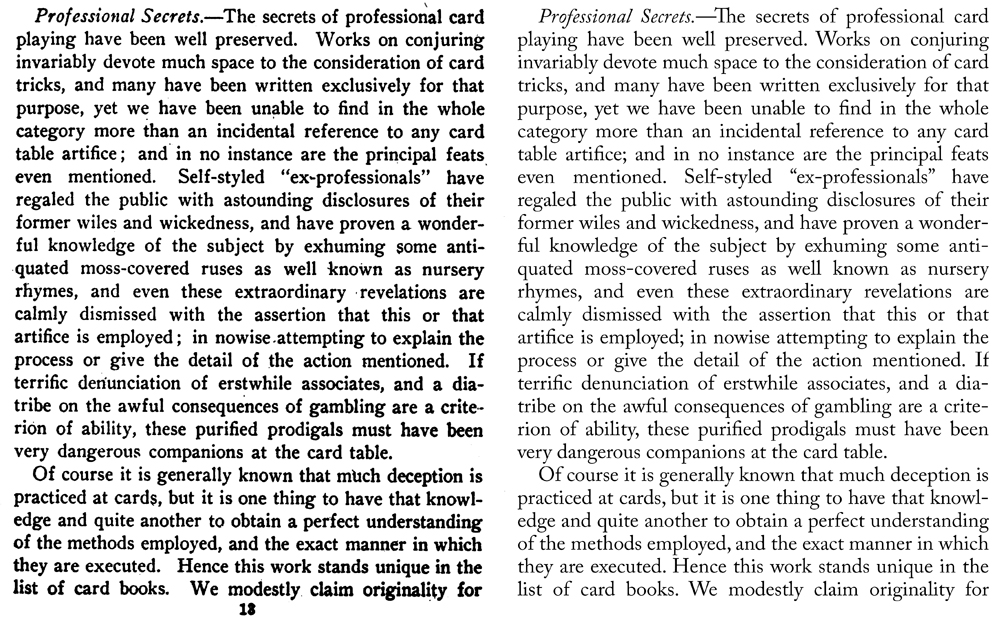
https://www.myfonts.com/WhatTheFont/results?ch%5B0%5D=C&ch%5B1%5D=A&ch%5B2%5D=R&ch%5B3%5D=D&ch%5B4%5D=T&ch%5B5%5D=A&ch%5B6%5D=B&ch%5B7%5D=L&ch%5B8%5D=E&ch%5B9%5D=A&ch%5B10%5D=R&ch%5B11%5D=T&ch%5B12%5D=I&ch%5B13%5D=F&ch%5B14%5D=I&ch%5B15%5D=C&ch%5B16%5D=E&ch%5B17%5D=&wtfserver=wtf_e_41&id=00082be354d4d8730006d8cf00000612&glyphcount=18&imageid=0&x=85&y=26
Working on some other type samples to see if we can get closer than Caslon. Here is a side by side of a scan from a reproduction of Erdnase (specifically the one in MacDougall's Card Mastery) and a typesetting in Caslon with the line endings set to match the original. Bear in mind that this is a modern Open Type interpretation of Caslon. There are definite differences, from the "x" height to the italics (note the descender on the "f" and the capital "S" in the italic text).
Andrew, unfortunately the "What the Font" link you provided doesn't work. Can you summarize your results? Thanks for digging into this deeper!
We used a modern Caslon for the Charles & Wonder edition as well. (And just for the record in your example: No "Th" ligature. Additional space between sentences. Thin (French) space before semicolons.)
And it's good to see Ken posting here. I was in contact with him for a while, but lost touch. Ken, I'll try your email again.
As Ken indicates, Wilbur Edgerton Sanders had a religious conversion after his marriage to a Christian Scientist. Before his marriage he gambled, drank and wasn't particularly religious. In one of the few glimpses his papers give us into his early personal life, he was a bit of a hypochondriac and consulted doctors regularly. After his marriage, that all changed, including his refusal to seek medical treatment for injuries and an apparent rejection of his old, "sporting life" friends. It was a dramatic, personal shift in his life.
We used a modern Caslon for the Charles & Wonder edition as well. (And just for the record in your example: No "Th" ligature. Additional space between sentences. Thin (French) space before semicolons.)
And it's good to see Ken posting here. I was in contact with him for a while, but lost touch. Ken, I'll try your email again.
As Ken indicates, Wilbur Edgerton Sanders had a religious conversion after his marriage to a Christian Scientist. Before his marriage he gambled, drank and wasn't particularly religious. In one of the few glimpses his papers give us into his early personal life, he was a bit of a hypochondriac and consulted doctors regularly. After his marriage, that all changed, including his refusal to seek medical treatment for injuries and an apparent rejection of his old, "sporting life" friends. It was a dramatic, personal shift in his life.
Marty:
Darned OpenFace automatically inserts the ligatures (I forgot to turn that option off). I ran the "What the Font" app on the title on page 13 (CARD TABLE ARTIFICE.) and it returned five recommendations, the closest was Millesime which is based on an old French-style typeface. Here is a link to samples of the font which can be purchased (the free version no longer exists):
https://typekit.com/fonts/millesime
Click on the "type tester" tab to plug in your own text for preview. It is not an exact match, although the main distinguishing characteristic (the truncated "R" foot) is there. The "C" is different in width and roundness...
There are at least six distinct typefaces used in Erdnase: the text, the figure numbers, the copyright under the figures (which appears to be the same as the copyright page), the section titles (including frontmatter titles), the run-in heads on pages 25-28 and a bold font that is only used on page 189. There is a possibility that the italic font used for headings and run-in heads does not belong to the same family as the text.
I am somewhat handicapped as the oldest facsimile version I have is the MacDougall reproduction (and therefore may not be of the earliest edition), but I have in my library a number of other Erdnase-related titles including: Revelation, Revelations, The Annotated Erdnase, the Coles reproduction (1980; which lacks the original title page), the Dover (1995) and CARC (2007; mini-bible) editions, both of which have been re-typeset, the previously mentioned MacDougall (1944, Circle Magic Shop), and the informational/analysis texts including the Whaley/Gardner/Busby title The Man Who Was Erdnase, Hurt McDermott's Artifice, Ruse & Erdnase, and Erdnase Unmasked.
I hope over the next couple of weeks to identify each of the typefaces, if only for Bill's enjoyment...
In the meantime, if you want to use the image I scanned to run your own "What the Font" search, here it is:

Darned OpenFace automatically inserts the ligatures (I forgot to turn that option off). I ran the "What the Font" app on the title on page 13 (CARD TABLE ARTIFICE.) and it returned five recommendations, the closest was Millesime which is based on an old French-style typeface. Here is a link to samples of the font which can be purchased (the free version no longer exists):
https://typekit.com/fonts/millesime
Click on the "type tester" tab to plug in your own text for preview. It is not an exact match, although the main distinguishing characteristic (the truncated "R" foot) is there. The "C" is different in width and roundness...
There are at least six distinct typefaces used in Erdnase: the text, the figure numbers, the copyright under the figures (which appears to be the same as the copyright page), the section titles (including frontmatter titles), the run-in heads on pages 25-28 and a bold font that is only used on page 189. There is a possibility that the italic font used for headings and run-in heads does not belong to the same family as the text.
I am somewhat handicapped as the oldest facsimile version I have is the MacDougall reproduction (and therefore may not be of the earliest edition), but I have in my library a number of other Erdnase-related titles including: Revelation, Revelations, The Annotated Erdnase, the Coles reproduction (1980; which lacks the original title page), the Dover (1995) and CARC (2007; mini-bible) editions, both of which have been re-typeset, the previously mentioned MacDougall (1944, Circle Magic Shop), and the informational/analysis texts including the Whaley/Gardner/Busby title The Man Who Was Erdnase, Hurt McDermott's Artifice, Ruse & Erdnase, and Erdnase Unmasked.
I hope over the next couple of weeks to identify each of the typefaces, if only for Bill's enjoyment...
In the meantime, if you want to use the image I scanned to run your own "What the Font" search, here it is:
Andrew Pinard wrote: I hope over the next couple of weeks to identify each of the typefaces, if only for Bill's enjoyment...
If only others would follow your wise example.
Remember that there is a high-resolution scan of the first Drake HB edition online at the Library of Congress. I think most people assume that it is the same typography as the 1st edition -- everyone says that the "plates" were transferred. (I'd love to have a high-resolution scan of even a few pages from a 1st edition, for a comparison.)
The text in Revelations (the first one) is supposed to be a scan of a 1st, but I believe it was cleaned up a little. And the text in the 1940s Fleming edition was supposedly shot from a 1st edition, at least according to what the contemporaneous Fleming Book Reviews say.
KenHerrick wrote:Greetings from a newbie-
Wilbur's estate, willed to my grandmother, was very modest, and the documentation I have copies of makes no mention of papers. However, I do have a certified copy of Wilbur's holographic will dated Feb. 18, 1924. If there exists any hand-writing that can be directly connected to "The Expert", perhaps a comparison could be made.
The copyright application for TEATCT is hand-written. I'm not sure whether it's been established if this was completed by the author or the publisher (has anyone ever checked against any other book published by McKinney?). However, if Wilbur Sanders' handwriting and that of the copyright application were similar, then that would certainly be of significance.
Richard
KenHerrick wrote: However, I do have a certified copy of Wilbur's holographic will
It would be great if you would post a copy of this here.
Richard Evans wrote:The copyright application for TEATCT is hand-written
Is there a copy of this available online?
Re: Wilbur Sanders' Will. Perhaps someone might be able to turn up some handwriting that can definitively be connected to The Expert. If there is a miscellany of such, only one example, of course, found to be sufficiently identical to Wilbur's, would be enough to cinch the argument positively. I attach herewith a jpeg copy.
Well, oops... "attachment quota has been reached." I'll post it to my Dropbox Public folder and then post the link to that here.
Ken Herrick
Well, oops... "attachment quota has been reached." I'll post it to my Dropbox Public folder and then post the link to that here.
Ken Herrick
OK, here's the link to Wilbur Sanders' holographed Will: https://dl.dropboxusercontent.com/u/287 ... S-will.jpg
KCH
KCH
Well, that didn't seem to come out right. Try this:
https://dl.dropboxusercontent.com/u/287 ... S-will.jpg
Looks better...
KCH
https://dl.dropboxusercontent.com/u/287 ... S-will.jpg
Looks better...
KCH
What's going on?? Still not right, on my screen. Again, this time with some spaces that you should take out, to form the full link. 3 spaces in each of 2 locations.
https://dl.dropbox usercontent.com/u/28799314/ Erdnase/W-E-S-will.jpg
KcH
https://dl.dropbox usercontent.com/u/28799314/ Erdnase/W-E-S-will.jpg
KcH
Take out the space before usercontent and before Erdnase.
KCH
Why is this so much trouble??
KCH
Why is this so much trouble??
Richard Evans wrote:The copyright application for TEATCT is hand-written. I'm not sure whether it's been established if this was completed by the author or the publisher (has anyone ever checked against any other book published by McKinney?). However, if Wilbur Sanders' handwriting and that of the copyright application were similar, then that would certainly be of significance.
Richard
A couple of small comments on the above. The copyright application is mostly a printed form, but does have spaces filled in by hand. I assume that the author likely filled it out, even though his address is given in care of McKinney. I would not describe McKinney as the "publisher", though we presume his firm did the printing and binding, because of their connection to the author in the copyright application and the fact that they were a source of copies of the book. The title page clearly states "Published by the Author" so the mysterious Erdnase himself would be the "publisher". I am not aware of any books "published" by McKinney, though I do know of other titles they printed, and have at least one in my collection, though it bears little resemblance to the first edition Expert (different format, binding, etc.).
Brad Jeffers wrote:Richard Evans wrote:The copyright application for TEATCT is hand-written
Is there a copy of this available online?
I don't know it to be online anywhere, but the front page of the application is reproduced on p 274 of The Man who was Erdnase. It does not have the same handwriting as Sanders's will.
Here is a book published by Jas. P McKinney of Terre Haute IN in 1890. Same guy?
I would say that we don't know who filled out the copyright form. It could have been anyone affiliated with McKinney & Co. It could have been the author. One point of interest is that, if it was filled out by the author, then he would likely have had direct contact with the title page, which needed to be included as a part of the application. This would correspond with David Alexander's deduction that the author was able to personally ensure that clues were on the page. But again, I don't think we can make any assumptions as to who filled out the form.
I was able to compare the application at the Library of Congress with samples of Wilbur Edgerton Sanders's handwriting from as near 1902 as I could find. (Samples from that period are very rare in his surviving papers.) In my opinion Sanders's handwriting samples didn't match the handwriting on the application.
I was able to compare the application at the Library of Congress with samples of Wilbur Edgerton Sanders's handwriting from as near 1902 as I could find. (Samples from that period are very rare in his surviving papers.) In my opinion Sanders's handwriting samples didn't match the handwriting on the application.
Of course there's no way of knowing precisely who filled out the copyright form, but it's is a far safer assumption that it was the author of EATCT who filled it out than it was anybody else.
The sheer weight of a self published work having its copyright applied for by the author of that work can't be discounted.
If one maintains the KISS principle, there is really no other party who could have, or would have completed the copyright form.
It does however, remain an unknown for seekers of hard evidence.
But if you stop your Erdnase research every time there's an "unknown", there would be far less quality Erdnase research.
Occasionally, assumptions might benefit in an effort to move forward and hopefully discover new avenues of research that might lead to more solid evidence.
Of course the elephant in the room considers that if you accept that the author filled out the copyright application, then the author likely isn't Sanders.
As a result, confirmation bias implies that some folks might not be so inclined to consider the author as being the party that filled out the application for copyright.
The sheer weight of a self published work having its copyright applied for by the author of that work can't be discounted.
If one maintains the KISS principle, there is really no other party who could have, or would have completed the copyright form.
It does however, remain an unknown for seekers of hard evidence.
But if you stop your Erdnase research every time there's an "unknown", there would be far less quality Erdnase research.
Occasionally, assumptions might benefit in an effort to move forward and hopefully discover new avenues of research that might lead to more solid evidence.
Of course the elephant in the room considers that if you accept that the author filled out the copyright application, then the author likely isn't Sanders.
As a result, confirmation bias implies that some folks might not be so inclined to consider the author as being the party that filled out the application for copyright.
I see no reason to make any assumptions about the copyright application, nor do I trust it. After all, it was supposed to indicate whether a pseudonym was used, and to state the author's real name. It gives "S.W. Erdnase" and no indication of a pseudonym. It also lists his residence as "73 Plymouth Place, Chicago, Ill"--which was James McKinney & Company's address. Elsewhere, it lists the author's full name as "S.W. Erdnase care of Jas. McKinney & Co." That's a lot of fibbing and loopholing--even writing outside the lines on the relatively straightforward application form--to assume that the applicant was keeping it simple.
I'm no handwriting analyst (though if I recall, Geno Munari was going to have one look at the material and compare it to Sanders's handwriting). But there isn't much handwriting to analyze on the form. And there isn't much of anything from Sanders in that period to compare it with. Still, I've seen a lot of Sanders's handwriting (which changed dramatically, even in a single journal). To my untrained eye it differs from that on the application.
But it's a pure assumption that the copyright application was filled out by the author. We don't even have any evidence that he was ever in physical possession of his books--the mailing of which was required to complete the copyright registration. The only hard evidence we have about the handling of the books themselves (A. Plate's first edition) indicates that the book was sold by McKinney & Co., making them the only known source and representatives of the work. That is supported by the firm's name and address being listed as the author on the copyright application. The form--filed in late February 1902--could just as easily have been filled out by them.
I tend to doubt everything. That hardly impedes research. In my experience it yields better results.
I'm no handwriting analyst (though if I recall, Geno Munari was going to have one look at the material and compare it to Sanders's handwriting). But there isn't much handwriting to analyze on the form. And there isn't much of anything from Sanders in that period to compare it with. Still, I've seen a lot of Sanders's handwriting (which changed dramatically, even in a single journal). To my untrained eye it differs from that on the application.
But it's a pure assumption that the copyright application was filled out by the author. We don't even have any evidence that he was ever in physical possession of his books--the mailing of which was required to complete the copyright registration. The only hard evidence we have about the handling of the books themselves (A. Plate's first edition) indicates that the book was sold by McKinney & Co., making them the only known source and representatives of the work. That is supported by the firm's name and address being listed as the author on the copyright application. The form--filed in late February 1902--could just as easily have been filled out by them.
I tend to doubt everything. That hardly impedes research. In my experience it yields better results.
I know that Richard Hatch has a letter written by Edwin Sumner Andrews. How does the handwriting on it compare with that on the copyright application?
I don't particularly disagree with anything you've posted Marty, my point was simply that it was far more likely that the author filled out the form that it was that somebody else filled it out.
A guy writes a book, and then self publishes the same book.
The balance of the evidence we have in our possession would seem to imply that the same guy who wrote and published the book also filled out the copyright form ... however full of discrepancies that form might be.
It would be somewhat presumptuous of me to state that the author did fill out the copyright application. I simply choose to assume that the likelihood that it was his pen on the application is greater than the likelihood that it was not his pen.
A guy writes a book, and then self publishes the same book.
The balance of the evidence we have in our possession would seem to imply that the same guy who wrote and published the book also filled out the copyright form ... however full of discrepancies that form might be.
It would be somewhat presumptuous of me to state that the author did fill out the copyright application. I simply choose to assume that the likelihood that it was his pen on the application is greater than the likelihood that it was not his pen.
Roger, you assumptions about the implications of self-publishing make sense. But evidence suggests otherwise. I have examples of self-published works that applied for copyright at that time, but which used the printing firm as filing representative.
For example: The New Century Edition of The Household Cookbook, edited by James B. Smiley and published by Smiley Publishing Company had its copyright application submitted by the printing firm of Frederick J. Drake and Company on the same date (February 17, 1902) as The Expert at the Card Table.
An examination of copyright applications in The Library of Congress indicates that self-published works often had their copyright applications submitted by the printing firms or other representatives.
For example: The New Century Edition of The Household Cookbook, edited by James B. Smiley and published by Smiley Publishing Company had its copyright application submitted by the printing firm of Frederick J. Drake and Company on the same date (February 17, 1902) as The Expert at the Card Table.
An examination of copyright applications in The Library of Congress indicates that self-published works often had their copyright applications submitted by the printing firms or other representatives.
Bill Mullins wrote: the front page of the application is reproduced on p 274 of The Man who was Erdnase.
I wonder why they reproduced only lines five through nine of the application. What information (and further handwriting example) is contained in lines one through four?
Roger M. wrote:. [] to state that the author did fill out the copyright application. I simply choose to assume that the likelihood ...[].
What percentage of copyright forms are filled out by the author?
The fact that the application may have been filled out by the author himself, makes it definitely the most intriguing, and potentially the most important artifact in the search for the identity of Erdnase.
Of course, if it was not filled out by the author, then it is about as interesting and useful as a discussion of the different fonts used in varying editions.
A copyright application for another book printed by McKinney & Co., in the same handwriting as the Erdnase application, should prove that Erdnase did not fill out the application himself.
Unless of course, Erdnase also wrote that book.
Then we will know who he is.
Unless of course, he used a pseudonym.
Of course, if it was not filled out by the author, then it is about as interesting and useful as a discussion of the different fonts used in varying editions.
Marty Demarest wrote:An examination of copyright applications in The Library of Congress indicates that self-published works often had their copyright applications submitted by the printing firms or other representatives.
A copyright application for another book printed by McKinney & Co., in the same handwriting as the Erdnase application, should prove that Erdnase did not fill out the application himself.
Unless of course, Erdnase also wrote that book.
Then we will know who he is.
Unless of course, he used a pseudonym.
Bill Mullins wrote:Brad Jeffers wrote:Richard Evans wrote:The copyright application for TEATCT is hand-written
Is there a copy of this available online?
I don't know it to be online anywhere, but the front page of the application is reproduced on p 274 of The Man who was Erdnase. It does not have the same handwriting as Sanders's will.
TMWWE says that McKinney and Company had filled out the application form. Though maybe that's just supposition. It seems like McKinney would have filed other copyright forms that could be compared to see if the handwriting matches.
I agree the handwriting on the copyright form doesn't look like Sanders's handwriting on the holographic will.
Bob Coyne wrote:
TMWWE says that McKinney and Company had filled out the application form.
One caveat with TMWWE is that it's often desirable (although often not possible) to know which of the three authors wrote whatever it is you're reading.
In this case, a statement like this would carry more weight if one was sure Bart Whaley researched and wrote it, and less weight if Busby or M.G. wrote it (as both of them were unnaturally wedded to the concept that MFA was definitely Erdnase, and rigidly unwilling to be swayed even slightly by the movement begun with Tom Sawyer's books).
Richard Hatch wrote:Richard Evans wrote:The copyright application for TEATCT is hand-written. I'm not sure whether it's been established if this was completed by the author or the publisher (has anyone ever checked against any other book published by McKinney?). However, if Wilbur Sanders' handwriting and that of the copyright application were similar, then that would certainly be of significance.
Richard
A couple of small comments on the above. The copyright application is mostly a printed form, but does have spaces filled in by hand. I assume that the author likely filled it out, even though his address is given in care of McKinney. I would not describe McKinney as the "publisher", though we presume his firm did the printing and binding, because of their connection to the author in the copyright application and the fact that they were a source of copies of the book. The title page clearly states "Published by the Author" so the mysterious Erdnase himself would be the "publisher". I am not aware of any books "published" by McKinney, though I do know of other titles they printed, and have at least one in my collection, though it bears little resemblance to the first edition Expert (different format, binding, etc.).
Thanks Dick. Apologies - that was pure clumsiness on my part. Publisher and printer are of course different issues and I should have been clearer about McKinney being the printer.
In terms of the general comments about the relevance of the handwriting on the copyright application, it is only really relevant if it matches the handwriting of a candidates and otherwise tells us little. Nevertheless, would be interesting to see if any other books printed by McKinney (being careful this time!) have the same writing.
Bob Coyne wrote: TMWWE says that McKinney and Company had filled out the application form. Though maybe that's just supposition.
TMWWE assumes that MFA = Erdnase. Since the handwriting on the copyright form doesn't match that of MFA, then it must be by someone other than the author. QED. They leap to the conclusion that it was McKinney.
If you don't make an assumption about the identity of the author, then you can't rule out the possibility that it is from the hand of the author (although I believe it was done by someone at McKinney, for reasons laid out above).
Bill Mullins wrote:Bob Coyne wrote: TMWWE says that McKinney and Company had filled out the application form. Though maybe that's just supposition.
TMWWE assumes that MFA = Erdnase. Since the handwriting on the copyright form doesn't match that of MFA, then it must be by someone other than the author. QED. They leap to the conclusion that it was McKinney.
Maybe that's the logic they went through, but I don't know how you know that. It seems perfectly possible that the authors of TMWWE had good reasons to claim that the copyright form was filled out by McKinney.
Bob Coyne wrote:
Maybe that's the logic they went through, but I don't know how you know that.
We know that because all three authors stated quite succinctly over the years that Erdnase = MFA, and that their conclusion was not debatable.
Unlike Marty, David Alexander, Richard Hatch, etc ... who are putting forward their candidates without stating unequivocally that "they're right", Busby, Gardner, and Whaley pretty much made it clear that folks who didn't believe that MFA was Erdnase after reading their book just didn't have the smarts to get it.
Bob Coyne wrote:Maybe that's the logic they went through, but I don't know how you know that. It seems perfectly possible that the authors of TMWWE had good reasons to claim that the copyright form was filled out by McKinney.
When there were good reasons to support a claim, the authors always presented them. There are no reasons provided for this claim, other than the inferences I describe above, so I think what I described is what happened. Can't prove it, though.
Roger M. wrote:We know that because all three authors stated quite succinctly over the years that Erdnase = MFA, and that their conclusion was not debatable. . . . Busby, Gardner, and Whaley pretty much made it clear that folks who didn't believe that MFA was Erdnase after reading their book just didn't have the smarts to get it.
While Gardner was a believer in the MFA=Erdnase theory, I doubt his attitude was anywhere near as aggressive as you describe. Maybe Busby and Whaley were. But Gardner wasn't the sort of person who treat someone who disagreed with him like you are saying. And I believe that, after hearing Richard Hatch's theories and research, he even backed out of the MFA camp somewhat.
I don't know, and the principals are all dead so I can't ask, but I always kind of believed that very little of the final manuscript of TMMWE was actually written by Gardner -- that it was mostly written by Busby and Whaley (particularly the stuff that outright asserts that MFA and Erdnase are one and the same), but that they built heavily on Gardner's research and quote extensively from it, and so they gave him author credit. If someone knows otherwise, I be happy to be corrected on that.
Although I hadn't considered I'd have to reference it some day, and therefore didn't make a record of which book or article it was in, I had read a statement by Gardner within a couple of years prior to his untimely passing in which he stated quite clearly that the answer to the question "who is Erdnase" was answered in TMWWE.
I took this to mean he still strongly believed the MFA assertion to be the end of the Erdnase search.
Perhaps he meant something else, but I doubt it.
I didn't intend for my comment to read as if these guys were as_holes about it, only that they remained highly supportive of their conclusion, and apparently saw no reason to alter that conclusion.
Perhaps Richards research did tilt Gardner away from being unwilling to entertain any other candidate but MFA. In many ways I'd like that to be true, as I find the concept of being absolutely adamant that Erdnase was MFA mildly annoying, and yet hold Gardner in extremely high regard.
So, yeah ... for selfish reasons I'd like to read something that supported the concept that Gardner saw the light before his passing.
I took this to mean he still strongly believed the MFA assertion to be the end of the Erdnase search.
Perhaps he meant something else, but I doubt it.
I didn't intend for my comment to read as if these guys were as_holes about it, only that they remained highly supportive of their conclusion, and apparently saw no reason to alter that conclusion.
Perhaps Richards research did tilt Gardner away from being unwilling to entertain any other candidate but MFA. In many ways I'd like that to be true, as I find the concept of being absolutely adamant that Erdnase was MFA mildly annoying, and yet hold Gardner in extremely high regard.
So, yeah ... for selfish reasons I'd like to read something that supported the concept that Gardner saw the light before his passing.
In Magicol #176, Richard Hatch wrote an article about Gardner and how Hatch met him.
"[Gardner] was not the least upset that I was questioning his candidate and was genuinely intrigued by the things I was finding."
"[Gardner] was not the least upset that I was questioning his candidate and was genuinely intrigued by the things I was finding."
Marty Demarest wrote:I see no reason to make any assumptions about the copyright application, nor do I trust it. After all, it was supposed to indicate whether a pseudonym was used, and to state the author's real name. It gives "S.W. Erdnase" and no indication of a pseudonym. It also lists his residence as "73 Plymouth Place, Chicago, Ill"--which was James McKinney & Company's address. Elsewhere, it lists the author's full name as "S.W. Erdnase care of Jas. McKinney & Co." That's a lot of fibbing and loopholing--even writing outside the lines on the relatively straightforward application form--to assume that the applicant was keeping it simple.
The 4 page copyright application does not request pseudonym information. Part 4 on the first page does request the name, residence and nationality of the author, but specifically notes that the name and address may be withheld, but not the nationality (which he gives as "American"). I'm not sure that I would regard the use of a pseudonym and the printer's address in place of a residence (possibly the author did not have a stable residence) as a lot of fibbing.
My recollection is that the Copyright office maintained a registry of pseudonyms for those wishing to do so and when I checked Erdnase was not registered. But such a declaration was not required.
It sure would be nice if someone would post an image of the full four pages of the copyright application so we would have a better point of reference than the fragment given in The Man Who Was Erdnase.
I checked with the U.S. Copyright Office and they are happy to provide assistance with such matters.
However, their assistance entails a $200/hr fee with a two hour minimum.
I checked with the U.S. Copyright Office and they are happy to provide assistance with such matters.
However, their assistance entails a $200/hr fee with a two hour minimum.
That means we need to raise $400. Perhaps we can get them to also look for other McKinney printed/related copyright applications and provide copies of these, too. I am willing to put $50 into the pot. Anybody willing to add to that?
I'm in.
If the idea is to post the data so we will have it onhand for future reference - count me in as well. Magical Crowdfunding?
Yes, the idea is to post it online. I hope that doesn't mean that people will hold back. There is also no requirement to contribute exactly $50. You can pledge less. $5 or $10 is fine, too. Of course, you can also give more. Either way, let's see if there are enough who are willing to enable this.
If I read the posts above correctly we stand at $150 pledged to have the original Erdnase copyright application scanned and posted online and perhaps we also find other McKinney applications around the same time. I think that two hours should be enough to search and hopefully find other copyright applications where McKinney was involved. If anybody has a list of books that may qualify please post here.
If I read the posts above correctly we stand at $150 pledged to have the original Erdnase copyright application scanned and posted online and perhaps we also find other McKinney applications around the same time. I think that two hours should be enough to search and hopefully find other copyright applications where McKinney was involved. If anybody has a list of books that may qualify please post here.
Richard Hatch wrote:I'm not sure that I would regard the use of a pseudonym and the printer's address in place of a residence (possibly the author did not have a stable residence) as a lot of fibbing.
Don't worry Dick--I won't tell the taxman.
Didn't E.S. Andrews have a permanent Chicago address at the time?
Interpretations may differ, of course. But I see any discrepancy between the claimed name of the book's author (question 4) and the name of the author claiming copyright (question 6) as indicative of a pseudonym. No difference indicates that no pseudonym was used. (The applicant does give the author's name as S.W. Erdnase in question 4, lists the claimant as author in question 5, and claims copyright under the name S.W. Erdnase in question 6.)
Obtaining the copyright application shouldn't require hundreds of dollars and a researcher. This page gives instructions. To help circumvent a research fee, you are looking for the Application for Copyright filed for the book Artifice Ruse and Subterfuge at the Card Table by S.W. Erdnase published in 1902. The application was received by the copyright office on Feb. 17, 1902 and was tagged CL.A27174Feb171902. You should only need to pay for copies.
This page gives the fees.
The cheapest way is to go to the Copyright Office in person and search for the files yourself. That's free. The only cost will be to have the records copied.
Now, if only we had a forum member who lives in Washington D.C.
Hmmmm ...
The cheapest way is to go to the Copyright Office in person and search for the files yourself. That's free. The only cost will be to have the records copied.
Now, if only we had a forum member who lives in Washington D.C.
Hmmmm ...
No need to spend the money on copying fees, I did that years ago and have scans of all four pages of the original copyright application on my computer. If someone can let me know how to post them or (probably easier) I can email them as attachments to someone to post, happy to do so. My recollection is that the copying fees cost me about $40, but that was more than 15 years ago. Took a couple of months after my visit to the copyright office to get them...
I'd be happy to put them up on my Dropbox Public site, providing a link (or links) thereto--hopefully more readily useable this time. You could email them to me for that purpose.
Ken Herrick
Ken Herrick
With regard to the veracity of Martin Gardner's defense of MFA as the author, here is a note he wrote to me in 2004.
"Yes, I still think Erdnase was Milton Franklin Andrews, though it lacks a certain proof."
I tried to upload an image of the note to the board, but got some message saying the attachment quota had been reached.
Jason
"Yes, I still think Erdnase was Milton Franklin Andrews, though it lacks a certain proof."
I tried to upload an image of the note to the board, but got some message saying the attachment quota had been reached.
Jason
Thanks, Ken, I just emailed them to Bill Mullins, thinking he'd know how to put them up for Forum members. If not, happy to email them to you.
On Gardner's conviction in MFA as Erdnase, when I first interviewed him on this topic, he put his conviction in the high 90% range. He thought it pretty unlikely that another gambler named Andrews with the necessary skill set and a history of activity in Chicago living in the right time frame would exist. When I started to question some of the discrepancies of the MFA theory (height, age, etc. as recalled by Marshall Smith) and presented some alternative candidates, he was at one point willing to lower his conviction rate a bit (into the 80% range, I believe). I think he later raised it back into the 90% range. Obviously these numbers don't mean anything in terms of who the actual author was, but show Gardner's willingness to consider thoughtfully presented alternatives.
On Gardner's conviction in MFA as Erdnase, when I first interviewed him on this topic, he put his conviction in the high 90% range. He thought it pretty unlikely that another gambler named Andrews with the necessary skill set and a history of activity in Chicago living in the right time frame would exist. When I started to question some of the discrepancies of the MFA theory (height, age, etc. as recalled by Marshall Smith) and presented some alternative candidates, he was at one point willing to lower his conviction rate a bit (into the 80% range, I believe). I think he later raised it back into the 90% range. Obviously these numbers don't mean anything in terms of who the actual author was, but show Gardner's willingness to consider thoughtfully presented alternatives.
Richard,
I'd like a copy of that as well if Bill can't get it online.
Rick
I'd like a copy of that as well if Bill can't get it online.
Rick
Thanks, Bill. Always struck me as impressive that the application which was apparently filled out and mailed in Chicago on Feb 15, 1902 was delivered to the copyright office in DC two days later.
Somewhere I also have a photocopy of the one page copyright registration which shows the receipt of two printed copies, but it is not handy and is a document generated by the copyright office and sent to the copyright applicant (for which he had paid an extra fee to receive), so wouldn't have any potential author's handwriting to analyse.
Somewhere I also have a photocopy of the one page copyright registration which shows the receipt of two printed copies, but it is not handy and is a document generated by the copyright office and sent to the copyright applicant (for which he had paid an extra fee to receive), so wouldn't have any potential author's handwriting to analyse.
Very nice!
Thanks.
Thanks.
Dick, Bill, thanks for posting it.
My first reaction was: "How neatly written." Whoever wrote this must have taken real care filling out this form. If I may venture a guess it does not look like some designated employee of McKinney who had to potentially fill out many of these but rather a first time filler outer.
Here is another line of investigation that this may open. Having seen my son being taught handwriting in a French school rather than the Austrian schooling I received myself, I know that handwriting is being taught differently in different localities. The detailed shapes of each letter can be quite different from place to place. For example, the big A I learned to write is completely different from the one I see on this application. I wonder if an expert may be able to deduce from the handwriting where the person who filled this out learned to write.
My first reaction was: "How neatly written." Whoever wrote this must have taken real care filling out this form. If I may venture a guess it does not look like some designated employee of McKinney who had to potentially fill out many of these but rather a first time filler outer.
Here is another line of investigation that this may open. Having seen my son being taught handwriting in a French school rather than the Austrian schooling I received myself, I know that handwriting is being taught differently in different localities. The detailed shapes of each letter can be quite different from place to place. For example, the big A I learned to write is completely different from the one I see on this application. I wonder if an expert may be able to deduce from the handwriting where the person who filled this out learned to write.
The most interesting thing about the copyright application, to my mind, is its lack of legal validity.
The entire purpose of a copyright registration was to establish legal ownership and rights to the material. But by withholding his legal name, the author of The Expert essentially forfeited those rights. The copyright application is legally untruthful.
That's a big reason I don't trust it. But it does raise the intriguing questions: Why was the author's real name not included on the application? Did the author have some other means of proving that he was S.W. Erdnase? How was copyright of the book legally established?
Incidentally, I note that the handwriting on the application doesn't match the handwriting of the applicant(s) on E.S. Andrews's marriage license. (Reproduced in Richard Hatch's article "Reading Erdnase Backwards.")
The entire purpose of a copyright registration was to establish legal ownership and rights to the material. But by withholding his legal name, the author of The Expert essentially forfeited those rights. The copyright application is legally untruthful.
That's a big reason I don't trust it. But it does raise the intriguing questions: Why was the author's real name not included on the application? Did the author have some other means of proving that he was S.W. Erdnase? How was copyright of the book legally established?
Incidentally, I note that the handwriting on the application doesn't match the handwriting of the applicant(s) on E.S. Andrews's marriage license. (Reproduced in Richard Hatch's article "Reading Erdnase Backwards.")
Marty Demarest wrote:Why was the author's real name not included on the application? Did the author have some other means of proving that he was S.W. Erdnase? How was copyright of the book legally established?
I am not a lawyer but I think these questions would only be investigated if it should come to a dispute of some kind. The copyright office does not check anything. They simply record and store the information.
I meant questions for me (and other researchers), Chris. The copyright application should answer those questions. It doesn't.
The simplest answer that fits the evidence is: The form was filled out by someone who believed that someone named S.W. Erdnase wrote the book, that he was a real person, and that he could be contacted through James McKinney & Co.
Otherwise, it was filled out by someone who did it, essentially, for no purpose.
The simplest answer that fits the evidence is: The form was filled out by someone who believed that someone named S.W. Erdnase wrote the book, that he was a real person, and that he could be contacted through James McKinney & Co.
Otherwise, it was filled out by someone who did it, essentially, for no purpose.
I can see all kinds of purposes for the person hiding behind the pseudonym. For one, a copyright application (truthful or not) could deter possible infringers.
A copyright is like a patent, a license to sue and not much more. But being that, it surely is useful as a deterrent.
We're likely to be left forever with mere circumstantial evidence as to the real author. But I'd stick, on that basis, with Wilbur Sanders. (Admitting that I'd not mind basking in his reflected glory as his step-grandson...tho not for long since I'm 87.)
Some of that evidence in Wilbur's favor: 1. A mining engineer (an "earth-nose"). 2. His name an exact anagram. 3. His father (or grandfather; don't remember off-hand) a prominent Senator. 4. My grandmother, his wife, a Christian Scientist. And not only that: a C.S. Practitioner. That being a person who engages in intercessory prayer for others, for a fee. 5. Known to have carried with him on his travels several, if not numerous, new packs of playing cards. 6. And perhaps a few more tidbits that I've overlooked.
So there are powerful reasons there, familial in nature, to have kept his authorship a very close secret. Too bad...for I suspect he became not too happy about that--especially in the years after having separated from my grandmother.
Ken Herrick
We're likely to be left forever with mere circumstantial evidence as to the real author. But I'd stick, on that basis, with Wilbur Sanders. (Admitting that I'd not mind basking in his reflected glory as his step-grandson...tho not for long since I'm 87.)
Some of that evidence in Wilbur's favor: 1. A mining engineer (an "earth-nose"). 2. His name an exact anagram. 3. His father (or grandfather; don't remember off-hand) a prominent Senator. 4. My grandmother, his wife, a Christian Scientist. And not only that: a C.S. Practitioner. That being a person who engages in intercessory prayer for others, for a fee. 5. Known to have carried with him on his travels several, if not numerous, new packs of playing cards. 6. And perhaps a few more tidbits that I've overlooked.
So there are powerful reasons there, familial in nature, to have kept his authorship a very close secret. Too bad...for I suspect he became not too happy about that--especially in the years after having separated from my grandmother.
Ken Herrick
lybrary wrote:My first reaction was: "How neatly written." Whoever wrote this must have taken real care filling out this form. If I may venture a guess it does not look like some designated employee of McKinney who had to potentially fill out many of these but rather a first time filler outer.
Here is another line of investigation that this may open. Having seen my son being taught handwriting in a French school rather than the Austrian schooling I received myself, I know that handwriting is being taught differently in different localities. The detailed shapes of each letter can be quite different from place to place. For example, the big A I learned to write is completely different from the one I see on this application. I wonder if an expert may be able to deduce from the handwriting where the person who filled this out learned to write.
Recall that in 1902, typewriters were not as common as they later became, and many official forms were filled out by hand -- so people who regularly filled them out needed to do it neatly. And also, it is my belief that people in general had better handwriting back then than they do now (see Vernon's handwriting, for example).
So I don't necessarily think that "neat handwriting" implies a person who filled out this form for the 1st time. In fact, I'd argue that if McKinney was in the business of taking manuscripts and turning them into books for independent authors, that doing the copyright paperwork would be part of the service that it would be appropriate for them to offer.
I'd love to find half-a-dozen books published and/or printed by McKinney ca. 1902, and compare the copyright applications on all of them.
Bill Mullins wrote:I'd love to find half-a-dozen books published and/or printed by McKinney ca. 1902, and compare the copyright applications on all of them.
That is exactly what I think we should do. It is a fairly straight forward step to get some clarity on the handwriting. Richard Hatch has one other McKinney book in is collection but he never tried to look-up the copyright application for it. That means we have at least one book. Don't know when it was published. The big question is how we can find other books printed by McKinney preferably around the same time?
One possible way would be to start with Drake assuming he acquired more than Erdnase from McKinney and see if any of the Drake books were originally printed by McKinney.
Thanks Richard and Bill for posting full copyright application.
The typesetting on the sample front page is slightly different to the printed first edition isn't it? There appears to be a much larger space between the R and the T in 'ARTIFICE'.
The typesetting on the sample front page is slightly different to the printed first edition isn't it? There appears to be a much larger space between the R and the T in 'ARTIFICE'.
Richard Evans wrote:Thanks Richard and Bill for posting full copyright application.
The typesetting on the sample front page is slightly different to the printed first edition isn't it? There appears to be a much larger space between the R and the T in 'ARTIFICE'.
Could be from a proof.
I would like to thank Richard Hatch for allowing the copyright application to be posted. That was very nice of you!
Richard wrote in an earlier post ...
Thanks, Bill. Always struck me as impressive that the application which was apparently filled out and mailed in Chicago on Feb 15, 1902 was delivered to the copyright office in DC two days later.
Do you think the application could have been hand delivered?
Richard wrote in an earlier post ...
Thanks, Bill. Always struck me as impressive that the application which was apparently filled out and mailed in Chicago on Feb 15, 1902 was delivered to the copyright office in DC two days later.
Do you think the application could have been hand delivered?
Top 10 Reasons to Attend
Erdnase Lecture: Back to the Future
Comedian David Letterman featured nightly for decades his famous top ten list. Taking a cue from his success, we give you the top ten reasons why you should attend Scott Edward Lane’s March 25, 2015 lecture/demonstration on Erdnase.
10. The seminal S W Erdnase book, Expert at the Card Table, was published in 1902 and its influence on card magic continues today, 113 years later.
9.The Ask Alexander database (Linking Ring) includes over 600 references and citations to Erdnase, beginning in 1903 and as recently as 2014.
8.The book is deeply rooted in the sneakiest of gambling sleights, not in card magic.
7. Gamblers have been killed after being caught applying Erdnase sleights.
6.The sordid influence of the Erdnase book reached the upper levels of politics, including U.S. Congress members.
5. You will get a free deck of cards to practice 22 Erdnase non-knuckle busting sleights during the lecture/demonstration workshop: False Shuffles, False Cuts, Passes/Shifts, Palming, Mnemonic Techniques, Top/Bottom Changes, Card Stacking and Memorized Decks. Even if you use some of these sleights regularly, Erdnase offers a new twist for you to consider.
4. You will be taught nine card tricks that rely heavily on Erdnase sleights, tricks performed by (in alphabetical order) Steve Forte, Professor Hoffmann, John Hilliard, James Harto, Ricky Jay, Bill Malone, Edward Marlo, August Roterberg, and Dai Vernon
3. This is not your ordinary lecture but rather a production that includes a book on Erdnase, handouts, demonstrations, and a PowerPoint Presentation.
2. Scott will present previously unpublished information about Erdnase, which comes directly from his family elders who lived in French Lick, Indiana, the Midwest gambling center at the turn of the century and the genesis of the Erdnase book.
1. At least a dozen prominent individuals have speculated on who S.W. Erdnase really was and Scott Lane has documentary evidence to show they were all wrong.
You are now Sherlock Holmes. The mystery is before you.The clues by past researchers have been filled with speculation and controversy.It is now up to you to untangle the web and discover for yourselves…The Elusive World of S W Erdnase…
Please join us as we go back to the Erdnase future at 7:00pm, Wednesday, March 25th, IBM Ring41, Tripoli Shrine Center, 3000 W. Wisconsin Ave, Milwaukee, 53208. Ring 41 members, free. Others, $5.00. Questions? Contact Slanelittleton@yahoo.com
Erdnase Lecture: Back to the Future
Comedian David Letterman featured nightly for decades his famous top ten list. Taking a cue from his success, we give you the top ten reasons why you should attend Scott Edward Lane’s March 25, 2015 lecture/demonstration on Erdnase.
10. The seminal S W Erdnase book, Expert at the Card Table, was published in 1902 and its influence on card magic continues today, 113 years later.
9.The Ask Alexander database (Linking Ring) includes over 600 references and citations to Erdnase, beginning in 1903 and as recently as 2014.
8.The book is deeply rooted in the sneakiest of gambling sleights, not in card magic.
7. Gamblers have been killed after being caught applying Erdnase sleights.
6.The sordid influence of the Erdnase book reached the upper levels of politics, including U.S. Congress members.
5. You will get a free deck of cards to practice 22 Erdnase non-knuckle busting sleights during the lecture/demonstration workshop: False Shuffles, False Cuts, Passes/Shifts, Palming, Mnemonic Techniques, Top/Bottom Changes, Card Stacking and Memorized Decks. Even if you use some of these sleights regularly, Erdnase offers a new twist for you to consider.
4. You will be taught nine card tricks that rely heavily on Erdnase sleights, tricks performed by (in alphabetical order) Steve Forte, Professor Hoffmann, John Hilliard, James Harto, Ricky Jay, Bill Malone, Edward Marlo, August Roterberg, and Dai Vernon
3. This is not your ordinary lecture but rather a production that includes a book on Erdnase, handouts, demonstrations, and a PowerPoint Presentation.
2. Scott will present previously unpublished information about Erdnase, which comes directly from his family elders who lived in French Lick, Indiana, the Midwest gambling center at the turn of the century and the genesis of the Erdnase book.
1. At least a dozen prominent individuals have speculated on who S.W. Erdnase really was and Scott Lane has documentary evidence to show they were all wrong.
You are now Sherlock Holmes. The mystery is before you.The clues by past researchers have been filled with speculation and controversy.It is now up to you to untangle the web and discover for yourselves…The Elusive World of S W Erdnase…
Please join us as we go back to the Erdnase future at 7:00pm, Wednesday, March 25th, IBM Ring41, Tripoli Shrine Center, 3000 W. Wisconsin Ave, Milwaukee, 53208. Ring 41 members, free. Others, $5.00. Questions? Contact Slanelittleton@yahoo.com
The first thing I would do is take the copyright application to a handwriting analyst and find out if it was written by a man or a woman. The writing appears feminine to me.
Scott Lane wrote:1. At least a dozen prominent individuals have speculated on who S.W. Erdnase really was and Scott Lane has documentary evidence to show they were all wrong.
Hubris, so unbecoming.
Marty Demarest wrote:...The copyright application should answer those questions. It doesn't.
The simplest answer that fits the evidence is: The form was filled out by someone [false dichotomy removed -JT].
The artifact supports a claim that the form was filed as filled in by the staff who stamped a date on it. As to whether or not there was a person other than the filing clerk who filled in the form, and what any person may have believed... projection and conjecture which may be better suited to writing fiction than recoding history.
Richard, Bill
Thanks so much for obtaining that data and making it available here.
There's something about looking at evidence from over a hundred years ago...
again, thanks,
JonT
Just to clarify a point in an earlier discussion, in my interview with Martin Gardner published in the April 2000 issue of MAGIC, he said "You've convinced me now that there is good reason for doubt that Milton Franklin Andrews was Erdnase. I still think it was Milton Franklin, but my conviction rate is lowered... to 60%".
Not that it means much, but my recollection is that his conviction rate later went back up in favor of MFA prior to Martin's death...
Not that it means much, but my recollection is that his conviction rate later went back up in favor of MFA prior to Martin's death...
Mr. Hatch,
Concerning MFA … your clues are so juicy,,,, “Clayton Hill”, Eva Howard”, “Coded Books”. “Rosella E”, “W.S. Maunder” …
Don’t forget William Hilliard and James Harto worked for the great Edward Ballard …..
As Sherlock Holmes would say … “The game is afoot Dr. Watson … “
Concerning MFA … your clues are so juicy,,,, “Clayton Hill”, Eva Howard”, “Coded Books”. “Rosella E”, “W.S. Maunder” …
Don’t forget William Hilliard and James Harto worked for the great Edward Ballard …..
As Sherlock Holmes would say … “The game is afoot Dr. Watson … “
Scott, wish I could attend your Erdnase lecture! Will your book on Erdnase be available to those who cannot attend?
Richard Kaufman wrote:The first thing I would do is take the copyright application to a handwriting analyst and find out if it was written by a man or a woman. The writing appears feminine to me.
Just received an answer from the AAHA (American Association of Handwriting Analysts): "Handwriting cannot tell gender, age, or handedness (right or left)."
Maybe it was written by an orangutan.
Richard Kaufman wrote:Maybe it was written by an orangutan.
That by way of Planet of the Apes or Edgar Allen Poe? A non-human author... good story material.
Richard Hatch wrote: Scott, wish I could attend your Erdnase lecture! Will your book on Erdnase be available to those who cannot attend?
Mr. Hatch,
I just want to clarify that I will not be selling any books at the lecture. I wrote and illustrated a book that was self published in the late 1980’s and published in 1990. I only have a few of the original copies left. It was entitled Gambling Card Sharps – How to beat a Cheater. The purpose of my lecture is to detail the “what” and “who” of the Erdnase mystery. There is a large volume of work that I inherited from my family elders which I am trying to preserve but I wish to leave that up to a professional publisher this time around.
Mr. Hatch,
I just want to clarify that I will not be selling any books at the lecture. I wrote and illustrated a book that was self published in the late 1980’s and published in 1990. I only have a few of the original copies left. It was entitled Gambling Card Sharps – How to beat a Cheater. The purpose of my lecture is to detail the “what” and “who” of the Erdnase mystery. There is a large volume of work that I inherited from my family elders which I am trying to preserve but I wish to leave that up to a professional publisher this time around.
Last I looked, Mr. Kaufman and Mr. Hatch were some very professional publishers...
Perhaps with some more description of what you're talking about, they could become interested?
Perhaps with some more description of what you're talking about, they could become interested?
Saying Mr. Kaufman and Mr. Hatch are professional publishers is an understatement. Their contribution to the magic community is unsurpassed. It would be hard to calculate how many quality words, illustrations, articles, magazines and books they have produced.
On the gambling side, relatively little has been preserved or disclosed. Historically, magicians were the ones to document the information. For example, in French Lick there was a concerted effort to destroy any documentation regarding their gambling history.
When a new pamphlet or book is discovered it is a big deal. Examples would be How Gamblers Win or The 52 Wonders.
On the gambling side, relatively little has been preserved or disclosed. Historically, magicians were the ones to document the information. For example, in French Lick there was a concerted effort to destroy any documentation regarding their gambling history.
When a new pamphlet or book is discovered it is a big deal. Examples would be How Gamblers Win or The 52 Wonders.
Scott Lane wrote:Saying Mr. Kaufman and Mr. Hatch are professional publishers is an understatement.
I appreciate the sentiment but must exclude myself from the compliment. While my former company, H & R Magic Books, did publish (and continues to publish) books for the profession, I had little to do with that aspect of our business, which was handled almost exclusively by my business partner, Charlie Randall.
I have commissioned a report on Erdnase by a forensic linguist expert. The fascinating 11 page report is in. It has clearly answered some of the outstanding questions I had and also sheds new light on Erdnase and who this person was.
To get access to the report and read it you will need to purchase the "Hunt for Erdnase" ebook http://www.lybrary.com/the-hunt-for-erd ... 73843.html
The report was not cheap and the proceeds from the sale of this ebook will fund further investigations and fact finding regarding Erdnase. Any additional post report analysis as well as other research we are doing will be shared with our supporters.
To get access to the report and read it you will need to purchase the "Hunt for Erdnase" ebook http://www.lybrary.com/the-hunt-for-erd ... 73843.html
The report was not cheap and the proceeds from the sale of this ebook will fund further investigations and fact finding regarding Erdnase. Any additional post report analysis as well as other research we are doing will be shared with our supporters.
Thanks Chris, very interesting read!
Anyone who will not put their real name with a review doesn't fly with me. Just because some idiot so called magician, who probably couldnt second deal his way out of a wet paper bag, puts up an opinion on his blog, doesnt make it a fact.
Too many people cannot tell the different between fact and opinion today. to me, blog's have always been yellow journalism.
And yes, the above is my opinion and I signed my name to it.
Too many people cannot tell the different between fact and opinion today. to me, blog's have always been yellow journalism.
And yes, the above is my opinion and I signed my name to it.
In response to …
Music to second deal by . . .
And this guy is having way too much fun giving bad reviews to the Magic Makers EATCT DVD set
I like listening to Leon Redbone when working with cards. As far as the bad review ... I liked the DVDs by Wesley James and Simon Lovell. Anyone who takes on such a job should be commended, not ridiculed. Also, the reprinted book was really cool!
Another clue for MFA:
Riddle me this, Mr. Mullins:
I’m not soup for you to eat,
MFA from the bars to keep,
One last try is worth a go,
Hire the best, the lawyers know ...
Who am I?
Music to second deal by . . .
And this guy is having way too much fun giving bad reviews to the Magic Makers EATCT DVD set
I like listening to Leon Redbone when working with cards. As far as the bad review ... I liked the DVDs by Wesley James and Simon Lovell. Anyone who takes on such a job should be commended, not ridiculed. Also, the reprinted book was really cool!
Another clue for MFA:
Riddle me this, Mr. Mullins:
I’m not soup for you to eat,
MFA from the bars to keep,
One last try is worth a go,
Hire the best, the lawyers know ...
Who am I?
You will find the answer to the riddle in TMWWE.
Am I missing something? Is this blog about "Eardnase", the guy who wrote the book? Are we off-topic or have I jumped to the wrong blog?
Ken Herrick
Ken Herrick
KenHerrick wrote:Am I missing something? Is this blog about "Eardnase", the guy who wrote the book? Are we off-topic or have I jumped to the wrong blog?
Well, it's a forum, not a blog. And this particular thread is a twelve-year-old (!!) discussion that meanders far and wide. It has a lot of informed speculation about the author, and much good information about the contents of the book. Some of the world's top practitioners of sleight of hand have weighed in from time to time, and it's well worth going back to the first posts and following it to the end. But it also has a bunch of chaff.
Sometimes, if I see something related (even tangentially) to Erdnase (the writer or the book), I'll link to it just to keep the thread active.
Hi Scott--following your presentation on Erdnase tomorrow, do you plan on submitting a paper detailing all of your research? Can we expect an essay with your thesis in a future publication of Genii, Magicol, or Magic? Perhaps you would rather self-publish it instead in one of those Lybrary.com e-books. Maybe a comb bound manuscript would be more to your liking.
KenHerrick wrote:Am I missing something? Is this blog about "Eardnase", the guy who wrote the book? Are we off-topic or have I jumped to the wrong blog?
Ken Herrick
Most here presuppose a single author using a pseudonym "S. W. Erdnase". Some have proffered historical research. As to whether you are in the wrong blog ... that's up to you and the rest of your group which may agree upon some topic.
Previous Post:
Hi Scott--following your presentation on Erdnase tomorrow, do you plan on submitting a paper detailing all of your research? Can we expect an essay with your thesis in a future publication of Genii, Magicol, or Magic? Perhaps you would rather self-publish it instead in one of those Lybrary.com e-books. Maybe a comb bound manuscript would be more to your liking.
I would be happy to provide an interview or essay to any one of those publications. I will be doing another lecture on Erdnase at the Michigan Magic Day convention this May 1-3. MichiganMagicDay2015.com
Hi Scott--following your presentation on Erdnase tomorrow, do you plan on submitting a paper detailing all of your research? Can we expect an essay with your thesis in a future publication of Genii, Magicol, or Magic? Perhaps you would rather self-publish it instead in one of those Lybrary.com e-books. Maybe a comb bound manuscript would be more to your liking.
I would be happy to provide an interview or essay to any one of those publications. I will be doing another lecture on Erdnase at the Michigan Magic Day convention this May 1-3. MichiganMagicDay2015.com
I have commissioned and received two handwriting reports for the copyright application. We have also located four more books printed by James McKinney. Three were published in 1902 and one in 1915. All of this and more has been added to the "Hunt for Erdnase" ebook http://www.lybrary.com/the-hunt-for-erd ... 73843.html
Your support in funding this kind of research is very much appreciated. It has allowed me to bring in some specialists, such as the forensic linguist and handwriting analysts. I am also in contact with a rare book curator in Chicago and Chicago printing history expert. All of these interactions reveal new information about Erdnase and his immediate surrounding.
Currently the main focus of our research is to try to identify who filled out the copyright form. But as research often goes we may make completely unexpected finds.
Your support in funding this kind of research is very much appreciated. It has allowed me to bring in some specialists, such as the forensic linguist and handwriting analysts. I am also in contact with a rare book curator in Chicago and Chicago printing history expert. All of these interactions reveal new information about Erdnase and his immediate surrounding.
Currently the main focus of our research is to try to identify who filled out the copyright form. But as research often goes we may make completely unexpected finds.
The answer to the riddle is A. Sorrs Campbell. This will fit in with your most excellent research.
Previous Post:
Riddle me this, Mr. Mullins:
I’m not soup for you to eat,
MFA from the bars to keep,
One last try is worth a go,
Hire the best, the lawyers know ...
Who am I?
Previous Post:
We have also located four more books printed by James McKinney. Three were published in 1902 and one in 1915.
It looks like the Baker Street Gang has hit a home run! To clarify, the answer to the riddle is A. Storrs Campbell found on page 105 of TMWWE. You are getting warmer. The game is still afoot ...
Scott Edward Lane
Riddle me this, Mr. Mullins:
I’m not soup for you to eat,
MFA from the bars to keep,
One last try is worth a go,
Hire the best, the lawyers know ...
Who am I?
Previous Post:
We have also located four more books printed by James McKinney. Three were published in 1902 and one in 1915.
It looks like the Baker Street Gang has hit a home run! To clarify, the answer to the riddle is A. Storrs Campbell found on page 105 of TMWWE. You are getting warmer. The game is still afoot ...
Scott Edward Lane
What do you think of the following?
"As some have conjectured, there was more than one author to Artifice, Ruse and Subterfuge at the Card Table. The secret to understanding this is to first reverse the letters in the name of the alleged author, S. W. Erdnase. This gives us ESANDREWS. It is then necessary to separate the letters into an earlier construction, which was "E. S. and R. E. W. S.," and before that, "E.S. and E.W." (The underlines are mine, for the sake of clarity.) Here is the backstory, or at least part of it:
"In 1901, a well-known gambler whose initials were E.S. and who traveled between Chicago and the east coast, was discovered to be a cheat and suffered for it with a severe beating. Friendless and nearly broke, he decided the world of "advantage play" was no longer suitable as a way of life. By chance, he encountered a popular magician (E. W.) at a fair. The two of them became friends of a sort and discussed the art of card manipulation, comparing notes and sharing ideas.
"E.S. proposed the idea of co-writing a book exposing the secrets of the card cheat, with an additional section on card magic in order to promote greater sales. To maintain anonymity, they decided to claim authorship as "E. S. and E. W."
"Not long afterwards, the magician got cold feet. He had heard rumors of the proposed formation of a national organization of magicians, The Society of American Magicians, an idea he had supported during his visits to Martinka's shop. He did not want to be known as an exposer of magical secrets, fearing that someone would recognize his initials and suspect him. He asked E. S. to eliminate the magic portion of the book but E. S. refused. E.S. appealed to the magician's ego by insisting that a little added confusion would maintain the secrecy of their authorship yet their initials would still be there on the cover of the book.
"E. S. suggested further obfuscating the name of the author(s) by adding the letters 'R' and 'S' to the original "E. S. and E. W.," as in "ESAND(R)EW(S)," to create a normal sounding name, E. S. Andrews. The magician agreed so long as the name would be reversed to add another level of deception, thereby creating the infamous "S. W. Erdnase."
"Soon after the publication of the book, the magician became a member of the S.A.M. and later advanced to the office of president, which he held for many years. By now you have probably realized that he was none other than Erich Weiss, better known as Harry Houdini. E. S. returned to a life among his family in the Midwest. Houdini went to his grave 24 years later without having ever revealed his complicity in the writing of the book known as The Expert at the Card Table."
- Anonymous
Very creative.....The possibilities are endless!
Starting to read like Eco's book Foucalt's Pendulum
I got as far as the McKinney's needing a name and seeing the reflection of a truck with "Andrews" on the side ... but this latest fantasy with E. W. is a great story thread - bravo!
I got as far as the McKinney's needing a name and seeing the reflection of a truck with "Andrews" on the side ... but this latest fantasy with E. W. is a great story thread - bravo!
Biographical sketch of Storrs Campbell.
Previous Post:
As some have conjectured....
Trust was broken when Mr. Erich Weiss turned his “selected” card face up and executed a shift. It was not only foolish but dangerous to do at the time. Rumour has it that Professor Moriarty was not pleased...
Scott Edward Lane
As some have conjectured....
Trust was broken when Mr. Erich Weiss turned his “selected” card face up and executed a shift. It was not only foolish but dangerous to do at the time. Rumour has it that Professor Moriarty was not pleased...
Scott Edward Lane
Bill M. -- where is that quotation from?
Scott -- are you suggesting that Campbell was Erdnase, or that MFA was, and Campbell was his ghost writer?
Scott -- are you suggesting that Campbell was Erdnase, or that MFA was, and Campbell was his ghost writer?
I find your "puzzle posts" contrary to the tone of the rest of the thread Scott.
If you don't want to partake in the sharing of information related to Erdnase (as has always been the goal of this thread), that's fine ... but one would have to wonder what then you find of interest in this thread?
If you don't want to partake in the sharing of information related to Erdnase (as has always been the goal of this thread), that's fine ... but one would have to wonder what then you find of interest in this thread?
Mr. Lane, unless you have something worthwhile to contribute other than selling stuff and nonsensical messages, please stop.
Perhaps it would behoove those of us who, in this Forum, are interested only in the "Erdnase" who wrote the book, not to encourage, by replying to them, those who go astray. Sorry...awkward English.
Ken Herrick
Ken Herrick
Mr. Lane,
Is the website swerdnase.net yours? I am thinking it is, as the sole item in the store is your book, although it seems there are no copies for sale.
Is the website swerdnase.net yours? I am thinking it is, as the sole item in the store is your book, although it seems there are no copies for sale.
Bill Marquardt wrote:What do you think of the following?"As some have conjectured, there was more than one author to Artifice, Ruse and Subterfuge at the Card Table. The secret to understanding this is to first reverse the letters in the name of the alleged author, S. W. Erdnase. This gives us ESANDREWS. It is then necessary to separate the letters into an earlier construction, which was "E. S. and R. E. W. S.," and before that, "E.S. and E.W." (The underlines are mine, for the sake of clarity.) Here is the backstory, or at least part of it:
"In 1901, a well-known gambler whose initials were E.S. and who traveled between Chicago and the east coast, was discovered to be a cheat and suffered for it with a severe beating. Friendless and nearly broke, he decided the world of "advantage play" was no longer suitable as a way of life. By chance, he encountered a popular magician (E. W.) at a fair. The two of them became friends of a sort and discussed the art of card manipulation, comparing notes and sharing ideas.
"E.S. proposed the idea of co-writing a book exposing the secrets of the card cheat, with an additional section on card magic in order to promote greater sales. To maintain anonymity, they decided to claim authorship as "E. S. and E. W."
"Not long afterwards, the magician got cold feet. He had heard rumors of the proposed formation of a national organization of magicians, The Society of American Magicians, an idea he had supported during his visits to Martinka's shop. He did not want to be known as an exposer of magical secrets, fearing that someone would recognize his initials and suspect him. He asked E. S. to eliminate the magic portion of the book but E. S. refused. E.S. appealed to the magician's ego by insisting that a little added confusion would maintain the secrecy of their authorship yet their initials would still be there on the cover of the book.
"E. S. suggested further obfuscating the name of the author(s) by adding the letters 'R' and 'S' to the original "E. S. and E. W.," as in "ESAND(R)EW(S)," to create a normal sounding name, E. S. Andrews. The magician agreed so long as the name would be reversed to add another level of deception, thereby creating the infamous "S. W. Erdnase."
"Soon after the publication of the book, the magician became a member of the S.A.M. and later advanced to the office of president, which he held for many years. By now you have probably realized that he was none other than Erich Weiss, better known as Harry Houdini. E. S. returned to a life among his family in the Midwest. Houdini went to his grave 24 years later without having ever revealed his complicity in the writing of the book known as The Expert at the Card Table."
- Anonymous
Interesting, Bill. Where is that taken from?
I made a similar suggestion for an alternative interpretation of 'SW Erdnase' on page 63 of this thread (admittedly, without implicating Houdini).
Richard
My post was meant as something of an April Fool's joke, however, it is based upon an actual theory I created to fit the facts. I put the idea into a narrative form, and placed quotes around it to distance myself from it. That's the joke part.
There is no evidence to my knowledge that the scenario I created is true. It is fun to speculate, though, and I have long suspected the "and" part of the reversed name might be an actual clue that there were two or more authors. Wouldn't it be cool if Houdini actually was the second author?
I just looked at your previous post and see that your idea was quite similar. Great minds...
There is no evidence to my knowledge that the scenario I created is true. It is fun to speculate, though, and I have long suspected the "and" part of the reversed name might be an actual clue that there were two or more authors. Wouldn't it be cool if Houdini actually was the second author?
I just looked at your previous post and see that your idea was quite similar. Great minds...
SwanJr wrote: My research is going to be published in the Magicana Erdnase issue, but in quick summary: by publishing in Chicago where the Comstock Laws were almost universally ignored, Erdnase would have much less need of anonymity than in most cities in the United States, including New York where the law was enforced vigorously. However for reason's of safety while travelling, it was prudent to use a false name, since you could be arrested anywhere in the States if you used the U. S. Mail to distribute your work; therefore almost everyone who sold gambling supplies from Chicago used a pseudonym to sell their wares. Most did not go to too much trouble beyond that to remain anonymous.
- Hurt McDermott
Comstock on Metafilter.
Did anyone hear anything about Scott Lane's lecture? How did it go?
Hi All,
We are coming up on the 25th anniversary of Jeff Busby's "scoop" of John Booth relating to Jeff's "suicide or snuff" theory.
If you have a copy of Thaumaturgist, No. 15 (“Special Erdnase Edition,”June-July 1990), you have seen that it indicates a dateline of May 25, 1990, and that it was mailed on May 29, 1990. The issue was rushed out, so that Jeff Busby could beat John Booth to the punch basically regarding John’s revelations of Jeff’s “suicide or snuff” theory.
It is a somewhat complicated story (summarized in The Man Who Was Erdnase), but briefly, it appears that Lynn Healy had learned the theory from Jeff, and Jeff considered the theory to be confidential.
I don’t know in detail what Lynn’s side of the story was, but it is clear from that Thaumaturgist and The Man Who Was Erdnase that she also did some of her own research on the topic.
Still, I can understand Jeff’s position. Anyway, the result was that Jeff beat John to the punch, in Thaumaturgist, No. 15, in which he outlined the original “suicide or snuff” theory and published a picture of Milton Franklin Andrews.
There is actually much more to the story, including some involvement in connection with the Inside Magic newsletter.
The account in The Man Who Was Erdnase on pages 127-131 is not completely one-sided, and it does tell some of Lynn’s side of the story. Nonetheless, to me the account comes across as heavily weighted toward the Busby-Whaley side of the dispute.
--Tom Sawyer
We are coming up on the 25th anniversary of Jeff Busby's "scoop" of John Booth relating to Jeff's "suicide or snuff" theory.
If you have a copy of Thaumaturgist, No. 15 (“Special Erdnase Edition,”June-July 1990), you have seen that it indicates a dateline of May 25, 1990, and that it was mailed on May 29, 1990. The issue was rushed out, so that Jeff Busby could beat John Booth to the punch basically regarding John’s revelations of Jeff’s “suicide or snuff” theory.
It is a somewhat complicated story (summarized in The Man Who Was Erdnase), but briefly, it appears that Lynn Healy had learned the theory from Jeff, and Jeff considered the theory to be confidential.
I don’t know in detail what Lynn’s side of the story was, but it is clear from that Thaumaturgist and The Man Who Was Erdnase that she also did some of her own research on the topic.
Still, I can understand Jeff’s position. Anyway, the result was that Jeff beat John to the punch, in Thaumaturgist, No. 15, in which he outlined the original “suicide or snuff” theory and published a picture of Milton Franklin Andrews.
There is actually much more to the story, including some involvement in connection with the Inside Magic newsletter.
The account in The Man Who Was Erdnase on pages 127-131 is not completely one-sided, and it does tell some of Lynn’s side of the story. Nonetheless, to me the account comes across as heavily weighted toward the Busby-Whaley side of the dispute.
--Tom Sawyer
Hi All,
In Artifice, Ruse & Erdnase, Hurt McDermott, in discussing Edwin Sumner Andrews's second wife, says that, “Dolly could well be a nickname for Adelia,” the thought being that Dolly (or Dollie) could have been named after Dalrymple’s mom.
I don’t think that is the case, based on information in the November 2011 issue of the Seeley Genealogical Society Newsletter, page 14, where it says, “Jennie named her daughter after her mother Dolly (wife of Ebenezer Seely). Her brother S.M. Seely also had a daughter, Miss Dolly Seely of Chicago.” This information is apparently from Linda Crocker, the editor.
The reference to S.M. Seely’s daughter appears to be an aside. Most of the discussion is about the other Dolly, Jennie’s daughter.
We know from a clipping in Richard Hatch’s “Reading Erdnase Backwards” that Dolly’s dad was named S.M. Seely. The end of the quotation quotation above thus appears to refer to Andrews's second wife.
Something else I find rather interesting is that the same newsletter (in the same section, information from Linda Crocker) indicates that this Jennie’s husband at the pertinent time was Addison Bates Crosby. It has been mentioned in this thread and also in “Reading Erdnase Backwards” that Edwin Sumner Andrews’s first wife was Elizabeth Crosby.
My supposition is that Andrews met his second wife via Elizabeth or Elizabeth’s relatives.
--Tom Sawyer
In Artifice, Ruse & Erdnase, Hurt McDermott, in discussing Edwin Sumner Andrews's second wife, says that, “Dolly could well be a nickname for Adelia,” the thought being that Dolly (or Dollie) could have been named after Dalrymple’s mom.
I don’t think that is the case, based on information in the November 2011 issue of the Seeley Genealogical Society Newsletter, page 14, where it says, “Jennie named her daughter after her mother Dolly (wife of Ebenezer Seely). Her brother S.M. Seely also had a daughter, Miss Dolly Seely of Chicago.” This information is apparently from Linda Crocker, the editor.
The reference to S.M. Seely’s daughter appears to be an aside. Most of the discussion is about the other Dolly, Jennie’s daughter.
We know from a clipping in Richard Hatch’s “Reading Erdnase Backwards” that Dolly’s dad was named S.M. Seely. The end of the quotation quotation above thus appears to refer to Andrews's second wife.
Something else I find rather interesting is that the same newsletter (in the same section, information from Linda Crocker) indicates that this Jennie’s husband at the pertinent time was Addison Bates Crosby. It has been mentioned in this thread and also in “Reading Erdnase Backwards” that Edwin Sumner Andrews’s first wife was Elizabeth Crosby.
My supposition is that Andrews met his second wife via Elizabeth or Elizabeth’s relatives.
--Tom Sawyer
A fun article on Erdnase in today's San Francisco Examiner, despite a number of unfortunate typos (143 pages? Boutin? etc.):
http://www.sfexaminer.com/sanfrancisco/ ... id=2931064
http://www.sfexaminer.com/sanfrancisco/ ... id=2931064
June 9, 1900. Census time. Edwin S. Andrews (age 41); Dorothea Andrews (age 33); Ethel Andrews (age 10); and William E. Andrews (age 6) are all lodgers at 1750 Stout Street, Denver, Colorado. Edwin is a travelling agent for the RR. He was born in Minnesota and his parents were born in Pennsylvania. Dorothea was born in California and her parents were from New York. Both Edwin and Dorothea stated that they had been married for 17 years. That puts their wedding in 1883, when Edwin is said to have married Elizabeth Crosby!
June 13, 1883. Edwin S. Andrews (age 24) marries Elizabeth Crosby (age 20) in Chicago, Illinois. [Why? Have they eloped?]
Dolly Frances Seeley was only 16 in 1883. Did she get married under the name ‘Elizabeth Crosby’ because she was either under age or didn’t have her father’s consent?
“The age of consent in Illinois is 17. However, it is illegal for a person 18 or older to commit sexual acts on a person under the age of 18 if he/she has a position of authority or trust over the victim.” [Wikepedia]
Food for thought and maybe discussion?
But I still don't believe that Edwin S. Andrews was 'Erdnase'
Peter Zenner
June 13, 1883. Edwin S. Andrews (age 24) marries Elizabeth Crosby (age 20) in Chicago, Illinois. [Why? Have they eloped?]
Dolly Frances Seeley was only 16 in 1883. Did she get married under the name ‘Elizabeth Crosby’ because she was either under age or didn’t have her father’s consent?
“The age of consent in Illinois is 17. However, it is illegal for a person 18 or older to commit sexual acts on a person under the age of 18 if he/she has a position of authority or trust over the victim.” [Wikepedia]
Food for thought and maybe discussion?
But I still don't believe that Edwin S. Andrews was 'Erdnase'
Peter Zenner
A newspaper article (July 7, 1898) reproduced in Richard Hatch's "Reading Erdnase Backwards" indicates that "Dolly Seely" and "E.S. Andrews" were married the previous day. Richard reiterates that July 6, 1898 date for the marriage elsewhere in the article.
Yes Tom, but in the 1900 Census they both said that they had been married for 17 years. That puts the year back to 1883, the year when Andrews married "Elizabeth Crosby". The whole point of my posting was that it seems that he married the same girl twice - the first time was illegal and the second time legitimised the marriage. Check the Census for yourself!
The most straightforward explanation is that the Census was wrong (which happens A LOT).
Elizabeth Crosby and Dollie Seeley were not the same person; there are too many other contemporary records that describe them separately for this to even be considered.
Elizabeth Crosby and Dollie Seeley were not the same person; there are too many other contemporary records that describe them separately for this to even be considered.
Ah but, Bill. Not only does it say that they have been married for 17 years, it says that Dorothea is the mother of two children and that those two children are still alive. They are then listed as Ethel, age 10 (born in March, 1890) and William E., age 6 (born in July, 1893). And their parents were, supposedly, only married in 1898?
Something fishy was going on...
Something fishy was going on...
It doesn't say that Dorothea was their mother, it says that two children lived in the household. The census taker probably canvassed the house and interviewed someone who said that Dorothea was born in California, and made the assumption that Dorothea was the kids' mom and that therefore their mother was born in CA. But their mom was Elizabeth, and the 1910 census reflects this --- it says that the kids' mom was born in Illinois and their father was born in Minnesota, which is consistent with what we know about Elizabeth and Edwin. The 1910 census also says that Edwin and his wife have been married 11 years, but says her name is "Frances" (Dollie's middle name).
While the 1900 census says that Edwin was married 17 years, if you look at the entry next to "Dorothea", you can see that "2" has been written over the "17".
Again, the most reasonable explanation was that the census taker made a mistake. There is no reason to think that Dollie had anything to do with Edwin before Elizabeth's death, or that Dollie and Elizabeth were the same person.
If you look at lots of census records, you find little mistakes all the time. The census takers weren't paid very much and would often get information from neighbors or other people who might not know the right answers to questions.
While the 1900 census says that Edwin was married 17 years, if you look at the entry next to "Dorothea", you can see that "2" has been written over the "17".
Again, the most reasonable explanation was that the census taker made a mistake. There is no reason to think that Dollie had anything to do with Edwin before Elizabeth's death, or that Dollie and Elizabeth were the same person.
If you look at lots of census records, you find little mistakes all the time. The census takers weren't paid very much and would often get information from neighbors or other people who might not know the right answers to questions.
Bill Mullins wrote:It doesn't say that Dorothea was their mother, it says that two children lived in the household.
At the top of the column it says "Mother of how many children" and the answer is "2". There is no attempt to indicate that she was their step-mother.
Bill Mullins wrote: While the 1900 census says that Edwin was married 17 years, if you look at the entry next to "Dorothea", you can see that "2" has been written over the "17".
Or "17" has been written over the "2". If the former then why wasn't "2" written over the "17" after Edwin's name?
Bill Mullins wrote: Again, the most reasonable explanation was that the census taker made a mistake. There is no reason to think that Dollie had anything to do with Edwin before Elizabeth's death, or that Dollie and Elizabeth were the same person.
Well it is possible that the enumerator made a load of mistakes but then again it is possible that Mr & Mrs Andrews were covering up a past felony. How come you're so adamant?
Bill Mullins wrote: If you look at lots of census records, you find little mistakes all the time. The census takers weren't paid very much and would often get information from neighbors or other people who might not know the right answers to questions.
And then again it could be that he was deliberately given wrong information.
Believe what you want.
Zenner wrote:How come you're so adamant?
Because Bill M. has demonstrated over a period of years that his Erdnase research is, quite simply, second to none.
Yours included.
Thanks, Roger, but nearly everything we know about Edwin Sumner Andrews comes from Richard Hatch, not me.
I think that I have read everything that Richard Hatch has written about his candidate but I don't recall anybody commenting on the anomalies in that 1900 Census.
Being criticised by Messrs Mullins and "M" will not affect my belief that something was fishy. I merely brought it to your attention, gentlemen.
Perhaps Richard "H" would like to comment. I have searched for Elizabeth Crosby "of Chicago", age 20 in 1883. I couldn't find one apart from her marriage to E.S.A. There was one in Peoria and another in Cherry Valley, both in Illinois, and either one of them could have been working in Chicago and have her named purloined by Dorothea Seeley. It happens.
Being criticised by Messrs Mullins and "M" will not affect my belief that something was fishy. I merely brought it to your attention, gentlemen.
Perhaps Richard "H" would like to comment. I have searched for Elizabeth Crosby "of Chicago", age 20 in 1883. I couldn't find one apart from her marriage to E.S.A. There was one in Peoria and another in Cherry Valley, both in Illinois, and either one of them could have been working in Chicago and have her named purloined by Dorothea Seeley. It happens.
Zenner wrote:
Being criticised by Messrs Mullins and "M" will not affect my belief that something was fishy.
Are you serious? "Criticized"?
This thread, the most in depth examination of the identity of Erdnase available anywhere, is totally comprised of posts from people openly exchanging ideas.
Some ideas gain traction, some don't.
Don't confuse the fact that people aren't jumping up and down thanking you for presenting your ideas with any sort of a critique.
Enjoy participating in the ongoing discussion ... and don't get all twisted out of shape when folks don't immediately buy into your comments as a new,and revolutionary discovery.
Perhaps further investigation on your part will bolster your case?
Roger M. wrote:...
Perhaps further investigation on your part will bolster your case?
following along that tack - an easy way to gain traction is to post the source data and offer conservative interpretation so that others can build. Unstated presuppositions and unfounded conjectures are fair sport/clay pigeons.
Brad Jeffers wrote:Mr. Lane,
Is the website swerdnase.net yours? I am thinking it is, as the sole item in the store is your book, although it seems there are no copies for sale.
Scott Lane's book from 1992 "Gambling Card Sharps: How to Beat a Cheater" is now available as a PDF here http://www.lybrary.com/gambling-card-sh ... 22500.html
While it is not about Erdnase, it is about sophisticated cheating methods very much in the spirit of Erdnase's teachings.
This line in the blurb is interesting:
"Much of this book's material is from French Lick, Indiana, the reputed origin of the elusive author of The Expert at the Card Table"
Obvious question would be, how can you have a "reputed origin" of somebody for whom you have absolutely no idea in the world who he actually is?
What a load of rubbish.
"Much of this book's material is from French Lick, Indiana, the reputed origin of the elusive author of The Expert at the Card Table"
Obvious question would be, how can you have a "reputed origin" of somebody for whom you have absolutely no idea in the world who he actually is?
What a load of rubbish.
Just making sure folks are keeping up to date with Tom's blog on Erdnase, with lots of recent posts on the subject.
https://erdnasequest.wordpress.com/
As Tom ramps up for the release of his new book, his blog posts reveal his extremely interesting thinking on Erdnase and the ongoing identity search.
Tom's new book promises to be a great read.
https://erdnasequest.wordpress.com/
As Tom ramps up for the release of his new book, his blog posts reveal his extremely interesting thinking on Erdnase and the ongoing identity search.
Tom's new book promises to be a great read.
Roger, thank you so much for those laudatory comments! That is very kind of you, and I appreciate it a great deal.
--Tom
--Tom
New edition of Erdnase.
Roger M. wrote:Zenner wrote:How come you're so adamant?
Because Bill M. has demonstrated over a period of years that his Erdnase research is, quite simply, second to none.
Yours included.
Zenner, thanks for your contribution to this thread. I certainly agree with Bill that census information isn't necessarily reliable, so you could be barking up the wrong tree; but on the other hand perhaps you are on to something -- in any case nothing in the responses to your observations adequately disposes of your concerns. As for Roger M.'s remarks, alas sometimes people confuse quantity with authority and doubt with scholarship.
On other fronts ...
Over 6 years ago in this thread, I suggested that a bibliographical study of Expert could be fruitful, but since then little progress seems to have been made in this area. There has been some discussion recently about the bibliographical elements of Expert, such as the font used and the means of printing both the first edition and the Drake editions.
By the early 20th century, hand-set type a la Gutenberg was largely a thing of the past in commercial printing, being left to very small, custom printers and to the “artisan” printing movement. Large print jobs were done from Linotype or Monotype. But Linotype and Monotype machines were not cheap, so most of the smaller job printers would have their work composed by larger printing companies (such as the local newspaper) and receive set type in galleys.
It takes much study to understand both the history of printing technology and printing practices, and without such training, neophytes are bound to run into many dead-ends, or worse, to rely on fragmentary or incorrect information and believe therefrom that the problem has been solved. For example, at least one suggestion was made that Drake could have done a photo-facsimile of the first edition. While doing so would have been technologically feasible, such a theory overlooks the prohibitive cost of doing so and thus the fact that a second-tier publisher like Drake would have never gone to such expense for a book like Expert. It’s a practical certainty that Drake printed from the same type plates used for the first edition.
The only way to get an accurate bibliographical picture of Expert is to consult with an expert in the field. If and when this is done, some new and valuable facts bearing on the authorship question may have been gleaned.
magicam wrote:The only way to get an accurate bibliographical picture of Expert is to consult with an expert in the field. If and when this is done, some new and valuable facts bearing on the authorship question may have been gleaned.
I have consulted with an expert. While I don't really disagree with anything you wrote, there is one point that I think can't be stated as strongly as you have. EATCT has more than 100 illustrations. Essentially the same process would be used to print these illustrations as would be used for a photo-facsimile reproduction. If a small printer like James McKinney could print such an illustrated book then Drake would certainly be able to do a photo-facsimile. At least I don't see a reason to categorically rule it out as you have. On top of this, an examination of digital scans of two editions by the expert I consulted suggests that a facsimile process was used. However, the expert could not make a strong and categorical statement about this. But he thinks it is likely from what he examined. Unfortunately the digital editions available to me were not of sufficient quality that we can really draw a strong conclusion from it. However, to rule it out like you have done, purely on what you think are economical reasons, is just as wrong a conclusion as you blame others have come to.
magicam wrote:As for Roger M.'s remarks, alas sometimes people confuse quantity with authority and doubt with scholarship.
I've always respected your writing, and admired your knowledge Clay, and it's certainly good to see that you don't let the overall quality of both diminish when you're dolling out insults.
If I'd been addressing you directly, I'd expect nothing but the best you could come up with, but considering that you were nowhere to be found in this thread for the past three years, I'm surprised you went out of your way to focus on me personally.
It's very sweet of you to pay me your attention, but I'm forced to ponder its true meaning.
Thanks for dropping by.
lybrary wrote:I have consulted with an expert. While I don't really disagree with anything you wrote, there is one point that I think can't be stated as strongly as you have. EATCT has more than 100 illustrations. Essentially the same process would be used to print these illustrations as would be used for a photo-facsimile reproduction. If a small printer like James McKinney could print such an illustrated book then Drake would certainly be able to do a photo-facsimile. At least I don't see a reason to categorically rule it out as you have. On top of this, an examination of digital scans of two editions by the expert I consulted suggests that a facsimile process was used. However, the expert could not make a strong and categorical statement about this. But he thinks it is likely from what he examined. Unfortunately the digital editions available to me were not of sufficient quality that we can really draw a strong conclusion from it. However, to rule it out like you have done, purely on what you think are economical reasons, is just as wrong a conclusion as you blame others have come to.
Chris, your efforts are to be commended, and I’m not sure they’ve been adequately acknowledged in this thread. That said, I’m not surprised that your expert (though I’m not sure what his/her expertise really is) wouldn’t make any firm statements – doing so wasn’t possible because digital scans are wholly inadequate (and believing that better quality scans would have made a difference bolsters the point about the perils of amateurs doing bibliographical work). One must have the original documents in hand for side-by-side comparison, and nothing less. I’m not trying to knock you – in fact I applaud your efforts – but your expert should have told you up front that there would be little gained by the study of digital images.
As for your belief that Drake could have produced a photo-facsimile of the first edition, I can add little other than: economics always informs printing practices, Drake was in the business of making money, first and foremost, and to divorce technological capabilities from economics completely undermines sound bibliographical analysis.
I didn't mean to suggest we should ignore economics. What I meant was based on what I have found out about print technology and print practice back then, I don't see a justification to rule out a facsimile. I would agree if it is stated less strongly, such as a facsimile edition is perhaps less likely based purely on economical terms. However, also more likely based on other logistical terms regarding the original plates which I have pointed out earlier in this thread. So factoring in several aspects it doesn't appear to be more or less likely in my opinion.
Zenner wrote:June 9, 1900. Census time. Edwin S. Andrews (age 41); Dorothea Andrews (age 33); Ethel Andrews (age 10); and William E. Andrews (age 6) are all lodgers at 1750 Stout Street, Denver, Colorado. Edwin is a travelling agent for the RR. He was born in Minnesota and his parents were born in Pennsylvania. Dorothea was born in California and her parents were from New York. Both Edwin and Dorothea stated that they had been married for 17 years. That puts their wedding in 1883, when Edwin is said to have married Elizabeth Crosby!
June 13, 1883. Edwin S. Andrews (age 24) marries Elizabeth Crosby (age 20) in Chicago, Illinois. [Why? Have they eloped?]
Dolly Frances Seeley was only 16 in 1883. Did she get married under the name ‘Elizabeth Crosby’ because she was either under age or didn’t have her father’s consent?
“The age of consent in Illinois is 17. However, it is illegal for a person 18 or older to commit sexual acts on a person under the age of 18 if he/she has a position of authority or trust over the victim.” [Wikepedia]
Food for thought and maybe discussion?
Your wikipedia excerpt relates to today and has little to do with how things were in the 1880s.
Back in 1883, the age of consent was much younger than 17. In Illinois, it was 10. Google Age of Consent Laws by Stephen Robertson, University of Sydney, Australia.
http://chnm.gmu.edu/cyh/case-studies/23 ... &source=24
Earlier in the thread, Peter Zenner suggested (from an anomaly in the 1900 census) that Elizabeth Crosby Andrews and Dollie Seeley Andrews (Edwin's first and second wives) might be the same person. From the Sterling Daily Gazette (Sterling IL) 29 July 1895 p 4:
"In the evening, the picnickers returned, reaching the city about 7 o'clock. The picnic is an annual affair and is always enjoyed. Those present were Messrs and Mesdames E. S. Andrews and children, of Chicago, S. M. Seeley, George McCallister and children, Michael Burk, E. E. Sheetz and children, A. M. Hetfield; Mrs. Ralph Seeley, of Des Moines, and Miss Dollie F. Seeley, of Chicago."
This article describes Mrs. Andrews (Elizabeth) and Dollie Seeley, both being at the same place at the same time. Ergo, they are two different people.
"In the evening, the picnickers returned, reaching the city about 7 o'clock. The picnic is an annual affair and is always enjoyed. Those present were Messrs and Mesdames E. S. Andrews and children, of Chicago, S. M. Seeley, George McCallister and children, Michael Burk, E. E. Sheetz and children, A. M. Hetfield; Mrs. Ralph Seeley, of Des Moines, and Miss Dollie F. Seeley, of Chicago."
This article describes Mrs. Andrews (Elizabeth) and Dollie Seeley, both being at the same place at the same time. Ergo, they are two different people.
Does anyone on the forum live in the DC area and can check on one of the Library of Congress first edition copies? Apparently one of them has an advertisement for the book pasted inside and a review tipped in. I examined two first edition copies at the LoC about 15 years ago and don't have easy access to my notes of that visit, so don't recall seeing this copy offhand. Apparently it is copy 1, which I would think would be one of the two copies submitted with the copyright application, but perhaps not.
Here's a link to the LoC entry on the first edition, which lists the Adrian Plate/Houdini copy as Copy 3 (and mentions the inscription "Sold by James McKinney and Co,... Chicago" on the title page)
http://catalog.loc.gov/vwebv/holdingsIn ... Id=6789584
Here's what it says about Copy 1:
"GV1247 .E66 1902 Copy 1 Advertisement mounted on p. [2] of cover. Photocopy of newspaper clipping laid in."
It is a bit confusing, however, as they seem to list two Copy 1s, one part of the McManus-Young Collection (which I assume is the one with the advertisement and clipping) and another that I assume is one of the two copyright submission copies. I recall examining two copies when I was there, the Plate/Houdini copy and the copyright submission copy. I don't recall seeing the advertisement and clipping. Hope someone can follow up and report on this!
Here's a link to the LoC entry on the first edition, which lists the Adrian Plate/Houdini copy as Copy 3 (and mentions the inscription "Sold by James McKinney and Co,... Chicago" on the title page)
http://catalog.loc.gov/vwebv/holdingsIn ... Id=6789584
Here's what it says about Copy 1:
"GV1247 .E66 1902 Copy 1 Advertisement mounted on p. [2] of cover. Photocopy of newspaper clipping laid in."
It is a bit confusing, however, as they seem to list two Copy 1s, one part of the McManus-Young Collection (which I assume is the one with the advertisement and clipping) and another that I assume is one of the two copyright submission copies. I recall examining two copies when I was there, the Plate/Houdini copy and the copyright submission copy. I don't recall seeing the advertisement and clipping. Hope someone can follow up and report on this!
ERDNASE FOUND
Pull up a chair and grab a coffee.
The man who used the nom-de-plume "S.W. Erdnase" was none other than Chicago magician, Harry Stuart Thompson. Harry was born on February 28, 1858, which means that he was 44 on February 28, 1902, just after the copyright application was made out. What did Marshall D. Smith say? Between 40 and 45? He would have been 43 when he had the illustrations drawn.
Smith said he was about 5'6" in height. I don't know exactly but you can tell from a photograph in 'The Sphinx' that he was a shorty. (See the March, 1910, edition, volume 9, page 9) He is seen perched on a piano stool in order to raise himself up a little higher.
Harry was a commercial traveller at the time of the book, specialising in printing inks. He had been brought up in his father's printing and publishing company, J.S Thompson & Co of Chicago, and his brother Frank was still a printer in 1902. On page 16 of his book he refers to printer's ink used in the marking of playing cards and, of course, he speaks with authority. He gave lectures on such inks and even presented specimens to the United States National Museum in Washington, D.C.
Dr. Wilson mentioned in 'The Sphinx' that Harry "is interested in magic more from the ethical and literary standpoint than from the operative side, as he does not give entertainments of any kind, although he often mystifies his brother ‘knights of the grip’ with his skill in pure sleight of hand. Mr. Thompson has one of the largest and most practical collections of books, newspaper and magazine articles on magic extant" (See the December, 1905, edition, where Harry's photograph features on the front cover)
So yes, 'Erdnase' had access to virtually everything available on sleight of hand AND was an expert in the execution of it. Readers of books on Houdini will recognise his name as they were close friends and correspondents. Why wouldn't Harry show the other Harry a few moves which were later shown to a few others and then miscredited?
You might be wondering why he concealed his name. It seems, from correspondence that I have had with his grand-daughter, that the family were very religious. She sent me a photograph of Harry in his library and there is a cross affixed to one of the bookcases. The thought of him being an ex-card cheat would not have gone down very well in society and the book was obviously marketed in that way in order to sell it.
He had a steady job and was regularly included in the 'Chicago Blue Book', so why did he "need the money"? Dr. Wilson often mentioned the help that Harry gave to the Vernelos when they were setting up 'The Sphinx' and I suspect that he was helping financially as well as practically. Harry was a great supporter of magic and magicians and I doubt that the S.A.M. would have succeeded so quickly had it not been for his role as Western Representative. He used his journeys to cities far and wide in his regular job to promote the S.A.M. as well.
Harry eventually retired from the road and became the manager of Ruxton's Printing Ink Company in St. Paul, Minnesota. He died there on December 20th, 1930, at the age of 72, and was buried in Roselawn Cemetery, Roseville. It seems that he might have lost his interest in magic later on in life. After many mentions of his activities in 'The Sphinx' early on, I can find no mention there of his passing. By 1930 he seems to have been forgotten by the magic world.
I suspect that you are wondering why he used the name 'S.W. Erdnase'. O.K. In 1901 E[mory] C[obbe] Andrews graduated from university in Chicago and went to work in the Chicago office of Ruxton's, the company for which Harry worked. Why 'S.W. Erdnase' and not 'S.W. Erdnace'? I don't know. They sound the same.
I came to realise that Harry was 'Erdnase' way back in April, 2013, but have kept it to myself for two years as I have been researching his life and times in the hope of making a book out of it. It took a long time to get a response from his descendants. Circumstances have forced me to come clean now and there may well be a book in due course.
Peter Zenner
Pull up a chair and grab a coffee.
The man who used the nom-de-plume "S.W. Erdnase" was none other than Chicago magician, Harry Stuart Thompson. Harry was born on February 28, 1858, which means that he was 44 on February 28, 1902, just after the copyright application was made out. What did Marshall D. Smith say? Between 40 and 45? He would have been 43 when he had the illustrations drawn.
Smith said he was about 5'6" in height. I don't know exactly but you can tell from a photograph in 'The Sphinx' that he was a shorty. (See the March, 1910, edition, volume 9, page 9) He is seen perched on a piano stool in order to raise himself up a little higher.
Harry was a commercial traveller at the time of the book, specialising in printing inks. He had been brought up in his father's printing and publishing company, J.S Thompson & Co of Chicago, and his brother Frank was still a printer in 1902. On page 16 of his book he refers to printer's ink used in the marking of playing cards and, of course, he speaks with authority. He gave lectures on such inks and even presented specimens to the United States National Museum in Washington, D.C.
Dr. Wilson mentioned in 'The Sphinx' that Harry "is interested in magic more from the ethical and literary standpoint than from the operative side, as he does not give entertainments of any kind, although he often mystifies his brother ‘knights of the grip’ with his skill in pure sleight of hand. Mr. Thompson has one of the largest and most practical collections of books, newspaper and magazine articles on magic extant" (See the December, 1905, edition, where Harry's photograph features on the front cover)
So yes, 'Erdnase' had access to virtually everything available on sleight of hand AND was an expert in the execution of it. Readers of books on Houdini will recognise his name as they were close friends and correspondents. Why wouldn't Harry show the other Harry a few moves which were later shown to a few others and then miscredited?
You might be wondering why he concealed his name. It seems, from correspondence that I have had with his grand-daughter, that the family were very religious. She sent me a photograph of Harry in his library and there is a cross affixed to one of the bookcases. The thought of him being an ex-card cheat would not have gone down very well in society and the book was obviously marketed in that way in order to sell it.
He had a steady job and was regularly included in the 'Chicago Blue Book', so why did he "need the money"? Dr. Wilson often mentioned the help that Harry gave to the Vernelos when they were setting up 'The Sphinx' and I suspect that he was helping financially as well as practically. Harry was a great supporter of magic and magicians and I doubt that the S.A.M. would have succeeded so quickly had it not been for his role as Western Representative. He used his journeys to cities far and wide in his regular job to promote the S.A.M. as well.
Harry eventually retired from the road and became the manager of Ruxton's Printing Ink Company in St. Paul, Minnesota. He died there on December 20th, 1930, at the age of 72, and was buried in Roselawn Cemetery, Roseville. It seems that he might have lost his interest in magic later on in life. After many mentions of his activities in 'The Sphinx' early on, I can find no mention there of his passing. By 1930 he seems to have been forgotten by the magic world.
I suspect that you are wondering why he used the name 'S.W. Erdnase'. O.K. In 1901 E[mory] C[obbe] Andrews graduated from university in Chicago and went to work in the Chicago office of Ruxton's, the company for which Harry worked. Why 'S.W. Erdnase' and not 'S.W. Erdnace'? I don't know. They sound the same.
I came to realise that Harry was 'Erdnase' way back in April, 2013, but have kept it to myself for two years as I have been researching his life and times in the hope of making a book out of it. It took a long time to get a response from his descendants. Circumstances have forced me to come clean now and there may well be a book in due course.
Peter Zenner
I guess I'll ask the obvious follow-up questions:
Why Harry, and not one of the other candidates?
Is there a smoking gun?
Why Harry, and not one of the other candidates?
Is there a smoking gun?
Certainly an interesting candidate! If his brother was a printer, why work with McKinney? To keep the family in the dark about it? The same argument was made by Gardner about MFA's family not knowing he was the author.
Why keep it secret from his brother magicians? Do we have other samples of his writing style to compare to Erdnase?
Looking forward to hearing more about him!
Why keep it secret from his brother magicians? Do we have other samples of his writing style to compare to Erdnase?
Looking forward to hearing more about him!
And David Ben, in the new book The Experts at the card table, points to railroad worker E.S Andrews and even puts the family picture in.
Jack Shalom wrote:I guess I'll ask the obvious follow-up questions:
Why Harry, and not one of the other candidates?
Is there a smoking gun?
Everything we know from the book and from Marshall D. Smith's description fits perfectly with Harry S. Thompson. This cannot be said of any of the other candidates. I haven't found a link with Louis Dalrymple but I have found a link with another political cartoonist. Martin Gardner tried to bully Mr Smith regarding the author's height and it may well have been Gardner who planted the idea that it was Dalrymple.
No smoking guns; he wasn't a murderer or a suicide
For his full life story, you will have to wait.
Peter Zenner
You have simply identified a 5'6" man of 44 years who lived in Chicago and was a magician.
Where's the evidence that this has anything to do with TEATCT or its author?
You've offered nothing to link the two together.
Where's the evidence that this has anything to do with TEATCT or its author?
You've offered nothing to link the two together.
Richard Hatch wrote:Certainly an interesting candidate! If his brother was a printer, why work with McKinney? To keep the family in the dark about it? The same argument was made by Gardner about MFA's family not knowing he was the author.
Why keep it secret from his brother magicians? Do we have other samples of his writing style to compare to Erdnase?
Looking forward to hearing more about him!
I said he was "a printer", Richard, not that he had a printing company of his own. Their father's firm had long gone and the sons had to find alternative employment with other companies. Hint, hint...
The reason why I believe that he used a pseudonym has been covered in my original post.
I suspect that he published two other books anonymously - and have good reasons for those suspicions. There may have been others. And there are a couple of contributions to The Sphinx. After his move to St. Paul, he became an Associate Editor of The Rotarian. You can find a couple of articles which he wrote for the latter online via Google.
Peter Zenner
Are you doing an article or book on it?
Peter, do we know what happened to his extensive library of magic? It likely had a first edition copy of Erdnase and it would be great to examine that copy to see if there were any inscriptions, annotations, or other interesting features.
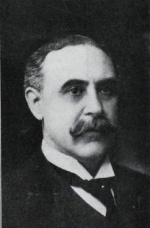
Without knowing more than what Peter has just shared with us today, Thompson is, to me, a surprising candidate, as would be anyone from the magic community of the time. My prejudice against the author likely being someone as embedded in the magic community as Thompson was stems from two arguments:
1. Erdnase begins the Legerdemain section by noting that magicians, whose books he has read and performances he has attended, don't use a system of blind shuffles, rather than the pass: "We are aware that all conjurers advise the shift or pass, as the first accomplishment... But so far as we can learn from the exhibition and literature of conjurers, not one of them knows of, or at least employs or writes of a satisfactory substitute; hence their entire dependence upon that artifice to produce certain results." (pp. 125-6 of the Charles & Wonder edition). This does not sound to me like someone who considers himself part of the magic community. It sounds like an interested outsider looking in and making a helpful observation. (As to whether the author was himself a card cheat, that is an entirely different subject. In the Card Table Artifice section he often refers to the "expert" and "the fraternity" and while he gives examples of where he himself was cheated, so clearly had extensive gambling experience, he never claims to have moved under fire himself, though he does not deny it either...)
2. It seems to me extremely unlikely that someone as embedded in the magic community as Thompson clearly was (friend of Houdini, friend of Vernelo, who was founding publisher of The Sphinx, Western representative of the SAM, friend of Dr. A. M. Wilson, etc.) would have kept his authorship of this book a secret from so many for so long. The author is clearly proud of his work and his improved methods, some of which (the stock shuffles, for example) he taught to others. Why would he not tell his magical intimates about his authorship of the book? Why would Vernelo not advertise it in the very first issue of the Sphinx, which came out the same month the book did (March 1902) rather than wait until the November issue, 9 months later?
I look forward to learning more about Thompson from Peter's forthcoming book. If a direct connection from Thompson to the book can be established (such as a provable relationship to McKinney or his descendants confirming his authorship), then he becomes a much more viable candidate, in my opinion.
On Marshall Smith's description: While I personally put a lot of stock in Smith's recollections, as the only really credible witness to the creation of the book, he recalled meeting someone clean shaven (both photos I have seen of Thompson show him with a mustache. Of course, he might have grown it after 1901...), who had come to Chicago from the East (i.e., not a Chicago resident) to publish his book. He also describes him as a reformed gambler, though how much of this description (like the confirmation of the name "Andrews") was prompted by Gardner's questioning is hard to evaluate at this point.
1. Erdnase begins the Legerdemain section by noting that magicians, whose books he has read and performances he has attended, don't use a system of blind shuffles, rather than the pass: "We are aware that all conjurers advise the shift or pass, as the first accomplishment... But so far as we can learn from the exhibition and literature of conjurers, not one of them knows of, or at least employs or writes of a satisfactory substitute; hence their entire dependence upon that artifice to produce certain results." (pp. 125-6 of the Charles & Wonder edition). This does not sound to me like someone who considers himself part of the magic community. It sounds like an interested outsider looking in and making a helpful observation. (As to whether the author was himself a card cheat, that is an entirely different subject. In the Card Table Artifice section he often refers to the "expert" and "the fraternity" and while he gives examples of where he himself was cheated, so clearly had extensive gambling experience, he never claims to have moved under fire himself, though he does not deny it either...)
2. It seems to me extremely unlikely that someone as embedded in the magic community as Thompson clearly was (friend of Houdini, friend of Vernelo, who was founding publisher of The Sphinx, Western representative of the SAM, friend of Dr. A. M. Wilson, etc.) would have kept his authorship of this book a secret from so many for so long. The author is clearly proud of his work and his improved methods, some of which (the stock shuffles, for example) he taught to others. Why would he not tell his magical intimates about his authorship of the book? Why would Vernelo not advertise it in the very first issue of the Sphinx, which came out the same month the book did (March 1902) rather than wait until the November issue, 9 months later?
I look forward to learning more about Thompson from Peter's forthcoming book. If a direct connection from Thompson to the book can be established (such as a provable relationship to McKinney or his descendants confirming his authorship), then he becomes a much more viable candidate, in my opinion.
On Marshall Smith's description: While I personally put a lot of stock in Smith's recollections, as the only really credible witness to the creation of the book, he recalled meeting someone clean shaven (both photos I have seen of Thompson show him with a mustache. Of course, he might have grown it after 1901...), who had come to Chicago from the East (i.e., not a Chicago resident) to publish his book. He also describes him as a reformed gambler, though how much of this description (like the confirmation of the name "Andrews") was prompted by Gardner's questioning is hard to evaluate at this point.
Richard Hatch wrote:Peter, do we know what happened to his extensive library of magic? It likely had a first edition copy of Erdnase and it would be great to examine that copy to see if there were any inscriptions, annotations, or other interesting features.
I asked his grand-daughter about his library. She has some books that used to belong to Harry but none of them are magic books. She does own a silver serving spoon of his which is engraved "The Wizard" and that's all she has pertaining to magic.
It seems that he disposed of his magic library later in life, when he started concentrating on his other interests - photography, genealogy, history and art. Apparently he was a good artist and that makes me wonder if he supplemented Smith's drawings with some of his own. That would explain a couple of things.
Don't hold your breath about a book folks, I'll let you know if or when!
Peter Zenner
Richard Hatch wrote: Without knowing more than what Peter has just shared with us today, Thompson is, to me, a surprising candidate, as would be anyone from the magic community of the time.
Are you saying that "Erdnase" knew nothing about magic? There is absolutely no reason why he shouldn't be a member of the magic community. As Dr. Wilson said in 'The Sphinx', Harry never did public shows but he enjoyed showing off his sleight of hand skills. There are many "magicians" around today who can flick cards around but never do shows.
Richard Hatch wrote: My prejudice against the author likely being someone as embedded in the magic community as Thompson was stems from two arguments: [snip]
Magicians are supposed to be able to keep secrets. The mass marketing of books and tricks to the general public indicates that they blab all too easily. Harry had a secret and he kept it. Some of his close friends must have known but, full marks to them, they kept his secret.
Richard Hatch wrote: 1. Erdnase begins the Legerdemain section by noting that magicians, whose books he has read and performances he has attended, don't use a system of blind shuffles, rather than the pass: "We are aware that all conjurers advise the shift or pass, as the first accomplishment... But so far as we can learn from the exhibition and literature of conjurers, not one of them knows of, or at least employs or writes of a satisfactory substitute; hence their entire dependence upon that artifice to produce certain results." (pp. 125-6 of the Charles & Wonder edition). This does not sound to me like someone who considers himself part of the magic community. It sounds like an interested outsider looking in and making a helpful observation.
Just put "Harry S. Thompson" into the search facility of your Sphinx disc and do a check. He was attending performances by magicians regularly but he never did shows himself. He WAS an outsider regarding performing shows. He loved magic and he obviously loved his books. He was typical of the thousands of amateur magicians who join societies, read books, go to conventions and shows - but NEVER perform. There are many young lads in my local society who can run rings around me with their finger-flicking, but do a show in front of an audience? NEVER
Richard Hatch wrote:(As to whether the author was himself a card cheat, that is an entirely different subject. In the Card Table Artifice section he often refers to the "expert" and "the fraternity" and while he gives examples of where he himself was cheated, so clearly had extensive gambling experience, he never claims to have moved under fire himself, though he does not deny it either...)
He was an EXPERT - according to Dr. Wilson. He mixed with other members of the FRATERNITY in Chicago and on his travels. It is most probable that he witnessed card cheats and maybe was cheated by them, on his many train journeys - how else would a commercial traveller get around in the late 1800s and early 1900s?
Richard Hatch wrote: 2. It seems to me extremely unlikely that someone as embedded in the magic community as Thompson clearly was (friend of Houdini, friend of Vernelo, who was founding publisher of The Sphinx, Western representative of the SAM, friend of Dr. A. M. Wilson, etc.) would have kept his authorship of this book a secret from so many for so long. The author is clearly proud of his work and his improved methods, some of which (the stock shuffles, for example) he taught to others. Why would he not tell his magical intimates about his authorship of the book? Why would Vernelo not advertise it in the very first issue of the Sphinx, which came out the same month the book did (March 1902) rather than wait until the November issue, 9 months later?
The author wanted to make money. The book was obviously aimed primarily at the general public. It would sell in far greater numbers if advertised in the way it was. Annemann copied the technique, selling a book on "Forcing" as if it was a method of getting your way with women. Shoddy but true.
Richard Hatch wrote: I look forward to learning more about Thompson from Peter's forthcoming book. If a direct connection from Thompson to the book can be established (such as a provable relationship to McKinney or his descendants confirming his authorship), then he becomes a much more viable candidate, in my opinion.
I have suspected for a long time that Harry's brother, Frank Thompson, worked for McKinney but I have not been able to prove it. Recent events, however, indicate that some evidence of this may soon be forthcoming. The person with that evidence has so far chosen to keep it to himself, for the time being at least.
Richard Hatch wrote: On Marshall Smith's description: While I personally put a lot of stock in Smith's recollections, as the only really credible witness to the creation of the book, he recalled meeting someone clean shaven (both photos I have seen of Thompson show him with a mustache. Of course, he might have grown it after 1901...),
Of course he might. We have no photographs of Harry before December, 1905. Some people grow them, shave them off, grow them again. Ad infinitum. An artist is a trained observer and Martin Gardner must have been desperate in trying to force Smith into remembering someone shorter than him as someone much taller. I trust Smith; I don't trust Gardner!
Richard Hatch wrote: who had come to Chicago from the East (i.e., not a Chicago resident) to publish his book.
From memory, didn't he say that his accent indicated that he was from the East? Not that he had specifically come from the East to publish the book? Harry's father, Jeremiah (Jerry) Thompson, was from Goshen, New York State, and his mother, Josephine (Sampson), was from Duxbury, Massachusetts. Are those places far enough East for you? Jerry's sister, Susan Thompson, lived with the family for a long time and she was a schoolteacher. Don't you think that young Harry would grow up speaking like his parents and aunt? I do...
Richard Hatch wrote: He also describes him as a reformed gambler, though how much of this description (like the confirmation of the name "Andrews") was prompted by Gardner's questioning is hard to evaluate at this point.
That was his back story. That was the way the book was marketed. He wanted to make money. Gardner wanted Smith to verify that 'Erdnase' was Milton Franklin Andrews so that he could sell his sensational story. He wanted to make money also.
Peter Zenner
Tom Sawyer recently posted about early non-magic Erdnase advertisements, and linked to a Genii Forum post from Richard Hatch about a Mar 28 1903 Police Gazette advertisement for the book.
Here is an ad from Police Gazette from a week earlier (Mar 21 1903). It is the earliest mention of the book that I know of that is outside the "magic" press.
And here is an ad from Billboard from later in the year (Sept 5 1903).
[These last two links work fine for me in Google Chrome, but not in MS Internet Explorer. Dunno why.]
Here is an ad from Police Gazette from a week earlier (Mar 21 1903). It is the earliest mention of the book that I know of that is outside the "magic" press.
And here is an ad from Billboard from later in the year (Sept 5 1903).
[These last two links work fine for me in Google Chrome, but not in MS Internet Explorer. Dunno why.]
Peter, thanks for your detailed reply.
A couple of quick points:
It is clear from his book that the author knew quite a bit about card magic, including moves from very recently published books marketed to the magic fraternity. That does not mean that he was or considered himself a member of the magic fraternity and my point was that the voice he uses in the Legerdemain section implies that he did not consider himself a member of the magic (as opposed to the gambling) fraternity. Thompson was clearly a major player in the magic community, being among other things the Western representative of the newly formed Society of American Magicians. Whether or not he performed as a magician has no bearing on whether he considered himself a member of the magic fraternity. I'll wager that the young finger flingers in your local club who never perform consider themselves magicians and not outsiders. My argument is that the author seems to position himself outside the magic community, and in my opinion is unlikely to been as embedded in it as was Thompson.
You say:
Please educate me on this point: How do we know it was aimed at the general public? It is not at all obvious to me that is was. In his famous preface (used as the basis for the November 1902 Vernelo ad), he does offer the book to the "public" and outlines those he thinks will find it of interest ("all lovers of card games"), but we don't know of any general publication ads for the book prior to 1903 and those early ads were not from the author. I think most early Erdnase researchers thought it was aimed at the gambling and (to a lesser degree) magic communities. How did the author market it? That is one of the big mysteries. To go over old ground on this forum: copies of the book were available in March 1902, but no mention of them earlier than September 1902 (in the Sphinx, without any purchase details) has been found. The first known ad (also in the Sphinx) is November 1902. I'd love to see an ad from the author (and not a middleman such as Vernelo or Atlas) in a general publication (OK, in any publication!) as I suspect it might reveal much about his intent and identity. No such ad has turned up to date (though the search continues!).
If a relationship between Thompson and McKinney can be shown (and not just suspected), such as Thompson supplying ink to McKinney or his brother working as a printer for McKinney, that would certainly strengthen the circumstantial case in his favor in my opinion. I look forward to hearing those details!
You say,
I think this is incorrect on several levels. As mentioned previously, we don't know how the author marketed the book or to whom (other than magic dealers and gambling supply houses, assuming Vernelo got it from the author and based on the testimony of Edwin Hood's son Richard Hood, of H. C. Evans & Company). Gardner first interviewed Smith on December 13, 1946. He did not develop the Milton Franklin Andrews theory until October 1949, at which point he did correspond with Smith hoping for confirmation. But in his early encounters with Smith, although he did prompt him on the name "Andrews" (when Smith was perplexed by the name "Erdnase", which he didn't recognize), he seems to have been unbiased in his questions regarding Smith's recollection of the author. Prior to developing the MFA theory, Gardner looked for both magicians and gamblers named Andrews, hoping to link them to to book, Dalrymple, and Smith's description. I do not believe that Gardner promoted the MFA theory because its sensational aspects might make the story more marketable. In fact, Gardner was apparently dismayed by the sensational rewrite of his story by his credited co-author John Conrad that was published in TRUE MAGAZINE in January 1958, some nine years after he began researching this candidate. Gardner may have written the article for money, but I don't believe that motive was behind his promotion of the MFA candidacy. It is only thanks to Gardner's early research that we have most of the few clues we now have and I am quite sure that his motive in tackling this research topic was not pecuniary.
A couple of quick points:
It is clear from his book that the author knew quite a bit about card magic, including moves from very recently published books marketed to the magic fraternity. That does not mean that he was or considered himself a member of the magic fraternity and my point was that the voice he uses in the Legerdemain section implies that he did not consider himself a member of the magic (as opposed to the gambling) fraternity. Thompson was clearly a major player in the magic community, being among other things the Western representative of the newly formed Society of American Magicians. Whether or not he performed as a magician has no bearing on whether he considered himself a member of the magic fraternity. I'll wager that the young finger flingers in your local club who never perform consider themselves magicians and not outsiders. My argument is that the author seems to position himself outside the magic community, and in my opinion is unlikely to been as embedded in it as was Thompson.
You say:
The book was obviously aimed primarily at the general public. It would sell in far greater numbers if advertised in the way it was.
Please educate me on this point: How do we know it was aimed at the general public? It is not at all obvious to me that is was. In his famous preface (used as the basis for the November 1902 Vernelo ad), he does offer the book to the "public" and outlines those he thinks will find it of interest ("all lovers of card games"), but we don't know of any general publication ads for the book prior to 1903 and those early ads were not from the author. I think most early Erdnase researchers thought it was aimed at the gambling and (to a lesser degree) magic communities. How did the author market it? That is one of the big mysteries. To go over old ground on this forum: copies of the book were available in March 1902, but no mention of them earlier than September 1902 (in the Sphinx, without any purchase details) has been found. The first known ad (also in the Sphinx) is November 1902. I'd love to see an ad from the author (and not a middleman such as Vernelo or Atlas) in a general publication (OK, in any publication!) as I suspect it might reveal much about his intent and identity. No such ad has turned up to date (though the search continues!).
If a relationship between Thompson and McKinney can be shown (and not just suspected), such as Thompson supplying ink to McKinney or his brother working as a printer for McKinney, that would certainly strengthen the circumstantial case in his favor in my opinion. I look forward to hearing those details!
You say,
That was his back story. That was the way the book was marketed. He wanted to make money. Gardner wanted Smith to verify that 'Erdnase' was Milton Franklin Andrews so that he could sell his sensational story. He wanted to make money also.
I think this is incorrect on several levels. As mentioned previously, we don't know how the author marketed the book or to whom (other than magic dealers and gambling supply houses, assuming Vernelo got it from the author and based on the testimony of Edwin Hood's son Richard Hood, of H. C. Evans & Company). Gardner first interviewed Smith on December 13, 1946. He did not develop the Milton Franklin Andrews theory until October 1949, at which point he did correspond with Smith hoping for confirmation. But in his early encounters with Smith, although he did prompt him on the name "Andrews" (when Smith was perplexed by the name "Erdnase", which he didn't recognize), he seems to have been unbiased in his questions regarding Smith's recollection of the author. Prior to developing the MFA theory, Gardner looked for both magicians and gamblers named Andrews, hoping to link them to to book, Dalrymple, and Smith's description. I do not believe that Gardner promoted the MFA theory because its sensational aspects might make the story more marketable. In fact, Gardner was apparently dismayed by the sensational rewrite of his story by his credited co-author John Conrad that was published in TRUE MAGAZINE in January 1958, some nine years after he began researching this candidate. Gardner may have written the article for money, but I don't believe that motive was behind his promotion of the MFA candidacy. It is only thanks to Gardner's early research that we have most of the few clues we now have and I am quite sure that his motive in tackling this research topic was not pecuniary.
Richard Hatch wrote: It is clear from his book that the author knew quite a bit about card magic, including moves from very recently published books marketed to the magic fraternity.
Harry S. Thompson had one of the four biggest magic libraries in America, according to Doc. Wilson. I think that the others were Houdini, Ellison and Wilson himself.
Richard Hatch wrote: That does not mean that he was or considered himself a member of the magic fraternity and my point was that the voice he uses in the Legerdemain section implies that he did not consider himself a member of the magic (as opposed to the gambling) fraternity.
He was posing as a reformed card cheat and writing a book on the methods of such people. He was posing as an outsider, not as a magician
Richard Hatch wrote: Please educate me on this point: How do we know it was aimed at the general public? It is not at all obvious to me that is was.
It was aimed at people who wanted to cheat at cards. All magicians are suspected of cheating at cards - "I wouldn't play cards with you" is a regular comment made to magicians. If a person known to be a magician actually were to join in a game, he would immediately be suspected of cheating.
Richard Hatch wrote: In his famous preface (used as the basis for the November 1902 Vernelo ad), he does offer the book to the "public" and outlines those he thinks will find it of interest ("all lovers of card games"),
Well there you go. He wanted the book to sell, so it was aimed at everybody with an interest in playing cards. How it was advertised and where it was advertised has no bearing on who wrote it. That is the mystery we have all been trying to solve.
Richard Hatch wrote: If a relationship between Thompson and McKinney can be shown (and not just suspected), such as Thompson supplying ink to McKinney or his brother working as a printer for McKinney, that would certainly strengthen the circumstantial case in his favor in my opinion. I look forward to hearing those details!
So do I. The person who indicated that he had such evidence initially offered to publish my research. He then decided to go it alone and suggested that we were now in a race to see who would be credited with finding Erdnase first. I have been researching Harry's life since April, 2013, and didn't want to be in a race. That's why I have submitted my case to the Genii Forum.
I don't want to get into an argument about Martin Gardner's motives. I am happy that he started the 'Search for Erdnase' and tracked Marshall D. Smith down. I am happy that you published the correspondence between the two of them. Without you three we would only have the book to go on.
From the book we know that Erdnase was an "Expert" at sleight of hand. [Harry was.] We know that Erdnase was capable of publishing a book. [Harry had years of experience in the printing and publishing trade.] We know that Erdnase knew about printing inks. [Harry was by then a commercial traveller, selling them and lecturing on them.] We know that Houdini showed Selbit a move which he (Selbit) then published before it appeared in the Erdnase book. [Harry was a friend of Houdini, so he had obviously shown him that move.]
The 'Card Through Handkerchief' effect was said by Roterberg to have originated in Chicago. He called it 'Penetration of Matter' and wrote --
"The following trick, which originated in this city several years ago, has since then become popular with conjurers the world over, being no doubt one the of best of latter-day card tricks. I can conscientiously advise my readers who, until to-day were unacquainted with the trick, to add it to their repertory." (New Era Card Tricks, 1897, page 57)
There have been twelve previous candidates for Erdnase so far, according to the article on MagicPedia. I have added Harry S. Thompson as the thirteenth - unlucky for some
Would you, Richard, or anybody reading this, please show me any other candidate who ticks so many boxes as does Harry S. Thompson.
Peter Zenner
Zenner wrote:Would you, Richard, or anybody reading this, please show me any other candidate who ticks so many boxes as does Harry S. Thompson.
Absent the confirmation of Thompson's connection to McKinney, I can think of a half dozen Chicago area magicians who tick of as many boxes: August Roterberg, E. S. Burns, Ed Vernelo, H. J. Burlingame, William J. Hilliar... All were in Chicago at the time, all had self-publishing experience, all could have had the knowledge contained in the book... I've researched all of them to some degree and don't think any of them were Erdnase, but let's take just one to compare him with Thompson: Bill Hilliar had extensive experience writing and editing magic, was considered an expert with cards (on one occasion filling in for Thurston on short notice with the audience none the wiser), he likely knew enough about copyright to explain the strange triple copyright, he worked for Frederick J. Drake, which sold first edition copies starting in 1903 and was first to reprint the book in 1905, he was employed by the Sphinx which was the first place we know of that the book was mentioned (by him) and the first we know of to advertise the book (by Vernelo, the publisher of the Sphinx). If one extends the search to magicians whose name was not Andrews, I'm sure one can find many who tick off many of the boxes you cite as plausibly as Thompson. That doesn't make them Erdnase, or even good candidates.
Zenner wrote: He was posing as a reformed card cheat
I don't think so -- he openly mocked reformed card cheats ("The hypocritical cant of reformed (?) gamblers, or whining, mealy-mouthed pretensions of piety, are not foisted as a justification for imparting the knowledge it contains.")
We know that Erdnase knew about printing inks.
Well, that's a claim I have never seen made before. Why do you think so?
Pardon my brusqueness, despite a lifetime of effort to improve, I'm simply not as politically polite as Mr. Mullins and Mr. Hatch.
The issue with candidates like Mr. Zenner has proposed (that is - candidates for whom there is absolutely no supporting evidence beyond the nominator simply putting their name forward) ... is that they are a major distraction in a search with very little manpower behind it to begin with.
Mr. Zenner does not connect his candidate in any way with Erdnase or EATCT.
Indeed, when one reads between the lines of Mr. Zenners posts, it is quickly realized that he has offered nothing of substance in support of his statements.
Mr. Zenner has previously authored a book declaring Shakespeare not be the true author of his own works. Mr. Zenner's authorship of this work provides additional framework to his comments in this thread related to S.W. Erdnase and his authorship of EATCT.
The issue with candidates like Mr. Zenner has proposed (that is - candidates for whom there is absolutely no supporting evidence beyond the nominator simply putting their name forward) ... is that they are a major distraction in a search with very little manpower behind it to begin with.
Mr. Zenner does not connect his candidate in any way with Erdnase or EATCT.
Indeed, when one reads between the lines of Mr. Zenners posts, it is quickly realized that he has offered nothing of substance in support of his statements.
Mr. Zenner has previously authored a book declaring Shakespeare not be the true author of his own works. Mr. Zenner's authorship of this work provides additional framework to his comments in this thread related to S.W. Erdnase and his authorship of EATCT.
If you want to compare Thompson's writing style to that of Expert, here is an article he wrote. Here is another. This may be another.
Here is Harry's grave.
Peter, one thing that comes up with every proposed candidate for Erdnase is "what do they know about cards?" That answer is obvious with MF Andrews, and one of the most important pieces of Marty Demarest's research into WE Sanders tied him to card tricks and owning decks of cards. I've been able to locate newspaper references to both WE Sanders and Edwin S Andrews participating in card games.
So what's the connection between Thompson and playing cards? Why do you believe that he had any expertise with the pasteboards? (I assume that you'd agree that for any candidate to be possible, he'd have to know something about card work.)
I’ve gone over every reference to “Harry S. Thompson” (and "H. S. Thompson", and "Harry Thompson", etc.) I can find in AskAlexander, and see nothing that supports the idea that he knew anything about performing card magic, executing gambling sleights, played poker or other gambling card games, inventing card tricks, or anything else having to do with the contents of Expert at the Card Table. The closest I can come is a statement that "he often mystifies his brother “knights of the grip” with his skill in sleight of hand", but that same passage emphasizes "“He is interested in magic more from the ethical and literary standpoint than from the operative side, as he does not give entertainments of any kind" (Sphinx, Dec 1905). That reference may apply to cards, but it may also apply to coins, billiard balls, silks, or any of dozens of other pieces of magic apparatus. It is a leap of faith to say it means cards.
It is quite clear that from about 1902 onwards, he was an active in corresponding with magicians and in the SAM, in contributing to and publishing The Sphinx, had an advanced collection of magic books, and even acted as a while as a magic book dealer (odd, though, that his ads for selling books in the May 1904 and Feb 1905 Sphinx did not include Expert.) Excerpts of correspondence to and from Thompson that were published in the magic journals always talk about collecting and history, never about him performing or being interested in card magic.
But I can find nothing that suggests he has any skills, experience or knowledge relating to playing cards that the author of Expert would have to have.
Here is Harry's grave.
Peter, one thing that comes up with every proposed candidate for Erdnase is "what do they know about cards?" That answer is obvious with MF Andrews, and one of the most important pieces of Marty Demarest's research into WE Sanders tied him to card tricks and owning decks of cards. I've been able to locate newspaper references to both WE Sanders and Edwin S Andrews participating in card games.
So what's the connection between Thompson and playing cards? Why do you believe that he had any expertise with the pasteboards? (I assume that you'd agree that for any candidate to be possible, he'd have to know something about card work.)
I’ve gone over every reference to “Harry S. Thompson” (and "H. S. Thompson", and "Harry Thompson", etc.) I can find in AskAlexander, and see nothing that supports the idea that he knew anything about performing card magic, executing gambling sleights, played poker or other gambling card games, inventing card tricks, or anything else having to do with the contents of Expert at the Card Table. The closest I can come is a statement that "he often mystifies his brother “knights of the grip” with his skill in sleight of hand", but that same passage emphasizes "“He is interested in magic more from the ethical and literary standpoint than from the operative side, as he does not give entertainments of any kind" (Sphinx, Dec 1905). That reference may apply to cards, but it may also apply to coins, billiard balls, silks, or any of dozens of other pieces of magic apparatus. It is a leap of faith to say it means cards.
It is quite clear that from about 1902 onwards, he was an active in corresponding with magicians and in the SAM, in contributing to and publishing The Sphinx, had an advanced collection of magic books, and even acted as a while as a magic book dealer (odd, though, that his ads for selling books in the May 1904 and Feb 1905 Sphinx did not include Expert.) Excerpts of correspondence to and from Thompson that were published in the magic journals always talk about collecting and history, never about him performing or being interested in card magic.
But I can find nothing that suggests he has any skills, experience or knowledge relating to playing cards that the author of Expert would have to have.
Bill Mullins wrote:[We know that Erdnase knew about printing inks.
Well, that's a claim I have never seen made before. Why do you think so?
Offline, Richard Hatch pointed me to this line from Expert: "Nearly all standard cards are red or blue. Marking inks absolutely indistinguishable from the printer’s ink can be obtained from any of the dealers." So I can see why you say Erdnase "knew about printing inks."
I have always read the reference to card marking in EATCT as Erdnase noting only that red cards can be marked with available red ink, and blue cards can be marked similarly with available blue ink.
Erdnase implies nothing further, and certainly nothing to do with a formal printing process.
Considering the obvious depth of his knowledge, that Erdnase knows how to mark a red or blue deck of cards isn't at all surprising.
Erdnase implies nothing further, and certainly nothing to do with a formal printing process.
Considering the obvious depth of his knowledge, that Erdnase knows how to mark a red or blue deck of cards isn't at all surprising.
Richard Hatch wrote: I've researched all of them to some degree and don't think any of them were Erdnase, but let's take just one to compare him with Thompson: Bill Hilliar had extensive experience writing and editing magic, was considered an expert with cards (on one occasion filling in for Thurston on short notice with the audience none the wiser), he likely knew enough about copyright to explain the strange triple copyright, he worked for Frederick J. Drake, which sold first edition copies starting in 1903 and was first to reprint the book in 1905, he was employed by the Sphinx which was the first place we know of that the book was mentioned (by him) and the first we know of to advertise the book (by Vernelo, the publisher of the Sphinx). If one extends the search to magicians whose name was not Andrews, I'm sure one can find many who tick off many of the boxes you cite as plausibly as Thompson. That doesn't make them Erdnase, or even good candidates.
According to Whaley's Who's Who in Magic, Hilliar "Moved to USA in June 1901". So, if he was Erdnase, he would have had to lose his English (Oxford!) accent pretty damn quick in order to fool Marshall D. Smith.
I can't work up the enthusiasm to go through all of the reasons why I cannot support any of the other candidates. I am convinced 100% that Harry was the man. You people can debate and obfuscate as much as you want to. Time will tell. It is now 01.10 a.m. over here and I am tired. Goodnight.
Peter Zenner
Completely unrelated to the topic at hand, but Harry's nephew, Frank R. Thompson (son of Frank L. Thompson) was thought by Chicago police to have supplied the machine guns used in the St Valentine's Day massacre.
Go back to your regularly scheduled Erdnasia.
Go back to your regularly scheduled Erdnasia.
Richard Hatch wrote: Absent the confirmation of Thompson's connection to McKinney, I can think of a half dozen Chicago area magicians who tick of as many boxes: August Roterberg, E. S. Burns, Ed Vernelo, H. J. Burlingame, William J. Hilliar... All were in Chicago at the time, all had self-publishing experience, all could have had the knowledge contained in the book... I've researched all of them to some degree and don't think any of them were Erdnase
OK Richard, we have both discounted the magicians you mentioned, for one reason or another. Let's stop clouding the issue and stick to our respective candidates. You have suggested several "Andrews" over the years but you have settled on one - Edwin Sumner Andrews. Was your first mention of him in print the article in the December, 1999, edition of Magic? So you have been promoting him as a possible candidate for almost 16 years (at least), compared to my promotion of Harry for 3 days. You should be able to defend your candidate better than my defence of mine.
They both appear to be a little short in stature and roughly the same age. Period. Can you tell me about Edwin's background in magic and book publishing? Erdnase certainly had knowledge in both fields and so did Harry.
Peter Zenner
Bill Mullins wrote:Completely unrelated to the topic at hand, but Harry's nephew, Frank R. Thompson (son of Frank L. Thompson) was thought by Chicago police to have supplied the machine guns used in the St Valentine's Day massacre.
Go back to your regularly scheduled Erdnasia.
Dear Bill,
You are very good at using Google and the genealogy web-sites. Trouble is that you are telling me stuff, both publicly and privately, that I knew 2 years ago. I even supplied Find A Grave and MagicPedia with the relevant dates for Harry way before I let on about the Erdnase business.
If you want to do something really useful, why don't you track down the McKinney Bankruptcy File? If one person can do it then I am sure somebody else can. That would really be a feather in your cap.
Peter Zenner
Zenner wrote:[You are very good at using Google and the genealogy web-sites. Trouble is that you are telling me stuff, both publicly and privately, that I knew 2 years ago.
Sorry to trouble you. Don't worry, it won't happen again.
If you want to do something really useful, why don't you track down the McKinney Bankruptcy File? If one person can do it then I am sure somebody else can. That would really be a feather in your cap.
If one person has already done it, no sense in me wasting my time doing it again. After all, I wouldn't want to trouble anyone.
And my cap has enough feathers, thank you. I do what I do for my own amusement, not to impress anyone. But doing has allowed me to become friends with a number of people whose work I greatly respect, and opened doors to rooms I never expected that I would ever be able to enter.
You've made your Thompson case, and it's not picking up too much traction. That's fine, this is all just a parlor game anyway. It's not like any of us will ever prove that anyone in particular wrote the book. This will still be a mystery after we are all long gone.
I personally don't think Thompson is any more likely to have written the book than Theodore Roosevelt. But if you ever find that he could do a shift, or a false cut, or even the 21 card trick, let us know. Then he might be interesting.
Zenner wrote: Can you tell me about Edwin's background in magic and book publishing? Erdnase certainly had knowledge in both fields and so did Harry.
Erdnase's knowledge of book publishing seemed to go no farther than hiring a printer. He screwed up the copyright statement. David Ben's recent reorganization of the text, and the numerous errors in the text, suggest that a good editor would have been helpful. Despite your claims that the book was "aimed primarily at the general public," there is little to no evidence that it was marketed to the general public -- something that a knowledgeable publisher would have done.
If someone with actual book publishing experience were intimately involved in the production of the book, I think we would have ended up with a different text, and that there wouldn't have been remaindered copies available so soon after publication because it would have been competently mass-marketed to the magic community and possibly to the general public.
Roger M. wrote:Pardon my brusqueness, despite a lifetime of effort to improve, I'm simply not as politically polite as Mr. Mullins and Mr. Hatch.
Those two, especially Richard Hatch, are vetting Zenner’s candidate in a generally respectful way and were focusing on the merits. Perhaps you could learn a thing or two from their examples. Dick has done considerable original research over many years, and Bill, having the good fortune of access to an incredible array of online databases, has kindly put in the time to contribute (among other things) countless factual tidbits over the past several years. And whatever the merits may be of Zenner’s candidate and arguments, it seems clear enough that he has put some genuine effort into thinking about and researching his candidate.
Roger M. wrote:The issue with candidates like Mr. Zenner has proposed (that is - candidates for whom there is absolutely no supporting evidence beyond the nominator simply putting their name forward) ... is that they are a major distraction in a search with very little manpower behind it to begin with.
These remarks are truly breathtaking in their conceit, among other things. We all look forward to your cogent essay providing concrete guidance on exactly when one has enough evidence – and the type of evidence needed -- in order to safely post on this thread and thereby avoid “major distractions” to our paltry manpower. In my view, Zenner has clearly tried to make connections between his candidate and Erdnase, and has certainly gone beyond merely dropping a name.
Roger M. wrote:Mr. Zenner does not connect his candidate in any way with Erdnase or EATCT.
When arguments are boiled down to hard facts, couldn’t that criticism be laid at the feet of any person who has proposed a candidate? Please tell us a candidate -- and the facts about him -- that satisfy your criteria.
I sincerely appreciate your kind remarks about my work, Roger, and the only reason I’m singling you out is because it seems that you are the only one who has really gone off the courtesy rails, at least that seems so based on the exchanges in the last two pages of this thread. I certainly share your desire for focused discussion, but after reading your mini lecture to Scott Lane about the desired “tone” of this thread, find it sadly ironic that you seem to have lost sight thereof in some of your recent posts. For example, you slammed Zenner’s inquiries and concerns about the Seely/Crosby marriage and told him he was wrong. Your reason? “Because Bill M. has demonstrated over a period of years that his Erdnase research is, quite simply, second to none.” Not only did you possibly embarrass Bill (who to his credit quickly tried to temper your claims) but you also insulted Richard Hatch, David Alexander and Todd Karr, et al., all of whom deserve considerable credit for doing original research. We all have our moments; it’s just that in my view you have come on way too strong recently.
Speaking of facts and moving on to the merits …
Like Dick Hatch, I tend to doubt that a magician with any modicum of prominence wrote The Expert. Yes, the magicians’ stock in trade is secrecy, as Zenner points out, but as history shows magicians aren’t always good about keeping secrets, and if a magician wrote The Expert, I would think that someone would have eventually come forth with a name and some stories. It just seems very unlikely that a magician-author of such an important book could have remained unknown. Which brings up a question: when was The Expert recognized as an important book in conjuring literature? When did a critical mass of magicians start talking about and praising Erdnase’s work? Aside from ads and Hilliar’s passing mention, were any reviews done? If so, when? What did the reviews say?
On the other hand, secrecy, anonymity, and discretion would all seem crucial for card cheats, for their livelihood and personal freedom would be at risk, and in some cases their very lives as well.
It may seem like a dry and fruitless exercise to do a competent bibliographical study of the early editions and issues of The Expert, but what’s written in it and its physical existence are in my opinion, the best – and arguably the only – undisputable evidence we have to date. I’m not suggesting that solid bibliographical work on The Expert will yield the identity of Erdnase, but for reasons too lengthy to detail here, such a study could provide some very helpful clues. For example, one could look at the earliest Drake issues and see if the paper is the same as the original edition and if any Drake copies have a cancelled title page. One could also study Drake’s proclivities re copyright statements for previously published works; did Drake simply use the old copyright statements or did it update them or claim its own copyrights? Etc. One could also compare the physical structures of the first edition and the earliest Drake issues. The Expert was advertised in 1903 (by Drake I think) as a 12mo, but it seems that the early Drake issues may be 16mos. Assuming the original edition was indeed a 12mo and the early Drake issues 16mos, if Drake had the “original” plates (i.e., stereos, electros, or possibly the original linotype slugs), it would have been easy to reimpose the book as a 16mo. In fact, many publishers often did that sort of thing in the 50+ years preceding Erdnase’s book, largely so they could publish in a cheaper format.
Clay -- thanks for the kind words.
While I disagree with Peter's conclusions, I welcome his interest in and contributions to the discussion. I hope my comments and questions are similarly welcomed. If this mystery is ever solved, it will be because someone decided that a particular person was worth investigating. If that solution is ever accepted by the community, it will be because advocates and critics have gone over all the relevant details until a conclusion is reached. By definition, everyone who is proposed but one will be the wrong guy, so the odds of proposing the right guy are small to start with.
As far as bibliographical inquiries go, one thing I'm curious about is how the material that is missing from the 178 page editions corresponds to signatures in the 205 page edition. Was a signature simply dropped? Or was more careful editing done?
I'd love to have clean, 100% size transparencies from a number of pages of a legitimate 1st edition. I think overlaying them on succeeding editions would be interesting. Are the later editions that we casually say are from the same "plates" really identical (allowing for age and wear)? Can wear from the printing plates be shown to accumulate on successive editions?
I'd like to see original copyright forms from other books printed by McKinney ca. 1902. The handwriting on the Erdnase copyright application is distinctive (to me); can it be shown to be similar to other documents from 1902 McKinney?
Two points on the timeline are worth noting:
1. Hoffmann's columns in _The Magic Wand_ starting in Sept 1910 are the first major recognition in the magic community of the book (although, per personal communications with Will Houstoun, Hoffmann was mentioning the text favorably in correspondence several years earlier).
However, this recognition could have withered on the vine were it not for:
2. Vernon's evangelism about the book starting when he was in New York in the 1920s. Vernon preached the gospel of Erdnase for most of 70 years, and if he hadn't, we likely wouldn't be having this discussion now.
While I disagree with Peter's conclusions, I welcome his interest in and contributions to the discussion. I hope my comments and questions are similarly welcomed. If this mystery is ever solved, it will be because someone decided that a particular person was worth investigating. If that solution is ever accepted by the community, it will be because advocates and critics have gone over all the relevant details until a conclusion is reached. By definition, everyone who is proposed but one will be the wrong guy, so the odds of proposing the right guy are small to start with.
As far as bibliographical inquiries go, one thing I'm curious about is how the material that is missing from the 178 page editions corresponds to signatures in the 205 page edition. Was a signature simply dropped? Or was more careful editing done?
I'd love to have clean, 100% size transparencies from a number of pages of a legitimate 1st edition. I think overlaying them on succeeding editions would be interesting. Are the later editions that we casually say are from the same "plates" really identical (allowing for age and wear)? Can wear from the printing plates be shown to accumulate on successive editions?
I'd like to see original copyright forms from other books printed by McKinney ca. 1902. The handwriting on the Erdnase copyright application is distinctive (to me); can it be shown to be similar to other documents from 1902 McKinney?
Which brings up a question: when was The Expert recognized as an important book in conjuring literature?
Two points on the timeline are worth noting:
1. Hoffmann's columns in _The Magic Wand_ starting in Sept 1910 are the first major recognition in the magic community of the book (although, per personal communications with Will Houstoun, Hoffmann was mentioning the text favorably in correspondence several years earlier).
However, this recognition could have withered on the vine were it not for:
2. Vernon's evangelism about the book starting when he was in New York in the 1920s. Vernon preached the gospel of Erdnase for most of 70 years, and if he hadn't, we likely wouldn't be having this discussion now.
Bill Mullins wrote: While I disagree with Peter's conclusions, I welcome his interest in and contributions to the discussion.
Thank you Bill. Your kindest words yet. I don't understand why you are so anti-Harry and pro-Edwin though. Perhaps Richard will answer my query soon about Edwin's knowledge of magic and the book publishing trade. He seems to have so many supporters and yet so little evidence.
The handwriting on the Erdnase copyright application is distinctive (to me); can it be shown to be similar to other documents from 1902 McKinney?
I have a sample of Harry's handwriting from 1923. This is not exactly the same as that on the copyright application but there are a couple of similarities. For example, the tails on the letters 'y' and 'g' are straight lines rather than loops. I find that to be unusual but there are 22 years between the two samples and handwriting can change over the years.
My original posting of a summary of my research into Harry S Thompson was to establish him as a candidate. My reason for doing so has been explained. I did not intend to hang around and suffer the "slings and arrows" but I am still here. Hey-ho!
Messrs Hatch and Mullins at least post under their real names. I gather that Clay = Clay Shevlin. So I do at least know who a few of you are and feel comfortable in your presence. The anonymous lurkers who serve no purpose other than to barrack from the sidelines are to my mind the pits. Come out of hiding you cowards and let us all know who you are!
Peter Zenner
Zenner wrote:The anonymous lurkers who serve no purpose other than to barrack from the sidelines are to my mind the pits. Come out of hiding you cowards and let us all know who you are!
Peter Zenner
I'll assume that this is a reference to those who don't provide full names to fellow posters, such that their identities are not made fully public in internet forum posts. This is the old internet nugget that claims a persons posts are somehow rated in response to the amount of personal information the poster chooses to share with the entire internet.
Ridiculous in any form, here it is here - so I'll address it.
Since I first posted to the Genii Erdnase thread in 2007, the owner of this forum has known exactly who I am (for example), has my home address (as a subscriber), my credit card number, my email address, my telephone number, and my full name.
Mr. Zenner, that you feel simply signing up on the Genii Forum a few weeks ago somehow entitles you to my (or anybody else's) personal information is a folly equal to that of your Erdnase candidate.
I await even the smallest shred of evidence in support Mr. Zenners candidate, and if I'm proven incorrect or dishonest in anything I've posted to date, I'll gladly eat my words with a public apology to Mr. Zenner, and will also humble myself before Clay Shevlin for offending his sensibilities and failing to meet the standards he's apparently set for this thread.
Beyond that, I will let stand everything I've posted to date.
Zenner wrote: I don't understand why you are so anti-Harry and pro-Edwin though.
I'm not sure that I am "pro-Edwin" -- I think I'm on record as saying that it is more likely than not that no one has yet identified Erdnase's identity. Therefore, Edwin S. Andrews is probably not Erdnase. The many coincidences between his life and the history of the book are fascinating, though.
And it's not so much that I'm "anti-Harry" as it is that I don't believe the case you've laid out for him is particularly convincing, for reasons some of which I've already gone into (and for the most part, which you haven't rebutted, although you certainly have no obligation to do so). I'm willing to change my mind if more comes out about him that strengthens the case.
We don't know much about Erdnase, but we know he knew his way around a deck of cards, and I've seen no evidence that Thompson did.
"S. W. Erdnase" is a very contrived sounding pseudonym, and for anyone proposed as being Erdnase, there should be a chain of logic that says why he would choose that as a name. That exists for anyone named "E S Andrews", and it exists for W. E. Sanders. It doesn't for Thompson, and I don't think the fact that he knew someone named "E. C. Andrews" is sufficient to sway me.
You may disagree, and that's fine.
"Roger M" is Roger Moore, who used to play James Bond. Once you know that, it's easy to understand why he'd want some anonymity on the forum.
Lots of interesting new material here!
Bill, I question notion that The Expert might well have fallen into obscurity if it weren't for Dai Vernon. Certainly Vernon is responsible for a great deal of the book's success. But it doesn't follow that the book would be forgotten without him. In any case, the subject is regularly mentioned in discussions of Erdnase, and I think the facts deserve to be pulled out from beneath Vernon's rather formidable shadow.
The first serious correspondence I've been able to find amongst professional magicians regarding The Expert are the aforementioned letters of Professor Hoffmann. The first of these appear in 1903 and are extremely engaged in their examination of fine points of Erdnase's technique, and in their critique of his style. These make it clear that, shortly after its appearance, the book was already being taken seriously by some of the best minds in magic.
In 1905 an advertising note in The Sphinx describes the book as being highly in-demand. By 1906, Erdnase's technical language--the persistent use of "seize" in describing card handling, the Erdnasian usage of terms such as "jog" and "break"--was starting to spread throughout published conjuring. By 1911 The Expert had been praised, plagiarized, cited or annotated by T. Nelson Downs, Hatton and Plate, Ellis Stanyon, Devant and Maskelyne, and Professor Hoffmann. Multiple editions of The Expert were published before Dai Vernon even arrived in New York City in 1913. By then the book was already influential, controversial and successful.
While there is ample evidence that Vernon subsequently did more than any other single person in singing the book's praises, his influence largely ended with magicians. What Dai Vernon said or did had almost no effect on non-magicians. And yet The Expert sold (and continues to sell) very well to the general public. Vernon himself recounted that when he visited the offices of The Police Gazette just before they closed, he was told that sales of The Expert had kept them in business for several years.
Vernon might have made The Expert into a bible (and consequently turned Erdnase into the Holy Ghost). But Vernon was not single-handedly, nor even primarily, responsible for The Expert's success. The Expert is first and foremost a success due to its author and subject. (Whoever and whatever they are...)
Bill, I question notion that The Expert might well have fallen into obscurity if it weren't for Dai Vernon. Certainly Vernon is responsible for a great deal of the book's success. But it doesn't follow that the book would be forgotten without him. In any case, the subject is regularly mentioned in discussions of Erdnase, and I think the facts deserve to be pulled out from beneath Vernon's rather formidable shadow.
The first serious correspondence I've been able to find amongst professional magicians regarding The Expert are the aforementioned letters of Professor Hoffmann. The first of these appear in 1903 and are extremely engaged in their examination of fine points of Erdnase's technique, and in their critique of his style. These make it clear that, shortly after its appearance, the book was already being taken seriously by some of the best minds in magic.
In 1905 an advertising note in The Sphinx describes the book as being highly in-demand. By 1906, Erdnase's technical language--the persistent use of "seize" in describing card handling, the Erdnasian usage of terms such as "jog" and "break"--was starting to spread throughout published conjuring. By 1911 The Expert had been praised, plagiarized, cited or annotated by T. Nelson Downs, Hatton and Plate, Ellis Stanyon, Devant and Maskelyne, and Professor Hoffmann. Multiple editions of The Expert were published before Dai Vernon even arrived in New York City in 1913. By then the book was already influential, controversial and successful.
While there is ample evidence that Vernon subsequently did more than any other single person in singing the book's praises, his influence largely ended with magicians. What Dai Vernon said or did had almost no effect on non-magicians. And yet The Expert sold (and continues to sell) very well to the general public. Vernon himself recounted that when he visited the offices of The Police Gazette just before they closed, he was told that sales of The Expert had kept them in business for several years.
Vernon might have made The Expert into a bible (and consequently turned Erdnase into the Holy Ghost). But Vernon was not single-handedly, nor even primarily, responsible for The Expert's success. The Expert is first and foremost a success due to its author and subject. (Whoever and whatever they are...)
^^^ Many thanks for your input, Marty. Very interesting! I note especially the 1905 remark in The Sphinx that The Expert was in high demand. That might help explain the timing of the first Drake issue. What month was that remark made in The Sphinx? (I could not find it; the closest remark I could find was this in the Dec. 1905 issue: "The Atlas Trick and Novelty Co. sold so many of The Expert at The Card Table that their ad is continued this month.") In the correspondence you've seen, was any curiosity expressed about who Erdnase was?
Perhaps this ground has already been ploughed, but just in case … did a quick search of Sphinx issues from March 1904 to Feb. 1907.
Starting in the Nov. 1905 issue, and continuing most months thereafter until June 1906, Atlas Trick & Novelty Co., advertised The Expert for only 25 cents. This ad is typical:
From March 1904 through mid 1906, only W.D. LeRoy also regularly advertised Erdnase’s book (with many other books), with the following typical text: “Expert at the Card Table (a $2.00 Book), $1.00.”
To my mind, the reference to a $2 book indicates that the original edition was being sold, and that the price on the title page thereof was relied upon for the claim of a $2 value. So it appears that as late as the press deadlines for the June 1906 issue of The Sphinx, new copies of the original edition were still for sale.
But why did Atlas elect to bargain-price The Expert starting with the Nov. 1905 issue of Sphinx? Why the whopping 75% cheaper price than other dealers’ prices? Perhaps it was in response to Drake’s cheaper reprint?
Perhaps this ground has already been ploughed, but just in case … did a quick search of Sphinx issues from March 1904 to Feb. 1907.
Starting in the Nov. 1905 issue, and continuing most months thereafter until June 1906, Atlas Trick & Novelty Co., advertised The Expert for only 25 cents. This ad is typical:
$2.00 Worth for 25 Cents
THE EXPERT AT THE CARD TABLE.
By S. W. Erdnase.
Published to sell for $2.00. For a limited time we will send you this wonderful book for 35c post paid. Without a doubt the best treatise on the science and art of manipulating- cards. Embracing the whole calendar of Sleights used by the Gambler and Conjurer, describing with detail and illustrations every known expedient, maneuvre and stratagem of the expert card handler, with over one hundred copyright drawings from life. This book will prove of excellent service to the up-to-the-minute conjurer. Read this ad over again, then send your order at once. Address: ATLAS TRICK & NOVELTY CO. (Not Inc.)
154 Illinois St., Chicago.
From March 1904 through mid 1906, only W.D. LeRoy also regularly advertised Erdnase’s book (with many other books), with the following typical text: “Expert at the Card Table (a $2.00 Book), $1.00.”
To my mind, the reference to a $2 book indicates that the original edition was being sold, and that the price on the title page thereof was relied upon for the claim of a $2 value. So it appears that as late as the press deadlines for the June 1906 issue of The Sphinx, new copies of the original edition were still for sale.
But why did Atlas elect to bargain-price The Expert starting with the Nov. 1905 issue of Sphinx? Why the whopping 75% cheaper price than other dealers’ prices? Perhaps it was in response to Drake’s cheaper reprint?
Bill Mullins wrote:… While I disagree with Peter's conclusions, I welcome his interest in and contributions to the discussion. I hope my comments and questions are similarly welcomed. If this mystery is ever solved, it will be because someone decided that a particular person was worth investigating. If that solution is ever accepted by the community, it will be because advocates and critics have gone over all the relevant details until a conclusion is reached. [emphasis added] …
I also find Zenner’s arguments to be unpersuasive, and share the view that instead of baldly slamming them as worthless and inadequate, it’s more intellectually honest to address and scrutinize the weaknesses in his arguments. Unlike Roger M., I do not think your and Richard Hatch’s measured responses to Zenner are “disingenuous” or constitute “pandering” by any stretch of the imagination (else academia at large “disingenuously” engages in “pandering” whenever vetting a new idea or theory). Your respectful approaches will leave a record which will be read by future researchers should they come across, and wish to (re)consider, Thompson as a candidate, while the (borderline hysteric) non-substantive naysaying will be consigned to the trash bin as internet dross.
Bill Mullins wrote:… As far as bibliographical inquiries go, one thing I'm curious about is how the material that is missing from the 178 page editions corresponds to signatures in the 205 page edition. Was a signature simply dropped? Or was more careful editing done? …
Good questions, and it’d be surprising if someone hasn’t already at least figured out what text was dropped in the shorter version(s) of the book. My guess (without any evidence whatsoever) would be that the text was simply lopped off at a convenient point rather than condensed by editing – such a thing was not unheard of in that era, and one can even find examples of this in magic, examples being Laird & Lee’s abridged issues of Burlingame’s Herrmann the Great and Evans’ Sprit World Unmasked.
Without collating the relevant copies, it’s hard to say much else with any degree of concreteness. But one thing should be kept in mind when we discuss signatures in a book: it’s the number of leaves that is relevant, not the pagination of the printed pages. The last page number of an early Drake issue may be “205,” but when talking about signatures, we have to add the blank on the verso of pp. 205, for a total of 206 pages, or 103 leaves. Then, we have to bear in mind that some pages or leaves in a signature may be blank, and that, absent the publisher’s (or binder’s) excision of an odd number of leaves, a whole signature (or a book comprised of whole signatures) can never have an odd number of leaves.
With some extremely rare exceptions (pertaining to the printing of a book one side of a single leaf, like a broadsheet), books were always printed in formats to the power of 2, i.e., in 2s, 4s, 8s, 16s, 32s, 64s, etc. But (to further complicate things for bibliographers!) that doesn’t always mean that they were gathered and sewn in the printed format. For examples: many incunabula were printed as folios, but gathered and sewn in 6s, 8s, 10s, or 12s (the reason being that if folios were gathered and sewn in 2s, labor would be increased somewhat, and the spine would be extremely bulky on account of all the thread and thus more difficult to bind); and many editions of Henry Dean’s Hocus Pocus book were printed as “work and turn” 12mos (i.e., each forme consisted of two identical 6-page sections of text) and gathered and sewn in 6s. The upshot is that determining how many leaves are in a sewn gathering doesn’t necessarily indicate the format of a book, i.e., how it was printed.
Trying to tackle the signature construction of The Expert, I’d guess that all of the earlier editions of The Expert were printed as 12mos or 16mos (or possibly even 32mos gathered in 16s). I believe Tom Sawyer noted that there is a blank leaf at the start of his 205 pp. copy. I suspect this leaf would be conjugate with the last leaf of the first signature. Alas, if Tom’s copy has 104 leaves (i.e., 205 pp. plus blank p. 206 plus the blank leaf at the front of the book), neither 12 nor 16 divides evenly into 104 (nor does 8, in the unlikely event that the book was printed as an octavo). So this means that some leaves were added to the book (usually in pairs of conjugate leaves for sewing), or some were excised from one of the signatures. Or, in cases with ads in the front or rear of the book, the ads were printed as part of the book itself. That’s about all that can be said without doing a physical collation.
Bill Mullins wrote:… Are the later editions that we casually say are from the same "plates" really identical (allowing for age and wear)? Can wear from the printing plates be shown to accumulate on successive editions? …
Only careful examination of the type, leading, etc., from different editions and issues can answer the first question. On the second, it’s quite common for wear to show in cases of stereo or electro plates or (less likely) repeated use of Linotype slugs, much of which would often occur from the (mis)handling, cleaning, and storage of the plates, as opposed to the mere process of printing.
Bill Mullins wrote:… “S. W. Erdnase" is a very contrived sounding pseudonym, and for anyone proposed as being Erdnase, there should be a chain of logic that says why he would choose that as a name. That exists for anyone named "E S Andrews", and it exists for W. E. Sanders. It doesn't for Thompson, and I don't think the fact that he knew someone named "E. C. Andrews" is sufficient to sway me. …
All things considered, it does indeed seem difficult to escape such thinking. IMO, it seems very odd that the author would use three synonyms (“Artifice Ruse and Subterfuge”) for the main title of the book, but the ordering does make sense if one reads those words, and the letters in the author’s name, in reverse, arriving at “Subterfuge and Ruse [Andrews] Artifice” and E. S. Andrews. It’s as if the author decided to book-end a somewhat phonetic spelling of his real name with the clues “Subterfuge” and “Artifice.”
But of course we could be surprised if and when the author’s real name is established!
Bill Mullins wrote:Therefore, Edwin S. Andrews is probably not Erdnase. The many coincidences between his life and the history of the book are fascinating, though.
Apart from his name being a reversal of S.W. Erdnase, what are these fascinating coincidences? There were others with the same name as his who have been discounted. A link between his Seely and the Dalrymple Seeleys has not been established.
Here's something for you to ponder - Richard Hatch wrote in Erdnase Unmasked, “The same day that Gardner interviewed Smith, Richard W. Hood, the son of Edwin C. Hood, founder of H.C. Evans & Co. gambling supply house in Chicago, answered a letter from Gardner and told him that his father had known Erdnase well in the 1890s.” Dick Hood was born about 1882, so would have been very young in the 1890s. He would have been about 20 when the Erdnase book was published and his father had died 5 years before. If the Hoods knew Erdnase before the book came out then Dick Hood must have known who he was.
Guess what - at the time of the publication of The Expert, Harry's "aunt-in-law" Helen L. Hood was living with the Thompson family on Lunt Avenue, Chicago. Helen was Harry's mother-in-law's sister, so he was related to A Hood family. But I have not presented this as "evidence" that he was related to the people who ran the gambling supply house, because I have not been able to prove it. Is that coincidence fascinating enough for you?
Why would Richard introduce the Seely/Seeley business when he cannot prove there is a connection?
And it's not so much that I'm "anti-Harry" as it is that I don't believe the case you've laid out for him is particularly convincing, for reasons some of which I've already gone into (and for the most part, which you haven't rebutted, although you certainly have no obligation to do so). I'm willing to change my mind if more comes out about him that strengthens the case.
I have been through all of the 12 previously suggested candidates and I maintain that there is far more evidence for Harry being Erdnase than any of the others. Don't you think that Smith would have detected a trace of a foreign accent if it was Roterberg (German), Hilliar (English), Burns (Danish), Foster (Scottish), or L'Homme Masque (Spanish). That knocks out five of the twelve.
Don't forget that Smith was an artist, a trained observer. Then there is the age and height to take into consideration. We are looking for someone between 40 and 45 and smaller than Smith. Milton F. Andrews is ruled straight out (too tall and too young), William Symes Andrews was too old at 54, Roterberg was 37 (and German!), E.S. Burns was 27 (and Danish!), Foster was 48 (and Scottish!)
Harry was the right size and the right age, with the right accent and the right experience. He knew about magic and he knew about printing & printing inks and publishing. He is the ONLY candidate who fits all of the criteria.
We don't know much about Erdnase, but we know he knew his way around a deck of cards, and I've seen no evidence that Thompson did.
Have you seen any evidence that Edwin Sumner Andrews was an expert at sleight of hand and knew how to get a book published? Any evidence that he knew anything about magic? And yet he is accepted by many (including David Ben!) as being The Expert!
You may disagree, and that's fine.
Oh, I do. And the more I look at the lack of evidence for ALL of the other candidates, the more I am convinced that it was Harry
All the best,
Peter Zenner
Zenner wrote:Bill Mullins wrote:Therefore, Edwin S. Andrews is probably not Erdnase. The many coincidences between his life and the history of the book are fascinating, though.
Apart from his name being a reversal of S.W. Erdnase, what are these fascinating coincidences?
They have been well-documented in many places, including elsewhere in this thread.
Nor has it been for Thompson.A link between his Seely and the Dalrymple Seeleys has not been established.
Why would Richard introduce the Seely/Seeley business when he cannot prove there is a connection?
Because it is an interesting lead which others of us may wish to investigate further (and have investigated, for that matter). If you hadn't reacted so negatively to what I found out about Thompson, I might be willing to try and strengthen the case for him. I've done it for Hatch and Demarest and Karr. But the attitude I'm getting from you is "Case closed, piss off", so I'll spend my time doing other things.
Harry was the right size and the right age, with the right accent
Right accent? Smith (a "trained observer," as you say) thought that Erdnase was not a native Chicagoan, and was from "the East" -- not consistent with the accent that a native Chicagoan like Thompson would have had.
We don't know much about Erdnase, but we know he knew his way around a deck of cards, and I've seen no evidence that Thompson did.
Have you seen any evidence that Edwin Sumner Andrews was an expert at sleight of hand
We know that he played cards socially, which is a stronger connection to cards than we can make for Thompson.
Magicam, yes, the reference to sales of The Expert in The Sphinx is the example you found. 12/15/1905, p. 118, "Among the Dealers."
I interpret that section of the magazine somewhat akin to Richard's notes at the beginning of Genii, where he often mentions products that catch his eye, or comments on the popularity of various items. In any case, it's certainly not a paid advertisement. And it comments on how "so many" copies of The Expert have sold, and notes that the success is linked to the purchase of additional advertising space. I find it a notable record of how The Expert was received by the 1905 magic community.
And thank you for contributing your insight into the binding of The Expert! I don't believe 100% that James McKinney & Co. bound all of what we call "first edition" copies of the book. (I think it's likely, but far from certain.) My reasoning comes from having physically examined many many early copies. But my research in that area is still in progress, so I'll be silent about that topic for now. Still, it is an interesting and possibly important line of inquiry. A business transaction concerning The Expert between McKinney & Co. or Erdnase, and any other party, could be extremely revealing with regards to the author's role and identity.
I interpret that section of the magazine somewhat akin to Richard's notes at the beginning of Genii, where he often mentions products that catch his eye, or comments on the popularity of various items. In any case, it's certainly not a paid advertisement. And it comments on how "so many" copies of The Expert have sold, and notes that the success is linked to the purchase of additional advertising space. I find it a notable record of how The Expert was received by the 1905 magic community.
And thank you for contributing your insight into the binding of The Expert! I don't believe 100% that James McKinney & Co. bound all of what we call "first edition" copies of the book. (I think it's likely, but far from certain.) My reasoning comes from having physically examined many many early copies. But my research in that area is still in progress, so I'll be silent about that topic for now. Still, it is an interesting and possibly important line of inquiry. A business transaction concerning The Expert between McKinney & Co. or Erdnase, and any other party, could be extremely revealing with regards to the author's role and identity.
magicam wrote:Bill Mullins wrote:… As far as bibliographical inquiries go, one thing I'm curious about is how the material that is missing from the 178 page editions corresponds to signatures in the 205 page edition. Was a signature simply dropped? Or was more careful editing done? …
Good questions, and it’d be surprising if someone hasn’t already at least figured out what text was dropped in the shorter version(s) of the book.
TMWWE (p 334) states that pages after 178 were simply dropped -- what I'm curious about was if a signature transition occurred here (or near here, if one accounts for following blank leaves or ad pages). My glued-up perfect bound paperback copies are difficult to examine for an answer, and I don't have any of the early cloth bound editions.
Hi All,
This is to address Clay's comments regarding my 205-page "1905" Drake copy. (The last numbered page is 205.) The final two signatures are 16 pages each.
There are 17 pages of advertisements, so even if the book's last page had been page 206, the mathematics still works out, as long as there is an odd number of 16-page signatures. (Whether this would be optimum for imposition purposes is another thing.)
Here is a brief quotation from a post I made on this thread in January. Even though I showed a little uncertainty, there is very little chance that the numbers stated are inaccurate:
"I think it is quite likely that the book has 6 signatures of 32 pages, and 2 signatures of 16 pages.
"The arithmetic seems to work out, unless I have made a mistake in my calculations. Six times 32 is 192. Two times 16 is 32. Add 192 and 32, and the sum is 224. That's the total number of pages in the book, including the 2 blank pages at the very front and the 17 pages of advertising in the back."
--Tom Sawyer
This is to address Clay's comments regarding my 205-page "1905" Drake copy. (The last numbered page is 205.) The final two signatures are 16 pages each.
There are 17 pages of advertisements, so even if the book's last page had been page 206, the mathematics still works out, as long as there is an odd number of 16-page signatures. (Whether this would be optimum for imposition purposes is another thing.)
Here is a brief quotation from a post I made on this thread in January. Even though I showed a little uncertainty, there is very little chance that the numbers stated are inaccurate:
"I think it is quite likely that the book has 6 signatures of 32 pages, and 2 signatures of 16 pages.
"The arithmetic seems to work out, unless I have made a mistake in my calculations. Six times 32 is 192. Two times 16 is 32. Add 192 and 32, and the sum is 224. That's the total number of pages in the book, including the 2 blank pages at the very front and the 17 pages of advertising in the back."
--Tom Sawyer
Zenner wrote:Oh, I do. And the more I look at the lack of evidence for ALL of the other candidates, the more I am convinced that it was Harry
Peter--does that mean you have dismissed the circumstantial evidence for W.E. Sanders pointed out by Alexander and Demarest?
1. The fact that W.E. Sanders played with anagrams of his name as a schoolboy in his notebook and W.E. Sanders is an anagram for S.W. Erdnase.
2. The fact that Sanders purchased a large quantity of decks before heading out to the Rockies for some R & R.
3. The fact that Sanders was not far from Chicago during the crucial window of time when Smith met Erdnase around December 1901 at possibly the State Street Hotel for the illustrations.
4. The fact that Sanders knew at least one card trick--Mutus dedit nomen Cocis--which is published in Hoffman's Modern Magic.
5. Sanders compartmentalized certain parts of his life to keep things under the radar.
6. Sanders also fits Smith's physical and age description of Erdnase.
7. Sanders was also a published writer as was Thomson.
I have to correct a whopper of a misstatement about book formats, when I wrote, “books were always printed in formats to the power of 2, i.e., in 2s, 4s, 8s, 16s, 32s, 64s, etc.” I should have caught that major brain cramp when I went on to discuss 12mos only a sentence or two later! The notion of formats in the “power of 2” is flat out wrong; not sure what I was thinking, except that I was conscious of trying to keep the discussion fairly simple, and probably was thinking about the fact that all functional impositions yielded conjugate leaves. In any case, in addition to the formats noted, other formats seen were 12mos, 18mos, 24mos, 36mos, 48mos, 72mos, and 96mos. So my apologies if I created any confusion – in mitigation I can only plead hurried writing in the late night/early morning fog of consciousness. There is so much more going on with how books can be imposed and how the sheets can be folded, but it’s probably best to stop here!
Marty, I know nothing of McKinney’s operations and production capabilities, but can say that it wouldn’t be surprising if the first edition had been bound by someone else, either by subcontract with McKinney or direct contract with the author. If McKinney had a bindery, I’d expect him to have advertised this from time to time, as bookbinding was a significant and (I think) usually separate trade from printing. By 1902, most of the case binding processes had been mechanized (with varying degrees of efficiency gains), so to be a production binder in that era required a fair amount of capital investment.
As mentioned earlier, it would be helpful to compare the paper in many first edition copies with that of the earliest Drake issues, and to look for a Drake title page cancellans. From what little I know (with an emphasis on “little”!), it appears that all first editions have the same stamping and cloth color. This suggests that all copies may have been bound in one run (absent, of course, a finding that some early Drake issues had the same paper and discovery of a Drake TP cancellans), but of course doesn’t prove it. One thing that comes to mind is that the cloth type and its color were probably fairly standard and widely available/used, and thus I’d guess that one could find other contemporary books bound in that same cloth type and color.
Bill, considering my major gaff when discussing different formats, perhaps the rest of my discussion wasn’t clear either! I think the short answer is to reiterate that only a physical examination of the relevant book(s) can provide concrete information. For 12mos, if the book is composed of whole sheets, then the number of leaves in the book should be divisible by 12 in whole numbers (i.e., not fractional numbers). If a 16mo, then the number of leaves should be divisible by 16. Etc. The problem is discerning binding leaves (e.g., flyleaves) from leaves that were part of the sheet, which is often easy to do because the binding leaves use different paper.
Let’s assume the foregoing information is correct (and with you, I’m confident it is!). If your copy was printed as a 16mo, the fact that the last 32 pages (including the ads) would be comprised of 2 16-page signatures suggests that the ads were separately printed (likely completely unrelated to the book), and bound in at the back of the book, which was a very common publisher’s practice (as you can attest from your study of Victorian-era books). So if your copy was printed as a 16mo and if the ads had been pre-printed, then perhaps the last, 16-page signature of The Expert was printed as 16mo half sheets, imposed for work and turn (known as 16mo in 8s, half-sheet imposition). And there’s yet another mistake in my earlier posts: I said that an 8vo book of 104 leaves wasn’t divisible by 8 in whole numbers – wrong again! 104/8 = 13. Lordy …
In the end, discussion of the physical structures of the various editions and issues of The Expert is mostly speculation without really digging into the books themselves, and on reflection, I’m inclined to think that my attempts to be helpful, mistakes and all, haven’t really helped much!
Marty Demarest wrote: … And thank you for contributing your insight into the binding of The Expert! I don't believe 100% that James McKinney & Co. bound all of what we call "first edition" copies of the book. (I think it's likely, but far from certain.) My reasoning comes from having physically examined many many early copies. But my research in that area is still in progress, so I'll be silent about that topic for now. Still, it is an interesting and possibly important line of inquiry. A business transaction concerning The Expert between McKinney & Co. or Erdnase, and any other party, could be extremely revealing with regards to the author's role and identity.
Marty, I know nothing of McKinney’s operations and production capabilities, but can say that it wouldn’t be surprising if the first edition had been bound by someone else, either by subcontract with McKinney or direct contract with the author. If McKinney had a bindery, I’d expect him to have advertised this from time to time, as bookbinding was a significant and (I think) usually separate trade from printing. By 1902, most of the case binding processes had been mechanized (with varying degrees of efficiency gains), so to be a production binder in that era required a fair amount of capital investment.
As mentioned earlier, it would be helpful to compare the paper in many first edition copies with that of the earliest Drake issues, and to look for a Drake title page cancellans. From what little I know (with an emphasis on “little”!), it appears that all first editions have the same stamping and cloth color. This suggests that all copies may have been bound in one run (absent, of course, a finding that some early Drake issues had the same paper and discovery of a Drake TP cancellans), but of course doesn’t prove it. One thing that comes to mind is that the cloth type and its color were probably fairly standard and widely available/used, and thus I’d guess that one could find other contemporary books bound in that same cloth type and color.
Bill Mullins wrote:TMWWE (p 334) states that pages after 178 were simply dropped -- what I'm curious about was if a signature transition occurred here (or near here, if one accounts for following blank leaves or ad pages). My glued-up perfect bound paperback copies are difficult to examine for an answer, and I don't have any of the early cloth bound editions.
Bill, considering my major gaff when discussing different formats, perhaps the rest of my discussion wasn’t clear either! I think the short answer is to reiterate that only a physical examination of the relevant book(s) can provide concrete information. For 12mos, if the book is composed of whole sheets, then the number of leaves in the book should be divisible by 12 in whole numbers (i.e., not fractional numbers). If a 16mo, then the number of leaves should be divisible by 16. Etc. The problem is discerning binding leaves (e.g., flyleaves) from leaves that were part of the sheet, which is often easy to do because the binding leaves use different paper.
Tom Sawyer wrote:… This is to address Clay's comments regarding my 205-page "1905" Drake copy. (The last numbered page is 205.) The final two signatures are 16 pages each.
There are 17 pages of advertisements, so even if the book's last page had been page 206, the mathematics still works out, as long as there is an odd number of 16-page signatures. (Whether this would be optimum for imposition purposes is another thing.)
Here is a brief quotation from a post I made on this thread in January. Even though I showed a little uncertainty, there is very little chance that the numbers stated are inaccurate:
"I think it is quite likely that the book has 6 signatures of 32 pages, and 2 signatures of 16 pages.
"The arithmetic seems to work out, unless I have made a mistake in my calculations. Six times 32 is 192. Two times 16 is 32. Add 192 and 32, and the sum is 224. That's the total number of pages in the book, including the 2 blank pages at the very front and the 17 pages of advertising in the back." …
Let’s assume the foregoing information is correct (and with you, I’m confident it is!). If your copy was printed as a 16mo, the fact that the last 32 pages (including the ads) would be comprised of 2 16-page signatures suggests that the ads were separately printed (likely completely unrelated to the book), and bound in at the back of the book, which was a very common publisher’s practice (as you can attest from your study of Victorian-era books). So if your copy was printed as a 16mo and if the ads had been pre-printed, then perhaps the last, 16-page signature of The Expert was printed as 16mo half sheets, imposed for work and turn (known as 16mo in 8s, half-sheet imposition). And there’s yet another mistake in my earlier posts: I said that an 8vo book of 104 leaves wasn’t divisible by 8 in whole numbers – wrong again! 104/8 = 13. Lordy …
In the end, discussion of the physical structures of the various editions and issues of The Expert is mostly speculation without really digging into the books themselves, and on reflection, I’m inclined to think that my attempts to be helpful, mistakes and all, haven’t really helped much!
magicam wrote:I have to correct a whopper of a misstatement about book formats, when I wrote, “books were always printed in formats to the power of 2, i.e., in 2s, 4s, 8s, 16s, 32s, 64s, etc.” I should have caught that major brain cramp when I went on to discuss 12mos only a sentence or two later! The notion of formats in the “power of 2” is flat out wrong; not sure what I was thinking, except that I was conscious of trying to keep the discussion fairly simple, and probably was thinking about the fact that all functional impositions yielded conjugate leaves. In any case, in addition to the formats noted, other formats seen were 12mos, 18mos, 24mos, 36mos, 48mos, 72mos, and 96mos. So my apologies if I created any confusion
Thanks for clearing that up.
Roger M. and Clay Shevlin: Knock it off. If you have issues with each other, use the PM system. Better yet, ignore each other.
Leonard Hevia wrote:
Peter--does that mean you have dismissed the circumstantial evidence for W.E. Sanders pointed out by Alexander and Demarest?
1. The fact that W.E. Sanders played with anagrams of his name as a schoolboy in his notebook and W.E. Sanders is an anagram for S.W. Erdnase.
2. The fact that Sanders purchased a large quantity of decks before heading out to the Rockies for some R & R.
3. The fact that Sanders was not far from Chicago during the crucial window of time when Smith met Erdnase around December 1901 at possibly the State Street Hotel for the illustrations.
4. The fact that Sanders knew at least one card trick--Mutus dedit nomen Cocis--which is published in Hoffman's Modern Magic.
5. Sanders compartmentalized certain parts of his life to keep things under the radar.
6. Sanders also fits Smith's physical and age description of Erdnase.
7. Sanders was also a published writer as was Thomson.
Good list, Leonard. I would add one more item which I find to be the most convincing -- the similarity in writing style between Erdnase and Sanders. This ranges from the frequent use of "scare quotes" to emulating speech patterns to the use of many of the same idioms and word choices. And on top of those, I hear the same clear, authoritative voice.
Leonard Hevia wrote: Peter--does that mean you have dismissed the circumstantial evidence for W.E. Sanders pointed out by Alexander and Demarest?
Yes.
1. The fact that W.E. Sanders played with anagrams of his name as a schoolboy in his notebook and W.E. Sanders is an anagram for S.W. Erdnase.
I don't remember seeing anywhere that one of those anagrams was S.W. Erdnase. Please give me the reference.
2. The fact that Sanders purchased a large quantity of decks before heading out to the Rockies for some R & R.
So, he was a card player. Is there any evidence anywhere that he was capable of showing "his skill in pure sleight of hand", as Dr. Wilson said of Harry S. Thompson?
3. The fact that Sanders was not far from Chicago during the crucial window of time when Smith met Erdnase around December 1901 at possibly the State Street Hotel for the illustrations.
Harry was living in Chicago at that time, at 541 Lunt Avenue.
4. The fact that Sanders knew at least one card trick--Mutus dedit nomen Cocis--which is published in Hoffman's Modern Magic.
There is no sleight of hand involved in that trick, which, as you point out, was authored by Hoffman - a well known author of books for the lay public. I have not seen any evidence that Sanders had the knowledge to write The Expert or the capability of demonstrating the sleights for Marshall D. Smith.
5. Sanders compartmentalized certain parts of his life to keep things under the radar.
Don't we all? The author of The Expert didn't want his name to be known. Why can't you allow that Harry wanted to keep something "under the radar"?
6. Sanders also fits Smith's physical and age description of Erdnase.
That was what Bill would call "a fascinating coincidence". There must have been thousands of men in America smaller than Smith and aged between 40 and 45. To that you would have to add the knowledge and capability needed to write a book on sleight of hand and magic effects that is still in print and said to be the best book on card magic ever written.
7. Sanders was also a published writer as was Thomson.
But Thompson had "skill in pure sleight of hand", had been brought up in the printing and publishing trade, and was by 1901 a travelling salesman selling printing inks. Erdnase knew about printing inks...
Sorry Leonard, I am sticking with Harry S. Thompson. When that elusive McKinney Bankruptcy File shows up, I feel sure that we will find Frank Thompson listed as a former employee. He was Harry's brother and still a printer in Chicago. There was obviously a contact at McKinney's and he is the obvious candidate.
Peter Zenner
Bill Mullins wrote:Nor has it been for Thompson.Zenner wrote: A link between his Seely and the Dalrymple Seeleys has not been established.
I am not depending on it, Bill. I haven't found a link between Harry and Louis Dalrymple, but I have found a link between Harry and another political cartoonist. It could be that Martin Gardner planted the name "Louis Dalrymple" when Smith mentioned that the author knew a political cartoonist - just as Gardner was trying to make Smith remember a man much smaller than him as a man much taller than him! We don't know and that's why it might be wise to forget the Dalrymple business and look for other proof.
If you hadn't reacted so negatively to what I found out about Thompson, I might be willing to try and strengthen the case for him. I've done it for Hatch and Demarest and Karr. But the attitude I'm getting from you is "Case closed, piss off", so I'll spend my time doing other things.
I don't use such terminology and certainly didn't wish to give you that impression. I merely wanted to point out that the things you were telling me were already known to me. As I have pointed out, I have now been on Harry's trail for over two years and the information available on Google and the genealogy sites was obtained within the first two weeks of my research - April, 2013.
Right accent? Smith (a "trained observer," as you say) thought that Erdnase was not a native Chicagoan, and was from "the East" -- not consistent with the accent that a native Chicagoan like Thompson would have had.
Just to remind you, as I have already posted, Harry's parents came from New York State and Massachusetts respectively. His Aunty Susan, a teacher, also from New York State, was living with the Thompson family during Harry's formative years. How much further east do you want me to go? What makes you think that Harry would have a different accent to the rest of the family?
We know that he [i.e., Edwin Sumner Andrews] played cards socially, which is a stronger connection to cards than we can make for Thompson.
WOW! - a man PLAYED CARDS in the latter part of the 19th century and the very beginning of the 20th century? And that makes him a candidate for the authorship of the most advanced book on card magic published up to 1902?
Harry S. Thompson was skilled in "pure sleight of hand", according to Doctor Wilson, and yet you pour cold water on his candidacy in favour of a man who just PLAYED CARDS?
I am shaking my head in disbelief.
Peter Zenner
Give me a second to don my stainless steel shield as I enter the battleground.
David Ben, in his new "The Experts at the Card Table" lists the authors as David Ben and E.S. Andrews. There's a photo of Andrews and his family on pg.20 and David's commentary, beginning on pg. 16, makes it unequivocally clear that, for the writer, E.S. Andrews was S.W. Erdnase.
This is not some newbie, it's David Ben.
Thoughts?
Matt Field
David Ben, in his new "The Experts at the Card Table" lists the authors as David Ben and E.S. Andrews. There's a photo of Andrews and his family on pg.20 and David's commentary, beginning on pg. 16, makes it unequivocally clear that, for the writer, E.S. Andrews was S.W. Erdnase.
This is not some newbie, it's David Ben.
Thoughts?
Matt Field
Matthew Field wrote: Give me a second to don my stainless steel shield as I enter the battleground.
No need for that, Matt. You have lived in England for long enough to realise that we Brits are capable of debating in a gentlemanly way.
David Ben, in his new "The Experts at the Card Table" lists the authors as David Ben and E.S. Andrews. There's a photo of Andrews and his family on pg.20 and David's commentary, beginning on pg. 16, makes it unequivocally clear that, for the writer, E.S. Andrews was S.W. Erdnase.
David Ben has obviously been swayed by many years of brainwashing. It has not been proved that any E.S. Andrews was Erdnase. Publishing a photograph of a man with his family is no proof of his authorship of The Expert at the Card Table, unless of course he was holding a copy of said book. Is the photograph of the family the same photograph that was published in Erdnase Unmasked?
This is not some newbie, it's David Ben.
Are you saying that David is infallible? Are you putting him alongside the Pope? I don't believe that anybody is infallible, even if they are sitting on St. Peter's Chair!
Thoughts?
My thoughts are (1) that David is being a bit premature, and (2) he is asking for ridicule if or when it is ever proved that Erdnase was some other guy.
Cheers,
Peter
Dustin, I applaud your work and the efforts of every volunteer who moderates these forums. I'm also grateful to Richard for operating them. I thank you all for your time and attention. It's y'all's party, I'm happy to be a guest and play by the rules.
But I'd like to respectfully object to the deletion of posts, even if they seemingly constitute nothing more than a flame war.
Heightened passions and ridiculous behavior are hallmarks of magicians who are under the thrall of Erdnase. The bickering, personal attacks and intimate affronts are all part of the Erdnase story. It can seem ridiculous--grown men squabbling over a century-old literary mystery. But both that passion and absurdity are integral parts of the Erdnase phenomenon. Personally, I've enjoyed and made notes about every bit of it. But I understand your desire to censor that part of the record--it's not the most flattering example of magician's behavior. However, I think it deserves to be documented.
But I'd like to respectfully object to the deletion of posts, even if they seemingly constitute nothing more than a flame war.
Heightened passions and ridiculous behavior are hallmarks of magicians who are under the thrall of Erdnase. The bickering, personal attacks and intimate affronts are all part of the Erdnase story. It can seem ridiculous--grown men squabbling over a century-old literary mystery. But both that passion and absurdity are integral parts of the Erdnase phenomenon. Personally, I've enjoyed and made notes about every bit of it. But I understand your desire to censor that part of the record--it's not the most flattering example of magician's behavior. However, I think it deserves to be documented.
Matthew Field wrote:This is not some newbie, it's David Ben.
Matt, David's books are riddled with errors both mundane and acute--a clear indicator that David has no higher education. (I'm citing David himself for the "logic" behind that statement. But for a good time, check out David's book Tricks and his biography of Allan Slaight for some textual howlers.) Moreover, his work displays a crucial lack of basic editorial oversight. (Try using the table of contents in his reprint of A Grand Expose, or count the illustrations in Revelation.) This intellectual poverty seems to extend to his entire organization. (When I read his recent interview in MAGIC, I found it by following a link on David's website that used the title of an article I had written in Genii four years earlier, rather than the title of David's MAGIC interview.) I would expect anybody who isn't a newbie to have the ability to count from 1 to 101, or the capacity to accurately copy all the letters in a large-type title.
This is not some newbie, it's David Ben.
Alas, magic!
Rather than judge the interested parties as people, I prefer to appreciate the efforts and results such as they are.
I believe that David graduated from university and then law school, so to say that he has no "higher education" is a little baffling, Marty.
Richard, my note was sardonic. (Hence the wink.) I was responding to Matt's inquiry by applying David's reasoning to his own work. To wit:
"I would be surprised, for example, if the author had a college education. He may have had the gift of gab--a skillset not uncommon for advantage players, particularly those who worked solo, as one has to soothe the ego and feelings of the losers in order for them to keep losing. But I also believe that he probably learned to turn a phrase because of his work experience. And while magicians are fond of quoting various passages--there are many pithy and profound lines in the book--it is very poorly organized and rife with errors. There are technical errors in the language, the illustrations, and the grammar."
--David Ben, quoted in Alan Howard, "Shuffling Erdnase," MAGIC, April, 2015, pp. 56-57.
"I would be surprised, for example, if the author had a college education. He may have had the gift of gab--a skillset not uncommon for advantage players, particularly those who worked solo, as one has to soothe the ego and feelings of the losers in order for them to keep losing. But I also believe that he probably learned to turn a phrase because of his work experience. And while magicians are fond of quoting various passages--there are many pithy and profound lines in the book--it is very poorly organized and rife with errors. There are technical errors in the language, the illustrations, and the grammar."
--David Ben, quoted in Alan Howard, "Shuffling Erdnase," MAGIC, April, 2015, pp. 56-57.
Zenner wrote: I haven't found a link between Harry and Louis Dalrymple, but I have found a link between Harry and another political cartoonist. . . . it might be wise to forget the Dalrymple business and look for other proof.
This is typical of how you are presenting your case, and why some of us find it lacking. You place great emphasis on things that don't really matter much (Erdnase makes passing reference to ink used in marking cards, therefore a guy who wholesales ink to printing houses MUST BE HIM). But when direct evidence that could be used to specifically tie an individual to authorship (the Dalrymple connection) comes up, you discount it as not being relevant.
We know that he [i.e., Edwin Sumner Andrews] played cards socially, which is a stronger connection to cards than we can make for Thompson.
WOW! - a man PLAYED CARDS in the latter part of the 19th century and the very beginning of the 20th century? And that makes him a candidate for the authorship of the most advanced book on card magic published up to 1902?
Harry S. Thompson was skilled in "pure sleight of hand", according to Doctor Wilson, and yet you pour cold water on his candidacy in favour of a man who just PLAYED CARDS?
I didn't bring up cards to say that it means that Andrews wrote EATCT, but to show how weak the case for Thompson is in terms of card sharping; that is, a guy who only played cards recreationally has a stronger tie to the text than does Thompson.
You keep bringing up Wilson's statement as justification that Thompson had the expertise to write the most important book on cards to date, when there is absolutely no evidence that he even touched a deck. Wilson used the phrase "pure sleight of hand" numerous times in The Sphinx. The vast majority of them are like the reference to Thompson, where we really don't know what he means. There are a couple of times where he obviously uses it to include card work, but there are also times when he says "pure sleight of hand" in reference to magic that is explicitly not card related.
For example, in his review of “Later Magic” (3/04 p 11 col 2) he specifically points out that it has no card tricks, yet praises it as a work on “pure sleight of hand”. And mentions Emile Bamberg’s specialty of “pure sleight of hand, particularly with billiard balls” (6/08 p 40 col 1). There are other occasions where it clearly means silk work. He used it in reference to Clivette, who was known at the time primarily as a juggler and shadowographer.
Without further knowledge about Thompson's specialties in magic, it is leaping to a large conclusion to say that Thompson was qualified in any way to have written EATCT. To me, this is the largest (but not the only) reason to discount Thompson as Erdnase. If you can't put a deck in his hand, how can you claim he wrote the seminal book of modern card magic?
(And to be sure, if we had any evidence that Edwin Andrews did card tricks, or that W. E. Sanders ever "moved" at the card table, the cases for them would get much stronger as well.)
Marty,
I was very careful not to delete anything that added to the ERDNASE narrative, even in an ephemeral manner. What was deleted could have (and should have) been private correspondence. This thread will in no way suffer from the loss of the two full posts and the partial deletion of what may as well have been two people saying "Neener-neener" and "I know you are, but what am I?" Ridding that type of nonsense from a thread as important as this one is not something I consider censorship. It's a janitorial service.
Thanks,
Dustin
I was very careful not to delete anything that added to the ERDNASE narrative, even in an ephemeral manner. What was deleted could have (and should have) been private correspondence. This thread will in no way suffer from the loss of the two full posts and the partial deletion of what may as well have been two people saying "Neener-neener" and "I know you are, but what am I?" Ridding that type of nonsense from a thread as important as this one is not something I consider censorship. It's a janitorial service.
Thanks,
Dustin
Oh come on, Dustin! All that stuff is what makes Erdnase the professional wrestling of magic.
(Don't tell me this thread wouldn't suffer if you deleted the post where Paul Wilson compares someone's intelligence to his dog's when they disagree about a move in The Expert. It's the best!)
(Don't tell me this thread wouldn't suffer if you deleted the post where Paul Wilson compares someone's intelligence to his dog's when they disagree about a move in The Expert. It's the best!)
I thought Bill Mullins’s discussion of Wilson’s “pure sleight of hand” reference was quite well-reasoned -- and that it is nicely supported by his most recent post on this thread. Ironically, Wilson’s comment may leave Thompson with a worse case regarding playing cards than he would have if Wilson had never mentioned Thompson at all -- though that may be a matter of opinion.
--Tom Sawyer
--Tom Sawyer
Zenner wrote:I suspect that you are wondering why he used the name 'S.W. Erdnase'. O.K. In 1901 E[mory] C[obbe] Andrews graduated from university in Chicago and went to work in the Chicago office of Ruxton's, the company for which Harry worked. Why 'S.W. Erdnase' and not 'S.W. Erdnace'? I don't know. They sound the same.
Evidently, you believe that Thompson took the name of a co-worker, spelled it backwards and used the result as his pseudonym. It doesn't account for the discrepancy of that letter "c" instead of the "s" and by your own admission, you can't explain this.
The Demarest article in the September 2011 issue of Genii clearly provides evidence of Wilbur's anagrams of his name in his school notebook. We don't see the name S.W. Erdnase on the note page, but don't you think, Peter, that he would have eventually in time come up with the name S.W. Erdnase? It is, after all, a perfect anagram of W.E. Sanders with no discrepancies.
The discussion of Erdnase continues...I have read, considered, and enjoyed the different ideas by different participants, some I know, and David Alexander was a good friend, whose passing was a personal loss.
I would like to mention that I appreciate what Bill Mullins has done over the years. Not just as it pertains this topic, but for his selfless help in research he has given to me, and I am sure, (as David Alexander did) many others, for a wide array of research quests...including sharing from data bases not all of us have immediate access to.
Thanks Bill!
I would like to mention that I appreciate what Bill Mullins has done over the years. Not just as it pertains this topic, but for his selfless help in research he has given to me, and I am sure, (as David Alexander did) many others, for a wide array of research quests...including sharing from data bases not all of us have immediate access to.
Thanks Bill!
Bill Mullins wrote: This is typical of how you are presenting your case, and why some of us find it lacking. You place great emphasis on things that don't really matter much (Erdnase makes passing reference to ink used in marking cards, therefore a guy who wholesales ink to printing houses MUST BE HIM). But when direct evidence that could be used to specifically tie an individual to authorship (the Dalrymple connection) comes up, you discount it as not being relevant.
Oh Bill - you are deliberately missing out all of the other "fascinating coincidences" between Erdnase and Harry S. Thompson. His father was a printer and publisher and he and his brother worked in the same trade. The Expert was published by the author. His family were from "the East". He fitted Smith's description of Erdnase. He was interested in magic. He was a friend of Houdini and so was in a position to show him the move for transforming a card which Houdini then showed to Selbit. How would Houdini have known that move before it was published had not somebody shown it to him? Have you evidence that Andrews knew Houdini? Of course not...
Please read my posts again; I am NOT depending solely on the fact that he sold and lectured on the use of printing inks!
I didn't bring up cards to say that it means that Andrews wrote EATCT, but to show how weak the case for Thompson is in terms of card sharping; that is, a guy who only played cards recreationally has a stronger tie to the text than does Thompson.
Come on Bill. Get back to Google and see if you can find out what percentage of American men played cards 113 years ago. Show me evidence that Andrews had any knowledge of magic. Harry did; he had one of the largest magic libraries in America. Erdnase did; he wrote a section on magic tricks for his book. One of them, the Card Through Handkerchief, was originated in CHICAGO several years before it was published by Roterberg in 1897.
If you can't put a deck in his hand, how can you claim he wrote the seminal book of modern card magic?
Read all of the "fascinating coincidences" above which I have to keep repeating. "There are none so blind as those who WILL not see"
(And to be sure, if we had any evidence that Edwin Andrews did card tricks, or that W. E. Sanders ever "moved" at the card table, the cases for them would get much stronger as well.)
Of course they would. And all I have to prove is that Harry's brother, Frank Thompson, a printer/compositor living in Chicago, worked for James McKinney and was the contact for all of the mail sent to S.W. Erdnase, c/o McKinney. What evidence is there that ANY of the other candidates might have known ANYBODY at McKinney's?
Peter Zenner
Leonard Hevia wrote: The Demarest article in the September 2011 issue of Genii clearly provides evidence of Wilbur's anagrams of his name in his school notebook. We don't see the name S.W. Erdnase on the note page, but don't you think, Peter, that he would have eventually in time come up with the name S.W. Erdnase? It is, after all, a perfect anagram of W.E. Sanders with no discrepancies.
He might have done Leonard, but that's not to say that he did. I believe that, apart from that "fascinating coincidence", there is no evidence that he had anything in common with the man who wrote The Expert.
People have taken the fact that S.W. Erdnase spelt backwards = E.S. Andrews and they have looked for anagrams of the name - and then they have gone looking for people who fitted with the results. Hey Presto! They have a candidate whether or not they fit with Smith's description or even have the experience to write and publish the book in question. I didn't do that; I had a hunch where I would find him and I knew that the author's name didn't have to be Andrews.
I realise that this discussion has been going on for a very long time and that I am, as Matt put it, "a newbie". That doesn't mean that I am wrong; it just means that I am going to have a struggle to convince you all that I am either right or, at least, have a better case than all of the previously nominated candidates.
Peter Zenner
? make a better case.
One approach to argue rationally would be to make a table of "convincers" and see which candidates have the most, or of all "convincers" which should be weighted more than others.
Why is the spread missing yet the title page offers the "whole calendar" of available methods and yet claims no confidences are betrayed ... so he did not know, did not figure it out, withheld information ... then again yours truly is easily perplexed by such things.
One approach to argue rationally would be to make a table of "convincers" and see which candidates have the most, or of all "convincers" which should be weighted more than others.
Why is the spread missing yet the title page offers the "whole calendar" of available methods and yet claims no confidences are betrayed ... so he did not know, did not figure it out, withheld information ... then again yours truly is easily perplexed by such things.
Random thought: has anybody made a plea at this forum, The Magic Café, or better yet, The Thayer Forum, for people to send in snapshots of the cover and title and copyright pages of their first editions and early Drake copies, and to note the dates of any early inscriptions in the Drake issues? Smartphone cameras are very good these days, so it wouldn’t be too difficult and might provide some interesting information.
Dustin, apologies that you had to be a janitor, but thanks for taking out the garbage.
Alas, sometimes a theory can accrue, by the mere passing of time, a patina of authority or legitimacy that isn’t justified by the underlying facts, and that phenomenon can unduly burden a new theory. Your theory, like all others, should be tested vigorously, but fairly, and not simply shouted or bullied down.
Whether or not you are a “newbie” should be irrelevant to how your evidence is judged – it’s obviously the quality of your evidence that matters. Ultimately, all evidence should be judged after independent and objective examination by a number of people, so time will tell with your candidate. But right or wrong, when a new theory is being introduced (and absent conclusive evidence therefor), oftentimes initial perceptions of its legitimacy are a direct function of its proponent’s credibility. Hopefully you can see by now that I think your candidate is worthy of continued consideration and study, and I suspect all but a vocal super-minority of others here would agree. To your credit, it’s clear your candidate reflects some thought and research. But speaking strictly for myself, some of your comments and responses undermine your credibility.
A couple of examples are: poor research (as David Scollnik pointed out, the failure to properly research the Illinois age-of-consent law for the 1880s); and sweeping (and false) generalities:
In my view, Leonard Hevia’s nice summary includes at least a couple of crystal-clear commonalities: (1) Sanders’ height and age; and (2) Sanders being a published writer. (And there is also the “writing voice” mentioned by Bob Coyne, admittedly more a judgment call but perhaps the most critical evidence there is.)
I may be wrong, but I’m under the impression that everything we “know” from Smith was through Gardner. If that’s the case, then if you don’t trust Gardner, how can you trust Smith? In a couple of posts I believe you have suggested that Gardner more or less tainted Smith’s recollections (or at least some of them), which might create a dilemma, for it doesn’t seem reasonable (or good scholarship) to always discount or dismiss inconvenient “facts” from Smith while always embracing the convenient ones.
We all make mistakes, however (a couple of mine are noted above!). It’s just that, as a general matter, I wish you were more circumspect in the treatment of your evidence and the evidence for the other candidates.
Good night all!
Dustin, apologies that you had to be a janitor, but thanks for taking out the garbage.
Zenner wrote:…I realise that this discussion has been going on for a very long time and that I am, as Matt put it, "a newbie". That doesn't mean that I am wrong; it just means that I am going to have a struggle to convince you all that I am either right or, at least, have a better case than all of the previously nominated candidates. …
Alas, sometimes a theory can accrue, by the mere passing of time, a patina of authority or legitimacy that isn’t justified by the underlying facts, and that phenomenon can unduly burden a new theory. Your theory, like all others, should be tested vigorously, but fairly, and not simply shouted or bullied down.
Whether or not you are a “newbie” should be irrelevant to how your evidence is judged – it’s obviously the quality of your evidence that matters. Ultimately, all evidence should be judged after independent and objective examination by a number of people, so time will tell with your candidate. But right or wrong, when a new theory is being introduced (and absent conclusive evidence therefor), oftentimes initial perceptions of its legitimacy are a direct function of its proponent’s credibility. Hopefully you can see by now that I think your candidate is worthy of continued consideration and study, and I suspect all but a vocal super-minority of others here would agree. To your credit, it’s clear your candidate reflects some thought and research. But speaking strictly for myself, some of your comments and responses undermine your credibility.
A couple of examples are: poor research (as David Scollnik pointed out, the failure to properly research the Illinois age-of-consent law for the 1880s); and sweeping (and false) generalities:
Zenner wrote: … I believe that, apart from that "fascinating coincidence" [that W.E. Sanders played with anagrams], there is no evidence that he [Sanders] had anything in common with the man who wrote The Expert. …
In my view, Leonard Hevia’s nice summary includes at least a couple of crystal-clear commonalities: (1) Sanders’ height and age; and (2) Sanders being a published writer. (And there is also the “writing voice” mentioned by Bob Coyne, admittedly more a judgment call but perhaps the most critical evidence there is.)
Zenner wrote: … I trust Smith; I don't trust Gardner!
I may be wrong, but I’m under the impression that everything we “know” from Smith was through Gardner. If that’s the case, then if you don’t trust Gardner, how can you trust Smith? In a couple of posts I believe you have suggested that Gardner more or less tainted Smith’s recollections (or at least some of them), which might create a dilemma, for it doesn’t seem reasonable (or good scholarship) to always discount or dismiss inconvenient “facts” from Smith while always embracing the convenient ones.
We all make mistakes, however (a couple of mine are noted above!). It’s just that, as a general matter, I wish you were more circumspect in the treatment of your evidence and the evidence for the other candidates.
Good night all!
Zenner wrote:Right accent? Smith (a "trained observer," as you say) thought that Erdnase was not a native Chicagoan, and was from "the East" -- not consistent with the accent that a native Chicagoan like Thompson would have had.
Just to remind you, as I have already posted, Harry's parents came from New York State and Massachusetts respectively. His Aunty Susan, a teacher, also from New York State, was living with the Thompson family during Harry's formative years. How much further east do you want me to go? What makes you think that Harry would have a different accent to the rest of the family?
Because that is how people work. Typically, a kid will have an accent that reflects the area where he grew up, rather than where his parents/family grew up. Surely you know people who are the children of immigrants who grew up in England, and have UK accents rather than that of their family. My son has classmates (2nd grade) with parents from Poland, Russia, Jordan and Ghana; the parents have strong foreign accents but the kids all have standard North Alabama accents. My son's pulmonologist was raised in Athens, Georgia, but his parents are from India. If you spoke to him on the phone you'd assume he was just another Georgia Good Ole Boy. I have a good friend who is from New Jersey and who moved here after he got out of college. His kids, to his chagrin, have strong Southern accents. My parents are from rural Central and East Tennessee, and have distinctly different Southern accents than my own (I grew up in Nashville, but can code-switch when visiting family). Magician Gene Matsuura's family is from Japan, but his accent is Central Californian, where he was raised. Our own Richard Kaufman has a strong New York accent, but when I met his daughter at the Genii Bash, she had more of a standard Mid-Atlantic accent, as befits a girl raised in Washington DC.
But that's just anecdata, and I'm sure you will discount it. Maybe this will help convince you (bottom of the page): http://parade.com/409683/marilynvossavant/why-are-salt-tablets-okay-for-dehydration-but-salt-water-isnt/
He was a friend of Houdini and so was in a position to show him the move for transforming a card which Houdini then showed to Selbit.
Are you now seriously contending that Thompson showed Houdini the "Transformation Two Hands First Method"? Based on what? For that matter, is there any evidence that Thompson and Houdini ever met (particularly before 1902?) (I know they were correspondents).
How would Houdini have known that move before it was published had not somebody shown it to him?
The obvious answer is that Houdini invented the move. Despite Vernon's comments, Houdini was quite the card man. Farelli, Gaultier, and Selbit all credited the move to Houdini.
Jonathan Townsend wrote:
One approach to argue rationally would be to make a table of "convincers" and see which candidates have the most, or of all "convincers" which should be weighted more than others.
Unfortunately, those of us who care about who Erdnase was probably couldn't agree on which convincers should be included, or what the correct weights should be.
magicam wrote:Zenner wrote: … I trust Smith; I don't trust Gardner!
I may be wrong, but I’m under the impression that everything we “know” from Smith was through Gardner. If that’s the case, then if you don’t trust Gardner, how can you trust Smith? In a couple of posts I believe you have suggested that Gardner more or less tainted Smith’s recollections (or at least some of them), which might create a dilemma, for it doesn’t seem reasonable (or good scholarship) to always discount or dismiss inconvenient “facts” from Smith while always embracing the convenient ones.
Only to an extent. The original accounts of Smith were interpreted by Gardner (1947 SAM Program, _The Man Who Was Erdnase_, Introduction to Dover Edition of Erdnase, Addendum to Ortiz's _Annotated Erdnase_) but _The Gardner Smith Correspondence_ quotes Smith's letters directly, unfiltered by Gardner's interpretation. So they may be taken as primary sources (unless you dont' trust Hatch and Randall, the publishers -- I do trust them).
Hi All,
Regarding Jonathan Townsend’s outline of a method for evaluating candidates (a list of weighted “convincers”), in my opinion this is one of the best methods for evaluating candidates, and of allowing comparison of one candidate to another.
Not long ago, I attempted pretty much that exact idea (for certain aspects of certain candidates), and I thought it worked well.
Bill Mullins made a good point about it being difficult for everyone to agree on the “convincers” or their weight.
That is true, but at least it can be used by each interested person, and his results will be comparable to his other results for his own guidance -- even if he never tells anyone else what his results are.
The weakness that Bill mentions is easier to deal with than some of the unfocused arguments that are sometimes made for candidates.
--Tom Sawyer
Regarding Jonathan Townsend’s outline of a method for evaluating candidates (a list of weighted “convincers”), in my opinion this is one of the best methods for evaluating candidates, and of allowing comparison of one candidate to another.
Not long ago, I attempted pretty much that exact idea (for certain aspects of certain candidates), and I thought it worked well.
Bill Mullins made a good point about it being difficult for everyone to agree on the “convincers” or their weight.
That is true, but at least it can be used by each interested person, and his results will be comparable to his other results for his own guidance -- even if he never tells anyone else what his results are.
The weakness that Bill mentions is easier to deal with than some of the unfocused arguments that are sometimes made for candidates.
--Tom Sawyer
Zenner wrote: Dick Hood was born about 1882, so would have been very young in the 1890s. He would have been about 20 when the Erdnase book was published and his father had died 5 years before.
Are you saying that Edwin Hood died ca. 1897? Because he is listed as living in Chicago in the 1910 Census. TMWWE suggests he died in 1921.
And it's often said that H. C. Evans is a pseudonym that he used. But the following makes me question that:
*******************
Chicago Inter Ocean, Jun 3, 1906 p 6
FOUND LOADED DICE
Marked Cards Also Confiscated by Police – Gaming Goods Sellers Held
H. C. Evans, a dealer in gaming paraphernalia, was arrested at his place of business, 125 Clark street, by Detectives Wooldridge and Barry of Chief Collins’ office yesterday. He was fined $200 by Justice Prindiville at the Harrison street police court.
In the possession of Evans were found, it is alleged, hundreds of packs of marked cards and loaded dice.
*******************
Perhaps Evans was a real person? But if not, a possible explanation for Hood to use that as a pseudonym was that Hood had an adopted brother, H. C. Hood.
Here's an excerpt from another article that suggests that Evans was a pseudonym for Hood:
***********************************
Belvidere IL Daily Republican, Dec 29, 1910 p 4
. . . the last grand jury indicted Jacob Schimberg, president of the Slack Manufacturing company, 126 Franklin street, and Edward O. and Richard W. Hood, operating as H. C. Evans & Co., 104 Van Buren street, Chicago, on evidence provided by Inspector Mullen.
***************************
Bill Mullins wrote:... this is all just a parlor game anyway
With that in mind, when you see a post that begins ...
"ERDNASE FOUND
Pull up a chair and grab a coffee",
at least you know the game is going to be fun for awhile.
Contrarily, when you see a post that devotes a thousand words to ruminations on possible variations in the binding of different editions ...
then I'd just as soon be "playing solitaire to dawn with a deck of 51".
Thank you Zenner, for sharing an interesting theory.
Brad Jeffers wrote:...Contrarily, when you see a post that devotes a thousand words to ruminations on possible variations in the binding of different editions ...
then I'd just as soon be "playing solitaire to dawn with a deck of 51". ...
LOL. That, and doubtless such forays could also quickly cure insomnia for 99.9% of the populace. I was hoping (perhaps in vain) to spark an interest in bibliography in that .1%.
Bill Mullins wrote:Only to an extent. ... _The Gardner Smith Correspondence_ quotes Smith's letters directly, unfiltered by Gardner's interpretation. ...magicam wrote:I may be wrong, but I’m under the impression that everything we “know” from Smith was through Gardner. ...
I'd certainly be inclined to agree. But unless I've misunderstood Dick Hatch, most (or perhaps even the vast majority?) of those letters were written after Gardner's personal meeting(s) with Smith. So bearing in mind Zenner's suggestions about Gardner's possible undue influence on Smith, seems like a logical extension of that argument could be that Smith's subsequent letters were tainted by such influence. Not an argument I'd make, but it seemed fair game in the context of cherry-picking Smith-based "facts."
A further good night to all!
I guess I'm not too surprised that people still look at Marshall D. Smith's description of Erdnase as being reliable. (His comments on height and age appear to be among the most mentioned attributes of Erdnase.)
I do wonder why Hurt McDermott’s discussion (in Artifice, Ruse & Erdnase) of Smith’s comments does not seem to have tempered people’s enthusiasm on this somewhat.
I think Smith’s comments can be useful in some ways, but I would hesitate to give much weight to his comments on height and age.
--Tom Sawyer
I do wonder why Hurt McDermott’s discussion (in Artifice, Ruse & Erdnase) of Smith’s comments does not seem to have tempered people’s enthusiasm on this somewhat.
I think Smith’s comments can be useful in some ways, but I would hesitate to give much weight to his comments on height and age.
--Tom Sawyer
Bill, I no longer have a "strong" New York accent. Your hearing must be deceiving you. 
I'm not sure how relevant the whole "accent" discussion is to this thread, though it is interesting. Gardner's notes of his interview visit with Smith indicate only that the author did not have a foreign accent ("14: Thinks he had an American accent. At any rate, doesn't recall any foreign accent. Voice was quiet and soft spoken."). Smith's placing of the author as coming from outside Chicago are based on other circumstantial factors, not his accent or lack thereof: "6. Has impression he was not a Chicago man (otherwise he would have mentioned living there before, etc.)."
That would rule out Thompson, I guess... Smith also accepted immediately upon Gardner suggesting it that the man's name was "Andrews", though he could not confirm or recall his initials. Again, if you accept that recollection, that rules out Thompson... In later correspondence (not with Smith), Gardner says that Smith recalled the man's first name as "James", though it is difficult to know whether that was prompted by Gardner's finding the "Coney Island Fakir" article by James Andrews, rather than the reverse...
In later correspondence Smith mentions thinking the man came from the East, specifically New York, though it is hard to know how much confidence he had in that recollection.
While not my current favorite candidate, I'll point out that my earlier favorite, James DeWitt Andrews, a post-graduate professor of law at Northwestern University in Chicago, was educated in upstate New York, moved to Chicago in the early 1890s (as recalled by Richard Hood of H. C. Evans & Co.) and moved to New York in 1903, the year the book's price dropped. He was the author of numerous "treatises" (so described on the title page), at least one of which began with a glossary of terms as does The Expert. A very good circumstantial case can be made for James, though no connection to conjuring or card play has been found (though his daughter was an expert bridge player and his grandson a blackjack aficionado...). It was in trying to connect James Andrews to Dalrymple that I stumbled on Edwin Sumner Andrews, who seemed to me an even better circumstantial fit, though I am still fond of JDA and consider him a possible "person of interest"...
That would rule out Thompson, I guess... Smith also accepted immediately upon Gardner suggesting it that the man's name was "Andrews", though he could not confirm or recall his initials. Again, if you accept that recollection, that rules out Thompson... In later correspondence (not with Smith), Gardner says that Smith recalled the man's first name as "James", though it is difficult to know whether that was prompted by Gardner's finding the "Coney Island Fakir" article by James Andrews, rather than the reverse...
In later correspondence Smith mentions thinking the man came from the East, specifically New York, though it is hard to know how much confidence he had in that recollection.
While not my current favorite candidate, I'll point out that my earlier favorite, James DeWitt Andrews, a post-graduate professor of law at Northwestern University in Chicago, was educated in upstate New York, moved to Chicago in the early 1890s (as recalled by Richard Hood of H. C. Evans & Co.) and moved to New York in 1903, the year the book's price dropped. He was the author of numerous "treatises" (so described on the title page), at least one of which began with a glossary of terms as does The Expert. A very good circumstantial case can be made for James, though no connection to conjuring or card play has been found (though his daughter was an expert bridge player and his grandson a blackjack aficionado...). It was in trying to connect James Andrews to Dalrymple that I stumbled on Edwin Sumner Andrews, who seemed to me an even better circumstantial fit, though I am still fond of JDA and consider him a possible "person of interest"...
Richard Kaufman wrote:Bill, I no longer have a "strong" New York accent. Your hearing must be deceiving you.
Oh, I'm sure there are much stronger ones to be heard.
But to this Southern boy, your accent (and pretty much everyone else's from north of the Ohio River) is "strong". It's more a statement about my ears than your voice.
And it works the other way -- I was in a cafeteria at the Univ of Rochester about 25 years ago and cussed out a server who was giving me grief about the funny way I talk. Me? I don't have an accent -- I speak normal.
Bill Mullins wrote: Are you saying that Edwin Hood died ca. 1897? Because he is listed as living in Chicago in the 1910 Census. TMWWE suggests he died in 1921.
Edwin Clark Hood died on April 11, 1897, according to my research. Have I got the wrong man?
Peter Zenner
Bill Mullins wrote:Are you now seriously contending that Thompson showed Houdini the "Transformation Two Hands First Method"? Based on what? For that matter, is there any evidence that Thompson and Houdini ever met (particularly before 1902?) (I know they were correspondents).Zenner wrote: He was a friend of Houdini and so was in a position to show him the move for transforming a card which Houdini then showed to Selbit.
Read what I said again, Bill - "so was in a position to show him the move". You are a naughty boy
Can anybody show that any of the other candidates knew Houdini? What Harry's meetings with magicians were, prior to The Sphinx, we don't know. They weren't reported. But it is obvious that, from then onwards, he made a point of visiting with magicians and attending shows wherever his job took him. Living in Chicago, as a fan of magicians, he would no doubt have attended the "World's Columbian Exhibition" in 1893 and/or Middleton's Clarke Street Theatre between December 26th, 1898, and January 21st, 1899. I can't believe that such an ardent fan would miss an opportunity to see a magician performing in his home town, and, knowing Harry from his later habits, visit with him after the show.
The obvious answer is that Houdini invented the move. Despite Vernon's comments, Houdini was quite the card man. Farelli, Gaultier, and Selbit all credited the move to Houdini.Zenner wrote: How would Houdini have known that move before it was published had not somebody shown it to him?
Selbit wrote, "The change by using the method I am about to describe is quite inexplicable, and by far the most deceptive that has come under my notice. For the knowledge of the movement I am indebted to my friend Mr. Harry Houdini, the celebrated ‘king of handcuffs’, who is an extremely clever card manipulator."
He did NOT say that Houdini invented it. Farelli got his information from the Selbit book and he, like you, got it wrong. I haven't got access to the Gaultier book but I shall check him out - thanks for the tip-off.
Peter Zenner
Zenner wrote:Bill Mullins wrote: Are you saying that Edwin Hood died ca. 1897? Because he is listed as living in Chicago in the 1910 Census. TMWWE suggests he died in 1921.
Edwin Clark Hood died on April 11, 1897, according to my research. Have I got the wrong man?
Peter Zenner
I think so.
The 1900 Chicago City Directory on ancestry.com has Edwin C. Hood, occupation "manager", working at 125 Clark St. and living at 1336 Wabansia Ave. It doesn't have a listing for the business H. C. Evans. But the 1903 directory does: H. C. Evans & Co., sporting goods, 125 Clark St.
So our guy is still alive in 1900.
The 1900 Census has him at 1336 Wabansia, age 43 (b. 1857), born in Iowa, parents born in PA, occupation "merchant", married to Rachel age 40 (b. 1860).
The 1910 Census has Edwin C. Hood, age 58 (born ca. 1852) living on 3800 Lexington, born in Iowa, parents born in PA, married to Margaret G., occupation "merchant sporting goods". So I think this is still him.
So between 1900 and 1910, he got a new wife. I don't have an explanation for why his apparent birth year changes. But like I said in reference to Andrews's two wives, these sorts of discrepancies are not uncommon, and you've just got to roll with them.
Here is an obituary for his son, Richard Hood. Another obit, with a picture. He was born in 1882, as you suggested earlier. This article suggests Edwin died ca. 1923. This suggests it was 1914.
Evans went out of business in 1955. This article includes some history of the company.
Chris Wasshuber had the following Erdnase related news in his Lybrary.com Magic newsletter #679 sent out today:
He then indicates plans to make these documents available for researchers in the near future.
With work spanning over several months I was finally successful locating
the more than 110 year old James McKinney & Co. bankruptcy files - more
than 600 pages in total. For those who can't put James McKinney into
context, he was the printer who printed "Expert at the Card Table" (EATCT)
by S. W. Erdnase. He went bankrupt just a year after release of EATCT. For
research into the 'who was Erdnase' question this is a major breakthrough.
The records give use a detailed picture of James McKinney's print shop. It
is much larger than originally assumed. He used 9 printing presses and had
32 employees. Several books were under preparation side by side. He stored
a large amount of printing plates and had a good set of metal types on
hand. The bankruptcy records detail lists of creditors, lists of people
certain plates belonged to, plate owners who have been contacted but could
not be reached, amounts loaned and paid out, etc. There is also a bit of a
dispute between some creditors who accuse McKinney of hiding and moving
assets while under bankruptcy orders. It is a remarkable set of documents.
I am amazed that these are still around after 112 years and that nobody has
found them before.
Initially I was hoping that I will find a smoking gun inside these records.
I was hoping that I would find the plates for EATCT listed with a name who
owned them. That would have been Erdnase, or at least somebody very close
to Erdnase. However, no such statement is found in the documents. However,
there are a number of unnamed sets of plates which are associated with
particular companies and individuals. All of these could potentially be the
plates for EATCT and thus point us to Erdnase. There are also other hints
and leads in the documents which I have started to follow. Some of them may
strengthen or weaken existing candidates. Others will suggest entirely new
ones.
The real breakthrough with these documents is that we are not anymore
limited to dreaming up some anagram for the name and then start looking for
people with that name, and then build a case to somehow link them to
gambling and McKinney, but rather we can start with a list of names and
then research those names and see if anybody looks like Erdnase. This is
much easier. The bankruptcy documents firmly establishes the link with
James McKinney. If the owner of printing plates can be linked with card
play and or gambling and if other aspects check out, too, then we have a
potential new candidate for Erdnasehood. If this will indeed lead us to
Erdnase is still an open question. But the hunt for Erdnase has entered a
new very exciting era.
He then indicates plans to make these documents available for researchers in the near future.
Bill Mullins wrote:Zenner wrote:Bill Mullins wrote: Are you saying that Edwin Hood died ca. 1897? Because he is listed as living in Chicago in the 1910 Census. TMWWE suggests he died in 1921.
Edwin Clark Hood died on April 11, 1897, according to my research. Have I got the wrong man?
Peter Zenner
I think so.
The 1900 Chicago City Directory on ancestry.com has Edwin C. Hood, occupation "manager", working at 125 Clark St. and living at 1336 Wabansia Ave. It doesn't have a listing for the business H. C. Evans. But the 1903 directory does: H. C. Evans & Co., sporting goods, 125 Clark St.
So our guy is still alive in 1900.
The 1900 Census has him at 1336 Wabansia, age 43 (b. 1857), born in Iowa, parents born in PA, occupation "merchant", married to Rachel age 40 (b. 1860).
The 1910 Census has Edwin C. Hood, age 58 (born ca. 1852) living on 3800 Lexington, born in Iowa, parents born in PA, married to Margaret G., occupation "merchant sporting goods". So I think this is still him.
So between 1900 and 1910, he got a new wife. I don't have an explanation for why his apparent birth year changes. But like I said in reference to Andrews's two wives, these sorts of discrepancies are not uncommon, and you've just got to roll with them.
Here is an obituary for his son, Richard Hood. Another obit, with a picture. He was born in 1882, as you suggested earlier. This article suggests Edwin died ca. 1923. This suggests it was 1914.
Evans went out of business in 1955. This article includes some history of the company.
I have done some checking and I have to admit that I made a mistake. Sorry! Me bad...
"My" Edwin C. Hood turns out to be the son of Edwin Holland Hood, born in 1846 in Dayton, Ohio.
The Chicago Edwin C. Hood was the son of Richard W. Hood, born on January 15, 1857 in Davenport, Iowa. He died on September 12, 1914, and was taken back for burial in Davenport, Iowa, the following day.
He appears to have married Elizabeth (Lizzie) R. Clarke on July 7, 1880 (presumably also known as Rachel) and then Margaret G. Whatever before 1910.
Thanks for putting me straight on that one!
Peter Zenner
I have been pondering Chris Wasshuber's announcement of the discovery of the James McKinney & Co. bankruptcy file. I believe this is one of the most significant things to be turned up regarding The Expert at the Card Table in a long time.
A lot of the other recent discoveries have pertained to specific people who have been proposed as candidates -- so this new discovery basically approaches the situation from a different direction.
On an somewhat different topic, I was looking at a 1944 Charles T. Powner version of The Expert at the Card Table. In view of the fact that the Police Gazette has recently been mentioned on this thread as a seller of the book, I was interested in the fact that the book has a "The National Police Gazette" label at the foot of the back cover.
--Tom Sawyer
A lot of the other recent discoveries have pertained to specific people who have been proposed as candidates -- so this new discovery basically approaches the situation from a different direction.
On an somewhat different topic, I was looking at a 1944 Charles T. Powner version of The Expert at the Card Table. In view of the fact that the Police Gazette has recently been mentioned on this thread as a seller of the book, I was interested in the fact that the book has a "The National Police Gazette" label at the foot of the back cover.
--Tom Sawyer
I have another "fascinating coincidence" for Bill Mullins to ponder. Way back in 2003, David Alexander wrote the following on the Genii Forum, and I do remember Richard Hatch has also mentioned that the copyright ran out in 1930.
The "fascinating coincidence" (if that's what it is) is that my candidate, Harry S. Thompson, died on December 20, 1930, "AFTER A LONG ILLNESS" (according to his grand-daughter).
So renewing a copyright would have been the last thing on his mind. After 28 years MY candidate may have "dropped any interest he has in the project" also.
For what it's worth, I'll throw in another "fascinating coincidence".
Way back in 2008, Richard Hatch told us
Harry S. Thompson's daughter, Nathalie, married Ibra Conners in 1926 and “In 1929 Dr. Gussow brought him [Ibra Conners] to Ottawa specifically to take charge of the annual plant disease survey reports and the mycological herbarium. With his field and herbarium experience under W. P. Fraser, in addition to his academic training, Conners was well fitted to be curator of the herbarium.” [Canadian Field Naturalist]
It is quite likely that Harry visited Ottawa to visit his daughter and her family but the problem is that Dai Vernon would no longer be a youth in 1929. He would have been about 35. Perhaps Vernon's memory was at fault? I don't know, but it's a "fascinating coincidence", isn't it? Can anybody else place their candidate in Ottawa?
And, before you ask, I have no idea what colour Harry's hair was or whether or not he ever grew a beard.
Peter Zenner
David Alexander wrote: The year 1930 rolls around, important because that is the year the copyright comes up for renewal. No one renews it. Drake cant because he doesnt own it or have legal rights to it, otherwise he would have. Erdnase doesnt, because my candidate has, years earlier, dropped any interest he has in the project.
The "fascinating coincidence" (if that's what it is) is that my candidate, Harry S. Thompson, died on December 20, 1930, "AFTER A LONG ILLNESS" (according to his grand-daughter).
So renewing a copyright would have been the last thing on his mind. After 28 years MY candidate may have "dropped any interest he has in the project" also.
For what it's worth, I'll throw in another "fascinating coincidence".
Way back in 2008, Richard Hatch told us
Richard Hatch wrote: “Vernon also speculated that he might perhaps have met the mysterious author as a youth while studying magic books at the library in Ottawa. A stranger with a red beard engaged him in conversation about card work and gave him some fine points on the pass. Vernon never saw the man again and fantasized that perhaps it might have been the mysterious Erdnase.”
Harry S. Thompson's daughter, Nathalie, married Ibra Conners in 1926 and “In 1929 Dr. Gussow brought him [Ibra Conners] to Ottawa specifically to take charge of the annual plant disease survey reports and the mycological herbarium. With his field and herbarium experience under W. P. Fraser, in addition to his academic training, Conners was well fitted to be curator of the herbarium.” [Canadian Field Naturalist]
It is quite likely that Harry visited Ottawa to visit his daughter and her family but the problem is that Dai Vernon would no longer be a youth in 1929. He would have been about 35. Perhaps Vernon's memory was at fault? I don't know, but it's a "fascinating coincidence", isn't it? Can anybody else place their candidate in Ottawa?
And, before you ask, I have no idea what colour Harry's hair was or whether or not he ever grew a beard.
Peter Zenner
Tom Sawyer wrote:I have been pondering Chris Wasshuber's announcement of the discovery of the James McKinney & Co. bankruptcy file. I believe this is one of the most significant things to be turned up regarding The Expert at the Card Table in a long time.
I was aware that this announcement was imminent and have been awaiting it's publication with baited breath.
If Chris does publish it, I shall be looking in the list of employees for Frank Thompson, Harry's brother (there must have been a contact at McKinney's for Erdnase to be addressed c/o there).
I shall also be checking the list of suppliers to see whether or not McKinney purchased his inks from Phillip Ruxton Incorporated of 205 Harrison Street. After working in his father's printing and publishing business, that is the company with which Harry spent the rest of his working life.
Peter Zenner
Vernon was living in New York in 1929, not Ottawa,
Zenner wrote:I suspect that you are wondering why he used the name 'S.W. Erdnase'. O.K. In 1901 E[mory] C[obbe] Andrews graduated from university in Chicago and went to work in the Chicago office of Ruxton's, the company for which Harry worked. Why 'S.W. Erdnase' and not 'S.W. Erdnace'? I don't know. They sound the same.
So Thompson, whom you say is on the road at the time as a commercial traveller, still had time to develop a relationship with a new hire at the Ruxton firm, just out of college, 20 years his junior, that is so strong that he wrote a book in his name? [and just to check, since you haven't specifically said so, did Thompson work for Ruxton before 1902? I haven't found anything that ties him to the firm that early]
E. C. Andrews wrote a book as well, but didn't return the favor -- no mention of Andrews at all.
E. C. ended up hanging himself to death in 1932. Probably out of despair that no one realized that the most important book in card magic was written in his name.
Richard Kaufman wrote: Vernon was living in New York in 1929, not Ottawa,
My posting was offered as a "fascinating coincidence", Richard. Vernon said he was a youth when he thought he might have met Erdnase, so I cast doubt myself. Mind you, there is nothing to say that Vernon never ever went back to Ottawa on a home visit. We don't know.
Here's another "fascinating coincidence" -
Bart Whaley wrote:“In 1946 John Scarne stunned a gathering of the New York Magic Round Table with three claims. First, he said he often took lunch with Mrs Erdnase. Second, he had the original Erdnase manuscript, for which he claimed Audley Walsh had offered him $500. Third, Andrews wasn’t Erdnase’s real name. When Vernon told him he was “getting as crazy as the rest”, Scarne smiled and said, “I’m checking a few points before I spill everything.” This was probably just another bit of the usual bragging from ‘Flukey Johnny’. I’ve caught him in many cheap lies in his books. Also his checking apparently shut him up, as nothing more was heard of these three claims.” (Bart Whaley, The Man Who Was Erdnase, page 269, quoting from Dai Vernon’s letter to Fawcett Ross dated June 21, 1946)
As you no doubt have noticed by now, my candidate is Harry S. Thompson, i.e., his name was not Andrews. (Flukey Johnny's third claim)
He may not have owned "the original Erdnase manuscript". Flukey Johnny lived on until 1985 and I feel sure that we would have heard other mentions of it. There is no mention of Erdnase in his autobiography, The Odds Against Me (1966)
Now for the "fascinating coincidence". Mrs Erdnase had a nephew in New York called Warren Faxon and he worked for an advertising agency. It is possible that Scarne knew Faxon through his business activities and that Faxon introduced him to his aunty whilst she was visiting him. Marion Thompson died in 1946 and that could well be the reason why Scarne couldn't "check a few points".
Did Scarne meet Marion Thompson? I don't know - but the fact that she died in 1946 makes it a "fascinating coincidence", don't you think?
Peter Zenner
PS. How many "fascinating coincidences" do I need to post in order to convince at least a few of you that Harry S. Thompson is a worthy candidate?
Bill Mullins wrote: So Thompson, whom you say is on the road at the time as a commercial traveller, still had time to develop a relationship with a new hire at the Ruxton firm, just out of college, 20 years his junior, that is so strong that he wrote a book in his name?
(a) I never said that Thompson developed a relationship with E.C. Andrews, I suggested that he used his name, probably as a joke.
(b) He didn't write a book "in his name". The author of the book used the name "S.W. Erdnase" - have you forgotten already?
(c) Commercial travellers have a base somewhere. Are you suggesting that Harry Thompson never met E.C. Andrews in Ruxton's Chicago office?
You can imagine my delight when I came across the name "E.C. Andrews" when researching Ruxton's. Harry Thompson wasn't the first to borrow the name of somebody else when looking for a nom-de-plume or a pseudonym. If you don't like what I am posting, just put it down as another "fascinating coincidence".
How many more do you need? I have certainly posted more than have been posted in support of any other candidate.
Peter Zenner
Seems like it would have been awfully easy to anagram to C.W. Erdnase. That initial S wasn't doing any particular linguistic work. Just saying.
So your list of fascinating coincidences includes:
1. Before the book was published, Thompson may have known a guy whose name is not an anagram of "S. W. Erdnase".
2. In 1904 or 1905, Vernon met someone whom he fantasized was Erdnase. Thompson may have gone to the same city 25 years later.
3. I'm not sure I can parse the Scarne anecdote, but I think the coincidence is: A known serial exaggerator who claimed to know Erdnase's wife may have met the nephew of the wife of Thompson. Or maybe not. (There were, what, 7 million people in NY at the time? Yeah, they probably met.)
[*clunk*]
What's that sound? Is it the scales falling from my eyes?
It isn't funny.
1. Before the book was published, Thompson may have known a guy whose name is not an anagram of "S. W. Erdnase".
2. In 1904 or 1905, Vernon met someone whom he fantasized was Erdnase. Thompson may have gone to the same city 25 years later.
3. I'm not sure I can parse the Scarne anecdote, but I think the coincidence is: A known serial exaggerator who claimed to know Erdnase's wife may have met the nephew of the wife of Thompson. Or maybe not. (There were, what, 7 million people in NY at the time? Yeah, they probably met.)
[*clunk*]
What's that sound? Is it the scales falling from my eyes?
Zenner wrote: I suggested that he used his name, probably as a joke.
It isn't funny.
It would seem any Erdnase candidate must be proposed with either hard evidence, or with circumstantial evidence in support of that name being put forward.
Circumstantial evidence is what we're talking about in the Erdnase search to date, and circumstantial evidence has an actual definition. In the search for Erdnase, one isn't allowed to redefine a word in order for their candidate to appear legitimate.
What is being brought forward by P. Zenner isn't circumstantial evidence at all, it is a series of large, and personal leaps of faith.
When a candidates champion offers only his own personal leaps of faith as evidence, and then becomes incredulous when nobody else "jumps" along with him, thats not a failure to convince, rather it's simple common sense on the part of those readers who may ask for just a bit more evidence of any kind to be offered before they are asked to consider the candidate as a "serious" contender for Erdnase.
I'm not saying Zenner is silly, and I'm not saying his passion for what has obviously been a personal project of some depth is silly ... I'm saying that stating unequivocally that a magician who lived in Chicago in the same time period as the book was written was obviously Erdnase, and doing so in the complete and utter absence of any hard or circumstantial evidence seems just a bit silly.
Personal leaps of faith are not evidence, and if wishes were horses - beggars would ride.
Circumstantial evidence is what we're talking about in the Erdnase search to date, and circumstantial evidence has an actual definition. In the search for Erdnase, one isn't allowed to redefine a word in order for their candidate to appear legitimate.
What is being brought forward by P. Zenner isn't circumstantial evidence at all, it is a series of large, and personal leaps of faith.
When a candidates champion offers only his own personal leaps of faith as evidence, and then becomes incredulous when nobody else "jumps" along with him, thats not a failure to convince, rather it's simple common sense on the part of those readers who may ask for just a bit more evidence of any kind to be offered before they are asked to consider the candidate as a "serious" contender for Erdnase.
I'm not saying Zenner is silly, and I'm not saying his passion for what has obviously been a personal project of some depth is silly ... I'm saying that stating unequivocally that a magician who lived in Chicago in the same time period as the book was written was obviously Erdnase, and doing so in the complete and utter absence of any hard or circumstantial evidence seems just a bit silly.
Personal leaps of faith are not evidence, and if wishes were horses - beggars would ride.
Jonathan Townsend wrote: One approach to argue rationally would be to make a table of "convincers" and see which candidates have the most, or of all "convincers" which should be weighted more than others.
Well Jonathan, I have been posting "convincers" (or "fascinating coincidences", as Bill Mullins calls them) for well over a week. I shall summarise them, off the top of my head; there may have been others.
1. Harry fitted the description given by Marshall D. Smith.
2. Harry was an ‘expert’ at sleight of hand.
3. Harry had experience in the printing and publishing trade and therefore knew how to self-publish a book.
4. Harry was an expert in printing inks.
5. Harry is known to have written other material.
6. Harry died in 1930, after a long illness, the year the copyright ran out.
7. His wife, Marion, died in 1946, the year John Scarne said he was going to check some details with ‘Mrs Erdnase’ and failed to do so.
8. Harry knew Houdini and was in a position to show Houdini a move with which Houdini was later credited.
9. Harry had one of the largest magic libraries in America.
10. Harry knew a young man called ‘E.C. Andrews’ and most probably used his name in constructing his pseudonym.
11. The ‘Card Through Handkerchief’ effect was said by Roterberg to have originated in Chicago, Harry's home city.
That will do for now. Do you think that anyone will come up with more "convincers" than that for their candidate? I doubt it. Some while back I asked Richard Hatch for evidence that his candidate had any knowledge of magic or of publishing books (Erdnase obviously did). He hasn't responded yet.
Peter Zenner
the printers ink thing is ridiculous. ANY gambler of that day would have been familiar with marked cards and would know that the were marked with ink. Now, had EATCT contained a FORMULA for ink you might have a case - but this barely meets the level of a coincidence, let alone a fascinating one.
The idea that someone lived in a city that a trick may have come from is equally unconvincing. I live in a town where Stevie Ray Vaughan called home, I have a music degree, but that doesn't mean I can play guitar.
dying in the year of the copyright expiration is an 'interesting' coincidence, but someone dying anytime between 1902 and 1930 would be equally coincidental.
Also, I have a very large magic library, but that doesn't make me a card cheat - and it is clearly the card cheating stuff that makes EATCT the book that it is.
this is what would interest me: has anyone gone through the magic and or gambling content and found prepublished sources for material in EATCT (as they have with many of the antiquarian books on magic). If one could find earlier sources for the material and then show a candidate had THOSE books in his library, then we would be on a firm 'coincidence' grounding.
knowing someone whose last name was Andrews is also hardly a coincidence, especially when the initials of that person require one to forget that when rearranged the actual letters in their name do NOT spell s w Erdnase.
I once met a guy named Andrew Sims. it you overlook the letters that don't belong I have a near equal claim to being the mysterious author on that count.
being in Chicago at the time, fitting the description, and knowing people in the printing business ARE good leads. Knowing magic and sleight of hand helps the case, but do not rise to the level of fascinating coincidence as would knowing the person had a penchant for anagrams OR knew a specific trick in EATCT.
The scarne thing is a fun story, but given his reputation I can't say it hold much water.
I do appreciate your work on this. And perhaps your guy will turn out to be the right guy. But given the criteria above, I don't think your case is any where close to being conclusive or fascinating - just coincidental
The idea that someone lived in a city that a trick may have come from is equally unconvincing. I live in a town where Stevie Ray Vaughan called home, I have a music degree, but that doesn't mean I can play guitar.
dying in the year of the copyright expiration is an 'interesting' coincidence, but someone dying anytime between 1902 and 1930 would be equally coincidental.
Also, I have a very large magic library, but that doesn't make me a card cheat - and it is clearly the card cheating stuff that makes EATCT the book that it is.
this is what would interest me: has anyone gone through the magic and or gambling content and found prepublished sources for material in EATCT (as they have with many of the antiquarian books on magic). If one could find earlier sources for the material and then show a candidate had THOSE books in his library, then we would be on a firm 'coincidence' grounding.
knowing someone whose last name was Andrews is also hardly a coincidence, especially when the initials of that person require one to forget that when rearranged the actual letters in their name do NOT spell s w Erdnase.
I once met a guy named Andrew Sims. it you overlook the letters that don't belong I have a near equal claim to being the mysterious author on that count.
being in Chicago at the time, fitting the description, and knowing people in the printing business ARE good leads. Knowing magic and sleight of hand helps the case, but do not rise to the level of fascinating coincidence as would knowing the person had a penchant for anagrams OR knew a specific trick in EATCT.
The scarne thing is a fun story, but given his reputation I can't say it hold much water.
I do appreciate your work on this. And perhaps your guy will turn out to be the right guy. But given the criteria above, I don't think your case is any where close to being conclusive or fascinating - just coincidental
It's not the number of coincidences/convincers that makes a candidate interesting, but the quality of them.
For example, M. F. Andrews was known to have cheated at cards. This one fact trumps everything you have said about Thompson and, despite the many problems with his candidacy, makes him more viable than Thompson, because the book in question was about cheating at cards. There is no evidence that Thompson (correct me please if I am wrong) knew anything about advantage card play, or performing card magic.
Both Edwin S. Andrews and W. E. Sanders have names that can be anagrammed into "S. W. Erdnase". This one fact trumps everything you have said about Thompson and, despite the problems with their candidacies, makes them more viable than Thompson, because "S. W. Erdnase" is clearly a pseudonym, and their is a logical reason for ESA and WES to have developed it from their own names. There is no such reason for Thompson to have done so. If the book had been written by S. M. Photon, your guy would be a much stronger candidate.
Many of your coincidences aren't even known to be true. They are "mights" or "maybes". Take the Houdini issue -- you say that "Harry knew Houdini and was in a position to show Houdini a move". Did Thompson know Houdini before 1900, when Houdini was known to have performed it? Did Thompson know the color change? For this coincidence to be supportive of your argument, both would have to be true, and we don't know that either one is.
I've said before, and I'll say again, anyone who seriously wants to discuss a new candidate is welcome, and most of us who care are happy to help investigate a new potential author. But to come into a conversation that's been going on for 12 years and say, "you guys can give it up, I've solved the mystery" with such a weak candidate is off-putting. You will get challenged. Martin Gardner got challenged. Richard Hatch has been challenged. David Alexander, Marty Demarest, Todd Karr, Richard Wiseman and all the others have had their arguments poked and prodded, looking for weaknesses. And they all have weaknesses. The biggest difference between these other investigators and you is that they accept that weaknesses exist, and engaged their debaters in a spirit of "lets figure this out together".
For example, M. F. Andrews was known to have cheated at cards. This one fact trumps everything you have said about Thompson and, despite the many problems with his candidacy, makes him more viable than Thompson, because the book in question was about cheating at cards. There is no evidence that Thompson (correct me please if I am wrong) knew anything about advantage card play, or performing card magic.
Both Edwin S. Andrews and W. E. Sanders have names that can be anagrammed into "S. W. Erdnase". This one fact trumps everything you have said about Thompson and, despite the problems with their candidacies, makes them more viable than Thompson, because "S. W. Erdnase" is clearly a pseudonym, and their is a logical reason for ESA and WES to have developed it from their own names. There is no such reason for Thompson to have done so. If the book had been written by S. M. Photon, your guy would be a much stronger candidate.
Many of your coincidences aren't even known to be true. They are "mights" or "maybes". Take the Houdini issue -- you say that "Harry knew Houdini and was in a position to show Houdini a move". Did Thompson know Houdini before 1900, when Houdini was known to have performed it? Did Thompson know the color change? For this coincidence to be supportive of your argument, both would have to be true, and we don't know that either one is.
I've said before, and I'll say again, anyone who seriously wants to discuss a new candidate is welcome, and most of us who care are happy to help investigate a new potential author. But to come into a conversation that's been going on for 12 years and say, "you guys can give it up, I've solved the mystery" with such a weak candidate is off-putting. You will get challenged. Martin Gardner got challenged. Richard Hatch has been challenged. David Alexander, Marty Demarest, Todd Karr, Richard Wiseman and all the others have had their arguments poked and prodded, looking for weaknesses. And they all have weaknesses. The biggest difference between these other investigators and you is that they accept that weaknesses exist, and engaged their debaters in a spirit of "lets figure this out together".
Brad, you probably haven't been keeping up on the literature of this whole thing, but yes, Erdnase did read magic books--there are a number of items which appear in the book that are clearly taken from earlier magic texts. Some of the ideas have been improved, such as the Diagonal Palm Shift, but others are just rewritten (such as the "Erdnase" color change, which I believe had been published a year earlier by Selbit).
I am aware erdnase (or someone who contributed to EATCT) had familiarity with magic, either through books or performances. My question was if someone had tracked down specific sources as they have with material that appears in old conjuring books. If we could prove that Thompson had the books containing the source material used in EATCT then the 'large magic library' claim becomes more interesting. Otherwise we are left with a little hole and a big hole. We still need to establish the card cheating bona fides as well as establish that Thompson knew the material published in EATCT.
Why the name Erdnase?
I would like to start a discussion on this very simple question. Why did he choose the name Erdnase? Following the discussion here I get the sense that many believe there has to be some kind of 'logical' explanation for the name, for example the reverse spelling, or the anagram. Candidates who can 'logically' explain the name Erdnase are seen as stronger. Those that cannot are seen as weaker.
I disagree. Couldn't it just as likely have been the case that he chose the name randomly? Without any logic or purpose? Perhaps he used some word he picked up somewhere? Or he was just throwing around names, modifying them, combining them, changing them, dropping characters, adding others, until he had a name that somehow sounded fine to him?
To me that would be just as likely a scenario than coming up with a logical derivation of the name. If you agree with me then you also must consider an E.S. Andrews just as good a candidate as any other name everything else being equal. It shouldn't add points to the candidate just because we have a logical way of deriving it. If you think mathematically about conditional likelihoods you can quickly convince yourself that this must be so.
The only exception I would make is that if we find a man whose name is actually Erdnase, or perhaps his middle name is Erdnase, or some close relatives given name is Erdnase. Then I think one could argue that it is a strong piece of evidence. Anything else I find pretty weak, particularly if applied in reverse such as: "Aha, your candidate can't explain the name Erdnase. Thus he can't be Erdnase, or is much less likely Erdnase."
What say you?
I would like to start a discussion on this very simple question. Why did he choose the name Erdnase? Following the discussion here I get the sense that many believe there has to be some kind of 'logical' explanation for the name, for example the reverse spelling, or the anagram. Candidates who can 'logically' explain the name Erdnase are seen as stronger. Those that cannot are seen as weaker.
I disagree. Couldn't it just as likely have been the case that he chose the name randomly? Without any logic or purpose? Perhaps he used some word he picked up somewhere? Or he was just throwing around names, modifying them, combining them, changing them, dropping characters, adding others, until he had a name that somehow sounded fine to him?
To me that would be just as likely a scenario than coming up with a logical derivation of the name. If you agree with me then you also must consider an E.S. Andrews just as good a candidate as any other name everything else being equal. It shouldn't add points to the candidate just because we have a logical way of deriving it. If you think mathematically about conditional likelihoods you can quickly convince yourself that this must be so.
The only exception I would make is that if we find a man whose name is actually Erdnase, or perhaps his middle name is Erdnase, or some close relatives given name is Erdnase. Then I think one could argue that it is a strong piece of evidence. Anything else I find pretty weak, particularly if applied in reverse such as: "Aha, your candidate can't explain the name Erdnase. Thus he can't be Erdnase, or is much less likely Erdnase."
What say you?
Jason England has a set of notes that explores sources. TMWWE and Ortiz's annotations also do. Roterberg and Sachs are the two big sources.
These books are common enough that even small libraries would have had them, so I don't see Thompson's large library as being too relevant.
One rare book that contains a sleight later found in Erdnase is "52 Wonders", which was only discovered last year. If it could be shown that Thompson had a copy of it, that would make him much more interesting.
These books are common enough that even small libraries would have had them, so I don't see Thompson's large library as being too relevant.
One rare book that contains a sleight later found in Erdnase is "52 Wonders", which was only discovered last year. If it could be shown that Thompson had a copy of it, that would make him much more interesting.
lybrary wrote:Why the name Erdnase?
To me that would be just as likely a scenario than coming up with a logical derivation of the name. If you agree with me then you also must consider an E.S. Andrews just as good a candidate as any other name everything else being equal. It shouldn't add points to the candidate just because we have a logical way of deriving it. If you think mathematically about conditional likelihoods you can quickly convince yourself that this must be so.
Since S.W. Erdnase is so obviously a made up name, I think it's most likely there's a reason for it. It doesn't have to be an anagram, but it seems like there should be *some* reason to pick a name that sounds so fake (unlike, say, Lewis Carroll which passes as a real name while still being a pseudonym). Selbit as "Tibbles" in reverse (with minor modification) is another example of a logically derived name. This is one reason I like WE Sanders as the candidate...it's both an anagram and involves wordplay (erdnase = earth nose in german, and Sanders was a mining engineer).
Bob, I think unless somebody has actually studied say a couple of hundred nom-de-plums and has statistically evaluated how likely a priori it is that a pseudonym is logically derived and how likely it is not, I feel we have to allow for both being essentially equally likely.
Here is an example from my own world of name creation. A few years back I was into registering domain names. I thought it might be a good investment. It turned out not to be, but that is another story. However, back then I tried to come up with interesting, nice sounding, short and memorable domain names, which were not yet registered. One such creation of my imagination was fantok. I am the proud owner of fantok.com (If you want to buy it email me.) I could now dream up some logical explanation for it such as that it is related to 'fan' and an alternative spelling of 'talk' - a site where fans can talk. Sounds logical, right? But it would be pure and utter nonsense. I simply made it up. There was no logic behind it except frantic letter mixing, pronouncing, writing, and checking if the domain was still not taken.
Why could that not be the case with Erdnase? Why should that be so much less likely?
Our human brain craves patterns and logic. We are predisposed to see patterns in purely random noise. I think the need for a logic explanation of Erdnase is like trying to see a pattern in white noise. It is what our brain tells us to do. But purely from a likelihood point of view it makes no sense to me. With that I mean that it is just as likely that Erdnase derived it by logic as it is that he just dreamed it up without any particular thought about how he derived it.
Here is an example from my own world of name creation. A few years back I was into registering domain names. I thought it might be a good investment. It turned out not to be, but that is another story. However, back then I tried to come up with interesting, nice sounding, short and memorable domain names, which were not yet registered. One such creation of my imagination was fantok. I am the proud owner of fantok.com (If you want to buy it email me.) I could now dream up some logical explanation for it such as that it is related to 'fan' and an alternative spelling of 'talk' - a site where fans can talk. Sounds logical, right? But it would be pure and utter nonsense. I simply made it up. There was no logic behind it except frantic letter mixing, pronouncing, writing, and checking if the domain was still not taken.
Why could that not be the case with Erdnase? Why should that be so much less likely?
Our human brain craves patterns and logic. We are predisposed to see patterns in purely random noise. I think the need for a logic explanation of Erdnase is like trying to see a pattern in white noise. It is what our brain tells us to do. But purely from a likelihood point of view it makes no sense to me. With that I mean that it is just as likely that Erdnase derived it by logic as it is that he just dreamed it up without any particular thought about how he derived it.
lybrary wrote:With that I mean that it is just as likely that Erdnase derived it by logic as it is that he just dreamed it up without any particular thought about how he derived it.
Fully agree. Pseudonyms are often created as a bit of a tease for Family/friends/acquaintances and are at best a very thin near-disguise. Family/friends and whatnot can work it out if they feel like it.
Where, however, the object is to thoroughly hide identity, then a made-up-no-connection-with-anybody-or-anything at all name is more likely. Or even a name that throws investigators into areas that seem to have possibilities; leaving evidence that isn’t really evidence. Spoils the fun a bit, I know, but there we are.
Moving sideways a little
Love this thread and I’m always interested to see Scarne thrown into any mix. I fell under his spell when I was about three years old and read “The Amazing World Of John Scarne”. Truly fabulous stuff.
As the years have rolled by I’ve come to the conclusion that he could not have chosen a more inappropriate title. “Amazing” simply isn’t the word for Scarne’s yarns. In no way does “Amazing” do credit to the bullshype.
In passing, “The Odds Against Me” (being believed) is almost as good as “Amazing”.
As for Erdnase, I have no idea. Although, if we rejig C.W. Erdnase, howsabout Ed W Scarne?
I now return control of this thread to the genuine students.
S.W. Erdnase is such an odd a name, wouldn't it seem much more likely that W.E. Sanders or E.S. Andrews would be anagrammed directly into that extremely odd name?
It seems that "Erdnase" would otherwise be almost impossible to come up with from scratch, as a search for the Given or Surname name "Erdnase" has born out over and over again.
That Demerest/Alexander, and R. Hatch have also found additional pieces of evidence for those two candidates remains compelling.
I've yet to read any book or document that offers anywhere near the amount of circumstantial evidence offered to date for W.E. Sanders or E.S. Andrews.
Could Mr. Erdnase have had a name completely unrelated to his nom-de-plume?... absolutely.
Is it likely he anagrammed S.W. Erdnase from his own name, absolutely.
In those terms, I see it as a wash
But the additional circumstantial evidence offered in support of Andrews/Sanders tipping the scales substantially in favor of S.W. Erdnase being an anagram of his own name.
In short, the circumstantial evidence combined with the direct reversal for Andrews, and the jumbled anagram for Sanders remains too compelling to diminish.
It seems that "Erdnase" would otherwise be almost impossible to come up with from scratch, as a search for the Given or Surname name "Erdnase" has born out over and over again.
That Demerest/Alexander, and R. Hatch have also found additional pieces of evidence for those two candidates remains compelling.
I've yet to read any book or document that offers anywhere near the amount of circumstantial evidence offered to date for W.E. Sanders or E.S. Andrews.
Could Mr. Erdnase have had a name completely unrelated to his nom-de-plume?... absolutely.
Is it likely he anagrammed S.W. Erdnase from his own name, absolutely.
In those terms, I see it as a wash
But the additional circumstantial evidence offered in support of Andrews/Sanders tipping the scales substantially in favor of S.W. Erdnase being an anagram of his own name.
In short, the circumstantial evidence combined with the direct reversal for Andrews, and the jumbled anagram for Sanders remains too compelling to diminish.
I really am busy with other matters and have not followed everyone's various candidates closely, but is David Ben's candidate an entirely different guy and the other candidates that have been put forward?
lybrary wrote:Why the name Erdnase?
I would like to start a discussion on this very simple question. Why did he choose the name Erdnase? Following the discussion here I get the sense that many believe there has to be some kind of 'logical' explanation for the name, for example the reverse spelling, or the anagram. Candidates who can 'logically' explain the name Erdnase are seen as stronger. Those that cannot are seen as weaker.
I disagree. Couldn't it just as likely have been the case that he chose the name randomly? Without any logic or purpose? Perhaps he used some word he picked up somewhere? Or he was just throwing around names, modifying them, combining them, changing them, dropping characters, adding others, until he had a name that somehow sounded fine to him?
To me that would be just as likely a scenario than coming up with a logical derivation of the name. If you agree with me then you also must consider an E.S. Andrews just as good a candidate as any other name everything else being equal. It shouldn't add points to the candidate just because we have a logical way of deriving it. If you think mathematically about conditional likelihoods you can quickly convince yourself that this must be so.
The only exception I would make is that if we find a man whose name is actually Erdnase, or perhaps his middle name is Erdnase, or some close relatives given name is Erdnase. Then I think one could argue that it is a strong piece of evidence. Anything else I find pretty weak, particularly if applied in reverse such as: "Aha, your candidate can't explain the name Erdnase. Thus he can't be Erdnase, or is much less likely Erdnase."
What say you?
This book was an ego trip for the author. David Alexander reminds us that "...Erdnase had a healthy ego and was proud of what he learned, developed, refined, and created. He enjoyed parading his intelligence before the reader and mentioned that while he had taught his stock shuffling system to several people, they only knew that it worked, they could not fathom the mathematics of how it worked."
Alexander also points out that "He attached the last name of his pseudonym to five different "systems," two sleights, and his full initials to one sleight in particular. Thirty percent of the material in Card Table Artifice has Erdnase's name applied to it. Erdnase knew that what he had created was well beyond anything then written for years to come and said so..."
This tells me that whoever wrote this book was not about to hand over the credits to a possible? co-worker, nor was he going to pull this name randomly out of thin air without any logic or purpose. No, the name "Erdnase" is connected to him in some way as his ego would certainly demand.
Richard, the E.S. Andrews that is Richard Hatch's candidate is the same E.S. Andrews that David believes wrote EATCT.
David arrived there by developing an independent profile of Erdnase, which he compared to all the candidates, and found that Richards candidate fit his independent profile almost exactly.
They are one and the same E.S. Andrews.
If you have David's new book, you already know that David definitively lists E.S. Andrews as the author of EATCT, whereas Richard hasn't been quite that definitive to date.
David arrived there by developing an independent profile of Erdnase, which he compared to all the candidates, and found that Richards candidate fit his independent profile almost exactly.
They are one and the same E.S. Andrews.
If you have David's new book, you already know that David definitively lists E.S. Andrews as the author of EATCT, whereas Richard hasn't been quite that definitive to date.
Richard Kaufman wrote:Brad, you probably haven't been keeping up on the literature of this whole thing, but yes, Erdnase did read magic books--there are a number of items which appear in the book that are clearly taken from earlier magic texts. Some of the ideas have been improved, such as the Diagonal Palm Shift, but others are just rewritten (such as the "Erdnase" color change, which I believe had been published a year earlier by Selbit).
Is there a book or other medium where these things are well documented? References to earlier magic texts etc, I mean. I like to make notations about these things in books I own (for example writing down in the margins where the Erdnase color change has its true origins).
(If this has already been clearly answered in a previous post I apologise, I usually read through all posts but this thread will take me quite some time to finish.)
Marcus wrote:Is there a book or other medium where these things are well documented? References to earlier magic texts etc, I mean.
Bill Mullins wrote:Jason England has a set of notes that explores [Erdnase's] sources. TMWWE and Ortiz's annotations also do.
Marcus wrote: I like to make notations about these things in books I own (for example writing down in the margins where the Erdnase color change has its true origins).
Which is why Richard Hatch has tried to examine as many first edition copies as possible, in hopes that one would have marginalia or inscriptions or other notes that would lead to the author.
It seems clear that there are several things that might have led the writer to choose the name S.W. Erdnase, including an infinite number that no researcher has even thought of. So it is interesting if a candidate can be linked to the pseudonym, And you might investigate such a candidate further, but it does not count as evidence if they do or don't.
Same thing for the author's finances, based on the line that the author "needs the money." This may have meant the author needed money but it could just have been a folksy turn of phrase. It does not count as evidence if a candidate did or did not need money.
I think I've mentioned this before, but to me one of the biggest mysteries of the entire Erdnase story is Dai Vernon's apparent indifference to finding him. When Vernon was spreading the word of Erdnase, it was very possible and even likely that Erdnase was still alive. Vernon drove across the country to meet Kennedy. Why didn't he do everything possible to meet Erdnase?
So my theory, based on nothing, is that Vernon knew who Erdnase was. I think he used his connections to find out, had some good reason not to tell, and he didn't. I think he took that secret to the grave. I think there may be clues somewhere, to be found, by examining Vernon's life.
I also think, based on less than nothing, that Persi Diaconis knows.
Same thing for the author's finances, based on the line that the author "needs the money." This may have meant the author needed money but it could just have been a folksy turn of phrase. It does not count as evidence if a candidate did or did not need money.
I think I've mentioned this before, but to me one of the biggest mysteries of the entire Erdnase story is Dai Vernon's apparent indifference to finding him. When Vernon was spreading the word of Erdnase, it was very possible and even likely that Erdnase was still alive. Vernon drove across the country to meet Kennedy. Why didn't he do everything possible to meet Erdnase?
So my theory, based on nothing, is that Vernon knew who Erdnase was. I think he used his connections to find out, had some good reason not to tell, and he didn't. I think he took that secret to the grave. I think there may be clues somewhere, to be found, by examining Vernon's life.
I also think, based on less than nothing, that Persi Diaconis knows.
Hi All,
Personally, I think that a person's name is possibly the most important component of any case that is being made for (or against) any proposed candidate. If the name were not of high importance, then E.S. Andrews (the railroad guy) would have essentially no case whatsoever. Yes, you could still make a case for him, but he would have maybe a 1 in 50,000 chance of being Erdnase.
Likewise, there were a number of card magicians who were writers in Chicago in 1902. In several cases, the principal thing that keeps them out of serious candidacy is that their names do not work well in the context of authorship of the book.
As Chris Wasshuber says, it is quite possible that the name Erdnase was made up out of nothing. The two main reasons I think this is unlikely are:
1. "S.W. Erdnase" does have a potential name reversal.
2. "Erdnase" makes sense even if you don’t reverse it.
Of those two reasons, the second one is much more significant.
For those who don’t like the whole “earth nose” business, it should be relatively easy to accept the chances that someone simply made up the name "Erdnase" with no discernible connection with anything.
--Tom Sawyer
Personally, I think that a person's name is possibly the most important component of any case that is being made for (or against) any proposed candidate. If the name were not of high importance, then E.S. Andrews (the railroad guy) would have essentially no case whatsoever. Yes, you could still make a case for him, but he would have maybe a 1 in 50,000 chance of being Erdnase.
Likewise, there were a number of card magicians who were writers in Chicago in 1902. In several cases, the principal thing that keeps them out of serious candidacy is that their names do not work well in the context of authorship of the book.
As Chris Wasshuber says, it is quite possible that the name Erdnase was made up out of nothing. The two main reasons I think this is unlikely are:
1. "S.W. Erdnase" does have a potential name reversal.
2. "Erdnase" makes sense even if you don’t reverse it.
Of those two reasons, the second one is much more significant.
For those who don’t like the whole “earth nose” business, it should be relatively easy to accept the chances that someone simply made up the name "Erdnase" with no discernible connection with anything.
--Tom Sawyer
Tom, by that argument one could read all kind of meaning into names. I could then argue that Andrew means that 'An drew' something. Or take ERDNASE, reverse it to get ESANDRE which could mean ES-and-RE, the two author theory confirmed! It clearly was E.S. and R.E. who wrote the book. If you throw in a couple of foreign languages you multiply the ways to interpret it.
My point is that this is exactly what I referred to earlier, it is seeing patterns in noise.
Could Erdnase have a logical derivation? Certainly. But it could also be noise we are desperately trying to interpret.
My point is that this is exactly what I referred to earlier, it is seeing patterns in noise.
Could Erdnase have a logical derivation? Certainly. But it could also be noise we are desperately trying to interpret.
Chris, you make a very good point. And to me, the reversal of Erdnase gives you, as you said, Esandre -- certainly not Andrews.
The main problem I have in this connection is that Erdnase makes sense as a discrete unit.
I do not have any problem at all with the idea that Erdnase's real name has no detectable relationship to "S.W. Erdnase."
--Tom
The main problem I have in this connection is that Erdnase makes sense as a discrete unit.
I do not have any problem at all with the idea that Erdnase's real name has no detectable relationship to "S.W. Erdnase."
--Tom
lybrary wrote:Tom, by that argument one could read all kind of meaning into names. I could then argue that Andrew means that 'An drew' something. Or take ERDNASE, reverse it to get ESANDRE which could mean ES-and-RE, the two author theory confirmed! It clearly was E.S. and R.E. who wrote the book. If you throw in a couple of foreign languages you multiply the ways to interpret it.
My point is that this is exactly what I referred to earlier, it is seeing patterns in noise.
Could Erdnase have a logical derivation? Certainly. But it could also be noise we are desperately trying to interpret.
It's true that people can see patterns in noise. But not all patterns are created equal, and the question is how likely a given pattern would be there by chance. Very few names can be spelled backwards to form a real-sounding name -- that's not what you find in noise. It's a sign of something that's planned and designed. Surely the author must have done that on purpose. So although the author's name isn't necessarily ES Andrews, it becomes much more likely than it would be otherwise. A similar argument can be made for WE Sanders whose name and occupation match in other fairly direct ways. None of this proves either author's identity, but it does increase the likelihood of those authors versus authors with names that can't as easily be derived.
Since we are at discussing the name Erdnase I wanted to float an idea that was suggested to me by a genealogist after she read my nickname theory. (As a quick refresher, my nickname theory says that Erdnase 'earth nose' was the nickname of a German immigrant who wrote the book. BTW, I have dropped that theory due to the fact that the linguistic fingerprint does not suggest the author spoke any foreign language as a native language.)
Here it goes: The Erie and Ohio canals were dug primarily by Irish immigrants. It was hard dirty work. During the 1840s Germans started to settle in the same area. Germans considered themselves above the Irish, usually taking higher skill jobs such as tailors, goldsmith, bakers, restaurant operators, entrepreneurs, etc. It could be that the Germans used Erdnase as an ethnic slur to refer to the Irish who were digging in the earth getting dirty. As I documented earlier Erdnase is for example used in Germany to refer to pigs and dogs who dig in the ground. So the Germans saw the Irish as 'pigs and dogs digging in the ground' and thus referred to them as Erdnasen. Say our mystery author was of Irish heritage growing up in that area and was exposed to that term, maybe he used it as his nom-de-plume later.
Does anybody consider this plausible?
Here it goes: The Erie and Ohio canals were dug primarily by Irish immigrants. It was hard dirty work. During the 1840s Germans started to settle in the same area. Germans considered themselves above the Irish, usually taking higher skill jobs such as tailors, goldsmith, bakers, restaurant operators, entrepreneurs, etc. It could be that the Germans used Erdnase as an ethnic slur to refer to the Irish who were digging in the earth getting dirty. As I documented earlier Erdnase is for example used in Germany to refer to pigs and dogs who dig in the ground. So the Germans saw the Irish as 'pigs and dogs digging in the ground' and thus referred to them as Erdnasen. Say our mystery author was of Irish heritage growing up in that area and was exposed to that term, maybe he used it as his nom-de-plume later.
Does anybody consider this plausible?
Pete McCabe wrote:I think I've mentioned this before, but to me one of the biggest mysteries of the entire Erdnase story is Dai Vernon's apparent indifference to finding him.
Vernon was definitely curious about the identity of Erdnase. He traveled to Chicago where he met John C. Sprong who informed Vernon about Drake's theory "...that Erdnase is Andrews spelled all mixed up." The trail went cold from there and Vernon left it at that. There is also that photo of the 1947 S.A.M. convention of Smith signing books for Faucett Ross, Martin Gardner, and Dai Vernon, who is taking notes in a notebook.
Pete McCabe wrote:Vernon drove across the country to meet Kennedy. Why didn't he do everything possible to meet Erdnase?
Vernon was already in Wichita cutting silhouettes at the Innes Department store when Faucett Ross informed him about the Mexican advantage player who had been incarcerated on murder charges at the Sedgwick Count Jail. The player gave Vernon the hot tip about Kennedy who lived in Kansas City, which is northeast of Wichita but not far. The Kennedy trail pretty much fell on Vernon's lap while he was working his magic with the shears. I bet Vernon would have hopped in a car if someone had told him the location of Erdnase.
lybrary wrote:Here it goes: The Erie and Ohio canals were dug primarily by Irish immigrants. It was hard dirty work. During the 1940s Germans started to settle in the same area.
Chris, I think you mean the 1840s. The Germans were expanding by the 1940s but never made it to Ohio.
Yes, sorry. 1840s. Went back and corrected it.
lybrary wrote:Say our mystery author was of Irish heritage growing up in that area and was exposed to that term, maybe he used it as his nom-de-plume later.
Does anybody consider this plausible?
As relates to the "earthnose" theory, it's the most complete explanation I've ever read ... an explanation that, as you've laid it out, is indeed plausible.
Yes, we can impose patterns on noise. But that's what we, a century after the fact, are doing. What's important is what happened in 1902. Either the author chose "Erdnase" at random, or the choice was the end result of a logical process.
If the author's choice was a random one, the odds of it ending up as "Erdnase" are vanishingly small – one in ten thousand?? One in 100 thousand?? One in a million?? He could have just as easily chosen "Miller" or "Chevalier" or "apfel" or "cabeza".
But if it were the result of a logical process, ending up with "Erdnase" is much more likely, because a straightforward process which is known to have been used in creating pseudonyms (anagrams/reversal) when operated on relatively common names (Andrews, Sanders) gives that result (the 1900 census had about 50000 people named Andrews, and about 70000 named Sanders, out of a U.S. population of 117 million). The processes (random and logical) may be comparable in likelihood -- Chris says earlier that they are "essentially equally likely". But we are dealing with the result of a process, not the process. And (random yielding Erdnase) is much less likely than (logical yielding Erdnase), because the chances of randomly arriving at the contrived word "Erdnase" are so microscopically small.
If the author's choice was a random one, the odds of it ending up as "Erdnase" are vanishingly small – one in ten thousand?? One in 100 thousand?? One in a million?? He could have just as easily chosen "Miller" or "Chevalier" or "apfel" or "cabeza".
But if it were the result of a logical process, ending up with "Erdnase" is much more likely, because a straightforward process which is known to have been used in creating pseudonyms (anagrams/reversal) when operated on relatively common names (Andrews, Sanders) gives that result (the 1900 census had about 50000 people named Andrews, and about 70000 named Sanders, out of a U.S. population of 117 million). The processes (random and logical) may be comparable in likelihood -- Chris says earlier that they are "essentially equally likely". But we are dealing with the result of a process, not the process. And (random yielding Erdnase) is much less likely than (logical yielding Erdnase), because the chances of randomly arriving at the contrived word "Erdnase" are so microscopically small.
lybrary wrote: It could be that the Germans used Erdnase as an ethnic slur to refer to the Irish who were digging in the earth getting dirty. As I documented earlier Erdnase is for example used in Germany to refer to pigs and dogs who dig in the ground. So the Germans saw the Irish as 'pigs and dogs digging in the ground' and thus referred to them as Erdnasen.
Is there any evidence that Germans did use this slur? Because otherwise this is in the "maybe might have" category, like "Thompson was in a position to show Houdini", of which I have been so critical of Zenner.
Bill, by random we not only have to consider truly random where you would pick any character out of 26 for each letter in the name, but random of the kind where he might take bits and pieces from existing names, then perhaps jumbles up some letters, maybe reverses all or a portion of it. Perhaps he then changes or drops some characters simply because it sounds or looks better, etc. Doing it like that the likelihood of arriving at Erdnase is not that small. But it would still be randomly derived without any clear method to it.
Pete McCabe wrote: I think I've mentioned this before, but to me one of the biggest mysteries of the entire Erdnase story is Dai Vernon's apparent indifference to finding him. When Vernon was spreading the word of Erdnase, it was very possible and even likely that Erdnase was still alive. Vernon drove across the country to meet Kennedy. Why didn't he do everything possible to meet Erdnase?
I voiced the same concerns some time ago, and was quickly set right.
Bill Mullins wrote:Is there any evidence that Germans did use this slur? Because otherwise this is in the "maybe might have" category, like "Thompson was in a position to show Houdini", of which I have been so critical of Zenner.
There is plenty of evidence that Germans use the word 'dog' (Hund) and 'pig' (Schwein, Sau) as insults and slurs. Even the combination pig-dog (Sauhund) is used. Just ask any German. I have not yet found evidence that Erdnase was used that way, but the leap is very small since we have evidence that Erdnase is used for dogs and pigs. So to assume that Erdnase is also used as a slur seems a small step.
To me, the main thing about "Erdnase" in this context is that it makes sense, and THAT is what makes it unlikely to have been created out of nothing. Reversed, though, it doesn't make much sense (Esandre).
In the Erdnase context, I usually don't like stories that are made up to explain facts. However, I think the "canal" theory is in a somewhat different category. It is kind of saying, "Maybe someone should look at Irish canal workers."
Wikipedia indicates that the Ohio and Erie Canal was in Ohio. It also shows the Illinois and Michigan Canal as running very near Chicago.
--Tom Sawyer
In the Erdnase context, I usually don't like stories that are made up to explain facts. However, I think the "canal" theory is in a somewhat different category. It is kind of saying, "Maybe someone should look at Irish canal workers."
Wikipedia indicates that the Ohio and Erie Canal was in Ohio. It also shows the Illinois and Michigan Canal as running very near Chicago.
--Tom Sawyer
The copyright for EATCT was not renewed after it expired in 1930. In advocating for particular candidates for Erdnase, arguments have been made explaining why a particular person couldn't or wouldn't have renewed the book. Thompson was very sick (or soon to be so), M. F. Andrews killed himself years before, etc.
I'm not sure that any argument is needed. It was unusual for a book to be renewed. The vast majority of works copyrighted in 1902 weren't renewed, and there is no particular reason to expect that EATCT should have been renewed.
Per Copyright Office Annual Reports, there were ~93,000 works copyrighted in the year ending Jun 30 1902 (7000 of them were books). Twenty eight years later, only ~6000 of them were renewed. Only 6-1/2% of copyrighted items got renewed.
Most things get published, have a short life in print, and then go to fade into obscurity. It was unusual for authors to renew copyrights back then, and maybe Erdnase had no good reason to do so. It doesn't mean he was dead.
I'm not sure that any argument is needed. It was unusual for a book to be renewed. The vast majority of works copyrighted in 1902 weren't renewed, and there is no particular reason to expect that EATCT should have been renewed.
Per Copyright Office Annual Reports, there were ~93,000 works copyrighted in the year ending Jun 30 1902 (7000 of them were books). Twenty eight years later, only ~6000 of them were renewed. Only 6-1/2% of copyrighted items got renewed.
Most things get published, have a short life in print, and then go to fade into obscurity. It was unusual for authors to renew copyrights back then, and maybe Erdnase had no good reason to do so. It doesn't mean he was dead.
Curious ...
"Erdnase" can be linked to "digging in the dirt."
Poker experts: when did "digging in the dirt" (using discards to create a stock of cards) make its way into the lingo?
"Erdnase" can be linked to "digging in the dirt."
Poker experts: when did "digging in the dirt" (using discards to create a stock of cards) make its way into the lingo?
Tom Sawyer wrote:In the Erdnase context, I usually don't like stories that are made up to explain facts. However, I think the "canal" theory is in a somewhat different category. It is kind of saying, "Maybe someone should look at Irish canal workers."
--Tom Sawyer
I think the canals were mostly finished at the time Erdnase was likely born. Erdnase was perhaps a son or grandson of an Irish canal digger or simply grew up in an Irish community. An ethnic slur can linger on even if the original meaning doesn't directly apply anymore. Or perhaps it was simply passed down in stories by grandpa: "You know those German bastards called us Irish Erdnasen." Different ways this could have happened. But as I mentioned before, I am simply testing the theory to see what others think about it.
Brad Henderson wrote:the printers ink thing is ridiculous.
It was offered as one "coincidence" in a list of eleven.
The idea that someone lived in a city that a trick may have come from is equally unconvincing.
It was offered as one "coincidence" in a list of eleven.
dying in the year of the copyright expiration is an 'interesting' coincidence, but someone dying anytime between 1902 and 1930 would be equally coincidental.
It was offered as one "coincidence" in a list of eleven.
Also, I have a very large magic library, but that doesn't make me a card cheat - and it is clearly the card cheating stuff that makes EATCT the book that it is.
It was offered as one "coincidence" in a list of eleven. I don't believe that 'Erdnase' was a card cheat. He was a magician who pretended to be a reformed card cheat - "Andrews told Smith he was a former card shark who had decided to go straight, and was writing an expose of gambling methods." - but the book also contains a section of magic tricks which used those methods.
knowing someone whose last name was Andrews is also hardly a coincidence, especially when the initials of that person require one to forget that when rearranged the actual letters in their name do NOT spell s w Erdnase.
It was offered as one "coincidence" in a list of eleven. The name 'Erdnase' sounds the same as 'Erdnace'.
being in Chicago at the time, fitting the description, and knowing people in the printing business ARE good leads. Knowing magic and sleight of hand helps the case, but do not rise to the level of fascinating coincidence as would knowing the person had a penchant for anagrams OR knew a specific trick in EATCT.
I am not relying on any one "coincidence". Add then all together and I think that a lawyer would believe he was a good suspect, suitable for further investigation.
The scarne thing is a fun story, but given his reputation I can't say it hold much water.
It was offered as one "coincidence" in a list of eleven. It was a strange thing of Scarne to claim, if there was no truth in it at all. Who are we to decide whether or not it was a bunch of lies?
I do appreciate your work on this. And perhaps your guy will turn out to be the right guy. But given the criteria above, I don't think your case is any where close to being conclusive or fascinating - just coincidental
Thank you. Now please consider the list as all being coincidences. Eleven of them. Sit back and wait for the wall of silence to descend as all the other candidates are listed with the "coincidences" that make them the perfect fit for S.W. Erdnase. You will be waiting a long time
Peter Zenner
except none of the coincidences are all that fascinating. Erdnase was able to write in English. So could Thompson. You now how 12 coincidences and yet the case isn't any more convincing.
I'm sure both men had 10 fingers as well.
Now we are up to 13.
I'm sure both men had 10 fingers as well.
Now we are up to 13.
That table with columns for "interesting fact" and rows for candidates ...
"known to have played with anagrams", "known to have done card tricks", "known to have played cards for money"... may was well tick the box with a hyperlink to the evidence.
"known to have played with anagrams", "known to have done card tricks", "known to have played cards for money"... may was well tick the box with a hyperlink to the evidence.
Brad Henderson wrote:except none of the coincidences are all that fascinating.
And many of them aren't even coincidences.
fwiw I think demarest's candidate has an amazing litany of coincidences, if that's the measure of a candidate. We know he knew one of the tricks in EATCT and we KNOW he played with anagrams. There is tangible evidence for those 'facts' and those relate directly to the text/history of erdnase.
and yet I don't think his case is conclusive either, though it makes a compelling story.
and yet I don't think his case is conclusive either, though it makes a compelling story.
Brad Henderson wrote:fwiw I think demarest's candidate has an amazing litany of coincidences, if that's the measure of a candidate. We know he knew one of the tricks in EATCT...
I don't believe this is correct. His Yellowstone diary shows him playing with MUTUS NOMEN, a trick NOT in EATCT. Which is a bit puzzling, if he was Erdnase... why not include it?
my mistake. I misremembered his talk thinking the trick was in erdnase.
Zenner wrote:Now please consider the list as all being coincidences. Eleven of them. Sit back and wait for the wall of silence to descend as all the other candidates are listed with the "coincidences" that make them the perfect fit for S.W. Erdnase. You will be waiting a long time
Apologies for the long silence. I was at our family summer home in the Uintah Mountains (Paul Wilson and Jason England spent a night there a couple of years ago on the way home from Marty Demarest's wonderful Erdnaseum gathering) and we have no internet or cell access there, so it is taking me a while to catch up to this discussion.
At the risk of boring those who have been following this thread since the beginning, here's a list of 14 coincidences, roughly in order of my weight for them, that make me interested in Edwin Sumner (possibly Summer) Andrews (1859-1928) as a candidate for Erdnase. If he is not the author (and I think there is a very good chance he is not!), then these are just coincidences. But absent that knowledge, I think he makes a very compelling circumstantial candidate:
1. His name reverses to S. W. Erdnase. 'Nuff said!
2. Married a Seely in 1898, possibly a relative of Louis Dalrymple’s mother, whose maiden name was Seel(e)y (I have seen both spellings for Dalrymple’s mother, though Seeley is more common).
3. Born 1859, making him the right age based on Marshall Smith’s recollection
4. Lived in Chicago in the early 1890’s as recalled by Edwin C. Hood (via Richard Hood)
5. Moved back to Chicago late in 1901, when Smith is presumed to have illustrated the book there
6. Moved from Chicago to San Francisco in February 1903, when the price on the book dropped to $1
7. Worked in the Railroad industry since adolescence, giving him ample opportunity to observe and participate in card play.
8. He is mentioned in a newspaper article in relation to card play in San Francisco in 1911
9. Strong links to Denver (where he lived from 1896 to 1901), where Hugh Johnston reportedly later met Erdnase
10. His 1901-1903 Chicago address was 117 S. Austin Blvd in Oak Park (Chicago was across the street). E. S. Burns (aka Emil Sorensen)’s Atlas Novelty Co. was at 295 Austin Ave, Chicago
11. His nearest neighbor in the 1865 Minnesota state census is an Irish immigrant farmer named Patrick McKinney (same name as James McKinney’s brother)
12. Died in 1928 and his will emphasizes that he was “known as and called E. S. Andrews”
13. Apparently right height range (based on M. D. Smith’s testimony) from the one photo we have found of him
14. Likely needed the money in 1901, living with his invalid Father, mother, two teenage kids and wife.
Bill Mullins has convinced me that 10 is a coincidence, and I strongly suspect that 11 is. If it could be shown that Dolly Seely is reasonably closely related to Adelia Seel(e)y (say cousin or second cousin), then I would have a hard time thinking this a coincidence and would put all my chips on this particular E. S Andrews. Alas, I don't have the genealogical skills/tools to pursue this angle. At it now stands, his candidacy is purely circumstantial. Lacking are any proof that he had the knowledge contained in the book or writing skills. Which is not to say that he did not...
I personally like Todd Karr's E. S. Andrews quite a bit, though so little is presently known about him that it is easy to project our personal profiles of the author on him. I also like Milton Franklin Andrews quite a bit, despite his many flaws. There are a few non "Andrews" candidates I have followed with interest and continue to do so, but I admit a strong preference for candidates with the name "Andrews" (W. E. Sanders also makes a very strong circumstantial case thanks to the research of David Alexander and Marty Demarest).
As others have pointed out, it is not the quantity of coincidences that counts, but the quality, though that is much harder to measure. Despite the quantity (11) that Peter Zenner has enumerated in favor of Harry Thompson, I don't find his candidacy as compelling as several others at this point. That would change if his brother Frank turns up as an employee of McKinney or if Harry himself supplied McKinney with ink, just as I think interest in train agent Andrews would be greatly strengthened if he does turn out to be closely enough related to Dalrymple that he would have known it.
While on the subject of ink, however, I agree with those who do not find the passing reference to ink in Erdnase implies that the author was an expert on the subject. One might just as easily argue that his passing reference to barns on page 23 implies that Erdnase was an expert on agricultural architecture.
As others have pointed out, it is not the quantity of coincidences that counts, but the quality, though that is much harder to measure.
Just for fun:
Suppose we rate a "coincidence" on a scale of 0-100%, the higher the number, the better chance that it is just a coincidence and not real evidence. For example, the statement "Candidate X and Erdnase are both males" would rate a 99.99% because it really gives us no new information. On the other hand if Candidate X had a 1902 diary that said "Just finished writing my book about card cheating and magic" we might rate it 5%, because there's very much less possibility that that was just a coincidence.
So let's say we look at ten coincidences and assume that the statements are independent of each other. Then if we have ten statements each with a 95% coincidence rating, the probability that ALL the statements are coincidences is about 60% [Simply, .95^10]. In other words, the chances are greater than even that we have the wrong person.
But if you have much higher quality information, say where each statement is equally likely to be true as false, then the probability that those ten statements are ALL coincidences drops dramatically to about .1%--that is, a tenth of one percent.[Again, .5^10] Basically, we can almost be certain then that we've gone and found our man.
That is why, as many have pointed out, while the number of "coincidences" is important, the quality is even more so.
Hi All,
I think I pretty much understand the logic behind the sequence of coincidences (or possible coincidences) stated by Dick Hatch.
Personally, though, I would be inclined to move the Seely connection downward quite a bit, because it is so difficult to know what the chances are that a Dalrymple relationship exists.
Also, the age is right, according to Marshall D. Smith, but I do not put much weight in Smith’s recollection of age (or height, for that matter).
--Tom Sawyer
I think I pretty much understand the logic behind the sequence of coincidences (or possible coincidences) stated by Dick Hatch.
Personally, though, I would be inclined to move the Seely connection downward quite a bit, because it is so difficult to know what the chances are that a Dalrymple relationship exists.
Also, the age is right, according to Marshall D. Smith, but I do not put much weight in Smith’s recollection of age (or height, for that matter).
--Tom Sawyer
Tom Sawyer wrote:Also, the age is right, according to Marshall D. Smith, but I do not put much weight in Smith’s recollection of age (or height, for that matter).
--Tom Sawyer
I want to build on that, because I think it is really important. In my opinion way too much emphasis has been given to the M.D. Smith recollections. They could very well be mostly wrong.
Do a little experiment. Think back when you were in your mid 20s and remember names of people you met once or even a few times. Smith was 27 when he met Erdnase. Gardner interviewed Smith 45 years later in the late 1940s. I am not yet in my 60s, only 40s, but when I think back when I was about 27 and try to remember names and faces of people I met once or even a few times, then I am drawing mostly blanks. For example, most colleagues at University who were acquaintances but not friends who sat in several classes with me, who I saw many times, spoke to, and interacted with, I don't remember their names anymore. What makes us believe that a 45 year gap has not erased such details as to how Erdnase was called or what he really looked like including age, height, weight, hair color etc? Remember, the only thing Smith volunteers regarding the name was that it had a 'W' somewhere. Then Gardner directly asks him about Andrews and Smith seems to remember. But later in his letters we also get a sense that he is mixing up names and says about himself that he has a vivid imagination.
All of this could very easily mean we are looking for the wrong guy if we take Smith by his word!
In my mind I have three categories of facts coming from M.D. Smith. Those facts which are very unique and can hardly be overlayed with something else I do believe. For example, his description of the green board that Erdnase used to demonstrate the moves. It is unlikely that Smith encountered such a board anywhere else, and there is a purpose for it during the meeting. Also the soft hands of Erdnase that Smith describes as 'softer than any woman' is unique and also fits the card handler type. Or that the hotel room was cold is quite believable and special enough that it is likely correct.
Other physical traits such as height and weight, hair color, etc., are things that are much less reliable, because they could be overlayed with other people Smith met or could have been simply forgotten. Meeting a 5'6" men is not something that stands out or is unique in and of itself. There is also no mental hook that would make it more likely for Smith to remember it correctly. Others have said that Smith being an artist means he is a great observer. I don't think that can be applied to height and weight of a man he met perhaps a few times 45 years ago.
Judging age comes with its own problems even ignoring any memory issues. When I was in my mid 20s people regularly judged me as being a teenager. In high-school I had a friend who people regularly judged being in his mid to late 20s. So here are two examples where consistently people where wrong up or down by about a decade. Add to this what 45 years of not thinking about a person does to your memory. To me this means that Erdnase's age could easily be anywhere from his 20s to 50s.
Then we also have to factor in that some of the things Erdnase states himself could be a red herring. For example Smith remembers that Erdnase said he is related to Dalrymple. First we have the problem with Smith's memory. It is possible that he does not correctly remember this fact. Smith is an artist. He probably heard the name Dalrymple - another artist - in many other situations. And then it is also possible that Erdnase planted it to intentionally camouflage his background. Taken together it means that this fact is very unreliable.
The most unreliable recollections in my mind are the ones about the name. Letters are abstract. They don't mean anything. Smith will have heard and read literally many tens of thousands of names in 60 years. The likelihood that the name of Erdnase is still lodged in his mind is pretty much zero, because he did not remember it. I simply don't buy his prompted recollections regarding the name. I do think we have erroneously made this very likely false fact, that Smith confirmed Andrews, the name Gardner planted, our guiding light. I think at best it is a hint and should be rather low in our hierarchy of facts. I do believe that this is one of the main reasons why our search for Erdnase has not yielded anything better than circumstantial candidates.
Hurt McDermott in his "Artifice, Ruse and Erdnase" also addressed this very same memory issue. More should read it and reflect on it http://www.lybrary.com/artifice-ruse-er ... 51122.html
Richard Hatch wrote: 1. His name reverses to S. W. Erdnase. 'Nuff said!
It would have to. You were looking for someone, anyone, called E.S. Andrews! I approached the problem from a totally different angle and ended up with a man who worked with an E.C. Andrews, which, reversed, does sound the same. People have been known to to take other people's names as pseudonyms.
2. Married a Seely in 1898, possibly a relative of Louis Dalrymple’s mother, whose maiden name was Seel(e)y (I have seen both spellings for Dalrymple’s mother, though Seeley is more common).
You haven't shown that the Seeleys/Seelys were related. If you're counting that then I am having the fact that Harry was related to a Hood family and Dick Hood, who said that his father knew Erdnase, was of another Hood family. Make mine 12!
7. Worked in the Railroad industry since adolescence, giving him ample opportunity to observe and participate in card play.
OK, Harry was a commercial traveller and as such he also would have to use trains. Make mine 13.
8. He is mentioned in a newspaper article in relation to card play in San Francisco in 1911
As I asked Bill Mullins, how many men played cards back then? Is there any evidence that he knew anything about sleight of hand? Did he know enough about magic to write a book about it? Had he got the experience in how to publish a book?
14. Likely needed the money in 1901, living with his invalid Father, mother, two teenage kids and wife.
I don't believe that Harry needed money for himself. He had a steady job and never seems to have been out of work. I believe that he was raising money to help establish and maintain The Sphinx.
Peter Zenner
It might be worth looking at how The Sphinx obtained its advertisers. Some may have been through the publishers, but some appear to be quid pro quos for donated material. Is there any work on that?
Zenner wrote: People have been known to to take other people's names as pseudonyms.
You may well be right. But I can't think of any who did.
There are many more people who have scrambled the letters of their name to make a pseudonym. Just in magic, there are:
P. T. Tibbles => P. T. Selbit
Persi Diaconis => R. Sid Spocane II
Ed Solomon => denomolos
Edgar Beynon => The Great Benyon
Martin Gardner => Nitram Rendrag
E. J. Norris => Sirronje
Charles Folkard wrote under the name Draklof
James Swoger sold tricks as "Regow's House of Enchantment"
Ed Marlo => Olram subtlety
Joe Sinatra => Artanis
John Calvert wrote and directed a movie as John Trevlac
Ivor Parry performed as "Rovi"
What's the prevalence of using an anagram as pseudonym?
Bill Mullins wrote:Zenner wrote: People have been known to to take other people's names as pseudonyms.
You may well be right. But I can't think of any who did.
Elvis Costello
Reg Presley
Elton John
Carl Harrison
Karl Fulves used a substantial ensemble, not all of whom were anagrams. I wonder if they were made up, or have some connection to the mysterious Mister F.
Leo Garet wrote:Bill Mullins wrote:Zenner wrote: People have been known to to take other people's names as pseudonyms.
You may well be right. But I can't think of any who did.
Elvis Costello
Reg Presley
Elton John
Carl Harrison
Right, there are lots of cases of people using (seemingly arbitrary) pseudonyms that seem like regular names. What's relevant here, though, is a pseudonym that is something strange sounding in its given form but spells out a normal name BACKWARDS (ES Andrews). None of the above (or others of that ilk) do that. It's very unlikely that would happen by accident. Plus, strange sounding ones (Nitram Rendrag, SW Erdnase) are almost advertising that they're made up and that there's some formula involved.
Bob Coyne wrote:Right, there are lots of cases of people using (seemingly arbitrary) pseudonyms that seem like regular names. What's relevant here, though, is a pseudonym that is something strange sounding in its given form but spells out a normal name BACKWARDS (ES Andrews). None of the above (or others of that ilk) do that. It's very unlikely that would happen by accident. Plus, strange sounding ones (Nitram Rendrag, SW Erdnase) are almost advertising that they're made up and that there's some formula involved.
I agree entirely, but in the absence definitive evidence, this simply makes the "game" a bit more interesting. For me, anyway. Another blind nightmare alley, I'm sure, but nonetheless fascinating.
Zenner wrote:Richard Hatch wrote: 1. His name reverses to S. W. Erdnase. 'Nuff said!
It would have to. You were looking for someone, anyone, called E.S. Andrews!
Actually, I was trying to link Chicago law professor and attorney (and treatise author) James DeWitt Andrews to Louis Dalrymple when I stumbled across Edwin Sumner Andrews' 1898 Illinois marriage to Dolly Seely in Sterling, Illinois, J. D. Andrews' hometown. I initially thought that was the link to Dalrymple that strengthened JDA's circumstantial case, but the more I learned about train agent E. S. Andrews, the more I liked his circumstantial case better. Though I still like JDA, too!
Leo Garet wrote:Bill Mullins wrote:Zenner wrote: People have been known to to take other people's names as pseudonyms.
You may well be right. But I can't think of any who did.
Elvis Costello
Reg Presley
Elton John
Carl Harrison
Not quite what I meant. These are all examples (I think) of taking parts of one name and adding to parts of another. It seemed like Peter was referring to taking one individual's name, and using it as the pseudonym for another.
(But that's not what he claims Thompson did. He supposedly took another person's name, reversed it, changed one letter, and used it as a pseudonym.)
The case for a card shark not named E.S. Andrews
I think the majority of you believe Erdnase was a card shark and not a magician. I agree and I will give my reasons below. But from those same reasons it also follows that it wasn't somebody named E.S. Andrews which might surprise some.
If you read Erdnase one clearly gets the impression that Erdnase does not consider himself a magician, but he does consider himself a card shark. This argument has been made by others before, but there is another good reason for Erdnase to be a card shark.
While card sharks and magicians use the same or similar methods (sleight-of-hand, marked cards, confederates) they have very different personalities. The card shark is one that wants to blend in, an unremarkable man who does not want to be noticed. As soon as you are outed as card shark or just considered as 'good with cards' you can't ply your trade anymore. Even family members will be kept in the dark. Or can you imagine somebody tucking in their child and saying: "Sleep tight, Papa is cheating some folks out of their money and will be back later." Or "Honey, I am leaving to cheat some folks and will be back for dinner." Being a card shark is not something you want to let other people know. You might have a small circle of confederates and close friends who know what you are doing, but for the most part you keep your skill and your trade to yourself.
The magician is totally different. A magician is a performer. They want to be known, known for their skill. Rather than hide their achievements (such as writing a great book) they will be tempted to add a few achievements that aren't true just to trump up their resume. And if they camouflage their name, for example by spelling it backwards, they want to be cute, not really hide their name. Every child can figure out who it actually is. It is simply a gimmick not a necessity for staying anonymous. (That is why Bill Mullins found so many magicians who are using that scheme. These people do not want to remain unknown.)
From this it follows that Erdnase was a card shark, and it also follows that he was not named E.S. Andrews. Because if his name really was E.S. Andrews then S.W. Erdnase would reveal his identity in a matter of seconds, particularly since Erdnase is such an unusual surname that one is almost forced to reverse it to see if anything sensible results.
I have emailed Richard Hatch about this same argument in the past and his counter was: Why, if Erdnase really wanted to stay anonymous, did he pay M.D. Smith with a check where his real name was on it? Initially I thought this is a good counter argument, but at closer inspection it falls apart. It is quite different to give the illustrator your name than to let everybody else know who you are. Smith was not among the people he gambled with. He stated that he was going straight, so he was also not worried to run into Smith at some future game. His primary worry must have been past marks whom he cheated. If they would find out he might be in bodily harm. Thus his need for anonymity, both in the book and on the copyright form. Therefore Erdnase's real name was not E.S. Andrews.
I think it most likely that he did take the name from somewhere, reversed it and that was it. Richard Hatch suggested in the past that Erdnase might have been a printer or typesetter who saw his name in reverse and thus used it. I will modify this theory by saying perhaps Erdnase was a printer or typesetter who did typeset the name E.S. Andrews for some book, ad sheet, card, label or whatever, and used its reversed form S.W. Erdnase for his own book.
I think we therefore should not look for a magician, but for a card shark, who maybe was a printer or typesetter by profession.
I think the majority of you believe Erdnase was a card shark and not a magician. I agree and I will give my reasons below. But from those same reasons it also follows that it wasn't somebody named E.S. Andrews which might surprise some.
If you read Erdnase one clearly gets the impression that Erdnase does not consider himself a magician, but he does consider himself a card shark. This argument has been made by others before, but there is another good reason for Erdnase to be a card shark.
While card sharks and magicians use the same or similar methods (sleight-of-hand, marked cards, confederates) they have very different personalities. The card shark is one that wants to blend in, an unremarkable man who does not want to be noticed. As soon as you are outed as card shark or just considered as 'good with cards' you can't ply your trade anymore. Even family members will be kept in the dark. Or can you imagine somebody tucking in their child and saying: "Sleep tight, Papa is cheating some folks out of their money and will be back later." Or "Honey, I am leaving to cheat some folks and will be back for dinner." Being a card shark is not something you want to let other people know. You might have a small circle of confederates and close friends who know what you are doing, but for the most part you keep your skill and your trade to yourself.
The magician is totally different. A magician is a performer. They want to be known, known for their skill. Rather than hide their achievements (such as writing a great book) they will be tempted to add a few achievements that aren't true just to trump up their resume. And if they camouflage their name, for example by spelling it backwards, they want to be cute, not really hide their name. Every child can figure out who it actually is. It is simply a gimmick not a necessity for staying anonymous. (That is why Bill Mullins found so many magicians who are using that scheme. These people do not want to remain unknown.)
From this it follows that Erdnase was a card shark, and it also follows that he was not named E.S. Andrews. Because if his name really was E.S. Andrews then S.W. Erdnase would reveal his identity in a matter of seconds, particularly since Erdnase is such an unusual surname that one is almost forced to reverse it to see if anything sensible results.
I have emailed Richard Hatch about this same argument in the past and his counter was: Why, if Erdnase really wanted to stay anonymous, did he pay M.D. Smith with a check where his real name was on it? Initially I thought this is a good counter argument, but at closer inspection it falls apart. It is quite different to give the illustrator your name than to let everybody else know who you are. Smith was not among the people he gambled with. He stated that he was going straight, so he was also not worried to run into Smith at some future game. His primary worry must have been past marks whom he cheated. If they would find out he might be in bodily harm. Thus his need for anonymity, both in the book and on the copyright form. Therefore Erdnase's real name was not E.S. Andrews.
I think it most likely that he did take the name from somewhere, reversed it and that was it. Richard Hatch suggested in the past that Erdnase might have been a printer or typesetter who saw his name in reverse and thus used it. I will modify this theory by saying perhaps Erdnase was a printer or typesetter who did typeset the name E.S. Andrews for some book, ad sheet, card, label or whatever, and used its reversed form S.W. Erdnase for his own book.
I think we therefore should not look for a magician, but for a card shark, who maybe was a printer or typesetter by profession.
Seen elsewhere on the internet:
And yes, I realize that this makes the second time today a substantive post by Chris Wasshuber gets derailed by HST.
I am not sure of very many things in life, but based on the facts and arguments I have seen on the Erdnase thread of the Genii forum, I AM sure of the following:
1. Harry S. Thomson was not S.W. Erdnase.
And yes, I realize that this makes the second time today a substantive post by Chris Wasshuber gets derailed by HST.
As I understand Chris's most recent post, since "S. W. Erdnase" announces a real name of "E. S. Andrews", and card sharks want anonymity but magicians want publicity, then Erdnase must have been a card shark who was not named E. S. Andrews. I don't necessarily agree with this line of thinking, but even if I did, I don't see why the argument excludes a magician who was named E. S. Andrews.
Erdnase rejected two of the three (marked cards and confederates).
The rest of the argument may apply to an active card shark. It need not apply to a former card shark. J. H. Green, Mason Long, J. P Quinn, Harry "Kid" Royal all were content to be known publicly after they left the life.
lybrary wrote:While card sharks and magicians use the same or similar methods (sleight-of-hand, marked cards, confederates)
Erdnase rejected two of the three (marked cards and confederates).
they have very different personalities. The card shark is one that wants to blend in, an unremarkable man who does not want to be noticed. As soon as you are outed as card shark or just considered as 'good with cards' you can't ply your trade anymore. Even family members will be kept in the dark. Or can you imagine somebody tucking in their child and saying: "Sleep tight, Papa is cheating some folks out of their money and will be back later." Or "Honey, I am leaving to cheat some folks and will be back for dinner." Being a card shark is not something you want to let other people know. You might have a small circle of confederates and close friends who know what you are doing, but for the most part you keep your skill and your trade to yourself.
The rest of the argument may apply to an active card shark. It need not apply to a former card shark. J. H. Green, Mason Long, J. P Quinn, Harry "Kid" Royal all were content to be known publicly after they left the life.
Bill, you are correct, but they also did not try to camouflage their names. They used their real names. I don't see a lot of middle ground, to be cute, for a card shark. Either you are willing to out yourself and use your real name and perhaps make a career out of it, write books, give lectures, be a consultant, etc. Or you really want to hide your name from the public and remain in the shadows.
We also have to allow for the fact that Erdnase only told Smith that he is going straight but in reality he might not have wanted to do that, or at least leave the door open to get back into the action.
We also have to allow for the fact that Erdnase only told Smith that he is going straight but in reality he might not have wanted to do that, or at least leave the door open to get back into the action.
lybrary wrote:I have emailed Richard Hatch about this same argument in the past and his counter was: Why, if Erdnase really wanted to stay anonymous, did he pay M.D. Smith with a check where his real name was on it?
I haven't looked through my emails so it is possible I said something like this, though I'll review the argument I believe I made below. The reason I don't think I said the above is that we don't know if the author's real name was on the check he gave Smith. I assume he could have opened an account under an assumed name or business name at the time, though perhaps someone in the banking industry will straighten me out on that.
The argument I believe I made in favor of the author not necessarily requiring the strong anonymity argued by those who believe his name could not have been E. S. Andrews (too easily identified from the pseudonym) is that if he did want/require strong anonymity, he made a huge mistake in putting the artist's true name "M. D. Smith" on the title page. Smith's name added no value to the book, as he was not a known artist at the time, and he could easily have been tracked down immediately after the book's publication and interviewed regarding the author. I have no doubt that the details he would have recalled then would have quickly led to the author, even if he did not know his true name (and he may well have known it at the time). The fact that no one did that for more than four decades is an accident of history, not an expression of the author's desire for strong anonymity. True anonymity could have easily been achieved by putting a fake artist's name on the title page, resulting in a dead end for any investigator. Similarly, the author could have used a plausible fake name for his pseudonym, one not only having no connection to himself, but also not arousing suspicion as an obvious pseudonym (as S. W. Erdnase proved to be, once attention focused on the mystery). I also think it doubtful that he would have bothered to copyright the book had he needed strong anonymity, since the connection to McKinney also could have been pursued immediately and led, I suspect, swiftly to the author. Any challenge to the copyright would have required the author to come forward. He didn't bother to follow through on two of the three copyright applications, so why bother with the U. S. one? I'm not saying the author necessarily wanted to be found (though that is possible!), but my profile of the author does not include the need for strong anonymity. I also am not convinced that he was a card shark, in the sense of being a professional cheat. He never admits to having cheated in the book, though it is clear that he had played for money inhis youth, since he confesses to several instances of having been cheated, which led to his education in the ways of cheaters. Did he go over to the dark side himself? Possibly, but not necessarily. Smith recalled him as saying he was a reformed card shark, so that may carry some weight, though the arguments regarding Smith's memory on various matters after more than 40 years raised by Hurt McDermott and Tom Sawyer, along with possible leading questions on this point by Gardner (as in the prompting for the name "Andrews") should also be kept in mind.
Richard, my apologies, I was quoting from memory and may very well have gotten this wrong. Thanks for clarifying your argument for the need or lack of strong anonymity.
I do still think there is a huge difference in putting your name or an easily reverse engineered pseudonym as the author on the book versus leaving some doors open for an investigator to track you down. Keep in mind that back then there was no Internet, business documents were in most instances not kept for very long. Could somebody have tracked down Smith and interviewed him? Yes, possibly. But I don't think it would be that easy as it may seem today.
Maybe Erdnase's gambling action was not in Chicago, but somewhere else, French Lick in Indiana, Mississippi river boats, other places. Erdnase might have felt that the distance provides sufficient protection and makes it unlikely enough that somebody would do track him down by getting in touch with Smith or McKinney. And with a name like Smith I think you will have a major problem anyway, because it is so common.
I do still think there is a huge difference in putting your name or an easily reverse engineered pseudonym as the author on the book versus leaving some doors open for an investigator to track you down. Keep in mind that back then there was no Internet, business documents were in most instances not kept for very long. Could somebody have tracked down Smith and interviewed him? Yes, possibly. But I don't think it would be that easy as it may seem today.
Maybe Erdnase's gambling action was not in Chicago, but somewhere else, French Lick in Indiana, Mississippi river boats, other places. Erdnase might have felt that the distance provides sufficient protection and makes it unlikely enough that somebody would do track him down by getting in touch with Smith or McKinney. And with a name like Smith I think you will have a major problem anyway, because it is so common.
It is sometimes hard to follow the different threads within this topic.
Would it be better to have a specific "Erdnase" on at the top level of http://forums.geniimagazine.com/index.php , so it can have specific threaded topics (rather then this one topic in the "General").
Would it be better to have a specific "Erdnase" on at the top level of http://forums.geniimagazine.com/index.php , so it can have specific threaded topics (rather then this one topic in the "General").
Was Erdnase actually a bona fide card cheat?
Didn't Tony Giorgio use to argue that Erdnase was useless for the genuine card cheat?
Didn't Tony Giorgio use to argue that Erdnase was useless for the genuine card cheat?
Joe Mckay wrote:Was Erdnase actually a bona fide card cheat?
Didn't Tony Giorgio use to argue that Erdnase was useless for the genuine card cheat?
Tony did not think the author of the book could have been a cheat himself, based on some of the advice (or lack thereof) that he gave. He covers much of this in his Giorgio Letters in GENII.
In addition to Smith and (probably) McKinney, Erdnase outed himself to Edwin Hood, Hugh Johnston, Del Adelphia, and probably Frederick Drake (at least, Drake claimed to know who he was). I would bet that Emil Sorenson knew him, and possibly other members of the Chicago community including Hilliar, Vernelo, or Roterberg.
The evidence that Erdnase wanted to be and stay anonymous isn't iron clad. Like Richard says above, it may be more of an accident of history that we don't know who he was.
The evidence that Erdnase wanted to be and stay anonymous isn't iron clad. Like Richard says above, it may be more of an accident of history that we don't know who he was.
Richard Hatch wrote:I assume he could have opened an account under an assumed name or business name at the time, though perhaps someone in the banking industry will straighten me out on that.
But why do that when you anyway tell the illustrator your real name? He would then probably have introduced himself as Erdnase.
lybrary wrote:And with a name like Smith I think you will have a major problem anyway, because it is so common.
Except this wasn't some "Mr. Smith", it was Marshall D. Smith, known artist, eventually to become very well known for his paintings of various courtyard and other views of New Orleans.
Additionally, consensus to date seems to point towards Smith being introduced to Erdnase through McKinney, which also implies that somebody reading the title page of the book and seeking M.D. Smith could easily find him with just the information that he penned the books "drawings from life", or perhaps they could additionally follow the bread crumbs to McKinney whereupon they would discover the identity of the M.D. Smith that Erdnase referenced on the title page of his book.
The placement of the easily found M.D. Smith on the title page of the book certainly implies strongly that Erdnase wasn't trying at all to conceal his own identity for the ages, but rather he was toying around with anagrams, and came up with S.W. Erdnase.
Were anybody bothered at the time to be looking for Mr. Erdnase, the M.D. Smith reference on the title page would have been like a giant, flashing arrow shouting "THIS WAY"
McKinney, Smith, the bank that gave him his book of cheques ... they all knew who "Mr. Erdnase" actually was, with the evidence scattered about at the time (the month or two either side of the books publication) that would likely make it quite easy to get a letter to Mr. Erdnase, if not arrange a meeting over a beer with him.
And why would it not be possible that Erdnase was even cleverer than that? What if he assumed the name E.S. Andrews simply for the purpose to write his book, opened a bank account (assuming this is possible with a pseudonym, or perhaps using a fake ID), got his checkbook and introduced himself as Andrews to Smith and McKinney. Smith remembers the check was #1. This could be indication that Erdnase opened the bank account just for that purpose. Then he reverses his fake name E.S. Andrews to get S.W. Erdnase to use as his nom-de-plume. This would be a great psychological trick, a two layer protection for his identity. Then he would have had strong anonymity, because neither Smith, nor McKinney nor the bank, if he used a fake ID, would have known who he really was.
Wilbur Edgerton Sanders
lybrary wrote:And why would it not be possible that Erdnase was even cleverer than that? What if he assumed the name E.S. Andrews simply for the purpose to write his book, opened a bank account (assuming this is possible with a pseudonym, or perhaps using a fake ID), got his checkbook and introduced himself as Andrews to Smith and McKinney. Smith remembers the check was #1. This could be indication that Erdnase opened the bank account just for that purpose. Then he reverses his fake name E.S. Andrews to get S.W. Erdnase to use as his nom-de-plume. This would be a great psychological trick, a two layer protection for his identity. Then he would have had strong anonymity, because neither Smith, nor McKinney nor the bank, if he used a fake ID, would have known who he really was.
Chris, it appears that you have come full circle and just repeated David Alexander's argument for the reasons W.E. Sanders used the name "E.S. Andrews":
We believe that "E.S. Andrews" is the name he used with illustrator M.D. Smith, printer McKinney, and a local bank where he established a checking account.
I don't have a problem with M.D. Smith's recollection of Erdnase's age and height. People forget names over time but faces, overall appearance, and behavior stays in the memory. He remembered Erdnase as a fairly short, middle-aged white guy with soft hands and a polite, educated demeanor. He must have remembered a few wrinkles or some grey hair on Erdnase.
Leonard, just shows you that I am not that well read when it comes to Erdnase theories. But that has a purpose. I don't want to get too much influenced by other peoples assumption. Just to be clear, I am simply stating possibilities, not what I personally think is the most likely.
I personally do not buy into the Andrews stories in either version, because I don't believe the Smith recollections when it comes to the name. Bottom line for me is that we don't know his real name and don't have any clues on what it could potentially be. Thus, we have to find him based on other traits, not based on his name.
I personally do not buy into the Andrews stories in either version, because I don't believe the Smith recollections when it comes to the name. Bottom line for me is that we don't know his real name and don't have any clues on what it could potentially be. Thus, we have to find him based on other traits, not based on his name.
Richard Hatch wrote:Brad Henderson wrote:fwiw I think demarest's candidate has an amazing litany of coincidences, if that's the measure of a candidate. We know he knew one of the tricks in EATCT...
I don't believe this is correct. His Yellowstone diary shows him playing with MUTUS NOMEN, a trick NOT in EATCT. Which is a bit puzzling, if he was Erdnase... why not include it?
Because it was not accomplished by sleight of hand?
lybrary wrote: A magician is a performer
Nope. Not always. The majority of "magicians" who form the "fraternity" are not performers. They are hobbyists and amateurs (in the true meaning of the word, i.e., 'lovers' of magic). They buy tricks, play with them, and stick them in a drawer. Some watch performers and criticise them. Some flick cards up and down and then retire to the bar whilst the Gala Show is on, so that they may follow their true love - finger flicking.
Bill Mullins wrote: Seen elsewhere on the internet:
I am not sure of very many things in life, but based on the facts and arguments I have seen on the Erdnase thread of the Genii forum, I AM sure of the following:
1. Harry S. Thomson was not S.W. Erdnase.
And the evidence for this statement is ?
Mr. Sawyer has a vested interest in Harry not being 'Erdnase'; he wants to keep self-publishing books on the subject. What makes him so sure? Is it because he IS Tom Sawyer, just as David Ben can't be wrong because he IS David Ben? And Bill Mullins can't be wrong because he IS Bill Mullins? (He has been researching Erdnase for years you know) Others are in the same boat. They have spent many years defending their candidates and then this "ridiculous" "newbie" comes along with a new theory, with evidence to back it up. Oh dear...
So what happens? Sheriff Bill Mullins rounds up his posse and they try to shoot down said "newbie". Debate is not enough; they have to exterminate any new ideas.
Joe Mckay wrote: Was Erdnase actually a bona fide card cheat?
Didn't Tony Giorgio use to argue that Erdnase was useless for the genuine card cheat?
At last we hear from a sane person. The clues are in the book. We have a section on 'Legerdemain'; we have references to "entertainment" and "amusement" and "performer". The author was a magician with access to books previously published on the "art" of "card manipulation". Period.
Bill Mullins wrote: In addition to Smith and (probably) McKinney, Erdnase outed himself to Edwin Hood, Hugh Johnston, Del Adelphia, and probably Frederick Drake (at least, Drake claimed to know who he was). I would bet that Emil Sorenson knew him, and possibly other members of the Chicago community including Hilliar, Vernelo, or Roterberg.
I posted my initial findings on July 7th. My hunch was that Erdnase was known to the people behind The Sphinx and that's where I went looking for a suitable candidate. Why wouldn't the unusual name 'Erdnase' be queried right from the start? Because they knew who it was.
lybrary wrote: What if he assumed the name E.S. Andrews simply for the purpose to write his book, opened a bank account (assuming this is possible with a pseudonym, or perhaps using a fake ID), got his checkbook and introduced himself as Andrews to Smith and McKinney. Smith remembers the check was #1. This could be indication that Erdnase opened the bank account just for that purpose. Then he reverses his fake name E.S. Andrews to get S.W. Erdnase to use as his nom-de-plume. This would be a great psychological trick, a two layer protection for his identity. Then he would have had strong anonymity, because neither Smith, nor McKinney nor the bank, if he used a fake ID, would have known who he really was.
Elementary my dear Watson. But I believe that McKinney should be deleted from that paragraph. If mail addressed to "S.W. Erdnase c/o James McKinney" was being delivered to his business premises then he had to know where to redirect it.
Peter Zenner
Zenner wrote:But I believe that McKinney should be deleted from that paragraph. If mail addressed to "S.W. Erdnase c/o James McKinney" was being delivered to his business premises then he had to know where to redirect it.
Not necessarily so. Erdnase could have visited McKinney occasionally to pick up anything that arrived there for him. Or if he himself, a relative, or friend worked at McKinney, then it would also work without knowing the actual mailing address. Of course if Erdnase works at McKinney then McKinney will know who he is unless he built up an elaborate fake identity, but I think this would be a bit far fetched.
not all tricks in EATCT require sleight of hand. we have zero problem that Thompson could do anything with a deck of cards.
why the personal attacks? sherif Bill et al.
are you so thin skinned that you cannot abide your ideas being placed under scrutiny? If you cannot or will not allow your claims to be questioned you come across less a scholar and more a religious zealot.
are you so thin skinned that you cannot abide your ideas being placed under scrutiny? If you cannot or will not allow your claims to be questioned you come across less a scholar and more a religious zealot.
I think you're misreading the thread Brad.
There are no personal attacks taking place, and Zenner isn't effectively questioning anything, least of all the other candidates.
Zenner states unequivocally that he has found Erdnase, but in doing so he has failed to achieve any traction. Zenner is engaging in discussion such that he's asking folks to explain that lack of traction. People are explaining to Zenner as best they can why his candidate has failed to achieve any traction.
That Zenner doesn't like the answers he's getting is simply human nature. He may need a thicker skin, or better evidence.
Such is life.
A positive side effect of the above though, is the huge increase in the number of posts and visitors to the Erdnase thread, which always makes for great reading.
There are no personal attacks taking place, and Zenner isn't effectively questioning anything, least of all the other candidates.
Zenner states unequivocally that he has found Erdnase, but in doing so he has failed to achieve any traction. Zenner is engaging in discussion such that he's asking folks to explain that lack of traction. People are explaining to Zenner as best they can why his candidate has failed to achieve any traction.
That Zenner doesn't like the answers he's getting is simply human nature. He may need a thicker skin, or better evidence.
Such is life.
A positive side effect of the above though, is the huge increase in the number of posts and visitors to the Erdnase thread, which always makes for great reading.
the sheriff bill nonsense and accusing Tom of being intellectually dishonest because he publishes enters the fray of the personal attack, IMO
to an objective observer such as myself, who has no dog in the contest, it belies the confidence he clearly has for his candidate.
to an objective observer such as myself, who has no dog in the contest, it belies the confidence he clearly has for his candidate.
Brad, thanks for the comment! I appreciate it. --Tom
Sorry Brad, I completely misunderstood your post.
Thanks also, Brad. But I've been insulted worse online. Besides, I'm not a sheriff, I'm a fire marshall:

Roger M. wrote:I think you're misreading the thread Brad.
There are no personal attacks taking place,
Zenner is defending his candidate and attempting to defend the attacks against himself with humour.
and Zenner isn't effectively questioning anything, least of all the other candidates.
Zenner HAS questioned ALL of the other candidates in supporting his own candidate. He dismissed five of them because they were foreigners and didn't believe that Smith wouldn't realise that they were.
Zenner states unequivocally that he has found Erdnase, but in doing so he has failed to achieve any traction.
Zenner believes that he has found Erdnase and believes that no other candidate comes anywhere close. He also believes that the other participants in this thread don't want Erdnase to be found. What would they have to talk about if it were to be proved, beyond doubt, that it was anybody?
Zenner is engaging in discussion such that he's asking folks to explain that lack of traction.
Zenner didn't understand why he failed to attract one supporter but he has never asked "folks to explain that lack of traction". He explained why he posted his findings and stuck around to see what effect that would have.
People are explaining to Zenner as best they can why his candidate has failed to achieve any traction.
Zenner still doesn't understand why a man experienced in printing and publishing, an expert in sleight of hand, fitting Smith's description, has been so totally dismissed in favour of men who "played cards". The Expert was self-published, don't you know. Nobody has presented evidence that their candidate was capable of doing that. 61% of the book was 'technique' and 39% was 'Legerdemain', yet Erdnase has been dismissed as being a magician?
That Zenner doesn't like the answers he's getting is simply human nature. He may need a thicker skin, or better evidence.
Such is life.
Zenner knows that he has better evidence than all of that given in support of any previously nominated candidate. He now realises that whatever evidence he has now, or ever comes up with, will be totally dismissed on the Genii Forum because of vested interests. Nobody likes egg on their face.
“All truth passes through three stages: first, it is ridiculed; second, it is violently opposed; and third, it is accepted as self-evident.” [19th century German philosopher, Arthur Schopenhauer, 1788-1860]
A positive side effect of the above though, is the huge increase in the number of posts and visitors to the Erdnase thread, which always makes for great reading.
Well thank you, Roger, at least I have accomplished something of which you approve
Peter Zenner
you're wrong. I know that many of the people who are looking into erdnase would happily consider new candidates and many of them HAVE switched primary candidates in the face of better evidence.
And again, you are making this personal. Rather than considering FOR A MOMENT that maybe your 'evidence' isn't nearly as strong as you would like it to be, you find fault with the other researchers, their intellectual honesty, and accuse them of having a 'vested interest.'
that's not 'humour', that's childish.
And again, you are making this personal. Rather than considering FOR A MOMENT that maybe your 'evidence' isn't nearly as strong as you would like it to be, you find fault with the other researchers, their intellectual honesty, and accuse them of having a 'vested interest.'
that's not 'humour', that's childish.
Return to your corners and be calm or banning will begin.
I'm pretty sure that those folks who would state in a de facto manner that the entirety of the contributors to this thread "don't want Erdnase to be found" probably should be responded to, and probably should be called out for making such an utterly ludicrous statement.
Roger M. wrote:I'm pretty sure that those folks who would state in a de facto manner that the entirety of the contributors to this thread "don't want Erdnase to be found" probably should be responded to, and probably should be called out for making such an utterly ludicrous statement.
I'm not part of the hunt, though I enjoy reading the work of those who are. I'd certainly, truly, madly deeply love to know who Erdnase was, and I'm sure that applies to all the searchers. However I just don't think it's going to happen.
The odds undoubtedly seem stacked against finding out who Mr. Erdnase actually was, but some remarkable advances have been made to date ... and all it takes is one single piece of indisputable evidence to show up (as Richard Hatch has noted, a detailed inscription in a yet to be "discovered" first edition), and you'd have your man.
Perhaps we can get this thread back to a more productive conversation. In my research I have discovered a new 'why the name S.W. Erdnase' theory. First let me repeat the main current theories I am aware of:
- name spelled backwards (E.S. Andrews; be it the authors real name, or taken from somewhere else)
- anagram (ex. W.E. Sanders)
- German nickname or ethnic slur 'earth-nose'
- purely random by accident - no logic connection to anything
If we believe what has been passed down verbally then the first reversed spelling should be the most likely of the four. I personally do not believe this because I don't see any real believable evidence for it.
Anyway, here is a new theory. Assume our candidate for Erdnasehood has a mother with first initial S, and a father with first initial W. That is why S. W. ... Further assume the first name of our candidate is Alexander, but he likes to write it Alexandre (with the trailing er reversed). Now reverse his first name to get Erdnaxela. Exchange the X to S like in the short form for Alexander which is Sandy. We now have Erdnasela. Lop off the last two characters to get Erdnase. And thus S. W. Erdnase.
I am calling it the 'playful reversal' theory. The main way the name is derived is via a name reversal but it includes a few 'playful' modifications to a strict reversal. These modifications could be motivated by how the end result sounds or looks, for example.
What say you?
- name spelled backwards (E.S. Andrews; be it the authors real name, or taken from somewhere else)
- anagram (ex. W.E. Sanders)
- German nickname or ethnic slur 'earth-nose'
- purely random by accident - no logic connection to anything
If we believe what has been passed down verbally then the first reversed spelling should be the most likely of the four. I personally do not believe this because I don't see any real believable evidence for it.
Anyway, here is a new theory. Assume our candidate for Erdnasehood has a mother with first initial S, and a father with first initial W. That is why S. W. ... Further assume the first name of our candidate is Alexander, but he likes to write it Alexandre (with the trailing er reversed). Now reverse his first name to get Erdnaxela. Exchange the X to S like in the short form for Alexander which is Sandy. We now have Erdnasela. Lop off the last two characters to get Erdnase. And thus S. W. Erdnase.
I am calling it the 'playful reversal' theory. The main way the name is derived is via a name reversal but it includes a few 'playful' modifications to a strict reversal. These modifications could be motivated by how the end result sounds or looks, for example.
What say you?
Roger M. wrote: ... and all it takes is one single piece of indisputable evidence to show up (as Richard Hatch has noted, a detailed inscription in a yet to be "discovered" first edition), and you'd have your man.
I agree.
If the true identity of Erdnase is ever to be known, it will be through discovery, not deduction.
Given the nature of magicians, their love of deception, especially the satisfaction derived from deceiving their fellow magicians, I would not be surprised if a forgery of such a piece of indisputable evidence were to surface at some point in time.
An inscribed first edition would be easy.
My personal fantasy discovery would be a box containing the original 101 M.D. Smith drawings.
As an outsider to the discussion (save for my April Fool post,) I would be inclined to bet on W. E. Sanders as the author, based on what I have read here and elsewhere. For one thing, an anagram that reverses into a rather common name seems a more likely ruse than a straight reversal that might be "decoded" rather easily.
lybrary wrote:...
I am calling it the 'playful reversal' theory. The main way the name is derived is via a name reversal but it includes a few 'playful' modifications to a strict reversal. These modifications could be motivated by how the end result sounds or looks, for example.
What say you?
I'd have to see some examples of other known pseudonyms to get any sense for how plausible that theory is. Of other known pseudonyms used at the time what percent were based upon anagrams?
Erdnase wrote -
Are you still saying that 'Erdnase' wasn't a magician? He has searched through "the whole category" of "works on conjuring" for references to "card table artifice". Who else but a magician would have access to all of the available magic books at that time?
And again -
Magician's language? Or that of a man who merely "plays cards"?
Peter Zenner
"Works on conjuring invariably devote much space to the condsideration of card tricks, and many have been written exclusively for that purpose, yet we have been unable to find in the whole category more than an incidental reference to any card table artifice; and in no instance are the principal feats even mentioned."
Are you still saying that 'Erdnase' wasn't a magician? He has searched through "the whole category" of "works on conjuring" for references to "card table artifice". Who else but a magician would have access to all of the available magic books at that time?
And again -
"The conjurer employs the shift in nine-tenths of his card tricks, and under his environments it is comparatively very simple to perform. A half turn of the body, or a slight swing of the hands, or the use of "patter" until a favourable moment occurs, enables him to cover the action perfectly."
Magician's language? Or that of a man who merely "plays cards"?
Peter Zenner
Jonathan Townsend wrote:lybrary wrote:...
I am calling it the 'playful reversal' theory. The main way the name is derived is via a name reversal but it includes a few 'playful' modifications to a strict reversal. These modifications could be motivated by how the end result sounds or looks, for example.
What say you?
I'd have to see some examples of other known pseudonyms to get any sense for how plausible that theory is. Of other known pseudonyms used at the time what percent were based upon anagrams?
Jonathan, here is an example of a reversal with a change in character position:
EREWHON: Backwards spelling in the name of satire has a long history. The title of Samuel Butler’s 19th century novel lampooning the society of the time was meant to be “nowhere” spelled backwards, but the ‘h’ was moved out of place. It features properly backwards-named characters like Yram (Mary) and Senoj Nosnibor (Robinson Jones).
Found here http://mentalfloss.com/article/56337/9- ... -backwards
Who says that S.W. Erdnase was not an accident or formed with some errors? Maybe he wanted to spell something backwards but made an error. And once he had it, it stuck. Etc. Etc. My point being there are lots of ways S. W. Erdnase could have happened.
Well, that explains a lot. The technical term for a word that spells backwards another word is called a Semordnilap. An example is the S.W.Erdnase/E.S.Andrews pair. Now guess who coined that term? Guess ... Guess ... it was no other than Martin Gardner.
To me this means that Martin Gardner had big blinders on. He can only see a reversal theory here and nothing else while there are many many other ways the name S. W. Erdnase could have happened.
"Those good with a hammer think everything is a nail."
To me this means that Martin Gardner had big blinders on. He can only see a reversal theory here and nothing else while there are many many other ways the name S. W. Erdnase could have happened.
"Those good with a hammer think everything is a nail."
Of the decade or so around 1901, how many books were published using pseudonyms, and of those how frequent was any kind of playful shuffle of the actual author's name used as the pseudonym?
Just so stories are just so ...telling
Just so stories are just so ...telling
My 2 cents and they might not be worth that much.
Discounting primary source material like M. D. Smith's recollections because they don't fit a profile is very dangerous. We have only a few unequivocal eye witnesses to Erdnase and I don't think we should discount their recollections without strong reasons and other real evidence. Martin Gardner did this to some extent once he was convinced (primarily by Pratt) that it was Milton Franklin and this now seems to have been a large mistake.
We also have somewhat credible evidence via Dai Vernon that his much older friend John Sprong had questioned F. J. Drake (the son I believe although it might have been the father) and determined that S. W. Erdnase was E. S. Andrews. Throwing this primary evidence away for convoluted pseudonym theories risks side tracking the actual search.
Of course all are free to use their time as they wish but no matter how many posts this very interesting thread receives, Occam's razor still applies.
Discounting primary source material like M. D. Smith's recollections because they don't fit a profile is very dangerous. We have only a few unequivocal eye witnesses to Erdnase and I don't think we should discount their recollections without strong reasons and other real evidence. Martin Gardner did this to some extent once he was convinced (primarily by Pratt) that it was Milton Franklin and this now seems to have been a large mistake.
We also have somewhat credible evidence via Dai Vernon that his much older friend John Sprong had questioned F. J. Drake (the son I believe although it might have been the father) and determined that S. W. Erdnase was E. S. Andrews. Throwing this primary evidence away for convoluted pseudonym theories risks side tracking the actual search.
Of course all are free to use their time as they wish but no matter how many posts this very interesting thread receives, Occam's razor still applies.
Zenner wrote:Magician's language? Or that of a man who merely "plays cards"?
The language of a man who is commenting on what a magician does.
Or, the language of a man who is knowledgeable about how to handle cards when someone is watching him (something that there is no evidence that Thompson is knowledgeable about).
lybrary wrote: Etc. My point being there are lots of ways S. W. Erdnase could have happened.
Yes, but once you've settled on a person to offer as Erdnase, you need a reasonable explanation of how that person got to that pseudonym. Occam suggests that a simple explanation (reversal) is more likely than a complicated one (pick an acquaintance, reverse his name, substitute a different letter, etc.).
lybrary wrote:Well, that explains a lot. The technical term for a word that spells backwards another word is called a Semordnilap. An example is the S.W.Erdnase/E.S.Andrews pair. Now guess who coined that term? Guess ... Guess ... it was no other than Martin Gardner.
To me this means that Martin Gardner had big blinders on. He can only see a reversal theory here and nothing else while there are many many other ways the name S. W. Erdnase could have happened.
Ananym is also a word for a word created by reversing another word. When the word/phrase in question is a name, it is a boustrophedon. And most sources I see online say that Dmitri Borgmann coined semordnilap, but Gardner's citation of this was a prominent early usage of the word. So I don't see how Gardner, discovering a word in the 1960s, means he had blinders on in the 1940s. Word Play was one of Gardner's many interests (he had a couple of articles in Word Ways), and would have been aware of other methods to get to S. W. Erdnase.
Edward Finck wrote:We also have somewhat credible evidence via Dai Vernon that his much older friend John Sprong had questioned F. J. Drake (the son I believe although it might have been the father)
Drake died in 1912. His son Frederick died much later, 1937, but I don't believe he was involved in the publishing company. His sons Stafford and Logan were.
Bill Mullins wrote:Yes, but once you've settled on a person to offer as Erdnase, you need a reasonable explanation of how that person got to that pseudonym. Occam suggests that a simple explanation (reversal) is more likely than a complicated one (pick an acquaintance, reverse his name, substitute a different letter, etc.).
Agreed, although what passes for reasonable over here might not pass for reasonable over there.
As for Occam, a "simple reversal" might be the case. I'd love it to be good old E.S. Andrews, whichever he was. But a pseudonym that is not simple to third party observers might be perfectly simple and logical and natural to the creator of the pseudonym.
Probably doesn't help, I know, but that's not to say it isn't so.
Leo Garet wrote:Bill Mullins wrote:Yes, but once you've settled on a person to offer as...
As for Occam, ...
simpler to start with real people who were directly involved in the book's production than to introduce mysterious strangers if you're trying to uncover history rather than create a mystery.
Bill Mullins wrote:
Drake died in 1912. His son Frederick died much later, 1937, but I don't believe he was involved in the publishing company. His sons Stafford and Logan were.
Point taken, I didn't realize that FJD jr. probably wasn't involved with the publishing firm.
My larger point was that I don't believe that Vernon's account of Sprong's discovery was specific about who at Drake was the source. Vernon often conflated details but the crux is that a) at least one source of the simple S. W. Erdnase = E. S. Andrews seemingly came from Drake via Sprong via Vernon and b) Sprong was old enough and possibly interested enough to have asked Frederick sr. himself prior to 1912. But as far as I know now we don't know when Sprong got this info or from whom. We do know it was published (the source possibly being Sprong) in the Sphinx in 1929 or so and probably shouldn't be dismissed out of hand for convenience in shoehorning in other candidates. Vernon's story is suspect on it's face because he says he continued "badgering" old man Drake for months but "old man" Drake was dead and had died at 47 years of age and years before Vernon even came to the U.S. The sons were all around Vernon's age or younger. This strongly implies that Vernon never asked any of the Drakes anything but doesn't refute that Sprong might have.
below are the Drake family ages in 1910.
Frederick J Drake 45
Julia F Drake 40
Logan R Drake 17
Frederick J Drake 16
Stafford W Drake 14
Gertrude F Drake 5
Robert J Drake 3
Didn't Vernon cut silhouettes in Chicago at the 1933 World's Fair? I always assumed that was when he followed up on Sprong's lead and "pestered" the Drake folks then for more information, which they either didn't have or weren't willing to share. Drake was still publishing the book then.
Arguing for "E. S. Andrews"
- simplicity of explanation/Occam's Razor/existence of other reversals as pseudonyms
- Smith's statement, quoted by Gardner
- Sprong's 1920s statement, quoted by Vernon (See Genii Aug 1970 "The Vernon Touch", where Vernon says he later spoke to "Mr. Drake". Diaconis date Sprong's investigations to the 1920s in his intro to Revelations.)
- Rullman's early comments (Sphinx 11/28, 2/29, 5/33) (Note that this was well before Thompson died, so if Rullman was wrong, Thompson would have had a chance to correct him, and he didn't)
- Graham Adams statement at his Jan 1931 lecture
The 1920s statements are early enough to have been refuted by people who would actually know better, if they weren't true.
- simplicity of explanation/Occam's Razor/existence of other reversals as pseudonyms
- Smith's statement, quoted by Gardner
- Sprong's 1920s statement, quoted by Vernon (See Genii Aug 1970 "The Vernon Touch", where Vernon says he later spoke to "Mr. Drake". Diaconis date Sprong's investigations to the 1920s in his intro to Revelations.)
- Rullman's early comments (Sphinx 11/28, 2/29, 5/33) (Note that this was well before Thompson died, so if Rullman was wrong, Thompson would have had a chance to correct him, and he didn't)
- Graham Adams statement at his Jan 1931 lecture
The 1920s statements are early enough to have been refuted by people who would actually know better, if they weren't true.
Jonathan Townsend wrote:simpler to start with real people who were directly involved in the book's production than to introduce mysterious strangers if you're trying to uncover history rather than create a mystery.
Yep. And then where to? Blind alleys are everywhere.
But that's the fun. I think. At least I hope it's fun, because if it ain't, then why bother? Unless it's the day job, of course. Then we generally have little choice.
Jonathan Townsend wrote:simpler to start with real people who were directly involved in the book's production than to introduce mysterious strangers if you're trying to uncover history rather than create a mystery.
Yes, that is simpler. But investigations of Gallaway, McKinney, Drake, and others haven't lead to much yet. Gardner' interviews of Smith have provided some of the only real "evidence" we have, and it is used to vet possible suspects.
But the straws to grasp at are few, so we use other means to investigate, such as starting with the name, trying to figure out how "S. W. Erdnase" was arrived at, and going from there.
They aren't mutually exclusive.
Richard Hatch wrote:Didn't Vernon cut silhouettes in Chicago at the 1933 World's Fair? I always assumed that was when he followed up on Sprong's lead and "pestered" the Drake folks then for more information, which they either didn't have or weren't willing to share. Drake was still publishing the book then.
This is possible but there was no "old man" Drake even then. Sprong was still alive in 1933 and was about Frederick Drake Sr.'s age (if Drake had still been alive). Sprong was born in 1866 and Drake 1865.
Let's make this a bit more interesting:
Based on my reading of the McKinney bankruptcy files and other research spanning the last weeks, it is my current belief that the author of the book was either Edward Gallaway the typsetter working at McKinney or his brother Alexander or a collaboration of the brothers. Details to follow...
Based on my reading of the McKinney bankruptcy files and other research spanning the last weeks, it is my current belief that the author of the book was either Edward Gallaway the typsetter working at McKinney or his brother Alexander or a collaboration of the brothers. Details to follow...
bated breath . . . .
It is news to me that Edward had a brother Alexander.
It is news to me that Edward had a brother Alexander.
Then I have lots of news for you I have a full genealogy of the entire family several generations up and down, relatively detailed moves of Edward etc. As I said lots of exciting material. But just to wet your appetite one of the books Edward wrote, "Estimating for Printers'" was self-published, copyright applied for (I do have the application form) and the title page shows the price the same way as on EATCT. Pretty unusual parallel and only one of many pieces of real evidence I have gathered...
I have a full genealogy of the entire family several generations up and down, relatively detailed moves of Edward etc. As I said lots of exciting material. But just to wet your appetite one of the books Edward wrote, "Estimating for Printers'" was self-published, copyright applied for (I do have the application form) and the title page shows the price the same way as on EATCT. Pretty unusual parallel and only one of many pieces of real evidence I have gathered...Does the Erdnase candidate field remind anyone else of the current Republican presidential candidate field? Getting crowded, but nothing wrong with that! I'll refrain from drawing any further parallels, as politics is verboten on this board!
Would it be wrong to suggest that one candidate is more like Donald Trump than any of the others?
That hair would make a great hold out.
Hi All,
Regarding Chris Wasshuber's breakdown of possible sources of the name S.W. Erdnase, I don't really disagree with those five categories, but I think one or two of them could be viewed as subsets of other groups, and maybe the groups could be broken down further or expanded.
I might make a list something more like the following. I have placed three items in boldface italics, for reasons that will become clear:
1. A backwards spelling (E.S. Andrews).
2. Other "perfect" anagrams (examples: W.E. Sanders or Wes Anders).
3. Near anagrams (of many kinds, including M.F. Andrews).
4. Not very close to an anagram, but with a sort of anagram flavor or some other word-play flavor. Maybe the author's real name was (as a made-up example) Andrew Drew. That isn't very close to a reversal of S.W. Erdnase, but on the other hand it isn't even remotely random.
5. Use of Erdnase as a word (nickname or otherwise).
6. No obvious derivation (could be made up out of nothing, or could be influenced by something unknown).
Without pretending to go into a lot of detail, here are a couple of observations:
a. It is almost impossible to estimate usefully the relative likelihoods of use of those methods.
b. I agree with Chris's indications that the author's real name has a good possibility of being something apparently normal and completely unrelated to "S.W. Erdnase." For instance, his name could easily have been something like "Chandler Smithson Smithington" (another made-up example).
HOWEVER: A major rub is that if Erdnase used any theory other than 1, 2, or 5 (in boldface italics), the value of the name "S.W. Erdnase" as a "clue" drops off quite quickly to zero, or nearly zero.
Also, withoutt a "good" name (like E.S. Andrews or W.E. Sanders) as a component of a case, I would think that the other proof would need to be much stronger than with a good name.
--Tom Sawyer
Regarding Chris Wasshuber's breakdown of possible sources of the name S.W. Erdnase, I don't really disagree with those five categories, but I think one or two of them could be viewed as subsets of other groups, and maybe the groups could be broken down further or expanded.
I might make a list something more like the following. I have placed three items in boldface italics, for reasons that will become clear:
1. A backwards spelling (E.S. Andrews).
2. Other "perfect" anagrams (examples: W.E. Sanders or Wes Anders).
3. Near anagrams (of many kinds, including M.F. Andrews).
4. Not very close to an anagram, but with a sort of anagram flavor or some other word-play flavor. Maybe the author's real name was (as a made-up example) Andrew Drew. That isn't very close to a reversal of S.W. Erdnase, but on the other hand it isn't even remotely random.
5. Use of Erdnase as a word (nickname or otherwise).
6. No obvious derivation (could be made up out of nothing, or could be influenced by something unknown).
Without pretending to go into a lot of detail, here are a couple of observations:
a. It is almost impossible to estimate usefully the relative likelihoods of use of those methods.
b. I agree with Chris's indications that the author's real name has a good possibility of being something apparently normal and completely unrelated to "S.W. Erdnase." For instance, his name could easily have been something like "Chandler Smithson Smithington" (another made-up example).
HOWEVER: A major rub is that if Erdnase used any theory other than 1, 2, or 5 (in boldface italics), the value of the name "S.W. Erdnase" as a "clue" drops off quite quickly to zero, or nearly zero.
Also, withoutt a "good" name (like E.S. Andrews or W.E. Sanders) as a component of a case, I would think that the other proof would need to be much stronger than with a good name.
--Tom Sawyer
Still not understanding the pseudonym relevance. Were there many anagram pseudonyms in use at the time? Was that the preferred strategy of that time for pseudonyms?
If making a table of items to explore where the book fits in genre literature we might also ask what, in the conjuring section, was novel? In the cheating section - was it the "entire calendar" of the time, or a decade before perhaps?
Richard mentioned earlier that the "spread" strategy for unloading cards was known at the time yet missing from the book. I recall seeing that kind of thing used by non-magicians to cheat at a card bluffing game so it's history and context seem puzzling.
If making a table of items to explore where the book fits in genre literature we might also ask what, in the conjuring section, was novel? In the cheating section - was it the "entire calendar" of the time, or a decade before perhaps?
Richard mentioned earlier that the "spread" strategy for unloading cards was known at the time yet missing from the book. I recall seeing that kind of thing used by non-magicians to cheat at a card bluffing game so it's history and context seem puzzling.
Jonathan, you have raised many insightful points in the course of this thread in general, and on the pen-name business recently, which I appreciate.
With particular reference to the first paragraph of your most recent post, a good answer to this would probably be hard to find, and would be heavily flavored with opinion, because the evidence would be subject to many interpretations.
Wikipedia has an article called "List of pen names." From what I have seen on that list, most pen names do not seem to be easily traceable back to the author's real name. An example of an exception would be Carr Dickson, a name used by John Dickson Carr. Then again he also used Roger Fairbairn. Maybe that is in some way related to him or his life, but not obviously so.
However, I have seen one or two pen names used by someone else that were extremely clever and obscure, which made sense once you knew "the secret."
But I can see where some people might contend that magicians tend to look at pen names (and stage names) in a particular way. Obviously, one thing they like to do is reverse their names, or nearly do so. I don't know who the first magic author to do this was. But that may be more common in the magic field than in other fields. I do not understand why magicians (ostensibly creative people) would fall back on such a pedestrian way of choosing an alternate name.
Whatever the merits (or lack thereof) might be for the last method of analyzing a mysterious pen name like "S.W. Erdnase," it works well for lazy people, since it does not require research or much thought. (Not pointing any fingers! I almost said "lazy people like me.")
---Tom Sawyer
With particular reference to the first paragraph of your most recent post, a good answer to this would probably be hard to find, and would be heavily flavored with opinion, because the evidence would be subject to many interpretations.
Wikipedia has an article called "List of pen names." From what I have seen on that list, most pen names do not seem to be easily traceable back to the author's real name. An example of an exception would be Carr Dickson, a name used by John Dickson Carr. Then again he also used Roger Fairbairn. Maybe that is in some way related to him or his life, but not obviously so.
However, I have seen one or two pen names used by someone else that were extremely clever and obscure, which made sense once you knew "the secret."
But I can see where some people might contend that magicians tend to look at pen names (and stage names) in a particular way. Obviously, one thing they like to do is reverse their names, or nearly do so. I don't know who the first magic author to do this was. But that may be more common in the magic field than in other fields. I do not understand why magicians (ostensibly creative people) would fall back on such a pedestrian way of choosing an alternate name.
Whatever the merits (or lack thereof) might be for the last method of analyzing a mysterious pen name like "S.W. Erdnase," it works well for lazy people, since it does not require research or much thought. (Not pointing any fingers! I almost said "lazy people like me.")
---Tom Sawyer
Edward Finck wrote:Vernon's story is suspect on it's face because he says he continued "badgering" old man Drake for months but "old man" Drake was dead and had died at 47 years of age and years before Vernon even came to the U.S. The sons were all around Vernon's age or younger. This strongly implies that Vernon never asked any of the Drakes anything but doesn't refute that Sprong might have.
This may be a case of misreading the text. Sprong told Vernon that he found out from Drake that S.W. Erdnase was E.S. Andrews spelled backwards. It was Sprong who had kept badgering old man Drake for Erdnase's identity--not Vernon.
Unless Vernon is quoting Sprong with no quotation marks, which to me doesn't seem likely, it looks to me as though Vernon is the one speaking (writing).
The key pieces of evidence for Edward Gallaway being Erdnase are:
1) He sounds just like Erdnase. When I read the introduction of his "Estimating for Printers" Erdnase jumped off the page, grabbed me by the neck and said: "Here I am!" Seriously, the experience was that strong. On top of that we have that the book was self-published, copyright applied for and price printed on title page just as EATCT.
2) He worked for James McKinney right up to the bankruptcy (proof is in the bankruptcy files), which puts him at the time and place of the 'crime'. It also nicely explains the 'care of James McKinney' on the copyright application.
3) We know he owned a first edition of EATCT. While you can of course argue that since he was probably the typesetter for the book he most likely kept a copy, it is still an important point to consider.
4) Edward Gallaway became a printer and typesetter when he was 14 years old. He chose the profession due to his love for books. As a typesetter one does read a lot across multiple subject categories. Typesetters were typically the most widely read and thus informed folks in those days. Taken together with his love for books and reading explains his breadth and depth of his vocabulary even though he never attended high-school or college.
5) We know that he had other gambling books in his library.
There is a ton of circumstantial evidence which I will describe in detail in a forthcoming article and/or book. But with the hard and documentary evidence above there is just no denying that Edward Gallaway is by far the strongest candidate yet. I will not write at this point in time "Erdnase found" because I am still wrapping up some parts of my investigation and the data I uncovered has not yet been vetted by others, but I myself am convinced that the search is over.
1) He sounds just like Erdnase. When I read the introduction of his "Estimating for Printers" Erdnase jumped off the page, grabbed me by the neck and said: "Here I am!" Seriously, the experience was that strong. On top of that we have that the book was self-published, copyright applied for and price printed on title page just as EATCT.
2) He worked for James McKinney right up to the bankruptcy (proof is in the bankruptcy files), which puts him at the time and place of the 'crime'. It also nicely explains the 'care of James McKinney' on the copyright application.
3) We know he owned a first edition of EATCT. While you can of course argue that since he was probably the typesetter for the book he most likely kept a copy, it is still an important point to consider.
4) Edward Gallaway became a printer and typesetter when he was 14 years old. He chose the profession due to his love for books. As a typesetter one does read a lot across multiple subject categories. Typesetters were typically the most widely read and thus informed folks in those days. Taken together with his love for books and reading explains his breadth and depth of his vocabulary even though he never attended high-school or college.
5) We know that he had other gambling books in his library.
There is a ton of circumstantial evidence which I will describe in detail in a forthcoming article and/or book. But with the hard and documentary evidence above there is just no denying that Edward Gallaway is by far the strongest candidate yet. I will not write at this point in time "Erdnase found" because I am still wrapping up some parts of my investigation and the data I uncovered has not yet been vetted by others, but I myself am convinced that the search is over.
Leonard Hevia wrote:Edward Finck wrote:Vernon's story is suspect on it's face because he says he continued "badgering" old man Drake for months but "old man" Drake was dead and had died at 47 years of age and years before Vernon even came to the U.S. The sons were all around Vernon's age or younger. This strongly implies that Vernon never asked any of the Drakes anything but doesn't refute that Sprong might have.
This may be a case of misreading the text. Sprong told Vernon that he found out from Drake that S.W. Erdnase was E.S. Andrews spelled backwards. It was Sprong who had kept badgering old man Drake for Erdnase's identity--not Vernon.
I'm afraid that is NOT what Vernon himself said in Genii Magazine. Please read Vernon's column for August 1970 and you will find that Vernon said:
"So I went back there religiously for months and kept badgering the old man to tell me something about this Andrews. "
Now if we take into consideration that Vernon never, or at least rarely, told the same story twice perhaps Mr. Hevia has an alternative source for Vernon's story. Maybe Vernon put this on Sprong in an interview or some other place?
Edward Finck wrote:Now if we take into consideration that Vernon never, or at least rarely, told the same story twice perhaps Mr. Hevia has an alternative source for Vernon's story. Maybe Vernon put this on Sprong in an interview or some other place?
As a matter of fact, Mr. Hevia does have an alternative source for Vernon's story. It's in Volume 15 of the Revelations DVDs. Vernon recounts the story of Sprong pestering old man Drake to tell him the identity of Erdnase, with old man Drake stubbornly refusing to divulge any more information apart from the Andrews clue. Vernon's recollection on this video clearly illustrates, in spite of the missing quotation marks in that Vernon Touch column, that Vernon was referring to Sprong who asked Drake and NOT himself:
He said he found out from Drake, who was one of the later publishers of Erdnase that Erdnase is Andrews spelled all mixed up. His real name was Andrews. I asked Mr. Drake who this fellow was, and he said he was sorry, he couldn't tell me.
Leonard Hevia wrote: Vernon's recollection on this video clearly illustrates, in spite of the missing quotations in that Vernon Touch column, that Vernon was referring to Sprong who asked Drake and NOT himself:
[/b]
Thank you for clarifying. So we should now understand that when Vernon is speaking in the first person and uses the word I he actually is referring to another person like Sprong?
Anyone who reads Vernon's comments from 1970 can clearly see that your interpretation makes no sense at all. Inferring phantom quotation marks doesn't fix the discrepancy.
But read it however you like. I'm sure Sprong thought that Drake was an old man too, being that he was a year older than himself.
Edward Finck wrote:Thank you for clarifying. So we should now understand that when Vernon is speaking in the first person and uses the word I he actually is referring to another person like Sprong?
Anyone who reads Vernon's comments from 1970 can clearly see that your interpretation makes no sense at all. Inferring phantom quotation marks doesn't fix the discrepancy.
But read it however you like. I'm sure Sprong thought that Drake was an old man too, being that he was a year older than himself.
In this instance, why not? Nobody is immune to misplaced or missing quotation marks. Vernon is discussing Sprong's encounter with Drake, and then it seems as if he suddenly placed himself inside the story without any preamble about searching for Drake to ask him in person. If you pencil in the quotation marks, then the narrative about Sprong continues in a logical fashion.
Inferring the "phantom quotation marks" puts that Vernon Touch narrative in perfect harmony with Vernon's discussion in the Revelations video. You mentioned that Vernon could not have met Drake because Drake died in 1912. You are absolutely correct, which means either Vernon lied in that column, or we are seeing missing quotation marks on that page. I believe the latter.
The reference to "old man Drake" is directly from Vernon in that Revelations video. He kept referring to Drake with that moniker. If you haven't watched it yet, and I don't think you have, it will certainly open your eyes.
lybrary wrote:... one of the books Edward wrote, "Estimating for Printers'" was self-published, copyright applied for (I do have the application form) and the title page shows the price the same way as on EATCT. Pretty unusual parallel and only one of many pieces of real evidence I have gathered.
No doubt it will be interesting to learn about the other evidence at the appropriate time. Though the similarity between the pricing statements should not be dismissed as a piece of circumstantial evidence, in a vacuum (and speaking for myself of course) I don’t find such similarity to be very unusual, especially if we (safely, perhaps?) assume that Edward typeset his own book and Erdnase’s. Work-a-day individual typesetters are creatures of habit. My hunch is you’ll end up discovering other books with similar typesetting, and perhaps even a magic book or two.
Weren't the Vernon pieces from the 70s dictated by him? If that's so, then the quotation marks may not be the way Vernon had in mind.
magicam wrote:lybrary wrote:... one of the books Edward wrote, "Estimating for Printers'" was self-published, copyright applied for (I do have the application form) and the title page shows the price the same way as on EATCT. Pretty unusual parallel and only one of many pieces of real evidence I have gathered.
No doubt it will be interesting to learn about the other evidence at the appropriate time. Though the similarity between the pricing statements should not be dismissed as a piece of circumstantial evidence, in a vacuum (and speaking for myself of course) I don’t find such similarity to be very unusual, especially if we (safely, perhaps?) assume that Edward typeset his own book and Erdnase’s. Work-a-day individual typesetters are creatures of habit. My hunch is you’ll end up discovering other books with similar typesetting, and perhaps even a magic book or two.
Except the typesetter is not the one who decides what is written in a book. He simply sets it in type. Why should the typesetter know what the book's price is to begin with? I guess you have not yet read my list of major evidence a few posts above the quarrel about what Vernon said or didn't say.
lybrary wrote:1) He sounds just like Erdnase. When I read the introduction of his "Estimating for Printers" Erdnase jumped off the page, grabbed me by the neck and said: "Here I am!" Seriously, the experience was that strong. On top of that we have that the book was self-published, copyright applied for and price printed on title page just as EATCT.
Have you also had the chance to look at or read Gallaway's other book on printing ("How to price job printing properly")?
I am aware of two other books by Gallaway also on the same subject. But they are quite a bit thinner than his "Estimating for Printers" and I have not yet read them. However, "How to price job printing properly" can also be found in the card index of copyright applications at the Library of Congress.
The books I found published under Edward Gallaway's name are:
- "Estimating for Printers, Prepared for the Students of the Chicago School of Applied Estimating for Printers," by Edward Gallaway. Chicago: Printers Estimating School of Chicago, 1927, 1931, 126 pages.
- "How to Price Job Printing Properly," by Edward Gallaway. Chicago: 1929, 48 pages.
- "Problem in estimating, prepared for the students of the Printers Estimating School of Chicago." by Edward Gallaway, 23 pages.
The books I found published under Edward Gallaway's name are:
- "Estimating for Printers, Prepared for the Students of the Chicago School of Applied Estimating for Printers," by Edward Gallaway. Chicago: Printers Estimating School of Chicago, 1927, 1931, 126 pages.
- "How to Price Job Printing Properly," by Edward Gallaway. Chicago: 1929, 48 pages.
- "Problem in estimating, prepared for the students of the Printers Estimating School of Chicago." by Edward Gallaway, 23 pages.
That you have not read the two other books, is it because you have not been able to locate copies of them?
I have located copies of all but not in the public library around the corner. So it will take a bit until I have copies.
I just want whatever Gallaway was washing with!
A professional lifetime handling type and fresh print in the ink-stained trenches, and not a mark on them. And no trace of scrubbing or solvents either. As M. D. Smith said--some of the softest hands he'd ever held.
A professional lifetime handling type and fresh print in the ink-stained trenches, and not a mark on them. And no trace of scrubbing or solvents either. As M. D. Smith said--some of the softest hands he'd ever held.
Chris--my apologies for derailing your discussion on Gallaway. I noticed that Gallaway published his books much later than TEATCT. Isn't it possible that if/when Gallaway typeset The Expert, he liked the design of the book and just remembered and copied that format for his own books later on? According to you, he did own a copy, so he must have had it for handy reference for over two decades before he began publishing.
lybrary wrote:I myself am convinced that the search is over.
There are many who won't be Chris, based on what you've brought forward to date.
Parallels, happenstance, circumstance, coincidences, and leaps-of-faith seem to be the order of the day (month?) in the search for Erdnase lately, but what remains missing is any actual evidence.
I sense we're entering a phase in the search where we're going to read "ERDNASE FOUND!!" on a bi-weekly basis, which is fine, but please ... don't become offended when others who post in the Genii Erdnase thread take the time to let you know that they find nothing compelling enough in your presentation to agree with you (yet).
lybrary wrote:I have located copies of all but not in the public library around the corner. So it will take a bit until I have copies.
Keep us posted! Really interesting stuff you have presented here recently.
Leonard, yes sure that is of course possible. But it is also quite possible that this is yet another fingerprint Erdnase has left. In any case, it is not the prime evidence here just one more indication in favor of him.
Think about it this way. We know that Gallaway became a print estimator. Exactly when he started to estimate the cost of print runs is unclear, but a print estimator knows exactly what a book costs in production and thus has a good idea about the price the book should be offered at. The fact that somebody actually prints the price on the title page is not something that common and fits the print estimator profile quite well. But maybe he saw it at Roterberg's "New Era Card Tricks" and simply copied it. Different ways this could have happened, but taken together (price, self-published, copyright applied for) quite a compelling parallel.
Think about it this way. We know that Gallaway became a print estimator. Exactly when he started to estimate the cost of print runs is unclear, but a print estimator knows exactly what a book costs in production and thus has a good idea about the price the book should be offered at. The fact that somebody actually prints the price on the title page is not something that common and fits the print estimator profile quite well. But maybe he saw it at Roterberg's "New Era Card Tricks" and simply copied it. Different ways this could have happened, but taken together (price, self-published, copyright applied for) quite a compelling parallel.
Roger M. wrote:lybrary wrote:I myself am convinced that the search is over.
There are many who won't be Chris, based on what you've brought forward to date.
Parallels, happenstance, circumstance, coincidences, and leaps-of-faith seem to be the order of the day (month?) in the search for Erdnase lately, but what remains missing is any actual evidence.
I sense we're entering a phase in the search where we're going to read "ERDNASE FOUND!!" on a bi-weekly basis, which is fine, but please ... don't become offended when others who post in the Genii Erdnase thread take the time to let you know that they find nothing compelling enough in your presentation to agree with you (yet).
I am not offended and would appreciate real feedback and criticism.
Regarding Edward Gallaway as a candidate. Jay Marshall considered him in the 50s and after contacting his then extant family etc. decided he wasn't a strong contender and rejected the notion. Jay then moved all of his attention to Milton Franklin who, I believe, he continued to believe was Erdnase until his death. Jay did much of the important early legwork on the subject, in some ways more than Martin Gardner did. His discovery of Gallaway in 1955 or so was significant but did not convince Jay that he had written the book.
Gallaway has been referred to here as the typesetter, Jay believed he was the binder and working separately from McKinney. Is there any evidence he was a/the typesetter?
This fascinating thread takes some great twists and turns and also does some laps, revisiting old ideas. Although this is sometimes done by those that unknowingly are treading old ground it is still useful for new, fresh eyes to examine old ideas and sometimes discover new hard evidence, like the bankruptcy files.
Gallaway has been referred to here as the typesetter, Jay believed he was the binder and working separately from McKinney. Is there any evidence he was a/the typesetter?
This fascinating thread takes some great twists and turns and also does some laps, revisiting old ideas. Although this is sometimes done by those that unknowingly are treading old ground it is still useful for new, fresh eyes to examine old ideas and sometimes discover new hard evidence, like the bankruptcy files.
lybrary wrote:The key pieces of evidence for Edward Gallaway being Erdnase are:
1) He sounds just like Erdnase. When I read the introduction of his "Estimating for Printers" Erdnase jumped off the page, grabbed me by the neck and said: "Here I am!" Seriously, the experience was that strong.
Do you have any samples of his writing you could post here? I wasn't able to find any online.
I really am quite interested in where your Galloway search takes you Chris, and look forward to your updates.
The particular words in the Vernon story, "can not" convey an absence where "will not" conveys additional considerations.
There's another historical and magical lodestone in the book - the FASDIU approach to magic as distinct from the "keep your special items at hand" advice in other books of the time.
There's another historical and magical lodestone in the book - the FASDIU approach to magic as distinct from the "keep your special items at hand" advice in other books of the time.
Edward Finck wrote:Regarding Edward Gallaway as a candidate. Jay Marshall considered him in the 50s and after contacting his then extant family etc. decided he wasn't a strong contender and rejected the notion.
This is interesting.
What were the factors that led Marshall to consider Gallaway as a candidate?
Were they the same as those being presently set forth, or were they different?
What exactly did the family offer, that caused Marshall to dismiss Gallaway?
Where can the answers to these questions be found? Although there is some information on Gallaway in The Man Who Was Erdnase, I can find no mention of him ever being a considered as a possible candidate.
Brad, I was wondering almost the exact same things, cuz I couldn't remember ever hearing that Jay thought Gallaway was in the running. If Jay had some powerful evidence that changed his mind, that would be highly significant.
--Tom
--Tom
Tom Sawyer wrote:Brad, I was wondering almost the exact same things, cuz I couldn't remember ever hearing that Jay thought Gallaway was in the running. If Jay had some powerful evidence that changed his mind, that would be highly significant.
--Tom
Some of the info came from Jay directly via conversation and some comes from documents of Jay's that he shared pertaining to the research he did in the 50s.
One other theory (that might have been transitional for him) was that the E. S. part of the anagram (that couldn't come from M. F.) came from the E in Edward (Gallaway) and the S in Smith (Marshall D.).
I think I have an old photo of Jay's anagram of this somewhere and if I can find it I will try to post it.
E.F.
Bob Coyne wrote:Do you have any samples of his writing you could post here? I wasn't able to find any online.
I have arranged with Harvard Library that a digital version of "Estimating for Printers" will be made available free of charge to the public. This should be available soon.
From the bankruptcy files it is pretty clear that James McKinney did not have an in-house bindery and outsourced such work. This was the norm back then for print shops. Typesetting and printing go together well, but binding is a different beast and was usually handled by separate companies who specialized in it.
This means that Gallaway certainly did not do the binding of EATCT. It is also crystal clear that Gallaway was employed by McKinney (not working separately) because he had outstanding wages which were paid through the bankruptcy court process.
I am just as curious as you are regarding Jay Marshall's investigation into Gallaway. I am in contact with Sandy Marshall to find out if any notes, letters, etc. of Jay's research into Erdnase are still around. If anybody knows or remembers anything about it please post here or email me.
When I first looked into Gallaway I was totally surprised that nobody ever even considered him remotely as a possible Erdnase. At least I could not find any comment regarding it and anybody I have asked so far has not heard any theory that Gallaway could have been Erdnase.
This means that Gallaway certainly did not do the binding of EATCT. It is also crystal clear that Gallaway was employed by McKinney (not working separately) because he had outstanding wages which were paid through the bankruptcy court process.
I am just as curious as you are regarding Jay Marshall's investigation into Gallaway. I am in contact with Sandy Marshall to find out if any notes, letters, etc. of Jay's research into Erdnase are still around. If anybody knows or remembers anything about it please post here or email me.
When I first looked into Gallaway I was totally surprised that nobody ever even considered him remotely as a possible Erdnase. At least I could not find any comment regarding it and anybody I have asked so far has not heard any theory that Gallaway could have been Erdnase.
lybrary wrote:From the bankruptcy files it is pretty clear that James McKinney did not have an in-house bindery and outsourced such work. This was the norm back then for print shops. Typesetting and printing go together well, but binding is a different beast and was usually handled by separate companies who specialized in it.
Actually McKinney was both a printer and a book-binder and when he dissolved into bankruptcy he immediately reformed in 1903 as McKinney and Gallaway (with McKinney's son Patrick onboard too) and they too were book-binders. It's likely that some assets where surreptitiously moved from McKinney and Co. and put in McKinney and Gallaway but there doesn't seem to be solid evidence of that. And by evidence I mean public accusations at the time etc. But it is strange that McKinney goes personally and professionally bankrupt several times and then pops up almost immediately with capital to start new firms shortly thereafter. Probably McKinney isn't totally legit.
E.F.
Edward Finck wrote: Gallaway has been referred to here as the typesetter, Jay believed he was the binder and working separately from McKinney. Is there any evidence he was a/the typesetter?
His obituary makes no reference to typesetting.
In the 1910 and 1920 censuses (censii?) he reported his occupation as "printer". To the extent I have located him in Chicago city directories, he is always listed as a printer.
Edward Finck wrote:lybrary wrote:From the bankruptcy files it is pretty clear that James McKinney did not have an in-house bindery and outsourced such work. This was the norm back then for print shops. Typesetting and printing go together well, but binding is a different beast and was usually handled by separate companies who specialized in it.
Actually McKinney was both a printer and a book-binder and when he dissolved into bankruptcy he immediately reformed in 1903 as McKinney and Gallaway (with McKinney's son Patrick onboard too) and they too were book-binders. It's likely that some assets where surreptitiously moved from McKinney and Co. and put in McKinney and Gallaway but there doesn't seem to be solid evidence of that. And by evidence I mean public accusations at the time etc. But it is strange that McKinney goes personally and professionally bankrupt several times and then pops up almost immediately with capital to start new firms shortly thereafter. Probably McKinney isn't totally legit.
E.F.
Why then does McKinney outsource bindery work? Clearly seen in outstanding payments to companies specializing in book binding. In the list of assets there is no bindery equipment. I also think it is not so easy to move bindery machines unnoticed while under bankruptcy orders. Financial assets yes, perhaps the odd plate or printed inventory, but bindery machines? I don't think so.
Here are two companies mentioned in the bankruptcy files which are clearly binderies:
Chicago Book Binding Company
Engberg, Helenberg Bindery
The file also has a section where it says:
----------------------
Paper Stock (in process) at following places:
Chicago Book Binding Co:
- For Presbytarian Board of Education "Whom Say Ye That I Am"
- For Engberg Homberg Pub. Co. "Psalm Books"
- For J. M. Towers "Lives of Our Presidents" (3 volumes)
- For World's Publishing Co, Ontario "Victoria Books"
----------------------
This, together with no indication of bindery equipment, is more than clear indication that they outsourced their bindery work.
Chicago Book Binding Company
Engberg, Helenberg Bindery
The file also has a section where it says:
----------------------
Paper Stock (in process) at following places:
Chicago Book Binding Co:
- For Presbytarian Board of Education "Whom Say Ye That I Am"
- For Engberg Homberg Pub. Co. "Psalm Books"
- For J. M. Towers "Lives of Our Presidents" (3 volumes)
- For World's Publishing Co, Ontario "Victoria Books"
----------------------
This, together with no indication of bindery equipment, is more than clear indication that they outsourced their bindery work.
And a few weeks ago I thought this topic was starting to slow down ...
Re pseudonyms:
In the various re-caps of reasons for a pseudonym, there's been an important one I haven't seen mentioned, at least not recently: a pseudonym is often used when there is more than one author. Has the case for more than one author been persuasively dismissed?
In the various re-caps of reasons for a pseudonym, there's been an important one I haven't seen mentioned, at least not recently: a pseudonym is often used when there is more than one author. Has the case for more than one author been persuasively dismissed?
Bill Mullins wrote:Edward Finck wrote: Gallaway has been referred to here as the typesetter, Jay believed he was the binder and working separately from McKinney. Is there any evidence he was a/the typesetter?
His obituary makes no reference to typesetting.
In the 1910 and 1920 censuses (censii?) he reported his occupation as "printer". To the extent I have located him in Chicago city directories, he is always listed as a printer.
I suspect he knew the whole business. That's how he could competently write books on estimation etc.
Jack Shalom wrote:Re pseudonyms:
In the various re-caps of reasons for a pseudonym, there's been an important one I haven't seen mentioned, at least not recently: a pseudonym is often used when there is more than one author. Has the case for more than one author been persuasively dismissed?
A forensic linguist I hired who analyzed the text does not see anything that would suggest two authors. However, one possibility I am considering is that one is the writer (Edward Gallaway) and one is the cardshark who met with Smith (his older brother Alexander Gallaway). At this point it is merely a hypothesis.
Regarding Gallaway being the typesetter this should clear it up:
Marty Demarest wrote:This is interesting considering that Whaley, Gardner and Busby, in The Man Who was Erdnase, state: "This [first edition] copy of The Expert, bearing Gallaway's bookplate [Edward Gallaway--typesetter for James McKinney and Company], still rests in Chicago in the collection of Jay Marshall..."
lybrary wrote:Regarding Gallaway being the typesetter this should clear it up:Marty Demarest wrote:This is interesting considering that Whaley, Gardner and Busby, in The Man Who was Erdnase, state: "This [first edition] copy of The Expert, bearing Gallaway's bookplate [Edward Gallaway--typesetter for James McKinney and Company], still rests in Chicago in the collection of Jay Marshall..."
Marty is only quoting TMWWE here (p. 57), from a section that is, at best, loosely sourced (letters from Gardner to Marshall, third hand reports of phone conversations with people who may not have accurately known details, undated work notes, etc.) Note that this same page says that McKinney provided binding services.
Is there any evidence, independent of TMWWE, that Edward Gallaway was a typesetter?
Jay Marshall wrote in a 1958 memo (reproduced in the 2007 catalog of the auction of his estate) that he thought Gallaway was a binder.
TMWWE is a great place to start research, but there is much in it that should only be trusted as far as you can independently verify it.
Consider: on p. 57, it says that Gallaway, presumably the typesetter, wrote two books of his own and had a large collection of gambling and magic books. On p. 65, however, it refers to him as "semi-literate".
Chris Wasshuber has said that McKinney's had 32 employees. I'm not sure exactly when this was, but it seems to me that it is unlikely that Gallaway was in any way involved with the typesetting of the book -- even if he was a "typesetter."
To me, by far the most interesting fact regarding Edward Gallaway is that there exists a copy of the book with his bookplate. Just what this implies, though, I don't know.
But I doubt that it has anything to do with him having typeset the book.
--Tom Sawyer
To me, by far the most interesting fact regarding Edward Gallaway is that there exists a copy of the book with his bookplate. Just what this implies, though, I don't know.
But I doubt that it has anything to do with him having typeset the book.
--Tom Sawyer
Marty Demarest wrote:I just want whatever Gallaway was washing with!
A professional lifetime handling type and fresh print in the ink-stained trenches, and not a mark on them. And no trace of scrubbing or solvents either. As M. D. Smith said--some of the softest hands he'd ever held.
But Chris has dismissed everything that Smith said. He must think that he was totally senile to ramble on at Gardner and for it ALL to be wrong.
Bill Mullins quoted from the Chicago Tribune in a much earlier posting on here - back in August, 2012. He said that Gallaway was 67 when he died in May, 1930. He wasn't; he was 61 when the Census was taken the month before. That would make him 32 when Erdnase met Smith, far nearer to Smith's own age, 29. Don't you think that Smith would have realised that?
Peter Zenner
Bill Mullins wrote:Note that this same page says that McKinney provided binding services.
Providing binding services and doing the work in-house are two entirely different things. Of course they offered binding services to their clients who needed them to have their books produced. But they outsourced bindery work to companies specializing in it as was the norm.
(Bill, you should also give us a clearer picture about your feelings of TMWWE. In one post you say that what is written in TMWWE is not to be trusted, and in your next post you cite it as evidence against other conclusions. It is a bit confusing. Perhaps you can clarify what you trust in TMWWE and why, and what you do not trust and why.)
Bill Mullins wrote:lybrary wrote:Regarding Gallaway being the typesetter this should clear it up:Marty Demarest wrote:This is interesting considering that Whaley, Gardner and Busby, in The Man Who was Erdnase, state: "This [first edition] copy of The Expert, bearing Gallaway's bookplate [Edward Gallaway--typesetter for James McKinney and Company], still rests in Chicago in the collection of Jay Marshall..."
Marty is only quoting TMWWE here (p. 57), from a section that is, at best, loosely sourced (letters from Gardner to Marshall, third hand reports of phone conversations with people who may not have accurately known details, undated work notes, etc.)
Marty stated in an earlier post on this forum that he did inspect this first edition. Perhaps he can speak to what was written on the bookplate. From the quote from TMWWE one could conclude that the bookplate reads; "Edward Gallaway--typesetter for James McKinney and Company". If that is true then that would conclusively prove that he was a typesetter at least during some period of his 47 years in the print industry.
Zenner wrote:Bill Mullins quoted from the Chicago Tribune in a much earlier posting on here - back in August, 2012. He said that Gallaway was 67 when he died in May, 1930. He wasn't; he was 61 when the Census was taken the month before.
Note: I didn't say that Gallaway was 67. The obit said it, and I was only quoting it.
And for whatever it is worth, the Illinois Death Index gives Ed's DOB as 1 July 1869. Unless a better date comes along, I'll take that as definitive.
While I don't particularly think Gallaway is Erdnase, he got married on 26 Jun 1901 -- as good a reason as any to "need the money".
lybrary wrote:(Bill, you should also give us a clearer picture about your feelings of TMWWE. In one post you say that what is written in TMWWE is not to be trusted, and in your next post you cite it as evidence against other conclusions. It is a bit confusing. Perhaps you can clarify what you trust in TMWWE and why, and what you do not trust and why.)
This is as clear a statement as I know how to make regarding my feelings about TMWWE:
"TMWWE is a great place to start research, but there is much in it that should only be trusted as far as you can independently verify it."
I've quoted TMWWE several times lately, so I don't know specifically what you mean. But several of the recent quotes were meant to show that TMWWE is not internally self-consistent, so they should be taken as commentary on TMWWE, and not meant to support the idea that Gallaway was or was not a typesetter, or that he was or was not literate.
If you are talking about McKinney providing binding services, I was subtly trying to point out that if you trust TMWWE when it says that Gallaway was a typesetter, why is it not also trustworthy when it says McKinney did binding? (I don't know specifically what Gallaway did in the printing industry ca. 1902 -- but the evidence that he was a typesetter isn't ironclad, in my opinion. I don't know whether or not McKinney did binding in house or jobbed it out. It may have been that they did both, depending on the job, the requirements and their capabilities, etc.)
lybrary wrote:lybrary wrote:Regarding Gallaway being the typesetter this should clear it up:Marty Demarest wrote:This is interesting considering that Whaley, Gardner and Busby, in The Man Who was Erdnase, state: "This [first edition] copy of The Expert, bearing Gallaway's bookplate [Edward Gallaway--typesetter for James McKinney and Company], still rests in Chicago in the collection of Jay Marshall..."
Marty stated in an earlier post on this forum that he did inspect this first edition. Perhaps he can speak to what was written on the bookplate. From the quote from TMWWE one could conclude that the bookplate reads; "Edward Gallaway--typesetter for James McKinney and Company". If that is true then that would conclusively prove that he was a typesetter at least during some period of his 47 years in the print industry.
The quote from TMWWE doesn't say that Gallaway is a typesetter. That particular fact is in square brackets in Marty's quote, indicating he added afterwards (probably based on other statements found elsewhere in TMWWE). If you go back to TMWWE (p. 390), you can see that they do not mention any details about Gallaway as being on the bookplate. [and I have edited the nesting quotes above somewhat -- apparently the GF software only lets you nest them three deep]
Here is a bookplate of Gallaway's from another book. It doesn't give any personal info about him. Who knows if the one in Erdnase is the same bookplate?
And finally, whether or not Gallaway was a typesetter, or the typesetter of EATCT, may not be all that important. Clearly he worked for McKinney at the time in question, and he owned a 1st edition copy. Those are the salient facts.
It is quite interesting to see in which book the Gallaway bookplate was found (the one Bill is linking to, which is a resource Richard Hatch found and pointed out to me a few days ago). The book is a magazine from 1700 which is a compilation of book reviews. The title is "The History of the Works of the Learned".
Details here http://blog.mysentimentallibrary.com/20 ... chive.html (scroll down to the third image).
Imagine, Gallaway had this book, which was 200 years old back in 1900, in his collection. That reveals a book lover. Also the bookplate itself with the quote from Milton makes clear that he loves books.
Details here http://blog.mysentimentallibrary.com/20 ... chive.html (scroll down to the third image).
Imagine, Gallaway had this book, which was 200 years old back in 1900, in his collection. That reveals a book lover. Also the bookplate itself with the quote from Milton makes clear that he loves books.
I don't know why the fact that Gallaway worked at the publisher and had a copy of the Expert at the Card Table is any indication that he was the author.
I use a book printer in the midwest. I know that if someone working there happens to be interested in magic, they're going to pick up one of my books at the factory. And isn't that most of what you can say about Gallaway: he was working at the printer (who cares in what capacity) and either had an interest in magic, or just found the subject of this book interesting for whatever reason and picked one out of a box.
Chris, having an old book among your possessions doesn't point to anything other than having an old book. Someone might have given it to him. He might have picked it up off the street. Who knows? It doesn't mean anything.
I use a book printer in the midwest. I know that if someone working there happens to be interested in magic, they're going to pick up one of my books at the factory. And isn't that most of what you can say about Gallaway: he was working at the printer (who cares in what capacity) and either had an interest in magic, or just found the subject of this book interesting for whatever reason and picked one out of a box.
Chris, having an old book among your possessions doesn't point to anything other than having an old book. Someone might have given it to him. He might have picked it up off the street. Who knows? It doesn't mean anything.
Richard Kaufman wrote:Chris, having an old book among your possessions doesn't point to anything other than having an old book. Someone might have given it to him. He might have picked it up off the street. Who knows? It doesn't mean anything.
Richard, have you read what is written on his bookplate? I will type it up here:
"As good almost kill a Man as kill a good Book. Many a Man lives a burden to the Earth; but a good Book is the precious Lifeblood of a master-spirit, embalmed and treasured up on purpose, to a life beyond life. - Milton"
Who else but a book lover would use such a quote? Also the fact that he pasted bookplates in his books suggests somebody quite fond of them. I might add that he chose to become a printer with 14 even though nobody in his immediate family worked in the print industry. That also suggests somebody who likes books. I am not saying this is cold hard proof of it, but the evidence pretty much suggests this to be the case.
Okay, so he was a book lover. But does that mean he wrote EATCT? There is nothing about the text of that book that refers directly to earlier works. If Erdnase were a book lover, isn't it more likely that he would have referred directly to Hoffmann, Sachs, Roterberg, rather than just using material found there?
Wouldn't there be evidence in EATCT of his bibliophilia?
Wouldn't there be evidence in EATCT of his bibliophilia?
I also don't think the quotes on the bookplate give us great insights into the owner of the books. A google doc search indicates that the uncredited poem was pretty standard on bookplates of the period and I suspect the Milton quote was as well. In fact, it appears to me that a generic bookplate was taken and "Library of Edward Gallaway" and the cherubic image was printed in the relevant blank space. Possibly this bookplate was one of McKinney's printing products?
Now, if we could find Gallaway bookplates on copies of Roterberg, Hilliar, Hoffman, Sachs, etc., as well as the gambling books we know influenced him, then a strong case would begin to take shape. And if it turns out that his own published books sound like the writer of The Expert, even better...
Now, if we could find Gallaway bookplates on copies of Roterberg, Hilliar, Hoffman, Sachs, etc., as well as the gambling books we know influenced him, then a strong case would begin to take shape. And if it turns out that his own published books sound like the writer of The Expert, even better...
Bill, in case you haven't understood my argument from my initial post about the main points of evidence for Erdnase I will repeat my point in more detail:
Erdnase is quite an interesting author, writes very well and eloquently. So we are looking for a guy who is capable of doing this. In the past many suggested that he must have had higher education, gone to college, or must have written extensively before or during his regular job. My explanation of why Gallaway was capable of writing EATCT is different. I suggest that Gallaway loved to read and loved books. Perhaps one of those kids who just read and read. With 14 when it is time for him to find a full-time job he chooses to become a printer because that way he is close to the books he loves. He will also have access to plenty of free reading material to satisfy his thirst for reading and knowledge.
So my argument is that even though Gallaway did not go to high-school let alone college, and even though it does not look like he wrote any other books before EATCT or immediately after, he was perfectly capable to write it the way EATCT is written. He had acquired a huge vocabulary through reading and his job as typesetter and printer.
Erdnase is quite an interesting author, writes very well and eloquently. So we are looking for a guy who is capable of doing this. In the past many suggested that he must have had higher education, gone to college, or must have written extensively before or during his regular job. My explanation of why Gallaway was capable of writing EATCT is different. I suggest that Gallaway loved to read and loved books. Perhaps one of those kids who just read and read. With 14 when it is time for him to find a full-time job he chooses to become a printer because that way he is close to the books he loves. He will also have access to plenty of free reading material to satisfy his thirst for reading and knowledge.
So my argument is that even though Gallaway did not go to high-school let alone college, and even though it does not look like he wrote any other books before EATCT or immediately after, he was perfectly capable to write it the way EATCT is written. He had acquired a huge vocabulary through reading and his job as typesetter and printer.
Chris, lots of leaps here: we don't know why he started to work in the printing industry at 14, rather than choosing some other profession. To assume he chose it because he loved to read is rather presumptuous. Not every 14 year old print shop worker is a book lover. It does seem likely from what we know about his library that he collected a variety of books. That does not mean he read them! I know from my own experience and that of others that many book collectors with large libraries don't read all that much! Loving and collecting books and reading them are different things. But let's assume that he was widely read. That alone does not make him a good writer. Lots of well read folks are not particularly interesting writers. I think the key to your argument at this point will hinge of whether you can convince us that the unique voice in The Expert in 1902 is the same unique voice expressed in his later publications. The circumstantial case takes many leaps (we have no indication at this point that he had the knowledge expressed in the book or the ability to write it).
I also think that it shouldn't be overlooked that Gallaway does not match the description of Erdnase that Garnder got from Smith nor does he match internal evidence from The Book. Apologies if I've duplicated other recently made points.
Gallaway was born in Ohio, Smith thought Erdnase was from the East Coast.
Gallaway was a tradesman and although this does not disqualify him from having received a good education it strongly implies otherwise. If Gallaway indeed became a printer at 14 he wouldn't have had time for a proper education. It also must be considered that Erdnase probably came from a wealthy family ("unlicked cub with a fairly fat bankroll...") and wealthy families don't often spawn 14 year old printers.
As Mr. Demarest points out, a press worker (or binder, or typesetter) might not end up with the most beautiful hands.
Gallaway is about 10 years younger than Erdnase had appeared to Smith.
My money is not on Gallaway as author but Gallaway is interesting nonetheless.
E.F.
Gallaway was born in Ohio, Smith thought Erdnase was from the East Coast.
Gallaway was a tradesman and although this does not disqualify him from having received a good education it strongly implies otherwise. If Gallaway indeed became a printer at 14 he wouldn't have had time for a proper education. It also must be considered that Erdnase probably came from a wealthy family ("unlicked cub with a fairly fat bankroll...") and wealthy families don't often spawn 14 year old printers.
As Mr. Demarest points out, a press worker (or binder, or typesetter) might not end up with the most beautiful hands.
Gallaway is about 10 years younger than Erdnase had appeared to Smith.
My money is not on Gallaway as author but Gallaway is interesting nonetheless.
E.F.
Richard, Edward, all fair points. A couple of counter arguments you may want to consider:
- The suggestion that he became a printer with 14 because of his love for books comes from the certified genealogist I am working with. She has researched many families from that region. That was here comment. I found it quite plausible. But I am well aware of the fact that plausible is not proof. But I am also not looking for proof. I am simply showing that it is plausible for Gallaway to write the way Erdnase wrote. Once you will have the opportunity to read Gallaway's other books it will become quite obvious.
- Typesetters were some of the most educated folks. (I am using educated not in the sense of going to school for many years but in the sense of informed, well read, eloquent, etc.) This is from a typesetter and printer I have spoken with. He has told me a lot about the world of typesetters, their work in detail, how a print shop is organized, the importance of printing guilds back then, etc. Think about it, as a typesetter you typically read the portions you typeset 3 times during the course of setting it. Quite a lot of on the job reading.
- I have given my detailed reasoning why I don't believe the Smith recollections, particularly when it comes to age, before.
- A typesetter develops very nimble fingers due to the constant handling of movable type. It is actually quite beneficial for a card shark to be a typesetter. This was an observation a typesetter shared with me. The dexterity of typesetters is no surprise.
None of these are hard facts, simply points to consider which in my eyes make him quite capable of being Erdnase.
- The suggestion that he became a printer with 14 because of his love for books comes from the certified genealogist I am working with. She has researched many families from that region. That was here comment. I found it quite plausible. But I am well aware of the fact that plausible is not proof. But I am also not looking for proof. I am simply showing that it is plausible for Gallaway to write the way Erdnase wrote. Once you will have the opportunity to read Gallaway's other books it will become quite obvious.
- Typesetters were some of the most educated folks. (I am using educated not in the sense of going to school for many years but in the sense of informed, well read, eloquent, etc.) This is from a typesetter and printer I have spoken with. He has told me a lot about the world of typesetters, their work in detail, how a print shop is organized, the importance of printing guilds back then, etc. Think about it, as a typesetter you typically read the portions you typeset 3 times during the course of setting it. Quite a lot of on the job reading.
- I have given my detailed reasoning why I don't believe the Smith recollections, particularly when it comes to age, before.
- A typesetter develops very nimble fingers due to the constant handling of movable type. It is actually quite beneficial for a card shark to be a typesetter. This was an observation a typesetter shared with me. The dexterity of typesetters is no surprise.
None of these are hard facts, simply points to consider which in my eyes make him quite capable of being Erdnase.
It should be a fairly simple matter to use a computer program to compare the text of Expert with Gallaway's other authored works.
Richard, it is all in the works. Wait a bit and I will have a report by a forensic linguist who will compare the books. Here is a part from the beginning of the introduction to "Estimating for Printers"
"This is a practical book - it is not padded with ponderous editorial homilies, old newspaper clippings, interest tables or platitudinous dissertations on the uplift of the printing industry."
I would say quite an eloquent start for somebody without high-school or college education. Gallaway certainly was capable of writing EATCT.
"This is a practical book - it is not padded with ponderous editorial homilies, old newspaper clippings, interest tables or platitudinous dissertations on the uplift of the printing industry."
I would say quite an eloquent start for somebody without high-school or college education. Gallaway certainly was capable of writing EATCT.
lybrary wrote: Here is a part from the beginning of the introduction to "Estimating for Printers"
"This is a practical book - it is not padded with ponderous editorial homilies, old newspaper clippings, interest tables or platitudinous dissertations on the uplift of the printing industry."
I agree with Chris that this does sound like it could have been written by the same author who wrote the "Professional Secrets" section of EATCT. But one sentence from one book is hardly enough evidence. I suppose it is like the monkeys at typewriters eventually writing Shakespeare: Given enough work to choose from, one can always find some parallel. The question is whether enough of it sounds enough like him to be convincing...
Richard, I think the monkey argument does not apply to somebody who we know worked for McKinney. I haven't pulled Gallaway out of an otherwise unspecified collection of authors.
How many people would McKinney had business with in 1901? I would say perhaps a couple of hundred. How many of those had a first edition of EATCT which Erdnase certainly had, too? Out of these couple of hundred folks doing business with McKinney - perhaps 20? So from these ~20 how likely is it that one of them sounds similar to Erdnase? Not quite the monkey business you describe
I think this sentence at least should deflate the argument that he was not good enough a writer to write EATCT. Or that he was not educated or endowed with enough funds or whatever argument one wants to make here. Gallaway was most certainly capable of writing very well.
How many people would McKinney had business with in 1901? I would say perhaps a couple of hundred. How many of those had a first edition of EATCT which Erdnase certainly had, too? Out of these couple of hundred folks doing business with McKinney - perhaps 20? So from these ~20 how likely is it that one of them sounds similar to Erdnase? Not quite the monkey business you describe
I think this sentence at least should deflate the argument that he was not good enough a writer to write EATCT. Or that he was not educated or endowed with enough funds or whatever argument one wants to make here. Gallaway was most certainly capable of writing very well.
Hi All,
I was quite interested in some of the views expressed above by Richard Kaufman, Richard Hatch, and Bill Mullins concerning the significance of the Edward Galloway bookplate in a copy of the first edition of Erdnase. My own views as to certain things said are pretty different. Here are a few observations:
1. It could be a stock bookplate, but it is a heavily "typographical" design, which to me implies that he might well have had it printed by one of the printers he worked for.
2. I do believe that bookplates are one of THE key ways in which some collectors like to say "This is who I am," or "Look how special I am for believing such cool things," or maybe be a little sententious. Nobody else really gives a rap what they include on their bookplates, but many collectors seem to. I think that the wording on the bookplate gives a good idea of "how Gallaway viewed Gallaway." That, I think, is one of the arguments against Gallaway having written the Erdnase book -- since that does not really describe Erdnase.
3. At least for the present, I do not think there has been much evidence supporting Gallaway as Erdnase. However, to me, in light of all of the basic surrounding facts and semi-facts, there are two primary reasons why Galloway would have owned a copy of the book. Either:
a. He was the author of the book, or
b. He acquired a copy because of his (apparent) interest in gambling. At least for the present, this seems like the probable reason.
4. I don't think he would have acquired a copy merely because he was the typesetter. I don't think he was the typesetter, but if he was, I don't think he would have felt the need to possess a copy. The theory that Gallaway had a copy because he typeset the book was I think the suggestion of The Man Who Was Erdnase. That would have made some sense if McKinney's was a small firm by today's standards -- but it obviously was not.
5. It was more or less shown (rather weakly) in The Man Who Was Erdnase that Gallaway was interested in gambling and owned books on the subject. It would seem, however, that the available information on this is quite slight.
--Tom Sawyer
I was quite interested in some of the views expressed above by Richard Kaufman, Richard Hatch, and Bill Mullins concerning the significance of the Edward Galloway bookplate in a copy of the first edition of Erdnase. My own views as to certain things said are pretty different. Here are a few observations:
1. It could be a stock bookplate, but it is a heavily "typographical" design, which to me implies that he might well have had it printed by one of the printers he worked for.
2. I do believe that bookplates are one of THE key ways in which some collectors like to say "This is who I am," or "Look how special I am for believing such cool things," or maybe be a little sententious. Nobody else really gives a rap what they include on their bookplates, but many collectors seem to. I think that the wording on the bookplate gives a good idea of "how Gallaway viewed Gallaway." That, I think, is one of the arguments against Gallaway having written the Erdnase book -- since that does not really describe Erdnase.
3. At least for the present, I do not think there has been much evidence supporting Gallaway as Erdnase. However, to me, in light of all of the basic surrounding facts and semi-facts, there are two primary reasons why Galloway would have owned a copy of the book. Either:
a. He was the author of the book, or
b. He acquired a copy because of his (apparent) interest in gambling. At least for the present, this seems like the probable reason.
4. I don't think he would have acquired a copy merely because he was the typesetter. I don't think he was the typesetter, but if he was, I don't think he would have felt the need to possess a copy. The theory that Gallaway had a copy because he typeset the book was I think the suggestion of The Man Who Was Erdnase. That would have made some sense if McKinney's was a small firm by today's standards -- but it obviously was not.
5. It was more or less shown (rather weakly) in The Man Who Was Erdnase that Gallaway was interested in gambling and owned books on the subject. It would seem, however, that the available information on this is quite slight.
--Tom Sawyer
I just realized something: S.W. Erdnase is an anagram for "Ed Answers". Ed is short for Edward. Edward Gallaway that is
Chris,
You deserve much credit for hiring specialists in several fields to assist with your Erdnase research, which should (hopefully) yield more than uninformed speculation. And your even-keel demeanor in the face of others' vetting of your theory and arguments is also admirable. That said, I’m struggling with a number of your comments and interpretations.
Not sure why a certified genealogist’s speculation about Gallaway’s motivation to become a printer at age 14 is relevant. In any case, is this motivation within the realms of possibility? Okay. Plausible (in the positive connotation of that word)? I’m sceptical. What does sound plausible (again, in the positive connotation of that word) is EG was at an age where it was time to learn a trade.
You alluded to this earlier when you wrote that “typesetters were typically the most widely read and thus informed folks in those days.” Is this what your typesetter/printer told you? I’d be curious to know his exact background. What exactly did he do? Did he work in a major publishing house? Was he an independent job printer? Did he work in a small or large printing firm? When was he in the trade? Etc.
When would a typesetter proper in the early 20th century read text 3 times? Typesetters (better known as compositors in the trade) in that era were, by and large, specialists – that’s all they did, unless it was pretty much a one or two-man shop and the owner was also asked to edit the text. Typesetters, cold and hot metal alike, had their “head in the lead” -- composing text was not a leisurely job of reading and pondering the meaning of words. These guys worked fast (and in some cases still in the early 1900s, their wages strictly depended on it, because they were paid on a piece-work basis, which was the long-standing tradition), and in most cases, they didn’t care what the author wrote – their job was to set the words per the author’s text. Try this experiment: take any page of definitions out of the Oxford dictionary and then type it into your word processor as fast and accurately as you possibly can, while at the same time maintaining the exact wording, spelling, punctuation, bolding, font size changes, italics, etc. That approximates the job of a compositor (and my guess is you would not retain much of the substance of what you typed).
Perhaps more important, and as others have pointed out, has the fact that Gallaway was a compositor been clearly established?
That seems a very large stretch. Moreover (and still assuming he was a compositor), it assumes that Gallaway was working with cold-metal type, but perhaps you’ve already established that possibility by inspection of the bankruptcy (“BK” for short) files. If McKinney primarily worked with cold-metal type, I would expect that he’d have a very large and varied stock of founts, in which case this important asset should be listed as an asset in his BK docs. If a stock of founts is not listed, do the BK docs state that McKinney had any linotype or monotype machines (the former being more likely if he had either), another high-value asset? In that case the nimbleness you refer to would have been typing on a lino or mono keyboard. If not, then it seems likely that McKinney outsourced the typesetting to a larger company (newspapers and larger printing houses often did composing work for smaller printing companies in that era), and if that’s the case, then it seems unlikely that Gallaway was a compositor of any real significance, at least at that time.
IMHO, the foregoing seem minor quibbles in comparison to the following: where did Galloway get such cheating knowledge – knowledge that many have claimed to be revolutionary and cutting-edge – and how did he find the time to do so? Chris, are you suggesting it was book-learned? I’m not at all an Erdnase student, but I have the vague recollection that Erdnase hints (or outright says it?) that his knowledge was gained over a period of years spent earning the trust of sophisticated cheats. (Hopefully the Erdnase cognoscenti can chime in!) In any event, it seems improbable that Gallaway – a man who worked in the printing trade since the age of 14 – was able to learn the “real work” in his off-hours.
Do we know that the bookplate image kindly posted by Bill Mullins is the same as in Gallaway’s copy of TEATCT? Or maybe I’ve missed something here …
The one posted by Bill is also very peculiar for a private bookplate. I’ve seen a few private bookplates over the years, and can’t recall seeing one looking so institutional, with the fields “Catalogue Page,” Shelf,” and “Volumes in Set” (though perhaps they exist).
Certainly agree with your first point, Tom, but how far can we press the point? After all, would we expect to see sentiments such as “You Can’t Learn a Damned Thing from a Book” or “Books are Worthless” on a bookplate?
You deserve much credit for hiring specialists in several fields to assist with your Erdnase research, which should (hopefully) yield more than uninformed speculation. And your even-keel demeanor in the face of others' vetting of your theory and arguments is also admirable. That said, I’m struggling with a number of your comments and interpretations.
lybrary wrote:The suggestion that he became a printer with 14 because of his love for books comes from the certified genealogist I am working with. She has researched many families from that region. That was here [sic] comment. I found it quite plausible.
Not sure why a certified genealogist’s speculation about Gallaway’s motivation to become a printer at age 14 is relevant. In any case, is this motivation within the realms of possibility? Okay. Plausible (in the positive connotation of that word)? I’m sceptical. What does sound plausible (again, in the positive connotation of that word) is EG was at an age where it was time to learn a trade.
lybrary wrote:…Typesetters were some of the most educated folks … This is from a typesetter and printer I have spoken with. He has told me a lot about the world of typesetters, their work in detail, how a print shop is organized, the importance of printing guilds back then, etc. Think about it, as a typesetter you typically read the portions you typeset 3 times during the course of setting it. Quite a lot of on the job reading. …
You alluded to this earlier when you wrote that “typesetters were typically the most widely read and thus informed folks in those days.” Is this what your typesetter/printer told you? I’d be curious to know his exact background. What exactly did he do? Did he work in a major publishing house? Was he an independent job printer? Did he work in a small or large printing firm? When was he in the trade? Etc.
When would a typesetter proper in the early 20th century read text 3 times? Typesetters (better known as compositors in the trade) in that era were, by and large, specialists – that’s all they did, unless it was pretty much a one or two-man shop and the owner was also asked to edit the text. Typesetters, cold and hot metal alike, had their “head in the lead” -- composing text was not a leisurely job of reading and pondering the meaning of words. These guys worked fast (and in some cases still in the early 1900s, their wages strictly depended on it, because they were paid on a piece-work basis, which was the long-standing tradition), and in most cases, they didn’t care what the author wrote – their job was to set the words per the author’s text. Try this experiment: take any page of definitions out of the Oxford dictionary and then type it into your word processor as fast and accurately as you possibly can, while at the same time maintaining the exact wording, spelling, punctuation, bolding, font size changes, italics, etc. That approximates the job of a compositor (and my guess is you would not retain much of the substance of what you typed).
Perhaps more important, and as others have pointed out, has the fact that Gallaway was a compositor been clearly established?
lybrary wrote: … A typesetter develops very nimble fingers due to the constant handling of movable type. It is actually quite beneficial for a card shark to be a typesetter. This was an observation a typesetter shared with me. The dexterity of typesetters is no surprise. …
That seems a very large stretch. Moreover (and still assuming he was a compositor), it assumes that Gallaway was working with cold-metal type, but perhaps you’ve already established that possibility by inspection of the bankruptcy (“BK” for short) files. If McKinney primarily worked with cold-metal type, I would expect that he’d have a very large and varied stock of founts, in which case this important asset should be listed as an asset in his BK docs. If a stock of founts is not listed, do the BK docs state that McKinney had any linotype or monotype machines (the former being more likely if he had either), another high-value asset? In that case the nimbleness you refer to would have been typing on a lino or mono keyboard. If not, then it seems likely that McKinney outsourced the typesetting to a larger company (newspapers and larger printing houses often did composing work for smaller printing companies in that era), and if that’s the case, then it seems unlikely that Gallaway was a compositor of any real significance, at least at that time.
IMHO, the foregoing seem minor quibbles in comparison to the following: where did Galloway get such cheating knowledge – knowledge that many have claimed to be revolutionary and cutting-edge – and how did he find the time to do so? Chris, are you suggesting it was book-learned? I’m not at all an Erdnase student, but I have the vague recollection that Erdnase hints (or outright says it?) that his knowledge was gained over a period of years spent earning the trust of sophisticated cheats. (Hopefully the Erdnase cognoscenti can chime in!) In any event, it seems improbable that Gallaway – a man who worked in the printing trade since the age of 14 – was able to learn the “real work” in his off-hours.
Tom Sawyer wrote:… I was quite interested in some of the views expressed above by Richard Kaufman, Richard Hatch, and Bill Mullins concerning the significance of the Edward Galloway bookplate in a copy of the first edition of Erdnase. …
Do we know that the bookplate image kindly posted by Bill Mullins is the same as in Gallaway’s copy of TEATCT? Or maybe I’ve missed something here …
Tom Sawyer wrote:... It could be a stock bookplate, but it is a heavily "typographical" design, which to me implies that he might well have had it printed by one of the printers he worked for. …
The one posted by Bill is also very peculiar for a private bookplate. I’ve seen a few private bookplates over the years, and can’t recall seeing one looking so institutional, with the fields “Catalogue Page,” Shelf,” and “Volumes in Set” (though perhaps they exist).
Tom Sawyer wrote:... I do believe that bookplates are one of THE key ways in which some collectors like to say "This is who I am," or "Look how special I am for believing such cool things," or maybe be a little sententious. Nobody else really gives a rap what they include on their bookplates, but many collectors seem to. I think that the wording on the bookplate gives a good idea of "how Gallaway viewed Gallaway." …
Certainly agree with your first point, Tom, but how far can we press the point? After all, would we expect to see sentiments such as “You Can’t Learn a Damned Thing from a Book” or “Books are Worthless” on a bookplate?
Bill Mullins wrote:Zenner wrote:Bill Mullins quoted from the Chicago Tribune in a much earlier posting on here - back in August, 2012. He said that Gallaway was 67 when he died in May, 1930. He wasn't; he was 61 when the Census was taken the month before.
Note: I didn't say that Gallaway was 67. The obit said it, and I was only quoting it.
And for whatever it is worth, the Illinois Death Index gives Ed's DOB as 1 July 1869. Unless a better date comes along, I'll take that as definitive.
Oh Bill - I was careful to say that you were quoting from the Chicago Tribune. After checking with the actual source though, I realise that it was the Chicago Sunday Tribune!
Regarding the date of birth; the Illinois Death Index is wrong. Check the Censuses - he was 41 in April, 1910; 51 in January, 1920, and 61 in April, 1930. His birthday was after those dates, i.e., on July 1. So he was 42 on July 1, 1910, etc., making his year of birth 1868.
For more information about Peter Edward Gallaway and his family, check
http://www.adkins9.net/individual.php?pid=I2654
Peter Zenner
Zenner wrote:Regarding the date of birth; the Illinois Death Index is wrong. Check the Censuses - he was 41 in April, 1910; 51 in January, 1920, and 61 in April, 1930. His birthday was after those dates, i.e., on July 1. So he was 42 on July 1, 1910, etc., making his year of birth 1868.
Well done Sherlock. I have Gallaway's baptism records. He was born 7/1/1868 and baptized a month later together with one of his brothers.
If you are into family stuff then you might like to know that Edward had 3 other brothers and two younger sisters. One of the brothers died before he even received a name or perhaps it was a still birth. One of is older brothers also died in childhood leaving him with one older brother who was 7 years older than him and two younger sisters. One of the sisters moved to Chicago. Her mother joined her after her husband died in 1900.
As was mentioned before, Gallaway married in 1901. His wife had a daughter from a prior marriage. I think these are good reasons to both go straight and give up card sharking, as well as motivation for 'needing the money', if you suddenly have a family to care for. His son was born 1903.
magicam wrote:If McKinney primarily worked with cold-metal type, I would expect that he’d have a very large and varied stock of founts, in which case this important asset should be listed as an asset in his BK docs. If a stock of founts is not listed, do the BK docs state that McKinney had any linotype or monotype machines (the former being more likely if he had either), another high-value asset?
There is an entire page in the bankruptcy files dedicated to the metal type McKinney had. So yes, he had quite a bit of it. There is no indication of a linotype machine. But he did outsource work to other typesetting companies. My reading of this is that whatever he couldn't handle in-house with the 20-25 typesetters he probably had, he outsourced to other companies.
As to the typesetter and printer I am consulting with, he is in his seventies and did start his career as typesetter and printer. He worked in a fairly large print shop where they also had Miele printing machines. Of course, he worked about 70-80 years after Gallaway, which means that the industry wasn't exactly the same anymore. But the work as a typesetter working with movable type did not change that much until one actually used linotype or later computers to set type. My consultant later moved into other functions of the print industry similar to what we already know Gallaway did, too. So for me this guy is the closest living proxy I have to somebody like Gallaway.
Regarding the genealogist who offered the suggestion that Gallaway probably took up the printing trade for his love of books: Just as any expert who works for years in their field one develops a certain instinct and gut feeling. She has researched hundreds of families from that time and location. She has researched the entire family tree of the Gallaway family for me. I think that her gut feeling is as good as any other suggestion I have read here. In asking her flat out why she thinks that, she said that one indication for this is that neither Edward's father nor grandfather worked in the printing industry. Also none of his older brothers did. I guess back then a good portion of 14 year old boys seeking full time employment would take up a trade already represented in their family. Of course that didn't happen every time. But the fact that this was not the case with Edward we have to ask why the printing trade? There can be many other reasons for it than a love of books. But taken together with the facts surrounding his bookplates I say a very reasonable assumption we can make.
It really should be asked how we know James McKinney & Co. printed The Expert.
The Expert's LoC copyright application lists "c/o James McKinney & Co." as Erdnase's contact address and residence, but the company is not named as the book's printer.
The LoC registration of the submission of the title page, interestingly, lists Erdnase as being "of" Chicago, and records that "he" is "author and proprietor." They probably assumed his address from the copyright application. But how did they determined his gender? And why did they change the clear, singular designation of "Author" on the application to "Author and Proprietor" on the registration?
The LoC's card catalogue of copyrights also has a piece of paper pasted at the top of The Expert's card that names "J. McKinney & co., printers." How they determined that I don't know.
We could also link The Expert to James McKinney & Co. via Adrian Plate's first edition copy (also in the LoC), which is inscribed in pencil at the bottom of the title page as "sold by James McKinney & Co. / 73 & 75 Plymouth Court / Chicago Ill." (That's pretty specific.)
Finally, there is Edward Gallaway's first edition copy at the Conjuring Arts Research Center. It has the same bookplate that has been depicted elsewhere, pasted--somewhat askew and off-center--on the front cover endsheet.
So in summary:
McKINNEY & CO. and S. W. ERDNASE/THE EXPERT AT THE CARD TABLE
EVIDENCE SOURCE
PRIMARY SOURCES:
--The copyright application at the Library of Congress (filled out presumably by either McKinney & Co., Erdnase, or one of their agents.)
SECONDARY SOURCES:
--Adrian Plate's first edition of the book, indicating that it was sold by James McKinney & Co., and giving the firm's address (presumably written by Plate)
--The card catalogue of copyrights at the Library of Congress (filled out by LoC staff)
--The registration of title copyright and receipt of deposit copies at the Library of Congress (filled out by LoC staff)
CIRCUMSTANTIAL SOURCES:
--Bookplate in Edward Gallaway's first edition of The Expert (Gallaway was an employee of McKinney & Co.)
McKINNEY & CO. and S. W. ERDNASE/THE EXPERT AT THE CARD TABLE
INFORMATION
S. W. ERDNASE'S NAME:
--Primary Source: copyright application (S. W. Erdnase)
--Secondary Source: card catalogue of copyrights (S. W. Erdnase)
--Secondary Source: registration of copyright (S. W. Erdnase)
S. W. ERDNASE'S ADDRESS:
--Primary Source: copyright application ("73 Plymouth Place, Chicago, Ill."--pp. 1, 2)
--Primary Source: copyright application ("c/o Jas. McKinney & Co. / 73 Plymouth Place / Chicago, Ill."--p. 2)
--Secondary Source: registration of copyright ("73 Plymouth Place, Chicago, Ill.")
S. W. ERDNASE'S BUSINESS ROLE WITH THE BOOK
--Primary Source: copyright application ("Author")
--Secondary Source: registration of copyright ("Author and proprietor")
JAMES MCKINNEY & CO. AS PRINTERS OF THE BOOK:
--Secondary Source: card catalogue of copyrighs ("Chicago, J. McKinney & Co., printers, 1902")
--Circumstantial Source: Edward Gallaway's bookplate in first edition
JAMES MCKINNEY & CO. AS BINDERS OF THE BOOK:
--NO EVIDENCE
JAMES MCKINNEY & CO. AS SELLERS OF THE BOOK:
--Secondary Source: Adrian Plate's first edition copy ("sold by James McKinney & Co. / 73 & 75 Plymouth Court / Chicago Ill.")
The Expert's LoC copyright application lists "c/o James McKinney & Co." as Erdnase's contact address and residence, but the company is not named as the book's printer.
The LoC registration of the submission of the title page, interestingly, lists Erdnase as being "of" Chicago, and records that "he" is "author and proprietor." They probably assumed his address from the copyright application. But how did they determined his gender? And why did they change the clear, singular designation of "Author" on the application to "Author and Proprietor" on the registration?
The LoC's card catalogue of copyrights also has a piece of paper pasted at the top of The Expert's card that names "J. McKinney & co., printers." How they determined that I don't know.
We could also link The Expert to James McKinney & Co. via Adrian Plate's first edition copy (also in the LoC), which is inscribed in pencil at the bottom of the title page as "sold by James McKinney & Co. / 73 & 75 Plymouth Court / Chicago Ill." (That's pretty specific.)
Finally, there is Edward Gallaway's first edition copy at the Conjuring Arts Research Center. It has the same bookplate that has been depicted elsewhere, pasted--somewhat askew and off-center--on the front cover endsheet.
So in summary:
McKINNEY & CO. and S. W. ERDNASE/THE EXPERT AT THE CARD TABLE
EVIDENCE SOURCE
PRIMARY SOURCES:
--The copyright application at the Library of Congress (filled out presumably by either McKinney & Co., Erdnase, or one of their agents.)
SECONDARY SOURCES:
--Adrian Plate's first edition of the book, indicating that it was sold by James McKinney & Co., and giving the firm's address (presumably written by Plate)
--The card catalogue of copyrights at the Library of Congress (filled out by LoC staff)
--The registration of title copyright and receipt of deposit copies at the Library of Congress (filled out by LoC staff)
CIRCUMSTANTIAL SOURCES:
--Bookplate in Edward Gallaway's first edition of The Expert (Gallaway was an employee of McKinney & Co.)
McKINNEY & CO. and S. W. ERDNASE/THE EXPERT AT THE CARD TABLE
INFORMATION
S. W. ERDNASE'S NAME:
--Primary Source: copyright application (S. W. Erdnase)
--Secondary Source: card catalogue of copyrights (S. W. Erdnase)
--Secondary Source: registration of copyright (S. W. Erdnase)
S. W. ERDNASE'S ADDRESS:
--Primary Source: copyright application ("73 Plymouth Place, Chicago, Ill."--pp. 1, 2)
--Primary Source: copyright application ("c/o Jas. McKinney & Co. / 73 Plymouth Place / Chicago, Ill."--p. 2)
--Secondary Source: registration of copyright ("73 Plymouth Place, Chicago, Ill.")
S. W. ERDNASE'S BUSINESS ROLE WITH THE BOOK
--Primary Source: copyright application ("Author")
--Secondary Source: registration of copyright ("Author and proprietor")
JAMES MCKINNEY & CO. AS PRINTERS OF THE BOOK:
--Secondary Source: card catalogue of copyrighs ("Chicago, J. McKinney & Co., printers, 1902")
--Circumstantial Source: Edward Gallaway's bookplate in first edition
JAMES MCKINNEY & CO. AS BINDERS OF THE BOOK:
--NO EVIDENCE
JAMES MCKINNEY & CO. AS SELLERS OF THE BOOK:
--Secondary Source: Adrian Plate's first edition copy ("sold by James McKinney & Co. / 73 & 75 Plymouth Court / Chicago Ill.")
Here's a more direct link to Edward Gallaway's genealogy and major life events (thanks, Peter!). Note that his parents spelled the last name Galloway, so confusion on that is understandable:
http://www.adkins.ws/individual.php?pid ... Adkins.GED
http://www.adkins.ws/individual.php?pid ... Adkins.GED
Richard Hatch wrote:Here's a more direct link to Edward Gallaway's genealogy and major life events (thanks, Peter!). Note that his parents spelled the last name Galloway, so confusion on that is understandable:
http://www.adkins.ws/individual.php?pid ... Adkins.GED
I would like to add that a good part of the information on the Adkins website comes from research my genealogist did and which we contributed to Adkins website. There was a big error that mixed up two different families which we sorted out.
An interesting magical pseudonym:
William Brisbane Dick wrote as "Leger D. Mayne".
He was a partner in Dick and Fitzgerald, which published magic and gambling books in the 19th century, and wrote a number of books himself.
William Brisbane Dick wrote as "Leger D. Mayne".
He was a partner in Dick and Fitzgerald, which published magic and gambling books in the 19th century, and wrote a number of books himself.
lybrary wrote:I just realized something: S.W. Erdnase is an anagram for "Ed Answers". Ed is short for Edward. Edward Gallaway that is
Or perhaps: "Edw. Sans Re" which I translate as "Edward Without Reference".
The bankruptcy files are now available for anybody who is interested to read them: http://www.lybrary.com/the-james-mckinney-co-bankruptcy-files-p-741390.html
They include the 1899 James McKinney bankruptcy and the more interesting 1902 James McKinney & Co bankruptcy. In an introduction I am describing how I found them.
They include the 1899 James McKinney bankruptcy and the more interesting 1902 James McKinney & Co bankruptcy. In an introduction I am describing how I found them.
lybrary wrote:lybrary wrote:I just realized something: S.W. Erdnase is an anagram for "Ed Answers". Ed is short for Edward. Edward Gallaway that is
Or perhaps: "Edw. Sans Re" which I translate as "Edward Without Reference".
Or possibly Ned SWEars.
Or "Wand Seers" quite fitting for somebody writing on magic, don't you think?
Simple question.
How did Gallaway, if he began a career as a print-setter at the age of 14, accumulate the many thousands of hours that would have been required to come up with the hitherto unseen, and extremely revolutionary material we see in the book?
Also, Erdnase's brilliant thinking that would lead to the development of the material in the book could hardly have occurred in a vacuum, so again, if he was a career printer at 14, when did he spend the years that would have been required to expose him to the state of the art cheating and hustling of his day ... such that he would build upon what he had learned to create his original creations in EATCT?
As one investigates various candidates, the sheer brilliance of the material in the book, and the diverse experience Erdnase himself must have already had in order to develop that material can't simply be overlooked.
Somehow, one must explain the how, what, where, and when that would have exposed Erdnase to "the life" prior to writing the book, and further, detail the subsequent years it would have taken him to develop his original work.
A man who began his career at age 14 as a typesetter, and died a typesetter after a life long career as a typesetter doesn't seem to have had the decade (or more) of gaming experience required to actually develop and create the original work we see in EATCT.
The material in the book remains the best evidence we have of Erdnase's true mindset, and that evidence points to a man who had a deep and fundamental understanding of cheating at cards for money.
As has been said many times before here, putting a deck of cards into the hands of the candidate is critical.
And that deck of cards has to be representative of what he wrote in the book ... it has to show he had the deep understanding of cheating at cards that Erdnase so brilliantly demonstrates he indeed has.
Although I didn't agree with his candidate, Martin Gardners description of the EATCT author as "that fabulous gambler responsible for a masterpiece" is something I agree with completely.
Is Gardners "fabulous gambler" anywhere in the recently proposed list of candidates?
How did Gallaway, if he began a career as a print-setter at the age of 14, accumulate the many thousands of hours that would have been required to come up with the hitherto unseen, and extremely revolutionary material we see in the book?
Also, Erdnase's brilliant thinking that would lead to the development of the material in the book could hardly have occurred in a vacuum, so again, if he was a career printer at 14, when did he spend the years that would have been required to expose him to the state of the art cheating and hustling of his day ... such that he would build upon what he had learned to create his original creations in EATCT?
As one investigates various candidates, the sheer brilliance of the material in the book, and the diverse experience Erdnase himself must have already had in order to develop that material can't simply be overlooked.
Somehow, one must explain the how, what, where, and when that would have exposed Erdnase to "the life" prior to writing the book, and further, detail the subsequent years it would have taken him to develop his original work.
A man who began his career at age 14 as a typesetter, and died a typesetter after a life long career as a typesetter doesn't seem to have had the decade (or more) of gaming experience required to actually develop and create the original work we see in EATCT.
The material in the book remains the best evidence we have of Erdnase's true mindset, and that evidence points to a man who had a deep and fundamental understanding of cheating at cards for money.
As has been said many times before here, putting a deck of cards into the hands of the candidate is critical.
And that deck of cards has to be representative of what he wrote in the book ... it has to show he had the deep understanding of cheating at cards that Erdnase so brilliantly demonstrates he indeed has.
Although I didn't agree with his candidate, Martin Gardners description of the EATCT author as "that fabulous gambler responsible for a masterpiece" is something I agree with completely.
Is Gardners "fabulous gambler" anywhere in the recently proposed list of candidates?
Roger, so basically what you are saying is that one can't have a regular job and also learn how to manipulate the cards to the degree Erdnase must have.
I completely disagree with that notion. I will give you a counter example from my life. I was a serious athlete with ambitions to become a professional athlete. In my world of sports in Austria, which was a mix of amateurs and pros, there were many who held a full time job as well as played the sport on the highest level in Austria. They spent every week dozens of hours to perfect their game and train their body. By all measures some of them achieved expert level. I think it is actually easier to do that with cards, because you can practice your moves and sleights almost anywhere. Having full time work does not mean you have no other time for anything else.
We also do not know if Gallaway was continuously employed. With all the bankruptcies McKinney alone had there could be significant stretches of unemployment which would allow even more time for practice and gambling.
I completely disagree with that notion. I will give you a counter example from my life. I was a serious athlete with ambitions to become a professional athlete. In my world of sports in Austria, which was a mix of amateurs and pros, there were many who held a full time job as well as played the sport on the highest level in Austria. They spent every week dozens of hours to perfect their game and train their body. By all measures some of them achieved expert level. I think it is actually easier to do that with cards, because you can practice your moves and sleights almost anywhere. Having full time work does not mean you have no other time for anything else.
We also do not know if Gallaway was continuously employed. With all the bankruptcies McKinney alone had there could be significant stretches of unemployment which would allow even more time for practice and gambling.
It's important to recall that (for the large part) Erdnase didn't just "manipulate" cards, he created, from scratch a revolutionary new way of looking at hustling and cheating at cards.
As compared to your athlete analogy, this would be comparable to an athlete coming up with an entirely new sport from scratch, and then having that sport accepted into the Olympics.
One of my points above was that a person doesn't create something as substantial as EATCT while sitting on the edge of their bed.
They have to be out in the gritty world of hustling and cheating at cards, such that they can build up a substantial enough understanding of the craft that they can subsequently turn that entire craft on its head and forever change how it's viewed and practiced.
I haven't yet seen a deck of cards in Gallaway's hands.
As compared to your athlete analogy, this would be comparable to an athlete coming up with an entirely new sport from scratch, and then having that sport accepted into the Olympics.
One of my points above was that a person doesn't create something as substantial as EATCT while sitting on the edge of their bed.
They have to be out in the gritty world of hustling and cheating at cards, such that they can build up a substantial enough understanding of the craft that they can subsequently turn that entire craft on its head and forever change how it's viewed and practiced.
I haven't yet seen a deck of cards in Gallaway's hands.
Chris, thanks for making the bankruptcy files available. As you pointed out to me a few weeks ago, McKinney's 1903 bankruptcy in several places shows indebtedness to one "E. C. Andrews" or "E. B. Andrews" of Chicago, clearly the same person being indicated, though with some question as to his middle initial. In the one place where this is handwritten, the middle initial is illegible, though it appears in that case to be a B overwritten by a C to me. It seems McKinney owed this person $3 for sales of goods delivered. We know from the Adrian Plate copy that McKinney was selling copies of the book, though we don't know if it was at retail ($2) or wholesale or both. The $3 could easily be explained as the author's share of sales of his book (anywhere from 3 to 12 copies, I would guess) by McKinney prior to the imposition of receivership on December 23, 1902. No proof of this that I can see in the files, but it is certainly intriguing that one of the people owed money has a "name of interest"!
Conjuring Arts has also had the McKinney Bankruptcy papers for some time and have decided to release them to all, free of charge. The files are now available to search and view via Ask Alexander to all account holders (even at the free level) and are in the S. W. Erdnase directory located here:
Erdnase
Please note that this will also allow users to post links to interesting pages.
Erdnase
Please note that this will also allow users to post links to interesting pages.
No surprise here that unethical Kalush tries to steal my historic discovery. He already infringes my copyrights. Must be very proud of himself.
Marty Demarest wrote:JAMES MCKINNEY & CO. AS BINDERS OF THE BOOK:
--NO EVIDENCE
Perhaps this one line could be amended to read ...
JAMES MCKINNEY & CO. AS BINDERS OF THE BOOK:
--Circumstantial source: Jay Marshall's note concerning Edward Gallaway's first edition copy of The Expert.
A copy of that note can be seen HERE, 23rd page, item 101.
The resolution is not very good, but I can make out that Marshall believed Gallaway to be the binder, McKinney to be the printer, and Milton Franklin Andrews to be the author.
If someone could provide a complete transcript of this note, it would be appreciated, as there are parts that I cannot clearly make out.
Chris,
As your candidate began working at 14, well before the enactment of proper child labor laws, the question becomes what did the typical work day and week look like? That would go towards the question of when he could develop the card skills.
Our modern athlete has a lot more time and access to spent on their chosen sport.
As your candidate began working at 14, well before the enactment of proper child labor laws, the question becomes what did the typical work day and week look like? That would go towards the question of when he could develop the card skills.
Our modern athlete has a lot more time and access to spent on their chosen sport.
12 to 14 hour workdays were not uncommon.
Richard, I would agree. And 6 days a week
Brad Jeffers wrote:
JAMES MCKINNEY & CO. AS BINDERS OF THE BOOK:
--Circumstantial source: Jay Marshall's note concerning Edward Gallaway's first edition copy of The Expert.
A copy of that note can be seen HERE, 23rd page, item 101.
The resolution is not very good, but I can make out that Marshall believed Gallaway to be the binder, McKinney to be the printer, and Milton Franklin Andrews to be the author.
If someone could provide a complete transcript of this note, it would be appreciated, as there are parts that I cannot clearly make out.
Here is a more legible copy of that catalog page, where the note can be read.
I find it ironic that Jay would go to the effort to prepare a formal letter in connection with the Gallaway copy. Viewed from the standpoint of over 50 years later, there is not much of significance in the letter.
Obviously the main point of interest is the reference to Gallaway's activities, but even there Jay qualifies the remark with "I believe."
I am not sure whether it makes much difference in the big picture, but so far it continues to be unclear to me exactly what Gallaway's duties were in the McKinney firm. At the moment it appears that he may well have been the estimator. Other duties do not appear to be very well demonstrated.
I am sure Gallaway knew how to set type. The May 1922 issue of The American Printer (viewable on Google Books) mentions classes he gave, and in connection therewith, there were "practical demonstrations in hand composition, machine composition and lockup," apparently by Gallaway.
Binding? To me that seems way out in left field, but then again, one wonders why Jay alluded to that idea.
Also, I get now that Edward Gallaway had a name that was also spelled "Galloway." But to me that does not seem to clear up the situation raised by Bill Mullins some time ago regarding William J. Galloway.
--Tom Sawyer
Obviously the main point of interest is the reference to Gallaway's activities, but even there Jay qualifies the remark with "I believe."
I am not sure whether it makes much difference in the big picture, but so far it continues to be unclear to me exactly what Gallaway's duties were in the McKinney firm. At the moment it appears that he may well have been the estimator. Other duties do not appear to be very well demonstrated.
I am sure Gallaway knew how to set type. The May 1922 issue of The American Printer (viewable on Google Books) mentions classes he gave, and in connection therewith, there were "practical demonstrations in hand composition, machine composition and lockup," apparently by Gallaway.
Binding? To me that seems way out in left field, but then again, one wonders why Jay alluded to that idea.
Also, I get now that Edward Gallaway had a name that was also spelled "Galloway." But to me that does not seem to clear up the situation raised by Bill Mullins some time ago regarding William J. Galloway.
--Tom Sawyer
Richard Hatch wrote:Chris, that for making the bankruptcy files available. As you pointed out to me a few weeks ago, McKinney's 1903 bankruptcy in several places shows indebtedness to one "E. C. Andrews" or "E. B. Andrews" of Chicago, clearly the same person being indicated, though with some question as to his middle initial. In the one place where this is handwritten, the middle initial is illegible, though it appears in that case to be a B overwritten by a C to me.
Phew! It has taken me all day to download the file - but thanks to Chris for making it available. Best $15 I have ever spent.
See pages 141, 151, 152, 162, 171 & 397 [E.B. must be a mistake here] for E. C. Andrews of Chicago, Ill. Then on page 627 ‘E.B. Andrews’ has been corrected to ‘E.C. Andrews’, as you say. E.C. Andrews of Chicago, Ill., was contracted in August, 1902. His goods were to be sold and delivered.
The date ties in with the publication of The Expert and I have been saying for some time that Harry S. Thompson took his nom-de-plume from Emory Cobb Andrews, the new boy at Ruxton's Inks. Why Erdnase and not Erdnace, as I said, I do not know. Typesetter's error?
And yes, Philip Ruxton was one of McKinney's creditors.
Case closed?
Peter Zenner
Zenner wrote:
Case closed?
Peter Zenner
Wow! it's great that we finally all agree and can move on to other great mysteries in magic.
It's quite astonishing how quickly the majority of serious researchers dropped their candidates and came around to the obvious fact that Harry S. Thompson was Erdnase.
Well done Mr. Zenner. Shall we button up this thread now?
Edward Finck wrote:Zenner wrote:
Case closed?
Peter Zenner
Wow! it's great that we finally all agree and can move on to other great mysteries in magic.
It's quite astonishing how quickly the majority of serious researchers dropped their candidates and came around to the obvious fact that Harry S. Thompson was Erdnase.
Well done Mr. Zenner. Shall we button up this thread now?
Doesn't this post warrant a smiley of some sort? Mister Zenner is at least asking a question (I think) to which the answer is "No". I think.

Leo Garet wrote:Edward Finck wrote:Zenner wrote:
Case closed?
Peter Zenner
Wow! it's great that we finally all agree and can move on to other great mysteries in magic.
It's quite astonishing how quickly the majority of serious researchers dropped their candidates and came around to the obvious fact that Harry S. Thompson was Erdnase.
Well done Mr. Zenner. Shall we button up this thread now?
Doesn't this post warrant a smiley of some sort? Mister Zenner is at least asking a question (I think) to which the answer is "No". I think.
I think you are right! And I agree with your answer.
Zenner wrote:
Case closed?
Nope, not even close.
W.S. Sanders and E.S. Andrews remain far more compelling candidates for author of EATCT than either Thompson or Gallaway.
Thompson and Gallaway have had leaps of faith made that (for me) are just too large to actually consider either of them seriously at this point in time.
I'd also place M.F.A. ahead of Thompson or Gallaway.
The leaps of faith taken by the champions of Gallaway and Thompson certainly exceed any leaps taken by Busby/Gardner/Whalley in TMWWE.
Indeed, the case remains wide open.
Roger M. wrote:Zenner wrote:
Case closed?
Nope, not even close.
W.S. Sanders and E.S. Andrews remain far more compelling candidates for author of EATCT than either Thompson or Gallaway.
Thompson and Gallaway have had leaps of faith made that (for me) are just too large to actually consider either of them seriously at this point in time.
I'd also place M.F.A. ahead of Thompson or Gallaway.
The leaps of faith taken by the champions of Gallaway and Thompson certainly exceed any leaps taken by Busby/Gardner/Whalley in TMWWE.
Indeed, the case remains wide open.
Roger, excellent points. I was thinking the same thing. If a candidate isn't at least as compelling as MFA (who at this stage in the game is not considered seriously by most) he should be scrutinized extremely closely and not given the benefit of the doubt. MFA probably has the most circumstantial evidence in his favor yet very few now believe he is Erdnase.
I also find the tendency by some, when advocating for a candidate, to discount M.D. Smith's inconvenient testimony to be a fatal flaw in reasoning. After all, Smith is the only one we know for certain met Erdnase. Even McKinney or Drake might not have dealt with him in person. We only know for a fact that Smith did. Discounting Smith is a huge mistake, one that Gardner made and in doing so probably caused him to miss many other possible avenues he could have followed up on.
Edward Finck wrote:
I also find the tendency by some, when advocating for a candidate, to discount M.D. Smith's inconvenient testimony to be a fatal flaw in reasoning.
I agree completely.
It's often suggested that Smith's memories were those of an old man, and that specifically his memory of Erdnase's appearance would have been flawed simply because of his (Smith's) advanced age, and the supposed difficulty some folks have remembering people from their past in detail.
In fact, Smith recalled a large number of things, many more than are often taken into account when discounting only Smith's recollection of Erdnase's appearance.
The champions of new candidates frequently attempt to discredit Smith's memory of Erdnase's appearance if their own candidate doesn't match Smith's description.
But when trying to paint Smith's memories as faulty, let's just remember what Smith did remember:
- Smith recalled thinking that Erdnase was trying to save some money.
Smith recalls nothing that would suggest Erdnase had a wife.
Smith recalled that he (Smith) kept his overcoat on during the session.
Smith recalled that Erdnase did not keep his overcoat on during the session.
Smith remembered that Erdnase showed him some card tricks.
Smith remembered Erdnase rubbing his hands together to get them warm.
Smith recalled Erdnase telling him he had to keep his hands “greased”.
Smith recalled Erdnase telling him that he was a former card shark.
Smith remembered Erdnase telling him that he had decided to go straight.
Smith remembered thinking that Erdnase was not from Chicago.
Smith recalled that Erdnase was a small man of slight build, with blonde hair, 5'10" at the tallest.
Smith recalled thinking that Erdnase was between 40 and 45 years old.
Smith remembered thinking that Erdnase was a good looking chap.
Smith recalled that Erdnase was very well spoken, and a gentleman.
Smith recalled VIVIDLY that Erdnase’s hands were the softest he’d ever seen.
Smith recalled Erdnase telling him that he had to work constantly to keep his hands in good shape.
Smith remembered that Erdnase had a small board with green baize on it, with a ridge around the edge.
Smith recalled Erdnase telling him that the pictures he was drawing didn’t have to be artistic, just accurate.
Smith recalled that Erdnase had to OK each drawing before he would let Smith ink the drawings in.
Smith remembered that Erdnase paid for the drawings with a check on a big Chicago bank, with the number #1 on it.
Smith recalled thinking that the job took him two weeks to complete.
Smith recalled that nothing Erdnase said or did implied that he was “gay” despite being soft spoken, with a quiet demeanor.
Smith remembered Erdnase telling him that he (Erdnase) was related to Dalrymple from Puck magazine.
Smith recalled thinking that Erdnase was “the real article”.
Smith remembered thinking that Erdnase was extremely honest with him in his tales told while the drawings were being made.
Smith recalled thinking that Erdnase “put more cards on the table than was necessary” in the discussions he had with him.
Smith remembered thinking that he liked Erdnase’s “ways”, further thinking that Erdnase had “sold himself” to him (Smith).
Look at that list ... contained within are a great many very specific and very detailed memories. These are hardly demonstrative of anything close to a man having difficulty recalling Erdnase himself, and the circumstances that surrounded their meeting each other.
If one is going to discount Smith's memory of Erdnase's appearance, then one must absolutely address the sheer number of memories Smith had of Erdnase, some of which Smith himself described as vivid. In addressing those many memories, one would have to attempt to explain how exactly Smith would recall everything he did, but grievously err in his description of Mr. Erdnase himself.
Of course Smith might be making everything up, but OCCAM suggests that what Smith recalled for Gardner is quite likely exactly what happened.
(BTW, this is where Gardner, Busby et al went sideways IMO, despite Smith telling Gardner at least half a dozen times that Erdnase wasn't 6'3" tall, Gardner couldn't accept Smith's memory of Erdnase's height, as M.F.A. was 6'3" tall and Gardner wasn't able to let M.F.A. go).
Zenner wrote: “All truth passes through three stages: first, it is ridiculed; second, it is violently opposed; and third, it is accepted as self-evident.” [19th century German philosopher, Arthur Schopenhauer, 1788-1860]
When I originally set out to investigate the authorship of The Expert, I assumed several things when looking for a candidate.
1. The author was a magician. Self evident. 61% of the book is technique and the other 39% consists of tricks using those techniques. Arguments that someone else wrote the 'Legerdemain' section are voided by several passages in the 'Artifice' section which I have already posted.
2. The author was known to the people behind The Sphinx. Self evident. When the book was first mentioned there, in September, 1902, no comment was made about the name 'Erdnase'. A peculiar name like that, with no track record as an author, and no comment? They had to know who he was. (We now know that 'E.C. Andrews' had a contract with McKinney dated August, 1902, so September was the earliest issue that the book could have been mentioned.)
3. The author had to be good at sleight-of-hand. Self evident. He not only wrote the book, he also demonstrated the sleights for the artist to illustrate.
4. The author had access to the "whole category" of "works on conjuring". Self evident. He said so in the opening lines of the 'Card Table Artiface' section. Note that he didn't write "works on gambling" (pace Edward Gallaway).
5. The author knew how to publish a book. Self evident. The title page proclaims "Published by the Author".
So I searched through The Sphinx, looking for a candidate, and I decided upon Harry S. Thompson. He fitted the profile and upon further research I realised that he fitted the description given by Smith. The genealogy web-sites told me about his background and experience. The more I found, the more I realised that 'Erdnase' had to be Harry.
The release of the McKinney Bankruptcy Files has confirmed that he was using the name "E.C. Andrews" in his dealings to do with the book. The Files do not confirm any other name in this respect.
Now I don't expect the above to convince the naysayers on this forum. As far as I am concerned it's Q.E.D. on the Erdnase question. But I shall carry on researching the life of Harry Stuart Thompson because I have found some evidence that he was involved with at least a couple of other very interesting publishing events. They are "off topic" so I will not mention them any further.
One little anecdote to finish on. Way back in 1989, I attended an Ormond McGill seminar here in England. I wanted to ask him about the contents of his 'Psychic Magic' booklets, as I had never heard of anyone actually doing most of the stunts described therein. To my surprise, he hadn't done any of them - not even contact mindreading, which I had been doing for about 15 years. When I showed my surprise, he said, "You don't have to do a thing in order to write about it."
'Erdnase' told Smith that he was a reformed card cheat and the book was touted as being an expose of card cheating methods. But that was a ruse to sell it. He didn't have to actually be a card cheat in order to write about it. Thankyou Mr McGill, you taught me a lesson.
Peter Zenner
Roger M. wrote:Smith recalled thinking that Erdnase was between 40 and 45 years old.
That is incorrect. Gardner's note says: "He was ABOUT 40, ―not over 45." Smith does not put a lower limit as he does on the upper side. This leaves room for somebody quite a bit younger.
You might also want to add that the only information Smith volunteers regarding the real name of Erdnase was that it had a 'W' somewhere. Gallaway fits.
one need not have done something to write about it. But it is very difficult to write well and accurately about something one knows nothing about.
Unlike many of the psychic stunts which one must spend time filling in the gaps to make work,
erdnase seems pretty complete - both technically
but more importantly when it comes to understanding the psychology and management of advantage play.
you cannot compare satori's work on contact mindreading, a primer that can teach someone how to actually perform these techniques, to mcgill's, which describe the techniques. and then there are the many performance tips in the former that can only
have come from real world experience.
In short, there are concepts in Erdnase that one would more than likely need real world first hand experince to know about, let alone be able to communicate. So unless we can tie this person to cheating, or intimately
knowing a cheat for whom he wrote, the case remains far from closed.
Unlike many of the psychic stunts which one must spend time filling in the gaps to make work,
erdnase seems pretty complete - both technically
but more importantly when it comes to understanding the psychology and management of advantage play.
you cannot compare satori's work on contact mindreading, a primer that can teach someone how to actually perform these techniques, to mcgill's, which describe the techniques. and then there are the many performance tips in the former that can only
have come from real world experience.
In short, there are concepts in Erdnase that one would more than likely need real world first hand experince to know about, let alone be able to communicate. So unless we can tie this person to cheating, or intimately
knowing a cheat for whom he wrote, the case remains far from closed.
lybrary wrote:Roger M. wrote:Smith recalled thinking that Erdnase was between 40 and 45 years old.
That is incorrect. Gardner's note says: "He was ABOUT 40, ―not over 45." Smith does not put a lower limit as he does on the upper side.
Sorry Chris, yes ... that's the actual quote as per Smith's recall of Erdnase's age. You'll note I didn't put that item in any quotes in my list, thus wasn't implying that Smith spoke those specific words.
However, I'll have to disagree that my note was "incorrect".
You have chosen to interpret the information Smith provided in a unique fashion (as folks often do if their candidate doesn't match Smith's recollections), however I will remain attached to the working note that Mr. Erdnase was likely between 40 and 45 years of age. Obviously this does allow for Erdnase to be a few years younger, or a few years older, but I can't see how anything noted about Erdnase's age allows for him to be "quite a bit younger" than 40 years old.
In the end, I suppose it depends on the number (when speaking of a persons age) a person chooses to attach to the phrase "quite a bit".
I choose not to include anything in my list related to the exchange between Smith and Gardner as it related to specific names simply because, taken in its totality, Gardner repeatedly prompted Smith about the name, leaving very little room for Smith to volunteer any information as a result of a direct memory.
The data is there in detail for folks who are interetsted though, and my list was not intended to be comprehensive in terms of making sure I touched on every single topic Gardner and Smith engaged in discussion on.
This part of Smith's wording is to be doubted:
"Smith recalled that Erdnase was a small man of slight build, with blonde hair, 5'10" at the tallest."
5 foot 10 inches tall would not have been considered a "small man of slight build" at that height in 1902. It is not considered "a small man of slight build" even today.
"Smith recalled that Erdnase was a small man of slight build, with blonde hair, 5'10" at the tallest."
5 foot 10 inches tall would not have been considered a "small man of slight build" at that height in 1902. It is not considered "a small man of slight build" even today.
I should have clarified that anything I didn't put in quotes wasn't a direct quote.
Richard, my bullet point was a combination of a couple of different comments Smith made to Gardner.
The first was a complete statement that Erdnase was a small man of slight build.
The second was a back-and-forth between Smith and Gardner related to Gardners prompting on appearance and height.
Smith made a few references to height, ultimately stating that he could not resolve in his head that Erdnase would have been any taller than 5'10".
Smith did not state definitively at any point that Erdnase was 5'10" tall, only that he could not visualize Erdnase being any taller than 5'10".
Of course it must be kept in mind that this was in response to Gardner's repeated efforts to get Smith to consider that Erdnase may have been 6'3" tall, which may have resulted in Smith attempting to appease Gardner as best he could ... but still nowhere near 6'3".
However, I agree with Richard that, taken together, the two comments don't correlate with each other, which again, I attribute to Smith trying to accommodate Gardner's repeated (friendly) prodding with respect to Smiths recall of Erdnase's height.
(btw, my list was only intended to provide examples of Smith's totality of memory, please don't take it as intending to be the gospel of Smiths recall to Gardner in its totality ... for that you will need make your own reference to the Gardner/Smith Correspondence).
Richard, my bullet point was a combination of a couple of different comments Smith made to Gardner.
The first was a complete statement that Erdnase was a small man of slight build.
The second was a back-and-forth between Smith and Gardner related to Gardners prompting on appearance and height.
Smith made a few references to height, ultimately stating that he could not resolve in his head that Erdnase would have been any taller than 5'10".
Smith did not state definitively at any point that Erdnase was 5'10" tall, only that he could not visualize Erdnase being any taller than 5'10".
Of course it must be kept in mind that this was in response to Gardner's repeated efforts to get Smith to consider that Erdnase may have been 6'3" tall, which may have resulted in Smith attempting to appease Gardner as best he could ... but still nowhere near 6'3".
However, I agree with Richard that, taken together, the two comments don't correlate with each other, which again, I attribute to Smith trying to accommodate Gardner's repeated (friendly) prodding with respect to Smiths recall of Erdnase's height.
(btw, my list was only intended to provide examples of Smith's totality of memory, please don't take it as intending to be the gospel of Smiths recall to Gardner in its totality ... for that you will need make your own reference to the Gardner/Smith Correspondence).
Richard Kaufman wrote:This part of Smith's wording is to be doubted:
"Smith recalled that Erdnase was a small man of slight build, with blonde hair, 5'10" at the tallest."
5 foot 10 inches tall would not have been considered a "small man of slight build" at that height in 1902. It is not considered "a small man of slight build" even today.
The 5' 10" was just a typo. Gardner quoted Smith as saying:
"Andrews was a very small man of slight build. Not over 5' 6""
I think the wholesale dismissal of M. D. Smith's recollections is a mistake. He is the only person we know to have met Erdnase and lived to tell the tale. According to Gardner's notes from that first meeting, Smith remembered Erdnase. Moreover, he was very sharp and quite clear about what he remembered and didn't remember clearly.
It is also worth noting that we do not have evidence that would lead us to discredit Smith's reliability. Indeed, an examination of his work and his career show a person with a very acute visual sense, capable of accurately grasping, retaining and recreating visual images. I can find no evidence of duplicity on Smith's part in his career. Gardner said Smith was sharp, and Smith's own letters confirm it. I would be curious to know if anyone else has found evidence of Smith being unreliable--especially with regard to visual cues.
Even though everything Smith said in his initial interview with Gardner comes to us second hand (and is thus not a primary source), we have confirmation for some of it in primary sources (Smith's subsequent letters to Gardner). Gardner is also pretty clear about what information Smith volunteered and what was prompted and how. So, even while Gardner could have done a better job interviewing Smith, I think he did a pretty good job of documenting his interview.
One of the first questions Gardner asked was the obvious one: Do you remember his name? Guided only by that question, Smith answered, "Something with a W." That was his clean, unprompted answer when first asked the question. Gardner immediately began to distort it. However, leaving that aside, "Something with a W" came purely from Smith at the beginning of his recollections.
This is an important topic, because Smith's testimony is unique. For a well-reasoned examination of why Smith's testimony is questionable, Tom Sawyer addresses that in his most recent blog post. (And congratulations, Tom, on your Erdnase blog's anniversary!) He brings up Hurt McDermott's dismissal of Smith. As a former investigative journalist, I personally find McDermott's analysis misinformed and cherry-picked. There's a practical reason why witnesses play a major role in solving crimes, and it can't be academically dismissed. But, from a common-sense and logical-analytical perspective, Tom questions the evidence very well.
It is also worth noting that we do not have evidence that would lead us to discredit Smith's reliability. Indeed, an examination of his work and his career show a person with a very acute visual sense, capable of accurately grasping, retaining and recreating visual images. I can find no evidence of duplicity on Smith's part in his career. Gardner said Smith was sharp, and Smith's own letters confirm it. I would be curious to know if anyone else has found evidence of Smith being unreliable--especially with regard to visual cues.
Even though everything Smith said in his initial interview with Gardner comes to us second hand (and is thus not a primary source), we have confirmation for some of it in primary sources (Smith's subsequent letters to Gardner). Gardner is also pretty clear about what information Smith volunteered and what was prompted and how. So, even while Gardner could have done a better job interviewing Smith, I think he did a pretty good job of documenting his interview.
One of the first questions Gardner asked was the obvious one: Do you remember his name? Guided only by that question, Smith answered, "Something with a W." That was his clean, unprompted answer when first asked the question. Gardner immediately began to distort it. However, leaving that aside, "Something with a W" came purely from Smith at the beginning of his recollections.
This is an important topic, because Smith's testimony is unique. For a well-reasoned examination of why Smith's testimony is questionable, Tom Sawyer addresses that in his most recent blog post. (And congratulations, Tom, on your Erdnase blog's anniversary!) He brings up Hurt McDermott's dismissal of Smith. As a former investigative journalist, I personally find McDermott's analysis misinformed and cherry-picked. There's a practical reason why witnesses play a major role in solving crimes, and it can't be academically dismissed. But, from a common-sense and logical-analytical perspective, Tom questions the evidence very well.
Zenner wrote:
Now I don't expect the above to convince the naysayers on this forum.
I haven't seen a single "naysayer" related to your candidate Peter.
I have only seen posters repeatedly comment to you that you have not convinced them of Thompson's legitimacy as a result of any of the evidence you've presented in support of your candidate.
I have also seen some folks comment that your leaps of faith seem excessive in some cases.
It's probably important to clarify the difference between a "naysayer", and a series of knowledgeable posters stating repeatedly that, in their opinion, your candidate fails to meet the litmus test.
That Thompson isn't being taken as a serious candidate by most (if not all) posters in this thread does suggest that you have to provide more evidence in support of his candidacy, if indeed having Thompson taken seriously as a candidate is your goal.
I'm unclear on what repeating the same unconvincing information over and over again might accomplish ... perhaps you feel that it will bolster Thompson as a candidate.
I suspect though, it actually works against Thompson as a candidate.
Overall, I agree with friend Marty. But I can't help myself, I have to pick a nit:
Yes it can.
Smith's testimony may be flawed. But it's the best thing we've got, and it almost certainly is good enough for what we are trying to do with it [the standard of proof for a criminal conviction should be much higher than for saying someone is or is not Erdnase]. If we don't take advantage of this evidence, there's no point in even trying, since everything else is even weaker.
Marty Demarest wrote: There's a practical reason why witnesses play a major role in solving crimes, and it can't be academically dismissed.
Yes it can.
Smith's testimony may be flawed. But it's the best thing we've got, and it almost certainly is good enough for what we are trying to do with it [the standard of proof for a criminal conviction should be much higher than for saying someone is or is not Erdnase]. If we don't take advantage of this evidence, there's no point in even trying, since everything else is even weaker.
Bill Mullins wrote:...If we don't take advantage of this evidence, there's no point in even trying, since everything else is even weaker.
The evidence being the printer, documents of the time, writing of the time...
Bill Mullins wrote:If we don't take advantage of this evidence, there's no point in even trying, since everything else is even weaker.
I disagree. Our prime and really only hard evidence is the book itself. The copyright form and now the bankruptcy files are secondary evidence not directly related to Erdnase but coming close enough that they are really useful. Everything else is of much weaker quality.
Therefore for me the linguistic fingerprint is the only real evidence we have to confirm somebody beyond a reasonable doubt. Erdnase has a unique voice. He is not some average bland writer. He writes passionately, is quite sure of himself and eloquent. I have read a lot in my life, but there is only one other person that comes even close to sounding like Erdnase.
The Smith recollections may or may not be true, or partly true (I have written my nuanced opinion of what I believe and why, and what I do not believe and why earlier.)
All other circumstantial evidence is even below the Smith recollections. The best the circumstantial evidence can do is show that we can't rule somebody out.
Chris, I generally agree with you as to the primacy of the book as evidence. But the book is not just the author's style. There's a whole lot of content there, too--including the author's own admission that he produced the book in live collaboration with M. D. Smith. This was confirmed by Smith.
The book itself is the creation of more than one person, and we have the testimony of one of those people.
The book itself is the creation of more than one person, and we have the testimony of one of those people.
Marty, I agree. The book is our primary evidence. Everything we can directly derive from it is where we should focus our attention on. But the linguistic aspect has been largely ignored and yet it is really the brightest light we have to find Erdnase.
"Everything else" is a little hyperbolic. But the Smith recollections are important and shouldn't be discounted, and are far more relevant than Thompson's career of selling ink, or the convoluted steps to convert Gallaway's brother's name into "S. W. Erdnase".
Except these don't describe the author specifically, as does Smith's testimony.
Fingerprints are different in that they are presumed to be unique to each individual. We can't specify a "linguistic fingerprint" to that level of accuracy. Consider: Donald Foster, who is probably the most famous linguistic fingerprinter, claimed that a particular Elizabethan poem had been written by Shakespeare, based on its literary characterisics. Another scholar later identified it as having been written by John Ford, and even Foster came around to that position.
I believe that literary comparisons may rule out candidates (I don't believe MF Andrews, who wrote the confessional letters that were published in the northern California papers also wrote Expert), but I see no reason to (as yet) believe that they can confirm one.
Jonathan Townsend wrote:Bill Mullins wrote:...If we don't take advantage of this evidence, there's no point in even trying, since everything else is even weaker.
The evidence being the printer, documents of the time, writing of the time...
Except these don't describe the author specifically, as does Smith's testimony.
lybrary wrote:Therefore for me the linguistic fingerprint is the only real evidence we have to confirm somebody beyond a reasonable doubt.
Fingerprints are different in that they are presumed to be unique to each individual. We can't specify a "linguistic fingerprint" to that level of accuracy. Consider: Donald Foster, who is probably the most famous linguistic fingerprinter, claimed that a particular Elizabethan poem had been written by Shakespeare, based on its literary characterisics. Another scholar later identified it as having been written by John Ford, and even Foster came around to that position.
I believe that literary comparisons may rule out candidates (I don't believe MF Andrews, who wrote the confessional letters that were published in the northern California papers also wrote Expert), but I see no reason to (as yet) believe that they can confirm one.
Bill Mullins wrote:But the Smith recollections are important and shouldn't be discounted, and are far more relevant than Thompson's career of selling ink, or the convoluted steps to convert Gallaway's brother's name into "S. W. Erdnase".
And that is why I neither discount Smith's recollections, nor rank circumstantial evidence higher than the believable part of what we know from Smith.
Yes, the linguistic fingerprint is not a slam dunk either, but perhaps you can tell us what other 'fingerprint' we have that is better than linguistics? There were hundreds of card cheats around. Showing that somebody had the goods is weaker than a strong match linguistically in my opinion.
lybrary wrote: But the linguistic aspect has been largely ignored and yet it is really the brightest light we have to find Erdnase.
Except for Busby/Whaley's investigation in TMWWE, and Wiseman/Holmes's study in Genii 2/2011, neither of which (unfortunately) revealed the author.
Yes, the linguistic fingerprint is not a slam dunk either, but perhaps you can tell us what other 'fingerprint' we have that is better than linguistics? There were hundreds of card cheats around. Showing that somebody had the goods is weaker than a strong match linguistically in my opinion.
I don't have one to offer (I wish I did). And this is one of the reasons why I have said, more than once, that short of a smoking gun, it is very unlikely we will ever identify the author of the book.
But if you can come up with a card cheat who seems to write like Erdnase, I would find him to be very interesting (more so than a person who is not a card cheat, who writes like Erdnase).
Bill Mullins wrote:Except for Busby/Whaley's investigation in TMWWE, and Wiseman/Holmes's study in Genii 2/2011, neither of which (unfortunately) revealed the author.
I don't consider anybody reading a book (including myself) and then drawing comparisons a linguistic fingerprint. Hurt McDermott did a very detailed linguistic comparison, and others of our community have also offered their opinions on various linguistic aspects, but that can hardly be called a linguistic fingerprint. I think stylometry has its problems, but the Wiseman/Holmes study did not cover any of the new candidates, so can hardly be used for this discussion. But I would welcome if they did expand their study.
Bill Mullins wrote:But if you can come up with a card cheat who seems to write like Erdnase, I would find him to be very interesting (more so than a person who is not a card cheat, who writes like Erdnase).
What about somebody who writes like Erdnase, had a first edition and can be placed at the right time to have actually made the book order at McKinney? Neither of these things can be said about anybody else but Gallaway.
Marty Demarest wrote:I think the wholesale dismissal of M. D. Smith's recollections is a mistake. He is the only person we know to have met Erdnase ...
how well did the illustrator describe the author - the cheat - the performer - the magician?
Jonathan Townsend wrote:Marty Demarest wrote:I think the wholesale dismissal of M. D. Smith's recollections is a mistake. He is the only person we know to have met Erdnase ...
how well did the illustrator describe the author - the cheat - the performer - the magician?
Smith described in the detailed list above, and to the best of his ability both the author, and the cheat.
Not once did Smith relate anything at all to Gardner directly related to Erdnase talking about magic, or the performance of magic.
Based strictly on the content of Smiths conversations with Gardner, Erdnase had nothing to do with either magic, or with performance.
The book itself tells us that magic and/or performance were indeed present in some capacity, but Erdnase himself never mentions it to Smith.
Zenner wrote:1. The author was a magician. Self evident. 61% of the book is technique and the other 39% consists of tricks using those techniques. Arguments that someone else wrote the 'Legerdemain' section are voided by several passages in the 'Artifice' section which I have already posted.
At various times, I have come down on either side of the argument. You can make a case that Erdnase was a gambler or a magician. In support of him coming from a gambling rather than a conjuring background:
1. The title of the book refers to the gambler's Card Table, not to the stage of the conjuror.
2. Only 17% of the book is tricks (pp 171-205). The Legerdemain section is pp 125 - 205 (only 40% of the book), and much of the material nominally in the legerdemain section is also useful at the gaming table (shifts, palms, peeks, false shuffles and shuffle controls, etc.) The book is about card table artifice with a little conjuring thrown in because "the enthusiast [an advantage player] will not rest until every slight in the calendar [including conjuring sleights] has been fully mastered." That this is true is borne out by people whose background is advantage play through sleight of hand going on to learn conjuring at some level (Giorgio, Rod the Hop, Forte).
3. The book is written for the gambling and not the conjuring audience. The preface makes this clear; it is for "lovers of card games". P. 127 shows he is teaching "the card-table expert" conjuror's tricks, not the other way around.
4. A magician would have known how to spell "Charlier pass".
5. He speaks several times of his experience at the card table, but never of personally performing magic.
a. p 10 "A varied experience has impressed us..."
b. p. 10 - 11 "our own early knowledge was acquired..."
c. p 14 "cold school of experience ... we bucked the tiger ... our education progressed through close application and constant study of the game."
d. p 73 He has taught his methods to other players: "certain players we have instructed"
e pp 116-117 He speaks of his own "hard luck" at the table
f. p 126 His knowledge of conjuring comes from "the exhibitions and literature", not from his own performances.
6. The only author he mentions by name (Hoyle) wrote of card games and not conjuring.
7. He says that conjurors always call a shift a "pass" (p 128), but he himself refers to them as "shifts", thus declaring himself a gambler rather than a conjuror.
8. He told Smith he was a retired card shark.
To Marty Demarest: Thanks for the comments and the link. You are the only one I know of to comment favorably on the one-year bit, even though I made a big deal of it on the blog.
--Tom
--Tom
Is it necessary to state that eye-witness identification of criminal suspects has repeatedly been proven unreliable and sent many thousands of innocent people to jail? M.D. Smith's "eye-witness" recollections, so many decades after the fact, may be reliable, or completely unreliable.
The only way we'll know if they're reliable is if we actually find "Erdnase" and can compare nuts to nuts.
The only way we'll know if they're reliable is if we actually find "Erdnase" and can compare nuts to nuts.
If Erdnase had been a magician we would know his name by now. Magicians are no good at keeping secrets.
For those who want to read about age estimation go here http://www.psychologicabelgica.com/arti ... 334/pb.aq/
My understanding of this is that the error margins and confidence intervals in results of scientific studies on age estimation are generally larger than some interpret the Smith recollections. And these studies are based on estimations in the now, not from a 45 year old memory!
My understanding of this is that the error margins and confidence intervals in results of scientific studies on age estimation are generally larger than some interpret the Smith recollections. And these studies are based on estimations in the now, not from a 45 year old memory!
Zenner wrote:Zenner wrote:
2. The author was known to the people behind The Sphinx. Self evident. When the book was first mentioned there, in September, 1902, no comment was made about the name 'Erdnase'. A peculiar name like that, with no track record as an author, and no comment? They had to know who he was. (We now know that 'E.C. Andrews' had a contract with McKinney dated August, 1902, so September was the earliest issue that the book could have been mentioned.)
While I think it possible that the owners of the Sphinx may have known the author of the book, I don't think the first mention in September makes this "self-evident". The statement in that issue was made (I assume) by the editor, William Hilliar (his final issue as editor, I believe) and it simply says:
"A recent book on gambling tricks has been published by S. W. Erdnase, under the title "The Expert at the Card Table." It contains a chapter on legerdemain."
The fact that no comment is made about the author/publisher's name hardly implies that the writer of those sentences knew who it was. I think few people initially questioned the author's name as a pseudonym. It is a plausible foreign sounding name and only becomes suspect when one begins looking for others with that name (or reads it backwards). I would say that the writer of this two sentence statement (presumably Hilliar) believes the book to be about gambling, not magic, and no editorial comment is given about the contents or the author. It doesn't say the book is good, bad, revolutionary, by a friend or a stranger. It is simply a statement of fact. It doesn't even tell interested readers how to obtain a copy. My guess is that Hilliar probably did not know who wrote the book, as he almost certainly would have eventually told someone, especially during his many years writing a gossip column about magicians for The Billboard. My guess is also that the book had only just come to his attention and the news of it just filled the two sentence space he had at the bottom of that page.
The book does not get advertised in The Sphinx until two months later, in the November issue. Presumably, it took the Vernelos (owners and publishers of the Sphinx) till then to track down copies for sale.
If "E. C. Andrews" only contract with McKinney was in August 1902, then we can rule him out as the author, since the book was printed and available for sale no later than March 8, 1902, when two deposit copies were received at the U.S. Copyright Office. Why the book could not have been mentioned earlier in The Sphinx is a mystery to me, since it's first issue is dated March 15, 1902, at least a week after the book came off the presses in Chicago, the very city where the Sphinx was also published. If the author was an intimate of the publishers of the Sphinx, surely he would have welcomed earlier mention and advertising of the book there. The non-mention of the book for such a long period after it was available for sale is one of many reasons I don't believe the author was an active member of the magic community at the time of the book's publication.
I can't help myself, I have to pick a nit:
c.f. "The Acrobatic Jacks": "(Open pack with left thumb bookwise, ready for the "Charlier Shift"..."
c.f. Methods for Determining a Card Thought Of. D.: "This cunning and absolutely unfathomable stratagem must have been devised by an individual of truly Machiavelian subtlety."
Yes, technically "Machiavelian" is a term (and misspelled), not a name. But still. He wrote.
EDIT: And as Dick Hatch pointed out to me in an email, the author also mentions the name S. W. Erdnase, who wrote about card games and conjuring...
Bill Mullins wrote:4. A magician would have known how to spell "Charlier pass".
c.f. "The Acrobatic Jacks": "(Open pack with left thumb bookwise, ready for the "Charlier Shift"..."
Bill Mullins wrote:6. The only author he mentions by name (Hoyle) wrote of card games and not conjuring.
c.f. Methods for Determining a Card Thought Of. D.: "This cunning and absolutely unfathomable stratagem must have been devised by an individual of truly Machiavelian subtlety."
Yes, technically "Machiavelian" is a term (and misspelled), not a name. But still. He wrote.
EDIT: And as Dick Hatch pointed out to me in an email, the author also mentions the name S. W. Erdnase, who wrote about card games and conjuring...
Roger M. wrote:Not once did Smith relate anything at all to Gardner directly related to Erdnase talking about magic, or the performance of magic.
Based strictly on the content of Smiths conversations with Gardner, Erdnase had nothing to do with either magic, or with performance.
I believe you are mistaken, Roger. According to Martin Gardner's notes from his first meeting with Smith: "He remembers Andrews showing him some card tricks, and complaining that the cold made his fingers stiff."
Also from Gardner's notes of his initial interview with M.D. Smith:
"He [Erdnase] had a small board, like a chessboard, with green baize on it, and Smith thinks he remembers a small ridge about half-inch high around edges. Placed it on table. Did the card tricks on it, and used it as base for posing the pictures. Board about 2 feet square."
Q: What do you call a self-professed card cheating expert who demonstrates his skill by whipping out a close-up mat and performing card tricks?
A: A magician.
"He [Erdnase] had a small board, like a chessboard, with green baize on it, and Smith thinks he remembers a small ridge about half-inch high around edges. Placed it on table. Did the card tricks on it, and used it as base for posing the pictures. Board about 2 feet square."
Q: What do you call a self-professed card cheating expert who demonstrates his skill by whipping out a close-up mat and performing card tricks?
A: A magician.
Marty Demarest wrote:According to Martin Gardner's notes from his first meeting with Smith: "He remembers Andrews showing him some card tricks, and complaining that the cold made his fingers stiff."
You are absolutely correct Marty, I shouldn't post from my desk at work, with my Gardner/Smith book sitting at home!
However i might suggest that, for an artist knowing nothing about card cheats or the sleights they used in the practice of their craft, the demonstration of a second deal, or a bottom deal ... might indeed be called a "card trick" by somebody completely uninitiated, even though it was a gambling sleight being demonstrated by a card cheat.
Or perhaps not ... but it is a valid consideration.
Marty Demarest wrote:I can't help myself, I have to pick a nit:Bill Mullins wrote:4. A magician would have known how to spell "Charlier pass".
c.f. "The Acrobatic Jacks": "(Open pack with left thumb bookwise, ready for the "Charlier Shift"..."Bill Mullins wrote:6. The only author he mentions by name (Hoyle) wrote of card games and not conjuring.
c.f. Methods for Determining a Card Thought Of. D.: "This cunning and absolutely unfathomable stratagem must have been devised by an individual of truly Machiavelian subtlety."
Yes, technically "Machiavelian" is a term (and misspelled), not a name. But still. He wrote.
EDIT: And as Dick Hatch pointed out to me in an email, the author also mentions the name S. W. Erdnase, who wrote about card games and conjuring...
Got me! Zenner will be pleased to know that I'm no longer infallible.
Marty Demarest wrote:Also from Gardner's notes of his initial interview with M.D. Smith:
"He [Erdnase] had a small board, like a chessboard, with green baize on it, and Smith thinks he remembers a small ridge about half-inch high around edges. Placed it on table. Did the card tricks on it, and used it as base for posing the pictures. Board about 2 feet square."
Q: What do you call a self-professed card cheating expert who demonstrates his skill by whipping out a close-up mat and performing card tricks?
A: A magician.
As pointed out in TMWWE, the board can apparently be seen in several of the drawings, particularly Fig. 16. That same figure argues against the "traced from photos" theory some champion, since the front edge of the board runs parallel to the front edge of the deck, but the side edge does not, and it should, if both the board and the deck are rectangular, as one would expect.
"Estimating for Printers" is available to view free of charge here http://pds.lib.harvard.edu/pds/view/51623703
I would be interested to hear your opinion about Gallaway sounding like Erdnase or not.
I would be interested to hear your opinion about Gallaway sounding like Erdnase or not.
Here's a thought regarding the transformation (i.e., color change) usually attributed to Houdini:
Erdnase describes 8 transformations, 6 using two hands and 2 using just one hand. He only credits himself with two of them, the sixth two handed method ("Now we introduce another "homemade" article and consequently unknown up to the present. We think it very pretty.") and the second one handed transformation ("The following process is another of our innovations..."). Surely if he had (as Peter Zenner seems to want us to believe) invented the one attributed by others to Houdini and then shown it to Houdini, he would not have been shy about claiming it as his own in his own book, even though it had been published shortly before him by Selbit (with credit to Houdini). Whether Houdini invented it or possibly showed it to Erdnase is another question, but I think we can be fairly sure that Erdnase did not invent it, since he did not claim to have done so.
While on this topic of the author's original creations, he does not take any credit or even apparent pride in his description of "The Card and Handkerchief", though Peter Zenner would have us believe he also invented it (that claim apparently based on an earlier published reference to the trick having made the rounds in Chicago). In fact, I cannot find the author claiming any originality in the trick section, other than the formula he gives for determining the locations of cards in a pre-arranged deck ("...we believe the rules here given for determining the card at any number given, and the number of any card called for, are the first ever formulated for a fifty-two card deck.")
Erdnase describes 8 transformations, 6 using two hands and 2 using just one hand. He only credits himself with two of them, the sixth two handed method ("Now we introduce another "homemade" article and consequently unknown up to the present. We think it very pretty.") and the second one handed transformation ("The following process is another of our innovations..."). Surely if he had (as Peter Zenner seems to want us to believe) invented the one attributed by others to Houdini and then shown it to Houdini, he would not have been shy about claiming it as his own in his own book, even though it had been published shortly before him by Selbit (with credit to Houdini). Whether Houdini invented it or possibly showed it to Erdnase is another question, but I think we can be fairly sure that Erdnase did not invent it, since he did not claim to have done so.
While on this topic of the author's original creations, he does not take any credit or even apparent pride in his description of "The Card and Handkerchief", though Peter Zenner would have us believe he also invented it (that claim apparently based on an earlier published reference to the trick having made the rounds in Chicago). In fact, I cannot find the author claiming any originality in the trick section, other than the formula he gives for determining the locations of cards in a pre-arranged deck ("...we believe the rules here given for determining the card at any number given, and the number of any card called for, are the first ever formulated for a fifty-two card deck.")
Chris, I see what you mean by hearing Erdnase in the intro, it certainly seems more than just a similar style. Indeed it would be at the least a very similar style.
I see additional similarity in the somewhat frequent use of scare quotes, something Erdnase definitely used often.
It's kind of a silly aside, but I noted how much the illustrations of blank pages look identical to playing cards
Galloway certainly appears to know his printing business. That he began at 14 becomes apparent. His printing knowledge seems profound (at least to me, who knows very little about printing).
His depth of knowledge as relates to the craft of printing, and the ability to put that printing knowledge into book form does make me wonder still how he would ever have the time to live the backstory, and then write EATCT?
I note too that once you depart from his short introduction and enter into the body of the book, there is a shift towards normal technical writing, although with occasional forays back into a similar writing style as Erdnase demonstrated.
I suspect one would have to look at a cross section of technical books of the day in order to determine if this type of rather sassy and descriptive writing was commonplace enough to render this just a coincidence.
All things said, I don't believe it's enough to promote Gallaway to Erdnase and declare "search over" ... however it does (IMO) raise Gallaway higher as a candidate.
It still seems that E.S.A., M.F.A., and W.E.S. are candidates with more raw data supporting them, and it would be good to see more evidence supporting Gallaway discovered and brought forward.
I see additional similarity in the somewhat frequent use of scare quotes, something Erdnase definitely used often.
It's kind of a silly aside, but I noted how much the illustrations of blank pages look identical to playing cards
Galloway certainly appears to know his printing business. That he began at 14 becomes apparent. His printing knowledge seems profound (at least to me, who knows very little about printing).
His depth of knowledge as relates to the craft of printing, and the ability to put that printing knowledge into book form does make me wonder still how he would ever have the time to live the backstory, and then write EATCT?
I note too that once you depart from his short introduction and enter into the body of the book, there is a shift towards normal technical writing, although with occasional forays back into a similar writing style as Erdnase demonstrated.
I suspect one would have to look at a cross section of technical books of the day in order to determine if this type of rather sassy and descriptive writing was commonplace enough to render this just a coincidence.
All things said, I don't believe it's enough to promote Gallaway to Erdnase and declare "search over" ... however it does (IMO) raise Gallaway higher as a candidate.
It still seems that E.S.A., M.F.A., and W.E.S. are candidates with more raw data supporting them, and it would be good to see more evidence supporting Gallaway discovered and brought forward.
Roger M. wrote:However i might suggest that, for an artist knowing nothing about card cheats or the sleights they used in the practice of their craft, the demonstration of a second deal, or a bottom deal ... might indeed be called a "card trick" by somebody completely uninitiated, even though it was a gambling sleight being demonstrated by a card cheat.
You'd think Smith would have learned better, after doing all those drawings.
In all seriousness, though, you are quite right, Roger, and you poke your finger in the softest part of Gardner's notes: There's a lot of ambiguity as to what some of Smith's answers mean. What is the relationship with Dalrymple? Which name is being discussed? What is a trick? etc.
I think it's up to researchers to examine all the possibilities, and not become wedded to one interpretation. Because we honestly don't know what Smith exactly meant about many things.
Richard Hatch wrote:In fact, I cannot find the author claiming any originality in the trick section, other than the formula he gives for determining the locations of cards in a pre-arranged deck ("...we believe the rules here given for determining the card at any number given, and the number of any card called for, are the first ever formulated for a fifty-two card deck.")
Erdnase also takes credit for his patter and presentations, especially "The Exclusive Coterie" and "The Divining Rod." He also uses his original system of blind overhand shuffles in "A Mind-Reading Trick." (Though he doesn't point out the system's originality in that trick's explanation, he does extensively in the first part of the book.)
Interestingly, those blind overhand shuffles are a technical link between the two sections of the book. It shows Erdnase employing some of his original techniques for card cheating to accomplish a magic effect.
EDITS: Cannot type.
For those wanting to take a look at some of the interesting raw "evidence" from the McKinney bankruptcy files without reading through hundreds of pages in search of interesting stuff (it's all interesting to some of us!), here's a link to the page with the one handwritten mention of "E. ? Andrews", with the middle initial appearing to be a B overwritten by a C to my eye. The name is 10th from the bottom and shows that a debit of $3 was contracted by McKinney in Chicago for "Goods sold and delivered" in August 1902:
http://askalexander.org/display/66804/M ... resource/9
http://askalexander.org/display/66804/M ... resource/9
Roger, a couple of additional items to consider:
- Keep in mind that "Estimating for Printers" was written 25 years after EATCT and is dealing with a completely different subject matter. When one factors this in, the similarity becomes even more striking and surprising.
- The fact that Gallaway founded the school of print estimators and wrote the first thorough and authoritative book on print estimating is quite a parallel to what he did with EATCT. I think this speaks to him exhibiting exceptional abilities. While excellence in one field does not necessarily translate to another field, I think one can say that Gallaway was the type of fellow who one could imagine doing pioneering work in a field outside of the print world. I am right now researching another aspect of his life that looks quite remarkable, too. Can't say much more right now but I think it will further underscore the exceptional person he must have been.
- Regarding your question if he had enough time to acquire the skills, I did some research. In 1880 workers in industry typically worked 10 hours a day for 6 days a week, and only had a handful of holidays. However, consider that Gallaway was not married until 1901. While he certainly had less spare time than we have these days, I think as a bachelor even with a 10 hour workday there is enough time to practice each day to become a master over the course of say 20 years.
- Keep in mind that "Estimating for Printers" was written 25 years after EATCT and is dealing with a completely different subject matter. When one factors this in, the similarity becomes even more striking and surprising.
- The fact that Gallaway founded the school of print estimators and wrote the first thorough and authoritative book on print estimating is quite a parallel to what he did with EATCT. I think this speaks to him exhibiting exceptional abilities. While excellence in one field does not necessarily translate to another field, I think one can say that Gallaway was the type of fellow who one could imagine doing pioneering work in a field outside of the print world. I am right now researching another aspect of his life that looks quite remarkable, too. Can't say much more right now but I think it will further underscore the exceptional person he must have been.
- Regarding your question if he had enough time to acquire the skills, I did some research. In 1880 workers in industry typically worked 10 hours a day for 6 days a week, and only had a handful of holidays. However, consider that Gallaway was not married until 1901. While he certainly had less spare time than we have these days, I think as a bachelor even with a 10 hour workday there is enough time to practice each day to become a master over the course of say 20 years.
Richard Hatch wrote:.....with the middle initial appearing to be a B overwritten by a C to my eye.
I agree. The only other place on the sheet that the little complete circle (located inside the "C") seems to appear is in a capital "B".
Caslon!
Acorns!
Cover Typeface!
Those last two examples are from another printing firm. A firm that used the acorns and that typeface on cover matter. Maybe the binders of the book?
Acorns!
Cover Typeface!
Those last two examples are from another printing firm. A firm that used the acorns and that typeface on cover matter. Maybe the binders of the book?
Roger M. wrote:Galloway certainly appears to know his printing business. That he began at 14 becomes apparent. His printing knowledge seems profound (at least to me, who knows very little about printing).
I fully agree here. Gallaway has a remarkable understanding of every aspect of printing from paper, ink, composition, type and typesetting, bindery, the overall process, ... he even knows all the shipping and mailing options. He exhibits the same thoroughness Erdnase exhibits for card table artifice.
Chris, there is no getting away from the fact that the similarity of introductions is very compelling.
Your last couple of posts open the door to ponder if perhaps Mr. Erdnase was indeed simply a "remarkable man", one who could master anything he put his mind to.
As I noted in an earlier post, EATCT is a complete system of cheating and deportment, both physical and mental ... hitherto almost completely unseen in terms of its completeness.
I have long felt that it would take a man of extraordinary ability to create the work demonstrated in EATCT and create that work from scratch.
Certainly an interesting concept.
Your last couple of posts open the door to ponder if perhaps Mr. Erdnase was indeed simply a "remarkable man", one who could master anything he put his mind to.
As I noted in an earlier post, EATCT is a complete system of cheating and deportment, both physical and mental ... hitherto almost completely unseen in terms of its completeness.
I have long felt that it would take a man of extraordinary ability to create the work demonstrated in EATCT and create that work from scratch.
Certainly an interesting concept.
I notice Gallaway's signature on p. 4 looks nothing like the handwriting on the Erdnase copyright application.
Whether Houdini invented it or possibly showed it to Erdnase is another question, but I think we can be fairly sure that Erdnase did not invent it, since he did not claim to have done so.
It would seem uncharacteristic of Houdini to have invented it without obsessing over it and attacking Erdnase for neglecting to give him due credit.
Hi All,
One of the fascinating things about a lot of the discussion on this thread is that it appears difficult, if not impossible, to find any two people whose views on the subject are congruent, or even nearly so.
Two people might contend that M.F. Andrews was Erdnase, but then it seems unlikely that both will agree on the facts and the reasoning that they use to reach that conclusion.
I don’t rely a whole lot on Marshall D. Smith’s recollections, but then there are others who apparently believe that Smith’s recollections should be used as a sort of checklist in order to determine a person’s likelihood of being Erdnase.
Be that as it may, if you cannot make a good case for a candidate without mentioning Marshall D. Smith's recollections, I suspect that you are probably very far away from a convincing case.
I suppose that another area where some people may have different views has to do with the Adelphia-met-Erdnase concept. According to The Man Who Was Erdnase (page 152), Hugh Johnston indicated that Erdnase was tall.
It seems that if you mostly accept Smith’s recollections of Erdnase’s physical appearance, you may need to junk what Hugh Johnston said.
At least at the moment, I like Hugh as a witness better than I like Smith as a witness. Richard Hatch and Marty Demarest have each shown that Hugh's comments were not totally accurate, but in spite of this Hugh's main points on Erdnase are not significantly damaged.
--Tom Sawyer
One of the fascinating things about a lot of the discussion on this thread is that it appears difficult, if not impossible, to find any two people whose views on the subject are congruent, or even nearly so.
Two people might contend that M.F. Andrews was Erdnase, but then it seems unlikely that both will agree on the facts and the reasoning that they use to reach that conclusion.
I don’t rely a whole lot on Marshall D. Smith’s recollections, but then there are others who apparently believe that Smith’s recollections should be used as a sort of checklist in order to determine a person’s likelihood of being Erdnase.
Be that as it may, if you cannot make a good case for a candidate without mentioning Marshall D. Smith's recollections, I suspect that you are probably very far away from a convincing case.
I suppose that another area where some people may have different views has to do with the Adelphia-met-Erdnase concept. According to The Man Who Was Erdnase (page 152), Hugh Johnston indicated that Erdnase was tall.
It seems that if you mostly accept Smith’s recollections of Erdnase’s physical appearance, you may need to junk what Hugh Johnston said.
At least at the moment, I like Hugh as a witness better than I like Smith as a witness. Richard Hatch and Marty Demarest have each shown that Hugh's comments were not totally accurate, but in spite of this Hugh's main points on Erdnase are not significantly damaged.
--Tom Sawyer
Bill Mullins wrote:I notice Gallaway's signature on p. 4 looks nothing like the handwriting on the Erdnase copyright application.
Per two copyright analysts I have consulted with, you can't really make that statement from a signature alone. Having said that, the simple explanation is that he didn't fill it out. I have a copy of the copyright application of his "Estimating for Printers" from 1927. From that application it is pretty clear he didn't fill it out either, because his signature was written with a different pen - or different pen pressure - than the rest of the form.
I learned that in the copyright office there is a lot of transcribing going on. Applications, cards for the catalog and other entries were copied by clerks at the copyright office.
Also keep in mind that Gallaway was in 1902 already 20 years in the print industry. By then he didn't hold an entry position. You can also see that in the outstanding wage claim for him in the bankruptcy files. He gets more than others. He clearly held a higher position than most employees in the company. Perhaps he was directly under James or Patrick McKinney. Filling out forms and other mundane tasks he probably delegated.
Jack Shalom wrote:Whether Houdini invented it or possibly showed it to Erdnase is another question, but I think we can be fairly sure that Erdnase did not invent it, since he did not claim to have done so.
It would seem uncharacteristic of Houdini to have invented it without obsessing over it and attacking Erdnase for neglecting to give him due credit.
Exactly. As I have previously noted, Selbit did not say that Houdini invented that move. He wrote, "For the knowledge of the movement I am indebted to my friend Mr. Harry Houdini, the celebrated "king of handcuffs", who is an extremely clever card manipulator."
Houdini showed Selbit a move that he had learned from somebody else!
The same goes for the the shuffle described in the August, 1901, edition of Mahatma. Walter G. Peterkin ('Hal Merton') claimed that the first two passes were of his own invention but did not say who invented the third. It is quite possible that Harry Thompson showed him the 'pass' before including it in his own book. (‘The Blind Shuffle for Securing Selected Card’)
'Erdnase' wrote "We betray no confidences in publishing this book, having only ourselves to thank for what we know." He wasn't exposing other people's material, only his own. Maybe the fact that his material was being published in 1901 prompted him to put his own book out?
I have been giving some thought to the question "Why did he publish the book under the name 'S.W. Erdnase' and not 'S.W. Erdnace'?" He had obviously been using the name 'E.C. Andrews' in his business dealings with McKinney (and probably Smith), so why not publish the book under that name? Perhaps he was going to and then thought that there might be repercussions as it was somebody else's name. Maybe the change to a reversal of that name was a last minute decision and he told the printer to change it to "S.W. Erdnace" - and the 'Erdnase' spelling was just an error.
Just a thought.
Peter Zenner
Richard Hatch wrote: If "E. C. Andrews" only contract with McKinney was in August 1902, then we can rule him out as the author, since the book was printed and available for sale no later than March 8, 1902, when two deposit copies were received at the U.S. Copyright Office. Why the book could not have been mentioned earlier in The Sphinx is a mystery to me, since it's first issue is dated March 15, 1902, at least a week after the book came off the presses in Chicago, the very city where the Sphinx was also published. If the author was an intimate of the publishers of the Sphinx, surely he would have welcomed earlier mention and advertising of the book there. The non-mention of the book for such a long period after it was available for sale is one of many reasons I don't believe the author was an active member of the magic community at the time of the book's publication.
But Richard, the contract between "E.C. Andrews" and McKinney arranged in August, 1902, was for "Goods sold and delivered". We don't know what happened between March and August. We can only assume that McKinney printed the book (he probably did) and we can't know that the book was available for sale in March. A few proof copies would have been run off, as I believe they normally are, before the main run is authorised. A couple of these would have been used for the copyright application and a couple for proofreading, and whatever.
Just because a few proof copies were in use does not mean that the book was on general sale before August, 1902!
Peter Zenner
Roger M. wrote:Chris, there is no getting away from the fact that the similarity of introductions is very compelling.
Your last couple of posts open the door to ponder if perhaps Mr. Erdnase was indeed simply a "remarkable man", one who could master anything he put his mind to.
As I noted in an earlier post, EATCT is a complete system of cheating and deportment, both physical and mental ... hitherto almost completely unseen in terms of its completeness.
I have long felt that it would take a man of extraordinary ability to create the work demonstrated in EATCT and create that work from scratch.
Certainly an interesting concept.
I wouldn't go so far as to say 'anything', but everything we know he was interested in he became an expert in and did pioneering work.
This just in: I located a short article written by Edward Gallaway in 1906. This is much closer to the publishing date of EATCT. Here an excerpt from that article:
"In sickness, in sorrow, in the most doleful days of dejection, or in the most gloomy seasons of the calendar, the reading of a good book is the sweetest solace and the surest refuge . . . A book produces a delightful abstraction from the cares and sorrows of this world. By the magic illusion of a fascinating author we are transported from the couch of anguish, or the gripe of melancholy, to Milton's Paradise or the Elysium of Virgil."
Noteworthy here besides the Erdnasian style and eloquence is the phrase "magic illusion". He also refers to Milton whom we find on his bookplate.
So we have him use "vanish into thin air", "magic illusion", and "subterfuge". Anybody doubt he read lots of magic books?
I also hope that folks will not anymore give me a hard time when I state Gallaway was a book lover and obviously loved to read.
"In sickness, in sorrow, in the most doleful days of dejection, or in the most gloomy seasons of the calendar, the reading of a good book is the sweetest solace and the surest refuge . . . A book produces a delightful abstraction from the cares and sorrows of this world. By the magic illusion of a fascinating author we are transported from the couch of anguish, or the gripe of melancholy, to Milton's Paradise or the Elysium of Virgil."
Noteworthy here besides the Erdnasian style and eloquence is the phrase "magic illusion". He also refers to Milton whom we find on his bookplate.
So we have him use "vanish into thin air", "magic illusion", and "subterfuge". Anybody doubt he read lots of magic books?
I also hope that folks will not anymore give me a hard time when I state Gallaway was a book lover and obviously loved to read.
The 1906 article you quote seems to be plagiarized from Joseph Dennie's The Lay Preacher, written about a century before. Or at least, an unattributed quotation.
Given that these words are Dennie's and not Gallaway's, I don't see how they add to the case that Gallaway wrote like Erdnase.
Given that these words are Dennie's and not Gallaway's, I don't see how they add to the case that Gallaway wrote like Erdnase.
Bill Mullins wrote:The 1906 article you quote seems to be plagiarized from Joseph Dennie's The Lay Preacher, written about a century before. Or at least, an unattributed quotation.
Given that these words are Dennie's and not Gallaway's, I don't see how they add to the case that Gallaway wrote like Erdnase.
Please notice that the passage (which is not a "short article" but an entry in Lodge minutes) was in quotes and probably Gallaway read this into the minutes from another source and thereby wasn't a plagiarist. But to those present it seems clear that he wasn't the author of those words.
Tangentially, there are those that also accuse Erdnase of plagiarism because of very similar passages used in gambling books that were published prior to 1902.
Edward Finck wrote:Tangentially, there are those that also accuse Erdnase of plagiarism because of very similar passages used in gambling books that were published prior to 1902.
Can you elaborate? I know of cases where later gambling writers copied from Erdnase, but not where Erdnase copied from previous writers.
Bill Mullins wrote:The 1906 article you quote seems to be plagiarized from Joseph Dennie's The Lay Preacher, written about a century before. Or at least, an unattributed quotation.
Given that these words are Dennie's and not Gallaway's, I don't see how they add to the case that Gallaway wrote like Erdnase.
I stand corrected. Didn't see the quotes. Gallaway is quoting Dennie.
Here's the case for Gallaway as I currently understand it:
The author presumably had a copy of his own book in his own library.
Gallaway had a copy of the book in his library.
The author had contact with McKinney.
Gallaway had contact with McKinney.
The author was capable of writing and publishing a book.
Gallaway was capable of writing and publishing a book.
His last name has a W in it, as recalled by Smith.
Both are at the "scene of the crime".
That's how I seen things at present. So Gallaway is definitely a person of interest!
That doesn't mean he was Erdnase, but one certainly can't rule him out yet. Among a great many other things, what remains to be shown is whether he likely had the technical skills needed by the author of the book, i.e., the knowledge of sleight of hand. If we can determine what other books on gambling and magic he had in his library, that would be a great step forward, I think...
In that regard, Milton Franklin Andrews is the only one we have who is known to have had the requisite knowledge. Alas, he requires that we discount Smith's recollection almost entirely, plus the lack of writing skill implied by his confession letters makes bringing in an "editor" (Gallaway?) necessary.
The author presumably had a copy of his own book in his own library.
Gallaway had a copy of the book in his library.
The author had contact with McKinney.
Gallaway had contact with McKinney.
The author was capable of writing and publishing a book.
Gallaway was capable of writing and publishing a book.
His last name has a W in it, as recalled by Smith.
Both are at the "scene of the crime".
That's how I seen things at present. So Gallaway is definitely a person of interest!
That doesn't mean he was Erdnase, but one certainly can't rule him out yet. Among a great many other things, what remains to be shown is whether he likely had the technical skills needed by the author of the book, i.e., the knowledge of sleight of hand. If we can determine what other books on gambling and magic he had in his library, that would be a great step forward, I think...
In that regard, Milton Franklin Andrews is the only one we have who is known to have had the requisite knowledge. Alas, he requires that we discount Smith's recollection almost entirely, plus the lack of writing skill implied by his confession letters makes bringing in an "editor" (Gallaway?) necessary.
Here is the previously promised scan of that old photo from 20 odd years ago. Show's Jay Marshall's doodling in regard to Gallaway. This made at the time when Jay was considering Gallaway's involvement (author?, editor?, binder?) in the book.
I tried to upload it directly but it gave me an error stating that the "board attachment quota has been reached." I'm too old to understand what that means.
https://drive.google.com/file/d/0B34k6S ... sp=sharing
I tried to upload it directly but it gave me an error stating that the "board attachment quota has been reached." I'm too old to understand what that means.
https://drive.google.com/file/d/0B34k6S ... sp=sharing
I wonder if that folder still exists. Might tell us what he asked Gallaway's daughter-in-law.
lybrary wrote:I wonder if that folder still exists. Might tell us what he asked Gallaway's daughter-in-law.
A lot of Jay's things got lost over time. He showed me files at about this same time (on another subject) that were never found again by anyone! I stupidly did not take pictures of the other file and now it's gone.
His collection wasn't perfectly organized.
Well, at the very least, that seems to confirm (in my mind, at least), that Jay believed that Edward Galloway was involved in the book in some important way.
However, in view of the fact that Jay at some time believed that Gallaway bound the book, that by itself does not go further than that (again, in my mind). After all, Jay knew that Marshall D. Smith was not the author, but he included Smith in the notes.
--Tom
However, in view of the fact that Jay at some time believed that Gallaway bound the book, that by itself does not go further than that (again, in my mind). After all, Jay knew that Marshall D. Smith was not the author, but he included Smith in the notes.
--Tom
Tom Sawyer wrote:Well, at the very least, that seems to confirm (in my mind, at least), that Jay believed that Edward Galloway was involved in the book in some important way.
However, in view of the fact that Jay at some time believed that Gallaway bound the book, that by itself does not go further than that (again, in my mind). After all, Jay knew that Marshall D. Smith was not the author, but he included Smith in the notes.
--Tom
My interpretation of it is that it was Jay's way of puzzling out why Erdnase used E. and S. when Jay's (new) candidate was initialed M. F.
Zenner wrote:Richard Hatch wrote: If "E. C. Andrews" only contract with McKinney was in August 1902, then we can rule him out as the author, since the book was printed and available for sale no later than March 8, 1902, when two deposit copies were received at the U.S. Copyright Office. …
But Richard, the contract between "E.C. Andrews" and McKinney arranged in August, 1902, was for "Goods sold and delivered". We don't know what happened between March and August. We can only assume that McKinney printed the book (he probably did) and we can't know that the book was available for sale in March. A few proof copies would have been run off, as I believe they normally are, before the main run is authorised. A couple of these would have been used for the copyright application and a couple for proofreading, and whatever.
Just because a few proof copies were in use does not mean that the book was on general sale before August, 1902! …
Peter, I can’t speak to the timing of the public sale of Erdnase’s book, but if the LOC received two copies in March 1902 bound in the same manner as other 1st edition copies, then it’s likely that all copies (or at least a good portion of the print run) were bound at the same time. Generally speaking, if done, final text proofing was at the galley stage (if there was one) or in the course of press make-ready. Though there are certainly well-known exceptions of trial bindings, typically copies were not “finally” bound for proofing purposes.
Without more, “goods sold and delivered” sounds like a supplier of sorts; in any case, IMO it seems to clearly indicate that E. C[B]. Andrews sold something to McKinney for which the latter owed the former some money. If McKinney owed Andrews this money for sales of TEATCT, then “goods sold and delivered” seems an awkward way of describing this debt. Perhaps it will be found that Andrews was in the printing business, selling the kinds of things that McKinney would use.
Some years back I floated the idea that the deep price cut in TEATCT was related to McKinney’s BK, as the timing of these events seemed compelling. But if a stock of TEATCT was not listed as a McKinney asset, such theory seems considerably (and perhaps fatally) weakened.
Bill Mullins wrote:Edward Finck wrote:Tangentially, there are those that also accuse Erdnase of plagiarism because of very similar passages used in gambling books that were published prior to 1902.
Can you elaborate? I know of cases where later gambling writers copied from Erdnase, but not where Erdnase copied from previous writers.
Bill, FWIW I have also been told the same thing (from a source I’d consider very reliable on this topic), and was given the name of one of the pre-1902 books as an example. But as this information was provided during private discussion, I don't think it's mine to publicize.
magicam wrote:Without more, “goods sold and delivered” sounds like a supplier of sorts; in any case, IMO it seems to clearly indicate that E. C[B]. Andrews sold something to McKinney for which the latter owed the former some money. If McKinney owed Andrews this money for sales of TEATCT, then “goods sold and delivered” seems an awkward way of describing this debt. Perhaps it will be found that Andrews was in the printing business, selling the kinds of things that McKinney would use.
That is exactly the way I read that portion of the bankruptcy files. Andrews is a supplier of some sort of one of the many things a printer needs to run his business, not an owner of a book that gets paid for sales of the book.
Earlier, Peter Zenner had said that E. C. Andrews had graduated from college in 1901, and worked for Ruxton Ink along Thompson. Ruxton shows up as a creditor on the very next page.
Why would E. C. Andrews, presumably a fairly junior employee, being so young, be listed separately as a creditor from his employer? Is this the same E. C. Andrews?
Why would E. C. Andrews, presumably a fairly junior employee, being so young, be listed separately as a creditor from his employer? Is this the same E. C. Andrews?
Bill Mullins wrote:Earlier, Peter Zenner had said that E. C. Andrews had graduated from college in 1901, and worked for Ruxton Ink along Thompson. Ruxton shows up as a creditor on the very next page.
Why would E. C. Andrews, presumably a fairly junior employee, being so young, be listed separately as a creditor from his employer? Is this the same E. C. Andrews?
I believe that Peter Zenner's claim is that this is Harry Thompson, dealing with McKinney using E. C. Andrews as his alias. Seems like a stretch to me... Wasn't Frank Thompson's name supposed to show up in the file somewhere?
I believe the books that need to be thoroughly vetted for possible plagiarism are Sacks' Sleight of Hand, New Era Card Magic, Modern Magic and sequels prior to 1902. There's another book that slips my mind at the moment.
Ortiz, Busby/Whaley, Jason England, and others have identified tricks and sleights in Erdnase that were previously published by Sachs, Hoffmann, Roterberg, etc. But I'm not familiar with any claims that Erdnase plagiarized them.
Bill Mullins wrote:Ortiz, Busby/Whaley, Jason England, and others have identified tricks and sleights in Erdnase that were previously published by Sachs, Hoffmann, Roterberg, etc. But I'm not familiar with any claims that Erdnase plagiarized them.
Busby and Whaley state in TMWWE (p. 176): "Clearly Erdnase borrowed from - even plagiarized - bits of Evans [How Gamblers Win] for his book."
Whaley backs off from this claim in his 2008 essay on the topic of Erdnase, Loose Ends and Dead Ends, published by Geno Munari. Apparently both books use the term "hypocritical cant" but that expression is hardly grounds for an accusation of plagiarism, as Whaley notes.
A phrase which was discussed on another thread (but with several people from this thread taking part) is "unflinching audacity." The phrase was used by Professor Hoffmann in More Magic. As Jonathan Townsend pointed out, the phrase had been used in a number of places pre-1902.
Zenner wrote:
The same goes for the the shuffle described in the August, 1901, edition of Mahatma. Walter G. Peterkin ('Hal Merton') claimed that the first two passes were of his own invention but did not say who invented the third. It is quite possible that Harry Thompson showed him the 'pass' before including it in his own book. (‘The Blind Shuffle for Securing Selected Card’)
Are you suggesting that Merton's third pass is the same as Erdnase's "Blind Shuffle for Securing Selected Card"? Because they aren't. Merton, after a single round of overhand shuffling, leaves the card on top. Erdnase uses a shuffle to a jog, then another shuffle, and leaves the card on the bottom of the pack so it may be bottom palmed.
And the idea that, since Merton didn't claim it, it could be Harry's, doesn't have much to support it.
lybrary wrote:"Estimating for Printers" is available to view free of charge here http://pds.lib.harvard.edu/pds/view/51623703
I would be interested to hear your opinion about Gallaway sounding like Erdnase or not.
Thanks for making this available!
One small (probably inconsequential) thing I noticed when reading a few pages of Gallaway is the use of the term "stock" as in the card/paper stock used in printing. It occurred to me that Erdnase uses the term "stock" extensively in a related but somewhat different context, for a group of playing cards ("to retain the top stock" in false shuffles). It would be interesting to know if the term "stock" was commonly used in other books on card technique or if that's original with Erdnase.
If original with him, then the choice of that term is a small piece of evidence on the side of Erdnase being familiar with printing (which Gallaway obviously was). This would counterbalance the "divining rod" trick with its mining associations that point in a similar manner to WE Sanders.
Bob, I did a quick check. The term stock as in 'top stock' or 'bottom stock' does not appear in Roterberg's "New Era Card Tricks", but it does appear in "How Gamblers Win". So it definitely was a term that was in use by gamblers.
Bob Coyne wrote:
One small (probably inconsequential) thing I noticed when reading a few pages of Gallaway is the use of the term "stock" as in the card/paper stock used in printing. It occurred to me that Erdnase uses the term "stock" extensively in a related but somewhat different context, for a group of playing cards ("to retain the top stock" in false shuffles). It would be interesting to know if the term "stock" was commonly used in other books on card technique or if that's original with Erdnase.
Here is Bart Whaley says in Encyclopedic Dictionary of Magic about the term "stock":
"Originally the cant of British card players by 1584 (Scot, as also the earliest citation in the OED/2; 1612 Rid; 1674 Cotton; 1721 Neve; 1763 Dean). Later that of American card players by (1857 Green; 1891 Quinn). Among these card players (the honest sort) the word had the quite benign meaning of the cards remaining in the undealt portion of the deck, that is, what today would also be called the talon. Thence adapted by American card sharps in its above nefarious sense by 1865 (Evans, 20, as "top stock"; 1894 J.N. Maskelyne; 1902 Erdnase; 1912 Quinn; and 1944 MacDougall).
magicam wrote: Peter, I can’t speak to the timing of the public sale of Erdnase’s book, but if the LOC received two copies in March 1902 bound in the same manner as other 1st edition copies, then it’s likely that all copies (or at least a good portion of the print run) were bound at the same time. Generally speaking, if done, final text proofing was at the galley stage (if there was one) or in the course of press make-ready. Though there are certainly well-known exceptions of trial bindings, typically copies were not “finally” bound for proofing purposes.
Where does it say anywhere that the books sent for the copyright application were bound?
Without more, “goods sold and delivered” sounds like a supplier of sorts; in any case, IMO it seems to clearly indicate that E. C[B]. Andrews sold something to McKinney for which the latter owed the former some money. If McKinney owed Andrews this money for sales of TEATCT, then “goods sold and delivered” seems an awkward way of describing this debt. Perhaps it will be found that Andrews was in the printing business, selling the kinds of things that McKinney would use.
I took it that McKinney's company had sold a product for E.C. Andrews and posted it to the customer. Didn't Adrian Plate indicate that he had bought his copy of The Expert from McKinney? McKinney would then owe Andrews his percentage as per their contract agreed in August, 1902.
Some years back I floated the idea that the deep price cut in TEATCT was related to McKinney’s BK, as the timing of these events seemed compelling. But if a stock of TEATCT was not listed as a McKinney asset, such theory seems considerably (and perhaps fatally) weakened.
If you look on page 340 of the Bankruptcy Files, you will see that Drake had due to him “2000 printed covers, 7½" x 10" - S 3 colors” Were these for a Drake edition of The Expert? His 1905 edition was green with red and black printing; I make that 3 colours. Perhaps the price cut was to unload some of those 2000 books when they had been printed?
Peter Zenner
Bill Mullins wrote: Are you suggesting that Merton's third pass is the same as Erdnase's "Blind Shuffle for Securing Selected Card"? Because they aren't. Merton, after a single round of overhand shuffling, leaves the card on top. Erdnase uses a shuffle to a jog, then another shuffle, and leaves the card on the bottom of the pack so it may be bottom palmed.
And the idea that, since Merton didn't claim it, it could be Harry's, doesn't have much to support it.
Hello again Bill. I got the following from the March, 1995, Linking Ring --
Dick Williams (author of Lights! Cameras! Magic!) wrote an article for this journal called "A Magic Whodunit" (Dec. '92) describing his research on a "Shuffle Pass" or "Mahatma Pass." Dick had concluded that the pass substitute belonged to either David Devant or Victor Farelli. Steve Burton wrote to say that "The shuffle control you refer to was first published in The Expert at the Card Table by S.W. Erdnase in 1902 (Feb. '93 issue).
Several weeks ago, Mr. Williams was reading the two-volume reprint of The Mahatma magic magazine and let out a shout. He writes: "In the August, 1901 edition of Mahatma (on new pagination, page 495) I found 'Three New Passes' written by Hal Merton (stage name of Walter G. Peterkin, pro stage magician who edited Mahatma 1900-1901. He left magic to become a businessman in Amityville, New York. Horrors!). The third pass described is what was later called the Shuffle Pass, Mahatma Pass, etc.
This beats Erdnase by a year. Mr. Peterkin states that the three passes
"have never before appeared in print."
Thanks for writing, Dick. This control was the favorite of Matt Schlien [sic!] and is still the main one used by his son, Chuck.
You sort it out.
Peter Zenner
Zenner wrote:magicam wrote: Peter, I can’t speak to the timing of the public sale of Erdnase’s book, but if the LOC received two copies in March 1902 bound in the same manner as other 1st edition copies, then it’s likely that all copies (or at least a good portion of the print run) were bound at the same time. Generally speaking, if done, final text proofing was at the galley stage (if there was one) or in the course of press make-ready. Though there are certainly well-known exceptions of trial bindings, typically copies were not “finally” bound for proofing purposes.
Where does it say anywhere that the books sent for the copyright application were bound?
Having examined the surviving deposit copy at the Library of Congress, I can attest to the fact that the binding is indistinguishable from the other first edition copies I have examined (green cloth with gilt letters).
Zenner wrote: Hello again Bill. I got the following from the March, 1995, Linking Ring --[lots of stuff]
You sort it out.
Peter Zenner
I did. They aren't the same.
I am looking for some feedback on the following quantitative contemplation: how likely is it to find somebody with a first edition of EATCT who was a male adult in 1901?
The population of the US in 1901 was about 80 million. That means about 40 million males. Removing children and seniors I get 20 million.
How many first editions were printed? Electroplates typically hold up to print runs of 30,000. That is our upper limit. Richard Hatch tracked more than 100 first editions. That is our lower limit. From the bankruptcy files I see McKinney printing 6000 copies of a book on photography for Drake. From this I get that McKinney probably didn't print more than 10,000 EATCT.
If we now assume that all these 10,000 were actually sold, which is highly unlikely, we would get 10k/20000k= 1/2000. Meaning the chance to find somebody with a first edition of EATCT would be less than 1/2000 if I look at adult males.
Do you agree?
The population of the US in 1901 was about 80 million. That means about 40 million males. Removing children and seniors I get 20 million.
How many first editions were printed? Electroplates typically hold up to print runs of 30,000. That is our upper limit. Richard Hatch tracked more than 100 first editions. That is our lower limit. From the bankruptcy files I see McKinney printing 6000 copies of a book on photography for Drake. From this I get that McKinney probably didn't print more than 10,000 EATCT.
If we now assume that all these 10,000 were actually sold, which is highly unlikely, we would get 10k/20000k= 1/2000. Meaning the chance to find somebody with a first edition of EATCT would be less than 1/2000 if I look at adult males.
Do you agree?
^^^ Chris, electros were appreciably more expensive to create than stereos, so if plates were created for the first edition, I'd suspect that the latter were used. As an aside, both electro and stereo plates are quite durable (the former comparatively more durable), and if they were used, handled, cleaned and stored with care, they'd show little to no wear even after 30,000 impressions. It was the rough handling, etc., that limited their lives.
I think the max estimate of 10,000 copies for the first edition print run is way too much. My guess would be an absolute max of 2,000 copies, but probably more like 1,000 or perhaps even only 500. I doubt the market back then could have absorbed a ton of copies (especially in light of the apparent paucity of widespread advertising for TEATCT prior to Drake's reprint). Had anywhere near 10,000 copies been printed, it seems highly unlikely that Drake would have issued a reprint only 3 years later.
I think the max estimate of 10,000 copies for the first edition print run is way too much. My guess would be an absolute max of 2,000 copies, but probably more like 1,000 or perhaps even only 500. I doubt the market back then could have absorbed a ton of copies (especially in light of the apparent paucity of widespread advertising for TEATCT prior to Drake's reprint). Had anywhere near 10,000 copies been printed, it seems highly unlikely that Drake would have issued a reprint only 3 years later.
Clay, I agree with you. The likelihood is probably closer to 1/10000, but I am trying to establish a safe upper bound. I will later use these safe upper bounds to estimate how likely it is that a candidate is or is not Erdnase. The numbers will be shocking.
The numbers you are asking about would be relevant for the question "What are the odds a randomly selected adult male in 1902 would own a copy of Erdnase?"
But Gallaway isn't random -- the only reason we care about him at all is that he owned a copy. The odds are 1/1 that he owned one.
But Gallaway isn't random -- the only reason we care about him at all is that he owned a copy. The odds are 1/1 that he owned one.
^^^ Bill, I get the gist, but I'm not sure statisticians would agree with your odds analysis. But following on your oddsmaking question, I'd rephrase it thus:
What are the odds that an adult male who (i) apparently had an interest in gambling books, (ii) worked for the printer who printed a gambling book at the time such book was printed, and (iii) possibly worked directly on the production of such book, would come to own such a book?
But following on your oddsmaking question, I'd rephrase it thus: What are the odds that an adult male who (i) apparently had an interest in gambling books, (ii) worked for the printer who printed a gambling book at the time such book was printed, and (iii) possibly worked directly on the production of such book, would come to own such a book?
Bill, the question I am asking is how likely is it to find somebody that looks like Erdnase, given the specific set of evidence we have for any candidate, but isn't. This will tell you how sure we can be about a particular candidate.
Edward Finck wrote:lybrary wrote:From the bankruptcy files it is pretty clear that James McKinney did not have an in-house bindery and outsourced such work. This was the norm back then for print shops. Typesetting and printing go together well, but binding is a different beast and was usually handled by separate companies who specialized in it.
Actually McKinney was both a printer and a book-binder and when he dissolved into bankruptcy he immediately reformed in 1903 as McKinney and Gallaway (with McKinney's son Patrick onboard too) and they too were book-binders. It's likely that some assets where surreptitiously moved from McKinney and Co. and put in McKinney and Gallaway but there doesn't seem to be solid evidence of that.
The papers show that McKinney did own binding equipment, and they owed "chattel mortgages" on the equipment to the various manufacturers (essentially, the manufacturers delivered the equipment but held liens on it until it was fully paid for). But the equipment was in the possession of the Chicago Book Binding Company at the time of the bankruptcy, not McKinney and Gallaway. McKinney owned ~$22000 in stock in Chicago Book Binding Company. So this looks very much like the surreptitious movement of equipment alluded to above.
magicam wrote:^^^ Bill, I get the gist, but I'm not sure statisticians would agree with your odds analysis.
... would come to own such a book?
Hey the guys down the block had these remaindered - free with a pack of marked cards - want one? They don't have autographed copies but it's a fun read.
lybrary wrote:Bill, the question I am asking is how likely is it to find somebody that looks like Erdnase, given the specific set of evidence we have for any candidate, but isn't.
I think I understand what you are trying to do. I just don't think it is useful, because you are applying the analysis to someone who already fulfills the criteria.
Gallaway is interesting because he is at the intersection of two sets: Employees of McKinney, and Owners of 1st edition copies. I think you are saying it is likely he is Erdnase because it is so unlikely that a person would be in both of those sets. But we don't know how unlikely it is.
We know who (some of) other employees of McKinney are from the bankruptcy files, but we don't know if any of them had copies of the book. But my guess is that it is far more likely that an employee of the company would have owned one, than any random adult male elsewhere in the U.S.
We don't have any thing like a list of original owners of 1st edition copies of the book, so we can't correlate in the other direction back to "which of them were tied to McKinney?" If there were 1000 1st edition copies, how many of them were owned by McKinney employees?
If the sets <employees of McKinney> and <owners of 1st edition copies> were completely uncorrelated with each other, then figuring out the odds as you are trying to do might reveal something about how unusual Gallaway is to be in both sets. But I suspect that they are correlated, and we don't have enough data to reveal the amount of correlation, so any output of the analysis has a huge error bar that cannot be estimated.
I think Bayesian Analysis is the mathematical tool that is used to figure out these problems. Now if only there were an expert statistician who was interested in Erdnase . . .
Bill, I suggest you wait for my analysis. Arguing about what you think I may do and critique me on that is silly.
Bill Mullins wrote: If there were 1000 1st edition copies, how many of them were owned by McKinney employees?
Most employees of a printing firm who might want a copy from a job would probably get an overrun copy and not part of the 1000 ordered by the customer. This sort of thing happens all the time.
Does anyone know if the Gallaway/Marshall copy has any annotations or notes of any kind, like what might possibly be found in the Author's personal copy?
magicam wrote:I think the max estimate of 10,000 copies for the first edition print run is way too much. My guess would be an absolute max of 2,000 copies, but probably more like 1,000 or perhaps even only 500. I doubt the market back then could have absorbed a ton of copies (especially in light of the apparent paucity of widespread advertising for TEATCT prior to Drake's reprint).
But as these things go, it seems to be fairly common. Copies come up for sale all the time. Richard Hatch has said he knows of 100 or so copies extant.
Compare this to Ritter's Combined Treatise on Draw Poker. When I was working on Ritter's biography, I tried to do a census on how many copies are around. I could identify fewer than 10. Yet the book was much more heavily advertised upon publication than was Erdnase.
lybrary wrote:Bill, I suggest you wait for my analysis. Arguing about what you think I may do and critique me on that is silly.
Fair enough
Chris, you seem to be calculating odds based on someone having The Expert at the time of its publication.
How do you know that the Gallaway copy was owned by him in 1902? Do you know that he didn't purchase it while browsing a used bookstore in 1918? During what time span did Gallaway use that bookplate?
I've examined the Gallaway copy at the CARC, and I didn't notice any inscription of a date or any indication of its provenance other than the bookplate.
EDIT: Just as a counter-example, Del Adelphia's first edition of The Expert, in Mike Caveney's Egyptian Hall Museum, has the name "Adelphia" written inside in the handwriting that Adelphia used until ca. 1904 (possibly around when he changed the spelling of his first name and withdrew somewhat from magic). So it's extremely likely that Del Adelphia acquired his copy of The Expert shortly after its publication.
How do you know that the Gallaway copy was owned by him in 1902? Do you know that he didn't purchase it while browsing a used bookstore in 1918? During what time span did Gallaway use that bookplate?
I've examined the Gallaway copy at the CARC, and I didn't notice any inscription of a date or any indication of its provenance other than the bookplate.
EDIT: Just as a counter-example, Del Adelphia's first edition of The Expert, in Mike Caveney's Egyptian Hall Museum, has the name "Adelphia" written inside in the handwriting that Adelphia used until ca. 1904 (possibly around when he changed the spelling of his first name and withdrew somewhat from magic). So it's extremely likely that Del Adelphia acquired his copy of The Expert shortly after its publication.
Bill Mullins wrote:magicam wrote:I think the max estimate of 10,000 copies for the first edition print run is way too much. My guess would be an absolute max of 2,000 copies, but probably more like 1,000 or perhaps even only 500. I doubt the market back then could have absorbed a ton of copies (especially in light of the apparent paucity of widespread advertising for TEATCT prior to Drake's reprint).
But as these things go, it seems to be fairly common. Copies come up for sale all the time. Richard Hatch has said he knows of 100 or so copies extant. ...
Which would suggest an 80% mortality/attrition for a print run of 500, and 90% for a print run of 1,000. My guess could be dead wrong, but consider one of Peter Zenner's posts wherein he notes that the McKinney BK docs state that Drake -- a much larger publisher than Erdnase -- was owed 2,000 tri-color covers. I guess one could argue that this quantity was only a part of a more substantial run, but I tend to doubt it. So if Drake was printing only 2,000 copies of a book (and Drake was in the business of making large sales), why think that Erdnase would print more than that?
In any case, if Erdnase paid for the printing and binding of upwards of 10,000 copies, then he probably didn't need the money as he claims.
Marty Demarest wrote:Also from Gardner's notes of his initial interview with M.D. Smith:
"He [Erdnase] had a small board, like a chessboard, with green baize on it, and Smith thinks he remembers a small ridge about half-inch high around edges. Placed it on table. Did the card tricks on it, and used it as base for posing the pictures. Board about 2 feet square."
Q: What do you call a self-professed card cheating expert who demonstrates his skill by whipping out a close-up mat and performing card tricks?
A: A magician.
Marty, if Smith’s recollections of the ridge at the board’s perimeter are accurate, then that’s no magician’s close-up mat – at least I’ve never seen or heard of one with ridges. On the other hand (and trying to make sense of Smith’s recollection), perhaps a ridged mat would be handy for card games where a strong jostle might spill the card deck on the floor – like in a train. Hard to know if the reference to “2 feet square” means a board measuring 2 feet by 2 feet, or one with 2 sq. feet of playing area (about 17 inches by 17 inches). I wonder if the mats described by Smith were sold in either legitimate stores (for recreational card players who travelled) or gambling houses.
Random thoughts …
Peter Zenner mentions that the McKinney BK docs show McKinney owing some printing work to Drake. Perhaps it’s been noted before, but this existing business relationship may explain how Drake came to reprint TEATCT – McKinney introduced Erdnase to Drake – and thus may add credence to Drake’s purported statement that Erdnase’s real surname was Andrews.
Chris Wasshuber wrote:Erdnase uses noun phrases which are extremely common in German. As a native German speaker I would go so far as to say that these noun phrases and compound nouns are quintessential German. … I am therefore convinced that the author's first language was German.
This quote came from your website’s discussion of Roterberg’s possible connection to TEATCT. Was Gallaway’s native language German?
Why, as author of TEATCT, did Gallaway feel the need to hide his real name? If the answer is “because he was a part-time cheat and didn’t want to expose himself,” is that realistic given that he lived (apparently) full-time in Chicago (census check anyone?)? If so, over time wouldn’t he become known in Chicago as a cheat and run out of marks?
Zenner wrote:magicam wrote: … I can’t speak to the timing of the public sale of Erdnase’s book, but if the LOC received two copies in March 1902 bound in the same manner as other 1st edition copies, then …[emphasis added for this quote]
Where does it say anywhere that the books sent for the copyright application were bound?
Peter, it always helps to read for understanding, but the fact that LOC’s copy of the first edition looks like all other copies is (I think) fairly common knowledge, even for people on the Erdnase periphery like me. I’m reasonably sure it’s been discussed in the core Erdnase literature (and very likely mentioned more than a few times in this -- admittedly very long! -- thread), and perhaps naively would expect a vociferous proponent of a particular author identity to know such basics.
Zenner wrote:If you look on page 340 of the Bankruptcy Files, you will see that Drake had due to him “2000 printed covers, 7½" x 10" - S 3 colors” Were these for a Drake edition of The Expert? His 1905 edition was green with red and black printing; I make that 3 colours. Perhaps the price cut was to unload some of those 2000 books when they had been printed?
Trying to “read for understanding” here … You seem to be suggesting the possibility that in late 1902/early 1903, Drake (1) somehow obtained the rights to TEATCT (or pirated it?), (2) decided to reprint TEATCT in the form of 2,000 paperbacks, (3) decided to erroneously date the title page 1905 (or provide no date at all), and (4) slashed the price for those 2,000 copies in order to “unload” some of them – all during a period of time when there were (apparently) a comparatively large quantity of 1st editions remaining for sale (through McKinney or other outlets). I’d guess that such a possibility is remote …
Not to change the subject but back to the title page for a moment. There's a technique in journalism called the inverted pyramid. Basically its a style of writing the most important information from the top down, like a inverted pyramid. Here's a link that explains it much better than I.
https://en.wikipedia.org/wiki/Inverted_pyramid
It's not meant to be taken literally as writing in a inverted pyramid but as I look at the title page, the pyramid does seem to follow the technique of top down journalism.
Could the author of EATCT have been at least familiar with journalism techniques?
Jeff Pierce
https://en.wikipedia.org/wiki/Inverted_pyramid
It's not meant to be taken literally as writing in a inverted pyramid but as I look at the title page, the pyramid does seem to follow the technique of top down journalism.
Could the author of EATCT have been at least familiar with journalism techniques?
Jeff Pierce
magicam wrote:Marty, if Smith’s recollections of the ridge at the board’s perimeter are accurate, then that’s no magician’s close-up mat – at least I’ve never seen or heard of one with ridges. On the other hand (and trying to make sense of Smith’s recollection), perhaps a ridged mat would be handy for card games where a strong jostle might spill the card deck on the floor – like in a train. Hard to know if the reference to “2 feet square” means a board measuring 2 feet by 2 feet, or one with 2 sq. feet of playing area (about 17 inches by 17 inches). I wonder if the mats described by Smith were sold in either legitimate stores (for recreational card players who travelled) or gambling houses.
I don't know much about the history of close up mats, but I'm enough of a mountain boy to know that ridges go both up and down, which doesn't help us sort out Gardner's note.
Fortunately, Smith's drawings are clearer. Figures 5 and 6 depict the same move from two angles. Fig. 5 depicts the move as seen by a spectator, and shows the ridge closest to the performer to be flat, with nothing extending above the board's surface. (An inch-and-a-half ridge extending upward would make the board look like a tray.) But Fig. 6, the reverse angle from the performer's perspective, shows a ridged contour along the board's edge. So it appears to me as though the ridged edge extended down from the surface, not up from it.
A raised ridge would also hinder Erdnase's preferred palm-replacement, which requires sliding the deck off the edge of the table. (A move he says requires as much practice as the palm itself, so having a conducive practice surface would make sense.)
Interestingly, the corner of the mat is depicted in Fig. 16. It's rounded, which implies some above-average attention to the woodworking.
EDIT: Originally cited wrong illustration numbers.
Busby/Whaley speculated that the table might have been a "train table", held on the knees of opposing players on a train. Tabman made some of these based on his interpretation of the Gardner/Smith notes.
I couldn't find an illustration of one in the 1909/1910 H. C. Evans Catalog, but on page 47 they do advertise
Wonder if that is what it was, a "shuffling board"?
Here's a link to that page:
http://rwatts.cdyn.com/download/Evans%2 ... log/47.pdf
I couldn't find an illustration of one in the 1909/1910 H. C. Evans Catalog, but on page 47 they do advertise
Best Shuffling Boards thin covered with Best Billiard Cloth.... $2.00
Wonder if that is what it was, a "shuffling board"?
Here's a link to that page:
http://rwatts.cdyn.com/download/Evans%2 ... log/47.pdf
Marty Demarest wrote:Chris, you seem to be calculating odds based on someone having The Expert at the time of its publication.
No, that is not what I am calculating. I only limit the age of the person to own the first edition, not when he may have acquired it, because as you rightly note, we don't know when Gallaway has acquired his. (I mean I know, because I know he is Erdnase, but others might not know that
magicam wrote:Chris Wasshuber wrote:Erdnase uses noun phrases which are extremely common in German. As a native German speaker I would go so far as to say that these noun phrases and compound nouns are quintessential German. … I am therefore convinced that the author's first language was German.
This quote came from your website’s discussion of Roterberg’s possible connection to TEATCT. Was Gallaway’s native language German?
I have dropped my German immigrant theory a while ago since the linguist report identified that there is no German or any other foreign trace to be found.
Gallaway's native language was English. His mother was Irish, his father traces back to Scotland. But growing up in Delphos, OH, he was exposed to German culture and language. His younger sister married a son of German immigrants. The mother of the wife of his older brother was German. And his own wife Rose had parents that came from Austria! Who knows, I may be in-law-related to Erdnase
Richard Hatch wrote:Busby/Whaley speculated that the table might have been a "train table", held on the knees of opposing players on a train. Tabman made some of these based on his interpretation of the Gardner/Smith notes.
I couldn't find an illustration of one in the 1909/1910 H. C. Evans Catalog, but on page 47 they do advertiseBest Shuffling Boards thin covered with Best Billiard Cloth.... $2.00
Wonder if that is what it was, a "shuffling board"?
Here's a link to that page:
http://rwatts.cdyn.com/download/Evans%2 ... log/47.pdf
Maskelyne's Sharps and Flats (1894) reproduces an anonymous catalog page (probably from Will & Finck) describing "SHUFFLING BOARDS, very thin iron, broadcloth cover . . $3.00"
Bill Mullins wrote:Richard Hatch wrote:Busby/Whaley speculated that the table might have been a "train table", held on the knees of opposing players on a train. Tabman made some of these based on his interpretation of the Gardner/Smith notes.
I couldn't find an illustration of one in the 1909/1910 H. C. Evans Catalog, but on page 47 they do advertiseBest Shuffling Boards thin covered with Best Billiard Cloth.... $2.00
Wonder if that is what it was, a "shuffling board"?
Here's a link to that page:
http://rwatts.cdyn.com/download/Evans%2 ... log/47.pdf
Maskelyne's Sharps and Flats (1894) reproduces an anonymous catalog page (probably from Will & Finck) describing "SHUFFLING BOARDS, very thin iron, broadcloth cover . . $3.00"
A shuffling board was used in Faro and could sometimes be gaffed to add cards. I believe they were usually rectangular and not square like what Erdnase had. They also wouldn't have had a ridge on them.
E.F.
Bob Coyne wrote:One small (probably inconsequential) thing I noticed when reading a few pages of Gallaway is the use of the term "stock" as in the card/paper stock used in printing. It occurred to me that Erdnase uses the term "stock" extensively in a related but somewhat different context, for a group of playing cards ("to retain the top stock" in false shuffles). It would be interesting to know if the term "stock" was commonly used in other books on card technique or if that's original with Erdnase.
If original with him, then the choice of that term is a small piece of evidence on the side of Erdnase being familiar with printing (which Gallaway obviously was). This would counterbalance the "divining rod" trick with its mining associations that point in a similar manner to WE Sanders.
That's a great point! Speaking of literary fingerprints, Erdnase has a lot of sophisticated fun with language:
S.W. Erdnase wrote:"The right hand holds the wrong card..." p. 151.
"Several cards are removed entirely from the pack, but retained in the memory..." p. 116.
"The dealer can gather up the cards with a great deal of judgment..." p. 82
"The Longitudinal Shift.--This shift, for which we have to thank no one, is given a very long name, but the reader who is interested sufficiently to practice the process, will find it a very short shift..." p. 130
"In the average game where the players keep their hands, and arms also, on the table..." p. 111
"...space of time..." p. 144
"...a few repetitions of the same formula enables one to stock and talk at the same time." p. 74
I'm not aware of any other examples of Erdnase playing with the word "stock," however. (Though he mentions the "stock exchange," it is not in conjunction with a packet switch.) If Gallaway wrote The Expert at the Card Table, he missed an obvious pun when he described the type of cards that should be used!
I now have a PDF of How to price job printing properly by Edward Gallaway (1929) that is mentioned earlier in this thread. I have yet to find anything about it that sticks out, but here are the first few pages:
https://dl.dropboxusercontent.com/u/307 ... ice-01.jpg
https://dl.dropboxusercontent.com/u/307 ... ice-02.jpg
https://dl.dropboxusercontent.com/u/307 ... ice-03.jpg
I've also just started doing some algorithmic work to compare textual features of Gallaway, Roterberg, Sachs, Hoffmann etc. but have yet to come up with anything useful or out of the ordinary. N-grams in the range 3 to 20 words (excluding stop words, punctuation, etc.) on The Expert at the Card Table on one hand, and New Era Card Tricks or How Gamblers Win on the other hand, does not show any phrases of those word lengths that are identical, except a bunch of very generic ones.
These are just some initial steps though, I think more robust comparison algorithms might prove more useful or interesting. (For example, there is one called SpotSigs that specifically tries to identify near-duplicate content.)
https://dl.dropboxusercontent.com/u/307 ... ice-01.jpg
https://dl.dropboxusercontent.com/u/307 ... ice-02.jpg
https://dl.dropboxusercontent.com/u/307 ... ice-03.jpg
I've also just started doing some algorithmic work to compare textual features of Gallaway, Roterberg, Sachs, Hoffmann etc. but have yet to come up with anything useful or out of the ordinary. N-grams in the range 3 to 20 words (excluding stop words, punctuation, etc.) on The Expert at the Card Table on one hand, and New Era Card Tricks or How Gamblers Win on the other hand, does not show any phrases of those word lengths that are identical, except a bunch of very generic ones.
These are just some initial steps though, I think more robust comparison algorithms might prove more useful or interesting. (For example, there is one called SpotSigs that specifically tries to identify near-duplicate content.)
lybrary wrote:
Gallaway's native language was English. ...........But growing up in Delphos, OH................
A small bit of trivia unrelated to the search.
In the field of amateur astronomy, there is a book so beloved that, when it was out of print it traded for hundreds of dollars (if you could find a copy).
The author was Leslie Peltier, from Delphos, Ohio - and his story was one of life on the Ohio farm, with his small, private observatory in his back yard, in the time before electricity (which didn't arrive in some parts of Ohio farm country until the 30's)
The book is called "Starlight Nights - The Adventure of a Star Gazer". It's one of the finest books I've ever read.
Peltier was an amateur astronomer who made deep space discoveries from his back yard that rival the work of professional astronomers.
Peltier is today considered to be the greatest amateur astronomer of all time.
http://www.amazon.ca/Starlight-Nights-T ... 0933346948
In the field of amateur astronomy this book is treated as an almost holy relic, a touchstone to a simpler time in America.
Interesting that Chris is proposing another author from Delphos, Ohio, and another beloved book in its field, in this case cheating at playing cards.
Roger, that is fascinating. Probably it's the water they drank
As I have already earlier eluded to "Estimating for Printers" looks like it is equally ground breaking in print estimating as EATCT was for card artifice. I am still actively researching this aspect of the book.
As I have already earlier eluded to "Estimating for Printers" looks like it is equally ground breaking in print estimating as EATCT was for card artifice. I am still actively researching this aspect of the book.
Edward Finck wrote:A shuffling board was used in Faro and could sometimes be gaffed to add cards. I believe they were usually rectangular and not square like what Erdnase had. They also wouldn't have had a ridge on them.
From a K.C. Card catalog:

If this were "two feet square" and had only billiard cloth with no layout painted, with the walnut rims, it sounds like what Smith described and is consistent with the pictures in the book.
Marty Demarest wrote: How do you know that the Gallaway copy was owned by him in 1902? Do you know that he didn't purchase it while browsing a used bookstore in 1918? During what time span did Gallaway use that bookplate?
For that matter, how do we know that the Gallaway that owned the book that showed up in the 1950s was the same Gallaway that worked for McKinney ca. 1902? It's certainly possible, even likely, but the 1940 Chicago Census shows multiple people named Edward Gallaway/Galloway.
Bill Mullins wrote:Marty Demarest wrote: How do you know that the Gallaway copy was owned by him in 1902? Do you know that he didn't purchase it while browsing a used bookstore in 1918? During what time span did Gallaway use that bookplate?
For that matter, how do we know that the Gallaway that owned the book that showed up in the 1950s was the same Gallaway that worked for McKinney ca. 1902? It's certainly possible, even likely, but the 1940 Chicago Census shows multiple people named Edward Gallaway/Galloway.
The bookplate matches a number of things we know about Gallaway. First the correct spelling of his name is with an 'a' Gallaway, not Galloway, even though in some places his name is spelled with an 'o'. He himself always spells it with an 'a'. We know that he initiated a library committee at the Excelsior OddFellow Lodge in 1906, consistent with his job in the print industry as well as using bookplates. There is only one Edward Gallaway/Galloway in that lodge and from his obituary we know it is the one who worked for McKinney. Also the fact that Jay Marshall was in contact with the Gallaway family would support that it was him who put that bookplate in and not somebody else.
Which other Edward Gallaways are you referring to? I guess you mean one born 1914, Edward Gallaway, identified as African American. Any others?
lybrary wrote:The bookplate matches a number of things we know about Gallaway. First the correct spelling of his name is with an 'a' Gallaway, not Galloway, even though in some places his name is spelled with an 'o'. He himself always spells it with an 'a'.
This only proves how the Gallaway of the bookplate spelled his name.
We know that he initiated a library committee at the Excelsior OddFellow Lodge in 1906, consistent with his job in the print industry as well as using bookplates. There is only one Edward Gallaway/Galloway in that lodge and from his obituary we know it is the one who worked for McKinney.
Proves only what is confirmed in the obit - that McKinney's Gallaway was an Odd Fellow.
Also the fact that Jay Marshall was in contact with the Gallaway family would support that it was him who put that bookplate in and not somebody else.
Marshall found a book with a bookplate bearing the name of Edward Gallaway. From the notes in TMWWE, he found descendants/family of *a* Edward Gallaway, who worked for McKinney. Perhaps they confirmed that their family member collected gambling books, but it only looks like they confirmed that their family member worked at McKinney. If they made that link, it is not clear from what was reported in the book.
Like I said before, I tend to think it was the same guy. I'm just curious if there is information I'm not aware that confirms it.
Which other Edward Gallaways are you referring to? I guess you mean one born 1914, Edward Gallaway, identified as African American. Any others?
I am _not_ presuming that the Census spelled things correctly -- I've seen too many errors that they have made to believe they are 100% accurate (your own genealogy of Peter Edward shows the census misspelled his last name in 1870 as "Fallonay" and his first name in 1880 as "Etta").
So, the 1940 Census has
Edward M Galloway b 1867
Edward W Galloway b 1882
Edward R Galloway b 1900
Edward Galloway b 1912
Edward L Galloway b 1914
Edward Gallaway b 1914
Edward Galloway b 1915
all from Chicago or Cook County. Add to this list "our" Edward Gallaway who had been dead for 10 years, plus possibly others I've found in City Directories, etc., and there are any number of people who could be the Gallaway behind the bookplate.
BIll, your post points up one or more problems with the very vague information surrounding the acquisition of the Gallaway copy by Jay Marshall, and how difficult it is to sift out what actually happened based on information from The Man Who Was Erdnase. That book talks about (page 390, note 14) William C. Griffiths giving the book to Jay, but the information on how Griffiths got the book is not exactly a rounded account. It's interesting (I guess) that the dealer "had been holding" certain books for Rufus Steele, but surely there were many other facts that would have been more germane.
I wonder why Griffiths came up with the idea of giving the book to Jay. One tends to assume that Griffiths must have known that Jay was looking into Gallaway's possible connection with the book, but to me that does not appear to be such a sound assumption.
--Tom Sawyer
I wonder why Griffiths came up with the idea of giving the book to Jay. One tends to assume that Griffiths must have known that Jay was looking into Gallaway's possible connection with the book, but to me that does not appear to be such a sound assumption.
--Tom Sawyer
Bill Mullins wrote:I am _not_ presuming that the Census spelled things correctly -- I've seen too many errors that they have made to believe they are 100% accurate (your own genealogy of Peter Edward shows the census misspelled his last name in 1870 as "Fallonay" and his first name in 1880 as "Etta").
So, the 1940 Census has
Edward M Galloway b 1867
Edward W Galloway b 1882
Edward R Galloway b 1900
Edward Galloway b 1912
Edward L Galloway b 1914
Edward Gallaway b 1914
Edward Galloway b 1915
all from Chicago or Cook County. Add to this list "our" Edward Gallaway who had been dead for 10 years, plus possibly others I've found in City Directories, etc., and there are any number of people who could be the Gallaway behind the bookplate.
There are lots of problems with this. First it is not MY genealogy. It is the one shown on the Adkins family tree to which we have contributed. Turns out that our Peter Edward Gallaway isn't even related to the Adkins because there was an error and two families got mixed up. The 'Etta' has been resolved and is a transcription error of the abbreviation 'Edw'. What you forget is that we also have Gallaway's signature and know that he spells it Gallaway. The ones you list are all with an 'o' except the one born 1914. You would have to show that these are all spelling errors and that their real names are with an 'a'. Otherwise why would they write it on their bookplate with an 'a'.
For Peter Edward Gallaway we also have a good reason why his books are being sold. He died in 1930.
Keep in mind that Jay Marshall was in contact with the daughter-in-law of Peter Edward Gallaway. Imagine how that conversation started. Jay only had a book with the bookplate. He would certainly mention this and find out if he had the right family. I would expect them in some way confirming that he had found the right family.
Bottom line is that we have a lot of mutually confirming information that the Peter Edward Gallaway we have found in the census is the same Edward Gallaway from the obituary, the same we find in the OddFellow doing his library thing asking people to donate their books, who is the same employed at McKinney, the same whose family Jay Marshall tracked down, and who owned the three books we now know he had in his library based on the bookplate.
Lots of things are possible. It is possible that the census is consistently wrong. It is possible that this is all a hoax and there never was an Edward Gallaway. It is possible that the bookplate is a forgery and somebody wanted to have fun with Jay Marshall. All kinds of possibilities. But unless you have data that calls any of the mutually reinforcing data we have about Edward Gallaway into question I will maintain that Peter Edward Gallaway is the one in the bankruptcy files, who owned the EATCT with the bookplate, who sounds like Erdnase and thus is very much, more than any other, Erdnase.
lybrary wrote:I will maintain that Peter Edward Gallaway is the one in the bankruptcy files, who owned the EATCT with the bookplate, who sounds like Erdnase and thus is very much, more than any other, Erdnase.
That seems a fairly scant list of credentials to declare "Erdnase found".
Gallaway seems to be still firmly rooted in the interesting candidate category.
I applaude Chris's willingness to engage in discussion regarding his candidate, and hope it continues with an open mind.
Roger, I will at a later time share my quantitative analysis, but just to offer one point for consideration. The fact that we can firmly link Gallaway to McKinney is a huge point that we can't say about anybody else. How many people do you think had a business relationship with McKinney in 1901? 100? 200? 300? Whatever your number is it means Erdnase must be among them. Gallaway is also among them. My own number for this is no more than 300. So this fact alone means that Gallaway is one out of 300 who could potentially be Erdnase.
As a comparison take for example WE Sanders. What do we know about him? Well we know he was an adult male who played cards. My guess for the number of adult male who played cards in the US is about 5 million. What else do we know about him that allows us to narrow it down statistically? We don't even know he was in Chicago at the right time let alone had any business with McKinney. He doesn't sound anything like Erdnase, which is a big point against him.
A similar situation is for E.S. Andrews. Again, he has been linked to card play which makes him one out of 5 million. Everything else we know is too weak to allow us to establish any statistical confidence.
When I compare 300 against 5 million I see a big difference. The evidence for Gallaway is statistically speaking much more significant than all the other things we know about all the other candidates. I will post more thoughts along this line later.
As a comparison take for example WE Sanders. What do we know about him? Well we know he was an adult male who played cards. My guess for the number of adult male who played cards in the US is about 5 million. What else do we know about him that allows us to narrow it down statistically? We don't even know he was in Chicago at the right time let alone had any business with McKinney. He doesn't sound anything like Erdnase, which is a big point against him.
A similar situation is for E.S. Andrews. Again, he has been linked to card play which makes him one out of 5 million. Everything else we know is too weak to allow us to establish any statistical confidence.
When I compare 300 against 5 million I see a big difference. The evidence for Gallaway is statistically speaking much more significant than all the other things we know about all the other candidates. I will post more thoughts along this line later.
lybrary wrote:
As a comparison take for example WE Sanders. What do we know about him? Well we know he was an adult male who played cards. My guess for the number of adult male who played cards in the US is about 5 million. What else do we know about him that allows us to narrow it down statistically? We don't even know he was in Chicago at the right time let alone had any business with McKinney. He doesn't sound anything like Erdnase, which is a big point against him.
There are many strong connections with Sanders. First off, Sanders not only played cards but wrote down a magic trick! And he brought several boxes of playing cards with him on a packing list for a trip. Not to mention the Erdnase/earth-nose/mining connection, the history of playing around with anagrams, interest in dialectical speech patterns, and several other strong links.
And I *totally* disagree that Sanders sounds nothing like Erdnase. Unlike Galloway his writing style and word choice is very similar to Erdnase. To me this is one of the strongest of the many pieces of evidence for Sanders. Here's a sampling (i posted many of these sometime ago in this same thread):
Erdnase: he coolly proposes to "MAKE GOOD" by transforming the wrong card
Sanders: Has "MADE GOOD" at the bar, where he shines
Erdnase: It is almost AN AXIOM that a novice will win his first stake.
Sanders: this latter is AN AXIOM in mining during this period of development, and should be invariably followed where possible.
Erdnase: it may enable the skilled in deception to take A POST-GRADUATE COURSE in the highest and most artistic branches of his vocation
Sanders: during the following year he took A POST-GRADUATE COURSE in Civil Engineering
Erdnase: the average card player
Sanders: the average mining engineer
Erdnase: The first described is AN EXCELLENT ONE for retaining either the top or bottom stock...
Erdnase: The position is AN EXCELLENT ONE for ordinary dealing, and should never be changed.
Sanders: this joint is without doubt AN EXCELLENT ONE when, and only when, ....
Erdnase: DESCRIBING with detail and illustration EVERY KNOWN expedient, manoeuvre and strategm of the expert card handler
Sanders: the mines operated under these methods PRESENT EVERY KNOWN characteristic of lode formation.
Erdnase: LITTLE OR NO skill is required, BUT a practiced hand can locate and bring the cards to the top
Sanders: large excavations may be supported with LITTLE OR NO timbering, BUT usually...
Erdnase: various METHODS OF LOCATING AND PRODUCING selected cards
Sanders: the METHODS OF LOCATING AND ALIGNING the sets are those used for...
Erdase: An expert can run the whole deck WITH THE UTMOST rapidity
Sanders: huge timbers that have been framed WITH THE UTMOST precision
Erdnase: though this method IS now BY FAR THE MORE prevalent among men who play for money
Sanders: this station, while requiring more excavating to construct, IS BY FAR THE MOST economical in the end
Erdnase: we shall describe several of the BEST METHODS known for secretly exchanging
Erdnase: the BEST AND SIMPLEST METHODS of accomplishing the sleights
Sanders: probably the SIMPLEST METHOD OF aligning the side plates of inclined-shaft sets
Sanders: being the SIMPLEST AND CHEAPEST METHOD OF framing
Erdnase: if requested to determine from what single artifice THE GREATEST ADVANTAGE is derived we would unhesitatingly decide...
Sanders: the plan above described may be of THE GREATEST ADVANTAGE in blocking-out the ores for purposes of description and localization; and it may be employed with great benefit in connection with...
** Both OFFER a TREATISE and stress the IMPORTANCE of DETAILS **
Erdnase: A TREATISE on the Science and Art of Manipulating Cards
Erdnase: the sum of our present knowledge is PROFFERED THIS IN VOLUME
Erdnase: IMPORTANCE of DETAILS [full section heading]
Sanders: it has appeared worth while to make the present COLLECTION WHICH IS OFFERED not as a complete TREATISE on the subject, but rather as a series of essays which go fully into many IMPORTANT DETAILS
** Both justify the use of CERTAIN TERMS AND SYMBOLS for THE SAKE OF BREVITY **
Erdnase: Many of the methods of card manipulation explained in this work originated with us, and we have, in describing the various processes and conditions, used CERTAIN TERMS for the SAKE OF BREVITY, to DESIGNATE the particular matters referred to.
Sanders: for the SAKE OF BREVITY in description, CERTAIN SYMBOLS letters or figures, are employed to DESIGNATE the various mine workings, as follows:
Sanders: they are thus marked, CERTAIN SYMBOLS may be discarded for the SAKE OF BREVITY, and only such as are essential to the DESCRIPTION of the working be employed.
** Both take time to describe the relevance of the illustrations **
Erdnase: Therefore the writer has expended much time and care in illustrating many manoeuvres that at first may seem unimportant, but all of which are essential to the curriculum of artistic card handling.
Sanders: in the figures drawn to illustrate the article, sizes of timber most frequently used have been arbitrarily taken for convenience. The figures giving dimensions are working drawings showing the methods of framing, as explained, and can easily be applied to frames and timbers of any desired dimensions.
** Both give disclaimers, describing the author's intentions and the limitations of what is covered **
Erdnase: IT IS NOT OUR PURPOSE TO DESCRIBE the various kinds of apparatus, or prepared or mechanical cards, that play so great a part in the professional conjurer's startling exhibitions.
Sanders: IT IS NOT THE PROVINCE OF THIS ARTICLE TO TOUCH UPON methods of mining in use above ground, whether by hydraulic mining, or other processes, but rather to deal with the support of underground excavations by the use of timbers, and the details of mining therewith connected. NOR IS IT INTENDED TO ...
Bob, and how does the anagram thing allow us to narrow it down statistically? How do we know that Erdnase derived his name through an anagram?
Your list of word similarities look to me very average, but I may be wrong. Have you done a rigorous linguistic analysis? I think we need to get away from point lists and apply some numbers as well as have specialists handle things like linguistics. I would love to see a forensic linguistic analysis that compares Sanders with Erdnase. Then you would actually have real evidence.
Your list of word similarities look to me very average, but I may be wrong. Have you done a rigorous linguistic analysis? I think we need to get away from point lists and apply some numbers as well as have specialists handle things like linguistics. I would love to see a forensic linguistic analysis that compares Sanders with Erdnase. Then you would actually have real evidence.
Sanders was also intrigued by African-American culture. He mentions this interest in a diary entry before attending Columbia University in the fall of 1881. Some of Sanders' satirical compositions contain 19th century Negro dialect. The similarity of those writings with the satirical piece about the colored bathroom attendant in the introduction of The Expert is intriguing. I haven't read any of Sanders' technical writings, so the similarities in certain phrases that Bob pointed out are also fascinating. If Sanders is not Erdnase, isn't it an amazing coincidence that both of these men wrote African-American dialect in a satirical context?
Could it be that this was popular during that time?
The problem with listing individual similarities is that the more written material one has available the more similarities one will find. But it is not a statement about the quality of the similarities. Therefore you need to do a rigorous statistical and linguistic analysis.
lybrary wrote:So this fact alone means that Gallaway is one out of 300 who could potentially be Erdnase.
Although I think this is your strongest avenue for investigation, I'm not sure I agree with your summation.
Indeed, Mr. Erdnase would potentially be among the 300 (I'll use your number), but Gallaway was just an employee of McKinney, so what you're saying about Gallaway could be said about any one of the 30 or so employees McKinney had.
And even then those 30 weren't customers, they were employees of a printing firm that probably printed hundreds of different books. It would be expected that employees of such a firm might have copies of the books they printed at work, sitting on shelves in their home libraries.
We have no idea how many of those employees had first editions of EATCT ... it's entirely possible that Erdnase gave every single employee of McKinney a first edition copy as a token of thanks.
Having said that, I do believe you have a potentially fruitful, and previously untapped avenue of research here.
Roger, I agree, potentially every one of the 30 employees had a copy. That is the worst case scenario. I don't think it is likely but as my analysis will show - eventually - even under such a worst case scenario Gallaway is still orders of magnitudes more likely than anybody else we have.
Bob Coyne wrote:First off, Sanders not only played cards but wrote down a magic trick!
Let me demonstrate on this one apparent point for Sanders, that it doesn't help you to make his case stronger.
Ok, so we can say Sanders knew this one trick. But we don't know if Erdnase knew it. Maybe he wasn't interested in that kind of magic. So we can't argue that this is evidence in favor for Sanders. If this trick would be in EATCT you would have evidence that would allow you to improve the case for Sanders. You would then estimate how many people might have known that trick and this would reduce the number of people matching that profile.
We can also not say that Sanders knew magic on the level that would allow one to argue that he had the knowledge to write the legerdemain section. If you could show that Sanders had a few relevant magic books in his library then you could make the case for his knowledge of magic. Still a leap of faith, but one that would have some support.
In the end, so interesting a fact like this is, it is not one that allows you to strengthen the case for Sanders if you apply rigor to your argument. Of course, you could simply emotionally feel that this proves Sanders is Erdnase, but I hope we can rise above feelings and apply science.
lybrary wrote:The problem with listing individual similarities is that the more written material one has available the more similarities one will find. But it is not a statement about the quality of the similarities. Therefore you need to do a rigorous statistical and linguistic analysis.
I disagree again! Statistical linguistic analysis is just another tool. Ultimately any such analysis is based on intuitions about what features matter (lexical n-grams, syntactic patterns, sentence length, use of idioms, etc) and their relative weights. And if the statistical analysis comes up with results that are obviously wrong, you go back to the drawing board and find features and weights that work better. Intuition trumps statistics.
Also, consider the error rates in the statistical-based processes used in machine translation or in automatic speech recognition or even spelling correction. Human beings can do a much better job of understanding what a person is saying or translating between languages they know -- and guess what, they do that without any so-called "rigorous" analysis.
So ultimately it comes down to your own ear. Examples are a good way to refine those intuitions. They're not proof, but the examples I culled are pretty compelling evidence to me.
lybrary wrote:Bob Coyne wrote:First off, Sanders not only played cards but wrote down a magic trick!
Let me demonstrate on this one apparent point for Sanders, that it doesn't help you to make his case stronger.
Ok, so we can say Sanders knew this one trick. But we don't know if Erdnase knew it. Maybe he wasn't interested in that kind of magic. So we can't argue that this is evidence in favor for Sanders. If this trick would be in EATCT you would have evidence that would allow you to improve the case for Sanders. You would then estimate how many people might have known that trick and this would reduce the number of people matching that profile.
We can also not say that Sanders knew magic on the level that would allow one to argue that he had the knowledge to write the legerdemain section. If you could show that Sanders had a few relevant magic books in his library then you could make the case for his knowledge of magic. Still a leap of faith, but one that would have some support.
In the end, so interesting a fact like this is, it is not one that allows you to strengthen the case for Sanders if you apply rigor to your argument. Of course, you could simply emotionally feel that this proves Sanders is Erdnase, but I hope we can rise above feelings and apply science.
Surely knowing mutus nomen dedit cocis is evidence of an interest/knowledge in magic. And surely an interest in magic is correlated with writing magic-related books (people who arent interested/knowledgable in a topic don't tend to write books on it). So, all things being equal, Sanders is more likely than a randomly chosen person to have written Erdnase. That's not a leap of faith but just basic probabilities. Is that enough rigor for you?
Leonard Hevia wrote:Sanders was also intrigued by African-American culture. He mentions this interest in a diary entry before attending Columbia University in the fall of 1881. Some of Sanders' satirical compositions contain 19th century Negro dialect. The similarity of those writings with the satirical piece about the colored bathroom attendant in the introduction of The Expert is intriguing. I haven't read any of Sanders' technical writings, so the similarities in certain phrases that Bob pointed out are also fascinating. If Sanders is not Erdnase, isn't it an amazing coincidence that both of these men wrote African-American dialect in a satirical context?
Sanders was highly attuned to speech patterns and language in general. He wrote about the history of Montana and the linguistic derivation of the name "montana". And in his writings in the twenty-fifth reunion book for his 1881 columbia school of mines class reunion he satirizes various speech patterns.
"It sufficeth to say that only the innate and in(co)herent modesty of the objective subject of this "story of a life" prevents the Class Historian (officiallywhen writing of Billy Sanders) from dealing in higher superlatives than these hereinafter detailed, specified and contained, to wit: lie air young an' beautifullest an' fair; he hez carroty face an' a freckled hair; he seems pure an' nobil ez he kin bebut, nixkumarouse, Bill, yer kaint fule me ! He hez wondrous grace in hiz nether pegs, when he pir-hoo-etts on hiz rear hind legs: an' he thinks he's sum with hiz hullaballoo; but he kaint fule meknow him throo an' throo! He hez tears in hiz eyes when he talks uv him; what he sez uv him, sure it ain't so slim; but 1 sez ter him, with hiz reinekaboo, naow yer kaint fule meso yer jess gaow tew ! An' ter h'ar him talk uv ther pace he's set; an' uv what he's done, fer he's braggin' yet; what a bad man he, an' so Woolly! Gee!but I know yer, Bill, an' yer kaint fule me!"
Bob Coyne wrote:lybrary wrote:The problem with listing individual similarities is that the more written material one has available the more similarities one will find. But it is not a statement about the quality of the similarities. Therefore you need to do a rigorous statistical and linguistic analysis.
I disagree again! Statistical linguistic analysis is just another tool. Ultimately any such analysis is based on intuitions about what features matter (lexical n-grams, syntactic patterns, sentence length, use of idioms, etc) and their relative weights. And if the statistical analysis comes up with results that are obviously wrong, you go back to the drawing board and find features and weights that work better. Intuition trumps statistics.
Also, consider the error rates in the statistical-based processes used in machine translation or in automatic speech recognition or even spelling correction. Human beings can do a much better job of understanding what a person is saying or translating between languages they know -- and guess what, they do that without any so-called "rigorous" analysis.
So ultimately it comes down to your own ear. Examples are a good way to refine those intuitions. They're not proof, but the examples I culled are pretty compelling evidence to me.
And that is why I let an expert do the analysis. Somebody who does this professionally every day. Somebody who frequently testifies about such matters in court. I agree, the tools by themselves mean little. You need somebody who can apply them. Are you the right person? I am certainly not. I recognize that. But I also know that looking for a couple of similar phrases is not the right way to go about this.
Bob Coyne wrote:Surely knowing mutus nomen dedit cocis is evidence of an interest/knowledge in magic. And surely an interest in magic is correlated with writing magic-related books (people who arent interested/knowledgable in a topic don't tend to write books on it). So, all things being equal, Sanders is more likely than a randomly chosen person to have written Erdnase. That's not a leap of faith but just basic probabilities. Is that enough rigor for you?
My guess is that the correlation of knowing mutus nomen dedit cocis with authoring books on magic is so small that while you are correct in principle it would not make any practical difference in the numbers. But I encourage you to actually try to quantify this rather than just make a rhetorical argument.
lybrary wrote:
And that is why I let an expert do the analysis. Somebody who does this professionally every day. Somebody who frequently testifies about such matters in court. I agree, the tools by themselves mean little. You need somebody who can apply them. Are you the right person? I am certainly not. I recognize that. But I also know that looking for a couple of similar phrases is not the right way to go about this.
If you have no sense of this yourself, then perhaps choosing and asking an "expert" is a good way to decide what you believe. But I wouldn't trust someone else's judgements above my own, although I would welcome any insights anyone provided. Probably most people on this forum have a stronger sense of Erdnase and his writing style than any so-called expert. It really comes down to spending time with the texts and having an ear for language.
Bob Coyne wrote:But I wouldn't trust someone else's judgements above my own...
You must be a universally educated man. I guess you never had to go to the doctor or have your car fixed by a mechanic.
lybrary wrote:Bob Coyne wrote:Surely knowing mutus nomen dedit cocis is evidence of an interest/knowledge in magic. And surely an interest in magic is correlated with writing magic-related books (people who arent interested/knowledgable in a topic don't tend to write books on it). So, all things being equal, Sanders is more likely than a randomly chosen person to have written Erdnase. That's not a leap of faith but just basic probabilities. Is that enough rigor for you?
My guess is that the correlation of knowing mutus nomen dedit cocis with authoring books on magic is so small that while you are correct in principle it would not make any practical difference in the numbers. But I encourage you to actually try to quantify this rather than just make a rhetorical argument.
Let's assume 20% of the population shows some serious interest in magic and can perform some tricks. Assume also that all writers of magic books know some tricks (almost true by definition unless they're ghost writing). So that means a person knowing at least one trick (e.g. Sanders) is five times more likely to have written a magic book (including EATCT) than a random person. So, while it's not anywhere near proof that he wrote EATCT, but it adds substantial weight to the overall evidence.
Bob Coyne wrote:Let's assume 20% of the population shows some serious interest in magic and can perform some tricks. Assume also that all writers of magic books know some tricks (almost true by definition unless they're ghost writing). So that means a person knowing at least one trick (e.g. Sanders) is five times more likely to have written a magic book (including EATCT) than a random person. So, while it's not anywhere near proof that he wrote EATCT, but it adds substantial weight to the overall evidence.
Well, if you feel your numbers hold up then Sanders went from one of 5 million to one in 1 million. What else can you quantify?
lybrary wrote:Bob Coyne wrote:But I wouldn't trust someone else's judgements above my own...
You must be a universally educated man. I guess you never had to go to the doctor or have your car fixed by a mechanic.
Those are completely different. Medicine and car mechanics are specialized skills. Recognizing a style in language or recognizing someone's speaking voice is something we all can do (though some better than others). It isn't an issue of education except in areas where specialized language is at play (though I think all of us here are much more expert on the technical (magic-related) aspects of the text than any outside forensic linguistics person you might be having look at it). It's mostly an issue of spending time with the texts and having an ear for language.
One area where some specific expertise can usefully come in to play is in recognizing the historical drift of the language (i.e. comparison with other texts of the era). So I'd be interested in hearing if your person has anything to say in that area. Though, even there, it's something anyone can investigate on their own -- there are lots of circa 1900 texts out there...nothing like the barriers to fixing a car or doing surgery! Anyway, I think the similarity between Sanders' and Erdnase's voice comes through loud and clear as the examples I compiled show. And remember, this is all in response to your saying there was no similarity between Erdnase and Sanders in writing style -- that's something I find utterly wrong.
Bob, how much of a mining expert are you? After all you are comparing a magic/gambling book with a book on mining.
BTW, I don't agree that a linguist needs to be a specialist in the subject matter. These are two very different things. One has to do with the content, the other with how it is expressed in language. A bit like form and function. We are not asking the linguist if that move really makes sense in that context. We are asking questions about the language only.
You can have a different conversation on the content and there knowledge about gambling and magic is of course key.
While all of us do use language and we all have some degree of understanding about it, there are experts who know a ton more about it.
BTW, I don't agree that a linguist needs to be a specialist in the subject matter. These are two very different things. One has to do with the content, the other with how it is expressed in language. A bit like form and function. We are not asking the linguist if that move really makes sense in that context. We are asking questions about the language only.
You can have a different conversation on the content and there knowledge about gambling and magic is of course key.
While all of us do use language and we all have some degree of understanding about it, there are experts who know a ton more about it.
lybrary wrote:Bob Coyne wrote:Let's assume 20% of the population shows some serious interest in magic and can perform some tricks. Assume also that all writers of magic books know some tricks (almost true by definition unless they're ghost writing). So that means a person knowing at least one trick (e.g. Sanders) is five times more likely to have written a magic book (including EATCT) than a random person. So, while it's not anywhere near proof that he wrote EATCT, but it adds substantial weight to the overall evidence.
Well, if you feel your numbers hold up then Sanders went from one of 5 million to one in 1 million. What else can you quantify?
I don't think it's possible to quantify this sort of thing. The error bars are way too big, given that it's not clear what factors matter and how much weight to give them. So it's a false rigor, and to my thinking not a profitable way to think about it. But I'll be interested in reading your analysis when you have it.
Bob Coyne wrote:I don't think it's possible to quantify this sort of thing. The error bars are way too big, given that it's not clear what factors matter and how much weight to give them. So it's a false rigor, and to my thinking not a profitable way to think about it. But I'll be interested in reading your analysis when you have it.
That is because the evidence for Sanders is weak. Gallaway's is of very different quality. As I have just shown above, the number of people doing business with McKinney in 1901 is quite bounded - a few hundred. Erdnase must be among them. Therefore the significance of being able to show that somebody had a business relationship with McKinney at the right time allows one to make fairly accurate quantitative statements.
lybrary wrote:Bob, how much of a mining expert are you? After all you are comparing a magic/gambling book with a book on mining.
BTW, I don't agree that a linguist needs to be a specialist in the subject matter. These are two very different things. One has to do with the content, the other with how it is expressed in language. A bit like form and function. We are not asking the linguist if that move really makes sense in that context. We are asking questions about the language only.
You can have a different conversation on the content and there knowledge about gambling and magic is of course key.
While all of us do use language and we all have some degree of understanding about it, there are experts who know a ton more about it.
It helps to know the subject matter, and style and content aren't totally separate. But Sanders' writings including his mining text isn't all that complicated for a layman to read. Though I'm sure familiarity with the domain would help isolate idiosyncracies of his personal style, etc.
I also don't know what you mean by knowing a ton more about language. You mean it's historical evolution? The rules of syntax? the lexical semantic ambiguities? The ways that machine learning models are used in stylometry? I personally know quite a bit about much of that, but that really doesn't come into play in hearing an author's voice. For that, what matters most is not generalized knowledge of linguistics or computational or statistical models, but spending time with the text itself and having an ear for language. But to each their own...
Marty Demarest wrote:
That's a great point! Speaking of literary fingerprints, Erdnase has a lot of sophisticated fun with language:S.W. Erdnase wrote:"The right hand holds the wrong card..." p. 151.
"Several cards are removed entirely from the pack, but retained in the memory..." p. 116.
"The dealer can gather up the cards with a great deal of judgment..." p. 82
"The Longitudinal Shift.--This shift, for which we have to thank no one, is given a very long name, but the reader who is interested sufficiently to practice the process, will find it a very short shift..." p. 130
"In the average game where the players keep their hands, and arms also, on the table..." p. 111
"...space of time..." p. 144
"...a few repetitions of the same formula enables one to stock and talk at the same time." p. 74
Yes, and Sanders has lots of fun with language too! As I remember, you pointed out in your article a very clever/nice pun he made on "shift" of a different sort. Here's a pun he makes on "shell" (for a classmate who worked on "artillery shells" which Sanders puns into "shell game") in his 25th reunion writing. Also nice that it includes a gambling theme.
Come, Johnson, cease your naughty ways,
Make simple faro, poker plays
Or roulette e'en, but stop this craze
For playin' the "Shell game."
However, Johnson, when I learn
The shell game played by your concern
Is not the western game I yearn
To see played on the square,
Bob Coyne wrote:I also don't know what you mean by knowing a ton more about language. You mean it's historical evolution? The rules of syntax? the lexical semantic ambiguities? The ways that machine learning models are used in stylometry?
Experience, knowing the tools and how to use them, and understanding how to interpret the results makes a huge difference. An expert in this field has compared many other pieces of text before. He understands when to use what tools and how to make sure the results are not garbage.
When you gave your list of matching phrases I didn't see you apply any kind of domain knowledge. You simply found some phrases that were used in both books. How are you applying your understanding of magic and gambling?
I am not so good with languages as you seem to be, but can you tell me what significance for example a phrase like SIMPLEST METHOD OF has? To me this looks like it could appear anywhere. How does that make Sanders like Erdnase?
It may also be important to know who the various experts you contracted were Chris, and have an understanding of their credentials?
Folks may have a strong desire to line up behind your candidate were they to understand who the various expert sources you've used to arrive at your conclusion actually were.
It's difficult to accept "anonymous" expert opinion as authorotative, at least in my own experience.
Folks may have a strong desire to line up behind your candidate were they to understand who the various expert sources you've used to arrive at your conclusion actually were.
It's difficult to accept "anonymous" expert opinion as authorotative, at least in my own experience.
Anybody who has read my "Hunt for Erdnase" ebook http://www.lybrary.com/the-hunt-for-erd ... 73843.html will know who my forensic linguist is. Once I write up my research on Gallaway he will again appear with his report on a comparison of Erdnase and Gallaway. So I am not keeping him a secret, but I am not waving his name in the air either. Anybody who is truly interested can check him out.
Chris--I would be interested to know what your linguistics expert has to say about a comparison between The Expert and Sanders' works on mining and other compositions. Would you be prepared to accept the results?
lybrary wrote:
Experience, knowing the tools and how to use them, and understanding how to interpret the results makes a huge difference. An expert in this field has compared many other pieces of text before. He understands when to use what tools and how to make sure the results are not garbage.
Ultimately you have to look at the results and decide if they're convincing to you or not. You can't offload that task and have any confidence in what someone tells you since the only important result is whether there's a noticeable stylistic similarity. Of course, like many things, this is a judgement call. But I find the list of correspondences i gave (and other commonalities in their writing such as imitating dialectical speech patterns) as a strong piece of evidence in favor of Sanders.
When you gave your list of matching phrases I didn't see you apply any kind of domain knowledge. You simply found some phrases that were used in both books. How are you applying your understanding of magic and gambling?
In my view, deep familiarity with the text is what's most important by far. That allows the stylistic echoes and differences with other texts to pop out. It's much like when one person you meet reminds you of someone else you know well. Domain knowledge is much less important, but still potentially useful. And as I said, I think historical background knowledge (particularly of literary conventions and styles) is also useful.
One example of domain-specific knowledge coming into play is a question I posted here just a little while ago whether Erdnase's use of the word "stock" (as a group of cards to retain in false shuffling etc) was potentially influenced by printing terminology for "stock" (as in paper stock). So that question (answered by people in this list, with gambling-related references in earlier works) touched on domain-specific terminology and usage patterns.
If Sanders is not Erdnase, isn't it an amazing coincidence that both of these men wrote African-American dialect in a satirical context?
No. The minstrel show at this time had been the major form of popular entertainment across all parts of America for almost 75 years, and was full of that kind of thing. It would be more like two authors today both referencing a catchphrase from The Simpsons.
lybrary wrote: For Peter Edward Gallaway we also have a good reason why his books are being sold. He died in 1930.
If his books were being sold in 1931, I'd agree. But at this late date, I tend to think it works against him (at least, compared to anyone who may have been alive at some date after 1931). Why would his collection be held together as a group for 25 years for Griffiths to get it?
Keep in mind that Jay Marshall was in contact with the daughter-in-law of Peter Edward Gallaway. Imagine how that conversation started. Jay only had a book with the bookplate. He would certainly mention this and find out if he had the right family. I would expect them in some way confirming that he had found the right family.
I have no way of knowing, but I'd guess that Jay found the daughter-in-law, Ethel, through Edw.'s obit. If the conversation had gone like this, it would be completely consistent with what we know about Gallaway:
Jay: I found this book with the bookplate of Edward Gallaway. It's a gambling book. Do you know anything about it?
Ethel: Well, my father-in-law's name was Ed Gallaway. I don't know anything about gambling books – we got rid of his stuff over 20 years ago – but he worked in the printing industry. I think he said something about working for McKinney years ago. My husband says they later formed a partnership but it went broke. Then he worked for Bentley Murray.
Jay: okay, thanks.
All that we know about Gallaway from Jay's conversation with Ethel is his employment history. Nothing about the conversation as described in TMWWE confirms that Bookplate Edward was McKinney Edward. Look at the footnotes – the passage saying that he worked for McKinney is sourced to the conversation with Ethel. The passage saying he collected gambling books is not; it comes from a letter from Marshall to Gardner a day earlier (describing the books and Griffiths) than the letter describing the conversation with Ethel.
Given the way TMWWE jumps to conclusions, it's difficult to know, but I think that if Ethel had said anything that tied her father to gambling or the books, Jay would have made sufficient note of it that it would be more clearly brought out in the book. Remember, Jay was a collector/packrat, and he almost certainly would have chased after books. The fact that he doesn't specifically record details about books makes me think that there weren't any to record, and that Ethel knew nothing about gambling books. I think the idea that Bookplate Edward is McKinney Edward is a conclusion that either Marshall, Gardner, or Busby/Whaley (depending on who wrote that particular passage) jumped to. I think the passage is carefully written to lead the reader to believe it is all a consistent set of facts, although it may not be. I don't think it is wrong to say that Bookplate Edward was McKinney Edward, but I do think that the evidence doesn't prove it.
Bottom line is that we have a lot of mutually confirming information that the Peter Edward Gallaway we have found in the census is the same Edward Gallaway from the obituary,
agreed
the same we find in the OddFellow doing his library thing asking people to donate their books, who is the same employed at McKinney, the same whose family Jay Marshall tracked down,
Agreed, agreed, and agreed
and who owned the three books we now know he had in his library based on the bookplate.
Don't agree that the facts as we know them support this particular conclusion. [And 3 books? I know of Erdnase and the 1700 "History of Works"; what is the 3rd? Unless you are saying "gambling books" means at least two, one more than Erdnase.]
If we _knew_ that there was only one Edward Gallaway in the Chicago area between 1902 (earliest he could have pasted the Erdnase bookplate) and 1956 (when Griffiths got it), the case would be much stronger. But he was not the only Edward Gallaway in play. (and making a list of "Galloways" doesn't really confirm that) So . . .
You and I agree on the existence of one Edward Gallaway (b 1914) who probably wasn't much of a book collector, given the socioeconomic status of most black laborers at the time. But there was also:
Edward Gallaway b 1912 in the 1930 census
Edward Gallaway b 1852 died 1912 in Chicago (ancestry.com, Cook County death index)
Edward Gallaway who ran for Cook County commissioner in 1918 (Google Books, newspapers.com)
Edward Gallaway of Great Britain or Ireland who was naturalized in Chicago in 1892
Edward M. Gallaway who married Clara Ballard in Cook County in 1893
Some of these may be the same guy, but there are enough of them to show that Peter Edward was not the only Gallaway to whom the bookplate could have referred.
But like I've said already, I do think that Peter Edward and Bookplate Gallaway were the same person. I'm just open to the possibility that they weren’t.
Another thing – the genealogy you've linked to says that Peter Edward was active as a printer when he was in his early teens. I don't think that particular listing for Edward Gallaway refers to the one who worked for McKinney (although it is an amazing coincidence that this guy was also a printer). The reason is, Chicago Voter Registration lists for 1890 and 1892 are online at ancestry.com. They list Ed Gallaway, born in Ohio, as only having lived in Illinois for 4 and 6 years, respectively. So he didn't live in Chicago at the time of the 1882 directory listing. Which makes sense, since it would be highly unusual for a directory to list a 13 year old as head of a household. Another reason is the Delphos Weekly Herald of June 1 1882 shows Ed Gallaway listed in a class of German students, not working as a printer in Chicago.
The fact that we can firmly link Gallaway to McKinney is a huge point that we can't say about anybody else.
?? We can link Frederick Drake to McKinney. Drake published other conjuring and gambling books. We can link Samuel Jamieson to McKinney. He went on to publish a magic book (Fun With Magic) and gambling books (Jack Pots, and Tom Custer's Luck and Other Poker Stories).
Let me demonstrate on this one apparent point for Sanders, that it doesn't help you to make his case stronger.
Ok, so we can say Sanders knew this one trick [Mutus Nomen]. But we don't know if Erdnase knew it. Maybe he wasn't interested in that kind of magic. So we can't argue that this is evidence in favor for Sanders. If this trick would be in EATCT you would have evidence that would allow you to improve the case for Sanders.
Chris, both you and Peter Zenner have taken points that most people would count as an obvious "match" and discounted them, and it's tempting to say that you are doing so because they don't apply to your candidate.
OF COURSE a person who knows magic with playing cards (like Sanders) has a point in their favor compared to someone for whom that can't be shown – a third of the book is about card magic. (and while Mutus Nomen isn't referenced in Erdnase, another sleight-free mental divining trick is: A Row of Ten Cards) OF COURSE a person who hung out in gambling halls (like Sanders did at the Silver Bow Club) has a point in their favor compared to someone for whom that can't be shown. OF COURSE a person who played cards socially (as Sanders played whist) has a point in their favor compared to someone for whom that can't be shown.
the number of people doing business with McKinney in 1901 is quite bounded - a few hundred. Erdnase must be among them. Therefore the significance of being able to show that somebody had a business relationship with McKinney at the right time allows one to make fairly accurate quantitative statements.
Why do you assume Erdnase had a first-hand relationship with McKinney? When I need a service, I often use a referral from someone else I know. I recently needed a tree cut down, and the guy who cuts my grass referred me to a friend of his. Maybe McKinney only had 200-300 business associates, but each of them had 200-300 more. There's no reason to assert that Erdnase knew McKinney first hand.
[and notice I went over 24 hours without posting about Erdnase. my therapist says I'm getting better.]
Leonard Hevia wrote:Chris--I would be interested to know what your linguistics expert has to say about a comparison between The Expert and Sanders' works on mining and other compositions. Would you be prepared to accept the results?
I am always prepared to accept the results. I go where the facts lead me, not where rumors like "it was an Andrews" point. You should read my "Hunt for Erdnase". I dropped my German immigrant theory based on the forensic linguist's report.
A detailed analysis by my forensic linguist costs about $1000. If you can raise the money I am more than happy to ask him for an analysis of Sanders. Or better yet, have somebody else contact him and ask for one so that I am not accused of influencing the results in any way.
I actually think we should do that for every candidate we have a good amount of text to analyze. For me the linguistic fingerprint is the strongest evidence one can present absent of any documentary evidence. Apparently nobody in the Sanders camp feels strongly enough about him to have offered a real linguistic analysis to this date.
Bill Mullins wrote:?? We can link Frederick Drake to McKinney. Drake published other conjuring and gambling books. We can link Samuel Jamieson to McKinney. He went on to publish a magic book (Fun With Magic) and gambling books (Jack Pots, and Tom Custer's Luck and Other Poker Stories).
I think these would all be good candidates to check out. If you find further evidence that supports them such as that they sound like Erdnase or owned a first edition EATCT then you would have a really strong case to make. Such is the power of the bankruptcy files. BTW, "Fun with Magic" is not really a magic book. It is a book about simple science experiments you can do in your kitchen. I have it OCRed if you want to do a linguistic analysis http://www.lybrary.com/fun-with-magic-p-734685.html
Bill Mullins wrote:OF COURSE a person who knows magic with playing cards (like Sanders) has a point in their favor compared to someone for whom that can't be shown – a third of the book is about card magic. (and while Mutus Nomen isn't referenced in Erdnase, another sleight-free mental divining trick is: A Row of Ten Cards) OF COURSE a person who hung out in gambling halls (like Sanders did at the Silver Bow Club) has a point in their favor compared to someone for whom that can't be shown. OF COURSE a person who played cards socially (as Sanders played whist) has a point in their favor compared to someone for whom that can't be shown.
I don't disagree but these points in case for Sanders do not lend themselves to a quantitative evaluation. All I am trying to do is to get away from lists of points in favor, to a more nuanced view where we compare relative strengths of evidence. Doing this with a statistical analysis is one first step.
Bill Mullins wrote:Why do you assume Erdnase had a first-hand relationship with McKinney? When I need a service, I often use a referral from someone else I know. I recently needed a tree cut down, and the guy who cuts my grass referred me to a friend of his. Maybe McKinney only had 200-300 business associates, but each of them had 200-300 more. There's no reason to assert that Erdnase knew McKinney first hand.
I assume it because it is the most likely. OCCAM'S razor. Of course it is possible that he used a front-man, but you would then have to apply a proper likelihood to that possibility and split your analysis into two branches and evaluate each one. At this point I am taking what is most likely. Same with the critique: "Couldn't everybody at McKinney have received a first edition of EATCT?" Yes it is possible but again not particularly likely. Once you think about what is the most likely and what is the most straight forward explanation you can derive meaningful numbers. At least I would hope you are not blind to looking at evidence from different angles and through different lenses. You seem to demand an open mind on other facts, too.
Richard Hatch wrote:Bill Mullins wrote:Earlier, Peter Zenner had said that E. C. Andrews had graduated from college in 1901, and worked for Ruxton Ink along Thompson. Ruxton shows up as a creditor on the very next page.
Why would E. C. Andrews, presumably a fairly junior employee, being so young, be listed separately as a creditor from his employer? Is this the same E. C. Andrews?
I believe that Peter Zenner's claim is that this is Harry Thompson, dealing with McKinney using E. C. Andrews as his alias. Seems like a stretch to me... Wasn't Frank Thompson's name supposed to show up in the file somewhere?
That's correct, Richard. I said in my very first post on the subject that E[mory] C[obb] Andrews was the new boy in the Ruxton office. Harry worked for Ruxton's and I suggested that he took his pseudonym from E.C. Andrews.
I was hoping/half expecting Harry's brother Frank to show up as a former employee of McKinney. That was not to be. I was also hoping/half expecting Ruxton's to show up as a supplier to McKinney. They were.
What I was not expecting was E.C. ANDREWS to show up in that file. Imagine my delight when he appeared.
As the new boy in the Ruxton office, there is no way that the actual Andrews would be down as a seperate creditor. Any money owed to Ruxton's would be paid to Ruxton's, not to the office lad.
If you still can't get your head around Harry Stuart Thompson being Erdnase then just put it down to it being another one of Bill's "fascinating coincidences" and move on.
Peter Zenner
knowing a card trick is NOT proof of an interest in magic. It is proof that one knows a card trick.
as any working magician will tell you, almost everybody knows (or thinks they know) A card trick. That doesn't mean they have any interest in magic per Se.
And card tricks like mutus nomen are exactly the kinds of trick people know. In fact, I see at least 2 non magicians each year attempt a version of it to this day.
It's one of those tricks that's 'out there' and I don't think one should read anything into it as far as an interest in magic is concerned.
as any working magician will tell you, almost everybody knows (or thinks they know) A card trick. That doesn't mean they have any interest in magic per Se.
And card tricks like mutus nomen are exactly the kinds of trick people know. In fact, I see at least 2 non magicians each year attempt a version of it to this day.
It's one of those tricks that's 'out there' and I don't think one should read anything into it as far as an interest in magic is concerned.
Zenner wrote:Richard Hatch wrote:Bill Mullins wrote:
Why would E. C. Andrews, presumably a fairly junior employee, being so young, be listed separately as a creditor from his employer? Is this the same E. C. Andrews?
I believe that Peter Zenner's claim is that this is Harry Thompson, dealing with McKinney using E. C. Andrews as his alias. Seems like a stretch to me... Wasn't Frank Thompson's name supposed to show up in the file somewhere?
That's correct, Richard. I said in my very first post on the subject that E[mory] C[obb] Andrews was the new boy in the Ruxton office. Harry worked for Ruxton's and I suggested that he took his pseudonym from E.C. Andrews.
Now, I see you mean that Thompson actually used the Andrews identity in his business dealings with McKinney, and it wasn't just a source for his pseudonym. I'm glad you are making that clear. This means that McKinney would see him in his Thompson persona when they were buying ink from Ruxton, and in his Andrews persona when arranging to print his book, and didn't notice the similarity.
This is as easy to believe that Lois Lane never caught on that Clark Kent and Superman were the same guy.
lybrary wrote:Bill Mullins wrote:?? We can link Frederick Drake to McKinney. Drake published other conjuring and gambling books. We can link Samuel Jamieson to McKinney. He went on to publish a magic book (Fun With Magic) and gambling books (Jack Pots, and Tom Custer's Luck and Other Poker Stories).
BTW, "Fun with Magic" is not really a magic book. It is a book about simple science experiments you can do in your kitchen. I have it OCRed if you want to do a linguistic analysis http://www.lybrary.com/fun-with-magic-p-734685.html
I stand corrected on that. But there are at least four books related to gambling that Jamieson published.
And, offline, you mentioned that Gallaway having studied German is relevant to the "Erdnase" = a German nickname theory. Which had gone right by me.
Brad Henderson wrote:knowing a card trick is NOT proof of an interest in magic. It is proof that one knows a card trick.
It's not proof but evidence, and that's what matters here. Also, writing down the formula/key to a trick (as Sanders did) is evidence of a high level of interest.
Bill found Edward Gallaway mentioned 4 times in the Delphos Herald. Thanks for sharing those with me. They provide new information and confirming support for two things addressed earlier:
1) One instance mentions that he has learned the "printer's art" at the Herald and that Edward "has attained the top round of the ladder in his profession". To me this confirms that he was a bright and ambitious person which I tend to believe matches Erdnase's character traits. But before anybody screams, this is of course not proof of anything and I will not put it on any list. It just fits the story line in my mind.
2) Another one mentions that he attended a German class in the last year of his Middle School. It appears that he learned German as a foreign language, which makes the Erdnase "Earth Nose" nickname or ethnic slur theory rise to the top in my mind. At the very least Gallaway might have settled for Erdnase because of its German ring, regardless of how he came up with it. It is of course also possible that his teacher or his classmates gave him the nickname Erdnase.
Not related to what Bill found, but something I discovered with respect to a possible Dalrymple connection is that both the Dalrymple and Gallaway/Galloway families trace back to Scotland to the same region. There is historical political wrangling between the Earl of Galloway and the Dalrymple family you can read about here https://en.wikipedia.org/wiki/Wigtown_Burghs_(UK_Parliament_constituency)
Again not proof, but at least it opens the possibility that the Gallaway and Dalrymple families are connected somewhere.
1) One instance mentions that he has learned the "printer's art" at the Herald and that Edward "has attained the top round of the ladder in his profession". To me this confirms that he was a bright and ambitious person which I tend to believe matches Erdnase's character traits. But before anybody screams, this is of course not proof of anything and I will not put it on any list. It just fits the story line in my mind.
2) Another one mentions that he attended a German class in the last year of his Middle School. It appears that he learned German as a foreign language, which makes the Erdnase "Earth Nose" nickname or ethnic slur theory rise to the top in my mind. At the very least Gallaway might have settled for Erdnase because of its German ring, regardless of how he came up with it. It is of course also possible that his teacher or his classmates gave him the nickname Erdnase.
Not related to what Bill found, but something I discovered with respect to a possible Dalrymple connection is that both the Dalrymple and Gallaway/Galloway families trace back to Scotland to the same region. There is historical political wrangling between the Earl of Galloway and the Dalrymple family you can read about here https://en.wikipedia.org/wiki/Wigtown_Burghs_(UK_Parliament_constituency)
Again not proof, but at least it opens the possibility that the Gallaway and Dalrymple families are connected somewhere.
Re a few posts back . . .
Brad, regarding W.E. Sanders's interest (or lack thereof) in magic, it is hard to disagree with most of what you said in your most recent post in this thread. Logically, the Mutus Nomen trick does not add up to much. It is similar to the evidence that Edwin Sumner Andrews played cards, which we know from the "Pippins" article.
On the other hand, there are a few reasons why I actually like that type of evidence in a case like the Sanders case.
First, it has a sort of symbiotic relationship with some of the other evidence relating to Sanders, like the fact that both Sanders and Del Adelphia were closely connected with Montana. Another related fact has to do with Sanders's comments in a journal (I think when he was a boy), relating to a magic performance he had seen, and his being able to figure out the secrets. This was mentioned in Marty Demarest's Montana article.
Then, of course, I apply a kind of "iceberg reasoning," to the effect that if we see these manifestations, there must be ten times that much similar stuff that we don't have evidence of.
Lastly, in the Erdnase case, it is pretty traditional to make evidence do things that it has a very hard time doing, because there is so little solid evidence on different things.
For example, we sort of assume that McKinney printed the book, based principally on the very weak fact that his name and address appear multiple times on the copyright application.
This is NOT the way you would want to prove that in the real world.
Marty Demarest went into that McKinney issue in much more depth on this thread a few days ago, in a post which unfortunately was probably missed by a lot of people because of the flood of recent posts on this thread.
Once you are through analyzing the Mutus Nomen part of the case, it is a small part of the W.E. Sanders case, but to me it is a very helpful to the Sanders case. I actually have one or two other thoughts on the Mutus Nomen situation, but I think these are my main points about it.
One other thing about it -- whether one likes the Mutus Nomen bit or not, to me it is a colorful and fun fact in the realm of Erdnase facts, factoids, and pseudo-facts in which much of the information is rather dry.
Anyway, the above is not to say anything about the strength or weakness of the W.E. Sanders case overall -- it's mainly to discuss one way of looking at certain kinds of evidence.
--Tom
Brad, regarding W.E. Sanders's interest (or lack thereof) in magic, it is hard to disagree with most of what you said in your most recent post in this thread. Logically, the Mutus Nomen trick does not add up to much. It is similar to the evidence that Edwin Sumner Andrews played cards, which we know from the "Pippins" article.
On the other hand, there are a few reasons why I actually like that type of evidence in a case like the Sanders case.
First, it has a sort of symbiotic relationship with some of the other evidence relating to Sanders, like the fact that both Sanders and Del Adelphia were closely connected with Montana. Another related fact has to do with Sanders's comments in a journal (I think when he was a boy), relating to a magic performance he had seen, and his being able to figure out the secrets. This was mentioned in Marty Demarest's Montana article.
Then, of course, I apply a kind of "iceberg reasoning," to the effect that if we see these manifestations, there must be ten times that much similar stuff that we don't have evidence of.
Lastly, in the Erdnase case, it is pretty traditional to make evidence do things that it has a very hard time doing, because there is so little solid evidence on different things.
For example, we sort of assume that McKinney printed the book, based principally on the very weak fact that his name and address appear multiple times on the copyright application.
This is NOT the way you would want to prove that in the real world.
Marty Demarest went into that McKinney issue in much more depth on this thread a few days ago, in a post which unfortunately was probably missed by a lot of people because of the flood of recent posts on this thread.
Once you are through analyzing the Mutus Nomen part of the case, it is a small part of the W.E. Sanders case, but to me it is a very helpful to the Sanders case. I actually have one or two other thoughts on the Mutus Nomen situation, but I think these are my main points about it.
One other thing about it -- whether one likes the Mutus Nomen bit or not, to me it is a colorful and fun fact in the realm of Erdnase facts, factoids, and pseudo-facts in which much of the information is rather dry.
Anyway, the above is not to say anything about the strength or weakness of the W.E. Sanders case overall -- it's mainly to discuss one way of looking at certain kinds of evidence.
--Tom
Tom, I worry you may have taken the intent of my post a little beyond what was intended. . I too think the mutus nomen reference is very interesting. I just don't think from that ALONE we can posit a larger interest in magic as a whole. THAT is the conclusion that I think may be over reaching ESPECIALLY given then fact that mutus nomen is one of those perennial tricks that lots of non magicians know.
to bob, that we only have one notation of one trick undermines the conclusion he would have a high interest. If he had a high interest we would likely have seen more notes and scribbles about magic tricks.
to bob, that we only have one notation of one trick undermines the conclusion he would have a high interest. If he had a high interest we would likely have seen more notes and scribbles about magic tricks.
Brad Henderson wrote: to bob, that we only have one notation of one trick undermines the conclusion he would have a high interest. If he had a high interest we would likely have seen more notes and scribbles about magic tricks.
He had high enough interest to write it down. That's the point I'm making. That indicates a level of interest that is higher than most people and as a result makes him much more likely to have written the book than a person chosen at random.
Regarding seeing more notes and scribbles, that depends on how much of his notes and notebooks are actually still available. Marty wrote that whole sections were removed. But, in any case, I think it is very significant that the notes we have contain a) the key to the nomen mutus trick and b) a packing list that included decks of playing cards and c) mention in his diaries of figuring out the tricks in a magic show that he saw!
btw, it would be useful if his notebooks were available in digital form for all to see. Has anyone thought of doing that?
Digressing for just a moment…
I'm curious how anagram fans – at least those who believe the author considered the reversal (or rearrangement) of his name an effective strategy for masking his identity – reconcile this notion with the author’s apparent intelligence. Even David Ben’s otherwise excellent Magicol piece hit this snag (ref. “He also decided to write the book under a pseudonym… so that he could maintain his job with his employer, and the cover it provided him to cheat in games.”)
Cold logic dictates that the author [assuming there was only one] was either 1) an Andrews who wanted to be known (and make a bit of mischief in the process), or 2) someone without that name who intended to lead the curious down a rabbit hole. Either is equally plausible… but what makes no sense is someone with a triple-digit IQ attempting to preserve anonymity by reversing their last name. That this is such a fundamental (if not mundane) proposition makes it no less a powerful argument against one or two of the top contenders...
R. Eltsohj
I'm curious how anagram fans – at least those who believe the author considered the reversal (or rearrangement) of his name an effective strategy for masking his identity – reconcile this notion with the author’s apparent intelligence. Even David Ben’s otherwise excellent Magicol piece hit this snag (ref. “He also decided to write the book under a pseudonym… so that he could maintain his job with his employer, and the cover it provided him to cheat in games.”)
Cold logic dictates that the author [assuming there was only one] was either 1) an Andrews who wanted to be known (and make a bit of mischief in the process), or 2) someone without that name who intended to lead the curious down a rabbit hole. Either is equally plausible… but what makes no sense is someone with a triple-digit IQ attempting to preserve anonymity by reversing their last name. That this is such a fundamental (if not mundane) proposition makes it no less a powerful argument against one or two of the top contenders...
R. Eltsohj
Bob. it only proves he had an interest in THAT card trick. You will need much more to convince people he had an interest in magic as a whole.
Brad Henderson wrote:Bob. it only proves he had an interest in THAT card trick. You will need much more to convince people he had an interest in magic as a whole.
Yeah, but they're correlated. If you're interested in a particular trick (enough to write it down) then you're much more likely to be interested in magic as a whole than a random person. As I said, it's not a black and white (proof) issue; instead the fact that he has shown interest in one trick boosts the likelihood that he's interested in others. Also, given that his diaries mention seeing a magic performance and figuring out the tricks, we have additional evidence in his interest in magic. Again, none of this is proof on its own, but it all adds to the weight of the evidence.
JHostler wrote:Digressing for just a moment…
I'm curious how anagram fans – at least those who believe the author considered the reversal (or rearrangement) of his name an effective strategy for masking his identity – reconcile this notion with the author’s apparent intelligence. Even David Ben’s otherwise excellent Magicol piece hit this snag (ref. “He also decided to write the book under a pseudonym… so that he could maintain his job with his employer, and the cover it provided him to cheat in games.”)
Cold logic dictates that the author [assuming there was only one] was either 1) an Andrews who wanted to be known (and make a bit of mischief in the process), or 2) someone without that name who intended to lead the curious down a rabbit hole. Either is equally plausible… but what makes no sense is someone with a triple-digit IQ attempting to preserve anonymity by reversing their last name. That this is such a fundamental (if not mundane) proposition makes it no less a powerful argument against one or two of the top contenders...
R. Eltsohj
I totally agree. Erdnase is way more sophisticated, intelligent and eclectic to simply reverse his name if it was E.S. Andrews. That is the biggest strike against an E.S. Andrews.
I have embarked on a little research project for which I would love to find colleagues to collaborate with. In 1890 C. C. Bombaugh wrote "Gleanings for the curious from the Harvest-Fields of Literature". This is available online or as a cheap Dover paperback edited by Martin Gardner. This is a book about puns, word plays, palindromes, and other such things. A book Erdnase may have very well known and read. The idea is to read it and then see if there are other word plays than anagrams or simple reversals, which may apply to one or another candidate to result in Erdnase. Anybody who wants to join me in exploring this please email me, or we may start a separate thread just for it.
When Chris Wasshuber first proposed Edward Gallaway as Erdnase, he said, "He sounds just like Erdnase." Roger M. said "the similarity of introductions is very compelling." How something sounds to a reader is very subjective - Whaley/Busby said that MFA sounded like Erdnase, but I don't see it.
There are some elements of a written work that can be objectively measured, however, and computational linguists use stylometry to attribute works to authors by counting the relative frequency of words and phrases within works. These techniques are particularly applied to common functional words, rather than specific technical terms that may be directly related to the subject of a book or essay.
Below are some comparisons of the relative use of several functional "building block" words and phrases that could be expected to be similarly used in works of different subjects, like card table expertise vs. print job estimating. The counts are from digital copies of the books, and are subject to the vagaries of OCR. But the scans seem to be pretty accurate, and even if specific counts may not be 100% accurate, the trends noted should be.
Erdnase never addresses his reader directly. The word "You" only appears in patter instructions when the performer is giving the spectator instructions in the Card Tricks section, and not anywhere in the text where he is addressing the reader. Gallaway does use "You" to refer to the reader, several times (the list below is far from exhaustive):
p. 3 "it is important that you read every word"
"The book tells you nothing"
"It . . . gives you the cost of the job"
"you can never hope to be a good estimator until you have mastered"
p. 5 "If you are not sufficiently interested"
p. 34 "unless you have the patience and perservenance"
On the other hand, Erdnase often refers in the third person to "the reader". (See pp 12, 16, 20 (twice), 25, 30, 29, 70, 77, 130, 141, 157.) Gallaway doesn't use this formation much; I find it only once, on p 4 in the introduction.
Erdnase uses "your" only in quotation and in patter. Gallaway uses it often in giving direction.
Erdnase uses the idiom "but for" to mean "only for":
p. 110 "the only hold out that we consider really safe is made by the dealer, and but for the moment of cutting."
p. 111 "and the palmed cards remain in the dealer's possession but for the moment."
Gallaway uses only the more common "only for":
p. 117 "Proposals are only for work according to the original specifications."
Erdnase uses three different ways to express "that is to say" or "namely": "that is" (pp. 9, 11, 19, 29, 26, 70 (2), 71, 90, 113, 119), "i.e.," (pp. 29, 33, 55, 76, 110, 116, 178, 179, 182, 204), and "viz." (pp. 9, 30, 179, 184). Gallaway, otoh, uses them thusly: "that is" (pp. 6(2), 7, 9, 11, 19, 23, 24 ), "i.e.," (pp. 44), and "viz." (11, 36, 53, 59). So, relatively speaking, Gallaway dislikes "i.e.," compared to Erdnase.
There is an idiosyncratic sentence structure used by Erdnase that has stuck out to me as a reader ever since I first encountered the book:
[Erdnase] [transitive verb] "no" [object].
p. 3 "writer uses no sophistry"
p. 14 "We betray no confidences"
p. 14 "We . . . censure no one"
A more regular construction might have been "writer does not use any sophistry", "We do not betray any confidences", and "We . . . do not censure any one."
I don't see any sentences similarly constructed in the Gallaway book.
Erdnase refers to himself as "the writer" more often than he calls himself "the author" (2 times vs once), while Gallaway calls himself "the author" three times, but never "the writer."
There are some similarities in usage. Both authors refer to themselves in the editorial "we". Neither seems to be a big fan of contractions. Except for quotations and patter, Erdnase only uses two (p. 79 "Lightning don't strike" and p. 116 "We don't think many"). I don't see any (so far) in Gallaway's book. Both writers use the Oxford Comma.
There are some elements of a written work that can be objectively measured, however, and computational linguists use stylometry to attribute works to authors by counting the relative frequency of words and phrases within works. These techniques are particularly applied to common functional words, rather than specific technical terms that may be directly related to the subject of a book or essay.
Below are some comparisons of the relative use of several functional "building block" words and phrases that could be expected to be similarly used in works of different subjects, like card table expertise vs. print job estimating. The counts are from digital copies of the books, and are subject to the vagaries of OCR. But the scans seem to be pretty accurate, and even if specific counts may not be 100% accurate, the trends noted should be.
Erdnase never addresses his reader directly. The word "You" only appears in patter instructions when the performer is giving the spectator instructions in the Card Tricks section, and not anywhere in the text where he is addressing the reader. Gallaway does use "You" to refer to the reader, several times (the list below is far from exhaustive):
p. 3 "it is important that you read every word"
"The book tells you nothing"
"It . . . gives you the cost of the job"
"you can never hope to be a good estimator until you have mastered"
p. 5 "If you are not sufficiently interested"
p. 34 "unless you have the patience and perservenance"
On the other hand, Erdnase often refers in the third person to "the reader". (See pp 12, 16, 20 (twice), 25, 30, 29, 70, 77, 130, 141, 157.) Gallaway doesn't use this formation much; I find it only once, on p 4 in the introduction.
Erdnase uses "your" only in quotation and in patter. Gallaway uses it often in giving direction.
Erdnase uses the idiom "but for" to mean "only for":
p. 110 "the only hold out that we consider really safe is made by the dealer, and but for the moment of cutting."
p. 111 "and the palmed cards remain in the dealer's possession but for the moment."
Gallaway uses only the more common "only for":
p. 117 "Proposals are only for work according to the original specifications."
Erdnase uses three different ways to express "that is to say" or "namely": "that is" (pp. 9, 11, 19, 29, 26, 70 (2), 71, 90, 113, 119), "i.e.," (pp. 29, 33, 55, 76, 110, 116, 178, 179, 182, 204), and "viz." (pp. 9, 30, 179, 184). Gallaway, otoh, uses them thusly: "that is" (pp. 6(2), 7, 9, 11, 19, 23, 24 ), "i.e.," (pp. 44), and "viz." (11, 36, 53, 59). So, relatively speaking, Gallaway dislikes "i.e.," compared to Erdnase.
There is an idiosyncratic sentence structure used by Erdnase that has stuck out to me as a reader ever since I first encountered the book:
[Erdnase] [transitive verb] "no" [object].
p. 3 "writer uses no sophistry"
p. 14 "We betray no confidences"
p. 14 "We . . . censure no one"
A more regular construction might have been "writer does not use any sophistry", "We do not betray any confidences", and "We . . . do not censure any one."
I don't see any sentences similarly constructed in the Gallaway book.
Erdnase refers to himself as "the writer" more often than he calls himself "the author" (2 times vs once), while Gallaway calls himself "the author" three times, but never "the writer."
There are some similarities in usage. Both authors refer to themselves in the editorial "we". Neither seems to be a big fan of contractions. Except for quotations and patter, Erdnase only uses two (p. 79 "Lightning don't strike" and p. 116 "We don't think many"). I don't see any (so far) in Gallaway's book. Both writers use the Oxford Comma.
I recall reading that a census survey showed no one named Erdnase was living in the US during the period in question. Has anyone looked at other countries? Could Erdnase have been an old-country name, changed upon arrival, or a friend or relative?
Unrelated second question: Do we know where Sanders might have seen the Mutus Nomen trick under that name? How many places was it in print at the time?
Unrelated second question: Do we know where Sanders might have seen the Mutus Nomen trick under that name? How many places was it in print at the time?
lybrary wrote: Erdnase is way more sophisticated, intelligent and eclectic to simply reverse his name if it was E.S. Andrews. That is the biggest strike against an E.S. Andrews.
The problem with this line of argument is that it presumes that Erdnase wanted to completely disappear for all time, something that we have absolutely no evidence he actually wanted to do.
There is every possibility that Erdnase simply wanted a bit of "anonymity for convenience".
Perhaps it was to protect him from the Comstock Laws, or perhaps he simply wanted the authors name written on the cover such that he could say "nope, it's not me" to anybody who asked.
Even though the complete disappearance from view is his current status, nothing indicates that such an outcome was his intent or even his actual desire.
It may be a bit to casual to say Erdnase reversed "Andrews", or perhaps jumbled up "Sanders" on something as flippant as a whim ... but I've never thought his intent was anything so drastic as to vanish completely for all time, if indeed it was his intent to vanish at all.
Roger M. wrote:lybrary wrote: Erdnase is way more sophisticated, intelligent and eclectic to simply reverse his name if it was E.S. Andrews. That is the biggest strike against an E.S. Andrews.
The problem with this line of argument is that it presumes that Erdnase wanted to completely disappear for all time, something that we have absolutely no evidence he actually wanted to do.
There is every possibility, and indeed more than a few folks simply think that Erdnase wanted some "anonymity for convenience".
The problem with that line of argument is that it's just as easy (and much more fail-safe) to completely fabricate a name than to tinker with the arrangement of letters. A person seeking any degree of legitimate anonymity simply wouldn't risk it. Forget Andrews... we could just as easily be looking for Bat Masterson who, incidentally, was 1) a rabid gambler, 2) familiar with Faro, 3) a professional writer, 4) image-sensitive, and 5) accepted a new professional gig in 1902. If Masterson simply had a different name he might be on the short list of popular candidates...
Pete McCabe wrote:Unrelated second question: Do we know where Sanders might have seen the Mutus Nomen trick under that name? How many places was it in print at the time?
It's in Chapter 3 of Hoffmann's Modern Magic titled "The Pairs Re-paired."
Pete. card tricks seem to be a viral phenomenon. They get shown and passed around.
Leonard Hevia wrote:Pete McCabe wrote:Unrelated second question: Do we know where Sanders might have seen the Mutus Nomen trick under that name? How many places was it in print at the time?
It's in Chapter 3 of Hoffmann's Modern Magic titled "The Pairs Re-paired."
Marty points out (in his Montana's Conjurers, Con Men, and Card Cheats article) that Sanders lists the order as "Mutis Nomen Dedit Cocis" rather than "Mutis Dedit Nomen Cocis"...which is how Modern Magic orders it. He also mentions that two books of the era (The Secret Out and Amateur Amusements) contain both the Mutus Nomen ordering and the star puzzle (which is on the same Sanders notebook page).
Pete McCabe wrote:I recall reading that a census survey showed no one named Erdnase was living in the US during the period in question. Has anyone looked at other countries? Could Erdnase have been an old-country name, changed upon arrival, or a friend or relative?
I've checked foreign genealogical databases and foreign newspaper archives. Not as exahaustively as I have American ones (they don't exist in the same depth, and I don't have access to as many), but I've never found any evidence of a real person with that name.
Re "Mutus Nomen," I don't place a lot of importance on the sequence that Sanders arrived at, since it appears that he kind of pieced the thing back together. So I think it is only marginally more likely that he learned it from a source that had the sequence he arrived showed. Also, as Brad indicates, he could have picked it up from a friend.
If Bill Mullins can't find a person with the name "Erdnase," then no one has ever had that real last name!
Guest wrote:Hello everyone,
Some time ago I began to study The Annotated Erdnase which I found quite fascinating. However, I soon delayed my study of Erdnase and began reading the Card College volumes.
Now I'm ready to resume my study of "The Expert". My question is how does one properly study Erdnase? Should I start with the Legerdemain section or Card Table Artifice?
Are there certain moves that are best studied from other sources? Are there sleights that are too inferior? Any help would be greatly appreciated!
Roberto
I think you made a wise decision by reading through Card College before studying Erdnase.
I personally had to study both Royal Road and Card College before having even the vaguest understanding of what the author in Expert at the Card table was trying to convey in terms of technique.
Somewhere near the epilogue of the book, the author mentions his intent to somewhat flummox his readers in order to weed-out those whom are not as committed to learning the closely guarded artifice's during his time (early 1900's), which in itself can become frustrating, as the reader is left solely to his own personal interpretation as to how to un-puzzle Erdnase's work.
As far as moves that are better off being learned from other sources is concerned, I strongly believe the somewhat unorthodox, Erdnase grip for the bottom deal would not pass under fast company.
But as far as demonstrating the base deal for laymen is concerned with the Erdnase grip, it should pass with flying colors.
Gene Maze used the Erdnase Grip exclusively for all his Bottom Deal work. I saw him perform for lay people many times and no one even noticed the position of his second finger. How (not) surprising.
Card players would likely find it unusual, however.
Card players would likely find it unusual, however.
Bill Mullins wrote: Now, I see you mean that Thompson actually used the Andrews identity in his business dealings with McKinney, and it wasn't just a source for his pseudonym. I'm glad you are making that clear.
I have tried to make everything as clear as I can. It is you who are deliberately obfuscating the issue in your attempts to discredit Harry S. Thompson as a candidate.
This means that McKinney would see him in his Thompson persona when they were buying ink from Ruxton, and in his Andrews persona when arranging to print his book, and didn't notice the similarity.
Somebody at McKinney's obviously knew that E.C. Andrews was Harry Thompson. The business arrangements with Ruxton and Andrews were obviously being kept seperate. It would have been too easy for me if Frank Thompson had shown up in the files, but he didn't. All I have to do now is to find out who it was, if possible.
For all I know, it could have been Ed Gallaway!
Someone mentioned that the Introduction to the Gallaway book used different language to that of the rest of the book. What if Ed got someone else to write his Introduction for him? That often happens. Maybe "Erdnase", whoever he was, wrote that Introduction?
More investigations. I think that I will start with the fact that both Ed and Harry were freemasons.
Peter Zenner
Zenner wrote: I have tried to make everything as clear as I can. It is you who are deliberately obfuscating the issue in your attempts to discredit Harry S. Thompson as a candidate.
I don't believe Thompson was Erdnase. But I am not trying to obfuscate anything.
More investigations. I think that I will start with the fact that both Ed and Harry were freemasons.
I am not a Freemason, and know nothing of Masonic lore. Is there anything in Expert that supports the idea that the author was a Mason (or a member of any other fraternal/religious organization)?
Zenner wrote:Bill Mullins wrote:... with the fact that both Ed and Harry were freemasons.
Where is this fact established?
Bill Mullins wrote: Is there anything in Expert that supports the idea that the author was a Mason (or a member of any other fraternal/religious organization)?
My understanding is that Masons are prohibited from gambling as "immoral behavior". Of course, that could be used to argue either that the author was not a Mason or that it gave him an additional reason to hide his true identity.
For what it's worth, James McKinney was also a Freemason, a member of Humboldt Park Lodge no. 813.
I notice that Ike Morgan is mentioned in the bankruptcy file, on page 572 of the lybrary version. I would think this was probably the same Ike Morgan who illustrated Jack Pots (Chicago, 1900), by Eugene Edwards (which is viewable on the Hathi Trust Digital Library website). Ike was a highly skilled and fairly prominent artist. He was published widely.
Morganillustrated a number of books that were published by Jamieson Higgins, a company that is in some way tied up with McKinney (McKinney was an investor in J-H, according to a Publisher's Weekly article mentioned upthread). He was also a cartoonist. Here is a bookplate he designed.
Offline, Richard Hatch has pointed out that Morgan, like Dalrymple, was an illustrator for newspapers in Chicago and NY.
Offline, Richard Hatch has pointed out that Morgan, like Dalrymple, was an illustrator for newspapers in Chicago and NY.
Richard Hatch wrote:Bill Mullins wrote: Is there anything in Expert that supports the idea that the author was a Mason (or a member of any other fraternal/religious organization)?
My understanding is that Masons are prohibited from gambling as "immoral behavior". Of course, that could be used to argue either that the author was not a Mason or that it gave him an additional reason to hide his true identity.
I have no idea whether or not Masons are prohibited from gambling, but, as I hope that you have realised by now, I don't believe that 'Erdnase' was a gambler. He was a magician who had studied books which explained the methods of card cheats and come up with some of his own FOR USE IN CARD TRICKS.
The "reformed gambler", "ex-card cheat" persona was a ruse to sell a book. Why was the book sold under the title The Expert at the Card Table, rather than Artiface Ruse and Subterfuge at the Card Table? Because it sounded less technical and more likely to appeal to those people who thought they might benefit financially by purchasing the book?
For what it's worth, James McKinney was also a Freemason, a member of Humboldt Park Lodge no. 813.
Harry "attained the degree of Sublime Prince of the Royal Secret, 32°” in Scottish Rite Masonry, as did Dr. A.M. Wilson.
Peter Zenner
Richard Kaufman wrote:If Bill Mullins can't find a person with the name "Erdnase," then no one has ever had that real last name!
Remember that business in the June 1908 issue of The Caledonian? On page 115, there was an account of a banquet of the Canadian Club of New York, held at the Hotel Astor on May 14. Among the attendees (p. 117) was S. W. Erdnose.
A search on the Internet revealed a dog show - Croatia, Varazdin Int. 24.05.2009. The Judge was Szuzanna Balog Erdnose. S. B. Erdnose?
Perhaps 'Erdnase' was a misprint for 'Erdnose' and the author was Croatian?
Just another stir to keep the pot boiling
Peter Zenner
Some anagramatical musings involving Edward Gallaway:
If you ask me S.W. Erdnase has a lot of Edward in it. To be more precise, S.W. Erdnase has the word Edward in it if we allow the d to be used twice. What remains is 'ness'. Meaning Edward-ness (as in highness). The French might pronounce it as Edwarness, leaving out the trailing d of Edward.
On the title page we find the lines:
WITH OVER ONE HUNDRED
DRAWINGS FROM LIFE
Taking the last ED from hundred and the first DRAW from drawings, reversing the DRAW to WARD and combining it with ED gives us EDWARD. There is also the name Gallaway on the title page, but not as nice and neatly as Edward.
If you ask me S.W. Erdnase has a lot of Edward in it. To be more precise, S.W. Erdnase has the word Edward in it if we allow the d to be used twice. What remains is 'ness'. Meaning Edward-ness (as in highness). The French might pronounce it as Edwarness, leaving out the trailing d of Edward.
On the title page we find the lines:
WITH OVER ONE HUNDRED
DRAWINGS FROM LIFE
Taking the last ED from hundred and the first DRAW from drawings, reversing the DRAW to WARD and combining it with ED gives us EDWARD. There is also the name Gallaway on the title page, but not as nice and neatly as Edward.
there is far too much information about the approach to cheating at the table that a magician simply would not know. The approach for performing and the approach for cheating are diametrically opposed, and if you look at most magicians who claim to be cheats you can see just by their demeanor that they have no idea what they are talking about - from experience.
magicians show off. cheaters hide.
the text of Erdnase has too much wisdom on how to hide to have been written by someone who was primarily a magician.
magicians show off. cheaters hide.
the text of Erdnase has too much wisdom on how to hide to have been written by someone who was primarily a magician.
where are Thompson's other published tricks? there is no good reason for thompson to not have published in other places, like with his buddies at the Sphinx, if he wanted to share, which if we wrote a book he clearly did.
let's compare those tricks to those in erdnase. where and what are they?
let's compare those tricks to those in erdnase. where and what are they?
Regarding Ed Gallaway: Since he had and kept a copy of Erdnase in his library, isn't it possible that the similarities between his 1927 book and The Expert are a result of his having read and been influenced by Erdnase, rather than his being Erdnase? Certainly Erdnase has influenced other readers, why not Gallaway?
LinkZenner wrote:Remember that business in the June 1908 issue of The Caledonian?
A search on the Internet revealed a dog show - Croatia, Varazdin Int. 24.05.2009. The Judge was Szuzanna Balog Erdnose. S. B. Erdnose?
Perhaps 'Erdnase' was a misprint for 'Erdnose' and the author was Croatian?
Probably not a misprint, since it shows up as handwritten on the copyright application.
But congratulations on finding another instance of the name being used.
I don't believe that 'Erdnase' was a gambler. He was a magician who had studied books which explained the methods of card cheats
I know that some of the moves (palms, false deals, shifts, etc.) in Expert were mentioned in previous books. But "explained"? I don't think so. I can't think of _any_ examples of cheating sleights and moves described in Expert having been previously explained to that level of detail.
and come up with some of his own FOR USE IN CARD TRICKS.
What magic tricks would you use the Erdnase System of Cull Shuffling in? Or the Erdnase system of Stock Shuffling? Were these tricks commonly performed before 1902? (or after, for that matter?)
These moves are used by magicians if they want to show how a gambler cheats -- but was that a mode of performance back then?
I doubt he wanted to use the Erdnase Shift One Hand (p 99) in Card Tricks. It is impractical, and the only tricks I know of in which it is used were designed specifically to accommodate this sleight (or to show off to other magicians the mastery of the sleight by the creator).
Zenner wrote: Why was the book sold under the title The Expert at the Card Table, rather than Artiface Ruse and Subterfuge at the Card Table? Because it sounded less technical and more likely to appeal to those people who thought they might benefit financially by purchasing the book?
Actually that is incorrect. Any librarian in the world will tell you the title of the book comes from the title page by definition. Not the cover or binding. The book was properly copyrighted as Atifice Ruse and Subterfuge, it's actual title. It was Drake who changed the name, perhaps by error when advertising the book a few years later as The Expert At the Card Table. This name stuck but is not the proper name of the book. There is no evidence whatsoever that Erdnase sold the book under the later assumed title.
Reasonable people can disagree as to the level of Erdnase's skill as a professional advantage player but very few (or none) who have thoroughly read and studied the book would draw the conclusion that he was just a card magician. There is far too much detail that is not relevant to card magic.
As an aside, do you have any evidence of Thompson playing faro? Erdnase was clearly a faro player so if you can demonstrate that Thompson was too it could strengthen your case.
The famous "first advertisement" (1902) calls it The Expert at the Card Table. So does the second advertisement. (Those advertisements are discussed in The Man Who Was Erdnase.)
Richard Hatch wrote:Regarding Ed Gallaway: Since he had and kept a copy of Erdnase in his library, isn't it possible that the similarities between his 1927 book and The Expert are a result of his having read and been influenced by Erdnase, rather than his being Erdnase? Certainly Erdnase has influenced other readers, why not Gallaway?
Richard, I think it is highly unlikely for somebody like Gallaway, who must have been involved with the production of hundreds if not thousands of books, that he decided to copy EATCT. EATCT is certainly groundbreaking in its contents. But I don't think it has pioneered any publishing norms to make it worth copying.
Bill Mullins wrote:On the other hand, Erdnase often refers in the third person to "the reader". (See pp 12, 16, 20 (twice), 25, 30, 29, 70, 77, 130, 141, 157.) Gallaway doesn't use this formation much; I find it only once, on p 4 in the introduction.
It is used however quite a bit more in How to price job printing properly:
https://dl.dropboxusercontent.com/u/307 ... ice-03.jpg
e.g. "the printer", "the idealist", "the compiler" (referring to himself)
As well as in Problems in estimating:
https://dl.dropboxusercontent.com/u/307 ... ing-01.jpg
e.g. "the student"
This is my announced quantitative analysis. It is my first attempt putting some numbers behind some of the evidence that gets mentioned in lists. It is my first stab and I welcome critique, comments, and suggestions to make it better. I think it is very important for us to quantify evidence otherwise we will have a much harder time to move this discussion forward. Before you get hung up on specific numbers, I am mostly interested in orders of magnitudes. (Some of the arguments you will remember from my earlier posts, but they are refined and put into a bigger context here.)
EDWARD GALLAWAY
I will develop two cases for Gallaway. One which I feel is likely and one a worst case scenario. We know Erdnase ordered the printing of his book at McKinney in 1901. Based on the bankruptcy files which reveals the size of McKinney's business my estimate is that McKinney had business contact with no more than 300 people during 1901. I think it is likely to assume Erdnase did directly deal with McKinney. But for the worst case we assume that Erdnase used a front-man. That means we square 300 to get 90k (90,000). This means we assume that everyone of those 300 business contacts had 300 other business contacts which could be Erdnase. We also have 32 employees which we have to keep separate, because they are a special group of people for which different circumstances apply. So we have 300+32 for the likely scenario and 90k+32 for the worst case.
We can also safely assume Erdnase had a first edition of EATCT. (Yes there is the possibility that Erdnase got disgusted with his writing and banished the book from his library, but this is an estimate where outlandish possibilities do not matter.) I assume that there were no more than 10,000 first editions printed. I think this is a safe assumption. Most likely only 2000-3000 were printed because we know Drake started to reprint pretty soon after EATCT appears. In 1902 there were 80 million people in the US. Limiting to males we get 40 million and further limiting to adult males we get 20 million. From this I get 10k/20M = 1/2000. On average there is one copy of EATCT for every 2000 male adults. I do not specify when somebody acquired the book. In reality the number of people in the denominator above is much higher because we are not looking at one year only but at a couple of decades which means there are many more people who could have acquired a first edition. But again, for my argument I will leave it at 1/2000 to be on the safe side.
We can now combine these two numbers. For the likely case we expect 300/2000 = 0.15 people to have a first edition of EATCT. For the worst case we have 90000/2000 = 45 people to have a first edition of EATCT. Employees we have to treat differently, because they are more likely to have a copy, because they might have been involved with its production, or they may have seen it at their workplace and picked up a copy. For the likely case assuming about 10% of employees to have a copy is a pretty sound assumption. This would give us 3 people and thus in total 3.15 people for the likely case. In the worst case I will assume that everybody of the 32 employees received a copy. Unlikely but it is the worst case. This gives us for the worst case 45+32=77 people.
So at this point we expect 3.15 people, which I round to 3 people, for the likely case and 77 people for the worst case to meet the requirements for Erdnase assuming evidence that applies to Gallaway.
We also know that M.D. Smith remembered Erdnase's real name had a 'W' somewhere. I analyzed surnames in 1901 and there are less than 10% of surnames with a 'W' somewhere. I will therefore use 10%. This reduces our numbers for the likely case to 0.3 people and the worst case to 7.7 people.
What do these numbers mean? These numbers are the numbers of people we expect to meet the same things we know about Gallaway. In the likely case with 0.3 people it means that once we have found one such person (Edward Gallaway) it is quite unlikely to find a second such person. In other words, we can be reasonably sure we have found Erdnase.
E. S. ANDREWS
I will now attempt a similar analysis for E.S. Andrews. I must say I am not a specialist on this candidate. Others can fill in my gaps and develop this further, but it serves as comparison.
We know E.S. Andrews is in Chicago at the right time. He has not been linked to McKinney, but we know he is in town. In 1901 there were 2 million people in Chicago/Cook County according to the US census. Reducing this to male gives 1 million and reducing to adult male gives us 500,000 people. We also know he played cards. I have no good number for a ratio of card players to non card players but I will assume a 1/5 ratio. So out of 5 people I assume 1 is a card player. This reduces the numbers for E.S. Andrews to 100,000. Andrews also has a 'W' in his name which means we can reduce the number by a factor 10 and we get 10,000. That is as low as I can get the number for E.S. Andrews.
Now compare 10,000 people who we expect to match the E.S. Andrews profile and 0.3 people (or 7.7 people in the worst case) who we expect to match the Edward Gallaway profile. Both profiles match Erdnase. There are 3-4 orders of magnitude difference. That is significant. It means Gallaway is much more likely Erdnase than any other candidate, because the numbers are even higher for other favorite candidates. This is part of the reason why I am so convinced about Gallaway. This analysis does not even include the similarity in literary voice or any other points that fit the picture.
[One other comment which I wanted to make for a long time. A lot of evidence that gets mentioned here is non-evidence. For example, it is pretty obvious that everybody 'needs the money'. Any candidate can be shown to need the money. And if we should ever find any candidate who is obviously filthy rich then clearly it was a sarcastic comment. Since any candidate can somehow be shown to need the money it is no evidence whatsoever. Same with reasons to stay anonymous. Anybody writing a book like EATCT has enough reason to stay anonymous. And therefore again not evidence at all if you have some 'good' reason why a candidate needed to stay anonymous. Once you throw out all this non-evidence and quantify what is left a much clearer picture emerges.]
EDWARD GALLAWAY
I will develop two cases for Gallaway. One which I feel is likely and one a worst case scenario. We know Erdnase ordered the printing of his book at McKinney in 1901. Based on the bankruptcy files which reveals the size of McKinney's business my estimate is that McKinney had business contact with no more than 300 people during 1901. I think it is likely to assume Erdnase did directly deal with McKinney. But for the worst case we assume that Erdnase used a front-man. That means we square 300 to get 90k (90,000). This means we assume that everyone of those 300 business contacts had 300 other business contacts which could be Erdnase. We also have 32 employees which we have to keep separate, because they are a special group of people for which different circumstances apply. So we have 300+32 for the likely scenario and 90k+32 for the worst case.
We can also safely assume Erdnase had a first edition of EATCT. (Yes there is the possibility that Erdnase got disgusted with his writing and banished the book from his library, but this is an estimate where outlandish possibilities do not matter.) I assume that there were no more than 10,000 first editions printed. I think this is a safe assumption. Most likely only 2000-3000 were printed because we know Drake started to reprint pretty soon after EATCT appears. In 1902 there were 80 million people in the US. Limiting to males we get 40 million and further limiting to adult males we get 20 million. From this I get 10k/20M = 1/2000. On average there is one copy of EATCT for every 2000 male adults. I do not specify when somebody acquired the book. In reality the number of people in the denominator above is much higher because we are not looking at one year only but at a couple of decades which means there are many more people who could have acquired a first edition. But again, for my argument I will leave it at 1/2000 to be on the safe side.
We can now combine these two numbers. For the likely case we expect 300/2000 = 0.15 people to have a first edition of EATCT. For the worst case we have 90000/2000 = 45 people to have a first edition of EATCT. Employees we have to treat differently, because they are more likely to have a copy, because they might have been involved with its production, or they may have seen it at their workplace and picked up a copy. For the likely case assuming about 10% of employees to have a copy is a pretty sound assumption. This would give us 3 people and thus in total 3.15 people for the likely case. In the worst case I will assume that everybody of the 32 employees received a copy. Unlikely but it is the worst case. This gives us for the worst case 45+32=77 people.
So at this point we expect 3.15 people, which I round to 3 people, for the likely case and 77 people for the worst case to meet the requirements for Erdnase assuming evidence that applies to Gallaway.
We also know that M.D. Smith remembered Erdnase's real name had a 'W' somewhere. I analyzed surnames in 1901 and there are less than 10% of surnames with a 'W' somewhere. I will therefore use 10%. This reduces our numbers for the likely case to 0.3 people and the worst case to 7.7 people.
What do these numbers mean? These numbers are the numbers of people we expect to meet the same things we know about Gallaway. In the likely case with 0.3 people it means that once we have found one such person (Edward Gallaway) it is quite unlikely to find a second such person. In other words, we can be reasonably sure we have found Erdnase.
E. S. ANDREWS
I will now attempt a similar analysis for E.S. Andrews. I must say I am not a specialist on this candidate. Others can fill in my gaps and develop this further, but it serves as comparison.
We know E.S. Andrews is in Chicago at the right time. He has not been linked to McKinney, but we know he is in town. In 1901 there were 2 million people in Chicago/Cook County according to the US census. Reducing this to male gives 1 million and reducing to adult male gives us 500,000 people. We also know he played cards. I have no good number for a ratio of card players to non card players but I will assume a 1/5 ratio. So out of 5 people I assume 1 is a card player. This reduces the numbers for E.S. Andrews to 100,000. Andrews also has a 'W' in his name which means we can reduce the number by a factor 10 and we get 10,000. That is as low as I can get the number for E.S. Andrews.
Now compare 10,000 people who we expect to match the E.S. Andrews profile and 0.3 people (or 7.7 people in the worst case) who we expect to match the Edward Gallaway profile. Both profiles match Erdnase. There are 3-4 orders of magnitude difference. That is significant. It means Gallaway is much more likely Erdnase than any other candidate, because the numbers are even higher for other favorite candidates. This is part of the reason why I am so convinced about Gallaway. This analysis does not even include the similarity in literary voice or any other points that fit the picture.
[One other comment which I wanted to make for a long time. A lot of evidence that gets mentioned here is non-evidence. For example, it is pretty obvious that everybody 'needs the money'. Any candidate can be shown to need the money. And if we should ever find any candidate who is obviously filthy rich then clearly it was a sarcastic comment. Since any candidate can somehow be shown to need the money it is no evidence whatsoever. Same with reasons to stay anonymous. Anybody writing a book like EATCT has enough reason to stay anonymous. And therefore again not evidence at all if you have some 'good' reason why a candidate needed to stay anonymous. Once you throw out all this non-evidence and quantify what is left a much clearer picture emerges.]
I conducted a similar "analysis" for Edwin S. Andrews (the train agent) a few years ago and pretty much convinced myself that he was the author, but I was handicapped by the assumption that the author's name was likely "E. S. Andrews" (a popular assumption until recently!). I used census statistics to estimate how many people in the US had the last name Andrews, how many males had names begining with E, how many had middle initials S and how many of those were likely to be in Chicago at the time. Making what I thought were reasonable assumptions, I came up with the number one or less (I probably posted that reasoning in this forum years ago...). Case closed! Of course, if we throw out the idea that the author was named "E. S. Andrews", then such an analysis becomes pretty worthless!
If I understand your statistics, Chris, the estimated chances for an adult male in the USA in 1902 owning a copy of EATCT are no greater than 1/2000 (and probably much smaller). It follows (I think) that the odds of an adult male in the USA in 1902 owning 2 copies are (1/2000)x(1/2000)=1/4,000,000. If we apply those odds to the population of Cook County (2 million) we get an expectation of only half a person in Chicago in 1902 owning 2 copies of the book. Ed Vernello owned at least 2 copies in 1902, since he took the trouble to advertise it in the The Sphinx in November 1902, unlikely to be something he would have done had he only had one copy. In fact, he likely a dozen or more copies, to justify his effort in advertising it. What are the odds of that? Do I think Vernello was the author? No. A person of interest, who may have known the author? Sure!
Here's an even more statistically unlikely individual: He was in Chicago, knew about copyright law, possessed multiple first edition copies, as well as copies of Roterberg's book (which we know the author had studied) and Selbit's Magician's Handbook (which had the color change attributed to Houdini that was also in Erdnase) and he had very direct dealings with McKinney, as detailed in the bankruptcy papers. Statistically, he has to be the author, right? Personally, I don't think so (though I bet he knew who was), but statistically speaking, Frederick J. Drake has to be the guy by this line of reasoning!
Incidentally, Drake advertised Selbit's book on the back cover of the very first issue of the Sphinx, which had his full page ad, as did the next two issues (after that he went to a quarter page ad). Drake also advertised (elsewhere) Cobb's Jack Henderson Down East which was illustrated by Marshall D. Smith. What are the odds of that?
While I find such statistical analyses interesting, I do not find them convincing.
If I understand your statistics, Chris, the estimated chances for an adult male in the USA in 1902 owning a copy of EATCT are no greater than 1/2000 (and probably much smaller). It follows (I think) that the odds of an adult male in the USA in 1902 owning 2 copies are (1/2000)x(1/2000)=1/4,000,000. If we apply those odds to the population of Cook County (2 million) we get an expectation of only half a person in Chicago in 1902 owning 2 copies of the book. Ed Vernello owned at least 2 copies in 1902, since he took the trouble to advertise it in the The Sphinx in November 1902, unlikely to be something he would have done had he only had one copy. In fact, he likely a dozen or more copies, to justify his effort in advertising it. What are the odds of that? Do I think Vernello was the author? No. A person of interest, who may have known the author? Sure!
Here's an even more statistically unlikely individual: He was in Chicago, knew about copyright law, possessed multiple first edition copies, as well as copies of Roterberg's book (which we know the author had studied) and Selbit's Magician's Handbook (which had the color change attributed to Houdini that was also in Erdnase) and he had very direct dealings with McKinney, as detailed in the bankruptcy papers. Statistically, he has to be the author, right? Personally, I don't think so (though I bet he knew who was), but statistically speaking, Frederick J. Drake has to be the guy by this line of reasoning!
Incidentally, Drake advertised Selbit's book on the back cover of the very first issue of the Sphinx, which had his full page ad, as did the next two issues (after that he went to a quarter page ad). Drake also advertised (elsewhere) Cobb's Jack Henderson Down East which was illustrated by Marshall D. Smith. What are the odds of that?
While I find such statistical analyses interesting, I do not find them convincing.
Okay, Chris, I'll be the first to admit my ignorance: I find the methodology and analysis incomprehensible.
Richard Hatch wrote:If I understand your statistics, Chris, the estimated chances for an adult male in the USA in 1902 owning a copy of EATCT are no greater than 1/2000 (and probably much smaller). It follows (I think) that the odds of an adult male in the USA in 1902 owning 2 copies are (1/2000)x(1/2000)=1/4,000,000. If we apply those odds to the population of Cook County (2 million) we get an expectation of only half a person in Chicago in 1902 owning 2 copies of the book. Ed Vernello owned at least 2 copies in 1902, since he took the trouble to advertise it in the The Sphinx in November 1902, unlikely to be something he would have done had he only had one copy. In fact, he likely a dozen or more copies, to justify his effort in advertising it. What are the odds of that? Do I think Vernello was the author? No. A person of interest, who may have known the author? Sure!
Richard, maybe I didn't make this clear enough in my analysis. I am not primarily calculating the statistically expected chance to find somebody like Gallaway. I am calculating the statistically expected chance to find Erdnase. In order for your case of two copies of EATCT to work you would have to tell us why Erdnase had to had two copies and not only one. My analysis basically is for anybody with one or more EATCT, because the chance to owning two copies, as you correctly calculated, is much smaller and thus we can basically ignore it. You can of course include it, but it would only change the third decimal somewhere so it does not matter.
The problem with your earlier E.S. Andrews analysis was a similar one. We can't assume that Erdnase had that name. There is really no evidence for it. However, all the evidence I am using must also apply for Erdnase. He certainly ordered his book printed at McKinney and he most likely had one or more first editions. Perhaps the only questionable bit is the 'W' in the name, but both Andrews and Gallaway have that so it cancels in the direct comparison.
magicam wrote:Okay, Chris, I'll be the first to admit my ignorance: I find the methodology and analysis incomprehensible.
Clay, if you ask specific questions maybe I can clarify.
Now compare 10,000 people who we expect to match the E.S. Andrews profile and 0.3 people (or 7.7 people in the worst case) who we expect to match the Edward Gallaway profile. Both profiles match Erdnase. There are 3-4 orders of magnitude difference
Chris, your methodological fallacy here is that you have constructed a profile based only on criteria which are biased towards your candidate. Had you picked other criteria, such as the likelihood of someone's name being a complete anagram of S.W. Erdnase, the results would have ended up very differently.
I love following this Erdnase discussion, and in particular how heated people get about their own candidates. Always a lively discussion. However, as a mathematician, this is the first time I think I have something important to add to the debate. So here we go.
Chris,
Richard's calculations are NOT correct, as the events of owning a copy of Erdnase are NOT independent. That's a dangerous assumption. Unfortunately it's one that many people make. At least one person has been imprisoned due to this type of mathematical misunderstanding.
The probability of somebody who owns a copy of Erdnase owning a second copy could be likely quite higher than the probability of a random American owning just one copy. At any rate, assuming that they're the same is probably not a good idea.
Let's go a little further. The odds of a magician or somebody interested in gambling (or somebody working at the printing company) owning a copy of Erdnase is of course higher than the odds of just some random person owning one, these numbers being conjured are far less meaningful than one might think. Richard's example of Drake brings up a similar point.
In particular, it's probably not a good idea to cherry-pick what you want to test AFTER you've decided on your answer. This is like rationalizing after the fat.
Chris, this is not to say if you have the right guy or not. I really don't know. But what Richard said was right. This type of post-hoc probabilistic analysis is at best unconvincing and at worst (as Jack points outs) can be very misleading and close one's eyes to data that points in another direction.
Hope this helps,
Derrick
Chris,
Richard's calculations are NOT correct, as the events of owning a copy of Erdnase are NOT independent. That's a dangerous assumption. Unfortunately it's one that many people make. At least one person has been imprisoned due to this type of mathematical misunderstanding.
The probability of somebody who owns a copy of Erdnase owning a second copy could be likely quite higher than the probability of a random American owning just one copy. At any rate, assuming that they're the same is probably not a good idea.
Let's go a little further. The odds of a magician or somebody interested in gambling (or somebody working at the printing company) owning a copy of Erdnase is of course higher than the odds of just some random person owning one, these numbers being conjured are far less meaningful than one might think. Richard's example of Drake brings up a similar point.
In particular, it's probably not a good idea to cherry-pick what you want to test AFTER you've decided on your answer. This is like rationalizing after the fat.
Chris, this is not to say if you have the right guy or not. I really don't know. But what Richard said was right. This type of post-hoc probabilistic analysis is at best unconvincing and at worst (as Jack points outs) can be very misleading and close one's eyes to data that points in another direction.
Hope this helps,
Derrick
Derrick, thanks for the clarification, much appreciated! It is, of course, obvious (once it has been pointed out!) that the odds of someone owning a second copy (given they already have a first copy) are greater than the odds of a random individual owning a copy. I would also argue that the odds of owning a copy are much higher in the Chicago area than randomly nationwide. After all, it was published (we think!) in Chicago and the early distributors (Vernello, H. C. Evans, Atlas, Roterberg, et alia) were all based there. Although all did a mail order business, I'd guess point of purchase sales of such a title were greater initially, so we'd expect to see a higher probability of first edition copies centered around Chicago.
I do think that Chris' reasoning, applied to Drake, makes him a better candidate than Gallaway if you ignore Smith's recollection that the name had a "w" in it. But we also have to ignore Smith's prompted (but enthusiastic and unwaivering) endorsement of the name Andrews and his belief that the author had been honest with him. Smith also did not believe that the author, whom he met in a cheap hotel room, was from Chicago, which would eliminate Gallaway and several others (arguably including E. S. Andrews, the train agent, though he had only just moved back to Chicago after several years absence, which would explain the payment by check on a newly opened account, as recalled by Smith).
I do think that Chris' reasoning, applied to Drake, makes him a better candidate than Gallaway if you ignore Smith's recollection that the name had a "w" in it. But we also have to ignore Smith's prompted (but enthusiastic and unwaivering) endorsement of the name Andrews and his belief that the author had been honest with him. Smith also did not believe that the author, whom he met in a cheap hotel room, was from Chicago, which would eliminate Gallaway and several others (arguably including E. S. Andrews, the train agent, though he had only just moved back to Chicago after several years absence, which would explain the payment by check on a newly opened account, as recalled by Smith).
Richard Hatch wrote:Smith also did not believe that the author, whom he met in a cheap hotel room, was from Chicago, which would eliminate Gallaway and several others ...
Gallaway grew up in Delphos, OH. He was there at least until 14, but from the information Bill Mullins found he may have been there for longer and only came to Chicago later. It seems Gallaway initially worked at the Delphos Herald. Exactly for how long I don't know. But I think that would make him accent wise not somebody from Chicago.
Regarding Drake, do we have proof that he owned a first edition? He had the plates and he reprinted it, but I don't remember we have a proof that he owned one, which would then confirm my analysis.
Jack Shalom wrote:Chris, your methodological fallacy here is that you have constructed a profile based only on criteria which are biased towards your candidate. Had you picked other criteria, such as the likelihood of someone's name being a complete anagram of S.W. Erdnase, the results would have ended up very differently.
Not true. I thought about that. But we have no information if Erdnase came up with his name through an anagram, through backward spelling, from a German nickname or ethnic slur, or in some other way that we cannot anymore understand. Given that Gallaway was an honor student in his German class and the fact that he grew up in Delphos which was founded by Germans I think the explanation that Erdnase came from a German nickname given to him is as valid and as likely as an anagram.
Richard Hatch wrote:Derrick, thanks for the clarification, much appreciated! It is, of course, obvious (once it has been pointed out!) that the odds of someone owning a second copy (given they already have a first copy) are greater than the odds of a random individual owning a copy.
It still does not change my analysis. My numbers are valid for anybody owning one or more first editions. The numbers would not change.
Richard Hatch wrote:I would also argue that the odds of owning a copy are much higher in the Chicago area than randomly nationwide. After all, it was published (we think!) in Chicago and the early distributors (Vernello, H. C. Evans, Atlas, Roterberg, et alia) were all based there. Although all did a mail order business, I'd guess point of purchase sales of such a title were greater initially, so we'd expect to see a higher probability of first edition copies centered around Chicago.
That is actually a valid critique. So let's run the numbers. We know nationwide we have 20 million male adults. In the Chicago area we have 500k male adults. So a better guess is something in that range. So let's take 2 million male adults rather than 20 million as our group of possible buyers. This makes the ratio 1/200. It increases the likely scenario to 0.4 people rather than 0.3. As you can see it doesn't change the conclusion a whole lot.
Factoring in that magicians and gamblers are more likely to purchase the book makes no sense unless you want to argue that the people using McKinney as printer were mostly magicians and gamblers, which they were not.
lybrary wrote:Richard Hatch wrote:Smith also did not believe that the author, whom he met in a cheap hotel room, was from Chicago, which would eliminate Gallaway and several others ...
Gallaway grew up in Delphos, OH. He was there at least until 14, but from the information Bill Mullins found he may have been there for longer and only came to Chicago later. It seems Gallaway initially worked at the Delphos Herald. Exactly for how long I don't know. But I think that would make him accent wise not somebody from Chicago.
Regarding Drake, do we have proof that he owned a first edition? He had the plates and he reprinted it, but I don't remember we have a proof that he owned one, which would then confirm my analysis.
Smith believed the author was not from Chicago and thought he was likely from the East Coast, possibly New York. We are not told why he thought this. I do not assume it was from his accent. It could just as easily (and to me more likely) have been from something related in conversation. The fact that they met in a cheap hotel room where the author was apparently staying probably also led Smith to believe he had not been in town long, which was corroborated by the newly opened checking account from which Smith was paid.
Drake owned multiple first edition copies, since he began advertising them sometime in 1903 (presumably after April 1903, since he did not include them in his ads of "Books for Magicians" in Mahatma's April issue) and continued to advertise first edition copies until he issued his own reprint in 1905. I'm guessing he had several hundred copies, otherwise it likely would not have been worth his while to handle them. Keep in mind that Drake had McKinney print 6,000 copies of a book on photography, so he was used to selling books in large numbers.
Keeping in mind that I don't think Drake was Erdnase (though I suspect he knew who was), and just playing devil's advocate, if Drake were Erdnase, it would explain using McKinney as the printer (since Drake was using McKinney at that time), it would explain why he had first edition copies to sell, it would explain how he obtained the printing plates (he'd already paid for them!), it would explain why he didn't need to have the copyright transferred (since he already owned it). It can be argued that Drake had an interest in magic, without being a part of the magic community (which fits my profile of the author), since he published books by Roterberg, Downs, Hilliar, Robert-Houdin (a book on card cheating, no less!), and others as part of his line, which seems unlikely for someone with no interest in magic, since it is such a niche market (and his advertising in trade publications such as Sphinx and Mahatma supports this). He might have chosen not to have his imprint on the first edition due to the Comstock laws and might not have wanted his name on a book written by someone with obvious experience in gambling... This might also explain his family's reluctance to give out information about the author. His possible connection to Marshall Smith (via the Jack Henderson book he sold) helps his candidacy, too (what other candidate is a known publisher of the book, who dealt with McKinney, was familiar with Roterberg and Selbit's works, and was familiar with Smith's work?).
Chris, when you run your statistics on Drake (using the information outlined above), where does he stand in comparison to Gallaway?
Richard Hatch wrote:I do think that Chris' reasoning, applied to Drake, makes him a better candidate than Gallaway if you ignore Smith's recollection that the name had a "w" in it.
Perhaps Drake was rhotacistic. He would have pronounced his name "Fwedewick Dwake", which could account for the W.
But we also have to ignore Smith's prompted (but enthusiastic and unwaivering) endorsement of the name Andrews
As well as the statements of Sprong and Rullman, and possibly someone at Drake that Vernon spoke to. Note the people making these statements were contemporaries of Erdnase; Sprong even lived in the same city and would have been motivated to find the author.
Bill Mullins wrote:Richard Hatch wrote:But we also have to ignore Smith's prompted (but enthusiastic and unwaivering) endorsement of the name Andrews
As well as the statements of Sprong and Rullman, and possibly someone at Drake that Vernon spoke to. Note the people making these statements were contemporaries of Erdnase; Sprong even lived in the same city and would have been motivated to find the author.
70+ years of searching for an Andrews has not yielded any really good candidate. All the evidence for an 'Andrews' is very questionable, hearsay, or tainted. It is my believe that this focus on an Andrews has done much harm in finding the true Erdnase.
Richard Hatch wrote:Smith believed the author was not from Chicago and thought he was likely from the East Coast, possibly New York. We are not told why he thought this. I do not assume it was from his accent. It could just as easily (and to me more likely) have been from something related in conversation. The fact that they met in a cheap hotel room where the author was apparently staying probably also led Smith to believe he had not been in town long, which was corroborated by the newly opened checking account from which Smith was paid.
A fair critique and something I have been contemplating for a while. You could add that Gallaway was 33 in winter of 1901 and therefore perhaps somewhat too young to match Smith's recollection. While I don't think these things would rule out Edward Gallaway, an explanation for these discrepancies could be Edward's brother Alexander August. I think it is possible that Edward is the writer and Alexander the demonstrator who met with Smith. Alexander is 7 years older than Edward and would therefore fit the age description of Smith perfectly. Alexander never lived in Chicago and would therefore fit the 'not from Chicago' requirements. Alexander moves around quite a bit and his occupation is listed as contractor and paint salesman in the census. To me this matches the profile of an active gambler much better than somebody living in the same area for a long time. It could also explain the 'we' in parts of EATCT. Having a bigger brother myself I know that I was introduced to a lot of things via my brother. So I think it is plausible that Alexander was the real advantage card player who showed his little brother the moves, which he practiced but maybe never used under fire. Together they decided to write the book. Edward, being a printer and the intellectual of the family, wrote and produced it. Alexander, being the card shark, demonstrated the moves to Smith. A team also explains the need for a pseudonym. They were embedded in a German culture which explains Earth-Nose (Erdnase). S. W. are the initials of the first names of their parents Sarah and William. (Perhaps 'earth' and 'nose' refers to each one - their individual nicknames.)
Richard Hatch wrote:Drake owned multiple first edition copies, since he began advertising them sometime in 1903 (presumably after April 1903, since he did not include them in his ads of "Books for Magicians" in Mahatma's April issue) and continued to advertise first edition copies until he issued his own reprint in 1905. I'm guessing he had several hundred copies, otherwise it likely would not have been worth his while to handle them. Keep in mind that Drake had McKinney print 6,000 copies of a book on photography, so he was used to selling books in large numbers.
Keeping in mind that I don't think Drake was Erdnase (though I suspect he knew who was), and just playing devil's advocate, if Drake were Erdnase, it would explain using McKinney as the printer (since Drake was using McKinney at that time), it would explain why he had first edition copies to sell, it would explain how he obtained the printing plates (he'd already paid for them!), it would explain why he didn't need to have the copyright transferred (since he already owned it). It can be argued that Drake had an interest in magic, without being a part of the magic community (which fits my profile of the author), since he published books by Roterberg, Downs, Hilliar, Robert-Houdin (a book on card cheating, no less!), and others as part of his line, which seems unlikely for someone with no interest in magic, since it is such a niche market (and his advertising in trade publications such as Sphinx and Mahatma supports this). He might have chosen not to have his imprint on the first edition due to the Comstock laws and might not have wanted his name on a book written by someone with obvious experience in gambling... This might also explain his family's reluctance to give out information about the author. His possible connection to Marshall Smith (via the Jack Henderson book he sold) helps his candidacy, too (what other candidate is a known publisher of the book, who dealt with McKinney, was familiar with Roterberg and Selbit's works, and was familiar with Smith's work?).
Chris, when you run your statistics on Drake (using the information outlined above), where does he stand in comparison to Gallaway?
Of course, Drake the publishing company owned first editions, because they acquired them. However the question is if Drake the author had one on his shelf. And for that we have no proof. Do we even know if Drake wrote any boooks? The same argument could be made for one of the McKinney's (James or Patrick). They obviously had business contact with themselves, and since they printed it, they 'owned' a copy. But that is a fallacy. We are looking for an author not a corporation. You would therefore have to show evidence that any of these personally owned a first edition. Neither has a 'W' in their name. And thus you can't make the same case you can make for Gallaway. Don't forget that there are other strong factors for Gallaway. The 'sounds like' evidence hasn't been factored in. We have a very plausible explanation for S.W. Erdnase via the German nickname or ethnic slur theory. None of this is true for Drake or McKinney. Therefore the case for Gallaway is not only sound from a probabilistic point of view, it also explains the major pieces we know apply to Erdnase. The only two points which I cannot yet proof is a connection to Dalrymple (no candidate can do this) and a connection to card play or gambling. Everything else matches and there is nothing that is an obvious mismatch like we have with MFA.
lybrary wrote:It still does not change my analysis. My numbers are valid for anybody owning one or more first editions. The numbers would not change...
In my field, we employ rough quants like this to score people - essentially to narrow the field for a deeper dive into qualitative information. The same type of analysis could also put my favorite candidate, Bat Masterson (yes - mostly joking... but just mostly), on the short list. However, it is safe to say that only a "smoking gun" or OVERWHELMING circumstantial evidence can resolve the Erdnase case with any certainty. So unless these stats can be used to isolate a very small, name-specific, high-probability pool of candidates to the exclusion of all others (as opposed to asserting that just one "may be the guy"), they really don't lead anywhere.
Bill Mullins wrote:These moves are used by magicians if they want to show how a gambler cheats -- but was that a mode of performance back then?Zenner wrote: I don't believe that 'Erdnase' was a gambler. He was a magician who had studied books which explained the methods of card cheats
"“Mr. Harry S. Thompson, whose picture occupies our first page this month, is a commercial traveler living in Chicago, when at home. He is interested in magic more from the ethical and literary standpoint than from the operative side, as he does not give entertainments of any kind, although he often mystifies his brother ‘knights of the grip’ with his skill in pure sleight of hand. Mr. Thompson has one of the largest and most practical collections of books, newspaper and magazine articles on magic extant, as there are no remotely related subjects included for the sake of having a big collection. It was largely due to the aid and advice of Mr. Thompson (afforded M. Inez & Co.) that the Sphinx was kept alive after its desertion by W. J. Hilliar, and it was Mr. Thompson that induced Dr. Wilson to take up the editorial work, which finally resulted in removing the paper to Kansas City. Mr. Thompson joined the Society of American Magicians early in its organization and was soon appointed the western representative of the society and entrusted with the power and authority of conferring the secret work upon those in his territory who could not get to New York to receive it. Very few men not in the profession enjoy as large an acquaintance among the leading professional magicians as does Mr. Thompson, and they all speak highly of him as a friend and of his hospitality as a host.” (Dr A.M. Wilson, Sphinx, December, 1905)
Bill Mullins wrote: I doubt he wanted to use the Erdnase Shift One Hand (p 99) in Card Tricks. It is impractical, and the only tricks I know of in which it is used were designed specifically to accommodate this sleight (or to show off to other magicians the mastery of the sleight by the creator).
I repeat - "He does not give entertainments of any kind, although he often mystifies his brother “knights of the grip” with his skill in pure sleight of hand"
Peter Zenner
Richard Hatch wrote: Keeping in mind that I don't think Drake was Erdnase (though I suspect he knew who was)
It was interesting to note a couple of addresses in the McKinney Bankruptcy Files. Frederick J. Drake's business was at 356 Dearborn Street and Harry S. Thompson was based at Philip Ruxton Inks of 357 Dearborn Street.
I also suspect that Drake knew Erdnase
Peter Zenner
lybrary wrote:Richard Hatch wrote:Jack Shalom wrote:Chris, your methodological fallacy here is that you have constructed a profile based only on criteria which are biased towards your candidate. Had you picked other criteria, such as the likelihood of someone's name being a complete anagram of S.W. Erdnase, the results would have ended up very differently.
Not true. I thought about that. But we have no information if Erdnase came up with his name through an anagram, through backward spelling, from a German nickname or ethnic slur, or in some other way that we cannot anymore understand. Given that Gallaway was an honor student in his German class and the fact that he grew up in Delphos which was founded by Germans I think the explanation that Erdnase came from a German nickname given to him is as valid and as likely as an anagram.
Chris, it doesn't matter the specific criteria that are chosen. The point remains--by making a selection this way, after the fact, and excluding certain outcomes, you are excluding the probability of those outcomes, and thus biasing the overall result.
For example, let's say I have randomly chosen an object to put in my pocket, and I ask you to guess what it is. It is small and red. You do an analysis of small and red objects in the population and decide, ah, it must be a red rubber ball, because seventy percent of small red objects are red rubber balls. But your analysis is incomplete if you discover that there is also a 75% chance to believe that the object is worth over $1000. Then there is a much likelier chance that the object is, say, a ruby ring.
In the same way, even if there is only a 50% chance that Erdnase is an anagram, if you throw out that possibility, you are biasing the results.
When it comes to questions of probability and statistics it really is important to have expert mathematical advice. It is an area of mathematics where frustratingly the intuitive answer and approach is not always the correct one, and can be full of pitfalls.
Jack Shalom wrote:Chris, it doesn't the matter the specific criteria that are chosen. The point remains--by making a selection this way, after the fact, and excluding certain outcomes, you are excluding the probability of those outcomes, and thus biasing the overall result.
For example, let's say I have randomly chosen an object to put in my pocket, and I ask you to guess what it is. It is small and red. You do an analysis of small and red objects in the population and decide, ah, it must be a red rubber ball, because eighty percent of small red objects are red rubber balls. But your analysis is incomplete if you discover that there is also a 50% chance to believe that the object is worth over $1000. Then there is a much likelier chance that the object is a ruby ring.
In the same way, even if there is only a 50% chance that Erdnase is an anagram, if you throw out that possibility, you are biasing the results.
When it comes to questions of probability and statistics it really is important to have expert mathematical advice. It is an area of mathematics where frustratingly the intuitive answer and approach is not always the correct one, and can be full of pitfalls.
Jack, then please add the evidence you want to add to your candidate and make a similar analysis for whoever you favor. I would love to see this. That is the reason I posted a concrete analysis. Rather than give us generalities take a candidate, take the evidence, and then reason quantitatively about it.
Just to take your example of the name theories, and demonstrate that it doesn't allow any narrowing down. I will collapse the name theories a bit, because a reverse spelling is a special form of an anagram:
- anagram (ex: E.S. Andrews, W.E. Sanders)
- German nickname (ex: Edward Gallaway)
- unknown logic not yet discovered
Do we have any information that makes one or the other more likely? Not really, at least no hard evidence that would allow us to exclude any of these theories or make strong cases for anyone with the exclusion of others. In favor of the E.S. Andrews reverse spelling one could name the shaky 'Andrews' indications we have. In favor of the German nickname theory we can say that this nickname is in use in Germany and the word has been used since the 19th century. It also sounds very German. In favor of 'some other' logic is common sense. There may be all kinds of other reasonable derivations of the name which we are unaware to this date. If we have no better guess then let's say they are equally likely with 1/3. How does this now make say W.E. Sanders more likely than Gallaway? It doesn't.
I am not here to pound on my chest, but if you are only marginally familiar with my background you will understand that I am more than capable to make such an analysis.
Chris, again, I am talking about methodology, not content.
But even agreeing that the case for an anagram is 33% (which personally, I think is a wild underestimate--I think it's at least 50%, probably more, but no matter), it already lowers the probability you've stated for Galloway. And that's just one omitted fact.
I don't pretend to know which facts are most distinguishing; I have no expertise in Erdnase. What I am saying is, though, is that there are other distinguishing features which have a non-negligible probability of identifying Erdnase. Without a consensus of Erdnase scholars assigning probability values to those qualifiers, and taking them into account, your analysis will be necessarily flawed.
BTW, I edited the post that you quoted. As quoted, my figures do not make a ruby more likely than a red rubber ball--but it does lower the chance of it being a red rubber ball. The corrected hypotheses make a ruby ring more likely.
But even agreeing that the case for an anagram is 33% (which personally, I think is a wild underestimate--I think it's at least 50%, probably more, but no matter), it already lowers the probability you've stated for Galloway. And that's just one omitted fact.
I don't pretend to know which facts are most distinguishing; I have no expertise in Erdnase. What I am saying is, though, is that there are other distinguishing features which have a non-negligible probability of identifying Erdnase. Without a consensus of Erdnase scholars assigning probability values to those qualifiers, and taking them into account, your analysis will be necessarily flawed.
BTW, I edited the post that you quoted. As quoted, my figures do not make a ruby more likely than a red rubber ball--but it does lower the chance of it being a red rubber ball. The corrected hypotheses make a ruby ring more likely.
How difficult was it to obtain a copy of the book in 1902 in Chicago?
Jack Shalom wrote:But even agreeing that the case for an anagram is 33% (which personally, I think is a wild underestimate--I think it's at least 50%, probably more, but no matter), it already lowers the probability you've stated for Galloway. And that's just one omitted fact.
How so? Can you explain this? If 1/3 probability is assigned to the anagram case and 1/3 to the nickname theory and 1/3 to 'we don't know', why does this make Gallaway less likely than Sanders? Please explain.
Jack Shalom wrote:... even if there is only a 50% chance that Erdnase is an anagram,...
What percent of pseudonyms used at the time were anagrams? Have a look here: http://www.trussel.com/books/aka.htm
A few pages back there was some talk about Erdnase and whether he wanted to be unknown for a period or forever. He has seemingly done a great job so far. I guess for me I wonder what story he used to keep his secrecy. Not sure I buy the people could be after me take. It appears from other posts, his identity was somewhat known, but even after his death, whenever that was, it wasn't for conversation. I would suspect that some people that knew him outlived him and kept his secret. Pete McCabe thought probably Vernon knew, and possibly Persi knows. Surely someone to this day has the passed down info, but still considers it "top secret."
It seems his talk about being a card handler is accepted, but he also writes well on performing some of the magic in the book. Could there have been 3 people involved? A magician, a gambler, and a writer to give them one voice? It would seem a magic writer could do a good job with both. If you look at some of the magicians over the last bunch of decades many have "claimed" to have been mechanics previously, but no gamblers have claimed to be magicians.
I have no horses in the race. I do think a lot of the arguments for particular candidates come from really stretched conjecture.
By the way, I did a US search for the name Erdnase. It appears S. W. Erdnase is alive and living in Sarasota, FL.
It seems his talk about being a card handler is accepted, but he also writes well on performing some of the magic in the book. Could there have been 3 people involved? A magician, a gambler, and a writer to give them one voice? It would seem a magic writer could do a good job with both. If you look at some of the magicians over the last bunch of decades many have "claimed" to have been mechanics previously, but no gamblers have claimed to be magicians.
I have no horses in the race. I do think a lot of the arguments for particular candidates come from really stretched conjecture.
By the way, I did a US search for the name Erdnase. It appears S. W. Erdnase is alive and living in Sarasota, FL.
Tom Gilbert wrote:... It appears from other posts, his identity was somewhat known...
Where is this established? Our history of that time (Billy Robinson passing himself as Chinese, Houdini about Robert-Houdin, folks badgering Hofzinser's wife - the Keller levitation...) is not so great about accurate provenance.
SWE
RDN
ASE
just letters?
Hi All,
At the moment, based on this morning's posts, it appears to me that there are at least four specific things of interest going on in this thread:
1. The Wasshuber-Hostler-Shalom discussion, which I realize is just a subset of the larger discussion of the approach suggested by Chris.
2. Peter Zenner's posts.
3. Jonathan Townsend's posts.
4. Tom Gilbert's post.
At least for now, the only thing I want to say anything about here is Peter's comments about Ruxton and Drake having similar addresses.
The address one frequently sees for Drake during this period is 352-356 Dearborn. This was in the Morton Building, just north of Harrison.
The 357 Dearborn address would place Ruxton in the Ellsworth Building, directly across the street from Drake. That's interesting, but even more interesting is the fact that the Ellsworth Building faced on both Dearborn and Plymouth Place.
That's not directly across the street from McKinney, but it is diagonally across the street. In other words, the two buildings are almost on top of each other. (This is what I consider a "fun fact," with little, if any, significance.)
Caveat: The streets and addresses of Chicago during that era are often hard to figure out for various reasons. I am "quite certain" of the foregoing, but there is a chance that I may have something wrong.
--Tom Sawyer
At the moment, based on this morning's posts, it appears to me that there are at least four specific things of interest going on in this thread:
1. The Wasshuber-Hostler-Shalom discussion, which I realize is just a subset of the larger discussion of the approach suggested by Chris.
2. Peter Zenner's posts.
3. Jonathan Townsend's posts.
4. Tom Gilbert's post.
At least for now, the only thing I want to say anything about here is Peter's comments about Ruxton and Drake having similar addresses.
The address one frequently sees for Drake during this period is 352-356 Dearborn. This was in the Morton Building, just north of Harrison.
The 357 Dearborn address would place Ruxton in the Ellsworth Building, directly across the street from Drake. That's interesting, but even more interesting is the fact that the Ellsworth Building faced on both Dearborn and Plymouth Place.
That's not directly across the street from McKinney, but it is diagonally across the street. In other words, the two buildings are almost on top of each other. (This is what I consider a "fun fact," with little, if any, significance.)
Caveat: The streets and addresses of Chicago during that era are often hard to figure out for various reasons. I am "quite certain" of the foregoing, but there is a chance that I may have something wrong.
--Tom Sawyer
Jonathan, my comment was based on previous posts. In a couple it was thought that he was known by the editors of Sphinx magazine. There was also a post pages back stating that he might have been known by a number of the well posted magi of the time.
One thing I didn't get across in my post...is Erdnase hiding in plain sight?
(Sorry, working many hours in a hospital, makes a day off seem like a hangover.)
One thing I didn't get across in my post...is Erdnase hiding in plain sight?
(Sorry, working many hours in a hospital, makes a day off seem like a hangover.)
That Drake and Ruxton were close neighbors in Chicago shouldn't be in the least bit surprising. The printing industry was concentrated in the area. Many of McKinney's creditors were close by, on Dearborn, Plymouth, Harrison, etc.
This section of the city was called printer's row. Nothing unusual for them to be that close together.
Hi All,
Well, of course it is reasonable that McKinney would patronize people in his neighborhood, and I did not mean to imply that I was surprised by that. But Drake and Ruxton were extraordinarily close, especially Ruxton.
As I said, I don't think it means much (if anything) in the case of Ruxton. As to Drake, the proximity may have more significance.
A couple of weeks ago, I posted (on my Erdnase blog) part of a bird's-eye view of that area, showing the relative locations of Drake and McKinney. The post was called, "The locations of James McKinney & Co., Frederick J. Drake & Co., and the Bartl Hotel (later the State Hotel)." I don't know how many of you have seen that, but if you have not, you might want to look at it.
--Tom Sawyer
Well, of course it is reasonable that McKinney would patronize people in his neighborhood, and I did not mean to imply that I was surprised by that. But Drake and Ruxton were extraordinarily close, especially Ruxton.
As I said, I don't think it means much (if anything) in the case of Ruxton. As to Drake, the proximity may have more significance.
A couple of weeks ago, I posted (on my Erdnase blog) part of a bird's-eye view of that area, showing the relative locations of Drake and McKinney. The post was called, "The locations of James McKinney & Co., Frederick J. Drake & Co., and the Bartl Hotel (later the State Hotel)." I don't know how many of you have seen that, but if you have not, you might want to look at it.
--Tom Sawyer
And while we are exploring German connections, James McKinney was married to Emma Metzinger. Both of her parents were born in Germany.
Peter Z -- you've said that Thompson fiddled with gambling sleights so he could use them in card tricks. I said that the sleights he claims in the book aren't relevant to card tricks, and you respond (twice!) that he didn't do card tricks in public.
I guess I'm getting confused. If he didn't perform, why do you say he inserted gambling sleights into tricks? Are you saying that there was no need for the gambling sleights he invented to use in card tricks to be actually USEFUL since he didn't perform?
And as far as not performing, don't you think the insights he offers about performing magic tricks in the Legerdemain and Card Tricks section show that he had great experience performing in front of people (either as a gambler at a card table, or a magician in front of an audience -- pick one)?
And you said he "studied books which explained the methods of card cheats". Which books? Whose explanation of the Bottom Deal did he study? Who else before him suggested that the bottom deal and the second deal should come from the same grip? Where in the literature before 1902 is there a Euchre Stock?
I guess I'm getting confused. If he didn't perform, why do you say he inserted gambling sleights into tricks? Are you saying that there was no need for the gambling sleights he invented to use in card tricks to be actually USEFUL since he didn't perform?
And as far as not performing, don't you think the insights he offers about performing magic tricks in the Legerdemain and Card Tricks section show that he had great experience performing in front of people (either as a gambler at a card table, or a magician in front of an audience -- pick one)?
And you said he "studied books which explained the methods of card cheats". Which books? Whose explanation of the Bottom Deal did he study? Who else before him suggested that the bottom deal and the second deal should come from the same grip? Where in the literature before 1902 is there a Euchre Stock?
lybrary wrote:1 - anagram (ex: E.S. Andrews, W.E. Sanders)
2 - German nickname (ex: Edward Gallaway)
3 - unknown logic not yet discovered
... let's say they are equally likely with 1/3. How does this now make say W.E. Sanders more likely than Gallaway? It doesn't.
Doesn't it?
Set 1 contains all people in the U.S. whose name is an anagram of S.W. Erdnase. I cannot know exactly what this number is, but intuitively, I will state that it is very small.
Set 2 contains all people in the U.S. who are Germans, or of German decent, or who can be shown to have had a friend, relative or neighbor who was German or of German decent. Not to mention people who studied German in school or people who knew people who studied German in School.
You get the drift.
I cannot know exactly what this number is, but intuitively, I will state that it is (in comparison to the number in set 1) very large.
Set 3 contains all people in the U.S.
I cannot know exactly what this number is, but intuitively, I will state that is 76,212,168.
So summing up ...
Set 1 contains but a handful of people, set 2 contains tens of thousands of people and set 3 contains everyone.
So if we say that each set is equally likely, then 1/3rd of the time, a candidate from set 1 will be Erdnase, 1/3rd of the time a candidate from set 2 will be Erdnase, and 1/3rd of the time a candidate from set 3 will be Erdnase.
Since each set is assigned an equal value, then if your candidate is in the set that contains the fewest number of people, he will have the higher probability of being Erdnase.
That would be set 1, the anagram set.
the set of all (make up a good one here) would be even smaller. but so what?
It would help to link the printer to the writer to the binder to the folks in the neighborhood who would have learned the material.
It would help to link the printer to the writer to the binder to the folks in the neighborhood who would have learned the material.
lybrary wrote:Jack Shalom wrote:But even agreeing that the case for an anagram is 33% (which personally, I think is a wild underestimate--I think it's at least 50%, probably more, but no matter), it already lowers the probability you've stated for Galloway. And that's just one omitted fact.
How so? Can you explain this? If 1/3 probability is assigned to the anagram case and 1/3 to the nickname theory and 1/3 to 'we don't know', why does this make Gallaway less likely than Sanders? Please explain.
I didn't say it makes it less likely than Sanders; it makes Galloway less likely than it did before including that qualifier.
But again, your assignment of 1/3 probability for all three theories is just that--your assignment. Some knowledgeable others (not me, but perhaps in this thread) might have quite a different assignment, say 50%, 30%, 20%. And again this is just on this issue. There's all the Smith testimony and so on. For example, some (not I) might weigh the "W" remembrance more for Sanders than Galloway, and so on. Each of these qualifiers has an effect.
Tom Sawyer wrote:Hi All,
Well, of course it is reasonable that McKinney would patronize people in his neighborhood, and I did not mean to imply that I was surprised by that. But Drake and Ruxton were extraordinarily close, especially Ruxton.
As I said, I don't think it means much (if anything) in the case of Ruxton. As to Drake, the proximity may have more significance.
A couple of weeks ago, I posted (on my Erdnase blog) part of a bird's-eye view of that area, showing the relative locations of Drake and McKinney. The post was called, "The locations of James McKinney & Co., Frederick J. Drake & Co., and the Bartl Hotel (later the State Hotel)." I don't know how many of you have seen that, but if you have not, you might want to look at it.
--Tom Sawyer
Here's a top down version of your map with Edward Gallaway's and Philip Ruxton's locations added:
https://dl.dropboxusercontent.com/u/307 ... inters.jpg
It uses a 1901 Rand McNally map. We know Gallaway's location because we know his address in 1927, a street and number that have not change to the present day. But that is only because it's after the 1909/1911 major renumbering of Chicago streets. Translating old and new street numbers can be done through this document.
(Here are the same locations over a present day Google map: https://www.google.com/maps/d/u/0/edit? ... C-ZIV1Z_JQ)
As have already been pointed out, all of them were very close to each other, as were most printers in Chicago at the time. Today there is even a park in Gallaway's old block named Printers' Row Park.
Tom, how did you place McKinney at the white arrows in your map? What I could find in the bankruptcy files is the address 73-75 South Plymouth Court (presently 511 South Plymouth Court) but only for sure in 1903, so they may have moved at some point.
It's still in the same block anyway, and all of the people we're looking at are literally in the next block from each other.
the set of all (make up a good one here) would be even smaller. but so what?
What Brad said.
If the set that made up that "good one" were a set that, like an anagram, a goodly number of Erdnase scholars thought was relevant, then being very small it would be a very useful identifier.
For example, if say, we knew that Erdnase was 7 feet tall, and there was only one 7 foot man living in Chicago at the time, it would be pretty much a slam dunk.
Now let's say we are only 50% sure of the 7 foot statement. Then we would only be 50% sure of our 7 foot man, but we would be much much less sure about any one particular individual shorter than that.
Concerning mam's recent post and question:
The Rand McNally map linked-to shows McKinney as a little south of Van Buren, but I place him a little south of an imaginary horizontal line extending west from the south edge of Congress Street as it runs almost from the coast. The Morton Building (of Drake) and the Ellsworth Building (of Ruxton) are each just one-building (or so) north of Harrison, while that map shows them around mid-block.
As I recall, I originally figured out McKinney’s location fairly well by an arduous process of correlating his address with the corresponding addresses of one or two known buildings on the other side of the street. This was sort of a major topic on an earlier blog I ran, called “S.W. Erdnase: 20 Years Later.”
Still, there were various uncertainties, as I recall.
Bill Mullins later (actually quite soon) very kindly provided me with an image of a Sanborn fire-insurance map from a slightly later period (when the street was known as Plymouth Court). That map shows with great clarity that the 73-75 Plymouth address was a little south of Congress (that is, south of where Congress would have been if it had continued straight west from the coastal area). At the time, Congress did not cross Plymouth.
Today, Congress Parkway is much wider than the old Congress Street, and it crosses Plymouth Court.
--Tom Sawyer
The Rand McNally map linked-to shows McKinney as a little south of Van Buren, but I place him a little south of an imaginary horizontal line extending west from the south edge of Congress Street as it runs almost from the coast. The Morton Building (of Drake) and the Ellsworth Building (of Ruxton) are each just one-building (or so) north of Harrison, while that map shows them around mid-block.
As I recall, I originally figured out McKinney’s location fairly well by an arduous process of correlating his address with the corresponding addresses of one or two known buildings on the other side of the street. This was sort of a major topic on an earlier blog I ran, called “S.W. Erdnase: 20 Years Later.”
Still, there were various uncertainties, as I recall.
Bill Mullins later (actually quite soon) very kindly provided me with an image of a Sanborn fire-insurance map from a slightly later period (when the street was known as Plymouth Court). That map shows with great clarity that the 73-75 Plymouth address was a little south of Congress (that is, south of where Congress would have been if it had continued straight west from the coastal area). At the time, Congress did not cross Plymouth.
Today, Congress Parkway is much wider than the old Congress Street, and it crosses Plymouth Court.
--Tom Sawyer
Tom Sawyer wrote:The Rand McNally map linked-to shows McKinney as a little south of Van Buren, but I place him a little south of an imaginary horizontal line extending west from the south edge of Congress Street as it runs almost from the coast. The Morton Building (of Drake) and the Ellsworth Building (of Ruxton) are each just one-building (or so) north of Harrison, while that map shows them around mid-block.
Yes, both buildings are second to southernmost towards Harrison, but how were Drake placed in Morton and Ruxton in Ellsworth to begin with? Their addresses do not seem to match the locations of those buildings. I figure you are infinitely better informed on this, but I'm just curious.
Tom Sawyer wrote:As I recall, I originally figured out McKinney’s location fairly well by an arduous process of correlating his address with the corresponding addresses of one or two known buildings on the other side of the street. This was sort of a major topic on an earlier blog I ran, called “S.W. Erdnase: 20 Years Later.”
Still, there were various uncertainties, as I recall.
Bill Mullins later (actually quite soon) very kindly provided me with an image of a Sanborn fire-insurance map from a slightly later period (when the street was known as Plymouth Court). That map shows with great clarity that the 73-75 Plymouth address was a little south of Congress (that is, south of where Congress would have been if it had continued straight west from the coastal area). At the time, Congress did not cross Plymouth.
Would love to read some of this, have you saved the contents in any form?
Hi mam,
The bankruptcy file shows 357 Dearborn St. for Philip Ruxton (shown "Phillip"), and on Google Books it is simple to find that address in connection with Philip Ruxton, Inc., or the like.
As for that address being that of the Ellsworth Building:
Western Electrician
Regarding Drake, it is well established that during that period (starting in or around February 1902), they were located at 352-356 Dearborn. See the following:
The Publishers' Weekly
This link shows that the 356 Dearborn St. address was an address of the Morton Building:
The Railroad Telegrapher
Thanks for your interest in the related material I had on an earlier blog. I don't know whether I will ever post that material again on the internet (though I have access to all of it). But I think a lot of it will probably be appearing in my forthcoming book on the S.W. Erdnase authorship controversy. But I have tried to leave out a lot of the detail. I might post a little extract on my current blog. (P.S. I went ahead and did that.)
--Tom Sawyer
The bankruptcy file shows 357 Dearborn St. for Philip Ruxton (shown "Phillip"), and on Google Books it is simple to find that address in connection with Philip Ruxton, Inc., or the like.
As for that address being that of the Ellsworth Building:
Western Electrician
Regarding Drake, it is well established that during that period (starting in or around February 1902), they were located at 352-356 Dearborn. See the following:
The Publishers' Weekly
This link shows that the 356 Dearborn St. address was an address of the Morton Building:
The Railroad Telegrapher
Thanks for your interest in the related material I had on an earlier blog. I don't know whether I will ever post that material again on the internet (though I have access to all of it). But I think a lot of it will probably be appearing in my forthcoming book on the S.W. Erdnase authorship controversy. But I have tried to leave out a lot of the detail. I might post a little extract on my current blog. (P.S. I went ahead and did that.)
--Tom Sawyer
Tom, thank you so much for these additional resources and links, and especially for reposting some of your old material. Really appreciate it
Here's another angle, by the way:
What work has been done in trying to track Erdnase through known casinos, poker joints, saloons etc.? Could one assume that he frequented such places? Somewhere the gambling skills must have been practiced a lot, did that all happen in private settings?
Came to think of this when reading bits and pieces of Rand, McNally & Co.'s Bird's-Eye Views and Guide to Chicago, basically a travel guide at 300+ pages that lists a lot of entertainment venues and similar. The word casino caught my eye at page 83 but this long ago the word seems to have been connected not to gambling foremost, but rather minstrel shows, music hall, "wax-work" etc.
So, what poker places did Erdnase frequent? Or is this question already investigated at depth and I simply don't know about it?
What work has been done in trying to track Erdnase through known casinos, poker joints, saloons etc.? Could one assume that he frequented such places? Somewhere the gambling skills must have been practiced a lot, did that all happen in private settings?
Came to think of this when reading bits and pieces of Rand, McNally & Co.'s Bird's-Eye Views and Guide to Chicago, basically a travel guide at 300+ pages that lists a lot of entertainment venues and similar. The word casino caught my eye at page 83 but this long ago the word seems to have been connected not to gambling foremost, but rather minstrel shows, music hall, "wax-work" etc.
So, what poker places did Erdnase frequent? Or is this question already investigated at depth and I simply don't know about it?
mam wrote:Here's another angle, by the way:
What work has been done in trying to track Erdnase through known casinos, poker joints, saloons etc.? Could one assume that he frequented such places? Somewhere the gambling skills must have been practiced a lot, did that all happen in private settings?
Came to think of this when reading bits and pieces of Rand, McNally & Co.'s Bird's-Eye Views and Guide to Chicago, basically a travel guide at 300+ pages that lists a lot of entertainment venues and similar. The word casino caught my eye at page 83 but this long ago the word seems to have been connected not to gambling foremost, but rather minstrel shows, music hall, "wax-work" etc.
So, what poker places did Erdnase frequent? Or is this question already investigated at depth and I simply don't know about it?
Thanks for the link to this wonderful book on Chicago. I think a lot of card play and gambling took place in Clubs. There is an entire section describing clubs in this book and it mentions "card-rooms". For one club it says: "This is strictly a family club, and its regulations in regard to gambling and drinking are unusually stringent." Which means that gambling was the norm for other clubs.
Jack Shalom wrote:But again, your assignment of 1/3 probability for all three theories is just that--your assignment. Some knowledgeable others (not me, but perhaps in this thread) might have quite a different assignment, say 50%, 30%, 20%. And again this is just on this issue. There's all the Smith testimony and so on.
Based on the list of literary pseudonyms Jonathan shared with us it looks like the anagram cases are at best a few percent if not a lot less. If you have some other data that suggests otherwise please share.
Jack Shalom wrote:For example, some (not I) might weigh the "W" remembrance more for Sanders than Galloway, and so on. Each of these qualifiers has an effect.
Last time I checked Sanders doesn't have a 'W' in its name. But more importantly, why would one weigh that more for one candidate than for another? Those who have a W in their name can claim that evidence for their case. Those that don't can't. Not sure what you mean with 'weigh more'.
? W.E. Sanders
"Weigh more" means, in this case, that there may be a higher probability that Smith's statement was the result of one kind of name than another. I think one could certainly argue that a person is more likely to remember the first letter of a person's name than one in the middle.
"Weigh more" means, in this case, that there may be a higher probability that Smith's statement was the result of one kind of name than another. I think one could certainly argue that a person is more likely to remember the first letter of a person's name than one in the middle.
Are you deliberately being obtuse? It certainly seems so. He was not a professional performer; he just did tricks for his friends.
I guess I'm getting confused. If he didn't perform, why do you say he inserted gambling sleights into tricks?
To show off his skills to his fellow "knights of the grip"?
Are you saying that there was no need for the gambling sleights he invented to use in card tricks to be actually USEFUL since he didn't perform?
I repeat. He was not a professional performer; he just did tricks for his friends.
And as far as not performing, don't you think the insights he offers about performing magic tricks in the Legerdemain and Card Tricks section show that he had great experience performing in front of people (either as a gambler at a card table, or a magician in front of an audience -- pick one)?
I don't have to pick one of yours; there is a third. He was not a professional gambler and he was not a professional magician - he was a hobbyist who liked to do a few tricks for his friends.
The man wrote a book about his skills, which he obviously didn't want the general public to associate with him. He had a place in society (see every edition of the Chicago Blue Book which covers the period) and he was religious. How many "magicians" have you heard of who never perform public shows and yet who write books? Do you really need me to list some? Historically speaking, Messrs Vernon & Marlo would fall into that category wouldn't they? A silhouette cutter and a mechanic if I remember correctly?
And you said he "studied books which explained the methods of card cheats". Which books?
"The whole category", to me, means everything that had been published. Have you actually READ The Expert at the Card Table? Have you actually READ my previous postings? Harry S. Thompson had the fourth biggest library of magic books in America!
Whose explanation of the Bottom Deal did he study? Who else before him suggested that the bottom deal and the second deal should come from the same grip? Where in the literature before 1902 is there a Euchre Stock?
You are talking technical now. I can't help you. Card tricks and sleights bore me; I am only here because of the mystery surrounding the authorship of the book. You had better ask some of those amateur magicians whose sole delight is flicking cards about and who never do public shows. Erdnase was not the only one.
Peter Zenner
Based on the list of literary pseudonyms Jonathan shared with us it looks like the anagram cases are at best a few percent if not a lot less. If you have some other data that suggests otherwise please share.
Jonathan's list tells us a lot of things about a lot of different kinds of people. It tells us very little about the possible strategies of magician/gamblers with a love of fooling people who may or may not be trying to hide their identities.
Jack Shalom wrote:? W.E. Sanders
"Weigh more" means, in this case, that there may be a higher probability that Smith's statement was the result of one kind of name than another. I think one could certainly argue that a person is more likely to remember the first letter of a person's name than one in the middle.
I am pretty sure Smith referred to the surname not the first name. Here is what is in the Gardner-Smith correspondence: "Before I mentioned Andrews as the name, he said that Erdnase didn't sound right, and he recalled it as a name with a W." Clearly they are talking about surnames. No W in Sanders.
But your idea of judging which name might be more conducive to remembering the W is interesting. In Gallaway the W is stressed. In Andrews it is not. Gallaway should therefore be more likely the name than Andrews based on this consideration
lybrary wrote:Jack Shalom wrote:But again, your assignment of 1/3 probability for all three theories is just that--your assignment. Some knowledgeable others (not me, but perhaps in this thread) might have quite a different assignment, say 50%, 30%, 20%. And again this is just on this issue. There's all the Smith testimony and so on.
Based on the list of literary pseudonyms Jonathan shared with us it looks like the anagram cases are at best a few percent if not a lot less. If you have some other data that suggests otherwise please share.
We know almost for sure that s.w. erdnase is intentionally a backward-spelled name. So the relevant question really would be what percentage of books with obviously anagrammatic or backward-spelled authors resolve to the author's REAL name versus some other third-party name? In the case of es andrews or we sanders, we get the author himself. In the case of gallaway you need to find some other connection to explain why the author chose a seemingly random name (es andrews). Maybe the EC (or EB) Andrews on the mckinney bankruptcy files is a clue to that. But it seems strange for gallaway to have done that, and I would take it as much less likely than for we sanders or es andrews etc who are just scrambling up their own names.
"We know almost for sure that s.w. erdnase [sic] is intentionally a backward-spelled name. " which may or may not have anything to do with any real person of the time or the author.
? looking at literature of the time - what percent of items were published using pseudonyms constructed author names as anagrams of the actual author?
a special pleading for magic shop books of the time? Let's look at one: "Angelo Lewis" -> "Professor Hoffmann" . In jest - maybe if we developed a code to get from the former to the latter for Hoffmann we'd have a process to reverse to get the real author of the Erdnase text? This is where the lightbulbs go on and folks ask "but what about the strings Lewis and Louis" as if that were a key to the puzzle. More Lewis Caroll than not.
? looking at literature of the time - what percent of items were published using pseudonyms constructed author names as anagrams of the actual author?
a special pleading for magic shop books of the time? Let's look at one: "Angelo Lewis" -> "Professor Hoffmann" . In jest - maybe if we developed a code to get from the former to the latter for Hoffmann we'd have a process to reverse to get the real author of the Erdnase text? This is where the lightbulbs go on and folks ask "but what about the strings Lewis and Louis" as if that were a key to the puzzle. More Lewis Caroll than not.
Bob Coyne wrote:We know almost for sure that s.w. erdnase is intentionally a backward-spelled name.
Based on what? Because somebody, told someone, that he thinks it was so, and none of this could ever be verified? Totally disagree with your 'almost for sure' qualifier. It is at best one of several other plausible theories.
lybrary wrote:Bob Coyne wrote:We know almost for sure that s.w. erdnase is intentionally a backward-spelled name.
Based on what? Because somebody, told someone, that he thinks it was so, and none of this could ever be verified? Totally disagree with your 'almost for sure' qualifier. It is at best one of several other plausible theories.
based on pure likelihood looking at names. Very very few (if any?) will have that property. So if you find a name with that property (it spells another name backwards) and the source name is extremely unusual (sounds fake), I really don't think there's any other conclusion to draw.
Bob Coyne wrote:based on pure likelihood looking at names. Very very few (if any?) will have that property. So if you find a name with that property (it spells another name backwards) and the source name is extremely unusual (sounds fake), I really don't think there's any other conclusion to draw.
It is simply a coincidence that a German nickname with the initials of his parents S. W. can be read backwards to give another name.
I have also documented here before that the nickname and term 'Erdnase' is not that uncommon in Germany, Switzerland and Austria. Google the plural form Erdnasen and you will see. Lots of people using it as nickname. We also have it appear in German books in the 19th century. So it was in use from the time Gallaway was born.
Erd-Nase is not an unusual form of a German name. There are many such names like Roter-Berg, Gruen-Baum, Gold-Stein, even Wass-Huber is a modified combination of two German words. Nothing unusual with the name Erdnase. Perhaps to English speakers.
Or let's take this into the derogatory 'nicknames' we have in German. There is 'Schlitz-Auge' (uses another facial part the eye) or 'Hosen-Scheisser'. Nothing at all unusual about a German nickname Erd-Nase.
mam wrote:What work has been done in trying to track Erdnase through known casinos, poker joints, saloons etc.? Could one assume that he frequented such places?
I have looked at dozens (maybe hundreds?) of newspaper articles about gambling in the 1890s. When I do, I am always open to the possibility that some clue about Erdnase may show up. So far, I've never found anything that has been helpful.
Such suggestions are always welcome, but often they turn out to be extraordinarily difficult to do anything about. Like "has anyone checked the Sphinx subscribers list?" -- the question assumes that there is a Sphinx subscribers list. And to my knowledge, there isn't.
While I disagree with Chris W.'s conclusions, I commend him for going out and getting the raw data. It has been suggested several times previously in the forum "check out McKinney bankruptcy records". The hard part was getting them -- once they were available, it was easy to check them out.
So, if you know of any records that pertain to casinos, poker joints, saloons, etc., let us know. And they don't necessarily have to be digitized and online. Once I've known about records in an archive, I've occasionally been able to get copies scanned and sent to me (for small requests).
lybrary wrote: Based on the list of literary pseudonyms Jonathan shared with us it looks like the anagram cases are at best a few percent if not a lot less. If you have some other data that suggests otherwise please share.
The vast majority of the list linked to by Jonathan was "normal sounding" names. But S. W. Erdnase isn't particularly normal sounding. If we had a list of contrived sounding pseudonyms (Nitram Rendrag, Hercat, Retlaw Yensid, R. Sid Spocane II, etc.), the percentage of them that can be shown to be an anagram/reversal is much higher.
Jack Shalom wrote:For example, some (not I) might weigh the "W" remembrance more for Sanders than Galloway, and so on. Each of these qualifiers has an effect.
Last time I checked Sanders doesn't have a 'W' in its name.
Pretty sure he was talking about the 'W' in Sanders's first name (Wilbur).
Again, and I'll shut up after this, because I've stated my point:
Chris, your methodology relies entirely on your judgment of what is or isn't important. I am not saying your judgments are wrong. I don't have anywhere near the knowledge of the posters in this thread. But doing the kind of probability analysis you are doing in this way gives a false sense of objectivity; this kind of post hoc analysis is merely re-stating the assumptions that you are trying to prove in the first place. The assumptions may all be true--but you are gaining no new information, you are merely re-stating your assumptions. It doesn't make your case stronger.
Chris, your methodology relies entirely on your judgment of what is or isn't important. I am not saying your judgments are wrong. I don't have anywhere near the knowledge of the posters in this thread. But doing the kind of probability analysis you are doing in this way gives a false sense of objectivity; this kind of post hoc analysis is merely re-stating the assumptions that you are trying to prove in the first place. The assumptions may all be true--but you are gaining no new information, you are merely re-stating your assumptions. It doesn't make your case stronger.
Zenner,
it is true that Marlo was a mechanic and not a professional performer - and his material reflects that. Vernon did have experience as a peformer but more importantly, was a rare example of a magician and human being. To compare someone unknown to someone who likely would have excelled in any field he took on is a false comparison.
Have you ever watched an armateur magician, Mr Zenner? I don't think you have. I think you are however comfortable making assumptions about a group of people you know nothing about.
Magicians are terrible at keeping secrets.
that's one gross assumption you have made. As anyone who has talked to people in both arenas, card cheats are MUCH better at not talking than magi.
Further, amateur performers do not generally spend their lives performing. They focus on technique and their own pleasure. the content in EATCT reveals an author who knows more than technique and their own pleasure. He understands performance at the card table on a deep level. The advice herein attracted Vernon and magicians precisely because it was advice that was NOT the advice of the amateur magician.
not an amateur
it is true that Marlo was a mechanic and not a professional performer - and his material reflects that. Vernon did have experience as a peformer but more importantly, was a rare example of a magician and human being. To compare someone unknown to someone who likely would have excelled in any field he took on is a false comparison.
Have you ever watched an armateur magician, Mr Zenner? I don't think you have. I think you are however comfortable making assumptions about a group of people you know nothing about.
Magicians are terrible at keeping secrets.
that's one gross assumption you have made. As anyone who has talked to people in both arenas, card cheats are MUCH better at not talking than magi.
Further, amateur performers do not generally spend their lives performing. They focus on technique and their own pleasure. the content in EATCT reveals an author who knows more than technique and their own pleasure. He understands performance at the card table on a deep level. The advice herein attracted Vernon and magicians precisely because it was advice that was NOT the advice of the amateur magician.
not an amateur
Bill Mullins wrote:The vast majority of the list linked to by Jonathan was "normal sounding" names. But S. W. Erdnase isn't particularly normal sounding.
To a German speaker it is completely normal sounding. Gallaway was embedded in German culture and was speaking German well enough to have received an honorable mention. For him the name sounded just fine. Judging from our perspective and what we think is normal today is wrong. We have to judge from Erdnase's point of view.
Jack Shalom wrote:Chris, your methodology relies entirely on your judgment of what is or isn't important. I am not saying your judgments are wrong. I don't have anywhere near the knowledge of the posters in this thread. But doing the kind of probability analysis you are doing in this way gives a false sense of objectivity; this kind of post hoc analysis is merely re-stating the assumptions that you are trying to prove in the first place. The assumptions may all be true--but you are gaining no new information, you are merely re-stating your assumptions. It doesn't make your case stronger.
Jack, then you have not read my analysis. "Entirely my judgement"? So the number of people in Chicago at that time is my judgement? Look up the census statistics. The number of people McKinney did business with? Read the bankruptcy files. The number of employees? Read the bankruptcy files. The number of first editions printed? Read the bankruptcy files and know a bit about the book trade back then. The ratio of names with a 'W'? I am sure you can also count names in lists of names. No judgement on my part. Yes, you can use somewhat different numbers here and there, but the outcome, which is 4 orders of magnitude difference between E.S. Andrews and Edward Gallaway is not subject to some changes in the numbers or inclusion of a few other points in favor of your favorite candidate. To overcome 4 orders of magnitude you would need very strong additional evidence which does not exist.
I am simply looking at facts and am trying to quantify them. I believe that looking at the evidence through a quantitative lens gives us new insight, allows us to gain a new perspective. I am not saying that my analysis is all we should be looking at. But our discussion so far has been void of any quantitative considerations, which is an error. I will accept that some evidence can't be quantified and has to be factored in differently. But that doesn't mean that we should ignore any quantitative analysis, particularly if the difference is 4 orders of magnitudes.
Let's imagine a local guy wrote a book on a hot topic and used a local printer to self-publish and an anagram as author name. How well do you think that would work? Back then how well did pen names work? How long did it tend to take before actual author names got around? Garden path. No leadership required. Maybe once there was even an Andrews in on the joke or at the other end of the joke - but that need not relate to the author.
Likelihood that a book got around to the local book guys ... pretty good.
Likelihood that a book got around to the local book guys ... pretty good.
lybrary wrote:Bill Mullins wrote:The vast majority of the list linked to by Jonathan was "normal sounding" names. But S. W. Erdnase isn't particularly normal sounding.
To a German speaker it is completely normal sounding. Gallaway was embedded in German culture and was speaking German well enough to have received an honorable mention. For him the name sounded just fine. Judging from our perspective and what we think is normal today is wrong. We have to judge from Erdnase's point of view.
"Embedded in German culture"? I think you are jumping to a conclusion here. By the same logic, I am embedded in German culture. I took 3 years of German in high school, and got A's. The city I live in went from a cotton-mill town of 10000 to a center for technology because Wernher von Braun's WWII rocket team arrived in 1951. They founded the local symphony orchestra, the astronomy society, and were involved in the growth of the local university, art museum and botanical gardens. (A recent book describes their arrival and influences.) The main Lutheran church in Huntsville had German language services for a long time. I have German native neighbors, and eat at German restaurants from time to time. I am embedded in German culture, and "Erdnase" sounds weird to me.
Bill Mullins wrote:"Embedded in German culture"? I think you are jumping to a conclusion here. By the same logic, I am embedded in German culture. I took 3 years of German in high school, and got A's. The city I live in went from a cotton-mill town of 10000 to a center for technology because Wernher von Braun's WWII rocket team arrived in 1951. They founded the local symphony orchestra, the astronomy society, and were involved in the growth of the local university, art museum and botanical gardens. (A recent book describes their arrival and influences.) The main Lutheran church in Huntsville had German language services for a long time. I have German native neighbors, and eat at German restaurants from time to time. I am embedded in German culture, and "Erdnase" sounds weird to me.
Bill, no offense but this is a labored rebuttal. There is a huge difference between Delphos in 1880 and the place you grew up. The prevalence of German culture back then in Delphos was hugely different to your own experience. Have your siblings married into German families? Edward Gallaway's have. If you read the history of Delphos you see two primary cultures merging, the German and Irish. Historical accounts are full of German references, German businesses, German's who impacted and shaped Delphos in multiple ways. Edward was baptized at St. John's and attended St. John's school which was founded and run by German catholics. This was certainly completely different to your brushes with German culture.
Jonathan makes a good point about the intrinsic "gossip interest" that the pen name may have had. "Hey, we're printing a book on cheating at cards, and the guy is using a strange-sounding pen-name. He came up with the name such and such a way."
Among magicians, such information could well have spread like wildfire. That does not mean we would have much evidence of it today.
I believe someone not long ago on this thread may have said something like, "No one was concerned about his real name in the early days, because everyone knew what it was."
I hate to go directly to a mundane thought, but maybe all this this is an argument that the author's real name was Andrews -- because that is the most boring explanation, and the one to be most likely forgotten, and now lost to us.
But as Jon says, if there was an Andrews involved -- he might easily have been someone other than the writer.
Yes, we still have what Drake's son is said to have told Sprong. As far as I know, we don't know know where this Drake got his information (maybe via non-authoritative water-cooler chat), or exactly what he told Sprong. But it is consistent with the foregoing three paragraphs.
--Tom
Among magicians, such information could well have spread like wildfire. That does not mean we would have much evidence of it today.
I believe someone not long ago on this thread may have said something like, "No one was concerned about his real name in the early days, because everyone knew what it was."
I hate to go directly to a mundane thought, but maybe all this this is an argument that the author's real name was Andrews -- because that is the most boring explanation, and the one to be most likely forgotten, and now lost to us.
But as Jon says, if there was an Andrews involved -- he might easily have been someone other than the writer.
Yes, we still have what Drake's son is said to have told Sprong. As far as I know, we don't know know where this Drake got his information (maybe via non-authoritative water-cooler chat), or exactly what he told Sprong. But it is consistent with the foregoing three paragraphs.
--Tom
lybrary wrote:Bob Coyne wrote:based on pure likelihood looking at names. Very very few (if any?) will have that property. So if you find a name with that property (it spells another name backwards) and the source name is extremely unusual (sounds fake), I really don't think there's any other conclusion to draw.
It is simply a coincidence that a German nickname with the initials of his parents S. W. can be read backwards to give another name.
I have also documented here before that the nickname and term 'Erdnase' is not that uncommon in Germany, Switzerland and Austria. Google the plural form Erdnasen and you will see. Lots of people using it as nickname. We also have it appear in German books in the 19th century. So it was in use from the time Gallaway was born.
Sure it's possible it's a coincidence. But it's very unlikely. Hardly any nicknames or names will spell out a name backwards. So if you find an unknown/strange/contrived sounding name that spells to a common name backwards, it's a very good bet that it was intentionally chosen with the backwards spelling in mind.
Even assuming erdnase was his german nickname or had some other significance to him (like it might have to we sanders as a mining engineer), it strains plausibility that he decided to prepend his parents initials for some reason (why?) and just out of chance the result happened to be a common-sounding real name backwards. Whether e.s. andrews is the author's name or an anagram of the author's name or had some other significance is a different matter, but it seems like sure thing that it was done deliberately and can't be ignored.
Peter -- rather than go back, point by point, I'll just summarize:
You haven't shown that Thompson had skill with cards, either magic or gambling. You've suggested that he was familiar with gambling sleights because he "studied books which explained the methods of card cheats", even though the writer describing his book collection said "there are no remotely related subjects included for the sake of having a big collection." That is, he didn't have gambling books. Your explanation for how he came to use "S. W. Erdnase" is weak at best. (If he didn't work for Ruxton by 1902, how would he know E. C. Andrews? And if he did work for them that early [no evidence for that has been offered], why would he risk his job and the McKinney/Ruxton business relationship by engaging McKinney on the side under false pretenses?)
For all these reasons I don't think Thompson is the guy. You do, which is fine, but I think your conversations on the thread would be much more collegial if you at least admitted that there are some holes in your theory. [and yes, some of the same criticisms apply to Sanders, E. S. Andrews, M. F. Andrews, and the others who have been proposed]
And, as Brad has said, Vernon was a magic performer professionally. He worked at the Kit Kat club in the mid 1930s, and did his Harlequin act at Radio City Music Hall. He performed many times on TV. And Marlo (a machinist, not a mechanic) also did public paid peformances --- he was a demonstrator at the Treasure Chest in Chicago for a while.
You haven't shown that Thompson had skill with cards, either magic or gambling. You've suggested that he was familiar with gambling sleights because he "studied books which explained the methods of card cheats", even though the writer describing his book collection said "there are no remotely related subjects included for the sake of having a big collection." That is, he didn't have gambling books. Your explanation for how he came to use "S. W. Erdnase" is weak at best. (If he didn't work for Ruxton by 1902, how would he know E. C. Andrews? And if he did work for them that early [no evidence for that has been offered], why would he risk his job and the McKinney/Ruxton business relationship by engaging McKinney on the side under false pretenses?)
For all these reasons I don't think Thompson is the guy. You do, which is fine, but I think your conversations on the thread would be much more collegial if you at least admitted that there are some holes in your theory. [and yes, some of the same criticisms apply to Sanders, E. S. Andrews, M. F. Andrews, and the others who have been proposed]
And, as Brad has said, Vernon was a magic performer professionally. He worked at the Kit Kat club in the mid 1930s, and did his Harlequin act at Radio City Music Hall. He performed many times on TV. And Marlo (a machinist, not a mechanic) also did public paid peformances --- he was a demonstrator at the Treasure Chest in Chicago for a while.
lybrary wrote:Bill, no offense
None taken. It's not like you've said I'm being deliberately obtuse, or anything.
lybrary wrote:It is simply a coincidence that a German nickname with the initials of his parents S. W. can be read backwards to give another name.
What a coincidence!
Please apply some of that statistical analysis to derive the chance of this particular coincidence happening.
What are the odds of any other German nickname, when spelled backward, forming a common American name?
Schlitz-Auge would be E.G.Uaztilhcs, or utilizing the parental initials, S.W. Eguaztilhcs
Hosen-Scheisser would be R.E. Ssiehcsnesoh, or utilizing the parental initials, S.W. Ressiehcsnesoh
Lets not limit it to just nicknames, but also include any German word of seven letters or more. It really should be nine letters, but we will make the concession that two of the letters come from a source outside of the word (as with the parental initials).
lybrary wrote: ...the outcome, which is 4 orders of magnitude difference between E.S. Andrews and Edward Gallaway ...To overcome 4 orders of magnitude you would need very strong additional evidence ...that doesn't mean that we should ignore any quantitative analysis, particularly if the difference is 4 orders of magnitudes.
I don't really see exactly where the 4 orders of magnitude comes from, but if in fact, through quantitative analysis it can be shown that one candidate has a 4 times greater chance to be Erdnase than another, the chance that they are not Erdnase remains virtually equal.
*** I just posted this and see that Bob Coyne beat me to the punch with regards to the questioning of the backwards German nickname coincidence. ***
lybrary wrote:
I have also documented here before that the nickname and term 'Erdnase' is not that uncommon in Germany, Switzerland and Austria. Google the plural form Erdnasen and you will see. Lots of people using it as nickname. We also have it appear in German books in the 19th century. So it was in use from the time Gallaway was born.
Erd-Nase is not an unusual form of a German name. There are many such names like Roter-Berg, Gruen-Baum, Gold-Stein, even Wass-Huber is a modified combination of two German words. Nothing unusual with the name Erdnase. Perhaps to English speakers.
Or let's take this into the derogatory 'nicknames' we have in German. There is 'Schlitz-Auge' (uses another facial part the eye) or 'Hosen-Scheisser'. Nothing at all unusual about a German nickname Erd-Nase.
Chris, I defer to your greater knowledge of German as a native speaker, but would you quantify your claim that the term "Erdnase" is "not that uncommon"? A google book search on the plural form "Erdnasen" of the many German language documents scanned from prior to 1902 comes up with only two examples, one in a book from 1881 and another in a book from 1841. Both books apparently only use the term once each and both seem to be pretty obscure titles, unlikely to have been seen by any of the candidates under discussion. I don't think you can claim that this was a common term at the place or time period under discussion. In contrast, the term "Erdnüssen" (= peanuts) occurs more than 100 times during that same time period, and I would argue that it is not all that common a term either (how many times a day does one use it?).
And while the form of the name is not unusual, the name itself is unusual, there being no examples known of its use as a proper name prior to 1902. Your conjecture that the term might have been used as a nickname and known to Gallaway is just that, conjecture. There is absolutely no evidence that I can find that this was the case. I encourage you to continue looking, but I am doubtful that you will find any evidence for it. In the absence of such evidence, I really don't think this conjecture helps establish Gallaway's candidacy.
Here's how I interpret the recent few weeks of posts.
Peter has made a case that has not achieved a single "convert" to his belief that Thompson be taken seriously as a candidate - let alone Peter stating point-blank that Thompson is Erdnase.
It would seems that, absent any new evidence Peter can bring forward, Thompson is currently not considered a candidate for Erdnase by anybody except Peter.
Chris has achieved the commendable undertaking of introducing a "new" candidate, and has had most of the regular posters to this thread accept this new candidate (Gallaway) as to be taken seriously as an addition to the somewhat short list of long established candidates.
It seems that most folks here are temporarily put-off by repeated statements from any poster which state "Erdnase found", especially if it's further implied that there's a lack of intelligence on the part of the doubters for ... well, doubting.
The case for any given candidate is actually weakened each and every time a major leap of faith, or blatant conjecture is presented as an unassailable fact, such that it seems counterproductive to make leaps or conjecture on this sort of grand scale ... rather candidates individual cases seem most to benefit from sticking with a slow and steady discussion of new information as it's brought forward.
This current flurry of posts, and ongoing detailed discussion related to the search for Erdnase is most enjoyable indeed.
Peter has made a case that has not achieved a single "convert" to his belief that Thompson be taken seriously as a candidate - let alone Peter stating point-blank that Thompson is Erdnase.
It would seems that, absent any new evidence Peter can bring forward, Thompson is currently not considered a candidate for Erdnase by anybody except Peter.
Chris has achieved the commendable undertaking of introducing a "new" candidate, and has had most of the regular posters to this thread accept this new candidate (Gallaway) as to be taken seriously as an addition to the somewhat short list of long established candidates.
It seems that most folks here are temporarily put-off by repeated statements from any poster which state "Erdnase found", especially if it's further implied that there's a lack of intelligence on the part of the doubters for ... well, doubting.
The case for any given candidate is actually weakened each and every time a major leap of faith, or blatant conjecture is presented as an unassailable fact, such that it seems counterproductive to make leaps or conjecture on this sort of grand scale ... rather candidates individual cases seem most to benefit from sticking with a slow and steady discussion of new information as it's brought forward.
This current flurry of posts, and ongoing detailed discussion related to the search for Erdnase is most enjoyable indeed.
Brad Jeffers wrote:I don't really see exactly where the 4 orders of magnitude comes from, but if in fact, through quantitative analysis it can be shown that one candidate has a 4 times greater chance to be Erdnase than another, the chance that they are not Erdnase remains virtually equal.
Brad, clearly you don't understand what 'order of magnitude' means. An order of magnitude is a factor 10. That means 4 orders of magnitude is a factor 10,000. In my analysis I showed that from statistical calculations we expect to find 10,000 people like E.S. Andrews, but less than 1 like Edward Gallaway. That is a ratio of > 10,000 and thus four orders of magnitude. And before you get hung up on 'less than one' this is a statistical calculation. Even if the expected value is less than 1 we can still find one, or two, or three folks like it. It just becomes less likely.
Brad Jeffers wrote:lybrary wrote:It is simply a coincidence that a German nickname with the initials of his parents S. W. can be read backwards to give another name.
What a coincidence!
Please apply some of that statistical analysis to derive the chance of this particular coincidence happening.
What are the odds of any other German nickname, when spelled backward, forming a common American name?
Schlitz-Auge would be E.G.Uaztilhcs, or utilizing the parental initials, S.W. Eguaztilhcs
Hosen-Scheisser would be R.E. Ssiehcsnesoh, or utilizing the parental initials, S.W. Ressiehcsnesoh
Lets not limit it to just nicknames, but also include any German word of seven letters or more. It really should be nine letters, but we will make the concession that two of the letters come from a source outside of the word (as with the parental initials).
And what would that tell us? Nothing. Knowing the probability of having a German name spell backwards another name means nothing here. All we need to show is that the nickname Erdnase is a plausible choice for somebody who speaks German. It clearly is. I will give more info on that below in another post.
Bob Coyne wrote:Sure it's possible it's a coincidence. But it's very unlikely. Hardly any nicknames or names will spell out a name backwards. So if you find an unknown/strange/contrived sounding name that spells to a common name backwards, it's a very good bet that it was intentionally chosen with the backwards spelling in mind.
Even assuming erdnase was his german nickname or had some other significance to him (like it might have to we sanders as a mining engineer), it strains plausibility that he decided to prepend his parents initials for some reason (why?) and just out of chance the result happened to be a common-sounding real name backwards. Whether e.s. andrews is the author's name or an anagram of the author's name or had some other significance is a different matter, but it seems like sure thing that it was done deliberately and can't be ignored.
Except it isn't unlikely for somebody who spoke German since childhood. My candidate has nothing to do with an Andrews, and thus my case does not require any backward spelling. Therefore how likely or unlikely it is to spell a name backwards does not factor into my case. It doesn't matter.
You ask why he choose to use his parents initials? Probably to honor them. It was Edward who gave the information for the death notice when his mother died, even though she lived with her daughter. Both Edward and August went back to Delphos when their father died. Clearly the kids did not forget their parents. I think many folks have great respect for their parents and honoring them in a small way and using their initials doesn't strike me as something outlandish.
Richard Hatch wrote:lybrary wrote:
I have also documented here before that the nickname and term 'Erdnase' is not that uncommon in Germany, Switzerland and Austria. Google the plural form Erdnasen and you will see. Lots of people using it as nickname. We also have it appear in German books in the 19th century. So it was in use from the time Gallaway was born.
Erd-Nase is not an unusual form of a German name. There are many such names like Roter-Berg, Gruen-Baum, Gold-Stein, even Wass-Huber is a modified combination of two German words. Nothing unusual with the name Erdnase. Perhaps to English speakers.
Or let's take this into the derogatory 'nicknames' we have in German. There is 'Schlitz-Auge' (uses another facial part the eye) or 'Hosen-Scheisser'. Nothing at all unusual about a German nickname Erd-Nase.
Chris, I defer to your greater knowledge of German as a native speaker, but would you quantify your claim that the term "Erdnase" is "not that uncommon"? A google book search on the plural form "Erdnasen" of the many German language documents scanned from prior to 1902 comes up with only two examples, one in a book from 1881 and another in a book from 1841. Both books apparently only use the term once each and both seem to be pretty obscure titles, unlikely to have been seen by any of the candidates under discussion. I don't think you can claim that this was a common term at the place or time period under discussion. In contrast, the term "Erdnüssen" (= peanuts) occurs more than 100 times during that same time period, and I would argue that it is not all that common a term either (how many times a day does one use it?).
And while the form of the name is not unusual, the name itself is unusual, there being no examples known of its use as a proper name prior to 1902. Your conjecture that the term might have been used as a nickname and known to Gallaway is just that, conjecture. There is absolutely no evidence that I can find that this was the case. I encourage you to continue looking, but I am doubtful that you will find any evidence for it. In the absence of such evidence, I really don't think this conjecture helps establish Gallaway's candidacy.
Richard, let me try to address this in more depth. First of all, a nickname does not need to be some commonly used term. A nickname is usually some unique made up name or combination of words to describe a person, often describing some unique trait of that person. You would therefore not necessarily expect to find such a nickname being used in literature.
However, finding it used simply establishes that the term was used and existed. That is all we need. We do not need to have it commonly used or frequently used. I have now tracked three occurrences of the term Erdnase or Erdnasen in German books in the 19th century. Here is the last one I found. A magazine from 1860. Look at entry 103. It uses it in the singular Erd-Nase. https://books.google.de/books?id=ZyRbAA ... ft&f=false
Also consider two other quite similar German words: Landzunge (land tongue) and Mooshaende (moss hands). Landzunge is remarkable since it almost exactly mirrors Erdnase. Zunge is tongue, another facial part. And the term describes a geographical feature like Erdnase which can mean foothills. And Mooshaende is sometimes used in combination with Erdnasen as in "Erdnasen und Mooshaende". In this case it is used to describe kids playing outside in the dirt and in the forest. With this I want to show that a term like Erdnase is not unusual in the sense that I need to scratch my head and think about how strange it is as a term or as a possible nickname.
The use you can see of Erdnase as nickname today on the Internet is another clear indication that it makes for a proper nickname for kids who play a lot in the dirt, dig things up, etc. So Erdnase makes for a perfectly fine, proper, and believable nickname. If I remember this correctly then Marty Demarest commented that his grandmother (also tracing back to Germany) said that Erdnase sounds like a nickname. So clearly it is not just me. It does not sound strange to German speakers.
Also consider that Erdnase as nickname does not require any transformation. It is used exactly as it is. But for all other name theories we need a transformation, be it an anagram or a reverse spelling. Adding a transformation is a complication that should make it less likely. Erdnase is not an anagram of a German nickname. It simply is the nickname. I think OCCAM would like that.
In summary, having contemplated the various theories and possibilities I feel that the German nickname theory is a really good fit for somebody like Gallaway. I actually feel it is a better explanation than the reverse spelling for E.S. Andrews for reasons of easy discoverability. Also from other literary pseudonyms we see that reverse spellings or anagrams are actually rarely used.
lybrary wrote:
However, finding it used simply establishes that the term was used and existed. That is all we need. We do not need to have it commonly used or frequently used. I have now tracked three occurrences of the term Erdnase or Erdnasen in German books in the 19th century. Here is the last one I found. A magazine from 1860. Look at entry 103. It uses it in the singular Erd-Nase. https://books.google.de/books?id=ZyRbAA ... ft&f=false
Also consider two other quite similar German words: Landzunge (land tongue) and Mooshaende (moss hands). Landzunge is remarkable since it almost exactly mirrors Erdnase. Zunge is tongue, another facial part. And the term describes a geographical feature like Erdnase which can mean foothills. And Mooshaende is sometimes used in combination with Erdnasen as in "Erdnasen und Mooshaende". With this I want to show that a term like Erdnase is not unusual in the sense that I need to scratch my head and think about how strange it is as a term or as a possible nickname.
Also consider that Erdnase as nickname does not require any transformation. It is used exactly as it is. But for all other name theories we need a transformation, be it an anagram or a reverse spelling. Adding a transformation is a complication that should make it less likely. Erdnase is not an anagram of a German nickname. It simply is the nickname. I think OCCAM would like that.
Chris, unless I am mistaken, the footnote usage you just cited is simply a literal translation of a foreign expression: Shiri-itu, meaning foothills, literally "Earth-Nose". Such a usage (in a footnote to an academic journal from 1860) hardly convinces one that it was likely to have been the nickname of a student in Ohio. Could it have been used as a nickname? Sure. Was it likely to have been used as a nickname in Ohio in the 1880s? I don't think Occam would think so! I do think Occam would have a hard time dismissing the simple backwards reading of "E. S. Andrews" as a mere coincidence.
Richard, why do you not think Erd-Nase is a proper nickname for somebody who frequently digs up the ground and gets dirt in his face?
Again, the usage in literature is simply to prevent somebody saying the term did not exist back then. The term existed early enough.
Again, the usage in literature is simply to prevent somebody saying the term did not exist back then. The term existed early enough.
lybrary wrote:Richard, why do you not think Erd-Nase is a proper nickname for somebody who frequently digs up the ground and gets dirt in his face?
Chris, I don't have a problem with it as a possible nickname. I just think you are fantasizing about Gallaway's childhood in order to explain the pseudonym. Had you found a connection to him with an Andrews family (or should one turn up in the future), I suspect that would (will) figure into your explanation. It is rationalizing "after the fact" in order to get Gallaway to fit. That doesn't mean he couldn't have had that nickname. David Alexander speculated about the same thing for his mining engineer, who had also studied German (as well as Latin, I believe, and benefited from a private education at Philips Exeter Academy and later Columbia. Traits conjectured from the language used in TEATC by your forensic analyst and not shared by Gallaway). "Earth-Nose" makes sense for a mining engineer who studied German. Is it convincing? Absent documentation that he had actually had such a nickname, I don't find it convincing. Interesting, fun, but not convincing. Personally, I find it far more likely that the name "S. W. Erdnase" on a book published in Chicago in 1902 was crafted from the name "E. S. Andrews" (without knowing why) than that it was cobbled together from a conjectured German nickname to which two initials were added. The latter seems like a coincidence to me, the former seems deliberate.
Richard, since we don't know how Erdnase derived his name we all are guessing. At this point nobody knows what it really was. We all are making plausible cases for our candidates. Since Erdnase is used as nickname it is perfectly plausible for somebody with a solid German background to have received it. Do I know it? No, but all I am establishing is plausibility. Just as you with E.S. Andrews. Do we know it is a reverse spelling that created the name? No. But with somebody like E.S. Andrews it is plausible.
Of course, such plausibility reasoning comes after you look at the evidence. It doesn't come a priory. When I started to look at Gallaway his German background was not that solid. Then Bill Mullins found Gallaway the German honor student. The German nickname theory becomes a lot more plausible. I don't think it is unreasonable to think that his teacher or one of his classmates gave him Erdnase as a nickname. It is plausible.
Adding two initials is normal to form a full name. M.D. Smith was mentioned on the title page with two initials. Both brothers had two first names giving them two initials. His father had two first names giving him two initials. Many names had two initials attached to them. Nothing unusual. Honoring his parents in that way is plausible.
In summary a plausible case. And that is all we need since we have no further information what it really was. We will all disagree on what is more likely but in the end neither of us knows. So plausibility is all we can achieve. And that much I have achieved with the nickname theory for Gallaway.
Of course, such plausibility reasoning comes after you look at the evidence. It doesn't come a priory. When I started to look at Gallaway his German background was not that solid. Then Bill Mullins found Gallaway the German honor student. The German nickname theory becomes a lot more plausible. I don't think it is unreasonable to think that his teacher or one of his classmates gave him Erdnase as a nickname. It is plausible.
Adding two initials is normal to form a full name. M.D. Smith was mentioned on the title page with two initials. Both brothers had two first names giving them two initials. His father had two first names giving him two initials. Many names had two initials attached to them. Nothing unusual. Honoring his parents in that way is plausible.
In summary a plausible case. And that is all we need since we have no further information what it really was. We will all disagree on what is more likely but in the end neither of us knows. So plausibility is all we can achieve. And that much I have achieved with the nickname theory for Gallaway.
lybrary wrote:... since we don't know how Erdnase derived his name ...
That's what motivated the related questions about pseudonyms.
Were reverse names used often? How long before actual names published?
This to get to some guess at the likelihood of using that strategy.
For counterexamples: Lewis Carroll was not Angelo Lewis who was kind of Professor Louis Hoffmann
but everyone knew that the Dodgson was writing as Carroll. Similar for Sam Clemons writing as Mark Twain. And none of them seem to be reverse spellings or anagrams for some other author. lybrary wrote:Thanks for the link to this wonderful book on Chicago. I think a lot of card play and gambling took place in Clubs. There is an entire section describing clubs in this book and it mentions "card-rooms". For one club it says: "This is strictly a family club, and its regulations in regard to gambling and drinking are unusually stringent." Which means that gambling was the norm for other clubs.
I've started plotting out all clubs from this book on a Google map, if anyone is interested in helping out with that, let me know. It involves looking at an address and figuring out if the street names and/or numbers have changed (which I have reference material for) and then adding a marker on a present day map.
There is no specific goal to this other than getting an overview of clubs in Chicago around the time Erdnase wrote his book. But who knows, maybe he did play poker at any of them which could provide a lead, especially if in the vicinity of known important locations such as Bartl's Hotel.
Here is an important passage from a letter M.D. Smith sent to Gardner which is one of the reasons we can't trust Smith on his Andrews recollections:
"Now this Milton Franklin Andrews stuff. "Milton" doesn’t mean a thing. The "Franklin" sounds like something I have heard before. It may be imagination. I have a good one at times. The owner of that flat bldg. was a Dr. Franklin Hall. He shot himself the other day. Big story in papers, probably due to his being married to a countess. It may be his name that’s buzzing in my mind."
So essentially Smith admits that his recollection of names is easily overlayed by recent events and that associating certain names with certain events is shaky. Consider that Andrews is not a particularly rare name. There is also a first name Andrew which is extremely similar. Will have Smith heard the name Andrews or Andrew in a different context in the 45 years between meeting Erdnase and the Gardner interview? Very likely. Add to this that it was not something Smith remembered himself but was a name Gardner introduced. We have no comparison of his reaction to other names. If Gardner would have asked and probed other names it would have been different.
Also keep in mind that Smith was eager to help Gardner. He wanted him to find Erdnase. Research has shown that witnesses who are eager to help are the ones most unreliable. The most reliable eye witnesses are those who are not that emotionally involved.
From all of Smith's recollections his 'confirmation' of the name Andrews is the one that is most troublesome. I don't believe it at all.
"Now this Milton Franklin Andrews stuff. "Milton" doesn’t mean a thing. The "Franklin" sounds like something I have heard before. It may be imagination. I have a good one at times. The owner of that flat bldg. was a Dr. Franklin Hall. He shot himself the other day. Big story in papers, probably due to his being married to a countess. It may be his name that’s buzzing in my mind."
So essentially Smith admits that his recollection of names is easily overlayed by recent events and that associating certain names with certain events is shaky. Consider that Andrews is not a particularly rare name. There is also a first name Andrew which is extremely similar. Will have Smith heard the name Andrews or Andrew in a different context in the 45 years between meeting Erdnase and the Gardner interview? Very likely. Add to this that it was not something Smith remembered himself but was a name Gardner introduced. We have no comparison of his reaction to other names. If Gardner would have asked and probed other names it would have been different.
Also keep in mind that Smith was eager to help Gardner. He wanted him to find Erdnase. Research has shown that witnesses who are eager to help are the ones most unreliable. The most reliable eye witnesses are those who are not that emotionally involved.
From all of Smith's recollections his 'confirmation' of the name Andrews is the one that is most troublesome. I don't believe it at all.
Chris, I read that passage very differently than you do apparently. I see it as confirming that Smith is honest about what he recalls and what he doesn't recall. He is very careful not to make things up to please Gardner. He wishes he could recall the first name(s) or initials, but he can't. Franklin sounds familiar, but probably because it was recently in the news. Also, he is referring here only to first names. There is no question in his mind about whether the man he met gave his last name as Andrews. True, he did not come up with it on his own, but once Gardner suggested it, he confirmed it enthusiastically and never waivered on it. He and Gardner thereafter refer to the author as "Andrews". As an example of Smith's memory on names being good, he told Gardner he had illustrated a book called HIS SISTER. While he didn't recall the author's name (unlike Erdnase, he was unlikely to have ever met her, since the book was about the sister of Jesus and the drawings not "done from life"!). But he did recall the name of the publisher. Gardner transcribed it phonetically as "Wynona" but was unable to identify the book. It is much easier now with technology, here's a copy online, the publisher of this 1904 book illustrated by Smith is "Winona Publishing Company" of Chicago.
http://catalog.hathitrust.org/Record/100594482
I'd say that demonstrates quite a good memory more than 40 years after the fact. A careful reading of the Gardner-Smith correspondence shows that he is very careful to distinguish between what he thinks and what he knows. A very real possibility is that he knew the author only as "Mr. Andrews". It was a much more formal time and their relationship was strictly a business one. He would have seen the name/initials on the check he received, but quite possibly only then (In fact, in one letter he tells Gardner that he wished he had kept the check for this very reason!).
Incidentally, I do agree with you that when he told Gardner he didn't recognize the name "Erdnase" as he thought the name had a "W" in it, he was almost certainly referring to the last name, not first or middle names. But I don't think he would misrecall "Gallaway" as "Andrews". They are quite different!
http://catalog.hathitrust.org/Record/100594482
I'd say that demonstrates quite a good memory more than 40 years after the fact. A careful reading of the Gardner-Smith correspondence shows that he is very careful to distinguish between what he thinks and what he knows. A very real possibility is that he knew the author only as "Mr. Andrews". It was a much more formal time and their relationship was strictly a business one. He would have seen the name/initials on the check he received, but quite possibly only then (In fact, in one letter he tells Gardner that he wished he had kept the check for this very reason!).
Incidentally, I do agree with you that when he told Gardner he didn't recognize the name "Erdnase" as he thought the name had a "W" in it, he was almost certainly referring to the last name, not first or middle names. But I don't think he would misrecall "Gallaway" as "Andrews". They are quite different!
lybrary wrote:Except it isn't unlikely for somebody who spoke German since childhood. My candidate has nothing to do with an Andrews, and thus my case does not require any backward spelling. Therefore how likely or unlikely it is to spell a name backwards does not factor into my case. It doesn't matter.
So one has to believe not only that Gallaway adopted a german word as a pen name for some reason (that you can only speculate about, unlike Sanders more plausible connection to erdnase/earthnose being a mining engineer), but *also* that out of all the possible pen names (including german ones) he happened to pick one that spells backwards to a common english language name. It's extremely unlikely that an author's name will spell backwards to a real name purely by chance. So if you find one that does (especially when it's so contrived and strange sounding like SW Erdnase), then all signs point to there being a reason (not a coincidence). And any candidate that has nothing to do with the name ES Andrews is less likely (at least in that respect) than others who do have a connection.
Tom Sawyer wrote:As I recall, I originally figured out McKinney’s location fairly well by an arduous process of correlating his address with the corresponding addresses of one or two known buildings on the other side of the street. This was sort of a major topic on an earlier blog I ran, called “S.W. Erdnase: 20 Years Later.”
Still, there were various uncertainties, as I recall.
Bill Mullins later (actually quite soon) very kindly provided me with an image of a Sanborn fire-insurance map from a slightly later period (when the street was known as Plymouth Court). That map shows with great clarity that the 73-75 Plymouth address was a little south of Congress (that is, south of where Congress would have been if it had continued straight west from the coastal area). At the time, Congress did not cross Plymouth.
Today, Congress Parkway is much wider than the old Congress Street, and it crosses Plymouth Court.
Tom, do you think it would be possible for me to look at that Sanborn map? Also, would love some comment on the following:
The 1911 street name/number change document calls the Plymouth Court 73-75 building "Bentley Murray". Here is a photo of that building, identified by that it says "Bentley, Murray & Co." on one of its windows, but also by this source.
The third building counting from the Bentley building in the photo is the Peterson building, identified by that it says so on the side, if you look to the uppermost right. The present day Peterson building is identified by that it also says so on the front, which can be seen on Google Streetview (01, 02).
The conclusion is that McKinney was located in a building no longer around but that stood exactly in between the present day parking lot and the lower of the two Congress Parkway halves, since that one did not exist back then:
https://dl.dropboxusercontent.com/u/307 ... cation.png
Do you consider all of the above correct? I know that you have already come to the same conclusion through other methods, but I just wanted to provide some additional confirmation that we know exactly where McKinney was located.
Bob Coyne wrote:So if you find one that does (especially when it's so contrived and strange sounding like SW Erdnase), then all signs point to there being a reason (not a coincidence).
Bob, you can repeat this a thousand times, but the nickname Erdnase does not sound strange to somebody who speaks German. It is not any stranger than Mooshaende or other nicknames like Weltverdruss. You gotta get over this.
If you do read German I highly recommend you read the Wikipedia article on Spitznamen (nicknames in German) https://de.wikipedia.org/wiki/Spitzname
Among other things it says: "Grundsätzlich beeindrucken Spitznamen umso mehr, wenn sie nicht nur treffend, sondern auch ausgefallen sind." It states that nicknames are more appropriate if not only fitting but also rare and unusual. It continues: "Es sei dagegen „sicherlich die eleganteste Lösung“, einen Spitznamen „maßschneidernd neu zu erfinden". Which means it is the most elegant solution to invent a new nickname that perfectly fits the person.
This echoes what I wrote earlier. Don't expect to find nicknames used in books. Most nicknames are unique to the person who receives it. Often combinations and creations which may not necessarily be in use somewhere else. With the nickname Erdnase we are in luck, because we have evidence that it is being used as nickname today. I keep repeating myself, but it is important to understand that Erdnase makes for a completely plausible German nickname. We therefore have to accept it as one very good explanation for the author name. A nickname is after all a NAME.
Among other things it says: "Grundsätzlich beeindrucken Spitznamen umso mehr, wenn sie nicht nur treffend, sondern auch ausgefallen sind." It states that nicknames are more appropriate if not only fitting but also rare and unusual. It continues: "Es sei dagegen „sicherlich die eleganteste Lösung“, einen Spitznamen „maßschneidernd neu zu erfinden". Which means it is the most elegant solution to invent a new nickname that perfectly fits the person.
This echoes what I wrote earlier. Don't expect to find nicknames used in books. Most nicknames are unique to the person who receives it. Often combinations and creations which may not necessarily be in use somewhere else. With the nickname Erdnase we are in luck, because we have evidence that it is being used as nickname today. I keep repeating myself, but it is important to understand that Erdnase makes for a completely plausible German nickname. We therefore have to accept it as one very good explanation for the author name. A nickname is after all a NAME.
Are there other German nicknames used as author names in books published in the US in that time range?
mam wrote:Tom, do you think it would be possible for me to look at that Sanborn map?
PM me your email address and I will send it to you.
lybrary wrote:Bob Coyne wrote:So if you find one that does (especially when it's so contrived and strange sounding like SW Erdnase), then all signs point to there being a reason (not a coincidence).
Bob, you can repeat this a thousand times, but the nickname Erdnase does not sound strange to somebody who speaks German.
It does sound strange to a native English speaker (as Gallaway was, and as his readership would be). And I attempted to say earlier that I think you overestimate the amount he was embedded in German culture. We know that he took (at least) a junior high level class in German, and had neighbors who were born in Germany. You've pointed out that he went to St Johns, a parish established by Germans. But the pastor when he was born and was growing up was Aloysius Hoeffel, who was French by birth.
Yes, Delphos had a large German immigrant population, but the typical European 19th century immigrant worked very hard to become American (as opposed to the stereotypes of some current immigrant groups). From a 1906 history of the town: "To the liberal views held by Father Bredeick [founder of St. Johns Parish in Delphos] can also be ascribed much of the success of Delphos. Instead of holding the views that we would expect of one direct from the old country, he adopted the broadest and most liberal American views. He encouraged those of other nationalities to settle and intermingle with his people ... He wanted all classes and creeds to commingle." Doesn't sound like a town trying to embed a German culture to me.
My reviews of the Delphos papers of the time when Edward was growing up makes it appear much like any other small American town of the era -- the only major German influence I see is a number of German surnames. No indications that the community held onto their German heritage the way that Acadians/Cajuns in Maine/Louisiana held onto their French heritage, or the way Texas Germans held onto their heritage.
You have said, upthread that elements of the case you are making for Gallaway are "plausible". I don't deny that. It is possible that Gallaway thought so much of Germans that he picked a German word to use as a pseudonym. But you aren't offering Gallaway as a possible candidate, you are saying "this is the guy". And for that, the elements shouldn't be just plausible, they have to be probable. And I don't see the elements of the case you are making for Gallaway as being probable.
Bill, my reference to culture was mainly with respect to language. Father Bredeick the founder and main land owner you mentioned was German. St. John's taught German to their pupils. Many people there were first generation immigrants from Germany or children of those immigrants. That means many people there spoke German. You would probably hear it spoken on the street, just as I hear Russian, Turkish and various forms of Slavic languages when I walk through Vienna (actually you barely hear a typical Viennese slang anymore). If they held on to their German culture in general and ate lots of Sauerkraut and danced in their Lederhosen is not important. But they definitely spoke a lot of German. Kids learned it, thus a German nickname is neither strange nor contrived. I can literally hear somebody shout: "Du kleine Erdnase, was grabst du da schon wieder aus?"
I personally think the German nickname theory is not only probably but very likely, but I will not force my conviction on to you. If it is plausible for you I am already very happy
I personally think the German nickname theory is not only probably but very likely, but I will not force my conviction on to you. If it is plausible for you I am already very happy
Hi mam,
First, congratulations on locating that University of Illinois at Chicago image. Based on the information in your post, and on what I know about the 73-75 Plymouth Place building (McKinney's location), that image pretty much has to portray the building (though obviously the photograph was taken many years later). An 1899 article in The Inland Printer said that the structure’s dimensions were 50 by 80, and that it was a six-story building. This is the first image I have seen of that building.
Bill Mullins has replied to the first part of your email. It was Bill who confirmed and refined the location of McKinney’s about four years ago, especially with regard to the streets as they existed in the early 1900s.
Concerning the present day, I think you are saying that some part of the building was between the parking lot and the parkway (since there does not appear to be much room between them). I agree with that. Without using calipers, I tend to think that the building overlapped the parking lot completely (or nearly so), and that it protruded a little into what is now the street, maybe covering the area that has the right-turn arrow.
Once again, nice going regarding locating the photograph.
--Tom Sawyer
First, congratulations on locating that University of Illinois at Chicago image. Based on the information in your post, and on what I know about the 73-75 Plymouth Place building (McKinney's location), that image pretty much has to portray the building (though obviously the photograph was taken many years later). An 1899 article in The Inland Printer said that the structure’s dimensions were 50 by 80, and that it was a six-story building. This is the first image I have seen of that building.
Bill Mullins has replied to the first part of your email. It was Bill who confirmed and refined the location of McKinney’s about four years ago, especially with regard to the streets as they existed in the early 1900s.
Concerning the present day, I think you are saying that some part of the building was between the parking lot and the parkway (since there does not appear to be much room between them). I agree with that. Without using calipers, I tend to think that the building overlapped the parking lot completely (or nearly so), and that it protruded a little into what is now the street, maybe covering the area that has the right-turn arrow.
Once again, nice going regarding locating the photograph.
--Tom Sawyer
lybrary wrote:Thanks for the link to this wonderful book on Chicago. I think a lot of card play and gambling took place in Clubs. There is an entire section describing clubs in this book and it mentions "card-rooms". For one club it says: "This is strictly a family club, and its regulations in regard to gambling and drinking are unusually stringent." Which means that gambling was the norm for other clubs.
Here's another similar book, that also has a club section, mostly overlapping with the McNally list:
https://archive.org/details/artisticguidetoc00chiciala
Tom Sawyer wrote:Hi mam,
First, congratulations on locating that University of Illinois at Chicago image. Based on the information in your post, and on what I know about the 73-75 Plymouth Place building (McKinney's location), that image pretty much has to portray the building (though obviously the photograph was taken many years later). An 1899 article in The Inland Printer said that the structure’s dimensions were 50 by 80, and that it was a six-story building. This is the first image I have seen of that building.
Bill Mullins has replied to the first part of your email. It was Bill who confirmed and refined the location of McKinney’s about four years ago, especially with regard to the streets as they existed in the early 1900s.
Concerning the present day, I think you are saying that some part of the building was between the parking lot and the parkway (since there does not appear to be much room between them). I agree with that. Without using calipers, I tend to think that the building overlapped the parking lot completely (or nearly so), and that it protruded a little into what is now the street, maybe covering the area that has the right-turn arrow.
Once again, nice going regarding locating the photograph.
--Tom Sawyer
Thanks for the additional info, I've plotted out a 50 by 80 feet building on this map:
https://www.google.com/maps/d/edit?mid= ... sp=sharing
After all, it seems like the building covered the current parking lot exactly.
(Click "Satellite" in the lower left to see the actual parking lot.)
An Illinois report on taxation (from the mid-1890s) says 50 by 100 for the address, and I think that is probably correct for 1902.
lybrary wrote:Bill, my reference to culture was mainly with respect to language. Father Bredeick the founder and main land owner you mentioned was German. St. John's taught German to their pupils. Many people there were first generation immigrants from Germany or children of those immigrants. That means many people there spoke German. You would probably hear it spoken on the street, just as I hear Russian, Turkish and various forms of Slavic languages when I walk through Vienna (actually you barely hear a typical Viennese slang anymore). If they held on to their German culture in general and ate lots of Sauerkraut and danced in their Lederhosen is not important. But they definitely spoke a lot of German. Kids learned it, thus a German nickname is neither strange nor contrived. I can literally hear somebody shout: "Du kleine Erdnase, was grabst du da schon wieder aus?"
I personally think the German nickname theory is not only probably but very likely, but I will not force my conviction on to you. If it is plausible for you I am already very happy
Being German, having studied it and seeing the debate turn toward German bits (again), I jump at my first chance in years to contribute something useful (hopefully) or at least to unload some of my thoughts, musings and convictions into this most interesting thread.
I applaud Chris Wasshuber for his efforts in exploring new directions by conducting primary research and by applying fresh and rigorous thinking. From what I have read so far I feel his candidate Gallaway ranks well among the other top two or three today, neither way above nor way below them.
Yet I disagree with Chris and others on the assessment of how convincing or even self-evident hidden meanings in anagrams or text passages actually are. To me, they are factoids, in the sense that they do not really help us identify Erdnase now. They cannot stand their own ground because they only "work" in a given, predetermined context. Only in retrospect, once we have found him for certain, we will thus be able to see to what degree these possible hints were actually deliberately chosen by the author, I'm afraid. Some examples and observations will follow.
1. On a general note, language is incredibly versatile - and so is any small group of letters. Thus, a lot of "meaning" can be generated from almost any decent word or name by shifting some letters around, adding or dropping others, etc. In general, this proves nothing but the versatility of words and the alphabet. To illustrate, here are some anagrams I have played with some time ago which you may find amusing (and which hopefully do not offend anybody):
Criss Angel = Caring Less
David Copperfield = Prop Fiddle Advice
Phil Goldstein = Shielding Plot
Pit Hartling = A Light Print
Richard Kaufman = Human Card Fakir
Derek Lever = Revered Elk
Harry Lorayne = Harry-Only Era
David Regal = A Drag Devil
Siegfried & Roy = Fireside Orgy
Jon Racherbaumer = Am Rehab Conjurer / Macabre Hen Juror
S.W. Erdnase = A Nerd Sews / News Reads / Wands Seer / Sends Ware / Draw Sense
Some are fun, some may "draw sense" or even have a ring of truth in them in relation to the real person behind the name; yet I am sure that all of them are purely accidental.
2. As for the word ERDNASE, its six different letters unfortunately rank among the ten most used ones in the English language (ETAOINSHRD) and even among the top eight in German (ENISRATD), allowing for many variations and speculations. Only the "W" is much less common and may thus be a more relevant clue IF there is a connection between the pseudonym and the man behind it.
3. As an aside: Among the possible German variations of ERDNASE I find ANDERS oder ANDERES interesting, as these mean "something / someone other or different". (But, in line with the above, I am not implying any intended meaning here.)
4. The same degree of randomness applies if you are looking for even smaller snippets here and there:
"OddFellows" would end with WS.
"Edward" begins and ends with ERD.
"Alexander" carries at least ERDNAXE within himself.
"New Era Card Tricks" contains TRACK ERDNASE.
etc.
5. Turning toward the famous "Embracing the whole calendar…" triangular section of the title page, any "proof" of authorship taken out of that context becomes even more shaky in my view. The reason: Those nine lines with 41 words and 211 letters include every letter of the alphabet at least once, except for "q" and "z" (so we can at least rule out finding Hofzinser or Tamariz there). Considering this, it is not the least surprising to identify traces of any candidate that you want to find there. Proof: I checked ten random names for fun and found them all, including Harry Houdini, Harry Lorayne, Karl Fulves and Jon Racherbaumer. Both Ed Marlo and Charlier were actually hiding in line one. But my favorite so far: Just look at DETAIL in line three and EVERY KNOWN in line four - and you will clearly see DAI VERNON staring back at you! (He may have cheated about his true age.) In addition, you can get at least DAI VERNOM (and a bunch of others I'm sure) vertically if you proceed like Carlo Morpurgo did some forty pages ago upthread. Seek, and ye shall find…
6. Back to Erdnase and its German meanings.
Yes, I can attest that Erdnase is a German word and I am sure every German would read or identify it as such.
But I would also guess that >90% would neither have heard the word before nor have a clear idea about its meaning. Why? Because it is a widely unfamiliar and obnoxious word.
a) I consider myself well-read, but in decades of reading thousands of books and magazines I had never ever encountered the word before discovering our S. W. Erdnase (yup, that's only n=1).
b) From the many German compound words beginning with Erd- (like Erdäpfel, Erdatmosphäre, Erdgas, Erdnuss, Erdreich, Erdrutsch, Erdumlaufbahn etc.), Erdnase seems to be among the rarest ones (together with its topographical opposite, Erdfall). The word is actually so rare it is not even listed in current editions of the German language bible, "Der Duden," and also not in the "Knaur".
c) Having run some search queries myself I think Erdnase is probably the noun or name with the fewest hits I have ever gotten in any online search.
Yes, there are a few, but even among those I have found some that refer to the topographical "earth nose," (see below) and some to a cute nickname for dogs and others for kids sticking their noses into the soil and getting dirty in their faces.
d) Much better known German synonyms for a dirt-digging rascal or "mudlark" would be Schmutzfink or Dreckspatz, for example (in literal translation: mud sparrows or dirt finches). They may have been around for hundreds of years; I certainly would have bought these terms as "common", but not Erdnase.
e) In my view, none of these words would actually qualify as nicknames in the sense of labels permanently applied to a person (like Dwayne "The Rock" Johnson - don't ask me why he just crossed my mind) and used to identify him or her precisely; their use is clearly context-based, not universal. I could probably imagine a mother calling out "Get out of the mud and come into the house now, you little dirty Erdnase!", but not "Erdnase, come down for dinner, please!" Thus, it also seems rather unlikely to me that someone would remember a descriptive, contextual and non-personal label like Erdnase or Mudlark as their "personal childhood nickname" and put it to good use for hiding their identity.
7. If you think the above is a stronger point for the topographical "earth noses" miners may be dealing with, behold. Again, there are very few hits in an online search. I have also checked with several mining dictionaries online (not from 1900 or older though), and none of them carried this word nor any other special word with Erd-. And even though the word Nase (nose) has several meanings in other contexts, the "Duden" lexicon does not offer one referring to hills or piles of earth. Besides, wouldn't miners be more concerned with digging holes (Erdfall) than with piling up the soil?
8. I realise this does not help at all in making one or the other candidate more likely to be Erdnase; but speaking of probability, I feel both claims of the German Erdnase meaning are legitimate - they are real words and have apparently been used in that specific context sometime somewhere - but also highly improbable to be of significance due to their rareness (at least from today's perspective) and context-based, impersonal meaning. (Happy to discuss this further in German with you, Chris!)
9. As for the dispute about probabilistic approaches, I think it would simply be great to get Persi Diaconis involved at this point. I am sure he could come up with a both flawless and elegant method for determining the current chance of each candidate being the real Erdnase within less than seven riffle shuffles!
10. Overall, I feel the gaps between knowing MUTUS DEDIT and being Erdnase or between owning a copy and having written the book are still huge (much wider than my crappy pinkie break).
Enough for now - this took me about a day. Back to my backseat, lurking on, anticipating more discoveries!
Jan Isenbart
lybrary wrote:Bob Coyne wrote:So if you find one that does (especially when it's so contrived and strange sounding like SW Erdnase), then all signs point to there being a reason (not a coincidence).
Bob, you can repeat this a thousand times, but the nickname Erdnase does not sound strange to somebody who speaks German. It is not any stranger than Mooshaende or other nicknames like Weltverdruss. You gotta get over this.
As Bill Mullins points out, the name sounds strange to English speakers. And the author surely knew that. That's all that matters. He wasn't publishing the book in Germany.
Also, you haven't answered the key point -- that it's exceedingly rare for a word of that length to spell out a common name backwards (even if you relax the constraint by allowing prepended parental initials). This reduces the likelihood of that happening by chance. It would be different if there was evidence that his nickname was actually Erdnase (or something close to it), but all you've established is that it's possible he had that nickname due to his German heritage etc. Something being possible doesn't make it likely. So, in the absence of such evidence, it seems much more likely that SW Erdnase is a result of intentionally spelling ES Andrews backwards. Hence the attractiveness of candidates with that name or a connection to that name.
The author, whoever he was, did need money, because his wife wanted
A NEW DRESS
A NEW DRESS
Bob Coyne wrote:As Bill Mullins points out, the name sounds strange to English speakers. And the author surely knew that. That's all that matters. He wasn't publishing the book in Germany.
And what prevents the author from choosing a pseudonym that sounds ok in German and strange in English? Is there some kind of rule that you are not allowed to write a book in English with a German sounding name? Roterberg is just as German sounding as Erdnase. We know Erdnase read Roterberg's New Era Card Tricks. Perhaps he tried to emulate it not just in terms of what he wrote on the title page, which is in several ways similar to New Era Card Tricks, but also in the name he chose. Maybe he thought the book will sell better with a German sounding author name, you know, more authoritative, more knowledgeable.
lybrary wrote:Bob Coyne wrote:As Bill Mullins points out, the name sounds strange to English speakers. And the author surely knew that. That's all that matters. He wasn't publishing the book in Germany.
And what prevents the author from choosing a pseudonym that sounds ok in German and strange in English? Is there some kind of rule that you are not allowed to write a book in English with a German sounding name? Roterberg is just as German sounding as Erdnase. We know Erdnase read Roterberg's New Era Card Tricks. Perhaps he tried to emulate it not just in terms of what he wrote on the title page, which is in several ways similar to New Era Card Tricks, but also in the name he chose. Maybe he thought the book will sell better with a German sounding author name, you know, more authoritative, more knowledgeable.
Nothing prevents it. But it's the overall likelihood that matters, and the chance of this name being chosen is one factor in that. Aside from the possible nickname itself (and the prepended SW part with it's own likelihood), there's then the long odds that the whole thing coincidentally happens to spell out ES Andrews. That's a lot to buy into. Unless there is evidence to the contrary, it's so much more likely that SW Erdnase was derived from ES Andrews. Many names (especially if you allow initials) can spell out something that's pronounceable backwards, along with examples of authors doing exactly that: martin garder => redrag nitram, tibbles => selbit, etc. So this takes no great leap of faith or invocation of longshot coincidences.
A. Roterberg -> G.R.E. Bretora (Yes a surname that exists. You may google it and find Nakh Bretora.)
Ro. Giobbi -> I.B. Boigor (Another surname that exists. Google to find Benjamin Boigor.)
E. Giobbi -> I.B. Boige (as in Ann Boige)
Astor -> Rotsa (yes, again a surname as in Ani Rotsa. Google is your friend.)
B. Lang => G. Nalb (and again a surname that exists)
P. Anders -> S. Rednap (and again a surname that exists)
M. Anders -> S. Rednam
E.M. Anders -> S. Redname
F. Anders -> S. Rednaf
H.T. Ims -> Smith (the most common surename)
H.T. Imse -> E. Smith
H.T. Imsee -> E.E. Smith (Imsee is actually a small lake in Austria. I also like to take a bath 'im See' which explains my nickname Imsee, but my real name is NOT Smith
What are the odds?! I found these in 5 minutes. Imagine I do this for 5 hours. (Now I need a rednap).
Ro. Giobbi -> I.B. Boigor (Another surname that exists. Google to find Benjamin Boigor.)
E. Giobbi -> I.B. Boige (as in Ann Boige)
Astor -> Rotsa (yes, again a surname as in Ani Rotsa. Google is your friend.)
B. Lang => G. Nalb (and again a surname that exists)
P. Anders -> S. Rednap (and again a surname that exists)
M. Anders -> S. Rednam
E.M. Anders -> S. Redname
F. Anders -> S. Rednaf
H.T. Ims -> Smith (the most common surename)
H.T. Imse -> E. Smith
H.T. Imsee -> E.E. Smith (Imsee is actually a small lake in Austria. I also like to take a bath 'im See' which explains my nickname Imsee, but my real name is NOT Smith
What are the odds?! I found these in 5 minutes. Imagine I do this for 5 hours. (Now I need a rednap).
In general (not addressing Gallaway), I am one of those who does not see a lot of intrinsic difficulties in "Erdnase" as a nickname.
Whether the nickname theory is as valid as an anagram or quasi-anagram theory, I cannot say for certain. I'm not sure that a good decision can be made about that in a vacuum.
If a candidate has the real name E.S. Andrews, or Wes Anders, that is ordinarily going to be a key part of a proposed case.
But I do believe that the best arguments in favor of the author's name being Andrews stem in significant part from what Smith said, and from what Sprong said, and maybe to some degree from what Rullman said -- and not from the solitary fact of, "Hey, we managed to reverse part of S.W. Erdnase and arrived at Andrews!"
Whether the nickname theory is as valid as an anagram or quasi-anagram theory, I cannot say for certain. I'm not sure that a good decision can be made about that in a vacuum.
If a candidate has the real name E.S. Andrews, or Wes Anders, that is ordinarily going to be a key part of a proposed case.
But I do believe that the best arguments in favor of the author's name being Andrews stem in significant part from what Smith said, and from what Sprong said, and maybe to some degree from what Rullman said -- and not from the solitary fact of, "Hey, we managed to reverse part of S.W. Erdnase and arrived at Andrews!"
lybrary wrote:A. Roterberg -> G.R.E. Bretora (Yes a surname that exists. You may google it and find Nakh Bretora.)
Ro. Giobbi -> I.B. Boigor (Another surname that exists. Google to find Benjamin Boigor.)
Astor -> Rotsa (yes, again a surname as in Ani Rotsa. Google is your friend.)
B. Lang => G. Nalb (and again a surname)
What are the odds?! I found these in 5 minutes. Imagine I do this for 5 hours.
Ok, let's try to be quantitative and data-driven. Here are 33 reversed spellings culled from the 100 most common US surnames (keeping those with 7 or more letters).
nosnhoj, smailliw, nosredna, noskcaj, nospmoht, zenitram, nosnibor, zeugirdor, zednanreh, zelaznog, llehctim, strebor, spillihp, llebpmac, sdrawde, snilloc, trawets, zehcnas, nosdrahcir, nosretep, zerimar, srednas, ttenneb, nosredneh, nameloc, sniknej, nosrettap, notgnihsaw, snommis, selaznog, rednaxela, llessur, niffirg,
I don't see any names in there. It is very rare for a name of any significant length to spell backwards to another name. If you add a couple initials, you've greatly relaxed the constraints. But even with that, it's still extremely difficult to construct common names of moderate length (none of your reversed names are common and most are quite short). But it does make it quite a bit easier to construct some pronounceable yet fake/contrived/foreign names (whether real or not) similar to sw erdnase. For example: LL Essurna from AN Russell, or NA Melocca from AC Coleman. Your examples fit into that category. And even assuming those existed as real names, they would be so obscure in the US in 1900 that it would be pretty obvious that they were just reversals of the author's real name.
As i mentioned, using initials in the author's name gives you more degrees of freedom to find a meaningful derived name. Plus the form and number of those initials can be varied. Your example of Ro. Giobbi (first two letters vs initials) is a good example of modifying the constraints in a plausible way to do that. Or you could just pick a single initial if that worked out better. Or going to three initials as you did with Rotenberg (though that's more of a stretch and suspicious). It's interesting to note that both Gallaway and Sanders used their full first names in the work they published under their own names. Using initials seems to me to be a clue that something's afoot when paired with backwards spelling in the author's name.
Also, interestingly, one name from the list above, popped out at me: nosnibor (robinson backwards) which is pronounceable on its own. And not surprisingly a quick google search reveals people using that as a pen name. And as someone on this thread pointed out a while ago, the same is true of book titles (Samuel Butler's Erewhon being an example). If you see a nonsense or weird sounding name or word and it has a common name/word as its backwards spelling, it's likely that the backwards spelling is the real one.
Tom Sawyer wrote:An Illinois report on taxation (from the mid-1890s) says 50 by 100 for the address, and I think that is probably correct for 1902.
Yes, 100 makes more sense as it makes it as deep as the other (still existing) buildings on the block.
Zig Zagger wrote:Yes, I can attest that Erdnase is a German word and I am sure every German would read or identify it as such.
But I would also guess that >90% would neither have heard the word before nor have a clear idea about its meaning. Why? Because it is a widely unfamiliar and obnoxious word.
I can confirm that. I've never stumbled upon this word anywhere else by chance.
Bob Coyne wrote:(none of your reversed names are common and most are quite short)
Bob, you make no sense. Smith is probably the MOST COMMON surname. H.T. Imsee -> E.E. Smith
This is the perfect counter example. Imsee works as a German nickname as Erdnase does. And it reverses to a perfectly normal English surname. Your insistence, that the reversal to a surname is so unique and unlikely that this explains it, is ridiculous. On top of it, it does not factor into the nickname theory. If a German nickname reverses to a common surname or not, does not change the viability of the nickname theory.
If we relax the requirement to an anagram one could fill a book with examples. All this shows is what Jan Isenbart has tried to point out - the flexibility of arranging characters is remarkable. In and of itself it doesn't mean anything.
If you really need more examples here is one that can even be a palindrom:
S.M. Adams -> S.M. Adams (Adams by the way is also a German surname, not only an English one)
S.M. Adami -> I.M. Adams
You may also want to check out the wikipedia article on pen names. You are hell bent on arguing a name reversal is common and thus a likely explanation for Erdnase being Andrews. Check this list https://en.wikipedia.org/wiki/List_of_pen_names Reversal isn't a common theme among pen names. Bottom line, the reversal theory is NOT a particularly likely scenario for Erdnase in general. Of course, if you have a candidate like E.S. Andrews then it is a perfectly good explanation. But the reverse logic does not apply. It does not mean that this proves or suggests it was an Andrews.
Denis Behr wrote:Zig Zagger wrote:Yes, I can attest that Erdnase is a German word and I am sure every German would read or identify it as such.
But I would also guess that >90% would neither have heard the word before nor have a clear idea about its meaning. Why? Because it is a widely unfamiliar and obnoxious word.
I can confirm that. I've never stumbled upon this word anywhere else by chance.
Most people will not have heard most nicknames, because that is the very nature of them. (Read the Wikipedia article on Spitznamen.) They are personal, created for a particular person, and not common names which are widely used. No surprise that people will be unfamiliar with Erdnase.
lybrary wrote:Bob Coyne wrote:(none of your reversed names are common and most are quite short)
Bob, you make no sense. Smith is probably the MOST COMMON surname. H.T. Imsee -> E.E. Smith
You seem to disregard what I actually said. Of course smith (like andrews) is common! That's the point of listing the 100 most common names and seeing if any produced real sounding names when reversed. Imsee isn't common and doesn't sound like a name (it's in the same class as erdnase). Smith is also very short (as I said, I removed the ones shorter than andrews)...It gets harder to find something even pronounceable as as the name gets longer.
If you see something very strange sounding name like HT Imsee that spells backwards to something common lilke EE Smith, you can either conclude a) that the author's last name is Smith (extremely common) and the author realized it could be spelled backwards into something pronounceable as a name (Imsee) by tacking on some initials or b) you can believe that the person had some private meaning for Imsee (or that it's an obscure foreign name/word), and the author chose it among all the other obscure foreign words/names and it coincidentally just happened to spell out Smith backwards (by adding initials). The likelihood of scenario (a) is boosted by the millions of Smiths and the relative ease of getting something pronounceable by reversing it and the likelihood of scenario (b) is reduced by the dearth of Imsee's and the low chance of getting a common name via reversal.
Bob Coyne wrote:Of course smith (like andrews) is common! That's the point of listing the 100 most common names and seeing if any produced real sounding names when reversed. Imsee isn't common and doesn't sound like a name (it's in the same class as erdnase).
Thank you for making my case. We are talking about Erdnase here. Not the general reversability of German names into English surnames. BTW, Imsee is both a real name and a believable nickname 'im See' (meaning in the lake).
Who knows what Morris Martin's at 100 Adams Street in Chicago is? Apparently gambling took place there around or before 1896.
Correction: Back on the dimensions of the McKinney building at 73-75 Plymouth Place, The Inland Printer, June 1899, actually has the building at 50 feet by 100 feet. That was when the street was called Third Avenue. I had the length (depth) wrong. I probably got the 80 feet from a post a long time ago by Bill Mullins, wherein he stated that the height of the building was 80 feet.)
lybrary wrote:Bob Coyne wrote:Of course smith (like andrews) is common! That's the point of listing the 100 most common names and seeing if any produced real sounding names when reversed. Imsee isn't common and doesn't sound like a name (it's in the same class as erdnase).
Thank you for making my case. We are talking about Erdnase here. Not the general reversability of German names into English surnames. BTW, Imsee is both a real name and a believable nickname 'im See' (meaning in the lake).
The online US census database containing 150K different names doesn't have Imsee. So I stick to my assertion that it doesn't sound like a name and/or is very rare...which is effectively the same thing for these purposes (low likelihood of it being an author's real name given that it spells out a common names backwards with the added initials). It is just like Erdnase in that respect.
http://www.pbs.org/pov/thesweetestsound/popindex.php
The general principle (which applies to SW Erdnase, HT Imsee, and all the others you constructed) is that if you see an author or title or fictional character with a very unusual or strange-sounding name that happens to be reversed spelling of something very common, then it's very likely that the unusual word/name was used as a stand-in for the other. We have several examples of that: selbit, rendrag, nosnibor, erewhon. Another example is the sorcerer in Fantasia called Yensid (disney spelled backwards). And there's always the Olram subtlety
Examples of "nameplay":
Oprah created Harpo Productions
Lucille Ball and Desi Arnaz created Desilu Productions
This sort of thing does happen. It would not surprise me that "E. S. Andrews" was a word play on "E.S and R.E.W.S." but I cannot make real sense of it other than my concocted theory earlier that the E.W. could refer to Erich Weiss.
What truly amazes me is that Erdnase was able to actually hide his true identity, not only within his own lifetime but afterward. It is not impossible, but it seems unlikely, that no one else was aware of his true identity. It is very rare indeed for such a secret to remain as such. Why has everyone who knew kept quiet? D. B. Cooper comes to mind, so I guess there is more than one example.
And, for what it is worth, there was a man named Edward Arness who lived in Iowa from 1856 to 1919. I know nothing about him other than that, but given that the name Edward was often abbreviated as Edw. in those days, his name could be written as "Edw. Arness," which is another anagram of "S. W. Erdnase." I believe this sort of coincidence could be found ad infinitum if one researches all possibilities.
Maybe we should just be happy to let it remain a mystery, but what would be the fun in that?
Oprah created Harpo Productions
Lucille Ball and Desi Arnaz created Desilu Productions
This sort of thing does happen. It would not surprise me that "E. S. Andrews" was a word play on "E.S and R.E.W.S." but I cannot make real sense of it other than my concocted theory earlier that the E.W. could refer to Erich Weiss.
What truly amazes me is that Erdnase was able to actually hide his true identity, not only within his own lifetime but afterward. It is not impossible, but it seems unlikely, that no one else was aware of his true identity. It is very rare indeed for such a secret to remain as such. Why has everyone who knew kept quiet? D. B. Cooper comes to mind, so I guess there is more than one example.
And, for what it is worth, there was a man named Edward Arness who lived in Iowa from 1856 to 1919. I know nothing about him other than that, but given that the name Edward was often abbreviated as Edw. in those days, his name could be written as "Edw. Arness," which is another anagram of "S. W. Erdnase." I believe this sort of coincidence could be found ad infinitum if one researches all possibilities.
Maybe we should just be happy to let it remain a mystery, but what would be the fun in that?
Just taking the "HT Imsee" example: did Chris construct it by taking a German expression, "Im See" and adding two meaningful initials (those of his parents, Hans and Teresa?) and end up with a pseudonym that just happened to reverse to a common American name, "E. E. Smith", or did he start with the latter and notice that meaning could be imposed on the reversal? My guess is the latter, and that is also my guess in the case of S. W. Erdnase. I could well be wrong in both cases, of course.
Bill Marquardt wrote:
It would not surprise me that "E. S. Andrews" was a word play on "E.S and R.E.W.S." but I cannot make real sense of it other than my concocted theory earlier that the E.W. could refer to Erich Weiss.
I believe David Alexander's deconstruction of the title page to arrive at the author's "true" name (W. E. Sanders, according to Alexander) involved reversing a line of the title page:
"RUSE AND SUBTERFUGE" and noting that if we eliminate all but the first and last letter of "Subterfuge" We get "E...S AND RUSE". He argued that this was the author's "ARTIFICE", a false persona Sanders created and used in meeting with the printer, illustrator, etc. to help hide true his identity. Certainly an ingenious theory.
I believe David Alexander's deconstruction of the title page to arrive at the author's "true" name (W. E. Sanders, according to Alexander) involved reversing a line of the title page:
"RUSE AND SUBTERFUGE" and noting that if we eliminate all but the first and last letter of "Subterfuge" We get "E...S AND RUSE". He argued that this was the author's "ARTIFICE", a false persona Sanders created and used in meeting with the printer, illustrator, etc. to help hide true his identity. Certainly an ingenious theory.
Alexander's theory is fascinating Richard but I don't remember reading about eliminating the word "Subterfuge" in David's Genii article. Perhaps Alexander shared that with you via private correspondence? David noted that the words "at" and "the" looked really tiny compared to the font size of the other letters in the title page of the first edition. Tiny enough to discard when reading the title page backwards:
ARTIFICE, RUSE, AND SUBTERFUGE at the CARDTABLE read backwards: CARDTABLE SUBTERFUGE, AND RUSE ARTIFICE.
Andrews artifice. I also believe that Erdnase wanted to be followed and left this clue on the title page. It's one explanation for the reason why this book has two titles.
Leonard Hevia wrote:Alexander's theory is fascinating Richard but I don't remember reading about eliminating the word "Subterfuge" in David's Genii article. Perhaps Alexander shared that with you via private correspondence?
Thanks, Leo, I think you're right about David Alexander's theory and I don't think he invoked the first and last letters of "subterfuge". I think others before him had pointed out the "E...S And Ruse" reversal of the second line. It may even be in the Busby/Whaley book. The "Andrews=And Ruse" idea is not certainly not new but nonetheless intriguing.
lybrary wrote:Who knows what Morris Martin's at 100 Adams Street in Chicago is? Apparently gambling took place there around or before 1896.
Morris Martin was a very prominent con man in Chicago at the time, he is mentioned at a few places in this book. I have not yet figured out exactly where 100 Adams Street was located, because renumbering documents are contradictory, but it most certainly was close to both "Gambler's Alley" (two blocks delineated by La Salle, Washington, Dearborn and Madison that housed a large number of gambling joints and saloons) and "The Store" (half-gangster Michael C. McDonald's empire – "the grandest, gaudiest, and most brazen twenty-four-hour gambling place in the Midwest"). See this map where I've added a Gambling layer that I will start to fill in with known joints, I have a list to begin with.
It seems by the way that where Edward Gallaway later had his office, was part of one of the major red-light districts in Chicago at the time: http://www.encyclopedia.chicagohistory. ... /6341.html
Wow, look at these vice maps I found: http://www.artifacting.com/historic-vic ... f-chicago/
Wow, look at these vice maps I found: http://www.artifacting.com/historic-vic ... f-chicago/
Gallaway certainly seems to be located close to the gambling action. Another book that looks very promising for backround reading is "Chicago by Gaslight" http://www.amazon.com/Chicago-Gaslight- ... XS7XQZVZ8F It covers the period from 1880-1920.
By the way, I don't think Erdnase gambled at the social, reputable membership clubs. Any kind of artifice, ruse and subterfuge at the card table in one of these would probably mean being expelled, and getting a bad reputation in circles you would rather stay in, why go down that path? Especially if there are a hundred rough saloons to do your dirty deeds in.
mam wrote:By the way, I don't think Erdnase gambled at the social, reputable membership clubs. Any kind of artifice, ruse and subterfuge at the card table in one of these would probably mean being expelled ...
Why go down that path, especially if there are a hundred rough saloons to do your dirty deeds in.
And just what do you think would happen if he were to be caught cheating at Hell's Half Acre or The Bucket of Blood.
Better to face possible expulsion from the Washington Park Club than to face the wrath of Blubber Bob Gray or Dago Frank Lewis.
Hi All,
A fair amount of discussion in this thread has related to the reversal of names. Regarding S.W. Erdnase, one of the concepts is that, at least in magic, the reversal of names is not infrequent. However, I am not certain of the utility of such discussions, since (from what I have seen) they tend to focus upon the reversal of surnames.
In the S.W. Erdnase case, you are not really dealing with a surname. You are dealing with “SWERDNASE,” or with “ESANDREWS.” This concept had been alluded to at least a couple of times, but I have not seen it explored meaningfully by anyone. Instead, it seems that people are inclined to look principally at surnames.
Again, I am not saying that this has been ignored. For instance, Chris Wasshuber, in his analysis of the name “Smith,” plainly appreciates the importance of this concept, because he did not simply say, “Reverse SMITH and you get HTIMS, so Smith is unreversible.”
Bob Coyne also alludes to the adding of letters.
Yet when I consider examples of magicians who have reversed their names to create pen names or stage names, I see none off hand that fit the pattern of two initials and a surname, reversing perfectly into two initials and a surname. Put simply, this means that (in the case of S.W. Erdnase) you add two letters ("S" and "W") in order to get "Esandrews," but you also have to DROP two letters to arrive at "Andrews."
This has long seemed to me to be a major weakness in the argument that the author's real name must be Andrews.
If you can get past Smith, Sprong, and Rullman, it appears to me that the name-reversal argument is quite far from having been proven. If you can't get past Smith, Sprong, and Rullman -- well, I guess you are sure the author's name is Andrews.
--Tom Sawyer
A fair amount of discussion in this thread has related to the reversal of names. Regarding S.W. Erdnase, one of the concepts is that, at least in magic, the reversal of names is not infrequent. However, I am not certain of the utility of such discussions, since (from what I have seen) they tend to focus upon the reversal of surnames.
In the S.W. Erdnase case, you are not really dealing with a surname. You are dealing with “SWERDNASE,” or with “ESANDREWS.” This concept had been alluded to at least a couple of times, but I have not seen it explored meaningfully by anyone. Instead, it seems that people are inclined to look principally at surnames.
Again, I am not saying that this has been ignored. For instance, Chris Wasshuber, in his analysis of the name “Smith,” plainly appreciates the importance of this concept, because he did not simply say, “Reverse SMITH and you get HTIMS, so Smith is unreversible.”
Bob Coyne also alludes to the adding of letters.
Yet when I consider examples of magicians who have reversed their names to create pen names or stage names, I see none off hand that fit the pattern of two initials and a surname, reversing perfectly into two initials and a surname. Put simply, this means that (in the case of S.W. Erdnase) you add two letters ("S" and "W") in order to get "Esandrews," but you also have to DROP two letters to arrive at "Andrews."
This has long seemed to me to be a major weakness in the argument that the author's real name must be Andrews.
If you can get past Smith, Sprong, and Rullman, it appears to me that the name-reversal argument is quite far from having been proven. If you can't get past Smith, Sprong, and Rullman -- well, I guess you are sure the author's name is Andrews.
--Tom Sawyer
Brad Jeffers wrote:mam wrote:By the way, I don't think Erdnase gambled at the social, reputable membership clubs. Any kind of artifice, ruse and subterfuge at the card table in one of these would probably mean being expelled ...
Why go down that path, especially if there are a hundred rough saloons to do your dirty deeds in.
And just what do you think would happen if he were to be caught cheating at Hell's Half Acre or The Bucket of Blood.
Better to face possible expulsion from the Washington Park Club than to face the wrath of Blubber Bob Gray or Dago Frank Lewis.
Yes, you are right about that, it was a flaw in my reasoning. If we instead were to assume he did not cheat at that kind of place, but at the same time assume he did cheat, then he must have done so elsewhere. Then there are not that many places left except just those membership clubs. And clubs with tradition also tend to keep a tidy membership roll and save it forever, hmm…
Brad Jeffers wrote:mam wrote:By the way, I don't think Erdnase gambled at the social, reputable membership clubs. Any kind of artifice, ruse and subterfuge at the card table in one of these would probably mean being expelled ...
Why go down that path, especially if there are a hundred rough saloons to do your dirty deeds in.
And just what do you think would happen if he were to be caught cheating at Hell's Half Acre or The Bucket of Blood.
Better to face possible expulsion from the Washington Park Club than to face the wrath of Blubber Bob Gray or Dago Frank Lewis.
But he may have worked for Blubber Bob, or Dago Frank.
mam wrote:And clubs with tradition also tend to keep a tidy membership roll and save it forever, hmm…
This is a most interesting angle.
A book like Prus's Road Hustler demonstrates the many different types of gentlemen's clubs and venues scufflers tend to ply their trade.
These Gentleman's Clubs would certainly be the kind of place where a member in good standing might fall prey to the skills of a miscreant - or perhaps be the miscreant himself?
That Mr. Erdnase might be a member in good standing of one (or more) of these establishments in Chicago could be considered extremely logical.
Based on the deep thinking demonstrated throughout his book, Erdnase would have the concept of not burning a game very well thought out, and therefore comfortable in the same game (or games) for months, if not years.
On the other hand, finding documentation of any of the candidates being member of any of the clubs wouldn't really prove anything. There were clubs. They had members.
I both agree and disagree here. Yes, knowing that one of the candidates was a member at certain clubs would not prove anything, unless there is a card players club. But knowing who else was member could allow us to better understand the connections and friendships a candidate had.
For example, we know that Edward Gallaway was a member of the OddFellows. I know that he joined them in summer of 1902. I am now trying to get the full membership roster of his lodge, Excelsior no. 22, to see who else was member there. This could explain parts of what we know about EATCT, where it was advertised and sold. Imagine for example - and that is purely hypothetical - that Vernelo was also member of the Excelsior lodge. That could then explain why EATCT appears advertised in the Sphinx later in 1902. As a self-published author Erdnase has to try to market and sell his book. He needs to find ways to sell the print run he paid for.
It is these connections which could be very helpful to explain certain things known to us.
For example, we know that Edward Gallaway was a member of the OddFellows. I know that he joined them in summer of 1902. I am now trying to get the full membership roster of his lodge, Excelsior no. 22, to see who else was member there. This could explain parts of what we know about EATCT, where it was advertised and sold. Imagine for example - and that is purely hypothetical - that Vernelo was also member of the Excelsior lodge. That could then explain why EATCT appears advertised in the Sphinx later in 1902. As a self-published author Erdnase has to try to market and sell his book. He needs to find ways to sell the print run he paid for.
It is these connections which could be very helpful to explain certain things known to us.
Bill Marquardt wrote:D. B. Cooper comes to mind
Speaking of which ...
Would you believe me if I told you that I have uncovered an edition of The Expert At The Card Table which is signed and inscribed by the author, and which at one time belonged to the hijacker D.B. Cooper?
Of course you wouldn't.
But it's true.
Brad Jeffers wrote:Bill Marquardt wrote:D. B. Cooper comes to mind
Speaking of which ...
Would you believe me if I told you that I have uncovered an edition of The Expert At The Card Table which is signed and inscribed by the author, and which at one time belonged to the hijacker D.B. Cooper?
Of course you wouldn't.
But it's true.
Brad, so you are saying you have a handwriting sample of Erdnase?
Brad Jeffers wrote:Bill Marquardt wrote:D. B. Cooper comes to mind
Speaking of which ...
Would you believe me if I told you that I have uncovered an edition of The Expert At The Card Table which is signed and inscribed by the author, and which at one time belonged to the hijacker D.B. Cooper?
Of course you wouldn't.
But it's true.
I will take your word for it.
My first encounter with EATCT was a mail order copy of an early paperback edition that I purchased for $3.00 circa 1961. Many years later it ended up in a box in an outside storage shed and was chewed to pieces by mice. I threw away the remains without much concern as I knew the book was readily available. I recently saw a similar edition offered at a generous price on eBay, nothing that would have made me rich had I still owned a copy to sell, but I am disgusted that I let my copy go into outside storage. Call me a numbskull.
My book was not signed, however. Except by me.
I found this book from 1888 that has membership lists of a number of clubs in Chicago. A quick scan says Gallaway, Drake, McKinney or Ruxton are none of them members of any of those clubs. But feel free to look closer at the lists.
Everybody take a well deserved break from researching and relax to the jazz styling of the Janek Gwizdala Band playing the song "Erdnase"
Check out Janek (amatuer magician and bassist) Gwizdala's other songs on his album "Theatre By The Sea" https://janekgwizdala.bandcamp.com/albu ... by-the-sea , which includes other magical one like "Fooling Houdini", "The Goshman", and "Chicago Opener".
Check out Janek (amatuer magician and bassist) Gwizdala's other songs on his album "Theatre By The Sea" https://janekgwizdala.bandcamp.com/albu ... by-the-sea , which includes other magical one like "Fooling Houdini", "The Goshman", and "Chicago Opener".
lybrary wrote:This is my announced quantitative analysis. It is my first attempt putting some numbers behind some of the evidence that gets mentioned in lists. It is my first stab and I welcome critique, comments, and suggestions to make it better.
Chris, there's something I don't understand about your reasoning on this. Your starting assumptions (which seemed valid to me) were that erdnase was engaged directly (or possibly indirectly) in a business relationship with mckinney to print the book. However, I don't understand why Gallaway would count as a business relationship of the sort that matters. Is it just because he's listed as a creditor on the bankruptcy files? It seems likely that's just because he was an employee and was owed money for back pay or some other reason related to his role as an employee as opposed to that being evidence that he was a customer (as erdnase would have been). At a minimum the relatively likelihood of those two scenarios (being a creditor as a customer vs as an employee or in some other way) must be taken into account in your calculations. It's the same reason you can reduce/eliminate the likelihood of others on the creditors list (eg cook county, dexter folding company, etc etc). The key question isn't whether someone was a in a business relationship but whether they were in a business relationship because they were a customer as an author to get the book printed.
Bob Coyne wrote:lybrary wrote:This is my announced quantitative analysis. It is my first attempt putting some numbers behind some of the evidence that gets mentioned in lists. It is my first stab and I welcome critique, comments, and suggestions to make it better.
Chris, there's something I don't understand about your reasoning on this. Your starting assumptions (which seemed valid to me) were that erdnase was engaged directly (or possibly indirectly) in a business relationship with mckinney to print the book. However, I don't understand why Gallaway would count as a business relationship of the sort that matters. Is it just because he's listed as a creditor on the bankruptcy files? It seems likely that's just because he was an employee and was owed money for back pay or some other reason related to his role as an employee as opposed to that being evidence that he was a customer (as erdnase would have been). At a minimum the relatively likelihood of those two scenarios (being a creditor as a customer vs as an employee or in some other way) must be taken into account in your calculations. It's the same reason you can reduce/eliminate the likelihood of others on the creditors list (eg cook county, dexter folding company, etc etc). The key question isn't whether someone was a creditor but whether they were a creditor because they were a customer as an author to get the book printed.
Bob, I am simply taking a group of people of which Erdnase must be member of. This is of course an upper bound, and there are probably several ones which could be ruled out. But clearly, being an employee as Gallaway was, gives you all the opportunity to have your book printed at your workplace. Keep in mind that Gallaway wasn't some lowly printing laborer. He was 20 years in the business, advanced quickly through the rungs of his profession and must have held a higher position at McKinney. We see this from his wage as well as from other sources of information who show that he was a clever, ambitious, and successful person.
Bill Marquardt wrote:Brad Jeffers wrote:Bill Marquardt wrote:D. B. Cooper comes to mind
Speaking of which ...
Would you believe me if I told you that I have uncovered an edition of The Expert At The Card Table which is signed and inscribed by the author, and which at one time belonged to the hijacker D.B. Cooper?
Of course you wouldn't.
But it's true.
I will take your word for it.
Don't just take my word for it Bill, it's true.
Let me explain ...
The particular edition to which I refer is this edition ...

It is inscribed ...
"To Bill Gossett ~ Remember Gamblers Never Gamble ~ Michael MacDougall"
William Gossett is believed by many to be the legendary D.B. Cooper.
Therefore when I say I have an edition of The Expert At The Card Table that is signed and inscribed by the author and which at one time belonged to the hijacker D.B. Cooper, you can believe it!
@Brad
Very cool.
Very cool.
Bob Coyne wrote:lybrary wrote:
As a comparison take for example WE Sanders. What do we know about him? Well we know he was an adult male who played cards. My guess for the number of adult male who played cards in the US is about 5 million. What else do we know about him that allows us to narrow it down statistically? We don't even know he was in Chicago at the right time let alone had any business with McKinney. He doesn't sound anything like Erdnase, which is a big point against him.
There are many strong connections with Sanders. First off, Sanders not only played cards but wrote down a magic trick! And he brought several boxes of playing cards with him on a packing list for a trip. Not to mention the Erdnase/earth-nose/mining connection, the history of playing around with anagrams, interest in dialectical speech patterns, and several other strong links.
And I *totally* disagree that Sanders sounds nothing like Erdnase. Unlike Galloway his writing style and word choice is very similar to Erdnase. To me this is one of the strongest of the many pieces of evidence for Sanders. Here's a sampling (i posted many of these sometime ago in this same thread):
Erdnase: he coolly proposes to "MAKE GOOD" by transforming the wrong card
Sanders: Has "MADE GOOD" at the bar, where he shines
Erdnase: It is almost AN AXIOM that a novice will win his first stake.
Sanders: this latter is AN AXIOM in mining during this period of development, and should be invariably followed where possible.
Erdnase: it may enable the skilled in deception to take A POST-GRADUATE COURSE in the highest and most artistic branches of his vocation
Sanders: during the following year he took A POST-GRADUATE COURSE in Civil Engineering
Erdnase: the average card player
Sanders: the average mining engineer
Erdnase: The first described is AN EXCELLENT ONE for retaining either the top or bottom stock...
Erdnase: The position is AN EXCELLENT ONE for ordinary dealing, and should never be changed.
Sanders: this joint is without doubt AN EXCELLENT ONE when, and only when, ....
Erdnase: DESCRIBING with detail and illustration EVERY KNOWN expedient, manoeuvre and strategm of the expert card handler
Sanders: the mines operated under these methods PRESENT EVERY KNOWN characteristic of lode formation.
Erdnase: LITTLE OR NO skill is required, BUT a practiced hand can locate and bring the cards to the top
Sanders: large excavations may be supported with LITTLE OR NO timbering, BUT usually...
Erdnase: various METHODS OF LOCATING AND PRODUCING selected cards
Sanders: the METHODS OF LOCATING AND ALIGNING the sets are those used for...
Erdase: An expert can run the whole deck WITH THE UTMOST rapidity
Sanders: huge timbers that have been framed WITH THE UTMOST precision
Erdnase: though this method IS now BY FAR THE MORE prevalent among men who play for money
Sanders: this station, while requiring more excavating to construct, IS BY FAR THE MOST economical in the end
Erdnase: we shall describe several of the BEST METHODS known for secretly exchanging
Erdnase: the BEST AND SIMPLEST METHODS of accomplishing the sleights
Sanders: probably the SIMPLEST METHOD OF aligning the side plates of inclined-shaft sets
Sanders: being the SIMPLEST AND CHEAPEST METHOD OF framing
Erdnase: if requested to determine from what single artifice THE GREATEST ADVANTAGE is derived we would unhesitatingly decide...
Sanders: the plan above described may be of THE GREATEST ADVANTAGE in blocking-out the ores for purposes of description and localization; and it may be employed with great benefit in connection with...
** Both OFFER a TREATISE and stress the IMPORTANCE of DETAILS **
Erdnase: A TREATISE on the Science and Art of Manipulating Cards
Erdnase: the sum of our present knowledge is PROFFERED THIS IN VOLUME
Erdnase: IMPORTANCE of DETAILS [full section heading]
Sanders: it has appeared worth while to make the present COLLECTION WHICH IS OFFERED not as a complete TREATISE on the subject, but rather as a series of essays which go fully into many IMPORTANT DETAILS
** Both justify the use of CERTAIN TERMS AND SYMBOLS for THE SAKE OF BREVITY **
Erdnase: Many of the methods of card manipulation explained in this work originated with us, and we have, in describing the various processes and conditions, used CERTAIN TERMS for the SAKE OF BREVITY, to DESIGNATE the particular matters referred to.
Sanders: for the SAKE OF BREVITY in description, CERTAIN SYMBOLS letters or figures, are employed to DESIGNATE the various mine workings, as follows:
Sanders: they are thus marked, CERTAIN SYMBOLS may be discarded for the SAKE OF BREVITY, and only such as are essential to the DESCRIPTION of the working be employed.
** Both take time to describe the relevance of the illustrations **
Erdnase: Therefore the writer has expended much time and care in illustrating many manoeuvres that at first may seem unimportant, but all of which are essential to the curriculum of artistic card handling.
Sanders: in the figures drawn to illustrate the article, sizes of timber most frequently used have been arbitrarily taken for convenience. The figures giving dimensions are working drawings showing the methods of framing, as explained, and can easily be applied to frames and timbers of any desired dimensions.
** Both give disclaimers, describing the author's intentions and the limitations of what is covered **
Erdnase: IT IS NOT OUR PURPOSE TO DESCRIBE the various kinds of apparatus, or prepared or mechanical cards, that play so great a part in the professional conjurer's startling exhibitions.
Sanders: IT IS NOT THE PROVINCE OF THIS ARTICLE TO TOUCH UPON methods of mining in use above ground, whether by hydraulic mining, or other processes, but rather to deal with the support of underground excavations by the use of timbers, and the details of mining therewith connected. NOR IS IT INTENDED TO ...
There are more than 130 unique four-word strings matching between ‘Estimating for Printers’ and ‘Expert at the Card Table’. Many appear multiple times in both books
A
• a great deal of
• a manner that the
• a matter of fact
• and as a rule
• and bottom of the
• and it is this
• and so on these
• and so on until
• and there is no
• an inch of space
• another form of the
• any of the other
• a part of the
• are essential to the
• are found in the
• as a matter of
• attention to the fact
• at the bottom of
• at the same time
• at the top and
• at top bottom and
B
• be made in the
• be more or less
• be pressed against the
• be put in the
• both sides of the
• by the use of
C
• cards can be readily
• can be done in
• can be obtained from
• color of the ink
• could be so imposed
• counting the number of
D
• during the process of
E
• end for end and
F
• first and so on
• for all practical purposes
• for the purpose of
• from right to left
H
• his knowledge of the
I
• in about the same
• in addition to the
• inch at the side
• in such a manner
• in the direction of
• in the same manner
• in this particular case
• is not the same
• is one of the
• is placed on the
• is placed on top
• is quite possible to
• is ready for the
• is taken off the
• is the fact that
• is the process of
• it can be done
• it is an excellent
• it is desired to
• it is impossible to
• it is necessary to
• it is one of
• it is quite possible
• it is very important
• it is well to
• it will be seen
M
• manner in which the
• matter of fact the
• merely to show the
• more or less than
N
• number of points to
O
• of course it is
• of course it must
• of the face of
• of the first and
• of the lower one
• of the most important
• of the nature of
• one of the most
• one of the very
• one side and the
• on the other side
• on top of the
P
• particular attention to the
• placed on top of
Q
• quite possible to get
R
• relative positions of the
S
• same result can be
• should be made in
• so on until all
• so that it will
• such a manner that
T
• than the number of
• that are to be
• that it is the
• that it can be
• that it will be
• the back of the
• the bottom of the
• the cards can be
• the center of the
• the color of the
• the face of the
• the face with the
• the first and so
• the most favorable conditions
• the nature of the
• the number of points
• the performance of the
• the pressure of the
• the process is very
• the purpose of this
• there are no more
• the relative positions of
• the same manner as
• the same result can
• the stock must be
• the time required for
• the top and bottom
• the top of the
• the value of the
• the width of the
• to a great extent
• to ascertain the number
• to determine the number
• to go through the
• top and bottom of
• top of the first
• to the back of
• to the fact that
• to the number of
U
• used in connection with
W
• where there is a
• which are essential to
• which will be the
• will be seen that
• with the exception of
• would be required to
• would have to be
• would indicate that the
Who still doubts that these are the same authors?
Chris, how does that match of strings compare to findings from/between other texts of the time?
lybrary wrote:
There are more than 130 unique four-word strings matching between ‘Estimating for Printers’ and ‘Expert at the Card Table’. Many appear multiple times in both books
[...]
Who still doubts that these are the same authors?
I do
A large number of those are too short or generic (eg "a part of the" or "any of the other" "color of the ink" etc) to indicate anything much. Also, sometimes inexact matches that retain some higher level syntactic idiom can be more convincing even though they won't show up on an automatically generated exact match list of this type. Do you have a list of ones that actually sound characteristic of Erdnase to you? I started looking through Estimating for Printers and did run across some language that reminded me of Erdnase, but some other language seemed quite different. So I think it's worth investigating. It takes a while to get familiar with an author's voice. Automated lists is no substitute for that, though i think it can be a useful tool.Jonathan Townsend wrote:Chris, how does that match of strings compare to findings from/between other texts of the time?
Jonathan, each such comparison, which includes other aspects, too, not just longest substring matches, costs $900. If you are able to raise the funds I am happy to have as many books analyzed as you want.
lybrary wrote:Bob, I am simply taking a group of people of which Erdnase must be member of. This is of course an upper bound, and there are probably several ones which could be ruled out. But clearly, being an employee as Gallaway was, gives you all the opportunity to have your book printed at your workplace. Keep in mind that Gallaway wasn't some lowly printing laborer. He was 20 years in the business, advanced quickly through the rungs of his profession and must have held a higher position at McKinney. We see this from his wage as well as from other sources of information who show that he was a clever, ambitious, and successful person.
It seems to me that anybody who lived in or visited chicago would have the opportunity to get the book printed by mckinney. I don't see why is it much more likely for an employee to print a book there than any other person in the vicinity. It's hard to know what gallaway's name on the creditors list means given that he was an employee and could be owed money for any number of reasons. His name on the list increases his likelihood vs a random person but not nearly enough to count him for sure in the estimated 300 people doing business directly with mckinney that year.
If MS Word's word count is to be believed, EATCT has something like 50,000 words. So it's got something like 49,997 four-word strings. (no idea how many of them are unique). The Gallaway book looks to be about half as big, so it's probably got something like 25,000 words. Take any two books of comparable sizes, and they are bound to have a number of four-word strings in common.
Without some controls, and comparisons to other pairs of books of similar sizes, there's no way to draw any conclusions. Ideally, you'd need accurate word counts on both books and several other books of similar sizes for comparisons. You'd need to build an array of every four-word phrase in each book. Sort the phrases alphabetically so you can easily compare one book to another. If you find that comparing a random 50k word book with a random 25k word book (or whatever the numbers are) yields between 100 and 150 matches, then the comparison between Erdnase and Gallaway shows that there isn't anything unusual about how similar they are (by this metric). If, on the other hand, you usually get something like 50 - 100 matches, then maybe you are on to something. But to say that there are 130 four-word phrases in common, without some comparison to other books, doesn't tell us anything.
Without some controls, and comparisons to other pairs of books of similar sizes, there's no way to draw any conclusions. Ideally, you'd need accurate word counts on both books and several other books of similar sizes for comparisons. You'd need to build an array of every four-word phrase in each book. Sort the phrases alphabetically so you can easily compare one book to another. If you find that comparing a random 50k word book with a random 25k word book (or whatever the numbers are) yields between 100 and 150 matches, then the comparison between Erdnase and Gallaway shows that there isn't anything unusual about how similar they are (by this metric). If, on the other hand, you usually get something like 50 - 100 matches, then maybe you are on to something. But to say that there are 130 four-word phrases in common, without some comparison to other books, doesn't tell us anything.
lybrary wrote:Jonathan Townsend wrote:Chris, how does that match of strings compare to findings from/between other texts of the time?
Jonathan, each such comparison, which includes other aspects, too, not just longest substring matches, costs $900. If you are able to raise the funds I am happy to have as many books analyzed as you want.
I had assumed, that with your technical background, you had written a program to do this analysis.
Of the first four phrases on Chris's list, two of them show up with some regularity in other books as well:
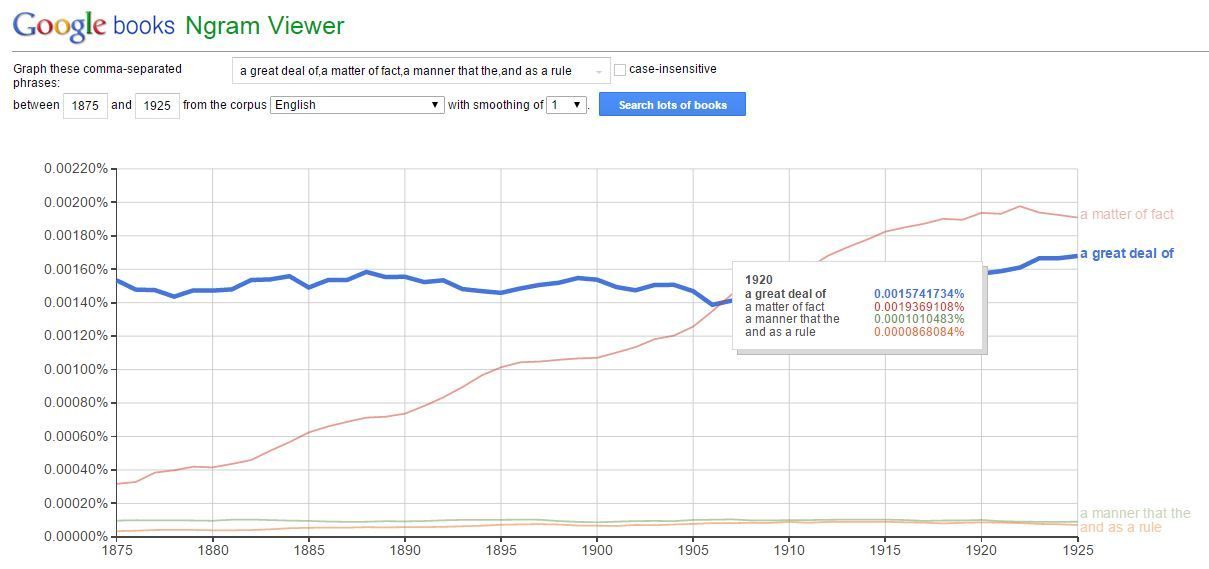
Bob Coyne wrote: It's hard to know what gallaway's name on the creditors list means given that he was an employee and could be owed money for any number of reasons. His name on the list increases his likelihood vs a random person but not nearly enough to count him for sure in the estimated 300 people doing business directly with mckinney that year.
The money McKinney owed Gallaway is specifically identified as "wages". The checks McKinney issued to his employees on Friday, December 19, 1902 bounced.
Bill Mullins wrote:If MS Word's word count is to be believed, EATCT has something like 50,000 words. So it's got something like 49,997 four-word strings. (no idea how many of them are unique). The Gallaway book looks to be about half as big, so it's probably got something like 25,000 words. Take any two books of comparable sizes, and they are bound to have a number of four-word strings in common.
Without some controls, and comparisons to other pairs of books of similar sizes, there's no way to draw any conclusions. Ideally, you'd need accurate word counts on both books and several other books of similar sizes for comparisons. You'd need to build an array of every four-word phrase in each book. Sort the phrases alphabetically so you can easily compare one book to another. If you find that comparing a random 50k word book with a random 25k word book (or whatever the numbers are) yields between 100 and 150 matches, then the comparison between Erdnase and Gallaway shows that there isn't anything unusual about how similar they are (by this metric). If, on the other hand, you usually get something like 50 - 100 matches, then maybe you are on to something. But to say that there are 130 four-word phrases in common, without some comparison to other books, doesn't tell us anything.
Bill, not according to the expert who did the analysis. The substring match was only one thing he looked at, but according to him, it is one very significant metric. I would assume he knows what he is talking about. Another thing he looked at was the common lexicon. Here is what he writes:
"the common lexicon and the high number of four word phrases suggests a strong possibility of identity of authorship"
Bill Mullins wrote:Of the first four phrases on Chris's list, two of them show up with some regularity in other books as well
Which means two of the four you picked at random are quite significant. Based on your sample we can assume that perhaps 50% or about 60-70 are uncommon. I don't want to bore you with another statistical analysis, but 130 matches many of which are used repeatedly is highly significant. The WE Sanders camp should raise the money for an analysis for Sanders. Then you would have an argument to stand on. Right now it is you against an expert who does this all the time. I believe the expert if you don't mind
Significance and confidence. How many four word fragment matches is "normal" and what are the odds that a finding is due to chance alone.
Jonathan Townsend wrote:Significance and confidence. How many four word fragment matches is "normal" and what are the odds that a finding is due to chance alone.
Jonathan, as I wrote, this is only one metric the expert used to come to his conclusions. It is not as simple as looking at a number and saying it is high or low.
I offered the data as comparison to what Bob Coyne put up for Sanders which are mostly three word phrases several of which don't even match exactly.
lybrary wrote:Jonathan, each such comparison, which includes other aspects, too, not just longest substring matches, costs $900. If you are able to raise the funds I am happy to have as many books analyzed as you want.
I hope those other metrics are pretty good, because otherwise you are seriously getting ripped off.
Here's one I found online written in C++ http://www.siafoo.net/snippet/380
Ok, it's pretty terrible code, but if know just a little C++, you can easily tweak it to get what you need, and Simply making sure to set limits on the size of the substrings to check should be enough to make the thing run quickly enough.
That being said, if anybody does want to pay $900, I can easily find some poor student (or just some bored programmer) to write the program from scratch for you, and that's for a program that will match any two inputs you throw a it.
Also, I feel the need to point out that I am unconvinced by Chris's analysis. Bill's point of comparing other books is absolutely important. You can't draw conclusions by just running "experiments" on your own candidate. This seems to be a crucial mistake that Chris isn't the only one guilty of on this thread. I've seen it throughout the long conversation and I imagine many of those same people will likely dismiss what I have to say about the matter as it doesn't bolster their case.
If I found Erdnase's DNA and showed that it matched AT LEAST 99% with someone alive today, that could sound convincing that I've found a descendent or relative. BUT if you know your biology, all humans share 99.5% of their DNA, so it actually means absolutely nothing. If you're going to convince somebody that a particular characteristic is DISTINGUISHING, then you have to show that it's NOT a common trait. Otherwise, the only person you're convincing is yourself.
Best,
Derrick
P.S. Chris, it's possible that you do have more convincing evidence about this given by your expert. All I have to judge on is what you've shared here, and in my eyes, that evidence is wholly unsatisfactory. Also you seem to be bandying the word significant around quite a bit. From what's been written on this board, I can see nothing to suggest that any of these matches are significant in any quantitative way.
DChung wrote:Also, I feel the need to point out that I am unconvinced by Chris's analysis. Bill's point of comparing other books is absolutely important. You can't draw conclusions by just running "experiments" on your own candidate. This seems to be a crucial mistake that Chris isn't the only one guilty of on this thread. I've seen it throughout the long conversation and I imagine many of those same people will likely dismiss what I have to say about the matter as it doesn't bolster their case.
Except you are forgetting that the expert has made such comparisons many times before and thus is very well aware of what is to be expected and what not. That is exactly why I have hired an expert. I myself, just as you and probably everybody else here, does not know what is significant and what is not. The forensic linguist says it is significant.
But I will wait for your analysis of a dozen other books since you believe it is so easy. I have put up my own money for my candidate. Now I want to see those who are quick with criticism, which is based on zero experience in forensic linguistics, to put their money where their mouth is. I am more than happy to compare the linguistic fingerprint of Gallaway against any other candidate.
I'm not "against" the expert. I'm simply saying that the statement that "130 matches in works of this size is significant" can't be evaluated except in comparison to how many matches one would expect from comparing other similar works. Otherwise we are accepting an "argument from authority" (without even knowing who the authority is), which is the same as accepting Pratt's statement that Erdnase was MFA.
The only way I can interpret what your expert is saying is that 130 is higher than one would expect if the two works were not written by the same person. But how much would one expect? If one would only expect 125 to be in common, that's not all that significant. If one would expect 20 or 30, this would be very significant. So what is the threshold? And how is it determined? That's the thing about analysis --- it should be repeatable. Given your expert's assumptions and methodology, anyone should be able to repeat what he has done, and come to the same conclusion. We don't know his assumptions, and we only know part of his methodology.
I agree that a common lexicon would be significant. That was the basis of my post of a few days ago, where I looked at words/phrases that appear regularly in either Erdnase or Gallaway, but not in the other. I showed that there are several lexemes that are common within either Erdnase or Gallaway, but not so common within the other author's writing. Does your expert have an opinion on that issue?
The only way I can interpret what your expert is saying is that 130 is higher than one would expect if the two works were not written by the same person. But how much would one expect? If one would only expect 125 to be in common, that's not all that significant. If one would expect 20 or 30, this would be very significant. So what is the threshold? And how is it determined? That's the thing about analysis --- it should be repeatable. Given your expert's assumptions and methodology, anyone should be able to repeat what he has done, and come to the same conclusion. We don't know his assumptions, and we only know part of his methodology.
I agree that a common lexicon would be significant. That was the basis of my post of a few days ago, where I looked at words/phrases that appear regularly in either Erdnase or Gallaway, but not in the other. I showed that there are several lexemes that are common within either Erdnase or Gallaway, but not so common within the other author's writing. Does your expert have an opinion on that issue?
No, we can't. Because we don't know if the other two appear in other works as well. I simply observed that two of the phrases were significantly more common than the other two, and surmised that they must appear in more places. I didn't say (and cannot say) that the two scarcer phrases appear only in Erdnase and Gallaway, or that they are "uncommon". Further, my sample isn't random (it was simply the first four in alphabetical order, and the alphabet isn't normally distributed and represented in English), so you can't say that two out of four applies to the whole list.Based on your sample we can assume that perhaps 50% or about 60-70 are uncommon.
Bill, you want to reduce the knowledge of an expert to a number. That will not work. I suggest you read one of the textbooks on forensic linguistics: http://www.lybrary.com/forensic-linguis ... 04427.html
The analysis for Gallaway was prepared by Dr. Olsson.
The analysis for Gallaway was prepared by Dr. Olsson.
lybrary wrote:Jonathan Townsend wrote:Significance and confidence. How many four word fragment matches is "normal" and what are the odds that a finding is due to chance alone.
Jonathan, as I wrote, this is only one metric the expert used to come to his conclusions. It is not as simple as looking at a number and saying it is high or low.
I offered the data as comparison to what Bob Coyne put up for Sanders which are mostly three word phrases several of which don't even match exactly.
Matching exactly isn't the issue, It's how characteristic the phrases are. Also, the examples I gave weren't mostly three word phrases. Instead they were sentences and other longer phrases where Erdnase and Sanders actually sound very much alike (to me at least -- everyone can judge for themselves).
As couple examples of larger patterns that don't match word-for-word but ring out much more than generic four word phrases like "a part of the" in your list:
Erdnase: we have, in describing the various processes and conditions, used CERTAIN TERMS for the SAKE OF BREVITY, to DESIGNATE the PARTICULAR matters referred to.
Sanders: for the SAKE OF BREVITY in description, CERTAIN SYMBOLS letters or figures, are employed to DESIGNATE the VARIOUS mine workings, as follows:
Erdnase: It is an excellent manner of holding the deck for the true shuffle, and SHOULD BE STRICTLY ADHERED TO ON ALL OCCASIONS.
Sanders: this latter is an axiom in mining during this period of development, and SHOULD BE INVARIABLY FOLLOWED WHERE POSSIBLE.
Bob Coyne wrote:Erdnase: It is an excellent manner of holding the deck for the true shuffle, and SHOULD BE STRICTLY ADHERED TO ON ALL OCCASIONS.
Sanders: this latter is an axiom in mining during this period of development, and SHOULD BE INVARIABLY FOLLOWED WHERE POSSIBLE.
Do you mean this seriously? Or are you kidding? It is neither a match nor does it mean the same.
Chris,
My statement was based on the evidence provided here on this forum. You may have plenty of solid evidence from John Olsson but it has NOT been presented here.
Also, I'm really just responding because you are using "bad math" to try and support your case. Avoid that, and I won't feel the need to chime in at all. I'd recommend Darrell Huff's "How to Lie with Statistics" as something to read before jumping to conclusions with any statistical data you have.
I DID say that finding common substrings between two texts is relatively easy to do. That is all. I have no idea what other analysis was done, but I imagine that has to be where the meat is. I just found it strange that what you presented was the substring analysis, because certainly without comparison to other books that evidence is weak and incomplete. I trust that the other evidence is stronger, but you haven't shared it here.
Now it could be that any other book compared to Erdnase has FAR less similarities, but that's something that has to be checked. Now it's again likely that your expert checked this or knows the numbers, but it's not something you shared here. I'm curious whether the people who've bought your book feel differently from me.
And I've got no candidate, so I'll keep my 900 bucks. Just saying that as an interested impartial observer, from what I've read on this forum, I'm not convinced.
Derrick
My statement was based on the evidence provided here on this forum. You may have plenty of solid evidence from John Olsson but it has NOT been presented here.
Also, I'm really just responding because you are using "bad math" to try and support your case. Avoid that, and I won't feel the need to chime in at all. I'd recommend Darrell Huff's "How to Lie with Statistics" as something to read before jumping to conclusions with any statistical data you have.
I DID say that finding common substrings between two texts is relatively easy to do. That is all. I have no idea what other analysis was done, but I imagine that has to be where the meat is. I just found it strange that what you presented was the substring analysis, because certainly without comparison to other books that evidence is weak and incomplete. I trust that the other evidence is stronger, but you haven't shared it here.
Now it could be that any other book compared to Erdnase has FAR less similarities, but that's something that has to be checked. Now it's again likely that your expert checked this or knows the numbers, but it's not something you shared here. I'm curious whether the people who've bought your book feel differently from me.
And I've got no candidate, so I'll keep my 900 bucks. Just saying that as an interested impartial observer, from what I've read on this forum, I'm not convinced.
Derrick
lybrary wrote:Bob Coyne wrote:Erdnase: It is an excellent manner of holding the deck for the true shuffle, and SHOULD BE STRICTLY ADHERED TO ON ALL OCCASIONS.
Sanders: this latter is an axiom in mining during this period of development, and SHOULD BE INVARIABLY FOLLOWED WHERE POSSIBLE.
Do you mean this seriously? Or are you kidding? It is neither a match nor does it mean the same.
Of course! You seem to be stuck on the concept of direct matches versus similarity, particularly in voice/style. Are you a native English speaker?
"Should be" = "should be"
"strictly adhered to" = "followed" (hint "strictly" is an adverb, modifying the head words "adhere to" which is synonymous with to "follow")
"on all occasions" and "where possible" are both modifiers removing limits on when the adhering/following should take place. The fact that the action is qualified is part of the similarity.
Of course I could also mention how "is an axiom" in sanders here also echoes erdnase elsewhere with "It is almost AN AXIOM that a novice"
And since you seem to have had such trouble with this one I'll map out the other one for you:
Erdnase: we have, in DESCRIBING the various processes and conditions, used CERTAIN TERMS for the SAKE OF BREVITY, to DESIGNATE the PARTICULAR matters referred to.
Sanders: for the SAKE OF BREVITY in DESCRIPTION, CERTAIN SYMBOLS letters or figures, are employed to DESIGNATE the VARIOUS mine workings, as follows:
describing = description (nominal form vs verbal form)
Designate = designate
"Certain terms" = "Certain Symbols" (don't get hung up on terms vs symbols...it's all in the context of the illustrations and their utility)
"for the sake of brevity" = "for the sake of brevity"
In both cases the authors JUSTIFY (that word isn't there...but it's ok, that's just part of how the authors attitude/voice coming through implicitly) the use of specific terms and symbols in the illustrations of the books they wrote.
..and there are many more.
DChung wrote:Chris,
My statement was based on the evidence provided here on this forum. You may have plenty of solid evidence from John Olsson but it has NOT been presented here.
Also, I'm really just responding because you are using "bad math" to try and support your case. Avoid that, and I won't feel the need to chime in at all. I'd recommend Darrell Huff's "How to Lie with Statistics" as something to read before jumping to conclusions with any statistical data you have.
I DID say that finding common substrings between two texts is relatively easy to do. That is all. I have no idea what other analysis was done, but I imagine that has to be where the meat is. I just found it strange that what you presented was the substring analysis, because certainly without comparison to other books that evidence is weak and incomplete. I trust that the other evidence is stronger, but you haven't shared it here.
Now it could be that any other book compared to Erdnase has FAR less similarities, but that's something that has to be checked. Now it's again likely that your expert checked this or knows the numbers, but it's not something you shared here. I'm curious whether the people who've bought your book feel differently from me.
And I've got no candidate, so I'll keep my 900 bucks. Just saying that as an interested impartial observer, from what I've read on this forum, I'm not convinced.
Derrick
Derrick, it is very easy to shoot from the rafters and just throw out generalities like 'bad math' or 'lie with statistics'. You also said it is easy to write a similar analysis software, but you can't back up your claim. I have put up an expert opinion in favor of Edward Gallaway, which says: "the common lexicon and the high number of four word phrases suggests a strong possibility of identity of authorship". For me that weighs heavily for Gallaway. At this point there is no other linguist expert opinion suggesting as strong an identity as this one for any other candidate. I am waiting for any other expert opinions on other candidates.
lybrary wrote:
Derrick, it is very easy to shoot from the rafters and just throw out generalities like 'bad math' or 'lie with statistics'. You also said it is easy to write a similar analysis software, but you can't back up your claim. I have put up an expert opinion in favor of Edward Gallaway, which says: "the common lexicon and the high number of four word phrases suggests a strong possibility of identity of authorship". For me that weighs heavily for Gallaway. At this point there is no other linguist expert opinion suggesting as strong an identity as this one for any other candidate. I am waiting for any other expert opinions on other candidates.
No, I said it's easy to write a common substring algorithm. And the link I gave is code that does pretty much that, which took 2 minutes to find on google. That sounds pretty damn easy to me.
I don't claim to be able to do anything beyond that. In fact, my point was you NEVER told us what other analysis was done. Again, all I can do is speak about the evidence you've shared here, which is weak and sloppy.
As for bad math, I've laid out reasons why the evidence you provided aren't convincing and given you a reference to better understand the mistakes that people often make when dealing with statistics. Note that the title of the book was just for marketing sake. It really is a good introduction and shows various ways that data can be misinterpreted either deliberately or not.
And has anybody else gone to a linguistic expert to look for such an opinion? By your own account, the answer is no. I thank you for sharing this new tidbit, but what does "strong" possibility mean especially in the absence of having done this analysis with other candidates? Does that mean that 1% of writers write this way, or that that he puts the odds of him being the one at 10% or 25%.
In any case, you don't get to win the argument just because other people haven't run the test yet.
Bolt is the fastest runner in the world because nobody raced with him. He's the fastest because they did and they lost.
When and if the other candidates are tested and come out as worse matches than yours, then there might something stronger to say. Until then, all you got right now is this vague statement of "a strong possibility" which certainly isn't the same as an emphatic "That's the guy."
Derrick
DChung wrote:I don't claim to be able to do anything beyond that.
That is the general problem with your argument. Once you are able to do more I am happy to continue the discussion.
lybrary wrote:Bill, you want to reduce the knowledge of an expert to a number. That will not work.
With all due respect, you are who has reduced it to a number -- 130. What I want is a set of numbers, an accepted process to get to them, and comparisons to other numbers that show how the Erdnase/Gallaway numbers are of significance.
I appreciate that you've named your expert. Now I can read up on some of his previous work to understand how he comes to his conclusions.
BTW, you said: "For me the linguistic fingerprint is the strongest evidence one can present absent of any documentary evidence."
John Olsson, your expert, said: "Nobody has yet demonstrated the existence of such a thing as a linguistic fingerprint; how then can people write about it in this unexamined, regurgitated way, as though it were an established fact of forensic life?" [John Olsson, Forensic Linguistics: Second Edition. London, New York: Continuum International Publishing Group, 2008, p. 26]
Bill Mullins wrote:lybrary wrote:Bill, you want to reduce the knowledge of an expert to a number. That will not work.
With all due respect, you are who has reduced it to a number -- 130. What I want is a set of numbers, an accepted process to get to them, and comparisons to other numbers that show how the Erdnase/Gallaway numbers are of significance.
I appreciate that you've named your expert. Now I can read up on some of his previous work to understand how he comes to his conclusions.
Bill, I offered the data because I was hoping it would be of interest. Apparently it was not interesting and some got confused by the data. Why is nobody else willing to offer a similar analysis for some other book or candidate?
If anyone wants any word sequence comparison between two texts, I already wrote a script for that. It looks at n-grams in a selected range (e.g. four words or more) in both texts. The default is to skip results with too many stop words (such as "of", "a", and other very common and generic ones) but it does not have to. I'll put the script on GitHub when I'm not on such a shaky connection. But in any case, just send me the text files and I'll do the comparison. This is by no means a proper linguistic analysis, I wrote it just to see if I could find any common relatively unique sentences in both Erdnase and Gallaway. The results from that is in this thread a few pages back.
lybrary wrote:DChung wrote:I don't claim to be able to do anything beyond that.
That is the general problem with your argument. Once you are able to do more I am happy to continue the discussion.
I don't think you understand my argument at all then. So let me reiterate one last time. The evidence you've presented here is weak, and certainly not supported by the data (at least not from what's been posted here. That's it. Not sure how my ability to a forensic linguistic analysis has any effect on the strength of the data that you presented. Again, I'm just talking about what you've given here, not what you have stowed away or in your $30 ebook.
But as you haven't properly addressed a single one of the issues I've brought up regarding the problems with your mathematical analysis, then I'm not sure what else we have to talk about. Moreover you completely sidestepped my question about what "strongly possible" means.
It now seems to me that you're far more interested in pushing your candidate than actually discussing the merits of the evidence, in which case further discussion is probably pointless anyway.
Derrick
P.S. I don't think anybody was confused by the data so much as your analysis of it. We all get that there are lots of four-word matches. It's just that you haven't given enough context for us to decide whether the two texts are actually similar or that perhaps any two instructional texts are equally similar for example. Again, perhaps your linguist has done such an analysis, but it hasn't been presented here, and I've certainly got no reason to just take your word for it.
DChung wrote:P.S. I don't think anybody was confused by the data so much as your analysis of it. We all get that there are lots of four-word matches. It's just that you haven't given enough context for us to decide whether the two texts are actually similar or that perhaps any two instructional texts are equally similar for example. Again, perhaps your linguist has done such an analysis, but it hasn't been presented here, and I've certainly got no reason to just take your word for it.
Reading the books in question would be a good start. Apparently you haven't even done that. Dr. Olsson has. I am sure that factored into his expert opinion.
mam wrote:If anyone wants any word sequence comparison between two texts, I already wrote a script for that. It looks at n-grams in a selected range (e.g. four words or more) in both texts. The default is to skip results with too many stop words (such as "of", "a", and other very common and generic ones) but it does not have to. I'll put the script on GitHub when I'm not on such a shaky connection. But in any case, just send me the text files and I'll do the comparison. This is by no means a proper linguistic analysis, I wrote it just to see if I could find any common relatively unique sentences in both Erdnase and Gallaway. The results from that is in this thread a few pages back.
Very nice.
I downloaded and tried to get http://evllabs.com/jgaap/w/index.php/Main_Page running, but I think it's having trouble parsing the PDF files I have for Erdnase, Sanders, and Gallaway. I thought maybe someone else would like to take a shot at it though.
Joe Pecore wrote:I downloaded and tried to get http://evllabs.com/jgaap/w/index.php/Main_Page running, but I think it's having trouble parsing the PDF files I have for Erdnase, Sanders, and Gallaway. I thought maybe someone else would like to take a shot at it though.
I don't have the PDFs for Sanders or Gallaway, but you or anybody else might want to just try and convert them to text yourself before inputting it in as it seems JGAAP may only limited conversion capabilities. Perhaps one of the online pdf to txt converters like this one: http://www.zamzar.com/convert/pdf-to-txt/ will do the job.
Derrick
I have discovered that Edward Gallaway not only lectured about printing and print estimating in front of students but also in front of executives of the printing industry - classes with about 60 people in session. You don't get to do this unless you are considered a leader in your profession. Edward Gallaway was an intellectual titan, founding the school of print estimating, lecturing there for years, and writing the first authoritative and comprehensive textbook on print estimating. These are all parallels to Erdnase's work. If you add that both books were published in the same fashion and that the linguistics are a close match then the picture is becoming quite clear.
DChung wrote:Joe Pecore wrote:I downloaded and tried to get http://evllabs.com/jgaap/w/index.php/Main_Page running, but I think it's having trouble parsing the PDF files I have for Erdnase, Sanders, and Gallaway. I thought maybe someone else would like to take a shot at it though.
I don't have the PDFs for Sanders or Gallaway, but you or anybody else might want to just try and convert them to text yourself before inputting it in as it seems JGAAP may only limited conversion capabilities. Perhaps one of the online pdf to txt converters like this one: http://www.zamzar.com/convert/pdf-to-txt/ will do the job.
Derrick
That was going to be my next try (I have a program that will do it). Just need to find the time. The JGAAP is interesting, but it might take someone with more time and knowledge to fully understand all the ways to use it.
Joe Pecore wrote:That was going to be my next try (I have a program that will do it). Just need to find the time. The JGAAP is interesting, but it might take someone with more time and knowledge to fully understand all the ways to use it.
Perhaps somebody with experience? Somebody who has done this type of analysis before? Oh, yeah that would make a lot of sense. Somebody like Dr. Olsson. What a new and novel thought!
lybrary wrote:Joe Pecore wrote:That was going to be my next try (I have a program that will do it). Just need to find the time. The JGAAP is interesting, but it might take someone with more time and knowledge to fully understand all the ways to use it.
Perhaps somebody with experience? Somebody who has done this type of analysis before? Oh, yeah that would make a lot of sense. Somebody like Dr. Olsson. What a new and novel thought!
But he is expensive
From looking at the user's guide, it looks like what would be needed is many more examples of text from each author. Not sure if comparing one example from each is enough to really be useful.
http://www.aicbt.com/authorship-attribu ... -software/
To argue for novel methods use - probably a good idea to demonstrate the utility and accuracy of the methods on known text. Consider some texts by Angelo Lewis as himself vs as Hoffmann - similar for Charles Dodgson as Lewis Carroll. Or Stephen King as himself vs his other pen names. How well do the tools work?
To argue for novel methods use - probably a good idea to demonstrate the utility and accuracy of the methods on known text. Consider some texts by Angelo Lewis as himself vs as Hoffmann - similar for Charles Dodgson as Lewis Carroll. Or Stephen King as himself vs his other pen names. How well do the tools work?
Looks like JGAAP may have been used to verify that J.K. Rowling wrote the detective novel The Cuckoo's Calling under the pen name Robert Galbrait http://languagelog.ldc.upenn.edu/nll/?p=5315
I also wrote a simple code using Mathematica in order to find the common 4-word sequences. I have the .txt version of EATCT, I just need any other book to compare it to. Honestly, it does not need to be by Sanders...Any technical book from that period could work just fine, in fact how about a magic book? Shoot one in pdf form, or even better in text form.
Carlo Morpurgo wrote:I also wrote a simple code using Mathematica in order to find the common 4-word sequences. I have the .txt version of EATCT, I just need any other book to compare it to. Honestly, it does not need to be by Sanders...Any technical book from that period could work just fine, in fact how about a magic book? Shoot one in pdf form, or even better in text form.
Here are a bunch on Google Books: http://geniimagazine.com/magicpedia/Cat ... ogle_Books
You should be able to click through to Google and download any in Epub or PDF.
Sanders is there too https://books.google.com/books/about/Mi ... jBhjAATxwC
Coincidentally, I was about to make favourable comments about John Olsson two weeks ago but decided against doing so as I thought it might divert the debate. Chris Wasshuber has certainly hired the right person.
I have Olsson's fascinating book Word Crime : Solving Crime through Forensic Linguistics (2009).
Olsson is a genuine expert in this field. After reading his careful analysis of cases he has been involved in, I must admit that I am impressed by his thinking.
A woman is found dead from asphyxiation hanging from a cable tie in her garage. She has left a suicide note. But is this note genuine? Has she been murdered by her husband? (Read Olsson’s book to find out!)
Another chapter of Olsson’s book looks at the Da Vinci Code. Did Dan Brown plagiarise Lew Perdue’s earlier novels?
At first, I thought such an allegation was dubious, but I’m now sympathetic to Perdue’s cause.
Perdue lost the case , but make your own mind up:
http://www.davincilegacy.com/Infringeme ... eport.html
http://www.davincilegacy.com/Infringeme ... N2004.html
And plagiarism isn’t simply the blatant copying of someone else words (although this is how we might first visualise it). The plagiarist will try to disguise their theft by replacing key words. According to Olsson, these new substitute words tend to be second-line ‘left-overs’, statistically less likely to occur than their originals.
I have Olsson's fascinating book Word Crime : Solving Crime through Forensic Linguistics (2009).
Olsson is a genuine expert in this field. After reading his careful analysis of cases he has been involved in, I must admit that I am impressed by his thinking.
A woman is found dead from asphyxiation hanging from a cable tie in her garage. She has left a suicide note. But is this note genuine? Has she been murdered by her husband? (Read Olsson’s book to find out!)
Another chapter of Olsson’s book looks at the Da Vinci Code. Did Dan Brown plagiarise Lew Perdue’s earlier novels?
At first, I thought such an allegation was dubious, but I’m now sympathetic to Perdue’s cause.
Perdue lost the case , but make your own mind up:
http://www.davincilegacy.com/Infringeme ... eport.html
http://www.davincilegacy.com/Infringeme ... N2004.html
And plagiarism isn’t simply the blatant copying of someone else words (although this is how we might first visualise it). The plagiarist will try to disguise their theft by replacing key words. According to Olsson, these new substitute words tend to be second-line ‘left-overs’, statistically less likely to occur than their originals.
Richard, thanks. The purpose to hire an expert like Olsson is not so that you have somebody to run a software for you and tell you the result. The purpose is to have somebody who brings his own intellect, understanding, experience and expertise to the table. Somebody you can ask a question, bounce ideas of and learn from. I have spent in total about 2 hours on the phone with him and exchanged about 100 emails. My take away is that he is supremely qualified to help us figure this out and identify Erdnase.
I think many of us who have been critical of his results as you have presented them would be more than willing to reevaluate our positions if you supplied some of what he must have told you throughout the emails and phone calls. Why is 130 matches significant?
And if you don't want to go farther because you plan on publishing it as a part of a ebook or some other project, that's a fair response. But in other places (like the book Stokes refers to), he not only gives conclusions, but says why he arrived at them. And that's what's missing here.
I shouldn't speak for others, but I've invested so much time and effort (and money) into the topics of this thread not because I expect to eventually find out who Erdnase was, but because the process is interesting. Give us some process.
And if you don't want to go farther because you plan on publishing it as a part of a ebook or some other project, that's a fair response. But in other places (like the book Stokes refers to), he not only gives conclusions, but says why he arrived at them. And that's what's missing here.
I shouldn't speak for others, but I've invested so much time and effort (and money) into the topics of this thread not because I expect to eventually find out who Erdnase was, but because the process is interesting. Give us some process.
My preferred outlet for futher details is my weekly newsletter. But ultimately all details will be published in my book on Gallaway being Erdnase. I am still in the discovery and research phase to further develop my understanding of his life. So don't expect the book soon. But it will certainly be written at some point.
In the meantime I will continue to share bits and pieces as I see fit here on this entertaining thread.
In the meantime I will continue to share bits and pieces as I see fit here on this entertaining thread.
I ran the code that identifies common 4,5,6...n-word sequences between two text files. I used Erdnase's book against The Art of Magic. Not surprisingly there are many many 4-word sequences in common, but also many 5,6...-word sequences, and even entire paragraphs...maybe this was already a known fact, but I did not know it. There seem to be 4 longer paragraphs in common (either identical, or 99% so).
1. EATCT p. 28/AOMp. 40 "so that the first finger......about the middle"
2. EATCT p. 86/AOM p. 122 "Seize the deck.......slightly close the left hand with the palmed cards" (after "To palm..." the paragraphs are identical, before that they are 99% identical)
3. EATCT p. 39/AOM p 131: "Seize the deck....square up."
4. EATCT p. 166/AOM p.78: "thumb across top....toward the spectator"
Regarding the sequence count, I can offer a list of 868 5-word sequences shared by these books. Granted that both of these books are about magic, and that some of these common sequences appear as part of longer common sentences. I eliminated duplicates, but not the very few ones that are only differing by a comma or a period. I also did not eliminate common sequences that are part of longer ones - my guess is that there would still be a lot of common sequences.
I uploaded the list here: https://drive.google.com/file/d/0B3Wpud ... BsaWc/view
I did not go through the whole list, but one of the sequences is particular:
"Cheap cards are clumsy and".
I am not reaching any conclusions, just stating some facts. It would be interesting to compare EATCT with other books.
1. EATCT p. 28/AOMp. 40 "so that the first finger......about the middle"
2. EATCT p. 86/AOM p. 122 "Seize the deck.......slightly close the left hand with the palmed cards" (after "To palm..." the paragraphs are identical, before that they are 99% identical)
3. EATCT p. 39/AOM p 131: "Seize the deck....square up."
4. EATCT p. 166/AOM p.78: "thumb across top....toward the spectator"
Regarding the sequence count, I can offer a list of 868 5-word sequences shared by these books. Granted that both of these books are about magic, and that some of these common sequences appear as part of longer common sentences. I eliminated duplicates, but not the very few ones that are only differing by a comma or a period. I also did not eliminate common sequences that are part of longer ones - my guess is that there would still be a lot of common sequences.
I uploaded the list here: https://drive.google.com/file/d/0B3Wpud ... BsaWc/view
I did not go through the whole list, but one of the sequences is particular:
"Cheap cards are clumsy and".
I am not reaching any conclusions, just stating some facts. It would be interesting to compare EATCT with other books.
and here are the 2030 4-word sequences in common:
https://drive.google.com/open?id=0B3Wpu ... VlPS25BTDA
https://drive.google.com/open?id=0B3Wpu ... VlPS25BTDA
Carlo,
Possibly what needs to be compared are not word sequences regarding technique, but rather those regarding deportment or thoughts on how and when to use a sleight.
I am not sure how many other authors cover these skills from the gambler's point of view. Certainly there are those from the magician's.
This may reflect the true "voice"of the author.
Possibly what needs to be compared are not word sequences regarding technique, but rather those regarding deportment or thoughts on how and when to use a sleight.
I am not sure how many other authors cover these skills from the gambler's point of view. Certainly there are those from the magician's.
This may reflect the true "voice"of the author.
Carlo, a couple of suggestions:
1) "The Art of Magic" has roughly 120,000 words. That is about 5x more than "Estimating for Printers." Perhaps take only the first 25000 words or so.
2) Take a non-magic and non-gambling book.
3) Take a book from roughly the same time period 1927.
4) Remove doubles which are only different due to capitalization or punctuation.
5) My understanding is that you have to stop your comparison at sentence boundaries. You seem to be doing comparisons across sentence boundaries.
1) "The Art of Magic" has roughly 120,000 words. That is about 5x more than "Estimating for Printers." Perhaps take only the first 25000 words or so.
2) Take a non-magic and non-gambling book.
3) Take a book from roughly the same time period 1927.
4) Remove doubles which are only different due to capitalization or punctuation.
5) My understanding is that you have to stop your comparison at sentence boundaries. You seem to be doing comparisons across sentence boundaries.
lybrary wrote:Carlo, a couple of suggestions:
1) "The Art of Magic" has roughly 120,000 words. That is about 5x more than "Estimating for Printers." Perhaps take only the first 25000 words or so.
2) Take a non-magic and non-gambling book.
3) Take a book from roughly the same time period 1927.
Why does "Estimating for printers" have anything to do with a comparison between EATCT and Art of Magic?
mam wrote:lybrary wrote:Carlo, a couple of suggestions:
1) "The Art of Magic" has roughly 120,000 words. That is about 5x more than "Estimating for Printers." Perhaps take only the first 25000 words or so.
2) Take a non-magic and non-gambling book.
3) Take a book from roughly the same time period 1927.
Why does "Estimating for printers" have anything to do with a comparison between EATCT and Art of Magic?
Because some want to check how significant the number of 4-word matches is between Estimating for Printers and EATCT. You would have to compare to a similar book. But maybe I am misunderstanding Carlo's intention. Maybe his goal is something entirely different.
lybrary wrote:Carlo, a couple of suggestions:
1) "The Art of Magic" has roughly 120,000 words. That is about 5x more than "Estimating for Printers." Perhaps take only the first 25000 words or so.
Sure I thought about this and initially that is exactly what I was going to do. But I then thought that the structure of the narrative would have been ruined. In my opinion what counts is the relative size, and the ratio is still the same, roughly 1/2. Assuming a certain uniformity I suspect that the expected value of the occurrences when taking half of the pages of each book would be obtained by dividing by 4.
2) Take a non-magic and non-gambling book.
Yes I mentioned that, on the other hand, what if our suspect was a magician and only wrote books about magic? I'd be happy to run the program for other non gambling books from the time period.
3) Take a book from roughly the same time period 1927.
I don't get this. Wasnt EATCT published in 1902? Even if it weren't frankly I think that 20 years would not make a huge difference.
4) Remove doubles which are only different due to capitalization or punctuation.
I mentioned this, the number of those occurrences seems rather irrelevant
5) My understanding is that you have to stop your comparison at sentence boundaries. You seem to be doing comparisons across sentence boundaries.
Yes, but again, I am not sure how relevant those occurences are.....
Anyway this is just a small exercise which I put together in half a day, just to see an example. I did choose Art of Magic on purpose, since I once had some "suspicions". Speaking of which, I am interested to know what people think of those 4 long paragraphs appearing verbatim in both books.....
Carlo, your text selection depends on what you want to achieve. If your goal is to establish a comparison between the 4-word matches I posted, you would have to use a book somewhat comparable to Estimating for Printers. If however your goal is simply to compare other books then of course you can compare other books. But a magic or gambling book will show more matches purely because the subject is the same not because the authors are the same. Also books from around 1902 will generally match better because of common phraseology popular at that time. This again would not indicate the same author but simply the same period. So if you want to start to compare and argue about significance of number of matches you have to compare apples to apples and oranges to oranges.
lybrary wrote:Carlo, your text selection depends on what you want to achieve. If your goal is to establish a comparison between the 4-word matches I posted, you would have to use a book somewhat comparable to Estimating for Printers. If however your goal is simply to compare other books then of course you can compare other books. But a magic or gambling book will show more matches purely because the subject is the same not because the authors are the same. Also books from around 1902 will generally match better because of common phraseology popular at that time. This again would not indicate the same author but simply the same period. So if you want to start to compare and argue about significance of number of matches you have to compare apples to apples and oranges to oranges.
My initial intention was purely a curiosity. How easy it is to do such a comparison and what results it would yield. I really have no intentions of competing with your ideas. I take my search as a standalone comparison between two books, and I am still puzzled by some of the results.
It's funny how, with 50,000 source words and over a century to look at them, we can't figure out who Erdnase was, but you can spot M.ark L.ewis after only a few posts.
Bill Mullins wrote:It's funny how, with 50,000 source words and over a century to look at them, we can't figure out who Erdnase was, but you can spot M.ark L.ewis after only a few posts.
I totally agree. And that is why I am happy that more people start to analyze the text. I believe there is a lot more that can be found from a careful analysis of the text.
The paragraph matches of which Carlo points out clearly cannot be accidental or coincidental; there are only two possible explanations for matching paragraphs of such a technical nature:
1) Downs/Hilliard are Erdnase.
2) They deliberately cribbed the descriptions from Erdnase.
While 2) is probably more likely than 1), would it be possible for any of the participants here to briefly reiterate the case for/against the above?
edited to appease the grammar gods.
1) Downs/Hilliard are Erdnase.
2) They deliberately cribbed the descriptions from Erdnase.
While 2) is probably more likely than 1), would it be possible for any of the participants here to briefly reiterate the case for/against the above?
edited to appease the grammar gods.
Bill Mullins wrote:It's funny how, with 50,000 source words and over a century to look at them, we can't figure out who Erdnase was, but you can spot M.ark L.ewis after only a few posts.
You're not implying that ML is currently lurking around here are you? Certainly not as a "performer"? Surely, since he is psychic, he would know he'd (he'll?) be found out.
But, I'm not psychic, so my questions my be nonsense.
JMD
Project: using suspect and known ML writings to support the phrase matching hypothesis for claims of authorship.
Obvious by inspection?
Chris, how do you feel about using the ML/P posts as a test case? Derrick, Joe, Bill, mam, Bob - what do you think?
Obvious by inspection?
Chris, how do you feel about using the ML/P posts as a test case? Derrick, Joe, Bill, mam, Bob - what do you think?
Jonathan Townsend wrote:Chris, how do you feel about using the ML/P posts as a test case? Derrick, Joe, Bill, mam, Bob - what do you think?
I don't think forum posts are good test cases for our situation. Formal textbook writing is quite different to the colloquial writing on a forum. I am also not a linguist who is looking for a project. I already have enough projects on my table
@Chris, not asking you to perform any analysis. This is about making an argument for authorship based upon statistics derived by comparing texts. Others have found some tools for use and jumped in to apply themselves - trying to see what kind compare/meaning processes are available. We could use the Declaration of Independence - say against Thomas Paine's writing and Thomas Jefferson's writing. The idea is to show an example of methods in use to obtain a meaningful result. In this case an ML detector.
Chris -- you've made much of Gallaway owning a 1st edition copy of EATCT in bolstering your case for him. The more I think about it, the less important I find it to be. Here's why:
You've assumed a printing (lower bound) of 2000 copies. Gallaway owned one of them (and we are assuming he was an original owner, not someone who bought a copy second hand). That means that there are 1999 other people who also owned a copy. If we assume that Erdnase owned a 1st edition copy, doesn't that imply that the chances of Gallaway = Erdnase based on ownership are only 1 in 2000?
You've also presumed that since Gallaway worked for McKinney, this makes him more likely than a random person to have been Erdnase, based on the logic that Erdnase knew McKinney before hiring him to print the book. Again, I don't think this helps his case, for this reason:
I believe that it is more likely than not that a person with Erdnase's expertise with a deck of cards would have had a job that is more conducive to developing that skill than a "trade" such as printing. Gambler, salesman on the road, saloon keeper, something like that. Printing seems too "square" for the man I envision Erdnase to be.
And back to the "original owner" issue. Who else besides Gallaway and Adrian Plate should we suspect were original owners of 1st edition copies? I'm asking about individuals who would have owned a copy, not dealers who would have owned them for resale. Hoffmann wrote about the book as soon as 1903 in correspondence, so I suppose he must have had one. Hilliar received what may have been a review copy. Jessel's 1905 bibliography mentioned a 1st edition copy, and his collection that ended up in the Bodleian Library included one, so he must have been an early buyer.
You've assumed a printing (lower bound) of 2000 copies. Gallaway owned one of them (and we are assuming he was an original owner, not someone who bought a copy second hand). That means that there are 1999 other people who also owned a copy. If we assume that Erdnase owned a 1st edition copy, doesn't that imply that the chances of Gallaway = Erdnase based on ownership are only 1 in 2000?
You've also presumed that since Gallaway worked for McKinney, this makes him more likely than a random person to have been Erdnase, based on the logic that Erdnase knew McKinney before hiring him to print the book. Again, I don't think this helps his case, for this reason:
I believe that it is more likely than not that a person with Erdnase's expertise with a deck of cards would have had a job that is more conducive to developing that skill than a "trade" such as printing. Gambler, salesman on the road, saloon keeper, something like that. Printing seems too "square" for the man I envision Erdnase to be.
And back to the "original owner" issue. Who else besides Gallaway and Adrian Plate should we suspect were original owners of 1st edition copies? I'm asking about individuals who would have owned a copy, not dealers who would have owned them for resale. Hoffmann wrote about the book as soon as 1903 in correspondence, so I suppose he must have had one. Hilliar received what may have been a review copy. Jessel's 1905 bibliography mentioned a 1st edition copy, and his collection that ended up in the Bodleian Library included one, so he must have been an early buyer.
why would the author necessarily have a copy of his own book, especially if his goal were to sell them?
Bill Mullins wrote:Chris -- you've made much of Gallaway owning a 1st edition copy of EATCT in bolstering your case for him. The more I think about it, the less important I find it to be. Here's why:
You've assumed a printing (lower bound) of 2000 copies. Gallaway owned one of them (and we are assuming he was an original owner, not someone who bought a copy second hand). That means that there are 1999 other people who also owned a copy. If we assume that Erdnase owned a 1st edition copy, doesn't that imply that the chances of Gallaway = Erdnase based on ownership are only 1 in 2000?
And back to the "original owner" issue. Who else besides Gallaway and Adrian Plate should we suspect were original owners of 1st edition copies? I'm asking about individuals who would have owned a copy, not dealers who would have owned them for resale. Hoffmann wrote about the book as soon as 1903 in correspondence, so I suppose he must have had one. Hilliar received what may have been a review copy. Jessel's 1905 bibliography mentioned a 1st edition copy, and his collection that ended up in the Bodleian Library included one, so he must have been an early buyer.
Bill, I actually assumed 10,000 first edition copies of EATCT, not just 2000. But taking your numbers, yes, by that logic Gallaway is one of 2000 who had it. If you now combine it with the other things we know about Erdnase/Gallaway you can further reduce that number. For example the 'W' in the name. That means the 2000 owners of the book will shrink down to 200 owners, because less than 10% have a W in their surname. Etc. I don't want to repeat my entire calculation, but I agree with that one piece of it, which you have addressed.
Who those 2000 or 200, or even less if we factor in McKinney, are we don't know. We know a few like Adrian Plate, but the majority of them we don't know. But we don't have to for a statistical calculation. For such a calculation you are not attempting to identify anybody specific, you are asking how many do we expect there to be who all meet these requirements which apply to Erdnase.
Bill Mullins wrote:You've also presumed that since Gallaway worked for McKinney, this makes him more likely than a random person to have been Erdnase, based on the logic that Erdnase knew McKinney before hiring him to print the book. Again, I don't think this helps his case, for this reason:
I believe that it is more likely than not that a person with Erdnase's expertise with a deck of cards would have had a job that is more conducive to developing that skill than a "trade" such as printing. Gambler, salesman on the road, saloon keeper, something like that. Printing seems too "square" for the man I envision Erdnase to be.
No, I have not assumed that Gallaway is more likely because he worked for McKinney. He is simply among the group of people who had contact with McKinney so that they were in the position to order the book to be printed, which I have assumed to be 330 people (300 customers/suppliers and 30 employees).
I do agree with you that somebody working in a trade would have a harder time to practice. But it is not an awfully difficult hurdle to overcome. How many people hold two and three jobs today? There was enough time after work to practice. We also know that Gallaway worked at several different companies. I also have found information that before working at McKinney he started a company with two other partners. So he moves from one company to another, starts his own, takes employment, ... All of this tells me these were volatile times. Gallaway could have been unemployed for a portion of his formative years which would provide a lot of practicing time. But even without unemployment it is certainly not impossible to achieve mastery like Erdnase had.
One other comment regarding the earlier discussion on German culture and language use. I am reading the book "Chicago by Gaslight" which describes Chicago during 1880-1920. You may be surprised to learn that Chicago had several German newspapers and there were public addresses by speakers in German addressing thousands of assembled people in Chicago in parks. This means the German language was present on the streets. A German name like Erdnase would therefore hardly be unusual. I think your assumptions about the German language back then are incorrect.
Brad Henderson wrote:Why would the author necessarily have a copy of his own book, especially if his goal were to sell them?
Brad, Don't you own a copy of The Dance?
I know that if I were ever to have a book published, I would certainly keep a copy for myself. I think it would be a rare case to find a writer who would not do so.
Jonathan Townsend wrote:Project: using suspect and known ML writings to support the phrase matching hypothesis for claims of authorship.
Obvious by inspection?
Chris, how do you feel about using the ML/P posts as a test case? Derrick, Joe, Bill, mam, Bob - what do you think?
What/who is ML/P?
I think S.W. Erdnase very likely owned multiple copies of the book, initially. Ten years later, though, I would think the chances would be more like 50-50, or even less. Erdnase strikes me as having been mobile. People in general, and perhaps mobile people especially, have a lot of opportunities for forgetting things, leaving things behind, losing things, selling things, and giving things away.
Nonetheless, I tend to think this is the best argument that can now be made for Gallaway, namely: there would be no reason for Gallaway to own the book if he did not write it.
A problem there is that there are other good reasons why Gallaway would have owned a copy, the main one being that he was (apparently) interested in gambling (see The Man Who Was Erdnase, pages 57 and 390). (I suppose that could be turned into a weak argument in support of Gallaway, but I don't see it that way.)
--Tom Sawyer
Nonetheless, I tend to think this is the best argument that can now be made for Gallaway, namely: there would be no reason for Gallaway to own the book if he did not write it.
A problem there is that there are other good reasons why Gallaway would have owned a copy, the main one being that he was (apparently) interested in gambling (see The Man Who Was Erdnase, pages 57 and 390). (I suppose that could be turned into a weak argument in support of Gallaway, but I don't see it that way.)
--Tom Sawyer
mam wrote:What/who is ML/P?
That would be ... M a r k L e w i s / performer
Richard Kaufman wrote:Mr. Lewis is here with my permission
And yet, if I were to type in his name (without the spaces) it will be auto-censored ...
Mark Lewis / performer
See.
Tom Sawyer wrote:Nonetheless, I tend to think this is the best argument that can now be made for Gallaway, namely: there would be no reason for Gallaway to own the book if he did not write it.
Plus a good number of other strong arguments for him:
- linguistic match
- had contact with McKinney to make the order for the book
- W in the surname
- matches description given by Smith
- his other self-published book mimics several aspects of EATCT
- his other book matches EATCT in terms of ground breaking importance on the subject
- plausible theory for the name S.W. Erdnase
Brad Jeffers wrote:mam wrote:What/who is ML/P?
That would be ... M a r k L e w i s / performerRichard Kaufman wrote:Mr. Lewis is here with my permission
And yet, if I were to type in his name (without the spaces) it will be auto-censored ...
[censored] / performer
See.
This one's over my head, I have no background whatsoever on ML but guessing that everyone else here has. (I'm new to the forums.)
M.ark L.ewis is currently posting as "performer" in another thread on the forum. He has a long history here. He has registered and then been banned/expelled under many different names at different times. He usually starts off with genuinely interesting contributions to threads (he has an extensive performing experience), but after a while devolves into trolling behavior and gets banned again. His online "voice" is pretty distinctive, and he can usually be recognized after only a few posts under a new name.
The forum software censors his name, thus the weird punctuation above.
Chris -- in your newsletter, you said you have a couple of photos of Gallaway. On pp 32 and 33 of this book are pictures of one of his classes in estimating. On p 32, on our left, is seated an older man in a bowtie. On p 33, he's standing on the right. Is this Gallaway?
(and note that p 36 of this book shows a photograph of a fourth book written by Gallaway, which has not yet been mentioned here.}
The forum software censors his name, thus the weird punctuation above.
Chris -- in your newsletter, you said you have a couple of photos of Gallaway. On pp 32 and 33 of this book are pictures of one of his classes in estimating. On p 32, on our left, is seated an older man in a bowtie. On p 33, he's standing on the right. Is this Gallaway?
(and note that p 36 of this book shows a photograph of a fourth book written by Gallaway, which has not yet been mentioned here.}
Bill Mullins wrote:M.ark L.ewis is currently posting as "performer" in another thread on the forum. He has a long history here. He has registered and then been banned/expelled under many different names at different times. He usually starts off with genuinely interesting contributions to threads (he has an extensive performing experience), but after a while devolves into trolling behavior and gets banned again. His online "voice" is pretty distinctive, and he can usually be recognized after only a few posts under a new name.
The forum software censors his name, thus the weird punctuation above.
Thanks a lot for clarification.
Bill Mullins wrote:Chris -- in your newsletter, you said you have a couple of photos of Gallaway. On pp 31 and 32 of this book are pictures of one of his classes in estimating. On p 31, on our left, is seated an older man in a bowtie. On p 32, he's standing on the right. Is this Gallaway?
That's actually pages 32 and 33, maybe you could edit your post with the correct page numbers.
Bill Mullins wrote:(and note that p 36 of this book shows a photograph of a fourth book written by Gallaway, which has not yet been mentioned here.}
Another book! Let's find it
The only trace I can find of it is this item in the R.R. Donnelley & Sons Company Archive at University of Chicago:Box 1016, Folder 1, "A Course in Printing Estimating, Part III: Presswork," 1923
The only way to access it is on location it seems. So does anyone live in Chicago and wants to have a look at it and report back here?
(By the way, I have full pdfs of the two other books except "Estimating for printers".)
[delete this post]
So for anyone who wants to look for n-grams, here's the script I mentioned:
https://github.com/alimony/ngram-finder
As I said before, I've only done some preliminary runs comparing EATCT to Roterberg, Hoffmann etc. but the results could probably be better if I had better text versions of these, instead of what's extracted from a pdf automatically, since they are all just OCR'd at one point or another. (And most people OCR through something inferior such as Acrobat.)
https://github.com/alimony/ngram-finder
As I said before, I've only done some preliminary runs comparing EATCT to Roterberg, Hoffmann etc. but the results could probably be better if I had better text versions of these, instead of what's extracted from a pdf automatically, since they are all just OCR'd at one point or another. (And most people OCR through something inferior such as Acrobat.)
Another interesting piece of information:
I'm in contact with Bryan, the guy who drew these maps. It seems like he sits on an enormous collection of items tied to gambling in Chicago at the exact time when EATCT was written. All his research is in "over 50 thick volumes" and "none of it digital". A lot of gems are mentioned in our correspondence, such as: "I have a few Old catalogs of Gambling Supply Houses that sold
cheating devises & supplies." and he also compiles a list of the address of "every dive and its owner".
He had not heard of Erdnase, but I had him read EATCT and he liked it, but says that there were so many gamblers in Chicago at that time that all had the skills described in the book, so finding the author among these might be hard or even impossible coming from that angle. (Also, I sent him a list of all relevant names and candidates from here and he did not recognize any of them from his materials.)
In any case, someone really needs to visit this guy and his personal archive. Who knows what might be found there, or by discussing these things with him in more depth.
I'm in contact with Bryan, the guy who drew these maps. It seems like he sits on an enormous collection of items tied to gambling in Chicago at the exact time when EATCT was written. All his research is in "over 50 thick volumes" and "none of it digital". A lot of gems are mentioned in our correspondence, such as: "I have a few Old catalogs of Gambling Supply Houses that sold
cheating devises & supplies." and he also compiles a list of the address of "every dive and its owner".
He had not heard of Erdnase, but I had him read EATCT and he liked it, but says that there were so many gamblers in Chicago at that time that all had the skills described in the book, so finding the author among these might be hard or even impossible coming from that angle. (Also, I sent him a list of all relevant names and candidates from here and he did not recognize any of them from his materials.)
In any case, someone really needs to visit this guy and his personal archive. Who knows what might be found there, or by discussing these things with him in more depth.
Bill Mullins wrote:Chris -- in your newsletter, you said you have a couple of photos of Gallaway. On pp 31 and 32 of this book are pictures of one of his classes in estimating. On p 31, on our left, is seated an older man in a bowtie. On p 32, he's standing on the right. Is this Gallaway?
(and note that p 36 of this book shows a photograph of a fourth book written by Gallaway, which has not yet been mentioned here.}
Bill, that is correct. This is Edward Gallaway. And if you go to page 8 of that book you will see a nice head shot of Gallaway. From this portrait you can see that in his mid 50s he was pretty much completely bald. This means in his 30s he was very likely already starting to get bald which could easily explain why with 33 he appeared to be 'about 40'. And from the two classroom photos you can see that he certainly fits the height requirements by Smith.
This means the description of Erdnase by Smith fits Edward Gallaway.
The book "A Course in Printing Estimating" seems to be a precursor of his "Estimating for Printers" book. I have not found it anywhere, but it is mentioned in the copyright catalog 1923 under R. R. Donnelley. So maybe a copy does exist in the Library of Congress.
Firstly, I'm self aware enough to know that what I'm about to post may be considered rather simplistic, but I really do think it's important and it is something I haven't really seen people pick up on.
For those candidates who have names that are anagrams of SW Erdnase: Why on earth would they choose Erdnase as a pen name?
To me it seems that only someone called ES Andrews would use Erdnase as a pseudonym because they are not approaching it as an anagram, but simply as a reversal.
Consider if your real name is not ES Andrews, say it is WE Sanders, and you were fiddling around with anagrams to create a pen name then one that is available to you would be the respectable and realistic sounding ES Andrews. So why in that case would you plump for the weird and obviously fake name of SW Erdnase?
Anyway, as I say, simplistic
For those candidates who have names that are anagrams of SW Erdnase: Why on earth would they choose Erdnase as a pen name?
To me it seems that only someone called ES Andrews would use Erdnase as a pseudonym because they are not approaching it as an anagram, but simply as a reversal.
Consider if your real name is not ES Andrews, say it is WE Sanders, and you were fiddling around with anagrams to create a pen name then one that is available to you would be the respectable and realistic sounding ES Andrews. So why in that case would you plump for the weird and obviously fake name of SW Erdnase?
Anyway, as I say, simplistic
mam wrote:So for anyone who wants to look for n-grams, here's the script I mentioned:
https://github.com/alimony/ngram-finder
...
Here is a Windows program I just stumbled upon as another tool for those that want to play with n-grams: http://www.kwicfinder.com/kfNgram/kfNgramHelp.html
John Adams wrote:
Consider if your real name is not ES Andrews, say it is WE Sanders, and you were fiddling around with anagrams to create a pen name then one that is available to you would be the respectable and realistic sounding ES Andrews. So why in that case would you plump for the weird and obviously fake name of SW Erdnase?
Anyway, as I say, simplistic
If the name on the book was ES Andrews, then there would be no clue that the name was an anagram since it sounds so normal. So by using something fake-sounding like SW Erdnase he frames it as a puzzle. And the very clever solution (anagram of WE Sanders plus erdnase=earthnose=mining-engineer) is hidden by obvious (false) solution ES Andrews which functions as a clever bit of misdirection.
Bob Coyne wrote:John Adams wrote:...simplistic
If the name on the book was ES Andrews, then there would be no clue that the name was...
Path. Garden. look at em go.
Jonathan Townsend wrote:Project: using suspect and known ML writings to support the phrase matching hypothesis for claims of authorship.
Obvious by inspection?
Chris, how do you feel about using the ML/P posts as a test case? Derrick, Joe, Bill, mam, Bob - what do you think?
I entered many sample posts into JGAAP from the following people:
Jonathan Townsend: search.php?author_id=37&sr=posts
Bill Mullins: search.php?author_id=113&sr=posts
ML: search.php?author_id=4551&sr=posts
I entered "performer" posts as the unknown author: search.php?author_id=9986&sr=posts
I ran a few analysis and ML came up as top prospect for each.
Would be cool to try on some magic books in which we know were "ghosted" by someone else (if someone has the time).
I know many authors who do not have copies of their own books. I am a self centered hoarder, so obviously I have a copy. I think having a first edition can be equally explained by KNOWING the author perhaps more so than having been the author.
Brad Henderson wrote:I know many authors who do not have copies of their own books. I am a self centered hoarder, so obviously I have a copy. I think having a first edition can be equally explained by KNOWING the author perhaps more so than having been the author.
But if the owner of the book sounds just like the author of the book in question then I think it is a pretty straight forward conclusion that he IS the author.
Joe Pecore wrote:...
I entered many sample posts into JGAAP from the following people:
...
Would be cool to try on some magic books in which we know were "ghosted" by someone else (if someone has the time).
Thanks - was going to suggest Paine as author of our Declaration of Independence as a good test but if JGAAP is giving good match data... let's see what it makes of magic texts.
lybrary wrote:Brad Henderson wrote:I know many authors who do not have copies of their own books. I am a self centered hoarder, so obviously I have a copy. I think having a first edition can be equally explained by KNOWING the author perhaps more so than having been the author.
But if the owner of the book sounds just like the author of the book in question then I think it is a pretty straight forward conclusion that he IS the author.
That would make more sense if he had autographed copies - annotated copies (his handwriting is known?) - match between his writing and gaming house receipts...One copy of a book -> author... IMHO maybe ten or a box or local mention of someone giving away the thing - and either way it would seem he did not do because he "needs the money" - sophistry
Here is a more sophisticated list of matches between AOM and EATCT. This list starts from the logest matches and it goes down to 4-word matches, consecutively removing words from previously found comon sequences.
https://drive.google.com/open?id=0B3Wpu ... UZZb2xHbW8
PS: My brother wrote a small program in C++ (following my directions) which seems to be much better than what Mathematica has to offer. All we need is two text files, and a little polishing at the end with MS WORD.
added: there is still a minor glitch in the program that needs to be fixed - I will update the list soon.
https://drive.google.com/open?id=0B3Wpu ... UZZb2xHbW8
PS: My brother wrote a small program in C++ (following my directions) which seems to be much better than what Mathematica has to offer. All we need is two text files, and a little polishing at the end with MS WORD.
added: there is still a minor glitch in the program that needs to be fixed - I will update the list soon.
lybrary wrote:Brad Henderson wrote:I know many authors who do not have copies of their own books. I am a self centered hoarder, so obviously I have a copy. I think having a first edition can be equally explained by KNOWING the author perhaps more so than having been the author.
But if the owner of the book sounds just like the author of the book in question then I think it is a pretty straight forward conclusion that he IS the author.
Except for some of us, the two authors don't sound that much alike. (I know your expert may feel otherwise, but conclusions without justification don't convince much. While my analysis is that of a layperson, I have at least shown my work.)
lybrary wrote: Edward Gallaway [founded] the school of print estimating,
Maybe not -- the American School of Printing had a class on the subject in 1917.
lybrary wrote: {Gallaway wrote] the first authoritative and comprehensive textbook on print estimating.
Except for Basford's.
Loring Lane also wrote a book on the subject.
The United Typothetae of America (a guild for printers) published an estimating guide, with regular updates.
Even E. C. Andrews, who is a part of Peter Zenner's case for Thompson, wrote a book on a small subset of printing estimation.
All of these preceded Gallaway's books.
lybrary wrote:As I have already earlier eluded to "Estimating for Printers" looks like it is equally ground breaking in print estimating as EATCT was for card artifice.
When Erdnase published his book, it was revolutionary - nothing like it had ever been written. When Gallaway wrote his book, his work was much more derivative. Inland Printer and other professional journals had published many articles on estimation over the previous 20 years. Books on the business of printing had chapters on estimating. Professional organizations for printers had workshops and classes on the subject, and other printers had already published full books and guides on how to estimate.
Gallaway may have written an excellent book on the subject (I'm not competent to judge), but it was by no means as ground breaking as Erdnase.
Brad Henderson wrote: I think having a first edition can be equally explained by KNOWING the author, perhaps more so than having been the author.
I think having a first edition can be equally explained by HAVING PURCHASED a copy, perhaps more so than either having known the author, or having been the author.
Does Estimating for Printers make mention of an example book project where ...(the story of how well the EACT book did) ?
Jonathan Townsend wrote:Does Estimating for Printers make mention of an example book project where ...(the story of how well the EACT book did) ?
No. The kind of estimating that is dealt with in this book is about cost - how expensive it is to print a certain publication and what the printer needs to charge the customer. It has nothing to do with marketing or how well a book may do.
While talking with the wonderfully intelligent BJ Bueno, he mentioned he was using IBM's Watson Personality Test for some projects. I immediately asked him to drop in Erdnase to see what Watson thinks.
Interestingly enough, when I put in the introduction and some of the text (only 563 words) from the Sanders book on Mine Timbering the personality results were almost identical.
The system also puts out data scores behind the above summary and a visualization of the personality data.
I don't have the text file for Gallaway but perhaps someone here would like to explore using Watson as a tool to identify similar writing styles?
https://watson-pi-demo.mybluemix.net
John Bodine
The resulting Personality it came up with with 9070 words:
You are screwed, skeptical and tranquil.
You are imaginative: you have a wild imagination. You are philosophical: you are open to and intrigued by new ideas and love to explore them. And you are calm under pressure: you handle unexpected events calmly and effectively.
You are motivated to seek out experiences that provide a strong feeling of prestige.
You are relatively unconcerned with both tradition and taking pleasure in life. You care more about making your own path than following what others have done. And you prefer activities with a purpose greater than just personal enjoyment.
Interestingly enough, when I put in the introduction and some of the text (only 563 words) from the Sanders book on Mine Timbering the personality results were almost identical.
The system also puts out data scores behind the above summary and a visualization of the personality data.
I don't have the text file for Gallaway but perhaps someone here would like to explore using Watson as a tool to identify similar writing styles?
https://watson-pi-demo.mybluemix.net
John Bodine
Watson on the first 2300 words of Gallaway's book (introduction on p 3 through end of 1st paragraph on p 8, less tables on p 5, signature, headings, captions, etc.)
Watson is the cumulation of centuries of cold reading.
You are inner-directed, skeptical and can be perceived as insensitive.
You are imaginative: you have a wild imagination. You are philosophical: you are open to and intrigued by new ideas and love to explore them. And you are independent: you have a strong desire to have time to yourself.
You are motivated to seek out experiences that provide a strong feeling of efficiency.
You are relatively unconcerned with taking pleasure in life: you prefer activities with a purpose greater than just personal enjoyment. You consider achieving success to guide a large part of what you do: you seek out opportunities to improve yourself and demonstrate that you are a capable person.
Watson is the cumulation of centuries of cold reading.
I highly doubt that the first printing of an esoteric book like Expert at the Card Table, particularly since it was self-published, would have had a print run of 10,000 copies.
The Art of Magic was written entirely by John Northern Hilliard, not T. Nelson Downs. Since Hilliard was a newspaper man, Bill should be able to unearth ample samples of his writing to be compared with that of Erdnase.
However, The Art of Magic was published in 1909, seven years after the Expert at the Card Table. It is, as has been noted, certainly more likely that Hilliard was influenced by Erdnase rather than that he was Erdnase.
Hilliard's only other major piece of magical writing is Greater Magic. If you own my edition, and you look in the back, you'll find that I delineated which parts of Greater Magic were written by Hilliard and which by Hugard. So, you can sample the parts of Greater Magic which were written by Hilliard against Expert at the Card Table.
I don't think you'll find anything convincing. To the best of my recollection, Hilliard hardly mentions Erdnase in Greater Magic--at the time he was writer Greater Magic (late 1920s), Expert at the Card Table was unknown to most magicians. Hilliard would have considered it "old stuff." He was looking for new and fresh ideas for Greater Magic. Somehow, I think that if Hilliard had written Expert at the Card Table, he would have snuck some material from Expert into the book.
The Art of Magic was written entirely by John Northern Hilliard, not T. Nelson Downs. Since Hilliard was a newspaper man, Bill should be able to unearth ample samples of his writing to be compared with that of Erdnase.
However, The Art of Magic was published in 1909, seven years after the Expert at the Card Table. It is, as has been noted, certainly more likely that Hilliard was influenced by Erdnase rather than that he was Erdnase.
Hilliard's only other major piece of magical writing is Greater Magic. If you own my edition, and you look in the back, you'll find that I delineated which parts of Greater Magic were written by Hilliard and which by Hugard. So, you can sample the parts of Greater Magic which were written by Hilliard against Expert at the Card Table.
I don't think you'll find anything convincing. To the best of my recollection, Hilliard hardly mentions Erdnase in Greater Magic--at the time he was writer Greater Magic (late 1920s), Expert at the Card Table was unknown to most magicians. Hilliard would have considered it "old stuff." He was looking for new and fresh ideas for Greater Magic. Somehow, I think that if Hilliard had written Expert at the Card Table, he would have snuck some material from Expert into the book.
Bill Mullins wrote:Except for some of us, the two authors don't sound that much alike. (I know your expert may feel otherwise, but conclusions without justification don't convince much. While my analysis is that of a layperson, I have at least shown my work.)
Certainly, you are entitled to your own opinion, but there is momentum gathering around the linguistic match of Gallaway. It is not just me. Roger M. wrote that he sounds "very similar". The only forensic linguistics expert we have heard on this subject said "strong possibility", even Richard Hatch, if I interpret his comments correctly, does hear Erdnase at least in parts of the introduction of "Estimating for Printers". From my newsletter replies I have received dozens of emails who agree with my conclusions. Yes, not everybody does agree, but a group is forming which does support Gallaway as perhaps the strongest candidate proposed today.
Bill Mullins wrote:lybrary wrote: Edward Gallaway [founded] the school of print estimating,
Maybe not -- the American School of Printing had a class on the subject in 1917.
Yes he did. I am quoting from the Inland Printer:
"Edward Gallaway, author of “A Course in Printing Estimating for the Training Department of the Lakeside Press," former instructor in estimating for R. R. Donnelley & Sons Co., and the United Typothetae of America, will establish within the loop district of Chicago, about September 25, 1924, The Chicago School of Applied Estimating for Printers."
Gallaway founded that school. He was also the principal and main instructor of that school. It was his school which he later passed on to his assistant. Gallaway's lecturing on print estimating started around 1915 with the Lakeside Press (R. R. Donnelley). He also taught an evening school at Chicago Typothetae of America (that is the one you are referring to above). He was the guy who made all that happen.
Bill Mullins wrote:lybrary wrote: {Gallaway wrote] the first authoritative and comprehensive textbook on print estimating.
The United Typothetae of America (a guild for printers) published an estimating guide, with regular updates.
Gallaway was the instructor for Estimating at that organization. He very likely collected that guide for this organization. In the ad they give 608 S. Dearborn Street as their address. That is the same address where Gallaway later sets up his School for Print Estimating.
Bill Mullins wrote:All of these preceded Gallaway's books.
Great, what an insight. There were books published on magic and gambling before EATCT. That says nothing about their quality, their content. How much do you know about print estimating? I am reading right now the current textbook on print estimating by Philip K. Ruggles. I have also read a number of articles on it and consulted with printers and print historians. They all agree that Estimating for Printers is incredibly detailed and covers more than other books do. The distinction Gallaway introduced for prices for large cities, intermediate-size cities, and small towns may very well be novel to him (I am still investigating this.) That is groundbreaking. It is also extremely practical. One commented that even today it would be of benefit to some in the industry, even though technology has vastly transformed printing.
Gallaway writes in his "How To Price Job Printing": "In conclusion, the production of this book has been a monumental task. The prices contained herein represent the work involved in the making of more than 4700 separate estimates. These sheets are in bound form in the office of the compiler for ready reference. If the user of this book should be in doubt about any price a check will be made against the detailed estimate sheet."
Think about how groundbreaking it is to compile a guide from 4700 separate estimates!
But you completely misunderstood my point. I am not arguing that the books are exact mirror images in their groundbreaking-ness. My point is that the authors who wrote them share similar approaches, very detailed and exhaustive, very practical advice and actionable information.
Compare that to say E. S. Andrews. Do we know anything like that about him? Do we know he had contact with McKinney? Owned a first edition? Wrote another book? Published it the same way? Wrote it with a similar mind set and point of view? Consider that Gallaway was an educator for at least the last 15 years of his life. Lectured, worked in the RR Donnelley training department, wrote course material, books, and eventually founded a stand alone school. Now consider Erdnase. He writes the book in part to avoid others being cheated at the card table, but he also writes it as a highly practical and instructional text book (exactly the same thing Estimating for Printers is). Erdnase and Gallaway not only sound alike they are both educators. They both want to teach us what they learned, and do that in a very practical, authoritative, and detailed way. What are the odds that these are not one and the same?
Richard Kaufman wrote:
The Art of Magic was written entirely by John Northern Hilliard, not T. Nelson Downs. Since Hilliard was a newspaper man, Bill should be able to unearth ample samples of his writing to be compared with that of Erdnase.
However, The Art of Magic was published in 1909, seven years after the Expert at the Card Table. It is, as has been noted, certainly more likely that Hilliard was influenced by Erdnase rather than that he was Erdnase.
Hilliard's only other major piece of magical writing is Greater Magic. If you own my edition, and you look in the back, you'll find that I delineated which parts of Greater Magic were written by Hilliard and which by Hugard. So, you can sample the parts of Greater Magic which were written by Hilliard against Expert at the Card Table.
I don't think you'll find anything convincing. To the best of my recollection, Hilliard hardly mentions Erdnase in Greater Magic--at the time he was writer Greater Magic (late 1920s), Expert at the Card Table was unknown to most magicians. Hilliard would have considered it "old stuff." He was looking for new and fresh ideas for Greater Magic. Somehow, I think that if Hilliard had written Expert at the Card Table, he would have snuck some material from Expert into the book.
Richard thank you for the insights.... Here's a question. If Hilliard was just influenced, why not mention and quote Erdnase in AOM rather than copying verbatim entire passages? I guess there were no such concerns about plagarism back in those days?
Secondly, I would be very happy to run the same program and analyze those parts of Greater Magic, against EATCT to see if more such material was "snuck in". Is there any way I can buy a pdf version of it?
Carlo, this is not designed to answer the questions you posed in your most recent post. However, first, thanks for posting those various phrase-lists.
Second, some people may not realize that The Art of Magic was one of the first magic books to make reference to The Expert at the Card Table. It does so at least three times (pages 76, 133, and 206), and in one case calls it an "excellent treatise." (The Art of Magic, on Google Books, digitized by Google, from a copy at the New York Public Library. That's a 1921 version, but I tend to assume that the 1909 version has basically the same text.)
I'm not positive, but I think The Art of Magic might even be the first book (not magazine) to mention The Expert at the Card Table.
--Tom Sawyer
Second, some people may not realize that The Art of Magic was one of the first magic books to make reference to The Expert at the Card Table. It does so at least three times (pages 76, 133, and 206), and in one case calls it an "excellent treatise." (The Art of Magic, on Google Books, digitized by Google, from a copy at the New York Public Library. That's a 1921 version, but I tend to assume that the 1909 version has basically the same text.)
I'm not positive, but I think The Art of Magic might even be the first book (not magazine) to mention The Expert at the Card Table.
--Tom Sawyer
Tom Sawyer wrote:Carlo, this is not designed to answer the questions you posed in your most recent post. However, first, thanks for posting those various phrase-lists.
Second, some people may not realize that The Art of Magic was one of the first magic books to make reference to The Expert at the Card Table. It does so at least three times (pages 76, 133, and 206), and in one case calls it an "excellent treatise." (The Art of Magic, on Google Books, digitized by Google, from a copy at the New York Public Library. That's a 1921 version, but I tend to assume that the 1909 version has basically the same text.)
I'm not positive, but I think The Art of Magic might even be the first book (not magazine) to mention The Expert at the Card Table.
--Tom Sawyer
Ah.. I did not catch that.... Thanks. Still, it does not disprove that Hilliard had any role in the writing of EATCT, especially if he was one of the first people to mention the book...., But I am not putting forward theories here, I just got intrigued about this sequence finding process
Regarding the "unanswerable questions I posed" I have no clue about what you mean.
Carlo Morpurgo wrote:Tom Sawyer wrote:Carlo, this is not designed to answer the questions you posed in your most recent post. ... --Tom Sawyer
... Regarding the "unanswerable questions I posed" I have no clue about what you mean.
I'm guessing your post which inquired: "If Hilliard was just influenced, why not mention and quote Erdnase in AOM rather than copying verbatim entire passages? I guess there were no such concerns about plagarism back in those days?"
Joe Pecore wrote:Carlo Morpurgo wrote:Tom Sawyer wrote:Carlo, this is not designed to answer the questions you posed in your most recent post. ... --Tom Sawyer
... Regarding the "unanswerable questions I posed" I have no clue about what you mean.
I'm guessing your post which inquired: "If Hilliard was just influenced, why not mention and quote Erdnase in AOM rather than copying verbatim entire passages? I guess there were no such concerns about plagarism back in those days?"
Ok thanks. I thought it was a reasonable comment, and I apologize if I stepped over the line. I guess I am used to the idea that one quotes a reference when directly reproducing material from that reference in his/her own book or paper. Even just reproducing an idea, not necessarily identical words. Now I know that Hilliard quoted Erdnase, although not in reference to the passages that he reproduced in AOM.
Anybody who wants to make the Hilliard case should take a look at his handwriting from his notebooks. Does it match the handwriting on the EATCT copyright form?
Just a clarification related to my earlier comment (as noted by Chris) that I indeed do think the intro in the printing book has overtones of sounding like Erdnase.
BUT, I also said it might only be relative if one were to examine multiple other books of the same vintage for a similar "sassy" writing style. There is certainly a similarity with "A Grand Expose" and "How Gamblers Win", both of which have a similar tone to both Erdnase and Gallaway. It seems it might be a common style of the day.
I have also noted more than once that I thought Chris was offering up many unsupported "opinions" more than he was sharing evidence or process as to how he arrived at those opinions. A statement made in the absence of any discussion of the process or evidence to support it is simply another mans opinion on any given topic.
I do think Gallaway makes an interesting addition to the candidate list, but I see nothing at all to date that would remotely imply that Gallaway was Erdnase.
I don't think I'm an example of anybody participating in a movement that sees Gallaway as the prime candidate. Quite the opposite, as I would consider both Andrews and Sanders still #1 and #2 in no particular order.
BUT, I also said it might only be relative if one were to examine multiple other books of the same vintage for a similar "sassy" writing style. There is certainly a similarity with "A Grand Expose" and "How Gamblers Win", both of which have a similar tone to both Erdnase and Gallaway. It seems it might be a common style of the day.
I have also noted more than once that I thought Chris was offering up many unsupported "opinions" more than he was sharing evidence or process as to how he arrived at those opinions. A statement made in the absence of any discussion of the process or evidence to support it is simply another mans opinion on any given topic.
I do think Gallaway makes an interesting addition to the candidate list, but I see nothing at all to date that would remotely imply that Gallaway was Erdnase.
I don't think I'm an example of anybody participating in a movement that sees Gallaway as the prime candidate. Quite the opposite, as I would consider both Andrews and Sanders still #1 and #2 in no particular order.
lybrary wrote:Anybody who wants to make the Hilliard case should take a look at his handwriting from his notebooks. Does it match the handwriting on the EATCT copyright form?
Hilliard's small neat handwriting clearly does not match the handwriting on the copyright form, but what does that tell us? Only that Hilliard did not fill out the form. Gallaway's handwriting also does not match the form, so do we rule him out as the author on that basis? He was at McKinney's at the time the book was published there. Why would he not fill out the form himself?
I'd also like to echo Roger's sentiments as well expressed in the immediately preceding post: While I find one sentence in Gallaway's introduction to his 1927 book has a rhythm and tone similar to that of some of Erdnase's "Professional Secrets" section, I remain far from convinced that he was the author of the book. But definitely a "person of interest" in its production.
Roger M. wrote:I have also noted more than once that I thought Chris was offering up many unsupported "opinions" more than he was sharing evidence or process as to how he arrived at those opinions.
- had contact with McKinney to make the book order (supported by bankruptcy files)
- owned first edition of EATCT (supported by his bookplate found in a copy)
- linguistic match (supported by expert opinion; no other candidate can offer an expert opinion to this date)
- 'W' in the surname (obvious; and the W is stressed in Gallaway making it more likely for Smith to remember it after 45 years than in Andrews)
- age/height match of Smith recollections (supported by photos)
- groundbreaking, detailed, practical, actionable advice of "Estimating for Printers" mirroring EATCT (supported by other books on that subject; and expert opinion)
- leading educator and innovator in his field (supported by industry literature; school founding; books; course notes)
- published his book exactly the way EATCT was published (supported by copyright records and title page)
- plausible theory for S.W. Erdnase (supported by nickname use today, use of word in literature before 1901, knowledge of German by Gallaway, and general use of German in that region at that time)
All of that is supported by more evidence than is available for any other candidate. I know that some prefer to disagree with expert opinion, but at least it is expert opinion that has been gathered and documented. What expert opinion can you offer for your preferred candidates?
lybrary wrote:Anybody who wants to make the Hilliard case should take a look at his handwriting from his notebooks. Does it match the handwriting on the EATCT copyright form?
It is no worse a match than Gallaway's.
Richard Hatch wrote:lybrary wrote:Anybody who wants to make the Hilliard case should take a look at his handwriting from his notebooks. Does it match the handwriting on the EATCT copyright form?
Hilliard's small neat handwriting clearly does not match the handwriting on the copyright form, but what does that tell us? Only that Hilliard did not fill out the form. Gallaway's handwriting also does not match the form, so do we rule him out as the author on that basis? He was at McKinney's at the time the book was published there. Why would he not fill out the form himself?
Did I say we should rule him out if his handwriting does not match? No. I would use the handwriting as strong evidence in favor if it matches, but not as something to rule him out if it does not match, because we do not know if he filled it out or not.
We do not have a handwriting sample of Gallaway so we can't make that determination for him. His signature is not enough to compare handwriting according to two handwriting specialists I asked.
Why would Gallaway not fill it out? Because he was already a big shot at McKinney. He probably had people working for him who would do such things for him. But I am divided as to what is more likely, him filling it out or somebody else filling it out.
Bill Mullins wrote:It is no worse a match than Gallaway's.
And how do you know? A signature is not enough to compare handwriting according to handwriting analysts. You seem to be the expert on everything, handwriting, linguistics, print estimating, use of German back then, yet all you offer is your own opinion. I am backing up my opinion with expert opinion. At least I am making an effort to be objective by bringing in experts.
Does anyone have a copy of that August 16, 2000 Wall Street Journal article: "Fresh Clues Could Reveal Magic Trick Writer Who Pulled A Disappearing Act A Century Ago." I would love to read that.
Chris--have you checked the digital files of The Sphinx or any other magic periodicals of that time for any mention of Gallaway? If he was a magician to any extent, that would help substantiate your case for him. As a leader in the printing industry, it would appear that Gallaway might have made a dent in magic circles--if he was interested in magic.
Chris--have you checked the digital files of The Sphinx or any other magic periodicals of that time for any mention of Gallaway? If he was a magician to any extent, that would help substantiate your case for him. As a leader in the printing industry, it would appear that Gallaway might have made a dent in magic circles--if he was interested in magic.
Leonard Hevia wrote:Chris--have you checked the digital files of The Sphinx or any other magic periodicals of that time for any mention of Gallaway? If he was a magician to any extent, that would help substantiate your case for him. As a leader in the printing industry, it would appear that Gallaway might have made a dent in magic circles--if he was interested in magic.
I did check in the digital magic literature available to me and could not find a mention of Gallaway. The only link to gambling we know is that Jay Marshall noted that there were other gambling books with the Edward Gallaway bookplate. We do not know which ones, but we do know there were other gambling books. I am hopeful that some of these books will at some point emerge. I am also pursuing two other avenues that may tell us more about the books Gallaway owned.
From EATCT we know that Erdnase was a book guy. He writes so himself that he has pretty much read all the past literature both in magic and in gambling. Gallaway was also a book guy. I therefore think it is definitely possible that he learned magic tricks from books alone and did not associate with the organized magic community. I would think it likely that he visited Roterberg's shop and bought magic books there. But we don't have any evidence pro or con, just laying out a possible scenario.
I cannot imagine an author wishing to remain hidden, having an underling fill out the copyright form.
Larry Horowitz wrote:I cannot imagine an author wishing to remain hidden, having an underling fill out the copyright form.
When Stephen King was writing books under the pseudonym Richard Bachman, he copyrighted them under the name of his agent Kirby McCauley.
When Joe Klein wrote Primary Colors under the name Anonymous, it was copyrighted by "Machiavelliana, Inc." Incorporation papers for the company listed Klein as CEO and Registered Agent.
lybrary wrote:Bill Mullins wrote:It is no worse a match than Gallaway's.
And how do you know? A signature is not enough to compare handwriting according to handwriting analysts.
If you are going to assert you know how tall Gallaway was from this:
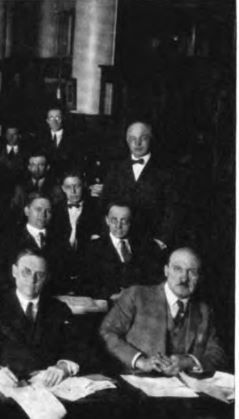
then I'm comfortable saying that the person who wrote this:
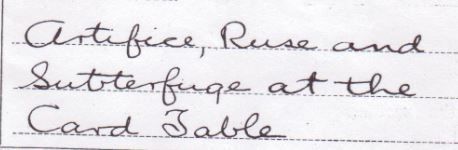
was not the person who wrote this:
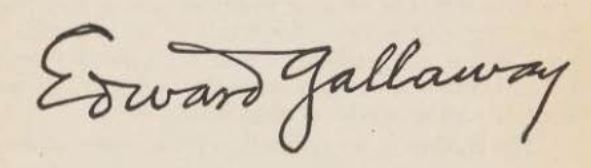
We all are claiming expertise in fields we aren't expert it.
Leonard Hevia wrote:Does anyone have a copy of that August 16, 2000 Wall Street Journal article: "Fresh Clues Could Reveal Magic Trick Writer Who Pulled A Disappearing Act A Century Ago." I would love to read that.
Add your email address to your profile, or PM it to me and I'll send you the article. Plus another one from the London Financial Times from about a year later that you'll probably like (written in conjunction with a BBC Radio special on Erdnase).
Bill, I have no problem whatever your opinions are, but please do not put words in my mouth. I stated that based on this and the second photo it is clear that Gallaway fits Smith's recollections. That means he is neither too tall nor too short. Exactly how tall he is I have not determined, because it is not necessary.
The reason why signatures cannot be used to determine handwriting is because they are very special forms of handwriting. My own signature is completely different from my handwriting. For me my signature is more like a drawing not like writing.
But either way, the copyright form does not have to be filled out by Erdnase. There is no requirement for it.
The reason why signatures cannot be used to determine handwriting is because they are very special forms of handwriting. My own signature is completely different from my handwriting. For me my signature is more like a drawing not like writing.
But either way, the copyright form does not have to be filled out by Erdnase. There is no requirement for it.
Thank you Bill! PM sent.
Allright. I finally have a foolproof routine that matches common sequences of words between two files. I wrote it in Mathematica version 10.2.
The sequences are given in decreasing order of length (down to length 4), and alphabetically within the length group, with no duplicates, and where each sequence is not a subsequence of longer sequences. I did not take care of the periods, but I did eliminate by hand the very few sequences that only differ by a period or commas at the end. Ther are also very few sequence with the period inside, which I mostly left.
Since I was at it, I also compared EATCT with 13 other non-magic non-gambling books of roughly 25K pages each (cutting them down to that if necessary) written around the same period. I found these books in the Project Gutenberg page, and they are mostly randomly chosen in the technology bookshelf.
You fill find all the results here: https://drive.google.com/open?id=0B3Wpu ... DZ4UGswZjQ
The summary is as follows (unless noted all books have about 25K words)
1. Bookbinding I: 160 matches
2. Bookbinding II: 153
3. Distilling: 71
4. Glass Blowing: 97 (19K words)
5. Hat Making: 122 (23K words)
6. The Mind: 68
7. Photography: 94
8. Pianola Player: 75
9. Plumbing: 126
10. Making Things: 123 (24K words)
11. Violin Playing: 76
12. Woodworking: 146
13. Wood Carving: 135
In the folder you will also find the updated 1127 matches with AOM.
I am done with this game! But if anyone wants to compare two files just send them to me and I will be happy to do it, for $899 that is....
----------
Edited: I had not run the clearing of sequences which are subsequences of other sequences, so the numbers are slightly lower
The sequences are given in decreasing order of length (down to length 4), and alphabetically within the length group, with no duplicates, and where each sequence is not a subsequence of longer sequences. I did not take care of the periods, but I did eliminate by hand the very few sequences that only differ by a period or commas at the end. Ther are also very few sequence with the period inside, which I mostly left.
Since I was at it, I also compared EATCT with 13 other non-magic non-gambling books of roughly 25K pages each (cutting them down to that if necessary) written around the same period. I found these books in the Project Gutenberg page, and they are mostly randomly chosen in the technology bookshelf.
You fill find all the results here: https://drive.google.com/open?id=0B3Wpu ... DZ4UGswZjQ
The summary is as follows (unless noted all books have about 25K words)
1. Bookbinding I: 160 matches
2. Bookbinding II: 153
3. Distilling: 71
4. Glass Blowing: 97 (19K words)
5. Hat Making: 122 (23K words)
6. The Mind: 68
7. Photography: 94
8. Pianola Player: 75
9. Plumbing: 126
10. Making Things: 123 (24K words)
11. Violin Playing: 76
12. Woodworking: 146
13. Wood Carving: 135
In the folder you will also find the updated 1127 matches with AOM.
I am done with this game! But if anyone wants to compare two files just send them to me and I will be happy to do it, for $899 that is....
----------
Edited: I had not run the clearing of sequences which are subsequences of other sequences, so the numbers are slightly lower
Carlo, how many of these books use the word 'subterfuge'?
lybrary wrote:Carlo, how many of these books use the word 'subterfuge'?
Looks like the word use may have been on an upswing from 1900 to 1930s
https://books.google.com/ngrams/graph?c ... ge%3B%2Cc1
lybrary wrote:Carlo, how many of these books use the word 'subterfuge'?
none of the 13 books I used (cut down to 25K words) have that word in it. Art of Magic has it 10 times. EATCT has it 3 times (in the text).
Carlo Morpurgo wrote:lybrary wrote:Carlo, how many of these books use the word 'subterfuge'?
none of the 13 books I used (cut down to 25K words) have that word in it. Art of Magic has it 10 times. EATCT has it 3 times (in the text).
Carlo, thanks.
That magic books use it is not that unusual, except EATCT had it in its title. But that "Estimating for Printers" uses it is significant. Common lexicon was another thing Olsson took into consideration, and the word subterfuge was the most interesting word of those.
Joe Pecore wrote:lybrary wrote:Carlo, how many of these books use the word 'subterfuge'?
Looks like the word use may have been on an upswing from 1900 to 1930s
https://books.google.com/ngrams/graph?c ... ge%3B%2Cc1
Yeah I can see from 0.00008% (1900) to 0.000095% (1927). What an upswing and difference that must be causing. Rather than look at what essentially is noise, look at the magnitude and how rare the word is, and how unusual the shared use is for a book that has nothing to do with magic or gambling.
Carlo Morpurgo wrote:lybrary wrote:Carlo, how many of these books use the word 'subterfuge'?
none of the 13 books I used (cut down to 25K words) have that word in it. Art of Magic has it 10 times. EATCT has it 3 times (in the text).
Oscar Teal used it 11 times in his book "Higher Magic" (1920):
https://books.google.com/books?id=uhY9A ... ge&f=false
Bill,
My point was not that someone would fill out the copyright forms using a cover name. But rather that why would they have another person involved in their secret?
My point was not that someone would fill out the copyright forms using a cover name. But rather that why would they have another person involved in their secret?
lybrary wrote:Carlo Morpurgo wrote:lybrary wrote:Carlo, how many of these books use the word 'subterfuge'?
none of the 13 books I used (cut down to 25K words) have that word in it. Art of Magic has it 10 times. EATCT has it 3 times (in the text).
Carlo, thanks.
That magic books use it is not that unusual, except EATCT had it in its title. But that "Estimating for Printers" uses it is significant. Common lexicon was another thing Olsson took into consideration, and the word subterfuge was the most interesting word of those.
I don't doubt there were other hidden aspects to the analysis, but I confess that I am not a big fan of the so-called "Argumentum ab auctoritate" ("Argument from authority", cf. Schopenhauer's "The Art of Being Right")
Anyway, just for comparison, can you find any other book that uses the phrase "Cheap cards are clumsy"?
lybrary wrote:Bill, I have no problem whatever your opinions are, but please do not put words in my mouth. I stated that based on this and the second photo it is clear that Gallaway fits Smith's recollections. That means he is neither too tall nor too short. Exactly how tall he is I have not determined, because it is not necessary.
Smith, in the Gardner-Smith Correspondence, twice pegs Erdnase's height at about 5'6", possibly less, but not taller. Gallaway clearly isn't a basketball player, but he could be as tall as 5'8" in the photo. There's no point of reference to say he is 5'6" or less. We have no idea how tall the men his standing next to are -- are they sitting on low or high chairs?
From the picture, we can't rule out that he is 5'6"-- it is entirely possible. But we can't confirm it, either; yet you seem to do so. If that is putting words in your mouth, I'm sorry.
But Smith had other recollections as well. Let's compare Gallaway to them:
-"Recalls nothing to suggest he had a wife."
Gallaway was not only married but newly wed (for the second time) in late 1901.
-"Has impression he was not a Chicago man...He came from the East and N.Y."
Gallaway was a Chicago man, and from the midwest. Not from N.Y.
-"Andrews was a very small man of slight build...I would say he [was] on the dainty side."
From the picture of Gallaway seated, I'd say he's a man of some girth. His gut clearly sticks out farther than his chin and chest.
-"He was about 40"
Gallaway was 33 in late 1901.
-"Features were on the "sharp" rather than "blunt" side."
Gallaway's close up portrait has a reasonably broad nose and full lips. Not sharp.
-"He mentioned to Smith that he was related to Dalrymple."
There is nothing known about Gallaway to suggest he was related to Dalrymple.
-"Andrews told Smith he was a former card shark who had decided to go straight."
There is nothing known about Gallaway to suggest he had been a card shark.
So, all in all, it's stretching it to say that he is a man who "fits Smith's recollections," because in many respects he does not. In some cases he fits them, in some cases it is possible he fits them, and in some cases he clearly does not fit them.
But either way, the copyright form does not have to be filled out by Erdnase. There is no requirement for it.
Then what possible purpose is served by saying:
lybrary wrote:Anybody who wants to make the Hilliard case should take a look at his handwriting from his notebooks. Does it match the handwriting on the EATCT copyright form?
Either it is probative or it isn't.
lybrary wrote:Bill Mullins wrote:It is no worse a match than Gallaway's.
And how do you know? A signature is not enough to compare handwriting according to handwriting analysts. You seem to be the expert on everything, handwriting, linguistics, print estimating, use of German back then, yet all you offer is your own opinion. I am backing up my opinion with expert opinion. At least I am making an effort to be objective by bringing in experts.
Mr. Wasshuber you are regularly rude, and it's my opinion that you really should not publish personal attacks and invective on long respected members of this group. Bill Mullins is a very serious researcher and has long contributed valuable content to this forum and many other venues relating to conjuring history. You should be aware that you have a very "Jeff Busby" like approach of attacking those who don't agree with you and you might re-think your approach before you inadvertently take his place in the land of magic vitriol.
Edward Finck wrote:Mr. Wasshuber you are regularly rude, and it's my opinion that you really should not publish personal attacks and invective on long respected members of this group. Bill Mullins is a very serious researcher and has long contributed valuable content to this forum and many other venues relating to conjuring history. You should be aware that you have a very "Jeff Busby" like approach of attacking those who don't agree with you and you might re-think your approach before you inadvertently take his place in the land of magic vitriol.
Mr. Finck, what is rude in pointing out that I am trying, wherever possible, to back up my own opinions by experts to stay objective in my own statements?
I may remind you that my history in following facts is well established. When I posted my 'German immigrant' theory last year I wanted to find a way to test my theory. I found Dr. Olsson and asked him to analyse EATCT to see if there is a trace of German or any other foreign language. The report came back that there was none. I dropped my German immigrant theory. Now with Gallaway there was a very similar situation. I myself thought Gallaway writes just like Erdnase. So I asked Dr. Olsson to analyse if Gallaway sounds like Erdnase. At that point I had no idea what Olsson's opinion would be. He could have come back and said: "Chris, sorry, but these two guys just don't sound very much alike." If that would have been the case I probably would have dropped Gallaway and moved on to some other person mentioned in the bankruptcy files. However, Olsson came back with a "strong possibility", essentially confirming my personal opinion. He even suggested to me I should exclusively focus my research on Gallaway because he looks that promising as being Erdnase.
If following facts is rude, if taking expert opinion to stay objective is rude, if pointing out that others don't have anything else to offer than their own opinion is rude, then Mr. Finck I guess somebody needs to be rude here.
Bill Mullins wrote: But Smith had other recollections as well. Let's compare Gallaway to them:- "Recalls nothing to suggest he had a wife."
Gallaway was not only married but newly wed (for the second time) in late 1901.
Just to set the record straight, Bill. That line “Age at First Marriage: 23” [1930 Census] is a mistake. If you check the actual Census it says 33.
He married Rose Mary Vrana, the widow of Samuel Flood, 5 days before his 33rd birthday, so he was actually only 32! He was marrying for the first and only time.
Cheers,
Peter Zenner
Bill Mullins wrote:So, all in all, it's stretching it to say that he is a man who "fits Smith's recollections," because in many respects he does not. In some cases he fits them, in some cases it is possible he fits them, and in some cases he clearly does not fit them.
I see where the disconnect comes from. The context I made my statement was in the context of physical appearance and there Gallaway does fit Smith's recollections. He has the right height and 'about 40' is explained by being 33 and balding. You also forgot to mention that Smith remembers one without facial hair, just like Gallaway's portrait depicts him. As to other features, that is again your opinion. To me his physical appearance matches Smith's recollections. I am also not somebody who takes Smith's recollections literal in each and every point. After 45 years there is a good possibility that his recollections are simply wrong. I am looking for a big mismatch with Smith's recollections (like MFA who was I think 27 and 6'3" stretching the boundaries of what Smith remembered), which clearly is not the case with Gallaway and thus Gallaway fits Smith's recollections in terms of physical appearance.
Bill Mullins wrote:-"Recalls nothing to suggest he had a wife."
Gallaway was not only married but newly wed (for the second time) in late 1901.
I am happily married for decades but neither my wife nor I wear a ring or anything else that would suggest we are married. Actually, my choice in clothes would strongly suggest I am a bachelor who will never find a wife. This is part of the problem of the discussion here. Non facts are being elevated to facts to try to make some point.
Bill Mullins wrote:-"Has impression he was not a Chicago man...He came from the East and N.Y."
Gallaway was a Chicago man, and from the midwest. Not from N.Y.
Here is another of these non-facts. "His impression was ..." So what exactly made Smith think he is not from Chicago? Because they met at a hotel and not at his home? Because Erdnase paid with a check that was numbered #1? We don't know. Smith didn't say. But meeting in a hotel to have some quiet time and the space to demonstrate and draw makes a lot of sense to me even if you live in Chicago. And paying with a check #1 could easily be explained by Gallaway wanting to keep this book project separate from his other dealings. So he opened a new bank account for it. Or perhaps he did not want to tell his new wife about it and thus kept his personal accounting separate from his book accounting. Smith states that he thinks the check was drawn to a CHICAGO bank, not a NY bank. If you live in NY why do you open a bank account in Chicago? Looks to me Erdnase actually lived in or around Chicago or business took him there often enough that he would open a bank account at a Chicago bank.
The Louis Dalrymple mess. The case for ES Andrews is at least partly made by saying he is married to Dolly Seely and Seely is an alternative spelling of Seeley. Louis Dalrymple's mother maiden name was Adelia Seeley. This is stated to suggest that they were somehow related. However, no such proof has been found to date. But if that makes a candidate stronger then I have a lot more to offer for Gallaway.
(Just to be clear, I myself think none of this proves anything, just as it doesn't prove anything for the ES Andrews case. But others may think differently and I don't want to be rude and dismiss those differently thinking folks.)
- Edward Gallaway's sister Ida was married to a man with the surname Thomas. There is a Catherine Bricker (Thomas) on Louis Dalrymple's father side.
- There are two Gassaway folks on Dalrymple's father side: Rhoda Lewis (Gassaway), Elizabeth Lewis (Gassaway). Knowing that back then they had a long-s which could easily be mistaken for an l it could very well be that Gallaway changed to Gassaway or vice versa at some point.
- Both the name Gallaway and Dalrymple trace back to the exact same region in Scotland. Pretty likely that there was some family relation between those two families.
- There is a Walter Gallaway who was a political cartoonist for Puck and other magazines just as Louis Dalrymple. The October 8th 1902 issue of Puck shows a cartoon drawn by Walter Gallaway depicting two poker players. One of the players looks a bit like Edward Gallaway, bald, no facial hair and with a bow tie. See for yourself below. Could Smith have mixed up one Puck political cartoonist with another one? And could have Walter Gallaway had Edward Gallaway in mind when he drew that cartoon?
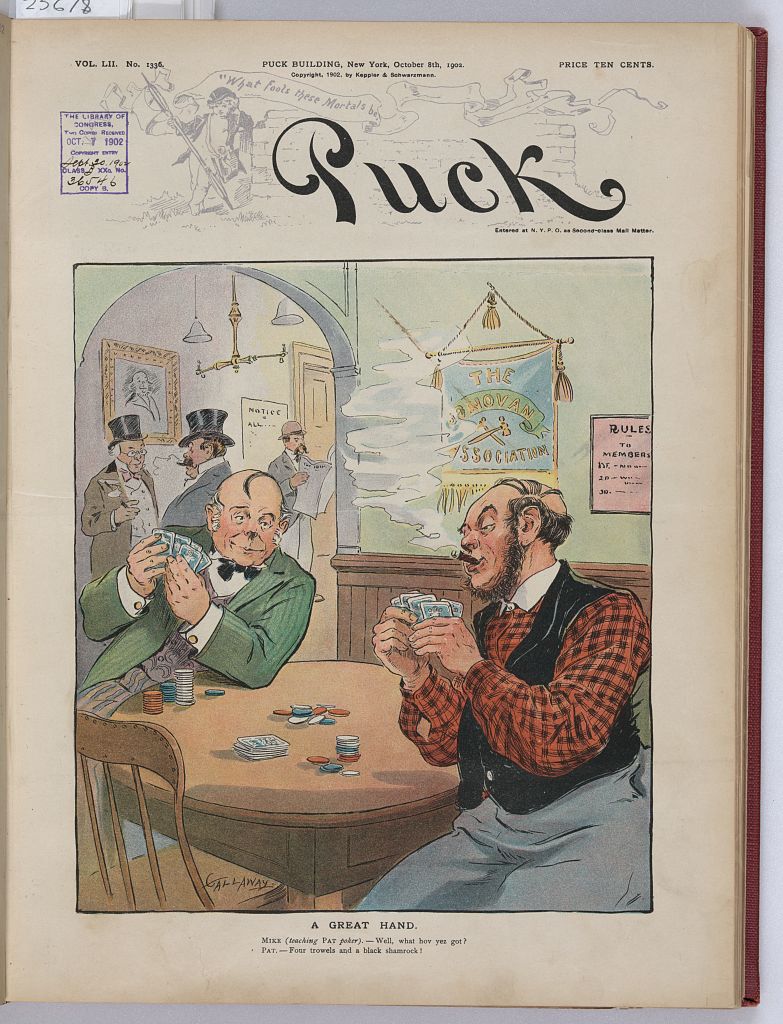
The problem with the Dalrymple thing is twofold. One, it could easily be something Smith misremembered. We know from his recollections that he wasn't particularly good with names. So this could be just as wrong as Andrews. Second, it could be a misdirection that Erdnase dropped, or just something to keep the chit chat flowing, or put Smith at ease, or to make himself look more important, or whatever.
I know that objectivity isn't particularly appreciated here, but if you are objective you would have to forget about the whole Dalrymple thing until a candidate actually has some real family relationship, and even then you would have to question if we can trust Smith on that.
(Just to be clear, I myself think none of this proves anything, just as it doesn't prove anything for the ES Andrews case. But others may think differently and I don't want to be rude and dismiss those differently thinking folks.)
- Edward Gallaway's sister Ida was married to a man with the surname Thomas. There is a Catherine Bricker (Thomas) on Louis Dalrymple's father side.
- There are two Gassaway folks on Dalrymple's father side: Rhoda Lewis (Gassaway), Elizabeth Lewis (Gassaway). Knowing that back then they had a long-s which could easily be mistaken for an l it could very well be that Gallaway changed to Gassaway or vice versa at some point.
- Both the name Gallaway and Dalrymple trace back to the exact same region in Scotland. Pretty likely that there was some family relation between those two families.
- There is a Walter Gallaway who was a political cartoonist for Puck and other magazines just as Louis Dalrymple. The October 8th 1902 issue of Puck shows a cartoon drawn by Walter Gallaway depicting two poker players. One of the players looks a bit like Edward Gallaway, bald, no facial hair and with a bow tie. See for yourself below. Could Smith have mixed up one Puck political cartoonist with another one? And could have Walter Gallaway had Edward Gallaway in mind when he drew that cartoon?
The problem with the Dalrymple thing is twofold. One, it could easily be something Smith misremembered. We know from his recollections that he wasn't particularly good with names. So this could be just as wrong as Andrews. Second, it could be a misdirection that Erdnase dropped, or just something to keep the chit chat flowing, or put Smith at ease, or to make himself look more important, or whatever.
I know that objectivity isn't particularly appreciated here, but if you are objective you would have to forget about the whole Dalrymple thing until a candidate actually has some real family relationship, and even then you would have to question if we can trust Smith on that.
lybrary wrote:- There is a Walter Gallaway who was a political cartoonist for Puck and other magazines just as Louis Dalrymple. The October 8th 1902 issue of Puck shows a cartoon drawn by Walter Gallaway depicting two poker players. One of the players looks a bit like Edward Gallaway, bald, no facial hair and with a bow tie. See for yourself below. Could Smith have mixed up one Puck political cartoonist with another one? And could have Walter Gallaway had Edward Gallaway in mind when he drew that cartoon?
Nice picture!
If that would be the case, he played poker in New York as well, since the scene is from NY judging by "The Donovan Association" on the wall for which I find a mere four search hits, all referring to a NY organization.Zenner wrote:[Gallaway] was marrying for the first and only time.
Peter! Glad you've rejoined us. But you are mistaken:
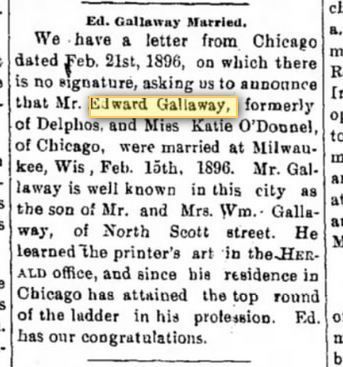
(From the Delphos Daily Herald, Feb 22 1896).
Chris -- the genealogical information on Dalrymple and Gallaway is interesting. Thanks for providing it.
But as far as Smith's recollections:
- Gallaway has a "W" in it. Smith said the writer's name had a "W". You give Smith's memory credit for this and mark it as a plus for Gallaway.
- Gallaway was 33. Smith said the writer was 40. You say Smith's memory was faulty, and thus this isn't a strike against Gallaway.
Given that Smith was a painter, I'd be more inclined to trust what he remembers seeing, than what he remembers hearing. But that's just me.
It doesn't make for a rigorously consistent argument for Gallaway when you can discard the bits of evidence that don't support him like this. If you don't think Smith is a reliable witness, that's fine -- just don't use him to support your case.
I sure don't remember that from the text. As someone said, "Non facts are being elevated to facts to try to make some point."lybrary wrote:[Erdnase] writes so himself that he has pretty much read all the past literature both in magic and in gambling.
Bill Mullins wrote:But as far as Smith's recollections:
- Gallaway has a "W" in it. Smith said the writer's name had a "W". You give Smith's memory credit for this and mark it as a plus for Gallaway.
- Gallaway was 33. Smith said the writer was 40. You say Smith's memory was faulty, and thus this isn't a strike against Gallaway.
Given that Smith was a painter, I'd be more inclined to trust what he remembers seeing, than what he remembers hearing. But that's just me.
It doesn't make for a rigorously consistent argument for Gallaway when you can discard the bits of evidence that don't support him like this. If you don't think Smith is a reliable witness, that's fine -- just don't use him to support your case.
I was about to make the same exact point: using only the part of Smith's memory that fits the candidate.
Bill Mullins wrote:I sure don't remember that from the text. As someone said, "Non facts are being elevated to facts to try to make some point."lybrary wrote:[Erdnase] writes so himself that he has pretty much read all the past literature both in magic and in gambling.
Bill, you have read Erdnase and therefore it should be quite obvious to you that he makes very categorical statements about what is and is not found in the literature and how his own book differs. In order to make such statements you need to have been very well read. Here, to jog your memory, are two quotes which are relevant:
Erdnase writes: "...yet we have been unable to find in the whole category more than an incidental reference to any card table artifice;"
Erdnase writes: "Hence this work stands unique in the list of card books."
In order to make such statements he must have exhaustively read the card books and magic books. I know you are trying to be difficult, but it is very clear that Erdnase is a book guy and has extensively read the literature available during his time. But you can continue to spin it differently. Just makes you appear like you haven't read or understood Erdnase.
Bill Mullins wrote:But as far as Smith's recollections:
- Gallaway has a "W" in it. Smith said the writer's name had a "W". You give Smith's memory credit for this and mark it as a plus for Gallaway.
- Gallaway was 33. Smith said the writer was 40. You say Smith's memory was faulty, and thus this isn't a strike against Gallaway.
I have stated my opinions of Smith's recollections in detail earlier on this thread. It is true that I don't read too much into all of his statements, or allow larger boundaries around his statements. I have made clear differentiation of what I believe and why and what I do not believe and why not. My opinion was formed before I even found Gallaway, so it is not a case of selecting what fits. However, to make a fair comparison you can't say for one candidate you use them to make him stronger, and for the other you don't allow that. I am simply mentioning that Gallaway fits Smith's recollections very well for those who put much weight on Smith's statements.
Regarding Marshall D. Smith, I think it is pretty frequent practice for people to disregard certain things he said, and to rely on other things he said.
I would hesitate to say that "everyone" does this, but I believe that many do. Whaley, Busby, and Gardner largely discounted the height business, though I believe they had an explanation as to why Smith might have reported a lower height. But for the most part, if you like Milton Franklin Andrews, you have to disregard at least something that Smith was fairly certain about.
Smith told Gardner he was around 25 when he did the illustrations. This is in The Gardner-Smith Correspondence, and maybe elsewhere. Nobody relies on his recollection of his own age. [I corrected this paragraph a few hours after posting.]
Also, Smith appears to have been far off on his recollection of the number of drawings he made.
So, I guess the important thing in this context is that a person should have some grounds for accepting certain things and rejecting others.
--Tom Sawyer
I would hesitate to say that "everyone" does this, but I believe that many do. Whaley, Busby, and Gardner largely discounted the height business, though I believe they had an explanation as to why Smith might have reported a lower height. But for the most part, if you like Milton Franklin Andrews, you have to disregard at least something that Smith was fairly certain about.
Smith told Gardner he was around 25 when he did the illustrations. This is in The Gardner-Smith Correspondence, and maybe elsewhere. Nobody relies on his recollection of his own age. [I corrected this paragraph a few hours after posting.]
Also, Smith appears to have been far off on his recollection of the number of drawings he made.
So, I guess the important thing in this context is that a person should have some grounds for accepting certain things and rejecting others.
--Tom Sawyer
Yes, Erdnase did make the two statements you quote. He is referring specifically to gambling sleights in the conjuring literature. He makes no claims about being conversant with the gambling literature of the time that is not found in conjuring books. (there wasn't much, but it did exist --- see TMWWE or Jason England's Erdnase notes). And when we review his writings, it seems that he took much more from magic sources than gambling sources.
And as far as general knowledge of the conjuring literature, he says "But so far as we can learn from the exhibitions and literature of conjurers", allowing for the possibility that there is more than he has read, rather than making an unequivocal statement that "there is nothing in the literature of conjurers". This is an admission that he hasn't read all of the conjuring literature.
And, FWIW, he was wrong about how extensive his knowledge was. He claimed as his own the SWE Shift, despite its having been previously published in "The 52 Wonders" years earlier. And there is material in Koschitz (1894) that Erdnase doesn't mention, despite claiming to describe "every known expedient, manoeuver, and stratagem of the expert card handler." He omits the bent corner dodge in 3 card monte, although it had been in use for decades.
I'm not trying to be difficult. I'm saying that Erdnase doesn't say the things you are claiming he says. It takes a careful reading of his words to parse it out.
And as far as general knowledge of the conjuring literature, he says "But so far as we can learn from the exhibitions and literature of conjurers", allowing for the possibility that there is more than he has read, rather than making an unequivocal statement that "there is nothing in the literature of conjurers". This is an admission that he hasn't read all of the conjuring literature.
And, FWIW, he was wrong about how extensive his knowledge was. He claimed as his own the SWE Shift, despite its having been previously published in "The 52 Wonders" years earlier. And there is material in Koschitz (1894) that Erdnase doesn't mention, despite claiming to describe "every known expedient, manoeuver, and stratagem of the expert card handler." He omits the bent corner dodge in 3 card monte, although it had been in use for decades.
I'm not trying to be difficult. I'm saying that Erdnase doesn't say the things you are claiming he says. It takes a careful reading of his words to parse it out.
People are not wrong to count some of Smith's recollections and discount others. No one's memory is perfect. It's almost certain some of his recollections were wrong, and it seems likely that at least some of what he remembered was right. This is why this kind of thing is very hard.
As magicians we can hardly complain that people have such horrible memories.
As magicians we can hardly complain that people have such horrible memories.
Pete McCabe wrote:People are not wrong to count some of Smith's recollections and discount others.
But how do you decide which is which? Keep the ones that help and discount the ones that hurt?
Bill,
While I feel the Erdnase = Galloway probability is near zero, I do think that Chris is right that Erdnase (whomever he was) studied the cheating books of his day.
It's true that the second sentence under "Card Table Artifice" references "works on conjuring," so clearly he read those. But just a few sentences later he discusses what "Self-styled 'ex-professionals'" were doing. Although it isn't perfectly clear, I've always read this to mean that he was now including cheating/gambling book authors (like Green and Quinn) in his analysis of what techniques had been discussed or taught in the literature up until his book. And unless he was exclusively seeing these crusaders in person, he must've read their works.
Furthermore, Erdnase doesn't strike me as the kind of author that would have looked in all of the magic books for cheating techniques but not in any of the cheating books!
Therefore, I'd bet money he read the cheating books of the day including Green's various (but all similar) works, Evans' How Gamblers Win, Sharps and Flats, Fools of Fortune and the various chapters on cheating that appear in many of the otherwise pedestrian poker books of the late 19th century.
Jason
While I feel the Erdnase = Galloway probability is near zero, I do think that Chris is right that Erdnase (whomever he was) studied the cheating books of his day.
It's true that the second sentence under "Card Table Artifice" references "works on conjuring," so clearly he read those. But just a few sentences later he discusses what "Self-styled 'ex-professionals'" were doing. Although it isn't perfectly clear, I've always read this to mean that he was now including cheating/gambling book authors (like Green and Quinn) in his analysis of what techniques had been discussed or taught in the literature up until his book. And unless he was exclusively seeing these crusaders in person, he must've read their works.
Furthermore, Erdnase doesn't strike me as the kind of author that would have looked in all of the magic books for cheating techniques but not in any of the cheating books!
Therefore, I'd bet money he read the cheating books of the day including Green's various (but all similar) works, Evans' How Gamblers Win, Sharps and Flats, Fools of Fortune and the various chapters on cheating that appear in many of the otherwise pedestrian poker books of the late 19th century.
Jason
Bill Mullins wrote:And, FWIW, he was wrong about how extensive his knowledge was. He claimed as his own the SWE Shift, despite its having been previously published in "The 52 Wonders" years earlier. And there is material in Koschitz (1894) that Erdnase doesn't mention, despite claiming to describe "every known expedient, manoeuver, and stratagem of the expert card handler." He omits the bent corner dodge in 3 card monte, although it had been in use for decades.
Bill, you are judging this from a position 120 years later with pretty much all literature from that time available in digital form, searchable and available with one click of a button. We have the luxury to indeed know pretty much all that has been published back then. For somebody like Erdnase in 1900 it was probably impossible to find ALL books on that subject matter. So it is quite likely that he may have missed one or the other and hasn't literally read 'everything'. But that doesn't make Erdnase's or my statement incorrect. He was a man who has extensively read. And given his eloquence it is also clear he did not only read gambling and magic literature but was generally very well read. I have made that statement before. It is supported by fact. It is also supported by fact that Gallaway extensively read. Whatever your feelings are about Gallaway being Erdnase, both were book guys - highly intelligent, eloquent and well read.
Therefore, I'd bet money he read the cheating books of the day including Green's various (but all similar) works, Evans' How Gamblers Win, Sharps and Flats, Fools of Fortune and the various chapters on cheating that appear in many of the otherwise pedestrian poker books of the late 19th century.
Like Jason and Chris, I also think Erdnase had read all of the gambling books he could get his hands on. I think it is fairly safe to assume that, if the book was readily available, then he had acquired it and digested the contents.
For example, I would be very surprised if he hadn't read Sharps and Flats because his section on the holdout reads like a summary of the holdout information in that book.
Is "The Man Who Was Erdnase" available in any digital and/or affordable form?
Bill Mullins wrote:Zenner wrote:[Gallaway] was marrying for the first and only time.
Peter! Glad you've rejoined us. But you are mistaken:
(From the Delphos Daily Herald, Feb 22 1896).
Hello again Bill,
I know that you don't trust anything that is included in the Censuses but there is evidence in two of them that the marriage between Ed. and Rose was his first and her second.
First look in the 1910 Census. It specifically says after Ed's name that it was his M1 and after Rose's that it was her M2.
Now have a look at the 1930 Census which I mentioned in my posting. There is a column headed ‘Age at first marriage’. The entry after Ed's name is 33 (which appears to have been altered from 32) and the entry after Rose's name is 21. That had to be Rose's age when she married Samuel Flood back in January, 1893, seven months before the birth of Julia Flood.
So in two Censuses, 20 years apart, they actually tell us that Ed's marriage to Rose was his FIRST one, and, as she was his widow when he died, it was his LAST one. The news item in the Delphos Daily Herald, submitted in an anonymous letter, must have been a mistake or a hoax!
Why don't you check back to see whether or not they published an apology?
Cheers,
Peter Zenner
P.S. I haven't been away, just taking a rest and following the Gallaway debate. Harry S. Thompson is my first and only candidate and I have said as much as I want to for now.
I am following this discussion about Erdnase and there is something I want to emphasize though I'm not a great student of the matter: everyone says that the real Erdnase definitely wanted to hide his identity and for this reason he resorted to various clever stratagems, but then the most popular theory is that SW Erdnase is simply the name of the author spelled backwards. If the logic must guide us both ES Andrews can not be Erdnase's real name or the real Erdnase was not really interested in hiding his own identity. The fact that to date no one knows who he was makes me lean for the first hypothesis: the real Erdnase CANNOT be ES Andrews.
degrisy wrote:I am following this discussion about Erdnase and there is something I want to emphasize though I'm not a great student of the matter: everyone says that the real Erdnase definitely wanted to hide his identity and for this reason he resorted to various clever stratagems, but then the most popular theory is that EW Erdnase is simply the name of the author spelled backwards. If the logic must guide us both ES Andrews can not be Erdnase's real name or the real Erdnase was not really interested in hiding his own identity. The fact that to date no one knows who he was makes me lean for the first hypothesis: the real Erdnase CANNOT be ES Andrews.
I totally agree with this. However, I would not go so far as to say that it cannot be an ES Andrews. But an ES Andrews would have to be supported by much more evidence than just a 'man in Chicago who played cards'.
One of the reasons some believe Erdnase did not want to stay anonymous is the fact that he paid Smith with a check. And the argument goes a check would provide a paper trail to follow for others who may want to find out. I have some new thinking to offer on that subject. Reading the historical accounts from those days in Chicago makes it clear that this was a rough and tumble time. There were bombings, killings, police brutality, at the same time with no or little police oversight, lots of gambling, lots of business bankruptcies, fraud etc. With this in mind imagine Erdnase would pay Smith in cash. It would be way too risky. Smith could have taken the cash and never shown up with the drawings at the printer. A check provided some security. With it he could prove payment and follow the trail who cashed it if necessary. So telling Smith his real identity and paying with a check was a small price to pay in revealing his identity to his illustrator. It was also a private transaction between Erdnase and Smith. There was little concern that this would somehow get out into the public. However, all publicly available information, the book itself and the copyright records, needed to be free of Erdnase's real name, and that is what we indeed see today being the case.
I therefore agree that Erdnase did not want to be known or found out as the author of his book by the public. That he told Smith his real name was necessitated by other factors, which did not pose a high risk of causing his cover to be blown.
degrisy wrote:... the real Erdnase definitely wanted to hide his identity ...the most popular theory is that EW (Sic) Erdnase is simply the name of the author spelled backwards. If the logic must guide us ...
IMHO folks are working from the hypothesis that there is a single author. Also the hypothesis that the person recalled by the illustrator is the author. These working assumptions are treated as axiomatic in most of the discussion here.
The pseudonym constructed by reversing a common name is under debate. Yours truly treats that one as an obvious red herring (and not much of a garden path) and a wink that's consistent with the tone of the text.
This search for a real person to satisfy the needs of this community of readers to find an author is intriguing. Even more so for those who've read Borges. Let's play nice and leave Joseph Campbell out of it. Instead of questioning the why, we may as well learn what we can from the past. Do you have any contacts in Chicago?
There is absolutely no evidence to indicate Erdnase was doing anything more than toying with anagrams, certainly nothing to indicate he was undertaking a major effort to remain anonymous.
Despite Chris's details of a violent Chicago, it was in fact a city that was full of families, businesses, and plenty of folks walking their dogs in the park. After hall, the city hosted a Worlds Fair in 1893, and then again in 1933. Hardly the Wild West.
It stands equally that Mr. Erdnase paid Smith with a cheque simply because his toying about with his anagrams didn't extend beyond placing the name "Erdnase" on the cover of the book.
In effect, he wasn't trying at all to hide his identity from Smith.
In an effort to make certain candidates"fit" the mold, we're seeing some pretty large stretches of reality to accommodate a backstory adjusted to fit a specific candidate, or similarly adjusted or explained to repurpose one of the known facts we have on record!
Despite Chris's details of a violent Chicago, it was in fact a city that was full of families, businesses, and plenty of folks walking their dogs in the park. After hall, the city hosted a Worlds Fair in 1893, and then again in 1933. Hardly the Wild West.
It stands equally that Mr. Erdnase paid Smith with a cheque simply because his toying about with his anagrams didn't extend beyond placing the name "Erdnase" on the cover of the book.
In effect, he wasn't trying at all to hide his identity from Smith.
In an effort to make certain candidates"fit" the mold, we're seeing some pretty large stretches of reality to accommodate a backstory adjusted to fit a specific candidate, or similarly adjusted or explained to repurpose one of the known facts we have on record!
Bill Mullins wrote:Pete McCabe wrote:People are not wrong to count some of Smith's recollections and discount others.
But how do you decide which is which? Keep the ones that help and discount the ones that hurt?
You decide, Bill. Everyone decides, and they all decide in different ways. My point is that it is not valid to criticize someone's argument solely by pointing out that they are counting some of Smith's recollections and discounting others.
Found this book from 1890, which has a section on gambling in Chicago (pages 389–407) of which this is an especially fascinating excerpt:
Next stop: Find out what club he is talking about
It must be remembered that all this occurred before the beginning of the present era of club life, which has done so much to pervert the morals, if not to overturn the foundations of society. It is a notorious fact that the heaviest play in Chicago today may be found in the most aristocratic and exclusive clubs. The police, of course, are not aware of it. Every man in Chicago doing business in what is known as the "Board of Trade district" has heard of the existence of a small club, whose membership is chiefly composed of operators on the floor of Change, and most men about town know where it is located. The appointments of the rooms while not luxurious, are of simple elegance and the cuisine and buffet are said to be matchless. Stories are current of fabulous sums having been lost and won across the tables in this exclusive resort.
Next stop: Find out what club he is talking about
Is it not possible that when "Erdnase" presented himself to the printer and also the illustrator, that he used the pseudonym E. S. Andrews as if it were his real name? I believe this thought has been mentioned once before since he allegedly used check No. 1 from his checkbook to pay Smith. Would it really have been that difficult to open a bank account under an assumed name?
Reversing the pseudonym E. S. Andrews to S. W. Erdnase would have served as a double blind, so to speak, hiding his real name and yet seemingly providing it when some puzzle solver reversed S. W. Erdnase.
What I am saying is that both the printer and Smith may have actually believed the author's name was Andrews even though it was not. Given his penchant for ruse and artifice, I see this as more likely than the author using his true name which was not Andrews.
I realize that the name Andrews cannot be dismissed from investigation, but I highly doubt that it was the real name.
Reversing the pseudonym E. S. Andrews to S. W. Erdnase would have served as a double blind, so to speak, hiding his real name and yet seemingly providing it when some puzzle solver reversed S. W. Erdnase.
What I am saying is that both the printer and Smith may have actually believed the author's name was Andrews even though it was not. Given his penchant for ruse and artifice, I see this as more likely than the author using his true name which was not Andrews.
I realize that the name Andrews cannot be dismissed from investigation, but I highly doubt that it was the real name.
Pete McCabe wrote:Bill Mullins wrote:Pete McCabe wrote:People are not wrong to count some of Smith's recollections and discount others.
But how do you decide which is which? Keep the ones that help and discount the ones that hurt?
You decide, Bill. Everyone decides, and they all decide in different ways. My point is that it is not valid to criticize someone's argument solely by pointing out that they are counting some of Smith's recollections and discounting others.
But it is perfectly ok to criticize an argument if these assumptions about "Smith's recollections" appear to be somewhat inconsistent. I think that this is what Bill was probably trying to convey.
Bill Marquardt wrote:Is it not possible that when "Erdnase" presented himself to the printer and also the illustrator, that he used the pseudonym E. S. Andrews as if it were his real name? ...
The problem with conjecture is that almost anything is possible. Adding suppositions does not necessarily make a thing more likely.
Bill Marquardt wrote:Is it not possible that when "Erdnase" presented himself to the printer and also the illustrator, that he used the pseudonym E. S. Andrews as if it were his real name? I believe this thought has been mentioned once before since he allegedly used check No. 1 from his checkbook to pay Smith. Would it really have been that difficult to open a bank account under an assumed name?
In 1901, it would have been very unusual for a check to have an individual account holder's name on it:

(Checks from that era with a business's logo/letterhead design are known, but they would have had to have been custom printed).
Checks with names and account information on them are a modern feature, that came along when checks started being processed by machines that could read account numbers from magnetic ink.
Erdnase may have opened the account in his real name. The check wouldn't have shown that. The bank would have debited the account based on the signature, which may have been the account holder's real name, or it may have been a name from a second signature card that Erdnase provided when he opened the account. Or, if he opened the account under a pseudonym, it may have been under that name.
The strongest evidence to me that Erdnase actually wanted to have his identity kept secret is that when Sprong went to Drake to find out who he was, they wouldn't tell. The pseudonym doesn't necessarily mean that he didn't want anyone to know who he was. His name may have been well known around the McKinney office.
Jonathan Townsend wrote:Bill Marquardt wrote:Is it not possible that when "Erdnase" presented himself to the printer and also the illustrator, that he used the pseudonym E. S. Andrews as if it were his real name? ...
The problem with conjecture is that almost anything is possible. Adding suppositions does not necessarily make a thing more likely.
True, but the basis for the supposition is that it is unlikely an established person would be using the first check in his checkbook for such an enterprise. It was most certainly a brand new account. Having an account under a pseudonym would also have allowed him to receive payments into his account and later to withdraw the money, all without his real name being used.
Conjecture? Certainly, but one that makes sense.
ADDED: @ Bill Mullins, I wrote the above while you were writing your latest. Thank you for the additional info. At any rate, nothing has established that his actual name was Andrews.
Thanks for the clarification about checks of the time. They used signature card verification? multiple signature cards were okay on an account?
IMHO that's a puzzler. Not a name, not a diversion or hint but a lasting impression that the authorship of the text was a topic to avoid. There's something of a pattern in that in magicdom.
So, who wrote that Kaps book you need special glasses to read?
Bill Mullins wrote:... when Sprong went to Drake to find out who he was, they wouldn't tell. ...
IMHO that's a puzzler. Not a name, not a diversion or hint but a lasting impression that the authorship of the text was a topic to avoid. There's something of a pattern in that in magicdom.
So, who wrote that Kaps book you need special glasses to read?
Bill Mullins wrote:The strongest evidence to me that Erdnase actually wanted to have his identity kept secret is that when Sprong went to Drake to find out who he was, they wouldn't tell. The pseudonym doesn't necessarily mean that he didn't want anyone to know who he was. His name may have been well known around the McKinney office.
Where is this episode described?
Bill Marquardt wrote: ADDED: @ Bill Mullins, I wrote the above while you were writing your latest. Thank you for the additional info. At any rate, nothing has established that his actual name was Andrews.
Except that he told Smith that his name was Andrews, Sprong and Rullman said his name was Andrews, and possibly someone at Drake when Vernon spoke to them.
mam wrote:Bill Mullins wrote:The strongest evidence to me that Erdnase actually wanted to have his identity kept secret is that when Sprong went to Drake to find out who he was, they wouldn't tell. The pseudonym doesn't necessarily mean that he didn't want anyone to know who he was. His name may have been well known around the McKinney office.
Where is this episode described?
I'm sorry, I didn't check before writing. According to Vernon (see The Vernon Touch, p. 99),
"[Sprong] said he found out from Drake, who was one of the later publishers of Erdnase, that Erdnase is Andrews spelled all mixed up. His real name was Andrews. I asked Mr. Drake who this fellow Andrews was, and he said he was sorry, he couldn’t tell me. So I went back there religiously for months and kept badgering the old man to tell me something about this Andrews. He said he couldn’t betray a confidence and couldn’t tell anything about Andrews."
Diaconis says in Revelations:
"Vernon recounts that J.C. Sprong persistently quizzed Drake, the publisher of Erdnase during the 1920's for information. Drake admitted knowing something about the author and finally told Sprong that S.W. Erdnase was an anagram for E.S. Andrews."
So Drake would tell Sprong his name was Andrews, but wouldn't tell any details about Andrews to Vernon.
That reads like a riddle. Sprong annoyed Drake - and Drake pointed out the obvious reverse name ... and nobody called shenanigans?
Bill Mullins wrote:Bill Marquardt wrote: ADDED: @ Bill Mullins, I wrote the above while you were writing your latest. Thank you for the additional info. At any rate, nothing has established that his actual name was Andrews.
Except that he told Smith that his name was Andrews, Sprong and Rullman said his name was Andrews, and possibly someone at Drake when Vernon spoke to them.
Which is why I believe he may have been using the name Andrews, acting as if it was his real name even though it was not. If he wanted anonymity, that would be the way to do it. Admitted conjecture on my part.
Bill Mullins wrote:So Drake would tell Sprong his name was Andrews, but wouldn't tell any details about Andrews to Vernon.
Vernon never spoke to Drake.
The August 1970 Vernon Touch column reads in such a way, that it seems Vernon himself is the one who "went back there religiously for months and kept badgering the old man to tell me something about this man Andrews."
Whether this was intentional, or an error in transcription, or a consequence of faulty punctuation is debatable.
The quote from Diaconis clearly attributes the persistently quizzing of Drake to Sprong.
The "badgering for months" and "persistently quizzing" are not separate occurrences, one being done by Sprong and the other being done by Vernon.
They are both referring to the same thing, the interaction between Drake and Sprong as related by Sprong to Vernon.
As pointed out by Leonard Hevia a while back, if you view volume 15 of the Vernon Revelations dvds, it is all made clear.
Bill Marquardt wrote:...why I believe he may have been using the name Andrews, acting as if it was his real name even though it was not. If he wanted anonymity, that would be the way to do it. Admitted conjecture on my part.
Let's try Occam on this - if we drop the "he" we've got a printer being coy about the text and an artist meeting a stranger in a hotel room.
Bill Mullins wrote:Except that he told Smith that his name was Andrews, Sprong and Rullman said his name was Andrews, and possibly someone at Drake when Vernon spoke to them.
But none of this needs to be true. Gardner planted the name Andrews in Smith's mind who later by his own admission is not good with names. All the other apparent confirmations of Andrews is hearsay that cannot be confirmed. And who says that Drake actually knew who the real author was? We do not know how the book actually ended up in Drake's hands. Perhaps the author sold it to McKinney who sold it to Drake. Perhaps Drake couldn't say more because he didn't know more except the rumor that everybody seems to be repeating to this day.
Roger M. wrote:There is absolutely no evidence to indicate Erdnase was doing anything more than toying with anagrams ...
And where is the evidence that he was even 'toying with anagrams'?
lybrary wrote:Roger M. wrote:There is absolutely no evidence to indicate Erdnase was doing anything more than toying with anagrams ...
And where is the evidence that he was even 'toying with anagrams'?
Well, in the folks that were told by Drake that Erdnase was actually E.S. Andrews in reverse, and the fact that Erdnase told Smith he was Andrews when he had the drawings done, and perhaps a couple more depending on how you interpret Vernons stories.
That's where the "toying around with anagrams" comes from.
Of course if you choose to disbelieve it all because it runs counter to your candidate ... that remains your option to do so.
(Totally off topic, but I'm off to see Mac Kings show in an hour with my daughter, and am actually quite excited!)
Roger M. wrote:lybrary wrote:Roger M. wrote:There is absolutely no evidence to indicate Erdnase was doing anything more than toying with anagrams ...
And where is the evidence that he was even 'toying with anagrams'?
Well, in the folks that were told by Drake that Erdnase was actually E.S. Andrews in reverse, and the fact that Erdnase told Smith he was Andrews when he had the drawings done, and perhaps a couple more depending on how you interpret Vernons stories.
That's where the "toying around with anagrams" comes from.
Of course if you choose to disbelieve it all because it runs counter to your candidate ... that remains your option to do so.
(Totally off topic, but I'm off to see Mac Kings show in an hour with my daughter, and am actually quite excited!)
The problem is that these are not independent rumors. The reason Gardner planted the Andrews name was because of the existing rumors. So it is not independent. It could very easily be only one rumor that gets repeated and pops up at various places. It is still only a rumor and thus only one plausible theory not evidence at all. Elevating it to evidence status is a big error done here all the time. Neither one who spreads these rumors has anything more to add which suggests all they are doing is repeating the rumor because they don't know anything more.
Bill Mullins wrote:(Checks from that era with a business's logo/letterhead design are known, but they would have had to have been custom printed).
At least Gallaway could have easily printed his own checks. Some checks had the account holder name handstamped and others had the name written in.
Leonard Hevia wrote: Nobody is immune to misplaced or missing quotation marks. Vernon is discussing Sprong's encounter with Drake, and then it seems as if he suddenly placed himself inside the story without any preamble about searching for Drake to ask him in person. If you pencil in the quotation marks, then the narrative about Sprong continues in a logical fashion.
Inferring the "phantom quotation marks" puts that Vernon Touch narrative in perfect harmony with Vernon's discussion in the Revelations video.
Brad Jeffers wrote:Vernon never spoke to Drake.
The August 1970 Vernon Touch column reads in such a way, that it seems Vernon himself is the one who "went back there religiously for months and kept badgering the old man to tell me something about this man Andrews."
Whether this was intentional, or an error in transcription, or a consequence of faulty punctuation is debatable.
I need to watch the Vernon DVD. And while I read Leonard's explanation when he posted it, there has been so much to absorb on the Erdnase thread the last six weeks that it slipped my mind.
FWIW, when David Ben quoted the passage in his biography of Vernon, he added quote marks:
"He said he found out from Drake, who was one of the later publishers
of Erdnase that Erdnase is Andrews spelled all mixed up. His real
name was Andrews. "I [Sprong] asked Mr. Drake who this fellow
Andreios was, and he said he was sorry, he couldn't tell me. So I went
back there religiously for months and kept badgering the old man to
tell me something about this Andrews. He said he couldn't betray a
confidence and couldn't tell anything about Andrews." "
lybrary wrote:Bill Mullins wrote:Except that he told Smith that his name was Andrews, Sprong and Rullman said his name was Andrews, and possibly someone at Drake when Vernon spoke to them.
But none of this needs to be true. Gardner planted the name Andrews in Smith's mind who later by his own admission is not good with names. All the other apparent confirmations of Andrews is hearsay that cannot be confirmed.
Smith didn't act like Gardner "planted" the name, he acted like it was on the tip of his tongue and Gardner reminded him of it. "His face lighted up and he was sure that was it."
Sprong was interested in sleight of hand (he was willing to pay $100 for a center deal), and motivated to find the author. He had been interested in magic since soon after the publication of Expert. His statement carries more weight than a hearsay rumor.
Rullman's statements may in fact be speculation, but again, he was knowledgeable about the magic book scene, and his statements would have at least been _informed_ speculation.
If Drake didn't know, why didn't he just tell Sprong "I don't know?" What's the advantage to him to make up a story for Sprong? And then continue to maintain the story as Sprong continues to pester him?And who says that Drake actually knew who the real author was?
One thing the bankruptcy records show that hadn't been clear to me was that all of these early people were tied up with one another. Gallaway, Drake, McKinney -- their business relationships were much more incestuous than I would have guessed.We do not know how the book actually ended up in Drake's hands. Perhaps the author sold it to McKinney who sold it to Drake.
Drake may have been on the scene when McKinney printed the book. It's clear he knew McKinney. But he was involved in selling Expert so soon after its publication that McKinney's transactions with Erdnase would have been a recent memory. There's no reason to think he would have been in the dark about the matter -- it would have been due diligence for him to find out about Erdnase from McKinney before he started printing it and selling it himself.
Perhaps Drake couldn't say more because he didn't know more except the rumor that everybody seems to be repeating to this day.
Except when Drake told Sprong, it wasn't a rumor -- Drake's statement is the first time anyone said Erdnase = Andrews. Are you suggesting he made it up out of thin air?
I don't know if you've noticed Chris, but NOBODY has come on side with your candidate as anything more than "interesting".
Before the desire to insult those who disagree with you becomes too strong ... I'd take that fact into account!
Before the desire to insult those who disagree with you becomes too strong ... I'd take that fact into account!
I don't think that Chris has been insulting -- just perhaps a little blind to the problems with Gallaway = Erdnase. Even though I don't agree with that proposition, its been useful to look at the arguments for and against.
And "interesting" is about as much as can be said about any of the candidates -- none of them are a lock. To be sure, some are more interesting than others. . .
And "interesting" is about as much as can be said about any of the candidates -- none of them are a lock. To be sure, some are more interesting than others. . .
Not true. I rather like the case that Chris presented. Not that I care one way or the other. I have never figured out what the fuss about Erdnase was in the first place. As it happens I can do most of the sleights therein and I consider it a very good book. But then there are many very good books. I thought this one was well written and illustrated.
I do get a psychic vibe somehow that when the identity of the author is discovered it will be a big surprise to you. It will be somebody whose name you have seen again and again but have never connected to Erdnase. And I also get a feeling that it is someone who couldn't have written it because he was not alive at the time. In other words the book was not written when you think it was written.
I have utterly no evidence for this theory. It is just a psychic thing. When the identity is discovered you will all be astonished to hear that I am right.
I do get a psychic vibe somehow that when the identity of the author is discovered it will be a big surprise to you. It will be somebody whose name you have seen again and again but have never connected to Erdnase. And I also get a feeling that it is someone who couldn't have written it because he was not alive at the time. In other words the book was not written when you think it was written.
I have utterly no evidence for this theory. It is just a psychic thing. When the identity is discovered you will all be astonished to hear that I am right.
Oh and Mullins. It has come to my attention that you have brought up my name without receiving formal permission to do so. I wish to assure you that despite your speculation I did not write Expert on the Card Table. However, in my capacity as a psychic reverend of some distinction I will be happy to communicate with the spirit world on your behalf to find out. Naturally there will be a small charge and this should be paid in advance.
Bill Mullins wrote:Except when Drake told Sprong, it wasn't a rumor -- Drake's statement is the first time anyone said Erdnase = Andrews. Are you suggesting he made it up out of thin air?
Yes, I am saying this is a real possibility, because human nature is a lot more complex than you make it out to be. Maybe he repeated a rumor or made a guess and then to safe face he simply makes up the line that he can't betray a confidence. Wouldn't be the first time something like this happened.
The bankruptcy files show that Drake did business with McKinney but nothing more. We have still no idea how the book ended up in Drake's hands. Maybe Erdnase sold it directly to Drake which makes Gallaway a pretty likely person, because if he is Erdnase he would already know the business Drake due to his work at McKinney. Or Erdnase could have sold the book to McKinney or any other printer/publisher/retailer for that matter who then sells it to Drake.
I also think it is an error to say Drake did personally do all the business transactions. I don't know how large Drake was in 1901, but if I assume it was of similar size as McKinney then it is possible that Drake did not personally transact the purchase of EATCT. So he may never have had more knowledge than second hand reports from his employees.
All of this means there is no hard evidence that Drake would necessarily know who Erdnase really is. Just to be clear, it is also plausible that he could have known. We just don't know. Don't turn plausible theories into evidence. Once we actually have something to prove one or the other theory you can make it evidence.
I'm beginning to understand ...
It was Drake who started a rumor that S.W.Erdnase spelled backwards is E.S.Andrews.
It was Drake who started a rumor that S.W.Erdnase spelled backwards is E.S.Andrews.
Regardless of what one believes on the Smith-Sprong-Drake-Rullman aspects of the case, at least one thing seems pretty clear. Sprong's investigation is key, but we don't know the source of Drake's information. Edward Fink provided some ages of Drake family members. Based on that, the eldest child was 9 or so when the Erdnase book was published. Since Sprong probably dealt with one of the sons, this is an issue.
--Tom Sawyer
--Tom Sawyer
Tom Sawyer wrote:Regardless of what one believes on the Smith-Sprong-Drake-Rullman aspects of the case, at least one thing seems pretty clear. Sprong's investigation is key, but we don't know the source of Drake's information. Edward Fink provided some ages of Drake family members. Based on that, the eldest child was 9 or so when the Erdnase book was published. Since Sprong probably dealt with one of the sons, this is an issue.
--Tom Sawyer
Exactly. So imagine Sprong hears it from a Drake son, who heard it from his father, who heard it from an employee of his who actually bought the book potentially not even directly from Erdnase. Lots of question marks, lots of things we don't know. Yet, many make it out as if this is a sure thing. I have to repeat it. It is nothing but a rumor and thus simply a theory, not evidence.
Wait a minute, wasn't it the elder Drake that Sprong spoke with about the identity of Erdnase, and not one of Drake's sons? Wasn't Sprong roughly the same age as the elder Drake?
Also, if Erdnase used "E.S. Andrews" as his cover name when he dealt with McKinney, Smith, the bank, and possibly Drake, as David Alexander has suggested, wouldn't that have made that name just a red herring and not really a rumor? Assuming that "E.S. Andrews" is not the true name of Erdnase. Why would Erdnase reveal his true name to all or some of these individuals/entities and create a weak link in the chain?
I also agree with Chris that "E.S. Andrews" was likely all that the elder Drake ever really knew. Drake may have parsed it out himself and read "Erdnase" backwards, assuming he never met Erdnase posing as E.S. Andrews. When Sprong pestered the elder Drake for information, Drake may have gone along for the ride and mentioned something about not betraying any confidences.
Also, if Erdnase used "E.S. Andrews" as his cover name when he dealt with McKinney, Smith, the bank, and possibly Drake, as David Alexander has suggested, wouldn't that have made that name just a red herring and not really a rumor? Assuming that "E.S. Andrews" is not the true name of Erdnase. Why would Erdnase reveal his true name to all or some of these individuals/entities and create a weak link in the chain?
I also agree with Chris that "E.S. Andrews" was likely all that the elder Drake ever really knew. Drake may have parsed it out himself and read "Erdnase" backwards, assuming he never met Erdnase posing as E.S. Andrews. When Sprong pestered the elder Drake for information, Drake may have gone along for the ride and mentioned something about not betraying any confidences.
If Sprong met with Drake during or before 1912, then it would have been Frederick J. Drake (the father) with whom he met.
Wouldn't this whole Sprong/Drake episode make sense if Drake was Erdnase?
Also, EATCT uses the phrase "We betray no confidences in publishing this book" (my bold)
(Just a thought, I have not read up on Drake.)
Also, EATCT uses the phrase "We betray no confidences in publishing this book" (my bold)
(Just a thought, I have not read up on Drake.)
Leonard Hevia wrote: Also, if Erdnase used "E.S. Andrews" as his cover name when he dealt with McKinney, Smith, the bank, and possibly Drake, as David Alexander has suggested, wouldn't that have made that name just a red herring and not really a rumor? Assuming that "E.S. Andrews" is not the true name of Erdnase. Why would Erdnase reveal his true name to all or some of these individuals/entities and create a weak link in the chain?
Everybody's going around in circles again, Leonard. The name that 'Erdnase' was using was 'E.C. Andrews' and that is the name that appears in the McKinney Bankruptcy Files. That would also have been the name on Smith's cheque - would you accept a cheque from somebody calling himself 'Erdnase'?
I also agree with Chris that "E.S. Andrews" was likely all that the elder Drake ever really knew. Drake may have parsed it out himself and read "Erdnase" backwards, assuming he never met Erdnase posing as E.S. Andrews. When Sprong pestered the elder Drake for information, Drake may have gone along for the ride and mentioned something about not betraying any confidences.
I suspect that Drake knew all along who the author was but would tell Sprong only that it was Andrews spelt backwards. He had obviously given his word that he would say no more. It seems to me that quite a few of the author's friends MUST have known who it was, but they also did not betray his confidence.
Don't you think it's nice that some people can keep a secret when asked to?
Peter Zenner
Bill Mullins wrote:...According to Vernon (see The Vernon Touch, p. 99),
"[Sprong] said he found out from Drake, who was one of the later publishers of Erdnase, that Erdnase is Andrews spelled all mixed up. His real name was Andrews. I asked Mr. Drake who this fellow Andrews was, and he said he was sorry, he couldn’t tell me. So I went back there religiously for months and kept badgering the old man to tell me something about this Andrews. He said he couldn’t betray a confidence and couldn’t tell anything about Andrews."...
Odd for Vernon to use that phrasing rather than "backward" and "reversed". Similarly the "betray a confidence" reads as another wink.
"... in publishing this book" - but not in writing? Something about insufferable conceit.
Jason England wrote:Therefore, I'd bet money he read the cheating books of the day including Green's various (but all similar) works, Evans' How Gamblers Win, Sharps and Flats, Fools of Fortune and the various chapters on cheating that appear in many of the otherwise pedestrian poker books of the late 19th century.
Since I haven't heard any objections to Jason's comment I am assuming we are in general agreement that Erdnase did read the available gambling and magic literature of his time.
With that in mind consider now that we know from Jay Marshall that there were several other gambling books with the Edward Gallaway bookplate. We don't know which books these were but we know there were several. We also know at least one of these was EATCT. That means we know a lot more about Gallaway's interest in gambling and advantage card play than we know about ES Andrews or WE Sanders interest in these subject matters. That to me puts Gallaway much closer at cheating with cards than Sanders or Andrews.
The erdnase text does appear informed by available literature of the time.
Having a common book of the time in ones library is not so much evidence of authorship as willingness to have the book on the shelf and some need to mark up ones books.
Having a common book of the time in ones library is not so much evidence of authorship as willingness to have the book on the shelf and some need to mark up ones books.
Jonathan Townsend wrote:The erdnase text does appear informed by available literature of the time.
Having a common book of the time in ones library is not so much evidence of authorship as willingness to have the book on the shelf and some need to mark up ones books.
Jonathan, I am simply arguing that we can say that Gallaway had an interest in gambling and advantage card play, because we know he owned gambling books as well as EATCT. Do you agree?
What do we really about the person whose name is on a bookplate based upon some sample of found books with his bookplates? That's a research question with some avenues for statistics. Has this work been done?
@Chris, Galloway is an interesting candidate for author of the erdnase text. Fine. Keep building that case based on his known authored texts. That avenue introduces some questions including: Why leave around old research materials? Especially if the output of that research was to be kept apart from his social life? That would be like the guy from the TV show Breaking Bad keeping books and lab notes on how to make 'that blue product' in his living room library.
That hypothesized "interest" could be anything from "had some remaindered books" to "studiously acquired the literature" - and to get a sense of that we'd need to know if his collection was more or less than the average guy who put bookplates in his books at the time in that area. Today folks buy old books by the yard to decorate shelves. Not everyone was a Thomas Jefferson.
Maybe he was given the gaming books by a prior owner? Maybe he was an organizer of the local underground gaming club? Maybe he was a wannabe advantage player? Maybe, maybe, maybe - which is fine for the fiction writer though not so good for the historian. Bravo for finding the artifacts. Let the artifacts speak for the world which created them.
@Chris, Galloway is an interesting candidate for author of the erdnase text. Fine. Keep building that case based on his known authored texts. That avenue introduces some questions including: Why leave around old research materials? Especially if the output of that research was to be kept apart from his social life? That would be like the guy from the TV show Breaking Bad keeping books and lab notes on how to make 'that blue product' in his living room library.
lybrary wrote:I am simply arguing that we can say that Galloway had an interest in gambling and advantage card play, because we know he owned gambling books as well as EATCT. Do you agree?
That hypothesized "interest" could be anything from "had some remaindered books" to "studiously acquired the literature" - and to get a sense of that we'd need to know if his collection was more or less than the average guy who put bookplates in his books at the time in that area. Today folks buy old books by the yard to decorate shelves. Not everyone was a Thomas Jefferson.
Maybe he was given the gaming books by a prior owner? Maybe he was an organizer of the local underground gaming club? Maybe he was a wannabe advantage player? Maybe, maybe, maybe - which is fine for the fiction writer though not so good for the historian. Bravo for finding the artifacts. Let the artifacts speak for the world which created them.
Jonathan, these are all fair points, but we can't even say that much about ES Andrews or WE Sanders. We also know that Gallaway was an enthusiastic reader. After all he initiated two lending libraries in 1907 so that others less fortunate than him have books to read. With this it is not a bad assumption that he actually read the gambling books in his library. And thus it is not a bad assumption that he had an interest in card advantage play. Not a certainty, but quite possible.
Zenner wrote:It was interesting to note a couple of addresses in the McKinney Bankruptcy Files. Frederick J. Drake's business was at 356 Dearborn Street and Harry S. Thompson was based at Philip Ruxton Inks of 357 Dearborn Street.
Could someone point me to where in the bankruptcy files we get this address? Because all other sources I've found (e.g. books published by Drake) places his business at Wabash Avenue.
Brad Jeffers wrote:I'm beginning to understand ...
It was Drake who started a rumor that S.W.Erdnase spelled backwards is E.S.Andrews.
This is not a "rumor". S. W. Erdnase does spell backwards to "E. S. Andrews". The rumor is that this has something to do with the author's identity.
In that regard, Rullman's name has several times been invoked in support of that theory, but I would say this support is very weak at best. Rullman first mentions the Andrews theory in the
November 1928: Sphinx, Books of Yesterday by Leo Rullman:
In this connection we must not forget that excellent treatise by W. [sic] S. Erdnase (E. S. Andrews), “The Expert at the Card Table,” being an exposition of artifice, ruse and subterfuge at the gambling table. The original cloth is very scarce, but it is published in paper-back form at the present time.
He comes back to this topic in the February 1929 issue: Sphinx, Books of Yesterday by Leo Rullman:
The most mysterious figure in the realm of magical literature, whose one contribution to the subject is still, after 25 years, one of the classics, is S. W. Erdnase, author of “The Expert at the Card Table”. No other work, in my opinion, packs so much concrete information of use to the manipulator of cards, as this little volume. Who was S. W. Erdnase? Very little practical information concerning him is available. The magicians do not know him. The publishers of the book have not been in touch with him for many years, as the copyright was purchased outright, and no royalties figured in the transaction. It has been said that his real name was E. S. Andrews, which in reverse order produces the pen-name under which he wrote…
Rullman was intimately connected with the magic community for many years, both fraternally and as a dealer in magic books, so when he says "magicians do not know him" I think that carries some weight. I also do not think that he would simply make up the statement about the then current publishers (Drake) not having been in touch with the author for years. I assume he must have received this information in correspondence with the publishers. It would be nice to find that correspondence in a collection somewhere! But it seems that his citing of the Andrews theory is simply based on the reverse reading, not some insider knowledge.
Zenner wrote:Everybody's going around in circles again, Leonard. The name that 'Erdnase' was using was 'E.C. Andrews' and that is the name that appears in the McKinney Bankruptcy Files. That would also have been the name on Smith's cheque - would you accept a cheque from somebody calling himself 'Erdnase'?
Going around in circles is not necessarily a bad thing. It can serve as a refresher to keep in mind the history of this story. I take it you have seen Smith's cancelled check and know for certain that Erdnase signed it E.C. Andrews?
I suspect that Drake knew all along who the author was but would tell Sprong only that it was Andrews spelt backwards. He had obviously given his word that he would say no more. It seems to me that quite a few of the author's friends MUST have known who it was, but they also did not betray his confidence.
Don't you think it's nice that some people can keep a secret when asked to?
Peter Zenner
All we have is Sprong telling Vernon that Drake clammed up and wouldn't talk. But why did Drake tell Sprong that it's Andrews spelled backwards? I can think of only three reasons:
1. Drake parsed it out for himself or someone pointed it out to him.
2. Erdnase went around town as E.S. Andrews and possibly ran into Drake somewhere, or into other people who told Drake they ran into a Mr. E.S. Andrews.
3. Erdnase shared with him his true identity, or someone else did. That would have been foolish of Erdnase to create a weak link. Secrets can sometimes inadvertently slip out, even by those who are careful.
lybrary wrote:With that in mind consider now that we know from Jay Marshall that there were several other gambling books with the Edward Gallaway bookplate. We don't know which books these were but we know there were several. We also know at least one of these was EATCT. That means we know a lot more about Gallaway's interest in gambling and advantage card play than we know about ES Andrews or WE Sanders interest in these subject matters. That to me puts Gallaway much closer at cheating with cards than Sanders or Andrews.
E. S. Andrews and W. E. Sanders had cards in their hands. Sanders purchased a number of decks in bulk. Laymen don't purchase decks of cards in bulk unless they are serious card players and/or magicians.
As I may have noted before, I love this thread. For more than several reasons. But mostly I love it because every post serves as a reminder that when it comes to the identity of Erdnase, everybody’s in the same boat. Nobody knows.
Another fun find, the H. C. Evans catalogs from 1909 and 1929. The former does not have EATCT in it, but the latter does at page 20.
Leonard Hevia wrote:E. S. Andrews and W. E. Sanders had cards in their hands. Sanders purchased a number of decks in bulk. Laymen don't purchase decks of cards in bulk unless they are serious card players and/or magicians.
Leonard, I could now use the same criticism that was rendered against my gambling book argument for Gallaway, to argue against this. So here it goes. Owning decks of cards doesn't mean Sanders was a gambler or magician. Maybe he was a card collector. Or maybe he bought them as a gift for somebody who liked to play cards. Or maybe he is like me and uses them as bookmarks. Or maybe his wife did decorations with them. Just owning them doesn't mean you use them to play or gamble or do magic. Right?
mam wrote:Zenner wrote:It was interesting to note a couple of addresses in the McKinney Bankruptcy Files. Frederick J. Drake's business was at 356 Dearborn Street and Harry S. Thompson was based at Philip Ruxton Inks of 357 Dearborn Street.
Could someone point me to where in the bankruptcy files we get this address? Because all other sources I've found (e.g. books published by Drake) places his business at Wabash Avenue.
I see it here: http://askalexander.org/display/66796/M ... esource/93
lybrary wrote:Leonard Hevia wrote:E. S. Andrews and W. E. Sanders had cards in their hands. Sanders purchased a number of decks in bulk. Laymen don't purchase decks of cards in bulk unless they are serious card players and/or magicians.
Leonard, I could now use the same criticism that was rendered against my gambling book argument for Gallaway, to argue against this. So here it goes. Owning decks of cards doesn't mean Sanders was a gambler or magician. Maybe he was a card collector. Or maybe he bought them as a gift for somebody who liked to play cards. Or maybe he is like me and uses them as bookmarks. Or maybe his wife did decorations with them. Just owning them doesn't mean you use them to play or gamble or do magic. Right?
Precisely. And just owning books on gambling doesn't make Gallaway any closer to being Erdnase than either of these two gentlemen, as you stated earlier. On that note, I don't believe Sanders was married yet when he purchased those decks, so those decks were not for decorative purposes for a non existent wife. He purchased those decks prior to a trip where he would have some idle time in front of a campfire. A good time and place to practice cutting and shuffling a deck of cards.
Joe Pecore wrote:mam wrote:Zenner wrote:It was interesting to note a couple of addresses in the McKinney Bankruptcy Files. Frederick J. Drake's business was at 356 Dearborn Street and Harry S. Thompson was based at Philip Ruxton Inks of 357 Dearborn Street.
Could someone point me to where in the bankruptcy files we get this address? Because all other sources I've found (e.g. books published by Drake) places his business at Wabash Avenue.
I see it here: http://askalexander.org/display/66796/M ... esource/93
Great, thanks a lot!
Leonard Hevia wrote:He purchased those decks prior to a trip where he would have some idle time in front of a campfire. A good time and place to practice cutting and shuffling a deck of cards.
Or for gifts to hand out. Many buy gifts before a trip.
Leo Garet wrote:... But mostly I love it because every post serves as a reminder that when it comes to the identity of Erdnase, everybody’s in the same boat. Nobody knows.
I like seeing the research efforts. Kudos to those who bring in the data. Be it maps, papers, books, snipits from magazines ... it helps!
Leonard Hevia wrote:Precisely. And just owning books on gambling doesn't make Gallaway any closer to being Erdnase than either of these two gentlemen, as you stated earlier.
But many have argued that the fact that Sanders had the decks on his packing list makes him a stronger candidate. And that only makes him a card player. Half the nation played cards back then. Owning a book on card advantage play brings you much closer to being Erdnase than just playing cards. A lot fewer folks were card cheats or even just interested in cheating with cards than played cards.
@Chris, some may be making a case for a candidate. Not sure any are making a serious scholarly claim that would make it into history journals.
Owning a book or pack of cards in a town that had gaming clubs ... not so significant IMHO. Where anyone could have been the author it matters how much more likely one particular person seems. For example the writing style would also have to show as a closer match than random samples of ballyhoo and exposition written at the time.
In our craft we risk losing the distinction between selling a trick to audiences in a show and making a case or claim among peers - perhaps leading to unintentional comic results.
Today's Erdnase non-Clue: The illustrator did it in the hotel room with a mirror.
Owning a book or pack of cards in a town that had gaming clubs ... not so significant IMHO. Where anyone could have been the author it matters how much more likely one particular person seems. For example the writing style would also have to show as a closer match than random samples of ballyhoo and exposition written at the time.
In our craft we risk losing the distinction between selling a trick to audiences in a show and making a case or claim among peers - perhaps leading to unintentional comic results.
Today's Erdnase non-Clue: The illustrator did it in the hotel room with a mirror.
Who thinks Erdnase is witty? Tom Sawyer addresses this subject in his latest blog post https://erdnasequest.wordpress.com/ So I wanted to pose that question to the readers of this thread.
Definitely witty, in my opinion.
On something else, what do you think of the following passage, in regards to similarity with EATCT language:
On something else, what do you think of the following passage, in regards to similarity with EATCT language:
In arranging this little volume the author has been prompted by gratitude for past favors, and a desire to fill a long felt want, without expectation, however, that these few leaves, penned with that which can be obtained in Terpsichore's vineyard, by penetrating every accessible recourse, and a compilation from the most able writers on the subject, together with original matter, can fill the entire niche in Terpsichore's temple.
At your feet, generous votaries of Terpsichore, is thrown the author's petit bouquet, many buds of which have been gathered through long years of unremitting toil in the chosen profession. If their tints have been blended not to harmonize at all times, your kind forbearance and pardon is asked.
This book?
http://www.amazon.com/Complete-Quadrill ... 1330461479
Perhaps we have a square dancing card cheat?
http://www.amazon.com/Complete-Quadrill ... 1330461479
Perhaps we have a square dancing card cheat?
Richard Kaufman wrote:This book?
http://www.amazon.com/Complete-Quadrill ... 1330461479
Perhaps we have a square dancing card cheat?
Yes, that's right. It is another book published by Drake in 1902, I wanted to test it on the readers here. Because I find the tone similar to the intro of EATCT but that would for me not equal that they have the same author, but rather that this tone is more common than one would first think, meaning that similarity between "Estimating for printers" by Gallaway and EATCT might be equally coincidental.
At first I had hoped for A. C. Wirth to be a pseudonym as well, but it seems like that was the real name of the author and that he existed. That said, the traces of him are very few, and being member of the National Association of Teachers of Dancing in 1902 is odd since the organization was not founded until 1906. Can find no evidence that he was the president of the American National Association Masters of Dance either.
But these are probably flukes upon flukes.
That, and of course that Erdnase violates many of the rules of "Etiquette for Ball and Drawing Room"!
Avoid slang phrases.
Do not contradict.
Give your opinions, but do not argue them.
A fluke is a fish.
Richard Kaufman wrote:A fluke is a fish.
I do not know what to make of this.
mam wrote:Richard Kaufman wrote:A fluke is a fish.
I do not know what to make of this.
Maybe it's like that pick a color trick?
Flatworm, part of an anchor, lucky stroke in billiards, tail of a whale...?
Pick one, remember it and put it back in the dictionary. Multiple outs after they say which one (envelope, pencil, wallet...)
mam wrote:Richard Kaufman wrote:
At first I had hoped for A. C. Wirth to be a pseudonym as well,
But these are probably flukes upon flukes.
Ira Cwth? Hey, it's possible - w is a vowel in Welsh.
And whales have flukes ....
As to buying decks of cards in bulk.
The concept of buying decks of cards in bulk is alien to all but gamblers and magicians.
Nobody here has any valid perspective on there being any other reason ... simply because this is the Genii Forum, and "you're" posting here
The concept of buying decks of cards in bulk is alien to all but gamblers and magicians.
Nobody here has any valid perspective on there being any other reason ... simply because this is the Genii Forum, and "you're" posting here
Richard Hatch wrote:Brad Jeffers wrote:I'm beginning to understand ...
It was Drake who started a rumor that S.W.Erdnase spelled backwards is E.S.Andrews.
This is not a "rumor". S. W. Erdnase does spell backwards to "E. S. Andrews". The rumor is that this has something to do with the author's identity.
I was being facetious.
The certitude that S.W.Erdnase spelled backward is E.S.Andrews is the single most intriguing fact in a case where speculations outnumber facts by a wide margin.
This search for the identity of Erdnase is for sure my favorite parlor game.
I like it better than Pictionary.
I like it better than Pictionary.
Jonathan Townsend wrote:Leo Garet wrote:... But mostly I love it because every post serves as a reminder that when it comes to the identity of Erdnase, everybody’s in the same boat. Nobody knows.
I like seeing the research efforts. Kudos to those who bring in the data. Be it maps, papers, books, snipits from magazines ... it helps!
I’m not sure why you carved up (sorry, edited) my original very short post, but I did say there were “more than several reasons” why I love this thread. The bits and bobs you mention are among the “several”. Keep it coming.
How common do you think the (mis)spelling "slight-of-hand" was in 1902?
I have not found this spelling in How Gamblers Win, Magic; stage illusions etc., New Era Card Tricks, Our Magic, or Sleight of Hand.
I have however found it in EATCT and in the weird quadrille book, in the advert for Roterberg's Card tricks and how to do them.
I have not found this spelling in How Gamblers Win, Magic; stage illusions etc., New Era Card Tricks, Our Magic, or Sleight of Hand.
I have however found it in EATCT and in the weird quadrille book, in the advert for Roterberg's Card tricks and how to do them.
I believe that Bill Mullins addressed that general topic in some depth in this post: Link.
Could also be an error the typesetter introduced. I am counting 88 instances of slight, slightly, slightest, etc. With so many 'slight' word occurrences it is easily possible for a typesetter to make this kind of error.
My overall impression from these and other little errors here and there is that the book was not as thoroughly checked and proofed as other books. I therefore believe the assumption that somebody like Gallaway ran this book on the side through McKinney's print shop, rather than an official print job, is more likely.
My overall impression from these and other little errors here and there is that the book was not as thoroughly checked and proofed as other books. I therefore believe the assumption that somebody like Gallaway ran this book on the side through McKinney's print shop, rather than an official print job, is more likely.
Tom Sawyer wrote:I believe that Bill Mullins addressed that general topic in some depth in this post: Link.
Thank you so much! You guys keep delivering useful answers to questions from a less well versed.
Beyond simple linguistic metrics:
Here is an interesting comment from one of my email exchanges with Olsson. He writes:
Yet another aspect how similar the writings of Erdnase and Gallaway are. We also noted that both Erdnase and Gallaway seem to like phrases with words that predominantly start with the same character. Gallaway: "...Padded with Ponderous...Platitudinous..." Erdnase: "...Mealy-Mouthed Pretensions of Piety..." Certainly aspects to explore in more depth.
Here is an interesting comment from one of my email exchanges with Olsson. He writes:
"Estimating for Printers:
...not padded with ponderous editorial homilies...
...platitudinous dissertations...
"Expert at the Card Table":
...the writer uses no sophistry as an excuse for its existence...
...whining, mealy-mouthed pretensions of piety...
Note how both sets of phrases are about the plain practicalities of the respective art being described, yet do so in a fairly ornate way; that is a kind of extra-textual cohesiveness.
Yet another aspect how similar the writings of Erdnase and Gallaway are. We also noted that both Erdnase and Gallaway seem to like phrases with words that predominantly start with the same character. Gallaway: "...Padded with Ponderous...Platitudinous..." Erdnase: "...Mealy-Mouthed Pretensions of Piety..." Certainly aspects to explore in more depth.
I'll tell you one thing about that book I am quite sure the author was not a card shark as he claimed. He was a magician pretending to be a card sharp.
I have come across many scoundrels in my time as, shall we say, part of the social circles I have moved in. Naturally I would come across REAL card sharps occasionally who did it for a living. They would only know one or two moves at the most and would do them quite crudely but enough to get away with it. And they would hardly be called literary giants.
Whoever wrote that book was NOT a gambler! Too many fancy moves and too much encyclopediac knowledge for that. All those moves would be quite unnecessary for a gambler. And too well written. I would have sworn Vernon had written it if he wasn't too young to have done so. I almost get a psychic vibe of him but of course it can't be. I can see it suiting his sense of humour though to have written it pretending it was written by someone else and keeping it secret all these years.
But of course I am talking nonsense. It can't be Vernon. Or can it?
Maybe a clever magician can make dates disappear. There. I always wanted to spread a conspiracy theory.
But to be serious I do think you should not be looking for a gambler or even a printer. You should be looking at those who were the skilled card magicians of the day. And I mean VERY skilled! Those moves were very advanced for the day. Very few people would have known all about them. That should narrow the search down.
Look for a skilled card magician, NOT a gambler.
I have come across many scoundrels in my time as, shall we say, part of the social circles I have moved in. Naturally I would come across REAL card sharps occasionally who did it for a living. They would only know one or two moves at the most and would do them quite crudely but enough to get away with it. And they would hardly be called literary giants.
Whoever wrote that book was NOT a gambler! Too many fancy moves and too much encyclopediac knowledge for that. All those moves would be quite unnecessary for a gambler. And too well written. I would have sworn Vernon had written it if he wasn't too young to have done so. I almost get a psychic vibe of him but of course it can't be. I can see it suiting his sense of humour though to have written it pretending it was written by someone else and keeping it secret all these years.
But of course I am talking nonsense. It can't be Vernon. Or can it?
Maybe a clever magician can make dates disappear. There. I always wanted to spread a conspiracy theory.
But to be serious I do think you should not be looking for a gambler or even a printer. You should be looking at those who were the skilled card magicians of the day. And I mean VERY skilled! Those moves were very advanced for the day. Very few people would have known all about them. That should narrow the search down.
Look for a skilled card magician, NOT a gambler.
Not sure what the author meant by post-graduate course when the basics and criteria for graduating are left unstated.
Jonathan Townsend wrote:Not sure what the author meant by post-graduate course when the basics and criteria for graduating are left unstated.
Jonathan, don't get me wrong, but some of your questions are utterly strange, perhaps even naive, or maybe I just don't get what you are asking. Why would somebody use a term like 'post-graduate'? Well, perhaps to express that it is more advanced than the average text. It doesn't require a definition by the author.
ah the calendar of slights ...
"... enable the skilled in deception to take a post-graduate course in the
highest and most artistic branches of his vocation."
Presupposing a Hogwarts diploma? It's not his opposition to the established approach of being prepared and rehearsed to suit the occasion but the claim of somehow advancing the art at the expense of so much of the craft. The audience is not supposed to see the methods. Consider that the one person using the palaver as provided for the queens trick also makes use of the technology previously demonstrated by Hofzinser.
Post-graduate of what? More winks to the reader.
Getting back to Galloway - how does his writing compare to other writing from that time in that area?
"... enable the skilled in deception to take a post-graduate course in the
highest and most artistic branches of his vocation."
Presupposing a Hogwarts diploma? It's not his opposition to the established approach of being prepared and rehearsed to suit the occasion but the claim of somehow advancing the art at the expense of so much of the craft. The audience is not supposed to see the methods. Consider that the one person using the palaver as provided for the queens trick also makes use of the technology previously demonstrated by Hofzinser.
Post-graduate of what? More winks to the reader.
Getting back to Galloway - how does his writing compare to other writing from that time in that area?
mam wrote:How common do you think the (mis)spelling "slight-of-hand" was in 1902?
I have not found this spelling in How Gamblers Win, Magic; stage illusions etc., New Era Card Tricks, Our Magic, or Sleight of Hand.
I have however found it in EATCT and in the weird quadrille book, in the advert for Roterberg's Card tricks and how to do them.
"Slight of hand" wasn't common by 1902, but neither was it completely unknown. You can find examples of it being used in Mahatma, Stanyon's Magic and the Sphinx.
lybrary wrote: We also noted that both Erdnase and Gallaway seem to like phrases with words that predominantly start with the same character. Gallaway: "...Padded with Ponderous...Platitudinous..." Erdnase: "...Mealy-Mouthed Pretensions of Piety..." Certainly aspects to explore in more depth.
The fact that two writers had certain stylistic devices in common doesn't really tell us much without some sort of context (the same argument I was making about four word phrases, and sure enough, analysis of other books showed that it wasn't really that distinctive). Alliteration is a fairly common linguistic tool (see: E. A. Poe, "The Raven," "The Bells," "Annabel Lee"; "Peter Piper picked . . . "; any junior high school English class) -- how much was it used by other authors of the time? Was it consistently used by Gallaway in his other books?
For example, Roterberg's Preface in New Era Card Tricks uses "fascinating field" and "special study," and his Introduction uses "conjurer with cards," "degree of dexterity," "technically termed". All that on the first two textual pages of the book.
@Bill: And that is why I wrote "Certainly aspects to explore in more depth." Since you didn't criticize the other main part of my post, the extra-textual cohesiveness, I assume you agree with it.
Argue for measures - for example alterations per page or consistent use of a specific analogy ... which may form a distance metric and basis for arguing that two texts have the same author. Arguing by or from intuition is about like disputing tastes - obvious to one and meaningless to many. Folks are still arguing about whether Paine's words influenced our Declaration of Independence.
On the gossip side: we don't have a "he told us not to discuss his identity" or "we agreed not to discuss authorship of that book" type quote.. so far.
@Chris, I applaud your finding sample texts from another author which you find similar to the erdnase text. Writing takes practice. The guy who wrote the text must be out there somewhere in the literary record. Earlier texts from another field would weigh more strongly as they are less likely the post hoc of something proctored. (the author of the later work had read erdnase and was therefore more likely to use word constructions found in that text)
On the gossip side: we don't have a "he told us not to discuss his identity" or "we agreed not to discuss authorship of that book" type quote.. so far.
@Chris, I applaud your finding sample texts from another author which you find similar to the erdnase text. Writing takes practice. The guy who wrote the text must be out there somewhere in the literary record. Earlier texts from another field would weigh more strongly as they are less likely the post hoc of something proctored. (the author of the later work had read erdnase and was therefore more likely to use word constructions found in that text)
Jonathan, true about intuition, but I think that for some people that intuition as to Erdnase is possibly something more -- it's potentially based on a deep familiarity with the Erdnase text and also with texts being compared to it.
But I am not sure that anyone has that kind of familiarity with the other texts. And even as to Erdnase, the kind of familiarity I am talking about requires more than having read Erdnase many times. Some people get A's in their English literature classes and others, C's and F's.
--Tom
But I am not sure that anyone has that kind of familiarity with the other texts. And even as to Erdnase, the kind of familiarity I am talking about requires more than having read Erdnase many times. Some people get A's in their English literature classes and others, C's and F's.
--Tom
Jonathan Townsend wrote:(the author of the later work had read erdnase and was therefore more likely to use word constructions found in that text)
Jonathan, so you agree that Gallaway read, studied and absorbed EATCT, and therefore had an interest in card advantage play?
lybrary wrote: Since you didn't criticize the other main part of my post, the extra-textual cohesiveness, I assume you agree with it.
Bad assumption. Not the first one you've made, lately.
Bill Mullins wrote:lybrary wrote: Since you didn't criticize the other main part of my post, the extra-textual cohesiveness, I assume you agree with it.
Bad assumption. Not the first one you've made, lately.
Then you are starting to get lazy. In the past you didn't miss such opportunities. BTW, are you one of those who think Erdnase is witty?
lybrary wrote:Beyond simple linguistic metrics:
Yet another aspect how similar the writings of Erdnase and Gallaway are. We also noted that both Erdnase and Gallaway seem to like phrases with words that predominantly start with the same character. Gallaway: "...Padded with Ponderous...Platitudinous..." Erdnase: "...Mealy-Mouthed Pretensions of Piety..." Certainly aspects to explore in more depth.
I've read a bit more of Gallaway and I keep tripping over very awkwardly composed sentences...sounds nothing like Erdnase (unlike Sanders who sounds exactly like him). Here's a sampling from Gallaway. Do you really think Erdnase writes this poorly?
- A careful study of the diagrams, supplemented with a little practice in folding sheets of paper, will soon master the difficulty of estimating work where the quantity on the job would warrant printing in gangs in order to cut labor costs in both pressroom and bindery.
- It contains 120 pages and every page is packed with information which is expressed in print-shop English and which will be of help to the printer who is endowed with good, common, every-day horse sense.
- the pertinency of this statement will be better understood when one appreciates that the very first problem...
- of course, it is always better to print sheetwise, the reasons for which will be given later on.
- the subject will be gone into thoroughly as it has a bearing on make-ready time, running time, ink, stock, and bindery work. It will be handled from the estimator's or printing engineer's point of view, rather than from that of the craftsman who locks up the forms for the press.
- the advantage which a knowledge of imposition gives the estimator not only asserts itself on book layout, but it is also evident on nearly all jobs which run into moderate quantities or which might be combined with other jobs of the same character.
- further, it keeps the estimator always on the alert for possibilities in the saving of paper stock by making other than straight cuts on the stock.
- merely to show how a saving in both stock and presswork can be effected on many jobs, a number of problems will be given and then worked out.
- by this proceeding he will better visualize just what he is doing.
I'd say more that he was droll, or amusing; but I can see why others would say witty. The pun on p 111, the "needs the money" line, some of his imagery, the excesses of his patter, all indicate to me that he has a dry sense of humor.lybrary wrote: BTW, are you one of those who think Erdnase is witty?
You're on the way to making a good case. Looking for meaningful measures is a big step toward credible argument. It's like the mysteries where a set of footprints vanishes in the middle of a field. Look at the footprints - shoe sizes and shoes of the suspects
A weak conditional on that - ie he may have read the erdnase text. Maybe he got it much later? Maybe it sat on the shelf unread? Are there marginalia in his handwriting? Studied - need evidence. Interest... also need evidence.
On the formal writing metrics you'd want to find writing published before 1901 with similar structures and phrasing. After 1901 and you get much more post hoc ergo proctor hoc noise in your statistics. If you find one author who is a close match - then you can expect time to factor into the ANOVA.
lybrary wrote:you agree that Gallaway read, studied and absorbed EATCT, and therefore had an interest in card advantage play?
A weak conditional on that - ie he may have read the erdnase text. Maybe he got it much later? Maybe it sat on the shelf unread? Are there marginalia in his handwriting? Studied - need evidence. Interest... also need evidence.
On the formal writing metrics you'd want to find writing published before 1901 with similar structures and phrasing. After 1901 and you get much more post hoc ergo proctor hoc noise in your statistics. If you find one author who is a close match - then you can expect time to factor into the ANOVA.
Jonathan Townsend wrote:You're on the way to making a good case. Looking for meaningful measures is a big step toward credible argument. It's like the mysteries where a set of footprints vanishes in the middle of a field. Look at the footprints - shoe sizes and shoes of the suspectslybrary wrote:you agree that Gallaway read, studied and absorbed EATCT, and therefore had an interest in card advantage play?
A weak conditional on that - ie he may have read the erdnase text. Maybe he got it much later? Maybe it sat on the shelf unread? Are there marginalia in his handwriting? Studied - need evidence. Interest... also need evidence.
On the formal writing metrics you'd want to find writing published before 1901 with similar structures and phrasing. After 1901 and you get much more post hoc ergo proctor hoc noise in your statistics. If you find one author who is a close match - then you can expect time to factor into the ANOVA.
Jonathan, if you argue that Gallaway uses similar phrases from EATCT but he is not the author, then you would have to admit that he must have read it. And actually to absorb phrases to use 25 years later he must have almost religiously read and and studied the book. I am simply demonstrating that your argumentation is inconsistent. You can either explain the similarity with him being the author of both books. Or with him being the author of the later book and having absorbed, meaning read in detail, the earlier one. No?
I probably have 50 or so books in my library that, for various and sundry reasons I've never read, or even opened the cover of.
I'm quite sure I'm not alone in owning books but not having read them.
That Gallaway owned a copy of EATCT, and that it was printed at his workplace ... does not (to me) indicate that he wrote it, that he was particularly interested in the subject matter, or was otherwise associated with the book Beyond simply owning a copy.
He could have picked it up from the pile of recently printed copies on the way home from work because he liked the color green, or perhaps as a gift to a card playing friend, a gift he never gave.
Indeed it would seem to me to be far more likely that Gallaway would have a copy as the man who may have run the printing press responsible for printing the book than it would for any of the other 1000 (or whatever one considers the print run to have been) other eventual owners of the book.
That Gallaway owned a copy remains worthy of interest and further investigation, but beyond that it seems leaps of faith rephrased and repeated.
I'm quite sure I'm not alone in owning books but not having read them.
That Gallaway owned a copy of EATCT, and that it was printed at his workplace ... does not (to me) indicate that he wrote it, that he was particularly interested in the subject matter, or was otherwise associated with the book Beyond simply owning a copy.
He could have picked it up from the pile of recently printed copies on the way home from work because he liked the color green, or perhaps as a gift to a card playing friend, a gift he never gave.
Indeed it would seem to me to be far more likely that Gallaway would have a copy as the man who may have run the printing press responsible for printing the book than it would for any of the other 1000 (or whatever one considers the print run to have been) other eventual owners of the book.
That Gallaway owned a copy remains worthy of interest and further investigation, but beyond that it seems leaps of faith rephrased and repeated.
To me, one complicating factor is that The Man Who Was Erdnase (on pages 57 and 390) made a semi-big deal about Edward Galloway being interested in gambling and having multiple gambling books in his collection. This is especially so in the third full paragraph of page 57.
It is not especially solid evidence, but it is something.
I am still trying to figure out how the various facts (some rather thinly proven) relate to each other and what they add up to.
However, I do get that probably a lot of people do not attach much importance to the bookplate evidence.
--Tom Sawyer
It is not especially solid evidence, but it is something.
I am still trying to figure out how the various facts (some rather thinly proven) relate to each other and what they add up to.
However, I do get that probably a lot of people do not attach much importance to the bookplate evidence.
--Tom Sawyer
Roger M. wrote: ... or perhaps as a gift to a card playing friend, a gift he never gave.
Yeah right, and before he intends to give it as gift he quickly glues in his bookplate. The fact that Gallaway had several other gambling books in his library strongly suggests he was interested in gambling. That is the only sensible conclusion one can draw. Other scenarios are of course theoretically possible but highly unlikely. People generally do not fill up their homes with books they have no interest in, or glue their bookplate into books they intend to give away.
Leonard Hevia wrote:Zenner wrote:Everybody's going around in circles again, Leonard. The name that 'Erdnase' was using was 'E.C. Andrews' and that is the name that appears in the McKinney Bankruptcy Files. That would also have been the name on Smith's cheque - would you accept a cheque from somebody calling himself 'Erdnase'?
Going around in circles is not necessarily a bad thing. It can serve as a refresher to keep in mind the history of this story. I take it you have seen Smith's cancelled check and know for certain that Erdnase signed it E.C. Andrews?
Have you been through the McKinney Bankruptcy Files, Leonard?
Erdnase did business with McKinney - the firm was his contact address and Adrian Plate purchased his copy of The Expert from McKinney. O.K.?
Only one Andrews appears as a creditor in those Bankruptcy Files and that is "E.C. Andrews". O.K.?
No other names that have been associated with 'Erdnase' appear as creditors in those files; Gallaway appears only as a former employee.
"E.C. Andrews" contracted with McKinney in August, 1902, to distribute his books, whatever they were. What other name would be on his cheques when McKinney paid him his share of the proceeds? Whether he was paying out or being paid, he was doing business as "E.C. Andrews".
"E.C. Andrews" spelt backwards = "S.W. Erdnace", which sounds very much like "S.W. Erdnase" to me. A coincidence? I don't think so...
As I have said before, I suspect that The Expert was going to be published as being by "E.C. Andrews" until the author realised that there might be repercussions as it was the real name of somebody else.
Double blind? Printer's error? I don't know.
Peter Zenner
Bill Mullins wrote:I'd say more that he was droll, or amusing; but I can see why others would say witty. The pun on p 111, the "needs the money" line, some of his imagery, the excesses of his patter, all indicate to me that he has a dry sense of humor.lybrary wrote: BTW, are you one of those who think Erdnase is witty?
Do you see Gallaway displaying any such sense of humor?
[quote="Jonathan Townsend Today's Erdnase non-Clue: The illustrator did it in the hotel room with a mirror.[/quote]
Now that does boggle the imagination. Was he by any chance ambidextrous?
Now that does boggle the imagination. Was he by any chance ambidextrous?
Zenner wrote:
Only one Andrews appears as a creditor in those Bankruptcy Files and that is "E.C. Andrews". O.K.?
No other names that have been associated with 'Erdnase' appear as creditors in those files; Gallaway appears only as a former employee.
"E.C. Andrews" contracted with McKinney in August, 1902, to distribute his books, whatever they were. What other name would be on his cheques when McKinney paid him his share of the proceeds? Whether he was paying out or being paid, he was doing business as "E.C. Andrews".
"E.C. Andrews" spelt backwards = "S.W. Erdnace", which sounds very much like "S.W. Erdnase" to me. A coincidence? I don't think so...
As I have said before, I suspect that The Expert was going to be published as being by "E.C. Andrews" until the author realised that there might be repercussions as it was the real name of somebody else.
Double blind? Printer's error? I don't know.
Peter Zenner
I think the EC Andrews listing in the bankruptcy files is very interesting. But it's hard to see how it supports one candidate over another. It's also interesting how in one occurence in the bankruptcy files, the one letter that differed from ES Andrews (the C vs the S) was hand-overwritten from a B (?) to a C it seems. Also a strange coincidence and hard to interpret.
I've found the following seven occurrences of Andrews in the bankruptcy files, with page numbers in the Lybrary PDF in parentheses:
E. C. Andrews (where handwritten "C" replaces typed "B".) (p. 131)
E. C. Andrews (p. 139)
E. C. Andrews (p. 149)
E. C. Andrews (p. 150)
E. C. Andrews (p. 160)
E. C. Andrews (p. 169)
E. B. Andrews (p. 393)
Did I miss any?
E. C. Andrews (where handwritten "C" replaces typed "B".) (p. 131)
E. C. Andrews (p. 139)
E. C. Andrews (p. 149)
E. C. Andrews (p. 150)
E. C. Andrews (p. 160)
E. C. Andrews (p. 169)
E. B. Andrews (p. 393)
Did I miss any?
E. C. Andrews is Emory Cobb Andrews who was a chemist and worked for (among others) Philip Ruxton and specialized in ink and its application. He must have been highly skilled since he wrote serialized articles later turned into books on the subject:
"Color and its distribution in printing. How to estimate ink" https://archive.org/details/coloritsdistribu00andr
"Color and its application to printing" https://archive.org/details/coloritsapplicat00andriala
We've got another estimator on our hands
Also, from his obituary in the Psi Upsilon publication, he was a member of the Omega chapter (i.e. University of Chicago):
Chris, does not several of your points in support of Gallaway also apply to E. C. Andrews?
I can't find out from the files in what sense Andrews was a creditor of McKinney, e.g. what the latter owed the former. Had it been book plates it would be very interesting, since we know the only "official" books by Andrews were published too late in time to have had their plates dealt with in the bankruptcy.
Edit: He died in June 1932 and was thus born in 1878, making him 24 years old in 1902. Too young.
"Color and its distribution in printing. How to estimate ink" https://archive.org/details/coloritsdistribu00andr
"Color and its application to printing" https://archive.org/details/coloritsapplicat00andriala
We've got another estimator on our hands
Also, from his obituary in the Psi Upsilon publication, he was a member of the Omega chapter (i.e. University of Chicago):
Emory Cobb Andrews, Omega ’00
Emory Cobb Andrews, 54 years old, vice president of the International Printing Ink corporation died suddenly in his home at 785 Willow road, Winnetka, Illinois, on June 7, last. Brother Andrews had been in poor health for a long time.
Mr. Andrews was a member of the University, Cliff Dwellers, Vista del Lago, and Indian Hill clubs. He was well known in the printing field and had published many articles on color and its application to printing. He is survived by his widow, Mrs. Helen Andrews, and two sons, Robert and Wayne.
Chris, does not several of your points in support of Gallaway also apply to E. C. Andrews?
I can't find out from the files in what sense Andrews was a creditor of McKinney, e.g. what the latter owed the former. Had it been book plates it would be very interesting, since we know the only "official" books by Andrews were published too late in time to have had their plates dealt with in the bankruptcy.
Edit: He died in June 1932 and was thus born in 1878, making him 24 years old in 1902. Too young.
MAM, EC Andrews makes a far less compelling case. Here are some of the main points:
- We don't know anything about what books and interests he had. With Gallaway we know he had several gambling books and he had a first edition of EATCT, and thus we can assume he had an interest in gambling and card advantage play.
- He did not self publish his books. Gallaway self-published his books, registered the copyright, and remarkably also prints the price on the cover page, which is very telling.
- He doesn't sound like Erdnase to me. Gallaway does not only sound like Erdnase to me, but an expert forensic linguist agrees, and there are many points one could mention which show that similarity. The use of the word subterfuge is one such surprising fact.
- Do we know anything about his physical appearance? Gallaway does fit Smith's description very well.
So yeah, Gallaway makes a lot better case than E C Andrews. However starting from a name in the bankruptcy file is a far more promising strategy then looking anywhere else.
- We don't know anything about what books and interests he had. With Gallaway we know he had several gambling books and he had a first edition of EATCT, and thus we can assume he had an interest in gambling and card advantage play.
- He did not self publish his books. Gallaway self-published his books, registered the copyright, and remarkably also prints the price on the cover page, which is very telling.
- He doesn't sound like Erdnase to me. Gallaway does not only sound like Erdnase to me, but an expert forensic linguist agrees, and there are many points one could mention which show that similarity. The use of the word subterfuge is one such surprising fact.
- Do we know anything about his physical appearance? Gallaway does fit Smith's description very well.
So yeah, Gallaway makes a lot better case than E C Andrews. However starting from a name in the bankruptcy file is a far more promising strategy then looking anywhere else.
We only know he played a whole lot of instruments (search for "emory cobb andrews")
I think the occurrence of "E. C. Andrews" in the bankruptcy files is a false lead. We know who this Andrews was and what he did and it is not in any way unexpected that he had business with McKinney since basically all of them did on Printer's Row. Andrews is such a common name that you would even expect it to be in any bankruptcy files, but because the name reversal theory is so deeply rooted, anyone looking for Erdnase will give it significance.
I think the occurrence of "E. C. Andrews" in the bankruptcy files is a false lead. We know who this Andrews was and what he did and it is not in any way unexpected that he had business with McKinney since basically all of them did on Printer's Row. Andrews is such a common name that you would even expect it to be in any bankruptcy files, but because the name reversal theory is so deeply rooted, anyone looking for Erdnase will give it significance.
Zenner wrote:Only one Andrews appears as a creditor in those Bankruptcy Files and that is "E.C. Andrews". O.K.?
I don't know.
Peter Zenner
You are absolutely correct Mr. Zenner. Emory Cobb Andrews appears as a creditor in those bankruptcy files.
I also agree with your second assertion.
mam wrote:We only know he played a whole lot of instruments (search for "emory cobb andrews")
Note that one of the professors at the Univ of Chicago at this time was Robert Andrews Millikan, whose name has previously been associated with Erdnase.
James De Witt Andrews was at the Univ of Chicago Law School during that era.
Here is the signature of E. C. Andrews.
Zenner has used Thompson's relationship with E.C. Andrews as justification for using as a pseudonym a reversal of "E. S. Andrews". For Thompson to have done so presupposes that Thompson knew Andrews prior to Feb 1902. The only evidence that they did know each other was that they both worked for Ruxton, but this can only be documented years later.
I don't think that E. C. Andrews worked for Ruxton that early. The Alumni Register for the University of Chicago through July 1902, printed in 1903, says that Andrews worked for G. S. Refining Co. of Chicago.
There is no reason to suppose that Thompson knew Andrews that early, and thus no reason for Thompson to take advantage of his name when creating a pseudonym.
I don't think that E. C. Andrews worked for Ruxton that early. The Alumni Register for the University of Chicago through July 1902, printed in 1903, says that Andrews worked for G. S. Refining Co. of Chicago.
There is no reason to suppose that Thompson knew Andrews that early, and thus no reason for Thompson to take advantage of his name when creating a pseudonym.
lybrary wrote:Bill Mullins wrote:I'd say more that he was droll, or amusing; but I can see why others would say witty. The pun on p 111, the "needs the money" line, some of his imagery, the excesses of his patter, all indicate to me that he has a dry sense of humor.lybrary wrote: BTW, are you one of those who think Erdnase is witty?
Do you see Gallaway displaying any such sense of humor?
Not really, but I haven't read Andrews's writings nearly as closely as I have Erdnase's. If you see anything funny, point it out.
Bill Mullins wrote: Here is the signature of E. C. Andrews.
hmmm that C in his signature looks more like an S to me.
Bob Coyne wrote:Bill Mullins wrote: Here is the signature of E. C. Andrews.
hmmm that C in his signature looks more like an S to me.
Ancestry.com has his WWI Draft Registration card and the signature on it looks pretty similar.
Someone upthread asked about his physical appearance; a 1901 passport application says he was 5'11-3/4" tall.
Concerning the book inscribed by E.C. Andrews, I perceive that the gentleman to whom the book is inscribed (Henry Turner Bailey) is mentioned by Andrews in his preface. I like those kinds of connections very much. Bailey was quite a prominent man, but I suppose details on that are a little outside the basic scope of this thread.
Bob Coyne wrote:Bill Mullins wrote: Here is the signature of E. C. Andrews.
hmmm that C in his signature looks more like an S to me.
Wow...I agree....is this the first instance of a signature that really does read like the reverse of SW Erdnase?
Also, isn't the reversal of "EC Andrews" pronounced the more or less in the same way as "SW Erdnase"?
Leonard Hevia wrote:Zenner wrote:Only one Andrews appears as a creditor in those Bankruptcy Files and that is "E.C. Andrews". O.K.?
I don't know.
Peter Zenner
You are absolutely correct Mr. Zenner. Emory Cobb Andrews appears as a creditor in those bankruptcy files.
I also agree with your second assertion.
You are seeing something that isn't there, Leonard. The name "E.C. Andrews" appears several times in those Files but there is absolutely no evidence that it was Emory Cobb Andrews.
That I do know.
Peter Zenner
Carlo Morpurgo wrote:Bob Coyne wrote:Bill Mullins wrote: Here is the signature of E. C. Andrews.
hmmm that C in his signature looks more like an S to me.
Wow...I agree....is this the first instance of a signature that really does read like the reverse of SW Erdnase?
Quite weird seeing it there, isn't it?
Also, isn't the reversal of "EC Andrews" pronounced the more or less in the same way as "SW Erdnase"?
I have been pointing that out for well over a month now, Carlo. But those who wish not to see it will continue to turn a blind eye.
Peter Zenner
Zenner wrote:Carlo Morpurgo wrote:Also, isn't the reversal of "EC Andrews" pronounced the more or less in the same way as "SW Erdnase"?
I have been pointing that out for well over a month now, Carlo. But those who wish not to see it will continue to turn a blind eye.
Peter Zenner
Sorry....I missed it... I have been following on and off...more off than on to be honest
I mentioned earlier one cannot compare a signature with regular handwriting, because a signature is more like a drawing rather than regular handwriting. But since Bill Mullins made a comment that he thinks there is no way that Gallaway could have filled out the copyright form of EATCT, based on a comparison of the signature to the handwriting, I wanted to demonstrate that Gallaway could very well be the filler outer.
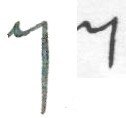
On the left you see the y from Gallaway's signature. On the right is the y from McKinney from the copyright form. Both are characters at the end of a name. To me they look very similar. With this I am NOT saying that this proves that this is Gallaway's handwriting on the copyright application form. But I do claim that this leaves the possibility wide open that he may have filled it out after all.
On the left you see the y from Gallaway's signature. On the right is the y from McKinney from the copyright form. Both are characters at the end of a name. To me they look very similar. With this I am NOT saying that this proves that this is Gallaway's handwriting on the copyright application form. But I do claim that this leaves the possibility wide open that he may have filled it out after all.
I think all you've show possible is that someone at McKinney filled out the form, left one letter off McKinney's name, and got Edward Gallaway to come finish it.
Bill Mullins wrote:I think all you've show possible is that someone at McKinney filled out the form, left one letter off McKinney's name, and got Edward Gallaway to come finish it.
Another one of your outlandish explanations. But coming from somebody who does think Erdnase didn't read any gambling books it is not a surprise. Here is the portion of the text the y comes from.
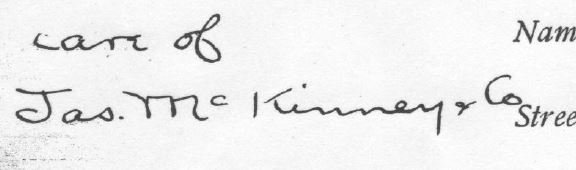
Doesn't look like somebody added the y. But it is a start that you agree the y's look the same.
lybrary wrote:I mentioned earlier one cannot compare a signature with regular handwriting, because a signature is more like a drawing rather than regular handwriting. But since Bill Mullins made a comment that he thinks there is no way that Gallaway could have filled out the copyright form of EATCT, based on a comparison of the signature to the handwriting, I wanted to demonstrate that Gallaway could very well be the filler outer.
On the left you see the y from Gallaway's signature. On the right is the y from McKinney from the copyright form. Both are characters at the end of a name. To me they look very similar. With this I am NOT saying that this proves that this is Gallaway's handwriting on the copyright application form. But I do claim that this leaves the possibility wide open that he may have filled it out after all.
Chris, which Gallaway signature are referring to? The one posted earlier in this forum?
Carlo Morpurgo wrote:Chris, which Gallaway signature are referring to? The one posted earlier in this forum?
No, a different one. I have more than one signature samples of him.
The "y's" don't look the same.
One has a rounded top, the other forms a loop at the top.
Folks who loop their up-strokes don't suddenly stop and round them off.
The two share some similarities, but they are (IMO) not the same.
One has a rounded top, the other forms a loop at the top.
Folks who loop their up-strokes don't suddenly stop and round them off.
The two share some similarities, but they are (IMO) not the same.
Zenner wrote:The name "E.C. Andrews" appears several times in those Files but there is absolutely no evidence that it was Emory Cobb Andrews.
But very, very, very, very likely.
Bill Mullins wrote:Note that one of the professors at the Univ of Chicago at this time was Robert Andrews Millikan, whose name has previously been associated with Erdnase.
I love that the referenced piece on Wikipedia was added on April Fools' Day in 2006.
Roger M. wrote:The "y's" don't look the same.
One has a rounded top, the other forms a loop at the top.
Folks who loop their up-strokes don't suddenly stop and round them off.
The two share some similarities, but they are (IMO) not the same.
I am not an expert just comparing images. But keep in mind that in the signature the y is preceded by an 'a' and in McKinney by an 'e' - two different characters which may explain why the beginning of the y looks slightly different. Also keep in mind these two samples have a 25 year gap between them. Handwriting can certainly change over that time period. But the end of the y, the upstroke and then the final downstroke look pretty much identical. Again, my purpose was to show that Bill Mullin's assertion that these cannot be the same is silly. There is certainly a possibility that they might come from the same person. We don't know and based on the information available to us we can't make a call either way.
To what accuracy do we know the date of M. D. Smith's meeting with Erdnase at the hotel?
mam wrote:To what accuracy do we know the date of M. D. Smith's meeting with Erdnase at the hotel?
According to David Alexander from his January 2000 Genii article:
Marshall Smith told Martin Gardner that the day he met Erdnase was "bitterly cold." Weather records for the November--December 1901, and January 1902 show the only cold snap occurred on December 14th where the temperature dropped from 48 degrees the day before to 8. On Monday, December 15th, the high for the day was -2 degrees, cold even by Chicago standards. The only other day that approached this temperature was late in January 1902.
Hurt McDermott notes in Artifice, Ruse and Subterfuge that Smith remembers keeping his coat on while Erdnase did not.
The viability of a December 1901 date pretty much depends upon whether or not the date allowed Smith enough time to do the drawings. A great many ins and outs of this have been discussed on this thread.
I guess one could also look up in "Estimating for printers" by Gallaway roughly how much time would be needed to prepare the entire book for print from manuscript and illustrations, i.e. when the drawings would have to be done at the latest for the book to realistically be done in time for the copyright date it has. As said, roughly, but still some sort of indicator.
(Which has more or less already been done, I realize when reading the Genii article from 2000.)
mam wrote:I've found the following seven occurrences of Andrews in the bankruptcy files, with page numbers in the Lybrary PDF in parentheses:
E. C. Andrews (where handwritten "C" replaces typed "B".) (p. 131)
E. C. Andrews (p. 139)
E. C. Andrews (p. 149)
E. C. Andrews (p. 150)
E. C. Andrews (p. 160)
E. C. Andrews (p. 169)
E. B. Andrews (p. 393)
Did I miss any?
Yes, this misses what I believe to be the most important occurrence of "Andrews" in the bankruptcy files, from which all the above follow. It doesn't show up in OCR searches, alas. It is on p. 627 of the lybrary PDF. I would characterize it as "E. ? Andrews" where the middle initial appears to be a capital "C" written over a capital "B". This is in the Debtor's Petition of February 10, 1903 and I believe it predates the above references. I believe the above references were transcriptions from this document's handwritten list of creditors. The document may also be seen here:
http://askalexander.org/display/66804/M ... resource/9
The $3 debt is listed as being for "Goods sold and delivered"
mam wrote:Zenner wrote:The name "E.C. Andrews" appears several times in those Files but there is absolutely no evidence that it was Emory Cobb Andrews.
But very, very, very, very likely.
Please explain why you wrote that.
"E.C. Andrews" contracted with McKinney's in August, 1902, to supply and deliver his books. Emory Cobb Andrews was born on January 16, 1878, making him 24 at the time. What book could he have been associated with?
I maintain that "E.C. Andrews" was the pseudonym used by the author of The Expert in his business dealings regarding that book. The availability of the book was announced in the following month's Sphinx. I believe that he took the name from Emory Cobb Andrews and that in no way could the man in the Files be Emory himself.
Unless you can show me what Emory's dealings with McKinney were for, of course.
Peter Zenner
Zenner wrote: I maintain that "E.C. Andrews" was the pseudonym used by the author of The Expert in his business dealings regarding that book. . . I believe that he took the name from Emory Cobb Andrews and that in no way could the man in the Files be Emory himself.
How did Thompson know Emory so that he would use his name in late 1901/early 1902?
Zenner wrote: I maintain that "E.C. Andrews" was the pseudonym used by the author of The Expert in his business dealings regarding that book. . . I believe that he took the name from Emory Cobb Andrews and that in no way could the man in the Files be Emory himself.
How did Thompson know Emory so that he would use his name in late 1901/early 1902?
mam wrote:To what accuracy do we know the date of M. D. Smith's meeting with Erdnase at the hotel?
Alexander pinned down a possible date in 1901 that the meeting could have happened, but it also could have happened in 1900 or 1899.
lybrary wrote:Another one of your outlandish explanations. But coming from somebody who does think Erdnase didn't read any gambling books it is not a surprise.
Of course I think Erdnase read gambling books. What I was addressing was your specific comment that "He writes so himself that he has pretty much read all the past literature both in magic and in gambling." He didn't make any such statement. And the gambling literature of the era, sparse though it is, has material that he didn't address, suggesting that he wasn't familiar with it. He knew about some of the gambling literature, but there's no reason to think he knew about all of it.
It's a fair read of his book that he had read much of the conjuring literature, but he doesn't say that he read the gambling literature. Jason England makes the argument that he did, but it is also just as likely that he had seen the touring "reformed gamblers" who made their living by speaking on the evils of gambling and demonstrating their methods, and knew of them and their methods from their shows. J. P. Quinn lived in Chicago and did his schtick there many times. Kid Royal also performed in Chicago often in the 1890s. Erdnase probably was familiar with both of them -- but he makes no claim that he read "pretty much" all of their writings.
What is outlandish is the idea that by finding one handwritten character from the hundred or so on the copyright application that is similar to one character in some unknown number of signatures is in any way evidence that the two things were written by the same person. One matched character doesn't outweigh 99 clearly different ones.
Obviously my suggestion that Gallaway wrote one letter on the application was ridiculous -- to emphasize how far out was your suggestion that, based on one "matching" letter, the two documents were from the same hand.
Zenner wrote:mam wrote:Zenner wrote:The name "E.C. Andrews" appears several times in those Files but there is absolutely no evidence that it was Emory Cobb Andrews.
But very, very, very, very likely.
Please explain why you wrote that.
Because I find it very, very, very, very likely that one "E. C. Andrews" found in the bankruptcy files of a printing house is a known "Emory Cobb Andrews" that worked for another printing house next doors during the same time period. If you disagree then I have no further comment on this.
Richard Hatch wrote:Yes, this misses what I believe to be the most important occurrence of "Andrews" in the bankruptcy files, from which all the above follow. It doesn't show up in OCR searches, alas. It is on p. 627 of the lybrary PDF. I would characterize it as "E. ? Andrews" where the middle initial appears to be a capital "C" written over a capital "B". This is in the Debtor's Petition of February 10, 1903 and I believe it predates the above references. I believe the above references were transcriptions from this document's handwritten list of creditors. The document may also be seen here:
http://askalexander.org/display/66804/M ... resource/9
The $3 debt is listed as being for "Goods sold and delivered"
What are the ledgers referenced in the first column? E.g. "1-429" for that entry.
Bill Mullins wrote:What is outlandish is the idea that by finding one handwritten character from the hundred or so on the copyright application that is similar to one character in some unknown number of signatures is in any way evidence that the two things were written by the same person. One matched character doesn't outweigh 99 clearly different ones.
Obviously my suggestion that Gallaway wrote one letter on the application was ridiculous -- to emphasize how far out was your suggestion that, based on one "matching" letter, the two documents were from the same hand.
Which I clearly emphasized is NOT what I concluded. I simply concluded that the possibility does exist unlike your categorical denial of it. We don't know who filled out the form, but Gallaway can't be ruled out at this point. The similarity of the y opens this possibility.
Bill Mullins wrote:It's a fair read of his book that he had read much of the conjuring literature, but he doesn't say that he read the gambling literature.
Bill, you are not exhibiting a particularly large amount of common sense here. So if Erdnase, as we pretty much all agree including yourself, has read the magic literature of his time, why would he suddenly change behavior and not read about his other interest - gambling and card advantage play? Of course he would. He clearly was somebody who read extensively and also somebody who knew a lot about books in general, otherwise he would not have pursued a self-publishing route. His broad vocabulary and eloquence also underscore that he was widely read, not just in magic and gambling. So yes, he definitely also read the prevailing gambling literature. None of this excludes that he may have missed some of the more obscure publications, and nobody can say for sure if he indeed read everything under the sun in magic and gambling. But he definitely read most of the magic and gambling literature available at that time.
I'm trying to find a photo of Emory Cobb Andrews. There definitely is one in the Cap and Gown yearbooks from the University of Chicago, since he was member of a lot of clubs and many of them have group photos in there. But it's sometimes a bit hard to make out facial features from low-res scans of really old photos. These are four of reasonable quality, Andrews should be in most of them:
https://dl.dropboxusercontent.com/u/307 ... ews/01.jpg
https://dl.dropboxusercontent.com/u/307 ... ews/02.jpg
https://dl.dropboxusercontent.com/u/307 ... ews/03.jpg
https://dl.dropboxusercontent.com/u/307 ... ews/04.jpg
Can you spot him?
https://dl.dropboxusercontent.com/u/307 ... ews/01.jpg
https://dl.dropboxusercontent.com/u/307 ... ews/02.jpg
https://dl.dropboxusercontent.com/u/307 ... ews/03.jpg
https://dl.dropboxusercontent.com/u/307 ... ews/04.jpg
Can you spot him?
I found this photo of Emory Cobb Andrews:
https://dl.dropboxusercontent.com/u/307 ... ews/05.jpg
It's from the playbook of the musical comedy "The academic alchemist".
Looking at that photo, I've come to the conclusion that these photos are of Andrews as well:
https://dl.dropboxusercontent.com/u/307 ... ews/07.jpg
https://dl.dropboxusercontent.com/u/307 ... ews/08.jpg
And maybe this one:
https://dl.dropboxusercontent.com/u/307 ... ews/06.jpg
A funny coincidence by the way, guess what street he lived on?
Vernon Avenue
https://dl.dropboxusercontent.com/u/307 ... ews/05.jpg
It's from the playbook of the musical comedy "The academic alchemist".
Looking at that photo, I've come to the conclusion that these photos are of Andrews as well:
https://dl.dropboxusercontent.com/u/307 ... ews/07.jpg
https://dl.dropboxusercontent.com/u/307 ... ews/08.jpg
And maybe this one:
https://dl.dropboxusercontent.com/u/307 ... ews/06.jpg
A funny coincidence by the way, guess what street he lived on?
Vernon Avenue
Bravo on the findings. Even if he did write "purse" I'm gonna hold out for a little more evidence.
Interesting to note about Emory Cobb Andrews is that he did a lot of things: photography, etchings, played the mandolin, banjo and clarinet, and led the university orchestra, wrote plays and acted in them, editor on the yearbook, etc. as well of course being an expert chemist and skilled enough in this as applied to print technology to later having written books on the subjects of ink and color.
mam wrote:I found this photo of Emory Cobb Andrews:
https://dl.dropboxusercontent.com/u/307 ... ews/05.jpg
It's from the playbook of the musical comedy "The academic alchemist".
Here is the same picture, in the context of the play from which it was taken "The Deceitful Dean."
Andrews makes a better looking girl than some of his classmates.
lybrary wrote:Bill Mullins wrote:It's a fair read of his book that he had read much of the conjuring literature, but he doesn't say that he read the gambling literature.
Bill, you are not exhibiting a particularly large amount of common sense here. So if Erdnase, as we pretty much all agree including yourself, has read the magic literature of his time, why would he suddenly change behavior and not read about his other interest - gambling and card advantage play? Of course he would. He clearly was somebody who read extensively and also somebody who knew a lot about books in general, otherwise he would not have pursued a self-publishing route. His broad vocabulary and eloquence also underscore that he was widely read, not just in magic and gambling. So yes, he definitely also read the prevailing gambling literature. None of this excludes that he may have missed some of the more obscure publications, and nobody can say for sure if he indeed read everything under the sun in magic and gambling. But he definitely read most of the magic and gambling literature available at that time.
Chris -- re-read my posts. I believe he read gambling literature. I don't see where he said "I read gambling literature."
Re-read your posts. You said "He writes so himself that he has pretty much read all the past literature both in magic and in gambling." He said something like that about magic, but not about gambling.
And it is of minor importance, and not something you and I should be disagreeing about in such depth. We should be disagreeing on whether Gallaway wrote EATCT (he didn't).
Bill Mullins wrote:Here is the same picture, in the context of the play from which it was taken "The Deceitful Dean."
Andrews makes a better looking girl than some of his classmates.
He is very good looking in that picture.
I'm currently trying to figure out who wrote this piece, as it uses the word "subterfuge".
DChung wrote:… Moreover you completely sidestepped my question about what "strong possibility" means. …
Still waiting, Chris, for an answer to DChung’s reasonable – and quite pertinent – question. Perhaps it’s too much to demand a precise probability (e.g., 47.5%), but as an expert Dr. Olsson must surely be aware of the evidentiary vagueness/malleability of “strong possibility” – without clear context and explication, I find the weight of his expert opinion to be slight.
[As a general note, I thought DChung bent over backwards to be fair and clear with you on all his points, and sad to say, found your responses disappointing.]
Hey all,
I'm thinking about starting to put together a central repository of information/data/materials for everything related to Erdnase. It would basically be a page/website with all the people, locations, dates, etc. with links to documents, photos and so on, as well as all verified facts including their sources. Sort of a condensed view of everything we know at this point. And not trying to "build a case" for any specific candidate. The purpose would be to not having to hunt every piece of information down through this thread, books, magazines, etc. when looking for some fact or another.
Three questions:
I'm thinking about starting to put together a central repository of information/data/materials for everything related to Erdnase. It would basically be a page/website with all the people, locations, dates, etc. with links to documents, photos and so on, as well as all verified facts including their sources. Sort of a condensed view of everything we know at this point. And not trying to "build a case" for any specific candidate. The purpose would be to not having to hunt every piece of information down through this thread, books, magazines, etc. when looking for some fact or another.
Three questions:
- Does anything like this already exist?
- Would anyone other than me find it useful?
- Would anyone be willing to help out building it?
mam wrote: Because I find it very, very, very, very likely that one "E. C. Andrews" found in the bankruptcy files of a printing house is a known "Emory Cobb Andrews" that worked for another printing house next doors during the same time period. If you disagree then I have no further comment on this.
I have seen no evidence that Emory Cobb Andrews ever worked for a "printing house". He worked for Philip Ruxton Inks - a manufacturer of printing inks - and Ruxton's was listed seperately as a creditor in the McKinney Bankruptcy Files. So please tell me why you are saying that McKinney would owe money to Emory. He can't have been at Ruxton's above a few months and yet you are saying that he himself had a seperate contract with McKinney to supply and deliver his own goods.
I would dearly love to hear your comments on this, so please don't just dismiss me.
Peter Zenner
mam wrote:Hey all,
I'm thinking about starting to put together a central repository of information/data/materials for everything related to Erdnase.
You can expand on http://geniimagazine.com/magicpedia/Erdnase and make whatever new pages needed. You can upload pictures, files, etc. I'll help if needed. We can make a specific Erdnase "category" to group them all together too.
Bill Mullins wrote:I believe he read gambling literature.
Very well, then we are in basic agreement on this point. I would phrase it stronger, that he extensively read gambling literature, everything he could get his hands on, just as he did with magic literature. But if you do not want to go that far that is fine.
Knowing that Erdnase was very well read in gambling, it is significant that we know that Gallaway had several gambling books in his library as well as a first edition of EATCT. When somebody has several books on the same subject it is a straight forward assumption that he must have had an interest in that subject.
Zenner wrote: He can't have been at Ruxton's above a few months
So how did Thompson know him prior to Feb 1902, in order to use his name while dealing with McKinney?
lybrary wrote:[Gallaway] clearly was somebody who read extensively and also somebody who knew a lot about books in general, otherwise he would not have pursued a self-publishing route.
You are drawing many conclusions from scant evidence, but this is one of the biggest leaps. Are there any reasons that one would self-publish rather than be published traditionally besides:
1. Traditional publishers won't take the book (thus the existence of vanity presses)
2. The author thinks he could make more money by publishing himself than by being traditionally published.
I have never heard of a case where someone self-published a book because they liked to read.
lybrary wrote:Bill Mullins wrote:I believe he read gambling literature.
Very well, then we are in basic agreement on this point. I would phrase it stronger, that he extensively read gambling literature, everything he could get his hands on.
Yes, you could do that. And you may well be right. But there is absolutely no evidence to support going that far.
When somebody has several books on the same subject it is a straight forward assumption that he must have had an interest in that subject.
But that's all it is -- an assumption. I have more than several books on the following categories:
magic
gambling
birds
astronomy
light houses
Von Braun's rocket team/Peenemuende
telescope making
comic books
numismatics
trading cards
science fiction/horror criticism
Tennessee history
mental mathematics (a la Arthur Benjamin)
recreational mathematics/puzzles
American slang
(and that's just at home -- my technical library at work covers several more topics)
and I'm not so knowledgeable about any of those subjects that I could write a book as comprehensive as Erdnase's.
Gallaway had some gambling books. He likely was interested in the subject. Doesn't mean he knew enough about the subject to write his own book. Think about it -- most people who have a small (or large) collection of gambling books aren't competent to write one. Your own experience as a book dealer must bear this out.
mam wrote:Hey all,
I'm thinking about starting to put together a central repository of information/data/materials for everything related to Erdnase. It would basically be a page/website with all the people, locations, dates, etc. with links to documents, photos and so on, as well as all verified facts including their sources. Sort of a condensed view of everything we know at this point. And not trying to "build a case" for any specific candidate. The purpose would be to not having to hunt every piece of information down through this thread, books, magazines, etc. when looking for some fact or another.
Three questions:
- Does anything like this already exist?
- Would anyone other than me find it useful?
- Would anyone be willing to help out building it?
I've got a ton of stuff like this on my own computer hard drive. But it wouldn't be appropriate to post it online because some of it is personal scanned copies of things that are still in copyright (magazine articles, books etc).
Zenner wrote:mam wrote: Because I find it very, very, very, very likely that one "E. C. Andrews" found in the bankruptcy files of a printing house is a known "Emory Cobb Andrews" that worked for another printing house next doors during the same time period. If you disagree then I have no further comment on this.
I have seen no evidence that Emory Cobb Andrews ever worked for a "printing house". He worked for Philip Ruxton Inks - a manufacturer of printing inks - and Ruxton's was listed seperately as a creditor in the McKinney Bankruptcy Files. So please tell me why you are saying that McKinney would owe money to Emory. He can't have been at Ruxton's above a few months and yet you are saying that he himself had a seperate contract with McKinney to supply and deliver his own goods.
I would dearly love to hear your comments on this, so please don't just dismiss me.
Peter Zenner
According to the biographical information in the publisher's preface to his 1911 book, Color and its Application to Printing (available in Google books), after working as a de facto assistant instructor in Chemistry at the University of Chicago, he entered commercial life working for the Corn Products Refining Company before "connecting himself" with Ruxton. Though the exact time line is not given, it seems unlikely to me that he would have been at Ruxton during the period in question, when the author of the book was known to have been dealing with McKinney (Feb-March 1902).
This is probably just a coincidence (!) but I post it here in case anyone sees fit to pursue it:
Emory Cobb Andrews' mother's maiden name appears to have been Cobb (Ellen Cobb Andrews, born July 11, 1847 in Ledyard, NY, died Sept 26, 1910 in Chicago), raising the possibility that he was related to Benjamin Franklin Cobb (born 1844) who wrote many books, including one published in Chicago in 1902 illustrated by.... Marshall D. Smith! (That would be Jack Henderson Down East).
Emory Cobb Andrews' mother's maiden name appears to have been Cobb (Ellen Cobb Andrews, born July 11, 1847 in Ledyard, NY, died Sept 26, 1910 in Chicago), raising the possibility that he was related to Benjamin Franklin Cobb (born 1844) who wrote many books, including one published in Chicago in 1902 illustrated by.... Marshall D. Smith! (That would be Jack Henderson Down East).
There's been a lot of information (all interesting) about Emory Cobb Andrews posted lately. I've posted some of it myself.
But no one here thinks he had anything to do with the writing, printing or publishing of Expert at the Card Table, do they?
But no one here thinks he had anything to do with the writing, printing or publishing of Expert at the Card Table, do they?
Bill Mullins wrote:lybrary wrote:[Gallaway] clearly was somebody who read extensively and also somebody who knew a lot about books in general, otherwise he would not have pursued a self-publishing route.
I have never heard of a case where someone self-published a book because they liked to read.
Bill, I think you can't read. First, my comment was related to Erdnase not Gallaway as you injected above. So let me restate my argument. Somebody who chooses to self-publish, finds a printer, pays for the print run, hires an illustrator, and is comfortable to then sell and market his book is certainly somebody who is comfortable with the book creation process and the book trade in general. Yes, I do have a lot of experience dealing with authors and one of the primary reason they come to me is because many have little idea how to create, publish and market their book. They are perfectly qualified to write it and can do that easily, but stuff that comes after writing is unfamiliar to them. That is why publishers do exist. The fact that Erdnase chose to self-publish demonstrates a certain familiarity with the book creation and publishing process.
Bill Mullins wrote:lybrary wrote:Bill Mullins wrote:I believe he read gambling literature.
Very well, then we are in basic agreement on this point. I would phrase it stronger, that he extensively read gambling literature, everything he could get his hands on.
Yes, you could do that. And you may well be right. But there is absolutely no evidence to support going that far.
Yes there is. Humans are creatures of habit. Since he describes his own extensive reading in magic it supports the fact that he most likely did the same in gambling, too. His book is about half on gambling related stuff and half on magic related stuff. These two subjects seem to be of about equal interest to him. All of this suggests that he did do as much extensive reading on gambling as he did on magic. Actually you could argue that the gambling side is a bit more important to him and thus he would have done at least as much research on gambling as he did on magic.
Bill Mullins wrote:When somebody has several books on the same subject it is a straight forward assumption that he must have had an interest in that subject.
But that's all it is -- an assumption. I have more than several books on the following categories:
magic
gambling
birds
astronomy
light houses
Von Braun's rocket team/Peenemuende
telescope making
comic books
numismatics
trading cards
science fiction/horror criticism
Tennessee history
mental mathematics (a la Arthur Benjamin)
recreational mathematics/puzzles
American slang
(and that's just at home -- my technical library at work covers several more topics)
and I'm not so knowledgeable about any of those subjects that I could write a book as comprehensive as Erdnase's.
And that is all I am arguing right now. I am arguing Gallaway had an interest in gambling. This fact makes him a better Erdnase candidate than without it. Can you show even that much with ES Andrews or WE Sanders? Can you demonstrate that they had an interest in gambling? Gallaway had.
Bill Mullins wrote:Gallaway had some gambling books. He likely was interested in the subject.
Then we are in agreement. That is all I am trying to establish at this point. We have evidence that Gallaway had an interest in gambling. The fact that he had a copy of EATCT would allow us to go a step further and say he likely had an interest in card moves, too, but I am fine if some do not want to go that far. Gallaway's interest in gambling is already a lot more than we can say of ES Andrews and WE Sanders on that subject.
The fact that Gallaway had a copy of any book from a company he may have worked for in any capacity means NOTHING. ZERO. Rather than assuming the book was in possession because he had some interest in it, it is just as easy to assume that someone else at the company handed him a copy one day in passing to, for example, look at the binding or the typesetting.
And, Chris, please maintain some decorum--which precludes telling Bill that he can't read.
And, Chris, please maintain some decorum--which precludes telling Bill that he can't read.
Zenner wrote:I have seen no evidence that Emory Cobb Andrews ever worked for a "printing house". He worked for Philip Ruxton Inks - a manufacturer of printing inks - and Ruxton's was listed seperately as a creditor in the McKinney Bankruptcy Files. So please tell me why you are saying that McKinney would owe money to Emory. He can't have been at Ruxton's above a few months and yet you are saying that he himself had a seperate contract with McKinney to supply and deliver his own goods.
Doesn't really matter if it's "printing house" or "printing supply house", since my point is that he worked in the center of all Chicago's printing business and it is no surprise to have him show up in McKinney records. I can come up with any number of reasons why McKinney owed him money, one for each potential "thing" or "service" they got from him but had not paid for yet, i.e. same as with everyone else in those files, per definition.
Where do you get the idea Andrews only worked a few months at Ruxton's? How did he end up second vice-president of the entire company in such short time?
Richard Kaufman wrote:The fact that Gallaway had a copy of any book from a company he may have worked for in any capacity means NOTHING. ZERO. Rather than assuming the book was in possession because he had some interest in it, it is just as easy to assume that someone else at the company handed him a copy one day in passing to, for example, look at the binding or the typesetting.
Richard you are forgetting that we know that he also had several other books on gambling. If it would be only EATCT then your argument would be stronger. But since he had several other books on gambling it does support the fact that he actually had an interest in that subject rather than an accidental ownership of the book. You yourself stated earlier that an employee of McKinney would pick up the book because he had an interest. What changed that you don't think this is a likely scenario?
Richard Kaufman wrote:And, Chris, please maintain some decorum--which precludes telling Bill that he can't read.
Bill injected Gallaway as the subject of my sentence when it is clear I meant Erdnase. That is a misrepresentation of my opinion. I don't look at such things lightly. It would deserve much stronger language in my opinion.
Bill Mullins wrote:There's been a lot of information (all interesting) about Emory Cobb Andrews posted lately. I've posted some of it myself.
But no one here thinks he had anything to do with the writing, printing or publishing of Expert at the Card Table, do they?
Not yet, at all, but for some reason I find him interesting enough to dig a bit more. He was at the right place (down to the block) at the right time and has a profile largely in tune with e.g. Alexander's.
However, as I wrote earlier, he's too young to have authored the book.
Richard Kaufman wrote:And, Chris, please maintain some decorum--which precludes telling Bill that he can't read.
Leave them alone.
I am enjoying the exchanges between Chris and Bill.
It is reminiscent of the Point/Counterpoint exchanges between Dan Aykroyd and Jane Curtain.
lybrary wrote: First, my comment was related to Erdnase not Gallaway as you injected above.
You've been making the argument for weeks that Gallaway was Erdnase. Are you backing off of that now? My work here is done . . .
I didn't mean to misrepresent your statement.
So let me restate my argument. Somebody who chooses to self-publish, finds a printer, pays for the print run, hires an illustrator, and is comfortable to then sell and market his book is certainly somebody who is comfortable with the book creation process and the book trade in general.
This isn't restating the old argument, it is making a new one. The old argument (the one you have been making, that I was responding to) was that Gallaway (when writing as Erdnase) was a book lover, therefore he would have been inclined to self-publish. (a conclusion that does not follow from the stated premise, BTW)
Yes, I do have a lot of experience dealing with authors and one of the primary reason they come to me is because many have little idea how to create, publish and market their book. They are perfectly qualified to write it and can do that easily, but stuff that comes after writing is unfamiliar to them.
The experience I was hoping you'd recall was that of a book dealer (see my post above, where I said "experience as a book dealer") selling to readers, not as a publisher. Just because a person has, or reads, a number of books on a subject does not mean that they could write on it. I think Expert is such a good book because the author brought his experience to the text, not his research and regurgitation of other gambling (and magic) books. If you want to convince me that Gallaway is Erdnase, show me that he gambled, not that he read about gambling.
Bill Mullins wrote:lybrary wrote:Very well, then we are in basic agreement on this point. I would phrase it stronger, that he extensively read gambling literature, everything he could get his hands on.
Yes, you could do that. And you may well be right. But there is absolutely no evidence to support going that far.
Yes there is. Humans are creatures of habit. Since he describes his own extensive reading in magic it supports the fact that he most likely did the same in gambling, too.
Anytime you say something is "most likely", you are offering opinion, not citing evidence. Give me one line from Expert that shows the author "pretty much read all the past literature . . . in gambling" and I'll back off from this.
His book is about half on gambling related stuff and half on magic related stuff. These two subjects seem to be of about equal interest to him.
If I were in a nit-picky mood, I'd point out that he wrote 40% more about gambling than he did about magic (116 pages vs 81), but I'm not . . .
Marty's Genii article on Sanders describes his gambling debts, the card games he played, and his trips to the Silver Bow, a gambling club.And that is all I am arguing right now. I am arguing Gallaway had an interest in gambling. This fact makes him a better Erdnase candidate than without it. Can you show even that much with ES Andrews or WE Sanders? Can you demonstrate that they had an interest in gambling?
A couple of folks have suggested that Chris is being rude to me -- so far, I have not been offended by anything he's written (and to the extent I may have offended him, it was not my intention, and I apologize). I've had much worse things said about me on the internet (and probably have said worse myself). I've been online for quite a while and have a reasonably thick skin about such things. Chris and I are discussing ideas and the evidence behind them -- it isn't personal. He is giving as good as he is getting.Brad Jeffers wrote:Richard Kaufman wrote:And, Chris, please maintain some decorum--which precludes telling Bill that he can't read.
Leave them alone.
I am enjoying the exchanges between Chris and Bill.
It is reminiscent of the Point/Counterpoint exchanges between Dan Aykroyd and Jane Curtain.
I hope, when this is all said and done, if we were to meet at a convention we could shake hands and have a beer. We continue to have emails off line which are much more collegial than some of the exchanges here.
But if he says, "Bill, you ignorant slut" to me, all bets are off . . .
Bill Mullins wrote:You've been making the argument for weeks that Gallaway was Erdnase. Are you backing off of that now? My work here is done . . .
Perhaps you didn't catch my drift. Yes, I am convinced that Gallaway is Erdnase, but what I have tried to establish over the last days is, to use a mathematical term, our largest common denominator. What can the anti-Gallaway folks and myself agree on? We already made a big step forward. We have established that you agree that: Gallaway was likely interested in gambling. I agree with this, you agree with this, perhaps others can agree with this, too.
Thanks for correcting me on Sanders. I am not an expert on him. So Sanders gambled. Good. That means more to me than his little magic trick in his notebook. What about ES Andrews? Anything we can say about gambling?
Bill Mullins wrote:I think Expert is such a good book because the author brought his experience to the text, not his research and regurgitation of other gambling (and magic) books. If you want to convince me that Gallaway is Erdnase, show me that he gambled, not that he read about gambling.
As I am sure you know a lot of expertise starts with an interest, then comes reading, then experimenting, and then perhaps innovating. Showing that Gallaway was interested in gambling, that he read about it is therefore the first step. Yes, it does not prove that he actually gambled or did any of the moves in EATCT, but it also does not exclude it. His interest in gambling makes him more likely Erdnase than having no interest in gambling. Do you agree?
Now that we have agreement on how to interpret the fact that he owned several gambling books, let's move on to the next set of evidence. Something new I am sure you will enjoy. Based on the feedback over the last days regarding if Erdnase is witty we received general confirmation that he is. Tom Sawyer calls it 'witticisms' in one of his blog posts. Bill Mullins commented "...I can see why others would say witty." MAM wrote: "Definitely witty, in my opinion." I also asked several people via email and they all agreed Erdnase is witty. See what I do? I like to be objective. I am not only stating my opinion. I am actually making an effort to check if my opinion is something others can agree with. I also think Erdnase is witty. Ok, so with Erdnase is witty in our mind please read this from a 1928 Inland Printer article:
"The addresses made for the occasion were masterly in every sense of the word; they fairly bristled with wit and sarcasm. Such a trio as Tom Quin, Theodore Regensteiner, and Edward Gallaway surpass anything in wit and humor that Flo Ziegfeld or Earl Caroll so far has produced."
Aha, so Gallaway was also witty: Erdnase witty, Gallaway witty. Nice match. This adds to the linguistic metrics, because wit goes beyond merely counting and comparing words. It is a special gift a style that isn't very common. That is part of why Erdnase is such a good read. He writes interestingly and wit and humor is part of that. I leave you with contemplating this parallel between Gallaway and Erdnase.
mam wrote:Zenner wrote:I have seen no evidence that Emory Cobb Andrews ever worked for a "printing house". He worked for Philip Ruxton Inks - a manufacturer of printing inks - and Ruxton's was listed seperately as a creditor in the McKinney Bankruptcy Files. So please tell me why you are saying that McKinney would owe money to Emory. He can't have been at Ruxton's above a few months and yet you are saying that he himself had a seperate contract with McKinney to supply and deliver his own goods.
Doesn't really matter if it's "printing house" or "printing supply house", since my point is that he worked in the center of all Chicago's printing business and it is no surprise to have him show up in McKinney records. I can come up with any number of reasons why McKinney owed him money, one for each potential "thing" or "service" they got from him but had not paid for yet, i.e. same as with everyone else in those files, per definition.
Where do you get the idea Andrews only worked a few months at Ruxton's? How did he end up second vice-president of the entire company in such short time?
If that entry in the McKinney Files really was Emory Cobb Andrews then it would be a surprise, given his background and employment up to that point.
He graduated from Chicago University in August, 1900, and worked for a while for either (or both) the "G.S. Refining Company" and the "Corn Products Refining Company" (or perhaps they were one and the same?).
He then applied for a passport on June 19, 1901, and set sail for England on July 3 intending to return that autumn. When is autumn in Chicago? October-November? His occupation was stated to be "whol linen", or something like that - "wholesale linen"? Whatever it was it doesn't sound like anything to do with inks or printing.
So he can't have started at Ruxton's until sometime after his return from England towards the end of 1901. That's where I get the idea that he can only only have been at Ruxton's for a few months! The contract between "E.C. Andrews" and McKinney's was made in August, 1902. I would say that 8 or 9 months = a few months, wouldn't you?
He then worked his way up to being manager of the Chicago office by 1910, Second Vice-President by 1913 and Vice President by 1918.
Yes, he was a clever chap - “A student at Princeton and a graduate of the University of Chicago, Mr. Andrews specialized in chemistry, and, though not officially on the faculty roll, was for a time in effect assistant instructor in chemistry in the University of Chicago."
Peter Zenner
Zenner wrote:If that entry in the McKinney Files really was Emory Cobb Andrews then it would be a surprise, given his background and employment up to that point. […]
Thanks for all the additional information, you had more facts than I. Would you mind sharing the sources? I have the university info already, and some of the employment info based on alumni records and the introductions to his books, but e.g. the passport info I have not.
Bill Mullins wrote:Are there any reasons that one would self-publish rather than be published traditionally besides:
1. Traditional publishers won't take the book (thus the existence of vanity presses)
2. The author thinks he could make more money by publishing himself than by being traditionally published.
Just as a data point, I self-published Scripting Magic a few years ago for neither of these reasons. I never asked a "traditional" magic publisher if they would take the book, and I had no expectation about making more money either way.
I did it because it seemed like a good idea and a fun project, where I would learn a lot. I did.
I am not certain what assumptions are being made regarding the date that Emory Cobb Andrews began working for Philip Ruxton. It seems, however, that the assumption is that he worked there as early as 1901 or 1902. Or maybe someone has presented evidence for a definite date, and I have missed it or forgotten it.
Anyway, based on Google Books search results, it appears to me that he began working for Ruxton no earlier than 1905. The items listed in the results were "snippet view" items, and the search results under those circumstances are often easy to misinterpret, but this was supported by three seemingly separate listings.
--Tom Sawyer
Anyway, based on Google Books search results, it appears to me that he began working for Ruxton no earlier than 1905. The items listed in the results were "snippet view" items, and the search results under those circumstances are often easy to misinterpret, but this was supported by three seemingly separate listings.
--Tom Sawyer
lybrary wrote:When somebody has several books on the same subject it is a straight forward assumption that he must have had an interest in that subject.
You must not be serious about that. Did you ever meet Jay Marshall? Jay, like many others, bought many books on subjects that didn't directly interest him. Jay even owned a book or two he wasn't secretly the author of...
Also, what other books on gambling or magic did Gallaway have in his library? You've mentioned repeatedly that he had other gambling books in his collection, how many and what are they? Were they all printed after Erdnase's book? Perhaps it was his handling of some aspect of the printing of Erdnase that started his interest in gambling and the other books in his collection were published and purchased after Erdnase.
The fact that Gallaway later worked for Bentley, Murray and Co., a firm who printed various materials including score cards sometimes used for book making, shows that Gallaway's reputed few other gambling books might have been collected, like Erdnase, because he was involved in printing them later in his life.
Edward Finck wrote:lybrary wrote:When somebody has several books on the same subject it is a straight forward assumption that he must have had an interest in that subject.
You must not be serious about that.
Oh yes I am.
Edward Finck wrote:Did you ever meet Jay Marshall? Jay, like many others, bought many books on subjects that didn't directly interest him. Jay even owned a book or two he wasn't secretly the author of...
I don't think somebody who owned a million books is the typical case. Of course, there are other reasons why somebody could have several books on a particular subject, but the most likely and straight forward - you know Occam's razor - assumption is that they had an interest.
Edward Finck wrote:Also, what other books on gambling or magic did Gallaway have in his library?
We don't know.
Edward Finck wrote:You've mentioned repeatedly that he had other gambling books in his collection, how many and what are they? Were they all printed after Erdnase's book?
We don't know. But if we find these books which had his bookplate then we will know. They should be somewhere in some collection.
Is anyone interested in this entire thread as a pdf and/or Kindle compatible file? I decided I want to read it all, from the start, and wanted a better (and offline) format so I did a quick and dirty conversion. It's about 700 pages. Given of course I'm not breaking any rules by doing so, I'd be happy to share it.
mam wrote: Thanks for all the additional information, you had more facts than I. Would you mind sharing the sources? I have the university info already, and some of the employment info based on alumni records and the introductions to his books, but e.g. the passport info I have not.
When I started investigating the possibility of Harry S. Thompson being Erdnase, way back in April, 2013, I did umpteen searches on umpteen web-sites. I found that he worked for Ruxton's and a search on Ruxton's came up with the name "E.C. Andrews". Imagine my delight! And then "E.C. Andrews" turning up in those Bankruptcy Files with a contract dating from August, 1902, clinched it.
I searched for more information on Mr. Andrews for completeness sake. His passport application and draft registration card came up on one of the genealogy sites. I think that it was the LDS Family Search site. Others may have them...
Peter Zenner
P.S. I have never suggested that Emory Cobb Andrews was "Erdnase". All the clues (except Dalrymple!) fit in with the description and background of Harry and I concluded that Harry had pinched Emory's name for his pseudonym. Their connection was only that they both worked for Philip Ruxton and Emory was the new boy. He was probably also sent out for a "bucket of elbow grease" and a "left-handed mop".
Tom Sawyer wrote:I am not certain what assumptions are being made regarding the date that Emory Cobb Andrews began working for Philip Ruxton. It seems, however, that the assumption is that he worked there as early as 1901 or 1902. Or maybe someone has presented evidence for a definite date, and I have missed it or forgotten it.
Anyway, based on Google Books search results, it appears to me that he began working for Ruxton no earlier than 1905. The items listed in the results were "snippet view" items, and the search results under those circumstances are often easy to misinterpret, but this was supported by three seemingly separate listings.
--Tom Sawyer
Zenner wrote: I concluded that Harry had pinched Emory's name for his pseudonym. Their connection was only that they both worked for Philip Ruxton and Emory was the new boy.
As late as Jan 1904, Andrews was with Cobb Manufacturing Co. of Chicago, and had not yet become associated with Ruxton.
There is no evidence that Thompson knew Andrews as early as 1902. So no reason to think that Andrews's name was available to be "pinched" by Thompson. And as such, no explanation for why Thompson would use "S. W. Erdnase" as a pseudonym.
In 1905, Emory patented a paper clip.
Another book by Andrews.
Edward Finck wrote:
Also, what other books on gambling or magic did Gallaway have in his library?
Chris W. wrote:
We don't know.
Chris, sorry if I missed it, but what then is your source for stating that Gallaway had magic and gambling books in his library?
Jack Shalom wrote:Edward Finck wrote:
Also, what other books on gambling or magic did Gallaway have in his library?
Chris W. wrote:
We don't know.
Chris, sorry if I missed it, but what then is your source for stating that Gallaway had magic and gambling books in his library?
From The Man Who Was Erdnase p. 390:
"Local Chicago amateur magician William C. Griffiths bought a group of magic and gambling books that a second-hand book dealer had been holding for Rufus Steele, who had died in 1955. Several of the gambling books had the bookplate of Edward Gallaway. One was a first edition of The Expert that Griffiths gave to Marshall." This information got in the book from a letter to Martin Gardner from Marshall.
So, we don't know if any of the magic books were from Gallaway, and we don't know how many gambling books there were. I believe I recall seeing somewhere in this thread that there were 3 known books with Gallaway's bookplate -- I'm only aware of two (Erdnase and The History of the Works of the Learned book that has been previously linked).
Thanks, Bill
3 books on gambling in a collection certainly doesn't seem like "a lot", especially when the company you work for printed one of them.
Roger M. wrote:3 books on gambling in a collection certainly doesn't seem like "a lot", especially when the company you work for printed one of them.
Just to clarify: of the three books known to have Gallaway's bookplate, only one is on gambling, and that is the first edition EATCT. The other two are both volumes of the History of the Works of the Learned, one of which was recently offered on eBay. Presumably Gallaway had a much larger library than these three books (!) and it apparently included several gambling titles, as noted in TMWWE. There may be those who know what those titles were, but if so, they haven't shared their information on that here.
Chris, from what information did you determine Gallaway had a large collection of gambling books?
Bill Mullins wrote: As late as Jan 1904, Andrews was with Cobb Manufacturing Co. of Chicago, and had not yet become associated with Ruxton.
I can't access that or even read the excerpt. But so what? I suspect that this was a side-line. As late as 1913 he was doing three jobs - In the November 19th issue of the Princeton Alumni Weekly, it was reported that "Emory C. Andrews is Second Vice-President of Philip Ruxton, Inc., manufacturers of printing inks. He is also chemist with the Corn Products Company and Manager of the Woodcock Can Company." [Volume XIV, No. 8, page 192]
In the 1900 Directory of the Alumni of the University of Chicago, it said that he was in real estate. That never made it to his CV either. He was probably just helping out in his father's office.
Did you never do two (or more) jobs at the same time? Andrews did and so did I. He got married on January 1, 1904, and probably started bottling "Knock- Out Spots" in a spare room just to make some extra cash. Clever bloke our Emory
Peter Zenner
Zenner wrote:and probably started bottling "Knock- Out Spots" in a spare room just to make some extra cash. Clever bloke our Emory
Peter Zenner
I'm sorry to be ignorant but what the heck are "Knock- Out Spots"?
lybrary wrote:Edward Finck wrote:Also, what other books on gambling or magic did Gallaway have in his library?
We don't know.Edward Finck wrote:You've mentioned repeatedly that he had other gambling books in his collection, how many and what are they? Were they all printed after Erdnase's book?
We don't know. But if we find these books which had his bookplate then we will know. They should be somewhere in some collection.
It's pretty telling that your candidate Gallaway (and I remind you that Jay Marshall considered him as writer/editor and discarded the theory in the 50s) is primarily based on your belief that he had gambling books in his collection. The only gambling book positively known to be in his collection is one he was involved with printing. The speculated other books could have been printed much later and also collected by him when he worked at Bentley, Murray & Co. a known printer of gambling material. Without these supposed books in his collection your whole argument for Gallaway collapses.
Jay definitely investigated Gallaway and spoke with his remaining family and then removed Gallaway from consideration. Jay was really smart and did a lot of the original research and footwork on Erdnase with Martin. If there was an actual case for Gallaway being the author it's extremely likely Jay would have made it.
E.F.
Edward Finck wrote:Zenner wrote:and probably started bottling "Knock- Out Spots" in a spare room just to make some extra cash. Clever bloke our Emory
Peter Zenner
I'm sorry to be ignorant but what the heck are "Knock- Out Spots"?
I did a search on the Cobb Manufacturing Co. and found that they were (or he was) marketing a stain removal product -
"“KNOCK - OUT - SPOTS. Wine, Tea, Coffee, Vegetables, Fruit, Grass, Mildew, Scorch, Ink. Perspiration, Iodine, Silver Nitrate and all Similar Stains. KNOCKOUT-SPOTS will remove Payson’s Indelible Ink. Save your clothes and save money. Don’t send them to the cleaners. Use KNOCK- OUT-SPOTS. If washing will not remove the stains on your table linen--use KNOCK-OUT- SPOTS. Use it on anything that is stained or spotted. It works. It will not injure cotton, woollen or linen goods. The most delicate and valuable laces can be cleaned without the slightest injury to the fabric. NO ACID-NO LIME--NO POISON-NO DANGER. Quick, effective and permanent in its effects. Handy for the housewife --Handy for everybody. Try it once, and you will use it always. It is something, you have always wanted. There is nothing else like it anywhere. Manufactured by THE COBB MANUFACTURING COMPANY OF CHICAGO. PRICE, 25 CENTS FOR LARGE TWO-OUNCE SIZE. 80 CENTS FOR SIX-OUNCE SIZE. A two-ounce bottle will last a long time and will always be ready for use. Don't forget that we want jingles. $5.00 for every Jingle that we accept.” (November 15, 1904. The Daily Review from Decatur, Illinois · Page 2)
I couldn’t find a similar advert in The Chicago Tribune, or anywhere else for that matter.
Peter Zenner
Roger M. wrote:Chris, from what information did you determine Gallaway had a large collection of gambling books?
I never said large. I said "several gambling books". From Gardner/Busby/Whaley: "An inveterate book collector, by the time of his death in 1930 Gallaway had gathered a fair-sized collection of gambling books. ... Several of the gambling books had the bookplate of Edward Gallaway."
Edward Finck wrote:It's pretty telling that your candidate Gallaway is primarily based on your belief that he had gambling books in his collection.
Your reading comprehension is lacking. It is one of the less important pieces of evidence I have offered over the last weeks.
lybrary wrote:Edward Finck wrote:It's pretty telling that your candidate Gallaway is primarily based on your belief that he had gambling books in his collection.
Your reading comprehension is lacking. It is one of the less important pieces of evidence I have offered over the last weeks.
And once again your tact is lacking and so is your case. Without these mysterious gambling books being in his collection your case is zilch.
mam wrote:Is anyone interested in this entire thread as a pdf and/or Kindle compatible file? I decided I want to read it all, from the start, and wanted a better (and offline) format so I did a quick and dirty conversion. It's about 700 pages. Given of course I'm not breaking any rules by doing so, I'd be happy to share it.
I asked Richard Kaufman for permission and he said yes, so here it is:
PDF: https://dl.dropboxusercontent.com/u/307 ... rdnase.pdf (700 pages)
Kindle: https://dl.dropboxusercontent.com/u/307 ... dnase.mobi
Have fun
Something that Chris has pointed out that Erdnase and Gallaway have in common is that they both self-published authors. At first glance, this would seem to be a connection that strengthens the case. But I'm not so sure.
If Erdnase was Gallaway, what is the explanation for the disconnect between letting Drake be the publisher of EATCT from 1905 onward, yet publishing Estimating for Printers himself?
If he was consistent about the benefits of self-publishing, he never would have transferred EATCT to Drake.
If, on the other hand, he took a bath on the first edition, and was content to let Drake deal with the headaches of publishing, why would he then go back into self-publishing for his Estimating book? In particular, why not let the school at which he taught do the publishing?
And another thing-- why would someone with as many connections to publishing as Gallaway would have had ca. 1902 mishandle the copyright like Erdnase did?
If Erdnase was Gallaway, what is the explanation for the disconnect between letting Drake be the publisher of EATCT from 1905 onward, yet publishing Estimating for Printers himself?
If he was consistent about the benefits of self-publishing, he never would have transferred EATCT to Drake.
If, on the other hand, he took a bath on the first edition, and was content to let Drake deal with the headaches of publishing, why would he then go back into self-publishing for his Estimating book? In particular, why not let the school at which he taught do the publishing?
And another thing-- why would someone with as many connections to publishing as Gallaway would have had ca. 1902 mishandle the copyright like Erdnase did?
I have been thinking about the original manuscript and through what hands it must have passed.
To begin with, Erdnase authored the manuscript either literally (i.e. by hand) or typed it. To have it printed, it was handed over to James McKinney and company. If this happened in person, Erdnase visited McKinney at the Bentley Murray building, 73-75 South Plymouth Court (today 511 South Plymouth Court). It could however have been sent by mail. Depending on the exact routine for handling incoming manuscripts, it may have passed any number of hands before ending up with the person who was to do the typesetting.
So the text was set in print by someone. Do we know with which technology? If letterpress (movable type), there would be no trace of the book "plates" after it was printed, as the type would be disassembled and reused for other projects. If instead something like a rotary printing press was used, flexible plates would have been produced specifically for this project. If so, these may have survived for a long time unless deliberately destroyed.
In the McKinney bankruptcy files, three types of plates (electro, patent, photo) are mentioned as belonging to Drake. But my understanding of the preceding documentation by The Equitable Trust Company is that these were produced by Drake and sent to McKinney for printing with, not the other way around. So the notion that these entries in the bankruptcy files could be the plates for EATCT cannot be correct, or am I missing something? What we would like to find is instead what was in McKinney's own possession at the time of the bankruptcy, or even in Drake's possession when they bankrupted or dissolved (did they?) Could there be any Drake bankruptcy files out there?
For copyright matters Erdnase left a c/o McKinney address. Any such matters or any other correspondence would again mean that either Erdnase visited McKinney every now and then, or they communicated via mail. If the latter, there would be an address somewhere at McKinney for them to write to, unless someone had memorized Erdnase's real address (read: probably not.)
I don't know what usually happened to a manuscript after set in type and printed. Returned to author? If so, in person or via mail? Is there even the remote possibility that this manuscript still exists?
Summing it up with some final thoughts:
Did Erdnase and McKinney communicate via mail or in person? If by mail, there may be a real address somewhere.
Were any permanent plates produced? Where did they end up after McKinney's bankruptcy?
Let's find more McKinney documents, and start looking for Drake's.
To begin with, Erdnase authored the manuscript either literally (i.e. by hand) or typed it. To have it printed, it was handed over to James McKinney and company. If this happened in person, Erdnase visited McKinney at the Bentley Murray building, 73-75 South Plymouth Court (today 511 South Plymouth Court). It could however have been sent by mail. Depending on the exact routine for handling incoming manuscripts, it may have passed any number of hands before ending up with the person who was to do the typesetting.
So the text was set in print by someone. Do we know with which technology? If letterpress (movable type), there would be no trace of the book "plates" after it was printed, as the type would be disassembled and reused for other projects. If instead something like a rotary printing press was used, flexible plates would have been produced specifically for this project. If so, these may have survived for a long time unless deliberately destroyed.
In the McKinney bankruptcy files, three types of plates (electro, patent, photo) are mentioned as belonging to Drake. But my understanding of the preceding documentation by The Equitable Trust Company is that these were produced by Drake and sent to McKinney for printing with, not the other way around. So the notion that these entries in the bankruptcy files could be the plates for EATCT cannot be correct, or am I missing something? What we would like to find is instead what was in McKinney's own possession at the time of the bankruptcy, or even in Drake's possession when they bankrupted or dissolved (did they?) Could there be any Drake bankruptcy files out there?
For copyright matters Erdnase left a c/o McKinney address. Any such matters or any other correspondence would again mean that either Erdnase visited McKinney every now and then, or they communicated via mail. If the latter, there would be an address somewhere at McKinney for them to write to, unless someone had memorized Erdnase's real address (read: probably not.)
I don't know what usually happened to a manuscript after set in type and printed. Returned to author? If so, in person or via mail? Is there even the remote possibility that this manuscript still exists?
Summing it up with some final thoughts:
Did Erdnase and McKinney communicate via mail or in person? If by mail, there may be a real address somewhere.
Were any permanent plates produced? Where did they end up after McKinney's bankruptcy?
Let's find more McKinney documents, and start looking for Drake's.
Carlo Morpurgo wrote:Allright. I finally have a foolproof routine that matches common sequences of words between two files....
You fill find all the results here: https://drive.google.com/open?id=0B3Wpu ... DZ4UGswZjQ
.....
The summary is as follows
1. Bookbinding I: 160 matches
2. Bookbinding II: 153
3. Distilling: 71
4. Glass Blowing: 97 (19K words)
5. Hat Making: 122 (23K words)
6. The Mind: 68
7. Photography: 94
8. Pianola Player: 75
9. Plumbing: 126
10. Making Things: 123 (24K words)
11. Violin Playing: 76
12. Woodworking: 146
13. Wood Carving: 135
....
The routine I wrote was actually a tiny bit faulty...The problem isn't as straightforward as one might think. We now have a perfected version in C++ that will do the job correctly. The updated results are as follows: (unless noted all books have about 25K words)
0. Art of Magic: 1474 Matches (120K words)
1. Bookbinding I: 195
2. Bookbinding II: 172
3. Distilling: 82
4. Glass Blowing: 106 (19K words)
5. Hat Making: 142 (23K words)
6. The Mind: 77
7. Photography: 104
8. Pianola Player: 90
9. Plumbing: 143
10. Making Things: 147 (24K words)
11. Violin Playing: 98
12. Woodworking: 169
13. Wood Carving: 160
Since I was at it I ran eatct against EC Andrews' "Color and its application", and I got 140 matches.
Results are still posted here https://drive.google.com/open?id=0B3Wpu ... DZ4UGswZjQ
Not counting AOM the average no. of common sequences is....(drum roll) 130! (more precisely 130.36)
This is just for completeness...it's not going to make a dent in the more serious research that has been posted here (and that I enjoyed reading).
ps. and no, I am not thinking about this every day
my brother found a gap and he fixed itmam wrote:For copyright matters Erdnase left a c/o McKinney address. Any such matters or any other correspondence would again mean that either Erdnase visited McKinney every now and then, or they communicated via mail. If the latter, there would be an address somewhere at McKinney for them to write to, unless someone had memorized Erdnase's real address (read: probably not.)
You have to ask yourself why would a printer like McKinney even agree to an arrangement like that? McKinney is a printer not a publisher. They print books and other things and then deliver those. End of project. Copyrights go on for decades. Why would McKinney agree to be the post box for Erdnase? All those with a candidate who is not employed at McKinney need to explain this. With Gallaway it is very easy. He worked there. Putting his employer's address on the copyright form does not pose any problem. You just have to read the evidence. The evidence fits an employee at McKinney a whole lot better than a one time customer.
Bill Mullins wrote:If he was consistent about the benefits of self-publishing, he never would have transferred EATCT to Drake.
Bill, you are falling into the same old traps. You think humans are immutable mathematical objects and you are blind to the circumstances that have changed during the 25 years which are between these books.
When Gallaway published EATCT he just got married, his first born was on the way, and he may have already felt the crumbling of his employer McKinney. Lots of good reasons to sell his book to Drake or McKinney or somebody else. We don't know who he sold it to. In 1927 he had a completely different personal and professional environment.
But even ignoring all these circumstances there is another very good reason. The main problem self-published authors face is how to sell the stack of books the printer has just delivered. Gallaway might have not been as successful selling these to retailers as he initially thought, particularly since Erdnase wasn't a household name back then. And so he decides to sell his project. In 1927 he was the founder and owner of a flourishing print estimating school. This meant he had a built in customer base for his book. Every semester new students came who all were asked to buy the textbook "Estimating for Printers". On top he was a well-known and respected authority on estimating in the print industry. Now he was a household name. It was certainly a lot easier to sell his estimating book. But also keep in mind that just 3 years after he published "Estimating for Printers" he died. We do not know his mid- or long-term plans with his later books.
Bill Mullins wrote:In particular, why not let the school at which he taught do the publishing?
Correction. It was not a school where he merely taught. He founded it, owned it, and was the principal instructor.
Bill Mullins wrote:And another thing-- why would someone with as many connections to publishing as Gallaway would have had ca. 1902 mishandle the copyright like Erdnase did?
Can you explain 'mishandle'? I don't see where it was mishandled. Application was valid and paid.
By the way, Philip Ruxton's company sure knew how to write ad copy
lybrary wrote:Bill Mullins wrote:And another thing-- why would someone with as many connections to publishing as Gallaway would have had ca. 1902 mishandle the copyright like Erdnase did?
Can you explain 'mishandle'? I don't see where it was mishandled. Application was valid and paid.
There are several, for lack of a better word, "anomalies" with the copyright of EATCT that indicate to me that the author didn't know what he was doing.
1. Twice on the application, the "residence" of the author is given as 73 Plymouth, which was McKinney's work address.
2. The book stated that it had been copyrighted in Great Britain, and in Canada, and it hadn't been. This caused Frederic Jessel, in 1905, to say "no place of publication is given, but the copyright was registered in Canada". And it (along with poor memory) confused Dai Vernon about the book's history for years as well.
3. Some illustrations have specific copyright notices, and others do not.
I don't think 'mishandled', or 'not knowing what he was doing' are the right words here. If it was Gallaway's first self-published book, which it may very well be, then this was also most likely the first time he applied for copyright.
I would say this was a deliberate act to stay as much anonymous as he could. Listing his employers address, a place he was 6 days out of the week, doesn't strike me as unusual. I don't think this was an error or that he did not know what he was doing. I think he very well knew what he was doing and it was deliberate. Fits into the whole want to be anonymous thing. Wouldn't you agree?
Do we know this for a fact? I remember reading somewhere that the British copyright records for that year have been destroyed (by fire?) and one cannot know anymore if copyright was applied for or not. But even if he did not apply for the Canadian and British copyrights I see it simply as a deterrent. Most copyright statements are. Very few, even if infringed take legal action due to the cost involved with litigation. I even know some who put an ISBN number into their books purely to make it look more 'legitimate' and 'protected' not because they use it or distribute their books through the general book market for which the ISBN number is used.
So what? I don't know the exact rules and regulations that applied back then, but I don't think illustrations were required to have separate copyright statements. I think that this is more a sign of a somewhat sloppy and inconsistent book production than a 'mishandling' of copyrights.
Bill Mullins wrote:1. Twice on the application, the "residence" of the author is given as 73 Plymouth, which was McKinney's work address.
I would say this was a deliberate act to stay as much anonymous as he could. Listing his employers address, a place he was 6 days out of the week, doesn't strike me as unusual. I don't think this was an error or that he did not know what he was doing. I think he very well knew what he was doing and it was deliberate. Fits into the whole want to be anonymous thing. Wouldn't you agree?
Bill Mullins wrote:2. The book stated that it had been copyrighted in Great Britain, and in Canada, and it hadn't been.
Do we know this for a fact? I remember reading somewhere that the British copyright records for that year have been destroyed (by fire?) and one cannot know anymore if copyright was applied for or not. But even if he did not apply for the Canadian and British copyrights I see it simply as a deterrent. Most copyright statements are. Very few, even if infringed take legal action due to the cost involved with litigation. I even know some who put an ISBN number into their books purely to make it look more 'legitimate' and 'protected' not because they use it or distribute their books through the general book market for which the ISBN number is used.
Bill Mullins wrote:3. Some illustrations have specific copyright notices, and others do not.
So what? I don't know the exact rules and regulations that applied back then, but I don't think illustrations were required to have separate copyright statements. I think that this is more a sign of a somewhat sloppy and inconsistent book production than a 'mishandling' of copyrights.
If you are Gallaway, and wanting to be anonymous, and are willing to lie when stating your residence, it doesn't make much sense to put down your place of employment instead. There are hundreds of thousands of other addresses in Chicago that are more anonymous.lybrary wrote:Bill Mullins wrote:1. Twice on the application, the "residence" of the author is given as 73 Plymouth, which was McKinney's work address.
I would say this was a deliberate act to stay as much anonymous as he could. Listing his employers address, a place he was 6 days out of the week, doesn't strike me as unusual. I don't think this was an error or that he did not know what he was doing. I think he very well knew what he was doing and it was deliberate. Fits into the whole want to be anonymous thing. Wouldn't you agree?
Bill Mullins wrote:2. The book stated that it had been copyrighted in Great Britain, and in Canada, and it hadn't been.
Do we know this for a fact? I remember reading somewhere that the British copyright records for that year have been destroyed (by fire?) and one cannot know anymore if copyright was applied for or not.
H Adrian Smith, writing in The Linking Ring in 1951:
"Another objective was Stationers' Hall, where I was most anxious to check into the mystery of the true identity of S. W. Erdnase. Those who own The Expert at the Card Table may recall that the title page verso states the book to have been entered in Stationers' Hall, the British equivalent of the American copyright. If true, I was certain that the author's true name would be properly entered in these records. . . . Since their records go back only to 1925, a further search was necessary to find the Hall of Records, where earlier entries are preserved. A careful check of their catalogue from the period of 1895 to 1904 failed to reveal any trace of the book either under S. W. Erdnase or E. S. Andrews, nor was any listing found in the cross-index volumes under either the cover title or title-page title. I am convinced that the book was not entered in Stationers' Hall, regardless of the printed note in the book"
David Ben did a similarly exhaustive search of Canadian records, finding the appropriate documents (in Dai Vernon's father's own handwriting) for the period, and there was no record of EATCT in them.
So what? I don't know the exact rules and regulations that applied back then, but I don't think illustrations were required to have separate copyright statements. I think that this is more a sign of a somewhat sloppy and inconsistent book production than a 'mishandling' of copyrights.Bill Mullins wrote:3. Some illustrations have specific copyright notices, and others do not.
The "so what" is that Erdnase didn't know how to properly mark, and didn't properly register, copyrights. He didn't know what he was doing.
A person with Gallaway's background in printing and publishing would have done a more competent job.
Bill Mullins wrote:If you are Gallaway, and wanting to be anonymous, and are willing to lie when stating your residence, it doesn't make much sense to put down your place of employment instead. There are hundreds of thousands of other addresses in Chicago that are more anonymous.
You still want to know what is mailed to you by the copyright office. Putting down a completely fake address makes little sense. Putting down your employers address where you have access to correspondence makes sense. His actions regarding the addresses he provided are completely consistent and sensible.
Bill Mullins wrote:H Adrian Smith, writing in The Linking Ring in 1951:
"Another objective was Stationers' Hall, where I was most anxious to check into the mystery of the true identity of S. W. Erdnase. Those who own The Expert at the Card Table may recall that the title page verso states the book to have been entered in Stationers' Hall, the British equivalent of the American copyright. If true, I was certain that the author's true name would be properly entered in these records. . . . Since their records go back only to 1925, a further search was necessary to find the Hall of Records, where earlier entries are preserved. A careful check of their catalogue from the period of 1895 to 1904 failed to reveal any trace of the book either under S. W. Erdnase or E. S. Andrews, nor was any listing found in the cross-index volumes under either the cover title or title-page title. I am convinced that the book was not entered in Stationers' Hall, regardless of the printed note in the book"
David Ben did a similarly exhaustive search of Canadian records, finding the appropriate documents (in Dai Vernon's father's own handwriting) for the period, and there was no record of EATCT in them.
Thanks. So he did not register it there. Doesn't mean it is inconsistent. Either simply a deterrent as I stated before, or perhaps he intended to register the foreign copyrights later but due to him selling his book project early he had no time and at that point no interest anymore. All we know he registered early 1902 at the US copyright office. If I have this correct then the first Drake copies appear in 1903. We also don't find any explicit mention of the book in the bankruptcy files or indications that Drake bought it during the bankruptcy proceedings. It is therefore likely that Erdnase/Gallaway sold the book sometime in 1902, which could be pretty soon after he applied for copyrights in the US. Once sold why would he still be registering Canadian or British copyrights?
Bill Mullins wrote:The "so what" is that Erdnase didn't know how to properly mark, and didn't properly register, copyrights. He didn't know what he was doing. A person with Gallaway's background in printing and publishing would have done a more competent job.
The US copyright was proper and valid. And why would somebody be a copyright register expert when one is working in the print industry as estimator? The copyright registration is something a lawyer would do rather than a printer or print estimator. That this was something new to him is again completely consistent with Gallaway's background.
Based on everything presented to date, my opinion would be that not only is Gallaway not Erdnase, but there is nothing compelling enough to even continue to consider him as a potential candidate.
In effect, Chris would like us to accept Gallaway as Erdnase simply for the act of his asking us to do so.
IMO, Jay Marshall was on the right track when he rejected Gallaway after his own investigation into the possibility that he (Gallaway) might be a candidate.
Despite some 20 or so pages of posts to the forum, the only hard fact actually related to the search we have from Chris is that Gallaway owned a copy of EATCT ... hardly surprising when one considers he was likely the man that physically printed it, or was at least involved with its production.
In other words, Chris has presented nothing more than the details as to how, and in what order he made his own, personal leaps of faith.
In effect, Chris would like us to accept Gallaway as Erdnase simply for the act of his asking us to do so.
IMO, Jay Marshall was on the right track when he rejected Gallaway after his own investigation into the possibility that he (Gallaway) might be a candidate.
Despite some 20 or so pages of posts to the forum, the only hard fact actually related to the search we have from Chris is that Gallaway owned a copy of EATCT ... hardly surprising when one considers he was likely the man that physically printed it, or was at least involved with its production.
In other words, Chris has presented nothing more than the details as to how, and in what order he made his own, personal leaps of faith.
I think I understand fairly well where some of the people who are not enthused about Edward Gallaway are coming from.
I don't know of anything hard that one can point to in defense of the Gallaway case.
But I think that (in large part) the way a person views the case comes down to the question of why Gallaway might have owned a copy of the book.
I personally have significant problems with believing that Gallaway's possession of the book was connected with his work duties.
But I realize that other people (possibly most) vehemently disagree with this.
--Tom Sawyer
I don't know of anything hard that one can point to in defense of the Gallaway case.
But I think that (in large part) the way a person views the case comes down to the question of why Gallaway might have owned a copy of the book.
I personally have significant problems with believing that Gallaway's possession of the book was connected with his work duties.
But I realize that other people (possibly most) vehemently disagree with this.
--Tom Sawyer
Hi all,
This is a long thread and deservedly so, i find your thread compelling and although i feel that i might be out of my depth adding to this fascinating discussion on Erdnase i would just like to say how this has taken an almost "Sherlock Holmes" feel to it. Often when reading Expert at the card table i get that rich, elegant, Victorian feel when i have cards in hand at the card table reading away so your discussion only adds to that unique feel. I started seriously reading Erdnase when i was 13 and now at the age of 36 i still take something new away from this book each time.
Chris
This is a long thread and deservedly so, i find your thread compelling and although i feel that i might be out of my depth adding to this fascinating discussion on Erdnase i would just like to say how this has taken an almost "Sherlock Holmes" feel to it. Often when reading Expert at the card table i get that rich, elegant, Victorian feel when i have cards in hand at the card table reading away so your discussion only adds to that unique feel. I started seriously reading Erdnase when i was 13 and now at the age of 36 i still take something new away from this book each time.
Chris
mam wrote:Were any permanent plates produced? Where did they end up after McKinney's bankruptcy?
According to TMWWE (page 77) there were stereotypes and it was these that were transferred:
- Plates and printed copies brought by Erdnase from McKinney to Drake in 1903.
- Plates sold (by Drake?) to Frost in 1937
- Plates confiscated from Frost by the sheriff.
- Plates "passed into possession" of Powner in 1942.
- Plates "remade" by Powner in 1944.
(I guess all of this is known and obvious to non-newcomers like me.)
Just as a general question to all who know this better than I: how much of The Man Who Was Erdnase is just wrong, dumb mis-information? Whaley's other large books are so full of errors as to be ridiculous, so what makes The Man Who Was Erdnase any better in any way?
Richard Kaufman wrote:Whaley's other large books are so full of errors as to be ridiculous, ...
I think that is an unfair comment if you are basing this on Whaley's "Who's Who in Magic" and his "Encyclopedic Dictionary". Those are huge volumes with literally tens of thousands of data points. Just the fact that Whaley took the time and effort to compile something like this is remarkable. That there are errors in these encyclopedic works is completely normal and understandable. But some of these errors have been corrected over the years since I am updating these ebooks and removing errors where I hear of them or find them. If you have a list of errors please send them to me.
Richard Kaufman wrote:Just as a general question to all who know this better than I: how much of The Man Who Was Erdnase is just wrong, dumb mis-information?
The problem with TMWWE isn't that it is wrong, it is that it just isn't right.
For example, throughout, passages are written that assume the truth of the book's thesis: that MFA was Erdnase. So it will say "Erdnase did so-and-so", but it wasn't Erdnase who did it, it was MFA. And it will say "MFA did this", but it wasn't MFA, it was Erdnase. Usually a careful reading and knowledge of the background will help figure those out.
Another problem is that minor facts get exaggerated (or even made up), ambiguities are ignored and uncertainties are wiped away.
The passage referred to by MAM above is an example:
"Andrews had the 205 heavy stereotype plates moved from the McKinney Company over to the Drake premises. Along with the plates came most of the unsold stock of the first printing. As mementos, Andrews kept a good stack of them for himself."
The only "facts" I recognize in the passage are that the book had 205 pages, and Drake ended up with the ability to print it. Every thing else is exaggeration, made up, assumed to be true although unprovable, or are jumps to conclusions.
Note that "Andrews" is the one who did this, not Erdnase. But we don't know if Erdnase was even on the scene at this point -- the transfer may not have involved him at all. We don't know for sure if the book was printed from stereoplates (although that is certainly possible, even likely). We don't know how Drake came into possession of the plates (if there were plates). We don't know how many 1st edition copies Drake ended up with, or if it was most of them (I tend to think that Atlas and Roterberg had enough to account for "most"). And there is no evidence that Erdnase (excuse me, Andrews) kept "a good stack for himself."
That narrative is consistent with the history of the book, mostly. But clearly the authors state things as fact that are unsupported by evidence. They may be doing it for dramatic effect, or to develop a narrative that reads smoothly, or to bolster the case for MFA=Erdnase (all three, probably).
It may be that many of these "facts" are supported by some evidence that wasn't cited by the authors. But the footnotes that exist make me think not, from the way they are written.
And I have no idea if this is Whaley's doing, or Busby's (I don't think Gardner's role was anywhere near as big as the other two). Some passages are clearly the work of Busby, and some are from Whaley. But much of the book is difficult to attribute.
But having said all that, if you are interested in EATCT and who wrote it, you need a copy of TMWWE. There is too much useful information in it to completely ignore it, and it is all in one place. Much of the biographical material on MFA during the period from when he killed Bessie Bouton until he killed Nulda Oliva and himself seems to be true. The history of sleight-of-hand and gambling books that precede Erdnase is good.
Concerning the asserted confiscation of plates, this was discussed at some length on this thread back in 2011.
lybrary wrote:Bill Mullins wrote:If you are Gallaway, and wanting to be anonymous, and are willing to lie when stating your residence, it doesn't make much sense to put down your place of employment instead. There are hundreds of thousands of other addresses in Chicago that are more anonymous.
You still want to know what is mailed to you by the copyright office.
You said earlier that most copyrights exist for deterrent effect only. That being the case, why does he need to receive correspondence? for that matter, what correspondence would he need to receive from the Copyright Office in any case?
Bill Mullins wrote:H Adrian Smith, writing in The Linking Ring in 1951:
"Another objective was Stationers' Hall, where I was most anxious to check into the mystery of the true identity of S. W. Erdnase. Those who own The Expert at the Card Table may recall that the title page verso states the book to have been entered in Stationers' Hall, the British equivalent of the American copyright. If true, I was certain that the author's true name would be properly entered in these records. . . . Since their records go back only to 1925, a further search was necessary to find the Hall of Records, where earlier entries are preserved. A careful check of their catalogue from the period of 1895 to 1904 failed to reveal any trace of the book either under S. W. Erdnase or E. S. Andrews, nor was any listing found in the cross-index volumes under either the cover title or title-page title. I am convinced that the book was not entered in Stationers' Hall, regardless of the printed note in the book"
David Ben did a similarly exhaustive search of Canadian records, finding the appropriate documents (in Dai Vernon's father's own handwriting) for the period, and there was no record of EATCT in them.
Thanks. So he did not register it there. Doesn't mean it is inconsistent. Either simply a deterrent as I stated before, or perhaps he intended to register the foreign copyrights later but due to him selling his book project early he had no time and at that point no interest anymore. All we know he registered early 1902 at the US copyright office.
Hurt McDermott's book points out that a 1891 treaty meant that there was no need to copyright the book in either country -- it was already protected throughout the UK and Canada.
Someone who worked in the industry, as did Gallaway, should have known this. Can you point to any other 1902 books with a triple copyright?
Bill Mullins wrote:The "so what" is that Erdnase didn't know how to properly mark, and didn't properly register, copyrights. He didn't know what he was doing. A person with Gallaway's background in printing and publishing would have done a more competent job.
The US copyright was proper and valid. And why would somebody be a copyright register expert when one is working in the print industry as estimator? The copyright registration is something a lawyer would do rather than a printer or print estimator. That this was something new to him is again completely consistent with Gallaway's background.
I don't believe it has been established that Gallaway was an estimator at this time. It doesn't take a lawyer to fill out the forms -- the information required is straightforward, and any author could do it.
Chris made a commenton Tom Sawyer's blog that I was going to comment on there, but decided to do here instead, because it follows up on a point I've tried to make earlier here. (sorry Tom)
Chris -- the right group to consider is "people who hired McKinney to print a book." You've expanded that group to include "people who hired McKinney to print a book, plus other people who had a business relationship with McKinney" which conveniently includes Gallaway. If you knew that Gallaway was in the first group, you'd have a heck of a case.
We know the nature of the business transaction between Erdnase and McKinney, and Gallaway's relationship with McKinney wasn't based on that kind of transaction. Therefore him being an employee (and in the expanded second group but not in the first) doesn't make him any more likely to have been Erdnase than anyone else.
The strong points of the case for Gallaway (for values of "strong" that are very small) are:
1. Interested in gambling (as evidenced by Marshall's statements about his books).
2. Self published author
3. Geographical proximity
Olsson has said that it is possible that Erdnase is Gallaway, but we don't have his analysis to show why that may be so. I don't see an unsupported statement, even from an expert, to count for much. But should you publish his report I'm certainly willing to revisit that, based on what it may say.
Bill Mullins wrote:You said earlier that most copyrights exist for deterrent effect only. That being the case, why does he need to receive correspondence? for that matter, what correspondence would he need to receive from the Copyright Office in any case?
Clearly you have never applied for a copyright yourself. I have done this multiple times. Even though the communication is now all electronic I would assume that it wasn't fundamentally different back then. The main communication you get from the copyright office is a confirmation that your copyright has been issued. I assume that they sent out a copyright certificate or at least some form of acknowledgement that the copyright has been properly registered. They would also get in touch with you if there was something they needed to clarify on the application, if an error was made for example. That means you definitely want the copyright office to be able to get back to you and not just give them a fake address. Otherwise your copyright may never be issued (because of some error in the application), your application fee would be wasted, and then it wouldn't be a deterrent anymore, would it? Any wannabe infringer could check and see that there is no copyright registered for it. Gallaway/Erdnase was cleverer than that.
Bill Mullins wrote:Hurt McDermott's book points out that a 1891 treaty meant that there was no need to copyright the book in either country -- it was already protected throughout the UK and Canada. Someone who worked in the industry, as did Gallaway, should have known this. Can you point to any other 1902 books with a triple copyright?
Thank you for pointing out another reason why Gallaway never actually needed to apply for the Canadian or British copyrights. Are you now explaining your own errors? This actually plays right into the deterrent story. So if there was a treaty that already legally protected the book then there was no need to apply for these copyrights in Canada and Britain. But you still want to let your potential infringers know that it is protected in Canada and in Britain, because they might not know about that treaty, and thus the triple copyright notice. Clever chap Erdnase/Gallaway. But why would somebody in the print industry know about this treaty and all the legalese of copyrights? Maybe Gallaway knew, maybe not. I have no information about how well he knew the prevailing laws. We know that Gallaway self-published and registered the copyrights for his two books just fine, just as Erdnase did for EATCT.
In summary, we have at least two good reasons why the copyrights were never applied for in Canada or Britain. Either, he sold the book before he could register these foreign copyrights. Or he knew about the treaty and thus never actually applied, only made it clear in the book that it was protected there - to strengthen his deterrent. So what exactly is your point? Even if you read from this that Gallaway did not fully understand the copyright laws then I don't see where your rub is. Gallaway is not a lawyer. How much he actually knew or not knew about it doesn't mean anything. Maybe he was more interested to practice his bottom deal then to read up on copyrights.
Bill Mullins wrote:I don't believe it has been established that Gallaway was an estimator at this time. It doesn't take a lawyer to fill out the forms -- the information required is straightforward, and any author could do it.
Again you are making my point. Estimator or not, he was no lawyer and thus would not necessarily know the details of the copyright law, foreign treaties and such. But Gallaway was a very clever and intellectual person. Maybe he knew about those things. We don't know. And yes, you are correct any author could fill them out as did Erdnase/Gallaway at least three times perfectly fine. Your point again is?
Bill Mullins wrote:Chris -- the right group to consider is "people who hired McKinney to print a book." You've expanded that group to include "people who hired McKinney to print a book, plus other people who had a business relationship with McKinney" which conveniently includes Gallaway. If you knew that Gallaway was in the first group, you'd have a heck of a case.
We know the nature of the business transaction between Erdnase and McKinney, and Gallaway's relationship with McKinney wasn't based on that kind of transaction. Therefore him being an employee (and in the expanded second group but not in the first) doesn't make him any more likely to have been Erdnase than anyone else.
And this is where you are wrong. You are ignoring the possibility that an employee runs his own pet project on the side. This happens all the time. My father was a typesetter and printer and he told me that running your own little projects on the side was completely normal. You told the foreman or the owner and as long as you did not interfere with the normal business operation and paid for the materials used it was completely normal. This typically meant you staid longer at the shop after your regular work day was over and printed your own project. It is something so normal and happens so often that it boggles the mind that you can't understand this.
As I have pointed out before there are a couple of signs that suggest that EATCT was such an employee pet project and not a regular book order:
- The care of James McKinney & Co notice on the copyright application makes a lot more sense for an employee author than for a one time customer. (It is not only consistent with his wish to stay anonymous as much as possible, but it could also be easily explained with a move of his home address. Remember Gallaway just got married and his wife brought a daughter into the marriage. Maybe his wife wanted to move to a better bigger place. To avoid missing any communication coming from the copyright office he uses his business address. Completely understandable - maybe not to all.)
- Self-publishing requires a certain familiarity with the book printing industry. An employee at a print shop certainly has that. It is also consistent with 'needing the money' because as employee he can print the book much cheaper than an official print order would have cost.
- Various little errors and inconsistencies in the book itself suggest to me and other book experts that the book did not run through the multiple quality checks a regular print order would have.
None of this means that Erdnase must have been an employee. This is not hard evidence for it. But it favors an employee, it fits an employee much better than a regular customer. With that I could have made the starting group even smaller - employees at McKinney - but I didn't. However, regardless of what you think of Gallaway, McKinney employees make for very strong Erdnase contenders.
Tom Sawyer wrote:Concerning the asserted confiscation of plates, this was discussed at some length on this thread back in 2011.
Still reading up on all these years of thread, sorry for the noise, will come back to this point when I've read those parts.
I think the Edward Gallaway case is going to be developed by Chris (and probably others) in far more detail as time goes on. At the moment, I have a difficult time in determining how strong or weak the case is as it now stands.
The mere existence of other candidates is one of the things that tends to suggest that any single case is going to be considered by many to be fairly weak, at best.
I see Gallaway's employment by McKinney as strengthening his case. One of the things I am thinking about, though, is whether the bookplate evidence would be stronger if Gallaway had not been employed by McKinney. For some people, at least, I think this would appear to be so.
--Tom Sawyer
The mere existence of other candidates is one of the things that tends to suggest that any single case is going to be considered by many to be fairly weak, at best.
I see Gallaway's employment by McKinney as strengthening his case. One of the things I am thinking about, though, is whether the bookplate evidence would be stronger if Gallaway had not been employed by McKinney. For some people, at least, I think this would appear to be so.
--Tom Sawyer
what makes one claim, piece of historical evidence in context or case for authorship stronger than another?
@Jonathan: I am not an expert on Erdnase et al by any means. I am, however, something of an old west historian and have researched the histories of the Earp family and Doc Holliday rather thoroughly.
"Primary evidence" such as newspaper articles, census records, court records, and family records such as one might find in a family Bible are generally considered more reliable than any other form of evidence such as a biography.
My personal experience is that newspaper articles are not very reliable. As an example, one Ohio newspaper claimed that Doc Holliday had killed as many as fifty men in gunfights when in fact there are only two killings established to be at his hands. Both of those killings occurred while he was deputized by law enforcement. (He may indeed killed more than the two, but there is no established proof.). Newspapers of a century or more in the past were extremely unreliable in their reporting, even more so than today.
As has been shown in tis thread, the census is not always accurate, either. I recently found a report on a 1930 census of my mother's family and found several errors, for example putting her first and middle names in the wrong order and misspelling one of them.
Circumstantial evidence, such as much of what fills this thread, is almost meaningless unless supported by a great deal of other circumstantial evidence.
The bottom line is that the validity of claims, or what makes one better than another, rests largely in the belief of the viewer. I believe this threads demonstrates this well.
"Primary evidence" such as newspaper articles, census records, court records, and family records such as one might find in a family Bible are generally considered more reliable than any other form of evidence such as a biography.
My personal experience is that newspaper articles are not very reliable. As an example, one Ohio newspaper claimed that Doc Holliday had killed as many as fifty men in gunfights when in fact there are only two killings established to be at his hands. Both of those killings occurred while he was deputized by law enforcement. (He may indeed killed more than the two, but there is no established proof.). Newspapers of a century or more in the past were extremely unreliable in their reporting, even more so than today.
As has been shown in tis thread, the census is not always accurate, either. I recently found a report on a 1930 census of my mother's family and found several errors, for example putting her first and middle names in the wrong order and misspelling one of them.
Circumstantial evidence, such as much of what fills this thread, is almost meaningless unless supported by a great deal of other circumstantial evidence.
The bottom line is that the validity of claims, or what makes one better than another, rests largely in the belief of the viewer. I believe this threads demonstrates this well.
Hi All,
Regarding Jonathan Townsend’s most recent post on this thread, the questions he states really get to the crux of the whole S.W. Erdnase question. And unfortunately, a lot of posts seem to be premised on an unspoken premise that is totally invalid, namely, that almost all of us approach evidence in ways that are quite similar.
Bill Marquardt’s response I think is excellent. It points out some of the problems to which many of the posts on this thread appear oblivious.
Concerning newspaper articles, I don’t exactly disagree with what Bill Marquardt says. But I think it can be said that each newspaper article needs to be judged on its own merit. Usually, or frequently, one can tell by the nature of the article whether it is pretty accurate on one hand, or not so reliable, on the other. It depends on many things, which are beyond the scope of this post.
To consider the "Pippins" article about Edwin Sumner Andrews, well, to start out with, it gets his name wrong! But it is “obvious” that it is talking about Edwin Sumner Andrews (which is sort of self-evident if you know a little about that man). And even though there may be one or two other little inaccuracies, it seems highly likely that the point that everyone derives from it, namely that E.S. Andrews played cards socially from time to time, is accurate.
At the same time, it is definitely hearsay, and we don’t know with absolute certainty that it is accurate on that main point. So, I would not bet the family farm on it. But I suspect that it has a 98 percent chance of being accurate. (For Erdnase-case purposes, on this issue, that means 100 percent.)
Concerning circumstantial evidence, one of the problems with it in the Erdnase case is that it is often subject to two or more conflicting inferences. At least in those instances, you either need a lot more circumstantial evidence, or (better) a lot of direct evidence, which on key points, as Bill M. kind of indicates, is extremely scarce.
A somewhat more mysterious aspect of the case is that addressed by Bill Marquardt in his final paragraph.
In some ways, that issue is of more interest.
The evidence being (overall) as weak as it is, a great deal of the evaluation of evidence is highly subjective, and it tends to rest significantly on people being required to draw upon their own experiences and belief structures to determine where the “true facts” lie. And that is a recipe for conflicting evaluations.
One thing that pretty much has to be assumed is that there are certain aspects of any case that are more important than others. That is one of the difficulties in the Edward Gallaway case. One of the key aspects of Erdnase was that he was highly knowledgeable in the areas of card-table artifice, and card magic requiring sleight-of-hand. That is a bit of a void in the Gallaway case, and actually that aspect of the Edwin Sumner Andrews case is almost as weak as that.
--Tom Sawyer
Regarding Jonathan Townsend’s most recent post on this thread, the questions he states really get to the crux of the whole S.W. Erdnase question. And unfortunately, a lot of posts seem to be premised on an unspoken premise that is totally invalid, namely, that almost all of us approach evidence in ways that are quite similar.
Bill Marquardt’s response I think is excellent. It points out some of the problems to which many of the posts on this thread appear oblivious.
Concerning newspaper articles, I don’t exactly disagree with what Bill Marquardt says. But I think it can be said that each newspaper article needs to be judged on its own merit. Usually, or frequently, one can tell by the nature of the article whether it is pretty accurate on one hand, or not so reliable, on the other. It depends on many things, which are beyond the scope of this post.
To consider the "Pippins" article about Edwin Sumner Andrews, well, to start out with, it gets his name wrong! But it is “obvious” that it is talking about Edwin Sumner Andrews (which is sort of self-evident if you know a little about that man). And even though there may be one or two other little inaccuracies, it seems highly likely that the point that everyone derives from it, namely that E.S. Andrews played cards socially from time to time, is accurate.
At the same time, it is definitely hearsay, and we don’t know with absolute certainty that it is accurate on that main point. So, I would not bet the family farm on it. But I suspect that it has a 98 percent chance of being accurate. (For Erdnase-case purposes, on this issue, that means 100 percent.)
Concerning circumstantial evidence, one of the problems with it in the Erdnase case is that it is often subject to two or more conflicting inferences. At least in those instances, you either need a lot more circumstantial evidence, or (better) a lot of direct evidence, which on key points, as Bill M. kind of indicates, is extremely scarce.
A somewhat more mysterious aspect of the case is that addressed by Bill Marquardt in his final paragraph.
In some ways, that issue is of more interest.
The evidence being (overall) as weak as it is, a great deal of the evaluation of evidence is highly subjective, and it tends to rest significantly on people being required to draw upon their own experiences and belief structures to determine where the “true facts” lie. And that is a recipe for conflicting evaluations.
One thing that pretty much has to be assumed is that there are certain aspects of any case that are more important than others. That is one of the difficulties in the Edward Gallaway case. One of the key aspects of Erdnase was that he was highly knowledgeable in the areas of card-table artifice, and card magic requiring sleight-of-hand. That is a bit of a void in the Gallaway case, and actually that aspect of the Edwin Sumner Andrews case is almost as weak as that.
--Tom Sawyer
Did we already know that James McKinney lived at 520 McLean Avenue?
mam wrote:Did we already know that James McKinney lived at 520 McLean Avenue?
Yes, from Chicago directory and census records. He is listed at 520 McLean in the directories from 1893 through 1905. The 1908 directory has the home address as 526 McLean, possibly a typo. The 1910 Census lists his home as 3639 McLean, but the streets were renumbered in 1909 and I suspect it is the same address, with a new number, though I haven't confirmed that.
Bridget McKinney is shown at the 520 McLean address, in the bankruptcy papers.
Tom Sawyer wrote:Bridget McKinney is shown at the 520 McLean address, in the bankruptcy papers.
Bridget was James McKinney's mother, born in Ireland in about 1840. She is not listed among his survivors when he died in 1911, so presumably predeceased him.
Richard Hatch wrote:mam wrote:Did we already know that James McKinney lived at 520 McLean Avenue?
Yes, from Chicago directory and census records. He is listed at 520 McLean in the directories from 1893 through 1905. The 1908 directory has the home address as 526 McLean, possibly a typo. The 1910 Census lists his home as 3639 McLean, but the streets were renumbered in 1909 and I suspect it is the same address, with a new number, though I haven't confirmed that.
That is exactly what 520 McLean resolves to with the 1909 number change, see this document: http://www.chsmedia.org/househistory/1909snc/start.PDF (page 101).
Richard Hatch wrote:Tom Sawyer wrote:Bridget McKinney is shown at the 520 McLean address, in the bankruptcy papers.
Bridget was James McKinney's mother, born in Ireland in about 1840. She is not listed among his survivors when he died in 1911, so presumably predeceased him.
From the Chicago Daily Tribune 10/27/1904 p.13:
"THE FOLLOWING BURIAL PERMITS WERE issued by the health department yesterday:
McKinney, Bridget, 70; 375 McLean-av., Oct. 24"
Details are slightly off, but I suspect this is her.
For some inexplicable reason, about a day has gone by with no new posts on this thread.
I thought I might address one of the most fundamental questions in Erdnase-dom, namely whether Marshall D. Smith’s recollections regarding the name "Andrews" are reliable.
(Probably this immediately will trigger a half-dozen three-line posts on this thread, dealing with other topics.)
Anyway, if you believe that S.W. Erdnase’s real name was Andrews, two of the main things you have upon which to hang your hat are Marshall D. Smith’s recollections and the Johnny Sprong investigation.
In this post, I’ll talk about my view of Marshall D. Smith’s recollections.
It’s actually quite easy to disregard Smith’s recollections on this topic, mainly because in the first place Smith could not remember the name at all. According to The Gardner-Smith Correspondence, page 8, Martin Gardner’s notes (regarding a conversation of late 1946) state:
I’m quoting this word for word, because it is really the only way to analyze what Gardner said. There are some nuances that are more clear from the exact words. For instance, it appears that the “W” was mentioned in connection with a discussion of surnames. I think that has been mentioned on this thread, but I don’t know that Gardner’s exact words were quoted. Also, Smith’s failure to recall the first name seems to call into question the recognition of the surname.
You want to know how much weight I place on the “W” business? Zero. None whatsoever. Well, okay, I can’t keep myself from giving it just the tiniest bit of weight, but rationally I should not. Therefore, it does not matter too much to me that “Wilbur” starts with “W,” or that “Gallaway” has a “w” in it.
Of course, the evidence is hearsay on at least a couple of levels. Smith told the information to Gardner. Gardner told it to his notes. The notes told it to us. Those are probably the main levels, but of course there were other steps. The notes actually were converted (somehow) to the printed word. I have now quoted it. There may be some other levels in there somewhere.
But we cannot ask Smith for details of what he witnessed. And we can’t ask Gardner for further details on what Smith told him. And unfortunately Gardner’s notes are not all that well-rounded or detailed.
Of course, one of the great mysteries of the Erdnase case is, “Why on earth did Gardner not give Smith eight or ten names to choose from?” Maybe he did not want to appear as though he were giving Smith the third degree. Yet the same procedure was apparently followed to a “T” by Gardner after he learned the full name Milton Franklin Andrews. What does he do? He writes Smith a letter (in 1949) saying (page 14 of TGSC):
Huh? What if Smith’s face had “lighted up” again? This was probably not the approach Gardner should have taken, because it tends to give Smith an idea of what his response should be. I realize that Smith had already indicated that he didn’t remember, so in a sense this was probably okay, to refresh Smith’s recollection, but anything (recognition-wise) that flowed from this would likely have been highly unreliable.
Gardner also said (same page):
Again I say, “Huh?” The guy supposedly remembered “Andrews,” so Gardner SHOULD have said, “Since you were so sharp in remembering his last name, I’m sure you will know whether or not this is the right Andrews.”
Smith’s reply was not a one that lends credence to his earlier recognition of the name Andrews. To make a short story extremely short: He did not recognize “Milton,” and he thought he might recognize “Franklin,” but he indicated that it could be his “imagination.”
Well, there is more that could be said. But some of the stuff that Smith said (as reflected in The Gardner-Smith Correspondence) seems pretty equivocal.
And maybe Gardner’s approach was the best that could have been done, though from the foregoing, it appears that there could have been a number of improvements.
—Tom Sawyer
I thought I might address one of the most fundamental questions in Erdnase-dom, namely whether Marshall D. Smith’s recollections regarding the name "Andrews" are reliable.
(Probably this immediately will trigger a half-dozen three-line posts on this thread, dealing with other topics.)
Anyway, if you believe that S.W. Erdnase’s real name was Andrews, two of the main things you have upon which to hang your hat are Marshall D. Smith’s recollections and the Johnny Sprong investigation.
In this post, I’ll talk about my view of Marshall D. Smith’s recollections.
It’s actually quite easy to disregard Smith’s recollections on this topic, mainly because in the first place Smith could not remember the name at all. According to The Gardner-Smith Correspondence, page 8, Martin Gardner’s notes (regarding a conversation of late 1946) state:
Before I mentioned Andrews as the name, he [Smith] said that Erdnase didn’t sound right, and he recalled it as a name with a W. When I said Andrews, his face lighted up and he was sure that was it. Does not recall first name or initials.
I’m quoting this word for word, because it is really the only way to analyze what Gardner said. There are some nuances that are more clear from the exact words. For instance, it appears that the “W” was mentioned in connection with a discussion of surnames. I think that has been mentioned on this thread, but I don’t know that Gardner’s exact words were quoted. Also, Smith’s failure to recall the first name seems to call into question the recognition of the surname.
You want to know how much weight I place on the “W” business? Zero. None whatsoever. Well, okay, I can’t keep myself from giving it just the tiniest bit of weight, but rationally I should not. Therefore, it does not matter too much to me that “Wilbur” starts with “W,” or that “Gallaway” has a “w” in it.
Of course, the evidence is hearsay on at least a couple of levels. Smith told the information to Gardner. Gardner told it to his notes. The notes told it to us. Those are probably the main levels, but of course there were other steps. The notes actually were converted (somehow) to the printed word. I have now quoted it. There may be some other levels in there somewhere.
But we cannot ask Smith for details of what he witnessed. And we can’t ask Gardner for further details on what Smith told him. And unfortunately Gardner’s notes are not all that well-rounded or detailed.
Of course, one of the great mysteries of the Erdnase case is, “Why on earth did Gardner not give Smith eight or ten names to choose from?” Maybe he did not want to appear as though he were giving Smith the third degree. Yet the same procedure was apparently followed to a “T” by Gardner after he learned the full name Milton Franklin Andrews. What does he do? He writes Smith a letter (in 1949) saying (page 14 of TGSC):
Recently I ran across some clues involving a man named Milton Franklin Andrews, and I’m writing to ask you if this name sounds at all familiar.
Huh? What if Smith’s face had “lighted up” again? This was probably not the approach Gardner should have taken, because it tends to give Smith an idea of what his response should be. I realize that Smith had already indicated that he didn’t remember, so in a sense this was probably okay, to refresh Smith’s recollection, but anything (recognition-wise) that flowed from this would likely have been highly unreliable.
Gardner also said (same page):
I realize, of course, that it would be almost impossible to recall the name of so casual a contact, but just on the chance that the name might seem familiar I thought I’d write.
Again I say, “Huh?” The guy supposedly remembered “Andrews,” so Gardner SHOULD have said, “Since you were so sharp in remembering his last name, I’m sure you will know whether or not this is the right Andrews.”
Smith’s reply was not a one that lends credence to his earlier recognition of the name Andrews. To make a short story extremely short: He did not recognize “Milton,” and he thought he might recognize “Franklin,” but he indicated that it could be his “imagination.”
Well, there is more that could be said. But some of the stuff that Smith said (as reflected in The Gardner-Smith Correspondence) seems pretty equivocal.
And maybe Gardner’s approach was the best that could have been done, though from the foregoing, it appears that there could have been a number of improvements.
—Tom Sawyer
Tom, I agree 100%. Particularly the recollection of a name, 45 years later, is highly suspect in and of itself, because many other names have already overlaid this memory. Add to this Gardner's one sided questioning essentially planting the name in Smith's memory and you are left with nothing but misinformation.
But for me personally the real mystery is not Gardner's less than optimal way to conduct his interview, but the almost single minded reliance on this one piece of highly unreliable memory by almost the entire Erdnase hunting community.
But for me personally the real mystery is not Gardner's less than optimal way to conduct his interview, but the almost single minded reliance on this one piece of highly unreliable memory by almost the entire Erdnase hunting community.
Well, it's equally a mystery as to how quickly folks are willing to dismiss Smith's recollections, especially if dismissing those recollections involves trying to hype a candidate whose name isn't "Andrews" (or Sanders for that matter).
I guess that makes it a wash both ways.
I guess that makes it a wash both ways.
Roger M. wrote:Well, it's equally a mystery as to how quickly folks are willing to dismiss Smith's recollections, especially if dismissing those recollections involves trying to hype a candidate whose name isn't "Andrews" (or Sanders for that matter).
I guess that makes it a wash both ways.
Please show us where Tom has hyped a name. I don't think Tom even has a name he favors at this point. The name Andrews has been hyped for 70 years based on nothing but rumors and faulty 45 year old memories.
lybrary wrote:Tom, I agree 100%. Particularly the recollection of a name, 45 years later, is highly suspect in and of itself, because many other names have already overlaid this memory. Add to this Gardner's one sided questioning essentially planting the name in Smith's memory and you are left with nothing but misinformation.
But for me personally the real mystery is not Gardner's less than optimal way to conduct his interview, but the almost single minded reliance on this one piece of highly unreliable memory by almost the entire Erdnase hunting community.
Without knowing the actual details of the author's identity and his interaction with Smith, we can't know that what he told Martin Gardner was "misinformation". And most of those who favor the Andrews theory of authorship likely don't do so solely or even principally on the basis of Smith's testimony, but more likely on the compelling and almost certainly not coincidental reverse spelling of S. W. Erdnase to arrive at E. S. Andrews. Obviously, we don't know if that is the author's true name, but if it is not a coincidence (and I don't believe it is) then it seems likely that is either a clue to the author's identity or a deliberate "red herring" to confuse the authorship issue. Those who favor the author's need for "strong anonymity" favor the latter. My personal profile of the author does not ascribe a need for such "strong anonymity to him, so I favor the former and think it reasonable to start a search looking for an "E. S. Andrews". Smith's enthusiastic, if prompted, confirmation of this name doesn't prove it is the author's true name, of course. Smith's recollection could be flawed or the author might have used the name "Andrews" to hide his identity from Smith.
In my reading of Gardner's interview and correspondence with Smith, I am impressed with Smith's carefully qualifying of what he is sure of versus what he is uncertain of. For example, though prompted, he is sure of the last name "Andrews". Not so clear on the first name or initials - possibly he never knew them... It was a more formal time and a business relationship that may have simply been conducted between "Mr. Andrews" and "Mr. Smith", though Erdnase knew enough about Smith to put his correct first and middle initial on the title page (and why would he do that if he wanted "strong anonymity"? Anyone could have tracked Smith down in the Chicago directories for 1902/1903 and likely gotten enough information - hotel and dates of meeting, bank used for check, exact physical description, nature of relationship with Dalrymple, how the author got in contact with him, etc... - to narrow the search considerably). Gardner describe's Smith's mind as "sharp" and when we have been able to follow up on statements he made, that has been confirmed. For example, he told Gardner that he had illustrated a book about the sister of Jesus called "His Sister" at about the same time and was proud of the work he had done on it (unlike his work for Erdnase, where the author stressed accuracy over artistry). He couldn't remember the author's name but he thought the publisher was "Wynona" (Gardner's spelling in his notes). Gardner was unable to further identify and find a copy of the book in his research, but he lacked today's internet resources. Here's a copy of the book online:http://catalog.hathitrust.org/Record/100594482
The title is correct, and the publisher is "Winona". Considering Gardner was interviewing him more than forty years later, I think this demonstrates a remarkable memory on Smith's part.
In their correspondence after the initial in person interview, they consistently refer to the author as "Andrews", not "Erdnase", indicating that there was no doubt in Smith's mind on this point, just as he was certain the man could not have been 6' 1.5" tall (MFA's height).
Gardner also corresponded with Edgar Pratt, who confirmed the name Andrews (though Pratt was referring to MFA) and Charlie Maly and Audley Dunham, associates of James Harto, who Pratt claimed had helped Erdnase with the book. Both Maly and Dunham confirmed that Harto had corresponded with Erdnase, and both refer to him as "Andrews". Dunham says "Yes, I have heard Jim Harto speak of Andrews..." Maly says, "Your informer is correct - Jim Harto did have contact with Andrews (Erdnase)..." While, like Smith, not independent recollections of the author's name (since Gardner wrote them seeking confirmation that Harto had, as claimed by Pratt, known Erdnase/Andrews), they also tend to support the Andrews theory of authorship.
Personally, I like Smith's memory and I like the "Andrews" theories and have not yet seen compelling arguments to cause me to favor other theories (though I must admit I like them, too. I just don't favor them at present!).
Richard Hatch wrote:And most of those who favor the Andrews theory of authorship likely don't do so solely or even principally on the basis of Smith's testimony, but more likely on the compelling and almost certainly not coincidental reverse spelling of S. W. Erdnase to arrive at E. S. Andrews.
There are two problems with this. All of the Andrews 'evidence' is tightly connected - one caused the other - and thus not independent verification of each other. That S.W. Erdnase reverses into E.S. Andrews, a real name in use, was most likely the cause of the various rumors that it supposedly was an Andrews. Gardner's questioning also comes from that rumor which he believed and thus tried to confirm. So all of the evidence comes down to the fact that the pseudonym reverses to a name that is in use. However, that is simply one of several possible theories (German nickname, German slur, intentional smoke screen, or some other logic lost to us) to explain the name. It is not evidence. There is not one shred of real evidence that supports that it was an Andrews or any of the other theories.
And to Smith's memory, just because somebody is intelligent doesn't mean he has a good memory. Just because he was right in some things doesn't mean he is correct in all of his statements. I also read Smith's letters to indicate he is very shaky with names, easily mixes them up (see Franklin story) and even admits that his vivid imagination may play tricks on his recollections. Smith was also very eager to help Gardner which has been shown in research on memory and witness testimony as a red flag. Investigators stay away from such witnesses for good reasons. They are unreliable.
Regarding the strong versus weak anonymity, let's not kid ourselves. Just because we are a group of a dozen or so die hard Erdnase sleuths does not mean everybody wants to track down authors. Most readers would take the name as is, not give it a second thought, and focus on the contents. This means the danger of somebody actually trying to track down the author by starting with the illustrator name, particularly a Smith which is the most common name in the US, doesn't strike me as particularly worrisome for an author who wants to stay anonymous. And even if somebody would do that and would successfully track down the illustrator who says Smith would have cooperated and revealed his real name?
In a civil case in a court of law in the U.S. all the plaintiff need do (often to recover an award in the millions from the defendant) is establish his case by a "preponderance of the evidence." Put another way, that translates to a "more likely than not" standard, or in mathematical terms, 51%. Though I must confess that my own knowledge and research on the Erdnase issue pales by comparison to virtually every contributor who has posted on this subject, I will say that Richard H. has laid out a compelling even if not definitive case for the Andrews theory. IMHO, there just seems to be too much circumstantial evidence coupled with and in addition to the reversed name spelling to add up to mere coincidence. I am sure that there will be much more argument and evidence offered before this is presented (if ever) to a jury of Erdnase's magical peers for a verdict. But I must say that if I was on that jury and was charged with rendering my vote today, it would be in favor of the Andrews theory, certainly as being substantially more likely than not. That being said, it remains to be seen if a case is ever presented featuring evidence that proves Erdnase's true identity "beyond a reasonable doubt" or "beyond the shadow of a doubt" - the standard applicable to determining guilt in an American criminal case.
As an addendum to my previous post, I had not read Lybrary's recent post at the time of writing mine, and I must admit that Lybrary sets forth a pretty convincing rebuttal to the Andrews theory. There is also the nagging logical question that arises: If someone were writing under a pseudonym, raising the inference that they wanted to conceal their identity, why would it be in the form of such a pat and easily discernible anagram?
Dick, I can't remember seeing those Dunham and Maly quotations before. That is very interesting.
The Man Who Was Erdnase seems to me to be extremely vague about both Dunham and Maly, regarding their support for the asserted Harto connection with Erdnase (or Andrews). I don't think I have ever seen any of them cited before this as support for the general notion that Erdnase's name was Andrews.
Like Chris, I see that as a separate historical thread: For whatever reason, they either thought Milton Franklin Andrews was Erdnase, or thought that Erdnase's name was Andrews, or both.
Regarding Smith, we know his reason for thinking Erdnase was Andrews: Erdnase told him so (or so Smith recalled).
Hurt McDermott says on page 64 of Artifice, Ruse & Erdnase that, "It's not even perfectly clear whether it's Ireland or Maly who identified Erdnase as Andrews." Also relevant is pages 135, where Hurt says: "Perhaps Harto had agreed to keep Erdnase's true identity secret as he also didn't share his knowledge of Erdnase's identity with Audley Dunham or Charles Maly either."
At very least, Hurt appears to have viewed this as an area that has quite a bit of uncertainty. The quotations above are probably typical of a number of other statements he makes.
I'm very unclear as to what Harto's or Maly's or Dunham's evidence was with regard to the name Andrews. If it is anything like Pratt's, then "Ouch." If it is not, then great, that could potentially be a strong argument that Erdnase's name was Andrews.
--Tom Sawyer
The Man Who Was Erdnase seems to me to be extremely vague about both Dunham and Maly, regarding their support for the asserted Harto connection with Erdnase (or Andrews). I don't think I have ever seen any of them cited before this as support for the general notion that Erdnase's name was Andrews.
Like Chris, I see that as a separate historical thread: For whatever reason, they either thought Milton Franklin Andrews was Erdnase, or thought that Erdnase's name was Andrews, or both.
Regarding Smith, we know his reason for thinking Erdnase was Andrews: Erdnase told him so (or so Smith recalled).
Hurt McDermott says on page 64 of Artifice, Ruse & Erdnase that, "It's not even perfectly clear whether it's Ireland or Maly who identified Erdnase as Andrews." Also relevant is pages 135, where Hurt says: "Perhaps Harto had agreed to keep Erdnase's true identity secret as he also didn't share his knowledge of Erdnase's identity with Audley Dunham or Charles Maly either."
At very least, Hurt appears to have viewed this as an area that has quite a bit of uncertainty. The quotations above are probably typical of a number of other statements he makes.
I'm very unclear as to what Harto's or Maly's or Dunham's evidence was with regard to the name Andrews. If it is anything like Pratt's, then "Ouch." If it is not, then great, that could potentially be a strong argument that Erdnase's name was Andrews.
--Tom Sawyer
lybrary wrote:Roger M. wrote:Well, it's equally a mystery as to how quickly folks are willing to dismiss Smith's recollections, especially if dismissing those recollections involves trying to hype a candidate whose name isn't "Andrews" (or Sanders for that matter).
I guess that makes it a wash both ways.
Please show us where Tom has hyped a name. I don't think Tom even has a name he favors at this point. The name Andrews has been hyped for 70 years based on nothing but rumors and faulty 45 year old memories.
he has not...but you have
Back when you highlighted, more than once, some facts (or factoids) in support of Gallaway that "fitted" Smith's recollections.....lybrary wrote:Please show us where Tom has hyped a name.
You misunderstand Chris ... it wasn't Tom I was referencing ... it was you.
My point simply being that you're very quick to dismiss anything from the Gardner-Smith Correspondence that doesn't match up perfectly with your proposed candidate.
And yet the Gardner-Smith exchange remains the most solid, actual evidence in the entire case.
Carlo Morpurgo wrote:he has not...but you have
Which by the way everybody else has done who put forward their case. But as I have pointed out the main points in favor of Gallaway do not rely on Smith's recollections which is exactly the reason why it is such a strong case. Most of Smith's recollections do in fact match Gallaway. One could even make the Andrews recollection fit by using the red herring theory to explain the name. But there are good reasons to doubt Smith and that is why I have not made his memories an essential part of the Gallaway case.
To refresh your memory, the Gallaway case rests primarily on:
1) Was an employee at McKinney
2) Owned a first edition
3) Publishes his books identical to Erdnase (self-published, copyright applied, price prominently on title page)
4) Sounds like Erdnase (Olsson report, witty, ...)
5) Similar approach of teaching a subject. Similar groundbreaking books.
6) Interest in gambling
None of this requires Smith. But if you want you can now throw in Smith which means pretty much all of his recollections of height, age, hotel, no-sign of marriage, W in the surname etc. either fit or can easily be explained.
Richard Hatch has made part of his E.S. Andrews case on the premise that he MAYBE is related to Dalrymple. And that is a big MAYBE. If you want to talk about hype then this would be double hype because we can neither be sure about Smith's Dalrymple comment nor do we know if ES Andrews is even remotely related to Dalrymple. If you would be really objectively comparing the cases made so far you would see the double standards which are applied.
The 1944 Fireside Publications Canadian edition says it is copyrighted that year in Canada. Has anyone ever confirmed this?
lybrary wrote: If you would be really objectively comparing the cases made so far you would see the double standards which are applied.
All the other champions of candidates have refrained from making definitive statements that their candidate is definitely Erdnase.
It seems (to me at least) that all the other champions have maintained an open mind related to new or otherwise interesting twists and turns in the search for Erdnase.
...there is no double standard at play anywhere in this thread.
Gallaway is an interesting candidate, and that's all he is based on the evidence brought forward to date.
Again, no double standard here, as all the other candidates are equally as "interesting" as Gallaway might turn out to be.
You might want to detour onto the road which states that Gallaway might be a good candidate for Erdnase, as opposed to the one you're currently on - which tends to repeatedly state that Gallaway is Erdnase ... and everybody else is wrong.
Or do as you see fit to do ... but don't claim "double standards" in the Erdnase thread just because nobody is jumping up and down congratulating you on having found our Mr. Erdnase.
Not to put too fine a point on it, but you haven't found Mr. Erdnase, you've simply identified another candidate - (and you're the second person to do so, as Jay Marshall was first to ID Gallaway as worthy of having a look)
I've taken a while off from the discussion, for fear I was getting too excited about it. But you guys have drawn me back in.
Maybe so, but they don't support wanting to be anonymous. The McKinney address on the copyright form is an straightforward path back to the author. You've said it yourself -- he needed to be able to be contacted there.
This is simply not true. For example, Sprong's statement that Andrews = Erdnase, as told to him by Drake, is completely independent of the other statements supporting that thesis (Smith, Pratt, Rullman, etc).
One major difference in publication, which is hugely relevant to a case of author attribution, is that Gallaway wanted the world to know that he had authored his book, and the author of EATCT didn't want anyone to know who wrote it.
Your list of similarities is greatly outweighed by the problems with your theory:
1. No evidence that Gallaway had any skill with cards.
2. That Gallaway was Erdnase gained no traction with Jay Marshall, who was much closer to witnesses and evidence than you or I could ever hope to be.
3. Suppositions and surmises, but no evidence, for any theory that explains why Gallaway would use the pseudonym "Erdnase".
4. No evidence that Gallaway had any interest in conjuring.
5. Gallaway's life in the years before 1902 is not consistent with any expert 19th century expert gambler that we know about. J. P. Quinn, George DeVol, J. H. Green, Kid Royal, Canada Bill. Gamblers with the level of skill of Erdnase didn't have long term, stable "day jobs".
6. No explanaition for how and why Gallaway could write a groudbreaking revloutionary book, and then abandon the subject for the rest of his life.
You've taken a couple of legitimate interesting coincidences and combined them with "plausibles
" and "he must haves" to build a case.
lybrary wrote:Bill Mullins wrote:If you are Gallaway, and wanting to be anonymous, and are willing to lie when stating your residence, it doesn't make much sense to put down your place of employment instead. There are hundreds of thousands of other addresses in Chicago that are more anonymous.
You still want to know what is mailed to you by the copyright office. Putting down a completely fake address makes little sense. Putting down your employers address where you have access to correspondence makes sense. His actions regarding the addresses he provided are completely consistent and sensible.
Maybe so, but they don't support wanting to be anonymous. The McKinney address on the copyright form is an straightforward path back to the author. You've said it yourself -- he needed to be able to be contacted there.
lybrary wrote:
All of the Andrews 'evidence' is tightly connected - one caused the other - and thus not independent verification of each other.
This is simply not true. For example, Sprong's statement that Andrews = Erdnase, as told to him by Drake, is completely independent of the other statements supporting that thesis (Smith, Pratt, Rullman, etc).
To refresh your memory, the Gallaway case rests primarily on:
3) Publishes his books identical to Erdnase (self-published, copyright applied, price prominently on title page)
One major difference in publication, which is hugely relevant to a case of author attribution, is that Gallaway wanted the world to know that he had authored his book, and the author of EATCT didn't want anyone to know who wrote it.
Your list of similarities is greatly outweighed by the problems with your theory:
1. No evidence that Gallaway had any skill with cards.
2. That Gallaway was Erdnase gained no traction with Jay Marshall, who was much closer to witnesses and evidence than you or I could ever hope to be.
3. Suppositions and surmises, but no evidence, for any theory that explains why Gallaway would use the pseudonym "Erdnase".
4. No evidence that Gallaway had any interest in conjuring.
5. Gallaway's life in the years before 1902 is not consistent with any expert 19th century expert gambler that we know about. J. P. Quinn, George DeVol, J. H. Green, Kid Royal, Canada Bill. Gamblers with the level of skill of Erdnase didn't have long term, stable "day jobs".
6. No explanaition for how and why Gallaway could write a groudbreaking revloutionary book, and then abandon the subject for the rest of his life.
You've taken a couple of legitimate interesting coincidences and combined them with "plausibles
" and "he must haves" to build a case.
Bill Mullins wrote:Your list of similarities is greatly outweighed by the problems with your theory:
This is a list I will happily respond to. I will contrast it with what seems to be the current favorite E.S. Andrews
Bill Mullins wrote:1. No evidence that Gallaway had any skill with cards.
Neither is there evidence for skill with cards for E.S. Andrews.
Bill Mullins wrote:2. That Gallaway was Erdnase gained no traction with Jay Marshall, who was much closer to witnesses and evidence than you or I could ever hope to be.
There is no evidence that Marshall ever considered Gallaway a possible Erdnase. The Andrews theory was so strong that anybody without an Andrews name was not considered. And even if we want to go out on a limb and say Marshall may have considered Gallaway, where is the evidence on which bases he rejected him?
Bill Mullins wrote:3. Suppositions and surmises, but no evidence, for any theory that explains why Gallaway would use the pseudonym "Erdnase".
The reversal theory used for E.S. Andrews is exactly the same - a theory - which comes with its own share of problems of being too obvious. Both can explain the name (with Gallaway we even have 3 possible theories, not just one), but they are all just theories. We have no evidence on this for any candidate.
Bill Mullins wrote:4. No evidence that Gallaway had any interest in conjuring.
No evidence for ES Andrews to have any interest in conjuring.
Bill Mullins wrote:5. Gallaway's life in the years before 1902 is not consistent with any expert 19th century expert gambler that we know about. J. P. Quinn, George DeVol, J. H. Green, Kid Royal, Canada Bill. Gamblers with the level of skill of Erdnase didn't have long term, stable "day jobs".
This is wrong on two levels. i) Who says Gallaway had stable day jobs? Everything I can see is that he changed companies as frequently as people got hair cuts. Certainly not the stable day job you make it out to be. ii) As I have demonstrated before, there is plenty of time for somebody with a stable day job and no kids to practice and acquire the skills. Experts come in all shapes and sizes. By all measures Erdnase is a very special person. There is no requirement to make him fit the stereotype.
Bill Mullins wrote:6. No explanaition for how and why Gallaway could write a groudbreaking revloutionary book, and then abandon the subject for the rest of his life.
Plenty of reasons. Remember, he got married, then his son was born, he advanced in his printing career. All good reasons to give up your active card advantage play.
With this you can see that your assertions are either outright wrong or not any different to ES Andrews. However, there is not more evidence for ES Andrews than he lived in Chicago and he occasionally played cards socially. But on the Gallaway side we have my list of 6 groups of evidence, many of which carry documentary evidence.
Bill Mullins wrote:One major difference in publication, which is hugely relevant to a case of author attribution, is that Gallaway wanted the world to know that he had authored his book, and the author of EATCT didn't want anyone to know who wrote it.
Common sense, Bill, common sense. Who wants to be known to cheat people out of their money? Particularly if you are not making your old cheating days your new career. Being a print estimator is a respectable profession. No need to hide your skills on print estimating, but plenty of reasons not to be known as card advantage player. Really, Bill, is that the best you can do?
Hi All,
Chris said that all of the Andrews evidence is “tightly connected.” Bill said that this “is simply not true.”
Both of these men elaborated on their positions, so it seems pretty clear what each of them means, at least if you are sort of familiar with the basic facts.
In this post I’ll talk about Chris’s view, which is probably much more difficult to understand or accept for those not all that familiar with the Sprong-Harto-Maly-Dunham details. (My “separate historical thread” remark in my most recent post here was intended to apply only to Harto-Maly-Dunham.)
Actually, I don’t know whether I am restating Chris’s position exactly congruently with what he has said, so you can view what I say below independent of what Chris meant, if it turns out that what I am saying is different.
We have largely accepted that the people that have been mentioned as sources for “Erdnase is someone named Andrews” actually got their information directly or indirectly from Erdnase. But the proof of this, except as to Smith, appears to be extremely weak.
Except as to Smith, in significant part upon that "proof" comes from “no one knows exactly where.” It seems to be fruit form a tree called "I know Erdnase was named Andrews, because the pen name includes 'Andrews' reversed."
So, the question is, “Does this ‘poisonous tree’ idea hold water?” And I think that under one reasonable view of the evidence, it does.
1. Regarding Harto-Maly-Dunham, on page 64 of Hurt McDermott’s book on Erdnase, Hurt as much as says that Harto never identified Erdnase to Maly and that there is a good possibility that Dunham got his identification from Frances Marshall. And if this is so, then I guess there is no evidence that Harto ever identified Erdnase as being named Andrews. I don't even know that Harto believed that his Erdnase was named Andrews. (See the first full paragraph on page 135 of Hurt's book.)
2. Regarding Sprong, his comments are no stronger than “Drake’s,” but it has not been demonstrated clearly what Drake’s source of information was.
3. Regarding Smith, yes "his face lighted up,” and he obviously believe Erdnase’s name was Andrews. But the fact remains that this could be an inaccurate recollection, even if in his own mind he was absolutely, positively certain. It is hard for me to say to anyone, “Don’t worry, Gardner’s specific mention of the name can be disregarded.”
The point is, beliefs that “Erdnase was named Andrews” held by Harto-Maley-Dunham-Drake-Sprong and even Smith, could be directly connectible with an idea that one or more people just inferred from the backwards spelling. The evidence just isn’t clear.
What are the probabilities that the “poisonous tree” theory is accurate? I don’t know, but I think that most theories that “Erdnase was not named Andrews” probably accept its validity, unless there is some other explanation for the statements of Harto, Maly, et alii.
--Tom Sawyer
Chris said that all of the Andrews evidence is “tightly connected.” Bill said that this “is simply not true.”
Both of these men elaborated on their positions, so it seems pretty clear what each of them means, at least if you are sort of familiar with the basic facts.
In this post I’ll talk about Chris’s view, which is probably much more difficult to understand or accept for those not all that familiar with the Sprong-Harto-Maly-Dunham details. (My “separate historical thread” remark in my most recent post here was intended to apply only to Harto-Maly-Dunham.)
Actually, I don’t know whether I am restating Chris’s position exactly congruently with what he has said, so you can view what I say below independent of what Chris meant, if it turns out that what I am saying is different.
We have largely accepted that the people that have been mentioned as sources for “Erdnase is someone named Andrews” actually got their information directly or indirectly from Erdnase. But the proof of this, except as to Smith, appears to be extremely weak.
Except as to Smith, in significant part upon that "proof" comes from “no one knows exactly where.” It seems to be fruit form a tree called "I know Erdnase was named Andrews, because the pen name includes 'Andrews' reversed."
So, the question is, “Does this ‘poisonous tree’ idea hold water?” And I think that under one reasonable view of the evidence, it does.
1. Regarding Harto-Maly-Dunham, on page 64 of Hurt McDermott’s book on Erdnase, Hurt as much as says that Harto never identified Erdnase to Maly and that there is a good possibility that Dunham got his identification from Frances Marshall. And if this is so, then I guess there is no evidence that Harto ever identified Erdnase as being named Andrews. I don't even know that Harto believed that his Erdnase was named Andrews. (See the first full paragraph on page 135 of Hurt's book.)
2. Regarding Sprong, his comments are no stronger than “Drake’s,” but it has not been demonstrated clearly what Drake’s source of information was.
3. Regarding Smith, yes "his face lighted up,” and he obviously believe Erdnase’s name was Andrews. But the fact remains that this could be an inaccurate recollection, even if in his own mind he was absolutely, positively certain. It is hard for me to say to anyone, “Don’t worry, Gardner’s specific mention of the name can be disregarded.”
The point is, beliefs that “Erdnase was named Andrews” held by Harto-Maley-Dunham-Drake-Sprong and even Smith, could be directly connectible with an idea that one or more people just inferred from the backwards spelling. The evidence just isn’t clear.
What are the probabilities that the “poisonous tree” theory is accurate? I don’t know, but I think that most theories that “Erdnase was not named Andrews” probably accept its validity, unless there is some other explanation for the statements of Harto, Maly, et alii.
--Tom Sawyer
The Andrews rumors fit both somebody with actual name E.S. Andrews (except the simple name reversal is too obvious) and somebody without it, by using it as cover name. Reverse spelling the cover name functions as psychological convincer. Based on the 70+ years of search for an Andrews proofs how good a method it is to hide your real name.
You may now ask why the cover name E.S. Andrews? I say why not? Andrews is a reasonably common surname. Andrew is also a common first name. All good reasons to use it as cover name.
Having said that, the whole Andrews discussion is moot. It doesn't mean a thing. It doesn't make any one candidate more or less likely. If your candidate's name is Andrews then he fits the rumor. If your candidate is not Andrews then to make the rumor fit it was his cover name. That means we can simply forget about it and move on to more important parts of the discussion.
You may now ask why the cover name E.S. Andrews? I say why not? Andrews is a reasonably common surname. Andrew is also a common first name. All good reasons to use it as cover name.
Having said that, the whole Andrews discussion is moot. It doesn't mean a thing. It doesn't make any one candidate more or less likely. If your candidate's name is Andrews then he fits the rumor. If your candidate is not Andrews then to make the rumor fit it was his cover name. That means we can simply forget about it and move on to more important parts of the discussion.
Tom Sawyer wrote:3. Regarding Smith, yes "his face lighted up,”
--Tom Sawyer
Was the Smith-Gardner conversation via Skype?
Carlo Morpurgo wrote:Tom Sawyer wrote:3. Regarding Smith, yes "his face lighted up,”
--Tom Sawyer
Was the Smith-Gardner conversation via Skype?
This interview was in person, not via phone, as has sometimes been misstated.
If I wanted to examine printing errors in the first edition, what are my options?
(Ideally that would be looking at an actual first edition, but I don't have access to one.)
(Ideally that would be looking at an actual first edition, but I don't have access to one.)
@lybrary - Would you consider it a possibility that Erdnase was an acquaintance of Gallaway, and that he asked Gallaway for help in publishing his book, knowing that Gallaway was in the printing business? Perhaps Gallaway even acted as a ghost writer or editor of the book.
As Gallaway appears to have had some interest in advantage play but might not have had enough time to have been an experienced player himself, I would think that such a scenario is possible. This is pure conjecture of course, but it could explain a few things.
As Gallaway appears to have had some interest in advantage play but might not have had enough time to have been an experienced player himself, I would think that such a scenario is possible. This is pure conjecture of course, but it could explain a few things.
Bill Marquardt wrote:@lybrary - Would you consider it a possibility that Erdnase was an acquaintance of Gallaway, and that he asked Gallaway for help in publishing his book, knowing that Gallaway was in the printing business? Perhaps Gallaway even acted as a ghost writer or editor of the book.
As Gallaway appears to have had some interest in advantage play but might not have had enough time to have been an experienced player himself, I would think that such a scenario is possible. This is pure conjecture of course, but it could explain a few things.
Bill, I am certainly all ears, particularly if you have some evidence or arguments for it. You say it would explain a few things. Perhaps you can lay out these things.
I should add that I have made some investigations into this area. At some point I thought that his older brother August may be the real cardshark. There is some evidence for it, but also some against it. Also Olsson who did the linguistic analysis did comment on this during our email and phone exchange. He feels it was unlikely a ghostwritten book.
You have made an excellent case to include Gallaway as a candidate, and I am not really arguing against him being Erdnase. Your case, however, like all the others, lacks a convincing piece of evidence to positively name him as the author of EATCT.
It is difficult to remember all the facts that have been presented, but I understand that Gallaway was involved in the printing business from an early age, making it difficult to attribute to him a great deal of expertise in cardsharping. Obviously, he knew a great deal about book printing. I recall that the introduction to EATCT contains language similar to Gallaway's writing in his estimating book. If Gallaway had been some sort of "go-between" between someone called Andrews, whether a real name or not, and the printer, that could explain how he was intimately involved in the process of writing the book and yet not be the actual author. This scenario also eliminates the need to prove that he was an expert card handler or a magician.
Presumptuous, yes, but such an explanation would resolve the issue of him being both "author" and "not author," effectively making both sides correct. If I were to write a historical novel based on the story of EATCT and its mysterious author, I would likely choose such a plot (and leave the ending AMBIGUOUS.)
It is difficult to remember all the facts that have been presented, but I understand that Gallaway was involved in the printing business from an early age, making it difficult to attribute to him a great deal of expertise in cardsharping. Obviously, he knew a great deal about book printing. I recall that the introduction to EATCT contains language similar to Gallaway's writing in his estimating book. If Gallaway had been some sort of "go-between" between someone called Andrews, whether a real name or not, and the printer, that could explain how he was intimately involved in the process of writing the book and yet not be the actual author. This scenario also eliminates the need to prove that he was an expert card handler or a magician.
Presumptuous, yes, but such an explanation would resolve the issue of him being both "author" and "not author," effectively making both sides correct. If I were to write a historical novel based on the story of EATCT and its mysterious author, I would likely choose such a plot (and leave the ending AMBIGUOUS.)
I'm trying to assemble a better picture of the James McKinney operation. These are the titles I have found that were printed by McKinney, based on the bankruptcy files:
Books printed by James McKinney for Jamieson-Higgins:
A Round Robin - Stories for Children by Mary Hartwell Catherwood
Dickens’ Christmas Stories for Children edited by Molly K. Bellow
Fuzzy Four-Footed Folks by Ada May Krecker
Girls from the Bible by Susan Clark Handy
Helen’s Babies by John Habberton
Moon Children by Laura Dayton Fessenden
Peck’s Red Head Boy by George W. Peck
Peck’s Uncle Ike by George W. Peck
Sunbeams by George W. Peck
Tales from Longfellow by Molly K. Bellew
Tales from Tennyson by Molly K. Bellew
“2002”: Childlife One Hundred Years from Now by Laura Dayton Fessenden
Works printed by James McKinney yet to be identified:
“How to sell perfect speaker”
Frontispiece for “Health, Strength and Beauty”
Music “Just because you are you”
“World’s Celestial” cloth bound
Galveston Prospectus
“Story of Africa”
South Africa
Poems
Goethe
Manuscripts held by James McKinney at the time of the bankruptcy, but never printed:
“Maxims of Theodore Roosevelt”
“Boudoir Library”
Does anyone know of any titles that are not in the list above? (Except, of course, a certain card book.)
Of these titles, Moon Children was mentioned in this thread by Richard Hatch back in 2012 and I believe he owns a copy. I have digital copies of a few of the others, and also of that Jack Pots book by Eugene Edwards that might or might not have been printed by McKinney, but was published by Jamison-Higgins. Also mentioned back then is Yankee Mother Goose and Old Mother Hubbard but I have yet to confirm that these were actually printed by McKinney, although likely, because:
It seems like James McKinney and Jamieson-Higgins were very tightly connected, maybe even to an extent we don't yet know. McKinney printed virtually all of their books, but something else went on in their business dealings that caused one concerned creditor in the bankruptcy, The Paper Mills Co., to write to the district court:
(This is from page 402 in the Lybrary version of the bankruptcy files.)
Tom Sawyer found this notice in The Bookseller, January 1903:
Of which Bill Mullins commented: "Looks possible that the bankruptcy of Jamieson-Higgins dominoed into the bankruptcy of McKinney."
This would be further confirmed by the creditor letter quoted above, that more or less says that both companies filed for bankruptcy at the same time. I'm as of now tracking down the Jamieson-Higgins bankruptcy files in the hope that it will yield even more background, asset info, etc. regarding their publishing business. If interesting materials on Jamieson-Higgins can be found in the McKinney files, it probably goes both ways, is my thinking.
Another line of investigation is the list of employees at McKinney that can be found as creditors in the bankruptcy files, claiming "wages earned as a laborer":
Edward Gallaway
George Billings
Patrick McKinney
George Mausey
Fred Hitzleberger
John Hallenan
G. Anderson
E. Langan
D. Johnson
Carl Smith
G. Chandler
M. McCabe
F. Lacy
Bartlett Donahue
Gus Steinmayer
J. A. Vogenthaler
Louis Levin
F. Schrum
J. Zimmerman
John Way
W. J. Smith
W. P.Taylor
Joe Warren
C. Dunnett
E. J. Hellenback
F. H. Thorpe
The first three names have the same address, 79 Van Buren Street, at a couple of places, I wonder why, and what was at that address? I have not done any research on any of these names yet, just thought I'd throw it out here first. Except, of course, the first name, of which there is quite some research being done.
Books printed by James McKinney for Jamieson-Higgins:
A Round Robin - Stories for Children by Mary Hartwell Catherwood
Dickens’ Christmas Stories for Children edited by Molly K. Bellow
Fuzzy Four-Footed Folks by Ada May Krecker
Girls from the Bible by Susan Clark Handy
Helen’s Babies by John Habberton
Moon Children by Laura Dayton Fessenden
Peck’s Red Head Boy by George W. Peck
Peck’s Uncle Ike by George W. Peck
Sunbeams by George W. Peck
Tales from Longfellow by Molly K. Bellew
Tales from Tennyson by Molly K. Bellew
“2002”: Childlife One Hundred Years from Now by Laura Dayton Fessenden
Works printed by James McKinney yet to be identified:
“How to sell perfect speaker”
Frontispiece for “Health, Strength and Beauty”
Music “Just because you are you”
“World’s Celestial” cloth bound
Galveston Prospectus
“Story of Africa”
South Africa
Poems
Goethe
Manuscripts held by James McKinney at the time of the bankruptcy, but never printed:
“Maxims of Theodore Roosevelt”
“Boudoir Library”
Does anyone know of any titles that are not in the list above? (Except, of course, a certain card book.)
Of these titles, Moon Children was mentioned in this thread by Richard Hatch back in 2012 and I believe he owns a copy. I have digital copies of a few of the others, and also of that Jack Pots book by Eugene Edwards that might or might not have been printed by McKinney, but was published by Jamison-Higgins. Also mentioned back then is Yankee Mother Goose and Old Mother Hubbard but I have yet to confirm that these were actually printed by McKinney, although likely, because:
It seems like James McKinney and Jamieson-Higgins were very tightly connected, maybe even to an extent we don't yet know. McKinney printed virtually all of their books, but something else went on in their business dealings that caused one concerned creditor in the bankruptcy, The Paper Mills Co., to write to the district court:
Your petitioner further represents that it is also a creditor of Jamieson-Higgins Co., and that from a hurried examination of the books of the Jamieson-Higgins Co. it appears that said company and James McKinney have been giving each other accommodation paper and had numerous transactions with each other, and that several thousand dollars were paid by Jamieson-Higgins Co. to James McKinney within a few days prior to the filing of the petition in bankruptcy against both Jamieson-Higgins Co. and James McKinney,
Your petitioner further represents that it believes it is absolutely necessary in order to ascertain the exact financial condition of the bankrupt, to have an examination of the books of said bankrupt made by an expert accountant, and that such examination should be made in conjunction with the examination of the books of Jamieson-Higgins Co.
Your petitioner therefore prays that an order may be entered herein directing some responsible expert accountant to make an examination of the books of said bankrupt, in conjunction with the examination of the books of said Jamieson-Higgins Co., at the expense of this estate.
(This is from page 402 in the Lybrary version of the bankruptcy files.)
Tom Sawyer found this notice in The Bookseller, January 1903:
FAILURE OF JAMIESON-HIGGINS COMPANY.
The Jamieson-Higgins Company incorporated, of this city, was placed in the hands of George W. Stanford as receiver by Judge Kohlsaat on December 23. The house was organized in 1900 by Charles Higgins and Samuel W. Jamieson, and had of late made a specialty of new juvenile books with colored pictures. Indications have pointed to this failure for some months back, but it was hoped that the holiday sales would enable the company to tide over the danger.
The house was tangled up with the printing business of James Kinney, which is also in the hands of a receiver. Mr. Kinney is said to be a heavy stockholder in the publishing business. Liabilities are placed at about $40,000, with assets nominally valued at $30,000. The books show to be due by the company in open accounts $4,231.27, notes $31.791.60. Books sold on consignment all over the country, with a small stock on hand, plates and copyrights comprise the principal assets.
Of which Bill Mullins commented: "Looks possible that the bankruptcy of Jamieson-Higgins dominoed into the bankruptcy of McKinney."
This would be further confirmed by the creditor letter quoted above, that more or less says that both companies filed for bankruptcy at the same time. I'm as of now tracking down the Jamieson-Higgins bankruptcy files in the hope that it will yield even more background, asset info, etc. regarding their publishing business. If interesting materials on Jamieson-Higgins can be found in the McKinney files, it probably goes both ways, is my thinking.
Another line of investigation is the list of employees at McKinney that can be found as creditors in the bankruptcy files, claiming "wages earned as a laborer":
Edward Gallaway
George Billings
Patrick McKinney
George Mausey
Fred Hitzleberger
John Hallenan
G. Anderson
E. Langan
D. Johnson
Carl Smith
G. Chandler
M. McCabe
F. Lacy
Bartlett Donahue
Gus Steinmayer
J. A. Vogenthaler
Louis Levin
F. Schrum
J. Zimmerman
John Way
W. J. Smith
W. P.Taylor
Joe Warren
C. Dunnett
E. J. Hellenback
F. H. Thorpe
The first three names have the same address, 79 Van Buren Street, at a couple of places, I wonder why, and what was at that address? I have not done any research on any of these names yet, just thought I'd throw it out here first. Except, of course, the first name, of which there is quite some research being done.
mam wrote:It seems like James McKinney and Jamieson-Higgins were very tightly connected, maybe even to an extent we don't yet know....I'm as of now tracking down the Jamieson-Higgins bankruptcy files in the hope that it will yield even more background, asset info, etc.
I can spare you that work. I have the Jamieson-Higgins bankruptcy files as long as I have the James McKinney files. I got them at the same time exactly because of their close connection. But so far I have not found anything that would really be noteworthy.
For all those who have bought the James McKinney bankruptcy files from Lybrary.com you can now download the Jamieson-Higgins bankruptcy files from your digital shelf. You will find new download links called JH.PDF, which are the ones for the Jamieson-Higgins stuff. Enjoy and thanks for your support of my work locating these files.
Bill Marquardt wrote:You have made an excellent case to include Gallaway as a candidate, and I am not really arguing against him being Erdnase. Your case, however, like all the others, lacks a convincing piece of evidence to positively name him as the author of EATCT.
It is difficult to remember all the facts that have been presented, but I understand that Gallaway was involved in the printing business from an early age, making it difficult to attribute to him a great deal of expertise in cardsharping. Obviously, he knew a great deal about book printing. I recall that the introduction to EATCT contains language similar to Gallaway's writing in his estimating book. If Gallaway had been some sort of "go-between" between someone called Andrews, whether a real name or not, and the printer, that could explain how he was intimately involved in the process of writing the book and yet not be the actual author. This scenario also eliminates the need to prove that he was an expert card handler or a magician.
Presumptuous, yes, but such an explanation would resolve the issue of him being both "author" and "not author," effectively making both sides correct. If I were to write a historical novel based on the story of EATCT and its mysterious author, I would likely choose such a plot (and leave the ending AMBIGUOUS.)
Bill, yes Gallaway started to learn the printers art with 14 at the Delphos Herald. But I don't understand why some feel that would prevent him from becoming an expert card handler and gambler. We know for sure that Gallaway did not have any children until after EATCT appeared. Most likely his first marriage was the one in 1901. The one newspaper comment Bill Mullins found about an earlier marriage could not be confirmed. I tried to do that but there is nothing in any other data set where it should be: census, marriage records. So for all we know Gallaway was single all the way to 1901 when he got married, which also provides a nice reason for why he changes his lifestyle. Why would a single person, even with a steady job (also that is quite unsure), not be able to achieve expert level with cards? There was certainly enough time for him to do that. Also there were plenty of gambling places in Chicago to accommodate a cardshark for a long time (If you doubt that read for example "Chicago by Gaslight" or other accounts of the gambling scene in Chicago during that time.) What exactly do you feel makes this impossible? I feel some have a too narrow romantic stereotype of the cheating gambler.
lybrary wrote:mam wrote:It seems like James McKinney and Jamieson-Higgins were very tightly connected, maybe even to an extent we don't yet know....I'm as of now tracking down the Jamieson-Higgins bankruptcy files in the hope that it will yield even more background, asset info, etc.
I can spare you that work. I have the Jamieson-Higgins bankruptcy files as long as I have the James McKinney files. I got them at the same time exactly because of their close connection. But so far I have not found anything that would really be noteworthy.
For all those who have bought the James McKinney bankruptcy files from Lybrary.com you can now download the Jamieson-Higgins bankruptcy files from your digital shelf. You will find new download links called JH.PDF, which are the ones for the Jamieson-Higgins stuff. Enjoy and thanks for your support of my work locating these files.
I'm glad to see these released, as I have had access from another source but not had permission (till now) to reveal any information gleaned from them. The one thing that I spotted that I believe may be of significance is the very close writing match of "S. W. Jamieson" to the person who filled out the Copyright Statement for Erdnase. The capital S, W, J, and an F and several of the lowercase letters look like perfect matches to me, so though I am no expert on handwriting, I strongly believe that S. W. Jamieson filled out the copyright application for Erdnase. He was a co-founder and treasurer of Jamieson-Higgins, not an employee of McKinney, and probably too young himself to have been the author. But why would he fill out the application? One theory that has been discussed is that perhaps the author took the manuscript to J-H to publish and they took it to McKinney, but declined to issue it as their imprint due to the Comstock laws. Pure speculation, of course, at this point... But take a look and see if you don't agree that S. W. Jamieson likely filled out the copyright application. Does this help any of the known candidates?
mam wrote:Frank. H. Thorpe
I have not done any research on any of these names yet, just thought I'd throw it out here first.
I have done some research on Frank H. Thorp, because he was both an employee and he is also mentioned in combination with some unnamed plates. He was actually my first hot lead finding the bankruptcy files, because I thought this was quite interesting that an employee also owned a set of printing plates. (This by the way further demonstrates that running your own book as employee wasn't in any way unusual. I know some question that, but the Thorp data in the bankruptcy files clearly documents this.) I think I located him in the census where he is mentioned as printer I think. Here is what I found on him so far:
From 1910 census: 4625/4733 Kenmore Avenue. Born in 1954 in New Jersey. Father and mother from Connecticut. Occupation salesman/printing. Niece Ma(r)y V. Tilton, born 1873 in Pennsylvania.
1910 census http://www.mocavo.com/Frank-H-Thorp-B18 ... 5220924940
1920 census http://www.mocavo.com/Frank-H-Thorp-B18 ... 5162321154
From 1870 census: Southington, Hartford, Connecticut. Father Charles Thorp (est 1824) (works in bolt shop); Mother Lucy Thorp. Brother Hildreth Frank 10 years old living there. Grandmother Mary. http://us-census.mooseroots.com/l/69740 ... nk-H-Thorp
There is also another Thorp family listed right above which is probably related: Levi Thorp, Mary S Thorp, Franklin Thorp (8 years old).
I even tried to connect Thorp to the famous Edward Oakley Thorp who wrote "Beat the Dealer" who was the one who developed the first blackjack card counting systems. I thought perhaps gambling runs in the family. Edward O. Thorp was born in Chicago. But so far I was not able to make a connection.
One way to start further teasing out the list of employees would be to identify the age of everybody. This could give us a rough idea of seniority. Combine this with the wage claim data and we might be able to create an org-chart for McKinney
Richard Hatch wrote:I'm glad to see these released, as I have had access from another source but not had permission (till now) to reveal any information gleaned from them. The one thing that I spotted that I believe may be of significance is the very close writing match of "S. W. Jamieson" to the person who filled out the Copyright Statement for Erdnase. The capital S, W, J, and an F and several of the lowercase letters look like perfect matches to me, so though I am no expert on handwriting, I strongly believe that S. W. Jamieson filled out the copyright application for Erdnase. He was a co-founder and treasurer of Jamieson-Higgins, not an employee of McKinney, and probably too young himself to have been the author. But why would he fill out the application? One theory that has been discussed is that perhaps the author took the manuscript to J-H to publish and they took it to McKinney, but declined to issue it as their imprint due to the Comstock laws. Pure speculation, of course, at this point... But take a look and see if you don't agree that S. W. Jamieson likely filled out the copyright application. Does this help any of the known candidates?
Richard, that is an interesting observation. My initial thought here is the following: Jamieson-Higgins was a publisher. One of the things publishers do is register the copyrights for the books they publish. James McKinney is only a printer not a publisher. It would be natural for James McKinney to refer Erdnase to his friend Jamieson to help him with applying for the copyright, and perhaps Jamieson said: "Alright, I will do it for you."
Conjuring Arts wrote:Conjuring Arts has also had the McKinney Bankruptcy papers for some time and have decided to release them to all, free of charge. The files are now available to search and view via Ask Alexander to all account holders (even at the free level) and are in the S. W. Erdnase directory located here:
Erdnase
Please note that this will also allow users to post links to interesting pages.
It's probably not a coincidence, but I noticed that the above link now also includes the Jamieson-Higgins bankruptcy files. For those wanting to compare the handwriting, here is a link to writing by "S. W. Jamieson"(in the lower right hand corner):
http://askalexander.org/display/66806/McKinney+bankruptcy+papers+file+7+electronic+resource/31
and here is the Erdnase copyright application:
https://onedrive.live.com/redir?resid=8FDC2BFE7554ADD8!209&authkey=!AKkHdxZGXDAyNx8&v=3&ithint=photo%2cjpeg
Richard Hatch wrote:Conjuring Arts wrote:Conjuring Arts has also had the McKinney Bankruptcy papers for some time and have decided to release them to all, free of charge. The files are now available to search and view via Ask Alexander to all account holders (even at the free level) and are in the S. W. Erdnase directory located here:
Erdnase
Please note that this will also allow users to post links to interesting pages.
It's probably not a coincidence, but I noticed that the above link now also includes the Jamieson-Higgins bankruptcy files. For those wanting to compare the handwriting, here is a link to writing by "S. W. Jamieson"(in the lower right hand corner):
http://askalexander.org/display/66806/McKinney+bankruptcy+papers+file+7+electronic+resource/31
and here is the Erdnase copyright application:
https://onedrive.live.com/redir?resid=8FDC2BFE7554ADD8!209&authkey=!AKkHdxZGXDAyNx8&v=3&ithint=photo%2cjpeg
The "g" seems more of a problem...as well as the "y".
I have now compared the little bit of writing that is in the bankruptcy files of Jamieson and the EATCT copyright form and I have to say this is as good a match as one can expect. The upper case characters do match almost perfectly. And also several of the lower case characters are a decent match. But it should be fairly straight forward to put this totally to rest, because Jamieson must have filled out other application forms for Jamieson-Higgins and those should be available. As publisher they would frequently apply for copyrights. Congratulations Richard. One open question answered.
The important question I am contemplating is: "Does that mean anything for any of the proposed candidates?"
The important question I am contemplating is: "Does that mean anything for any of the proposed candidates?"
There is a little bit of Jamieson's handwriting on his passport application, available at Ancestry.com, that is consistent with the bankruptcy files and the copyright application.
Yes, the lower case g and y are different, but that possibly is a result of using one's most formal writing (in lieu of a typewriter) for the official form, vs. routine handwriting on the bankruptcy files.
But similarities abound. Compare the J in "Jas McKinney" (copyright) to "Jamieson" (bankruptcy); the F in "Feb" (copyright) to F in "Forward" (bankruptcy). Both documents have two different, similar versions of lower case e: one is a typical cursive e, the other resembles a backwards 3.
All of these examples are somewhat more stylized than either the Spencerian or Palmer methods of handwriting that were taught during the era. As such, they are deviations from the norm, so it would be highly coincidental for two different writers to deviate in the same way on multiple letters.
About two weeks ago I sent a query about the issue to a former officer in the American Academy of Forensic Sciences, someone with great experience in comparing handwriting samples and testifying about it in court, to see what could be said about the two documents. I don't know if I will get a reply -- usually this person charges professional fees for such opinions, and I didn't offer one, but nothing ventured nothing gained.
Yes, the lower case g and y are different, but that possibly is a result of using one's most formal writing (in lieu of a typewriter) for the official form, vs. routine handwriting on the bankruptcy files.
But similarities abound. Compare the J in "Jas McKinney" (copyright) to "Jamieson" (bankruptcy); the F in "Feb" (copyright) to F in "Forward" (bankruptcy). Both documents have two different, similar versions of lower case e: one is a typical cursive e, the other resembles a backwards 3.
All of these examples are somewhat more stylized than either the Spencerian or Palmer methods of handwriting that were taught during the era. As such, they are deviations from the norm, so it would be highly coincidental for two different writers to deviate in the same way on multiple letters.
About two weeks ago I sent a query about the issue to a former officer in the American Academy of Forensic Sciences, someone with great experience in comparing handwriting samples and testifying about it in court, to see what could be said about the two documents. I don't know if I will get a reply -- usually this person charges professional fees for such opinions, and I didn't offer one, but nothing ventured nothing gained.
Bill, I am shocked, you are consulting with an expert?! 
Yes, but only to validate what I had already been able to see -- that the copyright application was not written by Gallaway <G>.
lybrary wrote:Bill, yes Gallaway started to learn the printers art with 14 at the Delphos Herald. But I don't understand why some feel that would prevent him from becoming an expert card handler and gambler. . . . What exactly do you feel makes this impossible? I feel some have a too narrow romantic stereotype of the cheating gambler.
What prevents it is that apprentices (which is essentially what a 14 year old in a trade is) don't have free time to develop the skills to become a master card cheat.
You brought this up earlier, and mentioned that despite your studies and other activities, you still had sufficient time to develop high level athletic skills.
I think you may be projecting a 21st century lifestyle onto a 19th century person. Remember, middle class jobs with plenty of leisure time are a post WWII invention. Gallaway was a tradesman, who had been working since his teens in a blue-collar field (although as he got older, he certainly climbed up the ranks, but during the years you posit he was becoming an expert card player, he was busy learning the printing trade). His later success in the field argues that he was dedicated in his youth, not spending a lot of time in gambling dens and saloons. People who have to work that young don't do it to fill the idle hours; they do it because they need money. The workweek was longer than 40 hours. Six day weeks and 10 hour days were not uncommon. Printing would have taken place in hot warehouses and shops, and the work itself could have been laborious -- loading presses, moving pallets of paper and lead plates, wheeling barrels of ink, etc. And when he arrived home, dog-tired, he had no labor saving devices like we do now; dishes and clothes had to be washed by hand, food prepared from scratch rather than pulled from the freezer and microwaved. Everything took longer, and was harder to do.
I really don't see how someone who was a printer in the 1880s and 1890s would have been able to obtain the top level skills that Erdnase clearly had. Erdnase's full time job was to work a deck of cards -- he was not a weekend poker player. He was a professional, who "would rather play than eat."
And going back to the discussion between Tom and Chris about reversed names and Andrews. I don't insist that Erdnase's name was E. S. Andrews, or even Andrews. But what a convincing case must have is evidence of why the candidate used "Erdnase" as a pseudonym. For anyone named "E. S. Andrews" the answer is obvious -- reversals are an accepted way to develop pseudonym. If you are an mining engineer whose name anagrams to S. W. Erdnase, the foreign language pun/scrambled name is perfectly reasonable.
But to get Ed Gallaway or Harry S. Thompson to S. W. Erdnase, you really have to make stuff up for which not only is there no proof, there is no evidence. Gallaway could have been called Erdnase as a kid (a nickname which will never put "Bubba" out of business), but there's no evidence that he was. Thompson could have known Emory Cobb Andrews as early as late 1901, but there's no evidence that he did.
Bill Mullins wrote:Yes, but only to validate what I had already been able to see
Then our approaches aren't that different. When I read Gallaway's "Estimating for Printers" it sounded very much like Erdnase. To validate what I had already been able to see I hired Olsson to get an independent confirmation which he did by stating that Gallaway was a strong possibility of being Erdnase from a linguistic point of view.
Bill Mullins wrote:What prevents it is that apprentices (which is essentially what a 14 year old in a trade is) don't have free time to develop the skills to become a master card cheat.
I disagree. 10 hours six days a week as single leaves plenty of time even in the 19th century. The apprenticeship also meant that the master and the family of the master took care of his apprentices outside the work hours. Some lived with the masters, ate with them, and were otherwise looked after. That means Gallaway may very well not had to prepare every single meal by himself (there are also restaurants and street vendors), or wash his own clothes. Also remember that he apprenticed at the Delphos Herald which means he probably still lived at home at that time and received the usual care parents provide. All of this means there is plenty of time for him to develop a deep expertise with cards.
We might also look at this from this side. The day has 24 hours. If he worked 10 that means there are 14 left. Say he slept 8 hours that leaves 6 hours a day plus a full Sunday. Even if we take away 3 hours for the daily chores that leaves him with 3 hours of daily practice plus a full Sunday. Some researchers believe that you need about 10,000 hours to become a top expert in any particular field. If we say 3 hours of practice every day then you get 1095 hours per year. So let's say about 1000 hours per year. That means in 10 years (when he was 24) Gallaway could have been an expert card handler. But he could have started earlier than 14. Back then kids were earlier in many ways. He may have started to riffle shuffle and false deal with 10 or 11. By 14 he may already have had a foundation of card handling. That means in his late teens and early 20s he may already prowling the saloons and bars to look for games.
On top of this we do not know if Gallaway was continuously employed. After his apprenticeship he went to Chicago and I see him bouncing around at various businesses. There could have been times where he was unemployed which would have provided further time to hone his skills with cards, as well as gamble.
All of this means there is plenty of time and opportunity for Gallaway to become an expert card advantage player. I know it doesn't fit your stereotype, and it may very well be a bit out of the norm, but it certainly was possible. Clearly, Erdnase was not the norm in so many ways.
Bill Mullins wrote:But what a convincing case must have is evidence of why the candidate used "Erdnase" as a pseudonym.
Anybody not named Andrews can claim that he used E.S. Andrews as cover name and S.W. Erdnase is the reverse spelling of that cover name. Andrews is a common name which is the reason he chooses it. Not good enough for you?
Bill Mullins wrote:...the foreign language pun/scrambled name is perfectly reasonable.
So if the foreign language pun is perfectly reasonable, why is then the German nickname for Gallaway or the German/Irish slur for Gallaway not perfectly reasonable? Gallaway was a honor student in German and was embedded in a German culture with some of his siblings marrying into German immigrant families, German newspapers being published, public addresses in German, etc.
Bill Mullins wrote:Gallaway could have been called Erdnase as a kid (a nickname which will never put "Bubba" out of business)
I think you have your German wrong. "Bubba" AFAIK is not a German nickname.
Bill Mullins wrote:The "so what" is that Erdnase didn't know how to properly mark, and didn't properly register, copyrights. He didn't know what he was doing.
Bill, now that we know that Jamieson filled out the copyright application for Erdnase, are you still holding on to your notion that whoever filled out the form didn't know what he was doing? Jamieson must have filled out dozens of copyright application forms for his publishing house Jamieson-Higgins. He must have known what he was doing. No?
In a continuation of discussion as to whether Erdnase could have become what he became, and wrote the book he wrote, all the while working full time as a printer ... I've noted before that he didn't just become proficient with a deck of cards, he single handedly invented an entirely new form of advantage card play and cheating, and advanced the craft in one fell swoop perhaps more substantially than anybody has since.
The concept that he could have developed this advanced work in what would essentially be his spare time outside of a full time job seems to betray a lack of understanding related to the actual contents of the book.
Although perhaps convenient, it's best not to separate the man (Erdnase) from his work (EATCT) in the course of discussions related to the search for the authors actual identity.
In Chris's note above, the 10,000 hour nugget is likely what it would take a reader to master the skills in the book today ... but it would have taken three or four times that for our Mr. Erdnase to conceive, practice, perfect, and eventually commit to paper what are wholly original works.
The 10,000 hour comment Chris made conveniently forgets that EATCT is a work of original creations ... not a re-hash of previous sleights and thinking.
In the case of authorship of EATCT, the 10,000 hour "rule", and similar thinking simply does not apply.
I'd not say that having a deep understanding of the actual contents of the book is essential to searching for Erdnase, but certainly a lack of understanding of the actual material contained within the book can (and obviously in some cases already has) lead searchers quite clearly down an entirely wrong path.
Considering Erdnase's age (via Smith) and the contents, EATCT is clearly the result of a mans life work to date, working and practicing as near to full time as possible as a card cheat and hustler.
Despite opinions rendered over the years that EATCT and Mr. Erdnase are some sort of magicians efforts to write about cheating at cards, actually understanding the contents of the book causes one to realize just how silly this line of thinking really is.
The same "silliness" applies to the concept that Erdnase could have conceived of the contents of the book on his lunch hours and evenings before bed.
It's simply not possible, as the actual contents of the book clearly demonstrate.
The concept that he could have developed this advanced work in what would essentially be his spare time outside of a full time job seems to betray a lack of understanding related to the actual contents of the book.
Although perhaps convenient, it's best not to separate the man (Erdnase) from his work (EATCT) in the course of discussions related to the search for the authors actual identity.
In Chris's note above, the 10,000 hour nugget is likely what it would take a reader to master the skills in the book today ... but it would have taken three or four times that for our Mr. Erdnase to conceive, practice, perfect, and eventually commit to paper what are wholly original works.
The 10,000 hour comment Chris made conveniently forgets that EATCT is a work of original creations ... not a re-hash of previous sleights and thinking.
In the case of authorship of EATCT, the 10,000 hour "rule", and similar thinking simply does not apply.
I'd not say that having a deep understanding of the actual contents of the book is essential to searching for Erdnase, but certainly a lack of understanding of the actual material contained within the book can (and obviously in some cases already has) lead searchers quite clearly down an entirely wrong path.
Considering Erdnase's age (via Smith) and the contents, EATCT is clearly the result of a mans life work to date, working and practicing as near to full time as possible as a card cheat and hustler.
Despite opinions rendered over the years that EATCT and Mr. Erdnase are some sort of magicians efforts to write about cheating at cards, actually understanding the contents of the book causes one to realize just how silly this line of thinking really is.
The same "silliness" applies to the concept that Erdnase could have conceived of the contents of the book on his lunch hours and evenings before bed.
It's simply not possible, as the actual contents of the book clearly demonstrate.
Roger M. wrote:he single handedly invented an entirely new form of advantage card play and cheating,
? Sharps and Flats was published in 1894.
There were other (even more important) books on advantage play and cheating that were also published prior to EATCT.
Erdnase penned original material, which doesn't in any way conflict with books being written before EATCT on advantage play and cheating at cards.
I have a first edition of Sharps and Flats, and I enjoy reading it still ... but it's pedantic when compared to EATCT.
Sharps and Flats certainly shares abundent knowledge from within a single book, but much of that knowledge was already out there, with some of it being quite dated upon publication in S&F.
S&F is a compendium of existing knowledge at the time, EATCT is a wholly original piece of work.
Erdnase penned original material, which doesn't in any way conflict with books being written before EATCT on advantage play and cheating at cards.
I have a first edition of Sharps and Flats, and I enjoy reading it still ... but it's pedantic when compared to EATCT.
Sharps and Flats certainly shares abundent knowledge from within a single book, but much of that knowledge was already out there, with some of it being quite dated upon publication in S&F.
S&F is a compendium of existing knowledge at the time, EATCT is a wholly original piece of work.
Roger M. wrote:In Chris's note above, the 10,000 hour nugget is likely what it would take a reader to master the skills in the book today ... but it would have taken three or four times that for our Mr. Erdnase to conceive, practice, perfect, and eventually commit to paper what are wholly original works.
I am not saying that the 10,000 hour rule strictly applies here or that it even has to apply at all. The 10,000 hour rule is just as controversial in the nature vs nurture debate, as the Erdnase candidate controversies here. But it still does provide a good measure to start to gauge if it is plausible or not. Also, the 10,000 hour rule is generally not used to explain simply becoming skilled, it is used in connection with superstars like Mozart, or superstar athletes in various fields, or people creative in business like Steven Jobs and Bill Gates. All of these did create entirely new concepts and had novel thoughts and ideas just like Erdnase.
For many years I have had an interest in the talent versus training debate (my articles in my newsletters prove that). I have extensively read the literature in this area. What I have learned and seen does not exclude Erdnase to be working in the printing trade. Not at all. It is a misunderstanding of human nature. You also have to factor in a certain amount of talent. Some are just more talented from the get go. Take for example the young German Moritz Mueller (14 years of age) who does incredibly beautiful and skillful coin magic https://www.youtube.com/channel/UCCVSI6 ... x5bje9c4mw Some need to practice many many years to achieve such mastery. This kid has acquired it with 14 years of age. Per his own account in a few years of practice. Imagine Erdnase to be somebody like that but only with cards. He could easily go into a print apprenticeship with 14 and become the Erdnase we know from his book. This is a very arrogant position you have about humans in general. The ability to achieve, to create is enormous. Even a steady job would not hold back a determined and talented person.
lybrary wrote:This is a very arrogant position you have about humans in general.Roger M. wrote:In Chris's note above, the 10,000 hour nugget is likely what it would take a reader to master the skills in the book today ... but it would have taken three or four times that for our Mr. Erdnase to conceive, practice, perfect, and eventually commit to paper what are wholly original works.
No Chris, it's not at all arrogant. It's simply an honest assessment of Mr. Erdnase's ability to work full time and also develop the material he presents in his book, and to do so at the relatively young age at which he authored the book.
I suspect your lack of understanding of the actual contents of the book is responsible for informing your inaccurate assessment of how long Erdnase would have had to put in to develop his original material.
I have studied the actual contents of EATCT for well over 30 years, and my assessment is based on the practical experience gained by working through (page by laborious page) the fruits of Mr. Erdnase's labor.
Roger M. wrote:lybrary wrote:This is a very arrogant position you have about humans in general.Roger M. wrote:In Chris's note above, the 10,000 hour nugget is likely what it would take a reader to master the skills in the book today ... but it would have taken three or four times that for our Mr. Erdnase to conceive, practice, perfect, and eventually commit to paper what are wholly original works.
No Chris, it's not at all arrogant. It's simply an honest assessment of Mr. Erdnase's ability to work full time and also develop the material he presents in his book, and to do so at the relatively young age at which he authored the book.
I suspect your lack of understanding of the actual contents of the book is responsible for informing your inaccurate assessment of how long Erdnase would have had to put in to develop his original material.
I have studied the actual contents of EATCT for well over 30 years, and my assessment is based on the practical experience gained by working through (page by laborious page) the fruits of Mr. Erdnase's labor.
Your position is not only wrong and misinformed I utterly resent it. I hope you don't have any kids or advise young folks, because you would tell them they can't do ABC if they don't conform to XYZ. You are the person who would tell Spud Webb that he could never dunk let alone win the NBA dunking contest. You would be the person to tell Rene Lavand to drop sleight-of-hand magic because he has only one hand and how could he ever be good at it. If people like you would be in charge we would have never flown to the moon or built airplanes. You are a sad mediocre man who can't see beyond hurdles and difficulties and you have no appreciation of the human spirit to do something nobody has done before. Unless somebody conforms to your romantic stereotype of a gambler he can't be a gambler. Perhaps because you had to study so hard and long to understand Erdnase - and who says you actually do - you can't believe that others could do it faster or better, or that Erdnase himself could come up with this in less time it took you to master it. By all accounts Erdnase was special. The fact that we still consider his book in such high regard more than 100 years after he wrote it is testament enough. You want to make him an average guy. He is not. He could easily be a printer or whatever else he wants to be, because he is special, regardless of how many hours or leisure time you think it requires.
Your position is not only wrong and misinformed I utterly resent it.
All to personal Chris.
I don't give a sh_it what you do, or don't resent.
Try sticking with the topic at hand (Erdnase) rather than blowing a vein when somebody dares disagree with your erroneous conclusions regarding Erdnase.
You're just plain wrong in your ridiculous Gallaway argument, and I do understand that you're having a very difficult time hearing anybody tell you you're wrong.
I don't resent you or your argument, but I certainly won't hesitate making a point of telling you when I think your conclusions are utterly ridiculous.
That you don't understand the contents of the book is painfully obvious.
lybrary wrote: You are a sad mediocre man
Earlier, when people said you were being rude, I defended what you were doing as passionate debate and not a personal attack.
I can no longer do that.
You probably ought to take a breather from this thread for a few days.
I think folks will have a better time considering candidates when the rhetoric avoids disparaging the champion and stays on the matter.
Bill Mullins wrote:lybrary wrote: You are a sad mediocre man
Earlier, when people said you were being rude, I defended what you were doing as passionate debate and not a personal attack.
I can no longer do that.
You probably ought to take a breather from this thread for a few days.
I agree. Chris, please take a voluntary break from the Forum or I will make it involuntary for several days. I'm certain that you have other things you can do over the weekend.
And I suggest that everyone involved here rein it in and stick to the topic. In the meantime, I am going to sort all this out and delete the nonsense. This is too important a thread to be hijacked by this kind of stuff.
Dustin
Roger M. wrote:There were other (even more important) books on advantage play and cheating that were also published prior to EATCT.
Erdnase penned original material, which doesn't in any way conflict with books being written before EATCT on advantage play and cheating at cards.
I have a first edition of Sharps and Flats, and I enjoy reading it still ... but it's pedantic when compared to EATCT.
Sharps and Flats certainly shares abundent knowledge from within a single book, but much of that knowledge was already out there, with some of it being quite dated upon publication in S&F.
S&F is a compendium of existing knowledge at the time, EATCT is a wholly original piece of work.
It would be nice to have a small list of basic slights in EATCT that can be reasonably considered totally original (i.e. unpublished before EATCT). If this list has been written before maybe someone can point out where to find it.
I see that my post stating that the book was not written when you all think it was written was deleted. OK. Don't take me seriously. However, one day in the future you will find that I will turn out to be right. I always am.
The 10,000 hour comment Chris made conveniently forgets that EATCT is a work of original creations ... not a re-hash of previous sleights and thinking.
Not rhetorical: How can we know that?
How do we know that Erdnase is not just reporting stuff he picked up along the way, things that were "underground" but not in print?
How do we know that they are not "some useful improvements" of unpublished work, and not "original creations"?
Jack, we know that because the book is a unified work, one which maintains a solid consistency related to thinking and execution throughout.
EATCT represents a comprehensive system from cover to cover, as opposed to a loose collection of unrelated ideas assembled into one volume.
The only way to effectively understand and see this - is to pick up a deck of cards and begin working your way though the book.
Once you've done that, the mastery of the author over the material becomes crystal clear to the reader.
Having said that, your comment about unpublished "real work", that would have presumably been seen by Erdnase during his time at the card table, and possibly through socializing with other hustlers, would absolutely have influenced his own thinking as he developed his original system.
I'm not stating that Erdnase was the creator of the second deal, or the bottom deal, etc, etc.....I'm saying that the way he presents his book in its complete form represents an original system of advantage play and cheating at cards, and does so in a way previously unseen in book form.
Taken as a whole, the book was absolutely original when it came out, such that it still remains a singular and comprehensive method of thinking about cheating at cards, even today.
EATCT represents a comprehensive system from cover to cover, as opposed to a loose collection of unrelated ideas assembled into one volume.
The only way to effectively understand and see this - is to pick up a deck of cards and begin working your way though the book.
Once you've done that, the mastery of the author over the material becomes crystal clear to the reader.
Having said that, your comment about unpublished "real work", that would have presumably been seen by Erdnase during his time at the card table, and possibly through socializing with other hustlers, would absolutely have influenced his own thinking as he developed his original system.
I'm not stating that Erdnase was the creator of the second deal, or the bottom deal, etc, etc.....I'm saying that the way he presents his book in its complete form represents an original system of advantage play and cheating at cards, and does so in a way previously unseen in book form.
Taken as a whole, the book was absolutely original when it came out, such that it still remains a singular and comprehensive method of thinking about cheating at cards, even today.
I wonder whether this Labor Day weekend will be quiet on this thread. I suspect so.
Personally, tomorrow I hope to watch as much as I can of UCLA playing Virginia, and also Berkeley playing Grambling, even though I think the two games will overlap.
Anyway, I bethought myself that I would check and see how many posts there were made on this thread during the Labor Day weekend last year (which I believe was August 30, August 31, and September 1).
There were two posts, one by me and one by Bill Mullins.
That's not necessarily all that relevant, because the thread as been extremely busy in recent months.
But okay, that isn't really what I want to say at the moment.
This might be a good time to wonder who the main S.W. Erdnase candidates are at present.
I don’t really know how many “major cases” there are. It seems as though the most frequently discussed cases are those of Edwin Sumner Andrews, Milton Franklin Andrews, and Wilbur Edgerton Sanders.
Hurt McDermott (in Artifice, Ruse & Erdnase) liked Milton Franklin Andrews, then Edwin Sumner Andrews, then . . .
R.F. Foster!
Huh?
He dismissed Wilbur Edgerton Sanders rather summarily.
Actually, Hurt’s discussion of why he liked certain candidates and didn’t like others may be a weak area of his book.
Overall, I like Hurt’s book quite a bit. I think it is probably the best book overall on the subject, certainly better than The Man Who Was Erdnase as to authorship issues. But it is not without weaknesses.
Actually, my own main argument against Foster is that it seems as though it would have been constitutionally impossible for a man like Foster to write a book like The Expert at the Card Table, since Foster bent over backwards trying to protect people from being cheated.
On the other hand, that is more of a philosophical argument -- hard to convince anyone of anything based on that.
But obviously few care much at all about Foster as a candidate, though Hurt developed some very interesting information about Foster in his Erdnase book.
--Tom Sawyer
Personally, tomorrow I hope to watch as much as I can of UCLA playing Virginia, and also Berkeley playing Grambling, even though I think the two games will overlap.
Anyway, I bethought myself that I would check and see how many posts there were made on this thread during the Labor Day weekend last year (which I believe was August 30, August 31, and September 1).
There were two posts, one by me and one by Bill Mullins.
That's not necessarily all that relevant, because the thread as been extremely busy in recent months.
But okay, that isn't really what I want to say at the moment.
This might be a good time to wonder who the main S.W. Erdnase candidates are at present.
I don’t really know how many “major cases” there are. It seems as though the most frequently discussed cases are those of Edwin Sumner Andrews, Milton Franklin Andrews, and Wilbur Edgerton Sanders.
Hurt McDermott (in Artifice, Ruse & Erdnase) liked Milton Franklin Andrews, then Edwin Sumner Andrews, then . . .
R.F. Foster!
Huh?
He dismissed Wilbur Edgerton Sanders rather summarily.
Actually, Hurt’s discussion of why he liked certain candidates and didn’t like others may be a weak area of his book.
Overall, I like Hurt’s book quite a bit. I think it is probably the best book overall on the subject, certainly better than The Man Who Was Erdnase as to authorship issues. But it is not without weaknesses.
Actually, my own main argument against Foster is that it seems as though it would have been constitutionally impossible for a man like Foster to write a book like The Expert at the Card Table, since Foster bent over backwards trying to protect people from being cheated.
On the other hand, that is more of a philosophical argument -- hard to convince anyone of anything based on that.
But obviously few care much at all about Foster as a candidate, though Hurt developed some very interesting information about Foster in his Erdnase book.
--Tom Sawyer
Did anyone read Jack Pots by Eugene Edwards?
It's been mentioned by title here in the thread, but no references to its content. The book was published in 1900 by Jamieson-Higgins, and we know now that they and James McKinney & Co. were tightly intertwined. Chapter 12 ("Crooked Gambling") might be of interest, where:
The chapter then goes on to describe or at lest reference second deals, peeks, accomplices, false shuffles, shifts, marked cards, palming, etc. There is a detailed description of how to bring cards from the center to the top of the deck, which is something the "gambler then showed":
It does not sound to me like Edwards had a grip on sleight of hand himself, but rather like he is an outsider trying to describe a complex move being shown to him. That the methods are explained "very entertainingly" to Edwards could also hint at the gambler in question having a way with words.
Could the publishing of this book have sparked the idea to publish EATCT? And could the retired gambler that Edwards obviously had rapport with, have been talked into writing it?
A former gambler needing money, a publishing company on the verge of bankruptcy, and an already established contact through Edwards. Sounds like a good recipe for a book like EATCT to happen.
It's been mentioned by title here in the thread, but no references to its content. The book was published in 1900 by Jamieson-Higgins, and we know now that they and James McKinney & Co. were tightly intertwined. Chapter 12 ("Crooked Gambling") might be of interest, where:
(page 310)
A retired gambler, who, in his day was the most skilled "second dealer" in the country, explains these methods very entertainingly.
The chapter then goes on to describe or at lest reference second deals, peeks, accomplices, false shuffles, shifts, marked cards, palming, etc. There is a detailed description of how to bring cards from the center to the top of the deck, which is something the "gambler then showed":
(page 312)
Holding the pack in his left hand as if about to deal, he would shove his forefinger between the deck and right above the card he was to bring on top. He would then raise his forefinger, thereby lifting the cards above it, and then with the middle finger he would slide the wanted card out about half an inch towards his fingers. Then he would press down on the card and in this manner raise it outside the pack. He would then remove his forefinger, thereby allowing the cards to fall back again. The needed card would be standing on its side outside the pack, and it would then be an easy matter to shift it on top of the pack. In fact, the whole operation looked easy enough until tried, and then it became very difficult.
It does not sound to me like Edwards had a grip on sleight of hand himself, but rather like he is an outsider trying to describe a complex move being shown to him. That the methods are explained "very entertainingly" to Edwards could also hint at the gambler in question having a way with words.
Could the publishing of this book have sparked the idea to publish EATCT? And could the retired gambler that Edwards obviously had rapport with, have been talked into writing it?
A former gambler needing money, a publishing company on the verge of bankruptcy, and an already established contact through Edwards. Sounds like a good recipe for a book like EATCT to happen.
Which brings to mind something I'm sure there are a couple of easy answers to:
How do we know that McKinney/Jamieson-Higgins did not pay Erdnase for writing the book? Other than it saying self-published on the title page? That is one way to cover any connection between your respectable publishing/printing company (specializing in children's books) and name, and something controversial like a book on card cheating.
Disregarding the self-published statement, they might as well have asked Erdnase to write the text, suggest M.D. Smith for the illustrations and set them up in a hotel room, pay Erdnase an upfront sum in cash, then never see him again. Which would also explain why copies were being sold by McKinney, why it was copyrighted in Jamieson's handwriting, etc. etc. Because, simply, it was a McKinney/Jamieson-Higgins product, just with an added layer of obfuscation.
But I'm probably missing something obvious here.
How do we know that McKinney/Jamieson-Higgins did not pay Erdnase for writing the book? Other than it saying self-published on the title page? That is one way to cover any connection between your respectable publishing/printing company (specializing in children's books) and name, and something controversial like a book on card cheating.
Disregarding the self-published statement, they might as well have asked Erdnase to write the text, suggest M.D. Smith for the illustrations and set them up in a hotel room, pay Erdnase an upfront sum in cash, then never see him again. Which would also explain why copies were being sold by McKinney, why it was copyrighted in Jamieson's handwriting, etc. etc. Because, simply, it was a McKinney/Jamieson-Higgins product, just with an added layer of obfuscation.
But I'm probably missing something obvious here.
mam wrote:... But I'm probably missing something obvious here.
The essential need of others to find an author, one author, of the kind they wish to imagine perhaps?
Were the cards red backed, blue backed or perhaps black backed?Try Borges' Quixote story with a twist that the reviewer does not know of Cervantes and works only from the text proffered as recent publication. From there rather than compare the two texts he goes on to imagine and comment upon the author.
Hi Jon,
I have not read that Borges story ("Pierre Menard, Author of the Quixote"), but I have read a little bit about it.
I suppose at the very least your comment may raise questions such as the following:
1. Is there any utility to the inquiry into the S.W. Erdnase identity question?
2. Assume for the moment that we find the answer to the question “Who was Erdnase?” Will we recognize that we have found the answer?
3. Do we have some kind of a need to keep looking, even when we already have the answer?
4. Are we asking the wrong questions -- the answers to which seem to lead us to S.W. Erdnase, but do not?
A little bit of examining those questions is hard to dodge.
But an in-depth examination?
That takes a lot of mental energy, and most people probably prefer to avoid that, and would rather try to determine what color the backs of Erdnase's cards were (though I may have missed your meaning in your mention of the card backs).
Thanks for the post.
--Tom
I have not read that Borges story ("Pierre Menard, Author of the Quixote"), but I have read a little bit about it.
I suppose at the very least your comment may raise questions such as the following:
1. Is there any utility to the inquiry into the S.W. Erdnase identity question?
2. Assume for the moment that we find the answer to the question “Who was Erdnase?” Will we recognize that we have found the answer?
3. Do we have some kind of a need to keep looking, even when we already have the answer?
4. Are we asking the wrong questions -- the answers to which seem to lead us to S.W. Erdnase, but do not?
A little bit of examining those questions is hard to dodge.
But an in-depth examination?
That takes a lot of mental energy, and most people probably prefer to avoid that, and would rather try to determine what color the backs of Erdnase's cards were (though I may have missed your meaning in your mention of the card backs).
Thanks for the post.
--Tom
Tom Sawyer wrote:
1. Is there any utility to the inquiry into the S.W. Erdnase identity question?
2. Assume for the moment that we find the answer to the question “Who was Erdnase?” Will we recognize that we have found the answer?
3. Do we have some kind of a need to keep looking, even when we already have the answer?
4. Are we asking the wrong questions -- the answers to which seem to lead us to S.W. Erdnase, but do not?
--Tom
1. David Alexander answered the first question in his Erdnase article:
The question naturally arises, "Why should we care who Erdnase was?" This was answered by Ross MacDonald's hard-boiled but occasionally sentimental detective Lew Archer. When he was asked why anyone should care about history MacDonald has Archer respond that someone ought to be interested in finding out the truth about things, for the truth ought to matter.
Leonard Hevia wrote:Tom Sawyer wrote:
1. Is there any utility to the inquiry into the S.W. Erdnase identity question?
1. David Alexander answered the first question in his Erdnase article:
The question naturally arises, "Why should we care who Erdnase was?" This was answered by Ross MacDonald's hard-boiled but occasionally sentimental detective Lew Archer. When he was asked why anyone should care about history MacDonald has Archer respond that someone ought to be interested in finding out the truth about things, for the truth ought to matter.
The desire to find the truth is almost genetic, an axiom. However, I find that what matters the most, in the end, is not so much the truth itself, but the process that lead to it. The efforts involved in finding the solution to a challenging problem - whatever it is - almost inevitably produce new ideas, new techniques, new knowledge, and more problems to solve. And that is regardless of whether the initial problem is solved or not...
Richard Hatch wrote:[…] I strongly believe that S. W. Jamieson filled out the copyright application for Erdnase. He was a co-founder and treasurer of Jamieson-Higgins, not an employee of McKinney, and probably too young himself to have been the author.
I have August 1881 as his birth, is that what you have found as well?
I would like to present a possible candidate (and associates) for being responsible for the authorship of the book EATCT. This is the first time I am going public with this information.
Please try and refrain from attacking the messenger. I would like to kindly ask that we look at the facts of the case and clearly identify any comments/posts that are supposition or speculation. I don’t think we should rule out speculation because many times those are clues that turn out to be hard facts.
I have been involved in researching Erdnase for about five decades and have some very strong family ties to many of the families in the research that I am going to put forth. I realize that this will take many posts and I hope that it will not be too much of a bumpy ride.
Several years ago I published some of my research on a website called swerdnase.net. It is a website that I have not changed in several years. The information I presented in the website is just that – a bunch of my research. Posted there are true leads, dead ends and unfinished research. I did not organize it - I just posted it. The website contains a fraction of my research.
I am hoping other researchers can help with the things that I will post in this thread.
I realize I am going to get pushback because I have taken a different path to the research that has already been completed. Although I think many of you will be surprised how much of the current research ties to my findings.
The story starts when William A. Bowles, a physician, who started a hotel and health resort in French Lick Indiana in about the year 1840. The hotel was leased to a Dr. John A. Lane in about 1848. This location was an internationally recognized spot and became a meca for illegal gambling casinos. John A. Lane held the hotel and casino for many years but Bowles refused to renew the lease. There are many, many stories that I am skipping over but this is just a thread. One funny note, John Lane was so mad about not getting the lease renewed that he held onto the hotel until the last day of his lease and paid the last lease payment in silver dimes out of spite! That is when John A. Lane started a second hotel in the area. This hotel is now known as the West Baden Springs Hotel.
I am now skipping many, many stories concerning this time period but suffice to say in 1880 the French Lick hotel property was sold to satisfy a court judgment and was bought at a sheriff's sale by Hiram E. Wells and James M. Andrews of Paoli, Indiana. In 1897 the Monon railroad was built. It was known as the Chicago, Indianapolis, French Lick and Louisville railroad. About 50 percent of the people that visited the French Lick area were from Chicago.
According to family tradition, James M Andrews was an expert card dealer.
Scott Edward Lane
Please try and refrain from attacking the messenger. I would like to kindly ask that we look at the facts of the case and clearly identify any comments/posts that are supposition or speculation. I don’t think we should rule out speculation because many times those are clues that turn out to be hard facts.
I have been involved in researching Erdnase for about five decades and have some very strong family ties to many of the families in the research that I am going to put forth. I realize that this will take many posts and I hope that it will not be too much of a bumpy ride.
Several years ago I published some of my research on a website called swerdnase.net. It is a website that I have not changed in several years. The information I presented in the website is just that – a bunch of my research. Posted there are true leads, dead ends and unfinished research. I did not organize it - I just posted it. The website contains a fraction of my research.
I am hoping other researchers can help with the things that I will post in this thread.
I realize I am going to get pushback because I have taken a different path to the research that has already been completed. Although I think many of you will be surprised how much of the current research ties to my findings.
The story starts when William A. Bowles, a physician, who started a hotel and health resort in French Lick Indiana in about the year 1840. The hotel was leased to a Dr. John A. Lane in about 1848. This location was an internationally recognized spot and became a meca for illegal gambling casinos. John A. Lane held the hotel and casino for many years but Bowles refused to renew the lease. There are many, many stories that I am skipping over but this is just a thread. One funny note, John Lane was so mad about not getting the lease renewed that he held onto the hotel until the last day of his lease and paid the last lease payment in silver dimes out of spite! That is when John A. Lane started a second hotel in the area. This hotel is now known as the West Baden Springs Hotel.
I am now skipping many, many stories concerning this time period but suffice to say in 1880 the French Lick hotel property was sold to satisfy a court judgment and was bought at a sheriff's sale by Hiram E. Wells and James M. Andrews of Paoli, Indiana. In 1897 the Monon railroad was built. It was known as the Chicago, Indianapolis, French Lick and Louisville railroad. About 50 percent of the people that visited the French Lick area were from Chicago.
According to family tradition, James M Andrews was an expert card dealer.
Scott Edward Lane
This is a correction to my last post. The Monon railroad started in 1887 not 1897.
Scott Edward Lane
Scott Edward Lane
Scott,
I'm having a very hard time making anything out of the materials on your website. It's an enormous collection of notes of mostly people that seem to have no connection to the Erdnase case. Frederick J. Drake and a couple of others are mentioned, but most of it is about their various ancestors.
Who is the candidate you are proposing? James M. Andrews? Why?
I'm having a very hard time making anything out of the materials on your website. It's an enormous collection of notes of mostly people that seem to have no connection to the Erdnase case. Frederick J. Drake and a couple of others are mentioned, but most of it is about their various ancestors.
Who is the candidate you are proposing? James M. Andrews? Why?
That's great to get new information into this discussion. Would you post links to the documents/support data as well?
mam wrote:Richard Hatch wrote:[…] I strongly believe that S. W. Jamieson filled out the copyright application for Erdnase. He was a co-founder and treasurer of Jamieson-Higgins, not an employee of McKinney, and probably too young himself to have been the author.
I have August 1881 as his birth, is that what you have found as well?
That is the date given in the 1900 Census for him. I believe passport applications are also available which likely give a more specific date, but I don't have access to those.
Richard Hatch wrote:That is the date given in the 1900 Census for him. I believe passport applications are also available which likely give a more specific date, but I don't have access to those.
It turns out the passport application says August 3, 1880.
I've started doing some background on Jamieson-Higgins, and while I know others are as well, I thought I'd post what I come up with here.
One starting point is this notice about what eventually becomes the bankruptcy of the firm. The typed out text is as follows:
So from this we gather the three people running the company:
Stillman Bringham Jamieson
According to his 1913 passport application he was born on July 27, 1875. He was a lawyer at that time, while his WW1 draft record has the more formal (and higher up?) Master in Chancery. He was married to Maurine G. Jamieson and they had at least two children: Hamer Jamieson (born August 23, 1899) and Stillman B. Jamieson Jr. (born July 23, 1900). The 1900 Census also shows a daughter by the name Hester H. Jamieson born in August 1899, which makes no sense if Hamer was born at the same time. Cannot find any other mentions of Hester, so she might have died at a young age. It seems like this part of the Jamieson family later moved to Pasadena, California, but while living in Chicago they had a house at 4510 Woodlawn Avenue. As far as I can tell, this was Stillman B. Jamiesons address in 1902 when EATCT was published and the Jamieson-Higgins company went bankrupt.
Samuel White Jamieson
Stillman's brother, about six years younger. At the time of the 1900 Census he was still staying with his/their parents Thomas Nevin Jamieson and Anna Mary Jamieson (née Bringham) in the house next doors to Stillman. Other than the brother, Samuel also had the sisters Helen M. Jamieson and Alice H. Jamieson. Samuel marries Amy L. Jamieson (née ???) and they have a son, Thomas N. Jamieson, named like Samuel's father. S. W. Jamiesons occupation according to the 1900 Census is Publisher, as we all know, but already in the 1910 Census his occupation has changed to Farmer. Did he give up publishing altogether?
Samuel and Amy Jamieson later seem to have moved to California as well, the Glendale city directory of 1923 shows their address as 900 Matilja Road. What can be gathered from passport applications, ship passenger lists etc., it may be that the Jamiesons moved there to become farmers/ranchers of some sort, i.e. leave the Chicago city life for California country life, sometime around 1918-1919.
Charles Higgins
Have just started to look at Higgins, but as far as I can tell he did quite a bit of publishing, often as chief editor. A number of ads for books he edited can be found, and a couple of newspaper articles as well. I have not yet figured out if another person by the same name was active in Chicago at the same time, I can't say for sure. But I did find Higgins' signature, which might be useful to someone having to compare it at some point.
Well, that's it for now. It was a lot of family background, but I found that an easy place to start. Hopefully this can lead to more useful information on these three guys' publishing activities. Does anyone know if something like incorporation records exist? In other words, is there a record somewhere of the three of them founding Jamieson-Higgins Co.?
By the way, here's a Google spreadsheet I did from the relevant parts of the 1900 Census regarding the Jamieson families.
One starting point is this notice about what eventually becomes the bankruptcy of the firm. The typed out text is as follows:
RECEIVER FOR PRINTING FIRM.
Jamieson-Higgins Company Goes to the Wall—Partner Sues a Bindery Concern.
The Jamieson-Higgins company, book publishers at 334 Dearborn street, was placed in the hands of a receiver yesterday by Judge Kohlsaat. No statement of liabilities and assets was given out. The company did a book printing and publishing business. The officers of the company are Stillman B. Jamieson, Charles Higgins, and Samuel W. Jamieson. Later in the day suit was filed in the Circuit court by Stillman B. Jamieson against the W. G. Godwin company of West Chicago. Jamieson asks the court to appoint a receiver for the company, alleging that he holds its notes for $11,600, secured by a chattel mortgage upon the plant. He declares that there is now due him $12,017, for principal and interest. Besides the Godwin company the bill names T. W. and C. B. Sheridan, Dexter Folder company, and Smyth Manufacturing company of Hartford, Conn., as codefendants.
(Chicago Daily Tribune, December 25, 1902)
So from this we gather the three people running the company:
Stillman Bringham Jamieson
According to his 1913 passport application he was born on July 27, 1875. He was a lawyer at that time, while his WW1 draft record has the more formal (and higher up?) Master in Chancery. He was married to Maurine G. Jamieson and they had at least two children: Hamer Jamieson (born August 23, 1899) and Stillman B. Jamieson Jr. (born July 23, 1900). The 1900 Census also shows a daughter by the name Hester H. Jamieson born in August 1899, which makes no sense if Hamer was born at the same time. Cannot find any other mentions of Hester, so she might have died at a young age. It seems like this part of the Jamieson family later moved to Pasadena, California, but while living in Chicago they had a house at 4510 Woodlawn Avenue. As far as I can tell, this was Stillman B. Jamiesons address in 1902 when EATCT was published and the Jamieson-Higgins company went bankrupt.
Samuel White Jamieson
Stillman's brother, about six years younger. At the time of the 1900 Census he was still staying with his/their parents Thomas Nevin Jamieson and Anna Mary Jamieson (née Bringham) in the house next doors to Stillman. Other than the brother, Samuel also had the sisters Helen M. Jamieson and Alice H. Jamieson. Samuel marries Amy L. Jamieson (née ???) and they have a son, Thomas N. Jamieson, named like Samuel's father. S. W. Jamiesons occupation according to the 1900 Census is Publisher, as we all know, but already in the 1910 Census his occupation has changed to Farmer. Did he give up publishing altogether?
Samuel and Amy Jamieson later seem to have moved to California as well, the Glendale city directory of 1923 shows their address as 900 Matilja Road. What can be gathered from passport applications, ship passenger lists etc., it may be that the Jamiesons moved there to become farmers/ranchers of some sort, i.e. leave the Chicago city life for California country life, sometime around 1918-1919.
Charles Higgins
Have just started to look at Higgins, but as far as I can tell he did quite a bit of publishing, often as chief editor. A number of ads for books he edited can be found, and a couple of newspaper articles as well. I have not yet figured out if another person by the same name was active in Chicago at the same time, I can't say for sure. But I did find Higgins' signature, which might be useful to someone having to compare it at some point.
Well, that's it for now. It was a lot of family background, but I found that an easy place to start. Hopefully this can lead to more useful information on these three guys' publishing activities. Does anyone know if something like incorporation records exist? In other words, is there a record somewhere of the three of them founding Jamieson-Higgins Co.?
By the way, here's a Google spreadsheet I did from the relevant parts of the 1900 Census regarding the Jamieson families.
There could possibly be insights to the authorship of the EATCT if you follow the ownership of both the French Lick Springs and West Baden Springs hotels. Other clues might be found in the smaller surrounding hotels, casinos and boarding houses.
Some hotel owners were Hiram Wells, James M. Andrews, Louisville Syndicate, John T. Stout, Amos Stout, James Braden, George W. Campbell, Elvet B. Rhodes, Capt. John C. Howard, Dr. John L. Howard, Lee W. Sinclair, Thomas Taggart and the great Edward Ballard. Some of the other casino owners were Bledsoes, Galloways, Dixons, and Grigsbys.
If you follow these families and their relatives it is amazing how they tie into the story. Some of it hard fact and some of it has not yet been researched and simply conjecture.
Other players come into view with their connections to the hotel owners such as magicians William Hilliar and James Harto.
It may be important to pay attention to the timing of when the hotels changed ownership and the events that surrounded the hotels.
One such event might be that the West Baden Springs hotel burned down in 1901 and the grand reopening was in 1902.
Scott Edward Lane
Some hotel owners were Hiram Wells, James M. Andrews, Louisville Syndicate, John T. Stout, Amos Stout, James Braden, George W. Campbell, Elvet B. Rhodes, Capt. John C. Howard, Dr. John L. Howard, Lee W. Sinclair, Thomas Taggart and the great Edward Ballard. Some of the other casino owners were Bledsoes, Galloways, Dixons, and Grigsbys.
If you follow these families and their relatives it is amazing how they tie into the story. Some of it hard fact and some of it has not yet been researched and simply conjecture.
Other players come into view with their connections to the hotel owners such as magicians William Hilliar and James Harto.
It may be important to pay attention to the timing of when the hotels changed ownership and the events that surrounded the hotels.
One such event might be that the West Baden Springs hotel burned down in 1901 and the grand reopening was in 1902.
Scott Edward Lane
Scott Lane wrote:Some hotel owners were Hiram Wells, James M. Andrews, Louisville Syndicate, John T. Stout, Amos Stout, James Braden, George W. Campbell, Elvet B. Rhodes, Capt. John C. Howard, Dr. John L. Howard, Lee W. Sinclair, Thomas Taggart and the great Edward Ballard. Some of the other casino owners were Bledsoes, Galloways, Dixons, and Grigsbys.
If you follow these families and their relatives it is amazing how they tie into the story. Some of it hard fact and some of it has not yet been researched and simply conjecture.
Could you provide some examples of how any of the names above tie into the story? Not trying to be dense on purpose here, I'm just not getting the connections.
Here's a nice page with info about Jamieson-Higgins:
http://www.georgewpeck.com/publishers/jamieson.html
http://www.georgewpeck.com/publishers/jamieson.html
mam wrote:Scott,
I'm having a very hard time making anything out of the materials on your website. It's an enormous collection of notes of mostly people that seem to have no connection to the Erdnase case. Frederick J. Drake and a couple of others are mentioned, but most of it is about their various ancestors.
Who is the candidate you are proposing? James M. Andrews? Why?
I would assume, naively, that the main reason is that he was an expert card dealer who owned a hotel/casino, combined with the fact that "James Andrews" does yield SW ERDNASE in the usual way. (Other combinations such as SW ERDNASEM, SW ERDNASEMA, etc. being less good looking)
By the way, this sounds really good to me!
Let’s start with the magician James Harto.
According to Magicpedia:
"His first performance as at the Bristol Museum in Worcester, Massachusetts in 1886.
Years of performing continued with A Night With the Spirit Company, Leon Harto Company, Ringling Shows, Charles Sparks Shows, the original Buffalo Bill Show, The Buffalo Bill and Pawnee Bill Wild West Shows, Hagenbeck and Wallace Shows, Robinson Shows, and the Walter L. Main Show and vaudeville. He played all over the United States and Canada.
Later he became a dealer in magical apparatus in Indianapolis, Indiana”
Edward Ballard started out dealing in the Rat Club in a small town outside of French Lick called Paoli. This little casino opened on the day of President Lincoln’s inauguration. There is a picture of it on the website – http://www.flwbmuseum.com. He was later hired by Lee W. Sinclair, where he started out as a bowling alley pin setter. He soon rose through the ranks to head up the casino at the hotel. He became very successful and eventually became the owner the West Baden Springs Hotel. He was so successful that he became the gambling kingpin in the area owning many casinos and hotels. He later bought and owned almost every major circus and traveling show in the United States except for Ringling Brothers. He eventually sold all of his circuses to the Ringling Brothers just a few days before the stock market crash. He walked away with the money and smelling like a rose.
Remember that almost all circuses at that time had a gambling tent.
The next post I will provide some interesting coincidences from TMWWE that relate to some of the other hotel/casino owners.
Scott Edward Lane
According to Magicpedia:
"His first performance as at the Bristol Museum in Worcester, Massachusetts in 1886.
Years of performing continued with A Night With the Spirit Company, Leon Harto Company, Ringling Shows, Charles Sparks Shows, the original Buffalo Bill Show, The Buffalo Bill and Pawnee Bill Wild West Shows, Hagenbeck and Wallace Shows, Robinson Shows, and the Walter L. Main Show and vaudeville. He played all over the United States and Canada.
Later he became a dealer in magical apparatus in Indianapolis, Indiana”
Edward Ballard started out dealing in the Rat Club in a small town outside of French Lick called Paoli. This little casino opened on the day of President Lincoln’s inauguration. There is a picture of it on the website – http://www.flwbmuseum.com. He was later hired by Lee W. Sinclair, where he started out as a bowling alley pin setter. He soon rose through the ranks to head up the casino at the hotel. He became very successful and eventually became the owner the West Baden Springs Hotel. He was so successful that he became the gambling kingpin in the area owning many casinos and hotels. He later bought and owned almost every major circus and traveling show in the United States except for Ringling Brothers. He eventually sold all of his circuses to the Ringling Brothers just a few days before the stock market crash. He walked away with the money and smelling like a rose.
Remember that almost all circuses at that time had a gambling tent.
The next post I will provide some interesting coincidences from TMWWE that relate to some of the other hotel/casino owners.
Scott Edward Lane
Scott, in a nutshell, who is your candidate - and why is he potentially the author of EATCT?
I have a difficult time with teasers, in that I can't see clearly where you're going in terms of why this fellow might be S.W. Erdnase.
Thanks.
I have a difficult time with teasers, in that I can't see clearly where you're going in terms of why this fellow might be S.W. Erdnase.
Thanks.
Sorry to disagree, Roger, but I think Scott should put the information out in any way he pleases. We've all waited over a hundred years to find out who Erdnase was, another couple of days won't hurt.
Just curious, but Is this now the longest Genii thread?
I don’t wish to confuse anyone on the identity of the person(s) that I believe are responsible for the authorship of TEATCT. I said from the beginning that my research has taken me in different directions than most Erdnase hunters.
I think this may be the resting place of James M. Andrews. This is the link.
http://www.findagrave.com/cgi-bin/fg.cg ... =92553715&
I think this may be his wife’s resting place. This is the link.
http://www.findagrave.com/cgi-bin/fg.cg ... 14&df=all&
Scott Edward Lane
I think this may be the resting place of James M. Andrews. This is the link.
http://www.findagrave.com/cgi-bin/fg.cg ... =92553715&
I think this may be his wife’s resting place. This is the link.
http://www.findagrave.com/cgi-bin/fg.cg ... 14&df=all&
Scott Edward Lane
Scott, those gravesite links both show people with last name "Andrew" not "Andrews". Is that just a typo?
Thank you for commenting Richard. I hope you had a safe trip back from Magic Live.
These may not be the correct gravesites. I don’t have all the answers. Please follow this link. I believe this might be the family of the hotel/casino owners.
http://www.in.gov/library/4252.htm
Scott Edward Lane
These may not be the correct gravesites. I don’t have all the answers. Please follow this link. I believe this might be the family of the hotel/casino owners.
http://www.in.gov/library/4252.htm
Scott Edward Lane
Pete McCabe wrote:Sorry to disagree, Roger, but I think Scott should put the information out in any way he pleases. We've all waited over a hundred years to find out who Erdnase was, another couple of days won't hurt.
I agree Pete, he's free to share information as he chooses to, and in whatever form he chooses.
Lack of patience wasn't the point of my post though.
Scott posted:
I would like to present a possible candidate (and associates) for being responsible for the authorship of the book EATCT.
I was politely asking when he was going to make that presentation.
I also noted that I personally found it easier to follow a fact based story that informed the reader up front where it intended to go.
This website has a "Search for Documents" link that allows one to locate "Growing Avocados from Slips," by S.W. Jamieson: Avocado Source website.
This item on irrigation of avocado trees was apparently co-written by S.W. Jamieson: Irrigation.
--Tom Sawyer
This item on irrigation of avocado trees was apparently co-written by S.W. Jamieson: Irrigation.
--Tom Sawyer
Another company led by the Jamiesons: Stillman was President and Samuel was Secretary of the company "D. H. Champlin & Co." and may even have cofounded it in 1902.
Information concerning James M. Andrews:
General Information
James M. Andrews possibly fits the anagram SW Erdnase.
James M. Andrews was a hotel/casino owner and operator.
James M. Andrews was reputed to be an expert card dealer.
Harto Connection
James Harto did work for Edward Ballard, one of the hotel/casino owners.
James Harto did open a magic shop in Indianapolis.
Fits in with the testimony of Francis Marshal, Maly, Dunham.
Hood Connection
Reconciles Hood’s Testimony
MD Smith Connection
Fits in with Smith Testimony
I think that research may prove that MFA and James M. Andrews were related.
I think that J. Stores Campbell may possibly be related to one of the hotel/casino owners.
I think that the alias MFA used (Clayton Hill) may refer to one of the hotels/casinos owner.
I think there may be a connection between Eva Howard and one of the hotel/casino owners.
I think that the alias Edna Little has some kind of relationship/meaning to one of the hotels/casinos owners.
Scott Edward Lane
General Information
James M. Andrews possibly fits the anagram SW Erdnase.
James M. Andrews was a hotel/casino owner and operator.
James M. Andrews was reputed to be an expert card dealer.
Harto Connection
James Harto did work for Edward Ballard, one of the hotel/casino owners.
James Harto did open a magic shop in Indianapolis.
Fits in with the testimony of Francis Marshal, Maly, Dunham.
Hood Connection
Reconciles Hood’s Testimony
MD Smith Connection
Fits in with Smith Testimony
I think that research may prove that MFA and James M. Andrews were related.
I think that J. Stores Campbell may possibly be related to one of the hotel/casino owners.
I think that the alias MFA used (Clayton Hill) may refer to one of the hotels/casinos owner.
I think there may be a connection between Eva Howard and one of the hotel/casino owners.
I think that the alias Edna Little has some kind of relationship/meaning to one of the hotels/casinos owners.
Scott Edward Lane
Is there additional information you've yet to provide that links your candidate to EATCT Scott?
French Lick, like Hot Springs and Galveston were certainly ripe with gamblers and hustlers, as "wide open" cities across the country were back in the day.
I like the French Lick connection for its gambling culture, and its proximity to Chicago ... but I'm not yet seeing a connection to Erdnase?
French Lick, like Hot Springs and Galveston were certainly ripe with gamblers and hustlers, as "wide open" cities across the country were back in the day.
I like the French Lick connection for its gambling culture, and its proximity to Chicago ... but I'm not yet seeing a connection to Erdnase?
Roger M. wrote:Is there additional information you've yet to provide that links your candidate to EATCT Scott?
French Lick, like Hot Springs and Galveston were certainly ripe with gamblers and hustlers, as "wide open" cities across the country were back in the day.
I like the French Lick connection for its gambling culture, and its proximity to Chicago ... but I'm not yet seeing a connection to Erdnase?
Just curious, Roger, what would be your ideal "connection to Erdnase", I mean a connection that would satisfy you....
Regarding Scott, I would be happy to see, for a start, some sort of documentation that would corroborate the claims
- James M. Andrews was a hotel/casino owner and operator.
- James M. Andrews was reputed to be an expert card dealer.
(with "Andrews" and not "Andrew")
Carlo Morpurgo wrote:
Just curious, Roger, what would be your ideal "connection to Erdnase", I mean a connection that would satisfy you....
Carlo, something beyond saying that because a candidate lived in the United States, played cards, and was 28 (or whatever similar age) years old in 1902 - he becomes a candidate for Erdnase.
As was done with MFA, Sanders, Andrews, even Gallaway... something (however tenuous) that draws the candidates name closer to the EATCT.
Obviously my definition of a "connection" may not be shared by others.
In a nutshell, anything beyond establishing a link between the candidate and the book that is based entirely on simply being alive in 1902, near Chicago, and somebody who played cards (everybody played cards in 1902).
Hot Springs and Galveston were local gambling hot spots. French Lick and West Baden Springs were internationally renowned because of the health benefits of the water.
James M. Andrews and Hiram Wells purchased the hotel/casino in a sheriff’s sale that was widely publicized. Please see the link:
http://www.ingenweb.org/inorange/histfl.htm
James M. Andrews was a Master Mason as shown in the following link:
https://books.google.com/books?id=eZVGA ... ns&f=false
My mom told me that James M. Andrews was an expert card dealer. I am related to the Lane’s, Galloway’s, Campbell’s and Ballard’s. Many of my family members relatives owned, operated and were dealers in many (most) of the illegal casinos in the area. Their ownerships, exploits and capabilities are well documented in the historical record and widely known by the locals.
To relieve any doubt about what my card or my relative’s card capabilities are in the world of gambling card slights and subterfuge, I publicly challenge anyone on this thread to a crooked gambling contest. The challenger must bring $10,000 cash and I will bring $10,000 cash. I will write the rules to the contest which will be publicly posted prior to the event. The winner will take all. Does anyone on this thread have the backbone to accept my challenge?
Scott Edward Lane
James M. Andrews and Hiram Wells purchased the hotel/casino in a sheriff’s sale that was widely publicized. Please see the link:
http://www.ingenweb.org/inorange/histfl.htm
James M. Andrews was a Master Mason as shown in the following link:
https://books.google.com/books?id=eZVGA ... ns&f=false
My mom told me that James M. Andrews was an expert card dealer. I am related to the Lane’s, Galloway’s, Campbell’s and Ballard’s. Many of my family members relatives owned, operated and were dealers in many (most) of the illegal casinos in the area. Their ownerships, exploits and capabilities are well documented in the historical record and widely known by the locals.
To relieve any doubt about what my card or my relative’s card capabilities are in the world of gambling card slights and subterfuge, I publicly challenge anyone on this thread to a crooked gambling contest. The challenger must bring $10,000 cash and I will bring $10,000 cash. I will write the rules to the contest which will be publicly posted prior to the event. The winner will take all. Does anyone on this thread have the backbone to accept my challenge?
Scott Edward Lane
Scott Lane wrote:
To relieve any doubt about what my card or my relative’s card capabilities are in the world of gambling card slights and subterfuge, I publicly challenge anyone on this thread to a crooked gambling contest. The challenger must bring $10,000 cash and I will bring $10,000 cash. I will write the rules to the contest which will be publicly posted prior to the event. The winner will take all. Does anyone on this thread have the backbone to accept my challenge?
Scott Edward Lane
Not following how this is in any way relevant to the search for S.W. Erdnase?
Roger m.? wrote:
“Carlo, something beyond saying that because a candidate lived in the United States, played cards, and was 28 (or whatever similar age) years old in 1902 - he becomes a candidate for Erdnase”
I have followed this post for some time now and I was determined to ignore a couple of participants because they don’t ever seem to bring much to the table, but in this case I must reply. Feeding off of other people’s hard earned research is one thing but misrepresenting others theories because of their own sloppy research (or lack of) is where I draw the line.
This being said, I must reply to Roger m.?
Please revise your post, James M. Andrews was obviously not 28 in 1902.
Scott Edward Lane
“Carlo, something beyond saying that because a candidate lived in the United States, played cards, and was 28 (or whatever similar age) years old in 1902 - he becomes a candidate for Erdnase”
I have followed this post for some time now and I was determined to ignore a couple of participants because they don’t ever seem to bring much to the table, but in this case I must reply. Feeding off of other people’s hard earned research is one thing but misrepresenting others theories because of their own sloppy research (or lack of) is where I draw the line.
This being said, I must reply to Roger m.?
Please revise your post, James M. Andrews was obviously not 28 in 1902.
Scott Edward Lane
Scott,
Let me see if I've got this right.
The better YOU are with a deck of cards, the more likely your candidate is Erdnase.
Sorry, but from my point of view any credibility you may have hoped for went out the window with that childish challenge.
Let me see if I've got this right.
The better YOU are with a deck of cards, the more likely your candidate is Erdnase.
Sorry, but from my point of view any credibility you may have hoped for went out the window with that childish challenge.
Roger M. wrote: In a nutshell, anything beyond establishing a link between the candidate and the book that is based entirely on simply being alive in 1902, near Chicago, and somebody who played cards (everybody played cards in 1902).
Everybody except Harry S. Thompson.
Roger M. wrote:Carlo Morpurgo wrote:
Just curious, Roger, what would be your ideal "connection to Erdnase", I mean a connection that would satisfy you....
Carlo, something beyond saying that because a candidate lived in the United States, played cards, and was 28 (or whatever similar age) years old in 1902 - he becomes a candidate for Erdnase.
As was done with MFA, Sanders, Andrews, even Gallaway... something (however tenuous) that draws the candidates name closer to the EATCT.
Obviously my definition of a "connection" may not be shared by others.
In a nutshell, anything beyond establishing a link between the candidate and the book that is based entirely on simply being alive in 1902, near Chicago, and somebody who played cards (everybody played cards in 1902).
What Scott wrote about James M Andrews is indeed more than "lived in the United States, played cards in 1902". The name in reverse gives SW Erdnase, he was a hotel/casino owner and operator in Chicago, and also an expert card dealer, around 1902. In my opinion these facts alone would make anybody an excellent candidate for Erdnase, and, at a minimum, a good lead to follow for more "solid proof". Remember that Scott proposed a possible candidate.
Personally, I missed any reference to owning a place in Chicago. Wikipedia shows the French Lick location to be in southern Indiana.
I don't think the "expert card dealer" idea has been demonstrated convincingly.
I don't think the name has been shown to be James M. Andrews. I get the vibe that the man's name was James M. Andrew, with no "s" on Andrew. I have seen it without the "s" in what seem to be three separate independent sources.
I am not positive on any of the foregoing -- just stating a few current impressions.
I didn't take Roger M. literally on the US reference. I think I see the point he was making. Roger wanted more information. More information (meaningful information) has not really been forthcoming -- in my view.
I am sure Scott believes otherwise.
On the other hand, I don't think Scott is under any obligation to participate in a dialog, answer questions, or present any information on the subject desired by others on this thread. (I don't think anyone has suggested otherwise.)
--Tom Sawyer
I don't think the "expert card dealer" idea has been demonstrated convincingly.
I don't think the name has been shown to be James M. Andrews. I get the vibe that the man's name was James M. Andrew, with no "s" on Andrew. I have seen it without the "s" in what seem to be three separate independent sources.
I am not positive on any of the foregoing -- just stating a few current impressions.
I didn't take Roger M. literally on the US reference. I think I see the point he was making. Roger wanted more information. More information (meaningful information) has not really been forthcoming -- in my view.
I am sure Scott believes otherwise.
On the other hand, I don't think Scott is under any obligation to participate in a dialog, answer questions, or present any information on the subject desired by others on this thread. (I don't think anyone has suggested otherwise.)
--Tom Sawyer
Tom Sawyer wrote:Personally, I missed any reference to owning a place in Chicago. Wikipedia shows the French Lick location to be in southern Indiana.
I don't think the "expert card dealer" idea has been demonstrated convincingly.
I don't think the name has been shown to be James M. Andrews. I get the vibe that the man's name was James M. Andrew, with no "s" on Andrew. I have seen it without the "s" in what seem to be three separate independent sources.
I am not positive on any of the foregoing -- just stating a few current impressions.
I didn't take Roger M. literally on the US reference. I think I see the point he was making. Roger wanted more information. More information (meaningful information) has not really been forthcoming -- in my view.
I am sure Scott believes otherwise.
On the other hand, I don't think Scott is under any obligation to participate in a dialog, answer questions, or present any information on the subject desired by others on this thread. (I don't think anyone has suggested otherwise.)
--Tom Sawyer
I totally agree that more information is needed. On the other hand, one does not just stumble on the truth by chance. One starts by following some leads, (maybe guided just by a hunch), and perhaps Scott just wants to propose more promising leads. In this Erdnase case, frankly, any lead (even weak) seems like a good thing...
Tom Sawyer wrote:Personally, I missed any reference to owning a place in Chicago. Wikipedia shows the French Lick location to be in southern Indiana.
--Tom Sawyer
I agree, I incorrectly wrote Chicago. It's not really a relevant detail, however.
My reference to living in the U.S.A., playing cards, and being "around" 28 years old was generic. As Tom alluded, I was making a general point about benchmarks for possible Erdnase candidates.
I should have been more precise.
It definitely wasn't a direct reference to any one candidate, rather a reference to the recent raft of candidate proposals.
I was reflecting that I personally thought that simply being the right age, playing around with cards, and living in the U.S.A. should probably not be the benchmark to then be declared a possible candidate for Erdnase.
Perhaps other readers enjoy the lower benchmark that has been recently applied to candidate proposals ... I personally believe that a lower benchmark doesn't assist in the process.
Again, that's just my personal opinion (and considering the number of personal opinions being proffered in this thread as "evidence" recently, my personal opinion is somewhat, if not completely innocuous).
Unfortunately, with the completely unrelated, and totally bizarre offer to somehow bet $10,000.00 in order to establish his credentials, engaging this poster further seems like an unwise idea.
I should have been more precise.
It definitely wasn't a direct reference to any one candidate, rather a reference to the recent raft of candidate proposals.
I was reflecting that I personally thought that simply being the right age, playing around with cards, and living in the U.S.A. should probably not be the benchmark to then be declared a possible candidate for Erdnase.
Perhaps other readers enjoy the lower benchmark that has been recently applied to candidate proposals ... I personally believe that a lower benchmark doesn't assist in the process.
Again, that's just my personal opinion (and considering the number of personal opinions being proffered in this thread as "evidence" recently, my personal opinion is somewhat, if not completely innocuous).
Unfortunately, with the completely unrelated, and totally bizarre offer to somehow bet $10,000.00 in order to establish his credentials, engaging this poster further seems like an unwise idea.
Carlo Morpurgo wrote:
James M Andrews
The name in reverse gives SW Erdnase,
No it doesn't.
Whenever a "candidate" is named Andrews, with the first name James, you can get the reversal (and arrive at "S.W. Erdnase") by ignoring any middle name and dropping the JAM and THEN doing the reversal. True, you have letters left over, but it works okay.
Hurt McDermott notes that this works with middle names as well as first names, and also that it works with names like Charles and Symes as well as James. (See Artifice, Ruse & Erdnase, pages 76 and 77.)
It does seem a little bit tortured. Hurt more or less suggests that this can make the number of potential (reversible) candidate names unmanageable.
--Tom Sawyer
Hurt McDermott notes that this works with middle names as well as first names, and also that it works with names like Charles and Symes as well as James. (See Artifice, Ruse & Erdnase, pages 76 and 77.)
It does seem a little bit tortured. Hurt more or less suggests that this can make the number of potential (reversible) candidate names unmanageable.
--Tom Sawyer
observer wrote:Carlo Morpurgo wrote:
James M Andrews
The name in reverse gives SW Erdnase,
No it doesn't.
Acute observation Mr. Observer
.... I had already explained what I meant by "reversing" and Tom has already answered. It's certainly not the first time that this kind of reversal has been pointed out for a "James Andrews" potentially connected to SW ErdnaseCarlo Morpurgo wrote:observer wrote:Carlo Morpurgo wrote:
James M Andrews
The name in reverse gives SW Erdnase,
No it doesn't.
Acute observation Mr. Observer
Ah - so as long as you have the pattern
"[anything]es [anymiddlename] Andrews"
that "gives SW Erdnase".
It's all so clear now!
observer wrote:Carlo Morpurgo wrote:
Acute observation Mr. Observer
Ah - so as long as you have the pattern
"[anything]es [anymiddlename] Andrews"
that "gives SW Erdnase".
It's all so clear now!
If I were to invest serious time on this "hunt" I would take on any lead that has a ***ES*ANDREWS operating a casino in the midwest around 1900, and potentially known (even by word of mouth) to be an expert card dealer. Find another one like that and I am sure serious researchers here will start ....researching.
Carlo Morpurgo wrote:I would take on any lead that has a ***ES*ANDREWS operating a casino in the midwest around 1900......
I'm not sure one could ever find the logic in a casino owner ever sitting down and writing a book like EATCT, a book detailing (in the most advanced form to date) how to cheat at cards such that they could gain an advantage over the authors casino
Doesn't really make any sense.
Roger M. wrote:Carlo Morpurgo wrote:I would take on any lead that has a ***ES*ANDREWS operating a casino in the midwest around 1900......
I'm not sure one could ever find the logic in a casino owner ever sitting down and writing a book like EATCT, a book detailing (in the most advanced form to date) how to cheat at cards such that they could gain an advantage over the authors casino
Doesn't really make any sense.
Actually, Andrews and Wells owned and operated the French Lick Springs hotel for several years after they bought it in 1880, but certainly not after 1891 (Andrews probably even before that year). This perhaps makes a bit more sense.
In this document you will find better info regarding the ownership of the Hotel...see pages 57-58 regarding Andrews (with the final "s") http://focus.nps.gov/nrhp/AssetDetail?a ... 9786f9b87c (download left asset)
Don't get me wrong, I am not supporting anyone....just got curious about this story...
Don't get me wrong, I am not supporting anyone....just got curious about this story...
I wanted to compliment Richard Hatch on his approach to this problem. At no time have I ever seen Richard dig in his heels when another candidate has been offered or when his candidate has been questioned. I have never seen him resort to the various dick measuring arguments or not so thinly veiled name calling we have seen here. If a better candidate appears, he chases him.
Now there may be others who are equally open minded and honest in their quest for truth (Tom's replies have impressed me, however I have been exposed to Hatch's efforts for much longer and have seen the consistency of his approach), but I thought it worthy of mention.
I am far more likely to be open minded to a presentation of a theory by someone who was themself open minded during the formulation of that theory, someone who is focused only on the facts and not some weird personal ego stroke which comes from conveying the fActs.
Now there may be others who are equally open minded and honest in their quest for truth (Tom's replies have impressed me, however I have been exposed to Hatch's efforts for much longer and have seen the consistency of his approach), but I thought it worthy of mention.
I am far more likely to be open minded to a presentation of a theory by someone who was themself open minded during the formulation of that theory, someone who is focused only on the facts and not some weird personal ego stroke which comes from conveying the fActs.
Carlos wrote:
In this document you will find better info regarding the ownership of the Hotel...
Thank you so much for finding this document! I am completely overjoyed! Do you think there is another document for the West Baden Springs Hotel? The story will really start coming together if you look at both the hotels.
Scott Edward Lane
In this document you will find better info regarding the ownership of the Hotel...
Thank you so much for finding this document! I am completely overjoyed! Do you think there is another document for the West Baden Springs Hotel? The story will really start coming together if you look at both the hotels.
Scott Edward Lane
Scott Lane wrote:Carlos wrote:
In this document you will find better info regarding the ownership of the Hotel...
Thank you so much for finding this document! I am completely overjoyed! Do you think there is another document for the West Baden Springs Hotel? The story will really start coming together if you look at both the hotels.
Scott Edward Lane
Here it is: http://focus.nps.gov/nrhp/AssetDetail?a ... 87a9bcab8d
However, from the document I pointed out it appears that the French Lick Springs hotel was also a casino only after Taggart took over (hence after Andrews) It would be nice for you to provide additional information regarding Adrews' activities as a casino operator.
Does someone know why only 50 drawings out of the 101 appearing in the EATCT have a copyright notice under them? I think the reason is the cost of the copyright. If this were the case it would be very interesting because the copyrighted images could be regarded as a clue to the sleights that Erdnase considered most important and original. I have never heard this theory. Someone agrees?
Carlo wrote:
“However, from the document I pointed out it appears that the French Lick Springs hotel was also a casino only after Taggart took over (hence after Andrews) It would be nice for you to provide additional information regarding Andrews' activities as a casino operator.”
Please follow the link below to see more of the history of the area. This is a graduate school thesis written by John W. O’Malley while at Loyola University in 1957. Documentation of the hotel casinos starts around 1887 and definitely by the early 1890s. Hood, the owner of H.C. Evans gambling supply house in Chicago, stated that he knew Andrews throughout the 1890s and he “could do everything in the book” referring to EATCT.
http://ecommons.luc.edu/cgi/viewcontent ... luc_theses
Scott Edward Lane
“However, from the document I pointed out it appears that the French Lick Springs hotel was also a casino only after Taggart took over (hence after Andrews) It would be nice for you to provide additional information regarding Andrews' activities as a casino operator.”
Please follow the link below to see more of the history of the area. This is a graduate school thesis written by John W. O’Malley while at Loyola University in 1957. Documentation of the hotel casinos starts around 1887 and definitely by the early 1890s. Hood, the owner of H.C. Evans gambling supply house in Chicago, stated that he knew Andrews throughout the 1890s and he “could do everything in the book” referring to EATCT.
http://ecommons.luc.edu/cgi/viewcontent ... luc_theses
Scott Edward Lane
Scott Lane wrote:Carlo wrote:
“However, from the document I pointed out it appears that the French Lick Springs hotel was also a casino only after Taggart took over (hence after Andrews) It would be nice for you to provide additional information regarding Andrews' activities as a casino operator.”
Please follow the link below to see more of the history of the area. This is a graduate school thesis written by John W. O’Malley while at Loyola University in 1957. Documentation of the hotel casinos starts around 1887 and definitely by the early 1890s. Hood, the owner of H.C. Evans gambling supply house in Chicago, stated that he knew Andrews throughout the 1890s and he “could do everything in the book” referring to EATCT.
http://ecommons.luc.edu/cgi/viewcontent ... luc_theses
Scott Edward Lane
Very interesting....
Where do you find the quote by Hood, regarding Andrews, do you have some documents about that?
Hey all, did we already know that there was an "S. W. Drake"? This name is listed as secretary of Frederick J. Drake & Co in the Certified List of Domestic and Foreign Corporations for the year 1922:

mam wrote:Another company led by the Jamiesons: Stillman was President and Samuel was Secretary of the company "D. H. Champlin & Co." and may even have cofounded it in 1902.
Also, Stillman B. Jamieson was president of the "Green May Medicine Company" and president and secretary of the "Rock Plaster Manufacturing Co".
Hi All,
Here are comments on a few recent posts:
degrisy: As far as I know, no one has published a widely accepted explanation of why some of the figures have a copyright notice and some do not. Those copyright notices have been discussed somewhat on this thread. Probably the most recent discussion was about a year ago, perhaps starting with this post: Link.
Carlo: It will be interesting to see whether Scott replies to this. Since your question was directed to him, I'll probably wait till after his next post before saying anything here about this.
mam: Not too long ago, Edward Finck listed some Drake family members: Link. S.W. Drake would be Stafford W. Drake. According to information stated there by Edward, the Drake kids were pretty young when The Expert at the Card Table was published. Stafford would have been six or so when the book was published.
--Tom Sawyer
Here are comments on a few recent posts:
degrisy: As far as I know, no one has published a widely accepted explanation of why some of the figures have a copyright notice and some do not. Those copyright notices have been discussed somewhat on this thread. Probably the most recent discussion was about a year ago, perhaps starting with this post: Link.
Carlo: It will be interesting to see whether Scott replies to this. Since your question was directed to him, I'll probably wait till after his next post before saying anything here about this.
mam: Not too long ago, Edward Finck listed some Drake family members: Link. S.W. Drake would be Stafford W. Drake. According to information stated there by Edward, the Drake kids were pretty young when The Expert at the Card Table was published. Stafford would have been six or so when the book was published.
--Tom Sawyer
Carlo wrote:
Where do you find the quote by Hood, regarding Andrews, do you have some documents about that?
This comes from a letter from R. W. Hood to Gardner Dec 13, 1946. I cannot find my Gardner Correspondence but it is referenced in TMWWE on page 56. Help from any participant on this thread would be greatly appreciated. Everyone may not agree on some of these secondary sources but maybe we can get somewhat of a consensus.
There is a bit of conjecture that has to be presented at a later date so it would be good to baseline this information.
Scott Edward Lane
Where do you find the quote by Hood, regarding Andrews, do you have some documents about that?
This comes from a letter from R. W. Hood to Gardner Dec 13, 1946. I cannot find my Gardner Correspondence but it is referenced in TMWWE on page 56. Help from any participant on this thread would be greatly appreciated. Everyone may not agree on some of these secondary sources but maybe we can get somewhat of a consensus.
There is a bit of conjecture that has to be presented at a later date so it would be good to baseline this information.
Scott Edward Lane
The quote by Hood to his son is a 3rd hand retelling of a comment by Hood Sr. about Erdnase. To say it is referring to "Andrews" (be it MF Andrews, as Busby/Whaley meant, or James Andrews, as Scott may mean) is begging the question.
The Richard Hood letter to Martin Gardner of December 13, 1946 makes no mention of Erdnase or Andrews. He refers only to "the author" of "The Expert at the Card Table." Here are the relevant references from that letter:
So the Hood letter neither supports nor argues against an "Andrews" or any other candidates. It would support a candidate who spent time in Chicago "well along in the [18]90's" and someone who knew Edwin C. Hood.
My Father, Edwin C. Hood, knew the author of "The Expert at the Card Table" well along in the 90's.
You know, the Great World's Fair of '93 made Chicago a mecca for everyone who had any angle for making easy money and I believe that brought the author of this book to Chicago. I never knew the gentleman personally and believe that he has long since passed on...
I have heard my Father say that this author was capable of executing every trick that he described in his book. In fact, had some that were to his mind too good to be exposed.
Sorry that I cannot add anything to your knowledge about this man or his descendents...
So the Hood letter neither supports nor argues against an "Andrews" or any other candidates. It would support a candidate who spent time in Chicago "well along in the [18]90's" and someone who knew Edwin C. Hood.
Dick, that extract is highly interesting.
It seems to me that this raises the issue of whether the father knew that the man was the author, or whether, like Pratt, he figured it out for himself based on other information. If the latter, then "ouch."
--Tom
It seems to me that this raises the issue of whether the father knew that the man was the author, or whether, like Pratt, he figured it out for himself based on other information. If the latter, then "ouch."
--Tom
It is instructive to compare the Hood letter's actual content (above) with the use TMWWE (p. 56) makes of it:
It is easy to see how someone relying only on TMWWE would assume that the Hood letter supports an "Andrews" theory.
Edwin C. Hood was one of his close associates in Chicago. Hood was the owner of the Chicago firm of H.C. Evans & Co., then America's leading manufacturer and supplier of gaffed gambling apparatus.Founded in 1892, it was the nature of the business that there really was no "Mr. Evans" — the company name was derived from a reverse mangling of the founder's own. Andrews and Hood had first met in this prairie metropolis in the 1890s, possibly as early as the 1893 Chicago World's Fair, which made that city a mecca for everyone who had any angle for making easy money. Hood was impressed with Andrews' card work. "He was capable of executing every trick that he described in his book," as Hood told his son and successor. Indeed,he thought that Andrews might have gone too far by including "some that were to his mind, too good to be exposed."
It is easy to see how someone relying only on TMWWE would assume that the Hood letter supports an "Andrews" theory.
By their own accounts, Edwin Hood, Marshall Smith, Del Adelphia, and Hugh Johnson are all people who had face to face contact with Erdnase.
Who else is on this list?
Who else is on this list?
Brad Jeffers wrote:By their own accounts, Edwin Hood, ...
The item quoted reads as a report by his son more than a direct statement by E. Hood.
"H.C. Evans & Co" - I can see one H and one O, no D...
What's the other name?
Brad Jeffers wrote:By their own accounts, Edwin Hood, Marshall Smith, Del Adelphia, and Hugh Johnson are all people who had face to face contact with Erdnase.
Who else is on this list?
Del Adelphia did not make this claim, though Hugh Johnston recalled meeting Erdnase when Del Adelphia brought him backstage in Denver... A minor point, but perhaps worth noting...
Mike Caveney owns Del Adelphia's first edition EATCT. Alas, it is not signed by the author...
As Jon Townsend and Dick Hatch sort of imply, coming up with actual first-person statements is a little difficult. Even so, I think that the name of James Harte could probably be added to the list.
Mr. Hatch wrote:
“You know, the Great World's Fair of '93 made Chicago a mecca for everyone who had any angle for making easy money and I believe that brought the author of this book to Chicago. I never knew the gentleman personally and believe that he has long since passed on...”
When it says “I believe that brought the author of this book to Chicago.” Could that be interpreted that the author was NOT a resident of Chicago?
Scott Edward Lane
“You know, the Great World's Fair of '93 made Chicago a mecca for everyone who had any angle for making easy money and I believe that brought the author of this book to Chicago. I never knew the gentleman personally and believe that he has long since passed on...”
When it says “I believe that brought the author of this book to Chicago.” Could that be interpreted that the author was NOT a resident of Chicago?
Scott Edward Lane
That's how I interpreted it.
there really was no "Mr. Evans" — the company name was derived from a reverse mangling of the founder's own
Is the founder someone other than Hood? If so, who?
Jack Shalom wrote:there really was no "Mr. Evans" — the company name was derived from a reverse mangling of the founder's own
Is the founder someone other than Hood? If so, who?
The founder was Edwin C. Hood. The company's name was apparently derived from his own initials reversed, and Edwin changed to Evans: H. C. Evans. Busby/Whaley speculate that this may have influenced the name reversal to arrive at "Erdnase".
I hate to leave the Hood analysis this early but we can circle back around.
I implore anyone on this thread who wants to follow the James Andrews story to thoroughly read the two documents that Carlo posted and the one document I posted from Loyola University. DO NOT just skim them or you will be left behind. The two documents Carlo posted are more contemporary and whitewashed. They are not as accurate. The Loyola thesis that I posted is more accurate but leaves out an immense amount of information.
MAM posted a question about the Drake family and Tom Sawyer posted a comment about James Harte (Harto)(Chandra). These issues must be addressed but this might not be the best time if we are to develop the James Andrews case.
I am sorry to jump around but it may be best to turn our attention to a magician named William J. Hilliar. Does anyone know on this thread when Hilliar came to the US and the date and place that he allegedly committed suicide?
Scott Edward Lane
I implore anyone on this thread who wants to follow the James Andrews story to thoroughly read the two documents that Carlo posted and the one document I posted from Loyola University. DO NOT just skim them or you will be left behind. The two documents Carlo posted are more contemporary and whitewashed. They are not as accurate. The Loyola thesis that I posted is more accurate but leaves out an immense amount of information.
MAM posted a question about the Drake family and Tom Sawyer posted a comment about James Harte (Harto)(Chandra). These issues must be addressed but this might not be the best time if we are to develop the James Andrews case.
I am sorry to jump around but it may be best to turn our attention to a magician named William J. Hilliar. Does anyone know on this thread when Hilliar came to the US and the date and place that he allegedly committed suicide?
Scott Edward Lane
Brad Jeffers brought up a point that I was wondering about. Who knew, or probably knew who Erdnase was. Besides the list Brad made, I've read (on this forum) that most likely the editors of Sphinx, the publisher of the book, and a statement by Scarne (for what it's worth)that he would contact Mrs. Erdnase is what we have. I guess if there's any truth to this, and when Scarne made the comment, following up on the candidates and when their spouse was still alive may be of interest.
One other point is why the big secret. The romantic answer that he was a marked man at some
level doesn't work. If he was marked, most likely he would be found. Maybe he came from a prestigious family, or they had a big business, possibly he had another job and wouldn't want his name known.
One other point is why the big secret. The romantic answer that he was a marked man at some
level doesn't work. If he was marked, most likely he would be found. Maybe he came from a prestigious family, or they had a big business, possibly he had another job and wouldn't want his name known.
Information on William J Hilliar:
1876-1936, Born in England
Came to the United States in 1901.
Performed in Detroit, Michigan.
Edited the first issue of The Sphinx, which came out in March 1902.
He was a prolific magic writer, ghostwriter and alleged plagiarist.
He reputedly ghost-wrote T. Nelson Down’s book Modern Coin Manipulation, 1901
Pirated books copyrighted in England and published them in the United States under his name.
Works included The Modern Magicians Handbook, 1902 taken mostly from P. T. Selbit’s The Magicians Handbook.
Published multiple books with F. J. Drake & Company
Wrote a column on magic for the Billboard Magazine.
The Billboard became the paper of record for circuses, carnivals, amusement parks, fairs, vaudeville, minstrels, whale shows and other live entertainment.
For many years Hilliar worked large circuses in charge of the side shows and other venues as performer and manager.
He took the place of Howard Thurston for a performance in Chicago in 1902 without the audience noticing the substitution.
Hilliar allegedly committed suicide by shooting himself at age 59, 1936.
On November 15, 1936, a cab driver picked up Hilliar in downtown Cincinnati and drove him to the magician's home at 1228 Iliff Avenue in the suburb of Price Hill. Telling the driver, "I'll be back in a minute," Hilliar went to the garage in the rear of the home and fired a bullet into his right temple.
Scott Edward Lane
1876-1936, Born in England
Came to the United States in 1901.
Performed in Detroit, Michigan.
Edited the first issue of The Sphinx, which came out in March 1902.
He was a prolific magic writer, ghostwriter and alleged plagiarist.
He reputedly ghost-wrote T. Nelson Down’s book Modern Coin Manipulation, 1901
Pirated books copyrighted in England and published them in the United States under his name.
Works included The Modern Magicians Handbook, 1902 taken mostly from P. T. Selbit’s The Magicians Handbook.
Published multiple books with F. J. Drake & Company
Wrote a column on magic for the Billboard Magazine.
The Billboard became the paper of record for circuses, carnivals, amusement parks, fairs, vaudeville, minstrels, whale shows and other live entertainment.
For many years Hilliar worked large circuses in charge of the side shows and other venues as performer and manager.
He took the place of Howard Thurston for a performance in Chicago in 1902 without the audience noticing the substitution.
Hilliar allegedly committed suicide by shooting himself at age 59, 1936.
On November 15, 1936, a cab driver picked up Hilliar in downtown Cincinnati and drove him to the magician's home at 1228 Iliff Avenue in the suburb of Price Hill. Telling the driver, "I'll be back in a minute," Hilliar went to the garage in the rear of the home and fired a bullet into his right temple.
Scott Edward Lane
William J. Hilliar
He worked for the Great Edward Ballard a casino/hotel owner in French Lick/West Baden Springs, IN.
About nine days after the great Edward Ballard was murdered William J. Hilliar was dead with a gunshot wound to the temple.
Scott Edward Lane
He worked for the Great Edward Ballard a casino/hotel owner in French Lick/West Baden Springs, IN.
About nine days after the great Edward Ballard was murdered William J. Hilliar was dead with a gunshot wound to the temple.
Scott Edward Lane
Aha! Now it's all starting to become clear.
Non-useful anagram information:
Vladimir Nabokov had a character in Lolita named Vivian Darkbloom.
Axl Rose anagrams to Oral Sex.
Vladimir Nabokov had a character in Lolita named Vivian Darkbloom.
Axl Rose anagrams to Oral Sex.
I am sorry to jump around in trying to present the James Andrews case but it may be best to turn our attention to a magician named James Harte. Does anyone know on this thread when Harte came to the US and the circumstances surrounding his alleged connection to Erdnase?
Scott Edward Lane
Scott Edward Lane
Scott Lane wrote:I am sorry to jump around in trying to present the James Andrews case but it may be best to turn our attention to a magician named James Harte. Does anyone know on this thread when Harte came to the US and the circumstances surrounding his alleged connection to Erdnase?
Scott Edward Lane
I believe he was born in Webster, Massachusetts in 1870. http://geniimagazine.com/magicpedia/James_S._Harto
Regarding Harte, on September 2, 2015, Dick Hatch posted some new information about the Maly-Dunham-Harte situation, and I think the precise words of Maly and Dunham tend to show how unclear the situation really is.
From what I have been able to prise out of the rather sparse factual background I am aware of, it appears to me that:
First, there is not any evidence that Harte identified the man he worked with as "Erdnase." He might have identified the man as "Andrews."
Secondly, on the other hand (and related to the foregoing), we don't know whether Harte ever told Maly or Dunham that the man's name was Andrews. (The Maly and Dunham quotations stated by Dick were apparently in the context of Gardner's view that (M.F.) Andrews was Erdnase.
Thirdly, and even more important, although it seems that Harte BELIEVED the man was Erdnase, we don't know upon what he based that belief.
Also, the whole Harte relationship with The Expert at the Card Table does not appear to have really grabbed the magic world, maybe because The Man Who Was Erdnase seemed pretty sure that Harte wrote part of the book -- an idea which I think few if any accept today, except maybe as a remote possibility.
I find that whole area fraught with uncertainty.
--Tom Sawyer
From what I have been able to prise out of the rather sparse factual background I am aware of, it appears to me that:
First, there is not any evidence that Harte identified the man he worked with as "Erdnase." He might have identified the man as "Andrews."
Secondly, on the other hand (and related to the foregoing), we don't know whether Harte ever told Maly or Dunham that the man's name was Andrews. (The Maly and Dunham quotations stated by Dick were apparently in the context of Gardner's view that (M.F.) Andrews was Erdnase.
Thirdly, and even more important, although it seems that Harte BELIEVED the man was Erdnase, we don't know upon what he based that belief.
Also, the whole Harte relationship with The Expert at the Card Table does not appear to have really grabbed the magic world, maybe because The Man Who Was Erdnase seemed pretty sure that Harte wrote part of the book -- an idea which I think few if any accept today, except maybe as a remote possibility.
I find that whole area fraught with uncertainty.
--Tom Sawyer
Tom, I find most of life fraught with uncertainty. (Written without a hint of sarcasm!)
I hear you.
Is it just me, or does this ad for a Jamieson-Higgins title look very similar to the cover of the first edition of EATCT? It's the same font (look at that slanted a in "Table" and "Iscariot"), has the initial "The" in italic, and uses acorn decorations.
That is quite interesting. It is very similar, but I am not sure what one does with that information.
I assume that is from The Publishers’ Weekly for May 31, 1902. The very next advertisement is also quite similar, but it is from the Riggs Publishing Company. For that matter, the advertisement that precedes it is also similar.
I tend to think that this happened to be a basic typeface and style (though without the prominent acorns) favored by the periodical. In other words, I think it is probably a coincidence.
Here is another example, from the same issue: Link.
And here is another example, from a different issue: Link.
--Tom Sawyer
I assume that is from The Publishers’ Weekly for May 31, 1902. The very next advertisement is also quite similar, but it is from the Riggs Publishing Company. For that matter, the advertisement that precedes it is also similar.
I tend to think that this happened to be a basic typeface and style (though without the prominent acorns) favored by the periodical. In other words, I think it is probably a coincidence.
Here is another example, from the same issue: Link.
And here is another example, from a different issue: Link.
--Tom Sawyer
I will continue to develop the case for James Andrews. Below is some information on James S. Harte.
James S. Harte Information:
1870-1933
His first performance as at the Bristol Museum in Worcester, Massachusetts in 1886.
Worcester, MA is not far from the home of MFA.
James S. Harte worked for Edward Ballard a casino/hotel owner in French Lick/West Baden Springs, IN.
Harte performed with A Night With the Spirit Company, Leon Harto Company, Ringling Shows, Charles Sparks Shows, the original Buffalo Bill Show, The Buffalo Bill and Pawnee Bill Wild West Shows, Hagenbeck and Wallace Shows, Robinson Shows, and the Walter L. Main Show and vaudeville. He played all over the United States and Canada.
James S. Harte also performed as James Harto and Leon Harto.
Harte was a professional magician who also performed a mind-reading act as "Chandra, The Mystic", with his wife starting in 1896.
Harte owned a Magic Shop in Indianapolis, Indiana. He was a dealer in magical apparatus and opened the shop in 1905 and ran it until his death in 1933.
The first copy of EATCT magicians have documented was purportedly given to magician Edgar Pratt by James Harto.
Edgar Pratt believed Harto wrote the Legerdemain section on EATCT.
Associates the Taylor brothers confirmed that Harto spoke of his involvement with the Legerdemain section in EATCT.
Martin Gardner claimed that Audley Dunham who built magical apparatus and sorted through Harto’s papers after his death confirmed that Harto collaborated on the Legerdemain section.
Charles Maly claimed to have seen a notebook with materials relating to a sequel to the EATCT.
James S. Harto allegedly referred to the author of the EATCT as “Andrews”.
The Legerdemain section of EATCT has materials that are similar to what James S. Harte would have written.
James S. Harte was a life-time friend of Harry Houdini.
Harte may have been the first magician to feature escapes and escape tricks.
In the late 1930’s prior to his death Harte was institutionalized in a sanitarium.
Harte destroyed and burned much of his writings and papers prior to his death.
Scott Edward Lane
James S. Harte Information:
1870-1933
His first performance as at the Bristol Museum in Worcester, Massachusetts in 1886.
Worcester, MA is not far from the home of MFA.
James S. Harte worked for Edward Ballard a casino/hotel owner in French Lick/West Baden Springs, IN.
Harte performed with A Night With the Spirit Company, Leon Harto Company, Ringling Shows, Charles Sparks Shows, the original Buffalo Bill Show, The Buffalo Bill and Pawnee Bill Wild West Shows, Hagenbeck and Wallace Shows, Robinson Shows, and the Walter L. Main Show and vaudeville. He played all over the United States and Canada.
James S. Harte also performed as James Harto and Leon Harto.
Harte was a professional magician who also performed a mind-reading act as "Chandra, The Mystic", with his wife starting in 1896.
Harte owned a Magic Shop in Indianapolis, Indiana. He was a dealer in magical apparatus and opened the shop in 1905 and ran it until his death in 1933.
The first copy of EATCT magicians have documented was purportedly given to magician Edgar Pratt by James Harto.
Edgar Pratt believed Harto wrote the Legerdemain section on EATCT.
Associates the Taylor brothers confirmed that Harto spoke of his involvement with the Legerdemain section in EATCT.
Martin Gardner claimed that Audley Dunham who built magical apparatus and sorted through Harto’s papers after his death confirmed that Harto collaborated on the Legerdemain section.
Charles Maly claimed to have seen a notebook with materials relating to a sequel to the EATCT.
James S. Harto allegedly referred to the author of the EATCT as “Andrews”.
The Legerdemain section of EATCT has materials that are similar to what James S. Harte would have written.
James S. Harte was a life-time friend of Harry Houdini.
Harte may have been the first magician to feature escapes and escape tricks.
In the late 1930’s prior to his death Harte was institutionalized in a sanitarium.
Harte destroyed and burned much of his writings and papers prior to his death.
Scott Edward Lane
To move the James Andrews case foreword we need to look at M. D. Smith’s testimony and start to look at the mystery/anomalies concerning the illustrations in the EATCT.
Scott Edward Lane
Scott Edward Lane
Scott, thanks for continuing to develop your interesting case for James Andrews of French Lick. I have questions about the following assertions about James Harte (Harto):
Pratt did claim to have received a copy of Erdnase from Harto, and it is presumed he was talking about a first edition, but it is not clear if that was the case or whether he purchased it from Harto or if it was a gift from Harto. I don't believe Gardner ever saw the copy in question.
I've never seen any claims that connect Pratt's friends the Taylor brothers to Harto. Pratt claimed the Taylor brothers were associates of Milton Franklin Andrews. The Taylor brothers (according to Pratt) showed Pratt stuff Andrews had shown them and said would be in the book. When Pratt saw EATCT, he recognized some of the material as things the Taylor brothers had shown him.
Dunham's letter to Gardner confirms Harto's claimed association with Erdnase, but is very ambiguous regarding the nature of that association:
This is not clear from the Maly and Dunham correspondence with Gardner. Possibly they are simply referring to "Andrews" because Gardner referred to "Andrews" as the author.
A claim along these lines is made by Whaley and Busby in TMWWE, but I have never seen it confirmed. The section of Harto's diaries where he takes pride in his patter (cited in TMWWE) is in reference to his vent dialogues, not scripts for magic tricks...
I take seriously the claim that Harto claimed to have known/helped Erdnase, since it was made by Pratt, Maly, Dunham and Roltare Eggleston (according to Dunham) and it appears there was at one time written documentation of that claim (letters, a notebook on a possible sequel to EATCT).
Scott Lane wrote:The first copy of EATCT magicians have documented was purportedly given to magician Edgar Pratt by James Harto.
Pratt did claim to have received a copy of Erdnase from Harto, and it is presumed he was talking about a first edition, but it is not clear if that was the case or whether he purchased it from Harto or if it was a gift from Harto. I don't believe Gardner ever saw the copy in question.
Scott Lane wrote:Associates the Taylor brothers confirmed that Harto spoke of his involvement with the Legerdemain section in EATCT.
I've never seen any claims that connect Pratt's friends the Taylor brothers to Harto. Pratt claimed the Taylor brothers were associates of Milton Franklin Andrews. The Taylor brothers (according to Pratt) showed Pratt stuff Andrews had shown them and said would be in the book. When Pratt saw EATCT, he recognized some of the material as things the Taylor brothers had shown him.
Scott Lane wrote:Martin Gardner claimed that Audley Dunham who built magical apparatus and sorted through Harto’s papers after his death confirmed that Harto collaborated on the Legerdemain section.
Dunham's letter to Gardner confirms Harto's claimed association with Erdnase, but is very ambiguous regarding the nature of that association:
Audley Dunham to Martin Gardner wrote:Yes I have heard Jim Harto speak of Andrews he was referred to Jim by another magician the name of which I cannot recall at the present time...
...Jim referred to some part he helped on Erdnase...
...if I am not mistaken there was a letter in Waldo [Logan]'s purchases from this magician to Jim in which some mention is made of Jim helping on Erdnase. Erdnase has never interested me much... there was, however, an original Erdnase in [Harto's] effects...
...Roltare Eggleston said something about Harto being connected with Erdnase, but it is all so vague now and Roltare is gone also...
Scott Lane wrote:James S. Harto allegedly referred to the author of the EATCT as “Andrews”.
This is not clear from the Maly and Dunham correspondence with Gardner. Possibly they are simply referring to "Andrews" because Gardner referred to "Andrews" as the author.
Scott Lane wrote:The Legerdemain section of EATCT has materials that are similar to what James S. Harte would have written.
A claim along these lines is made by Whaley and Busby in TMWWE, but I have never seen it confirmed. The section of Harto's diaries where he takes pride in his patter (cited in TMWWE) is in reference to his vent dialogues, not scripts for magic tricks...
I take seriously the claim that Harto claimed to have known/helped Erdnase, since it was made by Pratt, Maly, Dunham and Roltare Eggleston (according to Dunham) and it appears there was at one time written documentation of that claim (letters, a notebook on a possible sequel to EATCT).
To move the James Andrews case foreword we need to look at M. D. Smith’s testimony and start to look at the mystery/anomalies concerning the illustrations in the EATCT.
I know the M. D. Smith information has been presented before, but I would like to recap:
The book was illustrated by M. D. Smith.
He was interviewed almost 50 years later by Martin Gardner, one of the first serious Erdnase hunters.
M. D. Smith was born in Prairie du Chien, WI
Smith met with a man who claimed to be Andrews in a cheap hotel in Chicago to illustrate the EATCT.
The man explained that he was a “reformed gambler” who originally came from the east.
He said he was related to Louis Dalrymple a well known illustrator of the New York based weekly Puck magazine specializing in political satire.
M. D. Smith’s Recollections are as follows:
The hotel room was not heated and Smith kept on his overcoat. He noticed the man was not wearing an overcoat.(?)
M. D. Smiths stated:
“There was nothing tough or hard about him at all.”
“His manners and his voice were smooth and soft and pleasant.”
“He was extremely gentlemanly and polite”.
“He looked more like a man of education and refinement”
M. D. Smith also recalled the following:
He placed a board on the table and did some card tricks.
Smith believed the man was honest with him.
The man stated he was unconcerned about the artistic quality of the drawings but insisted that they show the exact positions of his fingers.
Smith was amazed at his client’s hands. They were the “softest” he had ever seen. The man explained to Smith it was important for him to keep his hands in good condition and he kept them “greased”.
Smith was surprised when the man offered him a local check, number one, from a new and unused account drawn on a Chicago bank.
Later Smith recalled that the man he met was shorter, about 5’6”.
When Martin Gardner showed him a picture of Milton Franklin Andrews 6’2”, Smith stated that it did not look like the man he met in the motel room.
When Martin Gardner showed M. D. Smith the EATCT, Smith did not remember doing so many drawings.
Scott Edward Lane
I know the M. D. Smith information has been presented before, but I would like to recap:
The book was illustrated by M. D. Smith.
He was interviewed almost 50 years later by Martin Gardner, one of the first serious Erdnase hunters.
M. D. Smith was born in Prairie du Chien, WI
Smith met with a man who claimed to be Andrews in a cheap hotel in Chicago to illustrate the EATCT.
The man explained that he was a “reformed gambler” who originally came from the east.
He said he was related to Louis Dalrymple a well known illustrator of the New York based weekly Puck magazine specializing in political satire.
M. D. Smith’s Recollections are as follows:
The hotel room was not heated and Smith kept on his overcoat. He noticed the man was not wearing an overcoat.(?)
M. D. Smiths stated:
“There was nothing tough or hard about him at all.”
“His manners and his voice were smooth and soft and pleasant.”
“He was extremely gentlemanly and polite”.
“He looked more like a man of education and refinement”
M. D. Smith also recalled the following:
He placed a board on the table and did some card tricks.
Smith believed the man was honest with him.
The man stated he was unconcerned about the artistic quality of the drawings but insisted that they show the exact positions of his fingers.
Smith was amazed at his client’s hands. They were the “softest” he had ever seen. The man explained to Smith it was important for him to keep his hands in good condition and he kept them “greased”.
Smith was surprised when the man offered him a local check, number one, from a new and unused account drawn on a Chicago bank.
Later Smith recalled that the man he met was shorter, about 5’6”.
When Martin Gardner showed him a picture of Milton Franklin Andrews 6’2”, Smith stated that it did not look like the man he met in the motel room.
When Martin Gardner showed M. D. Smith the EATCT, Smith did not remember doing so many drawings.
Scott Edward Lane
Scott Lane wrote:To move the James Andrews case foreword we need to look at M. D. Smith’s testimony and start to look at the mystery/anomalies concerning the illustrations in the EATCT.
I know the M. D. Smith information has been presented before, but I would like to recap:
The book was illustrated by M. D. Smith.
He was interviewed almost 50 years later by Martin Gardner, one of the first serious Erdnase hunters.
M. D. Smith was born in Prairie du Chien, WI
Smith met with a man who claimed to be Andrews in a cheap hotel in Chicago to illustrate the EATCT.
The man explained that he was a “reformed gambler” who originally came from the east.
He said he was related to Louis Dalrymple a well known illustrator of the New York based weekly Puck magazine specializing in political satire.
M. D. Smith’s Recollections are as follows:
The hotel room was not heated and Smith kept on his overcoat. He noticed the man was not wearing an overcoat.(?)
M. D. Smiths stated:
“There was nothing tough or hard about him at all.”
“His manners and his voice were smooth and soft and pleasant.”
“He was extremely gentlemanly and polite”.
“He looked more like a man of education and refinement”
M. D. Smith also recalled the following:
He placed a board on the table and did some card tricks.
Smith believed the man was honest with him.
The man stated he was unconcerned about the artistic quality of the drawings but insisted that they show the exact positions of his fingers.
Smith was amazed at his client’s hands. They were the “softest” he had ever seen. The man explained to Smith it was important for him to keep his hands in good condition and he kept them “greased”.
Smith was surprised when the man offered him a local check, number one, from a new and unused account drawn on a Chicago bank.
Later Smith recalled that the man he met was shorter, about 5’6”.
When Martin Gardner showed him a picture of Milton Franklin Andrews 6’2”, Smith stated that it did not look like the man he met in the motel room.
When Martin Gardner showed M. D. Smith the EATCT, Smith did not remember doing so many drawings.
Scott Edward Lane
Scott, to help the James Andrews case move forward, could you tell us what your own speculation/deduction is about the drawings (based on the above information)? and perhaps how this is in any way connected to James Andrews.
I am Erdnase...and so is my wife!
AJM wrote:I am Erdnase...and so is my wife!
I have reason to believe this is an incorrect statement.
performer wrote:AJM wrote:I am Erdnase...and so is my wife!
I have reason to believe this is an incorrect statement.
I believe you may be correct. However, until evidence to the contrary is produced, I believe I will keep an open mind on the subject.
I haven't the slightest interest in who wrote Erdnase as it doesn't put a shilling in my pocket. However, I am surprised that nobody has mentioned that there are a couple of small paragraphs about William J Hilliar in Bobo's Modern Coin Magic in the Stanley Collins section. It seems he was pretty good at the Miser's Dream.
A few of you may claim that you are S.W. Erdnase, or that your spouse is. But some of you will remember that I actually proved that my daughter was Erdnase. I was able to do this by marshaling a lot of clear facts that went far beyond any possibility of coincidence. Of course, this was a few years ago. I'm not sure whether she is still Erdnase, or not.
Regarding the recent references to Smith on this thread, The Man Who Was Erdnase says that Erdnase told Smith he "had come from the East." I have seen that on this thread as well, more than once, I believe.
However, I don't seem to see that in The Gardner-Smith Correspondence, but maybe I missed it. I thought Dick Hatch discussed the ins and outs of this on this thread not long ago, but i could not find such.
--Tom Sawyer
Regarding the recent references to Smith on this thread, The Man Who Was Erdnase says that Erdnase told Smith he "had come from the East." I have seen that on this thread as well, more than once, I believe.
However, I don't seem to see that in The Gardner-Smith Correspondence, but maybe I missed it. I thought Dick Hatch discussed the ins and outs of this on this thread not long ago, but i could not find such.
--Tom Sawyer
Tom Sawyer wrote:Regarding the recent references to Smith on this thread, The Man Who Was Erdnase says that Erdnase told Smith he "had come from the East." I have seen that on this thread as well, more than once, I believe.
However, I don't seem to see that in The Gardner-Smith Correspondence, but maybe I missed it. I thought Dick Hatch discussed the ins and outs of this on this thread not long ago, but i could not find such.
From the Gardner-Smith Notes, p. 17, Smith's letter of May 20, 1950:
Can't remember Conn[ecticut]. He came from the east and N. Y.
This is in response to Gardner asking him about Milton Franklin Andrews, who was from Hartford, Connecticut.
Although this information (about the author coming from the East) is not mentioned in Gardner's work notes of his interview with Smith, it is mentioned in his 1947 article in the SAM Program, "The Mystery of Erdnase" (reprinted in The Annotated Erdnase, p. 263:
A man named Andrews arrived in the city from the East and got in touch with Smith. He said he was a reformed gambler.
It is worth noting that Smith would have seen this article in the convention program (which reproduced a photo of Smith circa 1902 and one of Smith's paintings), so he was in a position to dispute any errors Gardner might have made in his account. This was also several years before Gardner developed the Milton Franklin Andrews theory (at the time this was written, though he doesn't mention it in this article, he believe the author's name was "James Andrews" and claimed in correspondence from that period to have learned this from Smith).
Dick, thanks for all those details about the "east" as Smith's stated point of origin for Erdnase.
--Tom
--Tom
Carlo wrote:
“Scott, to help the James Andrews case move forward, could you tell us what your own speculation/deduction is about the drawings (based on the above information)? and perhaps how this is in any way connected to James Andrews.”
Mr. England wrote on this thread on 8/23/2014 the following:
“I don't know if anyone has brought this up before, but for some time now I've believed that the copyright notices were placed only under the illustrations where Erdnase felt he had some original thinking or innovation.”
I believe this theory has merit.
Scott Edward Lane
“Scott, to help the James Andrews case move forward, could you tell us what your own speculation/deduction is about the drawings (based on the above information)? and perhaps how this is in any way connected to James Andrews.”
Mr. England wrote on this thread on 8/23/2014 the following:
“I don't know if anyone has brought this up before, but for some time now I've believed that the copyright notices were placed only under the illustrations where Erdnase felt he had some original thinking or innovation.”
I believe this theory has merit.
Scott Edward Lane
M. D. Smith stated that the hotel room he met Erdnase in was cold and that he left his overcoat on when he lined the illustrations. I am trying to determine if the person who met M. D. Smith wore an overcoat to the meeting. Did he ware one and just take it off when he got there? The illustrations do not show an overcoat. This point may be important if we try to determine if the man who met Smith was staying in a nearby hotel. If he was coming from a nearby hotel, it would be nice to know who owned the hotel. Were there any nicer/larger hotels in the area where the meeting took place?
Scott Edward Lane
Scott Edward Lane
I interpret the choice of hotel as follows. It was convenient because cheap and close to where Gallaway lived.
Hi All,
Based on what Smith said, hotels near the intersection of Congress and State are going to lead the pack for being the Erdnase-Smith Hotel, and that pretty much makes Bartl's Hotel (later the State Hotel) a front runner. This was at the corner of Harrison and State. (Bill Mullins figured out the Bartl name.)
Even though we don't know for certain that that is the hotel, Chris's post rests on the premise that it definitely helps a candidate's case if there is some plausible reason, specific to a candidate, as to why a certain hotel would have been chosen. This is a valid premise, in my view.
Regarding overcoats, The Gardner-Smith Correspondence (page 7) to me implies that Erdnase was wearing an overcoat and removed it, but actually it doesn't really say that.
A theory on the overcoat business was addressed by Leonard Hevia in this post: Link.
(Seems to me, though, that on a really cold day, Erdnase would have been wearing an overcoat, at least while outside.)
--Tom Sawyer
Based on what Smith said, hotels near the intersection of Congress and State are going to lead the pack for being the Erdnase-Smith Hotel, and that pretty much makes Bartl's Hotel (later the State Hotel) a front runner. This was at the corner of Harrison and State. (Bill Mullins figured out the Bartl name.)
Even though we don't know for certain that that is the hotel, Chris's post rests on the premise that it definitely helps a candidate's case if there is some plausible reason, specific to a candidate, as to why a certain hotel would have been chosen. This is a valid premise, in my view.
Regarding overcoats, The Gardner-Smith Correspondence (page 7) to me implies that Erdnase was wearing an overcoat and removed it, but actually it doesn't really say that.
A theory on the overcoat business was addressed by Leonard Hevia in this post: Link.
(Seems to me, though, that on a really cold day, Erdnase would have been wearing an overcoat, at least while outside.)
--Tom Sawyer
Same argument regarding the overcoat can be made for Gallaway. Since he lived close to the hotel he may have gone there without overcoat.
lybrary wrote:Same argument regarding the overcoat can be made for Gallaway. Since he lived close to the hotel he may have gone there without overcoat.
Imagine you're in the hotel lobby and hear this: "I'd like to rent a room for a couple of hours. Yeah, just a couple of hours. I have a guy coming to meet me. - no need to send up a couple of waitresses. We'd like some privacy thanks. ..."
Still reads as a little odd.Scott Lane wrote: The illustrations do not show an overcoat.
Erdnase needed the illustrations to be accurate on some points, and not on others. On details that weren't relevant to what Erdnase was trying to describe, I wouldn't assume the drawings to be "photo-realistic". For example, even though one of the illustrations shows an ace from a Bee deck, I don't take that to mean that Erdnase actually used Bee cards -- this may be a detail that Smith added in his studio, at his leisure -- a matter of "artistic license".
Here is one reason to think that Smith's drawings weren't exact representations of exactly what happened in that cold hotel room:
23% of the cards in a normal deck are face cards. Smith's drawings show something like 35 spot cards, and no face cards. (You may get a different count -- I tended to ignore cards that I wasn't certain about, and when the same scenario was shown twice at successive moments, and when the effect called for a specific card such as "The Three Aces"). The odds of 35 randomly selected cards all being spot cards are 1/(0.67)^35 -- or less than 1 in a million.
The only conclusion that makes sense is that Smith drew all spot cards because they were easier -- regardless of whether he actually saw face cards when Erdnase was posing for him.
If Erdnase wore an overcoat, but it was easier to draw cuffed shirts and a jacket, then Smith drew cuffed shirts and a jacket. (or maybe what I'm calling a jacket was, in fact, the sleeves of an overcoat).
Were there any nicer/larger hotels in the area where the meeting took place?
There were many other hotels in the immediate area. Whether they were larger or nicer I've never tried to figure out.
Welcome back Chris.
Just to muddy the waters . . .
The 1901 city directory for Chicago on Ancestry.com lists as one of the tenants of 73 Plymouth (where McKinney was located in 1902) "Jordan Show Printing". The president of Jordan was Howard M. Andrews.
The 1901 city directory for Chicago on Ancestry.com lists as one of the tenants of 73 Plymouth (where McKinney was located in 1902) "Jordan Show Printing". The president of Jordan was Howard M. Andrews.
I was very disappointed with the McDermott book. There was nothing new apart from his alleged discovery of the hotel used by Messrs Erdnase & Smith and that turned out to be impossible - the State Hotel had not yet been built and it was in the wrong place! As you know, there was a smaller hotel called Bartl's on the corner of State and Harrison Streets but that was there until at least 1904 and none of the windows could have possibly faced north.
Martin Gardner wrote
Just as I once wrote, "artists are trained observers", artists prefer north facing windows. No, you don't have to take my word for it, Bill. I did a search for someone to back me up. Try http://www.finearttips.com/2010/01/why-how-to-turn-your-window-into-instant-north-light/
Contrary to most people on here, I believe Marshall Smith's testimony. If he wasn't sure, he said so. There must have been something on the south-east corner of Congress and State, so I set out to have a look myself.
Bartl's hotel is listed on page 358 of Flinn's Chicago: Marvelous City of the West. The proprietor was John Bartl and the address was 355 State Street (the State Hotel was numbers 351-359) It didn't take long to search for John Bartl in the 1900 Census and then have a look back to see who or what was at the north end of that same block. Hey Presto!
The enumerator started on that stretch of State Street with number 325. So that must have been the one on the corner. What was there? A saloon run by Jacob Schram Junior and a hotel run by William Kerr. They are described as "Saloon Keeper" and "Hotel Keeper" respectively.
The only problem is that the name of the establishment is not given and a search of the internet and the guide books has yielded nothing. Maybe it was called "Schram's" or "Kerr's"? When Smith said it was a cheap hotel, he meant it. In 1900 the "lodgers" were low paid workers - cooks, waiters, porters, actors, etc.
Why did they use a cheap hotel? It was right next to the terminal for the first elevated railway in Chicago? The track ran along an alley behind the buildings and terminated on Congress Street. Or maybe it was because they knew somebody? William Kerr's son, John, was an apprentice book-binder in 1900, so he could have been the contact.
Over to you, Bill.
Peter Zenner
Martin Gardner wrote
It was in a very cheap hotel on the east side of State Street. He thinks it was on the S. E. corner of Congress and State, and he thinks the window faced north. Might have been a corner room.
Just as I once wrote, "artists are trained observers", artists prefer north facing windows. No, you don't have to take my word for it, Bill. I did a search for someone to back me up. Try http://www.finearttips.com/2010/01/why-how-to-turn-your-window-into-instant-north-light/
Contrary to most people on here, I believe Marshall Smith's testimony. If he wasn't sure, he said so. There must have been something on the south-east corner of Congress and State, so I set out to have a look myself.
Bartl's hotel is listed on page 358 of Flinn's Chicago: Marvelous City of the West. The proprietor was John Bartl and the address was 355 State Street (the State Hotel was numbers 351-359) It didn't take long to search for John Bartl in the 1900 Census and then have a look back to see who or what was at the north end of that same block. Hey Presto!
The enumerator started on that stretch of State Street with number 325. So that must have been the one on the corner. What was there? A saloon run by Jacob Schram Junior and a hotel run by William Kerr. They are described as "Saloon Keeper" and "Hotel Keeper" respectively.
The only problem is that the name of the establishment is not given and a search of the internet and the guide books has yielded nothing. Maybe it was called "Schram's" or "Kerr's"? When Smith said it was a cheap hotel, he meant it. In 1900 the "lodgers" were low paid workers - cooks, waiters, porters, actors, etc.
Why did they use a cheap hotel? It was right next to the terminal for the first elevated railway in Chicago? The track ran along an alley behind the buildings and terminated on Congress Street. Or maybe it was because they knew somebody? William Kerr's son, John, was an apprentice book-binder in 1900, so he could have been the contact.
Over to you, Bill.
Peter Zenner
Zenner wrote:I was very disappointed with the McDermott book. There was nothing new .....
From the publishers statement, referencing Hurt's book:
"the book's primary purpose is to survey all existing theories"
I don't see anything in that statement that would promise the book would present anything "new".
Having said that, Hurt certainly penned some wholly original thinking that was indeed his own, and most definitely "new".
Hurt's book is excellent, and a mandatory Erdnase reference.
Hey everyone,
For some reason i haven't had a look at the editions we have in the Swedish Magic Circle's library until now, so this is just a quick update on what's there. I have not done any close inspection yet, as I had quite a headache when I last visited, but let me know if you want me to look for anything in particular next time, e.g. measurements, signature count, page count, etc.
The oldest copy is a Drake one, that with only 178 pages and far too small margins. After the 178 pages is a number of blank pages, and last an ad page of another paper type/color: image 1, image 2, image 3, image 4
Next is the Powner/Fleming hardcover, inscribed by M. D. Smith: image 1, image 2
There are also the paperback Powner editions, both with the original title and as "Card Secrets Exposed": image 1
Then, the MacDougall edition: image 1
There is also the 2002 facsimile edition of which I didn't take any pictures, as well as the Gardner-Smith correspondence, The Man Who Was Erdnase, all the various annotated editions (Revelations, Ortiz, etc.), the issues of Magic, Genii and Magicol with articles on Erdnase, and the Montana history magazine, and probably some more stuff I forgot.
So as I said, just let me know if you want any additional information on any of these.
For some reason i haven't had a look at the editions we have in the Swedish Magic Circle's library until now, so this is just a quick update on what's there. I have not done any close inspection yet, as I had quite a headache when I last visited, but let me know if you want me to look for anything in particular next time, e.g. measurements, signature count, page count, etc.
The oldest copy is a Drake one, that with only 178 pages and far too small margins. After the 178 pages is a number of blank pages, and last an ad page of another paper type/color: image 1, image 2, image 3, image 4
Next is the Powner/Fleming hardcover, inscribed by M. D. Smith: image 1, image 2
There are also the paperback Powner editions, both with the original title and as "Card Secrets Exposed": image 1
Then, the MacDougall edition: image 1
There is also the 2002 facsimile edition of which I didn't take any pictures, as well as the Gardner-Smith correspondence, The Man Who Was Erdnase, all the various annotated editions (Revelations, Ortiz, etc.), the issues of Magic, Genii and Magicol with articles on Erdnase, and the Montana history magazine, and probably some more stuff I forgot.
So as I said, just let me know if you want any additional information on any of these.
Hi All,
This post was inspired by Peter Zenner's most recent post.
Back in 2012, Hurt McDermott and I corresponded a little bit about the geographical area of the State Hotel (which in the Erdnase era had a different name).
Hurt was kind enough to share a little bit of his additional research with me, and it is my understanding that if he had lived long enough, he was going to use some of his new findings in a revision to his book Artifice, Ruse & Erdnase.
He told me in essence that he had determined to a high degree of certainty that "James Manning's saloon" occupied the southeast corner of State and Congress in 1902. He provided me with a few other details as well, and sent me a digital version of an old photograph of the place taken somewhat later -- which as I recall I was able to locate myself on the internet later on.
--Tom Sawyer
This post was inspired by Peter Zenner's most recent post.
Back in 2012, Hurt McDermott and I corresponded a little bit about the geographical area of the State Hotel (which in the Erdnase era had a different name).
Hurt was kind enough to share a little bit of his additional research with me, and it is my understanding that if he had lived long enough, he was going to use some of his new findings in a revision to his book Artifice, Ruse & Erdnase.
He told me in essence that he had determined to a high degree of certainty that "James Manning's saloon" occupied the southeast corner of State and Congress in 1902. He provided me with a few other details as well, and sent me a digital version of an old photograph of the place taken somewhat later -- which as I recall I was able to locate myself on the internet later on.
--Tom Sawyer

NO ARRESTS FOR BOMB NO. 30
Chicago Sunday Tribune - June 27, 1909
Although the police profess to have one man under suspicion as having caused bomb explosion No. 30 at Manning & Bowes Saloon, 321 State Street, no arrests were made yesterday (Saturday, June 26, 1909). There is a rumor that is gaining in strength that the man under suspicion has a strong political "pull," but the police deny that this is true of the person they are seeking.
Detectives from the headquarters and the Harrison street station house continued work throughout the day upon the case, but were unable or unwilling to report any progress when asked about the bomb throwers.
Assistant Chief of Police Schuettler declares that every means the department has at its command is being used in the pursuit of the man or men responsible for the repeated outrages.
"I wish I knew who the certain police official is who knows the persona responsible for the dynamite bombs in the so-called gamblers' war; I would give ten years of my life to know who is responsible for the outrages."
This was the statement made last evening by Assistant Chief Schuettler, in response to a published account said to have been made by persons who are said to be in touch with gambling situation.
"I don't believe there is any official attached to the Chicago police department who has information that would lead to the identity of the perpetrators of the bomb outrages," said the assistant chief.
"I have officials of a powder company at work trying to locate the place where the bomb throwers obtain the powder which is the explosive used in most of the bombs. I believe we are close upon the track of the bomb throwers, but cannot afford to make arrests upon suspicion. We have several persons under surveillance, but it is our business to catch them in the act in order to secure a conviction."
"It makes me feel mighty bad to know that no arrest has been made as yet, but we would be in a worse way if we made arrests upon suspicion and were unable to produce evidence against the suspects that would satisfy a court."
"We have followed up the movements of all the known gamblers, and we have obtained lists of men that are supposed to be their enemies within the gambling fraternity. I have heard rumors that there is someone who we are afraid to arrest. That is untrue."
"If we secure evidence against anyone, no matter how he may be connected, we will not hesitate to make arrests. This last outrage has made the detectives who have worked at times upon cases determined to land the men who are responsible."
Roger M. wrote:Zenner wrote:I was very disappointed with the McDermott book. There was nothing new .....
Expertly edited Roger. You purposely missed out the rest of the sentence --
apart from his alleged discovery of the hotel used by Messrs Erdnase & Smith and that turned out to be impossible - the State Hotel had not yet been built and it was in the wrong place!
I knew that the rest of the book was a summary of other people's research. I had already confirmed that with the publisher.
What is the point of anybody contributing anything to this discussion when people like you are lurking in the shadows? I was disappointed to find that McDermott had invented "information" that just wasn't true. Get it?
Peter Zenner
Zenner wrote:...
What is the point of anybody contributing anything to this discussion when people like you are lurking in the shadows? ...
To state your case with verifiable information and add to what others can learn by reading here.
Zenner wrote:Roger M. wrote:Zenner wrote:I was very disappointed with the McDermott book. There was nothing new .....
Expertly edited Roger. You purposely missed out the rest of the sentence --
No, you noted very specifically that there was "nothing new" in Hurt's book, and I pointed out that there was never a promise of anything "new".
The remainder of your sentence being edited out changes nothing.
(BTW ... I'm not at all "lurking in the shadows" (I post quite regularly to this thread, always under my own name).
Also, I'll point out your phrase "people like you" is probably a bit too personal, and off-topic.)
Brad Jeffers wrote:
NO ARRESTS FOR BOMB NO. 30
Chicago Sunday Tribune - June 27, 1909
Although the police profess to have one man under suspicion as having caused bomb explosion No. 30 at Manning & Bowes Saloon, 321 State Street, no arrests were made yesterday (Saturday, June 26, 1909).
So we know that the saloon at 321 State Street belonged to Messrs Manning & Bowes in 1909. In 1892 a saloon at that address belonged to John Howland; it was mentioned in the Chicago Tribune on December 3, 1892, that he was still open at two o'clock in the morning when he should have closed at midnight.
In 1893 the whole site, including a single-story saloon owned by Messrs Crosby & Beer on Congress Street, between Howland's bar and the 'L' railway terminal, was purchased by Frederick Siegel and a three-storey building was erected.
321 State Street was a bar, on street level, and obviously remained a bar until at least 1909 when it was bombed. People don't live (permanently!) in bars and that's why #321 wasn't included in the 1900 Census. It wasn't a hotel.
The State Hotel was on the corner of State and Harrison Streets BUT, if you look at the picture of it, you will see that right on the corner, on the ground floor, was a business called 'Dineen Buffet'. The bedrooms of the State Hotel extended over the the Dineen Buffet, so they were both on the corner.
Whoever owned the bar at #321 between 1893 and 1909 we don't know (yet). In 1900, however, #325 was the first inhabited building listed on the Census and it was a hotel with a bar. There is no reason not to believe that the bedrooms extended over the bar on the corner (and whatever was at #323) in just the same way as the State Hotel/Dineen Buffet example.
It would be great to know what William Kerr's hotel at 325 State Street was called. Come on Bill, you're the man for this!
Peter Zenner
I just re-looked at the email from Hurt McDermott in which he mentioned the James Manning establishment. It appears that Hurt was indicating that the southeast corner of Congress and State was at that time also occupied by a couple of other entities, but I'm not getting into that at the moment, in part because Hurt is not here to qualify what I am saying.
For what it's worth, Bryan Lloyd's vice maps says the southeast corner of State/Congress was a place called "The Eldorado": http://www.artifacting.com/historic-vic ... f-chicago/ Not entirely clear though in what year, I've emailed and asked him.
mam wrote:For what it's worth, Bryan Lloyd's vice maps says the southeast corner of State/Congress was a place called "The Eldorado": http://www.artifacting.com/historic-vic ... f-chicago/ Not entirely clear though in what year, I've emailed and asked him.
That's interesting, mam, but the State Hotel is marked on that map, so I presume that it was drawn up after 1904. As I posted, Bartl's was there until at least that year.
I have found what was at 323 State Street at the time of Erdnase. It had been a massage parlour and a pharmacy but in the Chicago Tribune for Sunday, January 27, 1895, there was a large advert for a Doctor F.L. Sweany with an office at that address. He was still there in February, 1902, as an advert on page 3 of The Chicago Live Stock World dated February 12, 1902, confirms.
So, on the ground floors at 321 and 323 were a saloon bar and a doctor's office. There were two floors above those premises though and I believe we will find that they were occupied by bedrooms belonging to William Kerr's hotel at #325 - eventually!
Peter Zenner
Hi All,
At the moment, on my S.W. Erdnase blog I am running a little series of posts on this whole “Erdnase hotel” business.
However, there a couple of things I wanted to mention here at this time.
I think it has been mentioned a number of times on this thread that there were many hotels in the area of State and Congress back in the 1901-1902 era, so I am not presenting that generalization as a new fact.
The State Hotel (to use a more recent name) in my view was and continues to be the best candidate for being the Erdnase hotel, even though it was located at the other end of the block from where Hurt McDermott’s book placed it.
But still, we don’t know which hotel is the right one, and while Smith’s recollection of the location could have been right, that was definitely an area upon which he did not express certainty. He seemed sure about the east side of the street, but not about the intersection, the north-facing window, or the corner room. (On these last things, Gardner used the word “thinks” or “might.”)
But of course one wonders what other known hotels were in the general area.
I don’t think anyone has ever attempted to list them. Moran’s Dictionary of Chicago, 1893, which is on the Hathi Trust Digital Library website, is early, but probably gives some indication of how numerous the hotels were in the area. It lists hotels with “moderate prices” at the following addresses (among others):
109 State Street
230 State Street
248 State Street
250 State Street
262 State Street
268 State Street
310 State Street
312 State Street
326 State Street
346 State Street
355 State Street
368 State Street
398 State Street
407 State Street
487 State Street
499 State Street
Now it would not surprise me if a number of these came into existence in connection with the World's Columbian Exposition, and vanished soon after. But my point is that for just about any stated address in the area, it would not be surprising to find a that a hotel was there.
I am very unclear on what Peter Zenner’s evidence is for a hotel at 325 State Street. I "get" that he says that a “Hotel Keeper” was at that address, but I did not see him say that the census records stated that a hotel is at that address. Possibly even more important, 325 State is not 321 State, although it certainly seems possible that a hotel, if present in that area, could have spanned three (or more) street addresses. Also, the year 1900 is not the year 1901 or 1902 (though of course we don't really know when Erdnase and Smith met).
--Tom Sawyer
At the moment, on my S.W. Erdnase blog I am running a little series of posts on this whole “Erdnase hotel” business.
However, there a couple of things I wanted to mention here at this time.
I think it has been mentioned a number of times on this thread that there were many hotels in the area of State and Congress back in the 1901-1902 era, so I am not presenting that generalization as a new fact.
The State Hotel (to use a more recent name) in my view was and continues to be the best candidate for being the Erdnase hotel, even though it was located at the other end of the block from where Hurt McDermott’s book placed it.
But still, we don’t know which hotel is the right one, and while Smith’s recollection of the location could have been right, that was definitely an area upon which he did not express certainty. He seemed sure about the east side of the street, but not about the intersection, the north-facing window, or the corner room. (On these last things, Gardner used the word “thinks” or “might.”)
But of course one wonders what other known hotels were in the general area.
I don’t think anyone has ever attempted to list them. Moran’s Dictionary of Chicago, 1893, which is on the Hathi Trust Digital Library website, is early, but probably gives some indication of how numerous the hotels were in the area. It lists hotels with “moderate prices” at the following addresses (among others):
109 State Street
230 State Street
248 State Street
250 State Street
262 State Street
268 State Street
310 State Street
312 State Street
326 State Street
346 State Street
355 State Street
368 State Street
398 State Street
407 State Street
487 State Street
499 State Street
Now it would not surprise me if a number of these came into existence in connection with the World's Columbian Exposition, and vanished soon after. But my point is that for just about any stated address in the area, it would not be surprising to find a that a hotel was there.
I am very unclear on what Peter Zenner’s evidence is for a hotel at 325 State Street. I "get" that he says that a “Hotel Keeper” was at that address, but I did not see him say that the census records stated that a hotel is at that address. Possibly even more important, 325 State is not 321 State, although it certainly seems possible that a hotel, if present in that area, could have spanned three (or more) street addresses. Also, the year 1900 is not the year 1901 or 1902 (though of course we don't really know when Erdnase and Smith met).
--Tom Sawyer
Tom Sawyer wrote: At the moment, on my S.W. Erdnase blog I am running a little series of posts on this whole “Erdnase hotel” business.
I hope that you are not lifting material from the Genii Forum to include on "your" blog!
Tom Sawyer wrote: The State Hotel (to use a more recent name) in my view was and continues to be the best candidate for being the Erdnase hotel, even though it was located at the other end of the block from where Hurt McDermott’s book placed it.
Why? It was not where Smith said it was and there were NO north facing windows. If you are going to totally ignore Smith then you might as well go for any of the "between fourteen and fifteen hundred hotels in the city of Chicago, including small and large, and houses of all grades, but excluding lodging houses, boarding houses and distinctively family hotels, where no transients are received."
Tom Sawyer wrote: But still, we don’t know which hotel is the right one, and while Smith’s recollection of the location could have been right, that was definitely an area upon which he did not express certainty. He seemed sure about the east side of the street, but not about the intersection, the north-facing window, or the corner room. (On these last things, Gardner used the word “thinks” or “might.”)
McDermott wrote on his page 124:
.The fact that The State Street Hotel occupied the corner at which Marshall Smith remembered the hotel, while not proving it absolutely, is still solid external evidence that Marshall Smith's memory may have been correct on this point
Back on his page 123 he wrote:
When I found out that a hotel did actually exist at the point where Marshall Smith remembers the meeting, I made a pilgrimage down to Congress and State. On the spot where the hotel stood, there now stands a building called University Center which hosts classrooms for three Chicago institutes of higher learning, Roosevelt University, DePaul University and Columbia College Chicago (no relation to Wilbur Edgerton Sanders's alma mater). On the corner itself is an entrance for Panera Bread on the first floor. The present address is 501 S. State Street.
He couldn't have been more precise in his placing of the State Hotel BUT IT WAS TOTALLY WRONG. Not only that but THE STATE HOTEL DID NOT EXIST IN 1901-02. I will take Smith's testimony over McDermott's any day.
Tom Sawyer wrote: Moran’s Dictionary of Chicago, 1893, which is on the Hathi Trust Digital Library website, is early,
The 1900 Census is only about 18 months before the Erdnase period; a bit nearer.
Tom Sawyer wrote:I am very unclear on what Peter Zenner’s evidence is for a hotel at 325 State Street. I "get" that he says that a “Hotel Keeper” was at that address, but I did not see him say that the census records stated that a hotel is at that address. Possibly even more important, 325 State is not 321 State, although it certainly seems possible that a hotel, if present in that area, could have spanned three (or more) street addresses. Also, the year 1900 is not the year 1901 or 1902 (though of course we don't really know when Erdnase and Smith met).
If you would like to read my post again, you will find that I had checked the 1900 Census. A Census lists the people living at an address at the time it was taken. I wrote:-
When Smith said it was a cheap hotel, he meant it. In 1900 the "lodgers" were low paid workers - cooks, waiters, porters, actors, etc.
How would I know that, if the "lodgers" at the hotel hadn't been listed on the Census? It was pointless to list all of the "lodgers" because they may well have changed by 1902. There were 23 on June 1, 1900, the date of the Census.
Peter Zenner
As a little intermission, for your entertainment, I present the following graph:

Also, 2011 had more posts than the four years before that, combined. However, 2015 will soon have twice the posts of the three years before that, combined. Is it currently the golden age of the ERDNASE thread?
Also, 2011 had more posts than the four years before that, combined. However, 2015 will soon have twice the posts of the three years before that, combined. Is it currently the golden age of the ERDNASE thread?
To mam:
That is a revealing graph. The rebirth of my own intense interest in the topic dates back to about the first red line, with all of the excitement that Richard Kaufman generated in connection with Marty Demarest's then-forthcoming article.
To Peter:
Thanks for clarifying about the source of your inference about there being a hotel at 325 State Street and of your list of the types of "lodgers." As a matter of fact, I wondered where you got that latter information as well. If you had said originally that the information came from the census, I would not have had those questions.
I think everything I said in my most recent post remains valid, but thanks for taking the time to reply.
--Tom Sawyer
That is a revealing graph. The rebirth of my own intense interest in the topic dates back to about the first red line, with all of the excitement that Richard Kaufman generated in connection with Marty Demarest's then-forthcoming article.
To Peter:
Thanks for clarifying about the source of your inference about there being a hotel at 325 State Street and of your list of the types of "lodgers." As a matter of fact, I wondered where you got that latter information as well. If you had said originally that the information came from the census, I would not have had those questions.
I think everything I said in my most recent post remains valid, but thanks for taking the time to reply.
--Tom Sawyer
Tom Sawyer wrote:That is a revealing graph. The rebirth of my own intense interest in the topic dates back to about the first red line, with all of the excitement that Richard Kaufman generated in connection with Marty Demarest's then-forthcoming article.
On a five hour train ride today I finally finished reading the entire thread, up until my own first few posts here. It has been quite a journey reading those 280,000+ words spanning twelve years. All the various ideas and topics, people coming and going, the build-ups to central events such as the Demarest article, the sad demise of some key contributors, and just the sheer curiousness of everyone involved. A big thank you to all of you! It's exciting to have entered the quest at a time where activity is at an all-time high, where every single day yields interesting posts in this thread.
1906 map of the SE corner of State and Congress
Link for bigger picture.
I'm pretty sure that the building labeled "Stewart Radio" is in this picture is 321 State, and http://i789.photobucket.com/albums/yy173/amcombillv/190x%20postcard%20ne%20corner%20of%20State%20and%20Congress_zpsrirhilkz.jpghere is an earlier (but not as detailed) photo of it.
Compare this to the Vice map that mam linked to above -- it only includes four addresses on the East side of State between Harrison and Congress, when there are in reality many more.
Note that the address "321 State" could just as easily be called "61 Harrison".
325 State is an address in the 2nd building from the corner. The building at the corner includes 321 and 323 State.
Link for bigger picture.
I'm pretty sure that the building labeled "Stewart Radio" is in this picture is 321 State, and http://i789.photobucket.com/albums/yy173/amcombillv/190x%20postcard%20ne%20corner%20of%20State%20and%20Congress_zpsrirhilkz.jpghere is an earlier (but not as detailed) photo of it.
Compare this to the Vice map that mam linked to above -- it only includes four addresses on the East side of State between Harrison and Congress, when there are in reality many more.
Note that the address "321 State" could just as easily be called "61 Harrison".
Zenner wrote: The enumerator started on that stretch of State Street with number 325. So that must have been the one on the corner.
325 State is an address in the 2nd building from the corner. The building at the corner includes 321 and 323 State.
Okay, the State Hotel (and predecessors in that building) at the NE corner of State and Harrison did have at least some northern exposure. The Sanford Fire Insurance map I linked above shows the hotel going from 351-359 State St.
If you look at this bird's eye view map, you can see that the hotel has a small open space between 351 and 349 State, and that it includes some windows. And once you know what to look for, you can see the space on the 1906 map. So it is certainly possible, that if Erdnase met Smith here, he could have had a room with a North-facing window.
If you look at this bird's eye view map, you can see that the hotel has a small open space between 351 and 349 State, and that it includes some windows. And once you know what to look for, you can see the space on the 1906 map. So it is certainly possible, that if Erdnase met Smith here, he could have had a room with a North-facing window.
It is interesting that Campbell owned a place across the street in 1932.
Scott Edward Lane
Scott Edward Lane
Hi All,
Bill Mullins posted some quite interesting information above regarding the intersection of State and Congress and related matters.
This caused me to undertake another search for the source of the image that Hurt McDermott sent me of the intersection of Congress and State.
This was probably Hurt's source: Link to photo.
Here is a link to a related photo, a close-up of the entrance to the US Army recruitment office at 323 State Street. You can see part of the signage for the “gowns” store found in the wider shot. Link to other photo.
I’m providing links, because the website mentions restrictions on the images, and I don’t know what those might be.
The photos were taken later on, and possibly the relevant address changes had already taken place.
--Tom Sawyer
Bill Mullins posted some quite interesting information above regarding the intersection of State and Congress and related matters.
This caused me to undertake another search for the source of the image that Hurt McDermott sent me of the intersection of Congress and State.
This was probably Hurt's source: Link to photo.
Here is a link to a related photo, a close-up of the entrance to the US Army recruitment office at 323 State Street. You can see part of the signage for the “gowns” store found in the wider shot. Link to other photo.
I’m providing links, because the website mentions restrictions on the images, and I don’t know what those might be.
The photos were taken later on, and possibly the relevant address changes had already taken place.
--Tom Sawyer
Bill Mullins wrote:I'm pretty sure that the building labeled "Stewart Radio" is in this picture is 321 State, and http://i789.photobucket.com/albums/yy173/amcombillv/190x%20postcard%20ne%20corner%20of%20State%20and%20Congress_zpsrirhilkz.jpghere is an earlier (but not as detailed) photo of it.
Actually, I think Stewart Radio is on 323 State. All their signs say 505 State, which is what maps to 323 State with the street renumbering of 1911. Also, if I read it correctly, the Sears & Roebuck building occupies 282-319 State in the old numbering.
Also wanted to point out that the US Army/Gowns building in Tom's photos match the Stewart building in Bill's, looking at the appearance of these, e.g. the decorations on the top of the buildings (can't remember the term for this).
Edit:
The 505/323 State address is listed as an upstairs address in the 1911 renumbering document, while the street level 323 address became 503.
Zenner wrote:So, on the ground floors at 321 and 323 were a saloon bar and a doctor's office. There were two floors above those premises though and I believe we will find that they were occupied by bedrooms belonging to William Kerr's hotel at #325 - eventually!
There were two 323's, one store and one upstairs. I would guess the upstairs one was Dr. Sweany, because at 323 was in 1902 also the Bipper Bros store selling meat among other things (see Chicago Tribune, June 4, 1902), which would lead me to the conclusion that they had the store level address. This also means no hotel could have had rooms at 323 State since both ground and floor levels were occupied by other businesses. This is based on the assumption however that both upstairs floors belonged to one tenant (Sweany) which I have not been able to confirm yet.
Dr. Sweany had some great ads by the way.
Another interesting note is from The Inter Ocean, March 1, 1902 where it is written that "The following writers were indicted yesterday on the charge of keeping a common gaming house" and for the 325 State adress is given one "N. Hansen".
Since 323 became 505 and 327 became 509, I draw the conclusion that 325 became 507 (it is not written out in the 1911 renumbering document), 507 is by the way seen in one of Tom's photos, at which time it was apparently a liquor store. But that is much later than 1902.
My current thinking is this:
If Smith remembers correctly that the hotel was one the east side of State, and he "thinks" at it crossing Congress , we can start excluding possible locations. Sears & Roebuck occupied the entire block on the NE, so not there. We are left with the entire SE block. The further south, the less likely it gets, to the point where you hardly even see the State/Congress intersection. This is on the assumption that Smith remembered that intersection because it was near the hotel rather than at the exact corner.
So if all addresses along that block can be pinpointed to other businesses in 1902, it could be narrowed down. And it would not surprise me at all if we end up on Bartl's/State Hotel, which occupied 351, 353, 355, 357 and 359 State.
Since 323 became 505 and 327 became 509, I draw the conclusion that 325 became 507 (it is not written out in the 1911 renumbering document), 507 is by the way seen in one of Tom's photos, at which time it was apparently a liquor store. But that is much later than 1902.
My current thinking is this:
If Smith remembers correctly that the hotel was one the east side of State, and he "thinks" at it crossing Congress , we can start excluding possible locations. Sears & Roebuck occupied the entire block on the NE, so not there. We are left with the entire SE block. The further south, the less likely it gets, to the point where you hardly even see the State/Congress intersection. This is on the assumption that Smith remembered that intersection because it was near the hotel rather than at the exact corner.
So if all addresses along that block can be pinpointed to other businesses in 1902, it could be narrowed down. And it would not surprise me at all if we end up on Bartl's/State Hotel, which occupied 351, 353, 355, 357 and 359 State.
Bill Mullins wrote:Note that the address "321 State" could just as easily be called "61 Harrison".Zenner wrote: The enumerator started on that stretch of State Street with number 325. So that must have been the one on the corner.
325 State is an address in the 2nd building from the corner. The building at the corner includes 321 and 323 State.
Thanks Bill - I knew that you would come up trumps. Those pictures are definitely of the building we are referring to - but in no way could 321 be called 61 Harrison. The building stood on the corner of CONGRESS and State Street. It was neither Bartl's nor the State Hotel!
#321 was a street level saloon, #323 was Dr. F.L. Sweany's office up to and including 1902 at least, and #325 was the hotel - shown as a doorway to Stewart Radio Service upstairs and over the top of numbers 321 and 323. That doorway was shown on Tom's photographs as the entrance to the army recruiting office which occupied the same space - upstairs and over the top of 321 and 323!
We have actually found the site of the hotel where Erdnase & Smith met up. Now all we need is a photograph of the building when the space later occupied by the above two lessees was occupied by the hotel which was run by William Kerr at the time of the 1900 Census.
The building was erected in 1893 by Frederick Siegel and the different premises were let to different businesses. If you check the advert for Dr Sweany's business, which I mentioned in a previous posting, you will see that his address was "323 State St., Cor. Congress, Chicago, Ill". Even though 321 was on the actual corner, he still referred to 323 as being on the corner.
I can't find one but there should be a book about Dr. Sweany and his nefarious activities. He sounds very interesting but he is definitely off-topic in this thread:-)
Thanks again Bill,
Peter Zenner
mam wrote: at 323 was in 1902 also the Bipper Bros store selling meat among other things (see Chicago Tribune, June 4, 1902),
I think that you might have misread the number, mam. The following is from the Chicago Tribune dated November 9, 1900, page 4:-
Frederick W. Bipper died at the Mercy Hospital at 1 o'clock yesterday afternoon as the result of an operation. He was taken ill on Saturday.
Mr. Bipper was born in Germany fifty-seven years ago and came to the United States in 1860, settling soon after in Chicago. In 1873 he started a meat market at Eighteenth street and Wabash avenue, and eighteen years ago moved his business to 373 State street, which he managed up to the time of his death.
As for your discovery that:
I can quite believe that Mr Hansen had replaced Mr Kerr between June, 1900 and March, 1902."The following writers were indicted yesterday on the charge of keeping a common gaming house" and for the 325 State address is given one "N. Hansen".
I didn't understand the term "writer" in that context but a quick search on Google has revealed that it is short for "policy writer", a person who operated the Numbers game - an illegal lottery. But then I suppose that our American friends would already know that.
Peter Zenner
Zenner wrote:mam wrote: at 323 was in 1902 also the Bipper Bros store selling meat among other things (see Chicago Tribune, June 4, 1902),
I think that you might have misread the number, mam. The following is from the Chicago Tribune dated November 9, 1900, page 4:-
I got it from this article, scroll to page 3 and look at the second to last column:

Might be a typo in the article though, but the location seems to fit with the larger description of the meat convoys during that (very violent, by the way) strike. Also, if Frederick W. Bipper died in 1900, someone was obviously continuing the business, and it may have moved to 323 State between 1900 and 1902.
Zenner wrote:As for your discovery that:I can quite believe that Mr Hansen had replaced Mr Kerr between June, 1900 and March, 1902, but I don't understand the word 'writer' in that context."The following writers were indicted yesterday on the charge of keeping a common gaming house" and for the 325 State address is given one "N. Hansen".
Perhaps one of our American friends can explain - is it a term used in gambling over there?
For anyone with a Newspapers.com account, here's the entire article (first column on page)
Zenner wrote: Those pictures are definitely of the building we are referring to - but in no way could 321 be called 61 Harrison. The building stood on the corner of CONGRESS and State Street. It was neither Bartl's nor the State Hotel!
Whoops -- you caught me in a mistake. I was thinking Congress, but my fingers typed Harrison. But it's pretty obvious to anyone who looks at the map -- 321 State and 61 Congress are two addresses for the same corner.
Zenner wrote:Tom Sawyer wrote: At the moment, on my S.W. Erdnase blog I am running a little series of posts on this whole “Erdnase hotel” business.
I hope that you are not lifting material from the Genii Forum to include on "your" blog!
Having known Tom for well over 40 years, I find that remark insulting to him. If you took the time to read his blog, then you'd realize your comment was out of line.
Clay, thank you, that was very kind of you. --Tom
mam wrote:Zenner wrote:So, on the ground floors at 321 and 323 were a saloon bar and a doctor's office. There were two floors above those premises though and I believe we will find that they were occupied by bedrooms belonging to William Kerr's hotel at #325 - eventually!
There were two 323's, one store and one upstairs. I would guess the upstairs one was Dr. Sweany, because at 323 was in 1902 also the Bipper Bros store selling meat among other things (see Chicago Tribune, June 4, 1902), which would lead me to the conclusion that they had the store level address. This also means no hotel could have had rooms at 323 State since both ground and floor levels were occupied by other businesses. This is based on the assumption however that both upstairs floors belonged to one tenant (Sweany) which I have not been able to confirm yet.
I found that rather confusing, mam, after doing my research on the 1900 Census. Now I have found that 1911 book on the re-numbering and have realised that the mistake was with whoever compiled the book. I am sure they got it wrong. 321 & 323 were stores (s). 323 upstairs (u) was actually 325 on the 1900 Census. 507 is missing but it was actually 325 in 1906 when Otto Trogisch got his licence and 507 on the photograph taken outside the army recruiting office in 1916.
So there were apparently two 325s, not 323s. The premises at 325 on the 1900 Census listed both Jacob Schram (Saloon Keeper) and his "servant", a cook called Frederick Hawes, and then William Kerr (Hotel Keeper) and his family, along with all of his "lodgers".
Jacob Schram must have occupied the premises later occupied by Otto Trogisch. Even though Trogisch's premises appear to be in the next building, he shared his street number with the business up those stairs and over numbers 321 and 323. No wonder that Chicago needed to sort its street numbering out!
Peter Zenner
There were a LOT of hotels in the immediate area of the SE corner of State and Congress. Within just a one-block radius, the 1905 Sanford Fire Insurance maps show hotels at:
78-80 Vanburen (Sheet 68)
76 Vanburen (Sheet 68)
286-288 State (Sheet 68)
290 State (Sheet 68)
318-324 State (Sheet 68)
336 State (Sheet 68)
346 State (Sheet 68)
352-354 State (Sheet 68)
341-345 Wabash (Sheet 69)
355-361 Wabash/33 Harrison (corner building) (Sheet 69)
351- 359 State/47-57 Harrison (Bartl/State Hotel) (corner building) (Sheet 69)
347-349 State (Sheet 69)
38-40 Harrison (Sheet 77)
62-72 Harrison/356-358 State (corner building) (Sheet 76)
And lodging houses at
306 State (Sheet 68)
308 State (Sheet 68)
(Sheet 68 is the one I posted. 69, 76, and 77 are all adjacent to it.)
Per the listing of hotels in the 1900 City Directory, p 2256, we can give names to some of these:
Congress Hotel 318 State
Great Western Hotel 38 Harrison
Meyer's Hotel 356 State
New Century Hotel 306 State
Royal Hotel 308 State
If you accept Peter's argument that there was a hotel at SE State and Congress, you can take Smith's memories at face value. But if you decide that Smith was a little off, and that the hotel in question was merely near SE State and Congress, it is a leap of faith to say it was Bartl's -- it could have been any of a number of other ones.
And from this same 1900 Chicago Directory, we know that Marshall Smith worked at 324 Dearborn (p. 1768) at the time -- only a couple blocks west. Which sort of raises the question -- "Who chose the hotel?" Erdnase, for reasons we can only guess at, or Smith, because it was only a short walk from where he worked? (Tom Sawyer has annotated a map that shows just how close everything was.)
And note the saloon Peter mentions above at 325 State, only listed under Jacob Schramm, not Jacob Schram, listed on p. 1690 of the directory linked above. William Kerr is shown has having furnished rooms at 325 State (p. 1035). I'd envision "furnished rooms" as being a rooming house, much less transient than the hotel Smith describes, and not amenable to day rates as Erdnase and Smith used.
78-80 Vanburen (Sheet 68)
76 Vanburen (Sheet 68)
286-288 State (Sheet 68)
290 State (Sheet 68)
318-324 State (Sheet 68)
336 State (Sheet 68)
346 State (Sheet 68)
352-354 State (Sheet 68)
341-345 Wabash (Sheet 69)
355-361 Wabash/33 Harrison (corner building) (Sheet 69)
351- 359 State/47-57 Harrison (Bartl/State Hotel) (corner building) (Sheet 69)
347-349 State (Sheet 69)
38-40 Harrison (Sheet 77)
62-72 Harrison/356-358 State (corner building) (Sheet 76)
And lodging houses at
306 State (Sheet 68)
308 State (Sheet 68)
(Sheet 68 is the one I posted. 69, 76, and 77 are all adjacent to it.)
Per the listing of hotels in the 1900 City Directory, p 2256, we can give names to some of these:
Congress Hotel 318 State
Great Western Hotel 38 Harrison
Meyer's Hotel 356 State
New Century Hotel 306 State
Royal Hotel 308 State
If you accept Peter's argument that there was a hotel at SE State and Congress, you can take Smith's memories at face value. But if you decide that Smith was a little off, and that the hotel in question was merely near SE State and Congress, it is a leap of faith to say it was Bartl's -- it could have been any of a number of other ones.
And from this same 1900 Chicago Directory, we know that Marshall Smith worked at 324 Dearborn (p. 1768) at the time -- only a couple blocks west. Which sort of raises the question -- "Who chose the hotel?" Erdnase, for reasons we can only guess at, or Smith, because it was only a short walk from where he worked? (Tom Sawyer has annotated a map that shows just how close everything was.)
And note the saloon Peter mentions above at 325 State, only listed under Jacob Schramm, not Jacob Schram, listed on p. 1690 of the directory linked above. William Kerr is shown has having furnished rooms at 325 State (p. 1035). I'd envision "furnished rooms" as being a rooming house, much less transient than the hotel Smith describes, and not amenable to day rates as Erdnase and Smith used.
Was there a similar concentration of hotels in other sections of town? If not, if this area is uniquely hotel-rich, what does that say about it?
I think the area was hotel-dense, but not uniquely so. I suppose you could go to the list from the 1900 City Directory, and plot them, and get an idea if other areas had as many.
To me, the area is interesting because of the concentration of printers -- everything else that is Erdase-interesting about the area ultimately stems from that, I think.
To me, the area is interesting because of the concentration of printers -- everything else that is Erdase-interesting about the area ultimately stems from that, I think.
Congratulations on more excellent research, Bill.
As I previously wrote:
How can you pick and choose between Smith's statements? Either you believe him or you don't. You are insinuating that he was either a liar or totally senile. Martin Gardner wrote:
VERY CHEAP HOTEL
O.K., you have shown that William Kerr was just a keeper of furnished rooms, but on the 1900 Census, he described himself as a "Hotel Keeper". It's the same address we are talking about and only the terminology we are arguing about. There's no great difference between a very cheap hotel and a dozen or so furnished rooms.
I used the spelling on the 1900 Census. He also appears on the 1880 Census with the same spelling. His father was also a Jacob Schram and he also was a saloon keeper. Schram or Schramm, it's the same bloke we are talking about.
So Bill, we have a very cheap hotel on the east side of State Street, on the corner of Congress and State in fact. And the rooms on the Congress Street side of this very cheap hotel must have been north facing.
Thanks for doing the research but I still believe Marshall Smith
Peter Zenner
Bill Mullins wrote: If you accept Peter's argument that there was a hotel at SE State and Congress, you can take Smith's memories at face value. But if you decide that Smith was a little off, and that the hotel in question was merely near SE State and Congress, it is a leap of faith to say it was Bartl's -- it could have been any of a number of other ones.
As I previously wrote:
If you are going to totally ignore Smith then you might as well go for any of the "between fourteen and fifteen hundred hotels in the city of Chicago, including small and large, and houses of all grades, but excluding lodging houses, boarding houses and distinctively family hotels, where no transients are received."
How can you pick and choose between Smith's statements? Either you believe him or you don't. You are insinuating that he was either a liar or totally senile. Martin Gardner wrote:
“Although Smith must have seen him on several occasions, he can recall only one meeting, but that one he recalls vividly. It was in a very cheap hotel on the east side of State Street. He thinks it was on the S.E. corner of Congress and State, and he thinks the window faced north. Might have been a corner room.” (Gardner-Smith Correspondence, page 7)
VERY CHEAP HOTEL
O.K., you have shown that William Kerr was just a keeper of furnished rooms, but on the 1900 Census, he described himself as a "Hotel Keeper". It's the same address we are talking about and only the terminology we are arguing about. There's no great difference between a very cheap hotel and a dozen or so furnished rooms.
Bill Mullins wrote: And note the saloon Peter mentions above at 325 State, only listed under Jacob Schramm, not Jacob Schram, listed on p. 1690 of the directory linked above.
I used the spelling on the 1900 Census. He also appears on the 1880 Census with the same spelling. His father was also a Jacob Schram and he also was a saloon keeper. Schram or Schramm, it's the same bloke we are talking about.
So Bill, we have a very cheap hotel on the east side of State Street, on the corner of Congress and State in fact. And the rooms on the Congress Street side of this very cheap hotel must have been north facing.
Thanks for doing the research but I still believe Marshall Smith
Peter Zenner
The way the evidence is mounting up, it seems to me that the chances of there having been a hotel (or anything remotely like a hotel) at the southeast corner of State and Congress during the 1901 to 1902 era are slim. At least, nothing I have seen supports that view.
It is possible, I suppose, that Professor Host, whose opinion Hurt McDermott originally relied on, may have had some information we do not know about that supports the idea of a hotel there. This possibility would seem to be predicated on the concept that the "State Street Hotel" is different from the "State Hotel."
So I am not really ruling out the possibility. I'm just saying that I have not seen any evidence that supports the idea.
The Chicago Tribune, January 27, 1901, talks about the corner building being sold. It says:
"State Street Building Sale.
"Oliver & Scott have sold for $30,000 cash for Henry Siegel of Siegel, Cooper & Co., to J. C. Billingslea, the three-story pressed brick store and office building at the southeast corner of State and Congress streets, 40x80 feet, together with the unexpired portion of the ground lease, which has still fourteen years to run. The building will be occupied by several farm journals."
Nothing there about any hotel. On the other hand, I don't see that the "farm journals" ended up there.
--Tom Sawyer
It is possible, I suppose, that Professor Host, whose opinion Hurt McDermott originally relied on, may have had some information we do not know about that supports the idea of a hotel there. This possibility would seem to be predicated on the concept that the "State Street Hotel" is different from the "State Hotel."
So I am not really ruling out the possibility. I'm just saying that I have not seen any evidence that supports the idea.
The Chicago Tribune, January 27, 1901, talks about the corner building being sold. It says:
"State Street Building Sale.
"Oliver & Scott have sold for $30,000 cash for Henry Siegel of Siegel, Cooper & Co., to J. C. Billingslea, the three-story pressed brick store and office building at the southeast corner of State and Congress streets, 40x80 feet, together with the unexpired portion of the ground lease, which has still fourteen years to run. The building will be occupied by several farm journals."
Nothing there about any hotel. On the other hand, I don't see that the "farm journals" ended up there.
--Tom Sawyer
Peter -- if you want to believe that the upper floors of 325 State were a hotel/ rooming house/ lodging whatever, I've got no beef with that. Obviously a bunch of people lived there in 1900.
But there is no reason to believe that the upper floors of 321/323 was a part of the same hotel. Arguing against it:
1. The fire insurance map shows a solid masonry wall from ground level to roof between 323 and 325. There was no internal access between the two buildings. I tend to think this is highly reliable, since this sort of information is exactly why fire insurance maps existed.
2. The 1932 photo of 321 through 325 shows that the two buildings are separately constructed and are distinct from each other.
There is no reason to believe that 321 State/61 Congress had a hotel.
And as far as Marshall Smith, I think he expressed confidence about the "East side of State", but not so much about the exact corner or address. So it could have been any of the hotels on that street, including the Bartl/State hotel (which, as I showed earlier, did have north-facing windows.)
But there is no reason to believe that the upper floors of 321/323 was a part of the same hotel. Arguing against it:
1. The fire insurance map shows a solid masonry wall from ground level to roof between 323 and 325. There was no internal access between the two buildings. I tend to think this is highly reliable, since this sort of information is exactly why fire insurance maps existed.
2. The 1932 photo of 321 through 325 shows that the two buildings are separately constructed and are distinct from each other.
There is no reason to believe that 321 State/61 Congress had a hotel.
And as far as Marshall Smith, I think he expressed confidence about the "East side of State", but not so much about the exact corner or address. So it could have been any of the hotels on that street, including the Bartl/State hotel (which, as I showed earlier, did have north-facing windows.)
mam wrote:Also wanted to point out that the US Army/Gowns building in Tom's photos match the Stewart building in Bill's, looking at the appearance of these, e.g. the decorations on the top of the buildings (can't remember the term for this).
Crenellations?
Bill Mullins wrote:mam wrote:Also wanted to point out that the US Army/Gowns building in Tom's photos match the Stewart building in Bill's, looking at the appearance of these, e.g. the decorations on the top of the buildings (can't remember the term for this).
Crenellations?
Almost, it's cornices
Bill Mullins wrote:Peter -- if you want to believe that the upper floors of 325 State were a hotel/ rooming house/ lodging whatever, I've got no beef with that. Obviously a bunch of people lived there in 1900.
Oh Bill, how many times do I have to repeat this - I got the information from the 1900 Census. Jacob Schram [sic], "Saloon Keeper" and his "servant" were listed at 325 and William Kerr and his family and his 23 "lodgers" were also listed at 325. I assumed that because of them being at the same number, they were parts of the same business. My mistake was because of the "chaos" regarding street numbering before 1911.
William Kerr was described as a "Hotel Keeper". He had 23 "lodgers". This wasn't just a bloke with a spare room; it was a business - and as a business, letting furnished rooms, he was listed in that Business Directory you kindly provided a link for.
But there is no reason to believe that the upper floors of 321/323 was a part of the same hotel.
321 and 323 were street level businesses - the first was a saloon and the second was Dr Sweany's office during the whole of the Erdnase period. Neither businesses occupied the floors above them. They were accessed up the stairs through the door to the right of 323. They were occupied in 1900 by William Kerr and his rooms. Later, as shown in the photographs of the businesses on that corner, they were occupied by the army recruitment office and later still by the Stewart Radio Service, still using that door to the right of 323 and occupying both of the two floors above numbers 321 and 323.
The two upper floors WERE the hotel (or whatever you want to call it). It looks from your buildings plan as if Dr Sweany's office was only the front of 323, so MAYBE the "hotel" also occupied that space on the ground floor behind Sweany's office.
Arguing against it:
1. The fire insurance map shows a solid masonry wall from ground level to roof between 323 and 325. There was no internal access between the two buildings. I tend to think this is highly reliable, since this sort of information is exactly why fire insurance maps existed.
It is now obvious that there were two number 325s and they were in adjacent buildings. The confusion was sorted out in 1911 when the upstairs premises were renumbered 505 and the saloon next door (Schram's/Trogisch's) was renumbered 507. Yes there would be a solid wall between the door to 325/505 and the door to 325/507; they were separate buildings.
It's the "chaotic" numbering that has caused the confusion and your unwillingness to accept that there was a business on that corner where you could hire a room is making it more difficult!
2. The 1932 photo of 321 through 325 shows that the two buildings are separately constructed and are distinct from each other.
The original numbering of the businesses in that corner building was 321, 323 and 325. Then (unfortunately for me!) there was another 325 on the other side of that "solid masonry wall".
There is no reason to believe that 321 State/61 Congress had a hotel.
321 State was a saloon bar on the ground floor of a building also occupied by a doctor's office at 323 and up the stairs at 325 were Kerr's rooms. William Kerr referred to himself as a "Hotel Keeper" and Marshall Smith referred to it being a very cheap hotel. There is EVERY reason to believe that there was a business in that building on the corner of Congress and State Streets where you could hire a room. Call it what you like; it served one purpose - to let rooms.
And as far as Marshall Smith, I think he expressed confidence about the "East side of State", but not so much about the exact corner or address. So it could have been any of the hotels on that street, including the Bartl/State hotel (which, as I showed earlier, did have north-facing windows.)
Martin Gardner said that Smith recalled the occasion vividly. He is the only person who we know for a fact met Erdnase and yet you want to dismiss him. Why? There was a very cheap "hotel" (or whatever) EXACTLY where he said there was. Does the State Hotel look like a very cheap hotel to you?
I squinted at that map of the Chicago Business District and I didn't see any windows facing north. It had windows facing east onto State Street, south onto Harrison Street, and west overlooking that alley where the elevated railway ran (Victoria Avenue on your plan, now S. Holden Court) At roof level I saw a gable end higher than the building next door - but no windows.
Peter Zenner
Peter -- you keep losing me.
There was a building at the SE corner of State and Congress. For clarity's sake, I'm going to refer to it as the Siegel Building instead of by addresses.
I can see no reason to think that the upper floors of the Siegel building ever had the address 325 State St, but you seem to believe that was the case. Can you explain to me why you think so?
I think you mean west onto State, and east overlooking the alley.
I've taken a screen grab of the image of the State Hotel and marked the north-facing walls which could have had windows. I can't upload it to a hosting site from work, but I'll email it to you. From the perspective of the artist, you can't see any windows, but a late 19th century hotel would have had them for illumination and ventilation.
There was a building at the SE corner of State and Congress. For clarity's sake, I'm going to refer to it as the Siegel Building instead of by addresses.
I can see no reason to think that the upper floors of the Siegel building ever had the address 325 State St, but you seem to believe that was the case. Can you explain to me why you think so?
Peter Zenner wrote:I squinted at that map of the Chicago Business District and I didn't see any windows facing north. It had windows facing east onto State Street, south onto Harrison Street, and west overlooking that alley where the elevated railway ran (Victoria Avenue on your plan, now S. Holden Court) At roof level I saw a gable end higher than the building next door - but no windows.
I think you mean west onto State, and east overlooking the alley.
I've taken a screen grab of the image of the State Hotel and marked the north-facing walls which could have had windows. I can't upload it to a hosting site from work, but I'll email it to you. From the perspective of the artist, you can't see any windows, but a late 19th century hotel would have had them for illumination and ventilation.
Here's a 1902 photo of the department store on the NE corner which I, for clarity's sake, will not call the Siegel Building even though it was owned by Siegel :

In the lower right is the hotel where Erdnase and Smith met; the photo is actually taken on that very occasion, and if you squint hard enough you'll see Erdnase standing in the window doing one-handed shifts with both hands, one using red Bee 216's and the other using a blue deck of M. D. Smith's own design, which he drew from photos of diamonds.
:In the lower right is the hotel where Erdnase and Smith met; the photo is actually taken on that very occasion, and if you squint hard enough you'll see Erdnase standing in the window doing one-handed shifts with both hands, one using red Bee 216's and the other using a blue deck of M. D. Smith's own design, which he drew from photos of diamonds.
Actually the building was owned by Levi Leiter, and leased to the Siegel Cooper dept store.
The photo appears to have been take after 1891, when the Leiter building was built, and before June 1893 when the building we have been blathering about was constructed.
The photo appears to have been take after 1891, when the Leiter building was built, and before June 1893 when the building we have been blathering about was constructed.
(I wonder why the Chicagology website puts 1902 on the photo.)
Since much ink has been devoted in recent days to finding the exact hotel/ building, I ask this question;
Is there any reasonable expectation of reviewing the hotel registry for the several years preceding book publication?
Is there any reasonable expectation of reviewing the hotel registry for the several years preceding book publication?
mam wrote:(I wonder why the Chicagology website puts 1902 on the photo.)
Dunno. But if you go to the website you linked to which hosts the photo, and scroll down to the next image of the Siegel-Cooper Store and compare the two, its pretty clear (to me, at least) that there are two different buildings at the SE corner of State and Congress.
The older one appears to be shorter (the 1893 construction replaced a 2 story building), and the cornices and window trim are different. And its difficult to judge color on a B&W photo, but I'd say the cornices are much darker than the brick walls on the short building, while they are the same color on the Stewart Radio building.
To me, the 321 building in that photo looks similar to the "Army recruiting" version. Personally, I think it is probably the same building. The window area looks quite similar, and even seems to have that curved brick area above the window.
There are differences, though, like there seems to be a long protrusion beneath the window area. I think part of that might be rolled-up awnings (based on what appear to be alternating light and dark, as in the case of stripes).
The coloration (or at least the densities of different parts) is different. The cornice looks different, but I think the corner is lined-up with something in the background that makes it look like it overhangs further.
It does give the vibe of being shorter, but I think that could be due to the positioning of the camera or the like.
The picture is unusual in that it seems to be a nice, clear picture, but when I study the 321 part, it is hard for me to figure it out.
There are differences, though, like there seems to be a long protrusion beneath the window area. I think part of that might be rolled-up awnings (based on what appear to be alternating light and dark, as in the case of stripes).
The coloration (or at least the densities of different parts) is different. The cornice looks different, but I think the corner is lined-up with something in the background that makes it look like it overhangs further.
It does give the vibe of being shorter, but I think that could be due to the positioning of the camera or the like.
The picture is unusual in that it seems to be a nice, clear picture, but when I study the 321 part, it is hard for me to figure it out.
Hi All,
By the way, regarding the apparent argument that a street re-numbering was necessary to correct an (alleged) presence of a 325 address somehow existing above the 321-323 State Street address, this is very far from being flightworthy.
This is pretty clear from the fact that the floors above (as occupied by the Army recruiting facility) were at 323 State Street long before the downtown re-numbering of circa 1911 and also before the other re-numbering of circa 1909.
The Hathi Trust Digital Library (with an appropriate search) lists several references showing the address of the recruiting facility, and at least one such use of the address was July 1905.
--Tom Sawyer
By the way, regarding the apparent argument that a street re-numbering was necessary to correct an (alleged) presence of a 325 address somehow existing above the 321-323 State Street address, this is very far from being flightworthy.
This is pretty clear from the fact that the floors above (as occupied by the Army recruiting facility) were at 323 State Street long before the downtown re-numbering of circa 1911 and also before the other re-numbering of circa 1909.
The Hathi Trust Digital Library (with an appropriate search) lists several references showing the address of the recruiting facility, and at least one such use of the address was July 1905.
--Tom Sawyer
Another image:
This link may be slightly larger.
Another:

link
And another
 .
.
This one is from an ebay auction, which may disappear after a while. The windows of 321 State have no arches, and the building appears to be at least 4 stories -- I wonder if it was "photoshopped" by an artist at the postcard company?
This link may be slightly larger.
Another:
link
And another
.This one is from an ebay auction, which may disappear after a while. The windows of 321 State have no arches, and the building appears to be at least 4 stories -- I wonder if it was "photoshopped" by an artist at the postcard company?
Bill Mullins wrote:Peter -- you keep losing me.
Can't think why; I am being as clear as possible.
There was a building at the SE corner of State and Congress. For clarity's sake, I'm going to refer to it as the Siegel Building instead of by addresses.
That's OK. The site was purchased by Frederick Siegel, along with a single story saloon at the back, and the new building as we see on the photographs and artists' impressions was erected in 1893.
I can see no reason to think that the upper floors of the Siegel building ever had the address 325 State St, but you seem to believe that was the case. Can you explain to me why you think so?
I know so - and have explained this at length in previous postings. The three businesses in your "Siegel Building" all had separate street numbers. You have supplied links to the Business Directories and a close-up of the two troublesome doorways has been posted on here. There were two addresses with the number 325 up until the renumbering of 1911, when they became numbers 505 and 507 respectively. Where else in that block could Kerr's Rooms have been, other than upstairs where the army recruiting offices were later located?
Peter Zenner wrote:I squinted at that map of the Chicago Business District and I didn't see any windows facing north. It had windows facing east onto State Street, south onto Harrison Street, and west overlooking that alley where the elevated railway ran (Victoria Avenue on your plan, now S. Holden Court) At roof level I saw a gable end higher than the building next door - but no windows.
I think you mean west onto State, and east overlooking the alley.
You're quite right; I got disorientated. You are not the only one who can make mistakes.
I've taken a screen grab of the image of the State Hotel and marked the north-facing walls which could have had windows. I can't upload it to a hosting site from work, but I'll email it to you. From the perspective of the artist, you can't see any windows, but a late 19th century hotel would have had them for illumination and ventilation.
I haven't had the e-mail yet but I have had a look at the fire insurance plan of the block which you sent me (Chicago+1905-1951vol.1,1906 69s). The State Hotel is clearly marked and there is no space between it and the rest of that block to the north of it. Go on Bill have a look at the plan which you supplied - any windows in the north wall of the State Hotel could only look into the premises next door!
Peter Zenner
Here's a nice birds-eye panoramic photo from around 1913, and it has the entire block we are currently discussing near the center of the photo:
http://www.loc.gov/pictures/item/2007660802/resource/
You might have to download the TIFF file to get full detail.
http://www.loc.gov/pictures/item/2007660802/resource/
You might have to download the TIFF file to get full detail.
Zenner wrote:Bill Mullins wrote:I can see no reason to think that the upper floors of the Siegel building ever had the address 325 State St, but you seem to believe that was the case. Can you explain to me why you think so?
There were two addresses with the number 325
You keep saying this, but provide no evidence to back it up.
Where else in that block could Kerr's Rooms have been, other than upstairs where the army recruiting offices were later located?
They were in the building labeled 325/327 on the fire insurance map. It had 3 floors plus a basement. Assume it was as big as the "Siegler building" -- 40' x 80'. Assume that all of the 2nd and 3rd floors, plus half the first, plus half the basement, were available as lodging space. That's 9600 sq ft. The Tenement Museum describes a small cheap apartment typical of the era as 325 sq ft. That allows for 29 apartments. You found 29 people living at the address. It had enough room to house everyone, without needing to take over space from the upper floors of the Siegel buildling. Recall that in five cases (Schram, Kerr, Pyrine, Reedle and Woods) there were families that could share an apartment reducing even farther the number of apartments required (so that they could be bigger).
Peter Zenner wrote:Peter Zenner wrote:I squinted at that map of the Chicago Business District and I didn't see any windows facing north. It had windows facing east onto State Street, south onto Harrison Street, and west overlooking that alley where the elevated railway ran (Victoria Avenue on your plan, now S. Holden Court) At roof level I saw a gable end higher than the building next door - but no windows.Bill Mullins wrote:I've taken a screen grab of the image of the State Hotel and marked the north-facing walls which could have had windows. I can't upload it to a hosting site from work, but I'll email it to you. From the perspective of the artist, you can't see any windows, but a late 19th century hotel would have had them for illumination and ventilation.
I haven't had the e-mail yet but I have had a look at the fire insurance plan of the block which you sent me (Chicago+1905-1951vol.1,1906 69s). The State Hotel is clearly marked and there is no space between it and the rest of that block to the north of it. Go on Bill have a look at the plan which you supplied - any windows in the north wall of the State Hotel could only look into the premises next door!
I was referring not to the Fire Insurance map, but the 1898 bird's eye view map. Here is the Bartl/State Hotel building, with the north-facing walls marked.
Hi All,
The bird’s-eye view photo that mam posted a link to (in his most recent post) is really a remarkable photo. As mam says, you can see the entire block that has been under discussion. Thanks for posing the link, mam!
One of the confusing things about the photograph is that State Street seems to sweep downward from the upper-right, then at approximately the State Hotel it begins to sweep upwards to the left. This is just a feature of the panoramic nature of the photograph. In reality, the street was straight (a least in this area).
Because of the domed building in the background (the Federal Building), that big, wide street (in the left half of the photograph) that is nearly vertical and kind of vanishes into the distance is Dearborn -- which in reality is PARALLEL to State Street. The vertical street in the right half of the photograph would be Harrison, just to the right of the State Hotel (running along the south side of the hotel).
You can easily discern the Siegel-Cooper building, of which Bill recently posted various postcard images. Going across the street the viewer’s right, you can see the 321-23 building with the whitish awnings (three groups of two). Then to the viewer’s right there are apparently three buildings, then the very tall building, which was the Hopkins Theatre in 1902, then three buildings progressively taller.
Then comes the State Hotel. You can the indentation Bill recently discussed, and which is evident in the little map extracts he recently posted in the post immediately preceding this one. Additionally, there is an opening in the top of the building, so it seems that there is another surface there with probably north-facing windows.
Anyway, it’s an amazing photo!
--Tom Sawyer
The bird’s-eye view photo that mam posted a link to (in his most recent post) is really a remarkable photo. As mam says, you can see the entire block that has been under discussion. Thanks for posing the link, mam!
One of the confusing things about the photograph is that State Street seems to sweep downward from the upper-right, then at approximately the State Hotel it begins to sweep upwards to the left. This is just a feature of the panoramic nature of the photograph. In reality, the street was straight (a least in this area).
Because of the domed building in the background (the Federal Building), that big, wide street (in the left half of the photograph) that is nearly vertical and kind of vanishes into the distance is Dearborn -- which in reality is PARALLEL to State Street. The vertical street in the right half of the photograph would be Harrison, just to the right of the State Hotel (running along the south side of the hotel).
You can easily discern the Siegel-Cooper building, of which Bill recently posted various postcard images. Going across the street the viewer’s right, you can see the 321-23 building with the whitish awnings (three groups of two). Then to the viewer’s right there are apparently three buildings, then the very tall building, which was the Hopkins Theatre in 1902, then three buildings progressively taller.
Then comes the State Hotel. You can the indentation Bill recently discussed, and which is evident in the little map extracts he recently posted in the post immediately preceding this one. Additionally, there is an opening in the top of the building, so it seems that there is another surface there with probably north-facing windows.
Anyway, it’s an amazing photo!
--Tom Sawyer
Having seen the 1913 photo linked by mam, I realize that the 1898 Bird's Eye Map isn't 100% accurate.
There are 3 exterior north-facing walls in the State Hotel at the NE corner of State and Harrison, not 2 as I showed above.
From the 1913 photo:
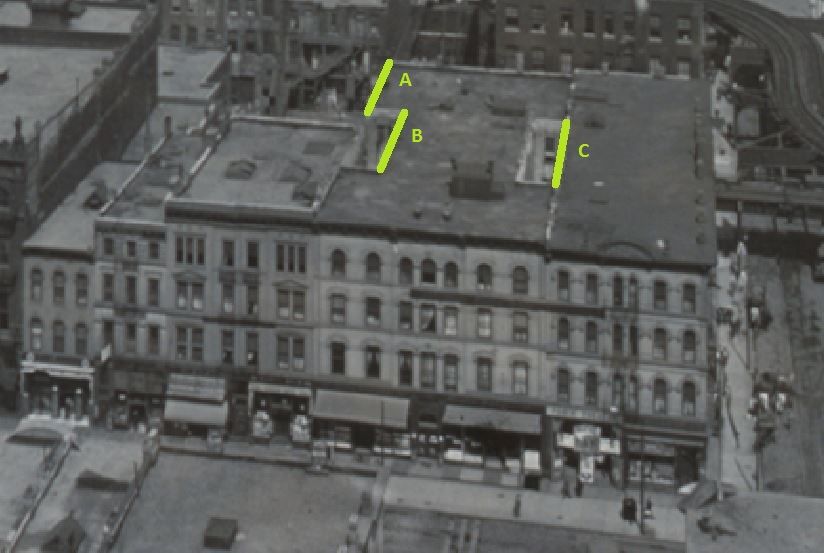
The wall marked "A" is simply a north-facing wall, exposed because the building at 347/349 State doesn't extend the full depth of the block to Victoria, as do the buildings at 351/353 and 357/359 State.
"B" and "C" are the north-facing walls in atria in the hotel. These empty shafts are meant to provided sunlight and ventilation to rooms that would otherwise be wholly interior to the building. And while it has been suggested to me off-line (hello, Peter!) that they aren't apparent on the Fire Insurance map, I think they are:
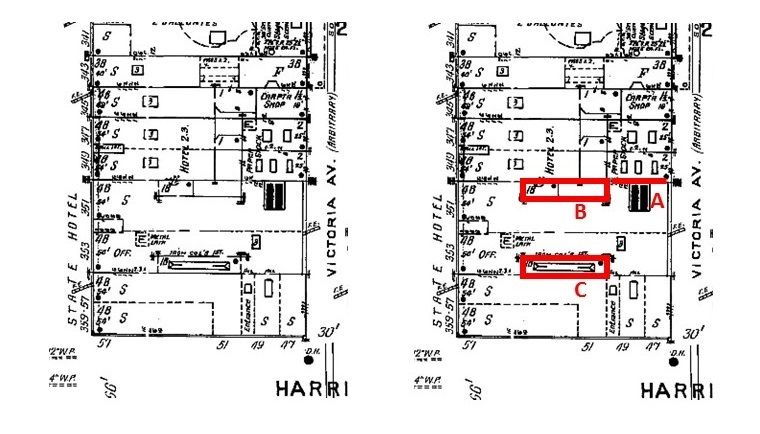
If you look carefully, within the rectangles that define the atria is written "1B". If I read the key for the maps correctly, that indicates that these spaces are 1 story tall with a basement. I also think the southernmost one has a skylight of some sort (which would be appropriate if this were the lobby or another common area of the hotel).
So, to summarize what I've been getting at for the last few days:
1. Smith said they met on the east side of State, possibly the SE corner of State and Congress.
2. The SE corner of State and Congress had no hotel, so it couldn't have been there.
3. So Smith was wrong about that point, but still could have been right about the general location.
4. There were many hotels in the immediate area.
5. A strong possibility is the hotel at the other end of the block -- the Bartl Hotel, later called the State Hotel. Despite initial appearances, maps and photos show it had several north-facing walls which would have had the windows Smith described.
After studying this area for a few days, it occurs to me that it's odd that Smith described the location the way he did -- "the SE corner of State and Congress". If I were describing the spot, especially to another native Chicagoan, I would have said "across Congress from the Sears Building" (as it had come to be called). I don't know what to make of this, other than maybe Smith gave directions differently than I would have.
There are 3 exterior north-facing walls in the State Hotel at the NE corner of State and Harrison, not 2 as I showed above.
From the 1913 photo:
The wall marked "A" is simply a north-facing wall, exposed because the building at 347/349 State doesn't extend the full depth of the block to Victoria, as do the buildings at 351/353 and 357/359 State.
"B" and "C" are the north-facing walls in atria in the hotel. These empty shafts are meant to provided sunlight and ventilation to rooms that would otherwise be wholly interior to the building. And while it has been suggested to me off-line (hello, Peter!) that they aren't apparent on the Fire Insurance map, I think they are:
If you look carefully, within the rectangles that define the atria is written "1B". If I read the key for the maps correctly, that indicates that these spaces are 1 story tall with a basement. I also think the southernmost one has a skylight of some sort (which would be appropriate if this were the lobby or another common area of the hotel).
So, to summarize what I've been getting at for the last few days:
1. Smith said they met on the east side of State, possibly the SE corner of State and Congress.
2. The SE corner of State and Congress had no hotel, so it couldn't have been there.
3. So Smith was wrong about that point, but still could have been right about the general location.
4. There were many hotels in the immediate area.
5. A strong possibility is the hotel at the other end of the block -- the Bartl Hotel, later called the State Hotel. Despite initial appearances, maps and photos show it had several north-facing walls which would have had the windows Smith described.
After studying this area for a few days, it occurs to me that it's odd that Smith described the location the way he did -- "the SE corner of State and Congress". If I were describing the spot, especially to another native Chicagoan, I would have said "across Congress from the Sears Building" (as it had come to be called). I don't know what to make of this, other than maybe Smith gave directions differently than I would have.
Thank you Bill for a very good summary, and some really clear illustrations.
For those who collect variant editions, I just received the Martino reprint, which is strangely a reprint of the retypset Dover edition, without Martin Gardner's introduction and with the later Drake "Congress" copyright statement added. It is likely a print on demand title and I expect Dover may try to protect the copyright on their edition, so this may not be available long. Here's a link to the amazon listing: http://www.amazon.com/Expert-at-Card-Ta ... 614278644/
In reply to Larry Horowitz's question above regarding hotel documents, I think that is definitely a possibility, but probably a very remote one. If you look on eBay, you can see a number of old hotel registers listed, including one from 1904 and one from around 1896 -- not from Chicago. So, such items exist. I do not know whether there are any repositories that hold a concentration of such items from Chicago.
Hi All,
One of the issues that faces everyone thinking about the Erdnase case is this: Assuming that “S.W. Erdnase” is in some way related to the author’s real name (but not necessarily an exact reversal), one wonders just how far away from a perfect anagram is acceptable.
Example: W.E. Sanders is a perfect anagram. It uses all of the letters and adds no letters.
Another example: M.F. Andrews in nowhere near perfect. It adds two letters to the title-page name (“M” and “F”) and takes away two letters (“S” and “E”).
Of course, one probably tends to be more lenient with real names that have “Andrews” as a surname, though I am not sure why, exactly.
But let’s assume that you are willing to look at names that add two letters and delete two letters. Then you would probably be interested in the name “Dr. Sweany” (if you count “Dr.” as a part of the name).
If you take the first seven letters of DR. SWEANY (one of the tenants at or near the southeast corner of State and Congress [according to many posts on this thread]), they rearrange into the first seven letters of S.W. ERDNASE. That is, DR. SWEAN can be rearranged into S.W. ERDNA.
You could look at “DR. SWEANY” as adding one letter (a “Y”), and taking away two letters (“S” and “E”). (I gather, by the way, from a couple of sources on the Hathi Trust Digital Library website, that "Sweany" was not the man’s real name. Example: Link.)
--Tom Sawyer
One of the issues that faces everyone thinking about the Erdnase case is this: Assuming that “S.W. Erdnase” is in some way related to the author’s real name (but not necessarily an exact reversal), one wonders just how far away from a perfect anagram is acceptable.
Example: W.E. Sanders is a perfect anagram. It uses all of the letters and adds no letters.
Another example: M.F. Andrews in nowhere near perfect. It adds two letters to the title-page name (“M” and “F”) and takes away two letters (“S” and “E”).
Of course, one probably tends to be more lenient with real names that have “Andrews” as a surname, though I am not sure why, exactly.
But let’s assume that you are willing to look at names that add two letters and delete two letters. Then you would probably be interested in the name “Dr. Sweany” (if you count “Dr.” as a part of the name).
If you take the first seven letters of DR. SWEANY (one of the tenants at or near the southeast corner of State and Congress [according to many posts on this thread]), they rearrange into the first seven letters of S.W. ERDNASE. That is, DR. SWEAN can be rearranged into S.W. ERDNA.
You could look at “DR. SWEANY” as adding one letter (a “Y”), and taking away two letters (“S” and “E”). (I gather, by the way, from a couple of sources on the Hathi Trust Digital Library website, that "Sweany" was not the man’s real name. Example: Link.)
--Tom Sawyer
An Erdnase Manifesto
Todd Karr
The details of a number of swindles and crimes committed under various aliases by swindler E. S. Andrews and later, I believe, under his actual name of Charles E. Andrews (b. 1859 in Indiana, d. Aug. 26, 1907 in Chicago) from 1901 to 1907 make me feel he is a strong candidate as the author of The Expert at the Card Table.
I'm detailing all my research here for you to examine as you like.
I am also providing a free download link to the 1907 news photo of Charles E. Andrews and his wife, plus two key articles: http://we.tl/AvDxQ2HYJ9.
I'll post another link on this thread soon so anyone interested can download all my documents and sources.
As I explored in my Erdnase Scroll research, I have been following the trail of con artist E. S. Andrews for a number of years, but his trail ran cold around 1905. I figured he was either dead, had gone straight, or was using another alias, and when I investigated Charles Andrews, his activities fit perfectly into the gap.
There are also several elements of Charles E. Andrews’ life that mesh well with other accounts of Erdnase, like Martin Gardner and Marshall D. Smith’s accounts, Richard Hatch’s research on Edwin Sumner Andrews, and the McKinney bankruptcy records. He’s the right age, height, and demeanor as described by Smith, liked Chicago hotel rooms, and his hands look like the drawings. (I’ll add that Martin Gardner liked my findings on E. S. Andrews, and Dick Hatch says he's excited about my latest research.)
He also meets many of my personal criteria of what I would expect from someone who wrote The Expert: a gambler, connections to Chicago and England, an aspect about writing, a con man, smart, used aliases, gentlemanly, spectacular in some way, and left words that sound reasonably like Erdnase.
One article about his death states that he was "a gambling king in northern Indiana."
As always, these are only theories, backed up by what seems to be evidence. Without any explicit connection between the book and a person, there’s no solid proof of any theory about Erdnase’s identity, and when all the leads in my research are explored, my suggestions may turn out to be completely off-base. I wouldn’t mind if it means getting closer to the truth and credit this amazing author.
Please feel free to investigate all the following clues and paths, if you want to get closer to definitive truth.
Correct my mistakes and poke holes in my ideas, but let’s find the whole story. There are court records to read, arrest reports to uncover, and a lot of missing information that hopefully still exists preserved somewhere. And I would love someone to find his grave in La Porte, Indiana, and send me a photo. I’d like to finally to pay my respects someday.
If it’s all just another false lead, I’m still pretty happy to have uncovered a character like E. S. Andrews / Charles E. Andrews, bamboozler of professionals and police, ladies’ man, traveler, and scoundrel. The stories of his cons are larger than life and I’ve had immense fun chasing this colorful man through history, whether or not he wrote the book.
E. S. Andrews, Swindler
From 1901 to 1905, a con man using the name E. S. Andrews, which seems to have been one alias among many, pulled off a series of smooth schemes and crimes around the United States that bilked professionals in towns around the U.S.
The following selected articles and documents on E. S. Andrews provide information I have published before and present here to provide the complete story.
Kokomo, 1901
On November 23, 1901, just before the 1902 publication of The Expert at the Card Table, the Fort Wayne News reported on a scam perpetrated in Kokomo by "A stranger giving his name as E. S. Andrews of the Brandon Commercial Company, Chicago." The news report stated that the con man had a clever collections-agency scheme that succeeded in bilking forty local merchants and physicians.
Andrews had come to Kokomo three weeks prior and convinced the businessmen and doctors to hire him to collect their debts. Each participant paid Andrews a "membership fee" of $15 (or about $900 total). The newspaper reported that "Before leaving, Andrews collected several accounts from debtors, all of which he took with him, the merchants or physicians receiving nothing."
Dubuque, 1902-1903
In December 1902, the Dubuque Telegraph-Journal announced the new local address of the Charles Brandon Commercial company at the Bank and Insurance Building, noting that "Mr. E. S. Andrews is in charge."
A month later, Andrews had fled town with over $1500 in $25 membership fees and collected debts. As the Davenport Republican reported on January 31, 1903, the swindled subscribers were reluctant to admit they had been conned.
One of the professionals stated: "We were all a lot of suckers and should not have let Andrews go as long as we did. He did not live up to the contract he made with me, and I understand that he did not live up to the contract he made with others. I was to pay him a commission of five percent on all collections made on current business, and he was to get 10 to 25 percent on all debts that he collected. I gave him my note, and so did other members, while others paid down their $25 fee.
"I estimate from the number of subscribers he had to the 'Charles Brandon Commercial Agency' that he must have got out of town with from $1500 to $1800. He would have no trouble in negotiating the notes.
"His subscribers included lawyers, doctors, and businessmen. He was to make reports of collections every twenty-fours hours and remit a check for the amount collected, after the commission was deducted, but he forgot to make the report and send me the check."
The article says Andrews was arrested but not only avoided charges by threatening the witnesses (perhaps with a countersuit) but also managed to have his accuser held liable for the costs of his arrest. As the swindled businessman explained: "One of the subscribers had Andrews arrested and got the worst of it, because two or three others were afraid of the bluff made by Andrews. The subscriber paid the costs, amounting to $2.50."
Fort Wayne and Oshkosh, 1904
E. S. Andrews appeared again in Wisconsin in 1904 pursuing the same scam, only this time the law caught up with him. Andrews had set up another collections scheme as the Charles Brandon Company, in association with local law firm Finch and McPhall in the Pixley-Long block in Fort Wayne. Andrews again skipped town with membership fees and debt sums, returning to Indiana, the scene of his 1901 swindle.
Oshkosh Sheriff M. K. Rounds (the Fort Wayne Press gave his name as "J. M. Rounds") was sent to arrest Andrews, who was working in association with a law firm. The firm protested his extradition and the Wisconsin lawman was forced to get permission from Indiana's governor before being allowed to arrest Andrews and bring him back to Wisconsin for trial.
Andrews was arrested on July 7, 1904 on a warrant from Justice Skelton and was held awaiting the arrival of the Wisconsin sheriff.
Four days later, Andrews left Fort Wayne at noon in the custody of Sheriff Rounds. The Fort Wayne Evening Sentinel reported that Andrews had embezzled money and had also used his notices of collection to purchase "a number of diamonds and other articles." The newspaper noted that "Judge O'Rourke was called upon to remand him into the custody of the Wisconsin sheriff on a requisition honored Saturday by Governor Durbin."
A Daily Northwestern reporter interviewed Andrews in his jail cell in Wisconsin and quoted him at length in an article in the newspaper on July 12, 1904. The speech reads glibly, but I do not believe these are his exact words, since in those pre-taping days, a reporter jotted notes and typed them up later into coherent prose:
"Mr. Andrews was seen by a Northwestern reporter this morning while in jail. He is a bright-looking young man whose appearance is that of a shrewd and honest businessman. He said he did not care to talk for publication, but in answer to questions and in the ordinary conversation, he did say to the reporter:
"This is the first time I have ever been arrested. The jail here is a palace compared to that in Fort Wayne. That is a bad place to be in.
"I did not read the complaint against me and do not know exactly the technical charge against me. In a general way, I know what it is, but I say technically, I have not ascertained.
"I believe in being philosophical, however, and while I should not be pleased to stay here long, I can stand it for a time if I can have plenty of reading matter and plenty of fresh air.
"I shall have good legal counsel, but I do not think I will need it. I have nothing to fear and believe I could go into court representing myself and convince the court that the law is on my side.
"So far as my not going under my own name in Fort Wayne is concerned after leaving here, that will have no effect in the case. It may, to the outsider, give rise to the opinion that I was trying to hide, but while that is true, I had no idea I was wanted here on a criminal charge.
"What I did here was business and in a business-like way, and I could have been found by letter at Fort Wayne without the sheriff coming after me.
"Sheriff Rounds has treated me very nicely indeed, and while I shall be glad to leave him and his custody, I shall remember the kindnesses he has shown me.'
"Sheriff Rounds is loud in his praises of the assistance rendered him by Superintendent of Police Henry Gorseline at Fort Wayne, and the latter held onto the prisoner in the face of all the efforts made by lawyers to free him."
Remember also that Indiana magician James Harto claimed to have known Erdnase.
The seemingly media-savvy conman E. S. Andrews went out of his way to deny using a false identity in a note published the next day in the Daily Northwestern: "It was incorrectly stated in your account of an interview with me that I was known while in Fort Wayne under an assumed name. I was known there as E. S. Andrews, representing the Charles Brandon Commercial Company: This is my name and the company is the same as I represented here, and I never used any other name and do not intend to. Yours truly, E. S. Andrews."
The Oshkosh Trial
On August 8, 1904, the Daily Northwestern reported, Andrews was charged in Oshkosh Municipal Court with embezzlement. The original charge had been filed by fur merchant E. F. Steude, who had been bilked of $108. The hearing had already been postponed due to the absence of a prosecution witness, attorney A. C. McPhall, one of Andrews' legal associates in the scheme.
The following day, a Daily Northwestern article announced that after intense arguments by Andrews' defense attorneys "Maurice McKenna of Fond du Lac, Wisconsin, and E. P. Finch of Oshkosh" the judge had found adequate cause for Andrews to stand trial on embezzlement charges.
This news report states that Andrews took a number of precautions to legally justify his financial shenanigans. Andrews had clients sign contracts with a fine-print clause authorizing him to make deductions from the money he collected. He had clients make out their checks to his partner, who then paid Andrews (Small note: Funds were deposited in a bank; Erdnase paid Smith with a bank check). In court, Andrews claimed innocence by shrewdly stating the attorney had never paid him the full amount of the money collected.
Finally, in a footnote of possible support for magician Hugh Johnston’s later story that he had met Erdnase in Denver, the article also specifies that Andrews had incorporated the Charles Brandon Collections company in Colorado and was its manager.
Bail was set at $2000 and promptly posted by his legal team. Further procedural challenges from Andrews' attorneys delayed the trial until matters were cleared up sufficiently on August 17, when municipal court Commissioner W. W. Waterhouse concluded Andrews had to stand trial.
On August 23, Andrews appeared in municipal court, this time represented by attorney Henry Fitzgibbon of Menasha. The trial was adjourned until August 27.
The trial was either prolonged or postponed, since it was not until September 28 that Andrews was finally found guilty of embezzlement, though for a reduced sum of $37.50. The trial took place in Milwaukee, and the jury took only a half hour to reach their decision, the Daily Northwestern reported on September 19: "The jury, in view of the whole circumstances, found that Andrews was working what is popularly known as a 'graft' and that he willfully retained the amount charged against him. The penalty for the offense is from six months to one year imprisonment in county jail or state prison." All the above information is from the Daily Northwestern, which covered the trial with regular news articles.
The court sentenced Andrews to eight months in jail. As the Fort Wayne Sentinel stated on October 14, 1904, Andrews had already spent four months in custody, and the judge noted this in his sentencing.
Other articles following Andrews' case focused on the misconduct of one of his associates, attorney A. K. McPhall, who disappeared after Andrews was arrested but was spotted in Oshkosh by acquaintances after Andrews' sentencing.
In a related case the following April, with Andrews still in jail, the Oshkosh Municipal Court issued a decision in favor of one of his victims. A Dr. J. M. Conley had hired Andrews to collect debts and gave him a promissory note for $42.63 as a retainer. Andrews went to a local store Birely and Son and traded his note for Conley's debt for a diamond. The court found in favor of Birely and Son, agreeing that Dr. Conley was still obliged to pay the amount of the promissory note to whomever held it.
Chicago, 1905-1907
Shortly after the end of Andrews' jail sentence, he apparently set up shop again in another location, this time Chicago. The Chicago Tribune of December 20, 1905 notes the incorporation of the Charles Brandon Commercial Company, based in Pueblo, Colorado, with capital of $5000 in Pueblo and $2500 in Illinois.
On July 14, 1907, the Chicago Tribune reported that E. S. Andrews was conducting a collection-agency scam again, this time in connection with attorney W. V. Tyler as the Tyler Company Limited. The duo received dues of between $40 and $50 from over 62 merchants before collecting debts and pocketing the funds. Tyler was arrested for obtaining goods under false pretenses and embezzlement. However, the newspaper stated, "Andrews has disappeared."
Meet Charles E. Andrews, Sr.
The Cook County, Illinois, death record for Charles E. Andrews Sr. states he died at age 48, meaning he was born in Indiana around 1859. The 1860 U. S. Census for Peoria lists a Charles E. Andrews born in 1859 in Indiana.
Andrews’ mother, Affia, is 29, born in New York. His father, Edward A. Andrews is age 48, born in England, and his profession is listed as “Local editor.” The British lineage and literary connection may explain the unusual copyrighting of The Expert in England. Edward, who used initials in his professional name, E. A. Andrews, had in fact been co-owner since 1860 of the Peoria Transcript. I’d imagine his son would pick up at least a minimum of writing skills and would likely have connections to printers and other aspects of publishing.
Aliases and New Scams
One might reasonably imagine that upon his exit from prison, E. S. Andrews would use another name if he resumed his con games, and it looks like he used several. The crimes that Charles E. Andrews committed and the locations involved lead me to feel that he and E. S. Andrews are the same person.
In addition, there are also several aspects about conman Charles E. Andrews that surprisingly intersect with those of the railroad agent E. S. Andrews that Richard Hatch has pursued. My feeling is that conman Charles E. Andrews may have known or been related to Edwin Sumner Andrews.
In July 17, 1906, the Albuquerque Evening Citizen reported that a conman named W. B. Andrews was posing as an agent for a supposed “California Southern Railroad,” recruiting young women from a secretarial school as stenographers to work at a fictional “central office” in Los Angeles and point leading to it. One lady was apparently given a position as stenographer at the Grant Hotel in Peoria, but the newspaper implies that Andrews pressured her for intimacy.
The aspect of the stenographers and school are significant. As Richard Hatch has pointed out, Erdnase told artist Marshall D. Smith that he was related to renowned artist Louis Dalrymple. This artist's mother may have been related to Dollie Seeley, Edwin Sumner Andrews' wife, was a stenographer and ran a secretarial school. Perhaps this is where Charles E. Andrews met and seduced his victims.
If railway man E. S. Andrews was indeed not Erdnase, perhaps Charles E. Andrews was using his name and railroad access to impress his victims, plus showing his name on a copy of the impressive Expert. If Edwin Sumner Andrews and Charles E. Andrews were related, that would explain why Erdnase would say that he was related to Dalrymple but perhaps not necessarily that his own wife was the one whose family had the connection.
The August 17, 1906 Davenport Argus said that Andrews had been captured in Logansport, Indiana, and called him “one of the cleverest of confidence men,” with a long history of crimes. Pinkerton agents had followed his trail after he conned a young woman in Hampton, Iowa, named Grace Gukert. Andrews’ scheme was to promise an $85 monthly salary for office work. Once they reached a strange city, Andrews would ask for the victim to pay for a certain kind of typewriter as a required tool for the job, then skip town with the money, stranding the trusting girl.
In Grace Gukert’s case, Andrews brought her to Chicago and just before arriving asked for her purse containing the claim checks for their luggage, then disappeared with her handbag and $40 inside it. She contacted the police, and Andrews was followed to St. Louis before his eventual capture in Logansport, Indiana.
A month later, Charles E. Andrews was arrested in South Bend, Indiana, convicted, fined $25, and sentenced to three years in Michigan City prison, as the September 26, 1906 Indiana Morning Star stated. The article says Andrews had also used the aliases Charles Adams and E. E. Smith and wanted by police in Illinois, Iowa, and Missouri, as well as a number of counties around Indiana. During the trial in Logansport, Indiana, two other victims testified, Margaret Loftus and Jennie Gregg.
Other victims, according to the news item, included Jesse Hoover and Glen Brown, students at the Huntington Business College.
The article adds that “His occupation formerly was railroad construction boss on California and Mexican railroads. He speaks English and some Spanish.”
On October 4, 1906, the Plymouth Tribune ran a late report of the sentencing, adding that Andrews had brought victims to Indianapolis and Chicago.
The End of the Expert
On August 26, 1907, Charles E. Andrews shot his wife India Ethel Blaine, 25, to death during an argument at the Saratoga Hotel in Chicago, then killed himself.
Newspapers from coast to coast put together the story, the most thorough in the local Chicago Tribune’s August 27 article, complete with a photo of the ill-fated pair. He looks gentlemanly and well-groomed, and his small cuffed and jacketed hands resemble those in Marshall D. Smith’s drawings.
Years before, Charles E. Andrews had apparently lived in Elkhart, Indiana, since about 1897 and started a restaurant there, then ran away with a waitress, Grace Bennett, around 1900, leaving behind his wife and son, the now-23-year-old Charles Jr.. Andrews took Bennett to California, then reportedly deserted her. His wife divorced him and remarried grocer Edward Paul and later moved to California herself.
Sometime after his exit from prison after his Logansport conviction in 1906, Charles E. Andrews met India Ethel Blaine of Flora, Indiana, and they became involved. Around June 1906, Andrews moved her out of her parents’ Indiana home and off to California, where they ended up in Covina, where Andrews ran a shooting gallery.
Around Saturday, August 24, 1907, Andrews and Blaine traveled to Chicago and checked into room 842 of the Saratoga Hotel. The following Tuesday, August 26, one of Andrews’ last acts, ironically was to leave behind a piece of writing, directly dictated from his words and heart. Andrews began composing a letter to his son, which the woman began handwriting for him. He asked Charles Jr. to get his mail in Elkhart and asked him to come to see him and Ethel in Chicago, then told him to mind his mother and not to talk to anyone.
For those who are interested in comparing Andrews’ letter to the text in The Expert, the following words and phrases appear in both: “We have been,” a form of the verb intend (“intended” in Erdnase), write, past, several, occasions, “to get,” know, myself, address (mail meaning), general, feeling, reason, last, mind, wrong, “have to,” explain, and opening a sentence with “However."
The letter ended abruptly. Whether out of a petty argument over the phrase “obligations to” instead of “obligation to” or the mention of his ex-spouse, Andrews suddenly shot Blaine twice. A waitress, May Williams, ran to the room and saw Andrews standing holding a smoking gun. He turned it on himself next and shot himself in the head. He died on the way to St. Luke’s Hospital.
His son, Charles Jr., tearfully claimed the body, brought it back to Indiana, and had his father buried somewhere in La Porte. He stated that his father had been in dire financial circumstances and perhaps was already panicked over the possibility of losing India Ethel Blaine. Faced with his act and a certain return to prison and perhaps execution, Andrews went over the edge. The Indianapolis Star said on August 29 that Knights of Pythias members served as pallbearers and that the son was the lone mourner.
In California, Andrews’ former wife spotted the coverage and asked the Qunicy, Illinois, lodge of the Knights of Pythias to check if it was indeed her ex-husband, which its members confirmed, according to the September 1, 1907, Los Angeles Herald.
Covina neighbors stated Andrews ran his shooting gallery there under the name C. Andrews (the headline states it as “C. J. Andrews”), saying he and Blaine had left some unpaid bills behind. The September 14, 1907 article in the Covina Argus describes Andrews as a “short, thick-set man,” matching Marshall D. Smith’s description of Erdnase’s stature.
Another Smoking Gun
A state away from Indiana in Tennessee, one newspaper covering the episode reported something extraordinary, perhaps a fact that reporter there knew from experience. The Nashville Tennesseean of August 27, 1907 article began with the headline: “Bloody and Mysterious Tragedy in Chicago Hotel: Former Gambling King Guns Down Girl and Then Sends Bullet Through His Own Brain.” The body of the piece describes Andrews as “a gambling king in northern Indiana.” (The later Covina Argus article mentions this as well, but it seems to be simply rewritten information, rearranged as “Andrews was at one time known as the king of gamblers in northern Indiana.”)
If Andrews is indeed the man we’ve been seeking, it would explain why he was never heard from again, why he did not reappear to enjoy his well-earned credit.
I hope he’s the expert, the brilliant mind behind the intricate array of techniques, precise explanations, vivid observations, and techniques he was bold enough to name after himself. He deserves a final bow.
Todd Karr
The details of a number of swindles and crimes committed under various aliases by swindler E. S. Andrews and later, I believe, under his actual name of Charles E. Andrews (b. 1859 in Indiana, d. Aug. 26, 1907 in Chicago) from 1901 to 1907 make me feel he is a strong candidate as the author of The Expert at the Card Table.
I'm detailing all my research here for you to examine as you like.
I am also providing a free download link to the 1907 news photo of Charles E. Andrews and his wife, plus two key articles: http://we.tl/AvDxQ2HYJ9.
I'll post another link on this thread soon so anyone interested can download all my documents and sources.
As I explored in my Erdnase Scroll research, I have been following the trail of con artist E. S. Andrews for a number of years, but his trail ran cold around 1905. I figured he was either dead, had gone straight, or was using another alias, and when I investigated Charles Andrews, his activities fit perfectly into the gap.
There are also several elements of Charles E. Andrews’ life that mesh well with other accounts of Erdnase, like Martin Gardner and Marshall D. Smith’s accounts, Richard Hatch’s research on Edwin Sumner Andrews, and the McKinney bankruptcy records. He’s the right age, height, and demeanor as described by Smith, liked Chicago hotel rooms, and his hands look like the drawings. (I’ll add that Martin Gardner liked my findings on E. S. Andrews, and Dick Hatch says he's excited about my latest research.)
He also meets many of my personal criteria of what I would expect from someone who wrote The Expert: a gambler, connections to Chicago and England, an aspect about writing, a con man, smart, used aliases, gentlemanly, spectacular in some way, and left words that sound reasonably like Erdnase.
One article about his death states that he was "a gambling king in northern Indiana."
As always, these are only theories, backed up by what seems to be evidence. Without any explicit connection between the book and a person, there’s no solid proof of any theory about Erdnase’s identity, and when all the leads in my research are explored, my suggestions may turn out to be completely off-base. I wouldn’t mind if it means getting closer to the truth and credit this amazing author.
Please feel free to investigate all the following clues and paths, if you want to get closer to definitive truth.
Correct my mistakes and poke holes in my ideas, but let’s find the whole story. There are court records to read, arrest reports to uncover, and a lot of missing information that hopefully still exists preserved somewhere. And I would love someone to find his grave in La Porte, Indiana, and send me a photo. I’d like to finally to pay my respects someday.
If it’s all just another false lead, I’m still pretty happy to have uncovered a character like E. S. Andrews / Charles E. Andrews, bamboozler of professionals and police, ladies’ man, traveler, and scoundrel. The stories of his cons are larger than life and I’ve had immense fun chasing this colorful man through history, whether or not he wrote the book.
E. S. Andrews, Swindler
From 1901 to 1905, a con man using the name E. S. Andrews, which seems to have been one alias among many, pulled off a series of smooth schemes and crimes around the United States that bilked professionals in towns around the U.S.
The following selected articles and documents on E. S. Andrews provide information I have published before and present here to provide the complete story.
Kokomo, 1901
On November 23, 1901, just before the 1902 publication of The Expert at the Card Table, the Fort Wayne News reported on a scam perpetrated in Kokomo by "A stranger giving his name as E. S. Andrews of the Brandon Commercial Company, Chicago." The news report stated that the con man had a clever collections-agency scheme that succeeded in bilking forty local merchants and physicians.
Andrews had come to Kokomo three weeks prior and convinced the businessmen and doctors to hire him to collect their debts. Each participant paid Andrews a "membership fee" of $15 (or about $900 total). The newspaper reported that "Before leaving, Andrews collected several accounts from debtors, all of which he took with him, the merchants or physicians receiving nothing."
Dubuque, 1902-1903
In December 1902, the Dubuque Telegraph-Journal announced the new local address of the Charles Brandon Commercial company at the Bank and Insurance Building, noting that "Mr. E. S. Andrews is in charge."
A month later, Andrews had fled town with over $1500 in $25 membership fees and collected debts. As the Davenport Republican reported on January 31, 1903, the swindled subscribers were reluctant to admit they had been conned.
One of the professionals stated: "We were all a lot of suckers and should not have let Andrews go as long as we did. He did not live up to the contract he made with me, and I understand that he did not live up to the contract he made with others. I was to pay him a commission of five percent on all collections made on current business, and he was to get 10 to 25 percent on all debts that he collected. I gave him my note, and so did other members, while others paid down their $25 fee.
"I estimate from the number of subscribers he had to the 'Charles Brandon Commercial Agency' that he must have got out of town with from $1500 to $1800. He would have no trouble in negotiating the notes.
"His subscribers included lawyers, doctors, and businessmen. He was to make reports of collections every twenty-fours hours and remit a check for the amount collected, after the commission was deducted, but he forgot to make the report and send me the check."
The article says Andrews was arrested but not only avoided charges by threatening the witnesses (perhaps with a countersuit) but also managed to have his accuser held liable for the costs of his arrest. As the swindled businessman explained: "One of the subscribers had Andrews arrested and got the worst of it, because two or three others were afraid of the bluff made by Andrews. The subscriber paid the costs, amounting to $2.50."
Fort Wayne and Oshkosh, 1904
E. S. Andrews appeared again in Wisconsin in 1904 pursuing the same scam, only this time the law caught up with him. Andrews had set up another collections scheme as the Charles Brandon Company, in association with local law firm Finch and McPhall in the Pixley-Long block in Fort Wayne. Andrews again skipped town with membership fees and debt sums, returning to Indiana, the scene of his 1901 swindle.
Oshkosh Sheriff M. K. Rounds (the Fort Wayne Press gave his name as "J. M. Rounds") was sent to arrest Andrews, who was working in association with a law firm. The firm protested his extradition and the Wisconsin lawman was forced to get permission from Indiana's governor before being allowed to arrest Andrews and bring him back to Wisconsin for trial.
Andrews was arrested on July 7, 1904 on a warrant from Justice Skelton and was held awaiting the arrival of the Wisconsin sheriff.
Four days later, Andrews left Fort Wayne at noon in the custody of Sheriff Rounds. The Fort Wayne Evening Sentinel reported that Andrews had embezzled money and had also used his notices of collection to purchase "a number of diamonds and other articles." The newspaper noted that "Judge O'Rourke was called upon to remand him into the custody of the Wisconsin sheriff on a requisition honored Saturday by Governor Durbin."
A Daily Northwestern reporter interviewed Andrews in his jail cell in Wisconsin and quoted him at length in an article in the newspaper on July 12, 1904. The speech reads glibly, but I do not believe these are his exact words, since in those pre-taping days, a reporter jotted notes and typed them up later into coherent prose:
"Mr. Andrews was seen by a Northwestern reporter this morning while in jail. He is a bright-looking young man whose appearance is that of a shrewd and honest businessman. He said he did not care to talk for publication, but in answer to questions and in the ordinary conversation, he did say to the reporter:
"This is the first time I have ever been arrested. The jail here is a palace compared to that in Fort Wayne. That is a bad place to be in.
"I did not read the complaint against me and do not know exactly the technical charge against me. In a general way, I know what it is, but I say technically, I have not ascertained.
"I believe in being philosophical, however, and while I should not be pleased to stay here long, I can stand it for a time if I can have plenty of reading matter and plenty of fresh air.
"I shall have good legal counsel, but I do not think I will need it. I have nothing to fear and believe I could go into court representing myself and convince the court that the law is on my side.
"So far as my not going under my own name in Fort Wayne is concerned after leaving here, that will have no effect in the case. It may, to the outsider, give rise to the opinion that I was trying to hide, but while that is true, I had no idea I was wanted here on a criminal charge.
"What I did here was business and in a business-like way, and I could have been found by letter at Fort Wayne without the sheriff coming after me.
"Sheriff Rounds has treated me very nicely indeed, and while I shall be glad to leave him and his custody, I shall remember the kindnesses he has shown me.'
"Sheriff Rounds is loud in his praises of the assistance rendered him by Superintendent of Police Henry Gorseline at Fort Wayne, and the latter held onto the prisoner in the face of all the efforts made by lawyers to free him."
Remember also that Indiana magician James Harto claimed to have known Erdnase.
The seemingly media-savvy conman E. S. Andrews went out of his way to deny using a false identity in a note published the next day in the Daily Northwestern: "It was incorrectly stated in your account of an interview with me that I was known while in Fort Wayne under an assumed name. I was known there as E. S. Andrews, representing the Charles Brandon Commercial Company: This is my name and the company is the same as I represented here, and I never used any other name and do not intend to. Yours truly, E. S. Andrews."
The Oshkosh Trial
On August 8, 1904, the Daily Northwestern reported, Andrews was charged in Oshkosh Municipal Court with embezzlement. The original charge had been filed by fur merchant E. F. Steude, who had been bilked of $108. The hearing had already been postponed due to the absence of a prosecution witness, attorney A. C. McPhall, one of Andrews' legal associates in the scheme.
The following day, a Daily Northwestern article announced that after intense arguments by Andrews' defense attorneys "Maurice McKenna of Fond du Lac, Wisconsin, and E. P. Finch of Oshkosh" the judge had found adequate cause for Andrews to stand trial on embezzlement charges.
This news report states that Andrews took a number of precautions to legally justify his financial shenanigans. Andrews had clients sign contracts with a fine-print clause authorizing him to make deductions from the money he collected. He had clients make out their checks to his partner, who then paid Andrews (Small note: Funds were deposited in a bank; Erdnase paid Smith with a bank check). In court, Andrews claimed innocence by shrewdly stating the attorney had never paid him the full amount of the money collected.
Finally, in a footnote of possible support for magician Hugh Johnston’s later story that he had met Erdnase in Denver, the article also specifies that Andrews had incorporated the Charles Brandon Collections company in Colorado and was its manager.
Bail was set at $2000 and promptly posted by his legal team. Further procedural challenges from Andrews' attorneys delayed the trial until matters were cleared up sufficiently on August 17, when municipal court Commissioner W. W. Waterhouse concluded Andrews had to stand trial.
On August 23, Andrews appeared in municipal court, this time represented by attorney Henry Fitzgibbon of Menasha. The trial was adjourned until August 27.
The trial was either prolonged or postponed, since it was not until September 28 that Andrews was finally found guilty of embezzlement, though for a reduced sum of $37.50. The trial took place in Milwaukee, and the jury took only a half hour to reach their decision, the Daily Northwestern reported on September 19: "The jury, in view of the whole circumstances, found that Andrews was working what is popularly known as a 'graft' and that he willfully retained the amount charged against him. The penalty for the offense is from six months to one year imprisonment in county jail or state prison." All the above information is from the Daily Northwestern, which covered the trial with regular news articles.
The court sentenced Andrews to eight months in jail. As the Fort Wayne Sentinel stated on October 14, 1904, Andrews had already spent four months in custody, and the judge noted this in his sentencing.
Other articles following Andrews' case focused on the misconduct of one of his associates, attorney A. K. McPhall, who disappeared after Andrews was arrested but was spotted in Oshkosh by acquaintances after Andrews' sentencing.
In a related case the following April, with Andrews still in jail, the Oshkosh Municipal Court issued a decision in favor of one of his victims. A Dr. J. M. Conley had hired Andrews to collect debts and gave him a promissory note for $42.63 as a retainer. Andrews went to a local store Birely and Son and traded his note for Conley's debt for a diamond. The court found in favor of Birely and Son, agreeing that Dr. Conley was still obliged to pay the amount of the promissory note to whomever held it.
Chicago, 1905-1907
Shortly after the end of Andrews' jail sentence, he apparently set up shop again in another location, this time Chicago. The Chicago Tribune of December 20, 1905 notes the incorporation of the Charles Brandon Commercial Company, based in Pueblo, Colorado, with capital of $5000 in Pueblo and $2500 in Illinois.
On July 14, 1907, the Chicago Tribune reported that E. S. Andrews was conducting a collection-agency scam again, this time in connection with attorney W. V. Tyler as the Tyler Company Limited. The duo received dues of between $40 and $50 from over 62 merchants before collecting debts and pocketing the funds. Tyler was arrested for obtaining goods under false pretenses and embezzlement. However, the newspaper stated, "Andrews has disappeared."
Meet Charles E. Andrews, Sr.
The Cook County, Illinois, death record for Charles E. Andrews Sr. states he died at age 48, meaning he was born in Indiana around 1859. The 1860 U. S. Census for Peoria lists a Charles E. Andrews born in 1859 in Indiana.
Andrews’ mother, Affia, is 29, born in New York. His father, Edward A. Andrews is age 48, born in England, and his profession is listed as “Local editor.” The British lineage and literary connection may explain the unusual copyrighting of The Expert in England. Edward, who used initials in his professional name, E. A. Andrews, had in fact been co-owner since 1860 of the Peoria Transcript. I’d imagine his son would pick up at least a minimum of writing skills and would likely have connections to printers and other aspects of publishing.
Aliases and New Scams
One might reasonably imagine that upon his exit from prison, E. S. Andrews would use another name if he resumed his con games, and it looks like he used several. The crimes that Charles E. Andrews committed and the locations involved lead me to feel that he and E. S. Andrews are the same person.
In addition, there are also several aspects about conman Charles E. Andrews that surprisingly intersect with those of the railroad agent E. S. Andrews that Richard Hatch has pursued. My feeling is that conman Charles E. Andrews may have known or been related to Edwin Sumner Andrews.
In July 17, 1906, the Albuquerque Evening Citizen reported that a conman named W. B. Andrews was posing as an agent for a supposed “California Southern Railroad,” recruiting young women from a secretarial school as stenographers to work at a fictional “central office” in Los Angeles and point leading to it. One lady was apparently given a position as stenographer at the Grant Hotel in Peoria, but the newspaper implies that Andrews pressured her for intimacy.
The aspect of the stenographers and school are significant. As Richard Hatch has pointed out, Erdnase told artist Marshall D. Smith that he was related to renowned artist Louis Dalrymple. This artist's mother may have been related to Dollie Seeley, Edwin Sumner Andrews' wife, was a stenographer and ran a secretarial school. Perhaps this is where Charles E. Andrews met and seduced his victims.
If railway man E. S. Andrews was indeed not Erdnase, perhaps Charles E. Andrews was using his name and railroad access to impress his victims, plus showing his name on a copy of the impressive Expert. If Edwin Sumner Andrews and Charles E. Andrews were related, that would explain why Erdnase would say that he was related to Dalrymple but perhaps not necessarily that his own wife was the one whose family had the connection.
The August 17, 1906 Davenport Argus said that Andrews had been captured in Logansport, Indiana, and called him “one of the cleverest of confidence men,” with a long history of crimes. Pinkerton agents had followed his trail after he conned a young woman in Hampton, Iowa, named Grace Gukert. Andrews’ scheme was to promise an $85 monthly salary for office work. Once they reached a strange city, Andrews would ask for the victim to pay for a certain kind of typewriter as a required tool for the job, then skip town with the money, stranding the trusting girl.
In Grace Gukert’s case, Andrews brought her to Chicago and just before arriving asked for her purse containing the claim checks for their luggage, then disappeared with her handbag and $40 inside it. She contacted the police, and Andrews was followed to St. Louis before his eventual capture in Logansport, Indiana.
A month later, Charles E. Andrews was arrested in South Bend, Indiana, convicted, fined $25, and sentenced to three years in Michigan City prison, as the September 26, 1906 Indiana Morning Star stated. The article says Andrews had also used the aliases Charles Adams and E. E. Smith and wanted by police in Illinois, Iowa, and Missouri, as well as a number of counties around Indiana. During the trial in Logansport, Indiana, two other victims testified, Margaret Loftus and Jennie Gregg.
Other victims, according to the news item, included Jesse Hoover and Glen Brown, students at the Huntington Business College.
The article adds that “His occupation formerly was railroad construction boss on California and Mexican railroads. He speaks English and some Spanish.”
On October 4, 1906, the Plymouth Tribune ran a late report of the sentencing, adding that Andrews had brought victims to Indianapolis and Chicago.
The End of the Expert
On August 26, 1907, Charles E. Andrews shot his wife India Ethel Blaine, 25, to death during an argument at the Saratoga Hotel in Chicago, then killed himself.
Newspapers from coast to coast put together the story, the most thorough in the local Chicago Tribune’s August 27 article, complete with a photo of the ill-fated pair. He looks gentlemanly and well-groomed, and his small cuffed and jacketed hands resemble those in Marshall D. Smith’s drawings.
Years before, Charles E. Andrews had apparently lived in Elkhart, Indiana, since about 1897 and started a restaurant there, then ran away with a waitress, Grace Bennett, around 1900, leaving behind his wife and son, the now-23-year-old Charles Jr.. Andrews took Bennett to California, then reportedly deserted her. His wife divorced him and remarried grocer Edward Paul and later moved to California herself.
Sometime after his exit from prison after his Logansport conviction in 1906, Charles E. Andrews met India Ethel Blaine of Flora, Indiana, and they became involved. Around June 1906, Andrews moved her out of her parents’ Indiana home and off to California, where they ended up in Covina, where Andrews ran a shooting gallery.
Around Saturday, August 24, 1907, Andrews and Blaine traveled to Chicago and checked into room 842 of the Saratoga Hotel. The following Tuesday, August 26, one of Andrews’ last acts, ironically was to leave behind a piece of writing, directly dictated from his words and heart. Andrews began composing a letter to his son, which the woman began handwriting for him. He asked Charles Jr. to get his mail in Elkhart and asked him to come to see him and Ethel in Chicago, then told him to mind his mother and not to talk to anyone.
For those who are interested in comparing Andrews’ letter to the text in The Expert, the following words and phrases appear in both: “We have been,” a form of the verb intend (“intended” in Erdnase), write, past, several, occasions, “to get,” know, myself, address (mail meaning), general, feeling, reason, last, mind, wrong, “have to,” explain, and opening a sentence with “However."
The letter ended abruptly. Whether out of a petty argument over the phrase “obligations to” instead of “obligation to” or the mention of his ex-spouse, Andrews suddenly shot Blaine twice. A waitress, May Williams, ran to the room and saw Andrews standing holding a smoking gun. He turned it on himself next and shot himself in the head. He died on the way to St. Luke’s Hospital.
His son, Charles Jr., tearfully claimed the body, brought it back to Indiana, and had his father buried somewhere in La Porte. He stated that his father had been in dire financial circumstances and perhaps was already panicked over the possibility of losing India Ethel Blaine. Faced with his act and a certain return to prison and perhaps execution, Andrews went over the edge. The Indianapolis Star said on August 29 that Knights of Pythias members served as pallbearers and that the son was the lone mourner.
In California, Andrews’ former wife spotted the coverage and asked the Qunicy, Illinois, lodge of the Knights of Pythias to check if it was indeed her ex-husband, which its members confirmed, according to the September 1, 1907, Los Angeles Herald.
Covina neighbors stated Andrews ran his shooting gallery there under the name C. Andrews (the headline states it as “C. J. Andrews”), saying he and Blaine had left some unpaid bills behind. The September 14, 1907 article in the Covina Argus describes Andrews as a “short, thick-set man,” matching Marshall D. Smith’s description of Erdnase’s stature.
Another Smoking Gun
A state away from Indiana in Tennessee, one newspaper covering the episode reported something extraordinary, perhaps a fact that reporter there knew from experience. The Nashville Tennesseean of August 27, 1907 article began with the headline: “Bloody and Mysterious Tragedy in Chicago Hotel: Former Gambling King Guns Down Girl and Then Sends Bullet Through His Own Brain.” The body of the piece describes Andrews as “a gambling king in northern Indiana.” (The later Covina Argus article mentions this as well, but it seems to be simply rewritten information, rearranged as “Andrews was at one time known as the king of gamblers in northern Indiana.”)
If Andrews is indeed the man we’ve been seeking, it would explain why he was never heard from again, why he did not reappear to enjoy his well-earned credit.
I hope he’s the expert, the brilliant mind behind the intricate array of techniques, precise explanations, vivid observations, and techniques he was bold enough to name after himself. He deserves a final bow.
Wow, fascinating stuff, Todd, thanks for sharing it. A couple of quick questions for clarification: If Charles Andrews Sr. was 48 when he died in August 1907, his birth would have been around 1859, not 1852. Is this a typo in your posting?
Your note mentions "E. S. Andrews" swindling activities dating from 1901, but a March 1899 front page story in the Buffalo (NY) Courier has an E. S. Andrews pulling this collection scam in Erie, PA for Wingate's Trade Exchange (a collection agency). Assuming (as I do) that this is the same "E. S. Andrews", this would indicate earlier activity along those lines using that name [I think Bill Mullins found this article some time ago].
Also, a March 28, 1904 article about E. S. Andrews (the collection agency swindler) in the Oshkosh Daily Northwestern describes him as a "young man" of "pleasant address... said to have claimed to be a student at Yale who wished to make money to continue his studies." That would imply someone who in 1904 appeared to be in his early twenties, much younger than recalled by Smith.
Still, very exciting information. It will be interesting to see where it leads. I wonder if the Indiana connection leads to French Lick?
Your note mentions "E. S. Andrews" swindling activities dating from 1901, but a March 1899 front page story in the Buffalo (NY) Courier has an E. S. Andrews pulling this collection scam in Erie, PA for Wingate's Trade Exchange (a collection agency). Assuming (as I do) that this is the same "E. S. Andrews", this would indicate earlier activity along those lines using that name [I think Bill Mullins found this article some time ago].
Also, a March 28, 1904 article about E. S. Andrews (the collection agency swindler) in the Oshkosh Daily Northwestern describes him as a "young man" of "pleasant address... said to have claimed to be a student at Yale who wished to make money to continue his studies." That would imply someone who in 1904 appeared to be in his early twenties, much younger than recalled by Smith.
Still, very exciting information. It will be interesting to see where it leads. I wonder if the Indiana connection leads to French Lick?
How strange, too, that this candidate (Charles Andrews) died in a hotel room after shooting his mistress (having left his wife and child) and then turned the gun on himself, just like the official version of Milton Franklin Andrews' death in Berkeley two years earlier!
Todd, if Charles E. Andrews, the man who was conning stenographers, was convicted and sentenced to three years in Michigan City prison in late September 1906, how did he end up killing his girlfriend and himself in a Chicago Hotel room less than year later (August 1907)? Different Charles E. Andrews?
Todd is apparently unable to get onto the Genii Forum at this time, but wanted me to post that the 1852 birthdate for Charles E. Andrews is a typo and the correct date is the 1859 date given earlier in his post. Dollie Seeley was the wife of Edwin S. Andrews (the train agent), not Louis Dalrymple (also a typo in the above). Todd also indicated that Charles Andrews apparently only served 11 months of the 3 year sentence. Much of this will apparently be clarified when he posts the many other newspaper citations he has found on this candidate.
My bad. I wish posts were editable!! My thanks to Dick Hatch. Yes, the correct birthdate is 1859, Dollie Seeley was married to ES, and as for the sentences, all his sentencing seems to vary wildly from the time eventually served, much like today's briefer-than-expected sentences for various reasons. A lot of these questions will be answered when I post all the primary documents...I'm just cleaning them up before uploading them, which will be asap.
And it may turn out there's more than one E. S. Andrews here. DIck and I have chased down many E. S. Andrewses, including a despondent Canadian government printing office official and others that initially looked promising. For comparison, remember that magic currently has a Greg Wilson and a Gregory Wilson, and TV had a Mike Douglas and a Michael Douglas (We had a Michael Douglas, too, now known as the prize-winning jazz-influenced magician Mon Dre).
Another aspect I didn't mention: If you think about the scope of the book, Andrews had to have it written down and probably typed, and the stenographers, if he used them more than a dalliance, would have been helpful.
All the debate and nit-picking is great, and I hope it leads to something, even if my guy's just another character (or characters). There are many possible leads: his restaurant in Elkhart, the other complaints, news items, and court hearings, and hopefully family members with papers.
Also, if anyone has any questions or thoughts, feel free to email me at toddkarr@aol.com. I don't post here often.
And it may turn out there's more than one E. S. Andrews here. DIck and I have chased down many E. S. Andrewses, including a despondent Canadian government printing office official and others that initially looked promising. For comparison, remember that magic currently has a Greg Wilson and a Gregory Wilson, and TV had a Mike Douglas and a Michael Douglas (We had a Michael Douglas, too, now known as the prize-winning jazz-influenced magician Mon Dre).
Another aspect I didn't mention: If you think about the scope of the book, Andrews had to have it written down and probably typed, and the stenographers, if he used them more than a dalliance, would have been helpful.
All the debate and nit-picking is great, and I hope it leads to something, even if my guy's just another character (or characters). There are many possible leads: his restaurant in Elkhart, the other complaints, news items, and court hearings, and hopefully family members with papers.
Also, if anyone has any questions or thoughts, feel free to email me at toddkarr@aol.com. I don't post here often.
Also, Richard asked about the "young man" references. The Chicago Trib says Andrews was 50, and the death certificate says 48. In 1904, at 44/45, I'd say that's close enough, especially because it's a subjective term (an older man will think a 30-40ish man is young, but a teen will think he's a geezer). It's important to use caution when accepting second-hand deadline-news judgments as airtight boundaries, so I try not to make the reporter into an infallible source of history.
Wow!, what a fantastic "share" Todd.
I've been aware that you had a "new" candidate for quite a while, it's exciting to finally read some of the details.
I look forward to reading your additional material.
Some of the personal characteristics as you describe them certainly begin to align with those one would expect Mr. Erdnase to display.
I've been aware that you had a "new" candidate for quite a while, it's exciting to finally read some of the details.
I look forward to reading your additional material.
Some of the personal characteristics as you describe them certainly begin to align with those one would expect Mr. Erdnase to display.
Looks like I managed to edit my post in time after all. I've corrected the 1859 date and restored Dollie as E.S.'s bride.
I neglected to follow up on the McKinney element. The record shows "E. C. Andrews," which is pretty close to "C. E. Andrews."
I am glad you are sharing some of your research concerning Charles E Andrews. When he was in jail talking to the reporter he stated:
"I shall have good legal counsel, but I do not think I will need it. I have nothing to fear and believe I could go into court representing myself and convince the court that the law is on my side.”
This may be an indication that he was either “not guilty” or that he had extensive political connections having the “law (is) on my side.”
I am finding in my research that there was a group of people that would use E. S. Andrews and anagrams of S. W. Erdnase to help them get out of trouble. As they got farther away from Indiana the political connections were not as strong.
I believe you may find some of your answers if you look at the aliases that he used:
Charles Adams and E. E. Smith
Due to the research I have been doing I do not believe that C. E. Andrews wrote EATCT but I think there may be some connections.
Scott Edward Lane
"I shall have good legal counsel, but I do not think I will need it. I have nothing to fear and believe I could go into court representing myself and convince the court that the law is on my side.”
This may be an indication that he was either “not guilty” or that he had extensive political connections having the “law (is) on my side.”
I am finding in my research that there was a group of people that would use E. S. Andrews and anagrams of S. W. Erdnase to help them get out of trouble. As they got farther away from Indiana the political connections were not as strong.
I believe you may find some of your answers if you look at the aliases that he used:
Charles Adams and E. E. Smith
Due to the research I have been doing I do not believe that C. E. Andrews wrote EATCT but I think there may be some connections.
Scott Edward Lane
Here's a download link for 38 documents on E. S. Andrews and Charles E. Andrews. PLEASE CREDIT TODD KARR IF YOU USE THESE MATERIALS. THANKS! http://we.tl/oF6kMAs014
Great work, Todd! And thanks for sharing here.
Richard Hatch asked about the E. S. Andrews who managed Wingate's in the 1890s in New England. I have many records on this agency and this E.S. but eventually decided this E.S. was a different man based on the years, location, age, and because although there was a scam connected with the agency, it seems the culprit was Bert Hilliard, an associate that this E. S. helped bring to justice, according to the news items.
Clarification: Charles E. Andrews appears to have been arrested in South Bend in 1906 and tried in Logansport.
Richard Kaufman wrote:Great work, Todd! And thanks for sharing here.
Thanks, Richard.
Open Q to Messrs. Karr, Hatch, et al:
To what extent has contact been made with descendants of your top candidates? Given that the primaries are long deceased, it seems likely that a "smoking gun" - if one exists - would lie buried in a box in some unsuspecting family member's basement or attic.
To what extent has contact been made with descendants of your top candidates? Given that the primaries are long deceased, it seems likely that a "smoking gun" - if one exists - would lie buried in a box in some unsuspecting family member's basement or attic.
If anyone has located a descendant, I haven't seen it mentioned.
W. E. Sanders died without descendants, I believe. Richard Hatch found family of Edwin Sumner Andrews (that's how he got the photograph). M. F. Andrews had a daughter, I believe, but nothing is known about her.
I'm sure Chris Wasshuber is checking into family on Gallaway, and Peter Zenner has contacted Harry Thompson's grand-daughter.
All of the above is documented earlier in this very thread.
I'm sure Chris Wasshuber is checking into family on Gallaway, and Peter Zenner has contacted Harry Thompson's grand-daughter.
All of the above is documented earlier in this very thread.
Here is a link to another batch of articles and documents about Charles E. Andrews. Again, if you use these, please credit Todd Karr. Thanks!
29 items – 1900-1907: http://we.tl/XnUuYOtSwd
Some highlights:
1. Two May/June 1901 Paducah KY Evening Sentinal articles about Charles Andrews (described again as a "young man") who set up a gambling operation at the water works building, with cards and dice confiscated as evidence. (Note also that even a few years later, articles called Andrews a "young man" at the same time they are saying he's around 40-something to 50.)
2. A long Aug. 16, 1906 Huntington IN Herald article "Wanted Everywhere: Man with Many Aliases in Logansport Jail" giving many in-depth details about Charles E. Andrews (here under a number of his assumed names) with an astounding explanation of his swindling methods using the rails and conductors around the country.
Note that he had fake train passes printed and that the Illinois printer was being pursued.
Richard Hatch was right about working the railroads, covering a large area with multiple swindles.
I love that they mention a no. 8 Remington typewriter.
3. A January 13, 1900 Indianapolis News article detailing Charles E. Andrews' debts. This would be right before the composition and publication of The Expert. Remember Erdnase's introduction: "...if it sells, it will accomplish the primary motive of the author, as he needs the money."
4. December 10, 1900 LA Times article on C. E. Andrews, who had skipped town in Portland after moving there briefly, leaving behind bills and lovers, plus a tale of being in Cuba during the Spanish American War. (One of the earlier articles I posted mentions Andrews speaking Spanish.)
It has all the earmarks of Charles E. Andrews' m.o.
1900 is the year when Charles E. Andrews apparently left behind his wife and son in Elkhart with a waitress, then left her in California. The article says New York, but an abandoned wife anyplace in the east would fit the bill.
5. An important July 12, 1904 Daily Northwestern piece on E. S. Andrews' arrest in Indiana by Sheriff Rounds, which I may have left out of my first batch of material. It has the great jailhouse interview with Andrews.
6. An April 11, 1906 Sedalia MO Democrat article on the arrest of C. E. Andrews alias G. W. Forder alias A. Johnson, J. A. Johnson, and J. J. Shutt. There's a physical description that matches. He was all over the map, and everyone seems to have been looking for him.
7. An extensive August 27, 1907 Chicago Inter-Ocean article on the Chicago tragedy, with ANOTHER photo of Andrews.
8. Coverage in the August 27, 1907 Indianapolis News, focusing on Andrews' ill-fated wife, local resident India Ethel Blaine, who was a nurse at two Indiana insane asylums. Many details and the astounding fact that Blaine's sister had also been shot to death by her husband. There's also a better copy of the same photo that appeared in the Chicago Tribune. I have included a cropped copy of this image.
9. Charles E. Andrews Jr.'s 1918 draft registration: He was born Sept 1, 1884.
From this and other census records: His mother, Sadie E. Andrews, born around 1864, was married and divorced from Charles E. Andrews Sr., married Edward Paul in 1905, and listed her age as slightly younger on later census forms. Charles Jr. remains listed in city directories in various odd jobs for decades, living with his mother and Edward Paul.
10. Several articles from the 1906 Logansport arrest involving Andrews' stenographer scheme, including the fact that one of his female victims recognized and subdued him until police arrived.
Plus a number of other items of interest.
29 items – 1900-1907: http://we.tl/XnUuYOtSwd
Some highlights:
1. Two May/June 1901 Paducah KY Evening Sentinal articles about Charles Andrews (described again as a "young man") who set up a gambling operation at the water works building, with cards and dice confiscated as evidence. (Note also that even a few years later, articles called Andrews a "young man" at the same time they are saying he's around 40-something to 50.)
2. A long Aug. 16, 1906 Huntington IN Herald article "Wanted Everywhere: Man with Many Aliases in Logansport Jail" giving many in-depth details about Charles E. Andrews (here under a number of his assumed names) with an astounding explanation of his swindling methods using the rails and conductors around the country.
Note that he had fake train passes printed and that the Illinois printer was being pursued.
Richard Hatch was right about working the railroads, covering a large area with multiple swindles.
I love that they mention a no. 8 Remington typewriter.
3. A January 13, 1900 Indianapolis News article detailing Charles E. Andrews' debts. This would be right before the composition and publication of The Expert. Remember Erdnase's introduction: "...if it sells, it will accomplish the primary motive of the author, as he needs the money."
4. December 10, 1900 LA Times article on C. E. Andrews, who had skipped town in Portland after moving there briefly, leaving behind bills and lovers, plus a tale of being in Cuba during the Spanish American War. (One of the earlier articles I posted mentions Andrews speaking Spanish.)
It has all the earmarks of Charles E. Andrews' m.o.
1900 is the year when Charles E. Andrews apparently left behind his wife and son in Elkhart with a waitress, then left her in California. The article says New York, but an abandoned wife anyplace in the east would fit the bill.
5. An important July 12, 1904 Daily Northwestern piece on E. S. Andrews' arrest in Indiana by Sheriff Rounds, which I may have left out of my first batch of material. It has the great jailhouse interview with Andrews.
6. An April 11, 1906 Sedalia MO Democrat article on the arrest of C. E. Andrews alias G. W. Forder alias A. Johnson, J. A. Johnson, and J. J. Shutt. There's a physical description that matches. He was all over the map, and everyone seems to have been looking for him.
7. An extensive August 27, 1907 Chicago Inter-Ocean article on the Chicago tragedy, with ANOTHER photo of Andrews.
8. Coverage in the August 27, 1907 Indianapolis News, focusing on Andrews' ill-fated wife, local resident India Ethel Blaine, who was a nurse at two Indiana insane asylums. Many details and the astounding fact that Blaine's sister had also been shot to death by her husband. There's also a better copy of the same photo that appeared in the Chicago Tribune. I have included a cropped copy of this image.
9. Charles E. Andrews Jr.'s 1918 draft registration: He was born Sept 1, 1884.
From this and other census records: His mother, Sadie E. Andrews, born around 1864, was married and divorced from Charles E. Andrews Sr., married Edward Paul in 1905, and listed her age as slightly younger on later census forms. Charles Jr. remains listed in city directories in various odd jobs for decades, living with his mother and Edward Paul.
10. Several articles from the 1906 Logansport arrest involving Andrews' stenographer scheme, including the fact that one of his female victims recognized and subdued him until police arrived.
Plus a number of other items of interest.
Upon finding myself flailing about in the agitation cycle of life, and being nearly completely absent from Magic Forums completely for a few years (with a few aberrant exceptions. I'd hate for the doggedly-incredible research aggregators in here to find some wayward post that proves I wasn't completely absent and make me look stupid), I marvel at one thing, and rejoice at another.
Marvel:
That this thread is alive and well--YEARS LATER. Someone mentioned way back that they hoped this thread was being preserved. I agree. It should perhaps be a book in and of itself.
Rejoice:
That the jury is still out on all of this. I for one would become slightly depressed, if the entire issue was completely resolved. I own the Dover, 1995 edition, and I simply assumed back then that the issue was closed.
And, maybe it is. But for me, continued opaqueness and occlusion makes things more exciting.
Marvel:
That this thread is alive and well--YEARS LATER. Someone mentioned way back that they hoped this thread was being preserved. I agree. It should perhaps be a book in and of itself.
Rejoice:
That the jury is still out on all of this. I for one would become slightly depressed, if the entire issue was completely resolved. I own the Dover, 1995 edition, and I simply assumed back then that the issue was closed.
And, maybe it is. But for me, continued opaqueness and occlusion makes things more exciting.
Does anyone know if this includes the entire text of Erdnase?
Bill Mullins wrote:Does anyone know if this includes the entire text of Erdnase?
That's my understanding. The image of Vernon is made up out of the text of EATCT. No illustrations, just the text. Whether it includes the preface, table of contents, etc., I don't know, but I assume so. An usual edition of EATCT!
I asked Dan Frederickson about this, and he said that it does indeed contain the entire text of the book.
So if you are a collector of the various editions of Erdnase, I guess this would count as one.
So if you are a collector of the various editions of Erdnase, I guess this would count as one.
Maybe the next step is a T-shirt with the entire text (if that has not been done already). A close relative of mine has a T-shirt with The Three Musketeers -- not the whole text, but a lot of it. (The book is quite long.) I think texts (or partial texts) of a number of books have been issued that way.
I have a t-shirt with "The Raven" on it, but even that is not the entire text.
Thank you to Richard Hatch and Richard Wiseman for great leads, suggestions, and support. Hopefully, all the Erdnase scholars here downloaded my Erdnase documents while I had them up. I've since found more strong evidence about Charles E. Andrews, including more about his gambling, and I will keep you posted when I've written up more of the story.
The Charles E. Andrews I've been researching is buried in Patton Cemetary in Laporte, Indiana, Lot W, N-4, Plains 237.
One of the articles shared by Todd is from the Chicago Inter-Ocean of 8/27/1907. It includes a picture of what presumably is Charles Andrews's handwriting.
Of likely no relevance whatever, but interesting to me, is the second line of the letter. It includes a glyph for the word "and", where it is written diagonally downwards on the line, almost as small as a single character. Why is this worth mentioning? Because the only other place I've ever seen this is in the handwriting of Dai Vernon!
Of likely no relevance whatever, but interesting to me, is the second line of the letter. It includes a glyph for the word "and", where it is written diagonally downwards on the line, almost as small as a single character. Why is this worth mentioning? Because the only other place I've ever seen this is in the handwriting of Dai Vernon!
Bill Mullins wrote:One of the articles shared by Todd is from the Chicago Inter-Ocean of 8/27/1907. It includes a picture of what presumably is Charles Andrews's handwriting.
Of likely no relevance whatever, but interesting to me, is the second line of the letter. It includes a glyph for the word "and", where it is written diagonally downwards on the line, almost as small as a single character. Why is this worth mentioning? Because the only other place I've ever seen this is in the handwriting of Dai Vernon!
I told you............................
Hi, Bill: The handwriting is Inda Ethel Blaine's, although the words are Andrews'. He was dictating to her at the time he shot her, as detailed in many of the articles.
Charles Andrews was in showbiz early in his career. I've uncovered several articles and notices about his tours, and of course at the end he absconded with money and disappeared.
Todd Karr wrote:Hi, Bill: The handwriting is Inda Ethel Blaine's, although the words are Andrews'. He was dictating to her at the time he shot her, as detailed in many of the articles.
Thanks, Todd. I've downloaded your articles, but haven't studied them. The whole business with Gallaway and Thompson over the last few months has sucked some of the Erdnase wind from my sails, and I haven't dived in like I normally would have. I spent too much time and energy arguing and not enough enjoying the discussion.
Ask a Stupid Question Department: I'm only up to page 66 of 111 on this thread, but can someone let me know: How did we conclude definitively that S.W. Ernase is an anagram? Who first mentioned this, and when was is commonly agreed that this is the case?
Not at all a stupid question.
Leo Rullman, in The Sphinx Nov 1928, says "In this connection one must not forget that excellent treatise by W. S. Erdnase [sic] (E. S. Andrews), "The Expert at the Card Table," being an exposition of artifice, ruse and subterfuge at the gambling table."
This is the first place in print I know of that makes the Erdnase-Andrews connection.
Three months later (Sphinx Feb 1929), he writes: "It has been said that his real name was E. S. Andrews, which in reverse order produces the pen-name under which he wrote."
Rullman doesn't source this, so we don't know if it is a conclusion he came to, something that he was told second-hand, or if he had firm knowledge that this was the case. This was soon enough after publication of Expert, however, that if he were wrong, the author or someone who otherwise knew about the book could have corrected him.
Different people have different levels of confidence in the assertion. As you read through the thread, you'll see that Chris Wasshuber believes in a literal interpretation of the name. Advocates for W. E. Sanders believe it to be an anagram rather than a reversal. The origin of "Erdnase" as a pseudonym is not proven by any stretch, but I think that most people since Rullman have accepted what he said as probably true.
Leo Rullman, in The Sphinx Nov 1928, says "In this connection one must not forget that excellent treatise by W. S. Erdnase [sic] (E. S. Andrews), "The Expert at the Card Table," being an exposition of artifice, ruse and subterfuge at the gambling table."
This is the first place in print I know of that makes the Erdnase-Andrews connection.
Three months later (Sphinx Feb 1929), he writes: "It has been said that his real name was E. S. Andrews, which in reverse order produces the pen-name under which he wrote."
Rullman doesn't source this, so we don't know if it is a conclusion he came to, something that he was told second-hand, or if he had firm knowledge that this was the case. This was soon enough after publication of Expert, however, that if he were wrong, the author or someone who otherwise knew about the book could have corrected him.
Different people have different levels of confidence in the assertion. As you read through the thread, you'll see that Chris Wasshuber believes in a literal interpretation of the name. Advocates for W. E. Sanders believe it to be an anagram rather than a reversal. The origin of "Erdnase" as a pseudonym is not proven by any stretch, but I think that most people since Rullman have accepted what he said as probably true.
Thanks for the helpful response!
Bill Mullins wrote:As you read through the thread, you'll see that Chris Wasshuber believes in a literal interpretation of the name.
That is not a particularly good characterization of what I believe. I believe that the reverse spelling theory - in the form where it is being interpreted as the real name of the author - has little merit. There are a number of other valid explanations for the name. Even if you want to go with E.S. Andrews then it is much more likely that this was a cover name of the author rather than his real name. It has to be, because Erdnase's real name was Edward Gallaway
lybrary wrote:Bill Mullins wrote:As you read through the thread, you'll see that Chris Wasshuber believes in a literal interpretation of the name.
That is not a particularly good characterization of what I believe.
My apologies, and I'm glad you stepped in to correct it.
Amidst a flood of new information I've found, literally hundreds of articles, it looks like Charles E. Andrews may have been itself an alias of Charles L. Andrews. Please note that I previously traced the name and age of Charles E. to another 1859-ish Midwest Charles E., whose father was an English editor, which sounded like a good fit. Proper history should mean not being attached to any outcome, just the facts, and it looks like Charles L. Andrews is the real name, and his birthdate was 1860.
If it turns out all this is correct, it also looks like I've uncovered his show business career, more of his words, some great connections to the Expert, a lot more colorful crimes, his family and many wives, and his Indiana gambling house. This man's life was truly spectacular: a smart cad with major flair.
If it turns out all this is correct, it also looks like I've uncovered his show business career, more of his words, some great connections to the Expert, a lot more colorful crimes, his family and many wives, and his Indiana gambling house. This man's life was truly spectacular: a smart cad with major flair.
I'm pretty sure I've got my man.
Charles L. Andrews aka Charles E. Andrews was later William G. Andrews, advance man for Alexander Herrmann, and wrote extensive articles describing card moves and effects in language and terms matching The Expert.
I'm arranging my hundreds of documents into a complete timeline with documentation.
Charles L. Andrews aka Charles E. Andrews was later William G. Andrews, advance man for Alexander Herrmann, and wrote extensive articles describing card moves and effects in language and terms matching The Expert.
I'm arranging my hundreds of documents into a complete timeline with documentation.
I've got my order in for Rethinking Erdnase ... that first edition Bill linked to will have to wait.
Tom notes that he's only printing 100 copies, of which only about 80 will actually be for sale.
Tom notes that he's only printing 100 copies, of which only about 80 will actually be for sale.
Todd Karr wrote:I'm pretty sure I've got my man.
Charles L. Andrews aka Charles E. Andrews was later William G. Andrews, advance man for Alexander Herrmann, and wrote extensive articles describing card moves and effects in language and terms matching The Expert.
I'm arranging my hundreds of documents into a complete timeline with documentation.
Will you be offering your own detailed editorial as well Todd, or only the documents and notes?
Not that the documents and notes aren't plenty ... but I've always enjoyed your writing, and there would certainly be interest in a book related your research?
Roger: There seem to be more Erdnase books than candidates these days (and yes, I ordered Tom Sawyer's, too!), but it will definitely take an entire book to properly tell this labyrinthine tale.
This was launched today:
http://explore.chicagocollections.org
It's a joint effort by more or less all archival institutions in Chicago, to make their materials available online. I have not yet looked at it myself, just wanted all of you to know, since there may be all sorts of interesting things hiding in there. For example, among tens of thousands of images, you can filter on work activities such as "Printing".
http://explore.chicagocollections.org
It's a joint effort by more or less all archival institutions in Chicago, to make their materials available online. I have not yet looked at it myself, just wanted all of you to know, since there may be all sorts of interesting things hiding in there. For example, among tens of thousands of images, you can filter on work activities such as "Printing".
The website mentioned by mam above is quite interesting. This post is based on information from that website.
This link appears to show a more-inclusive version of a picture mam posted on this thread a little while back.
It plainly shows a two-story building across the street from the Leiter II Building. From other informtion on this thread, I would assume that this building was torn down and the three-story building replaced it.
From the foregoing, it seems clear (to me) that Bill Mullins's analysis (in this post) of the photo was correct. (I had previously thought that the "mam" photo probably portrayed a three-story building.)
This link seems to me to show the same building from a different era (earlier, I suppose).
--Tom Sawyer
This link appears to show a more-inclusive version of a picture mam posted on this thread a little while back.
It plainly shows a two-story building across the street from the Leiter II Building. From other informtion on this thread, I would assume that this building was torn down and the three-story building replaced it.
From the foregoing, it seems clear (to me) that Bill Mullins's analysis (in this post) of the photo was correct. (I had previously thought that the "mam" photo probably portrayed a three-story building.)
This link seems to me to show the same building from a different era (earlier, I suppose).
--Tom Sawyer
Here are some nice pictures of people playing cards:
http://explore.chicagocollections.org/r ... ying+cards
http://explore.chicagocollections.org/r ... ying+cards
Speaking of websites, I'd like to introduce what I've been working on the past month or so:
http://lookingforerdnase.com/
As it says in the introduction, and what I have commented on here in the thread before, is that I've been wanting to put current knowledge into some kind of structure. This is my own way of doing that, and I hope to build it out in the near future. Hopefully the website will be of use to all the readers of this thread as well, and maybe even to people outside it!
New and noteworthy is information on the Chicago Book Binding Company, including their bankruptcy files which leads to (surprise!) Stillman B. Jamieson, and mentions one John E. Seinwerth – that name just has a certain ring to it… I've also picked up the bank account lead that was suggested a long time ago, in which Darwin Ortiz is said who have known someone who knew how to get the account info on the person who wrote the check to M. D. Smith, i.e. Erdnase. This is still work in progress, but I've posted my findings so far in its own section.
There is a single-page version of the entire forum thread that can also be filtered on username, and downloaded in various formats. I've posted that here before, but this is more robust and better formatted. There is also a separate page to track all sold first editions, based on what I've gathered from the forum, that can hopefully be made even more complete.
I'm probably forgetting stuff, so feel free to have a look yourself and let me know what you think!
My sincere thanks to Bill Mullins, Chris Wasshuber, Richard Hatch, and Tom Sawyer, for having a look at the website during its preview phase and giving me useful feedback.
http://lookingforerdnase.com/
As it says in the introduction, and what I have commented on here in the thread before, is that I've been wanting to put current knowledge into some kind of structure. This is my own way of doing that, and I hope to build it out in the near future. Hopefully the website will be of use to all the readers of this thread as well, and maybe even to people outside it!
New and noteworthy is information on the Chicago Book Binding Company, including their bankruptcy files which leads to (surprise!) Stillman B. Jamieson, and mentions one John E. Seinwerth – that name just has a certain ring to it… I've also picked up the bank account lead that was suggested a long time ago, in which Darwin Ortiz is said who have known someone who knew how to get the account info on the person who wrote the check to M. D. Smith, i.e. Erdnase. This is still work in progress, but I've posted my findings so far in its own section.
There is a single-page version of the entire forum thread that can also be filtered on username, and downloaded in various formats. I've posted that here before, but this is more robust and better formatted. There is also a separate page to track all sold first editions, based on what I've gathered from the forum, that can hopefully be made even more complete.
I'm probably forgetting stuff, so feel free to have a look yourself and let me know what you think!
My sincere thanks to Bill Mullins, Chris Wasshuber, Richard Hatch, and Tom Sawyer, for having a look at the website during its preview phase and giving me useful feedback.
I have now turned up thousands of documents and strong evidence covering Andrews' entire life, including his performing career, scams, crimes, aliases, associates, gambling, family, and photos. Court record requests are underway. I'm going ahead with a book which will include everything.
I'm sure you have a point ... I'm just having great difficulty determining what your point might be. I suspect I'm not alone.
It would be great if you could condense your thoughts into an actual editorial rather than the stream of consciousness you've been using to date ... I'm serious.
It would be great if you could condense your thoughts into an actual editorial rather than the stream of consciousness you've been using to date ... I'm serious.
Your posts are fine as they are, Sworn Lip(s).
Yeah, I was serious.
Like I said, I find the stream of consciousness difficult to follow.
Like I said, I find the stream of consciousness difficult to follow.
I do believe that Smith had a larger role in the Erdnase mystery than most researchers realize. There are many family ties that have not yet been published. For example, Mckinney was related to Andrews. Andrews was related to Seeley.
The check that Smith received was probably drawn from a bank that a family member worked. Many of these details will be released soon as will the sequel to The Expert at the Card Table.
Scott Edward Lane
The check that Smith received was probably drawn from a bank that a family member worked. Many of these details will be released soon as will the sequel to The Expert at the Card Table.
Scott Edward Lane
Sworn (if I may be so familiar . . . ) -- Are you saying that Cobb was the card expert behind Expert? Or Betts? (and who was Betts?)
Thanks for a more straightforward review. Some thoughts:
- just because you didn't find a portfolio for Smith doesn't mean he didn't have one.
- anomalies in the birthdates for census records are par for the course -- they don't imply deception on the part of anyone, just sloppiness on the part of census takers
- I doubt EATCT represented a "breakthrough" for Smith. It had a small print run, was poorly distributed and went to a niche market. Not the sort of job that says that an artist has arrived, or would lead to other jobs.
- just because you didn't find a portfolio for Smith doesn't mean he didn't have one.
- anomalies in the birthdates for census records are par for the course -- they don't imply deception on the part of anyone, just sloppiness on the part of census takers
- I doubt EATCT represented a "breakthrough" for Smith. It had a small print run, was poorly distributed and went to a niche market. Not the sort of job that says that an artist has arrived, or would lead to other jobs.
Sworn Lip(s)
Your wrote the following:
“And finally, there is Cobbs book ‘Sandy Pike”. Not only do you see Erdnase writing that famous ‘low numbered check’ to Smith on the first page, but Cobb actually mentions a book as a Christmas gift entitled “How to win at Poker”.”
I thought I had all the Cobb books in my personal library. I cannot find this reference. Is it in the book A Country Boy in the City subtitled The Adventures of Sandy Pike?
Scott Edward Lane
Your wrote the following:
“And finally, there is Cobbs book ‘Sandy Pike”. Not only do you see Erdnase writing that famous ‘low numbered check’ to Smith on the first page, but Cobb actually mentions a book as a Christmas gift entitled “How to win at Poker”.”
I thought I had all the Cobb books in my personal library. I cannot find this reference. Is it in the book A Country Boy in the City subtitled The Adventures of Sandy Pike?
Scott Edward Lane
Thanks for the additional clarity Robert, you've got some previously unexplored thinking contained within your investigations.
Good lord. If Smith was a friend of Erdnase and possibly assisting him in remaining anonymous, then all his evidence is in question. What would that do to the entire field of Erdnase research?
Pete McCabe wrote:...then all his evidence is in question. What would that do to the entire field of Erdnase research?
maybe the part of that research which insists upon holding some presuppositions as dear starts to look less than objective.
Anyway that's a significant difference between a logic problem and a historical exploration.
These days we have dinosaurs with feathers, ancient romans wearing colored togas and not so many people wearing top hats when they go out to the theater.
Sworn Lip(s) wrote:Now the only book I could find with that title at that time period is Garret Brown' s The Autocrat of the Poker Table subtitle How to win at poker. Now I have no idea the contents of this book...could not find table of contents or review as of yet. But as I pointed out earlier, the jargon and slang that Cobb uses in these so-called youth series, only suggest his experienced knowledge of the sport.
You can download the entire book here: http://digital.library.shsu.edu/cdm/sin ... coll6/id/1
I'm reading The Complete Jarrett by Jim Steinmeyer and it says when Jarrett moved to Chicago around 1930:
Does anyone know more about when in time this area in Chicago became what could be considered "the center of magic activity"?
[…] he had settled in the center of magic activity, a grey stone building at 431 North Clark […] Next door young Laurie Ireland operated the Ireland Magic Company. There, a young lady named Frances had just been hired to help. (Later, as Frances Ireland Marshall, she became much more than a casual observer of magicians.) On the ground floor of the same building was Ed Miller's workshop, where he methodically turned out fine metal props for magicians. Art Felsman's popular Chicago magic shop was just several doors away.
Does anyone know more about when in time this area in Chicago became what could be considered "the center of magic activity"?
I've decided to bring duplicate copies from my collection of many of the Jack Henderson titles to the upcoming Los Angeles Conference on Magic History. Rethinking the pricing on them now!
Any thoughts as to why Cobb would have used "Erdnase" as a pseudonym?
Sworn Lip(s) wrote:By 1905, Cobb became one of the Supreme 9 in the International Concatenated Order of Hoo-Hoo.
This is the greatest sentence in the history of the Genii Forum.
Sworn Lip(s) wrote:Yes Bill,
For starters, being in the business and affiliations Cobb was in, any of the Andrews in the gambling era at the time...Cobb would have known, or knew about. And in keeping the Ruse, and knowledge of the use of pseudonyms at the time, Cobb would have used a name to throw any pursuers of the author off. Which makes a lot of sense with consideration of the subject. I wouldn't give my name backwards if I thought there would be a chance of pitch forks and torches coming after me by exposing the trade...no way! And Smith would have been prepped at the time to keep his story strait and also for his protection. Smiths few details of the account would do just that. "Just tell 'em Dalrymple was related...."
And hopefully my art submission can be seen here. (see below) Thats gonna be my T-shirt....but also to include 'Benj. F. Cobb is....'
You can find Erdnase in jAck hEnDERSoN....but that I am more on the fence for an Andrews to have a finger pointed.
Yours for the sport is Smiths first illustration for the Down East book.
-RW
https://mail.google.com/mail/u/0/?ui=2& ... &safe=1&zw
It's a very interesting idea and some great parallels being drawn. However, if their association was as you describe, why would he go to the lengths of protecting his own identity (as the author) with a false pseudonym but at the same time publish Smith's name (as the illustrator) in full?
Thanks
Fair about the time it took to track down Smith despite the interest in Erdnase.
I've always been uneasy about Smith's poor recollection of illustrating EATCT - despite the years that had passed when Gardner finally located him. Regardless whether or not his first commission, you would have thought that the story 'I once met an ex-gambler in a freezing hotel room and drew his hands while he showed me dozens ways of cheating at cards' to be one that you'd be telling and re-telling at parties for years!
Fair about the time it took to track down Smith despite the interest in Erdnase.
I've always been uneasy about Smith's poor recollection of illustrating EATCT - despite the years that had passed when Gardner finally located him. Regardless whether or not his first commission, you would have thought that the story 'I once met an ex-gambler in a freezing hotel room and drew his hands while he showed me dozens ways of cheating at cards' to be one that you'd be telling and re-telling at parties for years!
mam wrote:I'm reading The Complete Jarrett by Jim Steinmeyer and it says when Jarrett moved to Chicago around 1930:[…] he had settled in the center of magic activity, a grey stone building at 431 North Clark […] Next door young Laurie Ireland operated the Ireland Magic Company. There, a young lady named Frances had just been hired to help. (Later, as Frances Ireland Marshall, she became much more than a casual observer of magicians.) On the ground floor of the same building was Ed Miller's workshop, where he methodically turned out fine metal props for magicians. Art Felsman's popular Chicago magic shop was just several doors away.
Does anyone know more about when in time this area in Chicago became what could be considered "the center of magic activity"?
A book on the history of magic in Chicago has recently been published:
http://www.magicinc.net/chicagohistoryb ... itter.aspx
Leonard Hevia wrote:A book on the history of magic in Chicago has recently been published:
http://www.magicinc.net/chicagohistoryb ... itter.aspx
Nice, but do you know if it has been reviewed in e.g. Genii or Magic? The verified purchase reviews on Amazon are very negative, saying there are a lot of inaccuracies.
mam wrote:Leonard Hevia wrote:A book on the history of magic in Chicago has recently been published:
http://www.magicinc.net/chicagohistoryb ... itter.aspx
Nice, but do you know if it has been reviewed in e.g. Genii or Magic? The verified purchase reviews on Amazon are very negative, saying there are a lot of inaccuracies.
http://www.lakeclaremont.com/#!david-witter/c1lgw
probably more sensible to look for criticism of his other works.
Sworn Lip(s) wrote:https://books.google.com/books?id=xlQDAAAAYAAJ&pg=PA14&img=1&zoom=3&hl=en&sig=ACfU3U0lKsuz1-Ll7z5InpWgCcZzfqOY1w&ci=533%2C692%2C398%2C190&edge=0
Link doesn't work for me, could you do a screenshot and post it instead?
Thanks Sworn Lip(s),
Much enjoying the story as assembled from research
JonT
Maybe someday we will also get a backstory/history for that red imp that shows up on magicians posters.
Much enjoying the story as assembled from research
JonT
Maybe someday we will also get a backstory/history for that red imp that shows up on magicians posters.
Hi All,
Things seem a little quiet on this thread at the moment, or maybe that is just my imagination. I do understand that Archie Andrews and Dennis Foley have been brought into the discussion, though I’m not sure whether anyone is saying that supports Cobb as a candidate.
Anyway, one topic that probably is not addressed much is the issue of “what makes an Erdnase candidate rise to the top”?
It’s not something I have thought about exhaustively, but it does seem like something that Erdnase enthusiasts should think about from time to time.
Here are a some of the things that occur to me, not necessarily in order of importance::
1. Accessibility of information. The relative sparseness of information on people like Emil Sorensen probably contributes to the lack of interest in him as a candidate.
2. Reputation of a person forwarding a candidate. Anybody suggested by Richard Hatch, for example, is likely to be afforded some credibility from the get-go.
3. Colorfulness of the candidate. R.F. Foster is kinda uninteresting as a candidate. (Not to me, but to most, from what I gather.) Wilbur Edgerton Sander on the other hand is kinda interesting.
4. Traction. For some inexplicable (to me) reason, some candidates, or would-be candidates, just seem to appeal to a lot of people.
5. Publicity. Obviously, people like Milton Franklin Andrews, Edwin Sumner Andrews, and W.E. Sanders have gotten (relatively speaking) huge amounts of analysis and publicity relative to that of most (perhaps all) other candidates.
6. Longevity. A candidate who has managed to hang on for a long time is kind of like mud on a boot -- hard to shake off -- no matter how weak the case. (This is not to say that all candidates who have been around a while have weak cases.)
7. Actual strength of the case. Looked at objectively, it is hard for me to see this as a significant factor in a candidate rising to the top. A candidate at the top may have a strong case, but then again he may not. This is pretty subjective, I guess.
8. Appeal of “the story.” I think some people are swept up by an interesting story that connects known evidence, no matter how implausible that story may be.
Just a few comments.
--Tom Sawyer
Things seem a little quiet on this thread at the moment, or maybe that is just my imagination. I do understand that Archie Andrews and Dennis Foley have been brought into the discussion, though I’m not sure whether anyone is saying that supports Cobb as a candidate.
Anyway, one topic that probably is not addressed much is the issue of “what makes an Erdnase candidate rise to the top”?
It’s not something I have thought about exhaustively, but it does seem like something that Erdnase enthusiasts should think about from time to time.
Here are a some of the things that occur to me, not necessarily in order of importance::
1. Accessibility of information. The relative sparseness of information on people like Emil Sorensen probably contributes to the lack of interest in him as a candidate.
2. Reputation of a person forwarding a candidate. Anybody suggested by Richard Hatch, for example, is likely to be afforded some credibility from the get-go.
3. Colorfulness of the candidate. R.F. Foster is kinda uninteresting as a candidate. (Not to me, but to most, from what I gather.) Wilbur Edgerton Sander on the other hand is kinda interesting.
4. Traction. For some inexplicable (to me) reason, some candidates, or would-be candidates, just seem to appeal to a lot of people.
5. Publicity. Obviously, people like Milton Franklin Andrews, Edwin Sumner Andrews, and W.E. Sanders have gotten (relatively speaking) huge amounts of analysis and publicity relative to that of most (perhaps all) other candidates.
6. Longevity. A candidate who has managed to hang on for a long time is kind of like mud on a boot -- hard to shake off -- no matter how weak the case. (This is not to say that all candidates who have been around a while have weak cases.)
7. Actual strength of the case. Looked at objectively, it is hard for me to see this as a significant factor in a candidate rising to the top. A candidate at the top may have a strong case, but then again he may not. This is pretty subjective, I guess.
8. Appeal of “the story.” I think some people are swept up by an interesting story that connects known evidence, no matter how implausible that story may be.
Just a few comments.
--Tom Sawyer
From a personal perspective, I tend to believe that the timeline laid out by Smith, and his brief meeting with Erdnase are the more likely scenario.
BUT ... yours is a very well laid out case, and honestly ... as a result of your research, your candidate could be seen to be as strong as others brought forward to date.
I say that because I base my belief on the presumed fact that Smith simply told the truth, and I base it that way solely because of the K.I.S.S. principle ... there being no hard evidence other than ones inclination to believe Smith would simply tell it like it is (was).
But again, if the K.I.S.S. principle in this case is indeed wrong, and Smith did know the man he was sketching for well enough to conceal their friendship for his (Smith's) entire life ... you would appear to be first to the post with a candidate that would fit that bill.
BUT ... yours is a very well laid out case, and honestly ... as a result of your research, your candidate could be seen to be as strong as others brought forward to date.
I say that because I base my belief on the presumed fact that Smith simply told the truth, and I base it that way solely because of the K.I.S.S. principle ... there being no hard evidence other than ones inclination to believe Smith would simply tell it like it is (was).
But again, if the K.I.S.S. principle in this case is indeed wrong, and Smith did know the man he was sketching for well enough to conceal their friendship for his (Smith's) entire life ... you would appear to be first to the post with a candidate that would fit that bill.
Roger M. wrote:I tend to believe that the timeline laid out by Smith, and his brief meeting with Erdnase are the more likely scenario...
Deleting Vernon and Gardner in stating that belief gets me curious. Also the cognitive jump between two reported statements by the artist about the person he met to a belief about the author.
Okay, how about the story in terms of its corroborating evidence in print? How well does the SwornLips(s) history hold up to criteria already used when looking at other candidates?
Just a thought, for those who would discount Smith's recollections:
A fellow will remember a lot of things you wouldn't think he'd remember. You take me. One day, back in 1896, I was crossing over to Jersey on the ferry, and as we pulled out, there was another ferry pulling in, and on it there was a girl waiting to get off. A white dress she had on. She was carrying a white parasol. I only saw her for one second. She didn't see me at all, but I'll bet a month hasn't gone by since that I haven't thought of that girl.
One of the best movie lines.
Robert, it would be simpler to make the case directly and chronologically. Where was your candidate in 1900? Where was Smith? What else do we have to look at that was written by your candidate?
On the matter of things people believe they remember... loaded question ... house rules no bets.
Anyway ... it comes to mind to ask what specifically about the time or matter makes it memorable?
On the matter of things people believe they remember... loaded question ... house rules no bets.
Anyway ... it comes to mind to ask what specifically about the time or matter makes it memorable?
Sworn Lip(s) wrote:In tribute to memory:
•
Will I ever remember writing this 30 yrs from now? And those of you my same age...will you remember differently?
And then there will be those who remember it exactly how i made you....either by respect, or fear.(smiley-face)
-Robert W
One of my most cherished memories is of meeting Anthony Hopkins backstage at the Broadway production of the play Equus when I was a teen-ager. It was a matinee, and my friend and I sent word that we were high school drama students to the stage manager, and miraculously he let us see Hopkins in his dressing room. I remember well how kind he was, and how he invited the two of us out for a drink in between shows. I was not yet of drinking age, and shy, and so demurred.
Recently, cherishing that memory and wishing to re-live it, I looked up the date of when Hopkins appeared in Equus on Bway. It turns out that even at the earliest possible date I would have been graduated from college, and I was quite capable of negotiating a bar and drinking.
Not sure why I had this false memory. I did see Hopkins in Equus, and I did visit an actor backstage in his dressing room after a Broadway performance when I was in high school, and I must have conflated the events subsequently.
It's been very quiet here for a while, so let me grease your Erdnase-nerves a bit:
http://www.ebay.com/itm/1902-First-Edit ... 2205159030
Pocket change.
http://www.ebay.com/itm/1902-First-Edit ... 2205159030
Pocket change.
And also this book that was mentioned in this thread about a year ago:
http://www.ebay.com/itm/KID-CANFIELD-GA ... 1912641758
http://www.ebay.com/itm/KID-CANFIELD-GA ... 1912641758
Here is an interesting edition ...
http://www.ebay.com/itm/Expert-At-The-Card-Table-1st-Edition-By-Erdnase-Custom-Aged-Facsimile/291618243050?_trksid=p2047675.c100005.m1851&_trkparms=aid%3D222007%26algo%3DSIC.MBE%26ao%3D1%26asc%3D20131003132420%26meid%3Daae0e3d86c5b42f39f89cd69f2335763%26pid%3D100005%26rk%3D1%26rkt%3D4%26sd%3D252205159030
http://www.ebay.com/itm/Expert-At-The-Card-Table-1st-Edition-By-Erdnase-Custom-Aged-Facsimile/291618243050?_trksid=p2047675.c100005.m1851&_trkparms=aid%3D222007%26algo%3DSIC.MBE%26ao%3D1%26asc%3D20131003132420%26meid%3Daae0e3d86c5b42f39f89cd69f2335763%26pid%3D100005%26rk%3D1%26rkt%3D4%26sd%3D252205159030
I know everyone is excited about the Tenyo book, but I got another book in the mail yesterday -- Tom Sawyer's new book on Erdnase. It isn't as big as Tenyoism, but I can lay in bed reading it without being suffocated by it sitting on my chest, which is a plus.
Seriously, it is a good book and it is not sold out (yet). All of Sawyer's other Erdnase books are much more expensive now (and much harder to find) than when they were released.
Seriously, it is a good book and it is not sold out (yet). All of Sawyer's other Erdnase books are much more expensive now (and much harder to find) than when they were released.
Jack, I saw Richard Burton in Equus on Broadway. I wonder which of us saw the better show?
Bill Mullins wrote:I know everyone is excited about the Tenyo book, but I got another book in the mail yesterday -- Tom Sawyer's new book on Erdnase. It isn't as big as Tenyoism, but I can lay in bed reading it without being suffocated by it sitting on my chest, which is a plus.
Seriously, it is a good book and it is not sold out (yet). All of Sawyer's other Erdnase books are much more expensive now (and much harder to find) than when they were released.
Very much looking forward to it, but mine will be a little longer because of international shipping. Will comment on the book here once I have read it, I hope all of you will too
I'm up in Canada, so will likely be reading this in the New Year ... but I'm looking forward to Tom's clarity in a year when the search for Erdnase seemed to wander on and off track a bit.
Really looking forward to reading this Tom!
While waiting for my kids to wake-up this X-Mas morning ... Merry Christmas to all!
Really looking forward to reading this Tom!
While waiting for my kids to wake-up this X-Mas morning ... Merry Christmas to all!
"Jack, I saw Richard Burton in Equus on Broadway. I wonder which of us saw the better show?"
I did.
Because when I saw Equus the second time, I was on the stage sitting next to Tony Perkins who played the doctor both times I saw it.
I did.
Because when I saw Equus the second time, I was on the stage sitting next to Tony Perkins who played the doctor both times I saw it.
How do you know if you didn't see Hopkins or Burton?
I didn't see Burton, but I did see Hopkins and Perkins. In fact, there's a chance I may have been sitting next to Bill the second time I saw it, because I also sat on stage when Perkins was playing it.
I much preferred Hopkins. Perkins was competent, but I thought miscast. The story of the doctor is of a solid solid man who gets shaken by the forces of Dionysus. Perkins, as an actor, unlike Hopkins, projects weakness and uncertainty in his persona from the get-go. As a result, the arc of his character's story was a lot less interesting than what Hopkins portrayed.
But Erdnase says we should stop horsing around...
I much preferred Hopkins. Perkins was competent, but I thought miscast. The story of the doctor is of a solid solid man who gets shaken by the forces of Dionysus. Perkins, as an actor, unlike Hopkins, projects weakness and uncertainty in his persona from the get-go. As a result, the arc of his character's story was a lot less interesting than what Hopkins portrayed.
But Erdnase says we should stop horsing around...
Roger M. wrote:I'm up in Canada, so will likely be reading this in the New Year ... but I'm looking forward to Tom's clarity in a year when the search for Erdnase seemed to wander on and off track a bit.
Really looking forward to reading this Tom!
While waiting for my kids to wake-up this X-Mas morning ... Merry Christmas to all!
Kids get up at the crack of dawn on Christmas morning Roger! Doubtful you had the time to read Tom's book. Recalls the line from The Who song called Christmas:
Did you ever see the faces of the children they get so excited
Waking up on Christmas morning hours before the winter suns ignited
I'm waiting for my copy of Tom's book. Tom's discussion of the pros and cons of the three main Erdnase candidates looks to be interesting.
Jenny Agutter.
Aaah, Jenny Agutter, now you're talking.
Incidentally, did you know she wrote a book on acting under the name R Ettugaj?
Incidentally, did you know she wrote a book on acting under the name R Ettugaj?
AJM wrote:Aaah, Jenny Agutter, now you're talking.
Aaah indeed.
Jessica 6 ... the poor man's Princess Leia.
Or is it visa versa?
Jack Shalom wrote:But Erdnase says we should stop horsing around...
Yes, of course. Now where were we?
As I recall, Erdnase was Cobb ... or was it Gallaway? I'm not sure. I'm certain there was something to do with Sherlock Holmes and a Blue Pencil Club. Or was it a green pencil?
Anyway, let's try not to get sidetracked again.

and with that, the search for Erdnase ended. . .
(thread locked)
(thread locked)
Would you be a werewolf if ca. 1981 Jenny Agutter was your nurse?
Something to consider . . .
Something to consider . . .
Or would you prefer to go walkabout with her in the Australian Outback?
She was 17 when the skinny dipping scene was filmed. Trouble like that I do not need.
Just some thoughts on the Erdnase topic:
I was thinking outside the box and thought that whoever Erdnase was he changed magic / gambling significantly with his contribution. So much so that it hasn't been equalled up to today. If we apply this type of situation to other fields, would it not be similar to musicians discovering Beethoven or Mozart's music and the never knowing who these people were, where they came from or even looked like.
The same goes for science - imagine all of Einstein's work discovered and no-one knew a thing about him. It would be a phenominal mystery of epic proportions. Not only would musicians / scientists be absolutely amazed by it but so to would the rest of the world.
For those who are more knowledgable about science and music than me, please forgive my ignorance in comparisons. But I'm sure you get the idea of where I am coming from.
Just a thought.
I was thinking outside the box and thought that whoever Erdnase was he changed magic / gambling significantly with his contribution. So much so that it hasn't been equalled up to today. If we apply this type of situation to other fields, would it not be similar to musicians discovering Beethoven or Mozart's music and the never knowing who these people were, where they came from or even looked like.
The same goes for science - imagine all of Einstein's work discovered and no-one knew a thing about him. It would be a phenominal mystery of epic proportions. Not only would musicians / scientists be absolutely amazed by it but so to would the rest of the world.
For those who are more knowledgable about science and music than me, please forgive my ignorance in comparisons. But I'm sure you get the idea of where I am coming from.
Just a thought.
Einstein was famous in his lifetime, to the point where he appeared in popular magazines.
Mozart and Beethoven were equally well known in their era, such that they attracted patrons who supported them, and gave performances in large theaters.
In simple terms, they were quite famous while they were still alive.
Erdnase by comparison, worked in total darkness.
In broad terms he was a complete unknown in his day.
It was his book that was eventually noticed - not Erdnase himself as the books author.
Whoever might have known of Erdnase and his talents while he was alive (if indeed anybody really did) they didn't share their knowledge such that time wouldn't erase all evidence of who Erdnase was ... which of course it did.
Further, the book was so limited in its initial distribution, I'm not sure you could say Erdnase had an influence on card cheating when he was alive, and indeed may not have for many years after the printing plates were moved to their assorted future owners.
Not until Vernon shone a light on the book did magicians really pay attention to it, and even then one has to acknowledge that the book was initially seen as so dense that very few magicians actually became accomplished at the sleights contained within (indeed, despite owning a copy, many had never even read it beyond the fist section where Erndase shares his theory on dishonesty and hustling cards.).
And finally, folks who know the history of card cheating well will tell you that overall, many "real" cheats past and present actually don't know who Erdnase is, and have never heard of, and as a result never read EATCT.
Where your point is taken as written, is that the material Erdnase invented and developed in the field of cheating (and to a lesser degree, card magic), is as major an accomplishment in the world of handling playing cards as the works of Einstein, Beethoven, and Mozart are to science and music.
Mozart and Beethoven were equally well known in their era, such that they attracted patrons who supported them, and gave performances in large theaters.
In simple terms, they were quite famous while they were still alive.
Erdnase by comparison, worked in total darkness.
In broad terms he was a complete unknown in his day.
It was his book that was eventually noticed - not Erdnase himself as the books author.
Whoever might have known of Erdnase and his talents while he was alive (if indeed anybody really did) they didn't share their knowledge such that time wouldn't erase all evidence of who Erdnase was ... which of course it did.
Further, the book was so limited in its initial distribution, I'm not sure you could say Erdnase had an influence on card cheating when he was alive, and indeed may not have for many years after the printing plates were moved to their assorted future owners.
Not until Vernon shone a light on the book did magicians really pay attention to it, and even then one has to acknowledge that the book was initially seen as so dense that very few magicians actually became accomplished at the sleights contained within (indeed, despite owning a copy, many had never even read it beyond the fist section where Erndase shares his theory on dishonesty and hustling cards.).
And finally, folks who know the history of card cheating well will tell you that overall, many "real" cheats past and present actually don't know who Erdnase is, and have never heard of, and as a result never read EATCT.
Where your point is taken as written, is that the material Erdnase invented and developed in the field of cheating (and to a lesser degree, card magic), is as major an accomplishment in the world of handling playing cards as the works of Einstein, Beethoven, and Mozart are to science and music.
Roger M. wrote:... Erdnase by comparison, worked in total darkness. ...
Albert Einstein - almost the same time as the EACT text. Fine comparison. Thanks.
Vernon's favored teaching book may have accidentally spawned more imaginary authors than the book has illustrations. The reader's nature acts to fill in a vacuum of information about the writer. The presupposed author exists as popular misconception among magicians. Magical thinking meets wish fulfillment. There must have been an author. Rumor has it there was a meeting between a guy who did card moves and an artist.
To write about the author of the text is telling. Do tell. We have modern literature written under pseudonyms. How do they compare with writings done under regular name?
The Chicago history is great reading. Clubs and card cheats. More, please.
My copy of the book is very old and tattered. It is the copy where it has a king of hearts on the front cover and is all yellow in colour. It says "Chicago Frederick J Drake & Co" and 'copyright 1902' but doesn't have a date other than that. Would anyone know what I have please? Is it a first printing? What else should I look for?
It's pretty beaten up so should I have it repaired / restored or are these copies not worth it?
Thanks for the advice.
It's pretty beaten up so should I have it repaired / restored or are these copies not worth it?
Thanks for the advice.
How did magicians around the time of Erdnase learn magic?
Did Erdnase read German magic publications directly? (Not via translations we find in books by Roterberg, for example.)
Anybody with an opinion on these questions?
Did Erdnase read German magic publications directly? (Not via translations we find in books by Roterberg, for example.)
Anybody with an opinion on these questions?
Ben James 1 wrote:It's pretty beaten up so should I have it repaired / restored or are these copies not worth it?
Prices can vary on the early paperbacks, but your Drake edition with yellow cover is likely worth somewhere between $100.00 and $250.00 depending on how long a potential buyer has been looking for one, and how long since the last one showed up for sale.
The yellow cover increases the value somewhat, so it's on the high side of the estimate above.
A typical white cover Drake in average condition usually goes for $75.00 to $150.00.
Folks don't generally restore these versions, as they maintain their value in original condition, and don't increase in value for a restoration that would probably cost more than the book is worth.
Amateur attempts at restoration should be avoided, as such tampering decreases the value of the book substantially.
Drake paperbacks can be hard to find at times, although it would be a mistake to call them "rare", note though that the yellow cover is seen far less often than the white cover.
Ben James 1 wrote:My copy of the book is very old and tattered. It is the copy where it has a king of hearts on the front cover and is all yellow in colour. It says "Chicago Frederick J Drake & Co" and 'copyright 1902' but doesn't have a date other than that. Would anyone know what I have please? Is it a first printing? What else should I look for?
Check the gallery here.
Thankyou for the advice Bill and Roger. The cover is literally loose from the book. I might just look into getting that re-attched professionally. I have a bit to spend on it and love projects like this. I'll speak to the book repairer, and inform him of what I now know about it.
edit - just looking at the detached front cover (which has a few layers to it) I can see that it says 'Published in Australia by MODELENE PTY LTD AUBURN VICTORIA' underneath a layer on the front cover page (??). The book was purchased originally at 'Will Andrades' a Magic dealer in Melbourne Australia. Comparing the cover to the Drake website examples is hard as the colour is much more faded than the website, so I'm now unsure if the yellowing is due to age or the yellow has faded DUE TO age. How confusing!
edit - just looking at the detached front cover (which has a few layers to it) I can see that it says 'Published in Australia by MODELENE PTY LTD AUBURN VICTORIA' underneath a layer on the front cover page (??). The book was purchased originally at 'Will Andrades' a Magic dealer in Melbourne Australia. Comparing the cover to the Drake website examples is hard as the colour is much more faded than the website, so I'm now unsure if the yellowing is due to age or the yellow has faded DUE TO age. How confusing!
Ordinarily I'd say that a paperbound copy with a detached cover isn't worth very much. But I'm not familiar with any variants labeled as published in Australia, so that gives it some value.
Like Bill, I've never heard of an edition published in Australia.
Perhaps you've got something special on your hands?
Perhaps you've got something special on your hands?
Bill Mullins wrote:I know everyone is excited about the Tenyo book, but I got another book in the mail yesterday -- Tom Sawyer's new book on Erdnase. It isn't as big as Tenyoism, but I can lay in bed reading it without being suffocated by it sitting on my chest, which is a plus.
Seriously, it is a good book and it is not sold out (yet). All of Sawyer's other Erdnase books are much more expensive now (and much harder to find) than when they were released.
I love this book, thanks Tom.
I've spoken to my good friend who has been around Australian Magic for a lot longer than I have and he says that the book was public domain and that 'Andrades Magic Shop' in Melbourne may have just had a heap printed as it was cheaper than importing them (?????). Bear in mind that 'Printed in Australia' label was deliberately hidden between the MULTIPLE LAYERS OF PAPER THAT MAKE UP THE SINGLE FRONT COVER. I only stumbled across this today as I was trying to see underneath and around the cover to possibly get a true colour of it and it peeled back. It still says 'Frederick J Drake Chicago' at the bottom of the 'artifice ruse and subterfuge - treatise page.
Hmmmm. There are many more experts (pardon the pun) on this forum than me, so can anyone advise me who to contact regarding more possible info on this please?
Hmmmm. There are many more experts (pardon the pun) on this forum than me, so can anyone advise me who to contact regarding more possible info on this please?
This may be sacrilegious to say but I have always had a feeling that Erdnase whoever the hell he was never did any card cheating in his entire life. And I am dead serious.
No evidence. Just a strong gut feeling.
No evidence. Just a strong gut feeling.
Hi All,
To Rick Ruhl, thank you for the kind words about my new Erdnase book. Much apprciated!
To Mark Lewis, it appears that there are also others who share that view, or at least would agree that it is a distinct possibility. Most of the “authorship” arguments probably do not depend on whether or not Erdnase was a cheat.
--Tom Sawyer
To Rick Ruhl, thank you for the kind words about my new Erdnase book. Much apprciated!
To Mark Lewis, it appears that there are also others who share that view, or at least would agree that it is a distinct possibility. Most of the “authorship” arguments probably do not depend on whether or not Erdnase was a cheat.
--Tom Sawyer
I apply Occam's Razor to all this.
The book is authored by 'S W Erdnase' - which is E S Andrews backwards.
Erm...and that's it.
If the author truly wished to remain anonymous:
- why would he choose a pseudonym that is clearly just 'E S Andrews' in reverse?
- why would he choose a surname which, from investigations highlighted in this thread, is not a genuine or known one. (Indeed if E S Andrews was the author then he could have made a more convincing attempt at anonymity by making a more genuine sounding anagram out of the letters of his name (for example 'W E Sanders').
- why didn't he choose another (more realistic) pseudonym like 'John Smith' or 'James Jones'? That would have thrown everyone of the scent surely.
In addition, magic history is littered with supposed 'card cheats' who never made a move under fire - who's to say S W Erdnase wasn't just another.
Andrew
The book is authored by 'S W Erdnase' - which is E S Andrews backwards.
Erm...and that's it.
If the author truly wished to remain anonymous:
- why would he choose a pseudonym that is clearly just 'E S Andrews' in reverse?
- why would he choose a surname which, from investigations highlighted in this thread, is not a genuine or known one. (Indeed if E S Andrews was the author then he could have made a more convincing attempt at anonymity by making a more genuine sounding anagram out of the letters of his name (for example 'W E Sanders').
- why didn't he choose another (more realistic) pseudonym like 'John Smith' or 'James Jones'? That would have thrown everyone of the scent surely.
In addition, magic history is littered with supposed 'card cheats' who never made a move under fire - who's to say S W Erdnase wasn't just another.
Andrew
Tom Sawyer wrote:Hi All,
To Rick Ruhl, thank you for the kind words about my new Erdnase book. Much apprciated!
To Mark Lewis, it appears that there are also others who share that view, or at least would agree that it is a distinct possibility. Most of the “authorship” arguments probably do not depend on whether or not Erdnase was a cheat.
--Tom Sawyer
The late Tony Giorgio suspected that Erdnase was a magician posing as a card cheat. In his Giorgio Letters column, he analyzed a number of the moves taught in the Card Table Artifice section and would preface his discussions with "Another useless maneuver...."
I'm a third of the way through Tom's book and it's fascinating reading!
I have always believed that Erdnase was a cheat, based less on his sleight of hand "Part #2" of the book, and more on "Part #1", wherein he discusses his original theories on cheating at cards.
I will simply put out there that, when you combine the unequalled even today theories (many of them having never seen print before Erdnase put them to paper), and the section on sleights you get a whole - simply because even if Erdnase wasn't a guy who actually "moved" at the table, the sheer number of sleights that he understood as effective at table-play clearly indicates somebody with a deep and somewhat profound understanding of cheating at playing cards (almost making whether he actually moved or not somewhat irrelevant).
I am a huge fan of Tony Giorgio, but I have long believed TG was substantially off-base with his analysis of Erdnase and EATCT.
I will simply put out there that, when you combine the unequalled even today theories (many of them having never seen print before Erdnase put them to paper), and the section on sleights you get a whole - simply because even if Erdnase wasn't a guy who actually "moved" at the table, the sheer number of sleights that he understood as effective at table-play clearly indicates somebody with a deep and somewhat profound understanding of cheating at playing cards (almost making whether he actually moved or not somewhat irrelevant).
I am a huge fan of Tony Giorgio, but I have long believed TG was substantially off-base with his analysis of Erdnase and EATCT.
Roger M. wrote:I will simply put out there that, when you combine the unequalled even today theories (many of them having never seen print before Erdnase put them to paper), and the section on sleights you get a whole - simply because even if Erdnase wasn't a guy who actually "moved" at the table, the sheer number of sleights that he understood as effective at table-play clearly indicates somebody with a deep and somewhat profound understanding of cheating at playing cards (almost making whether he actually moved or not somewhat irrelevant).
Giorgio was an adherent to the spot where the rubber meets the road. In his mind, the moves that Erdnase described were "unmovable" under fire at a real card table game. To Giorgio, if the move couldn't cut it on the card table to get the money, throw it out the window.
If Erdnase never really moved at the card table to put his moves to the test, how was it possible for him to have a deep and profound understanding of cheating at playing cards? Is the Card Table Artifice section really just more theoretical for card cheating than practical?
I didn't realise that anyone else had a suspicion that Erdnase was not really a card cheat and I am gratified to hear it. I just knew instinctively after reading it that something was not quite right. I believe Tony Giorgio was quite right.
I have met some card sharking types in my travels among wicked people. They are not that bright. Some of them are quite crude people. That book is too well written for a start. Secondly there is just too much detail and far too many sleights described. Card Sharks don't use a fraction of that stuff. They might have one or two moves and that is all they need. They are not going to learn or know about all the moves in that book. There are just too many of them described to be credible.
And of course the very fact there is a substantial legerdemain section gives the game away.
A magician wrote that book. I guarantee it. I am psychic and know these things.
I have met some card sharking types in my travels among wicked people. They are not that bright. Some of them are quite crude people. That book is too well written for a start. Secondly there is just too much detail and far too many sleights described. Card Sharks don't use a fraction of that stuff. They might have one or two moves and that is all they need. They are not going to learn or know about all the moves in that book. There are just too many of them described to be credible.
And of course the very fact there is a substantial legerdemain section gives the game away.
A magician wrote that book. I guarantee it. I am psychic and know these things.
Oh, and just one more point. Since it was a magician that would explain why it was written anonymously. If he had put his real name everyone would have said "That guy has never cheated at cards in his life! We saw him do some stuff at the magic club!"
Oh, and I've got more news for you. That Erdnase backwards business and all the various anagrams are a red herring. If you want to make yourself anonymous you don't give daft clues along those lines. You make your name completely different. Study me on the Magic Cafe if you want proof of it.
Oh, and I've got more news for you. That Erdnase backwards business and all the various anagrams are a red herring. If you want to make yourself anonymous you don't give daft clues along those lines. You make your name completely different. Study me on the Magic Cafe if you want proof of it.
performer wrote:I have met some card sharking types in my travels among wicked people. They are not that bright. Some of them are quite crude people. That book is too well written for a start. Secondly there is just too much detail and far too many sleights described. Card Sharks don't use a fraction of that stuff. They might have one or two moves and that is all they need. They are not going to learn or know about all the moves in that book. There are just too many of them described to be credible.
An interesting point you bring up. I also noticed in my study of the Giorgio Letters that in his many travels and friendships with real card sharks, Giorgio would mention the one or two moves used by them at the table to get the money.
Indeed. I met a card sharp once and told him about Erdnase. He had never heard of any of those moves in the book. He only had a couple of moves or so. I do remember he palmed a card quite well, in fact several at one time.
Card sharps don't know that stuff. Magicians do. A magician wrote it. I also get a vibe that it was a well known magician too. Who I don't know. Again no evidence whatsover. Just a vibe. Gut instinct.
Card sharps don't know that stuff. Magicians do. A magician wrote it. I also get a vibe that it was a well known magician too. Who I don't know. Again no evidence whatsover. Just a vibe. Gut instinct.
I'm deeply aware of Giorgio's credentials, but, like the rest of us, all he can do is offer up a personal opinion.
He was guessing, as are we all.
He was guessing, as are we all.
AJM wrote:I apply Occam's Razor to all this.
I believe that same "logic" was recently used to assert that the author filled out the copyright application.
The author didn't fill out the copyright application.
AJM wrote:I apply Occam's Razor to all this...
Occam's Razor applies to working useful theories - and making a selection from among such.
Arrived home from work today to find Thomas Sawyers "Rethinking S.W. Erdnase" in my mailbox
I'm about one third of the way through it, and am quite taken by the fresh thinking contained within.
Tom is one of the most balanced and fair-minded participants in the search for Erdnase, and along with his insight into the same, the book is simply a joy.
I'm about one third of the way through it, and am quite taken by the fresh thinking contained within.
Tom is one of the most balanced and fair-minded participants in the search for Erdnase, and along with his insight into the same, the book is simply a joy.
Roger M. wrote:I'm deeply aware of Giorgio's credentials, but, like the rest of us, all he can do is offer up a personal opinion.
He was guessing, as are we all.
Yes. But an expert's personal opinion.
To Leo Hevia, several posts above: I saw what you said about my book. Thank you, I appreciate it.
To Roger M., a couple of posts above: Likewise, thank you. Very kind of you.
--Tom Sawyer
To Roger M., a couple of posts above: Likewise, thank you. Very kind of you.
--Tom Sawyer
You're welcome Tom! I'm currently halfway through it and found your book to have been useful in clarifying a few things that slipped by my radar. For example, Edwin Sumner Andrews' proximity to the Atlas Company had changed from just a few blocks to a few miles. The book's subtext appears to be a caution on our assumptions.
Tom, I received my copy yesterday and it's a wonderful read so far, and also a very nice book in terms of binding etc. I completely agree with the "beyond reasonable doubt" point of view, which is why I myself is looking for new evidence rather than decrypting names over and over. Anyway, it's a great pleasure to read such a coherent and clear account of the Erdnase matter and I'm glad I ordered a copy of what I think will be another sought after rarity in the future.
In other news, I finally got word from the JPMorgan Chase bank the other day. As you know, M. D. Smith thought his check was issued by the First National Bank, which through a series of mergers is owned today by Chase. Their archivists let me know that there are no records from that time, meaning that if the check was indeed issued by First National, Darwin Ortiz's source was untruthful in claiming that they had tracked down records.
Or, as I hope is the case, the check was issued by another bank, and records may still be around. Smith had also mentioned he knew someone at the Harris Bank he could ask, but it's unclear if that meant he also thought the check could have been issued by Harris, or if it was just a relevant bank knowledgable person. In any case, BMO Harris Bank today only keep records for the required seven years. I'm still waiting for replies from rest of the banks on this list.
In other news, I finally got word from the JPMorgan Chase bank the other day. As you know, M. D. Smith thought his check was issued by the First National Bank, which through a series of mergers is owned today by Chase. Their archivists let me know that there are no records from that time, meaning that if the check was indeed issued by First National, Darwin Ortiz's source was untruthful in claiming that they had tracked down records.
Or, as I hope is the case, the check was issued by another bank, and records may still be around. Smith had also mentioned he knew someone at the Harris Bank he could ask, but it's unclear if that meant he also thought the check could have been issued by Harris, or if it was just a relevant bank knowledgable person. In any case, BMO Harris Bank today only keep records for the required seven years. I'm still waiting for replies from rest of the banks on this list.
I feel looking for a cheque (or check if you will) or a written record of it in a ledger from 100+ years ago is nothing more than a waste of time.
Bank archivists are only interested in storing artefacts which relate to notable events in the history of the organisation. The idea that each bank stores all documents relating to day to day transactions for decades is pie in the sky.
Good luck with your search.
Bank archivists are only interested in storing artefacts which relate to notable events in the history of the organisation. The idea that each bank stores all documents relating to day to day transactions for decades is pie in the sky.
Good luck with your search.
AJM wrote:I feel looking for a cheque (or check if you will) or a written record of it in a ledger from 100+ years ago is nothing more than a waste of time.
Bank archivists are only interested in storing artefacts which relate to notable events in the history of the organisation. The idea that each bank has a big cave where it stores all documents relating to daily transactions
Good luck with your search.
It is entirely informed by the lead Darwin Ortiz had, with a source saying the records exist. This may or may not be true, but it is a lead nonetheless.
Hi All,
Although I don't know anything about the existence, or non-existence, of relevant checks, I'm not that sure that one can say that relevant bank records do not exist.
From the very little looking I have done on the subject, it does appear that SOME very early banking records do exist (not necessarily from Chicago), and that they are viewed as a useful tool for those doing genealogical research. Whether such records ever include records of checks, I do not know.
However, unless someone has already checked with the many banks that mam mentions, I don't know how one could be certain that nothing of interest exists.
To my primitive way of thinking, one could not really say that a complete investigation has been done on these issues, if that investigation did not include (among certain other things) inquiries to each bank.
--Tom Sawyer
Although I don't know anything about the existence, or non-existence, of relevant checks, I'm not that sure that one can say that relevant bank records do not exist.
From the very little looking I have done on the subject, it does appear that SOME very early banking records do exist (not necessarily from Chicago), and that they are viewed as a useful tool for those doing genealogical research. Whether such records ever include records of checks, I do not know.
However, unless someone has already checked with the many banks that mam mentions, I don't know how one could be certain that nothing of interest exists.
To my primitive way of thinking, one could not really say that a complete investigation has been done on these issues, if that investigation did not include (among certain other things) inquiries to each bank.
--Tom Sawyer
Tom Sawyer wrote:To my primitive way of thinking, one could not really say that a complete investigation has been done on these issues, if that investigation did not include (among certain other things) checking with each bank.
With this I agree completely.
+1
Totally agree that it is worth looking for bank records and checks. I actually inquired with an American check collector association and even had a call in their magazine for checks from Chicago around that time. Nothing came from it, but one never knows until one looks.
That there were possibly bankruptcy records for the James McKinney bankruptcy was known for 100+ years. Several people looked for them over the decades but nobody found anything. Before I looked one could have said the same thing. Why look? The chances for them existing are minute. Yes, they were minute, but as we now know they existed and I found them.
Markus has the right approach by systematically checking and not letting it go until he has an answer one way or another. The problem with many posts here is there is a lot of talk and little doing. The doing is what actually moves things ahead.
Totally agree that it is worth looking for bank records and checks. I actually inquired with an American check collector association and even had a call in their magazine for checks from Chicago around that time. Nothing came from it, but one never knows until one looks.
That there were possibly bankruptcy records for the James McKinney bankruptcy was known for 100+ years. Several people looked for them over the decades but nobody found anything. Before I looked one could have said the same thing. Why look? The chances for them existing are minute. Yes, they were minute, but as we now know they existed and I found them.
Markus has the right approach by systematically checking and not letting it go until he has an answer one way or another. The problem with many posts here is there is a lot of talk and little doing. The doing is what actually moves things ahead.
Is the search for bank records and checks in reference to that account that Erdnase opened for the check he wrote to M.D. Smith? Does it also encompass the checks he must have received in payment for TEATCT? Who would have had to pay Erdnase from the sales of his book? McKinney & Co.?
While I applaud Chris's efforts to locate the McKinney bankruptcy papers, I am also aware that he digitized the information and is selling it on his website. He is therefore receiving a monetary return on the time he took to track down those records. For those who don't have a website or other avenue to reap monetary rewards in the hunt for Erdnase's identity, there is a limitation to what can be accomplished. If you can't turn your personal hunt for Erdnase into a business, then it all becomes an out of pocket expense with no reimbursement. Get it Chris? Got it? Good.
While I applaud Chris's efforts to locate the McKinney bankruptcy papers, I am also aware that he digitized the information and is selling it on his website. He is therefore receiving a monetary return on the time he took to track down those records. For those who don't have a website or other avenue to reap monetary rewards in the hunt for Erdnase's identity, there is a limitation to what can be accomplished. If you can't turn your personal hunt for Erdnase into a business, then it all becomes an out of pocket expense with no reimbursement. Get it Chris? Got it? Good.
Leonard Hevia wrote:While I applaud Chris's efforts to locate the McKinney bankruptcy papers, I am also aware that he digitized the information and is selling it on his website. He is therefore receiving a monetary return on the time he took to track down those records. For those who don't have a website or other avenue to reap monetary rewards in the hunt for Erdnase's identity, there is a limitation to what can be accomplished. If you can't turn your personal hunt for Erdnase into a business, then it all becomes an out of pocket expense with no reimbursement. Get it Chris? Got it? Good.
Leonard, clearly you have no idea about the Erdnase 'market'. The handful of people who purchased the James McKinney files from me is merely a drop on the hot stone. I paid more than 10x, what I received from customers, to the national archives for scanning the files in the first place. Add to this several thousand dollars for various work of genealogists, linguists, handwriting analysts and other experts. And that does not include any of my time and work. It is not a business. If you want to look at it as a business then it is one of the worst businesses you can be in.
lybrary wrote:Leonard Hevia wrote: If you can't turn your personal hunt for Erdnase into a business, then it all becomes an out of pocket expense with no reimbursement. Get it Chris? Got it? Good.
Leonard, If you want to look at it as a business then it is one of the worst businesses you can be in.
I have no idea of Chris's personal business or finances (why would I?) but Chris is right, surely.
And doesn't this apply to everything? The number of books I've bought, lectures and conventions I've attended in search of a particular Holy Grail has all come out of my own pocket, with my wife's approval now and my parent's back then. Of course.
If I could turn that into a business, or better yet, find a patron/sponsor, I'd be more than a little pleased. As it is...back to the pocket
The fact that I have decided to bring in experts and pay them was my personal decision. The entire Erdnase research community has benefited from it, just as I have benefited from the doers before me. But there is a lot of things one can do which do not cost any money. But they require thought, determination and work. It is very convenient and easy for you to say: "Oh I can't do this or I can't do that, because I don't have such and such!" Please give me a break. Rather than pooh-pooh other people's work offer something of your own that is new.
While I don't agree with the conclusions that Chris drew from his research, I commend him for digging the records out. New source material is valuable.
Leonard, Gaithersburg isn't that far from the Library of Congress in DC, or the National Archives in College Park or DC. Researching at them costs only time. You don't have to spend money to make a contribution.
While some of what I've found out came from subscription databases, there are a number of free online databases of newspapers. And useful stuff comes from them as well.
Leonard, Gaithersburg isn't that far from the Library of Congress in DC, or the National Archives in College Park or DC. Researching at them costs only time. You don't have to spend money to make a contribution.
While some of what I've found out came from subscription databases, there are a number of free online databases of newspapers. And useful stuff comes from them as well.
New books on Erdnase coming out this year?
One full month today without posts here, wow!
Hey, what edition is this?
http://www.ebay.co.uk/itm/Artifice-Ruse ... 1857959652
I've never seen it, and it's not on the Everything Erdnase site either.
http://www.ebay.co.uk/itm/Artifice-Ruse ... 1857959652
I've never seen it, and it's not on the Everything Erdnase site either.
It says in the description Drake and Co. 1934.
Tom Gilbert wrote:It says in the description Drake and Co. 1934.
Yes, so much I gather, I was wondering if anyone had seen this specific Drake edition. (It's not among the Drake editions at Everything Erdnase.)
Just a guess, but looking at the cover material and the font used on it, I'd posit that this is a much later re-binding effort, presumably of one of the Drake hardcovers.
The book that was recently mentioned and which is for sale on eBay states it is a 1934 Drake. The only variant I am aware of printed by Drake in 1934 was issued in orange wraps and contained 178pp. The address would have been 179 N. Michigan. There were likely 2 variants printed (approximately) that year, one including the date and another that did not include the date.
The copy that is for sale is almost certainly a rebound copy.
John Bodine
The copy that is for sale is almost certainly a rebound copy.
John Bodine
As a side note I just purchased Tom's book "Rethinking Erdnase" and I understand that there are only 7 copies left. I urge you to pick up your copy now as they will be gone very soon.
Jeff Pierce
Jeff Pierce
Hi Jeff,
Where do I purchase a copy of 'Rethinking Erdnase' - can you please supply the link?
Ben
Where do I purchase a copy of 'Rethinking Erdnase' - can you please supply the link?
Ben
I think I better step in for a moment.
Anyone interested in possibly purchasing a copy of Rethinking S.W. Erdnase may write to me at this email address (first modifying it appropriately):
erdnase 2016 at gmail dot com
If I still have copies available for sale, I will send you a PayPal link.
I hope to post another post here in the near future with a few other observations.
--Tom Sawyer
Anyone interested in possibly purchasing a copy of Rethinking S.W. Erdnase may write to me at this email address (first modifying it appropriately):
erdnase 2016 at gmail dot com
If I still have copies available for sale, I will send you a PayPal link.
I hope to post another post here in the near future with a few other observations.
--Tom Sawyer
Hi All,
My most recent post above was a little on the laconic side.
Because the sales of the first printing of my new Erdnase book seem to be winding down -- though, hey, it could literally take months to sell another 5 or 10 copies -- I thought I might toss out a few comments in light of that.
The “7 copies” Jeff refers to above are copies that are available for purchase from me at this time. I am not sure of the exact number, but that’s a decent approximation. (Jeff, thank you for the post.)
I received I think 104 copies of the first printing from the printer, so there were not exactly tons to start out with.
I imagine that if there is a sustained demand or related favorable conditions -- something I see no sign of at the moment -- I would consider reprinting it.
But now that the Erdnase book is kind of out of my system, I have pretty thoroughly moved on to other things.
As far as reaction to the book goes, in reality I have heard almost nothing to speak of. There are two people who are well known in magic circles who did write to me at considerable length about it, and who said little if anything (to me!) that I would call negative. I don’t want to mention their names here, though, because I do not have their permission to do so, and besides it would seem like bragging. And I guess this is bragging in any event, but I don’t really intend it that way.
One guy did criticize one aspect of the book rather harshly. C’est la vie, c’est la guerre. I have never really been afflicted with the malady of expecting to please everyone. At least, not after the appearance of my Notes on Sir Arthur Conan Doyle back in the early 1970s. Or more accurately, that one may have taught me that I had better get used to disappointment.
Quite a while ago on this thread, “mam” said some very nice things about Rethinking S.W. Erdnase, things which I did not say thanks for at the time, simply because I felt that if I did so it would have seemed like a transparent effort to market the book. (Like, “Thanks for the comments, yeah, but especially thanks for giving me the opportunity to promote my book again! Step right up! Supplies are limited! Act now!”) But I did very much appreciate mam's comments!
I guess that’s it for this post! To each person who has purchased a copy of the book, thank you!
--Tom Sawyer
My most recent post above was a little on the laconic side.
Because the sales of the first printing of my new Erdnase book seem to be winding down -- though, hey, it could literally take months to sell another 5 or 10 copies -- I thought I might toss out a few comments in light of that.
The “7 copies” Jeff refers to above are copies that are available for purchase from me at this time. I am not sure of the exact number, but that’s a decent approximation. (Jeff, thank you for the post.)
I received I think 104 copies of the first printing from the printer, so there were not exactly tons to start out with.
I imagine that if there is a sustained demand or related favorable conditions -- something I see no sign of at the moment -- I would consider reprinting it.
But now that the Erdnase book is kind of out of my system, I have pretty thoroughly moved on to other things.
As far as reaction to the book goes, in reality I have heard almost nothing to speak of. There are two people who are well known in magic circles who did write to me at considerable length about it, and who said little if anything (to me!) that I would call negative. I don’t want to mention their names here, though, because I do not have their permission to do so, and besides it would seem like bragging. And I guess this is bragging in any event, but I don’t really intend it that way.
One guy did criticize one aspect of the book rather harshly. C’est la vie, c’est la guerre. I have never really been afflicted with the malady of expecting to please everyone. At least, not after the appearance of my Notes on Sir Arthur Conan Doyle back in the early 1970s. Or more accurately, that one may have taught me that I had better get used to disappointment.
Quite a while ago on this thread, “mam” said some very nice things about Rethinking S.W. Erdnase, things which I did not say thanks for at the time, simply because I felt that if I did so it would have seemed like a transparent effort to market the book. (Like, “Thanks for the comments, yeah, but especially thanks for giving me the opportunity to promote my book again! Step right up! Supplies are limited! Act now!”) But I did very much appreciate mam's comments!
I guess that’s it for this post! To each person who has purchased a copy of the book, thank you!
--Tom Sawyer
Tom Sawyer wrote:Quite a while ago on this thread, “mam” said some very nice things about Rethinking S.W. Erdnase, things which I did not say thanks for at the time, simply because I felt that if I did so it would have seemed like a transparent effort to market the book. (Like, “Thanks for the comments, yeah, but especially thanks for giving me the opportunity to promote my book again!
There's nothing wrong with marketing (transparently or otherwise) your book. I wish, in fact, that you had done more marketing on some of your previous efforts -- they came and went without me knowing about them, and I never got a chance to buy them (which I would have).
It looks like something is happening on the Erdnase front. Check out this website:
http://www.onepaganlaw.org
It looks like he is walking from Texas to a place called swerdnase park.
If you go to Google Earth it is listed.
http://www.onepaganlaw.org
It looks like he is walking from Texas to a place called swerdnase park.
If you go to Google Earth it is listed.
That is interesting, in many ways.
That location is in Paris Texas, which is northeast of the Dallas area. The contact phone is actually listed in a book sale here on the Genii forum, so it's a magician of sorts undertaking this quest. I've watched less interesting and more cryptic TV premises, so I may check it out over time.
Thanks for the heads up. I would never have run across it otherwise!
That location is in Paris Texas, which is northeast of the Dallas area. The contact phone is actually listed in a book sale here on the Genii forum, so it's a magician of sorts undertaking this quest. I've watched less interesting and more cryptic TV premises, so I may check it out over time.
Thanks for the heads up. I would never have run across it otherwise!
pixsmith wrote: Paris Texas,
Great movie, by the way.
Someone pass the nuts. There's a movie on tonight.
I made a huge find regarding Edward Gallaway. I found a feature article on him which
1) gives us a new photo of him
2) confirms several things we already knew or deduced
3) expands and strengthens other aspects which are important for Erdnasehood
4) provides three more pieces of new information which are highly relevant and directly apply to Erdnase and the book he wrote, including further information of why he may have chosen the name Erdnase.
5) A wealth of other information about his life which at least for now does not directly apply to Erdnase, but is interesting nevertheless.
All of this will be revealed in my upcoming newsletter. Make sure to read it
1) gives us a new photo of him
2) confirms several things we already knew or deduced
3) expands and strengthens other aspects which are important for Erdnasehood
4) provides three more pieces of new information which are highly relevant and directly apply to Erdnase and the book he wrote, including further information of why he may have chosen the name Erdnase.
5) A wealth of other information about his life which at least for now does not directly apply to Erdnase, but is interesting nevertheless.
All of this will be revealed in my upcoming newsletter. Make sure to read it
#4 looks quite interesting, and has my curiosity piqued.
Very interesting, looking forward to it!
Sounds good, Chris!
I said on The Conjure Nation, in a thread about Erdnase, that you should never bet against Chris Wasshuber when he gets his teeth stuck into a project. He is super smart and super relentless.
I hope you prove me right!
Joe
I said on The Conjure Nation, in a thread about Erdnase, that you should never bet against Chris Wasshuber when he gets his teeth stuck into a project. He is super smart and super relentless.
I hope you prove me right!
Joe
Chris W. has released some new information about Galloway in today's newsletter that, in my opinion, certainly adds to his case. Worth looking at if you haven't seen it yet.
Detectives almost always look first at family and friends of family when it comes to a personal crime. Chris is attempting to prove that adage correct with Gallaway. If he can back up these claims with something substantial then Gallaway might move to the top of the list for me.
Good work Chris.
Jeff
Good work Chris.
Jeff
Futility Closet is a great little site that publishes curious facts, interesting stories, paradoxes, fascinating trivia and puzzles every day. It is probably the best place on the web for this sort of thing since the quality is so high:
http://www.futilitycloset.com
Anyway - I came across the following post (about a magic square) and was intrigued by the name, WS Andrews:
http://www.futilitycloset.com/2010/12/31/bewitched/
I did some googling and on Magicpedia I found this:
William Symes Andrews (1847-1929)
William Symes Andrews, a American electrical engineer who wrote a book on Magic Squares, published in Chicago in 1908 by the Open Court publishing company (who also published Evans OLD AND NEW MAGIC). He is much older than recalled by Marshall Smith, but Al Flosso seemed to have thought he was Erdnase.
So it is a contender that others have already considered. But the reason I mention it is because of the quote you can find in the post above:
It is that quote that caught my eye. Is it just me or does that not sound like Erdnase?
http://www.futilitycloset.com
Anyway - I came across the following post (about a magic square) and was intrigued by the name, WS Andrews:
http://www.futilitycloset.com/2010/12/31/bewitched/
I did some googling and on Magicpedia I found this:
William Symes Andrews (1847-1929)
William Symes Andrews, a American electrical engineer who wrote a book on Magic Squares, published in Chicago in 1908 by the Open Court publishing company (who also published Evans OLD AND NEW MAGIC). He is much older than recalled by Marshall Smith, but Al Flosso seemed to have thought he was Erdnase.
So it is a contender that others have already considered. But the reason I mention it is because of the quote you can find in the post above:
W.S. Andrews wrote, “Considering its constructive origin and interesting features, this square, notwithstanding its simplicity, may be fairly said to present one of the most remarkable illustrations of the intrinsic harmony of numbers.”
It is that quote that caught my eye. Is it just me or does that not sound like Erdnase?
I'm not sure discussion is possible (or even desired) when the author concludes his article with the sentence "Erdnase has been found!".
Having said that, I'll try.
Chris has definitely advanced Gallaway as a candidate with his latest findings, however this advance is still constrained by the less than rigorous crediting provided for the reader.
I don't doubt Chris has the appropriate bibliography to support his many claims, but that information is not provided in this article.
Further causing confusion for the reader are highly personal interpretations made in one sentence, only to be repeated as unassailable facts in the next sentence.
With the information provided to date, and considering the overall lack of rigorously supported details, Gallaway remains an interesting candidate, and this latest information Chris has uncovered has indeed advanced his standing ... but (for me) Gallaway is still only one of the top 5 or 6 candidates overall.
Having said that, I'll try.
Chris has definitely advanced Gallaway as a candidate with his latest findings, however this advance is still constrained by the less than rigorous crediting provided for the reader.
I don't doubt Chris has the appropriate bibliography to support his many claims, but that information is not provided in this article.
Further causing confusion for the reader are highly personal interpretations made in one sentence, only to be repeated as unassailable facts in the next sentence.
With the information provided to date, and considering the overall lack of rigorously supported details, Gallaway remains an interesting candidate, and this latest information Chris has uncovered has indeed advanced his standing ... but (for me) Gallaway is still only one of the top 5 or 6 candidates overall.
How can I get a copy of your newsletter, or better yet, would you post this information regarding Gallaway here?lybrary wrote:I made a huge find regarding Edward Gallaway. All of this will be revealed in my upcoming newsletter.
More on Erdnase/Gallaway in this weeks Lybrary.com newsletter. It will be published tomorrow Wednesday. If you do not already count yourself among one of the 9000 subscribers of the Lybrary.com magic newsletter and you want to read my weekly offering, venting, commenting and other stuff, then do the following:
1) Create a customer account by registering here https://www.lybrary.com/create_account.php
2) While on that form check the magic newsletter box.
Then you can login to your Lybrary account and go to your newsletters. There you will find the last 10 issues available online. This allows you to read the one from last week which also had a lot of new info on Gallaway. The advantage of registering a Lybrary.com customer account is that you have access to the last 10 newsletters. You can also simply subscribe to the newsletter, but you will only get the new ones, not the one from the past.
1) Create a customer account by registering here https://www.lybrary.com/create_account.php
2) While on that form check the magic newsletter box.
Then you can login to your Lybrary account and go to your newsletters. There you will find the last 10 issues available online. This allows you to read the one from last week which also had a lot of new info on Gallaway. The advantage of registering a Lybrary.com customer account is that you have access to the last 10 newsletters. You can also simply subscribe to the newsletter, but you will only get the new ones, not the one from the past.
My next newsletter will explore
- the Harto/Gallaway connection
- the Dalrymple/Gallaway connection
- a remarkable match in writing style between Erdnase and Gallaway
- a comparison of the covers of EATCT and the Gallaway books with new insights and parallels
- the Harto/Gallaway connection
- the Dalrymple/Gallaway connection
- a remarkable match in writing style between Erdnase and Gallaway
- a comparison of the covers of EATCT and the Gallaway books with new insights and parallels
lybrary wrote:I made a huge find regarding Edward Gallaway. I found a feature article on him . . .
I (like many others, I'm sure) would like to read this article. Will you make it available?
Bill, your reputation of finding stuff is on the line
As I mentioned in my newsletter, the article will be reproduced in its entirety in my upcoming book "The Hunt for Erdnase". (Sorry, I don't have a release date yet.) We also found a show program and show commentaries where Gallaway arranged and performed a piece titled "The Magic Wand". Based on these new findings I am following several new leads which could provide even more new information. But if you read my newsletter and follow along you will learn of some of the new and exciting findings before my book is released. For example, in the upcoming newsletter I will provide a direct quote from the article that will prove an important linguistic argument I have been making for a long time.
As I mentioned in my newsletter, the article will be reproduced in its entirety in my upcoming book "The Hunt for Erdnase". (Sorry, I don't have a release date yet.) We also found a show program and show commentaries where Gallaway arranged and performed a piece titled "The Magic Wand". Based on these new findings I am following several new leads which could provide even more new information. But if you read my newsletter and follow along you will learn of some of the new and exciting findings before my book is released. For example, in the upcoming newsletter I will provide a direct quote from the article that will prove an important linguistic argument I have been making for a long time.
Chris's newest newsletter is out. In it, while discussing the connection between Gallaway and the circus, he points out that the trick in Erdnase "The Acrobatic Jacks" has a circus-themed patter. He says, "I have not been able to find any prior published record of this effect or its patter. It may very well be original with Erdnase/Gallaway."
The effect was previously published as "The Congenial Aces" by Sachs, in Sleight of Hand. It starts on page 102 of the Dover edition, which is a reprint of the second (1885) edition.
It can be found online here.
I trust my reputation is somewhat restored.
The effect was previously published as "The Congenial Aces" by Sachs, in Sleight of Hand. It starts on page 102 of the Dover edition, which is a reprint of the second (1885) edition.
It can be found online here.
I trust my reputation is somewhat restored.
Busby/Whaley give a detailed history of the trick:
Essentially a transposition between the two colors of a Four of a
Kind, this effect had already achieved classic status by 1902. Normally
performed with the Aces, this is a presentation piece for the skilled
performer, relying entirely on the Shift — both one-handed and
two-handed — as the singular method. The rudimentary version first
saw print in Decremps (1789). One of the earlier appearances in
English is in Williams (1859). From Williams it passed into the
literature, appearing in Hoffmann (1876), Sachs (1877), a much
expanded explanation in Sachs (1885), Kunard (1888), and Hoffmann
(1889). This last Hoffmann appearance is probably the source for the
method and Harte's presentation, as it includes patter about trained
cards that parallels the patter in The Expert. The routine is 100%
Harte.
Your reputation was never in question Bill.
Besides the error pointed out by Bill in the above post, I have a hard time trying to decide how I should take Chris's "discoveries", both in the fact that he's not posting them to the Genii Erdnase thread, but is instead trying to drive traffic to his newsletter, and additionally in the fact that posts such as my own require folks to go to the newsletter to read the details of what's being commented on.
I had difficulty getting past the mid-point of the newsletter, when Chris suddenly, and without any support whatsoever ... decides to put forth a theory that the comment made linking Erdnase to Dalrymple suddenly be altered to consider that Dalrymple wasn't mentioned at all, but that
Walter H. Gallaway was the name mentioned simply because he too was a political cartoonist (which indeed he was).
There's nothing at all to support this, and yet it's presented as if it's one of Chris's "discoveries" (although to be fair, Chris doesn't say this did happen, but that it's his "personal favorite possibility".)
The previous newsletter had some additional, and new information ... but this current newsletter is really just comprised of Chris's personal comments and theories, most lacking any bibliography or background ... just presented as if they were facts to be accepted by the reader.
I'm not personally comfortable being asked by a writer to take such massive leaps of faith.
Additionally, and although it may be my own personal take on the comparison, Chris links to some photos of Gallaway's book covers, and strongly implies a design similarity to EATCT. I simply don't see anything at all to support this comparison, but these things being subjective, maybe it's just me.
I don't know how one responds to comments that make comparisons, and then present that compariston as supporting evidence ... only to have the reader look at the comparison and think "they're nothing at all alike, and have nothing to do with each other".
This latest newsletter remains a highly personal effort from Chris to put forth support his candidate. Less successful that the previous newsletter, this latest newsletter offers nothing new, and of substance to further support Gallaway as a candidate.
Personally, and although posters to this thread obviously don't always agree with each other, I'd like to see the Gallaway conversation take place (if it's going to take place at all) in the actual Genii/Erdnase thread, rather than using this thread in an effort to drive traffic to a completely different website.
Besides the error pointed out by Bill in the above post, I have a hard time trying to decide how I should take Chris's "discoveries", both in the fact that he's not posting them to the Genii Erdnase thread, but is instead trying to drive traffic to his newsletter, and additionally in the fact that posts such as my own require folks to go to the newsletter to read the details of what's being commented on.
I had difficulty getting past the mid-point of the newsletter, when Chris suddenly, and without any support whatsoever ... decides to put forth a theory that the comment made linking Erdnase to Dalrymple suddenly be altered to consider that Dalrymple wasn't mentioned at all, but that
Walter H. Gallaway was the name mentioned simply because he too was a political cartoonist (which indeed he was).
There's nothing at all to support this, and yet it's presented as if it's one of Chris's "discoveries" (although to be fair, Chris doesn't say this did happen, but that it's his "personal favorite possibility".)
The previous newsletter had some additional, and new information ... but this current newsletter is really just comprised of Chris's personal comments and theories, most lacking any bibliography or background ... just presented as if they were facts to be accepted by the reader.
I'm not personally comfortable being asked by a writer to take such massive leaps of faith.
Additionally, and although it may be my own personal take on the comparison, Chris links to some photos of Gallaway's book covers, and strongly implies a design similarity to EATCT. I simply don't see anything at all to support this comparison, but these things being subjective, maybe it's just me.
I don't know how one responds to comments that make comparisons, and then present that compariston as supporting evidence ... only to have the reader look at the comparison and think "they're nothing at all alike, and have nothing to do with each other".
This latest newsletter remains a highly personal effort from Chris to put forth support his candidate. Less successful that the previous newsletter, this latest newsletter offers nothing new, and of substance to further support Gallaway as a candidate.
Personally, and although posters to this thread obviously don't always agree with each other, I'd like to see the Gallaway conversation take place (if it's going to take place at all) in the actual Genii/Erdnase thread, rather than using this thread in an effort to drive traffic to a completely different website.
Roger M. wrote: Besides the error pointed out by Bill in the above post,
I don't see it so much as an error, as simply Chris was unaware of previously published versions of the trick.
I have a hard time trying to decide how I should take Chris's "discoveries", both in the fact that he's not posting them to the Genii Erdnase thread, but is instead trying to drive traffic to his newsletter, and additionally in the fact that posts such as my own require folks to go to the newsletter to read the details of what's being commented on.
Recall that Chris is assembling a book, which he plans on selling. While I too would like to see the discussion play out here, I can't blame a businessman for doing things in the interests of his business.
I had difficulty getting past the mid-point of the newsletter, when Chris suddenly, and without any support whatsoever ... decides to put forth a theory that the comment made linking Erdnase to Dalrymple suddenly be altered to consider that Dalrymple wasn't mentioned at all, but that Walter H. Gallaway was the name mentioned simply because he too was a political cartoonist (which indeed he was).
The W. H. Gallaway theory is supposition and speculation, not evidence. And at this late date, there is no way to do anything about it. You either have faith in Chris's theories, or you don't. But since Gallaway's name has been raised, here is a photograph of him. He had a vaudeville comedy cartoonist act for a few years before he died in 1911.
Thank you for the trick references, but none seem to share the circus theme of acrobatic jacks doing somersaults and performances of trained animals. That means the patter/theme looks like it is original with Erdnase. Busby attributed that circus theme to Harto, because he performed for circuses. However, Gallaway had a three year circus career of his own and thus a nice match with his own life. One more coincidence some will have to explain away
One new fact of this week's newsletter was that Busby characterized Erdnase's writing as "polysyllabic and Latinate words". We find an almost identical characterization in the Gallaway profile as: "He enjoys the sound of polysyllables and full-phrased sentences." I find this hugely relevant since very few agree with me and Olsson that Gallaway writes very much like Erdnase.
One new fact of this week's newsletter was that Busby characterized Erdnase's writing as "polysyllabic and Latinate words". We find an almost identical characterization in the Gallaway profile as: "He enjoys the sound of polysyllables and full-phrased sentences." I find this hugely relevant since very few agree with me and Olsson that Gallaway writes very much like Erdnase.
Regarding my Darlymple/Gallaway conjecture I don't find it difficult to assume that Smith may have erroneously exchanged Dalrymple with Gallaway after 45 years of not thinking about it. Both illustrators worked for Puck around the same time. What are the odds that there is indeed a political cartoonist working for Puck at exactly the right time who shares an uncommon second name with somebody who very much could be Erdnase? The chances of that happening are so slim that it makes Smith's error likely. On top of this we do not have any other candidate who has any real Dalrymple connection to offer.
Maybe it is wishful thinking. But I see a similarity between the covers of the Gallaway book and the first edition of the Erdnase book.
Bill Mullins wrote:
The W. H. Gallaway theory is supposition and speculation, not evidence.
I probably have to do a better job of remembering this when posting to this thread.
I'd still prefer the discussion to take place within this thread if just for posterity, and to be clear, I fully folks advertising their books in this thread, indeed this is where I was made aware of Hurt's book, Tom's book, TMWWE, etc.
I don't see characterizations of Gallaway and Erdnase as polysyllabic writers as meaning much, in that it is so difficult to write anything of substance monosyllabically. Everyone writes polysyllabically.
As a thought experiment, though . . . .
See Dick play cards. See Dick bet!
Watch Dick. Watch Dick do the shift. Can you see it?
Pete sees Dick. Pete has a club.
Oh no! Watch Pete break Dick's wrist!
Dick now has to learn the Charlier pass!
As a thought experiment, though . . . .
See Dick play cards. See Dick bet!
Watch Dick. Watch Dick do the shift. Can you see it?
Pete sees Dick. Pete has a club.
Oh no! Watch Pete break Dick's wrist!
Dick now has to learn the Charlier pass!
Something for the anagramists among you. Since Gallaway's fluency in German is well established (primarily because he was the typesetter for a German newspaper) Olsson and myself bounced around some German anagrams for Erdnase. The one we both like best is
S.W. Erdnase = Ass werden (which means: become an ace)
The meaning here could be - read my book and become an ace (in card play). And if you don't, you will make an ass of yourself
S.W. Erdnase = Ass werden (which means: become an ace)
The meaning here could be - read my book and become an ace (in card play). And if you don't, you will make an ass of yourself
I decided to run S.W erdnase through one of the online anagram converters.
A couple stood out on me which I thought was interesting :
Sanders we
And....
Read news .
Wouldn't it be funny if the joke was on us and it really was read news mixed up?
Then I went back and saw this one .
As Ed Wrens
Uhhhhh
A couple stood out on me which I thought was interesting :
Sanders we
And....
Read news .
Wouldn't it be funny if the joke was on us and it really was read news mixed up?
Then I went back and saw this one .
As Ed Wrens
Uhhhhh
'read news' is missing the second s. So perhaps 'reads news' which would fit Gallaway, the newspaper man (learned the printers trade at the Delphos Weekly Herald, typeset for a German newspaper in Indiana, established and ran his own weekly newspaper in Alabama).
A. Reds News
Sad News Re
Ads News Re
As Red News
... BUT - there are also many other possibilities anagramtically in S.W. Erdnase, both fully and partially:
Sews (tailor?)
Sewn
Reads (proof reader)
Sewer
Drawn (artist)
Wands Seer (magician)
Earns (banker)
Snare (trapper)
Wears (model)
Seed (farmer)
How seriously do you take this kind of rabbit hole? ... and how far does it make sense to follow it down?
Sad News Re
Ads News Re
As Red News
... BUT - there are also many other possibilities anagramtically in S.W. Erdnase, both fully and partially:
Sews (tailor?)
Sewn
Reads (proof reader)
Sewer
Drawn (artist)
Wands Seer (magician)
Earns (banker)
Snare (trapper)
Wears (model)
Seed (farmer)
How seriously do you take this kind of rabbit hole? ... and how far does it make sense to follow it down?
The only thing that stood out to me was The As Ed Wrens..
For a book title author that would fit , exchange the "as"for a "by"
And then all of us go, who the hell is Ed wrens? Lol
For a book title author that would fit , exchange the "as"for a "by"
And then all of us go, who the hell is Ed wrens? Lol
I personally don't think any of these anagramatical exercises make a lot of sense. But they are fun nevertheless. To throw a few more curve balls here is fodder for the letter combinators:
- Harto's wife's family name was Wren (see Rick's As Ed Wrens anagram)
- She was also referred to as Miss Verda (close to W. Erdna...)
- Harto used a girl named Edna for the living half-lady (Edna almost Erdna..)
The more you throw into the mixer the more hits and close hits you will get. I don't think any real insight will ever come from any of this.
- Harto's wife's family name was Wren (see Rick's As Ed Wrens anagram)
- She was also referred to as Miss Verda (close to W. Erdna...)
- Harto used a girl named Edna for the living half-lady (Edna almost Erdna..)
The more you throw into the mixer the more hits and close hits you will get. I don't think any real insight will ever come from any of this.
This week my newsletter will reproduce a portion of a newspaper article which mentions one circus/sideshow work Edward Gallaway was involved with during 1896. I will also further explore the Gallaway/Harto connection now that I have read up on Jim Harto's biography.
Just checking to make sure I understand what you are proposing:
That Ed Gallaway, who is known to have grown up in Delphos, and moved to Chicago some time before Jan 23 1896, when he was documented as having run a printing business at 57 Washington St (see Chicago Trib of that date), and isn't otherwise known (until these revelations) to have lived in any other city until his death; and who is known to have worked in the printing industry and related fields from his youth at the Delphos newspaper, to print shops in Chicago in the late 1890s and early 1900s, on to his own printing estimating school starting in 1924, and isn't (until these most recent revelations) known to have worked in any other field, particularly not the circus --
You are suggesting that this same guy, who lived a straight-as-an-arrow middle-class white-bread life, essentially ran off and joined the circus? That he spent some of Sept 1896 working at the fair grounds in West Lebanon IN managing the entertainment of the West Lebanon Fair, including Couch's Little World (what appears to be a mechanical miniature automaton exhibit), and boy juggler Frank Mortimer, and eight-year-Clara the snake charmer; and that he spent part of 1924 (the same year he founded his school) performing at some venue as "Bustin Homes".
Am I getting this right?
Ed/Edw/Edward Gallaway/Galloway isn't a particularly unusual name, and Ancestry.com shows dozens of men with that name in the 1900 census. Why do you think Ed Gallaway the Delphos/Chicago printer and Ed Gallaway the 1896/1924 show biz guy are the same guy?
That Ed Gallaway, who is known to have grown up in Delphos, and moved to Chicago some time before Jan 23 1896, when he was documented as having run a printing business at 57 Washington St (see Chicago Trib of that date), and isn't otherwise known (until these revelations) to have lived in any other city until his death; and who is known to have worked in the printing industry and related fields from his youth at the Delphos newspaper, to print shops in Chicago in the late 1890s and early 1900s, on to his own printing estimating school starting in 1924, and isn't (until these most recent revelations) known to have worked in any other field, particularly not the circus --
You are suggesting that this same guy, who lived a straight-as-an-arrow middle-class white-bread life, essentially ran off and joined the circus? That he spent some of Sept 1896 working at the fair grounds in West Lebanon IN managing the entertainment of the West Lebanon Fair, including Couch's Little World (what appears to be a mechanical miniature automaton exhibit), and boy juggler Frank Mortimer, and eight-year-Clara the snake charmer; and that he spent part of 1924 (the same year he founded his school) performing at some venue as "Bustin Homes".
Am I getting this right?
Ed/Edw/Edward Gallaway/Galloway isn't a particularly unusual name, and Ancestry.com shows dozens of men with that name in the 1900 census. Why do you think Ed Gallaway the Delphos/Chicago printer and Ed Gallaway the 1896/1924 show biz guy are the same guy?
Bill, you are correct, that is what I am saying.
You are wrong in your statement that we only know Gallaway lived in Delphos and Chicago. We also have him in Fort Payne, AL (also a place his older brother lived) and Fort Wayne, IN.
BTW, his name is Gallaway with an 'a'. Occasionally one can find it misspelled with an 'o', but for the most part it is written correctly with an 'a'. For the record, the name Gallaway is about 200 times rarer than say Andrews. Richard Hatch once commented that Andrews is not that common a second name. So if Andrews is already not that common, then we can clearly say Gallaway is a fairly uncommon name.
You are wrong in your statement that we only know Gallaway lived in Delphos and Chicago. We also have him in Fort Payne, AL (also a place his older brother lived) and Fort Wayne, IN.
BTW, his name is Gallaway with an 'a'. Occasionally one can find it misspelled with an 'o', but for the most part it is written correctly with an 'a'. For the record, the name Gallaway is about 200 times rarer than say Andrews. Richard Hatch once commented that Andrews is not that common a second name. So if Andrews is already not that common, then we can clearly say Gallaway is a fairly uncommon name.
lybrary wrote: For the record, the name Gallaway is about 200 times rarer than say Andrews.
These are the kinds of statements that seem to be factual upon casual reading, but 5 minutes of research indicates that the name "Gallaway" is (approximately) the 108.000th most common surname on earth, and the name "Andrews" is the 2500th most common surname.
Indeed the resultant math would indicate that the name Gallaway is approximately 43 times "rarer" than Andrews (not 200 times).
It can seem at times that an abundance of statements related to Gallaway as a candidate are being presented as heavily researched and factual, but aren't facts at all, and are more often misleading or simply wrong.
I stand corrected with respect to his having lived in other cities. Shame on me, especially since I have discussed the Ft Payne situation with you off line recently. Slipped my mind.
But I still find him to be an unlikely candidate for having written Expert. I think the life that Gallaway is known to have lived up until 1902 -- that of a newspaperman/printer, well known in his profession and apparently respected as well -- would not have allowed the time or the opportunities to become as skilled as Erdnase seems to have been. I see Erdnase as a man who spent many hours/days alone in a room with a deck of cards, developing skill, and Gallaway does not seem to have been that sort of person. Further, if Erdnase was an active cheat, that also is not consistent with a guy who has a public persona -- anonymity works for the cheat, and celebrity works against him (not that Gallaway was known as well as a Kardashian, but neither was he living in the shadows). If you throw in the contention that he also had a second career under the big top, it just doesn't match up in my mind.
But I look forward to seeing evidence that suggests otherwise. I'd like to see anything that shows that Edward Gallaway, the Chicago printer, had any skill whatsoever with a deck of cards (magic or cheating); and I'd like to see anything that shows that EG the Chicago printer was also the same person as EG the circus guy. I trust all will be made clear when your book is released.
But I still find him to be an unlikely candidate for having written Expert. I think the life that Gallaway is known to have lived up until 1902 -- that of a newspaperman/printer, well known in his profession and apparently respected as well -- would not have allowed the time or the opportunities to become as skilled as Erdnase seems to have been. I see Erdnase as a man who spent many hours/days alone in a room with a deck of cards, developing skill, and Gallaway does not seem to have been that sort of person. Further, if Erdnase was an active cheat, that also is not consistent with a guy who has a public persona -- anonymity works for the cheat, and celebrity works against him (not that Gallaway was known as well as a Kardashian, but neither was he living in the shadows). If you throw in the contention that he also had a second career under the big top, it just doesn't match up in my mind.
But I look forward to seeing evidence that suggests otherwise. I'd like to see anything that shows that Edward Gallaway, the Chicago printer, had any skill whatsoever with a deck of cards (magic or cheating); and I'd like to see anything that shows that EG the Chicago printer was also the same person as EG the circus guy. I trust all will be made clear when your book is released.
Roger, I have to question your ability to understand numbers, or perhaps you want to intentionally mislead. Imagine a world where only two names exist, A and B. further consider 91% of the people have the name A and 9% have the name B. in this hypothetical world the name B is 10 times rarer than A. In the way you measure it B would only be 2 times as rare as A, because ranking the names A is 1st and B 2nd. So clearly using ranking is the wrong way to measure rarity.
My number of 200x comes from actually searching through a full text newspaper database. Certainly this is only an estimate. Maybe it is only 180 or perhaps the factor is 250. Either way you want to put it, Gallaway is an uncommon name.
My number of 200x comes from actually searching through a full text newspaper database. Certainly this is only an estimate. Maybe it is only 180 or perhaps the factor is 250. Either way you want to put it, Gallaway is an uncommon name.
Bill, do I understand you correctly that if Edward Gallaway the printer is the same one who has a 3 year circus career and performed what appears to be a magic performance in 1924, that you would then consider him a much more likely Erdnase?
lybrary wrote: BTW, his name is Gallaway with an 'a'. Occasionally one can find it misspelled with an 'o', but for the most part it is written correctly with an 'a'. For the record, the name Gallaway is about 200 times rarer than say Andrews. Richard Hatch once commented that Andrews is not that common a second name. So if Andrews is already not that common, then we can clearly say Gallaway is a fairly uncommon name.
I realize that "Gallaway", not "Galloway", is the printer's name. I only threw "Galloway" in because of the many times that he was referred to by that name in print. Typos are common.
And how rare "Gallaway" is relative to "Andrews", or how rare it is in any absolute sense, doesn't change the fact that there were enough adult males named Ed/Edw/Edward Gallaway ca. 1900 that it is not reasonable to suppose initially that Ed Gallaway the printer and Ed Gallaway the circus guy were the same person (especially since, until these new revelations, EG the printer wasn't previously known to have had any circus activities, nor was he known to have been in West Lebanon IN in 1896 -- in fact, all evidence indicates that he was living in and was very busy in Chicago during that year, and to suggest without supporting facts that he took time off from the full-time job of running a business to go play circus MC 120 miles away strains credulity). They may have been the same guy, but that should be proven by something other than a common name.
Ancestry.com shows about ten adult males named Edward Gallaway in the 1900 census. There were more than that living then, as many went unrecorded, and Ancestry's indexing isn't perfect. This also does not include men named "Edouard", "Edwin," "Edgar," and other names that would yield "Ed" as a nickname.
lybrary wrote:Bill, do I understand you correctly that if Edward Gallaway the printer is the same one who has a 3 year circus career and performed what appears to be a magic performance in 1924, that you would then consider him a much more likely Erdnase?
I would consider him a somewhat more likely person, but this doesn't mean much, because it would be like going from a 1 in 1000 chance of being Erdnase, to a 1 in 200 chance. Doing a magic act in a circus doesn't have much in common with the skills described in Expert. If you could show that he had skill with cards, and if you could show a better reason than "he spoke German well" to explain the nickname, I'd like him more, but those are two huge (in my mind) holes in the case for him. If the articles you have discovered solve these problems, I'll gladly revisit my estimation.
lybrary wrote: I have to question your ability to understand numbers. . . in this hypothetical world the name B is 10 times rarer than A.
Pedantically speaking, as an engineer who makes his living being precise with numbers, this thought should be expressed as "B is one-tenth as common as A." When B is smaller than A, it is poor usage to describe their relationship in terms that say B is "X" times A, where "X" is greater than one. "Joe is twice as short as Jim" doesn't make sense; "Joe is one half as tall as Jim" does. I realize that this is common enough popular usage, but in a thread where some are questioning the numeracy of others, I thought I'd bring it up.
Further, using hit counts of "Andrews" vs hit counts of "Gallaway" in a newspaper archive is a very poor way to ascertain the relative commonness of one name vs another in the general population. Newspaper archives are not neutral with respect to the distribution of names – they underreprepent black people, for example. If there was a person named Andrews who was prominent in the newspaper industry (for example, someone like E. S. Andrews, who published the Williamston Enterprise in Michigan), you would expect that "Andrews" would be overrepresented in such a count.
Far better to use census indices. Ancestry.com's index of the 1900 census has 49,959 peopled named "Andrews" and 2587 people named "Gallaway". By that measure, "Andrews" was about 19 times more common as a last name than "Gallaway" in that year. That's not a perfect number, for various reasons, but is better than a hit count ratio from newspapers.
As I wrote in my newsletter Edward Gallaway, the printer born in Delphos, is the one with a 3 year circus career. It says so in his biographical sketch. He is also the one performing magic in 1924. This is all backed up by documents. He is also the same who was a traveling typsetter. Again, it says so in his bio. I suggest you accept it as fact. You will be able to independently verify these facts later.
So Gallaway was traveling a lot by train, then he had a three year circus career, working sideshows, and still you think he had no time to practice his skills with cards. Ridiculous.
Gallaway was not only good with German, he typeset for a German newspaper. Again, it says so in his bio. That means his fluency in German is solidly established. The nickname theory thus a good explanation for the name Erdnase.
So Gallaway was traveling a lot by train, then he had a three year circus career, working sideshows, and still you think he had no time to practice his skills with cards. Ridiculous.
Gallaway was not only good with German, he typeset for a German newspaper. Again, it says so in his bio. That means his fluency in German is solidly established. The nickname theory thus a good explanation for the name Erdnase.
I referenced multiple databases which described the number of folks with any given Surname.
There are dozens of them available online.
Obviously not 100% accurate, but each close enough to the other to get a general idea of how many folks there are with any given Surname.
Applying a reduction, for every 1080 folks named Andrews, there are 25 folks named Gallaway.
Further reduction would give you that for every 100 folks named Andrews, there are 2.5 folks named Gallaway.
Regardless of how you choose to reference your method of measure, by simple reduction it still requires multiplying the lesser by 40 in order to achieve the same number of Gallaway's as there are Andrews, thus establishing clearly the difference in numbers between the two.
The expression of equation used in this comparison is uncomfortable for reasons Bill pointed out in his last post, but however one decides to express it, Gallaway is certainly not 200 times less common a name than Andrews.
It's a relatively unimportant point in and of itself, but it takes on some importance as one wonders what other "facts" as presented are nothing of the sort.
The suggestion that folks reading this thread quit asking questions, and simply accept what's being presented as the last word on the issue is counter to the entire tone of the thread.
The vetting of any given candidate though questioning is not only one of the main points of this thread, it's also highly productive conversation that causes us all to constantly reevaluate our preconceptions, myself included.
To be clear, and although I obviously don't support him to the degree Chris does ... I haven't stated anywhere that I reject Gallaway as a candidate.
There are dozens of them available online.
Obviously not 100% accurate, but each close enough to the other to get a general idea of how many folks there are with any given Surname.
Applying a reduction, for every 1080 folks named Andrews, there are 25 folks named Gallaway.
Further reduction would give you that for every 100 folks named Andrews, there are 2.5 folks named Gallaway.
Regardless of how you choose to reference your method of measure, by simple reduction it still requires multiplying the lesser by 40 in order to achieve the same number of Gallaway's as there are Andrews, thus establishing clearly the difference in numbers between the two.
The expression of equation used in this comparison is uncomfortable for reasons Bill pointed out in his last post, but however one decides to express it, Gallaway is certainly not 200 times less common a name than Andrews.
It's a relatively unimportant point in and of itself, but it takes on some importance as one wonders what other "facts" as presented are nothing of the sort.
The suggestion that folks reading this thread quit asking questions, and simply accept what's being presented as the last word on the issue is counter to the entire tone of the thread.
The vetting of any given candidate though questioning is not only one of the main points of this thread, it's also highly productive conversation that causes us all to constantly reevaluate our preconceptions, myself included.
To be clear, and although I obviously don't support him to the degree Chris does ... I haven't stated anywhere that I reject Gallaway as a candidate.
What possible connection could a circus have with TEATCT or its author?
Simply being a magician in a circus (if indeed Gallaway was such) doesn't in any way mean that playing cards were featured in your act, or that you posses even rudimentary skills with a deck of cards.
Indeed, I might posit that playing cards wouldn't have anything at all to do with a circus magician of that era, if not simply because they would have been all but completely invisible to the audience in attendance.
Simply being a magician in a circus (if indeed Gallaway was such) doesn't in any way mean that playing cards were featured in your act, or that you posses even rudimentary skills with a deck of cards.
Indeed, I might posit that playing cards wouldn't have anything at all to do with a circus magician of that era, if not simply because they would have been all but completely invisible to the audience in attendance.
Roger, you were very strong in your opinion that Gallaway had no time to practice. Does he now have the time for it?
Chris, indeed being involved in an occupation that would put you on a train frequently does imply one would have time to practice with a deck of cards.
BUT ... the frequency Gallaway's train travel is not at all established yet, beyond your comments that it was "a lot".
What was "a lot" - and what documentation supports the frequency of travel, and the total time spent on a train?
But "yes" ... train travel specifically would apply positively to practice time with playing cards if not simply for the complete hands-off nature of that method of travel.
BUT ... the frequency Gallaway's train travel is not at all established yet, beyond your comments that it was "a lot".
What was "a lot" - and what documentation supports the frequency of travel, and the total time spent on a train?
But "yes" ... train travel specifically would apply positively to practice time with playing cards if not simply for the complete hands-off nature of that method of travel.
Gallaway was the orator for various circuses. That means he worked in front of the tent and was heavily involved with the sideshow. That is why he is the sideshow manager in the newspaper article I cited in my newsletter. Sideshows are filled with scam artist, pickpockets, short changers, etc. This means Gallaway socialized with cheaters. That clearly makes him more likely a cheater himself. The magic performance was not in a circus but as a speciality act in a one of a kind theater production. In other words Gallaway is not a professional magician, he simply made magic part of a unique performance he put together. This also fits very nicely with the Erdnase profile many have in their mind.
Also mentioned here earlier, EATCT has a trick with a circus theme, which we have to assume is original with Erdnase, because we don't know any prior publication of a card trick with that patter. That makes sense for somebody with a circus career, making Gallaway a better fit.
First you guys cited the fact that he is a printer as something that excludes him from being Erdnase. Now we know he travelled a lot by train, worked 3 years at circuses, and later performed magic for a one of a kind theatre production, and still you somehow try to claim that this excludes him from being Erdnase. Ridiculous.
Also mentioned here earlier, EATCT has a trick with a circus theme, which we have to assume is original with Erdnase, because we don't know any prior publication of a card trick with that patter. That makes sense for somebody with a circus career, making Gallaway a better fit.
First you guys cited the fact that he is a printer as something that excludes him from being Erdnase. Now we know he travelled a lot by train, worked 3 years at circuses, and later performed magic for a one of a kind theatre production, and still you somehow try to claim that this excludes him from being Erdnase. Ridiculous.
What about his three years at the circus? You don't think that three years at the circus gives him plenty of time to practice? Traveling circuses only toured during the summer. this gave Gallaway plenty of time to practice and gamble. When you add it all up more than enough time for Gallaway to become as good as Erdnase with cards.
Not trying to be confrontational or negative at all Chris, but we don't know anything of the sort.
You've simply posted this information here in the forum, and in more detail in your newsletter ... but you've offered nothing in terms of documentation to back it up or support it.
I'm eager to read the material you're using to support these claims you're making ... and if that involves purchasing your book, I'll likely be one of your first customers.
I'm not sure that I'd place circus folk, pickpockets, short change artists, and other riff-raff in the same league as what Erdnase is presenting to us in EATCT, which is probably the single largest advance in cheating with playing cards that we'll ever see.
As to practice time, I noted in a past post that I thought that, because most of the material Erdnase came up with was utterly original, and never before seen by any living person ... I'd put the time he needed to invent the moves, practice the moves, and become proficient at the moves at much more than three years.
And that three years would have been part-time, his job being the actual business of the circus.
You've simply posted this information here in the forum, and in more detail in your newsletter ... but you've offered nothing in terms of documentation to back it up or support it.
I'm eager to read the material you're using to support these claims you're making ... and if that involves purchasing your book, I'll likely be one of your first customers.
I'm not sure that I'd place circus folk, pickpockets, short change artists, and other riff-raff in the same league as what Erdnase is presenting to us in EATCT, which is probably the single largest advance in cheating with playing cards that we'll ever see.
As to practice time, I noted in a past post that I thought that, because most of the material Erdnase came up with was utterly original, and never before seen by any living person ... I'd put the time he needed to invent the moves, practice the moves, and become proficient at the moves at much more than three years.
And that three years would have been part-time, his job being the actual business of the circus.
Roger, you simply don't know how awesome some people can be.
I've got another candidate in mind.
Like Gallaway, he spent his youth in the midwest (in a town, as it happens, closer to Chicago than Delphos OH)
Like Gallaway, he spent time in the circus in the 1890s
Like Gallaway, he spoke German fluently
Like Gallaway, he was a published author
Like Gallaway, he is known to have spent time in Chicago in the years immediately before the publication of Expert in 1902
Like Gallaway, he is known to have owned a copy of Expert
Like Gallaway, he was not a tall man (he was 5'6" and clean shaven, matching Smith's recollections)
In addition to the above, however, there are reasons to like him much more as a candidate for Erdnase than Gallaway:
He was known to have used a pseudonym in his adult life (in fact, more than one)
As a youth, he performed on the trapeze (providing a stronger explanation for the "Acrobatic Jacks" than merely working at a circus)
As an adult, he lived in New York, explaining M. D. Smith's letter to Gardner "He came from the east and N.Y."
He went abroad for several years immediately before the publication of Expert, explaining why Jamieson would sign the copyright application in his stead
He was known to have concealed his true identity on numerous occasions
He was known to have been an expert with cards
- he performed, on occasion, a gambling expose act
- he performed the three-card monte as entertainment, as suggested in Expert
- he performed the card stab, as described in Expert
- he was known to have performed, and thought possibly to have invented, a sleight which appears in Expert
Harry Houdini is a stronger candidate for Erdnase than Gallaway is.
Like Gallaway, he spent his youth in the midwest (in a town, as it happens, closer to Chicago than Delphos OH)
Like Gallaway, he spent time in the circus in the 1890s
Like Gallaway, he spoke German fluently
Like Gallaway, he was a published author
Like Gallaway, he is known to have spent time in Chicago in the years immediately before the publication of Expert in 1902
Like Gallaway, he is known to have owned a copy of Expert
Like Gallaway, he was not a tall man (he was 5'6" and clean shaven, matching Smith's recollections)
In addition to the above, however, there are reasons to like him much more as a candidate for Erdnase than Gallaway:
He was known to have used a pseudonym in his adult life (in fact, more than one)
As a youth, he performed on the trapeze (providing a stronger explanation for the "Acrobatic Jacks" than merely working at a circus)
As an adult, he lived in New York, explaining M. D. Smith's letter to Gardner "He came from the east and N.Y."
He went abroad for several years immediately before the publication of Expert, explaining why Jamieson would sign the copyright application in his stead
He was known to have concealed his true identity on numerous occasions
He was known to have been an expert with cards
- he performed, on occasion, a gambling expose act
- he performed the three-card monte as entertainment, as suggested in Expert
- he performed the card stab, as described in Expert
- he was known to have performed, and thought possibly to have invented, a sleight which appears in Expert
Harry Houdini is a stronger candidate for Erdnase than Gallaway is.
It wasn't Houdini. I can tell from the writing style. And his ego would not have been able to keep secret the fact he wrote one of the most iconic books on card technique ever published. And although he was pretty good at card magic he didn't have the breadth of knowledge contained in Erdnase.
Besides in my capacity as a psychic reverend I have been in touch with him in the spirit world and he denies he had anything to do with it.
Besides in my capacity as a psychic reverend I have been in touch with him in the spirit world and he denies he had anything to do with it.
Bill, except you are forgetting the most important point which only Gallaway satisfies to this day. Gallaway writes like Erdnase. No other candidate does.
Gallaway is also a much better candidate on the published record side, because he self published his books, registered the copyright and puts the price on the title page. All things Erdnase does, too. Houdini doesn't.
Houdini also didn't have any known contact with the printer James McKinney. Gallaway had.
But now that you are reminding me of the move possibly by Houdini, that one Gallaway could have learned from his circus friend Harto, who was in close contact with Houdini. That actually makes sense. Thanks for pointing it out.
Gallaway is also a much better candidate on the published record side, because he self published his books, registered the copyright and puts the price on the title page. All things Erdnase does, too. Houdini doesn't.
Houdini also didn't have any known contact with the printer James McKinney. Gallaway had.
But now that you are reminding me of the move possibly by Houdini, that one Gallaway could have learned from his circus friend Harto, who was in close contact with Houdini. That actually makes sense. Thanks for pointing it out.
lybrary wrote:Bill, except you are forgetting the most important point which only Gallaway satisfies to this day. Gallaway writes like Erdnase. No other candidate does.
Gallaway is also a much better candidate on the published record side, because he self published his books, registered the copyright and puts the price on the title page. All things Erdnase does, too. Houdini doesn't.
But now that you are reminding me of the move possibly by Houdini, that one Gallaway could have learned from his circus friend Harto, who was in close contact with Houdini. That actually makes sense. Thanks for pointing it out.
If you reject Houdini as Erdnase, it could seem equally as likely that Houdini (if he indeed invented the move) showed Erdnase the move personally, and Erdnase simply wrote it up and published in in EATCT.
I quite like Houdini as Erdnase, and Bill's list as presented actually states a surprisingly strong case for just that!
Gallaway writing in the same voice as Erdnase is a highly subjective opinion, one that I personally don't see, and one that hasn't received much support to date.
I am really sorry Roger, but you will have to do better than your own opinion or the ones from a dozen other non-linguist experts. Dr. Olsson who is perhaps the most respected forensic linguist today disagrees with you.
I actually own a book by Houdini. A very boring one. I think the title is "Miracle Mongers" or something like that. The writing style is quite tedious and nothing whatsoever like the very readable text in Erdnase. The idea that Houdini had anything to do with the Erdnase book is an extremely daft one.
Here you are. Study Houdini's writing style for yourself. If you can keep awake that is:
https://www.amazon.com/Miracle-Mongers- ... 1482595273
https://www.amazon.com/Miracle-Mongers- ... 1482595273
lybrary wrote:Bill, except you are forgetting the most important point which only Gallaway satisfies to this day. Gallaway writes like Erdnase. No other candidate does.
As I have demonstrated here, Gallaway and Erdnase do not write alike. If you want to convince me otherwise, you have to give me something more objective than your opinion, or state that someone else thinks so (see: logical fallacy "argument from authority"). I have refrained, out of courtesy, from contacting your expert directly, but I'd love to see his response to the comparisons I've made, and to see any quantifiable arguments he can make that suggest similarities in the writings styles of the two.
Gallaway is also a much better candidate on the published record side, because he self published his books, registered the copyright and puts the price on the title page. All things Erdnase does, too. Houdini doesn't.
Houdini was indeed a self-published author. Houdini did in fact register his own copyrights. More than once. (He even entered them at Stationer's Hall.) He puts the price on the title page.
But this is all meaningless, because Houdini didn't write Expert. (I can't believe I actually am having to state this.)
You have a set of arguments that you say proves he is Erdnase. The same arguments (and more so!) apply to Houdini. We know that Houdini was not Erdnase, ergo the arguments do not prove the identity of Erdnase. Therefore we have no proof that Gallaway is Erdnase. Reductio ad absurdum. (You have a technical degree, don't you, Chris? Did you not take a class in formal logic?)
Gallaway is a guy who is on the periphery of the Erdnase story. There are a couple of minor coincidences in his life and what we know, or surmise, about Erdnase. That is all.
lybrary wrote: Dr. Olsson who is perhaps the most respected forensic linguist today disagrees with you.
Apparently he does (actually it is I who disagree with him, but semantics aside).
The good Dr. hasn't actually typed a word in this thread, nobody here knows what he thinks.
You claim to be his messenger, but the Dr. hasn't introduced you to date as having the authority to speak on his behalf.
I'd dearly love to read anything related to Gallaway that equaled the evidence on the table in support of Sanders or Andrews ... alas there has been nothing of the sort yet put to paper.
Maybe Houdini hired Galloway (or however you spell it) to write "Expert" for him.
Yes, but I can't see Houdini writing it or having it written for him anonymously.
Bill Mullins wrote:Gallaway is a guy who is on the periphery of the Erdnase story. There are a couple of minor coincidences in his life and what we know, or surmise, about Erdnase. That is all.
Sure Bill, Gallaway is the only one with a documented contact to the printer of the book, James McKinney, at the exact right time, and he is the only one who has been shown by an independent expert to write like Erdnase, and you think these are a couple of minor coincidences. Ridiculous. You might want to check if you haven't won your engineering degree in the lottery.
The core of any investigation would include 'having been at the crime scene at the time of the crime'. Gallaway was. Sanders, ES Andrews or any other of the favorite candidates cannot be placed at James McKinney in 1901/1902. Any investigation would also include a match with our prime evidence for Erdnase, the book he wrote. The expert witness is called to testify and he agrees that Gallaway is a solid match, and all the others aren't.
lybrary wrote:The core of any investigation would include 'having been at the crime scene at the time of the crime'. Gallaway was. Sanders, ES Andrews or any other of the favorite candidates cannot be placed at James McKinney in 1901/1902.
Not to get all Perry Mason on you, but . . .
The core of an investigation would be "means, motive and opportunity". You are making much of opportunity, but Sanders and Andrews (and Houdini, for that matter) also had opportunity. A circumstantial case does not require that we show the presence of the purported author at the exact location on a particular date, just that it was plausible that he was there.
You've ignored motive and means completely, though. Why would Gallaway have written it? Houdini was known to have exposed and debunked those who would cheat the gullible public -- he had motive. And did Gallaway have the technical (card-playing) skills to write it? No. Houdini did.
Any investigation would also include a match with our prime evidence for Erdnase, the book he wrote. The expert witness is called to testify and he agrees that Gallaway is a solid match, and all the others aren't.
Objection, your honor. Inadmissible on the grounds of hearsay. There has been no expert testimony entered into the record, only second-hand accounts. Olsson's testimony must be subject to cross-examination.
performer wrote:It wasn't Houdini. I can tell from the writing style.
Houdini, although an intelligent man, was uneducated and wrote in a very unsophisticated style. Everything that ended up published in his name was either heavily edited, or ghost-written (by one of his secretaries, or H. P. Lovecraft, or Walter Gibson). Style comparisons may not be useful, because a known Houdini exemplar may not have actually been written by Houdini.
And his ego would not have been able to keep secret the fact he wrote one of the most iconic books on card technique ever published. And although he was pretty good at card magic he didn't have the breadth of knowledge contained in Erdnase.
Recall that in 1899, he placed his career in the hands of Martin Beck. It may have been that Beck would not have let him publish a book with such notorious content (how to cheat at cards) under his own name. Or it may have been that Beck wanted Houdini to get away from the "King of Kards"persona (card magicians were a dime a dozen), and focus wholly on escapes, and thus did not want him to put out a book on card sleights for that reason. But Houdini's ego would not let the book go unpublished, so he got one of his friends in Chicago to usher the book through the printing process under the pseudonym.
You know, if we could show that Houdini travelled on a train that E. S. Andrews worked on, we'd have something here . . . [I've got to stop this -- I'm starting to convince myself!]
Gallaway had a very good motive/reason to write the book and end his cardsharking days. He got married and started a family. That is a perfectly good motive to end your gambling and cheating times, write up everything you know about it, publish it to derive some financial benefit from it, and then be a good husband and father and advance your printing career. Plenty of motive.
On the means side Gallaway has plenty on the writing skill side. Newspaper editorials since age 17. His later books are testament for his writing skill and style matching Erdnase. On top we have others commenting on his whit, silver tongued speaking browess, and polysyllabic fondness. All things Erdnase has been accused of, too. I agree that we don't know anything about his skills with cards. But we know that just being skillful with cards isn't enough by a long shot. Look at MFA who clearly was not Erdnase. And with E.S. Andrews and Sanders all we know is that they played cards, no information of any cheating skills or card handling skills. And since half the male population at that time played cards it is not a particularly strong piece of evidence to know somebody played cards. Where is Sanders and Andrews matching Erdnase's writing style? Where are their motives and means? Make a fair comparison, not a biased attack leaving out the most important pieces of evidence.
On the means side Gallaway has plenty on the writing skill side. Newspaper editorials since age 17. His later books are testament for his writing skill and style matching Erdnase. On top we have others commenting on his whit, silver tongued speaking browess, and polysyllabic fondness. All things Erdnase has been accused of, too. I agree that we don't know anything about his skills with cards. But we know that just being skillful with cards isn't enough by a long shot. Look at MFA who clearly was not Erdnase. And with E.S. Andrews and Sanders all we know is that they played cards, no information of any cheating skills or card handling skills. And since half the male population at that time played cards it is not a particularly strong piece of evidence to know somebody played cards. Where is Sanders and Andrews matching Erdnase's writing style? Where are their motives and means? Make a fair comparison, not a biased attack leaving out the most important pieces of evidence.
lybrary wrote:But we know that just being skillful with cards isn't enough by a long shot.
It's actually the primary consideration Chris, probably 98%+ of the requirement for any given candidate to be seriously considered as Erdnase.
As previously noted, the contents of the book reflect the creations of a card handler and thinker practicing somewhere in the top 1% of all active card handlers in existence at the time.
In the many side roads we go down looking for Erdnase, this can be easy to forget ... but the candidate has to reflect consummate excellence with a deck of cards, and that excellence has to be confirmed for any given candidate to assume the mantle of Erdnase.
I actually line up with you on one bit of thinking, and that's the bit that notes that neither Sanders nor Andrews have been shown to have anything more than a simple deck of cards in their hands ... but nothing indicating the advanced skills and thinking with that same deck, as demonstrated by Erdnase in EATCT.
The same thinking has to apply to Gallaway, whose hands (if being absolutely honest) we really haven't even put a deck of cards into yet, let alone shown any skills whatsoever with that deck.
Roger M. wrote:It's actually the primary consideration Chris, probably 98%+ of the requirement for any given candidate to be seriously considered as Erdnase.
I don't agree that it is 98%, because that would be ignoring the writing of the book. Ideally you want both, somebody proven to be good with cards AND writing like Erdnase. But with half the male population playing cards there were many advantage players who would look like they could be Erdnase. Finding somebody who writes like Erdnase and who fulfills the basic appearance and time/location requirement is a much harder requirement to fulfill. Olsson has looked at several people with obvious card skills and none writes even remotely like Erdnase.
The other problem is that skills with cards is not something that is recorded anywhere, so you will never really know how good a cheat really was, even if you knew he was a card cheat. They didn't go around advertising their skills or objectively comparing them. The best cheats will be the least known ones. That is why it is likely that Erdnase did not leave any footprint as cheater other than the book he wrote. On the other hand writing can be put to rigorous tests and scrutiny. Once Olsson's new broader and deeper linguistic study is published you can check his reasoning and the things he found. Other experts can do their own analysis and compare it with Olsson's. It allows for a much more objective test for Erdnasehood than the card skill angle.
I am highly suspicious that whoever wrote it wasn't a card cheat in the first place. Just some magician pretending he knew all about it. That sort of thing happens nowadays too. I have met various nefarious characters in my wanderings and of course that includes card cheats. They don't know a fraction of what is in the Erdnase book and I bet you ten to one they have played more card games than Erdnase ever did. They might know three moves at the most and one or two is actually more likely.
There is too much in the book. Just too much.
And of course there is a legerdemain section in the book which rather gives the game away.
I have a vibe about this book. No evidence whatsoever. Just a vibe. A psychic vibe and after all that is one of the things I do to make a living. My vibe is that someone should do a THOROUGH investigation as to the year the book was written. I smell a rat and I have no idea why. Something tells me the book was written much later than generally accepted despite all the documented evidence to the contrary.
Nope. I cannot substantiate this. However, one day you may all get a surprise.
There is too much in the book. Just too much.
And of course there is a legerdemain section in the book which rather gives the game away.
I have a vibe about this book. No evidence whatsoever. Just a vibe. A psychic vibe and after all that is one of the things I do to make a living. My vibe is that someone should do a THOROUGH investigation as to the year the book was written. I smell a rat and I have no idea why. Something tells me the book was written much later than generally accepted despite all the documented evidence to the contrary.
Nope. I cannot substantiate this. However, one day you may all get a surprise.
Mark, I believe that Expert at the Card Table is advertised in some newspaper or magazine (The Sphinx?) near to its publication year.
Yes, Richard. I know that but I am still getting the vibe. Metaphysics do not necessarily have anything to do with logic. Things don't make sense at the time but make sense later. When the discovery is made you will remember I mentioned it.
The focus on self-publishing and writing style ignores the fact that the contents of the book are, quite simply, the work of a genius.
Although Erdnase obviously writes in a uniquely intelligent voice, that voice is merely the method Erdnase uses to communicate his "system" of cheating to those interested in learning it, it certainly isn't the major element in this story.
The self-publishing angle is interesting, but seems ultimately unrelated to the search for Erdnase. His books subject matter was vertical in nature, not of great interest to established publishers (who probably didn't even know what they were reading), so Erdnase published it himself.
Those steps play out regularly even today when writers have no success finding an established publisher. It seems it's nothing unique to Erdnase.
As well, the concept that Erdnase would have worked in complete obscurity, unknown to anybody, requires that one overlook the numerous times that Erdnase mentions in EATCT the advantages of working with an ally, and the fact that to prevent a table of cheats sitting down together with no suckers, to prevent unnecessary violence, and to prevent too many hustlers working too small a geographic area ... cheats generally knew each other, and knew each others crew.
There may not have been "lots" of folks who knew who knew of Erdnase's skill with cards, but certainly some.
One could even posit that the first hundred of so first editions of EATCT were sold to Erdnase's "friends", or folks who otherwise knew exactly what they were buying, as they indeed knew the author personally, and admired his skills.
Perhaps after the initial round of purchasers (those who knew of Erdnase's skills, or knew him personally) the complexity of EATCT causes book sales to slow down, and (as we know) the book then becomes quite difficult to sell.
Although there were lots of writers in 1902, and lots of self-published books on the market ... there was only ONE man on earth who knew what Erdnase knew before the book was released for sale.
Focusing on that ONE man, and what he created from nothing to become the most advanced cheating system ever invented certainly can't be tossed aside as lacking importance, to focus then on the self-publishing or writing style angle as paramount?
Although Erdnase obviously writes in a uniquely intelligent voice, that voice is merely the method Erdnase uses to communicate his "system" of cheating to those interested in learning it, it certainly isn't the major element in this story.
The self-publishing angle is interesting, but seems ultimately unrelated to the search for Erdnase. His books subject matter was vertical in nature, not of great interest to established publishers (who probably didn't even know what they were reading), so Erdnase published it himself.
Those steps play out regularly even today when writers have no success finding an established publisher. It seems it's nothing unique to Erdnase.
As well, the concept that Erdnase would have worked in complete obscurity, unknown to anybody, requires that one overlook the numerous times that Erdnase mentions in EATCT the advantages of working with an ally, and the fact that to prevent a table of cheats sitting down together with no suckers, to prevent unnecessary violence, and to prevent too many hustlers working too small a geographic area ... cheats generally knew each other, and knew each others crew.
There may not have been "lots" of folks who knew who knew of Erdnase's skill with cards, but certainly some.
One could even posit that the first hundred of so first editions of EATCT were sold to Erdnase's "friends", or folks who otherwise knew exactly what they were buying, as they indeed knew the author personally, and admired his skills.
Perhaps after the initial round of purchasers (those who knew of Erdnase's skills, or knew him personally) the complexity of EATCT causes book sales to slow down, and (as we know) the book then becomes quite difficult to sell.
Although there were lots of writers in 1902, and lots of self-published books on the market ... there was only ONE man on earth who knew what Erdnase knew before the book was released for sale.
Focusing on that ONE man, and what he created from nothing to become the most advanced cheating system ever invented certainly can't be tossed aside as lacking importance, to focus then on the self-publishing or writing style angle as paramount?
Nobody proposes to toss aside the card skill angle. But it is certainly not the only important means we have to look at. Erdnase's writing skill is extremely good. There are not that many who can write that well. Just look for example at Sanders who writes a boring science and engineering style. Not even a spark of Erdnase.
I am also sure Erdnase had friends, colleagues, perhaps even cheating partners, but none of that would be found in any records. And even if you know he was a cheat you would have pretty much no way to know if he was on the level of Erdnase. Take MFA. We know a good deal about him. He definitely was a card advantage player. But what information do we have that we can say he was on a level of an Erdnase? I don't see anything that would tell me he had the genius of Erdnase.
That means focusing on the card skill angle is in my opinion pretty much a lost cause, because at the most you might find out that somebody was accused or found of cheating, but it would not tell you if the cheat was on the level of Erdnase. I would even go so far as to say that if you are on a level of Erdnase you would probably not be found out. We know that Erdnase was cheated himself, but there is no indication in the book that he ever was accused or detected cheating. That means the guy we are looking for does not need to be known as a cheat. Don't forget that Erdnase published under a pseudonym. He wanted to stay under cover. He did not want to be known or identified as a cheat.
The linguistic record is very different. It is often available (see Sanders, see Gallaway, see MFA, see Hilliar, etc.) and it can be analyzed in multiple ways, objectively, and with scientific methods. That is our best and most realistic way to actually identify Erdnase.
A comment to Bills critique that I make much of Gallaway's opportunity to write the book and thus be Erdnase. My point is that Gallaway is the only serious candidate who had opportunity, because just being in Chicago at the right time does not clear any investigative threshold. Can you imagine a detective who is working on a case to say: "Listen up people. Everybody in Chicago at the time of the crime is a suspect." it is not narrow enough to be of any value. But that is the only level of opportunity all other candidates can offer. Gallaway is the only one with a real opportunity since he worked at James McKinney. That is why detectives first look at family, friends, associates, acquaintances, and anybody who was at the crime scene during the time of the crime. On top of this Gallaway has a perfect motive since he got married and started a family. Also his means of writing the book is proven. The only piece missing is his means on the card skill side. So we have almost everything in terms of means, motive and opportunity, and the linguistic match allows for a very good positive identification that Gallaway is indeed Erdnase.
I am also sure Erdnase had friends, colleagues, perhaps even cheating partners, but none of that would be found in any records. And even if you know he was a cheat you would have pretty much no way to know if he was on the level of Erdnase. Take MFA. We know a good deal about him. He definitely was a card advantage player. But what information do we have that we can say he was on a level of an Erdnase? I don't see anything that would tell me he had the genius of Erdnase.
That means focusing on the card skill angle is in my opinion pretty much a lost cause, because at the most you might find out that somebody was accused or found of cheating, but it would not tell you if the cheat was on the level of Erdnase. I would even go so far as to say that if you are on a level of Erdnase you would probably not be found out. We know that Erdnase was cheated himself, but there is no indication in the book that he ever was accused or detected cheating. That means the guy we are looking for does not need to be known as a cheat. Don't forget that Erdnase published under a pseudonym. He wanted to stay under cover. He did not want to be known or identified as a cheat.
The linguistic record is very different. It is often available (see Sanders, see Gallaway, see MFA, see Hilliar, etc.) and it can be analyzed in multiple ways, objectively, and with scientific methods. That is our best and most realistic way to actually identify Erdnase.
A comment to Bills critique that I make much of Gallaway's opportunity to write the book and thus be Erdnase. My point is that Gallaway is the only serious candidate who had opportunity, because just being in Chicago at the right time does not clear any investigative threshold. Can you imagine a detective who is working on a case to say: "Listen up people. Everybody in Chicago at the time of the crime is a suspect." it is not narrow enough to be of any value. But that is the only level of opportunity all other candidates can offer. Gallaway is the only one with a real opportunity since he worked at James McKinney. That is why detectives first look at family, friends, associates, acquaintances, and anybody who was at the crime scene during the time of the crime. On top of this Gallaway has a perfect motive since he got married and started a family. Also his means of writing the book is proven. The only piece missing is his means on the card skill side. So we have almost everything in terms of means, motive and opportunity, and the linguistic match allows for a very good positive identification that Gallaway is indeed Erdnase.
Yes, Gallaway was working for McKinney, and thus had "opportunity" to write the book. But working for McKinney isn't a requirement for opportunity -- the vast majority of books published are written by people who do not work for their respective printers.
Look at 1000 random books published in 1902. How many of them were written by people who worked for the printer? Lets say 1 in 1000 (a number which I am sure over-estimates the probabilities). So the chances of any given book having been written by an employee of the printer are remotely small. The chances of Expert having been written by someone who worked for McKinney are very small.
Approach it from the other direction. How many employees of print shops were also published writers? Again, the overlap is vanishingly small. If the fact that Gallaway worked for McKinney is indicative of his having written a book printed by McKinney, then you would expect that other people who worked for printers would be more common as published authors than the general population.
I just don't see why Gallaway having worked for McKinney make him more likely than any other person to have written the book. But if you can show that any other of the listed employees of McKinney also wrote books which were printed by McKinney, then I would have to seriously reconsider this.
Look at 1000 random books published in 1902. How many of them were written by people who worked for the printer? Lets say 1 in 1000 (a number which I am sure over-estimates the probabilities). So the chances of any given book having been written by an employee of the printer are remotely small. The chances of Expert having been written by someone who worked for McKinney are very small.
Approach it from the other direction. How many employees of print shops were also published writers? Again, the overlap is vanishingly small. If the fact that Gallaway worked for McKinney is indicative of his having written a book printed by McKinney, then you would expect that other people who worked for printers would be more common as published authors than the general population.
I just don't see why Gallaway having worked for McKinney make him more likely than any other person to have written the book. But if you can show that any other of the listed employees of McKinney also wrote books which were printed by McKinney, then I would have to seriously reconsider this.
Look at it this way.
You seem to be saying that since Gallaway is in Set E, the probabilities of him also being in Set A are enhanced.
If this
is a realistic view of the relationship between employees and printers and authors, then you are probably right.
But I think this
is more accurate. So the fact that Gallaway is in Set E means nothing as to whether he is also in Set A.

You seem to be saying that since Gallaway is in Set E, the probabilities of him also being in Set A are enhanced.
If this

is a realistic view of the relationship between employees and printers and authors, then you are probably right.
But I think this

is more accurate. So the fact that Gallaway is in Set E means nothing as to whether he is also in Set A.
My point is not that In order to have opportunity you need to be employed by McKinney. To have opportunity you need to be at the crime scene at the time of the crime. Gallaway satisfies this by being employed there. Others would satisfy it if they could demonstrate some contact as supplier, customer, relative etc of McKinney or people working there. The opportunity needs to clear a certain threshold. Being in Chicago is not enough. Being employed at James McKinney is certainly enough but it is not the only way to clear that threshold.
And yes, there is evidence in the bankruptcy files that employees had their own print projects. You will find an employee named Thorpe (I don't have my records with me, but I think his first name was Harry, not sure though) he is also listed as the owner of a set of printing plates. It doesn't give us the title of the book or even if it was a book or something else. If it was a book it does not have to be one written by Thorpe. Maybe a relative or friend's project. But it clearly demonstrates that employees did have their own personal projects. I have also spoken with old printers and they all have confirmed to me that it was a common practice for employees to run their own projects. Some printed wedding invitations, others printed business cards, my father for example printed an entire line of his greeting cards while he was a printer, and yes, some printed books they or family members wrote. It was a common practice in the print profession.
And yes, there is evidence in the bankruptcy files that employees had their own print projects. You will find an employee named Thorpe (I don't have my records with me, but I think his first name was Harry, not sure though) he is also listed as the owner of a set of printing plates. It doesn't give us the title of the book or even if it was a book or something else. If it was a book it does not have to be one written by Thorpe. Maybe a relative or friend's project. But it clearly demonstrates that employees did have their own personal projects. I have also spoken with old printers and they all have confirmed to me that it was a common practice for employees to run their own projects. Some printed wedding invitations, others printed business cards, my father for example printed an entire line of his greeting cards while he was a printer, and yes, some printed books they or family members wrote. It was a common practice in the print profession.
Here is an interesting list of 5 famous authors who were also printers https://www.baumanrarebooks.com/blog/go ... -printers/
Particularly interesting is Mark Twain who was a so called 'devil' in printers parlance. Gallaway was also a devil at the Delphoes Weekly Herald (from his bio - it says he was a 'devil' there). Gallaway is in great company.
Particularly interesting is Mark Twain who was a so called 'devil' in printers parlance. Gallaway was also a devil at the Delphoes Weekly Herald (from his bio - it says he was a 'devil' there). Gallaway is in great company.
Completely off subject: name the TV series (without Googling) that had an episode called "Printer's Devil."
NO GOOGLING.
NO GOOGLING.
I don't want to give away the answer, but if I am not mistaken, it was a tale from a show whose creator's first name starts with an R.
lybrary wrote:My point is not that In order to have opportunity you need to be employed by McKinney. To have opportunity you need to be at the crime scene at the time of the crime. Gallaway satisfies this by being employed there. Others would satisfy it if they could demonstrate some contact as supplier, customer, relative etc of McKinney or people working there. The opportunity needs to clear a certain threshold. Being in Chicago is not enough. Being employed at James McKinney is certainly enough but it is not the only way to clear that threshold.
I think you are cherry picking criteria here. You want a candidate to jump over a very high bar for "presence at the scene of the crime" because Gallaway was there, and we know it. You are willing to tolerate a non-existent bar for "skill with cards" because we don't know that Gallaway had any. But realistically, Erdnase absolutely had to have skill with cards, and he didn't need to have an ongoing professional relationship with McKinney. If you assigned weights to the various criteria (was he an author? was he skilled with cards? was he in Chicago at the right time? did he match Smith's descriptions closely? did he work for the circus? did he speak German?) in terms of their actual relevance to what we know about Erdnase, instead of what we know about Gallaway, then Gallaway doesn't look nearly as likely to have been Erdnase.
Here is an interesting list of 5 famous authors who were also printers https://www.baumanrarebooks.com/blog/go ... -printers/
A little closer to "home": Dave Solomon, Guy Jarrett, Julien Proskauer, Richard Buffum, Lewis Davenport, Carl Ballantine, Percy Naldrett, Jack Avis -- all of them have worked as printers at one time or another.
Tom, you are correct!
Bill, I don't cherry pick, because I have not defined what I think clears the bar for the opportunity. All I am saying being in Chicago does not clear it. It is not narrow enough. There are many ways to show a real opportunity, but none has been shown so far for anybody, except for Gallaway.
A similar situation happens with motive. The only motive that has been shown for other candidates is a financial motive. That is very easy, because pretty much any person can be shown to need the money. I mean who would say they don't need more money? But one then has to also ask why would somebody write a book to make money? Most people would take another job, or live more frugal. Gallaway has a good reason. He is a writer, and he is an educator. After all he wrote textbooks and founded a school for print estimators later in his life. So he has demonstrated the profile of somebody who could and would write books and educate others about a particular subject he is an expert in. Additionally with Gallaway, we have a big change in his live in 1901. He got married and had to take care of his wife and her daughter from a prior marriage. So we have a perfectly valid motive/event at the perfect time. It all makes sense why Gallaway would write/publish EATCT at that time. I don't see any such motive for E.S. Andrews or W.E. Sanders or M.F. Andrews. For MFA the motive is actually a negative one. MFA was an active cheat after EATCT came out. Why would he wise up the public about his methods? Why create more cheats who use his methods? Makes no sense for an active cheater. So not just with opportunity, but also with motive Gallaway is the best candidate. That is not cherry picking. That is simply reality staring you in the face.
For the means part on card skill you are correct, Gallaway has not much to offer, but also E.S. Andrews or W.E. Sanders have nothing to offer. With Gallaway we at least know that he had gambling books in his library (from research by Jay Marshall), and we know he performed magic in an amateur theater production. So he clearly could perform magic and not only had an interest. While I agree this does not come close to being Erdnase, it is a lot more than Sanders or E.S. Andrews have to offer. Where do they perform magic in public? Don't forget that a good part of EATCT is about magic with cards and Smith reported that Erdnase performed some card tricks for him. So clearly, Erdnase was not a single minded cheat but had a broader interest which included magic. I know the Sanders folks will now come out and point to this one simple self-working card trick in his diaries, but this does not mean that he actually performed any magic. So even the very thin means on gambling and magic we have on Gallaway, he offers more than many of the other top candidates. And even with MFA what can you tell us that shows that he was on the level of Erdnase when it comes to cards?
The means for writing the book Gallaway clears with flying colors. MFA could not have written it. WE Sanders, while he was a published author, wrote in a very different dry and uninteresting style. And from E.S. Andrews we don't know anything. So again Gallaway trumps them all in terms of being able to write it. And you think that is cherry picking? Gallaway is the only one who would actually clear the necessary hurdles for a criminal case.
A similar situation happens with motive. The only motive that has been shown for other candidates is a financial motive. That is very easy, because pretty much any person can be shown to need the money. I mean who would say they don't need more money? But one then has to also ask why would somebody write a book to make money? Most people would take another job, or live more frugal. Gallaway has a good reason. He is a writer, and he is an educator. After all he wrote textbooks and founded a school for print estimators later in his life. So he has demonstrated the profile of somebody who could and would write books and educate others about a particular subject he is an expert in. Additionally with Gallaway, we have a big change in his live in 1901. He got married and had to take care of his wife and her daughter from a prior marriage. So we have a perfectly valid motive/event at the perfect time. It all makes sense why Gallaway would write/publish EATCT at that time. I don't see any such motive for E.S. Andrews or W.E. Sanders or M.F. Andrews. For MFA the motive is actually a negative one. MFA was an active cheat after EATCT came out. Why would he wise up the public about his methods? Why create more cheats who use his methods? Makes no sense for an active cheater. So not just with opportunity, but also with motive Gallaway is the best candidate. That is not cherry picking. That is simply reality staring you in the face.
For the means part on card skill you are correct, Gallaway has not much to offer, but also E.S. Andrews or W.E. Sanders have nothing to offer. With Gallaway we at least know that he had gambling books in his library (from research by Jay Marshall), and we know he performed magic in an amateur theater production. So he clearly could perform magic and not only had an interest. While I agree this does not come close to being Erdnase, it is a lot more than Sanders or E.S. Andrews have to offer. Where do they perform magic in public? Don't forget that a good part of EATCT is about magic with cards and Smith reported that Erdnase performed some card tricks for him. So clearly, Erdnase was not a single minded cheat but had a broader interest which included magic. I know the Sanders folks will now come out and point to this one simple self-working card trick in his diaries, but this does not mean that he actually performed any magic. So even the very thin means on gambling and magic we have on Gallaway, he offers more than many of the other top candidates. And even with MFA what can you tell us that shows that he was on the level of Erdnase when it comes to cards?
The means for writing the book Gallaway clears with flying colors. MFA could not have written it. WE Sanders, while he was a published author, wrote in a very different dry and uninteresting style. And from E.S. Andrews we don't know anything. So again Gallaway trumps them all in terms of being able to write it. And you think that is cherry picking? Gallaway is the only one who would actually clear the necessary hurdles for a criminal case.
Apparently Wald-Erdnase is a type of mushroom. http://up.picr.de/19323381iz.jpg (does look a bit like a nose)
Found on a German mushroom forum: http://www.pilzforum.eu/board/thema-stammtisch?page=657 (scroll down about a third)
More food for the nickname theory.
Found on a German mushroom forum: http://www.pilzforum.eu/board/thema-stammtisch?page=657 (scroll down about a third)
More food for the nickname theory.
lybrary wrote:More food for the nickname theory.
Because Gallaway was not only a printer, a magician, a gambler, and a circus barker, he was also a mycologist?
Bill Mullins wrote:Because Gallaway was not only a printer, a magician, a gambler, and a circus barker, he was also a mycologist?
No I am not saying he was interested in mushrooms. Sure, he could have been. After all he was widely read and interested. Actually his primary hobby per his bio in 1923 was astronomy. But what I am establishing here is that 'Erdnase' is a possible nickname. Let me remind you that we have the following uses of Erdnase(n)
1) Meaning foot hills (from German books 1841, 1860, 1881; also used today to describe terrain)
2) Describing kids interested in nature (from 2009 Swiss brochure "Erdnasen und Mooshände")
3) Nickname for pets (dogs, pigs, horses, - do an Internet search)
4) Name/description for a particular type of mushroom (Wald-Erdnasen)
All I am establishing is that the term Erdnase did exist at least since the middle of the 19th century and that it has been used as nickname and descriptive term before.
I don't think I've ever disputed that there are rational uses for the word "Erdnase". I just don't think that referring to Edward Gallaway is one of them.
On another note -- is H. A. Canar the first person to note that the Erdnase color change 1st method was the same one as had been attributed to Houdini by Selbit?
On another note -- is H. A. Canar the first person to note that the Erdnase color change 1st method was the same one as had been attributed to Houdini by Selbit?
lybrary wrote:Apparently Wald-Erdnase is a type of mushroom. http://up.picr.de/19323381iz.jpg (does look a bit like a nose)
Found on a German mushroom forum: http://www.pilzforum.eu/board/thema-stammtisch?page=657 (scroll down about a third)
More food for the nickname theory.
I don't think there is a mushroom with this name. To me it reads like the poster is jokingly writing the made-up "Erdnase" caption to the picture because, well, the mushroom looks like a nose.
Denis, you might be more interested in one of the posts following the picture of the mushroom.
Denis Behr wrote:I don't think there is a mushroom with this name. To me it reads like the poster is jokingly writing the made-up "Erdnase" caption to the picture because, well, the mushroom looks like a nose.
That is exactly my point. Erdnase has been used as descriptive term. Nicknames are often descriptive highlighting a particular characteristic like a caricature.
lybrary wrote:Denis Behr wrote:I don't think there is a mushroom with this name. To me it reads like the poster is jokingly writing the made-up "Erdnase" caption to the picture because, well, the mushroom looks like a nose.
That is exactly my point.
You wrote: "Apparently Wald-Erdnase is a type of mushroom." I obviously did not get your point that there is not such a mushroom.
If you read my post after that it should have been clear:
4) Name/description for a particular type of mushroom (Wald-Erdnasen)
"Erdnase" is not the author of the book, S.W. Erdnase is the author of the book.
Where does the "S.W." fit as relates to the nickname angle?
It seems awfully bold to simply ignore the initials the author used for a purpose related to a specific candidate, especially in light of the fact that our author went on to name perhaps his most difficult shift by the very same initials - "S.W.E."
It seems the leaps of faith are getting to the point where we're going to soon need a bigger net - or perhaps we're already well past that point?
Where does the "S.W." fit as relates to the nickname angle?
It seems awfully bold to simply ignore the initials the author used for a purpose related to a specific candidate, especially in light of the fact that our author went on to name perhaps his most difficult shift by the very same initials - "S.W.E."
It seems the leaps of faith are getting to the point where we're going to soon need a bigger net - or perhaps we're already well past that point?
Very simple explanation for Gallaway. These could very well be the initials of his parents, mother Sarah, father William.
lybrary wrote:Very simple explanation for Gallaway. These could very well be the initials of his parents, mother Sarah, father William.
Given the respective roles of men and women in society at the turn of the century, he would have used his father's initial before his mother's. The book would have been written by W. S Erdnase if that was the explanation.
So, let me see if I have this - S.W. Erdnase is basically comprised of the initials of his Mothers given name, his Fathers given name - and is then followed up by some form of shorthand for "pigs nose" or "mushroom"?
I guess some folks might mash-up their two loving parents initials with pigs noses or mushrooms for no reason whatsoever, and then take that mash-up for their moniker as the author of the Expert at the Card Table.
But seriously, most folks do things for reasons.
In Erdnase's case, the assumption of a pseudonym would seem to require a much more interesting, or rationale reason than to choose his parents initials and then reference a pigs nose, mushroom, or family pet.
The extremely high quality of Erdnase's writing would seem to suggest that the author would simply not create such a disjointed combination of letters and nouns, done for no personal or literary reason whatsoever.
E.S. Andrews on the other hand ...
I guess some folks might mash-up their two loving parents initials with pigs noses or mushrooms for no reason whatsoever, and then take that mash-up for their moniker as the author of the Expert at the Card Table.
But seriously, most folks do things for reasons.
In Erdnase's case, the assumption of a pseudonym would seem to require a much more interesting, or rationale reason than to choose his parents initials and then reference a pigs nose, mushroom, or family pet.
The extremely high quality of Erdnase's writing would seem to suggest that the author would simply not create such a disjointed combination of letters and nouns, done for no personal or literary reason whatsoever.
E.S. Andrews on the other hand ...
Bill, Roger, I know you guys enjoy being difficult. You like to postulate requirements out of thin air. Like that the father's initial HAS TO BE FIRST, like there is some kind of rule everybody follows. Have you heard anything about 'ladies first'? Or that a son may feel a lot of gratitude to his mother who carried him for 9 months, and then under labor and pain delivered him? What do you guys know about the relationship between Edward and his parents? You guys know nothing.
And Roger seems to still not comprehend the essence of the nickname theory. It is not about mushrooms or pigs. It is about the possibility that Edward Gallaway, received the nickname Erdnase either from his teachers in German school, a classmate in German school, a German relative, or perhaps during his time typesetting for a German newspaper. When he decided to write EATCT he chose Erdnase as his pen name. To complete the name with initials, being the good and grateful kid he is, he uses the initials of his mother and father. He ends up with S. W. Erdnase.
But you know, it is called a theory for a reason. It is a plausible explanation that fits what we know about Edward Gallaway. At this point it cannot be proven, just as the reverse spelling theory cannot be proven either.
And Roger seems to still not comprehend the essence of the nickname theory. It is not about mushrooms or pigs. It is about the possibility that Edward Gallaway, received the nickname Erdnase either from his teachers in German school, a classmate in German school, a German relative, or perhaps during his time typesetting for a German newspaper. When he decided to write EATCT he chose Erdnase as his pen name. To complete the name with initials, being the good and grateful kid he is, he uses the initials of his mother and father. He ends up with S. W. Erdnase.
But you know, it is called a theory for a reason. It is a plausible explanation that fits what we know about Edward Gallaway. At this point it cannot be proven, just as the reverse spelling theory cannot be proven either.
library wrote:... just as the reverse spelling theory cannot be proven either.
I think questions from the floor can only advance your candidate Chris, especially if those questions are responded to with simple, logical answers - answers that make sense and don't seem tailored specifically to Gallaway such that they become a little silly.
But with regards to the reverse spelling scenario, I would only note (as has been noted in this thread a few times before) that Occams Razor makes for a nice application here.
Although folks often shorten the meaning of OR to state that the simplest of explanations is the most likely explanation to be true - indeed the more detailed meaning of OR is that one make the least number of assumptions in order to arrive at a most logical answer to the question being asked.
Arriving at the name S.W. Erdnase from E.S. Andrews requires only a single assumption - and that assumption is that the author simply reversed his actual name.
Arriving at the name S.W. Erdnase from Gallaway requires at least five assumptions:
1) that Gallaway had a nickname as a child, or as an adult.
2) that Gallaway's nickname was "Erdnase".
3) that Gallaway decided to use his childhood nickname as his (pseudonym) surname for EATCT.
4) that Gallaway decided to use the first letter of his Mothers given name for the first initial of his pseudonym.
5) that Gallaway decided to use the first letter of his Fathers given name for the second initial of his pseudonym.
So, unless you intend to infer that Occam's Razor doesn't apply in your case, it would seem highly logical that the simple name reversal of E.S. Andrews is much more likely to be "true" than the hoops you jump through to get from Gallaway to "S.W. Erdnase".
lybrary wrote: Like that the father's initial HAS TO BE FIRST, like there is some kind of rule everybody follows.
Chris, it was a joke. And if I have to explain that, then it must not have been a very good one.
But seriously, your "explanation" of Gallaway using Erdnase as a pseudonym boils down to the fact that Gallaway spoke German. So did 2-1/2 to 3 million other people in the United States in 1900. If that is a legitimate explanation for using Erdnase as a pseudonym (or a nickname) one would expect to find someone else with it as well in a population that large. You can't, so it doesn't really explain it.
For me, a legitimate candidate for being the author of EATCT has to have two things going for him -- demonstrated skill with cards, and a reason to use the contrived "S. W. Erdnase" as a pseudonym. Look at the candidates:
M. F. Andrews -- 90%, 20% (although he fails for other reasons -- these are necessary, but not sufficient)
E. S. Andrews -- 10%, 100%
W. E. Sanders -- 10%, 100%
Harry Thompson (Peter Zenner's guy) -- 0%, 0%
Edward Gallaway -- 0%, 0%
There are certainly other things to consider: was a candidate literate and a good writer (although this may not be necessary, as the card shark behind Erdnase may not have been the actual writer -- it could have been ghost-written or extensively edited); does he match Smith's recollections (physical appearance, related to Dalrymple, etc); could he be placed in Chicago ca. 1900-1901 (although this again may not be necessary -- the author may have conducted business with Smith by mail, or though an intermediary -- both of which might explain why Jamieson filled out the copyright application, instead of Erdnase); internal evidence of the book (did he go from rich to poor -- "cub with fat bank roll" to "needs the money"). But I judge these as "second tier" factors, compared to those other two.
Now it could be that Gallaway was an expert at cheating at cards, and that there is a strong but currently unknown and undocumented reason that he would have used "S W Erdnase" as a pseudonym. Just because we aren't aware of a fact doesn't mean that the fact isn't so. But right now, we don't have any evidence that supports scoring him highly with either factor. Without those necessary facts, a candidate can't be a strong candidate; at best, he is just a person who is interesting.
Bill, it is evident that we disagree on what makes a good Erdnase candidate. For me the linguistic match is ultimately the most important, because the book is really the only hard evidence we have for Erdnase. Anybody who can't be shown to write as well as Erdnase simply can't be him. The linguistic comparison allows for a scientific and objective comparison and identification. Once you start to bring in ghost writers and editors and middlemen you would have to offer additional very strong evidence to support such complications. Gallaway does not require these complications. He is Erdnase and he wrote the book.
To make the same comparison with skill of cards is impossible, unless the candidate is somebody from whom we know how good he was with a deck of cards. With a cardshark as skilled as Erdnase we have to assume we would never find out. Even with somebody like MFA, from whom we know he was a cardshark, we don't know if he was on Erdnase's level. The fact that you give 10% to Sanders and E.S. Andrews on the cards element shows a lack of understanding and judgement what it takes to be a cardshark. But that is no surprise since your lack of judgement has been shown again and again. I may remind you that you fought long and hard against my point that Gallaway was fluent in German. You even had the audacity to compare his German experience with your couple of years studying German. Now we know Gallaway was fluent in German into adulthood. Wrong judgement on your part. You were adamant that the printer Gallaway could not possibly be the same who had a 3 year circus career. This is proven to be the case from his bio. Wrong judgement on your part. You ridiculed me that he could not possibly be the same who performed magic in 1924 in a theater production. Also this is proven and documented in the press. Again wrong judgement on your part. Why should anybody believe your judgement? You and Roger decided, for no good reason, that a printer would not have the time to practice sleight-of-hand. Now we know Gallaway spent years using the railways working as travelling typesetter. You were wrong AGAIN!
The requirement to explain the name Erdnase is again a lack of judgement, because there are literally hundreds of ways how the author could have derived it. You probably not only lack judgement but also imagination. Reversing his real name is only one possibility of many other possibilities, and it is one that goes counter to hiding his identity, which most believe he indeed wanted to. The nickname theory for Gallaway is just as good an explanation as a complex anagram for Sanders or a reverse spelling for the various Andrews. But in the end I don't consider it a particularly important ingredient for an Erdnase candidate to conform to any particular name theory, because there are literally hundreds of other ways it could have happened.
Since it seems the only folks interested in discussing here are Roger, Bill and me, I will leave you two alone and start writing my book.
To make the same comparison with skill of cards is impossible, unless the candidate is somebody from whom we know how good he was with a deck of cards. With a cardshark as skilled as Erdnase we have to assume we would never find out. Even with somebody like MFA, from whom we know he was a cardshark, we don't know if he was on Erdnase's level. The fact that you give 10% to Sanders and E.S. Andrews on the cards element shows a lack of understanding and judgement what it takes to be a cardshark. But that is no surprise since your lack of judgement has been shown again and again. I may remind you that you fought long and hard against my point that Gallaway was fluent in German. You even had the audacity to compare his German experience with your couple of years studying German. Now we know Gallaway was fluent in German into adulthood. Wrong judgement on your part. You were adamant that the printer Gallaway could not possibly be the same who had a 3 year circus career. This is proven to be the case from his bio. Wrong judgement on your part. You ridiculed me that he could not possibly be the same who performed magic in 1924 in a theater production. Also this is proven and documented in the press. Again wrong judgement on your part. Why should anybody believe your judgement? You and Roger decided, for no good reason, that a printer would not have the time to practice sleight-of-hand. Now we know Gallaway spent years using the railways working as travelling typesetter. You were wrong AGAIN!
The requirement to explain the name Erdnase is again a lack of judgement, because there are literally hundreds of ways how the author could have derived it. You probably not only lack judgement but also imagination. Reversing his real name is only one possibility of many other possibilities, and it is one that goes counter to hiding his identity, which most believe he indeed wanted to. The nickname theory for Gallaway is just as good an explanation as a complex anagram for Sanders or a reverse spelling for the various Andrews. But in the end I don't consider it a particularly important ingredient for an Erdnase candidate to conform to any particular name theory, because there are literally hundreds of other ways it could have happened.
Since it seems the only folks interested in discussing here are Roger, Bill and me, I will leave you two alone and start writing my book.
Chris in part wrote: ... For me the linguistic match is ultimately the most important, because the book is really the only hard evidence we have for Erdnase. ...
nearly a year ago magicam wrote:DChung wrote:… Moreover you completely sidestepped my question about what "strong possibility" means. …
Still waiting, Chris, for an answer to DChung’s reasonable – and quite pertinent – question. Perhaps it’s too much to demand a precise probability (e.g., 47.5%), but as an expert Dr. Olsson must surely be aware of the evidentiary vagueness/malleability of “strong possibility” – without clear context and explication, I find the weight of his expert opinion to be slight.
I haven't read the last 20-something pages of this thread, so perhaps you've answered the question. But if not, it seems problematic that you consider as "most important" what is now a "linguistic match," yet have failed to answer Derrick’s simple question. (Has “strong possibility” now morphed into a “linguistic match”?)
Chris in part wrote: ... Since it seems the only folks interested in discussing here are Roger, Bill and me, I will leave you two alone and start writing my book.
A paucity of participants can certainly result when you dodge basic questions which seem central to your theories. DChung tried to engage you with very reasonable points, but you essentially told him to piss off because he hadn't hired his own expert. So why should guys like him bother any further in the face of such irrational responses, or the failure to respond to fairly basic questions?
BTW, since you're investing your time and money into investigating your candidate, if you want to share certain information via your newsletter instead of this thread, IMO that is certainly -- and quite fairly -- your prerogative. I do not understand any criticism of the means by which you've decided to share such information without charge to our community.
lybrary wrote:Bill, it is evident that we disagree on what makes a good Erdnase candidate.
Ya think?
It's obvious you reject the possibility that the person with the card skills and the person who wrote the words in the book were two different people, and it looks like the reason you do is that it makes it easier to settle on a candidate. I think that is putting the cart before the horse, which is what much of your analysis looks like – you've identified Gallaway as possibly being the writer, and then you structure your arguments and accept and reject evidence based on whether they support that conclusion.Anybody who can't be shown to write as well as Erdnase simply can't be him. The linguistic comparison allows for a scientific and objective comparison and identification. Once you start to bring in ghost writers and editors and middlemen you would have to offer additional very strong evidence to support such complications. Gallaway does not require these complications. He is Erdnase and he wrote the book.
FWIW, I do think that the card guy and the writer were the same person, but I don't have evidence to support that conclusion. Therefore I won't reject out of hand the possibility that they are different people, and I won't settle on a particular candidate because assuming that he might not have written the book takes support away from that candidate.
To make the same comparison with skill of cards is impossible, unless the candidate is somebody from whom we know how good he was with a deck of cards. With a cardshark as skilled as Erdnase we have to assume we would never find out.
All this means is that it is much more difficult to prove that anyone is or is not Erdnase. It doesn't mean, since evidence of card skills is difficult to locate, that we don't have to consider it, and that we can just assume that anyone who checks other boxes will have the necessary card skills.
The fact that you give 10% to Sanders and E.S. Andrews on the cards element shows a lack of understanding and judgement what it takes to be a cardshark.
Look, if you want to take the 10% and change it to 1%, or even 0.1%, I have no problem with that. I wrote "10%" as shorthand for "significantly less than probable, but there is still some small evidence." I'm okay with 0.1% in this context because it is still infinitely higher than zero, which is how much evidence we have for Gallaway.
But as far as understanding what it takes to become a cardshark, at least I'm not trying to make the case that a person who was only 33 years old and had worked most of the previous 20 years at being a printer, editing newspapers, and being a barker at circuses also had the time to develop the breadth and depth of skills and knowledge evidenced in Expert.
I may remind you that you fought long and hard against my point that Gallaway was fluent in German.
Not so. What I said was that the evidence at the time did not support Gallaway being fluent. And for that matter, it still doesn't. While I don't believe you are lying, until you release whatever articles you have found, the evidence doesn't exist. Scholarship doesn't mean "Chris said so". It involves examination of evidence with a critical eye.
Now we know Gallaway was fluent in German into adulthood.
What do you mean "we", kemo sabe? I know no such thing.
You were adamant that the printer Gallaway could not possibly be the same who had a 3 year circus career.
Check the posts. I was not adamant about any such thing. I questioned it based on it seeming very unlikely. Release the articles and if they support assertions that you make, I'll back off and agree with you.
Why should anybody believe your judgement?
Because I draw conclusions based on logical arguments? Because I use evidence rather than hearsay? Because I don't confuse "something is plausible" with "it must be so"? Because I think "showing skill with cards" is important and "worked for a circus" is meaningless?
You can disagree with my judgements, Chris, but I'm comfortable with my reputation on the subject. What I have done on this thread for the last decade seems to stand up pretty well. Ten years from now, we'll see what the consensus is about Gallaway.
magicam wrote:BTW, since you're investing your time and money into investigating your candidate, if you want to share certain information via your newsletter instead of this thread, IMO that is certainly -- and quite fairly -- your prerogative.
Actually, the newsletter doesn't really have much more in it than his posts here on the forum do. He's holding back the good stuff for his book.
And I, too, have defended his right to do so -- he's under no obligation to post anything here that he doesn't want to. But it is rather tiresome to be criticized for not accepting the conclusions he's drawn from his sources, when he won't (or hasn't yet) shared the sources themselves.
I do not understand any criticism of the means by which you've decided to share such information without charge to our community.
When the book comes out, and he does actually share the information, I anticipate there will be a charge.
"He is Erdnase and he wrote the book."
Wow.
Jason
Wow.
Jason
Yes, it's comments like this, and others from Chris's newsletter - like "Erdnase has been found!" make it extremely difficult to have a productive conversation about Gallaway as a candidate.
Although some folks have tried to have just that kind of productive conversation, the discussion never seems to get very far before Chris simply states that Gallaway is Erdnase, and that further questioning isn't needed or wanted.
Although some historical paperwork has been offered as evidence (by Chris and/or Conjuring Arts) to date the majority of the evidence in support of Gallaway has simply been Chris requiring readers accept his theory at face value, and to do so without question.
Even with the solid evidence Chris suggests he has in his research files (most of which he's shared the substance of in this thread), what has failed is the placing of a deck of cards in Gallaway's hands, and nowhere is it shown that Gallaway possessed even the slightest skill (or any skill) with a deck of cards.
In one post Chris notes that his is only "a theory", yet in his newsletter (and the post Jason quotes above) he notes that Gallaway IS Erdnase.
It's a nebulous position to take, and one that doesn't always inspire constructive conversation.
Beyond associating Gallaway with the printer of EATCT, nothing else that could be considered actual evidence has been offered to date in support of Gallaway as Erdnase.
Although some folks have tried to have just that kind of productive conversation, the discussion never seems to get very far before Chris simply states that Gallaway is Erdnase, and that further questioning isn't needed or wanted.
Although some historical paperwork has been offered as evidence (by Chris and/or Conjuring Arts) to date the majority of the evidence in support of Gallaway has simply been Chris requiring readers accept his theory at face value, and to do so without question.
Even with the solid evidence Chris suggests he has in his research files (most of which he's shared the substance of in this thread), what has failed is the placing of a deck of cards in Gallaway's hands, and nowhere is it shown that Gallaway possessed even the slightest skill (or any skill) with a deck of cards.
In one post Chris notes that his is only "a theory", yet in his newsletter (and the post Jason quotes above) he notes that Gallaway IS Erdnase.
It's a nebulous position to take, and one that doesn't always inspire constructive conversation.
Beyond associating Gallaway with the printer of EATCT, nothing else that could be considered actual evidence has been offered to date in support of Gallaway as Erdnase.
Roger M. in part wrote:... Beyond associating Gallaway with the printer of EATCT, nothing else that could be considered actual evidence has been offered to date in support of Gallaway as Erdnase.
Roger, I think you’ve used the term before in this thread, but there is really no such thing as “actual evidence,” at least in the sense of a commonly understood phrase. There are only two kinds of evidence that exist and have fairly common and universal meanings: “direct evidence” and “circumstantial evidence.”
Let’s say the ultimate fact to be proven is whether or not John Doe shot a gun. If you saw Doe shoot the gun, then your experience could be used as direct evidence in support of that ultimate fact. But if you only heard a gunshot sound, and then turned the corner of the room seconds later to see Doe holding a smoking gun, then your experience of seeing him holding the smoking gun would be circumstantial evidence in support of that ultimate fact. (However, your experience of hearing the gunshot would be direct evidence if the ultimate fact to be proven was that a gun was fired.)
Circumstantial evidence requires that one or more inferences be drawn in order to prove the ultimate fact. In the example above, the inference that Doe shot the gun must be drawn from the fact that you saw Doe holding a smoking gun only seconds after you heard the gunshot.
Circumstantial evidence is not necessarily inferior to direct evidence (people have been convicted of murder based solely on circumstantial evidence), and the quality of either kind of evidence depends on relevancy and witness credibility, among other things. It all boils down to the weight one gives to a particular piece of evidence. A jury might give little weight to a convicted criminal who says he saw Doe shoot the gun (direct evidence of the ultimate fact) if the jury knows the criminal’s testimony is given in exchange for leniency on another charge, whereas the jury might give great weight to a disinterested, otherwise seemingly credible person who says she saw Doe with the smoking gun seconds after the gunshot was heard (circumstantial evidence of the ultimate fact).
One general concern I have with Chris’ arguments is that he often seems to place far too great a weight on certain pieces of circumstantial evidence, or that his inferences therefrom can often seem logically flawed or too tenuous.
I'm not a lawyer, but my reference is to direct evidence - thanks for the correction.
"Actual" works fine for me personally, but for accuracy in the thread I'll use "direct".
My problem with Chris's evidence is that much of it isn't really even circumstantial, it's the result of a leap of faith or an otherwise highly personal interpretation.
I'm more than willing to accept circumstantial evidence as relates to Erdnase, indeed it may be all we ever have a hope of discovering - but huge leaps of faith (IMO) don't qualify as direct or circumstantial evidence.
Leaps of faith are, by design, highly personal and specifically designed not to require any evidence to support wherever the leaper is jumping to.
"Actual" works fine for me personally, but for accuracy in the thread I'll use "direct".
My problem with Chris's evidence is that much of it isn't really even circumstantial, it's the result of a leap of faith or an otherwise highly personal interpretation.
I'm more than willing to accept circumstantial evidence as relates to Erdnase, indeed it may be all we ever have a hope of discovering - but huge leaps of faith (IMO) don't qualify as direct or circumstantial evidence.
Leaps of faith are, by design, highly personal and specifically designed not to require any evidence to support wherever the leaper is jumping to.
Roger M. wrote:Leaps of faith are, by design, highly personal and specifically designed not to require any evidence to support wherever the leaper is jumping to.
Or, as faith was described a couple thousand years ago, "the substance of things hoped for, the evidence of things not seen."
I think Chris has done some very good investigative work, but his latest newsletter has my eyes rolling at the mess of illogical arguments.
Please sign up for his newsletter and read for yourself (Chris's lybrary should be supported), but his basic argument is this:
We have evidence for Gallaway having a motive for writing EATCT because:
1) In 1901, he joined the Odd Fellows, a do-gooder organization and quickly rose through the ranks,
2) And so Chris concludes, "We even see a visible change of heart from cheating to doing good. Nothing of that sort is known for
anybody else."
Whut??
What kind of post hoc circular reasoning is this? Uh, maybe the simplest reason for "nothing of that sort is known for anybody else" (that is, going from cheater to reformed cheater) is because it's a made-up Gallaway supposition to begin with. Where have you shown that Gallaway ever cheated at cards in the first place? That's what you're trying to prove.
Imagine someone became head of the FBI; would we say that that was evidence that the person was a serial killer who went straight, and proudly proclaim the uniqueness of that attribution, saying "nothing of that sort is known for anybody else"?
Chris, I really think you need to take a break, and get some perspective. This is not evidence; this is after-the-fact justification.
Please sign up for his newsletter and read for yourself (Chris's lybrary should be supported), but his basic argument is this:
We have evidence for Gallaway having a motive for writing EATCT because:
1) In 1901, he joined the Odd Fellows, a do-gooder organization and quickly rose through the ranks,
2) And so Chris concludes, "We even see a visible change of heart from cheating to doing good. Nothing of that sort is known for
anybody else."
Whut??
What kind of post hoc circular reasoning is this? Uh, maybe the simplest reason for "nothing of that sort is known for anybody else" (that is, going from cheater to reformed cheater) is because it's a made-up Gallaway supposition to begin with. Where have you shown that Gallaway ever cheated at cards in the first place? That's what you're trying to prove.
Imagine someone became head of the FBI; would we say that that was evidence that the person was a serial killer who went straight, and proudly proclaim the uniqueness of that attribution, saying "nothing of that sort is known for anybody else"?
Chris, I really think you need to take a break, and get some perspective. This is not evidence; this is after-the-fact justification.
maybe the simplest reason for "nothing of that sort is known for anybody else"
that's where the authorship question starts.
How many such cutely "anonymous" books of were published that year etc?
reflecting on text flashing by while in a rush to add a name,
JonT
Jack Shalom wrote:2) And so Chris concludes, "We even see a visible change of heart from cheating to doing good. Nothing of that sort is known for anybody else."
Except it is known for someone else. Houdini worked as a spirit medium for a while in the mid-1890s, while with a travelling medicine show. He later worked to expose spirit mediums.
Also, his real name had a "W" in it (Erich Weiss), conforming with Smith's recollections.
#HoudiniWasErdnase -- pass it on.
The reformed gambler, indeed, is an ancient trope; my objection is not even that.
It's that Chris posits that anyone who joins a do-gooder organization must have been a sinner--and specifically of the gambler sort. Unless that is true, his logic chain makes zero sense.
Under this latest, that now means we can now tick off the reformed gambler box for anyone who ever went to church or helped an old lady across a street.
It's that Chris posits that anyone who joins a do-gooder organization must have been a sinner--and specifically of the gambler sort. Unless that is true, his logic chain makes zero sense.
Under this latest, that now means we can now tick off the reformed gambler box for anyone who ever went to church or helped an old lady across a street.
I have not examined Chris’s most recent newsletter in detail, but my impression is that he is simply using inductive reasoning, which supports his position but doesn’t prove it conclusively. Whether the support is strong or weak is another question. Chris is free to contend the support is strong, or weak, or something in between.
he is simply using inductive reasoning, which supports his position...
I'm at a total loss to understand how.
My understanding of inductive reasoning in non-mathematical discourse is that one takes many specific instances and generalizes from those specifics. For example, broccoli is green, lettuce is green, peas are green, hence inductively we might say that supports the general principle that "All vegetables are green." The more examples we can find, the stronger the support. In theory this can never be used to prove a general proposition, but as the number of examples increase, reasonable people in casual conversation start accepting the proposition.
Nothing about the Gallaway Odd-Fellow contention is remotely like this.
There may be a Gallaway/Oddfellows connection, but to state (or presume) that there's an Erdnase/Oddfellows connection is simply ridiculous.
One may as well state that there's an Erdnase/Charlie Chaplin connection - which makes about as much sense.
One may as well state that there's an Erdnase/Charlie Chaplin connection - which makes about as much sense.
Roger M. wrote:One may as well state that there's an Erdnase/Charlie Chaplin connection - which makes about as much sense.
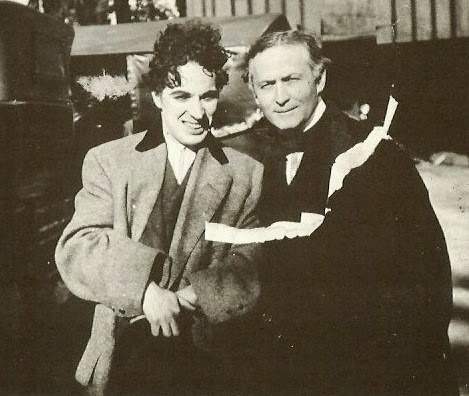
You're perennially one-step ahead of almost (if not) everybody (certainly me) in this thread Bill
Hello, my name is Bobby and hopefully I'm at the right post and the links work. I bought this copy of the Expert At The Card Table from amazon.It is from Coles publishing and has a 1980 copyright date. If you can view the link, the book doesn't have a Barcode or price.
Is this a rare copy, and is there any more information on it.
Cheers-B
https://drive.google.com/file/d/0B-PkH66qiPtxeFZRbDdpV3dETlk/view?usp=drivesdk
https://drive.google.com/file/d/0B-PkH66qiPtxeklieVpWNlNJY1U/view?usp=drivesdk
Is this a rare copy, and is there any more information on it.
Cheers-B
https://drive.google.com/file/d/0B-PkH66qiPtxeFZRbDdpV3dETlk/view?usp=drivesdk
https://drive.google.com/file/d/0B-PkH66qiPtxeklieVpWNlNJY1U/view?usp=drivesdk
Dr. Ofanser wrote:Hello, my name is Bobby and hopefully I'm at the right post and the links work. I bought this copy of the Expert At The Card Table from amazon.It is from Coles publishing and has a 1980 copyright date. If you can view the link, the book doesn't have a Barcode or price.
Is this a rare copy, and is there any more information on it.
Some info about that edition is here: http://www.everythingerdnase.com/gallery/canadian
It is by no means common, but neither is really rare. Copies come up for sale from time to time (I've got two, and have turned down opportunities to buy others). Yours does appear to be in very nice shape, which is a plus.
Copies in "good" shape generally go for between $75.00 and $125.00 - depending on how long it's been since one has shown up for sale, and whether any collectors happen to be in the market for a copy at the time of sale.
Your copy (if indeed that's an actual photo of your book) is certainly one of the finer copies I've seen, and should maintain a value on the higher side of the prices noted above.
Your copy (if indeed that's an actual photo of your book) is certainly one of the finer copies I've seen, and should maintain a value on the higher side of the prices noted above.
I appreciate the responses and info provided. I was familiar with the popular copies, but had never seen a copy like the one in subject. Im going to take a bit more careful with this copy!
Cheers-B
Cheers-B
I will sell my copy ... [deleted]
This is public on FB, and seems of interest to this community.
https://m.facebook.com/story.php?story_fbid=153957241710530&id=100012887659088
Cheers-B
This is public on FB, and seems of interest to this community.
https://m.facebook.com/story.php?story_fbid=153957241710530&id=100012887659088
Cheers-B
Hello all,
Here is the beginning post on that Facebook page. I do not find Mr. Mortimers theory on Wikipedia. I do see, however, that there is a project in the works that deems intrigue.
Cheers-B
https://m.facebook.com/story.php?story_fbid=131612093945045&id=100012887659088
Here is the beginning post on that Facebook page. I do not find Mr. Mortimers theory on Wikipedia. I do see, however, that there is a project in the works that deems intrigue.
Cheers-B
https://m.facebook.com/story.php?story_fbid=131612093945045&id=100012887659088
Oh, I have that edition too. It is falling to bits. Just like me in fact. The quality of the publication leaves something to be desired with pages falling out etc;
Maybe I should sell mine too and forge some famous magician's autograph inside to make more money. Or even put my own name. I did think for a moment to sign it "Erdnase" but alas I think that might strain credibility.
Maybe I should sell mine too and forge some famous magician's autograph inside to make more money. Or even put my own name. I did think for a moment to sign it "Erdnase" but alas I think that might strain credibility.
It's a club, with secret handshakes and all. You should join.
Bill Mullins wrote:license plate
Genius.
I'm not the first. That plate is already taken in California, Florida, and Nevada (Jason -- are you holding out on me? Wait, let me rephrase that . . . ).
But it is available in NY, Illinois and Texas.
But it is available in NY, Illinois and Texas.
The Nevada Erdnase plate is owned by a wonderful magician and friend named Stuart Beck. Stuart works for Cirque at the Beatles "Love" show.
Jason
Jason
It would appear that Chris Wasshuber's ebook is now available.
From the blurb on Chris's web page:
1) "In other words these were candidates largely based on wild theories built on little evidence held together by flawed assumptions."
2) "A century old mystery has been solved. Erdnase has been found."
The first statement seems an attempt to diminish the work done to date by researchers and authors like David Alexander and Richard Hatch - and many others.
It's an insulting statement ultimately, and removes much of any desire I might have to read Chris's e-book.
The second statement is a repeat of something Chris wrote in his newsletter a few months ago, and which I commented on at the time. It remains a silly statement considering the total lack of consensus in support of Chris's candidate.
In the blurb for his e-book, Chris is marketing himself in his capacity as a Doctor and scientist.
Any scientist knows that when presenting a paradigm busting new theory, subjecting that theory to a successful peer review, and answering any and all challenges with specific, detailed and factual responses is mandatory.
Similarly, building consensus in support of ones theory among ones peers on the subject matter is a critical step in the process of advancing that theory.
In this case, beyond those he paid a fee to in order to assist in the research his candidate, Chris doesn't seem to have a any independent Erdnase researchers offering any real support of his candidate.
There is a certain hubris in penning the statement "Erdnase has been found", when indeed you're the only person actually writing such a comment, and you're writing that comment in the complete absence of any additional support or encouragement (even slightly) from other serious Erdnase researchers.
1) "In other words these were candidates largely based on wild theories built on little evidence held together by flawed assumptions."
2) "A century old mystery has been solved. Erdnase has been found."
The first statement seems an attempt to diminish the work done to date by researchers and authors like David Alexander and Richard Hatch - and many others.
It's an insulting statement ultimately, and removes much of any desire I might have to read Chris's e-book.
The second statement is a repeat of something Chris wrote in his newsletter a few months ago, and which I commented on at the time. It remains a silly statement considering the total lack of consensus in support of Chris's candidate.
In the blurb for his e-book, Chris is marketing himself in his capacity as a Doctor and scientist.
Any scientist knows that when presenting a paradigm busting new theory, subjecting that theory to a successful peer review, and answering any and all challenges with specific, detailed and factual responses is mandatory.
Similarly, building consensus in support of ones theory among ones peers on the subject matter is a critical step in the process of advancing that theory.
In this case, beyond those he paid a fee to in order to assist in the research his candidate, Chris doesn't seem to have a any independent Erdnase researchers offering any real support of his candidate.
There is a certain hubris in penning the statement "Erdnase has been found", when indeed you're the only person actually writing such a comment, and you're writing that comment in the complete absence of any additional support or encouragement (even slightly) from other serious Erdnase researchers.
Oh good! Are we going to have an argument now?
There’s no crime in the strength of one’s convictions, but having read the blurb for Chris’ e-book, perhaps he could have conveyed his confidence and zeal with greater circumspection and tact.
Although I have not agreed with or been persuaded by a number of Chris’ conclusions and arguments, he deserves considerable credit and thanks for investing the time to share his thinking and factual discoveries in detail here. The downside to such generosity, of course, is that some who have read and/or participated in this thread may read his e-book with certain preconceptions. Hopefully, though, his work will be fairly reviewed in a few magic journals and read with an open mind by the rest of us (as Chris' e-book should now reflect the time he's had to critically reassess and polish his arguments and conclusions, in keeping with his academic credentials), after which the merits thereof can be vigorously discussed and debated by Erdnase historians and enthusiasts, as all prior theories have been.
Nobody gets rich being the author of a magic book or e-book, and I doubt that Chris will be the first exception to that rule – writing about magic is nearly always a labor of love. I intend to support Chris' work by purchasing his e-book, but at first blush do find the $45 charge for a PDF which amounts to less than 7,500 words (30 pages by Chris’ estimate) to be rather dear. Given the relatively low costs of on-demand printing nowadays, I’d have hoped that a hard copy of the e-book would be included in the price.
Although I have not agreed with or been persuaded by a number of Chris’ conclusions and arguments, he deserves considerable credit and thanks for investing the time to share his thinking and factual discoveries in detail here. The downside to such generosity, of course, is that some who have read and/or participated in this thread may read his e-book with certain preconceptions. Hopefully, though, his work will be fairly reviewed in a few magic journals and read with an open mind by the rest of us (as Chris' e-book should now reflect the time he's had to critically reassess and polish his arguments and conclusions, in keeping with his academic credentials), after which the merits thereof can be vigorously discussed and debated by Erdnase historians and enthusiasts, as all prior theories have been.
Nobody gets rich being the author of a magic book or e-book, and I doubt that Chris will be the first exception to that rule – writing about magic is nearly always a labor of love. I intend to support Chris' work by purchasing his e-book, but at first blush do find the $45 charge for a PDF which amounts to less than 7,500 words (30 pages by Chris’ estimate) to be rather dear. Given the relatively low costs of on-demand printing nowadays, I’d have hoped that a hard copy of the e-book would be included in the price.
magicam wrote:I intend to support Chris' work by purchasing his e-book, but at first blush do find the $45 charge for a PDF which amounts to less than 7,500 words (30 pages by Chris’ estimate) to be rather dear. Given the relatively low costs of on-demand printing nowadays, I’d have hoped that a hard copy of the e-book would be included in the price.
There was an error in the page- and word-count. The ebook is 150+ letter-size pages. Olsson's analysis is 36 pages long. Remove front-matter and a few other inconsequential pages and you get about 100 pages from me. For the time being the work will only be released as ebook, but I am not completely ruling out a print edition at a much later time.
Several times in this thread I have expressed skepticism that the Delphos printer Gallaway ever had a circus career. Now that I've seen Chris's book, I am convinced. There is no reason to doubt that they were the same person.
My general belief that Gallaway wasn't Erdnase still stands, for reasons I've stated before. And the fact that Gallaway did in fact work in a circus for a while doesn't affect that conclusion at all -- the connection between being a circus barker and having card playing/cheating skills, or card magic skills, is unproven, and there's no reason to suppose that a circus barker would be any more likely than any average person to have those skills.
My general belief that Gallaway wasn't Erdnase still stands, for reasons I've stated before. And the fact that Gallaway did in fact work in a circus for a while doesn't affect that conclusion at all -- the connection between being a circus barker and having card playing/cheating skills, or card magic skills, is unproven, and there's no reason to suppose that a circus barker would be any more likely than any average person to have those skills.
I'm surprised Chris's book has generated so little comment (perhaps it is priced outside the interest level of most here?)
The biography of Gallaway within it mentions that he was was a typesettter at a German newspaper in Ft. Wayne, Indiana, ca. 1887-1888, and Chris asks for help in identifying it.
The Library of Congress has a directory of U.S. Newspapers. It lists German papers from Ft. Wayne, but only one was in circulation at the right time: the Indiana Staatszeitung, which ran in both daily and weekly editions. I can't find any institutional collection that includes issues from the right time.
The biography of Gallaway within it mentions that he was was a typesettter at a German newspaper in Ft. Wayne, Indiana, ca. 1887-1888, and Chris asks for help in identifying it.
The Library of Congress has a directory of U.S. Newspapers. It lists German papers from Ft. Wayne, but only one was in circulation at the right time: the Indiana Staatszeitung, which ran in both daily and weekly editions. I can't find any institutional collection that includes issues from the right time.
Bill Mullins wrote:I'm surprised Chris's book has generated so little comment .
I think folks posting to this thread hesitate to comment if they either don't own the book in question, and/or have no intention of purchasing the book in question.
The author made his research methodology, and road map to writing the book very clear in this thread. If folks feel that methodology and road map were flawed, they might also hesitate to add that book to their Erdnase library.
Bill Mullins wrote:The biography of Gallaway within it mentions that he was was a typesettter at a German newspaper in Ft. Wayne, Indiana, ca. 1887-1888, and Chris asks for help in identifying it.
The Library of Congress has a directory of U.S. Newspapers. It lists German papers from Ft. Wayne, but only one was in circulation at the right time: the Indiana Staatszeitung, which ran in both daily and weekly editions. I can't find any institutional collection that includes issues from the right time.
There are several other possible candidates which I extracted from this article https://scholarworks.iu.edu/journals/in ... /8120/9953
- Die Ft. Wayne Freie Presse. This was a daily paper founded in 1888 which ceased publication in 1926.
- Der Weltbürger. This was a Catholic paper founded in 1883.
- Das Ft. Wayne Tageblatt. This was a daily Republican paper founded in February, 1876.
- Indiana Volksfreund. This was a weekly Republican paper established in 1871.
- Indiana Staatszeitung. Founded in 1857 and ceased publication in 1926.
I think the most likely from these is "Die Ft. Wayne Freie Presse" because it was founded in 1888 right at the time when we think Gallaway was working there. When a newspaper starts they have a great need for typesetters, more so than an established newspaper where these positions will for the most part be already filled.
And if that list is not long enough then here is an even longer from the book "Colorful journalism in Fort Wayne, Indiana" by Herbert Bredemeier. All of these were published in Fort Wayne:
- Die Abendpost
- Der Anzeiger
- Der Botschafter
- Der Fort Wayne Demokrat
- Der Deutsche Beobacher von Indiana
- Freie-Presse Staats-Zeitung
- Indiana Katholisches Wochenblatt
- Indiana Staats-Zeitung
- Wochentliche Indiana Staats-Zeitung
- Indiana Volksfreund
- Katholische Warte
- Der Weltbuerger
- Die Zeitung
Roger M. wrote:I think folks posting to this thread hesitate to comment if they either don't own the book in question, and/or have no intention of purchasing the book in question.Bill Mullins wrote:I'm surprised Chris's book has generated so little comment .
The author made his research methodology, and road map to writing the book very clear in this thread. If folks feel that methodology and road map were flawed, they might also hesitate to add that book to their Erdnase library.
Probably some validity to both of Roger's points, but as noted in my earlier post, hopefully folks will keep an open mind and see Chris' arguments in full before passing judgment.
As an aside, a decent copy of The Expert, ca. 1905 Drake edition in grey pictorial wraps, sold for approx. $185 (includes buyer's premium) at the recent Potter and Potter auction. See it here: http://auctions.bidsquare.com/view-auct ... tems%3D120. [I was the inadvertent winner of this lot -- was bidding on another lot, but mistakenly typed in the Erdnase lot # in my bid list), so if anyone is interested in securing this copy at the selling price plus shipping, let me know.]
Chris's new book asserts:
"When it comes to sleight-of-hand precious little new material has been introduced over the last century."
Anyone want to critically examine that statement?
"When it comes to sleight-of-hand precious little new material has been introduced over the last century."
Anyone want to critically examine that statement?
It's obviously not true.
I would put forth that having a deep understanding of sleight of hand prior to 1902, and sleight of hand in the 114 years since 1902 is critical to rendering any detailed examination of Erdnase - the man.
This statement about sleight of hand would seem to put the author at odds with accepted knowledge, and would tend to imply a lack of full understanding of the subject matter (although to be fair, he's not saying there was "no" new material, only "precious little" new material).
This may open the door to what any given individuals definition of "precious little" might be?
But as this e-book is a less extemporized, and more detailed version of what the author has already shared in this thread, it's not particularly surprising to find this statement contained within the final text.
This statement about sleight of hand would seem to put the author at odds with accepted knowledge, and would tend to imply a lack of full understanding of the subject matter (although to be fair, he's not saying there was "no" new material, only "precious little" new material).
This may open the door to what any given individuals definition of "precious little" might be?
But as this e-book is a less extemporized, and more detailed version of what the author has already shared in this thread, it's not particularly surprising to find this statement contained within the final text.
Bill Mullins wrote:Chris's new book asserts:
"When it comes to sleight-of-hand precious little new material has been introduced over the last century."
Anyone want to critically examine that statement?
I would disagree as well. The quality of playing cards have improved significantly over the last century, allowing for more possibilities.
I had the pleasure of handling one of Hofzinser's decks--a deck he actually used, and it was decently worn.
It spread smoothly and had obviously been treated with something. Fans and culls where no problem.
Yes, the cards are a little smaller in size.
Yes, it's a 32-card piquet pack.
Yes, it has no white borders, but the back design is so light that I believe cards could be reversed and remain unseen.
Other than those thoughts, I cannot imagine anything that is being done today that could not be done (and some things more easily) with Hofzinser's deck.
Food for thought.
It spread smoothly and had obviously been treated with something. Fans and culls where no problem.
Yes, the cards are a little smaller in size.
Yes, it's a 32-card piquet pack.
Yes, it has no white borders, but the back design is so light that I believe cards could be reversed and remain unseen.
Other than those thoughts, I cannot imagine anything that is being done today that could not be done (and some things more easily) with Hofzinser's deck.
Food for thought.
I've heard several people who have handled good-quality ca. 1902 decks say that they handle much like current cards.
Erdnase said, "For superior work the cards should be new, thin, flexible and of best quality. Cheap cards are clumsy and not highly finished."
So he certainly made distinctions between good and cheap cards.
Erdnase said, "For superior work the cards should be new, thin, flexible and of best quality. Cheap cards are clumsy and not highly finished."
So he certainly made distinctions between good and cheap cards.
Cris's book gets eviscerated in the latest Genii.
Mostly repeating points noted in this thread, but still interesting to read a third party review, sans any bias built up from posting here over time.
Mostly repeating points noted in this thread, but still interesting to read a third party review, sans any bias built up from posting here over time.
Who wrote the evisceration?
performer wrote:Who wrote the evisceration?
I believe it was John Lovick?
Oh.
Chris -- given that Gallaway was an amateur astronomer, have you or anyone else gone through issues of Popular Astronomy of the era looking for mentions of him?
You can do some online searching (unfortunately, not full text) of articles from that journal here:
https://ui.adsabs.harvard.edu/#classic-form
Check "Astronomy" in "Databases to Query" and enter "PA" into the "Publication" field to limit returns to Popular Astronomy.
You can do some online searching (unfortunately, not full text) of articles from that journal here:
https://ui.adsabs.harvard.edu/#classic-form
Check "Astronomy" in "Databases to Query" and enter "PA" into the "Publication" field to limit returns to Popular Astronomy.
Wow! What a terrible review. Now I know not to trust John Lovicks reviews. That was grossly over biased IMHO.
I read Chris Wasshubers posts in his news letter as he was researching and I was fascinated by his discoveries.
There was a very mean spirited tone to the review that had nothing to do with the book being judged by its merits.
John totally dismissed all the circumstantial evidence Chris brought to light.
Whatever.
One thing I know has misled the whole movement is the anagram sacred cow. That whole misguided mess needs to be led to pasture and slaughtered once and for all. Let go already- it doesnt make any sense!
When writers use a paeudonym- they never just simply scramble the letters of their real name. Dont they usually come up with something totally obscure that bears zero resemblance to their real name?
Case in point:
John Lovick= Handsome Jack
We are all assuming Erdnase wished to hide his true identity. So he's just going to write his name backwards and scramble a letter or two? Who does that? Who has done that? Please. Thats silly and amatuerish. Erdnase was no amatuer - this we know.
When Chris brought up the German nickname it made so much more sense to me.
The fact that our protagonist traveled with a circus and was known to do magic is profound to me. John thought that was nothing.
Like I said- it was a very mean spirited revue so I know something else is at hand.
I read Chris Wasshubers posts in his news letter as he was researching and I was fascinated by his discoveries.
There was a very mean spirited tone to the review that had nothing to do with the book being judged by its merits.
John totally dismissed all the circumstantial evidence Chris brought to light.
Whatever.
One thing I know has misled the whole movement is the anagram sacred cow. That whole misguided mess needs to be led to pasture and slaughtered once and for all. Let go already- it doesnt make any sense!
When writers use a paeudonym- they never just simply scramble the letters of their real name. Dont they usually come up with something totally obscure that bears zero resemblance to their real name?
Case in point:
John Lovick= Handsome Jack
We are all assuming Erdnase wished to hide his true identity. So he's just going to write his name backwards and scramble a letter or two? Who does that? Who has done that? Please. Thats silly and amatuerish. Erdnase was no amatuer - this we know.
When Chris brought up the German nickname it made so much more sense to me.
The fact that our protagonist traveled with a circus and was known to do magic is profound to me. John thought that was nothing.
Like I said- it was a very mean spirited revue so I know something else is at hand.
S. Tauzier wrote:The fact that our protagonist . . . was known to do magic is profound to me.
Gallaway has not been shown to have performed magic.
S. Tauzier wrote: so I know something else is at hand.
no. something else must must not be at hand.
believe it or not, sometimes reviewers hold strong opinions that have nothing to do with the person offering the item to be reviewed. By your logic ever glowing review we read should be dismissed as merely some syncophant or friend of the creator saying kind things because - well, of course some other thing must be at hand.
news flash: sometimes people attempt to sell [censored] work and some critics care enough to put their name on the line and alert their fellow magicians.
now I don't know anything about this work, so don't take that as me commenting on the quality of the item under review. But it's really silly to assume that all bad reviews MUST be the result of some personal agenda.
you're smarter than that.
S. Tauzier wrote: Erdnase was no amatuer - this we know.
Critically important to any discussion on either the book, or the author - is that we know nothing of the sort.
I believe Erdnase was a magician and NOT a cardsharp! I am psychic and know these things. In fact it wouldn't surprise me if he had rarely played cards for money. He knew too much about sleight of hand. Card sharks don't. He reasoned that books on cheating sell better than books on magic. And he was right. And that is why he did not put his real name to the book. People would realise he was full of tosh and that he had never gambled in his life.
S. Tauzier wrote:One thing I know has misled the whole movement is the anagram sacred cow. That whole misguided mess needs to be led to pasture and slaughtered once and for all. Let go already- it doesnt make any sense!
When writers use a paeudonym- they never just simply scramble the letters of their real name. Dont they usually come up with something totally obscure that bears zero resemblance to their real name.
Misled? A misguided mess? Mr. Tauzier, you obviously haven't read David Alexander's essay on W.E. Sanders.
"...they never just simply scramble the letters of their real name." Really? Mr. Tauzer, let me pass along a piece of advice given to me by one of my English professors at the university:
Never speak in absolutes!
Brad - if you read the review there is a meanstreak in it that brings up topics that have nothing to do with the review.
Bill - did you read the book or Chris' posts? There is some info on him performing magic.
Performer - why cant someone intrested in magic, learn a bunch of card tricks and then at some point play cards, start using some slieght of hand to cheat, then start a deep study of cheating techniques, then become a cardsharp? That doesnt seem too far fetched for me.
Ive read all the work on the Erdnase sluething and so many things that bothered me were absent in the Wasshuber book.
Nevertheless- anyone interested in the subject should read this book and temper their thoughts with its contents.
It holds weight IMHO.
Bill - did you read the book or Chris' posts? There is some info on him performing magic.
Performer - why cant someone intrested in magic, learn a bunch of card tricks and then at some point play cards, start using some slieght of hand to cheat, then start a deep study of cheating techniques, then become a cardsharp? That doesnt seem too far fetched for me.
Ive read all the work on the Erdnase sluething and so many things that bothered me were absent in the Wasshuber book.
Nevertheless- anyone interested in the subject should read this book and temper their thoughts with its contents.
It holds weight IMHO.
Mr Leonard, please pardon my hyperbolic absolute but please name me one author
in the last 120 years that has simply scrambled the letters of his true name to arrive at a pseudonym so that I may humbly stand corrected.
I like the German 'Erdnase nickname' theory. It makes more sense to me.
S.T.
in the last 120 years that has simply scrambled the letters of his true name to arrive at a pseudonym so that I may humbly stand corrected.
I like the German 'Erdnase nickname' theory. It makes more sense to me.
S.T.
S. Tauzier wrote:Bill - did you read the book or Chris' posts? There is some info on him performing magic.
Yes I did. Did you?
Gallaway was in a show which "consisted of a series of stereopticon pictures, purloined from old family albums, showing our own Donnelley dignitaries as they looked in early life. . . .To attempt to tell how funny some of our staid executives looked in their swaddling clothes and velvet knickers of early youth is futile. The wild guesses voiced by the audience, before Gallaway, officiating as Bustin Homes, announced their identities, was evidence of their oddity in most cases. "
Gallaway emceed a slide show. That's not a magic performance, despite the show having been titled "Magic Wand". One of the reviewers mentioned Gallaway and his "bag of tricks" -- a common enough turn of phrase, but clearly it doesn't refer to conjuring in this case. Gallaway was no more a magician than Felix the Cat.
Of all lapses of logic in Chris's book, this is the most serious. If it had been true, it would have been an important piece of evidence in favor of Gallaway. As it is, it taints everything else in the book.
S. Tauzier wrote:please name me one author in the last 120 years that has simply scrambled the letters of his true name to arrive at a pseudonym so that I may humbly stand corrected.
Persi Diaconis wrote as R. Sid Spocane II.
Martin Gardner wrote as Armand T. Ringer.
That's just from people who are relevant to the Erdnase mystery. There are more, I'm sure.
Bill... really? You name two authors closely related to the research on Erdnase? Give me a break- the theory that Erdnase swapped his letters around surely gave them the idea to do that with their names! Are you kidding?
Name two non- magicians because most magicians are aware of this theory and they would be tempered to do the same thing. 'Normal' authors are not known to do this.
Stephen King-Richard Bachman
Samuel Langhorne Clemens-Mark Twain
Charles Lutwidge Dodgson-Lewis Carroll
Benjamin Franklin- Mrs. Silence Dogood
Isaac Asimov- Paul French
S.T.
Name two non- magicians because most magicians are aware of this theory and they would be tempered to do the same thing. 'Normal' authors are not known to do this.
Stephen King-Richard Bachman
Samuel Langhorne Clemens-Mark Twain
Charles Lutwidge Dodgson-Lewis Carroll
Benjamin Franklin- Mrs. Silence Dogood
Isaac Asimov- Paul French
S.T.
Bill- Then it is quite obvious that you have not seen Felix The Cats classic version of "Cups And Hairballs"
S. Tauzier wrote:Name two non- magicians because most magicians are aware of this theory and they would be tempered to do the same thing. 'Normal' authors are not known to do this.
No problem S.T. The Genii grants all wishes:
"Arrigo Boito" = "Tobia Gorrio"
"Edward Gorey" = "Ogdred Weary", = "Regera Dowdy" or = "E. G. Deadworry" (and others)
"Vladimir Nabokov" = "Vivian Darkbloom", = "Vivian Bloodmark", = "Blavdak Vinomori", or = "Dorian Vivalkomb"
"Ted Morgan" = "(Sanche) de Gramont"
"Dave Barry" = "Ray Adverb"
"Glen Duncan" = "Declan Gunn"[29]
"Damon Albarn" = "Dan Abnormal"
"Anna Madrigal" = "A man and a girl"
"Tom Marvolo Riddle" = "I am Lord Voldemort"
"Buckethead" = "Death Cube K"
"Daniel Clowes" = "Enid Coleslaw"
"Siobhán Donaghy" = "Shanghai Nobody"
Several of these are "imperfect anagrams", letters having been left out in some cases for the sake of easy pronunciation.
As you can see S.T.--you are wrong--very mistaken. I gave you a list of more than two authors who have used anagrams as pen names. Even the poet and songwriter Jim Morrison used an anagram of his name calling himself "Mr. Mojo Risin" in his song L.A. Woman.
pt selbit - Percy tibbles.
magician who was unlikely to know anything about the erdnase theory created his name by reversing it.
but I think you demand we dismiss magicians is putting the cart before the horse. perhaps erdnase was merely a magician who made his decision by having seen other magicians like tibbles make similar pseudonyms.
magician who was unlikely to know anything about the erdnase theory created his name by reversing it.
but I think you demand we dismiss magicians is putting the cart before the horse. perhaps erdnase was merely a magician who made his decision by having seen other magicians like tibbles make similar pseudonyms.
such an enthusiastic defense by mr tauzier suggests something more must be at hand.
perhaps tauzier is an anagram for washuber.
this is fun!!!
perhaps tauzier is an anagram for washuber.
this is fun!!!
S. Tauzier wrote:Performer - why cant someone interested in magic, learn a bunch of card tricks and then at some point play cards, start using some slieght of hand to cheat, then start a deep study of cheating techniques, then become a cardsharp? That doesnt seem too far fetched for me.
Because magicians have led sheltered lives and have little knowledge on how to lie, cheat and steal. Or have the mentality required. Except of course illusion makers that run off with your money. But then illusion makers generally do not know much about sleight of hand.
The book is too well written for it to be authored by someone terribly wicked. And magicians are far too boring to be terribly wicked. And it was obviously written by a magician. Card sharks know about 3 or 4 moves at the most. They don't know a fraction of what is in that book. There is a whole section in the back about magic because the author couldn't resist doing it. And in the supposed card sharping section there are clues in some of the words and expressions used which give the game away the author was a magician.
Magicians are mostly all talk about gambling and card cheating. Sure, they might be able to do the moves required but alas they don't have the mentality to risk having their hands broken if they get caught. This particular book reminds me of the myriad works by magicians on so called "cold reading" and other silliness when they have never done a paid psychic reading in their life.
Having said all that, I have cursorily read all the various theories on who Erdnase was. I shall merely say that as far as I am concerned Chris's theories have as much validity as anyone else's and I think I have indeed detected some mean spiritedness and lack of respect for them which for some reason other theorists don't seem to get to the same extent.
Leonard- to be exact, we should be looking at authors that would have set a precedent in the 1800's. Buckethead? Jim Morrison? That is hilarious.
Makes more sense that Erdnase is the german nickname "earth nose" and that our author was of German descent.
Makes more sense that Erdnase is the german nickname "earth nose" and that our author was of German descent.
ok so now we can't use a magician or anyone after a certain date as proof that the idea is a common one.
I have you a magician from that age who did exactly what erdnase may have done.
and Chris didn't discover the earth nose idea.
I personally
pointed it out to Richard hatch well over a decade ago and apparently I wasn't even tne first then.
I have you a magician from that age who did exactly what erdnase may have done.
and Chris didn't discover the earth nose idea.
I personally
pointed it out to Richard hatch well over a decade ago and apparently I wasn't even tne first then.
Well I like the 'earth nose' trail.
I also like the anagram but thats just because I like anagrams. It just doesnt seem likely to me that this is the case here. My thought is if he wanted to hide his name, why risk it on a simple anagram? Too easy to figure out from those around him that may have been curious. Lets please not just argue for arguments sake; when we play devils advocate- the only winner is the devil herself.
I also like the anagram but thats just because I like anagrams. It just doesnt seem likely to me that this is the case here. My thought is if he wanted to hide his name, why risk it on a simple anagram? Too easy to figure out from those around him that may have been curious. Lets please not just argue for arguments sake; when we play devils advocate- the only winner is the devil herself.
why are we assuming erdnase truly wanted to completely hide his identity?
seems to me it he truly wanted to remain anonymous he would have accredited its authorship to 'anonymous'
why can't the degree of anonymity
afforded by an anagram not be exactly the degree he desired?
seems to me it he truly wanted to remain anonymous he would have accredited its authorship to 'anonymous'
why can't the degree of anonymity
afforded by an anagram not be exactly the degree he desired?
S. Tauzier wrote:Leonard- to be exact, we should be looking at authors that would have set a precedent in the 1800's. Buckethead? Jim Morrison? That is hilarious.
Oh--you are now setting parameters in the search for authors that used anagrams as pseudonyms? The author should be from the 1800's? And not a magician? Certainly T.S.--happy to oblige you and from that original list I gave you:
1. Arrigo Boito = 1842--1918
Set a precedent in the 1800s? Of what exactly? So far you have already been proven wrong.
Brad- yeah, I see what youre saying.
Leonard- ok, you win.
Leonard- ok, you win.
A digression within A Tale of a Tome?
performer wrote:S. Tauzier wrote:Performer - why cant someone interested in magic, learn a bunch of card tricks and then at some point play cards, start using some slieght of hand to cheat, then start a deep study of cheating techniques, then become a cardsharp? That doesnt seem too far fetched for me.
Because magicians have led sheltered lives and have little knowledge on how to lie, cheat and steal. Or have the mentality required. Except of course illusion makers that run off with your money. But then illusion makers generally do not know much about sleight of hand.
The book is too well written for it to be authored by someone terribly wicked. And magicians are far too boring to be terribly wicked. And it was obviously written by a magician. Card sharks know about 3 or 4 moves at the most. They don't know a fraction of what is in that book. There is a whole section in the back about magic because the author couldn't resist doing it. And in the supposed card sharping section there are clues in some of the words and expressions used which give the game away the author was a magician.
Magicians are mostly all talk about gambling and card cheating. Sure, they might be able to do the moves required but alas they don't have the mentality to risk having their hands broken if they get caught. This particular book reminds me of the myriad works by magicians on so called "cold reading" and other silliness when they have never done a paid psychic reading in their life.
Having said all that, I have cursorily read all the various theories on who Erdnase was. I shall merely say that as far as I am concerned Chris's theories have as much validity as anyone else's and I think I have indeed detected some mean spiritedness and lack of respect for them which for some reason other theorists don't seem to get to the same extent.
Thanks Performer. You make great points.
Perhaps he was a magician first and then became a gambling move junky? Certain people are going to become obsessed with their chosen hobbies and trades. Even if gamblers only know/use a few moves, he could have been one of those guys that had to 'learn it all'. Just saying because we dont know- therefore anything is
possible.
S. Tauzier wrote:Leonard- ok, you win.
Which proves that "normal" authors outside of magic have indeed used anagrams of their own names as pseudonyms. The sacred cow should not be put out to pasture. Challenging the anagram theory keeps us on our toes S.T. so I thank you for that.
The fact that W.E. Sanders played with anagrams of his own name as a schoolboy is compelling enough for me to continue believing he is the leading candidate in the hunt for the identity of S.W. Erdnase. The fact that Sanders purchased a stack of playing card decks before his Colorado camping trip certainly bolsters his candidacy as well.
The fact that "WE SANDERS" appears reading downward in the slightly shifted triangle of text on the title page is also unlikely to be happenstance.
Leonard, so you have a list of folks who used an anagram of their name as pseudonym. Have you checked what their motivation was to choose that pseudonym? Was it a cute artsy thing to do? Or did they have a serious reason to stay anonymous such as fear of prosecution, bodily harm, loss of employment? Has anybody from that list outed themselves later and said, yeah that's me? Or did they all keep it to themselves and only after their death folks connected the dots?
Erdnase was in a precarious situation if detected being a cheat. We as magicians glorify advantage players, because we look at their awesome sleight-of-hand skills. But in reality they are crooks, cheats and thieves, because they steal money. If they are found out they will suffer serious consequences. In the times of Erdnase they might get beaten to a pulp, stabbed or perhaps even shot on the spot by the mark from whom they stole. At the very least they will be ostracized. Nobody will do business with them. This is the simple and obvious reason why Erdnase truly not only wanted to but needed to stay anonymous. Anything else is silly talk by magicians who have no idea what it meant to be found out a cheat during Erndase times.
For somebody like Gallaway who was working in the print industry in customer facing positions it would have meant the end of his career if people found out he is a cheat. The only profession one can openly pursue as cheat is the one of a reformed gambler. However, a reformed gambler would have certainly claimed EATCT as his own, because he earns his money with writing and lecturing on the methods of cheating.
One other comment on the anagram business. The only version for which there are at least rumors is the reverse spelling, meaning an E.S. Andrews. Once we start to leave out characters, exchange them with others, or go to a complex anagram then there is not even a rumor to support it.
The troubling weakness of the reverse spelling is that it is way too easy to figure out, and everybody knows that it is way to easy to figure out. That means for a cheat it is unacceptable as pseudonym. The easy spotting of the reverse spelling is also most likely the source of the rumor. There is no evidence that the reverse "Andrews' hint actually originated from Erdnase himself. Most likely one of the Drake's realized that S.W. Erdnase in reverse yields a common name. That means it is a particularly weak theory to begin with.
Nickname theory: I think the first who recognized that Erdnase can be understood as German word was Tom Sawyer. My contribution was to establish that the word Erdnase was in use in German literature before Erdnase, and that it is in use as nickname. That is the basis and factual underpinning of my nickname theory. Gallaway fits the nickname theory extremely well.
But keep in mind that all of these - reverse spelling, anagram, nickname, etc. - are theories, because we have no evidence how the author chose his pseudonym. The various theories are only some of the possible ways he could have chosen Erdnase.
Erdnase was in a precarious situation if detected being a cheat. We as magicians glorify advantage players, because we look at their awesome sleight-of-hand skills. But in reality they are crooks, cheats and thieves, because they steal money. If they are found out they will suffer serious consequences. In the times of Erdnase they might get beaten to a pulp, stabbed or perhaps even shot on the spot by the mark from whom they stole. At the very least they will be ostracized. Nobody will do business with them. This is the simple and obvious reason why Erdnase truly not only wanted to but needed to stay anonymous. Anything else is silly talk by magicians who have no idea what it meant to be found out a cheat during Erndase times.
For somebody like Gallaway who was working in the print industry in customer facing positions it would have meant the end of his career if people found out he is a cheat. The only profession one can openly pursue as cheat is the one of a reformed gambler. However, a reformed gambler would have certainly claimed EATCT as his own, because he earns his money with writing and lecturing on the methods of cheating.
One other comment on the anagram business. The only version for which there are at least rumors is the reverse spelling, meaning an E.S. Andrews. Once we start to leave out characters, exchange them with others, or go to a complex anagram then there is not even a rumor to support it.
The troubling weakness of the reverse spelling is that it is way too easy to figure out, and everybody knows that it is way to easy to figure out. That means for a cheat it is unacceptable as pseudonym. The easy spotting of the reverse spelling is also most likely the source of the rumor. There is no evidence that the reverse "Andrews' hint actually originated from Erdnase himself. Most likely one of the Drake's realized that S.W. Erdnase in reverse yields a common name. That means it is a particularly weak theory to begin with.
Nickname theory: I think the first who recognized that Erdnase can be understood as German word was Tom Sawyer. My contribution was to establish that the word Erdnase was in use in German literature before Erdnase, and that it is in use as nickname. That is the basis and factual underpinning of my nickname theory. Gallaway fits the nickname theory extremely well.
But keep in mind that all of these - reverse spelling, anagram, nickname, etc. - are theories, because we have no evidence how the author chose his pseudonym. The various theories are only some of the possible ways he could have chosen Erdnase.
lybrary wrote:Erdnase was in a precarious situation if detected being a cheat. We as magicians glorify advantage players, because we look at their awesome sleight-of-hand skills. But in reality they are crooks, cheats and thieves, because they steal money. If they are found out they will suffer serious consequences. In the times of Erdnase they might get beaten to a pulp, stabbed or perhaps even shot on the spot by the mark from whom they stole. At the very least they will be ostracized. Nobody will do business with them. This is the simple and obvious reason why Erdnase truly not only wanted to but needed to stay anonymous. Anything else is silly talk by magicians who have no idea what it meant to be found out a cheat during Erndase times.
The troubling weakness of the reverse spelling is that it is way too easy to figure out, and everybody knows that it is way to easy to figure out. That means for a cheat it is unacceptable as pseudonym. The easy spotting of the reverse spelling is also most likely the source of the rumor. There is no evidence that the reverse "Andrews' hint actually originated from Erdnase himself.
Yes, the author of The Expert did indeed want to keep his identity a secret but not exactly for the reason you cited. According to Hurt McDermott in his essay "Erdnase in Chicago," the contents of the book could have been considered immoral under the Comstock Law. There was an incentive to avoid a prison sentence, 5 years of hard labor, and a fine.
Yes, the reverse spelling anagram is too easy a trail to follow. Perhaps that is why it took a detective like David Alexander to finally discover W.E. Sanders. Alexander believed that Sanders expected the E.S. Andrews theory to surface and welcomed it as a red herring to throw off those on his trail.
lybrary wrote: Nickname theory: I think the first who recognized that Erdnase can be understood as German word was Tom Sawyer.
The ebook says (wrongly) that Richard Hatch first discovered this.
My contribution was to establish that the word Erdnase was in use in German literature before Erdnase,
No, there were other people who noted this before you got interested in the subject.
Upthread, Mark Lewis said "I think I have indeed detected some mean spiritedness and lack of respect for [Chris's theories] which for some reason other theorists don't seem to get."
To the extent that I am one of those who doesn't extend respect, and has been mean spirited, the examples above are one reason why. Alexander, Hatch, Demarest, and other serious theorists have offered candidates in the spirit of "Here's an interesting guy. I'm not saying he's Erdnase, but he might be, and here's the evidence for him." Chris has said, "I've proved that Gallaway is Erdnase -- case closed" and been disdainful of not only the other candidates, but of people who don't agree with him. Others have asked for help, graciously accepted it, and given full credit to those who went before them. Chris has taken the work of others as his own.
Despite the fact that the tone of exchanges between Chris and me has gone south over the last year, I still think that Gallaway is, in the words of Richard Hatch, a "person of interest", and still continue to offer suggestions that may develop his standing as a candidate.
Bill Mullins wrote:The ebook says (wrongly) that Richard Hatch first discovered this.
Then you are reading an old edition. This has been corrected a while ago.
Bill Mullins wrote:No, there were other people who noted this before you got interested in the subject.
I was not aware of that. I certainly found other instances then the ones mentioned. Big deal. You had to correct yourself many times before on this thread. In any case, I was the first to formulate the nickname theory and later realized that it fits Gallaway. I did not develop it after I found Gallaway. This is an important point. I did not make it fit Gallaway as some wrongfully accuse me. I developed the nickname theory many months before I even found Gallaway.
Bill Mullins wrote:Chris has taken the work of others as his own.
Please educate us all where I have taken work of others and passed it along as mine.
Leonard Hevia wrote:Yes, the author of The Expert did indeed want to keep his identity a secret but not exactly for the reason you cited.
Interesting. And how do you know the exact reasons of Erdnase?
I really must try this anagram business the next time I go on the magic cafe.
lybrary wrote:Leonard Hevia wrote:Yes, the author of The Expert did indeed want to keep his identity a secret but not exactly for the reason you cited.
Interesting. And how do you know the exact reasons of Erdnase?
The same way you do.
The Comstock law simply adds to the fact that a cheat was in a precarious situation. But you do not need these laws to explain the need for anonymity. Common sense tells you that a cheat wants to stay hidden. Even a kid knows that. It is such an easy fact to grasp except for some folks posting here.
Anybody who had anything to do with anything "immoral", include writing about, participating in, or in any way making an effort to advance the field of cheating at playing cards would have been majorly influenced by the Comstock Laws which were in effect, and somewhat of a witch hunt at the time.
The simplest explanation for an anagram on the EATCT cover would be that, in an effort not to give a prosecutor direct evidence with which to bring charges against him, an author of a questionable book simply wouldn't give his actual name as the author.
There was no effort to "hide" from anybody at all, and no risk of being beaten or shot ... simply not using ones real name protects the author from self-incrimination under the Comstock Laws.
Because Erdnase wasn't actually trying to hide from anybody, an anagram would work perfectly well.
As to the comments about "mean spirited" exchanges, Chris gives as good as he takes.
Other Erdnase hunters have (as Bill noted) displayed a far more friendly and cooperative tone to this thread, and in their own written works.
Clay noted recently that there was nothing wrong with the strength of ones convictions.
This I read with interest, and noted that there is at least one other well known author who has declared that he has "found" Erdnase based on the evidence, and that author hasn't been questioned heavily on his findings.
The reason for that is, he made his statement based on his convictions, and let it resonate as it would on its own.
He didn't come into the Genii Forum and begin implying that anybody who disagreed with him was misinformed.
He didn't come into the Genii Forum and insult those who asked difficult questions, or disagreed with said authors comments.
He did simply make his choice for Erdnase, and left it at that.
Comments like the one seen in the previous post noting "It is such an easy fact to grasp except for some folks posting here" seem to be the exclusive domain of Chris - and as noted, you reap what you sew.
The simplest explanation for an anagram on the EATCT cover would be that, in an effort not to give a prosecutor direct evidence with which to bring charges against him, an author of a questionable book simply wouldn't give his actual name as the author.
There was no effort to "hide" from anybody at all, and no risk of being beaten or shot ... simply not using ones real name protects the author from self-incrimination under the Comstock Laws.
Because Erdnase wasn't actually trying to hide from anybody, an anagram would work perfectly well.
As to the comments about "mean spirited" exchanges, Chris gives as good as he takes.
Other Erdnase hunters have (as Bill noted) displayed a far more friendly and cooperative tone to this thread, and in their own written works.
Clay noted recently that there was nothing wrong with the strength of ones convictions.
This I read with interest, and noted that there is at least one other well known author who has declared that he has "found" Erdnase based on the evidence, and that author hasn't been questioned heavily on his findings.
The reason for that is, he made his statement based on his convictions, and let it resonate as it would on its own.
He didn't come into the Genii Forum and begin implying that anybody who disagreed with him was misinformed.
He didn't come into the Genii Forum and insult those who asked difficult questions, or disagreed with said authors comments.
He did simply make his choice for Erdnase, and left it at that.
Comments like the one seen in the previous post noting "It is such an easy fact to grasp except for some folks posting here" seem to be the exclusive domain of Chris - and as noted, you reap what you sew.
lybrary wrote:The Comstock law simply adds to the fact that a cheat was in a precarious situation. But you do not need these laws to explain the need for anonymity. Common sense tells you that a cheat wants to stay hidden. Even a kid knows that. It is such an easy fact to grasp except for some folks posting here.
You do need those laws if you want to stay anonymous when publishing a book such as The Expert. Erdnase could have walked into a pick up card game and not worry about being identified if he had used his true name for the book. There were no photos of him in the book. The other players would not have been able to identify him on sight.
lybrary wrote:The Comstock law simply adds to the fact that a cheat was in a precarious situation. But you do not need these laws to explain the need for anonymity. Common sense tells you that a cheat wants to stay hidden. Even a kid knows that. It is such an easy fact to grasp except for some folks posting here.
You should read Forty Years a Gambler by George Devol.
Perhaps one of the most famous card cheats of all time, he hid from nobody, and plied his trade with a gun in his belt.
He was an actual card cheater, and he feared absolutely no one at all.
Your depiction of a card cheat in the late 1800's and early 1900's is terribly misinformed.
Indeed, Devol wrote a book about his experiences 10 years before Erdnase did ... and Devol used his own name contrary to your take on why an author might be afraid to use his own name as the author of a book on cheating at playing cards.
Leonard Hevia wrote:You do need those laws if you want to stay anonymous when publishing a book such as The Expert. Erdnase could have walked into a pick up card game and not worry about being identified if he had used his true name for the book. There were no photos of him in the book. The other players would not have been able to identify him on sight.
Then you should read Erdnase more carefully. In several places Erdnase mentions that it is absolutely necessary for the cheat to not even arouse the slightest suspicion. It was a point he made again and again and very strongly. It would be very foolish indeed to risk identification. And Erdnase was certainly no fool. But the point I make in my ebook is more about his career. Erdnase told Smith that he was a cardshark who was going straight. So clearly Erdnase must have had some other employment or profession in mind after his cardsharking to support him, particularly since he 'needed the money'. Being identified as a cheat would have meant a big problem for him to earn his living. So the threat of past marks finding him and beating him up is less than the threat to his future career in whatever other profession he had.
Bill Mullins wrote:lybrary wrote: Nickname theory: I think the first who recognized that Erdnase can be understood as German word was Tom Sawyer.
The ebook says (wrongly) that Richard Hatch first discovered this.
I would guess that almost any German who read the book "discovered" that Erdnase sounds like a fun German word. I know I did, it's hard to miss.
Roger M. wrote:lybrary wrote:The Comstock law simply adds to the fact that a cheat was in a precarious situation. But you do not need these laws to explain the need for anonymity. Common sense tells you that a cheat wants to stay hidden. Even a kid knows that. It is such an easy fact to grasp except for some folks posting here.
You should read Forty Years a Gambler by George Devol.
Perhaps one of the most famous card cheats of all time, he hid from nobody, and plied his trade with a gun in his belt.
He was an actual card cheater, and he feared absolutely no one at all.
Your depiction of a card cheat in the late 1800's and early 1900's is terribly misinformed.
Indeed, Devol wrote a book about his experiences 10 years before Erdnase did ... and Devol used his own name contrary to your take on why an author might be afraid to use his own name as the author of a book on cheating at playing cards.
Read my post above. My primary argument is about his career after cardsharking which would be seriously impacted being found out a cheat. And perhaps Devol was of different opinion than Erdnase. I am sure you read EATCT many times. You will remember several places where he strongly advises against the behavior you describe Devol exhibited.
lybrary wrote:Bill Mullins wrote:The ebook says (wrongly) that Richard Hatch first discovered this.
Then you are reading an old edition. This has been corrected a while ago.
The edition I am reading is the one you sold me on 11/30.
You've said many times here on the Forum that one of the great advantages of ebooks is that errors can be corrected. If you are correcting errors of fact, why aren't you sending updates to previous purchasers? You've got my contact information. Every time you make a change, you should be sending me (and the others that bought the book) an email saying that "Version 2.03 is now available, with the following errors corrected". And there should be some sort of tracking, so that two people with different versions can have an intelligent conversation about the contents, without one saying "The book says this", and the other saying "No, they book says something else".
If you don't proactively push out corrections, then this supposed "advantage" of ebooks is only a source of confusion (as we see here).
performer wrote:I really must try this anagram business the next time I go on the magic cafe.
If we see a post there from "Ms. Warlike" or "Mike Rawls" we'll know it is you.
Denis Behr wrote:I would guess that almost any German who read the book "discovered" that Erdnase sounds like a fun German word. I know I did, it's hard to miss.
I totally agree, but we need to be fair and credit those who first publish such insights, and to the best of my knowledge Tom was the first to publish it.
Bill Mullins wrote:lybrary wrote:Bill Mullins wrote:The ebook says (wrongly) that Richard Hatch first discovered this.
Then you are reading an old edition. This has been corrected a while ago.
The edition I am reading is the one you sold me on 11/30.
You've said many times here on the Forum that one of the great advantages of ebooks is that errors can be corrected. If you are correcting errors of fact, why aren't you sending updates to previous purchasers? You've got my contact information. Every time you make a change, you should be sending me (and the others that bought the book) an email saying that "Version 2.03 is now available, with the following errors corrected". And there should be some sort of tracking, so that two people with different versions can have an intelligent conversation about the contents, without one saying "The book says this", and the other saying "No, they book says something else".
If you don't proactively push out corrections, then this supposed "advantage" of ebooks is only a source of confusion (as we see here).
Bill, we do that regularly. Frequent Lybrary.com customers can verify that. Whenever an ebook is updated, and this happens often, we send out emails to all customers. But emails are not a perfect form of communication. Not all arrive. Some get caught in spam filters or other blockers before they even reach your computer. It can also happen that occasionally we forget to send out update notifications, because we are merely humans. But to cover for our imperfections we have the red identifier in the digital shelf. Any link that turns red has a newer file version from the one you downloaded. You should buy more often from Lybrary.com. Then you would know about all the great features and services we provide
I rather like "warlike". I might try that one.
lybrary wrote: You will remember several places where he strongly advises against the behavior you describe Devol exhibited.
Well, yes - even Devol would suggest that not making your skills as a cardsharp apparent to the sheep is probably a good idea. It's an idea Erdnase no doubt shared.
However, wanting to conceal ones identity for safety reasons is an entirely different discussion than concealing ones identity due to the Comstock Laws.
We have absolutely no evidence to suggest that Erdnase was "afraid" of being identified, and thus wanted to publish the book without his true name attached as the author.
Indeed, taken as a whole, and considering he met Smith in the hotel room in person and paid him with a cheque ... it would seem Mr. Erdnase didn't try very hard at all to conceal who he was.
Presumably, if Erdnase feared being discovered as the author, he would have done a much better job (at the time) of remaining concealed - including simply authoring the book as "Anonymous", or "An Adept".
But hide he did (just not out of fear), and thus we look for him.
lybrary wrote: Whenever an ebook is updated, and this happens often, we send out emails to all customers.
All customers except me.
But I did redownload the book from the digital shelf, and that error is corrected. But have other errors been corrected? Tracking revisions is just as important as notification.
Can you provide a list of changes you have made, along with dates made, to "The Hunt for Erdnase & the path to Edward Gallaway" since its publication?
Bill Mullins wrote:lybrary wrote: Whenever an ebook is updated, and this happens often, we send out emails to all customers.
All customers except me.
But I did redownload the book from the digital shelf, and that error is corrected. But have other errors been corrected? Tracking revisions is just as important as notification.
Can you provide a list of changes you have made, along with dates made, to "The Hunt for Erdnase & the path to Edward Gallaway" since its publication?
I should add that in your Lybrary account there is a setting that allows you to disable email notifications. (It is under Account Information.) Some customers do not want to receive such notification emails. You may want to check it. Perhaps it is turned off in your account.
My Hunt for Erdnase ebook has gone through many revisions and corrections over several months. Early customers could download early versions of it. I am sure there are still errors in the ebook, be it typos or factual errors. They will be corrected as soon as I am made aware of them. It is also possible that I will add or revise certain parts as new facts about Gallaway come to light. That is the benefit of ebooks and is a practice many of our ebook authors take advantage of, including myself.
When we send out update notifications we usually include information about what has changed - a trick has been added, typos corrected, etc. But we do not track changes or publish lists of when and what has been changed. We have 6000 digital magic products. On average something gets fixed or corrected every day. It would be an administrative nightmare to keep track of every change. We update and fix every error that comes to our attention, but we do not maintain a revision log. But you are free to save versions under whatever versioning system you use if that is important to you.
Roger M. wrote:lybrary wrote: You will remember several places where he strongly advises against the behavior you describe Devol exhibited.
Well, yes - even Devol would suggest that not making your skills as a cardsharp apparent to the sheep is probably a good idea. It's an idea Erdnase no doubt shared.
However, wanting to conceal ones identity for safety reasons is an entirely different discussion than concealing ones identity due to the Comstock Laws.
We have absolutely no evidence to suggest that Erdnase was "afraid" of being identified, and thus wanted to publish the book without his true name attached as the author.
Indeed, taken as a whole, and considering he met Smith in the hotel room in person and paid him with a cheque ... it would seem Mr. Erdnase didn't try very hard at all to conceal who he was.
Presumably, if Erdnase feared being discovered as the author, he would have done a much better job (at the time) of remaining concealed - including simply authoring the book as "Anonymous", or "An Adept".
But hide he did (just not out of fear), and thus we look for him.
One thing we know, the author did not use his real name. So clearly he had some concerns of some sort to use his real name. What they exactly were is speculation. Nobody knows for sure. The other fact we know is that for more than hundred years he stayed hidden. If it really was just a reversal of his true name the author would have been found a long time ago, but it could also be just an accident of history that he stayed hidden for so long. Since we have no hard facts about why the author chose a pseudonym we are left to apply common sense and what is plausible. It is common sense that as a cheat you may not want to publish the book under your real name and that you want to truly stay hidden. What appeared to the author as a good pseudonym a hundred years ago is again pure speculation. That is why I pointed out that all of these are theories. Each one is as good or as bad as the other. I consider the discussion on the name interesting but not very important, because it does not allow one to decide if a candidate is more or less likely. None of these theories can be attached to anything Erdnase wrote in his book and are therefore simply speculation. That is why my thesis outlined in my ebook hinges to a good part on verifiable facts in particular the linguistic analysis where one can with scientific methods analyze and develop certain insights which are much more concrete and relevant than guessing about how the author derived his pseudonym.
lybrary wrote: I should add that in your Lybrary account there is a setting that allows you to disable email notifications. (It is under Account Information.) Some customers do not want to receive such notification emails. You may want to check it. Perhaps it is turned off in your account.
My box is currently checked to receive updates and emails, and it has been so for a long time.
We update and fix every error that comes to our attention, but we do not maintain a revision log.
The fact that you do not (with respect to substantive issues of fact, I'm not talking about minimal stuff like typos) greatly lessens an ebook's value as a scholarly document and an historical document. Just my opinion, others may feel differently.
And if you don't keep revision logs, let me ask this: Is there anything else in an edition from 11/30 (such as I have) of substance that you recall having changed? Otherwise I suppose the only way to find out is to print out that version and a current one and do side-by-side comparisons.
lybrary wrote:My Hunt for Erdnase ebook has gone through many revisions and corrections over several months. Early customers could download early versions of it. I am sure there are still errors in the ebook, be it typos or factual errors. They will be corrected as soon as I am made aware of them. It is also possible that I will add or revise certain parts as new facts about Gallaway come to light. That is the benefit of ebooks and is a practice many of our ebook authors take advantage of, including myself.
That is the benefit of ebooks? "My Hunt for Erdnase ebook has gone through many revisions and corrections"...sounds like a half baked project to me. I would consider that more of a curse than a benefit. The impulse to rush out the information and then correct as you go along is tempting, isn't it? When a researcher is publishing his or her work on actual paper, the research must be completed to the best of his or her ability. It forces the researcher to do a more thorough job.
I see that I'm not the only person who feels this way about revision tracking. Clay Shevlin, in a Magicol review of Chris's book on the Hooker Rising Cards:
I'd add that a great deal of digital data includes revision tracking. Most big software packages do it. My wife works for NASA in aerospace design, and they track blueprints and other design data, particularly on flight hardware and other mission-critical items. Even wikipedia does it.
And in light of Lybrary.com's growth as a publisher of original works in both electronic and hard-copy formats and its consumer-friendly policy of continually upgrading its e-book products and making them available to customers at no additional charge, one bibliographical criticism comes to mind: There is no easy way of knowing if and to what extent the e-book has been modified over the course of time, or which e-book version corresponds to the printed version then being offered, and this can create uncertainties and inconveniences for consumers, reviewers and bibliographers. Lybrary.com (and all other e-book publishers for that matter) should devise a system for uniquely and permanently identifying each updated version of its e-books and, if applicable, its printed books.
I'd add that a great deal of digital data includes revision tracking. Most big software packages do it. My wife works for NASA in aerospace design, and they track blueprints and other design data, particularly on flight hardware and other mission-critical items. Even wikipedia does it.
Leonard Hevia wrote:That is the benefit of ebooks? "My Hunt for Erdnase ebook has gone through many revisions and corrections"...sounds like a half baked project to me. I would consider that more of a curse than a benefit. The impulse to rush out the information and then correct as you go along is tempting, isn't it? When a researcher is publishing his or her work on actual paper, the research must be completed to the best of his or her ability. It forces the researcher to do a more thorough job.
Leonard, it is very cute that you lecture me on what a researcher does. I have published several articles in peer reviewed science journals including prestigious journals such as "IEEE Transactions on Computer Aided Design", or "IEEE Transaction on Electron Devices" and many other.
In my ebook I think I do lay out my thesis clearly, back it up with facts and my interpretation of them, cite sources, credit where I think credit is due. But it is not my PhD thesis. After all it was a fun project and I like to write in a colloquial interesting style and not make it a dry read. I have spent about two years on my Erdnase ebook and I am sure my main thesis will not change. But as I outline in the ebook there are more things we will likely discover about Gallaway and I will add new findings to the ebook. He had a large library and more of his books with his bookplate in it will surface at some point. These books may tell us more. Maybe there are margin notes or tipped in sheets. Just getting more information on which books in particular he had in his library would give us further clues to his interests. There are several other areas that can provide more information. The publication of my ebook has stimulated new information to come in. Some readers do send me new leads, new and interesting ways to think about the information in the ebook, and many other interesting bits and pieces. Now that I know Gallaway is Erdnase I want to find out as much about him as possible. When I do I will add it to the ebook and customers will be able to read the additions without having to buy a new edition the way it would be necessary for a printed book. I think that is a good thing and a great value to my customers.
Bill Mullins wrote:I see that I'm not the only person who feels this way about revision tracking. Clay Shevlin, in a Magicol review of Chris's book on the Hooker Rising Cards.
A great (e)book. I can recommend it. http://www.lybrary.com/samuel-cox-hooke ... p-680.html
lybrary wrote: Now that I know Gallaway is Erdnase I want to find out as much about him as possible.
You don't know anything of the sort, and this is where you always seem to get off the tracks as a credible researcher - at least as far as Erdnase is concerned.
You do have a candidate you strongly support - but have offered nothing whatsoever to positively confirm Galloway's identity as the author of TEACTC.
As an aside, the completely dismissive attitude to important questions about untracked and unannounced changes made to your e-books makes me question the research value of those Lybrary publications I've already purchased from you over the years.
I haven't the slightest idea who Erdnase was and neither do I care. However, I believe I know why he wanted to keep his name secret and I have already mentioned it. I don't think he kept it secret because people would find out he was a card sharp. I think he kept it secret because people would find out that he WASN'T!
Think about it......................................
Think about it......................................
Roger M. wrote:You do have a candidate you strongly support - but have offered nothing whatsoever to positively confirm Galloway's identity as the author of TEACTC.
Since you haven't read my ebook you don't know. Not everything in the ebook has been discussed here. One could say you are drawing conclusions without all the facts. Something you have a habit of doing.
Roger M. wrote:As an aside, the completely dismissive attitude to important questions about untracked and unannounced changes made to your e-books makes me question the research value of those Lybrary publications I've already purchased from you over the years.
Again a complete mischaracterization. I have not dismissed it, I have simply stated that we do not currently do it. Maybe we will do this at some point. Maybe we won't. But why do you pile all of this on me? Many books and editions have been published in magic without a revision history and I don't see you blaming anybody. When Tarbell published his anthology did he make a list of what he changed from his original course? No. When "The New Modern Coin Magic" was published was there a list of additions and revisions included? No. Yet, these are two of perhaps the most referenced, read, and celebrated titles in magic. (BTW, "New Modern Coin Magic" by Bobo is exclusively available as ebook from Lybrary.com http://www.lybrary.com/-p-886802.html ) How often has Kaufman or Minch included a revision history in their editions? I don't remember that the various editions of Card College had any list of corrections or additions included.
Your critique is therefore completely unfair and simply a sign that the reason of the critique of my work on this forum is in many cases manufactured for the sake of damaging my work, not for its contents, but for other reasons. One reason is that some just can't stomach the thought that Erdnase can be found. It cannot be. The search must go on. so let's tear down anybody who actually has a case good enough to end the search. A friend who studied psychology told me: "Chris, you should be very happy about the nastiness of the critique, because the ferocity of the critique is proportional to the strength of your case. It is the nature of the human mind that cannot change or accept new realities."
performer wrote:I haven't the slightest idea who Erdnase was and neither do I care. However, I believe I know why he wanted to keep his name secret and I have already mentioned it. I don't think he kept it secret because people would find out he was a card sharp. I think he kept it secret because people would find out that he WASN'T!
Think about it......................................
Mark, you make a very valid point. I think this could very well be the case. I make a related point in my ebook where I state that writing about sleight-of-hand and actually performing it are two different things. Many assume from the contents of the book that Erdnase was this super cheat. But that is not necessarily the case. Some people are better writers than they are doers and vice versa. I have read many magic books and when I later saw the author lecture or perform there were instances were I was either pleasantly surprised or miserably disappointed. We have only one data point about Erdnase's true skill - Smith. Smith says that Erdnase did do a few card tricks for him and then demonstrated the moves. Smith said that he felt he was the 'real deal'. However, Smith was not a magician or gambler and was not informed about sleight-of-hand. Any mediocre magician could have impressed him. And demonstrating a move to an artist and actually performing the move under heat are two entirely different things. I go on in my ebook to state that we do not know how good Erdnase really was with a deck of cards, nor will we ever find out. But we do know how good he was with words and we can put that to the test and compare it with other authors. So the notion of 'putting a deck of cards' into a candidates hands is misguided, because it is essentially impossible to find out how good they were with a deck of cards. Just playing cards means nothing - everybody did it back then. But we can test and study his skill with words and compare that with the writings of candidates. Gallaway comes out on the very top, with a big margin, of that analysis.
lybrary wrote:Bill Mullins wrote:I see that I'm not the only person who feels this way about revision tracking. Clay Shevlin, in a Magicol review of Chris's book on the Hooker Rising Cards.
A great (e)book. I can recommend it. http://www.lybrary.com/samuel-cox-hooke ... p-680.html
If, as you say, John Gaughan and Jim Steinmeyer have "unpleasant reactions" to the book, then I see nothing to recommend it. They, more than anyone else in the world, would know.
Bill Mullins wrote:lybrary wrote:Bill Mullins wrote:I see that I'm not the only person who feels this way about revision tracking. Clay Shevlin, in a Magicol review of Chris's book on the Hooker Rising Cards.
A great (e)book. I can recommend it. http://www.lybrary.com/samuel-cox-hooke ... p-680.html
If, as you say, John Gaughan and Jim Steinmeyer have "unpleasant reactions" to the book, then I see nothing to recommend it. They, more than anyone else in the world, would know.
The one with the temper tantrum was Gaughan. Don't know about Steinmeyer. But if the method I describe would be the wrong one, then they could simply smile in comfort or calmly state that it is all wrong. The fact that Gaughan had a temper tantrum and threw the book across the room proves that my method must come unpleasantly close to the real method. Otherwise there would be no reason to be so upset about it. Human nature is very revealing. As Mark would say ... think about it ...
lybrary wrote: Many books and editions have been published in magic without a revision history and I don't see you blaming anybody. When Tarbell published his anthology did he make a list of what he changed from his original course? No. When "The New Modern Coin Magic" was published was there a list of additions and revisions included? No. Yet, these are two of perhaps the most referenced, read, and celebrated titles in magic.
Apples and oranges. The original Tarbell mail order course and the set of Tarbell books are two completely different entities -- there is absolutely no ambiguity when discussing the contents of one vs the other. Likewise, when the original Bobo and the expanded version were published, again they were separate, distinguishable works. And they were fixed -- once printed, they did not change. My copy and your copy are identical, even if mine was printed after yours. If you quote or refer to something from your copy, I can be sure that it is stated the same way in mine.
lybrary wrote:Since you haven't read my ebook you don't know. Not everything in the ebook has been discussed here. One could say you are drawing conclusions without all the facts. Something you have a habit of doing.
No Chris, I haven't read your book, nor do I intend to.
One of the reasons I subscribe to Genii is for the reviews. In this case the review of your book confirms everything an astute reader would pull from your posts in this thread.
Your methodology, and refusal to recognize the shortcomings in your research methods render the book as something I don't wish to read.
(actually, to be fair - I would indeed read it ... I just wouldn't buy it).
Gallaway isn't Erdnase though, so it's all somewhat of a moot point.
lybrary wrote:The one with the temper tantrum was Gaughan. Don't know about Steinmeyer.
If you don't know about Steinmeyer, why did you say "Based on the unpleasant reactions by John Gaughan and Jim Steinmeyer"?
The fact that Gaughan had a temper tantrum and threw the book across the room proves that my method must come unpleasantly close to the real method. Otherwise there would be no reason to be so upset about it.
Given that you prevaricated with respect to Steinmeyer's reaction, I won't just assume that Gaughan did in fact throw it across the room. But a negative reaction doesn't at all have to mean that your "solution" was close. He may have been upset that you took what, according to every report I've seen by people that actually saw it, was a deeply moving magical experience, and reduced it to a commodity to be monetized. Chris, it wasn't your secret to sell. He may have been mad just because you did it.
Roger, I am very happy you do not want to buy my ebook. That way it is easy to eliminate your voice from the critique of my ebook, because you just don't know the entirety of my thesis. But since you mentioned Lovick's review which you seem to trust so much, let me tell you that it is littered with errors. The most surprising one is that Lovick doesn't know the difference between a book cover and a book title page. And that guy is the designated book reviewer for the #1 magic magazine? Give me a break. He is a joke. Then he states the fact that Gallaway had a circus career is "almost irrelevant". Martin Gardner uncovered credible evidence that Harto had contact with Erdnase. Harto toured with circuses and performed in the side shows at the same time when Gallaway toured with circuses and managed the side-shows. While that does not prove that they knew each other, it is quite plausible. In my judgement and in that of any objective reader would be "highly relevant" or at least "very interesting". Lovick spends a lot of time talking about my Hooker book from 10 years ago, which has nothing to do with my work on Erdnase. He chastises me for not going and see the last Gaughan performance of the Hooker card rise. What does Lovick know about my professional and personal disposition at that time? Nothing. A completely unfair and personal attack which clearly reveals his agenda for his review. I don't mind tough and objective critique. But I mind obvious errors and personal attacks particularly if they have nothing to do with the work under review.
Bill Mullins wrote:Given that you prevaricated with respect to Steinmeyer's reaction, I won't just assume that Gaughan did in fact throw it across the room. But a negative reaction doesn't at all have to mean that your "solution" was close. He may have been upset that you took what, according to every report I've seen by people that actually saw it, was a deeply moving magical experience, and reduced it to a commodity to be monetized. Chris, it wasn't your secret to sell. He may have been mad just because you did it.
Bill, have you actually read what Hooker himself said about his card rise? Do you know what Hooker's intention was creating this mystery? Let me help you out. Here is a quote from the description of my book:
Samuel Hooker created his rising cards to stimulate magicians to think and come up with their own solutions and explanations and through that process of inquiry, to develop new methods and techniques. As a scientist this is a very natural way of learning. Nature exposes us to all kinds of mysteries, questions, and puzzles and scientists try to explain them. They conduct experiments and think logically about them to advance their understanding of nature. Fundamentally scientists are driven by nature’s secrets and want to understand and explain them. In the same way Hooker is presenting magicians with a mystery and he is asking us to think about ways how it could be done. Hooker himself solicited explanations from his spectators. This work is my answer to Hooker's solicitation.
I simply did what Hooker asked us to do. How dare Gaughan or anybody else wants to change what Hooker asked magicians to do. I have not revealed anything because I do not know how it is done. I have simply written down my solution to the problem. If anything Gaughan has revealed it by getting upset about my explanation. On top I had the OK from the Hooker family who passed on the secret to Gaughan in the first place. Not that I needed their ok, but I had it and they contributed information they had.
lybrary wrote:I don't mind tough and objective critique.
Apparently you do Chris.
Roger M. wrote:lybrary wrote:I don't mind tough and objective critique.
Apparently you do Chris.
What critique do you mean? Do you mean Lovick's hack job littered with errors? Do you mean your critique even though you haven't read my ebook? Hardly objective if you critique a book you haven't read.
I don't get the impression that Lovick knows you personally or professionally (please correct me if I'm wrong).
He reviewed your book solely based on its contents, and then he used your previous written works as a measuring stick in terms evaluating your thoroughness as an author.
It read as a professional book review, authored by a professional reviewer.
As well, whether I read your book or not is irrelevant Chris, it's just you playing semantics ... I know what the premise of your book is, and I completely disagree with it.
In reality, if you were far less forward and confrontational with regards to your candidate, and if you presented your candidate as all previous champions have presented candidates (as a candidate) ... I'd buy your book in a blink, and I'd go on to congratulate you on the discovery of a new candidate - one whom with much more research might - just might, rise up on folks lists of Erdnase candidates.
I might not agree with you, but I'd be happy to support your efforts in the search for Erdnase.
But that's not how you roll apparently.
He reviewed your book solely based on its contents, and then he used your previous written works as a measuring stick in terms evaluating your thoroughness as an author.
It read as a professional book review, authored by a professional reviewer.
As well, whether I read your book or not is irrelevant Chris, it's just you playing semantics ... I know what the premise of your book is, and I completely disagree with it.
In reality, if you were far less forward and confrontational with regards to your candidate, and if you presented your candidate as all previous champions have presented candidates (as a candidate) ... I'd buy your book in a blink, and I'd go on to congratulate you on the discovery of a new candidate - one whom with much more research might - just might, rise up on folks lists of Erdnase candidates.
I might not agree with you, but I'd be happy to support your efforts in the search for Erdnase.
But that's not how you roll apparently.
Roger M. wrote:It read as a professional book review, authored by a professional reviewer.
Who doesn't know the difference between the cover and the title page.
The strength of my conviction is based on the evidence.
Bill Mullins wrote:lybrary wrote: Many books and editions have been published in magic without a revision history and I don't see you blaming anybody. When Tarbell published his anthology did he make a list of what he changed from his original course? No. When "The New Modern Coin Magic" was published was there a list of additions and revisions included? No. Yet, these are two of perhaps the most referenced, read, and celebrated titles in magic.
Apples and oranges. The original Tarbell mail order course and the set of Tarbell books are two completely different entities -- there is absolutely no ambiguity when discussing the contents of one vs the other. Likewise, when the original Bobo and the expanded version were published, again they were separate, distinguishable works. And they were fixed -- once printed, they did not change. My copy and your copy are identical, even if mine was printed after yours. If you quote or refer to something from your copy, I can be sure that it is stated the same way in mine.
Every PDF has a creation and modification date that can be inspected in the properties in Adobe Reader or other PDF viewers. It is all there and fixed for those who want to track modification dates and then compare editions. Anybody can add to their reference the last modification date which you can consider a version number. If the modification date is the same you will be looking at the exact same PDF and every reference will be unambiguous. There are also programs that can quickly identify the difference between two documents. So for anybody who really cares about these things and wants to know and track changes you can do all of that already. Problem solved.
No it isn't. I have two copies of the new Erdnase ebook -- the current one, and the one I downloaded on 11/30. I have no idea what the differences between them are. That is the problem.
Further, if you make more changes to it, I will have no way of knowing that you did so unless I take the initiative and download a new copy, and do a page-by-page examination.
If I want to have a conversation with another reader about the contents, we don't have any way to confirm that we both are talking about the same thing unless we exchange the parts under discussion.
It's a bigger problem than you are acknowledging.
Further, if you make more changes to it, I will have no way of knowing that you did so unless I take the initiative and download a new copy, and do a page-by-page examination.
If I want to have a conversation with another reader about the contents, we don't have any way to confirm that we both are talking about the same thing unless we exchange the parts under discussion.
It's a bigger problem than you are acknowledging.
Speaking of errors, I see you still haven't corrected this one from page 80:
"Gallaway also performed magic on stage of the R. R. Donnelley company amateur theater show in 1924."
And with respect to Hooker, where was it he asked magicians to come up with their own solutions?
As I understand it, they sold the trick to Gaughan. It wasn't their place to give you the OK after that had happened.
"Gallaway also performed magic on stage of the R. R. Donnelley company amateur theater show in 1924."
And with respect to Hooker, where was it he asked magicians to come up with their own solutions?
I had the OK from the Hooker family who passed on the secret to Gaughan in the first place.
As I understand it, they sold the trick to Gaughan. It wasn't their place to give you the OK after that had happened.
Bill Mullins wrote:No it isn't. I have two copies of the new Erdnase ebook -- the current one, and the one I downloaded on 11/30. I have no idea what the differences between them are. That is the problem.
...
It's a bigger problem than you are acknowledging.
I think that's quite bad as well. Coming up with and installing a detailed tracking version will be work, but once in place it could be automatic and shouldn't be an "administrative nightmare".
It means that when quoting lybrary ebooks in some sort of historical or academic context, one has to do it somewhat like that: "It says soandso in the copy that could be downloaded in 2013. The ebook was published in 2005, but there is no way of seeing whether the quoted content was in the original edition or a later update."
I am astonished that such acrimony and bad feeling has been stirred over the authorship of an old book written near the beginning of the last century. I would have thought this the stuff of dreary but civil intellectual discussions in a quiet university somewhere. As my friend Mahdi Gilbert whispered to me once, "magicians are weird"
I remember a similar fuss about a bloody riffle shuffle years ago. Terrific arguments and friends falling out over it. Yep. Magicians are weird. When people are being massacred in Aleppo and people are starving in various parts of the world magicians are arguing about riffle shuffles and some long dead author who wrote a book over a hundred years ago.
I haven't studied the various theories about Erdnase and am not in a position to comment on who has the best one. I suspect they are all a load of old cobblers but that is my cynical nature. One thing I will say though. I just don't think he was a card cheat. The book is far too well written for that. I have consorted with various scoundrels of different kinds during my wicked life and naturally have come across a few card cheats. They were rough and ready fellows and not quite the sort that one would invite to tea with the Queen. Besides they would have stolen the palace cutlery.
They did not talk posh like this Erdnase fellow and could hardly string a few sentences together let alone write an entire book in such a literary manner with excellent spelling and grammar.
The guy was a MAGICIAN. That is patently obvious by the fact that he showed Marshall Smith some card tricks. And wrote an entire magic section at the back of the book. And how many magicians do you know that have actually cheated at cards? On a regular basis, day in and day out? Sure there are a tiny few but a lot of it is all talk. They may even write books about it but haven't done that much of it themselves.
And there is far too much detail and far too many sleights and moves described. In fact the moves are far too advanced and well ahead of their time to be the work of a common card cheat. This was written by an advanced card technician. Or advanced for that time at any rate. You should all be looking for a well known card magician who was around during that time period. The Vernon of his day. Who that might be I have no idea. I suspect someone who was well known in the magic community. Possibly someone whose name you already know. Someone who wrote a book on card cheating because he thought it would be more commercial than a book on card tricks. Someone who did not want his name known because it would be realised he wasn't a card cheat at all but an upright member of the stuffy magic community.
Perhaps you should be looking at the president of a local magic club of the time. Not that I am of a cynical frame of mind of course.
I remember a similar fuss about a bloody riffle shuffle years ago. Terrific arguments and friends falling out over it. Yep. Magicians are weird. When people are being massacred in Aleppo and people are starving in various parts of the world magicians are arguing about riffle shuffles and some long dead author who wrote a book over a hundred years ago.
I haven't studied the various theories about Erdnase and am not in a position to comment on who has the best one. I suspect they are all a load of old cobblers but that is my cynical nature. One thing I will say though. I just don't think he was a card cheat. The book is far too well written for that. I have consorted with various scoundrels of different kinds during my wicked life and naturally have come across a few card cheats. They were rough and ready fellows and not quite the sort that one would invite to tea with the Queen. Besides they would have stolen the palace cutlery.
They did not talk posh like this Erdnase fellow and could hardly string a few sentences together let alone write an entire book in such a literary manner with excellent spelling and grammar.
The guy was a MAGICIAN. That is patently obvious by the fact that he showed Marshall Smith some card tricks. And wrote an entire magic section at the back of the book. And how many magicians do you know that have actually cheated at cards? On a regular basis, day in and day out? Sure there are a tiny few but a lot of it is all talk. They may even write books about it but haven't done that much of it themselves.
And there is far too much detail and far too many sleights and moves described. In fact the moves are far too advanced and well ahead of their time to be the work of a common card cheat. This was written by an advanced card technician. Or advanced for that time at any rate. You should all be looking for a well known card magician who was around during that time period. The Vernon of his day. Who that might be I have no idea. I suspect someone who was well known in the magic community. Possibly someone whose name you already know. Someone who wrote a book on card cheating because he thought it would be more commercial than a book on card tricks. Someone who did not want his name known because it would be realised he wasn't a card cheat at all but an upright member of the stuffy magic community.
Perhaps you should be looking at the president of a local magic club of the time. Not that I am of a cynical frame of mind of course.
Bill Mullins wrote:Further, if you make more changes to it, I will have no way of knowing that you did so unless I take the initiative and download a new copy, and do a page-by-page examination.
You will either get an email with update info or you will see the link in your digital shelf turn red. That is the sign that a new version is available. If the email does not arrive in your inbox there is nothing I can do about it. Check your spam folder and whitelist lybrary.com.
Bill Mullins wrote:If I want to have a conversation with another reader about the contents, we don't have any way to confirm that we both are talking about the same thing unless we exchange the parts under discussion.
Yes you do. You compare the PDF creation date. Instead of saying I have "The Hunt for Erdnase version 4.7" you say I have "The Hunt for Erdnase 11/30/2016". The information is all there. And since other magic publishers do not routinely issue lists of changes for new editions I don't see the need why I should do it. It is not common practice. I have also not received any customer feedback on this issue except yours here.
Bill Mullins wrote:Speaking of errors, I see you still haven't corrected this one from page 80:
"Gallaway also performed magic on stage of the R. R. Donnelley company amateur theater show in 1924."
I disagree, it is not an error. I am certain Gallaway did perform magic. His performance was called "The Magic Wand" and a reviewer wrote: "Mr. Gallaway and his bag of tricks was one of the outstanding features." Add to this that Gallaway had magic books in his library. I don't know anybody who has magic books in their library but can't perform a couple of tricks. He also was a circus barker. I believe he MCed the slide show with magic tricks as some barkers do use magic tricks to lure spectators into the sideshow. I am sure you have seen announcers or MCs use magic tricks as part of their work. So yes, it was not a stage illusion show. It was a slide show he presented and enhanced with magic
Bill Mullins wrote:And with respect to Hooker, where was it he asked magicians to come up with their own solutions?
Read my book and you will find out.
Bill Mullins wrote:I had the OK from the Hooker family who passed on the secret to Gaughan in the first place.
As I understand it, they sold the trick to Gaughan. It wasn't their place to give you the OK after that had happened.
I didn't need the permission of Gaughan or the family. I have simply published my solution to a problem Hooker posed. It is not for Gaughan or anybody else to decide who can come up with solutions to the problem. But it was great that the family endorsed and contributed to my project.
Denis Behr wrote:It means that when quoting lybrary ebooks in some sort of historical or academic context, one has to do it somewhat like that: "It says soandso in the copy that could be downloaded in 2013. The ebook was published in 2005, ..."
You do not have to do it that convoluted. When you download the ebook is irrelevant. Simply look inside the PDF at the creation date and use that as the version identifier.
Denis Behr wrote:...but there is no way of seeing whether the quoted content was in the original edition or a later update."
When you quote from "The New Modern Coin Magic" I have no way of knowing if it is also in "Modern Coin Magic". It is no different with printed books. You guys simply try to be difficult.
And for those who want to find the difference between two PDF files get for example a free software called diffpdf (available for Windows and Linux). This will allow you to quickly see what has changed. See, wasn't too hard. Problem solved. Another point where ebooks are better than printed books. It is now very simple to find all the changes even in big tomes.
lybrary wrote:Bill Mullins wrote:Further, if you make more changes to it, I will have no way of knowing that you did so unless I take the initiative and download a new copy, and do a page-by-page examination.
You will either get an email with update info or you will see the link in your digital shelf turn red. That is the sign that a new version is available. If the email does not arrive in your inbox there is nothing I can do about it. Check your spam folder and whitelist lybrary.com.
I've checked my spam folder, and there is nothing there. Can you please resend, to the email address in my account, any update emails you've sent about "The Hunt for Erdnase" since 11/30? Or barring that, do you recall anything you've changed in the book since then?
Bill Mullins wrote:If I want to have a conversation with another reader about the contents, we don't have any way to confirm that we both are talking about the same thing unless we exchange the parts under discussion.
Yes you do. You compare the PDF creation date. Instead of saying I have "The Hunt for Erdnase version 4.7" you say I have "The Hunt for Erdnase 11/30/2016". The information is all there. And since other magic publishers do not routinely issue lists of changes for new editions I don't see the need why I should do it. It is not common practice. I have also not received any customer feedback on this issue except yours here.
But identifying different editions is only the lesser part of the problem. What is important is identifying the changes. I've found two changes made between the copy I bought 11/30 (PDF creation date 11/2/2016) and the current one on the digital shelf (PDF creation date 12/18/2016):
- p 17: "Richard Hatch was the first to note" changed to "Tom Sawyer was the first to note"
- p 41: "362880 permutations" changed to "90270 permutations" (this error from a member of the Royal Statistical Society!) (Earlier, Chris, you asked about other's work being used without credit. This is another example -- I did these calculations here. Olsson has said he read the entire thread, so I can only presume this is where he got the correct information.)
(Thanks to Richard Hatch for alerting me to these)
Can this be crowdsourced? Can the other customers of the book post the PDF creation dates of their copies?
I am certain Gallaway did perform magic.
Okay, so what tricks did he perform?
Maybe since you are not a native speaker of English, you don't recognize that "magic wand" and "bag of tricks" are both used far more often as figures of speech, than they are as literal expressions. You've mentioned that you used Newspaperarchive.com as a source for data about Gallaway. Seach for both phrases ("magic wand" and "bag of tricks") during March 1930, when the show happened. You will see that the vast majority of the time, they are used figuratively, rather than literally. Given that the reviewer didn't mention any conjuring to place it into context, there is no reason to suspect that they were used literally here.
And for those who want to find the difference between two PDF files get for example a free software called diffpdf (available for Windows and Linux). This will allow you to quickly see what has changed. See, wasn't too hard. Problem solved.
No, it's not solved, it's simply moved from the vendor to the customer.
lybrary wrote: Add to this that Gallaway had magic books in his library.
books?
We know he had a copy of Expert, which I suppose you could call a magic book. Marshall said he had a collection of gambling books. What other magic books did he own?
Here is a recent article on Milton Franklin Andrews.
Bill Mullins wrote:I've checked my spam folder, and there is nothing there. Can you please resend, to the email address in my account, any update emails you've sent about "The Hunt for Erdnase" since 11/30? Or barring that, do you recall anything you've changed in the book since then?
I don't recall what I changed and these notification emails are not archived. So I can't send them again. Sorry. But with diffpdf you can track every typo that was corrected. Knock yourself out.
Bill Mullins wrote:But identifying different editions is only the lesser part of the problem.
You first complained that it is a problem. This is solved now. Yes?
Bill Mullins wrote:What is important is identifying the changes.
Use diffpdf or other free software that can compare two PDFs. Even in Adobe Reader there is a compare feature but is a for pay feature.
Bill Mullins wrote:- p 41: "362880 permutations" changed to "90270 permutations" (this error from a member of the Royal Statistical Society!) (Earlier, Chris, you asked about other's work being used without credit. This is another example -- I did these calculations here. Olsson has said he read the entire thread, so I can only presume this is where he got the correct information.)
Calculating anagram permutations is not creditworthy. It is a standard mathematical calculation. Olsson made an error, which I missed, and Richard Hatch corrected. Grow up. Next time I add two numbers I will call you whom I should credit for the math. Don't be a baby.
Bill Mullins wrote:Can this be crowdsourced? Can the other customers of the book post the PDF creation dates of their copies?
In your digital shelf, going to the online version of the ebook you will find a mini-forum. You can use this to connect with other customers of the same ebook, ask questions, etc.
Bill Mullins wrote:Maybe since you are not a native speaker of English, you don't recognize that "magic wand" and "bag of tricks" are both used far more often as figures of speech, than they are as literal expressions. You've mentioned that you used Newspaperarchive.com as a source for data about Gallaway. Seach for both phrases ("magic wand" and "bag of tricks") during March 1930, when the show happened. You will see that the vast majority of the time, they are used figuratively, rather than literally.
If you can show us examples where these phrases are used together figuratively during that time then you have an argument. A quick first search for these together always implies magic tricks or magic performance of some sort.
lybrary wrote:Denis Behr wrote:...but there is no way of seeing whether the quoted content was in the original edition or a later update."
When you quote from "The New Modern Coin Magic" I have no way of knowing if it is also in "Modern Coin Magic". It is no different with printed books.
Are you serious? It's hard to believe that you are. In your example, if I find something in The New Modern Coin Magic and want to know if it's in Modern Coin Magic, I simply check this book. There are only those two. No problem. With your ebook? No idea. There is nothing I can check. The creation date is, as far as the reader is concerned, the publication date. Previous history cannot be traced (past versions cannot be downloaded and compared, by diff-software or otherwise!). I'm surprised that you cannot see the difference.
Bill Mullins wrote: Earlier, Chris, you asked about other's work being used without credit.
Incorrect again. You made a very strong accusation that I did pass on work of others as mine. Olsson's report has been inserted into my ebook verbatim. It is his. It is also clearly marked where it starts and were it ends. Before you start throwing around such serious accusations please have the necessary data to back them up. I am still waiting for you to back up your accusation that I have appropriated work of others and passed it on as mine.
Denis Behr wrote:Are you serious? It's hard to believe that you are. In your example, if I find something in The New Modern Coin Magic and want to know if it's in Modern Coin Magic, I simply check this book. There are only those two. No problem. With your ebook? No idea. There is nothing I can check. The creation date is, as far as the reader is concerned, the publication date. Previous history cannot be traced. I'm surprised that you cannot see the difference.
Of course you could check if you did buy the ebook early enough to have access to all prior editions. You are complaining that you do not have access to an early edition that you did not buy. Every customer of the ebook has access to the last edition which is the one that should be used anyway. All prior editions are limited to those who bought the ebook early enough to have had access to them. What's your problem here?
The problem is that only the sketchy creation date of a pdf can be used when trying to trace an item in the published record. One cannot know in which year information was published, as the ebook can change any time without a change log.
Denis Behr wrote:The problem is that only the sketchy creation date of a pdf can be used when trying to trace an item in the published record. One cannot know in which year information was published, as the ebook can change any time without a change log.
What are you talking about? What do you mean with 'sketchy creation date'? That is the actual date Adobe inserts when the PDF is created. There is nothing sketchy about it. It is more accurate and more meaningful than an edition number or a publishing year as is typically used in books. The creation date is year, month, day and even has the time of day. That is more information than you find in any printed book.
Ok, please strike the word "sketchy" from my post. The second sentence is the important part.
This has nothing to do with the Erdnase thread, so I'll better stop complaining.
This has nothing to do with the Erdnase thread, so I'll better stop complaining.
Denis Behr wrote:Ok, please strike the word "sketchy" from my post. The second sentence is the important part.
This has nothing to do with the Erdnase thread, so I'll better stop complaining.
You got that right. There is nothing to complain about. You can track changes with ebooks the same way you do with books and more. The creation date is fixed in the PDF. And you can check the various versions of PDFs (if you have bought them) for changes either manually as you would with a printed book, or automatically with software. There is nothing to complain about. It is bitching about something that is not there. It is attacking me for the sake of attacking without any basis.
lybrary wrote: When you quote from "The New Modern Coin Magic" I have no way of knowing if it is also in "Modern Coin Magic". It is no different with printed books. You guys simply try to be difficult.
Sure you can. If it is after p. 354, it is from New Modern Coin Magic. If it is from before that, it is from Modern Coin Magic and New Modern Coin Magic as well. The later book reprints the earlier one in its entirety (except for the preface), and adds new material at the end. It is very easy to tell what has been changed.
You probably could not have picked a worse example of an updated magic book to make the point.
Suppose I'm trying to talk with Denis about Hunt for Erdnase. To establish that we have the same book, we both have to check creation dates and exchange that information. If it turns out that the dates are different, we know that we don't have the same book, but we don't know how they are different. The only way to tell in accordance with what I believe your licensing states is for both of us to download a 3rd party software package, and for each of us to download the "current" copy of HfE, compare the current copy with the copy we originally purchased and downloaded, create an errata list, and compare the lists. I can't directly compare my copy with his, and he can't directly compare his copy with mine. (Obviously, a casual reader won't go to this trouble, and if he runs into a discrepancy, he'll just say "screw it" and move on with his life. Me, I'm too anal retentive to live so recklessly.)
On the other hand, if we are discussing New Modern Coin Magic, we just talk about the book, because it is fixed and doesn't change.
You've mentioned your publication of papers in IEEE journals, so I know that matters of scholarship are important to you. I'm surprised that you don't see an evolving book without open records of that evolution as problematic.
Bill Mullins wrote:Sure you can. If it is after p. 354, it is from New Modern Coin Magic. If it is from before that, it is from Modern Coin Magic and New Modern Coin Magic as well. The later book reprints the earlier one in its entirety (except for the preface), and adds new material at the end. It is very easy to tell what has been changed.
Not according to the publisher Magic Inc. Apparently there are changes throughout. But regardless of the example, you understand what is at issue. Unless you have both versions you can't check printed editions either. And unless you actually do manually look through the entire book you do not know for sure what has changed. A new edition could have been reorganized with sections and parts moving to different places such as the Tarbell antology. That means you have to check everything. With ebooks you can search and use software to automatically detect changes. So it is clearly much better supported with ebooks than with printed books.
Bill Mullins wrote:Suppose I'm trying to talk with Denis about Hunt for Erdnase. To establish that we have the same book, we both have to check creation dates and exchange that information. If it turns out that the dates are different, we know that we don't have the same book, but we don't know how they are different. The only way to tell in accordance with what I believe your licensing states is for both of us to download a 3rd party software package, and for each of us to download the "current" copy of HfE, compare the current copy with the copy we originally purchased and downloaded, create an errata list, and compare the lists. I can't directly compare my copy with his, and he can't directly compare his copy with mine. (Obviously, a casual reader won't go to this trouble, and if he runs into a discrepancy, he'll just say "screw it" and move on with his life. Me, I'm too anal retentive to live so recklessly.)
That is such a contrived example without any important use case. Both of you have access to the latest version. Every customer no matter when the ebook was bought has access to the latest version. So you simply both use the latest version to communicate. When something was corrected is for the vast vast cases completely irrelevant. And for those few cases where you want to know when something changed you use the diff software. In our updated emails we do mention big changes for the very reason to inform customers what they may want to re-read. But we do not maintain a detailed log that tracks every typo. Your complaint is a non-issue for 99.99% of customers. And for those 0.01% customers, I have outlined a process how you can find every change and track its progression through time. The tools are free, and the process is automated. That is a whole lot better than any print publication can offer you. I don't think you have reasons to complain.
lybrary wrote:And for those who want to find the difference between two PDF files get for example a free software called diffpdf (available for Windows and Linux). This will allow you to quickly see what has changed. See, wasn't too hard. Problem solved.
The problem is solved for only 20 days -- after that, the trial license expires and it costs $140 to keep using.
Bill Mullins wrote:You've mentioned your publication of papers in IEEE journals, so I know that matters of scholarship are important to you. I'm surprised that you don't see an evolving book without open records of that evolution as problematic.
What you should have said is that you are one of those folks who like to understand what has changed from one edition of a book to another. That challenge always existed. If you look at 5 editions of a printed textbook you cannot tell what has changed unless you carefully and manually study each edition, compare them, make notes, and find out what has changed. The same challenge exists with ebooks. Ebooks are no different in this respect. They have distinct editions and if you want to know what has changed from one edition to another you have to compare them. The second thing you should have said is that now with ebooks the challenge has become a lot easier, because now you can use software to compare two editions. Rather than spending days and weeks comparing two print editions you can pop it into a software and in seconds you get a list of changes. So the situation is completely opposite of what you have made it out to be. Ebooks make it easier to track changes not harder.
Folks, cool down and let this rest. You each have your opinions. You've made those opinions known. I don't want any more back and forth on this thread regarding The Hunt for Erdnase.
The first eleven minutes of R. Paul Wilson's film Con Men is online. I notice that two of the executive producers are Edwin S. Andrews and Wilbur E. Sanders.
The first big "success" of textual analysis to identify authors was a 1963 study by Fred Mosteller and David Wallace to identify the author of some of the Federalist Papers. Here is a good background article on the subject.
(If the name "Mosteller" seems familiar to you, it should be. He was an amateur magician, with a couple of credits in The Phoenix and elsewhere, in addition to being a statistics professor. It was to Mosteller that Martin Gardner wrote a letter recommending Persi Diaconis for admission to Harvard, based on the strength of some card tricks rather than any proficiency in mathematics. That ended up turning out well.)
(If the name "Mosteller" seems familiar to you, it should be. He was an amateur magician, with a couple of credits in The Phoenix and elsewhere, in addition to being a statistics professor. It was to Mosteller that Martin Gardner wrote a letter recommending Persi Diaconis for admission to Harvard, based on the strength of some card tricks rather than any proficiency in mathematics. That ended up turning out well.)
Here's a funny palindrome from Max Maven:
S.W. ERDNASE? HE'S ANDREWS!
S.W. ERDNASE? HE'S ANDREWS!
Christopher1979 asked:
A good deal of this work has already been done. Busby and Whaley, in The Man Who Was Erdnase, give precedents for many of the sleights, as does Darwin Ortiz in The Annotated Erdnase. More recently Jason England has done the same in his notes Erdnase: Past, Present and Future. The Conjuring Credits website documents the early uses of many sleights and tricks, and the translations of old magic books in Gibiciere have done likewise.
I am interested in knowing about the "family tree" of The Expert at the card table meaning... if we was to lay out each sleight published in this book what would a "family tree" type diagram of the history of each sleight leading up to the publication of this historic book look like.
A good deal of this work has already been done. Busby and Whaley, in The Man Who Was Erdnase, give precedents for many of the sleights, as does Darwin Ortiz in The Annotated Erdnase. More recently Jason England has done the same in his notes Erdnase: Past, Present and Future. The Conjuring Credits website documents the early uses of many sleights and tricks, and the translations of old magic books in Gibiciere have done likewise.
One context to see Erdnase in is as history of cards at that time. I think it is important to decide if you are looking for something to use in the 'real world' or to study as an academic field. Meanwhile, in memory of Geof Latta, I seem to remember he had a pretty good Diagonal Palm Shift. And a really amazing 2-hand pass. I would say though that there are modern books which contain more of the state of the art today. Any of Steve Forte's videos or Darwin Ortiz's books have methods and handlings which are more practical than Erdnase. Arts are tweaked and refined over the years until they hardly resemble the old ways. Regards, Gregg Webb ps the Geof Latta book on Coins will be out soon and I think there is talk about a book after that on Geof's card work.
Just ran across this palindrome, credited to one Phil Goldstein:
"S. W. Erdnase? He's Andrews!"
"S. W. Erdnase? He's Andrews!"
Just had it gently pointed out to me that Joe McKay mentioned the same palindrome two months ago -- sorry, Joe! (How soon we forget).
Potter & Potter's auction over the weekend included a Drake HB edition with the pictorial cover that went for $4800 plus fee. I believe this is a record for a non-first edition (and it wasn't that long ago that it would have been a record, period).
And their Gambling auction in early May includesa 1st edition, a Drake HB pictorial (in blue this time), an early Drake paperback, a Fleming with the scarcer plain tan DJ, a centennial edition, and a lot of modern editions plus related books.
It will be an interesting day . . . .
And their Gambling auction in early May includesa 1st edition, a Drake HB pictorial (in blue this time), an early Drake paperback, a Fleming with the scarcer plain tan DJ, a centennial edition, and a lot of modern editions plus related books.
It will be an interesting day . . . .
I have 6 different Drake HBs. Three of them are the pictorial variants like the one Potter and Potter sold.
Putting all 6 together in one group like this takes a lot of time and effort and is undoubtedly worth a premium.
First $50,000 takes 'em!
Jason
Putting all 6 together in one group like this takes a lot of time and effort and is undoubtedly worth a premium.
First $50,000 takes 'em!
Jason
^^^ Or, you could wait ten years and then be ecstatic to get $300-$400 per copy. The Erdnase renaissance is wonderful, but the prices of earlier editions are not sustainable.
Magicam,
While I don't think the recent acceleration in the prices will continue, I don't foresee a return to the prices of 10 years ago, when you'd get a 1905 pictorial Drake on eBay for $400 - 500. These recent price increases will top out here pretty soon (I think), but my suspicion is they'll level off rather than return to lower levels.
Jason
While I don't think the recent acceleration in the prices will continue, I don't foresee a return to the prices of 10 years ago, when you'd get a 1905 pictorial Drake on eBay for $400 - 500. These recent price increases will top out here pretty soon (I think), but my suspicion is they'll level off rather than return to lower levels.
Jason
^^^ Only time will tell! Just curious, how many years have you been a dedicated collector, i.e., more than an accumulator who purchases books in the course of learning magic?
I'd let my 6 go for 40K!
That blue one sure is pretty and sadly I imagine I'll be bidding on it, but the price of that last pictorial, wow! The last 2 really.
I too don't see the price dropping significantly, maybe leveling off though.
That blue one sure is pretty and sadly I imagine I'll be bidding on it, but the price of that last pictorial, wow! The last 2 really.
I too don't see the price dropping significantly, maybe leveling off though.
John and Jason, when it comes to the Erdnase market, I’m sure you have your finger on the pulse far better than I do. My less-sanguine view reflects seeing a number of “booms and busts” in magicana prices over the past 45 years of collecting. You guys may be too young to remember, but (for example) in the 1980s Hoffmann and Goldston books were hot commodities. Now? Not so much. A decent copy of the 1st edition of Modern Magic used to cost $2,000, now it seems to run in the $400-$600 range – a 70%-80% drop in value.
I’m hard pressed to think of any reasons why early Erdnase editions should be so different when it comes to popularity cycles and supply and demand. But I’m ready to be educated to the contrary.
I’m hard pressed to think of any reasons why early Erdnase editions should be so different when it comes to popularity cycles and supply and demand. But I’m ready to be educated to the contrary.
magicam,
I've been collecting Erdnase seriously for about 15 years I guess. Not really sure when I first "noticed" that I had a collection, but I bought my first edition in 2004 (I think) and that was 13 years ago.
Jason
I've been collecting Erdnase seriously for about 15 years I guess. Not really sure when I first "noticed" that I had a collection, but I bought my first edition in 2004 (I think) and that was 13 years ago.
Jason
At the upcoming Potter and Potter auction in May is another first edition of 'The Expert at the Card Table' for sale. Lot number 359. On Instagram I posted a clip of the bidding during an earlier auction: https://www.instagram.com/p/BFt1StJPrj5/
BTW and I'm so happy with my facsimile edition!
Verstuurd vanaf mijn GT-I9505 met Tapatalk
BTW and I'm so happy with my facsimile edition!
Verstuurd vanaf mijn GT-I9505 met Tapatalk
I still cherish my Coles edition. I found it in a bargain bin for $2.00 in a used book store.
magicfish wrote:I still cherish my Coles edition. I found it in a bargain bin for $2.00 in a used book store.
The Coles edition has the only known photograph of Erdnase - right there on the cover

I also have the Coles edition. It is falling to bits just like myself. No picture of Erdnase on the cover though. I like it far better than the Dover effort as the print is at least bold and readable.
I remember reading the book years ago and being astonished that I could do many of the sleights already since they had already been described in the Royal Road to Card Magic. And it didn't take me long to learn most of the other moves either. I never did learn any of the tricks though.
I remember reading the book years ago and being astonished that I could do many of the sleights already since they had already been described in the Royal Road to Card Magic. And it didn't take me long to learn most of the other moves either. I never did learn any of the tricks though.
I got very lucky. Mine is in very good contition.
The hunt for Erdnase inspires the latest episode of Elementary.
http://www.cbs.com/shows/elementary/vid ... deception/
http://www.cbs.com/shows/elementary/vid ... deception/
Frank Yuen wrote:The hunt for Erdnase inspires the latest episode of Elementary.
http://www.cbs.com/shows/elementary/vid ... deception/
Amusing that they chose the name "Elmsley" as the pseudonym of the book's author.
If you've not seen Elementary, I would recommend watching the first season on NetFlix instead of this offering, as an introduction. In many ways Elementary is better than Sherlock, but this episode is more plot driven.
The strength of this show is the new take on Holmes' personal demons...
The strength of this show is the new take on Holmes' personal demons...
I came across the following Drake edition of Erdnase. I was wondering if this Drake version actually had a DJ and it was removed, or if this is how it was originally issued:
http://imgur.com/a/W4BYp
Any help would be appreciated. Thanks.
http://imgur.com/a/W4BYp
Any help would be appreciated. Thanks.
That edition appears to be rebound with the corners rounded. I've never seen any hardbound Drake editions from 1937, just the paperbacks with the King of Hearts front cover. The only English language editions I know of with a dust jacket were the Powner/Fleming version, with two different dust jackets.
Card Mastery by Mickey MacDougall contains the full text of Expert and exists in a hardbound edition with DJ.
Bill Mullins wrote:Card Mastery by Mickey MacDougall contains the full text of Expert and exists in a hardbound edition with DJ.
I'd put the MacDougall in the category of "annotated" editions (I guess the Fleming/Powner could also be considered that, since it included the Professor Hoffmann comments) and if we're including those, then Darwin's Annotated Erdnase and the various Vernon Revelation(s) and David Ben's The Experts at the Card Table could also be considered hardback Erdnase editions with dust jackets.
Thank you for the clarification Richard.
Typo noted in the Learned Pig digital Erdnase available on the Genii site. While culling out selections from the book using this convenient digital edition, I ran across the following typo on page 100 of that edition:
"This can be alone perfectly..." should be "This can be done perfectly..." I'm guessing it can be corrected easily. I'm sure there are other such scanning errors and perhaps they would be worth noting and correcting as found.
"This can be alone perfectly..." should be "This can be done perfectly..." I'm guessing it can be corrected easily. I'm sure there are other such scanning errors and perhaps they would be worth noting and correcting as found.
We got that from the now defunct Learned Pig a decade and a half ago. No way to fix it. I wasn't even aware it was still available here. Dick: where did you find it?
Richard Kaufman wrote:We got that from the now defunct Learned Pig a decade and a half ago. No way to fix it. I wasn't even aware it was still available here. Dick: where did you find it?
Here: http://geniimagazine.com/erdnase/
Found it in a google search for digital Erdnase...
Richard Kaufman wrote:We got that from the now defunct Learned Pig a decade and a half ago. No way to fix it. I wasn't even aware it was still available here. Dick: where did you find it?
The Learned Pig Project is not defunct. It is housed at Lybrary.com http://www.lybrary.com/the-learned-pig- ... -a-21.html
Dick, that's our old website. It should not even be live.
Chris, The Learned Pig IS defunct.
You are simply storing his old material.
It is not an ongoing concern, hence it is defunct.
And it has long been superceded by the Conjuring Arts Research Center.
You are simply storing his old material.
It is not an ongoing concern, hence it is defunct.
And it has long been superceded by the Conjuring Arts Research Center.
We are not only storing it but also maintaining it, reorganizing it, making changes, etc. Not a native speaker but defunct doesn't seem the right word to describe its current state. For example, the error Richard mentions has already been corrected.
You are not adding to it. It is moribund.
Doesn't feel the right word either. Many folks use it. Access statistics are among the highest of Lybrary.com pages.
lol
lybrary wrote: Many folks use it. Access statistics are among the highest of Lybrary.com pages.
People access the stuff you give away more than the stuff you charge for? Shocking.
Bill Mullins wrote:People access the stuff you give away more than the stuff you charge for? Shocking.
Not shocking, but not 'defunct' or 'moribund' either.
Potter and Potter sold a 1st edition copy today for $10,455.
I wonder what Erdnase's cinnamon words are?
My guess is 'finger', 'blind', 'jog', 'shuffle', 'palm', and similar technical terms. But I don't think the concept makes a lot of sense for a book that largely consists of fairly repetitive technical descriptions where one has to constantly reuse words. To make the descriptions clear one is forced to use consistent terminology.
lybrary wrote: But I don't think the concept makes a lot of sense for a book that largely consists of fairly repetitive technical descriptions where one has to constantly reuse words. To make the descriptions clear one is forced to use consistent terminology.
Isn't this an argument against all forensic examination of the book?
I think the technique could be applied. What words stand out in Expert compared to other similar works (Sachs, Hoffmann, Roterberg, etc.)?
And for that matter, what words stand out in Gallaway's books compared to other works on print estimation? If the two sets of words have strong overlap, you'd have a much more convincing argument that Gallaway was Erdnase than you have shown elsewhere.
Another subject, so another post.
Despite my disagreement with Chris Wasshuber's conclusions about who Erdnase was (see above), I continue to follow with interest his thoughts on the subject in his weekly newsletter. The most recent one mentioned his belief that Figs. 99 and 100 in Expert (pertaining to the Card through Silk) were copied from similar illlustrations in Roterberg's New Era Card Tricks (as seen here).
Some thoughts:
While the drawings are certainly similar, I'm not convinced that Smith was copying Roterberg's book. The two figures are simply the most appropriate ways to illustrate what is being describe. Plus, the book says the drawings are "from life", not copied from other books. When C. Lang Neil released The Modern Conjurer a few years later, he used a similar pose for the photographic illustrations. Other descriptions of the trick in print use similar illustrations -- these two views are the "money shot" of the trick, and demand to be shown.
I don't think any examples of Fig 101 from Expert will be found earlier elsewhere, as the consensus seems to be that this is the first place the trick appears in print.
While many of the drawings in New Era Card Tricks seem to be signed "Roterberg", they are not by him. The title page says they are by L. R. Gossett. I don't see any discussion of him in the magic literature -- he is not mentioned in Chuck Romano's book on magic artists.
Lee Roy Gossett (sometimes spelled "Leroy", 1877 - 1926) started out as a newspaper cartoonist in Iowa. About 1897, he moved to Chicago (this is when and where Roterberg's book was published), and worked in newspapers there. He also did book illustrations, including for Jamieson-Higgins, which company you may remember from the discussions of the McKinney bankruptcy files. (See, for example, p. 9 of this book; while you are at it, check the title page for yet another example of the inverted pyramid block of text that shows up in Expert and a number of other books.)
There is a photography and a short biography of Gossett here.
Sometime prior to WWI, he became associated with Carl Werntz at the Chicago Academy of Fine Arts. One of his pupils there was Walt Disney, and both Gossett and Werntz show up in biographies of Disney as having mentored him as a cartoonist. (I believe that Harlan Tarbell also studied there in the teens, and may have even been a student of Gossett.)
Despite my disagreement with Chris Wasshuber's conclusions about who Erdnase was (see above), I continue to follow with interest his thoughts on the subject in his weekly newsletter. The most recent one mentioned his belief that Figs. 99 and 100 in Expert (pertaining to the Card through Silk) were copied from similar illlustrations in Roterberg's New Era Card Tricks (as seen here).
The section on card tricks only has three illustrations, two of which I showed earlier were likely copies of illustrations in Roterberg - not facsimile copies but redrawn by somebody by looking at Roterberg's book. The third illustration I am still trying to find in another old magic book or magazine.
Some thoughts:
While the drawings are certainly similar, I'm not convinced that Smith was copying Roterberg's book. The two figures are simply the most appropriate ways to illustrate what is being describe. Plus, the book says the drawings are "from life", not copied from other books. When C. Lang Neil released The Modern Conjurer a few years later, he used a similar pose for the photographic illustrations. Other descriptions of the trick in print use similar illustrations -- these two views are the "money shot" of the trick, and demand to be shown.
I don't think any examples of Fig 101 from Expert will be found earlier elsewhere, as the consensus seems to be that this is the first place the trick appears in print.
While many of the drawings in New Era Card Tricks seem to be signed "Roterberg", they are not by him. The title page says they are by L. R. Gossett. I don't see any discussion of him in the magic literature -- he is not mentioned in Chuck Romano's book on magic artists.
Lee Roy Gossett (sometimes spelled "Leroy", 1877 - 1926) started out as a newspaper cartoonist in Iowa. About 1897, he moved to Chicago (this is when and where Roterberg's book was published), and worked in newspapers there. He also did book illustrations, including for Jamieson-Higgins, which company you may remember from the discussions of the McKinney bankruptcy files. (See, for example, p. 9 of this book; while you are at it, check the title page for yet another example of the inverted pyramid block of text that shows up in Expert and a number of other books.)
There is a photography and a short biography of Gossett here.
Sometime prior to WWI, he became associated with Carl Werntz at the Chicago Academy of Fine Arts. One of his pupils there was Walt Disney, and both Gossett and Werntz show up in biographies of Disney as having mentored him as a cartoonist. (I believe that Harlan Tarbell also studied there in the teens, and may have even been a student of Gossett.)
Bill Mullins wrote:I think the technique could be applied. What words stand out in Expert compared to other similar works (Sachs, Hoffmann, Roterberg, etc.)?
And for that matter, what words stand out in Gallaway's books compared to other works on print estimation? If the two sets of words have strong overlap, you'd have a much more convincing argument that Gallaway was Erdnase than you have shown elsewhere.
The word 'subterfuge' is one such word. A quick check in Roterberg, Sachs, Evans, Kunard and Wilson does not show a single occurrence. I have not checked the estimating literature but I think it is safe to assume that it does not appear in any other print estimating book, yet Gallaway uses it and Erdnase has it in the title. It was certainly one of the big confirmations for me that Gallaway writes like Erdnase.
"Subterfuge" does appear in Roterberg:
Latter Day Tricks (1896) p. 72 "The attempted balance of the glass on the edge of his knife is only a subterfuge . . ."
(Note that this book is priced on the title page, a feature which you claim to be very uncommon."I am certain that less than 1 in 1000 books had their price printed on the title page." I believe that in your newsletter, you claimed it to be even scarcer than that.)
If Google Books Snippet View is to be trusted, it appears in Kunard The Book of Modern Conjuring on p. 111. LINK
It appears in Evans, Hours with the Ghosts, (1897)
p. 184 "In all of these holding tests, the medium employs a subterfuge . . ."
p. 187 "I adopted the subterfuge of getting my right hand loose . . . "
The word also appears in Koschitz (1894), Quinn Fools of Fortune (1890), Hoffmann More Magic (1890), Houdini The Right way to do Wrong (1906) (further proof that Houdini was Erdnase), and other relevant books of the era.
Did Gallaway use it just the one time, and not at all in his other books?
I don't think that the word "subterfuge" is doing the job you want it to do. Expert is a book about deception, and Erdnase didn't use this word that means deception because it is peculiar to his own personal style, but because it is pertinent. Just as other authors of the period did.
Who knows why Gallaway used it, but it isn't a "cinnamon" word for him, a stylistic calling card, at least not unless you can show it being used more than the single example you've mentioned. That both authors used it is evidence of a coincidence, not that Erdnase and Gallaway were the same person.
Latter Day Tricks (1896) p. 72 "The attempted balance of the glass on the edge of his knife is only a subterfuge . . ."
(Note that this book is priced on the title page, a feature which you claim to be very uncommon."I am certain that less than 1 in 1000 books had their price printed on the title page." I believe that in your newsletter, you claimed it to be even scarcer than that.)
If Google Books Snippet View is to be trusted, it appears in Kunard The Book of Modern Conjuring on p. 111. LINK
It appears in Evans, Hours with the Ghosts, (1897)
p. 184 "In all of these holding tests, the medium employs a subterfuge . . ."
p. 187 "I adopted the subterfuge of getting my right hand loose . . . "
The word also appears in Koschitz (1894), Quinn Fools of Fortune (1890), Hoffmann More Magic (1890), Houdini The Right way to do Wrong (1906) (further proof that Houdini was Erdnase), and other relevant books of the era.
Did Gallaway use it just the one time, and not at all in his other books?
I don't think that the word "subterfuge" is doing the job you want it to do. Expert is a book about deception, and Erdnase didn't use this word that means deception because it is peculiar to his own personal style, but because it is pertinent. Just as other authors of the period did.
Who knows why Gallaway used it, but it isn't a "cinnamon" word for him, a stylistic calling card, at least not unless you can show it being used more than the single example you've mentioned. That both authors used it is evidence of a coincidence, not that Erdnase and Gallaway were the same person.
I don't agree at all with your characterization. Yes, the word subterfuge, being a synonym of trick and con, does not come unexpected in books of magic and gambling. Yet, Erdnase uses it 4 times and one of these 4 instances is in the title of his book!! The book is 50k words long. That is Erdnase is using it almost every 10k words. Please show us which other author uses it that frequently. Clearly a cinnamon word for Erdnase. For a book on print estimating the word subterfuge is completely foreign. It is like Erdnase standing there with a giant red flag waving.
But let's take this further. There are more words and phrases that Erdnase shares with Gallaway which are rare:
- "hard luck": again not unexpected in gambling books (found it in Devol for example) but completely foreign to the print estimating literature as far as I can tell. Why is Gallaway using all these gambling and magic terms like 'subterfuge', 'hard luck', 'vanish into thin air'? The obvious answer is he is a gambler/magician.
- "for all practical purposes": according to the Google Ngram Viewer this phrase is as rare as subterfuge. I have not been able to find it in any magic or gambling book so far.
- "imparting the knowledge/impart that knowledge": For me this is the most revealing phrase of all, because it appears in the preface of Erdnase as well as in the preface of Gallaway. Erdnase's preface is less than 200 words. Gallaway's is 600 words. And the phrase itself is 100 times rarer than the word subterfuge.
Take a look at the Google Ngram Viewer here https://books.google.com/ngrams/graph?c ... ge%3B%2Cc0
Subterfuge and "for all practical purposes" appears roughly every million words. "Hard luck" ever 2.5 million words, and "imparting the knowledge/impart that knowledge" every 100 million words. Since Gallaway's book has 30k words the appearance of subterfuge by chance has a 0.03 likelihood, as does "for all practical purposes". "Hard luck" has a 0.012 chance. "Imparting the knowledge", since it appears in the preface of 600 words is less than 1:100,000. Combined these give you less than 1E-10 or in words less than a 1-in-10-billion chance. (Yes I know, there are conditional probabilities I am ignoring and other assumptions but it is so low that 'for all practical purposes' it is an identity.)
But let's take this further. There are more words and phrases that Erdnase shares with Gallaway which are rare:
- "hard luck": again not unexpected in gambling books (found it in Devol for example) but completely foreign to the print estimating literature as far as I can tell. Why is Gallaway using all these gambling and magic terms like 'subterfuge', 'hard luck', 'vanish into thin air'? The obvious answer is he is a gambler/magician.
- "for all practical purposes": according to the Google Ngram Viewer this phrase is as rare as subterfuge. I have not been able to find it in any magic or gambling book so far.
- "imparting the knowledge/impart that knowledge": For me this is the most revealing phrase of all, because it appears in the preface of Erdnase as well as in the preface of Gallaway. Erdnase's preface is less than 200 words. Gallaway's is 600 words. And the phrase itself is 100 times rarer than the word subterfuge.
Take a look at the Google Ngram Viewer here https://books.google.com/ngrams/graph?c ... ge%3B%2Cc0
Subterfuge and "for all practical purposes" appears roughly every million words. "Hard luck" ever 2.5 million words, and "imparting the knowledge/impart that knowledge" every 100 million words. Since Gallaway's book has 30k words the appearance of subterfuge by chance has a 0.03 likelihood, as does "for all practical purposes". "Hard luck" has a 0.012 chance. "Imparting the knowledge", since it appears in the preface of 600 words is less than 1:100,000. Combined these give you less than 1E-10 or in words less than a 1-in-10-billion chance. (Yes I know, there are conditional probabilities I am ignoring and other assumptions but it is so low that 'for all practical purposes' it is an identity.)
Dear friends,
Just aquestion. Is it possible that Dai Vernon met Erdnase?
Thanks beforehand, because is a possibility talking with spanish magicians.
Truly yours,
F. Amílcar Riega i Bello.
Just aquestion. Is it possible that Dai Vernon met Erdnase?
Thanks beforehand, because is a possibility talking with spanish magicians.
Truly yours,
F. Amílcar Riega i Bello.
Anything is possible.
In this very thread, Richard Hatch posted this a while back:
“Vernon also speculated that he might perhaps have met the mysterious author as a youth while studying magic books at the library in Ottawa. A stranger with a red beard engaged him in conversation about card work and gave him some fine points on the pass. Vernon never saw the man again and fantasized that perhaps it might have been the mysterious Erdnase.”
So generally speaking, it was entirely possible - although perhaps a bit unlikely.
In this very thread, Richard Hatch posted this a while back:
“Vernon also speculated that he might perhaps have met the mysterious author as a youth while studying magic books at the library in Ottawa. A stranger with a red beard engaged him in conversation about card work and gave him some fine points on the pass. Vernon never saw the man again and fantasized that perhaps it might have been the mysterious Erdnase.”
So generally speaking, it was entirely possible - although perhaps a bit unlikely.
a bit?
Perhaps Mr. Vernon would like to keep, in a honour code, to preserve the identity of Erdnase also.
Well, it was just a question and I would like to say thanks.
F. Amílcar Riega i Bello.
Well, it was just a question and I would like to say thanks.
F. Amílcar Riega i Bello.
F.Amílcar wrote:Perhaps Mr. Vernon would like to keep, in a honour code, to preserve the identity of Erdnase also.
Well, it was just a question and I would like to say thanks.
F. Amílcar Riega i Bello.
No, Vernon shared whatever he learned about the identity of Erdnase with the rest of the magic community. Much of that is in the Vernon Touch book.
Brad Jeffers wrote:a bit?
Perhaps I was being overly enthusiastic.
But seriously, their lives overlapped, there was a deep similarity in how they viewed playing cards, and perhaps most importantly - the world was a much smaller place in the early 1900's, inasmuch as folks with similar interests could, in a big city like New York or Chicago reasonably expect to bump into each other in the course of following their passions or interests.
Of course, the age difference makes the concept highly unlikely though, so "a bit" is perhaps too generous
From a letter by Martin Gardner to Jeff Busby, in Lot #97 of the current Potter and Potter auction:
My craziest conjecture (surely extremely unlikely) is that [Milton Franklin] Andrews and Mark Twain were friends. They both lived in Hartford at the same time, and we know Twain was fond of pool and that as a young man Andrews was considered to be a "pool shark." It is just barely possible that Andrews paid Mark to smooth out the text of his book, at a time when Mark was rather poor, and Mark was careful to never mention it. . . To me, the identiy [sic] of the collaborator, for surely there was one, is the most intriguing aspect of the whole mystery.
In Lybrary.com's weekly newsletter, Chris Wasshuber often discusses Erdnase and Gallaway. Despite my belief that the likelihood of Gallaway having been Erdnase is zero, Chris continues to probe the theory and bring up new ways of looking at it. If you are interested in this thread, you should get on his mailing list.
In the most recent one, he points out that Erdnase often used alliteration ("pretensions of piety", etc.) as did Gallaway, and suggests that this provides more evidence that they were one and the same. He closes the topic with "this is not something one will find a prominent feature with other authors in the magic world or the writing of other Erdnase candidates. I mean try to find alliterations in Sanders . . . "
As I have elsewhere mentioned, Roterberg was one to use alliteration. Hoffmann's very first line in More Magic reads "The present pages are intended . . . " and includes chapters titled "The Capital Q," "The Method of Marking," "Conjurer's Cress," and "Wine or Water."
Sanders was also a fan of alliteration. In the first piece of his writing I looked at, a short (<900 words) letter, we see:
"The work spoken of by you . . . quotes the following passages to prove the purely classic nature of the name . . . "
"proper pronunciation"
"feminine form of the adjective montáno meaning mountainous"
"It is a short, sightly, and simple name"
"magnificent mountain wall"
I showed earlier that Houdini was more likely to have been Erdnase than Gallaway. He passes the alliteration test as well; consider the introduction to The Right Way to Do Wrong. The first two paragraph includes "a world of cheat and crime" and "the laws of the land." The first line of Handcuff Secrets includes "clearly and concisely." The first sentence of Elliott's Last Legacy (alliterative title) includes "rather does its scintillating rays reflect realities." Heck, even the name he chose for himself was Harry "Handcuff" Houdini, and his screen roles included Heath Haldane, Howard Hillary, Harry Harper and Harvey Hanford.
In the most recent one, he points out that Erdnase often used alliteration ("pretensions of piety", etc.) as did Gallaway, and suggests that this provides more evidence that they were one and the same. He closes the topic with "this is not something one will find a prominent feature with other authors in the magic world or the writing of other Erdnase candidates. I mean try to find alliterations in Sanders . . . "
As I have elsewhere mentioned, Roterberg was one to use alliteration. Hoffmann's very first line in More Magic reads "The present pages are intended . . . " and includes chapters titled "The Capital Q," "The Method of Marking," "Conjurer's Cress," and "Wine or Water."
Sanders was also a fan of alliteration. In the first piece of his writing I looked at, a short (<900 words) letter, we see:
"The work spoken of by you . . . quotes the following passages to prove the purely classic nature of the name . . . "
"proper pronunciation"
"feminine form of the adjective montáno meaning mountainous"
"It is a short, sightly, and simple name"
"magnificent mountain wall"
I showed earlier that Houdini was more likely to have been Erdnase than Gallaway. He passes the alliteration test as well; consider the introduction to The Right Way to Do Wrong. The first two paragraph includes "a world of cheat and crime" and "the laws of the land." The first line of Handcuff Secrets includes "clearly and concisely." The first sentence of Elliott's Last Legacy (alliterative title) includes "rather does its scintillating rays reflect realities." Heck, even the name he chose for himself was Harry "Handcuff" Houdini, and his screen roles included Heath Haldane, Howard Hillary, Harry Harper and Harvey Hanford.
lybrary wrote:Bill Mullins wrote:People access the stuff you give away more than the stuff you charge for? Shocking.
Not shocking, but not 'defunct' or 'moribund' either.
Dormant.
As I mentioned above, Chris continues to develop his theory in his newsletter. The most recent one has a discussion about Ft. Payne, Alabama, where Gallaway lived for a short time in the late 1880s, and Lookout Mountain. Ft. Payne is about 50 miles ESE of me as I type this.
Lookout Mt is a chunk of the Cumberland Plateau that has not eroded away. It runs 90 miles or so between Attalla AL and Chattanooga TN. Sand Mountain is another chunk, west of Lookout Mt, and Ft Payne is in the valley between them.
Chris speculates in his most recent newsletter, and in the most recent update to his ebook, that "Erdnase" (meaning hill in German) refers to Lookout Mt, and that Ft Payne is southwest of it, and you can derive "S. W. Erdnase" from "southwest of the hill".
There are a couple of problems with this theory.
1. For it to make sense, you have to think of Lookout Mountain as a hill. Chris, being from Austria, parochially does so ("For me mountains start at 2000 meter"). However, Gallaway was not raised in the Alps. The highest point in Ohio, his home state, is only 1549 feet. To him, (and to anyone else in America east of the Rockies) Lookout Mt definitely would have been a "mountain", not a hill.
2. Even if you consider it to be a hill, you'd then have to decide that "Erdnase" is the proper German word to refer to it, which isn't likely. The only 19th century uses of the word that I'm aware of are a couple of times it is used to define an Ainu (obscure Japanese language) word in German (1851 and 1860). These books are quite obscure, and there's no reason at all to think that Gallaway would have been familiar with them. The uses are:
(1851) "schiri-itu, ein Vorgebirge, wörtl. [wörtlich] eine Erdnase." Meaning: "schiri-itu, a promontory, literally an Earth-Nose."
(1860) "schiri-itu, schiretu. Vorgebirge, eigentlich Erd-Nase." Meaning: "schiri-itu, schiretu. Promontory, actually Earth-Nose."
a. Note how "Erdnase" is actually used in this context. It's as if I was translating from French and said "'Pomme de terre': potato -- literally, earth-apple." In that case, "earth-apple" isn't so much a word, as it is a portmanteau I've just made up to help explain the French for potato. There is no other context in which it would make sense to say "earth-apple". Likewise, in these uses, "Erdnase" isn't a word that was otherwise of any use, it was just the German compound word for "Earth-nose" (German is notorious for stringing together words into one that other languages would keep separate into the constituent words). So thinking of "Erdnase" as an existing word to be adapted into other uses, such as a nickname for a German speaking person, isn't something that would likely would have happened.
b. Even if you allow for "erdnase" as a word that has uses in other contexts, it wouldn't apply here. Ft. Payne is located in a valley, and the Lookout Mt side of the valley is a more-or-less featureless slope up to the top of the plateau. See here. There are no promontories nearby. The north end of the mountain, south of Moccasin Bend in the Tennessee River, is a promontory, and the south end at Attalla is, but there isn't one around Ft. Payne. So a resident of Ft. Payne wouldn't have seen a promontory of Lookout Mt. Elsewhere, Chris has translated "erdnase" as "foothill". But that doesn't apply either -- the mountain has no foothills near Ft. Payne. There is no sensible way that Gallaway would have used the term "erdnase" in reference to the mountain. From his perspective, Lookout Mt is not a hill, has no promontories, and has no foothills.
It also makes no sense for "S. W." to mean southwest in this context. True, there are places on Lookout Mt. that Ft. Payne is SW of. But there are also places on the mountain that Ft Payne is north of, is west of, is NW of, is NNE of. If you look at Lookout Mt on a map, and ask yourself "which direction is Ft Payne," it makes far more sense to say "west" than any other direction. For most of Lookout Mt, the only thing SW of it is more Lookout Mt.
Chris closes out this part of the discussion by saying "That means at this point any plausible theory is as good as any other." Well, no. And he would be a much better advocate for his candidate if he recognized this. Often, it seems that the standard of evidence he uses is "you can't prove this is wrong." But to make his case, his standard should be much greater than that. Some of his "evidence" is appealing, and worthy of further examination. He (and Olsson) found very interesting similarities between the writings of Erdnase and Gallaway (of course, there are dissimilarities as well, which argues against them being the same person). But some of his "evidence" simply doesn't pass the guffaw test. The idea that the name "S. W. Erdnase" is explained by Gallaway's residence in Ft. Payne falls into that category.
Lookout Mt is a chunk of the Cumberland Plateau that has not eroded away. It runs 90 miles or so between Attalla AL and Chattanooga TN. Sand Mountain is another chunk, west of Lookout Mt, and Ft Payne is in the valley between them.
Chris speculates in his most recent newsletter, and in the most recent update to his ebook, that "Erdnase" (meaning hill in German) refers to Lookout Mt, and that Ft Payne is southwest of it, and you can derive "S. W. Erdnase" from "southwest of the hill".
There are a couple of problems with this theory.
1. For it to make sense, you have to think of Lookout Mountain as a hill. Chris, being from Austria, parochially does so ("For me mountains start at 2000 meter"). However, Gallaway was not raised in the Alps. The highest point in Ohio, his home state, is only 1549 feet. To him, (and to anyone else in America east of the Rockies) Lookout Mt definitely would have been a "mountain", not a hill.
2. Even if you consider it to be a hill, you'd then have to decide that "Erdnase" is the proper German word to refer to it, which isn't likely. The only 19th century uses of the word that I'm aware of are a couple of times it is used to define an Ainu (obscure Japanese language) word in German (1851 and 1860). These books are quite obscure, and there's no reason at all to think that Gallaway would have been familiar with them. The uses are:
(1851) "schiri-itu, ein Vorgebirge, wörtl. [wörtlich] eine Erdnase." Meaning: "schiri-itu, a promontory, literally an Earth-Nose."
(1860) "schiri-itu, schiretu. Vorgebirge, eigentlich Erd-Nase." Meaning: "schiri-itu, schiretu. Promontory, actually Earth-Nose."
a. Note how "Erdnase" is actually used in this context. It's as if I was translating from French and said "'Pomme de terre': potato -- literally, earth-apple." In that case, "earth-apple" isn't so much a word, as it is a portmanteau I've just made up to help explain the French for potato. There is no other context in which it would make sense to say "earth-apple". Likewise, in these uses, "Erdnase" isn't a word that was otherwise of any use, it was just the German compound word for "Earth-nose" (German is notorious for stringing together words into one that other languages would keep separate into the constituent words). So thinking of "Erdnase" as an existing word to be adapted into other uses, such as a nickname for a German speaking person, isn't something that would likely would have happened.
b. Even if you allow for "erdnase" as a word that has uses in other contexts, it wouldn't apply here. Ft. Payne is located in a valley, and the Lookout Mt side of the valley is a more-or-less featureless slope up to the top of the plateau. See here. There are no promontories nearby. The north end of the mountain, south of Moccasin Bend in the Tennessee River, is a promontory, and the south end at Attalla is, but there isn't one around Ft. Payne. So a resident of Ft. Payne wouldn't have seen a promontory of Lookout Mt. Elsewhere, Chris has translated "erdnase" as "foothill". But that doesn't apply either -- the mountain has no foothills near Ft. Payne. There is no sensible way that Gallaway would have used the term "erdnase" in reference to the mountain. From his perspective, Lookout Mt is not a hill, has no promontories, and has no foothills.
It also makes no sense for "S. W." to mean southwest in this context. True, there are places on Lookout Mt. that Ft. Payne is SW of. But there are also places on the mountain that Ft Payne is north of, is west of, is NW of, is NNE of. If you look at Lookout Mt on a map, and ask yourself "which direction is Ft Payne," it makes far more sense to say "west" than any other direction. For most of Lookout Mt, the only thing SW of it is more Lookout Mt.
Chris closes out this part of the discussion by saying "That means at this point any plausible theory is as good as any other." Well, no. And he would be a much better advocate for his candidate if he recognized this. Often, it seems that the standard of evidence he uses is "you can't prove this is wrong." But to make his case, his standard should be much greater than that. Some of his "evidence" is appealing, and worthy of further examination. He (and Olsson) found very interesting similarities between the writings of Erdnase and Gallaway (of course, there are dissimilarities as well, which argues against them being the same person). But some of his "evidence" simply doesn't pass the guffaw test. The idea that the name "S. W. Erdnase" is explained by Gallaway's residence in Ft. Payne falls into that category.
Bill, you leave out some of the most important information from my newsletter and my ebook. I write regarding the south-west theory: "I am not saying that this is necessarily the correct interpretation of the name. It is merely one of many that have been offered."
For the record, it is not at all my favorite name theory. It isn't my theory at all. It was suggested to me by Jan Isenbart. I simply wanted to mention it and for the sake of argument develop it as much as I could. Currently I do have two name theories which I favor:
1) German nickname: Apparently you haven't read my ebook carefully enough. I document that the name Erdnase is indeed used in Germany and Switzerland as nickname, despite the fact that you try to argue otherwise. Also I have documented the use of the word 'Erdnase' or its plural form 'Erdnasen' in more than the dictionary case you mention above. Two instances are found in German books (one is from Austria) of the 19th century: "Im Fernen Osten, Reisen des Grafen Bela Szechenyi" and "Ober-Pinzgau oder Der Bezirk Mittersill". It is on page 18 in my ebook in case you want to check. Further I have documented two recent uses of 'Erdnasen' from Switzerland. One uses it in the foothill context, the other one in the nickname context. The facts are completely different to what you make them out to be.
2) Planted false lead of the reverse spelling of his cover name: I think it is plausible to assume that Gallaway used a cover identity to author Expert. Perhaps he used that same cover name also while gambling, particularly if he gambled in confederacy with his older brother in Fort Payne. To keep the confederacy secret it would make sense that they introduce themselves with different names. In this case I believe he chose the name E.S. Andrews and then used the reverse of it for the author name of his book.
Those are my two favorite theories at this point. However, I want to repeat that we have currently no information how Erdnase chose his name. We simply don't know. This means any theory is as good as any other theory. Of course, some theories fit certain candidates better. The two I mentioned above do fit Gallaway very well.
For the record, it is not at all my favorite name theory. It isn't my theory at all. It was suggested to me by Jan Isenbart. I simply wanted to mention it and for the sake of argument develop it as much as I could. Currently I do have two name theories which I favor:
1) German nickname: Apparently you haven't read my ebook carefully enough. I document that the name Erdnase is indeed used in Germany and Switzerland as nickname, despite the fact that you try to argue otherwise. Also I have documented the use of the word 'Erdnase' or its plural form 'Erdnasen' in more than the dictionary case you mention above. Two instances are found in German books (one is from Austria) of the 19th century: "Im Fernen Osten, Reisen des Grafen Bela Szechenyi" and "Ober-Pinzgau oder Der Bezirk Mittersill". It is on page 18 in my ebook in case you want to check. Further I have documented two recent uses of 'Erdnasen' from Switzerland. One uses it in the foothill context, the other one in the nickname context. The facts are completely different to what you make them out to be.
2) Planted false lead of the reverse spelling of his cover name: I think it is plausible to assume that Gallaway used a cover identity to author Expert. Perhaps he used that same cover name also while gambling, particularly if he gambled in confederacy with his older brother in Fort Payne. To keep the confederacy secret it would make sense that they introduce themselves with different names. In this case I believe he chose the name E.S. Andrews and then used the reverse of it for the author name of his book.
Those are my two favorite theories at this point. However, I want to repeat that we have currently no information how Erdnase chose his name. We simply don't know. This means any theory is as good as any other theory. Of course, some theories fit certain candidates better. The two I mentioned above do fit Gallaway very well.
A while back Bill Mullins mentioned that Olsson's linguistic report identifies several similarities, I am guessing Bill agrees with them, but he argues that there are also dissimilarities. The only problem is that Bill makes errors both in fact as well as in reasoning:
Not true. Gallaway also uses the 'but for' construct: "The terra “Pica” is still used but for type dimensions"
Most of Bill's 'dissimilarity' arguments evolve around Gallaway not using certain words or not using them often enough. However, the absence of usage is a rather weak argument. For one, Gallaway's book is barely above 28k words while Erdnase has 52k words. That is almost twice as long a text. Who says that if we would have more text from Gallaway that we would not find these words and phrases, or more of the ones Bill would like to see? Absence of words is not a strong indicator, if it can be used as indicator at all. Olsson thinks absence of words/phrases is not an authorship indicator. I agree, because absence cannot be proven absolutely. With presence of words there is no discussion. If an author uses a word, regardless of how short the text available, one can state with certainty that he uses it. With absence one never knows. Perhaps he would have used it in the next 10,000 words we uncover. Here is an example. Bill writes:
Yes, Gallaway only uses 'i.e.' once in his first book. However, in his second book, which only has 2800 words of text, he uses 'i.e.' once again. So you see that with barely 3000 more words we have another instance. Add another 30k words and there might be even more. One can't use the absence of words as authorship indicator unless perhaps one has extensive amounts of text, millions of words, but we don't have that luxury.
Bill goes on to mention differences in the use of personal pronouns (you, yours). If Bill would have read the available stylometry literature he would have found out that the use of personal pronouns as function words is not recommended, because they do not necessarily indicate authorship but genre, intended use of text, and other non-author specific reasons.
Again Bill is wrong. Perhaps the best example of this usage is in Gallaway's booklet on problems where he writes: "The student ... is deceiving no one but himself". But he also uses it in his book: "printer assumes no responsibility". While he is not exclusively referring to himself, the writer clearly was at one point a student himself and he certainly considers himself part of the printer profession.
So if one goes point by point through Bill's list then his entire thesis falls apart as either being explicitly wrong as in the 'but for' and the [transitive verb] "no" [object] case, or just not relevant at all as in the personal pronoun cases, or where Gallaway, having written a lot less than Erdnase, is not using a word or phrase, or not using it as often as Erdnase.
Bill Mullins wrote:Erdnase uses the idiom "but for" to mean "only for":
p. 110 "the only hold out that we consider really safe is made by the dealer, and but for the moment of cutting."
p. 111 "and the palmed cards remain in the dealer's possession but for the moment."
Gallaway uses only the more common "only for":
p. 117 "Proposals are only for work according to the original specifications."
Not true. Gallaway also uses the 'but for' construct: "The terra “Pica” is still used but for type dimensions"
Most of Bill's 'dissimilarity' arguments evolve around Gallaway not using certain words or not using them often enough. However, the absence of usage is a rather weak argument. For one, Gallaway's book is barely above 28k words while Erdnase has 52k words. That is almost twice as long a text. Who says that if we would have more text from Gallaway that we would not find these words and phrases, or more of the ones Bill would like to see? Absence of words is not a strong indicator, if it can be used as indicator at all. Olsson thinks absence of words/phrases is not an authorship indicator. I agree, because absence cannot be proven absolutely. With presence of words there is no discussion. If an author uses a word, regardless of how short the text available, one can state with certainty that he uses it. With absence one never knows. Perhaps he would have used it in the next 10,000 words we uncover. Here is an example. Bill writes:
Bill Mullins wrote:Erdnase uses three different ways to express "that is to say" or "namely": "that is" (pp. 9, 11, 19, 29, 26, 70 (2), 71, 90, 113, 119), "i.e.," (pp. 29, 33, 55, 76, 110, 116, 178, 179, 182, 204), and "viz." (pp. 9, 30, 179, 184). Gallaway, otoh, uses them thusly: "that is" (pp. 6(2), 7, 9, 11, 19, 23, 24 ), "i.e.," (pp. 44), and "viz." (11, 36, 53, 59). So, relatively speaking, Gallaway dislikes "i.e.," compared to Erdnase.
Yes, Gallaway only uses 'i.e.' once in his first book. However, in his second book, which only has 2800 words of text, he uses 'i.e.' once again. So you see that with barely 3000 more words we have another instance. Add another 30k words and there might be even more. One can't use the absence of words as authorship indicator unless perhaps one has extensive amounts of text, millions of words, but we don't have that luxury.
Bill goes on to mention differences in the use of personal pronouns (you, yours). If Bill would have read the available stylometry literature he would have found out that the use of personal pronouns as function words is not recommended, because they do not necessarily indicate authorship but genre, intended use of text, and other non-author specific reasons.
Bill Mullins wrote:There is an idiosyncratic sentence structure used by Erdnase that has stuck out to me as a reader ever since I first encountered the book:
[Erdnase] [transitive verb] "no" [object].
p. 3 "writer uses no sophistry"
p. 14 "We betray no confidences"
p. 14 "We . . . censure no one"
A more regular construction might have been "writer does not use any sophistry", "We do not betray any confidences", and "We . . . do not censure any one."
I don't see any sentences similarly constructed in the Gallaway book.
Again Bill is wrong. Perhaps the best example of this usage is in Gallaway's booklet on problems where he writes: "The student ... is deceiving no one but himself". But he also uses it in his book: "printer assumes no responsibility". While he is not exclusively referring to himself, the writer clearly was at one point a student himself and he certainly considers himself part of the printer profession.
So if one goes point by point through Bill's list then his entire thesis falls apart as either being explicitly wrong as in the 'but for' and the [transitive verb] "no" [object] case, or just not relevant at all as in the personal pronoun cases, or where Gallaway, having written a lot less than Erdnase, is not using a word or phrase, or not using it as often as Erdnase.
If you don't support the argument, and it isn't yours, then I don't understand why you include it in your ebook and newsletter. It makes it look like you are throwing a bunch of stuff against the wall in the hope that something sticks, rather than making a reasoned, logical argument that Edward Gallaway was Erdnase. All the implausible arguments you include (and there are several) weaken the few plausible ones.
I like, and continue to like, the name reversal theory, for a reason that was outlined (I think) by [url]Bob Coyne[/url]: If you have what is obviously a contrived pseudonym, which reverses to a common American name, then the strong odds are that the person who invented the name based it on the original (unreversed) American name.
The internet is full of lists of pseudonyms, pen names, stage names, and aliases used by actors, authors, artists, and other creative people. I can't find or think of a single other instance that corresponds to what you are proposing for Erdnase: that an American contrived a pseudonym based on an obscure foreign noun. There are cases where Americans used foreign names, but nothing like a foreign cognate for "earth nose", and they typically have an obvious reason in their background to have done so, not a speculation of facts not in evidence.
On the other hand, as has been documented in depth on this thread, the used of a reversed name is not at all unusual, and dozens of occasions where that was done have been mentioned.
Yes. And if you are evaluating a theory based on how well it fits a candidate, then you aren't making a logical argument, because this is putting the cart before the horse. The steps should be:
Examine the evidence.
Form a theory that matches the evidence
Test the theory with a candidate.
From reading your book, it sounds like you are doing:
Select a candidate (Gallaway)
Form a theory that matches the candidate (German speaking people were given German nouns as nicknames)
Assert that the candidate matches the theory. (Note that an assertion is not a test.)
I like, and continue to like, the name reversal theory, for a reason that was outlined (I think) by [url]Bob Coyne[/url]: If you have what is obviously a contrived pseudonym, which reverses to a common American name, then the strong odds are that the person who invented the name based it on the original (unreversed) American name.
The internet is full of lists of pseudonyms, pen names, stage names, and aliases used by actors, authors, artists, and other creative people. I can't find or think of a single other instance that corresponds to what you are proposing for Erdnase: that an American contrived a pseudonym based on an obscure foreign noun. There are cases where Americans used foreign names, but nothing like a foreign cognate for "earth nose", and they typically have an obvious reason in their background to have done so, not a speculation of facts not in evidence.
On the other hand, as has been documented in depth on this thread, the used of a reversed name is not at all unusual, and dozens of occasions where that was done have been mentioned.
Of course, some theories fit certain candidates better.
Yes. And if you are evaluating a theory based on how well it fits a candidate, then you aren't making a logical argument, because this is putting the cart before the horse. The steps should be:
Examine the evidence.
Form a theory that matches the evidence
Test the theory with a candidate.
From reading your book, it sounds like you are doing:
Select a candidate (Gallaway)
Form a theory that matches the candidate (German speaking people were given German nouns as nicknames)
Assert that the candidate matches the theory. (Note that an assertion is not a test.)
Bill Mullins wrote:And if you are evaluating a theory based on how well it fits a candidate, then you aren't making a logical argument, because this is putting the cart before the horse. The steps should be:
Examine the evidence.
Form a theory that matches the evidence
Test the theory with a candidate.
From reading your book, it sounds like you are doing:
Select a candidate (Gallaway)
Form a theory that matches the candidate (German speaking people were given German nouns as nicknames)
Assert that the candidate matches the theory. (Note that an assertion is not a test.)
And again Mullins is wrong. It gets tiresome. I have to conclude you did not read my ebook which you bought. Please go back to my ebook and find out that I came up with the nickname theory many months before I found Gallaway. (Actually the evidence is also present on this thread.) I am following your approach:
- Examine the evidence.
The word Erdnase(n) is used in the 19th century in German literature (several instances).
The word is used as nickname for kids.
- Form a theory that matches the evidence
Perhaps Erdnase is a nickname for somebody who grew up surrounded by German speaking folks in the 19th century.
- Test the theory with a candidate.
Gallaway not only spoke German (was an honor student in German in Middle School, typeset for a German newspaper in Indiana), but he was also surrounded by German speakers (his teachers in German school, other kids that spoke German, his German relatives, his German colleagues at the newspaper, ...)
I think it is an absolutely plausible theory. Beside the fact that it fits Gallaway very well I have no evidence if it is true or not. Neither do we have evidence if the name E.S. Andrews was the basis of his pseudonym.
This is all so similar to the Gardner/Busby/Whaley declaration that Milton Franklin Andrews was "for sure" Erdnase ... only to have that theory dismissed out of hand on multiple occasions by those who bothered to actually examine the writing style of both parties.
Even Gardner began to have doubt once he realized that his (Gardner's) entire premise about Andrews hinged totally on Pratt being an honest man - something Gardner determined over time wasn't even remotely Pratt's chosen path in life.
I suspect Chris too will one day admit that his premise here in this thread was nothing more than a random exploratory avenue, ultimately leading nowhere.
When it comes to S.W. Erdnase, the only "factual" comment that can be made about the man is that we (all of us) have absolutely no idea who he was, nor are we any closer to finding out who he was than we were 10 years ago.
Even Gardner began to have doubt once he realized that his (Gardner's) entire premise about Andrews hinged totally on Pratt being an honest man - something Gardner determined over time wasn't even remotely Pratt's chosen path in life.
I suspect Chris too will one day admit that his premise here in this thread was nothing more than a random exploratory avenue, ultimately leading nowhere.
When it comes to S.W. Erdnase, the only "factual" comment that can be made about the man is that we (all of us) have absolutely no idea who he was, nor are we any closer to finding out who he was than we were 10 years ago.
lybrary wrote:Bill Mullins wrote:Erdnase uses the idiom "but for" to mean "only for":
p. 110 "the only hold out that we consider really safe is made by the dealer, and but for the moment of cutting."
p. 111 "and the palmed cards remain in the dealer's possession but for the moment."
Gallaway uses only the more common "only for":
p. 117 "Proposals are only for work according to the original specifications."
Not true. Gallaway also uses the 'but for' construct: "The terra “Pica” is still used but for type dimensions"
You've truncated the quote. What Gallaway actually said was, "The term "Pica" is still used but for type dimensions only. . . " If he had intended the phrase to mean "only for" as Erdnase did, the sentence could be rewritten as "The term "Pica" is still used only for type dimensions only", which is awkward and non-grammatic. Gallaway's sentence should be read as "The term "Pica" is still used, but for type dimensions only", where "but" is used as a conjunction, and not as an adverb (as Erdnase used it). This occurrence of "but for" is happenstance co-location, and not an example of the idiom I was investigating. It is not relevant.
Most of Bill's 'dissimilarity' arguments evolve around Gallaway not using certain words or not using them often enough.
This is a misreading of the discussion. The dissimilarity arguments revolve around the relative usages of certain words, when one compares Erdnase and Gallaway. Note that this is the exact same process you go through to get the table in the "Cinnamon Words" section of your ebook.
Who says that if we would have more text from Gallaway that we would not find these words and phrases, or more of the ones Bill would like to see?
I thought the whole argument behind forensic linguistics is that authors have consistencies that can be measured, and compared against other authors. If you are saying that how much Gallaway uses words/phrases relative to one another changes based on how big the sample size is, that casts doubt on Olsson's whole study. If you are saying that "Estimating for Printers" is too small a work for word counts to be useful, and that more of Gallaway's work should be included, then that says that Chapter 5 of your book is not valid.
With respect to "i.e.," the discovery that he used the abbreviation once more in another book does not change the truth of the conclusion: "relatively speaking, Gallaway dislikes 'i.e.,' compared to Erdnase."
Bill goes on to mention differences in the use of personal pronouns (you, yours). If Bill would have read the available stylometry literature he would have found out that the use of personal pronouns as function words is not recommended, because they do not necessarily indicate authorship but genre, intended use of text, and other non-author specific reasons.
I'd welcome the specific references to the stylometry literature. Particularly since, again, Olsson has a table of the frequency of use of phrases containing personal pronouns on p. 51.
Regardless, though, since the genre and intended uses of the texts are the same (instruction of the student), you haven't necessarily demonstrated that the discussion of how "you" is used in both texts is invalid.
Bill Mullins wrote:There is an idiosyncratic sentence structure used by Erdnase that has stuck out to me as a reader ever since I first encountered the book:
[Erdnase] [transitive verb] "no" [object].
p. 3 "writer uses no sophistry"
p. 14 "We betray no confidences"
p. 14 "We . . . censure no one"
A more regular construction might have been "writer does not use any sophistry", "We do not betray any confidences", and "We . . . do not censure any one."
I don't see any sentences similarly constructed in the Gallaway book.
Again Bill is wrong. Perhaps the best example of this usage is in Gallaway's booklet on problems where he writes: "The student ... is deceiving no one but himself". But he also uses it in his book: "printer assumes no responsibility". While he is not exclusively referring to himself, the writer clearly was at one point a student himself and he certainly considers himself part of the printer profession.
I'd disagree that these are examples of what I was discussing. In the first, "the student" is not the one making the statement, as happens in the statements I quoted from Erdnase (and specifically called out). And further, "is deceiving" is not a transitive verb. In the latter, "the printer" is not the person making the statement, he is the person the statement is being made to. The verb usage is consistent, though, so you get partial credit.
The Tuscaloosa Weekly Times 30 Oct 1889 p 3 col 1.
"Fort Payne has a new candidate for public favor in "The People," a 4-column paper published by Edward Galloway. It is a neat and spicy little sheet, and no doubt will succeed."
"Fort Payne has a new candidate for public favor in "The People," a 4-column paper published by Edward Galloway. It is a neat and spicy little sheet, and no doubt will succeed."
Bill Mullins wrote:I'd welcome the specific references to the stylometry literature. Particularly since, again, Olsson has a table of the frequency of use of phrases containing personal pronouns on p. 51.
I am not seeing that table. On page 51 is a table for synonyms of 'learn', 'study', etc. No personal pronouns I can see. Read: D. L. Hoover, “Delta prime?,” Literary and Linguistic Computing, vol. 19, no. 4, pp. 477–495, 2004, and D. L. Hoover, “Testing Burrows’s Delta,” Literary and Linguistic Computing, vol. 19, no. 4, pp. 453–475, 2004.
Here is a quote from Patrick Juola, another stylometrist:
"For example, if the document of interest is a novel written in third person, the distribution of pronouns will be radically different than that of a novel written in first person, not by virtue of an authorship difference, but simply from genre."
"David Hoover has made extensive study of such variations. Examples of the variations that he has studied include changing the
number of words studied (ranging from 20 to 800 and beyond), eliminating contractions and/or personal pronouns from the set of word variables, and “culling” the list of word-variables by eliminating words for which a single training document supplied most (70%) of the words. He found the greatest accuracy occurred in a 700-dimensional space, eliminating personal pronouns but not contractions, and applying culling at the 70% level. By contrast, eliminating contractions “generally reduces the accuracy of an analysis overall,” indicating perhaps that the use of contractions is an important indicator of authorship —while personal pronouns are more about the subject of the document than the author."
You also want to note that the best results where achieved with 700 function words. Most of your examples aren't function words to begin with, but you are quite a way off from 700. Keep going.
A card trick with direct speech patter is a completely different genre than a textbook on print estimating. The books Gallaway wrote were primarily meant as the textbooks for his Print Estimating School, which is quite different from a book on moves and card tricks for the interested public.
However, the more fundamental problem is that function word analysis doesn't work for texts of such different subject and 25-30 years apart. Some authors do modify their style over time. So far I have not found, and no stylometrist could point me to, a case where stylometry was successfully used for such widely differing texts. Stylometry is the wrong tool here. Focusing on rare words and phrases is much more promising. Think Unabomber. The phrase "you can have your cake and eat it, too" was the one that convinced the judge to issue the search warrant and brought down Kaczynski. That one rare phrase withstood time and genre of the texts they were used in. (One was a letter, the other the manifesto.) Matches in rare words and phraseology is much more applicable in the Erdnase case where we have very different types of texts to work with (alibi notes, personal notebooks, science articles, magic books, gambling books, print estimating text books). The fact that Gallaway and Erdnase both share the use of 'subterfuge', 'hard luck', 'end for end', 'imparting the knowledge', the use of religious vocabulary in the preface, and a lot more is much more relevant than a somewhat different use frequency of five words you have found.
Bill Mullins wrote:There are some elements of a written work that can be objectively measured, however, and computational linguists use stylometry to attribute works to authors by counting the relative frequency of words and phrases within works. These techniques are particularly applied to common functional words, rather than specific technical terms that may be directly related to the subject of a book or essay.
Below are some comparisons of the relative use of several functional "building block" words and phrases that could be expected to be similarly used in works of different subjects, like card table expertise vs. print job estimating.
...
Erdnase uses three different ways to express "that is to say" or "namely": "that is" (pp. 9, 11, 19, 29, 26, 70 (2), 71, 90, 113, 119), "i.e.," (pp. 29, 33, 55, 76, 110, 116, 178, 179, 182, 204), and "viz." (pp. 9, 30, 179, 184). Gallaway, otoh, uses them thusly: "that is" (pp. 6(2), 7, 9, 11, 19, 23, 24 ), "i.e.," (pp. 44), and "viz." (11, 36, 53, 59). So, relatively speaking, Gallaway dislikes "i.e.," compared to Erdnase.
You have a completely flawed and incorrect understanding of what stylometry is and what it can do. What you have done is taken an author A (Gallaway), calculated some word frequencies, then taken the document/author in question X (Erdnase), calculated the frequencies of the same words, and then concluded that A is not equal X, or A is unlikely X, or some other statement about the likelihood of A being X. Stylometry cannot do that! In other words, stylometry cannot make an absolute author comparison between two authors and then derive from that some kind of similarity statement or conclusion. All stylometry can do is take a group of authors, say A, B, C, D, compare this group to X and then concluded that for example A, among the group of A-D, is the most likely X. That is all. It can't even tell you with what likelihood A is X in that case.
What you would therefore have to do is repeat your analysis with a bunch of other authors and then use one of many available statistical methods to determine who is the closest to Erdnase, because nobody will exactly match the frequencies of Erdnase. If you actually do that you will quickly encounter another one of the fundamental problems of stylometry, something stylometrists don't like to talk about. Depending on which method of comparison you use, you will get different results. A support vector machine will not necessarily match the results of a principal component analysis, or a Burrow's Delta analysis, or a multilayer perceptron's results. And that is just one of many issues that plague stylometry.
lybrary wrote:Bill Mullins wrote:I'd welcome the specific references to the stylometry literature. Particularly since, again, Olsson has a table of the frequency of use of phrases containing personal pronouns on p. 51.
I am not seeing that table. On page 51 is a table for synonyms of 'learn', 'study', etc. No personal pronouns I can see.
I am referring to Table 5.3 on p. 51 of the 2008 edition of his book Forensic Linguistics (2nd edition, 2008). It includes statistics on phrases including "I", "he," "she," "we," and "they." I should have made it clear that I was referring to his textbook.
Read: D. L. Hoover, “Delta prime?,” Literary and Linguistic Computing, vol. 19, no. 4, pp. 477–495, 2004, and D. L. Hoover, “Testing Burrows’s Delta,” Literary and Linguistic Computing, vol. 19, no. 4, pp. 453–475, 2004.
Thanks for the references. But 24 hour rental on these papers is $42 each, so I'll take some time to get them through ILL.
"For example, if the document of interest is a novel written in third person, the distribution of pronouns will be radically different than that of a novel written in first person, not by virtue of an authorship difference, but simply from genre."
But we aren't comparing two novels written in different voices. We are comparing two books designed to give instruction to the reader (as I mentioned in the original discussion.) Erdnase uses the third person to refer to the reader, and Gallaway uses the second person. This isn't an issue of stylometry, it is an observation that the two writers, who are doing the same thing, do so in different linguistic styles.
However, the more fundamental problem is that function word analysis doesn't work for texts of such different subject and 25-30 years apart. Some authors do modify their style over time.
This is an argument against the analysis that Olsson did as well. If the author's style stays the same, you should be able to compare the works based on style. If it evolves, how do you account for it? As near as I can tell, Olsson's conclusions are based on the style being constant between 1902 and 1927.
lybrary wrote:You have a completely flawed and incorrect understanding of what stylometry is and what it can do. What you have done is taken an author A (Gallaway), calculated some word frequencies, then taken the document/author in question X (Erdnase), calculated the frequencies of the same words, and then concluded that A is not equal X, or A is unlikely X, or some other statement about the likelihood of A being X.
What I have done is much simpler than that. I have shown that the author of Expert and the author of Estimating for Printers use language in different ways.
Either they are the same author, and there are reasons that they did so, or they are different authors. If they are the same author, two possible reasons for the difference in language are:
1. Authorial style changes over time. If this is the reason, I don't understand how Olsson controls for this in his analysis. Has he only measured time-invariant features? How does he know they are time-invariant?
2. The genre is different. Possible, but I tried to make sure that the facets of language I investigated would not obviously be sensitive to the topic of the work. If I had said, "Erdnase has a lot of words about fingers, and Gallaway has a lot of words about paper, they must be different authors", then this would be an obvious criticism. But there's no reason that I can see that the subject of card table artifice vs. printing would make a difference in addressing the reader in 3rd person vs 2nd person, or the relative usage of "that is," "i.e.," and "viz.", or whether the author refers to himself as "the writer" or "the author".
As far as "but for" and "[Erdnase] [transitive verb] "no" [object]", these strike me as examples of what Olsson called "markedness" in his text: "What we appear to have is simply an uncommon or unusual formulation rather than a non-standard one. [p. 51]"; and as such may be useful in analyzing text.
Here's another difference: the relative use of "center" vs. "middle". Gallaway uses "center" 16 times, and "middle" none. Erdnase uses "middle" over 50 times and "center" once.
Bill Mullins wrote:What I have done is much simpler than that. I have shown that the author of Expert and the author of Estimating for Printers use language in different ways.
You are still not understanding the differences and challenges of the various methods used:
1) When you use function word stylometry you are dealing with a lot of noise and only a small signal. Take for example five works by Hoffmann, spread out over time and subject, and then calculate the function word frequencies in all of these books. What you will see is a fairly large variation in the frequencies of many function words, even though all of these books were written by Hoffmann. You can't just take a couple function words, note some variation, and then argue there is a difference. Of course, there is always a difference, even when you look at the same author. That is why one has to use many such words, often hundreds of them, to hope to be able tease out some signal from all that noise. And one always has to compare this against a group of authors, which you fail to do. Take your example with 'i.e.', 'viz', etc. and do the same analysis over a dozen other magic, gambling and print authors and then compare them. Unless you do that your numbers are meaningless noise.
2) When looking at books from two different subject areas, say magic and printing, you do not only have to account for obvious subject words, like your example of fingers versus paper, but you also have to account for industry and subject norms and phraseology. I haven't yet carefully looked at the use of synonyms, but some of the differences you noted could very well be caused by industry standards how things are typically called and not be a choice of the author. But studying synonyms is certainly an interesting area. I have shown that the use of single-/one- and double-/two- is more similar between Gallaway/Erdnase than between Erdnase and other magic and gambling authors. You always have to compare against other authors to get a sense of how significant that particular aspect is. You need to do that in your own examples otherwise they are meaningless.
3) The advantage of looking at rare words and phrases is that one sidesteps a lot of the noise problems, and high dimensionality problems function word stylometry has. With rare words the signal is large and their significance is much more robust against the influences of time and subject. The significance of each rare word can also be estimated. Olsson's Erdnase analysis is a mix of methods. He looked at usage patterns of rare words. He also looked at punctuation and conjunctions, but it is much more nuanced than simply calculating frequencies, setting up a high dimensionality space, and then trying to make a comparison in that space. He uses his sense for language and what he has learned over the decades is significant and what is not. He is not using computational stylometry.
4) Forensic linguistics and authorship attribution requires attention to detail, appreciation of nuances and subtleties. Small changes in any of the input parameters and boundary conditions can cause large changes in the results. Your approach so far is way too black and white, way too simplistic to be of any value. For example the influence of time is complex. Some authors can maintain their style over a long time. Others change it. The influence of different subjects can cause a number of things to change. Again, study the things you notice across a dozen other authors. That will give you an idea if you are looking at noise or if you have discovered a significant aspect. And even if you have found a significant aspect you then need to line up many of them to be able to formulate a strong argument against the already established findings by Olsson and myself that show that Gallaway writes much more similar to Erdnase than all other authors we have looked at.
Bill Mullins wrote:This is an argument against the analysis that Olsson did as well. If the author's style stays the same, you should be able to compare the works based on style. If it evolves, how do you account for it? As near as I can tell, Olsson's conclusions are based on the style being constant between 1902 and 1927.
First of all, Olsson's analysis does not only look at style. The use of rare vocabulary doesn't have anything to do with style. The use of religious vocabulary in the prefaces of Erdnase and Gallaway is not an issue of style. It is an issue of background, how they acquired their vocabulary, what other books they were reading, what questions and subjects they were interested in. Very different from style. Some of his tests do include aspects of style, for example where he looks at certain conjunctions and conjunctions together with punctuation. But Olsson did carefully consider the impact of time. For example I remember a call where we were talking about punctuation and in particular the use of semicolons. One thought was to calculate the frequency of semicolons. Olsson noted that the use of semicolons strongly changed over time and is therefore not necessarily an author indicator, but simply reflects how the popularity of its use changed. In the 19th century semicolons were much more heavily used. Today it is quite rare to see them. That is for example why Olsson doesn't compare their use frequencies, which can be heavily impacted by how language changes over time, but he compares if the author used that feature or not. That aspect is much more robust over time.
That expert input and weighing of features and how they are evaluated is one of the important differences of a mechanic function word computational stylometry, where one simply dumps the text in at one end, and then hopes that some sensible result comes out at the other end, and an expert forensic linguist who has decades of experience, who thinks carefully about each feature and how it can or cannot be used.
In Lybrary.com's most recent newsletter, Chris says
The "some" would be me; I brought up McKinney & Gallaway in 2008. The Secretary of State of Illinois reported on the incorporation in 1904 here. Note the discrepancy in the capital of the company; the newspaper item I mentioned in 2008 and the ad Chris reports say $2500; the Sec State report says $25,000.
Chris goes on to say
As much as I've criticized him and his theory in the past, it is appropriate now to commend him for putting to rest my earlier speculation. I hope he makes these documents available, as he did the McKinney bankruptcy documents.
The 1908 Lakeside City Directory for Chicago has in its listings:
I was researching the company McKinney & Gallaway which is mentioned in an ad Richard Hatch sent to me. The ad appeared in 1903. There are also incorporation notices in the press about the same company in 1903. Some on the Genii forum argued that this wasn't Edward Gallaway but somebody else.
The "some" would be me; I brought up McKinney & Gallaway in 2008. The Secretary of State of Illinois reported on the incorporation in 1904 here. Note the discrepancy in the capital of the company; the newspaper item I mentioned in 2008 and the ad Chris reports say $2500; the Sec State report says $25,000.
Chris goes on to say
I found the incorporation and dissolution documents for the McKinney & Gallaway company which clearly show that the Gallaway mentioned in the company name is indeed the Edward Gallaway I am researching.
As much as I've criticized him and his theory in the past, it is appropriate now to commend him for putting to rest my earlier speculation. I hope he makes these documents available, as he did the McKinney bankruptcy documents.
The 1908 Lakeside City Directory for Chicago has in its listings:
JAMES McKINNEY CO.
Successors to McKINNEY & GALLAWAY CO.
Printers and Binders
We run our plant night and day
Tel. Harrison-3854
79-81 W. VAN BUREN STREET
Documents will be added to my ebook over the next couple of weeks. I found one other set of incorporation and dissolution documents for another company Edward Gallaway was involved with. Details will also be added to my ebook. Here is something for you guys to discuss. I believe that these $1200 (about $30k in today's money) Gallaway invested in McKinney & Gallaway company in 1903 could very likely be the profit from selling the stock and plates of Expert.
Chris continues to put new thoughts about Erdnase and Gallaway into his weekly newsletter.
From last week (9/21/2017):
"There are of course other authors who use the word 'subterfuge'. There are also other authors who use 'hard luck'. But so far I have not found one that uses both, besides Erdnase and Gallaway"
If you go to HathiTrust advanced search, and search for "hard luck" [as "This Exact Phrase"] + "subterfuge" [as "all of these words"] in "Full Text", you get 23,000 volumes returned to you. 12,000 of them are "full view", so you can look at them in their entirety. To be sure, many of these are duplicates of the same work. But the co-location of these two phrases in Gallaway and Erdnase is a coincidence.
I expect that Chris would say, but what about "end for end"? Add that to the search and you still get 790 works.
Without some sort of statistical controls, I don't take the presence of semi-scarce words and phrases in both Gallaway and Erdnase to be more than interesting. If you give me two books of comparable sizes to these, I'm sure that I can find examples of several words/phrases that are relatively scarce in English in general, but that appear in both books. Yes, the odds of finding the exact terms in question in both may be small, even vanishingly small, but you also have to account for how many possible pairs of such terms there may be. When calculating the odds, as Chris has tried to do, the former would be in the denominator, the term that makes the coincidence seem unlikely. But the latter would be in the numerator, and Chris has failed to account for that.
From this week: A speculative discussion of how much money Erdnase made from the book, assuming he sold out soon after the first printing, and before Drake took over.
In it, he assumes that Erdnase sold the plates along with copyright. There has been mention of the printing plates for years while discussing the book and the author. I think the plates are a red herring. The first discussion I see of them is in Gardner's article for "True" Magazine in 1958. We know that John Conrad "spiced up" the article; I believe that the reference to plates is speculative on Gardner's part and Conrad printed it as fact, and that all other discussions since then grew from that.
I doubt seriously that Erdnase ever owned them. Even if he did, given that the book sold so poorly early on (it was essentially remaindered soon after publication), there would have been no reason to keep them. The only reason you would keep plates is if you thought you'd need to go back to press for later printings. But all evidence indicates that there wouldn't have been any expectation to do so. The plates would have been heavy, and they'd have required a place for storage. They would have been a cost to keep and store and move. On the other had, if the author "needed the money", they'd have been melted for scrap value.
But he probably never had them. I'd bet a reasonable amount that soon after the book was printed, McKinney melted them down and reused the metal for the next project.
It would have been simple for Drake, when they started printing new editions, to take an existing 1st edition and shoot new plates photographically. Something I'd love to do would be to take a 1st edition and several of the early Drake editions, and (carefully!) make transparencies at 100% scale of several pages throughout the book from each; and then overlay the transparencies to see how well they match. If the Drake pages are slightly smaller or larger, that would be strong evidence that they did in fact shoot new plates.
Here is a contemporary illustration of what a printing plate would look like.
Chris speculates that he would have been able to get $1000 for the plates + copyright. This seems incredibly high for a book is being remaindered so soon after publication. Consider this: he speculates that wholesale value of the entire print run is $500 (1000 copies for fifty cents each; those numbers seem reasonable and I won't argue with them). What printer/publisher in his right mind would pay $1000 for what represents the rights and ability to print future copies, when no one wants to buy existing copies at full retail price, and all the wholesale copies are only worth $500? That suggests you'd have to do at least two more print runs to come out even.
Later on, when Drake sold out to Frost, a market for the book had been established, it had remained in print and gone through several printings, and it may have made sense to keep the plates and transfer them to the new owner. But I think that the plates that were used in the Winter of 1901/02 were scrapped soon after publication.
From last week (9/21/2017):
"There are of course other authors who use the word 'subterfuge'. There are also other authors who use 'hard luck'. But so far I have not found one that uses both, besides Erdnase and Gallaway"
If you go to HathiTrust advanced search, and search for "hard luck" [as "This Exact Phrase"] + "subterfuge" [as "all of these words"] in "Full Text", you get 23,000 volumes returned to you. 12,000 of them are "full view", so you can look at them in their entirety. To be sure, many of these are duplicates of the same work. But the co-location of these two phrases in Gallaway and Erdnase is a coincidence.
I expect that Chris would say, but what about "end for end"? Add that to the search and you still get 790 works.
Without some sort of statistical controls, I don't take the presence of semi-scarce words and phrases in both Gallaway and Erdnase to be more than interesting. If you give me two books of comparable sizes to these, I'm sure that I can find examples of several words/phrases that are relatively scarce in English in general, but that appear in both books. Yes, the odds of finding the exact terms in question in both may be small, even vanishingly small, but you also have to account for how many possible pairs of such terms there may be. When calculating the odds, as Chris has tried to do, the former would be in the denominator, the term that makes the coincidence seem unlikely. But the latter would be in the numerator, and Chris has failed to account for that.
From this week: A speculative discussion of how much money Erdnase made from the book, assuming he sold out soon after the first printing, and before Drake took over.
In it, he assumes that Erdnase sold the plates along with copyright. There has been mention of the printing plates for years while discussing the book and the author. I think the plates are a red herring. The first discussion I see of them is in Gardner's article for "True" Magazine in 1958. We know that John Conrad "spiced up" the article; I believe that the reference to plates is speculative on Gardner's part and Conrad printed it as fact, and that all other discussions since then grew from that.
I doubt seriously that Erdnase ever owned them. Even if he did, given that the book sold so poorly early on (it was essentially remaindered soon after publication), there would have been no reason to keep them. The only reason you would keep plates is if you thought you'd need to go back to press for later printings. But all evidence indicates that there wouldn't have been any expectation to do so. The plates would have been heavy, and they'd have required a place for storage. They would have been a cost to keep and store and move. On the other had, if the author "needed the money", they'd have been melted for scrap value.
But he probably never had them. I'd bet a reasonable amount that soon after the book was printed, McKinney melted them down and reused the metal for the next project.
It would have been simple for Drake, when they started printing new editions, to take an existing 1st edition and shoot new plates photographically. Something I'd love to do would be to take a 1st edition and several of the early Drake editions, and (carefully!) make transparencies at 100% scale of several pages throughout the book from each; and then overlay the transparencies to see how well they match. If the Drake pages are slightly smaller or larger, that would be strong evidence that they did in fact shoot new plates.
Here is a contemporary illustration of what a printing plate would look like.
Chris speculates that he would have been able to get $1000 for the plates + copyright. This seems incredibly high for a book is being remaindered so soon after publication. Consider this: he speculates that wholesale value of the entire print run is $500 (1000 copies for fifty cents each; those numbers seem reasonable and I won't argue with them). What printer/publisher in his right mind would pay $1000 for what represents the rights and ability to print future copies, when no one wants to buy existing copies at full retail price, and all the wholesale copies are only worth $500? That suggests you'd have to do at least two more print runs to come out even.
Later on, when Drake sold out to Frost, a market for the book had been established, it had remained in print and gone through several printings, and it may have made sense to keep the plates and transfer them to the new owner. But I think that the plates that were used in the Winter of 1901/02 were scrapped soon after publication.
Print run was likely higher than 1000. I have used what I think is the lowest amount that makes sense. More likely I think at least 2000 or 3000 were printed, although not necessarily all bound. With that you can change the numbers around if you do not like the example I gave. If you take a print run of 2000 you would get $1000 for the books and about $500 for the plates/copyright.
My starting point was the $1200 Gallaway invests in McKinney & Gallaway. I am speculating that this was his profit from Expert. However the break out in terms of copies and copyrights/plates, a total profit of about $1200 seems plausible to me, and that was the point I was trying to get across.
My starting point was the $1200 Gallaway invests in McKinney & Gallaway. I am speculating that this was his profit from Expert. However the break out in terms of copies and copyrights/plates, a total profit of about $1200 seems plausible to me, and that was the point I was trying to get across.
Bill Mullins wrote:If you give me two books of comparable sizes to these, I'm sure that I can find examples of several words/phrases that are relatively scarce in English in general, but that appear in both books.
Then I suggest you take a book of your favorite counter example Houdini. Let's take "Paper Magic" which is about the size of Gallaway's book in terms of number of words, and it also deals a lot with paper. Its first edition was published in 1922 not too far away from when Gallaway published his book. Please show us all the rare words and phrases that are the same with Erdnase, and then let's compare this to the situation with Gallaway and Erdnase.
From approximately March of 2015 through to today, Chris has floated his candidate as Erdnase in a manner that could only be described as "desperate and very aggressive", with Chris responding to any perceived slight with anger.
Unlike discussion about other candidates ... the discussion around and about Gallaway hasn't been particularly pleasant.
In that time, I don't recall reading a single post in this thread that provides even rudimentary support for Chris's candidate.
At some point, a guy has to face up to the fact that he's a voice of one, and that much - if not all of what has been proposed as being in support of Chris's candidate has also be quite strongly rejected by those to whom the evidence has been presented.
Indeed, much of what Chris presents is simply a highly personal opinion wrapped up and presented as an unassailable fact.
I see the ongoing push from Chris in support of his candidate in two different ways. First I see it as a "good thing" in that it keeps this thread moving and alive - and may indeed (as Richard has alluded to in another post) bring about onging investigations bringing forth previously unknown candidates for the title of Erdnase, those new candidates to be investigated and put through the investigative rigors, and hopefully something factual coming to the surface.
Secondly though, I see the ongoing effort to "sell" Gallaway as Erdnase as simple desperation to remain relevant.
I don't expect Chris will let it go any time soon, but without a single knowledgeable and confirmed voice in support, the seeds of completely removing Gallaway from consideration as having written EATCT have to be seen as firmly planted.
Unlike discussion about other candidates ... the discussion around and about Gallaway hasn't been particularly pleasant.
In that time, I don't recall reading a single post in this thread that provides even rudimentary support for Chris's candidate.
At some point, a guy has to face up to the fact that he's a voice of one, and that much - if not all of what has been proposed as being in support of Chris's candidate has also be quite strongly rejected by those to whom the evidence has been presented.
Indeed, much of what Chris presents is simply a highly personal opinion wrapped up and presented as an unassailable fact.
I see the ongoing push from Chris in support of his candidate in two different ways. First I see it as a "good thing" in that it keeps this thread moving and alive - and may indeed (as Richard has alluded to in another post) bring about onging investigations bringing forth previously unknown candidates for the title of Erdnase, those new candidates to be investigated and put through the investigative rigors, and hopefully something factual coming to the surface.
Secondly though, I see the ongoing effort to "sell" Gallaway as Erdnase as simple desperation to remain relevant.
I don't expect Chris will let it go any time soon, but without a single knowledgeable and confirmed voice in support, the seeds of completely removing Gallaway from consideration as having written EATCT have to be seen as firmly planted.
I definitely do not have a horse in this race, although I've followed the thread with interest. I do, however, believe in freedom of expression, which includes the freedom to espouse any view, however outlandish it might seem to others at the time, and as long as it is not hate speech or incitement to violence. I do not believe anyone should be silenced or stifle their right to express themselves at the behest of anyone else. It is noteworthy that many of the most illustrious explorers, innovators and inventors in the world were originally laughed at and scorned for the beliefs they held, and/or the hypotheses and theories they put forth, until...
That’s a nice sentiment, but it’s got absolutely nothing to do with the contents of my post.
Chris is free to post as he sees fit to post, only the forum mods can influence that.
I’m equally free to dispute or otherwise question what’s posted, as others are free to dispute or otherwise comment on the contents of my own posts
That’s the function of an Internet forum, so I’m afraid your straw man that attempts to imply I suggest somewhere that Chris shouldn’t post is just that, a straw man.
Indeed the substance of my comments relates to Gallaway, and how he should be viewed in light of the evidence presented. If you choose to be offended on behalf of Gallaway, “OK”!
Chris is free to post as he sees fit to post, only the forum mods can influence that.
I’m equally free to dispute or otherwise question what’s posted, as others are free to dispute or otherwise comment on the contents of my own posts
That’s the function of an Internet forum, so I’m afraid your straw man that attempts to imply I suggest somewhere that Chris shouldn’t post is just that, a straw man.
Indeed the substance of my comments relates to Gallaway, and how he should be viewed in light of the evidence presented. If you choose to be offended on behalf of Gallaway, “OK”!
Don Fraser wrote:Hello all. Lybrary mentioned Houdini's book on Paper Magic. I found the book in Google books as linked below. If you open the link and scroll down to page 104, I do believe you will find something of interest to yalls Erdnase mystery. It's what a linguistic forensic Investigator would identify as a "fingerprint".
-Donny
https://books.google.com/books?id=5hQLAAAAIAAJ&printsec=frontcover&dq=houdini+paper&hl=en&sa=X&ved=0ahUKEwjj7oTq2cbWAhWH4SYKHdGYDtcQ6wEIJjAA
Hi Donny, that's an interesting claim. Please quote the text in question and cite a reference for testing a quote for containing a "fingerprint".
"My cat walked around that page of the book twice last full moon so it has to be ..." kinda lost it back in high school history class when the teacher graded papers that way.
lybrary wrote:Bill Mullins wrote:If you give me two books of comparable sizes to these, I'm sure that I can find examples of several words/phrases that are relatively scarce in English in general, but that appear in both books.
Then I suggest you take a book of your favorite counter example Houdini. Let's take "Paper Magic" which is about the size of Gallaway's book in terms of number of words, and it also deals a lot with paper. Its first edition was published in 1922 not too far away from when Gallaway published his book. Please show us all the rare words and phrases that are the same with Erdnase, and then let's compare this to the situation with Gallaway and Erdnase.
I think that would be a waste of time on my part. I could take the trouble to edit a copy into a clean machine-readable format, make a concordance, search through it for words/phrases that stand out, compare that list to one for Erdnase and find common words/phrases, and reprint it here. And then you would find some reason to reject it, or say I've done it wrong, or say it doesn't matter, or otherwise discount it. That's what you've done with every other argument that shows that Gallaway was not Erdnase. You don't want to engage the subject, your mind is made up.
The best example of this is Marshall Smith's description of the author. When Smith's recollections match Gallaway, you score this in your candidate's favor. When they don't, you say Smith was wrong, or ignore it, or make something up to account for the disrepancy. For example:
Smith said Erdnase was about 40. Gallaway was 33. You say Gallaway was bald in 1901, making him look older.
a. There is no evidence that Gallaway was bald in 1901.
b. I suggest that baldness makes people look younger. See Patrick Stewart, for example, who looks much younger than 77.
Smith said that Erdnase came from the East, but Gallaway was from the midwest.
Smith said Erdnase was between 5'5" and 5'7". You analyze Gallaway to have been about 5'3" - a full 3 inches shorter, yet you state "we know . . . that Gallaway falls within Smith’s height recollections."
Smith said Erdnase had soft hands, "like a woman's". You don't address this, but Gallaway had spent his adult life to this point working in print production houses and circuses. While not full-on manual labor like ditch digging, these would have required a fair amount of physical effort, and it is unlikely his hands would have been this soft.
Smith did not think Erdnase was a Chicago man, but Gallaway was indeed a Chicagoan.
Smith said Erdnase claimed to be related to Louis Dalrymple. You decide, on no evidence whatsoever, that Erdnase really said "Gallaway".
Gallaway isn't much of a match to what Smith described. You say "There is nothing that offers any clear mismatch to the man Smith describes."
Bill, you should study the Smith Gardner correspondence more carefully:
1) On height you need to remember that Gardner had his giant 6' 3" MFA which he needed to fit into Smith's memory. So Smith was defining the upper bound and Gardner tried to push him as high as he could. For example Smith writes: "He was a very small man of slight build. Not over 5’6”. About my build, but not as tall." He goes on: "I would say he wasn’t over 5’6” and quite slight, toward the dainty type. I’m certain I looked down. I think this fellow was about 5’6”, at most 5’7”. Could be he was 5’5”." He never defines the lower limit because that is not what Gardner is interested in. My height estimations from the photos are estimations. They come with their own error margins. The two estimations, using two different methods, came out to be 5'4" and 5'2". If we add error margins of 2" my estimations cover the range of 5'6" to 5', clearly overlapping Smith's lowest number of 5.5". But how low would have Smith gone if Gardner would have pushed him low?
2) On age Smith writes: "He was about 40, “not over 45.”" When Gardner asked about age 31. "I would say he was several years older, nearer forty. Could be wrong." Smith himself writes "could be wrong", because he knows that age estimations are subject to errors. We do not have a photo of Gallaway from 1901 when he was 33, so strictly speaking you are correct, we do not know how Gallaway's hair looked like in 1901. But we do have photos from when he was 55 which shows him with classic male pattern baldness, the top of his head almost without hair. It is therefore plausible to assume that he had early onset of male pattern baldness which already showed during his 30s. One of my nephews has early onset of male pattern baldness and he is consistently misjudged as being about a decade older. You have to ask yourself how a younger person in their 30s looks with male pattern baldness, not how an old man looks without hair. I agree that for old people a bald head could help them look younger. But when you are in your early 30s it doesn't make you look younger if you have hair missing on the top of your head.
3) Not a Chicago man. We do not know on what observation Smith based this conclusion. Was it the way he dressed? The way he spoke? Anything else? He doesn't specify it. While Gallaway lived since about 1895 in Chicago he was all over the place before that, Ohio, Indiana, Alabama, Wisconsin, who knows where he traveled to with circuses and during being a traveling compositor. So I would say that he was for the most part not a Chicago man at that time, because he only lived there for about 5 years. Additionally that was simply Smith's opinion. Doesn't mean that it was correct. Same thing with Smith's statement that he thought Erdnase came from the East. None of these opinions of Smith need to be correct.
4) Soft hands. The print industry is filled not only with folks who stand at the printing machine and get their hands dirty, or who do lots of manual labor moving paper, type, and plates around, but with a lot of 'desk jobs' where they would not get their hands dirty. If you study Gallaway's work history you see that he is for the most part not the laborer. Yes, he learned the printers trade when he was 15 but already with 17 he wrote editorials. And with 21 he started his own newspaper where he had to write a lot more. The years starting with about 1895 Gallaway is involved with a number of print companies where he is investor or director or superintendent or estimator or salesman. None of these require manual labor. Just to give you one example, in 1903 he invests $1200 in McKinney & Gallaway and is voted a director. Do you really think he will stand at the printing press or do any kind of manual labor? When he traveled with circuses around 1891-1894 he was the sideshow orator. Doesn't mean that he would be doing any manual labor. The orator would probably be in the advance group who parades or does other marketing and PR functions to get the people excited while others setup the circus and do the physical labor type of thing. With Gallaway's print history I would imagine he might also handle all the printed matter, playbills, tickets, etc. and negotiate with various local print houses.
5) Dalrymple. There is plenty of evidence and research that people's memory can be faulty. The one example I like to quote here is from the Unabomber case. The only eyewitness, who saw the Unabomber place one of his early bombs, described him in a first sitting with a sketch artist very accurately. So accurately that Kaczynski went into hiding for six years. 10 years later the eyewitness was asked again to sit down with a sketch artist and again describe how the Unabomber looked like. The remarkable thing that happened is that the person she described the second time around was completely different than the first time. She actually described the appearance of the first sketch artist. So somehow in her mind the looks of Kaczynski were replaced with the looks of the sketch artist. Why and how that happened I don't know, but it is a wonderful example how the mind can play tricks. And this is just 10 years after the event, certainly a much more important event for that lady than the meeting of Erdnase for Smith. And one would expect that the image of a face would be much harder to misremember than simply a name. It is therefore definitely possible that 45 years later Smith mixed up Dalrymple, the more famous illustrator, with Walter H. Gallaway. Again, you make it sound like this is completely impossible, and that the Dalrymple recollection MUST be true. It ain't so. Study the research on memory.
1) On height you need to remember that Gardner had his giant 6' 3" MFA which he needed to fit into Smith's memory. So Smith was defining the upper bound and Gardner tried to push him as high as he could. For example Smith writes: "He was a very small man of slight build. Not over 5’6”. About my build, but not as tall." He goes on: "I would say he wasn’t over 5’6” and quite slight, toward the dainty type. I’m certain I looked down. I think this fellow was about 5’6”, at most 5’7”. Could be he was 5’5”." He never defines the lower limit because that is not what Gardner is interested in. My height estimations from the photos are estimations. They come with their own error margins. The two estimations, using two different methods, came out to be 5'4" and 5'2". If we add error margins of 2" my estimations cover the range of 5'6" to 5', clearly overlapping Smith's lowest number of 5.5". But how low would have Smith gone if Gardner would have pushed him low?
2) On age Smith writes: "He was about 40, “not over 45.”" When Gardner asked about age 31. "I would say he was several years older, nearer forty. Could be wrong." Smith himself writes "could be wrong", because he knows that age estimations are subject to errors. We do not have a photo of Gallaway from 1901 when he was 33, so strictly speaking you are correct, we do not know how Gallaway's hair looked like in 1901. But we do have photos from when he was 55 which shows him with classic male pattern baldness, the top of his head almost without hair. It is therefore plausible to assume that he had early onset of male pattern baldness which already showed during his 30s. One of my nephews has early onset of male pattern baldness and he is consistently misjudged as being about a decade older. You have to ask yourself how a younger person in their 30s looks with male pattern baldness, not how an old man looks without hair. I agree that for old people a bald head could help them look younger. But when you are in your early 30s it doesn't make you look younger if you have hair missing on the top of your head.
3) Not a Chicago man. We do not know on what observation Smith based this conclusion. Was it the way he dressed? The way he spoke? Anything else? He doesn't specify it. While Gallaway lived since about 1895 in Chicago he was all over the place before that, Ohio, Indiana, Alabama, Wisconsin, who knows where he traveled to with circuses and during being a traveling compositor. So I would say that he was for the most part not a Chicago man at that time, because he only lived there for about 5 years. Additionally that was simply Smith's opinion. Doesn't mean that it was correct. Same thing with Smith's statement that he thought Erdnase came from the East. None of these opinions of Smith need to be correct.
4) Soft hands. The print industry is filled not only with folks who stand at the printing machine and get their hands dirty, or who do lots of manual labor moving paper, type, and plates around, but with a lot of 'desk jobs' where they would not get their hands dirty. If you study Gallaway's work history you see that he is for the most part not the laborer. Yes, he learned the printers trade when he was 15 but already with 17 he wrote editorials. And with 21 he started his own newspaper where he had to write a lot more. The years starting with about 1895 Gallaway is involved with a number of print companies where he is investor or director or superintendent or estimator or salesman. None of these require manual labor. Just to give you one example, in 1903 he invests $1200 in McKinney & Gallaway and is voted a director. Do you really think he will stand at the printing press or do any kind of manual labor? When he traveled with circuses around 1891-1894 he was the sideshow orator. Doesn't mean that he would be doing any manual labor. The orator would probably be in the advance group who parades or does other marketing and PR functions to get the people excited while others setup the circus and do the physical labor type of thing. With Gallaway's print history I would imagine he might also handle all the printed matter, playbills, tickets, etc. and negotiate with various local print houses.
5) Dalrymple. There is plenty of evidence and research that people's memory can be faulty. The one example I like to quote here is from the Unabomber case. The only eyewitness, who saw the Unabomber place one of his early bombs, described him in a first sitting with a sketch artist very accurately. So accurately that Kaczynski went into hiding for six years. 10 years later the eyewitness was asked again to sit down with a sketch artist and again describe how the Unabomber looked like. The remarkable thing that happened is that the person she described the second time around was completely different than the first time. She actually described the appearance of the first sketch artist. So somehow in her mind the looks of Kaczynski were replaced with the looks of the sketch artist. Why and how that happened I don't know, but it is a wonderful example how the mind can play tricks. And this is just 10 years after the event, certainly a much more important event for that lady than the meeting of Erdnase for Smith. And one would expect that the image of a face would be much harder to misremember than simply a name. It is therefore definitely possible that 45 years later Smith mixed up Dalrymple, the more famous illustrator, with Walter H. Gallaway. Again, you make it sound like this is completely impossible, and that the Dalrymple recollection MUST be true. It ain't so. Study the research on memory.
That's a good find. As it happens, "(?)" and similar have a long history going back to inline annotations by copyists and marginalia.
Here's an example of a stylebook which recognizes the practice:
https://books.google.com/books?id=j_01A ... es&f=false
Here's an example of a stylebook which recognizes the practice:
https://books.google.com/books?id=j_01A ... es&f=false
Chris -- my point is not that Smith's recollection, or Gardner's reporting of it, was 100% accurate in all cases. It was that you are strongly biased when discussing it. In cases where Smith's memories match what we know about Gallaway, you assume him to be correct. In cases where they don't match, you either say he was wrong or restate what he actually said to make it match Gallaway. This is not an evenhanded way to look at evidence.
If Smith was a reliable reporter, we have to admit that there are things about his story that don't correspond to what we know about Gallaway. If, on the other hand, he was not reliable, then we shouldn't credit the similarities so strongly in favor of Gallaway.
If Smith was a reliable reporter, we have to admit that there are things about his story that don't correspond to what we know about Gallaway. If, on the other hand, he was not reliable, then we shouldn't credit the similarities so strongly in favor of Gallaway.
Has it been established who ghostwrote PAPER MAGIC for Houdini? Walter Gibson? Gibson was only 5 when Erdnase was published, so he out, plus he's the one who led Martin Gardner to Edgar Pratt in the search for Erdnase saga. And when Gibson wrote Sid Radner's 1957 book HOW TO SPOT CARD SHARKS AND THEIR METHODS, he identified "James Andrews" as Erdnase...
@Roger M: "...Indeed the substance of my comments relates to Gallaway, and how he should be viewed in light of the evidence presented. If you choose to be offended on behalf of Gallaway, 'OK'!"
OK, my apologies, no offense intended, nor taken.
OK, my apologies, no offense intended, nor taken.
Richard Hatch wrote:Has it been established who ghostwrote PAPER MAGIC for Houdini?
I've seen it suggested that the dedicatee, John William Sargent, was certainly the editor and compiler, and most likely the actual author.
Bill Mullins wrote:Chris -- my point is not that Smith's recollection, or Gardner's reporting of it, was 100% accurate in all cases. It was that you are strongly biased when discussing it. In cases where Smith's memories match what we know about Gallaway, you assume him to be correct. In cases where they don't match, you either say he was wrong or restate what he actually said to make it match Gallaway. This is not an evenhanded way to look at evidence.
If Smith was a reliable reporter, we have to admit that there are things about his story that don't correspond to what we know about Gallaway. If, on the other hand, he was not reliable, then we shouldn't credit the similarities so strongly in favor of Gallaway.
Bill, I have earlier on this thread explained in detail how I approach the Smith recollections. I don't pick and choose what fits Gallaway. I am using what has been learned from studying the mind when it comes to remembering things. The gist is the following. I believe Smith whenever he relates things which we can reasonably assume are unique experiences or if we have additional information which backs up his recollections. I don't believe Smith in things which could very easily have been replaced with similar later experiences or facts, and when Smith himself admits he isn't good remembering those things, like names, as he states himself.
For example, the "soft hands like a woman" was likely an experience he didn't have with other man. On top Erdnase does write about keeping your hands in good condition and soft. So that is an item I readily believe. Or take Smith's recollection that he was reluctant to accept the check and that it was #1. Back then it was unusual to pay by check, particularly in personal transactions. So this is something I feel fairly confident is correct because likely a unique experience for Smith. Or the place where he met, SE corner of State and Congress, because there indeed was a hotel at that very location at that time. I also believe that Erdnase showed him card tricks before he started to demonstrate the moves, because it is highly unlikely that any other client of Smith showed him card tricks before they got to work. I also believe his recollections with the board that Erdnase used, because Smith probably never saw that type of board before or since. So there are plenty of things I take as fact. I also believe Smith when he said that Erdnase was smaller than him because he had a direct measuring stick, his own height and was he looking up to him or down on him. But exactly how tall he was is only an estimate.
However, when Smith offers opinions, then these are his opinions and not facts. "Has impression he was not a Chicago man." Well, his impression may be true or may be wrong. Why should anybody accept this as fact? Estimating age is obviously an imprecise practice and himself admits that he could be wrong. Why should I expect that he is spot on with his age estimate, particularly if we have a reason to believe why his estimate could be significantly off?
And then we come to names. First, Smith himself admits he is not good with names. Many people have difficulties remembering names. A name is an abstract piece of information and can therefore be easily replaced in your mind with another name and you wouldn't even know it, just like the eyewitness of the Unabomber thought she saw a completely different man 10 years later. But I am not simply saying Smith's Dalyrmple recollection is wrong. I have good information that suggests he could very well be wrong, because there was another satirical illustrator who worked for Puck and other such magazines, right around the time when it matters (1901), whose name was the same uncommon name than the person I claim is Erdnase. So I have in the case of Gallaway solid evidence that provides an alternative explanation for that comment. If there wouldn't be Walter Gallaway the illustrator that works for Puck, then I agree, there wouldn't be any particularly good reason to assume Smith could have mis-remembered it. Smith was an illustrator and therefore he likely heard the name Dalrymple in lots of contexts and very easily somebody else could have told him that they are related to Dalrymple. This could then perfectly replace his Erdnase experience. That is one mechanism how false memories form - a factoid which fits in a prior mental spot and overlays the old memory - the satirical illustrator working for Puck - both Walter Gallaway and Louis Dalrymple fit that mental space. It is therefore definitely possible that the name Dalrymple replaced Gallaway after 45 years of not thinking about it.
lybrary wrote:Bill, I have earlier on this thread explained in detail how I approach the Smith recollections. I don't pick and choose what fits Gallaway. I am using what has been learned from studying the mind when it comes to remembering things.
Yet all of the things you have confidence in support Gallaway, and all of the things you disbelieve and re-suppose with your own "facts" (he was bald as a younger man? he really remembered a different artist, one named Gallaway? that Smith's estimate of his height was too tall, and not too short?) also support Gallaway. What an amazing coincidence.
Back then it was unusual to pay by check, particularly in personal transactions.
Checking accounts were quite common in 1902; especially for business/professional transactions, which is what this was (not a personal transaction).
Or the place where he met, SE corner of State and Congress, because there indeed was a hotel at that very location at that time.
There was no hotel at the SE corner of State and Congress in 1902. The building which stood there was the Siegel-Cooper bldg, which held a saloon, stores and offices. This was worked out in some detail here on the forum in Sep 2015.
Why should I expect that he is spot on with his age estimate, particularly if we have a reason to believe why his estimate could be significantly off?
He was 29, and thought the author was 40 - 45. He thought the author was 10 or more years older than he was. You suggest that the author was 33, only 4 years older. We don't have to assume that Smith was "spot on" to think he could recognize the difference in age between someone who was significantly older than he was, to someone who was only a little older than he was.
I presume you are referring to baldness as the "reason to believe his estimate could be significantly off". There is no evidence that Gallaway was bald in 1902. The fact that he was so 22 years later does not mean he was bald as a younger man. (Do you have evidence to suggest that most 55 yr old men who are bald were bald at 33? I'm 55, and most of my friends who are my age and are bald were not bald 22 years ago.) In fact, there is reason to believe otherwise -- Smith's description. Gardner's notes say "blondish," not "baldish". If you are describing a man whom you believe to be 40 or so, and that man is bald except for blonde wisps, your description would focus on the baldness, not the color. His description was hair color, so Erdnase's head was hairy.
First, Smith himself admits he is not good with names.
He is being apologetic here for not remembering who the photographer was at the 1947 SAM convention (Irving Desfor?) -- not in reference to Dalrymple (about whose name he expressed no doubts). But in fact, he was good with names. He remembered, in the 8/21/51 letter, that it was Waldo Logan who did the card stab at that convention.
Many people have difficulties remembering names. A name is an abstract piece of information and can therefore be easily replaced in your mind with another name and you wouldn't even know it, just like the eyewitness of the Unabomber thought she saw a completely different man 10 years later. But I am not simply saying Smith's Dalyrmple recollection is wrong. I have good information that suggests he could very well be wrong,
The mere existence of another artist with another name does not "suggest" that Smith was wrong when he remembered Dalrymple.
because there was another satirical illustrator who worked for Puck and other such magazines, right around the time when it matters (1901), whose name was the same uncommon name than the person I claim is Erdnase. So I have in the case of Gallaway solid evidence that provides an alternative explanation for that comment. If there wouldn't be Walter Gallaway the illustrator that works for Puck, then I agree, there wouldn't be any particularly good reason to assume Smith could have mis-remembered it.
Assume for the moment that this line of thought is correct. E. Gallaway mentioned W. Gallaway, and some how Smith misremembered. What did E. Gallaway say? "I'm related to W. Gallaway." You think he'd have made this statement without also mentioning "we share the same last name"? If he'd said that, then Smith would have also remembered that the author's name was Gallaway. It would have all been reinforced by the check -- which also would have been signed "Gallaway".
You say Smith remembered Dalrymple because they were both artists. W. Gallaway was also an artist; that being the case, Smith would have been just as likely to have remembered that name if it were in fact the name that Erdnase reported; even more so, since it would have been reinforced by the check.
When you compare the two possibilities [(Erdnase said Gallaway, Erdnase was Gallaway, Smith misremembered Dalrymple) vs. (Erdnase said Dalrymple, Erdnase was not Gallaway, Smith remembered Dalrymple)] only the latter makes sense if you are using it to determine something about the author. The former just isn't as likely.
It is therefore definitely possible that the name Dalrymple replaced Gallaway after 45 years of not thinking about it.
But "possible" isn't "likely". If what Smith remembered was that Erdnase said he was related to Dalrymple, then the most likely thing to have happened was that Erdnase was related to Dalrymple.
Bill Mullins wrote:He was 29, and thought the author was 40 - 45. He thought the author was 10 or more years older than he was. You suggest that the author was 33, only 4 years older. We don't have to assume that Smith was "spot on" to think he could recognize the difference in age between someone who was significantly older than he was, to someone who was only a little older than he was.
A complete distortion of what Smith said and Gardner documented. Here is the quote: "Age 31. I would say he was several years older, nearer forty. Could be wrong." He says nearer forty when he is confronted with the question of age 31. Nearer forty means closer to 40 but not yet 40, say 37 or 38. But he also says "could be wrong". Why are you dismissing this? That is what Smith said, at least what Gardner reported he said. With Gallaway being 33 we don't even need any early hair loss. A 33 year old can easily look like 37 or 38. Have you never met anybody who looked older than they really were? And Smith admits that he could be wrong. Rather than nearer 40 he may be mid-30 perfectly matching Gallaway's age. How can this be a discrepancy?
Bill Mullins wrote:Assume for the moment that this line of thought is correct. E. Gallaway mentioned W. Gallaway, and some how Smith misremembered. What did E. Gallaway say? "I'm related to W. Gallaway." You think he'd have made this statement without also mentioning "we share the same last name"? If he'd said that, then Smith would have also remembered that the author's name was Gallaway. It would have all been reinforced by the check -- which also would have been signed "Gallaway".
Who says Edward Gallaway introduced himself with his real name? Gallaway may have used E.S. Andrews as his cover identity. There is also the possibility that the Dalrymple comment was simply a false lead Erdnase planted to throw off anybody who would like to trace him. Or perhaps Smith conflated the Dalrymple comment with some other meeting and Erdnase never uttered it. All possible scenarios. The Dalrymple comment stands alone as a single fact, not backed up by anything else.
There is another major problem with the Dalrymple comment. I gather you also like to believe that Erdnase's real name was E.S. Andrews (the reverse spelling of S.W. Erdnase) Richard Hatch has tried to use these two names to find Erdnase. The Louis Dalrymple family tree is online at Geni.com https://www.geni.com/people/Louis-Dalry ... 2347133771 The family tree already includes several thousand people. All gathered by diligent folks who research their family. There is no E.S. Andrews among them. To any objective researcher this means that either Dalrymple wasn't related to Erdnase, or his real name wasn't E.S. Andrews, or both.
Bill Mullins wrote:But "possible" isn't "likely". If what Smith remembered was that Erdnase said he was related to Dalrymple, then the most likely thing to have happened was that Erdnase was related to Dalrymple.
Life does not always run the 'most likely' path. Was it likely that Gallaway the learned printer spent 3 years working at circuses?
lybrary wrote:There is another major problem with the Dalrymple comment. I gather you also like to believe that Erdnase's real name was E.S. Andrews (the reverse spelling of S.W. Erdnase) Richard Hatch has tried to use these two names to find Erdnase. The Louis Dalrymple family tree is online at Geni.com https://www.geni.com/people/Louis-Dalry ... 2347133771 The family tree already includes several thousand people. All gathered by diligent folks who research their family. There is no E.S. Andrews among them. To any objective researcher this means that either Dalrymple wasn't related to Erdnase, or his real name wasn't E.S. Andrews, or both.
Chris, as I have communicated with you privately, that Dalrymple family tree is incorrect as regards his maternal line. It does not correctly list his maternal grandparents and beyond, which is the line of interest to me at present.
Richard Hatch wrote:Chris, as I have communicated with you privately, that Dalrymple family tree is incorrect as regards his maternal line. It does not correctly list his maternal grandparents and beyond, which is the line of interest to me at present.
Then you should provide your data here why you believe it is wrong. You haven't shared that data with me privately so I don't know on what you are basing it. But more importantly you should contact the person on Geni who maintains that portion of the tree. I have contacted three people from the Dalrymple tree and they all have been very forthcoming and helpful.
lybrary wrote:Bill Mullins wrote:He was 29, and thought the author was 40 - 45. He thought the author was 10 or more years older than he was. You suggest that the author was 33, only 4 years older. We don't have to assume that Smith was "spot on" to think he could recognize the difference in age between someone who was significantly older than he was, to someone who was only a little older than he was.
A complete distortion of what Smith said and Gardner documented. Here is the quote: "Age 31. I would say he was several years older, nearer forty. Could be wrong." He says nearer forty when he is confronted with the question of age 31. Nearer forty means closer to 40 but not yet 40, say 37 or 38. But he also says "could be wrong". Why are you dismissing this? That is what Smith said, at least what Gardner reported he said.
The quote you mention was from Smith's letter to Gardner in 1950. Gardner's notes from his initial interview in 1946, which are earlier and before Gardner tried to influence Smith towards accepting the 31-year old MFA, and thus represent what would be more accurate memories, say "He was about 40, 'not over 45.' " (See Gardner-Smith Correspondence, p. 7).
I did not distort what Smith said and what Gardner documented, and shame on you for saying that I did.
Bill Mullins wrote:Assume for the moment that this line of thought is correct. E. Gallaway mentioned W. Gallaway, and some how Smith misremembered. What did E. Gallaway say? "I'm related to W. Gallaway." You think he'd have made this statement without also mentioning "we share the same last name"? If he'd said that, then Smith would have also remembered that the author's name was Gallaway. It would have all been reinforced by the check -- which also would have been signed "Gallaway".
Who says Edward Gallaway introduced himself with his real name?
Actually, Erdnase (who wasn't Gallaway) introduced himself as "Andrews". G-SC, p. 8 (Gardner speaking): "When I said Andrews, [Smith's] face lighted up and he was sure that was it."
Gallaway may have used E.S. Andrews as his cover identity. There is also the possibility that the Dalrymple comment was simply a false lead Erdnase planted to throw off anybody who would like to trace him. Or perhaps Smith conflated the Dalrymple comment with some other meeting and Erdnase never uttered it. All possible scenarios.
For a non-native speaker of English, you are very fluent. But there's an idiom with which you may not be familiar -- "rectal extraction." It means you've pulled something out of your ass. That's the only way to describe what you are saying. We have an eye-witness, who actually met Erdnase, who has detailed memories of the occasion. But you reject that, and make stuff up. The only justification for doing that is the things you've made up support Gallaway. This is why I keep saying that you fudge all the evidence.
The Dalrymple comment stands alone as a single fact, not backed up by anything else.
And yet is is supported by much more than your suggestions that Erdnase actually spoke of Walter Gallaway.
lybrary wrote:Richard Hatch wrote:Chris, as I have communicated with you privately, that Dalrymple family tree is incorrect as regards his maternal line. It does not correctly list his maternal grandparents and beyond, which is the line of interest to me at present.
Then you should provide your data here why you believe it is wrong. You haven't shared that data with me privately so I don't know on what you are basing it. But more importantly you should contact the person on Geni who maintains that portion of the tree. I have contacted three people from the Dalrymple tree and they all have been very forthcoming and helpful.
Happy to post what I know here. Perhaps someone can push his maternal line in the proper direction! As I emailed you on 8/2/15:
I've just contacted the person who maintains that Louis Dalrymple site. Alas, I suspect he may be in error as he lists Adelia Seeley's sister as Mary Matilda Shotwell, whereas I have her sister's name as Emma F. Seeley (she married George D Gould in Henry County, Illinois in 1861. Of course, it is entirely possible that they had other sisters who did not move to Illinois with them, and I am hoping he can confirm this... But I suspect he has the wrong Adelia Seeley in his family tree...
Alas, I never heard back and they never corrected the listing...
Bill makes the important point in his post above.
We know that Smith met Erdnase.
And because Smith's recall of Erdnase doesn't include anything of substance that would point to Gallaway, Chris has to discount or reinterpret everything Smith writes or says to make it fit Gallaway.
From a practical standpoint, we have absolutely no incentive to discount anything Smith said or wrote to Gardner with regards to his memories of Erdnase.
Smith didn't demonstrate senility, or being predisposed to lying, or any other "trait" that might inspire folks to question the accuracy of his comments.
Indeed, the most basic KISS principle leads us, if not forces us to simply take what Smith said about Erdnase as his honest and accurate memory of an event from decades before.
I'm 60, and I can clearly recall a great many things with extraordinary accuracy from 40 and 50 years ago. We all can, and as long as we remain healthy, we all do.
To discount parts of Smith's comments on Erdnase, and then to twist other parts of Smith's recall of Erdnase in order to advance a discounted theory about Erdnase's identity seems disingenuous.
We know that Smith met Erdnase.
And because Smith's recall of Erdnase doesn't include anything of substance that would point to Gallaway, Chris has to discount or reinterpret everything Smith writes or says to make it fit Gallaway.
From a practical standpoint, we have absolutely no incentive to discount anything Smith said or wrote to Gardner with regards to his memories of Erdnase.
Smith didn't demonstrate senility, or being predisposed to lying, or any other "trait" that might inspire folks to question the accuracy of his comments.
Indeed, the most basic KISS principle leads us, if not forces us to simply take what Smith said about Erdnase as his honest and accurate memory of an event from decades before.
I'm 60, and I can clearly recall a great many things with extraordinary accuracy from 40 and 50 years ago. We all can, and as long as we remain healthy, we all do.
To discount parts of Smith's comments on Erdnase, and then to twist other parts of Smith's recall of Erdnase in order to advance a discounted theory about Erdnase's identity seems disingenuous.
Bill Mullins wrote:"He was about 40, 'not over 45.' "
"About 40" isn't 40-45 as you stated. About 40 can easily be 38 or 37, too. Yes, you did intentionally distort the facts as they are recorded, because you are very well aware of them yet you keep misrepresenting them. Everything Smith said points to a much lower age boundary than you make it out to be. He also said "could be wrong". That means one has to allow a few years up or down from what he stated. Estimating age can easily be off by a few years. All of that means that the age of 33 is well within Smith's recollection. Those are the facts. Accept them.
Bill Mullins wrote:Actually, Erdnase (who wasn't Gallaway) introduced himself as "Andrews". G-SC, p. 8 (Gardner speaking): "When I said Andrews, [Smith's] face lighted up and he was sure that was it."
I am considering the fact that Erdnase may have introduced himself as Andrews a real possibility which does not exclude Gallaway, because it could very well be a cover name. When Gallaway played poker in confederation with his brother in Fort Payne he very likely adopted a pseudonym to not reveal his relationship to his brother. The confederacy would have been exposed quickly otherwise.
Bill Mullins wrote:For a non-native speaker of English, you are very fluent. But there's an idiom with which you may not be familiar -- "rectal extraction." It means you've pulled something out of your ass. That's the only way to describe what you are saying. We have an eye-witness, who actually met Erdnase, who has detailed memories of the occasion. But you reject that, and make stuff up. The only justification for doing that is the things you've made up support Gallaway. This is why I keep saying that you fudge all the evidence.
Thanks for expanding my vocabulary, but I don't find it unlikely that somebody who possibly used a pseudonym to introduce himself to Smith may have dropped another name (Dalrymple) to plant further false information. It is one of the possibilities to consider. It is also possible that Smith mixed this comment up with some other meeting or incorrectly recalled the name. You are very narrow minded. You don't seem to be able to hold different possible scenarios in your mind at the same time. I am simply showing the range of explanations for the Dalrymple comment. If the Andrews and Dalrymple names were literally true we should have found an E.S. Andrews in the Louis Dalrymple family tree by now. I mean how many years is the name E.S. Andrews being peddled as having a relationship to Dalrymple? Ten? Twenty? I don't know when Richard Hatch first introduced him, but he is mentioning him in his 1993 Magic article. That is almost 25 years ago! And you still want to claim he is related to Dalrymple when no relationship has been found to this date?! Give me a break. And you suggest I bend facts? Really?
As to Smith's power of recall keep in mind that:
- He doesn't even remember his own correct age which he gives as about 25 when he was indeed 27 when he met Erdnase.
- He said it was SE corner of State and Congress when you just reminded us that there was no hotel there. Again an error.
- "Although Smith must have seen him on several occasions, he can recall only one meeting, ..." Why can't he recall? Has he forgotten?
- He says "could be wrong" and "It may be imagination. I have a good one at times."
Please do read up on how false memories form and how people forget. They typically do not know that they wrongly remember something, they will swear that is what they saw, even when it was totally wrong. That doesn't mean that everybody will forget everything. Many people do remember many things for a long time or for their entire life. But unfortunately many also do forget and even more problematic remember things incorrectly. I didn't make this up. Police, investigators, the courts struggle with this all the time.
Richard Hatch wrote:Perhaps someone can push his maternal line in the proper direction!
I hope you mean with 'proper' the factual correct direction. Otherwise you would be suggesting to bend facts to match E.S. Andrews. I take from your comment where you write 'I suspect' that you are not certain of the relationships you have documented as they relate to Dalrymple.
Richard Hatch wrote:I've just contacted the person who maintains that Louis Dalrymple site. Alas, I suspect he may be in error as he lists Adelia Seeley's sister as Mary Matilda Shotwell, whereas I have her sister's name as Emma F. Seeley (she married George D Gould in Henry County, Illinois in 1861. Of course, it is entirely possible that they had other sisters who did not move to Illinois with them, and I am hoping he can confirm this... But I suspect he has the wrong Adelia Seeley in his family tree...
Alas, I never heard back and they never corrected the listing...
Can you list your primary sources? From which sources did you put together the various relationships? Perhaps you can link to them or let us know where you found them.
lybrary wrote:Bill Mullins wrote:"He was about 40, 'not over 45.' "
"About 40" isn't 40-45 as you stated. About 40 can easily be 38 or 37, too. Yes, you did intentionally distort the facts as they are recorded, because you are very well aware of them yet you keep misrepresenting them. Everything Smith said points to a much lower age boundary than you make it out to be. He also said "could be wrong". That means one has to allow a few years up or down from what he stated. Estimating age can easily be off by a few years. All of that means that the age of 33 is well within Smith's recollection. Those are the facts. Accept them.
It takes a special aptitude for math to see the range 40 - 45 and decide that 37 or 38 is in that range, and then to further decide that 33 is close enough that the difference is negligible.
When Gallaway played poker [1] in confederation with his brother [2] in Fort Payne he very likely adopted a pseudonym [3] to not reveal his relationship to his brother.
Count the rectally extracted "facts". There is no evidence that Gallaway knew how to play poker; no evidence that his brother played, or that they ever teamed; and no evidence he adopted a pseudonym. The only parts of that statement that have any relationship to truth are that Gallaway lived in Ft. Payne, and that he had a brother.
Go through The Hunt for Erdnase and strike out every "we can assume", "it is likely that," "it is possible that," "could be"; strike all the suppositions and conclusions; then take out all of the "facts" for which the only evidence is Chris's fervent wish that it were so. Not much left.
I don't know when Richard Hatch first introduced him, but he is mentioning him in his 1993 Magic article. That is almost 25 years ago! . . . And you suggest I bend facts?
Richard's article was in the Dec 1999 issue of Magic. Who's the fact bender?
As to Smith's power of recall keep in mind that:
- He doesn't even remember his own correct age which he gives as about 25 when he was indeed 27 when he met Erdnase.
Gardner says Smith said he was "about 25". From your analysis above, we know this means he was anywhere from 18 to 42. 27 falls within this range; his memory was fine (and seriously, we don't know that he didn't remember his correct age, just that he didn't tell it to MG -- it could have been that he was being coy, or just didn't feel the need to be specific.)
Bill Mullins wrote:Richard's article was in the Dec 1999 issue of Magic. Who's the fact bender?
That is not bending, that is a typo in my records, but it doesn't change the fact that almost two decades have passed with no family relationship found between E.S. Andrews and Dalrymple, yet it is still being presented as 'very likely' that they are related. On what reasoning? The spelling of the family name isn't even the same!
The evidence for Edwin S. Andrews being related to Dalrymple (both having ancestors named Seely/Seeley, both from New York) is much stronger than the evidence that Erdnase said "Gallaway" and Smith misremembered it as "Dalrymple".
You put "very likely" in quotation marks. Can I ask whom you are quoting?
You put "very likely" in quotation marks. Can I ask whom you are quoting?
Those are quotes for emphasis. I am not quoting anybody in particular, but it is a summary sentiment gathered from posts here as well as private emails I have received. If after nearly two decades no evidence for a relationship has been found any honest researcher would use phrases like "it is highly unlikely that they are related", or "it appears they are unrelated", rather than suggesting it is likely that they are related.
If I would use the same standards you are espousing then I could say Walter H. Gallaway is likely related to Edward Gallaway. They both spell their uncommon second name identical. They both come from Indiana. Walter H. Gallaway spent significant time there. Edward Gallaway's father is from Indiana, having served in an Indiana regiment during the civil war. Aunts and uncles of Edward Gallaway lived in Indiana. He worked for a year in Indiana to typeset at a German newspaper. And he managed the sideshow of a 1896 county fair in Indiana. So clearly both have strong roots there, both have spent time in Indiana, and both have the same uncommon name. This is better 'evidence' that they are related than has been presented regarding Dollie Seely and Adelia Seeley where you have a spelling difference. Yet I write in my ebook "Walter H. Gallaway does not appear to be related to Edward Gallaway". My standards are much more conservative.
If I would use the same standards you are espousing then I could say Walter H. Gallaway is likely related to Edward Gallaway. They both spell their uncommon second name identical. They both come from Indiana. Walter H. Gallaway spent significant time there. Edward Gallaway's father is from Indiana, having served in an Indiana regiment during the civil war. Aunts and uncles of Edward Gallaway lived in Indiana. He worked for a year in Indiana to typeset at a German newspaper. And he managed the sideshow of a 1896 county fair in Indiana. So clearly both have strong roots there, both have spent time in Indiana, and both have the same uncommon name. This is better 'evidence' that they are related than has been presented regarding Dollie Seely and Adelia Seeley where you have a spelling difference. Yet I write in my ebook "Walter H. Gallaway does not appear to be related to Edward Gallaway". My standards are much more conservative.
lybrary wrote:Those are quotes for emphasis. I am not quoting anybody in particular, but it is a summary sentiment gathered from posts here as well as private emails I have received. If after nearly two decades no evidence for a relationship has been found any honest researcher would use phrases like "it is highly unlikely that they are related", or "it appears they are unrelated", rather than suggesting it is likely that they are related.
Until Dalrymple's maternal (Seeley) grandparents are identified, all we can say is that no relationship has been established. It is neither likely nor unlikely, simply unknown at this point.
Richard Hatch wrote:Until Dalrymple's maternal (Seeley) grandparents are identified, all we can say is that no relationship has been established. It is neither likely nor unlikely, simply unknown at this point.
Given the difference in spelling I would say it is more likely that they are not related. It seems the E.S. Andrews case is built on a great many unknowns. The more unknowns the stronger his case becomes, at least so it seems, based on the commentary here.
lybrary wrote:As to Smith's power of recall keep in mind that:
- He doesn't even remember his own correct age which he gives as about 25 when he was indeed 27 when he met Erdnase.
Regarding Smith's age when he met and sketched Erdnase, most assume the book's illustrations were completed shortly before the book went to press in February 1902. Of course, it could have been written and illustrated much earlier. We just don't know. So Smith's recollection of "about 25" could well have been correct. I tend to agree that it was likely illustrated shortly before going to press, and based on Smith's recollections of meeting Erdnase at a cheap hotel on the east side of State street (he is sure about that part of the location, "he thinks it was on the SE corner of Congress and State", indicating uncertainty on that point) on a "bitter cold winter day", we assume it was the winter of December 1901 (David Alexander checked Chicago weather records and pinpointed what he feels was the exact date of their meeting!). Smith turned 29 on December 10, 1901, having been born on December 10, 1872 (the mistaken age of 27 was published in my page about Marshall D. Smith in the Gardner-Smith correspondence, dated September 25, 1999, but corrected with an errata sheet sent to purchasers, dated November 30, 1999, thanks to Bill Bowers locating and sharing with me both Smith's Death Certificate and 1900 Census, which agree on the 1872 birth. I had obtained the 1874 date from the Illinois Social Security Death Records).
We also don't know how long after the manuscript and illustrations were completed that it took the author to have it published. He may have tried to sell the manuscript to a publisher, such as Jamieson-Higgins (which might explain why S. W. Jamieson filled out the copyright application, rather than someone at McKinney) and, failing that, decided to self-publish. How long would it have taken a printer to set the type, create the plates, print and collate the pages, and bind the book? Any experts on 1902 printing out there? I'd love to have a realistic estimate on this. Although Smith only describes his initial visit with the author, when interviewed by Gardner, he "thinks the job took him about two weeks". When Gardner met with Smith (December 1946), it was at least 45 years after his work for Erdnase, whom he never saw again. So it is not surprising that when interviewed by Gardner, certain details would be uncertain. But there are troubling aspects to his recollection. For example, "he recognized his lettering on the book pictures [Fig. 1, Fig. 2, etc.], but not the drawings themselves. He thinks it strange that he can't recall doing the drawings, which must have been a big job, so probably did them from photographs." It is not clear whether the latter speculation came from Smith or Gardner and whether it was prompted or spontaneous (Gardner knew about Vernon's recollection of seeing a photo illustrated book on card cheating submitted to the Canadian copyright office. David Ben has identified this as Ritter's book on Advantage Play, finding the corresponding entry in the Canadian copyright office records). Gardner later wrote that Smith was surprised by the number (101) of illustrations, having thought he only did 20-30. These recollections could be reconciled if there were two (or more) illustrators or if the illustrations were (as speculated) traced from photos. But that is not what the title page claims.
lybrary wrote:Richard Hatch wrote:Until Dalrymple's maternal (Seeley) grandparents are identified, all we can say is that no relationship has been established. It is neither likely nor unlikely, simply unknown at this point.
Given the difference in spelling I would say it is more likely that they are not related. It seems the E.S. Andrews case is built on a great many unknowns. The more unknowns the stronger his case becomes, at least so it seems, based on the commentary here.
While the variant spellings should not be ignored, they should also not be considered exclusionary at this point. I am looking at a copy of the Illinois marriage certificate of Dalrymple's parents dated November 15, 1856 and the Henry Country Clerk has the bride's name as "Miss Delia M. Seeley" while the officiator (probably the minister) has her name as "Adelia M. Seely". The spellings Seeley, Seely, Seelye and Sealy are all common in the same family lines and must (alas) all be considered.
I believe there were similar issues in your investigation of Gallaway (vs. Galloway). The variants can lead to false negatives as well as false positives.
Richard Hatch wrote:lybrary wrote:We also don't know how long after the manuscript and illustrations were completed that it took the author to have it published. He may have tried to sell the manuscript to a publisher, such as Jamieson-Higgins (which might explain why S. W. Jamieson filled out the copyright application, rather than someone at McKinney) and, failing that, decided to self-publish. How long would it have taken a printer to set the type, create the plates, print and collate the pages, and bind the book? Any experts on 1902 printing out there? I'd love to have a realistic estimate on this.
Considering that an entire newspaper was typeset and proofread in a day, the typesetting, proofreading, and corrections could have been done in a few days. Expert is not a long book.
Printing might have taken a month. When I started publishing in 1978, it took eight weeks for my printer to produce abook. Now it takes three weeks because far fewer books are being printed. I would imagine that more books were being printed in 1902, just as there were many more magazines with large circulations in the millions, like Century and The Mentor. So printing could have taken anywhere from 4 to 8 weeks.
The machines were also slower back then, I believe, and that goes for binding as well. My not-so-educated guess would be from turning in the manuscript to the publisher/printer to receiving the finished book it could have taken between 6 to 12 weeks.
Richard Hatch wrote:How long would it have taken a printer to set the type, create the plates, print and collate the pages, and bind the book? Any experts on 1902 printing out there?
I have looked into this and spoken to experts who have had hand on experience on similar Miele printing presses as the ones used by James McKinney & Co. The worst case scenario is hand composition (back then they already had the Linotype, Monotype and Ludlow machines) by a single person. Per the experts estimate, which I have checked against Gallaway's own data from his estimating books, it would take a single typesetter about a month to set Expert. Making plates, printing and binding are much faster, a few days in total, assuming machines are available and there is not a bottleneck created by other work. So it really comes down to composition. If two or three typesetters work together you can cut these times down accordingly. If one of the typesetting machines was used the time also gets a lot shorter. For a rush job one could probably do it in two weeks. I think about a month is a good estimate.
Incidentally, the issue of Marshall D. Smith's age is less concerned with how old he was when the illustrations were done, than with his age relative to a proposed candidate. Since Smith was born on December 10, 1872 and Milton Franklin Andrews was born on November 28, 1872. MFA is not even two weeks older than Smith, yet Smith recalled meeting someone at least a decade older (even older if the meeting with Erdnase was pre-1901). Edward Gallaway was born June 1, 1868, making him 4.5 years older than Smith. At Gardner's first meeting with Smith in December 1946, Smith tells Gardner that Erdnase was "about 40, 'not over 45'" (the latter apparently a direct quote from Smith). Later, in 1950, when Gardner presents Smith with the details of MFA from a police wanted poster, which gave MFA's age as 31 (his age at the time of the poster, not the time he would have met Smith!), Smith replies: "Age 31. I would say he was several years old, nearer 40. Could be wrong." I interpret the "could be wrong" statement as an acknowledgement by Smith that memory is malleable and fallible. But 31 is younger than he would have thought. In that same letter he places upper and lower bounds on the author's height as 5'7" and 5'5", stating categorically that he would not have confused 6'1.5" (MFA's height in his stocking feet) with 5'6" ("I would have had to look up to him and I'm certain I looked down."). He also responds to MFA's brother's recollection that MFA had large hands: "His hands were not large." So if Smith's recollection is accurate, he did not meet MFA. Of course, as Hurt McDermott and Chris Wasshuber have pointed out, eyewitness accounts are notoriously unreliable and here we are dealing with a 74 year old with vision problems (cataracts) trying to recall a relatively brief encounter at least 45 years earlier, to which he had likely given no thought since. But, in the absence of other compelling evidence, what else do we have to go on?
Richard Hatch wrote:While the variant spellings should not be ignored, they should also not be considered exclusionary at this point. I am looking at a copy of the Illinois marriage certificate of Dalrymple's parents dated November 15, 1856 and the Henry Country Clerk has the bride's name as "Miss Delia M. Seeley" while the officiator (probably the minister) has her name as "Adelia M. Seely". The spellings Seeley, Seely, Seelye and Sealy are all common in the same family lines and must (alas) all be considered.
Richard was so kind and sent me the image of the marriage certificate, which I have inspected. I do not agree that the second instance of her name is spelled Seely. I think it is also spelled Seeley. Perhaps Richard can post the image here for others to take a look, too. After the l there is a piece which either is an e or the beginning of the y. When we look at how he writes Dalrymple and in particular how he writes the y, with a very narrow body, then it is clear that the stuff after the l is not a y, but an ey. Otherwise the y would be a completely differently written y than the first he wrote. So I think it is still Seeley only the body of the y is missing for whatever reason. The spacing in my opinion clearly shows that it is an e (same shape as the prior e) and then a y.
Richard Hatch wrote:I believe there were similar issues in your investigation of Gallaway (vs. Galloway). The variants can lead to false negatives as well as false positives.
Yes, names can certainly be spelled wrong. Gallaway was misspelled plenty of times as Galloway. Nevertheless, one can usually determine the true spelling once enough instances have been found. Just because Gallaway was misspelled Galloway doesn't mean he is suddenly related to anybody with the name Galloway. From the information I have seen the Dalrymple side is generally spelled Seeley while the Dollie side is typically spelled Seely. I agree that this is not enough to categorically exclude them, but at this point it is rather unlikely that they are related.
Chris, I had trouble uploading the image of the Dalrymple/Seeley marriage certificate, but you have my permission to give it a try (my version exceeded the Board's upload limit), so others can judge for themselves. I can see it both ways.
Attaching didn't work for me either, but I am hosting it on my website. Here is the link https://www.lybrary.com/DalrympleSeeleyMarriage1856.jpg
I may live to regret posting this today but what the heck - here goes.
Have you heard the expression "He who never made a mistake, never made anything"? Well, I admit, I made a mistake. Have you also heard the expression "The only way to be successful in any field is to be active in that field"? Well, I stayed active.
My quest for the identity of S.W. Erdnase started in April, 2013, when I purchased a copy of Erdnase Unmasked, edited by David Ben (2011). I wasn’t convinced by the candidates presented there, just as I hadn’t been convinced by the candidate presented by Messrs Whaley, Gardner and Busby in their The Man Who Was Erdnase (1991). I had a hunch that Mr Erdnase must have been known to the people behind the publication of The Sphinx. When The Expert at the Card Table was announced in September, 1902, no comment was made about the name ‘Erdnase’. Wouldn’t the editor have been curious about such an unusual name, unless he knew who it was?
As you may remember, I settled on Harry Stuart Thompson as a possible candidate and, unfortunately for me, everything I learned about Mr Thompson fitted the profile of Mr Erdnase. He was the right age and the right size; he was an expert in sleight-of-hand and had a background in printing and publishing. He was an acknowledged expert in printing inks and had one of the largest libraries of magic books in America. Everything fitted except for a connection with the name Dalrymple - and I couldn't find anything he had written to compare with the Erdnase text.
Then it occurred to me that, if Thompson had a friend with similar interests, that friend would probably have access to his library. I found such a friend about two years ago and have been researching his background ever since. Gentlemen, may I introduce my new candidate in the hunt for Erdnase --
EDWARD DOUGLAS BENEDICT
The first thing I did on September 6, 2015, was to search for Benedict's genealogy and I found a book on https://archive.org entitled The Genealogy of the Benedicts in America. Edward's birth in July, 1860, is noted on page 153 of Volume 1. Another search revealed that, on page 162, a Benedict married a Dalrymple!
Convinced that Edward was a likely candidate, I have been spending all my spare time trying to fill in the details of his life. He was born in Lansing, Michigan (i.e. east of Chicago) and would have been aged 41 at the time Expert was published. He was college educated, "attending school" at the time of the September, 1880, Census, when he was 20 (pace, David Ben) and had been a professional magician in the late 1880s and early 1890s.
By 1895 he had retired from the stage and was now a BOOK AGENT in Minneapolis. (Ever wondered how he distributed his books?) By 1902 he had an office in the Manhatten Building, in Chicago, and was advertising for book salesmen. (The Manhatten Building is still there, on the corner of South Dearborn Street and West Congress Parkway.) But on November 13, 1902, it was reported that he had gone bankrupt - "Liabilities $4,694.00; assets $1,561.00". (That's a difference of $3,133.00, which equates to $86,380.00 in 2017. No wonder he "needed the money"!) It was reported in The Chicago Tribune in January, 1903, that his bankruptcy had been discharged.
By December 23, 1902, Edward had moved to the Isabella Building and he was owed $45.85 when McKinney went bankrupt. (See The James McKinney Bankruptcy Files, pages 474 & 570. Thanks Chris!)
I have reasons to believe that Edward was Todd Karr's E.S. Andrews, the conman, for a while. Place names in Todd's research tally with places where Edward had family. For example, Edward's first wife was from Kokomo and he had an uncle with a family in Buffalo.
Edward obviously sorted himself out, got a job as sales manager with a couple of publishing companies and, for a time, The Western Mausoleum Company, and started writing articles for The Sphinx. He remarried and died in Chicago, at the age of 65, in 1926.
Would you like to read one of Edward's articles from The Sphinx? Try this for comparison's sake, from Volume 5, page 104 --
BACK PALMING OF COINS. By BENEDICT.
The above misnomer is used because it seems to be the technical term applied by all writers on the subject.
The writer, however, fails to find any explanation which will assist the beginner, as they are all too difficult to be used except by long and constant practice, and then, if the truth was known, one could not be sure of their hold on the coin.
One authority writes: ‘Coin is placed on front of hand, being gripped between first and fourth fingers. You now draw down the two middle fingers until the points rest behind the coin, by exerting a slight pressure on the lower part of the coin, it revolves between the first and fourth fingers and upon the performer now extending carefully (note the word carefully) the two middle fingers, these stretch out in front of the coin, which is now held in the same position as at first, except that it is at back instead of front of the hand.’
By the above method even an expert can not be sure of his work, when working fast enough to disguise the movement, unless needle points on the edge of coin are used and they have many disadvantages if used in continuous back and front work, also there are many times when one will perform with a borrowed coin. One little assistance is therefore necessary to simplify matters and that is the use of the thumb at the right moment.
At the moment of revolving the coin, the thumb seeks the front and assists in guiding the coin to the back of hand, at the same time a down and up movement of the hand prevents the audience seeing the change. Once on the back, it can easily, by the same movement be returned to the front and quickly palmed as hand is turned over showing fingers apart. By this last "palm" is meant the holding of coin by contraction of the palm proper.
Now for an easy method of continuous back and front palming; but before attempting this, it is imperative that the student should be able to hold coin by contraction of the palm showing back of hand with fingers apart; if he is not yet perfect in this move, which we will call No. 1, it is useless to try back work.
We will begin the explanation by numbering the four movements, (see drawings) No. 1, front palm, fingers apart. No. 2 coin resting on second joints of second and third fingers. No. 3 finger palm between first and second fingers, coin not visible from front. No. 4 coin held on back of hand by first and fourth fingers, with second and third fingers in front of coin.
Coin is first vanished by palm No. 1 and hand is lowered slightly, allowing coin to drop to No. 2 position and in the act of exposing front of hand, coin is pushed through first and second fingers with the assistance of the thumb, until out of sight and resting somewhat on second and third fingers as in No. 3. The little finger now reaches up behind and pushes lower edge of coin firmly against back of second and third finger as in No. 4, making everything sure for a return to palm No. 1, which is easily and quickly done by closing fingers while again exposing the back of hand. Practice will melt these four movements into one.
If the performer will avoid using the above work as a single trick, reserving these moves for use in combination coin tricks; such as ‘The Shower of Money’, etc., he will find that they add much to the mystery and leave his audience more in doubt as to his methods, while if used alone he will create only momentary surprise by his cleverness.
Have you heard the expression "He who never made a mistake, never made anything"? Well, I admit, I made a mistake. Have you also heard the expression "The only way to be successful in any field is to be active in that field"? Well, I stayed active.
My quest for the identity of S.W. Erdnase started in April, 2013, when I purchased a copy of Erdnase Unmasked, edited by David Ben (2011). I wasn’t convinced by the candidates presented there, just as I hadn’t been convinced by the candidate presented by Messrs Whaley, Gardner and Busby in their The Man Who Was Erdnase (1991). I had a hunch that Mr Erdnase must have been known to the people behind the publication of The Sphinx. When The Expert at the Card Table was announced in September, 1902, no comment was made about the name ‘Erdnase’. Wouldn’t the editor have been curious about such an unusual name, unless he knew who it was?
As you may remember, I settled on Harry Stuart Thompson as a possible candidate and, unfortunately for me, everything I learned about Mr Thompson fitted the profile of Mr Erdnase. He was the right age and the right size; he was an expert in sleight-of-hand and had a background in printing and publishing. He was an acknowledged expert in printing inks and had one of the largest libraries of magic books in America. Everything fitted except for a connection with the name Dalrymple - and I couldn't find anything he had written to compare with the Erdnase text.
Then it occurred to me that, if Thompson had a friend with similar interests, that friend would probably have access to his library. I found such a friend about two years ago and have been researching his background ever since. Gentlemen, may I introduce my new candidate in the hunt for Erdnase --
EDWARD DOUGLAS BENEDICT
The first thing I did on September 6, 2015, was to search for Benedict's genealogy and I found a book on https://archive.org entitled The Genealogy of the Benedicts in America. Edward's birth in July, 1860, is noted on page 153 of Volume 1. Another search revealed that, on page 162, a Benedict married a Dalrymple!
Convinced that Edward was a likely candidate, I have been spending all my spare time trying to fill in the details of his life. He was born in Lansing, Michigan (i.e. east of Chicago) and would have been aged 41 at the time Expert was published. He was college educated, "attending school" at the time of the September, 1880, Census, when he was 20 (pace, David Ben) and had been a professional magician in the late 1880s and early 1890s.
By 1895 he had retired from the stage and was now a BOOK AGENT in Minneapolis. (Ever wondered how he distributed his books?) By 1902 he had an office in the Manhatten Building, in Chicago, and was advertising for book salesmen. (The Manhatten Building is still there, on the corner of South Dearborn Street and West Congress Parkway.) But on November 13, 1902, it was reported that he had gone bankrupt - "Liabilities $4,694.00; assets $1,561.00". (That's a difference of $3,133.00, which equates to $86,380.00 in 2017. No wonder he "needed the money"!) It was reported in The Chicago Tribune in January, 1903, that his bankruptcy had been discharged.
By December 23, 1902, Edward had moved to the Isabella Building and he was owed $45.85 when McKinney went bankrupt. (See The James McKinney Bankruptcy Files, pages 474 & 570. Thanks Chris!)
I have reasons to believe that Edward was Todd Karr's E.S. Andrews, the conman, for a while. Place names in Todd's research tally with places where Edward had family. For example, Edward's first wife was from Kokomo and he had an uncle with a family in Buffalo.
Edward obviously sorted himself out, got a job as sales manager with a couple of publishing companies and, for a time, The Western Mausoleum Company, and started writing articles for The Sphinx. He remarried and died in Chicago, at the age of 65, in 1926.
Would you like to read one of Edward's articles from The Sphinx? Try this for comparison's sake, from Volume 5, page 104 --
BACK PALMING OF COINS. By BENEDICT.
The above misnomer is used because it seems to be the technical term applied by all writers on the subject.
The writer, however, fails to find any explanation which will assist the beginner, as they are all too difficult to be used except by long and constant practice, and then, if the truth was known, one could not be sure of their hold on the coin.
One authority writes: ‘Coin is placed on front of hand, being gripped between first and fourth fingers. You now draw down the two middle fingers until the points rest behind the coin, by exerting a slight pressure on the lower part of the coin, it revolves between the first and fourth fingers and upon the performer now extending carefully (note the word carefully) the two middle fingers, these stretch out in front of the coin, which is now held in the same position as at first, except that it is at back instead of front of the hand.’
By the above method even an expert can not be sure of his work, when working fast enough to disguise the movement, unless needle points on the edge of coin are used and they have many disadvantages if used in continuous back and front work, also there are many times when one will perform with a borrowed coin. One little assistance is therefore necessary to simplify matters and that is the use of the thumb at the right moment.
At the moment of revolving the coin, the thumb seeks the front and assists in guiding the coin to the back of hand, at the same time a down and up movement of the hand prevents the audience seeing the change. Once on the back, it can easily, by the same movement be returned to the front and quickly palmed as hand is turned over showing fingers apart. By this last "palm" is meant the holding of coin by contraction of the palm proper.
Now for an easy method of continuous back and front palming; but before attempting this, it is imperative that the student should be able to hold coin by contraction of the palm showing back of hand with fingers apart; if he is not yet perfect in this move, which we will call No. 1, it is useless to try back work.
We will begin the explanation by numbering the four movements, (see drawings) No. 1, front palm, fingers apart. No. 2 coin resting on second joints of second and third fingers. No. 3 finger palm between first and second fingers, coin not visible from front. No. 4 coin held on back of hand by first and fourth fingers, with second and third fingers in front of coin.
Coin is first vanished by palm No. 1 and hand is lowered slightly, allowing coin to drop to No. 2 position and in the act of exposing front of hand, coin is pushed through first and second fingers with the assistance of the thumb, until out of sight and resting somewhat on second and third fingers as in No. 3. The little finger now reaches up behind and pushes lower edge of coin firmly against back of second and third finger as in No. 4, making everything sure for a return to palm No. 1, which is easily and quickly done by closing fingers while again exposing the back of hand. Practice will melt these four movements into one.
If the performer will avoid using the above work as a single trick, reserving these moves for use in combination coin tricks; such as ‘The Shower of Money’, etc., he will find that they add much to the mystery and leave his audience more in doubt as to his methods, while if used alone he will create only momentary surprise by his cleverness.
Peter, you are half way there. First name is correct.
Zenner wrote:
Then it occurred to me that, if Thompson had a friend with similar interests, that friend would probably have access to his library. I found such a friend about two years ago and have been researching his background ever since. Gentlemen, may I introduce my new candidate in the hunt for Erdnase --
EDWARD DOUGLAS BENEDICT
Peter, could you elaborate on your process of drawing the line from having access to Thompson's library - to being a candidate for Mr. Erdnase?
Nice presentation, I look forward to more information on Benedict.
Very interesting! Welcome back, Peter!
I find that $45.85 listed under "Accounts Receivable" for McKinney. Doesn't that mean he owed that amount to McKinney (which actually makes more sense to me if he was Erdnase and "needing the money" hadn't paid his printing/binding bill)?
Although the passage quoted doesn't jump out to me sounding like Erdnase, I do note that Erdnase also calls "The Back Palm" a "misnomer" in the first sentence of his description of the corresponding card sleight.
I'd say if Peter can establish that EDB is Todd's ESA, we'd have to consider the case effectively closed. Assuming this E. D. Benedict in the Isabella Bldg actually is the same Edward Benedict, the magician (David P. Abbott gives one of his slate tricks in Behind the Scenes with the Mediums, describing him as "a magician, Mr. Edward Benedict of Minneapolis". Wasn't Thompson originally from Minneapolis?), then we have a magician "at the scene of the crime" in dealing with McKinney. Is Benedict's connection to the family of Louis Dalrymple close enough that he would likely have known of it (to make it a plausible point of conversation with Smith)?
Zenner wrote:By December 23, 1902, Edward had moved to the Isabella Building and he was owed $45.85 when McKinney went bankrupt. (See The James McKinney Bankruptcy Files, pages 474 & 570. Thanks Chris!)
I find that $45.85 listed under "Accounts Receivable" for McKinney. Doesn't that mean he owed that amount to McKinney (which actually makes more sense to me if he was Erdnase and "needing the money" hadn't paid his printing/binding bill)?
Although the passage quoted doesn't jump out to me sounding like Erdnase, I do note that Erdnase also calls "The Back Palm" a "misnomer" in the first sentence of his description of the corresponding card sleight.
I'd say if Peter can establish that EDB is Todd's ESA, we'd have to consider the case effectively closed. Assuming this E. D. Benedict in the Isabella Bldg actually is the same Edward Benedict, the magician (David P. Abbott gives one of his slate tricks in Behind the Scenes with the Mediums, describing him as "a magician, Mr. Edward Benedict of Minneapolis". Wasn't Thompson originally from Minneapolis?), then we have a magician "at the scene of the crime" in dealing with McKinney. Is Benedict's connection to the family of Louis Dalrymple close enough that he would likely have known of it (to make it a plausible point of conversation with Smith)?
There is a photo of Edward Benedict in Teller's edition of David P. Abbott's books, published by Todd Karr. It appears that Abbott's article on slate writing mentioning "magician, Mr. Edward Benedict of Minneapolis" first appeared in the Journal of the American Society of Psychic Research, Vol. I, no. 9 (see p. 427), dated September 1907.
Welcome back, Peter.
Any thoughts on how Benedict would have come to use "S W Erdnase" as a pseudonym?
Any thoughts on how Benedict would have come to use "S W Erdnase" as a pseudonym?
The Back Palming article was signed only "Benedict" and there were other magicians with that last name during the era. Are you sure this is by Edward?
There is a photograph of Ed Benedict on p. 138 of the Feb 1907 issue of The Sphinx. He has dark hair.
There is a Del Adelphia connection -- The Sphinx of Sept 1913 says that in a Kansas City show, Adelphia was using apparatus designed by Benedict.
There is a photograph of Ed Benedict on p. 138 of the Feb 1907 issue of The Sphinx. He has dark hair.
There is a Del Adelphia connection -- The Sphinx of Sept 1913 says that in a Kansas City show, Adelphia was using apparatus designed by Benedict.
Bill Mullins wrote:The Back Palming article was signed only "Benedict" and there were other magicians with that last name during the era. Are you sure this is by Edward?
There is a photograph of Ed Benedict on p. 138 of the Feb 1907 issue of The Sphinx. He has dark hair.
There is a Del Adelphia connection -- The Sphinx of Sept 1913 says that in a Kansas City show, Adelphia was using apparatus designed by Benedict.
That photo seems to be the same one Todd Karr used in the Abbott book. Harry Thompson of Chicago is also depicted in that photo montage and was clearly (from this and other Sphinx references) a good friend of E. D. Benedict. Assuming the "Benedict" who contributed tricks to the Sphinx is this fellow, do we have enough to make a linguistic comparison, as done for Gallaway and some other candidates?
Thanks for the link to the 1902 book about magic - which includes some interesting comments about DeKolta's larger birdcage vanish and a trick with an apple's shadow.
What brings you to nine authors for the "swerdnase" text?
What brings you to nine authors for the "swerdnase" text?
The italics on the cover have been noted before, as has assorted text formatting and style throughout the book (small caps, etc).
But your definition of the purpose of reverse italics is far too narrow.
Reverse italics can indeed be used for ships names ... but they can also be used where there is a style requirement for italics within italics, they can be used to indicate internal thought or internal dialog, they can be used to indicate a flashback, they can be used for foreign words used in text written in a "local" language ... and they can be used for other things as well.
The bottom line is that reversed italics don't have any fixed, or singular purpose, as confirmed by the Chicago Manual of Style (amongst others).
But your definition of the purpose of reverse italics is far too narrow.
Reverse italics can indeed be used for ships names ... but they can also be used where there is a style requirement for italics within italics, they can be used to indicate internal thought or internal dialog, they can be used to indicate a flashback, they can be used for foreign words used in text written in a "local" language ... and they can be used for other things as well.
The bottom line is that reversed italics don't have any fixed, or singular purpose, as confirmed by the Chicago Manual of Style (amongst others).
lybrary wrote: If after nearly two decades no evidence for a relationship has been found any honest researcher would use phrases like "it is highly unlikely that they are related", or "it appears they are unrelated", rather than suggesting it is likely that they are related.
This makes it sound like 19th century genealogical research is much easier than it really is.
First of all, there's a lot of ground to cover. If you have a person in 1901, and you want to look at their family through 1st cousins, you have to go back in time and find 4 grandparents, and then find all of the descendants from those people. You have to find all the people those people married, and identify in-laws for two whole generations. Families were bigger then, so you could easily be talking about several dozen people. If you want to go through 2nd cousins, square that.
Records are missing. The whole 1890 census was lost in a fire, and is gone. If the people involved lived in the South, many courthouses were burned in the War Between the States, and the records they held are lost.
Records are wrong. It is not at all unusual to find names misspelled and dates wrong. Enumerators would cut corners, and get information from neighbors so names would be spelled on a "sounds like" basis instead of getting information directly from the family in question. When you search these records, you aren't actually searching the original documents. You are searching an index that has been generated by someone or some computer doing OCR, and that transcription process often has errors. And that's just record keeping -- names themselves weren't standardized the way they are now.
Records aren't available. While censuses have been transcribed and indexed and online, many other records exist only as paper documents in courthouse basements and other archives, and can only be searched by going to them and inspecting them in person. Not only can this get expensive, you've got to know that they exist in the first place in order to go look at them. Many birth and death and marriage certificates aren't online.
Records may not have ever existed. While there is plenty of documentation of rich people or prominent politicians, most 19th century people weren't rich or famous. Branches of my own family were subsistence farmers in the mid-1800s, and owned no property, so there are no records of them in tax rolls.
The further back in time you go, you have less information available in censuses. In 1840 and before, children aren't listed by name in the census. You just get a number that says how many there are.
When girls grow up and get married, there's nothing obvious in the census, nor any standardized way in other records, to know what their married names become. Likewise, when chasing adult women back into their childhoods, there's no easy way to find out the maiden name of a married woman so you can investigate her ancestors.
All this is to say that just because information about a family link between Edwin Andrews and Louis Dalrymple (or, for that matter, Edward Gallaway and Walter Gallaway) hasn't been found, doesn't mean that it doesn't exist. It may only mean that the information that confirms (or even disproves) it isn't easy to find.
This next is more of a comment than a criticism. Chris's ebook, in the chapter on Edward Gallaway's brother, says about the town of Ft. Payne, Alabama "Wealthy investors from the East, mostly from Massachusetts, started to poor millions of dollars into Fort Payne in the hopes to turn this small town into the ‘Pittsburgh of the South’."
1. To an Alabamian of ca. 1890, someone from Massachusetts would have been from the North, not the East (the words "carpetbagger" or "damyankee" might come into play here.)
2. The investors would have been a little late establishing a "Pittsburgh of the South," as one had already been established. The town of Battle Creek Mines, TN was renamed South Pittsburg in 1876, and is only 30 miles north of Ft. Payne It had access to rail and the Tennessee River, and was near coal mines to the north (up the Sequatchie Valley) and iron ore to the south (Birmingham area). Investors built foundries and blast furnaces at South Pittsburg to establish an iron industry. Most all that remains of the industry is the Lodge company, which makes cast iron skillets in South Pittsburg.
1. To an Alabamian of ca. 1890, someone from Massachusetts would have been from the North, not the East (the words "carpetbagger" or "damyankee" might come into play here.)
2. The investors would have been a little late establishing a "Pittsburgh of the South," as one had already been established. The town of Battle Creek Mines, TN was renamed South Pittsburg in 1876, and is only 30 miles north of Ft. Payne It had access to rail and the Tennessee River, and was near coal mines to the north (up the Sequatchie Valley) and iron ore to the south (Birmingham area). Investors built foundries and blast furnaces at South Pittsburg to establish an iron industry. Most all that remains of the industry is the Lodge company, which makes cast iron skillets in South Pittsburg.
Bill Mullins wrote:This makes it sound like 19th century genealogical research is much easier than it really is.
In the case of Dollie Seely the family history is pretty clear, and documents are readily available, partly because of the book "History of Whiteside County, Illinois" which has her line of grandparents documented. We have checked up to second cousins, per Richard Hatch's standard of what he considers a close enough relationship, and there is no relationship to Adelia Seeley the mother of Louis Dalrymple. Here are some details:
The history of Dollie's family -father=Solomon; grand-father = Ebenezer; great-grandfather = Jeduthan (1778-1836) - indicates that her great-grandfather and all of his descendants were in Illinois by 1836. None of Jeduthan's other sons appear to have had a daughter named Adelia, Delia. And census records consistently show that Adelia/Delia was born in NY in April 1840 (ish) - after Dollie's ancestors were in Illinois.
This means the closest common relative could potentially be a great-great-grandfather, but given the spelling of the second name it is very unlikely. We have the data and there is no relationship.
This means the closest common relative could potentially be a great-great-grandfather, but given the spelling of the second name it is very unlikely.
Jeduthan Seely's (1778-1836) father is Ebenezer Seeley (1756 - 1798), and Eb's father is David Seelye (1731- sometime after 1777). Three spellings in three generations. Don't be too sure.
Bill Mullins wrote:Jeduthan Seely's (1778-1836) father is Ebenezer Seeley (1756 - 1798), and Eb's father is David Seelye (1731- sometime after 1777). Three spellings in three generations. Don't be too sure.
Then please show us. After two decades you have to present more than spelling variations of second names.
The other real problem with E.S. Andrews, husband of Dollie Seely, is that any relationship to Dalrymple would be via two in-law connections. It is not his bloodline who would be related, but his wife's. And his wife would not be related to a Dalrymple but to a Seeley, an in-law of Dalrymple. I am not sure what the custom was back then in the US, but where I grew up nobody would call this 'I am related to'. Even with just one in-law connection my father would never say he is related to say my second cousin from my mother's side. He would always say "my wife is related to" or "my wife's family". Now imagine that this isn't my second cousin but the spouse of my second cousin. That would make it even stranger for him to say: "I am related to". Perhaps a cultural difference between Austria and the US, but it strikes me as odd that anybody would actually say 'I am related to' in such a remote non-bloodline case. And that is assuming there is a connection. The whole argument makes no sense anymore. It was ok in the early days of exuberant excitement, but today it is bad research to say anything more than "most likely they are NOT related".
"Related by marriage" is a thing. When some tells me that they are related, and it turns out they are speaking of their in-laws, it doesn't seem strange in the least.
Bill Mullins wrote:"Related by marriage" is a thing. When some tells me that they are related, and it turns out they are speaking of their in-laws, it doesn't seem strange in the least.
You also say that when it is your 3rd cousin in-law with two in-law connections? You might then as well say I am related to everybody, because at some level we are all related.
lybrary wrote:Bill Mullins wrote:"Related by marriage" is a thing. When some tells me that they are related, and it turns out they are speaking of their in-laws, it doesn't seem strange in the least.
You also say that when it is your 3rd cousin in-law with two in-law connections? You might then as well say I am related to everybody, because at some level we are all related.
If it's an analogous situation, yeah, I'd say it. Dalrymple had some small level of fame in 1901. Maybe most people wouldn't know who he was, but a commercial artist in Illinois would know, Dalrymple being from the same state -- "local boy makes good". Dalrymple had been working for Judge since 1884, and Puck since 1886. These were prestigious gigs.
There would have been plenty of time for small talk while Smith was drawing Erdnase's hands. It makes perfect sense for Erdnase to talk about artists with Smith, and mention, "Hey, that guy who drew the centerfold in Puck last week? We're related. He's a cousin of my wife." They probably talked about the weather, the White Stockings (who had just won the inaugural AL championship in 1901), politics, and other things.
In general, I don't talk much about my 3rd cousins, or those of my wife. But they aren't famous. Dalrymple was.
(And by the way -- your new update to Hunt talks about the trains in Chicago and calls them "trams". The were and are called the "el", for elevated train.)
lybrary wrote: The other real problem with E.S. Andrews, husband of Dollie Seely, is that any relationship to Dalrymple would be via two in-law connections. It is not his bloodline who would be related, but his wife's. And his wife would not be related to a Dalrymple but to a Seeley, an in-law of Dalrymple.
Seeley was not an in-law of Louis Dalrymple, it was his mother.
Bill Mullins wrote:"He's a cousin of my wife."
But he isn't as far as we can tell.
Bill Mullins wrote:My own standard of proof (and I use that word loosely) is that, short of a smoking gun (like a signed contract, or a reliable contemporaneous statement that so-and-so wrote Expert) a candidate should be shown to have skill with cards, and a reason to use the pseudonym "S. W. Erdnase".
These are not particularly good criteria in my opinion. Many people had 'skill with cards'. Most people played cards during that time. Successful cardsharks do not advertise their skill. Writing about moves and actually doing them are two different things. While it is apparent that Erdnase must have been pretty good with cards, how good exactly his sleight-of-hand was isn't so clear. Since we have no film or other detailed account of his actual skill with cards, it is a rather imprecise standard to use. Perhaps Erdnase was a lot better than his book makes him out to be, or perhaps he was a lot worse. Have you never seen somebody from whom you only knew his writings and then been either positively or negatively surprised about their actual skill with cards?
Erdnase could very well appear to us like somebody without any particular skill with cards. Erdnase himself writes about this. As soon as you appear to have skill the possibility to cheat is over. Why do you then expect that the historical record would show that a cardshark had or did not have skill with cards? In most cases this would be entirely unknown. Thus it is for the most part a useless standard, because no detailed data is available.
A reason for his pseudonym is not at all necessary. We do not know how Erdnase chose his pseudonym. Maybe he had a good reason for it, maybe he didn't. The fact that S.W. Erdnase gives reversed a possible name E.S. Andrews doesn't help, because you are still left with the question why E.S. Andrews? Could be his name, could be his mentor's name, could be a random name from the newspaper or his recollection, could be a made up name, could have some other meaning or not, or S.W. Erdnase could have been formed in several other ways and the reversal into a plausible name is only a coincidence.
The only real 'fingerprint' that is detailed enough which can be subjected to objective and scientific scrutiny is the text, the 52.000 words Erdnase has left behind. A less specific standard is his ability to write in general and the fact that he chose to self-publish his book and had it printed at James McKinney & Co. Those are in my opinion much more important standards because data is in most cases available and the data is rich and detailed enough that there is hope to actually derive a statistically meaningful and confident answer.
lybrary wrote:Bill Mullins wrote:My own standard of proof (and I use that word loosely) is that, short of a smoking gun (like a signed contract, or a reliable contemporaneous statement that so-and-so wrote Expert) a candidate should be shown to have skill with cards, and a reason to use the pseudonym "S. W. Erdnase".
These are not particularly good criteria in my opinion. Many people had 'skill with cards'.
I should have written "minimal standard of proof"; that is, these are necessary, but not necessarily sufficient.
In other words, no matter how many interesting coincidences we may find between a known person and what we presume to know about Erdnase, unless that known person can be shown to have skill with cards (and not just an experienced bridge player, but someone who is a sleight of hand magician, or a card cheat) and can be shown to have a reason to have used "S. W. Erdnase" as a pseudonym, it simply isn't convincing to say that the person was Erdnase.
I realize that these may be impossible to meet. It may be that there are not sufficient records about Erdnase, whoever he was, that we will ever be able to prove his identity. My own belief is that none of the major candidates so far meet these standards (and I also believe it is doubtful that we will ever identify Erdnase, at least so convincingly that it will generally be accepted as correct.)
The only real 'fingerprint' that is detailed enough which can be subjected to objective and scientific scrutiny is the text, the 52.000 words Erdnase has left behind. . . . Those are in my opinion much more important standards because data is in most cases available and the data is rich and detailed enough that there is hope to actually derive a statistically meaningful and confident answer.
At one time I was optimistic about being able to compare a sample piece of writing with Expert, and saying with certainty that they both were written by the same author, thus identifying Erdnase. But the more I read about they various people who attempt to do this, and the methods they use, the more I doubt that "certainty" is a word that should be used. The methods used by Olsson are different than the methods that Wiseman and Holmes used, which are different than the methods used by Don Foster. Which are best? How do you know?
I would truly like to see, before some process claims to support one author has having written Expert over another, that process put to test. It should identify works written by the same author, and it should reject works written by different authors. If presented with a group of ten books written by nine different authors (one author having written two of them), can the process identify the two works by the same author? If two books written by the same author are added to a group of six more books written by six different authors, can the process identify the two books by the common author? And the books should be from various topics and of various purposes -- not simply a collection of murder mysteries, for example.
That's what it will take for the attribution studies to rise to the level of "objective and scientific scrutiny." Repeatable, blind (or even double-blind) studies, with controls. Until something like the above happens, it is difficult to say that the conclusion of an author attribution study is anything other than the opinion of the person executing the study.
Bill Mullins wrote:My own belief is that none of the major candidates so far meet these standards (and I also believe it is doubtful that we will ever identify Erdnase, at least so convincingly that it will generally be accepted as correct.)
If you are using badly selected standards then you can be certain to never find the true Erdnase.
Bill Mullins wrote:The only real 'fingerprint' that is detailed enough which can be subjected to objective and scientific scrutiny is the text, the 52.000 words Erdnase has left behind. . . . Those are in my opinion much more important standards because data is in most cases available and the data is rich and detailed enough that there is hope to actually derive a statistically meaningful and confident answer.
At one time I was optimistic about being able to compare a sample piece of writing with Expert, and saying with certainty that they both were written by the same author, thus identifying Erdnase. But the more I read about they various people who attempt to do this, and the methods they use, the more I doubt that "certainty" is a word that should be used. The methods used by Olsson are different than the methods that Wiseman and Holmes used, which are different than the methods used by Don Foster. Which are best? How do you know?
I would truly like to see, before some process claims to support one author has having written Expert over another, that process put to test. It should identify works written by the same author, and it should reject works written by different authors. If presented with a group of ten books written by nine different authors (one author having written two of them), can the process identify the two works by the same author? If two books written by the same author are added to a group of six more books written by six different authors, can the process identify the two books by the common author? And the books should be from various topics and of various purposes -- not simply a collection of murder mysteries, for example.
That's what it will take for the attribution studies to rise to the level of "objective and scientific scrutiny." Repeatable, blind (or even double-blind) studies, with controls. Until something like the above happens, it is difficult to say that the conclusion of an author attribution study is anything other than the opinion of the person executing the study.
Here we have finally something I absolutely and wholeheartedly agree with Bill. That is why I continue to study the linguistics and try to find more rigorous methods which work across subject and time spans. I am not saying that Olsson's analysis is the end all be all, or that it is the final word. It is the opinion of one expert. But it was a detailed and honest analysis, regardless of how you interpret his results. Olsson himself qualifies his results that with new information and new texts the results may change. I would add that with new and better analysis methods the results may change, too.
Since you mentioned Wiseman and Holmes. I am in email contact with them and we are in heated debate. I have made essentially the same argument you are making here. I want them to show that their method works across time and subject. My suggestion was to add books by Hoffmann who spans decades of writing and writing across various subjects including fiction. So far they haven't done that. There are many issues with stylometry which are glossed over. Anybody who reads the classic Mosteller-Wallace paper on stylometry will see that they spent a lot of time on investigating which words to use, and they measured their respective frequency distributions and other things to decide if they are good discriminators or not. Wiseman and Holmes simply took a list without questioning the validity of their list. On top of that I demonstrated to them that they actually counted several function words incorrectly. (For example, some authors use "No." as abbreviation for the word "Number" but their analysis would count it as function word "no". Similar problems exist with components which are labeled 'a', 'b', 'c', as some magic authors do. The label 'a' was counted as the function word article 'a', which is wrong. And perhaps their biggest counting error was with all those 'in-jog' and 'out-jog' instances in Expert which their tokenizer split into 'in', 'jog', and 'out', 'jog', and both 'in' and 'out' are function words they used - again calling in question their results.) And those are just simple counting errors. There are more fundamental problems with this type of stylometry.
Nevertheless, I think studying the linguistics of Erdnase is our best hope to identify him. At least it is much better than arguing about his reason of using S.W. Erdnase as his pseudonym.
lybrary wrote:Bill Mullins wrote:My own belief is that none of the major candidates so far meet these standards (and I also believe it is ..., I think studying the linguistics of Erdnase is our best hope to identify him. At least it is much better than arguing about his reason of using S.W. Erdnase as his pseudonym.
Are there some measures (and then metrics) to gage how typical/trendy/information rich a text is compared to other texts from that environment?
Jonathan Townsend wrote:Are there some measures (and then metrics) to gage how typical/trendy/information rich a text is compared to other texts from that environment?
With the Google Ngram Viewer you can see how popular a certain word or expression was over time in books.
Bill Mullins wrote:But are they really clues? or was he just doing a "Bible Code" extraction of data that wasn't really there?
I believe they can be. Alexander wondered why there are two titles:
The first anomaly on our journey to find Erdnase is the question of why there are two titles to his book--one on the spine (The Expert at the Card Table) and one on the inside title page (Artifice, Ruse, and Subterfuge at the Card Table), the latter being the title the author chose to copyright the book under. Why two titles? Why one in clear and unambiguous English and the other stilted and archaic even for 1901? Is there any significance in this violation of normal publishing protocol?
According to Alexander, that apparently clumsy title on the title page contains the clue that puts us on the path to his true name.
i can't imagine anyone who didn't have intense familiarity with the proper means of means of performing the sleights described could have described them with the exacting detail which erdnase does.
my experience, that i know others have also had, is that in studying erdnase as a practical guide one often finds themselves realizing that what erdnase has written is precise but at a level that requires extensive understanding to recognize said preciseness.
i cannot imagine someone who couldn't perform those moves flawlessly being able to describe them in the manner he does. Further, the psychological and philosophical content of erdnase clearly comes from experience, deep experience.
you don't come to his conclusions and admonitions without having deep experience and understanding. while it is possible to have deep understanding without skill, it is a rare occurance UNLESs erdnase was a close student of those who did have great skill - in which case we should be able to put him in proximity
of those who did.
erdnase writes with the voice of experience behind him. It's hard to imagine someone could understand what he teaches so deeply without having talent.
to that end, being able to put a deck of cards in his hands is a critical bit of evidence that would go a long way - without it i don't think any case made would ever be fully conclusive.
my experience, that i know others have also had, is that in studying erdnase as a practical guide one often finds themselves realizing that what erdnase has written is precise but at a level that requires extensive understanding to recognize said preciseness.
i cannot imagine someone who couldn't perform those moves flawlessly being able to describe them in the manner he does. Further, the psychological and philosophical content of erdnase clearly comes from experience, deep experience.
you don't come to his conclusions and admonitions without having deep experience and understanding. while it is possible to have deep understanding without skill, it is a rare occurance UNLESs erdnase was a close student of those who did have great skill - in which case we should be able to put him in proximity
of those who did.
erdnase writes with the voice of experience behind him. It's hard to imagine someone could understand what he teaches so deeply without having talent.
to that end, being able to put a deck of cards in his hands is a critical bit of evidence that would go a long way - without it i don't think any case made would ever be fully conclusive.
Bill Mullins wrote:Has this film been mentioned here before? I don't think so . . .
http://www.erdnase-film.com/
Thanks for the link Bill, I'd not seen anything at all about this film prior to clicking it.
Looks like they're presently looking for investors to get the film off the ground.
I hope they succeed, as their take seems a bit different than expected, and it's a film I'd like to watch.
... not that I'd necessarily agree with the contents.
Edwin S. Andrews's wife Dollie was a card player:
"Mr. and Mrs. Sol Seeley gave a reception on Saturday evening to their daughter Miss Dollie and her friend, Miss Elsie, of Chicago. The evening was spent in dancing and card playing, singing and playing on musical instruments. Some forty guests were present. The wants of the inner man were carefully looked after, Mr. and Mrs. Seely serving the company with an elegant repast. The occasion was Miss Dollie's birthday. The two young ladies returned to Chicago this morning."
Sterling IL Evening Gazette 2/6/1888 p 3
"Mr. and Mrs. Sol Seeley gave a reception on Saturday evening to their daughter Miss Dollie and her friend, Miss Elsie, of Chicago. The evening was spent in dancing and card playing, singing and playing on musical instruments. Some forty guests were present. The wants of the inner man were carefully looked after, Mr. and Mrs. Seely serving the company with an elegant repast. The occasion was Miss Dollie's birthday. The two young ladies returned to Chicago this morning."
Sterling IL Evening Gazette 2/6/1888 p 3
Edwin S. Andrews was related (by marriage) to Louis Dalrymple.
Credit to Richard Hatch for much of this research.
Credit to Richard Hatch for much of this research.
Holy Smokes Bill!
For long time readers of this thread, you will recall that in March of 2011, Bill also put a deck of cards in E.S.Andrews hands with the research described in this post:
Re: Erdnase
by Bill Mullins » 10 Mar 2011 19:34
Milton Franklin Andrews has been the "standard" candidate for having written The Expert at the Card Table for a long time. Other people have been proposed as the author, but the advantage that MFA has always held is that he was known to be familiar with a deck of cards. Other prominent candidates have had interesting circumstantial similarities to the author (usually because of a similarity of their name to "S. W. Erdnase"), but most of them don't have any known associations with or interests in playing cards. I know, for example, that one reason David Alexander spent so much time researching W. E. Sanders' private papers was looking for evidence of skill with the pasteboards.
I'm pretty familiar with what is known about who I consider to be the top three other candidates for having written Expert: W. E. Sanders (proposed by David Alexander), Edwin Sumner Andrews (proposed by Richard Hatch), and the con man E. S. Andrews (proposed by Todd Karr); and I have made modest contributions to what is known about each of these three individuals. Mostly of my research has been done by searching through digitized full-text databases free ones like Google Books and Google News Archives, and subscription ones like ProQuest Historical Newspapers, Newspaperarchive, and others. Content is being added to most of these databases all the time, so it is productive to revisit past searches occasionally.
I just (yesterday) found something I consider to be pretty exciting not up there with Bill Woodfield's 1949 telegram to Martin Gardner saying that Milton Franklin Andrews is "definitely our man", but it is clear evidence that one more of the major candidates was in fact a card player:
San Francisco Call 1/13/1911 p 4
MYSTERY OF THE "PIPPINS" SOLVED
Ed Andrews Can No Longer Dodge Session by Trip to Watsonville
EDWARD ANDREWS of the Pere Marquette has always boasted of a method, all his own, of being able to escape a game of cards when he does not feel so inclined. His excuse has always been that he had to journey to Watsonville and see about a shipment of "Pippins." A few days ago friends from the other side of the bay saw him in Market street conversing with several young women. It happened that there was to be an evening at cards in an Alameda home that very evening and when Ed reached home he was requested over the telephone to join in the games. "Very sorry," he said, "but I am going to Watsonville in about an hour to see about a shipment of 'Pippins.'" "How about the three 'Pippins' you were seen talking to this afternoon?" was returned to him over the 'phone. When the story came out at the club yesterday afternoon William F. Schmidt of the Missouri Pacific, who makes frequent trips to Watsonville, remarked that it was funny that he had never thought of Andrews' idea.
LINK
There is a minor error in the article Edwin is referred to as "Edward". But this is the same person that Richard Hatch identified over a decade ago. Edwin was in fact working for the Pere Marquette railroad at this time. He lived "on the other side of the bay", in Oakland CA. He is known to have travelled to Watsonville. He ran in the same circles as William F. Schmidt (they were both members of the "Transportation Club", a social organization of railroad executives).
Although the article talks about Andrews ducking a game of cards, it is clear that the other participants expected that he would be able to join them he must have been a regular player. I submit this as strong evidence that Edwin Sumner Andrews played cards at a recreational level. It is no smoking gun, and there is much that isn't said here that would be good to hear. There is no evidence that Andrews cheated, or knew any sleight of hand moves. We have no knowledge that he was familiar with card magic, or even that the card game in question was a gambling game. But we know at least that he played cards, which is more than we know about either W. E. Sanders or the con man E. S. Andrews.
For long time readers of this thread, you will recall that in March of 2011, Bill also put a deck of cards in E.S.Andrews hands with the research described in this post:
Re: Erdnase
by Bill Mullins » 10 Mar 2011 19:34
Milton Franklin Andrews has been the "standard" candidate for having written The Expert at the Card Table for a long time. Other people have been proposed as the author, but the advantage that MFA has always held is that he was known to be familiar with a deck of cards. Other prominent candidates have had interesting circumstantial similarities to the author (usually because of a similarity of their name to "S. W. Erdnase"), but most of them don't have any known associations with or interests in playing cards. I know, for example, that one reason David Alexander spent so much time researching W. E. Sanders' private papers was looking for evidence of skill with the pasteboards.
I'm pretty familiar with what is known about who I consider to be the top three other candidates for having written Expert: W. E. Sanders (proposed by David Alexander), Edwin Sumner Andrews (proposed by Richard Hatch), and the con man E. S. Andrews (proposed by Todd Karr); and I have made modest contributions to what is known about each of these three individuals. Mostly of my research has been done by searching through digitized full-text databases free ones like Google Books and Google News Archives, and subscription ones like ProQuest Historical Newspapers, Newspaperarchive, and others. Content is being added to most of these databases all the time, so it is productive to revisit past searches occasionally.
I just (yesterday) found something I consider to be pretty exciting not up there with Bill Woodfield's 1949 telegram to Martin Gardner saying that Milton Franklin Andrews is "definitely our man", but it is clear evidence that one more of the major candidates was in fact a card player:
San Francisco Call 1/13/1911 p 4
MYSTERY OF THE "PIPPINS" SOLVED
Ed Andrews Can No Longer Dodge Session by Trip to Watsonville
EDWARD ANDREWS of the Pere Marquette has always boasted of a method, all his own, of being able to escape a game of cards when he does not feel so inclined. His excuse has always been that he had to journey to Watsonville and see about a shipment of "Pippins." A few days ago friends from the other side of the bay saw him in Market street conversing with several young women. It happened that there was to be an evening at cards in an Alameda home that very evening and when Ed reached home he was requested over the telephone to join in the games. "Very sorry," he said, "but I am going to Watsonville in about an hour to see about a shipment of 'Pippins.'" "How about the three 'Pippins' you were seen talking to this afternoon?" was returned to him over the 'phone. When the story came out at the club yesterday afternoon William F. Schmidt of the Missouri Pacific, who makes frequent trips to Watsonville, remarked that it was funny that he had never thought of Andrews' idea.
LINK
There is a minor error in the article Edwin is referred to as "Edward". But this is the same person that Richard Hatch identified over a decade ago. Edwin was in fact working for the Pere Marquette railroad at this time. He lived "on the other side of the bay", in Oakland CA. He is known to have travelled to Watsonville. He ran in the same circles as William F. Schmidt (they were both members of the "Transportation Club", a social organization of railroad executives).
Although the article talks about Andrews ducking a game of cards, it is clear that the other participants expected that he would be able to join them he must have been a regular player. I submit this as strong evidence that Edwin Sumner Andrews played cards at a recreational level. It is no smoking gun, and there is much that isn't said here that would be good to hear. There is no evidence that Andrews cheated, or knew any sleight of hand moves. We have no knowledge that he was familiar with card magic, or even that the card game in question was a gambling game. But we know at least that he played cards, which is more than we know about either W. E. Sanders or the con man E. S. Andrews.
In 2011, in an article Richard Hatch wrote in his article for Magicol (pg. 23) ... Richard wrote of his original candidate, E.S. Andrews:
"In my opinion, if the relationship between Dollie Seely and Louis Dalrymple's mother could be established and shown to be close enough that they would have know of it (first of second cousins, for example) I would have a very hard time not believing the this particular E.S. Andrews was the author of The Expert at the Card Table.
"In my opinion, if the relationship between Dollie Seely and Louis Dalrymple's mother could be established and shown to be close enough that they would have know of it (first of second cousins, for example) I would have a very hard time not believing the this particular E.S. Andrews was the author of The Expert at the Card Table.
Roger M. wrote:Holy Smokes Bill!
For long time readers of this thread, you will recall that in March of 2011, Bill also put a deck of cards in E.S.Andrews hands with the research described in this post:
Re: Erdnase
by Bill Mullins » 10 Mar 2011 19:34
Although the article talks about Andrews ducking a game of cards, it is clear that the other participants expected that he would be able to join them he must have been a regular player. I submit this as strong evidence that Edwin Sumner Andrews played cards at a recreational level. It is no smoking gun, and there is much that isn't said here that would be good to hear. There is no evidence that Andrews cheated, or knew any sleight of hand moves. We have no knowledge that he was familiar with card magic, or even that the card game in question was a gambling game. But we know at least that he played cards, which is more than we know about either W. E. Sanders or the con man E. S. Andrews.
In September 2011, Marty Demarest discovered decks of cards in the hands of W.E. Sanders. Sanders purchased six brand new decks among the dry goods when he went on a 10 week trip to the Rocky Mountains in 1896. They were brand new decks, not grubby old cards for poker playing with other miners.
David Ben, writing in Magicol #180 gives the following conditions for finding Erdnase to a factor of the 90% required by criminal law in the U.S.:
1) In Chicago in pre-1902 (E.S. Andrews was indeed in Chicago at that time.)
2) That his wife be related to Dalrymple (just now confirmed by Bill and Richard H.)
3) That a deck of cards be put in his hands (confirmed by Bill in the post above, and of such import that a newspaper wrote about it)
4) Not alive to renew the copyright in 1930 (E.S. Andrews passed away in 1922)
And as we all know, his is the name that simply reverses from E.S. Andrews to S.W. Erdnase.
Based on the above, with Bill and Richards confirmation of the relationship of Seely to Dalrymple, it would seem to be the first time that all of the requisite conditions applied by various Erdnase researchers over the decades have been met by a single candidate.
Congratulations to Richard Hatch and Bill Mullins (and David Ben for committing to a very early position on Andrews) for if not discovering the author of Expert at the Card Table, then advancing E.S. Andrews as a candidate to the point where one would seem to have to now prove that Andrews wasn't S.W. Erdnase rather than be obliged to prove he was.
1) In Chicago in pre-1902 (E.S. Andrews was indeed in Chicago at that time.)
2) That his wife be related to Dalrymple (just now confirmed by Bill and Richard H.)
3) That a deck of cards be put in his hands (confirmed by Bill in the post above, and of such import that a newspaper wrote about it)
4) Not alive to renew the copyright in 1930 (E.S. Andrews passed away in 1922)
And as we all know, his is the name that simply reverses from E.S. Andrews to S.W. Erdnase.
Based on the above, with Bill and Richards confirmation of the relationship of Seely to Dalrymple, it would seem to be the first time that all of the requisite conditions applied by various Erdnase researchers over the decades have been met by a single candidate.
Congratulations to Richard Hatch and Bill Mullins (and David Ben for committing to a very early position on Andrews) for if not discovering the author of Expert at the Card Table, then advancing E.S. Andrews as a candidate to the point where one would seem to have to now prove that Andrews wasn't S.W. Erdnase rather than be obliged to prove he was.
Bill Mullins wrote:Edwin S. Andrews was related (by marriage) to Louis Dalrymple.
Credit to Richard Hatch for much of this research.
In all my years, I never thought I'd actually see a "smoking gun" as relates to Erdnase ... and yet Richard and Bill find one!
Roger M. wrote:Bill Mullins wrote:Edwin S. Andrews was related (by marriage) to Louis Dalrymple.
Credit to Richard Hatch for much of this research.
In all my years, I never thought I'd actually see a "smoking gun" as relates to Erdnase ... and yet Richard and Bill find one!
Just to clarify a couple of things from my perspective: Bill Mullins deserves all the credit for linking the Dollie Seely line with the Adelia Seeley line. While I did have access to both family sides, I never put them together, mostly owing to skepticism on my part that the Adelia Seeley parentage (Orin and Dianna) was correct. I am still not fully convinced, but Bill has made me now think it is likely correct. Also, to be honest, I was hoping for a closer relationship than "my wife is the third cousin once removed of Louis Dalrymple", which is definitely related, but arguably not so close that we can be sure the author would have known it. So while I feel this does definitely advance Edwin Summer Andrews, I don't think it can be considered a "smoking gun". Bill does have arguments that make it plausible that the Whiteside County Seelys knew the Henry County Seeleys, but I'll let him make that case.
While I personally find all the candidates interesting, I will confess that I am still partial to Edwin Summer Andrews, most likely because of how I found him and how I initially became convinced that he might be the author. If he could be connected to McKinney (as is the case with both Gallaway and Benedict), that would further serve to strengthen the case for him, as would unambiguous association with expert card play (at present we only have a newspaper reference to his future wife playing cards and to him turning down an opportunity to play cards), which I think is pretty unlikely to turn up. But then, I never imagined as much information as has been developed in the past few years would add so many interesting pieces to the puzzle, so I'm still optimistic that more information may be forthcoming. I'm still hoping that somewhere out there is a copy inscribed by the author that will really be a "smoking gun". In the meantime, congratulations to Bill for advancing the discussion in a tangible direction.
I personally find Peter Zenner's new candidate Edward Douglas Benedict most interesting. He was a friend of Peter's earlier candidate, Harry Thompson, and the latter had a large library. Would anyone now know how that library was disposed of? It would seem a likely repository of an author inscribed copy, if Benedict was the author.
Richard Hatch wrote:
Bill does have arguments that make it plausible that the Whiteside County Seelys knew the Henry County Seeleys, but I'll let him make that case.
I look forward to reading that information from Bill, especially as those two counties are literally right next door to each other, with both counties together inside a 60 mile radius.
Roger M. wrote:Richard Hatch wrote:
Bill does have arguments that make it plausible that the Whiteside County Seelys knew the Henry County Seeleys, but I'll let him make that case.
I look forward to reading that information from Bill, especially as those two counties are literally right next door to each other, with both counties together inside a 60 mile radius.
Yeah, Whiteside County and Henry County used to be one big county until 1836. Sterling and Cambridge are only about 55 miles apart by the current roads, closer "as the crow flies". Both families came from Niagara County, NY, it's possible the Adelia and her sister Emma moved there after the death of their father Orin in 1850 at the invitation of their Sterling "cousins" who had moved their earlier. All just conjecture at this point, but certainly no less plausible than some of the other speculations that have been made recently on this forum!
I think it is very probable that the two branches of the family knew each other. This corner of Illinois had many settlers who originated from northern New York. Dolly's branch (Seely) showed up in 1836. Adelia's (Seeley) came only ~15 years later, possibly because their cousins had paved the way. Orin Seeley (Adelia's father) and Jeduthan Seely (Dollie's g-grandfather) were first cousins.
The most likely direct connection from one branch to the other would have been through Solomon Seely (Edwin's father in law) of Sterling and George Gould (Louis Dalrymple's uncle, and brother-in-law of Adelia Seeley) of Moline.
1. Dollie's father, Solomon, was postmaster in Portland IL (Portland is half way between Sterling and Moline) in the 1850s (1851, 1857, 1859 confirmed). He'd be aware of other Seelys, Seeleys from that. From 1856 to 1859, in Moline (35 miles w of Sterling), George D. Gould was deputy postmaster. In 1861, George married Emma Seeley (Louis Dalrymple's aunt), and later became postmaster of Moline from 1865 to 1869 (and he, likewise, would have also have learned of other Seeley/Seely neighbors).
2. By the late 1800s, Solomon (who died in 1903) was essentially the oldest living Seely in the area, and the one who had been in the area the longest. He was locally famous as the son of a pioneer of the area, Col. Ebenezer Seely. He would have been the local patriarch. On the occasion of a party for his 50th wedding anniversary (in 1900), the Sterling Standard said "Everyone in this part of the state knows Uncle Sol Steely and his estimable wife."
3. Solomon ran a hotel from ~1867 - 1872 ("the Wallace house, then the leading hotel in this part of the country"), and then entered the restaurant business and stayed in it until (at least) 1900. One of his locations was a lunch counter in the railroad depot, where he would have met any other Seeleys, Dalrymples, or Goulds passing through. Per the 1880 census and other records, his restaurant at that time also included a rooming house. One of his tenants was AA Wolfersperger, who was an attorney and later became a judge. Seely's restaurant, ca. 1890s. Sterling Standard: "there is probably not a restauranteur outside of Chicago who is as well known as Uncle Sol."
4. Both men were active in fraternal organizations: Gould was a Freemason and Solomon Seely was a member of the Knights of Pythias. I've established from Sterling newspaper accounts that Sol was fairly active, and attended get-togethers that occasionally included members of other fraternal organizations. Still looking, though, for a meeting that included both KofP and Masons during the right time.
5. Both men were politically active. The postmaster jobs above were political patronage jobs. Solomon attended the Democratic National Conventions in 1888 (St. Louis) and 1892 (Chicago) and was quite active in the party at the county level. George Gould held local offices (court clerk, assessor etc.) in Rock Island County (although he was a Republican). After postmastering, his primary job was as a traveling insurance adjuster (was heavily involved in payouts from the great Chicago Fire; one of the companies he represented was Niagara Fire from New York), and may well have travelled on one of Edwin Andrews's trains early in Andrews's career (who was working on the railroad earlier than 1884, possibly way earlier, as there is a reference to him as a "peanut boy" on the trains). Gould also was an attorney, and litigated cases for his company.
In addition, Louis Dalrymple's father William held offices in Henry County (he was, for example, the coroner for a while). So he may have known the Whiteside Seelys directly.
6. Like the Seely's in Whiteside County, the Goulds were big deal in Rock Island County. George's father John was a Judge, and was a founding partner in Deere, Tate, & Gould, which eventually became the John Deere tractor company.
So, can I put Edwin Andrews and Louis Dalrymple together at any particular time and place? No. But it seems very likely to me that the generation before them, men who were socially, politically, and commericially important, and who travelled around in the same areas, would have known each other. They live a short train ride from each other, and the rail ran directly from one town to the other. If a Seely was heading west, he'd have passed the Goulds and Seeleys. Likewise, if Gould was going north, he'd have passed the Seelys (and may well have eaten at Sol's diner at the Sterling depot). And so when the Andrews family was in Denver, reading Puck or Judge, and Edwin would comment on one of the many drawings by Louis Dalrymple, it makes absolute sense that Dolly would say, "Oh, he's a cousin. My father knows his father and his uncle. His mom is a Seeley, you know."
The most likely direct connection from one branch to the other would have been through Solomon Seely (Edwin's father in law) of Sterling and George Gould (Louis Dalrymple's uncle, and brother-in-law of Adelia Seeley) of Moline.
1. Dollie's father, Solomon, was postmaster in Portland IL (Portland is half way between Sterling and Moline) in the 1850s (1851, 1857, 1859 confirmed). He'd be aware of other Seelys, Seeleys from that. From 1856 to 1859, in Moline (35 miles w of Sterling), George D. Gould was deputy postmaster. In 1861, George married Emma Seeley (Louis Dalrymple's aunt), and later became postmaster of Moline from 1865 to 1869 (and he, likewise, would have also have learned of other Seeley/Seely neighbors).
2. By the late 1800s, Solomon (who died in 1903) was essentially the oldest living Seely in the area, and the one who had been in the area the longest. He was locally famous as the son of a pioneer of the area, Col. Ebenezer Seely. He would have been the local patriarch. On the occasion of a party for his 50th wedding anniversary (in 1900), the Sterling Standard said "Everyone in this part of the state knows Uncle Sol Steely and his estimable wife."
3. Solomon ran a hotel from ~1867 - 1872 ("the Wallace house, then the leading hotel in this part of the country"), and then entered the restaurant business and stayed in it until (at least) 1900. One of his locations was a lunch counter in the railroad depot, where he would have met any other Seeleys, Dalrymples, or Goulds passing through. Per the 1880 census and other records, his restaurant at that time also included a rooming house. One of his tenants was AA Wolfersperger, who was an attorney and later became a judge. Seely's restaurant, ca. 1890s. Sterling Standard: "there is probably not a restauranteur outside of Chicago who is as well known as Uncle Sol."
4. Both men were active in fraternal organizations: Gould was a Freemason and Solomon Seely was a member of the Knights of Pythias. I've established from Sterling newspaper accounts that Sol was fairly active, and attended get-togethers that occasionally included members of other fraternal organizations. Still looking, though, for a meeting that included both KofP and Masons during the right time.
5. Both men were politically active. The postmaster jobs above were political patronage jobs. Solomon attended the Democratic National Conventions in 1888 (St. Louis) and 1892 (Chicago) and was quite active in the party at the county level. George Gould held local offices (court clerk, assessor etc.) in Rock Island County (although he was a Republican). After postmastering, his primary job was as a traveling insurance adjuster (was heavily involved in payouts from the great Chicago Fire; one of the companies he represented was Niagara Fire from New York), and may well have travelled on one of Edwin Andrews's trains early in Andrews's career (who was working on the railroad earlier than 1884, possibly way earlier, as there is a reference to him as a "peanut boy" on the trains). Gould also was an attorney, and litigated cases for his company.
In addition, Louis Dalrymple's father William held offices in Henry County (he was, for example, the coroner for a while). So he may have known the Whiteside Seelys directly.
6. Like the Seely's in Whiteside County, the Goulds were big deal in Rock Island County. George's father John was a Judge, and was a founding partner in Deere, Tate, & Gould, which eventually became the John Deere tractor company.
So, can I put Edwin Andrews and Louis Dalrymple together at any particular time and place? No. But it seems very likely to me that the generation before them, men who were socially, politically, and commericially important, and who travelled around in the same areas, would have known each other. They live a short train ride from each other, and the rail ran directly from one town to the other. If a Seely was heading west, he'd have passed the Goulds and Seeleys. Likewise, if Gould was going north, he'd have passed the Seelys (and may well have eaten at Sol's diner at the Sterling depot). And so when the Andrews family was in Denver, reading Puck or Judge, and Edwin would comment on one of the many drawings by Louis Dalrymple, it makes absolute sense that Dolly would say, "Oh, he's a cousin. My father knows his father and his uncle. His mom is a Seeley, you know."
Generational differences taken into account, those seem to be very strong links Bill.
They all essentially lived right on top of each other, at least in a regional sense.
I can't help but note that Bill's research has both Dollie and Edwin as a couple who were quite serious card players. At least such that in both of their cases, a newspaper was compelled to write about their card playing specifically on two separate occasions.
I actually put equal weight in the article noting Bill found noting that Andrews didn't play cards one evening, as it seems odd to write that kind of information in an article unless Andrews reputation was that he always did play cards if the opportunity were to arise.
Also, in Bill's post noting Dollie was a card player, the article quotes:
"The evening was spent in dancing and card playing"
I find it amazing that the author of the article uses the phrase "the evening was spent", and one wonders if a full evening of dancing and card playing involved not only games, but also demonstrations of skill with a deck of cards?
Sorry guys, I know you're downplaying your amazing research ... but as far as I'm concerned, Bill and Richards research linking Dalrymple and Seeley as extended family [i] when taken along with the other evidence (in Chicago, deck of cards in hand, right age, right appearance, etc) is indeed (IMO) an example of a classic smoking gun.
The fact that E.S. Andrews simply reverses to S.W. Erdnase is but the icing on the cake.
Also the circumstances that led Richard to consider E.S. Andrews as a candidate in the first place are strongly tied to the entire story (as we know it). Andrews wasn't just somebody Richard pulled out of a hat and tried to make fit.
Anyway, amazing research and it literally made my day re-reading the last dozen or so posts in this thread more than a few times over to make sure I understood the impact of Bill and Richard's findings.
They all essentially lived right on top of each other, at least in a regional sense.
I can't help but note that Bill's research has both Dollie and Edwin as a couple who were quite serious card players. At least such that in both of their cases, a newspaper was compelled to write about their card playing specifically on two separate occasions.
I actually put equal weight in the article noting Bill found noting that Andrews didn't play cards one evening, as it seems odd to write that kind of information in an article unless Andrews reputation was that he always did play cards if the opportunity were to arise.
Also, in Bill's post noting Dollie was a card player, the article quotes:
"The evening was spent in dancing and card playing"
I find it amazing that the author of the article uses the phrase "the evening was spent", and one wonders if a full evening of dancing and card playing involved not only games, but also demonstrations of skill with a deck of cards?
Sorry guys, I know you're downplaying your amazing research ... but as far as I'm concerned, Bill and Richards research linking Dalrymple and Seeley as extended family [i] when taken along with the other evidence (in Chicago, deck of cards in hand, right age, right appearance, etc) is indeed (IMO) an example of a classic smoking gun.
The fact that E.S. Andrews simply reverses to S.W. Erdnase is but the icing on the cake.
Also the circumstances that led Richard to consider E.S. Andrews as a candidate in the first place are strongly tied to the entire story (as we know it). Andrews wasn't just somebody Richard pulled out of a hat and tried to make fit.
Anyway, amazing research and it literally made my day re-reading the last dozen or so posts in this thread more than a few times over to make sure I understood the impact of Bill and Richard's findings.
I certainly appreciate Roger's enthusiasm.
However, I don't want to make more of these discoveries than they are. Edwin S. Andrews remains a circumstantial candidate only. If there's one thing we know about Erdnase, it was that he knew sleight of hand with cards. And we don't have that piece of the puzzle with respect to Andrews. The newspaper notes about both him and his wife show only that they played cards at a social level. The lady across the street from me has played bridge on a weekly basis for decades, and I'm sure I could fool her with color monte. Andrews isn't known to have any of the skills evidenced by Expert. While I don't think M. F. Andrews was Erdnase, the simple fact that he was known to cheat at the card table keeps him in the running, so to speak (at least until we can demonstrate that fact about one of the other serious candidates).
On the other hand, I don't want to make less of these discoveries than they are, either. If there's a second thing we know about Erdnase, it was that he claimed to be related to Dalrymple. Andrews was related to Dalrymple, and even though the relationship was distant, I don't think it was unknown to him. We can't say that about any of the other candidates. In addition, he was at the right time and place, his comings and goings to and from Chicago jibe nicely with how the book was produced and sold, he mostly matches with the rest of Smith's description to Gardner, his wife had worked close to Printer's Row, possibly giving him an entry to the Chicago publishing community, and there's a good explanation for why he would used the pseudonym "S. W. Erdnase". Short of showing him to have cheated at cards or to have performed card magic, I don't see how his circumstantial case could be stronger.
Unrelated: In the McKinney bankruptcy files are several references to Guy B. Seely. The Seely family was known to recycle first names of ancestors, and one of Orin Seeley's brothers was named Guy.
However, I don't want to make more of these discoveries than they are. Edwin S. Andrews remains a circumstantial candidate only. If there's one thing we know about Erdnase, it was that he knew sleight of hand with cards. And we don't have that piece of the puzzle with respect to Andrews. The newspaper notes about both him and his wife show only that they played cards at a social level. The lady across the street from me has played bridge on a weekly basis for decades, and I'm sure I could fool her with color monte. Andrews isn't known to have any of the skills evidenced by Expert. While I don't think M. F. Andrews was Erdnase, the simple fact that he was known to cheat at the card table keeps him in the running, so to speak (at least until we can demonstrate that fact about one of the other serious candidates).
On the other hand, I don't want to make less of these discoveries than they are, either. If there's a second thing we know about Erdnase, it was that he claimed to be related to Dalrymple. Andrews was related to Dalrymple, and even though the relationship was distant, I don't think it was unknown to him. We can't say that about any of the other candidates. In addition, he was at the right time and place, his comings and goings to and from Chicago jibe nicely with how the book was produced and sold, he mostly matches with the rest of Smith's description to Gardner, his wife had worked close to Printer's Row, possibly giving him an entry to the Chicago publishing community, and there's a good explanation for why he would used the pseudonym "S. W. Erdnase". Short of showing him to have cheated at cards or to have performed card magic, I don't see how his circumstantial case could be stronger.
Unrelated: In the McKinney bankruptcy files are several references to Guy B. Seely. The Seely family was known to recycle first names of ancestors, and one of Orin Seeley's brothers was named Guy.
Richard Hatch commented earlier that he did not think Orin Seeley was the father of Adelia. What has changed? Is this relationship proven by documents or is it conjecture?
I will have doubts about any candidate unless he is shown to have been an experienced amateur or professional magician.
Richard Kaufman wrote:I will have doubts about any candidate unless he is shown to have been an experienced amateur or professional magician.
I agree Richard, with a minor modification.
If one believes (as I do) that Erdnase wrote the EATCT without the assistance of any other writers, then his being at the very least a scholar of card magic would be mandatory.
I think looking for a "Magician" may be a bit too broad, if indeed Erdnase was only interested in playing cards, and used his deft card handling as an entertainment for family and friends in order to better explain his actual skill as a card hustler.
Every bit of additional evidence that any candidate handled playing cards is a very obvious benefit, but that all has to begin by putting a single deck of cards in the candidates hands to begin with.
Bill has demonstrated that E.S.A. was associated with playing cards in such a notorious fashion that the night E.S.A. didn't show up to an evening of card play, the local newspaper thought it a unique enough occurrence to mention in an article.
lybrary wrote:Richard Hatch commented earlier that he did not think Orin Seeley was the father of Adelia. What has changed? Is this relationship proven by documents or is it conjecture?
I knew about the Orin & Dianna Seeley conjecture for Adelia's parentage since at least October 2012 (five years ago) when I engaged in email with family members who had posted online regarding it, asking for clarification, since it didn't agree with what I thought I knew about her. The limited responses I received at that time did not convince me, and I didn't pursue it further. My problem was that I knew that Adelia M. Seeley had a sister Emma F. Seeley who lived in her home in Illinois in 1860 (listed in the 1860 census with William L. Dalrymple and his wife Adelia, Emma's last named is spelled Seelye and she is listed as a "spinster") and the Orin Seeley records did not include Emma or Adelia, as best I could tell. The 1850 census (Orin's last, since he died later that year) does include a 9 year old "Emmeline" as one of his daughters, and that could be Emma, though at that time I thought she was older and it unlikely for the age at that point to be in error. There is no one matching Adelia in that household, who would have been mostly likely 10-13 years old then. Bill Mullins has found a source published during Emma's lifetime that gives her father's name as "Orin Seeley, of Niagara County, NY" (you can find the citation here with info about her husband George D. Gould's grave: https://www.findagrave.com/cgi-bin/fg.cgi?page=gr&GRid=29979444). The question then became whether there might have been another "Orin Seeley" from Niagara County, NY who had at least two daughters, both born around 1840 in Niagara County, one named Emma and the other Adelia. No such person has yet been found. To complicate matters, Bill has found Emma F. Seeley Gould's death certificate (from Detroit 1906) and it lists her father's first name as "Eben". That was exciting to me, as there is an "Ebenezer Seely" who was Dollie's grandfather, which would have made Adelia Dollie's aunt, but we can rule out that particular Eben Seely as he was in Illinois by the mid 1830s and all his children (which do not include an Emma or Adelia) were born in Illinois. According to a handwritten document in a Seeley family scrapbook, Orin's brother Ebenezer helped his illiterate widow Dianna with the estate after his death. I have been unable to identify that Ebenezer, and Bill has pointed out to me that Emma's death certificate was filled out by the undertaker, not a family member and is more likely to be in error than the source published during her lifetime (indeed, the death certificate has her mother listed simply as "Mrs. Seeley". Accurate, most likely, but not helpful). Bill has also been able to find an obituary for Adelia Seeley (Bill is incredible in his research ability!) and it does not give her parents' names. She died in Deming, New Mexico in 1904 and New Mexico did not register death certificates, so that appears to be a dead end. So, while the "Orin and Dianna Seeley" parentage is not entirely proven, I do accept it as most likely at this point. Of course, I'd prefer it to be another Orin or Ebenezer Seeley, more closely related to the Whiteside Seelys. In the apparently unlikely case it is Orin's brother Ebenezer, that doesn't change the relationship Bill has established with his current research. Any professional (or amateur) genealogists out there who care to investigate? Both Bill and I would welcome any help!
In other words there is currently no proof that Orin is Adelia's father. What about the relationship of David Seelye to Ebenezer and Jeduthan? Are there documents to proof them?
To elaborate: For the most part, searching for Adelia's parents had not, to date, proven successful. Richard has mentioned several times over the years here in this thread that she had a sister, and the family was likely from Niagara County. The only direct evidence I knew of was the 1860 census that listed "Emma Seelye". So I started searching for that name, and variants (Emma Seely, Emma Seelye, Emma Seeley), and came across this page, which linked Emma to George D. Gould and to her father, Orin Seeley. The book is contemporaneous, printed in 1885, a year before Gould died, and about 20 years before Emma died. I take this as documentation that Emma's father was Orin.
So it remained to show that "our" Adelia and this Emma were sisters. Last week, I found newspaper clippings that did so:
7/28/1882 Moline IL Review Dispatch p 1
"Mrs. G. D. Gould and her son Clyde, and neice, [sic] Miss Minnie Dalrymple, left this morning for a visit to Battle Creek, Mich."
9/26/1884 Moline IL Review Dispatch p 12
"Mrs. Kitty Byron, and Mrs. Wm. Dalrymple and Miss Minnie Dalrymple are in the city visiting Mrs. George Gould. Mrs. Byron is on her way to her home in New Mexico."
Minnie is known from census records to be Louis's sister. If she was Mrs. Gould's niece, then Emma Gould was Adelia's sister. Add in the geographic proximity of Moline and Cambridge, and that Kitty Byron was another daughter of Adelia, and the relationships are established.
(Note that some of these leads have been "hiding in plain sight" for years: David Alexander linked George Gould to Adelia in 2009, and within a week JeffS showed that Gould was married to Emma F. Seeley.)
Like Richard alluded to above, the statement that Emma's father's name as listed on her Death Certificate was "Eben" (Ebenezer) was just wrong. Background: Emma's daughter Ruth had married Don Jewett in Ann Arbor MI in 1897. Jewett was from Detroit. They divorced in Aug 1901 (An infant child of theirs had died in Nov 1899, possibly straining the marriage. The listed cause was "extreme cruelty".) Emma moved to Detroit sometime around then (she does not show up in the Jewett household in the 1900 census, and is not in the 1901 Detroit city directory, but is in the 1903 and 1904 volumes). After the divorce, Ruth moved to New York City, leaving mother Emma behind. So when she dies, no one one with first-hand knowledge of her family is available to inform the Death Certificate, and the job falls to C. A. Blake, who was an undertaker, who simply doesn't know.
TL;DR -- a contemporary, well-researched book shows that Adelia and Emma's father was Orin Seeley of Niagara County; a later document, put together without direct knowledge and after the principals have died, says it was Eben. Conclusion: Adelia and Emma's father was Orin Seeley, who appears in the 1850 census, living in Niagara County, NY.
And the Shotwell family scrapbook that is mentioned online only tends to confirm this.
Chris asks about the chain from David Seeley to Ebenezer and Jeduthan. Jeduthan's father is listed as Ebenezer here and elsewhere. Ebenezer is listed as a son of David in genealogies published by the Seeley Genealogical Society. See here, for example, where they trace the male line of Seelys backwards as (Jeduthan/Juduthen; Ebenezer, David; John; Benjamin; Nathaniel; Robert) to Robert Seeley, who came to America in the 1600s. (and yes, I have checked to make sure that the Jeduthan; Ebenezer; David listed above are the same ones as I have in the Family Tree I linked to previously).
So it remained to show that "our" Adelia and this Emma were sisters. Last week, I found newspaper clippings that did so:
7/28/1882 Moline IL Review Dispatch p 1
"Mrs. G. D. Gould and her son Clyde, and neice, [sic] Miss Minnie Dalrymple, left this morning for a visit to Battle Creek, Mich."
9/26/1884 Moline IL Review Dispatch p 12
"Mrs. Kitty Byron, and Mrs. Wm. Dalrymple and Miss Minnie Dalrymple are in the city visiting Mrs. George Gould. Mrs. Byron is on her way to her home in New Mexico."
Minnie is known from census records to be Louis's sister. If she was Mrs. Gould's niece, then Emma Gould was Adelia's sister. Add in the geographic proximity of Moline and Cambridge, and that Kitty Byron was another daughter of Adelia, and the relationships are established.
(Note that some of these leads have been "hiding in plain sight" for years: David Alexander linked George Gould to Adelia in 2009, and within a week JeffS showed that Gould was married to Emma F. Seeley.)
Like Richard alluded to above, the statement that Emma's father's name as listed on her Death Certificate was "Eben" (Ebenezer) was just wrong. Background: Emma's daughter Ruth had married Don Jewett in Ann Arbor MI in 1897. Jewett was from Detroit. They divorced in Aug 1901 (An infant child of theirs had died in Nov 1899, possibly straining the marriage. The listed cause was "extreme cruelty".) Emma moved to Detroit sometime around then (she does not show up in the Jewett household in the 1900 census, and is not in the 1901 Detroit city directory, but is in the 1903 and 1904 volumes). After the divorce, Ruth moved to New York City, leaving mother Emma behind. So when she dies, no one one with first-hand knowledge of her family is available to inform the Death Certificate, and the job falls to C. A. Blake, who was an undertaker, who simply doesn't know.
TL;DR -- a contemporary, well-researched book shows that Adelia and Emma's father was Orin Seeley of Niagara County; a later document, put together without direct knowledge and after the principals have died, says it was Eben. Conclusion: Adelia and Emma's father was Orin Seeley, who appears in the 1850 census, living in Niagara County, NY.
And the Shotwell family scrapbook that is mentioned online only tends to confirm this.
Chris asks about the chain from David Seeley to Ebenezer and Jeduthan. Jeduthan's father is listed as Ebenezer here and elsewhere. Ebenezer is listed as a son of David in genealogies published by the Seeley Genealogical Society. See here, for example, where they trace the male line of Seelys backwards as (Jeduthan/Juduthen; Ebenezer, David; John; Benjamin; Nathaniel; Robert) to Robert Seeley, who came to America in the 1600s. (and yes, I have checked to make sure that the Jeduthan; Ebenezer; David listed above are the same ones as I have in the Family Tree I linked to previously).
Smith remembered that Erdnase said he was related to Louis Dalrymple. Even if your tree is correct, E.S. Andrews was not related to Louis Dalrymple, his wife was. So Erdnase would have said "my wife is related to Dalrymple", which is not what Smith remembered. Richard Hatch's own standard was "up to 2nd cousin". This tree makes Dollie the "3rd cousin once removed" hardly a relationship she would have known.
Layers upon layers of assumptions. We have to assume Smith's memory 45 years later was correct, but not too correct because it was the wife who was related not Erdnase. We have to assume the family tree as drawn is correct. We have to assume Dollie knew the relationship to her 3rd cousin once removed. We have to assume she mentioned this to Edwin. We have to assume that this relationship was meaningful enough for him to mention it to Smith. Wow! And you are the first to call out the assumptions of others.
Layers upon layers of assumptions. We have to assume Smith's memory 45 years later was correct, but not too correct because it was the wife who was related not Erdnase. We have to assume the family tree as drawn is correct. We have to assume Dollie knew the relationship to her 3rd cousin once removed. We have to assume she mentioned this to Edwin. We have to assume that this relationship was meaningful enough for him to mention it to Smith. Wow! And you are the first to call out the assumptions of others.
lybrary wrote:Smith remembered that Erdnase said he was related to Louis Dalrymple. Even if your tree is correct, E.S. Andrews was not related to Louis Dalrymple, his wife was. So Erdnase would have said "my wife is related to Dalrymple", which is not what Smith remembered. Richard Hatch's own standard was "up to 2nd cousin". This tree makes Dollie the "3rd cousin once removed" hardly a relationship she would have known.
"Related by marriage" is a real thing, Chris. For example, in response to court orders over the president's second travel ban, the government determined that some foreign in-laws have a "close family relationship" to American citizens. The phrase "related by marriage" can easily be found in the Library of Congress's "Chronicling America" newspaper database back into the 1830s. Every family reunion I've ever been to included in-laws. When you say "Erdnase would have said 'my wife is related to Dalrymple,'" you don't know that -- you have no idea what his own definition of "related" was, or if it would have included in-laws. But for a native speaker of conversational English, particularly one making small talk with an artist he just hired, Andrews claiming that Dalrymple was a relative is perfectly fine.
As for whether or not Andrews would have had knowledge that he was related to Dalrymple, I've laid out my case. You can believe it or not, but I bet it gathers more traction than, for example, the idea that Edward Gallaway was a magician.
Layers upon layers of assumptions.
Let's go through a recent book, entitled The Hunt for Erdnase (version 10/4/2017).
p. 35 "Bottom line is that we have to assume"
p. 38 "If we assume"
p. 38 "which is a fairly safe assumption,"
p. 39 "We can therefore assume"
p. 58 "If we conservatively assume"
p. 92 "If we assume this is correct"
p. 97 "We therefore have to assume"
p. 105 "With Smith we have to assume"
p. 105 "It is not hard to assume"
p. 109 "we can assume"
p. 109 "Since we can assume"
p. 145 "which we can assume"
You really don't have much room to make that particular criticism.
Bill Mullins wrote:lybrary wrote:Smith remembered that Erdnase said he was related to Louis Dalrymple. Even if your tree is correct, E.S. Andrews was not related to Louis Dalrymple, his wife was.... This tree makes Dollie the "3rd cousin once removed" hardly a relationship she would have known.
"Related by marriage" is a real thing
Most people like to be related to kings and queens; not horse thieves and panhandlers. If Erdnase felt Smith would have been impressed by the Dalrymple connection he very likely would have claimed Dalrymple as a relative. He would not have offered information to reduce the status of that relationship.
In my own case I'm related to J.P. Morgan. Please don't ask for money. The relationship is very distant and on my wife's side of the family.
But I am a direct descendent of a man hung for being a horse thief. (Fortunately, after he had passed on his genes so that I could eventually be here.)
lybrary wrote:
Layers upon layers of assumptions.
A joke?
Regardless, in the United States and Canada, when one marries, it's very common, if not highly traditional that each spouse assumes the relatives of the other as their own - this both figuratively and in regular conversation.
My dad called my mum's mother "Mum", and I reference my wife's sisters, my first cousins, and the children of my first cousin as "my cousins".
I also reference the children of my first cousins children as "my cousins", and indeed ensure that they're all invited to regular family gatherings in the region we all live in.
For his entire life, I referred to my Dad's step-uncle as "Uncle Les", and I was taught to consider all of his children (far older than I) as "my cousins".
I'm sure I'm far from unique in considering my own and my spouses distant family as "relatives", mainly because that's exactly what they are.
Chris, you are big on deferring to "experts". David Murray Schneider's field of expertise was the study of kinship. In his book American Kinship: A Cultural Account, he said ""Relative" is used to include both relatives by blood and by marriage . . ."
I'm very impressed with the amount of researching done by the individuals posting, I wouldn't have a clue where to begin. Will have to say I'm glad Bill clarified the card playing reference. Have to believe that card playing was a common practice to pass the time and socialize.
Richard K, you mentioned in a post about another candidate (can't seem to find it), was that Peter Zenner's, or is there yet another?
Richard K, you mentioned in a post about another candidate (can't seem to find it), was that Peter Zenner's, or is there yet another?
Smith only remembers one meeting with Erdnase even though he must have met him more than once. Smith does not recognize his own drawings. Smith only remembers making 20-30 drawings not 101. This is his own work. He must have spent hours drawing and inking his illustrations yet he doesn't even recognize them. It is proof that there are major gaps and errors in his recollections. But you assume that he perfectly and accurately remembered an off-hand comment and the name Dalrymple, when Smith himself admits he is bad with names. You gotta be kidding!
If Smith's memory is so bad, you shouldn't take advantage of his recollections when they tend to comport with Gallaway.
lybrary wrote:Smith only remembers one meeting with Erdnase even though he must have met him more than once.
Actually, Gardners quote is "Although Smith must have seen him on several occasions, he can recall only one meeting, but that one he recalls vividly". Smith has no problems recalling the meeting we're discussing in this thread.
Smith does not recognize his own drawings.
Actually, Gardner tells us too that Smith recalled he sketched Erdnase's hands in pencil, and then took them home to ink them in. Gardner also tells us that Smith recalls that Erdnase had to O.K. each drawing. In order to make these recollections, Smith would obviously have to recognize his drawings.
Smith only remembers making 20-30 drawings not 101.
A question answered in great detail earlier in this thread by somebody who would know, Earle Oakes.
It has also been addressed by other researchers, also documented in this thread.
it is proof that there are major gaps and errors in his recollections.
Apparently not.
You gotta be kidding!
Rigorous questioning of a candidate is a good thing, but this isn't a rigorous question, it's an unnecessary platitude.
My Erdnase is better than your Erdnase.
So there!
So there!
Bill Mullins wrote:If Smith's memory is so bad, you shouldn't take advantage of his recollections when they tend to comport with Gallaway.
I don't. For me the facts surrounding the book are the most important. The book is printed black on white. There are no memories or recollections necessary. Erdnase writes very eloquently, rich vocabulary, colorful expressions, very detailed descriptions of moves. Ask yourself who could have written such a book? Who has the necessary writing experience? Who has the necessary self-publishing profile?
E.S. Andrews: Zero writing of any substance we know of. No profile to support writing or self-publishing.
M.F. Andrews: Alibi note clearly demonstrates he can't be the author. Gardner and Busby had to explain it away with an 'editor'.
W.E. Sanders: On the surface he does have education and writing experience. But his writing is bland, plain, engineering like. Has never self-published nor written an entire book himself. Only engineering articles and contributions to books. Nowhere the eloquence of Erdnase.
E. Gallaway: Wrote newspaper editorials since age 17. Started his own newspaper by age 21. Wrote two books and a booklet on problems later in life. Self-published them, copyrighted them, and price on title page exactly as Erdnase. Five years earlier wrote a 16 part course with about 300 pages for R.R. Donnelley. He clearly has the writing and publishing profile we are looking for. On top he is very good with language. Besides his mother tongue English he is an honor student in German when graduating from Middle School. Typesets at a German newspaper for a year. He is fluent in German. 3 years as orator at circuses. What does an orator do? He speaks, tells stories, gets people excited: "...his field of action was the front of the tent where his oratorical powers reached a high state of perfection." He was commented several times in the press for his wit and silver tongue: "Mr. Gallaway has been accused, and with justice, of being a “silver-tongued orator.” He enjoys the sound of polysyllables and full-phrased sentences." "Such a trio as Tom Quin, Theodore Regensteiner, and Edward Gallaway surpass anything in wit and humor that Flo Ziegfeld or Earl Caroll so far has produced." And this doesn't even include the detailed linguistic analysis which revealed that Gallaway does write very similar to Erdnase. (BTW, we know he had gambling and magic books in his library.)
Forget about what Smith said. Half of it is likely wrong anyway. Show me that your candidate has the same writing ability as Erdnase. That is the only objective comparison and identification one can make.
lybrary wrote:Bill Mullins wrote:If Smith's memory is so bad, you shouldn't take advantage of his recollections when they tend to comport with Gallaway.
I don't.
Bull [censored].
You spend a whole chapter (4. Physical Appearance) in your ebook going through Smith's recollections and trying to show that Gallaway matches them.
(BTW, we know he had gambling and magic books in his library.)
You mention magic "books" (plural) more than once in the ebook. What are they? The only one we know about is Expert. Why do you think he had "books"?
Forget about what Smith said. Half of it is likely wrong anyway.
This, from the author who said, after discounting only Smith's recollections of names, "On the other hand many of Smith’s other recollections, which are unique to his encounter with Erdnase, are very likely correct, because there is little chance that these may have been changed by other similar facts over time."
Bill Mullins wrote:lybrary wrote:Bill Mullins wrote:If Smith's memory is so bad, you shouldn't take advantage of his recollections when they tend to comport with Gallaway.
I don't.
Bull [censored].
You spend a whole chapter (4. Physical Appearance) in your ebook going through Smith's recollections and trying to show that Gallaway matches them.
Wow, a whole chapter out of 23 chapters. Of course, I have to address it in the book, because if I don't, then people like you will complain that I don't address it. It was simply to show that Gallaway generally fits Smith's description, but it is not a main part nor an important part of my book or my thesis that Gallaway is Erdnase.
Bill Mullins wrote:This, from the author who said, after discounting only Smith's recollections of names,...
And that is what we are talking about the last days. The name Dalrymple.
Spraying to all fields …
A general note: if respected magic historians found Chris W.’s evidence and conclusions convincing, there’d be considerable more buzz at large in that community. But there isn’t. Of course, that says nothing about the actual merit of Gallaway as a candidate, but to some degree I think it does speak to the widespread perception of the weakness in Chris’ theory.
Chris’ latest e-mail newsletter includes the following on Erdnase:
A general note: if respected magic historians found Chris W.’s evidence and conclusions convincing, there’d be considerable more buzz at large in that community. But there isn’t. Of course, that says nothing about the actual merit of Gallaway as a candidate, but to some degree I think it does speak to the widespread perception of the weakness in Chris’ theory.
Chris’ latest e-mail newsletter includes the following on Erdnase:
Chris, are you suggesting that Gutenberg actually created type punches for, and thus cast varying widths of, multiple letters within a certain fount? If so, I’d like to know your source for that claim. On the other hand, if you are saying that Gutenberg may have filed off some width on the body of a cast type piece to give him kerning flexibility, I suppose that may be possible, but would also be curious about your source for this.Chris Wasshuber wrote: … There is a fellow on the Genii forum who has made a big deal out of the fact that the 'a' in 'Table' on the cover of Expert is written in reverse italic. (You can see the cover on this page https://www.lybrary.com/erdnasegallaway ... -a-34.html ... 'The' is in italic and the 'a' of 'Table' is in reverse italic.) He is arguing that this is a hidden message … I will offer a completely different explanation for it. But before I can do that a bit more on the history of typesetting...
When Gutenberg invented metal movable type his intention was to mimic as closely as possible the beautiful handwritten bibles. … to do that he created characters of different width. For example, he had several different 'm' each just a bit narrower than the one before. So when a line was just a bit too long he could take some of the m characters and exchange them with narrower versions to achieve lines of text with exactly the same size.
Yes, characters do generally occupy a fixed rectangular space, but from that it would be erroneous to conclude that it was therefore impossible to set an ‘a’ slightly under the ‘T’ crossbar. One could shave the width of both the ‘T’ and ‘a’ type bodies to achieve this, and for some of the more “exotic” alphabets (such as Greek), certain letters are cast where the face is considerably wider than the shoulder, which then allows different accents to be used with such letters.Chris Wasshuber wrote: … For example, if one writes an uppercase 'T' followed by a lower case 'a' a somewhat larger gap is created because the distance from the bottom of the 'T' to the 'a' is bigger than the distance from the 'a' to the following 'b'. In hand-lettering one would move the 'a' closer to the 'T' so that the 'a' is actually a bit below the crossbar of the 'T', which creates a more uniform look and reduces the apparent gap. However, with traditional metal typesetting this is not possible. Each character occupies a fixed rectangular space. …
Well, if the purpose of the “reverse italic” ‘a’ was kerning, the designer failed. The spaces on either side of the ‘a’ are very similar (if not the same). The backward-slanted ‘a’ draws considerable attention to the eye of the reader, which is definitely not the purpose of kerning. Absent designer error (unlikely given the relative rarity of “reverse italic” uses), it seem like the designer specifically wanted this ‘a’ to be a distinctive feature of the title.Chris Wasshuber wrote: … what I am claiming is that the reverse italic 'a' was a typesetter technique to produce a better looking title on the cover. … It is not a hidden code. It simply looks a bit better this way.
Roger, one branch of my family ran in the “higher” social circles in the late 19th and early 20th centuries, and in researching the family members in that branch, I’ve come across many newspaper accounts of social functions they hosted or attended. We’ll likely never know what the writer intended, but my sense is that it was merely part of the extremely detailed “who was there and what were they doing” approach to descriptions of social activities (very common in those days). So without more I’d attach little significance to the mention of Andrews’ absence.Roger M. wrote:Bill has demonstrated that E.S.A. was associated with playing cards in such a notorious fashion that the night E.S.A. didn't show up to an evening of card play, the local newspaper thought it a unique enough occurrence to mention in an article.
magicam wrote:Roger, one branch of my family ran in the “higher” social circles in the late 19th and early 20th centuries, and in researching the family members in that branch, I’ve come across many newspaper accounts of social functions they hosted or attended. We’ll likely never know what the writer intended, but my sense is that it was merely part of the extremely detailed “who was there and what were they doing” approach to descriptions of social activities (very common in those days). So without more I’d attach little significance to the mention of Andrews’ absence.Roger M. wrote:Bill has demonstrated that E.S.A. was associated with playing cards in such a notorious fashion that the night E.S.A. didn't show up to an evening of card play, the local newspaper thought it a unique enough occurrence to mention in an article.
I wouldn't for a second disagree with you Clay, mainly because I've been long convinced that playing cards in 1902 were a far more common form of social gathering and entertainment than they are in 2017, to the point where there was likely one or two decks of cards in every home, with folks in 1902 having a far more comprehensive understanding of various and assorted card games than we'd find in the average internet savvy home today.
Indeed, playing cards mentioned in a newspaper article actually would be more odd today than it would have been when the article in question was written (I'm agreeing with you here
)But what is different is that the article implies that Andrews saying he had to deal with some "Pippins" in order to avoid a card game was couched as if it was somewhat of a common occurrence ... which by extension implies not just that he didn't play on the one night being referred to in the article, but by extension he must have played very often, at least often enough such that Andrews "Pippins" excuse became a matter of some humor among his fellow card players for those times when Andrews wanted (or needed) to get out of a card game.
But specifically, what it absolutely does is puts a deck of cards in Andrews hands, which would, to me, be the important part.
magicam wrote:Chris Wasshuber wrote:When Gutenberg invented metal movable type his intention was to mimic as closely as possible the beautiful handwritten bibles. … to do that he created characters of different width. For example, he had several different 'm' each just a bit narrower than the one before. So when a line was just a bit too long he could take some of the m characters and exchange them with narrower versions to achieve lines of text with exactly the same size.
Chris, are you suggesting that Gutenberg actually created type punches for, and thus cast varying widths of, multiple letters within a certain fount? If so, I’d like to know your source for that claim. On the other hand, if you are saying that Gutenberg may have filed off some width on the body of a cast type piece to give him kerning flexibility, I suppose that may be possible, but would also be curious about your source for this.
Gutenberg definitely had examples of single letters with multiple widths. Examples (from the Gutenberg Bible):
Note how the "diamonds" are missing from the left sides of the letters on the lower line. Whether this is a result of an intentional modification of a cast piece of type, or variations in the manual process of filling a mold with molten type metal and removing the cast letter, seems to be disputed by modern scholars (at least, within my quick-and-dirty web searching).
But despite the fact that the printed letters occupy different widths, I can't find any place that describes the spacing of the letters being different, such that words end up shorter or longer. (Perhaps Chris has done so, and will share it here.)
When Gutenberg right-justified lines, he mostly did it by adjusting the spaces between words.
See how the spacing between words in the 3rd and 6th lines is obviously greater than the spacing in the others.
He also used ligatures, or custom paired sets of letters (such as æ for ae), which change the length of a line. And he would throw extra spaces into a line:
See how the period in the first line has a non-standard space in it, and how one of the colons is preceded by a space, and one isn't.
lybrary wrote:W.E. Sanders: On the surface he does have education and writing experience. But his writing is bland, plain, engineering like. Has never self-published nor written an entire book himself. Only engineering articles and contributions to books. Nowhere the eloquence of Erdnase.
Are you sure about that Chris? In his September 2011 Genii article "Unshuffling Erdnase" Marty Demarest writes:
From 1899 on, W.E. wrote and published, under his own name, approximately 42 pages of poetry and 202 pages of prose that range from histories and biographies to technical essays, public reports, and patents. His college theses runs to 219 pages, and he filed an uncounted number of reports for the mining companies that employed him later in life. His surviving diaries are scattered throughout 12 volumes.
What is interesting when looking at this body of work is how diverse both the subjects and the styles are. Whatever he decided to understand, whether it was etymology or regional history, W.E. tackled his subjects with comprehensive attention...And W.E. was not merely a journeyman writer. He was an expert who knew how to vary his text to suit his subject and his audience. When writing for mining engineers, he was exact and unspeculative...When he discoursed on the history of Montana, he was grandiloquent and classical, delivering an oration inspired by Livy. And when he wrote of his college friends, he was sarcastic and playful, using slang, humor, and dialect.
When he wanted to, W.E. Sanders could write as stylishly and cleverly as S.W. Erdnase--or as he put it in a letter to his parents, "in my own and inimitable facetious style." Both authors tend to express wry sarcasm by injecting a question mark into a sentence. "The hypocritical cant of reformed (?) gamblers, or whining mealymouthed pretensions of piety..." and "...when the careless dealer (?) turns to expectorate..." are samples provided by Erdnase. W.E. wrote We were fed fit for princes (?) stuffed veal without the veal..." and "...I am becoming quite a professional (?) cuisiner."
If anybody can pull together a portfolio of W.E. Sanders writings I am more than happy to include it in my ongoing textual analysis. I do have parts of his diaries and two of his mine timbering articles. These do not show any eloquence on the level of Erdnase, neither do they show similarity in a statistically significant number of linguistic features.
lybrary wrote: W.E. Sanders: On the surface he does have education and writing experience. But his writing is bland, plain, engineering like. Has never self-published nor written an entire book himself. Only engineering articles and contributions to books. Nowhere the eloquence of Erdnase.
Sanders was class poet for the 25th reunion of his Mining Engineering class of Columbia, 1885. As such, he was tasked with writing a poem for the event.
PROLOGUE.
Yer tellygraft arrived to hand my peaceful rest to mar;
With its mishtherus hyrogliffs "G.S., M.P., G.R."
And p.d.q. it catches me -- there is no chance to shirk.
So I must corrugate me brow and get me down to work.
"Expect a poem," now ye do! Consarn yer blawsted nerve
(The only fun about it is that you too have to serve).
Here, I must give the wheels a turn, unwind the bloomin' coil,
Knock off a yard or two of rhyme and burn the midnight oil;
And mewed up here, like mewing Tom, while midnight hours enthuse,
Amuse the musing miners with the music of my muse.
With dithyrambic ructions and blanked pentameter verse,
Rambunctious hexameter frills, in rhyme that's bold and free,
I'll offer here the best I have to mon cherez frères d'amie;
I'll give a poem, sure I will, to curl your fringe of hair
And make you wish you ne'er had sent that tellygraft, I swear!
"POME"
From where Ixitlit's swarthy sons in lazy languor dream
Beneath the torrid southern sun with scorching rays agleam;
Where squalid Mexicali sprawls beneath Imperial skies,
And tawny Mexic maidens dwell with dark impassioned eyes;
Where painted squaws of Cocopah through streaked faces smile
And togged in vari-colored hues the passing hours beguile;
Where turbid Colorado pours its silt of priceless worth
To make Imperial Valley bloom the garden spot of earth;
Where blizzards float the skies along, envenomed serpents crawl,
And poisonous insects creep the ground, night prowlers shrill their call;
Where balmy southland skies at eve o'er mortals cast a spell,
And days flame fierce with blazing heat, hot as — I dare not tell;
From southron lands afar from you I greet you, boys, once more,
And on you, gathered at the feast, my benedictions pour.
I thrill with tend'rest thought for all who throng the festal board,
For you and for the absent ones in mem'ry fondly stored.
God bless and keep you, merry lads, whatever luck attends,
God bless and keep you, one and all, my dear and cherished friends.
Not particularly plain, nor bland.
Note the polysyllabic words, the French words, the alliteration, the eye-dialect -- all linguistic features that exist in Expert and have been commented on and noted.
Hi All,
I don’t know whether the discussion of kerning and Gutenberg were essential in this context, but I am in full agreement with Chris’s statement that . . .
Well, maybe not in full agreement. I actually do not believe that the cover lettering was set in type. I think an artist hand-lettered the original art, and that a die was made from that art.
None of the duplicated letters (such as the multiple examples of “e” and “a”) necessarily appear to me to be identical with any of the others.
As to the “acorns,” or whatever they are, they do not look demonstrably identical to me, and originally they also may have been hand drawn.
That general style of type was quite popular with The Publishers’ Weekly back in (for example) 1902, and many, many examples can be seen there on Google Books. It appears to be evidence of a design philosophy which, consistent with what Clay said on this topic, is not directly related to kerning, ligatures, or letter-spacing.
The letter “a” is not the only one that occasionally received special treatment. One may find stretched-out examples of “u,” “n,” “h,” and maybe other letters as well.
This general topic was alluded to by “mam” in a September 14, 2015, post, and I went into it in a little detail in the post that followed that. Of particular interest was the fact that mam’s post referred to that style being used in an advertisement for Jamieson-Higgins Co.
Here is a link to mam’s post just referred to: Link.
I think the Jamieson-Higgins link in mam’s post does not work.
However, if you go to the first link in my post that follows that post, you can scroll up to the preceding page of The Publishers’ Weekly and see the Jamieson-Higgins ad. (You may recall that Dick Hatch discovered that the handwriting on the copyright form was that of S.W. Jamieson.)
—Tom Sawyer
I don’t know whether the discussion of kerning and Gutenberg were essential in this context, but I am in full agreement with Chris’s statement that . . .
“...the reverse italic 'a' was a typesetter technique to produce a better looking title on the cover. ... It simply looks a bit better this way.”
Well, maybe not in full agreement. I actually do not believe that the cover lettering was set in type. I think an artist hand-lettered the original art, and that a die was made from that art.
None of the duplicated letters (such as the multiple examples of “e” and “a”) necessarily appear to me to be identical with any of the others.
As to the “acorns,” or whatever they are, they do not look demonstrably identical to me, and originally they also may have been hand drawn.
That general style of type was quite popular with The Publishers’ Weekly back in (for example) 1902, and many, many examples can be seen there on Google Books. It appears to be evidence of a design philosophy which, consistent with what Clay said on this topic, is not directly related to kerning, ligatures, or letter-spacing.
The letter “a” is not the only one that occasionally received special treatment. One may find stretched-out examples of “u,” “n,” “h,” and maybe other letters as well.
This general topic was alluded to by “mam” in a September 14, 2015, post, and I went into it in a little detail in the post that followed that. Of particular interest was the fact that mam’s post referred to that style being used in an advertisement for Jamieson-Higgins Co.
Here is a link to mam’s post just referred to: Link.
I think the Jamieson-Higgins link in mam’s post does not work.
However, if you go to the first link in my post that follows that post, you can scroll up to the preceding page of The Publishers’ Weekly and see the Jamieson-Higgins ad. (You may recall that Dick Hatch discovered that the handwriting on the copyright form was that of S.W. Jamieson.)
—Tom Sawyer
Agreed!Roger M. wrote:But specifically, what it absolutely does is puts a deck of cards in Andrews hands, which would, to me, be the important part.
Bill Mullins wrote:magicam wrote:Chris Wasshuber wrote:When Gutenberg invented metal movable type his intention was to mimic as closely as possible the beautiful handwritten bibles. … to do that he created characters of different width. For example, he had several different 'm' each just a bit narrower than the one before. So when a line was just a bit too long he could take some of the m characters and exchange them with narrower versions to achieve lines of text with exactly the same size.
Chris, are you suggesting that Gutenberg actually created type punches for, and thus cast varying widths of, multiple letters within a certain fount? If so, I’d like to know your source for that claim. On the other hand, if you are saying that Gutenberg may have filed off some width on the body of a cast type piece to give him kerning flexibility, I suppose that may be possible, but would also be curious about your source for this.
Gutenberg definitely had examples of single letters with multiple widths. Examples (from the Gutenberg Bible):
Note how the "diamonds" are missing from the left sides of the letters on the lower line. Whether this is a result of an intentional modification of a cast piece of type, or variations in the manual process of filling a mold with molten type metal and removing the cast letter, seems to be disputed by modern scholars (at least, within my quick-and-dirty web searching).
Bill, please remember the context of my comment: Chris was essentially claiming that Gutenberg purposefully cast and used varying widths of typefaces (or possibly narrower shanks) as a means to achieve fully justified lines of text on each page. The point was that I doubt such claim has any basis in fact, and am not sure how your comments are relevant to my point; for example, even assuming that the missing serifs (“diamonds,” as you say) are an intended result of Gutenberg’s casting – almost certainly not the case – such minute differences in width would have zero utility as type-spacing and justification tools.
That illustration really only demonstrates the end-result vagaries in the processes of type creation and printing in the hand-press era. There are many reasons why, without any intent to do so on the part of the craftsmen involved, the letters would look different on the printed page.
If you’ve found an authority who specifically claims that the minute differences shown in that illustration (or between other letters) were intended by Gutenberg, or have typographical significance (other than as evidence of how the letters were manufactured), I’d be very interested in reading his/her paper.
Sometimes I wonder if the magic community should hire an outside private detective agency to investigate this matter.
Bill Mullins wrote:lybrary wrote: W.E. Sanders: On the surface he does have education and writing experience. But his writing is bland, plain, engineering like. Has never self-published nor written an entire book himself. Only engineering articles and contributions to books. Nowhere the eloquence of Erdnase.
Sanders was class poet for the 25th reunion of his Mining Engineering class of Columbia, 1885. As such, he was tasked with writing a poem for the event.PROLOGUE.
Yer tellygraft arrived to hand my peaceful rest to mar;
With its mishtherus hyrogliffs "G.S., M.P., G.R."
And p.d.q. it catches me -- there is no chance to shirk.
So I must corrugate me brow and get me down to work.
"Expect a poem," now ye do! Consarn yer blawsted nerve
(The only fun about it is that you too have to serve).
Here, I must give the wheels a turn, unwind the bloomin' coil,
Knock off a yard or two of rhyme and burn the midnight oil;
And mewed up here, like mewing Tom, while midnight hours enthuse,
Amuse the musing miners with the music of my muse.
With dithyrambic ructions and blanked pentameter verse,
Rambunctious hexameter frills, in rhyme that's bold and free,
I'll offer here the best I have to mon cherez frères d'amie;
I'll give a poem, sure I will, to curl your fringe of hair
And make you wish you ne'er had sent that tellygraft, I swear!
"POME"
From where Ixitlit's swarthy sons in lazy languor dream
Beneath the torrid southern sun with scorching rays agleam;
Where squalid Mexicali sprawls beneath Imperial skies,
And tawny Mexic maidens dwell with dark impassioned eyes;
Where painted squaws of Cocopah through streaked faces smile
And togged in vari-colored hues the passing hours beguile;
Where turbid Colorado pours its silt of priceless worth
To make Imperial Valley bloom the garden spot of earth;
Where blizzards float the skies along, envenomed serpents crawl,
And poisonous insects creep the ground, night prowlers shrill their call;
Where balmy southland skies at eve o'er mortals cast a spell,
And days flame fierce with blazing heat, hot as — I dare not tell;
From southron lands afar from you I greet you, boys, once more,
And on you, gathered at the feast, my benedictions pour.
I thrill with tend'rest thought for all who throng the festal board,
For you and for the absent ones in mem'ry fondly stored.
God bless and keep you, merry lads, whatever luck attends,
God bless and keep you, one and all, my dear and cherished friends.
Not particularly plain, nor bland.
Note the polysyllabic words, the French words, the alliteration, the eye-dialect -- all linguistic features that exist in Expert and have been commented on and noted.
Comparing a poem to prose makes no sense. Erdnase didn't write his book in verse. Two completely different genres. The remarkable thing with Erdnase is that he wrote a highly technical book very eloquently. Show me a technical article by Sanders that displays that kind of eloquence. Gallway's books are also very technical, yet he displays similar eloquence, word and phrase usage.
magicam wrote:If you’ve found an authority who specifically claims that the minute differences shown in that illustration (or between other letters) were intended by Gutenberg, or have typographical significance (other than as evidence of how the letters were manufactured), I’d be very interested in reading his/her paper.
Clay -- I had hoped that the next paragraph in my post, the first one that you didn't include in your quote of me above, showed that I too am skeptical of Chris's claims about adjusting the spacing of lines by varying character widths in the Gutenberg Bible.
Such papers exist (see p. 25: "The second method to adjust lines was the use of multiple variants of glyphs for some letters . . . a letter in his composition could be typeset using several variants of a glyph with different width, depending on the requirements of typesetting a line. . . The multiple glyphs might also have been used for the adjustment of line width. However, this seems to be a minor effect.") Every one I've seen, however, refers back to the work of typeface designer Hermann Zapf, where he described techniques used in his hz computer program to adjust line spacing, which may be the source of the statement. ("How could Gutenberg get those even grey areas in his two columns without disturbingly wide holes between the words? His secret: the master achieved this perfection by using several characters with different widths,"). None of them, however, actually show examples of variants of a character taking up different amounts of space in a line in the Gutenberg Bible.
It may be that Zapf was wrong, but he is so respected in the typography community that his statements were uncritically accepted as gospel, and propagated from there (see wikipedia, for example). (Certainly, there are typographers who are skeptical of what he said.) Or it may be that he (and Chris) were/are correct. I'm looking for earlier statement by others, and possible examples of it happening in the Gutenberg Bible. It looks to me that Gutenberg adjusted his line spacings by careful addition of blank space internal to lines, by replacing letter pairs with ligatures, and by replacing certain words with abbreviations. To the extent a particular letter may have had varying widths, it doesn't seem to me that this feature was so strong that it would have been a useful tool for solving problems in designing the lines.
lybrary wrote:Comparing a poem to prose makes no sense. Erdnase didn't write his book in verse. Two completely different genres. The remarkable thing with Erdnase is that he wrote a highly technical book very eloquently. Show me a technical article by Sanders that displays that kind of eloquence. Gallway's books are also very technical, yet he displays similar eloquence, word and phrase usage.
Chris -- you said that the writing of Sanders was plain and bland and not eloquent. I gave a counter-example.
If the fact that a single author can write in multiple styles such that one cannot be compared to the others, doesn't that call into question the whole field of author attribution?
Further, the "highly technical" parts of Expert aren't all that eloquent. The parts where the language stands out are the introduction, the patter, and those where he talks about how a card player should act. Likewise, the highly technical parts of Gallaway's books have more pedestrian language. If you want to compare flowery language to flowery language, you can't just compare the technical parts. You have to compare passages that lend themselves to expressive writing. In the case of Sanders, that isn't his mine-timbering articles. If we limited our examination of Gallaway to his most technical writing, such as his Problems in Estimating or How to Price Job Printing Properly, no one would have ever even considered him to have written like Erdnase.
Bill Mullins wrote:Chris -- you said that the writing of Sanders was plain and bland and not eloquent. I gave a counter-example.
If the fact that a single author can write in multiple styles such that one cannot be compared to the others, doesn't that call into question the whole field of author attribution?
No it does not. Authorship attribution does not work across genres, but it works well within genre. You cannot take a poem and compare it to prose and hope to identify an author. But you can take two samples of prose or two samples of poetry to conduct an authorship test.
Bill Mullins wrote:Further, the "highly technical" parts of Expert aren't all that eloquent. The parts where the language stands out are the introduction, the patter, and those where he talks about how a card player should act. Likewise, the highly technical parts of Gallaway's books have more pedestrian language. If you want to compare flowery language to flowery language, you can't just compare the technical parts. You have to compare passages that lend themselves to expressive writing.
You are making my case. It is true, the level of eloquence, and colorful expressions, is not uniform throughout the book. Both Erdnase and Gallaway exhibit their most colorful expressions in the prefaces and introductions. But also their very technical parts exhibit a similar attention to detail, command and clarity of language. Both are great in explaining technical stuff.
Bill Mullins wrote:If we limited our examination of Gallaway to his most technical writing, such as his Problems in Estimating or How to Price Job Printing Properly, no one would have ever even considered him to have written like Erdnase.
Not true at all. His first book "Estimating for Printers" is very technical. The other two you are mentioning are perhaps not ideal for authorship attribution because the first is mostly tables and numbers, and the second one is a collection of estimating problems, a collection of questions. The text portion of both combined is only about 3000 words. Nevertheless, even in these merely 3000 words you still find the spark of Erdnase:
"There is not a “catch” in any problem in this book ..."
"In some of the problems there are “stunts” which may seem unfair to the student ..."
"The student who gets help in the solution of any problem in this book, or who copies his answers from others, is deceiving no one but himself."
"They do not represent the inflated price of the idealist who preaches one price during convention week and then goes out and sells his product at any price he can get for it."
"...bringing the amount to an even figure and avoiding the split nickel"
"His lack of suitable equipment is no fault of his customer—that is his hard luck."
When Erdnase shifted from his general prose in EATCT to highly technical descriptions of moves, he left any and all semblance of "eloquence" behind.
His assorted descriptions of in-jogs and out-jogs are, if anything, highly workmanlike - to the point where, by removing all airs of eloquence, Erdnase was able to effectively communicate complex chunks of information without any additional or wordy baggage.
In Erdnase's somewhat legendary (and lengthy) descriptions of under-cuts, in-jogs, shuffling-off, etc he often intersperses some additional prose to assist the reader in understanding the somewhat dense preceding text describing method. These passages are not remotely "eloquent" in their assembly, and read very differently from his more subjective (and highly eloquent) passages seen in the introduction, or the various sections like uniformity of action, display of ability, etc.
Simply put, EATCT contains more than its share of very pedestrian prose.
That pedestrian prose is very effective in communicating highly technical concepts, but it is nothing that would be remotely considered "eloquent".
Our Mr. Erdnase could quickly switch up writing very eloquent prose, or highly pedestrian prose, and do so at will.
If Erdnase wrote anything else besides EATCT, the evidence shows that it could be very pedestrian in its prose, or it could be highly eloquent in its prose.
Erdnase demonstrates deftness with both styles, and does so very clearly in EATCT.
His assorted descriptions of in-jogs and out-jogs are, if anything, highly workmanlike - to the point where, by removing all airs of eloquence, Erdnase was able to effectively communicate complex chunks of information without any additional or wordy baggage.
In Erdnase's somewhat legendary (and lengthy) descriptions of under-cuts, in-jogs, shuffling-off, etc he often intersperses some additional prose to assist the reader in understanding the somewhat dense preceding text describing method. These passages are not remotely "eloquent" in their assembly, and read very differently from his more subjective (and highly eloquent) passages seen in the introduction, or the various sections like uniformity of action, display of ability, etc.
Simply put, EATCT contains more than its share of very pedestrian prose.
That pedestrian prose is very effective in communicating highly technical concepts, but it is nothing that would be remotely considered "eloquent".
Our Mr. Erdnase could quickly switch up writing very eloquent prose, or highly pedestrian prose, and do so at will.
If Erdnase wrote anything else besides EATCT, the evidence shows that it could be very pedestrian in its prose, or it could be highly eloquent in its prose.
Erdnase demonstrates deftness with both styles, and does so very clearly in EATCT.
Astute readers of this thread would be wise to take a moment when reading comments like "you're making my point", or "not true at all", or any other definitive statements made by posters to this thread, and take that moment to examine whether the comment being made is true or false.
One will often find that a comment like "you're making my point" is, in fact not making the original posters point at all.
...or similarly find that the statement "not true at all" is in response to a comment or statement that is, in fact, 100% true.
As the thread occasionally wanders into the territory of folks vigorously defending their previous comments or statements, it can also begin to require a much more rigorous reading of what folks are actually posting.
Like any well versed lawyer, when a poster shifts into defensive (or offensive, depending on your perspective) mode, much of what is written will be to attempt to lead the reader in a direction opposite the direction of where the facts would otherwise take them.
One will often find that a comment like "you're making my point" is, in fact not making the original posters point at all.
...or similarly find that the statement "not true at all" is in response to a comment or statement that is, in fact, 100% true.
As the thread occasionally wanders into the territory of folks vigorously defending their previous comments or statements, it can also begin to require a much more rigorous reading of what folks are actually posting.
Like any well versed lawyer, when a poster shifts into defensive (or offensive, depending on your perspective) mode, much of what is written will be to attempt to lead the reader in a direction opposite the direction of where the facts would otherwise take them.
Roger M. wrote:When Erdnase shifted from his general prose in EATCT to highly technical descriptions of moves, he left any and all semblance of "eloquence" behind.
You don't know what eloquence means. Eloquence does not mean colorful language. Eloquence means a certain command of language, clarity of language, being articulate. Even though Erdnase's technical sections are not colorful, they are precise and clear - in other words they are eloquent.
Oh Chris ... give it up.
Although insults seem to be your forte, they are simply too weak to have any effect.
I'm a pretty smart guy, and indeed I know what "eloquence" means - but enough about me.
Please try to take a breath, and not take others making headway with a candidate different than your own as personally as you obviously are.
You already know that everybody else who posts to this thread thinks Gallaway is an extremely weak candidate, if he's even still a candidate at all.
That folks are continuing to develop other candidates should come as no surprise to you.
I guess the point of order might be that, when folks simply disagree with you - that doesn't equate to an insult ... and most definitely doesn't require an insult in return.
Although insults seem to be your forte, they are simply too weak to have any effect.
I'm a pretty smart guy, and indeed I know what "eloquence" means - but enough about me.
Please try to take a breath, and not take others making headway with a candidate different than your own as personally as you obviously are.
You already know that everybody else who posts to this thread thinks Gallaway is an extremely weak candidate, if he's even still a candidate at all.
That folks are continuing to develop other candidates should come as no surprise to you.
I guess the point of order might be that, when folks simply disagree with you - that doesn't equate to an insult ... and most definitely doesn't require an insult in return.
lybrary wrote:... they are precise and clear - in other words they are eloquent.
Anyway...
No, that means they are "precise and clear"
Eloquence in speaking or writing (by definition) means the power of expressing strong emotions in striking and appropriate language, thereby producing conviction or persuasion.
A workmanlike description of an in-jog as per Erdnase is definitely "precise and clear", but it is in no way designed to elicit strong emotions, or in any way persuade you or encourage you ... it is simply designed to inform you.
It may be "very well written", but it is not instantly eloquent by definition (or because you choose to say it is).
lybrary wrote:Comparing a poem to prose makes no sense. Erdnase didn't write his book in verse. Two completely different genres. The remarkable thing with Erdnase is that he wrote a highly technical book very eloquently. Show me a technical article by Sanders that displays that kind of eloquence. Gallway's books are also very technical, yet he displays similar eloquence, word and phrase usage.
Based on education and experience, I must disagree. While they are two different genres they are not so different as to be mutually exclusive. The language and style used in a poem does provide evidence of the vocabulary available to, and the eloquence and even panache of an author. It is unreasonable to assume that an author would not consider all the tools and abilities at his disposal when writing in any genre.
Applying Occam's razor, any chance the italicized a is simply the result of having run out of the regular ones?
lybrary wrote:Nevertheless, even in these merely 3000 words you still find the spark of Erdnase:
"There is not a “catch” in any problem in this book ..."
"In some of the problems there are “stunts” which may seem unfair to the student ..."
"The student who gets help in the solution of any problem in this book, or who copies his answers from others, is deceiving no one but himself."
"They do not represent the inflated price of the idealist who preaches one price during convention week and then goes out and sells his product at any price he can get for it."
"...bringing the amount to an even figure and avoiding the split nickel"
"His lack of suitable equipment is no fault of his customer—that is his hard luck."
I don't see any spark of Erdnase in these Gallaway lines Chris. Sorry. Where is the Erdnasian humor? The facetious language? The dialect that minorities use? I see way more of Erdnase in Sanders' writings than in these passages.
You made some rather sweeping statements about Sanders' writing skills that were dead wrong. I would wager that you never read Marty's September 2011 Genii article on Sanders.
Tom Sawyer showed up in the thread a few posts back (Hi Tom!).
He's blogging again, as well -- check the link in the signature of his post. And follow on through to his ebay page where he's listing his new book.
He's blogging again, as well -- check the link in the signature of his post. And follow on through to his ebay page where he's listing his new book.
Jack, see the image below. Note that the 'a' slants the wrong way; not only that, but its width is appreciably exaggerated compared to the other type (especially the letters in the italicized 'The'). Just my opinion, but it sure seems the use of this very odd 'a' was purposeful, not the result of lack of type or carelessness.Jack Shalom wrote:Applying Occam's razor, any chance the italicized a is simply the result of having run out of the regular ones?
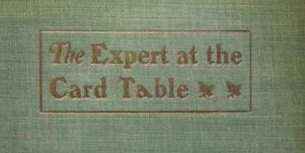
And on that note … Tom!! Good to see you weighing in, my friend. We posted in the wee hours not ten minutes apart, and I didn’t see your post until now. I haven’t examined the lettering on the front cover of the book, but found your comments about the typographical asymmetry of the lettering very interesting. Your notes about how the cover art was created and manufactured seem spot-on. I too am unclear about the relevance of kerning and Gutenberg to the Erdnase book, but have to acknowledge Bill M’s researching prowess and in doing so might as well take a last poke at this off-the-deep-end topic. So ….
Bill, I read the Gutenberg section of Han The Thanh’s dissertation that you kindly dug up (much of the rest of the paper was highly technical and over my head). Alas, I’ve read enough cock-eyed theories and conclusions in academic papers on magic history and the law to retain a healthy skepticism of Thanh’s claims, BUT they do indeed support the view I was discrediting. Unfortunately, among his many citations to authority in his paper, Thanh offers nada as authority to support his claims (relevant parts of which are quoted below), and even more curiously, appears to fundamentally undermine his claims by acknowledging that such micro-typography was practically negligible.
The second method to adjust lines was the use of multiple variants of glyphs for some letters … a letter in his composition could be typeset using several variants of a glyph with different width, depending on the requirements of typesetting a line. The main intention of use of multiple glyphs was most likely to achieve the constant distance between the vertical strokes of characters. The compositor therefore could select the glyph of a letter that seemed to be the best variant according to the position of the letter in the word or the line. … However, this seems to be a minor effect.
So I’m reluctant to regard Thanh as any sort of authority on this subject. As for Zapf, if he held the same view, then who am I to argue with a legend in typography? On the other hand …
Zapf’s opinion (and Thanh’s as well FWIW) came long before the highly regarded 2001 study by Paul Needham, et al., of the type in Gutenberg’s bible (so technical and esoteric that it didn’t seem worth mentioning in my original reply to you).
In essence, Needham’s study found that there were literally many dozens of variants of almost every letter in Gutenberg’s bible, and that such variants could not be explained by the vagaries of type creation and printing (which I alluded to in an earlier post). The conclusion drawn by Needham was that the type could not have been created by the punch and matrix process, the invention of which has long and widely been credited to Gutenberg. Instead, it appears that he cast each letter individually (or perhaps two or three pieces) in a fine sand (clay?) mold which was destroyed or at least damaged with each casting. Here’s an example of the variant ‘i’ in Gutenberg’s type:
Well over 100 different faces of ‘i’ are depicted (I stopped counting at 100).
IMHO, Needham’s study blows away Zapf’s and any other like theory about Gutenberg’s artisanal precision. It just strains credulity to think that Gutenberg not only intentionally crafted a hundred variants of a letter, but also then took the time to carefully select a particular letter from that group, all for the sake of alleged “perfect gray space.”
Hi All!
Bill Mullins, thanks for the shout-out above! Thanks for the reference to the blog.
For those who haven’t visited the blog lately, here is a little orientation.
Even though I have converted it into one that deals with older magic books more generally, it does so happen that the three most recent posts deal with the subject of Erdnase, and late last month I posted a few posts on “The Pairs Re-Paired,” which was the trick which we know W.E. Sanders was acquainted with.
As I mentioned in a recent post on the blog, I am not all that certain yet what to think about the concept of Dalrymple being Dollie’s third cousin, once removed. It appears to be a very cool item of evidence. If Edwin Sumner Andrews were the only Erdnase candidate, then the case for Andrews would be quite powerful. But, of course, he is not the only candidate.
At the moment, the main problems I see are along these lines (putting them very briefly):
A. There are other appealing candidates, one of which (W.E. Sanders) actually has a connection of sorts with Dalrymple (albeit a weaker one). Also, Sanders has a connection with Del Adelphia (at least as to the Montana background), and that would be a rather rare attribute.
B. Apart from his name being E.S. Andrews, the remaining case for Edwin Sumner Andrews has always struck me as somewhat thin. He seems like too much of a mellow family man, with no obvious interest in gambling or card magic. I like the “name” argument for him very much, but that by itself does not do much for an otherwise weak case.
Nonetheless, the apparent fact (whether it has been proven 100% or not) of the family relationship between Dollie and Dalrymple does significantly bolster Andrews’s case. At least, I think it does!
—Tom Sawyer
Bill Mullins, thanks for the shout-out above! Thanks for the reference to the blog.
For those who haven’t visited the blog lately, here is a little orientation.
Even though I have converted it into one that deals with older magic books more generally, it does so happen that the three most recent posts deal with the subject of Erdnase, and late last month I posted a few posts on “The Pairs Re-Paired,” which was the trick which we know W.E. Sanders was acquainted with.
As I mentioned in a recent post on the blog, I am not all that certain yet what to think about the concept of Dalrymple being Dollie’s third cousin, once removed. It appears to be a very cool item of evidence. If Edwin Sumner Andrews were the only Erdnase candidate, then the case for Andrews would be quite powerful. But, of course, he is not the only candidate.
At the moment, the main problems I see are along these lines (putting them very briefly):
A. There are other appealing candidates, one of which (W.E. Sanders) actually has a connection of sorts with Dalrymple (albeit a weaker one). Also, Sanders has a connection with Del Adelphia (at least as to the Montana background), and that would be a rather rare attribute.
B. Apart from his name being E.S. Andrews, the remaining case for Edwin Sumner Andrews has always struck me as somewhat thin. He seems like too much of a mellow family man, with no obvious interest in gambling or card magic. I like the “name” argument for him very much, but that by itself does not do much for an otherwise weak case.
Nonetheless, the apparent fact (whether it has been proven 100% or not) of the family relationship between Dollie and Dalrymple does significantly bolster Andrews’s case. At least, I think it does!
—Tom Sawyer
Tom Sawyer writes in his blog regarding the "3rd cousin once removed" issue:
Richard Hatch did have such a boundary condition: 2nd cousin.
It would be nice if, before the fact, someone had said, “I will accept any relative within such-and-such boundaries." ... If you set forth the criteria in advance, at least you can be certain that you are not back-fitting your criteria to fit your results.
Richard Hatch did have such a boundary condition: 2nd cousin.
I also agree with Tom that the case for E.S. Andrews is a thin one. The "name" argument strikes me as also weak. A man of Erdnase's intelligence knew that readers would spell out the name backwards. It's the first thing anyone would do.
If Sanders was Erdnase, he wasn't going to tell Smith that Dalrymple illustrated his father in Puck magazine. That would have left him wide open for Smith to discover his true identity. Sanders may have said that Dalrymple had a connection to a relative. Smith would have naturally taken that at face value and after 40 years recall it as Erdnase told him he was related to Dalrymple.
If Sanders was Erdnase, he wasn't going to tell Smith that Dalrymple illustrated his father in Puck magazine. That would have left him wide open for Smith to discover his true identity. Sanders may have said that Dalrymple had a connection to a relative. Smith would have naturally taken that at face value and after 40 years recall it as Erdnase told him he was related to Dalrymple.
Leonard Hevia wrote:I also agree with Tom that the case for E.S. Andrews is a thin one. The "name" argument strikes me as also weak. A man of Erdnase's intelligence knew that readers would spell out the name backwards. It's the first thing anyone would do.
If Sanders was Erdnase, he wasn't going to tell Smith that Dalrymple illustrated his father in Puck magazine. That would have left him wide open for Smith to discover his true identity. Sanders may have said that Dalrymple had a connection to a relative. Smith would have naturally taken that at face value and after 40 years recall it as Erdnase told him he was related to Dalrymple.
But these are based on the assumption that Erdnase wanted to keep his identity a secret. The arguments for that position are weak.
Erdnase wasn't trying very hard, if he was even "trying" at all to seriously conceal his identity to anybody who got past the cover of the book and saw the name S.W. Erdnase.
Erdnase engaged Smith, and didn't at all try to hide his identity from him. Erdnase did this knowing full well that with M.D. Smith written in big block letters on the cover of EATCT, anybody with the desire to do so could contact Smith to find out who the author really was.
Engaging in conversation with Smith to the point where Erdnase began identifying his relatives (Dalrymple), this after Smith would have known the authors actual name.
That's not "hiding, it's more like "subtle obfuscation".
Upon completion of Smiths work, Erdnase gave Smith a cheque (possibly personalized) which Smith would then have had to go deposit, at which time there would be yet another pointer directly to Erdnase's actual name.
Even if it wasn't personalized, it would have had an account number that could easily be matched up to a name.
It's just that nobody cared enough at the time to even worry about who the author might be, at least to the degree that they bothered to go looking for him.
It took decades for that to happen.
Printers would have known who he was.
He carried around remaindered first editions after he had them printed, and presumably made deals with somebody to sell them for him. They too would have known who he was.
Our Mr. Erdnase, whoever he might be, when examined with just what we know, didn't do anything beyond reversing his name in an effort to "hide", which wasn't really hiding at all.
As noted above, it is little more than subtle obfuscation, if it's even that "crafty".
That Erdnase was making any serious effort at all to "hide" has been projected on him by others over the years.
Beyond reversing his name (if indeed he was E.S. Andrews), he really didn't do anything at all to "hide" from anybody bothering to try to find him.
It's only time that has erased the path to Erdnase's real name, and I would posit that for of the researchers posting to this thread, were they to have been alive, and gone looking for Erdnase anytime in 1903, they probably would have found him within a couple of days, if not a day.
Erdnase engaged Smith, and didn't at all try to hide his identity from him. Erdnase did this knowing full well that with M.D. Smith written in big block letters on the cover of EATCT, anybody with the desire to do so could contact Smith to find out who the author really was.
Engaging in conversation with Smith to the point where Erdnase began identifying his relatives (Dalrymple), this after Smith would have known the authors actual name.
That's not "hiding, it's more like "subtle obfuscation".
Upon completion of Smiths work, Erdnase gave Smith a cheque (possibly personalized) which Smith would then have had to go deposit, at which time there would be yet another pointer directly to Erdnase's actual name.
Even if it wasn't personalized, it would have had an account number that could easily be matched up to a name.
It's just that nobody cared enough at the time to even worry about who the author might be, at least to the degree that they bothered to go looking for him.
It took decades for that to happen.
Printers would have known who he was.
He carried around remaindered first editions after he had them printed, and presumably made deals with somebody to sell them for him. They too would have known who he was.
Our Mr. Erdnase, whoever he might be, when examined with just what we know, didn't do anything beyond reversing his name in an effort to "hide", which wasn't really hiding at all.
As noted above, it is little more than subtle obfuscation, if it's even that "crafty".
That Erdnase was making any serious effort at all to "hide" has been projected on him by others over the years.
Beyond reversing his name (if indeed he was E.S. Andrews), he really didn't do anything at all to "hide" from anybody bothering to try to find him.
It's only time that has erased the path to Erdnase's real name, and I would posit that for of the researchers posting to this thread, were they to have been alive, and gone looking for Erdnase anytime in 1903, they probably would have found him within a couple of days, if not a day.
lybrary wrote:Tom Sawyer writes in his blog regarding the "3rd cousin once removed" issue:It would be nice if, before the fact, someone had said, “I will accept any relative within such-and-such boundaries." ... If you set forth the criteria in advance, at least you can be certain that you are not back-fitting your criteria to fit your results.
Richard Hatch did have such a boundary condition: 2nd cousin.
While these statements may both be true, we do not know what boundaries Erdnase set for considering someone his relative.
Bill Mullins wrote:But these are based on the assumption that Erdnase wanted to keep his identity a secret. The arguments for that position are weak.
Why are they weak? I don't agree at all. Erdnase told Smith he was a cardshark who was going straight. That means Erdnase must have had some other means of income. He must have had some plans how to earn his living after stopping cardsharking. The fact that he published his book supports the idea that he was stopping being a cardshark. Otherwise, why would he wise up the public about his methods? We know that Erdnase did not choose to become a reformed gambler who would lecture and write about his past life as a gambler, such as Green and Quinn for example have done. That means Erdnase must have had some other job or employment. Any other job, besides marketing oneself as reformed gambler, would suffer from being found out a cheat. Such information would have immediately eroded any basis of trust and integrity which are necessary in most every job. These are obvious and strong reasons to hide ones identity.
We know Erdnase hid his identify in the copyright form, listing James McKinney & Co. as the contact address. Erdnase may have used a cover name to introduce himself to Smith (ex. E.S. Andrews). He would have used the same cover name for the check/bank account and hotel registration. Anybody who would have located M.D. Smith would have not gone further than E.S. Andrews, a fake name. Same goes for his interactions with retailers, Drake, etc.
If Erdnase had a comprehensive plan to conceal his identity, then he wouldn't have put M.D. Smith's name in big block letters on the title page of EATCT.
To do so would make absolutely no sense if somebody was making a concerted effort to conceal their identity.
Not to put too fine a point on it, but we have absolutely no evidence that Erdnase did anything more than reverse his name (if indeed he was Andrews) in order to conceal his identity.
Even if Erdnase WAS Sanders (or even Gallaway!), we still have absolutely no evidence that Erdnase did anything more to conceal his identity than simply use a fake name.
A fake or reversed name with a real, easily traceable name right below it (M.D. Smith) doesn't point to a man trying very hard at all to conceal his identity (as Gardner's efforts prove most concisely, it's too bad Gardner was just a few decades too late than would have made finding Erdnase possible, even easy).
No known facts even begin to suggest that Erdnase made concerted efforts to conceal his identity beyond the simple name reversal (if he was Andrews), or use of a fake name (if he was somebody else).
To do so would make absolutely no sense if somebody was making a concerted effort to conceal their identity.
Not to put too fine a point on it, but we have absolutely no evidence that Erdnase did anything more than reverse his name (if indeed he was Andrews) in order to conceal his identity.
Even if Erdnase WAS Sanders (or even Gallaway!), we still have absolutely no evidence that Erdnase did anything more to conceal his identity than simply use a fake name.
A fake or reversed name with a real, easily traceable name right below it (M.D. Smith) doesn't point to a man trying very hard at all to conceal his identity (as Gardner's efforts prove most concisely, it's too bad Gardner was just a few decades too late than would have made finding Erdnase possible, even easy).
No known facts even begin to suggest that Erdnase made concerted efforts to conceal his identity beyond the simple name reversal (if he was Andrews), or use of a fake name (if he was somebody else).
magicam wrote:Jack, see the image below. Note that the 'a' slants the wrong way; not only that, but its width is appreciably exaggerated compared to the other type (especially the letters in the italicized 'The'). Just my opinion, but it sure seems the use of this very odd 'a' was purposeful, not the result of lack of type or carelessness.Jack Shalom wrote:Applying Occam's razor, any chance the italicized a is simply the result of having run out of the regular ones?
And on that note … Tom!! Good to see you weighing in, my friend. We posted in the wee hours not ten minutes apart, and I didn’t see your post until now. I haven’t examined the lettering on the front cover of the book, ...
There's more than just one "a" that's changing between the words. Starting with "The". Any comments about the artwork embedded in the title?
lybrary wrote:Bill Mullins wrote:But these are based on the assumption that Erdnase wanted to keep his identity a secret. The arguments for that position are weak.
Why are they weak? I don't agree at all. Erdnase told Smith he was a cardshark who was going straight. That means Erdnase must have had some other means of income. He must have had some plans how to earn his living after stopping cardsharking. The fact that he published his book supports the idea that he was stopping being a cardshark. Otherwise, why would he wise up the public about his methods? We know that Erdnase did not choose to become a reformed gambler who would lecture and write about his past life as a gambler, such as Green and Quinn for example have done. That means Erdnase must have had some other job or employment. Any other job, besides marketing oneself as reformed gambler, would suffer from being found out a cheat. Such information would have immediately eroded any basis of trust and integrity which are necessary in most every job. These are obvious and strong reasons to hide ones identity.
Perhaps his plans were to live on the sales income from his book? That wouldn't have required he go underground.
Chris, neither you nor I know what was going on in his head. You are telling us how a reformed gambler would have acted over a century ago. You don't know the era, the lifestyle, his personal situation, any other skill sets he may have had. He may have won enough money he could have retired. He may have been a professional magician (how would a background as a gambler have hurt that profession? We know magicians today are willing to let people believe that they are gambling experts). He may have owned his own business -- why would you care if your plumber (or your printer) used to cheat at poker? He may have been a laborer, or a miner, or a factory worker, or a baker, or a lumberjack -- there are dozens of jobs for which having formerly been a card cheat would make no difference at all.
We know Erdnase hid his identify in the copyright form,
"Hid" presumes a motive, and we don't know what his was (or even if he had one). He may have paid in advance for the printing, left the manuscript with McKinney, and told him to take care of the paperwork and ship the books to some address when they were complete.
The very existence of the copyright says he wasn't trying to be anonymous -- if he was, it would have been much simpler to not copyright it at all. If he truly wanted to be anonymous, how could he have sued an infringer? Copyright bought him nothing.
On another subject -- in your ebook, you make note of the fact that Gallaway's book includes the phrase "hard luck". I can't find it - the OCR on my PDF of the book is not great. What page is it on?
Bill Mullins wrote:Copyright bought him nothing.
It is a deterrent. Many copyrights are registered. Very few copyright holders ever sue. But it keeps the pest away. Clearly copyright was somehow important to him because he added copyright notes to many illustrations. The most logical reason I can come up with is as a deterrent.
Bill Mullins wrote:On another subject -- in your ebook, you make note of the fact that Gallaway's book includes the phrase "hard luck". I can't find it - the OCR on my PDF of the book is not great. What page is it on?
It is from the intro of his second book "How to Price Job Printing Properly" page 5.
Roger M. wrote:If Erdnase had a comprehensive plan to conceal his identity, then he wouldn't have put M.D. Smith's name in big block letters on the title page of EATCT.
To do so would make absolutely no sense if somebody was making a concerted effort to conceal their identity.
Erdnase didn't have a comprehensive plan to completely conceal his identity, otherwise the book would have said "Anonymous" on the spine. Alexander's argument is that he left behind clues for those willing to do the work, and that the reverse spelling "E.S. Andrews" was a red herring to throw off those who began sniffing the trail.
Roger M. wrote: Upon completion of Smiths work, Erdnase gave Smith a cheque (possibly personalized) which Smith would then have had to go deposit, at which time there would be yet another pointer directly to Erdnase's actual name.
If, by "personalized", you mean that his name was machine-printed on the check, probably not. Even today, often the bank will issue "counter checks" when an account is opened, and the account holder has to write his name and information into appropriate fields, and use these until "regular" checks show up after being printed. No doubt that an account's #1 check back then would have lacked an imprinted name.
And back then, personal account holders may have never bothered at all to go to the expense of professionally printed checks. My late father collected such things, and I've seen many dozens of old checks which were not imprinted with the account holder's name. Go to Ebay and search for "old checks" to see examples of such.
But the check would have been signed such that the drawing bank could clear it against the proper account.
Chris -- your own book suggests that Erdnase was known to Edwin Hood, Harto, Houdini, S. W. Jamieson, McKinney, and Smith. Hardly a guy who was trying to stay sub rosa.
Thanks.
lybrary wrote: It is from the intro of his second book "How to Price Job Printing Properly" page 5.
Thanks.
With the limited information we have about Erdnase's cheque payment to Smith, I agree that it's more likely than not that the cheque wasn't personalized.
A couple of years ago, when wondering about the cheque Erdnase wrote out to Smith, I did a bit of research and discovered that personalized cheques were "a thing" beginning in 1811, in Scotland.
So personalized cheques were definitely solidly established, even if they weren't widely used.
If a new account, I agree that it would be far more likely (as per even today) that one would not have personalized cheques in their possession until perhaps weeks (or a month) after opening the account, and would use counter cheques until such time as their personalized cheques were printed, and delivered to them.
Whether personalized, or a counter cheque, depositing or cashing a cheque from either E.S. Andrews, or S.W. Erdnase would have tied directly to an existing bank account ... which is another solid indicator that Erdnase wasn't trying to "hide" at all - appearing to be more focused on just trying not to be too terribly obvious to anybody giving a cursory glance at the author of EATCT.
And in 1903, 1904, and on up, indeed nobody was at all interested as to who the author of EATCT might be.
It could even be said that Erdnase's modest efforts to obfuscate his identity were a complete waste of his time and effort, as nobody we know of ever went looking for him until after he was gone.
A couple of years ago, when wondering about the cheque Erdnase wrote out to Smith, I did a bit of research and discovered that personalized cheques were "a thing" beginning in 1811, in Scotland.
So personalized cheques were definitely solidly established, even if they weren't widely used.
If a new account, I agree that it would be far more likely (as per even today) that one would not have personalized cheques in their possession until perhaps weeks (or a month) after opening the account, and would use counter cheques until such time as their personalized cheques were printed, and delivered to them.
Whether personalized, or a counter cheque, depositing or cashing a cheque from either E.S. Andrews, or S.W. Erdnase would have tied directly to an existing bank account ... which is another solid indicator that Erdnase wasn't trying to "hide" at all - appearing to be more focused on just trying not to be too terribly obvious to anybody giving a cursory glance at the author of EATCT.
And in 1903, 1904, and on up, indeed nobody was at all interested as to who the author of EATCT might be.
It could even be said that Erdnase's modest efforts to obfuscate his identity were a complete waste of his time and effort, as nobody we know of ever went looking for him until after he was gone.
Bill Mullins wrote:Chris -- your own book suggests that Erdnase was known to Edwin Hood, Harto, Houdini, S. W. Jamieson, McKinney, and Smith. Hardly a guy who was trying to stay sub rosa.
I am not saying he was a hermit, but why would his friends out him? Smith I would think only knew his assumed name. I would not consider Smith a personal friend of Erdnase. Edwin Hood, a gambling supply house owner, who I imagine knew a lot of cardsharks, and cheats, would have not exposed him. It would have been bad for his business. James McKinney it seems was somebody he knew well, otherwise he wouldn't partner with him and open McKinney & Gallaway. The relationship to Jamieson is less clear. Jamieson would not need to know that Gallaway was Erdnase. The connection to Harto and Houdini aren't that clear either. But both were circus folks like Gallaway. I imagine he may have trusted them due to that connection.
None of these possible connections are inconsistent with his attempt and wish to stay hidden and to not expose his cheating side.
lybrary wrote:Bill Mullins wrote:Copyright bought him nothing.
It is a deterrent. Many copyrights are registered. Very few copyright holders ever sue. But it keeps the pest away. Clearly copyright was somehow important to him because he added copyright notes to many illustrations. The most logical reason I can come up with is as a deterrent.
But he could have accomplished that same goal by simply printing a copyright statement in the book. He didn't need to actually register the copyright to deter infringers.
The copyright fee was paid with a money order. If he wanted to remain anonymous, it would have made more sense to pay Smith with a money order as well.
lybrary wrote:Tom Sawyer writes in his blog regarding the "3rd cousin once removed" issue:It would be nice if, before the fact, someone had said, “I will accept any relative within such-and-such boundaries." ... If you set forth the criteria in advance, at least you can be certain that you are not back-fitting your criteria to fit your results.
Richard Hatch did have such a boundary condition: 2nd cousin.
If you are referring to Richard's statement "If it could be shown that Dolly Seely is reasonably closely related to Adelia Seel(e)y (say cousin or second cousin), then I would have a hard time thinking this a coincidence and would put all my chips on this particular E. S Andrews", then "boundary condition" seems too strong.
(And don't get me wrong, I realize that 3rd cousin once removed is a distant relative. But in this particular case, given the local geography and the parties involved, I think it was entirely possible and even likely that Andrews knew of Dalrymple and that he was related to Dolly, and in a casual conversation to another artist, would have called Dalrymple a "relative".)
lybrary wrote: The connection to Harto and Houdini aren't that clear either. But both were circus folks like Gallaway.
The connection to Houdini certainly isn't clear, and in fact doesn't seem possible. You put Gallaway in the circus in 1891-1894 (with 1892/93 being "most likely"), and again in 1896. Houdini was with the Welsh Bros in 1895 and 1898.
Bill Mullins wrote:lybrary wrote: The connection to Harto and Houdini aren't that clear either. But both were circus folks like Gallaway.
The connection to Houdini certainly isn't clear, and in fact doesn't seem possible. You put Gallaway in the circus in 1891-1894 (with 1892/93 being "most likely"), and again in 1896. Houdini was with the Welsh Bros in 1895 and 1898.
Those dates for Gallaway aren't super firm. But there is also the possibility that he met Houdini at Roterberg's, a shop he knew and lived next door from for a while. A possible Houdini connection is merely a curiosum not at all important in my opinion.
This is in response to something Chris said a few posts above concerning the issue of whether there were before-the-fact standards of closeness set forth by anyone concerning the Dollie/Dalrymple relationship.
Richard Hatch has in more than one place on this thread mentioned the first-or-second-cousin idea in connection with relatedness. His first such reference was at least as far back as 2006.
But as Bill Mullins kind of points out above concerning Richard’s 2015 statement, there was nothing formal or rigid about Hatch’s statements. Back in 2006, though Richard used the term “compellingly close,” he further discussed that term in such a way that it was significantly watered-down.
As for me, I think I have made it clear elsewhere that I place a very loose meaning on the expression "related to,” which seems to be the operative term that Gardner attributed to Smith.
For instance, if Dalrymple had lived a few houses down from Andrews, that to me would be as good or better than being Dollie’s third cousin, once removed.
I do think some people place more weight on Gardner’s account of what Smith told him than is warranted, both overall and as to little details. If you read Hurt McDermott's book on Erdnase (which I highly recommend, though I would not endorse everything in it), you might wonder why anyone gives any weight at all to details of Smith's statements to Gardner, in light of the lapse of time between 1902 (or so) and the time Gardner contacted Smith.
—Tom Sawyer
Richard Hatch has in more than one place on this thread mentioned the first-or-second-cousin idea in connection with relatedness. His first such reference was at least as far back as 2006.
But as Bill Mullins kind of points out above concerning Richard’s 2015 statement, there was nothing formal or rigid about Hatch’s statements. Back in 2006, though Richard used the term “compellingly close,” he further discussed that term in such a way that it was significantly watered-down.
As for me, I think I have made it clear elsewhere that I place a very loose meaning on the expression "related to,” which seems to be the operative term that Gardner attributed to Smith.
For instance, if Dalrymple had lived a few houses down from Andrews, that to me would be as good or better than being Dollie’s third cousin, once removed.
I do think some people place more weight on Gardner’s account of what Smith told him than is warranted, both overall and as to little details. If you read Hurt McDermott's book on Erdnase (which I highly recommend, though I would not endorse everything in it), you might wonder why anyone gives any weight at all to details of Smith's statements to Gardner, in light of the lapse of time between 1902 (or so) and the time Gardner contacted Smith.
—Tom Sawyer
Bill Mullins wrote:lybrary wrote:Tom Sawyer writes in his blog regarding the "3rd cousin once removed" issue:It would be nice if, before the fact, someone had said, “I will accept any relative within such-and-such boundaries." ... If you set forth the criteria in advance, at least you can be certain that you are not back-fitting your criteria to fit your results.
Richard Hatch did have such a boundary condition: 2nd cousin.
If you are referring to Richard's statement "If it could be shown that Dolly Seely is reasonably closely related to Adelia Seel(e)y (say cousin or second cousin), then I would have a hard time thinking this a coincidence and would put all my chips on this particular E. S Andrews", then "boundary condition" seems too strong.
(And don't get me wrong, I realize that 3rd cousin once removed is a distant relative. But in this particular case, given the local geography and the parties involved, I think it was entirely possible and even likely that Andrews knew of Dalrymple and that he was related to Dolly, and in a casual conversation to another artist, would have called Dalrymple a "relative".)
Richard Hatch wrote more definite in an email: "PS: I don't think one need go back very far to establish a plausible relationship. If they aren't 2nd cousins or closer, it seems unlikely they would know of an actual relationship..."
Most people do not know their relationships further out than great-grandparents, unless one has done genealogy, which wasn't possible back then in the form it is possible today, or you were royalty and history did the record keeping for you. For Dollie the common link to Louis was a great-great-great-grandfather. There is simply no way she knew of her relationship to Dalrymple.
Bill Mullins wrote:lybrary wrote:Bill Mullins wrote:Copyright bought him nothing.
It is a deterrent. Many copyrights are registered. Very few copyright holders ever sue. But it keeps the pest away. Clearly copyright was somehow important to him because he added copyright notes to many illustrations. The most logical reason I can come up with is as a deterrent.
But he could have accomplished that same goal by simply printing a copyright statement in the book. He didn't need to actually register the copyright to deter infringers.
Having it registered is a much better deterrent than just printing it. That way it is much harder for wannabe infringers to call your bluff.
Bill Mullins wrote:The copyright fee was paid with a money order. If he wanted to remain anonymous, it would have made more sense to pay Smith with a money order as well.
Who says Erdnase/Gallaway paid the copyright registration directly by himself? Now that we know that McKinney and Gallaway were business partners it is likely that Gallaway ran his book through McKinney like any other book they printed there. They asked Jamieson of Jamieson-Higgins to register the copyright, because that is what they have done with their books. They knew how to do it. Jamieson-Higgins probably paid the copyright office and then billed McKinney for it. McKinney and Gallaway settled the charge some other way (ex. taken out of Gallaway's salary).
Chris said:
That is a very good point, but in the present case, with all of the additional facts concerning geographical proximity and such, it occurs to me that this may well be a case where someone was indeed familiar with those relationships.
---Tom
Most people do not know their relationships further out than great-grandparents . . .
That is a very good point, but in the present case, with all of the additional facts concerning geographical proximity and such, it occurs to me that this may well be a case where someone was indeed familiar with those relationships.
---Tom
lybrary wrote:Bill Mullins wrote:The copyright fee was paid with a money order. If he wanted to remain anonymous, it would have made more sense to pay Smith with a money order as well.
Who says Erdnase/Gallaway paid the copyright registration directly by himself? Now that we know that McKinney and Gallaway were business partners it is likely that Gallaway ran his book through McKinney like any other book they printed there. They asked Jamieson of Jamieson-Higgins to register the copyright, because that is what they have done with their books. They knew how to do it. Jamieson-Higgins probably paid the copyright office and then billed McKinney for it. McKinney and Gallaway settled the charge some other way (ex. taken out of Gallaway's salary).
An explanation of how a money order may have been used is meaningless here. The point is that a check is a trail back to the author, and if the author wanted to remain anonymous, he could have used a payment method that didn't do so. He could have paid in cash, for that matter.
Bill Mullins wrote:An explanation of how a money order may have been used is meaningless here. The point is that a check is a trail back to the author, and if the author wanted to remain anonymous, he could have used a payment method that didn't do so. He could have paid in cash, for that matter.
That requires two assumptions:
1) Erdnase introduced himself to Smith with his real name. If he used a fake name then setting up a bank account in his fake name, and signing a check with his fake name, would fortify his faked identity. Smith could have doubted his real name based on the introduction alone. But with a check signed in the same name he would have had no doubt.
2) Humans are infallible. It is very easy for us to analyze in detail where Erdnase may or may not have made errors to hide his identity. Hindsight is 20-20. But even the cleverest make errors, or misjudge a situation. We have to allow for some human error in his judgement and actions in relationship to him wanting to hide his identity.
lybrary wrote: Having [a copyright] registered is a much better deterrent than just printing it. That way it is much harder for wannabe infringers to call your bluff.
I don't see how. Are you saying that a copyright statement in the book would not be a deterrent, so a potential infringer would think "Hm. I want to pirate this book. It says it is copyrighted right there, but the author may just be messing with me. I'll write a letter to the copyright office first, and only if they say, "no, it isn't registered", will I proceed and make copies."
What criminal masterminds you conjure up. I bet they work in lairs with crooked floors.

Leonard Hevia wrote:Erdnase didn't have a comprehensive plan to completely conceal his identity, otherwise the book would have said "Anonymous" on the spine.
I don't agree. Writing "Anonymous" would have invited much more inquiry much earlier. It is psychologically much better to write a name which most will gloss over. While "S. W. Erdnase" to us today sounds like a strange name, back then with all those immigrants from countries with foreign names, it would not have been a name that stood out or would have been particularly unusual. Erdnase reads and sounds very German. With all those German speaking folks in Chicago, and newspapers published in German, and public addresses given in German, it wouldn't be seen as a strange name. The strangest real second name I ever heard was Vlk. If Vlk is a real name Erdnase is perfect as a pseudonym.
Bill Mullins wrote:lybrary wrote: Having [a copyright] registered is a much better deterrent than just printing it. That way it is much harder for wannabe infringers to call your bluff.
I don't see how. Are you saying that a copyright statement in the book would not be a deterrent, so a potential infringer would think "Hm. I want to pirate this book. It says it is copyrighted right there, but the author may just be messing with me. I'll write a letter to the copyright office first, and only if they say, "no, it isn't registered", will I proceed and make copies."
Erdnase, a cheat and cardshark, knew about bluffing. Just printing a copyright statement isn't a particularly good bluff. Having it registered, something that could be looked up in copyright registration books in most larger libraries, is much safer. Gallaway who was working in the print industry knew how easily it would have been for somebody to steal and reprint his book if he had no protection. Registering the copyright was a simple way to protect his investment. It was also important for selling the book later on to Drake, something I am pretty sure Erdnase thought about and planned before he went to print with his book. It makes sense and is consistent with what we know.
lybrary wrote:Leonard Hevia wrote:Erdnase didn't have a comprehensive plan to completely conceal his identity, otherwise the book would have said "Anonymous" on the spine.
Writing "Anonymous" would have invited much more inquiry much earlier.
This is not accurate. Being an anonymous author invited no more scrutiny in the late 1800's and early 1900's than any given author using their real name.
Example would be A Grand Expose by "An Adept".
Nobody cared at the time that the author was obviously trying to remain anonymous, and it wasn't until over a century later that anybody bothered to want to find out just who "An Adept" was ... this only after it became somewhat "cool" to seek out anonymous authors of obscure gambling books.
- If Erdnase had wanted to remain anonymous, he would have authored the book as "Anonymous", anything but his reversed name.
If Erdnase had wanted to remain anonymous, he wouldn't have given Smith a cheque, which could be traced to a bank account.
If Erdnase had wanted to remain anonymous, he wouldn't have given Smith any personal information, Dalrymple, reformed gambler, etc
If Erdnase had wanted to remain anonymous, he wouldn't have put M.D. Smith's name in big, bold letters on the title page of EATCT.
There's a lot of common sense in the above four points, which of course won't make any difference to folks who have an agenda separate from wanting to find out who the real author of EATCT really was.
lybrary wrote:
. Just printing a copyright statement isn't a particularly good bluff. Having it registered, something that could be looked up in copyright registration books in most larger libraries, is much safer.
(my bold)
This really doesn't comport with a guy trying (according to you) to remain anonymous.
If your goal is to remain anonymous, then you take great pains to leave no bread crumbs for people to follow.
Erdnase left nothing but bread crumbs, and did so everywhere he went.
Those bread crumbs are what we're still going on today, 120 years later.
It's only time that has become our foe, as Erdnase did so little to conceal his identity I wouldn't be surprised if there aren't a dozen or more people somewhere in the history books who not only knew that he was E.S. Andrews, the author of EATCT, but that he reversed his name to S.W. Erdnase in order to confuse those who may cursorily wonder who wrote the book.
Roger M. wrote:lybrary wrote:Leonard Hevia wrote:Erdnase didn't have a comprehensive plan to completely conceal his identity, otherwise the book would have said "Anonymous" on the spine.
Writing "Anonymous" would have invited much more inquiry much earlier.
This is not accurate. Being an anonymous author invited no more scrutiny in the late 1800's and early 1900's than any given author using their real name.
Example would be A Grand Expose by "An Adept".
Nobody cared at the time that the author was obviously trying to remain anonymous, and it wasn't until over a century later that anybody bothered to want to find out just who "An Adept" was ... this only after it became somewhat "cool" to seek out anonymous authors of obscure gambling books.If Erdnase had wanted to remain anonymous, he would have authored the book as "Anonymous", anything but his reversed name.
If Erdnase had wanted to remain anonymous, he wouldn't have given Smith a cheque, which could be traced to a bank account.
If Erdnase had wanted to remain anonymous, he wouldn't have given Smith any personal information, Dalrymple, reformed gambler, etc
If Erdnase had wanted to remain anonymous, he wouldn't have put M.D. Smith's name in big, bold letters on the title page of EATCT.
There's a lot of common sense in the above four points, which of course won't make any difference to folks who have an agenda separate from wanting to find out who the real author of EATCT really was.
Very good points, Roger.
Bill Mullins wrote:He may have been a professional magician (how would a background as a gambler have hurt that profession? We know magicians today are willing to let people believe that they are gambling experts).
Then why not publish it under his real name, if it would have helped him in his profession, for example if he was a magician?
Bill Mullins wrote:He may have owned his own business -- why would you care if your plumber (or your printer) used to cheat at poker?
Because a business owner has to do business with others. If I know he was a professional cheat why would I trust him with business matters, such as contracts, a fair quote, reliable work? What assurance do I have that he doesn't cheat here, too?
Bill Mullins wrote:He may have been a laborer, or a miner, or a factory worker, or a baker, or a lumberjack -- there are dozens of jobs for which having formerly been a card cheat would make no difference at all.
Same applies here. If you are asking for a job at most any business and your resume - be it written, or by reputation - would say 'professional cheat' many will take a pass and hire somebody else. I don't know if you have ever hired anybody. I have. I read through many resumes and interviewed applicants. A cheating past doesn't really play well in that situation.
Bill Mullins wrote:or a miner, ... or a lumberjack
Come on Bill. Just a few posts earlier you argued that Gallaway couldn't have soft hands because he worked in the print industry (misreading that he didn't stand behind a printing press for all of his career but rather was superintendent, salesman, estimator, ...). And now you are arguing that Erdnase was a miner or lumberjack with hands as soft as a woman? Before you flail your hands in desperation and throw around arguments which contradict your own earlier arguments I suggest you think through these things a bit more carefully.
A side comment regarding being a printer and if that does fit with a cardshark. My father learned the printers art. He did a lot a manual composition - meaning typesetting - in his life. He credits his manual composition work for his extraordinary dexterity. While my father never played cards or did any sleight-of-hand he thinks that somebody who has been trained as manual compositor would actually benefit for sleight-of-hand work. So it is exactly the opposite of what you think. Somebody trained as a printer/typesetter would make a stellar sleight-of-hand worker.
lybrary wrote:Leonard Hevia wrote:Erdnase didn't have a comprehensive plan to completely conceal his identity, otherwise the book would have said "Anonymous" on the spine.
I don't agree. Writing "Anonymous" would have invited much more inquiry much earlier. It is psychologically much better to write a name which most will gloss over. While "S. W. Erdnase" to us today sounds like a strange name, back then with all those immigrants from countries with foreign names, it would not have been a name that stood out or would have been particularly unusual. Erdnase reads and sounds very German. With all those German speaking folks in Chicago, and newspapers published in German, and public addresses given in German, it wouldn't be seen as a strange name.
There's two ways to show this is wrong:
1. "Erdnase" sounds German only if you pronounce it as if it were German -- and historically, it hasn't been pronounced that way. It's always been said "Urd-nace", not "Ehrd-nahseh". And Urdnace sounds weird, not like any normal word. It draws attention to itself. (Maybe to a native German speaker, it would look German, but in that case, it would call attention to itself because it says "Earth Nose." Or so some people say.)
2. History doesn't bear this out. When people first started speculating about the author, they interpreted it as a backwards English name, not as a German name. Rullman noticed it was E. S. Andrews backwards in 1928 -- 26 years after publication. It was 90 years after publication before Sawyer noticed it could be a German word.
Gallaway who was working in the print industry knew how easily it would have been for somebody to steal and reprint his book if he had no protection.
Then he also would have known how easy it was to steal his book if it had protection. Supposing a printer lived in New York and ran off a few hundred copies, and wholesaled them to the many "sporting goods" dealers -- Erdnase would have never even known about it. This is the sort of book that would have been sold under the counter. It wasn't even 3 years before Ritter plagiarized parts of the book -- copyright statements and registration didn't stop him (or the others who plagiarized sections).
Copyrighting the book, particularly registering with the printer (who knew the author) as the address of record, provided no benefits, cost him money, and provided a trail back to the author. It is evidence against anonymity.
Bill Mullins wrote:He may have been a professional magician (how would a background as a gambler have hurt that profession? We know magicians today are willing to let people believe that they are gambling experts).
Then why not publish it under his real name, if it would have helped him in his profession, for example if he was a magician?
If you think his real name was E. S. Andrews, he did.
Bill Mullins wrote:He may have owned his own business -- why would you care if your plumber (or your printer) used to cheat at poker?
Because a business owner has to do business with others. If I know he was a professional cheat why would I trust him with business matters, such as contracts, a fair quote, reliable work? What assurance do I have that he doesn't cheat here, too?
My banker has to be a man of trust. My plumber has to show up on time and fix the toilet. There are some jobs in which your reputation is based on what you do, not what you used to do.
Bill Mullins wrote:He may have been a laborer, or a miner, or a factory worker, or a baker, or a lumberjack -- there are dozens of jobs for which having formerly been a card cheat would make no difference at all.
Same applies here. If you are asking for a job at most any business and your resume - be it written, or by reputation - would say 'professional cheat' many will take a pass and hire somebody else. I don't know if you have ever hired anybody. I have. I read through many resumes and interviewed applicants. A cheating past doesn't really play well in that situation.
I have hired people, in two different contexts.
1. In my professional capacity as a engineer for the Army, where the people being hired had to be able to be granted a security clearance, I'd see resumes and the results of background investigations by the Defense Investigative Service. In these cases, like you say, a cheating past wouldn't necessarily be a good thing.
2. In my personal capacity, I've (in the last couple of years) hired plumbers, landscapers, foundation workers, tree trimmers, painters, roofers, auto mechanics, electricians, and alarm contractors. I didn't inquire what their backgrounds were, because I was picking them based on their competence, availability, reputation for doing good work and price. They could have been alcoholics, wife-beaters, or communists and it would have made no difference. I once had some carpet installed -- when the guys took off for lunch, they came back reeking of marijuana. It made no difference to me, because they worked hard and installed carpet well.
For some jobs, your reputation may be tainted by gambling and cheating. For others, it makes no difference. And for a very few, a reputation as a former cheat may be a good thing.
Bill Mullins wrote:or a miner, ... or a lumberjack
Come on Bill. Just a few posts earlier you argued that Gallaway couldn't have soft hands because he worked in the print industry . . . . And now you are arguing that Erdnase was a miner or lumberjack with hands as soft as a woman?
Pay attention. I was not arguing that Erdnase had been a miner or a lumberjack. I was arguing that having formerly been a cheat would not necessarily keep you from being any of a number of other professions later. The mining and tree cutting would come after the cheating, not before.
While my father never played cards or did any sleight-of-hand he thinks that somebody who has been trained as manual compositor would actually benefit for sleight-of-hand work.
If he never played cards or did any sleight-of-hand work, then why should I or anyone else trust his opinion about what makes a good sleight of hand worker?
Bill Mullins wrote:1. "Erdnase" sounds German only if you pronounce it as if it were German -- and historically, it hasn't been pronounced that way.
And how do you know how it was historically pronounced? Rullman was a generation after the book had been published. During 1902 there was a large German immigrant population in Chicago. So large that they published several newspapers entirely in German. So large that they held political public addresses in German. There were German newspapers in many states during that time. You don't know how it was historically pronounced. Given the strong German presence, many people with German names, it would have not sounded strange and many would have pronounced it very differently than it is pronounced today in the US.
Bill Mullins wrote:Then he also would have known how easy it was to steal his book if it had protection. Supposing a printer lived in New York and ran off a few hundred copies, and wholesaled them to the many "sporting goods" dealers -- Erdnase would have never even known about it.
Erdnase did the best he could with an eye to sell his book. Without a copyright registration he would have likely not been able to sell it to Drake, or receive a lot less for it. It was a perfectly logical decision. And to stay anonymous he gave James McKinney's address, his buddy who would not out him. Completely consistent with his goal to stay hidden.
Bill Mullins wrote:If he never played cards or did any sleight-of-hand work, then why should I or anyone else trust his opinion about what makes a good sleight of hand worker?
Because common sense confirms it. A typesetter develops very agile, nimble and toned fingers due to the constant work with his fingers. That is a great foundation to build sleight-of-hand on. I would go even a step further. Typesetting is not a mindless work. The typesetter constantly has to check spelling, make sure he is using the right type (italic, bold, small caps, point size), think about adding the right spacers, and deciding if he should use ligatures or individual characters. It is a combination of mental agility and finger agility, a great foundation for work as cardshark, which is also a combination of sleight-of-hand with mental facilities.
With this I am not saying that Erdnase had to be a typesetter. But the work as typesetter is perfectly compatible with that of a cardshark contrary to what you like to argue. Of course, if one adds the fact that Erdnase used printer's terms (jogging, end-for-end) and self-published his book which required at the very least a familiarity with the print industry, the likelihood that he was working in the print industry increases.
lybrary wrote:Bill Mullins wrote:I was not arguing that Erdnase had been a miner or a lumberjack. The mining and tree cutting would come after the cheating, not before.
Yes Bill, Erdnase was so desperate to become a lumberjack that he couldn't wait to stop being a cardshark, write his book to get it out of the way, and then dedicate his life to felling trees. Thanks for pointing this out. Really insightful stuff.
Your insults are getting tiring Chris.
What on earth has happened such that you've gone from presenting factual documents and historical linkages - to childish insults directed at anybody who disagrees with you, or worse, anybody who doesn't immediately agree with you?
https://www.youtube.com/watch?v=4ExnZY5fniU
See this video? That's you that this. That's you in this thread. All of you.
See this video? That's you that this. That's you in this thread. All of you.
lybrary wrote:Bill Mullins wrote:1. "Erdnase" sounds German only if you pronounce it as if it were German -- and historically, it hasn't been pronounced that way.
And how do you know how it was historically pronounced?
Because Dai Vernon, whose experience with the book went back to when he was 12 (1906), pronounced it "Urd-nace".
Chris has posted a new version of his ebook about Erdnase and Gallaway. It includes some new introductory material to his Linguistic Analysis section, including the statement "In other words there is something like a linguistic ‘fingerprint’."
Others may disagree with this statement. For example: "However, contrary to popular belief there is in reality no such thing as a 'linguistic fingerprint' . . ." (From John Olsson, Forensic Linguistics: Second Edition, p. 15).
Others may disagree with this statement. For example: "However, contrary to popular belief there is in reality no such thing as a 'linguistic fingerprint' . . ." (From John Olsson, Forensic Linguistics: Second Edition, p. 15).
Bill Mullins wrote:Chris has posted a new version of his ebook about Erdnase and Gallaway. It includes some new introductory material to his Linguistic Analysis section, including the statement "In other words there is something like a linguistic ‘fingerprint’."
Others may disagree with this statement. For example: "However, contrary to popular belief there is in reality no such thing as a 'linguistic fingerprint' . . ." (From John Olsson, Forensic Linguistics: Second Edition, p. 15).
Olsson doesn't like the term 'fingerprint' because it implies a static feature. A real fingerprint never changes. However, a linguistic 'fingerprint' can change over time because language is not static. That is the reason why he doesn't like the term. I do like the term, as do some linguists, because it is very descriptive and conveys in one word a good part of the meaning, even though it is not completely accurate - no analogy ever is. Nevertheless, many cases have shown that the linguistic 'fingerprint' of a person is unique enough that it can in many cases be detected by various linguistic methods, and in that way like a real fingerprint can identify the author. Perhaps you like the term linguistic 'signature' better. Either way, it is the only evidence of Erdnase detailed and rich enough that it could possibly allow an identification of the author.
Wikipedia mentions that some scholars do use the term linguistic fingerprint. https://en.wikipedia.org/wiki/Forensic_ ... erprinting
lybrary wrote:Either way, it is the only evidence of Erdnase detailed and rich enough that it could possibly allow an identification of the author.
This is not accurate - in that a bookplate, or any other form of identification written by the author, in his own hand on the title page (or elsewhere - marginalia perhaps?) into any one of the many first editions that he marketed himself would indeed be a 100% accurate identifier.
So "no" ... linguistic analysis is definitely not the only type of evidence that would allow a positive identification of the author of EATCT.
I am talking about evidence we already have secured, not evidence we may find someday. Absent of a 'smoking gun' the linguistic 'fingerprint' Erdnase has left behind is the only evidence data-rich enough to allow an identification.
Bill Mullins wrote:lybrary wrote:Bill Mullins wrote:1. "Erdnase" sounds German only if you pronounce it as if it were German -- and historically, it hasn't been pronounced that way.
And how do you know how it was historically pronounced?
Because Dai Vernon, whose experience with the book went back to when he was 12 (1906), pronounced it "Urd-nace".
Is that the generally accepted pronunciation? I've always heard & said Urdnaze. (Pretty small sample size though.)
lybrary wrote:I am talking about evidence we already have secured, not evidence we may find someday. Absent of a 'smoking gun' the linguistic 'fingerprint' Erdnase has left behind is the only evidence data-rich enough to allow an identification.
Linguistic analysis seems to be a very nascent form of scientific analysis, at least in terms of using it to identify unknown authors.
Indeed, it appears the the assorted professionals in the field haven't yet even agreed on a common terminology or set of reference points.
I can appreciate that there is some value to the analysis done to date on EATCT, but would suggest that it's not at all a robust enough scientific method that it could positively identify Erdnase absent some other form of corroborating identification.
In a nutshell, we haven't really secured anything with the linguistic analysis to date.
There is nothing remotely resembling a consensus as to what the linguistic work done to date on EATCT might actually mean ... and building consensus can be quite important.
observer wrote:Bill Mullins wrote:lybrary wrote:And how do you know how it was historically pronounced?
Because Dai Vernon, whose experience with the book went back to when he was 12 (1906), pronounced it "Urd-nace".
Is that the generally accepted pronunciation? I've always heard & said Urdnaze. (Pretty small sample size though.)
In the pre-internet age, I guess it depends on whether you grew up reading EATCT under the nearby influence of a guy like Vernon, who pronounced it "Urd-nace", or whether you were alone in some small city, likely with the only copy of EATCT in your town, and pronounced it "Urd-naze" - never to be corrected.
Realistically though, unless one can find somebody older than Vernon who was also obsessed with the book - it makes sense that one would have to accept that the correct "historical" pronunciation was "Urd-nace".
Roger M. wrote:Linguistic analysis seems to be a very nascent form of scientific analysis, at least in terms of using it to identify unknown authors. Indeed, it appears the the assorted professionals in the field haven't yet even agreed on a common terminology or set of reference points.
That is not at all the case. Ever since the famous paper by Mosteller and Wallace from 1963 about the Federalist papers, where their statistical analysis correctly identified the authorship of several disputed papers between Hamilton and Madison, the field has come a long way. Linguistic analysis, be in the form of a classical forensic analysis like Dr. Olsson has done, or a statistical analysis like stylometry, has had several successes in the past, such as the Unabomber case, or the more recent identification of J.K Rowling as the author of "A Cuckoo’s Calling". Depending on the type of text samples, size and other characteristics, these methods can achieve success rates close to 100%. Ben Blatt in his book "Nabokov's Favorite Word Is Mauve" in the chapter titled "Searching for Fingerprints" - there is that word again - achieved a 99.4% success rate testing 600 different books of fiction by 50 authors. He got 99.7% success rate with fan-fiction. These are promising numbers and should encourage us to apply the same methods to Erdnase.
Yes, those are the same, small, group of successful undertakings we always read about when the subject of linguistic analysis comes up.
Same 5 or 6 books, same 5 or 6 authors, same 5 or 6 discoveries.
I will certainly give you that these limited examples do point to the potential for success.
Such is the definition "nascent", undeveloped but with the potential to develop further.
I guess my point though, is that the linguistic analysis done to date on EATCT has not garnered any consensus whatsoever, beyond you and your contracted analyst, Dr. Olsson.
Additional consensus would definitely advance your candidate, and I'm not seeing any additional consensus develop with the linguistic analysis done to date.
Same 5 or 6 books, same 5 or 6 authors, same 5 or 6 discoveries.
I will certainly give you that these limited examples do point to the potential for success.
Such is the definition "nascent", undeveloped but with the potential to develop further.
I guess my point though, is that the linguistic analysis done to date on EATCT has not garnered any consensus whatsoever, beyond you and your contracted analyst, Dr. Olsson.
Additional consensus would definitely advance your candidate, and I'm not seeing any additional consensus develop with the linguistic analysis done to date.
J. K. Rowling was found out as the author of The Cuckoo's Calling because one of the partners in Rowling's solicitors' firm could not keep his mouth shut (the initial revelation was made by the best friend of the wife of the partner.)
Linguistic analysis has also had a number of failures, some spectacular (ask Donald Foster, who had to settle a defamation lawsuit with Steven Hatfill after accusing Hatfill to have sent Anthrax-laced letters based on his literary analysis of Hatfill's writings).
Linguistic analysis has also had a number of failures, some spectacular (ask Donald Foster, who had to settle a defamation lawsuit with Steven Hatfill after accusing Hatfill to have sent Anthrax-laced letters based on his literary analysis of Hatfill's writings).
Pretty sure too that the Unabombers brother David actually deduced it was his brother who was the Unabomber simply by recognizing Ted's writing style, which I don't believe is stylometry, just a brother recognizing how his own brother writes and talks.
The stylometric analysis was done after David tipped the FBI off, this David's effort to persuade the FBI to further accept what he (David) was proposing - which was that his brother was the Unabomber.
But stylometry didn't lead anybody to Ted, his own brother did ... so not a particularly good example in support of stylometry finding somebody who had chosen to try and remain anonymous.
The stylometric analysis was done after David tipped the FBI off, this David's effort to persuade the FBI to further accept what he (David) was proposing - which was that his brother was the Unabomber.
But stylometry didn't lead anybody to Ted, his own brother did ... so not a particularly good example in support of stylometry finding somebody who had chosen to try and remain anonymous.
Would "Erdnase" have been so determined to conceal his authorship as to change his writing style to evade stylometric analysis?
Roger M. wrote:Pretty sure too that the Unabombers brother David actually deduced it was his brother who was the Unabomber simply by recognizing Ted's writing style, which I don't believe is stylometry, just a brother recognizing how his own brother writes and talks.
In the Unabomber case stylometry was not used. It was a classic forensic linguistic analysis. Both have to do with linguistics, but they are two quite different methods. Before the manuscript was published the linguist created a much more accurate profile than the FBI had based on other forensics. It wasn't his brother who made the connection but his sister-in-law who then contacted her husband to take another look. While not stylometry it was still linguistics - what he wrote and how he wrote it - that gave him up. After that Ted's letters were analyzed by the linguist and the findings were sufficient to convince a judge to issue a search warrant. Anyway you want to look at it, linguistics was at the core of finding the Unabomber.
lybrary wrote:Bill Mullins wrote:If he never played cards or did any sleight-of-hand work, then why should I or anyone else trust his opinion about what makes a good sleight of hand worker?
Because common sense confirms it. A typesetter develops very agile, nimble and toned fingers due to the constant work with his fingers. That is a great foundation to build sleight-of-hand on. I would go even a step further. Typesetting is not a mindless work. The typesetter constantly has to check spelling, make sure he is using the right type (italic, bold, small caps, point size), think about adding the right spacers, and deciding if he should use ligatures or individual characters. It is a combination of mental agility and finger agility, a great foundation for work as cardshark, which is also a combination of sleight-of-hand with mental facilities..
the problem with nonsense is it is too easily mistaken by people as common sense - especially when they don't know what they are talking about.
ignorant laypeople believe that big hands and fast fingers are the key to being a great sleight of hand artist. experienced magicians know this to be bunk.
larry jennings was a plumber.
ramsay was a grocer.
malini had hands so small they couldn't conceal a card.
having a master's degree in music i don't know how many times i've heard people say to those with long fingers or pretty hands - i bet you would make a great piano player.
it's cute. but it's a baseless conclusion.
having nice hands and a job as a typesetter won't make you a better musician any more than it would make you a talented magician or card cheat
this claim, or rather the basis thereof, is not common sense. it's utter nonsense.
If you took a bunch of the great sleight of hand magicians and examined them for common traits, I think "engaging personality" and "misdirective skills" would rank above dexterity and nimbleness.
lybrary wrote: ...or a statistical analysis like stylometry, has had several successes in the past, such as the Unabomber case...
lybrary wrote:In the Unabomber case stylometry was not used.
These quotes of yours say two very different things Chris, making it hard to hold a conversation.
Brad Henderson wrote:having a master's degree in music i don't know how many times i've heard people say to those with long fingers or pretty hands - i bet you would make a great piano player.
I don't think I have said anything about size or the look of hands. I do sleight-of-hand and I do a lot of very basic finger exercises which has helped me tremendously to develop my skill. Just as I did various agility and strength exercises when I was an athlete. Typesetting provides that basic agility foundation, both for your fingers and your mind. Nothing more nothing less.
Roger M. wrote:lybrary wrote: ...or a statistical analysis like stylometry, has had several successes in the past, such as the Unabomber case...lybrary wrote:In the Unabomber case stylometry was not used.
These quotes of yours say two very different things Chris, making it hard to hold a conversation.
Because you are leaving out the passage before your cut off: "...be in the form of a classical forensic analysis like Dr. Olsson has done,..."
I first listed different linguistic methods, classic forensic, stylometry, and then I listed some prominent cases that used EITHER one of these methods. Stylometry is counting words and then making a statistical comparison across dozens if not hundreds or thousands of such words. A classic forensic linguistic study looks at a number of linguistic markers and features and also includes reading the text and applying all those brain cells to draw connections. In the Unabomber case a classic forensic linguistic approach was used.
lybrary wrote:Brad Henderson wrote:having a master's degree in music i don't know how many times i've heard people say to those with long fingers or pretty hands - i bet you would make a great piano player.
I don't think I have said anything about size or the look of hands. I do sleight-of-hand and I do a lot of very basic finger exercises which has helped me tremendously to develop my skill. Just as I did various agility and strength exercises when I was an athlete. Typesetting provides that basic agility foundation, both for your fingers and your mind. Nothing more nothing less.
agile nimble and toned. same thing. having toned fingers doesn't mean you can perform sleight of hand any more than having large or small hands.
because someone is a great piano player
doesn't mean they would be a great card cheat or a decent typesetter, and vice versa. i was told i should be a great piano student because i was a skilled sleight of hand magician
these people were wrong.
this is laymen type thinking.
Brad Henderson wrote:this is laymen type thinking.
I am not a pro magician neither am I a laymen. I am a pretty active amateur, at least when it comes to practicing sleight-of-hand. My experience is different. A good agility and muscle tone foundation was very helpful to me. I remember struggling with certain moves until I addressed particular weaknesses and agility aspects of my fingers. Then suddenly I could do the moves. I agree that agility and muscle tone alone will not make you a good sleight-of-hand practitioner, but it is helpful. It certainly will not hurt. Some have even written textbooks about it, such as Dr. Hans-Christian Solka https://www.lybrary.com/fingergymnastik-p-4181.html Perhaps you don't believe in such things, but it has been helpful to some of us.
But the starting point of the discussion was that Bill Mullins and others argued that a printer, typesetter, or somebody else working in the print industry could not be a cardshark. I gather from your response that you don't believe this to be the case. And that was my main point. Gallaway's profession was not in disagreement of him potentially being a cardshark. I think his typesetting work was a helpful foundation for sleight-of-hand work, but regardless of if it was or not, it certainly wasn't a hindrance either.
lybrary wrote: After that Ted's letters were analyzed by the linguist and the findings were sufficient to convince a judge to issue a search warrant. Anyway you want to look at it, linguistics was at the core of finding the Unabomber.
The affidavit supporting the search warrant is online here.
If you look at all the evidence the FBI had accumulated before applying for the search warrant, it is clear that linguistics was only a part of it, and was not at the core. There was DNA evidence on stamps from letters that both Kaczynski and the Unabomber had sent. Kaczynski knew and had worked with several of the Unabomber victims. Some of the books that were mentioned in the Unabomber's manuscript had also been mentioned by Kaczynski in his writings. Kaczynski's movements to and from Montana were consistent with the locations that some of the bombs had been sent from. Kaczynski's wilderness life style matched the life style described in the Unabomber manuscript. Kaczynski's mother and brother suspected that he was the Unabomber, for a variety of reasons (some of which did include the way elements of the Unabomber manuscript were phrased).
But the starting point of the discussion was that Bill Mullins and others argued that a printer, typesetter, or somebody else working in the print industry could not be a cardshark.
Not quite so. I argued that this particular printer/typesetter could not have been Erdnase. And it wasn't because he was nimble-fingered, but because his life before 1901 was too full of being a printer/typsetter to develop the skill set and world view outlined in Expert. As I have stated in the past, printers can be experts with cards: "Dave Solomon, Guy Jarrett, Julien Proskauer, Richard Buffum, Lewis Davenport, Carl Ballantine, Percy Naldrett, Jack Avis -- all of them have worked as printers at one time or another."
I would believe the profiler who actually did the work, James Fitzgerald, who said: "Linguistic Work Was Pivotal In Capture Of Unabomber". http://www.npr.org/2017/08/22/545122205 ... -unabomber
So somebody working 3 years at circus sideshows as orator could not have been a cardshark. Somebody extensively traveling by train as compositor could not have been a cardshark. Somebody who was a bachelor up to 1901 could not have been a cardshark. Interesting, except I can't follow your logic.
Bill Mullins wrote:Not quite so. I argued that this particular printer/typesetter could not have been Erdnase. And it wasn't because he was nimble-fingered, but because his life before 1901 was too full of being a printer/typsetter to develop the skill set and world view outlined in Expert.
So somebody working 3 years at circus sideshows as orator could not have been a cardshark. Somebody extensively traveling by train as compositor could not have been a cardshark. Somebody who was a bachelor up to 1901 could not have been a cardshark. Interesting, except I can't follow your logic.
lybrary wrote:Brad Henderson wrote:this is laymen type thinking.
I am not a pro magician neither am I a laymen. I am a pretty active amateur, at least when it comes to practicing sleight-of-hand. My experience is different. A good agility and muscle tone foundation was very helpful to me. I remember struggling with certain moves until I addressed particular weaknesses and agility aspects of my fingers. Then suddenly I could do the moves. I agree that agility and muscle tone alone will not make you a good sleight-of-hand practitioner, but it is helpful. It certainly will not hurt. Some have even written textbooks about it, such as Dr. Hans-Christian Solka https://www.lybrary.com/fingergymnastik-p-4181.html Perhaps you don't believe in such things, but it has been helpful to some of us.
But the starting point of the discussion was that Bill Mullins and others argued that a printer, typesetter, or somebody else working in the print industry could not be a cardshark. I gather from your response that you don't believe this to be the case. And that was my main point. Gallaway's profession was not in disagreement of him potentially being a cardshark. I think his typesetting work was a helpful foundation for sleight-of-hand work, but regardless of if it was or not, it certainly wasn't a hindrance either.
one would have to prove that the ways in which a hand moves for typesetting encourages muscle development that is specifically good for sleight of hand. With the tremendous variety of "sleight of
hand" techniques, i - as someone who makes his living performing sleight of hand - can't imagine that any specific act would translate into being a better sleight of hand practitioner, in fact the repetitive movements of a trade like typesetting could JUST AS EASILY be conditioning the hands in ways that would make certain sleights or grips MORE DIFFICULT to master.
That's not to say typesetting as a career would preclude him from being a cheat - on that we agree - but there is equal likelihood that from a technical perspective that ones training in one field could be beneficial OR detrimental, a boon OR an obstacle to overcome. i take issue with the premise on which you are basing this claim.
do typesetters get ink on their hands? does it wash off or is that the type of field where it's common for those involved are known for darkish fingers? if true then i'm sure
smith would have mentioned it.
lybrary wrote:I would believe the profiler who actually did the work, James Fitzgerald, who said: "Linguistic Work Was Pivotal In Capture Of Unabomber".
Fitzgerald is making the rounds shilling his book, in which he describes his role in capturing the Unabomber by way of linguistics. Of course he'll say it was pivotal. It's a self-aggrandizing statement which should be taken with a large grain of salt. (Like when you say "A century old mystery has been solved. Erdnase has been found.")
So somebody working 3 years at circus sideshows as orator could not have been a cardshark. [/url]
Why on earth would a circus tolerate the person who is their public face going and cheating the customers? I can follow when you say that graft and connivery might follow a circus around, but the idea that the barker is the guy doing it doesn't hold water.
[url]Somebody extensively traveling by train as compositor could not have been a cardshark.
Why do you think he rode the train as a compositor? The bio you quote says he never "paid a cent of railroad fare." You think that the railroads just handed out passes to printers? The line in the bio is hard to interpret (for all we know, it meant that he worked on a travel magazine), but there's nothing in it that says he spent a lot of time riding the train, and playing cards to build sleight of hand skills.
But even if he did ride the train from job to job, how often was he moving around in this period? Compositing doesn't seem like a short-term gig, where you'd ride into town, get a job compositing for a few days, and then do it again. Realistically, did he change jobs more than half-a-dozen times a year? Under what scenario would there have been train rides enough for more than, say, 25 card games in a year while doing "travelling compositing"?
Somebody who was a bachelor up to 1901 could not have been a cardshark.
He wasn't a bachelor up until 1901; he had been married in Milwaukee in Feb 1896.
The guy who wrote Expert didn't play cards and do magic on the side. This was his occupation. At some point in his life, he spends many hours a day (or night) for months (years?) on end practicing and playing cards to get to the level of skill and maturity that allowed him to write Expert. A printer's devil doesn't have that time. An editorial writer/typesetter for a German newspaper doesn't have that time. A man running his own newspaper in Alabama doesn't have that time. A circus barker/orator doesn't have that time. A man starting his own company in Chicago doesn't have that time. A full time employee of Bentley-Murray doesn't have that time.
Bill Mullins wrote:He wasn't a bachelor up until 1901; he had been married in Milwaukee in Feb 1896.
We discussed this earlier. This note from the newspaper could not be confirmed by a marriage certificate. The note was sent without signature to the newspaper. Likely a prank or an error.
The line from his bio is: "Young Gallaway then became what he terms a “typographical tourist,” a travelling compositor who never walked a foot or paid a cent of railroad fare." Sure, you can interpret this in different ways, but typesetting projects typically ranged from a day to a week. Even a single person typesetting a complete book like Expert would have been able to do it in about a month. But typically for entire books you would have more than one typesetter work on the project.
Bill Mullins wrote:A circus barker/orator doesn't have that time.
Of course he does. They had off the entire winter. There is time during travel, there is time after the shows and between the shows. Gallaway didn't have an act to rehearse.
Gallaway never had continuous employment until about when Expert was published. He starts a newspaper in 1889 but in 1890 it already folds. Until 1895 we have no record of him doing anything but being at circuses. In 1895 he starts his second business a job printing shop. Where does he get the money to do so? Working at small circuses as barker? I don't think so. Indication that he may have won the money gambling. Again in 1896 he is managing a sideshow at a county fair in Indiana. I guess his business didn't work so well. In 1897 we have him as partner with Lupp and then at the Western Carbon Paper and Supply Company. None of these businesses seem to live very long. At some point he works at James McKinney & Co., which goes bankrupt begin of 1903. None of these startups have to smoothly transition from one to the other. There could be, and likely were, significant gaps between them, all time to practice and play.
Then in 1901 he gets married and settles down. We see this reflected also in his addresses in Chicago. He is moving around from place to place changing almost every year his address. In 1902 he finally settles at an address where he stays for a longer time until 1909. So curiously, he is all over the place both in terms of his activities as well as his addresses until about 1902 when Expert was published. Particularly the period from 1890 to 1895 is one where he would have had lots of time to practice and play. The year before in Fort Payne during the boom would be fertile ground for a cardshark, particularly one who had legitimate business and would therefore not be suspected as a cardshark. The time from 1895-1901 we see no continuous employment. I see plenty of time and opportunity for him to hone his skills, practice as well as play.
lybrary wrote: I see plenty of time and opportunity for him to hone his skills, practice as well as play.
I think a point to consider might be, that nobody else does - and if they did, they'd post their support saying so to this thread (which nobody has done to date).
Not having any sort of consensus on this specific statement, and some of your other statements regarding Gallaway is an ongoing problem for your candidate Chris.
Chris's most recent post is a perfect example of the two reasons his book doesn't convince.
1. When a fact exists, but doesn't fit his narrative, he simply denies it.
2. When a fact doesn't exist, but would be helpful for his narrative, he assumes it to be true.
The evidence that Gallaway was married in 1896 is much greater than the evidence he knew anything about cards. But Chris denies the marriage, and assumes that Gallaway was such a successful card player that his winnings were sufficient to found a business. (what is more likely is that the several business that bore his name that did not survive were undercapitalized - a common problem with small businesses).
1. When a fact exists, but doesn't fit his narrative, he simply denies it.
2. When a fact doesn't exist, but would be helpful for his narrative, he assumes it to be true.
The evidence that Gallaway was married in 1896 is much greater than the evidence he knew anything about cards. But Chris denies the marriage, and assumes that Gallaway was such a successful card player that his winnings were sufficient to found a business. (what is more likely is that the several business that bore his name that did not survive were undercapitalized - a common problem with small businesses).
If the earlier marriage actually happened or not, and how long it lasted, is fairly unimportant. It doesn't change anything. Married or not he had lots of time. So you can knock yourself out arguing about the unimportant stuff. That is part of the problem of the discussion here. Page after page is spent on fairly unimportant stuff, but the things that actually matter, the things that could actually allow us to identify Erdnase are largely misunderstood, underappreciated, or totally ignored.
There is also a lot of stuff that is being offered here that sounds kind of logical but is completely misinformed. The above from Mullins is a good example. I have informed myself about the history of printing and print shops in general. The reality is very different. The main reason why many print shops suffered was because printers did not know how to price their services properly. They typically under-priced them hoping to get the business, not knowing what the actual costs were for them, and therefore quickly went bankrupt. Most printers who started their own print shop were not business people. They were people who knew how to operate a printing press and how to typeset, but not much more. They had little concept of accounting, cost finding, and pricing. That is why the field of print estimating was started in the first place. That is why organizations like the United Typothetae of America made big efforts to educate printers about the true cost of printing, held courses, and created educational material. Gallaway was part of that effort to develop estimating in America. He held courses at the United Typothetae of America, built the estimating apprentice courses at R.R. Donnelley and then founded his own independent estimating school. It wasn't under-capitalization that sank many small print shops, it was faulty or not existing cost accounting, estimating, and pricing.
I therefore think a likely explanation for why Gallaway went into estimating in the first place is the many failures he was part of early on. His failing newspaper can be explained with the ending boom in Fort Payne. But all the print shops he started or was part of in Chicago, I am counting 5 in the span of 8 years, went bankrupt quickly, most probably because they did not know how to properly price their services. I believe that just as with being cheated at the card table that prompted him to learn and develop his own way of succeeding at the card table, Gallaway learned about pricing and estimating, and he did a lot by himself to develop the field as a whole. His work in print estimating was substantial and unique. There was no other school of print estimating in the US at that time. He was the first. His textbooks are substantially better than anything else I could find. He did groundbreaking work for print estimating, just the kind of guy Erdnase was.
Bill Mullins wrote:(what is more likely is that the several business that bore his name that did not survive were undercapitalized - a common problem with small businesses).
There is also a lot of stuff that is being offered here that sounds kind of logical but is completely misinformed. The above from Mullins is a good example. I have informed myself about the history of printing and print shops in general. The reality is very different. The main reason why many print shops suffered was because printers did not know how to price their services properly. They typically under-priced them hoping to get the business, not knowing what the actual costs were for them, and therefore quickly went bankrupt. Most printers who started their own print shop were not business people. They were people who knew how to operate a printing press and how to typeset, but not much more. They had little concept of accounting, cost finding, and pricing. That is why the field of print estimating was started in the first place. That is why organizations like the United Typothetae of America made big efforts to educate printers about the true cost of printing, held courses, and created educational material. Gallaway was part of that effort to develop estimating in America. He held courses at the United Typothetae of America, built the estimating apprentice courses at R.R. Donnelley and then founded his own independent estimating school. It wasn't under-capitalization that sank many small print shops, it was faulty or not existing cost accounting, estimating, and pricing.
I therefore think a likely explanation for why Gallaway went into estimating in the first place is the many failures he was part of early on. His failing newspaper can be explained with the ending boom in Fort Payne. But all the print shops he started or was part of in Chicago, I am counting 5 in the span of 8 years, went bankrupt quickly, most probably because they did not know how to properly price their services. I believe that just as with being cheated at the card table that prompted him to learn and develop his own way of succeeding at the card table, Gallaway learned about pricing and estimating, and he did a lot by himself to develop the field as a whole. His work in print estimating was substantial and unique. There was no other school of print estimating in the US at that time. He was the first. His textbooks are substantially better than anything else I could find. He did groundbreaking work for print estimating, just the kind of guy Erdnase was.
Under-capitalization of small businesses is a well-documented cause of business failure. On the other hand . . .
I think you are talking out of your hat, and cannot document any print shops of the era going out of business for that reason.
lybrary wrote: I have informed myself about the history of printing and print shops in general. . . . The main reason why many print shops suffered was because printers did not know how to price their services properly.
I think you are talking out of your hat, and cannot document any print shops of the era going out of business for that reason.
Bill Mullins wrote:Under-capitalization of small businesses is a well-documented cause of business failure. On the other hand . . .lybrary wrote: I have informed myself about the history of printing and print shops in general. . . . The main reason why many print shops suffered was because printers did not know how to price their services properly.
I think you are talking out of your hat, and cannot document any print shops of the era going out of business for that reason.
If you would read, for example, "History of the United Typothetae of America" by Leona Powell (1926) you would know better.
lybrary wrote:Bill Mullins wrote:If he never played cards or did any sleight-of-hand work, then why should I or anyone else trust his opinion about what makes a good sleight of hand worker?
Because common sense confirms it. A typesetter develops very agile, nimble and toned fingers due to the constant work with his fingers. That is a great foundation to build sleight-of-hand on. I would go even a step further. Typesetting is not a mindless work. The typesetter constantly has to check spelling, make sure he is using the right type (italic, bold, small caps, point size), think about adding the right spacers, and deciding if he should use ligatures or individual characters. It is a combination of mental agility and finger agility, a great foundation for work as cardshark, which is also a combination of sleight-of-hand with mental facilities.
With this I am not saying that Erdnase had to be a typesetter. But the work as typesetter is perfectly compatible with that of a cardshark contrary to what you like to argue. Of course, if one adds the fact that Erdnase used printer's terms (jogging, end-for-end) and self-published his book which required at the very least a familiarity with the print industry, the likelihood that he was working in the print industry increases.
In the abstract, it certainly seems possible that a typesetter could also be a card shark. But as others have pointed out, the notion that a full-time typesetter (or circus worker or any other full-time worker) would have the time to develop the skills elucidated in EATCT seems a stretch of faith.
In any case, for one who has claimed to study the history of printing, I am surprised that Chris would attempt to equate Gallaway's work as a typesetter with card-sharping skills. The primary reason is that the hands and fingers of anyone who has worked for years setting type by hand are far from the "soft feminine" hands recalled for Erdnase. The hands and fingers of a typesetter are calloused, nicked and rough.
The other problem with Chris' theory is that he's assumed that Gallaway exclusively (or at least primarily) set type by hand. But is there any evidence that this was indeed the case? By the time Gallaway was working as a typesetter, Linotype machines were in widespread use throughout the US, and even the smaller print shops that couldn't afford a Linotype machine would ship out copy to be set by Linotype and returned in galley form for layout.
So if Gallaway was primarily a hand-set compositor, then the condition of his hands would seem highly incompatible with the stated condition of Erdnase's hands. And if Gallaway primarily set type by Linotype or monotype machine, then Chris would have to equate punching keys on a keyboard with the type of dexterity required of a card cheat.
Either way, Chris' arguments would be unconvincing.
magicam wrote:The other problem with Chris' theory is that he's assumed that Gallaway exclusively (or at least primarily) set type by hand. But is there any evidence that this was indeed the case? By the time Gallaway was working as a typesetter, Linotype machines were in widespread use throughout the US, and even the smaller print shops that couldn't afford a Linotype machine would ship out copy to be set by Linotype and returned in galley form for layout.
Not at all the case. The time during which Gallaway did work as typesetter was from 1883-1889. The Linotype machine was invented by Ottmar Mergenthaler in 1884 but it took until 1886 to have the first working model finished. It took several more years for the machine to spread around the country to be used in the way you describe. Once the Linotype machine was in widespread use Gallaway was already superintendent, proprietor, director, estimator, ...
So then, since he set type manually, his hands wouldn't be the velvety-smooth described by Smith to Gardner . . .
.....Indeed they'd be chewed to bits from non-stop handling of sharp metal pieces.
Bill Mullins wrote:So then, since he set type manually, his hands wouldn't be the velvety-smooth described by Smith to Gardner . . .
Roger M. wrote:.....Indeed they'd be chewed to bits from non-stop handling of sharp metal pieces.
Hahaha! That is too funny. You have no idea about typesetting. You abrade your skin more from playing card edges. Don't forget in your blind opposition to Gallaway, that there is a 12 year gap when Smith met Erdnase and when Gallaway stopped working as typesetter.
I'm not a young man Chris, and I've seen lots of typesetters hands.
Back in the day when government documents were printed daily when government was in session, and long before the advent of desktop printing.
I worked in government, and the hands of the guys I saw at the "Queens Printer" were pretty beat up.
It's often hard to respond to your posts without implying that you're either misinformed, representing yourself as an authority on something you aren't an authority on, or you're simply advancing untruths to further your personal agenda.
Whatever your folly, people who work with their hands on or around heavy machinery don't have baby soft hands that seem as if the owner puts lotion on them regularly - as Smith clearly recalled.
Back in the day when government documents were printed daily when government was in session, and long before the advent of desktop printing.
I worked in government, and the hands of the guys I saw at the "Queens Printer" were pretty beat up.
It's often hard to respond to your posts without implying that you're either misinformed, representing yourself as an authority on something you aren't an authority on, or you're simply advancing untruths to further your personal agenda.
Whatever your folly, people who work with their hands on or around heavy machinery don't have baby soft hands that seem as if the owner puts lotion on them regularly - as Smith clearly recalled.
lybrary wrote:Not at all the case. The time during which Gallaway did work as typesetter was from 1883-1889. The Linotype machine was invented by Ottmar Mergenthaler in 1884 but it took until 1886 to have the first working model finished. It took several more years for the machine to spread around the country to be used in the way you describe. Once the Linotype machine was in widespread use Gallaway was already superintendent, proprietor, director, estimator, ...magicam wrote:The other problem with Chris' theory is that he's assumed that Gallaway exclusively (or at least primarily) set type by hand. But is there any evidence that this was indeed the case? By the time Gallaway was working as a typesetter, Linotype machines were in widespread use throughout the US, and even the smaller print shops that couldn't afford a Linotype machine would ship out copy to be set by Linotype and returned in galley form for layout.
My mistake, Chris. I erroneously thought that Gallaway did the bulk of his typesetting work in the 1890s.
lybrary wrote:Hahaha! That is too funny. You have no idea about typesetting. ...
I think I know a little about typesetting, but knowing your tendency to argue to the death even points that clearly undermine a favored theory, before my earlier post I spoke with six friends/acquaintances about the wear and tear on their hands. All of them have been composing and printing by hand for many years (in most cases decades), and what I wrote earlier came straight from them. The other thing they noted: when they work with oil-based inks, the solvents they use for cleaning leave their hands rough and dry. In essence, they didn't think it was really possible for a manual typesetter's hands to remain "soft and feminine."
Chris also neglects the wear and tear that working in a circus would put on your hands. Even if Gallaway was a barker during "Showtime," when it came time to move from city to city, it was "all hands on deck." He would have been raising canvas and pulling ropes just like everyone else.
When Gallaway worked the Warren County Fair in 1896, one of the other acts was a boy juggler named Frank Mortimer. I suspect that this is him.
When Gallaway worked the Warren County Fair in 1896, one of the other acts was a boy juggler named Frank Mortimer. I suspect that this is him.
Bill Mullins wrote: Even if Gallaway was a barker during "Showtime," when it came time to move from city to city, it was "all hands on deck." He would have been raising canvas and pulling ropes just like everyone else.
He wore gloves, maybe?
I brought this up on one of my blogs a couple of years ago, and somewhat in my Rethinking S.W. Erdnase, and I don’t think anyone every tried to dispute anything about it. I thought I might mention it here.
I think most would agree that a reasonable estimate of the specific date of publication of The Expert at the Card Table would be March 8, 1902. To me that date is not set in concrete, because I am left wondering what proof of actual publication there might be apart from the forms and paperwork. A broader statement would be that any date from (say) February 15 to (say) March 10 could be considered within a reasonable range. To some degree this would depend on the degree to which Erdnase followed all the technicalities relating to copyright.
We know that the book existed in March 1902. And okay, let’s assume that it was "published" during that month.
But that does not mean that Erdnase unleashed his marketing program around then, or that he distributed the book in any meaningful way at about that time.
Here is part of what I said in a blog post back in September 2015, somewhat revised:
In short, I do not think we know when Erdnase actually began distributing the book seriously.
A related and better question is whether the delayed distribution (if such it was) has any implications for the candidacy of any of the candidates.
--Tom Sawyer
I think most would agree that a reasonable estimate of the specific date of publication of The Expert at the Card Table would be March 8, 1902. To me that date is not set in concrete, because I am left wondering what proof of actual publication there might be apart from the forms and paperwork. A broader statement would be that any date from (say) February 15 to (say) March 10 could be considered within a reasonable range. To some degree this would depend on the degree to which Erdnase followed all the technicalities relating to copyright.
We know that the book existed in March 1902. And okay, let’s assume that it was "published" during that month.
But that does not mean that Erdnase unleashed his marketing program around then, or that he distributed the book in any meaningful way at about that time.
Here is part of what I said in a blog post back in September 2015, somewhat revised:
So, now I will tell a fairy tale.
Let’s say Erdnase is at McKinney’s, and let’s say that the binding is being done somewhere else, and it will take a week or so to finish, but McKinney for some reason has 10 or so copies that he hands over to Erdnase. So Erdnase says, “Hey, send a couple of these to the Copyright Office for me, okay?” And McKinney puts a couple aside and mails them that afternoon.
So Erdnase now has 8 copies of the book, and he says to McKinney: “Jim . . . you don’t mind if I call you Jim, do you? I want you to have a copy of this book.” And he hands a copy to McKinney. Then he hands one to McKinney’s brother. Then he hands one to Edward Gallaway.
So now, get this. According to this fairy tale, Erdnase has second thoughts about taking on the chore of distributing the book. He has all sorts of family matters to attend to, maybe a sick relative somewhere distant.
So the next day he goes back to McKinney and asks him to please hang on to the rest of the books for a while. Erdnase says he will pick the books up in August. McKinney agrees.
True to his word, Erdnase returns in August and picks up a batch of the books. His first stop after this: The Sphinx office, where he gives a copy to Hilliar. Then he heads over to Vernelo and sells a bunch of copies to them. Hilliar’s mention of the book appears in the September issue of The Sphinx, and the Vernelo advertisement appears in the November issue.
That’s the end of the fairy tale.
Most would say, “That’s ridiculous.”
But which is the bigger fairy tale — the one immediately above?
Or the one that it seems just about everybody accepts, namely that the book was published routinely in February or March and went into general distribution then — and yet the first evidence of that did not appear till about six months later?
I don’t know the answer to that.
Again, I’m not addressing here what the legal formalities of “publish” or “publication” might be. I’m just addressing the question of when Erdnase seriously began distributing the book.
In short, I do not think we know when Erdnase actually began distributing the book seriously.
A related and better question is whether the delayed distribution (if such it was) has any implications for the candidacy of any of the candidates.
--Tom Sawyer
A copyright date could have preceded the actual distribution of the book by many months. Even an ad appearing in a magazine is no guarantee that the book was actually be shipped on that date. It could have been months later.
Two deposit copies were received at the Copyright Office in Washington, DC on March 8, 1902. Assuming they were sent from Chicago, then at least two copies were off the press March 6th or earlier. That's about all we can say with any certainty, though it seems likely the author would have had more than those two copies printed and no reason to delay distribution. Still, it is strange that no mention of it is made in the Sphinx till six months later, the September 15, 1902 issue. And not advertised as available from Vernelo (publishers of The Sphinx) until the November 15th issue. I generally take this as a sign that the author wasn't part of the local magic community, or he would likely have pushed sales in that direction earlier, but that is only one possible interpretation...
It's interesting to speculate on what was going on in 1902 with the book. It says "Published by the Author". I've always taken that to mean that it was essentially the equivalent of a modern book that had been printed by a Vanity Press. Erdnase paid McKinney and once the books were printed and bound, it was Erdnase's job to sell them.
Did McKinney deliver several cartons of books to Erdnase? Did Erdnase try and sell them at retail level to individual purchasers, hoping that good word-of-mouth would be sufficient advertising? Supposing he did so -- If he tried that for a few months, and realized that he wasn't selling them very well, that would explain the delay in advertisements appearing from other vendors, and the eventual "remaindering" of copies from 1903 onward.
My own belief is that Erdnase sold them individually during 1902. Somehow, William Hilliar got a copy by Sep of that year and mentioned it in The Sphinx. Maybe he bought one directly from Erdnase, but since he didn't say where the book could be bought, I suspect that he saw another person's copy but didn't know where to get refer readers to buy one for themselves.
I think that by the following autumn, Erdnase got fed up with how difficult it was to sell books. Vernelo has an ad for them (at full price) in the Nov 1902 Sphinx. And then, based on discounted price ads, about Jan 1903 Erdnase started wholesaling batches of them to either one vendor, who then broke out lots to other retailers, or he sold batches of them to several retailers.
Atlas started selling them in Feb 1903 in Chicago (see ad in Feb 1903 Sphinx, and ads in Police Gazette in March), and Mahatma started in that same month in New York City. By Sept of that year, Atlas also has advertisements in Billboard for the book (again, at a discounted price).
In Aug 1903, the book shows up in the Publishers Trade List Annual Supplementary Index, and is listed as being published by Drake. So I think by now, Erdnase has wholly washed his hands of selling the book. He made some sort of deal with Drake where they got publishing rights, and all remaining copies of the first edition (note, however, that Stanyon's in England was still offering "original edition" copies well out into 1906). By 1905, their supply was running low enough that they decided to print new editions (hard and soft cover). As I've said elsewhere, people assume that they bought the plates in addition to the rights to the book, but I tend to think (and am willing to be shown otherwise) that they simple shot new plates from an existing copy of the book. For them to have gotten the original plates, they would have had to have gotten them from either McKinney (unlikely, given McKinney's bankruptcy), or Erdnase (which also strikes me as unlikely -- what vanity author wants the plates to his book?)
Did McKinney deliver several cartons of books to Erdnase? Did Erdnase try and sell them at retail level to individual purchasers, hoping that good word-of-mouth would be sufficient advertising? Supposing he did so -- If he tried that for a few months, and realized that he wasn't selling them very well, that would explain the delay in advertisements appearing from other vendors, and the eventual "remaindering" of copies from 1903 onward.
My own belief is that Erdnase sold them individually during 1902. Somehow, William Hilliar got a copy by Sep of that year and mentioned it in The Sphinx. Maybe he bought one directly from Erdnase, but since he didn't say where the book could be bought, I suspect that he saw another person's copy but didn't know where to get refer readers to buy one for themselves.
I think that by the following autumn, Erdnase got fed up with how difficult it was to sell books. Vernelo has an ad for them (at full price) in the Nov 1902 Sphinx. And then, based on discounted price ads, about Jan 1903 Erdnase started wholesaling batches of them to either one vendor, who then broke out lots to other retailers, or he sold batches of them to several retailers.
Atlas started selling them in Feb 1903 in Chicago (see ad in Feb 1903 Sphinx, and ads in Police Gazette in March), and Mahatma started in that same month in New York City. By Sept of that year, Atlas also has advertisements in Billboard for the book (again, at a discounted price).
In Aug 1903, the book shows up in the Publishers Trade List Annual Supplementary Index, and is listed as being published by Drake. So I think by now, Erdnase has wholly washed his hands of selling the book. He made some sort of deal with Drake where they got publishing rights, and all remaining copies of the first edition (note, however, that Stanyon's in England was still offering "original edition" copies well out into 1906). By 1905, their supply was running low enough that they decided to print new editions (hard and soft cover). As I've said elsewhere, people assume that they bought the plates in addition to the rights to the book, but I tend to think (and am willing to be shown otherwise) that they simple shot new plates from an existing copy of the book. For them to have gotten the original plates, they would have had to have gotten them from either McKinney (unlikely, given McKinney's bankruptcy), or Erdnase (which also strikes me as unlikely -- what vanity author wants the plates to his book?)
Don Fraser wrote:Originally the author started selling the book for $2.00 in 1902 and the next year it dropped to $1.00 and he sold the rights. Although the author did not renew the copyright.(Wikipedia/The Expert At The Card Table)
I have a problem with that Wiki statement above. How exactly do we know "all that"? Because according to the Drake books with "copyright" dates of 1902, Drake was advertising the sale of The Expert for $1.00. The image below comes from Josephine Stafford's 1902 book, Patriotic recitations and readings:
Don -- although the book you link to and quote from above (Patriotic Recitations) is copyrighted 1902, it is a later edition. The Drake Catalog in the back that advertises EATCT also has an ad for Hodgson's Low Cost American Homes, a book which is copyrighted 1905. So the scanned copy of Patriotic Recitations is a more recent edition.
Hi All,
I guess that what we are talking about at the moment, boiled down, is as follows:
1. What the reasonable theories are that would explain what might be referred to as the "six-month gap" between (a) the manufacture of the book and (b) the earliest evidence that copies were being distributed in any meaningful way.
2. What the impact of this gap is with regard to authorship theories.
As to item 1, I suspect that Bill Mullins’s theory, stated a couple of posts up, is the best theory, and the theory most likely to explain accurately the facts (though people might disagree on certain little details).
That raises the question of “how likely” it is that Bill’s explanation is correct. I suspect that the likelihood of that broad picture being accurate is somewhere between 40 percent and 95 percent. But I’m not really sure. If I had to pull a figure out of my hat, right now, I might guess that 75 percent is about right.
As to point 2, regardless of what the explanation is, the delay has a highly negative impact on the candidacy of certain people whose names have been forwarded. Two examples that come immediately to mind are Roterberg and Hilliar. Both of these guys had enough going on in terms of magic connections and the publishing world, that it is almost (but not quite) unthinkable that they would not have figured out something effective to do with the book, regardless of whatever emergencies might have delayed distribution for the typical candidate. In other words, those guys would have recognized the need for a salvage operation very early in the game. It would not have taken them until September or so to decide that something was wrong.
—Tom Sawyer
I guess that what we are talking about at the moment, boiled down, is as follows:
1. What the reasonable theories are that would explain what might be referred to as the "six-month gap" between (a) the manufacture of the book and (b) the earliest evidence that copies were being distributed in any meaningful way.
2. What the impact of this gap is with regard to authorship theories.
As to item 1, I suspect that Bill Mullins’s theory, stated a couple of posts up, is the best theory, and the theory most likely to explain accurately the facts (though people might disagree on certain little details).
That raises the question of “how likely” it is that Bill’s explanation is correct. I suspect that the likelihood of that broad picture being accurate is somewhere between 40 percent and 95 percent. But I’m not really sure. If I had to pull a figure out of my hat, right now, I might guess that 75 percent is about right.
As to point 2, regardless of what the explanation is, the delay has a highly negative impact on the candidacy of certain people whose names have been forwarded. Two examples that come immediately to mind are Roterberg and Hilliar. Both of these guys had enough going on in terms of magic connections and the publishing world, that it is almost (but not quite) unthinkable that they would not have figured out something effective to do with the book, regardless of whatever emergencies might have delayed distribution for the typical candidate. In other words, those guys would have recognized the need for a salvage operation very early in the game. It would not have taken them until September or so to decide that something was wrong.
—Tom Sawyer
Something that I believe has not yet been discussed here, which I only stumbled across myself in early August while preparing my presentation with Jason England on Erdnase for Magic Live, is the probable connection between Vernelo and McKinney. On the page of the Sphinx where they advertise (for the first and only time from them) The Expert, there is also an advertisement for another book, In the World Celestial by T. A. Bland. This is a book of little to no interest to magicians (it is a romance novel involving spiritualism), the primary clientele of both Vernelo and the Sphinx. It is, however, a book that was in stock at McKinney in large quantity according to their bankruptcy records, and it looks very much like first edition copies of The Expert. My speculation is that after Hilliar, in his last issue (September 1902) as editor of the Sphinx, mentioned The Expert, without giving any ordering details, some readers, such as Adrian Plate in New York, contacted Vernelo to obtain copies. Initially, they were put in touch with McKinney (Plate's copy in the Houdini collection at the Library of Congress gives McKinney as the source), but when sufficient interest was shown (and orders lost to Vernelo!), Vernelo got in touch with McKinney to obtain copies for resale. Either they were then also talked into taking the Bland novel ("you can have copies of Erdnase if you also take copies of Bland...") or some copies of Bland were accidentally included with the copies of Erdnase, and they were advised to try to sell them rather than simply return them. Since neither book was ever advertised by Vernelo in subsequent issues, sales apparently didn't encourage re-ordering. Much of this is speculation on my part, of course, but I do think the fact that Vernelo advertises two books presumably printed and sold by McKinney in the November 1902 issue makes it very likely that Vernelo obtained copies of both from McKinney, rather than the authors of either book.
Richard -- have you taken any steps to get the copyright application for Bland's novel? (would that require an in-person visit to the Library of Congress?)
I wonder if it is in Jamieson's handwriting.
Don --
First, that isn't "verbatim": the quote reads "We have not dubbed the following process with our initials because we wish to appear "big on the bills," but merely to give it a name."
Second, when the author says "our initials", I take it to mean that he, the author, S. W. Erdnase, is using his initials ("S W E") to name the sleight. David Alexander went through some gyrations about "shifting" the initials from SWE -> WES to support the candidacy of W. E. Sanders. I suppose that is possible, but that was an argument that I didn't find persuasive. I think the author is but one person who is using the Editorial We, and "our" shouldn't be taken to refer to more than one person; and since I tend to believe the reversal/anagram explanations for the pseudonym, I think that the real person who wrote the book and assumed the name Erdnase also had the initials SWE (although not necessarily in that particular order).
Note that this isn't the only place he named something after himself. He also speaks of the "Erdnase System" in reference to Blind Shuffles, Blind Riffles and Cuts, Stock Shuffling, Cull Shuffling, and Palming, and of two methods of "The Erdnase Shift".
I wonder if it is in Jamieson's handwriting.
Don Fraser wrote:What is your take on the S.W.E. Shift when the text states verbatim "our initials used" to give it a name?
Don --
First, that isn't "verbatim": the quote reads "We have not dubbed the following process with our initials because we wish to appear "big on the bills," but merely to give it a name."
Second, when the author says "our initials", I take it to mean that he, the author, S. W. Erdnase, is using his initials ("S W E") to name the sleight. David Alexander went through some gyrations about "shifting" the initials from SWE -> WES to support the candidacy of W. E. Sanders. I suppose that is possible, but that was an argument that I didn't find persuasive. I think the author is but one person who is using the Editorial We, and "our" shouldn't be taken to refer to more than one person; and since I tend to believe the reversal/anagram explanations for the pseudonym, I think that the real person who wrote the book and assumed the name Erdnase also had the initials SWE (although not necessarily in that particular order).
Note that this isn't the only place he named something after himself. He also speaks of the "Erdnase System" in reference to Blind Shuffles, Blind Riffles and Cuts, Stock Shuffling, Cull Shuffling, and Palming, and of two methods of "The Erdnase Shift".
It's a terribly obvious thing to say (and I almost feel guilty for saying it), but as his name wasn't Erdnase, he didn't really name anything at all after himself.
It does make one wonder what on earth he was planning to do with his chosen pseudonym "Erdnase" though?
In his use of that name beyond simply being the author of the book, taking the use of "Erdnase" and the initials S.W.E. into the realm of naming numerous sleights after "himself", it seems he could have had (future?) intentions for "Erdnase" beyond simply authoring the book?
(Unless David Alexander has had it right all along, and those uses of S.W.E. and the assorted Erdnase sleights within the book are indeed intentional clues left by the author for the benefit of the curious sleuths among us).
It does make one wonder what on earth he was planning to do with his chosen pseudonym "Erdnase" though?
In his use of that name beyond simply being the author of the book, taking the use of "Erdnase" and the initials S.W.E. into the realm of naming numerous sleights after "himself", it seems he could have had (future?) intentions for "Erdnase" beyond simply authoring the book?
(Unless David Alexander has had it right all along, and those uses of S.W.E. and the assorted Erdnase sleights within the book are indeed intentional clues left by the author for the benefit of the curious sleuths among us).
Bill Mullins wrote:Richard -- have you taken any steps to get the copyright application for Bland's novel? (would that require an in-person visit to the Library of Congress?)
I wonder if it is in Jamieson's handwriting.
I haven't looked into it. That would be interesting, though the first edition was published in 1901 and may not have been printed by McKinney (though the publisher, Plymouth Publishing in Chicago, may, as you have noted privately to me, had some connection to McKinney).
Anyone in the DC area care to make a trip to the Copyright Office to check?
Bill Mullins wrote:Second, when the author says "our initials", I take it to mean that he, the author, S. W. Erdnase, is using his initials ("S W E") to name the sleight. David Alexander went through some gyrations about "shifting" the initials from SWE -> WES to support the candidacy of W. E. Sanders. I suppose that is possible, but that was an argument that I didn't find persuasive.
Bill--I wonder why you don't find Alexander's argument persuasive. Both initials are identical with the exception of the "S" shifted to the other side. That makes sense since the maneuver in question is a shift.
Demarest pointed out in his article that Sanders frequently identified himself with the initials W.E. It's interesting that throughout the book, Erdnase employees the same two letters when referring to himself.
The printer's error "Charlies Pass" for the Charlier pass in the Legerdemain section is an interesting peculiarity. Sanders had a tendency in his cursive handwriting to make his end "r" look like an "s". Working from a handwritten manuscript, the typesetter could have mistook that "r" in Charlier for an "s"--if he was working from Sanders' manuscript.
Do typesetters work from handwritten manuscripts? If not, did they at one time?
Bill Mullins wrote: I tend to believe the reversal/anagram explanations for the pseudonym, I think that the real person who wrote the book and assumed the name Erdnase also had the initials SWE (although not necessarily in that particular order).
Richard Hatch pointed out that what I said above would rule out reverse anagrams such as E S Andrews (initials ESA). He's right; credit me with staring too long at a computer today. I think the author's name was E. S. Andrews, or an anagram thereof; the initials SWE come from his pseudonym and not necessarily from his authentic name.
Roger -- I agree with what you are saying. The author, the real guy, didn't name anything after his real name. But to the extent that S W Erdnase was his name for the purposes of the book, within that book he did name sleights and systems after "himself".
Leonard -- "I wonder why you don't find Alexander's argument persuasive." Because it feels contrived (I know, an odd criticism to make in a thread where every thing is contrived . . .). It feels like an argument tacked on after you've come up with W. E. Sanders for other reasons, and want to make him fit. "Hmm. The initials are SWE, my guy is WES. If I just shift the letters once in the cycle, they get to SWE -- and there's an SWE Shift in the book!"
In other words, if you read the book without having W. E. Sanders in mind, it seems like a huge unsuggested leap in an arbitrary direction to say "The name of this sleight tells me to take the author's initials and scramble them to WES." Why shift them to WES? Why not shift them to ESW? Is there a person named E. S. Wanders running around in 1901? Or SEW? Or WSE? The text doesn't tell me to do that. (And I'm not saying that Alexander was being dishonest -- if it told him to do that, good for him. It's just not persuasive to me.)
Bill Mullins wrote:Richard -- have you taken any steps to get the copyright application for Bland's novel? (would that require an in-person visit to the Library of Congress?)
I wonder if it is in Jamieson's handwriting.
What would that tell us? If there are other copyright forms in Jamieson's hand then he was the designated form filler. That wouldn't change anything. If there is a form with other handwriting then perhaps they had more than one to fill out these forms. That wouldn't change anything either. One would need several such forms, and only if all but the one for Expert are in different handwriting than Jamieson's, only then would you have new information telling us that Jamieson must have had some special relationship with Erdnase.
Before I found the James McKinney bankruptcy forms I looked for such copyright forms. I did not do an exhaustive search but I tried to find the forms for a few McKinney printed books without success.
When I asked the question, I didn't realize that there was an earlier edition than the one that was most likely printed by McKinney (scroll back to the front cover of this 2nd edition; it is in green cloth with the title printed in gold, like first editions of Erdnase). Since the copyright was registered with this first edition, the odds of Jamieson having filled out the form are slim (unless Plymouth Publishing was some how tied up with McKinney and Jamieson).
The answer won't prove anything, and the question isn't particularly important. But if you pull on a lot of strings, sometimes something unravels. Jamieson was involved (peripherally) in the production of Expert, so he's a string. I've found another copyright document from an earlier book (1900) that appears to be in his handwriting, from another Chicago publisher. I'm trying to get scans of the file. It may lead nowhere.
The answer won't prove anything, and the question isn't particularly important. But if you pull on a lot of strings, sometimes something unravels. Jamieson was involved (peripherally) in the production of Expert, so he's a string. I've found another copyright document from an earlier book (1900) that appears to be in his handwriting, from another Chicago publisher. I'm trying to get scans of the file. It may lead nowhere.
Bill Mullins wrote:Jamieson was involved (peripherally) in the production of Expert, so he's a string.
I actually think he was more intimately involved than generally stated here on the forum. I have a theory that I am not yet ready to share, but it would explain a key question.
Leonard Hevia wrote:Do typesetters work from handwritten manuscripts? If not, did they at one time?
I believe that typewriters were in common use around the turn of the 20th century, so Erdnase's book could well have been in typescript, in which case it would seem unlikely that a compositor would mistake the "r" for an "s." But in that era, I wouldn't be surprised if Erdnase's text was handwritten (perhaps the text was cobbled together on the road?) and typeset therefrom.
"Charlies Pass" could be a compositor error, but if the type for Expert was set by hand, and if the "lay" of the type cases followed tradition for English type, then the location of the "s" box isn't even close to the location of the "r" box (the lower case "s" is three rows up and one column over from the lower case "r"), thus making it unlikely that a compositor would absentmindedly pull from the wrong type box. But that doesn't rule out an instance of "foul case," i.e., when type was distributed an "s" was inadvertently put in the "r" box, so when the compositor pulled from the "r" box he pulled the foul case "s" and didn't catch it.
If the type was set by Linotype, a typing error seems unlikely because the "r" is two rows down from the "s" on the Linotype keyboard (although both letters are in the 2nd column in from the left-hand side of the keyboard).
In the hand press era (ca. 1450 to ca. 1830), type was always set from manuscript for first editions, although it might have been from a "fair copy" manuscript (i.e., not the author's original manuscript, which could be very messy, but from a handwritten copy of the final draft, perhaps in a more legible hand). For later editions of a book, type was often set from an earlier printed edition, with perhaps annotations to the printed text to provide revisions.
The corruption of an author's manuscript text in the course of printing and publishing is legion, and interestingly we see that problem in 1722 in Henry Dean's Whole Art of Legerdemain.
Or auto-correct? (of the human variety...)
Thanks Magicam! Not sure I understood the typesetter technical explication, but from your response, it is clear that the typesetter for The Expert could have indeed been working from the author's handwritten manuscript.
Your last paragraph also made it clear that throughout the history of printing, typesetters have misread the original manuscripts they worked from.
Your last paragraph also made it clear that throughout the history of printing, typesetters have misread the original manuscripts they worked from.
Hi Leonard,
Here’s the upshot on the more technical stuff: if the Expert typesetter was working from Erdnase’s typescript, then I think it more likely that the erroneous “Charlies Pass” came from Erdnase, i.e., it wasn’t a mistake by the typesetter.
You noted that Sanders’ cursive "r" could look like an "s". Let’s assume that’s true, and also assume that Erdnase wouldn’t have made such a careless spelling mistake, i.e., he would have correctly written “Charlier Pass” for his book. If these two assumptions are correct, this may suggest then that Erdnase’s book was typeset from a manuscript, because in the case of a typescript, it’s unlikely that a typesetter who read “Charlier Pass” in the typescript would have mistakenly substituted an “s” for an “r.”
Perhaps it’s been discussed before, but how many blatant errors like “Charlies Pass” are in Expert? I would think that if Gallaway were the author, such mistakes would have been more likely to be caught at the proofreading stage. However, in the case of an absentee author (i.e., not Gallaway), such mistakes might have been less likely to be caught.
Clay
Here’s the upshot on the more technical stuff: if the Expert typesetter was working from Erdnase’s typescript, then I think it more likely that the erroneous “Charlies Pass” came from Erdnase, i.e., it wasn’t a mistake by the typesetter.
You noted that Sanders’ cursive "r" could look like an "s". Let’s assume that’s true, and also assume that Erdnase wouldn’t have made such a careless spelling mistake, i.e., he would have correctly written “Charlier Pass” for his book. If these two assumptions are correct, this may suggest then that Erdnase’s book was typeset from a manuscript, because in the case of a typescript, it’s unlikely that a typesetter who read “Charlier Pass” in the typescript would have mistakenly substituted an “s” for an “r.”
Perhaps it’s been discussed before, but how many blatant errors like “Charlies Pass” are in Expert? I would think that if Gallaway were the author, such mistakes would have been more likely to be caught at the proofreading stage. However, in the case of an absentee author (i.e., not Gallaway), such mistakes might have been less likely to be caught.
Clay
I think there are several lists of mistakes in The Expert at the Card Table, and I suspect that the best one is in Marty Demarest’s edition (or editions) of the book.
Clay makes a particularly good point about mistakes being more easily spotted by the author than by anyone else. But it occurs to me that the fact that there are relatively few mistakes in the book might suggest that the book was proofread by the author. I don't think I had thought about that argument before.
--Tom Sawyer
Clay makes a particularly good point about mistakes being more easily spotted by the author than by anyone else. But it occurs to me that the fact that there are relatively few mistakes in the book might suggest that the book was proofread by the author. I don't think I had thought about that argument before.
--Tom Sawyer
Something I am putting up for discussion: We know that Edward Gallaway was very much interested in religious questions. His daughter-in-law said so directly: “He wasn't a religious man but he had a lot of books on all religions and was very well read on the subject.”
In a German bible from 1899 - the old testament was already published in 1894 ("Textbibel des Alten und Neuen Testaments", Emil Kautzsch, Karl Heinrich Weizäcker) one can read: "da bildete Jahwe Gott den Menschen aus Erde vom Ackerboden und blies in seine Nase Lebensodem; so wurde der Mensch ein lebendiges Wesen." Basically it says that god mad the human from earth (Erde) and blew life into his nose (Nase).
Don't know if this might have anything to do with the Erdnase name, but wanted to get some reactions.
In a German bible from 1899 - the old testament was already published in 1894 ("Textbibel des Alten und Neuen Testaments", Emil Kautzsch, Karl Heinrich Weizäcker) one can read: "da bildete Jahwe Gott den Menschen aus Erde vom Ackerboden und blies in seine Nase Lebensodem; so wurde der Mensch ein lebendiges Wesen." Basically it says that god mad the human from earth (Erde) and blew life into his nose (Nase).
Don't know if this might have anything to do with the Erdnase name, but wanted to get some reactions.
And since we are on the subject of the name S.W. Erdnase here another observation for discussion. S.W. Jamieson, the one who filled out the copyright form for expert, was in 1902 a publisher but in the 1910 census already a farmer. He later moved to California and farmed Avocados. Exactly when he became a farmer is not clear, but it could have been right after Jamieson-Higgins went bankrupt in 1903. A farmer has a lot to do with soil and earth. Similar like the English expression "green thumb" the German "Erd-Nase" could express that somebody has a 'nose' for 'soil'. In other words is good with planting things.
On this website http://www.labbe.de/zzzebra/index.asp?t ... hemaid=244 I found this comment: "Du kannst auch deine Nase in die Erde stecken: Meistens riecht Erde süß." Which recommends that you literally put your nose into the soil and smell it. It often smells sweet.
Since both initials S.W. are the same for Jamieson and Erdnase, isn't it possible that S.W. Erdnase refers to S.W. Jamieson one who was interested in and good with planting stuff? Of course, we know that S.W. Jamieson was too young (about 21) - at least if one believes Smith. What if he was perhaps a student of the author of Expert, or a very good friend, or perhaps even more than that, couldn't have the author of Expert somehow honored his student/friend/... by using a pseudonym which referred to him?
On this website http://www.labbe.de/zzzebra/index.asp?t ... hemaid=244 I found this comment: "Du kannst auch deine Nase in die Erde stecken: Meistens riecht Erde süß." Which recommends that you literally put your nose into the soil and smell it. It often smells sweet.
Since both initials S.W. are the same for Jamieson and Erdnase, isn't it possible that S.W. Erdnase refers to S.W. Jamieson one who was interested in and good with planting stuff? Of course, we know that S.W. Jamieson was too young (about 21) - at least if one believes Smith. What if he was perhaps a student of the author of Expert, or a very good friend, or perhaps even more than that, couldn't have the author of Expert somehow honored his student/friend/... by using a pseudonym which referred to him?
^^^ Chris, my reaction is that you raise an interesting point re "erde" and "nase." But for it to be a potentially significant point, I'd want to know that Gallaway actually possessed such books.
Tom, re mistakes being more easily spotted by the author than by anyone else, I suspect we could divide them into two general classes: those that would normally be spotted by any proofreader (e.g., punctuation and grammatical errors, and the misspelling of common English words), and those that would require more technical or specialized knowledge (such as knowing that "Charlies Pass" should have been "Charlier Pass"). It seems to me that the latter category would have required the author's proofreading.
So the question I'd have is what portion of the known mistakes in Expert fall into each class? The answer to that question might allow us to do a bit of oddsmaking on how much the author (vs. a general proofreader) played a role in proofing his text.
Tom, re mistakes being more easily spotted by the author than by anyone else, I suspect we could divide them into two general classes: those that would normally be spotted by any proofreader (e.g., punctuation and grammatical errors, and the misspelling of common English words), and those that would require more technical or specialized knowledge (such as knowing that "Charlies Pass" should have been "Charlier Pass"). It seems to me that the latter category would have required the author's proofreading.
So the question I'd have is what portion of the known mistakes in Expert fall into each class? The answer to that question might allow us to do a bit of oddsmaking on how much the author (vs. a general proofreader) played a role in proofing his text.
As an author of 40 years, I would say that mistakes are LESS likely to be spotted by the writer than by proofreaders.
would an author be more likely to catch a typo when skimming through the book for corrections?
my limited published oeuvre suggests, no.
my limited published oeuvre suggests, no.
It depends more on the person than if he is the author or not. In general I agree with the above, because the author becomes 'blind' to his own errors. And after first writing the manuscript and then perhaps reading it a few times authors don't have the energy to proof read it again in detail. But I have worked with some very meticulous authors and they do find most of their own errors. So it really depends on what type of person Erdnase was.
In looking at the above comments (regarding proofreading) by Clay, Richard, Brad, and Chris, I think all of the remarks make sense, even though in part some statements may seem to contradict others.
It’s fairly well-known (at least, it’s not a secret) that someone in New York (that is, not Professor Hoffmann) did the initial proofreading of Hoffmann’s Latest Magic. Later, Hoffmann found a number of mistakes that had been missed. (I think this all is dealt with by Hoffmann in probably multiple letters to editors, listing errors.)
In my own books, I am usually quite obsessive in my proofreading, and they have very, very few mistakes. One of my proofreading methods is to make a pen-mark by or on every word. It’s hard to miss typographical errors when using this method, though it takes forever. (This is a modified version of a method I learned about in a Cyril M. Kornbluth short story, “The Little Black Bag.”)
Some of the mistakes that get past me are the kind which I could read fifty times and not notice.
Of course, I treat different writings in different ways. On my blogs, I am not necessarily super careful in proofreading, since I can easily make changes at any time. But once a book is printed, it's printed. On my Genii-forum posts, I am normally extremely careful. Before I post this, I will have (a) run a spell-check on it, (b) read carefully the "preview," and (c) had my computer read it to me out loud. If anything survives that, fine!
Overall, if I had to guess, I would say (regarding the Erdnase proofreading):
(a) the typesetter was the first line of defense, and probably corrected any mistakes he noticed, regardless of kind (though much of Erdnase reads something like Greek, and there were likely few if any non-grammar [including spelling and punctuation] mistakes that he would have noticed); and
(b) Erdnase proofread the entire thing (and maybe even mostly went through each sleight according to his instructions, in an effort to make certain they "worked").
Dickens started A Tale of Two Cities with, “It was the best of times, it was the worst of times . . . .”
I suppose we can say, “The author is the best of proofreaders, the author is the worst of proofreaders . . . .”
Sorry to get all literary.
—Tom Sawyer
It’s fairly well-known (at least, it’s not a secret) that someone in New York (that is, not Professor Hoffmann) did the initial proofreading of Hoffmann’s Latest Magic. Later, Hoffmann found a number of mistakes that had been missed. (I think this all is dealt with by Hoffmann in probably multiple letters to editors, listing errors.)
In my own books, I am usually quite obsessive in my proofreading, and they have very, very few mistakes. One of my proofreading methods is to make a pen-mark by or on every word. It’s hard to miss typographical errors when using this method, though it takes forever. (This is a modified version of a method I learned about in a Cyril M. Kornbluth short story, “The Little Black Bag.”)
Some of the mistakes that get past me are the kind which I could read fifty times and not notice.
Of course, I treat different writings in different ways. On my blogs, I am not necessarily super careful in proofreading, since I can easily make changes at any time. But once a book is printed, it's printed. On my Genii-forum posts, I am normally extremely careful. Before I post this, I will have (a) run a spell-check on it, (b) read carefully the "preview," and (c) had my computer read it to me out loud. If anything survives that, fine!
Overall, if I had to guess, I would say (regarding the Erdnase proofreading):
(a) the typesetter was the first line of defense, and probably corrected any mistakes he noticed, regardless of kind (though much of Erdnase reads something like Greek, and there were likely few if any non-grammar [including spelling and punctuation] mistakes that he would have noticed); and
(b) Erdnase proofread the entire thing (and maybe even mostly went through each sleight according to his instructions, in an effort to make certain they "worked").
Dickens started A Tale of Two Cities with, “It was the best of times, it was the worst of times . . . .”
I suppose we can say, “The author is the best of proofreaders, the author is the worst of proofreaders . . . .”
Sorry to get all literary.
—Tom Sawyer
Richard Kaufman wrote:As an author of 40 years, I would say that mistakes are LESS likely to be spotted by the writer than by proofreaders.
And as someone who did proofreading for a living (ugh) for a decade or so I would heartily agree with that.
................................................................................................................
PS - Also, based upon said professional experience, it is very much not the typesetter's or printer's job to correct what they perceive as mistakes. The copy says "Charlier", you print "Charlier".
Hi All,
Concerning the “P.S.” in the previous post, I quote the following from my 2015 book Rethinking S.W. Erdnase. I have placed in boldface some of the more relevant portions:
I realize that the foregoing quotation addresses the proofreading process. But it is my impression that, although the typesetter in theory was required to adhere to the copy, in practice, common sense often prevailed, at least during the era in which The Expert at the Card Table was printed.
Also, in a blog post a long time ago, I discussed an advertisement of The Gothic Printing House, a company with which James McKinney was connected at around the time of the advertisement. They advertised: "Catalogs, Pamphlets and Advertising Booklets are our specialty–We make them typographically correct.” (I substituted a dash for a fleuron.) In my post, I said the following:
Anyway, I guess what I am saying is that the typical post here is not a full-fledged and scientific exposition. And, yeah, I might be wrong on any or all of the foregoing, but now you know some of the basics on which I relied.
--Tom Sawyer
Concerning the “P.S.” in the previous post, I quote the following from my 2015 book Rethinking S.W. Erdnase. I have placed in boldface some of the more relevant portions:
One of the topics I have long found of interest is that of the role of printers (of a century or more ago) in seeing to it that the final, printed product was acceptable, even when it flowed from a substandard manuscript. Regardless of the writing skills of an author, a printer was often expected to convert the writer’s work into something that was well-written.
As to Erdnase, even if his manuscript was a shambles, still the printer, or those in the printer’s employ, could have made his book into what it was. The compositor and the printer’s proof-reader were sometimes expected to do a fair amount of what we might call “copyediting.” In The American Bookmaker, November 1892, in an article entitled “Proof Reader and Author,” on page 139, it is said (regarding proofreaders—apparently the proofreaders employed by printing houses):Authors and literary men have at best only a faint idea of the value to them of a first-class reader. The literary salvation of an overworked editor is in the hands of the reader. Yet what thanks or kudos does the latter get? None at all. Bad manuscript, worse punctuation, unhappy choice of terms, haphazard paragraphing and a thousand and one other blemishes go to the proof reader for correction, and it may be remarked here, once for all, that a strict definition of proof reading includes none of these things.
A proof reader’s business “is to verify by copy and not to edit;” but, little by little, the carelessness or ignorance of authors, the lack of time or laziness of editors, have made it imperative that in addition to his typographical knowledge the proof reader shall possess a thorough knowledge of English, a nice conception of the relative value of terms, an acquaintance with literature which in any other position would be deemed wide, an intimacy with the whims and peculiarities of several dictionaries and a smattering of dead and living languages. Nor is this all that is frequently required of a reader in a large house of any repute. Were it possible to mention names the writer could give facts which would be a revelation to the reading public.
As I understand it, “to verify by copy” means to check the printed proof against the “copy” (generally, the manuscript). And in theory, a “proofreader” would not correct perceived mistakes in the copy (but might well draw attention to them). In keeping with this, typesetters were typically expected to set the type without deviation from the copy. Sometimes they would be expected to correct obvious errors. But, as is clear from the quotation above, in practice, at least in some circumstances, the printer would improve upon the original copy, and I suspect that often this resulted in a published work that was significantly different from the original.
What does all of this mean regarding Erdnase? Maybe Erdnase was a solid writer—one whose writing clearly needed no editing. But here is the problem: we don’t know whether the book in its pre-publication form needed editing or not. We can say that the printer, or his staff, may have improved the manuscript substantially.
I realize that the foregoing quotation addresses the proofreading process. But it is my impression that, although the typesetter in theory was required to adhere to the copy, in practice, common sense often prevailed, at least during the era in which The Expert at the Card Table was printed.
Also, in a blog post a long time ago, I discussed an advertisement of The Gothic Printing House, a company with which James McKinney was connected at around the time of the advertisement. They advertised: "Catalogs, Pamphlets and Advertising Booklets are our specialty–We make them typographically correct.” (I substituted a dash for a fleuron.) In my post, I said the following:
The key part is the bit about “typographically correct.” This could mean one of two things:
1. We lay the project out according to the highest artistic standards, or
2. You can submit a manuscript to us that is a complete shambles, rife with every type of error in spelling, grammatical construction, and general appeal, and we will make all necessary corrections.
I lean toward the second meaning, or a combination of 1 and 2.
In any event, it would not be at all surprising if McKinney carried over to James McKinney and Company a lot of the methods and theories that had been applied at The Gothic Printing Company.
Certainly the advertisement shown above is comparable in style to that of the cover of the first edition of The Expert at the Card Table, in its use of fleurons and spacing.
Boiled down, this supports the concept that the printer was capable of shaping Erdnase’s manuscript, even if it was in need of significant work.
Anyway, I guess what I am saying is that the typical post here is not a full-fledged and scientific exposition. And, yeah, I might be wrong on any or all of the foregoing, but now you know some of the basics on which I relied.
--Tom Sawyer
Tom Sawyer wrote:Hi All,
Concerning the “P.S.” in the previous post, '''
the printer was capable of shaping Erdnase’s manuscript, --Tom Sawyer
A full service printing house, as opposed to just a jobber, would employ proofreaders to look over the writer's work before it goes to the actual printer/compositor/word processor/whatever the technology might be. The proofreaders would make sure - within limits - that the writer's copy is correct in grammar & spelling; pretty much anything beyond that, proofer circles the problem area and draws a line out to a big ? in the margin. The most a proofreader would do is write, e.g., "Should this be 'Charlie's?'"
Things might have been different in nineteen oh whatsis, I don't know, I slept through the History of Proofreading class @ university.
But I thought the Erdnase book's printer was some sort of very bush league jobber anyway? (Apologies if that's incorrect, I haven't read all the posts in this thread.)
Proofreading, a series of essays by Horace Teall. Published by The Inland Printer, 1899, in Chicago.
Teall wrote a column on proofing for The Inland Printer.
Teall wrote a column on proofing for The Inland Printer.
Tom Sawyer wrote:It’s fairly well-known (at least, it’s not a secret) that someone in New York (that is, not Professor Hoffmann) did the initial proofreading of Hoffmann’s Latest Magic.
I was ignorant of that tidbit (or perhaps I should say “titbit” in honor of the Professor!), and find it fascinating. Thanks for that, Tom.
I think most of us can agree that a good chunk of Expert is highly technical, yet interestingly the secrets are conveyed in fairly plain language, i.e., someone reading Expert can actually understand the English words at first reading, unlike, say, a doctoral thesis on quantum mechanics. So far as that point goes then, if Erdnase’s original manuscript was decently written, it might not have been a difficult book to “proofread.”
So why use “proofread” in quotes? Because our modern sense of proofreading is very different from the traditional roles played by printers in the hand printing era. At least until the very early 1800s, it was assumed by authors that compositors (typesetters) would “normalize” their text. Such “normalization” included adding punctuation, correcting spelling, capitalizing words, and breaking sentences into paragraphs, among other things. In addition to actually setting the type, the compositor was essentially what we’d now call an editor.
I have not studied in depth the compositorial practices of the 19th century, but from what little I’ve read, the compositor as editor role was still a significant factor in 19th century book publishing, a point which would appear to be supported by the excerpt Tom quoted from The American Bookmaker in 1892:
Authors and literary men have at best only a faint idea of the value to them of a first-class reader. The literary salvation of an overworked editor is in the hands of the reader. Yet what thanks or kudos does the latter get? None at all. Bad manuscript, worse punctuation, unhappy choice of terms, haphazard paragraphing and a thousand and one other blemishes go to the proof reader for correction, and it may be remarked here, once for all, that a strict definition of proof reading includes none of these things.
A proof reader’s business “is to verify by copy and not to edit;” but, little by little, the carelessness or ignorance of authors, the lack of time or laziness of editors, have made it imperative that in addition to his typographical knowledge the proof reader shall possess a thorough knowledge of English, a nice conception of the relative value of terms, an acquaintance with literature which in any other position would be deemed wide, an intimacy with the whims and peculiarities of several dictionaries and a smattering of dead and living languages.[/b] Nor is this all that is frequently required of a reader in a large house of any repute. Were it possible to mention names the writer could give facts which would be a revelation to the reading public.
The author’s manuscript “blemishes” described in The American Bookmaker would have been exactly the same, and the role of the compositor exactly the same, back in 1692 and 1792. Here is an excerpt from Joseph Moxon’s Mechanick Exercises on the Whole Art of Printing, published 234 years ago (the text of which I’ve modernized a bit for easier reading):
It is necessary that a compositor be a good English scholar at least, that he know how to spell English words, that he have so much sense and reason as to punctuate his sentences properly and capitalize words, and know when (to render the sense of the author more intelligent to the reader) to set some words or sentences in italics …
When one compares Moxon’s words with the words in The American Bookmaker, it seems that little had changed. In other words, compositors in both 1683 and 1892 were accustomed to having to clean up an author’s crappy writing.
So, as Tom aptly put it, “What does all of this mean regarding Erdnase?” Well, until we hear from someone who has studied and is well-versed in ca. 1900 book printing and publishing practices in the U.S., and possibly even regional practices such as where Expert was published, and possibly further the practices of McKinney’s shop, we have no clue what, if any, “proofreading” was done for Expert, and who might have done it. But based on that American Bookmaker quote, and older, traditional compositorial practices in the U.K. and U.S., it seems reasonable to acknowledge the possibility that Erdnase’s original text was in considerable need of (what we’d now call) editing, and that such work was considered a part of the compositor’s job when doing the typesetting.
could charlies be the result of someone who had heard it pronounced (char-lee-ais) but just didn't know how to spell it correctly? (char-li-es)
perhaps our earth nose doesn't know how to properly parse parley vous?
perhaps our earth nose doesn't know how to properly parse parley vous?
Brad Henderson wrote:could charlies be the result of someone who had heard it pronounced (char-lee-ais) but just didn't know how to spell it correctly? (char-li-es)
perhaps our earth nose doesn't know how to properly parse parley vous?
Seems to be a simple typo, as he spells it correctly on page 192 of the original edition (in the "Acrobatic Jacks" trick explanation). Curiously, in the original mention, he says "This is known to conjurers as the "Charlies [sic] Pass" and we presume was invented by the famous magician of that name." (p. 128 of the original edition), but in the page 192 mention, he calls it the "Charlier Shift", combining the conjuring and gambling nomenclature.
Richard Hatch wrote:Seems to be a simple typo, as he spells it correctly on page 192 of the original edition (in the "Acrobatic Jacks" trick explanation).
Is it a typo where the typesetter accidentally substituted the "s" for the "r" or did the typesetter misread the manuscript and deliberately used the "s" because that is what it looked like to him on the page?
Leonard Hevia wrote:Richard Hatch wrote:Seems to be a simple typo, as he spells it correctly on page 192 of the original edition (in the "Acrobatic Jacks" trick explanation).
Is it a typo where the typesetter accidentally substituted the "s" for the "r" or did the typesetter misread the manuscript and deliberately used the "s" because that is what it looked like to him on the page?
Who can say at this point? But if one is claiming that the typesetter made the error by misreading the author’s handwritten manuscript, because his “r” looked liked an “s”, it seems likely he would have made the same mistake on page 192, unless we have a different typesetter, or different handwriting.
I find it more curious that Erdnase characterizes Charlier as a “famous magician”. I don’t think he was ever famous, or even well known, outside a small circle of magic aficionados in London. To mischaracterize him that way seems to indicate that Erdnase was not part of the magic community, but someone who might have gotten that impression about Charlier from reading about that sleight.
^^^ Or (if Erdnase's text was handwritten) a clearer "r" in the second reference, or both references were typeset as "Charlies Pass" but only the typo on p. 192 was caught in the proofreading stage? As you say, who knows!
Topics are often inadvertently "recycled" in this humongous thread, so my apologies in advance if this is a rehash observation/query. But to Dick's point about the "famous magician" statement, Erdnase's reference reads as follows:
Would this help to pinpoint Erdnase's sources? Many moons ago on this thread, the books listed below were identified as containing references to Charlier (there may be others that I missed). Do any of those books describe the "Charlier pass" mechanics without providing any other information on Charlier? Which of those books are especially praiseworthy of Charlier's conjuring skills? Etc.
Topics are often inadvertently "recycled" in this humongous thread, so my apologies in advance if this is a rehash observation/query. But to Dick's point about the "famous magician" statement, Erdnase's reference reads as follows:
- This is known to conjurers as the “Charlies Pass,” and we presume was invented by the famous magician of that name.
Would this help to pinpoint Erdnase's sources? Many moons ago on this thread, the books listed below were identified as containing references to Charlier (there may be others that I missed). Do any of those books describe the "Charlier pass" mechanics without providing any other information on Charlier? Which of those books are especially praiseworthy of Charlier's conjuring skills? Etc.
- Robert-Houdin's Secrets of Conjuring and Magic (1878)
Hoffmann's More Magic (1889)
Bertram's Isn't it Wonderful? (1896)
Roterberg's New Era Card Tricks (1897)
Howard Thurston's Card Tricks (1901)
Hoffmann's Tricks with Cards (1889) was also mentioned, but perhaps this was an excerpt from More Magic?
Leonard Hevia wrote:Is it a typo where the typesetter accidentally substituted the "s" for the "r" or did the typesetter misread the manuscript and deliberately used the "s" because that is what it looked like to him on the page?
Clearly it was an accidental substitution, because if it was based on the authors handwriting we would need to see several other instances where an s has been erroneously substituted for an r. I think it is simply a typo and it doesn't really matter who introduced it, the author or anybody who may have typed up a handwritten manuscript, or the typesetter.
I think it is pretty clear from where Erdnase has the Charlier information. He has it from Hoffmann's "More Magic". Hoffmann names Charlier 16 times in this book and he refers to him as: "the venerable wizard", "Professor Charlier", "Charlier System of Card Marking" - which he describes as "complete and admirable system" (perhaps that is also where Erdnase has his "Erdnase system of ..." which he uses several times) Keep in mind that Erdnase uses in his book a rather peculiar expression from "More Magic". In the description of the cards up the sleeve (Erdnase calls them the Traveling Cards) Hoffmann describes the trick depending on "dextrous card-palming supplemented by unflinching audacity" Erdnase almost replicates the sentence saying it depends on "Masterly feats of Palming and Unflinching Audacity". That is proof that he read "More Magic".
Since Erdnase read "More Magic" he most likely also read "Tricks with Cards" which is not simply an excerpt of the card sections of his other books. There he mentions Charlier 17 times and writes "the most skilful card conjurer I have ever met with, M. Charlier,..."
Recall also the speculation that the magician who traveled in America under the names "Carabaraba" and "St. Jean" was in fact Charlier. For reasons I should write up some time, I don't believe this magician was Charlier. But if he was, Erdnase could have met him and learned the sleights directly from him.
More Magic is online, if you want to read it.
More Magic is online, if you want to read it.
Hi All,
This post has to do with the s-for-r substitution.
Chris above indicates that it is clear that the s-for-r "was an accidental substitution." The reason stated was that if it were NOT accidental, there would be other examples within the book.
That might be so, but if it is, it appears to me that it such examples would have to be those rare instances in which an "r" can be substituted for an "s" and still make perfect sense.
You might say, "Well, without an apostrophe, 'Charlies' does not make sense." But to a person who has never heard of Charlier, "Charlies" would look relatively good.
Then you have Clay's "type case" argument, that (depending on what case or cases were used) the lower-case "r" is pretty far from the lower-case "s." If you want to explore "type-case lays," the following might be a good place to start: "Type Cases, David Bolton."
Some arrangements were undoubtedly more popular than others, but in the ones I looked at, the "s" was generally far from the "r." This is consistent with what Clay said.
In thinking again about the "Charlies" situation, one of the questions is, "How important is that argument, one way or another?"
The s-for-r substitution, as discussed in Marty Demarest's Genii article, has always seemed to me to be one of the very good arguments favoring W.E. Sanders. It's only a tiny part of the picture, of course, but when you throw in the Dalrymple argument (re the political cartoon) and the Del Adelphia argument, and many others, the Sanders case remains one of the strongest cases overall.
--Tom Sawyer
This post has to do with the s-for-r substitution.
Chris above indicates that it is clear that the s-for-r "was an accidental substitution." The reason stated was that if it were NOT accidental, there would be other examples within the book.
That might be so, but if it is, it appears to me that it such examples would have to be those rare instances in which an "r" can be substituted for an "s" and still make perfect sense.
You might say, "Well, without an apostrophe, 'Charlies' does not make sense." But to a person who has never heard of Charlier, "Charlies" would look relatively good.
Then you have Clay's "type case" argument, that (depending on what case or cases were used) the lower-case "r" is pretty far from the lower-case "s." If you want to explore "type-case lays," the following might be a good place to start: "Type Cases, David Bolton."
Some arrangements were undoubtedly more popular than others, but in the ones I looked at, the "s" was generally far from the "r." This is consistent with what Clay said.
In thinking again about the "Charlies" situation, one of the questions is, "How important is that argument, one way or another?"
The s-for-r substitution, as discussed in Marty Demarest's Genii article, has always seemed to me to be one of the very good arguments favoring W.E. Sanders. It's only a tiny part of the picture, of course, but when you throw in the Dalrymple argument (re the political cartoon) and the Del Adelphia argument, and many others, the Sanders case remains one of the strongest cases overall.
--Tom Sawyer
Tom Sawyer wrote: but when you throw in the Dalrymple argument (re the political cartoon)
Tom, from your work on the Godwin blog, I know you are a student of illustration. Don't you think (as I do) that the "Montana" character in the Doomed cartoon from Puck is merely a personification of the mining interests of the Western states? I don't think it is intended to represent Sanders, any more than the Washington, Idaho, or Dakota characters are meant to represent real politicians from those places.
A comment about comparing writing style. On Tom Sawyer's blog in a recent post he wrote about Oscar Teale and his book "Higher Magic". https://erdnasequest.wordpress.com/2017 ... all-cases/ He mentioned for example that "Higher Magic" also has occurrences of '(?)'. I guess his argument is that even though Oscar Teale is very likely not Erdnase, the occurrence of a linguistic feature doesn't mean he is.
However, when we take a more careful quantitative look it turns out this actually speaks against Teale, even though he has '(?)' in his text. Here is the data:
- Erdnase: (?) appears 3 times in a text of 52k words.
- Teale: (?) appears 58 times in a text of 85k words.
- Gallaway: (?) appears 0 times in a text of 30k words.
As Mosteller-Wallace have argued words can essentially be modeled statistically as a Poisson process. So for Erdnase the average (lambda) is '3 per 52k words'. If we plug these numbers into a Poisson distribution (k=3, lambda=3) we get as probability 0.224. Now lets scale lambda to the longer Teale book. 3 * 85/52 = 4.9. So for the Teale book we would on average expect about 5 of the (?). But we see 58! Plugging this into a Poisson process comes out to 3e-41 or in other words essentially zero probability. If we scale the lambda to 30k for Gallaway, 3 * 30/52 = 1.73 and then we plug this into Poisson (k=0, lambda=1.73) we get a probability of 0.177. In summary the likelihoods are:
Erdnase: 0.224
Teale: 0
Gallaway: 0.177
In other words, given the observations of "(?)" in Erdnase the fact that in another 30k words we do not find any (Gallaway) is not particularly surprising or statistically unexpected. However, it would be highly abnormal to see 58 of them.
However, when we take a more careful quantitative look it turns out this actually speaks against Teale, even though he has '(?)' in his text. Here is the data:
- Erdnase: (?) appears 3 times in a text of 52k words.
- Teale: (?) appears 58 times in a text of 85k words.
- Gallaway: (?) appears 0 times in a text of 30k words.
As Mosteller-Wallace have argued words can essentially be modeled statistically as a Poisson process. So for Erdnase the average (lambda) is '3 per 52k words'. If we plug these numbers into a Poisson distribution (k=3, lambda=3) we get as probability 0.224. Now lets scale lambda to the longer Teale book. 3 * 85/52 = 4.9. So for the Teale book we would on average expect about 5 of the (?). But we see 58! Plugging this into a Poisson process comes out to 3e-41 or in other words essentially zero probability. If we scale the lambda to 30k for Gallaway, 3 * 30/52 = 1.73 and then we plug this into Poisson (k=0, lambda=1.73) we get a probability of 0.177. In summary the likelihoods are:
Erdnase: 0.224
Teale: 0
Gallaway: 0.177
In other words, given the observations of "(?)" in Erdnase the fact that in another 30k words we do not find any (Gallaway) is not particularly surprising or statistically unexpected. However, it would be highly abnormal to see 58 of them.
Bill:
That is a difficult question.
I actually think there is a decent chance that it is supposed to represent W.F. Sanders. But see below.
In Rethinking S.W. Erdnase, I said:
Of course, responses to that could include the following. I think at least a couple of these have been discussed elsewhere on this thread:
Overall, it looks that the case for that cartoon depicting Sanders’s dad is somewhat weak.
If the cartoon does not depict the elder Sanders, then the Dalrymple connection of the younger Sanders with Dalrymple is pretty weak, but perhaps strong enough to meet the "related" requirement. At some point, it becomes pretty subjective.
As a matter of fact, this falls into the category of a fact that is used to support a candidate, when the original fact itself has not been well-established. Of course, there are tons of "facts" in the Erdnase arena that fall into that category.
I guess this is a good place to mention that when I proved that my own daughter was Erdnase, part of the evidence was as follows:
And for those not familiar with the cartoon, the name Sawyer is there, no joke.
--Tom Sawyer
That is a difficult question.
I actually think there is a decent chance that it is supposed to represent W.F. Sanders. But see below.
In Rethinking S.W. Erdnase, I said:
Personally, I think it is supposed to be Wilbur Fisk Sanders, for various reasons. To me, it looks pretty much like him. And the flag pitched nearby says: “Republican Senatorial Battle Ground.” And Dalrymple plainly did not show the faces of two people to the right of the Montana man. If Dalrymple didn’t want people to think it was Wilbur Fisk Sanders in the Montana hat, he did not need to show a face.
Of course, responses to that could include the following. I think at least a couple of these have been discussed elsewhere on this thread:
- Essentially zero people would have recognized the elder Sanders, so why would Dalrymple have depicted him?
Several of the people are labelled with their names. If Dalrymple had wanted to picture Sanders, he would have labeled Sanders.
The guy does kind of look like a stereotypical grizzled-miner.
And looking at the image as an example of art, the Montana man (with several others) is definitely in the shadows. This tends to support the idea that the precise identity of any of the people in that section of the picture was not important.
Overall, it looks that the case for that cartoon depicting Sanders’s dad is somewhat weak.
If the cartoon does not depict the elder Sanders, then the Dalrymple connection of the younger Sanders with Dalrymple is pretty weak, but perhaps strong enough to meet the "related" requirement. At some point, it becomes pretty subjective.
As a matter of fact, this falls into the category of a fact that is used to support a candidate, when the original fact itself has not been well-established. Of course, there are tons of "facts" in the Erdnase arena that fall into that category.
I guess this is a good place to mention that when I proved that my own daughter was Erdnase, part of the evidence was as follows:
As to that particular Puck cartoon by Louis Dalrymple, well, she is not wearing a hat with the name of her state. But her actual name — Sawyer — is plainly spelled out on the page, as a “shout out” to her from Dalrymple.
And for those not familiar with the cartoon, the name Sawyer is there, no joke.
--Tom Sawyer
lybrary wrote: As Mosteller-Wallace have argued words can essentially be modeled statistically as a Poisson process.
In Teale and in Erdnase, "(?)" is not a word, but is punctuation used to indicate that the preceding word is being used ironically. Why do you proceed as if a statistic of word usage would have any relevance at all?
To me, the takeaway is that both Erdnase and Teale use the same technique to denote irony, and Gallaway does not use it; thus, Erdnase is more like Teale than he is like Gallaway. Yes, Teale uses it much more than Erdnase on a per-word basis, but that may be a function of topic. "(?)" may be highly context-dependent. Regardless, the usage rate of Erdnase (5.8e-05) is much closer to that of Teale (6.8e-04) than it is to Gallaway (0.0) when viewed on a logarithmic scale, which is what you should have used instead of a linear scale.
Tom -- I agree there is a chance that the grizzled Montana character was meant to depict Sanders Sr. I think there is a much greater chance that it wasn't, though. Marty did a lot of good research in his Genii article and the follow up in Montana magazine, but this is one of the weaker links in the chain, and I don't think it strengthens his case.
Bill Mullins wrote:lybrary wrote: As Mosteller-Wallace have argued words can essentially be modeled statistically as a Poisson process.
In Teale and in Erdnase, "(?)" is not a word, but is punctuation used to indicate that the preceding word is being used ironically. Why do you proceed as if a statistic of word usage would have any relevance at all?
The same statistical model applies to punctuation. I have actually plotted the probability distribution of many function words and punctuation from Erdnase, and they can all be surprisingly accurately be modeled with a Poisson process. I think Mosteller-Wallace were spot on with that observation.
Bill Mullins wrote:To me, the takeaway is that both Erdnase and Teale use the same technique to denote irony, and Gallaway does not use it; thus, Erdnase is more like Teale than he is like Gallaway. Yes, Teale uses it much more than Erdnase on a per-word basis, but that may be a function of topic. "(?)" may be highly context-dependent. Regardless, the usage rate of Erdnase (5.8e-05) is much closer to that of Teale (6.8e-04) than it is to Gallaway (0.0) when viewed on a logarithmic scale, which is what you should have used instead of a linear scale.
Then you are ignoring math. The takeaway is that using so many (?) in a magic book is much less likely Erdnasian than using none of them. That is exactly the Mosteller-Wallace framework I am applying here. I recommend that people read their article which was for good reason a milestone in stylometry.
Bill Mullins wrote:Tom Sawyer wrote: but when you throw in the Dalrymple argument (re the political cartoon)
Tom, from your work on the Godwin blog, I know you are a student of illustration. Don't you think (as I do) that the "Montana" character in the Doomed cartoon from Puck is merely a personification of the mining interests of the Western states? I don't think it is intended to represent Sanders, any more than the Washington, Idaho, or Dakota characters are meant to represent real politicians from those places.
I disagree here, those are the real politicians we see in the cartoon. The Dalrymple Puck cartoon that Bill linked showed a close up and not a complete panorama of it. The reproduction in that Genii issue depicts the whole illustration. Looking at the cartoon with a magnifying glass, I can see a flag in the center next to a tent. There are words on the flag that say:
Republican Senatorial Battleground
Those are republican senators we are looking at.
Dalrymple makes it very clear to the viewer that:
Such a practice is still extremely common in political cartoons in 2017.
- If the character has a name - it's a person.
If the character doesn't have a name - it's not a person, it's a "thing" or a "situation".
Such a practice is still extremely common in political cartoons in 2017.
Roger M. wrote:Dalrymple makes it very clear to the viewer that:If the character has a name - it's a person.
If the character doesn't have a name - it's not a person, it's a "thing" or a "situation".
Such a practice is still extremely common in political cartoons in 2017.
Yes--the men on the front lines of that battlefield may not be actual senators and instead are symbolic representatives of their respective states. But that may not have stopped W.E. Sanders from looking at it and believe the fighter from Montana was his father. The individual representing Montana does look like Wilbur Fisk Sanders, a Republican senator, and there are Republican senators on that battlefield.
Leo, that (in my opinion) is an excellent point on the Dalrymple situation. I had forgotten that argument (that Sanders could well have thought the picture depicted his dad, whether it did or not), but if I had remembered it, I would have mentioned it in my post above on this issue.
But when you get down to it, what one really wants is a nice, solid, close relationship, not a relationship that one has to do any "explaining" on. That Dalrymple-cartoon argument needs quite a bit of explaining.
On the other hand, I think that the Edwin Sumner Andrews argument regarding Dalrymple ALSO requires a moderate amount of explaining, and as I sit here, I have no real comprehension of how close or how far the "third cousin, once removed" is in the ESA case. It sounds sorta close, and it seems kinda close, but it is not obvious to me that it really IS close.
Overall, I think ESA's arguments re Dalrymple are better than WSA's.
--Tom Sawyer
But when you get down to it, what one really wants is a nice, solid, close relationship, not a relationship that one has to do any "explaining" on. That Dalrymple-cartoon argument needs quite a bit of explaining.
On the other hand, I think that the Edwin Sumner Andrews argument regarding Dalrymple ALSO requires a moderate amount of explaining, and as I sit here, I have no real comprehension of how close or how far the "third cousin, once removed" is in the ESA case. It sounds sorta close, and it seems kinda close, but it is not obvious to me that it really IS close.
Overall, I think ESA's arguments re Dalrymple are better than WSA's.
--Tom Sawyer
Thank you Tom!
We don't know what Erdnase exactly told Smith. If we take the family connection at face value, then researchers look for marital or blood ties. If Erdnase had said "I have a family connection to Dalrymple," then Smith could have taken it to mean that Dalrymple was a blood relative. If Sanders was Erdnase, he was not going to tell Smith that Dalrymple drew his father in Puck magazine. That would have been giving away too much personal information.
We don't know what Erdnase exactly told Smith. If we take the family connection at face value, then researchers look for marital or blood ties. If Erdnase had said "I have a family connection to Dalrymple," then Smith could have taken it to mean that Dalrymple was a blood relative. If Sanders was Erdnase, he was not going to tell Smith that Dalrymple drew his father in Puck magazine. That would have been giving away too much personal information.
lybrary wrote:However, when we take a more careful quantitative look it turns out this actually speaks against Teale, even though he has '(?)' in his text. Here is the data:
- Erdnase: (?) appears 3 times in a text of 52k words.
- Teale: (?) appears 58 times in a text of 85k words.
- Gallaway: (?) appears 0 times in a text of 30k words.
As Mosteller-Wallace have argued words can essentially be modeled statistically as a Poisson process. So for Erdnase the average (lambda) is '3 per 52k words'. If we plug these numbers into a Poisson distribution (k=3, lambda=3) we get as probability 0.224. Now lets scale lambda to the longer Teale book. 3 * 85/52 = 4.9. So for the Teale book we would on average expect about 5 of the (?). But we see 58! Plugging this into a Poisson process comes out to 3e-41 or in other words essentially zero probability. If we scale the lambda to 30k for Gallaway, 3 * 30/52 = 1.73 and then we plug this into Poisson (k=0, lambda=1.73) we get a probability of 0.177. In summary the likelihoods are:
Erdnase: 0.224
Teale: 0
Gallaway: 0.177
In other words, given the observations of "(?)" in Erdnase the fact that in another 30k words we do not find any (Gallaway) is not particularly surprising or statistically unexpected.
You're doing it wrong.
The only way you can compare the relative probabilities of features in Erdnase and Gallaway's writing like this is if you assume a priori that the distribution of "(?)" in Gallaway's writing is dependent on the distribution of "(?)" in Erdnase's writing. The probability of "(?)" showing up 0 times in Gallaway's writing is 0.177 if and only if Gallaway writes (statistically) like Erdnase. But that is the question being investigated, so you can't assume it as an axiom.
When you calculate the PGallaway = 0.177, you are using λErdnase, when you should be using λGallaway. But we don't know what λ is for Gallaway, so it's foolish to make any kind of quantitative analysis. But the statement "Erdnase and Teale both use "(?)" and are therefore alike in that respect" is a qualitative comparison, and is valid.
The Dalrymple cartoon has, on the left side, named depictions of Republican senators who, for various reasons, supported the Free Silver movement. They were allied with Western mining interests who profited from the mining of silver. I don't think there is any great reason to assume that the image of the Montana miner was meant to depict, overtly or otherwise, W. F. Sanders.
Consider the images of the senators, and how accurate they are:
Frank Hiscock
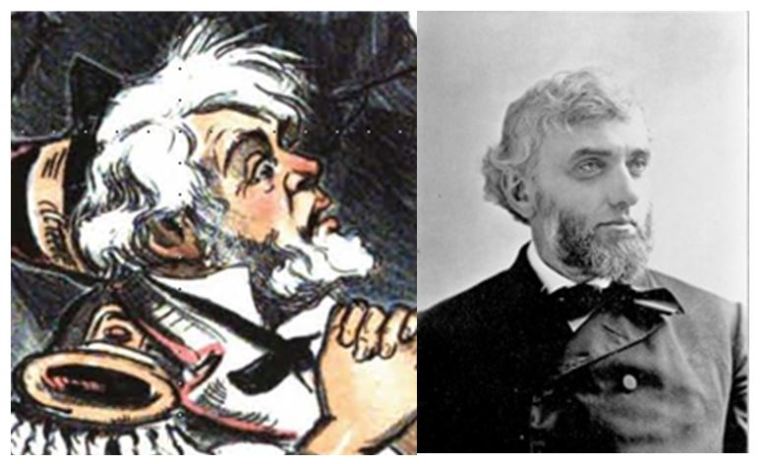
George Hoar
Philetus Sawyer
Matthew Quay
Dalrymple is a pretty good cartoonist -- these are excellent likenesses.
Now look at the Montana miner, and compare it to Wilbur Fisk Sanders:
There is a superficial resemblance, but the cartoon is not a likeness of Sanders. The nose in the cartoon is too hooked, and the eyebrows are too bushy. The miner’s brow ridge is more pronounced than that of Sanders, his eyes are deeper-set, and his lower jaw is recessed compared to that of Sanders. If Dalrymple had wanted to make it look like Sanders, it would have looked just like him.
Consider the images of the senators, and how accurate they are:
Frank Hiscock
George Hoar
Philetus Sawyer
Matthew Quay
Dalrymple is a pretty good cartoonist -- these are excellent likenesses.
Now look at the Montana miner, and compare it to Wilbur Fisk Sanders:
There is a superficial resemblance, but the cartoon is not a likeness of Sanders. The nose in the cartoon is too hooked, and the eyebrows are too bushy. The miner’s brow ridge is more pronounced than that of Sanders, his eyes are deeper-set, and his lower jaw is recessed compared to that of Sanders. If Dalrymple had wanted to make it look like Sanders, it would have looked just like him.
Bill Mullins wrote:You're doing it wrong.
You should tell this Mosteller-Wallace and the entire stylometry community who has followed their lead. Bill Mullins the know-it-all.
When one starts with Erdnase and asks how likely is it that Erdnase is Gallaway, my calculation, which follows Mosteller-Wallace, is perfectly fine.
Great juxtaposition of caricatures and photos. To me the Montana fellow looks like Wilbur Fisk Sanders. Dalrymple could have drawn the Montana guy in many other ways, but he didn't. However, the part of the argument I can't follow is this. Why would WE Sanders say he is related to Dalrymple when Dalrymple merely drew his father? Just because somebody draws somebody else doesn't mean they are related.
lybrary wrote:Bill Mullins wrote:You're doing it wrong.
You should tell this Mosteller-Wallace and the entire stylometry community who has followed their lead.
I'm not saying that Mosteller and Wallace were wrong. I'm saying that you are wrong. The data about "(?)" doesn't support the conclusion you are drawing.
lybrary wrote:Great juxtaposition of caricatures and photos. To me the Montana fellow looks like Wilbur Fisk Sanders. Dalrymple could have drawn the Montana guy in many other ways, but he didn't. However, the part of the argument I can't follow is this. Why would WE Sanders say he is related to Dalrymple when Dalrymple merely drew his father? Just because somebody draws somebody else doesn't mean they are related.
Chris--did you read my post directly above? We can't be sure that Erdnase told Smith that he was actually related to Dalrymple. He could have merely told Smith that he had a family connection to Dalrymple. Smith could have taken that at face value to mean that Dalrymple was a blood relative. The Dalrymple subject was most likely mentioned in passing as the two men were conducting business with the sketches and not the focus of their discussions.
Bill Mullins wrote:There is a superficial resemblance, but the cartoon is not a likeness of Sanders. The nose in the cartoon is too hooked, and the eyebrows are too bushy. The miner’s brow ridge is more pronounced than that of Sanders, his eyes are deeper-set, and his lower jaw is recessed compared to that of Sanders. If Dalrymple had wanted to make it look like Sanders, it would have looked just like him.
Great images Bill! Agreed that the image of the Montana miner is only a superficial resemblance, but it's close enough that Sanders could have interpreted that character as a caricature of his father. If the character of the Montana miner was a heavyset and clean shaven fellow, then it is sensible to say that Sanders would not have confused that character with his dad. Political cartoons and comic book illustrations are stylized art and not meant to be lifelike renditions.
Bill Mullins wrote:I'm not saying that Mosteller and Wallace were wrong. I'm saying that you are wrong. The data about "(?)" doesn't support the conclusion you are drawing.
I am doing it exactly as Mosteller-Wallace. So yes, you are saying they are wrong. You seem to not understand simple conditional probabilities. Given the observation of 3 in Erdnase, and the Poisson distribution, we are asking what is the probability of the observation of 0 in another text (Gallaway). That calculates to 0.177. Then we are asking what is the probability to observe 58 (Teale) and it comes out as essentially zero. Simple conditional probabilities. It is not that hard Bill. You can do it.
Leonard Hevia wrote:We can't be sure that Erdnase told Smith that he was actually related to Dalrymple.
Oh, I see. This argument requires for Smith to have incorrectly remembered something. What a novel thought! I will not argue against it. But I find the alleged comment rather unlikely in this situation. If Dalrymple would have actually drawn a nice full page portrait of his father then I guess you would have a point. But here his father was depicted as a tiny part of a larger image. It is silly to think that this would have been subject of a conversation.
Looks like this Erdnase kickstarter campaign will meet its goal. Thoughts?
https://www.kickstarter.com/projects/110191763/the-expert-at-the-card-table-with-photographs-from
https://www.kickstarter.com/projects/110191763/the-expert-at-the-card-table-with-photographs-from
Selling yet another copy of the original text with no new text ... one can only ask why.
If you're going to add photographs, why not add 200 (certainly a more reasonable number) instead of 100?
$200?
If you're going to add photographs, why not add 200 (certainly a more reasonable number) instead of 100?
$200?
Richard Kaufman wrote:Selling yet another copy of the original text with no new text ... one can only ask why.
Apparently it includes some new text: "an introduction by Joe Crist". " In the introduction, Mr. Crist will disclose one of the most closely guarded revelations in the history of playing cards. Known by just a handful of card experts worldwide, the 180 year old secret of the practice board is lauded as the greatest tool in developing "overall card handling ability" of all time."
Yes, I did note that. But it has nothing to do with Erdnase.
So is this really about charging people $200 for the secret of "The Practice Board"?
So is this really about charging people $200 for the secret of "The Practice Board"?
Except in this case, the cartoons of real people are lifelike renditions. (add to the list John James Ingalls, who is sprawled on the ground in front of the cannons.)Leonard Hevia wrote: Political cartoons . . . are stylized art and not meant to be lifelike renditions.
Dalrymple did accurate likenesses when he was depicting real people. "Montana" is not an accurate likeness of Sanders, so it wasn't intended to be W. F. Sanders.
W. E. Sanders presumably knew what his father looked like. He would not have perceived "Montana" to have been his father, and there's no reason to think that a decade later, he would have said to Smith that the cartoon referred to his father.
The rest of this post is math-heavy, boring, and probably should be skipped. TL;DR: I disagree (once again) with Chris.
Not at all.lybrary wrote:I am doing it exactly as Mosteller-Wallace.
What MW did (paper online here) was examine several of the Federalist papers whose authorship was unknown, but presumed to be either Madison or Hamilton, and compared them to works which were known to have been written by Madison, and by Hamilton.
So MW had disputed works, and works of known authorship. We have a disputed work (Expert), and works of known authorship for comparison (Gallaway and Teale). So far, so good.
MW did this:
1. Derived a list of function words that would be used in the analysis. Cross-checked and tested that list to ensure it was valid.
2. Measured the usage rates of these words in the disputed papers (individually), and in the collected works of Madison, and the collected works of Hamilton.
3. Calculated the probability (for the words in the list, as they appear in each of the disputed papers) that an author with Madison's "native" usage rates would have used the word as is was used in each disputed paper, and then did likewise for Hamilton.
4. Look for patterns, draw conclusions.
You did this:
1. Used a single punctuation marker instead of a list of words. Did no tests or cross-checks to determine if this marker is subject to the same statistical patterns as words are, or if it is otherwise valid.
2. Measured the usage rate of the marker in Erdnase (3/52k), Teale (58/85k), and Gallaway (0/30k).
3. Calculated the probability that Teale would have used the marker 58 times if he had Erdnase's native usage rate, and the probability that Gallaway would have used it 0 times if he had Erdnase's native usage rate. (see where you did it differently?)
4. Draw conclusions.
You have worked the problem from the wrong direction. MW calculated to what extent the unknown author wrote like Madison and Hamilton; you calculated to what extent Teale and Gallaway wrote like the unknown author.
You used λErdnase = 3, and then for Teale and Gallaway, you scaled it so λTeale = 3*85/52 = 4.9 and λGallaway = 3*30/52 = 1.72 (that should be 1.73, BTW).
You calculated
P(58)Teale using λErdnase scaled upwards ≈ 0; and
P(0)Gallaway using λErdnase scaled downwards = 0.177.
If you had approached the problem like MW, you would have calculated
P(3)Erdnase using λTeale (= 58*52/85 = 35.4) = 3.12e-12; and
P(3)Erdnase using λGallaway (= 0 ) = 0.
So, the probability that a person who uses "(?)" 58 times in 85k words (Teale) would use it 3 times in 52k words is small: 3 parts in 10^12.
The probability that a person who never uses "(?)" (Gallaway) would use it 3 times in 52k words is nonexistent.
The takeaways should be:
1. Using "(?)" as a measure of stylistic similarity is unverified, and doesn't really get you anywhere. MW spent a large portion of their paper (pp. 279-286) just determining what markers to use, and how much to weight each of them. Nothing like that was done with "(?)"; we just used it because it stood out to a casual reader.
2. If it is a valid marker to use, however, the probability (based solely on the usage rates of "(?)") that either Teale or Gallaway wrote Expert is vanishingly small, and zero.
3. But in those extremes, Teale (who uses the marker) is more likely than Gallaway (who doesn't use the marker) to have written a book that occasionally uses the marker (Expert). Teale beats Gallaway.
One can ask the question of authorship in either direction. You can start with Erdnase and then ask how likely is it that he would have authored another text. Or you can start with a candidate and ask how likely did he write Expert. Both answer the same question - Who is Erdnase? - and both fall within the Mosteller-Wallace framework. Since the Poisson distribution is not defined for lambda = 0 one has to start with Erdnase in the case of (?), otherwise you cannot answer that question.
We do not know if Gallaway never used it, because we do not have all of Gallaway's writings. We only have a sample of his writing. That is exactly why starting from Erdnase and asking how likely is he the author of Estimating makes a lot more sense than asking it the other way around where one cannot use that method of analysis.
I have simply pointed out why I disagree with Tom Sawyer's argumentation. I have not used (?) in my own linguistic analysis. However, punctuation does follow a Poisson distribution, as do most function words. And some stylometrists do use punctuation as a stylistic feature.
Bill Mullins wrote:The probability that a person who never uses "(?)" (Gallaway) would use it 3 times in 52k words is nonexistent.
We do not know if Gallaway never used it, because we do not have all of Gallaway's writings. We only have a sample of his writing. That is exactly why starting from Erdnase and asking how likely is he the author of Estimating makes a lot more sense than asking it the other way around where one cannot use that method of analysis.
Bill Mullins wrote:Using "(?)" as a measure of stylistic similarity is unverified, and doesn't really get you anywhere.
I have simply pointed out why I disagree with Tom Sawyer's argumentation. I have not used (?) in my own linguistic analysis. However, punctuation does follow a Poisson distribution, as do most function words. And some stylometrists do use punctuation as a stylistic feature.
lybrary wrote:One can ask the question of authorship in either direction.
You said that you did it exactly like MW, when in fact what you did was opposite to MW. That's what I was showing.
You can start with Erdnase and then ask how likely is it that he would have authored another text. Or you can start with a candidate and ask how likely did he write Expert.
But the standard in author discrimination is to compare the unknown text to each of the candidates. You can't just invert that and assert that you've answered the same question.
Can you point to any respected studies where the author(s) have done it in your order?
Bill Mullins wrote:You said that you did it exactly like MW, when in fact what you did was opposite to MW. That's what I was showing.
That is like saying they wrote a+b so it can't be used as b+a. Of course it can be used that way, too, because it is equivalent. The authorship question is symmetric. Saying "A has likely written B" obviously and trivially also means "B likely wrote A". The MoWa paper does not say you must start at the known texts and then calculate the probability to the unknown. It is simply a method to compare two texts regardless of who is the unknown. (see further down for more on that)
Bill Mullins wrote:You can start with Erdnase and then ask how likely is it that he would have authored another text. Or you can start with a candidate and ask how likely did he write Expert.
But the standard in author discrimination is to compare the unknown text to each of the candidates. You can't just invert that and assert that you've answered the same question.
You still haven't understood the MoWa paper. You can apply the math but you don't comprehend what it actually does. The fact that you think applying it the other way around is wrong demonstrates that you do not understand what MoWa actually calculates.
The reason why MoWa started from the known texts by Hamilton and Madison and then calculated the probability to the various disputed papers, is the difference in text volume. The average length of a disputed article is about 3000 words. The known text volume for each author was a lot more. In this situation it makes a lot more sense to start with the known text, because you have a larger set of function words to choose from. Even if the unknown text does not have that word at all, the model still works. Poisson(k=0, lambda>0) is well defined and nicely models the actual situation. On top of that they had several disputed papers. To allow for a uniform set of function words, which can be applied across all disputed papers they had to start with the known texts. So two reasons why the did a+b and not b+a: size of text and multiple unknown texts
However, with Erdnase the situation is entirely different. For many candidates we have less words than Erdnase wrote. Erdnase wrote 52k words. For Gallaway we only have 30k words. For MFA we only have 3k words, etc. On top of this we only have one unknown text we are analyzing. Starting from Erdnase is therefore the much better way to analyze it, because it allows a larger set of function words and allows a consistent and uniform set of function words across all candidates, regardless how long any particular candidate's text sample is.
Richard Hatch wrote:Looks like this Erdnase kickstarter campaign will meet its goal. Thoughts?
https://www.kickstarter.com/projects/110191763/the-expert-at-the-card-table-with-photographs-from
This is exactly what David Ben and Julie Eng have already done to perfection with The Experts at the Card Table.
I'm not sure what possible improvement could be achieved beyond what David and Julie have already done so well?
Maybe I'm missing something?
Roger, you have only seen the first of the three volumes of David's work on Erdnase. I keep nudging David to finish the next two volumes.
Roger M. wrote:Richard Hatch wrote:Looks like this Erdnase kickstarter campaign will meet its goal. Thoughts?
https://www.kickstarter.com/projects/110191763/the-expert-at-the-card-table-with-photographs-from
This is exactly what David Ben and Julie Eng have already done to perfection with The Experts at the Card Table.
I'm not sure what possible improvement could be achieved beyond what David and Julie have already done so well?
Maybe I'm missing something?
The reason why some think this is a particularly interesting book is due to the fact who Joe Crist is. Joe Crist's teacher was Joe Artanis from Bottom Deal fame https://www.lybrary.com/artanis-bottom-deal-p-242.html and the teacher of Joe Artanis was a Kaldarash gypsy who was friends with Erdnase.
Hi All,
I'm sure that this post will scroll-away quickly, and maybe that is for the best.
I did discuss Teale on my Erdnase blog, but I am not sure what my "argumentation" was that was referred to by Chris.
It's plain to me that Chris approached the problem from the opposite direction from the study regarding The Federalist. On that much, there is no dispute.
But this case is structured differently from The Federalist case from the get-go. This is so, at least this respect: To the average analyst, Galloway and Teale are just two guys whose text he wants to analyze. The typical analyst would not have as a premise the concept that Galloway probably wrote The Expert at the Card Table. In The Federalist case, they had two candidates, and they knew that one of them wrote one or more of the articles, and that no one else did. They just did not know which one wrote which.
The way I presently see it, the main problem with Chris's analysis on the "(?)" is that it is not an effective approach if the rate of use of "(?)" in the three texts does not accurately reflect what you might call the "long-run" usage of the term for each author.
If you assume that the "(?) rate" is the correct rate in each of the three texts (Erdnase, Teale, and Gallaway), you are left with what Bill said: Gallaway never uses the "(?)" expression.
The remaining two guys do use the expression, so based on that one measure, as Bill says, Teale is closer to Erdnase. And this would be so even if Teale had used the "(?)" expression a thousand times.
I have a suspicion that this reasoning will not appeal to everyone.
But even if I just look at the matter informally, without specific reference to statistics, I could say, well, both Erdnase and Teale used "(?)." So they have something in common that Gallaway does not.
To me, it is not appealing to say, "Gallaway never used the expression, and Erdnase rarely used it, so those two have something in common that Teale does not."
Boiled down, to me, the (from what I gather from this thread) complete absence of "(?)" in known Gallaway writings tends (very weakly) to show that Gallaway was not Erdnase.
Whether the frequent use of that expression by Teale is an argument in Teale's favor, well, actually I don't think it means much one way or the other. Since Teale LOVED the expression, you would think that if he was Erdnase, he would have used the term SOMEWHAT more than three times in the Erdnase book. But as Bill Mullins mentioned, the nature of the subject matter can explain a greatly reduced rate of usage in the Erdnase book.
By this time, I think the two basic points of view (Chris's and Bill's) been pretty thoroughly explored on this thread. Of course, that does not mean that the discussion is over, when one considers the nature of the thread.
I prefer Bill's method for the present set of facts.
--Tom Sawyer
I'm sure that this post will scroll-away quickly, and maybe that is for the best.
I did discuss Teale on my Erdnase blog, but I am not sure what my "argumentation" was that was referred to by Chris.
It's plain to me that Chris approached the problem from the opposite direction from the study regarding The Federalist. On that much, there is no dispute.
But this case is structured differently from The Federalist case from the get-go. This is so, at least this respect: To the average analyst, Galloway and Teale are just two guys whose text he wants to analyze. The typical analyst would not have as a premise the concept that Galloway probably wrote The Expert at the Card Table. In The Federalist case, they had two candidates, and they knew that one of them wrote one or more of the articles, and that no one else did. They just did not know which one wrote which.
The way I presently see it, the main problem with Chris's analysis on the "(?)" is that it is not an effective approach if the rate of use of "(?)" in the three texts does not accurately reflect what you might call the "long-run" usage of the term for each author.
If you assume that the "(?) rate" is the correct rate in each of the three texts (Erdnase, Teale, and Gallaway), you are left with what Bill said: Gallaway never uses the "(?)" expression.
The remaining two guys do use the expression, so based on that one measure, as Bill says, Teale is closer to Erdnase. And this would be so even if Teale had used the "(?)" expression a thousand times.
I have a suspicion that this reasoning will not appeal to everyone.
But even if I just look at the matter informally, without specific reference to statistics, I could say, well, both Erdnase and Teale used "(?)." So they have something in common that Gallaway does not.
To me, it is not appealing to say, "Gallaway never used the expression, and Erdnase rarely used it, so those two have something in common that Teale does not."
Boiled down, to me, the (from what I gather from this thread) complete absence of "(?)" in known Gallaway writings tends (very weakly) to show that Gallaway was not Erdnase.
Whether the frequent use of that expression by Teale is an argument in Teale's favor, well, actually I don't think it means much one way or the other. Since Teale LOVED the expression, you would think that if he was Erdnase, he would have used the term SOMEWHAT more than three times in the Erdnase book. But as Bill Mullins mentioned, the nature of the subject matter can explain a greatly reduced rate of usage in the Erdnase book.
By this time, I think the two basic points of view (Chris's and Bill's) been pretty thoroughly explored on this thread. Of course, that does not mean that the discussion is over, when one considers the nature of the thread.
I prefer Bill's method for the present set of facts.
--Tom Sawyer
Tom Sawyer wrote:Since Teale LOVED the expression, you would think that if he was Erdnase, he would have used the term SOMEWHAT more than three times in the Erdnase book. But as Bill Mullins mentioned, the nature of the subject matter can explain a greatly reduced rate of usage in the Erdnase book.
That is again an argument in favor of Gallaway. A book on print estimating is subject wise much father removed from Expert than "Higher Magic". On top of that, the distance, statistically speaking in terms of probabilities, is shorter from 3 use cases to zero use cases, than from 3 use cases to 58 use cases. The underlying stochastic process is a key component. That was one of the important contributions of Mosteller-Wallace. If we want to have an intelligent conversation about stylometry then we have to include the basics the field is built on. But I guess there is little desire for an intelligent discussion on that subject.
Bill Mullins wrote:Except in this case, the cartoons of real people are lifelike renditions. (add to the list John James Ingalls, who is sprawled on the ground in front of the cannons.)Leonard Hevia wrote: Political cartoons . . . are stylized art and not meant to be lifelike renditions.
Dalrymple did accurate likenesses when he was depicting real people. "Montana" is not an accurate likeness of Sanders, so it wasn't intended to be W. F. Sanders.
W. E. Sanders presumably knew what his father looked like. He would not have perceived "Montana" to have been his father, and there's no reason to think that a decade later, he would have said to Smith that the cartoon referred to his father.
Bill--
The faces of the senators in Dalrymple's cartoon are accurate and lifelike, but that is a stylized work of art we are seeing. It's a cartoon with realistic looking faces on disproportionate bodies. The senators running around are not proportioned correctly. Senator George Hoar resembles a dwarf, which I doubt he was.
Perhaps "Montana" was not intended to be W.F. Sanders, but it does look at least a little like him, and anyone who glances at a photo of W.F. Sanders and looks at that cartoon may believe that it is indeed him--including W.E. Sanders.
I defy you to display a photo of W.F. next to the Dalrymple cartoon to family and friends and ask them if "Montana" resembles W.F. I eagerly await the results.
lybrary wrote:Leonard Hevia wrote:We can't be sure that Erdnase told Smith that he was actually related to Dalrymple.
Oh, I see. This argument requires for Smith to have incorrectly remembered something. What a novel thought! I will not argue against it. But I find the alleged comment rather unlikely in this situation. If Dalrymple would have actually drawn a nice full page portrait of his father then I guess you would have a point. But here his father was depicted as a tiny part of a larger image. It is silly to think that this would have been subject of a conversation.
No--my argument would not require Smith to have incorrectly remembered Erdnase's Dalrymple comment. I think Smith correctly remembered something that he might have misinterpreted back in 1901. Smith may have perceived Erdnase's comment to mean that he was related to Dalrymple by blood or marriage when Erdnase simply commented on a family connection.
Yes, it would be silly to think that this was the subject of conversation, but bear in mind that Sanders--if he was Erdnase--was in the presence of an artist sketching his hands. The thought that another artist also illustrated a family member years before might certainly have crossed his mind and be worth mentioning in passing to Smith.
For what it's worth, one of the co-authors of the Mosteller-Wallace paper we've been discussing died only last month.
I suppose, then, we disagree. W. E. worked for his senator father in 1891-1892, and would have known some of the pictured senators. He would have been able to recognize which pictures were likenesses, meant to depict real people, and which were generic characters like the grizzled Montana miner.
Whether or not a random person thinks "Montana" looks like W. F. doesn't make much difference. It's whether W. E. would have thought so, ten years later, so much that he'd tell Smith that he was related to the Dalrymple.
Leonard Hevia wrote:Perhaps "Montana" was not intended to be W.F. Sanders, but it does look at least a little like him, and anyone who glances at a photo of W.F. Sanders and looks at that cartoon may believe that it is indeed him--including W.E. Sanders.
I suppose, then, we disagree. W. E. worked for his senator father in 1891-1892, and would have known some of the pictured senators. He would have been able to recognize which pictures were likenesses, meant to depict real people, and which were generic characters like the grizzled Montana miner.
I defy you to display a photo of W.F. next to the Dalrymple cartoon to family and friends and ask them if "Montana" resembles W.F. I eagerly await the results.
Whether or not a random person thinks "Montana" looks like W. F. doesn't make much difference. It's whether W. E. would have thought so, ten years later, so much that he'd tell Smith that he was related to the Dalrymple.
Re Dalrymple, we can go on the noses alone. They are spot on, except for Sanders.
At the top left of the Dalrymple cartoon is a man sticking his head out of a tent, named "Morton" (possibly "Horton"). I haven't been able to figure out who he is. There was no one in Congress by that name in 1891. Anyone have any ideas?
There's another reason to believe that "Montana" is not W. F. Sanders. Standing next to him is a miner representing the state of Washington. He is the only other one whose face is visible. Washington had two senators in 1891: Watson Squire and John Allen. "Washington" clearly doesn't resemble either of them; thus the mining characters are not meant to be representative of the senators of those states.
There's another reason to believe that "Montana" is not W. F. Sanders. Standing next to him is a miner representing the state of Washington. He is the only other one whose face is visible. Washington had two senators in 1891: Watson Squire and John Allen. "Washington" clearly doesn't resemble either of them; thus the mining characters are not meant to be representative of the senators of those states.
Pretty sure that's supposed to repesent Levi P. Morton, who (as everybody knows) was Vice President of the United States at the time of the cartoon.
Tom Sawyer wrote:Pretty sure that's supposed to repesent Levi P. Morton, who (as everybody knows) was Vice President of the United States at the time of the cartoon.
Everybody but me . . . .
Ha ha. Of course, in case anyone is wondering, until today I actually had no clue that one of our Vice Presidents had that name.
I'm beginning to wonder if Dalrymple illustrated a caricature of W.F. in another issue of Puck. I'm aware that the characters in the front battle lines are symbols and not senators. The character representing Idaho has a long mullet and from photos I've seen of the Republican Senator for that state, his hair is cut short.
All that matters is the impression Sanders got from looking at Dalrymple's illustration.
All that matters is the impression Sanders got from looking at Dalrymple's illustration.
Richard Kaufman wrote:Re Dalrymple, we can go on the noses alone. They are spot on, except for Sanders.
This.
One thing artists with Dalrymple's talent don't do is screw up the noses of folks they draw.
In this case, the hooked nose is very obviously supposed to be a hooked nose.
Despite the potentially racially charged overtones of a drawing of a person with a hooked nose, this is obviously not the Senator from Montana.
lybrary wrote: The MoWa paper does not say you must start at the known texts and then calculate the probability to the unknown.
Their paper does not say this, but their book, which amplifies the concepts, methods, and results initially described in the paper, explicitly says start with the known texts. (see Chap 3, Mosteller and Wallace, Applied Bayesian and Classical Inference: The Case of the Federalist Papers (1984))
"In Stage I, which has both logical and computational precedence, we analyze the papers whose authorship is known and convert the prior information about word rates into posterior distributions for these parameters."
Computational precedence -- you have to do this first.
However, with Erdnase the situation is entirely different.
That the Erdnase problem is different is an argument that the MW techniques aren't applicable, not that you should assume that the process as they describe it can be inverted and still be applied.
(And here you and I are in agreement -- The Erdnase problem is different. MW deals with a situation where a disputed text (or texts) is known to have been written by one of a group of authors, for all of whom we have known texts. Usually described as Authorship Attribution. The Erdnase problem is typically a situation where you have Erdnase and another text by a known author, and you want to know if they both are from the same hand. MW (1984) refers to this as a "Homogeneity Problem".)
Bill Mullins wrote:Their paper does not say this, but their book, which amplifies the concepts, methods, and results initially described in the paper, explicitly says start with the known texts. (see Chap 3, Mosteller and Wallace, Applied Bayesian and Classical Inference: The Case of the Federalist Papers (1984))
They do that for the practical reasons I explained above. For the Federalist Papers case you have to start with the known otherwise you cannot setup a large enough and consistent function word set. If you do not see the symmetry in their method, that it has nothing to do with which text is known and which text is unknown, then you do not understand the method. It comes down to the symmetry of if "A wrote B" then also "B wrote A".
lybrary wrote: If you do not see the symmetry in their method, that it has nothing to do with which text is known and which text is unknown, then you do not understand the method. It comes down to the symmetry of if "A wrote B" then also "B wrote A".
The method is not symmetrical, and you can see this for yourself if you work the calculations in both directions. Suppose Erdnase used the word "Giraffe" 5 times in 52k words, that Teale used it 8 times in 85k words, and that Gallaway used it 3 times in 30k words.
The probability that Teale would use it 8 times if he wrote like Erdnase is 0.139.
The probability that Erdnase would use it 5 times if he wrote like Teale is 0.175.
The probability that Gallaway would use it 3 times if he wrote like Erdnase is 0.014.
The probability that Erdnase would use it 5 times if he wrote like Gallaway is 0.175.
If the process was symmetrical, you'd get the same numbers no matter which direction you went.
Bill Mullins wrote:lybrary wrote: If you do not see the symmetry in their method, that it has nothing to do with which text is known and which text is unknown, then you do not understand the method. It comes down to the symmetry of if "A wrote B" then also "B wrote A".
The method is not symmetrical, and you can see this for yourself if you work the calculations in both directions. Suppose Erdnase used the word "Giraffe" 5 times in 52k words, that Teale used it 8 times in 85k words, and that Gallaway used it 3 times in 30k words.
The probability that Teale would use it 8 times if he wrote like Erdnase is 0.139.
The probability that Erdnase would use it 5 times if he wrote like Teale is 0.175.
The probability that Gallaway would use it 3 times if he wrote like Erdnase is 0.014.
The probability that Erdnase would use it 5 times if he wrote like Gallaway is 0.175.
If the process was symmetrical, you'd get the same numbers no matter which direction you went.
Not true. You are looking at fine grained symmetry which is immaterial here. As I wrote earlier, you can apply the math, but you do not understand what it calculates. The method is obviously symmetric because if "A wrote B" then it follows that "B wrote A". That the specific numbers for each function word individually do change is simply a fact of the shape of the Poisson distribution which is not symmetric. But this asymmetry of the Poisson distribution does not change the symmetry of the MoWa method as a whole. If MoWa would give different results if applied from both ends then the method would be complete non-sense, which it is not. It has been shown to work surprisingly well in several cases.
I'd like a larger collection of text markers for analysis claims. The "(?)" itself is interesting but not IMHO persuasive. What's the significance of that marker given text over those years? A typographical fad?
The Federalist Papers came from a fairly specific context among a well known cohort of writers and editors. I'm not sure the "erdnase" text has such a literary context (responding to news items and arguments publishing over time etc).
? "A wrote B" -> author wrote text
which only by Borges or Eco permits the possibility of "B wrote A" -> text created author... unless that's the point of Erdnase?
What then is the role of the reader?
Or the limits of interpretation?
Our new abracadabra - created by words indeed.
JonT
Claims that saying "erdnase" backwards makes things vanish back to the fifth dimension.
The Federalist Papers came from a fairly specific context among a well known cohort of writers and editors. I'm not sure the "erdnase" text has such a literary context (responding to news items and arguments publishing over time etc).
? "A wrote B" -> author wrote text
which only by Borges or Eco permits the possibility of "B wrote A" -> text created author... unless that's the point of Erdnase?
What then is the role of the reader?
Or the limits of interpretation?
Our new abracadabra - created by words indeed.
JonT
Claims that saying "erdnase" backwards makes things vanish back to the fifth dimension.
Jonathan Townsend wrote:I'd like a larger collection of text markers for analysis claims. The "(?)" itself is interesting but not IMHO persuasive. What's the significance of that marker given text over those years? A typographical fad?
It has little to no meaning by itself. I simply pointed out a logical error in the argument how it was used in a past post, because applying the MoWa method resulted in exactly the opposite outcome than was argued.
Jonathan Townsend wrote:The Federalist Papers came from a fairly specific context among a well known cohort of writers and editors. I'm not sure the "erdnase" text has such a literary context (responding to news items and arguments publishing over time etc).
You are correct, the Erdnase case is of a somewhat different type. The question is essentially an open authorship verification or attribution case where we have to look at a number of possible authors but neither of these has to be Erdnase. The Federalist papers was a fairly simple closed cased with only two possible authors. Nevertheless, it is the same basic task: comparing texts based on usage frequencies of various linguistic features (ex. function words).
Jonathan Townsend wrote:? "A wrote B" -> author wrote text
which only by Borges or Eco permits the possibility of "B wrote A" -> text created author... unless that's the point of Erdnase?
I am simply using the abbreviation that the author name can either stand for the person or the text he wrote. So if you want to have it spelled out it would be:
- Author A wrote text a: known
- Author B wrote text b: known
If the result of the analysis is that author A also wrote text b, then it must immediately follow that author B also wrote text a.
Jonathan Townsend wrote:
JonT
Claims that saying "erdnase" backwards makes things vanish back to the fifth dimension.
Hmm... new candidate put forward. Any extant comparison texts by MXYZPTLK?
lybrary wrote: You are looking at fine grained symmetry which is immaterial here. As I wrote earlier, you can apply the math, but you do not understand what it calculates. The method is obviously symmetric because if "A wrote B" then it follows that "B wrote A". That the specific numbers for each function word individually do change is simply a fact of the shape of the Poisson distribution which is not symmetric. But this asymmetry of the Poisson distribution does not change the symmetry of the MoWa method as a whole. If MoWa would give different results if applied from both ends then the method would be complete non-sense, which it is not. It has been shown to work surprisingly well in several cases.
You are confusing the conclusion made by the user of the method, with the results of the method. Obviously, if A wrote B, then B wrote A. That's not an insight into MW's methods, it's a tautology.
But the methodology described by MW doesn't give you "A wrote B". It gives you a probability number. MW didn't decide that Madison wrote the disputed papers because that was the output of their method. The applied the method many times to multiple words, taken from large groups of texts, and got numerous probabilities. Only after examining all of these probabilities, and subjecting them to the Bayesian Analysis (which is the real point of their paper -- the demonstration of Bayesian Analysis on a statistical problem), do they come to the conclusion that Madison wrote the papers.
The case that's causing all the discussion, whether or not Erdnase is more similar to Gallaway than Teale, based on (?), doesn't have multiple data points. There's just the single marker -- (?). And applying the MW method to it in one direction (the correct one) suggests that Erdnase writes more like Teale than Gallaway (in that they both have non-zero usages of (?).) The actual probability that he would use it the way he did if his baseline was that of Teale is still quite small, though, so from the single test, it suggests that they are not the same. If you apply it in the wrong direction (like you did), it suggests that Gallaway writes more like Erdnase than Teale does. But the probability is still small, so it also suggest that they are not the same (again, the conclusion is symmetric, but not the output of the calculations).
Look at that again. Applying it in one direction tells you which of two authors a disputed author writes more like. Applying it in the other direction tells you which of two authors writes more like a disputed author. Two different, similar but non-symmetrical questions. The "amount" that Erdnase writes like Teale is not necessarily the same as the "amount" that Teale writes like Erdnase.
(I suspect that there are, but haven't found any, data sets that would indicate that it is likely that A wrote like B (probability > 50%), but it is unlikely that B wrote like A (probability < 50%). Such a situation would clearly be non-symmetric.)
Off on a tangent:
In Fred Mosteller's autobiography, The Pleasures of Statistics, is a chapter devoted to magic. It says:
When I worked in New York City in the 1940s, I came across an erudite book by Erdnase on card magic, or possibly how to cheat at cards. Jimmie Savage [a colleague] wanted to learn a little about magic, and so I lent him this book. Jimmie loved it for two reasons. First, the author said he wrote the book because he needed the money. Second, Erdnase treats each problem much like a mathematics text would. He has names for various devices such as false shuffling (riffling cards but leaving them in the original order), and he tells the reader exactly the sequence of use of these devices to produce the desired result. For anyone who hadn’t learned to manipulate cards at mother’s knee, too much skill is required. But for those who have it, Erdnase potentially moves their performance up many notches.
Too bad he wasted all that time on The Federalist Papers when, if things had gone just a little differently, he could have told us who wrote EATCT.
Bill Mullins wrote:The case that's causing all the discussion, whether or not Erdnase is more similar to Gallaway than Teale, based on (?), doesn't have multiple data points. There's just the single marker -- (?). And applying the MW method to it in one direction (the correct one) suggests that Erdnase writes more like Teale than Gallaway (in that they both have non-zero usages of (?).) The actual probability that he would use it the way he did if his baseline was that of Teale is still quite small, though, so from the single test, it suggests that they are not the same. If you apply it in the wrong direction (like you did), it suggests that Gallaway writes more like Erdnase than Teale does. But the probability is still small, so it also suggest that they are not the same (again, the conclusion is symmetric, but not the output of the calculations).
There is no correct or incorrect direction. Both directions are valid due to the symmetry of the problem. The Erdnase/Teale/Gallaway case can only be applied in the direction I did, because in the other the MoWa method is not defined due to the Gallaway frequency being zero. In the direction it can be applied Gallaway comes out much closer to Erdnase than Teale.
One gets the same result if newer stylometry methods are being applied to this case, for example Burrows Delta (2002), which is one of the most used and respected methods these days. Burrows does not use a Poisson distribution. He works with raw frequencies and a Manhattan distance metric. For the (?) case the numbers are:
Erdnase 3/52k = 0.058 (per 1k)
Teale 58/85k = 0.68 (per 1k)
Gallaway 0/30k = 0.0 (per 1k)
The Manhattan distances are:
Erdnase-Teale = 0.625
Erdnase-Gallaway = 0.058
Also with the newer state of the art stylo method Erdnase and Gallaway are much closer than Erdnase and Teale. MoWa agrees with Burrows. It also agrees with intuition. It is much more believable that somebody writing on magic using it 3 times, doesn't use it on a shorter text on a completely different subject, than using it 58 times writing on the same subject of magic.
lybrary wrote:There is no correct or incorrect direction. Both directions are valid due to the symmetry of the problem. The Erdnase/Teale/Gallaway case can only be applied in the direction I did, because in the other the MoWa method is not defined due to the Gallaway frequency being zero. In the direction it can be applied Gallaway comes out much closer to Erdnase than Teale.
There is zero support in the literature for what you are saying. I've looked at many stylometry author identification/attribution studies over the years, and I've never seen one conducted where they used the unknown text as the baseline, and compared the known texts against it.
I've quoted the authors of the most important study in the field, Mosteller and Wallace, saying that you have to use the known texts as baselines, but you reject that.
The nomenclature for such studies has evolved so that the unknown text is called a "subject" text, and the known ones are called "training" texts. Vocabulary reflects practice, and the practice is to build baselines from the known texts.
All this tells me that when you say you can validly do it in the other direction, one of two things must apply:
1. You have stumbled onto a method that is otherwise unknown in the field.
2. You are wrong. (I think you can guess which way I lean on this).
Allowing for the possibility of #1 being correct, you should write this up and publish it. The Wasshuber inversion to the Mosteller-Wallace method may end up being what you are known for in years to come.
One gets the same result if newer stylometry methods are being applied to this case, for example Burrows Delta (2002), which is one of the most used and respected methods these days. Burrows does not use a Poisson distribution. He works with raw frequencies and a Manhattan distance metric. For the (?) case the numbers are:
Erdnase 3/52k = 0.058 (per 1k)
Teale 58/85k = 0.68 (per 1k)
Gallaway 0/30k = 0.0 (per 1k)
The Manhattan distances are:
Erdnase-Teale = 0.625
Erdnase-Gallaway = 0.058
Burrows Delta requires the use of the most frequently used words in the texts to be examined. By definition, a "word" like "(?)" which does not even appear in one of the texts is not appropriate for Burrows Delta analysis. The methodology isn't validated at usage rates = 0. Also, the Manhattan Distance is an ensemble measurement, taken over a number of words (typically 100 or more). The methodology isn't validated when used on only a single word.
When you so egregiously misapply the method, you don't prove anything.
Burrows does not use a Poisson distribution.
For that matter, neither did Mosteller-Wallace (despite what you've been implying). They used a negative binomial.
Bill Mullins wrote:Speaking of Dalrymple, Heritage Auctions currently has a piece of his art, used in Puck, up for auction.
Sold for $191 (including auction premium).
Bill Mullins wrote:There is zero support in the literature for what you are saying. I've looked at many stylometry author identification/attribution studies over the years, and I've never seen one conducted where they used the unknown text as the baseline, and compared the known texts against it.
I've quoted the authors of the most important study in the field, Mosteller and Wallace, saying that you have to use the known texts as baselines, but you reject that.
Nowhere does it say that you cannot start with the unknown text. You start from the larger text (known or unknown) because that gives you the biggest set of function-words to work with. Once you actually implement this method and use it on different cases you quickly realize that. The typical test cases in the stylo literature have much more known text and that is why you see them start with it. Erdnase has written a lot more than several candidates and that is why starting with Erdnase is advantageous. No big insight there just obvious conclusions once one understands what the method actually calculates.
Bill Mullins wrote:Burrows Delta requires the use of the most frequently used words in the texts to be examined. By definition, a "word" like "(?)" which does not even appear in one of the texts is not appropriate for Burrows Delta analysis. The methodology isn't validated at usage rates = 0.
Again incorrect. It does not require the use of the most frequent words. What function words one uses with a Burrows Delta analysis is topic of research. One can use it with any words, frequent or not. But if frequent words are used they are typically calculated from the total ensemble of texts. 61 instances in about 160k words is frequent enough. Not all texts need to feature the word.
Bill Mullins wrote:Also, the Manhattan Distance is an ensemble measurement, taken over a number of words (typically 100 or more). The methodology isn't validated when used on only a single word.
Valid or not, the method is defined for a single word. I am not arguing that a single word stylometry makes a lot of sense. I am simply demonstrating that the argument that Teale is closer to Erdnase based on the single feature of (?) is incorrect, based on two methods MoWa and Burrows Delta, as well as intuition. Nothing more nothing less.
Bill Mullins wrote:Burrows does not use a Poisson distribution.
For that matter, neither did Mosteller-Wallace (despite what you've been implying). They used a negative binomial.
Really?! They tried both the Poisson and the negative binomial but found that the added difficulties the negative binomial introduces is not worth the trouble. Here the quote from their paper:
"The entire study was carried out in parallel for the negative binomial and Poisson data distributions. The negative binomial introduces many complications that strongly influenced our allocation of effort, but few new ideas."
Ben Blatt in "Nabokov's Favorite word is Mauve" who tested MoWa on a set of 50 authors of novels and even more fan fiction authors also used the Poisson distribution and achieved above 96% accuracy.
Bill, in connection with a hypothetical above, you said:
If you are saying "3 times in 30,000 words," and "5 times in 52,000 words," then the first part of the quotation sounds sorta counterintuitive to me.
Since, under the assumptions, they are both using the word "Giraffe" ROUGHLY once in 10,000 words, it would seem to me that 3 and 5, respectively, would be the most frequent "uses."
It thus seems weird (to me, anyway) that in the first case (Gallaway), he would use the word "3 times in 30,000 words" only 1.4% of the time -- and that in the other 98.6% of the 30,000-word samples he would use the word "Giraffe" zero, one, two, four, or greater-than-four times.
--Tom Sawyer
The probability that Gallaway would use it 3 times if he wrote like Erdnase is 0.014.
The probability that Erdnase would use it 5 times if he wrote like Gallaway is 0.175.
If you are saying "3 times in 30,000 words," and "5 times in 52,000 words," then the first part of the quotation sounds sorta counterintuitive to me.
Since, under the assumptions, they are both using the word "Giraffe" ROUGHLY once in 10,000 words, it would seem to me that 3 and 5, respectively, would be the most frequent "uses."
It thus seems weird (to me, anyway) that in the first case (Gallaway), he would use the word "3 times in 30,000 words" only 1.4% of the time -- and that in the other 98.6% of the 30,000-word samples he would use the word "Giraffe" zero, one, two, four, or greater-than-four times.
--Tom Sawyer
lybrary wrote:Bill Mullins wrote:Burrows Delta requires the use of the most frequently used words in the texts to be examined.
Again incorrect. It does not require the use of the most frequent words.
Burrows, from his seminal 2002 paper: "The first step in the procedure is to establish a frequency-hierarchy for the most common words in a large group of suitable texts."
Bill Mullins wrote:Also, the Manhattan Distance is an ensemble measurement, taken over a number of words (typically 100 or more). The methodology isn't validated when used on only a single word.
Valid or not, the method is defined for a single word. I am not arguing that a single word stylometry makes a lot of sense. I am simply demonstrating that the argument that Teale is closer to Erdnase based on the single feature of (?) is incorrect, based on two methods MoWa and Burrows Delta, as well as intuition. Nothing more nothing less.
Except that you didn't use the MoWa method -- you inverted it -- and you didn't use Burrows Delta -- you used a single, non-common "word" instead of a group of most common words. And intuition tells us that two documents that have a feature in common are more alike that a third which does not share that feature. 0 for 3.
Bill Mullins wrote:Burrows does not use a Poisson distribution.
For that matter, neither did Mosteller-Wallace (despite what you've been implying). They used a negative binomial.
Really?!
Really.
Mosteller, "A Statistical Study of the Writing Styles of the Authors of 'The Federalist' Papers," ProcAmerPhilSoc, v131n2, 6/1987
p. 136 "We investigated the usefulness of both the Poisson and the negative binomial. The negative binomial fits much better. . . .We used the negative binomial to fit the distributions of the words because of empirical evidence."
p. 137 "We used a substantial collection of words and the negative binomial distribution to generate the log odds in the manner just described."
Mosteller, The Pleasures of Statistics, (Springer, 2010) p. 57 "We had to complicate the theoretical model to allow for this, and the model we used is called the negative binomial distribution."
Mosteller-Wallace's book (Applied Bayesian and Classical Inference, Springer-Verlag, 1984) on the Federalist Papers study discusses this issue in detail and makes it clear that they did much of the work with both the Poisson and the negative binomial, and the negative binomial consistently was more accurate in describing the distributions. So their final conclusions were based on the negative binomial model.
Tom -- I did make a mistake in the numbers I originally wrote. Where it says 0.014, it should say 0.223. Thanks for holding my feet to the fire.
And yes, low numbers like that do seem counter-intuitive, but that's the nature of the Poisson distribution. He'd use it 3 times 23% of the time, and 77% of the time, he'd use it 0, 1, 2, 4 or more times.
But my main point still holds. The direction you work the problem makes a difference in the numbers you get, so it isn't symmetrical.
And yes, low numbers like that do seem counter-intuitive, but that's the nature of the Poisson distribution. He'd use it 3 times 23% of the time, and 77% of the time, he'd use it 0, 1, 2, 4 or more times.
But my main point still holds. The direction you work the problem makes a difference in the numbers you get, so it isn't symmetrical.
Bill, thanks for the clarification on that! --Tom
Bill Mullins wrote:Burrows, from his seminal 2002 paper: "The first step in the procedure is to establish a frequency-hierarchy for the most common words in a large group of suitable texts."
That was his original attempt and was simply a suggestion not a mandatory requirement. Many other researchers have used the same method for words of any frequency. It is still called Burrows Delta method because nothing in the math changes, just the list of words one decides to use. Including less frequent words has often improved accuracy. Some have shown best results with hundreds and even thousands of words, many of which only appear a few times.
Bill Mullins wrote:But my main point still holds. The direction you work the problem makes a difference in the numbers you get, so it isn't symmetrical.
The numbers change, the outcome which author is closest stays the same. If there is a case where the outcome would change then the result would be inconclusive because the authors style is too close to each other to make a decision.
Is there anyone besides Chris who thinks Gallaway is a viable candidate?
Richard Kaufman wrote:Is there anyone besides Chris who thinks Gallaway is a viable candidate?
Looking back through the thread ... not a single poster has supported Chris's conclusion as it relates to Gallaway.
Gallaway as a viable candidate for Erdnase entered the realm of beating a dead horse many months ago.
Of course, new evidence is always welcome ... but to date it's simply been constant repetition of Chris's initial proposal.
Roger M. wrote:Chris, I see what you mean by hearing Erdnase in the intro, it certainly seems more than just a similar style. Indeed it would be at the least a very similar style.
Richard Hatch wrote:lybrary wrote: Here is a part from the beginning of the introduction to "Estimating for Printers"
"This is a practical book - it is not padded with ponderous editorial homilies, old newspaper clippings, interest tables or platitudinous dissertations on the uplift of the printing industry."
I agree with Chris that this does sound like it could have been written by the same author who wrote the "Professional Secrets" section of EATCT.
As I was one of those folks you quoted Chris, I'll just note that on an internet forum, the ultimate point is to engage in enjoyable conversation with other participants in the forum ... which is exactly was trying to do with you.
In the end though, trying to have a decent conversation with you was difficult, if not impossible, and I gave up.
I deduced quickly that disagreeing with any of your comments or statements resulted in your barrage of insults.
But as the post you dug up indicates quite clearly ... I did try.
Based on your TWO dug up posts ... you've essentially proven my point that nobody on this thread has ever agreed with you that Gallaway was Erdnase, or that Gallaway was likely to be Erdnase.
In the end though, trying to have a decent conversation with you was difficult, if not impossible, and I gave up.
I deduced quickly that disagreeing with any of your comments or statements resulted in your barrage of insults.
But as the post you dug up indicates quite clearly ... I did try.
Based on your TWO dug up posts ... you've essentially proven my point that nobody on this thread has ever agreed with you that Gallaway was Erdnase, or that Gallaway was likely to be Erdnase.
Richard Kaufman wrote:Is there anyone besides Chris who thinks Gallaway is a viable candidate?
I think Chris' research and arguments as laid out in detail in his Hunt for Erdnase book make Gallaway viable. He was "at the scene of the crime" (McKinney's print shop), owned a copy of the first edition, sounds (to some) like Erdnase when writing, self published books in Chicago that bear some resemblance to the first edition (price on title page, for example). Chris makes a good circumstantial case for Gallaway, in my opinion. Lacking is any evidence of the skills described in the book, but that is true for all current publicly announced candidates except Milton Franklin Andrews and E. D. Benedict, I believe. I also don't think he sounds enough like Erdnase consistently to be convincing to me, and I frankly don't follow the stylometric discussions with any degree of understanding that leads to conviction! Here's a short list of the viable candidates that are known to me and publicly discussed:
Milton Franklin Andrews
Wilbur Edgerton Sanders
Edwin Sumner Andrews
E. S. Andrews (the con man unearthed by Todd Karr)
Edward Gallaway
E. D. Benedict
If I had to guess, I say there is probably a 50 percent or more chance that Erdnase was "none of the above". But I consider them all interesting and viable
Viable = "feasible".
I don't believe MFA is feasible simply because the man wrote like an idiot, and no amount of "editing" could fix his incredibly poor grasp of the English language.
I also don't believe Gallaway is feasible, because as much as he was at the scene of the crime, so were perhaps 30 to 50 other people. He had a first edition, but so did (presumably) about 1000 other people at some point in time.
There is no evidence that has been brought forward about Gallaway that is in any way convincing.
Chris hasn't made a successful case such that he's received any confirmation of his newsletter declaration that he's "found Erdnase".
Richard is far more polite than I am, and although he may consider Gallaway a viable candidate ... I stronly stand by my earlier comment that nobody in this thread has ever stated they feel Gallaway is Erdnase, or that Gallaway is likely to be Erdnase.
The general consensus of this thread strongly, and consistently contrasting with Chris's declaration in his newsletter that "Erdnase has been found!".
That newsletter has, this week, broken new ground in the expression of sheer fantasy being sold as legitimate research ... however Chris finishes off todays newsletter with :
"Next week I will drop a bombshell ..."
So maybe Chris will present something more convincing than he has to date.
I don't believe MFA is feasible simply because the man wrote like an idiot, and no amount of "editing" could fix his incredibly poor grasp of the English language.
I also don't believe Gallaway is feasible, because as much as he was at the scene of the crime, so were perhaps 30 to 50 other people. He had a first edition, but so did (presumably) about 1000 other people at some point in time.
There is no evidence that has been brought forward about Gallaway that is in any way convincing.
Chris hasn't made a successful case such that he's received any confirmation of his newsletter declaration that he's "found Erdnase".
Richard is far more polite than I am, and although he may consider Gallaway a viable candidate ... I stronly stand by my earlier comment that nobody in this thread has ever stated they feel Gallaway is Erdnase, or that Gallaway is likely to be Erdnase.
The general consensus of this thread strongly, and consistently contrasting with Chris's declaration in his newsletter that "Erdnase has been found!".
That newsletter has, this week, broken new ground in the expression of sheer fantasy being sold as legitimate research ... however Chris finishes off todays newsletter with :
"Next week I will drop a bombshell ..."
So maybe Chris will present something more convincing than he has to date.
Richard -- Robert F. Foster has been proposed as a candidate, based on a perceived similarity of writing styles to Erdnase. If you accept him as "viable", then he'd certainly have some relevant skills, having written multiple books on card games, having been a member of the Parent Assembly in NY of SAM, and then of the Los Angeles Assembly, and having performed magic at SAM shows in NY.
(and while poking around about Foster, I found another relevant name-reversal. Eugene Homer performed as Rajah Remoh).
(and while poking around about Foster, I found another relevant name-reversal. Eugene Homer performed as Rajah Remoh).
Bill Mullins wrote:Richard -- Robert F. Foster has been proposed as a candidate, based on a perceived similarity of writing styles to Erdnase. If you accept him as "viable", then he'd certainly have some relevant skills, having written multiple books on card games, having been a member of the Parent Assembly in NY of SAM, and then of the Los Angeles Assembly, and having performed magic at SAM shows in NY.
L'Homme Masqué has also been proposed (by no less than Juan Tamariz) and clearly had many of the skills described in the book, being both an expert at sleight of hand and a compulsive gambler. But I don't consider either R. F. Foster or L'Homme Masqué viable, having long ago ruled out both on circumstantial grounds. I do still find them both interesting candidates, just not "viable".
I think that Chris has provided more evidence, if only circumstantial that Gallaway is Erdnase. But that's more evidence than most, so yes, Gallaway is a viable candidate.
Jeff Pierce Magic wrote:I think that Chris has provided more evidence, if only circumstantial that Gallaway is Erdnase. But that's more evidence than most, so yes, Gallaway is a viable candidate.
Well Chris has presented exactly zero evidence that Gallaway is Erdnase ... but exactly what evidence did Chris present that convinces you that Gallaway is a "viable" candidate?
Be specific please.
Bill Marquardt wrote:You have made an excellent case to include Gallaway as a candidate, and I am not really arguing against him being Erdnase.
Jonathan Townsend wrote:You're on the way to making a good case. Looking for meaningful measures is a big step toward credible argument.
Roger M. wrote:Chris has achieved the commendable undertaking of introducing a "new" candidate, and has had most of the regular posters to this thread accept this new candidate (Gallaway) as to be taken seriously as an addition to the somewhat short list of long established candidates.
lybrary wrote:Roger M. wrote:Chris has achieved the commendable undertaking of introducing a "new" candidate, and has had most of the regular posters to this thread accept this new candidate (Gallaway) as to be taken seriously as an addition to the somewhat short list of long established candidates.
Like I said a few posts ago Chris, off the top you were well researched and polite.
Folks enjoyed engaging with you, myself included.
When your evidence wound up not going anywhere, and folks started pointing that out to you - you began insulting anybody who disagreed with your conclusions.
None of you know who I am and Im sure you guys could care less what I think but I’ve studied the ERDNASE issue long enough to come to a conclusions.
I believe Chris is right.
You guys- you’ve spent too much time in love with the wrong angle. All that name backwards stuff- no.
Take all the Sanders and Andrews off the list.
I think that is a 100% miss!!
Reversing the name or changing letters around-
I just dont think thats it. If you were seriously trying to hide your identity- not so the public doesnt know but so anyone you may know personally doesnt figure it out- would you just reverse your name?
No, you would not. So take those cats off the list.
The thing that got me: very early on in Chris’ work he points out the German meaning of Erdnase.
To me that made more sense.
He just thought it was a good name to use as it was a word he was familiar with. Why cant it just be that simple?
I think the focus has slowly gone down the wrong road for a long time.
I know Im just pointing out one thing that really isnt proof but If we’re splitting hairs with Occam’s razor
I’m putting my money on Gallaway-
Chris’ research feels right.
So many things point to Gallaway.
I believe Chris hit the nail on the head.
I believe Chris is right.
You guys- you’ve spent too much time in love with the wrong angle. All that name backwards stuff- no.
Take all the Sanders and Andrews off the list.
I think that is a 100% miss!!
Reversing the name or changing letters around-
I just dont think thats it. If you were seriously trying to hide your identity- not so the public doesnt know but so anyone you may know personally doesnt figure it out- would you just reverse your name?
No, you would not. So take those cats off the list.
The thing that got me: very early on in Chris’ work he points out the German meaning of Erdnase.
To me that made more sense.
He just thought it was a good name to use as it was a word he was familiar with. Why cant it just be that simple?
I think the focus has slowly gone down the wrong road for a long time.
I know Im just pointing out one thing that really isnt proof but If we’re splitting hairs with Occam’s razor
I’m putting my money on Gallaway-
Chris’ research feels right.
So many things point to Gallaway.
I believe Chris hit the nail on the head.
Sometimes I wonder if all the Erdnase enthusiasts should all chip in and contribute a certain amount of money to a private investigative agency to delve into the matter and figure it all out!
S. Tauzier wrote:To me that made more sense.
He just thought it was a good name to use as it was a word he was familiar with. Why cant it just be that simple?.
To others it makes more sense that the author left behind clues for readers to follow a trail. A reversal or anagram of his name is one clue.
You suggest removing W.E Sanders from the list of candidates, but he was a mining engineer--an earth nose/Erdnase. A good name to use that happens to be a perfect anagram of your own name.
Chris has yet to prove, even circumstantially, that Gallaway held a deck of cards in his hands. Erdnase was a card handler. A viable candidate in my opinion should have at least left behind a receipt for a purchase of a deck of cards.
Leonard Hevia wrote:S. Tauzier wrote:To me that made more sense.
He just thought it was a good name to use as it was a word he was familiar with. Why cant it just be that simple?.
To others it makes more sense that the author left behind clues for readers to follow a trail. A reversal or anagram of his name is one clue.
You suggest removing W.E Sanders from the list of candidates, but he was a mining engineer--an earth nose/Erdnase. A good name to use that happens to be a perfect anagram of your own name.
Chris has yet to prove, even circumstantially, that Gallaway held a deck of cards in his hands. Erdnase was a card handler. A viable candidate in my opinion should have at least left behind a receipt for a purchase of a deck of cards.
Im not buying it. I dont think trying to hide your identity in the context of this book was a game.
I think people are way over thinking that one.
W.E.Sanders- eh I still dont think so because again I point out- he was trying to hide his identity - NOT play Peek-A-Boo.
The tired issue of trying to put a deck of cards in his hands- that is an invalid argument.
That wouldnt prove anything anyway.
That said- if you dont think for one second that every person alive at that time surely held a deck of cards in their hands at some time then I think you are not critically thinking; cards were a very popular passtime for practically everyone back then.
Also, if you dont think folks traveling in a circus would get around to playing cards while their waiting around, traveling, etc, then maybe you dont realize there were no iPhones back then.
S. Tauzier wrote: If you were seriously trying to hide your identity- not so the public doesnt know but so anyone you may know personally doesnt figure it out- would you just reverse your name?
Why are you assuming this is what Erdnase was trying to do? It could be that he didn't really care, and it's just an accident of history that no one today knows who he was. I'd be reasonably good money that if you walked into Roterberg's magic shop in 1902-1903, and asked about "That guy who wrote Expert at the Card Table," someone in the shop would have known who he aws
S. Tauzier wrote:Im not buying it. I dont think trying to hide your identity in the context of this book was a game.
I think people are way over thinking that one.
Or maybe they aren't.
S. Tauzier wrote:W.E.Sanders- eh I still dont think so because again I point out- he was trying to hide his identity - NOT play Peek-A-Boo.
Why not Peek-a-Boo? The author has a sense of humor; Peek-a-Boo is consistent with that. If you read The Expert, you will discover it.
S. Tauzier wrote:The tired issue of trying to put a deck of cards in his hands- that is an invalid argument.
That wouldnt prove anything anyway.
It would prove the candidate at least handled a deck of cards. People get tired--not issues.

S. Tauzier wrote:That said- if you dont think for one second that every person alive at that time surely held a deck of cards in their hands at some time then I think you are not critically thinking; cards were a very popular passtime for practically everyone back then.
Also, if you dont think folks traveling in a circus would get around to playing cards while their waiting around, traveling, etc, then maybe you dont realize there were no iPhones back then.
Practically everyone had a deck of cards back then? Then everyone was Erdnase?
S. Tauzier wrote:The tired issue of trying to put a deck of cards in his hands- that is an invalid argument.
It's not at all invalid, but it's certainly Chris's argument!
Indeed many (if not all) of your points are Chris's points!
Interesting.
performer wrote:Sometimes I wonder if all the Erdnase enthusiasts should all chip in and contribute a certain amount of money to a private investigative agency to delve into the matter and figure it all out!
David Alexander had been a professional private investigator at one time.
I know he was. However, I meant a REAL private investigator! I always found David to be a bit unreal in more ways than one in view of my interactions with him.
I have very little interest in the identity of Erdnase and have never studied the matter with the intensity that everyone else is subject to on the grounds that I couldn't give a toss who he was ,but I strongly suspect he had never cheated at cards in his life. It seems obvious to me that he was a magician and a very advanced card magician for the times.
I have a gut feeling that you all may be looking in the wrong place. Just think for a moment. Who were the well known card magicians of the day? It is probably someone written about in magic books of the time.
I think there is a post of Glenn Bishop's somewhere on this long, long, long thread where he points out the same things that I have pointed out. I only just noticed it yesterday and I find it interesting that he came to the same conclusion quite independently that I have. I have met card sharks among all the various scoundrels I have associated with in my life. They weren't that bright and I doubt they could spell let alone write a book. Secondly, they only knew about three moves with cards if even that. But then to earn a living that is all they would need to know.
Erdnase was clearly an intelligent well educated person. Magicians, dolts though most of them are, do tend to be intelligent and well educated. They know many moves and sleights rather than three at the most. And they are far too innocent in the ways of the world to actually have the nerve to cheat at cards.
I find Erdnase incredibly advanced in card technique for his day. In fact he was so advanced I have often wondered if the book was REALLY published in the year it was and not much later. I suppose I must be wrong since all you know-alls will have no doubt verified the date. Sometimes I have fancifully wondered whether Vernon wrote the bloody thing himself as a practical joke and never told a soul throughout his entire life. He lied about how he came across the book in the first place.
I know. I know. The timing would be wrong for my daft theory. However, I would LOVE it to be true!
I have very little interest in the identity of Erdnase and have never studied the matter with the intensity that everyone else is subject to on the grounds that I couldn't give a toss who he was ,but I strongly suspect he had never cheated at cards in his life. It seems obvious to me that he was a magician and a very advanced card magician for the times.
I have a gut feeling that you all may be looking in the wrong place. Just think for a moment. Who were the well known card magicians of the day? It is probably someone written about in magic books of the time.
I think there is a post of Glenn Bishop's somewhere on this long, long, long thread where he points out the same things that I have pointed out. I only just noticed it yesterday and I find it interesting that he came to the same conclusion quite independently that I have. I have met card sharks among all the various scoundrels I have associated with in my life. They weren't that bright and I doubt they could spell let alone write a book. Secondly, they only knew about three moves with cards if even that. But then to earn a living that is all they would need to know.
Erdnase was clearly an intelligent well educated person. Magicians, dolts though most of them are, do tend to be intelligent and well educated. They know many moves and sleights rather than three at the most. And they are far too innocent in the ways of the world to actually have the nerve to cheat at cards.
I find Erdnase incredibly advanced in card technique for his day. In fact he was so advanced I have often wondered if the book was REALLY published in the year it was and not much later. I suppose I must be wrong since all you know-alls will have no doubt verified the date. Sometimes I have fancifully wondered whether Vernon wrote the bloody thing himself as a practical joke and never told a soul throughout his entire life. He lied about how he came across the book in the first place.
I know. I know. The timing would be wrong for my daft theory. However, I would LOVE it to be true!
Bill Mullins wrote:S. Tauzier wrote: If you were seriously trying to hide your identity- not so the public doesnt know but so anyone you may know personally doesnt figure it out- would you just reverse your name?
Why are you assuming this is what Erdnase was trying to do?
Because a cardshark is a cheat, a crook, a criminal. It is not in their interest to be found out. It is typical magician's thinking. We love cardsharks, we adore them, we idolize them, we seek them out, we try to learn from them. The rest of the people think they are crooks. To them it is obvious that somebody like Erdnase would want to stay hidden for good.
Just to clarify, then, Chris, you believe that Erdnase was or had been a working cardshark?
lybrary wrote:Because a cardshark is a cheat, a crook, a criminal. It is not in their interest to be found out. It is typical magician's thinking. We love cardsharks, we adore them, we idolize them, we seek them out, we try to learn from them. The rest of the people think they are crooks. To them it is obvious that somebody like Erdnase would want to stay hidden for good.
Erdnase was also a magician, and therefore thought like a magician. The late Tony Giorgio suspected that the author was a magician with aspirations of being a card cheat. In his opinion, many of the moves described in the book would not fly above scrutiny or just wouldn't work.
Jack Shalom wrote:Just to clarify, then, Chris, you believe that Erdnase was or had been a working cardshark?
That depends on how you define "working cardshark". I think Erdnase did cheat at the card table, but I do not think he was the prototypical cardshark the way most would picture them, at least not for his entire life. Perhaps he had periods where he did mostly gamble, but during other periods it might have been a sideline, or a deep interest, rather than his 'profession'. Erdnase was widely read, which is clear from his breadth of vocabulary. One does not acquire that by sitting all day and gambling. One acquires that through extensive reading. Erdnase clearly had other interests, as many intelligent and widely read folks have, but gambling and cheating was on the top of his interests at least until he wrote Expert.
The extensive reading part is another aspect that fits the typesetter/printer profession so well. Historically typesetters/printers were often the most widely read folks, because when one typesets a book one also automatically reads it. Somebody who likes to read and likes books would be naturally drawn to that profession. That is very likely why Gallaway choose to work at the Delphos Weekly Herald and enter a printer's apprenticeship, learned to typeset, and then worked as typesetter for a couple of years. Gallaway, just as Erdnase, was widely read, with an extensive vocabulary, and an interest in several subjects (printing, estimating, astronomy, religion, gambling, magic, Dickens, Poe, history, ...)
Leonard Hevia wrote:lybrary wrote:Because a cardshark is a cheat, a crook, a criminal. It is not in their interest to be found out. It is typical magician's thinking. We love cardsharks, we adore them, we idolize them, we seek them out, we try to learn from them. The rest of the people think they are crooks. To them it is obvious that somebody like Erdnase would want to stay hidden for good.
Erdnase was also a magician, and therefore thought like a magician. The late Tony Giorgio suspected that the author was a magician with aspirations of being a card cheat. In his opinion, many of the moves described in the book would not fly above scrutiny or just wouldn't work.
Exactly!
The Dalrymple cartoon which some suppose to picture W. F. Sanders appears in the Jan 7, 1891 issue of Puck.
Three weeks later is this interesting classified ad:
I don't recall Edwin Sumner Andrews ever working for this railway, but I believe that his second wife did before they got married.
Regardless, were agents the "point of contact" for passengers who wanted to get a game going on a train?
Three weeks later is this interesting classified ad:
Fine Playing Cards
Mention PUCK and send ten (10) cents in stamps or coin to JOHN SEBASTIAN, Gen'l Tk't and Pass. Ag't, CHICAGO, ROCK ISLAND & PACIFIC RY., Chicago, Ills., for a pack of the latest, smoothest slickest playing cards that ever gladdened the eyes and rippled along the fingers of the devotee to Seven-Up, Casino, Dutch, Euchre, Whist or any other ancient or modern game, and get your money's worth five times over.
I don't recall Edwin Sumner Andrews ever working for this railway, but I believe that his second wife did before they got married.
Regardless, were agents the "point of contact" for passengers who wanted to get a game going on a train?
Isn't there the story that Canada Bill offered to pay the railroad agents for the right for him to play on the trains exclusively, with his promise that he would only cheat people of the cloth?
Found another, Jan 21 1891:
PLAYING CARDS
For fifteen ceents in postage, sent to P. S. EUSTIS, Gen. Pas. Agent C.B.& Q.R.R., Chicago, Ill., you can obtain a pack of best quality playing cards.
Bill Mullins wrote:The Dalrymple cartoon which some suppose to picture W. F. Sanders appears in the Jan 7, 1891 issue of Puck.
Three weeks later is this interesting classified ad:Fine Playing Cards
Mention PUCK and send ten (10) cents in stamps or coin to JOHN SEBASTIAN, Gen'l Tk't and Pass. Ag't, CHICAGO, ROCK ISLAND & PACIFIC RY., Chicago, Ills., for a pack of the latest, smoothest slickest playing cards that ever gladdened the eyes and rippled along the fingers of the devotee to Seven-Up, Casino, Dutch, Euchre, Whist or any other ancient or modern game, and get your money's worth five times over.
I don't recall Edwin Sumner Andrews ever working for this railway, but I believe that his second wife did before they got married.
Regardless, were agents the "point of contact" for passengers who wanted to get a game going on a train?
John Sebastian was very active advertising playing cards. In my presentation on Erdnase at the 2011 Magic Collectors Association Weekend in Chicago I included advertisements by him in the Henry (Illinois) Times of April 17, 1890, the Chronicle Argonaut (Ann Arbor, Michigan) in 1891, and Lippincott's Monthly Magazine in 1893. I also included a full page ad for the Chicago, Rock Island and Pacific Railway that he placed (in his capacity as general ticket and passenger agent) in the back of an edition of Harry Kellar's Magician's Tour (1886). I think my point was simply to show that train agents (like Edwin S. Andrews) might also have had an interest in cards (Sebastian obviously had a good side business in them). It would be interesting to show a connection between Sebastian and Andrews, perhaps through his future wife, Dollie, who worked in Rock Island for the Chicago, Burlington and Quincy (CB &Q) Railroad in the mid-1880s (she later transferred to their main office in St. Louis).
The "andrews" thing is not so much a matter of contention as finding a person of the right build, who was in the area, who could handle cards and who had some connection with the other artist. The material clues being Gardener's report of Smith's recollections and scattered titbits in the text such as "(?)".
Richard Kaufman mentioned the "spread" item being known yet not divulged in the book. So the calendar is not complete and the reader is left to determine what else is being told on the slant in the text. A graduate education... based upon what primary, secondary and university curriculum? But folks like to coat their memorabilia with nostalgia... and woofle dust accumulates over time in our literature. Enjoy the dialog.
Kudos to those who would measure the depth of the dust and find clues from historical context. Magic has much to offer the student of history.
Richard Kaufman mentioned the "spread" item being known yet not divulged in the book. So the calendar is not complete and the reader is left to determine what else is being told on the slant in the text. A graduate education... based upon what primary, secondary and university curriculum? But folks like to coat their memorabilia with nostalgia... and woofle dust accumulates over time in our literature.
Enjoy the dialog. Kudos to those who would measure the depth of the dust and find clues from historical context. Magic has much to offer the student of history.
Roger M. wrote:S. Tauzier wrote:The tired issue of trying to put a deck of cards in his hands- that is an invalid argument.
It's not at all invalid, but it's certainly Chris's argument!
Indeed many (if not all) of your points are Chris's points!
Interesting.
Chris knows I agree with him - so what.
I dont think you could prove he held or didnt hold a deck of cards but we already know he held cards.
S. Tauzier wrote:...... but we already know he held cards.
We don't know anything of the sort!
What evidence can you present that puts a deck of cards in Gallaway's hands?
PLEASE ..... be precise.
Roger M. wrote:S. Tauzier wrote:...... but we already know he held cards.
We don't know anything of the sort!
What evidence can you present that puts a deck of cards in Gallaway's hands?
PLEASE ..... be precise.
Since pretty much everybody played cards one way or another during the 19th century, essentially everybody had a deck of cards in their hands. For Gallaway we know even more. We know he had an interest in sleight of hand with cards, because he had card magic and gambling books in his library. Nothing like that is known about E.S. Andrews or W.E. Sanders.
Leonard Hevia wrote:Erdnase was also a magician, and therefore thought like a magician.
That he was a magician or interested in magic is obvious, after all he describes a number of card tricks in his book. But to say he "thought like a magician" requires some arguments which you haven't offered. What do you mean by "thinking like a magician"? If one reads Expert carefully Erdnase sends mixed messages, but for the most part he identifies with gamblers more than he identifies with magicians.
lybrary wrote:Since pretty much everybody played cards one way or another during the 19th century, essentially everybody had a deck of cards in their hands. For Gallaway we know even more. We know he had an interest in sleight of hand with cards, because he had card magic and gambling books in his library. Nothing like that is known about E.S. Andrews or W.E. Sanders.
W. E. Sanders undoubtedly knew card magic. He described a card magic effect in his 1881 camping diary: "Mutus Nomen Detit Cocus." We also know that on a ten week camping trip in 1896, he purchased six decks of playing cards.
lybrary wrote:What do you mean by "thinking like a magician"? If one reads Expert carefully Erdnase sends mixed messages, but for the most part he identifies with gamblers more than he identifies with magicians.
I will answer your question with your own quote:
lybrary wrote:
Because a cardshark is a cheat, a crook, a criminal. It is not in their interest to be found out. It is typical magician's thinking. We love cardsharks, we adore them, we idolize them, we seek them out, we try to learn from them. The rest of the people think they are crooks. To them it is obvious that somebody like Erdnase would want to stay hidden for good.
Leonard Hevia wrote:W. E. Sanders undoubtedly knew card magic. He described a card magic effect in his 1881 camping diary: "Mutus Nomen Detit Cocus." We also know that on a ten week camping trip in 1896, he purchased six decks of playing cards.
That is not a trick that requires sleight-of-hand. It is the exactly the sort of trick a lay person might know. If he would be Erdnase we would expect to see a lot different notes on tricks and moves. There is no information that W.E. Sanders was interested in sleight-of-hand with cards.
Leonard Hevia wrote:lybrary wrote:
Because a cardshark is a cheat, a crook, a criminal. It is not in their interest to be found out. It is typical magician's thinking. We love cardsharks, we adore them, we idolize them, we seek them out, we try to learn from them. The rest of the people think they are crooks. To them it is obvious that somebody like Erdnase would want to stay hidden for good.
I was referring to the thinking of people here on this forum, which is typical magician's thinking, not the thinking of Erdnase. Erdnase, being a cheat, crook and criminal, wanted to stay hidden, because most everybody would not want to associate with a criminal. Thus he really wanted to stay hidden.
lybrary wrote:Roger M. wrote:S. Tauzier wrote:...... but we already know he held cards.
We don't know anything of the sort!
What evidence can you present that puts a deck of cards in Gallaway's hands?
PLEASE ..... be precise.
Since pretty much everybody played cards one way or another during the 19th century, essentially everybody had a deck of cards in their hands. For Gallaway we know even more. We know he had an interest in sleight of hand with cards, because he had card magic and gambling books in his library. Nothing like that is known about E.S. Andrews or W.E. Sanders.
Sorry, but this isn't an argument, nor is it in any way proof that Gallaway ever picked up a deck of cards in his life.
What this is though, is incredibly lazy posting Chris, and is the equivalent of saying that everybody alive in 1902 could have been Erdnase.
In other words, it's a completely ridiculous - irrelevant to the subject matter.
Your next statement carries more weight, but still fails to put the cards on Gallaway's hands. Through ex-wives, parents, etc ... I have about 15 gardening books in my library ... but I couldn't be any less interested in gardening than I am. So the fact that the gardening books are in my library (contrary to your logic) has absolutely nothing to do with any interest I have (I have none) in gardening.
Roger M. wrote:In other words, it's a completely ridiculous - irrelevant to the subject matter.
I agree, saying that somebody had a deck of cards in his hands is ridiculous and irrelevant, because everybody had one in their hands in the 19th century. It doesn't make everybody Erdnase, it simply is a characteristic that is not specific to Erdnase at all, not even remotely.
Roger M. wrote:Your next statement carries more weight, but still fails to put the cards on Gallaway's hands. Through ex-wives, parents, etc ... I have about 15 gardening books in my library ... but I couldn't be any less interested in gardening than I am. So the fact that the gardening books are in my library (contrary to your logic) has absolutely nothing to do with any interest I have (I have none) in gardening.
Did you also paste bookplates in your gardening books?
Setting aside Gallaway's copy of The Expert at the Card Table, I am led to wonder exactly (a) what gambling books, if any, and (b) what magic books, if any, are known to exist with Gallaway's bookplate in them.
Tom -- I'm sure you know this as well as I do, but everything I've ever heard on the subject is summarized [poorly] a single footnote in The Man Who Was Erdnase, p. 390:
Richard Hatch provided a copy of the actual letter from Marshall to Gardner to Chris Wasshuber, and it is transcribed in the current edition of his The Hunt for Erdnase. The relevant excerpt:
TMWWE takes the above to mean that Gallaway had "a fair-sized collection of gambling books" (see p. 57); Chris makes reference in his book a couple of times to "magic books" owned by Gallaway (note the plural).
But a careful reading of the sources does not support either of these propositions. It may well be an exaggeration to think that Gallaway owned more than three or so gambling books. There is no reference to magic "books"; only a reference to Expert, which could fairly be called a magic book. Singular, not plural.
So, the best evidence is that he had owned a few gambling books, one of which was Expert. Chris has used these slim facts to support the contention that Gallaway had an interest in magic. If he owned the books because he was interested in their contents, I don't think you should go beyond an interest in gambling, since that is the common subject. But given that he had worked for the printer of Expert, and followed that with employment at Bentley, Murray & Co. (a printer of gambling literature), an equally reasonable explanation is that these all were books he had a hand in producing, and that he had no particular interest in their subject matter.
To say that Gallaway's library showed that he was interested in magic, and supports the contention that he was a magician, stretches what few facts we have beyond breaking.
[and for those who are interested in chasing Griffiths' library down, in hopes of locating other bookplates, note that the Marshall letter says only that Griffiths bought the 1st. ed. of Expert; it doesn't say what happened to the other gambling books -- Griffiths may not have bought them]
Letter, Marshall to Gardner, 2 Jan 1957. Local Chicago amateur magician William C. Griffiths bought a group of magic and gambling books that a second-hand book dealer had been holding for Rufus Steele, who had died in 1955. Several of the gambling books had the bookplate of Edward Gallaway. One was a first edition of The Expert that Griffiths gave to Marshall.
Richard Hatch provided a copy of the actual letter from Marshall to Gardner to Chris Wasshuber, and it is transcribed in the current edition of his The Hunt for Erdnase. The relevant excerpt:
The proprietor had several gambling books on hand, that he was holding for Rufus Steele. When Bill Griffiths told him that Rufus Steele was dead, the shop owner then offered the books to Bill. There was a first edition of Erdnase in the lot and Bill bought it and gave it to me. There was nothing odd about the copy BUT there was a bookplate: Library of Edward Gallaway. In a couple of the other gambling books was a similar bookplate.
TMWWE takes the above to mean that Gallaway had "a fair-sized collection of gambling books" (see p. 57); Chris makes reference in his book a couple of times to "magic books" owned by Gallaway (note the plural).
But a careful reading of the sources does not support either of these propositions. It may well be an exaggeration to think that Gallaway owned more than three or so gambling books. There is no reference to magic "books"; only a reference to Expert, which could fairly be called a magic book. Singular, not plural.
So, the best evidence is that he had owned a few gambling books, one of which was Expert. Chris has used these slim facts to support the contention that Gallaway had an interest in magic. If he owned the books because he was interested in their contents, I don't think you should go beyond an interest in gambling, since that is the common subject. But given that he had worked for the printer of Expert, and followed that with employment at Bentley, Murray & Co. (a printer of gambling literature), an equally reasonable explanation is that these all were books he had a hand in producing, and that he had no particular interest in their subject matter.
To say that Gallaway's library showed that he was interested in magic, and supports the contention that he was a magician, stretches what few facts we have beyond breaking.
[and for those who are interested in chasing Griffiths' library down, in hopes of locating other bookplates, note that the Marshall letter says only that Griffiths bought the 1st. ed. of Expert; it doesn't say what happened to the other gambling books -- Griffiths may not have bought them]
Here's another thing about the Gallaway gambling books. The Marshall-Gardner correspondence says (in a Jan 2 1957 letter) that Griffiths bought the 1st ed. Expert during a "recent excursion" -- presumably very late in 1956. It also says that Gallaway's widow sold his library after his death to pay bills, and that she had died "about nine years ago." (She died in 1947).
So where were the books between 1947 and 1956? Did this unknown second-hand book dealer have them that whole length of time? Probably not; since he was holding them for Rufus Steele (who died in 1955), he probably picked them up after Steele had last visited.
So where were the books between 1947 and 1956? Did this unknown second-hand book dealer have them that whole length of time? Probably not; since he was holding them for Rufus Steele (who died in 1955), he probably picked them up after Steele had last visited.
Roger M. wrote:Your next statement carries more weight, but still fails to put the cards on Gallaway's hands. Through ex-wives, parents, etc ... I have about 15 gardening books in my library ... but I couldn't be any less interested in gardening than I am. So the fact that the gardening books are in my library (contrary to your logic) has absolutely nothing to do with any interest I have (I have none) in gardening.
This argument falls apart after closer examination. The subject of magic and gambling is almost exclusively a male pursuit. This means the magic and gambling books in Gallaway's library are not from his spouse or his mother. The only possible person would be his father. But his father died in 1900 and at least one of the books was published after the death of his father, so couldn't come from him. Gallaway had these books because he had an interest in card magic and gambling.
Roger M. wrote:He had a first edition, but so did (presumably) about 1000 other people at some point in time.
That is true but you cannot look at one fact in isolation to assess the strength of the case. Let's give a short run down and see why Gallaway's case is so compelling.
The author certainly had a first edition in his library, but so did say 1000-3000 others. We do not know the exact number of the first print run and we have to account for second hand sales, too. So let's make this a group of 5000 people Erdnase is member of. Then we also need Erdnase to have some kind of connection with McKinney where the book was printed. This could be a number of things, employees, suppliers, people living across the street, relatives of employees, etc. My estimate is about 10,000 people had some kind of connection with McKinney at the right time (1901-1902).
Now we have to combine these two facts. Not everybody who had a connection with McKinney also had a first edition of Expert. And not everybody with a first edition had a connection with McKinney. All those second hand sales we had in the number of first edition owners would most likely not know McKinney. Not everybody bought directly from McKinney, actually only a minority would have. What is the overlap? Let's be generous and say 100 people are in the cross section. So 100 people both had a first edition and had some connection to McKinney.
We are looking for an author. Erdnase wrote a book. Not everybody who buys a book is an author. About 1 out of 10 is an author. This brings down the number to about 10. So only about 10 people had a first edition, had some connection to McKinney, and were authors themselves.
Author is too lose, we need folks who could write very well, because Erdnase is an excellent writer. We need not only somebody who is writing very well, but somebody who at least remotely writes like Erdnase, who shares some rare words and phrases or exhibits some other aspects that make him at least somewhat like Erdnase. I would say that again one out of 10 is a sufficiently good writer. This brings down the cross section to ~1 person. If we apply a more specific linguistic fingerprint it certainly reduces it to 1.
Even if your numbers are different, it means there are very few people who had a first edition, had some connection to McKinney, were writers/authors themselves who wrote well enough and similar enough to Erdnase. The evidence shows that Gallaway is one of them. One can then add all the other evidence of record of self-publishing, copyright application, price on title page, similarity in traits (instructor, performer, reading, religious questions, magic & gambling, math, print, detail-oriented, ...), match of physical appearance if you trust Smith, and we know that Gallaway is Erdnase. No other candidate's evidence even remotely is able to get down to such a narrow selection.
Bill Mullins wrote:S. Tauzier wrote: If you were seriously trying to hide your identity- not so the public doesnt know but so anyone you may know personally doesnt figure it out- would you just reverse your name?
Why are you assuming this is what Erdnase was trying to do? It could be that he didn't really care, and it's just an accident of history that no one today knows who he was. I'd be reasonably good money that if you walked into Roterberg's magic shop in 1902-1903, and asked about "That guy who wrote Expert at the Card Table," someone in the shop would have known who he aws
And maybe they did not know; maybe they were some of the people he hid it from.
lybrary wrote:For Gallaway we know even more. We know he had an interest in sleight of hand with cards, because he had card magic and gambling books in his library.
Chris--are you saying here that Gallaway owned more than one card magic book? Beyond The Expert, did he own any more books on card magic?
lybrary wrote:Then we also need Erdnase to have some kind of connection with McKinney where the book was printed.
Why in the world is that the case? If this were true in general, then the only people who could self-publish books would be those who had a connection to a printer.
There are a number of self published authors that participate here. Did Richard Kaufman work for a printer before he published books? Did Tomas Sawyer? Did you work for a printer before you published McDermott's book?
The only connection the author needed was the ability to read, so he could find a printer. Think Yellow Pages. If you are literate enough to write a book, you have all the connections to printers you need.
lybrary wrote:..... Let's give a short run down and see why Gallaway's case is so compelling.
I read, and then re-read your post, and beyond you stating that you felt the contents of your post were "compelling", I found there was nothing at all compelling about anything you presented.
So go most of your posts, which are almost entirely highly personal opinions (often without a shred of evidence) packaged up and sold as a "fact" ... when indeed there is nothing at all either factual, or compelling about them.
Bill Mullins wrote:lybrary wrote:Then we also need Erdnase to have some kind of connection with McKinney where the book was printed.
Why in the world is that the case? If this were true in general, then the only people who could self-publish books would be those who had a connection to a printer.
With connection I do not mean that Erdnase had to necessarily work there. He had to have some connection, business connection (being a customer or supplier for example), family connection, local proximity, whatever. The book was printed there. And thus Erdnase knew the James McKinney business, he did business with them. He had to go there or communicate with McKinney to get his manuscript to them.
Opportunity is a key requirement in any criminal case. Gallaway clearly had opportunity. I am estimating about 10,000 others had also opportunity. It is one important way to narrow down the list of suspects.
But a person who wants to print a book will make their own opportunity -- it doesn't have to pre-exist.
Bill Mullins wrote:But a person who wants to print a book will make their own opportunity -- it doesn't have to pre-exist.
True, it doesn't have to pre-exist, but in either case, if it pre-existed or was created, you have to show that Erdnase was at the scene of the 'crime', otherwise you cannot 'convict beyond a reasonable doubt'. Gallaway clearly was at the right place at the right time and his opportunity is proven beyond a reasonable doubt.
Leonard Hevia wrote:lybrary wrote:For Gallaway we know even more. We know he had an interest in sleight of hand with cards, because he had card magic and gambling books in his library.
Chris--are you saying here that Gallaway owned more than one card magic book? Beyond The Expert, did he own any more books on card magic?
Chris--you haven't answered my question.
lybrary wrote:Bill Mullins wrote:But a person who wants to print a book will make their own opportunity -- it doesn't have to pre-exist.
True, it doesn't have to pre-exist, but in either case, if it pre-existed or was created, you have to show that Erdnase was at the scene of the 'crime', otherwise you cannot 'convict beyond a reasonable doubt'. Gallaway clearly was at the right place at the right time and his opportunity is proven beyond a reasonable doubt.
All along you've been saying that Gallaway's employment by McKinney makes him more likely than the other candidates, with respect to the issue of opportunity. Are you agreeing now that anyone who can be shown to have been in the Chicago area in the era before Feb 1902 is on equivalent footing to Gallaway?
And do you disagree that all of the things that had to have happened between Erdnase and McKinney could have happened remotely, via the mails?
Bill Mullins wrote:All along you've been saying that Gallaway's employment by McKinney makes him more likely than the other candidates, with respect to the issue of opportunity. Are you agreeing now that anyone who can be shown to have been in the Chicago area in the era before Feb 1902 is on equivalent footing to Gallaway?
No not at all. There were about a million people in and around Chicago. Only about 10,000 people had potentially contact with McKinney. Showing that somebody was in Chicago is definitely not anywhere as narrow or specific as showing that somebody had contact with McKinney. It is not Gallaway's employment that is important, it is his proven contact with McKinney at the right time. Employment is one of many forms such contact could be shown. A supplier, relative of McKinney or any employee, somebody living across the street of McKinney's print shop, a receipt, letter or other communication with McKinney's business, a check for payment to McKinney, etc., all of those would prove sufficient opportunity. I don't understand why this is so hard to comprehend for you. The book was printed at McKinney. If one can proof that a candidate had contact with McKinney or was in the immediate vicinity at the right time it is proof for opportunity. Being in Chicago is not sufficient opportunity. There were hundreds of print shops in Chicago. Why would somebody merely in Chicago choose McKinney? In order to show opportunity you have to proof that they had contact with McKinney or were in the immediate viscinity. Think about a crime. Just because somebody was in the same city doesn't make one a suspect. But if one were in the same building at the time of the crime one would certainly be a suspect, or if one had contact with the victim around the time of the crime would make one a suspect. It comes down to showing contact with McKinney be it by spatial proximity or some proven contact via documentary evidence of some sort.
The way to quantify it is how small the group of people with the same characteristic is. Anybody in the world could be Erdnase. The world population at that time was about 1.5 billion people. Not a particularly narrow characteristic. If you can proof that a candidate was in the US during the right time then you would narrow it by a factor 10 to about 160 million. If you can place a candidate in Chicago you cut this down by a factor of ~100 to about 1.2 million. If you can show contact with McKinney you reduce it again by a factor ~100 to about 10,000.
A similar hierarchy can be made with writing skill. If you do not have knowledge of any writing then there is no narrowing possible. If you can show that somebody was an author and wrote books or articles then that would make the candidate by about a factor 10 better, because we are looking for an author and not everybody is an author. If you can demonstrate that he was a good author on the same skill level as Erdnase then that is perhaps by another factor 10 better. If you can show that he actually writes like him another factor 10-100 better.
Bill Mullins wrote:And do you disagree that all of the things that had to have happened between Erdnase and McKinney could have happened remotely, via the mails?
Possible but highly unlikely in my opinion, because there were so many print shops all over the country that doing such a contract purely by mail would be highly unusual. That is not how print shops operated. But hey, if you can show that somebody in California communicated with McKinney then I would accept that as sufficient opportunity for that person. Immediate spatial proximity is one way to show opportunity. A document that proofs contact with McKinney is another way of doing that. Anyway you can do it is fine. But if such evidence is not present then you haven't shown opportunity.
Jack Shalom wrote:Isn't there the story that Canada Bill offered to pay the railroad agents for the right for him to play on the trains exclusively, with his promise that he would only cheat people of the cloth?
Yes, Jack, there is indeed such a story. It first appeared in print in an article entitled, "Three Keerd Monkey," in the Little Rock Daily Republican, September 14, 1872, p. 3. A similar story is recounted in School for Scoundrels, Notes on There Card Monte, written by Whit Haydn and published in 2001 by Whit Haydn and Chef Anton. (Don't have the page reference right now because I am on the road and don't have my copy with me). However, according to the Notes on Three Card Monte version, when the Union Pacific Railroad banned three card monte, Canada Bill wrote to the railroad's Superintendent offering $25,000 in return for the exclusive right to operate a three-card monte game on their trains, and a promise to play only against commercial travelers from Chicago. The Superintendent politely declined the offer.
Canada Bill is widely reputed to be the greatest three card monte hustler ever. He is known mainly for his "rube act," wherein he played the part of a barely literate hic from Kentucky, who had just learned how to play this game with three cards after having been hustled by some slicker in the game. He would demonstrate how he had been taken by awkwardly tossing the cards about, and making it look like he had no skill whatsoever. Believing they would be able to take advantage of this poorly-clothed, uneducated "rube," and win the big bankroll he flashed (money he had supposedly just acquired from selling some horses from the family ranch), many a sophisticated and well-healed traveler was fleeced by Canada Bill (and usually a shill) - especially by the bent corner ruse. Unfortunately, Bill was himself addicted to gambling, and typically lost all his copious winnings (hundreds of thousands of dollars) at the Faro table.
Since this is, after all, an Erdnase thread, it seems fitting to quote from what is said of three card monte in Expert at the Card Table: ""But there is not a single card feat in the whole calendar that will give as good returns for the amount of practice required, or that will mystify as greatly, or cause as much amusement, or bear so much repetition, as this little game; and for these reasons we believe it worth of unstinted effort to master it thoroughly." Interestingly, it would seem from the foregoing quote that Erdnase's orientation toward the game was as a form of magical entertainment, as opposed to a con for card cheats.
MagicbyAlfred wrote:Unfortunately, Bill was himself addicted to gambling, and typically lost all his copious winnings (hundreds of thousands of dollars) at the Faro table.
Erdnase seems to have had a similar problem. Read the passage on "pretty money" in expert: “Hazard at play carries sensations that once enjoyed are rarely forgotten. The winnings are known as "pretty money," and it is generally spent as freely as water.”
MagicbyAlfred wrote:Since this is, after all, an Erdnase thread, it seems fitting to quote from what is said of three card monte in Expert at the Card Table: ""But there is not a single card feat in the whole calendar that will give as good returns for the amount of practice required, or that will mystify as greatly, or cause as much amusement, or bear so much repetition, as this little game; and for these reasons we believe it worth of unstinted effort to master it thoroughly." Interestingly, it would seem from the foregoing quote that Erdnase's orientation toward the game was as a form of magical entertainment, as opposed to a con for card cheats.
I absolute agree. Erdnase describes it as amusement, as something to perform and entertain socially, not as a way to take the money.
? anywhere else it's amusement rather than con/scam? Recall Hofzinser was using and teaching top/bottom changes which work for packets in his tricks - and instructed that the pack be inhand by default.
Jon I asked that back in 2015 in another thread, and here are some replies I got from Philippe Billot:
"In More Magic published by Pr Hoffmann in 1890, he writes page 51:
THE ThREE-CARD TRICK.
This is more of a sharper's than a conjurer's trick, but it is a frequent experience with any one who is known to dabble in sleight of hand, to be asked, "Can you do the three-card trick ? " It is humiliating to be obliged to reply " No, I can't," and moreover the trick, neatly performed, may be made the occasion of a good deal of fun."
"In Magic No Mystery, published in 1876, we can read :
THE THREE-CARD TRICK.
We explain here one of those tricks of gamblers which, thoagh as old as cards themselves, deceives hundreds every week at race-courses, in hotels, &c.
"A priori", it's not a trick for entertainment, it's "A Gambler's Trick Exposed""
"In Les Tricheries des grecs dévoilées (Card Sharpers Exposed) published in 1861 by Robert-Houdin, after he explained the three card trick, concluded :
"Cette tricherie ne se fait plus que dans les cabarets depuis que la police en a défendu l'exhibition sur la place publique."
This little trick is now confined to the low public houses, the police forbidding the exhibition in the streets.
May be that at time, in France, magicians begin to use it for entertainment."
"In More Magic published by Pr Hoffmann in 1890, he writes page 51:
THE ThREE-CARD TRICK.
This is more of a sharper's than a conjurer's trick, but it is a frequent experience with any one who is known to dabble in sleight of hand, to be asked, "Can you do the three-card trick ? " It is humiliating to be obliged to reply " No, I can't," and moreover the trick, neatly performed, may be made the occasion of a good deal of fun."
"In Magic No Mystery, published in 1876, we can read :
THE THREE-CARD TRICK.
We explain here one of those tricks of gamblers which, thoagh as old as cards themselves, deceives hundreds every week at race-courses, in hotels, &c.
"A priori", it's not a trick for entertainment, it's "A Gambler's Trick Exposed""
"In Les Tricheries des grecs dévoilées (Card Sharpers Exposed) published in 1861 by Robert-Houdin, after he explained the three card trick, concluded :
"Cette tricherie ne se fait plus que dans les cabarets depuis que la police en a défendu l'exhibition sur la place publique."
This little trick is now confined to the low public houses, the police forbidding the exhibition in the streets.
May be that at time, in France, magicians begin to use it for entertainment."
MagicbyAlfred wrote:
...Canada Bill is widely reputed to be the greatest three card monte hustler ever. .... Unfortunately, Bill was himself addicted to gambling, and typically lost all his copious winnings (hundreds of thousands of dollars) at the Faro table.
....
Addicted indeed, since anyone in Canada Bill's line of work would have known that Faro was as easily and routinely manipulated to the player's disadvantage as 3CM.
Jack Shalom wrote:Jon I asked that back in 2015 in another thread, and here are some replies I got from Philippe Billot:
"In More Magic published by Pr Hoffmann in 1890, he writes page 51:
...
Thanks Jack. Looking back a little further we have the mis-printed spot cards ... no fuss then to show an ace and two threes way back then. So what's the history of the monte as magic trick? Maybe entertaining as a story about sharpers? But you might imagine a magician would keep the pack in hand and use a packet switch and/or palming to greater effect. More puzzling as it does not appear "tamed" or repurposed as magic item in that same text. Contrast the monte display/toss with discussions of the glide and the older "throwing a card" item.
Ask Harry to do an Ultra Move in context - or his turnover change.
I's difficult to see the item in perspective since I started out seeing tricks with jumbo cards and that routine with a fourth card rather than a betting context.Just a reminder that Professor Hoffmann also described the "Thee Card Trick" in Modern Magic, which of course preceded the description in More Magic.
Without getting into details, the Modern Magic version (pages 76-77) is simpler, but it does go into the "bent corner" addition, as does More Magic.
Interestingly, Hoffmann introduces the trick in Modern Magic as follows:
However, it looks as though, by the time of More Magic, the trick had cycled back around to being one that was being performed by magicians.
--Tom S.
Without getting into details, the Modern Magic version (pages 76-77) is simpler, but it does go into the "bent corner" addition, as does More Magic.
Interestingly, Hoffmann introduces the trick in Modern Magic as follows:
This well-known trick has long been banished from the répertoire of the conjuror, and is now used only by the itinerant sharpers who infest race-courses and country fairs. We insert the explanation of it in this place as exemplifying one form of sleight-of-hand, and also as a useful warning to the unwary.
However, it looks as though, by the time of More Magic, the trick had cycled back around to being one that was being performed by magicians.
--Tom S.
MagicbyAlfred wrote:Jack Shalom wrote:Isn't there the story that Canada Bill offered to pay the railroad agents for the right for him to play on the trains exclusively, with his promise that he would only cheat people of the cloth?
Yes, Jack, there is indeed such a story. It first appeared in print in an article entitled, "Three Keerd Monkey," in the Little Rock Daily Republican, September 14, 1872, p. 3.
From a few days earlier, in the St. Louis Missouri Democrat of 9/10/1872 (and the text suggests it originally appeared in the Omaha Dispatch of 9/6)
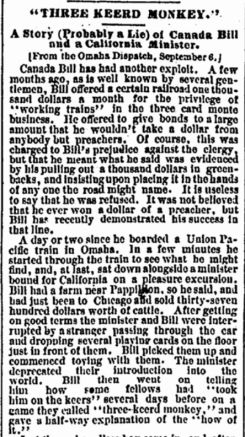

Jonathan Townsend wrote:Looking back a little further we have the mis-printed spot cards ... no fuss then to show an ace and two threes way back then.
I don't think anyone used mis-spotted cards to gimmick a monte display until DeLand's "Pickitout", in 1908.
lybrary wrote: It comes down to showing contact with McKinney be it by spatial proximity
Edwin S. Andrews worked at the C&NW railroad, whose Chicago depot was just a mile north of Printer's Row. Sounds plenty proximate to me.
Houdini came through Chicago regularly, and played at the Powers Theater (on Randolph, between Clark and Lasalle) in 1900 - 3/4 of a mile north of Printer's Row. Plenty proximate.
Marty Demarest laid out a convincing case that W. E. Sanders visited his folks at the Windsor Clifton Hotel (NW corner of Wabash and Monroe) in the winter of 1901-02. Walk one block west and five blocks south, and you are in Printer's Row. Or three stops on the El.
(and note that Congress and State, where Smith recalled his meeting with Erdnase, is only a block south of the State St. Station of the El)
Speaking of "candidate viability" . . .
Richard Hatch recently mentioned a candidate suggested by Peter Zenner, namely E.D. Benedict.
Benedict has not been discussed much (so far!) on this thread, but it is interesting to me that he has been catapulted into being one of the leading candidates, based on several basic facts.
Without getting into detail, possibly the two main requirements for any Erdnase candidate are skill with cards, and writing ability.
Provisionally, it can be said that Benedict meets both of those requirements, or, actually, he comes close. At the moment it looks as though Benedict knew sleight of hand (whether with cards, I do not know). Also question has been raised earlier as to whether E.D. Benedict is the same guy who wrote for The Sphinx.
Benedict also has that highly interesting connection with McKinney's company.
So, I have been pondering this, and it has made me wonder whether, even based on these few facts, Benedict may have a stronger case than Gallaway. At the moment, I don't know, one way or the other. If he does, it tends to show that seemingly endless arguing (such as in the Gallaway case) does not necessarily contribute to the strength of a case, but that it can actually emphasize weaknesses that might otherwise have gone unstressed.
I'm not saying that Gallaway has a bad case, but then again, it appears that if one has the right facts, one does not need many to make a good case.
--Tom Sawyer
Richard Hatch recently mentioned a candidate suggested by Peter Zenner, namely E.D. Benedict.
Benedict has not been discussed much (so far!) on this thread, but it is interesting to me that he has been catapulted into being one of the leading candidates, based on several basic facts.
Without getting into detail, possibly the two main requirements for any Erdnase candidate are skill with cards, and writing ability.
Provisionally, it can be said that Benedict meets both of those requirements, or, actually, he comes close. At the moment it looks as though Benedict knew sleight of hand (whether with cards, I do not know). Also question has been raised earlier as to whether E.D. Benedict is the same guy who wrote for The Sphinx.
Benedict also has that highly interesting connection with McKinney's company.
So, I have been pondering this, and it has made me wonder whether, even based on these few facts, Benedict may have a stronger case than Gallaway. At the moment, I don't know, one way or the other. If he does, it tends to show that seemingly endless arguing (such as in the Gallaway case) does not necessarily contribute to the strength of a case, but that it can actually emphasize weaknesses that might otherwise have gone unstressed.
I'm not saying that Gallaway has a bad case, but then again, it appears that if one has the right facts, one does not need many to make a good case.
--Tom Sawyer
Zenner's E. D. Benedict candidate does appear to be at least as strong a candidate (to me) as Edward Gallaway. He has a clear connection to McKinney (mentioned in the bankruptcy records as owing $45.85 to McKinney), clear interest and reputed ability in magic, writing skill (contributed to the Sphinx and a preliminary stylometric analysis seems to show a close match to Erdnase), possible connection by marriage to Dalrymple, connection to Del Adelphia (who opened his act with an illusion Benedict had published in the Sphinx) and is the right age. He was in the business of distributing books and he went bankrupt shortly after the book was published (possibly explaining why he still owed McKinney money!). Zenner has hinted that he may even have been the "E. S. Andrews" who was a con man (found by Todd Karr). If he can establish that, I'd probably have to say "case closed"!
Dick, those are all good points (at least, as of now!), and I think I had most of that in mind, even though I only focused on two or three things.
--Tom S.
--Tom S.
On Sept 8th in this thread:
viewtopic.php?f=10&t=49999&p=337773#p337773,
Our host, Richard K. posted this note:
"There is a new candidate, and a book is in the works about him. He's an interesting choice, but other than that I must remain mum."
Any updates you can share with us on this Richard?
With Peter Z's candidate (specific details not publicly shared by Peter yet), and this teaser from Richard, it seems there may be some new directions taken in the search?
viewtopic.php?f=10&t=49999&p=337773#p337773,
Our host, Richard K. posted this note:
"There is a new candidate, and a book is in the works about him. He's an interesting choice, but other than that I must remain mum."
Any updates you can share with us on this Richard?
With Peter Z's candidate (specific details not publicly shared by Peter yet), and this teaser from Richard, it seems there may be some new directions taken in the search?
I cannot offer any more information.
Chris's latest newsletter talks about 1900 Jackpots author Eugene Edwards. He tries to make the case that Edwards might be Erdnase, and Chris says he has a bombshell coming up. (Edwards is Galloway?)
One part of Chris's report that I find unconvincing is his claim that Edwards must have been a professional card shark, because of his inside info about how pros work. But at least in the excerpts Chris provides, Edwards does not say anything more than had been reported by DeVol at least a decade earlier. Chris's excerpts from Edwards feel very much like second-hand stories to me.
I'm not sure why Chris insists Erdnase was a pro. I think he actually has a better case for Galloway and Edwards if Erdnase was what he appears to be--a very interested amateur.
One part of Chris's report that I find unconvincing is his claim that Edwards must have been a professional card shark, because of his inside info about how pros work. But at least in the excerpts Chris provides, Edwards does not say anything more than had been reported by DeVol at least a decade earlier. Chris's excerpts from Edwards feel very much like second-hand stories to me.
I'm not sure why Chris insists Erdnase was a pro. I think he actually has a better case for Galloway and Edwards if Erdnase was what he appears to be--a very interested amateur.
As relates to Eugene Edwards book Jackpots - on October 25th, on his blog (which you should definitely be reading) - Tom Sawyer has already noted that the writing of Eugene Edwards reads an awful lot like Erdnase.
As for being an "expert", I strongly agree with Jacks observation above, with pretty much everything quoted in Chris's newsletter as an example of "expertise" able to be parsed from any number of books of the day, including the popular 40 Years A Gambler on the Mississippi by George Devol, published in 1887 - 15 years prior to EATCT.
Although reading Jackpots demonstrates the writing similarity is there, and is interesting - I'd hardly be confident enough to state that Edwards is Erdnase just based just on that similarity.
It will be interesting to see how the line is drawn from Eugene Edwards to Gallaway though ... which appears will be coming next from Chris's desk.
As for being an "expert", I strongly agree with Jacks observation above, with pretty much everything quoted in Chris's newsletter as an example of "expertise" able to be parsed from any number of books of the day, including the popular 40 Years A Gambler on the Mississippi by George Devol, published in 1887 - 15 years prior to EATCT.
Although reading Jackpots demonstrates the writing similarity is there, and is interesting - I'd hardly be confident enough to state that Edwards is Erdnase just based just on that similarity.
It will be interesting to see how the line is drawn from Eugene Edwards to Gallaway though ... which appears will be coming next from Chris's desk.
Roger M. wrote:Richard Hatch wrote:Looks like this Erdnase kickstarter campaign will meet its goal. Thoughts?
https://www.kickstarter.com/projects/110191763/the-expert-at-the-card-table-with-photographs-from
This is exactly what David Ben and Julie Eng have already done to perfection with The Experts at the Card Table.
I'm not sure what possible improvement could be achieved beyond what David and Julie have already done so well?
Maybe I'm missing something?
Er, what does the "secret of the Practice Board" mean?
Just for statistical interest, 90 people seem to have shelled out 200 clams for this book so far. It's way over its $5,000 goal at $23,000 with 19 days to go.
Personally I'm awaiting volumes 2 and 3 from David Ben, and I'll still have enough for Richard's Harapan Ong book...
Hi All,
During a lull like the present one, it might be interesting for people to think about what kinds of features make a candidate a “leader,” or for that matter, about the kinds of things that make a person a candidate at all.
Such features often have little to do with the strength of a candidate's case.
Regardless of that, I'll list a few that occur to me:
1. Reputation of a candidate apart from being an Erdnase candidate. For instance, we know of people like Hilliar and (if you are interested in card games) Foster, even apart from any discussion of them as possible candidates.
2. Support for a candidate on this Erdnase thread.
3. The field in which the candidate is known to have worked. Magician candidates, and there are several, tend to be a little more interesting than someone like Edwin Sumner Andrews, not just because their background tends to support their candidacy, but because most of the people who are interested in the Erdnase controversy came to it because of an interest in magic.
4. The physical appearance of the candidate. I’m not saying that this one is especially logical, but there is probably some validity to this. Men like R.F. Foster and W.E. Sanders seem to fit the stereotype of the suave gambler. Edwin Sumner Andrews just looks like a regular family man, and he obviously had a beautiful family, which certainly supports that view. Edward Gallaway looks like a bookish person, which apparently he was. But . . . as they say, looks can be deceiving.
In an earlier post on this thread, I mentioned a bunch of other, somewhat similar, factors. A few of them are worth repeating here. Actually, now that I look at them further, they all seem worth repeating. In my original post, I included a little discussion of each point, heavily edited here.
--Tom Sawyer
During a lull like the present one, it might be interesting for people to think about what kinds of features make a candidate a “leader,” or for that matter, about the kinds of things that make a person a candidate at all.
Such features often have little to do with the strength of a candidate's case.
Regardless of that, I'll list a few that occur to me:
1. Reputation of a candidate apart from being an Erdnase candidate. For instance, we know of people like Hilliar and (if you are interested in card games) Foster, even apart from any discussion of them as possible candidates.
2. Support for a candidate on this Erdnase thread.
3. The field in which the candidate is known to have worked. Magician candidates, and there are several, tend to be a little more interesting than someone like Edwin Sumner Andrews, not just because their background tends to support their candidacy, but because most of the people who are interested in the Erdnase controversy came to it because of an interest in magic.
4. The physical appearance of the candidate. I’m not saying that this one is especially logical, but there is probably some validity to this. Men like R.F. Foster and W.E. Sanders seem to fit the stereotype of the suave gambler. Edwin Sumner Andrews just looks like a regular family man, and he obviously had a beautiful family, which certainly supports that view. Edward Gallaway looks like a bookish person, which apparently he was. But . . . as they say, looks can be deceiving.
In an earlier post on this thread, I mentioned a bunch of other, somewhat similar, factors. A few of them are worth repeating here. Actually, now that I look at them further, they all seem worth repeating. In my original post, I included a little discussion of each point, heavily edited here.
1. Accessibility of information.
2. Reputation of a person forwarding a candidate.
3. Colorfulness of the candidate. R.F. Foster (interesting to me, but not to most); Wilbur Edgerton Sanders (interesting to most).
4. Traction. For some inexplicable (to me) reason, some candidates, or would-be candidates, just seem to appeal to a lot of people.
5. Publicity. Obviously, people like Milton Franklin Andrews, Edwin Sumner Andrews, and W.E. Sanders have gotten (relatively speaking) huge amounts of analysis and publicity relative to that of most (perhaps all) other candidates.
6. Longevity. A candidate who has managed to hang on for a long time is kind of like mud on a boot -- hard to shake off -- no matter how weak the case. (This is not to say that all candidates who have been around a while have weak cases.)
7. Actual strength of the case.
8. Appeal of “the story.” I think some people are swept up by an interesting story that connects known evidence, no matter how utterly implausible that story may be.
--Tom Sawyer
Hi All,
All right, since the Erdnase lull continues, here are a few words about Cab No. 44, a 1910 novel by R.F. Foster. It appears that this was first mentioned in the Erdnase world by Dick Hatch on a different thread in 2003, then on this thread in 2005, first by Bill Mullins, and then by Dick again.
The book was also discussed by the late Hurt McDermott in his 2012 book Artifice, Ruse & Erdnase.
I notice that, in several places on Google Books, the book is discussed as having been the subject of an interesting advertising campaign, which involved a cab with the book title on it, and a kid who dispensed flyers, but that is not really what I want to talk about in this post.
The March 1910 A.L.A. Booklist lists it under “Foster, Robert Frederick,” and describes it as “A detective story of considerable interest, based on a wager between two financiers as to whether a suspect can elude the New York police for a month.”
So it appears that it was definitely written by the Foster who was well known as a card-game expert.
But I wanted to mention something else that seemed kind of unexpected to me.
I saw reference to a book titled The Body in the Shaft, by R.F. Foster, and I thought, “Hmmm. That’s interesting.”
Further investigation, however, determined that the author was a writer named Reginald Francis Foster (1896-1975). There are many scattered references to him on the Internet. Apparently The Body in the Shaft was first published in the UK in 1924 under the title The Lift Murder.
--Tom Sawyer
All right, since the Erdnase lull continues, here are a few words about Cab No. 44, a 1910 novel by R.F. Foster. It appears that this was first mentioned in the Erdnase world by Dick Hatch on a different thread in 2003, then on this thread in 2005, first by Bill Mullins, and then by Dick again.
The book was also discussed by the late Hurt McDermott in his 2012 book Artifice, Ruse & Erdnase.
I notice that, in several places on Google Books, the book is discussed as having been the subject of an interesting advertising campaign, which involved a cab with the book title on it, and a kid who dispensed flyers, but that is not really what I want to talk about in this post.
The March 1910 A.L.A. Booklist lists it under “Foster, Robert Frederick,” and describes it as “A detective story of considerable interest, based on a wager between two financiers as to whether a suspect can elude the New York police for a month.”
So it appears that it was definitely written by the Foster who was well known as a card-game expert.
But I wanted to mention something else that seemed kind of unexpected to me.
I saw reference to a book titled The Body in the Shaft, by R.F. Foster, and I thought, “Hmmm. That’s interesting.”
Further investigation, however, determined that the author was a writer named Reginald Francis Foster (1896-1975). There are many scattered references to him on the Internet. Apparently The Body in the Shaft was first published in the UK in 1924 under the title The Lift Murder.
--Tom Sawyer
In Chris's latest newsletter, he doubles down on his claim that he has found Erdnase, and (as suspected) he has drawn a line between Gallaway, Edwards, and Erdnase ... claiming that they're all the same person.
I won't go into details, you can read Chris's newsletter on his website if you're registered there (which I suspect is Chris's point in continuing to post to this Genii thread, driving traffic to his website).
Regardless, we've all been exposed to Chris's tendency to take "massive leaps of faith" that would get any normal jumper killed ... and there's lots more of them in this latest of Chris's tales.
A number of these leaps of faith border on the utterly bizarre, indeed defying rational comment.
I won't go into details, you can read Chris's newsletter on his website if you're registered there (which I suspect is Chris's point in continuing to post to this Genii thread, driving traffic to his website).
Regardless, we've all been exposed to Chris's tendency to take "massive leaps of faith" that would get any normal jumper killed ... and there's lots more of them in this latest of Chris's tales.
A number of these leaps of faith border on the utterly bizarre, indeed defying rational comment.
I've accepted that it is unlikely that we will have a "smoking gun" for Erdnase; but I was expecting such for Chris's claim that Edwards = Gallaway. But best I can tell, it's still a very circumstantial case from Chris that Edwards is Gallaway. In my opinion, a twice removed candidate needs at least one firm link for consideration.
I expected nothing from Chris's assertions that Gallaway was Erdnase. Most of his circumstantial evidence isn't compelling enough. He still has not answered my question as to whether or not Gallaway owned more than one magic book, which is The Expert. Bill Mullins pointed out that Chris had no evidence that Gallaway owned a library of magic books.
Zenner's candidate appears interesting, but from what Mr. Hatch described, the evidence looks circumstantial as well.
Zenner's candidate appears interesting, but from what Mr. Hatch described, the evidence looks circumstantial as well.
If the fact that Gallaway owned a copy of Expert is evidence that Gallaway was Erdnase, then I suppose that the fact that Houdini owned a copy of Jack Pots is evidence that Houdini was Eugene Edwards. And if Eugene Edwards was Erdnase, then it follows that Houdini was Erdnase. QED.
Chris's most recent newsletter says that Eugene Edward had "detailed knowledge about Chicago, and Alabama (both places Gallaway knew very well)".
Alabama is mentioned is on page 160, as follows: "Edward W. Pettus, at one time senator from Alabama, was an inveterate poker player . . . ." Alabama never had a senator named Edward Pettus. It did, however, have a senator named Edmund Pettus, after whom a famous bridge in Selma is named.
Perhaps Eugene Edwards isn't quite the scholar of Alabama lore that Chris makes him out to be.
Alabama is mentioned is on page 160, as follows: "Edward W. Pettus, at one time senator from Alabama, was an inveterate poker player . . . ." Alabama never had a senator named Edward Pettus. It did, however, have a senator named Edmund Pettus, after whom a famous bridge in Selma is named.
Perhaps Eugene Edwards isn't quite the scholar of Alabama lore that Chris makes him out to be.
Chris also says that Edwards "uses an expression from Robert Frost: "throw a church by the steeple."" Frost was born in 1874; the expression isn't hard to find in print in the 1850s. And while Frost did use the expression, it was only in his notebooks, which remained unpublished until 2006. It is unlikely that Edwards got the expression from Frost.
Hi All,
Concerning Bill Mullins’s post of 19:11 yesterday . . .
Personally, I like the fact that Gallaway owned a copy of the book. That fact makes his candidacy a little more exciting than it otherwise would be.
But since knowledge of Gallaway’s ownership of the book preceded Gallaway’s candidacy, it may have been more of a “field-limiting” fact than one that supports his candidacy with much clarity, in large part because there are reasons why he might have owned a copy that would have nothing to do with authorship.
Another thing that dilutes that part of the case is the fact that Gallaway’s connection with McKinney is weakly shown by the ownership of the book, and strongly shown by other evidence. So in my mind there is a little redundancy in the “evidence of the ownership.”
---Tom Sawyer
Concerning Bill Mullins’s post of 19:11 yesterday . . .
Personally, I like the fact that Gallaway owned a copy of the book. That fact makes his candidacy a little more exciting than it otherwise would be.
But since knowledge of Gallaway’s ownership of the book preceded Gallaway’s candidacy, it may have been more of a “field-limiting” fact than one that supports his candidacy with much clarity, in large part because there are reasons why he might have owned a copy that would have nothing to do with authorship.
Another thing that dilutes that part of the case is the fact that Gallaway’s connection with McKinney is weakly shown by the ownership of the book, and strongly shown by other evidence. So in my mind there is a little redundancy in the “evidence of the ownership.”
---Tom Sawyer
Any time I make a post the result of which is that Houdini was Erdnase, don't pay too much attention to it. The point of it is not to show that Houdini was, in fact, Erdnase. What I'm generally trying to do is take an argument that was used to show that someone else was Erdnase, and show that the same argument applies equally well to someone else who is obviously not Erdnase. If the argument leads to a ridiculous conclusion, the argument itself is ridiculous. Something like Reductio ad absurdum, for you logicians.
Bill Mullins wrote:Any time I make a post the result of which is that Houdini was Erdnase, don't pay too much attention to it. The point of it is not to show that Houdini was, in fact, Erdnase. What I'm generally trying to do is take an argument that was used to show that someone else was Erdnase, and show that the same argument applies equally well to someone else who is obviously not Erdnase. If the argument leads to a ridiculous conclusion, the argument itself is ridiculous. Something like Reductio ad absurdum, for you logicians.
This is completely false and misleading logic, because taking one fact in isolation and showing that it applies to others who are not Erdnase, doesn't disprove anything. The mere ownership of a first edition doesn't make somebody Erdnase, but it puts one in a pool of suspects which is much smaller than say everybody who played cards. By applying other facts which further limit and reduce the suspect pool the candidacy gets stronger. It is the combination of facts that matter not how strong or weak any particular fact in isolation is.
The only case where a fact in isolation makes sense is an exclusion of being Erdnase. For example, if a candidate turns out to not speak English we can safely exclude him from being Erdnase. For exclusionary purposes looking at a single fact is sound. Unless you are arguing that the ownership of a first edition of Expert EXCLUDES somebody from being Erdnase your argumentation is completely false.
Important to note that Chris doesn't have any other convincing facts linking Gallaway to Erdnase beyond Gallaway owning a copy of EATCT, which makes Bill's post all that much more relevant.
Bill's irreverent "Houdini must be Erdnase" linkage is, in fact - exactly what Chris does repeatedly, and indeed has done since he began touting Gallaway.
Folks need to read Chris's posts very carefully, as what he often sells as fact, or implies is widely agreed upon ... is more often nothing of the sort - and indeed his stated conclusions are frequently just fabrications.
Bill's irreverent "Houdini must be Erdnase" linkage is, in fact - exactly what Chris does repeatedly, and indeed has done since he began touting Gallaway.
Folks need to read Chris's posts very carefully, as what he often sells as fact, or implies is widely agreed upon ... is more often nothing of the sort - and indeed his stated conclusions are frequently just fabrications.
Roger M. wrote:Important to note that Chris doesn't have any other convincing facts linking Gallaway to Erdnase beyond Gallaway owning a copy of EATCT, which makes Bill's post all that much more relevant.
I guess you have been sleeping at the wheel. Here are a couple facts for you to contemplate:
- documentary proof of contact with McKinney
- proven author/writing history (editorials, books, booklets, course material)
- proven self-publishing and copyright activity
- proven writing ability on par with Erdnase (look at vocabulary richness for example)
- proven interest in cards, gambling and sleight of hand with cards via the books in his library
- proven overlap in a significant number of rare words and phrases. Some consider him sounding like Erdnase including the only forensic linguist, who has shared his expertise on this matter, and others:
Roger M. wrote:Chris, I see what you mean by hearing Erdnase in the intro, it certainly seems more than just a similar style. Indeed it would be at the least a very similar style.
Richard Hatch wrote:I agree with Chris that this does sound like it could have been written by the same author who wrote the "Professional Secrets" section of EATCT.
- and many many more, all explained in detail in my ebook
lybrary wrote:- documentary proof of contact with McKinney
- proven author/writing history (editorials, books, booklets, course material)
- proven self-publishing and copyright activity
- proven writing ability on par with Erdnase (look at vocabulary richness for example)
- proven interest in cards, gambling and sleight of hand with cards via the books in his library
- proven overlap in a significant number of rare words and phrases. Some consider him sounding like Erdnase including the only forensic linguist, who has shared his expertise on this matter, and others:
Thanks for the list Chris, it saves me typing it out.
Unfortunately, to anybody but yourself, (and as folks have been trying to tell you) none of these are convincing.
I realize that you believe if you repeat them often enough, they may gain some traction somewhere ... but I propose to you that if they haven't gained any traction by now (which they havn't), they'll like never gain any traction.
But as I note, none of them are convincing ... if they were, some folks would already be "convinced" - and to my reading, nobody (sock puppets aside) but you believes Gallaway is Erdnase.
Roger M. wrote:Unfortunately, to anybody but yourself, (and as folks have been trying to tell you) none of these are convincing.
Can you be more specific why you think they are not convincing? Are you saying Erdnase was not a writer? Not a good writer? That the book was not printed at James McKinney? That the book was not self-published and it was not copyrighted? Show me all those candidates who exhibit Erdnase-like writing, publishing, and copyrighting activity.
lybrary wrote:Roger M. wrote:Important to note that Chris doesn't have any other convincing facts linking Gallaway to Erdnase beyond Gallaway owning a copy of EATCT, which makes Bill's post all that much more relevant.
I guess you have been sleeping at the wheel. Here are a couple facts for you to contemplate:
- documentary proof of contact with McKinney
- proven author/writing history (editorials, books, booklets, course material)
- proven self-publishing and copyright activity
- proven writing ability on par with Erdnase (look at vocabulary richness for example)
- proven interest in cards, gambling and sleight of hand with cards via the books in his library
- proven overlap in a significant number of rare words and phrases. Some consider him sounding like Erdnase including the only forensic linguist, who has shared his expertise on this matter, and others:
Beyond The Expert, what else was there in Gallway's library that showed an interest in magic and sleight of hand? You are still asleep at the wheel Chris and have not answered this question.
Chris, I feel I should clarify that I believe what you've discovered and/or proposed is interesting, but not convincing.
Simply put, none of your arguments as presented are convincing enough to make Gallaway into Erdnase. They're just not.
Perhaps more to the issue is that you've brought nothing new or convincing to the table for a long while now, and your responses here are simply repeating yourself over and over again in order to dispute anybody who doubts that Gallaway was Erdnase.
You've made your case Chris, and it's not been embraced. You probably need to deal with that reality by doing more (quality) research, or simply accept that, as you presented your case, you ultimately didn't convince folks that Gallaway was Erdnase.
It's really not a big deal, nor is it a personal insult to you - or to your research ... so Gallaway isn't Erdnase ... so what?
OR ... maybe Gallaway will indeed turn out to be Mr. Erdnase ... with the convincing and compelling evidence yet to be presented.
- Erdnase was indeed a writer, and a very good one ... however so were probably 100,000+ other people in the United States between 1900 and 1910. (out of 76 million U.S. citizens at the time, perhaps double or triple that number)
The EATCT was indeed printed at Mckinney, but there are far more employees at printers who aren't the author of the books they're printing than there are employees at printers who are the authors of the books they're printing.
EATCT was indeed self-published, but so were thousands of other books in the same decade.
There is a reasonably high likelihood that none of the candidates currently under consideration are Erdnase. There is an equally high likelihood that EATCT was the only book Erdnase ever wrote, and thus no legitimate comparable writing style will ever, or could ever be found.
Simply put, none of your arguments as presented are convincing enough to make Gallaway into Erdnase. They're just not.
Perhaps more to the issue is that you've brought nothing new or convincing to the table for a long while now, and your responses here are simply repeating yourself over and over again in order to dispute anybody who doubts that Gallaway was Erdnase.
You've made your case Chris, and it's not been embraced. You probably need to deal with that reality by doing more (quality) research, or simply accept that, as you presented your case, you ultimately didn't convince folks that Gallaway was Erdnase.
It's really not a big deal, nor is it a personal insult to you - or to your research ... so Gallaway isn't Erdnase ... so what?
OR ... maybe Gallaway will indeed turn out to be Mr. Erdnase ... with the convincing and compelling evidence yet to be presented.
Roger M. wrote:Erdnase was indeed a writer, and a very good one ... however so were probably 100,000+ other people in the United States between 1900 and 1910. (out of 76 million U.S. citizens at the time, perhaps double or triple that number)
The EATCT was indeed printed at Mckinney, but there are far more employees at printers who aren't the author of the books they're printing than there are employees at printers who are the authors of the books they're printing.
EATCT was indeed self-published, but so were thousands of other books in the same decade.
You are making the same error that Bill is constantly making. You have to put these things together. How many of the 1000-3000 who had a first edition of Expert where good writers? If we apply the ratio your are implying (~100,000 good writers out of 76 million folks) then you are down to about 4 people who meet both criteria. How many of those had contact with McKinney? That is how one determines the strength of facts not whatever you personally feel is strong or weak.
Roger M. wrote:You probably need to deal with that reality by doing more (quality) research, or simply accept that, as you presented your case, you ultimately didn't convince folks that Gallaway was Erdnase.
That from somebody who has contributed zero research to the Erdnase investigation. Give me a break!
lybrary wrote:That from somebody who has contributed zero research to the Erdnase investigation. Give me a break!
I've certainly done enough research to determine when somebody is offering up nothing but smoke and mirrors Chris, as you do on a continuous basis!
Indeed, I can (and will) continue to utilize my extensive knowledge of the search for Erdnase to challenge you and your sloppy, incomplete, and fabricated research at every turn!
You need a self-induced reality check ASAP Chris!
Roger M. wrote:I've certainly done enough research ...
Oh please, tell us all about your groundbreaking research.
lybrary wrote:Roger M. wrote:I've certainly done enough research ...
Oh please, tell us all about your groundbreaking research.
I have to leave you here Chris, you're behaving like a child.
Peace.
Roger M. wrote:lybrary wrote:Roger M. wrote:I've certainly done enough research ...
Oh please, tell us all about your groundbreaking research.
I have to leave you here Chris, you're behaving like a child.
Peace.
What I thought. Nothing to back up your grandiose claims. Nothing but hot air. The typical bedroom critic.
lybrary wrote: You are making the same error that Bill is constantly making. You have to put these things together.
The only one making errors of probability here is you, Chris, when take individual probabilities and multiply them together to imply that their product reveals some ultimate probability.
Take the example just mentioned. Suppose that 100,000 of 76 million Americans in 1901 were good writers, and suppose that there were 2000 First Edition copies of Expert. You've suggested, then, that that means that there were ~3 good writers who owned a First Edition copy of Expert. That would be true If and Only If the distribution of good writers, and the population of people who owned 1st Ed copies of Expert, were independent of each other.
But they almost certainly weren't independent of each other. Good writers, as a group, tend to read more than average people, and have more books than average people.
Bill Mullins wrote:The only one making errors of probability here is you, Chris, when take individual probabilities and multiply them together to imply that their product reveals some ultimate probability.
Take the example just mentioned. Suppose that 100,000 of 76 million Americans in 1901 were good writers, and suppose that there were 2000 First Edition copies of Expert. You've suggested, then, that that means that there were ~3 good writers who owned a First Edition copy of Expert. That would be true If and Only If the distribution of good writers, and the population of people who owned 1st Ed copies of Expert, were independent of each other.
But they almost certainly weren't independent of each other. Good writers, as a group, tend to read more than average people, and have more books than average people.
It is called an estimate. The number of first editions is an estimate. How many good writers there are in the population is an estimate. The independence I have assumed is also an estimate. But an estimate is much better than entirely ignoring that facts need to be combined to judge the strength of a case. Not putting facts together is a much bigger error than assuming statistical independence in this case. Come up with better estimates. Quantify the dependence. The result, the relative strength of various cases compared against each other, will not fundamentally change.
Odd to be called out for "ignoring facts" by the person who ignores the fact that there is no evidence that shows Gallaway had any skill with cards whatsoever; or that there is no evidence of anyone every having used "Erdnase" as a German-language nickname until a century after Expert. There are two characteristics -- skill at sleight of hand with playing cards, and a reason to use "Erdnase" as a pseudonym -- that define the author of Expert at the Card Table. And Gallaway can't be shown to have either of them.
Tom Sawyer's most recent post on his blog makes the strong case that Eugene Edwards (author of Jack Pots) was, if not a plagiarist, certainly a borrower of the language of other people's writings. If that is so, then it would seem to be a great mark against Gallaway being Erdnase if you make the case that Gallaway and Edwards were the same. How so?
If Edwards steals language, and Gallaway and Edwards were the same person, then to the extent that Gallaway writes like Erdnase means only that Gallaway stole from Erdnase, not that Gallaway was Erdnase.
If Edwards steals language, and Gallaway and Edwards were the same person, then to the extent that Gallaway writes like Erdnase means only that Gallaway stole from Erdnase, not that Gallaway was Erdnase.
lybrary wrote:What I thought. Nothing to back up your grandiose claims. Nothing but hot air. The typical bedroom critic.
Ummm, I'm not actually making any claims Chris ... so there's that.
"Hot air" is subjective, so you really can't be wrong in your assessment, my posts definitely seem to put more than a bit of heat on you ... so hot air it must be.
And I'm not a "typical" bedroom critic Chris, I'm a "very well informed" bedroom critic (as relates to the search for Erdnase).
Keep calm Chris, and chive on.
Bill Mullins wrote:Odd to be called out for "ignoring facts" by the person who ignores the fact that there is no evidence that shows Gallaway had any skill with cards whatsoever;
At least he had magic and gambling books in his library. E.S. Andrews or W.E. Sanders had none as far as we can tell. On that point Gallaway shows more Erdnasian traits than these two.
Bill Mullins wrote:Tom Sawyer's most recent post on his blog makes the strong case that Eugene Edwards (author of Jack Pots) was, if not a plagiarist, certainly a borrower of the language of other people's writings.
I don't think he makes a strong case, but if you have examples of outright plagiarism please give them. Erdnase also borrowed language: "Masterly feats of Palming and Unflinching Audacity." This is taken from Hoffmann's More Magic where he writes describing the SAME trick: "...lies in dexterous card-palming supplemented by unflinching audacity". Erdnase is not entirely free from borrowing language himself.
Bill Mullins wrote:If Edwards steals language, and Gallaway and Edwards were the same person, then to the extent that Gallaway writes like Erdnase means only that Gallaway stole from Erdnase, not that Gallaway was Erdnase.
It is yet another of the many examples where you demonstrate that you can't think critically. There is a big difference borrowing language when writing about the same subject, same story, same trick, as both Erdnase and Edwards do, and borrowing language when writing about a completely different subject. Why would Gallaway 'borrow language' from a magic book when he is writing a book on print estimating? That is not a sign of borrowing. It is a sign of author identity. But it is great that you acknowledge that Gallaway writes like Erdnase.
lybrary wrote:At least he had magic and gambling books in his library. E.S. Andrews or W.E. Sanders had none as far as we can tell. On that point Gallaway shows more Erdnasian traits than these two.
What magic books did Gallaway have in his library?
W.E. Sanders and E.S. Andrews show more Erdnasian traits than Gallaway on other points. That levels the playing field, which means Gallaway's candidacy is no more convincing than any other suspect.
Bill Mullins wrote:Chris's most recent newsletter says that Eugene Edward had "detailed knowledge about Chicago, and Alabama (both places Gallaway knew very well)".
Alabama is mentioned is on page 160, as follows: "Edward W. Pettus, at one time senator from Alabama, was an inveterate poker player . . . ." Alabama never had a senator named Edward Pettus. It did, however, have a senator named Edmund Pettus, after whom a famous bridge in Selma is named.
Perhaps Eugene Edwards isn't quite the scholar of Alabama lore that Chris makes him out to be.
This is great, Bill. It makes my point in two important ways.
1) Edwards gets the name almost correct. The second initial W. is correct. The family name is correct. The first name initial is correct, too. The only error he makes is writing Edward instead of Edmund. As you can see these two are very similar first names. They both are Ed...d. Exact same first two letters, same last letter, and then three letters in the middle which are different. An easy error to make. Who would know the name of a senator down to the second initial, but somebody who actually lived in Alabama during the time the senator was in office (1897-1907)?
2) A Freudian error. The author writes his own first name 'Edward' instead of 'Edmund'. That may indeed be the biggest give away that the author was Edward Gallaway.
If one reads the paragraph in Jack Pots where the good senator is mentioned it becomes clear that the writer knew a lot about that place and the senator:
There lived in Selma, Alabama, the town where the senator hailed from, in the early ’70s, a wealthy railroad president, Major Lanier, of the old Alabama Central Railroad, running between Selma and Meridian, Miss., now a part of the Southern Railway system. The major and the senator were boon companions, with a friendship almost as strong as Damon and Pythias, and they used to spend their summers at the major’s summer home in Talledega, above Selma.
Thanks for the contribution Bill. The case that Edward Gallaway = Eugene Edwards = S. W. Erdnase has become even stronger.
lybrary wrote: Who would know the name of a senator down to the second initial, but somebody who actually lived in Alabama during the time the senator was in office (1897-1907)?
Anyone who could read a newspaper. Edwards is retelling someone else's tale here, as well, even to misnaming the Senator. He had no personal knowledge of Alabama.
Your boy Eugene has compiled a bunch of poker stories that others wrote, and put them together in a book. There's no reason to think he knew anything about the game, or of sleights -- he wasn't Erdnase.
Bill Mullins wrote:Your boy Eugene has compiled a bunch of poker stories that others wrote, and put them together in a book.
Then please show us where a hypnotist Callaway is mentioned in the press who makes people see different poker hands from what they really are, and from where he has the story involving Augustus. Where did he take the names and stories involving Fritz Vonderhannes and Rev. Lettus Hitemhard from?
And have you considered that Eugene Edwards/Edward Gallaway may have written these stories earlier and submitted them to newspapers himself - the samples Tom is quoting from? After all Gallaway was a newspaperman, wrote for his and other newspapers, and could have easily authored these in the first place.
This is a brief excerpt of Dr. Wasshuber's ad for his $45.00 PDF on Gallaway:
One of the first and most active Erdnase hunters was well-known science writer, puzzle expert, and magician Martin Gardner, who erroneously thought he identified cardshark and murderer Milton Franklin Andrews as being Erdnase. After Andrews many other candidates were proposed, but none had a case strong enough to withstand scrutiny. None wrote like Erdnase, nor had sufficient opportunity, nor even a good motive, to write the book. Their cases were largely based on wild theories built on little evidence, and held together by flawed assumptions.
Dr. Wasshuber declares in his ad that none of the other Erdnase candidates wrote like Erdnase when this is obviously wrong. W.E. Sanders clearly wrote like Erdnase as Demarest pointed out in his September 2011 Genii article.
To wit, Dr. Wasshuber has not been able to determine if Gallaway had any magic books in his library other than The Expert. It makes me wonder if his case for Gallaway is strong enough to withstand scrutiny
One of the first and most active Erdnase hunters was well-known science writer, puzzle expert, and magician Martin Gardner, who erroneously thought he identified cardshark and murderer Milton Franklin Andrews as being Erdnase. After Andrews many other candidates were proposed, but none had a case strong enough to withstand scrutiny. None wrote like Erdnase, nor had sufficient opportunity, nor even a good motive, to write the book. Their cases were largely based on wild theories built on little evidence, and held together by flawed assumptions.
Dr. Wasshuber declares in his ad that none of the other Erdnase candidates wrote like Erdnase when this is obviously wrong. W.E. Sanders clearly wrote like Erdnase as Demarest pointed out in his September 2011 Genii article.
To wit, Dr. Wasshuber has not been able to determine if Gallaway had any magic books in his library other than The Expert. It makes me wonder if his case for Gallaway is strong enough to withstand scrutiny
lybrary wrote:Bill Mullins wrote:If one reads the paragraph in Jack Pots where the good senator is mentioned it becomes clear that the writer knew a lot about that place and the senator:There lived in Selma, Alabama, the town where the senator hailed from, in the early ’70s, a wealthy railroad president, Major Lanier, of the old Alabama Central Railroad, running between Selma and Meridian, Miss., .
Looks like the Jack Pots writer got the name of the railroad wrong too. The Alabama Central was incorporated in 1906.
http://www.alabamacentralrailroad.com/home/last.html
observer wrote:Looks like the Jack Pots writer got the name of the railroad wrong too. The Alabama Central was incorporated in 1906.
http://www.alabamacentralrailroad.com/home/last.html
Not necessarily so. Incorporation is a legal step. The company may have existed several years before that without being formally incorporated. For example, Drake incorporated October 1903, but did business under the name Drake before that date.
lybrary wrote:observer wrote:Looks like the Jack Pots writer got the name of the railroad wrong too. The Alabama Central was incorporated in 1906.
http://www.alabamacentralrailroad.com/home/last.html
Not necessarily so. Incorporation is a legal step. The company may have existed several years before that without being formally incorporated.
"The Alabama Central Railroad was built in 1906-07"
http://www.alabamacentralrailroad.com/home/history.html
observer wrote:"The Alabama Central Railroad was built in 1906-07"
From this website: http://www.encyclopediaofalabama.org/article/h-2390
"They chartered the Alabama Central Railroad (AC) in 1854, ..." I think the name could refer to more than one railway. Since the one you have was built after Jack Pots was published it is clearly not the one Edwards was referring to.
lybrary wrote:observer wrote:"The Alabama Central Railroad was built in 1906-07"
What was then the correct name for the railroad between Selma and Meridian before 1900? Or was there no railroad at all? The author uses the specifier 'old' to refer to The Alabama Central Railroad. Perhaps there was one before 1906 with the same name?
Google book searches on " Alabama Central Railroad" and Pettus do indeed show that there was a railroad with that name in the 1870s (it had formerly been the Selma and Meridian Railroad) and ran 81.3 miles from Selma to York Station, Alabama. Its attorney in 1876/1887 was E. W. Pettus.
lybrary wrote:Bill Mullins wrote:Your boy Eugene has compiled a bunch of poker stories that others wrote, and put them together in a book.
Where did he take the names and stories involving . . . Rev. Lettus Hitemhard from?
Here or maybe here.
And have you considered that Eugene Edwards/Edward Gallaway may have written these stories earlier and submitted them to newspapers himself - the samples Tom is quoting from? After all Gallaway was a newspaperman, wrote for his and other newspapers, and could have easily authored these in the first place.
And monkeys might fly out of my butt. (in fact, that is a more likely proposition than the idea that Gallaway was Edwards or Edwards was Erdnase or Erdnase was Gallaway)
The information about the Alabama Central Railway and Lanier and Selma is legit. It's just that there's no reason to think that the fact that Eugene Edwards compiled it into his book, along with a bunch of other second hand poker stories that had previously been in print, means that Edwards was either Gallaway or Erdnase.
Bill Mullins wrote:And monkeys might fly out of my butt. (in fact, that is a more likely proposition than the idea that Gallaway was Edwards or Edwards was Erdnase or Erdnase was Gallaway)
I find it very plausible that Edwards/Gallaway collected stories he wrote earlier for newspapers, added a few new ones, and then added a few classic ones. It wouldn't be the first article/story collection in history. One reason to believe that this is the case is because Edwards does in Chapter 23 clearly state that the stories in this chapter are classic stories he is describing. He therefore clearly states that these are not his stories:
Around such an old and venerable institution as poker there has necessarily grown up a crop of classic stories, passed down from year to year, changing their location perhaps but preserving their main features, and losing nothing of their attractiveness from age. You may or may not have heard them before; if they are new to you, so much the better; if old friends they will be welcomed heartily. They run the gamut from grave to gay, from lively to severe, although in this collection we will omit the grave and the severe.
Why doesn't he make such a statement for the other stories? I think the answer is because they are stories he wrote, even if they are anchored in actual happenings and news reports. Keep in mind Gallaway started writing for newspapers with age 17, had his own newspaper for a year, and had a relative who ran a newspaper for about 15 years. We have evidence of him contacting several newspapers with news. Very likely he wrote articles for newspapers.
Still no reference for Fritz Vonderhannes, hypnotist Callaway, and Augustus. Clearly at the very least some stories are definitely his own.
2) A Freudian error. The author writes his own first name 'Edward' instead of 'Edmund'. That may indeed be the biggest give away that the author was Edward Gallaway.
Just the opposite I would think. We are all exquisitely attuned to our own names and would immediately notice a difference. Even a slight difference in spelling would raise a flag. Steven vs. Stephen would be noticed by someone with either name, but not necessarily by others. It is precisely those who do not have the name who would mistake Edmund for Edward.
I suspect you would be more alert to the difference between someone named Christopher as opposed to Christian than the general public.
I'm not sure that it has much bearing on the current Edwards/Erdnase/Gallaway discussion, but I'll throw out as a point of possible interest that Ike Morgan, who in 1900 did the "over 50 original pen-and-ink illustrations" in Jack Pots is mentioned several times in the McKinney and Jamieson-Higgins bankruptcy papers. It looks to me like he owed McKinney $250 due six months after February 10, 1902.
To me, "plausible" means that "I don't know anything that disproves this." You seem to use it as if the idea in question tends to support whatever thesis you are trying to prove.lybrary wrote:I find it very plausible that . . .
Still no reference for . . . Augustus.
Here 'tis.
If I had a group of stories, and I could show that a bunch of them were quoting previously published stories, I wouldn't assume that the ones I didn't have earlier versions of were original stories; I'd just figure that I hadn't found the originals yet.
Clearly at the very least some stories are definitely his own.
"Clearly"? Nothing clear about this. There is no evidence that any of the stories in this book are original works by Eugene Edwards.
Ike Morgan was a friend of L. Frank Baum and W. W. Denslow, who respectively wrote and illustrated the original Wizard of Oz. Morgan went on to illustrate a later Oz book, The Woggle-Bug Book.
Another unusual connection from Jamieson-Higgins to Oz is that some of the original copyright paperwork for The Wonderful Wizard of Oz appears to be in Jamieson's handwriting.

Another unusual connection from Jamieson-Higgins to Oz is that some of the original copyright paperwork for The Wonderful Wizard of Oz appears to be in Jamieson's handwriting.
Jack Shalom wrote:2) A Freudian error. The author writes his own first name 'Edward' instead of 'Edmund'. That may indeed be the biggest give away that the author was Edward Gallaway.
Just the opposite I would think. We are all exquisitely attuned to our own names and would immediately notice a difference. Even a slight difference in spelling would raise a flag. Steven vs. Stephen would be noticed by someone with either name, but not necessarily by others. It is precisely those who do not have the name who would mistake Edmund for Edward.
I suspect you would be more alert to the difference between someone named Christopher as opposed to Christian than the general public.
Jack, you should read Freud. If the author would write about himself then yes, one can assume he knows his own name and would unlikely get it wrong. But he is not writing about himself. He is writing about somebody else, and somebody else's name with which he is not intimately familiar. But since the name Edward plays such an important role in the author's life it is much more likely to slip in at places where it shouldn't. In other words, the author's personal information leaks out.
Bill Mullins wrote:The information about the Alabama Central Railway and Lanier and Selma is legit.
Bill you should make up your mind. First you say the author doesn't know Alabama well enough to have lived there, because he gets the first name of Pettus wrong, and now you are saying he is legit. The author of this story was intimately familiar with Alabama. Just because he gets a first name somewhat wrong doesn't mean he made up all the other facts. The details of the story make it clear that whoever wrote it was intimately familiar with Alabama and thus very likely spent a good duration of time there.
Bill Mullins wrote:Still no reference for . . . Augustus.
Here 'tis.
If I had a group of stories, and I could show that a bunch of them were quoting previously published stories, I wouldn't assume that the ones I didn't have earlier versions of were original stories; I'd just figure that I hadn't found the originals yet.Clearly at the very least some stories are definitely his own.
"Clearly"? Nothing clear about this. There is no evidence that any of the stories in this book are original works by Eugene Edwards.
None of the articles you found prove that Eugene Edwards wasn't the author of the stories in the newspapers.
Let us analyse the situation a bit more carefully. Bill [edited] Mullins says that Edwards cobbled together the stories from different newspapers. If that is so then one would expect that the stories are written in different styles, because they were authored by a random group of writers. My preliminary analysis of the stories shows that they are quite uniform in style, at least many of them, suggesting that the author is one and the same and that it is not a random collection of other people's stories. With that I do not mean that Edwards experienced all the stories firsthand himself. I am referring to the writing. I am claiming that the stories were written by Edwards and that these are for the most part his words, except where he quotes folks.
Second problem with the random compilation theory: How would somebody in the 19th century learn of these stories? There wasn't any newspaper search engine available back then. The only way was to actually read the newspapers and keep clippings. The newspapers that have been identified so far are:
- The Illustrated American, June 29, 1895
- The Albany Law Journal, August 20, 1898
- The Record-Union, Sacramento, California, May 13, 1895
- The Times, Philadelphia, Pennsylvania Sunday, November 7, 1897
- New Ulm weekly review., December 16, 1891
- St. Paul daily globe., July 23, 1893
- The Lafayette advertiser., May 10, 1890
This spans the entire US, from East to West coast. Is it really likely that Edwards read all of these newspapers? I don't think this is a likely scenario. The much more likely explanation is that the source of many of these stories is Edwards himself.
lybrary wrote:Jack Shalom wrote:2) A Freudian error. The author writes his own first name 'Edward' instead of 'Edmund'. That may indeed be the biggest give away that the author was Edward Gallaway.
Just the opposite I would think. We are all exquisitely attuned to our own names and would immediately notice a difference. Even a slight difference in spelling would raise a flag. Steven vs. Stephen would be noticed by someone with either name, but not necessarily by others. It is precisely those who do not have the name who would mistake Edmund for Edward.
I suspect you would be more alert to the difference between someone named Christopher as opposed to Christian than the general public.
Jack, you should read Freud. If the author would write about himself then yes, one can assume he knows his own name and would unlikely get it wrong. But he is not writing about himself. He is writing about somebody else, and somebody else's name with which he is not intimately familiar. But since the name Edward plays such an important role in the author's life it is much more likely to slip in at places where it shouldn't. In other words, the author's personal information leaks out.
"The famous undersea scientist, Jack Cousteau..." is a sentence I would never write, because I know he doesn't have the same name I do.
I certainly haven't read all of Freud, so maybe you can give me a citation where he points out a situation where one's own name is substituted for another similar name.
I hope posters on this board don't mind me asking about another somewhat different subject concerning Erdnase:
While looking at the "Technical Terms" section, I noticed that all the terms except "Filet Card" are still in general use. Was that term originated by Erdnase? Does anyone else use it, before or after?
While looking at the "Technical Terms" section, I noticed that all the terms except "Filet Card" are still in general use. Was that term originated by Erdnase? Does anyone else use it, before or after?
Jack Shalom wrote:I certainly haven't read all of Freud, so maybe you can give me a citation where he points out a situation where one's own name is substituted for another similar name.
Well, that brings back great memories of times past. I can only point you to the German version I read many years ago. The book is called "Psychopathologie des Alltagslebens". First important point is that this type of Freudian slip happens predominantly with proper names, "Eigennamen" as it is called in German. Something that is also important for other aspects of the Erdnase analysis, Freud writes: "daß Eigennamen dem Vergessen leichter unterliegen als andersartiger Gedächtnisinhalt". Basically he says that names are much easier forgotten and misremembered than anything else. Think about the Smith Dalrymple controversy. People here give me such a hard time when I say names are easily misremembered, something Freud was very well aware and wrote about, but folks here willfully ignore. He goes on and writes: "In solchen Fällen wird nämlich nicht nur vergessen, sondern auch falsch erinnert. Dem sich um den entfallenen Namen Bemühenden kommen andere - Ersatznamen - zum Bewußtsein,..." Which means that people replace the real name with a different one. Later he shows on one of his personal examples that such replacement can be prompted by similarity. His example is "Trafoi" which triggered his wrong rememberence of "Boltraffio" when it should have been "Signorelli". In our case this would be Edward instead of Edmund. Or in the Dalrymple/Gallaway case it could be one political cartoonist with another. The exact associative chain in the mind can be all kinds of things, whatever the person is currently thinking about including ones own name.
lybrary wrote:Bill Mullins wrote:The information about the Alabama Central Railway and Lanier and Selma is legit.
Bill you should make up your mind. First you say the author doesn't know Alabama well enough to have lived there, because he gets the first name of Pettus wrong, and now you are saying he is legit. The author of this story was intimately familiar with Alabama. Just because he gets a first name somewhat wrong doesn't mean he made up all the other facts. The details of the story make it clear that whoever wrote it was intimately familiar with Alabama and thus very likely spent a good duration of time there.
Holy cow, Chris, the obvious explanation for this just goes right by you. Every fact about Alabama in this anecdote as it appears in Jack Pots is taken from a widely-reprinted newspaper account. Edwards read the account, and copied into the book. He didn't know anything about the state beyond what he had read. He didn't live in Alabama.
Bill Mullins wrote:Still no reference for . . . Augustus.
Here 'tis.
If I had a group of stories, and I could show that a bunch of them were quoting previously published stories, I wouldn't assume that the ones I didn't have earlier versions of were original stories; I'd just figure that I hadn't found the originals yet.Clearly at the very least some stories are definitely his own.
"Clearly"? Nothing clear about this. There is no evidence that any of the stories in this book are original works by Eugene Edwards.
None of the articles you found prove that Eugene Edwards wasn't the author of the stories in the newspapers.
But the burden isn't on me to prove this. I'm not the one making the fantastic claim that Edwards wrote all of these articles, and sent them to newspapers across the country over the course of a decade.
I showed this to my wife, and she just laughed. Chris, I don't know it all. I just know more than you.Bill know-it-all Mullins
And your preliminary analysis of Expert was that it was written by an immigrant.My preliminary analysis of the stories shows that they are quite uniform in style,
Second problem with the random compilation theory: How would somebody in the 19th century learn of these stories? There wasn't any newspaper search engine available back then. The only way was to actually read the newspapers and keep clippings.
The same argument applies to what you are claiming -- how did Edwards learn of these stories to write them down? Obviously he read them in the newspapers. If he lived in Chicago, the libraries would have had files of newspapers from all over the country. And I've seen in several of the reprints that I have found mention that the originally came from the Chicago Times-Herald.
The newspapers that have been identified so far are:
- The Illustrated American, June 29, 1895
- The Albany Law Journal, August 20, 1898
- The Record-Union, Sacramento, California, May 13, 1895
- The Times, Philadelphia, Pennsylvania Sunday, November 7, 1897
- New Ulm weekly review., December 16, 1891
- St. Paul daily globe., July 23, 1893
- The Lafayette advertiser., May 10, 1890
This spans the entire US, from East to West coast. Is it really likely that Edwards read all of these newspapers? I don't think this is a likely scenario. The much more likely explanation is that the source of many of these stories is Edwards himself.
What makes you think that these are the newspapers that Edwards read, or are even that they are the original newspapers in which the stories were first printed? For the ones I've linked to, I didn't try to find the first place the stories were printed. I tried to find examples that could easily be linked to, and weren't behind a paywall. I have no idea about which newspapers the stories originally appeared in (but I wouldn't be surprised if they all could have been found in Chicago papers, or in papers subscribed to by the Chicago library).
The King Kalalaua story on p. 329 was originally from the Chicago Tribune.
Bill Mullins wrote:I'm not the one making the fantastic claim that Edwards wrote all of these articles, and sent them to newspapers across the country over the course of a decade.
It is not a fantastic claim for an author to compile all his newspaper articles into a compilation. And as I wrote before I am not saying these are all Edwards/Gallaway's personal stories. It is a mix. Some are personal, others will be the stories of friends and colleagues, some will be pure fiction, and others will be paraphrased from newspapers and other sources.
Bill Mullins wrote:The King Kalalaua story on p. 329 was originally from the Chicago Tribune.
That is from chapter 23 where Edwards clearly states these are classic stories, not his.
lybrary wrote:Jack Shalom wrote:I certainly haven't read all of Freud, so maybe you can give me a citation where he points out a situation where one's own name is substituted for another similar name.
Well, that brings back great memories of times past. I can only point you to the German version I read many years ago. The book is called "Psychopathologie des Alltagslebens". First important point is that this type of Freudian slip happens predominantly with proper names, "Eigennamen" as it is called in German. Something that is also important for other aspects of the Erdnase analysis, Freud writes: "daß Eigennamen dem Vergessen leichter unterliegen als andersartiger Gedächtnisinhalt". Basically he says that names are much easier forgotten and misremembered than anything else. Think about the Smith Dalrymple controversy. People here give me such a hard time when I say names are easily misremembered, something Freud was very well aware and wrote about, but folks here willfully ignore. He goes on and writes: "In solchen Fällen wird nämlich nicht nur vergessen, sondern auch falsch erinnert. Dem sich um den entfallenen Namen Bemühenden kommen andere - Ersatznamen - zum Bewußtsein,..." Which means that people replace the real name with a different one. Later he shows on one of his personal examples that such replacement can be prompted by similarity. His example is "Trafoi" which triggered his wrong rememberence of "Boltraffio" when it should have been "Signorelli". In our case this would be Edward instead of Edmund. Or in the Dalrymple/Gallaway case it could be one political cartoonist with another. The exact associative chain in the mind can be all kinds of things, whatever the person is currently thinking about including ones own name.
Well, now that's one I read, although not in the original German, I'll grant you.
So I'll ask again, can you give me a citation where he points out a situation where one's own name is substituted for another similar name?
Bill Mullins wrote:I showed this to my wife, and she just laughed.Bill know-it-all Mullins
I am sure she laughed, because she very well knows it is true.
Bill Mullins wrote:And your preliminary analysis of Expert was that it was written by an immigrant.
Incorrect. That was a theory. I hired Olsson to test it and his analysis said it was not an immigrant. I dropped the theory. Very objective and reasonable process unlike the nonsense found here.
Jack Shalom wrote:Well, now that's one I read, although not in the original German, I'll grant you. So I'll ask again, can you give me a citation where he points out a situation where one's own name is substituted for another similar name?
It appears you haven't understood the book. Read it again.
Jack Shalom wrote:While looking at the "Technical Terms" section, I noticed that all the terms except "Filet Card" are still in general use. Was that term originated by Erdnase? Does anyone else use it, before or after?
Say, this is quite an interesting observation and one I don't believe has been previously noted. Erdnase defines a technical term ("Filet Card") in order to save the reader "much time and perplexity in comprehending the processes described." But, as best I can tell, he never uses that technical term again in the book. So why define it at all? My best guess would be that he intended to use it when organizing the book, then didn't, but didn't realize he hadn't, so left the term in place. Or perhaps he used it in material that he left out of the book? This appears to be the only technical term that he defined and then didn't use. Curious...
Richard Hatch wrote:Jack Shalom wrote:While looking at the "Technical Terms" section, I noticed that all the terms except "Filet Card" are still in general use. Was that term originated by Erdnase? Does anyone else use it, before or after?
Say, this is quite an interesting observation and one I don't believe has been previously noted. Erdnase defines a technical term ("Filet Card") in order to save the reader "much time and perplexity in comprehending the processes described." But, as best I can tell, he never uses that technical term again in the book. So why define it at all? My best guess would be that he intended to use it when organizing the book, then didn't, but didn't realize he hadn't, so left the term in place. Or perhaps he used it in material that he left out of the book? This appears to be the only technical term that he defined and then didn't use. Curious...
It appears that the term "filet card" is a typo in the "Learned Pig" edition, alas, and any editions that cribbed from it. The first edition (and ones prepared directly from it) says "First Card" rather than "Filet Card" and he does use that term in several subsequent descriptions.
Bill Mullins wrote:But the burden isn't on me to prove this. I'm not the one making the fantastic claim that Edwards wrote all of these articles, and sent them to newspapers across the country over the course of a decade.
It is quite the opposite, because we already have information that the stories were written by Edwards. He has released them in a book where he identified some stories not being his, and with other stories he does not make that disclaimer, ergo he claims them as stories he wrote. After all the book has been copyrighted. That is a legal claim to the authorship of the text. It is up to you to show that any of these stories have been published earlier under a different name. So far you haven't done that. The burden is on you if you want to claim the opposite of what is obviously the case given the information we have.
Bill Mullins wrote:What makes you think that these are the newspapers that Edwards read, or are even that they are the original newspapers in which the stories were first printed? ...but I wouldn't be surprised if they all could have been found in Chicago papers, ...
That is up to you to show that all these stories were initially published in Chicago newspapers. Why would one assume that an article published in a California newspaper originated in Chicago? You have to show that.
lybrary wrote:Jack Shalom wrote:Well, now that's one I read, although not in the original German, I'll grant you. So I'll ask again, can you give me a citation where he points out a situation where one's own name is substituted for another similar name?
It appears you haven't understood the book. Read it again.
Is that a no?
Chris claims that Eugene Edwards is another pseudonym of Edward Gallaway. This must have been the bombshell he had alluded to in his newsletter. Beyond an interest in gambling shared by both, is there any scholarly evidence to support this assertion? Does the evidence, if there is any, go beyond linguistic comparisons?
Gallaway surely must have been one busy man to have written The Expert, Jack Pots, Tom Custer's Luck, and A Million Dollar Jackpot one after the other in succession. On top of which he had his other duties to attend to.
Gallaway surely must have been one busy man to have written The Expert, Jack Pots, Tom Custer's Luck, and A Million Dollar Jackpot one after the other in succession. On top of which he had his other duties to attend to.
Leonard Hevia wrote:Gallaway surely must have been one busy man to have written The Expert, Jack Pots, Tom Custer's Luck, and A Million Dollar Jackpot one after the other in succession. On top of which he had his other duties to attend to.
Dude, you should read more carefully, Tom Custer's Luck, A Million dollar Jackpot, and Ante - I raise you ten are partial reprints of Jack Pots. We are only talking two not particularly large books: Expert and Jack Pots.
Leonard Hevia wrote:Chris claims that Eugene Edwards is another pseudonym of Edward Gallaway. This must have been the bombshell he had alluded to in his newsletter. Beyond an interest in gambling shared by both, is there any scholarly evidence to support this assertion? Does the evidence, if there is any, go beyond linguistic comparisons?
Gallaway surely must have been one busy man to have written The Expert, Jack Pots, Tom Custer's Luck, and A Million Dollar Jackpot one after the other in succession. On top of which he had his other duties to attend to.
I dunno. I heard that Isaac Asimov could write one book a week! And come to think of it Walter Gibson was no slouch either.
I do know some magic authors take about 10 years to write a book. I could never figure that out. Now I can. It is bloody torture!
But wait! I remember writing a book in one week too! It wasn't exactly War and Peace and I concede it was a very small booklet. I was in Vegas which I consider despite conventional wisdom to be a very boring place indeed and not a patch on grubby but wonderful Blackpool. I was bored out of my mind so wrote "Marmaduke the Wonder Mouse" in one week. Mind you, it took me years to get round to publishing the bloody thing and it is my worst seller. Damn good book though! Best one ever written on the mouse as befits my very obvious genius in these matters.
Jack Shalom wrote:Is that a no?
It is a don't expect to be spoon fed. Read the book and then we can have a conversation about it.
lybrary wrote:Dude, you should read more carefully
Perhaps you should read more carefully as well...dude. You still haven't answered my question(s): Is there any scholarly evidence to support your assertion that Eugene Edwards was Gallaway beyond any linguistic comparisons or your hunch? Do you consider scholarly evidence an archaic bourgeois detail? Did Gallaway have any magic books in his library beyond the The Expert? And what exactly did Gallaway do at the circus for three years?
Questions, and yet no answers from Dr. Wasshuber....
Leonard Hevia wrote:And what exactly did Gallaway do at the circus for three years?
Gallaway says he was the orator and worked in front of the tent. We also have evidence of him managing a sideshow at a county fair. Given Gallaway's background in the print industry I would assume he was involved with marketing the circus, perhaps wrote ads and announcements, got tickets and programs printed.
lybrary wrote:Leonard Hevia wrote:And what exactly did Gallaway do at the circus for three years?
Gallaway says he was the orator and worked in front of the tent. We also have evidence of him managing a sideshow at a county fair. Given Gallaway's background in the print industry I would assume he was involved with marketing the circus, perhaps wrote ads and announcements, got tickets and programs printed.
Which suggests that Gallaway did not perform magic at the circus for those three years and instead handled other duties. Had he performed magic under the tents, it certainly would have strengthened the case that he was a magician. Unless he was a member of the SAM or there is a documented performance, I don't see any connection to magic with the exception of his copy of The Expert.
For the moment, it appears that no answers are forthcoming about Gallaway's supposed magic library or any evidence linking Edwards to Gallaway.
Leonard Hevia wrote:Which suggests that Gallaway did not perform magic at the circus for those three years and instead handled other duties.
That is a misunderstand of the role of the orator. Magic was also performed outside the tent. A circus historian said that it would not be uncharacteristic for an orator to perform a magic trick as part of his oration. The direct quote is: "It would not be unusual for a talker to present acts of his own in the side show, magic, playing cards and the like." http://www.circushistory.org/Query.htm
Leonard Hevia wrote:or there is a documented performance
There is a documented performance of Gallaway at the 1924 R.R. Donnelley show, but not everybody agrees that this involved magic. I think it did. The act was called "The Magic Wand".
Leonard -- In other words, Chris still has no evidence that Gallaway performed magic as part of his circus career. But you knew that, didn't you.
lybrary wrote:Jack Shalom wrote:Is that a no?
It is a don't expect to be spoon fed. Read the book and then we can have a conversation about it.
I'll take that as a no.
Bill Mullins wrote:Leonard -- In other words, Chris still has no evidence that Gallaway performed magic as part of his circus career. But you knew that, didn't you.
Yeah--pretty much. Having recently looked at Chris's website I saw a runaway statement that Eugene Edwards is Gallaway, on top of the claims that Gallaway is unequivocally Erdnase. Since I don't subscribe to Chris's newsletters, his claim that Edwards was Gallaway came out of left field. A university professor would mark that with a red pen and request a citation for that statement.
Leonard Hevia wrote:A university professor would mark that with a red pen and request a citation for that statement.
Boy am I lucky you are not a university professor.
lybrary wrote:That is a misunderstand of the role of the orator. Magic was also performed outside the tent. A circus historian said that it would not be uncharacteristic for an orator to perform a magic trick as part of his oration. The direct quote is: "It would not be unusual for a talker to present acts of his own in the side show, magic, playing cards and the like." http://www.circushistory.org/Query.htm
It's interesting Chris provides this link, as it provides a very telling bit of insight as to how he performs his "research", and then how he subsequently presents it (usually as a fact, when it's actually nothing of the sort).
Let's examine first of all exactly what Chris asked of the website he posted to enquiring about Gallaway:
4653. Edward Gallaway, 11 Jul 2016 - From a biographical sketch of Edward Gallaway (born 1869 in Delphos, OH, died 1930 in Chicago, IL) it says:
"Following this editorial adventure, Gallaway embarked upon a circus career. For three summers he travelled as the "Orator" for various small circuses; his field of action was the front of the tent where his oratorical powers reached a high state of perfection."
The time frame of his circus career would be somewhere 1895-1899. Before that time he worked in Fort Payne, AL. He spent most of his life in Illinois, Ohio and Indiana. I am wondering if it is possible to find out which circuses Edward Gallaway was the orator for? Among others, he may have worked under the names: (Peter) Edward Gallaway, S.W. Erdnase, E.S. Andrews, Bustin Homes. Best, Chris
Note how Chris has presented Edward Gallaway as the topic of discussion very specifically, and provided some of his own details, which the "historian" may or may not have accepted at face value ... but what's important is that Chris has very clearly made this all about Edward Gallaway ... and only about Edward Gallaway.
There isn't even a hint that the question is about circus barkers in general, nor does Chris write anything that could be mistaken for a general enquiry about barkers.
Now let's take a look at what the circus historian wrote in reply to Chris's Gallaway enquiry:
"Mention of Gallaway in the Jay Marshall collection compilation as the possible binder of the Erdnase books makes sense. It would not be unusual for a talker to present acts of his own in the side show, magic, playing cards and the like. As a possible consumer of "how to" books and such it may have connected Gallaway to that realm of activity."
Note that, despite Chris presenting the evidence to the Genii Forum thread as if the historian was speaking in general terms about circus barkers, the historian was actually responding to Chris very specifically about Gallaway, (Chris conveniently left this part out) this after the historian determined that Gallaway was already associated with Jay Marshall, and EATCT ... with the historian making his statement with that detail very clearly in the forefront.
So when the historian notes "a talker", he's not at all speaking in general terms about barkers, he's responding very specifically to information he has on Gallaway, this AFTER knowing of Gallaway's association with the EATCT printing, and Jay Marshalls eventual ownership of Gallaways copy of EATCT.
As well, what's missing is any other correspondence that Chris may have had with the historian, any bit of which could impact his response immensely. For example the historian just pops up with the reference to Jay Marshall, with no prior mention of it in the post Chris linked to - which does cause one to wonder if there is an unshared exchange of correspondence designed specifically to get a statement that Chris feels meets his agenda.
Not only is Chris's research at times suspect, it's also highly questionable in terms of where many of his reported findings are actually coming from, and who (specifically) is offering this information to Chris in the capacity of "an expert in the field".
It becomes apparent that very little of Chris's "research" seems to stand up to critical examination, and that the evidence confirmed to date as relates to Gallaway in no way supports that Gallaway may have been Erdnase ... or indeed that Gallaway ever even held a deck of cards in his hands.
Gallaway is, ultimately (and as I believe most who participate in this thread have long known) - a printer who simply took a copy of one of his many printing projects home to put on his bookshelf, with no intent beyond thinking that he perhaps may some day read it.
Roger M. wrote:As well, what's missing is any other correspondence that Chris may have had with the historian, any bit of which could impact his response immensely.
There was no other communication. I asked a question and that was his response.
lybrary wrote:Leonard Hevia wrote:A university professor would mark that with a red pen and request a citation for that statement.
Boy am I lucky you are not a university professor.
But you don't need luck in your scholarly efforts. The only thing required is to preface your statements with "So and so might possibly be..."
Circumstantial evidence alone isn't enough to make definitive statements. Eugene Edwards may very well be Gallaway, but a shared interest in gambling from both men is the beginning, and not the end. In hindsight Busby and Whaley were wrong about MFA. Those who forget history are doomed to repeat it.
Leonard Hevia wrote:Circumstantial evidence alone isn't enough to make definitive statements. Eugene Edwards may very well be Gallaway, but a shared interest in gambling from both men is the beginning, and not the end.
Before you make any big statements about my work you should at least read my free newsletter, and better yet my ebook "The Hunt for Erdnase: and the path to Edward Gallaway" https://www.lybrary.com/the-hunt-for-er ... 73843.html
lybrary wrote:Before you make any big statements about my work you should at least read my free newsletter, and better yet my ebook "The Hunt for Erdnase: and the path to Edward Gallaway" https://www.lybrary.com/the-hunt-for-er ... 73843.html
What for? Having read the nonsense on your website such as, "Eugene Edwards is another pseudonym of Edward Gallaway. His more famous pen name is S. W. Erdnase" is off putting. The contents of your ad copy for the Gallaway /Erdnase PDF, and the way you refer to yourself in the third person as Dr. Wasshuber, like a politician running for election, disgusts me.
Leonard Hevia wrote:What for?
Because you will learn about a subject you are interested in. At the very least it will give you more fodder for your vitriol and uncalled for and unfair attacks. You are sitting on a mighty high horse without having contributed one iota to the search for Erdnase. You can disagree with every of my opinions, assumptions and conclusions. I am fine with that. I have faced much stiffer winds professionally and proven entire companies wrong. But to talk like you know so much without even informing yourself is the only disgusting thing and it comes from you.
lybrary wrote:You are sitting on a mighty high horse without having contributed one iota to the search for Erdnase.
Just a quick clarification, anybody participating in this thread over any length of time, is participating in the search for Erdnase.
There is no requirement to propose a candidate before one is welcome to critique candidates proposed by others, or ask questions of those who have put a new (or old) candidates name forward.
This is the Genii Forum Chris, where Richard makes everybody who posts and participates in the forum feel welcome, which of course means it's not your personal blog and bully pulpit.
It is funny when Roger M. calls for better and higher quality research when he hasn't made a single contribution or offered a single new thought himself, or when Leonard Hevia throws around the word 'scholarly', but he is not even willing to read a free newsletter which would answer a lot of the questions he has asked here. It sounds very hollow, false, and hypocritical - certainly not how scholarly quality research is done. At the same time you dish out unfair, vitriolic, and mean spirited insults and attacks. I guess you can call this participation, but it is definitely not a contribution that adds to the search.
For the past two years, much of the traffic on this thread has been driven by Chris contending that Gallaway was Erdnase, and every other sentient being who cares going, eh, not so much. If you find this interesting (in any sense of the word -- something worth thinking about, or like a traffic wreck which ends in a massive fire), you should subscribe to his newsletter.
Chris you have done some interesting research, so kudos for that.
However, there is no requirement for someone to have done original research in order to criticize your awful jumping to conclusions about what you have found.
Your appeal to Freud was ridiculous. There is no case in hundreds of examples in Pathologies of Everyday Life where a person substitutes their own name for someone with a similar name. You totally misunderstand how the repression mechanism works. And yet you create out of whole cloth a non-event that you call a strong indication that Gallaway must be Edwards. MUCH more likely is that Edwards just didn't know the Senator's correct name. Period.
But much worse in my opinion is your statement "The independence I have assumed is also an estimate." It's not an estimate, it's an assumption of large implications, not something to be shrugged off. When you don't know, the course here is to do nothing or get more data. You don't just start massaging the numbers any way that seems to support your preconceived notion. An honest researcher says, "I just don't know yet."
That's why your hard work is not getting the positive attention you wish--because you make large unsupported claims, full of "could have beens" and post hoc explanations which obscure the actual real contributions you have made.
However, there is no requirement for someone to have done original research in order to criticize your awful jumping to conclusions about what you have found.
Your appeal to Freud was ridiculous. There is no case in hundreds of examples in Pathologies of Everyday Life where a person substitutes their own name for someone with a similar name. You totally misunderstand how the repression mechanism works. And yet you create out of whole cloth a non-event that you call a strong indication that Gallaway must be Edwards. MUCH more likely is that Edwards just didn't know the Senator's correct name. Period.
But much worse in my opinion is your statement "The independence I have assumed is also an estimate." It's not an estimate, it's an assumption of large implications, not something to be shrugged off. When you don't know, the course here is to do nothing or get more data. You don't just start massaging the numbers any way that seems to support your preconceived notion. An honest researcher says, "I just don't know yet."
That's why your hard work is not getting the positive attention you wish--because you make large unsupported claims, full of "could have beens" and post hoc explanations which obscure the actual real contributions you have made.
Chris,
Either you don’t understand what scholarship is, or you have knowingly conflated advocacy and publicity with scholarship. Scholars are, on the whole, credible, and their work is respected and has intellectual integrity. When an Edwin Dawes or a Ricky Jay makes a statement of fact, I am inclined to believe him, because his track record of veracity is excellent and long-established. Sad to say, however, when you make statements of “fact” on the Erdnase authorship issue, I am not inclined to believe you. Too often you have ignored reasonable questions on your claims (e.g., what Dr. Olsson means by “strong possibility” that Gallaway is Erdnase, proof that Gallaway had more than one magic book (The Expert[ in his library), or jumped to absolute conclusions which strain credibility (“We know that Gallaway had an interest in sleight of hand card manipulation, evidenced by his card magic and gambling books in his library. That means he certainly ‘had a deck of cards in his hands.’”), among other things that do not reflect the spirit of scholarship.
In essence, a number of claims and conclusions you have made are an embarrassment in the context of bona-fide scholarship. This is especially unfortunate because you have made some significant contributions in the Erdnase field.
On the other hand, if the over-bloated claims are intended simply to drive sales and interest in your work on Erdnase, that’s your prerogative. But such claims and the extremes to which you sometimes go in your advocacy should not be confused with, or characterized as, scholarship.
Clay
Either you don’t understand what scholarship is, or you have knowingly conflated advocacy and publicity with scholarship. Scholars are, on the whole, credible, and their work is respected and has intellectual integrity. When an Edwin Dawes or a Ricky Jay makes a statement of fact, I am inclined to believe him, because his track record of veracity is excellent and long-established. Sad to say, however, when you make statements of “fact” on the Erdnase authorship issue, I am not inclined to believe you. Too often you have ignored reasonable questions on your claims (e.g., what Dr. Olsson means by “strong possibility” that Gallaway is Erdnase, proof that Gallaway had more than one magic book (The Expert[ in his library), or jumped to absolute conclusions which strain credibility (“We know that Gallaway had an interest in sleight of hand card manipulation, evidenced by his card magic and gambling books in his library. That means he certainly ‘had a deck of cards in his hands.’”), among other things that do not reflect the spirit of scholarship.
In essence, a number of claims and conclusions you have made are an embarrassment in the context of bona-fide scholarship. This is especially unfortunate because you have made some significant contributions in the Erdnase field.
On the other hand, if the over-bloated claims are intended simply to drive sales and interest in your work on Erdnase, that’s your prerogative. But such claims and the extremes to which you sometimes go in your advocacy should not be confused with, or characterized as, scholarship.
Clay
The level of negativity, and the often completely baseless and ridiculous critique, Edward Gallaway's case and my work has created on this forum is the best measure for the strength of the Gallaway case. He is a threat to the old opinions. If he wouldn't make such a good case there wouldn't be the need for the amount of response he has received. My all time favorite quote, which perfectly applies here, is from Arthur Shopenhauer who said:
All truth passes through three stages: First, it is ridiculed. Second, it is violently opposed. Third, it is accepted as being self-evident.
lybrary wrote: If he wouldn't make such a good case there wouldn't be the need for the amount of response he has received.
No, that's not true at all Chris ... it's just not at all a good case, and people are pointing that out to you repeatedly, with you choosing not to listen to what folks are saying to you ... which of course is your prerogative.
Comparisons between your posts here in the Genii Forum, and your writing in your Library newsletter highlight that the reason you're posting here is either to drive traffic to your website, or to seek acceptance of your Gallaway theory from the one group of people you need to convince in order to be widely accepted as the person who discovered the identity of Erdnase.
I suspect you're actually posting here for both reasons noted above.
But Gallaway was ultimately just a guy with a copy of EATCT in his library, nothing more. Despite your efforts, you've not convinced anybody to join you in even contemplating that Gallaway might be Erdnase.
As well, because I believe that you're a pretty smart guy, I think you too realize that your case is too weak to move Gallaway forward, but I also think that, based on your repeated declarations that you've "found Erdnase" ... you've simply got yourself into too deep of a hole to get yourself out of.
Climb out of the hole Chris, and remember that pretty much nobody who posts to this thread is ever going to fall for your ad hominem attacks on those who critique your posts.
Nobody posting in the Genii Forum Erdnase thread needs to have proposed a candidate in order to participate, and everybody posting here is knowledgable enough to be considered a contributor to the search for Erdnase.
Roger M. wrote:Despite your efforts, you've not convinced anybody to join you in even contemplating that Gallaway might be Erdnase.
This is a good example of the overblown negativity, the violent opposition as Shopenhauer calls it. You somehow have an agenda to destroy Gallaway's case, and to try to discredit my work, not to discuss it. Another good example is your post on the response of the circus historian where you tried to imply that I somehow falsified or engineered his statement. You could have contacted him directly, asked him a clarifying question, and moved the discussion forward, but instead you chose to launch a below the belt attack insinuating some less than honest motive. [edited].
Your quoted statement above is completely wrong. There are several who either agree with me or at least think Gallaway makes a pretty good case:
Jeff Pierce Magic wrote:I think that Chris has provided more evidence, if only circumstantial that Gallaway is Erdnase. But that's more evidence than most, so yes, Gallaway is a viable candidate.
S. Tauzier wrote:I believe Chris is right. You guys - you’ve spent too much time in love with the wrong angle.
Richard Hatch wrote:I think Chris' research and arguments as laid out in detail in his Hunt for Erdnase book make Gallaway viable. He was "at the scene of the crime" (McKinney's print shop), owned a copy of the first edition, sounds (to some) like Erdnase when writing, self published books in Chicago that bear some resemblance to the first edition (price on title page, for example). Chris makes a good circumstantial case for Gallaway, in my opinion.
Even Tom Sawyer, whom I consider one of the more balanced commentators, writes in his most recent blog post on Gallaway:
Poor Ed has taken a lot of heat on the Erdnase thread, but even if you throw out all the evidence that people are unhappy with, there are some very basic facts that will probably keep him in the running ... To my way of thinking the linguistic case looks “okay,” ... But I’ve always liked the fact that Gallaway owned a copy of Erdnase. The fact that he worked with McKinney is good, and the fact that he was self-published is good.
Privately I have received many and much stronger confirmations that the Gallaway case is good or even the best that has been offered so far. Don't fool yourself into thinking that the handful of people who post to this thread is the critical quorum to decide what the general opinion is on Erdnase.
lybrary wrote: Shame on you. You are despicable.
"Despicable Me"
Man-up Chris [edited]
Deal with the critique such that your temper tantrums don't permanently mar your otherwise interesting pursuit of Gallaway.
Gallaway wasn't Erdnase, and didn't write EATCT ... now prove me wrong.
Can’t we just agree that Gallaway is/was Erdnase so that Chris can go away and concentrate on something important for a change, [edited].
S W Erdnase was either:
1. E S Andrews or
2. Someone who wished to remain anonymous and was successful in doing so.
Just sayin’
Peace and Love
Andrew
S W Erdnase was either:
1. E S Andrews or
2. Someone who wished to remain anonymous and was successful in doing so.
Just sayin’
Peace and Love
Andrew
It seems that things have gotten a bit vitriolic on this thread recently, with personal insults and disparaging remarks about opposing arguments.
Everyone who participates here has a strong common interest in the Erdnase authorship question, so there's ultimately much more that unites than divides. This thread has been very productive over the years, and while there have been various disagreements, it has been mostly civil. So I hope it can return to that norm.
Everyone who participates here has a strong common interest in the Erdnase authorship question, so there's ultimately much more that unites than divides. This thread has been very productive over the years, and while there have been various disagreements, it has been mostly civil. So I hope it can return to that norm.
lybrary wrote:The level of negativity, and the often completely baseless and ridiculous critique, Edward Gallaway's case and my work has created on this forum is the best measure for the strength of the Gallaway case. He is a threat to the old opinions. If he wouldn't make such a good case there wouldn't be the need for the amount of response he has received. My all time favorite quote, which perfectly applies here, is from Arthur Shopenhauer who said:All truth passes through three stages: First, it is ridiculed. Second, it is violently opposed. Third, it is accepted as being self-evident.
You have made statements on your website that your research has to wit been unable to support without equivocation:
1. Eugene Edwards is another pseudonym of Edward Gallaway. His more famous pen name is S. W. Erdnase.
2. We are now certain that S. W. Erdnase was Edward Gallaway.
3. Edward Gallaway had another pseudonym, Eugene Edwards, under which he published the book Jack Pots.
4. Every new piece of evidence found about Gallaway further confirmed that he was S. W. Erdnase.
5. A century old mystery has been solved. Erdnase has been found.
And yet you don't know whether or not Gallaway had any magic books in his library. You have already made your case for Gallaway and the evidence isn't strong enough yet to support those statements above. That is self-evident.
Leonard Hevia wrote:And yet you don't know whether or not Gallaway had any magic books in his library.
He did.
AJM wrote:Can’t we just agree that Gallaway is/was Erdnase <>
Just sayin’
Peace and Love
Andrew
Was Erdnase ... Spartacus?
https://www.youtube.com/watch?v=FKCmyiljKo0
lybrary wrote:Leonard Hevia wrote:And yet you don't know whether or not Gallaway had any magic books in his library.
He did.
One text? The Expert? Surely even you would agree that a well rounded magician would have more than just one magic book in his library.
observer wrote:AJM wrote:Can’t we just agree that Gallaway is/was Erdnase <>
Just sayin’
Peace and Love
Andrew
Was Erdnase ... Spartacus?
https://www.youtube.com/watch?v=FKCmyiljKo0
Perhaps so. This picture does put a deck of cards in his hands.
https://outlet.historicimages.com/products/rse96821
Leonard Hevia wrote:One text? The Expert? Surely even you would agree that a well rounded magician would have more than just one magic book in his library.
How many magic books did E.S. Andrews and W.E. Sanders have in their library?
lybrary wrote:Leonard Hevia wrote:One text? The Expert? Surely even you would agree that a well rounded magician would have more than just one magic book in his library.
How many magic books did E.S. Andrews and W.E. Sanders have in their library?
Irrelevant, since no one is building a case for Andrews or Sanders based on their magic libraries.
It is not unusual for you, when challenged on something you've said about Gallaway, to respond "what about Andrews? what about Sanders?" That's ducking the question; you haven't written a book the thesis of which is "Gallaway is a stronger candidate for Erdnase than Andrews or Sanders". Your thesis is "Gallaway is Erdnase", and you won't/can't prove that by comparison to Sanders and Andrews (particularly when the comparison is with respect to issues that are irrelevant to the case for either of them).
Thomas Sawyer recently posted some thoughts on the relative strengths of the various candidates for Erdnase, and how to measure that.
Normally, when a discussion occurs on his blog, I'd respond over there. But I'm going to post here in this case. The reason is that sometimes Tom takes posts, discussions, and even whole blogs off line, and the things that were written and posted there are then lost. For most of my comments over there, I think we all could agree "no loss". In this case, however, I'd like to make sure it sticks around for a while. The following is in response to a comment made by Chris Wasshuber; and the quotes below are not from the Genii Forum, but from comments at Sawyer's blog.
[the discussion is about numerically quantifying how much a candidate is or is not like Erdnase]
When you make an "estimate", like your recent (Nov 12) statements "Not everybody who buys a book is an author. About 1 out of 10 is an author. ", you aren't doing anything quantitative, even though you are putting numbers into the mix. How do you determine that 1 book buyer in 10 is also an author? There's no data to back that up -- it's a number you've pulled from thin air. It is a completely subjective opinion. You have no way of showing that 1 in 100 is less (or more) accurate, or 1 in 5. But you later use that ratio to "calculate" the odds of Gallaway having been Erdnase. The answer you get isn't quantitative -- you've used the wrong formulas, and the wrong numbers in those formulas. The number that results is meaningless, because nothing that came before it has been quantified in any meaningful sense of the word.
You do it again, when you say [in your comment at Sawyer's blog] "most everybody played cards back then. Any person taken randomly would by a very high likelihood have played cards in the 19th century." How do you know this? How can you say "most everybody" (which I take to mean significantly greater than 50%)? There were huge swaths of the populace who thought that playing cards were the tools of the devil, and wouldn't touch them. Where are the numbers? An 1894 article about the new tax on playing cards said that US annual production was 30,000,000 decks. What does this say about how many people played cards regularly? There were ~70 million people in the US in 1895; enough cards for half of them to have a new deck. But serious card players use multiple decks in a year; it might be that 5% of the people used half of all new decks produced. So the average citizen didn't play much. There are other statistics that might come into play if you are trying to figure out how many people played cards -- how many decks were taxed in a year? How many copies of Foster's Hoyle sold in a year? How many cities banned playing cards -- was 1/2 of the population subject to "blue laws"? If you are going to call your numbers "pretty good estimates", you've got to put some real data behind them, instead of just asserting something to be so.
It would be great if there was some formula into which we could plug the facts we have (Gallaway had a 1st ed copy; Sanders knew Mutus Nomen; Andrews was related to Dalrymple; etc.) and out would come a ranking of who was strongest and weakest. But we don't have the data to support doing that. Even when we know something about a candidate, we don't know enough about everyone else to judge a context for what we do know. Gallaway worked with McKinney? How many other people did? 32? 100? 1000? Andrews was a distant cousin of Dalrymple? How many other people were related that closely to him? W. E. Sanders is an anagram for S. W. Erdnase? How many other American middle-aged men had a name that also anagrammed to Erdnase? You've suggested we can "estimate" some of these numbers, but no one is doing that -- they are guessing. And "quantitative evaluation" based on guesses is still just a guess, even if it's been gussied up in formulas and numbers.
Normally, when a discussion occurs on his blog, I'd respond over there. But I'm going to post here in this case. The reason is that sometimes Tom takes posts, discussions, and even whole blogs off line, and the things that were written and posted there are then lost. For most of my comments over there, I think we all could agree "no loss". In this case, however, I'd like to make sure it sticks around for a while. The following is in response to a comment made by Chris Wasshuber; and the quotes below are not from the Genii Forum, but from comments at Sawyer's blog.
[the discussion is about numerically quantifying how much a candidate is or is not like Erdnase]
Chris Wasshuber wrote:"With some thought one can make a pretty good estimate about many facts . . .To ignore these quantitative aspects . . . "
When you make an "estimate", like your recent (Nov 12) statements "Not everybody who buys a book is an author. About 1 out of 10 is an author. ", you aren't doing anything quantitative, even though you are putting numbers into the mix. How do you determine that 1 book buyer in 10 is also an author? There's no data to back that up -- it's a number you've pulled from thin air. It is a completely subjective opinion. You have no way of showing that 1 in 100 is less (or more) accurate, or 1 in 5. But you later use that ratio to "calculate" the odds of Gallaway having been Erdnase. The answer you get isn't quantitative -- you've used the wrong formulas, and the wrong numbers in those formulas. The number that results is meaningless, because nothing that came before it has been quantified in any meaningful sense of the word.
You do it again, when you say [in your comment at Sawyer's blog] "most everybody played cards back then. Any person taken randomly would by a very high likelihood have played cards in the 19th century." How do you know this? How can you say "most everybody" (which I take to mean significantly greater than 50%)? There were huge swaths of the populace who thought that playing cards were the tools of the devil, and wouldn't touch them. Where are the numbers? An 1894 article about the new tax on playing cards said that US annual production was 30,000,000 decks. What does this say about how many people played cards regularly? There were ~70 million people in the US in 1895; enough cards for half of them to have a new deck. But serious card players use multiple decks in a year; it might be that 5% of the people used half of all new decks produced. So the average citizen didn't play much. There are other statistics that might come into play if you are trying to figure out how many people played cards -- how many decks were taxed in a year? How many copies of Foster's Hoyle sold in a year? How many cities banned playing cards -- was 1/2 of the population subject to "blue laws"? If you are going to call your numbers "pretty good estimates", you've got to put some real data behind them, instead of just asserting something to be so.
It would be great if there was some formula into which we could plug the facts we have (Gallaway had a 1st ed copy; Sanders knew Mutus Nomen; Andrews was related to Dalrymple; etc.) and out would come a ranking of who was strongest and weakest. But we don't have the data to support doing that. Even when we know something about a candidate, we don't know enough about everyone else to judge a context for what we do know. Gallaway worked with McKinney? How many other people did? 32? 100? 1000? Andrews was a distant cousin of Dalrymple? How many other people were related that closely to him? W. E. Sanders is an anagram for S. W. Erdnase? How many other American middle-aged men had a name that also anagrammed to Erdnase? You've suggested we can "estimate" some of these numbers, but no one is doing that -- they are guessing. And "quantitative evaluation" based on guesses is still just a guess, even if it's been gussied up in formulas and numbers.
Bill Mullins wrote:Irrelevant, since no one is building a case for Andrews or Sanders based on their magic libraries.
If you want to be objective about it, if you want to be scholarly about it, then you have to compare candidates side by side. On the subject of interest in sleight-of-hand, interest in magic, Gallaway presents a much better case than E.S. Andrews or W.E. Sanders. And all of them present a much worse case than M.F. Andrews on that point. You can now continue to compare other aspects side by side, and eventually you will create an entire matrix which will allow a much more objective comparison of the various candidates.
Bill Mullins wrote:Your thesis is "Gallaway is Erdnase" ...
Indeed, I am convinced Gallaway is Erdnase. But you and others have said Gallaway has zero chance of being Erdnase, and that he has no case whatsoever. I am arguing against that. To show that you are wrong I do not need to prove that Gallaway is Erdnase. All I need to show is that he had a case, or a case better than other candidates, which are considered to have good cases. If we put it in probabilities of being Erdnase, you are saying Gallaway = 0. To prove you wrong all I need to show is that Gallaway > 0 not that Gallaway = 1.
Bill Mullins wrote:You do it again, when you say [in your comment at Sawyer's blog] "most everybody played cards back then. Any person taken randomly would by a very high likelihood have played cards in the 19th century." How do you know this?
I know this by studying history. Read about what people did in their leisure time. Card playing was widespread. Every social club had a card room. Every pub and restaurant had cards available for play. Card games were played at home. Even Erdnase writes: There is no amusement or pastime in the civilized world so prevalent as card games, ..." Even just looking at poker you will find that it was widespread and played across the US. Knowing this, one can start to put boundaries on how many people played cards. It wasn't only 1% of the population who played cards. Rather than give up and say we cannot put any bounds on the estimate, why not bring in playing card historians, or people who have studied the history of card games? The very fact that taxes were levied on playing cards tells one that it was widespread. The very fact that some organizations campaigned against gambling and card play was exactly because it was so widespread. My personal estimate which is informed by reading about the history of cards and card play is that about 50%-80% of people in the US played cards in the late 19th century. That is an estimate and you are free to argue the number was smaller or higher.
Bill Mullins wrote:Gallaway worked with McKinney? How many other people did? 32? 100? 1000?
When you read the McKinney bankruptcy files you know it was more than 32. It was at least in the hundreds. My best estimate, which is informed by studying how print shops operated during that time, how they worked, and seeing how large McKinney's operation was, is in the thousands. And we know it was not millions and not even hundreds of thousands, because that was not physically possible given the size of his operation and the number of hours in a day. So you can indeed put reasonable good bounds on such an estimate, which I put at < 10,000 for the rough time frame we think the book was printed there.
What you will find when you start to develop such estimates is that the exact numbers do not matter, because you are mostly working with orders of magnitudes (factors of 10 in case you do not understand what an order of magnitude means). Perhaps it is a difference in education. I went through a rigorous engineering and science education and we did learn to estimate many things. It was a skill that was taught and tested. It is a scientific process and it is not guessing. Estimating is to apply facts and data we know and then to extrapolate and infer by means of reason and calculation and develop estimates for the quantities we care about. Not every aspect will lend itself to quantification, but those that are should be studied quantitatively.
But my bigger and overarching point is that the numbers, the estimates, I have put forth is only a start. So far nobody has even attempted that much. Feel free to argue and provide data that suggests the numbers are very different, higher or lower, or that the boundaries need to be adjusted one way or another. Once we have decent estimates for a couple of facts we can start to put them together. The independence assumption is only a first step. Once we understand dependencies better we can account for them. For example, you have argued that writers are more likely to have owned more books. I think that is a fair point, but one can also argue that there are book collectors who had many books, who were not writers. These will move the estimate in the other direction. Nevertheless, despite these dependencies we can still come up with good estimates which will help us better understand the relative importance of facts, because we do not need to be concerned with factors of 2 and 3, but with factors of 10, 100, and 1000 - and those can in many cases be estimated quite accurately.
I find this a much more productive discussion, something that will move the search forward, than to argue about what we feel is an important fact and what is not. You or my feelings shouldn't matter. If we can develop estimates, reasonable boundaries, informed by whatever numbers and historical facts we can find, then a much more objective picture about the strength of various candidates will emerge. And that would indeed be progress and advance the hunt for Erdnase.
But to what end? Suppose we have a bunch of numbers. What do you do with them? Are you trying to calculate the probability that Gallaway was Erdnase? Probabilities are useful for examining random processes, and whether or not Gallaway (or Sanders, or Andrews) was Erdnase isn't the outcome of a random process. He either was Erdnase (p = 1) or he wasn't (p= 0).
Bill, I tend to view the Erdnase problem as I might view a horse race. (I was formerly extremely interested in perimutuel betting. And actually that interest is merely napping; it isn't dead.)
Anyway, I can look at the Erdnase candidates as I might horses a race. The bettor (within his skill level) can come up with his own odds that a horse will win, even though the horse ultimately will win (or tie) or on the other hand will lose.
The foregoing is a simplification, but it shows the general idea.
--Tom
Anyway, I can look at the Erdnase candidates as I might horses a race. The bettor (within his skill level) can come up with his own odds that a horse will win, even though the horse ultimately will win (or tie) or on the other hand will lose.
The foregoing is a simplification, but it shows the general idea.
--Tom
Bill Mullins wrote:But to what end? Suppose we have a bunch of numbers. What do you do with them? Are you trying to calculate the probability that Gallaway was Erdnase? Probabilities are useful for examining random processes, and whether or not Gallaway (or Sanders, or Andrews) was Erdnase isn't the outcome of a random process. He either was Erdnase (p = 1) or he wasn't (p= 0).
The purpose is to judge the relative strength of cases, and the relative strength of various facts supporting those cases. Even if one cannot conclusively proof that somebody is Erdnase, one can estimate the likelihood that he is. Think about a bag of balls, 99 white balls one black ball. Even though a ball can only be white or black, one can calculate the probability of finding the black ball with one random selection, which is 1/100 in this case. Here are some Erdnase examples:
Assume a hypothetical case where all we know of the candidate is that he lived in the US nothing else. Since we had about 80 million people live in the US during that time the probability that this one is Erdnase is 1/80million - a random pick of somebody out of that group of people in the US. It is an extremely weak case, I am sure we all agree, and we can express that weakness as a probability which we can readily calculate.
Assume a second hypothetical case where all we have is a documented connection with McKinney. My estimate for the number of people who had a connection with McKinney during the time in question is <10,000. That case would therefore have odds of 1 out of 10,000 to be correct. That is almost four orders of magnitude better than the above case. Still a fairly bad case but dramatically better than the first one.
Assume a third hypothetical case where all we know is that the candidate did sleight-of-hand with cards. How good is his case? That is perhaps harder to estimate but given the numbers of magicians today I estimate that not more than a couple of thousand people were magicians who did sleight-of-hand with cards back then. Add to those cardsharks who also did sleight of hand and you may get a group of say 10,000 people. (I don't know how good that is as estimate, but it is simply an example.)
Assume a fourth hypothetical case where all we know is that the candidate was a good writer. I haven't studied the numbers in detail, but let's take Roger's estimate that there were about 100,000 good writers in the US at that time. This hypothetical case would have odds of 1 out of 100,000 to be correct.
Assume a fifth hypothetical case where all we know is that the candidate played cards. No knowledge of sleight of hand, nothing else known. I believe that at least 1 out of 2 played cards in some form. that means that about 40 million people in the US played cards during that time. Compared to the knowledge of sleight-of-hand, or a connection to McKinney, or to the fact that somebody was a good writer, the fact that he played cards is a very weak indicator for Erdnasehood. The often stated notion "that one has to put a deck of cards in the candidates hands" turns out to be a rather weak indicator for Erdnase.
If these estimates are correct then we can further conclude that the fact that somebody had a proven connection to McKinney, and the fact that somebody did sleight-of-hand with cards, is about equally strong as individual factors in an Erdnase case, because they both restrict the pool for Erdnase to about 10,000 people. The fact that somebody was a good writer is on its own not as good by about a factor 10. And the fact that somebody played cards is about 4000 times less restrictive than if that person would have done sleight-of-hand.
So even without putting facts together one can get, through estimating these odds, a sense of how important each one fact is. And then one can combine facts by studying if there are any major dependencies and if there are none then they can be combined as independent factors, which allows one to derive a sense of how strong the combination of certain facts are. For example, we can assume that most who did sleight of hand with cards also played cards. That means the sleight-of-hand with cards folks are pretty much a subgroup of card players. The knowledge of such a candidate playing cards would not improve his odds at all.
Coming back to the colored ball analogy, we are dealing with balls that have different colors and patterns. For example, imagine Erdnase is a black ball but with red dots and green stripes. Each of these colors stands for one of the traits and characteristics we know about Erdnase. The red dots could indicate sleight-of-hand, the green stripes could indicate a connection with McKinney and so on. By understanding how many balls there are with red dots and how many balls there are with green stripes, etc., we can then calculate how strong a case becomes if certain facts are known about that candidate.
Bill Mullins wrote:<>When you make an "estimate", like your recent (Nov 12) statements "Not everybody who buys a book is an author. About 1 out of 10 is an author. ", you aren't doing anything quantitative, even though you are putting numbers into the mix. How do you determine that 1 book buyer in 10 is also an author? There's no data to back that up -- it's a number you've pulled from thin air. It is a completely subjective opinion. You have no way of showing that 1 in 100 is less (or more) accurate, or 1 in 5. But you later use that ratio to "calculate" the odds of Gallaway having been Erdnase. The answer you get isn't quantitative -- you've used the wrong formulas, and the wrong numbers in those formulas. The number that results is meaningless, because nothing that came before it has been quantified in any meaningful sense of the word.
.
Somewhat relevant, and (to me anyway) kind of fascinating, is this statistical info re the occupation "Author", from the Bureau of Labor Statistics:
https://www.bls.gov/oes/current/oes273043.htm#st
Chris -- again, so what? Most here had already agreed that sleight of hand with playing cards, that some contact with McKinney, that the ability to write, were all important characteristics that Erdnase would have been required to have. An estimate of how many people had those characteristics doesn't change their importance.
Look at writing ability. Let's use the estimate of 100,000, and that Gallaway was 1 of them. If the estimate was 10,000, or 1,000,000, how would things be different? They wouldn't -- we'd still know that Gallaway was a writer, and that his writing ability, like that of Sanders, Robert Foster, Hilliard, and others, checks a box "yes". On the other hand, we can't check the box for Edwin Andrews "No", because we don't have any data with respect to writing skills. There is no way to apply the number "100,000" to the problem of "who was Erdnase" in a quantitative way.
All we can do with knowledge of writing ability is:
"Can write well" => keeps them in the pool;
"Can't write well" (like MFA, unless he had help*) => pushes them out of the pool;
"No knowledge of writing ability" => can't use this factor to evaluate a candidate.
This isn't a problem with a continuous distribution of answers, from 0.0 to 1.0 (as a probability problem would be). The answer isn't "1 chance in 10" or "2 out of 3". It is a 3 state logic problem: yes, no, don't know. (and for most of the questions and most of the candidates, the answer is "don't know".) The fact that 99,999 other people besides Erdnase could write doesn't affect it.
*Note how the possibility of MFA having had help changes the answer for him. For most of the characteristics that we assume to be important, there might be an initial "yes/no" answer, but there might be a secondary issue that modifies that initial answer. For example, I think that names that anagram to S.W. Erdnase is important, and based on that I'd check "No" with respect to Gallaway -- he's out of the pool. But if there is another reason someone to use that pseudonym (a pun on the candidate's occupation, or a childhood nickname), the answer changes.
We know very little about Erdnase, and most all of what we know has big error bars. We know very little about a few candidates, and some of that has error bars. It is very difficult to have confidence in any conclusions other than "this guy is interesting".
Look at writing ability. Let's use the estimate of 100,000, and that Gallaway was 1 of them. If the estimate was 10,000, or 1,000,000, how would things be different? They wouldn't -- we'd still know that Gallaway was a writer, and that his writing ability, like that of Sanders, Robert Foster, Hilliard, and others, checks a box "yes". On the other hand, we can't check the box for Edwin Andrews "No", because we don't have any data with respect to writing skills. There is no way to apply the number "100,000" to the problem of "who was Erdnase" in a quantitative way.
All we can do with knowledge of writing ability is:
"Can write well" => keeps them in the pool;
"Can't write well" (like MFA, unless he had help*) => pushes them out of the pool;
"No knowledge of writing ability" => can't use this factor to evaluate a candidate.
This isn't a problem with a continuous distribution of answers, from 0.0 to 1.0 (as a probability problem would be). The answer isn't "1 chance in 10" or "2 out of 3". It is a 3 state logic problem: yes, no, don't know. (and for most of the questions and most of the candidates, the answer is "don't know".) The fact that 99,999 other people besides Erdnase could write doesn't affect it.
*Note how the possibility of MFA having had help changes the answer for him. For most of the characteristics that we assume to be important, there might be an initial "yes/no" answer, but there might be a secondary issue that modifies that initial answer. For example, I think that names that anagram to S.W. Erdnase is important, and based on that I'd check "No" with respect to Gallaway -- he's out of the pool. But if there is another reason someone to use that pseudonym (a pun on the candidate's occupation, or a childhood nickname), the answer changes.
We know very little about Erdnase, and most all of what we know has big error bars. We know very little about a few candidates, and some of that has error bars. It is very difficult to have confidence in any conclusions other than "this guy is interesting".
Bill Mullins wrote:Chris -- again, so what? Most here had already agreed that sleight of hand with playing cards, that some contact with McKinney, that the ability to write, were all important characteristics that Erdnase would have been required to have. An estimate of how many people had those characteristics doesn't change their importance.
It does change the relative importance. If a characteristic is only shared by a small group it is certainly more significant than another one that many more exhibit. Do you still think that 'putting a deck of cards in the candidate's hands' is more important than say a contact with McKinney?
Your check-box-stays-in-the-pool method isn't working, because it doesn't allow you to make any relative judgement about the candidates still in the pool. Per your logic a candidate about whom we know nothing is just as good as any other candidate in the pool. We know nothing about him and therefore he is still in the pool. There is nothing that allows you to disqualify him with. So how is that candidate about we know nothing worse than others in the pool?
lybrary wrote:I find this a much more productive discussion, something that will move the search forward, than to argue about what we feel is an important fact and what is not. You or my feelings shouldn't matter. If we can develop estimates, reasonable boundaries, informed by whatever numbers and historical facts we can find, then a much more objective picture about the strength of various candidates will emerge. And that would indeed be progress and advance the hunt for Erdnase.
What for? You have already stated on your website that you solved the mystery. Contrary to that you now write here about advancing the hunt for Erdnase. What is the point of that rubbish on your website? To attract uninformed newbies so that you can make a buck?
Leonard Hevia wrote:What for? You have already stated on your website that you solved the mystery. Contrary to that you now write here about advancing the hunt for Erdnase. What is the point of that rubbish on your website?
As I stated I am convinced that Gallaway is Erdnase and I am certainly within my rights to express this opinion on my website and in my newsletter. But that doesn't mean I am not allowed to engage in a discussion here. I consider it advancing the hunt if people think more critically and more clearly about the Erdnase case. That is advancement in my opinion, regardless if I can convince more to consider Gallaway being Erdnase.
Leonard Hevia wrote:To attract uninformed newbies so that you can make a buck?
That comment is a real beauty. You have no idea. I have spent more than 10x the money on direct fees to get things digitized, acquire documents and books, and hired experts for my Erdnase investigation, than I have taken in with my ebook and other Erdnase related products. I expect that I will never break even let alone make a profit. And that is not counting any of my own time which I consider free because it is fun - a passion I don't charge for. I am sure Tom Sawyer will second that he isn't making much from his Erdnase book. My guess, strictly speaking, he is loosing money with it.
lybrary wrote:Leonard Hevia wrote:What for? You have already stated on your website that you solved the mystery. Contrary to that you now write here about advancing the hunt for Erdnase. What is the point of that rubbish on your website?
As I stated I am convinced that Gallaway is Erdnase and I am certainly within my rights to express this opinion on my website and in my newsletter. But that doesn't mean I am not allowed to engage in a discussion here. I consider it advancing the hunt if people think more critically and more clearly about the Erdnase case. That is advancement in my opinion, regardless if I can convince more to consider Gallaway being Erdnase.
But you are not expressing it as an opinion on your website. On the contrary, you attempt to pass it off as fact that Gallaway is Erdnase. You state that on your website as unequivocal truth. Of course you are allowed to discuss Erdnase here on this forum, but if you consider that advancing the hunt, then it clearly goes against the impression you give on your website, that you have solved the mystery. You wear two masks in this game.
Leonard Hevia wrote:To attract uninformed newbies so that you can make a buck?
lybrary wrote:That comment is a real beauty. You have no idea. I have spent more than 10x the money on direct fees to get things digitized, acquire documents and books, and hired experts for my Erdnase investigation, than I have taken in with my ebook and other Erdnase related products. I expect that I will never break even let alone make a profit. And that is not counting any of my own time which I consider free because it is fun - a passion I don't charge for. I am sure Tom Sawyer will second that he isn't making much from his Erdnase book. My guess, strictly speaking, he is loosing money with it.
You better believe that comment is a real beauty, but it doesn't compare to your efforts to recoup your investment, or profit for that matter, with the outlandish statements on your website. You seem to believe that you can only recoup your money with bombastic claims on your website of your superior ability to solve the case. In the end the hunt for Erdnase should be a labor of love, and not a means to transform you into the prophet of profit.
Leonard Hevia wrote:You better believe that comment is a real beauty, but it doesn't compare to your efforts to recoup your investment, or profit for that matter, ...
For a matter of fact, I will never recoup the money I have spent on the search. But I take pride in my work and will not tire to make my case. On the other hand you haven't read my ebook, not even my free newsletter, and thus are not familiar with the details of my case. You haven't even read the highly regarded "Artifice, Ruse and Erdnase" by Hurt McDermott https://www.lybrary.com/artifice-ruse-e ... 51122.html Yet you are lecturing me what I can and cannot do, and how good or bad my case is. You are a fake, an imposture who somehow tries to matter in this discussion, but you are not willing to put in the work to at least inform yourself to the fullest extent possible.
lybrary wrote:Bill Mullins wrote:Chris -- again, so what? Most here had already agreed that sleight of hand with playing cards, that some contact with McKinney, that the ability to write, were all important characteristics that Erdnase would have been required to have. An estimate of how many people had those characteristics doesn't change their importance.
It does change the relative importance.
Only if you properly characterize the various factors. You've suggested that "knowledge of sleight of hand with cards" (which is a small pool) should be viewed as a subset of "played cards socially" (which is a large pool). Therefore using "played cards socially" as a ranking factor doesn't correctly change the relative importance, because it asks (and answers) the wrong question. I think your emphasis on documenting a relationship with McKinney is a subset of "people who could get to Chicago for a few days in 1900-1901", and that the latter is really the category that should be examined. So if you use the ~10,000 number you've suggested WRT McKinney, rather than the few million that is probably the right number for how I view the issue, it won't correctly change the relative importance.
In other words, theoretically, good numbers can conceivably help rank the characteristics. But in general, we don't have good numbers, we don't know how to ask (or at a minimum, we don't agree that we are asking) the right questions, and we don't often have enough information about the candidates with respect to the characteristics to say whether or not we can answer those questions. Consider 4 important factors:
1. Reason to use Erdnase as a pseudonym;
2. Skilled with playing cards/magic
3. Access to McKinney.
4. Skilled writer
and 3 candidates:
A. MFA
B. Gallaway
C. Edwin Sumner Andrews
I'd answer the questions as follows (Yes, No, No Data):
1A N 1B N 1C Y
2A Y 2B ND 2C ND
3A ND 3B Y 3C Y
4A N 4B Y 4C ND
So no matter how well you calculate the size of the various pools (100,000 writers, 10,000 people with professional association with McKinney, etc.), there are still too many holes in the data for the strongest candidates we have to make any sort of ranking judgements. And don't even get started on the minor candidates, like Foster, and Benedict, and Karr's conman E S Andrews.
Quantitative analysis does not help solve the problem. And if you do it, and say that it shows that so and so is a good candidate, what you are really doing is qualitative analysis about the things that you know about that candidate, and saying that those factors are important. You've used association with McKinney as a numeric reason to justify Gallaway compared to others. I think your conclusion doesn't result from a calculation involving 10,000 professional associates, it comes from the fact that you judge that issue to be important. And that's qualitative, not quantitative.
Per your logic a candidate about whom we know nothing is just as good as any other candidate in the pool.
No, because a candidate we know nothing about would never be a candidate in the first place. You've got to have some knowledge about them that associates them with the possibility of being Erdnase (historically an anagrammable name) for them to even be in the running to begin with. If we didn't have knowledge that Gallaway owned a first edition copy, I doubt you'd have ever considered him as a candidate.
Bill Mullins wrote:Per your logic a candidate about whom we know nothing is just as good as any other candidate in the pool.
No, because a candidate we know nothing about would never be a candidate in the first place. You've got to have some knowledge about them that associates them with the possibility of being Erdnase (historically an anagrammable name) for them to even be in the running to begin with.
The know-nothing candidate was an extreme example to clearly demonstrate the problem with your method. The argument still stands. Imagine I have somebody with the name Drew A. Ness, which is an anagram of S.W. Erdnase. Per your requirement he is in the running. Besides that I know nothing. I think he is a good writer but I have no info about it. I even think he was related to Dalrymple, but the data is inconclusive. He could be a sleight of hand magician but there is no concrete information about it. How does your check-box-stays-in-the-pool allow one to differentiate this candidate from the other candidates? Per your logic they would all be equally good, because they are all still in the pool. If a method can't differentiate between such candidates it is not an adequate tool.
Bill Mullins wrote:I think your emphasis on documenting a relationship with McKinney is a subset of "people who could get to Chicago for a few days in 1900-1901", and that the latter is really the category that should be examined.
Which includes everybody in the world. Everybody could get to Chicago for a few days. In other words you don't consider this at all relevant. I think a documented link to McKinney is highly relevant.
Bill Mullins wrote:If we didn't have knowledge that Gallaway owned a first edition copy, I doubt you'd have ever considered him as a candidate.
Not true. I considered all names in the bankruptcy files as possible suspects. My first hot lead was another employee of McKinney named Thorp. But once I found out that Gallaway wrote, self-published, and copyrighted two books and founded his own school he moved to the top of my list. That we know he owned a first edition was great but even without that knowledge he would have moved to the top of my list. And once I read how he wrote, the deal was sealed for me, because the odds of having somebody so close in time and place to the publication of Expert who writes so similarly and is not Erdnase is extremely unlikely. The rest, Olsson's analysis and confirmation that Gallaway writes like Erdnase, and all the other things we found out about Gallaway, were only additional confirmation.
lybrary wrote:Bill Mullins wrote:Per your logic a candidate about whom we know nothing is just as good as any other candidate in the pool.
No, because a candidate we know nothing about would never be a candidate in the first place. You've got to have some knowledge about them that associates them with the possibility of being Erdnase (historically an anagrammable name) for them to even be in the running to begin with.
The know-nothing candidate was an extreme example to clearly demonstrate the problem with your method. The argument still stands. Imagine I have somebody with the name Drew A. Ness, which is an anagram of S.W. Erdnase. Per your requirement he is in the running. Besides that I know nothing.
You just described Todd Karr's conman E. S. Andrews. The only thing that ties him to this mystery is his name. Nothing else we know about him suggests any connection to Erdnase. Yet this Andrews has been taken seriously as a candidate ever since Karr introduced him. I don't think he is a strong candidate, and I don't think most of the rest of the community does either, but there he is.
How does your check-box-stays-in-the-pool allow one to differentiate this candidate from the other candidates? Per your logic they would all be equally good, because they are all still in the pool.
Obviously, if you can check more boxes, they become better candidates. W. E. Sanders has an anagrammable name, was a writer, knew magic. He is a better candidate than conman E. S. Andrews.
Bill Mullins wrote:I think your emphasis on documenting a relationship with McKinney is a subset of "people who could get to Chicago for a few days in 1900-1901", and that the latter is really the category that should be examined.
Which includes everybody in the world. Everybody could get to Chicago for a few days. In other words you don't consider this at all relevant. I think a documented link to McKinney is highly relevant.
A documented link to McKinney is a poor tool because it actively excludes people who should be included in the pool, like Edwin Sumner Andrews, who clearly was in a position to have hired McKinney to print a book, having worked only a few elevated train stops away from Printer's Row. Most people who self-publish books don't have an employer-employee relationship with the printer, so the fact that one existed with Gallaway doesn't indicate anything beyond a general proximity, which is a much "looser" criterion.
Fair enough. You would have included him without the 1st edition copy.Bill Mullins wrote:If we didn't have knowledge that Gallaway owned a first edition copy, I doubt you'd have ever considered him as a candidate.
Not true. I considered all names in the bankruptcy files as possible suspects. My first hot lead was another employee of McKinney named Thorp. But once I found out that Gallaway wrote, self-published, and copyrighted two books and founded his own school he moved to the top of my list. That we know he owned a first edition was great but even without that knowledge he would have moved to the top of my list.
Olsson's analysis and confirmation that Gallaway writes like Erdnase
How about you quit exaggerating what Olsson said about Gallaway?
He said "In my opinion, given the foregoing tests and the last commentary section, Gallaway is the likeliest candidate of the candidates presented in this analysis for the authorship of Expert." To paraphrase, Gallaway writes more like Erdnase than does Hilliar, Roterberg, Wilson, or Sanders. He did not say that "Gallaway writes like Erdnase".
And if you look at the actual report, he excluded Hilliar and Sanders for reasons other than dissimilarity of language. He ruled out Hilliar for reasons of plagiarism ("any form of plagiarism is of itself despicable, and this discredits Hilliar completely in my view"), and he ruled out Sanders for reasons of genre and age difference ("It is not possible to make a direct comparison between Expert and Sanders"). So the actual analysis only applies to Roterberg and Wilson -- two people who have never, to my knowledge, been proposed as candidates for Erdnase. He might has well have compared Gallaway to two random authors from the Chicago Tribune. Olsson's report is not the strong validation of Gallaway you've been making it out to be.
Bill Mullins wrote:Obviously, if you can check more boxes, they become better candidates. W. E. Sanders has an anagrammable name, was a writer, knew magic. He is a better candidate than conman E. S. Andrews.
Very good Bill, you are finally starting to quantify - you are counting boxes. You are not completely against quantification after all. That is a good first step. However, counting boxes is a very crude way of measuring, because it implies that each box is equally important, which we have found out earlier is not the case. Some aspects of a candidate are more important than others. And since we can estimate the relative importance of many of these boxes we can attach weights to each box. These weights are related to the probabilities from earlier.
The other reason why boxes are too crude a measure is, because some aspects of a case are not always black and white. There are degrees of how good a fit to Erdnase exists. For example:
not a wirter - a writer - a good writer - a writer that sounds like Erdnase
no sleight of hand with cards - sleight of hand with cards - very good sleight of hand with cards - cardshark
no publishing activity - publishing activity - self-publishing activity
Bill Mullins wrote:A documented link to McKinney is a poor tool because it actively excludes people who should be included in the pool, like Edwin Sumner Andrews, who clearly was in a position to have hired McKinney to print a book, having worked only a few elevated train stops away from Printer's Row. Most people who self-publish books don't have an employer-employee relationship with the printer, so the fact that one existed with Gallaway doesn't indicate anything beyond a general proximity, which is a much "looser" criterion.
You are misunderstanding what I mean with 'documented link'. It is not limited to employment. I mean any evidence that the candidate had contact with McKinney. Just saying E.S. Andrews could have done business with McKinney is much less strong than having a document that shows that he did business with McKinney, or visited their premises, or delivered something there, or sent a letter to McKinney, or something else that proves he had contact with McKinney. Being able to prove a contact is certainly stronger than the mere possibility of it. Once you have such proof, as we have in the case of Gallaway, the case becomes a lot stronger. I demonstrated earlier how one can even estimated quantitatively how much stronger it becomes.
Bill Mullins wrote:How about you quit exaggerating what Olsson said about Gallaway? He said "In my opinion, given the foregoing tests and the last commentary section, Gallaway is the likeliest candidate of the candidates presented in this analysis for the authorship of Expert." To paraphrase, Gallaway writes more like Erdnase than does Hilliar, Roterberg, Wilson, or Sanders. He did not say that "Gallaway writes like Erdnase".
He also said that Gallaway "is a strong possibility of identity of authorship" with Erdnase.
Bill Mullins wrote:And if you look at the actual report, he excluded Hilliar and Sanders for reasons other than dissimilarity of language.
That is completely false. He only excluded them for the comparison of the Charlier Pass. He also excluded Gallaway from that comparison simply because Gallaway didn't write about the Charlier Pass. All other tests and comparisons included Sanders and included Hilliar, and thus his overall assessment does include both of them.
I am NOT a school yard referee. ALL of you, including those who have complained about the name calling—and then name called—need to grow up and debate the issue: or ignore it. I am not here to clean up sh!t or measure d!cks.
PLEASE KNOCK IT OFF, ALL OF YOU!
PLEASE KNOCK IT OFF, ALL OF YOU!
Some of you have noticed that I am unhappy. How unhappy? I am seriously considering making you all take a timeout by temporarily locking this thread.
How well would that go over with you?
Yeah, I didn't think so, so play nice, please!
Neither Richard nor I have the time to read every word of this. We are NOT playing favorites or supplying a "bully pulpit" for some as has been suggested. We expect adults to act like adults and police themselves, ESPECIALLY on this thread.
Thank you for your cooperation.
Dustin
How well would that go over with you?
Yeah, I didn't think so, so play nice, please!
Neither Richard nor I have the time to read every word of this. We are NOT playing favorites or supplying a "bully pulpit" for some as has been suggested. We expect adults to act like adults and police themselves, ESPECIALLY on this thread.
Thank you for your cooperation.
Dustin
Dustin is referencing me folks, and doing so in response to my request made earlier today that he delete Chris's reference to me as "despicable" in a post Chris made a couple of days ago ... not because I'm in any way thin skinned (I'm not at all), but because I thought it degraded the thread itself to keep such a reference made by one poster (Chris) to another poster (me). Logic would dictate that Dustin would delete my followup comment as well.
I'm sorry I asked Dustin, I thought you were the moderator here - and that asking you to moderate wouldn't be taken as an insult worthy of a complete online melt-down.
That a moderator doesn't want to moderate the thread is an issue for moderators to solve, and has nothing at all to do with the people who post here, least of all me.
An experienced moderator would have deleted that comment (despicable) immediately upon reading it (while monitoring the thread, which isn't difficult ... I do it every day and it takes but 5 minutes or less), regardless ... that didn't happen.
I get that I'm hardly a passive participant in this thread Dustin, and don't often (if ever) hold back on posting exactly what I think about any given post or missive related to the search for Erdase. I also get that some might read my posts and see them as too aggressive - some to the point of taking a dislike to me personally (at least my online personality).
I also get that I rub Chris entirely the wrong way, and that because I'm more than willing to go back and forth with him ... he has, on more than one occasion resorted to strong, personal insults as a result of his obvious frustration with what I'm posting.
That I've responded to Chris's insults with additional insults is also obvious - I'd never deny it.
But Dustin's childish threat to lock the Erdnase thread as a "punishment" to the people to contribute to it, and his obvious reference to me personally in his juvenile missive above is the last straw for me.
It's no big deal, and I'm not particularly heartbroken at the thought ... but I'm done with this thread, and the Genii forum.
I'm tired of participating in an un-moderated thread of historic importance, and then being chastised by those presumed to be moderating the thread when as a participant in the thread for 8 or 9 years, I ask for a small bit of moderation to take place.
It's probably a past due decision on my part, as the Genii Erdnase thread has in recent times turned into the Chris Washuber Show in order for Chris to further his personal agenda, and steer traffic to his website, a site designed to monetize the search for Erdanse ... and to promote his his "Gallaway is Erdnase" bit, which has rubbed me entirely the wrong way (probably because Gallaway isn't Erdnase, but I digress).
I started posting to this thread in 2009, and would be lying through my teeth if I said anything other than I've enjoyed it immensely. Indeed it was this thread that led to a lengthy, enjoyable exchange of emails with David Alexander on Erdnase, this thread, and the search in general.
But Dustin's response is way over the top, terribly juvenile, and is the clear signal that it's time to leave.
Dustin or Richard will likely delete this post, and all will be forgotten ... that's fine too.
Ciao.
I'm sorry I asked Dustin, I thought you were the moderator here - and that asking you to moderate wouldn't be taken as an insult worthy of a complete online melt-down.
That a moderator doesn't want to moderate the thread is an issue for moderators to solve, and has nothing at all to do with the people who post here, least of all me.
An experienced moderator would have deleted that comment (despicable) immediately upon reading it (while monitoring the thread, which isn't difficult ... I do it every day and it takes but 5 minutes or less), regardless ... that didn't happen.
I get that I'm hardly a passive participant in this thread Dustin, and don't often (if ever) hold back on posting exactly what I think about any given post or missive related to the search for Erdase. I also get that some might read my posts and see them as too aggressive - some to the point of taking a dislike to me personally (at least my online personality).
I also get that I rub Chris entirely the wrong way, and that because I'm more than willing to go back and forth with him ... he has, on more than one occasion resorted to strong, personal insults as a result of his obvious frustration with what I'm posting.
That I've responded to Chris's insults with additional insults is also obvious - I'd never deny it.
But Dustin's childish threat to lock the Erdnase thread as a "punishment" to the people to contribute to it, and his obvious reference to me personally in his juvenile missive above is the last straw for me.
It's no big deal, and I'm not particularly heartbroken at the thought ... but I'm done with this thread, and the Genii forum.
I'm tired of participating in an un-moderated thread of historic importance, and then being chastised by those presumed to be moderating the thread when as a participant in the thread for 8 or 9 years, I ask for a small bit of moderation to take place.
It's probably a past due decision on my part, as the Genii Erdnase thread has in recent times turned into the Chris Washuber Show in order for Chris to further his personal agenda, and steer traffic to his website, a site designed to monetize the search for Erdanse ... and to promote his his "Gallaway is Erdnase" bit, which has rubbed me entirely the wrong way (probably because Gallaway isn't Erdnase, but I digress).
I started posting to this thread in 2009, and would be lying through my teeth if I said anything other than I've enjoyed it immensely. Indeed it was this thread that led to a lengthy, enjoyable exchange of emails with David Alexander on Erdnase, this thread, and the search in general.
But Dustin's response is way over the top, terribly juvenile, and is the clear signal that it's time to leave.
Dustin or Richard will likely delete this post, and all will be forgotten ... that's fine too.
Ciao.
Did anyone here know my reference was to Roger except for Roger until he pointed it out?
First of all, I did delete the passage he whined about. So much for him checking that first.
Second, this thread had adults on it at one time. We didn't need to hover over it. Apparently we were wrong. The children have taken over. But now one, or so it appears, is gone.
Good.
First of all, I did delete the passage he whined about. So much for him checking that first.
Second, this thread had adults on it at one time. We didn't need to hover over it. Apparently we were wrong. The children have taken over. But now one, or so it appears, is gone.
Good.
lybrary wrote:Bill Mullins wrote:How about you quit exaggerating what Olsson said about Gallaway? He said "In my opinion, given the foregoing tests and the last commentary section, Gallaway is the likeliest candidate of the candidates presented in this analysis for the authorship of Expert." To paraphrase, Gallaway writes more like Erdnase than does Hilliar, Roterberg, Wilson, or Sanders. He did not say that "Gallaway writes like Erdnase".
He also said that Gallaway "is a strong possibility of identity of authorship" with Erdnase.
Bill's observation hits the bull's-eye. Olsson merely reported an opinion that Gallaway is the likeliest candidate of the other 4 or 5 candidates, which is an extremely small sample.
As for the "strong possibility" statement, Olsson wrote that in private correspondence to you and did not include that claim in his official report. I suspect Dr. Olsson knew exactly what he was doing and was careful when writing his report. More to the point, on the subject of scholarship, you have ignored numerous (and polite) requests to have Dr. Olsson explain what he means by "strong possibility" -- is that a roughly 10% chance, 20%, 40%, 90%? Etc. As a forensic linguist, Dr. Olsson knows full well that if he testified in court that there was a "strong possibility" of authorship, on cross-examination he would be asked to both qualify and roughly quantify exactly what he means by "strong possibility," and that if he failed to do so (as thus far has been the case), then his expert opinion would carry little weight in the eyes of the judge and jury.
Chris, I don't mind your strong advocacy of Gallaway and some of the advertising hype. What I do find highly regrettable is when someone cloaks himself in the aura of scholarship yet fails to be objective and honest like a true scholar would be. If you want to be respected as a scholar, then behave like one with integrity, intellectual honesty, and objectivity. Part of being a scholar is answering reasonable questions, and your refusal to answer the "strong possibility" query, and to acknowledge that (outside of The Expert), you have no evidence that Gallaway owned any magic books, are two examples of behavior that is antithetical to scholarship.
P.S. FWIW, I did not think of Roger M. when I read Dustin's posts. When it comes to name-calling, I thought of Chris Wasshuber.
Dustin Stinett wrote:I am NOT a school yard referee. ALL of you, including those who have complained about the name calling—and then name called—need to grow up and debate the issue: or ignore it. I am not here to clean up sh!t or measure d!cks.
PLEASE KNOCK IT OFF, ALL OF YOU!
Dearie me! What perfectly dreadful language and vulgarity! I am in a state of absolute horror over the matter and feel like complaining to the moderators. In my capacity as a psychic reverend and holy man of the cloth I cannot possibly approve. However, in my spiritual advisory capacity I would recommend peppermint tea. It does calm the nerves somewhat.
You know, Mark, I actually appreciate this. When I wrote it, I had three different "reports" on three different acts of name calling, two of which by people who subsequently name called. Then, to top it off, in one we (Richard and I) were accused of giving Wasshuber a "bully pulpit" apparently so he could sell things on our dime, so, apparently, we were allowing him free reign on the thread. Such baseless stuff literally infuriated me. It was all reminding me of children in the back seat of a car whining, "He's touching me! He's touching me!" Peppermint tea is not my thing, but I do have a nice lemon ginger ...
Lemon Ginger works too!
Three days ago, I suggested some of the copyright paperwork for The Wonderful Wizard of Oz looks like it may have been filled out by Jamieson. I just noticed that in the associated correspondence from the Wizard's author, L. Frank Baum, his address was 356 Dearborn -- the same address Drake was operating from when he started selling copies of Expert.
It's interesting to speculate that L. Frank Baum may have actually met Erdnase.
It's interesting to speculate that L. Frank Baum may have actually met Erdnase.
I gather that Baum edited a periodical on window decorating, out of that address, for at least a time. (N.W. Ayer & Son's American Newspaper Annual, 1901, via Google Books, from an example at the University of Michigan [digitized by Google].)
Not sure whether his time there overlapped with Drake's. I don't think so, because I believe Drake was there starting in early 1902. And it looks like Baum gave up the editorship in October 1900 or thereabouts.
Not sure whether his time there overlapped with Drake's. I don't think so, because I believe Drake was there starting in early 1902. And it looks like Baum gave up the editorship in October 1900 or thereabouts.
magicam wrote:Olsson merely reported an opinion that Gallaway is the likeliest candidate of the other 4 or 5 candidates, which is an extremely small sample.
That is a very misleading way to put it. Who are all those other strong candidates which should have been included in the study? Judging by the posts on this forum the two favorite candidates are W.E. Sanders and E.S. Andrews. W.E. Sanders was included by Olsson and he rejected him. He is not Erdnase. No writing of any substance was ever found for E.S. Andrews. Therefore he cannot be included in any linguistic study. If one would think objectively about it, E.S. Andrews just doesn't look like he is a writer. He is a guy who has been researched for many many years, but no writing sample has turned up, not even the knowledge that he did write something - anything. He is not a writer. He is not Erdnase.
Olsson did study Gallaway and he concluded that there is a strong possibility of him being Erdnase, or as Olsson sometimes likes to put it he cannot be excluded from being Erdnase. W.E. Sanders can be excluded.
lybrary wrote:magicam wrote:Olsson merely reported an opinion that Gallaway is the likeliest candidate of the other 4 or 5 candidates, which is an extremely small sample.
That is a very misleading way to put it. Who are all those other strong candidates which should have been included in the study? Judging by the posts on this forum the two favorite candidates are W.E. Sanders and E.S. Andrews. W.E. Sanders was included by Olsson and he rejected him. He is not Erdnase. No writing of any substance was ever found for E.S. Andrews. Therefore he cannot be included in any linguistic study. If one would think objectively about it, E.S. Andrews just doesn't look like he is a writer. He is a guy who has been researched for many many years, but no writing sample has turned up, not even the knowledge that he did write something - anything. He is not a writer. He is not Erdnase.
Olsson did study Gallaway and he concluded that there is a strong possibility of him being Erdnase, or as Olsson sometimes likes to put it he cannot be excluded from being Erdnase. W.E. Sanders can be excluded.
Clay wrote:Olsson merely reported an opinion that Gallaway is the likeliest candidate of the other 4 or 5 candidates …
Dr. Olsson wrote:In my opinion … Gallaway is the likeliest candidate of the candidates presented in this analysis for the authorship of Expert.
Chris, in comparing what Dr. Olsson and I wrote, I’m at a loss to understand how my characterization of his conclusion could be honestly viewed as “very misleading.” I suspect that most people would regard those statements as equivalent.
But perhaps you’re objecting to my comment that Olsson’s linguistic comparison is based on an extremely small sample? I think such observation is pretty self-evident, but do understand your “well who else should be included in the comparison?” comment. Alas, we know so little about Erdnase that it’s very difficult to propose candidates who are known authors. And in my view that speaks to a significant weakness in the implicit premise of Dr. Olsson’s linguistic analysis: that other Erdnase writing samples are available for comparison. But if The Expert is the only thing ever written by Erdnase (outside of, say, private correspondence), then Dr. Olsson’s analysis becomes meaningless. It seems quite reasonable to contemplate that The Expert was the only book ever written and published by Erdnase.
The foregoing has relevance to your statement that E.S. Andrews “is not a writer” and therefore “he is not Erdnase.” If Andrews was the author of The Expert and it was the only book ever written and published by him, then the relevance of the absence of such other writing is nil. I’m not saying that Andrews is a strong candidate, but in my view it’s precarious logic to argue that since we’ve (thus far) found no evidence that Andrews was an author of works other than The Expert, we must exclude Andrews from consideration.
As for your comment that “Olsson … concluded that there is a strong possibility of him being Erdnase, or as Olsson sometimes likes to put it he cannot be excluded from being Erdnase,” those are two very different statements in my opinion. If Olsson is really just opining that he can’t exclude Gallaway from being the author of The Expert (i.e., “strong possibility” actually means “I can’t exclude Gallaway”), then that seems a pretty weak endorsement of Gallaway as the possible author.
Spraying to different fields …
Some folks find it significant (or at least intriguing or interesting) that Gallaway’s bookplate is in a copy of The Expert. For me, this fact raises some issues that muddy the waters re the significance of Gallaway’s apparent ownership of The Expert. A Lakeside Press article quoted in Chris’ book states that Gallaway “has a large library of his own and includes in it many rare and old books of considerable value.” If we accept that claim as fact, then the questions are “what was in Gallaway’s library and how did it become so large?” Unfortunately, we don’t know the answers to either question (at least I don’t). But it seems entirely plausible that one source of books for Gallaway were the ones that he helped to produce over a lengthy printing career, and in point of fact, amongst printers it was a tradition of hundreds of years that each person who helped produce a book received a free copy of that book. So for all we know, Gallaway kept a copy of all the books he helped produce, and if that’s the case, then his ownership of The Expert has no appreciable significance when considering Gallaway’s candidacy as the author of The Expert.
The similarities in the tone of the introduction to Gallaway’s book and The Expert are compelling, i.e., such similarities command attention. But there’s a temporal (cause and effect) problem. Gallaway’s estimating book was written long after The Expert, so was Gallaway simply enamored with the tone of The Expert’s introduction, and decided to emulate it in his book? Or could Gallaway have suggested that tone to the author of The Expert? Another problem seems to be that such “tone” would need to be researched in (hundreds of?) thousands of books published in the first couple decades of the 20th century in America – for all we know, such tone was common in the books of that era.
Chris W. argues that the pricing information on the title page of Gallaway’s book and The Expert are significant. As others have pointed out, such pricing information was not unique to those two books in that era. But perhaps more importantly, if Gallaway had a hand in designing The Expert – which seems probable or at least quite possible for another’s self-published book – then the “pricing” parallels between Gallaway’s book and The Expert don’t seem very significant.
magicam wrote:Alas, we know so little about Erdnase that it’s very difficult to propose candidates who are known authors.
On one hand you critique that only 5 candidates were studied by Olsson, on the other you can't suggest a single one which should have been included. Do you understand that your critique was silly?
magicam wrote:But if The Expert is the only thing ever written by Erdnase (outside of, say, private correspondence), then Dr. Olsson’s analysis becomes meaningless. It seems quite reasonable to contemplate that The Expert was the only book ever written and published by Erdnase. The foregoing has relevance to your statement that E.S. Andrews “is not a writer” and therefore “he is not Erdnase.” If Andrews was the author of The Expert and it was the only book ever written and published by him, then the relevance of the absence of such other writing is nil. I’m not saying that Andrews is a strong candidate, but in my view it’s precarious logic to argue that since we’ve (thus far) found no evidence that Andrews was an author of works other than The Expert, we must exclude Andrews from consideration.
I am not the only one to note that the high quality of Erdnase's writing requires practice. You don't just wake up one day and write like Erdnase. You need a good amount of writing experience to achieve that level. That does not necessarily mean other published books prior to Expert. Writing can be ad copy, or political writing, or technical writing, extensive letter writing and personal journal entries, writing for newspapers, play writing, etc. Erdnase was a writer, a damn good writer. A viable candidate needs to demonstrate this one way or another. E.S. Andrews does not demonstrate it at all. He is not a writer. And therefore he can't be Erdnase.
magicam wrote:... amongst printers it was a tradition of hundreds of years that each person who helped produce a book received a free copy of that book.
That was not the case. I can inform you that not everybody in Gutenberg's print shop received a Gutenberg bible. I have spoken with a number of printers about this question over the two years I investigate Gallaway, because it was a point raised early on. The result of my questioning is that folks working in a print shop would only take those books home which they have an interest in, or they have somebody in the family who has an interest in, to give it to them. Keep in mind that people working in a print shop which prints books, see books every day - hundreds of them - thousands of them. It is nothing special to them. They would not fill up their house with every book printed in their shop. The first edition of Expert is also not a particularly special book in terms of its production values. If it would be some kind of specially produced book, then you have a point. Workers may have kept it simply because it was so beautiful, or such a rare exhibit of the printer's art. Expert is a pretty typical small book with a topic most would find really boring. It is not a subject of general appeal.
magicam wrote:The similarities in the tone of the introduction to Gallaway’s book and The Expert are compelling, i.e., such similarities command attention. But there’s a temporal (cause and effect) problem. Gallaway’s estimating book was written long after The Expert, so was Gallaway simply enamored with the tone of The Expert’s introduction, and decided to emulate it in his book?
Do you agree that this argument is mutually exclusive to your argument in the above paragraph? Do you agree that if he emulated the tone of the introduction then he certainly must have read Expert and thus have had at least an interested in the subject and not randomly collected the book just because it was printed in the shop he worked? That was just to show your internal inconsistency of your argumentation. I find it extremely far fetched to suggest that an author of a book on print estimating wants to emulate the tone of a book on cheating at cards. On top of this the linguistic similarities are not limited to the prefaces.
magicam wrote:– for all we know, such tone was common in the books of that era.
Examples please. If it was common you should have no problem producing a handful of examples.
magicam wrote:Chris W. argues that the pricing information on the title page of Gallaway’s book and The Expert are significant. As others have pointed out, such pricing information was not unique to those two books in that era.
Not unique, but uncommon, and thus significant. If it would be unique it would be proof that Gallaway is Erdnase.
lybrary wrote:magicam wrote:Alas, we know so little about Erdnase that it’s very difficult to propose candidates who are known authors.
On one hand you critique that only 5 candidates were studied by Olsson, on the other you can't suggest a single one which should have been included. Do you understand that your critique was silly?
He did not critique that only 5 candidates were studied -- he critiqued (like I have) your misrepresentation of the results of the study.
Erdnase was a writer, a damn good writer. A viable candidate needs to demonstrate this one way or another. E.S. Andrews does not demonstrate it at all. He is not a writer. And therefore he can't be Erdnase.
Erdnase was a card expert, a damn good card expert. A viable candidate needs to demonstrate this one way or another. Gallaway does not demonstrate it at all. He is not a card expert. And therefore he can't be Erdnase. (See how easy it is to confuse absence of evidence with evidence of absence?)
magicam wrote:Chris W. argues that the pricing information on the title page of Gallaway’s book and The Expert are significant. As others have pointed out, such pricing information was not unique to those two books in that era.
Not unique, but uncommon, and thus significant. If it would be unique it would be proof that Gallaway is Erdnase.[/quote]
You seem to be suggesting that
A. Expert has a price on the title page.
B. Estimating has a price on the title page.
C. A minority of books have the price on the title page.
C. Therefore, they were written by the same author.
If that is true, then this book must also be written by Erdnase. And this one. And this one. And this one. And this one. And this one. And this one. And this one. And this one. And this one. And this one. And this one. And this one. (Who would have thought that Erdnase would have cared about raccoon husbandry?) And this one. And this one. And this one. And this one. And this one. And this one. And this one. And this one. And this one. And this one.
Hi All,
I find the "bookplate in the book" issue and the "price on the title page" issue to be of continuing fascination, because in both instances the facts are rather complex, and it is difficult to discern precisely how those items of proof should be interpreted and applied.
The manner in which the “price on the title page” issue is discussed in the preceding post reminds me of the so-called “Monty Hall problem.”
It appears to me that the MHP (or its solution) would imply that “for each of those price-on-title-page authors you can eliminate (from being Erdnase), the probability that Gallaway is Erdnase increases.”
Granted, the way Bill poses the problem (or, rather, the way Bill construes Chris’s position for purposes of the preceding post), this doesn’t work.
But the way Chris would pose the problem, I think it does work. After all, Chris relies on other evidence in addition to the existence of prices on the title pages of two books by Gallaway.
(Regardless of this analysis, it appears to me that the title-page prices are never going to be particularly important for Gallaway's case.)
—Tom Sawyer
I find the "bookplate in the book" issue and the "price on the title page" issue to be of continuing fascination, because in both instances the facts are rather complex, and it is difficult to discern precisely how those items of proof should be interpreted and applied.
The manner in which the “price on the title page” issue is discussed in the preceding post reminds me of the so-called “Monty Hall problem.”
It appears to me that the MHP (or its solution) would imply that “for each of those price-on-title-page authors you can eliminate (from being Erdnase), the probability that Gallaway is Erdnase increases.”
Granted, the way Bill poses the problem (or, rather, the way Bill construes Chris’s position for purposes of the preceding post), this doesn’t work.
But the way Chris would pose the problem, I think it does work. After all, Chris relies on other evidence in addition to the existence of prices on the title pages of two books by Gallaway.
(Regardless of this analysis, it appears to me that the title-page prices are never going to be particularly important for Gallaway's case.)
—Tom Sawyer
Bill Mullins wrote:He did not critique that only 5 candidates were studied -- he critiqued (like I have) your misrepresentation of the results of the study.
The study included all major candidates who could be included in a linguistic study. Exactly what is your problem with my characterization? Who else should have been included to make the study that much better?
Bill Mullins wrote:Erdnase was a card expert, a damn good card expert. A viable candidate needs to demonstrate this one way or another. Gallaway does not demonstrate it at all. He is not a card expert. And therefore he can't be Erdnase. (See how easy it is to confuse absence of evidence with evidence of absence?)
Except you are missing important differences. First, Gallaway had magic and gambling books in his library. That means we have information that suggests he was interested either in card magic or card sleight-of-hand. At the very least there is something there to allow that argument. Second, information about writing is generally not kept secret and is fixed on paper which has a good chance to survive over long time periods, but information about sleight-of-hand is kept secret, particularly for a cardshark, and is usually not fixed but fleeting, a type of performing art. That means we have to expect to not find a whole lot on sleight-of-hand for anybody, but we can expect to find information about writing activity if it was present. In other words, it is not particularly surprising not to find any evidence of sleight-of-hand for a cardshark who wants to hide it, but it is surprising to not find any evidence of writing for a candidate who needs to be a damn good writer. That means the fact that we have no knowledge about E.S. Andrews having written anything of substance is a disqualifying deficiency, the fact that we have no knowledge of him doing sleight-of-hand is not.
Bill Mullins wrote:You seem to be suggesting that
A. Expert has a price on the title page.
B. Estimating has a price on the title page.
C. A minority of books have the price on the title page.
D. Therefore, they were written by the same author.
No, that is not what I am suggesting. A, B, and C I agree. D I don't. All I am saying is, because it is uncommon, it is yet another fact that supports that Gallaway is Erdnase. It is not unique and therefore by itself it does not allow one to say Gallaway is Erdnase. But it definitely supports his case.
Wonderful, you have found 20+ books that had their price on the title page. You can find another 20+. It doesn't change the fact, because many tens of thousands of books were published without the price on the title page. That means both Estimating and Expert belong to a small group of books, measured on all books published during that time, who do have the price on the title page. Do you think Erdnase was the only cardshark? No there were many, hundreds, probably thousands of cardsharks. So finding a cardshark is not proof that he was Erdnase, but it helps the case. Printing the price on the title page is like that. It is not by itself proof that Gallaway is Erdnase, but it helps his case quite a lot, as is the fact that he also self-published and copyrighted his books. Again, not unique characteristics, but all characteristics he shares with Erdnase. The more characteristics he shares the more likely he is Erdnase. Gallaway shares a lot with Erdnase. E.S Andrews and W.E. Sanders not so much.
lybrary wrote:Who else should have been included to make the study that much better?
Perhaps not "who else" but what else should have been included to make the study that much better. I don't believe that Sanders was given a fair shake in the writing sample submitted to Dr. Olsson. If nothing more than samples from his mining textbooks were submitted, then I can imagine that the Dr. Olsson would have been misguided.
Demarest noted in his Genii essay that Sanders was capable of switching his writing style. He was that good. If Dr. Olsson had read other writing samples such as the humorous dialect or his historical writing, he might have arrived at a different conclusion. Beyond the published mining texts, samples of Sanders' writing are not easy to obtain, but it would be the fault of the compiler of the samples for failing to submit them for analyses.
Leonard Hevia wrote:Perhaps not "who else" but what else should have been included to make the study that much better. I don't believe that Sanders was given a fair shake in the writing sample submitted to Dr. Olsson. If nothing more than samples from his mining textbooks were submitted, then I can imagine that the Dr. Olsson would have been misguided.
Demarest noted in his Genii essay that Sanders was capable of switching his writing style. He was that good. If Dr. Olsson had read other writing samples such as the humorous dialect or his historical writing, he might have arrived at a different conclusion. Beyond the published mining texts, samples of Sanders' writing are not easy to obtain, but it would be the fault of the compiler of the samples for failing to submit them for analyses.
Since you haven't read Olsson's study you do not know which of Sander's texts were included. It is laughable that you continue to attack a study you don't know. Your credibility is zero.
lybrary wrote:If anybody can pull together a portfolio of W.E. Sanders writings I am more than happy to include it in my ongoing textual analysis. I do have parts of his diaries and two of his mine timbering articles.
"Since you haven't read Olsson's study you do not know which of Sander's texts were included. It is laughable that you continue to attack a study you don't know. Your credibility is zero." library
By your own admission--and you do recognize your own writing...don't you?--you are asking for a portfolio of Sanders' writing. This is a clear indication that you don't have much in your filing cabinet. You only have parts of his diaries and two of his mine timbering articles. What else could you have possibly utilized for the study as a sample of Sanders' writing? There is more of his writing to mine--pardon the pun. That small sample does not do Sanders justice.
You need to worry more about your credibility, which isn't far above mine. You have presented yourself here as Chris the Scholar, open to more study, ongoing analyses, and research in the hunt for Erdnase. On the other hand, on your website you are Chris the Businessman and the Prophet of Profit who has solved the mystery of Erdnase and will tell the whole story--once the mark remits $45.00.
You should really read Olsson's report which quite frankly leaves no room for Sanders being Erdnase. He writes: "In my opinion, Sanders is a most unlikely candidate for authorship of Expert." Any linguist will tell you that poems can't be compared to technical prose. Whatever funny poems Sanders wrote has no bearing on his ability to write prose. Expert is for the most part technical prose. Card moves is a boring subject for anybody except magicians and cardsharks. Yet Erdnase writes clear, lucid and with flair. His vocabulary is rich. Sanders is devoid of rich vocabulary. His diaries show a guy who is interested in outdoor activities and sport with little reading which would have built his vocabulary. This lack of vocabulary shows both in his diaries and his mine timbering texts, which are also technical prose. But they are not at all Erdnase like. Compare this to Gallaway who wrote on another generally speaking very boring subject - print estimating. Yet, he uses colorful expressions like "the mystery of imposition" and "vanished into thin air" and "every-day horse sense", "hard luck" and "subterfuge", "it is not padded with ponderous editorial homilies" and "platitudinous dissertations". He displays a similar richness in vocabulary and flair for interesting expressions as Erdnase does, even though he writes on a boring and technical subject.
lybrary wrote:You should really read Olsson's report which quite frankly leaves no room for Sanders being Erdnase. He writes: "In my opinion, Sanders is a most unlikely candidate for authorship of Expert." Any linguist will tell you that poems can't be compared to technical prose. Whatever funny poems Sanders wrote has no bearing on his ability to write prose. Expert is for the most part technical prose. Card moves is a boring subject for anybody except magicians and cardsharks. Yet Erdnase writes clear, lucid and with flair. His vocabulary is rich. Sanders is devoid of rich vocabulary. His diaries show a guy who is interested in outdoor activities and sport with little reading which would have built his vocabulary. This lack of vocabulary shows both in his diaries and his mine timbering texts, which are also technical prose. But they are not at all Erdnase like. Compare this to Gallaway who wrote on another generally speaking very boring subject - print estimating. Yet, he uses colorful expressions like "the mystery of imposition" and "vanished into thin air" and "every-day horse sense", "hard luck" and "subterfuge", "it is not padded with ponderous editorial homilies" and "platitudinous dissertations". He displays a similar richness in vocabulary and flair for interesting expressions as Erdnase does, even though he writes on a boring and technical subject.
Olsson's opinion, huh. Little reading? Devoid of rich vocabulary? As I pointed out, you turned in insufficient examples. Sanders was a college educated man and had studied Latin. It seems Chris that you are in denial of Sanders' articulate writing skills. I have already pointed out Sanders' writing ability but will do so once more from Demarests' Genii article:
From 1899 on, W.E. wrote and published, under his own name, approximately 42 pages of poetry and 202 pages of prose that range from histories and biographies to technical essays, public reports, and patents. His college theses runs to 219 pages, and he filed an uncounted number of reports for the mining companies that employed him later in life. His surviving diaries are scattered throughout 12 volumes.
What is interesting when looking at this body of work is how diverse both the subjects and the styles are. Whatever he decided to understand, whether it was etymology or regional history, W.E. tackled his subjects with comprehensive attention...And W.E. was not merely a journeyman writer. He was an expert who knew how to vary his text to suit his subject and his audience. When writing for mining engineers, he was exact and unspeculative...When he discoursed on the history of Montana, he was grandiloquent and classical, delivering an oration inspired by Livy. And when he wrote of his college friends, he was sarcastic and playful, using slang, humor, and dialect.
When he wanted to, W.E. Sanders could write as stylishly and cleverly as S.W. Erdnase--or as he put it in a letter to his parents, "in my own and inimitable facetious style." Both authors tend to express wry sarcasm by injecting a question mark into a sentence. "The hypocritical cant of reformed (?) gamblers, or whining mealymouthed pretensions of piety..." and "...when the careless dealer (?) turns to expectorate..." are samples provided by Erdnase. W.E. wrote We were fed fit for princes (?) stuffed veal without the veal..." and "...I am becoming quite a professional (?) cuisiner."
They both favor the verb "employed" and speak loftily of the "nature" of things. They both colored their writing with French, and were both comfortable enough with English to make fairly sophisticated puns. Erdnase wrote concerning the Longitudinal Shift, that "This shift, for which we have to thank no one, is given a very long name, but the reader who is interested sufficiently to practice the process, will find it a very short shift and comparatively an easy one." W.E., while working in the mines, "shifted some more cars up the platform...Glad to hear the noon whistle and still more so to hear the hear the evening's signal for the end of the 'shift.' Am sore all over, blisters on hands, boots which I am trying to break in are breaking me up..."
Both Erdnase and W.E. captured the vernacular speech very well in print. Erdnase quotes "a colored attendant of a 'clubroom'" as saying, "'Don't trouble 'bout no two han's, Boss. Get yo' own han.' De suckah, he'll get a han' all right, suah!" W.E. recounted a conversation with an old Irish miner: "To my question as to the distance to Smith's he said 'If yez ride it's 8 miles bu if yez walk it's tin. 'Then it's ten with this plug,' I retorted. 'Bejasers yer rit that time,' he said."
why would a man who wanted to distance himself from the authorship of a book place his bookplate in a copy?
and the gutenberg reference by chris is the kind of nonsense that suggests an attempt to deflect rather than address.
to compare book practices of that era with those of the mass produced printing houses is simply ridiculous.
and the gutenberg reference by chris is the kind of nonsense that suggests an attempt to deflect rather than address.
to compare book practices of that era with those of the mass produced printing houses is simply ridiculous.
lybrary wrote:Bill Mullins wrote:And if you look at the actual report, he excluded Hilliar and Sanders for reasons other than dissimilarity of language.
That is completely false. He only excluded them for the comparison of the Charlier Pass. . . . All other tests and comparisons included Sanders and included Hilliar, and thus his overall assessment does include both of them.
Chris, Olsson's own words contradict what you just said.
With respect to Sanders, he said: "It is not possible to make a direct comparison between Expert and Sanders." And in Table 21, with respect to Sanders' diary he says: "Not a viable comparison because diary written during adolescence". He could not and did not do a comparison with Sanders, and thus his "overall assessment" cannot include him. His conclusion says "I would specifically rule out Hilliar, Roterberg and Wilson." -- Note the omission of Sanders. The only mention of Sanders in the conclusion is with respect to some hand-written letters, about which there is no discussion or analysis given other than a statement that the language is different.
And about Hilliar: "any form of plagiarism is of itself despicable, and this discredits Hilliar completely in my view." [bold emphasis mine]. Hilliar is discredited completely, not just with respect to the Charlier Pass.
lybrary wrote:Bill Mullins wrote:He did not critique that only 5 candidates were studied -- he critiqued (like I have) your misrepresentation of the results of the study.
The study included all major candidates who could be included in a linguistic study. Exactly what is your problem with my characterization?
That when you describe the results you significantly exaggerate how good a match Olsson found between Gallaway and Erdnase.
Let's suppose that "match-ness" can be described on a scale of 0-100, and that we normalize it so two samples known to written by the same author on the same subject/genre around the same time under the same circumstances would get a score near 100. For example, two different sections of the same book written by a single author ought to score high, if there even is such a thing as an author's style that stays consistent and can be measured. Richard Kaufman's "Genii Speaks" for Jun 2017 ought to match his "Genii Speaks" for April 2017 pretty closely.
The first parts of Gallaway's book ought to match later parts to a high level. The first parts of Expert should match the latter parts to a high level. If they don't, that says that the whole concept of studying the works for similarities of style to show common authorship is bogus.
Olsson did not say that the score comparing Gallaway and Erdnase was in the high 90s. He just said that the score for G-E was higher than the score for Wilson-E, or Hilliar-E, or Roterberg-E, or Sanders-E. It could be that G-E was 37, and that W-E, H-E, R-E and S-E were all in the 20s, and that you can't count any of these as a "match" unless the score is greater than 75.
Ever since you announced on the Forum that you'd hired an analyst and that he found similarities, people have been asking for details -- how good is the similarity score, and how high should it be to say that the two works come from a common author? You never answered that, and when you released Olsson's report, it didn't answer it as well.
Olsson says that X > Y1, Y2, Y3, Y4. He never says what M is, that X should be greater than to be a match, and he never says that X > M. You, on the other hand, say that X is very high, near 100. Olsson's report does not support that conclusion.
And Clay brought up this same issue on 11/29, and you have not addressed it.
Who else should have been included to make the study that much better?
1. He should have used samples of the same size. Look at the note for Table 3: "Values not adjusted for length." Why not? "Gallaway . . . has more very long words in common with Expert than any of the other candidates. However, it should be noted that Gallaway’s book is longer than some of the other books and so, proportionately, we should expect this result to at least some extent." So Olsson admits that length skews results. Why did he not correct for this?
2. In the cases where an author had more than one work available (Roterberg, Sanders, Hilliar, Gallaway) he should have compared them against each other to get a sense of how consistent in style each author is. For cases where only one work was available (Wilson, Erdnase) he should have broken the work into parts, and compared part vs part, for the same reasons.
3. He used a number of different tests without giving us any validation of them. Why did he use the particular tests? Have they been show to be more effective than others? Have they been shown to be effective at all?
4. He should have used more and better samples of writing from Sanders. Olsson analyzed two Mining Articles, and a few years of adolescent diaries -- both of which he admits so different in genre to be problematic to do a good analysis on. He says he had late access to some handwritten letters, but did no substantial analysis of them, other than reading them. As Leonard and I have pointed out, Sanders had the ability to write in a substantially different register than he used in his technical mining work. When you were putting samples together for Olsson to analyze, you should have asked me. I've got tons of stuff on him.
Gallaway had magic and gambling books in his library.
Again with the exaggerations. You continue to assert without any evidence that Gallaway had magic "books". He had a copy of Expert, which is a book with some magic content. If you know that he had any other magic books, you should say why or back off this claim. When you continue to repeat something so demonstrably, obviously wrong, it really dilutes the rest of your arguments.
That means the fact that we have no knowledge about E.S. Andrews having written anything of substance is a disqualifying deficiency
Implicit in this statement is that since we don't know of other writings by Andrews, they must not have ever existed. Which is not a valid argument. Most things written 115 years ago are lost. If you look at the of the copyright registry issued by the Library of Congress in 1902 that includes Erdnase, some of those books are currently findable online or in worldcat. But many of them are not available for review anywhere as far as we know. Andrews may have written letters or other private documents that allowed him to build his skill. He may have written regular reports to the railroad while he was on the road. Your own research into Gallaway should show you that works that you cannot find still exist -- where are Gallaway's many newspaper articles? Where is his Ft Payne newspaper? Most 19th century newspapers might as well not have ever existed, for all that we can research them now. I myself have published many tens of thousands of words that neither you nor the general public will ever see - they are classified technical reports that are not for release.
Also implicit is the idea that a writer can't have only one publication, which is wrong. Anna Sewell wrote only one thing -- "Black Beauty." Closer to home, Gerritt M Evans wrote only "How Gamblers Win". Koschitz wrote only his "Manual of Useful Information." By your logic, each of these must have actually been written by someone else, who has other publications.
Mr. Mullins writes: "Again with the exaggerations... When you continue to repeat something so demonstrably, obviously wrong, it really dilutes the rest of your arguments."
I agree with the above statement and would like to add: There are things about which I don't have much knowledge and in most cases I initially take statements about those things at face value. There are other areas about which I posses a great deal knowledge and experience. When someone makes exaggerated or incorrect statements about those areas where I posses solid knowledge it causes me to be skeptical about all of their other statements.
Who was Erdnase? We will probably never know. Maybe it was Peterson. Who's Peterson? When I was in high school in the mid-70s, a magician who was pushing 80 gave his copy of Erdnase. I thought so much of Al that I still have the book he gave me. Al never referred to the book as Erdnase or anything else but "Peterson's book". Why? I never asked. Perhaps Peterson wrote the book. More likely Peterson sold or gave the book to Al, sessioned with with Al using the book, or something else. It would be foolish to say Peterson was Erdnase because Al Thompson told me it was Peterson's book. While I appreciate passion, at this point it is foolish for anyone to make exaggerated claims about who Erdnase was. No one knows enough.
I agree with the above statement and would like to add: There are things about which I don't have much knowledge and in most cases I initially take statements about those things at face value. There are other areas about which I posses a great deal knowledge and experience. When someone makes exaggerated or incorrect statements about those areas where I posses solid knowledge it causes me to be skeptical about all of their other statements.
Who was Erdnase? We will probably never know. Maybe it was Peterson. Who's Peterson? When I was in high school in the mid-70s, a magician who was pushing 80 gave his copy of Erdnase. I thought so much of Al that I still have the book he gave me. Al never referred to the book as Erdnase or anything else but "Peterson's book". Why? I never asked. Perhaps Peterson wrote the book. More likely Peterson sold or gave the book to Al, sessioned with with Al using the book, or something else. It would be foolish to say Peterson was Erdnase because Al Thompson told me it was Peterson's book. While I appreciate passion, at this point it is foolish for anyone to make exaggerated claims about who Erdnase was. No one knows enough.
Indeed, I am convinced Gallaway is Erdnase. But you and others have said Gallaway has zero chance of being Erdnase, and that he has no case whatsoever. I am arguing against that. To show that you are wrong I do not need to prove that Gallaway is Erdnase. All I need to show is that he had a case, or a case better than other candidates, which are considered to have good cases. If we put it in probabilities of being Erdnase, you are saying Gallaway = 0. To prove you wrong all I need to show is that Gallaway > 0 not that Gallaway = 1.
Here is another case where you have things entirely backwards. It is you who claims that the probability of Gallaway being Erdnase =1. The search is over according to you. Therefore, it is only necessary for others to show that there is not 100% certainty to disprove what you say. Your post hoc "explanations" of what might have been, in order to plug the holes of your case are not sufficient when you claim 100% certainty.
R. Paul in his deleted posts here, in his own mischievous way, was building a case (tongue in cheek? You'll have to ask him) for a syndicate of writers including Oliver Wendall Holmes. When challenged by the fact that Holmes had died in 1894, he hypothesized then that Expert was really written before 1902, and Holmes had cleverly arranged it to be published later.
See, these post hoc rationalizations are always possible.
This is the heart of the problem, Chris. You act, research, and communicate as if you have already proven that the probability of Erdnase being Gallaway is 1. But it's not. And because of that you lose credibility and credit for the real contributions you have made.
Leonard Hevia wrote:W.E. Sanders wrote:Am sore all over, blisters on hands, ...
Are those the blisters that create those smooth hands Smith is talking about?
Brad Henderson wrote:why would a man who wanted to distance himself from the authorship of a book place his bookplate in a copy?
It was his personal copy from his personal library. It only emerged after his death.
Brad Henderson wrote:and the gutenberg reference by chris is the kind of nonsense that suggests an attempt to deflect rather than address. to compare book practices of that era with those of the mass produced printing houses is simply ridiculous.
This was in reply to Clay's claim that this was a practice for hundreds of years in the print industry. It was not.
Bill Mullins wrote:He could not and did not do a comparison with Sanders, and thus his "overall assessment" cannot include him.
You are imagining things. Look at all the tables and vocabulary tests Olsson applies. Sanders and Hilliar are included. All 5 candidates are included. Again I remind you that he writes: "In my opinion, Sanders is a most unlikely candidate for authorship of Expert." I don't know what 'most unlikely' means to you, but to me it means he is the most unlikely candidate for Erdnase in the group of people Olsson tested. All of the things you note about Sanders mine timbering writings, that they are not ideal as comparison to Expert, do equally apply to Gallaway's texts, yet he does provide a remarkable similarity. How come?
Bill Mullins wrote:When you were putting samples together for Olsson to analyze, you should have asked me. I've got tons of stuff on him.
I asked Marty Demarest and he was not interested to provide any texts from Sanders. As I suggested earlier, if you have more on Sanders then make it available, so that folks can read it and draw their own conclusions. Pretty much everything Gallaway has written and that has survived has been made available. I even paid for it out of my own pocket to make it generally available through the Harvard Library.
Bill Mullins wrote:If you look at the copyright registry issued by the Library of Congress in 1902 that includes Erdnase, some of those books are currently findable online or in worldcat. But many of them are not available for review anywhere as far as we know. ... where are Gallaway's many newspaper articles? Where is his Ft Payne newspaper?
But we know of the existence of all of these writings. We know of no existence of any writing by E.S. Andrews regardless of if it has survived or not. It is again a matter of probability. The likelihood that E.S. Andrews was a writer of the capacity of Erdnase is exceedingly small. E.S. Andrews is the know-nothing-about candidate. No proven contact with McKinney, no writing we know about, no sleight-of-hand we know about. We literally know nothing of him that confirms any of the hard facts of the case.
lybrary wrote:Leonard Hevia wrote:W.E. Sanders wrote:Am sore all over, blisters on hands, ...
Are those the blisters that create those smooth hands Smith is talking about?
No--blisters do not create smooth hands. They heal fairly quickly and leave no visible scars. Hands that were smooth become smooth once again. Having competed in my high school gymnastics team, I suffered painful blisters on my hands from the apparatus like the parallel and high bars. Practicing card magic by that time, I was afraid it would leave roughness and scarring, but that never happened. I completely understand the agony that Sanders must have experienced.
All of the things you note about Sanders mine timbering writings, that they are not ideal as comparison to Expert, do equally apply to Gallaway's texts, yet he does provide a remarkable similarity. How come? library
If the Gallaway texts that you submitted to Dr. Olsson were the ones published way after The Expert, then the likeliest explanation is that Gallaway adopted Erndases's writing style and amalgamated it into his own. In effect, Gallaway's writings would look more like Erdnase's own work than Erdnase himself. After all, he had the book on his shelf and enjoyed plenty of time to absorb its writing style. If you submitted Gallaway's later published works, you gave him an unfair advantage.
I have yet to see examples of Gallaway's humorous work, his puns, or even any vernacular that attempts to the replicate the spoken language of minorities like the Irish and colored folks, as we see from W.E. Sanders and Erdnase.
again chris, if you don't want to be associated with a book - why would you put your bookplate in it?
saying it's a personal copy doesn't answer
the question. i knew it was his personal
copy. that's why i ASKED the question.
you yourself are using the presence of the book to tie him to it. you don't think an gambler expert in the ways of allaying suspicion wouldn't have realized that someone would draw that conclusion????
if i'm a murderer i don't think it would be wise to keep a book on 'how to murder' on my shelves, let alone with my bookplate in it.
saying it's a personal copy doesn't answer
the question. i knew it was his personal
copy. that's why i ASKED the question.
you yourself are using the presence of the book to tie him to it. you don't think an gambler expert in the ways of allaying suspicion wouldn't have realized that someone would draw that conclusion????
if i'm a murderer i don't think it would be wise to keep a book on 'how to murder' on my shelves, let alone with my bookplate in it.
re gutenberg.
so your responding to a semantic issue to deflect for an actual point. a hundred/hundreds. the point is if it's common for books to be taken by print shop workers during the time or erdnase then occam suggests that's what likely happened
so your responding to a semantic issue to deflect for an actual point. a hundred/hundreds. the point is if it's common for books to be taken by print shop workers during the time or erdnase then occam suggests that's what likely happened
Leonard Hevia wrote:No--blisters do not create smooth hands.
Agreed, another reason why Sanders is an unlikely Erdnase. According to Smith he had skin smoother than any woman.
Leonard Hevia wrote:In effect, Gallaway's writings would look more like Erdnase's own work than Erdnase himself.
Very happy that you agree that Gallaway writes like Erdnase. I am counting now at least 5, excluding myself, who stated on this forum that Gallaway writes like Erdnase. Given the few people who post here that could very well be a majority.
Leonard Hevia wrote:I have yet to see examples of Gallaway's humorous work, his puns,...
Yet another thing you would know if you would have read my wonderful ebook "The Hunt for Erdnase: and the path to Edward Gallaway". Here a little quote from something that has been written about Gallaway:
Such a trio as Tom Quin, Theodore Regensteiner, and Edward Gallaway surpass anything in wit and humor that Flo Ziegfeld or Earl Caroll so far has produced.
It would be great if Demarest would have his personal opinion confirmed by an independent linguist. I did that. It is not only my personal opinion, and those of several who have posted here, and many more who have not posted here, that Gallaway sounds like Erdnase, but also a renowned and recognized authority on forensic linguistics - Dr. Olsson. Unfortunately he also found Sanders is a most unlikely Erdnase. He feels he cannot be Erdnase. Please do check out his credentials, do read his books. I think for somebody like yourself who is so keen on scholarly inquiry you will understand that it is very important to get independent confirmation.
Brad Henderson wrote:the point is if it's common for books to be taken by print shop workers
It wasn't common before Erdnase, it wasn't common during Erdnase's time, it wasn't common after Erdnase, it is not common today. It only happens if a worker has an interest in the subject. I have spoken with several printers and people working in print shops about that. One was a 97 year old son of a print shop owner. His father operated a shop back during the early nineteen-hundreds. His father even printed a gambling book he gave to me as present. It was not common, customary, nor did it happen often.
Brad Henderson wrote:again chris, if you don't want to be associated with a book - why would you put your bookplate in it?
I am sure he didn't care what happened after his death. As long as he lived it was well hidden in his library. He pasted bookplates into all books in his library. We don't know when he pasted these bookplates. Perhaps he pasted them just short before his death. We do not know. By that time he might not have cared anymore.
Brad Henderson wrote:you yourself are using the presence of the book to tie him to it.
I am not using it as my primary argument. I think it is a further confirming fact that supports Gallaway's case. My primary arguments are his proven contact with McKinney, and his proven writing and publishing similarities with Erdnase. The presence of the book shows among other things that he was interested in the subject. We can also assume that an author would keep a copy of the books he wrote.
lybrary wrote:Leonard Hevia wrote:No--blisters do not create smooth hands.
Agreed, another reason why Sanders is an unlikely Erdnase. According to Smith he had skin smoother than any woman.
Wrong--blisters heal and smooth hands become smooth once again. If Sanders was Erdnase, his hands would have had plenty of time to heal smoothly when he met Smith. That would still make him a likely candidate.Leonard Hevia wrote:In effect, Gallaway's writings would look more like Erdnase's own work than Erdnase himself.
Very happy that you agree that Gallaway writes like Erdnase. I am counting now at least 5, excluding myself, who stated on this forum that Gallaway writes like Erdnase. Given the few people who post here that could very well be a majority.
If you submitted Gallaway's writing samples to Dr. Olsson that postdate The Expert, then I believe it is possible that Gallaway could have copied Erdnase's writing style. Note that I used the helping verb "would" in this instance. Your selective quoting cannot erase that. You are now resorting to using parts of my post to create the illusion that I buy your nonsense. I don't. Such high school clownishness and buffoonery on your part do nothing for your credibility--or what is left of it.Leonard Hevia wrote:I have yet to see examples of Gallaway's humorous work, his puns,...
Yet another thing you would know if you would have read my wonderful ebook "The Hunt for Erdnase: and the path to Edward Gallaway". Here a little quote from something that has been written about Gallaway:Such a trio as Tom Quin, Theodore Regensteiner, and Edward Gallaway surpass anything in wit and humor that Flo Ziegfeld or Earl Caroll so far has produced.
It would be great if Demarest would have his personal opinion confirmed by an independent linguist. I did that. It is not only my personal opinion, and those of several who have posted here, and many more who have not posted here, that Gallaway sounds like Erdnase, but also a renowned and recognized authority on forensic linguistics - Dr. Olsson. Unfortunately he also found Sanders is a most unlikely Erdnase. He feels he cannot be Erdnase. Please do check out his credentials, do read his books. I think for somebody like yourself who is so keen on scholarly inquiry you will understand that it is very important to get independent confirmation.
Your wonderful ebook? You are giving yourself a two thumbs up for your own work? Imagine a reviewer in a publication reviewing his own product. Ridiculous isn't it?
Demarest included his own personal opinion and samples of Sanders' writing. The reader is left to make his or her own conclusions about those samples. I have included some of Demarest's samples here on the Forum. Chris--do you refute any of those Sanders writing samples? Since I have not seen a refutation on your part, then you agree that Sanders wrote in a style similar to Erdnase. Demarest has not bothered with a professional linguist probably because he doesn't need one. Sanders' writing samples are enough evidence of writing similarities between both authors. You don't need a doctor to point that out.
And what exactly did Gallaway produce that was humorous? Can you provide at least one example to confirm this reviewer's opinion?
lybrary wrote:Brad Henderson wrote:the point is if it's common for books to be taken by print shop workers
It wasn't common before Erdnase, it wasn't common during Erdnase's time, it wasn't common after Erdnase, it is not common today. It only happens if a worker has an interest in the subject. I have spoken with several printers and people working in print shops about that. One was a 97 year old son of a print shop owner. His father operated a shop back during the early nineteen-hundreds. His father even printed a gambling book he gave to me as present. It was not common, customary, nor did it happen often.Brad Henderson wrote:again chris, if you don't want to be associated with a book - why would you put your bookplate in it?
I am sure he didn't care what happened after his death. As long as he lived it was well hidden in his library. He pasted bookplates into all books in his library. We don't know when he pasted these bookplates. Perhaps he pasted them just short before his death. We do not know. By that time he might not have cared anymore.Brad Henderson wrote:you yourself are using the presence of the book to tie him to it.
I am not using it as my primary argument. I think it is a further confirming fact that supports Gallaway's case. My primary arguments are his proven contact with McKinney, and his proven writing and publishing similarities with Erdnase. The presence of the book shows among other things that he was interested in the subject. We can also assume that an author would keep a copy of the books he wrote.
NOT if he wanted to distance himself from accusations of authorship
and the idea he kept this copy locked in a safe hidden under his bed is silly.
the presence of the book makes me think he wasn't erdnase. if he wrote them because he needed the money he would have sold the book
erdnase wasn't a sentimentalist.
Leonard Hevia wrote:You are giving yourself a two thumbs up for your own work? Ridiculous isn't it?
Yes I do, both thumbs up. And if I would have more than two thumbs they would all be pointing up. My ebook is great. I think it is the best work on Erdnase. Strictly speaking it is the ONLY work on Erdnase. At least I wrote and read it. You have not read it. So who exactly is ridiculous? Are you talking about something you don't know? Ah, yes you do.
Brad Henderson wrote:NOT if he wanted to distance himself from accusations of authorship
Gallaway was never accused of being the author during his lifetime. Therefore no need to distance himself. He simply kept it hidden.
Brad Henderson wrote:and the idea he kept this copy locked in a safe hidden under his bed is silly.
Not under his bed in his library. You know shelves, books, perhaps boxes, that kind of thing. You may have heard about it. Probably not. You don't strike me as the reading type.
and we wonder who dustin was referring to when he was talking about men acting like children
chris, if your 'scholarship' cannot withstand scrutiny then perhaps we shouldn't use that word to describe it.
how would his being identified in his life time be relevant? if we establish he didn't want to be identified then that suggests he would take certain steps to prevent it.
not leave clues - like pasting your name in the book
and if this is some death bed confession, one would think he would have been a rich more direct.
but rather than acknowledge the weakness of your 'case' you invent scenarios and call names
but hey, i think you could convince mr keyes of your position. you both seem to be blinded by the same ego driven delusions.
chris, if your 'scholarship' cannot withstand scrutiny then perhaps we shouldn't use that word to describe it.
how would his being identified in his life time be relevant? if we establish he didn't want to be identified then that suggests he would take certain steps to prevent it.
not leave clues - like pasting your name in the book
and if this is some death bed confession, one would think he would have been a rich more direct.
but rather than acknowledge the weakness of your 'case' you invent scenarios and call names
but hey, i think you could convince mr keyes of your position. you both seem to be blinded by the same ego driven delusions.
Brad Henderson wrote:how would his being identified in his life time be relevant? if we establish he didn't want to be identified then that suggests he would take certain steps to prevent it.
Perhaps you didn't follow my drift. Here it is again spelled out for you. Erdnase did not want to associate himself with gambling and in particular with cheating for two obvious reasons:
1) If he would be known to cheat, or even suspected of skill with cards, it makes the cheating part impossible. Erdnase points this out in his book several times. That is why many cardsharks and other crooks use aliases. MFA used at least three or four we know of. It is a common modus operandi for advantage players.
2) Being known a gambler and even worse a cheater makes it hard to have a career outside of gambling. It leads people to not trust you, not hire you, not wanting to deal with you.
Those are all concerns during Erdnase's life. His public image. Not what he has in his home, or what people may find there after his death. I don't think he was particularly concerned whatever happened after he was dead.
lybrary wrote:Brad Henderson wrote:how would his being identified in his life time be relevant? if we establish he didn't want to be identified then that suggests he would take certain steps to prevent it.
Perhaps you didn't follow my drift. Here it is again spelled out for you. Erdnase did not want to associate himself with gambling and in particular with cheating for two obvious reasons:
1) If he would be known to cheat, or even suspected of skill with cards, it makes the cheating part impossible. Erdnase points this out in his book several times. That is why many cardsharks and other crooks use aliases. MFA used at least three or four we know of. It is a common modus operandi for advantage players.
I thought that (according to you) when he got married, he put all this behind him. That being the case, how is this relevant? By the time he published the book, he was out of the cheating business. I don't think this reason applies.
I am counting now at least 5, excluding myself, who stated on this forum that Gallaway writes like Erdnase. Given the few people who post here that could very well be a majority.
In the last week, 14 people have posted on this thread. Neither 5 nor 6 is a majority of that.
If you require further assistance with higher math, let us know.
lybrary wrote:Leonard Hevia wrote:I have yet to see examples of Gallaway's humorous work, his puns,...
Yet another thing you would know if you would have read my wonderful ebook "The Hunt for Erdnase: and the path to Edward Gallaway". Here a little quote from something that has been written about Gallaway:Such a trio as Tom Quin, Theodore Regensteiner, and Edward Gallaway surpass anything in wit and humor that Flo Ziegfeld or Earl Caroll so far has produced.
That's a second-hand review in a house journal, hardly an unbiased opinion. Probably an example of "sucking up" (note that Regensteiner was President). But Leonard asked for examples, and this ain't it.
My ebook is great. I think it is the best work on Erdnase. Strictly speaking it is the ONLY work on Erdnase.
I'm not going to respond to this. The jokes, they write themselves.
Bill Mullins wrote:In the last week, 14 people have posted on this thread. Neither 5 nor 6 is a majority of that.
If you require further assistance with higher math, let us know.
I will leave counting up to 14 to you. That is a task you seem you can handle, and it is an adequate use of your time. I will think of another task for you.
Bill Mullins wrote:I thought that (according to you) when he got married, he put all this behind him. That being the case, how is this relevant? By the time he published the book, he was out of the cheating business. I don't think this reason applies.
It still applies. First, you don't want all those whom you have cheated come after you. Second, he may have wanted to keep himself a backdoor open, if he changed his mind and wanted to go back into cheating at a later time. You can also look at it from the other end. What would he have gained outing himself as a cardshark, or making it so easy that a child could figure it out? Nothing. Only troubles.
The fact that Gallaway even owned a copy of The Expert can possibly disqualify him from Olsson's study. If the Gallaway writing samples submitted to Dr. Olsson are dated after the publication of Expert, then we can't be sure that its contents did not influence his writing style. If Gallaway is not Erdnase, then a certain degree of contamination from The Expert might well have crept into his composition skills.
Now if the Gallawy writing samples submitted to Dr. Olsson date to before the publication of The Expert, it would prove that he was not influenced in any way by this book.
The question here is: What is the publication date of the Gallaway writing samples that Dr. Olsson examined?
Now if the Gallawy writing samples submitted to Dr. Olsson date to before the publication of The Expert, it would prove that he was not influenced in any way by this book.
The question here is: What is the publication date of the Gallaway writing samples that Dr. Olsson examined?
Leonard Hevia wrote:What is the publication date of the Gallaway writing samples that Dr. Olsson examined?
I am sure Mullins will figure it out for you, because you don't seem to be capable to even answer the most simple questions.
lybrary wrote:Leonard Hevia wrote:What is the publication date of the Gallaway writing samples that Dr. Olsson examined?
I am sure Mullins will figure it out for you, because you don't seem to be capable to even answer the most simple questions.
Translation: I'm not going to share the publication date of the Gallaway writing samples with you!
What simple questions have I failed to answer? Post them and I will attempt to answer.
Leonard Hevia wrote:What simple questions have I failed to answer? Post them and I will attempt to answer.
I should put you and Bill into one class. Perhaps he can teach you to read your own posts, because sure as hell I can't.
An interesting item about Eugene Edwards, who Chris claims is a pseudonym for Edward Gallaway. In the first chapter of Jack Pots, Edwards explains "What is Poker--Its Origin, and Why We Like It." Discussing how America monopolizes the game, he disparages the Germans, British, and French as not nearly well suited for poker as Americans.
Since Gallaway spoke, read and wrote German fluently, went to a German school, had German relatives, and worked for a German newspaper, I wonder why he would say such a thing about his compatriots. Assuming that Edwards is Gallaway, of course.
Since Gallaway spoke, read and wrote German fluently, went to a German school, had German relatives, and worked for a German newspaper, I wonder why he would say such a thing about his compatriots. Assuming that Edwards is Gallaway, of course.
Oh, that means nothing! I am British and say rude things about the British all the time. And they say rude things about me. They are a most horrible race of people.
lybrary wrote:Brad Henderson wrote:the point is if it's common for books to be taken by print shop workers
It wasn't common before Erdnase, it wasn't common during Erdnase's time, it wasn't common after Erdnase, it is not common today. It only happens if a worker has an interest in the subject. I have spoken with several printers and people working in print shops about that. One was a 97 year old son of a print shop owner. His father operated a shop back during the early nineteen-hundreds. His father even printed a gambling book he gave to me as present. It was not common, customary, nor did it happen often.
Alas, Chris is once again making absolute statements on topics he hasn’t studied. If he were familiar with the printing and publishing histories of Timperley, Nichols, and Gaskell (to name only a few), then he would know that that there was a very long tradition in England and Europe of journeymen receiving copies of books they printed, dating back to at least the early 1500s. In London, for example, it wasn’t simply a tradition – it was considered part of the printer’s wages. We know this because in 1635, the printer’s guild decided that shop owners could simply increase wages by a specified amount in lieu of giving each printer a copy of the book (in sheets) as compensation. And we know that, as late as the 1820s, Parisien printers were still selling their free “copy books” (as they were called) for cash on the street.
I raised this tradition simply as a possible explanation for how Gallaway (apparently) accumulated such a large library. But it certainly needn’t be the only explanation, or even the correct explanation. For the fact remains that we apparently know nothing of the precise habits and customs of the McKinney print shop, and Chris’ conversations with the 97 yo son of a printer or any other old printer who never worked in the McKinney shop won’t help to shed light on that question.
It was also customary for 19th and 20th century print shops to retain a file copy of nearly everything they printed, and after the McKinney bankruptcy, it doesn’t seem far-fetched to wonder if perhaps Gallaway culled the more substantial books from those files after McKinney closed. So why would Gallaway accumulate books on a wide variety of subjects, some of which he had little to no interest in? There’s a term for that which we still use today: bibliophile.
There are other misstatements and examples of chopped-logic in Chris’ replies to some of my posts, but addressing them to promote an honest and objective dialogue with him really seems fruitless at this point.
For Leonard, and everyone else who didn't get the book, here is what Olsson examined.
Edward Gallaway: Estimating for Printing (1927)
William Hilliar: The Modern Magician’s Handbook (1902)
August Roterberg: New Era Card Tricks (1897)
Wilbur E. Sanders: The framing of rectangular shaft sets (1904) and Mine Timbering (1899*). Diary entries from 1876 to 1881.
C. H. Wilson: The 52 wonders (1877)
*Sanders wrote several works that were titled or partially titled "Mine Timbering". I'm guessing that the 1899 essay is what Olsson reviewed. Also, "At a late stage in compiling this report, [Olsson] was sent a number of letters written by Sanders."
Edward Gallaway: Estimating for Printing (1927)
William Hilliar: The Modern Magician’s Handbook (1902)
August Roterberg: New Era Card Tricks (1897)
Wilbur E. Sanders: The framing of rectangular shaft sets (1904) and Mine Timbering (1899*). Diary entries from 1876 to 1881.
C. H. Wilson: The 52 wonders (1877)
*Sanders wrote several works that were titled or partially titled "Mine Timbering". I'm guessing that the 1899 essay is what Olsson reviewed. Also, "At a late stage in compiling this report, [Olsson] was sent a number of letters written by Sanders."
The copyright application is in care of James McKinney, but doesn't say that he is a printer or that the address, 73 Plymouth, is his business address. But the published register of copyrighted works says "Chicago, J. McKinney & co., printers". I wonder how the copyright office came to make that change/addition.
magicam wrote:...and Chris’ conversations with the 97 yo son of a printer or any other old printer who never worked in the McKinney shop won’t help to shed light on that question.
It is certainly more relevant than your examples from 16th and 17th century France and England.
magical wrote:So why would Gallaway accumulate books on a wide variety of subjects, some of which he had little to no interest in?
You are a real expert on Gallaway. Can you tell us which subjects you mean? The ones you seem to know he had no interest in?
Bill Mullins wrote:For Leonard, and everyone else who didn't get the book, here is what Olsson examined.
Edward Gallaway: Estimating for Printing (1927)
William Hilliar: The Modern Magician’s Handbook (1902)
August Roterberg: New Era Card Tricks (1897)
Wilbur E. Sanders: The framing of rectangular shaft sets (1904) and Mine Timbering (1899*). Diary entries from 1876 to 1881.
C. H. Wilson: The 52 wonders (1877)
*Sanders wrote several works that were titled or partially titled "Mine Timbering". I'm guessing that the 1899 essay is what Olsson reviewed. Also, "At a late stage in compiling this report, [Olsson] was sent a number of letters written by Sanders."
See, I told you I will find another task for you. You will get special credit for this one. I am really happy with your development.
lybrary wrote:Brad Henderson wrote:how would his being identified in his life time be relevant? if we establish he didn't want to be identified then that suggests he would take certain steps to prevent it.
Perhaps you didn't follow my drift. Here it is again spelled out for you. Erdnase did not want to associate himself with gambling and in particular with cheating for two obvious reasons:
1) If he would be known to cheat, or even suspected of skill with cards, it makes the cheating part impossible. Erdnase points this out in his book several times. That is why many cardsharks and other crooks use aliases. MFA used at least three or four we know of. It is a common modus operandi for advantage players.
2) Being known a gambler and even worse a cheater makes it hard to have a career outside of gambling. It leads people to not trust you, not hire you, not wanting to deal with you.
Those are all concerns during Erdnase's life. His public image. Not what he has in his home, or what people may find there after his death. I don't think he was particularly concerned whatever happened after he was dead.
oh, i followed
the problem is, if you don't want to be known as a card cheat, you don't keep books on the matter in your house and you certainly don't put your name in them.
i would say at that era though ones lineage was taken into account. the son of a cheat likely wouldn't advertise that either.
so again your do the washuber shuffle - inventing baseless scenarios that prevent your claims from falling apart
if someone cared about their reputation in life, whose to say they wouldn't still care about how people thought of them after being dead?
and i can't imagine a dying man searching through boxes to make sure is book plate was finally pasted into the book, now that he knew his secret wouldn't matter.
also, the idea that having a book proves he 'had an interest' in the topic is over stated.
i have many books that i bought on a whim. i have a book on training gorillas for example. had i ever an interest in training gorillas ? nope. but upon seeing the book i thought 'hey who knew there was a book on training gorillas, i think i'll buy that'
so my library has a book on gorilla training
if you found that would you go on record proclaiming me a gorilla trainer?
because that's what you've done for your candidate.
I have now suddenly become fascinated with gorilla training as a result of Brad's comment. I didn't even know there was such a thing. Somehow this video seems relevant as it is perfectly obvious to me from this thread that it is not just gorillas who act like kids.
https://www.youtube.com/watch?v=LILYniR-CYM
https://www.youtube.com/watch?v=LILYniR-CYM
Brad Henderson wrote:the problem is, if you don't want to be known as a card cheat, you don't keep books on the matter in your house ...
We have proof of the opposite. Take MFA who was a cardshark, who clearly did not want to be associated with being one, because he used several aliases, but he traveled with literature on card sharping which was found in his steamer trunks. Not only did MFA have such books he traveled with them. Erdnase was well read, he certainly had books on that subject, as did Gallaway. Having them in his house in his library with his bookplate is no problem. But you are free to search for Erdnase among those people who had none such books in their home. Good luck and let us know how your search is going.
Brad Henderson wrote:if someone cared about their reputation in life, whose to say they wouldn't still care about how people thought of them after being dead?
Edward Gallaway did not have a testament or last will. That is a sign that he didn't care much about what happened after his death.
Brad Henderson wrote:and i can't imagine a dying man searching through boxes to make sure is book plate was finally pasted into the book, now that he knew his secret wouldn't matter.
When he pasted those bookplates we have no idea. For Expert it could have been anytime from 1902 to 1930.
Brad Henderson wrote:also, the idea that having a book proves he 'had an interest' in the topic is over stated.
i have many books that i bought on a whim. i have a book on training gorillas for example. had i ever an interest in training gorillas ? nope. but upon seeing the book i thought 'hey who knew there was a book on training gorillas, i think i'll buy that'
so my library has a book on gorilla training
if you found that would you go on record proclaiming me a gorilla trainer?
No I would not, but if I found for example other books on animal training in your library it would become more likely. And if you would perform a number called "The Trained Gorilla" it would become even more likely. Gallaway not only had Expert in his library he had several other relevant books, too, for example gambling books. He also performed a stage number titled "The Magic Wand". You are making the same error my pupil Bill Mullins makes too often. You take one single fact and you look at it in isolation. That is silly. I am sure you are capable to consider several facts in combination.
I find it intriguing that in "The Divining Rod" Erdnase presents what we now consider the Malini Card Stab as an expedition to mine precious metals:
"Prominent among these superior accomplishments was the mysterious power of divining the presence of water or minerals that lay hidden far under the ground."
"...I have mapped out a plan of experiment and study that will in time, I trust enable me to give once more to the world complete and scientific data for positively ascertaining the immediate whereabouts of such metals as gold, silver, or copper..."
It would be a presentation that a mining engineer certainly would have imagined. I suppose that Sanders wished he had a diving rod that could locate precious metals. It took him a while to find them.
"Prominent among these superior accomplishments was the mysterious power of divining the presence of water or minerals that lay hidden far under the ground."
"...I have mapped out a plan of experiment and study that will in time, I trust enable me to give once more to the world complete and scientific data for positively ascertaining the immediate whereabouts of such metals as gold, silver, or copper..."
It would be a presentation that a mining engineer certainly would have imagined. I suppose that Sanders wished he had a diving rod that could locate precious metals. It took him a while to find them.
lybrary wrote:Brad Henderson wrote:the problem is, if you don't want to be known as a card cheat, you don't keep books on the matter in your house ...
We have proof of the opposite. Take MFA who was a cardshark, who clearly did not want to be associated with being one, because he used several aliases, but he traveled with literature on card sharping which was found in his steamer trunks. Not only did MFA have such books he traveled with them. Erdnase was well read, he certainly had books on that subject, as did Gallaway. Having them in his house in his library with his bookplate is no problem. But you are free to search for Erdnase among those people who had none such books in their home. Good luck and let us know how your search is going.Brad Henderson wrote:if someone cared about their reputation in life, whose to say they wouldn't still care about how people thought of them after being dead?
Edward Gallaway did not have a testament or last will. That is a sign that he didn't care much about what happened after his death.Brad Henderson wrote:and i can't imagine a dying man searching through boxes to make sure is book plate was finally pasted into the book, now that he knew his secret wouldn't matter.
When he pasted those bookplates we have no idea. For Expert it could have been anytime from 1902 to 1930.Brad Henderson wrote:also, the idea that having a book proves he 'had an interest' in the topic is over stated.
i have many books that i bought on a whim. i have a book on training gorillas for example. had i ever an interest in training gorillas ? nope. but upon seeing the book i thought 'hey who knew there was a book on training gorillas, i think i'll buy that'
so my library has a book on gorilla training
if you found that would you go on record proclaiming me a gorilla trainer?
No I would not, but if I found for example other books on animal training in your library it would become more likely. And if you would perform a number called "The Trained Gorilla" it would become even more likely. Gallaway not only had Expert in his library he had several other relevant books, too, for example gambling books. He also performed a stage number titled "The Magic Wand". You are making the same error my pupil Bill Mullins makes too often. You take one single fact and you look at it in isolation. That is silly. I am sure you are capable to consider several facts in combination.
the presence of cheating books my MFA proves only that 1) either he didn't care who knew or 2) if he did, he wasn't too smart about it. and as you don't believe him to be erdnase it would make sense that he didn't have the capability of thinking matter through so deeply.
2) you know what, i do have other books on animal training. just not gorillas.
why do i have them? no idea.
i'm still not an animal trainer.
3) where are all of gallaways magic books?
i remain unconvinced.
Brad Henderson wrote:the presence of cheating books my MFA proves only that 1) either he didn't care who knew
Why did he then use several aliases?
Brad Henderson wrote:or 2) if he did, he wasn't too smart about it. and as you don't believe him to be erdnase it would make sense that he didn't have the capability of thinking matter through so deeply.
Why would Erdnase be the only one who can think through such matters? And why do you assume that Erdnase was never making any mistakes?
Brad Henderson wrote:2) you know what, i do have other books on animal training. just not gorillas.
why do i have them? no idea.
i'm still not an animal trainer.
You also perform a number titled "The Trained Gorilla"?
1) so everyone who uses an alias is a card cheat, because that's the only reason a criminal would.
and clearly mfa wasn't all that smart if he kept needing aliases. seems like that proves carrying incriminating books with your name in it isn't a thing a smart cheat should do.
2) erdnase could have made a mistake. but one so obvious it would lead you to discover him? i don't think so.
if a man wanted to remain unknown and did so successfully for over 120 years i don't think he would have written his name in the book from which he was avoiding connection.
that's like old man wiggins from the amusement park faking his own death, creating a decades long scam that forced the new land owners to sell the property, creating a legend of the amusement park ghost that was featured in dozens of news stories and tv programs but leaving a copy of the book "how to fake your death, create a decades long scam, and reclaim your land' on his nightstand WITH HIS NAME IN IT!!!!
not even a scooby doo villain is that simple
minded.
3) writing a play titled a magic wand doesn't mean you were a magician. it means he found a literary symbol that he wanted to employ.
but to your point, i have created at least two pieces which featured or were based on gorillas. one was a take off of an ernie kovacs bit and the other was for a halloween experience.
and yet, i have still never trained a gorilla. nor did my creation of each in any way relate to why i bought the book
rut ro, shaggy
seems like chris is on a wild goose chase again
and clearly mfa wasn't all that smart if he kept needing aliases. seems like that proves carrying incriminating books with your name in it isn't a thing a smart cheat should do.
2) erdnase could have made a mistake. but one so obvious it would lead you to discover him? i don't think so.
if a man wanted to remain unknown and did so successfully for over 120 years i don't think he would have written his name in the book from which he was avoiding connection.
that's like old man wiggins from the amusement park faking his own death, creating a decades long scam that forced the new land owners to sell the property, creating a legend of the amusement park ghost that was featured in dozens of news stories and tv programs but leaving a copy of the book "how to fake your death, create a decades long scam, and reclaim your land' on his nightstand WITH HIS NAME IN IT!!!!
not even a scooby doo villain is that simple
minded.
3) writing a play titled a magic wand doesn't mean you were a magician. it means he found a literary symbol that he wanted to employ.
but to your point, i have created at least two pieces which featured or were based on gorillas. one was a take off of an ernie kovacs bit and the other was for a halloween experience.
and yet, i have still never trained a gorilla. nor did my creation of each in any way relate to why i bought the book
rut ro, shaggy
seems like chris is on a wild goose chase again
Brad Henderson wrote:1) so everyone who uses an alias is a card cheat, because that's the only reason a criminal would.
No, but everybody who is a cardshark, like MFA, and who uses an alias wants to hide their identity. Kind of an obvious and straight forward conclusion.
Brad Henderson wrote:2) erdnase could have made a mistake.
Exactly, and not necessarily just one. But in all your argumentation you don't leave room for errors. You require that Erdnase acted perfectly in line with what you consider was the appropriate thing to do. Any other course of action and it can't be Erdnase. That is silly. Just look around yourself. Lots of very successful people who make gross errors of judgement. Erdnase wasn't a superhuman without any faults, or lapses in judgement, or errors.
Brad Henderson wrote:if a man wanted to remain unknown and did so successfully for over 120 years i don't think he would have written his name in the book from which he was avoiding connection.
See the point above. But beyond the fact that it could have been an error in judgement, I don't agree that it is in conflict with wanting to stay hidden when he pastes his bookplate into his book. Pasting your bookplate into a book isn't a statement of authorship. It is a statement of ownership which includes authors as small subgroup. Doing so doesn't automatically lead to detection, or poses a big risk of being outed, because it requires first that the book is discovered by people who want to expose you, which took more than 50 years from the day of publication. And then it needs the right people to connect the dots ... clearly that is not you, but others, and that took another 60+ years.
Brad Henderson wrote:3) writing a play titled a magic wand doesn't mean you were a magician.
It wasn't a play. It was a specialty number, but that is beyond my point. Again you make the old error of looking at one thing in isolation. Sure, just "The Magic Wand" title is not proof. But if you add it to the magic and gambling books Gallaway had in his library it supports the notion that he was interested in that subject. If you add the fact that he worked in circus sideshows which often included magic acts and thus likely puts him right next to magicians, it further supports the same idea. If you add that it would not be uncharacteristic for circus barkers to include a card trick as part of their oration, it also supports the idea that magic was likely part of what he was interested in. Magic is a performing art. Gallaway was a performer for circuses. While he did not have a regular number he performed inside the tent, a barker or orator or talker is a type of performer nevertheless. He is part of the troupe and presents an act in front of the tent to get people interested. To suggest that magic was some kind of alien subject, like gorilla training is for you and most everybody, is complete nonsense. Looking at the books we know Gallaway had, looking at his own stage performance, and his work at circuses, suggests that card sleight-of-hand was likely an interest and not some alien subject that somehow made its way into his library.
lybrary wrote:But if you add it to the magic and gambling books Gallaway had in his library it supports the notion that he was interested in that subject.
Chris--are you trying to sneak that by again? There is no evidence that Gallaway owned more than one magic book--The Expert.
Brad Henderson wrote:<>but to your point, i have created at least two pieces which featured or were based on gorillas. one was a take off of an ernie kovacs bit <>
seems like chris is on a wild goose chase again
1) The Nairobi Trio?
2), excuse me, but that's "rrrild roose rase" ...
lybrary wrote:Edward Gallaway did not have a testament or last will.
How do you know this?
lybrary wrote: Take MFA who was a cardshark, who clearly did not want to be associated with being one, because he used several aliases, but he traveled with literature on card sharping which was found in his steamer trunks. Not only did MFA have such books he traveled with them.
Do you have any evidence of this other than The Man who was Erdnase? Because it is not reliable.
In case anyone wants to look up the relevant information in TMWWE, I suspect that the main pages are 14 and 384 (note 13). The information there is fragmentary and conflicting.
observer wrote:Brad Henderson wrote:<>but to your point, i have created at least two pieces which featured or were based on gorillas. one was a take off of an ernie kovacs bit <>
seems like chris is on a wild goose chase again
1) The Nairobi Trio?
2), excuse me, but that's "rrrild roose rase" ...
I think Mr. Henderson is inadvertently supporting his opponent's argument (again). All he demonstrates is that his interest in gorillas is greater than that of most of humanity. I have no books about primates in my collection, and this is the only time in my life I have written about them.
The problem is that not enough of us pay attention to gorillas. And that includes Brad. I shall prove it by asking you to watch this video. I think it will teach us all something about misdirection.
https://www.youtube.com/watch?v=vJG698U2Mvo
https://www.youtube.com/watch?v=vJG698U2Mvo
Leonard Hevia wrote:lybrary wrote:But if you add it to the magic and gambling books Gallaway had in his library it supports the notion that he was interested in that subject.
Chris--are you trying to sneak that by again? There is no evidence that Gallaway owned more than one magic book--The Expert.
The statement - "Edward Gallaway had magic and gambling books." - is both factually and grammatically correct. I am not a native speaker so perhaps I am wrong, but all native speakers I have asked tell me that this is absolutely correct. Please stop your silly and incorrect comments.
Bill Mullins wrote:Also implicit is the idea that a writer can't have only one publication, which is wrong. Anna Sewell wrote only one thing -- "Black Beauty." Closer to home, Gerritt M Evans wrote only "How Gamblers Win". Koschitz wrote only his "Manual of Useful Information." By your logic, each of these must have actually been written by someone else, who has other publications.
Again a complete distortion of what I wrote. What I wrote, and what others like David Alexander wrote, or what linguists like Dr. Olsson state, is that a writer of the quality of Erdnase requires a good amount of writing before he can reach such quality. This ability is not innate. It requires practice. That means a candidate needs to demonstrate that they did a good amount of writing before Expert was published. There has to be some evidence that speaks to that. For Gallaway it was lots of writing for newspapers starting with age 17, including his own newspaper by age 21, and I believe also the poker stories he wrote under the name of Eugene Edwards.
Now to Bill Mullin's examples of Anna Sewell, Gerritt Evans and Koschitz. About Anna Sewell we learn: "The daughter of a successful children’s book writer, she helped edit her mother’s manuscripts from an early age but was not published herself until she was 57." Or from Wikipedia: "Her mother expressed her religious faith most noticeably by authoring a series of evangelical children's books, which Sewell helped to edit,..." This nicely explains why she could write well. "Black Beauty" was her first published work, but definitely was not her first and only writing experience.
Koschitz: I recommend everybody to read "Koschitz's Manual of Useful Information" https://www.lybrary.com/koschitzs-manua ... 22002.html Nobody who will read it will claim that his writing is on par with the quality of Erdnase. Here is his entire preface:
Koschitz wrote:The writer, conscious of an inferior education and mindful of the many obstacles which ever impede the passage of one’s effort through the portals to public approval, is reluctant to express his views even concerning the more vital features of the present task, and does on only in order that his motives might not be misconstrued; hence while expecting indulgence for existing grammatical errors, he respectfully tenders good wishes even unto those with whose sentiments his own may disagree.
Koschitz writes like a first time author. The information he provides is interesting, his writing isn't high quality.
Evans: His book, "How Gamblers Win" https://www.lybrary.com/how-gamblers-wi ... p-896.html is definitely better written than the one from Koschitz. It has many colorful expressions and makes for good reading, but from a writing quality point of view, it is also not on par with Erdnase.
Before Erdnase wrote Expert he did a good amount of other writing. A candidate who shows no writing before or after 1902 is not a good candidate.
So you've changed your opinion from "A person can't write well unless he's written a lot before" to "A person can't write well unless he's written or edited a lot before."
Bill Mullins wrote:So you've changed your opinion from "A person can't write well unless he's written a lot before" to "A person can't write well unless he's written or edited a lot before."
You are great in misinterpreting me. I haven't changed my opinion. Here a quote from what I wrote on that subject just the post above: "There has to be some evidence that speaks to that." 'Some evidence' that demonstrates that the candidate was able to write with high quality. Particularly if a candidate has no written samples to show for, which would directly demonstrate that he was a high quality writer, be it before or after 1902, one has to have other evidence that demonstrates this ability. Having a mother or father who was a published author and for whom the candidate did extensive editing work certainly qualifies as such evidence. It is not the ideal type of evidence, and it is not as strong as actual written samples, but it is much better than no writing and no knowledge of writing. You are again falling back into your black and white worldview. Evidence is much more nuanced. You ought to learn treating it that way.
lybrary wrote:Leonard Hevia wrote:lybrary wrote:But if you add it to the magic and gambling books Gallaway had in his library it supports the notion that he was interested in that subject.
Chris--are you trying to sneak that by again? There is no evidence that Gallaway owned more than one magic book--The Expert.
The statement - "Edward Gallaway had magic and gambling books." - is both factually and grammatically correct. I am not a native speaker so perhaps I am wrong, but all native speakers I have asked tell me that this is absolutely correct. Please stop your silly and incorrect comments.
How difficult is it for you to say that Gallaway had one magic book and several gambling books in his library. That is more accurate than your quote which implies that Gallaway had more than one magic book. A plurality of magic books that is not true.
The gambling aspect is more important than the magic aspect in my opinion. Based on the text of Expert, Erdnase associated more with gamblers than with magicians. Stating that Gallaway had magic and gambling books in his library is perfectly accurate and relevant, and is exactly what I want to express.
jkeyes1000 wrote:observer wrote:Brad Henderson wrote:<>but to your point, i have created at least two pieces which featured or were based on gorillas. one was a take off of an ernie kovacs bit <>
seems like chris is on a wild goose chase again
1) The Nairobi Trio?
2), excuse me, but that's "rrrild roose rase" ...
I think Mr. Henderson is inadvertently supporting his opponent's argument (again). All he demonstrates is that his interest in gorillas is greater than that of most of humanity. I have no books about primates in my collection, and this is the only time in my life I have written about them.
you have made MY point. chris's claim
is that a book indicated interest in a subject and that means the man could possible be an expert in that subject.
well, one would think an expert would have studied more than one book on the topic and i'm not sure how many card cheating and magic books gallway has. for some reason chris makes it sound like he had many
did he?
if he isn't worried about having his name in a book on the subject one should expect there to be many books on the subject - card cheating, not gambling in general
where there?
but thing is, even though i have done all these things, i don't have an interest in gorillas per se. i have an interest in 1) books on unusual subjects 2) haunted houses - love the gorilla room and 3) was friends with a man who did a version of the nairobi trio and i tracked down the original
so to conclude that the presence of 1 book indicates i'm a gorilla trainer
would be inaccurate.
to me, one book - with a name in it - assuming the author wanted to avoid discovery discounts the candidate
this is when chris makes up an imaginary scenario and then calls me names.
lybrary wrote:Leonard Hevia wrote:lybrary wrote:But if you add it to the magic and gambling books Gallaway had in his library it supports the notion that he was interested in that subject.
Chris--are you trying to sneak that by again? There is no evidence that Gallaway owned more than one magic book--The Expert.
The statement - "Edward Gallaway had magic and gambling books." - is both factually and grammatically correct. . . Please stop your silly and incorrect comments.
It's not the way you are currently phrasing it - "Edward Gallaway had magic and gambling books" -- that is so egregiously wrong. What you are saying now is only highly misleading. It's versions like this one -- "Add to this that Gallaway had magic books in his library. I don't know anybody who has magic books in their library but can't perform a couple of tricks."
lybrary wrote:I am not the only one to note that the high quality of Erdnase's writing requires practice. You don't just wake up one day and write like Erdnase. You need a good amount of writing experience to achieve that level.
If you looked at John Grisham at the end of 1989 believing the above, you'd have to conclude that his novel "A Time to Kill" must not be any good, since he hadn't written anything before it. But you'd be wrong. The inexperienced writer of the book went on to sell 2 million copies of his book.
See also, Tom Clancy (first book, Hunt for Red October, also 2 million + copies sold)
Some people are just naturally good writers, and don't require extensive practice to get good enough to be published.
I think this is true. People that read a lot tend to be good writers although I concede not in every case. It does come naturally to some people. I think Harry Lorayne's first book on memory became an immediate best seller. Of course in many cases people get to learn a bit about writing when they go to school.
Bill Mullins wrote:If you looked at John Grisham at the end of 1989 believing the above, you'd have to conclude that his novel "A Time to Kill" must not be any good, since he hadn't written anything before it. But you'd be wrong.
So let's look at Grisham. From his Wikipedia page we learn: "...his mother encouraged him to read and prepare for college..." He then got a college education, studied law, practiced law, and even was an elected representative in the Mississippi House of Representatives. All of this education and work requires extensive reading and writing (thesis, papers, essays, opinions, new law proposals, ...)
Bill Mullins wrote:See also, Tom Clancy (first book, Hunt for Red October, also 2 million + copies sold)
From his Wikipedia page: "...private Catholic Loyola High School in Towson, Maryland, from which he graduated in 1965. He then attended Loyola College (now Loyola University) in Baltimore, graduating in 1969 with a bachelor's degree in English literature." Again a multiyear higher education. And he studied English literature! Lots of reading and writing. He then worked for insurance companies. Depending on what he did there this could again include lots of reading and writing.
None of these examples are counter examples. Both had lots of writing experience before they wrote their first novel. From E.S. Andrews we know nothing of that sorts.
So you've changed your opinion from "A person can't write well unless he's written a lot before" to "A person can't write well unless he's written or edited a lot before" to "A person can't write well unless he's written or edited or read a lot before."
Once upon a time, you believed that genes could trump "thousands of hours of deliberate practice." What made you change your mind?
Once upon a time, you believed that genes could trump "thousands of hours of deliberate practice." What made you change your mind?
This thread has degenerated into nonsense.
Richard Kaufman wrote:This thread has degenerated into nonsense.
Yeah, it's been this for quite some time now:

Bill Mullins wrote:So you've changed your opinion from "A person can't write well unless he's written a lot before" to "A person can't write well unless he's written or edited a lot before" to "A person can't write well unless he's written or edited or read a lot before."
As I have demonstrated, all of your supposed counter examples wrote a lot one way or another. All show in their bio some evidence that suggests that they had writing experience before they wrote their debut novel. E.S. Andrews shows none. Nada. Zilch. Zero. Nothing. He can't be Erdnase.
Bill Mullins wrote:Once upon a time, you believed that genes could trump "thousands of hours of deliberate practice." What made you change your mind?
Even the most talented need to practice. It is true that they need less than others whose genetic blueprint is not that favorable, but they all need to practice. We aren't discussing how much writing experience would be necessary to reach Erdnase level. We are talking about 'SOME evidence'. E.S. Andrews has ZERO evidence.
Okay, I don't want to see a single new post in this thread unless someone has genuinely new information or research of demonstrable value to more than one person to share. Anything else will get deleted.
On p. 75 of most editions, Erdnase lists several games in which his method of stocking can be applied. One of them is "Penuckle", which is a non-standard way of spelling "pinochle".
The OED says about the game: "A card game for two or more players, played with a pack of forty-eight cards consisting of two of each card from nine to ace, the object being to score points for various combinations and to win tricks. Also: the combination of the queen of spades and the jack of diamonds in this game." It gives as variant spellings binocle, peanukle, penuchle, penuckle, pinochle, pinocle. And the first mention of the game that the OED found in print is as follows: "1864 W. B. Dick Amer. Hoyle 127 Bézique is fast becoming popular in the United States.‥ It is known among our German brethren as Peanukle."
If you look in the Chronicling America database of scanned newspapers between 1895 and 1905, you get the following counts for variations in spelling:
pinochle 1587
pinocle 148
penuchle 67
peanukle 21 (all of these appear to be OCR errors in Polish newspapers)
penuckle 20
peanuckle 10
penukle 1 (in a German newspaper)
In the 1909 edition of Foster's Complete Hoyle, he uses "binocle" as the preferred spelling, and lists "pinochle" and Erdnase's "penuckle" only as variant spellings, suggesting perhaps that Foster did not write Expert.
The OED says about the game: "A card game for two or more players, played with a pack of forty-eight cards consisting of two of each card from nine to ace, the object being to score points for various combinations and to win tricks. Also: the combination of the queen of spades and the jack of diamonds in this game." It gives as variant spellings binocle, peanukle, penuchle, penuckle, pinochle, pinocle. And the first mention of the game that the OED found in print is as follows: "1864 W. B. Dick Amer. Hoyle 127 Bézique is fast becoming popular in the United States.‥ It is known among our German brethren as Peanukle."
If you look in the Chronicling America database of scanned newspapers between 1895 and 1905, you get the following counts for variations in spelling:
pinochle 1587
pinocle 148
penuchle 67
peanukle 21 (all of these appear to be OCR errors in Polish newspapers)
penuckle 20
peanuckle 10
penukle 1 (in a German newspaper)
In the 1909 edition of Foster's Complete Hoyle, he uses "binocle" as the preferred spelling, and lists "pinochle" and Erdnase's "penuckle" only as variant spellings, suggesting perhaps that Foster did not write Expert.
Bill Mullins wrote:In the 1909 edition of Foster's Complete Hoyle, he uses "binocle" as the preferred spelling, and lists "pinochle" and Erdnase's "penuckle" only as variant spellings, suggesting perhaps that Foster did not write Expert.
That's exactly what Foster would have done if he were trying to throw people off the scent.
He does not characterize binocle as the preferred spelling, but as the correct spelling.In the 1909 edition of Foster's Complete Hoyle, he uses "binocle" as the preferred spelling, and lists "pinochle" and Erdnase's "penuckle" only as variant spellings, suggesting perhaps that Foster did not write Expert.
The preferred spelling, as borne out by your research, is pinochle.
In your search of variant spellings you should have included binocle, which I suspect will rank near the bottom.
I don't think anyone, including Foster, would have used that spelling.
However, why someone would use penuckle in preference to the more common pinochle is interesting and may prove to be yet another clue in the mystery.
Brad Jeffers wrote: The preferred spelling, as borne out by your research, is pinochle.
For the purposes of his Hoyle book, Foster preferred "binocle". But his references included two books I haven't seen, that muddy the waters about any conclusions that one might make regarding Foster's preferences:
Foster's Complete Pinocle (1906)
Laws of Pinochle. R. F. Foster (1908)
In your search of variant spellings you should have included binocle, which I suspect will rank near the bottom.
Yes. The hit count was only 27, but most of these were not examples of the game (which is why I didn't include the information -- it mostly bad data, moreso than the others. "Binocle" also means opera-glasses. There were also OCR errors, and it was used in foreign language newspapers in which I couldn't determine what was being talked about.)
I don't think anyone, including Foster, would have used that spelling.
????
Foster did use that spelling in his Hoyle book, to the exclusion of other spellings that are far more prevalent otherwise.
Yes, he would, and did, use it in the Hoyle book as would be expected.
But in other contexts, I think he would probably use the more common and familiar 'Pinochle'.
I don't see why he would ever use 'Penuckle', unless of course ...
But in other contexts, I think he would probably use the more common and familiar 'Pinochle'.
I don't see why he would ever use 'Penuckle', unless of course ...
In which case, he is so diabolically clever, that we will never figure out who he is!observer wrote:That's exactly what Foster would have done if he were trying to throw people off the scent.
If you were unfamiliar with a word other than hearing it spoken, "penuckle" is a result that's not out of the question.
Hi All,
Another game that Erdnase mentions (page 75), namely “Coon Can,” may raise issues similar to those presented by Pinochle.
From what Foster says in his 1897 Foster’s Complete Hoyle, that work contains the game’s “first complete description,” though that was under the name “Conquian” (without calling the game by any other name, as far as I noticed).
Normally (not always) it was played with a 40-card pack, though the make-up of the pack tended to be different in the US from what it was in Mexico. Apparently at that time it was primarily a two-person game, and (consistent with what Erdnase says) the cards were dealt two at a time.
Later, Foster wrote Cooncan, a separate volume published in 1913. The game has a somewhat complex history, and Foster there describes multiple versions. The cards are dealt one at a time, or two at a time, depending on the nature of the specific version.
The foregoing is based on a rather quick examination of the two Foster books mentioned, on Google books.
Short version of this post:
In any event, I have not seen Foster refer to the game as “Coon Can,” and Foster's non-use of that name again tends to support the idea that Foster did not write the Erdnase book.
And Richard, good point re “penuckle.” (That same idea occurred to me as well!)
—Tom Sawyer
Another game that Erdnase mentions (page 75), namely “Coon Can,” may raise issues similar to those presented by Pinochle.
From what Foster says in his 1897 Foster’s Complete Hoyle, that work contains the game’s “first complete description,” though that was under the name “Conquian” (without calling the game by any other name, as far as I noticed).
Normally (not always) it was played with a 40-card pack, though the make-up of the pack tended to be different in the US from what it was in Mexico. Apparently at that time it was primarily a two-person game, and (consistent with what Erdnase says) the cards were dealt two at a time.
Later, Foster wrote Cooncan, a separate volume published in 1913. The game has a somewhat complex history, and Foster there describes multiple versions. The cards are dealt one at a time, or two at a time, depending on the nature of the specific version.
The foregoing is based on a rather quick examination of the two Foster books mentioned, on Google books.
Short version of this post:
In any event, I have not seen Foster refer to the game as “Coon Can,” and Foster's non-use of that name again tends to support the idea that Foster did not write the Erdnase book.
And Richard, good point re “penuckle.” (That same idea occurred to me as well!)
—Tom Sawyer
Sorry if I'm missing something, but is there any reason to believe that BOTH Foster and "Erdnase" published their works without submitting them to an editor?
Even if a writer hired soneone to type his ms. (and to correct spelling and grammatical errors), this might account for the variations.
Even if a writer hired soneone to type his ms. (and to correct spelling and grammatical errors), this might account for the variations.
Thanks, Tom!
Richard Hatch recently got in touch with me about an essay I wrote in 1989, Thoughts on the Identity of Erdnase.
It was originally published on The Magicon, a pre-Web magician's forum on CompuServe. I looked at the title page as a type of puzzle and put together an observation on the graphically longest line on the page, Ruse and Subterfuge. The permutations are contained in the following graphic.
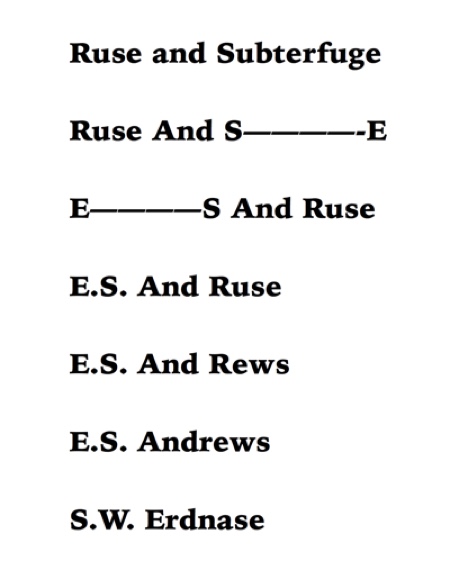
http://www.houstonmagicbirthday.com/images/ruseand.jpg
The E and the S are referenced backward with the words, "ruse and" changing to E.S. Andrews and finally to S.W. Erdnase.
It was originally published on The Magicon, a pre-Web magician's forum on CompuServe. I looked at the title page as a type of puzzle and put together an observation on the graphically longest line on the page, Ruse and Subterfuge. The permutations are contained in the following graphic.
http://www.houstonmagicbirthday.com/images/ruseand.jpg
The E and the S are referenced backward with the words, "ruse and" changing to E.S. Andrews and finally to S.W. Erdnase.
Stephen Burton wrote:Richard Hatch recently got in touch with me about an essay I wrote in 1989, Thoughts on the Identity of Erdnase.
It was originally published on The Magicon, a pre-Web magician's forum on CompuServe. I looked at the title page as a type of puzzle and put together an observation on the graphically longest line on the page, Ruse and Subterfuge. The permutations are contained in the following graphic.
http://www.houstonmagicbirthday.com/images/ruseand.jpg
The E and the S are referenced backward with the words, "ruse and" changing to E.S. Andrews and finally to S.W. Erdnase.
Although "Andruse" seems an excessively rare surname, "Andrus" is a possibility. As in Jerry, of course, and there are others around.
Hi All,
Concerning Steve Burton’s post above, one of the interesting things about the theory was that it appeared in 1989, and no matter how you calculate it, that is more than a year before the appearance of The Man Who Was Erdnase. And it is a rather clever theory.
Dick Hatch alluded to this matter in a post back in 2003. However, I think Dick "reversed" something there. (Specifically, I did not notice the thing about the E and the S, which Steve deals with in his post.)
Anyway, the whole thing may be a weird coincidence (of which there are many in the Erdnase field), or it may be that the author's name is E.S. Andrews and that he hid his real name on the title page in the manner Steve discusses.
The following are among the key things (to me) in this regard:
(a) The title-page title is somewhat weird to start out with, and seems to invite people to work on interpretations such as this.
(b) The "and Ruse" part is good, and I suspect that TMWWE might have mentioned that, if the authors had known about it.
(c) The "E and S" part is a nice insight, but my present view is that, even though it fits really well, it tends to stretch things a little too far, since I see no real reason for dropping the interior of the word, other than, "Well, it gives you an S and an E." Merely flipping the sequence of "Ruse" and "and" seems more straightforward to me.
In short, the "AND RUSE" weakly supports the name Andrews. The E and the S go on to support "E.S.," but even more weakly.
As Clay Shevlin (and probably others) have said, "artifice," "ruse," and "subterfuge" are largely synonymous, so perhaps there is a theory that explains this redundancy in those three words.
Near the end of the post at this link, Clay goes further and states a theory that makes sense, and which might explain the entire phrase, "Artifice Ruse and Subterfuge." And I think one of David Alexander's theories had to do with the phrase "Andrews Artifice" (derived from the title page).
I actually like Clay's theory a little better than Steve's, largely because it is more comprehensive, but also because it mainly involves flipping the word order. However, to me these things fit more into the "fun and weird" category than they do into the "highly significant" category.
--Tom Sawyer
Concerning Steve Burton’s post above, one of the interesting things about the theory was that it appeared in 1989, and no matter how you calculate it, that is more than a year before the appearance of The Man Who Was Erdnase. And it is a rather clever theory.
Dick Hatch alluded to this matter in a post back in 2003. However, I think Dick "reversed" something there. (Specifically, I did not notice the thing about the E and the S, which Steve deals with in his post.)
Anyway, the whole thing may be a weird coincidence (of which there are many in the Erdnase field), or it may be that the author's name is E.S. Andrews and that he hid his real name on the title page in the manner Steve discusses.
The following are among the key things (to me) in this regard:
(a) The title-page title is somewhat weird to start out with, and seems to invite people to work on interpretations such as this.
(b) The "and Ruse" part is good, and I suspect that TMWWE might have mentioned that, if the authors had known about it.
(c) The "E and S" part is a nice insight, but my present view is that, even though it fits really well, it tends to stretch things a little too far, since I see no real reason for dropping the interior of the word, other than, "Well, it gives you an S and an E." Merely flipping the sequence of "Ruse" and "and" seems more straightforward to me.
In short, the "AND RUSE" weakly supports the name Andrews. The E and the S go on to support "E.S.," but even more weakly.
As Clay Shevlin (and probably others) have said, "artifice," "ruse," and "subterfuge" are largely synonymous, so perhaps there is a theory that explains this redundancy in those three words.
Near the end of the post at this link, Clay goes further and states a theory that makes sense, and which might explain the entire phrase, "Artifice Ruse and Subterfuge." And I think one of David Alexander's theories had to do with the phrase "Andrews Artifice" (derived from the title page).
I actually like Clay's theory a little better than Steve's, largely because it is more comprehensive, but also because it mainly involves flipping the word order. However, to me these things fit more into the "fun and weird" category than they do into the "highly significant" category.
--Tom Sawyer
A few newsletters ago I built on Steve Burton's 'and Ruse' being interpreted as 'Andrews' theory to suggest that the name fully spelled out was: Edward Subterfuge and Ruse which reduces to:
Edward S. and Ruse
Edward S. Andrews
E. S. Andrews
This was motivated by Edward Gallaway's stage name for the R.R. Donnelley show, which was Bustin Homes, which he derived from his necessity to bust-in of the homes of the various executives to secure their childhood photos. In other words, he took a phrase 'bust in homes' and turned it into a name. One other improvement to Burton's theory is that 'Edward Subterfuge and Ruse' does not require any arbitrary selection of characters to make the initials. They emerge naturally from the phrase.
Edward S. and Ruse
Edward S. Andrews
E. S. Andrews
This was motivated by Edward Gallaway's stage name for the R.R. Donnelley show, which was Bustin Homes, which he derived from his necessity to bust-in of the homes of the various executives to secure their childhood photos. In other words, he took a phrase 'bust in homes' and turned it into a name. One other improvement to Burton's theory is that 'Edward Subterfuge and Ruse' does not require any arbitrary selection of characters to make the initials. They emerge naturally from the phrase.
Brad Jeffers wrote:<>
I don't see why he would ever use 'Penuckle', unless of course ...In which case, he is so diabolically clever, that we will never figure out who he is!observer wrote:That's exactly what Foster would have done if he were trying to throw people off the scent.
Well remember that we're talking about someone clever enough to adopt what appears to be a transparently (childishly!) simple backward spelling of his real (?) name,
E. S. Andrews
as his nom de plume.
"I believe that N. A. Mrepus is actually SUPERMAN!"
"Oh Lois, don't be silly!"
Tom Sawyer wrote:
Both Whaley and Busby did know about it, they were members of the Magicon in 1989. They even mention it in The Man Who Was Erdnase but totally ignore the "E S And Ruse" observation. The authors focused instead on my musing that the ES might stand for Edwin Sachs which I discarded when I noticed the ES being the first and last letters of Subterfuge. I suspect they ignored it because it didn't support the Milton F. Andrews speculation they were pushing so hard.
The "and Ruse" part is good, and I suspect that TMWWE might have mentioned that, if the authors had known about it.
Both Whaley and Busby did know about it, they were members of the Magicon in 1989. They even mention it in The Man Who Was Erdnase but totally ignore the "E S And Ruse" observation. The authors focused instead on my musing that the ES might stand for Edwin Sachs which I discarded when I noticed the ES being the first and last letters of Subterfuge. I suspect they ignored it because it didn't support the Milton F. Andrews speculation they were pushing so hard.
lybrary wrote:This was motivated by Edward Gallaway's stage name for the R.R. Donnelley show, which was Bustin Homes, which he derived from his necessity to bust-in of the homes of the various executives to secure their childhood photos. In other words, he took a phrase 'bust in homes' and turned it into a name.
I don't think he needed to break into anyone's house. We've done bulletin boards at work with baby photos of the staff, and everyone involved was happy to bring in their own photo.
Potter & Potter sold a moderately rough condition 1st edition copy today, for $5k plus bidder's premium.
Bill Mullins wrote:Potter & Potter sold a moderately rough condition 1st edition copy today, for $5k plus bidder's premium.
And another copy sold on eBay today for less that 1/10 that price! Someone's getting a nice Christmas present (not me, alas!):
https://www.ebay.com/itm/True-first-printing-of-Erdnase-The-Expert-At-The-Card-Table/232599267835
Richard Hatch wrote:Bill Mullins wrote:Potter & Potter sold a moderately rough condition 1st edition copy today, for $5k plus bidder's premium.
And another copy sold on eBay today for less that 1/10 that price! Someone's getting a nice Christmas present (not me, alas!):
https://www.ebay.com/itm/True-first-printing-of-Erdnase-The-Expert-At-The-Card-Table/232599267835
The eBay copy is apparently in need of some restoration. That could explain the much lower price. The owner of this copy inscribed his name on the front past down. Does that mean he was Erdnase?
I presume that the gentleman whose name appears on the inside front cover was Jacob Chasnoff.
Hi All,
I have been thinking a little about “confirmation bias” and the S.W. Erdnase case. The term has been mentioned several times on this thread, and in doing a search, I see (though I had no recollection of it) that a post by me was one of nine or so posts to mention that phrase.
It strikes me as a bit strange that in a thread with more than 5,400 posts, on a subject that has many opportunities for the analysis of potential confirmation-bias, the topic has not been discussed more.
If you want a classic example, it might be the height of M.F. Andrews. If you don’t like him as a candidate, you can say, “He was too tall.” If you do like him, you can say, “He was sorta stooped over because of his health.”
On the other hand, people on both sides of the issue may have made their determination completely free of confirmation bias. This is probably easier to do if you say that he was too tall, because the mere fact that he may have been stooped over does not make him short!
Then again, if you don't really rely on information provided by Smith, you probably don't care one way or another about MFA's height.
And of course the mere fact that confirmation bias is involved does not make a fact useless, or a conclusion based thereon erroneous!
--Tom Sawyer
I have been thinking a little about “confirmation bias” and the S.W. Erdnase case. The term has been mentioned several times on this thread, and in doing a search, I see (though I had no recollection of it) that a post by me was one of nine or so posts to mention that phrase.
It strikes me as a bit strange that in a thread with more than 5,400 posts, on a subject that has many opportunities for the analysis of potential confirmation-bias, the topic has not been discussed more.
If you want a classic example, it might be the height of M.F. Andrews. If you don’t like him as a candidate, you can say, “He was too tall.” If you do like him, you can say, “He was sorta stooped over because of his health.”
On the other hand, people on both sides of the issue may have made their determination completely free of confirmation bias. This is probably easier to do if you say that he was too tall, because the mere fact that he may have been stooped over does not make him short!
Then again, if you don't really rely on information provided by Smith, you probably don't care one way or another about MFA's height.
And of course the mere fact that confirmation bias is involved does not make a fact useless, or a conclusion based thereon erroneous!
--Tom Sawyer
I have a strong suspicion that you are ALL wrong!
Leonard Hevia wrote:Richard Hatch wrote:Bill Mullins wrote:Potter & Potter sold a moderately rough condition 1st edition copy today, for $5k plus bidder's premium.
And another copy sold on eBay today for less that 1/10 that price! Someone's getting a nice Christmas present (not me, alas!):
https://www.ebay.com/itm/True-first-printing-of-Erdnase-The-Expert-At-The-Card-Table/232599267835
The eBay copy is apparently in need of some restoration. That could explain the much lower price. The owner of this copy inscribed his name on the front past down. Does that mean he was Erdnase?
I actually have a notification that tells me when any EATCT or Erdnase item comes up for sale on ebay. This one slipped through my fingers, even in the condition it was in $450 was ridiculously cheap! Most of the damage looked repairable too.
Now, don't get me wrong: I don't believe there is such a thing as "useless knowledge".
That said -- suppose that at some point the identity of "Erdnase" is established beyond a reasonable doubt.
Then what?
That said -- suppose that at some point the identity of "Erdnase" is established beyond a reasonable doubt.
Then what?
A new Genii cover story?
Jack Shalom wrote:A new Genii cover story?
Mmh. Maybe a paragraph in The Eye. Being unknown is all that whoever he is has going for him. Without that, he's nobody.
It's like the Cubs. Once they served out their 107-year sentence for stealing the 1908 pennant from the Giants and won a World Championship, people stopped talking about them.
observer wrote:Being unknown is all that whoever he is has going for him. Without that, he's a nobody.
Ben Earl included a relevant Erdnase quote in the final chapter of his new book. He still has much going for him beyond the mystery of his true identity.
Leonard Hevia wrote:observer wrote:Being unknown is all that whoever he is has going for him. Without that, he's a nobody.
Ben Earl included a relevant Erdnase passage in the final chapter of his new book. He still has much going for him beyond the mystery of his true identity.
Leonard Hevia wrote:observer wrote:Being unknown is all that whoever he is has going for him. Without that, he's a nobody.
Ben Earl included a relevant Erdnase quote in the final chapter of his new book. He still has much going for him beyond the mystery of his true identity.
Fweeet! Ten yard penalty for goalpost moving. This discussion is about the identity of "Erdnase" not about the book somebody wrote under that alias. Also a penalty for adding an unneeded indefinite article to my post, but I decline that one.
observer wrote: This discussion is about the identity of "Erdnase" not about the book somebody wrote under that alias.
Originally it was about the book ...
Guest wrote: I'm ready to resume my study of "The Expert". My question is how does one properly study Erdnase? Should I start with the Legerdemain section or Card Table Artifice?
Are there certain moves that are best studied from other sources? Are there sleights that are too inferior? Any help would be greatly appreciated!
Brad Jeffers wrote: Originally it was about the book ...
Ah, yes ... my grandfather used to tell us kids about the early days of this thread, how he would read the latest posts by the flickering of a kerosene lamp after a hard day at the covered wagon factory ...
The true mystery in the world is the visible, not the invisible.
Oscar Wilde
http://www.swerdnase.net
Any Questions?
Oscar Wilde
http://www.swerdnase.net
Any Questions?
Wow. Gasp. Any manuscripts survive?
Scott Lane wrote:The true mystery in the world is the visible, not the invisible.
Oscar Wilde
http://www.swerdnase.net
Any Questions?
Scott, thanks for sharing your research. Some very interesting stuff. A couple of quick questions: You mention that your great aunt, Edna Galloway, gave you the "Erdnase artifacts." Can you share those? I assume they will help establish your otherwise unsubstantiated claims connecting all the dots. Also, you apparently present a red cloth covered 176 [sic. I believe you meant 178] page Drake edition, missing some of the Legerdemain section, as the true first edition. I think most consider this a much later reprint, following the true first (green cloth, self published, 205 pages, 1902) and Drake's known earlier printings (starting in 1905 with 205 pages), and following their 190 page edition. Do you have any basis for thinking the Drake 178 page edition predates the generally regarded "self-published" 205 page edition?
Thank you for the questions. I don’t pretend to have all the answers. It is difficult to research Erdnase in a bubble because it is very tempting to connect dots to reach conclusions that you want to be true. I feel like it is a jigsaw puzzle with a couple of pieces gone and conjecture is needed to get to the next set of facts.That is why I am posting this on the Genii thread. I hope to get additional input from people that have also been researching this mystery.
I really appreciate the comments and I am not afraid to back off any of my assertions to get to the truth.
The artifacts that I received as a child include tintypes, boxes of photographs, silverware, dinnerware, poker chips, gambling devices and a whole bunch of family history and stories.
The original manuscript has not been found but that does not mean one doesn’t exist.
The reason I believe that the shorter version of EATCT may be the true first edition is because of the following:
Fred Drake advertised his books in the first issue of the Sphinx. If you look at the advertisements, each of the books have graphics on the cover. I have been collecting books from Drake publishing and have found that the older versions do not have the graphics as shown in the advertisements. It seems like the graphics were added in later versions of some the books. A couple of examples would be How to Tell Fortunes by Cards and Debater’s Manual.
I started to question this when I found a copy of Tricks With Coins with the red cover with only the cursive title and no graphics. This edition has the copyright holder listed as L. W. De Laurence. The later Drake versions published in 1902 with the graphics have the copyright holder listed as Frederick Drake.
L. W. De Laurence, I believe, was associated with Drake from around early 1900 to early 1902.
Like I stated earlier, I am reaching out for help from the Erdnase community to help verify the research and get comments on when I need to revise, enhance or abandon any particular theory.
If I am completely wrong, please do not get upset. I am not a professional researcher and truly respect the comments and opinions of everyone on this thread.
I really appreciate the comments and I am not afraid to back off any of my assertions to get to the truth.
The artifacts that I received as a child include tintypes, boxes of photographs, silverware, dinnerware, poker chips, gambling devices and a whole bunch of family history and stories.
The original manuscript has not been found but that does not mean one doesn’t exist.
The reason I believe that the shorter version of EATCT may be the true first edition is because of the following:
Fred Drake advertised his books in the first issue of the Sphinx. If you look at the advertisements, each of the books have graphics on the cover. I have been collecting books from Drake publishing and have found that the older versions do not have the graphics as shown in the advertisements. It seems like the graphics were added in later versions of some the books. A couple of examples would be How to Tell Fortunes by Cards and Debater’s Manual.
I started to question this when I found a copy of Tricks With Coins with the red cover with only the cursive title and no graphics. This edition has the copyright holder listed as L. W. De Laurence. The later Drake versions published in 1902 with the graphics have the copyright holder listed as Frederick Drake.
L. W. De Laurence, I believe, was associated with Drake from around early 1900 to early 1902.
Like I stated earlier, I am reaching out for help from the Erdnase community to help verify the research and get comments on when I need to revise, enhance or abandon any particular theory.
If I am completely wrong, please do not get upset. I am not a professional researcher and truly respect the comments and opinions of everyone on this thread.
Hard to know where to begin, but:
You make lots of statements about the syndicate of men who you think wrote the book. Is there any hard evidence to your conclusions that Andrews was the main writer and that Oliver Limerick was the stylistic polisher? Also, any evidence that Hilliar stole the manuscript? And, why the big upset by the mob? It wasn't that much of a bestseller was it? Before Vernon, who was going to read it but a few cranky magicians?
You make lots of statements about the syndicate of men who you think wrote the book. Is there any hard evidence to your conclusions that Andrews was the main writer and that Oliver Limerick was the stylistic polisher? Also, any evidence that Hilliar stole the manuscript? And, why the big upset by the mob? It wasn't that much of a bestseller was it? Before Vernon, who was going to read it but a few cranky magicians?
QUESTION:
You make lots of statements about the syndicate of men who you think wrote the book. Is there any hard evidence to your conclusions that Andrews was the main writer and that Oliver Limerick was the stylistic polisher? Also, any evidence that Hilliar stole the manuscript? And, why the big upset by the mob? It wasn't that much of a bestseller was it? Before Vernon, who was going to read it but a few cranky magicians?
ANSWER:
Excellent questions! Unless a signed manuscript or contract with the name of the author(s) is discovered it will always be a circumstantial argument. At this point, no document has been found. It is still a theory and nothing more. Even if the author signed their real name to the book there still can be questions concerning authorship. For example, the theories pertaining to Shakespeare’s works and the true authorship.
In regard to the Erdnase theory, the most popular candidates such as Milton Franklin Andrews and William Edgerton Sanders are all based on circumstantial evidence.
What I have tried to do is match up the known clues. The PowerPoint in my website tries to explain some of the circumstantial evidence that exists supporting the theory that James Andrews wrote the base gambling portion of EATCT. It all started from the stories passed down from my family and relatives that resided in Orange County, Indiana and the unbelievable gambling history that the area had for well over 100 years.
As for Dr Oliver Victor Limerick and W E S Fales roles in the book, the evidence pointed to them via the New York Press Club, Blue Pencil Club and the creators involved in the Thompson Street, Mott Street and 5th Ave gambling books. Many of the clues were pointed out by another Erdnase researcher (Robert Wilson) through leads tracked down from statements made by M. D. Smith and the writings of Benj. F. Cobb.
I will make a bullet point list and post it to this thread.
As for your comment concerning the “mob”. I wouldn't consider the owners/dealers and operators from French Lick and West Baden Springs a “mob’. They were a group of people (mostly related), who spanned many generations, that worked the clubs in the area and managed to win a LOT of money utilizing cheating techniques daily for many, many decades. The players were very wealthy and famous people from all over the world who visited the hotels/casinos to experience the medical “cure all” properties of the mineral springs in the area.
Why would they be mad? Imagine that you wrote a book and someone pirated it and sold it for many years with many, many printings and editions. It would be hard to forget and forgive.
Pertaining to the questions concerning the cranky old magicians, I think you are absolutely right! One could make a strong argument that if you take out the Preface and the Introduction from EATCT, it would be just another magic book. The thing that makes it stand out are the descriptions concerning the overhand and table shuffle systems that were described in detail. Over the years, finger positions and techniques have changed and improved but the basic foundations are relatively the same. (I hope that does not offend anyone!) Also, outside of Drake, the book was mostly sold by magic and novelty shops. Almost all known green first editions of EATCT have come from magician libraries.
You make lots of statements about the syndicate of men who you think wrote the book. Is there any hard evidence to your conclusions that Andrews was the main writer and that Oliver Limerick was the stylistic polisher? Also, any evidence that Hilliar stole the manuscript? And, why the big upset by the mob? It wasn't that much of a bestseller was it? Before Vernon, who was going to read it but a few cranky magicians?
ANSWER:
Excellent questions! Unless a signed manuscript or contract with the name of the author(s) is discovered it will always be a circumstantial argument. At this point, no document has been found. It is still a theory and nothing more. Even if the author signed their real name to the book there still can be questions concerning authorship. For example, the theories pertaining to Shakespeare’s works and the true authorship.
In regard to the Erdnase theory, the most popular candidates such as Milton Franklin Andrews and William Edgerton Sanders are all based on circumstantial evidence.
What I have tried to do is match up the known clues. The PowerPoint in my website tries to explain some of the circumstantial evidence that exists supporting the theory that James Andrews wrote the base gambling portion of EATCT. It all started from the stories passed down from my family and relatives that resided in Orange County, Indiana and the unbelievable gambling history that the area had for well over 100 years.
As for Dr Oliver Victor Limerick and W E S Fales roles in the book, the evidence pointed to them via the New York Press Club, Blue Pencil Club and the creators involved in the Thompson Street, Mott Street and 5th Ave gambling books. Many of the clues were pointed out by another Erdnase researcher (Robert Wilson) through leads tracked down from statements made by M. D. Smith and the writings of Benj. F. Cobb.
I will make a bullet point list and post it to this thread.
As for your comment concerning the “mob”. I wouldn't consider the owners/dealers and operators from French Lick and West Baden Springs a “mob’. They were a group of people (mostly related), who spanned many generations, that worked the clubs in the area and managed to win a LOT of money utilizing cheating techniques daily for many, many decades. The players were very wealthy and famous people from all over the world who visited the hotels/casinos to experience the medical “cure all” properties of the mineral springs in the area.
Why would they be mad? Imagine that you wrote a book and someone pirated it and sold it for many years with many, many printings and editions. It would be hard to forget and forgive.
Pertaining to the questions concerning the cranky old magicians, I think you are absolutely right! One could make a strong argument that if you take out the Preface and the Introduction from EATCT, it would be just another magic book. The thing that makes it stand out are the descriptions concerning the overhand and table shuffle systems that were described in detail. Over the years, finger positions and techniques have changed and improved but the basic foundations are relatively the same. (I hope that does not offend anyone!) Also, outside of Drake, the book was mostly sold by magic and novelty shops. Almost all known green first editions of EATCT have come from magician libraries.
Thanks for your reply, Scott.
I'll echo Richard Hatch here, that there's a lot of interesting matter here. But...
In your presentation it is not clear a) what is pure conjecture, b) what you think is backed by circumstantial evidence (and what that is), and c) what you feel is based on hard evidence (and what that is). Without being clear on these differences within your presentation, it is impossible to begin to evaluate your theory.
I'll echo Richard Hatch here, that there's a lot of interesting matter here. But...
In your presentation it is not clear a) what is pure conjecture, b) what you think is backed by circumstantial evidence (and what that is), and c) what you feel is based on hard evidence (and what that is). Without being clear on these differences within your presentation, it is impossible to begin to evaluate your theory.
Thank you for the suggestion! I will put something together to make it more readable and detail the source information. I should be able to post something early next week.
Scott, this is all fantastically interesting.
On the last page of the Other Connections section, there's a photo of an article from The Blue Pencil Club Magazine that mentions TEATCT. Is there a readable scan of this paper?
On the last page of the Other Connections section, there's a photo of an article from The Blue Pencil Club Magazine that mentions TEATCT. Is there a readable scan of this paper?
Hi,
Thank you for the question! You will find the article at the following link:
https://books.google.com/books?id=QWY2A ... ne&f=false
The article is called “A Horrible State of Affairs” in the Blue Pencil Club Magazine May, 1900. You will find it on page 22. Make sure you are the right month and date because there are multiple page 22s found in the PDF.
It was written by Dr Oliver Victor Limerick (Billy Burgundy). It does not mention the manuscript by name.
Thank you for the question! You will find the article at the following link:
https://books.google.com/books?id=QWY2A ... ne&f=false
The article is called “A Horrible State of Affairs” in the Blue Pencil Club Magazine May, 1900. You will find it on page 22. Make sure you are the right month and date because there are multiple page 22s found in the PDF.
It was written by Dr Oliver Victor Limerick (Billy Burgundy). It does not mention the manuscript by name.
Just to prepare you before you read “A Horrible State of Affairs”:
1. He is writing in Slang.
2. He is writing a story from “life”, meaning he is creating the story from actual events but making it look like fiction.
3. During this period in history, the Victorian Era, Bucket Shops were in full swing. The shops would bribe journalists and illustrators throughout the U.S. to put hidden messages in their stories and illustrations. The hidden coded messages were used to transmit information used to manipulate the stock market. It was very similar to the modern day Internet. The bucket shop owners would subscribe to the newspapers and monthly journal magazines, collate the information and be able to determine the number of shares being bought and sold and manipulate the stock prices and many times corner the market.
4. They would also transmit information via hidden codes using the telegraph.
5. As you learn the code, a whole new world opens up when you read newspapers, magazines and books from that timeframe.
1. He is writing in Slang.
2. He is writing a story from “life”, meaning he is creating the story from actual events but making it look like fiction.
3. During this period in history, the Victorian Era, Bucket Shops were in full swing. The shops would bribe journalists and illustrators throughout the U.S. to put hidden messages in their stories and illustrations. The hidden coded messages were used to transmit information used to manipulate the stock market. It was very similar to the modern day Internet. The bucket shop owners would subscribe to the newspapers and monthly journal magazines, collate the information and be able to determine the number of shares being bought and sold and manipulate the stock prices and many times corner the market.
4. They would also transmit information via hidden codes using the telegraph.
5. As you learn the code, a whole new world opens up when you read newspapers, magazines and books from that timeframe.
One more thing about secret codes. When the police searched Milton Franklin Andrews’ room they found a codebook. It is to bad that the book was not saved. The book probably had telegraph codes and / or the code that was used by the French Lick Dealers.
For example: The Lumberman’s telegraph code has one that is 1869. When you read 1869, you know the code, which means “your counter offer is accepted”.
The French Lick Dealers also had a code. Think of it as a way to describe gambling cheating techniques. If someone said: Use a Pull Down, Third Degree, Fifth Degree, Top. It would mean do a Calculated Center Deal with a Pull Down to Third Degree, Transfer to Fifth Degree and Top for the Deal.
For example: The Lumberman’s telegraph code has one that is 1869. When you read 1869, you know the code, which means “your counter offer is accepted”.
The French Lick Dealers also had a code. Think of it as a way to describe gambling cheating techniques. If someone said: Use a Pull Down, Third Degree, Fifth Degree, Top. It would mean do a Calculated Center Deal with a Pull Down to Third Degree, Transfer to Fifth Degree and Top for the Deal.
Pete McCabe wrote: On the last page of the Other Connections section, there's a photo of an article from The Blue Pencil Club Magazine that mentions TEATCT.
Where exactly in THIS ARTICLE is there any mention of TEATC?
Thank you for the question! The article does not specifically state the name of the manuscript. I change the PowerPoint storyboard to say, “the possible refuted first edition of EATCT”.
The slide can then be categorized as “conjecture”.
I only have about 20% of the PowerPoints published on the website.
It should be noted that the code utilized at the time for transmitting “bucket Shop” information usually always referred to other publications, and you had to cross reference to get to the full picture.
I will say that I strongly believe that Jim Kenny refers to James McKinney.
The slide can then be categorized as “conjecture”.
I only have about 20% of the PowerPoints published on the website.
It should be noted that the code utilized at the time for transmitting “bucket Shop” information usually always referred to other publications, and you had to cross reference to get to the full picture.
I will say that I strongly believe that Jim Kenny refers to James McKinney.
Fun to get some new context for the book and people.
https://books.google.com/books?id=QWY2A ... il&f=false
Thanks
https://books.google.com/books?id=QWY2A ... il&f=false
Thanks
Hi All,
Today I took down my S.W. Erdnase blog for the time being (for personal reasons).
I expect that this will be a temporary situation. (But I probably won’t put it back for at least six months.)
—Tom Sawyer
Today I took down my S.W. Erdnase blog for the time being (for personal reasons).
I expect that this will be a temporary situation. (But I probably won’t put it back for at least six months.)
—Tom Sawyer
After going through the PowerPoint presentation swerdnase.net, to verify all the source documents, I am very comfortable saying that I have documents to support everything that is presented. The documents include, but are not limited to public ancestry records, draft registrations, newspaper articles, grave site information and documented family history.
The PowerPoint slide stating that the “G” represents Golden in the drawing given to Gardner by M. D. Smith is pure speculation and I will remove it from the PowerPoints.
Until a signed manuscript or contract is made public, authorship cannot be definitively attributed to any individual. However, the overall circumstantial evidence is abundant, especially when looked at from a holistic view.
The manuscript trail is also fraught with conjecture. I will revisit this as more PowerPoint slides are posted to the presentation.
The statements made about William Hilliar’s death being a murder and not a suicide will never be proven. Murder has no statute of limitations.
The remaining conjecture in the PowerPoints revolves around the true EATCT first editions. I do believe the evidence around L. W. DeLaurence copyright ownership and timeline supports the theory that the red cursive edition of T. Nelson Downs, Tricks with Coins, is the first U.S edition.
This does help to support the theory concerning the true first EATCT editions and understands that a second printing could of happened at a later date.
I am going to add more PowerPoint slides to the presentation with information regarding Mrs Oscar Minkley, Rosella Andrews, William Francis “Rufus” Steele and some amazing revelations concerning M. D. Smith.
Any questions?
The PowerPoint slide stating that the “G” represents Golden in the drawing given to Gardner by M. D. Smith is pure speculation and I will remove it from the PowerPoints.
Until a signed manuscript or contract is made public, authorship cannot be definitively attributed to any individual. However, the overall circumstantial evidence is abundant, especially when looked at from a holistic view.
The manuscript trail is also fraught with conjecture. I will revisit this as more PowerPoint slides are posted to the presentation.
The statements made about William Hilliar’s death being a murder and not a suicide will never be proven. Murder has no statute of limitations.
The remaining conjecture in the PowerPoints revolves around the true EATCT first editions. I do believe the evidence around L. W. DeLaurence copyright ownership and timeline supports the theory that the red cursive edition of T. Nelson Downs, Tricks with Coins, is the first U.S edition.
This does help to support the theory concerning the true first EATCT editions and understands that a second printing could of happened at a later date.
I am going to add more PowerPoint slides to the presentation with information regarding Mrs Oscar Minkley, Rosella Andrews, William Francis “Rufus” Steele and some amazing revelations concerning M. D. Smith.
Any questions?
Quick Facts for James M (W) Andrews: Scott Edward Lane's Candidate for S. W. Erdnase
1. He was a known casino owner, dealer and expert card dealer.
2. His name is the correct backwards spelling.
3. He is the correct age and timeframe.
4. He would have known and done a lot of business with Edwin Hood and H. C. Evans.
5. He had associates and relatives that did business with James McKinney, Jamieson & Higgins, Drake and Galloway.
6. He had family ties to Kauffman (Cauffman), who is listed as a creditor in the McKinney bankruptcy files.
7. His one daughter married into the McKinney family.
8. His second daughter married into the Adams family who was related to the first wife of William Golden Mortimer. Mortimer was the first president of the Society of American Magicians and close friend of Dr William Elliott who contributed to New Era Card Tricks, invented the Back Palm and first identified the Mexican turnover move found in the Expert at the Card Table. He was also good friends of Houdini. Dr Elliott was known as the “Boston Kid” to the gamblers in the area.
9. His family was related to the Milton Franklin Andrews family.
10. His business associate, co-owner of the casino and family relative was related to Eva Howard, the woman killed by Milton Franklin Andrews.
11. His business associate, co-owner of the casino and family relative was related to Campbell, who Alvin Andrews hired as an attorney to represent Milton Franklin Andrews.
12. He was an associate of Dr Ellis who owned the nearby Claxton boarding house and casino and was related to William “Friday” Ellis, the man Milton Franklin tried to kill with a hammer.
13. He was related to Louis Dalrymple and had relatives that worked for The Puck, The Judge and Life Magazines.
14. He had associates that wrote and illustrated The Thompson Street and Mott Street Poker Club Books.
15. His brother owned a Lumber supply company and was an associate/relative of Benj. F Cobb, who wrote the books illustrated by M D Smith.
16. He was associated with the author of the Wizard of Oz. Martinka Magic Shop secretly helped with the special effects.
17. He was also the president of the First National Bank in Louisville and Chicago. The check written to M. D. Smith may have been written against that bank.
18. His relatives owned the shop across the street from the hotel where M D Smith met Erdnase to do the drawings.
19. He was related to people who had the same names as the aliases Milton Franklin Andrews and Eva Howard used during their troubles.
Any questions?
1. He was a known casino owner, dealer and expert card dealer.
2. His name is the correct backwards spelling.
3. He is the correct age and timeframe.
4. He would have known and done a lot of business with Edwin Hood and H. C. Evans.
5. He had associates and relatives that did business with James McKinney, Jamieson & Higgins, Drake and Galloway.
6. He had family ties to Kauffman (Cauffman), who is listed as a creditor in the McKinney bankruptcy files.
7. His one daughter married into the McKinney family.
8. His second daughter married into the Adams family who was related to the first wife of William Golden Mortimer. Mortimer was the first president of the Society of American Magicians and close friend of Dr William Elliott who contributed to New Era Card Tricks, invented the Back Palm and first identified the Mexican turnover move found in the Expert at the Card Table. He was also good friends of Houdini. Dr Elliott was known as the “Boston Kid” to the gamblers in the area.
9. His family was related to the Milton Franklin Andrews family.
10. His business associate, co-owner of the casino and family relative was related to Eva Howard, the woman killed by Milton Franklin Andrews.
11. His business associate, co-owner of the casino and family relative was related to Campbell, who Alvin Andrews hired as an attorney to represent Milton Franklin Andrews.
12. He was an associate of Dr Ellis who owned the nearby Claxton boarding house and casino and was related to William “Friday” Ellis, the man Milton Franklin tried to kill with a hammer.
13. He was related to Louis Dalrymple and had relatives that worked for The Puck, The Judge and Life Magazines.
14. He had associates that wrote and illustrated The Thompson Street and Mott Street Poker Club Books.
15. His brother owned a Lumber supply company and was an associate/relative of Benj. F Cobb, who wrote the books illustrated by M D Smith.
16. He was associated with the author of the Wizard of Oz. Martinka Magic Shop secretly helped with the special effects.
17. He was also the president of the First National Bank in Louisville and Chicago. The check written to M. D. Smith may have been written against that bank.
18. His relatives owned the shop across the street from the hotel where M D Smith met Erdnase to do the drawings.
19. He was related to people who had the same names as the aliases Milton Franklin Andrews and Eva Howard used during their troubles.
Any questions?
Can you elaborate on how he was related to Dalrymple?
Scott Lane wrote:Quick Facts for James M (W) Andrews: Scott Edward Lane's Candidate for S. W. Erdnase
9. His family was related to the Milton Franklin Andrews family.
10. His business associate, co-owner of the casino and family relative was related to Eva Howard, the woman killed by Milton Franklin Andrews.
11. His business associate, co-owner of the casino and family relative was related to Campbell, who Alvin Andrews hired as an attorney to represent Milton Franklin Andrews.
12. He was an associate of Dr Ellis who owned the nearby Claxton boarding house and casino and was related to William “Friday” Ellis, the man Milton Franklin tried to kill with a hammer.
16. He was associated with the author of the Wizard of Oz. Martinka Magic Shop secretly helped with the special effects.
19. He was related to people who had the same names as the aliases Milton Franklin Andrews and Eva Howard used during their troubles.
Any questions?
I'm unclear on how the above points would advance James Andrews candidacy as author of EATCT. If MFA had nothing to do with the book, then they don't seem to help and would fall in the category of unrelated coincidences. Ditto any association with the author of the Wizard of Oz. (Also, I believe that equating Nelda Oliva with Eva Howard is very speculative, as detailed in TMWWE, though I don't see how it helps your case for James Andrews one way or the other).
Help me "connect the dots"!
Why would the president of a bank need the money, as Erdnase noted in the book? Of course, that might have been a lie on author's part. That's a high profile job, he took a risk publishing that book if he was the author.
Thank you for the questions! Unfortunately before I can comment further, I have to wait the results from the independent fact checkers.
swerdnase.net
Scott Edward Lane
swerdnase.net
Scott Edward Lane
I will answer all questions in order:
Bill Mullins: Question: Can you elaborate on how he (James Andrew) was related to Dalrymple?
Answer: I need to give some context before I can post the family tree and answer your question.
M D Smith stated the person he met (Erdnase?) in the Chicago hotel room to do the TEATCT drawings declared he was related to Louis Dalrymple who illustrated for The Puck Magazine. At that time, he was also doing work for Benj. Franklin Cobb, illustrating the Jack Henderson series. The books Smith illustrated spanned from 1902 with Jack Henderson Down East to around 1905 with Jack Henderson Down South, Out West, On Tipping and On Experience. Benj F Cobb was related to Bert “Andrews” Cobb and, along with Dalrymple, also worked as an illustrator for the Puck Magazine.
The Jack Henderson books consist of a series of letters “From Life” written and addressed to “Billy”. It is speculated by researchers outside the magic community “Billy” refers to William E. S. Fales. I have a first edition and it is signed on the cover by W E S Fales. with an arrow pointing to the illustration of Jack Henderson. This is supporting evidence but certainly not conclusive.
We do know that W E S Fales and Dr Oliver Victor Limerick (Billy Burgundy) were founding members of the Blue Pencil Club and Cobb along with Kemble were club members.
The stories in the book, Jack Henderson Down East, contain events that actually happened in French Lick. If you study French Lick and West Baden Springs history you will recognize the stories. It is speculated that, “Down East” refers to French Lick Springs. One of the letters describes traveling by train from Chicago, through what seamed like total wilderness, arriving in town, which seemed more like New York City than the town of French Lick Springs.The porters were dressed in tuxedos and looked like “penguins”. The hotels were opulent and expensive. The restaurants were also high classed and expensive. One letter talked about the inflated tips that were expected by the porters and waiters. If you were scammed by one of the staff, there was nothing you could do about it because the employees, police and judges were all corrupt. Remember, the hotels and casinos were run by powerful politicians. The West Baden Springs hotel was a Republican stronghold (Sinclair) and the French Lick Springs hotel was a Democrat stronghold (Taggart). Both hotel owners secretly financed and supported illegal gambling by owning and running casinos throughout the valley. This created the famous rivalry, which was widely known and publicized in the area.
The theory states that Jack Henderson Down East refers to traveling “Down” from Chicago and ending up in the “East”: Down East.
At that time, two trains were running daily back and forth between Chicago and French Lick. The trains continued to Louisville, KY, the home of the Kentucky Derby. Many famous race horses were bred and/or stabled in the French Lick, West Baden Springs area.
So in a nutshell, M D Smith may (1) not have been completely upfront or (2) may have remembered incorrectly or (3) Met with an associate of Andrew.
There is evidence that M D Smith did not completely disclose his full family history. Gardner stated that Smith did not want to give his date of birth. This will be addressed at a later time.
First, I will provide Internet links that connect James M (W) Andrew to the Cobb Family and then I will show evidence that supports James Andrews may have been related to the mother of Louis Dalrymple.
This alone will not prove EATCT authorship but will help establish a pattern of facts supporting the case for authorship. I have been researching Erdnase since 1968 when my great aunt first gave me relevant information/artifacts. This year marks the fifty year mark, which is important to me because my great aunt asked me not to disclose some of the information for fifty years. I have collected a mountain of research and it will take time to explain. I broke down in 1992 when I published Gambling Card Sharps, How to Beat a Cheater. I limited the content to describing only some of the card work developed by the French Lick Dealers. The book was heavily edited prior to printing and only describes a small amount of the information passed down in the family, which spans five generations. It does have the distinction of being the first book on gambling slights with illustrations generated using a CAD (Computer Aided Design) software package.
Before I comment on family histories and the citizens of Orange County, Indiana, it must be noted the actual populations of the area were rather small. Most of the people in the area were there on vacation or for the medical quackery “cure all” benefits claimed by drinking the mineral spring water. “Pluto” water was marketed by the French Lick Springs hotel/casino owners and “Strudel” water was marketed by the West Baden Springs hotel/casino owners. This is why so many Doctors and Dentists established residency in the area. The mineral water also attracted visiting customers/patients from all over the world. Many of them famous actors, sports figures, politicians, writers, artists, musicians, business owners and criminals.
As time went by, it was hard for the citizens of the area to find husbands and wives who were not already related. When analyzing family histories, it seems everyone was related to everyone.
One more thing I need to explain prior to publishing the family tree.
James M Andrews
S W Erdnase = E S Andrews
Sorry to do this to everyone but ….
If you use the Bucket Shop code sometimes used in transcribing hidden names, instead of saying the letter, E and S, as in E S Andrews, pronounce the SOUND of the letters E and S.
That would put the name:
H(e) I(s) Andrews.
Perhaps that is why James Andrew dropped the JAM when reversing his name. Of course this is pure speculation but his business partner, Hiram Wells, was a bucket shop stock broker when they co-owned the French Lick Hotel.
I will post the relevant portion of the family tree diagram to the following website swerdnase.net.
In the next post, I will elaborate and explain the diagram and hopefully answer Bill Mullins’ question.
Scott Edward Lane
Bill Mullins: Question: Can you elaborate on how he (James Andrew) was related to Dalrymple?
Answer: I need to give some context before I can post the family tree and answer your question.
M D Smith stated the person he met (Erdnase?) in the Chicago hotel room to do the TEATCT drawings declared he was related to Louis Dalrymple who illustrated for The Puck Magazine. At that time, he was also doing work for Benj. Franklin Cobb, illustrating the Jack Henderson series. The books Smith illustrated spanned from 1902 with Jack Henderson Down East to around 1905 with Jack Henderson Down South, Out West, On Tipping and On Experience. Benj F Cobb was related to Bert “Andrews” Cobb and, along with Dalrymple, also worked as an illustrator for the Puck Magazine.
The Jack Henderson books consist of a series of letters “From Life” written and addressed to “Billy”. It is speculated by researchers outside the magic community “Billy” refers to William E. S. Fales. I have a first edition and it is signed on the cover by W E S Fales. with an arrow pointing to the illustration of Jack Henderson. This is supporting evidence but certainly not conclusive.
We do know that W E S Fales and Dr Oliver Victor Limerick (Billy Burgundy) were founding members of the Blue Pencil Club and Cobb along with Kemble were club members.
The stories in the book, Jack Henderson Down East, contain events that actually happened in French Lick. If you study French Lick and West Baden Springs history you will recognize the stories. It is speculated that, “Down East” refers to French Lick Springs. One of the letters describes traveling by train from Chicago, through what seamed like total wilderness, arriving in town, which seemed more like New York City than the town of French Lick Springs.The porters were dressed in tuxedos and looked like “penguins”. The hotels were opulent and expensive. The restaurants were also high classed and expensive. One letter talked about the inflated tips that were expected by the porters and waiters. If you were scammed by one of the staff, there was nothing you could do about it because the employees, police and judges were all corrupt. Remember, the hotels and casinos were run by powerful politicians. The West Baden Springs hotel was a Republican stronghold (Sinclair) and the French Lick Springs hotel was a Democrat stronghold (Taggart). Both hotel owners secretly financed and supported illegal gambling by owning and running casinos throughout the valley. This created the famous rivalry, which was widely known and publicized in the area.
The theory states that Jack Henderson Down East refers to traveling “Down” from Chicago and ending up in the “East”: Down East.
At that time, two trains were running daily back and forth between Chicago and French Lick. The trains continued to Louisville, KY, the home of the Kentucky Derby. Many famous race horses were bred and/or stabled in the French Lick, West Baden Springs area.
So in a nutshell, M D Smith may (1) not have been completely upfront or (2) may have remembered incorrectly or (3) Met with an associate of Andrew.
There is evidence that M D Smith did not completely disclose his full family history. Gardner stated that Smith did not want to give his date of birth. This will be addressed at a later time.
First, I will provide Internet links that connect James M (W) Andrew to the Cobb Family and then I will show evidence that supports James Andrews may have been related to the mother of Louis Dalrymple.
This alone will not prove EATCT authorship but will help establish a pattern of facts supporting the case for authorship. I have been researching Erdnase since 1968 when my great aunt first gave me relevant information/artifacts. This year marks the fifty year mark, which is important to me because my great aunt asked me not to disclose some of the information for fifty years. I have collected a mountain of research and it will take time to explain. I broke down in 1992 when I published Gambling Card Sharps, How to Beat a Cheater. I limited the content to describing only some of the card work developed by the French Lick Dealers. The book was heavily edited prior to printing and only describes a small amount of the information passed down in the family, which spans five generations. It does have the distinction of being the first book on gambling slights with illustrations generated using a CAD (Computer Aided Design) software package.
Before I comment on family histories and the citizens of Orange County, Indiana, it must be noted the actual populations of the area were rather small. Most of the people in the area were there on vacation or for the medical quackery “cure all” benefits claimed by drinking the mineral spring water. “Pluto” water was marketed by the French Lick Springs hotel/casino owners and “Strudel” water was marketed by the West Baden Springs hotel/casino owners. This is why so many Doctors and Dentists established residency in the area. The mineral water also attracted visiting customers/patients from all over the world. Many of them famous actors, sports figures, politicians, writers, artists, musicians, business owners and criminals.
As time went by, it was hard for the citizens of the area to find husbands and wives who were not already related. When analyzing family histories, it seems everyone was related to everyone.
One more thing I need to explain prior to publishing the family tree.
James M Andrews
S W Erdnase = E S Andrews
Sorry to do this to everyone but ….
If you use the Bucket Shop code sometimes used in transcribing hidden names, instead of saying the letter, E and S, as in E S Andrews, pronounce the SOUND of the letters E and S.
That would put the name:
H(e) I(s) Andrews.
Perhaps that is why James Andrew dropped the JAM when reversing his name. Of course this is pure speculation but his business partner, Hiram Wells, was a bucket shop stock broker when they co-owned the French Lick Hotel.
I will post the relevant portion of the family tree diagram to the following website swerdnase.net.
In the next post, I will elaborate and explain the diagram and hopefully answer Bill Mullins’ question.
Scott Edward Lane
I have posted the beginning of the James M. Andrew family tree on swerdnase.net. As I was putting it together, I realized I am going to need a little better software package. For example, the family history I for the Galloway family is well over 300 typed written pages.
I did want to post the correct names for the James Andrews family so interested researchers can be sure they are starting in the right place.
Scott Edward Lane
I did want to post the correct names for the James Andrews family so interested researchers can be sure they are starting in the right place.
Scott Edward Lane
I neither know nor care who the bloody hell Erdnase was but I must say you have presented a convincing case so far.
Thank you for the questions!
Question: Richard Hatch
I'm unclear on how the above points (9, 10, 11, 12, 16, 19) would advance James Andrews candidacy as author of EATCT. If MFA had nothing to do with the book, then they don't seem to help and would fall in the category of unrelated coincidences. Ditto any association with the author of the Wizard of Oz. (Also, I believe that equating Nelda Oliva with Eva Howard is very speculative, as detailed in TMWWE, though I don't see how it helps your case for James Andrews one way or the other).
Help me "connect the dots”!
Answer:
Wow! I hope I am interpreting your questions accurately. I will break each part down and try to answer line for line.
“I'm unclear on how the above points” (9, 10, 11, 12, 16, 19) “would advance James Andrews (sic) candidacy as author of EATCT.”
Definition:
Triangulation is a powerful technique that facilitates validation of data through cross verification from two or more sources. In particular, it refers to the application and combination of several research methods in the study of the same phenomenon.
I believe that triangulating data points helps to establish the probability of accuracy for any proposed fact. This would be the foundation of any research project.
These data that you are referring to helps to establish the accuracy of Bart Whaley, Martin Gardner and Jeff Busby’s research in The Man Who Was Erdnase and also helps to validate my research.
2. “If MFA had nothing to do with the book, then they” (Data Points) “don’t seem to help and would fall in the category of unrelated coincidences.”
I would not say that Milton Franklin Andrews had nothing to do with the book or the Erdnase story. MFA is a very important player. My research expands the research made in TMWWE. Although, I am proposing that MFA did NOT write the book but was related to the author, giving him advanced knowledge of the material to be published.
3. “Ditto any association with the author of the Wizard of Oz.”
It seems like you have drawn a conclusion, within your question, prior to me having a chance to respond to your question and present my rationale. That is the definition of research bias. I do believe that even the smallest “smidgen” of research bias can derail any research project.
4. “Also, I believe that equating Nelda Oliva with Eva Howard is very speculative, as detailed in TMWWE, though I don't see how it helps your case for James Andrews one way or the other.”
I am not sure how you can claim that eye witness testimony can be considered “speculative”. There are very few eye witnesses in this case and I would have a tendency to investigate each instance.
I will present much, much more concerning Eva Howard in future posts.
I hope this helps you “connect the dots”.
Scott Edward Lane
Question: Richard Hatch
I'm unclear on how the above points (9, 10, 11, 12, 16, 19) would advance James Andrews candidacy as author of EATCT. If MFA had nothing to do with the book, then they don't seem to help and would fall in the category of unrelated coincidences. Ditto any association with the author of the Wizard of Oz. (Also, I believe that equating Nelda Oliva with Eva Howard is very speculative, as detailed in TMWWE, though I don't see how it helps your case for James Andrews one way or the other).
Help me "connect the dots”!
Answer:
Wow! I hope I am interpreting your questions accurately. I will break each part down and try to answer line for line.
“I'm unclear on how the above points” (9, 10, 11, 12, 16, 19) “would advance James Andrews (sic) candidacy as author of EATCT.”
Definition:
Triangulation is a powerful technique that facilitates validation of data through cross verification from two or more sources. In particular, it refers to the application and combination of several research methods in the study of the same phenomenon.
I believe that triangulating data points helps to establish the probability of accuracy for any proposed fact. This would be the foundation of any research project.
These data that you are referring to helps to establish the accuracy of Bart Whaley, Martin Gardner and Jeff Busby’s research in The Man Who Was Erdnase and also helps to validate my research.
2. “If MFA had nothing to do with the book, then they” (Data Points) “don’t seem to help and would fall in the category of unrelated coincidences.”
I would not say that Milton Franklin Andrews had nothing to do with the book or the Erdnase story. MFA is a very important player. My research expands the research made in TMWWE. Although, I am proposing that MFA did NOT write the book but was related to the author, giving him advanced knowledge of the material to be published.
3. “Ditto any association with the author of the Wizard of Oz.”
It seems like you have drawn a conclusion, within your question, prior to me having a chance to respond to your question and present my rationale. That is the definition of research bias. I do believe that even the smallest “smidgen” of research bias can derail any research project.
4. “Also, I believe that equating Nelda Oliva with Eva Howard is very speculative, as detailed in TMWWE, though I don't see how it helps your case for James Andrews one way or the other.”
I am not sure how you can claim that eye witness testimony can be considered “speculative”. There are very few eye witnesses in this case and I would have a tendency to investigate each instance.
I will present much, much more concerning Eva Howard in future posts.
I hope this helps you “connect the dots”.
Scott Edward Lane
Scott -- I appreciate your evenhanded response to questions.
Just a note -- on your slide entitled "French Lick Springs Hotel", your last bullet refers to "Steele, the mother of Louis Dalrymple". Everything I've ever seen on the subject says that his mother's name was Adelia Seeley. My own research tends to confirm that.
Just a note -- on your slide entitled "French Lick Springs Hotel", your last bullet refers to "Steele, the mother of Louis Dalrymple". Everything I've ever seen on the subject says that his mother's name was Adelia Seeley. My own research tends to confirm that.
Thank you for the question!
Question: Leonard Hevia
Why would the president of a bank need the money, as Erdnase noted in the book? Of course, that might have been a lie on author's part. That's a high profile job, he took a risk publishing that book if he was the author.
Answer:
This is a fantastic question! Most of the hotel/casino owners were bank presidents. Hiram E. Wells, co-owner of the French Lick Hotel/Casino with James M (W) Andrew, was a Stock Broker of the bucket shops and the treasurer of Orange County, IN. He was also president of the Citizens’ Bank and the president of the Stone City Bank. In fact, he was the largest stockholder of each of those banks. Remember, Hiram Wells was related to both Andrew and Cobb.
Lee W. Sinclair, owner of the West Baden Springs Hotel/Casino was the president of the State bank of Salem and the president of the West Baden Springs National Bank.
I believe that it facilitated in the stock market manipulation and possibly money laundering.
Erdnase did note, that he published the book because he “needed the money”. This is very possible because at that time, Andrews probably WAS a “reformed gambler”. This could have been the result of the West Baden Springs Hotel burning down in 1901 and being rebuilt by Sinclair, reopening in September 1902. Coincidentally (?), this was the same month William J Hillier suddenly left as editor of the Sphinx Magazine moving with his new wife not to far away from Jeffersonville, French Lick and West Baden Springs.
Scott Edward Lane
Question: Leonard Hevia
Why would the president of a bank need the money, as Erdnase noted in the book? Of course, that might have been a lie on author's part. That's a high profile job, he took a risk publishing that book if he was the author.
Answer:
This is a fantastic question! Most of the hotel/casino owners were bank presidents. Hiram E. Wells, co-owner of the French Lick Hotel/Casino with James M (W) Andrew, was a Stock Broker of the bucket shops and the treasurer of Orange County, IN. He was also president of the Citizens’ Bank and the president of the Stone City Bank. In fact, he was the largest stockholder of each of those banks. Remember, Hiram Wells was related to both Andrew and Cobb.
Lee W. Sinclair, owner of the West Baden Springs Hotel/Casino was the president of the State bank of Salem and the president of the West Baden Springs National Bank.
I believe that it facilitated in the stock market manipulation and possibly money laundering.
Erdnase did note, that he published the book because he “needed the money”. This is very possible because at that time, Andrews probably WAS a “reformed gambler”. This could have been the result of the West Baden Springs Hotel burning down in 1901 and being rebuilt by Sinclair, reopening in September 1902. Coincidentally (?), this was the same month William J Hillier suddenly left as editor of the Sphinx Magazine moving with his new wife not to far away from Jeffersonville, French Lick and West Baden Springs.
Scott Edward Lane
Thank you for the followup question!
Question: Bill Mullins
Just a note -- on your slide entitled "French Lick Springs Hotel", your last bullet refers to "Steele, the mother of Louis Dalrymple". Everything I've ever seen on the subject says that his mother's name was Adelia Seeley. My own research tends to confirm that.
Answer:
Wow! Thank you! I stand corrected. I will update the slide.
I have done extensive research on James Harte (Harto) and his wife and Steele is related to their family tree.
The research for Dalrymple started with a story “from life” that may have been referring to Louis Dalrymple and his first wife Carpenter. She married poor Louis and almost immediately filed for divorce and kept the house and $75 a month.
Louis Dalrymple then married into the Goode family where I thought I found a connection to the Steele family but this has not been fully researched so it is currently unproven.
I did find some members of the Steele family from Janesville, WI and related to the magician “Rufus” Steele. According to TMWWE, Rufus knew of the original EATCT manuscripts and said they were located in upper state New York “tied together with a string”. I have traced them to Albany, NY, the location of the Cobb burial crypt. The original land in that area, including the crypt location, was originaly owned by W E S Fales.
Interestingly, Rufus Steele’s family was located in the same place as our old friend M D Smith.
These are “dots” that are crying out for more research!
I have established, in previous posts, that James M Andrew IS related to the Cobb family, who did work for The Puck and Judge magazines.
This MAY put into question the validity/accuracy of M D Smith’s testimony concerning the Dalrymple relationship and the man he met in the hotel room to do the illustrations.
Remember, he was doing work for Cobb during the same timeframe when he met with the man in the hotel.
Scott Edward Lane
Question: Bill Mullins
Just a note -- on your slide entitled "French Lick Springs Hotel", your last bullet refers to "Steele, the mother of Louis Dalrymple". Everything I've ever seen on the subject says that his mother's name was Adelia Seeley. My own research tends to confirm that.
Answer:
Wow! Thank you! I stand corrected. I will update the slide.
I have done extensive research on James Harte (Harto) and his wife and Steele is related to their family tree.
The research for Dalrymple started with a story “from life” that may have been referring to Louis Dalrymple and his first wife Carpenter. She married poor Louis and almost immediately filed for divorce and kept the house and $75 a month.
Louis Dalrymple then married into the Goode family where I thought I found a connection to the Steele family but this has not been fully researched so it is currently unproven.
I did find some members of the Steele family from Janesville, WI and related to the magician “Rufus” Steele. According to TMWWE, Rufus knew of the original EATCT manuscripts and said they were located in upper state New York “tied together with a string”. I have traced them to Albany, NY, the location of the Cobb burial crypt. The original land in that area, including the crypt location, was originaly owned by W E S Fales.
Interestingly, Rufus Steele’s family was located in the same place as our old friend M D Smith.
These are “dots” that are crying out for more research!
I have established, in previous posts, that James M Andrew IS related to the Cobb family, who did work for The Puck and Judge magazines.
This MAY put into question the validity/accuracy of M D Smith’s testimony concerning the Dalrymple relationship and the man he met in the hotel room to do the illustrations.
Remember, he was doing work for Cobb during the same timeframe when he met with the man in the hotel.
Scott Edward Lane
If anyone is interested, I put a couple of pictures of the Cobb Crypt at swerdnase.net.
Any Questions?
Scott Edward Lane
Any Questions?
Scott Edward Lane
Before I post more on the Andrews, Dalrymple, MFA, Campbell, Howard and Houdini connections I wanted to post this from Case Western Reserve University. It is an excerpt from the Encyclopedia of Cleveland and describes some early business connections between the Cobb and Andrews families:
Cobb and Andrews, Co.
COBB, ANDREWS & CO. was Cleveland's leading bookstore from the 1860s to the 1880s. It began as J. B. Cobb & Co. in 1852 when Junius Brutus Cobb and two of his brothers, Brutus Junius and Caius Cassius, bought the controlling interest in their half-brother, Moses Younglove's, bookstore.
The first store was at 36 Superior St. near what is now W. 9th St. In June 1861 the company moved to larger quarters at 241 Superior St., across the street from the present-day site of STOUFFER RENAISSANCE HOTEL.
In 1864 Junius Cobb opened a store in Chicago under the name Cobb, Pritchard & Co. Another Cobb brother, Lucius Marcius, also had a store in Chicago at that time, called Cobb's Library. (The rest of the "Roman" Cobbs were: Cassius Caius, Marcius Lucius, Marcia Lucia, and Lucia Marcia. There was also a brother named Daniel.)
The Cobb stores did well in Chicago until 1871, when the famous fire caused their destruction. The Cobbs tried to carry on for another year or two, but the fire loss was too great, so they quit Chicago to devote their energies to the Cleveland store.
In 1865 the company's name became Cobb, Andrews & Co. when Theodore Andrews, Caius Cobb's brother-in-law, joined the firm. Ten years later the store moved to 315-317 Euclid Ave., near E. 6th St., while the old store on Superior was kept as a "downtown" outlet.
On 2 May 1888, a local newspaper announced the sale of Cobb, Andrews & Co. to BURROWS Bros. Although six sons and nephews of the owners were employed by Cobb, Andrews & Co., none showed any interest in perpetuating the firm.
Any Questions?
Scott Edward Lane
Cobb and Andrews, Co.
COBB, ANDREWS & CO. was Cleveland's leading bookstore from the 1860s to the 1880s. It began as J. B. Cobb & Co. in 1852 when Junius Brutus Cobb and two of his brothers, Brutus Junius and Caius Cassius, bought the controlling interest in their half-brother, Moses Younglove's, bookstore.
The first store was at 36 Superior St. near what is now W. 9th St. In June 1861 the company moved to larger quarters at 241 Superior St., across the street from the present-day site of STOUFFER RENAISSANCE HOTEL.
In 1864 Junius Cobb opened a store in Chicago under the name Cobb, Pritchard & Co. Another Cobb brother, Lucius Marcius, also had a store in Chicago at that time, called Cobb's Library. (The rest of the "Roman" Cobbs were: Cassius Caius, Marcius Lucius, Marcia Lucia, and Lucia Marcia. There was also a brother named Daniel.)
The Cobb stores did well in Chicago until 1871, when the famous fire caused their destruction. The Cobbs tried to carry on for another year or two, but the fire loss was too great, so they quit Chicago to devote their energies to the Cleveland store.
In 1865 the company's name became Cobb, Andrews & Co. when Theodore Andrews, Caius Cobb's brother-in-law, joined the firm. Ten years later the store moved to 315-317 Euclid Ave., near E. 6th St., while the old store on Superior was kept as a "downtown" outlet.
On 2 May 1888, a local newspaper announced the sale of Cobb, Andrews & Co. to BURROWS Bros. Although six sons and nephews of the owners were employed by Cobb, Andrews & Co., none showed any interest in perpetuating the firm.
Any Questions?
Scott Edward Lane
I'm lost. Map, please?
Still have many questions about evidence vs. conjecture. We've seen lots of trees, time for the forest?
Still have many questions about evidence vs. conjecture. We've seen lots of trees, time for the forest?
Jack Shalom wrote:I'm lost. Map, please?
Still have many questions about evidence vs. conjecture. We've seen lots of trees, time for the forest?
If you have seen the trees, then you have the evidence. Some people can see the forest, or at least A forest, reading in between the lines, that is what makes them special. What do you expect, a video of the actual Erdnase writing the book?
Carlo Morpurgo wrote:Jack Shalom wrote:I'm lost. Map, please?
Still have many questions about evidence vs. conjecture. We've seen lots of trees, time for the forest?
If you have seen the trees, then you have the evidence. Some people can see the forest, or at least A forest, reading in between the lines, that is what makes them special. What do you expect, a video of the actual Erdnase writing the book?
Carlo, there's a lot of ground between a 1) video, 2) convincing circumstantial and physical evidence and 3) an intriguing hypothesis. No one expects #1, and it's certainly fun to have #3; but I think most on this board are hoping at least #2 with regard to identifying Erdnase. It's still not clear to me what part of Scott's presentation is conjecture and what is hard evidence. Assessment of conjecture is necessarily subjective, but when conjectures start to be based on other unproven conjectures, hypotheses get less convincing.
Scott has so far presented excellent material describing the milieu in which Expert was written; but the actual details of the provenance and authorship of the book remain unclear. I think if you look at the kind of arguments put forth for other candidates, there is a constant attempt to try and pin down facts beyond conjecture that can help establish the identity.
I don't expect Scott to explain his case all at once, and I am merely expressing my eagerness to know more. If Scott does not have more than the aforementioned explanation of milieu, he'll still have succeeded in substantially advancing the solving of the mystery. But it's only human nature to ask, "got any more?"
Jack Shalom wrote:Carlo, there's a lot of ground between a 1) video, 2) convincing circumstantial and physical evidence and 3) an intriguing hypothesis. No one expects #1, and it's certainly fun to have #3; but I think most on this board are hoping at least #2 with regard to identifying Erdnase. It's still not clear to me what part of Scott's presentation is conjecture and what is hard evidence. Assessment of conjecture is necessarily subjective, but when conjectures start to be based on other unproven conjectures, hypotheses get less convincing.
"
How about wiping off the word "convincing". How about adopting the point of view that no one is trying to convince anyone. After all these years, I'd say thank God there is a half hair of evidence on which to try to build a castle, and having fun doing so. You make a theory you create possible leads and then you investigate those. Makes perfect sense to me. Throwing a constant "where is the hard evidence" is completely counterproductive, if not annoying (because we like to dream and speculate in the first place).
Forgive me for posting a non-contributory message, but I was just thinking how cool it would be if Erdnase and Jack the Ripper turned out to be the same person. Two mysteries solved at once some day, perhaps. I believe the chronology fits, assuming Jack emigrated to the States after his misdeeds in Whitechapel. Did he find a new and less violent way to pass the time?
I'm sorry, but if you are going to present someone as a candidate to have been S.W. Erdnase, then you're going to have to CONVINCE a lot of people. That's part of the deal.
Richard Kaufman wrote:I'm sorry, but if you are going to present someone as a candidate to have been S.W. Erdnase, then you're going to have to CONVINCE a lot of people. That's part of the deal.
Well yes, ultimately that is the goal, ultimately. But one thing is to present convincing evidence another is to present a convincing theory.
A convincing theory is something that fits the scant evidence that is available, and that could lead to more leads and hard evidence (or it could lead to a different theory). Assuming that the investigator is not making absolute statements such as "I found who Erdnase is", I see no reason to continuously remind him that he needs to come by with hard evidence. That is the kind of "convincing" that I am talking about.
It is unreasonable to demand evidence that nobody has any reason to believe exists.
In cases like this, the author wished to remain pseudonymous, so the "burden of proof" needs to slack off.
If it happens to be found someday, that will be fine. But don't count on it, and don't insist on it.
Sometimes the best we can do is to speculate.
When someone challenges me to provide "hard evidence" for my argument, I tend to counter with a challenge to justify their presumption that it remains after a hundred years of neglect, or after a deliberate attempt to conceal it.
In cases like this, the author wished to remain pseudonymous, so the "burden of proof" needs to slack off.
If it happens to be found someday, that will be fine. But don't count on it, and don't insist on it.
Sometimes the best we can do is to speculate.
When someone challenges me to provide "hard evidence" for my argument, I tend to counter with a challenge to justify their presumption that it remains after a hundred years of neglect, or after a deliberate attempt to conceal it.
jkeyes1000 wrote:It is unreasonable to demand evidence that nobody has any reason to believe exists.
In cases like this, the author wished to remain pseudonymous, so the "burden of proof" needs to slack off.
...
We have reason to believe the books first edition came from a specific printing company. After that it's ...
jkeyes1000 wrote:In cases like this, the author wished to remain pseudonymous...
I'm not convinced we know this about the author's wishes.
jkeyes1000 wrote:
In cases like this, the author wished to remain pseudonymous,
As I've said a couple times before (and Richard seems to be saying above), this is an assumption. We know the author used a pseudonym; what we don't know is why, or (specifically) if he cared if anyone knew what his real name was. Many authors have used pseudonyms without being too concerned if anyone figured out who they were. The best example is Samuel Clemens /Mark Twain. His identity may have been known to Roterberg and others of the Chicago magic scene ca. 1902, and it is simply an accident of history that it wasn't written down anywhere that we have access to today.
It has been suggested that the simplicity of reversing S. W. Erdnase to E. S. Andrews is evidence that he wasn't trying to hide his real name very hard.
Richard Hatch wrote:jkeyes1000 wrote:In cases like this, the author wished to remain pseudonymous...
I'm not convinced we know this about the author's wishes.
[/quote]
Believe me, I have no desire to engage in this complex discussion, but I would say that, taken logically, it is far more likely that an author by the silly name of S.W. Erdnase was toying with the reader, rather than truly trying to disguise his identity.
Therefore, it is probably his actual moniker, spelt backwards. Only if he were extremely afraid of discovery, would a man go to the length of both adopting a pseudonym and reversing it.
Indeed, it would be quite foolish, as there is no conceivable advantage in encrypting a nom de plume. The mere invention of an alias (and preferably a sensible one) would have been sufficient.
Bill Marquardt wrote:Forgive me for posting a non-contributory message, but I was just thinking how cool it would be if Erdnase and Jack the Ripper turned out to be the same person. Two mysteries solved at once some day, perhaps. I believe the chronology fits, assuming Jack emigrated to the States after his misdeeds in Whitechapel. Did he find a new and less violent way to pass the time?
Might this explain 'The Divining Rod" in EATCT? What we now call the Malini Card Stab.
Leonard Hevia wrote:Bill Marquardt wrote:Forgive me for posting a non-contributory message, but I was just thinking how cool it would be if Erdnase and Jack the Ripper turned out to be the same person. Two mysteries solved at once some day, perhaps. I believe the chronology fits, assuming Jack emigrated to the States after his misdeeds in Whitechapel. Did he find a new and less violent way to pass the time?
Might this explain 'The Divining Rod" in EATCT? What we now call the Malini Card Stab.
It certainly explains the sleight, "Skinning the Hand".
Bill Mullins wrote:jkeyes1000 wrote:
In cases like this, the author wished to remain pseudonymous,
As I've said a couple times before (and Richard seems to be saying above), this is an assumption. We know the author used a pseudonym; what we don't know is why, or (specifically) if he cared if anyone knew what his real name was. Many authors have used pseudonyms without being too concerned if anyone figured out who they were. The best example is Samuel Clemens /Mark Twain. His identity may have been known to Roterberg and others of the Chicago magic scene ca. 1902, and it is simply an accident of history that it wasn't written down anywhere that we have access to today.
It has been suggested that the simplicity of reversing S. W. Erdnase to E. S. Andrews is evidence that he wasn't trying to hide his real name very hard.
I think the one thing we can deduce from the pseudonym is this: If the author was reasonably intelligent (as his/her writing tends to suggest), a simple name reversal wouldn't have been employed to mask their identity. So this is either (as has been suggested) an Andrews with nothing to hide OR someone whose name bears little - if any - relation to the anagram. I tend to believe the latter, as a genuinely viable candidate of the name Andrews - one making no diligent effort to remain anonymous - would almost certainly have been nailed long ago.
JHostler wrote:Bill Mullins wrote:jkeyes1000 wrote:
In cases like this, the author wished to remain pseudonymous,
As I've said a couple times before (and Richard seems to be saying above), this is an assumption. We know the author used a pseudonym; what we don't know is why, or (specifically) if he cared if anyone knew what his real name was. Many authors have used pseudonyms without being too concerned if anyone figured out who they were. The best example is Samuel Clemens /Mark Twain. His identity may have been known to Roterberg and others of the Chicago magic scene ca. 1902, and it is simply an accident of history that it wasn't written down anywhere that we have access to today.
It has been suggested that the simplicity of reversing S. W. Erdnase to E. S. Andrews is evidence that he wasn't trying to hide his real name very hard.
I think the one thing we can deduce from the pseudonym is this: If the author was reasonably intelligent (as his/her writing tends to suggest), a simple name reversal wouldn't have been employed to mask their identity. So this is either (as has been suggested) an Andrews with nothing to hide OR someone whose name bears little - if any - relation to the anagram. I tend to believe the latter, as a genuinely viable candidate of the name Andrews - one making no diligent effort to remain anonymous - would almost certainly have been nailed long ago.
But if the author was merely "playing a game" with the reader, he might have neither confessed nor denied.
He might have secretly wished to be found out (and ultimately credited), but at the same time, didn't want to just give it away. I myself have done such "modest" things, hoping that someone would discover them without my having to boast.
I just heard this portion of the Erdnase thread has been nominated for the Vizzini Award! But point taken...
But point taken...JHostler wrote:I think the one thing we can deduce from the pseudonym is this: If the author was reasonably intelligent (as his/her writing tends to suggest), a simple name reversal wouldn't have been employed to mask their identity. So this is either (as has been suggested) an Andrews with nothing to hide OR someone whose name bears little - if any - relation to the anagram. I tend to believe the latter, as a genuinely viable candidate of the name Andrews - one making no diligent effort to remain anonymous - would almost certainly have been nailed long ago.
This is one of the most clear-headed things I have read on this thread in a looong time. Supporting this line of thought is the fact that all the other historical 'name reversal' authors have been found out rather quickly. I don't think there is any other pseudonym, which reverses to a plausible real name, which has not been solved.
lybrary wrote:JHostler wrote:I think the one thing we can deduce from the pseudonym is this: If the author was reasonably intelligent (as his/her writing tends to suggest), a simple name reversal wouldn't have been employed to mask their identity. So this is either (as has been suggested) an Andrews with nothing to hide OR someone whose name bears little - if any - relation to the anagram. I tend to believe the latter, as a genuinely viable candidate of the name Andrews - one making no diligent effort to remain anonymous - would almost certainly have been nailed long ago.
This is one of the most clear-headed things I have read on this thread in a looong time. Supporting this line of thought is the fact that all the other historical 'name reversal' authors have been found out rather quickly. I don't think there is any other pseudonym, which reverses to a plausible real name, which has not been solved.
David Alexander pointed this out in his January 2000 Genii article "New Light On Erdnase" three years before this thread began.
JHostler wrote: a genuinely viable candidate of the name Andrews - one making no diligent effort to remain anonymous - would almost certainly have been nailed long ago.
I'm not sure this conclusion is as certain as is implied. It is very difficult to find out much about the vast majority of people who lived in 1902. We are biased to think otherwise because the people we do know about -- Edwin S. Andrews, W. E. Sanders, Gallaway, etc., are people that have left a wide trail in the archives that are searchable today. The more we can find out about them, the more likely we are to find something that looks like a connection to Erdnase.
But if someone doesn't have much written down about them (in formats or locations that we can search today), then we won't be able to build a case that they were Erdnase. It doesn't mean that they didn't exist, or that their lives weren't similar to what we think Erdnase's life was like; it just means we don't have evidence in hand to demonstrate it.
Here is a man named "E. S. Andrews" who was active in show business in 1906. This is all I know about him. He could have been Erdnase; it is impossible to know at this point.
Here is another man named E. S. Andrews, who worked in the circus in 1906. Is he the same guy as the previous? Is either of them skilled with a deck of cards? There's no way to know.
Out of maybe a dozen or so people named "E. S. Andrews" about whom I've found reference between 1890 and 1910, most of them are only a name that exists in the censuses or in newspapers. There isn't enough other information available to find about them that can indicate similarity between them and Erdnase to draw any conclusions about them.
lybrary wrote: Supporting this line of thought is the fact that all the other historical 'name reversal' authors have been found out rather quickly. I don't think there is any other pseudonym, which reverses to a plausible real name, which has not been solved.
Here is a counter-example.
Bill Mullins wrote:lybrary wrote: Supporting this line of thought is the fact that all the other historical 'name reversal' authors have been found out rather quickly. I don't think there is any other pseudonym, which reverses to a plausible real name, which has not been solved.
Here is a counter-example.
You gotta be kidding. From Wikipedia: "Trebor was a 14th-century composer of polyphonic chansons, active in Navarre and other southwest European courts c. 1380-1400." That is 500 years before the time we are talking. Of course, there is a lot less known about people 600 years ago, even without reverse spelled pseudonyms. That's a silly example.
Per this web page, the identity of Canadian author Dr. Nostrebor ("Robertson") has never been determined.
Bill Mullins wrote:Per this web page, the identity of Canadian author Dr. Nostrebor ("Robertson") has never been determined.
Somewhat less silly example, but still inadequate. i) Only one poem versus an entire book. ii) Published 1876 (not sure if that was its first publication, but let's assume it was). As anybody knows who has done historic research the drop off of available information going back just 10 or 20 years is dramatic around the early part of the 20th century. Finding information about somebody around 1870 is generally speaking many times harder than finding information about somebody around 1900. That is amplified by the fact that a single poem will arouse much less interest than an entire book with groundbreaking new information.
lybrary wrote:Here is a counter-example.
You gotta be kidding. From Wikipedia: "Trebor was a 14th-century composer of polyphonic chansons, active in Navarre and other southwest European courts c. 1380-1400." That is 500 years before the time we are talking. Of course, there is a lot less known about people 600 years ago, even without reverse spelled pseudonyms. That's a silly example.[/quote]
........................
Crap. I was sure my theory that "Erdnase" was actually Edward de Vere, 17th Earl of Oxford, was bulletproof. But I overlooked the chronological element.
Oh well, at least ol' Ed has all those plays to his credit.
Even if "Erdnase" is unique as a name-reversed pseudonym of an otherwise unknown person (it isn't, as I've shown), so what? It doesn't mean that Erdnase's real name was not E. S. Andrews. The name-reversal theory remains standing as the best explanation for why an author would use the highly-contrived pseudonym "S. W. Erdnase".
Pardon me for intruding again. I know that Logic is frowned upon as a poor substitute for evidence, but it can be an effective means of narrowing the field (a posteriori).
If the author's name was not Andrews, then his choice of the Erdnase anagram must be seriously questioned.
Either it was every bit as frivolous as it would have been if done by a man named Andrews (mere wordplay), or we must imagine a more sinister plot. Perhaps the author was trying to implicate someone called Andrews.
But as we have no support for this hypothesis (no historical record of an Andrews being "framed" or otherwise exposed for having written the book), this is an untenable suggestion.
Thus we are left with two possibilities. Either a man named Andrews authored it and gave his readers a simple puzzle to solve, or a fellow called Herschowitz decided to mislead them to believe it was Andrews for no good reason.
Again I say, if the author truly wanted to disguise his identity, he would not have made it enigmatic. He would have written anonymously, or chosen a more common and credible byline.
If the author's name was not Andrews, then his choice of the Erdnase anagram must be seriously questioned.
Either it was every bit as frivolous as it would have been if done by a man named Andrews (mere wordplay), or we must imagine a more sinister plot. Perhaps the author was trying to implicate someone called Andrews.
But as we have no support for this hypothesis (no historical record of an Andrews being "framed" or otherwise exposed for having written the book), this is an untenable suggestion.
Thus we are left with two possibilities. Either a man named Andrews authored it and gave his readers a simple puzzle to solve, or a fellow called Herschowitz decided to mislead them to believe it was Andrews for no good reason.
Again I say, if the author truly wanted to disguise his identity, he would not have made it enigmatic. He would have written anonymously, or chosen a more common and credible byline.
jkeyes1000 wrote:If the author's name was not Andrews, then his choice of the Erdnase anagram must be seriously questioned. ... Thus we are left with two possibilities. Either a man named Andrews authored it and gave his readers a simple puzzle to solve, or a fellow called Herschowitz decided to mislead them to believe it was Andrews for no good reason.
You are leaving out the most likely possibility. Erdnase was an advantage player. Many advantage players use a pseudonym for obvious reasons, which I will not repeat here. Say that man was known among card players as E. S. Andrews, but his real name was different. He now decided to write a book on card advantage play. He wants weak anonymity with respect to his gambling pseudonym. So he reverses E. S. Andrews to S. W. Erdnase. But he wants strong anonymity to his real identity which his alter ego E. S. Andrews provides. This allows him to get the credit from people in the know (other cardsharks), because S.W. Erdnase can easily be linked to E.S. Andrews (particularly once pointed out), but protects him from consequences related to his non-gambling life.
Bill Mullins wrote:Even if "Erdnase" is unique as a name-reversed pseudonym of an otherwise unknown person (it isn't, as I've shown), so what? It doesn't mean that Erdnase's real name was not E. S. Andrews. The name-reversal theory remains standing as the best explanation for why an author would use the highly-contrived pseudonym "S. W. Erdnase".
It demonstrates that it is highly unlikely that E.S. Andrews was his real name. I don't think anybody categorically denies the possibility that E.S. Andrews could potentially be the authors real name, it just is extremely unlikely. Given the reasoning John Hostler has so nicely and succinctly put into words, the chances that the author's real name was NOT E.S. Andrews is a lot bigger.
This does not mean that going from S.W. Erdnase to E.S. Andrews is a bad idea. It is an obviously good explanation, albeit not the only good explanation that has been put forward, but where some disagree is to stop there and claim that E.S. Andrews was the author's real name. It is much more likely it wasn't.
lybrary wrote:jkeyes1000 wrote:If the author's name was not Andrews, then his choice of the Erdnase anagram must be seriously questioned. ... Thus we are left with two possibilities. Either a man named Andrews authored it and gave his readers a simple puzzle to solve, or a fellow called Herschowitz decided to mislead them to believe it was Andrews for no good reason.
You are leaving out the most likely possibility. Erdnase was an advantage player. Many advantage players use a pseudonym for obvious reasons, which I will not repeat here. Say that man was known among card players as E. S. Andrews, but his real name was different. He now decided to write a book on card advantage play. He wants weak anonymity with respect to his gambling pseudonym. So he reverses E. S. Andrews to S. W. Erdnase. But he wants strong anonymity to his real identity which his alter ego E. S. Andrews provides. This allows him to get the credit from people in the know (other cardsharks), because S.W. Erdnase can easily be linked to E.S. Andrews (particularly once pointed out), but protects him from consequences related to his non-gambling life.
I accept the possibility that the reasoning you give for the pseudonym might br true. Simply because we cannot know the author's motive. But it seems to me that if he were in any way afraid of discovery, he would have chosen another name. And if he wished to impress the card players, he would have little cause to change it.
I'm afraid I don't see the advantage of compromising in any case.
The problem with the ES Andrews as a gambling alias theory is that I would think that that is exactly the character who he wouldn't want to get credit--not so nice to be known as the bean spiller among peers. Calling Val Valentino...
Here's another (though unlikely) scenario: the author's real name is in fact ES Andrews. But for reasons unknown, he never uses it; he goes by another name entirely in everyday and professional life. It's his private little joke again.
Here's another (though unlikely) scenario: the author's real name is in fact ES Andrews. But for reasons unknown, he never uses it; he goes by another name entirely in everyday and professional life. It's his private little joke again.
Jack Shalom wrote:The problem with the ES Andrews as a gambling alias theory is that I would think that that is exactly the character who he wouldn't want to get credit--not so nice to be known as the bean spiller among peers. Calling Val Valentino...
That is why he reversed it to S.W. Erdnase. It prevented the situation where he sits at a gambling table, introduces himself as E.S. Andrews, and is immediately associated with the book.
lybrary wrote:Bill Mullins wrote:Even if "Erdnase" is unique as a name-reversed pseudonym of an otherwise unknown person (it isn't, as I've shown), so what? It doesn't mean that Erdnase's real name was not E. S. Andrews. The name-reversal theory remains standing as the best explanation for why an author would use the highly-contrived pseudonym "S. W. Erdnase".
It demonstrates that it is highly unlikely that E.S. Andrews was his real name. I don't think anybody categorically denies the possibility that E.S. Andrews could potentially be the authors real name, it just is extremely unlikely. Given the reasoning John Hostler has so nicely and succinctly put into words, the chances that the author's real name was NOT E.S. Andrews is a lot bigger.
This is the result of putting the cart before the horse. You are assuming the author wouldn't use his real name, for reasons, and therefore his real name must not be E. S. Andrews. But we don't know enough about the author to categorically make that assertion. He may have been an advantage player with an interest in magic, but he may also have been a magician with an interest in advantage play.
The starting point is "Name= S. W. Erdnase", and the question to ask about it is "what kind of person would use that name?" You approach it as "this is what I believe the author was like" and ask "How do I get from that kind of person to the pseudonym S. W. Erdnase?" Answering the first question gives "E. S. Andrews would use S. W. Erdnase via name reversal, as many other authors have done"; answering the second leads to unproven (and unprovable) assertions like "he used E. S. Andrews as a fake name while gambling" or "as a German speaker, he might have been called this as an insulting nickname".
Earlier you seemed to suggest that there weren't any authors who used a name-reversed pseudonym whose identity was unknown, as if this implied that Erdnase couldn't have done so. (it turned out that a few minutes of googling showed the suggestion wasn't so) Let me offer a similar counter-suggestion: There are no authors who have used a name-reversed pseudonym in which the name being reversed was created to hide the author's identity, as you are implying that Expert's author did. Is this suggestion false?
It's starting again...
Nobody knows how the author derived his pseudonym. We are merely offering various possible explanations. I agree with David Alexander, John Hostler, and others, who came to the conclusion that it makes little sense, for a number of very good reasons, that E.S. Andrews would be his real name.
Another anagram of S.W. Erdnase is the word “answered”.
If you look at the top and bottom of the page well....

If you look at the top and bottom of the page well....
lybrary wrote:Jack Shalom wrote:The problem with the ES Andrews as a gambling alias theory is that I would think that that is exactly the character who he wouldn't want to get credit--not so nice to be known as the bean spiller among peers. Calling Val Valentino...
That is why he reversed it to S.W. Erdnase. It prevented the situation where he sits at a gambling table, introduces himself as E.S. Andrews, and is immediately associated with the book.
But your whole point was that reversing a name wasn't a serious disguise. In that event, it wouldn't be long before ES Andrews could not sit down to a game.
I have been thinking about what Chris said, about why the author would choose a pseudonym, and while I admire his diligent research and sober opinions, I feel I have reason to disagree.
Let us indeed suppose that a man invented the alias of "E.S. Andrews" for the purpose of gambling and keeping his real name out of it.
Reversing the letters does nothing to distance himself from "E.S. Andrews", as both his gaming rivals and his personal associates could easily interpret the code.
The only benefit to his reputation as a decent citizen would have been to mask it as "E.S. Andrews" (or "Joseph P. Smith", or anything), and deny connection with that name.
Therefore, the inversion of the spelling, if it were meant to deceive at all, must have been done solely to protect his anonymity amongst those that had never heard of him.
Yet this would only serve to stimulate their curiosity, and lead to the kind of investigation we are conducting now.
If his reason for using "E.S. Andrews" or "S.W. Erdnase" was exclusively to give a wink to his gambling fellows, it would seem unlikely. Not out of the question, but rather dubious.
Let us indeed suppose that a man invented the alias of "E.S. Andrews" for the purpose of gambling and keeping his real name out of it.
Reversing the letters does nothing to distance himself from "E.S. Andrews", as both his gaming rivals and his personal associates could easily interpret the code.
The only benefit to his reputation as a decent citizen would have been to mask it as "E.S. Andrews" (or "Joseph P. Smith", or anything), and deny connection with that name.
Therefore, the inversion of the spelling, if it were meant to deceive at all, must have been done solely to protect his anonymity amongst those that had never heard of him.
Yet this would only serve to stimulate their curiosity, and lead to the kind of investigation we are conducting now.
If his reason for using "E.S. Andrews" or "S.W. Erdnase" was exclusively to give a wink to his gambling fellows, it would seem unlikely. Not out of the question, but rather dubious.
lybrary wrote: It prevented the situation where he sits at a gambling table, introduces himself as E.S. Andrews, and is immediately associated with the book.
I have played poker five days a week for over ten years and not once has anyone ever introduced themselves by anything other than their first name.
Brad Jeffers wrote:lybrary wrote: It prevented the situation where he sits at a gambling table, introduces himself as E.S. Andrews, and is immediately associated with the book.
I have played poker five days a week for over ten years and not once has anyone ever introduced themselves by anything other than their first name.
I'm not sure we can extrapolate from your playing experience today to what was common poker experience more than 100 years ago, but it does raise the question, what would have been common card table etiquette then? I can imagine the players might be mostly anonymous or last name only at that time. First names seem a modern familiarity, but I could be very wrong about that. I imagine many gamblers were known by their nicknames: "the mysterious kid" (aka "Dad" Stevens), "Slip the Jit" Harry, Old Snakey Davis, Rod the Hop, etc. Of course, I doubt they would have introduced themselves using those monikers (since it seems to characterize them as cheats!) but how would they have self-identified? Milton Franklin Andrews was known to have used several aliases. Any gambling historians care to comment?
lybrary wrote: Supporting this line of thought is the fact that all the other historical 'name reversal' authors have been found out rather quickly. I don't think there is any other pseudonym, which reverses to a plausible real name, which has not been solved.
A couple more examples:
Nal Rafcam ("Macfarlan[e])"
Eth Natas ("The Satan")
Bill Mullins wrote:lybrary wrote: Supporting this line of thought is the fact that all the other historical 'name reversal' authors have been found out rather quickly. I don't think there is any other pseudonym, which reverses to a plausible real name, which has not been solved.
A couple more examples:
Nal Rafcam ("Macfarlan[e])"
Eth Natas ("The Satan")
I don't think 'The Satan' would qualify as plausible real name, and strictly speaking it is not a simple reversal. But let me rephrase what I said, before you have more sleepless nights trying to come up with counter examples: I don't think there is any other pseudonym, which reverses to a plausible real name, from 1900 or later from an author who has written an important work (entire book not just a poem) people care about, which has not been solved. (All your examples are from authors nobody cares about.)
Let me remind you that Expert was reviewed and advertised shortly after publication, was reprinted just a few years after original publication, was kept in print continuously up to this day for more than a hundred years, and people have speculated about the reverse name theory as early as the 1920s in print, and likely much earlier not in print.
The number of people who truly consider Expert to be important, I fear, could fit in a medium-sized conference room (in fact in 2011, they fit in a bed and breakfast in Helana, Montana). It is a big deal in magic circles; elsewhere it is just old book printed on brittle paper, which was fortunate to have been championed by Dai Vernon. We obsess over it (you and I and a few others), but the depth of our interest shouldn't be interpreted as breadth.
Bill Mullins wrote:The number of people who truly consider Expert to be important, I fear, could fit in a medium-sized conference room (in fact in 2011, they fit in a bed and breakfast in Helana, Montana). It is a big deal in magic circles; elsewhere it is just old book printed on brittle paper, which was fortunate to have been championed by Dai Vernon. We obsess over it (you and I and a few others), but the depth of our interest shouldn't be interpreted as breadth.
Erdnase has received a lot more attention than all your examples combined. Books and articles have been published about Erdnase, the book itself has easily seen a total print run of over 100,000 copies over the decades. There were even articles on Erdnase which were published in what one could call mainstream media. None of your examples has garnered anywhere near the attention Erdnase has. They are merely obscure names on some list with half a paragraph of information.
[quote="jwjmcd"]Another anagram of S.W. Erdnase is the word “answered”.
...
That appears to get us "W. ERDNASE" - missing an S
...
That appears to get us "W. ERDNASE" - missing an S
Chris -- I guess I am missing your point. You said "this thing doesn't exist" and I showed that it did. (I'm happy to admit that the examples I gave were of minor authors, but in the grand scheme of things -- in the real world that most people live in -- Erdnase was a minor author.)
People make up and use all sorts of pseudonyms. Erdnase, whoever he was, made up a pseudonym that is the reversal of a "normal" name. Most (all?) people who have also done so that we know about used their own name for the reversal. So the most likely explanation for Erdnase is that it is the reversal of the author's real name.
You've posited that the author used the reversal of a name that was not his own. Can you show an example of anyone else who has ever done this?
People make up and use all sorts of pseudonyms. Erdnase, whoever he was, made up a pseudonym that is the reversal of a "normal" name. Most (all?) people who have also done so that we know about used their own name for the reversal. So the most likely explanation for Erdnase is that it is the reversal of the author's real name.
You've posited that the author used the reversal of a name that was not his own. Can you show an example of anyone else who has ever done this?
Bill Mullins wrote:You said "this thing doesn't exist" and I showed that it did.
It doesn't exist in an apples to apples comparison. I was assuming you would understand this tacit commonsense condition.
Bill Mullins wrote:You've posited that the author used the reversal of a name that was not his own. Can you show an example of anyone else who has ever done this?
pen-name: Azorín (reversed Niroza which is a valid family name. Examples here https://www.facebook.com/search/top/?q= ... nit=public )
real name: José Martínez Ruiz (and this author isn't some obscure person like your examples)
pen-name: Boz (reversed Zob which is a valid family name https://search.ancestry.com/cgi-bin/sse ... b&uidh=000 )
real name: Charles Dickens
The last one is particularly interesting because Gallaway's favorite author was Dickens.
lybrary wrote:Bill Mullins wrote:pen-name: Boz (reversed Zob which is a valid family name https://search.ancestry.com/cgi-bin/sse ... b&uidh=000 )
real name: Charles Dickens
The last one is particularly interesting because Gallaway's favorite author was Dickens.
"Boz" was the childhood nickname of Dickens' little brother. Originally "Mose", then "Boz", as in Mose pronounced with one's nose stuffed up from a cold. No connection with any surname.
yrs respectfully,
revresbo
observer wrote:"Boz" was the childhood nickname of Dickens' little brother. Originally "Mose", then "Boz", as in Mose pronounced with one's nose stuffed up from a cold. No connection with any surname.
Wikipedia states 'apparently adopted'. In other words they don't know for sure. Nobody knows if Erdnase created his name reversing it from Andrews. It is all speculation.
I would find it hilarious if, after all this fuss and time spent on the matter, if it were to be discovered without all doubt that the author's real name was S.W. Erdnase all along!
performer wrote:... if it were to be discovered without all doubt that the author's real name was S.W. Erdnase all along!
Just a few scraps of paper found in the right archives... ( have a look at Caleb Carr's story
)Any clues to what was supposed to be a suitable beginner and basic schooling in the finer points of deception?
lybrary wrote:Bill Mullins wrote:You've posited that the author used the reversal of a name that was not his own. Can you show an example of anyone else who has ever done this?
pen-name: Azorín (reversed Niroza which is a valid family name. Examples here https://www.facebook.com/search/top/?q= ... nit=public )
real name: José Martínez Ruiz (and this author isn't some obscure person like your examples)
pen-name: Boz (reversed Zob which is a valid family name https://search.ancestry.com/cgi-bin/sse ... b&uidh=000 )
real name: Charles Dickens
The last one is particularly interesting because Gallaway's favorite author was Dickens.
The fact that Gallaway's favourite author was Dickens is much more solid grounds for your hypothesis than the suggestion that the author was either trying to hide his identity, or appeal to his fellow gamblers.
I would accept that as a distinct possibility, knowing the subtle and personal sort of reasons that writers have for choosing one word over another.
lybrary wrote:observer wrote:"Boz" was the childhood nickname of Dickens' little brother. Originally "Mose", then "Boz", as in Mose pronounced with one's nose stuffed up from a cold. No connection with any surname.
Wikipedia states 'apparently adopted'. In other words they don't know for sure. Nobody knows if Erdnase created his name reversing it from Andrews. It is all speculation.
"... the signature of Boz. This was the nickname of a pet child, his youngest brother Augustus, whom in honour of The Vicar of Wakefield he had dubbed Moses, which being facetiously pronounced through the nose became Boses, and being shortened became Boz."
from The Life of Charles Dickens (1872-74) by John Forster. Forster was a long-time friend of Dickens, and I think he can be trusted rather better than whoever wrote the Wikipedia entry.
observer wrote:"... the signature of Boz. This was the nickname of a pet child, his youngest brother Augustus, whom in honour of The Vicar of Wakefield he had dubbed Moses, which being facetiously pronounced through the nose became Boses, and being shortened became Boz."
from The Life of Charles Dickens (1872-74) by John Forster. Forster was a long-time friend of Dickens, and I think he can be trusted rather better than whoever wrote the Wikipedia entry.
I trust Dickens even more. Here is what he wrote:
"Boz," Dickens himself says, "was a very familiar household word to me long before I was an author, and so I came to adopt it."
In other words, he first adopted this name. There wasn't anything with his brother. Foster then later interpreted it the way he describes, but that is not coming from Dickens himself.
lybrary wrote: . . . because Gallaway's favorite author was Dickens.
In looking this up in your ebook, I came across this line, which is immediately following the reference to Dickens in the Lakeside Press biography:
[Gallaway's] one great hobby is astronomy
He had one hobby, and it was astronomy. Not magic. Not playing cards. Not gambling.
(And FWIW, I think the Azorin/Nizora is a coincidence, and is not an example of Ruiz reversing a very scarce last name to come up with a much more common last name. He had once named a character in his writing Antonio Azorin, and then used that name as his pseudonym. No reason to think he was referencing "Nizora". Likewise, it doesn't appear that Dickens was trying to reverse anyone's name.)
Bill Mullins wrote:He had one hobby, and it was astronomy. Not magic. Not playing cards. Not gambling.
Being a cardshark was business not a hobby. Admitting to gambling in a company newspaper back then would have been professional suicide. In case you didn't notice he also does not mention his employment at McKinney, something that has been verified by documents. Clearly he still wants to stay anonymous when it comes to his gambling pursuits, quite understandably so.
The book was published in 1902 and subsequently advertised for sale in magic publications. When is the earliest, or ever, the Expert was reviewed? Did the reviewer publicly ask, “Who is this guy? I never heard of him. Anybody know him?
I’m basically asking, how soon after publication might the author have been tempted to come forward?
I’m basically asking, how soon after publication might the author have been tempted to come forward?
lybrary wrote:observer wrote:"... the signature of Boz. This was the nickname of a pet child, his youngest brother Augustus, whom in honour of The Vicar of Wakefield he had dubbed Moses, which being facetiously pronounced through the nose became Boses, and being shortened became Boz."
from The Life of Charles Dickens (1872-74) by John Forster. Forster was a long-time friend of Dickens, and I think he can be trusted rather better than whoever wrote the Wikipedia entry.
I trust Dickens even more. Here is what he wrote:"Boz," Dickens himself says, "was a very familiar household word to me long before I was an author, and so I came to adopt it."
In other words, he first adopted this name. There wasn't anything with his brother. Foster then later interpreted it the way he describes, but that is not coming from Dickens himself.
Nothing in the Dickens quote contradicts what Forster (not Foster) wrote. The nickname of his younger brother would certainly have been a very familiar household word to Dickens. Again: Forster knew Dickens very well. They met in 1836 (the year Sketches was published) and were friends until Dickens passed away in 1870 (Forster was an executor of the novelist's will). If you are seriously suggesting that Forster for some reason (how? why?) "interpreted" the source of the name Boz in some fanciful way to suit himself, rather than getting it from his friend ... I would suggest that that is not a very good example of one's grasp of probabilities.
Chris - I can see the rationale for being sub rosa with respect to advantage play, but half the book is magic. Where's the shame in that? The fact that he didn't practice magic as a hobby is one more reason to be certain that "The Magic Wand" and "bag of tricks" are figures of speech that have no literal connection with conjuring.
Larry --
The first mention of the book after publication was The Sphinx, Sep 1902, which said "A recent book on gambling tricks has been published by S. W. Erdnase,under the title "The Expert at the Card table." It contains a chapter on ledgerdemain." I'm not sure this is substantial enough to be called a "review".
In November, it was advertised in The Sphinx by Vernelo.
The first the book was advertised after publication (that we know about) outside the magic press was in The Police Gazette, in March 1903.
By 1905 it listed in Jessel's bibliography on books about cards, and was being regularly and widely advertised in magic and non-magic press.
Hoffmann was discussing the book in private correspondence within a few years after publication, and started his in-depth discussion in The Magic Wand in Sep 1910.
Leo Rullman, in a Nov 1928 column, mentioned Erdnase in an article and immediately followed it with "E. S. Andrews" in parentheses, this being the first association of the two names in print. In Feb 1929, he is more explicit, pointing out the reversal. (Note that in Nov 1929, he placed the first edition into a list of "scarce" conjuring books.)
Take your pick as to which of these, if any, would have tempted the author to reveal himself.
Larry --
The first mention of the book after publication was The Sphinx, Sep 1902, which said "A recent book on gambling tricks has been published by S. W. Erdnase,under the title "The Expert at the Card table." It contains a chapter on ledgerdemain." I'm not sure this is substantial enough to be called a "review".
In November, it was advertised in The Sphinx by Vernelo.
The first the book was advertised after publication (that we know about) outside the magic press was in The Police Gazette, in March 1903.
By 1905 it listed in Jessel's bibliography on books about cards, and was being regularly and widely advertised in magic and non-magic press.
Hoffmann was discussing the book in private correspondence within a few years after publication, and started his in-depth discussion in The Magic Wand in Sep 1910.
Leo Rullman, in a Nov 1928 column, mentioned Erdnase in an article and immediately followed it with "E. S. Andrews" in parentheses, this being the first association of the two names in print. In Feb 1929, he is more explicit, pointing out the reversal. (Note that in Nov 1929, he placed the first edition into a list of "scarce" conjuring books.)
Take your pick as to which of these, if any, would have tempted the author to reveal himself.
Bill Mullins wrote:The fact that he didn't practice magic as a hobby is one more reason to be certain that "The Magic Wand" and "bag of tricks" are figures of speech that have no literal connection with conjuring.
Sleight-of-hand with cards was his business not his hobby. Why would he belittle it as mere hobby? It was way too important to him.
Are you suggesting he did card magic at a professional level in 1923? Odd that there is no record of it, then.
Bill Mullins wrote:Are you suggesting he did card magic at a professional level in 1923? Odd that there is no record of it, then.
What sort of record/publicity would a working card shark desire?
Well, that's kinda the point, Jon. He wasn't a working card shark in 1923, nor had he ever been. Gallaway didn't have any special interest in cards, as either a gambler or magician, so when the Lakeside Press wrote a bio of him, they didn't mention cards as being either a recreational or professional interest of his.
Bill Mullins wrote:He wasn't a working card shark in 1923, nor had he ever been.
How would you know that? And we are really interested in the time before 1902 not 1923.
Bill Mullins wrote:Gallaway didn't have any special interest in cards, as either a gambler or magician, ...
Except we know he had magic and gambling books in his library including "The Expert at the Card Table".
Chris, you mention he had magic and gambling books in his library. What else did he have besides EATCT?
Tom Gilbert wrote:Chris, you mention he had magic and gambling books in his library. What else did he have besides EATCT?
This is what Jay Marshall wrote to Martin Gardner on that subject:
On a recent excursion into a used book salon he asked for magic card and gambling books, as was his wont. The proprietor had several gambling books on hand, that he was holding for Rufus Steele. When Bill Griffiths told him that Rufus Steele was dead, the shop owner then offered the books to Bill. There was a first edition of Erdnase in the lot and Bill bought it and gave it to me. There was nothing odd about the copy BUT there was a bookplate: Library of Edward Gallaway. In a couple of the other gambling books was a similar bookplate.
So it would be more accurate to say he had "A magic book [Expert] and a couple other gambling books" than to say "He had magic and gambling books", in which the number of magic books is ambiguous. (and which ambiguity I believe you are taking advantage of, to the benefit of your theory).
And as to whether this implies interest in playing cards, he could have owned these for other reasons -- Expert because he worked on it at McKinney's, and the others because he liked playing the horses, or because they were things he worked on at Bentley Murray (or elsewhere).
And as to whether this implies interest in playing cards, he could have owned these for other reasons -- Expert because he worked on it at McKinney's, and the others because he liked playing the horses, or because they were things he worked on at Bentley Murray (or elsewhere).
Some academics have recently decided that Shakespeare had read and was influenced by an obscure manuscript, "A Brief Discourse of Rebellion and Rebels," by George North, written in the late 1500s.
They came to this conclusion by running the Bard's plays and the North manuscript through some anti-plagiarism software which is primarily used by teachers to ferret out cheating students.
They came to this conclusion by running the Bard's plays and the North manuscript through some anti-plagiarism software which is primarily used by teachers to ferret out cheating students.
Lybrary.com's newsletter came out this morning, and in it Chris has a couple comments on Erdnase (if you follow this thread, you should get his newsletter -- he brings up stuff in it that doesn't always make it into the comments here. Today's newsletter also contains an extensive discussion of the history of the Mexican Turnover.)
He says, "Before I dive into today's topic a quick observation which I don't remember anybody making before. Erdnase describes an effect called "The Card and Handkerchief" (illustrations 99 and 100). The illustrations do not match the text. Erdnase writes that the right hand holds the handkerchief, but both illustrations depict the left hand holding it."
This error has been pointed out before. When Marty Demarest released his "Charles and Wonder" edition of Erdnase in 2011, he included an extensive errata list. This particular error is included, with credit to David Ben for being the one who first noticed it. I don't know if David put this error in print anywhere earlier than that, or if it got to Marty via word of mouth.
He says, "Before I dive into today's topic a quick observation which I don't remember anybody making before. Erdnase describes an effect called "The Card and Handkerchief" (illustrations 99 and 100). The illustrations do not match the text. Erdnase writes that the right hand holds the handkerchief, but both illustrations depict the left hand holding it."
This error has been pointed out before. When Marty Demarest released his "Charles and Wonder" edition of Erdnase in 2011, he included an extensive errata list. This particular error is included, with credit to David Ben for being the one who first noticed it. I don't know if David put this error in print anywhere earlier than that, or if it got to Marty via word of mouth.
And with respect to the Mexican Turnover, in the context of Three Card Monte. He notes that Erdnase includes the bent-corner ruse, and suggests that since this ruse is included in Conradi (written in German in 1896), where he finds the first description of the Mexican Turnover, and not in Roterberg (written in English, 1897), that Erdnase therefore must have been able to read German to know of it, supporting the case for Gallaway.
However, the bent corner dodge is mentioned in English-language accounts in other places well before either Roterberg or Conradi. Devol, in Forty Years A Gambler (1887) mentions the bent corner in a description of the game, as does Fools of Fortune by Quinn (1890).
So the Monte description in Expert isn't particularly strong evidence that Erdnase read German.
However, the bent corner dodge is mentioned in English-language accounts in other places well before either Roterberg or Conradi. Devol, in Forty Years A Gambler (1887) mentions the bent corner in a description of the game, as does Fools of Fortune by Quinn (1890).
So the Monte description in Expert isn't particularly strong evidence that Erdnase read German.
Bill Mullins wrote:However, the bent corner dodge is mentioned in English-language accounts in other places well before either Roterberg or Conradi. Devol, in Forty Years A Gambler (1887) mentions the bent corner in a description of the game, as does Fools of Fortune by Quinn (1890).
So the Monte description in Expert isn't particularly strong evidence that Erdnase read German.
You are referring to the bent-corner convincer of the regular 3-card monte. I was referring to the slightly bent corner to allow a card to slide easier under the tabled card for the Mexican Turnover. This is only mentioned by Erdnase and Conradi. It has nothing to do with misleading the spectator. It simply is a detail of the execution of the move to make it work smoother. Additionally I don't think there is any description of the Mexican Turnover prior to Roterberg in English literature. Therefore, the only place this detail was published is in German by Conradi, which suggests Erdnase could read German.
I see. Most of what you wrote about referred to a (singular) bent corner, which (in Erdnase) corresponds more closely to the bent corner ruse than to bending the corners so cards go under each other easier. My mistake.
But, given that Roterberg was familiar with Willman's and Conradi's publications, it may be that he personally passed on to Erdnase the relevant detail, rather than Erdnase having read it in the original German. Monte had been played in the U.S. for most of the century prior to 1902, so knowledge of it clearly was "underground" for a long time. Conradi even said that the Mexican Turnover sleight originated in America; it is likely that the bent corners you are referring to did as well. Erdnase may have learned of the detail from watching other monte operators or from being taught by them; he may have developed it himself; or he may have read about it in a written source which we aren't aware of now.
In other words, I still don't think that the appearance of a detail in both Expert and in some German literature of 6-7 years earlier means that Erdnase read German, when there are several other possible (likely?) ways he could have learned it. But kudos for chasing this down and for tracing the printed record.
But, given that Roterberg was familiar with Willman's and Conradi's publications, it may be that he personally passed on to Erdnase the relevant detail, rather than Erdnase having read it in the original German. Monte had been played in the U.S. for most of the century prior to 1902, so knowledge of it clearly was "underground" for a long time. Conradi even said that the Mexican Turnover sleight originated in America; it is likely that the bent corners you are referring to did as well. Erdnase may have learned of the detail from watching other monte operators or from being taught by them; he may have developed it himself; or he may have read about it in a written source which we aren't aware of now.
In other words, I still don't think that the appearance of a detail in both Expert and in some German literature of 6-7 years earlier means that Erdnase read German, when there are several other possible (likely?) ways he could have learned it. But kudos for chasing this down and for tracing the printed record.
Obviously it is not proof that Erdnase read German magic literature, but it does point in that direction, particularly if we add that Erdnase can be understood as a German word/nickname. Perhaps the German ring/meaning of the pseudonym was the reason he liked it, regardless of how it was derived. Again, not conclusive proof of a German connection of Erdnase, but the evidence is mounting. Next week I will discuss a third fact that points in the German direction.
I have just been reading Chris's latest comments on Erdnase learning 'The Card Through Handkerchief' from German books of 1900 and 1901. I would just like to point out that Roterberg said in his New Era Card Tricks (1897) that the ‘Card Through Handkerchief’ had been invented in Chicago. See page 57 re. ‘Penetration of Matter’ — “The following trick, which originated in this city several years ago, has since then become popular with conjurers the world over, being no doubt one the of best of latter-day card tricks.”
Zenner wrote:I have just been reading Chris's latest comments on Erdnase learning 'The Card Through Handkerchief' from German books of 1900 and 1901. I would just like to point out that Roterberg said in his New Era Card Tricks (1897) that the ‘Card Through Handkerchief’ had been invented in Chicago. See page 57 re. ‘Penetration of Matter’ — “The following trick, which originated in this city several years ago, has since then become popular with conjurers the world over, being no doubt one the of best of latter-day card tricks.”
Peter, that is not what I wrote. I wrote that it looks like Erdnase read several descriptions of the trick, including Roterberg and Conradi, because his description incorporates several details which only certain authors include in their description. The reason why I believe he read the Conradi description is because only those two talk about the correct position of the corners of the handkerchief, and Conradi also instructs to shake the handkerchief, like Erdnase does, while Roterberg instructs to hit it with a wand. Where the trick originated is not really important here. Even if it originated in Chicago, Erdnase may still have learned certain details of it reading Conradi.
Chris's new newsletter deals with more antecedents of effects in Erdnase that appear in the German literature; specifically, "The Three Aces" and "The Card and Handkerchief".
"The Three Aces" is the trick where two aces are used to mask the central heart pip in the Ace of Hearts to make it look like a diamond. Previously, masking whole pips had been done to change the apparent value of a card, but this had been thought to be the first time it was used to change the suit.
Reinhard Mueller has located an earlier trick in which the same thing was done -- using two cards to mask heart to make it look like a diamond. It is in "The Invisible Hiker" in H. F. C. Suhr's Der Amateurzauberer, 1900.
And with respect to "The Card and Handkerchief", Chris notes (again quoting Mueller) that Conradi's description of the effect in Der Kartenkuenstler im XX. Jahrhundert (The Card Magician in the 20th Century), 1901, includes details of handling that Erdnase also includes, but that do not appear in Roterberg. To Chris, this suggests that Erdnase read the Conradi book and used it as source material for Expert; and that his ability to read German is further evidence that Erdnase was Gallaway.
I suppose this is possible. The Conradi book was advertised as being available in Mahatma in Apr 1901. However, for Erdnase to read the ad, order the book, have it shipped from Germany by ship, digest the contents, complete his manuscript, get illustrations made, submit the manuscript, and have it printed with copies available for copyright by Feb 1902 seems a little aggressive. (and this goes against Olsson's belief that the tricks section was written first)
I think it is more likely that Roterberg knew of the details of performance through his relationships with the German magicians, and passed this on to Erdnase in person.
Last year, in a discussion about the illustrations for "The Card and Handkerchief" where Chris said that he thought that Smith copied the illustrations from Roterberg, I said (in reference to "The Three Aces").
"I don't think any examples of Fig 101 from Expert will be found earlier elsewhere, as the consensus seems to be that this is the first place the trick appears in print."
Chris brought this up in his newsletter, and in response said "Boy was he wrong." I think the sentence was accurate, Chris. No examples of the illustration have been found earlier than Roterberg. The similar trick in Suhr has no illustrations, and although the subtlety used by Erdnase is there, it is a different trick. Erdnase still seems to be the first place that Fig 101 appears in print, and even if the trick from Erdnase is found elsewhere in print prior to 1902, that doesn't change what the consensus was in Jun 2017.
The Suhr book mentioned above, Der Amateurzauberer, is available online for free, and the Suhr book which includes "The Card and the Handkerchief" is also online.
And T. Nelson Downs, in The Art of Magic, says "So far as we have been able to trace its history, it was the invention of a well-known German conjurer, St. Roman, although it is claimed by at least a half hundred modern wizards." So the origins of the effect are not settled, I'd suggest.
There is a short article about St. Roman in the 1 Nov 1896 issue of Zauberwelt. He appears on the famous "Some of the Conjuring Lights" poster. Burlingame said that St. Roman's real name was Stroman; Ottokar Fischer said it was Thiersfield. And the book by Suhr that Mueller found that includes the "Card and Handkerchief", mentioned and linked above, is in fact a collection of tricks by St. Roman.
So Chris is suggesting that Erdnase copied St. Roman's method, but then had his illustrator copy from a different source, which method is not consistent with St. Roman's handling.
"The Three Aces" is the trick where two aces are used to mask the central heart pip in the Ace of Hearts to make it look like a diamond. Previously, masking whole pips had been done to change the apparent value of a card, but this had been thought to be the first time it was used to change the suit.
Reinhard Mueller has located an earlier trick in which the same thing was done -- using two cards to mask heart to make it look like a diamond. It is in "The Invisible Hiker" in H. F. C. Suhr's Der Amateurzauberer, 1900.
And with respect to "The Card and Handkerchief", Chris notes (again quoting Mueller) that Conradi's description of the effect in Der Kartenkuenstler im XX. Jahrhundert (The Card Magician in the 20th Century), 1901, includes details of handling that Erdnase also includes, but that do not appear in Roterberg. To Chris, this suggests that Erdnase read the Conradi book and used it as source material for Expert; and that his ability to read German is further evidence that Erdnase was Gallaway.
I suppose this is possible. The Conradi book was advertised as being available in Mahatma in Apr 1901. However, for Erdnase to read the ad, order the book, have it shipped from Germany by ship, digest the contents, complete his manuscript, get illustrations made, submit the manuscript, and have it printed with copies available for copyright by Feb 1902 seems a little aggressive. (and this goes against Olsson's belief that the tricks section was written first)
I think it is more likely that Roterberg knew of the details of performance through his relationships with the German magicians, and passed this on to Erdnase in person.
Last year, in a discussion about the illustrations for "The Card and Handkerchief" where Chris said that he thought that Smith copied the illustrations from Roterberg, I said (in reference to "The Three Aces").
"I don't think any examples of Fig 101 from Expert will be found earlier elsewhere, as the consensus seems to be that this is the first place the trick appears in print."
Chris brought this up in his newsletter, and in response said "Boy was he wrong." I think the sentence was accurate, Chris. No examples of the illustration have been found earlier than Roterberg. The similar trick in Suhr has no illustrations, and although the subtlety used by Erdnase is there, it is a different trick. Erdnase still seems to be the first place that Fig 101 appears in print, and even if the trick from Erdnase is found elsewhere in print prior to 1902, that doesn't change what the consensus was in Jun 2017.
The Suhr book mentioned above, Der Amateurzauberer, is available online for free, and the Suhr book which includes "The Card and the Handkerchief" is also online.
Zenner wrote:I have just been reading Chris's latest comments on Erdnase learning 'The Card Through Handkerchief' from German books of 1900 and 1901. I would just like to point out that Roterberg said in his New Era Card Tricks (1897) that the ‘Card Through Handkerchief’ had been invented in Chicago. See page 57 re. ‘Penetration of Matter’ — “The following trick, which originated in this city several years ago, has since then become popular with conjurers the world over, being no doubt one the of best of latter-day card tricks.”
And T. Nelson Downs, in The Art of Magic, says "So far as we have been able to trace its history, it was the invention of a well-known German conjurer, St. Roman, although it is claimed by at least a half hundred modern wizards." So the origins of the effect are not settled, I'd suggest.
There is a short article about St. Roman in the 1 Nov 1896 issue of Zauberwelt. He appears on the famous "Some of the Conjuring Lights" poster. Burlingame said that St. Roman's real name was Stroman; Ottokar Fischer said it was Thiersfield. And the book by Suhr that Mueller found that includes the "Card and Handkerchief", mentioned and linked above, is in fact a collection of tricks by St. Roman.
So Chris is suggesting that Erdnase copied St. Roman's method, but then had his illustrator copy from a different source, which method is not consistent with St. Roman's handling.
The new discoveries regarding Erdnase's German sources are numerous:
1) The Three Aces method has been described in the German book by Suhr in 1900.
2) Formulas to calculate the card at any position, and the position of any card, in a 28-card stacked deck has been published by Conradi and Willmann as early as 1896, a method by Hugo Schrader.
3) The plot to perform an ace assembly with the Queens has been published by Willmann in 1900.
4) Certain details of the Card and Handkerchief matching Erdnase are only found in Conradi's book from 1901.
5) Certain details of the Mexican Turnover matching Erdnase are only found in Conradi's book from 1895.
6) The words and ways how Erdnase names his tricks are more similar to how German authors named their card tricks. (words like 'travel', 'invisible', circus themes, ... appear much more frequently with German authors)
All of this strongly suggests Erdnase was familiar with several of the German magic books from that time. None of this has anything to do with any candidate. It is simply a more thorough search of Erdnase's likely sources. It is a new insight gained purely from studying Erdnase's book more carefully than it has been in the past. German magic literature was clearly part of Erdnase's source material, the magic literature he read and studied.
1) The Three Aces method has been described in the German book by Suhr in 1900.
2) Formulas to calculate the card at any position, and the position of any card, in a 28-card stacked deck has been published by Conradi and Willmann as early as 1896, a method by Hugo Schrader.
3) The plot to perform an ace assembly with the Queens has been published by Willmann in 1900.
4) Certain details of the Card and Handkerchief matching Erdnase are only found in Conradi's book from 1901.
5) Certain details of the Mexican Turnover matching Erdnase are only found in Conradi's book from 1895.
6) The words and ways how Erdnase names his tricks are more similar to how German authors named their card tricks. (words like 'travel', 'invisible', circus themes, ... appear much more frequently with German authors)
All of this strongly suggests Erdnase was familiar with several of the German magic books from that time. None of this has anything to do with any candidate. It is simply a more thorough search of Erdnase's likely sources. It is a new insight gained purely from studying Erdnase's book more carefully than it has been in the past. German magic literature was clearly part of Erdnase's source material, the magic literature he read and studied.
It's recently been reported that comic book writer Michael Fleisher died last month. If you were reading comics in the 1970s and 1980s, his work on DC's The Spectre and Jonah Hex may have been memorable for you.
Why post this fact here? Because in 1985, in Jonah Hex #85, Fleisher included a character named "Erdnase". (He's the guy in the top hat here.) Erdnase is a "gentleman gambler", not known to cheat, and only his name recalls much about Expert at the Card Table.
I always wondered if Fleisher had an interest in the book beyond it being a source for character names. I wrote to him once, in care of DC comics, asking about it, but never got a reply.
Why post this fact here? Because in 1985, in Jonah Hex #85, Fleisher included a character named "Erdnase". (He's the guy in the top hat here.) Erdnase is a "gentleman gambler", not known to cheat, and only his name recalls much about Expert at the Card Table.
I always wondered if Fleisher had an interest in the book beyond it being a source for character names. I wrote to him once, in care of DC comics, asking about it, but never got a reply.
lybrary wrote: All of this strongly suggests Erdnase was familiar with several of the German magic books from that time. None of this has anything to do with any candidate. It is simply a more thorough search of Erdnase's likely sources. It is a new insight gained purely from studying Erdnase's book more carefully than it has been in the past. German magic literature was clearly part of Erdnase's source material, the magic literature he read and studied.
"It ain't necessarily so!"
If the man who became "Erdnase" invented the tricks you mention, in Chicago, several years before 1897, then it could well be that the Germans were copying HIM. Roterberg could have been the one who circulated the stuff back in Germany without "Erdnase" (whoever he was) knowing. He certainly credited 'The Card Through Handkerchief' (Penetration of Matter) to a Chicago-based magician, without naming him. I wonder why he didn't name him? If only he had
Zenner wrote:lybrary wrote: All of this strongly suggests Erdnase was familiar with several of the German magic books from that time. None of this has anything to do with any candidate. It is simply a more thorough search of Erdnase's likely sources. It is a new insight gained purely from studying Erdnase's book more carefully than it has been in the past. German magic literature was clearly part of Erdnase's source material, the magic literature he read and studied.
"It ain't necessarily so!"
If the man who became "Erdnase" invented the tricks you mention, in Chicago, several years before 1897, then it could well be that the Germans were copying HIM. Roterberg could have been the one who circulated the stuff back in Germany without "Erdnase" (whoever he was) knowing. He certainly credited 'The Card Through Handkerchief' (Penetration of Matter) to a Chicago-based magician, without naming him. I wonder why he didn't name him? If only he had
While I am not categorically denying that possibility, the facts speak against it. Erdnase claims ownership for several things in his book. To the best of our knowledge he was always correct when he claimed he was the originator. With this established he would have claimed to be the originator of tricks if indeed he did come up with them. But he only did this with the formulas for the 52-card stacked deck. No other tricks he claimed he invented (and indeed we find them published prior to Erdnase). Thus we have to assume he learned them rather than invented them. Erdnase himself states he exhaustively studied the magic and gambling literature. We therefore can assume that he indeed read most if not all generally available books, including the German literature which Roterberg imported.
lybrary wrote:While I am not categorically denying that possibility, the facts speak against it. Erdnase claims ownership for several things in his book. To the best of our knowledge he was always correct when he claimed he was the originator.
Not so. He claimed both the Longitudinal Shift ("for which we have to thank no one", p. 130) and the S.W.E. Shift ("We confess some satisfaction in having originated . . . ", p. 134). Both had previously appeared in C. H. Wilson's The 52 Wonders, 1877.
Erdnase himself states he exhaustively studied the magic and gambling literature.
He mentions a couple of times being familiar with the conjuring literature ("works on conjuring . . . the whole category," p. 13; "single card feat in the whole calendar," p. 122; "the exhibitions and literature of conjurers", p. 126). Remind us, please, of where he mentions studying the gambling llterature?
Bill Mullins wrote:lybrary wrote:While I am not categorically denying that possibility, the facts speak against it. Erdnase claims ownership for several things in his book. To the best of our knowledge he was always correct when he claimed he was the originator.
Not so. He claimed both the Longitudinal Shift ("for which we have to thank no one", p. 130) and the S.W.E. Shift ("We confess some satisfaction in having originated . . . ", p. 134). Both had previously appeared in C. H. Wilson's The 52 Wonders, 1877.
The Wilson book surfaced only recently suggesting that it wasn't a particularly widely distributed title. I think it therefore likely that Erdnase and most everybody else was not familiar with it and that Erdnase independently invented (re-invented) similar moves.
Bill Mullins wrote:Erdnase himself states he exhaustively studied the magic and gambling literature.
He mentions a couple of times being familiar with the conjuring literature ("works on conjuring . . . the whole category," p. 13; "single card feat in the whole calendar," p. 122; "the exhibitions and literature of conjurers", p. 126). Remind us, please, of where he mentions studying the gambling llterature?
At the beginning of the Card Table Artifice section under the heading of 'Professional Secrets' Erdnase writes:
Hence this work stands unique in the list of card books. We modestly claim originality for the particular manner of accomplishing many of the manoeuvres described, and believe them vastly superior to others that have come under our observation.
Claiming that something 'stands unique in the list of card books' implies that he was widely read. And since this is the section on gambling he obviously means gambling and other sleight-of-hand books.
Bill Mullins wrote:"The Three Aces" is the trick where two aces are used to mask the central heart pip in the Ace of Hearts to make it look like a diamond. Previously, masking whole pips had been done to change the apparent value of a card, but this had been thought to be the first time it was used to change the suit.
Mulling over the famous figure 101 that comes with "The Three Aces," here is a thought I have enjoyed nurturing for quite some time: What if there was a secret connection between the opening of the book (the original title on the frontispiece, to be precise) and this more or less closing feature of the book, the final drawing?
Unlike the other figures, this one does not only explain the ruse; in fact, it does deceive you, the reader. The display of the aces looks totally regular. Only when you know that there is a subterfuge involved, you will understand that the Ace of Diamonds is not what it claims to be, but something-or someone-else (the Ace of Hearts).
Now the same may be said about the triple of ARTIFICE, RUSE and SUBTERFUGE (= ARS (lat.) = art). I have always wondered why Erdnase used three nouns with roughly the same connotation here: You are being deceived expertly and artfully at the card table. Precision? (Erdnase obviously loved describing things in detail by doubling or tripling words.) PR blurb to make his book sound utterly important? Or simply a clever means of hiding something in the middle, in plain sight? That something might be "RUSE and."
What is more, in American handwriting, figure I0I can be read forward as well as backwards. A hint at an anagram or at shifting words around?
Remember, "RUSE and" = "and RUSE" = "Andrus" = "Andrews?"
Finally, the book's frontpage promises "over one hundred drawings." The total of 101 figures delivers this promise, but only by the smallest margin. You may not call this cheating, but probably another artful subterfuge...
Pure conjecture, I admit. This could be more convincing if, say, figure 101 were really displayed on the very last page of the book, maybe on page 202, and if the book's title went more like "ART, ARTIFICE and ACES at the Card Table" to resemble the three Aces in figure 101 even more closely.
Just a thought.
lybrary wrote: The Wilson book surfaced only recently suggesting that it wasn't a particularly widely distributed title. I think it therefore likely that Erdnase and most everybody else was not familiar with it and that Erdnase independently invented (re-invented) similar moves.
I'd bet it was more widely distributed in America than the German magazines you suggest Erdnase copied from.
And, FWIW, I'm not contending that Erdnase copied the moves from 52 Wonders -- I believe he independently invented them. Just saying that you were wrong when you said "he was always correct when he claimed he was the originator."
I also believe that it is more likely that he independently came up with the calculation methods for the Eight Kings stack, rather than copied them from German literature; that he developed the "Exclusive Coterie" by first coming up with a beautiful story, and then used Queens because they fit the story, rather than copying the idea of using Queens from German lit and then developing the patter; I think the handling details of the Mexican Turnover and the Card and Handkerchief that you've reported as being in German literature are a result of Erdnase logically working out the best methods for performance, as he does on things that we agree are his own invention throughout the rest of the book, and then writing them up (as you've said, his book is better written than so much of what came before, so it follows that he'd include details of handling that may have been widely used but that other writers simply did not include because they weren't very good writers). The masking of the AH to look like an AD is something that seems to me that he could have picked up from someone else; but given that he almost certainly knew Roterberg, I think the idea that Roterberg simply showed it to him is as good (and is much more simple) an idea than the idea that kept up with German card literature as a reader. But I know you disagree.
Note that you may have the direction of information flow backwards. Instead of German to Erdnase, it could well be the other way around. A footnote in The Man Who Was Erdnase quotes Reinhard Mueller saying that "Erdnase's work was known to the German writers at the beginning of the century". It also says that Roterberg sent Conradi material prior to 1896 -- perhaps Roterberg got it from Erdnase? And perhaps all the material you've mentioned as German in origin came originally from Erdnase?
Claiming that something 'stands unique in the list of card books' implies that he was widely read. And since this is the section on gambling he obviously means gambling and other sleight-of-hand books.
No it doesn't obviously mean that, because preceding this passage, but on the same page, he discusses "works on conjuring" as the source of card table artifice. And immediately following this passage, he says "We do not claim to know it all." And there are gambling books prior to his that include material that he does not mention or that he obviously is not aware of (52 Wonders, Koschitz (1894) mentions the Double Discard and the Greek Deal, which Erdnase omits, and Gerritt Evans' How Gamblers Win also mentions the Double Discard.)
Bill Mullins wrote:I also believe that it is more likely that he independently came up with the calculation methods for the Eight Kings stack, rather than copied them from German literature;
Then why limit the claim to 52-card decks? His statement is proof that he knew other methods, and since we only know of the German one it is solid evidence that he knew about it.
I would agree with your explanation if it would be only one small thing we find in the German literature. But there are way too many and we haven't even looked at the moves, just the tricks. If one includes the Three Card Monte in the count, then Erdnase published 15 card tricks. We now know that five of these tricks have elements which only appear in the German magic literature prior to Erdnase's publication. That means a whopping 1/3 of tricks have elements which provably come from German sources. Other tricks also appear in German literature, but not exclusively so. This is too many in my opinion and forces the assumption Erdnase knew the German literature.
Bill Mullins wrote:Note that you may have the direction of information flow backwards. Instead of German to Erdnase, it could well be the other way around. A footnote in The Man Who Was Erdnase quotes Reinhard Mueller saying that "Erdnase's work was known to the German writers at the beginning of the century". It also says that Roterberg sent Conradi material prior to 1896 -- perhaps Roterberg got it from Erdnase? And perhaps all the material you've mentioned as German in origin came originally from Erdnase?
You may want to talk to Reinhard Mueller and see what he thinks now after all these new facts have come out. He has studied Conradi, Willmann, Suhr and Roterberg, before, all with a connection to Hamburg.
The strongest argument against the possibility that all of these things traveled from Erdnase to Germany is that we would then expect Erdnase taking some credit for it, which he didn't. He wasn't shy taking credit for other things. If Roterberg was the conduit, we would also expect that Roterberg would include it in his books, but he didn't. The amount, the timing, and all the other little signs clearly point to Erdnase learning these things from the German literature. Maybe not all, but certainly some of them, most notably the formulas for the stacked deck and the three aces trick.
Bill Mullins wrote:Note that you may have the direction of information flow backwards. Instead of German to Erdnase, it could well be the other way around. A footnote in The Man Who Was Erdnase quotes Reinhard Mueller saying that "Erdnase's work was known to the German writers at the beginning of the century". It also says that Roterberg sent Conradi material prior to 1896 -- perhaps Roterberg got it from Erdnase? And perhaps all the material you've mentioned as German in origin came originally from Erdnase?
Nice to see Bill Mullins backing something that I posted about 7 hours earlier
The man who became "Erdnase" for a brief time in 1902 had obviously been around for some time previous to that. He didn't just appear out of nowhere with the knowledge to write that book. And we all agree that he was a good writer - could it be that he was educated at a teacher training college? It would seem that he had some practical experience as a magician as well - could it be that he was a professional magician from roughly the mid 1880s until the mid 1890s, before retiring and taking up a more conventional job in sales? Book sales?
lybrary wrote:The strongest argument against the possibility that all of these things traveled from Erdnase to Germany is that we would then expect Erdnase taking some credit for it, which he didn't. He wasn't shy taking credit for other things.
We would only expect him to take credit if he did invent them. Not if they came to him through the underground.
It's very unusual to be able to point to a specific inventor of a move or procedure, even more so for 19th century sleights and tricks. The best we can usually do is point to the first publication. And as you are in the process of showing with these German discoveries, that changes all the time. A month ago, we thought things were first published in English-language literature, or even Erdnase. Now we think some of them are first published in German literature. Perhaps a detailed study of French, or Spanish, or some other body of work will change the record even further.
If Roterberg was the conduit, we would also expect that Roterberg would include it in his books, but he didn't. The amount, the timing, and all the other little signs clearly point to Erdnase learning these things from the German literature. Maybe not all, but certainly some of them, most notably the formulas for the stacked deck and the three aces trick.
Did Conradi, or Suhr, or Willmann have a track record of crediting or claiming credit for things they published? To what extent is the publication of something in their works evidence that they invented it? Do they publish things that are known to have been invented elsewhere?
It's reaching to say that since the earliest (currently) known appearance of a 3 ace effect appears in Suhr, we can "prove" something about its origins. You yourself said (in your newsletter) "I would not be surprised if we find even earlier German publications of this trick." Would you be surprised if someone found earlier non-German appearances?
Bill Mullins wrote:No it doesn't obviously mean that, because preceding this passage, but on the same page, he discusses "works on conjuring" as the source of card table artifice.
The subject of this section is gambling moves. So when Erdnase refers to magic literature he has to specify what he means and thus he needs to use the term conjuring, so that it becomes clear to the reader that he refers to magic books. But when he later writes about 'card books' not further specifying them, he clearly means magic AND gambling books, because they are all card books. Otherwise he would have used a conjuring or magic specifier. The subject of the section makes this obvious. When the topic is gambling then not further specified books obviously include gambling books.
Bill Mullins wrote:Perhaps a detailed study of French, or Spanish, or some other body of work will change the record even further.
I would more than welcome a detailed analysis of pre-Erdnase French and Spanish magic literature.
Bill Mullins wrote:Would you be surprised if someone found earlier non-German appearances?
I would be, because the German impact of magic in and around Chicago seems to be a lot more profound than the French or Spanish one particularly when it comes to Erdnase. Roterberg translated primarily from German publications not from French or Spanish ones. Erdnase has a meaning in German not in French or Spanish. How many French magic journals were available pre-1900 in the US? Two German ones were available. Robert-Houdin's books seem to be the only frequently quoted and referred to French books, but they were translated to English and thus already part of the English published record. I am not aware of any important Spanish magic books from that time. But it wouldn't really change the argument if say there is an earlier Spanish source for say The Three Aces. You would also have to provide a plausible argument how Erdnase could have gotten hold of it and read it. With German magic literature we have the importer Roterberg who is right there in Chicago. That provides a plausible explanation of how Erdnase could easily and readily have gotten access to German literature.
You can hypothesize and conjecture all you want. That is a very weak argument because there is currently no evidence. When it comes to the publishing record black on white counts. I have provided several new German sources predating Erdnase for 5 tricks of the 15 tricks Erdnase describes where no English sources have been found. Once you can show something similar for French or Spanish or some other body of work you can credibly counter my argument with evidence. Right now you have nothing but blah blah. On the German side we have facts and hard evidence.
Zenner wrote:could it be that he was educated at a teacher training college?
How about somebody not only being an instructor but founding a school?
Zenner wrote:... before retiring and taking up a more conventional job in sales? Book sales?
How about somebody actually writing textbooks not only selling them?
Peter, I like your current candidate better than the one you had before, but there are glaring problems. What other writing has Benedict done besides the couple of articles from the Sphinx? Why are his Sphinx articles mostly about stage magic and apparatus with a distinct lack of sleight-of-hand with cards? If he was a professional magician and later write on magic in the Sphinx, why would he not mention to be the author of a highly regarded magic book? Do you have evidence for his connection to S.W. Jamieson who filled out the copyright application form? Do you have any adult photos that show him without a mustache?
lybrary wrote: Peter, I like your current candidate better than the one you had before, but there are glaring problems. What other writing has Benedict done besides the couple of articles from the Sphinx? Why are his Sphinx articles mostly about stage magic and apparatus with a distinct lack of sleight-of-hand with cards? If he was a professional magician and later write on magic in the Sphinx, why would he not mention to be the author of a highly regarded magic book? Do you have evidence for his connection to S.W. Jamieson who filled out the copyright application form? Do you have any adult photos that show him without a mustache?
“Tonight’s Entertainment. The attraction at Harper’s Theatre tonight is a double bill, Benedict, the magician, and Revell’s Star Magnets, a strong specialty company. Benedict’s work is no jugglery, mesmeric or spiritualistic humbug, but strictly scientific magic. His stage settings and apparatus are the finest and most elegant to be had, and his Illusion of ‘Dreamland’ is the latest and most beautiful triumph of modern magic. As a manipulator of cards and coins he is not surpassed by the great Herrmann. The company surrounding him is headed by Edwin Warren, well and favorably known here as a comedian with Thayer, Primrose & West’s Minstrels, Hallen & Hart’s and other companies. The other people are all good in their lines, and the performance as a whole, is far superior to many higher classed attractions.” (The Rock Island Argus, Thursday, April 25, 1889)
Zenner wrote:“Tonight’s Entertainment. The attraction at Harper’s Theatre tonight is a double bill, Benedict, the magician, and Revell’s Star Magnets, a strong specialty company. Benedict’s work is no jugglery, mesmeric or spiritualistic humbug, but strictly scientific magic. His stage settings and apparatus are the finest and most elegant to be had, and his Illusion of ‘Dreamland’ is the latest and most beautiful triumph of modern magic. As a manipulator of cards and coins he is not surpassed by the great Herrmann. The company surrounding him is headed by Edwin Warren, well and favorably known here as a comedian with Thayer, Primrose & West’s Minstrels, Hallen & Hart’s and other companies. The other people are all good in their lines, and the performance as a whole, is far superior to many higher classed attractions.” (The Rock Island Argus, Thursday, April 25, 1889)
This account describes somebody distinctly not like Erdnase. We learn he was a stage magician performing apparatus magic. Erdnase generally speaking preferred pure sleight-of-hand rather than apparatus and gimmicks. Benedict also performed coin and card stage manipulation. While Erdnase does explain the back palm, it is only a tiny portion of the book and can hardly be called a book on stage manipulation. Expert doesn't seem in the least that it was written by somebody like Benedict, further evidenced by his articles in the Sphinx, which do reflect the person described above.
While I don't particularly support Benedict as a candidate, seeing criticism of him because he was known for stage magic, from an advocate of someone who is not known to have done any magic, is funny.
Bill Mullins wrote:While I don't particularly support Benedict as a candidate, seeing criticism of him because he was known for stage magic, from an advocate of someone who is not known to have done any magic, is funny.
That shows that you lack the means to take facts and draw the obvious conclusions. Finding facts about a candidate is a double edged sword, because they may further confirm or further disprove a case. For example, one of the big problems I have with Sanders are his notebooks. We have several of them, spanning years of his life, with detailed notes, yet the only magic trick we find in there is a simple beginners trick, exactly the kind of thing we would NOT expect to find in Erdnase's notes. On top the writing in his notes is bland and totally unlike Erdnase. There is nothing in the notebooks that suggests Sanders is Erdnase, which isn't helping his case. Of course, not every detail needs to point to Erdnase, but lots of data and information with no hint of Erdnase isn't a good thing for a case.
A similar thing is the case with Benedict. At first look his magic background does bolster his case, but when all we know he is doing and writing about is on stage magic, apparatus, and stage manipulation, then it isn't improving his case. It is hurting his case, because all it shows is you have found a stage magician, not Erdnase. You have to find something that closely matches Erdnase's traits, habits, knowledge, interests, ...
It is true that with Gallaway, we do not have that much concrete knowledge about his magic background, but what we know does not hurt his case. He has the right books in his library (magic and gambling books), exactly the type of books we would expect Erdnase to own. Working as orator at circuses for three years doesn't hurt his case either. It helps his case, because it helps explain his command of language, and puts him in contact with magicians who worked the sideshows. It opens the possibility that he met during that time Harto, for example. Everything we know about Gallaway's writing and publishing perfectly matches what we see with Erdnase. You can re-read my chapter on 'Traits, Habits and Interests' in my book "The Hunt for Erdnase" and you will find a number of very close and surprising matches with Erdnase.
Peter hasn't yet fully laid out his case for Benedict. The things he has presented so far have serious problems in my opinion, but perhaps we will learn more about Benedict soon.
lybrary wrote:Zenner wrote:“Tonight’s Entertainment. The attraction at Harper’s Theatre tonight is a double bill, Benedict, the magician, and Revell’s Star Magnets, a strong specialty company. Benedict’s work is no jugglery, mesmeric or spiritualistic humbug, but strictly scientific magic. His stage settings and apparatus are the finest and most elegant to be had, and his Illusion of ‘Dreamland’ is the latest and most beautiful triumph of modern magic. As a manipulator of cards and coins he is not surpassed by the great Herrmann. The company surrounding him is headed by Edwin Warren, well and favorably known here as a comedian with Thayer, Primrose & West’s Minstrels, Hallen & Hart’s and other companies. The other people are all good in their lines, and the performance as a whole, is far superior to many higher classed attractions.” (The Rock Island Argus, Thursday, April 25, 1889)
This account describes somebody distinctly not like Erdnase. We learn he was a stage magician performing apparatus magic. Erdnase generally speaking preferred pure sleight-of-hand rather than apparatus and gimmicks. Benedict also performed coin and card stage manipulation. While Erdnase does explain the back palm, it is only a tiny portion of the book and can hardly be called a book on stage manipulation. Expert doesn't seem in the least that it was written by somebody like Benedict, further evidenced by his articles in the Sphinx, which do reflect the person described above.
That's typical of you, Chris. If you read the above report again, you will note that he was "A manipulator of cards and coins" as well as doing illusions. If you read his articles in The Sphinx you will learn that he did escapology, mentalism and spirit effects also. He was an all rounder. Why do you think (or try to make us think) that an all rounder couldn't write a book on card magic? He wanted his book to sell well, as he "needed the money", so he wrote it for anyone who was interested in handling cards, not just magicians. That would have limited his market somewhat.
It seems to be generally accepted now that "Erdnase" was a well-read magician; we have come a long way from the beliefs that he was a card sharp who got somebody else to write a magic section for his book. What kind of magic did Galloway specialise in?
Zenner wrote:Why do you think (or try to make us think) that an all rounder couldn't write a book on card magic?
I am not saying that being a stage magician excludes one from being Erdnase. But what we have learned so far from Benedict's writing and performing covers everything but what Erdnase writes about. Why is that? Why does he not also write about close-up card tricks or card moves in the Sphinx? And why does he not take credit for a great magic book he wrote? Those are important questions you haven't answered.
Zenner wrote:It seems to be generally accepted now that "Erdnase" was a well-read magician; we have come a long way from the beliefs that he was a card sharp who got somebody else to write a magic section for his book. What kind of magic did Gallaway specialise in?
Judging from the books in Gallaway's library he was interested in exactly the same type of stuff Erdnase was interested in. We know he had at least "Expert at the Card Table" and several gambling books in his library. If you read Erdnase carefully you will learn that Erdnase associates more with the gambler than with the magician. My takeaway from reading Erdnase is that he is not a professional magician, but a very well read amateur magician who showed card tricks in social settings (like he did to Smith), but not to earn a living. On the gambling side I am certain that he was a cardshark for some period of his life, but he appears not as the prototypical chardshark who knew only one or two ruses and applied those for years and decades to take the money. Erdnase seems very interested to learn the entire range of methods. It appears his intellectual curiosity is bigger than actually making cardsharking his one and only pursuit in life.
lybrary wrote:For example, one of the big problems I have with Sanders are his notebooks. We have several of them, spanning years of his life, with detailed notes, yet the only magic trick we find in there is a simple beginners trick, exactly the kind of thing we would NOT expect to find in Erdnase's notes. On top the writing in his notes is bland and totally unlike Erdnase. There is nothing in the notebooks that suggests Sanders is Erdnase, which isn't helping his case. Of course, not every detail needs to point to Erdnase, but lots of data and information with no hint of Erdnase isn't a good thing for a case.
Chris--You continue to disparage Sanders' writing skills, yet I have pointed out to you from Demarest's Genii article on Sanders that he had the ability to switch gears and write in m any different styles. Evidently you have still not read that article. If Sanders was Erdnase, there is no reason why he would have to write like Erdnase in his notebooks or personal diaries. Why would he need to be in "Erdnase" character for his own personal record keeping? An actor does not speak in character to family or close friends. Those who advocate Sanders would like to see card handling notes in his personal papers, but absence of evidence is not evidence of absence.
Nor is there any reason Sanders had to write like Erdnase in his mining textbooks. If you find the language in his mining books stilted, boring, and unlike Erdnase--well--that meant he delivered the job exactly as his publisher expected of him. Evidently you have also not been able to get your hands on more examples of Sanders' writing and have arrived at conclusions surfing on narrow parameters, like a horse with blinders.
Leonard Hevia wrote:Those who advocate Sanders would like to see card handling notes in his personal papers, but absence of evidence is not evidence of absence.
I agree with that. Perhaps his magic notebooks have not survived. Or perhaps he didn't take any notes on that subject. But Sanders supporters usually point to that one trick and claim that this is proof that he is Erdnase. It isn't. If anything it is proof he ain't him.
Leonard Hevia wrote:If Sanders was Erdnase, there is no reason why he would have to write like Erdnase in his notebooks or personal diaries. Why would he need to be in "Erdnase" character for his own personal record keeping? An actor does not speak in character to family or close friends. ... Nor is there any reason Sanders had to write like Erdnase in his mining textbooks. If you find the language in his mining books stilted, boring, and unlike Erdnase--well--that meant he delivered the job exactly as his publisher expected of him.
Good, so you admit that both his notebooks and his mining articles do not exhibit any Erdnase like command of language. Something we can agree on. So where does Sanders write like Erdnase? And please don't point to his poetry, because Expert is not a collection of poems. It is a textbook of what most non-magic and non-gambling folks would characterize as utterly boring stuff, like where your second joint of your first finger has to go, yet it exhibits remarkable command of language.
Sanders wasn't good enough of a writer that he could have several voices and make them so distinct that one wouldn't give a hint of the other. Actually his mine timbering and his notebooks are on the same level in terms of command of language. He doesn't seem to change voices there. Why would he use different voices for technical articles on mine-timbering and technical material on gambling and magic? They are both technical in nature. One would expect similar qualities of language to be present. There are objective metrics that can be applied. One is vocabulary richness, something Erdnase has in spades. Sanders uses the same words over and over again. He has a narrow vocabulary, and no flair for expressions.
If you study other authors who have written across different subjects you will notice that their writing does exhibit commonalities across genres and subjects. I suggest you study Hoffmann or Teale for example, two authors who have written on magic but also on other subjects.
lybrary wrote:But Sanders supporters usually point to that one trick and claim that this is proof that he is Erdnase. It isn't. If anything it is proof he ain't him.
And who are those Sanders supports that point to the "Mutus Nomen" trick and claim that is proof that Sanders was Erdnase? I haven't read anywhere of anybody making this claim. Who are those people? Do you have evidence of this? The only claim that Demarest made about this effect in his essay was that Sanders undoubtedly knew magic. Indisputable evidence of knowing at least one card trick is much better than nothing. I don't see how Sanders' familiarity with this effect would invalidate the possibility that he might have been Erdnase. Since you still refuse to read Demarest's article, here is what he wrote about this trick:
"Mutus Nomen Dedit Cocis" is not one of the tricks included in The Expert. But the idea of reading minds with a self-working trick is featured in the "Row of Ten Cards." Two of the book's sleight of hand tricks also use mind reading as an explanation for the effects. In a book about card manipulation in which approximately 15 tricks are described, devoting three of them to mentalism requiring only false shuffles and mathematical calculation indicates that Erdnase was fond of this type of magic.
Don't you also agree with that, Chris? And to answer your question, if Sanders was Erdnase, he wrote in a different style in the mine timbering books because he was hired to produce a style of language more acceptable to a mine timbering text. As you know, The Expert was self published and therefore he had free reign to write in any style he wished. And it is a style that utilizes humor, facetiousness, and vernacular language of minorities. These are aspects of writing that would not be acceptable in a mine timbering text. I have also provided examples of Sanders' writing style in this thread that demonstrate uncanny similarity to the Erdnase language from Demarest's article. The letter Sanders wrote to his parents is one such example, but re-writing it here again would be redundant.
Leonard Hevia wrote:And who are those Sanders supports that point to the "Mutus Nomen" trick and claim that is proof that Sanders was Erdnase? I haven't read anywhere of anybody making this claim. Who are those people? Do you have evidence of this?
Read this thread and you will find them.
Leonard Hevia wrote:"Mutus Nomen Dedit Cocis" is not one of the tricks included in The Expert. But the idea of reading minds with a self-working trick is featured in the "Row of Ten Cards." Two of the book's sleight of hand tricks also use mind reading as an explanation for the effects. In a book about card manipulation in which approximately 15 tricks are described, devoting three of them to mentalism requiring only false shuffles and mathematical calculation indicates that Erdnase was fond of this type of magic.
Don't you also agree with that, Chris?
No I don't agree with this at all, because if that is the line of argumentation, and you argue that he did write notes about magic in these notebooks, then one would expect to find a lot more and a lot more advanced magic. That is exactly why I think this trick does more harm to Sanders' case than it does good.
Leonard Hevia wrote:And to answer your question, if Sanders was Erdnase, he wrote in a different style in the mine timbering books because he was hired to produce a style of language more acceptable to a mine timbering text.
That is the biggest baloney I have heard in a long time. In my early career I was a scientist. I wrote a number of articles which were published in pretty respected peer reviewed science journals. I sat on NSF committees as expert to award millions of dollars to research projects. I was invited on panels at conferences. I represented Texas Instruments for two years at the SRC (Semiconductor Research Corporation). I have a science book published by Springer. I worked for Elsevier, the largest science publisher, and was the publisher for 20 science journals. I review for decades for several science journals. Never has anybody ever asked any scientist or engineer to write in a specific voice. Whoever made that statement has simply no clue about the engineering and science publishing world. I do. It was a good part of my career.
Leonard Hevia wrote:I have also provided examples of Sanders' writing style in this thread that demonstrate uncanny similarity to the Erdnase language from Demarest's article. The letter Sanders wrote to his parents is one such example, but re-writing it here again would be redundant.
Sorry, but those samples, and that letter has no resemblance to Erdnase. You are dreaming.
lybrary wrote:Leonard Hevia wrote:And who are those Sanders supports that point to the "Mutus Nomen" trick and claim that is proof that Sanders was Erdnase? I haven't read anywhere of anybody making this claim. Who are those people? Do you have evidence of this?
Read this thread and you will find them.
You again...since you have made the general assertion that supporters of Sanders' candidacy claim Mutus Nomen is evidence that he was Erdnase, the responsibility to provide their identities falls on your shoulders.
lybrary wrote:...you argue that he did write notes about magic in these notebooks, then one would expect to find a lot more and a lot more advanced magic. That is exactly why I think this trick does more harm to Sanders' case than it does good.
I made the argument, as did Demarest, that Mutus Nomen in Sanders' notebooks is undeniable evidence that he knew magic. Absolutely. Chris--are you aware that pages were torn out of Sanders' notebooks? If you had read Demarest's article you would have known that. Perhaps those missing pages might have contained notes on advanced card moves and Sanders covered his tracks? That there are no pages found in Sanders' notebooks dedicated to advanced card magic does not invalidate the possibility that he might be Erdnase.
lybrary wrote:In my early career I was a scientist. I wrote a number of articles which were published in pretty respected peer reviewed science journals. I sat on NSF committees as expert to award millions of dollars to research projects. I was invited on panels at conferences. I represented Texas Instruments for two years at the SRC (Semiconductor Research Corporation). I have a science book published by Springer. I worked for Elsevier, the largest science publisher, and was the publisher for 20 science journals. I review for decades for several science journals. Never has anybody ever asked any scientist or engineer to write in a specific voice. Whoever made that statement has simply no clue about the engineering and science publishing world. I do. It was a good part of my career.
Self-aggrandizement?
lybrary wrote:Sorry, but those samples, and that letter has no resemblance to Erdnase. You are dreaming.
That is your opinion, but their are other opinions that are just as valid as yours.
Leonard Hevia wrote:Self-aggrandizement?
Yes indeed, because you and Demarest obviously have no clue about engineering and science writing. That is my informed opinion.
lybrary wrote:Leonard Hevia wrote:Self-aggrandizement?
Yes indeed, because you and Demarest obviously have no clue about engineering and science writing. That is my informed opinion.
Please inform us when you are awarded your Nobel Prize in science. In the meantime, war, pestilence, famine, and disease still plague the world...
lybrary wrote: But Sanders supporters usually point to that one trick and claim that this is proof that he is Erdnase.
I can't recall anyone other than yourself saying that the limited, circumstantial evidence we have for any of the main candidates "proves" anything. David Alexander, in his seminal article in Genii, said regarding Sanders "we cannot say with absolute certainty." Marty Demarest closed out his article by referencing "the man who was probably Erdnase."
Why would he use different voices for technical articles on mine-timbering and technical material on gambling and magic?
Because he was writing for distinctly different audiences.
If you study other authors who have written across different subjects you will notice that their writing does exhibit commonalities across genres and subjects. I suggest you study Hoffmann or Teale for example, two authors who have written on magic but also on other subjects.
Would there be any point to such an exercise? If I, for example, showed that Hoffman's legal writings and his magic writings were at recognizably different levels of sophistication, or that one used a more limited range of vocabulary than the other, would this change your opinion? Or would you find some reason to discount the conclusion?
lybrary wrote:Sanders supporters usually point to that one trick and claim that this is proof that he is Erdnase. It isn't. If anything it is proof he ain't him.
The Gallaway supporter points to one book and claims that this is proof that he is Erdnase. It isn't. If anything it is proof it ain't him.
Zenner wrote:The Gallaway supporter points to one book and claims that this is proof that he is Erdnase. It isn't. If anything it is proof it ain't him.
The one book an author would be expected to at least own is the one he wrote himself. If I would have a choice of only one book my candidate could be shown to own it would be Expert. I am very happy we know Gallaway had a copy of Expert in his library.
Sanders was never asked to change his 'voice' nor did he write in different 'voices' himself. But more importantly he never wrote anything with a 'voice' similar to Erdnase. If you want to credibly argue that way then you have to demonstrate this with some accepted linguistic metrics. Please show with a meaningful comparison or analysis, using any applicable metrics you want to choose, that Sanders wrote anything like Erdnase.
lybrary wrote:Zenner wrote:The Gallaway supporter points to one book and claims that this is proof that he is Erdnase. It isn't. If anything it is proof it ain't him.
The one book an author would be expected to at least own is the one he wrote himself. If I would have a choice of only one book my candidate could be shown to own it would be Expert. I am very happy we know Gallaway had a copy of Expert in his library.
But Erdnase was a magician who had read every magic book available when researching his subject. Do you know of any magician who only has a copy of the book he wrote?
lybrary wrote:Sanders was never asked to change his 'voice' nor did he write in different 'voices' himself. But more importantly he never wrote anything with a 'voice' similar to Erdnase. If you want to credibly argue that way then you have to demonstrate this with some accepted linguistic metrics. Please show with a meaningful comparison or analysis, using any applicable metrics you want to choose, that Sanders wrote anything like Erdnase.
I am not defending Sanders!
lybrary wrote: nor did [Sanders] write in different 'voices' himself.
This is ridiculous statement.
Voice 1, from the 25th Anniversary book of the 1885 Class of Mines, of Columbia University.
"Once upon a time, as all good fairy tales begin, 94 callow, bashful and
hopeful youths met together by reason of an experience that was to
change the tenor of each existence and the entire course of the lives
of a majority of them, that was to take them as raw material and so
knead and mold and fashion and influence and instruct them that they
might be sent forth from the factory as from a furnace, the refined and
finished product of the old School of Mines of Columbia College. This
eventful gathering occurred at and near Oct. 1, 1881. And thus for good
or ill, for better or for worse, for affairs great and affairs small, our
"Class of '85" was organized and launched as an integral and concrete
fact in the existence of what is now Columbia University in the City of
New York."
Voice 2, from Letter to J. V. Brower, dated 4/23/1896. Reproduced in Brower, J. V., The Missouri River and Its Utmost Source. St. Paul: Pioneer Press, 1897 pp 178-179.
"In reply to the questions contained in your favor of the
17th inst., I take pleasure in forwarding the following Information.
Before beginning I will state, that I had written a letter before this one,
which was unsatisfactory, and so was not sent, for the reason that I
desired to be certain as to the derivation of the name of this state, and
have since been looking more closely into the matter, which will explain
the delay. Notwithstanding the assertion contained in "the late issue
of the ponderous nothingness" by a Chicago firm, and called "History
of Montana," that the name "Montana" is a purely classic word, it is
certain that such is true only in part. "
Voice 3, from "A Reference Scheme for Mine-Workings"
"AT some period during the operation of metalliferous and other commercially valuable mineral-deposits in connection with their underground mining, when the developments therein have become so extensive that their description is tedious and confusing, some scheme for naming or numbering the various workings and their parts is necessary for convenience of reference. A simple and symmetrical yet expansive system of classification must be devised, one that is capable of being extended to cover all possible exigencies and conditions of future operations within the property."
Voice 4, from his diary, as quoted in your ebook:
"I got started at 7.10 am. I took the load that I brought down to the house last night down onto the main road where the others are. While here mother and Louis drove up with the buggy from town, as I did not get home last night she became anxious about me and started out this morning to see if anything was the matter. Louis staid with me to come in town this eve while she went back to town, going up to the top of the range I got out a quantity of poles from the timber by the same means as yesterday. At 3 I started down the range with a load of 64 poles. When we got to Priest's house we stopped for dinner but started from there with 12 miles still to go, about 5, we got along allright until we got to the cross roads going through the diggins it was so dark that I could barely see the road by straining my eyes."
I know you will reject the comparison of poetry to prose. So let's look at the different "voices" that exist in his poetry, all from the reunion book mentioned above:
Example 1
"Yer tellygraft arrived to hand my peaceful rest to mar;
With its mishtherus hyrogliffs "G.S., M.P., G.R."
And p.d.q. it catches me -- there is no chance to shirk.
So I must corrugate me brow and get me down to work.
"Expect a poem," now ye do! Consarn yer blawsted nerve
(The only fun about it is that you too have to serve).
Here, I must give the wheels a turn, unwind the bloomin' coil,
Knock off a yard or two of rhyme and burn the midnight oil;
And mewed up here, like mewing Tom, while midnight hours enthuse,
Amuse the musing miners with the music of my muse.
With dithyrambic ructions and blanked pentameter verse,
Rambunctious hexameter frills, in rhyme that's bold and free,
I'll offer here the best I have to mon cherez frères d'amie;
I'll give a poem, sure I will, to curl your fringe of hair
And make you wish you ne'er had sent that tellygraft, I swear!"
Example 2
"Where downward sweeping to the sea the Yuba River flows
To gladden valleys far below with breath of melting snows;
From lands of vine-clad slopes and vales the wooded hills between
Of vales and slopes surpassing fair and clad in living green;
Bear Classmates all, from out my heart with fond affection stored,
I greet you as again you meet around the festal board;
I give my greetings to you, lads, from this spot where I am,
And send my love and blessings from beside the Yuba dam."
Example 3
"Ah, Eighty-five! affection turns
To that familiar name,
And love for Alma Mater burns,
An all-consuming flame.
Swift passed those years beneath Her roof,
As in review to seem
Like visions fair, the warp and woof
Of some enchanting dream.
Where'er Reunion finds us, boys,
We'll one and all contrive
To drink a cup to our storied joys
And to dear old Eighty-five."
The first is comic verse, the second a more or less standard poetic form, and the third sounds like the lyrics to an alma mater song.
He obviously can write it different voices. He is a writer in full command of his craft. His words and stylings are different in each case, but they also are appropriate for each case -- paying attention to the audience receiving the text, the message being conveyed, and the type of work being written.
Bill the linguist. I love it. These are not 'voices' these are simply different subjects and genres. That a poem will not sound like technical prose has nothing to do with 'voices'. They are two entirely different genres. Forget about analyzing his poems, we are talking about prose. That is what counts. Expert is prose. Sanders could be a wonderful poet. Doesn't make him one bit Erdnase. That he uses different words for different subjects and purposes is also trivial. You have to analyze much more inherent linguistic characteristics. But more importantly which one of the samples you are providing are you saying is the one that sounds like Erdnase?
All I see is somebody who wrote different things, technical prose, personal notebooks, letters, poems, ..., I don't see any Erdnase-like writing in there.
All I see is somebody who wrote different things, technical prose, personal notebooks, letters, poems, ..., I don't see any Erdnase-like writing in there.
Zenner wrote:But Erdnase was a magician who had read every magic book available when researching his subject. Do you know of any magician who only has a copy of the book he wrote?
Peter playing the silly one. Let me help you out. We know with certainty that Gallaway had Expert, because it was found with his bookplate in it. That means we have solid proof that he indeed owned that book. We know he owned many other books due to his bio. He was a bookish person. In particular we know he had several gambling books. But we don't have a list of other titles he owned. We can make educated guesses based on the subjects he liked, say Dickens, and Poe, because those are two authors he mentions, but we don't have a list of titles he owned. All we know he owned a lot of books.
Which magic and gambling books did Sanders own? We have no idea if he owned any. Which ones did E.S. Andrews own? We have no idea. Even with Benedict we don't know for sure which ones he actually owned. Since he was a magician we expect him to own some, but which? All we know he had a friend with a good library of magic books. But also there, can you give us a confirmed list of the books his friend had?
Does anyone who posts here have an example of Gallaway' s writing and would be willing to post a few sentences or a paragraph?
lybrary wrote:Zenner wrote:But Erdnase was a magician who had read every magic book available when researching his subject. Do you know of any magician who only has a copy of the book he wrote?
Peter playing the silly one. Let me help you out. We know with certainty that Gallaway had Expert, because it was found with his bookplate in it. That means we have solid proof that he indeed owned that book. We know he owned many other books due to his bio. He was a bookish person. In particular we know he had several gambling books. But we don't have a list of other titles he owned. We can make educated guesses based on the subjects he liked, say Dickens, and Poe, because those are two authors he mentions, but we don't have a list of titles he owned. All we know he owned a lot of books.
Silly one? Moi? My turn to be called names now, is it? We were talking about magic books. Perhaps I could have made it clearer for you. "Every magic book available" versus only a copy of Expert? Seems to be clear to me.
That Gallaway had other books has no bearing on the question of him being Erdnase. Of course he had other books - who would have a book plate printed if he only had one book?
Others had noted that Gallaway owned a copy of Expert before you came on the scene. But only you claims that it is evidence that he wrote the book. How many others had a copy of a book published for the general public? Does that make ALL of them a candidate for the authorship of it?
You squirm about, twisting evidence to suit your claims, and you expect to be believed? You have totally dismissed Smith's evidence, trying to make us believe that Erdnase was a bald 33 year-old from Ohio. Silly one? Moi?
Leonard Hevia wrote:Does anyone who posts here have an example of Gallaway' s writing and would be willing to post a few sentences or a paragraph?
These are Chicago composite hour costs and are to be used by the students of this school for exercise purposes only. In actual estimating, use the hour costs which prevail in your own shop.
Add to above hour costs a profit of 15% and an additional 5% for sales to the total estimate. On material or any other items of outside purchase add a profit of 10% and an additional 2% for sales to the total estimate.
All the time allowances in this book are indicated by decimals, the hour being divided into 10 units of 6 minutes each. For quick and accurate work the decimal method is the only one to use. For the convenience of those who are not familar with the decimal system we show below the unit amplified into minutes and the correct way to indicate the decimal in figures.
Practically all the work which travels through a printing plant has its inception in the composing room. If the work is not properly planned and started right in this important department trouble will follow the work all along its way in every other department.
Work which is done in the composing room may be classified into two divisions: that work which must be done by hand and the work which can and should be done by machine.
The unit for type dimensions is the pica. There are six picas to the inch. Thus if the type size of a page were 4x6 inches it would be designated as being 24x36 picas. Page dimensions should always be designated by picas.
The body size of type is designated by points -- there being twelve points to the pica. There being six picas to the inch, it naturally follows that there would be six 12-point lines of solid type to the inch.
Before the introduction of the point system of type manufacture, sizes of type were designated by names. The different sizes of type bodies, together with their former names, as well as the number of solid lines to the inch, follows:
Other sizes which are stepped up 6 points at a time are cast in metal up to 120 points, while there is practically no limit to the size which can be had in wood type.
Yes, the "voice" of Erdnase leaps from the page.
Zenner wrote:Others had noted that Gallaway owned a copy of Expert before you came on the scene. But only you claims that it is evidence that he wrote the book. How many others had a copy of a book published for the general public? Does that make ALL of them a candidate for the authorship of it?
The ownership of Expert is only ONE of MANY facts that formed my conclusion that he is Erdnase. You should read my ebook. Then you can actually make informed comments. https://www.lybrary.com/the-hunt-for-er ... 73843.html
Which magic and gambling books did Benedict own?
The best example of Gallaway writing like Erdnase can be found in the preface to "Estimating for Printers". Here is the entire preface with some portions highlighted. (BTW, I have paid for the digitization of the entire book and it is freely available at Harvard University http://nrs.harvard.edu/urn-3:FHCL.HOUGH:17706583 )
FIRST OF ALL
Before beginning to analyze the text matter in this book it is important that you read every word of these two introductory pages.
This is a practical book—it is not padded with ponderous editorial homilies, old newspaper clippings, interest tables or platitudinous dissertations on the uplift of the printing industry. It contains 120 pages and every page is packed with information which is expressed in print-shop English and which will be of help to the printer who is endowed with good, common, every-day horse sense.
The book tells you nothing about algebra, geometry, trigonometry, calculus, logarithms or astronomical mathematics. But it does tell you in understandable English and in the arithmetic of the business man how to engineer the manufacture of a prospective job of printing and how to determine the price for which it should sell. It is quite possible for an intelligent and a studious man to develop himself into a first-class estimator if he will diligently apply himself to the study of this book.
The author is a practical printing estimator—not a cost accountant nor an efficiency expert. For more than thirty years he has been confronted with the serious business of earning his livelihood in such positions as foreman, superintendent, salesman, purchasing agent and estimator in printing plants ranging from the medium size shop to the largest in the country. Add to this his experience as an instructor in printing estimating and it will readily be seen that he enjoys a peculiar advantage in that he has learned what the printing estimator needs to know and how to impart that knowledge to those who want it.
The book speaks in the language of hours and minutes— not dollars and cents. For that reason its use is applicable in any print shop in the world, regardless of where it may be located. It gives the time allowance on operations which, when multiplied by your hour rates, gives you the cost of the job. In a few instances, such as tabbing, punching and other minor operations, the figures are given in money, based on Chicago prices. The amounts involved in these operations are so inconsequential that they could be handled in no other way.
The book does not lay down any hard and inflexible theories. It does not take away your right of initiative or your privilege of thinking for yourself.
The author wants to call your particular attention to the section on imposition, because you can never hope to be a good estimator until you have mastered that subject. At first sight of the diagrams you will probably become discouraged and may possibly conclude that the subject is so profound and mysterious there is no use of even making an attempt to comprehend it. When you get in that frame of mind just turn to the first paragraph on page 7 and in a few minutes the mystery of imposition has vanished into thin air.
The book is coat-pocket size and you should make it your constant companion. It is printed on a 28-pound ledger paper. Wherever the “breaks" of make-up would permit, “memorandum" spaces have been left for the insertion of data of a personal nature that may be valuable for future reference. Thus, the longer the book is in your possession the more valuable and personal it will become.
This introduction is written for the purpose of inspiring a feeling of confidence that will lead the reader to convince himself that the author of the book knows his stuff and that the information contained in the book is both authentic and reliable.
Compare it to this portion of Erdnase's preface:
In offering this book to the public the writer uses no sophistry as an excuse for its existence. The hypocritical cant of reformed (?) gamblers, or whining, mealy-mouthed pretensions of piety, are not foisted as a justification for imparting the knowledge it contains.
As pointed out before by Olsson and myself there is a surprising match in religious vocabulary and the expression 'imparting the/that knowledge' which is a rather rare one and both use it in the preface.
We have a number of facts about Gallaway and magic/gambling:
1) Owned "Expert at the Card Table", a magic and gambling book.
2) Owned several other gambling books.
3) Fondness of magic and gambling related expressions: "vanished into thin air", "The Magic Wand", "subterfuge", "hard luck"
4) Question by Jay Marshall to Gallaway's daughter-in-law: "Did he have any books on gambling,…or card tricks?" Answer: "He could have had…he was quite a guy…"
5) We know Gallaway gave a stage performance at a company show in 1924 entitled "The Magic Wand".
6) We know he worked as orator and managed circus sideshows in the mid 1890s.
1) Owned "Expert at the Card Table", a magic and gambling book.
2) Owned several other gambling books.
3) Fondness of magic and gambling related expressions: "vanished into thin air", "The Magic Wand", "subterfuge", "hard luck"
4) Question by Jay Marshall to Gallaway's daughter-in-law: "Did he have any books on gambling,…or card tricks?" Answer: "He could have had…he was quite a guy…"
5) We know Gallaway gave a stage performance at a company show in 1924 entitled "The Magic Wand".
6) We know he worked as orator and managed circus sideshows in the mid 1890s.
To add to Gallaway's magic phrases, I found today two more from a recently uncovered booklet of Printing Practice Gallaway wrote for R.R. Donnelley:
- "It is the application of the science of measurement to composition; it is not magic."
- "... like the conjurer who takes white rabbits out of a silk hat;"
- "It is the application of the science of measurement to composition; it is not magic."
- "... like the conjurer who takes white rabbits out of a silk hat;"
lybrary wrote:The best example of Gallaway writing like Erdnase can be found in the preface to "Estimating for Printers".
As pointed out before by Olsson and myself there is a surprising match in religious vocabulary and the expression 'imparting the/that knowledge' which is a rather rare one and both use it in the preface.
Yes--both use "imparting the/that knowledge"in the preface--but which came first: the chicken or the egg? Estimating for Printers was published in 1927. That means Gallaway had 25 years to study the The Expert and internalize its writing style to amalgamate it with his, including copying the preface verbatim. This might make Gallaway's book an interesting stylistic copy of the The Expert --but that's about all. Any writing samples by Gallaway after the publication of the The Expert should not be admissible evidence. I want to see samples of Gallaway's writing before 1902.
Leonard Hevia wrote:Yes--both use "imparting the/that knowledge"in the preface--but which came first: the chicken or the egg? Estimating for Printers was published in 1927. That means Gallaway had 25 years to study the The Expert and internalize its writing style to amalgamate it with his, including copying the preface verbatim. This might make Gallaway's book an interesting stylistic copy of the The Expert --but that's about all. Any writing samples by Gallaway after the publication of the The Expert should not be admissible evidence.
Yet another one of those ridiculously silly arguments. On one side you and others have argued for months that Gallaway had no interest in magic, and now you say he somehow absorbed the style of Erdnase and is mimicking it 25 years later in a book on print estimating. It is such a stupid line of reasoning that it is hard to contemplate. It makes zero sense. Please have a conversation with people who have studied language and linguistics. But I am happy that you agree that Gallaway's writing does closely match Erdnase's.
lybrary wrote:Yet another one of those ridiculously silly arguments. On one side you and others have argued for months that Gallaway had no interest in magic, and now you say he somehow absorbed the style of Erdnase and is mimicking it 25 years later in a book on print estimating. It is such a stupid line of reasoning that it is hard to contemplate. It makes zero sense. Please have a conversation with people who have studied language and linguistics. But I am happy that you agree that Gallaway's writing does closely match Erdnase's.
Gallaway published his book 25 years after The Expert, therefore it is certainly possible he nicked parts of it that he liked and put it in his printing book. After all, The Expert was in his library for a long time. College students do it all the time. It's called plagiarizing. The stolen material closely matches the original. And I never said Gallaway had no interest in magic, simply that he was not Erdnase. There were many people in the early 20th century that had an interest in magic, filled there shelves with magic books--but were not Erdnase.
Your arguments for Gallaway have always been thin, and you have camouflaged the inherent weaknesses with linguistic pseudo science and his copy of The Expert to compensate for your lack of solid evidence. If Ben Franklin were here and read this thread, he would remark that an ounce of solid evidence is worth a pound of linguistic pseudo science. If you had discovered something more compelling that connected Gallaway to Erdnase, there would have been no need for you to call Dr. Ollson--probably in the middle of the night when he was asleep.
Leonard Hevia wrote:It's called plagiarizing.
Ha, ha, ha! You don't even know what plagiarism is. That's too funny. But you are calling linguistics a pseudo-science. I will stop arguing with you. With a pre-Erdnase Gallaway text you would then argue that Erdnase plagiarized Gallaway, still no proof they are one and the same.
[Edited by RK to remove personal insults ]
Pre-Erdnase writing samples from Gallaway that resemble The Expert would be much more compelling evidence than any post Erdnase work. Certainly much more compelling than the linguistic pseudo science you have dumped here by the truckload.
Bill Mullins wrote:Chris's new newsletter deals with more antecedents of effects in Erdnase that appear in the German literature; specifically, "The Three Aces" and "The Card and Handkerchief".
"The Three Aces" is the trick where two aces are used to mask the central heart pip in the Ace of Hearts to make it look like a diamond. Previously, masking whole pips had been done to change the apparent value of a card, but this had been thought to be the first time it was used to change the suit.
Reinhard Mueller has located an earlier trick in which the same thing was done -- using two cards to mask heart to make it look like a diamond. It is in "The Invisible Hiker" in H. F. C. Suhr's Der Amateurzauberer, 1900.
Suhr had an earlier book, Der Kartenkünstler, published in 1896. I had asked Denis Behr if he was familiar with it, and he's rounded up a copy and started indexing it for his Conjuring Archive website (which you should know about).
The masking of the AH to look like the AD appears there, although under the title "Das verwandelte As" (The Transformed Ace).
lybrary wrote:Leonard Hevia wrote:It's called plagiarizing.
Ha, ha, ha! You don't even know what plagiarism is. That's too funny. But you are calling linguistics a pseudo-science. I will stop arguing with you, because you are too stupid to have an argument with. With a pre-Erdnase Gallaway text you would then argue that Erdnase plagiarized Gallaway, still no proof they are one and the same. You are a joke, a sad joke.
Really Chris? The name calling you dish is quite appalling and from what I’ve read here, you are the only person calling others names and disparaging remarks. Grow up.
Bill Mullins wrote:Suhr had an earlier book, Der Kartenkünstler, published in 1896. I had asked Denis Behr if he was familiar with it, and he's rounded up a copy and started indexing it for his Conjuring Archive website (which you should know about).
The masking of the AH to look like the AD appears there, although under the title "Das verwandelte As" (The Transformed Ace).
A digital version of this book is already in preparation here at Lybrary.com. I think the correct publishing date is 1895 not 1896.
lybrary wrote: A digital version of this book is already in preparation here at Lybrary.com. I think the correct publishing date is 1895 not 1896.
Sources vary. The University of Warsaw Library says 1871; the copy being indexed by Behr is 1895; Zauberpedia says 1896. I'd bet you and Denis are correct.
To my ear, Sanders and Erdnase have *very* similar writing styles. It's not just the use of language but the underlying personality and modes of thought that shine through -- the overall writing "voice". For both there's an appeal to exactness, logic, and rigor -- I think attributable to Sanders training as an engineer. There's a strong attention to detail, also part of his engineering background.
But conversely, both take great pleasure in the nuances of language and use it in a very playful manner. Hence the heavy use of "scare quotes", parenthetical (?) punctuation, colloquial speech and accents ( "langwidge", "Get yo' own han' "), alliteration ("wiles and wickedness", "wicked waste"), etc. And subject-matter-wise, they sometimes even cross into each other's domain with Erdnase invoking mining for patter ("metals as gold, silver, or copper...prospected area") and Sanders rhapsodizing on gambling themes ("Make simple faro, poker plays...").
This combination of rigor and playfulness is part of what makes Erdnase's writing so compelling. And Sanders writings show the same attributes applied to a wide range of topics. There's great variety of subject matter and styles in his mining books, his Columbia yearbook writing, and his Montana historical and linguistics studies. I find it very easy to imagine EATCT as a Sanders treatment of yet another specialized domain, that of card table artifice.
I think the similarity in writing combined with all the other circumstantial evidence (interest in magic, name as anagram, interest in anagrams, involvement with gambling, purchase of decks of cards, physical size matching Smith's recollections, etc) makes Sanders by far the strongest candidate.
Over time, I've compiled a list of excerpts where the similarities jumped out of me -- some of which I've posted in this thread before, and some of which others have also pointed out. Here are a few culled (!) from that larger list manifesting the same writing voice and sensibility.
-------
Sanders(MT): "the mines operated under these methods present EVERY KNOWN characteristic of lode formation."
Erdnase: "...describing with detail and illustration EVERY KNOWN expedient, manoeuvre and strategm of the expert card handler
Erdnase: It is IN EVERY WAY WORTHY of the PRACTICE necessary to acquire it
Sanders(MT): good mining PRACTICE makes use of the framed set as being stronger and IN EVERY WAY BETTER.
Erdnase: A CAREFUL PERUSAL OF THE FOLLOWING definitions will save much time and perplexity in COMPREHENDING the processes described:
Sanders: A PERUSAL OF THE FOLLOWING excerpts from the text will CONVINCE a fair minded unbiased mining engineer
Erdnase: Many of the methods of card manipulation explained in this work originated with us, and we have, in describing the various processes and conditions, used CERTAIN TERMS for the SAKE OF BREVITY, to DESIGNATE the particular matters referred to.
Sanders(RSFMW): for the SAKE OF BREVITY in description, CERTAIN SYMBOLS letters or figures, are employed to DESIGNATE the various mine workings, as follows:
Sanders(RFSMW): they are thus marked, CERTAIN SYMBOLS may be discarded for the SAKE OF BREVITY, and only such as are essential to the description of the working be employed.
Erdnase: running down so many cards WILL RARELY BE ATTEMPTED, but it shows the possibilities of the SYSTEM.
Sanders(MT): the halved SYSTEM of framing, as explained under vertical shafts, IS RARELY USED for the inclines...
Erdnase: never fails in PRODUCING a most PLEASING and brilliant EFFECT.
Sanders(MT): when thus placed the passage PRESENTS a PLEASING APPEARANCE.
Erdnase: It is almost AN AXIOM that a novice will win his first stake.
Erdnase: It is an excellent manner of holding the deck for the true shuffle, and SHOULD BE STRICTLY ADHERED TO ON ALL OCCASIONS.
Sanders(MT): "this latter is AN AXIOM in mining during this period of development, and SHOULD BE INVARIABLY FOLLOWED WHERE POSSIBLE."
Erdnase: The INVIOLABLE RULE of the professional IS uniformity of action
Erdnase: The cautious and prudent expert MAKES IT A RULE to never “hold out,” or palm extra cards...
Sanders: THE RULE SHOULD BE that the size of workings must be ample to carry out their purposes PROPERLY, but not larger than is necessary for ...
Erdnase: The CORRECT POSITIONS and movements can be ACCURATELY SECURED, and the performer becomes his own critic.
Sanders: the joints thus framed will be in their CORRECT RELATIVE POSITIONS, exact in size and shape, and they will JOIN ACCURATELY with those ....
Erdnase: though this method IS now BY FAR THE MORE prevalent among men who play for money
Erdnase: The riffle ... IS BY FAR THE MORE prevalent method in use among regular card players.
Sanders(MT): this station, while requiring more excavating to construct, IS BY FAR THE MOST economical in the end
Erdnase: THE AVERAGE card player
Sanders: THE AVERAGE mining engineer
Erdnase: Many mechanical CONTRIVANCES termed “hold outs” have been invented to aid the card player
Sanders: and all other CONTRIVANCES whatsoever for bringing together from two or more directions ... (mine timbering)
Erdnase: The LONGITUDINAL Shift
Sanders: and their designations marked within the main LONGITUDINAL workings
Erdnase: ordinary METHODS OF stocking, LOCATING AND SECURING
Sanders(MT): the METHODS OF LOCATING AND ALIGNING the sets are those used for...
Erdnase: This example MIGHT WELL BE TERMED a fancy cull
Sanders: by WHAT MIGHT BE TERMED an enclosing and protecting shield
Sanders: the excavations resulting from the extraction of ores with WHAT MIGHT BE TERMED open blocks...
Erdnase: We naturally began to imbibe WISDOM IN COPIOUS DRAUGHTS at the customary sucker rates. ...and the sum of our present KNOWLEDGE is proffered in this volume
Sanders: We did a lot of HUSTLIN' then and GAINED A HEAP OF KNOWLEDGE and picked VAST WISDOM up IN CHUNKS in many various lines.
Erdnase: A self-satisfied unlicked cub with a fairly fat bank roll was TOO GOOD a thing TO BE PASSED UP.
Sanders: and the joke, TOO GOOD TO BE PERMITTED TO DIE EARLY
Sanders: Certainly in part it is TOO GOOD TO KEEP, and in a spirit of benevolence ....
Sanders: those dear bygone times WERE TOO JOYOUS TO LAST
Sanders: whereby hangs a tale which Sanders says is TOO LONG and BOLD TO relate here
Erdnase: Self- styled "ex-PROFESSIONALS" have regaled the public with astounding disclosures of their former WILES and WICKEDNESS, and have proven a wonderful knowledge of the subject by EXHUMING some antiquated moss-covered ruses
Sanders (MINING LETTER): Certainly in part it is too good to keep, and in a spirit of benevolence and as an offering upon the shrine of PROFESSIONAL goodwill toward PROFESSIONAL brethren, the following extracts have been EXHUMED from their obscure PLACE OF BURIAL..... ...And how many reports presuming to describe mining properties are written that should never have been penned – because of the WICKED WASTE of ink resulting therefrom.
But conversely, both take great pleasure in the nuances of language and use it in a very playful manner. Hence the heavy use of "scare quotes", parenthetical (?) punctuation, colloquial speech and accents ( "langwidge", "Get yo' own han' "), alliteration ("wiles and wickedness", "wicked waste"), etc. And subject-matter-wise, they sometimes even cross into each other's domain with Erdnase invoking mining for patter ("metals as gold, silver, or copper...prospected area") and Sanders rhapsodizing on gambling themes ("Make simple faro, poker plays...").
This combination of rigor and playfulness is part of what makes Erdnase's writing so compelling. And Sanders writings show the same attributes applied to a wide range of topics. There's great variety of subject matter and styles in his mining books, his Columbia yearbook writing, and his Montana historical and linguistics studies. I find it very easy to imagine EATCT as a Sanders treatment of yet another specialized domain, that of card table artifice.
I think the similarity in writing combined with all the other circumstantial evidence (interest in magic, name as anagram, interest in anagrams, involvement with gambling, purchase of decks of cards, physical size matching Smith's recollections, etc) makes Sanders by far the strongest candidate.
Over time, I've compiled a list of excerpts where the similarities jumped out of me -- some of which I've posted in this thread before, and some of which others have also pointed out. Here are a few culled (!) from that larger list manifesting the same writing voice and sensibility.
-------
Sanders(MT): "the mines operated under these methods present EVERY KNOWN characteristic of lode formation."
Erdnase: "...describing with detail and illustration EVERY KNOWN expedient, manoeuvre and strategm of the expert card handler
Erdnase: It is IN EVERY WAY WORTHY of the PRACTICE necessary to acquire it
Sanders(MT): good mining PRACTICE makes use of the framed set as being stronger and IN EVERY WAY BETTER.
Erdnase: A CAREFUL PERUSAL OF THE FOLLOWING definitions will save much time and perplexity in COMPREHENDING the processes described:
Sanders: A PERUSAL OF THE FOLLOWING excerpts from the text will CONVINCE a fair minded unbiased mining engineer
Erdnase: Many of the methods of card manipulation explained in this work originated with us, and we have, in describing the various processes and conditions, used CERTAIN TERMS for the SAKE OF BREVITY, to DESIGNATE the particular matters referred to.
Sanders(RSFMW): for the SAKE OF BREVITY in description, CERTAIN SYMBOLS letters or figures, are employed to DESIGNATE the various mine workings, as follows:
Sanders(RFSMW): they are thus marked, CERTAIN SYMBOLS may be discarded for the SAKE OF BREVITY, and only such as are essential to the description of the working be employed.
Erdnase: running down so many cards WILL RARELY BE ATTEMPTED, but it shows the possibilities of the SYSTEM.
Sanders(MT): the halved SYSTEM of framing, as explained under vertical shafts, IS RARELY USED for the inclines...
Erdnase: never fails in PRODUCING a most PLEASING and brilliant EFFECT.
Sanders(MT): when thus placed the passage PRESENTS a PLEASING APPEARANCE.
Erdnase: It is almost AN AXIOM that a novice will win his first stake.
Erdnase: It is an excellent manner of holding the deck for the true shuffle, and SHOULD BE STRICTLY ADHERED TO ON ALL OCCASIONS.
Sanders(MT): "this latter is AN AXIOM in mining during this period of development, and SHOULD BE INVARIABLY FOLLOWED WHERE POSSIBLE."
Erdnase: The INVIOLABLE RULE of the professional IS uniformity of action
Erdnase: The cautious and prudent expert MAKES IT A RULE to never “hold out,” or palm extra cards...
Sanders: THE RULE SHOULD BE that the size of workings must be ample to carry out their purposes PROPERLY, but not larger than is necessary for ...
Erdnase: The CORRECT POSITIONS and movements can be ACCURATELY SECURED, and the performer becomes his own critic.
Sanders: the joints thus framed will be in their CORRECT RELATIVE POSITIONS, exact in size and shape, and they will JOIN ACCURATELY with those ....
Erdnase: though this method IS now BY FAR THE MORE prevalent among men who play for money
Erdnase: The riffle ... IS BY FAR THE MORE prevalent method in use among regular card players.
Sanders(MT): this station, while requiring more excavating to construct, IS BY FAR THE MOST economical in the end
Erdnase: THE AVERAGE card player
Sanders: THE AVERAGE mining engineer
Erdnase: Many mechanical CONTRIVANCES termed “hold outs” have been invented to aid the card player
Sanders: and all other CONTRIVANCES whatsoever for bringing together from two or more directions ... (mine timbering)
Erdnase: The LONGITUDINAL Shift
Sanders: and their designations marked within the main LONGITUDINAL workings
Erdnase: ordinary METHODS OF stocking, LOCATING AND SECURING
Sanders(MT): the METHODS OF LOCATING AND ALIGNING the sets are those used for...
Erdnase: This example MIGHT WELL BE TERMED a fancy cull
Sanders: by WHAT MIGHT BE TERMED an enclosing and protecting shield
Sanders: the excavations resulting from the extraction of ores with WHAT MIGHT BE TERMED open blocks...
Erdnase: We naturally began to imbibe WISDOM IN COPIOUS DRAUGHTS at the customary sucker rates. ...and the sum of our present KNOWLEDGE is proffered in this volume
Sanders: We did a lot of HUSTLIN' then and GAINED A HEAP OF KNOWLEDGE and picked VAST WISDOM up IN CHUNKS in many various lines.
Erdnase: A self-satisfied unlicked cub with a fairly fat bank roll was TOO GOOD a thing TO BE PASSED UP.
Sanders: and the joke, TOO GOOD TO BE PERMITTED TO DIE EARLY
Sanders: Certainly in part it is TOO GOOD TO KEEP, and in a spirit of benevolence ....
Sanders: those dear bygone times WERE TOO JOYOUS TO LAST
Sanders: whereby hangs a tale which Sanders says is TOO LONG and BOLD TO relate here
Erdnase: Self- styled "ex-PROFESSIONALS" have regaled the public with astounding disclosures of their former WILES and WICKEDNESS, and have proven a wonderful knowledge of the subject by EXHUMING some antiquated moss-covered ruses
Sanders (MINING LETTER): Certainly in part it is too good to keep, and in a spirit of benevolence and as an offering upon the shrine of PROFESSIONAL goodwill toward PROFESSIONAL brethren, the following extracts have been EXHUMED from their obscure PLACE OF BURIAL..... ...And how many reports presuming to describe mining properties are written that should never have been penned – because of the WICKED WASTE of ink resulting therefrom.
A magnificent compilation of comparisons! I heartily salute you Bob!
Chris--where are you?
Chris--where are you?
Thanks Leonard! It would be great if the text from Sanders' diaries and letters was transcribed. And maybe other stuff he's written could be unearthed. I bet there are more correspondences to be found.
You're welcome Bob. I remember Alexander mentioning that he had been sifting thru a number of Sanders' diaries as part of his research. Correspondence between Sanders and his circle of family and friends might provide more clues.
I'd note that Sanders studied German in prep school, and as an Engineering student, almost certainly would have studied (or have been shown to be proficient in) it in college. So much of what Chris has been finding out over the last couple of weeks applies to Sanders as well as Gallaway.
But Sanders also studied French and Latin, which accounts for some of the foreign terms which appear in Expert. (Does Gallaway use foreign terms in his writings?)
But Sanders also studied French and Latin, which accounts for some of the foreign terms which appear in Expert. (Does Gallaway use foreign terms in his writings?)
That's quite a compelling list of similarities Bob, well done.
I don't know a great deal about Erdnase, but I am thoroughly acquainted with old-style writing. The terms and phrases quoted from Sanders (and reflected in EATCT) are far too common in the vernacular of the late nineteenth century, to constitute evidence of an unique character.
lybrary wrote:...the language in his mining books stilted, boring, and unlike Erdnase--his notebooks and his mining articles do not exhibit any Erdnase like command of language. So where does Sanders write like Erdnase? And please don't point to his poetry, because Expert is not a collection of poems. It is a textbook of what most non-magic and non-gambling folks would characterize as utterly boring stuff, like where your second joint of your first finger has to go, yet it exhibits remarkable command of language.
Sanders wasn't good enough of a writer that he could have several voices and make them so distinct that one wouldn't give a hint of the other. Actually his mine timbering and his notebooks are on the same level in terms of command of language. He doesn't seem to change voices there. Why would he use different voices for technical articles on mine-timbering and technical material on gambling and magic? They are both technical in nature. One would expect similar qualities of language to be present. There are objective metrics that can be applied. One is vocabulary richness, something Erdnase has in spades. Sanders uses the same words over and over again. He has a narrow vocabulary, and no flair for expressions.
Wasn't good enough of a writer? Stilted, boring, and unlike Erdnase? A narrow vocabulary and no flair for expressions? This is what happens when one applies objective linguistic metrics and dogmatically adheres to linguistic pseudo science. Of course, the similarities in writing, the six decks of playing cards purchased before the camping trip, the perfect anagram of Sanders' name to the author, proximity to Chicago at the right time, Mutus Nomen in is notebook, and physically matching Smith's description could all just be coincidence.
lybrary wrote: But you are calling linguistics a pseudo-science. I will stop arguing with you.
The hallmark of science is repeatable, testable predictions. The techniques you and Olsson have applied haven't been tested and shown to be accurate. Pseudo-science is a fair description.
Bill Mullins wrote:The hallmark of science is repeatable, testable predictions. The techniques you and Olsson have applied haven't been tested and shown to be accurate. Pseudo-science is a fair description.
Hear, hear, Bill!
I understand Chris' misguided point of view concerning Sanders' writing since he has been under the influence of his linguistic pseudo science quack guru, Dr. Ollson. Given Bob's post comparing Sanders' writing to Erdnase, I wonder if Chris will continue to criticize his writing abilities and take another crack at it. Or is it another quack at it?
jkeyes1000 wrote:I don't know a great deal about Erdnase, but I am thoroughly acquainted with old-style writing. The terms and phrases quoted from Sanders (and reflected in EATCT) are far too common in the vernacular of the late nineteenth century, to constitute evidence of an unique character.
It's more than just old-style writing or even the exact phraseology (though that is certainly one aspect) but the window to their thinking and personality that it reveals. Erdnase and Sanders both write and think like engineers, with their focus on importance of details/exactness and concomitant use of technical terminology like "axiom" or "longitudinal" "invariably" etc. That alone is not proof of course, but it's an important common trait and part of what makes Erdnase stand out among magic writers of his time. Likewise, both are proud of what they've achieved, and neither is shy about claiming superiority of their systems over others ("vastly superior", "far in advance of").
So that mode of thinking and presenting is coupled with the overall playfulness, style, and spirit of their writing. Both clearly think of themselves as writers -- they're not just concerned with accurately conveying the topic but in conveying an attitude and humor. The self-conscious use of accents/colloquialisms, scare quotes, foreign terms, etc are all part of that. As is the humor and at times an almost satiric attitude.
One good example of this type of humor (that I think Marty Demerest first pointed out) is their similar wordplay, turning on different senses of the same term (a form of zeugma).
ERDNASE: The Longitudinal Shift — This shift, for which we have to thank no one, is given a very long name, but the reader who is interested sufficiently to practice the process, will find it a very short shift
SANDERS: along with HEART-FAILURE we had a sudden change of HEART
And the ironic and mocking tone in this (which I quoted earlier) coupled with very similar topics and word choice:
ERDNASE: Self- styled "ex-PROFESSIONALS" have regaled the public with astounding disclosures of their former WILES and WICKEDNESS, and have proven a wonderful knowledge of the subject by EXHUMING some antiquated moss-covered ruses
SANDERS (MINING LETTER): Certainly in part it is too good to keep, and in a spirit of benevolence and as an offering upon the shrine of PROFESSIONAL goodwill toward PROFESSIONAL brethren, the following extracts have been EXHUMED from their obscure PLACE OF BURIAL ... And how many reports presuming to describe mining properties are written that should never have been penned – because of the WICKED WASTE of ink resulting therefrom.
So while there certainly is some commonality among all writers of any given era, reducing this to modern vs old-style writing doesn't address how Erdnase sounds different than other magic writers of his day. The excerpts I gave were intended to focus attention on his characteristic traits and qualities and how those are mirrored in Sanders. It's a bit like when you see someone who reminds you of someone else...the first thing you might do is to identify what in particular they have in common (shape of forehead, manner of smiling, etc).
Plus, there are many more such correspondences in a similar vein that all contribute to the sense that they could very well be the same person. For example, here are a bunch of excerpts all concerned with emphasizing the quality/degree of a particular method. Erdnase and Sanders had the same set of concerns and convey them in a similar manner. That transcends old-style writing and really has little to do with it.
------ advanced/superior ---------
Erdnase: believe them VASTLY SUPERIOR to others that have come under our observation.
Sanders(MT): and represents THE MOST ADVANCED timbering in use.
Sanders(MT): and in improving upon well-known methods already in vogue, have placed the science of supporting mine excavations by timbers, as developed by the, FAR IN ADVANCE of that in use among the older and less progressive mining communities.
------ best/simplest method/form ---------
Erdnase: we shall describe several of the BEST METHODS known for secretly exchanging
Erdnase: the BEST AND SIMPLEST METHODS of accomplishing the sleights
Sanders(MT): probably the SIMPLEST METHOD OF aligning the side plates of inclined-shaft sets
Sanders(MT): being the SIMPLEST AND CHEAPEST METHOD OF framing
Sanders(MT): the SIMPLEST FORM OF cribbing is that of poles
------ satisfactory method/manner ---------
Erdnase: to perform the action in anything like A SATISFACTORY MANNER
Erdnase: the foregoing METHOD will be found SATISFACTORY.
Sanders(MT): while the METHOD OF timbering is extremely simple it is UNSATISFACTORY...
------ an excellent one ---------
Erdnase: The first described is AN EXCELLENT ONE for retaining either the top or bottom stock and is in common use among professional
Erdnase: The position is AN EXCELLENT ONE for ordinary dealing, and should never be changed.
Sanders(MT): this joint is without doubt AN EXCELLENT ONE when, and only when, the entire pressure upon the frame comes from the direction a or c.
------ the utmost ---------
Erdnase: acquiring perfect ability to run the whole deck through in this manner with THE UTMOST rapidity
Erdnase: An expert can run the whole deck with THE UTMOST rapidity
Sanders(MT): huge timbers that have been frames with THE UTMOST precision
Sanders(MT): in framing the sets THE UTMOST care is taken that the measurements be exact
Sanders (reunion): lifted to THAT UTMOST pinnacle
------ by far the more/most ---------
Erdnase: though this method IS now BY FAR THE MORE prevalent among men who play for money
Erdnase: The riffle ... IS BY FAR THE MORE prevalent method in use among regular card players.
Sanders(MT): this station ... IS BY FAR THE MOST economical in the end
I am stunned by Bob's further revelations, and not a moment too soon at that. I had endured a steady barrage of Chris' adolescent incantations, and a fetid fecal fecundity of his linguistic metrics nonsense. Bob arrived like that cavalry charging in from Dalrymple's Puck cartoon "Doomed."
Doomed...on that note--what happened to Chris?
Doomed...on that note--what happened to Chris?
Though I have little personal interest in discovering Erdnase's identity, I do have a great deal of experience in the study of pseudonymous literature. For over thirty years, I have scrutinised thousands of novels known colloquially as "1960s Sleaze" in order to determine their authorship. In that time, much progress has been made. Turns out that some now famous writers got their start in this genre. Names like Harlan Ellison, Lawrence Block, Donald Westlake, Even Hunter, and John Jakes amongst them.
My method is not to focus on the more common words and phrases found in the text, but rather the most idiosyncratic ones. Those that are encountered least often in the works of others.
I have read EATCT just now, and pulled a few lines that I think are especially significant. If anyone can match a number of these, it would surely bolster his case.
"with the sublimest unconcern" and "unostentatious' (an apparent preference for 'un' words)
"We bucked the tiger"
"requires considerable address" (often repeated phrase)
"grown gray", "grow chesty" etc.
"as easy as habit'
"in a twinkling"
"made like a flash", "in a flash" etc.
"just barely sufficiently" and "very much easier" (somewhat cumbersome expressions)
My method is not to focus on the more common words and phrases found in the text, but rather the most idiosyncratic ones. Those that are encountered least often in the works of others.
I have read EATCT just now, and pulled a few lines that I think are especially significant. If anyone can match a number of these, it would surely bolster his case.
"with the sublimest unconcern" and "unostentatious' (an apparent preference for 'un' words)
"We bucked the tiger"
"requires considerable address" (often repeated phrase)
"grown gray", "grow chesty" etc.
"as easy as habit'
"in a twinkling"
"made like a flash", "in a flash" etc.
"just barely sufficiently" and "very much easier" (somewhat cumbersome expressions)
jkeyes1000 wrote: For over thirty years, I have scrutinised thousands of novels known colloquially as "1960s Sleaze"
You read stroke books? Shocking.
Turns out that some now famous writers got their start in this genre. Names like Harlan Ellison, Lawrence Block, Donald Westlake, Even Hunter, and John Jakes amongst them.
And closer to home, Bruce Elliott
I have read magic books and porn titles by "Bruce Elliott" but have established no connection. I assume you are being facetious. If you have any "inside information" I and my colleagues in this field would be interested.
My best guess has always been that the Bruce Elliotts were authored by the sci-fi writer, Robert Silverberg, who is known to have used the noms de plume, "Dan Eliot", "Don Elliott" etc.
My best guess has always been that the Bruce Elliotts were authored by the sci-fi writer, Robert Silverberg, who is known to have used the noms de plume, "Dan Eliot", "Don Elliott" etc.
No, Bill is not being facetious. Bruce Elliott, editor of The Phoenix and author of many excellent magic books for the public, wrote of male pulp magazines. He may also have written "60s sleaze." But it is definitely Bruce Elliott, and no one else.
I don't think it is particularly "inside" information. It's been mentioned here on the forum before. The first line in his wikipedia biography makes the connection. His obituary in The Linking Ring included "He had served as editor for various magazines including Playcraft, Tempo, Dude, Gent, and Rogue, for the past 20 years."
Richard Kaufman wrote:No, Bill is not being facetious. Bruce Elliott, editor of The Phoenix and author of many excellent magic books for the public, wrote of male pulp magazines. He may also have written "60s sleaze." But it is definitely Bruce Elliott, and no one else.
I wouldn't doubt that Bruce Elliott sold stories to "esoteric" publishers in the 50s and even 60s, but I have found very explicit novels copyrighted in the mid 70s with that byline. As I understand it, Elliott died in 1972.
The hallmark of science is repeatable, testable predictions.
I think this is a very narrow definition. It would exclude major parts of the social sciences (sic!), law, philology etc. , basically any analysis that cannot be reproduced in a laboratory or through empirical studies.
Linguistic analysis does dive much deeper than "Look, these two phrases are similar. They must come from the same author." I have read Dr. Olsson's report more than once and found it very thoughtful and compelling. Chris is to be applauded for commissioning this research out of his own pocket. Thus, he has advanced the discussion significantly beyond the predominant and prescientific level of "I believe..." versus "I don't think that..." here. I would therefore second his call that promoters of other candidates should bring comparable analyses to the table before single-handedly rejecting those of noted experts.
For me, both Chris and Bob have listed some great matches and some pretty weak ones. The point is: Without knowing anything substantial about the commonness of a word or phrase, its frequency of occurrence at a certain time in a certain genre, its probability of being found in one work or the other etc., these can only be tagged as "pretty interesting." Rigorous linguistic (or other) analysis by experts can certainly help to separate the wheat from the chaff and promote some findings to the level of "evidence." Chris is already following this trail. Others aren't.
Zig Zagger wrote:Rigorous linguistic (or other) analysis by experts can certainly help to separate the wheat from the chaff and promote some findings to the level of "evidence."
Really? I suspect rigorous linguistic analyses can create the "illusion" of evidence. All of that linguistic mumbo jumbo apparently created the illusion in Chris's mind that Sanders was not on the same level of writing as Erdnase. It might have also helped increase the sales of his Gallaway ebooks. It is a poor substitute for the actual research Bob has done in comparing Sanders' writing with Erdnase. The kind of actual research which I suspect Chris and Dr. Ollson did very little of.
Bruce Elliott died Mar 22, 1973, after being in a coma since being hit by a taxi in Greenwich village previously, on Nov. 30.
@Zig Zagger - I would contend that much of the social sciences aren't particularly scientific, and most of the law certainly isn't. Dunno about philology.
Your take on Olsson's report is similar to my initial thoughts. But after I read it a couple times and really dug into it, I realized that much of it is, in fact, at the level of "Look, these two phrases are similar. They must come from the same author."
The thing that is lacking in Olsson's report is context. For example, Tables 14 through 19 summarize counts of punctuation marks adjacent to conjunctions. The only independent variable is the author. The date of the work is not controlled for, even though Olsson makes the point that punctuation (specifically, the semi-colon) use changed over the era in question. Thus, you'd expect there to be a difference in semi-colon usage between 52 Wonders (1877) and Estimating for Printers (1927). Olsson's data does show a difference, but he attributes it entirely to authorial voice, instead of how how usage in general changed over the intervening 50 years. Further, he doesn't give any evidence that the specific tests he run (for example, counts of semi-colons immediately followed by conjunctions) are a useful tool for identifying authors. He asserts that every semi-colon is the result of a choice by an author, and the words following are also choices. But he doesn't show, or cite any other work showing, that these choices are consistent markers of an author: that the have some consistency within a work, or from one work to another, or over time, or between or within genres.
Without this missing rigor, we are left solely with Olsson's assertion that two works with similar usage patterns are therefore more likely to have been by the same authors.
@Zig Zagger - I would contend that much of the social sciences aren't particularly scientific, and most of the law certainly isn't. Dunno about philology.
Your take on Olsson's report is similar to my initial thoughts. But after I read it a couple times and really dug into it, I realized that much of it is, in fact, at the level of "Look, these two phrases are similar. They must come from the same author."
The thing that is lacking in Olsson's report is context. For example, Tables 14 through 19 summarize counts of punctuation marks adjacent to conjunctions. The only independent variable is the author. The date of the work is not controlled for, even though Olsson makes the point that punctuation (specifically, the semi-colon) use changed over the era in question. Thus, you'd expect there to be a difference in semi-colon usage between 52 Wonders (1877) and Estimating for Printers (1927). Olsson's data does show a difference, but he attributes it entirely to authorial voice, instead of how how usage in general changed over the intervening 50 years. Further, he doesn't give any evidence that the specific tests he run (for example, counts of semi-colons immediately followed by conjunctions) are a useful tool for identifying authors. He asserts that every semi-colon is the result of a choice by an author, and the words following are also choices. But he doesn't show, or cite any other work showing, that these choices are consistent markers of an author: that the have some consistency within a work, or from one work to another, or over time, or between or within genres.
Without this missing rigor, we are left solely with Olsson's assertion that two works with similar usage patterns are therefore more likely to have been by the same authors.
Only because this might be of interest to fans of Bruce Elliott, I give you what little I have found in my research so far.
One book that might technically qualify as an example of "60s Sleaze" is MIDWOOD 71--A Woman by Bruce Elliott (1961). However, this is merely a reissue of the LION paperback original from 1952--One Is A Lonely Number. It is not even vaguely pornographic.
MIDWOOD published a few other titles by "Bruce Elliott" in the 1960s, but I have no confirmation that the magic writer wrote them. Robert Silverberg was amongst the first and most prolific of MIDWOOD's young authors. Initially, he used pseudonyms such as "Loren Beauchamp", but soon (circa 1962) adopted the "Don Elliott" moniker for most of his output.
Many of these writers knew each other personally, and would collaborate (notably Don Westlake and Larry Block, aka "Alan Marshall and Sheldon Lord"), and even lend their assumed names to fellow writers in order to better the chances of an unknown author to sell his work.
Much shenanigans went on, and we are still not fully certain who wrote what in every case. It is a very confusing and complex study.
It may be that Bruce Elliott wrote a few more books of this type during the 1960s, but I think it equally possible that someone else took the name and ran with it. Perhaps Elliott allowed Silverberg to use it for his advantage.
They were both sci-fi writers, and both had a connection to the sleaze industry. William Hamling had been the publisher of pulps like Tales Of Imagination in the 1950s before he established his porn empire, which included ROGUE magazine and NIGHSTAND books.
As I said above, there is the anomalous existence of explicit porn in the mid 70s by "Bruce Elliott". The style matches that of Silverberg. And Bruce Elliott couldn't have written anything later than 1972.
Knowing the rapid turnover rate of manuscripts at this period, it is unlikely for a new novel to remain unpublished for several years. Publishers couldn't get enough material. They were constantly churning.
And though a very few authors did dare to use their real names in the early 60s, most of the really uninhibited stuff in the 70s was pseudonymous. One could still get busted for obscenity in those days. Hamling himself spent time in prison for the offense.
One book that might technically qualify as an example of "60s Sleaze" is MIDWOOD 71--A Woman by Bruce Elliott (1961). However, this is merely a reissue of the LION paperback original from 1952--One Is A Lonely Number. It is not even vaguely pornographic.
MIDWOOD published a few other titles by "Bruce Elliott" in the 1960s, but I have no confirmation that the magic writer wrote them. Robert Silverberg was amongst the first and most prolific of MIDWOOD's young authors. Initially, he used pseudonyms such as "Loren Beauchamp", but soon (circa 1962) adopted the "Don Elliott" moniker for most of his output.
Many of these writers knew each other personally, and would collaborate (notably Don Westlake and Larry Block, aka "Alan Marshall and Sheldon Lord"), and even lend their assumed names to fellow writers in order to better the chances of an unknown author to sell his work.
Much shenanigans went on, and we are still not fully certain who wrote what in every case. It is a very confusing and complex study.
It may be that Bruce Elliott wrote a few more books of this type during the 1960s, but I think it equally possible that someone else took the name and ran with it. Perhaps Elliott allowed Silverberg to use it for his advantage.
They were both sci-fi writers, and both had a connection to the sleaze industry. William Hamling had been the publisher of pulps like Tales Of Imagination in the 1950s before he established his porn empire, which included ROGUE magazine and NIGHSTAND books.
As I said above, there is the anomalous existence of explicit porn in the mid 70s by "Bruce Elliott". The style matches that of Silverberg. And Bruce Elliott couldn't have written anything later than 1972.
Knowing the rapid turnover rate of manuscripts at this period, it is unlikely for a new novel to remain unpublished for several years. Publishers couldn't get enough material. They were constantly churning.
And though a very few authors did dare to use their real names in the early 60s, most of the really uninhibited stuff in the 70s was pseudonymous. One could still get busted for obscenity in those days. Hamling himself spent time in prison for the offense.
jkeyes1000 wrote:My method is not to focus on the more common words and phrases found in the text, but rather the most idiosyncratic ones. Those that are encountered least often in the works of others.
I have read EATCT just now, and pulled a few lines that I think are especially significant. If anyone can match a number of these, it would surely bolster his case.
"with the sublimest unconcern" and "unostentatious' (an apparent preference for 'un' words)
"We bucked the tiger"
"requires considerable address" (often repeated phrase)
[...]
Yes, I agree that finding matches for these or similar idiosyncratic phrases or words would further bolster the case. The ones you list are among ones I've also noticed (and looked for but haven't found correspondences). However, there are some other rather uncommon words that are used by both ("longitudinal" and "contrivances").
But word clusters, phrasing, authorial personality/voice, stylistic quirks (scare quotes, colloquialisms), etc are all other factors that help point to a common author or not. Here are a couple other examples of thematic/idiomatic matches.
------ objection/difficulty overcome by the use of XX which is YY ---------
Erdnase: This OBJECTION is entirely OVERCOME BY THE USE OF the break, WHICH IS ILLUSTRATED in the following blind shuffle
Sanders: this DIFFICULTY is OVERCOME BY THE USE OF a half right-angled miter, of 45 deg., WHICH IS FRAMED from the face of the timber...
------- reward/overcoming difficulty on the road to success -------
erdnase: the student will be fairly established on the ROAD TO SUCCESS, and have OVERCOME by far the greatest DIFFICULTY.
sanders: while the story is easy to relate, the ROAD at times has been a HARD one to travel, but abundant SUCCESS seems to have been the REWARD.
jkeyes1000 wrote:My method is not to focus on the more common words and phrases found in the text, but rather the most idiosyncratic ones. Those that are encountered least often in the works of others.
I have read EATCT just now, and pulled a few lines that I think are especially significant. If anyone can match a number of these, it would surely bolster his case.
"with the sublimest unconcern" and "unostentatious' (an apparent preference for 'un' words)
Just scanning Bob's amazing list of comparisons between both authors on this thread, I noticed Sanders using an "un" word:
------ satisfactory method/manner ---------
Erdnase: to perform the action in anything like A SATISFACTORY MANNER
Erdnase: the foregoing METHOD will be found SATISFACTORY.
Sanders(MT): while the METHOD OF timbering is extremely simple it is UNSATISFACTORY...
jkeyes1000 wrote: I have read EATCT just now, and pulled a few lines that I think are especially significant. If anyone can match a number of these, it would surely bolster his case.
"We bucked the tiger"
btw, "Bucked the tiger" is a term for the gambling game faro ( https://www.legendsofamerica.com/we-faro/ ). So although Sanders doesn't use "buck the tiger" he does directly refer to faro as well as other gambling games in this poem below. The poem also revolves around a pun on "shell" (another example of Sanders enjoyment of wordplay). The classmate he's writing about worked in creating steel castings for munitions (shells).
Come, Johnson, cease your naughty ways,
Make simple faro, poker plays
Or roulette e'en, but stop this craze
For playin' the "Shell game."
However, Johnson, when I learn
The shell game played by your concern
Is not the western game I yearn
To see played on the square,
[...]
And while we're at it, I'll point out that both Sanders (above) and Erdnase both use the phrase "on the square".
Erdnase: However, we have reason to believe it is generally dealt ON THE SQUARE in gambling rooms that are run openly
Leonard: I think we all use the word "unsatisfactory" in common parlance. But 'unconcern" and "unostentatious" are a bit more laboured. Especially when shorter and simpler terms would do.
The writer seems to prefer the rhythm or the momentum of such words--or perhaps the emphasis on the first syllable.
The writer seems to prefer the rhythm or the momentum of such words--or perhaps the emphasis on the first syllable.
jkeyes1000 wrote:Leonard: I think we all use the word "unsatisfactory" in common parlance. But 'unconcern" and "unostentatious" are a bit more laboured. Especially when shorter and simpler terms would do.
The writer seems to prefer the rhythm or the momentum of such words--or perhaps the emphasis on the first syllable.
So in other words, you mean to look for uncommon un-words. Right? Sure, but you didn't specify that in your post.
Bob Coyne wrote: And while we're at it, I'll point out that both Sanders (above) and Erdnase both use the phrase "on the square"
That probably means that they were both Freemasons.
A while back I wrote a program that would extract common sequences of words from two text files. I compared eatct with several books of the time period. I am not sure why I had not posted the comparison with Sanders' book back then, but I have done it now (see eatct-mine.txt).
https://drive.google.com/drive/folders/ ... DZ4UGswZjQ
This is just raw data, I am not promoting one of the other theory.
https://drive.google.com/drive/folders/ ... DZ4UGswZjQ
This is just raw data, I am not promoting one of the other theory.
Carlo Morpurgo wrote:A while back I wrote a program that would extract common sequences of words from two text files. I compared eatct with several books of the time period. I am not sure why I had not posted the comparison with Sanders' book back then, but I have done it now (see eatct-mine.txt).
Carlo, Thanks for posting this again and updating with mine timbering. Interesting raw data!
btw, do you include all of Mine Timbering or just the Sanders part when generating the sequences?
Carlo Morpurgo wrote:A while back I wrote a program that would extract common sequences of words from two text files. I compared eatct with several books of the time period. I am not sure why I had not posted the comparison with Sanders' book back then, but I have done it now (see eatct-mine.txt).
https://drive.google.com/drive/folders/ ... DZ4UGswZjQ
This is just raw data, I am not promoting one of the other theory.
Some that jumped out at me as relatively idiosyncratic are "is sufficiently answered" and "be successfully worked" "the greater the X....the greater the Y" as well as the double negative "without inconvenience"
Erdnase: The methods described can BE SUCCESSFULLY WORKED with as many as eight or ten cards, though of course the greater the number, the more probability of the dealer noticing the diminished condition of the deck
Sanders: In size these different deposits vary, from the deposits too small to BE SUCCESSFULLY WORKED in a commercial way, to immense masses of ore
Erdnase: His purpose in that respect IS SUFFICIENTLY ANSWERED by keeping the desired cards at the bottom.
Sanders: the required information as to orebodies beneath the surface of a mining claim IS SUFFICIENTLY ANSWERED in and by the workings of adjoining property
Erdnase: THE GREATER THE emergency, or THE GREATER THE stakes, THE GREATER THE nerve required.
Sanders: THE GREATER THE diameter THE GREATER THE strength of the timber.
Erdnase: The bottom palm may be held while the deal is in progress WITHOUT INCONVENIENCE.
Sanders: leaves sufficient hight for passage WITHOUT INCONVENIENCE.
Bob Coyne wrote:
Carlo, Thanks for posting this again and updating with mine timbering. Interesting raw data!
btw, do you include all of Mine Timbering or just the Sanders part when generating the sequences?
Just the Sanders part.....
Along with "longitudinal" the word "invariably" was used by both authors:
Erdnase: Works on conjuring INVARIABLY devote much space to the consideration of card tricks
Sanders (MT): INVARIABLY in the support of earthworks
And a word/phrase used by both authors:
Erdnase: In conjuring the break is usually EMPLOYED when the pack is held in the left hand as for dealing
Erdnase: to obtain a perfect understanding of THE METHODS EMPLOYED, and the exact manner in which they are executed
Sanders (MT): there are THE METHODS COMMONLY EMPLOYED in the horizontal workings
Sanders (MT): The materials that are EMPLOYED for the purpose of supporting earthworks are
And still no sign of Chris...
Erdnase: Works on conjuring INVARIABLY devote much space to the consideration of card tricks
Sanders (MT): INVARIABLY in the support of earthworks
And a word/phrase used by both authors:
Erdnase: In conjuring the break is usually EMPLOYED when the pack is held in the left hand as for dealing
Erdnase: to obtain a perfect understanding of THE METHODS EMPLOYED, and the exact manner in which they are executed
Sanders (MT): there are THE METHODS COMMONLY EMPLOYED in the horizontal workings
Sanders (MT): The materials that are EMPLOYED for the purpose of supporting earthworks are
And still no sign of Chris...
As an engineer would be, both authors are also fond of the word "system" and again "invariably":
Erdnase: Erdnase SYSTEM of blind shuffles/stock shuffling/cull shuffling/palming
Sanders(MT): Here the SYSTEM applies the unit to the support of excavations
Sanders (MT): Almost INVARIABLY the units of the square-set SYSTEM are vertically placed within the deposits
Erdnase: Erdnase SYSTEM of blind shuffles/stock shuffling/cull shuffling/palming
Sanders(MT): Here the SYSTEM applies the unit to the support of excavations
Sanders (MT): Almost INVARIABLY the units of the square-set SYSTEM are vertically placed within the deposits
Here's a link to a larger set of linguistic and thematic correspondences (28 page pdf) between Sanders and Erdnase that I've compiled. It is organized around what I see as the key factors (personality, engineering bkg, wordplay, etc) that characterize the similarities we find in the writings.
A few of the examples were first pointed out by David Alexander, Marty Demarest, and Bill Mullins (on this Forum and in articles). I try to indicate that if/when I'm aware of it. It also includes a few examples culled and expanded from Carlo Morpurga's automatically extracted list of common word sequences.
http://www.cs.columbia.edu/~coyne/erdnase-sanders-use-of-language.pdf
A few of the examples were first pointed out by David Alexander, Marty Demarest, and Bill Mullins (on this Forum and in articles). I try to indicate that if/when I'm aware of it. It also includes a few examples culled and expanded from Carlo Morpurga's automatically extracted list of common word sequences.
http://www.cs.columbia.edu/~coyne/erdnase-sanders-use-of-language.pdf
Leonard Hevia wrote:As an engineer would be, both authors are also fond of the word "system" and again "invariably":
Erdnase: Erdnase SYSTEM of blind shuffles/stock shuffling/cull shuffling/palming
Sanders(MT): Here the SYSTEM applies the unit to the support of excavations
Sanders (MT): Almost INVARIABLY the units of the square-set SYSTEM are vertically placed within the deposits
yes, I think Sanders' engineering training manifests itself in these and many other ways. Check out the pdf file I posted that catalogs many of them.
THAT is an amazing compilation Bob! Thanks to you, David, Marty, Bill, and Carlo, there is enough material in this PDF for a lecture on common themes and use of language between Sanders and Erdnase. I understand that the next MCW is looking to sign up speakers and you should give it your consideration. I find it hard to believe these two are not the same author.
Leonard Hevia wrote:THAT is an amazing compilation Bob! I find it hard to believe these two are not the same author.
I guess suddenly it is not pseudo-science anymore, even though Bob is completely neglecting to include any data on significance, nor does he offer any comparisons to other authors as a control. Without some measure of significance Bob's list is meaningless. Just because two authors use words such as 'thus', 'system', 'knowledge', 'every known', 'known as', 'truth of', etc. doesn't mean they are one and the same. Unless one can show that both use these words much more frequently than the average, or one compares several authors against each other, which accomplishes basically the same, you are looking at meaningless noise. Bob could have learned a bit from Olsson and my own work. Olsson typically makes comparisons among a group of authors and sees who fits best for any particular category of similar features. In the data I have presented I include the numbers of how frequent a particular word or phrase is, and I only include those where Erdnase does exhibit unusual usage. In other words, both Olsson and myself have demonstrated that our results are significant and are unlikely simply a coincidental overlap. Bob has failed to do that.
lybrary wrote:Leonard Hevia wrote:THAT is an amazing compilation Bob! I find it hard to believe these two are not the same author.
I guess suddenly it is not pseudo-science anymore, even though Bob is completely neglecting to include any data on significance, nor does he offer any comparisons to other authors as a control.
Sure, it's possible that some of the things I and others have noticed are not as significant as they seem. However, there are many correspondences, some pretty amazing; and I think pointing them out makes that even more apparent. Generally inquiry proceeds by first identifying and characterizing differences to make them obvious. So that was and is my goal in compiling and organizing these examples.
Furthermore, for centuries, textual analysis has been done in a similar manner, picking apart the salient aspects of texts and making qualitative judgements and generalizations. And then collecting examples to support (or shed doubt on) those judgments. You can choose to ignore what Erdnase and Sanders actually write/sound like, what common linguistic patterns they exhibit, and how ties into their personalities. Or you can simply disagree with the judgements...fair enough. However, it is a mistake to insist on being quantitive from the very start before having a good intuitive idea or insight into what you're actually looking at. This is known, in pejorative terms, as scientism.
None of the above implies that it wouldn't be useful when possible to find statistical validation. However, much of what is apparent to us human language users is not easily amenable to statistical analysis, especially with a small, disparate corpus. Not to mention the poverty of statistical models to actually understand the meaning of the texts involved. Nonetheless, there's no doubt some statistical validation (eg word clusters and frequencies in comparative texts) can be done to shed further light on some of the patterns that I've noticed and extracted. While other parts would resist such techniques.
lybrary wrote:Just because two authors use words such as 'thus', 'system', 'knowledge', 'every known', 'known as', 'truth of', etc. doesn't mean they are one and the same.
Yes, and don't forget the words longitudinal and axiom. You forgot (?) those two words.
lybrary wrote:In other words, both Olsson and myself have demonstrated that our results are significant and are unlikely simply a coincidental overlap. Bob has failed to do that.
The data is in front of you Chris. What could be more significant than that? The comparisons are self-evident. If Gallaway had produced the kind of writing that Bob has pointed out from Sanders, you would have been shouting from the rooftops at the uncanny similarities. Since there is pretty much nothing that stands out in Gallaway's work, you have invoked Dr. Olsson again. That is pretty much all you have to go on since you have not presented any striking similarities in writing between Erdnase and Gallaway. That it took you two days to formulate a response which is comprised of more linguistic pseudo science, Dr. Olsson's findings, and nothing from Gallaway is......significant.
Leonard Hevia wrote:THAT is an amazing compilation Bob! Thanks to you, David, Marty, Bill, and Carlo, there is enough material in this PDF for a lecture on common themes and use of language between Sanders and Erdnase. I understand that the next MCW is looking to sign up speakers and you should give it your consideration. I find it hard to believe these two are not the same author.
Thanks Leonard! I agree...these two writers sound so much alike (aside from all the other circumstantial evidence). When I first read Sanders, I noticed the similarity almost immediately. But I found that actually identifying and correlating the specific instances made the resemblance even more striking and clarified (to my mind anyway) some of the underlying and more general shared themes/traits.
Talking about this at MCW sounds interesting. When/where is that?
Bob Coyne wrote:Furthermore, for centuries, textual analysis has been done in a similar manner, picking apart the salient aspects of texts and making qualitative judgements and generalizations.
Finding features in the text is only one component of a linguistic analysis. Without calculating frequencies or making some comparison to average use, or other authors, you have stopped in the middle of the analysis, which means it is impossible to draw any conclusions. Below I reproduce a table from my ebook (page 82), which is a list of features followed by the factor of above average usage. For example, Erdnase uses the word subterfuge about 96 times more frequently than Google reports the usage of that word in 1901. Gallaway uses it 35 times more frequently than the usage of that word in 1927, a.s.o.
Code: Select all
cinnamon word/phrase Erdnase Gallaway
subterfuge 96 35
hard luck 98 91
end for end 190 600
proportionately 13 29
comparatively 2 4
understanding 7 2
for all practical purposes 22 57
it is impossible to 5 6
almost impossible to 15 12
imparting the knowledge/
impart that knowledge 3000 5000There are more tables and more examples in my ebook Hunt for Erdnase. If I would not filter by significance then I could produce a list of many hundreds of words and phrases, but that would be meaningless.
Is that your answer? A table? Examples of Gallaway's writing that mirror Erdnase in various ways are where the rubber meets the road. That means you have stopped in the middle of that road since you cannot provide examples of Gallawy's writing that mirror themes and use of language from The Expert. Where is the humor, dialect, alliteration, idioms, and foreign terms from The Expert in Gallawy's writing?
Half baked linguistic pseudo science is a poor substitute for tangible evidence. That you have managed to utilize that dodgy argument as the cornerstone to market your $45.00 Gallawy ebook is remarkable. You are left with little recourse but to continue invoking the name of Dr. Ollson like a Native Amercan shaman, and hope your ebook purchasers don't notice your glaring lack of evidence.
Half baked linguistic pseudo science is a poor substitute for tangible evidence. That you have managed to utilize that dodgy argument as the cornerstone to market your $45.00 Gallawy ebook is remarkable. You are left with little recourse but to continue invoking the name of Dr. Ollson like a Native Amercan shaman, and hope your ebook purchasers don't notice your glaring lack of evidence.
Chris is absolutely right in saying that the general frequency of common words and phrases is of the greatest importance. Every writer at that time used this sort of language (more or less). Which is why we should not consider this approach to be decisive in itself.
Regardless of the frequency of common words, we must remain in doubt of their authorship until we can identify the true character of the writer by studying his quirks, and attributing them to a known source.
Rather than support our argument, we undermine it, if we cannot match those inventive qualities. The two traits, those of frequency and creativity, must be found together.
Discovering only the colloquialisms of the era, and virtually none of the real peculiarities of the writer in question, may be seen as progress, but ultimately gets you nowhere. Lacking those essential eccentricities, you are likely to prove yourself wrong.
Regardless of the frequency of common words, we must remain in doubt of their authorship until we can identify the true character of the writer by studying his quirks, and attributing them to a known source.
Rather than support our argument, we undermine it, if we cannot match those inventive qualities. The two traits, those of frequency and creativity, must be found together.
Discovering only the colloquialisms of the era, and virtually none of the real peculiarities of the writer in question, may be seen as progress, but ultimately gets you nowhere. Lacking those essential eccentricities, you are likely to prove yourself wrong.
Leonard Hevia wrote:Where is the humor, dialect, alliteration, idioms, and foreign terms from The Expert in Gallawy's writing?
In case you didn't know "hard luck", "end for end", "for all practical purposes", "imparting the knowledge" are all idioms. As a circus orator you can be certain that he had sufficient humor to match Erdnase, because he had to draw and hold a crowd. Gallaway was explicitly described that way. For example: “Such a trio as Tom Quin, Theodore Regensteiner, and Edward Gallaway surpass anything in wit and humor that Flo Ziegfeld or Earl Caroll so far has produced.” Or: "...which proved to be one of the hilarious hits of the show." That is independent third party verification.
I have written about alliterations many months ago in my newsletter and here on the forum. Here is a sample of Gallaway's alliterations, which were taken from prose not from poems where alliteration is much more common:
- efficiency expert
- constant companion
- care and caution
- patience and perseverance
- grand and glorious
- venerable and venerated
- shimmering silver and royal red
- the department with the pep - the department with the pup
- royal reception
- high honors
- wheels of commerce whirring
- moniker of “Mickey”
- features of future
lybrary wrote:Bob Coyne wrote:Furthermore, for centuries, textual analysis has been done in a similar manner, picking apart the salient aspects of texts and making qualitative judgements and generalizations.
Finding features in the text is only one component of a linguistic analysis. Without calculating frequencies or making some comparison to average use, or other authors, you have stopped in the middle of the analysis, which means it is impossible to draw any conclusions.
[...]
If I would not filter by significance then I could produce a list of many hundreds of words and phrases, but that would be meaningless.
I don't know what you mean by "meaningless". We see patterns and navigate through everyday life without calculating any frequencies or looking at charts of numbers. To take a simple example, if you hear two musicians play a song, you don't need to prove to yourself by looking at a chart of how many of each note and duration are in the piece. You can *hear* that it's the same melody. Or perhaps you don't hear it at first (if one is a very jazzed up treatment or with different instruments or arrangement) but then someone points out the salient parts and then you can hear it. Or maybe it's so faint that you can't hear for sure and can't go beyond concluding that it was probably the same song, but there's room for doubt. In any case, these judgements we make continually are anything but meaningless.
So that's part of what my Erdnase/Sanders compilation is aimed at doing -- pointing out the similarities so our built-in intuitions and pattern processing can be better applied. Once something is pointed out, it becomes easier to recognize. In the case of Erdnase/Sanders, the language and the thematic concerns are very similar.
But to continue the example... even if you insist on verifying song identity via a chart of note occurrences, a simple note count model doesn't capture the salient information (how those notes fit into chord structures, how they follow each other, how they're transposed, etc). So you'd then be stuck analyzing what's wrong with your feature set and statistical model that it couldn't capture the most obvious thing. You'd then have to adopt a more sophisticated model. So you change models because your intuitions override the models!!
It's only recently that machine learning models have become good enough (in some cases, trained with reams of labeled data) to do acceptably well at the sort of pattern recognition that humans perform with no effort at all. And even those methods miserably fail when there's not enough data or the underlying structures and features aren't understood well enough. If you read some machine translation of a text that's obviously wrong, do you conclude that your judgement was at fault?
Anyway, I'm not dismissing the value of trying to be quantitative. It would be interesting to see some frequency analysis of engineering-oriented terms, for example. Or other themes that seem apparent in Erdnase/Sanders. But that only goes so far -- it's much harder to analyze more linguistically oriented patterns, idioms, wordplay, and conventions. So I wouldn't put the cart before the horse and claim that simple models should supersede well founded intuitions backed up by examples. And I wouldn't call it "stopping in the middle of analysis" to compile a large list of salient examples (as i've done). Instead, I'd call that the beginning of meaningful analysis.
lybrary wrote:Leonard Hevia wrote:Where is the humor, dialect, alliteration, idioms, and foreign terms from The Expert in Gallawy's writing?
I have written about alliterations many months ago in my newsletter and here on the forum. Here is a sample of Gallaway's alliterations, which were taken from prose not from poems where alliteration is much more common:
- efficiency expert
- constant companion
- care and caution
- patience and perseverance
- grand and glorious
[...]
Most of the Gallaway alliterations you list (e.g. "grand and glorious") are frozen fixed phrases. So they function as a single lexical unit and just become a word choice among others. They're not instances of choosing words so as to form an alliteration.
I think that the Sander's alliterations I've collected are not primarily from his poems but from his prose. But I'd have to check to be sure.
In any case, distinctions of that sort (generative vs fixed alliterations and prose vs poetry) are the type of qualitative textual and feature analysis that moves the ball forward.
Bob Coyne wrote:And I wouldn't call it "stopping in the middle of analysis" to compile a large list of salient examples (as i've done).
You really think that the use of the word 'thus' both by Erdnase and Sanders is a salient example? It could only be salient if for example both use it a lot more often than most other authors. But you haven't even attempted to show that.
If you think significance isn't important then here are all the 4, 5 , and 6 word phrases that both Erdnase and Gallaway share. The number in brackets tells you how often the match occurred comparing the two texts. As you can see there are quite a lot. And these are exact matches only. If one allows some variation the list gets many times longer.
==6==(7)
(2) as a matter of fact the | as a matter of fact the
(2) it will be seen that the | it will be seen that the
(1) in such a manner that the | in such a manner that the
(1) it is quite possible to get | it is quite possible to get
(1) the top and bottom of the | the top and bottom of the
(1) at the top and bottom and | at the top and bottom and
(1) to the fact that it is | to the fact that it is
==5==(37)
(2) a matter of fact the | a matter of fact the
(1) the color of the ink | the color of the ink
(1) the number of points to | the number of points to
(4) it will be seen that | it will be seen that
(2) will be seen that the | will be seen that the
(1) will always be the same | will always be the same
(1) which are essential to the | which are essential to the
(3) one card at a time | one card at a time
(1) a certain number of cards | a certain number of cards
(2) at the end of the | at the end of the
(1) it is quite possible to | it is quite possible to
(1) the same result can be | the same result can be
(1) should be made in the | should be made in the
(1) on top of the first | on top of the first
(1) the relative positions of the | the relative positions of the
(6) at the bottom of the | at the bottom of the
(2) and so on until all | and so on until all
(1) so that it will be | so that it will be
(1) the first and so on | the first and so on
(2) top and bottom of the | top and bottom of the
(1) it can be done in | it can be done in
(1) such a manner that the | such a manner that the
(1) in such a manner that | in such a manner that
(1) is quite possible to get | is quite possible to get
(2) the fact that it is | the fact that it is
(1) to the back of the | to the back of the
(1) the end of the card | the end of the card
(9) at the top and bottom | at the top and bottom
(2) of the face of the | of the face of the
(1) placed on top of the | placed on top of the
(1) of the nature of the | of the nature of the
(1) one of the most important | one of the most important
(2) it is one of the | it is one of the
(2) the top and bottom and | the top and bottom and
(2) be more or less than | be more or less than
(1) at the option of the | at the option of the
(1) attention to the fact that | attention to the fact that
==4==(163)
(1) and as a rule | and as a rule
(2) matter of fact the | matter of fact the
(4) of course it is | of course it is
(3) one of the most | one of the most
(1) from the printer s | from the printer s
(1) can be obtained from | can be obtained from
(1) color of the ink | color of the ink
(2) end for end and | end for end and
(1) number of points to | number of points to
(6) during the process of | during the process of
(1) cards can be readily | cards can be readily
(2) the width of the | the width of the
(1) there are many other | there are many other
(5) used in connection with | used in connection with
(2) by the use of | by the use of
(1) the only one to | the only one to
(10) it will be seen | it will be seen
(4) will be seen that | will be seen that
(2) be seen that the | be seen that the
(1) always be the same | always be the same
(63) for the purpose of | for the purpose of
(1) are essential to the | are essential to the
(3) card at a time | card at a time
(1) more than one card | more than one card
(11) the end of the | the end of the
(4) the use of the | the use of the
(1) certain number of cards | certain number of cards
(2) number of cards in | number of cards in
(1) at the end of | at the end of
(1) the end of a | the end of a
(24) the top of the | the top of the
(32) the bottom of the | the bottom of the
(3) of the first and | of the first and
(4) it is an excellent | it is an excellent
(51) the top and bottom | the top and bottom
(2) cards at a time | cards at a time
(2) for all practical purposes | for all practical purposes
(4) with the exception of | with the exception of
(16) on top of the | on top of the
(1) should be done by | should be done by
(4) it is quite possible | it is quite possible
(1) is quite possible to | is quite possible to
(6) it is impossible to | it is impossible to
(12) would have to be | would have to be
(1) it is very important | it is very important
(6) is placed on top | is placed on top
(2) be made in the | be made in the
(1) same result can be | same result can be
(6) in the same manner | in the same manner
(4) be put in the | be put in the
(2) manner in which the | manner in which the
(4) to a great extent | to a great extent
(3) the cards can be | the cards can be
(2) the process is very | the process is very
(1) and it is this | and it is this
(1) inch at the side | inch at the side
(1) is desirable or necessary | is desirable or necessary
(1) the same manner as | the same manner as
(1) in the direction of | in the direction of
(2) the most favorable conditions | the most favorable conditions
(3) that are to be | that are to be
(1) is the process of | is the process of
(3) any of the other | any of the other
(1) on the other side | on the other side
(1) top of the first | top of the first
(1) the face with the | the face with the
(1) relative positions of the | relative positions of the
(1) than the number of | than the number of
(13) and so on until | and so on until
(2) at the top and | at the top and
(2) so on until all | so on until all
(4) a great deal of | a great deal of
(3) twice the number of | twice the number of
(2) his knowledge of the | his knowledge of the
(2) that it is a | that it is a
(1) that it will be | that it will be
(1) the stock must be | the stock must be
(1) are found in the | are found in the
(1) to go through the | to go through the
(1) to one or two | to one or two
(1) is the fact that | is the fact that
(33) at the same time | at the same time
(1) counting the number of | counting the number of
(4) the number of cards | the number of cards
(1) where there is a | where there is a
(1) first and so on | first and so on
(2) and bottom of the | and bottom of the
(4) top and bottom of | top and bottom of
(9) it is necessary to | it is necessary to
(8) the time required for | the time required for
(2) can be done in | can be done in
(1) a manner that the | a manner that the
(2) a part of the | a part of the
(1) one side and the | one side and the
(8) is placed on the | is placed on the
(1) must be taken out | must be taken out
(1) is not more than | is not more than
(1) just as it is | just as it is
(1) such a manner that | such a manner that
(1) quite possible to get | quite possible to get
(1) and so on these | and so on these
(1) that it can be | that it can be
(1) in this particular case | in this particular case
(1) it is desired to | it is desired to
(2) in about the same | in about the same
(1) could be so imposed | could be so imposed
(1) would indicate that the | would indicate that the
(2) and there is no | and there is no
(1) an inch of space | an inch of space
(20) the face of the | the face of the
(1) there is not a | there is not a
(1) one of the other | one of the other
(1) particular attention to the | particular attention to the
(2) is ready for the | is ready for the
(1) of course it must | of course it must
(2) fact that it is | fact that it is
(2) see fig and the | see fig and the
(2) of the card and | of the card and
(3) in addition to the | in addition to the
(12) the back of the | the back of the
(1) end of the card | end of the card
(1) they come under the | they come under the
(1) both sides of the | both sides of the
(10) is one of the | is one of the
(2) be pressed against the | be pressed against the
(1) and it will be | and it will be
(2) the pressure of the | the pressure of the
(1) another form of the | another form of the
(1) of the lower one | of the lower one
(1) is taken off the | is taken off the
(1) and has a very | and has a very
(1) merely to show the | merely to show the
(1) that it is the | that it is the
(2) there are no more | there are no more
(1) the performance of the | the performance of the
(6) the nature of the | the nature of the
(1) to determine the number | to determine the number
(3) the difference in the | the difference in the
(1) is not the same | is not the same
(3) the value of the | the value of the
(2) to ascertain the number | to ascertain the number
(3) would be required to | would be required to
(1) of the most important | of the most important
(1) the ease with which | the ease with which
(1) it is well to | it is well to
(1) from right to left | from right to left
(4) to the number of | to the number of
(1) which will be the | which will be the
(1) will always be the | will always be the
(2) one of the very | one of the very
(1) at top bottom and | at top bottom and
(3) top and bottom and | top and bottom and
(1) it is one of | it is one of
(1) the color of the | the color of the
(1) the answer to the | the answer to the
(2) more or less than | more or less than
(1) the option of the | the option of the
(1) so that it will | so that it will
(4) the center of the | the center of the
(1) the purpose of this | the purpose of this
(1) order that you may | order that you may
(1) to the fact that | to the fact that
==6==(7)
(2) as a matter of fact the | as a matter of fact the
(2) it will be seen that the | it will be seen that the
(1) in such a manner that the | in such a manner that the
(1) it is quite possible to get | it is quite possible to get
(1) the top and bottom of the | the top and bottom of the
(1) at the top and bottom and | at the top and bottom and
(1) to the fact that it is | to the fact that it is
==5==(37)
(2) a matter of fact the | a matter of fact the
(1) the color of the ink | the color of the ink
(1) the number of points to | the number of points to
(4) it will be seen that | it will be seen that
(2) will be seen that the | will be seen that the
(1) will always be the same | will always be the same
(1) which are essential to the | which are essential to the
(3) one card at a time | one card at a time
(1) a certain number of cards | a certain number of cards
(2) at the end of the | at the end of the
(1) it is quite possible to | it is quite possible to
(1) the same result can be | the same result can be
(1) should be made in the | should be made in the
(1) on top of the first | on top of the first
(1) the relative positions of the | the relative positions of the
(6) at the bottom of the | at the bottom of the
(2) and so on until all | and so on until all
(1) so that it will be | so that it will be
(1) the first and so on | the first and so on
(2) top and bottom of the | top and bottom of the
(1) it can be done in | it can be done in
(1) such a manner that the | such a manner that the
(1) in such a manner that | in such a manner that
(1) is quite possible to get | is quite possible to get
(2) the fact that it is | the fact that it is
(1) to the back of the | to the back of the
(1) the end of the card | the end of the card
(9) at the top and bottom | at the top and bottom
(2) of the face of the | of the face of the
(1) placed on top of the | placed on top of the
(1) of the nature of the | of the nature of the
(1) one of the most important | one of the most important
(2) it is one of the | it is one of the
(2) the top and bottom and | the top and bottom and
(2) be more or less than | be more or less than
(1) at the option of the | at the option of the
(1) attention to the fact that | attention to the fact that
==4==(163)
(1) and as a rule | and as a rule
(2) matter of fact the | matter of fact the
(4) of course it is | of course it is
(3) one of the most | one of the most
(1) from the printer s | from the printer s
(1) can be obtained from | can be obtained from
(1) color of the ink | color of the ink
(2) end for end and | end for end and
(1) number of points to | number of points to
(6) during the process of | during the process of
(1) cards can be readily | cards can be readily
(2) the width of the | the width of the
(1) there are many other | there are many other
(5) used in connection with | used in connection with
(2) by the use of | by the use of
(1) the only one to | the only one to
(10) it will be seen | it will be seen
(4) will be seen that | will be seen that
(2) be seen that the | be seen that the
(1) always be the same | always be the same
(63) for the purpose of | for the purpose of
(1) are essential to the | are essential to the
(3) card at a time | card at a time
(1) more than one card | more than one card
(11) the end of the | the end of the
(4) the use of the | the use of the
(1) certain number of cards | certain number of cards
(2) number of cards in | number of cards in
(1) at the end of | at the end of
(1) the end of a | the end of a
(24) the top of the | the top of the
(32) the bottom of the | the bottom of the
(3) of the first and | of the first and
(4) it is an excellent | it is an excellent
(51) the top and bottom | the top and bottom
(2) cards at a time | cards at a time
(2) for all practical purposes | for all practical purposes
(4) with the exception of | with the exception of
(16) on top of the | on top of the
(1) should be done by | should be done by
(4) it is quite possible | it is quite possible
(1) is quite possible to | is quite possible to
(6) it is impossible to | it is impossible to
(12) would have to be | would have to be
(1) it is very important | it is very important
(6) is placed on top | is placed on top
(2) be made in the | be made in the
(1) same result can be | same result can be
(6) in the same manner | in the same manner
(4) be put in the | be put in the
(2) manner in which the | manner in which the
(4) to a great extent | to a great extent
(3) the cards can be | the cards can be
(2) the process is very | the process is very
(1) and it is this | and it is this
(1) inch at the side | inch at the side
(1) is desirable or necessary | is desirable or necessary
(1) the same manner as | the same manner as
(1) in the direction of | in the direction of
(2) the most favorable conditions | the most favorable conditions
(3) that are to be | that are to be
(1) is the process of | is the process of
(3) any of the other | any of the other
(1) on the other side | on the other side
(1) top of the first | top of the first
(1) the face with the | the face with the
(1) relative positions of the | relative positions of the
(1) than the number of | than the number of
(13) and so on until | and so on until
(2) at the top and | at the top and
(2) so on until all | so on until all
(4) a great deal of | a great deal of
(3) twice the number of | twice the number of
(2) his knowledge of the | his knowledge of the
(2) that it is a | that it is a
(1) that it will be | that it will be
(1) the stock must be | the stock must be
(1) are found in the | are found in the
(1) to go through the | to go through the
(1) to one or two | to one or two
(1) is the fact that | is the fact that
(33) at the same time | at the same time
(1) counting the number of | counting the number of
(4) the number of cards | the number of cards
(1) where there is a | where there is a
(1) first and so on | first and so on
(2) and bottom of the | and bottom of the
(4) top and bottom of | top and bottom of
(9) it is necessary to | it is necessary to
(8) the time required for | the time required for
(2) can be done in | can be done in
(1) a manner that the | a manner that the
(2) a part of the | a part of the
(1) one side and the | one side and the
(8) is placed on the | is placed on the
(1) must be taken out | must be taken out
(1) is not more than | is not more than
(1) just as it is | just as it is
(1) such a manner that | such a manner that
(1) quite possible to get | quite possible to get
(1) and so on these | and so on these
(1) that it can be | that it can be
(1) in this particular case | in this particular case
(1) it is desired to | it is desired to
(2) in about the same | in about the same
(1) could be so imposed | could be so imposed
(1) would indicate that the | would indicate that the
(2) and there is no | and there is no
(1) an inch of space | an inch of space
(20) the face of the | the face of the
(1) there is not a | there is not a
(1) one of the other | one of the other
(1) particular attention to the | particular attention to the
(2) is ready for the | is ready for the
(1) of course it must | of course it must
(2) fact that it is | fact that it is
(2) see fig and the | see fig and the
(2) of the card and | of the card and
(3) in addition to the | in addition to the
(12) the back of the | the back of the
(1) end of the card | end of the card
(1) they come under the | they come under the
(1) both sides of the | both sides of the
(10) is one of the | is one of the
(2) be pressed against the | be pressed against the
(1) and it will be | and it will be
(2) the pressure of the | the pressure of the
(1) another form of the | another form of the
(1) of the lower one | of the lower one
(1) is taken off the | is taken off the
(1) and has a very | and has a very
(1) merely to show the | merely to show the
(1) that it is the | that it is the
(2) there are no more | there are no more
(1) the performance of the | the performance of the
(6) the nature of the | the nature of the
(1) to determine the number | to determine the number
(3) the difference in the | the difference in the
(1) is not the same | is not the same
(3) the value of the | the value of the
(2) to ascertain the number | to ascertain the number
(3) would be required to | would be required to
(1) of the most important | of the most important
(1) the ease with which | the ease with which
(1) it is well to | it is well to
(1) from right to left | from right to left
(4) to the number of | to the number of
(1) which will be the | which will be the
(1) will always be the | will always be the
(2) one of the very | one of the very
(1) at top bottom and | at top bottom and
(3) top and bottom and | top and bottom and
(1) it is one of | it is one of
(1) the color of the | the color of the
(1) the answer to the | the answer to the
(2) more or less than | more or less than
(1) the option of the | the option of the
(1) so that it will | so that it will
(4) the center of the | the center of the
(1) the purpose of this | the purpose of this
(1) order that you may | order that you may
(1) to the fact that | to the fact that
lybrary wrote:Bob Coyne wrote:And I wouldn't call it "stopping in the middle of analysis" to compile a large list of salient examples (as i've done).
You really think that the use of the word 'thus' both by Erdnase and Sanders is a salient example? It could only be salient if for example both use it a lot more often than most other authors. But you haven't even attempted to show that.
Absolutely! "Thus" is a term of logic and is thus (!) used frequently in math, science, and engineering disciplines. Perhaps you missed the distinction I made between thematic examples (where the theme is significant rather than the word and lexical pattern/choice) vs the majority of cases I cite which also have varying degrees of linguistic significance. So "thus" marks a theme more than a linguistic pattern. I've updated my document to spell that out a bit more explicitly.
And right, I am claiming that "thus" is a science/engineering term and that both use it more frequently. And even if a particular word in that theme is not used more, the overall theme is invoked more frequently (i.e. all the works of that ilk such as axiom, prove, invariably, satisifies, rule, etc). And I agree that, these thematic clustering can be further understood and substantiated by looking at other texts. But the starting point is to identify the phenomena (i.e. the use of engineering terms) and to find examples to build up intuitions. It helps to know what you're looking for.
I once read that one of the most difficult things for an author to change is his or her paragraphing style. I have no idea if this is true. Has anyone done any analysis of this with regard to Erdnase?
lybrary wrote:If you think significance isn't important then here are all the 4, 5 , and 6 word phrases that both Erdnase and Gallaway share. The number in brackets tells you how often the match occurred comparing the two texts. As you can see there are quite a lot. And these are exact matches only. If one allows some variation the list gets many times longer.
Thanks for the list. Many of those seem at first blush to be the result of writing about detailed positions of things ("the top and the bottom of the"). I don't put much weight on the same sort of things in Sanders/Erdnase either. Likewise for very generic phrases unless the topics they're attached to form a strong correspondence or pattern that appears in both writer ("This OBJECTION is entirely OVERCOME BY THE USE OF the break, WHICH IS illustrated in the following blind shuffle"). It's the thematic and linguistically interesting patterns that should be the focus rather than very common generic phrases or subject-matter overlap (positions).
Given that Gallaway was a technician (printer) and writing a technically oriented book, I'd expect that he'd share some of the traits (focus on exactness and method) of academically trained engineers like Sanders and presumably Erdnase. So there should be some overlap in the use of terms in that area. I haven't read enough of Gallaway to have any opinion on the differences between the two in that respect. But that particular thematic overlap is just one of many that show up in the writings of Sanders and Erdnase.
The art of writing is mostly emulative. A "hack" will simply use terms that he found in a book or a paper he read. Only passionate writers bother to invent their own phrases, so it is very difficult to identify the "voice" of the average journalist.
In reading Erdnase (I have not read Sanders or Gallaway), I find him very derivative. He is evidently acquainted with celebrated authors, and has a Poesque demeanor and vocabulary. But then, so did hundreds of others in that age.
He has picked up some pithy expressions from other sources as well. Perhaps from the society that he was born to. It is the special combination of these influences that one ought to try to demonstrate.
In Chris' list above, there are indeed many common words and phrases (which are in the aggregate, quite significant), but the two that strike me as distinctive are, "it is desired to" and "could be so imposed".
In reading Erdnase (I have not read Sanders or Gallaway), I find him very derivative. He is evidently acquainted with celebrated authors, and has a Poesque demeanor and vocabulary. But then, so did hundreds of others in that age.
He has picked up some pithy expressions from other sources as well. Perhaps from the society that he was born to. It is the special combination of these influences that one ought to try to demonstrate.
In Chris' list above, there are indeed many common words and phrases (which are in the aggregate, quite significant), but the two that strike me as distinctive are, "it is desired to" and "could be so imposed".
Bob Coyne wrote:And right, I am claiming that "thus" is a science/engineering term and that both use it more frequently.
Where is the evidence? You claim they use it more frequently but you don't compare it against other authors. How do you know they use 'thus' more frequently? Gallaway uses 'thus' plenty of times.
lybrary wrote:Bob Coyne wrote:And right, I am claiming that "thus" is a science/engineering term and that both use it more frequently.
Where is the evidence? You claim they use it more frequently but you don't compare it against other authors. How do you know they use 'thus' more frequently? Gallaway uses 'thus' plenty of times.
I think it's more fruitful to identify and find instances of patterns to size up and judge what you're looking at as opposed to going down a rabbit hole insisting that everything be "validated" statistically. That's not to say that *some* of those judgments can't be further validated (or have doubt cast on them) by further textual analysis or statistical tests. But even there, it's necessary to act on intuitive judgements in order to refine your models and interpret your results etc. As I said earlier, if you get a nonsensical machine translation are you going to throw away your own judgment just because it came out of some statistical model?
Anyway, to switch hats for a moment... just doing a quick check of occurrences of "thus" in Sanders' Montana article vs articles by other authors in the full book shows that Sanders garners one third of the pages containing "thus" while he only constituted 10% of the book. And in Mine Timbering, Sanders has 30% of the pages with "thus" while taking up about 40% of the book. So that little test gives some validation to the intuition that Sanders uses "thus" more frequently than the normal non-technical writer. And that he's roughly on par with his engineering compatriots.
It would be informative to do some more serious quantitative analysis of how that sort of thing plays out in other texts etc. But none of that argues against gaining intuitions and making judgments about what's there right in front of your eyes. So a key part of that is identifying and collecting relevant examples to highlight the shared themes, words, patterns, etc as they appear in the texts. Sanders texts have yielded many riches. And the correspondences with Erdnase, to my eyes, are very significant. I haven't seen anything anywhere nearly comparable in examples culled from Gallaway.
This qualitative vs quantitative discussion reminds me of the anecdote of the police officer who comes across a drunk crawling around on the ground near a streetlamp. The drunk tells the officer that he's looking for his keys. The officer asks where he dropped them and the drunk points to somewhere in the distance. The officer asks why he's looking under the streetlamp, and the drunk answers "because this is where the light is". The point being that insisting that inquiry and judgments be limited to quantitative tools/metrics can lead you to ignoring the obvious and missing what you're looking for.
Nobody says that everything has to be quantified, but those things which can be easily quantified (counting instances of usage in text are easy to quantify) should be quantified, not to religiously believe every number, but to support your general argument. Not quantifying what can be quantified is closing your eyes to available facts. The reason you ignore the numbers is because they refute your 'intuitive' claims. Most of what you think is significant turns out to be not significant at all once you compare it against other authors.
It amazes me that you seem to have no ability with numbers. On one hand you have determined that Sanders uses 'thus' about as often as other technical authors, yet you don't compare this to Erdnase. How often does he use it? What good is it to only calculate one side of the equation? If Sanders use of 'thus' is about normal, matches what other technical authors do, how exactly does that make him Erdnase? It doesn't, because it is about what we would expect from any technical author. You have to find features where Erdnase and your candidate exhibit use beyond what is normal. If you go back to the table I posted you will see that Erdnase uses 'subterfuge' and 'hard luck' about 100 times more frequent than the average, and about 200 times more frequent he is using 'end for end'. Those are features where Erdnase distinguishes himself from others. And Gallaway matches those unusual high frequencies for these features. Please demonstrate this with 'thus' and Sanders for us.
It amazes me that you seem to have no ability with numbers. On one hand you have determined that Sanders uses 'thus' about as often as other technical authors, yet you don't compare this to Erdnase. How often does he use it? What good is it to only calculate one side of the equation? If Sanders use of 'thus' is about normal, matches what other technical authors do, how exactly does that make him Erdnase? It doesn't, because it is about what we would expect from any technical author. You have to find features where Erdnase and your candidate exhibit use beyond what is normal. If you go back to the table I posted you will see that Erdnase uses 'subterfuge' and 'hard luck' about 100 times more frequent than the average, and about 200 times more frequent he is using 'end for end'. Those are features where Erdnase distinguishes himself from others. And Gallaway matches those unusual high frequencies for these features. Please demonstrate this with 'thus' and Sanders for us.
jkeyes1000 wrote:In Chris' list above, there are indeed many common words and phrases (which are in the aggregate, quite significant), but the two that strike me as distinctive are, "it is desired to" and "could be so imposed".
I agree those phrases are relatively distinctive in the context of the Gallaway/Erdnase ngram list. But looking at common word sequences only turns up a very small fraction of what's actually interesting or significant.
Though sometimes finding something somewhat interesting of that sort can lead to the full text which can then reveal more. I've noticed that happening quite often when analyzing Sanders/Erdnase, where a small fragment leads to something larger and more significant. I've found that most interesting correspondences involve larger patterns, word choice, variations, thematic/stylistic combos, etc that don't show up by directly looking through a peep-hole but require following those to the larger text.
Jack Shalom wrote:I once read that one of the most difficult things for an author to change is his or her paragraphing style. I have no idea if this is true. Has anyone done any analysis of this with regard to Erdnase?
Do you mean with paragraphing style how long (how many words or how many sentences) a paragraph is? Or do you mean something else? Sentence length and paragraph length have all been used by stylometrists in the past, but they have for the most part been replaced with other features such as function words or POS (part of speech), because they have proven generally more reliable.
Here is a comparison of Gallaway's alliteration:
-efficiency expert
- constant companion
- care and caution
- patience and perseverance
- grand and glorious
- venerable and venerated
- shimmering silver and royal red
- the department with the pep - the department with the pup
- royal reception
- high honors--this is not alliteration
As opposed to Sanders and Erdnase:
Erdnase : PASSION for PLAY
Erdnase : PRETENSIONS of PIETY
Erdnase : PURIFIED PRODIGALS
Erdnase : disclosures of their former WILES and WICKEDNESS
Sanders : mining letter: because of the WICKED WASTE of ink resulting therefrom.
Sanders : FOUND FAME and WORTHILY WON his WAY
Sanders : PRIMROSE PATH
Sanders : of all the BOLD, BAD men and TOUGHEST of TOUGH characters
Sanders : DOLEFULLY DECREPIT
Sanders : has found fame and WORTHILY WON his WAY
Sanders : STOP him until his SAY was SAID
As Bob pointed out, most of Gallway's alliteration is stiff. There is no variation with short and long vowels as in "wiles and wickedness" from Erdnase and "bold and bad" from Sanders. So far Chris' Gallaway writing examples are still anemic. To wit there are no examples of dialect that Erdnase, Sanders, and Mark Twain utilized to create more believable characters in their compositions. And where is the French?
-efficiency expert
- constant companion
- care and caution
- patience and perseverance
- grand and glorious
- venerable and venerated
- shimmering silver and royal red
- the department with the pep - the department with the pup
- royal reception
- high honors--this is not alliteration
As opposed to Sanders and Erdnase:
Erdnase : PASSION for PLAY
Erdnase : PRETENSIONS of PIETY
Erdnase : PURIFIED PRODIGALS
Erdnase : disclosures of their former WILES and WICKEDNESS
Sanders : mining letter: because of the WICKED WASTE of ink resulting therefrom.
Sanders : FOUND FAME and WORTHILY WON his WAY
Sanders : PRIMROSE PATH
Sanders : of all the BOLD, BAD men and TOUGHEST of TOUGH characters
Sanders : DOLEFULLY DECREPIT
Sanders : has found fame and WORTHILY WON his WAY
Sanders : STOP him until his SAY was SAID
As Bob pointed out, most of Gallway's alliteration is stiff. There is no variation with short and long vowels as in "wiles and wickedness" from Erdnase and "bold and bad" from Sanders. So far Chris' Gallaway writing examples are still anemic. To wit there are no examples of dialect that Erdnase, Sanders, and Mark Twain utilized to create more believable characters in their compositions. And where is the French?
Leonard Hevia wrote:Sanders : FOUND FAME and WORTHILY WON his WAY
Sanders : PRIMROSE PATH
Sanders : of all the BOLD, BAD men and TOUGHEST of TOUGH characters
Sanders : DOLEFULLY DECREPIT
Sanders : has found fame and WORTHILY WON his WAY
Sanders : STOP him until his SAY was SAID
Can you point out which of these are from his technical text and which from his poems?
lybrary wrote:Nobody says that everything has to be quantified, but those things which can be easily quantified (counting instances of usage in text are easy to quantify) should be quantified, not to religiously believe every number, but to support your general argument. Not quantifying what can be quantified is closing your eyes to available facts. The reason you ignore the numbers is because they refute your 'intuitive' claims. Most of what you think is significant turns out to be not significant at all once you compare it against other authors.
It amazes me that you seem to have no ability with numbers. On one hand you have determined that Sanders uses 'thus' about as often as other technical authors, yet you don't compare this to Erdnase. How often does he use it? What good is it to only calculate one side of the equation? If Sanders use of 'thus' is about normal, matches what other technical authors do, how exactly does that make him Erdnase? It doesn't, because it is about what we would expect from any technical author. You have to find features where Erdnase and your candidate exhibit use beyond what is normal. If you go back to the table I posted you will see that Erdnase uses 'subterfuge' and 'hard luck' about 100 times more frequent than the average, and about 200 times more frequent he is using 'end for end'. Those are features where Erdnase distinguishes himself from others. And Gallaway matches those unusual high frequencies for these features. Please demonstrate this with 'thus' and Sanders for us.
You had said "without some measure of significance Bob's list is meaningless. " So you seem to be backing off that now. Great!
I agree it's sometimes useful to quantify things. Not sure why you insist I say otherwise. In fact I even gave examples of some stats that I thought would be interesting to look at (eg words related to engineering/science training like axiom, proof, thus, etc). One might find other related clusters in the process.
What, in particular, do I claim that's refuted when compared with other authors? I'm not sure even what i've claimed except that the correspondences are quite numerous and compelling. In any case. it should be a goal to refine/correct intuitions with facts in whatever form they arrive in. There's a large number of linguistic and thematic correspondences with Sanders/Erdnase. I'm interested in anything (data, qualitative analysis, quantitative analysis) that sheds more light on it. The best possible thing would be more texts written by Sanders.
No ability with numbers? Spare me the insults. You have no idea of what you're talking about in that regard.
With the mini "thus" experiment. I was addressing just one side of the equation, providing some easily obtained data to support my generalizatiion/intuition that techies like Sanders used "thus" more than the norm (in a relatively controlled way as measured in those two books of course). I said "So that little test gives some validation to the intuition that Sanders uses "thus" more frequently than the normal non-technical writer. And that he's roughly on par with his engineering compatriots." I wasn't attempting to show the same with Erdnase. That clearly would be needed along with more texts etc to support that aspect of the correspondence. So you seem to be reading more into what I said than i actually said. Anyway, I'm not against testing intuitions when possible and am puzzled why you claim that.
Comparing relative frequencies of "subterfuge" to "thus" is pointless. One is a rare word and the other is a basic word that everyone knows and uses to some degree but is likely correlated with a certain background and mode of thought. You seemed to be ignoring what I said about theme-centric words like "thus" versus more linguistically significant/distinctive phrases, words, patterns, etc.
lybrary wrote:Leonard Hevia wrote:Sanders : FOUND FAME and WORTHILY WON his WAY
Sanders : PRIMROSE PATH
Sanders : of all the BOLD, BAD men and TOUGHEST of TOUGH characters
Sanders : DOLEFULLY DECREPIT
Sanders : has found fame and WORTHILY WON his WAY
Sanders : STOP him until his SAY was SAID
Can you point out which of these are from his technical text and which from his poems?
I will hold off on my answer until you have answered my questions:
Where are the examples of Gallaway's dialect, the vernacular speech, and where is the French? There is obviously more to The Expert than just technical writing. There is also a character with a sense of humor within its pages.
Since you guys aren't very precise in your data I have checked myself. All of the Sanders alliterations in my quoted post above are from the "Twenty Fifth Anniversary Reunion" book, which has a comedic bent and is therefore not at all a fair comparison when it comes to alliterations. You have to take the technical writing of Sanders to make a fair comparison with Erdnase.
But there is an even larger problem with that book. You can't at all use that for a linguistic comparison. Here is a quote from the preface:
"furnished by the individual members of the Class". In other words, each member submitted an autobiographical sketch which Sanders edited. He didn't write them. So to take examples from these texts for a linguistic comparison is completely unacceptable, because you do not know which parts are from the person who wrote it and which parts are from Sanders himself editing it. You guys aren't even following the most basic requirements, to use text that was written by the candidate. And you are preaching about science. What a joke.
But there is an even larger problem with that book. You can't at all use that for a linguistic comparison. Here is a quote from the preface:
A large part of the credit for this work is due to Wilbur E. Sanders, who, as Class Poet and Class Historian, has prepared the pleasing jingles for each sober-faced photograph, and has whipped into shape the multifarious and varied autobiographical sketches furnished by the individual members of the Class.
"furnished by the individual members of the Class". In other words, each member submitted an autobiographical sketch which Sanders edited. He didn't write them. So to take examples from these texts for a linguistic comparison is completely unacceptable, because you do not know which parts are from the person who wrote it and which parts are from Sanders himself editing it. You guys aren't even following the most basic requirements, to use text that was written by the candidate. And you are preaching about science. What a joke.
lybrary wrote:Since you guys aren't very precise in your data I have checked myself. All of the Sanders alliterations in my quoted post above are from the "Twenty Fifth Anniversary Reunion" book, which has a comedic bent and is therefore not at all a fair comparison when it comes to alliterations. You have to take the technical writing of Sanders to make a fair comparison with Erdnase.
But there is an even larger problem with that book. You can't at all use that for a linguistic comparison. Here is a quote from the preface:A large part of the credit for this work is due to Wilbur E. Sanders, who, as Class Poet and Class Historian, has prepared the pleasing jingles for each sober-faced photograph, and has whipped into shape the multifarious and varied autobiographical sketches furnished by the individual members of the Class.
"furnished by the individual members of the Class". In other words, each member submitted an autobiographical sketch which Sanders edited. He didn't write them. So to take examples from these texts for a linguistic comparison is completely unacceptable, because you do not know which parts are from the person who wrote it and which parts are from Sanders himself editing it. You guys aren't even following the most basic requirements, to use text that was written by the candidate. And you are preaching about science. What a joke.
ok, great time for insults...somehow i knew we'd get there.
Sanders wrote all of that stuff.
Briefly, sanders got info from the various people and incorporated the info (or sometimes quotes which he includes as quotes) into what *he* wrote.
You seem to have a tin ear and inability to do basic textual analysis. Maybe that's why you're so insistent on trying to quantify everything. But unfortunately that won't lead anywhere without basic linguistic or common sense. I think this conversation (?) has to end now.
Bob Coyne wrote:Briefly, sanders got info from the various people and incorporated the info (or sometimes quotes which he includes as quotes) into what *he* wrote.
Last time I checked 'autobiographical' means 'written by the person himself', otherwise it wouldn't be auto- just biographical. Major oversight Bob. That renders your analysis as completely false. Must go back and eliminate anything that came from that book.
Comedic bent can certainly be an aspect of alliteration. Sanders used the biographical information such as birthdates and scholastic achievements submitted by those graduates to compose his own humorous biographical sketches of each individual. Given his writing style when you read those biographies, it is obvious that Sanders composed those alliterative terms.
Instead of submitting writing examples from Gallaway that are comparable to what Bob and others have contributed to this thread on Sanders, you have chosen--understandable since you are without any other recourse--to go on the offensive and begin to question the veracity of the submitted samples on Sanders. How is that for alliteration?
The only joke here--that is also on the consumers who have purchased your $45.00 Gallawy ebook--is that you are marketing a product relying on linguistic pseudo science to create the illusion of academic authenticity, thin evidence, and the ignorance of the consumer in order to make a buck.
Instead of submitting writing examples from Gallaway that are comparable to what Bob and others have contributed to this thread on Sanders, you have chosen--understandable since you are without any other recourse--to go on the offensive and begin to question the veracity of the submitted samples on Sanders. How is that for alliteration?
The only joke here--that is also on the consumers who have purchased your $45.00 Gallawy ebook--is that you are marketing a product relying on linguistic pseudo science to create the illusion of academic authenticity, thin evidence, and the ignorance of the consumer in order to make a buck.
Who (on either side of this contention) has considered the impact of an editor on the style of the writing?
We can suppose that EATCT was not edited by anyone but the author, as it was self published. And Sanders' writings at school were probably not tampered with. But the books that were published by other entities must have been redacted.
Much of the giddiness and frivolity of the author's character might have been expunged from technical works for commercial companies.
I don't think it is a valid criticism to say that Galloway was less amusing than Erdnase, unless you can prove that his published work was pure and unaltered.
Likewise in regard to alliterations. Some editors abhor them, equating them with bad puns. Especially in a technical manual, the editor might very well frown upon such nonsense.
Better to judge the substantive core of each work, and allow for discrepancies of wit. I can't tell you how many times my jokes have been ruined by editors!
We can suppose that EATCT was not edited by anyone but the author, as it was self published. And Sanders' writings at school were probably not tampered with. But the books that were published by other entities must have been redacted.
Much of the giddiness and frivolity of the author's character might have been expunged from technical works for commercial companies.
I don't think it is a valid criticism to say that Galloway was less amusing than Erdnase, unless you can prove that his published work was pure and unaltered.
Likewise in regard to alliterations. Some editors abhor them, equating them with bad puns. Especially in a technical manual, the editor might very well frown upon such nonsense.
Better to judge the substantive core of each work, and allow for discrepancies of wit. I can't tell you how many times my jokes have been ruined by editors!
lybrary wrote:Jack Shalom wrote:I once read that one of the most difficult things for an author to change is his or her paragraphing style. I have no idea if this is true. Has anyone done any analysis of this with regard to Erdnase?
Do you mean with paragraphing style how long (how many words or how many sentences) a paragraph is? Or do you mean something else? Sentence length and paragraph length have all been used by stylometrists in the past, but they have for the most part been replaced with other features such as function words or POS (part of speech), because they have proven generally more reliable.
I believe the contention has to do with how an idea is "chunked." Not necessarily how long, though that *might* be a strong indication. More like how many ideas are packed into a paragraph, and what does an author hope to accomplish in a single paragraph.
lybrary wrote:Bob Coyne wrote:Briefly, sanders got info from the various people and incorporated the info (or sometimes quotes which he includes as quotes) into what *he* wrote.
Last time I checked 'autobiographical' means 'written by the person himself', otherwise it wouldn't be auto- just biographical. Major oversight Bob. That renders your analysis as completely false. Must go back and eliminate anything that came from that book.
The bios are written by Sanders.
For example, a snippet from Sanders writing his little bio of his classmate WHITMAN:
"However, one supposedly amusing night experience with which the WRITER [eg SANDERS!] was slightly connected along with WHITMAN and Walter Peet, and possibly Joe Ladew, was the placing of red fire behind the porches of certain houses which were hidden away among the trees that then covered portions of Washington Heights"
Also, it's obvious if you've read enough of Sanders and are sensitive to his writing voice (a prerequisite for analyzing his writing and connection with Erdnase), you'd be able to tell that "one supposedly amusing night experience" and "slightly connected" are typical Sanders' humor.
But even that level of intuition is not necessary, since the passage refers to Whitman in the 3rd person along with a separate mention of "the writer" (i.e. Sanders). It's clearly Sanders writing about an adventure he was involved with Whitman.
As Leonard Hevia says, the "autobiographical" stuff consists of the dry facts updating Sanders as to where they're working, how much they weigh, etc or an occasional quote where they tell sanders (which he presents as a quote) as to what they're up to recently. The narratives and bios themselves are written by Sanders.
For an example of a quote Sanders incorporates in his sketches, he writes of Doolittle:
"HE REPORTS [e.g Doolittle] that some of the professors said he was a good student, while others differend in their opinion. As an offset to the latter possibility he writes: 'At any rate, I was and have been a hard worker, which sometimes overbalances the scalle where brains may be lacking.' [quoting Doolittle] And we all know full well how necessary the work is, whatever, in our modesty, we may state as to the possession of brains.
And aside from all that, whenever I pulled a quote, I always looked at the context. I suppose it's possible I made a mistake here and there, but nothing compared to your misinterpretation.
lybrary wrote:Leonard Hevia wrote:Sanders : FOUND FAME and WORTHILY WON his WAY
Sanders : PRIMROSE PATH
Sanders : of all the BOLD, BAD men and TOUGHEST of TOUGH characters
Sanders : DOLEFULLY DECREPIT
Sanders : has found fame and WORTHILY WON his WAY
Sanders : STOP him until his SAY was SAID
Can you point out which of these are from his technical text and which from his poems?
To answer this open question...all of these are from his college reunion prose. None are from technical text or poems
jkeyes1000 wrote:Who (on either side of this contention) has considered the impact of an editor on the style of the writing?
We can suppose that EATCT was not edited by anyone but the author, as it was self published. And Sanders' writings at school were probably not tampered with. But the books that were published by other entities must have been redacted.
Different than redacting humor, but I noticed a couple strange spellings in one of the sanders mining articles. I think "align" consistently spelled as "aline". And there was another of that sort where I checked and Sanders spelled it differently (and normally) in the montana or college reunion text vs the mining text. So that seems like a possible editorial decision by someone other than sanders.
Bob Coyne wrote:...but nothing compared to your misinterpretation.
My 'misinterpretation' is a straight quote from the preface of the book. These are autobiographical sketches furnished by the members which were edited but obviously not written by Sanders, otherwise the preface would have stated that he wrote them based on facts submitted by the members. But that is not what it says. Some articles included in the book are clearly marked with the author's name. For example:
- History of the Class: W. E. Sanders
- The Twenty-Fifth Anniversary Reunion and Dinner: R. V. Norris
But the autobiographical sketches do not show an author name, because the author name is the name in the title itself, it would be reduntant. If the author would have been Sanders his name would be mentioned. He did not write these. I am sure he added some of his own recollections with various class mates, but to claim he is the author of these sketches is utterly false. As the preface clearly states, these autobiographical sketches were furnished by the members themselves and Sanders merely edited them. The fact that you can't understand what is written plainly and clearly in the preface is more than troubling. No wonder that it is impossible to have a real conversation here when folks can't accept simple facts printed black on white. It is pointless to argue about linguistic features when you don't know if they came from Sanders or somebody else or are a complex mix of two authors.
Bob Coyne wrote:To answer this open question...all of these are from his college reunion prose. None are from technical text or poems
It is not his prose. He merely edited that prose. Stating that it is his is incorrect.
I think it would be a mistake to suppose that writers in the nineteenth century were as careless as their modern day counterparts. When they say "autobiographical", they likely mean precisely that. I have not seen this volume, but I would guess that, like most "reunions", it's purpose was to appeal to the vanity of the alumni. That they were allowed to express their own views is virtually beyond doubt.
The book in question has been digitize by Google and is freely available here https://books.google.com/books?id=pURGA ... GE&f=false
lybrary wrote:Bob Coyne wrote:...but nothing compared to your misinterpretation.
My 'misinterpretation' is a straight quote from the preface of the book. These are autobiographical sketches furnished by the members which were edited but obviously not written by Sanders, otherwise the preface would have stated that he wrote them based on facts submitted by the members. But that is not what it says. Some articles included in the book are clearly marked with the author's name. For example:
.
You're completely wrong. Anyone with an ear can tell they're all written by the same person. Of course Sanders sometimes incorporates facts into his sketches provided by the subjects as a jumping off point or as a quote. That initial statement you quoted (about Sanders whipping into shape the various autobiographical sketches that he received) just means it was raw source material (including the dry facts sections of the sketches).
But the writing is by Sanders (who refers to himself here and often elsewhere as the HISTORIAN). I gave examples already where it was absolutely clear by both pure logic (how Sanders referred to himself vs the erstwhile subject) and by the humorous writing style. Here's another about his classmate Hollis. It's essentially a paragraph by Sanders about himself (a topic he seems to enjoy writing about), and quite humorous.
These vagrant and vagabond Mining Engineers are tremendously handy and delightful friends to meet; and often the HISTORIAN has had reason to bless the happy ill-luck that has driven them away to examine some purely imaginary, fictitious mine in some out-of-the way, forgotten corner of the wilderness, for, through their seemingly ill-starred luck, and the wander-lust of strenuous professional endeavor, have occurred some of the most delightful reunions with classmates in out-of-the-way plaves to which he [i.e. Historian/Sanders] at times has been consigned. In this wise did Sanders meet Hollis at Joplin, Mo., where the latter was engaged on some mine examinations within the zinc fields, in 1899; and in similar manner, during one of his own excursions into the uncharted wilderness did the historian chance to meet him at an out-of-the-way camp called Chicago, in Illinois. With regard to the meeting in Joplin, Hollis has always accused the scribe of flirting with the waitress or the cook or somebody; but since he did not bring all of the proofs and records back from that journey into the unknown, the same is not proven, and though the flirting is barely possible, it may have not happened.
If after reading this you think this Hollis guy wrote an anecdote from Sanders' viewpoint (funny, how all the sketches seemed to do that!) and with his same trademark humor (again, an amazing coincidence), then I really don't know what to say.
Ok, just one more. This is like shooting fish in a barrel... For the sketch about classmate Cozzens, there's a typically humorous intro Sanders paragraph, two paragraphs quoting a Cozzens letter, and then a Sanders paragraph starting with "more of the letter might be given, but I refrain." Yeah, it makes total sense that Cozzens wrote that. And then, at that point Sanders goes into the dry stuff, though he intersperses with some more humor "in his details, he [cozzens] states that his disposition is the same as usual if not more so". Again this cozzens guy who you apparently thing wrote it sure likes to quote himself! Anyway, sarcasm aside, this is all plain as day and it amazes me that anyone could not understand if they took the time to actually read it.
jkeyes1000 wrote:I think it would be a mistake to suppose that writers in the nineteenth century were as careless as their modern day counterparts. When they say "autobiographical", they likely mean precisely that. I have not seen this volume, but I would guess that, like most "reunions", it's purpose was to appeal to the vanity of the alumni. That they were allowed to express their own views is virtually beyond doubt.
The writers in question are Sanders and his cronies. Aside from a couple dry academic admin parts, pretty much everything in there (including that little intro) is written in a humorous and poking fun mode. The "whipped into shape" should be interpreted in that vein and taken with a couple grains of salt. Read through it (especially Sanders' sketches) and you'll see.
btw, this was 20th century (1910).
Bob Coyne wrote:If after reading this you think this Hollis guy wrote an anecdote from Sanders' viewpoint (funny, how all the sketches seemed to do that!) and with his same trademark humor (again, an amazing coincidence), then I really don't know what to say.
Even assuming all of that you do not know if this is purely Sanders writing or if it is a complex mix of two authors or more. That is why it can't be used in a linguistic analysis, at least not in a serious one.
Hear, hear, Bob! It should be plainly obvious to anyone who reads this Twenty Fifth Anniversary School of Mines reunion that Sanders wrote those biographies in his own inimitable style. There are also the poems he wrote celebrating the reunion, and there's more: "Sanders...has prepared the pleasing jingles for each sober faced photograph..." In other words, Sanders wrote the poems under each classmate photograph, and they are chock full of alliteration!
From the "pomes" To the Class of Eighty-Five ,The Days of Eighty-Five, and To Our College Days:
1. As in review to seem, like visions fair, the WARP and WOOF of some enchanting dream
2. SWEET the SONGS of our college days
3. From California's SUNNY SLOPES, where SPREAD her SANDS of gold
4. Again we live our college days of STRENUOUS SPORT and toil, how SWIFTLY SPED those long past hours of midnight-burning oil
5. Our happy GLORIOUS GOLDEN years
From the prose:
After much allege POKING on the PART of the PRESIDENT
A few examples of Sanders poems under each classmate photograph:
1. Mr. E.J.H. Amy: To begin: There's the AMIABLE AMY. He's SELIM and SELENDER, but, blame me!
2. Fred P. Bemis: and the BACON and BEANS 'neath the far Western pines
3. George Cary: WORKING on your WALLS sublime
4. F.S. Clark: And WHILE through the WORLD
5. Harmon Cozzens: LONG he's LIVED...That he's PLAYED well his PART
6. C.H. Detwiller: May yours be HEALTH and HAPPINESS
7. Charles H. Doolittle: ROCK-RIBBED they RISE to guard the WEALTH WITHIN
It should be obvious from these examples that Sanders had an Erdnasian command of alliteration.
From the "pomes" To the Class of Eighty-Five ,The Days of Eighty-Five, and To Our College Days:
1. As in review to seem, like visions fair, the WARP and WOOF of some enchanting dream
2. SWEET the SONGS of our college days
3. From California's SUNNY SLOPES, where SPREAD her SANDS of gold
4. Again we live our college days of STRENUOUS SPORT and toil, how SWIFTLY SPED those long past hours of midnight-burning oil
5. Our happy GLORIOUS GOLDEN years
From the prose:
After much allege POKING on the PART of the PRESIDENT
A few examples of Sanders poems under each classmate photograph:
1. Mr. E.J.H. Amy: To begin: There's the AMIABLE AMY. He's SELIM and SELENDER, but, blame me!
2. Fred P. Bemis: and the BACON and BEANS 'neath the far Western pines
3. George Cary: WORKING on your WALLS sublime
4. F.S. Clark: And WHILE through the WORLD
5. Harmon Cozzens: LONG he's LIVED...That he's PLAYED well his PART
6. C.H. Detwiller: May yours be HEALTH and HAPPINESS
7. Charles H. Doolittle: ROCK-RIBBED they RISE to guard the WEALTH WITHIN
It should be obvious from these examples that Sanders had an Erdnasian command of alliteration.
Bob Coyne wrote:jkeyes1000 wrote:I think it would be a mistake to suppose that writers in the nineteenth century were as careless as their modern day counterparts. When they say "autobiographical", they likely mean precisely that. I have not seen this volume, but I would guess that, like most "reunions", it's purpose was to appeal to the vanity of the alumni. That they were allowed to express their own views is virtually beyond doubt.
The writers in question are Sanders and his cronies. Aside from a couple dry academic admin parts, pretty much everything in there (including that little intro) is written in a humorous and poking fun mode. The "whipped into shape" should be interpreted in that vein and taken with a couple grains of salt. Read through it (especially Sanders' sketches) and you'll see.
btw, this was 20th century (1910).
It may be that some, or even most, of the graduates preferred to let Sanders effectively satirise their biographies, but it is not impossible that he wrote them in strict accordance with their wishes.
By "whipped up", I infer that Sanders tweaked their stories, not conceived them.
Again, it may be that many subjects simply couldn't be bothered to write their own entries. But we will never really know what was prescribed and what was invented by Sanders. Therefore, an analysis of the words and phrases employed would be of little relevance.
Surely, the tone and the manner of the writing is that of Sanders, his "voice" as the sort of master of ceremonies. But we cannot credit him with all of the levity that he alludes to. Nor necessarily the lingo he uses.
I think it probable that he adhered as closely as possible to each outline, merely elaborating upon it, and converting it to an editorial narrative.
Leonard Hevia wrote:In other words, Sanders wrote the poems under each classmate photograph, and they are chock full of alliteration!
... and you can't compare poems with prose. Erdnase wrote prose not poems. Haven't you learned anything?
So when it says the poems were written by Sanders you believe the preface, but when it says the sketches are autobiographical provided by each member you don't.
[youtube][/youtube]
Wrong--you have to learn how to comprehend what you read. It is a skill you have not mastered. Each member provided pertinent info, but it was Sanders that wrote the brief bios. The stylistic consistency should have made that obvious to you. If Gallaway wrote like that you would be crowing like a rooster.
And what is your point about Sanders' ability to write alliteration? I had also included alliteration from a section of his prose. It's perfectly clear that Sanders knew how to write alliteration in both modes of writing. The man was an engineer, a writer, and a poet. It helps to be all three when suspected of being Erdnase.
You have been on the offensive to misdirect attention from the issue of the anemic examples of Gallaway's writing. I have yet to see humorous writing, better examples of alliteration, dialect vernacular speech of characters, and even a little French in Gallaway's writing. By the way, those writing traits are in The Expert and in Sanders' works.
lybrary wrote:Leonard Hevia wrote:In other words, Sanders wrote the poems under each classmate photograph, and they are chock full of alliteration!
... and you can't compare poems with prose. Erdnase wrote prose not poems. Haven't you learned anything?
So when it says the poems were written by Sanders you believe the preface, but when it says the sketches are autobiographical provided by each member you don't.
Wrong--you have to learn how to comprehend what you read. It is a skill you have not mastered. Each member provided pertinent info, but it was Sanders that wrote the brief bios. The stylistic consistency should have made that obvious to you. If Gallaway wrote like that you would be crowing like a rooster.
And what is your point about Sanders' ability to write alliteration? I had also included alliteration from a section of his prose. It's perfectly clear that Sanders knew how to write alliteration in both modes of writing. The man was an engineer, a writer, and a poet. It helps to be all three when suspected of being Erdnase.
You have been on the offensive to misdirect attention from the issue of the anemic examples of Gallaway's writing. I have yet to see humorous writing, better examples of alliteration, dialect vernacular speech of characters, and even a little French in Gallaway's writing. By the way, those writing traits are in The Expert and in Sanders' works.
Leonard Hevia wrote:Hear, hear, Bob! It should be plainly obvious to anyone who reads this Twenty Fifth Anniversary School of Mines reunion that Sanders wrote those biographies in his own inimitable style. There are also the poems he wrote celebrating the reunion, and there's more: "Sanders...has prepared the pleasing jingles for each sober faced photograph..." In other words, Sanders wrote the poems under each classmate photograph, and they are chock full of alliteration!
[...]
It should be obvious from these examples that Sanders had an Erdnasian command of alliteration.
Great to catalog the alliteration from the poems too! I had skipped those since i wanted to include a set to compare more directly to Erdnase (prose vs prose). But seeing the fuller list really gets across the point that Sanders liked and used alliteration frequently and effectively.
btw, one of the most astounding erdnase/sanders correspondences involves alliteration. It's from a mining letter Sanders wrote. In it they not only use almost identical alliteration but also the same metaphor and terms to mock the WICKEDNESS of so-called PROFESSIONALS EXHUMING some bogus MINING-CLAIMS/RUSES.
Sanders (MINING LETTER): Certainly in part it is too good to keep, and in a spirit of benevolence and as an offering upon the shrine of PROFESSIONAL goodwill toward PROFESSIONAL brethren, the following EXTRACTS have been EXHUMED from their obscure PLACE OF BURIAL [...] And how many reports presuming to describe mining properties are written that should never have been penned – because of the WICKED WASTE of ink resulting therefrom.
Erdnase: Self- styled "ex-PROFESSIONALS" have regaled the public with astounding disclosures of their former WILES and WICKEDNESS, and have proven a wonderful knowledge of the subject by EXHUMING some antiquated moss-covered RUSES
And as a bonus, this same Sanders excerpt also mirrors another Erdnase theme -- that of something too delicious to be passed up or kept to oneself etc.
Erdnase: A self-satisfied unlicked cub with a fairly fat bank roll was TOO GOOD a thing TO BE PASSED UP.
Sanders: and the joke, TOO GOOD TO BE PERMITTED TO DIE EARLY
Sanders(ML): Certainly in part it is TOO GOOD TO KEEP, and in a spirit of benevolence ....
In my efforts to identify the authors of pseudonymous books, I have occasionally been misled by instances of collaboration. I can tell you that they are to be avoided like the plague! Whenever you have more than one writer involved, you cannot use the material as a basis for comparison.
Leonard Hevia wrote:Wrong--you have to learn how to comprehend what you read.
No, you have to use texts unquestionably written by the author. Any researcher working on authorship attribution will tell you that. In this case you can't use these articles because it is impossible to attribute any given feature to Sanders, to the person himself, or to some kind of mix of the two. Doesn't matter if Sanders wrote 70% of it, because you do not know which 70% it is.
The fact that you are even defending such an obvious and blatant error in the analysis is laughable. Also comparing poetry with prose is a joke. Read the authorship attribution research. Nobody has figured out a viable authorship attribution method across genres. Researchers struggle already when texts are on different subjects. There is no known method that allows one to match fiction with non-fiction. Every known method breaks down across genres. Matching poetry with prose would be considerably harder than fiction to non-fiction. At the current state of technology it is completely impossible to do that. Yet Leonard Hevia and Bob Coyne insist on presenting a blatantly false analysis built on texts not by Sanders.
jkeyes1000 wrote:In my efforts to identify the authors of pseudonymous books, I have occasionally been misled by instances of collaboration. I can tell you that they are to be avoided like the plague! Whenever you have more than one writer involved, you cannot use the material as a basis for comparison.
Shakespeare and Bible authorship questions are replete with that issue, and people do textual/authorship analysis and comparison (both computationally and by traditional methods) all the time. It's just part of the landscape, though obviously a problem requiring assumptions to be made.
Not an issue at all with Sanders. We know what he wrote as well/
btw, Some have claimed that the Legerdemain section of EATCT (or maybe just the Card Tricks subsection within that) was possibly written by someone other than Erdnase. I don't think based on stylistic grounds but on historical rumors, etc. To me, the sleights section of the legerdemain section clearly seems like the same author given that the sleights described are often variations of ones presented in the main section and described in a similar manner.
Bob Coyne wrote:btw, Some have claimed that the Legerdemain section of EATCT (or maybe just the Card Tricks subsection within that) was possibly written by someone other than Erdnase. I don't think based on stylistic grounds but on historical rumors, etc. To me, the sleights section of the legerdemain section clearly seems like the same author given that the sleights described are often variations of ones presented in the main section and described in a similar manner.
Exactly.
The book had to have been written by a magician. And that magician said that he had read every book available on the subject. He had to have had a thorough knowledge of his subject BEFORE he wrote the book - so having a copy of Expert in his library is not evidence that he wrote the book!
There is no evidence that either Sanders or Gallaway were magicians.
Bob: Yes, and nobody is ever going to be sure which plays attributed to Shakespeare were in fact written by Fletcher. You must concede that this approach is dubious at best. If it is your only option, then it is better than nothing. But you can't do more than suggest the possibility of Sanders until you have shown that your sources consist exclusively of his work.
jkeyes1000 wrote:Bob: Yes, and nobody is ever going to be sure which plays attributed to Shakespeare were in fact written by Fletcher. You must concede that this approach is dubious at best. If it is your only option, then it is better than nothing. But you can't do more than suggest the possibility of Sanders until you have shown that your sources consist exclusively of his work.
If you're talking about the little bios that sanders wrote, then I think those are on firm ground. They're uniformly written in his style/humor; he writes them in from his point of view and about the other person (though often about himself in the process); he quotes the others explicitly in context; etc. The only real issue is if when I pulled an extract I accidentally took something from a quote (or some other part of the overall text that wasn't his) out of carelessness. So there are always issues of quality control
But I've tried to always look at the context to just to make sure, and I remove mistakes when I find them. Since I view this as primarily a qualitative exercise, quality control is just part of the game. The goal isn't to compute tables of numbers to "prove" one way or another (though quantitative metrics can certainly shed light or support different aspects). Instead it's to paint a compelling and convincing picture. Questions about the accuracy of the underlying text seem very minor in this case compared to the strength of the correspondences in the extracts and to the inherent differences between different genres (poetry, tech prose, character studies/anecdotes, historical studies).
btw, you had mentioned earlier that Erdnase sounded like a hack writer, and you gave Poe as an example. I think I disagree with the comparison, though find it interesting and the right way to approach about the issues. (btw, I agree that Poe is a bit of a hack, though I think he's a great writer at the same time). So the point is that every writer incorporates various styles and content into their writing. Issues of intertextuality are real and have to be grappled with. But this is both a problem and an opportunity. If you can hear/identify some strain of influence in both writers, then you've found something significant. In particular, I think echos of language (and modes of thought) reflecting a rigorous scientific training is one aspect of commonality between sanders/erdnase.
Bob: I didn't mean to say that either Poe or Erdnase were "hacks". My point was that the "pitiable penny-a-liner" (a bit of alliteration from the author of "The Raven")--that the average writer, is essentially a sponge, absorbing words and phrases from truly gifted authors, to be squeezed out like dishwater on the page; and therefore his "voice" is likely to be an affectation rather than a proper intonation.
I think the thing that bothers me most about your argument for Sanders' confiscation of the bios in the reunion book, is your presumption that the graduates provided only the "dry" facts, and that he is responsible for all of the jocularity, all of the punning and word play, etc. There is absolutely no reason that I can see for inferring this, other than to support your candidate for the authorship of EATCT.
I think the thing that bothers me most about your argument for Sanders' confiscation of the bios in the reunion book, is your presumption that the graduates provided only the "dry" facts, and that he is responsible for all of the jocularity, all of the punning and word play, etc. There is absolutely no reason that I can see for inferring this, other than to support your candidate for the authorship of EATCT.
Pretty interesting background for all of this:
Authorship Attribution
by Patrick Juola
Department of Mathematics and Computer Science, Duquesne University,
http://www.mathcs.duq.edu/~juola/papers.d/fnt-aa.pdf
Authorship Attribution
by Patrick Juola
Department of Mathematics and Computer Science, Duquesne University,
http://www.mathcs.duq.edu/~juola/papers.d/fnt-aa.pdf
lybrary wrote:In this case you can't use these articles because it is impossible to attribute any given feature to Sanders, to the person himself, or to some kind of mix of the two. Doesn't matter if Sanders wrote 70% of it, because you do not know which 70% it is.
Wrong--the biographical prose in that mining class reunion book is all Sanders. The writer of the preface noted: "Wilbur E. Sanders...has whipped into shape...autobiographical sketches furnished by the individual members of the Class." To suggest that those autobiographical sketches were complete individual works that might have been cut and pasted by Sanders is ludicrous. It's all 100% his writing with facts each classmate included, since a sketch isn't really much.
lybrary wrote:Also comparing poetry with prose is a joke.
Really? In what way?
lybrary wrote:Read the authorship attribution research.
I suggest you go back and re-read the Gallaway writings in your collection to see if you can find the words longitudinal and axiom somewhere in there. That would provide much needed evidence in your anemic case for Gallaway since those two unusual terms are in The Expert and in Sanders' writings.
jkeyes1000 wrote:I think the thing that bothers me most about your argument for Sanders' confiscation of the bios in the reunion book, is your presumption that the graduates provided only the "dry" facts, and that he is responsible for all of the jocularity, all of the punning and word play, etc. There is absolutely no reason that I can see for inferring this, other than to support your candidate for the authorship of EATCT.
It might help if you actually read thru them. And in the end, so what? What is your point in this matter? It is established that Sanders adeptly used alliteration in both poetry and prose--whether he wrote those biographies or not. Invalidating any alliteration contained therein doesn't make a dent in the evidence from his works.
Leonard Hevia wrote:jkeyes1000 wrote:I think the thing that bothers me most about your argument for Sanders' confiscation of the bios in the reunion book, is your presumption that the graduates provided only the "dry" facts, and that he is responsible for all of the jocularity, all of the punning and word play, etc. There is absolutely no reason that I can see for inferring this, other than to support your candidate for the authorship of EATCT.
It might help if you actually read thru them. And in the end, so what? What is your point in this matter? It is established that Sanders adeptly used alliteration in both poetry and prose--whether he wrote those biographies or not. Invalidating any alliteration contained therein doesn't make a dent in the evidence from his works.
Exactly right, Leonard!
If these bios are actually read (getting to know the structure they follow, becoming familiar with Sander's style, following the logic of what's being said, digesting the context, etc), it's totally obvious they're written by Sanders and from his first person point of view. As for the charge of inferring Sanders is the writer in order to promote his authorship of EATCT, I'd say it's the opposite. Claiming, against all common sense and logic, that these passages were not written by Sanders seems like an attempt to buttress another candidate (who apparently has very little to support him) by devaluing the evidence for Sanders. Just sayin'
I've quoted several of these passages, explaining why both logically and stylistically they're Sanders. If there are any coherent objections they should deal with the actual text rather than remaining untethered from the specific passages in question.
Here's another, rather anodyne bio intro paragraph, picked at random...Sanders starts by describing the guy and how they were all proud of him and held him in high esteem etc. Like the others, it's inconceivable that this was written by the guy himself.
A quiet, agreeable and kindly chap, direct in his ways, determined in his manner, even-tempered, well set up but not tall, studious and standing high in his studies and friendships, one who held a high place in the esteem of his classmates, "Kitty" Miller, as he was always affectionately called, became one of us and made our hearts glad then, and in his high place he has since so borne himself that he has made us proud of him, and because of him, of ourselves.
And this is then followed with some dry paragraphs about his work history over the past 25 years, followed by a short paragraph of how much he now weighs etc. In these, Sanders just strings together the facts, likely gathered in part from a questionaire given that they all mention the same sets of things, e.g. weight, height, and how much facial hair the person has at the moment, referring consistently to "hirsute adornments". These bios all follow the same basic form and flow. The variation is in the amount of Sanders' freeform personal interpretations and remembrances (the interesting/relevant part for our purposes) which are always in the first paragraph or two.
Bob and Leonard: I do not have a bias in favour of any candidate or line of research. My criticism is directed at lax methodology. Chris is right to say that it doesn't matter how much of the verbiage of the bios was invented or supplied by Sanders. Any inkling of collaboration contaminates, and therefore disqualifies the text as a true source.
I don't recall which of you said it, but if you can indeed cite similar characteristics in documents that are purely Sanders', then those are the books and papers you ought to rely on.
I understand your point about hearing the "voice". It is reminiscent of Erdnase's, but it is not an uncommon voice amongst writers of the period, any more than the thousands of virtually identical "voices" found in detective fiction of the 1940s, or in western adventures, or in porn for that matter. Sanders' style is not terribly distinctive in relation to those of his contemporaries. He strikes me as a "Frog Pondian" as Poe would say. A big fish in a small hatchery.
He is a very bad poet, but he seems to think himself sufficient to regale his classmates and all posterity. His literary talent is, in a word, mediocre.
Recognising this could be of use. But we must not suppose him to be superior to other published authors, only his unlettered companions.
I don't recall which of you said it, but if you can indeed cite similar characteristics in documents that are purely Sanders', then those are the books and papers you ought to rely on.
I understand your point about hearing the "voice". It is reminiscent of Erdnase's, but it is not an uncommon voice amongst writers of the period, any more than the thousands of virtually identical "voices" found in detective fiction of the 1940s, or in western adventures, or in porn for that matter. Sanders' style is not terribly distinctive in relation to those of his contemporaries. He strikes me as a "Frog Pondian" as Poe would say. A big fish in a small hatchery.
He is a very bad poet, but he seems to think himself sufficient to regale his classmates and all posterity. His literary talent is, in a word, mediocre.
Recognising this could be of use. But we must not suppose him to be superior to other published authors, only his unlettered companions.
Bob Coyne wrote:
And this is then followed with some dry paragraphs about his work history over the past 25 years, followed by a short paragraph of how much he now weighs etc. In these, Sanders just strings together the facts, likely gathered in part from a questionaire given that they all mention the same sets of things, e.g. weight, height, and how much facial hair the person has at the moment, referring consistently to "hirsute adornments". These bios all follow the same basic form and flow. The variation is in the amount of Sanders' freeform personal interpretations and remembrances (the interesting/relevant part for our purposes) which are always in the first paragraph or two.
I ran across the following validating the supposition (obvious from the structure/regularity) that the data for the bios was partly gathered in a structured questionnaire. After his usual free-form intro, Sanders provides a humorous aside in the facts-based section for a chap named Ingram, where he actually refers to "the queries" and "blank spaces" that Imgram responded to (or in this case didn't).
Evidently, he is unmarried, in that the blank spaces following the queries as to the marriage date, the maiden name of wife, original residence of wife, children's names, dates of birth are answered in blank -- long, firm, decisive blank -- a blank of character, such as might be expected of a bachelor of the good Old School.
After this is the fact-based autobiography (two paragraphs in this case) referenced in the intro -- that Sanders "whipped into shape." For these, Sanders mostly just edits (impossible to know how much exactly) from whatever info/text he has been given.
Since graduation, he has been occupied in a professional way as follows: With the War Department, 1885 to 1891, in connection with River and Harbor work, rising from Draftsman to the position of Assistant Engineer ...
This bio, like the others, then ends with a short height/weight/hirsuteness paragraph.
And just to be clear, the sentences I've extracted to compare to Erdnase are from the Sanders intro paragraphs or some other place where he's obviously speaking in his own voice. I don't use text from the litany of facts sections (unless through carelessness).
Bob: I am generous enough to grant that the overall manner of the writing in the bios is Sanders' own, but the text is simply not admissable as evidence of phraseological idiosyncrasy.
There is no way to deduce the inspiration for the words he chose. And even if there was a questionnaire, there is still the possibility that some of the alumni provided more effluent prose for him to copy.
There is no way to deduce the inspiration for the words he chose. And even if there was a questionnaire, there is still the possibility that some of the alumni provided more effluent prose for him to copy.
Just noticed that my smartphone inserted another "typo". In the above remark, I intended the word, "effulgent", not "effluent". Although in certain contexts, the latter might be appropriate.
I agree. The same is evidenced by his engineering articles and his notebooks. Clearly he wrote a good amount, but his writing is average. He is by no means a gifted writer.jkeyes1000 wrote:He is a very bad poet, but he seems to think himself sufficient to regale his classmates and all posterity. His literary talent is, in a word, mediocre.
Finally you admit it yourself. The problem with these bios is exactly what you wrote, impossible to know how much is from Sanders, and more importantly impossible to know on a phrase and word level what did and what didn't originate with Sanders.Bob Coyne wrote:For these, Sanders mostly just edits (impossible to know how much exactly) from whatever info/text he has been given.
The evidence that Sanders wrote the bios is their similarity to the other sections that Sanders is sure to have written. If this is not evidence of common authorship, how can any (presumed) similarity in the writings of Gallaway and Erdnase be taken as evidence of common authorship?
Bill Mullins wrote:These are Chicago composite hour costs and are to be used by the students of this school for exercise purposes only. In actual estimating, use the hour costs which prevail in your own shop.
Add to above hour costs a profit of 15% and an additional 5% for sales to the total estimate. On material or any other items of outside purchase add a profit of 10% and an additional 2% for sales to the total estimate.
All the time allowances in this book are indicated by decimals, the hour being divided into 10 units of 6 minutes each. For quick and accurate work the decimal method is the only one to use. For the convenience of those who are not familar with the decimal system we show below the unit amplified into minutes and the correct way to indicate the decimal in figures.
Practically all the work which travels through a printing plant has its inception in the composing room. If the work is not properly planned and started right in this important department trouble will follow the work all along its way in every other department.
Work which is done in the composing room may be classified into two divisions: that work which must be done by hand and the work which can and should be done by machine.
The unit for type dimensions is the pica. There are six picas to the inch. Thus if the type size of a page were 4x6 inches it would be designated as being 24x36 picas. Page dimensions should always be designated by picas.
The body size of type is designated by points -- there being twelve points to the pica. There being six picas to the inch, it naturally follows that there would be six 12-point lines of solid type to the inch.
Before the introduction of the point system of type manufacture, sizes of type were designated by names. The different sizes of type bodies, together with their former names, as well as the number of solid lines to the inch, follows:
Other sizes which are stepped up 6 points at a time are cast in metal up to 120 points, while there is practically no limit to the size which can be had in wood type.
These are examples of Gallaway's writing supplied by Bill. Thank you Bill! I don't see the word longitudinal nor do I see the word axiom. Since these lines are apparently from a technical work, you would think that at the very least you would see one of those words here. Chris has used the words "boring", "stilted", and "unlike Erdnase" to describe Sanders' writings. I submit that those terms appropriately describe Gallaway's literary work above, including "dull', and "pedantic."
To wit Chris has been unable to submit writing traits from Gallaway that mirror Erdnase such as the dialect, humorous lines, or even any foreign language. Since he has linguistic pseudoscience, tables, charts, metrics, and Dr. Ollson's voodoo at his disposal to baffle his Gallaway ebook customers into submission, in his mind doesn't require hard literary evidence.
lybrary wrote:jkeyes1000 wrote:He is a very bad poet, but he seems to think himself sufficient to regale his classmates and all posterity. His literary talent is, in a word, mediocre.lybrary wrote:I agree. The same is evidenced by his engineering articles and his notebooks. Clearly he wrote a good amount, but his writing is average. He is by no means a gifted writer.
A much better writer and poet than Chris and Keyes could ever possibly hope to be.
Leonard Hevia wrote:A much better writer and poet than Chris and Keyes could ever possibly hope to be.
Don't know what my poetic skills have anything to do with here. But this wouldn't be the first time Hevia's logic is out of whack. I am not claiming to be Sanders nor to be Erdnase.
But on the topic of Sanders, he strikes me as a bit full of himself. You know, being the senator's son and all. He wouldn't have intimately known all of his classmates to poke fun at them and write bad poems trying to be funny, but he still does. Nobody can say anything because he is the senator's son. From his notebooks it is evident that he liked the outdoors and sports much more than reading. So far we have not found a single mention in his notebooks about a particular book or author. If he mentions reading at all he simply says "read some". Olsson already commented on his underdeveloped vocabulary of which his lack of reading during youth and young adulthood is the primary cause. Erdnase on the other hand was obviously a heavy reader with a large vocabulary.
Where did the idea for an anagram to form the name Erdnase come from? Purely an invention by David Alexander. There isn't even a rumor to support it. So bad the reverse spelling of the author's real name theory is, at least there are half supported rumors about it. But for a complex anagram there is zero evidence.
Sanders is not even remotely close to being Erdnase. David Alexander invented a fun theory supported by outlandish arguments and logic constructs to support it. I give him credit for his creativity but Sanders is not even remotely like Erdnase.
lybrary wrote:But on the topic of Sanders, he strikes me as a bit full of himself.
That definitely describes somebody I know.
lybrary wrote:Olsson already commented on his underdeveloped vocabulary of which his lack of reading during youth and young adulthood is the primary cause.
Dr. Ollson's voodoo again. You invoke his name like a Native American shaman. Your sad devotion to linguistic pseudoscience has not helped you conjure up any more evidence that links Gallaway to Erdnase, or given you clairvoyance enough to find it.
lybrary wrote:Where did the idea for an anagram to form the name Erdnase come from? Purely an invention by David Alexander. There isn't even a rumor to support it. So bad the reverse spelling of the author's real name theory is, at least there are half supported rumors about it. But for a complex anagram there is zero evidence.
Wrong--not an invention of David--but a discovery that Sanders played with anagrams of his name as a schoolboy. It's in the Alexander Genii article that you never bothered to read. Evidently lack of reading is a problem you seem to have. There was never a rumor about the anagram cuz nobody thought of it until Alexander began to investigate. The anagram theory, and even the reverse spelling theory are far superior to your childish notion that Erdnase was a nickname. And I had no idea you put much credence in rumors.
Leonard Hevia wrote:That definitely describes somebody I know.lybrary wrote:But on the topic of Sanders, he strikes me as a bit full of himself.
To know thyself is always a good start.
lybrary wrote: So far we have not found a single mention in his notebooks about a particular book or author. If he mentions reading at all he simply says "read some".
I haven't seen his notebooks. Didn't know they were available. Where did you get this information?
Bob Coyne wrote:I haven't seen his notebooks. Didn't know they were available. Where did you get this information?
You hire a photographer who goes to the Montana Historical Society Research Center and have him take pictures of the pages of the notebooks.
lybrary wrote:But on the topic of Sanders, he strikes me as a bit full of himself.
Anyone who reads The Expert will soon realize that the author was full of himself. That can be considered another piece of circumstantial evidence linking Sanders to Erdnase. Since you believe that Sanders was also full of himself, then I am pleased you agree that both men had a common trait. That is a beginning for you Chris...
Leonard Hevia wrote:lybrary wrote:But on the topic of Sanders, he strikes me as a bit full of himself.
Anyone who reads The Expert will soon realize that the author was full of himself. That can be considered another piece of circumstantial evidence linking Sanders to Erdnase. Since you believe that Sanders was also full of himself, then I am pleased you agree that both men had a common trait. That is a beginning for you Chris...
BINGO!! Erdnase explicitly admitted as much, referring to "heartrending jolts to our INSUFFERABLE CONCEIT".
Bill Mullins wrote:The evidence that Sanders wrote the bios is their similarity to the other sections that Sanders is sure to have written. If this is not evidence of common authorship, how can any (presumed) similarity in the writings of Gallaway and Erdnase be taken as evidence of common authorship?
Yes, very well put.
I was just going to make a related point. Even if there's significant doubt about Sanders writing the relevant parts of those bios (which I can't believe is seriously being debated), you'd just factor that into the overall judgment. You don't say those texts are "disqualified". Everything has some evidentiary value, even if it's uncertain. And the dead obvious correspondence between Sanders and himself in the bios is orders of magnitude more likely than the Gallaway ones, where he doesn't even sound like Erdnase.
Bob Coyne wrote:Leonard Hevia wrote:lybrary wrote:But on the topic of Sanders, he strikes me as a bit full of himself.
Anyone who reads The Expert will soon realize that the author was full of himself. That can be considered another piece of circumstantial evidence linking Sanders to Erdnase. Since you believe that Sanders was also full of himself, then I am pleased you agree that both men had a common trait. That is a beginning for you Chris...
BINGO!! Erdnase explicitly admitted as much, referring to "heartrending jolts to our INSUFFERABLE CONCEIT".
Strangely enough Bob, it was an individual vehemently opposed to Sanders who made an observation about him that further links both authors! David Alexander began with a profile and here he writes about Erdnase's airs of superiority:
At that time, a university education meant he came from wealth, those who could afford to send their children to the best schools. This conclusion is further supported by Erdnase's voice--the voice of one born to wealth and privilege because it reflects the self-confidence of a person who has little need of external validation. He stands slightly apart from the rest of us.
jkeyes1000 wrote:The art of writing is mostly emulative. A "hack" will simply use terms that he found in a book or a paper he read. Only passionate writers bother to invent their own phrases, so it is very difficult to identify the "voice" of the average journalist.
In reading Erdnase (I have not read Sanders or Gallaway), I find him very derivative. He is evidently acquainted with celebrated authors, and has a Poesque demeanor and vocabulary. But then, so did hundreds of others in that age.
He has picked up some pithy expressions from other sources as well. Perhaps from the society that he was born to. It is the special combination of these influences that one ought to try to demonstrate.
In Chris' list above, there are indeed many common words and phrases (which are in the aggregate, quite significant), but the two that strike me as distinctive are, "it is desired to" and "could be so imposed".
I'd like to hear more about what you consider to be Erdnase's influences. And especially how/why you think he's "very derivative". Ideally, some quotes or pointers to passages that illustrate who he's copying (unconsciously or not) paired to some corresponding passages in Erdnase. That would help make it more concrete and easier to see what you mean exactly.
Erdnase writes a technical book but infuses it with humor, color, wisdom and absolute technical clarity and insight. You're right that he has an aphoristic bent ("pithy expressions"), but he seems original and incisive to me. Many consider EATCT to be "the Bible", and not just for the technical/instructional content. For example, Vernon cited one of those pithy sayings "the resourceful professional failing to improve the method changes the moment" as one of the more profound/insightful things to be said in the field.
If I had to compare Erdnase's voice (in his intro and other parts of that sort) to other writers, it might be to philosophers. To writers such as Nietzsche or Wittgenstein that take out outside point of view and cut through all the clutter with "pronouncements" grounded in logic and clarity. I don't particularly see the Poe connection... perhaps the mixture of ratiocination with overblown/morbid sentiment? Though i wouldn't characterize Erdnase in that way. Anyway, rather than guess, it would be nice to see a few excerpts as examples.
Bob: No, that's not how you support a case for authorship. If there is any reasonable doubt about the purity of the source, it must be rejected, unless that is your only piece of evidence. And even then, it is understood (by any scholar that you are trying to persuade) that your findings are necessarily going to be inconclusive.
If you are merely attempting to posit Sanders, that's fine. But if you hope to substantiate your theory, that will not do. You cannot arbitrarily (or intuitively) decide which words and phrases are his when you really don't know. You need to use the most reliable sample(s) available, and eliminate the questionable.
As I said above--you can point to stylistic similarities, but you are only compromising your research if you include vocabulary from a muddled text. In other words: nobody other than an advocate of Sanders will take your argument seriously.
Why not set the bios aside and draw from the untainted sources? If you need the bios to bolster your case, then I hate to have to say this, but it isn't a terribly compelling one.
If you are merely attempting to posit Sanders, that's fine. But if you hope to substantiate your theory, that will not do. You cannot arbitrarily (or intuitively) decide which words and phrases are his when you really don't know. You need to use the most reliable sample(s) available, and eliminate the questionable.
As I said above--you can point to stylistic similarities, but you are only compromising your research if you include vocabulary from a muddled text. In other words: nobody other than an advocate of Sanders will take your argument seriously.
Why not set the bios aside and draw from the untainted sources? If you need the bios to bolster your case, then I hate to have to say this, but it isn't a terribly compelling one.
lybrary wrote:Bob Coyne wrote:I haven't seen his notebooks. Didn't know they were available. Where did you get this information?
You hire a photographer who goes to the Montana Historical Society Research Center and have him take pictures of the pages of the notebooks.
Do you plan on making any of this information publicly available?
Bob: I mentioned Poe as a likely influence because he was highly venerated in the latter half of the nineteenth century, and his command of intellect and prosody were considered virtually unequalled in America. It is hard to imagine a more fitting role model for the would-be wordsmith at that time. He was the Elvis Presley of letters, and it seemed that everywhere you looked, you saw an impersonator.
jkeyes1000 wrote:Bob: No, that's not how you support a case for authorship. If there is any reasonable doubt about the purity of the source, it must be rejected, unless that is your only piece of evidence. And even then, it is understood (by any scholar that you are trying to persuade) that your findings are necessarily going to be inconclusive.
If you are merely attempting to posit Sanders, that's fine. But if you hope to substantiate your theory, that will not do. You cannot arbitrarily (or intuitively) decide which words and phrases are his when you really don't know. You need to use the most reliable sample(s) available, and eliminate the questionable.
As I said above--you can point to stylistic similarities, but you are only compromising your research if you include vocabulary from a muddled text. In other words: nobody other than an advocate of Sanders will take your argument seriously.
Why not set the bios aside and draw from the untainted sources? If you need the bios to bolster your case, then I hate to have to say this, but it isn't a terribly impressive one.
For every proposed correspondence there are two probabilities or weights involved. One is the strength of the connection between the two excerpts. E.g. Two very short common phrases would have nearly zero weight, though if you have a disproportionate number of them those tiny weights add up. Likewise, a pair of very long, idiosyncratic phrases used in a similarly unusual context would have a very high weight. Another possible factor is the validity of the source. If a source is highly reliable then you give it near certainty, else you adjust downward. The strength to any particular example is then roughly the product of the two probabilities.
Now, of course, different people can assign different values and come up with different judgments as a result. Or others could try to compare texts and come up with empirical values for some of the weights. Or you can just make an overall intuitive judgement without assigning any weights or probabilities. In any case, you're doing the same basic thing.
In this particular case, the doubt about Sanders vs Sanders is very small (because of the reasons already cited) vs the Sanders vs Erdnase correspondences which rely on a bigger jump (no evidence that sanders was ever in the room with erdnase and only circumstantial evidence and linguistic similarities). But if you think the Sanders vs Sanders doubt is higher, then at some level of higher doubt the excerpts depending on those sources will factor themselves out and become irrelevant. In either case, methodologically, those sources belong there unless one can say a priori that it's so clearly invalid to all observers (or the examples it's tied to are so weak no their own) that it makes no different from the start.
For example, if I had included excerpts from the dry bio sections (which i purposely omitted, unless in error), then I think your objections would have more weight. So maybe that points to the difference. I actually agreed with you that those were too muddled as they were obviously (content-wise and style-wise) from fact sheets or blurbs provided by the people in question. The other stuff written from Sanders point of view, accessing his personal history, in his style etc. fell completely on the other side of the line. So it was clear to me and most people that those were written by Sanders and any excerpts from them were highly relevant. That all being sad, I do think I should mark the sources more specifically so that anyone can evaluate them as they please. If everything's annotated then this is not issue and the market can decide.
jkeyes1000 wrote:Bob: I mentioned Poe as a likely influence because he was highly venerated in the latter half of the nineteenth century, and his command of intellect and prosody were considered virtually unequalled in America. It is hard to imagine a more fitting role model for the would-be wordsmith at that time. He was the Elvis Presley of letters, and it seemed that everywhere you looked, you saw an impersonator.
Fine, but that's very general. I was asking if you could substantiate it with pointers to or instances of specific passages to illustrate the resemblance. Not everyone sounds like Elvis just because he was a major influence to some others. Fine if you don't want to bother, but I was just curious if you had examples to see if I agreed or not. I've read a good chunk of Poe, but not recently or in super depth, so it's possible I'm forgetting something that would resonate with Erdnase if it was pointed out. But only specifics can do that.
Leonard Hevia wrote:Bob Coyne wrote:Leonard Hevia wrote:
Anyone who reads The Expert will soon realize that the author was full of himself. That can be considered another piece of circumstantial evidence linking Sanders to Erdnase. Since you believe that Sanders was also full of himself, then I am pleased you agree that both men had a common trait. That is a beginning for you Chris...
BINGO!! Erdnase explicitly admitted as much, referring to "heartrending jolts to our INSUFFERABLE CONCEIT".
Strangely enough Bob, it was an individual vehemently opposed to Sanders who made an observation about him that further links both authors! David Alexander began with a profile and here he writes about Erdnase's airs of superiority:
At that time, a university education meant he came from wealth, those who could afford to send their children to the best schools. This conclusion is further supported by Erdnase's voice--the voice of one born to wealth and privilege because it reflects the self-confidence of a person who has little need of external validation. He stands slightly apart from the rest of us.
Yeah, that voice shines through in both. On it's own, it doesn't prove the case, but it pushes the odds strongly in that direction (in addition to all the circumstantial evidence).
I'm still amazed at what David Alexander was able to piece together by combining intuition with logic and legwork.
Leonard Hevia wrote: Strangely enough Bob, it was an individual vehemently opposed to Sanders who made an observation about him that further links both authors! David Alexander began with a profile and here he writes about Erdnase's airs of superiority:
At that time, a university education meant he came from wealth, those who could afford to send their children to the best schools. This conclusion is further supported by Erdnase's voice--the voice of one born to wealth and privilege because it reflects the self-confidence of a person who has little need of external validation. He stands slightly apart from the rest of us.
How about a teacher training college, the Cook County Normal School? My candidate's mother taught music and art there and his wealthy banker uncle provided land for the school to be built on.
Bob Coyne wrote:Do you plan on making any of this information publicly available?
If you and others share in the cost it is a possibility. You can make donations here https://www.lybrary.com/donation-p-1019.html
Bob Coyne wrote:jkeyes1000 wrote:Bob: I mentioned Poe as a likely influence because he was highly venerated in the latter half of the nineteenth century, and his command of intellect and prosody were considered virtually unequalled in America. It is hard to imagine a more fitting role model for the would-be wordsmith at that time. He was the Elvis Presley of letters, and it seemed that everywhere you looked, you saw an impersonator.
Fine, but that's very general. I was asking if you could substantiate it with pointers to or instances of specific passages to illustrate the resemblance. Not everyone sounds like Elvis just because he was a major influence to some others. Fine if you don't want to bother, but I was just curious if you had examples to see if I agreed or not. I've read a good chunk of Poe, but not recently or in super depth, so it's possible I'm forgetting something that would resonate with Erdnase if it was pointed out. But only specifics can do that.
It isn't all that relevant to cite specific influences by name, Bob. The important thing is to recognise patterns. We could waste our entire lives gathering evidence of who inspired whom. Time is better spent in comparing the phraseology itself. The significance of my remarks above is solely a in the way of a warning that writers who are not themselves ingenious are likely to have borrowed heavily from others, and so adopted their choice of words, their attitudes, and/or their "voices".
lybrary wrote: So far we have not found a single mention in his notebooks about a particular book or author. If he mentions reading at all he simply says "read some".
I can't argue with what's in his notebooks, not having seen them. But I don't see the relevance given that there's plenty of other evidence of his literary and historical interests. It definitely appears that he was very well read and educated. For example, in this small excerpt about the origins of certain terms from his Montana history article: (there's much more in that article)
In the nominative, plural, neuter form, it is used as follows: Sunt loca montana, seu regivant pars regionis inter monies sita (They were mountainous regions, whether they were travelling through that part of the country situated between the mountains— ), Pliny, 6, 22, 7; loca montana et aspera (regions mountainous and rugged), Livy, 39, 1, 5. In the ablative, singular, with the preposition in and in con nection with the feminine noun regio, or in the accusative, plural, neuter, with the prepositions in or inter, in connection with locus, the word is used as follows: Exsurgens autem Maria in diebus illis abiit in montana cum festi- natione, in civitatem Jada (Mary rising up in those days, went into the hill— this refers rather to montes than to colics— country with haste, into a city of Juda), Biblia....
Plus these references to various writers in his humorous lead in to one of his poems:
With apologies to Kill Shakespeare, Milton, Byron, Al Tennyson, Jack Whittier, Bill Bryant, Ollie Holmes, et als.
jkeyes1000 wrote:Bob Coyne wrote:jkeyes1000 wrote:Bob: I mentioned Poe as a likely influence because he was highly venerated in the latter half of the nineteenth century, and his command of intellect and prosody were considered virtually unequalled in America. It is hard to imagine a more fitting role model for the would-be wordsmith at that time. He was the Elvis Presley of letters, and it seemed that everywhere you looked, you saw an impersonator.
Fine, but that's very general. I was asking if you could substantiate it with pointers to or instances of specific passages to illustrate the resemblance. Not everyone sounds like Elvis just because he was a major influence to some others. Fine if you don't want to bother, but I was just curious if you had examples to see if I agreed or not. I've read a good chunk of Poe, but not recently or in super depth, so it's possible I'm forgetting something that would resonate with Erdnase if it was pointed out. But only specifics can do that.
It isn't all that relevant to cite specific influences by name, Bob. The important thing is to recognise patterns. We could waste our entire lives gathering evidence of who inspired whom. Time is better spent in comparing the phraseology itself. The significance of my remarks above is solely a in the way of a warning that writers who are not themselves ingenious are likely to have borrowed heavily from others, and so adopted their choice of words, their attitudes, and/or their "voices".
I wasn't asking for references by name but actual passages. Recognizing patterns involves looking at text. No texts, no patterns. i.e. as you say "comparing phraseology" and other things like authorial voice and recurrent themes.
Saying someone is "likely to have borrowed" etc doesn't advance your case. It's necessary to provide something concrete if you want to substantiate your claim.
lybrary wrote:Bob Coyne wrote:Do you plan on making any of this information publicly available?
If you and others share in the cost it is a possibility. You can make donations here https://www.lybrary.com/donation-p-1019.html
Ok, that's great. I have previously purchased several of your ebooks and will consider purchasing more (which seems to be a method of contributing). I also just made a small donation.
btw, although I disagree with your Gallaway and Sanders arguments and dislike your often uncivil comments, I highly admire your overall ambition and what you've done with lybrary.com etc.
Bob Coyne wrote:Ok, that's great. I have previously purchased several of your ebooks and will consider purchasing more (which seems to be a method of contributing). Or do donations have to be earmarked specifically?
To raise funds for the release of the Sanders notebook photos I suggest earmarking your donations by writing a comment in the comment box during checkout.
Bob: My casual reference to Poe as a likely influence was not an assertion. I might have left his name out and said essentially the same thing.
The point once again, is that popular writers tend to affect the literary styles of many aspirants in a given era or society. Houdini was greatly impacted by Poe. He was known to be a great admirer, and to have acquired his portable writing desk, etc. I have no doubt that you could find as many similarities between Houdini and Erdnase, as you can betwixt Sanders and the enigmatic author, on account of the cultural idioms they had in common.
The point once again, is that popular writers tend to affect the literary styles of many aspirants in a given era or society. Houdini was greatly impacted by Poe. He was known to be a great admirer, and to have acquired his portable writing desk, etc. I have no doubt that you could find as many similarities between Houdini and Erdnase, as you can betwixt Sanders and the enigmatic author, on account of the cultural idioms they had in common.
jkeyes1000 wrote:I have no doubt that you could find as many similarities between Houdini and Erdnase, as you can betwixt Sanders and the enigmatic author, on account of the cultural idioms they had in common.
That is why it is so important to have some reference, either a group of other authors to compare against (as Olsson has done), or some aggregate such as the numbers Google Ngram viewer reports (as I have done). Bob's list doesn't provide any comparison against a control.
It would be like saying points A and B are close together. That statement means nothing without a comparison. If one introduces point C as a reference, and compares distances A-B, A-C, and B-C then one can start to make meaningful statements related to how close B is to A.
lybrary wrote:Bob Coyne wrote:Do you plan on making any of this information publicly available?
If you and others share in the cost it is a possibility. You can make donations here https://www.lybrary.com/donation-p-1019.html
Can you please let us know the threshold in donations needed to make the information publicly available?
jkeyes1000 wrote:Bob: My casual reference to Poe as a likely influence was not an assertion. I might have left his name out and said essentially the same thing.
The point once again, is that popular writers tend to affect the literary styles of many aspirants in a given era or society. Houdini was greatly impacted by Poe. He was known to be a great admirer, and to have acquired his portable writing desk, etc. I have no doubt that you could find as many similarities between Houdini and Erdnase, as you can betwixt Sanders and the enigmatic author, on account of the cultural idioms they had in common.
I'm not disputing your point that aspiring writers tend immitate strong/popular writers. That's certainly true.
Howevever, you made a more specific claim, namely that Erdnase IN PARTICULAR was "very derivative," i.e. a "hack" or verbal magpie using "terms that he found in a book or a paper he read." Even if Poe was just an example used to frame the issue, you still haven't cited any specific passages (by anyone) to support your argument. Without that, I'm afraid it can't be taken as anything more than a claim.
We do have hard evidence that Erdnase did borrow language from other authors. As I have pointed out in a recent newsletter there are two sentences which Erdnase clearly took from Hoffmann's "More Magic". He didn't copy them verbatim, but it is obvious that he took a good part of the phraseology (ex. unflinching audacity), because he is talking about the exact same tricks:Bob Coyne wrote:Howevever, you made a more specific claim, namely that Erdnase IN PARTICULAR was "very derivative," i.e. a "hack" or verbal magpie using "terms that he found in a book or a paper he read." Even if Poe was just an example used to frame the issue, you still haven't cited any specific passages (by anyone) to support your argument. Without that, I'm afraid it can't be taken as anything more than a claim.
THE TRAVELING CARDS:
- Erdnase: "Sleights: Masterly feats of Palming and Unflinching Audacity."
- Hoffmann: "...lies in dexterous card-palming supplemented by unflinching audacity on the part of the performer."
THE ROW OF TEN CARDS:
- Erdnase: "The trick is one of the very best of those not requiring sleight of hand."
- Hoffmann: "The trick in the above form is one of the best of non-sleight-of-hand feats."
lybrary wrote:We do have hard evidence that Erdnase did borrow language from other authors. As I have pointed out in a recent newsletter there are two sentences which Erdnase clearly took from Hoffmann's "More Magic". He didn't copy them verbatim, but it is obvious that he took a good part of the phraseology (ex. unflinching audacity), because he is talking about the exact same tricks:Bob Coyne wrote:Howevever, you made a more specific claim, namely that Erdnase IN PARTICULAR was "very derivative," i.e. a "hack" or verbal magpie using "terms that he found in a book or a paper he read." Even if Poe was just an example used to frame the issue, you still haven't cited any specific passages (by anyone) to support your argument. Without that, I'm afraid it can't be taken as anything more than a claim.
THE TRAVELING CARDS:
- Erdnase: "Sleights: Masterly feats of Palming and Unflinching Audacity."
- Hoffmann: "...lies in dexterous card-palming supplemented by unflinching audacity on the part of the performer."
THE ROW OF TEN CARDS:
- Erdnase: "The trick is one of the very best of those not requiring sleight of hand."
- Hoffmann: "The trick in the above form is one of the best of non-sleight-of-hand feats."
Good examples. The second seems more convential/formulaic than stylistic. i.e. It's just a fairly dry statement of fact that doesn't convey any sort of authorial voice. The first ("unflinching audacity") does have more of a ring/attitude to it (it's a relatively widely quote phrase of Erdnase's, probably because Vernon quoted it). But it also might just be a bit of a stock phrase from the era. Either way, there certainly seems to be some plagiarism/copying on Erdnase's part. Hofmann is probably a good source for looking for Erdnase swiping other tidbits.
I don't expect to find Erdnase too much under sway of Hofmann, even if he's a source. Just stealing some bits and pieces alone wouldn't make him derivative writer (Shakespeare is very guilty of that too). However, if something like the Introduction or Card Table Artifice sections to EATCT were taken in large part from elsewhere, then I'd change my mind. Those sections, in particular, demonstrate great clarity of ideas and expression. And other smaller core sections and passages throughout have a similar power where you can hear Erdnase's distinctive voice.
Bob Coyne wrote:I'm still amazed at what David Alexander was able to piece together by combining intuition with logic and legwork.
I am also amazed at Alexander's discoveries. For a time he was a professional detective and approached the mystery of Erdnase from that standpoint, developing a profile first and so on.
Here is a minor point about the Sanders hypothesis that bothers me. He was a mining expert of some sort. And yet, in the patter for one of the card tricks ("The Divining Rod"), Erdnase writes of 'the mysterious power of divining the presence of water and metals that lay far under the ground. Now it may be that the assertion I am about to make will be received with polite but none the less absolute incredulity".
Why would a man with Sanders' credentials expect no faith in such a premise?
And more importantly--I doubt that the well considered scripting in the magic section of EATCT was hastily or easily conceived, although it is treated by the author as an "after-thought", a series of trifles for which he (uncharacteristically) takes little credit.
I can't envision Sanders performing these routines. Therefore I wonder why he would go to such trouble as to fashion very thorough and deliberate narratives. If I were a proponent of the Sanders theory, I could only suggest that he either transcribed a professional magician's patter, or was in the business of writing material for one.
Can either Bob or Leonard offer a better explanation?
Why would a man with Sanders' credentials expect no faith in such a premise?
And more importantly--I doubt that the well considered scripting in the magic section of EATCT was hastily or easily conceived, although it is treated by the author as an "after-thought", a series of trifles for which he (uncharacteristically) takes little credit.
I can't envision Sanders performing these routines. Therefore I wonder why he would go to such trouble as to fashion very thorough and deliberate narratives. If I were a proponent of the Sanders theory, I could only suggest that he either transcribed a professional magician's patter, or was in the business of writing material for one.
Can either Bob or Leonard offer a better explanation?
jkeyes1000 wrote:Here is a minor point about the Sanders hypothesis that bothers me. He was a mining expert of some sort. And yet, in the patter for one of the card tricks ("The Divining Rod"), Erdnase writes of 'the mysterious power of divining the presence of water and metals that lay far under the ground. Now it may be that the assertion I am about to make will be received with polite but none the less absolute incredulity".
Why would a man with Sanders' credentials expect no faith in such a premise?
And more importantly--I doubt that the well considered scripting in the magic section of EATCT was hastily or easily conceived, although it is treated by the author as an "after-thought", a series of trifles for which he (uncharacteristically) takes little credit.
I can't envision Sanders performing these routines. Therefore I wonder why he would go to such trouble as to fashion very thorough and deliberate narratives. If I were a proponent of the Sanders theory, I could only suggest that he either transcribed a professional magician's patter, or was in the business of writing material for one.
Can either Bob or Leonard offer a better explanation?
It's an interesting angle to look at the patter separately from the rest of the writing in eatct.
However, I'm not sure I understand the first question at all. Divining rods have long been associated with superstition. Sanders of all people would know this. So the patter is just having fun setting up a scenario to run counter to that assumption.
As for your other point, what in particular makes you say you can't envision him performing the routines? In addition to the mining theme in The Divining Rod, the trick The Exclusive Coterie has echoes in Sanders' background -- in particular, his upper class upbringing where he frequented private clubs and hobnobbed with the "select circle of society known as the Beau-monde." (Marty Demarest outlines this in his 2011 Genii article). Are there particular routines or patter that you think are in some way particularly discordant with Sanders' personality as we can otherwise discern it?
Bob: I apologise for being unclear. I wrote the comment when I ought to have been asleep. I guess what I meant was that Sanders, bring a mining engineer or whatever, of all people, should have been able to command some sort of trust in such a work-related experiment. Erdnase seems rather to be confessing his lack of authority on the subject, or at least, any special qualification in regard to excavating.
That he might have written the patter not for himself, but for the average magician, is hard for me to believe. Like I said, it is clear that somebody put a lot of thought into the script. I wonder why Sanders would have bothered, if the author (Erdnase) was just using this section to fill out the book.
And what evidence (I am genuinely curious) is there to suggest that Sanders might have performed magic either as a hobby (for friends, guests, etc.) or on stage? The manner in which the speeches are written is quite formal, which would imply the latter. Not only does it strike me as incongruous with his career as a mining expert and author, but I feel that the high-powered nature, the sensational character, of the acts described by Erdnase should surely have been noted by those who knew him, if not by the general public.
That he might have written the patter not for himself, but for the average magician, is hard for me to believe. Like I said, it is clear that somebody put a lot of thought into the script. I wonder why Sanders would have bothered, if the author (Erdnase) was just using this section to fill out the book.
And what evidence (I am genuinely curious) is there to suggest that Sanders might have performed magic either as a hobby (for friends, guests, etc.) or on stage? The manner in which the speeches are written is quite formal, which would imply the latter. Not only does it strike me as incongruous with his career as a mining expert and author, but I feel that the high-powered nature, the sensational character, of the acts described by Erdnase should surely have been noted by those who knew him, if not by the general public.
jkeyes1000 wrote:Bob: I apologise for being unclear. I wrote the comment when I ought to have been asleep. I guess what I meant was that Sanders, bring a mining engineer or whatever, of all people, should have been able to command some sort of trust in such a work-related experiment. Erdnase seems rather to be confessing his lack of authority on the subject, or at least, any special qualification in regard to excavating.
That he might have written the patter not for himself, but for the average magician, is hard for me to believe. Like I said, it is clear that somebody put a lot of thought into the script. I wonder why Sanders would have bothered, if the author (Erdnase) was just using this section to fill out the book.
And what evidence (I am genuinely curious) is there to suggest that Sanders might have performed magic either as a hobby (for friends, guests, etc.) or on stage? The manner in which the speeches are written is quite formal, which would imply the latter. Not only does it strike me as incongruous with his career as a mining expert and author, but I feel that the high-powered nature, the sensational character, of the acts described by Erdnase should surely have been noted by those who knew him, if not by the general public.
I think for the divining rod, the answer's simple. Magic tricks natural tend toward patter with some ridiculous/impossible scenario, often (but not necessarily) presented tongue in cheek. So whether presented seriously or as a lark, he's just doing the same. I.e. he's "proving" the existence of some mysterious power. And it conveniently happens to pertain to his own background, which would afford additional presentational opportunities he could exploit in an ironic way if he chose.
Regarding Sanders performing magic tricks, Marty Demarest uncovered a few things. In his diaries there are actual notes outlining parts of the code/procedure for the old Mutus Nomen Dedit Cocis trick. Also from his diaries, he seems to have had an interest in theater and mentioned performances, perhaps including magic (not sure on that last point...would have to check Marty's article). So there is evidence of his interest in performing arts.
Bob: Has anyone (to your knowledge) made an effort to discover letters or other works written by Sanders' friends, cohorts, or relatives? I would think that some clue concerning his hobbies and gaming habits might be found amongst them.
jkeyes1000 wrote:Bob: Has anyone (to your knowledge) made an effort to discover letters or other works written by Sanders' friends, cohorts, or relatives? I would think that some clue concerning his hobbies and gaming habits might be found amongst them.
I don't know too much about that other than what David Alexander and Marty Demarest reported in their Genii articles. Marty also had a follow-up article in a Montana history magazine. Sanders' papers, including correspondence from his brother and father (the Senator), are at the Montana Historical Society.
http://archiveswest.orbiscascade.org/ark:/80444/xv57460
Papers. 1875-1896. 1 linear foot. The collection consists of two series: Incoming Correspondence (1879-1894) and Diaries (1875-1896). The Incoming Correspondence is from several correspondents, including Wilbur E. Sanders' brother, James U. Sanders, and their father Wilbur Fisk Sanders. The Diaries begin in 1875, when Sanders was still a young boy, and chronicle his education and youth to 1882. The series resumes in 1887 and depicts his early career in mining to 1890, including trips to the area that became Yellowstone Park. There is an additional diary for 1896 describing a trip to the Blackfeet Reservation.
I don't remember if anyone has found documents beyond what's in that particular archive. I do know that David Alexander was interested in investigating exactly that same sort of thing (e.g. in any papers from his Columbia classmates, etc). It seems that would be a good route for further investigation.
For example, here are the papers of one of his classmates (Charles Detwiller, who studied architecture) at the Columbia School of Mines:
http://library.columbia.edu/locations/a ... iller.html
I should think that if there are multiple diaries of Sanders' youth and early career, they ought to contain some evidence of gambling. If they do not, then I would consider that to be the basis of an argument against his authorship of EATCT.
Erdnase writes: "Our tuition was received in the cold school of experience. We started in with the trusting nature of a fledgling...
"After the awakening our education progressed through close application and constant study of the game, and the sum of our present knowledge is proffered in this volume."
Regardless of what epoch in his life this extensive training occupied, it would be all but impossible to indulge himself so utterly without gaining the attention of anyone around him.
And this dedication to card playing (which seems according to Erdnase, to have been an almost exclusive pursuit) must have affected Sanders'
known endeavours. It would be astonishing if he managed to procure a good college education; achieve honours such as "class historian and class poet"; read exhaustively, not only from classic literature, but from books on gambling and magic, and have the leisure to practice and master the art of cheating at cards, whilst writing books and other articles for the mining industry.
This senator's son, this privileged individual, would have precious little time to rest. Am I alone in thinking that Sanders was not the obsessive, "driven" sort? His writings are unhurried and sociable. I personally can't imagine him doing all these things.
In order to prove that he was Erdnase, one would need to find either a confession or an accusation amongst the personal papers. Otherwise, I fail to see how a persuasive case could ever be presented.
Erdnase writes: "Our tuition was received in the cold school of experience. We started in with the trusting nature of a fledgling...
"After the awakening our education progressed through close application and constant study of the game, and the sum of our present knowledge is proffered in this volume."
Regardless of what epoch in his life this extensive training occupied, it would be all but impossible to indulge himself so utterly without gaining the attention of anyone around him.
And this dedication to card playing (which seems according to Erdnase, to have been an almost exclusive pursuit) must have affected Sanders'
known endeavours. It would be astonishing if he managed to procure a good college education; achieve honours such as "class historian and class poet"; read exhaustively, not only from classic literature, but from books on gambling and magic, and have the leisure to practice and master the art of cheating at cards, whilst writing books and other articles for the mining industry.
This senator's son, this privileged individual, would have precious little time to rest. Am I alone in thinking that Sanders was not the obsessive, "driven" sort? His writings are unhurried and sociable. I personally can't imagine him doing all these things.
In order to prove that he was Erdnase, one would need to find either a confession or an accusation amongst the personal papers. Otherwise, I fail to see how a persuasive case could ever be presented.
jkeyes1000 wrote:I should think that if there are multiple diaries of Sanders' youth and early career, they ought to contain some evidence of gambling. If they do not, then I would consider that to be the basis of an argument against his authorship of EATCT.
There is mention of gambling, purchases of decks of cards, and other relevant stuff in his diaries and papers. e.g. also evidence of him playing with anagrams on his own name. David Alexander's and Marty Demarest's articles cover a lot of ground and set the stage for further inquiry. Have you read them? They would answer a lot of questions (while suggesting others).
jkeyes1000 wrote:In order to prove that he was Erdnase, one would need to find either a confession or an accusation amongst the personal papers. Otherwise, I fail to see how a persuasive case could ever be presented.
Do you impose the same requirements on the other candidates? If not, why do you hold them to different standards?
Bill Mullins wrote:jkeyes1000 wrote:In order to prove that he was Erdnase, one would need to find either a confession or an accusation amongst the personal papers. Otherwise, I fail to see how a persuasive case could ever be presented.
What I am saying is that, given the diaries and private papers relating to Sanders, if there is no direct evidence of serious (preferably, steady and prolonged) involvement with gambling, it virtually argues the absence of such behaviour. Therefore, a more certain method than linguistic analysis is called for. Whereas, a candidate whose life is more of a mystery may be relatively plausible. At least one could reasonably say, under these conditions, "It could have happened".
jkeyes1000 wrote:Bill Mullins wrote:jkeyes1000 wrote:In order to prove that he was Erdnase, one would need to find either a confession or an accusation amongst the personal papers. Otherwise, I fail to see how a persuasive case could ever be presented.
What I am saying is that, given the diaries and private papers relating to Sanders, if there is no direct evidence of serious (preferably, steady and prolonged) involvement with gambling, it virtually argues the absence of such behaviour. Therefore, a more certain method than linguistic analysis is called for. Whereas, a candidate whose life is more of a mystery may be relatively plausible. At least one could reasonably say, under these conditions, "It could have happened".
I think this is a fair point, that the absence of evidence can be evidence of absence. However, it ignores (or is unaware of) the fact that there *is* evidence connecting Sanders to both gambling and magic. Certainly enough, in my view, to make it a big plus in his favor. If you read the Marty Demarest articles you can evaluate for yourself.
Even putting aside the more personal, direct evidence in his diaries and personal papers we have indications of gambling being on his mind from his college reunion writings.
Come, Johnson, cease your naughty ways,
Make simple faro, poker plays
Or roulette e'en, but stop this craze
For playin' the "Shell game."
However, Johnson, when I learn
The shell game played by your concern
Is not the western game I yearn
To see played on the square,
[...]
jkeyes1000 wrote:What I am saying is that, given the diaries and private papers relating to Sanders, if there is no direct evidence of serious (preferably, steady and prolonged) involvement with gambling, it virtually argues the absence of such behaviour. Therefore, a more certain method than linguistic analysis is called for. Whereas, a candidate whose life is more of a mystery may be relatively plausible. At least one could reasonably say, under these conditions, "It could have happened".
I absolutely agree with this argument. I have made a similar point earlier. With a guy like Sanders from whom we know so much, including an extensive collection of personal notebooks and personal communication spanning many years of his life, there ought to be much more about magic and gambling than the very scarce and few points that have been found. The volume of material we have from Sanders, but the relatively small contact points with magic and gambling they include, speak heavily against him being Erdnase.
Bob: The references to gambling in Sanders' poetry is a good start, but here you have him speaking to a fellow by name about card playing. If this implies that others knew of his tendency, then there ought to be corroboration somewhere. If there isn't, it seems rather fanciful.
lybrary wrote:jkeyes1000 wrote:What I am saying is that, given the diaries and private papers relating to Sanders, if there is no direct evidence of serious (preferably, steady and prolonged) involvement with gambling, it virtually argues the absence of such behaviour. Therefore, a more certain method than linguistic analysis is called for. Whereas, a candidate whose life is more of a mystery may be relatively plausible. At least one could reasonably say, under these conditions, "It could have happened".
I absolutely agree with this argument. I have made a similar point earlier. With a guy like Sanders from whom we know so much, including an extensive collection of personal notebooks and personal communication spanning many years of his life, there ought to be much more about magic and gambling than the very scarce and few points that have been found. The volume of material we have from Sanders, but the relatively small contact points with magic and gambling they include, speak heavily against him being Erdnase.
Unfortunately, it's hard to judge that without seeing the papers. And ultimately, it becomes (dare i say it!) an intuitive judgment as to whether there's a smoking gun or a big nothing or something in between. It seems to me, however, that just the aspects that have been revealed in David's and Marty's articles that link him with magic/gambling/erdnase are highly significant, including his interest in playing with anagrams type puzzles on his name. Not to mention that apparently many pages have been ripped out and sections blacked out adds to the sense that Sanders was being discrete even in his diaries.
Anyway, I really hope that you, or someone else, will eventually make these materials more accessible. That would make it easier to judge the details we currently know (plus others that may emerge) in the context of the whole.
jkeyes1000 wrote:Bob: The references to gambling in Sanders' poetry is a good start, but here you have him speaking to a fellow by name about card playing. If this implies that others knew of his tendency, then there ought to be corroboration somewhere. If there isn't, it seems rather fanciful.
There's always going to be spotty evidence, at best, in these things. We're dealing with an incomplete and unknown record. It's not as though people a hundred-plus years ago were concerned with documenting Sanders' gambling/magic activities. Or perhaps some friends or acquaintances incidentally did, but it hasn't been discovered. It's not as though there's been a lot of research into that. So to say "if there isn't, then it seems rather fanciful" is setting up a strawman of sorts that misses both of those crucial points, especially given that in the record that we do have there is some corroboration on these matters.
Bob Coyne wrote: Come, Johnson, cease your naughty ways,
Make simple faro, poker plays
Or roulette e'en, but stop this craze
For playin' the "Shell game."
However, Johnson, when I learn
The shell game played by your concern
Is not the western game I yearn
To see played on the square,
[...]
If that would be the poem on Sanders you would have a strong argument, but he is writing about somebody else. How does that relate to Sanders?
lybrary wrote:Bob Coyne wrote: Come, Johnson, cease your naughty ways,
Make simple faro, poker plays
Or roulette e'en, but stop this craze
For playin' the "Shell game."
However, Johnson, when I learn
The shell game played by your concern
Is not the western game I yearn
To see played on the square,
[...]
If that would be the poem on Sanders you would have a strong argument, but he is writing about somebody else. How does that relate to Sanders?
Well--for one thing this poem informs the reader that Sanders was familiar with faro, poker, the roulette wheel, and the classic shell game with the pea. I would say there is a high degree of probability that he had frequented gambling joints. In the poem he is admonishing his compatriot to cease his gambling, but subconsciously he may have been telling himself to cut it out as well. Remember, he purchased six decks of playing cards before heading out on a camping trip. Playing cards were without any doubt a part of his life. For anyone to have been Erdnase, this is a prerequisite.
Leonard Hevia wrote:Playing cards were without any doubt a part of his life. For anyone to have been Erdnase, this is a prerequisite.
In case you didn't know, playing cards were back then a part of pretty much everybody's life. It was the most popular pastime. Card games and gambling took place almost everywhere where people gathered, in social clubs, restaurants, trains, at home, at work, hotels, ... men, women, children of all ages did it.
lybrary wrote:Leonard Hevia wrote:Playing cards were without any doubt a part of his life. For anyone to have been Erdnase, this is a prerequisite.
In case you didn't know, playing cards were back then a part of pretty much everybody's life. It was the most popular pastime. Card games and gambling took place almost everywhere where people gathered, in social clubs, restaurants, trains, at home, at work, hotels, ... men, women, children of all ages did it.
What I don't get is why would the average card player require six decks of playing cards in one purchase? And right before a camping trip no less. It isn't something that is purchased in bulk unless playing cards are really important in some way to the buyer.
Chris--it is not too late for you to repent of your sins, rebuke Gallaway, and join the Church of Sanders. The congregation will not turn you away.
Leonard Hevia wrote:lybrary wrote:Bob Coyne wrote: Come, Johnson, cease your naughty ways,
Make simple faro, poker plays
Or roulette e'en, but stop this craze
For playin' the "Shell game."
However, Johnson, when I learn
The shell game played by your concern
Is not the western game I yearn
To see played on the square,
[...]
If that would be the poem on Sanders you would have a strong argument, but he is writing about somebody else. How does that relate to Sanders?
Well--for one thing this poem informs the reader that Sanders was familiar with faro, poker, the roulette wheel, and the classic shell game with the pea. I would say there is a high degree of probability that he had frequented gambling joints. In the poem he is admonishing his compatriot to cease his gambling, but subconsciously he may have been telling himself to cut it out as well. Remember, he purchased six decks of playing cards before heading out on a camping trip. Playing cards were without any doubt a part of his life. For anyone to have been Erdnase, this is a prerequisite.
Just for the record, the poem is actually not saying that Johnson literally played the shell game. It's actually an elaborate pun based around Johnson's employment making casings for munitions (shells). That's evident in the remainder of the poem, which I didn't quote. But the poem's gambling theme is quite revelatory, as you point out, in that it shows his easy familiarity with faro, poker, etc. It was clearly an important part of his life.
I find the six decks of cards to be extremely significant. He bought them as part of his supplies for a trip. And the importance of this comes into even greater relief if we remember Erdnase's admonishment about using new cards:
For superior work the cards should be new, thin, flexible and of best quality. Cheap cards are clumsy and not highly finished. Cards that have been handled two or three hours become more or less sticky, and the slightest friction is a detriment to perfect manipulation.
Bob Coyne wrote:It was clearly an important part of his life.
How do you come to that conclusion? So he knew the names of the games. Most everybody knew the names of the games. That doesn't mean it was an important part of his life. I can believe that he played the games at some point in his life, as have many men before and after him. That simply means he was a typical male. Doesn't mean he was Erdnase.
lybrary wrote:Bob Coyne wrote:It was clearly an important part of his life.
How do you come to that conclusion? So he knew the names of the games. Most everybody knew the names of the games. That doesn't mean it was an important part of his life. I can believe that he played the games at some point in his life, as have many men before and after him. That simply means he was a typical male. Doesn't mean he was Erdnase.
Obviously, the aforementioned gambling games in the poem does not mean that Sanders was Erdnase, but if he was not Erdnase, the coincidences surrounding him are astounding and have piled up like a Dagwood sandwich:
1. The similarities in writing style and those unusual words "longitudinal" and "axiom" that appear in the works of both authors.
2. The perfect anagram of W. E. Sanders to S.W. Erdnase.
3. The evidence of anagram doodles as a schoolboy in his notebooks.
4. Proximity to Chicago at the right time.
5. The strange purchase of those six decks of playing cards before the camping trip.
6. Sanders' inflated ego that mirrors Erdnase, which Chris has pointed out.
and the rest of the coincidences...as Alexander has pointed out, men have gone to prison on less circumstantial evidence.
Leonard Hevia wrote:lybrary wrote:Bob Coyne wrote:It was clearly an important part of his life.
How do you come to that conclusion? So he knew the names of the games. Most everybody knew the names of the games. That doesn't mean it was an important part of his life. I can believe that he played the games at some point in his life, as have many men before and after him. That simply means he was a typical male. Doesn't mean he was Erdnase.
Obviously, the aforementioned gambling games in the poem does not mean that Sanders was Erdnase, but if he was not Erdnase, the coincidences surrounding him are astounding and have piled up like a Dagwood sandwich:
1. The similarities in writing style and those unusual words "longitudinal" and "axiom" that appear in the works of both authors.
2. The perfect anagram of W. E. Sanders to S.W. Erdnase.
3. The evidence of anagram doodles as a schoolboy in his notebooks.
4. Proximity to Chicago at the right time.
5. The strange purchase of those six decks of playing cards before the camping trip.
6. Sanders' inflated ego that mirrors Erdnase, which Chris has pointed out.
and the rest of the coincidences...as Alexander has pointed out, men have gone to prison on less circumstantial evidence.
And let's not forget these among others:
7) Matches physical stature and age reported by Marshall Smith
8) Smith said he remembered his name had a W. (Wilbur has a W)
9) Erdnase in German can be translated as "earth nose" (nice play on words motivating the acronym, given Sanders being a mining engineer)
10) Mention in his diaries/papers about playing particular card/gambling games (faro, whist, canasta...if i remember)
11) Letter from an acquaintance referring to what appear to be gambling losses/debts
12) Other references in his and family papers about gambling clubs etc
13) Mutus Nomen Dedit Cocis trick in his diaries/notebooks
14) Mention in his diaries/papers about attending a magic show and "seeing through" the tricks.
15) Plausible Montana connection to Del Adelphia (Montana-based magician known to have known erdnase)
Those are words which are not out of place in an engineering text and thus hardly show writing like Erdnase. Gallaway uses words such has 'subterfuge' and 'hard luck' which are out of place in engineering texts and thus have much more relevance.Leonard Hevia wrote:1. The similarities in writing style and those unusual words "longitudinal" and "axiom" that appear in the works of both authors.
That is a circular argument. Where is the evidence that Erdnase was a fan of anagrams or that he likely formed his name via an anagram? There is no such evidence.Leonard Hevia wrote:2. The perfect anagram of W. E. Sanders to S.W. Erdnase.
3. The evidence of anagram doodles as a schoolboy in his notebooks.
About 2 million people had that proximity at the right time. Where is the connection to the printer? Gallaway worked there and could have easily printed his self-published book on a budget there.Leonard Hevia wrote:4. Proximity to Chicago at the right time.
Everybody played cards and thus many had to buy cards.Leonard Hevia wrote:5. The strange purchase of those six decks of playing cards before the camping trip.
Sanders was full of himself, Erdnase was sure of himself, two distinctly different things.Leonard Hevia wrote:6. Sanders' inflated ego that mirrors Erdnase, which Chris has pointed out.
So does Gallaway, but believing everything Smith remembered 45 years ago is a stretch.Bob Coyne wrote:7) Matches physical stature and age reported by Marshall Smith
I think Smith meant with name the second name. Gallaway has a W and is his second name.Bob Coyne wrote:8) Smith said he remembered his name had a W. (Wilbur has a W)
Where is the evidence that mining engineers were referred to as 'Erdnasen'? On the other hand Erdnase is used as nickname for children such as kids attending a German school, which Gallaway did.Bob Coyne wrote:9) Erdnase in German can be translated as "earth nose" (nice play on words motivating the acronym, given Sanders being a mining engineer)
Not enough and specific enough to suggest it was Erdnase. All this suggests is that he was a typical male who at times played cards and gambled.Bob Coyne wrote:10) Mention in his diaries/papers about playing particular card/gambling games (faro, whist, canasta...if i remember)
11) Letter from an acquaintance referring to what appear to be gambling losses/debts
12) Other references in his and family papers about gambling clubs etc.
Again nowhere enough in all those diaries and letters to suggest he is Erdnase. Given the amount of his personal writings we know it strongly speaks against him being Erdnase, because we would expect a whole lot more on magic and gambling.Bob Coyne wrote:13) Mutus Nomen Dedit Cocis trick in his diaries/notebooks
14) Mention in his diaries/papers about attending a magic show and "seeing through" the tricks.
Not at all known, only believed. Lots of problems with that evidence.Bob Coyne wrote:15) Plausible Montana connection to Del Adelphia (Montana-based magician known to have known erdnase)
Ha, ha! My goodness Brother Wasshuber, you have swatted away all of those coincidences like so many flies off a table. Now list all of the coincidences/circumstantial evidence for Gallaway while I retrieve my fly swatter. I will swat away five that I am already familiar with:
1. Gallaway owned a copy of The Expert. Big deal--magicians and gamblers owned a copy of The Expert. That does not make Gallaway Erdnase.
2. Gallaway was in Chicago at that time. Sure--as you have pointed out, so were 2 million other people.
3. "Erdnase" could have been a nickname for Gallaway. Sounds ridiculous--doesn't it?
4. Dr. Ollson's voodoo linguistic pseudoscience prognosis from reading his tea leaves. Imagine proclaiming to know the depth of Sanders' childhood reading from a few of his adult writing samples. Palm reading can provide more accurate results.
5. Gallaway utilized the word "subterfuge" in his printing text. Sure--he had a copy of The Expert in his library for 25 years. That is plenty of time to study and add "Erdnasian" terms to the writing vocabulary.
None of this is worth the $45.00 asking price--by any stretch.
1. Gallaway owned a copy of The Expert. Big deal--magicians and gamblers owned a copy of The Expert. That does not make Gallaway Erdnase.
2. Gallaway was in Chicago at that time. Sure--as you have pointed out, so were 2 million other people.
3. "Erdnase" could have been a nickname for Gallaway. Sounds ridiculous--doesn't it?
4. Dr. Ollson's voodoo linguistic pseudoscience prognosis from reading his tea leaves. Imagine proclaiming to know the depth of Sanders' childhood reading from a few of his adult writing samples. Palm reading can provide more accurate results.
5. Gallaway utilized the word "subterfuge" in his printing text. Sure--he had a copy of The Expert in his library for 25 years. That is plenty of time to study and add "Erdnasian" terms to the writing vocabulary.
None of this is worth the $45.00 asking price--by any stretch.
Sanders was full of himself, Erdnase was sure of himself, two distinctly different things.Leonard Hevia wrote:6. Sanders' inflated ego that mirrors Erdnase, which Chris has pointed out.
"insufferable conceit" not only sounds like Erdnase was full of himself, but that he knew it!
No single item in the list is conclusive on its own. But the confluence of so many supporting pieces of circumstantial evidence falling into place once the personal profile and anagram connection led to Sanders strikes me as remarkable.
Regarding the six decks of cards...only gamblers or magicians would buy in bulk like that. Signs of an obsession/passion or a livelihood.
Regarding Del Adelphia. Yes, not proof. But definitely adds to the likelihood, given that a Montana-based magician is one of the very few known acquaintances of Erdnase.
Regarding Smith remembering his size/age. Sure not conclusive. But definitely relevant and adding to the weight of evidence. Smith's recollections for that were always considered a serious strike against Milton Andrews who was well over 6 feet tall.
Regarding Gallaway having a W in his name. Fine, I guess that qualifies him too in that respect to a much lesser degree, since a letter in the middle of name is not nearly as prominent/memorable as at the beginning.
I don't get your logic on the anagrams being circular or that there's no evidence for Sanders' interest in them. The anagrammatic connection seems very important. In the diaries/papers there are at two pieces cases of him writing and re-arranging the letters of his name into different orders. How much evidence do you want? !!
Regarding gambling references in diaries don't prove anything other than that he like others sometimes gambled (common in that time)...sure but it's a necessary aspect. The degree of gambling certainly matters, but having proof of some is a step toward that. And the likelihood of more involvement than the norm via references suggestive of gambling debts/losses adds additional weight.
The Mutus Nomen reference and entry in diary about seeing through a trick shows a definite interest in magic well beyond the norm. Again a necessary though not sufficient condition. So highly significant.
I also find the similarity in writing style and voice (including word choice, lexical patterns, thematic choices) extremely compelling. But that's another discussion.
Bob--are you also familiar with that eerie spellout of W.E. Sanders on the title page of The Expert?
So far Gallaway is the only serious candidate where we have explicit proof of ownership of Expert. Erdnase was certainly part of the group of a couple of thousand of people who owned that book. That is much harder evidence than most everything else. Of course, by itself not enough, but much more limiting than all the Sanders evidence combined.Leonard Hevia wrote:1. Gallaway owned a copy of The Expert. Big deal--magicians and gamblers owned a copy of The Expert. That does not make Gallaway Erdnase.
He was not only in Chicago, but he worked at James McKinney at the time the book was printed there. That again is much more relevant evidence, because it means we have hard evidence of Gallaway's contact to the printer. For Sander's there is no such evidence.Leonard Hevia wrote:2. Gallaway was in Chicago at that time. Sure--as you have pointed out, so were 2 million other people.
Just as valid or ridiculous as a complex anagram. Both are mere theories without any evidence linked to Erdnase directly.Leonard Hevia wrote:3. "Erdnase" could have been a nickname for Gallaway. Sounds ridiculous--doesn't it?
Olsson's analysis is much more relevant than all the puffery of wannabe linguists here, who compare poetry with prose and think that this has any merit. Olsson had access to notebook entries when Sanders was a teenager. That certainly allows him to get an understanding of his habits during that time.Leonard Hevia wrote:4. Dr. Ollson's voodoo linguistic pseudoscience prognosis from reading his tea leaves. Imagine proclaiming to know the depth of Sanders' childhood reading from a few of his adult writing samples. Palm reading can provide more accurate results.
Gallaway had hundreds of books in his library. Why do you think he would absorb the vocabulary of that book in particular? The more straight forward explanation is that Gallaway is Erdnase.Leonard Hevia wrote:5. Gallaway utilized the word "subterfuge" in his printing text. Sure--he had a copy of The Expert in his library for 25 years. That is plenty of time to study and add "Erdnasian" terms to the writing vocabulary.
Leonard Hevia wrote:Bob--are you also familiar with that eerie spellout of W.E. Sanders on the title page of The Expert?
Only vaguely, from this forum way back...was that you who discovered it? Is that a case of a column of letters spelling out his name if you shift them one way or the other?
On the subject of the title page, I'm also reminded of the "subterfuge Andrews" (from "subterfuge and ruse...") obliquely pointing to the existence of the double anagram that David Alexander discovered...i.e. that "Andrews", the obvious backwards spelling is itself a ruse that misdirects from "Sanders". I really love that idea, though I admit it's hard to count it as concrete evidence on its own.
One random other thing that occurred to me recently is that throughout the college reunion writings, Sanders refers to the various people as being "expert" in this or that...about a dozen references like that. Interesting in that he himself had written a book called "Expert at the Card Table". I don't know if this is significant or not, but it's something to ponder.
lybrary wrote:Erdnase was certainly part of the group of a couple of thousand of people who owned that book. That is much harder evidence than most everything else. Of course, by itself not enough, but much more limiting than all the Sanders evidence combined.
Really? You know that Erdnase "certainly"owned a copy of The Expert? Do you have any evidence for this? For example he might have mentioned in the book that he kept a copy for himself. Is it mentioned in The Expert or is this just your conjecture?
"...much more limiting than all the Sanders evidence combined" Hmmm...sounds like part of the sales pitch for your overpriced $45.00 Gallaway ebook.
library wrote:He was not only in Chicago, but he worked at James McKinney at the time the book was printed there. That again is much more relevant evidence, because it means we have hard evidence of Gallaway's contact to the printer. For Sander's there is no such evidence.
So? Lots of people had contact with the printer. The author of The Expert could have been an outsider as much as an insider. You have hard evidence that Gallaway had contact with the printer--by itself that means nothing. The printer had contact with hundreds of other people as well. And who knows? Some of them may have also owned a copy of The Expert as well. At best, you have narrowed down the list to a few hundred men...keep going.
lybrary wrote:Just as valid or ridiculous as a complex anagram. Both are mere theories without any evidence linked to Erdnase directly.
I prefer the anagram theory above all others since there is hard evidence that Sanders played with anagrams of his own name as a schoolboy. And his name is a perfect anagram of S.W. Erdnase. That is incontestable, and most certainly much less ridiculous than the Erdnase nickname idea you conjured up.
lybrary wrote:Dr. Olsson had access to notebook entries when Sanders was a teenager. That certainly allows him to get an understanding of his habits during that time.
Get an understanding of habits from notebooks entries? From Sanders' teenage notebook entries Dr. Ollson could ascertain the depth of Sanders reading or whatever else? I can understand why you would want to believe this quackery since you handed over to Dr. Ollson a check with zeros on it. It is natural to want to believe you have received value for your money. When that nonsense is repeated in your overpriced $45.00 Gallaway ebook, then it becomes the blind leading the blind.
lybrary wrote:Gallaway had hundreds of books in his library. Why do you think he would absorb the vocabulary of that book in particular? The more straight forward explanation is that Gallaway is Erdnase.
"The more straight forward explanation is that Gallaway is Erdnase." More of the sales pitch for your overpriced $45.00 Gallaway e-book. And despite the fact that Gallaway owned a copy of The Expert for many years, he didn't absorb very much, just a word here and there. His writing does not resemble Erdnase in practically any way. You still have not submitted Erdnasian writing traits from Gallaway such as the dialect vernacular speech that Erdnase and Sanders utilized to create believable fictional characters. There are other writing traits that mirror Erdnase from Sanders that Bob has pointed out, and yet you cannot provide similar examples from Gallaway beyond that anemic list of alliterations.
Bob Coyne wrote:Leonard Hevia wrote:Bob--are you also familiar with that eerie spellout of W.E. Sanders on the title page of The Expert?
Only vaguely, from this forum way back...was that you who discovered it? Is that a case of a column of letters spelling out his name if you shift them one way or the other?
On the subject of the title page, I'm also reminded of the "subterfuge Andrews" (from "subterfuge and ruse...") obliquely pointing to the existence of the double anagram that David Alexander discovered...i.e. that "Andrews", the obvious backwards spelling is itself a ruse that misdirects from "Sanders". I really love that idea, though I admit it's hard to count it as concrete evidence on its own.
One random other thing that occurred to me recently is that throughout the college reunion writings, Sanders refers to the various people as being "expert" in this or that...about a dozen references like that. Interesting in that he himself had written a book called "Expert at the Card Table". I don't know if this is significant or not, but it's something to ponder.
Somebody else discovered it and it's buried many pages back on this thread. I also like Alexander's thought that the reverse spelling of S.W. Erdnase was a red herring by the author to derail those who would attempt to ascertain his identity. The author's ruse is still working well in the 21st century.
The repeated use of the word "expert" from that reunion book is yet another interesting example from Sanders that mirrors Erdnase--good catch Bob!
No hard evidence, but most authors do keep a copy of the books they wrote in their library. It is therefore very likely that Erdnase kept a copy of his book, particularly since we do have hard evidence that he was a heavy reader, a bookish person.Leonard Hevia wrote:You know that Erdnase "certainly"owned a copy of The Expert? Do you have any evidence for this?
Oh yes, it means a lot. Because if you start to combine the evidence it dramatically narrows the field.Leonard Hevia wrote:Lots of people had contact with the printer. The author of The Expert could have been an outsider as much as an insider. You have hard evidence that Gallaway had contact with the printer--by itself that means nothing. The printer had contact with hundreds of other people as well. And who knows? Some of them may have also owned a copy of The Expert as well. At best, you have narrowed down the list to a few hundred men...keep going.
Think of it in terms of a Ven diagram. One circle is the group of all who had a first edition of Expert, about 1000-3000 people roughly speaking. One of them is Erdnase. Then think of another circle that represents all the people who had contact with James McKinney around the time the book was published. Perhaps another 1000 or so people. Those two circles do not perfectly overlap. In fact, the overlap will be rather small, I believe a handful of people, maybe a dozen or so. One of those is Erdnase. And Gallaway also sits in that overlapping region because he both had a first edition of Expert and he had contact with McKinney. While those two facts do not proof that Gallaway is Erdnase, they put him in a group of a handful of people from whom one MUST be Erdnase. And those are only two facts we have hard irrefutable evidence of. No similar argument exists for Sanders.
lybrary wrote:No hard evidence, but most authors do keep a copy of the books they wrote in their library. It is therefore very likely that Erdnase kept a copy of his bookLeonard Hevia wrote:You know that Erdnase "certainly"owned a copy of The Expert? Do you have any evidence for this?
Precisely--you have no hard evidence whatsoever. Your assertion that it is "very likely" without any hard evidence that Erdnase kept a copy of his book means nothing. Telling me that "most authors do keep a copy of the books" they authored in their libraries--is your best guess. And I didn't have to pay you $45.00 to understand that.
lybrary wrote:Think of it in terms of a Ven diagram. One circle is the group of all who had a first edition of Expert, about 1000-3000 people roughly speaking. One of them is Erdnase. Then think of another circle that represents all the people who had contact with James McKinney around the time the book was published. Perhaps another 1000 or so people. Those two circles do not perfectly overlap. In fact, the overlap will be rather small, I believe a handful of people, maybe a dozen or so. One of those is Erdnase. And Gallaway also sits in that overlapping region because he both had a first edition of Expert and he had contact with McKinney. While those two facts do not proof that Gallaway is Erdnase, they put him in a group of a handful of people from whom one MUST be Erdnase. And those are only two facts we have hard irrefutable evidence of. No similar argument exists for Sanders.
Your Ven diagram argument is invalid unless you can prove without question that Erdnase actually owned a copy of The Expert. The foundation of that argument is that Erdnase owned a copy of his book, which at the moment you cannot prove. "Very likely" or "must be" that he owned a copy is not enough. You can't be certain that one of those dozen men was Erdnase. And what of the other eleven men besides Gallaway who are possible suspects? Who are they? You're attempting to narrow it down from a thousand to dozen possible candidates on your hunch. And I didn't need to pay you $45.00 to understand that.
The only two facts you have submitted here are that Gallaway had contact with McKinney and that he owned a copy of The Expert, anything further than that is your conjecture without any proof that Erdnase owned a copy of his book. There is no similar argument that Sanders had any contact with Mckinney, but there is so much more other circumstantial evidence surrounding his connection to The Expert. The uncanny writing similarities that you cannot provide for Gallaway is one example you have failed to submit.
There are too many facts for you to digest. I have submitted a lot more here over the years. Certainly a lot more than you can keep in your mind. My book has hundreds of pages of evidence, a much more thorough inspection and examination of the facts than what has been presented for Sanders to date. The fact that Gallaway lived next door to Roterberg is one such evidence that Sanders cannot offer. The fact that Gallaway has self-published books, wrote the price on the title page, and registered the copyrights for them is yet another such fact where Sanders has nothing to offer. He hasn't self-published anything. You can hardly distinguish between prose and poetry, yet you present the pitiful linguistic evidence there is for Sanders, without any comparison whatsoever.Leonard Hevia wrote:The only two facts you have submitted here are that Gallaway had contact with McKinney and that he owned a copy of The Expert, anything further than that is your conjecture without any proof that Erdnase owned a copy of his book.
I have located the McKinney and Jamieson-Higgins bankruptcy files which have provide new facts and evidence unlike anything found for decades in the Erdnase research. One direct result of this find was the identification of who filled out the copyright form for Expert. I have identified German sources predating Erdnase which were up to this point unknown. What have you offered? So far moronic blah blah or parroting other people's points. Try to offer something of value, like new thinking, new facts, or new insights.
Just a few observations after reading the above:
One is that it is certainly a fact that "most" authors do keep copies of their books. I can't give you statistics, but the only real exceptions I have found in my correspondence with published writers are those that wrote rubbish that they are not proud of, or those that were so prolific that being published was no longer a thrill. In other words--those who regarded their works as lightly as if they were shoes or coffee mugs, mere crafts that they sold in order to make money. Now, in the case of an obscure writer who publishes his own book, at his own expense, it would be almost a certainty (in my opinion) that he would keep a copy in his library.
This brings up the question of marketing and distribution. Do we know how Erdnase sold EATCT? Did he sell it himself (in which case, he would have originally possessed all of the copies)? Did he sell them to magic shops, wholesale? Or did he simply sell his stock to an investor, who re-distributed them? Unless he really wanted nothing to do with the book after publishing it, he probably retained at least one copy.
The other matter is, What did Sanders do with his published works? Did he keep copies or not? If he did, then someone is going to need to explain why he didn't own a copy of EATCT.
One is that it is certainly a fact that "most" authors do keep copies of their books. I can't give you statistics, but the only real exceptions I have found in my correspondence with published writers are those that wrote rubbish that they are not proud of, or those that were so prolific that being published was no longer a thrill. In other words--those who regarded their works as lightly as if they were shoes or coffee mugs, mere crafts that they sold in order to make money. Now, in the case of an obscure writer who publishes his own book, at his own expense, it would be almost a certainty (in my opinion) that he would keep a copy in his library.
This brings up the question of marketing and distribution. Do we know how Erdnase sold EATCT? Did he sell it himself (in which case, he would have originally possessed all of the copies)? Did he sell them to magic shops, wholesale? Or did he simply sell his stock to an investor, who re-distributed them? Unless he really wanted nothing to do with the book after publishing it, he probably retained at least one copy.
The other matter is, What did Sanders do with his published works? Did he keep copies or not? If he did, then someone is going to need to explain why he didn't own a copy of EATCT.
jkeyes1000 wrote:This brings up the question of marketing and distribution. Do we know how Erdnase sold EATCT? Did he sell it himself (in which case, he would have originally possessed all of the copies)? Did he sell them to magic shops, wholesale? Or did he simply sell his stock to an investor, who re-distributed them? Unless he really wanted nothing to do with the book after publishing it, he probably retained at least one copy.
There is not that much known about how he marketed and sold his book. We do know that Atlas (a dealer in tight cooperation with Roterberg) did apparently buy a bigger load of his books, because he starts advertising and discounting them. But we do not know how many he bought. Nor do we know how many Erdnase sold to other retailers. We do know that at some point (probably 1903) he sells the rights to the publisher Drake who I think in 1905 issues the first reprint of Expert.
Many assume that Expert didn't sell well early on, and that Erdnase didn't earn a lot of money with it and thus sold the book to Drake. None of this has to be true. We don't know how many were printed in the first place, how many and at what price Erdnase sold to dealers, nor what the deal with Drake was. He could have easily made good money from the book.
lybrary wrote:My book has hundreds of pages of evidence
And yet you have submitted virtually almost no writing samples from Gallaway that mirror Erdnase's literary efforts.
lybrary wrote:The fact that Gallaway lived next door to Roterberg is one such evidence that Sanders cannot offer.
Living next door to Roterberg is evidence that Gallaway was Erdnase?
lybrary wrote:The fact that Gallaway has self-published books, wrote the price on the title page, and registered the copyrights for them is yet another such fact where Sanders has nothing to offer. He hasn't self-published anything.
Evidently not, but he was a writer and was paid for his services.
lybrary wrote:I have located the McKinney and Jamieson-Higgins bankruptcy files which have provide new facts and evidence unlike anything found for decades in the Erdnase research. One direct result of this find was the identification of who filled out the copyright form for Expert.
I was waiting for you to mention those bankruptcy files, which you charge $15.00 on your website for anyone curious to look thru. You did not hesitate to turn those files into a business for your profit. Those files have revealed nothing about the identity of the author. It turned out to be a blind alley not worth my $15.00.
lybrary wrote:I have identified German sources predating Erdnase which were up to this point unknown.
For that you are to be congratulated since your underlying motive was to prove that magical material published exclusively in German was the only way a German speaking Erdnase could have accessed material for The Expert. In your efforts to provide further evidence for Gallaway's candidacy, you have unwittingly submitted even more circumstantial evidence for Sanders since he was privately tutored in German as well as Latin and French as a young man. Bill Mullins has already noted this.
All in my ebook. I can highly recommend that you read it.Leonard Hevia wrote:And yet you have submitted virtually almost no writing samples from Gallaway that mirror Erdnase's literary efforts.
It plays a part in the story since Atlas is one dealer we know purchased likely a good load of copies of Expert, and Atlas is joined at the hip to Roterberg, mostly retails their inventory and Sorensen did work for Roterberg at some point in time. So the question is how did Erdnase get to know Sorensen? Living next door to Roterberg provides a good answer to that question.Leonard Hevia wrote:Living next door to Roterberg is evidence that Gallaway was Erdnase?
If you would understand what it cost me to find these files you would know it wasn't a profit making operation. These files have answered and confirmed many questions we had about McKinney, and they did lead me to Gallaway, so it definitely had a huge impact on the Erdnase search. That they do not provide any further evidence for Sanders is indication that Sanders isn't Erdnase.Leonard Hevia wrote:I was waiting for you to mention those bankruptcy files, which you charge $15.00 on your website for anyone curious to look thru. You did not hesitate to turn those files into a business for your profit. Those files have revealed nothing about the identity of the author. It turned out to be a blind alley not worth my $15.00.
We do not know if Sanders spoke enough German as an adult to actually read and understand these German magic books. But he certainly does benefit somewhat from that new discovery.Leonard Hevia wrote:For that you are to be congratulated since your underlying motive was to prove that magical material published exclusively in German was the only way a German speaking Erdnase could have accessed material for The Expert. In your efforts to provide further evidence for Gallaway's candidacy, you have unwittingly submitted even more circumstantial evidence for Sanders since he was privately tutored in German as well as Latin and French as a young man. Bill Mullins has already noted this.
As everyone here seems to agree that both Erdnase and Sanders were proud of their literary efforts, why would the author of EATCT not keep a copy for himself?
Presumably it was printed in a small quantity, as it is a very scarce item. It seems extremely unlikely that, fearing that he might never again see a copy of his work, or fearing that it might simply "vanish into thin air" (become lost or destroyed due to neglect), he would part with absolutely every one.
This logic ought to apply to any and all candidates. Certainly, both Gallaway and Sanders.
If I dreaded that my life's work might not be preserved for posterity, I would surely keep a copy, if only to improve its chances of remaining extant.
Presumably it was printed in a small quantity, as it is a very scarce item. It seems extremely unlikely that, fearing that he might never again see a copy of his work, or fearing that it might simply "vanish into thin air" (become lost or destroyed due to neglect), he would part with absolutely every one.
This logic ought to apply to any and all candidates. Certainly, both Gallaway and Sanders.
If I dreaded that my life's work might not be preserved for posterity, I would surely keep a copy, if only to improve its chances of remaining extant.
jkeyes1000 wrote:I have read EATCT just now, and pulled a few lines that I think are especially significant. If anyone can match a number of these, it would surely bolster his case.
"with the sublimest unconcern" and "unostentatious' (an apparent preference for 'un' words)
"We bucked the tiger"
"made like a flash", "in a flash" etc.
I found some words written by Sanders from the reunion book that match:
1. with UNWHISPERED request
2. humour would FLASH and beam in him as FLASH the lightnings
The us of the pronoun WE is everywhere in the pages written by Sanders.
lybrary wrote:All in my ebook. I can highly recommend that you read it.
Gallaway was not Erdnase so there is no motivation to purchase your e-book. I haven't bothered to track down a copy of The Man Who was Erdnse since I don't believe M. F. Andrews was Erdnase either.
lybrary wrote:It plays a part in the story since Atlas is one dealer we know purchased likely a good load of copies of Expert, and Atlas is joined at the hip to Roterberg, mostly retails their inventory and Sorensen did work for Roterberg at some point in time. So the question is how did Erdnase get to know Sorensen? Living next door to Roterberg provides a good answer to that question.
This isn't clear, but no matter. An outsider like Sanders could have traveled to Chicago and publish/distribute his book. It wasn't necessary to live in close proximity to Roterberg.
lybrary wrote:If you would understand what it cost me to find these files you would know it wasn't a profit making operation. These files have answered and confirmed many questions we had about McKinney, and they did lead me to Gallaway, so it definitely had a huge impact on the Erdnase search. That they do not provide any further evidence for Sanders is indication that Sanders isn't Erdnase.
It's easy to understand what you paid to track down the McKinney bankruptcy files, just post the dollar amount here. That they do not provide further evidence of Sanders only indicates that there is no further evidence of Sanders. I suppose that those files are helpful if one is researching the history of the McKinney company. If one is searching those files for the identity of Erdnase, they are useless.
lybrary wrote:We do not know if Sanders spoke enough German as an adult to actually read and understand these German magic books. But he certainly does benefit somewhat from that new discovery.
Yes he does benefit from that discovery.
Richard Hatch and Bill Mullins have made a 1.3 mile proximity to Atlas a big part of the case for E.S. Andrews.Leonard Hevia wrote:This isn't clear, but no matter. An outsider like Sanders could have traveled to Chicago and publish/distribute his book. It wasn't necessary to live in close proximity to Roterberg.lybrary wrote:It plays a part in the story since Atlas is one dealer we know purchased likely a good load of copies of Expert, and Atlas is joined at the hip to Roterberg, mostly retails their inventory and Sorensen did work for Roterberg at some point in time. So the question is how did Erdnase get to know Sorensen? Living next door to Roterberg provides a good answer to that question.
What evidence is there that Sanders spoke German well enough when he was an adult?Leonard Hevia wrote:Yes he does benefit from that discovery.lybrary wrote:We do not know if Sanders spoke enough German as an adult to actually read and understand these German magic books. But he certainly does benefit somewhat from that new discovery.
lybrary wrote:Richard Hatch and Bill Mullins have made a 1.3 mile proximity to Atlas a big part of the case for E.S. Andrews.
I also don't believe their railroad train worker E.S. Andrews was Erdnase, and wholeheartedly agree with David Alexander that the name reversal was a red herring to derail those that attempted to follow that trail:
Erdnase knew what he had created was well beyond anything then written or likely to be written for years to come and said so, and yet we are supposed to believe that this clever, intelligent, well educated man, in his desire for anonymity, chose to hide his name by the simplistic expedient of writing it backward.
lybrary wrote:What evidence is there that Sanders spoke German well enough when he was an adult?
The same amount of evidence that Erdnase had a copy of his book and fit in the thin wedge of your Ven diagram. Your own little world. Mathematics, linguistic pseudo science, tables, and charts...good Lord:
"If you want to be a good archeologist, you've got to get out of the library."
Except this is not archaeology. We are primarily talking about a book. Thus related books, linguistics, and other such matters are naturally at the very heart of the question.Leonard Hevia wrote:"If you want to be a good archeologist, you've got to get out of the library."
lybrary wrote:Except this is not archaeology. We are primarily talking about a book. Thus related books, linguistics, and other such matters are naturally at the very heart of the question.
It's primarily about a man, the book is the archeological evidence left behind. Linguistic pseudoscience, charts, tables, and Ven diagrams will never get you to the heart of the man. Documents, personal correspondence, and newspaper articles are far better at that.
Leonard Hevia wrote:jkeyes1000 wrote:I have read EATCT just now, and pulled a few lines that I think are especially significant. If anyone can match a number of these, it would surely bolster his case.
"with the sublimest unconcern" and "unostentatious' (an apparent preference for 'un' words)
"We bucked the tiger"
"made like a flash", "in a flash" etc.
I found some words written by Sanders from the reunion book that match:
1. with UNWHISPERED request
2. humour would FLASH and beam in him as FLASH the lightnings
The us of the pronoun WE is everywhere in the pages written by Sanders.
Such discoveries are good for inductive logic, but now we need to apply the deductive kind, and show how other candidates did not use similar language. Yes, such words do seem uncommon in relation to the general public, but are they distinct from those of other writers? That is to say, it's a start, but you still have a long way to go.
This can only be written by somebody who doesn't understand how a book is made. A publisher has many points of interaction with the printer. They have to agree on format, paper, typeface, and binding of the book. The publisher needs to sign off on the quote the printer makes and likely make an upfront payment in part or full for the printer to start. Then the publisher could be involved at various proof stages. At the very least he has to sign off on the galley proofs. And finally the publisher has to take possession of the printed books, or arrange storage at the printer. Since Expert was self-published Erdnase had to have all the interactions with McKinney that a publisher would normally have. The fact that McKinney is named as the contact on the copyright form further shows that McKinney played a central part in the Erdnase story. A better understanding of his operation is very helpful in the search for Erdnase. The fact that Sanders has zero known contact with McKinney is a major problem for his case.Leonard Hevia wrote:I suppose that those files are helpful if one is researching the history of the McKinney company. If one is searching those files for the identity of Erdnase, they are useless.
At the same time, if Erdnase was "hiding" his real name from the buying public, wouldn't he be inclined to use a false name at the publisher?
jkeyes1000 wrote: This brings up the question of marketing and distribution. Do we know how Erdnase sold EATCT? Did he sell it himself (in which case, he would have originally possessed all of the copies)? Did he sell them to magic shops, wholesale? Or did he simply sell his stock to an investor, who re-distributed them? Unless he really wanted nothing to do with the book after publishing it, he probably retained at least one copy.
My candidate retired from being a professional magician (including card magic in his repertoire) and became a BOOK AGENT. He sold books himself and recruited teams of book salesmen via small ads in The Chicago Tribune.
Not only that, he went bankrupt soon after Expert was published (he needed the money) and he appears in the McKinney Bankruptcy files (i.e. had a link with the printer). He was 41 at the time and his family was linked to the name Dalrymple. I also have a link between him and Emory Cobbe Andrews, the E.C. Andrews whose signature reads "E.S. Andrews" for some reason - yes the one who worked for the same ink company that Harry S. Thompson worked for.
What's not to like?
I have no doubt that "Erdnase" was Edward D. Benedict!
That depends who the candidate is. In my case, Gallaway was working at James McKinney and after McKinney goes bankrupt partners with him and starts McKinney & Gallaway. This makes Gallaway not only an employee but a business partner, likely a friend of McKinney. I am pretty sure McKinney knew that Gallaway was Erdnase. Gallaway not only self-published, but also ran Expert as his own project through McKinney's print shop with his approval/knowledge. That makes a lot of sense financially, because it allows him to produce the book on a budget. It also explains why McKinney is listed as the contact on the copyright form. Erdnase wanted to stay anonymous to the public, but there was certainly a group of friends and colleagues who knew who he was.Tom Gilbert wrote:At the same time, if Erdnase was "hiding" his real name from the buying public, wouldn't he be inclined to use a false name at the publisher?
The whole 'needing the money' makes little sense as self-publisher, because any printer will want to have upfront payment. But if that self-publisher works at a printer and can print his own book there on a budget, it does not conflict with 'needing the money'.
jkeyes1000 wrote:
Such discoveries are good for inductive logic, but now we need to apply the deductive kind, and show how other candidates did not use similar language. Yes, such words do seem uncommon in relation to the general public, but are they distinct from those of other writers? That is to say, it's a start, but you still have a long way to go.
While it's not conclusive, the similarities in the writing are numerous and striking (lexically, thematically, stylistically, and in the sense of the author's voice). That can't be explained away with facile statements like "it's a start". If you want to dispute the evidence, then you should come up with a large set of similarly compelling parallels for other candidates. i.e. who writes more like Erdnase than Sanders? We can then compare side-by-side.
For reference, here again are the correspondences that I've documented so far (I've been updating it regularly). It's organized so as to group examples together primarily by theme and topic. There are a couple sections at the end with more purely linguistically-centric examples that don't strongly highlight a common theme or topic. Note: I've marked all extracts that are from poems and bios as such. If there's any doubt, I suggest actually looking at the context. Unless I've made a mistake, all of then are unambiguously written by Sanders and in his voice.
http://www.cs.columbia.edu/~coyne/erdna ... nguage.pdf
Leonard Hevia wrote:
I found some words written by Sanders from the reunion book that match:
1. with UNWHISPERED request
2. humour would FLASH and beam in him as FLASH the lightnings
The us of the pronoun WE is everywhere in the pages written by Sanders.
Good examples, I'll add those to my document. The UNWHISPERED one is particularly interesting! I hadn't noticed that before.
lybrary wrote:This can only be written by somebody who doesn't understand how a book is made. A publisher has many points of interaction with the printer.
Your own smugness and arrogance is your worst enemy. Do you actually believe searching the McKinney bankruptcy files brought you any closer to the true identity of Erdnase? Do you actually believe that marketing your Gallaway claim into a business for your profit and ego in some way validates Gallaway more than any other candidate? You have confused profit with validation. Profit is not validation--it's just profit.
lybrary wrote:The fact that Sanders has zero known contact with McKinney is a major problem for his case.
The fact that Gallaway has pretty much no writing evidence that mirrors the works of Erdnase is a serious and glaring handicap in your argument for his candidacy. You have produced all manner of "evidence" out of your top hat like a magician but nothing significant in the way of writing material, which is really at the core of the The Expert. The McKinney bankruptcy files is a dry well and will not produce the necessary writing evidence you require to help you further validate Gallaway. In fact, the McKinney files have produced--nothing.
Zenner wrote:jkeyes1000 wrote: This brings up the question of marketing and distribution. Do we know how Erdnase sold EATCT? Did he sell it himself (in which case, he would have originally possessed all of the copies)? Did he sell them to magic shops, wholesale? Or did he simply sell his stock to an investor, who re-distributed them? Unless he really wanted nothing to do with the book after publishing it, he probably retained at least one copy.
My candidate retired from being a professional magician (including card magic in his repertoire) and became a BOOK AGENT. He sold books himself and recruited teams of book salesmen via small ads in The Chicago Tribune.
Not only that, he went bankrupt soon after Expert was published (he needed the money) and he appears in the McKinney Bankruptcy files (i.e. had a link with the printer). He was 41 at the time and his family was linked to the name Dalrymple. I also have a link between him and Emory Cobbe Andrews, the E.C. Andrews whose signature reads "E.S. Andrews" for some reason - yes the one who worked for the same ink company that Harry S. Thompson worked for.
What's not to like?
I have no doubt that "Erdnase" was Edward D. Benedict!
That is a very interesting angle. But it leaves one important question unanswered. Was he a writer?
Benedict might well have known Erdnase, and I could imagine him to be a business partner, and perhaps even a source of information about card magic. But what persuades you that he actually wrote the book?
Yes they did. They allowed me to find Gallaway who is Erdnase.Leonard Hevia wrote:Do you actually believe searching the McKinney bankruptcy files brought you any closer to the true identity of Erdnase?
Except the only linguistic study done on Erdnase by a recognized authority is the one by Olsson and he says Gallaway is the closest and Sanders is far far away from Erdnase. You and Bob are scared to do a real comparison, because it would show that most of the stuff on Bob's list is not significant. Bob has peddled his list for at least two years and has still not been able or willing to compare it against other authors. Why? What are you afraid of?Leonard Hevia wrote:The fact that Gallaway has pretty much no writing evidence that mirrors the works of Erdnase is a serious and glaring handicap in your argument for his candidacy.
Bob Coyne wrote:While it's not conclusive, the similarities in the writing are numerous and striking (lexically, thematically, stylistically, and in the sense of the author's voice). That can't be explained away with facile statements like "it's a start". If you want to dispute the evidence, then you should come up with a large set of similarly compelling parallels for other candidates. i.e. who writes more like Erdnase than Sanders? We can then compare side-by-side.
Agreed Bob! The writing similarities are just too similar and compelling to be ignored and explained away. The answer to the mystery of Erdnase's true identity is in the writing--in the book. And yet there are those in the search for his identity who have paid lip service to this but stubbornly refuse to acknowledge the writing similarities between both authors.
If profit would be equal validation, Gallaway could never be Erdnase. Luckily that is not the case. Researching Erdnase is my passion. I do other things for profit.Leonard Hevia wrote:You have confused profit with validation.
Oh please, don't be a moron. I was one of the first who said that the best chance we have to identify Erdnase is through his writing, through linguistics, which provide a kind of 'fingerprint'. I was the first to really focus on it, hire an expert, and complemented it with my own analysis, which continues to this date. I have encouraged you and Bob to improve on your list. Not only add more features to the list, but evaluate how relevant each one is, by comparison with other authors.Leonard Hevia wrote:The answer to the mystery of Erdnase's true identity is in the writing--in the book. And yet there are those in the search for his identity who have paid lip service to this but stubbornly refuse to acknowledge the writing similarities between both authors.
lybrary wrote:Except the only linguistic study done on Erdnase by a recognized authority is the one by Olsson and he says Gallaway is the closest and Sanders is far far away from Erdnase. You and Bob are scared to do a real comparison, because it would show that most of the stuff on Bob's list is not significant. Bob has peddled his list for at least two years and has still not been able or willing to compare it against other authors. Why? What are you afraid of?
You' re a walking advertisement for your e-book merchandise invoking that quack Dr. Ollson. You sound more like a salesman peddling his wares than a researcher. The term "recognized authority" has always been a time worn strategy to sell a product or push an agenda down the the throats of people. Bob hasn't peddled his list to anyone. The only individual peddling his wares--is you. The list is Bob's and I am sure he will not mind if anyone wants to conduct further linguistic laboratory studies--nobody is afraid of anything here.
But I suspect that if any linguistic study of Bob's list confirmed a link between Sanders' writing and the author of The Expert, you would explain it away with some ridiculous reason.
jkeyes1000 wrote:Zenner wrote:jkeyes1000 wrote: This brings up the question of marketing and distribution. Do we know how Erdnase sold EATCT? Did he sell it himself (in which case, he would have originally possessed all of the copies)? Did he sell them to magic shops, wholesale? Or did he simply sell his stock to an investor, who re-distributed them? Unless he really wanted nothing to do with the book after publishing it, he probably retained at least one copy.
My candidate retired from being a professional magician (including card magic in his repertoire) and became a BOOK AGENT. He sold books himself and recruited teams of book salesmen via small ads in The Chicago Tribune.
Not only that, he went bankrupt soon after Expert was published (he needed the money) and he appears in the McKinney Bankruptcy files (i.e. had a link with the printer). He was 41 at the time and his family was linked to the name Dalrymple. I also have a link between him and Emory Cobbe Andrews, the E.C. Andrews whose signature reads "E.S. Andrews" for some reason - yes the one who worked for the same ink company that Harry S. Thompson worked for.
What's not to like?
I have no doubt that "Erdnase" was Edward D. Benedict!
That is a very interesting angle. But it leaves one important question unanswered. Was he a writer?
Benedict might well have known Erdnase, and I could imagine him to be a business partner, and perhaps even a source of information about card magic. But what persuades you that he actually wrote the book?
I posted my new candidate’s details on the Genii Forum. See page 123. I also copied and pasted an article he wrote on coin manipulation. You will see that there as well. It was enough to convince me. I presume that he thought he had covered cards in his book.
The magic word for me, the one that got me researching his life, was "Dalrymple"...
Can you substantiate this? Have you read any of his work, any of his court testimony? He is considered a pioneer and expert of authorship attribution.Leonard Hevia wrote:that quack Dr. Ollson.
Leonard Hevia wrote:Bob Coyne wrote:While it's not conclusive, the similarities in the writing are numerous and striking (lexically, thematically, stylistically, and in the sense of the author's voice). That can't be explained away with facile statements like "it's a start". If you want to dispute the evidence, then you should come up with a large set of similarly compelling parallels for other candidates. i.e. who writes more like Erdnase than Sanders? We can then compare side-by-side.
Agreed Bob! The writing similarities are just too similar and compelling to be ignored and explained away. The answer to the mystery of Erdnase's true identity is in the writing--in the book. And yet there are those in the search for his identity who have paid lip service to this but stubbornly refuse to acknowledge the writing similarities between both authors.
This might be a difficult concept to explain, but I will try to do it simply and clearly.
Just showing the similarity between two authors is not enough. That could easily be a random coincidence. Few words or phrases are exclusively owned by one author. Writers learn how to write by reading other books, and they adopt expressions conceived by others.
In order to make a good argument using linguistic analysis, you need to take those similarities and whittle at them, cut away the far too common examples, and focus on the verbiage that is most dissimilar to those in average use, and especially dissimilar to those of qualified candidates.
I know it is a formidable task, but it is not the responsibility of the sceptic to provide this information. Without it, you have only a possibility. You do not have a likelihood.
lybrary wrote:Yes they did. They allowed me to find Gallaway who is Erdnase.Leonard Hevia wrote:Do you actually believe searching the McKinney bankruptcy files brought you any closer to the true identity of Erdnase?Except the only linguistic study done on Erdnase by a recognized authority is the one by Olsson and he says Gallaway is the closest and Sanders is far far away from Erdnase. You and Bob are scared to do a real comparison, because it would show that most of the stuff on Bob's list is not significant. Bob has peddled his list for at least two years and has still not been able or willing to compare it against other authors. Why? What are you afraid of?Leonard Hevia wrote:The fact that Gallaway has pretty much no writing evidence that mirrors the works of Erdnase is a serious and glaring handicap in your argument for his candidacy.
I've yet to see evidence of Gallaway's similarity to Erdnase. Nothing popped out at me when I read through parts of it when you first proposed it. In fact , as I recall, some of it was jarringly different. It's fine that you've found a couple unusual words in common (e.g. "subterfuge"), but that doesn't convey anything significant about the style, voice, or common themes. Plus with Erdnase/Sanders there are many more shared unusual words (contrivances, longitudinal, vocation, axiom, curriculum, post-graduate, culled, countenance,...) not to mention many idioms ("on the square", "sufficiently answered",...), unusual lexical patterns, stylistic quirks (scare quotes, colloquialisms) and thematic similarities. Maybe they're there for Gallaway, but I haven't seen it.
Also, I haven't been "peddling" anything for a couple years. Instead, I've been identifying, compiling, and organizing the various excerpts when I notice something significant, because I think documenting them is good way to better understand and size up the similarities. I'd be very happy (time willing) to compare against a Gallaway list. But there's nothing remotely comparable to do that with.
lybrary wrote:Can you substantiate this? Have you read any of his work, any of his court testimony? He is considered a pioneer and expert of authorship attribution.Leonard Hevia wrote:that quack Dr. Ollson.
A quack without equivocation. Gammar theory is not an empirical science.
jkeyes1000 wrote:This might be a difficult concept to explain, but I will try to do it simply and clearly.
Just showing the similarity between two authors is not enough. That could easily be a random coincidence. Few words or phrases are exclusively owned by one author. Writers learn how to write by reading other books, and they adopt expressions conceived by others.
In order to make a good argument using linguistic analysis, you need to take those similarities and whittle at them, cut away the far too common examples, and focus on the verbiage that is most dissimilar to those in average use, and especially dissimilar to other qualified candidates.
I know it is a formidable task, but it is not the responsibility of the sceptic to provide this information. Without it, you have only a possibility. You do not have a likelihood.
This is incorrect, or at least incomplete. It's not just rare occurrences but frequency of signature themes/lexicon even if they're relatively common. If a somewhat common term or phrase/idiom is used very frequently, especially when clustered thematically, then it's also significant. For example, with Erdnase, there's a whole cluster or terms related to excellence (far in advance, utmost, etc) as well as logic/rigor (proof, axiom, etc). Plus process-oriented terms he seems to like (e.g. employed, invariably, sufficiently, satisfactory). These count for a lot too and it's important to identify them in order to see how the two writers are similar. In my document, I've differentiated between the cases (lexical vs thematic vs lexical/thematic). So there's no excuse for failing to pay attention to the distinction.
If what you're really asking for is a quantitative analysis, then sure ok. But that's not necessarily the best step with the data at hand, though I'm all for attempts being made in that direction (with all the concomitant pitfalls and difficulties). However, it's not necessary to quantify in order to make a strong case. We can hear a voice and immediately know who is talking, see a face and recognize the person. The same goes (to a lesser degree) with writing. For example, I can easily pick out your writing style versus others on this forum now after having seen a number of your posts. And if I wanted to spend the time I could characterize it with salient examples. We learn from examples and hone our intuitions and ability to make identifications by examples. So let's just acknowledge that fact.
"Also, I haven't been "peddling" anything for a couple years. Instead, I've been identifying, compiling, and organizing the various excerpts when I notice something significant, because I think documenting them is good way to better understand and size up the similarities. I'd be very happy (time willing) to compare against a Gallaway list. But there's nothing remotely comparable to do that with."
Hear, hear, Bob!
Hear, hear, Bob!
Yes, but you haven't shown that. To make that argument you have to show how often Sanders uses it per number of words, how often Erdnase uses it per number of words, and how often other authors used it per number of words. If Sanders and Erdnase are the only ones who use it much more often than others you have a point. But you refuse to put any quantitative measure on your list, yet you try to make quantitative arguments. That doesn't work.Bob Coyne wrote:If a somewhat common term or phrase/idiom is used very frequently, ...
When you take your list of words: contrivances, longitudinal, vocation, axiom, curriculum, post-graduate, culled, countenance,... and put it in the Google Ngram viewer you will see that most aren't particularly rare in 1902.
Bob: The more common words and phrases are only significant as collateral evidence. You must establish the uncommon first, and provide plenty of them. After you show the exceptional coincidences, you can support your argument with the ordinary examples.
It is possible (believe me, I know!) to find hundreds of common expressions, and still have virtuality no evidence. The idiosyncrasies are 90% of the 'burden of proof", though they may constitute only 10% of the data.
It is possible (believe me, I know!) to find hundreds of common expressions, and still have virtuality no evidence. The idiosyncrasies are 90% of the 'burden of proof", though they may constitute only 10% of the data.
lybrary wrote:When you take your list of words: contrivances, longitudinal, vocation, axiom, curriculum, post-graduate, culled, countenance,... and put it in the Google Ngram viewer you will see that most aren't particularly rare in 1902.
Not particularly rare for Sanders and Erdnase, but evidently rarely utilized by Gallaway.
Gallaway shares words and phrases with Erdnase, which are truly rare. In other words, they are significant, at least orders of magnitudes more significant than the words Sanders shares with Erdnase.Leonard Hevia wrote:Not particularly rare for Sanders and Erdnase, but evidently rarely utilized by Gallaway.
lybrary wrote:Gallaway shares words and phrases with Erdnase, which are truly rare. In other words, they are significant, at least orders of magnitudes more significant than the words Sanders shares with Erdnase.
You're bluffing.
Leonard Hevia wrote:lybrary wrote:Gallaway shares words and phrases with Erdnase, which are truly rare. In other words, they are significant, at least orders of magnitudes more significant than the words Sanders shares with Erdnase.
You're bluffing.
Here are two points from Olsson's analysis which show Sanders' lack of vocabulary:
Common very long words found in Expert and in the candidate authors’ works. (Sanders is the weakest of all compared)
- Gallaway (11): comparatively, consideration, demonstration, illustrations, intelligently, justification, possibilities, proportionate, proportionately, understanding, distinguished
- Sanders (6): characteristics, comparatively, inconvenience, independently, possibilities, qualification
Synonyms for ‘learn’, ‘study’, etc., across the works in this inquiry: Again Sanders is by far the weakest
- Erdnase: 21
- Gallaway: 20
- Sanders: 2
lybrary wrote:Leonard Hevia wrote:Playing cards were without any doubt a part of his life. For anyone to have been Erdnase, this is a prerequisite.
In case you didn't know, playing cards were back then a part of pretty much everybody's life. It was the most popular pastime. Card games and gambling took place almost everywhere where people gathered, in social clubs, restaurants, trains, at home, at work, hotels, ... men, women, children of all ages did it.
Chris ignores that playing cards were considered sinful by huge swaths of society. A pack of cards was even called "The Devil's Picturebook". So it is significant when a person is mentioned as having bought cards.
Chicago Tribune 6 May 1890
"The Rev. Creighton acknowledged the need of diversions, but did not believe in card-playing, dancing, or theatre-going."
Atlanta Constitution 22 May 1893
"[Rev. Martin] began his crusade against the popular amusements of the day by referring to the passion for playing cards, and especially the popular game known as progressive euchre."
Chicago Tribune 23 May 1896
"It has been alleged that the members of the Christian Endeavor in the Methodist Church were rapidly going to the devil by reason of the fact that they are playing cards, dancing, going to progressive euchre parties . . . "
Boston Globe 4 Feb 1897
"You can't walk with God if you are mixed up with the godless, drinking wine today, playing cards tomorrow and going to the racecourse the next day."
Atlanta Constitution 8 Mar 1897
Georgia Evangelist Sam Jones: "Cards are made for idiots. They tell me that every room in the insame asylum is full of cards. There is nothing which amuses an idiot more than a game of cards."
Christian Observer 6 Oct 1897
"There is a significant lesson in the show window of a St. Louis druggist. The window is advertised as containing nothing but poisons. Among its contents are Paris green, arsenic, morphine, laudanum, face powder, playing cards, cigarettes, and whiskey."
jkeyes1000 wrote:Bob: The more common words and phrases are only significant as collateral evidence. You must establish the uncommon first, and provide plenty of them. After you show the exceptional coincidences, you can support your argument with the ordinary examples.
It is possible (believe me, I know!) to find hundreds of common expressions, and still have virtuality no evidence. The idiosyncrasies are 90% of the 'burden of proof", though they may constitute only 10% of the data.
Yeah, but I do provide many examples of all types -- both uncommon constructions/idioms/lexicon as well as signature clusters of more common ones. So it's not an either/or situation. I also annotate these differences in a number of ways:
a) identifing common themes and marking those themes both on categories and on individuals when different,
b) marking more purely linguistic non-thematic excerpts (e.g. idioms, wordplay, uncommon constructions or word choice, etc),
c) marking excerpts that represent important/distinctive thematic clusters
d) marking what I consider overall the best, most striking examples regardless of type.
e) organizing by common topics
f) marking sources as relevant (poetry, bio, ...)
I think there's an abundance of compelling matches, along with useful organizational meta-information (as above) to make a very strong case. Also, remember that it's not necessary to prove erdnase=sanders based on writing style alone. If language is all one has to go on, then, of course, the hurdle is much higher. But in this case, it's one of many factors linking the two men.
Let's see: (GNGV are the Google Ngram Viewer numbers)Leonard Hevia wrote:You're bluffing.
Code: Select all
cinnamon word/phrase Erdnase Gallaway GNGV(1902)
subterfuge 96 35 0.000082%
hard luck 98 91 0.00002%
end for end 190 600 0.00001%
for all practical purposes 22 57 0.000085%
almost impossible to 15 12 0.00025%
imparting the knowledge/
impart that knowledge 3000 5000 0.0000007%Code: Select all
Sanders shared words with Erdnase
contrivances 0.0002%
longitudinal 0.0011%
vocation 0.00049%
axiom 0.00026%
curriculum 0.00035%
post-graduate 0.00004%
culled 0.00009%
countenance 0.0023%As one can see from the numbers, the only two from Sanders which are significant is 'post-graduate' and 'culled', the rest is not. But the significance doesn't measure up against Gallaway's shared words. No bluff, just facts.
All these examples show is that card playing was ubiquitious. If even the druggists sold cards, and asylums were filled with decks of cards, and they were popular amusements, then I have to thank you for making my point. Card playing was widespread. Most everybody did it. The existence of such anti-gambling and anti-card leagues is proof that gambling and card play was widespread.Bill Mullins wrote:Chris ignores that playing cards were considered sinful by huge swaths of society. A pack of cards was even called "The Devil's Picturebook". So it is significant when a person is mentioned as having bought cards.
lybrary wrote:Leonard Hevia wrote:lybrary wrote:Gallaway shares words and phrases with Erdnase, which are truly rare. In other words, they are significant, at least orders of magnitudes more significant than the words Sanders shares with Erdnase.
You're bluffing.
Here are two points from Olsson's analysis which show Sanders' lack of vocabulary:
Common very long words found in Expert and in the candidate authors’ works. (Sanders is the weakest of all compared)
- Gallaway (11): comparatively, consideration, demonstration, illustrations, intelligently, justification, possibilities, proportionate, proportionately, understanding, distinguished
- Sanders (6): characteristics, comparatively, inconvenience, independently, possibilities, qualification
Seems like he didn't look at the college reunion or montana history writing. Just mine timbering? btw, the mine timbering article is less than a third the length of eatct.
Anyway, Sanders uses plenty of long words, including some from your Gallaway list! (e.g. consideration, demonstration)
Just a sampling: subsequently, paraphernalia, sequestered, undergraduate, incalculable, personalities, appreciation, consideration, demonstration ....
Don't forget that they also have to be used by Erdnase. The ones you list aren't all used by Erdnase.Bob Coyne wrote:Just a sampling: subsequently, paraphernalia, sequestered, examination, undergraduate, incalculable, personalities, appreciation, consideration, demonstration ....
lybrary wrote:Don't forget that they also have to be used by Erdnase. The ones you list aren't all used by Erdnase.Bob Coyne wrote:Just a sampling: subsequently, paraphernalia, sequestered, examination, undergraduate, incalculable, personalities, appreciation, consideration, demonstration ....
ok, sorry didn't realize that's what you meant. Though there are more for Sanders already by including reunion and montana texts, i found two overlaps with gallaway in just a few minutes. So there are bound to be more.
This also doesn't strike me as a particularly important factoid. If those were unusual words, then it could be. Or if one writer used long words and the other didn't, then it would be (as I thought you were saying).
lybrary wrote:Let's see: (GNGV are the Google Ngram Viewer numbers)Leonard Hevia wrote:You're bluffing.Code: Select all
cinnamon word/phrase Erdnase Gallaway GNGV(1902)
subterfuge 96 35 0.000082%
hard luck 98 91 0.00002%
end for end 190 600 0.00001%
for all practical purposes 22 57 0.000085%
almost impossible to 15 12 0.00025%
imparting the knowledge/
impart that knowledge 3000 5000 0.0000007%Code: Select all
Sanders shared words with Erdnase
contrivances 0.0002%
longitudinal 0.0011%
vocation 0.00049%
axiom 0.00026%
curriculum 0.00035%
post-graduate 0.00004%
culled 0.00009%
countenance 0.0023%
As one can see from the numbers, the only two from Sanders which are significant is 'post-graduate' and 'culled', the rest is not. But the significance doesn't measure up against Gallaway's shared words. No bluff, just facts.
No--just numbers--which can be very misleading. Companies and corporations constantly use numbers and percentages to push their products to the masses while conveniently omitting other pieces of crucial information. Just like you do. Just to hop into your own back yard and play by your rules, what are the percentages of those words in that second list between Gallaway and Erdnase? You have not provided this crucial piece of information. I want to see the percentages of these words shared between Gallaway and Erdnase:
contrivances
longitudinal
vocation
axiom
curriculum
post-graduate
culled
countenance
I doubt that you can produce this list of shared percentages. Numbers can be very misleading to corroborate the agenda of a company or individual bent on selling a product. Just like you do.
Let me give you an idea of how I sort words and phrases when trying to determine the authorship of a book.
Right now I have a novel called "Flesh Pact" by "John Dexter" that I am studying. My "intuition" (yes, I do heed it) leads me to believe it was written by Lawrence Block.
I have made a list of excerpts, but they are not all significant to the same degree. I have isolated no more than two phrases that I would consider virtually unique.
"twig-thin" (of a woman's body)
"a stomach that was work-ridged"
Less distinctive would be expressions like these:
"thick through the chest"
"deep breasts"
Still less important are rare, but not original lines:
"hang-dog expression"
"Constance was well in her cups" (had been drinking a great deal)
Most of the examples I have seen on the various lists in this forum are mere words, like "axiom" and "longitudinal". These, I would not even bother to note, as they are far too common to signify anything.
At best, such terms indicate that the author belongs to a certain group of writers, but do not come close to identifying anyone in particular.
Without truly eccentric examples, you can't reasonably hope to persuade an objective thinker, let alone your adversaries in this debate.
Right now I have a novel called "Flesh Pact" by "John Dexter" that I am studying. My "intuition" (yes, I do heed it) leads me to believe it was written by Lawrence Block.
I have made a list of excerpts, but they are not all significant to the same degree. I have isolated no more than two phrases that I would consider virtually unique.
"twig-thin" (of a woman's body)
"a stomach that was work-ridged"
Less distinctive would be expressions like these:
"thick through the chest"
"deep breasts"
Still less important are rare, but not original lines:
"hang-dog expression"
"Constance was well in her cups" (had been drinking a great deal)
Most of the examples I have seen on the various lists in this forum are mere words, like "axiom" and "longitudinal". These, I would not even bother to note, as they are far too common to signify anything.
At best, such terms indicate that the author belongs to a certain group of writers, but do not come close to identifying anyone in particular.
Without truly eccentric examples, you can't reasonably hope to persuade an objective thinker, let alone your adversaries in this debate.
jkeyes1000 wrote:
Most of the examples I have seen on the various lists in this forum are mere words, like "axiom" and "longitudinal". These, I would not even bother to note, as they are far too common to signify anything.
At best, such terms indicate that the author belongs to a certain group of writers, but do not come close to identifying anyone in particular.
Without truly eccentric examples, you can't reasonably hope to persuade an objective thinker, let alone your adversaries in this debate.
You're mischaracterizing the examples presented. Unusual individual words (like "longitudinal" that most people would never use) are a quite small part of it. Though they are important. Chris is right to mention "subterfuge" too for the same reason. Though that only goes so far, and a couple unusual words of that sort are not enough to get a sense of the authors style and voice.
Most of the examples I've collected are not single words. And sometimes uncommon individual words like "axiom" have additional significance since they cluster with other words and short phrases that match a common theme -- in this case logic/rigor (e.g. axiom, proves to be, the rule is to, truth of my statement, it will be seen that, conclusively prove/satisfy, laws of nature/chance, etc).
We also see the same modes of thought (within this logic/rigor theme) presented with different less identical structures ("That this is GENERALLY TRUE cannot be denied, but it is BY NO MEANS always so." vs "This HYPOTHESIS, however, is TRUE ONLY IN PART; for THROUGH CAUSES that are sometimes KNOWN, but often are UNKNOWN")
And that's just a part of it. There's also heavy use of scare quotes and colloquialisms and parenthetical punctuation and syllabic content. We have instances of gambling slang and cross topical references to mining and gambling. And there are metaphorical correspondences used to express the same ironic content along with a common set of terms and alliteration (see the "professionals exhume/burial wicked/wiles" example). Plus others that reveal a common psychology ("too good to passed up", etc). And there are many idiosyncratic constructions (like using "work" transitively in "the methods can be successfully worked"). I've already presented these and many more. I can't repeat the contents all here.
So, I don't see much utility in general "framing" type comments that attempt to define what needs to be done but don't address the specifics and that seem oblivious to the large amount of evidence actually presented. I'd be happy, however, to discuss individual instances I've presented (good or bad) or any new correspondences that you find.
And I'll remind you again it's not necessary to prove linguistically that sanders was erdnase. Instead, I'm attempting to identify and collect examples that highlight the very strong resemblance between their writing styles and authorial voices. That becomes another piece of evidence along with all the rest (anagram name, magic/gambling interest, etc).
Bob: I read every single one of your CAPITALISED examples above, yet without exception, they struck me as words and phrases that I have read hundreds of times in various books. They might not be the kind of expressions found in the works of Mark Twain, but they are not terribly scarce in the literature of the nineteenth century.
The only relevance of a fairly common expression is in the frequency with which the author resorts to it. Many writers have favourite phrases that they repeat (perhaps unwittingly) more often than the average scribe. These instances may be indicative of their true character. But the use of sensible language in moderation is just formal jargon. Like cops saying "suspect" and "vehicle" and "citation". The terms you mentioned are all typical of professional writers, lecturers, professors, and even pitch-men posing as such.
The only relevance of a fairly common expression is in the frequency with which the author resorts to it. Many writers have favourite phrases that they repeat (perhaps unwittingly) more often than the average scribe. These instances may be indicative of their true character. But the use of sensible language in moderation is just formal jargon. Like cops saying "suspect" and "vehicle" and "citation". The terms you mentioned are all typical of professional writers, lecturers, professors, and even pitch-men posing as such.
lybrary wrote:Sorensen did work for Roterberg at some point in time.
I don't recall hearing this before. What's the documentation for this?
Leonard Hevia wrote: I haven't bothered to track down a copy of The Man Who was Erdnse since I don't believe M. F. Andrews was Erdnase either.
Even though the book's basic thesis (that MF Andrews was Erdnase) is bunk (I think), it is still worth having and reading a copy, since there is so much more material about the book and its sources and other relevant material.
Bob Coyne wrote:lybrary wrote:Leonard Hevia wrote:You're bluffing.
Here are two points from Olsson's analysis which show Sanders' lack of vocabulary:
Common very long words found in Expert and in the candidate authors’ works. (Sanders is the weakest of all compared)
- Gallaway (11): comparatively, consideration, demonstration, illustrations, intelligently, justification, possibilities, proportionate, proportionately, understanding, distinguished
- Sanders (6): characteristics, comparatively, inconvenience, independently, possibilities, qualification
Seems like he didn't look at the college reunion or montana history writing. Just mine timbering? btw, the mine timbering article is less than a third the length of eatct.
The fact that Olsson didn't normalize his statistics to account for the varying lengths of the works being studied is a HUGE problem with the conclusions he draws.
jkeyes1000 wrote:Bob: I read every single one of your CAPITALISED examples above, yet without exception, they struck me as words and phrases that I have read hundreds of times in various books. They might not be the kind of expressions found in the works of Mark Twain, but they are not terribly scarce in the literature of the nineteenth century.
The only relevance of a fairly common expression is in the frequency with which the author resorts to it. Many writers have favourite phrases that they repeat (perhaps unwittingly) more often than the average scribe. These instances may be indicative of their true character. But the use of sensible language in moderation is just formal jargon. Like cops saying "suspect" and "vehicle" and "citation". The terms you mentioned are all typical of professional writers, lecturers, professors, and even pitch-men posing as such.
It's not necessary to find exceedingly rare words to recognize a style or a voice. In fact, that's the exception. Just as the words and phrases you use in your posts are all common, they do have a certain style that can be distinguished from other posters. In fact most styles aren't defined by rare phrases but instead by relatively systematic idiosyncracies and choices.
When you find two writers using the same type of language, your ear picks it up. Sometimes that can be an unusual word, but often it's a larger lexical-syntactic or thematic construct, including the use of colloquialisms, accents, etc. So it's a mistake to be tuning one's ear to how rare the examples sound as opposed to whether they resemble those of the other writer in question. I would say, practically without exception, the passages I've collected reflect Erdnase's style and the style we are coming to recognize in Sanders. In fact, when I first read Sanders, I was continually struck by how often he sounded like Erdnase. You, yourself, commented that you could hear a commonality in their voice. I think having an organized collection of comparative extracts helps focus and refine that intuition.
Bob: Yes, I do acknowledge similarities in verbal style and "voice" betwixt Sanders and Erdnase. But my point is that this style and this voice (broadly speaking) were as common then as the styles and voices of radio announcers and vacuum cleaner salesmen in our era. This was one of the manners that writers adopted in order to imply that they were well educated, well read, and philosophically adept. A self-aggrandising hauteur, an elitist attitude to distinguish themselves from manual labourers. But though they might have been wittier than The Average Joe, they were just as likely to be The Average Percy, amongst their colleagues.
jkeyes1000 wrote:Bob: Yes, I do acknowledge similarities in verbal style and "voice" betwixt Sanders and Erdnase. But my point is that this style and this voice (broadly speaking) were as common then as the styles and voices of radio announcers and vacuum cleaner salesmen in our era. This was one of the manners that writers adopted in order to imply that they were well educated, well read, and philosophically adept. A self-aggrandising hauteur, an elitist attitude to distinguish themselves from manual labourers. But though they might have been wittier than The Average Joe, they were just as likely to be The Average Percy, amongst their colleagues.
Ok, I'm glad you re-affirmed the similarities in voice between the two. However, we're going in a circle. A while ago I asked for examples when you suggested offhandedly that Erdnase was imitating Poe...or Elvis
And you're again equating him to some turn of the century poseur adopting the voice of the elite with a false cloak of learning. i.e. Basically showmanship.If that's the case, then I'd still like to see examples of who/what you're referring to. Let's be concrete about it.
However I have doubts. While it's relatively easy to imitate some aspects of style, it's much more difficult to think and present ideas clearly. Erdnase could do that very well. As I mentioned, the writers that remind me of Erdnase in some respects are those who write in a more philosophical vein, with an outsider's point of view, such as Wittgenstein and Nietzsche. Erdnase writes as though he is possessed of the truth (within his domain) and he conveys those thoughts concisely and with conviction. And the content of what he says has inspired many fine minds. This isn't the work of a hack, however you might define it.
Since Sanders writing is more diverse and less sustained, it's impossible to make a full, direct comparison on that exact level. But Sanders does project a similar authority and clarity in his writing in addition to the large number of stylistic and thematic overlaps (i.e. the common "voice" one can detect).
And to repeat one other point. Even if convincing samples of Erdnase sound-a-likes are found, I'd still count it as a success to have Sanders within that circle. So this is really just a matter of degree. We don't have to prove identity, just make as good case for the similarity as their writing supports. The writing style is just one of many factors in Sanders direction.
Gallaway: "The process of adjustment is worked by first obtaining a sheet on which the general average of impression is correct."Bob Coyne wrote:And there are many idiosyncratic constructions (like using "work" transitively in "the methods can be successfully worked").
Bill Mullins wrote:Even though the book's basic thesis (that MF Andrews was Erdnase) is bunk (I think), it is still worth having and reading a copy, since there is so much more material about the book and its sources and other relevant material.
I agree with you Bill that there is interesting and relevant material in this book that is worth reading beyond the MFA bunk. However it's not an inexpensive book to track down and the pain to glory ratio--the asking price for a copy versus the amount of that material has me sitting on the fence.
lybrary wrote:Gallaway: "The process of adjustment is worked by first obtaining a sheet on which the general average of impression is correct."Bob Coyne wrote:And there are many idiosyncratic constructions (like using "work" transitively in "the methods can be successfully worked").
Ok, that's good for him too. However, it's a relatively minor one-off example (doesn't strongly exhibit a style/theme). But it did sound different enough to take note and serve as an example for a pure linguistic (non-thematic) construction.
In any case, I find it interesting and informative to see what types of phrases show up in various writers. So the more examples you find of idiosyncratic or distinctive linguistic patterns shared by Erdnase/Gallaway the better (though I know that sort of qualitative approach is probably not your focus). That kind of thing can help hone the catalog of Sanders/Erdnase correspondences even if not intended that way.
Ultimately, what really matters is the overall style and voice, which is reflected in the number and strength of correspondences and especially in the common themes that are manifested in similar ways.
Leonard Hevia wrote:Bill Mullins wrote:Even though the book's basic thesis (that MF Andrews was Erdnase) is bunk (I think), it is still worth having and reading a copy, since there is so much more material about the book and its sources and other relevant material.
I agree with you Bill that there is interesting and relevant material in this book that is worth reading beyond the MFA bunk. However it's not an inexpensive book to track down and the pain to glory ratio--the asking price for a copy versus the amount of that material has me sitting on the fence.
I haven't looked at the book in quite a while, but I remember finding it pretty interesting and informative. For example, lots of good bits about the Erdnase grip for bottom dealing in addition to the purely historical aspects (which made for good background irrespective of the actual case made for milton andrews specifics).
Dear fellow Erdnasians,
finally, Erdnase has been found. I have spotted him just like a colorful Easter egg hiding innocently in the bushes of our weedy drivel.
Foollowing the lines of, uhmm, “special thinking” and wild inductive reasoning often displayed in this thread, minutes and hours of my own dedicated research and uninformed opining have unearthed that the author of “Expert” had, in fact, always been around, hiding in plain sight before us and even among us, as he was no outsider to our community. On the contrary, he was and is one of our most respected practitioners and innovators.
Here are ten good reasons, as this man…
There can be no doubt that DAI VERNON is the man.
Yes, yes, I know what you’re saying… Officially, Dai Vernon was only born in 1894 and the book appeared in 1902. What a boy wonder! Or maybe he just cheated about his real age. Was he probably about 15 years older than he claimed? Considering his early proficiency with cards, this must be true! Or maybe it was a father and son ploy, elaborately planned and executed over decades. (Just like some U.S. White House takeovers.) And yes, he didn’t choose to be called Dai Vernon until much later on, but, hey, maybe the guy was just planning ahead! All part of the ploy.
Vernon’s the man. Case closed. Thread closed. Now let’s move on to other secrets, please:
Go, Geniis, and Happy Easter!
finally, Erdnase has been found. I have spotted him just like a colorful Easter egg hiding innocently in the bushes of our weedy drivel.
Foollowing the lines of, uhmm, “special thinking” and wild inductive reasoning often displayed in this thread, minutes and hours of my own dedicated research and uninformed opining have unearthed that the author of “Expert” had, in fact, always been around, hiding in plain sight before us and even among us, as he was no outsider to our community. On the contrary, he was and is one of our most respected practitioners and innovators.
Here are ten good reasons, as this man…
- - like few others had the expertise to perform all the sleights described in the book with unflinching audacity
- was interested and well-versed both in gambling and magic
- was a true artist but also a logical, almost scientific thinker
- could write well and did so elsewhere
- preached to be natural and to handle the deck lightly
- loved a good secret and fooling the boys (and he did keep many secrets over decades)
- was almost always in need of money
- became, in fact, the biggest promoter of his own book
- had a special reason for using the anagram “Erdnase”: At one point in time, in New York, a Dr. S. Weenas (sic!) was his optometrician (which I have yet to prove)
- hid and displayed his name very prominently on the famous title page of TEATCT, centered within the inverted pyramid text: DETAIL EVERY KNOWN
There can be no doubt that DAI VERNON is the man.
Yes, yes, I know what you’re saying… Officially, Dai Vernon was only born in 1894 and the book appeared in 1902. What a boy wonder! Or maybe he just cheated about his real age. Was he probably about 15 years older than he claimed? Considering his early proficiency with cards, this must be true! Or maybe it was a father and son ploy, elaborately planned and executed over decades. (Just like some U.S. White House takeovers.) And yes, he didn’t choose to be called Dai Vernon until much later on, but, hey, maybe the guy was just planning ahead! All part of the ploy.
Vernon’s the man. Case closed. Thread closed. Now let’s move on to other secrets, please:
- - Who was the mysterious Frenchman (?) “Mr Charlier”?
- Who invented the legendary LH Horse Drop?
- And who is “R.G.”, the German (?) author of the early card book Ein Spiel Karten (A Deck of Cards) from 1853?
Go, Geniis, and Happy Easter!
Sanders, Andrews, Gallaway... can't we temporarily set aside our differences and come together to agree that, whatever his name was, the man was overrated as hell?
Oddly enough I have always thought it was Vernon who wrote the book even though it can't be. Great minds think alike it seems. Maybe the book came out later than we think.
Zenner wrote:jkeyes1000 wrote: This brings up the question of marketing and distribution. Do we know how Erdnase sold EATCT? Did he sell it himself (in which case, he would have originally possessed all of the copies)? Did he sell them to magic shops, wholesale? Or did he simply sell his stock to an investor, who re-distributed them? Unless he really wanted nothing to do with the book after publishing it, he probably retained at least one copy.
My candidate retired from being a professional magician (including card magic in his repertoire) and became a BOOK AGENT. He sold books himself and recruited teams of book salesmen via small ads in The Chicago Tribune.
Not only that, he went bankrupt soon after Expert was published (he needed the money) and he appears in the McKinney Bankruptcy files (i.e. had a link with the printer). He was 41 at the time and his family was linked to the name Dalrymple. I also have a link between him and Emory Cobbe Andrews, the E.C. Andrews whose signature reads "E.S. Andrews" for some reason - yes the one who worked for the same ink company that Harry S. Thompson worked for.
What's not to like?
I have no doubt that "Erdnase" was Edward D. Benedict!
I found your original post about Benedict. Presuming that the article you quoted was his, I could easily believe that he might have written some if not all of EATCT.
The card magic section of the book has a very different tone, and the patter is far too elaborate (in opinion) to have been casually conceived for a bit of "fluff" or padding. It was clearly derived from a professional act. And as we have no evidence that either Gallaway or Sanders ever performed magic for a living, Benedict is, to me, a more likely source.
Erdnase makes a point of his dedication to advantage playing, but he does not claim to have practiced the art of magic. He rather refers to it as an observer. Therefore it may be that EATCT was a collaborative effort. If that were so, Gallaway would be my candidate for the gambling portion, as he and Benedict were apparently acquainted. Sanders, having nothing to do with anyone associated with the publication of the book, is much less plausible I think.
jkeyes1000 wrote: I guess what I meant was that Sanders, bring a mining engineer or whatever, of all people, should have been able to . . .
And what evidence (I am genuinely curious) is there to suggest that Sanders might have performed magic either as a hobby (for friends, guests, etc.) or on stage? The manner in which the speeches are written is quite formal, which would imply the latter. Not only does it strike me as incongruous with his career as a mining expert and author, but I feel that the high-powered nature, the sensational character, of the acts described by Erdnase should surely have been noted by those who knew him, if not by the general public.
You are on shaky ground if you make assumptions about what Sanders's personality, deportment, stage presence, etc. must have been like because of his background as a mining engineer. I've worked closely with engineers for 35 years, and they come in all personality types. Huntsville is an engineering town, and the local IBM ring is full of engineers. Some are outgoing, some are reticent. Some have a commanding presence, some don't Some have a casual stage demeanor, some have a formal one. Don't base assumptions about what sort of Erdnase Sanders would have made because Sanders was an engineer.
lybrary wrote:jkeyes1000 wrote:What I am saying is that, given the diaries and private papers relating to Sanders, if there is no direct evidence of serious (preferably, steady and prolonged) involvement with gambling, it virtually argues the absence of such behaviour. Therefore, a more certain method than linguistic analysis is called for. Whereas, a candidate whose life is more of a mystery may be relatively plausible. At least one could reasonably say, under these conditions, "It could have happened".
I absolutely agree with this argument. I have made a similar point earlier. With a guy like Sanders from whom we know so much, including an extensive collection of personal notebooks and personal communication spanning many years of his life, there ought to be much more about magic and gambling than the very scarce and few points that have been found. The volume of material we have from Sanders, but the relatively small contact points with magic and gambling they include, speak heavily against him being Erdnase.
Hypocritical much, Chris? With respect to Gallaway, you said "When most tried to put a deck into their candidate’s hand and tried to find evidence of sleight-of-hand, I reasoned that a cardshark would hide this fact as much as possible" and "But we also have to keep in mind that a card advantage player would not advertise his skill with cards. He would hide it as much as possible." If this applies to Gallaway, why would it not also apply to Sanders?
Further, there's no reason to think that every aspect of Sanders' life is described in the limited records we have of him. We know pages of his diaries have been torn out -- what secrets did they hold? Does a lack of mention of girlfriends mean he was celibate? (Probably not, as he married later in life.)
lybrary wrote:Leonard Hevia wrote:Playing cards were without any doubt a part of his life. For anyone to have been Erdnase, this is a prerequisite.
In case you didn't know, playing cards were back then a part of pretty much everybody's life. It was the most popular pastime. Card games and gambling took place almost everywhere where people gathered, in social clubs, restaurants, trains, at home, at work, hotels, ... men, women, children of all ages did it.
In 1895, 20 million decks of cards were produced in the U.S. The 1895 population was about 69 million. So card producers were making about 0.3 decks per person per year.
When Sanders went on his 1896 trip, if he had taken a single deck of cards, that would have sufficed for recreational purposes. But to haul six decks into the mountains, where space and weight would have been at a premium, suggests something more. He had room for only two shirts for 10 weeks, but he took six decks of cards - eighteen times his pro-rated share. This is significant. He either planned on wearing them out practicing, or using them up in games. These were professional, not recreational, requirements.
Further, if playing cards was something "everybody" did, where is the deck in Gallaway's hand?
Leonard Hevia wrote:I was waiting for you to mention those bankruptcy files, which you charge $15.00 on your website for anyone curious to look thru. You did not hesitate to turn those files into a business for your profit. Those files have revealed nothing about the identity of the author. It turned out to be a blind alley not worth my $15.00.
I've been the first to criticize Chris when I think he's wrong. Let me commend him for digging out these records. While they ended up not containing a smoking gun, they were worth digging out -- many researchers before Chris had speculated as to their contents, and expressed a desire to see them. Chris actually did the legwork and spent the money to get them out.
lybrary wrote:Leonard Hevia wrote:Living next door to Roterberg is evidence that Gallaway was Erdnase?
It plays a part in the story since Atlas is one dealer we know purchased likely a good load of copies of Expert, and Atlas is joined at the hip to Roterberg, mostly retails their inventory and Sorensen did work for Roterberg at some point in time. So the question is how did Erdnase get to know Sorensen? Living next door to Roterberg provides a good answer to that question.
Roterberg's purchase of Atlas and Burns/Sorensen's subsequent employment by Roterberg is noted in the Nov 1903 issue of Mahatma, FWIW.
But this is another place where Chris has identified a connection that is very direct, and asserted that this level of directness is the bar which must be jumped over to provide convincing evidence, when in fact a less-direct, lower bar, will suffice. Gallaway worked for McKinney, so this is the standard that an authorial candidate must meet to be considered as an author. Yet obviously most of the books printed by McKinney weren't written by his employees, so saying that an employee of McKinney is more likely to have written Expert than someone who was simply known to be in Chicago at the right time is silly.
lybrary wrote:What evidence is there that Sanders spoke German well enough when he was an adult?Leonard Hevia wrote:Yes he does benefit from that discovery.lybrary wrote:We do not know if Sanders spoke enough German as an adult to actually read and understand these German magic books. But he certainly does benefit somewhat from that new discovery.
A level of fluency in German was a requirement for admission to the School of Mines at Columbia. Likewise French.
Leonard Hevia wrote:I also don't believe their railroad train worker E.S. Andrews was Erdnase, and wholeheartedly agree with David Alexander that the name reversal was a red herring to derail those that attempted to follow that trail:
Erdnase knew what he had created was well beyond anything then written or likely to be written for years to come and said so, and yet we are supposed to believe that this clever, intelligent, well educated man, in his desire for anonymity, chose to hide his name by the simplistic expedient of writing it backward.
This presumes that Erdnase did not want his identity known. There are arguments both for and against that proposition, but it is not a certainty either way. I tend to believe that the fact that Erdnase was Andrews (or Sanders, or whoever) was more or less an open secret among the Chicago magic community ca. 1902-1905, and that it is an accident of history that we don't know who he is today.
lybrary wrote:[Olsson] is considered a pioneer and expert of authorship attribution.
This should be easy enough to verify. Of his eighteen publications, only six of them have been cited by other scholars. Compare this to the citations garnered by Patrick Juola, whose survey article was linked by Jack Shalom a few days ago. (For that matter, being a "pioneer", why is he not mentioned in Juola's article?) Compare to Frederick Mosteller, whose work with David Wallace on the Federalist Papers started all this. Other scholars in authorship attribution like David Holmes, David Hoover, and John Burrows all seem to be more widely cited and have greater Impact Factors than Olsson.
Bill: I didn't say I thought it impossible for Sanders to have been an amateur magician, only "incongruous" with his profile, which (though I didn't mention it) includes his character as a writer.
I think we are fairly sure that he was not a theatrical performer, which is more to the point. The legerdemain section of EATCT is too refined to be a mere parlour act, in my opinion. It has the panache of stage work. If Sanders wrote the patter, why does it seem more enthusiastic than the gambling portion, which one would suppose he had more interest in?
I think we are fairly sure that he was not a theatrical performer, which is more to the point. The legerdemain section of EATCT is too refined to be a mere parlour act, in my opinion. It has the panache of stage work. If Sanders wrote the patter, why does it seem more enthusiastic than the gambling portion, which one would suppose he had more interest in?
Bill--that was an incredible piece of detective work in locating that School of Mines admission requirement! There can be no doubt that Sanders had enough fluency in German to read that language as an adult. I think everyone can agree that Erdnase was a very sneaky man, and although I also believe as you do that his identity was more or less an open secret in the Chicago magic community, there is no reason to believe he was not capable of adding another layer of deception to the title name of the book. I believe there is a difference between an open secret within a small community as opposed to the rest of the United States or even the world for that matter.
That and the fact that Sanders played with anagrams of his own name led me to drift away from the name reversal theory.
That and the fact that Sanders played with anagrams of his own name led me to drift away from the name reversal theory.
You are mixing public profile with personal notes. We have the personal notebooks of Sanders, but we do not have such notebooks for Gallaway. Personal notebooks are private writings, not assumed or expected to be read by others or made public. That is why one can find often the most personal and intimate information in such notebooks. I expect Erdnase, if he had such notebooks, to write a lot about the lessons learned at the card table, etc. The fact that Sanders does not have more on magic and gambling in his private notebooks is a big strike against Sanders.Bill Mullins wrote:Hypocritical much, Chris? With respect to Gallaway, you said "When most tried to put a deck into their candidate’s hand and tried to find evidence of sleight-of-hand, I reasoned that a cardshark would hide this fact as much as possible" and "But we also have to keep in mind that a card advantage player would not advertise his skill with cards. He would hide it as much as possible." If this applies to Gallaway, why would it not also apply to Sanders?
Here it isBill Mullins wrote:Further, if playing cards was something "everybody" did, where is the deck in Gallaway's hand?

I have never stated that the bar is to be employed at McKinney. The bar is to show contact with McKinney. That contact can be shown in many ways. Employment is one obvious way to do that. But as we see with Benedict for example, being a supplier or customer or having had some other business with McKinney is another way. However, if a candidate was employed at McKinney then a number of other things fall in place. The fact that the copyright form gives McKinney's address fits with somebody working at McKinney very nicely. Also the fact that somebody employed at McKinney, particularly somebody with Gallway's position in the company, could very easily and on a low budget produce the book, is consistent with Erdnase's desire to save money. Those are added points why I think an employee fits wonderfully as an Erdnase.Bill Mullins wrote:But this is another place where Chris has identified a connection that is very direct, and asserted that this level of directness is the bar which must be jumped over to provide convincing evidence, when in fact a less-direct, lower bar, will suffice. Gallaway worked for McKinney, so this is the standard that an authorial candidate must meet to be considered as an author.
jkeyes1000 wrote:Bill: I didn't say I thought it impossible for Sanders to have been an amateur magician, only "incongruous" with his profile, which (though I didn't mention it) includes his character as a writer.
I think we are fairly sure that he was not a theatrical performer, which is more to the point. The legerdemain section of EATCT is too refined to be a mere parlour act, in my opinion. It has the panache of stage work.
David Mamet writes highly stylized prose, but isn't a performer. So I don't think that the fact that we don't know Sanders to have been a performer means he couldn't have written the patter.
If Sanders wrote the patter, why does it seem more enthusiastic than the gambling portion, which one would suppose he had more interest in?
Others have written of going into and out of "performance mode" -- a state in which the magician is actively presenting the magic, as opposed to "non-performance mode", in which the magician backs down from the state, and simply exists as a person. The distinction comes into play when discussing misdirection, and is similar to tension and relaxation in terms of the audience's perception of what is going on. I think Erdnase was aware that "performance mode" exists for the magician, but must not exist for the advantage player. That being the case, it is entirely appropriate for the patter for the magician to be more enthusiastic than what goes on with the gambler.
He even emphasized the "part that 'patter' plays in card entertainments," as it is just as important as the sleights (which should be hidden from the audience).
lybrary wrote: Personal notebooks are private writings, not assumed or expected to be read by others or made public. That is why one can find often the most personal and intimate information in such notebooks. I expect Erdnase, if he had such notebooks, to write a lot about the lessons learned at the card table, etc. The fact that Sanders does not have more on magic and gambling in his private notebooks is a big strike against Sanders.
You are making assumptions about why Sanders wrote that are not justified by anything we know about him. People write diaries for many reasons. You are also ignoring the fact that pages are missing from his diaries. He may well have written what you claim is missing, and then destroyed those pages when he realized that his diaries were of historic importance, and would be left to posterity. Or maybe someone else removed them to protect his reputation.
For every single candidate who has been proposed, there is much more that we don't know about them, than we do. It is fallacious to assume that since we don't have some specific piece of evidence, that it therefore never existed. In the case of Gallaway, we don't have his hand written (or typewritten) manuscript, and we don't have his marked-up galley proofs. Surely, as someone who was so deeply involved in the printer's trade, and for a subject that he was so passionate about, he would have kept these. The fact that they don't exist is a big strike against him.
Further, when you look at what papers survived, it is obvious that many documents are simply missing. There is inbound correspondence, but very few of the letters he himself wrote. The diaries for many years (1883-1886, 1891-1895 and anything after 1897) are missing. These include his college years, and years when he was a young itinerant adult -- prime years for learning to become an advantage card player. Maybe this is why they are missing -- they hold the secrets he did not wish to disclose.
Why is this the bar? Why isn't the bar "show an opportunity to have had contact with McKinney"? You are doing what I said -- taking a direct connection involving Gallaway, and setting that as the bar, when in fact the bar is realistically much lower.Here it isBill Mullins wrote:Further, if playing cards was something "everybody" did, where is the deck in Gallaway's hand?
Ha ha.
You want it both ways. You insist that there must be evidence of Sanders having documented his own gambling, but place no similar requirement on Gallaway. You say that Sanders having owned cards in bulk, for a trip where it would be greatly inconvenient to have carried them, means only that "everybody had playing cards", when your own guy had none.Bill Mullins wrote: The bar is to show contact with McKinney.
Because the bar is to show beyond a reasonable doubt that a candidate is Erdnase. In criminal cases this is broken down into three necessary items: opportunity, motive, means, and on top one needs strong identifying evidence. Having had contact with McKinney at the right time, for example being an employee, proves opportunity to a sufficient degree. Just being in Chicago does not proof opportunity to a sufficient degree.Bill Mullins wrote:Why is this the bar?
It is reasonably well documented for Gallaway. He had magic and gambling books in his library. He was certainly interested in gambling.Bill Mullins wrote:You want it both ways. You insist that there must be evidence of Sanders having documented his own gambling, but place no similar requirement on Gallaway.
lybrary wrote:Those are added points why I think an employee fits wonderfully as an Erdnase.
An employee of McKinney fits wonderfully as an Erdnase? Don't be a moron. You should know that the material in The Expert reflects a far more sophisticated thinker, perhaps that of an engineer than a mere employee of a printing company. As Bob points out in his PDF:
Both Sanders and Erdnase use language reflecting a science and engineering background, emphasizing the adherence to rules, [exactness] , and associated qualifiers.
And what of that hand fanning a deck? Are you claiming this is Gallaway's hand? Where is the source and context for this photo?
Something really bothers me about the schism between the gambling and the legerdemain sections of EATCT.
Clearly, Erdnase's philosophy is that an advantage player ought never to hint that he is a skilled card manipulator. Are we then, to believe that he ever performed card magic before an audience of any kind? It doesn't make sense. He would have been publicly confessing his proficiency.
I like my theory, that the magic section of EATCT was either lifted from a performer he had seen frequently (in order to copy the patter), or essentially written by a co-author with stage experience.
Clearly, Erdnase's philosophy is that an advantage player ought never to hint that he is a skilled card manipulator. Are we then, to believe that he ever performed card magic before an audience of any kind? It doesn't make sense. He would have been publicly confessing his proficiency.
I like my theory, that the magic section of EATCT was either lifted from a performer he had seen frequently (in order to copy the patter), or essentially written by a co-author with stage experience.
jkeyes1000 wrote:Something really bothers me about the schism between the gambling and the legerdemain sections of EATCT.
Clearly, Erdnase's philosophy is that an advantage player ought never to hint that he is a skilled card manipulator. Are we then, to believe that he ever performed card magic before an audience of any kind? It doesn't make sense. He would have been publicly confessing his proficiency.
I like my theory, that the magic section of EATCT was either lifted from a performer he had seen frequently (in order to copy the patter), or essentially written by a co-author with stage experience.
Let's not forget that much of the Legerdemain/magic section is actually card sleights and very similar to the Card Table Artifice section. Are you referring to just the Card Tricks subsection?
Let me put it this way. If tomorrow I find a similar stash of Gallaway's personal notebooks as we have for Sanders, and there is similarly very very little on magic and gambling in there, it would weaken the Gallaway case, not strengthen it.Bill Mullins wrote:You are making assumptions about why Sanders wrote that are not justified by anything we know about him.
lybrary wrote:Because the bar is to show beyond a reasonable doubt that a candidate is Erdnase. In criminal cases this is broken down into three necessary items: opportunity, motive, means, and on top one needs strong identifying evidence. Having had contact with McKinney at the right time, for example being an employee, proves opportunity to a sufficient degree. Just being in Chicago does not proof opportunity to a sufficient degree.Bill Mullins wrote:Why is this the bar?
We find ourselves in disagreement (yet again).
It is reasonably well documented for Gallaway. He had magic and gambling books in his library. He was certainly interested in gambling.Bill Mullins wrote:You want it both ways. You insist that there must be evidence of Sanders having documented his own gambling, but place no similar requirement on Gallaway.
Ownership of a copy of Expert (especially when that ownership can be explained for other reasons, such as keeping a souvenir) does not "reasonably well document" any experience with gambling or magic. Or do you believe that everyone who has a copy of 50 Shades of Grey is into S&M?
You've said that since there is no record of Sanders' experience in gambling/magic in his own hand, this is a strike against him. Yet you say ownership of a book is sufficient for Gallaway. Hardly the same level of proof.
lybrary wrote:Let me put it this way. If tomorrow I find a similar stash of Gallaway's personal notebooks as we have for Sanders, and there is similarly very very little on magic and gambling in there, it would weaken the Gallaway case, not strengthen it.
It can't get much weaker.
lybrary wrote:Let me put it this way. If tomorrow I find a similar stash of Gallaway's personal notebooks as we have for Sanders, and there is similarly very very little on magic and gambling in there, it would weaken the Gallaway case, not strengthen it.
It would not strengthen Gallaway's case but neither would it weaken it--than it already is. Absence of evidence is not evidence of absence. He could have chosen to keep the gambling and card material in a separate notebook and threw it in the fireplace when the end was near. Or perhaps a surviving family member noticed the incriminating material inside and kept it secret or destroyed it. Be that as it may, I have a difficulty reconciling that with virtually no writing evidence from the railroad E.S. Andrews.
Bob Coyne wrote:jkeyes1000 wrote:Something really bothers me about the schism between the gambling and the legerdemain sections of EATCT.
Clearly, Erdnase's philosophy is that an advantage player ought never to hint that he is a skilled card manipulator. Are we then, to believe that he ever performed card magic before an audience of any kind? It doesn't make sense. He would have been publicly confessing his proficiency.
I like my theory, that the magic section of EATCT was either lifted from a performer he had seen frequently (in order to copy the patter), or essentially written by a co-author with stage experience.
Let's not forget that much of the Legerdemain/magic section is actually card sleights and very similar to the Card Table Artifice section. Are you referring to just the Card Tricks subsection?
I'm referring to the routines and the meticulously plotted patter. If the main objective of EATCT was to treat of cheating at cards, it is very odd that these tricks, which the author himself considers relatively trifling, should be more carefully rehearsed, more extravagantly described, than the merely methodical gambling moves. Why work so hard at these "little extras" at the end? It seems to me, they must have been conceived by someone else, someone with far more passion for magic than Erdnase himself had.
Then you have a low bar. My bar is beyond a reasonable doubt as is necessary in criminal cases.Bill Mullins wrote:We find ourselves in disagreement (yet again).
He also had several gambling books, which proves my point. The likelihood that he kept Expert for other reasons than interest is very small. People working in print shops see books everyday. They keep them if they have an interest in the subject. You are judging this from our today's point of view where Erdnase is this mythical figure and everybody wants a first edition. In the McKinney shop it was one of many many other books they printed. Those interested in cheating or magic would have kept a copy, those not interested would not have.Bill Mullins wrote:Ownership of a copy of Expert (especially when that ownership can be explained for other reasons, such as keeping a souvenir) does not "reasonably well document" any experience with gambling or magic. Or do you believe that everyone who has a copy of 50 Shades of Grey is into S&M?
jkeyes1000 wrote:Bob Coyne wrote:jkeyes1000 wrote:Something really bothers me about the schism between the gambling and the legerdemain sections of EATCT.
Clearly, Erdnase's philosophy is that an advantage player ought never to hint that he is a skilled card manipulator. Are we then, to believe that he ever performed card magic before an audience of any kind? It doesn't make sense. He would have been publicly confessing his proficiency.
I like my theory, that the magic section of EATCT was either lifted from a performer he had seen frequently (in order to copy the patter), or essentially written by a co-author with stage experience.
Let's not forget that much of the Legerdemain/magic section is actually card sleights and very similar to the Card Table Artifice section. Are you referring to just the Card Tricks subsection?
I'm referring to the routines and the meticulously plotted patter. If the main objective of EATCT was to treat of cheating at cards, it is very odd that these tricks, which the author himself considers relatively trifling, should be more carefully rehearsed, more extravagantly described, than the merely methodical gambling moves. Why work so hard at these "little extras" at the end? It seems to me, they must have been conceived by someone else, someone with far more passion for magic than Erdnase himself had.
I don't get the impression that more care has gone into the Card Tricks section than the others. In fact the opposite. Certainly there is more theatrical language used when describing the tricks, but that's just part and parcel of what's being described (patter and instructions for presentation). But in terms of importance and what the author cared most about about (and was proudest of), it seems to me that it's clearly in the sleight of hand sections. The sleights for both gambling and magic are described with great care and precision. The impact from the book has been in those sections and would be roughly the same even if the card tricks were all removed
He, himself, even devalues the actual tricks (vs the sleights he's taught):
However, the artist who has attained some degree of proficiency in manipulation as taught by this work, may by taxing his wits a little, devise no end of tricks for himself, with the advantage that they will not be shop worn articles.
First of all, only journals have an 'impact factor'. Individuals don't have an impact factor, they have what is called an H-factor. So much to your understanding of how academic publications are evaluated.Bill Mullins wrote:lybrary wrote:[Olsson] is considered a pioneer and expert of authorship attribution.
This should be easy enough to verify. Of his eighteen publications, only six of them have been cited by other scholars. Compare this to the citations garnered by Patrick Juola, whose survey article was linked by Jack Shalom a few days ago. (For that matter, being a "pioneer", why is he not mentioned in Juola's article?) Compare to Frederick Mosteller, whose work with David Wallace on the Federalist Papers started all this. Other scholars in authorship attribution like David Holmes, David Hoover, and John Burrows all seem to be more widely cited and have greater Impact Factors than Olsson.
Second, the H-factor is not necessarily a fair or good metric. Being cited depends for the most part on which journals published your articles. And which journals you get published in depends mostly on your connections and your supervisor's connections, not necessarily on how good or groundbreaking your work is. I have worked in this industry and know all the dirty secrets. The fact that Olsson is from the UK and not the US already means he is at a disadvantage. But I didn't say that he is the most cited author in this field. He has peer reviewed articles which are being cited, which is proof that he is not a quack. He wrote two wonderful books which show his knowledge and experience in this field. Olsson has chosen to do a lot of work for the police and appears as expert witness in court rather than spend all his time getting into the most highly cited journals, which is another reason why his H-factor is lower. For our task, to find Erdnase, and to work a real world case, having real world experience and not just academic citations is also important. Olsson is certainly an expert, both with academic and real world credentials and experience.
Bob: Yes, Erdnase cared more about the gambling techniques than the magic. That is why it is hard to understand why he would have striven so diligently to perfect the patter and presentation. I get the distinct impressions that a) whoever wrote the routines was himself a theatrical performer, and very interested in magic, and b) that Erdnase, the advantage player, would never have exposed his talent for card wizardry in public, and (as you have concurred) had relatively little respect for magic. To him, it was a hobby, and perhaps a potential career, but not one I feel he had ever seriously pursued.
As a circus barker/orator Gallaway developed the ability to write such patter. He was described as ‘silver-tongued orator.’jkeyes1000 wrote:That is why it is hard to understand why he would have striven so diligently to perfect the patter and presentation.
I would not say 'little respect', but I agree magic was not a professional pursuit for him. He wrote:jkeyes1000 wrote:...had relatively little respect for magic. To him, it was a hobby, and perhaps a potential career, but not one I feel he had ever seriously pursued.
That doesn't sound like somebody without respect for magic.There is no branch of conjuring that so fully repays the amateur for his labor and study as slight-of-hand with cards. The artist is always sure of a comprehensive and appreciative audience. There is no amusement or pastime in the civilized world so prevalent as card games, and almost everybody loves a good trick.
lybrary wrote:As a circus barker/orator Gallaway developed the ability to write such patter. He was described as ‘silver-tongued orator.’jkeyes1000 wrote:That is why it is hard to understand why he would have striven so diligently to perfect the patter and presentation.I would not say 'little respect', but I agree magic was not a professional pursuit for him. He wrote:jkeyes1000 wrote:...had relatively little respect for magic. To him, it was a hobby, and perhaps a potential career, but not one I feel he had ever seriously pursued.That doesn't sound like somebody without respect for magic.There is no branch of conjuring that so fully repays the amateur for his labor and study as slight-of-hand with cards. The artist is always sure of a comprehensive and appreciative audience. There is no amusement or pastime in the civilized world so prevalent as card games, and almost everybody loves a good trick.
What I meant by "relatively little respect" for magic is the fact that it was not the primary subject of the book. And, though Erdnase boasts of great experience at advantage playing, he does not claim to have spent much of his time or effort in studying the art of legerdemain, much less practicing it.
My opinion is, of course, subjective, but as I see it, the patter in the magic section is by far the best writing in the entire book. It is not merely the description of manual dexterity. It is the creative plotting of fiction, done with great care and consideration, and the verbiage is much richer than any of the passages in the first part of EATCT.
It is good story telling, and perfectly suited to the stage.
Erdnase (I suspect) wrote all he could on the subject of cheating, but the book wasn't big enough. I do not believe it was his intention from the start, to include the tricks. I think they were just "filler", so far as he was concerned. Somehow, he acquired these routines, perhaps from a friend or associate who was a magician. For that matter--a retired magician, who no longer needed to keep his secrets. This would fit well with the Benedict hypothesis.
jkeyes1000 wrote:Bob: Yes, Erdnase cared more about the gambling techniques than the magic. That is why it is hard to understand why he would have striven so diligently to perfect the patter and presentation. I get the distinct impressions that a) whoever wrote the routines was himself a theatrical performer, and very interested in magic, and b) that Erdnase, the advantage player, would never have exposed his talent for card wizardry in public, and (as you have concurred) had relatively little respect for magic. To him, it was a hobby, and perhaps a potential career, but not one I feel he had ever seriously pursued.
It does seem that he'd have to be careful to whom he performed. So it would probably be impossible to be a professional performer in formal stage settings.
But I don't think that's necessary -- it's easy to believe that he enjoyed performing as an amateur and did so discretely and impromptu for friends/acquaintances in close-up or parlor settings. I don't see anything in the tricks section of the book that implies a stage or formal setting or other trappings of being a professional.
In addition, many of the tricks are close-up and require a table (hence unlikely to be used in professional settings). He also opens the legerdemain section talking about how having skill with the sleights allows doing impromptu with a "family deck". It seems likely that's how he performed. So none of that precludes him from developing his own polished patter and in presenting it the book as exemplars for the reader to then into their own.
I neither know nor care who Erdnase was but one thing I can tell you. Card sharks generally speaking know very few sleights. Perhaps 3 at the most and even that is a stretch. They don't need to know any more than that. No card cheat would ever know let alone write up all those dozens and dozens of sleights. This was obviously written by a magician and a very knowledgeable one at that. And it wouldn't surprise me in the least if he had never played cards for money in his life. Or at least cheated anyway. Magicians generally don't have the mentality for that.
Somehow a book which is so well and intelligently written doesn't seem compatible with the unsavory types that cheat at cards. And I have met a tiny few of them in my time. And of course the second part of the book indicates a magician.
Somehow a book which is so well and intelligently written doesn't seem compatible with the unsavory types that cheat at cards. And I have met a tiny few of them in my time. And of course the second part of the book indicates a magician.
performer wrote:I neither know nor care who Erdnase was but one thing I can tell you. Card sharks generally speaking know very few sleights. Perhaps 3 at the most and even that is a stretch. They don't need to know any more than that. No card cheat would ever know let alone write up all those dozens and dozens of sleights. This was obviously written by a magician and a very knowledgeable one at that. And it wouldn't surprise me in the least if he had never played cards for money in his life. Or at least cheated anyway. Magicians generally don't have the mentality for that.
Somehow a book which is so well and intelligently written doesn't seem compatible with the unsavory types that cheat at cards. And I have met a tiny few of them in my time. And of course the second part of the book indicates a magician.
You could be right, Mark. In my mind, it is either a collaboration between Gallaway and Benedict, or just Benedict, the retired magician who became a book broker.
lybrary wrote: My bar is beyond a reasonable doubt as is necessary in criminal cases.
What have criminal cases got to do with this? If you are going to draw from the law, why not "preponderance of the evidence"? Why not "clear and convincing evidence"?
And there are many doubts associated with Gallaway, and some of them are far beyond "reasonable". I have significant and major doubts that anyone ever referred to him as "Erdnase" -- there is absolutely no evidence to support that, only your conjecture. I have significant and major doubts that he had any of the skills described in Expert. There is no evidence at all that he did.
If we were trying a criminal case in which the perpetrator had to have some unique skill -- say, at forging documents -- the prosecutor would have to show the defendant actually could forge a document. You would prosecute the case by saying the defendant owned a book that mentioned a forged document. And the jury would return a verdict of "Not Guilty".
He also had several gambling books, which proves my point.
If the books in question were any of these, it wouldn't prove your point:
Esther Waters by George Moore (1894) -- a novel about horse racing and betting
Jack Pots by Eugene Edwards (1900) -- gambling anecdotes cribbed from the newspapers
Monte Carlo Anecdotes and Systems of Play by Victor Bethell (1901) -- Casino anecdotes
The Theory of Chances or The Modern Development of The Rules Of Probability by James McGowan (1903) -- mathematical theory
I could list many more, but the point is that the majority, probably the vast majority, of gambling books don't have anything to do with cheating at cards. We don't know the books that Gallaway had, and the hearsay comment from Jay Marshall isn't solid enough to suggest anything conclusive about Gallaway's habits or interests (and as hearsay, this wouldn't be admissible in your "criminal case"). Further, you continually describe Gallaway has having had "magic and gambling books" -- with the exception of Expert, we don't know that he had any magic books. But you put magic into a plural phrase, which is intellectually dishonest. Any books he owned other than Expert do not advance his case.
lybrary wrote:First of all, only journals have an 'impact factor'. Individuals don't have an impact factor, they have what is called an H-factor. So much to your understanding of how academic publications are evaluated.Bill Mullins wrote:lybrary wrote:[Olsson] is considered a pioneer and expert of authorship attribution.
This should be easy enough to verify. Of his eighteen publications, only six of them have been cited by other scholars. Compare this to the citations garnered by Patrick Juola, whose survey article was linked by Jack Shalom a few days ago. (For that matter, being a "pioneer", why is he not mentioned in Juola's article?) Compare to Frederick Mosteller, whose work with David Wallace on the Federalist Papers started all this. Other scholars in authorship attribution like David Holmes, David Hoover, and John Burrows all seem to be more widely cited and have greater Impact Factors than Olsson.
Second, the H-factor is not necessarily a fair or good metric. Being cited depends for the most part on which journals published your articles. And which journals you get published in depends mostly on your connections and your supervisor's connections, not necessarily on how good or groundbreaking your work is. I have worked in this industry and know all the dirty secrets. The fact that Olsson is from the UK and not the US already means he is at a disadvantage. But I didn't say that he is the most cited author in this field. He has peer reviewed articles which are being cited, which is proof that he is not a quack. He wrote two wonderful books which show his knowledge and experience in this field. Olsson has chosen to do a lot of work for the police and appears as expert witness in court rather than spend all his time getting into the most highly cited journals, which is another reason why his H-factor is lower. For our task, to find Erdnase, and to work a real world case, having real world experience and not just academic citations is also important. Olsson is certainly an expert, both with academic and real world credentials and experience.
So, to summarize. I, not being involved in academic publishing, misused the term "impact factor", but correctly determined that no one reads Olsson's papers. Olsson publishes in minor journals. You say he's a pioneer and considered to be an expert of authorship attribution, but no one else in the field says so (because they don't read his papers). He's a witness for hire. Does that about cover it?
Leonard Hevia wrote:Bob Coyne wrote:While it's not conclusive, the similarities in the writing are numerous and striking (lexically, thematically, stylistically, and in the sense of the author's voice). That can't be explained away with facile statements like "it's a start". If you want to dispute the evidence, then you should come up with a large set of similarly compelling parallels for other candidates. i.e. who writes more like Erdnase than Sanders? We can then compare side-by-side.
Agreed Bob! The writing similarities are just too similar and compelling to be ignored and explained away. The answer to the mystery of Erdnase's true identity is in the writing--in the book. And yet there are those in the search for his identity who have paid lip service to this but stubbornly refuse to acknowledge the writing similarities between both authors.
I found a couple other really nice ones -- where a lexically distinct word or construct (in bold) is used to form the same overall thought (via the constellation of related words/meanings around it). These examples (and others like them) show not just same lexical choices but the same thought patterns.
---- FOREIGN TO the SUBJECT/PURPOSE but TOUCHED-UPON/CURSORY-REVIEW ------
Erdnase: The SUBJECT of prepared cards is almost as FOREIGN TO the MAIN PURPOSE OF THIS WORK as the preceding one of hold outs, but a CURSORY REVIEW of the commoner kinds and their uses may not be out of place.
Sanders: Nor is it intended to explain methods technically FOREIGN TO the SUBJECT, although such will be TOUCHED UPON.
---- ASSISTANCE/SIMPLEST-SYSTEM becomes CUMBERSOME and MENACE/EXPENSIVE ------
erdnase: the expert professional disdains THEIR ASSISTANCE. They are CUMBERSOME, unnecessary, and a constant MENACE to his reputation.
sanders: This system of shaft timbering is the SIMPLEST AND OFTEN THE CHEAPEST IN USE but it becomes CUMBERSOME and EXPENSIVE.
Good catch Bob!
You grand stand and lecture on a subject you know nothing about. You haven't written a single peer reviewed academic article, you have no idea what the impact factor is, but you lecture us about Olsson's academic credentials and what they mean. That's so funny, but isn't a whole lot different to the other ignorance oozing posts you have made on the Erdnase subject. Olsson's book "Forensic Linguistics" was cited 246 times. That is a respectable number for any academic writing, and means that many other researchers are reading and applying his methods and ideas. On top of it he practices in real life cases what he researches. You should really read his book "Wordcrime". It is a fantastic read and shows you the depth, breadth, and ingenuity Olsson brings to his work.Bill Mullins wrote:So, to summarize. I, not being involved in academic publishing, misused the term "impact factor", but correctly determined that no one reads Olsson's papers. Olsson publishes in minor journals. You say he's a pioneer and considered to be an expert of authorship attribution, but no one else in the field says so (because they don't read his papers). He's a witness for hire. Does that about cover it?
jkeyes1000 wrote: Erdnase (I suspect) wrote all he could on the subject of cheating, but the book wasn't big enough. I do not believe it was his intention from the start, to include the tricks. I think they were just "filler", so far as he was concerned. Somehow, he acquired these routines, perhaps from a friend or associate who was a magician. For that matter--a retired magician, who no longer needed to keep his secrets. This would fit well with the Benedict hypothesis.
I believe that Erdnase's intention was to sell as many books as possible - he needed the money. So he covered everything he knew about card cheating AND card magic. Making it seem that a card cheat was exposing his secrets would be a selling point to some and the reason why he hid his name behind an obviously phoney one. And the inclusion of card tricks would be an attraction for magicians to buy it.
He knew how to market a book! And of all the candidates put forward so far, only Benedict would have that expertise. Add that to all the other clues and Bob's your uncle!
A few months ago Richard (K) wrote that a new candidate for Erdnase would be announced. Was that Peter's candidate or someone else?
If not Peter's, being this long, did the candidate fizzle?
If not Peter's, being this long, did the candidate fizzle?
Zenner wrote:jkeyes1000 wrote: Erdnase (I suspect) wrote all he could on the subject of cheating, but the book wasn't big enough. I do not believe it was his intention from the start, to include the tricks. I think they were just "filler", so far as he was concerned. Somehow, he acquired these routines, perhaps from a friend or associate who was a magician. For that matter--a retired magician, who no longer needed to keep his secrets. This would fit well with the Benedict hypothesis.
I believe that Erdnase's intention was to sell as many books as possible - he needed the money. So he covered everything he knew about card cheating AND card magic. Making it seem that a card cheat was exposing his secrets would be a selling point to some and the reason why he hid his name behind an obviously phoney one. And the inclusion of card tricks would be an attraction for magicians to buy it.
He knew how to market a book! And of all the candidates put forward so far, only Benedict would have that expertise. Add that to all the other clues and Bob's your uncle!
I still find it difficult to accept that Erdnase, who believed in distinguishing advantage players from ostentatious card manipulators (such as magicians), had any real experience in legerdemain.
I think it is possible, however, for someone like Benedict to have acquired the knowledge that went into the gambling portion of EATCT, while performing as a magician.
But this theory would require us to suppose that Benedict was less than candid in the suggestion that cheating at cards was his main purpose, and that the tricks were just for fun.
Certainly a shrewd business man would know that gambler's secrets had greater appeal to the general public, but most books by magicians that I have read, do the opposite. They put magic in first place, and "hustling" in second.
That Galloway had a copy of EATCT in his library is significant. I imagine that he, having worked at McKinney's, might have planned to publish a book of his own for some time. Lacking enough material for a decent sized volume, he might have asked Benedict to contribute to it and share in the profits.
jkeyes1000 wrote: That Galloway had a copy of EATCT in his library is significant. I imagine that he, having worked at McKinney's, might have planned to publish a book of his own for some time. Lacking enough material for a decent sized volume, he might have asked Benedict to contribute to it and share in the profits.
There are references to magic all through the gambling section. Erdnase told his readers that he had read every available book in the genre. Galloway supporters will have to show that he had read magic books (and practiced magic) BEFORE the publication of Expert. Having a copy of a book after publication is no evidence to show that a person had the knowledge and the ability to write it
Zenner wrote:jkeyes1000 wrote: That Galloway had a copy of EATCT in his library is significant. I imagine that he, having worked at McKinney's, might have planned to publish a book of his own for some time. Lacking enough material for a decent sized volume, he might have asked Benedict to contribute to it and share in the profits.
There are references to magic all through the gambling section. Erdnase told his readers that he had read every available book in the genre. Galloway supporters will have to show that he had read magic books (and practiced magic) BEFORE the publication of Expert. Having a copy of a book after publication is no evidence to show that a person had the knowledge and the ability to write it
Well, "Erdnase" could have been telling the truth about studying "every available book" on magic, and yet, bring a gambler, dared not to demonstrate that knowledge. He might have read magic books solely for the sleights that would enable him to cheat at cards
In any case, the author appears to be contradicting himself. Either he was indeed a serious advantage player (in which case it is unlikely that he was also a magician), or he was a performer like Benedict, who merely pretended to the kind of gambling experience that his profession must have made virtually impossible.
jkeyes1000 wrote:Zenner wrote:jkeyes1000 wrote: That Galloway had a copy of EATCT in his library is significant. I imagine that he, having worked at McKinney's, might have planned to publish a book of his own for some time. Lacking enough material for a decent sized volume, he might have asked Benedict to contribute to it and share in the profits.
There are references to magic all through the gambling section. Erdnase told his readers that he had read every available book in the genre. Galloway supporters will have to show that he had read magic books (and practiced magic) BEFORE the publication of Expert. Having a copy of a book after publication is no evidence to show that a person had the knowledge and the ability to write it
Well, "Erdnase" could have been telling the truth about studying "every available book" on magic, and yet, bring a gambler, dared not to demonstrate that knowledge. He might have read magic books solely for the sleights that would enable him to cheat at cards
In any case, the author appears to be contradicting himself. Either he was indeed a serious advantage player (in which case it is unlikely that he was also a magician), or he was a performer like Benedict, who merely pretended to the kind of gambling experience that his profession must have made virtually impossible.
I don't believe that he was a gambler at all. He was a magician who had studied the methods of card manipulation and then poured all of his knowledge into a book aimed at the broadest possible readership. No gambler uses every sleight and every variation - The Expert is an encyclopedia based on a lot of research. Who would do such research? Only a magician...
That is not what I argue. I am saying that an author like Erdnase would keep a copy of his book. That's all. Gallaway's ability to write like Erdnase is manifested in the writings we have from him. The fact that he self-published, copyrighted, and put the price on the title page on books is evidence of his ability and willingness to do all these things.Zenner wrote:Having a copy of a book after publication is no evidence to show that a person had the knowledge and the ability to write it
What has Benedict written besides the couple of articles in the Sphinx? Has he ever self-published a book? Has he ever registered the copyright of a book? To self-publish a book like Expert requires not only the means to understand the contents, but also the means to do the writing and to do the self-publishing, two things that are not easy. Being a book salesman does not automatically mean he is a self-publisher. For Gallaway we have proof that he did self-publish some of his writings.
lybrary wrote:Gallaway's ability to write like Erdnase is manifested in the writings we have from him. The fact that he self-published, copyrighted, and put the price on the title page on books is evidence of his ability and willingness to do all these things.
There are quite a few here who don't see anything of Erdnase in Gallway's writing. That he self-published, copyrighted, and put the price on the title page after the publication of The Expert in 1902 is more indicative that he followed the trail rather than blazed it.
lybrary wrote:To self-publish a book like Expert requires not only the means to understand the contents, but also the means to do the writing and to do the self-publishing, two things that are not easy.
No--not easy at all. It requires the ability to surmount difficult tasks like passing the German and French language requirements in addition to the heavy math and other rigors of a mining college entrance exam, and graduate as an engineer.
Zenner wrote:I don't believe that he was a gambler at all. He was a magician who had studied the methods of card manipulation and then poured all of his knowledge into a book aimed at the broadest possible readership. No gambler uses every sleight and every variation - The Expert is an encyclopedia based on a lot of research. Who would do such research? Only a magician...
I think he was above all an "Expert" (in sleight of hand with cards) as opposed to being primarily either a magician or gambler. His true love was in perfecting technique ("artistic card handling") that he applied to either. He looked at card sleights as artistry, so that defined his approach to both gambling and magic.
"the handling of the deck should be as open and ARTISTIC as possible. "
"A more ARTISTIC method of locating and securing cards"
"to throw them on the discard heap when making his own discard, is INARTISTIC, and risky, and unworthy of any but
a neophyte or a bungler"
etc
My sense, though, is that he had more experience at the card table than as a performing magician. It seems to me that as a magician he was an amateur in highest sense (like Dai Vernon). But unlike Vernon, he had a deep grounding in actual card cheating as a professional and probably thought of himself more as a card cheat than a magician.
What does a mining-engineer learn about book publishing? As a privileged kid he could have gotten into the school without passing all requirements. Happens all the time.Leonard Hevia wrote:No--not easy at all. It requires the ability to surmount difficult tasks like passing the German and French language requirements in addition to the heavy math and other rigors of a mining college entrance exam, and graduate as an engineer.
On top of this you have no evidence that he kept up his German. He graduated from the school of mines in 1885. The German magic books we are talking about were published 1895-1901, that is a decade or more later. What evidence do you have that Sanders kept up his German?
lybrary wrote:What does a mining-engineer learn about book publishing? As a privileged kid he could have gotten into the school without passing all requirements. Happens all the time.Leonard Hevia wrote:No--not easy at all. It requires the ability to surmount difficult tasks like passing the German and French language requirements in addition to the heavy math and other rigors of a mining college entrance exam, and graduate as an engineer.
On top of this you have no evidence that he kept up his German. He graduated from the school of mines in 1885. The German magic books we are talking about were published 1895-1901, that is a decade or more later. What evidence do you have that Sanders kept up his German?
He graduated with an engineering degree in mining and wrote articles on the subject. And then edited a book containing those articles and other articles. He also wrote a fairly scholarly article on the history and linguistic origins of Montana and its name. So he was no slacker on the academic end and had demonstrated interests in language/linguistics.
As for book publishing. How did he manage to publish Mine Timbering if he had no chance to learn about book publishing? In addition, Marty Demarest's Montana History magazine article mentions Sanders' other publishing experience (e.g. overseeing the Montana Historical Society's publications). Plus Wilbur's brother James apparently corresponded with him to seek his advice on the technicalities of self publishing. So there seems to be quite a bit of experience with publishing. That seems actually to be another point in his favor. But even if he had no prior experience with publishing, what's to have prevented him from learning?
He is not the publisher. He is the author of the article.Bob Coyne wrote:As for book publishing. How did he manage to publish Mine Timbering if he had no chance to learn about book publishing?
Where is the evidence for that? A million and one things are possible. You need some evidence to support your argument.Bob Coyne wrote:But even if he had no prior experience with publishing, what's to have prevented him from learning?
lybrary wrote:He is not the publisher. He is the author of the article.Bob Coyne wrote:As for book publishing. How did he manage to publish Mine Timbering if he had no chance to learn about book publishing?
The author of an article or book does not have to be an actual publisher to say that he "published" the material. You know that. This is a continuation of your nonsense stating that Gallaway owned "magic and gambling" books in the plural to create the illusion he owned a quantity of magic books when in truth you cannot provide evidence for this.
Neither can you provide evidence that Gallaway read those German magic publications you have alluded to--and yet you ask for further evidence of Sanders' command of German. Evidently, that he passed the foreign language section of the mining college entrance exam did not impress you. Family wealth and privilege can only get you so far. Sanders had to do the required amount of work to graduate, and as you are aware, worked in the mines until his hands blistered. The man was capable of doing the "real" work in the classroom and out in the trenches with a shovel and wheelbarrow, which he called an instrument of torture.
lybrary wrote:He is not the publisher. He is the author of the article.Bob Coyne wrote:As for book publishing. How did he manage to publish Mine Timbering if he had no chance to learn about book publishing?
ok fine. But it's related, and involves dealing with a publisher. And you ignored the other publishing-related activities I mentioned (from Marty's article). E.g. overseeing Montana Historical Society's publications and the fact that his brother sought his advice on self-publishing.
lybrary wrote:Where is the evidence for that? A million and one things are possible. You need some evidence to support your argument.Bob Coyne wrote:But even if he had no prior experience with publishing, what's to have prevented him from learning?
What's the big hurdle for that? It seems like the time required to garner the experience and skill to write the book is the real hurdle. Plus, if he had the skills and energy to get a degree in mining engineering, write articles, travel all around the country examining mines etc, I don't see why going through the process of publishing the book would be anything out of the ordinary. And even if it was, he had substantial involvement with getting stuff published, as mentioned already.
Sorry, but your English is incorrect. The only thing you could say is that he 'had it published'. He certainly did not publish it. To have an academic article published simply means you submit it to a journal and hope they publish it. It has nothing to do with the knowledge of how to self-publish a book.Leonard Hevia wrote:The author of an article or book does not have to be an actual publisher to say that he "published" the material.
We do have hard documentary evidence that Gallaway was fluent in German into adulthood. For Sanders nothing equivalent exists.Leonard Hevia wrote:Neither can you provide evidence that Gallaway read those German magic publications you have alluded to--and yet you ask for further evidence of Sanders' command of German.
It can get you very far. Even the most prestigious universities, such as Harvard, admit people from rich and connected families who would not pass the academic requirements. You are a naive fellow.Leonard Hevia wrote:Family wealth and privilege can only get you so far.
His manual work is corroborated in his notebooks where he writes more about work outside than anything else. That is exactly what he is. He is not a bookish person, he likes to work and be outside. A strike against being Erdnase. And how exactly do go from 'until his hands blistered' to the hands softer than a woman? Another strike against Sanders. The more we know about him the less he looks like Erdnase.Leonard Hevia wrote:...worked in the mines until his hands blistered. The man was capable of doing the "real" work in the classroom and out in the trenches with a shovel and wheelbarrow, which he called an instrument of torture.
Dealing with a publisher and self-publishing a book are two completely different things. As I wrote above, having an academic article published in a journal means you send it in. You will then be notified one way or another. You do not learn how a book is published doing that.Bob Coyne wrote:ok fine. But it's related, and involves dealing with a publisher.
'Overseeing' can mean hundreds of things. It does not mean he knew how to self-publish a book. You would need more specific information than 'overseeing'. Being asked advice on something doesn't mean advice was given. My brother asks me often about stuff I have no idea. If you have Sanders response and he lays out all the steps of how to go about self-publishing a book then you would have a good argument.Bob Coyne wrote:And you ignored the other publishing-related activities I mentioned (from Marty's article). E.g. overseeing Montana Historical Society's publications and the fact that his brother sought his advice on self-publishing.
lybrary wrote:Dealing with a publisher and self-publishing a book are two completely different things. As I wrote above, having an academic article published in a journal means you send it in. You will then be notified one way or another. You do not learn how a book is published doing that.Bob Coyne wrote:ok fine. But it's related, and involves dealing with a publisher.'Overseeing' can mean hundreds of things. It does not mean he knew how to self-publish a book. You would need more specific information than 'overseeing'. Being asked advice on something doesn't mean advice was given. My brother asks me often about stuff I have no idea. If you have Sanders response and he lays out all the steps of how to go about self-publishing a book then you would have a good argument.Bob Coyne wrote:And you ignored the other publishing-related activities I mentioned (from Marty's article). E.g. overseeing Montana Historical Society's publications and the fact that his brother sought his advice on self-publishing.
We know he was involved in various ways in the broader publishing and book preparation pipeline (from authoring to editing to overseeing the publishing). And his brother evidently thought he had knowledge about self-publishing. Also, Marty's article also mentions that his father (the Senator) took it upon himself to publish The Complete Codes and Statutes of the State of Montana. And Wilbur clerked for his father when he prepared the final draft of the 1890 Copyright Act. So he seems to have been familiar with publishing in different aspects, and it just doesn't seem like a big leap to me that he'd self-publish EATCT.
But even if he didn't have that experience he could have learned what he needed. It seems minor compared to all the other stuff he did. The knowledge, skill, and time commitment required to write EATCT would dwarf what he'd need to know or do in order to publish it.
lybrary wrote:Sorry, but your English is incorrect. The only thing you could say is that he 'had it published'. He certainly did not publish it. To have an academic article published simply means you submit it to a journal and hope they publish it. It has nothing to do with the knowledge of how to self-publish a book.Leonard Hevia wrote:The author of an article or book does not have to be an actual publisher to say that he "published" the material.
Quibbling over phrasing minutiae used in informal English--and yet you stretch the language quite a bit: "magic and gambling books."
lybrary" wrote:We do have hard documentary evidence that Gallaway was fluent in German into adulthood. For Sanders nothing equivalent exists.
And yet you have no documentary evidence that Gallaway read that German magic literature you have alluded to. Don't conflate your suspicions and suppositions with actual evidence.
lybrary wrote:Even the most prestigious universities, such as Harvard, admit people from rich and connected families who would not pass the academic requirements.
Even if Sanders bypassed that entrance exam, as you appear to suggest, he still had to complete his class work and continue to pass further exams within the curriculum. He also authored articles that he had published on timber mining. Or are you now suggesting that he did not author those works and perhaps someone else was paid to do all that?
lybrary wrote:And how exactly do go from 'until his hands blistered' to the hands softer than a woman? Another strike against Sanders. The more we know about him the less he looks like Erdnase.
Blisters heal fairly quickly and leave no scars. Smith could not have detected anything from a handshake or observing Erdnase's hands. Actually, the more we know about Sanders, such as the writing examples Bob has pointed out, the more he looks like Erdnase.
Self publishing back then did not mean the same as it does now in the age of computers. Nowadays, self publishing usually means that you do all the writing, layout and possibly the photos and or illustrations. It can also mean going to the copy shop and having copies of your document printed and bound or even doing that part yourself as Michael Close did with the original Workers books.
Back then, self publishing more than likely meant just the writing of the book and then finding someone to print it for you. The writer would be asking the printer questions all along the way, getting suggestions and making decisions based on what he was told. Perhaps the only layout input he would have would be designating where illustrations were needed.
Back then, self publishing more than likely meant just the writing of the book and then finding someone to print it for you. The writer would be asking the printer questions all along the way, getting suggestions and making decisions based on what he was told. Perhaps the only layout input he would have would be designating where illustrations were needed.
The difference between writing and publishing is quite fundamental.Leonard Hevia wrote:Quibbling over phrasing minutiae used in informal English
We are not dealing in absolutes. There are degrees and levels of likelihood. The fact that Gallaway was fluent in German as an adult means he could have read them. It is true that I don't have evidence that he indeed read them. But with Sanders we don't even know he could read German to a sufficient level at the time these books were available. In other words, with Gallaway the likelihood is larger than with Sanders.Leonard Hevia wrote:And yet you have no documentary evidence that Gallaway read that German magic literature you have alluded to.
You don't have a nuanced enough understanding of these things. I don't doubt that Sanders wrote the mine timbering article. One question would be why it was published. Was it a groundbreaking article? Or was the publisher compelled to publish his article because he was a privileged kid? That would be an interesting project for you Sanders guys. From Gallaway we know that he did new and groundbreaking things in the print and print estimating world.Leonard Hevia wrote:He also authored articles that he had published on timber mining. Or are you now suggesting that he did not author those works and perhaps someone else was paid to do all that?
lybrary wrote:We are not dealing in absolutes. There are degrees and levels of likelihood.
That is correct, we are not dealing with absolutes, only in degrees and likelihoods. Yet you conveniently throw this out when you switch gears from researcher to businessman in your website ad:
Every new piece of evidence found about Gallaway further confirmed that he was S. W. Erdnase.
A definitive statement based only on degrees and levels of likelihood. You don't have a nuanced understanding of the differences between a researcher and a businessman.
lybrary wrote:One question would be why it was published. Was it a groundbreaking article? Or was the publisher compelled to publish his article because he was a privileged kid?
A review by E.J. McCaustland from the 1907 Volume 57 Number 24 issue of Engineering News: A Journal of Civil, Mechanical, Mining, and Electrical Engineering:
"This paper, covering 52 pages, is the part of the book which will be of most value to the person seeking fundamental information, since here some of the general principles underlying the subject are considered..."
"...for the student, especially for the young engineer, a brief, concise, and clear statement of conditions involved in the problem under consideration is always an aid to the understanding when entering upon a new field."
"...the illustrations are well chosen, and all of the drawings are exceptionally clear and distinct."
"Altogether, Mr. Sanders' monograph is a valuable one, and the editor has shown good judgement in placing it as an introduction to this collection of articles."
Sanders was not a book person? Ridiculous!
Leonard Hevia wrote:A review by E.J. McCaustland from the 1907 Volume 57 Number 24 issue of Engineering News: A Journal of Civil, Mechanical, Mining, and Electrical Engineering:
"This paper, covering 52 pages, is the part of the book which will be of most value to the person seeking fundamental information, since here some of the general principles underlying the subject are considered..."
"...for the student, especially for the young engineer, a brief, concise, and clear statement of conditions involved in the problem under consideration is always an aid to the understanding when entering upon a new field."
"...the illustrations are well chosen, and all of the drawings are exceptionally clear and distinct."
"Altogether, Mr. Sanders' monograph is a valuable one, and the editor has shown good judgement in placing it as an introduction to this collection of articles."
Sanders was not a book person? Ridiculous!
What this describes is an introduction to the field not new or groundbreaking independent research. Where are the new concepts and ideas introduced? Erdnase was groundbreaking. He introduced new ideas and refined others. To say that Sanders' mine timbering article is on the level of Erdnase is silly. It is not on Erdnase's level in terms of its writing (linguistics) and not on the level of importance (contents).
Please share Gallaway's new ideas, refinements and groundbreaking work that would mirror Erdnase in his field.
It is in my ebook (I dedicate an entire chapter to this subject), and more is forthcoming.Leonard Hevia wrote:Please share Gallaway's new ideas, refinements and groundbreaking work that would mirror Erdnase in his field.
Zenner wrote:[Erdnase] knew how to market a book!
???? There's no evidence to support this. The marketing that we know about is minimal, and none of it seems to be from the author.
lybrary wrote: To self-publish a book like Expert requires not only the means to understand the contents, but also the means to do the writing and to do the self-publishing, two things that are not easy. . . . For Gallaway we have proof that he did self-publish some of his writings.
Are you saying that you can't self-publish a book unless you know how to self-publish a book? Then how do you do your first book? This is circular logic.
No that is not what I am saying. Having no self-publishing history is not ground to exclude somebody. But having evidence of self-publishing makes a case a lot stronger, because it removes an element of uncertainty. One has to be able to explain why somebody would self-publish in the first place, and if he had the means and knowledge to do so. Going the self-publishing route is not necessarily the first choice for everybody. Most books are not self-published. The better a candidate can explain this choice the better for the case.Bill Mullins wrote:Are you saying that you can't self-publish a book unless you know how to self-publish a book? Then how do you do your first book? This is circular logic.
Innovators in the field of printing from the late 19th to early 20th century history of printing:
1. Hugo Brehmer 1884: Develops the first mechanical thread-based sewing machine for bookbinding.
2. Linn Boyd Benton 1885: Invents the pantographic punch cutter. With this machine, an operator can trace the brass pattern of a letter with one arm of the device.
3. Ottmar Mergenthaler 1886: Invents the Linotype composing machine. With this typesetter, an operator can enter text using a 90-character keyboard.
4. Charles and Alfred Harris 1895: Found the Harris Automatic Press Company to market the first printing press with an automatic sheet feeder.
5. Tolbert Lanston 1896: in Washington D.C. (with his company) builds its first hot metal typesetting machine.
6. August Kolbus 1900: Develops and builds a book spine rounding and surface pressing machine.
7. Ira Washington Rubel 1903: Accidentally discovers that printing from the rubber impression roller instead of the stone plate of his lithographic press produces a clearer and sharper printed page. Based on this finding and after further refinement, the Potter Press Printing Company in New York produces the first lithographic offset press for paper.
8. Samuel Simon 1907: Is awarded a patent for the process of using silk fabric as a printing screen.
...I don't see Gallaway.
1. Hugo Brehmer 1884: Develops the first mechanical thread-based sewing machine for bookbinding.
2. Linn Boyd Benton 1885: Invents the pantographic punch cutter. With this machine, an operator can trace the brass pattern of a letter with one arm of the device.
3. Ottmar Mergenthaler 1886: Invents the Linotype composing machine. With this typesetter, an operator can enter text using a 90-character keyboard.
4. Charles and Alfred Harris 1895: Found the Harris Automatic Press Company to market the first printing press with an automatic sheet feeder.
5. Tolbert Lanston 1896: in Washington D.C. (with his company) builds its first hot metal typesetting machine.
6. August Kolbus 1900: Develops and builds a book spine rounding and surface pressing machine.
7. Ira Washington Rubel 1903: Accidentally discovers that printing from the rubber impression roller instead of the stone plate of his lithographic press produces a clearer and sharper printed page. Based on this finding and after further refinement, the Potter Press Printing Company in New York produces the first lithographic offset press for paper.
8. Samuel Simon 1907: Is awarded a patent for the process of using silk fabric as a printing screen.
...I don't see Gallaway.
There were a lot more innovations in the print industry than the ones you list.
lybrary wrote:There were a lot more innovations in the print industry than the ones you list.
Absolutely--by all means, feel at liberty to add number 9 on that brief list:
9. Edward Gallaway (date): Invented...revolutionized...
lybrary wrote:On top of this you have no evidence that he kept up his German. He graduated from the school of mines in 1885. The German magic books we are talking about were published 1895-1901, that is a decade or more later. What evidence do you have that Sanders kept up his German?
The last evidence we have of Gallaway doing anything German was when he typeset at the German newspaper, wasn't it? That was 1886/1887, when he was 18. Sanders entered college proficient in German (he had to be able to read this) in 1881, at age 20. So for all we know, Sanders kept up his German longer in life than Gallaway did.
There is a big difference between learning a language as a kid or learning one to pass a university entrance exam. I have very good personal experience with this. My son went to a French bilingual school up to the end of middle-school and then to a regular non-bilingual American high-school. Even though we don't speak any French at home his French proficiency is essentially on a native speaker level. This is very similar to Gallaway who went to a German bilingual school up to the end of middle-school. He even was recognized in the newspaper as a honor student of German.Bill Mullins wrote:The last evidence we have of Gallaway doing anything German was when he typeset at the German newspaper, wasn't it? That was 1886/1887, when he was 18. Sanders entered college proficient in German (he had to be able to read this) in 1881, at age 20. So for all we know, Sanders kept up his German longer in life than Gallaway did.
When I was in my 20s I passed the entrance exam into Tokyo University which included a Japanese language proficiency test. I passed it and entered Tokyo University as student where I studied for two years. When I returned I did not keep up my Japanese and a few years later I lost a good 70% of what I knew. Unless one practices a language which one learns later in life one will not keep it. I couldn't hope to read any Japanese book today except the ones they make for little kids and even those with great difficulty.
When Gallaway was 20 he was typesetter at a German newspaper in Indiana (that was up to 1889). To be a typesetter you need to be fluent. When he returned to Delphos he was planning to start a German newspaper in Delphos with a friend, but in the end decided to go to Fort Payne to start a different newspaper there. So we know that Gallaway was absolutely proficient in German, on the level of a native speaker. Who else would typeset at or plan to start a German newspaper? There is no comparison with Sanders passing a German entrance exam without knowledge what he did with the German he learned in school.
To "self-publish" can mean as little as to pay for the design, the printing, and the distribution of a book. The author can do it personally, or hire someone to do any or all of the work.
But we are told that the illustrator, Mr. Smith, met with the author of EATCT on several occasions, in Chicago. This would strongly suggest that "Erdnase" either lived in that city, or was there for the purpose of designing the layout.
Now, this whole process (having someone draw the pictures, then talking to the printer about where to place them, negotiating the cost of paper and ink, labour, etc., would take months at least. Especially at Chicago, where a printer would have plenty of other orders to deal with.
Was Sanders in Chicago for any significant length of time in 1901 or 1902? We can be fairly sure that both Gallaway and Benedict were.
And who was it that copyrighted the book? I forget. If it was the printer (McKinney), or anyone associated with the firm, then for all intents and purposes, they were the publishers.
Which points to Gallaway.
In other words, the combination of printing and copyrighting the book is as good as publishing it. And they might well have had a deal with Benedict to distribute it.
But we are told that the illustrator, Mr. Smith, met with the author of EATCT on several occasions, in Chicago. This would strongly suggest that "Erdnase" either lived in that city, or was there for the purpose of designing the layout.
Now, this whole process (having someone draw the pictures, then talking to the printer about where to place them, negotiating the cost of paper and ink, labour, etc., would take months at least. Especially at Chicago, where a printer would have plenty of other orders to deal with.
Was Sanders in Chicago for any significant length of time in 1901 or 1902? We can be fairly sure that both Gallaway and Benedict were.
And who was it that copyrighted the book? I forget. If it was the printer (McKinney), or anyone associated with the firm, then for all intents and purposes, they were the publishers.
Which points to Gallaway.
In other words, the combination of printing and copyrighting the book is as good as publishing it. And they might well have had a deal with Benedict to distribute it.
lybrary wrote:To say that Sanders' mine timbering article is on the level of Erdnase is silly. It is not on Erdnase's level in terms of its writing (linguistics) and not on the level of importance (contents).
I disagree--Sanders mine timbering article reflects Erdnasian traits:
"...for the student,...a brief, concise, and clear statement of conditions involved in the problem under consideration is always an aid to the understanding when entering upon a new field."
"...the illustrations are well chosen, and all of the drawings are exceptionally clear and distinct."
McCaustland's review could just as well be describing the The Expert if you transpose the subject from mine timbering to card sleights and false shuffles. Indeed, the beauty of The Expert is that it is so clear and concise. Those that purchased Revelations when it was published in 1984 were disappointed at the sparseness of the Professor's annotations. It was a testament to The Expert's clarity and conciseness that Vernon had little to add to its pages.
And linguistically speaking, Sanders was far more on the level of Erdnase than Gallaway. You have yet to provide that list of uncommon words that were shared by Sanders and Erdnase and provide a similar list detailing the percentage of use between Gallaway and Erdnase. I suspect that Gallaway shares practically nothing with Erdnase from that list of uncommon words. The most direct answer for your failure to provide that list is that Gallaway was not Erdnase, and the data just isn't there.
And I don't understand the (lack of?) importance you place in Sanders' career as a mining engineer. He was successful in the sense that he eventually found large deposits of precious metals that made him to a certain extent wealthy. In the end, that is the goal of a miner: to ascertain where the precious metals are located beneath the earth. It certainly isn't a prerequisite to be a trailblazer in one vocation in order to write a book that advances another.
jkeyes1000 wrote:Was Sanders in Chicago for any significant length of time in 1901 or 1902? We can be fairly sure that both Gallaway and Benedict were.
Paraphrasing from Marty's article: Sanders' parents spent the winter (1901-1902) in Chicago for an extended medical-related stay. Sanders, himself, was known to have visited Chicago many times on his cross country visits. He had even dealt with printers there, ordering stationary.
So seems like he had familiarity and access. No direct evidence he was there or not at that particular time but every reason to believe he easily could have been (and had motivation to be, given his parent's stay).
To a good part you are making my point. Sanders was a miner, somebody who prospects, is outside in the wilderness trying to find deposits of precious metals he can mine. He is a guy with a shovel and whatever other tools miners used those days. His notebooks mirror those outdoor activities. He likes to be outdoors. That is why he became a miner in the first place. Yes, he went to university and got an education because his parents required that from him, but his nature is that of an outdoor creature. If he could he would leave all that behind to be in the wilderness. Erdnase is somebody entirely different. He is a bookish person who reads a lot, he is somebody who writes very well suggesting that he did do a lot of writing. I just can't see any Erdnase in Sanders unless you only look at him from a 40,000 feet perspective. Yeah sure, Sanders did a good amount of writing but his technical writing is just not on the level of Erdnase no matter how many poems you like to introduce. Sanders would not turn to self-publish a book to raise funds. He would prospect for metals or do some other mine related stuff. Or perhaps he could tap the old guy and get money from him.Leonard Hevia wrote:And I don't understand the (lack of?) importance you place in Sanders' career as a mining engineer. He was successful in the sense that he eventually found large deposits of precious metals that made him to a certain extent wealthy. In the end, that is the goal of a miner: to ascertain where the precious metals are located beneath the earth. It certainly isn't a prerequisite to be a trailblazer in one vocation in order to write a book that advances another.
lybrary wrote:To a good part you are making my point. Sanders was a miner, somebody who prospects, is outside in the wilderness trying to find deposits of precious metals he can mine. He is a guy with a shovel and whatever other tools miners used those days. His notebooks mirror those outdoor activities. He likes to be outdoors. That is why he became a miner in the first place. Yes, he went to university and got an education because his parents required that from him, but his nature is that of an outdoor creature. If he could he would leave all that behind to be in the wilderness. Erdnase is somebody entirely different. He is a bookish person who reads a lot, he is somebody who writes very well suggesting that he did do a lot of writing. I just can't see any Erdnase in Sanders unless you only look at him from a 40,000 feet perspective. Yeah sure, Sanders did a good amount of writing but his technical writing is just not on the level of Erdnase no matter how many poems you like to introduce. Sanders would not turn to self-publish a book to raise funds. He would prospect for metals or do some other mine related stuff. Or perhaps he could tap the old guy and get money from him.Leonard Hevia wrote:And I don't understand the (lack of?) importance you place in Sanders' career as a mining engineer. He was successful in the sense that he eventually found large deposits of precious metals that made him to a certain extent wealthy. In the end, that is the goal of a miner: to ascertain where the precious metals are located beneath the earth. It certainly isn't a prerequisite to be a trailblazer in one vocation in order to write a book that advances another.
Have you read Sander's Montana history article? It shows quite a bit of scholarship and erudition. e.g. He quotes latin writers, explores the etymology of words, details historical developments, etc. Did Gallaway write anything close to that?
I believe Sanders' notebooks are all from a relatively young age, correct? Not having seen them, I don't know how you can extrapolate into his adulthood. His other writings show him to be very skilled with language and someone whose voice/style and lexical choices match Erdnase to a remarkable extent.
Erdnase doesn't sound particularly "bookish" to me. There are few references that imply a life in a library. He seems like a very intelligent, knowledgable, and well educated man of the world...someone who thinks for himself. You actually find more bookishness in Sanders (in his Montana article) because the topic at hand warranted it.
I'm puzzled why you think Erdnase is bookish...that's about the last thing I'd accuse him of being. But if you want to compare literary or historical references in their texts, Sanders has way more. But again that's irrelevant. Both were highly perceptive men who could wield a pen and convey their thoughts with style and precision.
Bob Coyne wrote:Zenner wrote:I don't believe that he was a gambler at all. He was a magician who had studied the methods of card manipulation and then poured all of his knowledge into a book aimed at the broadest possible readership. No gambler uses every sleight and every variation - The Expert is an encyclopedia based on a lot of research. Who would do such research? Only a magician...
I think he was above all an "Expert" (in sleight of hand with cards) as opposed to being primarily either a magician or gambler. His true love was in perfecting technique ("artistic card handling") that he applied to either. He looked at card sleights as artistry, so that defined his approach to both gambling and magic.
"the handling of the deck should be as open and ARTISTIC as possible. "
"A more ARTISTIC method of locating and securing cards"
"to throw them on the discard heap when making his own discard, is INARTISTIC, and risky, and unworthy of any but
a neophyte or a bungler"
etc
My sense, though, is that he had more experience at the card table than as a performing magician. It seems to me that as a magician he was an amateur in highest sense (like Dai Vernon). But unlike Vernon, he had a deep grounding in actual card cheating as a professional and probably thought of himself more as a card cheat than a magician.
Really Bob? You think that a professional gambler would advise a neophyte gambler to handle playing cards artistically? No way! That would only bring attention to himself. Your quotations are from a PERFORMER advising someone who wants to be a PERFORMER, someone who wants to bring attention to himself!
lybrary wrote:To a good part you are making my point. Sanders was a miner, somebody who prospects, is outside in the wilderness trying to find deposits of precious metals he can mine. He is a guy with a shovel and whatever other tools miners used those days. His notebooks mirror those outdoor activities. He likes to be outdoors.
Except that outdoor activities and card manipulation are not mutually exclusive. Sanders didn't think so either when he purchased those six decks of playing cards to take with him on that camping trip to the Rockies. He's a guy with a shovel and playing cards.
lybrary wrote:If he could he would leave all that behind to be in the wilderness.
?
lybrary wrote:Erdnase is somebody entirely different. He is a bookish person who reads a lot, he is somebody who writes very well suggesting that he did do a lot of writing.
Sanders did quite a bit of writing as well. From 1899 on, he wrote and published under his own name approximately 42 pages of poetry, and 202 pages of prose that range from histories and biographies to technical essays, public reports, and patents. His survivng diaries are scattered throughout 12 volumes.
lybrary wrote:Sanders would not turn to self-publish a book to raise funds. He would prospect for metals or do some other mine related stuff. Or perhaps he could tap the old guy and get money from him.
In essence, you have made Alexander's point in his Genii article about Sanders: He didn't need the money. The Expert was a vanity project and Erdnase self-published it because, as Alexander notes, he wanted the book to express precisely what he wanted to convey, and didn't want it watered down by a publisher so that it would appeal to a larger market.
Zenner wrote:Bob Coyne wrote:I think he was above all an "Expert" (in sleight of hand with cards) as opposed to being primarily either a magician or gambler. His true love was in perfecting technique ("artistic card handling") that he applied to either. He looked at card sleights as artistry, so that defined his approach to both gambling and magic.
"the handling of the deck should be as open and ARTISTIC as possible. "
"A more ARTISTIC method of locating and securing cards"
"to throw them on the discard heap when making his own discard, is INARTISTIC, and risky, and unworthy of any but
a neophyte or a bungler"
etc
My sense, though, is that he had more experience at the card table than as a performing magician. It seems to me that as a magician he was an amateur in highest sense (like Dai Vernon). But unlike Vernon, he had a deep grounding in actual card cheating as a professional and probably thought of himself more as a card cheat than a magician.
Really Bob? You think that a professional gambler would advise a neophyte gambler to handle playing cards artistically? No way! That would only bring attention to himself. Your quotations are from a PERFORMER advising someone who wants to be a PERFORMER, someone who wants to bring attention to himself!
I think you somehow missed my point. It seems to me that he thought of himself (his "identity") as neither magician nor gambler but as a sleight of hand expert, who aspired to the highest levels of artistry in that medium. That's why he focuses on technique and covers the "whole calendar" of sleights. That's very different than being at heart a performer. His ego was invested in the sleights and how well he performed them, not in how much money he won at the table or how many audiences he wowed.
As for his actual profession (if that's what you could call it), based on the emphasis in the book, it definitely seems to be more on the gambling than magic end. If he was Sanders, he probably integrated the gambling into the constant travels and mining work. That seems very compatible.
Here is my objection to the theory that Sanders "self published" EATCT.
First, if he didn't bother to copyright it, then we may assume that he sold it to someone else (McKinney?). Why then, would he exert himself to demonstrate all the moves to the illustrator? If all he cared about was getting it published, he could have stayed home.
In any case, if Sanders relinquished the copyright, he could hardly call himself "the publisher'. He is not likely to have paid for the printing if he transferred the copyright to someone else. The legal owner of the copyright would be "the publisher".
So, when Erdnase says he published it himself, he must be in partnership with the copyright holder.
The most likely person to be in partnership with the printer/publisher is Gallaway. He might have persuaded his employer to print EATCT in exchange for a number of free copies that he could sell, or promised to work on another project without pay., etc.
I can imagine Gallaway making a deal with his boss in order to print the book, but I cannot see Sanders engaging in this kind of barter.
First, if he didn't bother to copyright it, then we may assume that he sold it to someone else (McKinney?). Why then, would he exert himself to demonstrate all the moves to the illustrator? If all he cared about was getting it published, he could have stayed home.
In any case, if Sanders relinquished the copyright, he could hardly call himself "the publisher'. He is not likely to have paid for the printing if he transferred the copyright to someone else. The legal owner of the copyright would be "the publisher".
So, when Erdnase says he published it himself, he must be in partnership with the copyright holder.
The most likely person to be in partnership with the printer/publisher is Gallaway. He might have persuaded his employer to print EATCT in exchange for a number of free copies that he could sell, or promised to work on another project without pay., etc.
I can imagine Gallaway making a deal with his boss in order to print the book, but I cannot see Sanders engaging in this kind of barter.
None of his writing was for pay. I believe Erdnase when he writes that he did it for the money, because we have Smith corroborating this. Gardner noted that Smith stated about Erdnase: "...he [was] anxious to save his money." Erdnase wanted to produce the book on as low a budget as he could because he needed the money. He turned to writing a book, because he was a skilled writer and had written other stuff for pay before. No complicated theories are necessary. Most everything is right there in the evidence. Gallaway wrote for newspapers, his own and others. And I strongly believe he is Eugene Edwards and thus wrote Jackpots for pay for Jamieson-Higgins who published it in 1900. He then felt that he could make more money self-publishing his next book, so he did with Expert. Gallaway continued to write a lot, because he is a writer, several hundred pages training course for R.R. Donnelley, two books for his own school, and we have found last week something else ...Leonard Hevia wrote:Sanders did quite a bit of writing as well. From 1899 on, he wrote and published under his own name approximately 42 pages of poetry, and 202 pages of prose that range from histories and biographies to technical essays, public reports, and patents. His survivng diaries are scattered throughout 12 volumes.
lybrary wrote:None of his writing was for pay.
Not true. He filed an uncounted amount of reports for the mining companies that employed him later in life.
lybrary wrote:I believe Erdnase when he writes that he did it for the money, because we have Smith corroborating this. Gardner noted that Smith stated about Erdnase: "...he [was] anxious to save his money."
You don't know much about the publishing business do you? Alexander notes:
Anyone experienced in publishing will tell you that publishing and selling a book to a small market is not the way to fast money. Since the publishing process began before Christmas but the book was not copyrighted until late February 1902--a process that required the finished book to be submitted with the copyright application--it is clear that it was not a rush job. Someone who "needs the money" does not engage in a project that requires he spend money upfront, then not have the product for nearly three months, a product that he will then have to distribute and sell before the money he spent to print the books is recouped and any profit is realized.
What Smith perceived as Erdnase's frugality was a healthy respect for money on a project that was never intended to make a profit.
You are really cute. I am a publisher now for two decades, both with my own company as well as employed by the largest academic publisher.Leonard Hevia wrote:You don't know much about the publishing business do you?
Leonard: If Sanders wrote the book, and was concerned with publishing it according to his own specifications, then why would he give up the copyright?
He would no longer have authority over it.
He would be working for the copyright holder, and could not be sure of what the new owner would do with the book.
The only way Sanders could have "published" EATCT himself, is to have let McKinney (or whoever it was) take possession of the copyright, work with Smith to provide the illustrations, and probably pay for the printing as well.
Is that how you see it?
Knowing the publishing business as I do, it is not likely that McKinney had much interest in buying the rights to EATCT, nor even in printing the book in exchange for them. Sanders would have laboured on the project, paid for it, and promptly abandoned it.
Far more likely, in my opinion, that Gallaway convinced his employer to print EATCT in consideration for a share in the sales, and/or a commitment to work unpaid for a while.
He would no longer have authority over it.
He would be working for the copyright holder, and could not be sure of what the new owner would do with the book.
The only way Sanders could have "published" EATCT himself, is to have let McKinney (or whoever it was) take possession of the copyright, work with Smith to provide the illustrations, and probably pay for the printing as well.
Is that how you see it?
Knowing the publishing business as I do, it is not likely that McKinney had much interest in buying the rights to EATCT, nor even in printing the book in exchange for them. Sanders would have laboured on the project, paid for it, and promptly abandoned it.
Far more likely, in my opinion, that Gallaway convinced his employer to print EATCT in consideration for a share in the sales, and/or a commitment to work unpaid for a while.
Mr. Keyes: Who says the author gave up the copyright? The book was published under a pseudonym. If your are saying that Sanders gave up the copyright wouldn't the same true for Galloway?
You are an ignorant fool. Gallaway was an engineer. Also printers have traditionally been some of the most informed people in society, because they get to read a lot. Here are some quotes from Gallaway's writings:Leonard Hevia wrote:An employee of McKinney fits wonderfully as an Erdnase? Don't be a moron. You should know that the material in The Expert reflects a far more sophisticated thinker, perhaps that of an engineer than a mere employee of a printing company.
The students of Printing Practice who intend to become estimators should realize that they are to be printing engineers and when once in possession of all the facts must form a mental picture of the job as it is to be completed.
The duties of an engineer in this department are not routine, in that he has no direct responsibility in getting the work through the plant nor does he assume any foremanship responsibilities for maintenance of discipline.
In a word, imposition is an engineering problem, and the estimator is a printing engineer.
But it does tell you in understandable English and in the arithmetic of the business man how to engineer the manufacture of a prospective job of printing and how to determine the price for which it should sell.
If there is any one word in the printing industry that may be designated as being synonymous with “engineering," that one word is "imposition.”
It will be handled from the estimator's or printing engineer's point of view,
Jackpot wrote:Mr. Keyes: Who says the author gave up the copyright? The book was published under a pseudonym. If your are saying that Sanders gave up the copyright wouldn't the same true for Galloway?
As I understand it, the copyright file for EATCT is not in Sanders' name. If the name on file is not the author's, I presume he gave or sold the manuscript to someone else. I don't see the use in copyrighting a book under an assumed name. It would be rather difficult to protect one's work that way. And even if one could, he would need to reveal his true identity, after all.
Galloway might have been less concerned with vanity, and more with cashing in. He might not have seen the project as a labour of love, but as a way to print free copies of the book so he could make money "on the side". He might have given the rights to his boss (or whoever it was), or simply let the printer do as he liked.
My point is that even if Sanders did "need the money" (which his proponents seem to doubt), it would surely have cost him a great deal in time, money and effort, for which he might never have been rewarded. Whereas Gallaway could have got the job done for his labour alone, enabling him to potentially earn a few bucks.
lybrary wrote:You are an ignorant fool. Gallaway was an engineer.
A printing engineer? An employee of a printing company, and a print estimator. The primary responsibility of the print estimator is to develop cost estimates on routine and complex jobs as required by customer's request. Unless you can provide evidence that Galloway graduated college with an engineering degree, I will adhere to that. And those writing examples you submitted don't mirror Erdnase in any fashion.
If I was an ignorant fool, I would have purchased your Gallaway e-book.
You really know nothing. Are you still in middle-school? Engineers don't need to go to college, particularly 140 years ago. For example, I received an engineering degree from a technical high-school. I think here in the US many engineers get their education from trade schools. Back then engineers typically learned via some kind of apprenticeship.Leonard Hevia wrote:Unless you can provide evidence that Galloway graduated college with an engineering degree, I will adhere to that.
I just found the old thread on this forum that says that the copyright file for EATCT gives McKinney's address for "Erdnase".
If Sanders wrote the book, and he had filed for copyright, why would he state the printing house to be his residence?
I think it's fairly obvious that McKinney owned a controlling interest in the book, if not the whole thing. Question is: with whom is he more likely to have been a partner--Sanders or Gallaway (and/or Benedict)?
If Sanders wrote the book, and he had filed for copyright, why would he state the printing house to be his residence?
I think it's fairly obvious that McKinney owned a controlling interest in the book, if not the whole thing. Question is: with whom is he more likely to have been a partner--Sanders or Gallaway (and/or Benedict)?
jkeyes1000 wrote:I just found the old thread on this forum that says that the copyright file for EATCT gives McKinney's address for "Erdnase".
If Sanders wrote the book, and he had filed for copyright, why would he state the printing house to be his residence?
I think it's fairly obvious that McKinney owned a controlling interest in the book, if not the whole thing. Question is: with whom is he more likely to have been a partner--Sanders or Gallaway (and/or Benedict)?
It appears that whoever wrote the book used a pseudonym to hide his identity. He probably also likely did not use his own address so that the work was less likely to be traced back to him.
It is not an uncommon for authors using pseudonyms to have their publisher apply for the copyright. McKinney was the printer and served a somewhat similar function for this self-published book.
I do not find it fairly obvious that McKinney owned a controlling interest in the book. If he did, why would he not file for the copyright himself?
jkeyes1000 wrote:To "self-publish" can mean as little as to pay for the design, the printing, and the distribution of a book.
Actually, just that "little" -- paying for the book production costs -- defines the publisher. S/he who pays is the publisher. Not all publishers distribute their books.
Not the case. See above.jkeyes1000 wrote:In other words, the combination of printing and copyrighting the book is as good as publishing it.
Leonard Hevia wrote:[
And I don't understand the (lack of?) importance you place in Sanders' career as a mining engineer. He was successful in the sense that he eventually found large deposits of precious metals that made him to a certain extent wealthy. In the end, that is the goal of a miner: to ascertain where the precious metals are located beneath the earth. It certainly isn't a prerequisite to be a trailblazer in one vocation in order to write a book that advances another.
I found this bit interesting. If Sanders was "to a certain extent wealthy" why would he say in the Erdnase book that he "needed the money"? That doesn't make a lot of sense to me.
magicam wrote:jkeyes1000 wrote:To "self-publish" can mean as little as to pay for the design, the printing, and the distribution of a book.
Actually, just that "little" -- paying for the book production costs -- defines the publisher. S/he who pays is the publisher. Not all publishers distribute their books.Not the case. See above.jkeyes1000 wrote:In other words, the combination of printing and copyrighting the book is as good as publishing it.
You could say that you "published" a book just by printing it and plunking it down on someone's coffee table, but if you are serious about selling it, you need to distribute it.
Many naive publishers, new to the business, have gone bankrupt because of inadequate distribution.
A wise publisher has his distribution system set up before he invests in the printing.
When I said that the combination of copyright holder and printer is effectively the publisher, I meant this individual (or corporation) owns the material. Therefore, he (or it) is responsible for the cost of production and distribution.
I don't see how someone like Sanders (or any independent author) could file for copyright, giving a false name and a false address. Can you imagine how he might identify himself if he needed to? He would have to rely on the company whose address he gave, to vouch for him. There's precious little chance that the owner of that business will honour the agreement. And what would happen if the firm went out of business? Poof! No copyright.
If Sanders wrote it, and wanted it copyrighted, he could easily have made better arrangements.
lybrary wrote:You really know nothing. Are you still in middle-school?
Sharp enough to avoid your Gallaway ebook. The $45.00 asking price is ridiculous given the weakness of your case. Even a middle school dropout could see the glaring holes:
1. No evidence of lexical or linguistic similarities to The Expert in any of his known writings.
2. No evidence that he ever purchase or owned a deck of cards. Not even a scrap of paper or a receipt for a bulk purchase of decks, or even one.
3. No evidence of uncommon Erdnasian words such as longitudinal and invariably in any of Gallaway's writings. Those uncommon words are in theThe Expert and also in Sanders' short Mine Timbering essay.
4. No evidence whatsoever that Gallaway was called Erdnase as a nickname. A foolish idea that was totally made up by you. Now anyone may disagree with the anagram theory that might explain the reason for the name of the author, but at the very least there is concrete evidence that Sanders experimented with anagrams of his own name.
performer wrote:I found this bit interesting. If Sanders was "to a certain extent wealthy" why would he say in the Erdnase book that he "needed the money"? That doesn't make a lot of sense to me.
The author must have felt he needed to give a reason to his readers for the existence of the book. Declaring that he did it for lack of money is a better reason than saying he wrote it to show off his knowledge of card cheating. As Alexander pointed out, profits from the proceeds of the book sales would not appear for months. Anyone in need of money could not afford to wait months.
Leonard Hevia wrote:performer wrote:I found this bit interesting. If Sanders was "to a certain extent wealthy" why would he say in the Erdnase book that he "needed the money"? That doesn't make a lot of sense to me.
The author must have felt he needed to give a reason to his readers for the existence of the book. Declaring that he did it for lack of money is a better reason than saying he wrote it to show off his knowledge of card cheating. As Alexander pointed out, profits from the proceeds of the book sales would not appear for months. Anyone in need of money could not afford to wait months.
Not necessarily true, that "Anyone in need of money could not afford to wait for months".
Gallaway, bring employed by McKinney, might have been able to sustain a living, but still require additional funds in order to satisfy debts, or invest in other projects.
Here you go, since you like these words so much:Leonard Hevia wrote:3. No evidence of uncommon Erdnasian words such as longitudinal and invariably in any of Gallaway's writings. Those uncommon words are in theThe Expert and also in Sanders' short Mine Timbering essay.
Gallaway: A certain amount of paper is invariably wasted or spoiled during the process of manufacture.
Gallaway: Books over an inch in thickness cannot be stitched successfully, so thicker books are invariably patent bound.
Gallaway: Proper names should invariably be printed in handwritten copy and especial care taken not to confuse S and L or the small letters a and c, m and w, and n and u.
Gallaway: This press is equipped with a delivery which omits the longitudinal fold and thus delivers a doublesize product with open head.
Gallaway: A long longitudinal shaft anchored above and behind the row of boxes carries a number of mechanical gripper arms so arranged that there is a gripper arm for each feeding station.
You even have an alliteration 'long longitudinal'.
lybrary wrote: I think here in the US many engineers get their education from trade schools.
No.
You've criticized me more than once for talking about subjects that you think I don't know anything about. Don't get yourself caught in the same trap.
In America, an "engineer" means one of two things:
1. A Professional Engineer, who has taken (and passed) a PE exam in one of the engineering fields (Civil, Mechanical, Aerospace, Electrical, etc.). Requirements include:
- Earn a four-year degree in engineering from an accredited engineering program
- Pass the Fundamentals of Engineering (FE) exam
- Complete four years of progressive engineering experience under a PE
- Pass the Principles and Practice of Engineering (PE) exam
This is equivalent to an attorney having passed the Bar exam, and why engineering is considered to be a Profession (like law or medicine) rather than a trade. Once having done so, he is issued a PE license by the state, and can practice in that state. He is able to certify documents and plans as having been done properly, and is liable for faults in those documents and plans should they be wrong.
The PE who signed off on the plans for the bridge that recently collapsed in Florida is, no doubt, currently having many in depth conversations with his attorney and his malpractice insurer.
2. Generically, an "engineer" is someone who has earned a four-year degree from an accredited Engineering college or university. The ABET accredits schools, by inspecting and reviewing their curricula, faculty, facilities, etc., to insure that students received a proper education including not only engineering studies but other appropriate topics to make a well-rounded student who can integrate his engineering training into society at large. My own degree required that I take not only science, engineering and mathematical topics, but political science, history, literature, economics, and composition.
"Trade Schools" offer two year degrees. With respect to Engineering, the degree will typically be in "Engineering Technology", rather than Engineering. Other schools may offer programs of shorter duration, and yield a "certificate" rather than a degree. A person who gains employment based on such a degree is typically a technician, rather than an engineer. (I have, on rare occasions, seen senior technicians re-classified for purposes of higher pay as "engineers" rather than technicians. This is after they have demonstrated that their years of professional experience is a valid substitute for the engineering degree.)
Back then engineers typically learned via some kind of apprenticeship.
No. Again, you are saying things that are absolutely wrong.
Ever since the Morrill Act of 1862, when the federal government endowed state universities to promote the "mechanic arts" and engineering, engineering has been a degreed field.
When Gallaway compared Print Estimation to Engineering, he was full of it. It is a ludicrous statement. The Profession of Engineering is a far deeper and broader field than the trade of printing.
Where is the proof that Erdnase was such a licensed engineer or graduated from a four year college? Gallaway considered himself an engineer. R.R. Donnelley, one of the largest printing companies in the US at that time, if not the largest, referred to students who went through their apprentice program as printing engineers. It is all over in their training material. There is as much engineering and science verbiage in Gallaway's writing as there is in Expert.
Bill: I read the article about The Morrill Act. Where does it say that you can't call yourself an engineer unless you obtain a college degree?
Chris -- from where do the following quotes come? I don't find them in Estimating for Printers, How to Price Job Printing Properly, or Problems in Estimating.
Also, I note that in the 3rd "invariably" quote above, Gallaway uses "especial" as a synonym for "special". Erdnase never does this - he always uses "special".
The students of Printing Practice who intend to become estimators should realize that they are to be printing engineers and when once in possession of all the facts must form a mental picture of the job as it is to be completed.
The duties of an engineer in this department are not routine, in that he has no direct responsibility in getting the work through the plant nor does he assume any foremanship responsibilities for maintenance of discipline.
In a word, imposition is an engineering problem, and the estimator is a printing engineer.
Gallaway: A certain amount of paper is invariably wasted or spoiled during the process of manufacture.
Gallaway: Books over an inch in thickness cannot be stitched successfully, so thicker books are invariably patent bound.
Gallaway: Proper names should invariably be printed in handwritten copy and especial care taken not to confuse S and L or the small letters a and c, m and w, and n and u.
Gallaway: This press is equipped with a delivery which omits the longitudinal fold and thus delivers a doublesize product with open head.
Gallaway: A long longitudinal shaft anchored above and behind the row of boxes carries a number of mechanical gripper arms so arranged that there is a gripper arm for each feeding station.
Also, I note that in the 3rd "invariably" quote above, Gallaway uses "especial" as a synonym for "special". Erdnase never does this - he always uses "special".
lybrary wrote: Gallaway considered himself an engineer. R.R. Donnelley, one of the largest printing companies in the US at that time, if not the largest, referred to students who went through their apprentice program as printing engineers.
jkeyes1000 wrote: Where does it say that you can't call yourself an engineer unless you obtain a college degree?
The guy who empties the trash in my building calls himself a sanitation engineer. You can call yourself whatever you want, that doesn't make it so.
(And, FWIW, I don't particularly think that Sanders was Erdnase, or that Erdnase was an engineer. I'm posting these things to show that so many of arguments offered for Gallaway apply equally well to Sanders, thus Sanders is as likely, or more so, to be Erdnase than Gallaway, and to show that in general, Chris often says things that he can't back up. Thus calling into question his thesis.)
Bill: I respect the fact that you earned an engineering degree, but I think it is somewhat short-sighted to see well-trained problem solvers, in all sorts of diverse fields, as unworthy of the term, "engineer".
The fact that there were no schools offering degrees in print estimating should not prohibit a skilled individual from claiming the title.
This reminds me of a frequent argument I hear from sceptics and "critical thinkers" on Facebook. They authoritatively vaunt that a mere hypothesis cannot qualify as a theory--that a theory (Evolution, for instance) must have been tested and reviewed before it may be called such. I point out that what they really mean, is that it cannot be designated "an accepted theory'".
In this case, your distinction would the phrase, "accredited, or certified engineer".
The fact that there were no schools offering degrees in print estimating should not prohibit a skilled individual from claiming the title.
This reminds me of a frequent argument I hear from sceptics and "critical thinkers" on Facebook. They authoritatively vaunt that a mere hypothesis cannot qualify as a theory--that a theory (Evolution, for instance) must have been tested and reviewed before it may be called such. I point out that what they really mean, is that it cannot be designated "an accepted theory'".
In this case, your distinction would the phrase, "accredited, or certified engineer".
In Austria and Germany there a millions of engineers, who are legally entitled to carry the title 'Ing.' for Ingenieur (meaning engineer) who did not go to college or university. They go to a special high-school and after a certain number of years in their profession they are allowed to carry the engineering title. Don't know how the situation was a 100 years ago, but I am sure it wasn't fundamentally different back then than it is today. Thousands of engineers went from Europe to the USA back then. There were all kinds of engineers without four years of college or university.Bill Mullins wrote:2. Generically, an "engineer" is someone who has earned a four-year degree from an accredited Engineering college or university.
We're not so far away from having accredited universities offering advanced degrees in "Sanitation Engineering". No comment about folks claiming to be magicians.Bill Mullins wrote:...The guy who empties the trash in my building calls himself a sanitation engineer. ...
Let's stick to the text and its context.
More evidence, please.jkeyes -- my post was specifically in response to Chris's statements that engineers were products of trade schools and apprenticeship, meant to denigrate Sanders. This was demonstrably not so.
Again, if Gallaway wanted to call himself an engineer, he could do so, but if the word has a generally accepted meaning (and I think it does), then nothing about what he did or how he was trained made him an engineer.
We could find and discuss various dictionary definitions, but Engineers are people who practice Engineering, and Engineering is the application of science and technology to solve problems, usually involving the design of machines, devices, processes, or structures. Design is the key word.
Gallaway's books show he did a couple of very specialized things:
1. Optimized the layout of small rectangles on large rectangles, to minimize wast.
2. Counted up the various subprocesses that made up a print job, and multiplied those times their respective unit cost to add up to a total.
No doubt, doing either of these things well took a certain amount of intelligence and specialized knowledge, but it wasn't engineering.
The Donnelley school's own literature refers to its program as a "skilled trade". If you read their description of the program, it is obviously a trade school. It is completed by a half-time student in 3 years. Graduates are "journeymen", a term generally applied to trades or crafts -- not professions. The estimating program that is described by both Chris and Gallaway as "engineering" is completed in a year of one-night-per-week courses.
And none of this is meant to denigrate printing or printers, or to say that engineers or engineering is superior in some way. It is different, and it requires more training and education than Chris is giving it credit for.
Again, if Gallaway wanted to call himself an engineer, he could do so, but if the word has a generally accepted meaning (and I think it does), then nothing about what he did or how he was trained made him an engineer.
We could find and discuss various dictionary definitions, but Engineers are people who practice Engineering, and Engineering is the application of science and technology to solve problems, usually involving the design of machines, devices, processes, or structures. Design is the key word.
Gallaway's books show he did a couple of very specialized things:
1. Optimized the layout of small rectangles on large rectangles, to minimize wast.
2. Counted up the various subprocesses that made up a print job, and multiplied those times their respective unit cost to add up to a total.
No doubt, doing either of these things well took a certain amount of intelligence and specialized knowledge, but it wasn't engineering.
The Donnelley school's own literature refers to its program as a "skilled trade". If you read their description of the program, it is obviously a trade school. It is completed by a half-time student in 3 years. Graduates are "journeymen", a term generally applied to trades or crafts -- not professions. The estimating program that is described by both Chris and Gallaway as "engineering" is completed in a year of one-night-per-week courses.
And none of this is meant to denigrate printing or printers, or to say that engineers or engineering is superior in some way. It is different, and it requires more training and education than Chris is giving it credit for.
Leonard Hevia wrote:performer wrote:I found this bit interesting. If Sanders was "to a certain extent wealthy" why would he say in the Erdnase book that he "needed the money"? That doesn't make a lot of sense to me.
The author must have felt he needed to give a reason to his readers for the existence of the book. Declaring that he did it for lack of money is a better reason than saying he wrote it to show off his knowledge of card cheating. As Alexander pointed out, profits from the proceeds of the book sales would not appear for months. Anyone in need of money could not afford to wait months.
Dunno. I appreciate the reasoning but it sounds a bit of a stretch to me.
Jackpot wrote:jkeyes1000 wrote:I just found the old thread on this forum that says that the copyright file for EATCT gives McKinney's address for "Erdnase".
If Sanders wrote the book, and he had filed for copyright, why would he state the printing house to be his residence?
I think it's fairly obvious that McKinney owned a controlling interest in the book, if not the whole thing. Question is: with whom is he more likely to have been a partner--Sanders or Gallaway (and/or Benedict)?
It appears that whoever wrote the book used a pseudonym to hide his identity. He probably also likely did not use his own address so that the work was less likely to be traced back to him.
It is not an uncommon for authors using pseudonyms to have their publisher apply for the copyright. McKinney was the printer and served a somewhat similar function for this self-published book.
I do not find it fairly obvious that McKinney owned a controlling interest in the book. If he did, why would he not file for the copyright himself?
I think you are making my point for me.
You say, "It is not uncommon for authors using pseudonyms to have THEIR PUBLISHER apply for the copyright. McKinney was the printer and served a somewhat similar function for this self-published book".
In other words, McKinney was the self-publisher.
Most pseudonymous writers these days retain literary agents, so they can keep a low profile and still get paid. The publisher doesn't need to know their names. But I don't think that Erdnase had an agent. If it was Sanders, he is unlikely to have entrusted his work to a complete stranger. If he had copyrighted it, he surely would have given the name and address of someone he could rely on.
And here is another interesting question: As McKinney did go bankrupt several years later, that would have invalidated the address on file at the copyright office. If the author indeed held the copyright, why did he not update the address?
That is a good point. The relationship between Erdnase and McKinney was more than simply 'here print this book for me'.jkeyes1000 wrote:If he had copyrighted it, he surely would have given the name and address of someone he could rely on.
The book was sold to the publisher Drake sometime probably in 1903 maybe earlier. If anybody should have updated the filing it was Drake, but I don't think there was some official process or form to update a copyright registration.jkeyes1000 wrote:And here is another interesting question: As McKinney did go bankrupt several years later, that would have invalidated the address on file at the copyright office. If the author indeed held the copyright, why did he not update his address?
That is a very simplified point of view which does not reflect reality. The estimator must make many decisions in terms of how the book is composed, imposed, printed, folded, bound, packaged, delivered, .... Particularly imposition has many options, how many pages per signature, what is their orientation, which printing machines are used and can handle the work, what size of paper. All these decisions impacted downstream decisions in terms of folding signatures and which machines could do the job, or if manual folding was necessary, what form of binding was used, did they need special tipping and pasting worksteps, a.s.o. What types of plates were made if any, how the end product was packaged and delivered. Each decision impacted time and cost, availability of machines, usage of machines, level of spoilage and rework, etc. It is truly a complex task for the estimator to find the best possible process how any particular print job should be handled. Gallaway was correct in calling this engineering.Bill Mullins wrote:Gallaway's books show he did a couple of very specialized things:
1. Optimized the layout of small rectangles on large rectangles, to minimize wast.
2. Counted up the various subprocesses that made up a print job, and multiplied those times their respective unit cost to add up to a total.
No doubt, doing either of these things well took a certain amount of intelligence and specialized knowledge, but it wasn't engineering.
lybrary wrote:That is a good point. The relationship between Erdnase and McKinney was more than simply 'here print this book for me'.jkeyes1000 wrote:If he had copyrighted it, he surely would have given the name and address of someone he could rely on.The book was sold to the publisher Drake sometime probably in 1903 maybe earlier. If anybody should have updated the filing it was Drake, but I don't think there was some official process or form to update a copyright registration.jkeyes1000 wrote:And here is another interesting question: As McKinney did go bankrupt several years later, that would have invalidated the address on file at the copyright office. If the author indeed held the copyright, why did he not update his address?
Are we sure that the copyright ownership was transferred to Drake, or merely the right to reprint the book?
In any case, I find it hard to believe that McKinney served as Sanders' agent. Was McKinney known to be anything other than a printer? Did the company publish books, and did it act on behalf of its clients? If there is no evidence of either, then the Sanders hypothesis is very doubtful.
In Austria and Germany there a millions of engineers, who are legally entitled to carry the title 'Ing.' for Ingenieur (meaning engineer) who did not go to college or university. They go to a special high-school and after a certain number of years in their profession they are allowed to carry the engineering title. Don't know how the situation was a 100 years ago, but I am sure it wasn't fundamentally different back then than it is today.
And neither Sanders nor Gallaway was German or Austrian, so this doesn't really bear on the discussion.
Americans usually graduate high school at 17 or 18. Don't technical Hochschule graduates attend beyond that age? Isn't it more the equivalent of a community college, than a high school (as Americans understand the term)?
Does the Ing course of study last four years?
Thousands of engineers went from Europe to the USA back then. There were all kinds of engineers without four years of college or university.
I know that one of the more famous German engineers who came to America, Wernher von Braun, didn't even enter Hochschule until age 18, and graduated two years later. Two years after that, he got his doctorate. In America, the doctorate would typically take 4 years (two for Masters, and two more for PhD).
jkeyes1000 wrote:You say, "It is not uncommon for authors using pseudonyms to have THEIR PUBLISHER apply for the copyright. McKinney was the printer and served a somewhat similar function for this self-published book".
In other words, McKinney was the self-publisher.
Most pseudonymous writers these days retain literary agents, so they can keep a low profile and still get paid. The publisher doesn't need to know their names. But I don't think that Erdnase had an agent. If it was Sanders, he is unlikely to have entrusted his work to a complete stranger. If he had copyrighted it, he surely would have given the name and address of someone he could rely on.
And here is another interesting question: As McKinney did go bankrupt several years later, that would have invalidated the address on file at the copyright office. If the author indeed held the copyright, why did he not update the address?
No, I am not saying that McKinney is the self-publisher. He was the printer. His firm seems to have performed some of the services a publisher would provide for their customers like filing for the copyright.
I agree with the supposition that Erdnase probably did not use an agent (and probably not an attorney) for this undertaking.
Among a number of reasons for not updating the address, perhaps the author no longer felt the copyright had any real value. The original price was $2. Within a relatively short period of time it was being sold for $1.
@jkeyes -- Have you read the entire thread? or articles by Richard Hatch (Magic, Dec 1999) or David Alexander (Genii Jan 2000) or Marty Demarest (Genii Sep 2011, which includes a reprint of the David Alexander article)? Or The Man Who Was Erdnase?
The reason I ask is that you are asking questions and speculating about things that seem to indicate you aren't aware of some of what has gone on before (which is a problem inherent to internet discussions that have been going on for fourteen years). At least, check this out: a single-page concatenation of this thread, through mid-October 2015. It captures the beginnings of Chris's campaign for Gallaway, and everything before that. Searching for a specific fact or topic on that page is often helpful.
The reason I ask is that you are asking questions and speculating about things that seem to indicate you aren't aware of some of what has gone on before (which is a problem inherent to internet discussions that have been going on for fourteen years). At least, check this out: a single-page concatenation of this thread, through mid-October 2015. It captures the beginnings of Chris's campaign for Gallaway, and everything before that. Searching for a specific fact or topic on that page is often helpful.
Bill Mullins wrote:@jkeyes -- Have you read the entire thread? or articles by Richard Hatch (Magic, Dec 1999) or David Alexander (Genii Jan 2000) or Marty Demarest (Genii Sep 2011, which includes a reprint of the David Alexander article)? Or The Man Who Was Erdnase?
The reason I ask is that you are asking questions and speculating about things that seem to indicate you aren't aware of some of what has gone on before (which is a problem inherent to internet discussions that have been going on for fourteen years). At least, check this out: a single-page concatenation of this thread, through mid-October 2015. It captures the beginnings of Chris's campaign for Gallaway, and everything before that. Searching for a specific fact or topic on that page is often helpful.
No, Bill. I have not read the entire thread. Even I have better things to do than that.
If I ask a redundant question, feel free to ignore it. My purpose us not so much to learn for my own sake, but to stimulate discussion.
Which questions do you think irrelevant in our present context? Sometimes reviewing old ideas from a slightly different perspective can lead to new conclusions.
It's not that they are irrelevant.
This ground has been covered in depth.
Here is the status of the copyright:
It was applied for in Feb 1902. Richard Hatch got the application from the Library of Congress in 1902. The original pages are linked in this post.
When the copyright came up for renewal, in 1930, no one renewed it.
The application is filled out in the handwriting of S. W. Jamieson, who floats around the edges of this mess. For example, his family published (as Jamieson-Higgins) a book called "Jack Pots" (which Chris thinks may be by Erdnase; I don't) which was printed by McKinney. Richard Hatch made the handwriting discovery, after comparing the copyright application to documents in bankruptcy files associated with McKinney and Jamieson (which are hosted online by Chris, and by the Conjuring Arts Research Center).
The book (Expert) says it was copyrighted in Canada and in England, but this appears not to be so.
That is pretty much everything we "know" about the copyright. Everything else is speculation. We don't know that Drake ever bought the copyright from Erdnase; we do know they started printing their own copies in 1905. They could have licensed the copyright, or purchased it outright, or simply have been pirating the book. Or maybe someone at Drake was in fact Erdnase, and they owned it all along.
Asking questions because you don't know is one thing, and most participants here would be willing to help out on good-faith questions. But if you are only trying to "stir the pot", it isn't necessary, and it is close to trolling.
And yes, it would take a while to read the entire thread. But if you are interested in the subject, it would be at least as worthwhile as reading The Man Who Was Erdnase, or The Hunt for Erdnase, or Hurt McDermott's book, or the annontations in The Annotated Erdnase. And the thread contains most of the useful information that can be found in those other sources.
Are we sure that the copyright ownership was transferred to Drake, or merely the right to reprint the book?
This ground has been covered in depth.
Here is the status of the copyright:
It was applied for in Feb 1902. Richard Hatch got the application from the Library of Congress in 1902. The original pages are linked in this post.
When the copyright came up for renewal, in 1930, no one renewed it.
The application is filled out in the handwriting of S. W. Jamieson, who floats around the edges of this mess. For example, his family published (as Jamieson-Higgins) a book called "Jack Pots" (which Chris thinks may be by Erdnase; I don't) which was printed by McKinney. Richard Hatch made the handwriting discovery, after comparing the copyright application to documents in bankruptcy files associated with McKinney and Jamieson (which are hosted online by Chris, and by the Conjuring Arts Research Center).
The book (Expert) says it was copyrighted in Canada and in England, but this appears not to be so.
That is pretty much everything we "know" about the copyright. Everything else is speculation. We don't know that Drake ever bought the copyright from Erdnase; we do know they started printing their own copies in 1905. They could have licensed the copyright, or purchased it outright, or simply have been pirating the book. Or maybe someone at Drake was in fact Erdnase, and they owned it all along.
My purpose us not so much to learn for my own sake, but to stimulate discussion.
Asking questions because you don't know is one thing, and most participants here would be willing to help out on good-faith questions. But if you are only trying to "stir the pot", it isn't necessary, and it is close to trolling.
And yes, it would take a while to read the entire thread. But if you are interested in the subject, it would be at least as worthwhile as reading The Man Who Was Erdnase, or The Hunt for Erdnase, or Hurt McDermott's book, or the annontations in The Annotated Erdnase. And the thread contains most of the useful information that can be found in those other sources.
We are not sure in the sense that we do not have a document that proofs such transfer has happened. But since Drake is the one who reprints and advertises this book as the only publisher we have to assume the copyrights were transferred to him. And this is not hard to believe since we know from the bankruptcy files that Drake had business with McKinney.jkeyes1000 wrote:Are we sure that the copyright ownership was transferred to Drake, or merely the right to reprint the book?
McKinney was only a printer. They did not advertise any publishing services. They did for example most or all of the printing for the publisher Jamieson-Higgins as well as others, such as Drake.jkeyes1000 wrote:In any case, I find it hard to believe that McKinney served as Sanders' agent. Was McKinney known to be anything other than a printer? Did the company publish books, and did it act on behalf of its clients? If there is no evidence of either, then the Sanders hypothesis is very doubtful.
Many Germans and Austrians emigrated to the US before, during and after Erdnase's time. So I think it is relevant, because they brought their profession and education with them.Bill Mullins wrote:And neither Sanders nor Gallaway was German or Austrian, so this doesn't really bear on the discussion.
I don't know how Americans understand the term. These technical high-schools finish with the Matura which is how any high-school in Austria finishes. Yes, they are way harder than a regular high-school, and many are one year longer than a regular high-school, but they are still high-schools.Bill Mullins wrote:Isn't it more the equivalent of a community college, than a high school (as Americans understand the term)?
Since you denigrated the printer's profession that they are not engineers, my father and thousands like him have a legal printing engineer title from a very similar high-school which teaches printing and everything that goes along with it, typesetting, binding, design, etc. Those are all engineers who proudly carry the Ing. title and are respected and appreciated as engineers, despite the fact that you think they are not 'real' engineers. They are. Even though Gallaway did not attend such a school and learned the printing as an apprentice he was just like them. He knew every machine and every type a printing business could have owned, understood the pros and cons, how to use them, what limitations they had, how to best work with them, what cost and work time implications they carried with them, etc.
lybrary wrote:Those are all engineers who proudly carry the Ing. title and are respected and appreciated as engineers, despite the fact that you think they are not 'real' engineers. They are.
If Austrians consider your father an engineer, good for them - I won't argue the point. I was responding to your specific comments about engineering in the United States: "I think here in the US many engineers get their education from trade schools." Which is wrong. In America, the job title "engineer" has a specific meaning, and has had that meaning since (more or less) the time of the Civil War. Having attended a printing trade school isn't sufficient to qualify.
If anyone cares, here is how the Federal Government defines an engineer. Note the absence of "printing trade school" in the education qualifications.
BTW, still wondering about the source of the Gallaway quotes mentioned here.
jkeyes1000 wrote:Bill Mullins wrote:@jkeyes -- Have you read the entire thread [and the other major literature]?
No, Bill. I have not read the entire thread. … Sometimes reviewing old ideas from a slightly different perspective can lead to new conclusions.
You are assuming, without the benefit of having a basic foundation in Erdnase research and theory, that your posts offer a “slightly different perspective” on certain issues.
You’ve avowed a dedication to using words precisely and correctly, so please accept the comments below in the spirit of helping you to understand the modern (and applicable to Erdnase's time) meaning of “publisher” and its association with copyright and copyright owners.
jkeyes1000 wrote: You could say that you "published" a book just by printing it and plunking it down on someone's coffee table, but if you are serious about selling it, you need to distribute it.
You could say that, but you’d be mistaken. As my prior post tried to convey, (1) “publisher” is a longstanding and precisely defined term, and (2) being a distributor is not a requisite component of being a publisher, however commonly those two may be associated historically and in current practice. We don’t know 100% who published Expert, i.e., who paid for the composing, printing, and binding. The reasonable inference is that Erdnase (whoever he was) was the publisher, because that’s what it says on the title page – but it’s just an inference, solid and reasonable though it may seem.
jkeyes1000 wrote: Many naive publishers, new to the business, have gone bankrupt because of inadequate distribution.
In publishing’s long history, I’m sure this has happened along the way, especially to one-off, or “twosies”, author/publishers. Can you kindly provide a few concrete, documented examples of publishers – who aren’t the authors – who have gone bankrupt because of inadequate distribution?
jkeyes1000 wrote: When I said that the combination of copyright holder and printer is effectively the publisher, I meant this individual (or corporation) owns the material. Therefore, he (or it) is responsible for the cost of production and distribution.
Interestingly, your point would be well-taken if it were applied to England up until roughly the end of the 18th century. It was common practice for copyrights to be owned by consortia of booksellers, and absent special arrangements to the contrary, expected that those co-owners paid their pro-rata share of production costs. But since then, as booksellers became modern publishers, i.e., they didn’t actually have a bookshop and focused exclusively on financing books, copyrights increasingly vested with the author (a trend that gained momentum in the latter part of the 18th century). In short, by the time Expert was published, in general book publishing the roles of copyright holder and publisher were very distinct, both legally and in practice, and copyright ownership was not strongly associated with also being the publisher.
lybrary wrote:Since you denigrated the printer's profession that they are not engineers,
Your characterization, not mine. If you feel that making it clear that printer and engineering are two different and distinct jobs is denigrating to printers, then it would seem that YOU see engineering as superior in some way. I don't (and explicitly said so). I do say, and have shown, that engineering took more education than printing (at least from the 1880s to the 1920s).
Bill Mullins wrote:lybrary wrote:Since you denigrated the printer's profession that they are not engineers,
Your characterization, not mine. If you feel that making it clear that printer and engineering are two different and distinct jobs is denigrating to printers, then it would seem that YOU see engineering as superior in some way. I don't (and explicitly said so). I do say, and have shown, that engineering took more education than printing (at least from the 1880s to the 1920s).
Superiority is a continuing subtext in Chris' posts:
1. The superiority of Gallaway as the correct and only viable candidate to be Erdnase.
2. The superiority of his Gallaway e-book product he markets here like an ever going infomercial.
3. The superiority of his intellect, evidenced by his smugness, arrogance, condescending responses and insults hurled left and right.
Like Bill, I am also waiting for the source of those Gallaway quotes, and for that comparative percentage list of those uncommon words used between Gallaway and Erdnase.
magicam wrote:jkeyes1000 wrote:Bill Mullins wrote:@jkeyes -- Have you read the entire thread [and the other major literature]?
No, Bill. I have not read the entire thread. … Sometimes reviewing old ideas from a slightly different perspective can lead to new conclusions.
You are assuming, without the benefit of having a basic foundation in Erdnase research and theory, that your posts offer a “slightly different perspective” on certain issues.
You’ve avowed a dedication to using words precisely and correctly, so please accept the comments below in the spirit of helping you to understand the modern (and applicable to Erdnase's time) meaning of “publisher” and its association with copyright and copyright owners.jkeyes1000 wrote: You could say that you "published" a book just by printing it and plunking it down on someone's coffee table, but if you are serious about selling it, you need to distribute it.
You could say that, but you’d be mistaken. As my prior post tried to convey, (1) “publisher” is a longstanding and precisely defined term, and (2) being a distributor is not a requisite component of being a publisher, however commonly those two may be associated historically and in current practice. We don’t know 100% who published Expert, i.e., who paid for the composing, printing, and binding. The reasonable inference is that Erdnase (whoever he was) was the publisher, because that’s what it says on the title page – but it’s just an inference, solid and reasonable though it may seem.jkeyes1000 wrote: Many naive publishers, new to the business, have gone bankrupt because of inadequate distribution.
In publishing’s long history, I’m sure this has happened along the way, especially to one-off, or “twosies”, author/publishers. Can you kindly provide a few concrete, documented examples of publishers – who aren’t the authors – who have gone bankrupt because of inadequate distribution?jkeyes1000 wrote: When I said that the combination of copyright holder and printer is effectively the publisher, I meant this individual (or corporation) owns the material. Therefore, he (or it) is responsible for the cost of production and distribution.
Interestingly, your point would be well-taken if it were applied to England up until roughly the end of the 18th century. It was common practice for copyrights to be owned by consortia of booksellers, and absent special arrangements to the contrary, expected that those co-owners paid their pro-rata share of production costs. But since then, as booksellers became modern publishers, i.e., they didn’t actually have a bookshop and focused exclusively on financing books, copyrights increasingly vested with the author (a trend that gained momentum in the latter part of the 18th century). In short, by the time Expert was published, in general book publishing the roles of copyright holder and publisher were very distinct, both legally and in practice, and copyright ownership was not strongly associated with also being the publisher.
I should like to apologise to everyone for not whittling this post down, but I'm afraid I can't manage it with this insufferable smartphone.
I'll be brief.
My point was that, if indeed "Erdnase" published the book--that is to say, the copyright holder--then either the author paid for its production (that would be The Lone Author theory, pertaining to the likes of Sanders), or the author essentially traded his copyright for a printing discount, in which case, "Erdnase", being a pseudonym, might just as well refer to the new copyright owner.
To be clear: suppose Gallaway wrote the gambling portion, and persuaded McKinney to let him set the type and make a certain number of copies for himself (let us say, 1,000). This arrangement would render McKinney both owner and underwriter
The author himself would neither be the publisher, not retain the rights to his own work.
If this is still confusing, I'll go again. But that is basically what I am suggesting.
Leonard Hevia wrote:Bill Mullins wrote:lybrary wrote:Since you denigrated the printer's profession that they are not engineers,
Your characterization, not mine. If you feel that making it clear that printer and engineering are two different and distinct jobs is denigrating to printers, then it would seem that YOU see engineering as superior in some way. I don't (and explicitly said so). I do say, and have shown, that engineering took more education than printing (at least from the 1880s to the 1920s).
Superiority is a continuing subtext in Chris' posts:
1. The superiority of Gallaway as the correct and only viable candidate to be Erdnase.
2. The superiority of his Gallaway e-book product he markets here like an ever going infomercial.
3. The superiority of his intellect, evidenced by his smugness, arrogance, condescending responses and insults hurled left and right.
I had to laugh when I saw that the name "Chris Wasshuber" is just that everywhere we look except when advertising his e-book. There he is "Dr. Chris Wasshuber". Does that make him "superior"? The world's most respected magic historian uses just "Edwin A. Dawes" on his magic books; he saves his "Doctor" and "Professor" titles for the field he earned them in - microbiology.
I am amused at all the vitriol expended over the inconsequential matter of who wrote a book written about a hundred years or more ago when the author himself plainly didn't want you all to know in the first place. Indeed I have heard rumblings from the spirit world over the matter. The author himself has been reading this thread and is highly irritated over the matter. In my capacity as a psychic reverend he has been in touch with me and wishes to convey the following message.
"I wrote the book anonymously for a very good reason. I didn't want you to know who I was and I still don't. So mind your own business"
"I wrote the book anonymously for a very good reason. I didn't want you to know who I was and I still don't. So mind your own business"
performer wrote:I am amused at all the vitriol expended over the inconsequential matter of who wrote a book written about a hundred years or more ago when the author himself plainly didn't want you all to know in the first place.
It's a mystery and people love solving mysteries. Curiosity appears to be hard wired in our brains.
It isn't hard to be superior to somebody like you who states that there is no difference between authoring and publishing.Leonard Hevia wrote:Superiority is a continuing subtext in Chris' posts:
lybrary wrote:It isn't hard to be superior to somebody like you who states that there is no difference between authoring and publishing.Leonard Hevia wrote:Superiority is a continuing subtext in Chris' posts:
Wrong--To say that you "published a paper" implies that the material was submitted to a publisher who subsequently printed it in a journal or book. Obviously, telling a colleague that you "published a paper" does not mean that you are the actual publishing company. This is generally understood.
You relish quibbling over semantics, but I suggest that you focus on providing the source for those Gallaway lines that Bill requested. I would like to see your source for this material as well, otherwise it will appear as if you created it.
Leonard Hevia wrote: You relish quibbling over semantics, but I suggest that you focus on providing the source for those Gallaway lines that Bill requested. I would like to see your source for this material as well, otherwise it will appear as if you created it.
Leonard -- do you think these are fabricated quotes?
Bill Mullins wrote:Leonard Hevia wrote: You relish quibbling over semantics, but I suggest that you focus on providing the source for those Gallaway lines that Bill requested. I would like to see your source for this material as well, otherwise it will appear as if you created it.
Leonard -- do you think these are fabricated quotes?
Yes--I suspect that those quotes are fabricated. Prior to that, there had been no evidence from Chris that Gallaway had used the word "longitudinal" when Bob pointed out that both Sanders and Erdnase used this uncommon word in their works. That was over a week ago, and suddenly we now see a bevy of Gallaway quotes using this word and no source.
But either way it doesn't matter, Gallaway's syntax just doesn't match Erdnase in any way that stands out.
Olsson's analysis says "In Expert, for example, there is a paucity of words of Greek origin."
Estimating for Printers has on page 3 the following words of Greek origin: practical, geometry, trigonometry, astronomical, mathematics, hours, theories, diagrams.
Page 4 is not quite so dense with Greek words, but includes: paragraph, paper, authentic.
Estimating for Printers has on page 3 the following words of Greek origin: practical, geometry, trigonometry, astronomical, mathematics, hours, theories, diagrams.
Page 4 is not quite so dense with Greek words, but includes: paragraph, paper, authentic.
Bill Mullins wrote:Olsson's analysis says "In Expert, for example, there is a paucity of words of Greek origin."
Estimating for Printers has on page 3 the following words of Greek origin: practical, geometry, trigonometry, astronomical, mathematics, hours, theories, diagrams.
Page 4 is not quite so dense with Greek words, but includes: paragraph, paper, authentic.
I seriously doubt that Olsson would consider any of the words you mentioned above to be "of Greek Origin"
Even "axiom" might be disqualified, as it drops the alpha.
Just guessing, mind you, but I would think he meant actual Greek words, which were usually italicised, back then
On the use of Latin verbiage, Demarest points out in his Genii article on Sanders:
In The Man Who Was Erdnase, the authors speculate that the spelling of "strategem" on the title page, represents a lack of Greek and Latin education on the part of the author. In fact, just the opposite is true. The word "strategem" derives originally from Greek, passing later ino Latin where it is spelled "strategema." The tendency to spell the word with a second "e" is exactly the sort of mistake that would be made by a man who studied Latin for years on end.
Alexander notes in his Genii article that Sanders was home schooled in Latin as well as German and French, and later received "heavy doses" of Latin at Phillips Exeter Academy.
In The Man Who Was Erdnase, the authors speculate that the spelling of "strategem" on the title page, represents a lack of Greek and Latin education on the part of the author. In fact, just the opposite is true. The word "strategem" derives originally from Greek, passing later ino Latin where it is spelled "strategema." The tendency to spell the word with a second "e" is exactly the sort of mistake that would be made by a man who studied Latin for years on end.
Alexander notes in his Genii article that Sanders was home schooled in Latin as well as German and French, and later received "heavy doses" of Latin at Phillips Exeter Academy.
jkeyes1000 wrote: I seriously doubt that Olsson would consider any of the words you mentioned above to be "of Greek Origin"
The origin of a word is determined not by John Olsson's opinion or consideration, but by the language it comes from. Standard dictionaries trace the etymologies of all of the above words to Greek.
Just guessing, mind you, but I would think he meant actual Greek words, which were usually italicised, back then
Instead of guessing, why don't you look up what he actually said, so you would know if he meant actual Greek words, or (quoting from the report) "words of Greek origin."
Leonard Hevia wrote:Bill Mullins wrote:Leonard Hevia wrote: You relish quibbling over semantics, but I suggest that you focus on providing the source for those Gallaway lines that Bill requested. I would like to see your source for this material as well, otherwise it will appear as if you created it.
Leonard -- do you think these are fabricated quotes?
Yes--I suspect that those quotes are fabricated. Prior to that, there had been no evidence from Chris that Gallaway had used the word "longitudinal" when Bob pointed out that both Sanders and Erdnase used this uncommon word in their works. That was over a week ago, and suddenly we now see a bevy of Gallaway quotes using this word and no source.
Chris's new newsletter is out, and it says he "recently discovered [a] Gallaway booklet on Printing Practice, which he wrote for the Training Department of R. R. Donnelley". (Note that this does not appear to be the book mentioned here which is probably by Gallaway, and which apparently is still unexamined.) I hope this is the source of the new quotations. While I disagree with much of his ebook, and think he is sloppy on sourcing the material in it, I've never found him to be fraudulent in the sense of making things up. Dunno why he's being coy about the sources of the quotes, though.
He also says that much of the material in the new booklet also appears in a previously printed book, "Copyfitting", by the Lanston Monotype Machine Co. He draws from this the conclusion that Gallaway wrote that book as well, rather than having copied from it. He says another book by Lanston also quotes some of the same material. This other book is the source of the hand fanning cards he posted a couple of days back; Chris believes that this is Gallaway's hand, and thus it is an actual photograph of Erdnase manipulating cards.
Earlier, in the context of whether or not printing is engineering, I made mention of curriculum of the Lakeside Press school. It is outlined in much more detail here. I hadn't realized that the course included a period of indentured service -- I thought that went out in the 1800s.
Leonard Hevia wrote:On the use of Latin verbiage, Demarest points out in his Genii article on Sanders:
In The Man Who Was Erdnase, the authors speculate that the spelling of "strategem" on the title page, represents a lack of Greek and Latin education on the part of the author. In fact, just the opposite is true. The word "strategem" derives originally from Greek, passing later ino Latin where it is spelled "strategema." The tendency to spell the word with a second "e" is exactly the sort of mistake that would be made by a man who studied Latin for years on end.
Alexander notes in his Genii article that Sanders was home schooled in Latin as well as German and French, and later received "heavy doses" of Latin at Phillips Exeter Academy.
Sanders quotes Latin extensively in his Montana Organization, Name, and Naming article. And he's clearly familiar with its vocabulary, declensions etc as he describes the derivation of the name "Montana". He also discusses aspects of Roman geography and history.
In the nominative, plural, neuter form, it is used as follows: Sunt loca montana, seu regivant pars regionis inter monies sita (They were mountainous regions, whether they were travelling through that part of the country situated between the mountains— ), Pliny, 6, 22, 7; loca montana et aspera (regions mountainous and rugged), Livy, 39, 1, 5. In the ablative, singular, with the preposition in and in connection with the feminine noun regio, or in the accusative, plural, neuter, with the prepositions in or inter, in connection with locus, the word is used as follows: Exsurgens autem Maria in diebus illis abiit in montana cum festinatione, in civitatem Jada (Mary rising up in those days, went into the hill— this refers rather to montes than to colics— country with haste, into a city of Juda)
and another snippet...
The name montani has also been handed down as the proper and classic designation for the inhabitants of a mountainous country, as even of Montana, by the Latin historians and writers, as follows: occursantes per obliqua montani, interrupto medio agmine, clam insedere (the mountaineers, charging obliquely, and on having broken through the middle of the army, took possession of the road), Livy, Lib. 21, 34; Erigentibus in primos agmcn elivos apparuerunt inminentes tumulos insidentes montani (To them, marching up the first acclivities, the moun taineers appeared occupying the heights overhead),
(missed the edit window)
He says that the author of "Copyfitting" claims to have originated the term "square pica", a unit of area used by the printer, and that this is relevant since Erdnase originated several technical terms. Unfortunately, "square pica" had been originated long before. Here it is in Mar 1907; Jun 1912; and 1871.
He says that the author of "Copyfitting" claims to have originated the term "square pica", a unit of area used by the printer, and that this is relevant since Erdnase originated several technical terms. Unfortunately, "square pica" had been originated long before. Here it is in Mar 1907; Jun 1912; and 1871.
lybrary wrote:The most unreliable recollections in my mind are the ones about the name. Letters are abstract. They don't mean anything. Smith will have heard and read literally many tens of thousands of names in 60 years. The likelihood that the name of Erdnase is still lodged in his mind is pretty much zero, because he did not remember it. I simply don't buy his prompted recollections regarding the name.
This was what Chris thought about Smith's recollection on the name. A bit later on when he discovered Gallaway, he did an about turn on Smith's ability to remember names:
"You might also want to add that the only information Smith volunteers regarding the real name of Erdnase was that it had a 'W' somewhere. Gallaway fits."
Incredible. Chris suddenly puts credence on Smith's powers of recollection. I suppose that Smith's ability to remember things depends on which individual is a person of interest in the hunt for the identity of Erdnase.
"Letters are abstract. They don't mean anything."...you bet.
re needing the money
what if erdnase was both a realist and a bit of a dick?
imagine if i wrote that preface in response to books that keyes had offered to the public proclaiming social benefits and inspired ideas.
erdnase begins with a ridicule of the pious and reformed. If they are not pious and reformed, why would they be writing these books? well, for the money,
obviously.
in the final sentence erdnase both condemns those whom he introduces at the opening of the preface and, demonstrating a high degree of self awareness perhaps, reinforces the previous statements where he admits to the lack of social value in the work.
The book isn’t meant to do anything more than be - to be read - to sell. The reference to needing the money is a final swipe at the pious who claim to be doing god’s work as the pocket the money.
unlike the other guys, im doing it for the money
can this just be snark?
the punchline to the joke set up in the first sentence?
what if erdnase was both a realist and a bit of a dick?
imagine if i wrote that preface in response to books that keyes had offered to the public proclaiming social benefits and inspired ideas.
erdnase begins with a ridicule of the pious and reformed. If they are not pious and reformed, why would they be writing these books? well, for the money,
obviously.
in the final sentence erdnase both condemns those whom he introduces at the opening of the preface and, demonstrating a high degree of self awareness perhaps, reinforces the previous statements where he admits to the lack of social value in the work.
The book isn’t meant to do anything more than be - to be read - to sell. The reference to needing the money is a final swipe at the pious who claim to be doing god’s work as the pocket the money.
unlike the other guys, im doing it for the money
can this just be snark?
the punchline to the joke set up in the first sentence?
For Bob's files:
Erdnase: Self-styled "ex-professionals" have regaled the public with astounding disclosures of their former wiles and wickedness, and have proven a wonderful knowledge of the subject by exhuming some antiquated moss-covered ruses as well known as nursery rhymes, and even these extraordinary revelations are calmly dismissed with the assertion that this or that artifice is employed; in nowise attempting to explain the process or give the detail of the action mentioned.
W. E. Sanders (from a letter 7/6/19130, Sonora, CA]: Certainly in part it is too good to keep, and in a spirit of benevolence and as an offering upon the shrine of professional goodwill toward professional brethren, the following extracts have been exhumed from their obscure place of burial among files containing many another mining report that is less picturesque, less unique.
Erdnase: One single display of dexterity and his usefulness is past in that particular company, and the reputation is liable to precede him in many another.
W. E. Sanders (from the same letter) containing many another mining report that is less picturesque, less unique.
The Sanders letter is interesting for its thoughts on writing -- he is describing the clarity of a mining report. Here's the text:
Erdnase: Self-styled "ex-professionals" have regaled the public with astounding disclosures of their former wiles and wickedness, and have proven a wonderful knowledge of the subject by exhuming some antiquated moss-covered ruses as well known as nursery rhymes, and even these extraordinary revelations are calmly dismissed with the assertion that this or that artifice is employed; in nowise attempting to explain the process or give the detail of the action mentioned.
W. E. Sanders (from a letter 7/6/19130, Sonora, CA]: Certainly in part it is too good to keep, and in a spirit of benevolence and as an offering upon the shrine of professional goodwill toward professional brethren, the following extracts have been exhumed from their obscure place of burial among files containing many another mining report that is less picturesque, less unique.
Erdnase: One single display of dexterity and his usefulness is past in that particular company, and the reputation is liable to precede him in many another.
W. E. Sanders (from the same letter) containing many another mining report that is less picturesque, less unique.
The Sanders letter is interesting for its thoughts on writing -- he is describing the clarity of a mining report. Here's the text:
Some time ago, a report that was stated to have been the result of an examination made upon a mining property located on the vein formation of the famous Mother Lode of the western foothill region of the Sierra Nevada of California, came into my hands and has been carefully preserved by me as a classic. That it is unique among many documents pertaining to minds and mining situations, a perusal of the following excerpts from the text will convince any fair minded unbiased mining engineer. Certainly in part it is too good to keep, and in a spirit of benevolence and as an offering upon the shrine of professional goodwill toward professional brethren, the following extracts have been exhumed from their obscure place of burial among files containing many another mining report that is less picturesque, less unique. The following contains the rich kernel removed from the enclosing shell.
[quoted extracts, ending as follows] "The mine is not far enough developed to justify these assumptions as positive, but --"
[Sanders continues] and here let the report conclude with that reassuring, inspiring, and valiant but.
How plain and simple it all is to write a mining report. Not necessarily one that will 'stick,' but a picturesque and unique document that is readable and fairly well filled with data culled in a measure from geologic reports and folios of the region or from other vicarious sources and containing more or less uncertain assumptions and statements as to ore values and to positive, probable, and possible ore reserves that from their very artlessness and ingenuousness should convince, but which somehow fail to carry a satisfactory weight when their authors are brought 'upon the carpet.' And how many reports presuming to describe mining properties are written that should never have been penned -- because of the wicked waste of ink resulting therefrom.
Bill Mullins wrote:For Bob's files:
Erdnase: ...some antiquated moss-covered ruses...
W. E. Sanders:The following contains the rich kernel removed from the enclosing shell.
Great stuff Bill! The metaphors used by both authors jump right out.
Great examples of Sanders' Latin, Bob!
Bill Mullins wrote:For Bob's files:
Erdnase: Self-styled "ex-professionals" have regaled the public with astounding disclosures of their former wiles and wickedness, and have proven a wonderful knowledge of the subject by exhuming some antiquated moss-covered ruses as well known as nursery rhymes, and even these extraordinary revelations are calmly dismissed with the assertion that this or that artifice is employed; in nowise attempting to explain the process or give the detail of the action mentioned.
W. E. Sanders (from a letter 7/6/19130, Sonora, CA]: Certainly in part it is too good to keep, and in a spirit of benevolence and as an offering upon the shrine of professional goodwill toward professional brethren, the following extracts have been exhumed from their obscure place of burial among files containing many another mining report that is less picturesque, less unique.
Erdnase: One single display of dexterity and his usefulness is past in that particular company, and the reputation is liable to precede him in many another.
W. E. Sanders (from the same letter) containing many another mining report that is less picturesque, less unique.
The Sanders letter is interesting for its thoughts on writing -- he is describing the clarity of a mining report. Here's the text:Some time ago, a report that was stated to have been the result of an examination made upon a mining property located on the vein formation of the famous Mother Lode of the western foothill region of the Sierra Nevada of California, came into my hands and has been carefully preserved by me as a classic. That it is unique among many documents pertaining to minds and mining situations, a perusal of the following excerpts from the text will convince any fair minded unbiased mining engineer. Certainly in part it is too good to keep, and in a spirit of benevolence and as an offering upon the shrine of professional goodwill toward professional brethren, the following extracts have been exhumed from their obscure place of burial among files containing many another mining report that is less picturesque, less unique. The following contains the rich kernel removed from the enclosing shell.
[quoted extracts, ending as follows] "The mine is not far enough developed to justify these assumptions as positive, but --"
[Sanders continues] and here let the report conclude with that reassuring, inspiring, and valiant but.
How plain and simple it all is to write a mining report. Not necessarily one that will 'stick,' but a picturesque and unique document that is readable and fairly well filled with data culled in a measure from geologic reports and folios of the region or from other vicarious sources and containing more or less uncertain assumptions and statements as to ore values and to positive, probable, and possible ore reserves that from their very artlessness and ingenuousness should convince, but which somehow fail to carry a satisfactory weight when their authors are brought 'upon the carpet.' And how many reports presuming to describe mining properties are written that should never have been penned -- because of the wicked waste of ink resulting therefrom.
That professionals/exhume/burial excerpt (and the corresponding erdnase text) is actually the first thing in my document and, I think, one of the most compelling of all the erdnase/sanders correspondences, in that it matches on several levels: the ironic/mocking attitute towards so-called professionals, the exhume/burial metaphor, and the almost identical semantics and alliteration of Erdnases "wiles and wickedness" vs "wicked waste" that Sanders ends the letter with on that same theme. And the bogus/inflated mining claims it references correspond to Erdnases "moss covered ruses" as part of the same metaphor. The matches at all levels are extraordinary, and it's impossible for me to read this and not conclude I'm reading the same writer.
And top top it off, the passage starts with "Certainly in part it is too good to keep..." which matches Erdnase's "A self-satisfied unlicked cub with a fairly fat bank roll was too good a thing to be passed up" ... the feeling of something just too delicious not to be indulged in.
And in this same letter he uses the term "culled"
Plus it includes two nice examples of one of Erdnase/Sanders typical habits -- that of using of scare quotes: when their authors are brought "upon the carpet." and one that will "stick"
I think you were the one who first discovered this letter online and mentioned it quite a while ago on this thread. It's really a gold mine.
I also already have the "many another" idiom in my document, but strangely not this particular instance of Sanders using it. Sanders uses it again also in the college reunion writing: "as sweet and handsome as MANY ANOTHER". So I'll add this new instance to that item.
This semantic stuff and comparison to writing styles seems very tenuous to me. I would like some REAL evidence!
Bill Mullins wrote:jkeyes1000 wrote: I seriously doubt that Olsson would consider any of the words you mentioned above to be "of Greek Origin"
The origin of a word is determined not by John Olsson's opinion or consideration, but by the language it comes from. Standard dictionaries trace the etymologies of all of the above words to Greek.Just guessing, mind you, but I would think he meant actual Greek words, which were usually italicised, back then
Instead of guessing, why don't you look up what he actually said, so you would know if he meant actual Greek words, or (quoting from the report) "words of Greek origin."
I know that you question Olsson''s proficiency Bill, but here you are quoting him, saying "words of Greek origin". After which, you disdain his opinion as to what the phrase signifies.
Do you see the problem with that?
It's his statement. Therefore, it were best to understand his meaning.
American English is a bit less precise than British English at times. I think this might be one of those times. "Of Greek origin" tends to mean "imported directly", not "derived from".
We are all using words whose etymologies may be traced to the Greek. I don't think it could be said of any of us that we employ a "paucity of them".
Now, you might have the advantage of having read Olsson's report, but do you honestly think that's what he was saying?
I can't imagine the relevance of such an analysis. And perhaps this is why you have such a low estimate of his work. It would indeed seem to be "quackery", and I would quite agree with you, if you could demonstrate that it was his error, rather than yours.
Jason England wrote:magicam,
I've been collecting Erdnase seriously for about 15 years I guess. Not really sure when I first "noticed" that I had a collection, but I bought my first edition in 2004 (I think) and that was 13 years ago.
Jason
I have a version, but not worth much i feel. Jason, met you in ottawa. The guy with the bottom deal who was worried about the sound compared to dealing off the top. Up to 7 years practicing, 13 to go:)
Sent from my iPhone using Tapatalk Pro
performer wrote:This semantic stuff and comparison to writing styles seems very tenuous to me. I would like some REAL evidence!
In other words you want to see a smoking gun. Sure, folks here have been looking for that for quite some time. The trail is too obscure for that to be easy. What seems tenuous to you is actually circumstantial evidence that are signposts to help guide the researcher.
The comparison of writing styles helped researchers determine that Milton Franklin Andrews was likely not Erdnase. His poor writing abilities and other factors like not physically meeting Smith's recollections no longer justified his position in the list of possible candidates. Without that smoking gun yet, researchers have to momentarily settle for high degree of probability.
jkeyes -- The entire passage:
"some writers will tend to use longer words than other writers, or words with a more latinate or germanic or hellenic origin. In Expert, for example, there is a paucity of words of Greek origin (we see very few prefixes such as anthro-, bio-, morph-, demo, philo-, etc);"
If he meant, as you said earlier, "actual Greek words", this is an extraordinarily imprecise way of saying so. While I do have a few problems with Olsson's work, I think his writing is relatively clear and straightforward, and if he says "words of Greek origin", then the rational interpretation of them is "English words the etymology of which is from the Greek", and not "Greek words". (and who, besides actual Greek people, uses actual Greek words in their speech or writing? I can't think of any in routine use in English, other than eureka, agape, molon labe, and a few related to food or drink, like spanokopita and ouzo)
The post wasn't an estimate of Olsson's work. In fact, I was taking him at his word. In comparison to Erdnase, I was showing that Gallaway's writing does not have a paucity of words of Greek origin; ergo, Gallaway's use of words of Greek origin makes him very un-Erdnase-like.
(FWIW, Erdnase does use a few words of Greek origin -- hypocritical, sophistry, paragraph, parallel, acrobatic, acme, axiom, sympathy/sympathetic, symptoms, "philosophy of the stoic", atmosphere, neophyte (which he spells both "neophyte" and "neophite"), elephant, phase)
"some writers will tend to use longer words than other writers, or words with a more latinate or germanic or hellenic origin. In Expert, for example, there is a paucity of words of Greek origin (we see very few prefixes such as anthro-, bio-, morph-, demo, philo-, etc);"
If he meant, as you said earlier, "actual Greek words", this is an extraordinarily imprecise way of saying so. While I do have a few problems with Olsson's work, I think his writing is relatively clear and straightforward, and if he says "words of Greek origin", then the rational interpretation of them is "English words the etymology of which is from the Greek", and not "Greek words". (and who, besides actual Greek people, uses actual Greek words in their speech or writing? I can't think of any in routine use in English, other than eureka, agape, molon labe, and a few related to food or drink, like spanokopita and ouzo)
I wasn't disdaining his opinion, I was disdaining your suggestion that a word's Greekness isn't something inherent to the word, but is determined by the opinion of another.After which, you disdain his opinion
The post wasn't an estimate of Olsson's work. In fact, I was taking him at his word. In comparison to Erdnase, I was showing that Gallaway's writing does not have a paucity of words of Greek origin; ergo, Gallaway's use of words of Greek origin makes him very un-Erdnase-like.
(FWIW, Erdnase does use a few words of Greek origin -- hypocritical, sophistry, paragraph, parallel, acrobatic, acme, axiom, sympathy/sympathetic, symptoms, "philosophy of the stoic", atmosphere, neophyte (which he spells both "neophyte" and "neophite"), elephant, phase)
Bill Mullins wrote:jkeyes -- The entire passage:
"some writers will tend to use longer words than other writers, or words with a more latinate or germanic or hellenic origin. In Expert, for example, there is a paucity of words of Greek origin (we see very few prefixes such as anthro-, bio-, morph-, demo, philo-, etc);"
If he meant, as you said earlier, "actual Greek words", this is an extraordinarily imprecise way of saying so. While I do have a few problems with Olsson's work, I think his writing is relatively clear and straightforward, and if he says "words of Greek origin", then the rational interpretation of them is "English words the etymology of which is from the Greek", and not "Greek words". (and who, besides actual Greek people, uses actual Greek words in their speech or writing? I can't think of any in routine use in English, other than eureka, agape, molon labe, and a few related to food or drink, like spanokopita and ouzo)I wasn't disdaining his opinion, I was disdaining your suggestion that a word's Greekness isn't something inherent to the word, but is determined by the opinion of another.After which, you disdain his opinion
The post wasn't an estimate of Olsson's work. In fact, I was taking him at his word. In comparison to Erdnase, I was showing that Gallaway's writing does not have a paucity of words of Greek origin; ergo, Gallaway's use of words of Greek origin makes him very un-Erdnase-like.
(FWIW, Erdnase does use a few words of Greek origin -- hypocritical, sophistry, paragraph, parallel, acrobatic, acme, axiom, sympathy/sympathetic, symptoms, "philosophy of the stoic", atmosphere, neophyte (which he spells both "neophyte" and "neophite"), elephant, phase)
You might be correct in your interpretation of Olsson's remark, Bill. He does seem to be speaking rather broadly. But so far, he is only making a general observation, which is technically true--that EATCT has few words of Greek derivation as opposed to Latin. I can't fault him for noting the fact in passing, but I see virtually no significance in it.
None of us, I trust, chooses his words based on their etymology. We choose them from amongst all the vocabulary at our disposal, in accordance with the subject of our discussion. For instance, Erdnase uses the word "card" quite frequently because it is required in order to explain his techniques. Whereas neither Sanders not Gallaway employ the term nearly so often in any of their books, articles or letters, merely because it would have been unnecessary to to do frequently resort to it.
jkeyes1000 wrote:Bill Mullins wrote:jkeyes -- The entire passage:
"some writers will tend to use longer words than other writers, or words with a more latinate or germanic or hellenic origin. In Expert, for example, there is a paucity of words of Greek origin (we see very few prefixes such as anthro-, bio-, morph-, demo, philo-, etc);"
If he meant, as you said earlier, "actual Greek words", this is an extraordinarily imprecise way of saying so. While I do have a few problems with Olsson's work, I think his writing is relatively clear and straightforward, and if he says "words of Greek origin", then the rational interpretation of them is "English words the etymology of which is from the Greek", and not "Greek words". (and who, besides actual Greek people, uses actual Greek words in their speech or writing? I can't think of any in routine use in English, other than eureka, agape, molon labe, and a few related to food or drink, like spanokopita and ouzo)I wasn't disdaining his opinion, I was disdaining your suggestion that a word's Greekness isn't something inherent to the word, but is determined by the opinion of another.After which, you disdain his opinion
The post wasn't an estimate of Olsson's work. In fact, I was taking him at his word. In comparison to Erdnase, I was showing that Gallaway's writing does not have a paucity of words of Greek origin; ergo, Gallaway's use of words of Greek origin makes him very un-Erdnase-like.
(FWIW, Erdnase does use a few words of Greek origin -- hypocritical, sophistry, paragraph, parallel, acrobatic, acme, axiom, sympathy/sympathetic, symptoms, "philosophy of the stoic", atmosphere, neophyte (which he spells both "neophyte" and "neophite"), elephant, phase)
You might be correct in your interpretation of Olsson's remark, Bill. He does seem to be speaking rather broadly. But so far, he is only making a general observation, which is technically true--that EATCT has few words of Greek derivation as opposed to Latin. I can't fault him for noting the fact in passing, but I see virtually no significance in it.
None of us, I trust, chooses his words based on their etymology. We choose them from amongst all the vocabulary at our disposal, in accordance with the subject of our discussion. For instance, Erdnase uses the word "card" quite frequently because it is required in order to explain his techniques. Whereas neither Sanders not Gallaway employ the term nearly so often in any of their books, articles or letters, merely because it would have been unnecessary to repeatedly resort to it.
Leonard Hevia wrote:performer wrote:This semantic stuff and comparison to writing styles seems very tenuous to me. I would like some REAL evidence!
In other words you want to see a smoking gun. Sure, folks here have been looking for that for quite some time. The trail is too obscure for that to be easy. What seems tenuous to you is actually circumstantial evidence that are signposts to help guide the researcher.
The comparison of writing styles helped researchers determine that Milton Franklin Andrews was likely not Erdnase. His poor writing abilities and other factors like not physically meeting Smith's recollections no longer justified his position in the list of possible candidates. Without that smoking gun yet, researchers have to momentarily settle for high degree of probability.
In other words you are never going to find out who it is! Perhaps it is time to discuss double lifts once again!
performer wrote:In other words you are never going to find out who it is! Perhaps it is time to discuss double lifts once again!
It's fun to watch legends take shape. Recounted story as told by Vernon based upon ...
Look at item 5
https://www.wikihow.com/Write-Gothic-Fiction
Working backwards - is there some evidence of the magic patter/presentations offered in Expert being used about the time of publication?
Jonathan Townsend wrote:Working backwards - is there some evidence of the magic patter/presentations offered in Expert being used about the time of publication?
I don't think so. There is very little mention of Erdnase at all in the magic literature up until the 1920s, and I don't think any of it mentions someone using the tricks or patter.
Unless I am reading a completely different Gardner-Smith correspondence than you, these two are obvious mismatches with what Smith said. Here are the quotes from Gardner's notes:Bob Coyne wrote:7) Matches physical stature and age reported by Marshall Smith
8) Smith said he remembered his name had a W. (Wilbur has a W)
Sanders wrote in his own bio that he is 5'9". How exactly does that match what Smith said?Andrews was a very small man of slight build. Not over 5’ 6".
Smith clearly states that he does not recall initials. So the W can only be from the second name. Sanders has no W in his second name. Blatant lies that you are trying to promulgate, Bob.Before I mentioned Andrews as the name, he said that Erdnase didn’t sound right, and he recalled it as a name with a W. When I said Andrews, his face lighted up and he was sure that was it. Does not recall first name or initials.
Leonard Hevia wrote:lybrary wrote:The most unreliable recollections in my mind are the ones about the name. Letters are abstract. They don't mean anything. Smith will have heard and read literally many tens of thousands of names in 60 years. The likelihood that the name of Erdnase is still lodged in his mind is pretty much zero, because he did not remember it. I simply don't buy his prompted recollections regarding the name.
This was what Chris thought about Smith's recollection on the name. A bit later on when he discovered Gallaway, he did an about turn on Smith's ability to remember names:
"You might also want to add that the only information Smith volunteers regarding the real name of Erdnase was that it had a 'W' somewhere. Gallaway fits."
Your thoughts about Smith's recollections are not clear as evidenced by your previous posts. At first you were convinced that his memory was unreliable, then when you discovered Gallaway you apparently changed your mind. How do you reconcile both of these conflicting points of view? And where is your source that Sanders wrote he was 5' 9? According to Alexander, Sanders wrote in his diary at the age of 14 that he was 5 feet tall. He was running out of time to grow another 9 inches.
Sanders' diaries evidently contain fascinating material. They show a special interest in African-Americans, which would account for the colored attendant in The Expert. Sanders also noted in his diaries and letters that he regularly frequented the Silver Bow Club in Butte, Montana. Lots of poker and other card games for money were played there before gambling was eventually outlawed in the western states in 1910. I consider this more compelling evidence of gambling than merely having gambling books sitting on the shelf.
You completely distort my view of Smith's recollections. I have merely mentioned that the bit with the W fits Gallaway, but it does not factor into my case for Gallaway. What I think about Smith is clearly stated in my ebook. Very briefly, I only believe Smith when we either have independent confirmation of a fact through something else, or when we can assume that it was a unique experience which has more chance to survive 45 years in his mind. Names in particular are highly unreliable because they can very easily be replaced by other names and the person remembering them wouldn't even know it.
It is right there in his bio from the 25th Anniversary book. 5 feet 9 inches. Sanders is not Erdnase.Leonard Hevia wrote:And where is your source that Sanders wrote he was 5' 9? According to Alexander, Sanders wrote in his diary at the age of 14 that he was 5 feet tall. He was running out of time to grow another 9 inches.
We can't be sure that Sanders did not exaggerate his height by three inches in the anniversary bio. And that is what is at issue here--3 inches. He speaks of "in(co)herent modesty" preventing him from describing himself with "higher superlatives." Since he was "full of himself" as you noted, adding three more inches to his height would not be surprising.
The height in Houdini's different passport applications kept changing throughout the years. He kept growing taller as the years went by.
The height in Houdini's different passport applications kept changing throughout the years. He kept growing taller as the years went by.
Still waiting to learn the origins of the quotes mentioned here.
Do they appear in works bylined by Gallaway? Or are they from the earlier book from Lanston that holds some of the same lines, which you seem to have assumed is also by Gallaway, but could be by a separate person, whom Gallaway copied?
Secret data isn't really data for the purposes of these discussions.
Do they appear in works bylined by Gallaway? Or are they from the earlier book from Lanston that holds some of the same lines, which you seem to have assumed is also by Gallaway, but could be by a separate person, whom Gallaway copied?
Secret data isn't really data for the purposes of these discussions.
lybrary wrote: Blatant lies that you are trying to promulgate, Bob.
Here's a blatant lie, from Chris's ebook: "The formula is simple. Find an Andrews, preferably an E.S. Andrews, who is related to Louis Dalrymple, and who meets the basic age and gender requirements of Erdnase. Nobody has been found to this date." [blatant lie italicized]
Chris conveniently forgets the discussion starting here, which he even participated in.
As you very well know, that was written before you posted your findings on E.S. Andrews. I have not yet updated my ebook with these findings. Not a lie, simply additional information that came to light later. The only lie is you trying to make it look like I lied.Bill Mullins wrote:lybrary wrote: Blatant lies that you are trying to promulgate, Bob.
Here's a blatant lie, from Chris's ebook: "The formula is simple. Find an Andrews, preferably an E.S. Andrews, who is related to Louis Dalrymple, and who meets the basic age and gender requirements of Erdnase. Nobody has been found to this date." [blatant lie italicized]
Chris conveniently forgets the discussion starting here, which he even participated in.
Chris -- you've made a huge issue of the fact that ebooks are wonderful because you can update them when new information comes along. You've updated the book at least 3 times since this discussion, and the point involved is a pretty big one, and extraordinarily relevant. It's one of the few FACTS about Erdnase that can be investigated -- not suppositions, or opinions.
If we were talking about the book as it stood a few days after the information about Dalrymple was released, you'd have a point. But now, when you deliberately leave bad information when it is so easy to correct, for over six months, you have no excuse.
Bob made a mistake, you called him a liar. You are actively suppressing information. Who's being dishonest?
If we were talking about the book as it stood a few days after the information about Dalrymple was released, you'd have a point. But now, when you deliberately leave bad information when it is so easy to correct, for over six months, you have no excuse.
Bob made a mistake, you called him a liar. You are actively suppressing information. Who's being dishonest?
Still waiting to learn the origins of the quotes mentioned here.
My focus is Gallaway, as the title of my ebook should make clear. There are many things that need updating, and many things that need to be added, which I have not yet done. They will be added and updated as I have time and as my progress with my Gallaway research slows down. My research on Erdnase is a side project and I can only spend so much time on it. You will have to excuse that updates on new information about other candidates is on a lower priority and happens less frequently than my updates on stuff related to Gallaway. To call those delayed updates lies is absurd. Shame on you.Bill Mullins wrote:Chris -- you've made a huge issue of the fact that ebooks are wonderful because you can update them when new information comes along. You've updated the book at least 3 times since this discussion, and the point involved is a pretty big one, and extraordinarily relevant. It's one of the few FACTS about Erdnase that can be investigated -- not suppositions, or opinions.
If we were talking about the book as it stood a few days after the information about Dalrymple was released, you'd have a point. But now, when you deliberately leave bad information when it is so easy to correct, for over six months, you have no excuse.
lybrary wrote:Bob Coyne wrote:7) Matches physical stature and age reported by Marshall Smith
8) Smith said he remembered his name had a W. (Wilbur has a W)lybrary wrote:Blatant lies that you are trying to promulgate, Bob.
I don't believe Bob was blatantly lying. Sanders was 40 years old and possibly short. We know he was only 5 feet tall at the age of 14. A nine inch growth spurt by the age of 18 is a bit of a stretch.
As for the name, Chris wrote:
"Smith clearly states that he does not recall initials. So the W can only be from the second name. Sanders has no W in his second name."
Smith did not recall a first name or initials--but he did recall the letter "W." The "W" certainly could have come from the first name as well as the second name. The fact that he did recall a "W" could very well imply the "W" is from the name "Wilbur." Either way, no one can be certain whether the "W" came from the first or last name--especially since Chris puts very little veracity in Smith's recollections.
I find it interesting that Smith remembered "Andrews" which has a similar ring to "Sanders."
You might want to check when that bio was published. The title 25th Anniversary should give you a hint.Leonard Hevia wrote:I don't believe Bob was blatantly lying. Sanders was 40 years old and possibly short. We know he was only 5 feet tall at the age of 14. A nine inch growth spurt by the age of 18 is a bit of a stretch.
lybrary wrote:You might want to check when that bio was published.Leonard Hevia wrote:I don't believe Bob was blatantly lying. Sanders was 40 years old and possibly short. We know he was only 5 feet tall at the age of 14. A nine inch growth spurt by the age of 18 is a bit of a stretch.
I know what year that bio was published. I'm also aware that developing physically into an adult takes 2 to 5 years. Most boys will stop growing taller by age 16 and will usually have developed fully by 18. The average height of a 14 year old male is 5 feet 4 and a half inches. Sanders was already behind that curve at the age of 14 by 4 and a half inches. He had 2 to 4 years left to roughly grow 9 inches. Not likely--which you know perfectly well.
I was afraid you wouldn't figure it out yourself. Sanders wrote this bio when he was about 50 years old. He was 5'9" when he was 50. If he would have been Erdnase he would have met Smith when he was about 40 years old. Since we know most humans don't grow taller between ages 40 and 50 we can safely assume Sanders was 5'9" when he would have met Smith, who remembered somebody no taller than 5'6". Consequently Sanders can't be Erdnase.Leonard Hevia wrote:I know what year that bio was published. I'm also aware that developing physically into an adult takes 2 to 5 years. Most boys will stop growing taller by age 16 and will usually have developed fully by 18. The average height of a 14 year old male is 5 feet 4 and a half inches. Sanders was already behind that curve at the age of 14 by 4 and a half inches. He had 2 to 4 years left to roughly grow 9 inches. Not likely--which you know perfectly well.
BTW, many boys continue to grow after age 16. I am also sure the averages you cite are recent numbers, not the numbers from the 19th century where folks were generally speaking shorter than people are today. Sanders would have been considered tall with 5'9" end of the 19th century.
lybrary wrote:I was afraid you wouldn't figure it out yourself. Sanders wrote this bio when he was about 50 years old. He was 5'9" when he was 50. If he would have been Erdnase he would have met Smith when he was about 40 years old. Since we know most humans don't grow taller between ages 40 and 50 we can safely assume Sanders was 5'9" when he would have met Smith, who remembered somebody no taller than 5'6". Consequently Sanders can't be Erdnase.
BTW, many boys continue to grow after age 16. I am also sure the averages you cite are recent numbers, not the numbers from the 19th century where folks were generally speaking shorter than people are today. Sanders would have been considered tall with 5'9" end of the 19th century.
I already pointed out that Sanders' height in that bio could have been exaggerated given his own immodesty. I was afraid you would not comprehend that. You don't have any medical records to verify that Sanders was 5 9'--only what he wrote in that bio. And you made my point even further when you noted that folks in the 19th century were generally shorter. Precisely. The average height of a 15 year old male roughly 100 years ago was 5 2' and 3/4 inches. A five foot tall 14 year old boy in 1875 was pretty short, and that's still 9 inches left to go with only 2 to 4 years of growth left. Not likely.
I will let somebody else explain it to you. I sincerely hope you have somebody who takes care of you.
lybrary wrote:I will let somebody else explain it to you. I sincerely hope you have somebody who takes care of you.
You should be sincerely hoping to reveal the source of those Gallaway quotes that Bill has repeatedly requested from you. As he pointed out, secret data is considered nonexistent in the context of a discussion here.
Leonard: Chris makes a very sharp point here, and it ought not to be dismissed by anyone.
If Smith recalled a man that was about 5'6, he was basically saying "of average height". If he told Gardner (or whoever) that the man was approximately 5'9, he meant that the author of EATCT was taller than most, which would have been quite memorable, and therefore should be considered a fairly reliable clue. More so perhaps, than his vague suggestion of the fellow's name.
And if you are going to virtually accuse poor Sanders of exaggerating his physical stature, how will you defend his other claims? Might we not question any boast? Doesn't look like a good course to take.
If Smith recalled a man that was about 5'6, he was basically saying "of average height". If he told Gardner (or whoever) that the man was approximately 5'9, he meant that the author of EATCT was taller than most, which would have been quite memorable, and therefore should be considered a fairly reliable clue. More so perhaps, than his vague suggestion of the fellow's name.
And if you are going to virtually accuse poor Sanders of exaggerating his physical stature, how will you defend his other claims? Might we not question any boast? Doesn't look like a good course to take.
jkeyes1000 wrote:And if you are going to virtually accuse poor Sanders of exaggerating his physical stature, how will you defend his other claims? Might we not question any boast? Doesn't look like a good course to take.
Sanders' accomplishments, apart from any possible connection to The Expert, are known. What he wrote in that bio is humor and exaggeration.
Mr. Keyes--Bill Mullins urged you to read the relevant material on Erdnase before continuing to post your uninformed opinions here.
Leonard Hevia wrote:jkeyes1000 wrote:And if you are going to virtually accuse poor Sanders of exaggerating his physical stature, how will you defend his other claims? Might we not question any boast? Doesn't look like a good course to take.
Sanders' accomplishments, apart from any possible connection to The Expert, are known. What he wrote in that bio is humor and exaggeration.
Mr. Keyes--Bill Mullins urged you to read the relevant material on Erdnase before continuing to post your uninformed opinions here.
"Uninformed opinions"? I pointed out the relevance of the height discrepancy (agreeing with Chris's very well informed research) and suggested the folly of casting aspersion on the credibility of your own candidate.
Was it you, or Bob, that warned me about making facile insinuations a while back?
The reasons why the height question is so critical are following:jkeyes1000 wrote:If Smith recalled a man that was about 5'6, he was basically saying "of average height". If he told Gardner (or whoever) that the man was approximately 5'9, he meant that the author of EATCT was taller than most, which would have been quite memorable, and therefore should be considered a fairly reliable clue. More so perhaps, than his vague suggestion of the fellow's name.
1) It is impossible to change one's apparent height by much. A man can increase his apparent height by perhaps an inch or so using shoes with higher heels. But it is practically impossible to reduce it. It is what it is. This is very different to the age question where you can have people who look a lot older or younger than they really are.
2) Smith had a direct and natural measuring stick - himself. He wrote to Gardner: "I would have had to look up to him and I’m certain I looked down." That is why Smith can give an accurate upper boundary of 5'6".
3) We have an independent corroboration of Erdnase's height. Following an idea by Marco Pusterla, one can measure the length of the illustrated hand in Expert, and then with that derive an estimate of Erdnase's height. Using illustration 79 for the back palm, where the hand is straight, one can use the length of the card, which is 88 mm, to derive the length of Erdnase's hand. I have done that and I get 163 mm as the length of his hand. Using DaVinci's human proportions (Vitruvian man) we get the height by multiplying the length of the hand by 10. That means the height per DaVinci would be 163 cm or 5'4". Of course, not every human will exactly conform to these averages, but most will fall somewhere close to those proportions. The important thing for us is that the estimate from the illustrated hand matches Smith's recollections. This is a case where we can independently verify something Smith said.
Richard Kaufman commented a while ago on the Genii forum:
Height removed M.F. Andrews as a potential candidate for Erdnase. Height also removes Sanders from being a potential Erdnase. 5'9" is just too tall.The illustrations almost uniformly depict someone with small chubby hands.
jkeyes1000 wrote:Leonard: Chris makes a very sharp point here, and it ought not to be dismissed by anyone.
If Smith recalled a man that was about 5'6, he was basically saying "of average height". If he told Gardner (or whoever) that the man was approximately 5'9, he meant that the author of EATCT was taller than most, which would have been quite memorable, and therefore should be considered a fairly reliable clue. More so perhaps, than his vague suggestion of the fellow's name.
And if you are going to virtually accuse poor Sanders of exaggerating his physical stature, how will you defend his other claims? Might we not question any boast? Doesn't look like a good course to take.
According to this, Smith didn't say or imply Erdnase was of average height. He described him as "well-spoken and gentlemanly, short of stature, with a pleasant, smooth tone."
https://geniimagazine.com/wiki/index.php?title=Erdnase
I would expect the son of a senator, educated at prep schools and university to be well-spoken and gentlemanly.
What claims of Sanders are you referring to that need to be defended in the "if he exaggerates his height, then let's doubt everything that he says" theory you're proposing? That mine shafts require a certain type of timber?
Anyway, back to Sanders' height....
5' 9" vs 5' 6" is surely within the margin of error. He could easily have been exaggerating his height, or rounding up, or counting it with boots on etc. (It's rare that people understate their own height.) Also, Smith can't possibly have it down to the inch 40 years later. The main thing is that Sanders was relatively short. And his stated height of 5'9" seems well within the margin of error (including margin of exaggeration and margin of memory). And since he was 5' at 14, there's additional reason to think his adult height was on the short side.
Either way, the point is that his uncertain height is compatible with Smith's uncertain recollection...unlike Milton Andrews who was clearly too tall. Here's another relevant data point. Sanders was the bow position on the rowing team. That's typically the smallest person on the boat. So that also points towards him being relatively short.
from http://en.wikipedia.org/wiki/Boat_posit ... ort_rowing)
"Boats that are bow coxed rely on communication between the bowman and the cox - as the cox cannot see boats coming up from behind. Bowmen tend to be the smallest of the rowers in the boat."
lybrary wrote: It is impossible to change one's apparent height by much. A man can increase his apparent height by perhaps an inch or so using shoes with higher heels. But it is practically impossible to reduce it. It is what it is.
Oh really?
FWIW, Gallaway's 1918 Passport application says his height was 5' 8-1/2".
It bears directly on the Gallaway case. It weakens it. And it makes your fantasy that the actual artist involved was "Gallaway", look even sillier. It's one thing to forget a name. For your theory to make sense, though, Smith heard Gallaway introduce himself as "Gallaway", heard Gallaway mention the artist named "Gallaway", then forgot the writer Gallaway's name altogether, forgot the artist Gallaway's name, but then misremembered it as Dalrymple. Not likely.
But this is par for the course for you -- when something adds to Gallaway's case, you claim it is highly relevant and important (even when it isn't). Things that are hugely unlikely, you treat as certainties. But if something detracts from Gallaway, you ignore it, misrepresent it, or deny its significance.
I've made mistakes of fact here several times. When I do, I admit it. I've backed off from speculation when data has demanded that I do so. You always double down. When I find out something relevant, I share the data. You conceal your sources. Your own ebook has material that I discovered and posted here, or gave to you directly, and you claim credit. You reproduce and discuss in detail the copyright form, but don't credit Richard Hatch for obtaining it, which he did years ago, at personal expense, and made freely available to the community.
Shame? I have no shame about calling you and your methods out.
lybrary wrote:You will have to excuse that updates on new information about other candidates is on a lower priority and happens less frequently than my updates on stuff related to Gallaway.
It bears directly on the Gallaway case. It weakens it. And it makes your fantasy that the actual artist involved was "Gallaway", look even sillier. It's one thing to forget a name. For your theory to make sense, though, Smith heard Gallaway introduce himself as "Gallaway", heard Gallaway mention the artist named "Gallaway", then forgot the writer Gallaway's name altogether, forgot the artist Gallaway's name, but then misremembered it as Dalrymple. Not likely.
But this is par for the course for you -- when something adds to Gallaway's case, you claim it is highly relevant and important (even when it isn't). Things that are hugely unlikely, you treat as certainties. But if something detracts from Gallaway, you ignore it, misrepresent it, or deny its significance.
I've done nothing to be ashamed of. I didn't release, under my own byline, a book with the known-to-be-wrong statement multiple times over the last six months. You just admitted to doing so -- that calls into question the overall accuracy (and integrity) of the whole book ("Falsus in uno, falsus in omnibus"). I didn't say "Add to this that Gallaway had magic books in his library." (Hint -- he didn't. Is that a blatant lie, or just a lie?). I didn't say, as you did in the ebook, that Roterberg, Hilliar and C. H. Wilson are "favorite" candidates. Who has seriously claimed that any of these are Erdnase? I didn't take Olsson's assessment that "Gallaway is the likeliest candidate of the candidates presented", and say that Olsson showed "an authorship identity is very likely." This grossly mischaracterizes Olsson's conclusion. I didn't say "Olsson has looked at several people with obvious card skills and none writes even remotely like Erdnase." Again, not true -- Olsson said "in several instances Roterberg’s results also represent a close match to that of Expert."To call those delayed updates lies is absurd. Shame on you.
I've made mistakes of fact here several times. When I do, I admit it. I've backed off from speculation when data has demanded that I do so. You always double down. When I find out something relevant, I share the data. You conceal your sources. Your own ebook has material that I discovered and posted here, or gave to you directly, and you claim credit. You reproduce and discuss in detail the copyright form, but don't credit Richard Hatch for obtaining it, which he did years ago, at personal expense, and made freely available to the community.
Shame? I have no shame about calling you and your methods out.
Bill is the king in taking a statement to its ridiculous extreme. No common sense that guy. Ok, Bill, so there was a freak who could change his height. But even he couldn't reach down to 5'6". He had to stop at 5'10".Bill Mullins wrote:lybrary wrote: It is impossible to change one's apparent height by much. A man can increase his apparent height by perhaps an inch or so using shoes with higher heels. But it is practically impossible to reduce it. It is what it is.
Oh really?
lybrary wrote:Unless I am reading a completely different Gardner-Smith correspondence than you, these two are obvious mismatches with what Smith said. Here are the quotes from Gardner's notes:Bob Coyne wrote:7) Matches physical stature and age reported by Marshall Smith
8) Smith said he remembered his name had a W. (Wilbur has a W)Sanders wrote in his own bio that he is 5'9". How exactly does that match what Smith said?Andrews was a very small man of slight build. Not over 5’ 6".Smith clearly states that he does not recall initials. So the W can only be from the second name. Sanders has no W in his second name. Blatant lies that you are trying to promulgate, Bob.Before I mentioned Andrews as the name, he said that Erdnase didn’t sound right, and he recalled it as a name with a W. When I said Andrews, his face lighted up and he was sure that was it. Does not recall first name or initials.
Smith's recollections are obviously pretty vague on this, and Wilbur matches what he first said. He then revised his account after Gardner led him there. I see no reason to give that more credence than his original statement. In fact, I think it's likely to be less reliable. You can choose to believe his revised/coerced account, and that's fine too, but that's just one evaluation of what's pretty murky and ultimately unresolvable.
This has nothing to do with promulgating lies; at worst it's a disagreement about how to interpret Smith's statements. So please stick to the issues and assume good faith arguments.
Smith's first statement on height to Gardner was: "Andrews was a very small man of slight build. Not over 5’ 6"."Bob Coyne wrote:Smith's recollections are obviously pretty vague on this, and Wilbur matches what he first said. He then revised his account after Gardner led him there. I see no reason to give that more credence than his original statement. In fact, I think it's likely to be less reliable. You can choose to believe his revised/coerced account, and that's fine too, but that's just one evaluation of what's pretty murky and ultimately unresolvable.
Chris and Olsson both try to suggest that Sanders is not a "book person". Olsson says, "I could not find a single reference to a book that he read . . . . He refers occasionally to reading, but only in general terms." Chris says "So far we have not found a single mention in his notebooks about a particular book or author." and "He is not a bookish person".
Part of the problem is that the only writings of Sanders they consider are his juvenile diaries and two of his Mine Timbering articles. Odd, since other, better work is easily available and was known (or should have been known) to Chris, since they have been discussed on this forum several times since 2007 and 2011 -- specifically, his long essay about the origins of "Montana" as a name for the territory and state, and his extensive work in the 25th Reunion book of his class at Columbia.
About the diaries, Olsson even says "Sanders’ diary is dated between 1876 and 1881 when he was still very young – 14 in 1876 and 19 years of age in 1881. Significant changes will occur in a person’s use of language as they mature, more so than at other stages of life." And indeed, the Mine Timbering articles are pretty dry (like much of Gallaway's writing -- the "interesting" parts of his works appear mostly in the introductory material, which is lacking in Sanders' essays.)
Regardless, there are multiple reasons that we know that the characterization of Sanders not being a "bookish person" is wrong.
1. His education. I linked earlier to a curriculum for the Columbia School of Mines, to show that Sanders would have been fluent in German. The same document shows that to gain admission, he would have had to have read a number of serious works of literature, and to have been able to write seriously about them. Further, he attended prep school at Phillips Exeter, which had (and has) a rigorous academic program. An 1880 newpaper ad says, "Classical Department prepares for colleges that set the highest standard for admission." Sanders could not have completed the program there without reading a great deal.
2. His career aside from mining. In the 1890s, Sanders spent some time as a librarian at the Montana Historical Society. Chris has said, "Also printers have traditionally been some of the most informed people in society, because they get to read a lot. " [A statement which is undocumentable, I suspect.] Chris, surely you don't think printers are more well-read than librarians?
3. Literary and historical allusions in his own writing. The Montana naming article and the Reunion book are full of allusions to and quotations from literary works. Sanders was obviously quite well-read, and his writing demonstrates that much more so than anything Gallaway ever wrote. Some examples:
From "The Word Montana, its significance, derivation and historical use." Mont. His. S. 7: 15-60, 1910.
"Then came the hunter tribes. . . " p. 15. quoted from William Cullen Bryant, "A Walk at Sunset" (1821)
"trend of pioneers" p. 16. Probably a misquote of "tread of pioneers" from John Greenleaf Whittier, "On Receiving an Eagle's Quill from Lake Superior" (1849)
"to gain the wealth of Ormus and the newer Ind." p. 17. From John Milton, Paradise Lost.
"The days of old, the days of gold, the days of Forty-nine" p. 18. Title of a folk song, from no later than 1860.
"Sunt loca montana . . ." p. 23. Pliny the Elder, The Natural History
"loca montana et . . ." p. 23. Titus Livius, The History of Rome
"Exsurgens autem . . ." p. 23. Luke 1:39, from the latin vulgate Bible
"Inter montana" p. 24. Deuteronomy 1:7, from the latin vulgate Bible
"Perventum inde ad . . ." p. 24. Titus Livius, The History of Rome
"homines asperi et montani" p. 26. Julius Caesar, Commentarii de Bello Civili (ca. 40 BC)
"Many other examples of the metal . . . " p. 30. Miguel Salvedra, "Trafalgar -- From a Spanish Point of View" in Grand Magazine, Nov. 1905
"Beyond all titles . . ." p. 60. Alfred Lord Tennyson, Idylls of the King (1869)
- passing reference to the Argonauts, the Golden Fleece, Aladdin's lamp. p. 17; the Battle of Trafalgar (1805); and numerous quotations from and references to various contemporary histories of Rome.
- numerous quotes from and references to documents concerning the history of Montana, including books, letters from historians and pioneers, and the Congressional Record of 1863 regarding the establishment of the government of the Territory of Montana.
- numerous translations of and discussions of relevant Spanish, Latin and Native American words.
- extensive discussions of the first Europeans to explore the region over the previous two centuries, and their writings.
From Class of '85 School of Mines Columbia College Twenty-Fifth Anniversary Reunion (1911)
"We were monarchs of all we surveyed" p. 8. reference to "I am monarch of all I survey", a line from "Verses Supposed to be Written by Alexander Selkirk [inspiration for Robinson Crusoe]", by William Cowper, 1782
"How the mighty have fallen" p. 30. 2 Samuel 1:27
". . . laying up vast treasures on earth" p . 30. Matt. 6:19
"A brotherhood of venerable trees." William Wordsworth, "Composed at Neidpath Castle" 1803
". . . smile that won't come off" p. 30. Line from Quaker Oats advertising campaign of 1903.
"Build a mansion in the skies" p. 33. "To mansions in the skies" is a line from "The Struggles of Flesh and Spirit" by Branwell Brontë 1836
" . . . affairs spiritual and terrestrial" p. 36. Possible allusion to "The Modern Major General" by Gilbert and Sullivan (1879)? The final words in the ends of several lines of the G&S song have the same form and meter: "in orders categorical", "with matters mathematical", etc.
"Octopi" p. 49. Reference to a then-current term for monopolies, such as Standard Oil and the Southern Pacific Railway.
"wealth of Golconda" p. 63. Golconda was the 16th-17th capital of the Indian region responsible for producing many famous diamonds, and thus the name used as a symbol of wealth.
"Surveys Geological . . . lines chronological" p. 69. See comments re: p. 36.
"buds the promise of celestial worth" p. 74. Line in "The Last Day" by Edward Young (1713)
"a brave man struggling in the storms of fate" p. 76. Alexander Pope, "Prologue to Mr. Addison's Cato" (1713)
"Hail to thee, blithe spirit" p. 90. Percy Bysshe Shelley, "To a Skylark" (1820)
"Some are born great, some achieve greatness, and some have greatness thrust upon them." p. 92 William Shakespeare, The Twelfth Night (1602)
"The worm, the canker, and the grief" p. 92. Lord Byron, "On This Day I Complete My Thirty-sixth Year" (1824)
"Oh, wad some power the giftie gie us . . . " Robert Burns, "To a Louse" (1786)
So let's put to bed this idea that Sanders didn't read much. He obviously did, and his own words make this very clear.
Part of the problem is that the only writings of Sanders they consider are his juvenile diaries and two of his Mine Timbering articles. Odd, since other, better work is easily available and was known (or should have been known) to Chris, since they have been discussed on this forum several times since 2007 and 2011 -- specifically, his long essay about the origins of "Montana" as a name for the territory and state, and his extensive work in the 25th Reunion book of his class at Columbia.
About the diaries, Olsson even says "Sanders’ diary is dated between 1876 and 1881 when he was still very young – 14 in 1876 and 19 years of age in 1881. Significant changes will occur in a person’s use of language as they mature, more so than at other stages of life." And indeed, the Mine Timbering articles are pretty dry (like much of Gallaway's writing -- the "interesting" parts of his works appear mostly in the introductory material, which is lacking in Sanders' essays.)
Regardless, there are multiple reasons that we know that the characterization of Sanders not being a "bookish person" is wrong.
1. His education. I linked earlier to a curriculum for the Columbia School of Mines, to show that Sanders would have been fluent in German. The same document shows that to gain admission, he would have had to have read a number of serious works of literature, and to have been able to write seriously about them. Further, he attended prep school at Phillips Exeter, which had (and has) a rigorous academic program. An 1880 newpaper ad says, "Classical Department prepares for colleges that set the highest standard for admission." Sanders could not have completed the program there without reading a great deal.
2. His career aside from mining. In the 1890s, Sanders spent some time as a librarian at the Montana Historical Society. Chris has said, "Also printers have traditionally been some of the most informed people in society, because they get to read a lot. " [A statement which is undocumentable, I suspect.] Chris, surely you don't think printers are more well-read than librarians?
3. Literary and historical allusions in his own writing. The Montana naming article and the Reunion book are full of allusions to and quotations from literary works. Sanders was obviously quite well-read, and his writing demonstrates that much more so than anything Gallaway ever wrote. Some examples:
From "The Word Montana, its significance, derivation and historical use." Mont. His. S. 7: 15-60, 1910.
"Then came the hunter tribes. . . " p. 15. quoted from William Cullen Bryant, "A Walk at Sunset" (1821)
"trend of pioneers" p. 16. Probably a misquote of "tread of pioneers" from John Greenleaf Whittier, "On Receiving an Eagle's Quill from Lake Superior" (1849)
"to gain the wealth of Ormus and the newer Ind." p. 17. From John Milton, Paradise Lost.
"The days of old, the days of gold, the days of Forty-nine" p. 18. Title of a folk song, from no later than 1860.
"Sunt loca montana . . ." p. 23. Pliny the Elder, The Natural History
"loca montana et . . ." p. 23. Titus Livius, The History of Rome
"Exsurgens autem . . ." p. 23. Luke 1:39, from the latin vulgate Bible
"Inter montana" p. 24. Deuteronomy 1:7, from the latin vulgate Bible
"Perventum inde ad . . ." p. 24. Titus Livius, The History of Rome
"homines asperi et montani" p. 26. Julius Caesar, Commentarii de Bello Civili (ca. 40 BC)
"Many other examples of the metal . . . " p. 30. Miguel Salvedra, "Trafalgar -- From a Spanish Point of View" in Grand Magazine, Nov. 1905
"Beyond all titles . . ." p. 60. Alfred Lord Tennyson, Idylls of the King (1869)
- passing reference to the Argonauts, the Golden Fleece, Aladdin's lamp. p. 17; the Battle of Trafalgar (1805); and numerous quotations from and references to various contemporary histories of Rome.
- numerous quotes from and references to documents concerning the history of Montana, including books, letters from historians and pioneers, and the Congressional Record of 1863 regarding the establishment of the government of the Territory of Montana.
- numerous translations of and discussions of relevant Spanish, Latin and Native American words.
- extensive discussions of the first Europeans to explore the region over the previous two centuries, and their writings.
From Class of '85 School of Mines Columbia College Twenty-Fifth Anniversary Reunion (1911)
"We were monarchs of all we surveyed" p. 8. reference to "I am monarch of all I survey", a line from "Verses Supposed to be Written by Alexander Selkirk [inspiration for Robinson Crusoe]", by William Cowper, 1782
"How the mighty have fallen" p. 30. 2 Samuel 1:27
". . . laying up vast treasures on earth" p . 30. Matt. 6:19
"A brotherhood of venerable trees." William Wordsworth, "Composed at Neidpath Castle" 1803
". . . smile that won't come off" p. 30. Line from Quaker Oats advertising campaign of 1903.
"Build a mansion in the skies" p. 33. "To mansions in the skies" is a line from "The Struggles of Flesh and Spirit" by Branwell Brontë 1836
" . . . affairs spiritual and terrestrial" p. 36. Possible allusion to "The Modern Major General" by Gilbert and Sullivan (1879)? The final words in the ends of several lines of the G&S song have the same form and meter: "in orders categorical", "with matters mathematical", etc.
"Octopi" p. 49. Reference to a then-current term for monopolies, such as Standard Oil and the Southern Pacific Railway.
"wealth of Golconda" p. 63. Golconda was the 16th-17th capital of the Indian region responsible for producing many famous diamonds, and thus the name used as a symbol of wealth.
"Surveys Geological . . . lines chronological" p. 69. See comments re: p. 36.
"buds the promise of celestial worth" p. 74. Line in "The Last Day" by Edward Young (1713)
"a brave man struggling in the storms of fate" p. 76. Alexander Pope, "Prologue to Mr. Addison's Cato" (1713)
"Hail to thee, blithe spirit" p. 90. Percy Bysshe Shelley, "To a Skylark" (1820)
"Some are born great, some achieve greatness, and some have greatness thrust upon them." p. 92 William Shakespeare, The Twelfth Night (1602)
"The worm, the canker, and the grief" p. 92. Lord Byron, "On This Day I Complete My Thirty-sixth Year" (1824)
"Oh, wad some power the giftie gie us . . . " Robert Burns, "To a Louse" (1786)
So let's put to bed this idea that Sanders didn't read much. He obviously did, and his own words make this very clear.
lybrary wrote:Smith's first statement on height to Gardner was: "Andrews was a very small man of slight build. Not over 5’ 6"."
Then that would disqualify Gallaway since his 1918 passport application listed his height as 5' 8 and a half.
Bill--That was a mind boggling post of literary sources that Sanders mined (pun intended) for his written works. Marvelous!
This is not at all necessary. Gallaway may have introduced himself with something else than Gallaway. My theory explaining Smith's Dalrymple comment is simply a theory. I found it remarkable that there was a political illustrator working for the same magazines as Dalrymple, with the name Gallaway. That is something that needs to be mentioned and discussed for a Gallaway case. It could very well be that Erdnase never made such a comment and Smith created the false memory, perhaps conflating it with some other project.Bill Mullins wrote:For your theory to make sense, though, Smith heard Gallaway introduce himself as "Gallaway", heard Gallaway mention the artist named "Gallaway", then forgot the writer Gallaway's name altogether, forgot the artist Gallaway's name, but then misremembered it as Dalrymple. Not likely.
Olsson read my ebook and I pointed out the various places I directly quoted him to make sure I did not misquote him or misrepresent his results. If I would have grossly misrepresented his opinion he would have let me known. He did not. You are not Olsson. Let him decide for himself.Bill Mullins wrote:I didn't take Olsson's assessment that "Gallaway is the likeliest candidate of the candidates presented", and say that Olsson showed "an authorship identity is very likely." This grossly mischaracterizes Olsson's conclusion.
And again you completely misrepresent my statement. My statement is a summary statement that takes all tests together and summarizes them. You are looking at one or two individual tests. The significance of one individual test is not that great. Taken together they mean more. That is what my statement reflects.Bill Mullins wrote:I didn't say "Olsson has looked at several people with obvious card skills and none writes even remotely like Erdnase." Again, not true -- Olsson said "in several instances Roterberg’s results also represent a close match to that of Expert."
Gallaway is not 5'8 1/2". We have photos of him which allow a fairly good estimate which turns out to be somewhere around 5'3".Leonard Hevia wrote:Then that would disqualify Gallaway since his 1918 passport application listed his height as 5' 8 and a half.
lybrary wrote:Smith's first statement on height to Gardner was: "Andrews was a very small man of slight build. Not over 5’ 6"."Bob Coyne wrote:Smith's recollections are obviously pretty vague on this, and Wilbur matches what he first said. He then revised his account after Gardner led him there. I see no reason to give that more credence than his original statement. In fact, I think it's likely to be less reliable. You can choose to believe his revised/coerced account, and that's fine too, but that's just one evaluation of what's pretty murky and ultimately unresolvable.
There's no way Smith could be accurate to the inch, especially after 40+ years. What were the error bars on Smith's recollection? What are the error bars on Sanders' height? It's very easy to believe that he was around 5' 7" for various reasons: a) People tend to overstate their height, hence i take the 5' 9" with a big grain of salt. b) He just doesn't look big in the pictures. c) He was bow on the rowing team which is the smallest rower. d) He was 5' when 14 years old.
Here's more (inconclusive) data on Sander's height pointing to under 5' 9" .....
Marty Demarest's Winter 2013 Montana article has a picture of Sanders sitting (on a bale of hay?) and wearing knee-high boots. The caption says "W.E., seen here in 1890, grew into a relatively small and delicate man -- 5'8" and 130 pounds ..."
It doesn't say where he got that information (or the photo).
Smith could give an accurate upper bound because he was sure that he was looking down to Erdnase not up. That means his own height, which he knew, provided the exact measuring stick. Also keep in mind that the drawn hands, which are small, suggest a man of about 5'4". Two independent measures pointing to somebody much smaller than Sanders. Keep in mind that 5'6" was Smith's upper limit. That means the man was likely smaller than that.Bob Coyne wrote:There's no way Smith could be accurate to the inch, especially after 40+ years. What were the error bars on Smith's recollection?
lybrary wrote:Smith could give an accurate upper bound because he was sure that he was looking down to Erdnase not up. That means his own height, which he knew, provided the exact measuring stick. Also keep in mind that the drawn hands, which are small, suggest a man of about 5'4". Two independent measures pointing to somebody much smaller than Sanders. Keep in mind that 5'6" was Smith's upper limit. That means the man was likely smaller than that.Bob Coyne wrote:There's no way Smith could be accurate to the inch, especially after 40+ years. What were the error bars on Smith's recollection?
How tall was Smith?
lybrary wrote:Gallaway is not 5'8 1/2". We have photos of him which allow a fairly good estimate which turns out to be somewhere around 5'3".Leonard Hevia wrote:Then that would disqualify Gallaway since his 1918 passport application listed his height as 5' 8 and a half.
So then you are implying that Gallaway exaggerated his height on that passport application?
Leonard Hevia wrote:lybrary wrote:Smith's first statement on height to Gardner was: "Andrews was a very small man of slight build. Not over 5’ 6"."
Then that would disqualify Gallaway since his 1918 passport application listed his height as 5' 8 and a half.
Bill--That was a mind boggling post of literary sources that Sanders mined (pun intended) for his written works. Marvelous!
Yes, great list tracking down all those literary references!
One really obscure one is in his self-bio he refers to "nixkumarouse". There's a single reference in a Mark Twain short story/sketch ("Yurrup" ..i.e. Europe) to that name.
I think it's likely that Sanders read a fair amount of Twain, who was very popular. But also because of the humor and all the colloquial speech and accents that Sanders seems to love (and that Twain used extensively too).
Leonard Hevia wrote:lybrary wrote:Smith's first statement on height to Gardner was: "Andrews was a very small man of slight build. Not over 5’ 6"."
Then that would disqualify Gallaway since his 1918 passport application listed his height as 5' 8 and a half.
Bill--That was a mind boggling post of literary sources that Sanders mined (pun intended) for his written works. Marvelous!
Yes, great list tracking down all those literary references!
One really obscure one is in his self-bio he refers to "nixkumarouse". There's a single reference in a Mark Twain short story/sketch ("Yurrup" ..i.e. Europe) to that name.
I think it's likely that Sanders read a fair amount of Twain, who was very popular. But also because of the humor and all the colloquial speech and accents that Sanders seems to love (and that Twain used extensively too).
It seems that I got it backwards--attributing the height of 5'9 to Erdnase. Not a matter of being "misinformed", just clumsy. I wrote a comment that got wiped out when my smartphone crashed, and when I redid it, I must have transposed the figures. Anyway--the point is the discrepancy.
As for the question asked of me (what other characteristics of Sanders might be questioned if we can't trust his own word regarding his height--well, you folks are already discussing that. His fluency in foreign languages (which it was quite typical for braggarts to exaggerate, as it probably still is), his acquaintance with literature (easy to fake that too, by picking lines out of context, and copying from the numerous hacks that all too liberally interspersed their articles with bits from Shakespeare, Milton, Byron, et al).
As for the question asked of me (what other characteristics of Sanders might be questioned if we can't trust his own word regarding his height--well, you folks are already discussing that. His fluency in foreign languages (which it was quite typical for braggarts to exaggerate, as it probably still is), his acquaintance with literature (easy to fake that too, by picking lines out of context, and copying from the numerous hacks that all too liberally interspersed their articles with bits from Shakespeare, Milton, Byron, et al).
jkeyes1000 wrote:It seems that I got it backwards--attributing the height of 5'9 to Erdnase. Not a matter of being "misinformed", just clumsy. I wrote a comment that got wiped out when my smartphone crashed, and when I redid it, I must have transposed the figures. Anyway--the point is the discrepancy.
As for the question asked of me (what other characteristics of Sanders might be questioned if we can't trust his own word regarding his height--well, you folks are already discussing that. His fluency in foreign languages (which it was quite typical for braggarts to exaggerate, as it probably still is), his acquaintance with literature (easy to fake that too, by picking lines out of context, and copying lines from the numerous hacks that all too liberally interspersed their articles with bits from Shakespeare, Milton, Byron, et al).
Ok, but those literary references aren't claims he made, which is what you said. So perhaps you're saying that if he exaggerated his height, then we should infer that his use of foreign words and literary references is also fake in some respect. However, that's too simplistic, since much of learning (and intelligence) is the ability to do exactly what he has shown himself capable of doing -- to effectively put a witty or relevant quote, foreign word, literary reference, or bit of wordplay in the right context. He's very adept at doing that. So I think you're grasping at straws.
I don't see any deeper learning in Erdnase than Sanders. Both write very well, with clarity and insight, evidence of their intelligence and education. But neither comes off as an academic or a scholar. The closest is Sanders' Montana article, which demanded a scholarly treatment, due to the subject matter. Also, the recent debate about whether or not Sanders was "bookish" was off base, since bookishness connotes a stereotype of someone who loves books but lacks social skills. Sanders may have worked for the Historical Society and been well educated, but he was very worldly. The same goes for Erdnase, whoever he was. And neither seems bookish in the least.
Bob: No, I am not "grasping at straws". I am not interested in advocating or opposing any particular candidate. My purpose is chiefly to offer my criticism of the logic employed by either side.
If one has reason to believe that Sanders was dishonest, tending to exaggerate, then this opens up the proverbial "tin of worms".
I would rather suggest that you all adhere to the supposed facts, and do so consistently.
Of course, the truth is that neither method--taking the evidence at face value, or picking and choosing which bits work for you--is going to prove anything.
But if you are trying to be logical, you need to either accept the premise that nothing is a lie (until it is established), or anything could be a lie (unless it has been established).
I like your remark about Sanders' articles, which you say, "demanded a scholarly treatment". I think you are on the right track there.
But this only suggests that an author's choice of words and phrases may vary with the subject, and with the manner in which he feels he ought to address the reader.
The differences in tone and language between "Erdnase" and Sanders, or Gallaway, are not terribly important. Certainly not distinct enough to rule out the possibility of either of the two having written EATCT.
If one has reason to believe that Sanders was dishonest, tending to exaggerate, then this opens up the proverbial "tin of worms".
I would rather suggest that you all adhere to the supposed facts, and do so consistently.
Of course, the truth is that neither method--taking the evidence at face value, or picking and choosing which bits work for you--is going to prove anything.
But if you are trying to be logical, you need to either accept the premise that nothing is a lie (until it is established), or anything could be a lie (unless it has been established).
I like your remark about Sanders' articles, which you say, "demanded a scholarly treatment". I think you are on the right track there.
But this only suggests that an author's choice of words and phrases may vary with the subject, and with the manner in which he feels he ought to address the reader.
The differences in tone and language between "Erdnase" and Sanders, or Gallaway, are not terribly important. Certainly not distinct enough to rule out the possibility of either of the two having written EATCT.
Bill Mullins wrote:FWIW, Gallaway's 1918 Passport application says his height was 5' 8-1/2".
This is a typo. It should read "Sanders' 1918 Passport application says his height was 5' 8-1/2"."
jkeyes1000 wrote: My purpose is chiefly to offer my criticism of the logic employed by either side.
no comment
Which independently corroborates his own bio with 5'9" and firmly establishes that Sanders was too tall to be Erdnase.Bill Mullins wrote:This is a typo. It should read "Sanders' 1918 Passport application says his height was 5' 8-1/2"."Bill Mullins wrote:FWIW, Gallaway's 1918 Passport application says his height was 5' 8-1/2".
lybrary wrote:Which independently corroborates his own bio with 5'9" and firmly establishes that Sanders was too tall to be Erdnase.Bill Mullins wrote:This is a typo. It should read "Sanders' 1918 Passport application says his height was 5' 8-1/2"."Bill Mullins wrote:FWIW, Gallaway's 1918 Passport application says his height was 5' 8-1/2".
Which now begs the question--how tall was Marshall Smith?
If you apply a bit of logic and combine Smith's statements that he was certain he was looking down on him, and that Erdnase was no taller than 5'6", that would make Smith probably 5'7" or very close to that.Leonard Hevia wrote:Which now begs the question--how tall was Marshall Smith?
lybrary wrote:If you apply a bit of logic and combine Smith's statements that he was certain he was looking down on him, and that Erdnase was no taller than 5'6", that would make Smith probably 5'7" or very close to that.Leonard Hevia wrote:Which now begs the question--how tall was Marshall Smith?
No--The more accurate answer is that would make Smith between 5'7 and 5'11. Smith could have been 5'9 or 5'10 and looking down at a 5'8 Sanders. Smith remained adamant that if Erdnase was 6'1, he would have had to look up at him. That would have had to put Smith between 5'7 and 5'11.
I would assume that if a man like Smith says that a fellow he met was no taller than 5'6, that he would have his own good reason for believing it. He probably knew a number of folks whom he knew to be 5'6, and could therefore guess quite easily, based on experience.
I know that I am 5'9, and I would have no trouble estimating the height of someone three inches shorter. Even thinking back years ago, I feel I could determine the height of someone I had seen, face to face. There are markers everywhere--the height of a doorframe, a window, a picture on a wall, etc.
I know that I am 5'9, and I would have no trouble estimating the height of someone three inches shorter. Even thinking back years ago, I feel I could determine the height of someone I had seen, face to face. There are markers everywhere--the height of a doorframe, a window, a picture on a wall, etc.
jkeyes1000 wrote:If one has reason to believe that Sanders was dishonest, tending to exaggerate, then this opens up the proverbial "tin of worms".
I would rather suggest that you all adhere to the supposed facts, and do so consistently.
Of course, the truth is that neither method--taking the evidence at face value, or picking and choosing which bits work for you--is going to prove anything.
But if you are trying to be logical, you need to either accept the premise that nothing is a lie (until it is established), or anything could be a lie (unless it has been established).
That's a false dichotomy. Logic can be applied to at any level, including something as simple as pointing out unwarranted assumptions and self-contradictory statements. And it can apply when there's uncertainty.
Yes everyone should try to adhere to facts consistently.
Little to none of the evidence I'm aware of for Sanders knowledge (literary, historical, linguistic, scientific) relies on claims he made. Instead we can make reasonable inferences based on his background/education and the content and style of his writing. You can argue against those inferences; but you can't reject them as being false claims (on the supposition that if he exaggerated his height then all his claims are thereby suspect). So logic does apply here -- but it demands that the arguments be clearly drawn and fit the facts at hand.
I like your remark about Sanders' articles, which you say, "demanded a scholarly treatment". I think you are on the right track there.
But this only suggests that an author's choice of words and phrases may vary with the subject, and with the manner in which he feels he ought to address the reader.
The differences in tone and language between "Erdnase" and Sanders, or Gallaway, are not terribly important. Certainly not distinct enough to rule out the possibility of either of the two having written EATCT.
Right, different domains and genres put different constraints on the type of language and thoughts expressed. Sanders shows he can write about a variety of topics and adapt his style accordingly. There's quite a difference between his humorous/personable college reunion (and letter-to-the-editor) writing vs the more scholarly Montana article vs the technical, process/method-oriented mining articles. Despite the varied domains, there are stylistic overlaps between all those, and a common voice can be heard among the differences. Similarly, we can say that there's a unity in EATCT between the more philosophical- and opinion-oriented intro and the method-oriented sleights sections. And the Card Tricks patter, as you have pointed out is also very well crafted, while being written in a more performative oratorical style. These different aspects of EATCT have significant overlap with the corresponding samples of writing we have from Sanders.
Commonality in language, tone, and themes are very important, just as overall quality of the writing is very important. It's a large reason why Erdnase is of interest -- he's not only imparts knowledge (a wealth of card sleights), but does so in a very clear, incisive, and quotable manner. Sanders and Erdnase sound uncannily alike, and it's illuminating to explore why that is. We can identify what common themes and linguistic patterns emerge.
In contrast, Gallaway (to my ear) is a non-starter. His writing sounds clunky and amateurish, with ugly repetition of the same words within the same sentence; incorrect or missing punctuation; awkward pattern of addressing the reader as "you"; confusing/incorrect agreement between subject and verb; etc. While he seems earnest and intelligent and can structure his thoughts, he just doesn't have much facility with putting words on the page. It feels like a struggle.
Well put. Gallaway was literally an orator.Bob Coyne wrote:And the Card Tricks patter, as you have pointed out is also very well crafted, while being written in a more performative oratorical style.
Leonard Hevia wrote:lybrary wrote:If you apply a bit of logic and combine Smith's statements that he was certain he was looking down on him, and that Erdnase was no taller than 5'6", that would make Smith probably 5'7" or very close to that.Leonard Hevia wrote:Which now begs the question--how tall was Marshall Smith?
No--The more accurate answer is that would make Smith between 5'7 and 5'11. Smith could have been 5'9 or 5'10 and looking down at a 5'8 Sanders. Smith remained adamant that if Erdnase was 6'1, he would have had to look up at him. That would have had to put Smith between 5'7 and 5'11.
I think the key point is that Smith remembered that he was taller than Erdnase. It's relatively easy to know if you're taller, shorter, or roughly the same height as someone else. So that's probably a pretty reliable fact. It's much harder to accurately estimate someone's exact height, especially 45 years later.
In The Man Who Was Erdnase, Smith is described as "a TALL and handsome man of about 25". So sounds like he was probably in the 5' 11 or 6' range (and would have to look up at the over 6' 1" MFA). At that height, he would be quite a bit taller than Sanders.
lybrary wrote:Well put. Gallaway was literally an orator.Bob Coyne wrote:And the Card Tricks patter, as you have pointed out is also very well crafted, while being written in a more performative oratorical style.
So what? That patter was written to be performed to an audience and hence was tailored to fit a certain more formal presentational/oratorical form. Anyone can write in any form; that's not the issue. Are you saying that Gallaway's actual oratory (besides the fact that it might be in the same genre) is similar to what we find in Erdnase? If so, do you have any examples?
And then there's the fact that Smith was a figure artist. His training no doubt involved some kind of anatomical study which must have lent him a better than average ability to estimate a person's height, based on bodily proportion.
Bob Coyne wrote:In The Man Who Was Erdnase, Smith is described as "a TALL and handsome man of about 25". So sounds like he was probably in the 5' 11 or 6' range (and would have to look up at the over 6' 1" MFA). At that height, he would be quite a bit taller than Sanders.
That is an interesting find Bob! Since I don't have that text, can you give a little more? Who described him?
jkeyes1000 wrote:And then there's the fact that Smith was a figure artist. His training no doubt involved some kind of anatomical study which must have lent him a better than average ability to estimate a person's height, based on bodily proportion.
Sure, that's something to take into account. But it's only one of several factors.
45 years is a very long time, and judging someone's height, even in the present, is at best an estimate. And while we don't actually know Sanders' exact height, we do know that he was not tall. So there are wide error bars and Sanders seems to fit within them.
Addendum... Sanders was listed as 5' 8" for his college crew team (with everyone's heights and weights).
http://spectatorarchive.library.columbi ... ders------
The hands depicted in Expert are not those of a 5'8"-5'9" man. They are those of a ~5'4" which independently corroborates Smith's statement of no more than 5'6". Sanders is too tall to be Erdnase. Sanders was a rower, an athlete, not a 'very small man of slight build'.
lybrary wrote:The hands depicted in Expert are not those of a 5'8"-5'9" man. They are those of a ~5'4" which independently corroborates Smith's statement of no more than 5'6". Sanders is too tall to be Erdnase. Sanders was a rower, an athlete, not a 'very small man of slight build'.
130 pounds for a man that was 5' 8 means he was fairly skinny. "Slight build" would be a fair assessment of Sanders' physique. You can clearly see in that 1890 photo he was not a big guy.
Leonard Hevia wrote:Bob Coyne wrote:In The Man Who Was Erdnase, Smith is described as "a TALL and handsome man of about 25". So sounds like he was probably in the 5' 11 or 6' range (and would have to look up at the over 6' 1" MFA). At that height, he would be quite a bit taller than Sanders.
That is an interesting find Bob! Since I don't have that text, can you give a little more? Who described him?
The information in that section seems to be primarily from Gardner's notes of his interview with Smith (according to a footnote on the previous paragraph). Here's a little more of the context (written with the presumption that MFA was Erdnase);
By winter of 1901-02 the manuscript was complete. Andrews was staying in a room in a cheap Chicago hotel on the corner of Congress and State streets, and had opened an account with a major local bank. With the manuscript finished, he now needed an illustrator capable of rendering precise technical illustrations to supplement the explicit text. He found him (probably through the McKinney Co.) in a one-man downtown office. The was Marshall D. Smith. (21)
Smith a tall and handsome man of about 25, had been born in Prairie du Chien, Wisconsin on the banks of the Mississippi. Moving to Chicago, he'd studied at the Chicago Art Institute in the 1890s. He then set up his office where he was struggling to succeed as a commercial illustrator, working mostly for cheaper magazines and newspapers.
Andrews told Smith he wished to hire him to illustrate a book (true). He explained he was a reformed gambler (which he wasn't) who had come from the East (true) to get a book published (true) that would expose the tricks of cardsharps (actually to teach the art). ....
It's interesting that Erdnase told Smith that he was from the east. That could be easily said of Erdnase who spent a lot of time in NY and elsewhere in the east.
That was his weight in 1882, just after entering school. He gives his weight in 1911 as 160lb, closer to the weight he would have had when he was 40. 5'8"-9" and 160lb is not a 'very small man of slight build'. Sanders' case is done. Height is a pretty firm and hard requirement which Sanders does not meet. He cannot be Erdnase. It took a while for the height discrepancy to sink in with MFA. It will happen with Sanders, too. I am surprised that nobody pointed out the clear height issue with Sanders before. We could have saved ourselves lots of back and forth. For me the case is closed. It doesn't matter anymore how many linguistic similarities you can list. It doesn't matter how many decks of cards he packed to go on a trip. Sanders can't be Erdnase.Leonard Hevia wrote:130 pounds for a man that was 5' 8 means he was fairly skinny. "Slight build" would be a fair assessment of Sanders' physique. You can clearly see in that 1890 photo he was not a big guy.
lybrary wrote:The hands depicted in Expert are not those of a 5'8"-5'9" man. They are those of a ~5'4" which independently corroborates Smith's statement of no more than 5'6". Sanders is too tall to be Erdnase. Sanders was a rower, an athlete, not a 'very small man of slight build'.
How can you determine with any confidence his height based on the pictures in the book?
Surely there's a lot of variation in hand size based on height. i.e. People same height can have quite different hand sizes. Plus there's difficulty and error in estimating hand size from the illustrations. They look on the smallish size to me but not tiny. Plus it's hard to know how accurate the illustrations are in that regard anyway.
lybrary wrote:That was his weight in 1882, just after entering school. He gives his weight in 1911 as 160lb, closer to the weight he would have had when he was 40. 5'8"-9" and 160lb is not a 'very small man of slight build'. Sanders' case is done. Height is a pretty firm and hard requirement which Sanders does not meet. He cannot be Erdnase. It took a while for the height discrepancy to sink in with MFA. It will happen with Sanders, too. I am surprised that nobody pointed out the clear height issue with Sanders before. We could have saved ourselves lots of back and forth. For me the case is closed. It doesn't matter anymore how many linguistic similarities you can list. It doesn't matter how many decks of cards he packed to go on a trip. Sanders can't be Erdnase.Leonard Hevia wrote:130 pounds for a man that was 5' 8 means he was fairly skinny. "Slight build" would be a fair assessment of Sanders' physique. You can clearly see in that 1890 photo he was not a big guy.
It must be nice to see the world in such a black and white fashion. You haven't actually addressed any of the objections raised about the accuracy of Smith's memories from 45 years prior. People are much better at judging heights for people the same rough size as themselves (e.g. an inch taller, or inch shorter). For bigger differences, they tend to batch them, where exact differences are collapsed and people put into buckets. And surely this effect is even stronger for something 45 years in the past. You'll just be able to assign rough qualitative difference (e.g. "i had to look down") and be less accurate about an exact size.
btw, David Alexander, in this thread years ago said that Gardner was able to get Smith to admit that Erdnase could have been 5' 7". (I can't vouch for that being true, not having the notes of the interview). So, if that's the case, then we're talking a one inch difference. Seems like Sanders is a very good match to me.
Bob Coyne wrote:btw, David Alexander, in this thread years ago said that Gardner was able to get Smith to admit that Erdnase could have been 5' 7". (I can't vouch for that being true, not having the notes of the interview). So, if that's the case, then we're talking a one inch difference. Seems like Sanders is a very good match to me.
You got that right, Bob! Thanks for the clarification from TMWWE. Evidently, Gardner considered Smith a tall man. Naturally, a young man tends to gain weight as he ages and his metabolism begins to slow down. Sanders gained 30 pounds in 28 years, that's about a 10 pound gain per decade. In 1901 he would have weighed about 150 pounds. That still isn't enough weight to put Sanders on the stout, or beefy side.
It is an idea by Marco Pusterla. Take illustration 79 (back palm) from Expert, where the hand is straight. We know the length of the card to be 88 mm, which allows one to determine the hand to be ~163 mm long. Using human proportions, which were already known to Da Vinci, you get a man of about 163 cm or 5'4". Of course, not everybody will exactly exhibit these proportions, so perhaps the man was anywhere from 5'2" - 5'6". But he was not 5'8 1/2" - 5'9". (The 5'8" is when he entered school. It appears he grew another half inch, which is not uncommon for men ~20 years of age.)Bob Coyne wrote:How can you determine with any confidence his height based on the pictures in the book?lybrary wrote:The hands depicted in Expert are not those of a 5'8"-5'9" man. They are those of a ~5'4" which independently corroborates Smith's statement of no more than 5'6". Sanders is too tall to be Erdnase. Sanders was a rower, an athlete, not a 'very small man of slight build'.
Surely there's a lot of variation in hand size based on height. i.e. People same height can have quite different hand sizes. Plus there's difficulty and error in estimating hand size from the illustrations. They look on the smallish size to me but not tiny. Plus it's hard to know how accurate the illustrations are in that regard anyway.
lybrary wrote:Of course, not everybody will exactly exhibit these proportions, so perhaps the man was anywhere from 5'2" - 5'6". But he was not 5'8 1/2" - 5'9". (The 5'8" is when he entered school. It appears he grew another half inch, which is not uncommon for men ~20 years of age.)
You can't be sure Erdnase wasn't 5'8 to 5'9 based on Smith's illustrations. That's your best guess. Nothing more.
Yes we can be sure, because it matches what Smith said, not taller than 5'6". Two independent facts that lead to the same conclusion. That is solid evidence.Leonard Hevia wrote:You can't be sure Erdnase wasn't 5'8 to 5'9 based on Smith's illustrations. That's your best guess. Nothing more.
lybrary wrote:We know the length of the card to be 88 mm, which allows one to determine the hand to be ~163 mm long. Using human proportions, which were already known to Da Vinci, you get a man of about 163 cm or 5'4".
We know the length of the playing card, and from that you extrapolated "facts." You're guessing on the anatomical accuracy of Smith's illustrations. Nobody can tell a man's height from those drawings.
These were traced from photos and thus they are very accurate. I am sure you will now ask how I know these are traced from photographs.Leonard Hevia wrote:We know the length of the playing card, and from that you extrapolated "facts." You're guessing on the anatomical accuracy of Smith's illustrations. Nobody can tell a man's height from those drawings.
1) Because that is what Smith said. Gardner wrote: "He recognized his lettering on the book pictures, but not the drawings themselves. He thinks it strange he can’t recall doing the drawings, which must have been big job, so probably did them from photographs."
2) The professional opinion of Richard Kaufman who has done many thousands of illustrations for magic books: "These illustrations could not have been sketched from life. It seems impossible to me that this degree of anatomical accuracy could have been reproduced from quick sketches made from looking at Erdnase's hands. My own experience forces me to assume that they have been traced from photographs."
And regarding what is written on the title page: "drawings from life". A photo is obviously "from life". It is a snapshot of life. Tracing a photo doesn't change that. Therefore tracing photos are "drawings from life". And even if you do not agree with me on this point, Erdnase may have lied. He was a cheat after all. He wouldn't mind using some verbal sleight-of-hand.
Nobody can tell me by looking at these two photographs of David Ben's hands how tall he is. I rode in an elevator with him and know how tall he is. Anyone unfamiliar with him cannot tell me his height from these two photographs. This is just more bunk from Chris.


Erdnase used Hidden Leaves: https://www.kickstarter.com/projects/mahdigilbert/hidden-leaves-playing-cards-by-mahdi-the-magician - M.D. Smith
I discovered this by analyzing the writings and illustrations of every man living in the US in the 1900s whose names included the letters: s,w,e,r,d,n,a,s,e. I ran it my finding through deep blue. Mystery solved.
I discovered this by analyzing the writings and illustrations of every man living in the US in the 1900s whose names included the letters: s,w,e,r,d,n,a,s,e. I ran it my finding through deep blue. Mystery solved.
If you have a photo of his outstretched hand together with a regular size poker playing card I am more than happy to do the same analysis for David.Leonard Hevia wrote:Nobody can tell me by looking at these two photographs of David Ben's hands how tall he is. I rode in an elevator with him and know how tall he is. Anyone unfamiliar with him cannot tell me his height from these two photographs. This is just more bunk from Chris.
lybrary wrote:If you have a photo of his outstretched hand together with a regular size poker playing card I am more than happy to do the same analysis for David.Leonard Hevia wrote:Nobody can tell me by looking at these two photographs of David Ben's hands how tall he is. I rode in an elevator with him and know how tall he is. Anyone unfamiliar with him cannot tell me his height from these two photographs. This is just more bunk from Chris.
Can you tell how tall I am from my hands?
lybrary wrote:These were traced from photos and thus they are very accurate.Leonard Hevia wrote:We know the length of the playing card, and from that you extrapolated "facts." You're guessing on the anatomical accuracy of Smith's illustrations. Nobody can tell a man's height from those drawings.
Smith doesn't appear to have been very accurate in his depictions.
For example, take a look at figure 77. The card is presented straight on (i.e. no appreciable tilting or skew). However, it's clearly too wide (relative to it height). If Smith's illustrations were accurate, that would be impossible. How do you explain that?
You do not know if the card isn't bent somewhat, nor do you know if it is planar to the camera. But assuming it is planar and not bent, and factoring in we do not know where exactly he traced the edge considering drawn line thickness, I get a length to width ratio only 2% off from a poker-sized card. These 2% can easily be caused by a slight non-planar position. I say this is damn good if it would be really drawn from life. If Smith is that good then it doesn't matter if they were traced from photos or not, the proportions will be spot on.Bob Coyne wrote:For example, take a look at figure 77. The card is presented straight on (i.e. no appreciable tilting or skew). However, it's clearly too wide (relative to it height). If Smith's illustrations were accurate, that would be impossible. How do you explain that?
Bob Coyne wrote:lybrary wrote:These were traced from photos and thus they are very accurate.Leonard Hevia wrote:We know the length of the playing card, and from that you extrapolated "facts." You're guessing on the anatomical accuracy of Smith's illustrations. Nobody can tell a man's height from those drawings.
Smith doesn't appear to have been very accurate in his depictions.
For example, take a look at figure 77. The card is presented straight on (i.e. no appreciable tilting or skew). However, it's clearly too wide (relative to it height). If Smith's illustrations were accurate, that would be impossible. How do you explain that?
Illustration #77 is not of the same quality as many of the others. The hand is badly drawn and extremely distorted. I would guess that this is one of the drawings that Smith didn't recognise as his own.
jkeyes1000 wrote:Bob Coyne wrote:lybrary wrote:These were traced from photos and thus they are very accurate.
Smith doesn't appear to have been very accurate in his depictions.
For example, take a look at figure 77. The card is presented straight on (i.e. no appreciable tilting or skew). However, it's clearly too wide (relative to it height). If Smith's illustrations were accurate, that would be impossible. How do you explain that?
Illustration #77 is not of the same quality as many of the others. The hand is badly drawn and extremely distorted. I would guess that this is one of the drawings that Smith didn't recognise as his own.
It's in the same grouping of three (showing back palming) as Fig #79 that Chris said was used to make the card/hand measurements.
Sounds like a lot of dubious assumptions and special pleading.
Richard Hatch wrote:To the best of my knowledge, the only convention appearance by Marshall Smith was the 1947 SAM Convention in Chicago that May. The program includes a photo of Smith circa 1902, one of his paintings, and an article by Martin Gardner, The Mystery of Erdnase (reprinted in Darwin Ortiz's THE ANNOTATED ERDNASE). At this convention he signed copies of Erdnase and several photos of him at the convention, with Vernon, Gardner, and Paul Rosini (looking very hung over), have been published. In the Gardner-Smith correspondence, his attendance at one other Chicago magic event is mentioned.
In the August 2011 Erdnase issue of Magicol, there is a photo of Smith on the far left standing next to Paul Rosini and Martin Gardner. Smith is slightly taller than both of the other two gentlemen. Does anyone know how tall Martin Gardner or Rosini were?
Alright. I've gone through all the drawings and come to the conclusion that the following are by the "better" artist, whom I suppose to be Smith:
Figs. 1, 5, 9, 14, 17, 22? 26, 27? 28? 34, 36? 37? 38? 39, 40, 42, 49, 55, 56, 61? 65, 69, 75, 76? 83? 89? 93, 94, 98
These are characterized by relatively natural hand postures and surer, stronger delineations.
I don't think that Smith drew any of the back palming set (75, 76, 77).
Figs. 1, 5, 9, 14, 17, 22? 26, 27? 28? 34, 36? 37? 38? 39, 40, 42, 49, 55, 56, 61? 65, 69, 75, 76? 83? 89? 93, 94, 98
These are characterized by relatively natural hand postures and surer, stronger delineations.
I don't think that Smith drew any of the back palming set (75, 76, 77).
lybrary wrote:If you have a photo of his outstretched hand together with a regular size poker playing card I am more than happy to do the same analysis for David.Leonard Hevia wrote:Nobody can tell me by looking at these two photographs of David Ben's hands how tall he is. I rode in an elevator with him and know how tall he is. Anyone unfamiliar with him cannot tell me his height from these two photographs. This is just more bunk from Chris.
To actually perform the same analysis you describe shouldn't you use drawing of Mr. Ben's hand?
Correction of previous post: According to my notes, I think figs, 75 and possibly 76 were done by Smith, but 77 looks like it was rendered by the other artist.
Note that the number of drawings that I guess to be Smith's Is twenty-nine. Didn't he say he remembered doing "about thirty"?
Note that the number of drawings that I guess to be Smith's Is twenty-nine. Didn't he say he remembered doing "about thirty"?
Ideally it would be traced from a photo. Tracing can introduce small variations but those would be in the ~1% range for length ratios of the size and magnitude we are talking about. It wouldn't turn a hand belonging to a ~5'4" man into a hand belonging to a 5'9" man. [Note: I am sure Bill Mullins will now show us that there was a tall man who had tiny hands. I am sure those folks do exist. But Smith would have described him as 'he was tall but had these incredibly small hands'. But instead he said: "very small man", and he drew small hands.]Jackpot wrote:To actually perform the same analysis you describe shouldn't you use drawing of Mr. Ben's hand?
It would be great to hear from more illustrators and artists what their opinion is on the drawings in Expert. Do they agree that they are incredibly well proportioned? Do they think they were done by one, two, or multiple artists? Do they think they were traced from photos or drawn from life? Just as we study the words in Expert, we should also study the illustrations more carefully.jkeyes1000 wrote:Correction of previous post: According to my notes, I think figs, 75 and possibly 76 were done by Smith, but 77 looks like it was rendered by the other artist.
Note that the number of drawings that I guess to be Smith's Is twenty-nine. Didn't he say he remembered doing "about thirty"?
lybrary wrote:Ideally it would be traced from a photo. Tracing can introduce small variations but those would be in the ~1% range for length ratios of the size and magnitude we are talking about. It wouldn't turn a hand belonging to a ~5'4" man into a hand belonging to a 5'9" man. [Note: I am sure Bill Mullins will now show us that there was a tall man who had tiny hands. I am sure those folks do exist. But Smith would have described him as 'he was tall but had these incredibly small hands'. But instead he said: "very small man", and he drew small hands.]Jackpot wrote:To actually perform the same analysis you describe shouldn't you use drawing of Mr. Ben's hand?It would be great to hear from more illustrators and artists what their opinion is on the drawings in Expert. Do they agree that they are incredibly well proportioned? Do they think they were done by one, two, or multiple artists? Do they think they were traced from photos or drawn from life? Just as we study the words in Expert, we should also study the illustrations more carefully.jkeyes1000 wrote:Correction of previous post: According to my notes, I think figs, 75 and possibly 76 were done by Smith, but 77 looks like it was rendered by the other artist.
Note that the number of drawings that I guess to be Smith's Is twenty-nine. Didn't he say he remembered doing "about thirty"?
Though I would not call myself an artist, I have studied to be one--and I have years of experience in distinguishing one artist from another in order to identify them. And much of my work is related to cartoonists and comic book artists, which Smith might technically be considered.
I think the "better" drawings, such as figs. 1, 5, and 9 are Smith's, and may very well have been traced.
The others, like figs. 2, 3 and 4 are vastly inferior, and do not show accurate proportions. Observe the irregular length of the fingers, the distended joints, and the unlikely size of the cards. These illustrations might have been modeled in the same way (based on photographs) but I do not believe they were traced.
lybrary wrote:You do not know if the card isn't bent somewhat, nor do you know if it is planar to the camera. But assuming it is planar and not bent, and factoring in we do not know where exactly he traced the edge considering drawn line thickness, I get a length to width ratio only 2% off from a poker-sized card. These 2% can easily be caused by a slight non-planar position. I say this is damn good if it would be really drawn from life. If Smith is that good then it doesn't matter if they were traced from photos or not, the proportions will be spot on.Bob Coyne wrote:For example, take a look at figure 77. The card is presented straight on (i.e. no appreciable tilting or skew). However, it's clearly too wide (relative to it height). If Smith's illustrations were accurate, that would be impossible. How do you explain that?
I measured it and get a length-to-width ratio that's 1.3 vs the 1.4 it should be. So, that's much more than 2%. If it was 2% it wouldn't be noticeable, and it's very noticeable. So I think there's something amiss with your measurements.
So this points to another source of error in your analysis -- in just measuring these things on the page.
In addition, you mention that its unclear if the outline of the card should be counted or not. Well, for the hand it's much more difficult. While you can roughly pinpoint where a fingertip ends (though that'll have somewhat more built-in error than a card, since it's curved and 3 dimensional), his wrist is a lot more subjective. Even for a real hand in front of you it's difficult to know where to define the exact position of the wrist. And in the illustrations, it's basically impossible.
You say the card could be bent or tilted. As I originally said, it looks to be presented straight on, and it doesn't look bent (no visible curvature on the edges). So with no other information, that's the best assumption. But if it were tilted or bent, it could be in either direction, in which case the proportions could be even off by more.
So it looks like we have multiple sources of error.
1) Smith didn't draw in proportion.
2) Measuring the page introduces error, even if you know the boundaries.
3) The wrist can't be seen and only guessed at. This makes it impossible to measure the length of the hand with any certainty.
4) Human hand sizes vary widely. So you get a wide range of heights even if you know the exact hand size.
Also, what's the formula you're using to calculate height from hand size? How well is that known to be true? You say it goes back to DaVinci. That makes it likely it's just an approximation itself. Also, any formula will have built-in assumptions. Are the ratios between the sizes of the different fingers accounted for? How about wide vs narrow hands? The formula could easily be different for different hand and finger aspect ratios. Has all that been accounted for. If not, there's more uncertainty and error in any conclusions you draw.
Those are interesting observations. I have also noted that in Fig 2, which apparently shows a 4 of hearts, the two visible pips are way too far into the corners and the index is missing. There is only one other illustration where an index was left out. Can you post your list of illustrations which you think are the ones by Smith and the illustrations which you think are not his? Do these in any way correlate with the copyright statements under some of the illustrations?jkeyes1000 wrote:Though I would not call myself an artist, I have studied to be one--and I have years of experience in distinguishing one artist from another in order to identify them. And much of my work is related to cartoonists and comic book artists, which Smith might technically be considered.
I think the "better" drawings, such as figs. 1, 5, and 9 are Smith's, and may very well have been traced.
The others, like figs. 2, 3 and 4 are vastly inferior, and do not show accurate proportions. Observe the irregular length of the fingers, the distended joints, and the unlikely size of the cards. These illustrations might have been modeled in the same way (based on photographs) but I do not believe they were traced.
What you are not taking into account is line width. For example he could have traced the top and bottom edges of the card with the line width inside the card, and the side edges with the line width just outside the card. Simple variations like these can result from tracing. When you include these you get to 2%.Bob Coyne wrote:I measured it and get a length-to-width ratio that's 1.3 vs the 1.4 it should be. So, that's much more than 2%. If it was 2% it wouldn't be noticeable, and it's very noticeable. So I think there's something amiss with your measurements.
You would not be able to notice a slight tilt or bend in the drawing, but you would see it in the length measurements. This is the most likely cause for what looks like a somewhat wider card.Bob Coyne wrote:You say the card could be bent or tilted. As I originally said, it looks to be presented straight on, and it doesn't look bent (no visible curvature on the edges).
I am using 1/10. In other words I take the length of the hand and multiply it by ten to get the height of the person. Reviewing more recent studies on this ratio shows that I am actually overestimating the height. More recent studies resulted in factors smaller than 10, which would make Erdnase's height estimate even lower than 5'4".Bob Coyne wrote:Also, what's the formula you're using to calculate height from hand size? How well is that known to be true?
If you measure precisely you will see that the top of the card is slightly closer to the camera than the bottom. Measuring from the very outside edge of the line to the very outside edge of the line on the other edge I get a 1.5% larger width on the top than I get on the bottom. This means that the card is slightly tilted with the top towards the camera. This would reduce the length of the card as measured in the illustration.Bob Coyne wrote:You say the card could be bent or tilted. As I originally said, it looks to be presented straight on, and it doesn't look bent (no visible curvature on the edges).
lybrary wrote:What you are not taking into account is line width. For example he could have traced the top and bottom edges of the card with the line width inside the card, and the side edges with the line width just outside the card. Simple variations like these can result from tracing. When you include these you get to 2%.Bob Coyne wrote:I measured it and get a length-to-width ratio that's 1.3 vs the 1.4 it should be. So, that's much more than 2%. If it was 2% it wouldn't be noticeable, and it's very noticeable. So I think there's something amiss with your measurements.
So your 2% is based on including the line width in the height measurement but not in the width?!!! I can't imagine how you justified doing that in presenting a supposedly unbiased measurement. Makes me wonder even more how you measured the hands in the other illustration.
Anyway, including the line width doesn't get anyone from 10% to 2%. The line width can't appreciably change the ratios. It's a very small constant relative to the overall width and height, and hence will have a minimal effect on the ratio either way. Plus I measured it both ways and get essentially the same results. 1.29 vs 1.3. So including the line width actually makes the proportions slightly more wrong.
lybrary wrote:Note: I am sure Bill Mullins will now show us that there was a tall man who had tiny hands.
Since you asked . . .
Trump's hands are 7.25" = 159 mm. By your methods, he should be 159 cm tall = 5' 2-1/2". He's 6'3".
You seem to be a bit math challenged. Your own numbers 1.4 and 1.3 is a 7.7% difference not 10%. Line thickness and variation in tracing can easily introduce 2-3%. Add to this another 2% from non-planarity. 1% from a slight bend. You also need to account for possible small distortions during the reproduction process. Another thing you will not be familiar with is that paper shrinks and expands non-uniformly. Paper has a grain direction which is typically orientated parallel to the binding edge. This means you can get another 1-2% from paper distortions. The width to height ratio as shown in Fig 77 does not necessarily mean this was drawn badly from life.Bob Coyne wrote:Anyway, including the line width doesn't get anyone from 10% to 2%.
lybrary wrote:Those are interesting observations. I have also noted that in Fig 2, which apparently shows a 4 of hearts, the two visible pips are way too far into the corners and the index is missing. There is only one other illustration where an index was left out. Can you post your list of illustrations which you think are the ones by Smith and the illustrations which you think are not his? Do these in any way correlate with the copyright statements under some of the illustrations?jkeyes1000 wrote:Though I would not call myself an artist, I have studied to be one--and I have years of experience in distinguishing one artist from another in order to identify them. And much of my work is related to cartoonists and comic book artists, which Smith might technically be considered.
I think the "better" drawings, such as figs. 1, 5, and 9 are Smith's, and may very well have been traced.
The others, like figs. 2, 3 and 4 are vastly inferior, and do not show accurate proportions. Observe the irregular length of the fingers, the distended joints, and the unlikely size of the cards. These illustrations might have been modeled in the same way (based on photographs) but I do not believe they were traced.
You can find my notes on which drawings I think we're done by Smith on this page. I believe it is the fifth post from the top.
I do not know which illustrations have the copyright notice. I see none in the online edition that I am reading.
Some of the pictures were obviously done by an amateur, while others are possibly by Smith, but not amongst his best
It seems like "the amateur" resorted, whenever he could, to the better sketches, using the hand depictions as templates. He apparently re-traced Smith's original drawings and added his own crude rendering of the cards.
Even if Smith was 5'10" or 5'11" he would not describe a 5'9" Sanders as 'a very small man'.Leonard Hevia wrote:In the August 2011 Erdnase issue of Magicol, there is a photo of Smith on the far left standing next to Paul Rosini and Martin Gardner. Smith is slightly taller than both of the other two gentlemen. Does anyone know how tall Martin Gardner or Rosini were?
Including the border in one direction and not another is really bogus unless you can justify it. And that very odd assumption should have been stated along with your "off by 2%" statement, as opposed to only being revealed after the fact when I challenged you on your measurements. Or were you saying that could have been done, in which case, it just shows how the measurements themselves are laced with assumptions. This also casts doubt about your measurements and calculations on Figure 79. What hidden assumptions and measuring technique was used there? In particular, how can you know where to measure his wrist.?
Let's make it really simple: what aspect ratio do you measure the card to be? And under what measuring assumptions? I get W/L is either 1.29 or 1.3 depending on whether the border is uniformly included or not. The aspect ratio should be 1.4.
The bottom line is that Smith (or whoever) drew a card that has an obviously incorrect aspect ratio on the page. So any metrics based on the illustrations need to account for this big discrepency. So this, in addition to the other sources of error I pointed out, casts much doubt on any inferences about his exact height.
Let's make it really simple: what aspect ratio do you measure the card to be? And under what measuring assumptions? I get W/L is either 1.29 or 1.3 depending on whether the border is uniformly included or not. The aspect ratio should be 1.4.
The bottom line is that Smith (or whoever) drew a card that has an obviously incorrect aspect ratio on the page. So any metrics based on the illustrations need to account for this big discrepency. So this, in addition to the other sources of error I pointed out, casts much doubt on any inferences about his exact height.
lybrary wrote:Even if Smith was 5'10" or 5'11" he would not describe a 5'9" Sanders as 'a very small man'.Leonard Hevia wrote:In the August 2011 Erdnase issue of Magicol, there is a photo of Smith on the far left standing next to Paul Rosini and Martin Gardner. Smith is slightly taller than both of the other two gentlemen. Does anyone know how tall Martin Gardner or Rosini were?
How about a 5' 11" or 6' Smith and a 5' 8' or even 5' 7' Sanders? There could be quite a difference in height.
Gardner apparently got Smith to say that Erdnase could have been 5' 7".
Also, how about 45 years fogging up memory? Maybe Smith was wearing boots that day and Sanders seemed even shorter. There are many variables and unknowns. The fact that Sanders (like Erdnase) is shorter than Smith is the key point. The rest is guesswork and trying to be overly precise and ignoring sources of error.
lybrary wrote:If you measure precisely you will see that the top of the card is slightly closer to the camera than the bottom. Measuring from the very outside edge of the line to the very outside edge of the line on the other edge I get a 1.5% larger width on the top than I get on the bottom. This means that the card is slightly tilted with the top towards the camera. This would reduce the length of the card as measured in the illustration.Bob Coyne wrote:You say the card could be bent or tilted. As I originally said, it looks to be presented straight on, and it doesn't look bent (no visible curvature on the edges).
Certainly, tilting can affect the aspect ratios (I mentioned that when I initially brought up this example). However, it doesn't look tilted, and I don't see that effect to any appreciable amount when I measure it. So even if there is some tilting effect, it's quite minor compared to the overall discrepency in the aspect ratio.
Just my two cents as I was probably the first to try to determine Erdnase's height from the size of his hand... (here... but please do not consider this as a commercial plug...)
There are numerous studies worldwide to try to determine the height of people when the person cannot be measured standing up: mainly because of medical problems or for pathological science. There is a well determined rule that the length of a hand (from the tip of the middle finger to the wrist) can be used to determine the length of somebody's arm (from wrist to elbow). Studies around the world (generally, on a young audience) have determined that 82 to 85% of the population shares this trait.
Since antiquity it was known that the height of a man (or a woman) is equal to their wingspan. Again, there are numerous studies, on different racial groups and generally on a younger sample of the population, proving this being so. True, it's not always a 1:1 but the difference between height and wingspan is generally in the order of a couple of centimetres (about one inch). And also, there are people who don't adhere to this standard, but they are generally the exception (and indeed Mahdi is a very special case).
The theory is that by progressively applying these formulas, given the measurement of a hand from the tip of the middle finger to the wrist, one should be able to determine with good accuracy the height of a person... if the maths is correct. Chris indicates that the length of the hand is about 1/10th of the height of a person: my hand is 17cm long and I'm 170cm tall (give or take a few millimetres). Of course this exact measurement is easy to prove with a tape measure and the person standing there: it would be interesting if a few readers could share their measurements.
From my analysis (with some mistakes), figure 79 (the only one where Erdnase is shown with a straight hand, doing a technique that requires a straight hand...) points to a person on the short side, rather than a taller individual. Certainly not anybody more than 6 foot tall (MFA). It is true that we are working from pictures and don't know if the hand was an accurate representation, or if it was slightly bent (which may have been, as the little finger may need to be pushed up to properly hold the card if the performer - like me - has a short little finger), but one has to start somewhere.
I'm sure that with sufficient time and an understanding of geometry, somebody could come out with a possible height of Erdnase that will satisfy 85% of the people with a hand the size as drawn in figure 79. The fact is that by knowing how tall "Erdnase" was, will never tell us who Erdnase was (MFA, Gallaway, Sanders, Andrews, Joe Bloggs, etc...).
My 2 cents...
There are numerous studies worldwide to try to determine the height of people when the person cannot be measured standing up: mainly because of medical problems or for pathological science. There is a well determined rule that the length of a hand (from the tip of the middle finger to the wrist) can be used to determine the length of somebody's arm (from wrist to elbow). Studies around the world (generally, on a young audience) have determined that 82 to 85% of the population shares this trait.
Since antiquity it was known that the height of a man (or a woman) is equal to their wingspan. Again, there are numerous studies, on different racial groups and generally on a younger sample of the population, proving this being so. True, it's not always a 1:1 but the difference between height and wingspan is generally in the order of a couple of centimetres (about one inch). And also, there are people who don't adhere to this standard, but they are generally the exception (and indeed Mahdi is a very special case).
The theory is that by progressively applying these formulas, given the measurement of a hand from the tip of the middle finger to the wrist, one should be able to determine with good accuracy the height of a person... if the maths is correct. Chris indicates that the length of the hand is about 1/10th of the height of a person: my hand is 17cm long and I'm 170cm tall (give or take a few millimetres). Of course this exact measurement is easy to prove with a tape measure and the person standing there: it would be interesting if a few readers could share their measurements.
From my analysis (with some mistakes), figure 79 (the only one where Erdnase is shown with a straight hand, doing a technique that requires a straight hand...) points to a person on the short side, rather than a taller individual. Certainly not anybody more than 6 foot tall (MFA). It is true that we are working from pictures and don't know if the hand was an accurate representation, or if it was slightly bent (which may have been, as the little finger may need to be pushed up to properly hold the card if the performer - like me - has a short little finger), but one has to start somewhere.
I'm sure that with sufficient time and an understanding of geometry, somebody could come out with a possible height of Erdnase that will satisfy 85% of the people with a hand the size as drawn in figure 79. The fact is that by knowing how tall "Erdnase" was, will never tell us who Erdnase was (MFA, Gallaway, Sanders, Andrews, Joe Bloggs, etc...).
My 2 cents...
You are bending the numbers. We have two numbers for Sander's height as adult. One is 5'9" in 1911 and one was 5'8 1/2" in 1918. When you get to be older you do start to shrink a bit. So going from 5'9" to 5'8 1/2" is simply a matter of aging. The 5'8" value is from the beginning of his University, at an age where growing has not yet fully ended for most men. This means the most likely height for Sanders when he would have met Smith is 5'9".Bob Coyne wrote:How about a 5' 11" or 6' Smith and a 5' 8' or even 5' 7' Sanders? There could be quite a difference in height.
This was after he repeatedly asked him about the height and tried to push him higher and higher. This is not a credible way to close the gap. His initial statement was 'no taller than 5'6"'. This was already an upper bound making Erdnase likely smaller, more like 5'5" or 5'4". There is no way the 5'9" Sanders could be Erdnase.Bob Coyne wrote:Gardner apparently got Smith to say that Erdnase could have been 5' 7".
lybrary wrote:You are bending the numbers. We have two numbers for Sander's height as adult. One is 5'9" in 1911 and one was 5'8 1/2" in 1918. When you get to be older you do start to shrink a bit. So going from 5'9" to 5'8 1/2" is simply a matter of aging. The 5'8" value is from the beginning of his University, at an age where growing has not yet fully ended for most men. This means the most likely height for Sanders when he would have met Smith is 5'9".Bob Coyne wrote:How about a 5' 11" or 6' Smith and a 5' 8' or even 5' 7' Sanders? There could be quite a difference in height.
Most men stop growing by between the ages of 17 and 20. Sanders was born August 1861. In Oct of 1882, the date of that article, he was in his sophmore year and 20 years old. Hence his stated height of 5' 8" (if accurate) was probably be the max height he reached.
Of course we don't know if that height, either, was accurate, but it's a reasonable assumption, at least within an inch. The 5' 9" in the yearbook sounds likely to be inflated since he's reporting it rather than someone else (the rowing team). People do this all the time.
https://www.healthyandnaturalworld.com/ ... p-growing/
After the age of 16 the increase in height is more gradual and boys usually stop growing between the ages of 17-20. So the majority of guys will reach their final height and stop growing when they are around 20 years old.
I think figure 98 is one of the more accurate drawings. It doesn't show the hand fully extended, but the thumb is virtually straight.
My crude calculations (I am not a mathematician) indicate that the face card of the deck is approximately half as tall as the flat hand would be, somewhere between 176 and 180mm. Which converts the final result to about 5'8 or 5'9.
Now, the illustrations that Chris based his calculation on looks different. The fingers appear relatively short and stout. I am wondering whether these two drawings were modeled by the same hand. And who knows which (if either) was the author's?
My crude calculations (I am not a mathematician) indicate that the face card of the deck is approximately half as tall as the flat hand would be, somewhere between 176 and 180mm. Which converts the final result to about 5'8 or 5'9.
Now, the illustrations that Chris based his calculation on looks different. The fingers appear relatively short and stout. I am wondering whether these two drawings were modeled by the same hand. And who knows which (if either) was the author's?
lybrary wrote:And regarding what is written on the title page: "drawings from life". A photo is obviously "from life". It is a snapshot of life. Tracing a photo doesn't change that. Therefore tracing photos are "drawings from life".
Said no one ever who has studied art.
For example, this 1904 book gives instruction on drawing from life; only live models are subjects.
Leonard Hevia wrote:Richard Hatch wrote:To the best of my knowledge, the only convention appearance by Marshall Smith was the 1947 SAM Convention in Chicago that May. The program includes a photo of Smith circa 1902, one of his paintings, and an article by Martin Gardner, The Mystery of Erdnase (reprinted in Darwin Ortiz's THE ANNOTATED ERDNASE). At this convention he signed copies of Erdnase and several photos of him at the convention, with Vernon, Gardner, and Paul Rosini (looking very hung over), have been published. In the Gardner-Smith correspondence, his attendance at one other Chicago magic event is mentioned.
In the August 2011 Erdnase issue of Magicol, there is a photo of Smith on the far left standing next to Paul Rosini and Martin Gardner. Smith is slightly taller than both of the other two gentlemen. Does anyone know how tall Martin Gardner or Rosini were?
Rosini's WW2 Draft Registration shows him at 5'11". Smith looks to be at least an inch taller, maybe more, in the picture. When you factor in that he's in his seventies, I can easily believe he's shrunk an inch since 1901. So he was certainly 6'+, maybe 6'1" or 6'2" when he met the author.
A man 5'9" would have been 4 or more inches shorter than he was.
Bill Mullins wrote:Rosini's WW2 Draft Registration shows him at 5'11". Smith looks to be at least an inch taller, maybe more, in the picture. When you factor in that he's in his seventies, I can easily believe he's shrunk an inch since 1901. So he was certainly 6'+, maybe 6'1" or 6'2" when he met the author.
A man 5'9" would have been 4 or more inches shorter than he was.
But Smith wrote (of Milton Franklin Andrews) - "Height 6ft 1½ inches. Can’t reconcile that height. That towering thin bean pole would have been his greatest characteristic and I believe I would never forget it. I would have had to look up to him and I’m certain I looked down. I think this fellow was about 5'6", at most 5'7". Could be he was 5’5"."
If Smith was 6'1" or 6'2" he wouldn't have been looking up at a man of "6ft 1½ inches" and referring to him as "towering". An inch taller than Rosini's 5'11" is probably more like it.
Figure 98 does not allow you to measure the length of the hand. You can measure the length of the thumb, but that is about it.jkeyes1000 wrote:I think figure 98 is one of the more accurate drawings. It doesn't show the hand fully extended, but the thumb is virtually straight.
My crude calculations (I am not a mathematician) indicate that the face card of the deck is approximately half as tall as the flat hand would be, somewhere between 176 and 180mm. Which converts the final result to about 5'8 or 5'9.
Do you think Erdnase studied art? Do you think Erdnase would shy away from a bit of marketing hype, or verbal sleight-of-hand? Do you think he might be willing to bend the truth on that point? He was a cheat after all.Bill Mullins wrote:lybrary wrote:And regarding what is written on the title page: "drawings from life". A photo is obviously "from life". It is a snapshot of life. Tracing a photo doesn't change that. Therefore tracing photos are "drawings from life".
Said no one ever who has studied art.
For example, this 1904 book gives instruction on drawing from life; only live models are subjects.
Zenner wrote:Bill Mullins wrote:Rosini's WW2 Draft Registration shows him at 5'11". Smith looks to be at least an inch taller, maybe more, in the picture. When you factor in that he's in his seventies, I can easily believe he's shrunk an inch since 1901. So he was certainly 6'+, maybe 6'1" or 6'2" when he met the author.
A man 5'9" would have been 4 or more inches shorter than he was.
But Smith wrote (of Milton Franklin Andrews) - "Height 6ft 1½ inches. Can’t reconcile that height. That towering thin bean pole would have been his greatest characteristic and I believe I would never forget it. I would have had to look up to him and I’m certain I looked down. I think this fellow was about 5'6", at most 5'7". Could be he was 5’5"."
If Smith was 6'1" or 6'2" he wouldn't have been looking up at a man of "6ft 1½ inches" and referring to him as "towering". An inch taller than Rosini's 5'11" is probably more like it.
Either way, it's plausible (and seems most likely) that Smith was roughly 6' and Sanders was roughly 5' 8". The exact differential is unknowable, and Smith's recollections were subject to 45 years of memory drift. In addition, different shoes/boots on the two men would add additional uncertainty to any estimations/differences. I frequently am surprised how the same person sometimes seems taller or shorter based on footwear being worn at the moment.
The important part is that the 4" size differential was enough to cause Smith to notice/remember Erdnase as being short relative to himself. People are better at estimating heights close to their own. They're less accurate when there's a bigger height difference, where they tend to put people into buckets. And clearly the certainty of any estimate would atrophy over time.
lybrary wrote:Figure 98 does not allow you to measure the length of the hand. You can measure the length of the thumb, but that is about it.jkeyes1000 wrote:I think figure 98 is one of the more accurate drawings. It doesn't show the hand fully extended, but the thumb is virtually straight.
My crude calculations (I am not a mathematician) indicate that the face card of the deck is approximately half as tall as the flat hand would be, somewhere between 176 and 180mm. Which converts the final result to about 5'8 or 5'9.Do you think Erdnase studied art? Do you think Erdnase would shy away from a bit of marketing hype, or verbal sleight-of-hand? Do you think he might be willing to bend the truth on that point? He was a cheat after all.Bill Mullins wrote:lybrary wrote:And regarding what is written on the title page: "drawings from life". A photo is obviously "from life". It is a snapshot of life. Tracing a photo doesn't change that. Therefore tracing photos are "drawings from life".
Said no one ever who has studied art.
For example, this 1904 book gives instruction on drawing from life; only live models are subjects.
I based my admittedly "crude calculation" on the assumption that the length of the thumb (from the wrist to the tip) is about two-thirds of the length of the entire hand (from wrist to tip of middle finger).
A more precise measurement than mine might yield a different result. It was merely an approximation.
Smith put Erdnase into the 'very small man' bucket. 5'9" is not a very small man by any measure, even if you are 6'1", particularly since Smith gives us his measure not more than 5'6".Bob Coyne wrote:They're less accurate when there's a bigger height difference, where they tend to put people into buckets. And clearly the certainty of any estimate would atrophy over time.
lybrary wrote: Do you think Erdnase studied art? Do you think Erdnase would shy away from a bit of marketing hype, or verbal sleight-of-hand? Do you think he might be willing to bend the truth on that point? He was a cheat after all.
His mother was an artist who taught art and music at the college he attended. Maybe he learned or inherited the talent from her. That could explain the extra drawings in Expert.
As a salesman he would have been used to using "marketing hype".
He wasn't a cheat; he was a magician who had researched his subject and put out a book aimed at anyone with an interest in manipulating cards for whatever reason. The "hype" was to insinuate that you could learn how to cheat at cards.
lybrary wrote:Figure 98 does not allow you to measure the length of the hand. You can measure the length of the thumb, but that is about it.
It's still unclear how you measured the hand in figure 79. There's no way to know where the wrist is located. So my questions are:
1) how are you estimating it?
2) how much additional error do you think that introduces?
A related issue is how the hand length is measured in real life. The wrist is a pretty large and amorphous area, and it's unclear exactly where on the wrist a measurement would be made. This kind of thing makes the process (illustration method/skill -> measuring the printed illustration -> inferring hand size from card to hand ratios -> computing body height given wide human variation and dubious formulas) frought with error.
Another observation: given that the sleeves are drawn in a stylized/uniform manner in every illustration, it seems likely that those are just additions and not drawn from life (assuming the hands in fact were). That probably carries over to the wrist/arm end of the hand too.
lybrary wrote:Smith put Erdnase into the 'very small man' bucket. 5'9" is not a very small man by any measure, even if you are 6'1", particularly since Smith gives us his measure not more than 5'6".Bob Coyne wrote:They're less accurate when there's a bigger height difference, where they tend to put people into buckets. And clearly the certainty of any estimate would atrophy over time.
That was a great find on Rosini! Thanks Bill! From that photo and Rosini's height, we can now say with certainty that Smith was about 6'1 to 6'2 in 1901. The "very small man" observation by Smith could very well have meant more slight in build as well as height. Sanders appears to have been thinned boned from his 1890 photo, not stout or thick.
In my ebook I have an illustration which clearly shows where I start my wrist measurement from. But as I pointed out, the 10x factor is actually higher than most empirical data I have seen published. I am therefore overestimating his height. Even if you add another 2-3 mm to the length of his hand then the estimate would be 5'5" not 5'4". You can't even reach 5'6" with all your bending of the truth. You might have a stronger argument if you can show a photo of Sanders where his hands are visible. If they turn out to be tiny, then at least you can counter the illustration argument. But I don't see how you can chop off all those inches from Sanders height. Poor guy is getting chopped down by Bob.Bob Coyne wrote:It's still unclear how you measured the hand in figure 79. There's no way to know where the wrist is located. So my questions are:
1) how are you estimating it?
2) how much additional error do you think that introduces?
lybrary wrote:Smith put Erdnase into the 'very small man' bucket. 5'9" is not a very small man by any measure, even if you are 6'1", particularly since Smith gives us his measure not more than 5'6".Bob Coyne wrote:They're less accurate when there's a bigger height difference, where they tend to put people into buckets. And clearly the certainty of any estimate would atrophy over time.
I see you're sticking with 5' 9" for sanders. 5' 8" seems more likely given that that's what he was listed for in the rowing team and is presumably an objective 3rd party measurement, not subject to him inflating the numbers.
6' is significantly bigger that 5' 8" and puts Sanders in a "short" bucket. Whether that's "very small" relative to 6' is debatable and subject to both the bucketing effect and 45 years of memory drift. Especially since it's unlikely Smith spent much time thinking about Erdnase until Gardner appeared on the scene. In addtion, the fact that Smith agreed it could be 5' 7", shows that even in his own memory it wasn't much different than 5' 6".
I think we can say pretty surely that Erdnase was shorter than Smith, and probably by a decent amount. But beyond that is trying to extract too much precision from what is very uncertain data.
Also, as I've mentioned several times, different footwear can substantially change the perceived size differences. I notice this myself all the time. This adds additional uncertainty since it's unlikely the two men were barefoot in the middle of the winter on a chilly Chicago day.
Since we are at it, how tall was Benedict?Zenner wrote:lybrary wrote: Do you think Erdnase studied art? Do you think Erdnase would shy away from a bit of marketing hype, or verbal sleight-of-hand? Do you think he might be willing to bend the truth on that point? He was a cheat after all.
His mother was an artist who taught art and music at the college he attended. Maybe he learned or inherited the talent from her. That could explain the extra drawings in Expert.
As a salesman he would have been used to using "marketing hype".
He wasn't a cheat; he was a magician who had researched his subject and put out a book aimed at anyone with an interest in manipulating cards for whatever reason. The "hype" was to insinuate that you could learn how to cheat at cards.
I am sure Bob you are with Bill that Sanders was able to modify his spine to lower his height from 5'9" to 5'4" on will while the 6'2" Smith walked on stilts into the hotel room and wondered why Erdnase is that damn small.Bob Coyne wrote:Also, as I've mentioned several times, different footwear can substantially change the perceived size differences. I notice this myself all the time. This adds additional uncertainty since it's unlikely the two men were barefoot in the middle of the winter on a chilly Chicago day.
lybrary wrote:In my ebook I have an illustration which clearly shows where I start my wrist measurement from. But as I pointed out, the 10x factor is actually higher than most empirical data I have seen published. I am therefore overestimating his height. Even if you add another 2-3 mm to the length of his hand then the estimate would be 5'5" not 5'4". You can't even reach 5'6" with all your bending of the truth. You might have a stronger argument if you can show a photo of Sanders where his hands are visible. If they turn out to be tiny, then at least you can counter the illustration argument. But I don't see how you can chop off all those inches from Sanders height. Poor guy is getting chopped down by Bob.Bob Coyne wrote:It's still unclear how you measured the hand in figure 79. There's no way to know where the wrist is located. So my questions are:
1) how are you estimating it?
2) how much additional error do you think that introduces?
You're assuming too many things. None of which you've substantiated (here at least).
And even the tail end of your procedure doesn't align with reality. As Bill pointed out, your formula implies that Trump's height (from his hand measurements) is 5' 2 1/2" vs his actual 6' 3". This should set off alarm bells and alert you to the fact that this kind of calculation is loaded with HUGE error. Maybe the hands were measured wrong. Maybe the formula is wrong. Maybe both. And with Erdnase, the set of uncertainties is much larger.
For example, you still haven't addressed the problem with the illustration in fig 79 where the card is not in the proper aspect ratio (1.3 vs 1.4) and casts doubt on all the illustrations. And that's just one of several weak links in the chain.
I think it's an interesting idea to try to deduce his height from the illustrations, but you're trying to do too much with too little. To be convincing there should be propagating error bars. Each stage and assumption introduces error and that should be explicitly stated and part of your calculation if you're trying to be quantitative about this. Ultimately I think all one can do is just look at the illustrations and say that Erdnase had relatively small hands (though not tiny) and conclude that he *probably* wasn't a very large man. I don't think you can get much further than that.
It is not wrong. All it means is that there are exceptions, there are outliers for which these proportions do not work well. But the vast majority of people do conform to these proportions with reasonably small variations. Since you are making an outlier argument, that Sanders was 5'9" but had hands of a typical 5'4" man, you would have to provide some evidence that he indeed was. There are photos of Sanders. Do any show his hands?Bob Coyne wrote:And even the tail end of your procedure doesn't align with reality. As Bill pointed out, your formula implies that Trump's height (from his hand measurements) is 5' 2 1/2" vs his actual 6' 3". This should set off alarm bells and alert you to the fact that this kind of calculation is loaded with HUGE error. Maybe the hands were measured wrong. Maybe the formula is wrong. Maybe both. And with Erdnase, the set of uncertainties is much larger.
lybrary wrote:I am sure Bob you are with Bill that Sanders was able to modify his spine to lower his height from 5'9" to 5'4" on will while the 6'2" Smith walked on stilts into the hotel room and wondered why Erdnase is that damn small.Bob Coyne wrote:Also, as I've mentioned several times, different footwear can substantially change the perceived size differences. I notice this myself all the time. This adds additional uncertainty since it's unlikely the two men were barefoot in the middle of the winter on a chilly Chicago day.
In 1911, Sanders talks about pirhouetting on his "nether pegs", so I'm sure your stilt scenario is what he is referring to or at least inspired it
He hez wondrous grace in hiz nether pegs, when he pir-hoo-etts on hiz rear hind legs
If you are arguing that Sanders walked in on stilts you are going the wrong direction. That would make Sanders even taller than he already was.Bob Coyne wrote:In 1911, Sanders talks about pirhouetting on his "nether pegs", so I'm sure your stilt scenario is what he is referring to or at least inspired it
He hez wondrous grace in hiz nether pegs, when he pir-hoo-etts on hiz rear hind legs
This discussion is akin to one you would hear in a loony bin.
Oh cool, Mahdi knows how tall Erdnase was. Please enlighten us.Mahdi Gilbert wrote:This discussion is akin to one you would hear in a loony bin.
lybrary wrote:It is not wrong. All it means is that there are exceptions, there are outliers for which these proportions do not work well. But the vast majority of people do conform to these proportions with reasonably small variations. Since you are making an outlier argument, that Sanders was 5'9" but had hands of a typical 5'4" man, you would have to provide some evidence that he indeed was. There are photos of Sanders. Do any show his hands?Bob Coyne wrote:And even the tail end of your procedure doesn't align with reality. As Bill pointed out, your formula implies that Trump's height (from his hand measurements) is 5' 2 1/2" vs his actual 6' 3". This should set off alarm bells and alert you to the fact that this kind of calculation is loaded with HUGE error. Maybe the hands were measured wrong. Maybe the formula is wrong. Maybe both. And with Erdnase, the set of uncertainties is much larger.
No, I'm saying Sanders was probably 5' 8", though it doesn't change substantially with 5' 9".
I think the formula and the empirical data have way too much error. With the empirical data you have to be sure it's all measured in the same way in real life as you're approximating it from the pictures. Much easier said than done. If you look at the empirical data, it shows a very wide variation (as the Trump example illustrates in dramatic fashion). In this data set, there seems to be a roughly 8-9 inch height spread for any given hand size that has more than a few samples.

Here is an image that shows Sanders' hands. He did not have small hands.
Another problem with Sanders is this statement from Smith
Another problem with Sanders is this statement from Smith
Sanders is not blondish. He has dark eyes and dark hair.Recalls him as blondish. At any rate, did not have dark hair or eyes.
lybrary wrote:Here is an image that shows Sanders' hands. He did not have small hands.
Hard to tell from that 1890 photo. It's a long shot, not a close up of the hands, and he's not holding any object to compare it to his hand size. You can see in that photo that he's not a big, stout, heavy guy.
lybrary wrote:If you are arguing that Sanders walked in on stilts you are going the wrong direction. That would make Sanders even taller than he already was.Bob Coyne wrote:In 1911, Sanders talks about pirhouetting on his "nether pegs", so I'm sure your stilt scenario is what he is referring to or at least inspired it
He hez wondrous grace in hiz nether pegs, when he pir-hoo-etts on hiz rear hind legs
No, when he thought back to Smith with those stilts, he just started confabulating about having his own pair. He's an exaggerator as you know.
Since you argue that Sanders is an outlier, a 5'9" man with tiny hands, it would have to be clearly visible. The fact it is not obvious that he has small hands means he is no outlier and thus can't be the one whose hands Smith illustrated. On top Sanders is not blondish. He has dark eyes and dark hair. Smith remembers somebody with light hair and light eyes.Leonard Hevia wrote:Hard to tell from that 1890 photo. It's a long shot, not a close up of the hands, and he's not holding any object to compare it to his hand size. You can see in that photo that he's not a big, stout, heavy guy.
lybrary wrote:Since you argue that Sanders is an outlier, a 5'9" man with tiny hands, it would have to be clearly visible. The fact it is not obvious that he has small hands means he is no outlier and thus can't be the one whose hands Smith illustrated. On top Sanders is not blondish. He has dark eyes and dark hair. Smith remembers somebody with light hair and light eyes.Leonard Hevia wrote:Hard to tell from that 1890 photo. It's a long shot, not a close up of the hands, and he's not holding any object to compare it to his hand size. You can see in that photo that he's not a big, stout, heavy guy.
I think you're the one arguing that he has tiny hands based on faulty inferences and measurements from the illustrations. The hands look relatively normal, though on the small side. Definitely not tiny.
And you can repeat all you want that he's 5' 9", but the only 3rd party statement as to his height is the 5' 8" for the rowing team.
Sanders seemed to have fair skin, which would bias Smith's memory toward light hair and eyes. But that's obviously speculation. We can't know exactly what Smith remembered correctly or not. What were Smith's exact words on that?
btw, he describes his fair complexion himself. He must have known Smith would describe him that way to Gardner, and planted the seeds ahead of time:
He air young an' beautifullest an' fair; he hez carroty face an' a freckled hair;
Mahdi Gilbert wrote:This discussion is akin to one you would hear in a loony bin.
Truer words have rarely been spoken!!
Bob Coyne wrote:What were Smith's exact words on that?
Sanders is too tall, and he has the wrong hair and eye color. It can't get any clearer. Eye color and height are two characteristics Sanders could not change. I don't think they had colored contact lenses back then.Recalls him as blondish. At any rate, did not have dark hair or eyes.
lybrary wrote:Sanders is too tall, and he has the wrong hair and eye color. It can't get any clearer. Eye color and height are two characteristics Sanders could not change. I don't think they had colored contact lenses back then.
Your final refuge to invalidate Sanders' possible candidacy as author is to use Smith's testimony to bar him as a physical match. You attempted to discredit his writing skills as a poor match for Erdnase, and Bob elegantly pointed out in his PDF on Sanders that you were way off course. You have also insinuated that Sanders was not a prolific reader--until Bill put that to rest with his list of Sanders quotes that he derived from many classic texts. One more piece of evidence favoring Sanders might well put the credibility of your weak case for Gallaway into hazardous waters.
lybrary wrote: one can measure the length of the illustrated hand in Expert, and then with that derive an estimate of Erdnase's height. Using illustration 79 for the back palm, where the hand is straight,
Why do you assume the hand is straight? If you backpalm a card, the knuckles between the metacarpals and the phalanges (the palm and the fingers) are almost certainly slightly bent. You can hold them straight, if you wish, but then your hand would look tense and artificial, which is antithetical to what Erdnase taught. His had would have been more relaxed, with the hand slightly bent at those knuckles.
And with it bent, the wrist is farther away, and the metacarpals are foreshortened. Which makes the hand measurement artificially short.
one can use the length of the card, which is 88 mm, to derive the length of Erdnase's hand. I have done that and I get 163 mm as the length of his hand.
One could do that only if Smith's drawings were to a consistent and accurate scale, which they are not (which then argues against them having been traced from photographs). If they were accurate:
-In Fig 16, the left edge of the table would be parallel to the left edge of the tabled portion of the deck, since the deck and table are on parallel planes, and their front edges are parallel.
-In Figs 17 and 18, the left little finger would not be so freakishly small, and apparently missing either the proximal or middle phalanx.
-In Fig 22, the thumb would not be so excessively wide compared to the width of the deck.
Further, there's no way to accurately locate the end of the hand where it meets the wrist.
Using DaVinci's human proportions (Vitruvian man) we get the height by multiplying the length of the hand by 10. That means the height per DaVinci would be 163 cm or 5'4".
Da Vinci's ratio of 10 is idealized and is based on his desire for perfection as shown by integer ratios of small numbers. It is based moreso on numerology than biology.
This guy? http://blog.mysentimentallibrary.com/20 ... ction.html
working on independent verification of the data.
working on independent verification of the data.
lybrary wrote:Bob Coyne wrote:What were Smith's exact words on that?Sanders is too tall, and he has the wrong hair and eye color. It can't get any clearer. Eye color and height are two characteristics Sanders could not change. I don't think they had colored contact lenses back then.Recalls him as blondish. At any rate, did not have dark hair or eyes.
You haven't shown that he's too tall. The 6 foot Smith would have been much larger than the 5' 8" Sanders. And don't forget that we don't know what shoes they were wearing. Nor the effects of 45 years in trying to remember someone he met once.
As for complexion, we know that Sanders described himself as "fair" with red hair and freckled skin (he actually reversed it for comic effect). And in any case, at a minimum, he definitely looks to be fair skinned in his photos. So it's entirely possible that after 45 years Smith recalled Sanders as "blondish" given his fair skin (possibly freckled) and his reddish hair. We just don't know. That doesn't in any way preclude Sanders.
lybrary wrote:In my ebook I have an illustration which clearly shows where I start my wrist measurement from.Bob Coyne wrote:It's still unclear how you measured the hand in figure 79. There's no way to know where the wrist is located. So my questions are:
1) how are you estimating it?
2) how much additional error do you think that introduces?
All it "clearly shows" is that you picked a spot and declared it to be the end of the hand. There's nothing about that particular location that says it is hand, or wrist.
Look at page 78 of this document, which has real measurements taken by real scientists of real hands. The measurement point is much farther back towards the arm than you have done. The man's hand at the top of the page is measured approximately where the knob of the ulna is on the outside of the wrist (which isn't visible in Fig 79). You could easily add 10 mm to your measurement, and still be consistent with how it's done in the real world.
I take the length of the hand and multiply it by ten to get the height of the person.

I take the length of the hand and multiply it by ten to get the height of the person.

lybrary wrote:Sanders is too tall, and he has the wrong hair and eye color. It can't get any clearer.
Gallaway doesn't know any sleight of hand, and has no reason to use "Erdnase" as a pseudonym. His writing isn't sprinkled with foreign words and phrases to the extent Erdnase's is. He's too young. He isn't related to Dalrymple. It can't get any clearer.
lybrary wrote: Since we are at it, how tall was Benedict?
I don't know. Can't find any reference to his height anywhere.
But he was capable of showing card tricks to Smith, was trained as a teacher (don't you agree that Expert was didactic?), was capable of writing about magic, had a link to the name Dalrymple, wasn't bald, was the right age, did business with McKinney, needed money in 1902, and knew how to sell books.
Compare all those points with Gallaway, whose candidacy is based on the fact that he nicked a book from work!
I agree with Bill (I think it was Bill) who suggested that the hand depicted in figure 77 might have been slightly bent. The position of the thumb indicates a relaxed (naturally curved) posture. If the hand were indeed flat, the thumb would likely extend to a much greater angle (about 45 degrees).
I am surprised that, with all the engineers we have in this forum, we cannot verify the proportions of a hand represented in excess of a hundred times.
Take figures 77 and 98, and compare the length of the thumb to the length of the card.
In figure 77, the card is nearly as long as the entire thumb, from tip to wrist, but in figure 98, the card is at least an inch shorter!
It is fairly true to say that the length of the thumb (from wrist to tip) in the average (normally proportioned) hand is approximately two-thirds of the length of the whole hand (from wrist to tip of middle finger).
As figure 98 appears to be a more accurate image--the fingers not wider than the thumb, for instance, as they are in figure 77, and the cards in proper aspect ratio)--all one need do is measure the length of the thumb (based on the length of the card), divide that result in half, and add the fraction (two-thirds plus one-third).
I have not measured this precisely, but my guess is that the hand is almost 180mm, which would indicate a man of about 5'9.
I am surprised that, with all the engineers we have in this forum, we cannot verify the proportions of a hand represented in excess of a hundred times.
Take figures 77 and 98, and compare the length of the thumb to the length of the card.
In figure 77, the card is nearly as long as the entire thumb, from tip to wrist, but in figure 98, the card is at least an inch shorter!
It is fairly true to say that the length of the thumb (from wrist to tip) in the average (normally proportioned) hand is approximately two-thirds of the length of the whole hand (from wrist to tip of middle finger).
As figure 98 appears to be a more accurate image--the fingers not wider than the thumb, for instance, as they are in figure 77, and the cards in proper aspect ratio)--all one need do is measure the length of the thumb (based on the length of the card), divide that result in half, and add the fraction (two-thirds plus one-third).
I have not measured this precisely, but my guess is that the hand is almost 180mm, which would indicate a man of about 5'9.
Bill Mullins wrote:Look at page 78 of this document, which has real measurements taken by real scientists of real hands. The measurement point is much farther back towards the arm than you have done. The man's hand at the top of the page is measured approximately where the knob of the ulna is on the outside of the wrist (which isn't visible in Fig 79). You could easily add 10 mm to your measurement, and still be consistent with how it's done in the real world.
This info explains many things. Not just with Chris's measurements, but probably also with the stories about Trump's hand size. I think the Madame Tussaud's hand prints used to measure his hand size only go to near the bottom of the palm, not to the bone at the wrist. So he might still have small hands for his height, but not those of a 5' 2" person.
The problem with age and the Dalrymple comment is that they aren't directly observable for Smith. Some folks look younger, some look older. No way for Smith to know if Erdnase was indeed related to Dalrymple. It could have been a lie by Erdnase, or something Smith heard from some other client which he attributed to Erdnase after 45 years. Or as I think, he mixed up Dalrymple with Gallaway, two illustrators for Puck and other periodicals.Bill Mullins wrote:Gallaway ... He's too young. He isn't related to Dalrymple.
Height and complexion are two things Smith could directly observe. Erdnase could not have changed them. As illustrator Smith was trained to make these observations. They are therefore more reliable than other things he remembers. Sanders could not walk into the hotel room and tell Smith that while he looks like 5'9" he is actually only 5'4" and that his dark eyes and hair is just an optical illusion, he is actually blond with light colored eyes.
Gallaway has the right height, he has light colored eyes, and his age does not lie beyond any hard boundaries Smith defined, because Smith only defines an upper boundary, not a lower boundary. In any case, age cannot be observed as directly has height or eye color.
Empirical data shows a factor closer to 9 than 10. That means my height estimate is too tall for Erdnase not too small. Even if you want to make the hand longer, using more accurate multiplication factor would not materially change the height estimate. You said that one could easily add 10mm to my hand length of 163mm. So lets do that. We get 173mm. Now let's use the data Bob is showing above. It comes out as 160cm which is 5'3". However you slice the pie, Erdnase had small hands, because he was a very small man.Bill Mullins wrote:Da Vinci's ratio of 10 is idealized and is based on his desire for perfection as shown by integer ratios of small numbers. It is based moreso on numerology than biology.
Using the empirical data Bob has presented above, 180mm would result in 166cm or 5'5".jkeyes1000 wrote:I have not measured this precisely, but my guess is that the hand is almost 180mm, which would indicate a man of about 5'9.
jkeyes1000 wrote:I am surprised that, with all the engineers we have in this forum, we cannot verify the proportions of a hand represented in excess of a hundred times.
What is surprising is that someone would look at a single drawing from a set of dozens, in which dimensions aren't consistent from illustration to illustration, then would extrapolate the height from a formula based on numerology, and expect to know with any precision at all the height of the person in question.
lybrary wrote:Height and complexion are two things Smith could directly observe. Erdnase could not have changed them. As illustrator Smith was trained to make these observations. They are therefore more reliable than other things he remembers. Sanders could not walk into the hotel room and tell Smith that while he looks like 5'9" he is actually only 5'4" and that his dark eyes and hair is just an optical illusion, he is actually blond with light colored eyes.
Empirical data shows a factor closer to 9 than 10. That means my height estimate is too tall for Erdnase not too small. Even if you want to make the hand longer, using more accurate multiplication factor would not materially change the height estimate. You said that one could easily add 10mm to my hand length of 163mm. So lets do that. We get 173mm. Now let's use the data Bob is showing above. It comes out as 160cm which is 5'3". However you slice the pie, Erdnase had small hands, because he was a very small man.
Sanders, at best estimate, was 5' 8" (not 5' 9"). See the rowing team stats.
Smith's recollection was "blondish", not "blond"? Those are different.
Sanders had fair skin and described himself as freckled and having reddish hair. That could be conflated with blondish in Smith's 45 year old memory.
Given the problems with your previous measurements and calculations that have been uncovered, there's little reason to have confidence in these new ones. Do you know, for example, what metric for measuring the wrist was used in that data set? And how much accuracy there is in such measurements? And clearly from the data set, there's a wide distribution of heights for any given hand size. Not to mention the major uncertainties in the accuracy of Smith's illustrations (and trying to measure hand size and wrist positions) that you're basing all this on.
It's necessary to be much more careful and precise (e.g. propagating errors and explicitly stating assumptions and methods) for calculations of this sort to have any credibility. Also, a little common sense would go a long way here -- the illustrations show a relatively normal sized hand, not one that would described as tiny. Trying to prove something wildly different than that is bound to fail.
His bio from 1911 states 5'9". His passport almost a decade later states 5'8 1/2" when he was already shrinking due to his age. Sanders was 5'9" in 1901.Bob Coyne wrote:Sanders, at best estimate, was 5' 8" (not 5' 9"). See the rowing team stats.
Sanders had dark hair and dark eyes as the photos clearly show.Bob Coyne wrote:Sanders had fair skin and described himself as freckled and having reddish hair. That could be conflated with blondish in Smith's 45 year old memory.
My derivation has enough error margins. Using the data you presented yourself Erdnase still comes out about 5'4" even with inflated hand length up to 176 mm. If you want to argue that Sanders was an outlier, 5'9" tall but small hands, then you have to present evidence. The one photo of Sanders with hands visible do not show a man with small hands.Bob Coyne wrote:It's necessary to be much more careful and precise (e.g. propagating errors and explicitly stating assumptions and methods) for calculations of this sort to have any credibility. Also, a little common sense would go a long way here -- the illustrations show a relatively normal sized hand, not one that would described as tiny. Trying to prove something wildly different than that is bound to fail.
[quote=="lybrary"]But the vast majority of people do conform to these proportions with reasonably small variations.[/quote]
The standard deviation of height from the document I linked to earlier was 2-3/4" inches. The standard deviation of hand size was 1.01 cm. The ratio of height to hand size was (for the means, as measured from adult males male) was 178.5 cm to 19.6 cm, or 9.1
Taking short measurement of the hand Erdnase could have been as short as (16.3 x 9.1)/2.54 - 2.75 = 4' 8". Or using jkeyes' measurement, he could have been as tall as: (18.0 x 9.1)/2.54 + 2.75 = a little over 5'7".
Or apply the variation to hand size, instead of height: Small => ((16.3-1) x 9.1)/2.54 = almost 4'7". Large = ((18 +1) x 9.1)/ 2.54 = 5'8".
Any process which gives a range of over a foot in height isn't analysis, it's reading tea leaves. We know that the 6'1" Smith thought Erdnase was shorter than he was. In 1901, most everyone was shorter than 6'1". We don't know much more.
The standard deviation of height from the document I linked to earlier was 2-3/4" inches. The standard deviation of hand size was 1.01 cm. The ratio of height to hand size was (for the means, as measured from adult males male) was 178.5 cm to 19.6 cm, or 9.1
Taking short measurement of the hand Erdnase could have been as short as (16.3 x 9.1)/2.54 - 2.75 = 4' 8". Or using jkeyes' measurement, he could have been as tall as: (18.0 x 9.1)/2.54 + 2.75 = a little over 5'7".
Or apply the variation to hand size, instead of height: Small => ((16.3-1) x 9.1)/2.54 = almost 4'7". Large = ((18 +1) x 9.1)/ 2.54 = 5'8".
Any process which gives a range of over a foot in height isn't analysis, it's reading tea leaves. We know that the 6'1" Smith thought Erdnase was shorter than he was. In 1901, most everyone was shorter than 6'1". We don't know much more.
lybrary wrote:Sanders had dark hair and dark eyes as the photos clearly show.Bob Coyne wrote:Sanders had fair skin and described himself as freckled and having reddish hair. That could be conflated with blondish in Smith's 45 year old memory.
Why would Sanders describe it as reddish if it wasn't? Reddish hair will look darker than blondish in old b&w photos. Also, if you look at the old class photo in his college reunion book, you can see that Sander's hair overall looks to be a shade lighter than some of those around him (ignoring the highlights from the light). I did a quick check, and the rgb values on the hair on the side of his head are significantly brighter than similar spots on other people. This doesn't prove anything, but in combination with his own statement makes it likely that he didn't have straight dark brown hair. More likely a reddish tint.
https://books.google.com/books?id=pURGAAAAYAAJ&lpg=PA84&ots=rPcAdQEVxw&dq=wilbur%20sanders%20columbia%20mining%20reunion&pg=PA4#v=onepage&q&f=false
His eyes look dark and he doesn't describe them, so I'm not disputing that point. However, Smith could easily be conflating light eyes with his fair skin (apparently with freckles) and reddish hair.
Yes we do know a lot more. Smith remembered he was a very small man no larger tan 5'6", which does match estimates derived from the illustrations. Two independent data points that match is a lot more certain than most other things we know of Erdnase. On top the eye color of Sanders is not a match either. Two observables that do not match for Sanders.Bill Mullins wrote:Any process which gives a range of over a foot in height isn't analysis, it's reading tea leaves. We know that the 6'1" Smith thought Erdnase was shorter than he was. In 1901, most everyone was shorter than 6'1". We don't know much more.
Jeez, this is a bizarre conversation.
lybrary wrote:His bio from 1911 states 5'9". His passport almost a decade later states 5'8 1/2" when he was already shrinking due to his age. Sanders was 5'9" in 1901.Bob Coyne wrote:Sanders, at best estimate, was 5' 8" (not 5' 9"). See the rowing team stats.
You might think it helps your case, but you simply don't know that. People very commonly inflate their heights. And your camp has already said that Sanders is an exaggerator and we shouldn't necessarily believe his claims when it bolsters his overblown ego. i.e. Erdnase's "insufferable conceit" and Sanders' on himself "for he's braggin' yet."
So the most reliable source is the rowing team's value of 5' 8". It's less susceptible to Sanders' trying to make himself appear "big on the bills." Of course, it's possible in various scenarios for his height to be different (including shorter), but you can't blithely ignore that 3rd party data point, which is likely to be the most objective.
Richard Kaufman wrote:Jeez, this is a bizarre conversation.
Yes, it was aptly described earlier as being "akin to one you would hear in a loony bin."
Neither is it my case, nor have I stated that Sanders exaggerates. I wrote he is a bit full of himself. All I am pointing out is that the data point we have of his height of 5'9" when he his about 50 years old is a more accurate proxy for his height when he was about 40 years old, then the data point from when he was about 20 years old.Bob Coyne wrote:You might think it helps your case, but you simply don't know that. People very commonly inflate their heights. And your camp has already said that Sanders is an exaggerator and we shouldn't necessarily believe his claims when it bolsters his overblown ego. i.e. Erdnase's "insufferable conceit" and Sanders' on himself "for he's braggin' yet."
lybrary wrote:If you want to argue that Sanders was an outlier, 5'9" tall but small hands, then you have to present evidence.
The one making the argument that Erdnase had small hands is you, and you are doing it from drawings that aren't accurate enough to support any conclusions along those lines. They are not photgrammetrically accurate. Period. Full stop.
Fig 101 shows cards with 2 indices each. Fig 2 shows cards with no indices. Fig 29 shows cards with 4 indices. This is accurate drawing?
Look at the joint lengths in Fig 37.
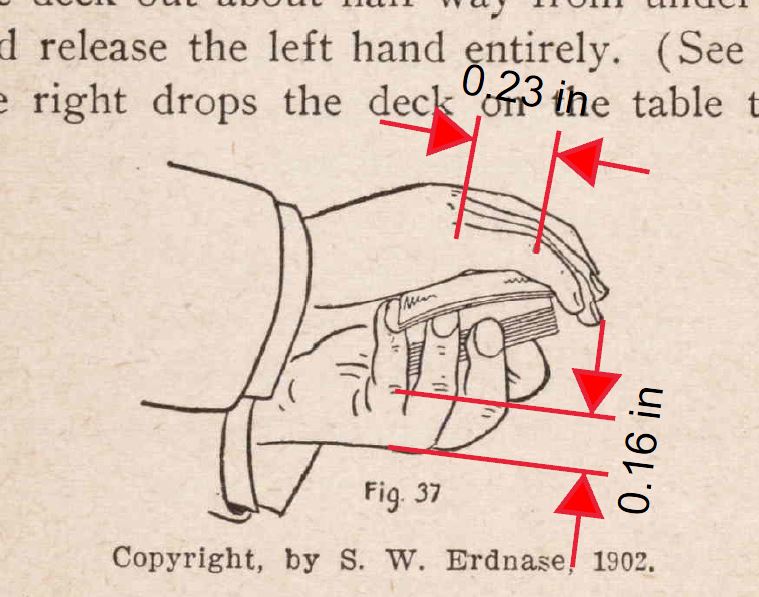
The right-hand proximal phalange is 40% longer than the one on the left hand. This is accurate drawing?
Sometimes Smith uses convergence in his drawings:

And sometimes he does not:
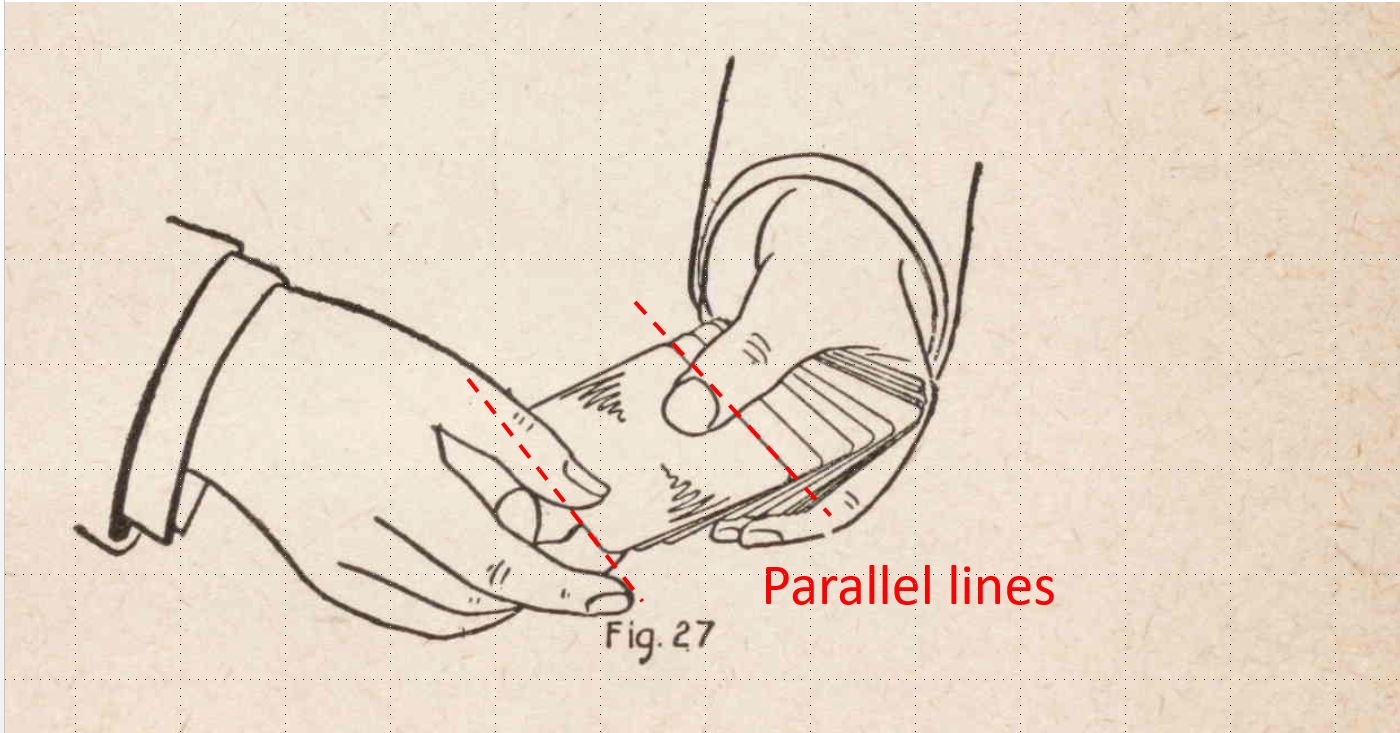
These are accurate drawings?
You simply can't rely on the drawings to reflect accurate proportions and measurements. They are illustrations designed to convey important points of handling. The exact size of the hands is not one of those points, and Smith didn't work at making the drawings to scale.
lybrary wrote:Neither is it my case, nor have I stated that Sanders exaggerates. I wrote he is a bit full of himself. All I am pointing out is that the data point we have of his height of 5'9" when he his about 50 years old is a more accurate proxy for his height when he was about 40 years old, then the data point from when he was about 20 years old.Bob Coyne wrote:You might think it helps your case, but you simply don't know that. People very commonly inflate their heights. And your camp has already said that Sanders is an exaggerator and we shouldn't necessarily believe his claims when it bolsters his overblown ego. i.e. Erdnase's "insufferable conceit" and Sanders' on himself "for he's braggin' yet."
The "your camp" remark was just a bit of humor. You can ignore it.
You're ignoring the fact that men commonly inflate their height, on average by an inch. There are studies that have measured that effect, for example this one: http://adc.bmj.com/content/90/9/941
We know a) that we have a presumably objective 3rd party rowing team 5' 8" measurement and b) that men on average over-report their heights, and c) that Sanders was a somewhat full of himself and probably in this respect too. So it seems very likely that he was 5' 8" and inflated it to make himself seem taller.
In any case, you can't present a 5' 9" height an objective fact. It's just your interpretation, and one that is likely wrong for the reasons given above.
It is further proof that they were traced from photos once you understand that Erdnase was a lefty. The photos were produced flipped to turn left-hand instructions into right-hand instructions which messed up the indices, which had to be corrected. The discrepancies in the indices are errors of that correction process. More on the handedness in my upcoming newsletter.Bill Mullins wrote:Fig 101 shows cards with 2 indices each. Fig 2 shows cards with no indices. Fig 29 shows cards with 4 indices. This is accurate drawing?
Very sloppy drawing, Bill. The right line does not correctly follow the edge. And the left edge is too short to know if it is parallel or not.Bill Mullins wrote:And sometimes he does not:
Chris, this is really nothing but wild speculation on your part! You state, as if it's a fact, that the drawings were produced from photographs that were "flipped" (the accurate term is "flopped") and that's why the indices are not standardized.
How do you make this stuff up?
How do you make this stuff up?
Details are in my ebook and in my upcoming newsletter. For example, you will remember that illustrations 99 and 100 are drawn with a left hand while the text refers to a right hand. This is another error that can easily happen in that transition from left to right. I believe they forgot to flop these two illustrations. Roterberg teaches it with the right hand.Richard Kaufman wrote:Chris, this is really nothing but wild speculation on your part! You state, as if it's a fact, that the drawings were produced from photographs that were "flipped" (the accurate term is "flopped") and that's why the indices are not standardized.
How do you make this stuff up?
You are creating a false construct based on what are far more likely to have been simple errors.
Two groups of errors both explainable by one decision to change from left- to right-handed. That is much more evidence than the complex anagram theory by David Alexander on which his entire Sanders case is built. There is zero evidence that Erdnase used anagrams.Richard Kaufman wrote:You are creating a false construct based on what are far more likely to have been simple errors.
I think it very likely that Smith's drawings were traced from photographs. But only the 29 or 30 that are truly his. The others appear to be modifications of his originals (the reconfiguration of the hands by another "artist"), and some absolutely wretched sketches done by "the amateur" himself.
Now, figure 37, which Bill cites above, is one of those I attribute to Smith. It might be that the delineation of the wrinkles and creases of the hands (indicating the length of the joints) Is slightly inaccurate, as these were probably added after the general outline of the hand was traced. Though this would affect the measurement of the joints, it is not likely to skew the overall dimensions of the hand (length, width, etc.).
As for the illustration of the cards--I believe that Smith probably drew them after he did the hands, and might not have bothered to depict them exactly as they were modeled.
Now, figure 37, which Bill cites above, is one of those I attribute to Smith. It might be that the delineation of the wrinkles and creases of the hands (indicating the length of the joints) Is slightly inaccurate, as these were probably added after the general outline of the hand was traced. Though this would affect the measurement of the joints, it is not likely to skew the overall dimensions of the hand (length, width, etc.).
As for the illustration of the cards--I believe that Smith probably drew them after he did the hands, and might not have bothered to depict them exactly as they were modeled.
How do you know that the left-hand proximal phalange isn't inclined towards the viewing plane? This would reduce its length. When you get your hand in this position you will see that this part of the pinky is not planar to the viewing plane. Keep in mind that we do see the backs of the cards, which means we are viewing this from an angle from the top and not head on from the side. I am not an illustrator, but such obvious effects of how a part of a finger is oriented which leads to an apparent length reduction should be obvious.Bill Mullins wrote:Look at the joint lengths in Fig 37.
The right-hand proximal phalange is 40% longer than the one on the left hand. This is accurate drawing?
Another error by Bill who doesn't understand perspective. If I remember this correctly then Tom Sawyer has pointed this out before on his blog. Illustration 16 is NOT incorrect. If the center of the camera is in line with the left edge of the table and the viewing direction is along that left edge of the table, that left edge of the table will come out perfectly perpendicular to the front edge, which runs parallel to the camera. But the somewhat to the right positioned deck of cards would show exactly the left and right edges running at an angle (not parallel) to the left table edge. I don't have the time to set up a camera, but I remember Tom had a photo that proved that this is a correct perspective. Which is yet another proof that these were traced from photos, because I agree, that the lines look at first sight wrong. But they aren't.Bill Mullins wrote:-In Fig 16, the left edge of the table would be parallel to the left edge of the tabled portion of the deck, since the deck and table are on parallel planes, and their front edges are parallel.
lybrary wrote:There is zero evidence that Erdnase used anagrams.
Erdnase not only used anagrams he was an anagram.
And clever he was, too. Erdnase is an anagram for "arse end". I think we must be looking for someone who is British by birth and comes from a very remote location. To be specific [the arse end of nowhere
Forgive me if this next question has already been addressed, but I would like to know how the advocates of Sanders explain the apparent use of more than one "artist". Do they deny the suggestion, or do they have some clever theory?
If Sanders had plenty of money, it makes no sense for him to have paid for thirty drawings and then laboured to do the rest himself. Perhaps he called upon an old school chum to help him.
I think the obvious conclusion is that the author or "publisher" could not afford more, and had little choice but to finish the job as best he could, re-working Smith's sketches, tilting the hands at different angles to make them seem novel, putting different cards in them to illustrate various techniques, etc.
If Sanders had plenty of money, it makes no sense for him to have paid for thirty drawings and then laboured to do the rest himself. Perhaps he called upon an old school chum to help him.
I think the obvious conclusion is that the author or "publisher" could not afford more, and had little choice but to finish the job as best he could, re-working Smith's sketches, tilting the hands at different angles to make them seem novel, putting different cards in them to illustrate various techniques, etc.
lybrary wrote:How do you know that the left-hand proximal phalange isn't inclined towards the viewing plane?
Thanks, Chris, for making my point for me. We don't know in either this illustration, or in Fig 79, whether the part being measured is in the plane of the drawing or not. So it is impossible to make accurate measurements. I'm glad you understand this now.
In figure 37 one part of the pinky you measured is certainly not in plane invalidating your claim that the drawing is not correct. In figure 79, which I use, the hand is sufficiently in-plane that a measurement can be taken. A few degrees of tilt and a possibly somewhat bent hand does not mean we can't use this illustration for an estimate. As I have shown, you can add 13 mm (almost 8%) to my measurement of the length of the hand and still get to 5'4" as the center of the distribution from empirical data Bob has posted. Despite variations and noise, illustration 79 allows one to take an estimate of the hand size of Erdnase, and thus allows an estimate of his stature. This is a completely reasonable and rational evaluation of the evidence we have. The fact that it matches what Smith told us about Erdnase's stature makes it that much more compelling. It is more solid evidence than many other things that have been discussed on this thread.Bill Mullins wrote:lybrary wrote:How do you know that the left-hand proximal phalange isn't inclined towards the viewing plane?
Thanks, Chris, for making my point for me. We don't know in either this illustration, or in Fig 79, whether the part being measured is in the plane of the drawing or not. So it is impossible to make accurate measurements. I'm glad you understand this now.
jkeyes1000 wrote:I think it very likely that Smith's drawings were traced from photographs.
From The Gardner-Smith Correspondence, page 8 -
"10. Smith (who was about 25 then, he says) sketched his hands in pencil, then took them home to ink them in."
Somebody needs to do their homework!
Zenner wrote:jkeyes1000 wrote:I think it very likely that Smith's drawings were traced from photographs.
From The Gardner-Smith Correspondence, page 8 -
"10. Smith (who was about 25 then, he says) sketched his hands in pencil, then took them home to ink them in."
Somebody needs to do their homework!
It is entirely possible (within the context of the quote you provided), for Smith to have traced the outlines of the hands in pencil, and taken the sketches home to add the details. This is actually the way I had supposed it was done.
Are you unaware that my opinions support your candidate? While I do believe that Gallaway was instrumental in the publication of EATCT, I think Benedict is the most reasonable choice amongst the proposed authors.
Yes, and that would be you Peter. Here is what Gardner wrote about Smith:Zenner wrote:jkeyes1000 wrote:I think it very likely that Smith's drawings were traced from photographs.
From The Gardner-Smith Correspondence, page 8 -
"10. Smith (who was about 25 then, he says) sketched his hands in pencil, then took them home to ink them in."
Somebody needs to do their homework!
"He recognized his lettering on the book pictures, but not the drawings themselves. He thinks it strange he can’t recall doing the drawings, which must have been big job, so probably did them from photographs."
Further to that, if you compare the lettering on the illustrations they all look similar, for all illustrations. This negates the multiple artist theory. Why would Smith number illustrations he didn't do?
Here is my theory about the illustrations and how they were done. In the Gardner-Smith notes we find this comment:
With 'this' he meant inking in the drawings. I do think the vast majority of them were traced from photos. Once Smith had them traced in pencil Erdnase looked them over. At that point Erdnase may have requested that some be modified. Perhaps he was not happy with the position of some fingers. Maybe he wanted other changes. Smith would then modify the illustrations without the benefit of a photo. He would alter his pencil traces which may be the reason why some illustrations are better and some are worse. I can also imagine that Erdnase may have requested to add a few more illustrations which Smith would then have sketched from life without tracing a photo. Perhaps those are the ones jkeyes1000 has labeled 'from amateur'. Either way, once Erdnase was happy and the sequence/numbering was established, Smith inked them and numbered them. In other words, all were done by Smith. Most were purely traced from photos, some were traced and then modified, and a few were done without photos.He recalls that Andrews had to O. K. each drawing before he did this.
lybrary wrote:Yes, and that would be you Peter. Here is what Gardner wrote about Smith:Zenner wrote:jkeyes1000 wrote:I think it very likely that Smith's drawings were traced from photographs.
From The Gardner-Smith Correspondence, page 8 -
"10. Smith (who was about 25 then, he says) sketched his hands in pencil, then took them home to ink them in."
Somebody needs to do their homework!"He recognized his lettering on the book pictures, but not the drawings themselves. He thinks it strange he can’t recall doing the drawings, which must have been big job, so probably did them from photographs."
Further to that, if you compare the lettering on the illustrations they all look similar, for all illustrations. This negates the multiple artist theory. Why would Smith number illustrations he didn't do?
All one need do to substantiate the multiple artist theory is to refer to figures 77, 78, 89, 90, 91 and 92.
These are hen-scratchings! They are positively not the work of a commercial illustrator, and there is no way that they were traced from photographs. The proportions and contortions were depicted with a free hand, and an untrained one at that.
I don't agree, but then again I am not an illustrator. The only thing I would note that all these illustrations you listed require the hand to be in a particularly strained position, especially for a small hand. That means the fingers are in unusual positions. For example, I don't see what is so bad with illustration 77 or 91.jkeyes1000 wrote:All one need do to substantiate the multiple artist theory is to refer to figures 77, 78, 89, 90, 91 and 92.
These are hen-scratchings! They are positively not the work of a commercial illustrator, and there is no way that they were traced from photographs. The proportions and contortions were depicted with a free hand, and an untrained one at that.
But we may get an interesting new set of data. Joe Crist just published his version of Expert, where each illustration was exchanged with a photo showing his hands. I have not yet seen the book, but my expectation is that the photos try to replicate the illustrations as closely as possible. One could then trace the photos for the illustrations you listed and compare.
lybrary wrote: but then again I am not an illustrator.
From your ebook:
I am not an expert in poetry
I am not a print estimator,
Yet you expound on all these topics.
lybrary wrote:But we may get an interesting new set of data. Joe Crist just published his version of Expert, where each illustration was exchanged with a photo showing his hands.
David Ben has already gone down this road, with The Experts at the Card Table (photographs by Julie Eng.)
Because I take the time to talk and work with experts. I have consulted expert linguists, expert handwriting analysts, pro magicians, printers, experts in print history, experts in pre WWII print technology, professional historians in various fields, graphic artists, pro genealogists, countless English native speakers, and many more. If you would do the same you would learn a lot, like how perspective works.Bill Mullins wrote:lybrary wrote: but then again I am not an illustrator.
From your ebook:I am not an expert in poetryI am not a print estimator,
Yet you expound on all these topics.
lybrary wrote: Further to that, if you compare the lettering on the illustrations they all look similar, for all illustrations.
Eoin O'Hare has uploaded all the figures to a single page. Compare the "g" in Fig. 33 (big loop, small descender) to the "g" in Fig. 32 (small loop, big descender). Sometimes "Fig." has a period, sometimes it doesn't. Sometimes the descender in "g" is full (Fig. ), sometimes it is partial (Fig. 64). Sometimes the second digit of a figure number is larger, sometimes it isn't.
While drawing is hard, neat lettering is within the grasp of almost anyone. Instruction existed in Smith's time. He did sloppy work.
It is one of your most silly points you have made in past months. Smith was an illustrator not a sign painter. The lettering looks nice and is as consistent as one would expect handwriting to be. He might have expected that the figure numbers would be typeset rather than left as they are and didn't pay particular attention to them.Bill Mullins wrote:Eoin O'Hare has uploaded all the figures to a single page. Compare the "g" in Fig. 33 (big loop, small descender) to the "g" in Fig. 32 (small loop, big descender). Sometimes "Fig." has a period, sometimes it doesn't. Sometimes the descender in "g" is full (Fig. ), sometimes it is partial (Fig. 64). Sometimes the second digit of a figure number is larger, sometimes it isn't.
While drawing is hard, neat lettering is within the grasp of almost anyone. Instruction existed in Smith's time. He did sloppy work.
Another problem with figure 79 is the proportions of the fingers. Why is the pinky so long?
The pinky in this illustration is almost as long as the other fingers and extends to the bottom of the nail on the ring finger. Normally, a pinky is roughly at the last joint on the ring finger. This is not a normal looking hand. The only other explanation I can think of is that the other fingers are bent, making them appear shorter than they are.
Either explanation is deadly for Chris's hand size calculations.
The pinky in this illustration is almost as long as the other fingers and extends to the bottom of the nail on the ring finger. Normally, a pinky is roughly at the last joint on the ring finger. This is not a normal looking hand. The only other explanation I can think of is that the other fingers are bent, making them appear shorter than they are.
Either explanation is deadly for Chris's hand size calculations.
Here is the way I see it. First, the facts:
1)Smith says he doesn't remember making all the drawings.
2)He says he believes that he only made about thirty
3)He tells us that "Erdnase" was careful with his money
Now the observations:
A)By sheer coincidence, the illustrations that are well done (in my opinion) amount to no more than thirty
B)What can the phrase "careful with his money" (or words to that effect) possibly mean, if not "reluctant to pay for artwork that was not absolutely necessary"? Was Smith suggesting that the author was too stingy to provide coffee and doughnuts?
C)Some of the illustrations are so bad that it is impossible to believe that "Erdnase" (the miser) would have approved of them, let alone paid for them.
Inferences:
If Smith believed that he only sold about thirty drawings to "Erdnase"--yet he doesn't actually recall the amount of work--it is a fair assumption that he based this number on the money he received for it. I'm guessing that he got no more than $1.00 per sketch (does anyone know?), so he might have remembered a cheque for $30.
And it is clear that many of the "mediocre" drawings are re-configurations of Smith's work. Why--if these were also by Smith--are they markedly inferior? Why are the lines rougher (the sign of an amateur), and why are the proportions distorted in the re-makes?
Conclusion:
"Erdnase" could only afford (or was only willing) to pay for thirty drawings. He cleverly decided that he could use the thirty illustrations in various ways, that he could economise, by recycling Smith's figures in order to complete the book. In a few instances, the fingering was so unusual that he needed to draw his own illustrations. Which were crap, but at least he got it done and saved some cash!
1)Smith says he doesn't remember making all the drawings.
2)He says he believes that he only made about thirty
3)He tells us that "Erdnase" was careful with his money
Now the observations:
A)By sheer coincidence, the illustrations that are well done (in my opinion) amount to no more than thirty
B)What can the phrase "careful with his money" (or words to that effect) possibly mean, if not "reluctant to pay for artwork that was not absolutely necessary"? Was Smith suggesting that the author was too stingy to provide coffee and doughnuts?
C)Some of the illustrations are so bad that it is impossible to believe that "Erdnase" (the miser) would have approved of them, let alone paid for them.
Inferences:
If Smith believed that he only sold about thirty drawings to "Erdnase"--yet he doesn't actually recall the amount of work--it is a fair assumption that he based this number on the money he received for it. I'm guessing that he got no more than $1.00 per sketch (does anyone know?), so he might have remembered a cheque for $30.
And it is clear that many of the "mediocre" drawings are re-configurations of Smith's work. Why--if these were also by Smith--are they markedly inferior? Why are the lines rougher (the sign of an amateur), and why are the proportions distorted in the re-makes?
Conclusion:
"Erdnase" could only afford (or was only willing) to pay for thirty drawings. He cleverly decided that he could use the thirty illustrations in various ways, that he could economise, by recycling Smith's figures in order to complete the book. In a few instances, the fingering was so unusual that he needed to draw his own illustrations. Which were crap, but at least he got it done and saved some cash!
jkeyes1000 wrote: Are you unaware that my opinions support your candidate? While I do believe that Gallaway was instrumental in the publication of EATCT, I think Benedict is the most reasonable choice amongst the proposed authors.
Thankyou! I was unaware - I thought that you supported the Benedict theory for a while but then I got the impression that you had strayed off.
Gallaway may have had something to do with the setting up of the type, or whatever, but I think that Chris has wasted a lot of time and expense in his quest to prove that he wrote the book or was even capable of doing so. The only thing that he did which has proved to be beneficial is the tracking down of - and making available - the McKinney files. Spotting E.D. Benedict in there was well worth my $15.00!
lybrary wrote:Despite variations and noise, illustration 79 allows one to take an estimate of the hand size of Erdnase, and thus allows an estimate of his stature. This is a completely reasonable and rational evaluation of the evidence we have. The fact that it matches what Smith told us about Erdnase's stature makes it that much more compelling. It is more solid evidence than many other things that have been discussed on this thread.
Your calculations based on illustration 79 is solid evidence?
The hands in Fig 11 are enormous. I'd say based on those, Erdnase must have been at least 6'4" !!
But seriously, there are so many anomalies and inconsistencies in these illustrations (hand sizes, finger lengths, card widths, etc) that it's impossible to infer anything about the actual hands being depicted, much less Erdnase's height. And claiming to know his height with any precision based on these illustrations is absolutely absurd.
But seriously, there are so many anomalies and inconsistencies in these illustrations (hand sizes, finger lengths, card widths, etc) that it's impossible to infer anything about the actual hands being depicted, much less Erdnase's height. And claiming to know his height with any precision based on these illustrations is absolutely absurd.
Leonard Hevia wrote:I found some words written by Sanders from the reunion book that match:
1. with UNWHISPERED request
2. humour would FLASH and beam in him as FLASH the lightnings
I noticed something very interesting about FLASH. Erdnase uses the word six times to describe the speed of certain sleights being performed; and in three of those he mentions the absence of sound. In one case, however, he refers to particular sound, a "snap and crack", clearly of lightning.
Erdnase: The shift can be MADE LIKE A FLASH, and with the cards in perfect order. When executed perfectly, the ONLY SOUND is the slipping of one packet over the other. There is NO SNAP OR CRACK, and it is in every way worthy of the practice necessary to acquire it.
Significantly, when Sanders uses the term FLASH, he mentions lightning explicitly and even invokes the way lightning forms on a warm midsummer day. The metaphorical FLASH has become literal.
Sanders: enjoyed the added WARMTH UPON A MIDSUMMER DAY, ... mirth and humor would FLASH and beam in him as FLASH the LIGHTNINGS of his beloved Physics.
It could be argued that the sound of a shift is as important an aspect as the speed. While this is true, it would be unusual to characterize the sound as a snap and crack independently of the flash of lightning metaphor. In both texts, the author used the term figuratively but tied it to its literal roots.
Lets compare some statements made here on this thread about Smith's drawings:
1) The opinion of Bob Coyne, who as far as we can tell, has not produced a single illustration for a magic book:
2) The opinion of Bill Mullins, who as far as we can tell, has not produced a single illustration for a magic book. He has also proven to us that he doesn't understand perspective:
3) The opinion of Richard Kaufman who has done several thousand of illustrations for magic books:
1) The opinion of Bob Coyne, who as far as we can tell, has not produced a single illustration for a magic book:
Bob Coyne wrote:But seriously, there are so many anomalies and inconsistencies in these illustrations (hand sizes, finger lengths, card widths, etc) that it's impossible to infer anything about the actual hands being depicted, much less Erdnase's height.
2) The opinion of Bill Mullins, who as far as we can tell, has not produced a single illustration for a magic book. He has also proven to us that he doesn't understand perspective:
In other words, both Bob and Bill consider the drawings not correctly proportioned, badly and sloppily done.Bill Mullins wrote:dimensions aren't consistent ... This is accurate drawing? ... These are accurate drawings? ... He did sloppy work.
3) The opinion of Richard Kaufman who has done several thousand of illustrations for magic books:
I wonder, who is more credible?Richard Kaufman wrote:These illustrations could not have been sketched from life. It seems impossible to me that this degree of anatomical accuracy could have reproduced from quick sketches made from looking at Erdnase's hands. My own experience forces me to assume that they have been traced from photographs.
who is more credible?
the person not engaging in basic logical fallacies
https://en.m.wikiquote.org/wiki/Argument_from_authority
the person not engaging in basic logical fallacies
https://en.m.wikiquote.org/wiki/Argument_from_authority
I hope that next time you need surgery that the guy or gal operating on you is not a medical doctor, not an expert, because you certainly do not want to fall prey to basic logical fallacies.Brad Henderson wrote:who is more credible?
the person not engaging in basic logical fallacies
https://en.m.wikiquote.org/wiki/Argument_from_authority
Richard's statement, as quoted above, is true of some of the illustrations. But I wonder whether he would positively assert that all of the drawings seem to be equally well proportioned.
Figures 77, 78, 89 and 90 are the worst in the book. In my opinion, they are clearly free-hand sketches, and are certainly not up to Smith's standards.
Figures 77, 78, 89 and 90 are the worst in the book. In my opinion, they are clearly free-hand sketches, and are certainly not up to Smith's standards.
lybrary wrote:I hope that next time you need surgery that the guy or gal operating on you is not a medical doctor, not an expert, because you certainly do not want to fall prey to basic logical fallacies.Brad Henderson wrote:who is more credible?
the person not engaging in basic logical fallacies
https://en.m.wikiquote.org/wiki/Argument_from_authority
so are you ignorant of the fallacy in which you engage or just deflecting now?
lybrary wrote:I hope that next time you need surgery that the guy or gal operating on you is not a medical doctor, not an expert, because you certainly do not want to fall prey to basic logical fallacies.
You're compounding your illogic. There are at least three separate issues involved:
1) whether the hands are consistently drawn and with normal proportions and dimensions. i.e. Do they look real. This requires primarily that one be a normal human who can navigate through the world and reflect on what they see. If you can recognize one face from another or can identify a person from the idiosyncratic way they walk, then you're sensitive to proportions and dimensions. The inconsistent and poor quality of the majority of these illustrations has been commented on by many people over many years. Some of them look absolutely freakishly wrong. Noticing that is completely different than being able to draw hands accurately.
2) whether there is enough accuracy in all the steps and sources in your inferential pipeline to draw conclusions about Erdnase's height. This requires the ability to think logically and judge what data means. A completely different set of skills, one that is much more technical and analytical.
3) what can we conclude about the process by which they were drawn (i.e. from sketched life or traced or both and if there were multiple "illustrators"). I'd expect that illustrators, printers, publishers, and the like would have extra insight and knowledge pertinent to this aspect. However, this is really a peripheral issue and not relevant to the quotes you pulled from Bill and me, which were about the quality of the drawings themselves (and your inferences from them), not how they were made. And, even here, various non-artistic aspects come to play. e.g. historical data on what we know about Smith's other work etc.
So, right, you shouldn't ask a non-doctor to perform surgery or ask me to illustrate a book for you. But I'm perfectly capable and confident in my ability to judge whether they're consistently and accurately drawn and whether your conclusions are warranted.
Perhaps there are aspects of them that indicate to Richard that they were traced from photos. Or perhaps from experience he knows how long it would take to draw them all from life, and that would have been impossible given the brief session Smith had with Erdnase. But none of that changes the fact that a) they're not realistically and consistently drawn and b) that you can't conclude anything to any level of specificity about Erdnase's height from them.
I think that some of you are failing to see the proverbial "forest for the trees"
Chris insists that there was only one artist, presumably because this presumption supports his contention that Erdnase was short. But it is not necessary to calculate the man's height in order to eliminate Sanders. If Chris were to concede that there were apparently two artists, then the Sanders advocates would have a hard time explaining why he didn't simply pay one artist to do all of the work.
And the advocates of Sanders, such as Bob, seem to be arguing against Chris solely because they must find fault wherever they can. The irony is that they are compromising their own case by admitting that there might have been more than one illustrator.
Chris insists that there was only one artist, presumably because this presumption supports his contention that Erdnase was short. But it is not necessary to calculate the man's height in order to eliminate Sanders. If Chris were to concede that there were apparently two artists, then the Sanders advocates would have a hard time explaining why he didn't simply pay one artist to do all of the work.
And the advocates of Sanders, such as Bob, seem to be arguing against Chris solely because they must find fault wherever they can. The irony is that they are compromising their own case by admitting that there might have been more than one illustrator.
The biggest clue for me why I think there was only one artist and the artist was Smith is the lettering of the figure numbers. They show a consistent handwriting by one person. Smith recognized this handwriting as his. Therefore he wrote those figure numbers. There is no other explanation I can think of than he made all the illustrations.jkeyes1000 wrote:Chris insists that there was only one artist, presumably because this presumption supports his contention that Erdnase was short.
lybrary wrote:.... Smith recognized this handwriting as his. Therefore he wrote those figure numbers. There is no other explanation ...
no chance of copy and paste?
lybrary wrote:The biggest clue for me why I think there was only one artist and the artist was Smith is the lettering of the figure numbers. They show a consistent handwriting by one person. Smith recognized this handwriting as his. Therefore he wrote those figure numbers. There is no other explanation I can think of than he made all the illustrations.jkeyes1000 wrote:Chris insists that there was only one artist, presumably because this presumption supports his contention that Erdnase was short.
That would indeed be a significant point, if we could be sure that Smith had scrutinised the lettering under each and every drawing. However, I think that very unlikely. He probably looked at just a few.
And something else that is not clear: Did Smith recognise his hand-writing of the word "fig" alone, or the numbers as well?
It is obvious to me that many of Smith's illustrations were re-cycled; therefore it may be that the author retained the artist's lettering, but changed the digits. I see, in the pic above (fig. 37), the word "fig." is straight up, yet the numeral "37" appears to be slanted to the right.
It is obvious to me that many of Smith's illustrations were re-cycled; therefore it may be that the author retained the artist's lettering, but changed the digits. I see, in the pic above (fig. 37), the word "fig." is straight up, yet the numeral "37" appears to be slanted to the right.
why would we assume that drawings intended to illustrate moves with cards would be anatomically precise?
I have posed for photographs and illustrations and though i haven’t done it tens of thousands of times, i already know that many times the concept you wish to illustrate can not be directly or easily photographed - and illustrators can ‘cheat’ in order to best convey the most relevant information.
When we sat for a photo shoot i don’t know how many hundreds we shot in an effort to get the one that actually worked, and even then we did an editing process after.
and that’s with digital photographs that costs nothing per snap.
some seem to be assuming that 1) the photos taken (if any) would be worthy of tracing. 2) we also assume that whomever was directing the project held the myopic view of valuing realism over the constance of accurate information.
I have posed for photographs and illustrations and though i haven’t done it tens of thousands of times, i already know that many times the concept you wish to illustrate can not be directly or easily photographed - and illustrators can ‘cheat’ in order to best convey the most relevant information.
When we sat for a photo shoot i don’t know how many hundreds we shot in an effort to get the one that actually worked, and even then we did an editing process after.
and that’s with digital photographs that costs nothing per snap.
some seem to be assuming that 1) the photos taken (if any) would be worthy of tracing. 2) we also assume that whomever was directing the project held the myopic view of valuing realism over the constance of accurate information.
and if they were traced from photos, who took them?
Also, the photographer would be one more person having contact with Erdnase and one more to pay.
Brad Henderson wrote:why would we assume that drawings intended to illustrate moves with cards would be anatomically precise?
I have posed for photographs and illustrations and though i haven’t done it tens of thousands of times, i already know that many times the concept you wish to illustrate can not be directly or easily photographed - and illustrators can ‘cheat’ in order to best convey the most relevant information.
When we sat for a photo shoot i don’t know how many hundreds we shot in an effort to get the one that actually worked, and even then we did an editing process after.
and that’s with digital photographs that costs nothing per snap.
some seem to be assuming that 1) the photos taken (if any) would be worthy of tracing. 2) we also assume that whomever was directing the project held the myopic view of valuing realism over the constance of accurate information.
I don't think that anatomical accuracy was an objective of either the author of the artist. It was a mere consequence of illustrating in the easiest and cheapest way--tracing.
Which is another reason to doubt Sanders. If this was a labour of love, a vanity edition, why would he approve of such a thrifty and aesthetically null method? Smith was probably chosen because he would do the job for very little money.
what was the state of photography in the early 1900’s? did smith mention the lighting in the room? how much was spent on the developing? was he a photographer? did he mention anyone else there? did erdnase have the photos already and just hand them to him? i don’t recall anyone else mentioned by smith in the meeting nor him discussing receiving pictures or taking them. One would think that a photoshoot would have been memorable.
jkeyes1000 wrote:And the advocates of Sanders, such as Bob, seem to be arguing against Chris solely because they must find fault wherever they can. The irony is that they are compromising their own case by admitting that there might have been more than one illustrator.
1. Although not an advocate of Sanders, exactly, I'm arguing against Chris because he has been so dogmatic about the case for Gallaway, and so contemptuous of the evidence for the other candidates, and of those who advocate for them. If, two years ago, he had said, "I think Gallaway is more interesting than has been previously recognized. Here's some stuff that makes me think it's possible that he was Erdnase. What do you guys, who have been studying this problem for years, think?", then the tone of the Erdnase thread since then would have been much different, and more collegial. I, and I bet many others, would have been more accepting of the things that do support the case, and less confrontational on the things that work against it. In other words, he'd have been treated more like Hatch, and Alexander, and Demarest, and Richard Wiseman, and others, who have seriously offered candidates and treated the process as a group mystery to be solved. That's sort of how he started, but it soon evolved to (and I quote from his ebook): "Erdnase has been found." And he started being aggressively confrontational with those who disagreed with that conclusion, or who pointed out weaknesses in his arguments.
Chris says a lot of stuff, and when he does so, it comes across as "Here is an obvious truth; you must be a fool not to recognize it." And it's offensive. Sometimes he exaggerates, but a lot of the time, he's just wrong. Sometimes, he has some facts to support the case and sometimes he's simply stating an opinion, but he seldom distinguishes between the two. He conflates the idea that something is possible -- we don't know anything that certainly rules it out -- with it being likely, or a reasonable explanation for the issue in question.
For example, "Why would the author use "Erdnase" as a pseudonym?" -- to me, this is a question that has to be answered to accept a candidate. Most of the major candidates have a good explanation. They would take their own name, and reverse or scramble it to get the pseudonym. Authors have been doing this for a long time. Magicians have been doing this for a long time. It is not at all something that strains credulity.
That answer doesn't apply to Gallaway, however. There is no good explanation for why Gallaway would use "Erdnase" as a pseudonym. It is a hole in the case for Gallaway. Which is fine -- all of the major candidates have holes in their respective cases. Even if Chris accepted this, it's not something that rules Gallaway out of contention. It is just a piece of the puzzle about him that remains to be filled in.
But instead of doing this, Chris makes up some wild explanation about Gallaway was called "earth-nose" and he translated that into German and used it as a pseudonym. The facts about Gallaway that support this are slim, to be sure: he spoke German as a kid, and "Erdnase" was a word back then. That's it. The argument could apply equally well to Sanders (or Houdini!). Millions of other Americans also spoke German at the time. Do we have any evidence that any of them ever was called "Erdnase" or "Earth-nose"? No. He's found evidence that some contemporary people have been called this, but nothing that is before 1900. Or even more than a couple of decades ago. And yes, "Erdnase" did appear as a co-location of two words in some very specialized books in the 19th century, but there's no evidence that anyone actually used the term commonly enough that it would reasonably be considered as a nickname.
Yet Chris says "it is at least as good a theory as the reverse spelling one". No, it isn't. Multiple people have used the reverse spelling process to arrive at their pseudonyms, and many have been listed in this thread. But no one in history has ever taken a nickname from a hundred years in the future, that happens to obviously reverse to a common name, and used it for their pseudonym. The chain of events that Chris posits for Gallaway to arrive at "S. W. Erdnase" for a pseudonym takes several steps, each astronomically unlikely. But he says "it fits perfectly", and denigrates those who support the reversal/anagram theory.
And this is where it gets offensive. Doing stuff like this is intellectually dishonest in two ways: It amplifies the case for his candidate, in ways that aren't legitimate; and it attacks the case for other candidates by equating the the reversal/anagram theory (which is core to several candidates, and is reasonable and substantiated with real-world examples) with the German nickname theory, which is a pipe dream.
I could go on. He attacks people, instead of their arguments (so much so that I find myself doing it back to him, which I shouldn't); he neglects crediting the work of others which he uses, or gets the credit wrong; he uses data and information which he does not reveal the source of; when he does technical analysis, he ignores error bars (which really pushes my own engineer buttons); he refuses to accept hard data that invalidates his claims (Houdini and Gallaway weren't in the circus at the same time, so they could not have exchanged moves in that context); and he exaggerates, and mis-states facts (sometimes so deliberately that I think it is reasonable to use the word "lie").
So, yes, I argue against Chris, but not "because they must find fault wherever they can". I do it to hold his feet to the fire, to test his arguments, to figure out which parts of what he is saying are legitimate and which are specious, and to ultimately determine what is the legitimate case for Gallaway, and how does it compare to the other candidates. Chris throws everything against the wall, and assumes it all sticks. Well, some of it slides to the floor, but it's hard to figure out which solely from Chris's writings. I've been researching Gallaway for ten years, and he is, at a minimum, a "person of interest". But I feel fairly confident that the evidence known to date does not suggest he was Erdnase.
2. I don't see how saying that there is more than one illustrator compromises the case for Sanders more than it compromises it for Gallaway or any of the other candidates. (and note - I'm not particularly saying that there was more than one illustrator. I'm saying that the drawings are not so consistent that you can use their consistency to show that they only could have come from one illustrator; in other words, I'm rebutting Chris's statement to that effect)
Bill: Your previous post would make a good novella.
The main problem with the Sanders theory--in the event that we find reason to believe in more than one artist--is that this other artist was not credited.
If he were merely another illustrator hired to finish the job that Smith started, his name ought to have been mentioned--don't you think?
The only reasonable explanation for additional, yet anonymous drawings, is that the author provided them and tried to pass them off as the work of a proper artist.
The main problem with the Sanders theory--in the event that we find reason to believe in more than one artist--is that this other artist was not credited.
If he were merely another illustrator hired to finish the job that Smith started, his name ought to have been mentioned--don't you think?
The only reasonable explanation for additional, yet anonymous drawings, is that the author provided them and tried to pass them off as the work of a proper artist.
I asked Gregg Webb about his opinion on the illustrations in Expert. Gregg is a graphical artist, teaches at Pratt institute, and does his own illustrations for his magic books (many of which can be found here https://www.lybrary.com/gregg-webb-m-215953.html ). His last trilogy (SOHO) was even hand lettered. Great material BTW. Another expert that Brad tells us to dismiss, but I prefer to take them serious. His opinion is that the illustrations were done by one artist and that they were traced from photos. He also made some interesting comments regarding the 'drawings from life' comment. He wrote: "...in those days nobody wanted to admit tracing. To this day if you go to art exhibits, you'll find that especially European artists will not admit using photo reference. Their agents tell them their price will go down if they ever admit."
And for the record, because Bill Mullins makes a habit to misrepresent my published opinion, I have two name theories which I consider about equally likely for Gallaway. One is the German nickname theory, the other is the Edward-Subterfuge-and-Ruse-becoming-E.S.-Andrews-spelled-backwards theory. As my thinking stands now I actually do prefer somewhat the 'Edward Subterfuge and Ruse' theory.
And for the record, because Bill Mullins makes a habit to misrepresent my published opinion, I have two name theories which I consider about equally likely for Gallaway. One is the German nickname theory, the other is the Edward-Subterfuge-and-Ruse-becoming-E.S.-Andrews-spelled-backwards theory. As my thinking stands now I actually do prefer somewhat the 'Edward Subterfuge and Ruse' theory.
lybrary wrote:I asked Gregg Webb about his opinion on the illustrations in Expert. Gregg is a graphical artist, teaches at Pratt institute, and does his own illustrations for his magic books (many of which can be found here https://www.lybrary.com/gregg-webb-m-215953.html ). His last trilogy (SOHO) was even hand lettered. Great material BTW. Another expert that Brad tells us to dismiss, but I prefer to take them serious. His opinion is that the illustrations were done by one artist and that they were traced from photos. He also made some interesting comments regarding the 'drawings from life' comment. He wrote: "...in those days nobody wanted to admit tracing. To this day if you go to art exhibits, you'll find that especially European artists will not admit using photo reference. Their agents tell them their price will go down if they ever admit."
And for the record, because Bill Mullins makes a habit to misrepresent my published opinion, I have two name theories which I consider about equally likely for Gallaway. One is the German nickname theory, the other is the Edward-Subterfuge-and-Ruse-becoming-E.S.-Andrews-spelled-backwards theory. As my thinking stands now I actually do prefer somewhat the 'Edward Subterfuge and Ruse' theory.
Again, the question: Did he examine all of them? That is necessary in order to come to a valid conclusion.
Another expert that Brad tells us to dismiss,
please quote where i said we should dismiss greg’s opinion.
And for the record, because Bill Mullins makes a habit to misrepresent my published opinion
For someone who seems to take issue with having one’s published ‘opinion’ misrepresented, you don’t seem to mind doing it to others
There’s a word for that i think.
but hey, get back to us after you understand what the logical fallacy of appealing to authority means. Lots of people have opinions. Having one isn’t proof of anything.
Let's see how intellectually honest you are yourself. Here is what you wrote:Bill Mullins wrote:And this is where it gets offensive. Doing stuff like this is intellectually dishonest in two ways: ...
Yes, we do know a lot more, because Smith said Erdnase was a very small man no taller than 5'6". That is a lot more information than you want to admit. And you are somebody who generally takes Smith by his word. Very intellectually dishonest. Also your "range of over a foot" is intellectually dishonest, because it is not an evenly distributed error range, it is a decreasing distribution. Most cases are located closely around the center of the distribution. The farther one leaves the center the more unlikely it becomes. It is a bit like Bill's silly counter examples. While there has been one freak who could reconfigure his spine to change his height, the chances that Sanders could do that are for all practical purposes zero. While there is a possibility that the 5'9" Sanders had very small hands, it is very unlikely, particularly given what Smith stated about Erdnase's height, and what we can see in the photos of Sanders. All of that is Bill's intellectual dishonesty.Bill Mullins wrote:Any process which gives a range of over a foot in height isn't analysis, it's reading tea leaves. We know that the 6'1" Smith thought Erdnase was shorter than he was. In 1901, most everyone was shorter than 6'1". We don't know much more.
Bill and others here get upset when I state my conviction that I have found Erdnase. It would be intellectually dishonest of me not to say what I believe. That is what I believe. You can believe something else, but to excuse your attacks with my convictions is a lame excuse, and just as intellectually dishonest as so many other things here. Many responses to my newsletter completely agree with my arguments and many believe Gallaway is Erdnase, or Gallaway has the best case to be Erdnase. This thread is by no means a broad assessment of the opinion on Erdnase. It is a place where most have their favorite candidate for one or another reason, which produces not an open and objective discussion, but rather deteriorates into a match of whose dick is longer. I am simply defending my conviction against all the intellectually dishonest attacks.
lybrary wrote: Also your "range of over a foot" is intellectually dishonest, because it is not an evenly distributed error range, it is a decreasing distribution. Most cases are located closely around the center of the distribution. The farther one leaves the center the more unlikely it becomes.
There are several compounding factors that make the error range very large. It's not just the distribution of human hand-to-height ratios (which you're focusing on here). Although that, alone, is quite substantial in itself. There's also great variation among the illustrations in the book. On some, the hands look enormous relative to the cards (eg figs 5, 11, 61 to just list a few), on others they look smaller (fig 79). You're cherry picking when you base everything on one picture vs another, given the huge variation. In addition, as I pointed out, the card aspect ratios are wrong in fig 77, and the relative finger sizes are wrong in fig 79 (with the pinky extends as far as the index finger). Not to mention weird distortions throughout, with hands sometimes looking more like claws. All this sends the obvious and clear message that the illustrations are not to be trusted as an accurate source for how big his hands actually were. And yet you insist on doing just that.
And then there are major problems with how you measured the hands, (with shifting metrics/standards for where the wrist should be located, in addition to no wrist being visible in illustrations in the first place).
On top of this, there are problems with meshing your measurements and inferred hand sizes with the hand-size-to-height formulas. Those formulas don't seem self-consistent either (e.g. the renaissance body proportions approach vs the empirical data from studies). It's very easy to go astray here, as apparently the press did using Trump's hand prints to measure his hand size and feeding that into norms computed with a fingertip to wrist measurement. Bill's document on how hands should actually be measured was illuminating, and it's necessary to calibrate the measuring technique used in the empirical data (or forumulas) to your own measuring technique.
And, given all of the above, it's essential to give some sort of error analysis, spelling out the compounded error in each step and the assumptions you've made, which themselves could be in error. I haven't seen any of that, except some handwaving when people point it out.
Even though I disagree with them, I think your arguments on Smith's recollections are at least plausible interpretations. Though you paint it as a black and white, "case closed", type thing, which it isn't in the least, especially given his distant 45 year old memories. In fact I think the substantial height differential between Smith and Sanders supports his candidacy. But I find the hand size argument you're making from the illustrations to be totally implausible. You're trying to build a structure on quicksand. It would be better, as Bill suggests, to just treat it as an interesting idea that could be explored. For example, it does lead to interesting issues about whether the illustrations were traced or based on photos, whether more than one style/illustrator is detectable, etc.
Also, you don't know that Sanders was 5' 9". He could easily be 5' 8" or somewhere in between. The data isn't clear, and different reasonable interpretations are possible. So why not just accept that there's a possible range and that we just don't know?
lybrary wrote:Bill and others here get upset when I state my conviction that I have found Erdnase. It would be intellectually dishonest of me not to say what I believe. That is what I believe. You can believe something else, but to excuse your attacks with my convictions is a lame excuse, and just as intellectually dishonest as so many other things here. Many responses to my newsletter completely agree with my arguments and many believe Gallaway is Erdnase, or Gallaway has the best case to be Erdnase. This thread is by no means a broad assessment of the opinion on Erdnase. It is a place where most have their favorite candidate for one or another reason, which produces not an open and objective discussion, but rather deteriorates into a match of whose dick is longer. I am simply defending my conviction against all the intellectually dishonest attacks.
The light's on but no one's home.
A few cards short of a deck.
The elevator doesn't go all the way to the top floor.
The gates are down and the lights are flashing, but the train isn't coming.
Driveway doesn't quite reach the road.
All foam no beer.
The logs are ablaze but the chimney is clogged.
His corn bread isn't done in the middle.
Not all the dots are on the dice.
Nice cage, but no bird
Conducting without an orchestra.
An olive short of a martini.
Has a mind like steel...wool.
One player short of a solitaire game.
Would change a tire in the fast lane.
Running on 3 cylinders.
lybrary wrote:And for the record, because Bill Mullins makes a habit to misrepresent my published opinion, I have two name theories which I consider about equally likely for Gallaway. One is the German nickname theory, the other is the Edward-Subterfuge-and-Ruse-becoming-E.S.-Andrews-spelled-backwards theory.
My bad. Allow me to revise and extend my earlier remarks: "In addition to the German nickname theory, Chris has another theory which is based solely on speculation and has no evidence to support it. Neither of his theories hold water, and in no case can he point to someone who has used something similar to arrive at a pseudonym." Happy now?
It's funny to be accused of misrepresentation from someone who has on more than one occasion said that Gallaway had magic books in his library.
Yes, we do know a lot more, because Smith said Erdnase was a very small man no taller than 5'6". That is a lot more information than you want to admit.Bill Mullins wrote:Any process which gives a range of over a foot in height isn't analysis, it's reading tea leaves. We know that the 6'1" Smith thought Erdnase was shorter than he was. In 1901, most everyone was shorter than 6'1". We don't know much more.
The Gardner-Smith Correspondence book addresses Erdnase's height in two places.
1. Gardner's notes of the initial phone interview. I would view these as a paraphrase of the conversation. "Andrews was a very small man of slight build. Not over 5’ 6". About my build, but not as tall."
2. Smith's own words, in his letter to Gardner: "I’m certain I looked down. I think this fellow was about 5’6, at most 5'7". Could be he was 5’5"."
So, the best record is the second. Smith was "certain" he looked down -- consistent with what I said. Everything else is less firmly stated, but he thought it was 5'6", but put a range of 5'5" to 5'7" on it.
If you want me to concede that 5'8" is too tall, you'll have to do likewise and concede that the range of 5'2" - 5'4" is too short.
But notice how you always elide the rest of the description. "Slight build -- about my [Gardner's] build, but not as tall."
None of the photos of Gallaway show a man of slight build. Gardner was skinny, not as thick as Gallaway.
You can't have it both ways. If the Smith description is valid, it rules out Gallaway as well. If it is correct only in a general sense, it is just as reasonable to include Sanders as it is Gallaway.
There's other statements by Smith that you gloss over as well:
-"Recalls nothing to suggest he had a wife."
Gallaway was not only married but newly wed (for the second time) in late 1901.
-"Has impression he was not a Chicago man...He came from the East and N.Y."
Gallaway was a Chicago man, and from the midwest. Not from N.Y.
-"He was about 40"
Gallaway was 33 in late 1901.
-"Features were on the "sharp" rather than "blunt" side."
Gallaway's close up portrait has a reasonably broad nose and full lips. Not sharp.
-"He mentioned to Smith that he was related to Dalrymple."
There is nothing known about Gallaway to suggest he was related to Dalrymple.
-"Andrews told Smith he was a former card shark who had decided to go straight."
There is nothing known about Gallaway to suggest he had been a card shark.
Also your "range of over a foot" is intellectually dishonest, because it is not an evenly distributed error range, it is a decreasing distribution. Most cases are located closely around the center of the distribution. The farther one leaves the center the more unlikely it becomes.
I never said it was evenly distributed. I used the mean values, plus or minus one standard deviation. Which includes a little over 2/3 of the group. +/- one sigma is a pretty standard way to discuss a range of normally distributed variables. Did you not cover it in your technical education?
It is a bit like Bill's silly counter examples. While there has been one freak who could reconfigure his spine to change his height, the chances that Sanders could do that are for all practical purposes zero. While there is a possibility that the 5'9" Sanders had very small hands, it is very unlikely, particularly given what Smith stated about Erdnase's height, and what we can see in the photos of Sanders.
I don't think that Sanders could stretch or shrink his height. The example was obviously provided tongue in cheek, in rebuttal to (yet another) blanket statement you had made that was demonstrably wrong.
Bill and others here get upset when I state my conviction that I have found Erdnase.
I'm not upset. I'm saying your way of presenting a case invites, almost demands, an equally strong response.
It is a place where most have their favorite candidate for one or another reason, which produces not an open and objective discussion, but rather deteriorates into a match of whose dick is longer.
In addition to the other comments I made about Chris earlier, I left one out. He has a potty mouth.
I do not wish to seem to be a stubborn advocate of a particular point of view, but I will try one more time to explain the importance of the Multiple Artist Theory. After which, I promise to leave off.
If there were two illustrators--and only one was credited (Smith)--then the other is not likely to have been hired by the author. The other, being anonymous, was probably the author himself (Erdnase).
Now--Why, if Erdnase were capable of illustrating the book himself, would he have contracted with Smith? It would appear that the author knew that he was inept, and therefore needed a professional illustrator.
So--he pays Smith for thirty sketches, and then decides that he doesn't need the commercial artist to finish the job. He fancies that, even though he is no artist, he can reconfigure Smith's drawings and modify them with some degree of success.
The reason why this hypothesis is significant is that it indicates a thrifty publisher. Further--it suggests a man who is willing to work on the illustrations himself in order to economise.
Can this be Sanders? That would be a difficult argument to make.
It could certainly be either Gallaway or Benedict.
We have opinions from illustrators such as Richard Kaufman and Greg Webb, both of whom have implied--but to my knowledge, never explicitly asserted--that having thoroughly examined and minutely compared each and every sketch, they are all the product of a single artist. I would urge that these figures be more closely scrutinised, as this matter is crucial to our understanding of the motive, the character, and the true identity of "Erdnase".
If there were two illustrators--and only one was credited (Smith)--then the other is not likely to have been hired by the author. The other, being anonymous, was probably the author himself (Erdnase).
Now--Why, if Erdnase were capable of illustrating the book himself, would he have contracted with Smith? It would appear that the author knew that he was inept, and therefore needed a professional illustrator.
So--he pays Smith for thirty sketches, and then decides that he doesn't need the commercial artist to finish the job. He fancies that, even though he is no artist, he can reconfigure Smith's drawings and modify them with some degree of success.
The reason why this hypothesis is significant is that it indicates a thrifty publisher. Further--it suggests a man who is willing to work on the illustrations himself in order to economise.
Can this be Sanders? That would be a difficult argument to make.
It could certainly be either Gallaway or Benedict.
We have opinions from illustrators such as Richard Kaufman and Greg Webb, both of whom have implied--but to my knowledge, never explicitly asserted--that having thoroughly examined and minutely compared each and every sketch, they are all the product of a single artist. I would urge that these figures be more closely scrutinised, as this matter is crucial to our understanding of the motive, the character, and the true identity of "Erdnase".
Reverse spelling and complex anagrams are also merely theories without any evidence. There are plenty of authors who have chosen pseudonyms which were not derived via an anagram.Bill Mullins wrote:My bad. Allow me to revise and extend my earlier remarks: "In addition to the German nickname theory, Chris has another theory which is based solely on speculation and has no evidence to support it. Neither of his theories hold water, and in no case can he point to someone who has used something similar to arrive at a pseudonym."
And you are wrong again. This was not a phone interview. It was in person. Gardner met Smith. How could Gardner otherwise write: "When I said Andrews, his face lighted up..." I don't think they had a video phone chat.Bill Mullins wrote:The Gardner-Smith Correspondence book addresses Erdnase's height in two places.
1. Gardner's notes of the initial phone interview. I would view these as a paraphrase of the conversation. "Andrews was a very small man of slight build. Not over 5’ 6". About my build, but not as tall."
Again very dishonest of you. This second statement resulted after Gardner repeatedly presented the tall MFA and he tried as hard as he could to push Smith higher. That is not at all the 'best record'. His first uninfluenced statement is by far more credible.Bill Mullins wrote:2. Smith's own words, in his letter to Gardner: "I’m certain I looked down. I think this fellow was about 5’6, at most 5'7". Could be he was 5’5"."
So, the best record is the second. Smith was "certain" he looked down -- consistent with what I said.
No it is not, because Smith never defines a lower boundary. Please tell us where Smith defines his lower boundary for the height. All we have is Gardner pushing him higher and higher. Never do they discuss the lower end.Bill Mullins wrote:If you want me to concede that 5'8" is too tall, you'll have to do likewise and concede that the range of 5'2" - 5'4" is too short.
The photos show Gallaway in his mid 50s. He would have met Smith when he was 33. Many put on weight when they get older. But I don't agree that Gallaway was fat even in the photos we have of him. One photo has him leaning weirdly which makes it look like he has a belly, but it might just be the way he sits or leans. The second photo does not suggest he has a belly.Bill Mullins wrote:But notice how you always elide the rest of the description. "Slight build -- about my [Gardner's] build, but not as tall." None of the photos of Gallaway show a man of slight build.
None of these things are as immutable and as observable as height and eye color are. Erdnase could have made up the Dalrymple comment. Judging from where somebody comes based on how they speak works sometimes and fails sometimes. Judging somebodies age can be off by several years. Additionally Smith never defines a lower boundary, so we do not know how young Erdnase could have been according to Smith. The photos we have of Gallaway are when he is a senior. Beyond his height and eye color it is not knowable if he was thin or fat when he was younger. Age and being from a particular region is a highly subjective estimate, nowhere as clearly observable as height and eye color. How would Smith know if he was married or not? Not everybody wears a wedding band. All of the things you say disprove Gallaway are no reasons to exclude him or anybody else, because they cannot directly be observed by Smith. They are merely his opinions and best guesses. Height and eye color, if you believe Smith is correct in his recollections, are hard reasons to exclude somebody, because they can't be changed and they are directly observable by Smith.Bill Mullins wrote:You can't have it both ways. If the Smith description is valid, it rules out Gallaway as well. If it is correct only in a general sense, it is just as reasonable to include Sanders as it is Gallaway.
There's other statements by Smith that you gloss over as well:-"Recalls nothing to suggest he had a wife."
Gallaway was not only married but newly wed (for the second time) in late 1901.
-"Has impression he was not a Chicago man...He came from the East and N.Y."
Gallaway was a Chicago man, and from the midwest. Not from N.Y.
-"He was about 40"
Gallaway was 33 in late 1901.
-"Features were on the "sharp" rather than "blunt" side."
Gallaway's close up portrait has a reasonably broad nose and full lips. Not sharp.
-"He mentioned to Smith that he was related to Dalrymple."
There is nothing known about Gallaway to suggest he was related to Dalrymple.
-"Andrews told Smith he was a former card shark who had decided to go straight."
There is nothing known about Gallaway to suggest he had been a card shark.
In the context I made the comment it was not wrong, because common sense, and having a meaningful and sensible discussion excluded it. But that is not what you want to have.Bill Mullins wrote:I don't think that Sanders could stretch or shrink his height. The example was obviously provided tongue in cheek, in rebuttal to (yet another) blanket statement you had made that was demonstrably wrong.
Since you have this arrogant and ignorant view I am quoting from an article by Leopoldo Costa which you can read in full here https://stravaganzastravaganza.blogspot ... names.htmlBill Mullins wrote:My bad. Allow me to revise and extend my earlier remarks: "In addition to the German nickname theory, Chris has another theory which is based solely on speculation and has no evidence to support it. Neither of his theories hold water, and in no case can he point to someone who has used something similar to arrive at a pseudonym." Happy now?
Nicknames play an important role in the creation of pseudonyms. A person is given a nickname and adopts it, or becomes so widely known by it that it replaces the original name. The distinction between an adopted nickname and an adopted new name can be very fine. The criterion is usually whether the person becomes mainly or solely known by the adopted nickname or not. Thus the U.S. pool player Minnesota Fats is generally known by his nickname rather than his original formal name, Rudolf Walter Wanderone, Jr. The same goes for the many musical performers nicknamed “Big,” such as Big Bopper, who was exclusively billed under this name rather than his birth name, Jiles Perry Richardson, Jr.
Like all pseudonyms, nicknames can be in any language, including the two quoted above for Roman emperors. Caracalla was so dubbed for a type of cloak he designed, from a Latin word of Gaulish origin, while Caligula was given a name meaning “little boots,” a nickname bestowed when the emperor-to-be ran around camp as a child. (Two millennia later his Latin name was adopted in its English version by pop singer Little Boots, born Victoria Hesketh.) Single-word pseudonyms are fairly frequently found. The adopted name may be simply an original first name or surname, or a form of it. The painter Giorgione already mentioned thus came to be known by a name amounting to “Big George,” derived from his given name.
The German nickname theory is alive and well, and at least as reasonable as a complex anagram, reverse spelling, or any other way Erdnase may have derived his pseudonym. We have no idea how he chose it.
Correction of my source above. The article appears to be by Adrian Room the author of the book 'Dictionary of Pseudonyms'.
seems to be a lot of selective standards here.
he’s not fat, the picture is wrong
we take some statements as fact, except for when we don’t. like when Dalrymple was a lie. or the accent was misheard,
or statement of geography had to be misremembered.
you seem to be cherry picking only those elements which confirm you candidate and dismissing all the evidence against him by executive order.
sounds less like the work of a detective
and more like the rhetoric of the fundamentalist picking and choosing scripture to convince the choir of their superiority to the heathen.
he’s not fat, the picture is wrong
we take some statements as fact, except for when we don’t. like when Dalrymple was a lie. or the accent was misheard,
or statement of geography had to be misremembered.
you seem to be cherry picking only those elements which confirm you candidate and dismissing all the evidence against him by executive order.
sounds less like the work of a detective
and more like the rhetoric of the fundamentalist picking and choosing scripture to convince the choir of their superiority to the heathen.
How could Smith have independently observed that Erdnase was related to Dalrymple? There was no way to do that. If Erdnase indeed said it, then all we have left is trust what Erdnase said and what Smith remembered. Two assumptions that can be wrong. With height and eye color such trust in Erdnase is not necessary. It is not anything he could have changed or falsified. It was directly observable for Smith. That means the only assumption is that Smith remembered it correctly. That makes height and eye color already much more reliable than other things Smith remembered about Erdnase. Since Smith was an illustrator trained to observe visually, height and eye color, are more likely correct than something abstract that came via his auditory sense like a name. Additionally we have the illustrations which depict small hands suggesting a small man. So not only is it more likely that Smith remembered a visually observable like height more accurately than a name, we also have an independent confirmation of the height via the illustrations. That makes particularly the height much more reliable than the Dalrymple comment.Brad Henderson wrote:like when Dalrymple was a lie.
I do think about which comments by Smith are more likely true and which are not. What can be independently confirmed? Which experiences were likely unique for Smith and unlikely masked or replaced by other similar experiences over the course of 45 years? What could he observe visually? What are things he could observe many times and what were single point interactions? Smith could observe Erdnase's height every time he saw him. The Dalrymple comment was a one off comment. When one honestly evaluates all of these factors one will be able to understand what has a bigger chance of being correct and what can very likely be wrong, or was possibly falsified by Erdnase.
lybrary wrote:Reverse spelling and complex anagrams are also merely theories without any evidence. There are plenty of authors who have chosen pseudonyms which were not derived via an anagram.Bill Mullins wrote:My bad. Allow me to revise and extend my earlier remarks: "In addition to the German nickname theory, Chris has another theory which is based solely on speculation and has no evidence to support it. Neither of his theories hold water, and in no case can he point to someone who has used something similar to arrive at a pseudonym."
You're ignoring the fact that this particular pseudonym spells another name backwards (E.S. Andrews). That's a crucial difference.
It's extremely unlikely that a pseudonym will spell backwards to a real name purely by chance. So if you find one that does (especially when it's so contrived and strange sounding like SW Erdnase), then all signs point to there being a reason (not a coincidence). And any candidate that has nothing to do with the name ES Andrews (e.g. as author's actual name or an anagram of it) is much less likely than others who do have a connection.
So Sanders has a double connection. His name is an anagram and his occupation matches the pseudonym (mining engineer = earthnose = erdnase). This is even more significant given that we know he played with anagrams and rearranging the letters of his own name. And the various E.S. Andrews candidates match the backwards spelling. For Gallaway there's no explanation for why he picked a pseudonym that happened to spell out another name backwards. While it doesn't rule him out, it makes him much less likely all things being equal.
As for the Dalrymple comment by Smith, with Smith being an artist and Erdnase mentioning being related to a famous artist, could make it more memorable than some other comments.
True, that is one way to see it. Or it could also be that he has heard the name Dalrymple in several other instances, being the illustrator he was, and thus he inadvertently exchanged it with the real name Erdnase mentioned, or he created a false memory altogether and Erdnase never mentioned anything being related to an illustrator. In memory research one important factor is uniqueness. We can assume that Smith heard the name Dalrymple in many other situations. That creates a problem for his long term memory.Tom Gilbert wrote:As for the Dalrymple comment by Smith, with Smith being an artist and Erdnase mentioning being related to a famous artist, could make it more memorable than some other comments.
and if that’s the case, then whose to say smith isn’t engaging in a false memory of whom he met or where he met them. If he is so unreliable for some statements, then he should be equally unreliable for any others.
so being independently verifiable becomes irrelevant. now we have to trust smith recalled the right session or wasn’t just making it all up in the first place.
It seems for some to make their cases, they have to denounce the existence of facts.
so being independently verifiable becomes irrelevant. now we have to trust smith recalled the right session or wasn’t just making it all up in the first place.
It seems for some to make their cases, they have to denounce the existence of facts.
Since we are talking about the size of Erdnase's hands, Erdnase tells us that he has very small hands. Here is the quote from his book:
That should settle the question. He had very small hands.We presume that the larger, or the longer the hand, the easier it will be for a beginner to accomplish this shift, but a very small hand can perform the action when the knack is once acquired.
@lybrary, your quote from the section on the Erdnase Shift-One Hand is interesting. The notion is also expressed earlier in the text in the section on Acquiring the Art: "The beginner invariably imagines his hands are too small or too large, but the size has little to do with the possibilities of skill. ". However, saying a thing is possible is not the same as saying a thing applies to oneself.
Jonathan Townsend wrote:@lybrary, your quote from the section on the Erdnase Shift-One Hand is interesting. The notion is also expressed earlier in the text in the section on Acquiring the Art: "The beginner invariably imagines his hands are too small or too large, but the size has little to do with the possibilities of skill. ". However, saying a thing is possible is not the same as saying a thing applies to oneself.
Yes, I was going to say the same thing.
And in addition, even if he is talking about himself, he could easily have learned the sleight when he was young (as a "beginner" himself) when his own hands were small. We know, for example, that Sanders was 5' tall when he was 14 years old.
Jonathan, if you read the sentence carefully it is clear that he is saying he indeed has small hands. He says 'presume that the larger or the longer hand'. In other words he doesn't know, so he assumes or supposes, because he doesn't have a larger or longer hand. If he would have a larger hand he doesn't need to presume. But in the case of a very small hand he knows that it is possible, no assumption necessary, because he is speaking from his own experience.Jonathan Townsend wrote:@lybrary, your quote from the section on the Erdnase Shift-One Hand is interesting. The notion is also expressed earlier in the text in the section on Acquiring the Art: "The beginner invariably imagines his hands are too small or too large, but the size has little to do with the possibilities of skill. ". However, saying a thing is possible is not the same as saying a thing applies to oneself.
lybrary wrote:Jonathan, if you read the sentence carefully it is clear that he is saying he indeed has small hands. He says 'presume that the larger or the longer hand'. In other words he doesn't know, so he assumes or supposes, because he doesn't have a larger or longer hand. If he would have a larger hand he doesn't need to presume. But in the case of a very small hand he knows that it is possible, no assumption necessary, because he is speaking from his own experience.Jonathan Townsend wrote:@lybrary, your quote from the section on the Erdnase Shift-One Hand is interesting. The notion is also expressed earlier in the text in the section on Acquiring the Art: "The beginner invariably imagines his hands are too small or too large, but the size has little to do with the possibilities of skill. ". However, saying a thing is possible is not the same as saying a thing applies to oneself.
If he wanted to say that, he could have either referred to himself or have said he presumes that "a large or long hand" would make it easier, implying that he doesn't have a hand of sufficient size to make that claim and can only presume it.
But that's not what he said. Instead, he just makes a couple generalizations. First saying that two quantities (size, ease) are linked: size of hand and ease of performing the sleight. And second, that despite that, even a small hand can do it, since it's a knack.
So you can't infer he's talking about himself. And, as I mentioned, even if did have himself in mind, it could easily have been thinking back to when he was a beginner (which was the context) and was young with small hands when he learned the sleight.
However, something else is worth noting in this example. I'm glad you found it. This comparative parallel construction, using the definite article, is something found elsewhere in Erdnase and also in Sanders:
Erdnase: The larger, or longer the hand, the easier it will be for a beginner to accomplish this shift
Erdnase: The greater the emergency, or the greater the stakes, The greater the nerve required.
Sanders: The greater the diameter the greater the strength of the timber.
What he is presuming is that if you have larger hands, sleights will be easier than if you have smaller hands. But there's no way for a person with either small or large hands to know that -- you have to have both to be able to make the comparison. Jonathan's right.
lybrary wrote:Another error by Bill who doesn't understand perspective. If I remember this correctly then Tom Sawyer has pointed this out before on his blog. Illustration 16 is NOT incorrect. If the center of the camera is in line with the left edge of the table and the viewing direction is along that left edge of the table, that left edge of the table will come out perfectly perpendicular to the front edge, which runs parallel to the camera. But the somewhat to the right positioned deck of cards would show exactly the left and right edges running at an angle (not parallel) to the left table edge. I don't have the time to set up a camera, but I remember Tom had a photo that proved that this is a correct perspective. Which is yet another proof that these were traced from photos, because I agree, that the lines look at first sight wrong. But they aren't.Bill Mullins wrote:-In Fig 16, the left edge of the table would be parallel to the left edge of the tabled portion of the deck, since the deck and table are on parallel planes, and their front edges are parallel.
I say, "Drawing isn't accurate, because in axonometric drawing, table edge and card edges should be parallel." Chris says, "No, dummy, drawing isn't axonometric, it's a perspective drawing." Sorry, that doesn't work either. In a perspective drawing, the parallel lines should all recede to a common vanishing point (as you try and show in the Donnelley classroom drawings in your ebook.)
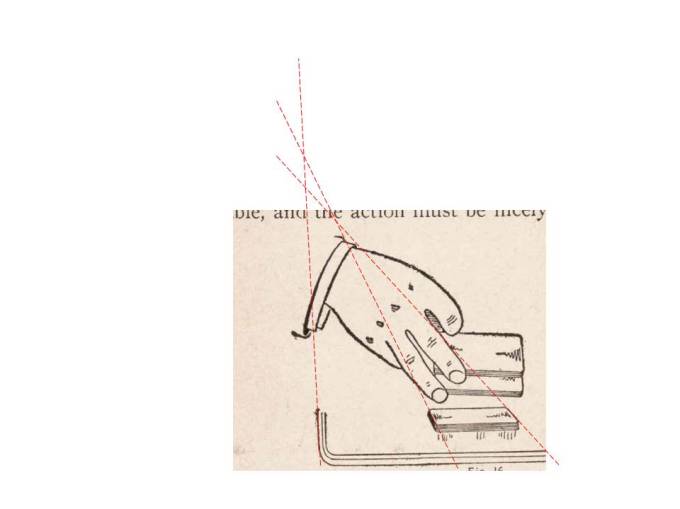
(and before you say the front edge of the deck isn't parallel to the front edge of the table, so the decks convergence point wouldn't be the same as the table's, check them out. Acrobat's measuring tool says both lines are at 1.2 degrees from the horizontal.)
(and notice how the portion of the deck in the hand is wider than that on the table. This would make sense if the hand were closer to the viewer than the tabled portion, bu the text says to draw the hand "inward" when doing this move.)
Bill Mullins wrote:lybrary wrote:Another error by Bill who doesn't understand perspective. If I remember this correctly then Tom Sawyer has pointed this out before on his blog. Illustration 16 is NOT incorrect. If the center of the camera is in line with the left edge of the table and the viewing direction is along that left edge of the table, that left edge of the table will come out perfectly perpendicular to the front edge, which runs parallel to the camera. But the somewhat to the right positioned deck of cards would show exactly the left and right edges running at an angle (not parallel) to the left table edge. I don't have the time to set up a camera, but I remember Tom had a photo that proved that this is a correct perspective. Which is yet another proof that these were traced from photos, because I agree, that the lines look at first sight wrong. But they aren't.Bill Mullins wrote:-In Fig 16, the left edge of the table would be parallel to the left edge of the tabled portion of the deck, since the deck and table are on parallel planes, and their front edges are parallel.
I say, "Drawing isn't accurate, because in axonometric drawing, table edge and card edges should be parallel." Chris says, "No, dummy, drawing isn't axonometric, it's a perspective drawing." Sorry, that doesn't work either. In a perspective drawing, the parallel lines should all recede to a common vanishing point (as you try and show in the Donnelley classroom drawings in your ebook.)
(and before you say the front edge of the deck isn't parallel to the front edge of the table, so the decks convergence point wouldn't be the same as the table's, check them out. Acrobat's measuring tool says both lines are at 1.2 degrees from the horizontal.)
(and notice how the portion of the deck in the hand is wider than that on the table. This would make sense if the hand were closer to the viewer than the tabled portion, bu the text says to draw the hand "inward" when doing this move.)
The edge of the table was, without a doubt in my mind, drawn long after the figure of the hand. Therefore, any suggestion of false perspective is insignificant. The table is a bit of decoration, a mere setting, a stock image. If the hand were traced from a photograph, it is very unlikely that the edge of the table would have been traced as well. For all we know, there might not have been a table in the photograph!
the idea that this turn of phrase proves erdnase gad small hands is nonsense.
i have many times read and told magicians/laypeople - you might think having big hands would help, but that’s just not true.
does that mean i have small or large hands?
it says nothing about the size of ones hands - it only speaks to the truth that hand size doesn’t matter as many people would presume it would.
i have many times read and told magicians/laypeople - you might think having big hands would help, but that’s just not true.
does that mean i have small or large hands?
it says nothing about the size of ones hands - it only speaks to the truth that hand size doesn’t matter as many people would presume it would.
jkeyes1000 wrote:The edge of the table was, without a doubt in my mind, drawn long after the figure of the hand. Therefore, any suggestion of false perspective is insignificant. The table is a bit of decoration, a mere setting, a stock image. If the hand were traced from a photograph, it is very unlikely that the edge of the table would have been traced as well. For all we know, there might not have been a table in the photograph!
Figure 64 is an interesting one that seems to conform to that theory. It looks obviously like lines drawn with a ruler and makes no sense as edges of a table, since the lines form a T.
Though that alone doesn't preclude tracing, since tracing could involve using a ruler to more quickly and accurately follow a straight line. It might just be sloppiness and an unfinished bit of work.
The drawn edges are too short that you could extend them that far back and hope to get them all run through the same vanishing point. The small variations tracing introduces, and a possible small misalignment of edge of the deck to the edge of the board, easily explains why the three lines do not cross in one precise point. If you use the inside edge of the board rather than the outside you will already get a closer match. However, what your image nicely shows, is that the perspective shown is correct to the precision of a traced photo. BTW, the edges shown are not the edges of a table. They are the edges of the shuffle board Erdnase is using and Smith mentions.Bill Mullins wrote:In a perspective drawing, the parallel lines should all recede to a common vanishing point (as you try and show in the Donnelley classroom drawings in your ebook.)
(and before you say the front edge of the deck isn't parallel to the front edge of the table, so the decks convergence point wouldn't be the same as the table's, check them out. Acrobat's measuring tool says both lines are at 1.2 degrees from the horizontal.)
The obvious reason why the cards held in the hand appear wider is because they are tilted towards the viewing plane. You only need to look at their short edges to understand that they are not in a parallel plane to the cards on the board.Bill Mullins wrote:(and notice how the portion of the deck in the hand is wider than that on the table. This would make sense if the hand were closer to the viewer than the tabled portion, bu the text says to draw the hand "inward" when doing this move.)
lybrary wrote:The obvious reason why the cards held in the hand appear wider is because they are tilted towards the viewing plane. You only need to look at their short edges to understand that they are not in a parallel plane to the cards on the board.Bill Mullins wrote:(and notice how the portion of the deck in the hand is wider than that on the table. This would make sense if the hand were closer to the viewer than the tabled portion, bu the text says to draw the hand "inward" when doing this move.)
The edges that I'm referring to are those that run left-to-right, the longitudinal edges. They are parallel to the same edges as those on the talon on the board. Tilting the deck upwards wouldn't change their apparent size.
Bill Mullins wrote:lybrary wrote:The obvious reason why the cards held in the hand appear wider is because they are tilted towards the viewing plane. You only need to look at their short edges to understand that they are not in a parallel plane to the cards on the board.Bill Mullins wrote:(and notice how the portion of the deck in the hand is wider than that on the table. This would make sense if the hand were closer to the viewer than the tabled portion, bu the text says to draw the hand "inward" when doing this move.)
The edges that I'm referring to are those that run left-to-right, the longitudinal edges. They are parallel to the same edges as those on the talon on the board. Tilting the deck upwards wouldn't change their apparent size.
This illustration is an example of what I mean by "recycling". Compare it (fig. 16) with the drawing of the left hand in figs. 14, 15 and 31. They are all variations of the same sketch. Some rougher than others.
We generally consider the width of a card to be along its shorter side and the length along its longer side. But besides that point I think you don't fully understand this move. Yes, Erdnase writes "swing or jerk downwards and inwards". However, to move inwards and have the cards end up on top of the already tabled portion requires you to start from father away. Otherwise the cards wouldn't land on top of the already tabled pack. So yes, the movement is inwards, but his starting point, which the illustration captures, is with the hand further out beyond where the tabled cards are. That is why the cards in the hand appear a bit longer. They are closer to the camera.Bill Mullins wrote:lybrary wrote:The obvious reason why the cards held in the hand appear wider is because they are tilted towards the viewing plane. You only need to look at their short edges to understand that they are not in a parallel plane to the cards on the board.Bill Mullins wrote:(and notice how the portion of the deck in the hand is wider than that on the table. This would make sense if the hand were closer to the viewer than the tabled portion, bu the text says to draw the hand "inward" when doing this move.)
The edges that I'm referring to are those that run left-to-right, the longitudinal edges. They are parallel to the same edges as those on the talon on the board. Tilting the deck upwards wouldn't change their apparent size.
The other factor is that the photo is taken from an angle from above, not from the front head on. So whatever is higher, which the hand with the cards clearly is, is therefore also closer to the camera.
Magic and gambling collector Tom Blue has posted a video championing a candidate for Erdnase:
https://www.youtube.com/watch?v=5ol6T_Ne35U&
https://www.youtube.com/watch?v=5ol6T_Ne35U&
lybrary wrote: BTW, the edges shown are not the edges of a table. They are the edges of the shuffle board Erdnase is using and Smith mentions.
The text says, "In seizing the deck, if it is slid to the table edge . . . "
The obvious reason why the cards held in the hand appear wider is because they are tilted towards the viewing plane. You only need to look at their short edges to understand that they are not in a parallel plane to the cards on the board.
Again, check the text: "and the action must be nicely made to have the cards fall flatly." If the cards are to fall flatly, then they must be horizontal (and not tilted) when released.
However, to move inwards and have the cards end up on top of the already tabled portion requires you to start from father away. Otherwise the cards wouldn't land on top of the already tabled pack.
??? No, I don't think so. If the cards are an inch in front of the tabled talon, and you pull the lower half of the deck out from under them, then they will land an inch in front of the tabled talon. Gravity pulls straight down. Remember, they "fall flatly".
And this passage includes what I believe is a previously unrecognized (very minor) error (or at least a discrepancy): The figure (16) shows the middle of a running cut -- that's the only way you'd have cards on the table, and the portion in hand divided for another cut. But the text referring to Fig 16 is talking about a straight cut, in which there would only be either cards in the hand, divided in preparation for the drop, and no cards yet on the table; or (after the drop) cards on the table, and cards in the hand, undivided, and ready to be placed on the tabled talon.
Not if you move inward as the text instructs. As Erdnase states it is a downward and inward movement. That means the hand is not only going down but also inward. That means the hand imparts the cards with an inward movement, besides gravity pulling them down. You know, Newton's laws of motion and such. When the hand releases the cards they will therefore not fall straight down, they will have a velocity component pointing inwards. Additionally the illustration captures the moment slightly before the cards are released. At that point the hand is slightly in front of the pack. As it travels inwards and releases the cards, so that they land on top of the pack. But even if you want to insist that the hand is not slightly in front of the pack, it certainly is above the pack and thus closer to the camera making the cards in the hand appear larger.Bill Mullins wrote:??? No, I don't think so. If the cards are an inch in front of the tabled talon, and you pull the lower half of the deck out from under them, then they will land an inch in front of the tabled talon. Gravity pulls straight down. Remember, they "fall flatly".
Hey, I thought this thread was spiraling out of control so to bring it back here's a first edition of Erdnase that's going to be available at the upcoming Potter & Potter auction: http://auctions.potterauctions.com/The_ ... T9442.aspx
I hear if you multiply the dimensions of a first edition by the full value of Pi you get Erdnase's arm length.
I hear if you multiply the dimensions of a first edition by the full value of Pi you get Erdnase's arm length.
This is indeed looking like two/three lawyers arguing about the fine details of a crime scene....I guess it's kind of inevitable.....better this than nothing at all, in my opinion...
lybrary wrote:Not if you move inward as the text instructs. As Erdnase states it is a downward and inward movement. That means the hand is not only going down but also inward.
I fully agree that the hand has to come inward -- it has to, to get out from under the cards. He says, "give the hand a slight swing or jerk downwards and inwards." He doesn't say "give the hand and the cards a slight swing or jerk inwards."
That means the hand imparts the cards with an inward movement, besides gravity pulling them down. You know, Newton's laws of motion and such. When the hand releases the cards they will therefore not fall straight down, they will have a velocity component pointing inwards.
Erdnase is a precise enough writer that if he wanted to put the cards into horizontal motion and pull them backwards with the hand, he'd have said so. He didn't - he said "release" the cards, so they "fall". All consistent with dropping straight down, not consistent with imparting an inward motion.
As I wrote, even if you insist, the cards in the hand are above the pack and thus closer to the camera, making them appear larger. You argued that this is wrong. How so?
Not that I suppose anyone cares about my interpretation of this passage. In fact, I don't care all that much. But here it is.
Erdnase basically says you ought to swing or jerk the deck with a downward and inward motion. To me, this means pulling the bottom half down and back, and sort of tossing the top portion forward onto the tabled cards.
I don't think the "jerk" is the inward motion. I rather believe it is a forward jog, followed by a pullback.
In any case--I feel that the illustration is showing us an angled view of the hold, prior to getting it in the horizontal position.
Erdnase basically says you ought to swing or jerk the deck with a downward and inward motion. To me, this means pulling the bottom half down and back, and sort of tossing the top portion forward onto the tabled cards.
I don't think the "jerk" is the inward motion. I rather believe it is a forward jog, followed by a pullback.
In any case--I feel that the illustration is showing us an angled view of the hold, prior to getting it in the horizontal position.
Richard Hatch wrote:Magic and gambling collector Tom Blue has posted a video championing a candidate for Erdnase:
https://www.youtube.com/watch?v=5ol6T_Ne35U&
I am sure that William Symes Andrews has been proposed before.
"Andrews, William Symes, was born on September 10, 1847, in Saltford Somersetshire, England. Son of Bailey Symes and Selina (Chesterton) Andrews."
That makes him 54 by December, 1901, 14 years older than Smith's estimate. And what makes Tom Blue believe that he was capable of showing Smith some card tricks and of writing a book about them? Oh yes, he was interested in Magic Squares
Zenner wrote:Richard Hatch wrote:Magic and gambling collector Tom Blue has posted a video championing a candidate for Erdnase:
https://www.youtube.com/watch?v=5ol6T_Ne35U&
I am sure that William Symes Andrews has been proposed before.
I believe that Todd Karr explored W. S. Andrews some years ago. I had also been told that Al Flosso believed W. S. Andrews was Erdnase. But I agree that based on Marshall Smith's eyewitness testimony concerning the author's age and lack of a foreign accent, we can probably rule him out. Also, to me, his writing does not sound much like Erdnase.
Richard Hatch wrote:But I agree that based on Marshall Smith's eyewitness testimony concerning the author's age...we can probably rule him out. Also, to me, his writing does not sound much like Erdnase.
Gallaway does not sound much like Erdnase to me either.
Richard Hatch wrote: I agree that based on Marshall Smith's eyewitness testimony concerning the author's age and lack of a foreign accent, we can probably rule him out.
He did say "back east" -- do you suppose he meant as far east as England?
Bill Mullins wrote:Richard Hatch wrote: I agree that based on Marshall Smith's eyewitness testimony concerning the author's age and lack of a foreign accent, we can probably rule him out.
He did say "back east" -- do you suppose he meant as far east as England?
He was from Somerset and there they have a distinct regional accent. Smith might not have even understood a Somerset accent.
I would guess that most of you serious fans of Erdnase have seen Gallaway's library bookplate, but I noticed that it had a quote from Milton at the top. He might not have used snippets like this in his writing, but it shows that he was just as capable as Sanders of referring to authors of classic literature.
His plate is the third one down on this blog:
http://blog.mysentimentallibrary.com/20 ... ction.html
His plate is the third one down on this blog:
http://blog.mysentimentallibrary.com/20 ... ction.html
A VERY interesting bit of speculation on Erdnase by the great David Saltman on his blog:
http://www.houdinifile.com/2018/04/houdini-erdnase.html
http://www.houdinifile.com/2018/04/houdini-erdnase.html
Gallaway did use snippets of classic literature in his writing. In 1906 he wrote a petition to establish lending libraries at two facilities of the Odd Fellows which starts:jkeyes1000 wrote:I would guess that most of you serious fans of Erdnase have seen Gallaway's library bookplate, but I noticed that it had a quote from Milton at the top. He might not have used snippets like this in his writing, but it shows that he was just as capable as Sanders of referring to authors of classic literature.
His plate is the third one down on this blog:
http://blog.mysentimentallibrary.com/20 ... ction.html
This is quoted from Joseph Dennie's "The Lay Preacher". The full petition and other information surrounding it is in my ebook.WHEREAS, "In sickness, in sorrow, in the most doleful days of dejection, or in the most gloomy seasons of the calendar, the reading of a good book is the sweetest solace and the surest refuge … A book produces a delightful abstraction from the cares and sorrows of this world. By the magic illusion of a fascinating author we are transported from the couch of anguish, or the gripe of melancholy, to Milton's Paradise or the Elysium of Virgil": and
WHEREAS, This Grand Lodge should consider it an imperative duty to provide good literature for our brothers and sisters at the Old Folks’ Home, and also to instill and foster a love for good, healthy reading in the hearts of our boys and girls at the Orphans’ Home; and
lybrary wrote:Gallaway did use snippets of classic literature in his writing. In 1906 he wrote a petition to establish lending libraries at two facilities of the Odd Fellows which starts:This is quoted from Joseph Dennie's "The Lay Preacher". The full petition and other information surrounding it is in my ebook.WHEREAS, "In sickness, in sorrow, in the most doleful days of dejection, or in the most gloomy seasons of the calendar, the reading of a good book is the sweetest solace and the surest refuge … A book produces a delightful abstraction from the cares and sorrows of this world. By the magic illusion of a fascinating author we are transported from the couch of anguish, or the gripe of melancholy, to Milton's Paradise or the Elysium of Virgil": and
WHEREAS, This Grand Lodge should consider it an imperative duty to provide good literature for our brothers and sisters at the Old Folks’ Home, and also to instill and foster a love for good, healthy reading in the hearts of our boys and girls at the Orphans’ Home; and
These classical references are to prove what? You're the one who had claimed Sanders (unlike Erdnase) was an outdoors "miner" and wasn't "bookish". As I said at the time, "bookish" connotes something different (stodgy, socially withdrawn, etc). And I think you probably meant that he wasn't well read and that he didn't have scholarly interests. In any case, your point was quickly disproven by Sanders' quotes in Latin, references to various authors, historical research, etc.
So now you're showcasing this clunky boilerplate quote (unlike Sanders witty and substantive ones) to show that Gallaway was familiar with the classics. But that's not something anyone raised about him, was it? He was known to have a fairly large library, right? I don't get your point. Or are you still insisting that Sanders didn't know Milton from Shakespeare?
Here's something of potential interest to everyone here... There's a new version of Erdnase out by Joe Crist with photos of his hands vs the old illustrations. It looks really great. In his foreword, he tells a story about Erdnase that he heard from his teacher Joe Artanis whose card teacher was apparently friends with Erdnase. I don't want to say more, but I'm very glad I got the book (even though it's expensive).
https://artificeruseandsubterfuge.com
https://artificeruseandsubterfuge.com
Bob Coyne wrote:lybrary wrote:Gallaway did use snippets of classic literature in his writing. In 1906 he wrote a petition to establish lending libraries at two facilities of the Odd Fellows which starts:This is quoted from Joseph Dennie's "The Lay Preacher". The full petition and other information surrounding it is in my ebook.WHEREAS, "In sickness, in sorrow, in the most doleful days of dejection, or in the most gloomy seasons of the calendar, the reading of a good book is the sweetest solace and the surest refuge … A book produces a delightful abstraction from the cares and sorrows of this world. By the magic illusion of a fascinating author we are transported from the couch of anguish, or the gripe of melancholy, to Milton's Paradise or the Elysium of Virgil": and
WHEREAS, This Grand Lodge should consider it an imperative duty to provide good literature for our brothers and sisters at the Old Folks’ Home, and also to instill and foster a love for good, healthy reading in the hearts of our boys and girls at the Orphans’ Home; and
These classical references are to prove what? You're the one who had claimed Sanders (unlike Erdnase) was an outdoors "miner" and wasn't "bookish". As I said at the time, "bookish" connotes something different (stodgy, socially withdrawn, etc). And I think you probably meant that he wasn't well read and that he didn't have scholarly interests. In any case, your point was quickly disproven by Sanders' quotes in Latin, references to various authors, historical research, etc.
So now you're showcasing this clunky boilerplate quote (unlike Sanders witty and substantive ones) to show that Gallaway was familiar with the classics. But that's not something anyone raised about him, was it? He was known to have a fairly large library, right? I don't get your point. Or are you still insisting that Sanders didn't know Milton from Shakespeare?
Give Chris some credit, Bob. At least he now recognizes these words as a quote -- he used to think they were written by Gallaway, until he was informed otherwise.
Roger M. wrote:Smith recalls nothing that would suggest Erdnase had a wife.
A quote from our old friend Roger M. who had listed what Smith remembered from that meeting. Gallaway had married in June of 1901 and would have been a 6 month newlywed by December of that year. It is most likely that the meeting in the hotel room took place in December 1901. Now American husbands did not traditionally begin to wear wedding bands till around WWII, so if he was married, Erdnase would not have been wearing a band on his left fourth finger.
We know from Smith that Erdnase made small talk such as his relationship to Dalrymple while showing him card tricks and so on. Yet Erdnase said nothing about being married (recently?) and what that was like. Two men alone in a hotel room, one possibly married six months prior, and no mention of that? When men get together informally, the subject of marriage is usually not far away. If Gallaway was in that hotel room, he felt obligated not to discuss his recent marriage. Or maybe it wasn't Gallaway in that hotel room...
Leonard Hevia wrote:Roger M. wrote:Smith recalls nothing that would suggest Erdnase had a wife.
A quote from our old friend Roger M. who had listed what Smith remembered from that meeting. Gallaway had married in June of 1901 and would have been a 6 month newlywed by December of that year. It is most likely that the meeting in the hotel room took place in December 1901. Now American husbands did not traditionally begin to wear wedding bands till around WWII, so if he was married, Erdnase would not have been wearing a band on his left fourth finger.
We know from Smith that Erdnase made small talk such as his relationship to Dalrymple while showing him card tricks and so on. Yet Erdnase said nothing about being married (recently?) and what that was like. Two men alone in a hotel room, one possibly married six months prior, and no mention of that? When men get together informally, the subject of marriage is usually not far away. If Gallaway was in that hotel room, he felt obligated not to discuss his recent marriage. Or maybe it wasn't Gallaway in that hotel room...
Or maybe he thought that Dalrymple was more relevant to the conversation.
Bob Coyne wrote:Here's something of potential interest to everyone here... There's a new version of Erdnase out by Joe Crist with photos of his hands vs the old illustrations. It looks really great. In his foreword, he tells a story about Erdnase that he heard from his teacher Joe Artanis whose card teacher was apparently friends with Erdnase. I don't want to say more, but I'm very glad I got the book (even though it's expensive).
https://artificeruseandsubterfuge.com
Wow. That's Johnny Thompson expensive.
jkeyes1000 wrote:Or maybe he thought that Dalrymple was more relevant to the conversation.
Really? Speaking of Dalrymple, what was the title of the political cartoon connected to Erdnase that Dalrymple illustrated? If you had followed Bill Mullin's suggestion to read up on the relevant material you might be able to answer this question. I would wager a crisp $100 dollar bill on the green baize that you have read nothing. Chiming in with uninformed opinions is nothing short of buffoonery.
It was this oneLeonard Hevia wrote:Speaking of Dalrymple, what was the title of the political cartoon connected to Erdnase that Dalrymple illustrated?
Except it wasn't by Dalrymple, it was by Walter Gallaway
Leonard Hevia wrote:jkeyes1000 wrote:Or maybe he thought that Dalrymple was more relevant to the conversation.
Really? Speaking of Dalrymple, what was the title of the political cartoon connected to Erdnase that Dalrymple illustrated? If you had followed Bill Mullin's suggestion to read up on the relevant material you might be able to answer this question. I would wager a crisp $100 dollar bill on the green baize that you have read nothing. Chiming in with uninformed opinions is nothing short of buffoonery.
I can't imagine how research would alter my point, Leonard. I was merely suggesting that the mention of Dalrymple might have been more pertinent than referring to his wife. If Erdnase were a no-nonsense sort of fellow, he might have spoken only of art-related matters.
jkeyes1000 wrote:.....If Erdnase were a no-nonsense sort of fellow, he might have spoken only of art-related matters.....
A small bit of research indicates that Erdnase spoke far more broadly than about just "art-related matters":
- Erdnase talked to Smith about, and demonstrated card tricks
Erdnase talked to Smith about how cold it was outside
Erdnase talked to Smith at length about how he took care of his hands in order to better handle playing cards
Erdnase talked to Smith about being a card shark
Erdnase talked to Smith about going straight
Erdnase talked to Smith about how he (Erdnase) didn't care about how artistic the drawings were, as long as they got the point across.
Erdnase talked about the fact that he was related to Dalrymple
So as you can see, Erdnase spoke with Smith about an array of subjects ... one of which (in any normal conversation) would no doubt been about his wife, if indeed he was married ... which he very likely (as per Smith's observations) wasn't.
The likelihood that Erdnase would have proffered information on his marital status would have been a wide open door as soon as Erdnase mentioned he was related to Dalrymple.
The list above is obviously only what Smith could recall for Gardner, but the likelihood is very high that Smith and Erdnase spoke about much more than just what's on this list.
Roger M. wrote:jkeyes1000 wrote:.....If Erdnase were a no-nonsense sort of fellow, he might have spoken only of art-related matters.....
A small bit of research indicates that Erdnase spoke far more broadly than about just "art-related matters":Erdnase talked to Smith about, and demonstrated card tricks
Erdnase talked to Smith about how cold it was outside
Erdnase talked to Smith at length about how he took care of his hands in order to better handle playing cards
Erdnase talked to Smith about being a card shark
Erdnase talked to Smith about going straight
Erdnase talked to Smith about how he (Erdnase) didn't care about how artistic the drawings were, as long as they got the point across.
Erdnase talked about the fact that he was related to Dalrymple
So as you can see, Erdnase spoke with Smith about an array of subjects ... one of which (in any normal conversation) would no doubt been about his wife, if indeed he was married ... which he very likely (as per Smith's observations) wasn't.
The likelihood that Erdnase would have proffered information on his marital status would have been a wide open door as soon as Erdnase mentioned he was related to Dalrymple.
The list above is obviously only what Smith could recall for Gardner, but the likelihood is very high that Smith and Erdnase spoke about much more than just what's on this list.
With the exception of the mention of the weather, these references are all related to the subject of the book.
Which only supports the notion that Erdnase's remarks were pertinent to the project. There is no discussion about home life--or personal habits that do not touch upon gambling. If he were as chatty as you suggest, then why would he have neglected to inform Smith of his career in the printing business (if he was Gallaway), or the fact that his father was a senator (if he was Sanders)?
You can speculate all you like about what a man you can't even identify would have talked about, but I think it more sensible to consider the distinct possibility that Erdnase was a business man, to whom "time was money". Thus, even he had been newly wed, he might have refrained from mentioning the wife.
jkeyes1000 wrote:If he were as chatty as you suggest, then why would he have neglected to inform Smith of his career in the printing business (if he was Gallaway), or the fact that his father was a senator (if he was Sanders)?
Well, Erdnase wasn't either of those folks, so the remainder of your post becomes somewhat moot.
jkeyes1000 wrote: I think it more sensible to consider the distinct possibility that Erdnase was a business man, to whom "time was money"......
The lack of understanding as to what's actually contained in the book remains a surprise to me.
Erdnase definitely wasn't a businessman, nor would I posit that he was a magician ... the facts betray Erdnase as a professional card cheat who devoted his entire adult life to developing (almost) completely original and outrageously complex card sleights designed to gain an advantage at a card table, sleights and thinking never before experienced by any living person, sleights and thinking never contemplated by previous card cheats as even being possible.
That S.W. Erdnase was definitely not a businessman is all there for the taking for readers who take the time to understand the true depth of the contents of the EATCT, who then read the entirety of this thread a few times, read the various Genii articles, read the various Magic articles, read the Magicana issue/book, read Hurts brilliant book, and read Tom Sawyers ever insightful book(s) ... and although fatally flawed, TMWWE remains an additional reference of great value.
How would have Smith seen that he was married?Roger M. wrote:if indeed he was married ... which he very likely (as per Smith's observations) wasn't.
Oh really? A man who self-publishes a book to make money is as far as I am concerned an entrepreneur. Don't know what your definition for a 'businessman' is, but it is as much businessman as it can get if you put up your own money to start a risky project with the goal to make a profit.Roger M. wrote:That S.W. Erdnase was definitely not a businessman ...
Roger is back, breaking his own vow that he was done here. What's with the old fashioned 'keeping ones word'?
Roger M. wrote:jkeyes1000 wrote: I think it more sensible to consider the distinct possibility that Erdnase was a business man, to whom "time was money"......
The lack of understanding as to what's actually contained in the book remains a surprise to me.
Erdnase definitely wasn't a businessman, nor would I posit that he was a magician ... the facts betray Erdnase as a professional card cheat who devoted his entire adult life to developing (almost) completely original and outrageously complex card sleights designed to gain an advantage at a card table, sleights and thinking never before experienced by any living person, sleights and thinking never contemplated by previous card cheats as even being possible.
That S.W. Erdnase was definitely not a businessman is all there for the taking for readers who take the time to understand the true depth of the contents of the EATCT, who then read the entirety of this thread a few times, read the various Genii articles, read the various Magic articles, read the Magicana issue/book, read Hurts brilliant book, and read Tom Sawyers ever insightful book(s) ... and although fatally flawed, TMWWE remains an additional reference of great value.
A man who writes a book, hires an illustrator (and very probably a photographer), and plans to publish it himself, is a business man. If it is cold outside, he most likely wants to get this meeting over with and get back home. Likewise, if he was recently married, he would probably prefer to hurry up with this project and return to his wife, rather than chit-chat about her.
And, come to think of it, the reference to the weather might have been related to the meeting with Smith. As the cold would naturally stiffen the hands, which Erdnase would need to warm up before demonstrating the card moves.
Can you specify anything in their conversation that was not in some way relevant to the subject of the book, or the purpose of the meeting?
jkeyes1000 wrote:Which only supports the notion that Erdnase's remarks were pertinent to the project. There is no discussion about home life--or personal habits that do not touch upon gambling. If he were as chatty as you suggest, then why would he have neglected to inform Smith of his career in the printing business (if he was Gallaway), or the fact that his father was a senator (if he was Sanders)?
You can speculate all you like about what a man you can't even identify would have talked about, but I think it more sensible to consider the distinct possibility that Erdnase was a business man, to whom "time was money". Thus, even he had been newly wed, he might have refrained from mentioning the wife.
A notion based on what? No reading or study? Mr. Keyes--your notions are like the half gallon containers of cheap ice cream in grocery stores. They weigh almost nothing because they're air whipped. The consumer is paying for a lot of air.
Smith told Gardner that Erdnase "was honest with me...He put more cards on the table than was necessary. He withheld nothing." This can be interpreted to mean that Erdnase was frank and open with him to a certain extent. It's strange that he wouldn't mention a fairly recent marriage, which is a life changing event for most people.
Some time away Chris, always a refreshing break, some additional perspectve.
All good.
The thread has introduced some new candidates to study as well, some very interesting, some not so much.
Hope you’re well, and continued luck with your Gallaway project.
All good.
The thread has introduced some new candidates to study as well, some very interesting, some not so much.
Hope you’re well, and continued luck with your Gallaway project.
Your intuition is spot on. Here is the relevant note:jkeyes1000 wrote:And, come to think of it, the reference to the weather might have been related to the meeting with Smith. As the cold would naturally stiffen the hands, which Erdnase would need to warm up before demonstrating the card moves.
He remembers scene vividly because it was a bitter cold winter day and there was no heat in the room. Smith kept his overcoat on, but recalls that Andrews did not. He remembers Andrews showing him some card tricks, and complaining that the cold made his fingers stiff. He remembers Andrews rubbing his hands together to warm them up, and telling him that it was necessary for him to keep his hands in good condition. He said that he kept them ―greased.
lybrary wrote:Your intuition is spot on. Here is the relevant note:jkeyes1000 wrote:And, come to think of it, the reference to the weather might have been related to the meeting with Smith. As the cold would naturally stiffen the hands, which Erdnase would need to warm up before demonstrating the card moves.He remembers scene vividly because it was a bitter cold winter day and there was no heat in the room. Smith kept his overcoat on, but recalls that Andrews did not. He remembers Andrews showing him some card tricks, and complaining that the cold made his fingers stiff. He remembers Andrews rubbing his hands together to warm them up, and telling him that it was necessary for him to keep his hands in good condition. He said that he kept them ―greased.
Here is another relevant note: Smith also recalled nothing that would suggest Erdnase had a wife.
That would appear to exclude Gallaway, since had just recently married. A pesky fact that purchasers of that $45.00 Gallaway e-book hopefully won't notice.
Except as you noted yourself, the tradition for the groom to get a wedding band only started after WWII in the US. So married or not, there was no way for Smith to know if he was married, unless Erdnase would have told him. But why would Erdnase during a business meeting talk about his family? My experience is that family matters may come up after a business meeting at a dinner or in the bar. No indication from Smith that they had anything but work related meetings. If they would have indeed chatted about family and other non-business stuff then Smith would have known many other things directly from Erdnase and didn't have to guess such as where he came from, what else he did besides card sharking, or what his plans were going forward, etc.Leonard Hevia wrote:Here is another relevant note: Smith also recalled nothing that would suggest Erdnase had a wife.
That would appear to exclude Gallaway, since had just recently married. A pesky fact that purchasers of that $45.00 Gallaway e-book hopefully won't notice.
Leonard Hevia wrote:jkeyes1000 wrote:Which only supports the notion that Erdnase's remarks were pertinent to the project. There is no discussion about home life--or personal habits that do not touch upon gambling. If he were as chatty as you suggest, then why would he have neglected to inform Smith of his career in the printing business (if he was Gallaway), or the fact that his father was a senator (if he was Sanders)?
You can speculate all you like about what a man you can't even identify would have talked about, but I think it more sensible to consider the distinct possibility that Erdnase was a business man, to whom "time was money". Thus, even he had been newly wed, he might have refrained from mentioning the wife.
A notion based on what? No reading or study? Mr. Keyes--your notions are like the half gallon containers of cheap ice cream in grocery stores. They weigh almost nothing because they're air whipped. The consumer is paying for a lot of air.
Smith told Gardner that Erdnase "was honest with me...He put more cards on the table than was necessary. He withheld nothing." This can be interpreted to mean that Erdnase was frank and open with him to a certain extent. It's strange that he wouldn't mention a fairly recent marriage, which is a life changing event for most people.
A "notion" is an idea, Leonard. To denigrate the term is silly. Especially when the complete phrase is, "supports the notion"--a reference to Roger M''s list of conversation topics, all of which pertain to the project itself, and none of which mention Erdnase's private life.
When Smith said that the author had been "honest" with him, I would think that might refer to his "confession" of having been a card cheat. There is no evidence that I have seen that Erdnase said a single word about any other person in his life. As you are a Sanders advocate, perhaps you can explain why he preferred to boast of his connection to Dalrymple, rather than to his illustrious father?
lybrary wrote:So married or not, there was no way for Smith to know if he was married, unless Erdnase would have told him.
Yet Smith got the feeling Erdnase wasn't married. Are you questioning Smith? Or do you only question Smith when his recollections don't quite match with your narration?
lybrary wrote:But why would Erdnase during a business meeting talk about his family?
He mentioned a relationship to Dalrymple the cartoonist. Isn't that a possible comment on family? That had nothing to do with the business at hand. And if that is a comment on family, why not comment on getting recently married?
jkeyes1000 wrote:...perhaps you can explain why he preferred to boast of his connection to Dalrymple, rather than to his illustrious father?
Although your question is not directed at me I find the answer rather obvious. Since it appears that Erdnase wished to maintain some anonymity it seems likely that he would be careful in the personal details he shared.
Jackpot wrote:jkeyes1000 wrote:...perhaps you can explain why he preferred to boast of his connection to Dalrymple, rather than to his illustrious father?
Although your question is not directed at me I find the answer rather obvious. Since it appears that Erdnase wished to maintain some anonymity it seems likely that he would be careful in the personal details he shared.
Interesting remark. You are suggesting that for Erdnase to mention his father (the senator) would be telling too much. Yet he apparently gave his real name (which Smith forgot), and said that he was related to Dalrymple.
Which Sanders was not (so far as we know).
So--Erdnase was "honest", but he didn't want Smith to know of his family (and he made up the Dalrymple thing)...yet he ought to have mentioned a wife if he had one. Have I got that straight?
jkeyes1000 wrote:Have I got that straight?
You have gone off on a different a tangent and you do not have that straight.
Unless Smith was clairvoyant there was no way for him, or anybody else, to see or feel if Erdnase was married. So yes, I am questioning Smith on that.Leonard Hevia wrote:Yet Smith got the feeling Erdnase wasn't married. Are you questioning Smith?
First, we do not know if Erdnase ever made that comment. Second, commenting to an illustrator that Erdnase was related to another well-known illustrator, one that Smith was most likely aware of, would be much more interesting to Smith than if Erdnase was married or not.Leonard Hevia wrote:He mentioned a relationship to Dalrymple the cartoonist. Isn't that a possible comment on family? That had nothing to do with the business at hand. And if that is a comment on family, why not comment on getting recently married?
Unless he wanted to plant a false lead. Or perhaps he never made that comment to Smith. Smith may have mixed this up with somebody else telling him they were related to Dalrymple.Jackpot wrote:Since it appears that Erdnase wished to maintain some anonymity it seems likely that he would be careful in the personal details he shared.
Jackpot wrote:jkeyes1000 wrote:Have I got that straight?
You have gone off on a different a tangent and you do not have that straight.
I went of on the Sanders tangent, which is what I was asking Leonard about. I do not know if you are a Sanders advocate, so you might have merely been addressing my question, out of context.
I am simply showing how twisted the tale can get. It is much simpler and smoother, I think, to infer that Erdnase mentioned Dalrymple solely because he was an illustrator like Smith. In other words: because it was pertinent to their discussion. No other relatives needed to be mentioned.
lybrary wrote:...yes, I am questioning Smith on that.
Naturally you are questioning Smith on his hunch that Erdnase was not married. It contradicts your edict that Gallaway was there. Yet you adamantly agree with Smith whenever his memory aligns with your claims. If Gallaway had not been married, you would have applauded Smith's intuition.
lybrary wrote:First, we do not know if Erdnase ever made that comment. Second, commenting to an illustrator that Erdnase was related to another well-known illustrator, one that Smith was most likely aware of, would be much more interesting to Smith than if Erdnase was married or not.
Whether Erdnase said that Dalrymple was a family member or not--he veered off the topic of the business at hand. If he veered off topic once at the meeting, he could have done so again. You downplay the aspect of marriage at this meeting--yet Smith did not. He told Gardner that he sensed Erdnase was not married.
Leonard Hevia wrote:lybrary wrote:First, we do not know if Erdnase ever made that comment. Second, commenting to an illustrator that Erdnase was related to another well-known illustrator, one that Smith was most likely aware of, would be much more interesting to Smith than if Erdnase was married or not.
Whether Erdnase said that Dalrymple was a family member or not--he veered off the topic of the business at hand. If he veered off topic once at the meeting, he could have done so again. You downplay the aspect of marriage at this meeting--yet Smith did not. He told Gardner that he sensed Erdnase was not married.
Another point is that veering off topic is just part of how people interact (doing business or otherwise). Look at how much veering off topic happens here!
So it would be very natural for personal attributes to be conveyed one way or another. I don't think it matters much why Dalrymple, specifically, was mentioned. It could well have been because he thought Smith would be interested as a fellow artist. But, whatever the reason, it's all just part of making a personal connection. And in the same way, Smith could have easily picked up on various other personal details like whether Erdnase was married or where he came from (the east). Plus many others that he probably forgot in the interim.
Was there anything in the Gardner interview that suggested the guy spoke or performed like what's in the book? Starting to think we're going Keyser Söze about the Gardner interview.
Bob Coyne wrote:So it would be very natural for personal attributes to be conveyed one way or another. I don't think it matters much why Dalrymple, specifically, was mentioned. It could well have been because he thought Smith would be interested as a fellow artist. But, whatever the reason, it's all just part of making a personal connection. And in the same way, Smith could have easily picked up on various other personal details like whether Erdnase was married or where he came from (the east). Plus many others that he probably forgot in the interim.
Exactly Bob! It appears from Smith's recollections that Erdnase was an affable fellow who quickly made a personal connection with Smith. He may have said one or two things to Smith that made the illustrator suspect that he was not married.
Jonathan Townsend wrote:Was there anything in the Gardner interview that suggested the guy spoke or performed like what's in the book? Starting to think we're going Keyser Söze about the Gardner interview.
That Gardner Smith Correspondence has become a kind of Keyser Soze: Talked about--but never seen. I'm on the lookout for a copy.
Bob Coyne wrote:Leonard Hevia wrote:lybrary wrote:First, we do not know if Erdnase ever made that comment. Second, commenting to an illustrator that Erdnase was related to another well-known illustrator, one that Smith was most likely aware of, would be much more interesting to Smith than if Erdnase was married or not.
Whether Erdnase said that Dalrymple was a family member or not--he veered off the topic of the business at hand. If he veered off topic once at the meeting, he could have done so again. You downplay the aspect of marriage at this meeting--yet Smith did not. He told Gardner that he sensed Erdnase was not married.
Another point is that veering off topic is just part of how people interact (doing business or otherwise). Look at how much veering off topic happens here!
So it would be very natural for personal attributes to be conveyed one way or another. I don't think it matters much why Dalrymple, specifically, was mentioned. It could well have been because he thought Smith would be interested as a fellow artist. But, whatever the reason, it's all just part of making a personal connection. And in the same way, Smith could have easily picked up on various other personal details like whether Erdnase was married or where he came from (the east). Plus many others that he probably forgot in the interim.
The counterpoint to your argument is that the mention of Dalrymple (being an artist like Smith) is not "veering off topic". The topic was artwork. And every other known subject of conversation was likewise related to the project.
If you really could show that Erdnase mentioned acquaintances and/or relations that had nothing to do with the business arrangement, you might have a good point. That we have a long list of subjects, and they are all, without exception, pertinent to the job, suggests that the author was concerned exclusively with business, and probably thought that talking of personal matters with a complete stranger would be inappropriate. Not a stretch, from my perspective, as I never discuss my private life with store clerks, plumbers, or even business partners. Getting it done, for many of us, is about efficiency. Especially if we "need the money" and are eager to create a product that we can sell.
Sanders advocates argue that Erdnase must not have needed the cash, because it was a fairly slow process. But that is all the better reason to dispense with small talk! Too much time had been wasted already.
jkeyes1000 wrote:Sanders advocates argue that Erdnase must not have needed the cash, because it was a fairly slow process. But that is all the better reason to dispense with small talk! Too much time had been wasted already.
Quite the opposite. Sanders most likely didn't need the cash so he had the luxury of spending a little extra time making a personal connection with Smith. if Erdnase posed while Smith drew his hands, there would have been even more time for conversation. Erdnase also took the time to perform a few card effects for Smith. This was surely another time consuming way to break the ice and make Smith more comfortable.
jkeyes1000 wrote:.......Erdnase must not have needed the cash, because it was a fairly slow process. But that is all the better reason to dispense with small talk! Too much time had been wasted already.
I agree with Leonard ... Erdnase, fully employed for years before he wrote the book and then years after the book was released, certainly didn't need the money, thus giving him plenty of time for small talk. ("needing the money" was an example of Erdnase's wit, nothing more).
As a professional hustler, small talk was Erdnase's forte, his second specialty after playing cards if you will.
Expertise at making small talk was a mandatory skill if a hustler like Erdnase was to ingratiate himself into card games in private gentlemen's clubs, bars, and on trains.
So, "yes", Erdnase most definitely would have engaged in lengthy stretches of small talk and personal asides with Smith, sitting together on multiple occasions, for hours on end in a small hotel room.
In light of the known facts, one would have to be intentionally obtuse (or ridiculously uninformed) to presume otherwise.
Leonard Hevia wrote:jkeyes1000 wrote:Sanders advocates argue that Erdnase must not have needed the cash, because it was a fairly slow process. But that is all the better reason to dispense with small talk! Too much time had been wasted already.
Quite the opposite. Sanders most likely didn't need the cash so he had the luxury of spending a little extra time making a personal connection with Smith. if Erdnase posed while Smith drew his hands, there would have been even more time for conversation. Erdnase also took the time to perform a few card effects for Smith. This was surely another time consuming way to break the ice and make Smith more comfortable.
Yea, Leonard--If Erdnase was Sanders he wouldn't have needed the money. But that is still a big IF.
If it wasn't Sanders, and the claim in the opening paragraphs of EATCT was true, then Erdnase certainly would not have prattled on with Smith about his wife, any more than he would have mentioned his club foot.
You folks banter about Erdnase's character, his manner, his style, etc. Well, I've read the book myself, and I don't see that a poker faced gambler--who knows how to conceal his hand, who is mostly silent during the game, and who writes tightly and efficiently--as an amiable, Smiling Jack. I don't see him as a Harry Blackstone, Sr., or an Al Flosso. I see him as more of a Blackstone, Jr., or a Kreskin--a man of few, but well chosen words.
And, please don't be so trite as to question my examples of character--I do not suggest that Erdnase resembled the above named performers, merely that they would seem to share certain qualities.
I think you are trying to take Sanders sort of loud, gregarious, outgoing personality and fit it to Erdnase. The author of EATCT strikes me as having the potential to be "larger than life" on stage, or in a public venue, but not so boisterous in private conversation. I feel that the charisma was a part of his act, whereas I get the sense that Sanders was genuinely jovial.
jkeyes1000 wrote:If Erdnase was Sanders he wouldn't have needed the money. But that is still a big IF.
It doesn't matter which of the "premier" Erdnase candidates you choose to support, Gallaway, Sanders, E.S. Andrews, Benedict, or ??? ... we know for a fact that all of them were gainfully employed before, and long after EATCT was published.
Good gracious ... NONE of them "needed the money"!
Absolutely no "IF's" required.
Roger M. wrote:jkeyes1000 wrote:If Erdnase was Sanders he wouldn't have needed the money. But that is still a big IF.
It doesn't matter which of the "premier" Erdnase candidates you choose to support, Gallaway, Sanders, E.S. Andrews, Benedict, or ??? ... we know for a fact that all of them were gainfully employed before, and long after EATCT was published.
Good gracious ... NONE of them "needed the money"!
Absolutely no "IF's" required.
I have spoken to this before, but I will reiterate. "Needing the money" can mean a number of things. "Erdnase" might have had enough money to live on, but still "needed" a larger sum to pay debts or fund other ambitious projects. This could easily apply to either Gallaway or Benedict. The least likely in this case would be Sanders. His debts and/or schemes would have to have been enormous in order for him to "need the money", and I think we should find evidence of this in his biography.
jkeyes1000 wrote:
I have spoken to this before, but I will reiterate. "Needing the money" can mean a number of things.
We all like to have and get money ... but the word "need" has an actual meaning, and none of the candidates fits the bill ... sorry.
It was a joke, merely a humorous aside from Erdnase.
Roger M. wrote:jkeyes1000 wrote:
I have spoken to this before, but I will reiterate. "Needing the money" can mean a number of things.
We all like to have and get money ... but the word "need" has an actual meaning, and none of the candidates fits the bill ... sorry.
It was a joke, merely a humorous aside from Erdnase.
I don't know anyone that hasn't said, "I need (a certain amount of) money" for something that was clearly not necessary to his or her survival. The word "need" is frequently used in the sense of "yearn".
Roger M. wrote:It doesn't matter which of the "premier" Erdnase candidates you choose to support, Gallaway, Sanders, E.S. Andrews, Benedict, or ??? ... we know for a fact that all of them were gainfully employed before, and long after EATCT was published.
Good gracious ... NONE of them "needed the money"!
Absolutely no "IF's" required.
There is good evidence that Erdnase needed the money. In Expert we find a remarkable self-portrait:
Hazard at play carries sensations that once enjoyed are rarely forgotten. The winnings are known as "pretty money," and it is generally spent as freely as water.
In the new book by Joe Crist, who claims that his mentor Joe Artanis had a mentor who was friends with Erdnase, he writes:
Erdnase became addicted to the gambling game of Faro, and all money he "won" at the card table immediately went into trying to "buck the tiger."
Gallaway’s daughter-in-law commented:
This not being able to hang on to the money he made could very well be due to gambling at Faro.He made a lot of money but it just slipped through his fingers ... he couldn't hang on to it.
lybrary wrote:Gallaway’s daughter-in-law commented:This not being able to hang on to the money he made could very well be due to gambling at Faro.He made a lot of money but it just slipped through his fingers ... he couldn't hang on to it.
From his diaries we know that Sanders frequented the Silver Bow Club in Butte, Montana. He would take the short line train from his home town of Helena to Butte, and return in the morning. The Silver Bow Club was a gambling joint so it is not a stretch to believe Sanders played cards in this club.
Now where is your source that Gallaway gambled and lost his money playing Faro?
jkeyes1000 wrote:I have spoken to this before, but I will reiterate. "Needing the money" can mean a number of things. "Erdnase" might have had enough money to live on, but still "needed" a larger sum to pay debts or fund other ambitious projects. This could easily apply to either Gallaway or Benedict. The least likely in this case would be Sanders. His debts and/or schemes would have to have been enormous in order for him to "need the money", and I think we should find evidence of this in his biography.
Sanders was "hard up" for money at various times, apparently because of gambling debts. A friend wrote to him "You need not have worried about the money -- I did not I assure you. We are all of us who have the sporting blood likely to be 'hard up' at any time. 'I've been there before many a time' as the song goes and know well the feeling at the same time..."
Leonard Hevia wrote: That Gardner Smith Correspondence has become a kind of Keyser Soze: Talked about--but never seen. I'm on the lookout for a copy.
At this late date, the easiest way to get a copy is to buy the Houdini Magic "Expert at the Card Table" DVD set, which includes a legal PDF of the book.
jkeyes1000 wrote: Kreskin--a man of few . . . words.
That's not the Kreskin I'm familiar with.
Sanders also received letters from people in New York appreciating the payments he had made. Those letters included gambling slang such as "sporting" noted in Bob's post, "square" and "the right turns." After graduating Columbia in 1885, Sanders made frequent trips to NY and left with debts each time he visited.
Bill Mullins wrote:At this late date, the easiest way to get a copy is to buy the Houdini Magic "Expert at the Card Table" DVD set, which includes a legal PDF of the book.
Thanks Bill! I actually have that DVD set but it's in storage and probably still shrinkwrapped. What I know from the GSC came directly from this thread and article endnotes.
lybrary wrote: Gallaway’s daughter-in-law commented:This not being able to hang on to the money he made could very well be due to gambling at Faro.He made a lot of money but it just slipped through his fingers ... he couldn't hang on to it.
So how did he get together the cash to afford a vacation home? One with a boat dock? That's the sort of luxury not common with people who are poor. Further, his widow was able to hold onto their house until at least 1940, ten years after his death, so he must have left her some assets.
Bill Mullins wrote:lybrary wrote: Gallaway’s daughter-in-law commented:This not being able to hang on to the money he made could very well be due to gambling at Faro.He made a lot of money but it just slipped through his fingers ... he couldn't hang on to it.
So how did he get together the cash to afford a vacation home? One with a boat dock? That's the sort of luxury not common with people who are poor. Further, his widow was able to hold onto their house until at least 1940, ten years after his death, so he must have left her some assets.
Maybe that's what "Erdnase" needed the money for (a new home for him and his wife). And perhaps the sale of EATCT enabled him to afford it.
Gallaway wasn't poor, at least not when he was the head of the estimating department at R.R. Donnelley in the early 1920s. That is the time when he bought or rented the vacation home in Wauconda. But we know that besides the home Gallaway didn't leave much cash to his wife, because she had to sell his library to pay the bills. That is according to Gallaway's daughter-in-lawBill Mullins wrote:lybrary wrote: Gallaway’s daughter-in-law commented:This not being able to hang on to the money he made could very well be due to gambling at Faro.He made a lot of money but it just slipped through his fingers ... he couldn't hang on to it.
So how did he get together the cash to afford a vacation home? One with a boat dock? That's the sort of luxury not common with people who are poor. Further, his widow was able to hold onto their house until at least 1940, ten years after his death, so he must have left her some assets.
His widow (also dead) had to sell his library and eventually the old house to keep the bills paid.
You are conflating two different times in Gallaway's life. In 1901 his situation looked very different. However, I do not understand the 'needs the money' comment as 'I don't have any food to eat, I have no cloth and no shelter.' It is not an existential need on that very basic level of survival. But gambling debts or the desire for a bigger bankroll, or a new place for him and his wife, plans to grow the family, other business projects he might have in mind, that sort of needing the money. He was an entrepreneur. He had many failed startups. That alone provides enough reason to needing the money.
it seems some are content to make cases based on what was possible, disregarding the mandate to discover what is true.
Brad Henderson wrote:it seems some are content to make cases based on what was possible, disregarding the mandate to discover what is true.
It does tend to make advancing a conversation difficult when folks sometimes seem to be just guessing at what they choose to post ... and are then willing to die on the hill that was, to begin with, merely a guess.
You seem to be making the case as follows:
1. in 1957, Gallaway's DIL says "[EG] made a lot of money but it just slipped thru his fingers".
2. Erdnase said he "needed the money".
3. Gallaway must have been Erdnase!
I don't buy this chain of reasoning because:
1. Evidence in the early 1920s through the 1940 census, when his wife still lived at the house, is that Gallaway was able, in fact, to hold on to some money.
2. Gallaway's DIL didn't become his DIL until sometime around 1929, so her knowledge of his finances 28 years earlier is suspect, at best.
You discount statements made by Smith in 1947 about 1901 events he was present at, but you accept statements made by EG's DIL in 1957 (based on hearsay), about 1901 events that she wasn't present at.
(BTW, in the section of your ebook titled "1947-11-26 Wife dies", you say "We know from her son, who spoke to Jay Marshall in the 1950s, that she did sell Edward Gallaway’s library to be able to pay her bills." I believe, based on the Marshall letters provided by Hatch, that we "know" this from his DIL, not his son.)
1. in 1957, Gallaway's DIL says "[EG] made a lot of money but it just slipped thru his fingers".
2. Erdnase said he "needed the money".
3. Gallaway must have been Erdnase!
I don't buy this chain of reasoning because:
1. Evidence in the early 1920s through the 1940 census, when his wife still lived at the house, is that Gallaway was able, in fact, to hold on to some money.
2. Gallaway's DIL didn't become his DIL until sometime around 1929, so her knowledge of his finances 28 years earlier is suspect, at best.
You discount statements made by Smith in 1947 about 1901 events he was present at, but you accept statements made by EG's DIL in 1957 (based on hearsay), about 1901 events that she wasn't present at.
(BTW, in the section of your ebook titled "1947-11-26 Wife dies", you say "We know from her son, who spoke to Jay Marshall in the 1950s, that she did sell Edward Gallaway’s library to be able to pay her bills." I believe, based on the Marshall letters provided by Hatch, that we "know" this from his DIL, not his son.)
Roger M. wrote:Brad Henderson wrote:it seems some are content to make cases based on what was possible, disregarding the mandate to discover what is true.
It does tend to make advancing a conversation difficult when folks sometimes seem to be just guessing at what they choose to post ... and are then willing to die on the hill that was, to begin with, merely a guess.
You are accusing others of muddling the conversation by "just guessing"?
You, who positively asserts that Erdnase must have engaged in personally revealing small talk?
You, that emphatically insists that none of the prime candidates "needed the money", as you restrict the definition of "need" to destitution?
You, that authoritatively boasts of knowing Erdnase's whimsical intention when he said he required the cash?
Are you then, under the impression that none of the above statements are guesses? Do you seriously think them self-evident?
You know, the "need the money" comment may have just been a little joke by the author and you may all well be
reading too much into it. Come to think of it I suspect that you may all be reading too much into about 50% (or probably much more) of the various "clues" that you have all come up with!
reading too much into it. Come to think of it I suspect that you may all be reading too much into about 50% (or probably much more) of the various "clues" that you have all come up with!
performer wrote:You know, the "need the money" comment may have just been a little joke by the author and you may all well be
reading too much into it. Come to think of it I suspect that you may all be reading too much into about 50% (or probably much more) of the various "clues" that you have all come up with!
I'm sure there is a bit of levity, or jocularity, in the statement that he "needed the money", Mark, but that doesn't preclude the possibility of it being true.
How often have we all laughed at our own financial predicaments? But, if we think we have a brilliant plan--like publishing a book designed to appeal to the greedy--we are optimistic and enthusiastic. Thus, we tend to adopt a light-hearted attitude in lieu of our anxiety. This I consider to be a reasonable reading of the line, although none of us can rightly claim to know what Erdnase was thinking.
Roger M. wrote:Brad Henderson wrote:it seems some are content to make cases based on what was possible, disregarding the mandate to discover what is true.
It does tend to make advancing a conversation difficult when folks sometimes seem to be just guessing at what they choose to post ... and are then willing to die on the hill that was, to begin with, merely a guess.
No guesses required. But for context, have a look at what Raymond Smullyan wrote about Gardner. The facts about Chicago, the publisher and local writers are interesting. In the mean time - http://www.nybooks.com/contributors/george-groth/
jkeyes1000 wrote: Do you seriously think them self-evident?
Indeed I do.
Thanks for asking.
Erdnase was gainfully employed before, during, and after writing EATCT, and was never wanting for money.
As noted earlier, his reference to "needing the money" was a joke, a humorous aside.
Roger M. wrote:jkeyes1000 wrote: Do you seriously think them self-evident?
Indeed I do.
Thanks for asking.
Erdnase was gainfully employed before, during, and after writing EATCT, and was never wanting for money.
As noted earlier, his reference to "needing the money" was a joke, a humorous aside.
You are either out of touch with Reality, or simply trying to "stack the deck" in your favour. It is bold beyond bold to suggest that others are making it difficult to "advance the conversation" by engaging in guesswork. You are not only hypocritically doing the same, but you are doing it more blatantly than anyone else, whilst pretending to be above it.
jkeyes1000 wrote:You are either out of touch with Reality, or simply trying to "stack the deck" in your favour. It is bold beyond bold to suggest that others are making it difficult to "advance the conversation" by engaging in guesswork. You are not only hypocritically doing the same, but you are doing it more blatantly than anyone else, whilst pretending to be above it.
It appears that you're stuck on either Gallaway or Sanders as the author of EATCT. That's a shortcoming you may want to eventually address.
As we know who the most likely author of EATCT is, we also know what he did for a living before, during, and after he wrote EATCT.
See this link for additional information:
http://www.magicana.com/buy/publication ... card-table
See this link for the real story:
http://www.magicana.com/buy/publication ... e-unmasked
Or, for just the cost of your time, read the multiple posts in this thread pertaining to the investigation of E.S. Andrews a.k.a. S.W. Erdnase.
jkeyes1000 wrote:performer wrote:You know, the "need the money" comment may have just been a little joke by the author and you may all well be
reading too much into it. Come to think of it I suspect that you may all be reading too much into about 50% (or probably much more) of the various "clues" that you have all come up with!
I'm sure there is a bit of levity, or jocularity, in the statement that he "needed the money", Mark, but that doesn't preclude the possibility of it being true.
How often have we all laughed at our own financial predicaments? But, if we think we have a brilliant plan--like publishing a book designed to appeal to the greedy--we are optimistic and enthusiastic. Thus, we tend to adopt a light-hearted attitude in lieu of our anxiety. This I consider to be a reasonable reading of the line, although none of us can rightly claim to know what Erdnase was thinking.
the line is a joke. a punchline to the entire preface. He is ridiculing those who sell books under the guise of moral education or personal reform. It isn’t a confession,
it’s social commentary with a hint of self deprecation.
Roger M. wrote:jkeyes1000 wrote:You are either out of touch with Reality, or simply trying to "stack the deck" in your favour. It is bold beyond bold to suggest that others are making it difficult to "advance the conversation" by engaging in guesswork. You are not only hypocritically doing the same, but you are doing it more blatantly than anyone else, whilst pretending to be above it.
It appears that you're stuck on either Gallaway or Sanders as the author of EATCT. That's a shortcoming you may want to eventually address.
As we know who the most likely author of EATCT is, we also know what he did for a living before, during, and after he wrote EATCT.
See this link for additional information:
http://www.magicana.com/buy/publication ... card-table
See this link for the real story:
http://www.magicana.com/buy/publication ... e-unmasked
Or, for just the cost of your time, read the multiple posts in this thread pertaining to the investigation of E.S. Andrews a.k.a. S.W. Erdnase.
Ah! I perceive. You have made up your mind. You are back-fitting the evidence and "fudging" wherever necessary.
Well, at least I know you're not mad.
jkeyes1000 wrote:
Ah! I perceive. You have made up your mind. You are back-fitting the evidence and "fudging" wherever necessary.
Well, at least I know you're not mad.
LOL, not mad (slightly crazy maybe?).
My approach has been to strictly limit the candidates likelihood of being the author of EATCT the the preponderance of actual evidence.
Absolutely no guessing, no wishing, no massaging the situation to suit who I'd wish Erdnase to be.
In that context, E.S. Andrews assumes the top position, with Sanders following in second place.
Chris's championing of Gallaway is tenacious, but (to me) remains unconvincing.
Taking known facts, and additional research into account, E.S. Andrews is the only candidate to date who eventually becomes S.W. Erdnase.
Roger M. wrote:My approach has been to strictly limit the candidates likelihood of being the author of EATCT the the preponderance of actual evidence.
Absolutely no guessing, no wishing, no massaging the situation to suit who I'd wish Erdnase to be.
In that context, E.S. Andrews assumes the top position, with Sanders following in second place.
Chris's championing of Gallaway is tenacious, but (to me) remains unconvincing.
Taking known facts, and additional research into account, E.S. Andrews is the only candidate to date who eventually becomes S.W. Erdnase.
Can you summarize what you think is the strongest evidence for this particular version of E.S. Andrews? I'm assuming he's the traveling railroad agent with a possible Dalrymple connection (via Seely/Seeley)? Is there anything else in his favor that makes you think the case is so strong?
That is not at all my case, because my case is not based on that fact alone. I am simply showing that a character trait of Erdnase, gambling away his pretty money playing faro, could very well be the reason for the comment the daughter-in-law made. It could be like a shadow this habit cast. Even though we only hear about the shadow we can make inferences about what is the reason for that shadow.Bill Mullins wrote:You seem to be making the case as follows:
1. in 1957, Gallaway's DIL says "[EG] made a lot of money but it just slipped thru his fingers".
2. Erdnase said he "needed the money".
3. Gallaway must have been Erdnase!
When it comes to a character portrait I rather believe the daughter-in-law than your interpretation of census information. People don't change their character that much over time.Bill Mullins wrote:I don't buy this chain of reasoning because:
1. Evidence in the early 1920s through the 1940 census, when his wife still lived at the house, is that Gallaway was able, in fact, to hold on to some money.
2. Gallaway's DIL didn't become his DIL until sometime around 1929, so her knowledge of his finances 28 years earlier is suspect, at best.
That is not at all the logic I apply. The daughter-in-law knew Edward Gallaway during the end of his life much more so than Smith could have ever known Erdnase from the couple of business meetings they had. That informed her about his character, some of his interests, some of his flaws and qualities. Smith was in no position to have that intimate knowledge of Erdnase. My assumption is that the character trait of not being able to hold on to money isn't something he just developed at advanced age, but is something he probably exhibited throughout his entire adult life. Most people don't change that much over time. That means the daughter-in-law's character profile is highly relevant. If anything he may have gotten a better hold of this vice as he aged, and perhaps that is why he could afford a vacation home as a senior.Bill Mullins wrote:You discount statements made by Smith in 1947 about 1901 events he was present at, but you accept statements made by EG's DIL in 1957 (based on hearsay), about 1901 events that she wasn't present at.
Bob Coyne wrote:Can you summarize what you think is the strongest evidence for this particular version of E.S. Andrews? I'm assuming he's the traveling railroad agent with a possible Dalrymple connection (via Seely/Seeley)? Is there anything else in his favor that makes you think the case is so strong?
Long post, but to answer your question:
This is all discussed earlier in this thread … and is the work of Richard Hatch and Bill Mullins (with additional information from David Ben).
E.S. Andrews was born in the right year, and was the right age for Erdnase as per Smith’s recollection of him.
E.S. Andrews lived in and around Chicago at precisely the right time, such that he would have easily been able to meet Smith, and deal with the printing, binding, and handling of the first edition.
E.S. Andrews simply reverses to S.W. Erdnase. No complex puzzles required. He didn’t want to give his actual name as the author of the book, but we know he didn’t try very hard to conceal himself (the cheque to Smith, filing the copyright, repeatedly traipsing along printers row to McKinney’s facility, etc)
E.S. Andrews had never self-published anything before, which is reflected in the somewhat loose editorial work, spelling mistakes, and errors in instruction which are scattered throughout EATCT.
Day after day, week after week, month after month for years on end … Erdnase had to have had massive amounts of time in which to come up with moves that had never before been seen by human eyes. He had to not only have had time to develop them, he would have had to have had opportunity to develop them in actual games, which mean he had to expose himself to people with money.
First as a telegraph operator for the trains, and then as a travelling agent … he had plenty of time on his hands, and endless opportunities to meet monied folks, most of whom in the late 1800's traveled by train.
Because of the vagaries of gambling, even if you’re cheating … Erdnase would have had to have had a steady source of income, during the time he was developing his “system” of moves, during the time he was testing those moves out, during the time he was writing the book, and then after he was done writing the book (which wasn’t a financial windfall for him).
All of the above are to be accomplished in spades if one spends 8, 12, or 16 hours a day, each and every day … working first in a railway telegraph office, and then as an agent onboard trains.
E.S. Andrews spent the better part of his adult life working for a train company.
As you noted, the Seely/Dalrymple connection (still under investigation) is a strong connection.
E.S. Andrews frequently has a deck of cards in his hands, as indicated by the “Mystery of the Pippens”. Going out of the way in order to note that Andrews often has to resort to the “Pippens” excuse to get out of playing cards indicates (to me) that Andrews played a heck of a lot of cards … indeed, that he was well known as a card player.
A huge chunk of the above, although factual, only means that Andrews had what would have been needed to develop his system, practice his system, write the book, and then get on with his life when the book wasn’t as successful as he no doubt wished it would have been.
The solid evidence is the perfect name reversal from E.S. Andrews to S.W. Erdnase.
Less factual as its still waiting to be fleshed out, but in many ways more compelling, is the still incomplete discussion relating to the Seely/Dalrymple connection.
Factual evidence continues with Andrews matching the features of Erdnase as Smith described them to Gardner. (although Sanders fits the bill as well - which doesn’t negate the fact that Andrews too fits the bill).
On the negative side was the fact that Andrews was married, contrary to Smiths observation … although he was a widower when he married the second time, and spent a great deal of time away from home on his own … so perhaps would have put off the “unmarried vibe” to Smith.
Regardless, Andrews being married is contrary to Smith’s observation.
There aren’t really any other negative elements to Andrews, at least such that they stand out as being worthy of note.
All in all, E.S. Andrews is the strongest candidate amongst all the candidates when everything is taken at face value, no massaging of information is undertaken, and candidates are equally compared using the same method.
BTW, I do believe that it’s extremely likely that Gallaway knew Erdnase, to the point where he and other Mckinney employees would have known him by both of his names, Andrews and Erdnase.
If I recall correctly, this was the original impetus of Chris’s research, to investigate the relationship between S.W. Erdnase and McKinney … which may have been something more than simply a customer printing a book.
There’s more, but it’s all in previous posts in this thread … and worth looking for and re-reading.
I should note too that I put a great deal of weight on M.D. Smith's recollections, and believe strongly that the only reason to introduce doubt as to what Smith told Gardner would be if one were to be advocating a candidate that didn't fulfil one of the criteria for Erdnase as noted by Smith.
In my view, the Smith/Gardner correspondence is a cornerstone of the search, and there is absolutely no evidence anywhere, not one shred, that indicates we have any reason to doubt any of Smith's recollections.
Thus the physical appearance of Erdnase (height, weight, hands, hair color, demeanour), the Seely/Dalrymple connection, and the rather tame effort to conceal his identity (the #1 cheque, the playful reversal of his name) all become major elements that have to be met by a successful Erdnase candidate.
In my view, the Smith/Gardner correspondence is a cornerstone of the search, and there is absolutely no evidence anywhere, not one shred, that indicates we have any reason to doubt any of Smith's recollections.
Thus the physical appearance of Erdnase (height, weight, hands, hair color, demeanour), the Seely/Dalrymple connection, and the rather tame effort to conceal his identity (the #1 cheque, the playful reversal of his name) all become major elements that have to be met by a successful Erdnase candidate.
Roger M. wrote:Bob Coyne wrote:Can you summarize what you think is the strongest evidence for this particular version of E.S. Andrews? I'm assuming he's the traveling railroad agent with a possible Dalrymple connection (via Seely/Seeley)? Is there anything else in his favor that makes you think the case is so strong?
Long post, but to answer your question.
Thanks for the summary. It's pretty much what I remember from David Ben's Magicol article. And now looking back on a few years on this thread, it seems like I asked you essentially the same question in 2011, and you gave basically the same answer. At least we're consistent
Here's what I think about the points:
I don't put much if any stock in the "having lots of free time because he was a train agent" argument. Some free time is surely needed, but it would be hard to rule anyone in or out based on that. About a third of your points are just different restatements of that same comparatively vague criterion.
The reversed name is very important. I think every candidate needs to reckon with that. However, I actually think Sanders anagram is quite a bit more compelling, given that we also know that he was interested in such things and had played with re-arranging the letters of his own name. Not to mention the "Erdnase" = "earth nose" = "mining engineer" aspect.
I don't know how to evaluate either of their potential Dalrymple connections.
The pippins thing, while better than nothing, seems very minor on the cards/gambling/magic front compared to Sanders where I think Sanders is an extremely good fit. We know a) he received letters related to his gambling debts; b) he has references in his diaries to card games mentioned by Erdnase (cassino...misspelled same as in Erdnase, whist, euchre); c) he used gambling slang/terminology in his writings; d) he purchased a half dozen decks of cards for a trip; e) he referenced details about a card trick in his notebooks; f) he wrote in his diaries about seeing through a magic performance; g) Erdnase was known to be seen with Del Adelphia, a fellow Montana resident and magician.
And with Sanders we also have:
- a well educated, polished, published writer. Capable of writing at the level of Erdnase.
- knowledge/experience with publishing (both as clerk for his father and on his own). Experience with getting work published as well as understanding the limitations/problems involved in getting something out. ("The mechanical part of the work leaves much to be desired, but it is something to have gotten out the work, so that we can afford to overlook such an item as that.")
- uncanny similarity of voice/style with Erdnase. This includes frequent and effective use of colloquial language/dialects, parenthetical question marks, and scare quotes. Both writers make clever puns, including one instance where they both have a pun pivoting on the same word: "shift". Aside from the stylistic quirks and many linguistic and thematic matches in their writing, the same personality and "voice" shines through. And just as Erdnase adopts different styles within Expert, from precise/analytical (e.g. the descriptions of the sleights) to humous/ironic (e.g. parts of the introduction) to grandiloquent/oratorical (eg the patter in the Card Tricks) so does Sanders range through those same styles in his various writings.
- similarity in the themes of two of Erdnase's most distinctive patter/tricks "Exclusive Coterie" and "Divining Rod" to Sanders' background in private salons/clubs and as a mining engineer.
- a strong reason for a pseudonym (father was senator) and evidence in other ways of hiding aspects of his identity (pages torn from diary), references to his "other life".
- Good match with most of Smith's recollections/descriptions: physically (age, size); socially (unmarried; not from chicago); personality (polite/gentlemanly/refined manner -- we can assume based on his upper class background, education, and the quality/polish of his writing).
lybrary wrote: People don't change their character that much over time.
So when you write of "one other event in Gallaway’s life which may suggest a change of heart, away from cheating people, to a path of doing good and helping others," we should not believe you? And we should ignore the example of Erdnase himself, who had been a card shark but went straight?
Smith was in no position to have that intimate knowledge of Erdnase.
But we aren't relying on Smith for "intimate knowledge"; we are relying on him to report what he saw and heard. His account is first-hand. The DIL's is second hand, through Jay Marshall, and it isn't reporting events, but it is conveying impressions of a man who had died nearly 30 years earlier, and you are projecting the impressions 30 years prior to that.
My father in law died in 1999, and I knew him for about 2-1/2 years prior to that. What you are giving the DIL credit for would be equivalent to me making character judgments of my FIL ca. 1969. There's no way I could do this with the perception you are saying she has -- and this despite hearing stories of him on a regular basis from his widow and daughter for the past 18 years.
There's no doubt Sanders is, and remains a strong candidate Bob.
I exchanged quite a few emails with David Alexander, and for a long while was quite taken by his incredibly complex analysis of Sanders, EATCT title page, and the rest of his work that eventually led him to Sanders.
It was quite mind blowing at the time actually!
But ultimately, I believe such complexity stretches into the areas I am now trying to avoid, endlessly massaging the information, almost working too hard to make a piece of information fit Erdnase.
Most importantly though, David came up with Sanders by essentially working backwards, and if he err'd in his choice of Sanders, then all the rest of the information we have on Sanders, however "interesting" - becomes moot.
Having said that, and although in my mind (amongst the known candidates) Sanders is in second place ... he's not there by very much.
I exchanged quite a few emails with David Alexander, and for a long while was quite taken by his incredibly complex analysis of Sanders, EATCT title page, and the rest of his work that eventually led him to Sanders.
It was quite mind blowing at the time actually!
But ultimately, I believe such complexity stretches into the areas I am now trying to avoid, endlessly massaging the information, almost working too hard to make a piece of information fit Erdnase.
Most importantly though, David came up with Sanders by essentially working backwards, and if he err'd in his choice of Sanders, then all the rest of the information we have on Sanders, however "interesting" - becomes moot.
Having said that, and although in my mind (amongst the known candidates) Sanders is in second place ... he's not there by very much.
Roger M. wrote:There's no doubt Sanders is, and remains a strong candidate Bob.
I exchanged quite a few emails with David Alexander, and for a long while was quite taken by his incredibly complex analysis of Sanders, EATCT title page, and the rest of his work that eventually led him to Sanders.
It was quite mind blowing at the time actually!
But ultimately, I believe such complexity stretches into the areas I am now trying to avoid, endlessly massaging the information, almost working too hard to make a piece of information fit Erdnase.
Most importantly though, David came up with Sanders by essentially working backwards, and if he err'd in his choice of Sanders, then all the rest of the information we have on Sanders, however "interesting" - becomes moot.
Having said that, and although in my mind (amongst the known candidates) Sanders is in second place ... he's not there by very much.
Ok, fair enough. Though I find that with Sanders it's actually easier and less complex since various things just fall into place and seem right. It doesn't feel like a force fit requiring lots of intricate hypotheticals like other candidates do to me.
I guess the key point is that you find the double anagram to be more complicated and harder to believe than the reverse spelling. i.e. If Sanders name was E.S. Andrews instead (with everything else we know about him the same), then I suspect you'd put him at the top too.
For me, the double anagram theory is just an intriguing starting point. Not enough to be convinced, but enough to be interested. But what made it really convincing is that after coming up with the idea, David Alexander then discovers that Sanders played with anagrams etc on his name in his diaries. That's huge! Without the anagrams in the diaries, I'd agree it was on the speculative side. But having that additional information changes everything to my mind. And then the rest (writing style, gambling/magic links) just adds further weight.
You forgot what I consider E.S. Andrew's biggest problem. He wasn't a writer. As far as we know he wrote nothing, besides a little thank you note. No letters, no articles, no editorials, no books, ... nothing. The best and strongest evidence we have of Erdnase is his writing which is very good. A good candidate must be able to demonstrate that he was a good writer.Roger M. wrote:There aren’t really any other negative elements to Andrews, at least such that they stand out as being worthy of note.
You should get out of your little engineering office more often. People aren't machines. They are much more complex than you seem to understand. I wrote may suggest. I don't know. You don't know. I am simply probing and interpreting the data I have. Of course people can change their career, and can change their character, but it doesn't happen that often and it usually requires some important event or experience in their life. The event that may have changed Gallaway's attitude towards cardsharking could have been his marriage and the start of building a family, or joining the Odd Fellowship. For many marriage is a life changing event that triggers other changes. However, there is no way of knowing if he kept his word not to gamble or cheat. Maybe a year later he was back at it. Or maybe not. Certain traits persist throughout ones life others don't. You seem to have no ability to deal with ambiguous facts and fuzzy information. The fact that the daughter-in-law volunteered this information about Gallaway is very revealing. It is not proof that he is Erdnase, but it paints Gallaway's character, which allows us to compare it to what we know about Erdnase. Not being able to hold on to the lots of money he made is very similar to Erdnase gambling away his winnings from cheating by playing Faro.Bill Mullins wrote:lybrary wrote: People don't change their character that much over time.
So when you write of "one other event in Gallaway’s life which may suggest a change of heart, away from cheating people, to a path of doing good and helping others," we should not believe you? And we should ignore the example of Erdnase himself, who had been a card shark but went straight?
lybrary wrote:You forgot what I consider E.S. Andrew's biggest problem. He wasn't a writer.
I didn't forget that Chris, indeed I see it as a positive for Andrews, and noted just that ... in my post I said:
"E.S. Andrews had never self-published anything before, which is reflected in the somewhat loose editorial work, spelling mistakes, and errors in instruction which are scattered throughout EATCT."
I believe that Erdnase has a quick wit and a sharp tongue, and those elements of his character are reflected in his writing throughout the book ... but I also think that parts of the book also demonstrate the work of somebody who has never written anything of substance before, certainly never self-published a book. I note those parts I believe support this thinking in my earlier post, repeated above.
Bill Mullins wrote:...But we aren't relying on Smith for "intimate knowledge"; we are relying on him to report what he saw and heard. His account is first-hand...
Not sure what you mean by first-hand. Smith's attributed comments are as reported by Gardner.
He may have never self-published anything before, but he certainly wrote a lot before. The writing is too good to suggest a first time author. That is not only my opinion, many before me have made that observation. E.S. Andrews has no written record, not before, or after Expert. In other words, he is not a writer and thus is not Erdnase.Roger M. wrote:lybrary wrote:You forgot what I consider E.S. Andrew's biggest problem. He wasn't a writer.
I didn't forget that Chris, indeed I see it as a positive for Andrews, and noted just that ... in my post I said:
"E.S. Andrews had never self-published anything before, which is reflected in the somewhat loose editorial work, spelling mistakes, and errors in instruction which are scattered throughout EATCT."
Where is the evidence that E.S. Andrews had wit and a sharp tongue? From Gallaway we have plenty of evidence for that.Roger M. wrote:I believe that Erdnase has a quick wit and a sharp tongue, and those elements of his character are reflected in his writing throughout the book ...
Mr. Gallaway has been accused, and with justice, of being a ‘silver-tongued orator.’
Such a trio as Tom Quin, Theodore Regensteiner, and Edward Gallaway surpass anything in wit and humor that Flo Ziegfeld or Earl Caroll so far has produced.
lybrary wrote:He may have never self-published anything before, but he certainly wrote a lot before.
I understand that you, and some others believe that Chris ... but it's not an opinion that I share.
The idea that Erdnase wrote a lot prior to EATCT is a mere guess, and I'm avoiding guesses at this point.
More importantly, I'd rather not get into a tit for tat exchange on points of reference that have already been dealt with dozens of times in this thread.
I'd appreciate it if you'd make your case on its own merits, and perhaps avoid the construct which has you attacking others who might disagree with you, or calling into doubt every single post which doesn't focus on Gallaway.
Thanks.
It is not a guess when many people who deal with language professionally think so. Writing is a skill just as sleight-of-hand. One is not born with that ability. It is acquired and must be practiced in one way or another. E.S. Andrews does not display that practice. That is a serious problem for his case. Doesn't mean he didn't have it, but so far we have no evidence of it.Roger M. wrote:lybrary wrote:He may have never self-published anything before, but he certainly wrote a lot before.
I understand that you, and some others believe that Chris ... but it's not an opinion that I share.
The idea that Erdnase wrote a lot prior to EATCT is a mere guess, and I'm avoiding guesses at this point.
I am merely pointing out your double standard. If you say Erdnase had wit and put this forward as a particularly noteworthy trait, but your favorite candidate doesn't show that trait, when others do, then you are opening up yourself to critique. Your argumentation is not sound.Roger M. wrote:More importantly, I'd rather not get into a tit for tat exchange on points of reference that have already been dealt with dozens of times in this thread.
I'd appreciate it if you'd make your case on its own merits, and perhaps avoid the construct which has you attacking others who might disagree with you, or calling into doubt every single post which doesn't focus on Gallaway.
Thanks.
I take note that you believe my argumentation not to be sound.
To clarify though, I'm only seeking conversation, not an argument.
Believe me Chris, I DO know what your position is on Erdnase, as you no doubt know mine.
I'd prefer to engage strictly as gentlemen on a subject of interest to us both.
Thanks.
To clarify though, I'm only seeking conversation, not an argument.
Believe me Chris, I DO know what your position is on Erdnase, as you no doubt know mine.
I'd prefer to engage strictly as gentlemen on a subject of interest to us both.
Thanks.
writing is a skill but card cheating is not?
if someone went to school they practiced writing. not so with cards (cheating or playing.) You have to be a great player to be a great cheat, and that takes time and experience to become either.
there are naturally talented writers - mainly
because writing is an extension of speaking and many get lots of practice with that.
I’m less worried about a lack of a published record then i am lack of evidence of card playing. Everyone has pens in their hands at some point. Not so with playing cards.
further, writing is a private act and gambling a public one. I’m unconvinced that no one never gambled with ‘erdnase’. Clearly there are people who would have seen the candidate with a pack of cards - even if he wasn’t wearing his mask and cape at the time.
But here is a question that might get me kicked out of the cool kids club: can we say erdnase was a great writer?
I don’t know about you but at least the first few times i tried to read the book it made no sense to me. It took years before i was able to really see the valuable information inside there. And that information is there. But as an instructional manual he doesn’t always make it clearly obvious.
Magicians spend years going through it and finding more revelations
So - is that the quality of great writing?
sure we can mythologize it and believe that these lessons were intentionally obscured so only the true student could find them when it was the right time - but who does that for a book to the public, especially if we accept as true his predatory statement??.
Sure he has a way with words and a distinctive voice - but was he a skilled writer? Can we say that the information in erdnase is presently carefully, clearly, and concisely?
i don’t think it is.
I think erdnase had an incredibly - incredibly - deep understanding of card cheating and used his gift of word management to convey it as best he could - but if he were truly a great writer would we have the need for annotations and revelations and commentary?
Erdnase was clearly intelligent, but just as we can pose possibilities to justify anything now - can we not pose the possibility he was just naturally good with words?
why not, if that’s the standard of evidence we have sunk to.
but no one gets to the level of understanding the psychology of cheating without doing it and thinking about it for years. expert is great not because of the writing but because of his knowledge about cheating.
show me the cards
everyone has a pen.
if someone went to school they practiced writing. not so with cards (cheating or playing.) You have to be a great player to be a great cheat, and that takes time and experience to become either.
there are naturally talented writers - mainly
because writing is an extension of speaking and many get lots of practice with that.
I’m less worried about a lack of a published record then i am lack of evidence of card playing. Everyone has pens in their hands at some point. Not so with playing cards.
further, writing is a private act and gambling a public one. I’m unconvinced that no one never gambled with ‘erdnase’. Clearly there are people who would have seen the candidate with a pack of cards - even if he wasn’t wearing his mask and cape at the time.
But here is a question that might get me kicked out of the cool kids club: can we say erdnase was a great writer?
I don’t know about you but at least the first few times i tried to read the book it made no sense to me. It took years before i was able to really see the valuable information inside there. And that information is there. But as an instructional manual he doesn’t always make it clearly obvious.
Magicians spend years going through it and finding more revelations
So - is that the quality of great writing?
sure we can mythologize it and believe that these lessons were intentionally obscured so only the true student could find them when it was the right time - but who does that for a book to the public, especially if we accept as true his predatory statement??.
Sure he has a way with words and a distinctive voice - but was he a skilled writer? Can we say that the information in erdnase is presently carefully, clearly, and concisely?
i don’t think it is.
I think erdnase had an incredibly - incredibly - deep understanding of card cheating and used his gift of word management to convey it as best he could - but if he were truly a great writer would we have the need for annotations and revelations and commentary?
Erdnase was clearly intelligent, but just as we can pose possibilities to justify anything now - can we not pose the possibility he was just naturally good with words?
why not, if that’s the standard of evidence we have sunk to.
but no one gets to the level of understanding the psychology of cheating without doing it and thinking about it for years. expert is great not because of the writing but because of his knowledge about cheating.
show me the cards
everyone has a pen.
Jonathan Townsend wrote:Bill Mullins wrote:...But we aren't relying on Smith for "intimate knowledge"; we are relying on him to report what he saw and heard. His account is first-hand...
Not sure what you mean by first-hand. Smith's attributed comments are as reported by Gardner.
The Gardner-Smith Correspondence reproduces letters from Smith.
The concept that Erdnase had to have written books before EATCT is (IMO) flawed, and it's worth noting that the world is full of "first time authors" who have written brilliant books as their first effort:
And there are dozens (if not hundreds) more brilliant efforts by authors who had never before published anything at all.
There is certainly no requirement whatsoever for Erdnase to have written anything prior to EATCT, as the list above demonstrates many authors who generate brilliant works right out of the gate.
- "Sense and Sensibility" by Jane Austin was a first time effort.
"Frankenstein" by Mary Shelly was a first time effort.
"The Pickwick Papers" by Charles Dickens was a first time effort.
"Jane Eyre" by Charlotte Bronte - the same
"Wuthering Heights" by Emily Bronte
"The Time Machine" by H.G. Wells
"A Portrait of the Artist as a Young Man" by James Joyce
"The Hobbit" by J.R.R. Tolkien
"The Big Sleep" by Raymond Chandler
"The Martian Chronicles" by Ray Bradbury
"Catcher in the Rye" by J.D. Sallinger
"To Kill a Mockingbird" by Harper Lee
"Catch 22" by Joseph Heller
"V" by Thomas Pynchon
"Fear and Loathing in Las Vegas" by Hunter S. Thompson
"A Hitchhikers Guide to the Galaxy" by Douglas Adams
"Harry Potter and the Philosophers Stone" by J.K. Rowling
And there are dozens (if not hundreds) more brilliant efforts by authors who had never before published anything at all.
There is certainly no requirement whatsoever for Erdnase to have written anything prior to EATCT, as the list above demonstrates many authors who generate brilliant works right out of the gate.
Brad Henderson wrote:
But here is a question that might get me kicked out of the cool kids club: can we say erdnase was a great writer?
I think Erdnase is a profoundly knowledgeable writer on the subject matter he's writing about (to be expected, as he invented most of what he writes about from scratch), but I think too it would be too much of a stretch to call Erdnase a "great writer".
EATCT is very densely written, , often confusing, and often unfocused. It is really only comprehended after many (dozens?) of readings.
This isn't really as as much a demonstration of a great writer as it is a demonstration of a writer who is profoundly intimate with his subject matter ... often with details down to the atomic level.
I think it's quite easy to be fooled into thinking you're reading a masterful bit of writing, when in reality you're simply reading a book written by somebody who knows more than anybody else on earth about the subject matter they're writing about.
lybrary wrote: You seem to have no ability to deal with ambiguous facts and fuzzy information.
I don't? I'm not the one who always, invariably, and without fail resolves any ambiguity with respect to facts surrounding Gallaway by saying they point in the direction of him being Erdnase, and I'm not the one who always, invariably, and without fail resolves any ambiguity with respect to Sanders, Edwin Andrews, E. S. Andrews, and others by saying they point away from the candidate being Erdnase. The ambiguity associated with all of the candidates means that there are good arguments in favor of the ones who are not named Gallaway, and there are good arguments against Gallaway. Admit that for once, why don't you?
The fact that the daughter-in-law volunteered this information about Gallaway is very revealing.
What it reveals to me is that the DIL may not have known what she was talking about. One the one hand, we have a second-hand account of her opinion that a man she was associated with for a short time near the end of his life decades before was a spendthrift; on the other hand, we have documented facts that he owned a house worth $5000 in 1930 at 5420 Harrison, he bought it sometime before 1920 and it remained in his family until after 1940; that he had a vacation property in addition; that his income was sufficient to support leisure activities like astronomy and book collecting. When they first were married, in 1910, his wife worked outside the home. But later, as he became more successful, she did not. He ran his own company, and was apparently respected in his field. The known facts of his life aren't consistent with her opinion, and don't sound like someone who let money slip through his hands.
Why would the people who invested in companies with him in the 1890s do so if he gambled money away?
We don't know what her words were to Marshall. You've criticized Gardner's interviewing skills as not sufficient to elicit the truth, but accept Marshall's account at face value. The DIL may have had an agenda of her own; may have fought with Edward over money; may have been stringing on someone whom she knew from show business.
But like I said, you resolve ambiguities to support Gallaway.
Roger M. wrote:The concept that Erdnase had to have written books before EATCT is (IMO) flawed,
Likewise the concept that someone with knowledge of self-publishing is more likely to have been Erdnase. Is it not obvious that anyone who had a manuscript who walked into McKinney's shop had all the knowledge necessary? McKinney was in the business of printing books. He had all the contacts necessary to turn the manuscript, however polished (or unpolished) it may have been, into the book -- all else that was necessary was that the author "had the price."
Further, in 1901, Gallaway never had published a book, so he can't be privileged above Sanders or Andrews or any other non-published authors on that basis.
I agree Bill, and would have to believe that in 1901, as in 2018 ... if I were to walk into a printing and publishing facility and ask to speak to somebody about having them print and publish my book ... but that I'd never had any experience before printing and publishing a book ... I'd only hear "absolutely sir, have a seat and I'll have somebody talk to you ... we can take care of everything you need to get your book onto the shelves".
I think a person can paint almost anything as being incredibly complex, even if it's nothing of the sort.
In reality, I think getting EATCT onto a few bookshelves, and into a few mail order houses was not at all complicated.
Indeed it was probably quite easy, with McKinney taking care of everything up to and including presenting Erdnase with boxes of finished books to do with as he pleased ... which is, in effect, exactly what would happen if one were to do the same thing today.
I think a person can paint almost anything as being incredibly complex, even if it's nothing of the sort.
In reality, I think getting EATCT onto a few bookshelves, and into a few mail order houses was not at all complicated.
Indeed it was probably quite easy, with McKinney taking care of everything up to and including presenting Erdnase with boxes of finished books to do with as he pleased ... which is, in effect, exactly what would happen if one were to do the same thing today.
Since we do not know how much the head of the Estimating Department at R.R. Donnelley made, nor what his prior employments made, you have no way of knowing how much of his income slipped through his fingers and how much he could save. All we know is that his DIL volunteered the slipping of money through his fingers aspect of his character.Bill Mullins wrote:What it reveals to me is that the DIL may not have known what she was talking about. One the one hand, we have a second-hand account of her opinion that a man she was associated with for a short time near the end of his life decades before was a spendthrift; on the other hand, we have documented facts that he owned a house worth $5000 in 1930 at 5420 Harrison, he bought it sometime before 1920 and it remained in his family until after 1940; that he had a vacation property in addition; that his income was sufficient to support leisure activities like astronomy and book collecting. When they first were married, in 1910, his wife worked outside the home. But later, as he became more successful, she did not. He ran his own company, and was apparently respected in his field. The known facts of his life aren't consistent with her opinion, and don't sound like someone who let money slip through his hands.
How do you know they knew?Bill Mullins wrote:Why would the people who invested in companies with him in the 1890s do so if he gambled money away?
I resolve ambiguities based on what I think is the most likely explanation taking everything I know into account. The only way I have seen you resolve an ambiguity is to dream up the most silly and unlikely explanation for it.Bill Mullins wrote:But like I said, you resolve ambiguities to support Gallaway.
These authors continued to write. Where is E.S. Andrews continuing to write? What else has he written after Expert? Nothing, because he is not a writer. And if you dig into the bios of the authors you have listed you will find that many have evidence of writing before they released their debut novel. The key is not necessarily writing a book before Expert. The key is to display that the candidate was a writer. After all he turned to write a book to make some money. That is the decision of a writer. And somebody who can write that well will likely continue to apply his writing skill to other projects. Gallaway wrote a lot before Expert, and a lot after Expert. He is a writer, of high quality. That is why he was asked to write the course at R.R. Donnelley. That is why he was asked to write for Lanston Monotype. E.S. Andrews is not a writer. He is not Erdnase.Roger M. wrote:The concept that Erdnase had to have written books before EATCT is (IMO) flawed, and it's worth noting that the world is full of "first time authors" who have written brilliant books as their first effort:"Sense and Sensibility" by Jane Austin was a first time effort.
"Frankenstein" by Mary Shelly was a first time effort.
"The Pickwick Papers" by Charles Dickens was a first time effort.
"Jane Eyre" by Charlotte Bronte - the same
"Wuthering Heights" by Emily Bronte
"The Time Machine" by H.G. Wells
"A Portrait of the Artist as a Young Man" by James Joyce
"The Hobbit" by J.R.R. Tolkien
"The Big Sleep" by Raymond Chandler
"The Martian Chronicles" by Ray Bradbury
"Catcher in the Rye" by J.D. Sallinger
"To Kill a Mockingbird" by Harper Lee
"Catch 22" by Joseph Heller
"V" by Thomas Pynchon
"Fear and Loathing in Las Vegas" by Hunter S. Thompson
"A Hitchhikers Guide to the Galaxy" by Douglas Adams
"Harry Potter and the Philosophers Stone" by J.K. Rowling
And there are dozens (if not hundreds) more brilliant efforts by authors who had never before published anything at all.
There is certainly no requirement whatsoever for Erdnase to have written anything prior to EATCT, as the list above demonstrates many authors who generate brilliant works right out of the gate.
lybrary wrote:These authors continued to write. Where is E.S. Andrews continuing to write? What else has he written after Expert? Nothing, because he is not a writer.
The following authors only wrote one book, indicating that indeed an author need not ever write more than a single book in order to be considered the author of a book, in other words ... a writer:
- Emily Bronte wrote only one book in her life - "Wuthering Heights"
Anna Sewell only wrote one book in her life - "Black Beauty"
Margret Mitchell only wrote one book in her life - "Gone with the Wind"
Boris Pasternak only wrote one book in his life - "Doctor Zhivago"
Sylvia Plath only wrote one book in her life - "The Bell Jar"
J.D. Sallinger only wrote one book in his life - "The Catcher in the Rye"
Oscar Wilde only wrote one book in his life - "Dorian Gray"
So there's that.
More accurate though might be to note (and I'd agree with you) that we haven't yet discovered any additional writing by E.S. Andrews - perhaps we will discover such writing one day (not that it's actually required for him to be the author of EATCT, as the list above notes).
I'll note in advance that some of the above authors indeed wrote poetry, articles, etc ... but all only wrote a single book.
While the act of writing is a private one, most of it is meant for the public to read. Most writers write for others to read, the more the better. That is why we typically know if somebody was a writer or not. The information is generally speaking public and meant for the public. With card advantage play it is the opposite. While it does happen with others around (not really public but not totally private either) it is a hidden activity. Nobody should see or know about it, except any confederates. With this we expect to have some record of writing if somebody was indeed a writer, but we might not find any proof of sleight-of-hand if somebody was a cardshark. That means you cannot directly compare these two traits and the type of evidence we can expect to find.Brad Henderson wrote:further, writing is a private act and gambling a public one. I’m unconvinced that no one never gambled with ‘erdnase’. Clearly there are people who would have seen the candidate with a pack of cards - even if he wasn’t wearing his mask and cape at the time.
I think we can. Please compare his descriptions with the descriptions in other books around that time or earlier. Erdnase is more precise, more detailed, and thus much clearer than other books. He is also a much more interesting writer in the less technical parts. Of course it is dense information and therefore needs to be parsed carefully, read slowly and repeatedly. Conveying how fingers and cards need to move is not a simple matter and not easily done. And it is even harder for the reader to parse it and comprehend it all in one reading.Brad Henderson wrote:Sure he has a way with words and a distinctive voice - but was he a skilled writer? Can we say that the information in erdnase is presently carefully, clearly, and concisely?
And that was exactly my point. We are talking about writers. Doesn't matter if it is newspaper editorials, or technical articles, legal opinions, advertisement copy, or whatever else. A writer writes. I am in no way limiting it to books. E.S Andrews has written nothing. Therefore he is not a writer and had no reason to turn to writing to make money.Roger M. wrote:I'll note in advance that some of the above authors indeed wrote poetry, articles, etc ... but all only wrote a single book.
lybrary wrote:And that was exactly my point. We are talking about writers. Doesn't matter if it is newspaper editorials, or technical articles, legal opinions, advertisement copy, or whatever else. A writer writes. I am in no way limiting it to books. E.S Andrews has written nothing. Therefore he is not a writer and had no reason to turn to writing to make money.Roger M. wrote:I'll note in advance that some of the above authors indeed wrote poetry, articles, etc ... but all only wrote a single book.
You missed the word "some" in my post Chris, additional research will demonstrate that nearly half the authors on my list wrote only the book I noted ... and nothing else.
You also skipped over the part of my post that accepts that we haven't found any of E.S. Andrews writing to date (if indeed there is any), but that certainly doesn't preclude him from having written something in addition to EATCT (to date undiscovered).
I have shown authors of note that have only written a single book. In my effort not to massage information to fit through a hole, I choose to leave it there.
If there is indeed additional writing (as yet undiscovered) by E.S. Andrews, then that too supports the theory that E.S. Andrews could be Erdnase.
I get that you don't agree with my point of view Chris, and we've both now made our points clear to each other ... so there's no particular need to now get into a repetitious back and forth on this specific issue. I am crystal clear on your position ... and simply choose not to agree with it.
you can’t be a card cheat unless you’re playing cards and unless your playing solitaire you are doing that in public.
while the act of cheating should remain sub rosa - any likely candidate will have encountered thousands of people who would know him as a card player.
if you can’t put a deck of cards in his hand, he’s not a truly serious candidate.
And you seem to be speaking for the motivations of thousands of people who you do not know. how can you say most people who write do so to distribute it widely? Are college papers meant to be distributed widely? Letters to friends? diaries?
your position chris is that people who write must be doing so in the hopes others read it, because we don’t see any evidence of people who wrote without the intention of sharing their words with the public.
you see the flaw in that?
and you also seem to be engaging in poor thinking to suggest that the existence of poorly written instructions proves erdnase must have been a writer, and not just more deeply aware of the subject than any who had tried before.
would the existence of a more carefully crafted instructional manual thereby disprove that erdnase was or wasn’t a writer? of course not. so why would inferior offerings.
of course one thing erdnase clearly had had was enough cash to get the book printed. people who wrote for their own enjoyment probably wouldn’t. so they don’t get published.
while the act of cheating should remain sub rosa - any likely candidate will have encountered thousands of people who would know him as a card player.
if you can’t put a deck of cards in his hand, he’s not a truly serious candidate.
And you seem to be speaking for the motivations of thousands of people who you do not know. how can you say most people who write do so to distribute it widely? Are college papers meant to be distributed widely? Letters to friends? diaries?
your position chris is that people who write must be doing so in the hopes others read it, because we don’t see any evidence of people who wrote without the intention of sharing their words with the public.
you see the flaw in that?
and you also seem to be engaging in poor thinking to suggest that the existence of poorly written instructions proves erdnase must have been a writer, and not just more deeply aware of the subject than any who had tried before.
would the existence of a more carefully crafted instructional manual thereby disprove that erdnase was or wasn’t a writer? of course not. so why would inferior offerings.
of course one thing erdnase clearly had had was enough cash to get the book printed. people who wrote for their own enjoyment probably wouldn’t. so they don’t get published.
And how exactly is that recorded in the historical record? Nobody went from club to club and place to place to record who was playing cards. It is the exception that we find some note somewhere that mentions that somebody plaid cards. However, if somebody was a writer then we generally do have the records, because they are published. And even private writing, because it is fixed on paper, often does see the day of light. See the Sanders notebooks, or various collections of letters, etc. You fail to understand the difference. Card playing and particularly those of a cardshark leave a very small footprint of historical records to discover. Being a writer leaves a big footprint. Thus the likelihood of finding evidence of each is dramatically different. Therefore the lack of finding something written, which should be relatively easy, is much more problematic, than not finding card play activity, of which there is generally little evidence.Brad Henderson wrote:you can’t be a card cheat unless you’re playing cards and unless your playing solitaire you are doing that in public.
Below is the evidence that ALL not some had substantial writing experience BEFORE they had their 'one hit' wonder. I am copying snippets from Wikipedia. You can read their entire bio to find out the detailsRoger M. wrote:You missed the word "some" in my post Chris, additional research will demonstrate that nearly half the authors on my list wrote only the book I noted ... and nothing else.
Emily and her siblings had access to a wide range of published material; favourites included Sir Walter Scott, Byron, Shelley, and Blackwood's Magazine. ... In their leisure time the children began to write fiction at home. [Note: Poetry, diary papers, and a novel predate the 'debut' work.]Roger M. wrote:Emily Bronte wrote only one book in her life - "Wuthering Heights"
The daughter of a successful children’s book writer, she helped edit her mother’s manuscripts from an early age but was not published herself until she was 57. ... Her mother expressed her religious faith most noticeably by authoring a series of evangelical children's books, which Sewell helped to edit,...Roger M. wrote:Anna Sewell only wrote one book in her life - "Black Beauty"
... a collection of Mitchell's girlhood writings and a novella she wrote as a teenager, Lost Laysen, ... Reporter for The Atlanta Journal ...Roger M. wrote:Margret Mitchell only wrote one book in her life - "Gone with the Wind"
Pasternak's first book of poems, My Sister, Life (1917), is one of the most influential collections ever published in the Russian language. Pasternak's translations of stage plays by Goethe, Schiller, Calderón de la Barca and Shakespeare remain very popular with Russian audiences. ... Following My Sister, Life, Pasternak produced some hermetic pieces of uneven quality, including his masterpiece, the lyric cycle Rupture (1921).Roger M. wrote:Boris Pasternak only wrote one book in his life - "Doctor Zhivago"
At age 11, Plath began keeping a journal. ... in the evening sat in on creative writing seminars given by poet Robert Lowell ... Plath published her first collection of poetry, The Colossus.Roger M. wrote:Sylvia Plath only wrote one book in her life - "The Bell Jar"
Salinger was raised in Manhattan and began writing short stories while in secondary school. Several were published in Story magazine[1] in the early 1940s before he began serving in World War II. In 1948, his critically acclaimed story "A Perfect Day for Bananafish" appeared in The New Yorker magazine, which became home to much of his later work.Roger M. wrote:J.D. Sallinger only wrote one book in his life - "The Catcher in the Rye"
After writing in different forms throughout the 1880s, he became one of London's most popular playwrights in the early 1890s.Roger M. wrote:Oscar Wilde only wrote one book in his life - "Dorian Gray"
As you can see, and as anybody can verify themselves, none of your examples are true. They all had substantial writing experience of one kind or another before they wrote the one book that got published.
the authors you list who had one book all had books that were of note, so people took steps to find and preserve their early works.
so you want us to compare the keepsakes of renowned authors to those of someone who self published a vanity text that was largely unknown in his lifetime.
that seems desperate.
and the fact is, we do know that individuals played cards based on the historical record. or are you going to claim that there were no poker players in the early 1900’s.
if someone spent enough time around card tables to be a good as erdnase, there is a very good chance someone would have made a notation of it in regard to said person.
but why would anyone save the writings of someone whose only book was unknown?
so you want us to compare the keepsakes of renowned authors to those of someone who self published a vanity text that was largely unknown in his lifetime.
that seems desperate.
and the fact is, we do know that individuals played cards based on the historical record. or are you going to claim that there were no poker players in the early 1900’s.
if someone spent enough time around card tables to be a good as erdnase, there is a very good chance someone would have made a notation of it in regard to said person.
but why would anyone save the writings of someone whose only book was unknown?
Bob Coyne wrote:Here's what I think about the points:
I don't put much if any stock in the "having lots of free time because he was a train agent" argument. Some free time is surely needed, but it would be hard to rule anyone in or out based on that. About a third of your points are just different restatements of that same comparatively vague criterion.
The reversed name is very important. I think every candidate needs to reckon with that. However, I actually think Sanders anagram is quite a bit more compelling, given that we also know that he was interested in such things and had played with re-arranging the letters of his own name. Not to mention the "Erdnase" = "earth nose" = "mining engineer" aspect.
I don't know how to evaluate either of their potential Dalrymple connections.
The pippins thing, while better than nothing, seems very minor on the cards/gambling/magic front compared to Sanders where I think Sanders is an extremely good fit. We know a) he received letters related to his gambling debts; b) he has references in his diaries to card games mentioned by Erdnase (cassino...misspelled same as in Erdnase, whist, euchre); c) he used gambling slang/terminology in his writings; d) he purchased a half dozen decks of cards for a trip; e) he referenced details about a card trick in his notebooks; f) he wrote in his diaries about seeing through a magic performance; g) Erdnase was known to be seen with Del Adelphia, a fellow Montana resident and magician.
And with Sanders we also have:
- a well educated, polished, published writer. Capable of writing at the level of Erdnase.
- knowledge/experience with publishing (both as clerk for his father and on his own). Experience with getting work published as well as understanding the limitations/problems involved in getting something out. ("The mechanical part of the work leaves much to be desired, but it is something to have gotten out the work, so that we can afford to overlook such an item as that.")
- uncanny similarity of voice/style with Erdnase. This includes frequent and effective use of colloquial language/dialects, parenthetical question marks, and scare quotes. Both writers make clever puns, including one instance where they both have a pun pivoting on the same word: "shift". Aside from the stylistic quirks and many linguistic and thematic matches in their writing, the same personality and "voice" shines through. And just as Erdnase adopts different styles within Expert, from precise/analytical (e.g. the descriptions of the sleights) to humous/ironic (e.g. parts of the introduction) to grandiloquent/oratorical (eg the patter in the Card Tricks) so does Sanders range through those same styles in his various writings.
- similarity in the themes of two of Erdnase's most distinctive patter/tricks "Exclusive Coterie" and "Divining Rod" to Sanders' background in private salons/clubs and as a mining engineer.
- a strong reason for a pseudonym (father was senator) and evidence in other ways of hiding aspects of his identity (pages torn from diary), references to his "other life".
- Good match with most of Smith's recollections/descriptions: physically (age, size); socially (unmarried; not from chicago); personality (polite/gentlemanly/refined manner -- we can assume based on his upper class background, education, and the quality/polish of his writing).
Great post Bob! These are the very reasons why I believe it has to be Sanders. The Sanders/Dalrymple connection is simply the idea that his father might have been depicted in that Puck cartoon. Sanders may have told Smith that Dalrymple drew a relative in one of his cartoons and 45 years later we get a conflation by Smith of "related to Dalrymple." We also know that Sanders frequented a private club in Butte, Montana that hosted gambling. He is the only candidate known to have walked into a gambling joint.
I quite clearly said book Chris ... and I quite clearly said it more than once.
Your examples are examples of plays, novellas, poems, edits, etc ... none of which are books.
My examples stand as authors of a single, outstanding book.
(BTW Chris, please think about it for a moment before telling me something I've posted "isn't true". I'd rather read that you heartily disagree with what I've posted ... especially when what I've posted is indeed quite true ... thanks)
Your examples are examples of plays, novellas, poems, edits, etc ... none of which are books.
My examples stand as authors of a single, outstanding book.
(BTW Chris, please think about it for a moment before telling me something I've posted "isn't true". I'd rather read that you heartily disagree with what I've posted ... especially when what I've posted is indeed quite true ... thanks)
Why limit it to book? That makes no sense for your argument. You tried to argue that there are several authors without prior writing experience who wrote a great debut book. I have shown that this is not at all the case. All of your examples had significant writing experiences before their one book was published. That proves that Erdnase must have had prior writing experience as well.Roger M. wrote:I quite clearly said book Chris ... and I quite clearly said it more than once.
Your examples are examples of plays, novellas, poems, edits, etc ... none of which are books.
We know that generally speaking, but not specifically for anybody. With authors we not only know that people wrote generally speaking, but we know who wrote what, except for the occasional unattributed writing. With writings we therefore know fairly accurately who wrote what and when. With playing cards we don't. Or do you have any historically relevant lists of names who played what game where and when?Brad Henderson wrote:and the fact is, we do know that individuals played cards based on the historical record. or are you going to claim that there were no poker players in the early 1900’s.
Who would have made a note about somebody appearing as the typical and average gambler? Nobody. The clever cardshark blends in, doesn't make it known he is a winner, avoids to stick out like a sore thumb. And the few who knew Erdnase as a cardshark are too few to make it likely that such records survived. For a 100 years people are searching for Erdnase and no such records were unearthed. But his book was continuously published and sold tens if not hundreds of thousands of copies over the decades. That example alone should tell you that there is a huge difference between the amount of information about the two, writing and gambling/cardsharking.Brad Henderson wrote:if someone spent enough time around card tables to be a good as erdnase, there is a very good chance someone would have made a notation of it in regard to said person.
lybrary wrote: That makes no sense for your argument. You tried to argue that there are several authors without prior writing experience who wrote a great debut book. I have shown that this is not at all the case.
No, I was the one to have shown that Chris ... when I wrote a few posts above:"I'll note in advance that some of the above authors indeed wrote poetry, articles, etc ... but all only wrote a single book".
(BTW Chris, I'm not arguing ... I'm chatting in an online forum!)
To lybrary
In order to be intellectually honest you need to exclude from your rebuttal to Roger M.'s post any references to poetry. On a number of occasions you have disparaged any and all comparisons of poetry and prose, evening going so far as to state "Also comparing poetry with prose is a joke."
In order to be intellectually honest you need to exclude from your rebuttal to Roger M.'s post any references to poetry. On a number of occasions you have disparaged any and all comparisons of poetry and prose, evening going so far as to state "Also comparing poetry with prose is a joke."
So you agree that you have no example of an author who wrote a really good first book without any prior writing experience. I am happy you finally agree. Consequently it is silly to argue that Erdnase had no prior writing experience.Roger M. wrote:No, I was the one to have shown that Chris ... when I wrote a few posts above:"I'll note in advance that some of the above authors indeed wrote poetry, articles, etc ... but all only wrote a single book".
(BTW Chris, I'm not arguing ... I'm chatting in an online forum!)
My statement you quoted was in the context of a linguistic comparison, like stylometry, or other linguistic authorship attribution methods. BTW, this isn't my insight, it is the generally agreed on reality by linguists who research authorship attribution. You can't mix genres. In other words, you can't take a poem, compare it to prose, and conclude it is or isn't from the same author. However, if you take two samples of prose you may be able to do that. But even if you have two samples of prose, if they are about a different subject all known methods lose a lot of their effectiveness. That is why stylometry is so hard in the Erdnase case, because the text samples we have of the different candidates varies so much by subject.Jackpot wrote:To lybrary
In order to be intellectually honest you need to exclude from your rebuttal to Roger M.'s post any references to poetry. On a number of occasions you have disparaged any and all comparisons of poetry and prose, evening going so far as to state "Also comparing poetry with prose is a joke."
But when we are speaking of writing experience all writing matters, poetry, novels, short stories, letters, notebooks, articles, editorials, ads, legal opinions, etc. They are all writing and they all help to develop ones writing.
Leonard Hevia wrote:Bob Coyne wrote:Here's what I think about the points:
I don't know how to evaluate either of their potential Dalrymple connections.
The Sanders/Dalrymple connection is simply the idea that his father might have been depicted in that Puck cartoon. Sanders may have told Smith that Dalrymple drew a relative in one of his cartoons and 45 years later we get a conflation by Smith of "related to Dalrymple."
Right, the cartoon was the initial Dalrymple connection that Marty mentioned in his Genii article. But I was thinking of another more direct and/or genealogical connection that he uncovered. It's briefly referred to in the Montana article -- namely that the Sanders and Dalrymple families had connections since the late 18th century. And Marty elaborated on it a bit in 2014 in this thread:
Sir John Dalrymple is a prominent a surname in and around the same areas occupied by Sanders and their kin and at a minimum the families new, traded, bought and sold property to and from each other and in one instance have likely produced offspring together from legitimate unions. On 18 Feb 1790, Elizabeth Dalrymple, of Stair, Cumberland, England married Sir. Myles Sandys of Edinburgh, Midlothian, Scotland. This is significant because the likelihood of this being a direct family link to today's Sanders and Dalrymple is fairly high
https://forums.geniimagazine.com/viewtopic.php?t=1240&start=2720
I forgot about Bob! Great catch!
I agree that Erdnase must have had prior writing experience; but the lack of available writing evidence doesn't disqualify a candidate--it may just mean that that evidence hasn't been found yet. But until it *is* found, candidates such as E.S. Andrews must be further down the list of candidates in my estimation.
The same is true of card-playing experience: lack of available evidence doesn't disqualify a candidate, as we do not know what may turn up in the future; but until it *is* found, it pushes that candidate further down the list.
That's why for me, Sanders at this point makes the most sense.
The same is true of card-playing experience: lack of available evidence doesn't disqualify a candidate, as we do not know what may turn up in the future; but until it *is* found, it pushes that candidate further down the list.
That's why for me, Sanders at this point makes the most sense.
lybrary wrote:So you agree that you have no example of an author who wrote a really good first book without any prior writing experience. I am happy you finally agree. Consequently it is silly to argue that Erdnase had no prior writing experience.
Whether I personally can satisfy your need to view a list of writers who may or may not be excellent writers and yet had written only one book (or otherwise fulfil any of your requirements) ... has nothing at all to do with whether EATCT was the single book Erdnase wrote during his life.
I've given you two lists of authors who wrote only one book.
You have not shown that E.S. Andrews hasn't got previous or further writing to his credit, writing that hasn't been uncovered to date.
You're fabricating your guesses into facts in order to suit your narrative Chris.
Anyway, the conversation has (despite my attempting not to participate in such) become circular and repetitive, and I've made my point. Thanks for the exchange Chris.
lybrary wrote:You can't mix genres. In other words, you can't take a poem, compare it to prose, and conclude it is or isn't from the same author. However, if you take two samples of prose you may be able to do that. But even if you have two samples of prose, if they are about a different subject all known methods lose a lot of their effectiveness. That is why stylometry is so hard in the Erdnase case, because the text samples we have of the different candidates varies so much by subject.
But when we are speaking of writing experience all writing matters, poetry, novels, short stories, letters, notebooks, articles, editorials, ads, legal opinions, etc. They are all writing and they all help to develop ones writing.
Therefore, to this point, the literary analysis which you have provided cannot rule out any candidate. The examples of poetry penned by Sanders's which others have provided cannot be dismissed just because of the limitations of the analytical process which you have relied on.
lybrary wrote:]We know that generally speaking, but not specifically for anybody. . . Or do you have any historically relevant lists of names who played what game where and when?
.
you know chris, i just looked on the internet and there is no evidence of any individual ever playing cards.
not here
https://www.rightcasino.com/news/10-fro ... wild-west/
or here
http://www.toptenz.net/top-10-gamblers.php
and definitely not here
https://www.ibuzzle.com/articles/famous ... story.html
https://www.gamblingsites.com/info/famous-gamblers/
and nothing here:
https://www.onlinegamblingsites.com/blo ... /2071/amp/
you’re right chris, there are NO records that can show any particular individual ever was known to play cards.
though unless i’m reading it wrong, jr seems we have direct citations that can put cards in the hands of Henry VIII and Rene Descartes but not so much with your guy
Who would have made a note about somebody appearing as the typical and average gambler? Nobody. The clever cardshark blends in, doesn't make it known he is a winner, avoids to stick out like a sore thumb.
what does being a winner have to do with not being known as a player? and blending in is different from being known. It is one thing to take on the mannerisms which make you fit into a group, but anonymity is not the goal. In fact, you are more likely to be cheated by someone with whom you are familiar than a stranger. It is precisely the familiarity which places them above suspicion. And to think that not being known or visible is the goal, think again. I once had an under cover state police officer tell me he thought the magic was a great cover. It would be the perfect diversion away from the agents actual goal. So it’s not about going unnoticed per se. Many well known cheats were very colorful. But that doesn’t mean their work didn’t blend in at the table.
And the few who knew Erdnase as a cardshark are too few to make it likely that such records survived.
where did i ask for records that proved jen was a card shark. i asked for proof he played cards.
to get as good as erdnase he would have had to play constantly. you’re telling me that in the years he took to master his craft, he only played with a few people?!?
For a 100 years people are searching for Erdnase and no such records were unearthed. But his book was continuously published and sold tens if not hundreds of thousands of copies over the decades. That example alone should tell you that there is a huge difference between the amount of information about the two, writing and gambling/cardsharking.
so your point is the absence of evidence for both means the absence of evidence of of the other is ???? who cares how many years the book has been reprinted? it looks like you are just throwing stuff against a wall now and hoping we don’t actually read what you have written, let alone think about it.
did you?
lybrary wrote:So you agree that you have no example of an author who wrote a really good first book without any prior writing experience.
J K Rowling, Harry Potter and the Philosopher's Stone
Bret Easton Ellis, Less than Zero
Nicholson Baker, The Mezzanine
Anne Frank, Diary of a Young Girl
S E Hinton, The Outsiders
Christopher Paolini, Eragon
E. L. James, Fifty Shades of Gray
Susanna Clarke, Jonathan Strange & Mr Norrell
Hisham Matar, In the Country of Men
Marilynne Robinson, Housekeeping
Tana French, In the Woods
lybrary wrote:Since we do not know how much the head of the Estimating Department at R.R. Donnelley made, nor what his prior employments made, you have no way of knowing how much of his income slipped through his fingers and how much he could save. All we know is that his DIL volunteered the slipping of money through his fingers aspect of his character.Bill Mullins wrote:What it reveals to me is that the DIL may not have known what she was talking about. One the one hand, we have a second-hand account of her opinion that a man she was associated with for a short time near the end of his life decades before was a spendthrift; on the other hand, we have documented facts that he owned a house worth $5000 in 1930 at 5420 Harrison, he bought it sometime before 1920 and it remained in his family until after 1940; that he had a vacation property in addition; that his income was sufficient to support leisure activities like astronomy and book collecting. When they first were married, in 1910, his wife worked outside the home. But later, as he became more successful, she did not. He ran his own company, and was apparently respected in his field. The known facts of his life aren't consistent with her opinion, and don't sound like someone who let money slip through his hands.
The quote includes, "He couldn't hang on to [money]." The evidence is that he could hang on to money, enough to buy property; allow his wife to stop working; and waste some on leisure pursuits. The Daughter in law was wrong. Erdnase, on the other hand generally spent his "pretty money" "as freely as water."
And somehow all these resolutions conveniently point to Gallaway.I resolve ambiguities based on what I think is the most likely explanation taking everything I know into account.Bill Mullins wrote:But like I said, you resolve ambiguities to support Gallaway.
lybrary wrote:We know that generally speaking, but not specifically for anybody.Brad Henderson wrote:and the fact is, we do know that individuals played cards based on the historical record.
We know it specifically for W. E. Sanders, and Edwin S. Andrews. Gallaway is the one who didn't play cards.
It is not only the analytical process I have relied on, it is true for any known method to this date. This doesn't rule out that better methods will be developed in the future. But as the state-of-the-art of linguistic authorship attribution stands today, you cannot compare poetry with prose and make any inference about if the author is the same or not. As I pointed out previously, even if all the samples are from the same genre, say prose, differences in topic/subject dramatically reduce the effectiveness of all known methods. In the linguistic research community there has been lately a focus on trying to overcome that problem of source material from different subjects. So far I have not seen any new methods which produce reliable results for texts spanning different subject areas. Linguistic authorship attribution works reasonably well for uniform sample texts, but does not work well for samples spanning different subjects, and doesn't work at all for samples spanning different genres such as poetry and prose.Jackpot wrote:The examples of poetry penned by Sanders's which others have provided cannot be dismissed just because of the limitations of the analytical process which you have relied on.
Yes Bill, please continue your self-delusion. You think you know Edward Gallaway better than his own daughter-in-law.Bill Mullins wrote:The Daughter in law was wrong.
Compare this amount of knowledge of who gambled to the amount of knowledge we have about authors. There are very few writers from around 1900 who have written a substantial amount and who have gone unnoticed. I am sure there are some, but writing is an activity that is fixed on paper and paper has a good chance to survive for a long time. However gambling is not anything that is fixed in tangible form. That means we know most of the professional writers around 1900 by name, but we do not know most of the professional gamblers around 1900 by name. We know some professional gamblers by name, but that is only a tiny fraction of all the people who gambled professionally. There is a great disparity of information about these two activities. Consequently it is much easier to identify somebody as writer than to identify somebody as gambler.Brad Henderson wrote:lybrary wrote:]We know that generally speaking, but not specifically for anybody. . . Or do you have any historically relevant lists of names who played what game where and when?
.
you know chris, i just looked on the internet and there is no evidence of any individual ever playing cards.
not here
https://www.rightcasino.com/news/10-fro ... wild-west/
or here
http://www.toptenz.net/top-10-gamblers.php
and definitely not here
https://www.ibuzzle.com/articles/famous ... story.html
https://www.gamblingsites.com/info/famous-gamblers/
and nothing here:
https://www.onlinegamblingsites.com/blo ... /2071/amp/
you’re right chris, there are NO records that can show any particular individual ever was known to play cards.
though unless i’m reading it wrong, jr seems we have direct citations that can put cards in the hands of Henry VIII and Rene Descartes but not so much with your guy
lybrary wrote:It is not only the analytical process I have relied on, it is true for any known method to this date. This doesn't rule out that better methods will be developed in the future. But as the state-of-the-art of linguistic authorship attribution stands today, you cannot compare poetry with prose and make any inference about if the author is the same or not. As I pointed out previously, even if all the samples are from the same genre, say prose, differences in topic/subject dramatically reduce the effectiveness of all known methods. In the linguistic research community there has been lately a focus on trying to overcome that problem of source material from different subjects. So far I have not seen any new methods which produce reliable results for texts spanning different subject areas. Linguistic authorship attribution works reasonably well for uniform sample texts, but does not work well for samples spanning different subjects, and doesn't work at all for samples spanning different genres such as poetry and prose.Jackpot wrote:The examples of poetry penned by Sanders's which others have provided cannot be dismissed just because of the limitations of the analytical process which you have relied on.
Jackpot is correct and hit the nail on the head.
You're mis-defining the problem as purely a quantitative/computational one. It isn't. The goal isn't to apply a set of comparatively crude tools that work in some cases but not in others. You're familiar with the drunk under the streetlamp anecdote, right?
As a simple example, if two texts refer to the same small piece of information that wasn't known elsewhere or use the same unusual idiom or metaphor, it will not even be detected, yet alone have any significance in any of the crude sorts of analyses you're insisting on. It requires semantic understanding and the application of knowledge to make those distinctions. Close reading and qualitative analysis can make such things obvious that you're just not going to find with the very limited "all known methods" you're referring to.
When Sanders refers to "shell game" and "faro" etc in a poem, that's every bit as relevant as if he did it in prose. Or to take another example, Shakespeare authorship scholars look far and wide for any obscure Warwickshire term to try to tie him to the man from Stratford-on-Avon. You really have to cast a wider net than just the quantitative methods you're insisting are the whole game. They're only one tool of many.
What I said is true for purely quantitative methods such as stylometry, as well as qualitative ones such as classic forensic linguistics, which uses the approach you are using, to look at interesting, rare and unique words, phrases, conjunctions, punctuation, etc. to make an authorship attribution. Please show us any work, quantitative or qualitative, where a linguist made a successful authorship attribution across genres. From poetry to prose is one of the most extreme cases one could think of. Even for much less challenging cases such as making a comparison from fiction to non-fiction, there are no cases where this has been successfully done. There is not one successful case in the research literature, yet you say you can identify Erdnase just by looking at some poems. What a genius you are.Bob Coyne wrote:You're mis-defining the problem as purely a quantitative/computational one. It isn't.
I recently ran across something pretty remarkable that I haven't seen mentioned before. It's from an 1996 letter, among several available online that Bill Mullins pointed me at. Sanders, at the time, was at the Montana Historical Society.
We already know that Sanders’ early diaries and notebooks contain examples of him playing with and rearranging the letters in his own name. To me, that's one of the strongest factors in his favor, adding significant weight to the observation that his name is an anagram of Erdnase's.
In the letter, Sanders writes about the soon-to-be-adopted name for his home state of Montana: “It is a short, sightly, and simple name, and one of much euphonic beauty; one which the people of this state would not care to part with for any possible COMBINATION OF LETTERS.”
What an interesting and revealing way to describe a name! It shows that his predilection for thinking of names in terms of letter combinations extended well into his adulthood. This letter was written close to the time he unveiled his own combination of letters, the anagram S.W. Erdnase.
We already know that Sanders’ early diaries and notebooks contain examples of him playing with and rearranging the letters in his own name. To me, that's one of the strongest factors in his favor, adding significant weight to the observation that his name is an anagram of Erdnase's.
In the letter, Sanders writes about the soon-to-be-adopted name for his home state of Montana: “It is a short, sightly, and simple name, and one of much euphonic beauty; one which the people of this state would not care to part with for any possible COMBINATION OF LETTERS.”
What an interesting and revealing way to describe a name! It shows that his predilection for thinking of names in terms of letter combinations extended well into his adulthood. This letter was written close to the time he unveiled his own combination of letters, the anagram S.W. Erdnase.
lybrary wrote:
]Compare this amount of knowledge of who gambled to the amount of knowledge we have about authors. There are very few writers from around 1900 who have written a substantial amount and who have gone unnoticed. I am sure there are some, but writing is an activity that is fixed on paper and paper has a good chance to survive for a long time. However gambling is not anything that is fixed in tangible form. That means we know most of the professional writers around 1900 by name, but we do not know most of the professional gamblers around 1900 by name. We know some professional gamblers by name, but that is only a tiny fraction of all the people who gambled professionally. There is a great disparity of information about these two activities. Consequently it is much easier to identify somebody as writer than to identify somebody as gambler.
ergo - was NOT a professional writer.
which is my point exactly.
and this was literally all from the first few references of a single google search of ‘famous card players’. i didn’t look at the history of poker rooms to see if they had tally’s or ledgers. We didn’t look for private gambling journals which people kept. Didn’t search a single newspaper for raids of gambling parlors.
you said we don’t have any evidence of individuals who played cards. one google search revealed that to be nonsense. Further the same search revealed not only that we have those records but we have records of people who were not knows as famous gamblers who can be shown to have played cards.
so you’re left with the ridiculous belief that we would have records of someone who may have written privately who was unknown as a writer in his day. You want to believe that people would have treated the archives of an unknown author of an unknown book as they did the archives of some of the most influential writers of their day.
do you really believe that? or is it your desperate attempt to dismiss the fact that many people have strong first public literary offerings, or only have one and then fade away?
the only reason you believe erdnase had to be a professional writer is because you want your candidate to be erdnase. So you engage in imagining what could be, and not what is.
or perhaps you just think someone could come as skilled and knowledgeable as erdnase from sitting in a room alone in front of a mirror.
sorry chris. your position here is completely groundless.
Where did I say Erdnase was a professional writer? He was somebody who had extensive writing experience. Doesn't need to be professional.Brad Henderson wrote:the only reason you believe erdnase had to be a professional writer is because you want your candidate to be erdnase. So you engage in imagining what could be, and not what is.
I have to accept that you do not understand the difference of available information. You think it is just as easy to find out if somebody was a gambler a hundred years ago than it was to find out if somebody was a writer a hundred years ago. I am not here to educate you, just to show that your logic is flawed.
lybrary wrote:What I said is true for purely quantitative methods such as stylometry, as well as qualitative ones such as classic forensic linguistics, which uses the approach you are using, to look at interesting, rare and unique words, phrases, conjunctions, punctuation, etc. to make an authorship attribution. Please show us any work, quantitative or qualitative, where a linguist made a successful authorship attribution across genres. From poetry to prose is one of the most extreme cases one could think of. Even for much less challenging cases such as making a comparison from fiction to non-fiction, there are no cases where this has been successfully done. There is not one successful case in the research literature, yet you say you can identify Erdnase just by looking at some poems. What a genius you are.Bob Coyne wrote:You're mis-defining the problem as purely a quantitative/computational one. It isn't.
Rude and uncivil again. What a delightful discussion.
You're continuing to mis-define the problem. You're clearly focused on quantitative methods: "new methods" "reliable results" "samples spanning" "uniform sample" etc. If you allow for qualitative analysis (which I really don't think you are), then it's less an issue of new methods than of what salient information can be gleaned from historical context, other texts, biographical information, as well as the texts in question. The Warwickshire dialect in Shakespeare is one small example of that.
And regarding poetry vs prose, if you want another example, in Shakespeare, there are verse sections in his plays (Antony and Cleopatra, for example) that match with prose from Thomas North's translation of Plutarch's Lives. We know one text was derived from another. And, in this case, it's not only poetry vs prose but also a drama vs an historical account. There are other cases where untranslated foreign language texts are shown to have influence. So there's no need to restrict our domain to identical genres, forms etc. It's only in the limited quantitative methods you're so fond of where things need to be restricted in that way.
Asking if one text was derived from another is a completely different question than asking if the authors are the same. Anybody can take a poem and use that as inspiration or source to derive something else, say a novel. Proving that the poem is the source for the novel doesn't say anything about the authors, if they were the same or not.Bob Coyne wrote:And regarding poetry vs prose, if you want another example, in Shakespeare, there are verse sections in his plays (Antony and Cleopatra, for example) that match with prose from Thomas North's translation of Plutarch's Lives. We know one text was derived from another.
lybrary wrote:Asking if one text was derived from another is a completely different question than asking if the authors are the same. Anybody can take a poem and use that as inspiration or source to derive something else, say a novel. Proving that the poem is the source for the novel doesn't say anything about the authors, if they were the same or not.Bob Coyne wrote:And regarding poetry vs prose, if you want another example, in Shakespeare, there are verse sections in his plays (Antony and Cleopatra, for example) that match with prose from Thomas North's translation of Plutarch's Lives. We know one text was derived from another.
Completely different? Are you serious? Actually it's a very related question, just with a slightly different context and presuppositions leading to different inferences drawn from the similarities. In fact there is even a theory that Thomas North wrote the plays because of the striking similarities in the texts I've mentioned. Once identifying the overlap, the texts can then be analyzed with historical and biographical information to determine if it's influence, collaboration, or the same author. The same goes for Marlowe/Shakespeare, by the way.
Note how this overlap even comes into play with Gallaway. Although Gallaway's writing is nothing like Erdnase and markedly inferior, it's possible he was influenced by him (we know he had the book on his shelf and used the unusual word "subterfuge"). So even if you think the texts are in some way similar, you have to grapple with the issue of influence vs identity.
Biographical and historical information is not linguistics. Of course other evidence besides linguistics matters, but it has nothing to do with the fact that in general a poem cannot be used to establish authorship of prose, and vice versa.Bob Coyne wrote:Once identifying the overlap, the texts can then be analyzed with historical and biographical information to determine if it's influence, collaboration, or the same author.
That is only your uninformed opinion. The expert linguist with decades of experience in the authorship attribution area Dr. Olsson thinks Gallaway writes very much like Erdnase, as do several who have posted here to this forum.Bob Coyne wrote:Although Gallaway's writing is nothing like Erdnase and markedly inferior, ...
lybrary wrote:Biographical and historical information is not linguistics. Of course other evidence besides linguistics matters, but it has nothing to do with the fact that in general a poem cannot be used to establish authorship of prose, and vice versa.Bob Coyne wrote:Once identifying the overlap, the texts can then be analyzed with historical and biographical information to determine if it's influence, collaboration, or the same author.That is only your uninformed opinion. The expert linguist with decades of experience in the authorship attribution area Dr. Olsson thinks Gallaway writes very much like Erdnase.Bob Coyne wrote:Although Gallaway's writing is nothing like Erdnase and markedly inferior, ...
Actually that's my informed opinion. I've yet to read anything of Gallaway's that sounded like Erdnase, or for that matter sounded like a polished writer. What Olsson *thinks* is irrelevant. What's needed are good arguments and analysis. With Gallaway, that's a very difficult task, given that the writing just isn't up to snuff.
You can't make blanket statements about what a poem can or can't do. What can be done "in general" is a red herring. That's just part and parcel with insisting everything conform to the capabilities of quantitative methods. (Again, I'm not against quantitive methods, just pointing out that they have severe limitations.)
As I already mentioned, North's prose/history and Shakespeare's poetry/drama are definitively linked. Ditto for similarities between Marlowe and Shakespeare. Whether that similarity is due to influence, collaboration, or identity is a largely separate question than the relation between the texts themselves. So scholars start with the textual similarities and then make further inferences based on other sources of information (historical, biographical, literary references in other texts, etc). There is no "in general" in any of this.
The expert linguist with decades of experience in the authorship attribution area Dr. Olsson thinks Gallaway writes very much like Erdnase, as do several who have posted here to this forum.
I would think that an expert linguistic analysis would also need an expert understanding of the work being investigated.
For example, one can do all sorts of linguistic analyses of Shakespeare's work, but it would probably take a theater person to fully understand that the man who wrote those plays *had* to be an actor.
Jack Shalom wrote:The expert linguist with decades of experience in the authorship attribution area Dr. Olsson thinks Gallaway writes very much like Erdnase, as do several who have posted here to this forum.
I would think that an expert linguistic analysis would also need an expert understanding of the work being investigated.
For example, one can do all sorts of linguistic analyses of Shakespeare's work, but it would probably take a theater person to fully understand that the man who wrote those plays *had* to be an actor.
Great point! And likewise with Shakespeare, it also involves the knowledge he demonstrates of the court and various disciplines like the law, botany, falconry, etc. Understanding texts (and hence authorship) is not a matter of feeding data into some statistical model. One really has to become a subject matter expert (to the degree possible).
And just as importantly, understanding and comparing texts means hearing the "voices" of the authors. For example, I'm sure by now we can all identify different people here purely by the style, content and overall tenor of their posts, even if their names weren't attached. We do that intuitively and automatically, based on background knowledge and experience from having read previous posts. And then if we wanted we could go back and identify what in particular sounds like this person or that.
Putting both of those points together, I'd say it is necessary to fully and repeatedly read the authors in question, over an extended period of time, so as to internalize their voice(s) and integrate the content of what they are writing about.
Jack Shalom wrote:I would think that an expert linguistic analysis would also need an expert understanding of the work being investigated.
.
^^^This^^^
Unfortunately, this incredibly important observation will be brushed aside by some as irrelevant ... and funnily enough, it will be brushed aside by the very same folks to whom the thinking noted in Jack's comment actually applies.
When some folks claim a deep, investigative and analytical understanding of EATCT - and when those very same folks couldn't do (or even describe) an Erdnase stock or cull shuffle if their lives depended on it ... it's difficult to take anything they say seriously - at least as it relates to EATCT or Erdnase.
EATCT is so much more than a mere assembly of words to be parsed.
99% of the folks posting to this thread understand this in spades ... and (unfortunately) 1% doesn't understand it at all.
This is where we clearly differ. I don't think somebody needs to be able to cull and stack cards to analyze the linguistics of Erdnase. One of the biggest problems of the entire Erdnase research is that it has for the most part been conducted by magicians. That produces group think, which we can nicely see in the arguments and candidates offered over the decades. Very few new ideas. I made a concerted effort to bring in various domain experts to shed new light on this question. This has the magicians here all stirred up. How dare non-magicians, folks who can't do a clean false shuffle, are making comments on our Erdnase. That is a very arrogant and ignorant position. But given all the 'geniuses' here not at all unexpected.Roger M. wrote:When some folks claim a deep, investigative and analytical understanding of EATCT - and when those very same folks couldn't do (or even describe) an Erdnase stock or cull shuffle if their lives depended on it ... it's difficult to take anything they say seriously - at least as it relates to EATCT or Erdnase.
I suggest you start with the preface of Expert and the preface of Gallaway's Estimating for printers.Bob Coyne wrote:Actually that's my informed opinion. I've yet to read anything of Gallaway's that sounded like Erdnase, or for that matter sounded like a polished writer.
Yes we know, Bob. You are the ultimate authority when it comes to linguistics. Nobody else, and especially not anybody who isn't a bonafide magician, can be taken serious.Bob Coyne wrote:What Olsson *thinks* is irrelevant. What's needed are good arguments and analysis.
lybrary wrote:This is where we clearly differ.
It's OK to differ Chris, lots of folks here differ with each other on everything from very minor points, to very major points. But the exchange is still pleasant, and there's always room to learn something new.
But it's the "differing" that often makes the conversion interesting.
lybrary wrote:That is a very arrogant and ignorant position. But given all the 'geniuses' here not at all unexpected.
Ahhhhh, You had me above Chris, thinking that you were giving a reasoned response that might lead to an interesting exchange. It's disappointing to see many (not all, but many) of your posts end with an insult directed at almost everybody else who posts to this thread
Well, there's always hope for next time.
lybrary wrote:Where did I say Erdnase was a professional writer? He was somebody who had extensive writing experience. Doesn't need to be professional.Brad Henderson wrote:the only reason you believe erdnase had to be a professional writer is because you want your candidate to be erdnase. So you engage in imagining what could be, and not what is.
I have to accept that you do not understand the difference of available information. You think it is just as easy to find out if somebody was a gambler a hundred years ago than it was to find out if somebody was a writer a hundred years ago. I am not here to educate you, just to show that your logic is flawed.
where did i say it would be ‘just as easy’ to find out if some one was a gambler 100 years ago as opposed to a writer?
what i said was, for someone as skilled as erdnase he would have had thousands of contacts with people across the gambling table and someone should be able to at least put a deck of cards into his hand.
My mom had experience writing but i doubt you would ever find any records of it or at least none you could identify as her work.
this idea that we would be able to find records of someone who was never known to be an author in their lifetime is utter nonsense. who would save such documents?
so if i understand it we have two candidates with writing experience and only one of which can we put a deck of cards into their hands - and you are willing to say anything to ignore that.
but hey, keep with the insults. it makes your case look SO MUCH more convincing when you have to resort to that sort of thing.
Wonderful, then you agree with me. That was my point. It is much harder on average to find out if somebody was a gambler than if somebody was a writer. Now that you agree let's see if you can follow this thought. If we do not find any evidence of writing, which should be relatively easy to find, it is a bigger problem for a case than if we find no evidence of gambling, which one is less likely to find.Brad Henderson wrote:where did i say it would be ‘just as easy’ to find out if some one was a gambler 100 years ago as opposed to a writer?
Now you confuse me. You were just arguing above that one ought to find records of gambling. But not of writing? And then you agreed that finding evidence of writing is easier than finding evidence of gambling. You are all over the place. I have no idea anymore what you are talking about. And you complain that Erdnase didn't explain clearly enough?Brad Henderson wrote:this idea that we would be able to find records of someone who was never known to be an author in their lifetime is utter nonsense. who would save such documents?
I am not ignoring it, but you are misinterpreting the facts. First, back then essentially everybody had a deck of cards in their hands, because card playing was everywhere. Second, Gallaway had a deck of cards in his hands because he was interested in card magic. He owned a copy of Expert. Third, having writing experience is the lowest possible hurdle for a candidate to take. After that comes the linguistic fingerprint. The writing should be similar to Erdnase.Brad Henderson wrote:so if i understand it we have two candidates with writing experience and only one of which can we put a deck of cards into their hands - and you are willing to say anything to ignore that.
No you don't want to have a discussion, and you certainly don't want to learn something. You reject the input from domain experts in areas you know little about, but you require that only people with card sleight-of-hand skills can offer anything relevant to the discussion of Erdnase. That is the definition of a hypocrite. No, you do not want to learn anything.Roger M. wrote:But the exchange is still pleasant, and there's always room to learn something new.
lybrary wrote:Yes we know, Bob. You are the ultimate authority when it comes to linguistics. Nobody else, and especially not anybody who isn't a bonafide magician, can be taken serious.Bob Coyne wrote:What Olsson *thinks* is irrelevant. What's needed are good arguments and analysis.
I'll repeat: what's needed are good arguments, analysis, and evidence. You're the one constantly making both ad hominem attacks and arguments from perceived authority.
lybrary wrote:This not being able to hang on to the money he made could very well be due to gambling at Faro.
I have yet to see any evidence to back up this twaddle. There is nothing in recorded history that points to Gallaway having gambled for high stakes money in his life. Clearly, evidence to Chris is an archaic bourgeois detail.
lybrary wrote: No, you do not want to learn anything.
You're making the common error of confusing my desire to learn with my rejection of a teacher who doesn't actually have anything of value to teach.
But perhaps the most difficult issue to overcome when conversing with you Chris, is the fact that you fail now (as you've always failed) to understand that people who disagree with you personally, your research methods, or your general proposal of Gallaway as a candidate for Erdnase ... those people simply disagree with you, and in doing so are in no way, shape, or form rejecting learning something new.
You need to get over the fact that nobody here (save a couple of sock puppets) has ever bought into Gallaway being Erdnase since you began proposing him as a candidate ... at least get over it to the point where you don't feel the need to resort to insults and accusations directed at everybody participating in this thread, and doing so in every single post you make.
Gallaway wasn't Erdnase Chris ... once you get past that, you'll be on the road to much more pleasant relations with folks who post to this thread.
Gallaway remains however, a person of interest in the overall story, but at this point in time ... that's all he remains.
Yes, because your statements are so ridiculous and false that no other response is possible. Olsson has written a more than 40 page report. You have my ebook and thus you have his full report. So what are you talking about arguments, analysis, and evidence? There are lots of good arguments, analysis and evidence in his report, yet you state what he thinks is irrelevant. That is ridiculous.Bob Coyne wrote:I'll repeat: what's needed are good arguments, analysis, and evidence. You're the one constantly making both ad hominem attacks and arguments from perceived authority.
When the student is ready the teacher will appear. You are not ready yet.Roger M. wrote:You're making the common error of confusing my desire to learn with my rejection of a teacher who doesn't actually have anything of value to teach.
lybrary wrote:Yes, because your statements are so ridiculous and false that no other response is possible. Olsson has written a more than 40 page report. You have my ebook and thus you have his full report. So what are you talking about arguments, analysis, and evidence? There are lots of good arguments, analysis and evidence in his report, yet you state what he thinks is irrelevant. That is ridiculous.Bob Coyne wrote:I'll repeat: what's needed are good arguments, analysis, and evidence. You're the one constantly making both ad hominem attacks and arguments from perceived authority.
So by the same logic, if someone finds your arguments ridiculous, then they should start insulting you? I'll refrain...
Regarding Olsson, I said that what he *thinks* (i.e. his opinion) is irrelevant. I didn't say his arguments are irrelevant. Those are either convincing/sound or not. Whenever you mention him, it's usually as some sort of authority, but you don't present much in the way of substance. Apparently that's all in your ebook. So yes, I do now have your ebook and believe it or not am interested in reading and evaluating what he says.
Why is this irrelevant? His thinking, his opinion formed because of the analysis he did. You are rejecting the opinion of an expert, which you apparently haven't even studied, who has taken the time to study the evidence, apply his experience and knowledge, and then write down his analysis in detail. Regardless if you agree with his methodology and conclusions or not, to state his thinking is irrelevant is an insult to any intelligent discussion.Bob Coyne wrote:Regarding Olsson, I said that what he *thinks* (i.e. his opinion) is irrelevant.
lybrary wrote:Why is this irrelevant? His thinking, his opinion formed because of the analysis he did. You are rejecting the opinion of an expert, which you apparently haven't even studied, who has taken the time to study the evidence, apply his experience and knowledge, and then write down his analysis in detail. Regardless if you agree with his methodology and conclusions or not, to state his thinking is irrelevant is an insult to any intelligent discussion.Bob Coyne wrote:Regarding Olsson, I said that what he *thinks* (i.e. his opinion) is irrelevant.
We're not talking about nuclear physics where advanced training is required to understand, let alone evaluate, the evidence and the arguments. Instead, we're trying to detect a personality behind the words...the common themes, ideas, and linguistic quirks exhibited through texts. The arguments pro and con are all readily understandable. Judging personality through language is something people do every day, though in a case like this it requires being intimately familiar with the texts themselves. If Olsson has additional evidence or arguments to contribute, then so much the better. It can all be evaluated along with everything else. That's how science and intellectual inquiry, more generally, works.
How amazingly kind of you that Olsson is allowed to contribute, your highness. Your arrogance is mind boggling.Bob Coyne wrote:If Olsson has additional evidence or arguments to contribute, then so much the better. It can all be evaluated along with everything else. That's how science and intellectual inquiry, more generally, works.
lybrary wrote:How amazingly kind of you that Olsson is allowed to contribute, your highness. Your arrogance is mind boggling.Bob Coyne wrote:If Olsson has additional evidence or arguments to contribute, then so much the better. It can all be evaluated along with everything else. That's how science and intellectual inquiry, more generally, works.
Huh? I was just stating the obvious. You seem to want to give Olsson's opinion special status. The only thing that matters is the quality of the arguments and evidence that he or anyone puts forward.
lybrary wrote:Olsson has written a more than 40 page report. You have my ebook and thus you have his full report.
That 40 Olsson page report is the cornerstone of your campaign to push more of your Gallaway e-books out the door. It has its limitations and can't cover the glaring holes in your arguments for Gallaway like no evidence of ever having gambled at cards for money. Not even one card game! Ridiculous! The discoveries of a private detective in the hunt for Erdnase are far more convincing than the 40 page report of a linguist for hire.
Your detective missed that his candidate is too tall.Leonard Hevia wrote:The discoveries of a private detective in the hunt for Erdnase are far more convincing than the 40 page report of a linguist for hire.
You don't need to be a detective to notice that.lybrary wrote:Your detective missed that his candidate is too tall.Leonard Hevia wrote:The discoveries of a private detective in the hunt for Erdnase are far more convincing than the 40 page report of a linguist for hire.
If Sanders is too tall compared to Smith's recollection of 5'6", then Gallaway is too short. Time to brush up on your math!
Not at all. Smith said no taller than 5'6". Or in mathematical terms <=5'6". My estimate for Gallaway is smaller than 5'6" perfectly in line with Smith's statement.Bob Coyne wrote:If Sanders is too tall compared to Smith's recollection of 5'6", then Gallaway is too short. Time to brush up on your math!
lybrary wrote:Not at all. Smith said no taller than 5'6". Or in mathematical terms <=5'6". My estimate for Gallaway is smaller than 5'6" perfectly in line with Smith's statement.Bob Coyne wrote:If Sanders is too tall compared to Smith's recollection of 5'6", then Gallaway is too short. Time to brush up on your math!
That's not exactly what Smith said. Smith was not speaking like a mathematician in terms of inequalities. What he actually said:
I think this fellow was about 5'6", at most 5'7". Could be he was 5'5".
And this was in response to Gardner pushing the 6' 1 1/2" MFA. So Smith was sticking to his guns of 5' 6" but allowing that he could have been an inch taller or shorter, but certainly not tall like MFA. Your best estimate for Gallaway is 5'2" based on the perspective in the photo. That's off by 4 inches. Even your high end, inferior "wingspan" estimate is off by 2 inches.
lybrary wrote:Not at all. Smith said no taller than 5'6". Or in mathematical terms <=5'6". My estimate for Gallaway is smaller than 5'6" perfectly in line with Smith's statement.Bob Coyne wrote:If Sanders is too tall compared to Smith's recollection of 5'6", then Gallaway is too short. Time to brush up on your math!
**EDIT** Bob posted as I was writing ... with the same correction for Chris.
Chris's note was what Smith said on Dec 13, 1946, and on May 20th, 1950
But what Smith said (exactly) on July 17th, 1950 was:
"I think this fellow was about 5'6", at most 5'7". Could be he was 5'5"."
In other words, Smith was saying Erdnase could have been anywhere between 5'5" and 5'7".
Whatever error margin you want to add on top of that is up to you, but Smith's final comment on Erdnases height certainly wasn't anything at all like Chris notes above.
Personally I'd put an error margin of two inches, making the final range Smith gave as anywhere from 5'3" to 5'9"
5'3" is getting a bit too short not to specifically comment that the guy was bordering on a midget, so it's likely more like 5'5" to 5'9".
(The above quote directly from #13 - edition of 250 of The Gardner-Smith Correspondence.)
A 2 to 3 inch margin of error in height after 45 years is acceptable given the overwhelming circumstantial evidence surrounding Sanders. A height of 5'8 to 5'9 is still short enough for the 6'1 Smith to have looked down at him. If height is the best anyone can say to invalidate his candidacy, then Alexander, Kyle, and Demarest did their investigation well.
I'm 5'9", and anybody who's 6'1" definitely looks noticeably down on me ... as I'm quite aware I'm craning my neck upward to look said 6'1" person in the eye.
Again you are wrong. The first statement by Smith was:Bob Coyne wrote:That's not exactly what Smith said. Smith was not speaking like a mathematician in terms of inequalities. What he actually said: I think this fellow was about 5'6", at most 5'7". Could be he was 5'5". And this was in response to Gardner pushing the 6' 1 1/2" MFA. So Smith was sticking to his guns of 5' 6" but allowing that he could have been an inch taller or shorter, but certainly not tall like MFA. Your best estimate for Gallaway is 5'2" based on the perspective in the photo. That's off by 4 inches. Even your high end, inferior "wingspan" estimate is off by 2 inches.
That was his first and therefore most credible statement. Your quote is from much later after Gardner worked on him to push him higher, which is not credible. And you preach about intellectual honesty. Yeah, right.Not over 5’ 6".
My estimate from photos are 5'2" and 5'4" but since they are estimates from photos there is ~2-3" confidence interval. Gallaway's stature is completely in line with Smith, because we do not know his lower limit.
lybrary wrote:That was his first and therefore most credible statement. Your quote is from much later after Gardner worked on him to push him higher, which is not credible. And you preach about intellectual honesty. Yeah, right.
You're so predictable Chris, it's almost too funny!
Actually the correct way to phrase what you're trying to twist about (as you always do) is to simply say that the statement Smith made that indicates that Erdnase was 5'5" to 5'7" is, for all intents and purposes, Smiths final word on the issue of the height of S.W. Erdnase.
In other words, after being asked by Gardner to think about it in depth ... Smith notes that Erdnase was between 5'5" and 5'7".
(Apply your own error margin as you feel inclined to apply it.)
In other words a very small man as Smith said, with very small hands as Erdnase describes himself. My bad, I forget that you are all so intellectually honest, so fair, so objective evaluators of information.Roger M. wrote:5'3" is getting a bit too short not to specifically comment that the guy was bordering on a midget
lybrary wrote:Again you are wrong.
This is where you loose all credibility in this thread Chris, and it's a shame.
Bob is actually 100% correct ... and you bloody well know it.
I don't know who you think you're fooling with your endless twisting and massaging of every single post you write, but I suspect you're thinking long term, and have somehow convinced yourself that you're writing "for the ages", and that somewhere, somehow - far down the road some unknown person will look back on this thread and give you credit for discovering Erdnase.
I've long suspected this is your true, and only motivation ... and that it's combined with an endless marketing campaign to try and sell your e-book (and other knick-knacks) and the the above, combined with your over the top hubris is all that keeps bringing you back to this thread.
In reality, you havn't brought anything at all new in any of your posts for ages ... choosing instead to post on an almost daily basis only insults, and misguided (and often just plain wrong) comments and statements designed to bolster your long ago debunked Gallaway theory.
That was not at all what happened. Gardner didn't ask him to think neutrally about it. He presented him with too tall MFA and pushed and pleaded with Smith to reconsider his recollections to make MFA fit. That is one way to create false memories, but more importantly it is a completely biased way. Smith probably felt sorry for the poor Gardner and went up by an inch just to please him. It has nothing to do with an unbiased revisiting of his opinion.Roger M. wrote:In other words, after being asked by Gardner to think about it in depth ... Smith notes that Erdnase was between 5'5" and 5'7".
And you haven't posted anything new ever. The Gallaway case is getting better every week. We just learned that grooms didn't wear any wedding bands back then. That made Gallaway's case better. We learned that Erdnase had to read German magic books, which made Gallaway's case a lot better. You were out of the game for long. You should catch up.Roger M. wrote:In reality, you havn't brought anything at all new in any of your posts for ages ... choosing instead to post on an almost daily basis only insults, and misguided (and often just plain wrong) comments and statements designed to bolster your long ago debunked Gallaway theory.
lybrary wrote: You reject the input from domain experts in areas you know little about,
Which expert are you speaking of here? Olsson has said that the samples from Gallaway are written more like Expert that the samples from Wilson, Roterberg, and Hilliar, and the very poorly selected samples from Sanders. I, for one, don't reject that conclusion. I do, however, reject how you've exaggerated the conclusion into proof of Gallaway being Erdnase, and given that the Sanders samples were so poorly chosen, I reject that his studies have disproved Sanders as a candidate.
Jack Shalom wrote:The expert linguist with decades of experience in the authorship attribution area Dr. Olsson thinks Gallaway writes very much like Erdnase, as do several who have posted here to this forum.
I would think that an expert linguistic analysis would also need an expert understanding of the work being investigated.
This here is why it is easy to be skeptical of Olsson's conclusions. While he may be an expert in linguistics, he clearly is not an expert in Erdnase, and has made basic errors of process and interpretation resulting from that, thus reducing the confidence some of us would place in his conclusions (although, to be sure, some of these errors may well should be placed at your feet, rather than his). For example, he says "The man who was Erdnase by Martin Gardner", and later refers to it as "Gardner's book". Gardner was one of three co-authors, and anyone who has actually read it would realize that the vast majority of the writing is by Busby and Whaley.
Your arrogance is mind boggling.
Pot, kettle . . .
By the way, Chris, I note that you sarcastically refer to me as a "genius" in your newsletter. If you want to be personally insulting to me in print, do it here where I can respond. It's pretty cowardly of you to do it in a forum where I can't reply.
Further, you misstated my argument:
This is a good example that one has to be careful taking today's norms and experiences and applying them to the time of Erdnase. For example, the resident Genii forum 'genius' Bill Mullins has argued repeatedly against Gallaway's German background and influence, for example that Erdnase would not have been pronounced like a German would pronounce it.
If you read the post where I made that point, it's very clear that I was not taking today's norms and experiences, I was taking norms and experiences contemporary (1906) to Erdnase.
lybrary wrote: He presented him with too tall MFA and pushed and pleaded with Smith to reconsider his recollections to make MFA fit.
Sigh .... that's not at all what happened.
Gardner was in a letter exchange with Smith, and over a lengthy period of time - 1946 to 1953. The letters were sometimes sporadic, with breaks of many months in between some exchanges.
It's difficult, if not completely impossible to "push and plead" (your words) with somebody as you propose Gardner did with Smith, when we're talking about less than a dozen letters, exchanged over a 7 year period.
Granted Gardner also had some personal contact with Smith, but with Dai Vernon and Fawcett Ross et al in attendance as well, and a magic conference going on in the background, it would seem that any discussion about the height of Erdnase was long over.
lybrary wrote:And you haven't posted anything new ever. The Gallaway case is getting better every week. We just learned that grooms didn't wear any wedding bands back then. That made Gallaway's case better. We learned that Erdnase had to read German magic books, which made Gallaway's case a lot better. You were out of the game for long. You should catch up.Roger M. wrote:In reality, you havn't brought anything at all new in any of your posts for ages ... choosing instead to post on an almost daily basis only insults, and misguided (and often just plain wrong) comments and statements designed to bolster your long ago debunked Gallaway theory.
When you're literally the only person in a 160 page web forum thread that thinks Gallaway is Erdnase ... it's probably time to give your head a shake - or at the very least trim back the insults directed at folks that are really only trying to tell you as politely as possible that you're ..... well......the only guy in a 160 page thread that thinks Gallaway is Erdnase.
Gallaway is not Erdnase Chris, and I suspect deep down ... you already know that.
I must say too, that I have a deep admiration for Chris's endless tenacity.
I certainly couldn't keep up a charade for as long as Chris has kept his charade up without going completely bonkers.
Credit where credit is due!
I certainly couldn't keep up a charade for as long as Chris has kept his charade up without going completely bonkers.
Credit where credit is due!
lybrary wrote:And you haven't posted anything new ever.
Oh now that's just nasty Chris
Mmmmm, well I did do this one morning over a cup of coffee, in about 45 minutes (be sure to read all the way to the end of the thread):
viewtopic.php?t=37909
I guess the point is, when I do choose to do something *new*, I don't make [censored] up and try and claim superiority ... but I do share any new finds in a friendly manner here in the forum with others who are often interested in the same subject matter.
lybrary wrote: And you preach about intellectual honesty. Yeah, right.
This is a very telling quote. I don't think I've ever preached about or even mentioned intellectual honesty. One wonders what other misreadings you regularly make.
Bob Coyne wrote:lybrary wrote: And you preach about intellectual honesty. Yeah, right.
This is a very telling quote. I don't think I've ever preached about or even mentioned intellectual honesty. One wonders what other misreadings you regularly make.
With Chris being the almost perfect textbook example of absolutely guilt-free and endless "intellectual dishonesty", his comment here really has to make one wonder what's going on up inside his noggin?
lybrary wrote: We just learned that grooms didn't wear any wedding bands back then.
If this were true, we wouldn't see hundreds and hundreds of examples of the phrases "his wedding ring" and "double ring ceremony" and "ring for the groom" before 1910 in the Chronicling America database. We wouldn't be able to read the 1914 Sherlock Holmes story, "The Valley of Fear," in which a man's wedding ring is a plot point. The Ladies' Home Journal of May, 1892 wouldn't give this advice: "When two rings are used the bride pays for the groom's ring and the groom for the bride's. The bride puts the ring on the groom's finger at the altar." And we certainly wouldn't see this quote from the trade magazine The Jeweler's Circular of 8/6/1902: ""Here is a queer fact," pantingly exclaimed he, holding up his hand and indicating a gold ring on one of the fingers. "I see nothing strange in the fact of your wearing a gold finger-ring, even if it is a wedding-ring, as I imagine that to be," responded The Onlooker, after a casual glance at the object in question.""
You really need to be skeptical of your vaunted "domain experts;" some of them absolutely don't know what they are talking about.
But so what if men didn't wear wedding bands in 1901? Smith would have known this, and wouldn't have been looking for one when noticing signs that suggested Erdnase had a wife. The bottom line is that Smith did not see signs that Erdnase was married, and Gallaway was a relative newlywed. Whether or not rings were one of those signs at all back then is irrelevant -- Smith could have been referring to the conversation or other things.
Focus on the big picture. The only evidence about Erdnase's marriage is that he wasn't. Gallaway was. It takes a special kind of delusion to twist this into an argument that Gallaway is therefore the strongest candidate.
lybrary wrote:Wonderful, then you agree with me. That was my point. It is much harder on average to find out if somebody was a gambler than if somebody was a writer. Now that you agree let's see if you can follow this thought. If we do not find any evidence of writing, which should be relatively easy to find, it is a bigger problem for a case than if we find no evidence of gambling, which one is less likely to find.Brad Henderson wrote:where did i say it would be ‘just as easy’ to find out if some one was a gambler 100 years ago as opposed to a writer?
and here chris demonstrates he has more interest in semantic games and argument winning then in actually having a real discussion. once again you take what i didn’t say and use that to suggest i did say something.
you’re a dishonest fellow
i never said anything about anything being harder or easier. so if you can’t deal with arguments actually made and have to raise your own straw men, like with your ad hominem attacks, you reveal your case lacks substance.
Now you confuse me. You were just arguing above that one ought to find records of gambling. But not of writing? And then you agreed that finding evidence of writing is easier than finding evidence of gambling. You are all over the place. I have no idea anymore what you are talking about. And you complain that Erdnase didn't explain clearly enough?Brad Henderson wrote:this idea that we would be able to find records of someone who was never known to be an author in their lifetime is utter nonsense. who would save such documents?
your confused because you see only what you want to see and any time something to the contrary appears you dismiss it.
many people write and have no records of said writing. why would we keep papers of people who aren’t famous writers? erdnase was never a famous writer.
but he was a well established gambler. so there should be records of having cards in his hands.
i never said it should be easier to find evidence of writing rather than gambling. That’s you misrepresenting someone because you are dishonest and know your case is weak.
I am not ignoring it, but you are misinterpreting the facts. First, back then essentially everybody had a deck of cards in their hands, because card playing was everywhere. Second, Gallaway had a deck of cards in his hands because he was interested in card magic. He owned a copy of Expert. Third, having writing experience is the lowest possible hurdle for a candidate to take. After that comes the linguistic fingerprint. The writing should be similar to Erdnase.Brad Henderson wrote:so if i understand it we have two candidates with writing experience and only one of which can we put a deck of cards into their hands - and you are willing to say anything to ignore that.
how does having copy of a book prove he knew card tricks? especially since he worked at a printers shop and likely had tons of books fall into his hands.
and if someone had the degree of interest in card tricks erdnase had, you really think he’d have only a single book on the topic?????
let’s take a poll, how many of us here who like card tricks have just one book on it ?
as you think ‘possibilities’ are equal to evidence then perhaps the book was given to him as a gift? maybe he bought it
for a gift and never had the chance to deliver it? maybe he bought a collection and it was just part of it?
see, engaging in speculation is fun.
and you really expect us to accept your claim that everyone had decks of cards but only a handful of people had experience or need to write???????
you’re embarrassing yourself and the quest as a whole. you aren’t interested in finding erdnase. you’re interested in being the person who found him.
your tactics may work against the timid, but here they just make you look like a dick.
I love it when I wake up and see that all my friends, Bill, Bob, Brad, Roger, Leonard, have responded to my messages. Thank you Leonard for mentioning my ebook. As a reminder it can be purchased here https://www.lybrary.com/the-hunt-for-er ... 73843.html The word on the street is that it is fantastic and reveals who Erdnase really was, but I am getting sidetracked.
Smith not only initially states “not over 5'6"” he confirms this a second time “wasn't over 5'6"”. Then Gardner goes to work on him suggesting that his thinness had Smith mis-remember it as smallness. Very creative guy that Gardner. And only then is Smith changing his upper bound to 5'7". The entire discussion is about the upper bound. Nowhere do they talk about the lower bound. This is not a credible way to get to a valid upper bound, nor is it a credible way to find the lower bound. Smith states twice not over 5'6". That is the credible number.
You can bend the truth and push Smith's number up, and you can bend the truth and push Sander's height down. But you will never make a 5'9" Sanders or even a 5'8" Sanders a very small man. Smith didn't merely say Erdnase was smaller than him. He didn't even say he was a small man. He said he was a very small man. On top Sanders has the wrong eye color and hair color.
Let's check how wrong Roger is. Here are the relevant statements about height from the Gardner-Smith correspondence:Roger M. wrote:lybrary wrote: He presented him with too tall MFA and pushed and pleaded with Smith to reconsider his recollections to make MFA fit.
Sigh .... that's not at all what happened.
Gardner was in a letter exchange with Smith, and over a lengthy period of time - 1946 to 1953. The letters were sometimes sporadic, with breaks of many months in between some exchanges.
It's difficult, if not completely impossible to "push and plead" (your words) with somebody as you propose Gardner did with Smith, when we're talking about less than a dozen letters, exchanged over a 7 year period.
Granted Gardner also had some personal contact with Smith, but with Dai Vernon and Fawcett Ross et al in attendance as well, and a magic conference going on in the background, it would seem that any discussion about the height of Erdnase was long over.
- Andrews was a very small man of slight build. Not over 5’ 6".
- Can you get a line on his height from the newspaper stories? I would say he wasn’t over 5’6" and quite slight, toward the dainty type.
- Gardner cites from the police report: Age 31, weight 130 pounds, height 6 feet 1 ½ inches. ... The only thing about the above description that does not tally with your recollection is that he was a tall man instead of a small one. However, he was extremely thin. Is it possible that you would remember this excessive thiness [sic], and later remember it as smallness?
- Height 6 ft 1 ½ inches. Can’t reconcile that height. That towering thin bean pole would have been his greatest characteristic and I believe I would never forget it. I would have had to look up to him and I’m certain I looked down. I think this fellow was about 5’6", at most 5'7". Could be he was 5’5".
Smith not only initially states “not over 5'6"” he confirms this a second time “wasn't over 5'6"”. Then Gardner goes to work on him suggesting that his thinness had Smith mis-remember it as smallness. Very creative guy that Gardner. And only then is Smith changing his upper bound to 5'7". The entire discussion is about the upper bound. Nowhere do they talk about the lower bound. This is not a credible way to get to a valid upper bound, nor is it a credible way to find the lower bound. Smith states twice not over 5'6". That is the credible number.
You can bend the truth and push Smith's number up, and you can bend the truth and push Sander's height down. But you will never make a 5'9" Sanders or even a 5'8" Sanders a very small man. Smith didn't merely say Erdnase was smaller than him. He didn't even say he was a small man. He said he was a very small man. On top Sanders has the wrong eye color and hair color.
How exactly does that affect his linguistic expertise and judgement? What does such an abbreviation/error, to not list all authors but only the most prominent and well known one, have to do with his work as linguist? Just because somebody makes a typo or a clerical error suddenly he can't be trusted anymore? By that measure, Bill, we can't trust you either, because you have made more than one error - and much more substantial ones for that matter - in your posts here.Bill Mullins wrote:For example, he says "The man who was Erdnase by Martin Gardner", and later refers to it as "Gardner's book". Gardner was one of three co-authors, and anyone who has actually read it would realize that the vast majority of the writing is by Busby and Whaley.
You have no idea about the norms and experiences around Erdnase's time. There were half a million people of German descent in Chicago. It was the largest ethnic group there. German newspapers were published. Public addresses were held in German. You have not the slightest idea.Bill Mullins wrote:... it's very clear that I was not taking today's norms and experiences, I was taking norms and experiences contemporary (1906) to Erdnase.
Bob Coyne wrote:lybrary wrote: And you preach about intellectual honesty. Yeah, right.
This is a very telling quote. I don't think I've ever preached about or even mentioned intellectual honesty. One wonders what other misreadings you regularly make.
To lybrary:
I don't know if anyone else has said it but I have suggested you be intellectually honest. I don't think my recommendation should be interpreted as "preaching". If you are offended by my encouragement I'm probably the one who you should take it up with.
lybrary wrote:Smith not only initially states “not over 5'6"” he confirms this a second time “wasn't over 5'6"”. Then Gardner goes to work on him suggesting that his thinness had Smith mis-remember it as smallness. Very creative guy that Gardner. And only then is Smith changing his upper bound to 5'7". The entire discussion is about the upper bound. Nowhere do they talk about the lower bound. This is not a credible way to get to a valid upper bound, nor is it a credible way to find the lower bound. Smith states twice not over 5'6". That is the credible number.
You can bend the truth and push Smith's number up, and you can bend the truth and push Sander's height down. But you will never make a 5'9" Sanders or even a 5'8" Sanders a very small man. Smith didn't merely say Erdnase was smaller than him. He didn't even say he was a small man. He said he was a very small man. On top Sanders has the wrong eye color and hair color.
The fact remains that Smith stuck to his guns with 5'6" and allowed for an inch in either direction. That was the range he gave. Regarding how he phrased it and inferences one can draw beyond that (e.g. with your mathematical inequalities reasoning) there are a few important factors at play:
1) It's common usage to describe someone's height as "not an inch over 5'7" etc to describe an actual height. You never say "not an inch under 5'7". i.e. The implied scale is always of height, not smallness. There's not even a good word for smallness (or lack of height). That should tell you something.
2) It's also common usage (see Gricean maxim) to focus on relevant information. So you'd never say "he's not an inch over 6 feet" for a person who is 5 feet tall, even though it's technically true. Likewise, Smith would never say at most 5'7 for the much shorter Gallaway. This is what makes your mathematical inequalities argument so brittle. You're not accounting for how language is actually used in the real world.
3) Garder was advocating a very tall man, and Smith was pushing back against that. So he was emphasizing the upper limit in that context. This relates to and reinforces the relevancy factor in 2) above.
Regarding "very small man". Apparently Smith (being tall) considered 5'6 or 5'7 to be "very small". Everyone has their own categories. In any case, with that sort of scale, he would have likely considered the 5'3 Gallaway as "diminutive"...that's a whole other level of smallness.
I was afraid you wouldn't get it.Brad Henderson wrote:and here chris demonstrates he has more interest in semantic games and argument winning then in actually having a real discussion.
Really? How do you then explain that his writings have continuously been published for more than a 100 years? How do you explain his influence on so many magicians? If there was one famous writer in magic it was Erdnase. But we have no record of him actually gambling anywhere. Your logic is twisted like ivy growing up a tree.Brad Henderson wrote:erdnase was never a famous writer. but he was a well established gambler. so there should be records of having cards in his hands.
We know for certain that Gallaway had Expert. That doesn't mean he couldn't have had many other magic books. When Jay Marshall directly asked Gallaway’s daughter in law: “Did he have any books on gambling,…or card tricks?” she answered: “He could have had…he was quite a guy…” How many magic books we know for certain did Sanders have in his library? Zero. How many magic books we know for certain did E.S. Andrews have in his library? Zero. You should check your biases before you accuse others.Brad Henderson wrote:how does having copy of a book prove he knew card tricks? and if someone had the degree of interest in card tricks erdnase had, you really think he’d have only a single book on the topic?????
Bill Mullins would call you a potty mouth, but he is an unfair guy and only calls me that. But perhaps he made an error. He mixed up Gallaway with Sanders the other day. By his own opinion this should disqualify him from participating. He should not be trusted.Brad Henderson wrote:your tactics may work against the timid, but here they just make you look like a dick.
From "Election Year" by Francisco Feliciano: "The man who stood there against the backdrop of manipulated illumination stood not an inch under six-foot-four." From Reddit: "You look great girl! Not an inch under 5'8"." And you are the house-linguist here???Bob Coyne wrote:You never say "not an inch under 5'7". i.e. The implied scale is always of height, not smallness. There's not even a good word for smallness (or lack of height). That should tell you something.
It is a silly argument to begin with, because if they would have spoken about the lower limit Smith would have expressed it however he wanted, perhaps said: "He was at least ... tall". He never does that. The lower bound never is being discussed or probed. Therefore we do not know. However the upper bound has been probed and pushed and the very extreme Smith would go after being pushed is 5'7". Sanders was 5'9".
lybrary wrote:From "Election Year" by Francisco Feliciano: "The man who stood there against the backdrop of manipulated illumination stood not an inch under six-foot-four." From Reddit: "You look great girl! Not an inch under 5'8"." And you are the house-linguist here???Bob Coyne wrote:You never say "not an inch under 5'7". i.e. The implied scale is always of height, not smallness. There's not even a good word for smallness (or lack of height). That should tell you something.
Umm....You omitted this part of what I said:
"It's common usage to describe someone's height as "not an inch over 5'7" etc to describe an actual height. "
Of course anything can be said. The issue is what's normally said and what we can infer from it. You're missing the most obvious of points, yet again!
lybrary wrote:I was afraid you wouldn't get it.Brad Henderson wrote:and here chris demonstrates he has more interest in semantic games and argument winning then in actually having a real discussion.
or, you’re afraid that you would be exposed for the manipulative fraud you are?
if we want to call names, let’s do it. if that’s all you have, that’s all you got i suppose
Really? How do you then explain that his writings have continuously been published for more than a 100 years? How do you explain his influence on so many magicians? If there was one famous writer in magic it was Erdnase. But we have no record of him actually gambling anywhere. Your logic is twisted like ivy growing up a tree.Brad Henderson wrote:erdnase was never a famous writer. but he was a well established gambler. so there should be records of having cards in his hands.
really, erdnase was a famous author in his lifetime? is this why his books were remaindered so quickly after publication because magicians all over the world were snapping them up?
or is you assertion that because an anonymous someone wrote a book that eventually became famous that people would go back in time and preserve all the records long thrown out of the person who they didn’t know who wrote said book?
that’s what you’re going for?
the reason he has been published is because of vernon and his students and the associated mystery. The content in the book is the real deal, which speaks to someone who would have had tens of thousands of contacts among people in the world of gambling. it is also almost indecipherable without serious study and experience - which speaks to a lack of skill as a writer whose goal is instruction.
but here is where you jump in with the ‘well, he could have been a worse writer!’
yes chris. yes. there were worse writers.
good boy.
We know for certain that Gallaway had Expert. That doesn't mean he couldn't have had many other magic books. When Jay Marshall directly asked Gallaway’s daughter in law: “Did he have any books on gambling,…or card tricks?” she answered: “He could have had…he was quite a guy…” How many magic books we know for certain did Sanders have in his library? Zero. How many magic books we know for certain did E.S. Andrews have in his library? Zero. You should check your biases before you accuse others.Brad Henderson wrote:how does having copy of a book prove he knew card tricks? and if someone had the degree of interest in card tricks erdnase had, you really think he’d have only a single book on the topic?????
how do we know that he didn’t have a large magic book collection and sold it prior to his estate being cataloged?
i mean if we play the ‘what if’ game, then any candidate could have had a million magic books.
but wouldn’t you expect to find books that had the material that made it into the eactc, like notes on card tricks?
we have a candidate that did just that.
and why would we assume a professional cheat would have magic trick books? and if he did, wouldn’t they be the ones from which the erdnase trick section was composed?
[/quote]Bill Mullins would call you a potty mouth, but he is an unfair guy and only calls me that. But perhaps he made an error. He mixed up Gallaway with Sanders the other day. By his own opinion this should disqualify him from participating. He should not be trusted.Brad Henderson wrote:your tactics may work against the timid, but here they just make you look like a dick.
ah, a mistake vs deliberate misinterpretation.
again, you reveal yourself.
you know. we don’t know for a fact that vernon didn’t have a time machine and didn’t go back and distill his lifetime of experience into a book which he published only to later rediscover as a kid.
You wrote: "You never say". You should be more precise. But as I said, there are ways to express that somebody is at least as tall as some measure and Smith would have expressed it with the proper words. But they never discussed the lower bound. Therefore we do not know his lower bound. It is a simple fact you should at least recognize.Bob Coyne wrote:Of course anything can be said. The issue is what's normally said and what we can infer from it. You're missing the most obvious of points, yet again!
Even with all the bending of the truth, massaging of numbers, and ignoring the facts, Smith's extreme upper bound was 5'7" and Sanders was at the very least 5'8" (actually he was 5'9"). You are still an inch short and you still claim Sanders fits what Smith said. That is the kind of dishonesty that is baffling. You can all sit on your high horse of objectivity, of intellectual honesty, of fairly evaluating the facts, but saying that Sanders fits Smith's recollection of height is false, dishonest, and not at all objective.
I guess we do learn new things here. So Erdnase was published because of Vernon? Wonderful exhibition of logic! Vernon was a child when Expert was published. Vernon had nothing to do with its publication. In 1905 Drake started to reprint Expert. To reprint a book in the third year of its original publication is a very good achievement by any measure and certainly by the measure of 1905. It was a successful book from its early days.Brad Henderson wrote:the reason he has been published is because of vernon and his students and the associated mystery.
The phrase you missed is for certain. Anybody could have had any number of books. But we only know of Gallaway having a magic book in his library. That is hard documentary evidence versus speculation. You seem to prefer hard evidence versus speculation, except when it is supporting Gallaway. I see, that is your kind of objectivity.Brad Henderson wrote:how do we know that he didn’t have a large magic book collection and sold it prior to his estate being cataloged?
So when Olsson writes "The Man Who Was Erdnase" by Gardner, then this is a deliberate misinterpretion? That was the 'error' Bill Mullins accused Olsson of.Brad Henderson wrote:ah, a mistake vs deliberate misinterpretation.
lybrary wrote:You wrote: "You never say". You should be more precise. But as I said, there are ways to express that somebody is at least as tall as some measure and Smith would have expressed it with the proper words. But they never discussed the lower bound. Therefore we do not know his lower bound. It is a simple fact you should at least recognize.Bob Coyne wrote:Of course anything can be said. The issue is what's normally said and what we can infer from it. You're missing the most obvious of points, yet again!
I said "never say" in the context of "common usage". You need to learn to read contextually rather than literally. It's the same mistake you make over and over.
Your mathematical inequalities argument is just wrong. If I say a person is not an inch over 5'11, I'm implying that they're close to that height. I wouldn't say that about someone who is 5'2 (other than ironically, etc). That's common usage and you can't make inferences divorced from that.
This is especially the case for Smith when Gardner was pushing an even taller person. And it's also reinforced (as I pointed out) by the fact that common idioms express height, not smallness...i.e.it's not normal usage to describe someone as "not an inch under 5'11" unless there was special context involved where a lower limit was at issue.
If you look into the Gricean maxims I referred to, you can see that this is well-trodden territory. Language occurs in a social context, which is very different than the literal way you seem prone to interpret it. Utterances not only have truth value but relevance. You have to interpret the intended meaning through both lenses.
So yes I will admit that if a mathemetician says that a variable is <= some quantity, there's no implication about a lower bound. But as I hope the above makes clear, we're dealing with how language is actually used, not mathematical statements.
Smith never said "not an inch over". He said "not over". That simply expresses his upper bound. You cannot infer what his lower bound is. Say Gardner's candidate was just 5' tall. How low do you think Smith would have gone? That is a rhetorical question, BTW. You don't need to answer it. We don't know how low Smith would have gone. We know his extreme upper limit, but not his extreme lower limit. It is a simple fact you can't admit. Very sad. Just don't make yourself out as the arbiter of objectivity and how language needs to be interpreted.Bob Coyne wrote:Your mathematical inequalities argument is just wrong. If I say a person is not an inch over 5'11, I'm implying that they're close to that height. I wouldn't say that about someone who is 5'2 (other than ironically, etc). That's common usage and you can't make inferences divorced from that.
lybrary wrote:Even with all the bending of the truth, massaging of numbers, and ignoring the facts, Smith's extreme upper bound was 5'7" and Sanders was at the very least 5'8" (actually he was 5'9"). You are still an inch short and you still claim Sanders fits what Smith said. That is the kind of dishonesty that is baffling. You can all sit on your high horse of objectivity, of intellectual honesty, of fairly evaluating the facts, but saying that Sanders fits Smith's recollection of height is false, dishonest, and not at all objective.
I don't know what "bending of truth" you're referring to. If it's about how to interpret Smith's statements, then you're simply over interpreting what we can infer from them (for the reasons I already stated).
I see you couldn't resist making the definitive sounding side remark ("actually he was 5'9") about Sanders. Unless you have information nobody else has we only know of a rowing team measurement of 5'8, and two self reported heights of 5'8 1/2 and 5'9. Given that men typically exaggerate their height by an inch, I'd say 5'8 is the best guess. Though to be completely objective, we don't know he was at least 5'8 either. It's possible the rowing team measurement was exaggerated too.
When I claim that Sanders fits Smith's statements, I mean within what i consider a reasonable margin of error. If Gallaway was 5'3 as your average estimate makes him, then he's further from Smiths 5'5-5'7 range than Sanders (average 5'8 1/2). Anyway, we don't know any of their heights exactly, but they're all arguably close enough to his stated possible range (unlike MFA who just couldn't be the guy unless Smith was seriously confused). But I don't think you can argue that Erdnase is outside the 5'6 plus/minus an inch range without excluding Gallaway. Though you try to do that by adopting an odd interpretation of his words that allows a 4'6 person to be within his range too (via your mathematical inequalities sophistry).
And regarding all the insults of "dishonesty", I can assure you that I'm just stating what seems to me to be the case. So perhaps you should switch your insult to "stupidity"...or you can stick with "ridiculous" which you've used before. Good idea to try something different either way, since "dishonesty" is getting a bit overused recently.
lybrary wrote:Smith never said "not an inch over". He said "not over". That simply expresses his upper bound. You cannot infer what his lower bound is. Say Gardner's candidate was just 5' tall. How low do you think Smith would have gone? That is a rhetorical question, BTW. You don't need to answer it. We don't know how low Smith would have gone. We know his extreme upper limit, but not his extreme lower limit. It is a simple fact you can't admit. Very sad. Just don't make yourself out as the arbiter of objectivity and how language needs to be interpreted.Bob Coyne wrote:Your mathematical inequalities argument is just wrong. If I say a person is not an inch over 5'11, I'm implying that they're close to that height. I wouldn't say that about someone who is 5'2 (other than ironically, etc). That's common usage and you can't make inferences divorced from that.
"not over" is like "not an inch over"...same basic construct. In common usage (without some special context), you'd infer the person is close to (but not over) that height. Again, this is language as actually used vs in a math class on inequalities. In any statement, there are various possible implications besides the strict/literal truth value. And this is often where the meaning resides. Note that Smith reinforced this by also stating a lower bound ("could be he was 5'5).
You don't seem atuned to this aspect of language. Check out conversational implicature and Gricean maxims. It's really kind of obvious (just a description of what we all do every day...well most of us). But perhaps reading about it will open your eyes.
lybrary wrote:You have no idea about the norms and experiences around Erdnase's time. There were half a million people of German descent in Chicago. It was the largest ethnic group there. German newspapers were published. Public addresses were held in German. You have not the slightest idea.Bill Mullins wrote:... it's very clear that I was not taking today's norms and experiences, I was taking norms and experiences contemporary (1906) to Erdnase.
I provided evidence that the 1906 pronunciation was "erd-nace". Back up your assertion with evidence -- where's the record of anyone saying the author's name with a German pronunciation?
lybrary wrote:Brad Henderson wrote:erdnase was never a famous writer. . .
If there was one famous writer in magic it was Erdnase.
You honestly think Erdnase was famous? Seriously? Ask 100 people who aren't involved in magic or gambling, and if one of them knows who he is, I'd be surprised. Greatly surprised.
Other writers in magic who were/are far more famous:
- Walter Gibson (pulp magazine writer, popular fiction, etc.)
- Mark Wilson (TV star)
- Sid Fleischman (popular writer for 60 years)
When Joshua Jay was pushing his book on "The Today Show" in Dec 2008, the show had over 5 million viewers. Over 8 million people say Ricky Jay's special "Learned Pigs and Fireproof Women," based on his book. Do you think it conceivable that more than a few hundred thousand people have heard of Erdnase in the last century?
Erdnase wrote for the trade. Any of a number of magic writers who wrote for the general public were/are far more famous: Hoffmann, Fulves, Bruce Elliott
As Mark Lewis has posted a number of times, being famous in magic is like being famous in your apartment building.
But we have no record of [Erdnase] actually gambling anywhere.
"Our tuition was received in the cold school of experience. . . . . We bucked the tiger voluntarily, and censure no one for the inevitable result."
Bill Mullins would call you a potty mouth, but he is an unfair guy and only calls me that.Brad Henderson wrote:your tactics may work against the timid, but here they just make you look like a dick.
If Brad calls me a dick, I'll call him a potty mouth. I am fair.
If it was such a money-maker, why did weren't the copyrights renewed? The renewal fee was a whole dollar -- but that was more than renewing the book was worth.It was a successful book from its early days.
I meant something besides the author's own claims, an independent record.Bill Mullins wrote:"Our tuition was received in the cold school of experience. . . . . We bucked the tiger voluntarily, and censure no one for the inevitable result."
The renewal was 28 years after publication. Lots of things could have changed by then. Many publishers are very sloppy with copyrights. Many didn't even register their copyrights in the first place, let alone renew. That doesn't mean they weren't profitable books. We know that for the Police Gazette at least it was a very profitable business to sell Expert. The fact that it has been continuously in print should be proof enough that it was a profitable book. Otherwise it would have been dropped a long time ago.Bill Mullins wrote:If it was such a money-maker, why did weren't the copyrights renewed? The renewal fee was a whole dollar -- but that was more than renewing the book was worth.It was a successful book from its early days.
Just because a book has been continuously in print in cheap editions does not mean it sells a lot or that it's a money maker.
lybrary wrote:You wrote: "You never say". You should be more precise.Bob Coyne wrote:Of course anything can be said. The issue is what's normally said and what we can infer from it. You're missing the most obvious of points, yet again!
ok chris. let’s play your petty, desperate game.
you said
lybrary wrote:We know that generally speaking, but not specifically for anybody.Brad Henderson wrote:and the fact is, we do know that individuals played cards based on the historical record. or are you going to claim that there were no poker players in the early 1900’s.
look again, we don’t know “specifically for anybody”. Not “anybody”. but yet i gave you several lists of individuals who we do know specifically.
perhaps you should have been more precise - or stop playing word games and start being honest in your discourse.
can you do that?
I guess we do learn new things here. So Erdnase was published because of Vernon? Wonderful exhibition of logic! Vernon was a child when Expert was published. Vernon had nothing to do with its publication. In 1905 Drake started to reprint Expert. To reprint a book in the third year of its original publication is a very good achievement by any measure and certainly by the measure of 1905. It was a successful book from its early days.Brad Henderson wrote:the reason he has been published is because of vernon and his students and the associated mystery.
and when all else fails, quote someone out of context. you asked
Really? How do you then explain that his writings have continuously been published for more than a 100 years?
to which i replied as above. you never asked how or why he was published originally. We know that answer - because he paid for it!
so you asked a question and had your ass handed to you and rather than be a man about it, you take my response out of context and build an absurd argument upon it. you literally changed the question so you wouldn’t be seen as wrong.
the reason we know of erdnase is because of vernon and the reason it has inspired so many is because of his influence.
maybe you shouldn’t ask stupid questions next time. but hey, if you can’t respond without straw men arguments, semantic quibbles, or ad hominem attacks that says everything we need to know about the strength of your case, doesn’t it?
The phrase you missed is for certain. Anybody could have had any number of books. But we only know of Gallaway having a magic book in his library. That is hard documentary evidence versus speculation. You seem to prefer hard evidence versus speculation, except when it is supporting Gallaway. I see, that is your kind of objectivity.Brad Henderson wrote:how do we know that he didn’t have a large magic book collection and sold it prior to his estate being cataloged?
hey, i’m just playing by the rules you are setting for yourself. You’re the king of ‘we you can’t say it couldn’t have happened’. when you take that path you can go anywhere - heck, i could apply your arguments to prove I was erdnase!
but having a book in ones library that has card tricks in it doesn’t prove FOR CERTAIN that someone has an interest in card tricks.
wouldn’t it prove embarrassing if someone wrote that he knew that galloway had an interest in card tricks based on this one data point.
i think it would
do you?
In Chris's ebook, I found it interesting to read the few snippets provided from Sanders' diaries...never seen any before. They are *very* different from his other writings. Very repetitive and truncated, and written in telegraphic style: Did this; did that; pleasant day. He does say, though, several times "wrote some"...so presumably that's where his full sentences went.
In Olsson's report, he makes these statements regarding the diaries and Sanders' writing: "I could not find a single reference to a book that he read and no evidence, across the five year period, of any significant development of his vocabulary.... No authors are mentioned. ... I believe this lack of reading is mirrored in his adult writing too."
It seems that Olsson is unaware of Sanders' other writing beyond parts of the diaries (which are atypical and linguistically impoverished) and Mine Timbering (very dry/technical for the most part). Or perhaps, he's deliberately ignoring it. Either way, this is a severe shortcoming and casts a serious cloud over his methods and any conclusions he draws.
Reading: We've already established that Sanders was very well read (quoting Livy and other Latin writers, etc). Aside from abundant evidence in his writings, his affection for learning and books should be obvious given that he held the position of Librarian for the Historical Society of Montana.
Vocabulary: And regarding his vocabulary, if Olsson had looked, he would have found that Sanders had a very well developed vocabulary, using words such as these (not to mention the various foreign and imported words we've discussed previously and his own neologisms such as cyclopaediculous):
artlessness, countenance, flippant, temerity, vicarious, renders, extant, abatement, incipient, hypothesis, subsequent, paraphernalia,...engendered, incalculable, pedagogic, jurassic, jocund, unobtrusive, vagabonding, quest, sylvan; contour, reprove, verbatim, cutaneous, excrescence, picturesque, sinuosities, serenade, companionable, precarious, ingenuousness, temerity, effervescent, qualification, innocuous, idyllic, rotund, polygonal, hexagonal, octagonal, elliptical, topographical, euphonic, contiguous, negligable, doughtily, legation, soliloquize, incontinently, convolutions, consecrated, laudable, ordinances, enactments, data, encomiums, reminiscences, fidelity, transpire, fragmentary, cordially, abode, fauna, ethnology, unscrupulous, privation, etymologically, conversely, ablative, nominative, accusative, vocative, burgesses, obliquely, appellation, penult, ante-penult, indomitable, cognomen, abiding, immemorial, corroborative, paramount, adorn, azure, consecrated, mouldered, emblazoned, khamsin, portentous, carnage, moiled, sequestered, conversant, epochs, connubial, repines, baleful, frolicsome, embowered, tandem, sublime, contrive, envenomed, benedictions, veneration, mien, unceremoniously, be-dimmed
In Olsson's report, he makes these statements regarding the diaries and Sanders' writing: "I could not find a single reference to a book that he read and no evidence, across the five year period, of any significant development of his vocabulary.... No authors are mentioned. ... I believe this lack of reading is mirrored in his adult writing too."
It seems that Olsson is unaware of Sanders' other writing beyond parts of the diaries (which are atypical and linguistically impoverished) and Mine Timbering (very dry/technical for the most part). Or perhaps, he's deliberately ignoring it. Either way, this is a severe shortcoming and casts a serious cloud over his methods and any conclusions he draws.
Reading: We've already established that Sanders was very well read (quoting Livy and other Latin writers, etc). Aside from abundant evidence in his writings, his affection for learning and books should be obvious given that he held the position of Librarian for the Historical Society of Montana.
Vocabulary: And regarding his vocabulary, if Olsson had looked, he would have found that Sanders had a very well developed vocabulary, using words such as these (not to mention the various foreign and imported words we've discussed previously and his own neologisms such as cyclopaediculous):
artlessness, countenance, flippant, temerity, vicarious, renders, extant, abatement, incipient, hypothesis, subsequent, paraphernalia,...engendered, incalculable, pedagogic, jurassic, jocund, unobtrusive, vagabonding, quest, sylvan; contour, reprove, verbatim, cutaneous, excrescence, picturesque, sinuosities, serenade, companionable, precarious, ingenuousness, temerity, effervescent, qualification, innocuous, idyllic, rotund, polygonal, hexagonal, octagonal, elliptical, topographical, euphonic, contiguous, negligable, doughtily, legation, soliloquize, incontinently, convolutions, consecrated, laudable, ordinances, enactments, data, encomiums, reminiscences, fidelity, transpire, fragmentary, cordially, abode, fauna, ethnology, unscrupulous, privation, etymologically, conversely, ablative, nominative, accusative, vocative, burgesses, obliquely, appellation, penult, ante-penult, indomitable, cognomen, abiding, immemorial, corroborative, paramount, adorn, azure, consecrated, mouldered, emblazoned, khamsin, portentous, carnage, moiled, sequestered, conversant, epochs, connubial, repines, baleful, frolicsome, embowered, tandem, sublime, contrive, envenomed, benedictions, veneration, mien, unceremoniously, be-dimmed
Bob Coyne wrote:In Olsson's report, he makes these statements regarding the diaries and Sanders' writing: "I could not find a single reference to a book that he read and no evidence, across the five year period, of any significant development of his vocabulary.... No authors are mentioned. ... I believe this lack of reading is mirrored in his adult writing too."
It seems that Olsson is unaware of Sanders' other writing beyond parts of the diaries (which are atypical and linguistically impoverished) and Mine Timbering (very dry/technical for the most part). Or perhaps, he's deliberately ignoring it. Either way, this is a severe shortcoming and casts a serious cloud over his methods and any conclusions he draws.
A great post Bob! You articulated exactly what I had suspected about Olsson's 40 page report: Chris failed to turn in a sufficient amount of Sanders' writing samples for Olsson to present a more accurate analyses. Given what you have discovered, that 40 page report turns out to be absolutely useless. The argument for Gallaway sinks further into the quicksand. That you had to pay hard earned money to confirm the shoddiness of Olsson's report saddens me:
"Our tuition was received in the cold school of experience."
lybrary wrote:How exactly does that affect his linguistic expertise and judgement? What does such an abbreviation/error, to not list all authors but only the most prominent and well known one, have to do with his work as linguist? Just because somebody makes a typo or a clerical error suddenly he can't be trusted anymore? By that measure, Bill, we can't trust you either, because you have made more than one error - and much more substantial ones for that matter - in your posts here.Bill Mullins wrote:For example, he says "The man who was Erdnase by Martin Gardner", and later refers to it as "Gardner's book". Gardner was one of three co-authors, and anyone who has actually read it would realize that the vast majority of the writing is by Busby and Whaley.
It's almost like you don't read the posts you pull quotes from.
I was quite clear that I wasn't commenting on his linguistics skills. I was commenting on his knowledge of Erdnase. To continue the argument:
- Others have pointed out that he (or you?) picked out the least appropriate works by Sanders to analyze.
- The edition of Erdnase he used appears not to be standard with respect to spelling (which is important, as some of his analysis is based on spelling). For example, his Table 8 lists variances in the spelling of "manoeuver" as it appears in Expert. Note that his table lists page numbers from his word processor files, but he states that they can be corrected to actual page numbers from the text by subtracting 4 (if that's the case, then why did he not simply do so?). I'm listing what he claims to be the actual page numbers.
manoeuvre: 1, 10, 17, 25, 137
manoeuver: 41, 52, 94, 95, 96, 110, 158
But if you take a "standard" copy, such as a Powner paperback edition, you get the following:
manoeuvre: 14, 17, 25, 137
manoeuver: 41, 56, 92, 94, 95, 96, 110, 158
So either his counting process is off, or he's used an edition in which pagination and spelling has been altered. Either explanation is fatal to any analysis based on counting the spellings of words.
- The inconsistences in his Table 9, comparing "slight" and "sleight", are even greater, and they are further compounded by the fact that Olsson is copying analysis first presented here, without acknowledging the prior work. As Olsson himself tells us, "any form of plagiarism is of itself despicable."
- In the discussion of the Charlier Pass, he mentions "the contention that [C. H.] Wilson is the author of Expert." I'm not familiar with anyone contending this.
I don't believe that any of these issues would have come up if someone who was familiar with the text and the candidates had guided Olsson, and suggested that:
- He use appropriate texts from Sanders;
- He correctly name the authors of the Erdnase-related books he cites;
- He use a "standard" edition of Expert, with consistent pagination and spelling;
- He use writings from people who have seriously been proposed as candidates (James Andrews, William Symes Andrews, etc.)
On reading this, Chris may well ask "how does this affect Olsson's linguistic analysis?" And, with the exception of the counting issues, it may not. But it does mean that he's not always asking the right questions, and when he is getting answers, he can't interpret them correctly.
Yeah, and before he presents the gift he glues his own bookplate into the book, because that is what one does when one gifts a book. You can't make this up. It must require real effort to construct that incoherent an argument.Brad Henderson wrote:maybe he bought it for a gift and never had the chance to deliver it?
I never called you a dick, but if you felt being addressed then that is entirely your problem.Bill Mullins wrote:If Brad calls me a dick, I'll call him a potty mouth. I am fair.
This is the double standard that is being applied here. Not only is Bob bending the truth from both sides (what Smith said, and how tall Sanders actually was), but when he is still an inch short he lobs off another inch by claiming the rowing team measurement was exaggerated. Also his "men typically exaggerate their height by an inch", which he pulled out of his behind, is pure fantasy. Having lobbed off another inch you would now need that men typically exaggerate their height by TWO inches. If I would make an argument like that five people would pile on top of me accusing me of all kinds of ethical misdeeds. When Bob does it all the 'geniuses' here are silent. Hypocrites!Bob Coyne wrote:Unless you have information nobody else has we only know of a rowing team measurement of 5'8, and two self reported heights of 5'8 1/2 and 5'9. Given that men typically exaggerate their height by an inch, I'd say 5'8 is the best guess. Though to be completely objective, we don't know he was at least 5'8 either. It's possible the rowing team measurement was exaggerated too.
lybrary wrote:This is the double standard that is being applied here. Not only is Bob bending the truth from both sides (what Smith said, and how tall Sanders actually was), but when he is still an inch short he lobs off another inch by claiming the rowing team measurement was exaggerated. Also his "men typically exaggerate their height by an inch", which he pulled out of his behind, is pure fantasy. Having lobbed off another inch you would now need that men typically exaggerate their height by TWO inches. If I would make an argument like that five people would pile on top of me accusing me of all kinds of ethical misdeeds. When Bob does it all the 'geniuses' here are silent. Hypocrites!Bob Coyne wrote:Unless you have information nobody else has we only know of a rowing team measurement of 5'8, and two self reported heights of 5'8 1/2 and 5'9. Given that men typically exaggerate their height by an inch, I'd say 5'8 is the best guess. Though to be completely objective, we don't know he was at least 5'8 either. It's possible the rowing team measurement was exaggerated too.
Bob is not bending the truth. We know that Smith stuck to 5'6 and definitely no more than 5'7. We also know it was a 45 year old memory and a 2 or 3 inch margin of error is not unreasonable. It doesn't matter if Sanders was 5'8 or 5'9, he was still shorter than the 6'1 Smith. If it had been the 5'3 or 5'4 Gallaway in the room, Smith might have said he saw a really tiny guy.
lybrary wrote:This not being able to hang on to the money he made could very well be due to gambling at Faro.
A fantasy you pulled out of your behind.
lybrary wrote:This is the double standard that is being applied here. Not only is Bob bending the truth from both sides (what Smith said, and how tall Sanders actually was), but when he is still an inch short he lobs off another inch by claiming the rowing team measurement was exaggerated. Also his "men typically exaggerate their height by an inch", which he pulled out of his behind, is pure fantasy. Having lobbed off another inch you would now need that men typically exaggerate their height by TWO inches. If I would make an argument like that five people would pile on top of me accusing me of all kinds of ethical misdeeds. When Bob does it all the 'geniuses' here are silent. Hypocrites!Bob Coyne wrote:Unless you have information nobody else has we only know of a rowing team measurement of 5'8, and two self reported heights of 5'8 1/2 and 5'9. Given that men typically exaggerate their height by an inch, I'd say 5'8 is the best guess. Though to be completely objective, we don't know he was at least 5'8 either. It's possible the rowing team measurement was exaggerated too.
Wrong again! You gotta learn to read. You don't seem to know the difference between a claim and saying something is possible.
I only said that it was possible (and i purposely put italics around it to make it obvious). I did not say or imply it was the case (or even likely). I mentioned it in order to reinforce the larger point that none of this is definitive. You're the one who stated as a fact that Sanders was 5' 9" when you don't know that...it's just a guess that you seem to think bolsters your argument.
Regarding my statement that men exaggerate their height...it was from a study that I linked to earlier. Here it is again (below). You can dispute it if you like, but you're irresponsible claiming i just made it up. (Though the proposition does have the ring of truth, wouldn't you say?)
http://adc.bmj.com/content/90/9/941
Pretty much anything is possible. Aliens could land tomorrow. What's the point?Bob Coyne wrote:I only said that it was possible (and i purposely put italics around it to make it obvious). I did not say or imply it was the case (or even likely).
lybrary wrote:Pretty much anything is possible. Aliens could land tomorrow. What's the point?Bob Coyne wrote:I only said that it was possible (and i purposely put italics around it to make it obvious). I did not say or imply it was the case (or even likely).
Are you being this dense on purpose? The point is that you don't actually know exactly how tall Sanders was. All we have are three different numbers, two of which were self-reported and subject to exaggeration. And even the rowing team number is not something we know how it was derived. If one is interested in what's true, a good way to start is to admit the various uncertainties and then try to determine what is most likely in that context. Doesn't fit your blunderbuss style I guess.
We know exactly how tall Sanders was. How likely is a falsification on a passport application? That is a government document. Just because he was so vain? Give me a break.Bob Coyne wrote:Are you being this dense on purpose? The point is that you don't actually know exactly how tall Sanders was. All we have are three different numbers, two of which were self-reported and subject to exaggeration. And even the rowing team number is not something we know how it was derived. If one is interested in what's true, a good way to start is to admit the various uncertainties and then try to determine what is most likely in that context. Doesn't fit your blunderbuss style I guess.
Many people who played Faro lost their shirt. It is not a mere academic possibility.Leonard Hevia wrote:A fantasy you pulled out of your behind.lybrary wrote:This not being able to hang on to the money he made could very well be due to gambling at Faro.
lybrary wrote:Many people who played Faro lost their shirt. It is not a mere academic possibility.
Absolutely. Many people at the turn of the century played the pasteboards and lost their money gambling. That Gallaway was possibly among them is your creation. But I suppose when you have nothing to put on the table that at least hints of Gallaway gambling his money away at card games, it is comprehensible that you would tweak your narrative.
Keep looking, keep looking. You might find an account of Gallaway entering a gambling joint somewhere. In the meantime, your fictional narrative will have to suffice for your followers in the Cult of Gallaway.
lybrary wrote:We know exactly how tall Sanders was. How likely is a falsification on a passport application? That is a government document. Just because he was so vain? Give me a break.Bob Coyne wrote:Are you being this dense on purpose? The point is that you don't actually know exactly how tall Sanders was. All we have are three different numbers, two of which were self-reported and subject to exaggeration. And even the rowing team number is not something we know how it was derived. If one is interested in what's true, a good way to start is to admit the various uncertainties and then try to determine what is most likely in that context. Doesn't fit your blunderbuss style I guess.
How do you know? I reposted a study showing that men exaggerate their height by an inch. This as was after you falsely accused me of making it up. Here's another article that discusses how people lie about their heights on drivers licenses. This stuff happens all the time. You really understand very little about human psychology if you can't see that.
The bottom line is that we just don't know his exact height, we just know a likely range.
https://www.menshealth.com/trending-new ... ut-height/
lybrary wrote:Yeah, and before he presents the gift he glues his own bookplate into the book, because that is what one does when one gifts a book. You can't make this up. It must require real effort to construct that incoherent an argument.Brad Henderson wrote:maybe he bought it for a gift and never had the chance to deliver it?
can you read?
i said he never gave the book to the person. you see that, right? it’s there. you even quoted it.
so, after never giving it to them he eventually sticks his book plate into it as he’s going through the stack of books which don’t have them.
you really have no interest in an honest discussion, do you?
lybrary wrote:Pretty much anything is possible. Aliens could land tomorrow. What's the point?Bob Coyne wrote:I only said that it was possible (and i purposely put italics around it to make it obvious). I did not say or imply it was the case (or even likely).
wait, is chris condemning someone for building an argument based on what is ‘possible?’
can someone send an ambulance, i might need to be resuscitated from laughing so hard
lybrary wrote:I never called you a dick, but if you felt being addressed then that is entirely your problem.Bill Mullins wrote:If Brad calls me a dick, I'll call him a potty mouth. I am fair.
No, you never did. But Brad called you one, thus the parallel construction. Read for comprehension, Chris.
Bloody hell! All this fighting about who is the author of a book written about a hundred years ago! A war over trivialities. I swear magicians are completely bonkers !
If Bill Mullins would be fair, which he isn't, he would have immediately pointed out a couple of things. First, we are talking about the norms and attitudes of a hundred years ago, not today. These most likely changed. Second, a passport application is a much more serious document than a driver license. The US passport around 1918 not only listed age and height, but also a description of forehead, eyes, and nose. It was a document that tried to accurately describe and identify a person. Falsifying data for it is a crime. ( From the passport application: Any false or misleading statement with respect to this application and any supporting document, ... may result in the refusal to issue a passport, ... and may be grounds for criminal prosecution.) Third, why would Sanders specify 8 1/2" on his application? Why not 9" if he wanted to make himself taller? It is obvious that he wanted to be precise and thus the 1/2". Fourth, a person with a clipboard is not a study. Fifth, the author of your article says he is 5-5 and he put 5-7 on his driver license. Obviously he wrote this article to find an excuse for his own lie so that he can feel better about it. That is not a credible person to write about this topic.Bob Coyne wrote:Here's another article that discusses how people lie about their heights on drivers licenses. This stuff happens all the time. You really understand very little about human psychology if you can't see that. https://www.menshealth.com/trending-new ... ut-height/
Sanders was clearly one smoot and one ear tall.Jack Shalom wrote:Perhaps he was exactly one smoot tall:
https://www.ahdictionary.com/word/searc ... ubmit.y=23
lybrary wrote:First, we are talking about the norms and attitudes of a hundred years ago, not today. These most likely changed. Second, a passport application is a much more serious document than a driver license. The US passport around 1918 not only listed age and height, but also a description of forehead, eyes, and nose. It was a document that tried to accurately describe and identify a person. Falsifying data for it is a crime. ( From the passport application: Any false or misleading statement with respect to this application and any supporting document, ... may result in the refusal to issue a passport, ... and may be grounds for criminal prosecution.) Third, why would Sanders specify 8 1/2" on his application? Why not 9" if he wanted to make himself taller? It is obvious that he wanted to be precise and thus the 1/2".
So Sanders put 8 1/2" as his height. That would have made him 4 and a half inches shorter than Smith. Smith would have had to look down at him. Smaller and slender since Sanders was a fairly slim guy.
As for passport applications, Houdini, who was 5"5, lied on his 1919 application and added an inch to his height. So back in 1919, men were exaggerating their height:
https://blogs.ancestry.com/cm/houdinis- ... red-flags/
lybrary wrote:If Bill Mullins would be fair, which he isn't, he would have immediately pointed out a couple of things. First, we are talking about the norms and attitudes of a hundred years ago, not today. These most likely changed. Second, a passport application is a much more serious document than a driver license. The US passport around 1918 not only listed age and height, but also a description of forehead, eyes, and nose. It was a document that tried to accurately describe and identify a person. Falsifying data for it is a crime. ( From the passport application: Any false or misleading statement with respect to this application and any supporting document, ... may result in the refusal to issue a passport, ... and may be grounds for criminal prosecution.) Third, why would Sanders specify 8 1/2" on his application? Why not 9" if he wanted to make himself taller? It is obvious that he wanted to be precise and thus the 1/2". Fourth, a person with a clipboard is not a study. Fifth, the author of your article says he is 5-5 and he put 5-7 on his driver license. Obviously he wrote this article to find an excuse for his own lie so that he can feel better about it. That is not a credible person to write about this topic.Bob Coyne wrote:Here's another article that discusses how people lie about their heights on drivers licenses. This stuff happens all the time. You really understand very little about human psychology if you can't see that. https://www.menshealth.com/trending-new ... ut-height/
So many errors packed into your paragraph above.
1) If human nature leads men now to exaggerate their heights, then it's very likely they did so 100 years ago also. It's human nature. Do you not understand the reasons why people do that? Do you actually think (without evidence) that's different now?
2) I don't have to prove that's the case, just show that there's good reason to believe it's a factor that must be taken into account. This started when you claimed with certitude that Sanders was 5'9.
3) Shifting goalposts: You said that people don't lie on government documents and I gave you a simple counterexample. Now it's only passports. Note that it's also a crime on drivers license applications. (e.g. Massachusetts General Laws Chapter 90 Section 24 makes it a crime to make a false statement in your application for your learner's permit or driver's license. )
4) You ask why Sanders would exaggerate on his passport to 5'8 1/2 and not say 5'9. Perhaps the same reason he wouldn't say 5'10 or taller -- that it would be less plausible. You can only stretch the truth so far. Something you should learn!
5) You give an example that old passports ask about facial features. That's obviously because they didn't have photos back then. Note that drivers licenses today ask about eye and hair color (probably because those are less evident from a photo). Neither stops people from exaggerating their heights. Note also, that some states ask about weights on drivers license. People will tend to understate that for similar reasons.
6) The fact that the guy writing the article lied about his own height just shows how he and the editor and the readers all recognize how common the phenomenon is. Not to mention the previous study which established the same thing.
And even if you want to ignore and deny that as possible factor and take the passport as literal truth, then the 5'8 1/2 on the passport is different than the 5'9 you claim was his exact height. At least be consistent with your own claims.
More wonderful Erdnasium from the great David Saltman's blog:
http://www.houdinifile.com/2018/04/the- ... dnase.html
http://www.houdinifile.com/2018/04/the- ... dnase.html
Leonard Hevia wrote:As for passport applications, Houdini, who was 5"5, lied on his 1919 application and added an inch to his height. So back in 1919, men were exaggerating their height:
https://blogs.ancestry.com/cm/houdinis- ... red-flags/
Nice find Leonard!
is chris asking why someone who made his living lying and cheating others would lie about identifying characteristics on a document? or is he suggesting that a known liar and cheat would never lie on a document.
we are dealing with someone whose life is built on lies.
lying about ones height is trivial to someone who makes their living by stealing.
we are dealing with someone whose life is built on lies.
lying about ones height is trivial to someone who makes their living by stealing.
5'8 1/2" was his height around 50 years of age. At that age you start to shrink. When he was ~40 he was 5'9". Perfectly consistent. It is also consistent with his 5'8" when he was ~20 years old. Many men still grow a bit at that age. All the data points we have of Sanders are consistent with each other. Thus Sanders was 5'9" when he met Smith.Bob Coyne wrote:And even if you want to ignore and deny that as possible factor and take the passport as literal truth, then the 5'8 1/2 on the passport is different than the 5'9 you claim was his exact height. At least be consistent with your own claims.
We are talking about Sanders. It doesn't look like Sanders life was built on lies.Brad Henderson wrote:we are dealing with someone whose life is built on lies.
Note to Bill Mullins: David Saltman also refers to TMWWE as a book written by Gardner:Leonard Hevia wrote:More wonderful Erdnasium from the great David Saltman's blog:
http://www.houdinifile.com/2018/04/the- ... dnase.html
Doesn't seem to be an egregious error to refer to Gardner as the author. Keep in mind that David Saltman is knowledgeable in the world of magic. Dr. Olsson is not. It was simply an oversight/abbreviation which does nothing to diminish the work he did. You are simply an unfair cheap shot taker.It was written by the late, great Martin Gardner, who did some serious detective work trying to nail down Erdnase's true identity.
lybrary wrote:5'8 1/2" was his height around 50 years of age. At that age you start to shrink. When he was ~40 he was 5'9". Perfectly consistent. It is also consistent with his 5'8" when he was ~20 years old. Many men still grow a bit at that age. All the data points we have of Sanders are consistent with each other. Thus Sanders was 5'9" when he met Smith.Bob Coyne wrote:And even if you want to ignore and deny that as possible factor and take the passport as literal truth, then the 5'8 1/2 on the passport is different than the 5'9 you claim was his exact height. At least be consistent with your own claims.
Ok, fine. I guess you are consistent with your narrative.
Of course none of that changes the fact that you can't claim with any certitude that he was 5'9. You're just stacking all factors in one direction versus another. i.e. you're ignoring that a) Most men stop growing by 20 b) most men exaggerate their heights by an inch.
Regarding your theory that he shrank: Men on average lose an inch between ages 30 and 70 (40 years period), with most towards the latter end. Sanders passport was 1918 (age 47). His reunion was 1911 (age 40). So he lost 1/2" in 7 years? That would be *very* atypical. Even assuming a linear rate of shrinking (which it isn't), if he shrank at that same rate, he'd have lost 3 inches by the time he was 70. Poor guy!
Bob Coyne wrote:Leonard Hevia wrote:As for passport applications, Houdini, who was 5"5, lied on his 1919 application and added an inch to his height. So back in 1919, men were exaggerating their height:
https://blogs.ancestry.com/cm/houdinis- ... red-flags/
Nice find Leonard!
My pleasure Bob!
lybrary wrote:We are talking about Sanders. It doesn't look like Sanders life was built on lies.Brad Henderson wrote:we are dealing with someone whose life is built on lies.
Chris--it doesn't look like Sanders' life was built on lies to you cuz you never read Demarest's Genii article on Sanders. If you had the read the article, you would have known that he kept secrets about aspects of his life that would have betrayed his public persona of the upstanding senator's son. He was also caught stealing a gold-heavy piece of ore from the Trade Dollar mine in 1897. I would not put that kind of behavior past the author of The Expert.
Not with certitude, but with a very high probability bordering on certitude. We can also be certain he had dark eyes and dark hair.Bob Coyne wrote:Of course none of that changes the fact that you can't claim with any certitude that he was 5'9.
lybrary wrote:Not with certitude, but with a very high probability bordering on certitude. We can also be certain he had dark eyes and dark hair.Bob Coyne wrote:Of course none of that changes the fact that you can't claim with any certitude that he was 5'9.
So Sanders' height, hair and eye color is your grievance against Sanders? Not much left to quibble over is there? Once upon a time your laundry list of negatives against his candidacy such as shallow writing and reading skills was quite long. As you were proven wrong by Bill and Bob, you have had to scratch them off the list.
Have you discovered any evidence of Gallaway losing money at Faro, or Poker for that matter?
Why would I constantly list all the problems Sanders has for being Erdnase? There are too many to list all the time. You have enough to do to try to explain away height, hair color, eye color.Leonard Hevia wrote:So Sanders' height, hair and eye color is your grievance against Sanders? Not much left to quibble over is there?
lybrary wrote:( From the passport application: Any false or misleading statement with respect to this application and any supporting document, ... may result in the refusal to issue a passport, ... and may be grounds for criminal prosecution.)
Sanders' passport application is posted online at Ancestry.com. The statement you quote does not appear on it. As Buddy the Elf would say, Chris, you sit on a throne of lies.
Brad Henderson wrote:we are dealing with someone whose life is built on lies.
Brad -- are you talking about Erdnase, or Wasshuber?
lybrary wrote:Why would I constantly list all the problems Sanders has for being Erdnase? There are too many to list all the time. You have enough to do to try to explain away height, hair color, eye color.
Besides the fact that memories can be faulty:
Contact Lenses were invented in 1887.
People have been altering the color of their hair since 1500 B.C.
To be absolutely certain of the height of the various candidates the bodies will need to be exhumed. I hope none of them were cremated.
You would need colored ones, and they were invented quite a bit later.Jackpot wrote:Contact Lenses were invented in 1887.
lybrary wrote:You would need colored ones, and they were invented quite a bit later.
If you are speaking about the wide spread use of flexible colored lenses, yes. Stained glass dates as far back to 675AD. It is possible that crude colored contact lenses existed well before they became a commercial success. While I suspect it unlikely Erdnase wore contact lenses, and a wig or colored his hair when he met Smith, my suppositions are more reasonable than many of your fanciful postulations.
Even if you are correct about Sanders, at this point he and others are still better candidates than Gallaway.
lybrary wrote:We are talking about Sanders. It doesn't look like Sanders life was built on lies.Brad Henderson wrote:we are dealing with someone whose life is built on lies.
dude.
he was a card cheat
that’s someone who intentionally misrepresents himself and steals for part of his living.
you do know that, right?
this is why knowledge of actual card cheating is relevant. How many real world card cheats have you met?
these people lie every time they sit across the table from someone. They have no problem taking money from people unfairly.
you’re dealing with a liar when you deal with erdnase. likely the most honest he ever was was when he wrote his book anonymously, and even then you can never be sure.
wise up, kid
Sanders? I don't dispute that Erdnase was a cheat and that not everything he said or claimed must be true, like that he was related to Dalrymple, or that his real name was Andrews, but we were talking about Sanders. One can expect that you at least understand what the subject of a comment is. No?Brad Henderson wrote:he was a card cheat
you don’t do logic good, do you?
any candidate for erdnase is a liar and a cheat. so you can’t trust what they reported in a document or said to anyone for that matter.
if sanders were erdnase, he will be a liar and a crook. Now tell me why a liar and a crook would have any issues lying on a passport?
because going to jail is so much riskier than being shot across the table????
try harder.
any candidate for erdnase is a liar and a cheat. so you can’t trust what they reported in a document or said to anyone for that matter.
if sanders were erdnase, he will be a liar and a crook. Now tell me why a liar and a crook would have any issues lying on a passport?
because going to jail is so much riskier than being shot across the table????
try harder.
lybrary wrote:Sanders? I don't dispute that Erdnase was a cheat and that not everything he said or claimed must be true, like that he was related to Dalrymple, or that his real name was Andrews, but we were talking about Sanders. One can expect that you at least understand what the subject of a comment is. No?Brad Henderson wrote:he was a card cheat
I suggest you read Sanders bio on himself in his college reunion writings. He sarcastically refers to his "in (co) herent modesty" and that although "he seems pure and noble as he can be" but to no avail since "you can't fool me" (he knows himself "through and through"). He then goes on further, describing his own bragging and exaggerating ways:
And to hear him talk, of the pace he's set; and of what he's done, for he's bragging yet; what a bad man he, and so Woolly! Gee! -- but I know you, Bill, and you can't fool me!
It sure sounds like he was very self aware of this trait (hmmm...just like Erdnase's self-described "insufferable conceit"). And it must have been a common perception among his classmates (else why refer to it?). So I think we can safely conclude that he was a known serial exaggerator.
Note: In the above quotes, Sanders writes in his style where he mimics accents and colloquial speech patterns (eg "sez" -> "says") Similar to what Erdnase does in the clubroom scene in the intro. I transcribed into normal english words for readability.
Bob Coyne wrote:Note: In the above quotes, Sanders writes in his style where he mimics accents and colloquial speech patterns (eg "sez" -> "says") Similar to what Erdnase does in the clubroom scene in the intro. I transcribed into normal english words for readability.
The use of vernacular speech to create a believable character like the African-American clubroom attendant is an Erdnasium trait we see in abundance in Sanders' writing. I have yet to see even one example of vernacular speech in Gallaway's writing.
In his failed efforts to promote Gallaway as a serious candidate, Chris now has a dilemma on his hands.
The Genii Forum, and it's now dozens upon dozens of pages stating very clearly that "Gallaway is not Erdnase", is a major thorn in Chris's efforts to be regaled in history as the man who discovered Erdnase.
So, with Chris's somewhat guilt-free ability to fabricate evidence, twist evidence, and even outright lie about evidence ... he's taken a step we should have all seen coming.
In his newsletter, he's beginning a campaign to disparage the Genii Forum, and the folks who post to this thread.
From his most recent newsletter:
"In the past, some were riding this horse hard on the Genii forum and repeatedly pointed out that this means Gallaway could not be Erdnase. Those folks will now have to step down from that horse."
"...For example, the resident Genii forum 'genius' Bill Mullins has argued repeatedly against Gallaway's German background and influence..."
"Another comment that befuddles and entraps the Genii forum Erdnase intelligentsia."
He has mentioned Bill Mullins name on at least three or four more occasions in his newsletter ... always with a negative connotation. I find this incredibly creepy, and have to start to wonder what Chris see's as his end game in this process?
One does have to start to wonder what Chris is actually doing here in the Genii Forum every day?
The Genii Forum, and it's now dozens upon dozens of pages stating very clearly that "Gallaway is not Erdnase", is a major thorn in Chris's efforts to be regaled in history as the man who discovered Erdnase.
So, with Chris's somewhat guilt-free ability to fabricate evidence, twist evidence, and even outright lie about evidence ... he's taken a step we should have all seen coming.
In his newsletter, he's beginning a campaign to disparage the Genii Forum, and the folks who post to this thread.
From his most recent newsletter:
"In the past, some were riding this horse hard on the Genii forum and repeatedly pointed out that this means Gallaway could not be Erdnase. Those folks will now have to step down from that horse."
"...For example, the resident Genii forum 'genius' Bill Mullins has argued repeatedly against Gallaway's German background and influence..."
"Another comment that befuddles and entraps the Genii forum Erdnase intelligentsia."
He has mentioned Bill Mullins name on at least three or four more occasions in his newsletter ... always with a negative connotation. I find this incredibly creepy, and have to start to wonder what Chris see's as his end game in this process?
One does have to start to wonder what Chris is actually doing here in the Genii Forum every day?
I have no idea who Erdnase was.
(I don't particularly care as I, and most of us, have more important things to worry about.)
But I know he wasn't Gallaway...
(I don't particularly care as I, and most of us, have more important things to worry about.)
But I know he wasn't Gallaway...
AJM wrote:I have no idea who Erdnase was.
(I don't particularly care as I, and most of us, have more important things to worry about.)
https://www.youtube.com/watch?v=8yRRKJiWSSM
But I know he wasn't Gallaway...
I don't think anyone can predict that with accuracy. Perhaps tomorrow a Gallaway diary will turn up where he bemoans his faro losses, and mourns the loss of his confidence partners.
But it is possible to say quite accurately that at this point there are other candidates whose extant evidence is more compelling than Gallaway's.
Jack
Many thanks for adding that random YouTube video to my post.
Cheers
Andrew
Many thanks for adding that random YouTube video to my post.
Cheers
Andrew


Sent from my iPhone using Tapatalk Pro
jdwatchboy wrote:
Sent from my iPhone using Tapatalk Pro
I am not quite sure what those pictures have to do with Erdnase but I was at that particular event today and even spoke to one of the chaps in the pictures. The one in the red tie. I left early because the events were about the same length as this thread. There were lots of lectures which were of no interest to me since I know everything anyway.
AJM wrote:Jack
Many thanks for adding that random YouTube video to my post.
Cheers
Andrew
LOL. that was pretty random. No idea how that got there.
Leonard Hevia wrote:More wonderful Erdnasium from the great David Saltman's blog:
http://www.houdinifile.com/2018/04/the- ... dnase.html
Wasshuber could not resist leaving his Gallaway calling card at Saltman's blog. In his fictional narrative, Gallaway also met Houdini when they both worked at the circus:
"How well did these two know each other?" Since I am convinced S.W. Erdnase was Edward Gallaway...there is one other possible connection between Erdnase and Houdini: circus. Edward Gallaway worked at the circus ~1891-1894. We also have him managing a sideshow for a fair in 1896, so his involvement with the circus spans at least 1891-1896. That means there is a possibility that Gallaway may have met Houdini at the circus. Or perhaps it was a topic Gallaway and Houdini could bond with when they perhaps met at Roterberg's shop, or when Harto introduced them. Also Harto was a circus performer, as was Vernelo, yet another magic shop owner in Chicago who worked at circuses. Perhaps all of these folks knew each other from the circus, or at least knew of each other as circus people and thus bonded and did business with each other.
Houdini worked for the Welsh Brothers circus in 1895, and did not return to the Welsh Brothers again until 1898 for one final time. He only spent two seasons with the Welsh Brothers, which goes to show you the circus life was not for him. If he did meet Gallaway at the circus, it could have only been during his stint with the Welsh Brothers in 1895. As far as I know, there is no evidence that Gallaway was involved with the Welsh Brothers in any capacity.
In any case, Gallaway left the circus in 1894, that was a year before Houdini even joined the Welsh Brothers! As for working that fair in 1896, there is no evidence of Houdini having worked in any fairs in 1896. This is all more fanciful musings from Wasshuber and not actually hard research.
Leonard knows nothing! First of all, Gallaway's circus time, 1891-1894, is an estimate. It could just as well have been 1892-1895. We don't have the information to exactly pin it down. And yes, we do have him managing the sideshow of the Warren County Fair September 1896. There is a nice newspaper report in the "West Lebanon Gazette" about it where he showcases Couch’s Little World, Frank Mortimer, the marvelous boy juggler, and eight year-old Clara, the youngest snake charmer. Leonard Hevia is full of lies, lies, lies, ...Leonard Hevia wrote:In any case, Gallaway left the circus in 1894, that was a year before Houdini even joined the Welsh Brothers! As for working that fair in 1896, there is no evidence of Houdini having worked in any fairs in 1896.
lybrary wrote:Edward Gallaway worked at the circus ~1891-1894."
Allright then.
lybrary wrote:First of all, Gallaway's circus time, 1891-1894, is an estimate. It could just as well have been 1892-1895. We don't have the information to exactly pin it down.
Oh? It could very well have been 1982 to 1895? But you did state 1891-1894 as fact on Saltman's blog--and without the exact information to justify that statement. I hope Mr. Saltman gets updated on that.
lybrary wrote:And yes, we do have him managing the sideshow of the Warren County Fair September 1896. There is a nice newspaper report in the "West Lebanon Gazette" about it where he showcases Couch’s Little World, Frank Mortimer, the marvelous boy juggler, and eight year-old Clara, the youngest snake charmer.
There is no record of Houdini having performed or worked in Ohio in 1896. He most likely passed thru Ohio via train on his way to Chicago from New York, but no work there and certainly nothing about having been near the Warren County Fair in 1896. And no record of Gallaway having worked for the Welsh Brothers circus in 1895 and 1898.
If Houdini bumped into Gallaway, it would have been in a Chicago magic shop and not the circus.
Again wrong. I wrote "~1891-1894". That little tilde in front of the dates means approximately. See, now you learned something new. Eventually you will graduate from middle school. Hang in there.Leonard Hevia wrote:But you did state 1891-1894 as fact on Saltman's blog--and without the exact information to justify that statement.
The West Lebanon Warren County I am referring to is in Indiana, not Ohio. Nobody knows where and if they ever met, but since both worked at the circus during the same time the chances of them having met and struck up a friendship is much higher than any other random guy like Sanders or E.S. Andrews.Leonard Hevia wrote:lybrary wrote:And yes, we do have him managing the sideshow of the Warren County Fair September 1896. There is a nice newspaper report in the "West Lebanon Gazette" about it where he showcases Couch’s Little World, Frank Mortimer, the marvelous boy juggler, and eight year-old Clara, the youngest snake charmer.
There is no record of Houdini having performed or worked in Ohio in 1896.
lybrary wrote:Again wrong. I wrote "~1891-1894". That little tilde in front of the dates means approximately.Leonard Hevia wrote:But you did state 1891-1894 as fact on Saltman's blog--and without the exact information to justify that statement.
Little tildes...oh, allright then.
Leonard Hevia wrote:lybrary wrote:The West Lebanon Warren County I am referring to is in Indiana, not Ohio. Nobody knows where and if they ever met, but since both worked at the circus during the same time the chances of them having met and struck up a friendship is much higher than any other random guy like Sanders or E.S. Andrews.
Both worked the circus but no record either of Houdini ever having been in Indiana in 1896. Now Gallaway could have met Houdini in the circus if he worked for the Welsh Brothers in 1895. So far no record exists of Gallaway ever having worked for the Welsh Brothers.
Houdini spent quite a bit of time in Chicago in 1899, almost the entire month of January, and returned there in mid August for a one week engagement. He also performed in Denver, Colorado early October of that year and could have bumped into Sanders at any of those times. Sanders traveled extensively thru Chicago, and NYC was also a frequent destination.
Leonard Hevia wrote:Houdini spent quite a bit of time in Chicago in 1899, almost the entire month of January, and returned there in mid August for a one week engagement. He also performed in Denver, Colorado early October of that year and could have bumped into Sanders at any of those times. Sanders traveled extensively thru Chicago, and NYC was also a frequent destination.
Also, in Marty Demarest's article, he suggests that Sanders could have met Houdini when Houdini was on tour and performed in Butte Montana (Sander's occasional home town) in the 1890s. Houdini had a diary note about being scheduled to perform there. And he also left behind an autographed picture.
Bob Coyne wrote:Also, in Marty Demarest's article, he suggests that Sanders could have met Houdini when Houdini was on tour and performed in Butte Montana (Sander's occasional home town) in the 1890s. Houdini had a diary note about being scheduled to perform there. And he also left behind an autographed picture.
After Houdini signed with Martin Beck in March 1899, he headed out West to work the Orpheum Circuit. He toured thru cities like Omaha, Nebraska, Kansas City, Kansas, and Denver, Colorado. There are roughly 5 or so weeks in this vicinity where his whereabouts are still unknown. After his engagement at the New Lyceum Theater in Denver on October 8, there are two unrecorded weeks before an October 19th performance in Chicago, Illinois. Could he have toured thru Montana before hitting Chicago? Maybe.
lybrary wrote:Leonard knows nothing! First of all, Gallaway's circus time, 1891-1894, is an estimate. It could just as well have been 1892-1895. We don't have the information to exactly pin it down. And yes, we do have him managing the sideshow of the Warren County Fair September 1896. There is a nice newspaper report in the "West Lebanon Gazette" about it where he showcases Couch’s Little World, Frank Mortimer, the marvelous boy juggler, and eight year-old Clara, the youngest snake charmer. Leonard Hevia is full of lies, lies, lies, ...Leonard Hevia wrote:In any case, Gallaway left the circus in 1894, that was a year before Houdini even joined the Welsh Brothers! As for working that fair in 1896, there is no evidence of Houdini having worked in any fairs in 1896.
Chris's ebook says "I believe Gallaway’s most likely time at the circus was 1891/2-1893/94." Kind of churlish to call Leonard's comment "lies, lies, lies" for repeating that information.
Chris also quotes the Gallaway bio as saying that Gallaway worked at circuses for three summers. Since Gallaway started the first of several of his own printing businesses in Chicago in Apr 1895, and since the Lakeside Chicago Directory of that year (released in mid-July) lists his business and address as being in Chicago, he didn't do much circussing in the summer of 1895.
Chris has been aware of the impossibility of Gallaway's and Houdini's circus paths crossing for six months now, but continues to release books with this mis-information. Once you know that Chris is willing to put into print this and other "facts" that are patently untrue, it casts a whole new light on the book.
(Chris often says, instead of "three summers", "three years." But three summers, inclusive, would only be 2-1/4 years. He also says, at one place, "Gallaway travelled with small circuses from around 1896-1899." So precision and consistency with numbers aren't his strong suit.)
lybrary wrote: ... since both worked at the circus during the same time the chances of them having met and struck up a friendship is much higher than any other random guy like Sanders or E.S. Andrews.
You keep referring to Gallaway and Houdini as having worked at "the" circus, as if there were only one.
There were about a hundred different circuses touring during the time period of 1891-1894.
If you were to be working in a circus, the chance of you meeting someone who was working in a different circus would be highly unlikely.
You would never be in the same town at the same time.
chris demands certainty for others’ claims yet merely possibilities for his own.
his entire ‘argument’ is built on ‘well,
it could have happened.’
by that measure, it could have happened that Gallaway was a member of the illuminati’s secret alien lizard people clan as - as evidence by many sites on the internet - that totally COULD have happened.
his entire ‘argument’ is built on ‘well,
it could have happened.’
by that measure, it could have happened that Gallaway was a member of the illuminati’s secret alien lizard people clan as - as evidence by many sites on the internet - that totally COULD have happened.
Brad Henderson wrote:his entire ‘argument’ is built on ‘well, it could have happened.’
The "Judy Tenuta" approach.
yeah, an inch of height is a bridge too far but making up years in which the guy was in the circus is a completely reasonable margin of error.
the double standard and self serving hypocrisy is embarrassing to magical scholarship.
the double standard and self serving hypocrisy is embarrassing to magical scholarship.
It is not at all an impossibility. It is definitely possible. Gallaway's bio is inconsistent and incomplete in several ways. He says he started at Bentley-Murray in 1898 and stayed there for 20 years. But that is not correct. Around 1911 he went to work for Geo Renneker. Around 1901-1902 we know he worked for James McKinney. Later he had other businesses of his own. So either he is working multiple jobs at the same time or his bio is not entirely correct or complete. We therefore do not know exactly when he was working at the circus. 1895 is a possibility.Bill Mullins wrote:Chris has been aware of the impossibility of Gallaway's and Houdini's circus paths crossing ...
This is from the "Further Research" chapter which hasn't been updated since the first edition of my ebook. With new information coming to light about Gallaway all the time, there will naturally be several inconsistencies in the ebook until everything has been updated.Bill Mullins wrote:He also says, at one place, "Gallaway travelled with small circuses from around 1896-1899." So precision and consistency with numbers aren't his strong suit.)
That is also not true. There are newspaper accounts where two different circuses cross paths, meaning set up their show in the same or neighboring town. Sometimes one sets up while the other one tears down. In these situations there is time for them to meet. Additionally many circuses wintered in the same towns. Peru in Indiana was called the circus capital of the world because so many circuses wintered there. That means all those circus folks could easily meet after the summer season was over.Brad Jeffers wrote:If you were to be working in a circus, the chance of you meeting someone who was working in a different circus would be highly unlikely. You would never be in the same town at the same time.
It is childish to snipe at Chris, suggesting that his logic is somehow inferior to everybody else's. From a purely objective point of view, it is superior. He is calm, cool and rational. Unlike most of the Sanders and Andrews advocates, who seethe hotly at any suggestion that Gallaway might have written EATCT.
Here they are arguing that Chris is presumptuous to suggest the possibility of Galloway meeting Houdini. They mock Chris, by saying that his argument is that "it could happen". And then they proceed to vaunt that Sanders could have met Houdini in Butte, Montana.
Bill even uses the phrase "the impossibility" of Gallaway meeting Houdini. I've got some bad news for you folks. Your logic looks like jealousy, and is wickedly hypocritical.
Here they are arguing that Chris is presumptuous to suggest the possibility of Galloway meeting Houdini. They mock Chris, by saying that his argument is that "it could happen". And then they proceed to vaunt that Sanders could have met Houdini in Butte, Montana.
Bill even uses the phrase "the impossibility" of Gallaway meeting Houdini. I've got some bad news for you folks. Your logic looks like jealousy, and is wickedly hypocritical.
lybrary wrote: Gallaway's bio is inconsistent and incomplete in several ways. . . . or his bio is not entirely correct or complete..
So, like Smith's account to Gardner, it is an account from which you can pick the parts that you like, and say they are accurate, and the parts you don't like, you can say they are wrong.
[N.B., jkeyes1000: tell me again how logic like this is superior and rational?]
Additionally many circuses wintered in the same towns. Peru in Indiana was called the circus capital of the world because so many circuses wintered there. That means all those circus folks could easily meet after the summer season was over.
Which is irrelevant to Edward Gallaway, since we only know of him working circuses in summers.
jkeyes1000 wrote:Bill even uses the phrase "the impossibility" of Gallaway meeting Houdini.
Given that Gallaway was a printer in Chicago in the summer of 1895, and Houdini was in the Welsh Bros. Circus in Pennsylvania during that same summer, and Gallaway was a printer in Chicago in the summer of 1898, and Houdini was again with the Welsh Bros. Circus in Pennsylvania, I think that "impossible" is a pretty good word to describe the likelihood of their circus paths crossing.
I can really sense the love emanating from this thread!
Except many of the things in his bio can be independently verified by other sources such as newspaper or trade journal entries. This makes it a lot better than simply 45 year old memories, many of which cannot be independently verified.Bill Mullins wrote:So, like Smith's account to Gardner, it is a story which you can pick the parts that you like, and say they are accurate, and the parts you don't like, you can say they are wrong.
[N.B., jkeyes1000: tell me again how logic like this is superior and rational?]
Because that is the only time circuses actually toured. What he did during winter isn't known, but since we have no records of him working in the print industry during that time why would he not socialize with other circus folks? Why would he not begin to write EATCT? Why would he not gamble and practice his cards?Bill Mullins wrote:Additionally many circuses wintered in the same towns. Peru in Indiana was called the circus capital of the world because so many circuses wintered there. That means all those circus folks could easily meet after the summer season was over.
Which is irrelevant to Edward Gallaway, since we only know of him working circuses in summers.
Bill Mullins wrote:lybrary wrote: Gallaway's bio is inconsistent and incomplete in several ways. . . . or his bio is not entirely correct or complete..
So, like Smith's account to Gardner, it is a story which you can pick the parts that you like, and say they are accurate, and the parts you don't like, you can say they are wrong.
[N.B., jkeyes1000: tell me again how logic like this is superior and rational?]Additionally many circuses wintered in the same towns. Peru in Indiana was called the circus capital of the world because so many circuses wintered there. That means all those circus folks could easily meet after the summer season was over.
Which is irrelevant to Edward Gallaway, since we only know of him working circuses in summers.
I am sure I don't need to inform you of this, but logically ruling something out (like the possibility of a man over 5'7" tall being Erdnase) is acceptable, because it is understood that we are not speaking in terms of absolute truth, but rather likelihood, after having thoroughly examined the evidence.
What is unacceptable is the emotional attempt to disparage a logical argument that you simply don't like, and passionately advance your own cause by appealing to prejudice, sympathy, or anything other than Logic Itself.
I have no problem with Chris making a logical conclusion. It is perfectly fair. I have a serious problem with those that argue "from the heart", or with over-weening pride in their theories, who battle viciously in order to justify all the time and labour that they have invested in this matter. They tend to be irrational, hypocritical, and far too certain of their opinions. They seem to believe that their subjective feelings render their arguments superior. That is far more obnoxious to me than level-headed acceptance of an hypothesis.
All practitioners of logic will admit that they can be wrong. I have seen Chris concede this many times. Tell me, Bill--How often have you confessed your fallibility in this forum? Or Bob? Or Leonard? Or Roger? A few times, maybe. But not nearly as many as Chris. I think he is far more deserving of respect for his reasonable attitude than most of the critics.
lybrary wrote:..... why would he not socialize with other circus folks? Why would he not begin to write EATCT? Why would he not gamble and practice his cards?
Because beyond simply owning a copy of a book that he was involved in printing, there is absolutely no reason on earth to suspect Gallaway of ever holding a deck of cards in his hands in the first place, no reason to suspect him of ever gambling in his lifetime, and perhaps most importantly ... there is zero evidence of Gallaway having any skills whatsoever with a deck of cards.
None.
The Gallaway/Erdnase story is essentially a convoluted web of manipulations, fabrications and outright lies.
Beyond the failed efforts to put a deck of cards in Gallaway's hands, the Gallaway story is completely empty of card play, it's devoid of any gambling ... which all makes sense when one takes note that Gallaway is now a completely debunked candidate for Erdnase.
That all changed because I did last week find a record of Gallaway playing cards - very skillfully I should add. See my upcoming newsletter.Roger M. wrote:Because beyond simply owning a copy of a book that he was involved in printing, there is absolutely no reason on earth to suspect Gallaway of ever holding a deck of cards in his hands in the first place, no reason to suspect him of ever gambling in his lifetime, and perhaps most importantly ... there is zero evidence of Gallaway having any skills whatsoever with a deck of cards.
None.
The Gallaway/Erdnase story is essentially a convoluted web of manipulations, fabrications and outright lies.
Beyond the failed efforts to put a deck of cards in Gallaway's hands, the Gallaway story is completely empty of card play, it's devoid of any gambling ... which all makes sense when one takes note that Gallaway is now a completely debunked candidate for Erdnase.
jkeyes1000 wrote:All practitioners of logic will admit that they can be wrong. I have seen Chris concede this many times. Tell me, Bill--How often have you confessed your fallibility in this forum? Or Bob? Or Leonard? Or Roger? A few times, maybe. But not nearly as many as Chris. I think he is far more deserving of respect for his reasonable attitude than most of the critics.
Nobody here wants to "get personal" with you ... something you might want to keep in mind.
This is a thread about the search for Erdnase, nobody has offered you an invitation to practice amateur psychological analysis.
lybrary wrote:That all changed because I did last week find a record of Gallaway playing cards - very skillfully I should add. See my upcoming newsletter.Roger M. wrote:Because beyond simply owning a copy of a book that he was involved in printing, there is absolutely no reason on earth to suspect Gallaway of ever holding a deck of cards in his hands in the first place, no reason to suspect him of ever gambling in his lifetime, and perhaps most importantly ... there is zero evidence of Gallaway having any skills whatsoever with a deck of cards.
None.
The Gallaway/Erdnase story is essentially a convoluted web of manipulations, fabrications and outright lies.
Beyond the failed efforts to put a deck of cards in Gallaway's hands, the Gallaway story is completely empty of card play, it's devoid of any gambling ... which all makes sense when one takes note that Gallaway is now a completely debunked candidate for Erdnase.
I've indicated on multiple occasions that I read your newsletter Chris, and I'll certainly be reading this upcoming edition.
That you've been championing Gallaway for years now without any evidence whatsoever of having picked up a deck of cards sort of sullies discussion of his ever having picked up a deck ... but I'll keep an open mind.
Please confirm that this is indeed actual evidence of Gallaway with a deck of cards in his hands ... and not some strange assemblage of writings, events and presumed occurrences that you've then spun into Gallaway with a deck of cards in his hands, a fanciful interpretation as it were?
Roger M. wrote:jkeyes1000 wrote:All practitioners of logic will admit that they can be wrong. I have seen Chris concede this many times. Tell me, Bill--How often have you confessed your fallibility in this forum? Or Bob? Or Leonard? Or Roger? A few times, maybe. But not nearly as many as Chris. I think he is far more deserving of respect for his reasonable attitude than most of the critics.
Nobody here wants to "get personal" with you ... something you might want to keep in mind.
This is a thread about the search for Erdnase, nobody has offered you an invitation to practice amateur psychological analysis.
Actually--Bill did ask me to tell him again why I believe that Chris is more rational. To which I responded by saying that he keeps his emotions under control better than most of you. To which you responded by being snippy and deflecting. Good show, Old Boy!
jkeyes1000 wrote:Roger M. wrote:
This is a thread about the search for Erdnase, nobody has offered you an invitation to practice amateur psychological analysis.
........To which you responded by being snippy and deflecting......
Once again: "...nobody has offered you an invitation to practice amateur psychological analysis"
Thanks.
the man who told us audiences would know a magician is lying without him or her being incompetent is now positioning himself as an expert on logic.
these two are made for each other.
these two are made for each other.
I saw a lecture yesterday by someone who said it was perfectly acceptable and even desirable for a magician to lie. I can't remember who it was since I hardly watch lectures since they bore the crap out of me. After all, I know everything already.
Brad Henderson wrote:the man who told us audiences would know a magician is lying without him or her being incompetent is now positioning himself as an expert on logic.
these two are made for each other.
Only someone inept at logic would imply that there were something dubious in my interpretation of it. Weren't you the one that was ridiculing Chris, with the "it could happen" remark? Well, it seems that you are relying on that faith when it comes to questioning my philosophic wit.
So long as you don't bother to specify any errors in my statement, you can always imagine that they could exist.
But, logically, one must wonder why you haven't the time to be concise, though you clearly have more than enough in which to prattle on suggestively.
jkeyes1000 wrote:All practitioners of logic will admit that they can be wrong. I have seen Chris concede this many times. Tell me, Bill--How often have you confessed your fallibility in this forum? Or Bob? Or Leonard? Or Roger? A few times, maybe. But not nearly as many as Chris. I think he is far more deserving of respect for his reasonable attitude than most of the critics.
I don't like responding to this sort of trolling, but in my very last interaction with Chris, I conceded that "Ok, fine. I guess you are consistent with your narrative" when I had earlier claimed that he wasn't. And I think everyone you name has admitted mistakes when warranted.
I don't think you should confuse disagreement and pointing out flaws in his evidence or logic with unwillingness to concede when wrong.
The more serious problem is that Chris is frequently very insulting and uncivil (not to mention dogmatic in how he expresses his beliefs), often when not even provoked. And that just leads to people respond in kind. I think that's an incontrovertible fact.
i made it very clear why you lack a logical perspective. That it took hundreds of posts to get through to you - and i doubt i did - only makes my case. You posted that people could possibly know something they couldn’t know - and your evidence was - because.
and now you enter another topic about which you know nothing.
the likelihood of galloway being erdnase is the same as someone keeping a bucket of rain water inside their house, ready to be fetched at the magician’s command.
could that happen?
sure.
and lizard people COULD be secretly ruling the world.
stick to something you know about - like alcoholism and poorly attempted British accents - or go back to the discount renn faire which rejected you.
and now you enter another topic about which you know nothing.
the likelihood of galloway being erdnase is the same as someone keeping a bucket of rain water inside their house, ready to be fetched at the magician’s command.
could that happen?
sure.
and lizard people COULD be secretly ruling the world.
stick to something you know about - like alcoholism and poorly attempted British accents - or go back to the discount renn faire which rejected you.
Brad Henderson wrote:i made it very clear why you lack a logical perspective. That it took hundreds of posts to get through to you - and i doubt i did - only makes my case. You posted that people could possibly know something they couldn’t know - and your evidence was - because.
and now you enter another topic about which you know nothing.
the likelihood of galloway being erdnase is the same as someone keeping a bucket of rain water inside their house, ready to be fetched at the magician’s command.
could that happen?
sure.
and lizard people COULD be secretly ruling the world.
stick to something you know about - like alcoholism and poorly attempted British accents - or go back to the discount renn faire which rejected you.
No, Brad--it doesn't "make your case" that I am illogical because I didn't agree with you. How could it? Applying logic, it must be equally right to accuse you of illogic for not seeing it my way.
Logic has a bad rep amongst exact scientists, because most folks do a shoddy job of it. Usually, they are not thorough enough. They rest content when they discover something they like. Don't bother to consider all sorts of possibilities that they are wrong. Dare their adversaries to find fault, thinking they are safe. Having faith in their correctness, they defend their "logic" like a fortress. This attitude is well known amongst debaters. You can doubt my experience all you wish, but trust me--I see more of that in you than I do in Chris. He is very good at logic, because he is a thorough researcher, a quite reasonable
thinker, and whatever his faults may be, he does not contradict himself at every turn (zig and zag) in an effort to attack everything his opponents say. He is consistent and true to his course. The rest of you are so committed to cynicism that you frequently compromise your own positions in order to undermine his (and mine). If this is your idea of logic, you weren't paying much attention when it was taught you.
jkeyes1000 wrote:....Logic has a bad rep amongst exact scientists, because most folks do a shoddy job of it. Usually, they are not thorough enough. They rest content when they discover something they like. Don't bother to consider all sorts of possibilities that they are wrong. Dare their adversaries to find fault, thinking they are safe. Having faith in their correctness, they defend their "logic" like a fortress. This attitude is well known amongst debaters. You can doubt my experience all you wish, but trust me--I see more of that in you than I do in Chris. He is very good at logic, because he is a thorough researcher, a quite reasonable
thinker, and whatever his faults may be, he does not contradict himself at every turn (zig and zag) in an effort to attack everything his opponents say. He is consistent and true to his course. The rest of you are so committed to cynicism that you frequently compromise your own positions in order to undermine his (and mine). If this is your idea of logic, you weren't paying much attention when it was taught you.
What's this got to do with Erdnase? (besides nothing)
Your post is a bunch of off-topic gibberish of absolutely no value to this thread.
Well at least jkeyes maintains a good sense of humor.
In his praise of Chris
British wit.
I love it!
In his praise of Chris
jkeyes1000 wrote:He keeps his emotions under control better than most of you.
British wit.
I love it!
Roger M. wrote:jkeyes1000 wrote:....Logic has a bad rep amongst exact scientists, because most folks do a shoddy job of it. Usually, they are not thorough enough. They rest content when they discover something they like. Don't bother to consider all sorts of possibilities that they are wrong. Dare their adversaries to find fault, thinking they are safe. Having faith in their correctness, they defend their "logic" like a fortress. This attitude is well known amongst debaters. You can doubt my experience all you wish, but trust me--I see more of that in you than I do in Chris. He is very good at logic, because he is a thorough researcher, a quite reasonable
thinker, and whatever his faults may be, he does not contradict himself at every turn (zig and zag) in an effort to attack everything his opponents say. He is consistent and true to his course. The rest of you are so committed to cynicism that you frequently compromise your own positions in order to undermine his (and mine). If this is your idea of logic, you weren't paying much attention when it was taught you.
What's this got to do with Erdnase? (besides nothing)
Your post is a bunch of off-topic gibberish of absolutely no value to this thread.
That is the second time you have falsely accused me of offering unsolicited opinions. The first, a response to Bill. This, to Brad.
As if offering unsolicited opinions were against the rules. Whose rules--yours?
And on top of that, you (like Brad) dodge the brunt of my argument and instead question my qualifications. Wouldn't it be fine if you could be as cynical as you want to be, and prohibit others from taking a swipe at you? If this were a Mutual Admiration Society? What fun!
All you are doing is playing Top Dog, and all you are using is attitude. Is that a sort of "earned privilege" in The Forum?
ah, the self proclaimed master debater.
yes, tell us about how chris never contradicts himself again.
no wait - don’t. I may never breathe again.
yes, tell us about how chris never contradicts himself again.
no wait - don’t. I may never breathe again.
There are nine people who will never breathe again in Toronto if you look at the news. It puts into perspective the stupidity of this vitriol over the identity of a long dead author of a book written about 100 years ago.
performer wrote:There are nine people who will never breathe again in Toronto if you look at the news..
that’s a hell of a lot of pressure. how will i know if i need to take an umbrella?
Oddly enough the weather is quite good here now despite all the dead bodies lying all over the sidewalk.
jkeyes1000 wrote:All practitioners of logic will admit that they can be wrong. I have seen Chris concede this many times.
I must have missed something.... can you point out a few examples?
Regarding logic, with enough time at hand, and with enough skills in rhetoric, arguing, debating, etc., I claim that you can always find ways to "stay alive", so to speak. The winner of the debate is not necessarily the person who is right, unfortunately (for the winner).
jkeyes1000 wrote:
All you are doing is playing Top Dog, and all you are using is attitude. Is that a sort of "earned privilege" in The Forum?
I have no privilege whatsoever on the forum, earned or otherwise ... but I do stay on topic (unlike you), and am demonstrably interested in the actual subject matter of this thread (unlike you).
You, in contrast, are completely uninterested in the search for S.W. Erdnase (although you seem very interested in Chris W.), and go wandering about the Genii Forum inserting yourself in subjects you have absolutely zero interest in ... but somehow believe you can get a lengthy argument out of.
It's bizarre posting behaviour to say the least.
If you're on some form of medication, please let us know ... it would explain a lot.
Bob Coyne wrote:Also, in Marty Demarest's article, he suggests that Sanders could have met Houdini when Houdini was on tour and performed in Butte Montana (Sander's occasional home town) in the 1890s. Houdini had a diary note about being scheduled to perform there. And he also left behind an autographed picture.
The autographed picture left behind is an interesting piece of information that tells me quite a bit. This must have happened in 1899 when Houdini made his breakthrough in vaudeville under Beck. He began to perform in the more prestigious theaters of the Orpheum Circuit out in western states and on the West Coast. His star began rising and naturally he would believe it necessary to begin shooting publicity photos meant for distribution. In July of that year he stopped by the Bushnell Company in San Francisco and had himself photographed in various manacles. These were first set of publicity photos he had made wearing handcuffs and leg irons.
By mid October after his Denver engagement and two weeks before his next engagement in Chicago, Houdini could have stopped thru Montana. There must have been a stack of publicity photos in his trunk waiting to be autographed and given away.
Carlo Morpurgo wrote:jkeyes1000 wrote:All practitioners of logic will admit that they can be wrong. I have seen Chris concede this many times.
I must have missed something.... can you point out a few examples?
Regarding logic, with enough time at hand, and with enough skills in rhetoric, arguing, debating, etc., I claim that you can always find ways to "stay alive", so to speak. The winner of the debate is not necessarily the person who is right, unfortunately (for the winner).
I am much too lazy to re-read this dreadfully boring thread in order to quote Chris saying that he can be wrong, but I have certainly seen it on numerous occasions.
I quite agree that one can "win" a debate and still be wrong. Even brilliant logic can fail to discover the truth, as it can be too sensible to accord with senseless Reality. But in lieu of the facts, logic is best for arguments. Intuitions and "feelings" might be right, but they are mere pleas. We need to respect an argument for its rigorous logic, and intuition for its miraculous potential to recognise the truth.
Both can be right, both can be wrong. But an argument benefits more from reason than from wishful thinking.
jkeyes1000 wrote:Carlo Morpurgo wrote:jkeyes1000 wrote:All practitioners of logic will admit that they can be wrong. I have seen Chris concede this many times.
I must have missed something.... can you point out a few examples?
I am much too lazy to re-read this dreadfully boring thread in order to quote Chris saying that he can be wrong, but I have certainly seen it on numerous occasions.
It does sound like you are rather lazy. The characterization you make regarding Chris admitting he is wrong makes it sound like he has done it so frequently a rather cursory skimming of this thread would produce the meager few examples you were asked to point out. Perhaps in your initial remarks your were confusing how often Chris has been wrong with how many times he has actually admitted being wrong. After all there is a difference.
jkeyes1000 -- my comments on logic were meant as follows.
Logic is the taking of factual statements and drawing inferences from them, supported by reasoning, induction and deduction. Where Chris falls down is the beginning. He takes statements that are not fact-based, but are suppositions, and draws inferences from them. You can take the rules of Boolean logic and, I suppose, apply them to false statements just as you can to true ones, but garbage in yields garbage out.
In just the last week, Chris has written:
"please continue your self-delusion."
"What a genius you are. [sarcastically]"
"You are the ultimate authority . . . [sarcastically]"
"Your arrogance is mind boggling."
"My bad, I forget that you are all so intellectually honest, so fair, so objective evaluators of information."
"It is a simple fact you can't admit. Very sad."
"Leonard knows nothing! . . . Leonard Hevia is full of lies, lies, lies, ..."
"Eventually you will graduate from middle school. Hang in there."
Reasonable attitude? It's like following Donald Trump on twitter . . . .
Well, he never provided the source of these quotes; he never disclosed the "recently discovered Gallaway booklet on Printing Practice, which he wrote for the Training Department of R. R. Donnelley"; he never shared why he believes that this shows Gallaway previously wrote a book called "Copyfitting", which has language from the mon-disclosed book, rather than that it shows Gallaway copied from it. So when Chris says that he has a "record of Gallaway playing cards," it could mean a lot of things.
Logic is the taking of factual statements and drawing inferences from them, supported by reasoning, induction and deduction. Where Chris falls down is the beginning. He takes statements that are not fact-based, but are suppositions, and draws inferences from them. You can take the rules of Boolean logic and, I suppose, apply them to false statements just as you can to true ones, but garbage in yields garbage out.
Can you point to a couple?jkeyes1000 wrote: I have seen Chris concede this many times.
It took me only a couple minutes to find three times; I'm sure there are more.Tell me, Bill--How often have you confessed your fallibility in this forum?
I think he is far more deserving of respect for his reasonable attitude . . . .
In just the last week, Chris has written:
"please continue your self-delusion."
"What a genius you are. [sarcastically]"
"You are the ultimate authority . . . [sarcastically]"
"Your arrogance is mind boggling."
"My bad, I forget that you are all so intellectually honest, so fair, so objective evaluators of information."
"It is a simple fact you can't admit. Very sad."
"Leonard knows nothing! . . . Leonard Hevia is full of lies, lies, lies, ..."
"Eventually you will graduate from middle school. Hang in there."
Reasonable attitude? It's like following Donald Trump on twitter . . . .
Roger M. wrote:Please confirm that this is indeed actual evidence of Gallaway with a deck of cards in his hands ... and not some strange assemblage of writings, events and presumed occurrences that you've then spun into Gallaway with a deck of cards in his hands, a fanciful interpretation as it were?
Well, he never provided the source of these quotes; he never disclosed the "recently discovered Gallaway booklet on Printing Practice, which he wrote for the Training Department of R. R. Donnelley"; he never shared why he believes that this shows Gallaway previously wrote a book called "Copyfitting", which has language from the mon-disclosed book, rather than that it shows Gallaway copied from it. So when Chris says that he has a "record of Gallaway playing cards," it could mean a lot of things.
Jackpot wrote:jkeyes1000 wrote:Carlo Morpurgo wrote:
I must have missed something.... can you point out a few examples?
I am much too lazy to re-read this dreadfully boring thread in order to quote Chris saying that he can be wrong, but I have certainly seen it on numerous occasions.
It does sound like you are rather lazy. The characterization you make regarding Chris admitting he is wrong makes it sound like he has done it so frequently a rather cursory skimming of this thread would produce the meager few examples you were asked to point out. Perhaps in your initial remarks your were confusing how often Chris has been wrong with how many times he has actually admitted being wrong. After all there is a difference.
I can recall just a few days ago, when the discussion was about the accuracy of the drawings in EATCT. I had agreed with Bill, that the illustration in question probably did not represent a flat hand, but one that was slightly "cupped" and which therefore seemed shorter than it was. Chris conceded that it might be so, and then proceeded to adjust his argument, saying essentially that, even if the hand were not flat, "Erdnase" would still be no taller than 5'7". Perhaps this is why it is so hard for folks like you to give him credit. He is "self correcting", and so he recovers his losses, never conceding The Ultimate Defeat, but rather refining his argument as he goes. This is quite in line with the modern scientific method, and ought not to be disparaged, as it makes his passionate critics seem like religious folks reviling Evolution.
so he changed his position (cupped hand v straight) in a case that didn’t require him to change his position (height as basis for proving his candidate).
got it.
got it.
Brad Henderson wrote:so he changed his position (cupped hand v straight) in a case that didn’t require him to change his position (height as basis for proving his candidate).
got it.
Not quite, Brad. The estimate of the height, using the hand as a measure, is subject to a margin of error, and of course, to anomaly. Chris has mentioned this himself several times (probably every time the topic is addressed). It therefore does not constitute proof that Galloway wrote EATCT, it is simply a piece of evidence worthy of consideration.
Now, when Chris writes about the possibility of Galloway having met Houdini, this is just an interesting side note. In itself, the suggestion is evidence of nothing. So it is an "it could happen" sort of idea, but he does not suggest that this bolsters his case in any significant way. It is a fascinating concept, no more, and ought not to be seized upon as if he had said, "Here is more proof that Galloway is Erdnase". It is you that jumps to the wrong conclusion, not him.
jkeyes1000 wrote:This is quite in line with the modern scientific method, and ought not to be disparaged, as it makes his passionate critics seem like religious folks reviling Evolution.
No critic has disparaged the modern scientific method. People who applied tests to a weak hypothesis have been criticized, badgered and slandered. Why? Because they have not accepted a weak hypothesis as an article of faith. Zealotry is a problem, and in this case you have failed to identify the greatest zealot.
Jackpot wrote:jkeyes1000 wrote:This is quite in line with the modern scientific method, and ought not to be disparaged, as it makes his passionate critics seem like religious folks reviling Evolution.
No critic has disparaged the modern scientific method. People who applied tests to a weak hypothesis have been criticized, badgered and slandered. Why? Because they have not accepted a weak hypothesis as an article of faith. Zealotry is a problem, and in this case you have failed to identify the greatest zealot.
I would rather style someone a "zealot" for advocating Sanders because he "could have lied about his height", or "could have fibbed about needing the money" or "could have scrambled his name into "Erdnase" because he had experimented with anagrams", or "could have spent a lot of time in gambling houses because there are pages missing from his diary", than someone who prefers Gallaway because he worked at the print shop, kept a copy of EATCT in his library, was a showman at some point, was not too tall to match Smith's description, and might very well have required the cash.
jkeyes1000 wrote:I would rather style someone a "zealot" for advocating Sanders because he "could have lied about his height", or "could have fibbed about needing the money" or "could have scrambled his name into "Erdnase" because he had experimented with anagrams", or "could have spent a lot of time in gambling houses because there are pages missing from his diary", than someone who prefers Gallaway because he worked at the print shop, kept a copy of EATCT in his library, was a showman at some point, was not too tall to match Smith's description, and might very well have required the cash.
As I pointed out to one of your previous statements where you tried to make one of these same claims:
Sanders was "hard up" for money at various times, apparently because of gambling debts. A friend wrote to him "You need not have worried about the money -- I did not I assure you. We are all of us who have the sporting blood likely to be 'hard up' at any time. 'I've been there before many a time' as the song goes and know well the feeling at the same time..."
At that time I gave you the benefit of the doubt that you were just unaware of this information. It's now obvious (if it wasn't already) that you aren't interested or able to integrate countervailing information into your thinking.
All your other assertions above are similarly inaccurate or largely irrelevant. They ignore or mischaracterize information/analysis that's been stated here repeatedly.
Furthermore, I would "style someone" who engages in that sort of transparent and ineffective debating technique as a "troll".
Bob Coyne wrote:jkeyes1000 wrote:I would rather style someone a "zealot" for advocating Sanders because he "could have lied about his height", or "could have fibbed about needing the money" or "could have scrambled his name into "Erdnase" because he had experimented with anagrams", or "could have spent a lot of time in gambling houses because there are pages missing from his diary", than someone who prefers Gallaway because he worked at the print shop, kept a copy of EATCT in his library, was a showman at some point, was not too tall to match Smith's description, and might very well have required the cash.
As I pointed out to one of your previous statements where you tried to make one of these same claims:
Sanders was "hard up" for money at various times, apparently because of gambling debts. A friend wrote to him "You need not have worried about the money -- I did not I assure you. We are all of us who have the sporting blood likely to be 'hard up' at any time. 'I've been there before many a time' as the song goes and know well the feeling at the same time..."
At that time I gave you the benefit of the doubt that you were just unaware of this information. It's now obvious (if it wasn't already) that you aren't interested or able to integrate countervailing information into your thinking.
All your other assertions above are similarly inaccurate or largely irrelevant. They ignore or mischaracterize information/analysis that's been stated here repeatedly.
I was aware of your "hard up" argument for Sanders, Bob. But more often than not, Sanders advocates tend to suggest that he was only joking about needing the money. And besides--his "need" was likely to be less severe than someone of a lower class. The quote you offer even says so. That it was "no big deal', that he had friends, relatives, etc. At any rate--if this is your line of reasoning then you can't very well sneer at the notion that Gallaway might have needed it (as suggested by his daughter-in-law). At best, your argument for Sanders' momentary poverty might measure up to the Gallaway hypothesis, but I don't see it taking first place.
jkeyes1000 wrote:I was aware of your "hard up" argument for Sanders, Bob. But more often than not, Sanders advocates tend to suggest that he was only joking about needing the money. And besides--his "need" was likely to be less severe than someone of a lower class. The quote you offer even says so. That it was "no big deal', that he had friends, relatives, etc. At any rate--if this is your line of reasoning then you can't very well sneer at the notion that Gallaway might have needed it (as suggested by his daughter-in-law). At best, your argument for Sanders' momentary poverty might measure up to the Gallaway hypothesis, but I don't see it taking first place.
We don't know enough about Sanders or Gallaway's personal financial situation ca. 1901 to say that "needs the money" is more applicable to one or the other. It is a null argument.
Bill Mullins wrote:jkeyes1000 wrote:I was aware of your "hard up" argument for Sanders, Bob. But more often than not, Sanders advocates tend to suggest that he was only joking about needing the money. And besides--his "need" was likely to be less severe than someone of a lower class. The quote you offer even says so. That it was "no big deal', that he had friends, relatives, etc. At any rate--if this is your line of reasoning then you can't very well sneer at the notion that Gallaway might have needed it (as suggested by his daughter-in-law). At best, your argument for Sanders' momentary poverty might measure up to the Gallaway hypothesis, but I don't see it taking first place.
We don't know enough about Sanders or Gallaway's personal financial situation ca. 1901 to say that "needs the money" is more applicable to one or the other. It is a null argument.
Exactly. And we also don't really know if "needs the money" was applicable to Erdnase either, or if he was merely engaging in a bit of rhetoric. So this really is, as you say, a null argument.
I was merely correcting the record as to Sanders' financial position which was being misrepresented. Even speculation needs some accuracy and basis in facts.
Bob Coyne wrote:Bill Mullins wrote:jkeyes1000 wrote:I was aware of your "hard up" argument for Sanders, Bob. But more often than not, Sanders advocates tend to suggest that he was only joking about needing the money. And besides--his "need" was likely to be less severe than someone of a lower class. The quote you offer even says so. That it was "no big deal', that he had friends, relatives, etc. At any rate--if this is your line of reasoning then you can't very well sneer at the notion that Gallaway might have needed it (as suggested by his daughter-in-law). At best, your argument for Sanders' momentary poverty might measure up to the Gallaway hypothesis, but I don't see it taking first place.
We don't know enough about Sanders or Gallaway's personal financial situation ca. 1901 to say that "needs the money" is more applicable to one or the other. It is a null argument.
Exactly. And we also don't really know if "needs the money" was applicable to Erdnase either, or if he was merely engaging in a bit of rhetoric. So this really is, as you say, a null argument.
I was merely correcting the record as to Sanders' financial position which was being misrepresented. Even speculation needs some accuracy and basis in facts.
O-kay, Bob. You were "merely correcting the record", not trying to make a case for Sanders' need for money. Just like when you first proposed the idea. It wasn't to offer a counter to the Gallaway theory, just your funny little way of saying "No one knows". Sure, Bob.
jkeyes1000 wrote:Bob Coyne wrote:Bill Mullins wrote:
We don't know enough about Sanders or Gallaway's personal financial situation ca. 1901 to say that "needs the money" is more applicable to one or the other. It is a null argument.
Exactly. And we also don't really know if "needs the money" was applicable to Erdnase either, or if he was merely engaging in a bit of rhetoric. So this really is, as you say, a null argument.
I was merely correcting the record as to Sanders' financial position which was being misrepresented. Even speculation needs some accuracy and basis in facts.
O-kay, Bob. You were "merely correcting the record", not trying to make a case for Sanders' need for money. Just like when you first proposed the idea. It wasn't to offer a counter to the Gallaway theory, just your funny little way of saying "No one knows". Sure, Bob.
That's exactly right. I don't think it's very relevant either way. As I remember you were the one who kept arguing Erdnase couldn't be Sanders because Sanders didn't need the money. That was never my argument.
Bob Coyne wrote:
"As I remember you were the one who kept arguing Erdnase couldn't be Sanders because Sanders didn't need the money. That was never my argument."
Bob, I never once argued that Sanders couldn't be Erdnase. I am simply saying that it stands to reason, that Sanders was wealthier, and therefore less in need of money than Galloway.
If Gallaway had as much money as Sanders, we would wonder how he acquired it--would we not? And that might lend credence to the "pretty money" theory. Oh, dear. Better not pursue that one!
"As I remember you were the one who kept arguing Erdnase couldn't be Sanders because Sanders didn't need the money. That was never my argument."
Bob, I never once argued that Sanders couldn't be Erdnase. I am simply saying that it stands to reason, that Sanders was wealthier, and therefore less in need of money than Galloway.
If Gallaway had as much money as Sanders, we would wonder how he acquired it--would we not? And that might lend credence to the "pretty money" theory. Oh, dear. Better not pursue that one!
jkeyes1000 wrote: I am simply saying that it stands to reason, that Sanders was wealthier, and therefore less in need of money than Galloway.
There is no way of knowing if Sanders was wealthier at the time in question, ca. 1900-1901. (or at any other time, for that matter.)
It doesn't seem too long ago that nobody knew what Marshall D. Smith's middle name was. The books don't mention it and neither do the Census returns. Yet when I decided to do a Google today, it seemed that everybody was saying it was "Dennison". I wondered where that had come from and carried on searching.
Lo and behold - way back in 1901, his father, Colonel Nicholas Smith, had a book published called Hymns Historically Famous. In the 'Acknowledgements' Smith said that he was indebted to ..."Marshall Denison Smith of Chicago, for the portraits of Toplady, Lyte, Elliott, Duffield and Palmer" (five of the composers included in the book).
I assume that Marshall's father knew how to spell his son's middle name, so there we have it - "Marshall Denison Smith".
And we have five more samples of Marshall D. Smith's work...
Lo and behold - way back in 1901, his father, Colonel Nicholas Smith, had a book published called Hymns Historically Famous. In the 'Acknowledgements' Smith said that he was indebted to ..."Marshall Denison Smith of Chicago, for the portraits of Toplady, Lyte, Elliott, Duffield and Palmer" (five of the composers included in the book).
I assume that Marshall's father knew how to spell his son's middle name, so there we have it - "Marshall Denison Smith".
And we have five more samples of Marshall D. Smith's work...
In some lecture notes by Jim Steinmeyer, he mentions that it is commonly thought that Thurston met Erdnase.
Interesting.
Interesting.
Joe Mckay wrote:In some lecture notes by Jim Steinmeyer, he mentions that it is commonly thought that Thurston met Erdnase.
Interesting.
I don't know if Erdnase (i.e., Edward D. Benedict) met Thurston, but his son Hal did in 1920 -
July 2. In today’s Film Daily -- “Thurston at Work. Howard Thurston, the magician, who has organized the Thurston Pictures, Inc., has decided to begin operations at the Hal Benedict Studios at College Point, L. I.” (page 8) “Hal Benedict, College Point, Flushing, Long Island. Flushing 3142.”
July 31. In today’s Film Daily -- “The cast for Twisted Souls, Howard Thurston’s picture, has been engaged. George Kelson will direct. Production at Hal Benedict Studios, College Point.” (page 244)
“Thurston wisely realized that his magic did not translate to the screen, where special effects could easily dazzle audiences. He wrote a script, first titled Eternity, about a fake spiritualist who encounters genuine marvels. The press reported that it “dealt largely with Thurston’s experiences in India and China” and depicted “the truth of spiritualism as demonstrated by the Yogis of the Hindustan.” It was shot at the Hal Benedict Studios on Long Island and directed by George Kelson.”
“The finished film, at six reels in length, was ultimately titled Twisted Souls. It was never released, and only a few segments of it survive, including Thurston as the rumpled and distraught medium, brandishing a gun and encountering Indian mystics in a ramshackle mansion. Several years later, Thurston attempted to re-cut the film, renaming it The Spirit Witness, but distributors weren’t interested. It offered none of the derring-do from Houdini’s film adventures, although the film encouraged Thurston to try his hand at additional scripts.” (Steinmeyer, The Last Greatest Magician, page 234)
jkeyes1000 wrote:I would rather style someone a "zealot" for advocating Sanders because he "could have lied about his height", or "could have fibbed about needing the money" or "could have scrambled his name into "Erdnase" because he had experimented with anagrams", or "could have spent a lot of time in gambling houses because there are pages missing from his diary", than someone who prefers Gallaway because he worked at the print shop, kept a copy of EATCT in his library, was a showman at some point, was not too tall to match Smith's description, and might very well have required the cash.
And I would agree with you if the few carefully chosen statements you have selected were all we had to go on.
One thing has always puzzled me about the "... he needs the money" statement and Gallaway. Since Gallaway knew the publishing industry and if he really needed money why would he self-publish a book? If someone needs money it seems like it's going to take some time before one sees a return on his investment of time and money. While I don't think writing a book and self-publishing is an easy way to make money, Gallaway would have known it isn't an easy way to make a buck. I think the statement is not the real reason the book was written and published, but a joke.
Everyone knows the easy money in publishing magic books didn't start happening until Richard Kaufman appeared on the scene.
Jackpot wrote:jkeyes1000 wrote:I would rather style someone a "zealot" for advocating Sanders because he "could have lied about his height", or "could have fibbed about needing the money" or "could have scrambled his name into "Erdnase" because he had experimented with anagrams", or "could have spent a lot of time in gambling houses because there are pages missing from his diary", than someone who prefers Gallaway because he worked at the print shop, kept a copy of EATCT in his library, was a showman at some point, was not too tall to match Smith's description, and might very well have required the cash.
And I would agree with you if the few carefully chosen statements you have selected were all we had to go on.
One thing has always puzzled me about the "... he needs the money" statement and Gallaway. Since Gallaway knew the publishing industry and if he really needed money why would he self-publish a book? If someone needs money it seems like it's going to take some time before one sees a return on his investment of time and money. While I don't think writing a book and self-publishing is an easy way to make money, Gallaway would have known it isn't an easy way to make a buck. I think the statement is not the real reason the book was written and published, but a joke.
Everyone knows the easy money in publishing magic books didn't start happening until Richard Kaufman appeared on the scene.
I suspect that if Gallaway was Erdnase (and I am not yet persuaded), he could have got the printing done very cheaply. Perhaps even by means of bartering with his employer. Though publishing a book is not the surest or the easiest way to make money, it might well have seemed the best option, as he could have use of the equipment, do the work himself, and invest precious little cash in the project. In other words: low risk.
Who else but somebody capable working at a print shop could self-publish profitably? He could print the book on a budget for much less than anybody going to a printer as a regular customer. Imagine for a moment that my thesis that Eugene Edwards was Erdnase is correct. Then "Jack Pots" was written by Erdnase but published by Jamieson-Higgins in 1900. Erdnase/Gallaway working at James McKinney, who did the printing of "Jack Pots" for Jamieson-Higgins, might have come to the conclusion that the publisher wasn't contributing much, and that he could make more money by not only writing a book but self-publishing it, as well as printing it on a budget in the shop he was working at, and where he was good friends with the owner.Jackpot wrote:One thing has always puzzled me about the "... he needs the money" statement and Gallaway. Since Gallaway knew the publishing industry and if he really needed money why would he self-publish a book? If someone needs money it seems like it's going to take some time before one sees a return on his investment of time and money. While I don't think writing a book and self-publishing is an easy way to make money, Gallaway would have known it isn't an easy way to make a buck. I think the statement is not the real reason the book was written and published, but a joke.
You also need to understand the magic book market at that time. Roterberg's "New Era Card Tricks" (1897) was a huge financial success. Houdini commented in the final issue of his Conjurers’ Monthly: "A. Roterberg is the only magical dealer who published a book from which a large income was derived." Erdnase was probably aware of the fact that Roterberg's book was such a success. Roterberg self published his book. I think it was at least part of the motivation for Erdnase to write and also self-publish his book.
That's a sensible perspective. Also, good find on "Jack Pots".lybrary wrote:...Who else but somebody capable working at a print shop could self-publish profitably? He could print the book on a budget for much less than anybody going to a printer as a regular customer. Imagine for a moment ...
That brings us closer to reading "Expert" in context.jkeyes1000 wrote:Bob, I never once argued that Sanders couldn't be Erdnase. I am simply saying that it stands to reason, that Sanders was wealthier, and therefore less in need of money than Galloway.!
That's not an accurate account of what happened.
You predicated various arguments on Sanders having plenty of money. For example: "If Sanders had plenty of money, it makes no sense for him to have paid for thirty drawings and then laboured to do the rest himself. Perhaps he called upon an old school chum to help him. " and "The irony is that they [Sanders advocates] are compromising their own case by admitting that there might have been more than one illustrator."
And you then claimed that Sanders advocates had to change their interpretation of Erdnase in order to deal with that supposed problem: "Sanders advocates argue that Erdnase must not have needed the cash".
And then when I pointed out that what we know about Sanders' gambling debts and rocky financial state undercuts your whole premise, you falsely assign some other motivation: 'O-kay, Bob. You were "merely correcting the record", not trying to make a case for Sanders' need for money. Just like when you first proposed the idea. It wasn't to offer a counter to the Gallaway theory, just your funny little way of saying "No one knows". Sure, Bob." '
It's really hard to keep up with all these misrepresentations and strawmen arguments.
Jackpot wrote: One thing has always puzzled me about the "... he needs the money" statement and Gallaway. Since Gallaway knew the publishing industry and if he really needed money why would he self-publish a book? If someone needs money it seems like it's going to take some time before one sees a return on his investment of time and money. While I don't think writing a book and self-publishing is an easy way to make money, Gallaway would have known it isn't an easy way to make a buck. I think the statement is not the real reason the book was written and published, but a joke.
I used to think that it could have been a joke but then I found that on November 13 [Thursday], 1902, it was reported on page 15 of The Chicago Tribune that Edward D. Benedict had gone bankrupt. “Petitions in Bankruptcy. 8386. Edward D. Benedict. Liabilities $4,694; assets $1,561. Attorney W. Ray Fetzer”
$4,694.00 in 1902 equals $131,642.74 today. Yup - Erdnase needed the money!
Wouldn't you agree that the timing is a bit off? Benedict went bankrupt November 1902. Expert was off the press before February 1902. Erdnase probably wrote the preface sometime in 1901. Knowing a year or more ahead of time that you go bankrupt is a bit of a stretch in my opinion. More importantly, if Benedict was already seeing and sensing that his company was in peril, why would he embark on writing and self-publishing a book? Why would he drain more funds from his company into a risky project? Why would he not put all his efforts and resources into making sure his company does not go bankrupt? If the bankruptcy would have happened in 1901 then you would have strong evidence supporting the "needing the money" comment. But with the actual timeline you have, it makes no sense to me.Zenner wrote:I used to think that it could have been a joke but then I found that on November 13 [Thursday], 1902, it was reported on page 15 of The Chicago Tribune that Edward D. Benedict had gone bankrupt. “Petitions in Bankruptcy. 8386. Edward D. Benedict. Liabilities $4,694; assets $1,561. Attorney W. Ray Fetzer”
$4,694.00 in 1902 equals $131,642.74 today. Yup - Erdnase needed the money!
lybrary wrote:Wouldn't you agree that the timing is a bit off? Benedict went bankrupt November 1902. Expert was off the press before February 1902. Erdnase probably wrote the preface sometime in 1901. Knowing a year or more ahead of time that you go bankrupt is a bit of a stretch in my opinion. More importantly, if Benedict was already seeing and sensing that his company was in peril, why would he embark on writing and self-publishing a book? Why would he drain more funds from his company into a risky project? Why would he not put all his efforts and resources into making sure his company does not go bankrupt? If the bankruptcy would have happened in 1901 then you would have strong evidence supporting the "needing the money" comment. But with the actual timeline you have, it makes no sense to me.Zenner wrote:I used to think that it could have been a joke but then I found that on November 13 [Thursday], 1902, it was reported on page 15 of The Chicago Tribune that Edward D. Benedict had gone bankrupt. “Petitions in Bankruptcy. 8386. Edward D. Benedict. Liabilities $4,694; assets $1,561. Attorney W. Ray Fetzer”
$4,694.00 in 1902 equals $131,642.74 today. Yup - Erdnase needed the money!
I dont think this whole "needing the money" argument leads anywhere, given that we don't know if Erdnase was serious or not, or to what degree, or for what he needed the money even if it was to be taken literally. Nor do I think Benedict is Erdnase.
But putting that aside...I don't see why financial peril and potential bankruptcy precludes pubishing the book. For the writing, itself, I doubt he "embarked" on the writing anytime close to when he published it. It was probably in the works for a few years. As for the question of then putting resources into publishing it vs saving his main business, he may have thought a successful book would provide the funds to rescue his company. i.e. It could have been a Hail Mary pass of sorts. In fact, for someone attracted to gambling (which we have to assume the author was), that could just be one more big bet.
Doing something Benedict had never done before, write a book and self-publish it, is highly unlikely that he would choose it as a Hail Mary. Benedict's profile does not support the profile of a writer who would write to make a profit. All he wrote were a few articles for the Sphinx several years after Expert was published. Has he written anything besides those articles?Bob Coyne wrote:It could have been a Hail Mary pass of sorts.
lybrary wrote:Wouldn't you agree that the timing is a bit off? . . . Knowing a year or more ahead of time that you go bankrupt is a bit of a stretch in my opinion.
Ernest Hemingway, The Sun Also Rises (1926)
" "How did you go bankrupt?" Bill asked. "Two ways," Mike said. "Gradually and then suddenly." "
Bob Coyne wrote:jkeyes1000 wrote:Bob, I never once argued that Sanders couldn't be Erdnase. I am simply saying that it stands to reason, that Sanders was wealthier, and therefore less in need of money than Galloway.!
That's not an accurate account of what happened.
You predicated various arguments on Sanders having plenty of money. For example: "If Sanders had plenty of money, it makes no sense for him to have paid for thirty drawings and then laboured to do the rest himself. Perhaps he called upon an old school chum to help him. " and "The irony is that they [Sanders advocates] are compromising their own case by admitting that there might have been more than one illustrator."
And you then claimed that Sanders advocates had to change their interpretation of Erdnase in order to deal with that supposed problem: "Sanders advocates argue that Erdnase must not have needed the cash".
And then when I pointed out that what we know about Sanders' gambling debts and rocky financial state undercuts your whole premise, you falsely assign some other motivation: 'O-kay, Bob. You were "merely correcting the record", not trying to make a case for Sanders' need for money. Just like when you first proposed the idea. It wasn't to offer a counter to the Gallaway theory, just your funny little way of saying "No one knows". Sure, Bob." '
It's really hard to keep up with all these misrepresentations and strawmen arguments.
Being sceptical of the Sanders hypothesis is not the same as ruling it out. I am judging your argument in terms of likelihood when it comes to speculation.
True, we don't know enough to be certain, but we can guess (isn't that what all of us are doing?) based on possibilities and probabilities.
Anything that hasn't been utterly debunked is technically possible, but to suggest that it is the best answer, you need to compare it with other ideas and show that it makes more sense.
Personally, I think Roger is a twit, but he has the right concept--rely solely on facts and make few if any assumptions. Too bad that he violates his own stated principles by saying that none of the candidates needed the money, therefore it is an irrelevant concern. I rather think each piece of evidence is potentially important and should not be so easily dismissed. You can't just "wish away" the awkward bits. You need to reason them out.
P.S. No offense intended, Rog. Just a little tit-for-tat.
great fictionBill Mullins wrote:lybrary wrote:Wouldn't you agree that the timing is a bit off? . . . Knowing a year or more ahead of time that you go bankrupt is a bit of a stretch in my opinion.
Ernest Hemingway, The Sun Also Rises (1926)
" "How did you go bankrupt?" Bill asked. "Two ways," Mike said. "Gradually and then suddenly." "
jkeyes1000 wrote:Being sceptical of the Sanders hypothesis is not the same as ruling it out. I am judging your argument in terms of likelihood when it comes to speculation.
True, we don't know enough to be certain, but we can guess (isn't that what all of us are doing?) based on possibilities and probabilities.
Anything that hasn't been utterly debunked is technically possible, but to suggest that it is the best answer, you need to compare it with other ideas and show that it makes more sense..
yes, of course it's all about what's likely. That's just another strawman.
You made elaborate and repeated arguments based on a conviction that Sanders was not in need of money. That's what I was pointing out. It's irrelevant whether you thought it ruled him out, or just that it made him much less likely (which, at a minimum, you clearly thought). Examples:
- 1) "Can this be Sanders? That would be a difficult argument to make. It could certainly be either Gallaway or Benedict."
2) Which is another reason to doubt Sanders. If this was a labour of love, a vanity edition, why would he approve of such a thrifty and aesthetically null method?
3) If Sanders had plenty of money, it makes no sense for him to have paid for thirty drawings and then laboured to do the rest himself....I think the obvious conclusion is that the author or "publisher" could not afford more
I corrected that with some actual facts about what we know. And then you claim I'm "trying to make a case for Sanders' need for money". It's really not worth pursuing this anymore. I don't want to have to keep correcting misrepresentations of what I actually said.
And as I said, I don't even think Erdnase was being serious, though it's possible he was. So other than correcting the record/logic, this doesn't seem like an important part for or against the case for any candidate.
I feel this thread is becoming a parody of itself.
jkeyes1000 wrote:P.S. No offense intended, Rog. Just a little tit-for-tat.
None taken - I did (after all) rather forcefully question your sanity and/or mental health - so for me to then take any offense at your response would be more than a bit churlish on my part.
Quick wit and sassy repartee can be, admittedly - somewhat entertaining ... but it's not as satisfying as actually reading something from a fellow poster, or finding something yourself that legitimately advances the search for Erdnase.
You would be better served though, if you altered your opinion of this thread from "boring" to being "vital" ... which is how most every other Erdnase researcher views it. This thread is, to most folks, the record of note in the search for Erdnase. (which is also why Chris will never leave this thread until Gallaway is indisputably proven to be Erdnase, or until Chris is presented with evidence that the entire world considers incontrovertible proof that somebody else besides Gallaway was Erdnase.)
jkeyes1000 wrote: I am judging your argument in terms of likelihood when it comes to speculation.
The likelihood is that whoever Erdnase was, no one on this forum has ever mentioned his name. In other words, it is probable that Erdnase was not E. S. Andrews or Edwin S. Andrews, or Benedict, or Gallaway, or Sanders, or any of the other candidates.
That doesn't mean that it isn't fun to discuss and hash out the candidates, but I'd bet that Erdnase has yet to be discovered.
Chris,
I just took a look at your new version of the Gallaway book, specifically the section that you say contains photos and illustrations of Gallaway's hands. I didn't read through the justification for them being Gallaway's in detail but looked at the photos themselves.
You highlight the illustration with the long pinky that looks similar (in that respect) to the one in Erdnase doing the backpalm (that also has a long pinky). But then in the photos, that you also say are also of Gallaway, there's one on top of page 98 (in the upper right, touching the paper roll) where the pink is quite small relative to the other fingers (i.e. it's normal sized). The simple explanation is that the illustrator wasn't trying to be accurate with exact proportions. i.e. the illustration was more diagrammatic than a depiction of real life.
Also, in the illustration, the index finger is extremely short (it extends no further than the pinky!). Though in Erdnase, the index finger is quite long, extending almost as far as the middle and ring fingers. So they're very different in that respect. Overall, the hands overall don't look the same to me (even assuming they are accurate renditions)
The sizes and proportions are also inconsistent among the various Erdnase illustrations. And that makes it very problematic to try to use them as the basis of comparison. But that's a separate issue.
Anyway, I'm curious how you reconcile all the above.
I just took a look at your new version of the Gallaway book, specifically the section that you say contains photos and illustrations of Gallaway's hands. I didn't read through the justification for them being Gallaway's in detail but looked at the photos themselves.
You highlight the illustration with the long pinky that looks similar (in that respect) to the one in Erdnase doing the backpalm (that also has a long pinky). But then in the photos, that you also say are also of Gallaway, there's one on top of page 98 (in the upper right, touching the paper roll) where the pink is quite small relative to the other fingers (i.e. it's normal sized). The simple explanation is that the illustrator wasn't trying to be accurate with exact proportions. i.e. the illustration was more diagrammatic than a depiction of real life.
Also, in the illustration, the index finger is extremely short (it extends no further than the pinky!). Though in Erdnase, the index finger is quite long, extending almost as far as the middle and ring fingers. So they're very different in that respect. Overall, the hands overall don't look the same to me (even assuming they are accurate renditions)
The sizes and proportions are also inconsistent among the various Erdnase illustrations. And that makes it very problematic to try to use them as the basis of comparison. But that's a separate issue.
Anyway, I'm curious how you reconcile all the above.
lybrary wrote:That all changed because I did last week find a record of Gallaway playing cards - very skillfully I should add. See my upcoming newsletter.
I can't even be bothered except to note that Chris pulls a quote from a book that he claims Gallaway wrote (Copyfitting) in which the author (which is very likely not Gallaway) obliquely references playing cards in the third person, information which Chris then twists into Gallaway being some sort of a card counter.
The claim that the words are Gallaways to begin with are based on Chris's old stand-by, linguistic evidence.
In this case the amateur linguistic analysis is twisted and abused even more than normal in order to try and assert Gallaway as the author of the book in question.
Chris's early leaps of faith have sadly become outright fabrication.
In other words, Chris's latest newsletter is simply more of the same ... not even remotely convincing.
In the photo you reference the pinky is not totally straight and the only comparison you can make is to the ring finger, which matches the illustration. The pinky is shorter than the ring finger. The surprising feature of the hand is that pinky and index finger are almost the same length. This is not a comparison you can make from the photo you are referencing.Bob Coyne wrote:But then in the photos, that you also say are also of Gallaway, there's one on top of page 98 (in the upper right, touching the paper roll) where the pink is quite small relative to the other fingers (i.e. it's normal sized).
Not at all correct. You have to compare index with pinky in illustration 79. In illustration 79, as has been noted before the middle-finger could be somewhat bent. The card hides that. That means it is not possible to make a direct length comparison. However both index-finger and pinky are exposed and their relative length matches the illustration from "The Monotype System" book.Bob Coyne wrote:Also, in the illustration, the index finger is extremely short (it extends no further than the pinky!). Though in Erdnase, the index finger is quite long, extending almost as far as the middle and ring fingers. So they're very different in that respect.
Roger's typical distortions of what I wrote. First, the book from where the quote comes is titled "The Monotype System" not "Copyfitting", but they are all part of the Monotype system operator and instruction manuals. (They are all digitized and can be found on Google and the Hathitrust, if you want to check them out yourself.) Here is the quote:Roger M. wrote:lybrary wrote:That all changed because I did last week find a record of Gallaway playing cards - very skillfully I should add. See my upcoming newsletter.
I can't even be bothered except to note that Chris pulls a quote from a book that he claims Gallaway wrote (Copyfitting) in which the author (which is very likely not Gallaway) obliquely references playing cards in the third person, information which Chris then twists into Gallaway being some sort of a card counter.
The claim that the words are Gallaways to begin with are based on Chris's old stand-by, linguistic evidence.
In this case the amateur linguistic analysis is twisted and abused even more than normal in order to try and assert Gallaway as the author of the book in question.
Chris's early leaps of faith have sadly become outright fabrication.
In other words, Chris's latest newsletter is simply more of the same ... not even remotely convincing.
That is not an oblique reference and clearly expresses the author's own experience. That is proof that Gallaway played cards and played it seriously.The brain strain when working rapidly is much less than when working slowly; if you doubt this, try to keep track of the cards when playing with people who “take all day” to decide what card to play.
Combine this with the photo we have of the hand making a fan of rulers produced by the Monotype system. As I show in my ebook, this is the same hand as seen in the photos. The thumb matches. Gallaway had spatulate thumbs. That means we not only know now that Gallaway played cards, but that he could do really nice fans. While a fan is not a bottom deal, it is a first hint at sleight-of-hand with cards.
Regarding the question if the author is Edward Gallaway or not, there is much more than linguistics. Yes, Olsson emphatically agrees that this was written by Gallaway, he called it 'classic Gallaway', and also a first stylometry analysis I did shows a very good match, but we also have Gallaway borrowing from it without quotation or attribution in his later writings, suggesting it is stuff he wrote. He does quote and attribute when he borrows from others. Why is he not attributing or quoting these paragraphs from the Monotype books? It is because he is the author. And I just did an analysis of the head shown in one photo with the portrait we have from Gallaway. The relative positions of all the features in the face visible are a match. (This will be added to my ebook in the next week or so.) This is Gallaway. The person sitting at the Monotype keyboard is Gallaway. That means there are three independent groups of evidence that proof this was written by Gallaway:
- verbatim borrowing without quoting or attribution
- linguistic fingerprint a great match
- photo of head matches Gallaway with respect to relative position of eyes, nose, mouth, ears, ...
That is not an oblique reference AND clearly expresses the author's own experience. That is proof that Gallaway played cards and played it seriously.
1) yes it is
AND
2) No. not it is not. not at all. not in a least bit.
i have made references to sports techniques in my writing and i have no experience playing sports beyond one traumatic summer of pee wee baseball, and i certainly never took any seriously in any form.
But i have eyes.
if it’s true as you said chris that “everyone” played cards back then, then he could have easily and indifferently observed the process.
and while i’m sure many played cards. - i can’t imagine with the moralizing of the day that it was 1) most everyone and 2) those that did did so for money.
Keeping track of cards is a mental process. How exactly do you observe that with your eyes from the outside? How exactly do you realize that it is harder to do when players are slow, without actually doing it yourself?Brad Henderson wrote:i have made references to sports techniques in my writing and i have no experience playing sports beyond one traumatic summer of pee wee baseball, and i certainly never took any seriously in any form.
But i have eyes.
"The brain strain when working rapidly is much less than when working slowly; if you doubt this, try to keep track of the cards when playing with people who take all day to decide what card to play."
Not to overstate the terribly obvious, but the sentence above, although it references playing cards, has absolutely no connection to Gallaway.
Chris goes to great lengths to somehow ingratiate Gallaway into the book this line is taken from, but ultimately fails to do so.
In short, it's a oblique line that references playing cards ... but has ZERO connection to Gallaway.
It borders on a foolish attempt to impact the long term record of how the search for Erdnase progressed, but I'll just take it for what it actually is ... a fundamentally unproven hypothesis based on half a dozen massive leaps of faith, mixed in with the occasional outright lie.
Not to overstate the terribly obvious, but the sentence above, although it references playing cards, has absolutely no connection to Gallaway.
Chris goes to great lengths to somehow ingratiate Gallaway into the book this line is taken from, but ultimately fails to do so.
In short, it's a oblique line that references playing cards ... but has ZERO connection to Gallaway.
It borders on a foolish attempt to impact the long term record of how the search for Erdnase progressed, but I'll just take it for what it actually is ... a fundamentally unproven hypothesis based on half a dozen massive leaps of faith, mixed in with the occasional outright lie.
now if erdnase had commented on keeping track of cards during game play and made the claim that it was harder with slower players, this would be relevant.
but he didn’t.
so it isn’t.
but he didn’t.
so it isn’t.
lybrary wrote:[Gallaway] does quote and attribute when he borrows from others.
. . . except on p 91, the first two paragraphs of which are copied from p. 311 of Handbook of quality-standard papers, without attribution or quotation marks. Other sentences from this page in Estimating are also copied from the same source. For example, the last paragraph of Estimating, p. 91 is taken from the section "Broken Packages" of Handbook, p. 315. The top table of Estimating p. 94 is pulled from the table on Handbook p 311.
. . . except that Estimating p. 117 is copied from American Printer and Lithographer May 20 1917 p 33.
In other words, Gallaway copies freely when it suits his purposes, sometimes with attribution and sometimes without, and therefore the appearance of a passage that appears in a known Gallaway work in some previous work isn't evidence that the previous work was written by Gallaway. It also lends support to the idea that language which appears in known Gallaway works that is reminiscent of Erdnase was copied, rather than originally written by Gallaway.
(He also quotes without attribution from the Declaration of Independence on p. 53, but that source is so obvious I wouldn't call it "plagiarism," like the other examples are.)
i think bill just proved that Chris is Galloway.
lybrary wrote:In the photo you reference the pinky is not totally straight and the only comparison you can make is to the ring finger, which matches the illustration. The pinky is shorter than the ring finger. The surprising feature of the hand is that pinky and index finger are almost the same length. This is not a comparison you can make from the photo you are referencing.Bob Coyne wrote:But then in the photos, that you also say are also of Gallaway, there's one on top of page 98 (in the upper right, touching the paper roll) where the pink is quite small relative to the other fingers (i.e. it's normal sized).Not at all correct. You have to compare index with pinky in illustration 79. In illustration 79, as has been noted before the middle-finger could be somewhat bent. The card hides that. That means it is not possible to make a direct length comparison. However both index-finger and pinky are exposed and their relative length matches the illustration from "The Monotype System" book.Bob Coyne wrote:Also, in the illustration, the index finger is extremely short (it extends no further than the pinky!). Though in Erdnase, the index finger is quite long, extending almost as far as the middle and ring fingers. So they're very different in that respect.
I looked at that photo again. The pinky in the paper roll photo looks to only be very slightly bent (as is possibly the ring finger). I don't see how it could possibly change it's length very much at all.
Regarding the Gallaway illustration and Erdnase Fig 79.... The stunted index finger in the Gallaway illustration extends just to the last joint of the middle finger (the base of the last phalange). You would need the middle finger on that hand to bend a lot, so that the index finger instead extends much further relative to the middle finger -- in Fig 79 it extends roughly 2/3 of the way up the middle finger fingernail, which is way past the last joint. With that amount of bending, the last phalange of the middle finger would be at an extreme angle away from the viewer. And at that angle, you'd be luck to see the middle fingernail at all. It certainly wouldn't look like it does in Fig 79 (relatively normal).
Anyway, since these pictures aren't publicly accessible (as far as I know), it makes it hard to discuss in a manner that's intelligible to people who don't have your ebook. So I'll drop it.
Incorrect. The tables, while generally describing the same facts, are different. For example look at the 22x32 row in the 40lb column. The Handbook shows the number 30, Gallaway writes 29 1/2, etc. Also, Gallaway formats the table entirely differently. It is not a copy of the table as you indicate.Bill Mullins wrote:The top table of Estimating p. 94 is pulled from the table on Handbook p 311.
Also wrong, because if you would have turned to the page before in the American Printer and Lithographer you would have read this:Bill Mullins wrote:. . . except that Estimating p. 117 is copied from American Printer and Lithographer May 20 1917 p 33.
In other words it was prepared for explicit copying and they are asking for wide adoption without any attribution, because the template they prepared doesn't include one. Gallaway was member of the United Typothetae and taught estimating courses there.The type matter on these two pages, with the exception of this caption, makes up the new Standard Proposal Blank that has been approved, after a great deal of thought, examination of trade customs as already adopted by local organizations, and legal advice, by the Executive Council of the United Typothetae and Franklin Clubs of America. Every printer should at once reprint his proposal or estimate blanks, and use these two pages for copy. The matter when used should occupy the first and third pages of a sheet, folded legal style, double letterhead size, folded at the head. Repeated use by printers in all parts of the country would add strength to these trade customs.
The snipped from the Declaration of Independence was repeated 10 times in different font sizes to show how they differed. It is obvious that this is not what he writes, but simply text he uses as an example for typesetting. No quoting or attribution is necessary. This is also text in the public domain so no copyright statement or permission was necessary either.Bill Mullins wrote:(He also quotes without attribution from the Declaration of Independence on p. 53, but that source is so obvious I wouldn't call it "plagiarism," like the other examples are.)
This is from a list of trade customs and can hardly be called copying several paragraphs of prose has he does with Copyfitting. Copying a bullet point like "The Basic Size shall be 25x38 inches." can hardly be called plagiarism. Also copying a sentence like "The minimum basic weight for machine-finished paper shall be 45 pounds, for supercalendered paper 50 pounds, and for paper coated on one side 60 pounds, and on two sides 70 pounds." is hardly a case that requires quotation marks. I guess strictly speaking he should have made a comment about the source, but these trade customs were disseminated for copying and wide distribution, because the originators wanted it widely known. This can hardly be compared with pulling paragraphs from a book from another author. You have to provide better examples than all those fake ones.Bill Mullins wrote:. . . except on p 91, the first two paragraphs of which are copied from p. 311 of Handbook of quality-standard papers, without attribution or quotation marks. Other sentences from this page in Estimating are also copied from the same source. For example, the last paragraph of Estimating, p. 91 is taken from the section "Broken Packages" of Handbook, p. 315.
Chris -- your ebook says (and this is a direct quote from p. 94, of a copy I downloaded today): "Studying Gallaway’s books we see that he acknowledges when he uses material that he did not write himself."
This is obviously not true, as the examples above show.
This is obviously not true, as the examples above show.
You always leave out common sense and tacit boundary conditions which any reasonable person would understand apply. What I meant with my statement was obviously taking text/paragraphs of prose from other authors. Taking a list of trade customs that was explicitly meant to be copied without attribution is obviously not what I meant. Here are examples of paragraphs Gallaway copied from his earlier writing without attribution:Bill Mullins wrote:Chris -- your ebook says (and this is a direct quote from p. 94, of a copy I downloaded today): "Studying Gallaway’s books we see that he acknowledges when he uses material that he did not write himself."
This is obviously not true, as the examples above show.
If you can show us something like this where Gallaway copies without attribution then it would be valid. But besides the verbatim borrowing there are two other points to overcome: linguistic fingerprint and photographic resemblance. BTW, anybody who has read Gallaway's "Estimating for Printers" will quickly recognize Gallaway's style from the above paragraphs which were taken from "Copyfitting".Copyfitting is a system for use with typewritten copy. The printer who permits composing-machine operators to work from manuscript copy does not need any system—he must be making so much money outside his composing room that efficiency bores him. Strong language, but no stronger than the facts justify. Consider this: A machine operator setting 4000 ems an hour is hitting more than 8000 keys every sixty minutes, more than two keys every second! How much time has that man to decide whether to use a comma or a semicolon, and whether “prophet” goes up or down? The printer must take out of copy the author’s mistakes and inconsistencies before he can get paid for his work; the place to do this is in the proof-room with a pencil, not in the composing room with a machine worth several thousand dollars. The foundation of composing-room efficiency is typewritten copy properly edited to suit the style required.
Copyfitting gives the printer an accurate system of measuring the copy and cuts, the "raw material," from which he is required to make a definite number of pages of a given size. It means that the printer need no longer be a "cut-and-try" workman, who keeps altering his work until he makes it fit. It makes the printer an artisan who accurately plans his work before he starts it, just as the architect plans to save time and waste in building. It is the application of the science of measurement to composition; it is not magic. It supplies the tools for quickly and accurately measuring typewritten copy and cuts so that the layout man can plan with the same ease and certainty as does the architect.
Copyfitting will be a disappointment to the man who “can tell by looking at it,” for it is not a method of getting results without effort, like the conjurer who takes white rabbits out of a silk hat; it is a system that makes easier and much more accurate the planning that is now being done by word-count and “guesstimate.”
lybrary wrote:What I meant with my statement was obviously taking text/paragraphs of prose from other authors.
Which is exactly what he did -- he copied text/paragraphs from the Handbook. I only quoted a little, but that whole section of Estimating is ripped from the Handbook. Yes, he may have changed a few elements in tables here and there, but this is obviously not original work.
Wow, you are reaching here. From the volume of posts on the Genii Forum over the last two years, you obviously want it widely known that you think Gallaway is Erdnase. So I suppose it's okay to put your ebook on the torrent sites?. . . these trade customs were disseminated for copying and wide distribution, because the originators wanted it widely known.
The authors copyrighted this Handbook. They did not put it into the public domain. It was not "explicitly meant to be copied without attribution".
The "Printing Trade Customs" were meant for copying without attribution:
They explicitly said 'use for copy'. It can't get any clearer. That is why they are called 'customs'. These rules and customs are meant to be distributed so that everybody knows them. Gallaway took from the Handbook only a few lines mostly with data and numbers, often changed, corrected or amended parts. There was no copying of large portions. No quoting or attributing is expected in such cases. Next time I write down an address or phone number I will have to quote and reference the phone book?Every printer should at once reprint his proposal or estimate blanks, and use these two pages for copy.
It looks like some of the text in the Handbook from 1922 did not originate with them. One sentence you said Gallaway is copying without attributionBill Mullins wrote:The authors copyrighted this Handbook. They did not put it into the public domain. It was not "explicitly meant to be copied without attribution".
appears in a number of other publications, too.A full package shall be construed as that number of sheets ...
- "Modern Pulp and Paper Making: A Practical Treatise" by G. S. Witham, Sr. (1920)
- "The Paper Record: A Semi-annual Directory for the Buyer of Writing and Printing Papers" (1918)
- "The American Stationer, Volume 80" (1916)
As I said, customs that were generally known, and repeated by many. That is not considered copyrighted material that needs attribution. With so many repeating and using it, who should be attributed? You are again totally wrong.
Could you please provide examples?Roger M. wrote:... mixed in with the occasional outright lie.
lybrary wrote:Could you please provide examples?Roger M. wrote:... mixed in with the occasional outright lie.
There are dozens, if not hundreds of examples Chris ... but let's just use one from your most recent newsletter, where speaking of Gallaway you state:
- And yes, he also wrote "Expert at the Card Table", instructions for sleight-of-hand with cards.
This is an outright lie.
You have no idea if Gallaway wrote Expert at the Card Table.
You've presented not a shred of convincing evidence, such that even one person here on the forum agrees with you ... indeed there are hundreds of posts now on the Genii Forum basically telling you to quit pulling this stuff out of your rump, to basically quite making stuff up.
How can it be a lie if, as you say, nobody knows who wrote it? It is what I have concluded from the facts. Your conclusion may be different. It could only be a lie if I know for a fact that Expert was written by somebody else. I don't. I think it was written by Gallaway. That is not a lie.Roger M. wrote:lybrary wrote:Could you please provide examples?Roger M. wrote:... mixed in with the occasional outright lie.
There are dozens, if not hundreds of examples Chris ... but let's just use one from your most recent newsletter, where speaking of Gallaway you state:
- And yes, he also wrote "Expert at the Card Table", instructions for sleight-of-hand with cards.
This is an outright lie.
You have no idea if Gallaway wrote Expert at the Card Table.
You've presented not a shred of convincing evidence, such that even one person here on the forum agrees with you ... indeed there are hundreds of posts now on the Genii Forum basically telling you to quit pulling this stuff out of your rump, to basically quite making stuff up.
That you can’t, or choose not to distinguish between, and understand the difference between “ yes, he also wrote EATCT”, and “I think it was written by...” IS your problem Chris. (both quotes are yours)
One is a blatant lie as it states as a fact something that is (to date) unknowable, the other isn't, but is an example of what everybody else here is doing ... proposing a candidate that they happen to believe in.
I can’t help you understand the difference I’m afraid ... but your inability (or unwillingness) to parse the above two quotes as meaning two very different things encapsulates everything that’s fundamentally wrong with your your presentation.
You frequently go back and forth between fabrication and positing ... and either you don't know you do it, or you do know you do it, and just don't care.
One is a blatant lie as it states as a fact something that is (to date) unknowable, the other isn't, but is an example of what everybody else here is doing ... proposing a candidate that they happen to believe in.
I can’t help you understand the difference I’m afraid ... but your inability (or unwillingness) to parse the above two quotes as meaning two very different things encapsulates everything that’s fundamentally wrong with your your presentation.
You frequently go back and forth between fabrication and positing ... and either you don't know you do it, or you do know you do it, and just don't care.
Still not a lie old chap. All you do is take my statements out of context.Roger M. wrote:That you can’t, or choose not to distinguish between, and understand the difference between “ yes, he also wrote EATCT”, and “I think it was written by” IS your problem Chris. (both quotes are yours)
I can’t help you understand I’m afraid ... but your inability (or unwillingness) to parse the above two quotes as meaning two very different things encapsulates everything that’s fundamentally wrong with your your presentation.
***to be fair, I was editing my post when Chris posted, he hadn't read my post as it's written ... which may or may not have affected how he responded***
lybrary wrote:Still not a lie old chap. All you do is take my statements out of context.
No Chris, I actually can tell (and posit that everybody else here can as well) when you're intentionally shifting the context of your presentation to suit your whim, and to make yet another fanciful fabrication in an effort to establish your candidate.
In your hands "context" is treated like a morphing inconvenience.
You should really contemplate changing your approach Chris - you won't ... but if you did, you'd definitely be the primary beneficiary.
lybrary wrote:The "Printing Trade Customs" were meant for copying without attribution:They explicitly said 'use for copy'. It can't get any clearer. That is why they are called 'customs'. These rules and customs are meant to be distributed so that everybody knows them. Gallaway took from the Handbook only a few lines mostly with data and numbers, often changed, corrected or amended parts. There was no copying of large portions. No quoting or attributing is expected in such cases.Every printer should at once reprint his proposal or estimate blanks, and use these two pages for copy.
So what? You are obtusely missing the point.
You've recently made claims:
That Gallaway played cards; that photos of Gallaway's hands match the drawings in Expert; and that you've discovered new examples of him using religious imagery and magic-related phrases in his writing. All of these are based on the premise that Gallaway wrote passages in Copyfitting. And that is based on the similarity of passages in Copyfitting to pages in the RR Donnelley course. You assert that the Donnelley course is by Gallaway, but the only evidence you've given for that is that passages in it are also in Estimating for Printers (do you have other evidence -- is Gallaway named as the author of the entirety of the Donnelley course?). And you say finally, that any thing Gallaway quotes without attribution or quote marks is take from earlier works by Gallaway, because you have an example of that happening once or twice between Estimating and the Donnelley course.
So all your new discoveries rest on this final statement. It is your axiom, it is the linchpin of everything. And if we disprove it, if we find things Gallaway quoted from other authors which are not attributed or put in quotation, everything resting on it falls down.
And that's what happened. We now know that Gallaway does quote the work of others without attribution or without noting it in quote marks. The fact that (as you claim) he was not violating some legal or ethical principle in doing so is irrelevant. It is the existence of the quotes, and not their justification or lack thereof, that is so damning. And since he does this, we can't be sure he wrote the relevant passages in Copyfitting. And without knowing that, we can't say he played cards, or that we know what his hands looked like, or that the use of religious imagery and magic-related phrases was a long-term thing with him. It calls into question every one of the new "facts" that you've come up with lately.
I don't blame Chris for writing things like, "...and yes, Gallaway also wrote EATCT". Because I know that this is his opinion, his conclusion. Within the context of his eBook (or even this thread), it is clear that he is presenting a theory. He is not claiming to have positively proved it.
You folks are being hypocritical. Anyone that has ever asserted that "none of the candidates needed the money. It was just a joke", or "It's obvious which parts of the reunion book were written by Sanders", or that Gallaway is an "impossibility" is in no position to castigate others.
You folks are being hypocritical. Anyone that has ever asserted that "none of the candidates needed the money. It was just a joke", or "It's obvious which parts of the reunion book were written by Sanders", or that Gallaway is an "impossibility" is in no position to castigate others.
The magic phrases are also in his R.R. Donnelley course, because they are part of the paragraphs he re-used. That is how I found out about "Copyfitting" in the first place.Bill Mullins wrote:That Gallaway played cards; that photos of Gallaway's hands match the drawings in Expert; and that you've discovered new examples of him using religious imagery and magic-related phrases in his writing. All of these are based on the premise that Gallaway wrote passages in Copyfitting.
They are not similar, they are identical. He uses verbatim several paragraphs from Copyfitting for his R.R. Donnelley course.Bill Mullins wrote:And that is based on the similarity of passages in Copyfitting to pages in the R.R. Donnelley course.
Yes. In the book "The Training Department of the Lakeside Press" Edward Gallaway is identified as the author of the course.Bill Mullins wrote:You assert that the Donnelley course is by Gallaway, but the only evidence you've given for that is that passages in it are also in Estimating for Printers (do you have other evidence -- is Gallaway named as the author of the entirety of the Donnelley course?).
That is what we see so far. He quotes or attributes when he takes from others, he does not quote or attribute when he takes from his own past writings. I have not exhaustively searched and compared every paragraph Gallaway wrote, but so far as I can determine it, any substantial use of text from other authors he does quote, and text from his own writings he does not quote. (That excludes things which are meant for general distribution and do not need attribution such as trade customs which were created by various unions and organizations and were meant to be freely copied and used. Many did copy and repeat them as I have documented in a prior post.)Bill Mullins wrote:And you say finally, that any thing Gallaway quotes without attribution or quote marks is take from earlier works by Gallaway, because you have an example of that happening once or twice between Estimating and the Donnelley course.
No it does not. The re-use and quoting practices were the way I found out about his work for Lanston Monotype. It is evidence that suggests Gallaway may have written these, but the linguistic and photo evidence that the person shown is Edward Gallaway, proof it. Even if his quoting pattern is at some point found out not to be 100% consistent, the linguistic fingerprint is obvious and very strong. The photographic evidence of a married man, with a bold spot, light hair, and with all facial features matching the portrait we have of Gallaway means the author of "The Monotype System" and "Copyfitting" is Edward Gallaway.Bill Mullins wrote:So all your new discoveries rest on this final statement. It is your axiom, it is the linchpin of everything. And if we disprove it, if we find things Gallaway quoted from other authors which are not attributed or put in quotation, everything resting on it falls down.
I understand that you don't want to accept it. You and others have mocked me for months that there is no evidence of Gallaway playing cards. Now there is evidence of him playing cards very skillfully. We even have a photo of him making a fan of rulers. His hands look very much like the hands Smith illustrated. I understand that you are shocked and can't accept it. Your reaction of flinging any piece of mud you can find in hopes it sticks is understandable. But you are wrong, as you have been wrong all along.
lybrary wrote:... Now there is evidence of him playing cards very skillfully.
That's the issue, there isn't actually any evidence of him playing cards at all, let alone skilfully ... unless you have enough of an imagination (as you do) to make the dozen or more giant leaps of faith required in order to believe that the passage was written by Gallaway.
That's the rub ... you have the imagination Chris, and the willingness to create facts in your head based on what you've imagined ... most other (if not all other) folks in this thread don't have that kind of imagination, and indeed don't want that kind of imagination as a basis for a research tool, at least in the context of this thread.
Re-use practices, linguistic fingerprint, and photographic evidence are plenty to support Gallaway wrote these books. It is much more than most other authorship cases can offer.Roger M. wrote:That's the issue, there isn't actually any evidence of him playing cards at all, let alone skilfully ... unless you have enough of an imagination (as you do) to make the dozen or more giant leaps of faith required in order to believe that the passage was written by Gallaway.
lybrary wrote:Re-use practices, linguistic fingerprint, and photographic evidence are plenty to support Gallaway wrote these books. It is much more than most other authorship cases can offer.Roger M. wrote:That's the issue, there isn't actually any evidence of him playing cards at all, let alone skilfully ... unless you have enough of an imagination (as you do) to make the dozen or more giant leaps of faith required in order to believe that the passage was written by Gallaway.
I would disagree with that thinking.
I would consider Sanders "Mutus Nomen" reference to be, even just taken on its own ... far stronger evidence than anything you've presented to date for Gallaway.
When contemplating Sanders Mutus Nomen reference, stop for a moment and consider that Sanders has just personally referenced a card trick featuring a 20 card mnemonic of some complexity. You've not only put a deck of cards in Sanders hands, you've also demonstrated a deep knowledge and interest in playing cards and card tricks.
You've also demonstrated the lengthy amount of time Sanders would have put in to learn the trick - time that keeps that deck of cards in Sanders hands on a continuous basis ... time not only to learn the trick, but then to perform it for people ... repeatedly.
Add in Sanders purchase of multiple decks of playing cards in a single purchase, then add in Sanders playing around with shuffling letters about to make new names, then add in the Montana cartoon as per the Dalrymple reference ... and you're suddenly looking at far more hard "evidence" with Sanders that you've presented to date for Gallaway.
The existing Sanders evidence renders your assertion that your Gallaway case "is much more" than other cases completely false.
I was talking about the case for Gallaway having written "The Monotype System" and "Copyfitting" books, not his case for Erdnase. The case for Gallaway writing
is supported by his re-use practices, linguistic fingerprint, and photographic evidence.The brain strain when working rapidly is much less than when working slowly; if you doubt this, try to keep track of the cards when playing with people who “take all day” to decide what card to play.
lybrary wrote:Yes. In the book "The Training Department of the Lakeside Press" Edward Gallaway is identified as the author of the course.Bill Mullins wrote:You assert that the Donnelley course is by Gallaway, but the only evidence you've given for that is that passages in it are also in Estimating for Printers (do you have other evidence -- is Gallaway named as the author of the entirety of the Donnelley course?).
I don't believe the passage you link to supports the conclusion you are drawing. It says, "A Course in Printing Estimating by Edward Gallaway of the Estimating Department furnishes the basis for adult training in the general subject of printing methods." And it includes a photograph of one volume, Part II: Composition (which does name Gallaway as the author). But you quote from a volume entitled Printing Practice (p. 95 of the most recent edition of your ebook), and from the descriptions given here, it appears that A Course in Printing Practice and A Course in Printing Estimating are different works altogether. So the fact that A Course in Printing Estimating is known to be by Gallaway doesn't say anything about the authorship of Printing Practice; and the house of cards tumbles.
Are you conflating the two? Which of these works have you examined? Will you make them available, perhaps as appendices to the next edition of your ebook?
lybrary wrote: His hands look very much like the hands Smith illustrated.
On p. 99 of the most recent version of your ebook, you compare Fig 79 of Expert to a drawing you claim is of Gallaway's hands. They obviously have different sized fingernails.
lybrary wrote:I was talking about the case for Gallaway having written "The Monotype System" and "Copyfitting" books, not his case for Erdnase. The case for Gallaway writingis supported by his re-use practices, linguistic fingerprint, and photographic evidence.The brain strain when working rapidly is much less than when working slowly; if you doubt this, try to keep track of the cards when playing with people who “take all day” to decide what card to play.
I see that.
It doesn't alter my point though, which was that your use of "Re-use practices, linguistic fingerprint, and photographic evidence" as a foundation for your research was easily reduced in importance when one enjoys reading simple, indisputable facts.
"Printing Estimating" and "Printing Practice" are one and the same course. If I can make it available does not depend on me. The scans I have received so far do not allow me to republish them.Bill Mullins wrote:It says, "A Course in Printing Estimating by Edward Gallaway of the Estimating Department furnishes the basis for adult training in the general subject of printing methods." And it includes a photograph of one volume, Part II: Composition (which does name Gallaway as the author). But you quote from a volume entitled Printing Practice (p. 95 of the most recent edition of your ebook), and from the descriptions given here, it appears that A Course in Printing Practice and A Course in Printing Estimating are different works altogether. So the fact that A Course in Printing Estimating is known to be by Gallaway doesn't say anything about the authorship of Printing Practice; and the house of cards tumbles.
Are you conflating the two? Which of these works have you examined? Will you make them available, perhaps as appendices to the next edition of your ebook?
That is true, and I address this in my ebook. The photos in the book clearly show large fingernails as Smith has drawn. So Gallaway had large fingernails resembling the ones Erdnase appeares he had. I can think of a number of reasons why the fingernails are drawn smaller in this one illustration. It could simply be a tracing error. The boundary of the fingernails to the rest of the fingers is an internal boundary that may not have shown that well during tracing. Or the tracer may have decided to trace the nails inside the boundary he saw rather than on top of it. The fingernails may have been freshly cut before this trace/photo was prepared, making them shorter than they appear on the other photos and shorter than the ones Smith traced. Maybe the nails were added later without any reference to the photo. The 1916 edition of that same book has this illustration changed to a stylized hand without fingernails at all.Bill Mullins wrote:lybrary wrote: His hands look very much like the hands Smith illustrated.
On p. 99 of the most recent version of your ebook, you compare Fig 79 of Expert to a drawing you claim is of Gallaway's hands. They obviously have different sized fingernails.
Some of you may find this interesting. Just something I stumbled across today on the Gibeciere (a magazine devoted to magic history) website:
http://conjuringarts.org/2015/01/free-gibeciere-article/
In honor of our 10th Anniversary we’ve decided to give a free article away.
One of our feature articles in this, the 19th issue, is about Tyler Wilson’s great discovery of The 52 Wonders. This rare little pamphlet shares some interesting commonalities with Erdnase’s Artifice, Ruse and Subterfuge at the Card Table. The interesting thing is that 52 Wonders is 25 years earlier than Erdnase!
You can download a facsimile of the entire book and also Tyler Wilson’s introduction to it for free!
http://conjuringarts.org/2015/01/free-gibeciere-article/
lybrary wrote:"Printing Estimating" and "Printing Practice" are one and the same course.Bill Mullins wrote:It says, "A Course in Printing Estimating by Edward Gallaway of the Estimating Department furnishes the basis for adult training in the general subject of printing methods." And it includes a photograph of one volume, Part II: Composition (which does name Gallaway as the author). But you quote from a volume entitled Printing Practice (p. 95 of the most recent edition of your ebook), and from the descriptions given here, it appears that A Course in Printing Practice and A Course in Printing Estimating are different works altogether. So the fact that A Course in Printing Estimating is known to be by Gallaway doesn't say anything about the authorship of Printing Practice; and the house of cards tumbles.
Are you conflating the two? Which of these works have you examined? Will you make them available, perhaps as appendices to the next edition of your ebook?
This is very strange. I'm assuming that A Course in Printing Estimating Part 2 Composition Sec 1 Imposition is the book that appears here. From its copyright registration of Jan 4, 1923, it had two parts, and 11 sections, and I've got no problem believing that all of them were written by Gallaway.
But a year later, the Course in Printing Practice starts to be copyrighted. And while Part 2 Sec 1 of it appears (from the
copyright registration) to duplicate the Course in Print Estimating volume by Gallaway above, and could reasonably be surmised to also be by him, later parts seem to include topics that one wouldn't expect Gallaway to have any particular expertise in. Such as Part 4 Paper. And Part 5 Bindery Operations, and Part 7 Offset printing.
These other volumes all appear after the 1923 Lakeside Training book that you cited as a source earlier, so it doesn't have any thing to say about who wrote them. My interpretation would be that Gallaway wrote the Estimating course, and it was successful so Lakeside added more subjects and developed more training books to support them. But I see no evidence that Gallaway wrote these other volumes. If such evidence exists, then I'm certainly willing to be convinced.
In the context of the questions I asked previously, it doesn't help that you don't cite volume #'s when you quote from the Printing Practice course. (You also quote material as being from "Estimating", without specifying if it is from Estimating for Printers or A Course in Printing Estimating.) Are these quotes from parts that Lakeside stated to be from Gallaway? Or are they from later parts, and you've just assumed that Gallaway wrote them as well? If the latter, then I reiterate my criticism above: that you don't know that all of the links in the evidence chain are legitimate.
And another thing: On p. 96 of the most recent edition of your ebook, in reference to the phrase "of the face in which the matter is set", you say that a Google search "reveals that these phrases are unique, they do not appear in any other book in the Google database" beyond Copyfitting and Estimating for Printers. The phrase also appears in The Inland Printer in a 1913 article on Composition by Edward Passano. Given how well-read you claim Gallaway to have been, and that this is a subject in which he obviously would have been interested, printed in a leading journal of his field, we can assume (as you often say) that he read this article. Thus, further evidence that he copied the words of others when writing himself. (The article was reprinted in a stand-alone booklet; perhaps this was where Gallaway copied it from?)
Note that you also can't assume that the other phrase you look at, "the space to be occupied by the cut", is unique, because a Google search is so inaccurate. It doesn't even reveal the presence of the phrase in Copyfitting.
The Training Department book states:Bill Mullins wrote:But a year later, the Course in Printing Practice starts to be copyrighted. And while Part 2 Sec 1 of it appears (from the
copyright registration) to duplicate the Course in Print Estimating volume by Gallaway above, and could reasonably be surmised to also be by him, later parts seem to include topics that one wouldn't expect Gallaway to have any particular expertise in. Such as Part 4 Paper. And Part 5 Bindery Operations, and Part 7 Offset printing.
It was a comprehensive course of printing not a narrow estimating course, because a good estimator needs to understand every part of the entire printing process. Gallaway, at that point a senior executive in one of the largest printing companies in the US, was knowledgeable about all elements of printing and wrote a course that touched on every phase in the printing process, such as composition, imposition, lock-up, make-ready, presswork, binding, paper, ink, cutting, folding, tipping, pasting, shipping, ... but it had an estimator's emphasis. The introduction of Printing Practice states:A Course in Printing Estimating by Edward Gallaway of the Estimating Department furnishes the basis for adult training in the general subject of printing methods.
The title of the course changed from "Printing Estimating" to "Printing Practice". That is all. It is the same course and Gallaway wrote it.The students of Printing Practice who intend to become estimators should realize that they are to be printing engineers and when once in possession of all the facts must form a mental picture of the job as it is to be completed. ... He should know something about the various departments, the equipment and the capacity and limitations of the various machines. He must know Standard Practice. He should have respect for the printing business and the part he is playing in it and in conclusion: those students of Printing Practice who desire to become estimators should realize that this job is one of the most confidential in the organization, for the estimator becomes the possessor of rates, discounts, practices, and schedules which have taken years to acquire, and which have cost thousands of dollars to compile. Learn silence and discretion. Do not discuss matters pertaining to your work except with those to whom you are responsible.
I see.
If they were the same, do you have any thoughts as to a volume which had been submitted for copyright on Jan 4 1923 was resubmitted for copyright on Jan 8 1924?
How do you rule out the possibility of other authors on the volumes which first appeared in 1924 and later? Are any of them internally credited?
And your ebook say that it has 16 parts. Do you have access to all of them?
If they were the same, do you have any thoughts as to a volume which had been submitted for copyright on Jan 4 1923 was resubmitted for copyright on Jan 8 1924?
How do you rule out the possibility of other authors on the volumes which first appeared in 1924 and later? Are any of them internally credited?
And your ebook say that it has 16 parts. Do you have access to all of them?
I am assuming the change in title from Printing Estimating to Printing Practice made them resubmit it.Bill Mullins wrote:I see.
If they were the same, do you have any thoughts as to a volume which had been submitted for copyright on Jan 4 1923 was resubmitted for copyright on Jan 8 1924?
Bob Coyne wrote:I recently ran across something pretty remarkable that I haven't seen mentioned before. It's from an 1996 letter, among several available online that Bill Mullins pointed me at. Sanders, at the time, was at the Montana Historical Society.
We already know that Sanders’ early diaries and notebooks contain examples of him playing with and rearranging the letters in his own name. To me, that's one of the strongest factors in his favor, adding significant weight to the observation that his name is an anagram of Erdnase's.
In the letter, Sanders writes about the soon-to-be-adopted name for his home state of Montana: “It is a short, sightly, and simple name, and one of much euphonic beauty; one which the people of this state would not care to part with for any possible COMBINATION OF LETTERS.”
What an interesting and revealing way to describe a name! It shows that his predilection for thinking of names in terms of letter combinations extended well into his adulthood. This letter was written close to the time he unveiled his own combination of letters, the anagram S.W. Erdnase.
This is a significant find by Bob. It tells us that Sanders still had anagrams in his mind well into adulthood at 35 years of age. It's another piece of circumstantial evidence on top of the substantial list of evidence favoring this remarkable man.
Leonard Hevia wrote:Bob Coyne wrote:I recently ran across something pretty remarkable that I haven't seen mentioned before. It's from an 1996 letter, among several available online that Bill Mullins pointed me at. Sanders, at the time, was at the Montana Historical Society.
We already know that Sanders’ early diaries and notebooks contain examples of him playing with and rearranging the letters in his own name. To me, that's one of the strongest factors in his favor, adding significant weight to the observation that his name is an anagram of Erdnase's.
In the letter, Sanders writes about the soon-to-be-adopted name for his home state of Montana: “It is a short, sightly, and simple name, and one of much euphonic beauty; one which the people of this state would not care to part with for any possible COMBINATION OF LETTERS.”
What an interesting and revealing way to describe a name! It shows that his predilection for thinking of names in terms of letter combinations extended well into his adulthood. This letter was written close to the time he unveiled his own combination of letters, the anagram S.W. Erdnase.
This is a significant find by Bob. It tells us that Sanders still had anagrams in his mind well into adulthood at 35 years of age. It's another piece of circumstantial evidence on top of the substantial list of evidence favoring this remarkable man.
The phrase "combination of letters" does not necessarily mean "anagram". In this context, it is clearly Sanders' way of saying "any word". All words that have more than one letter in them are alphabetical combinations.
Leonard Hevia wrote: This is a significant find by Bob. It tells us that Sanders still had anagrams in his mind well into adulthood at 35 years of age. It's another piece of circumstantial evidence on top of the substantial list of evidence favoring this remarkable man.
"Erdnase" didn't use anagrams; he merely reversed a name. Sanders made a note of a mathematical card trick; there is no evidence that he knew anything about sleight of hand with cards. His name hasn't been associated with McKinney or the name Dalrymple.
Sanders cannot have been "Erdnase"!
jkeyes1000 wrote:Leonard Hevia wrote:Bob Coyne wrote: [...]In the letter, Sanders writes about the soon-to-be-adopted name for his home state of Montana: “It is a short, sightly, and simple name, and one of much euphonic beauty; one which the people of this state would not care to part with for any possible COMBINATION OF LETTERS.”
What an interesting and revealing way to describe a name! It shows that his predilection for thinking of names in terms of letter combinations extended well into his adulthood. This letter was written close to the time he unveiled his own combination of letters, the anagram S.W. Erdnase.
This is a significant find by Bob. It tells us that Sanders still had anagrams in his mind well into adulthood at 35 years of age. It's another piece of circumstantial evidence on top of the substantial list of evidence favoring this remarkable man.
The phrase "combination of letters" does not necessarily mean "anagram". In this context, it is clearly Sanders' way of saying "any word". All words that have more than one letter in them are alphabetical combinations.
Yes, of course that's the gist of the meaning. But the underlying metaphor he uses to express that thought is what's important here -- and it's quite revealing!
Zenner wrote:"Erdnase" didn't use anagrams; he merely reversed a name. Sanders made a note of a mathematical card trick; there is no evidence that he knew anything about sleight of hand with cards.
A name reversal is a simple anagram. And yet he purchased six decks of playing cards in one transaction. Laymen don't purchase six decks of cards in one transaction.
Zenner wrote:His name hasn't been associated with McKinney or the name Dalrymple.
An association with McKinney isn't a requirement. The author could have stepped in as an outsider to publish the book. Bob already pointed out earlier in this thread that Demarest discovered a possible Dalrymple ancestry in the Sanders family lineage.
Sharpen your sword Zenner.
I have a new version of my Erdnase-Sanders linguistic correspondences online.
http://www.cs.columbia.edu/~coyne/erdnase-sanders-use-of-language.html
Several changes since I last posted it:
1) An introduction providing context and the overall evidence for Sanders and how the language fits into it.
2) More annotations: All Erdnase excerpts include page numbers. Excerpts from Sanders' class reunion writing mention when from bios or poems.
3) Includes some nice new examples, including those from a couple new sources
4) Converted to HTML (w/ convenient intra-document hyperlinks)
5) Includes some raw data in the form of tables of word counts of many "thematic" words.
6) Addendum with Sanders full 1906 mining letter mapped to a dozen corresponding Erdnase excerpts.
7) A section of highights, containing a dozen of the most salient and interesting correspondences collected in one place (pulled from the larger set of examples).
8) two new findings: on Sanders' mention of anagrams and use of syllabic shuffling (as in the "ruse and" <=> "andrews" in the book's subtitle)
http://www.cs.columbia.edu/~coyne/erdnase-sanders-use-of-language.html
Several changes since I last posted it:
1) An introduction providing context and the overall evidence for Sanders and how the language fits into it.
2) More annotations: All Erdnase excerpts include page numbers. Excerpts from Sanders' class reunion writing mention when from bios or poems.
3) Includes some nice new examples, including those from a couple new sources
4) Converted to HTML (w/ convenient intra-document hyperlinks)
5) Includes some raw data in the form of tables of word counts of many "thematic" words.
6) Addendum with Sanders full 1906 mining letter mapped to a dozen corresponding Erdnase excerpts.
7) A section of highights, containing a dozen of the most salient and interesting correspondences collected in one place (pulled from the larger set of examples).
8) two new findings: on Sanders' mention of anagrams and use of syllabic shuffling (as in the "ruse and" <=> "andrews" in the book's subtitle)
lybrary wrote:I am assuming the change in title from Printing Estimating to Printing Practice made them resubmit it.Bill Mullins wrote:I see.
If they were the same, do you have any thoughts as to a volume which had been submitted for copyright on Jan 4 1923 was resubmitted for copyright on Jan 8 1924?
Doesn't seem likely, since titles aren't copyrightable.
Bob Coyne wrote:I have a new version of my Erdnase-Sanders linguistic correspondences online.
http://www.cs.columbia.edu/~coyne/erdnase-sanders-use-of-language.html
Several changes since I last posted it:
1) An introduction providing context and the overall evidence for Sanders and how the language fits into it.
2) More annotations: All Erdnase excerpts include page numbers. Excerpts from Sanders' class reunion writing mention when from bios or poems.
3) Includes some nice new examples, including those from a couple new sources
4) Converted to HTML (w/ convenient intra-document hyperlinks)
5) Includes some raw data in the form of tables of word counts of many "thematic" words.
6) Addendum with Sanders full 1906 mining letter mapped to a dozen corresponding Erdnase excerpts.
7) A section of highights, containing a dozen of the most salient and interesting correspondences collected in one place (pulled from the larger set of examples).
8) two new findings: on Sanders' mention of anagrams and use of syllabic shuffling (as in the "ruse and" <=> "andrews" in the book's subtitle)
Anyone who doubts S.W. Erdnase was W.E. Sanders needs to read Bob's PDF. And Bob isn't asking anyone to PayPal him $45.00 for the information.
Leonard Hevia wrote: A name reversal is a simple anagram. And yet he purchased six decks of playing cards in one transaction. Laymen don't purchase six decks of cards in one transaction.
People who play cards might well - especially if they are going away on a trip. No computers, no TVs. There is no evidence that Sanders knew ANYTHING about sleight of hand with cards, never mind writing an encyclopedia on the subject.
Leonard Hevia wrote: An association with McKinney isn't a requirement. The author could have stepped in as an outsider to publish the book. Bob already pointed out earlier in this thread that Demarest discovered a possible Dalrymple ancestry in the Sanders family lineage.
An association with McKinney's business is a necessity. Keep up Leonard! "Could have" and "possible" don't count as evidence.
Leonard Hevia wrote:Sharpen your sword Zenner.
I don't need to Leonard. Evidence is either there or it's not. I shall leave the name calling to to those who shout the loudest.
Carry on quibbling!
Zenner wrote:People who play cards might well - especially if they are going away on a trip. No computers, no TVs. There is no evidence that Sanders knew ANYTHING about sleight of hand with cards, never mind writing an encyclopedia on the subject.
People back then purchased six decks in one transaction? Sanders knew about magic with playing cards. He wrote it in his notebook. That there is no evidence to date of sleight of hand abilities means that absence of evidence is not evidence of absence. As far as absence goes, there is a whopping absence of writing evidence that matches Erdnase's style for your candidate.
Zenner wrote:An association with McKinney's business is a necessity.
And what is the necessity of the association with McKinney? Are you saying that it was just not possible for an outsider to walk in and get his book published? Didn't McKinney accept customers?
Leonard Hevia wrote:Sharpen your sword Zenner.
Zenner wrote:I don't need to Leonard.
You do need to sharpen your sword. There is possible evidence for a Dalrymple connection for Sanders that you claimed was not there. If you had read the last several pages of this thread you would have encountered that. Like that insufferable Keyes chap, you post here without doing much reading beforehand. I understand, reading is work.
lybrary wrote:Copying a bullet point like "The Basic Size shall be 25x38 inches." can hardly be called plagiarism. Also copying a sentence like "The minimum basic weight for machine-finished paper shall be 45 pounds, for supercalendered paper 50 pounds, and for paper coated on one side 60 pounds, and on two sides 70 pounds." is hardly a case that requires quotation marks. . . . This can hardly be compared with pulling paragraphs from a book from another author.Bill Mullins wrote:. . . except on p 91, the first two paragraphs of which are copied from p. 311 of Handbook of quality-standard papers, without attribution or quotation marks. Other sentences from this page in Estimating are also copied from the same source. For example, the last paragraph of Estimating, p. 91 is taken from the section "Broken Packages" of Handbook, p. 315.
Chris underestimates how much Gallaway lifted. The highlighted material below came directly from the Handbook.
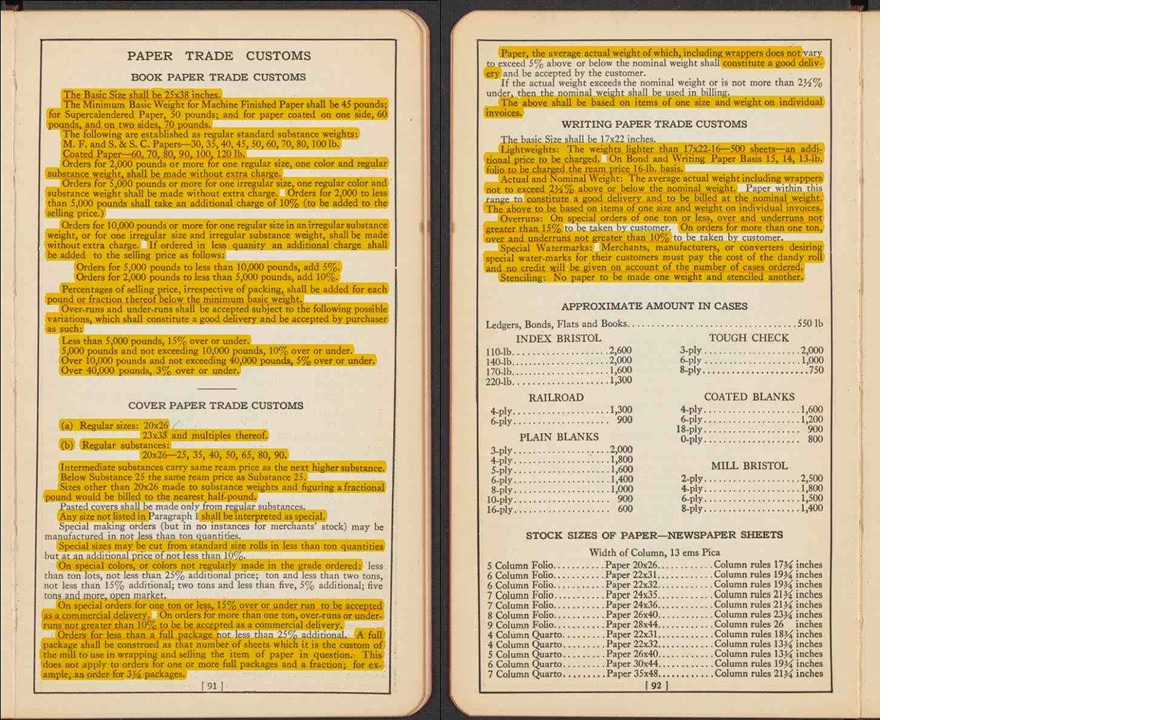
These are all trade customs, as the title clearly states, which were meant to be copied without attribution. That's what they were made for. As I have shown, several other authors copied them, too. The organizations who drafted them asked for copying and distribution. You need to find relevant examples, which means something other than trade customs.
I would point out that most of the places in which you find these trade customs, they are in fact attributed to the various trade organizations that standardized them. So your statement "meant to be copied without attribution" is wrong.
But again, as I've said before, and as you continually avoid, so what? The point is not that Gallaway had some implied permission to reproduce the material, with or without attribution. The point is that Gallaway does copy the work of others without attribution, and has done so more than once, from more than one source. So you can't be sure that anything in his books or writings is original with him. You explicitly do assume that the instances you had found of other unattributed copying means that the pre-existing work must also be by Gallaway (an assumption which was already dubious), but these new examples of unattributed copying show that you can't make that assumption at all. You use that assumption in a logic chain that ends in the statements that Gallaway played cards, Gallaway is pictured in Copyfitting and in the Monotype Journal, etc., etc. Even if all the other links in the chain were rock-solid (and it looks to me like no one except yourself thinks they are), this unattributed copying breaks the chain, and your conclusions are invalid.
But again, as I've said before, and as you continually avoid, so what? The point is not that Gallaway had some implied permission to reproduce the material, with or without attribution. The point is that Gallaway does copy the work of others without attribution, and has done so more than once, from more than one source. So you can't be sure that anything in his books or writings is original with him. You explicitly do assume that the instances you had found of other unattributed copying means that the pre-existing work must also be by Gallaway (an assumption which was already dubious), but these new examples of unattributed copying show that you can't make that assumption at all. You use that assumption in a logic chain that ends in the statements that Gallaway played cards, Gallaway is pictured in Copyfitting and in the Monotype Journal, etc., etc. Even if all the other links in the chain were rock-solid (and it looks to me like no one except yourself thinks they are), this unattributed copying breaks the chain, and your conclusions are invalid.
Bill Mullins wrote:I would point out that most of the places in which you find these trade customs, they are in fact attributed to the various trade organizations that standardized them. So your statement "meant to be copied without attribution" is wrong.
But again, as I've said before, and as you continually avoid, so what? The point is not that Gallaway had some implied permission to reproduce the material, with or without attribution. The point is that Gallaway does copy the work of others without attribution, and has done so more than once, from more than one source. So you can't be sure that anything in his books or writings is original with him. You explicitly do assume that the instances you had found of other unattributed copying means that the pre-existing work must also be by Gallaway (an assumption which was already dubious), but these new examples of unattributed copying show that you can't make that assumption at all. You use that assumption in a logic chain that ends in the statements that Gallaway played cards, Gallaway is pictured in Copyfitting and in the Monotype Journal, etc., etc. Even if all the other links in the chain were rock-solid (and it looks to me like no one except yourself thinks they are), this unattributed copying breaks the chain, and your conclusions are invalid.
Your logic is somewhat ambitious, Bill. The trade customs were indeed intended to be copied, with or without attribution. Some publications may have mentioned the source when citing it, but this was not a requirement.
And you can't seriously cast doubt on Gallaway's tendency to credit other authors, using only trade customs as examples. All this proves is that he didn't believe it was necessary in regard to industry standards and practices--which can hardly be considered "literature" of the sort that we find in the idiosyncratic writings of Gallaway, Sanders, and Erdnase.
You are approaching this from the wrong angle. This is not how I argue. The unattributed re-use of material in "Copyfitting" by Gallaway is probable cause to investigate the authorship of "Copyfitting" and of "The Monotype System". The linguistic fingerprint and the photographic evidence is proof that it is indeed Gallaway. Look at this facial comparison I have just completed:Bill Mullins wrote:You explicitly do assume that the instances you had found of other unattributed copying means that the pre-existing work must also be by Gallaway (an assumption which was already dubious), but these new examples of unattributed copying show that you can't make that assumption at all.
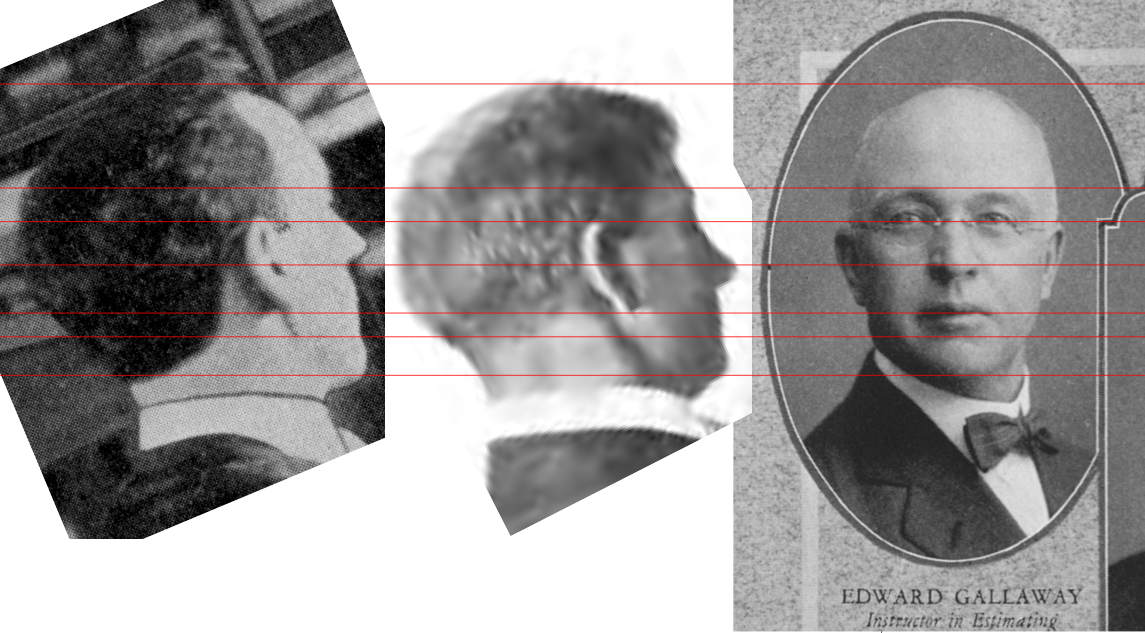
The above facial comparison has an unknown person on the left, which functions as control, a close-up of the head in profile from "The Monotype System" in the middle, and a known Gallaway portrait on the right.
The portrait on the right has him slightly look up. I rotated the profiles so that the faces are also pointing slightly upwards. I then drew red horizontal lines to mark certain features on Gallaway’s face, such as eyes, nose tip, mouth, top of head and bottom of chin. As we can see all the features from the center profile line up with Gallaway’s portrait. However, the control image of a random person on the left side does not line up at all, proving that the profile in the center depicts very likely Gallaway.
The only discrepancy is the size of the right ear, which appears smaller in the portrait and larger in the profile. But we should expect this due to perspective. In the profile the ear is closest to the camera and will therefore appear slightly larger. In the frontal portrait the ears are somewhat further away from the camera than the face, and thus in this photo the ears will appear slightly smaller. The combined effect is that the ear size in this comparison is not an exact match, as we expect due to perspective distortions. With all these facial features lining up perfectly we have a match of the face, at least as much as one could expect from such a comparison. Also remember the bald spot in the profile which has grown larger in the portrait from about a decade later. And both photos show a man with a light complexion. The profile in the center shows light colored hair, the portrait on the right light colored eyes.
We can conclude that Gallaway wrote "The Monotype System" and "Copyfitting". Linguistic fingerprint and photo evidence proof if. The fact that Gallaway re-uses material from these books without attribution was the probable cause that lead me to this discovery and adds to the case, but is not the sole linchpin on which it rests.
lybrary wrote:The fact that Gallaway re-uses material from these books without attribution was the probable cause that lead me to this discovery and adds to the case, but is not the sole linchpin on which it rests.
Adds to what case? All that stuff happened in the 1920s, way after The Expert. The fact that Gallaway copies without attribution further convinces me that he lifted parts of The Expert in his writing and book publishing.
We are discussing here the authorship of "The Monotype System" (1912 & 1916) and "Copyfitting" (1916) books.Leonard Hevia wrote:lybrary wrote:The fact that Gallaway re-uses material from these books without attribution was the probable cause that lead me to this discovery and adds to the case, but is not the sole linchpin on which it rests.
Adds to what case? All that stuff happened in the 1920s, way after The Expert. The fact that Gallaway copies without attribution further convinces me that he lifted parts of The Expert in his writing and book publishing.
Not directly related to Erdnase, but rather an interesting look at the early Chicago printing scene, and the original Chicago printers row ... with Drake, McKinney, etc all within a few blocks of each other.
Interesting aside, that Chicago has a "new" printers row, largely due to real estate prices in the "old" printers row today being some of the most expensive downtown Chicago properties:
https://chicago.curbed.com/2018/4/9/171 ... al-artists
Interesting aside, that Chicago has a "new" printers row, largely due to real estate prices in the "old" printers row today being some of the most expensive downtown Chicago properties:
https://chicago.curbed.com/2018/4/9/171 ... al-artists
Chris, I have to say, I thought you were going to have more with the facial recognition contention; but for me those photos and diagrams are not convincing evidence at all.
The people in the photos don't look alike, and even then, your proportion argument doesn't pan out.
I think your have some strong arguments for Gallaway, but this, and the hand size to height estimation, are fraught with possibilities of error from many sources.
The people in the photos don't look alike, and even then, your proportion argument doesn't pan out.
I think your have some strong arguments for Gallaway, but this, and the hand size to height estimation, are fraught with possibilities of error from many sources.
After reading Bob's updated analyses of the writing similarities between Sanders and Erdnase, I can't possibly accept that he was not the author of The Expert. There is such a vast array of similarities in the writing that to adamantly believe Sanders is not a viable candidate is to be in denial. When you throw in all the other pieces of circumstantial evidence that point to Sanders, the mystery whittles down to the search for a final confirmation.
Leonard Hevia wrote:After reading Bob's updated analyses of the writing similarities between Sanders and Erdnase, I can't possibly accept that he was not the author of The Expert. There is such a vast array of similarities in the writing that to adamantly believe Sanders is not a viable candidate is to be in denial. When you throw in all the other pieces of circumstantial evidence that point to Sanders, the mystery whittles down to the search for a final confirmation.
I obviously agree
I think if W.E. Sander's name was E.S. Andrews, then it would be regarded as a pretty much open and shut case. However, I think some people resist abandoning the simplicity and directness of the backwards spelling explanation. But, if you think about it, the double anagram using the backwards spelling as misdirection to hide internal anagram is much more ingenious. We know Erdnase is someone who appreciated "Machiavellian subtlety," so why would we expect something so simple and unsubtle as a reversed spelling with a meaningless forward spelling that practically demands you to find the reversed name? If that's all we had to go on, then we'd be stuck with it. But it really doesn't fit.
On the other hand, once allowing that the reversed spelling acts as misdirection from the real anagram, we can notice that the pseudonym itself ties into Sanders' life (Erdnase = earth nose = mining engineer). And we can also notice the "Andrews" = "AND RUSE" hints in the subtitle telling us that "Andrews" is a ruse. But the real clincher is when we find out that Sanders loved wordplay generally. And that he played with anagrams and letter combinations on his own name (as well as other people's), and that he even referred figuratively to a name as being a "combination of letters". We really couldn't ask for a more perfect scenario. He's the right person to devise such a clever pseudonym. And his name just so happens to be an anagram of the author's.
Once getting past the misdirection in the anagram, the rest falls into place. With Sanders we have (thanks to Marty Demarest) strong concrete evidence of his involvement in both magic and gambling. And the clincher for me is the writing. I don't think I could find a writer who sounds more like Erdnase than Sanders. The purpose of the document I put together was to identify all the ways that happens -- to make it as concrete and obvious as possible by grouping the correspondences together by type so as to better hear the author's voice. As I say in my conclusion, the correspondences are extensive and range from from lexical-syntactic constructions, to word choice, to ironic flourishes, to rhetorical devices, to shared metaphors, to biographically-related topics, to stylistic quirks (e.g. vernacular speech and parenthetical punctuation), to themantic obsessions, to the use of puns and scare quotes on the exact same words.
Leonard Hevia wrote:After reading Bob's updated analyses of the writing similarities between Sanders and Erdnase, I can't possibly accept that he was not the author of The Expert. There is such a vast array of similarities in the writing that to adamantly believe Sanders is not a viable candidate is to be in denial. When you throw in all the other pieces of circumstantial evidence that point to Sanders, the mystery whittles down to the search for a final confirmation.
I must be missing something somewhere. Erdnase wrote an encyclopedia of card sleights, etc., added some card tricks, and demonstrated the contents to Marshall D. Smith so that he could illustrate the book.
Where is the evidence that Sanders was capable of all that?
Zenner wrote:Leonard Hevia wrote:After reading Bob's updated analyses of the writing similarities between Sanders and Erdnase, I can't possibly accept that he was not the author of The Expert. There is such a vast array of similarities in the writing that to adamantly believe Sanders is not a viable candidate is to be in denial. When you throw in all the other pieces of circumstantial evidence that point to Sanders, the mystery whittles down to the search for a final confirmation.
I must be missing something somewhere. Erdnase wrote an encyclopedia of card sleights, etc., added some card tricks, and demonstrated the contents to Marshall D. Smith so that he could illustrate the book.
Where is the evidence that Sanders was capable of all that?
Good point! The purchase of six decks of playing cards doesn't in any way support the hypothesis that Sanders could have demonstrated the moves to Smith. And the reference to "Mutus Nomen" is a pitiable fraction of evidence that he had an interest in magic. In those days, magic was far more fascinating to audiences than it is in this cynical age. It was not uncommon for boys to dream of becoming magicians. It was the equivalent of lads wanting to be astronauts and cowboys in our day. Having a momentary thought about it and developing great skill at it are two very different matters.
And as for the "cleverness" of the anagram--all I will say is that this is a great pitfall of logic, to stop when you get to the point that suits you. If Erdnase were just a bit more ingenious, he might have gone so far as to scramble someone else's name.
Not sure where your reading comprehension is, but Sanders has more in his corner than any other candidate. Beyond buying cards and writing about a card effect, there is more. These are facts, not diagrams, conjectures. If you are going to discount cards and effects as not being worth mention, what will be?
Tom Gilbert wrote:Not sure where your reading comprehension is, but Sanders has more in his corner than any other candidate. Beyond buying cards and writing about a card effect, there is more. These are facts, not diagrams, conjectures. If you are going to discount cards and effects as not being worth mention, what will be?
I am in agreement with Mr. Zenner, that whoever wrote the routines for the magic tricks in EATCT had to be an experienced magician. They strongly suggest not only knowledge of how the tricks are done, but of the all-important presentation. An amateur who never had to earn his living on stage is not likely to have learned the importance of this. If Erdnase is to be considered "an original", an innovator, a creative contributor to the annals of magic rather than a mere parrot, he cannot reasonably be supposed to have intuitively surmised the essential elements of successful performing.
Benedict doesn't have a lot of writing to his credit (that we know of), and that it is a problem, but in my opinion, it is not a serious one. His style is not dissimilar to that of Erdnase, and one could argue that he was compelled to publish EATCT himself because the magic magazines (which he might have tried repeatedly to get into) gave him little work.
jkeyes1000 wrote: The trade customs were indeed intended to be copied . .
Document this, please. Both you and Chris keep saying this, without evidence. I've seen the trade customs that Gallaway copied from the Handbook in print in several locations; none of them give any encouragement to freely reproduce them. I have no doubt that the various trade associations wanted their members to implement the customs. I've seen no evidence that they wanted the customs to be widely copied. (and I'm speaking of the particular customs that Gallaway copied from the Handbook that I wrote of earlier.)
And you can't seriously cast doubt on Gallaway's tendency to credit other authors, using only trade customs as examples.
I didn't use "only trade customs as examples." Did you not see where he copied a long phrase of ordinary words from a 1913 article by Edward Passano? Chris's ebook says, "Olsson has pointed out . . . even mundane sentences and phrases, once they are long enough, can be unique and are therefore clear authorship identifiers. His example was a sentence with 9 words". Chris said that Gallaway copied in Estimating for Printers the 8-word phrase "of the face in which the matter is" from Copyfitting; in fact, he copied the even longer 9-word phrase "of the face in which the matter is set" from Passano. Have we not then shown, by Olsson's own standards, that Gallaway is in fact Passano?
jkeyes1000 wrote: If Erdnase is to be considered "an original", an innovator, a creative contributor to the annals of magic rather than a mere parrot, he cannot reasonably be supposed to have intuitively surmised the essential elements of successful performing.
Not sure anybody here has ever said Erdnase was "an original" magician ?
What folks have said is that Erdnase created a complete suite of original sleights with playing cards designed to be used to cheat at a gambling table, with most of those sleights having never before been witnessed by human eyes.
That Erdnase had plenty of opportunity to copy and otherwise parse information from a wide variety of available magic books of the day in order to complete the second half of the book has been identified over and over again. The magic is somewhat of a side-story ... perhaps an afterthought to try and dissuade those who would enforce the Comstock Laws from focusing on EATCT as anything other than a magic book.
What Erdnase provided us in the first half of the EATCT is the work of an inveterate gambler and card cheat, who then spent years (perhaps a decade) developing his personal knowledge of cheating at a gaming table into new and effective methods to manipulate cards to an advantage ... new sleights that the hustlers of the day had never seen before ... and likely didn't even imagine were possible.
lybrary wrote: Look at this facial comparison I have just completed:
You are aware, are you not, that phrenology has been widely discredited?
a close-up of the head in profile from "The Monotype System" in the middle,
That's not a profile -- he's a good 30 degrees past profile. We are looking at the back-right aspect of his head, not the right side of his head, as a profile would be.
The portrait on the right has him slightly look up.
And you know this how? He looks to be looking straight on at an eye-level camera to me. What is your horizontal reference?
I rotated the profiles so that the faces are also pointing slightly upwards.
It appears you rotated the head about 27-28 degrees anti-clockwise. Are you contending that Gallaway was looking this far up? Or that the keyboard operator was looking, say, 14 degrees down, and you added 13 degrees more to match Gallaway's upward look? Again, how do you know these numbers? What is the horizontal reference for them?
I then drew red horizontal lines to mark certain features on Gallaway’s face, such as eyes, nose tip, mouth, top of head and bottom of chin. As we can see all the features from the center profile line up with Gallaway’s portrait.
Except that you can't accurately locate these features on both pictures, so it's a waste of time.
Eyes: You don't know where the pupil of the central picture is; the line may or may not go through it.
Nose tip: The dark spot of the nostril is much more below the line for the central picture than it is for Gallaway.
Top of Head: You used the top of Gallaway's pate, and the top of the hair on the central picture, allowing nothing for the thickness of the hair itself. (and besides, you've said that since Gallaway is bald in his portrait, he must have been at somewhat bald in 1902 for Smith to be wrong about his age. What happened, did his hair grow back by the time of the central picture? That guy has a full head of hair.)
Bottom of chin: There's nothing specific enough about either chin to say you've matched the "bottom" of one to the other. You've just picked two arbitrary spots and said they matched.
The only features that can be accurately located on both the central picture and Gallaway are the top and bottom of his ear -- and they don't match.
You've used thin red lines to imply a precision that does not exist. You should have used thick red blurry bands. Probably made with crayons.
Roger M. wrote:What Erdnase provided us in the first half of the EATCT is the work of an inveterate gambler and card cheat, who then spent years (perhaps a decade) developing his personal knowledge of cheating at a gaming table into new and effective methods to manipulate cards to an advantage . . .
Note also that Erdnase does claim to have spent time at the gaming table ("we bucked the tiger. . . ", his comments to Smith about being a reformed gambler), he does not claim any special conjuring knowledge, and in fact what he says about conjuring often feels like "book learning" ("so far as we can learn from . . . the literature of conjurers"), or theoretical ("we think it would appear quite as natural if the performer were to shuffle the deck himself") rather than first-hand knowledge.
I am not using phrenology which would require one to deduce character or mental ability from the shape of the head. I am using facial recognition, something your smart phone may be doing already. The phone does this in two dimensions, I am doing it in one dimension.Bill Mullins wrote:lybrary wrote: Look at this facial comparison I have just completed:
You are aware, are you not, that phrenology has been widely discredited?
I simply pointed out this possibility. He may or may not have had early onset of male pattern baldness. Either way, Smith could have been wrong about his age with or without it.Bill Mullins wrote:and besides, you've said that since Gallaway is bald in his portrait, he must have been at somewhat bald in 1902 for Smith to be wrong about his age.
They do match once you take perspective into account, as do all the other features, from eye brows, eyes, nose, mouth and chin. If you look carefully you can even see details of the ear matching. I can see you are getting desperate with your attacks. The new findings about Gallaway provide the first photo evidence that he is Erdnase, via the match of various characteristics of his hands. That must really bother you.Bill Mullins wrote:The only features that can be accurately located on both the central picture and Gallaway are the top and bottom of his ear -- and they don't match.
lybrary wrote:...The new findings about Gallaway provide the first photo evidence that he is Erdnase, via the match of various characteristics of his hands.....
Except your "new" findings don't do anything of the sort Chris, and simply repeating them ad nauseam doesn't change that rather obvious fact.
Of course they do. Here are some of the matching characteristics:Roger M. wrote:lybrary wrote:...The new findings about Gallaway provide the first photo evidence that he is Erdnase, via the match of various characteristics of his hands.....
Except your "new" findings don't do anything of the sort Chris, and simply repeating them ad nauseam doesn't change that rather obvious fact.
1) thumb length is the same. (from Fig 79: 60mm, from fan of rulers 59mm)
2) spatulate thumb
3) relative length of index-finger to pinky
4) large finger nails
It is a wonderful match between the hands Smith drew and the photos of Gallaway's hands. I couldn't be more happy. Would have never thought we would find that many photos of Gallaway's hands.
Bill Mullins wrote:Roger M. wrote:What Erdnase provided us in the first half of the EATCT is the work of an inveterate gambler and card cheat, who then spent years (perhaps a decade) developing his personal knowledge of cheating at a gaming table into new and effective methods to manipulate cards to an advantage . . .
Note also that Erdnase does claim to have spent time at the gaming table ("we bucked the tiger. . . ", his comments to Smith about being a reformed gambler), he does not claim any special conjuring knowledge, and in fact what he says about conjuring often feels like "book learning" ("so far as we can learn from . . . the literature of conjurers"), or theoretical ("we think it would appear quite as natural if the performer were to shuffle the deck himself") rather than first-hand knowledge.
Yes, I am well aware that Erdnase claims to have more knowledge of gambling than magic. But the magic section ironically gives us more fluent and more exuberant instruction on how to perform than does the gambling. The author is enthusiastic, as only a person with real theatrical experience could be. He has an energy, a flair, that clearly comes from an interactive participation with the crowd. This is not mere patter, but patter intermingled and infused with adrenalin, with hauteur. In few words--with stage presence. Unless you can find the book or books that he clipped these tricks from (complete with all the fast talking and bits of business, like the way he plays up the cards "flying" from one sleeve to the other for instance), then I think we can and should assume that this is his own, well rehearsed material.
That the magic portion seems to be an after-thought suggests to me that the author was fully imbued with this skill, that it was "second nature" to him.
For this reason, I suspect that EATCT might have been co-authored. Gallaway could have written the first part and Benedict, the second.
jkeyes1000 wrote:
Good point! The purchase of six decks of playing cards doesn't in any way support the hypothesis that Sanders could have demonstrated the moves to Smith. And the reference to "Mutus Nomen" is a pitiable fraction of evidence that he had an interest in magic. In those days, magic was far more fascinating to audiences than it is in this cynical age. It was not uncommon for boys to dream of becoming magicians. It was the equivalent of lads wanting to be astronauts and cowboys in our day. Having a momentary thought about it and developing great skill at it are two very different matters.
And as for the "cleverness" of the anagram--all I will say is that this is a great pitfall of logic, to stop when you get to the point that suits you. If Erdnase were just a bit more ingenious, he might have gone so far as to scramble someone else's name.
you make a lot of claims there. and like all of them you make, i know of no facts to back them up.
show me evidence that boys dreamt of becoming magicians as they did astronauts or that at this point in time audiences were more fascinated with it then at really any other time.
and while buying cards in bulk isn’t proof of cheating expertise, anyone who has cheating expertise would be the sort to buy cards in bulk.
for galloway we have one magic/card book, that was printed by the company he worked for AND is the book whose author we are questioning.
With sanders we have evidence of a WORKING knowledge of at least one magic trick, one that was included in the work under consideration, and evidence that he went through lots of playing cards.
chris has suggested everyone played cards and now keyes is claiming everyone did magic.
i guess if that’s what you have to do to bind yourself to the evidence you wish weren’t there, i guess that’s what you have to do.
jkeyes1000 wrote:. But the magic section ironically gives us more fluent and more exuberant instruction on how to perform than does the gambling. The author is enthusiastic, as only a person with real theatrical experience could be. He has an energy, a flair, that clearly comes from an interactive participation with the crowd. This is not mere patter, but patter intermingled and infused with adrenalin, with hauteur. In few words--with stage presence. Unless you can find the book or books that he clipped these tricks from (complete with all the fast talking and bits of business, like the way he plays up the cards "flying" from one sleeve to the other for instance), then I think we can and should assume that this is his own, well rehearsed material.
That the magic portion seems to be an after-thought suggests to me that the author was fully imbued with this skill, that it was "second nature" to him.
For this reason, I suspect that EATCT might have been co-authored. Gallaway could have written the first part and Benedict, the second.
and here we see why those who judge erdnase should have an understanding of the topic before commenting.
clearly someone has no understanding of how fluent erdnase is in his cheating instructionals.
this is because the real lessons remain hidden to the novice. Instead he sees depth in the section that is revealed only most superficially.
and hey, i’m a very experienced performer, but no one would call me enthusiastic
lybrary wrote: Here are some of the matching characteristics:
1) thumb length is the same. (from Fig 79: 60mm, from fan of rulers 59mm)
2) spatulate thumb
3) relative length of index-finger to pinky
4) large finger nails
It is a wonderful match between the hands Smith drew and the photos of Gallaway's hands. I couldn't be more happy. Would have never thought we would find that many photos of Gallaway's hands.
Even assuming the illustration is of Gallway:
1) Erdnase hand illustrations show wildly varying sizes. They're not consistently drawn. So it's not possible to know his hand size from the illustrations.
3) Index-finger to pinky doesn't matter if the other fingers don't match (which they don't). As I wrote earlier...The index finger in the Gallaway illustration is very short and extends just to the last joint of the middle finger (the base of the last phalange). In Erdnase Fig 79, the index finger is 2/3 of the way up the middle finger fingernail, which is very far past the last joint. And even if the Erdnase middle finger is bent to make it appear shorter, the joints would have to bend A LOT in order for the index finger to extend that far relative to it. With that amount of bending, the last phalange of the middle finger would be at an sharp angle away from the viewer. And at that angle, you'd be lucky to see the middle fingernail at all. It certainly wouldn't look relatively head-on and normal, like it does in Fig 79.
So I don't see any way that the proportions of the fingers could be considered to be the same in the two illustrations.
But that all ignores the issue that neither illustration (the Erdnase one certainly) is likely to be realistic/accurate in terms of sizes and proportions in the first place. So unless that was established, any comparison of the actual hands is meaningless.
4) fingernails on the Gallaway illustration are very small. So that's an indication the illustration isn't accurate (assuming he had large fingernails). And I don't believe we can know anything about Erdnase in that regard given the other inaccuracies in the illustrations or the process by which they were drawn.
Two illustrators of magic books, Richard Kaufman and Gregg Webb, say they are traced from photos. Even Smith commented that he probably traced them. What more evidence do you need?Bob Coyne wrote:But that all ignores the issue that neither illustration (the Erdnase one certainly) is likely to be realistic/accurate in terms of sizes and proportions in the first place. So unless that was established, any comparison of the actual hands is meaningless.
lybrary wrote:Two illustrators of magic books, Richard Kaufman and Gregg Webb, say they are traced from photos. Even Smith commented that he probably traced them. What more evidence do you need?Bob Coyne wrote:But that all ignores the issue that neither illustration (the Erdnase one certainly) is likely to be realistic/accurate in terms of sizes and proportions in the first place. So unless that was established, any comparison of the actual hands is meaningless.
If he traced, then he did a poor job given that the illustrations are not close to being consistent or accurate. You can see that by comparing illustrations where the hands sometimes look huge relative to the cards (eg figs 5, 11, 61). And other cases where the card is too wide (fig 77).
I think I could make a good case for Gallaway, based on the anagram idea. Now, "S.W. Erdnase" works out to be "Reads news"--yes? And Gallaway had been a proof reader. Not only that, but according to Chris, he had some sort of connection with a German-language newspaper.
Well? You've got to admit, that's cleverer than just scrambling one's own name!
Well? You've got to admit, that's cleverer than just scrambling one's own name!
lybrary wrote:Two illustrators of magic books, Richard Kaufman and Gregg Webb, say they are traced from photos. Even Smith commented that he probably traced them. What more evidence do you need?Bob Coyne wrote:But that all ignores the issue that neither illustration (the Erdnase one certainly) is likely to be realistic/accurate in terms of sizes and proportions in the first place. So unless that was established, any comparison of the actual hands is meaningless.
the photos.
otherwise it’s just speculation.
Gallaway was a newspaper man. He learned the printer's art at the Delphos Weekly Herald starting with 15 years of age. At age 17 he already wrote editorials. Later he typeset for a German newspaper in Indiana. Then he planned to start a German newspaper in Delphos but instead started an English one in Fort Payne, AL, called the Payne Weekly People. Those are all things that happened before Expert was published. Gallaway was a newspaper man in the first part of his professional career.jkeyes1000 wrote:I think I could make a good case for Gallaway, based on the anagram idea. Now, "S.W. Erdnase" works out to be "Reads news"--yes? And Gallaway had been a proof reader. Not only that, but according to Chris, he had some sort of connection with a German-language newspaper.
Well? You've got to admit, that's cleverer than just scrambling one's own name!
lybrary wrote: Would have never thought we would find that many photos of Gallaway's hands.
You have exactly one known photograph of Gallaway's hands, and it is insufficiently detailed to measure anything.
All these other pictures you are saying belong to Gallaway? Wishful thinking. There is no evidence to support the contention that they are his.
Brad Henderson wrote:and hey, i’m a very experienced performer, but no one would call me enthusiastic
Well, FWIW, you've got hauteur down pat <G>.
We have more than twenty photos. His authorship of the Monotype System is wonderfully supported by his unattributed re-use, linguistic fingerprint, and photographic evidence. I could hardly wish for stronger evidence than that. Many authorship cases have to solely rely on the linguistic fingerprint. Here we have three independent pieces of evidence. Beautiful!Bill Mullins wrote:lybrary wrote: Would have never thought we would find that many photos of Gallaway's hands.
You have exactly one known photograph of Gallaway's hands, and it is insufficiently detailed to measure anything.
All these other pictures you are saying belong to Gallaway? Wishful thinking. There is no evidence to support the contention that they are his.
Zenner wrote:I must be missing something somewhere.
Probably because you still haven't read Bob's essay on the writing similarities between Sanders and Erdnase.
lybrary wrote:His authorship of the Monotype System is wonderfully supported by his unattributed re-use, linguistic fingerprint, and photographic evidence. I could hardly wish for stronger evidence than that.
You consider that strong evidence? Stronger evidence might put Gallaway walking into a gambling joint. Not that Monotype system nonsense. Linguistic fingerprint? Gallaway's writing does not resemble Erdnase.
Keep looking...
lybrary wrote:We have more than twenty photos. His authorship of the Monotype System is wonderfully supported by his unattributed re-use, linguistic fingerprint, and photographic evidence.
1. There is no reason at all to suppose that the photos in the Monotype books are of Gallaway, or that they even all are of the same person. You are creating this out of thin air.
2. "His authorship . . . is wonderfully supported by . . . photographic evidence." But I thought you based the photo ID on the authorship. Which came first? the Chicken or the Egg? Circular reasoning, chasing your tail . . .
They aren't independent (too tightly linked to each other), and they aren't evidence. It is speculation that you have convinced yourself has meaning.Here we have three independent pieces of evidence.
Three independent pieces of evidence:Bill Mullins wrote:2. "His authorship . . . is wonderfully supported by . . . photographic evidence." But I thought you based the photo ID on the authorship. Which came first? the Chicken or the Egg? Circular reasoning, chasing your tail . . .
1) Unattributed re-use of several paragraphs.
2) Linguistic fingerprint of the "Monotype System" matches the one from "Estimating for Printers".
3) The photo of the person in the "Monotype System" closely resembles Gallaway's portrait (distances of eyes, nose, ears, chin, mouth all fit perfectly)
All three do independently support Gallaway's authorship of "The Monotype System".
I've decided that all of the Monotype/Copyfitting literature was written by Joseph Hays, the typographical and advertising manager for Lanston, who died in May of 1920. Hays wrote the section on Monotype in Typecasting and Composing Machines, edited by A. W. Finlay, which was published by the United Typothetea and was one of their official textbooks. A picture of him on the cover of the June 1920 issue of the Monotype Journal shows a wedding ring, so it is him (not Gallaway - Chris has said Gallaway didn't wear a wedding ring) in the picture that is in Chris's ebook.
My evidence? Same as Chris's. I'm wishing really, really hard.
My evidence? Same as Chris's. I'm wishing really, really hard.
Not at all the same. His face doesn't match the profile photo from the Monotype System book. You have no linguistic analysis that shows that Mr. Hays writes anything like the author of "The Monotype System", and neither have you shown that Hays uses sections from the book unattributed, or anything else that would suggest he wrote the book. And surely a biographical sketch in the Monotype journal would have mentioned that he wrote these Monotype books. But it doesn't mention anything. So you have nothing, just a person who worked for Lanston Monotype. For Gallaway we have three independent pieces of evidence that he wrote the books.Bill Mullins wrote:I've decided that all of the Monotype/Copyfitting literature was written by Joseph Hays, the typographical and advertising manager for Lanston, who died in May of 1920. Hays wrote the section on Monotype in Typecasting and Composing Machines, edited by A. W. Finlay, which was published by the United Typothetea and was one of their official textbooks. A picture of him on the cover of the June 1920 issue of the Monotype Journal shows a wedding ring, so it is him (not Gallaway - Chris has said Gallaway didn't wear a wedding ring) in the picture that is in Chris's ebook.
My evidence? Same as Chris's. I'm wishing really, really hard.
Chris -- I don't really think it was Hays. I was making fun of you.
But if I was serious, I would point out that I have an actual Monotype article with an actual byline, which is real evidence, and not speculation.
But if I was serious, I would point out that I have an actual Monotype article with an actual byline, which is real evidence, and not speculation.
jkeyes1000 wrote:But the magic section ironically gives us more fluent and more exuberant instruction on how to perform than does the gambling.
You literally have no idea what you're talking about.
lybrary wrote:Gallaway was a newspaper man. He learned the printer's art at the Delphos Weekly Herald starting with 15 years of age. At age 17 he already wrote editorials. Later he typeset for a German newspaper in Indiana. Then he planned to start a German newspaper in Delphos but instead started an English one in Fort Payne, AL, called the Payne Weekly People. Those are all things that happened before Expert was published. Gallaway was a newspaper man in the first part of his professional career.jkeyes1000 wrote:I think I could make a good case for Gallaway, based on the anagram idea. Now, "S.W. Erdnase" works out to be "Reads news"--yes? And Gallaway had been a proof reader. Not only that, but according to Chris, he had some sort of connection with a German-language newspaper.
Well? You've got to admit, that's cleverer than just scrambling one's own name!
I appreciate the info Chris, but I was trying to be funny. I don't really make much of the anagram theory.
The next time I tell a joke I will set my goal a little higher. I think my mistake was that I was attempting to be as amusing as Brad. Unfortunately, it appears that I was all too successful.
Evidence of what? That Mr. Hays could write?Bill Mullins wrote:But if I was serious, I would point out that I have an actual Monotype article with an actual byline, which is real evidence, and not speculation.
Zenner wrote:I must be missing something somewhere. Erdnase wrote an encyclopedia of card sleights, etc., added some card tricks, and demonstrated the contents to Marshall D. Smith so that he could illustrate the book.
Where is the evidence that Sanders was capable of all that?
What's the problem? The purchase of six decks of cards for a trip and details of a card trick in his notebooks is a pretty good indication that he was very serious about cards and that he did card tricks. We also know that he gambled (there are references to gambling debts in letters to him...plus references to gambling games in his own writing).
The main focus of the book is gambling sleights and card technique more generally, not performance magic. In fact, the orientation for the legerdemain section, in addition to the sleights, is towards impromptu magic done by an amateur. i.e. Tricks that can be done with an ordinary "family deck". He writes: "There is no branch of conjuring that so fully repays the amateur for his labor and study as sleight of hand with cards." It sounds like he's talking from personal experience as an amateur, himself. It would be surprising if the author was a full time or professional magician.
Bob Coyne wrote:Zenner wrote:I must be missing something somewhere. Erdnase wrote an encyclopedia of card sleights, etc., added some card tricks, and demonstrated the contents to Marshall D. Smith so that he could illustrate the book.
Where is the evidence that Sanders was capable of all that?
What's the problem? The purchase of six decks of cards for a trip and details of a card trick in his notebooks is a pretty good indication that he was very serious about cards and that he did card tricks. We also know that he gambled (there are references to gambling debts in letters to him...plus references to gambling games in his own writing).
The main focus of the book is gambling sleights and card technique more generally, not performance magic. In fact, the orientation for the legerdemain section, in addition to the sleights, is towards impromptu magic done by an amateur. i.e. Tricks that can be done with an ordinary "family deck". He writes: "There is no branch of conjuring that so fully repays the amateur for his labor and study as sleight of hand with cards." It sounds like he's talking from personal experience as an amateur, himself. It would be surprising if the author was a full time or professional magician.
That is your interpretation, Bob. But I have serious doubts about it.
First--there is the irony of a gambler supposedly performing (whether professionally or socially) not just magic tricks, but card tricks, using the very same skills that a cheater would surely hide.
Second--the fact that the legerdemain appears to be of secondary importance in the book.
Third--that despite its subservient position, this latter section is written far more eloquently than the gambling part, with more zeal and passion. This does not indicate to me that the author regarded magic as as mere hobby. It shows extreme dedication to patter, presentation and showmanship. Either Erdnase stole these zesty routines from a working magician, or he had been one himself.
That is my interpretation. If I were you, I might hypothesise that Sanders employed a pseudonym in order to get away with this sort of thievery.
jkeyes1000 wrote:
That is your interpretation, Bob. But I have serious doubts about it.
First--there is the irony of a gambler supposedly performing (whether professionally or socially) not just magic tricks, but card tricks, using the very same skills that a cheater would surely hide.
Second--the fact that the legerdemain appears to be of secondary importance in the book.
Third--that despite its subservient position, this latter section is written far more eloquently than the gambling part, with more zeal and passion. This does not indicate to me that the author regarded magic as as mere hobby. It shows extreme dedication to patter, presentation and showmanship. Either Erdnase stole these zesty routines from a working magician, or he had been one himself.
That is my interpretation. If I were you, I might hypothesise that Sanders employed a pseudonym in order to get away with this sort of thievery.
We don't know under what conditions he did magic vs gambling/cheating. If it was Sanders, he traveled all the country around on his mining gigs and could easily do one or the other or both as he moved around. So I don't see much if any conflict. You're only speculating that it's a problem.
I disagree that the Legerdemain section is more eloquent. It's more of just putting on a show (so maybe that's the zeal you're referring to). The parts of the book that are most often quoted and that I think represent his most incisive and best writing are in the introduction and card table artifice sections. That's where his thoughts are most directly expressed, and it's where he's unhindered by the constraints of describing the details of technique or the somewhat silly style expected in the patter. Sanders, btw, would be ideally suited for writing that kind "bosh" and "palaver" in the tricks...it's similar to the humorous/ironic modes he adopts telling stories about his classmates.
Leonard Hevia wrote:Zenner wrote:I must be missing something somewhere.
Probably because you still haven't read Bob's essay on the writing similarities between Sanders and Erdnase.
Perhaps I should be speaking to the organ grinder rather than his monkey.
I read the Marty Demarest article in the Genii again last night. A very good biography but no evidence that Sanders could do ONE sleight or ONE trick from the book that he is supposed to have written. There is nothing to show that in Bob's essay either.
A note of a schoolboy mathematical card trick has nothing to do with sleight-of-hand and is a mere puzzle - not something that would prove entertaining to an audience. Just because he made a note of the words doesn't even mean that he ever did it!
Sanders "might have" seen magicians perform in Montana. He "could have" seen Houdini. He "possibly" met Del Adelphia. How are any of those things evidence that he "could have" written the most famous book on card magic ever? Thousands of people saw magicians work and thousands of people bought packs of cards. Only one was capable of writing The Expert at the Card Table.
Just for a change from the quibbling about Messrs Sanders and Gallaway —
On April 12, 1900, an advert in The Chicago Tribune indicated that E.D. Benedict was operating from an office at 1050, The Monon Building. The Monon Building was at 320-326 Dearborn Street, according to Rand McNally’s Bird’s Eye Views and Guide to Chicago, page 80 — “4. The Monon Building. At 320-326 Dearborn Street, extends through to Custom House Place, with frontages of 75 feet. It is 67 feet deep and 160 feet high, in 13 stories and basement. It is one of the fine high steel buildings of New Chicago, and was built principally for the general offices of the ‘Monon’ Route. There are 4 stores, 125 offices, and 3 passenger elevators. The exterior is of brick and terra cotta, the interior, steel and tile. Patent lawyers and publishers fill the offices which are not occupied by the railroad company. The Monon was erected in 1890 at a cost of $285,000.” The building was demolished when Congress Street was widened and extended to become Congress Parkway.
In that same year’s Chicago Business Directory, Marshall D. Smith’s workplace was given as 1310, 324 Dearborn Street, and his home address as 5519 Monroe Avenue. (page 1768, e-page 64)
As indicated, 320-326 Dearborn Street was the address of the Monon Building; I wonder if the two men met in the elevator on their way to and from work?
On April 12, 1900, an advert in The Chicago Tribune indicated that E.D. Benedict was operating from an office at 1050, The Monon Building. The Monon Building was at 320-326 Dearborn Street, according to Rand McNally’s Bird’s Eye Views and Guide to Chicago, page 80 — “4. The Monon Building. At 320-326 Dearborn Street, extends through to Custom House Place, with frontages of 75 feet. It is 67 feet deep and 160 feet high, in 13 stories and basement. It is one of the fine high steel buildings of New Chicago, and was built principally for the general offices of the ‘Monon’ Route. There are 4 stores, 125 offices, and 3 passenger elevators. The exterior is of brick and terra cotta, the interior, steel and tile. Patent lawyers and publishers fill the offices which are not occupied by the railroad company. The Monon was erected in 1890 at a cost of $285,000.” The building was demolished when Congress Street was widened and extended to become Congress Parkway.
In that same year’s Chicago Business Directory, Marshall D. Smith’s workplace was given as 1310, 324 Dearborn Street, and his home address as 5519 Monroe Avenue. (page 1768, e-page 64)
As indicated, 320-326 Dearborn Street was the address of the Monon Building; I wonder if the two men met in the elevator on their way to and from work?
Bob Coyne wrote:jkeyes1000 wrote:
That is your interpretation, Bob. But I have serious doubts about it.
First--there is the irony of a gambler supposedly performing (whether professionally or socially) not just magic tricks, but card tricks, using the very same skills that a cheater would surely hide.
Second--the fact that the legerdemain appears to be of secondary importance in the book.
Third--that despite its subservient position, this latter section is written far more eloquently than the gambling part, with more zeal and passion. This does not indicate to me that the author regarded magic as as mere hobby. It shows extreme dedication to patter, presentation and showmanship. Either Erdnase stole these zesty routines from a working magician, or he had been one himself.
That is my interpretation. If I were you, I might hypothesise that Sanders employed a pseudonym in order to get away with this sort of thievery.
We don't know under what conditions he did magic vs gambling/cheating. If it was Sanders, he traveled all the country around on his mining gigs and could easily do one or the other or both as he moved around. So I don't see much if any conflict. You're only speculating that it's a problem.
I disagree that the Legerdemain section is more eloquent. It's more of just putting on a show (so maybe that's the zeal you're referring to). The parts of the book that are most often quoted and that I think represent his most incisive and best writing are in the introduction and card table artifice sections. That's where his thoughts are most directly expressed, and it's where he's unhindered by the constraints of describing the details of technique or the somewhat silly style expected in the patter. Sanders, btw, would be ideally suited for writing that kind "bosh" and "palaver" in the tricks...it's similar to the humorous/ironic modes he adopts telling stories about his classmates.
Here is the problem, Bob--that, regardless of how "silly" you think the patter is, and despite how long it took Erdnase to develop his gambling sleights, the writing in the legerdemain section was more elaborate.
It is not mere opinion, it is the voice of experience, from a writer's point of view, that the magic routines required more time and effort to compose, simply because they were fancier. The big question is: Why would Erdnase go to the considerable trouble of being so literate if this portion of EATCT were mere "filler"? The amount of labour that was put into it indicates that these routines were devised by someone who was dedicated to the art of magic as a profession. And please don't bother to remind me that the author introduced them as "tricks you can do for friends and family". That doesn't negate my point. You still need to explain the motivation for such rich verbiage when you are trying to suggest that it was just a bit of fluff that he picked up somewhere and tossed in.
Which leads to another concern. Why would Sanders have thought it necessary to "pad" his book with magic? If he wasn't so much in need of the money, why should he care wether it seemed hefty enough to warrant the $2.00 price? Why not just write a pamphlet on gambling and be done with it?
It is obvious to me that either magic was of great importance to the author, or it was considered wise to add more pages in order to justify the cost of the volume.
It is not mere opinion, it is the voice of experience, from a writer's point of view, that the magic routines required more time and effort to compose, simply because they were fancier.
ha.
again the ignorance of the novice reveals itself. anyone can throw filigree and ornamentation on a basic structure with little effort. It takes years to trim something down to its essential components. and keyes is clearly ignorant of the amount of work required to make moves truly invisible and undetectable. One merely need
look at the techniques he has suggested to see this is true.
one need merely listen to keyes and his water and wine performance, or read his abortion of a presentation for the Hoy book test, to see that he is completely unqualified as to judge what is ether entertaining, eloquent, or meaningful. The idea that fancy is harder than simple is rooted in ignorance and INexperience.
He also here reveals his utter ignorance at the subtlety and depth of instruction contained in the gambling sections.
that doesn’t surprise me as he also regularly has advocated for unmotivated moves that would be both suspected and detected by a blind man.
so if we are evaluating claims based on expertise on the topics of those making them, i encourage all to look up keyes’s work and you will know that to listen to anything he says is senseless folly.
and to zenner: the trick recorded in sanders notes is more than a mere puzzle. it is a very well known magic trick that people have been entertaining each other with, in different forms, for decades.
Brad Henderson wrote:It is not mere opinion, it is the voice of experience, from a writer's point of view, that the magic routines required more time and effort to compose, simply because they were fancier.
ha.
again the ignorance of the novice reveals itself. anyone can throw filigree and ornamentation on a basic structure with little effort. It takes years to trim something down to its essential components. and keyes is clearly ignorant of the amount of work required to make moves truly invisible and undetectable. One merely need
look at the techniques he has suggested to see this is true.
one need merely listen to keyes and his water and wine performance, or read his abortion of a presentation for the Hoy book test, to see that he is completely unqualified as to judge what is ether entertaining, eloquent, or meaningful. The idea that fancy is harder than simple is rooted in ignorance and INexperience.
He also here reveals his utter ignorance at the subtlety and depth of instruction contained in the gambling sections.
that doesn’t surprise me as he also regularly has advocated for unmotivated moves that would be both suspected and detected by a blind man.
so if we are evaluating claims based on expertise on the topics of those making them, i encourage all to look up keyes’s work and you will know that to listen to anything he says is senseless folly.
and to zenner: the trick recorded in sanders notes is more than a mere puzzle. it is a very well known magic trick that people have been entertaining each other with, in different forms, for decades.
No, Brad. You are missing the point again. And I am not suggesting that you are failing to perceive it, only that you are unwilling.
I said above that, regardless of the experimentation and practice that preceded the writing of the gambling portion of EATCT, the actual setting down of the words was as simple as the chord changes in an instruction book on "How To Play The Guitar". It is only a matter of describing hand movements and fingering. The magic section qualifies as fiction. It has plots and characters, and it is not easy to think up scenarios that equate inanimate objects with sentient beings (kings, queens, cards that have been "trained" to obey commands, etc.).
Put simply--an author possessed of the knowledge and experience of cheating at cards could easily write of their mere manipulation. But coming up with a false premise, conceiving patter, choosing the right words to enhance the drama or the humour of the act, is a greater task. You are persuading nobody that it is harder to tell the reader how to hold the deck than to spin a yarn.
If you really believe this, you are showing your ignorance. But I'm not asking you to take my opinion. Ask any writer you want. All other things being equal--in other words, being in either case prepared to write, it is beyond doubt that fiction requires more creative effort than explaining facts.
ah - i see.
not only have you zero knowledge of what it takes to perform a gambling move deceptively - and it’s much more than mere manipulation of the cards - you have never read what erdnase has written, or are too naive to see that there is SO much more in the gambling section than just technical descriptions of moves.
The entire practice of cheating requires all that you suggest is in the magic section and more, for unlike with magic these subjects must remain invisible in execution.
erdnase explains how to do that.
that you don’t know this reveals your lack of qualifications.
perhaps you should read the book before commenting on it. if you did you would see the first section is not merely chord changes and fingerings.
thank you for proving all that i claim about you - and establishing you either haven’t read the book or are too young in your magical studies to be capable of comprehending it.
not only have you zero knowledge of what it takes to perform a gambling move deceptively - and it’s much more than mere manipulation of the cards - you have never read what erdnase has written, or are too naive to see that there is SO much more in the gambling section than just technical descriptions of moves.
The entire practice of cheating requires all that you suggest is in the magic section and more, for unlike with magic these subjects must remain invisible in execution.
erdnase explains how to do that.
that you don’t know this reveals your lack of qualifications.
perhaps you should read the book before commenting on it. if you did you would see the first section is not merely chord changes and fingerings.
thank you for proving all that i claim about you - and establishing you either haven’t read the book or are too young in your magical studies to be capable of comprehending it.
jkeyes1000 wrote:
Here is the problem, Bob--that, regardless of how "silly" you think the patter is, and despite how long it took Erdnase to develop his gambling sleights, the writing in the legerdemain section was more elaborate.
It is not mere opinion, it is the voice of experience, from a writer's point of view, that the magic routines required more time and effort to compose, simply because they were fancier. The big question is: Why would Erdnase go to the considerable trouble of being so literate if this portion of EATCT were mere "filler"? The amount of labour that was put into it indicates that these routines were devised by someone who was dedicated to the art of magic as a profession. And please don't bother to remind me that the author introduced them as "tricks you can do for friends and family". That doesn't negate my point. You still need to explain the motivation for such rich verbiage when you are trying to suggest that it was just a bit of fluff that he picked up somewhere and tossed in.
Which leads to another concern. Why would Sanders have thought it necessary to "pad" his book with magic? If he wasn't so much in need of the money, why should he care wether it seemed hefty enough to warrant the $2.00 price? Why not just write a pamphlet on gambling and be done with it?
It is obvious to me that either magic was of great importance to the author, or it was considered wise to add more pages in order to justify the cost of the volume.
You're distorting what I said.
I didn't say he "padded" the book with magic "filler". You're arguing with your own strawman there.
Also, I don't know why you insist on speculating about largely irrelevant matters, but the magic section made the book appeal to a whole other set of readers. And apparently he enjoyed performing. Smith mentions that he did a few card tricks before posing for the drawings. There's really no issue or contradiction here.
Elaborate writing, as Brad mentions, isn't necessarily better writing. In fact, paring things down to the essentials is one of the hardest tasks. That's true even in prose meant to entertain. For example comedy writers spend forever honing single sentences to connote exactly the right tone, etc. Frilly verbiage ("bosh" and "palaver" as Erdnase terms it) is comparatively easy. Also, the sleights sections don't just describe the technical aspects of the moves; they also describe the nuances and context and philosophy behind them. And Erdnase does that masterfully. You're also completely ignoring the Introduction and initial sections of Card Table Artifice that are not move oriented at all. They contain some of his best and most incisive writing. His patter for the tricks, where he gives it, is entertaining and very much long the lines of how Sanders' wrote at times. But that doesn't make it more important or better.
Bob Coyne wrote:jkeyes1000 wrote:
Here is the problem, Bob--that, regardless of how "silly" you think the patter is, and despite how long it took Erdnase to develop his gambling sleights, the writing in the legerdemain section was more elaborate.
It is not mere opinion, it is the voice of experience, from a writer's point of view, that the magic routines required more time and effort to compose, simply because they were fancier. The big question is: Why would Erdnase go to the considerable trouble of being so literate if this portion of EATCT were mere "filler"? The amount of labour that was put into it indicates that these routines were devised by someone who was dedicated to the art of magic as a profession. And please don't bother to remind me that the author introduced them as "tricks you can do for friends and family". That doesn't negate my point. You still need to explain the motivation for such rich verbiage when you are trying to suggest that it was just a bit of fluff that he picked up somewhere and tossed in.
Which leads to another concern. Why would Sanders have thought it necessary to "pad" his book with magic? If he wasn't so much in need of the money, why should he care wether it seemed hefty enough to warrant the $2.00 price? Why not just write a pamphlet on gambling and be done with it?
It is obvious to me that either magic was of great importance to the author, or it was considered wise to add more pages in order to justify the cost of the volume.
You're distorting what I said.
I didn't say he "padded" the book with magic "filler". You're arguing with your own strawman there.
Also, I don't know why you insist on speculating about largely irrelevant matters, but the magic section made the book appeal to a whole other set of readers. And apparently he enjoyed performing. Smith mentions that he did a few card tricks before posing for the drawings. There's really no issue or contradiction here.
Elaborate writing, as Brad mentions, isn't necessarily better writing. In fact, paring things down to the essentials is one of the hardest tasks. That's true even in prose meant to entertain. For example comedy writers spend forever honing single sentences to connote exactly the right tone, etc. Frilly verbiage ("bosh" and "palaver" as Erdnase terms it) is comparatively easy. Also, the sleights sections don't just describe the technical aspects of the moves; they also describe the nuances and context and philosophy behind them. And Erdnase does that masterfully. You're also completely ignoring the Introduction and initial sections of Card Table Artifice that are not move oriented at all. They contain some of his best and most incisive writing. His patter for the tricks, where he gives it, is entertaining and very much long the lines of how Sanders' wrote at times. But that doesn't make it more important or better.
You and Brad are talking either from ignorance or diffidence when you say that it's more difficult be simple than to be complex. That is rubbish.
I have seen videos of Brad doing trade shows. He has himself written patter in accordance with a particular product or service. I think he is being disingenuous to proclaim that it would be harder for him to explain the method for a given trick than to sit down and think of a presentation that might appeal to potential customers.
Here is a little challenge for both you and Brad. You pick out any particular passage from the gambling section of EATCT (meaning any description of a sleight) that you believe to have been a challenge to put into words. And I will choose a passage from the legerdemain.
Then we can all judge which we suppose took more forethought and energy to express on paper.
you have an entire century of writing examples, that have gotten progressively better, from which to work. But even then i’m unsure of what you claim. For me, personally, writing custom presentations is easy. To hone it down to the bare essentials is more difficult. To meld that into a performance piece where the actions and words become one another. And to do that whole controlling an audience . . .
But to come up with words to go along with a trick and describe the moves of the trick isn’t all that difficult.
When we look at the legerdemain section we see good advice, but hardly the depth and subtlety of information that is conveyed in the gambling section. that the author had a way with words is obvious. Does that indicate a greater
or deeper understanding of magic over gambling?
i don’t see how the text makes that case.
The value in erdnase comes not from the descriptions of the ‘fingerings’.
But if you don’t know what you are looking at, i could see how you might think so.
that’s the problem with erdnase - it’s secrets are not revealed on the surface. The novice will be blind to them.
Even now i am only starting to truly see what he had to say - and only then because i had amazing guides who helped me find the bread crumbs on the path.
But to come up with words to go along with a trick and describe the moves of the trick isn’t all that difficult.
When we look at the legerdemain section we see good advice, but hardly the depth and subtlety of information that is conveyed in the gambling section. that the author had a way with words is obvious. Does that indicate a greater
or deeper understanding of magic over gambling?
i don’t see how the text makes that case.
The value in erdnase comes not from the descriptions of the ‘fingerings’.
But if you don’t know what you are looking at, i could see how you might think so.
that’s the problem with erdnase - it’s secrets are not revealed on the surface. The novice will be blind to them.
Even now i am only starting to truly see what he had to say - and only then because i had amazing guides who helped me find the bread crumbs on the path.
Zenner wrote:Leonard Hevia wrote:Zenner wrote:I must be missing something somewhere.
Probably because you still haven't read Bob's essay on the writing similarities between Sanders and Erdnase.
Perhaps I should be speaking to the organ grinder rather than his monkey.
I read the Marty Demarest article in the Genii again last night. A very good biography but no evidence that Sanders could do ONE sleight or ONE trick from the book that he is supposed to have written. There is nothing to show that in Bob's essay either.
A note of a schoolboy mathematical card trick has nothing to do with sleight-of-hand and is a mere puzzle - not something that would prove entertaining to an audience. Just because he made a note of the words doesn't even mean that he ever did it!
Sanders "might have" seen magicians perform in Montana. He "could have" seen Houdini. He "possibly" met Del Adelphia. How are any of those things evidence that he "could have" written the most famous book on card magic ever? Thousands of people saw magicians work and thousands of people bought packs of cards. Only one was capable of writing The Expert at the Card Table.
You still haven't spoken to the organ grinder--you wanker! The evidence that he could have written The Expert is in Bob's essay. You have yet to provide any writing examples from Benedict nor have you proven that he at the very least stepped into a gambling establishment. That is not good...keep looking.
Zenner wrote:Just for a change from the quibbling about Messrs Sanders and Gallaway —
On April 12, 1900, an advert in The Chicago Tribune indicated that E.D. Benedict was operating from an office at 1050, The Monon Building. The Monon Building was at 320-326 Dearborn Street, according to Rand McNally’s Bird’s Eye Views and Guide to Chicago, page 80 — “4. The Monon Building. At 320-326 Dearborn Street, extends through to Custom House Place, with frontages of 75 feet. It is 67 feet deep and 160 feet high, in 13 stories and basement. It is one of the fine high steel buildings of New Chicago, and was built principally for the general offices of the ‘Monon’ Route. There are 4 stores, 125 offices, and 3 passenger elevators. The exterior is of brick and terra cotta, the interior, steel and tile. Patent lawyers and publishers fill the offices which are not occupied by the railroad company. The Monon was erected in 1890 at a cost of $285,000.” The building was demolished when Congress Street was widened and extended to become Congress Parkway.
In that same year’s Chicago Business Directory, Marshall D. Smith’s workplace was given as 1310, 324 Dearborn Street, and his home address as 5519 Monroe Avenue. (page 1768, e-page 64)
As indicated, 320-326 Dearborn Street was the address of the Monon Building; I wonder if the two men met in the elevator on their way to and from work?
What is your point? That working in close proximity to Marshall Smith is circumstantial evidence? You certainly are following the herd mentality that the author had to be someone that worked in that small section of Chicago.
from a writer's point of view, that the magic routines required more time and effort to compose, simply because they were fancier.
This is nonsense.
It's very difficult to write precise technical instructions involving sleight of hand well.
Among modern writers, Richard does it well, Stephen Minch does it well, but a whole lot of writers do it poorly.
It's much easier to write narrative.
But even in contexts apart from magic, it's a huge mistake to confuse simplicity with ease of execution. I'm surprised that anyone who calls himself a writer could say this.
jkeyes1000 wrote:I said above that, regardless of the experimentation and practice that preceded the writing of the gambling portion of EATCT, the actual setting down of the words was as simple as the chord changes in an instruction book on "How To Play The Guitar". It is only a matter of describing hand movements and fingering.
This is a joke ... right?
You're some kind of professional troll?
That you wilfully fail to demonstrate comprehension of any kind as it relates to EATCT is obvious ... the real question is why you're here populating the thread with your pointless and utterly uninformed drivel?
"...actual setting down of the words was as simple as..."
perhaps for some folks. I wish it were so for me.
perhaps for some folks. I wish it were so for me.
Jack Shalom wrote:from a writer's point of view, that the magic routines required more time and effort to compose, simply because they were fancier.
This is nonsense.
It's very difficult to write precise technical instructions involving sleight of hand well.
Among modern writers, Richard does it well, Stephen Minch does it well, but a whole lot of writers do it poorly.
It's much easier to write narrative.
But even in contexts apart from magic, it's a huge mistake to confuse simplicity with ease of execution. I'm surprised that anyone who calls himself a writer could say this.
I am not arguing something that is a matter of opinion. My point is not that instructional writing is "easier" than fiction, in the sense of aptitude. That depends on the individual. What I am saying is that describing technicalities requires a fraction of the literary skill that fiction does. Right now, we are corresponding. We are merely expressing what we perceive to be the truth.
But if we needed to stretch and mould that truth (like Brad tends to), we would be expending far more creative energy. We would have to put more thought into our posts than we do when simply "telling it like it is".
Conceiving of plot lines, inventing characters, and especially being mindful of continuity or consistency (to render a spiel credible) are disciplines that factual writers have nothing to do with. Their job is to analyse what is before them and choose the best words to convey it.
Take any example of a magic trick. Say, a card trick employing a turnover pass. Describing the method, the technique, the "move" is only a matter of accurately explaining how to manipulate the deck. I'm not saying that some folks might find that a challenge. But it is not the masterful process of making things out of whole cloth.
Either sort of writing can be easy or difficult. But there is much more to wield with fiction--more plates to spin. When you sit down to write the facts, you organise them neatly. When you write fiction, you are often overwhelmed by your unlimited imagination, and frequently at a loss to come up with anything satisfactory.
Now, "hacks" can write rubbish either way. But relatively speaking, good fiction takes more dedication (time, effort, etc.) than good reporting.
dude. erdnase was a card cheat. that means his life was a fiction - he was never who he represented himself to be to others. Every action had to have a motivation - and every person he ever encountered was a puzzle to be figured out.
Again you reveal your utter ignorance in this matter. It’s easy to pretend to be something you aren’t when you announce to everyone that you are pretending to be someone you aren’t. Your stories can be fanciful and bound by no restraint or need for consistency.
the magician has it easy.
The cheat must compose an utterly believable tale, anchored to key data points, and impenetrable to inconsistencies. And he (or she) has to do so in a manner that passes for real - not a character.
you have no idea what you are talking about.
Again you reveal your utter ignorance in this matter. It’s easy to pretend to be something you aren’t when you announce to everyone that you are pretending to be someone you aren’t. Your stories can be fanciful and bound by no restraint or need for consistency.
the magician has it easy.
The cheat must compose an utterly believable tale, anchored to key data points, and impenetrable to inconsistencies. And he (or she) has to do so in a manner that passes for real - not a character.
you have no idea what you are talking about.
Roger M. wrote:jkeyes1000 wrote:I said above that, regardless of the experimentation and practice that preceded the writing of the gambling portion of EATCT, the actual setting down of the words was as simple as the chord changes in an instruction book on "How To Play The Guitar". It is only a matter of describing hand movements and fingering.
This is a joke ... right?
You're some kind of professional troll?
That you wilfully fail to demonstrate comprehension of any kind as it relates to EATCT is obvious ... the real question is why you're here populating the thread with your pointless and utterly uninformed drivel?
Pointless and utterly uninformed drivel? Then why has nobody taken up my challenge, to select a passage from the gambling section of EATCT that we can all agree took more time and more effort to write than a passage from the magic section? That, I firmly believe, is quite pointed and well informed.
Brad Henderson wrote:and to zenner: the trick recorded in sanders notes is more than a mere puzzle. it is a very well known magic trick that people have been entertaining each other with, in different forms, for decades.
At the first Genii Convention, Jim Steinmeyer lectured on a version of it. It's published in the Aug 2011 Genii.
jkeyes1000 wrote:Pointless and utterly uninformed drivel? Then why has nobody taken up my challenge, to select a passage from the gambling section of EATCT that we can all agree took more time and more effort to write than a passage from the magic section? That, I firmly believe, is quite pointed and well informed.
What would be the point? Comparing passages from the two parts of the book would not prove or disprove that Erdnase was either a card shark or a magician. Nor would it provide proof as to which section was more demanding to write. All taking up your challenge would do is provide food for a troll.
As Brad discussed the difference between a magician and a gambler for Mr. Keyes... Boils down to the fact if a magician screws up he looks foolish and may get laughed at, if a cheat messes up, a whole different story is likely.
Jackpot wrote:jkeyes1000 wrote:Pointless and utterly uninformed drivel? Then why has nobody taken up my challenge, to select a passage from the gambling section of EATCT that we can all agree took more time and more effort to write than a passage from the magic section? That, I firmly believe, is quite pointed and well informed.
What would be the point? Comparing passages from the two parts of the book would not prove or disprove that Erdnase was either a card shark or a magician. Nor would it provide proof as to which section was more demanding to write. All taking up your challenge would do is provide food for a troll.
I knew someone would go there. This thread is notorious for the pursuit of trivia in an exhaustive attempt to demonstrate this point or that.
It is remarkable that in my case, not a soul is motivated to do so. Just a hunch, mind you, but I strongly feel that if anybody had the capacity to lift a finger in order to put my argument to rest, they would have quoted chapter and verse by now. I will even go so far as to infer from the lack of direct participation in this contention, that virtually everyone concerned has tried and failed to discover evidence in support the opposite view.
You have all no doubt referred to your copies of EATCT and, upon scrutinising each passage in the gambling section, come to the sad conclusion that they were written as simply as a golfing lesson.
I will further elaborate my point later. Right now, I need to get my garbage out.
jkeyes1000 wrote:
I am not arguing something that is a matter of opinion. My point is not that instructional writing is "easier" than fiction, in the sense of aptitude. That depends on the individual. What I am saying is that describing technicalities requires a fraction of the literary skill that fiction does. Right now, we are corresponding. We are merely expressing what we perceive to be the truth.
But if we needed to stretch and mould that truth (like Brad tends to), we would be expending far more creative energy. We would have to put more thought into our posts than we do when simply "telling it like it is".
Conceiving of plot lines, inventing characters, and especially being mindful of continuity or consistency (to render a spiel credible) are disciplines that factual writers have nothing to do with. Their job is to analyse what is before them and choose the best words to convey it.
The hard part of writing is not the words but the thoughts. Muddled or empty thoughts almost by definition imply bad writing. When there are clear and original thoughts, the language can follow. This applies to fictional scenarios (like patter) as well as instructional writing. It took skill, years of experience, and an extraordinary mind to be able to write the Introduction and Card Table Artifice sections of EATCT. No one but him could have written it.
When Erdnase explains the sleights he has done the hard work of structuring the concepts so they are true and complete. For example, when describing a simple blind shuffle, he points out its weaknesses and how to correct it:
"The weak point about the foregoing blind is that the last movement is a throw, or under cut, and it may be noticed that only part of the deck is actually shuffled. This objection is entirely overcome by the use of the break, which is illustrated in the following blind shuffle."
Or this: "The action of both players must be rapid and careless in appearance, but not hurried. The irregularity of the side edges made necessary by the jog does not attract attention or expose the ruse, as in ordinary play the deck is rarely perfectly square when given to cut. "
The unfolding of ideas can be just as compelling as the unfolding of a story. After all, stories are just conceptual structures too. In both cases, a narrative is propelled forward where one thought complements and leads to another. Erdnase does this throughout the sleights sections. And he'll often step up to a higher, more philosophical, level and describe how to change the moment a sleight is executed to make it more deceptive and unnoticed.
I don't think it's possible to make the sort of generalizations you're trying to make without a better understanding of its contents. And ultimately that involves being able to perform the material.
Describing the method, the technique, the "move" is only a matter of accurately explaining how to manipulate the deck. I'm not saying that some folks might find that a challenge. But it is not the masterful process of making things out of whole cloth.
Moving the goal posts here. We're not talking about writing The Grapes of Wrath. We're talking about scripting a card trick where the Court cards get together.
Jack Shalom wrote:Describing the method, the technique, the "move" is only a matter of accurately explaining how to manipulate the deck. I'm not saying that some folks might find that a challenge. But it is not the masterful process of making things out of whole cloth.
Moving the goal posts here. We're not talking about writing The Grapes of Wrath. We're talking about scripting a card trick where the Court cards get together.
What I am suggesting is that, whoever wrote the routines in the magic section, he cared enough to conceive a full-fledged "act", as thoroughly as anyone with an ambition to perform on stage.
Given the relative dearth of advice on how to comport oneself during a card game in the gambling section (nothing on wagering, or bluffing, or "reading" one's fellows' expressions), why would the author suddenly wish to provide examples of the all-important presentation in the legerdemain section? Why did he elect to go that far? Why did he not simply Illustrate the mechanics of the tricks?
It would seem to me that the material in the latter portion had been written by someone with a true understanding of the art of magic, borne of experience (including how to play to the crowd). That, if the magic were a mere addendum, it must have been so well rehearsed as to be the proverbial Old Hat. The repertoire of a retired prestidigitator. Like Benedict.
jkeyes1000 wrote:......Given the relative dearth of advice on how to comport oneself during a card game in the gambling section (nothing on wagering, or bluffing, or "reading" one's fellows' expressions)......
In EATCT, Erdnase makes note of Whist, Hearts, Cribbage, Euchre, Coon Can, Penuckle, All Fours, Piquet ... and also poker.
But he certainly makes no effort to put any focus or emphasis on poker over any of the other games he mentions.
Erdnase was an experienced Faro player as well.
All this to say that your post focuses on poker skills (although retroactively you will now pivot and claim is does not, and that you meant something else) ... but some of the games Erdnase mentions in EATCT do not require or allow things like flexible or strategic wagering, don't require any "bluffing", and thus a player would have no need to "read" the expression on any of the other players faces.
Thus Erdnase would have no reason to mention the three things you think might be missing (wagering, bluffing, reading tells).
You really should read the book in order to at least become marginally proficient in the subject matter.
he should also try to do some of the shifts and deals and then write them up but without relying on the text erdnase has provided as a guide.
the fact is we have tens of thousands of books on card tricks containing hundreds of thousands of examples - and yet everyone serious about cheating at cards turns first and foremost to erdnase.
if it were merely a book on fingering this would not be so. If the descriptions of the chord changes were so easy to write, magicians would have spent decades of their lives laboring over each sleight and filling volumes with annotations.
You don’t see magicians arguing over their various interpretations of the 10 card trick. This is because everything you need to know is there because it’s much easier to teach a trick then it is a difficult move which must be performed invisibly - and to do that requires understanding not only of the mechanics of the move but everything that is happening in that moment.
Keyes sees the magic section and thinks the tricks are great, but one need merely look at his work and you see that bar is not placed very high. The fact erdnases’s patter has an ending automatically makes it better than the drivel keyes tortures his audiences with. He sees something somewhat better than what he has ever done and it becomes an example
of greatness in his eyes.
As he has no experience with the gambling sleights let alone the context they are in and cannot ‘see’ the depth of information contained therein. As he can’t do any of the moves prevents any understanding of whether or not they were difficult to describe in print.
the fact is we have tens of thousands of books on card tricks containing hundreds of thousands of examples - and yet everyone serious about cheating at cards turns first and foremost to erdnase.
if it were merely a book on fingering this would not be so. If the descriptions of the chord changes were so easy to write, magicians would have spent decades of their lives laboring over each sleight and filling volumes with annotations.
You don’t see magicians arguing over their various interpretations of the 10 card trick. This is because everything you need to know is there because it’s much easier to teach a trick then it is a difficult move which must be performed invisibly - and to do that requires understanding not only of the mechanics of the move but everything that is happening in that moment.
Keyes sees the magic section and thinks the tricks are great, but one need merely look at his work and you see that bar is not placed very high. The fact erdnases’s patter has an ending automatically makes it better than the drivel keyes tortures his audiences with. He sees something somewhat better than what he has ever done and it becomes an example
of greatness in his eyes.
As he has no experience with the gambling sleights let alone the context they are in and cannot ‘see’ the depth of information contained therein. As he can’t do any of the moves prevents any understanding of whether or not they were difficult to describe in print.
jkeyes1000 wrote: This thread is notorious for the pursuit of trivia in an exhaustive attempt to demonstrate this point or that.
It is remarkable that in my case, not a soul is motivated to do so. Just a hunch, mind you, but I strongly feel that if anybody had the capacity to lift a finger in order to put my argument to rest, they would have quoted chapter and verse by now. I will even go so far as to infer from the lack of direct participation in this contention, that virtually everyone concerned has tried and failed to discover evidence in support the opposite view.
I can't speak for anyone else, but the reason I haven't done so is that I don't think it will do any good -- you have made up your mind, and aren't willing to be convinced otherwise. If I offer any examples, or make any arguments, I fully expect you to reject them (as you are rejecting the arguments being made currently). It would be a waste of time. It is not an indication that I couldn't do so, or that the evidence does not exist.
I'm willing, however, to rebut Chris's arguments because he also makes them elsewhere -- his ebook, and his newsletter -- and I think it is good that their flaws be documented "on the record". I fear that at one time, he had some credibility on the subject (and he may still, with people who are otherwise uneducated about Erdnase) and that if his statements are left unopposed, some poor soul may come away believing that Gallaway was Erdnase. In the grand scheme of things, it's not a big deal, but to a few of us it matters.
Roger M. wrote:jkeyes1000 wrote:......Given the relative dearth of advice on how to comport oneself during a card game in the gambling section (nothing on wagering, or bluffing, or "reading" one's fellows' expressions)......
In EATCT, Erdnase makes note of Whist, Hearts, Cribbage, Euchre, Coon Can, Penuckle, All Fours, Piquet ... and also poker.
But he certainly makes no effort to put any focus or emphasis on poker over any of the other games he mentions.
Erdnase was an experienced Faro player as well.
All this to say that your post focuses on poker skills (although retroactively you will now pivot and claim is does not, and that you meant something else) ... but some of the games Erdnase mentions in EATCT do not require or allow things like flexible or strategic wagering, don't require any "bluffing", and thus a player would have no need to "read" the expression on any of the other players faces.
Thus Erdnase would have no reason to mention the three things you think might be missing (wagering, bluffing, reading tells).
You really should read the book in order to at least become marginally proficient in the subject matter.
So now you are nit-picking--after a period of silence--because you at last have something that you think you can criticise. Just as I suspected.
I gave examples of comportment, Roger. I didn't say these were the only subtleties that the author failed to address. All you have done is underscore the fact that he doesn't make much of an effort to share his gaming expertise.
Your logic is flawed as usual. I am not suggesting there was a "need" for such strategical wisdom. I am questioning the disparity between the two sections of EATCT. Why, if Erdnase is adept at gambling, does he not lend the reader his insight, as he so profoundly does in the magic portion? Why, if the legerdemain is of lesser importance in the book, of lesser importance to the author, does he go to greater lengths to explain the presentation of it?
jkeyes1000 wrote:Given the relative dearth of advice on how to comport oneself during a card game in the gambling section
Holy cow, have you even read the book? Spend some time with pp. 22 and 23. And it's not a "gambling" section, it's "Card Table Artifice". Which doesn't include wagering, bluffing, reading one's opponents, etc.
Display of Ability.-Excessive vanity proves the undoing of many experts. The temptation to show off is great. He has become a past master in his profession. He can laugh at luck and defy the law of chance. His fortune is literally at his finger ends, yet he must never admit his skill or grow chesty over his ability. It requires the philosophy of the stoic to possess any great superiority and refrain from boasting to friend or foe. He must be content to rank with the common herd. In short, the professional player must never slop over. One single display of dexterity and his usefulness is past in that particular company, and the reputation is liable to precede him in many another.
[N.B. the reference to "common herd" -- a phrase which also appears in the patter of Exclusive Coterie. Call-backs like this are a note from Erdnase that the Legerdemain section builds on the Card Table Artifice section -- it is all of one piece.]
did keyes just claim there was no content regarding. comportment at the card table?
hey keyes - try reading the book before commenting on it.
there is a reason magicians started pursuing gamblers as models to emulate - they understand things like consistency of action and character far greater than magicians do
what magician hasn’t been influence by the advice regarding changing the moment?
who doesn’t hold their technical bar to lack of suspicion and not mere detection?
Bill Malone once shared that meeting steve forte changed everything for him - that the level of work done by the card cheats far exceeded any in the magic world on multiple fronts, not just technical.
keyes, you don’t know this.
not knowing this disqualifies you from being considered informed in your opinions.
hey keyes - try reading the book before commenting on it.
there is a reason magicians started pursuing gamblers as models to emulate - they understand things like consistency of action and character far greater than magicians do
what magician hasn’t been influence by the advice regarding changing the moment?
who doesn’t hold their technical bar to lack of suspicion and not mere detection?
Bill Malone once shared that meeting steve forte changed everything for him - that the level of work done by the card cheats far exceeded any in the magic world on multiple fronts, not just technical.
keyes, you don’t know this.
not knowing this disqualifies you from being considered informed in your opinions.
Brad Henderson wrote:did keyes just claim there was no content regarding. comportment at the card table?
hey keyes - try reading the book before commenting on it.
there is a reason magicians started pursuing gamblers as models to emulate - they understand things like consistency of action and character far greater than magicians do
what magician hasn’t been influence by the advice regarding changing the moment?
who doesn’t hold their technical bar to lack of suspicion and not mere detection?
Bill Malone once shared that meeting steve forte changed everything for him - that the level of work done by the card cheats far exceeded any in the magic world on multiple fronts, not just technical.
keyes, you don’t know this.
not knowing this disqualifies you from being considered informed in your opinions.
How very Brad of you, Brad. Did I say there was no content regarding comportment at the card table? No, I did not. I said there is a "relative dearth".
hey brad--try reading the post before commenting on it.
Now that I have your attention, I would like to make another observation.
In the opening pages of EATCT, we find this interesting remark--"...the sum total of our present knowledge is proffered in this volume...".
Think about that. The book is chiefly about card sleights, not gaming strategy. Yet it does suggest a familiarity with the public performance of magic.
If we take the above quote literally, it can only mean that the author had far more experience in legerdemain than in advantage playing.
If what we read is the "sum" of his wisdom, it clearly indicates a deep understanding of the importance of patter, presentation, and panache--but it reveals previous little of the writer's implied gambling exploits.
jkeyes1000 wrote:In the opening pages of EATCT, we find this interesting remark--"...the sum total of our present knowledge is proffered in this volume...".
. . .
If we take the above quote literally, it can only mean that the author had far more experience in legerdemain than in advantage playing.
Just to be pedantic, the word "sum" does not appear in the quote.
And further, in the previous paragraph, he says that he is in fact keeping some secrets which are not his to disclose -- so the quote obviously isn't meant to be taken literally.
Read for comprehension.
keyes, i disagree with the claim that there is a dearth of any measure when it comes to strategies for the gambler. what sets erdnase apart from so many texts is the incredible depth and subtlety of exactly such material.
that you can’t see it isn’t a reflection on erdnases experience, but your own
magicians wish they knew what the gambler knows. it’s eaay to write elementary tricks when you are living your life amid post graduate level artifice.
that you can’t see it isn’t a reflection on erdnases experience, but your own
magicians wish they knew what the gambler knows. it’s eaay to write elementary tricks when you are living your life amid post graduate level artifice.
jkeyes1000 wrote:
In the opening pages of EATCT, we find this interesting remark--"...the sum total of our present knowledge is proffered in this volume...".
Think about that. The book is chiefly about card sleights, not gaming strategy. Yet it does suggest a familiarity with the public performance of magic.
If we take the above quote literally, it can only mean that the author had far more experience in legerdemain than in advantage playing.
If what we read is the "sum" of his wisdom, it clearly indicates a deep understanding of the importance of patter, presentation, and panache--but it reveals previous little of the writer's implied gambling exploits.
The topics of the book are card table artifice (i.e. cheating) and legerdemain. The book isn't about gambling strategies (poker tells, when to raise/bluff, etc). Surely you can understand the distinction.
The bulk of the book is on card sleights (including in the legerdemain section). The actual Card Tricks section (performance magic) is not even the majority of the legerdemain section. And even within the card tricks, there are only some that have fully fleshed out patter etc. So your conclusions are completely ill-founded. I wonder if you're reading the same book.
Bill Mullins wrote:jkeyes1000 wrote:In the opening pages of EATCT, we find this interesting remark--"...the sum total of our present knowledge is proffered in this volume...".
. . .
If we take the above quote literally, it can only mean that the author had far more experience in legerdemain than in advantage playing.
Just to be pedantic, the word "sum" does not appear in the quote.
And further, in the previous paragraph, he says that he is in fact keeping some secrets which are not his to disclose -- so the quote obviously isn't meant to be taken literally.
Read for comprehension.
The word "sum" appears in the edition I am reading, Bill.
Erdnase doesn't explicitly say that he is "keeping some secrets which are not his to disclose".
Here is the passage:
"We do not claim to know it all. Many professionals have attained their success by improving old methods, or inventing new ones; and as certain artifices are first disclosed in this work so will others remain private property as long as their originators are so disposed.
"We betray no confidences in publishing this book, having only ourselves to thank for what we know."
I interpret that to mean that he has taken nothing from anyone, that all he knows is his own experience. An admittedly difficult boast to believe, but that appears to be what he is claiming.
jkeyes1000 wrote:"...the sum total of our present knowledge is proffered in this volume...".
Bill Mullins wrote:Just to be pedantic, the word "sum" does not appear in the quote.
Interesting. So we have "sum total", Mullins says only "total" and in the copy I am looking at it has only "sum":
Who has a first edition and can tell us what is in the first edition?...the sum of our present knowledge is proffered in this volume,...
Erdnase doesn't explicitly say that he is "keeping some secrets which are not his to disclose".
Here is the passage:
"We do not claim to know it all. Many professionals have attained their success by improving old methods, or inventing new ones; and as certain artifices are first disclosed in this work so will others remain private property as long as their originators are so disposed.
????? That's what he explicitly said in the very words you quoted.
lybrary wrote:jkeyes1000 wrote:"...the sum total of our present knowledge is proffered in this volume...".Bill Mullins wrote:Just to be pedantic, the word "sum" does not appear in the quote.
Interesting. So we have "sum total", Mullins says only "total" and in the copy I am looking at it has only "sum":Who has a first edition and can tell us what is in the first edition?...the sum of our present knowledge is proffered in this volume,...
Given that the text says "the sum of our present knowledge..." Bill obviously meant to say that "total" (vs "sum") is not included in the quote. And likewise we can assume that jkeyes1000 intended to give the actual text but accidentally interpolated the extra word.
In other words, nothing unusual. Bill saying one thing but meaning actually the opposite.Bob Coyne wrote:Bill obviously meant to say that "total" (vs "sum") is not included in the quote.
Jack Shalom wrote:Erdnase doesn't explicitly say that he is "keeping some secrets which are not his to disclose".
Here is the passage:
"We do not claim to know it all. Many professionals have attained their success by improving old methods, or inventing new ones; and as certain artifices are first disclosed in this work so will others remain private property as long as their originators are so disposed.
????? That's what he explicitly said in the very words you quoted.
No, Jack. In modern vernacular, Erdnase might have said, "In publishing this book we betray no confidences, because we have only ourselves to thank". He is not saying that he is refraining from betraying confidences, but that the act of publishing his own experiences obviates that predicament.
jkeyes1000 wrote:Bill Mullins wrote:jkeyes1000 wrote:In the opening pages of EATCT, we find this interesting remark--"...the sum total of our present knowledge is proffered in this volume...".
Just to be pedantic, the word "sum" does not appear in the quote.
The word "sum" appears in the edition I am reading, Bill.
Doh!! You are right, the word "sum" appears. It is the word "total" which does not. Muphry's Law rears its ugly head.
Erdnase doesn't explicitly say that he is "keeping some secrets which are not his to disclose".
Here is the passage:
"We do not claim to know it all. Many professionals have attained their success by improving old methods, or inventing new ones; and as certain artifices are first disclosed in this work so will others remain private property as long as their originators are so disposed.
"We betray no confidences in publishing this book, having only ourselves to thank for what we know."
I interpret that to mean that he has taken nothing from anyone, that all he knows is his own experience. An admittedly difficult boast to believe, but that appears to be what he is claiming.
And I interpret "we betray no confidences" to mean that some have confided certain secrets to him that he does not disclose. If he did not know them, they wouldn't be confidences.
lybrary wrote:In other words, nothing unusual. Bill saying one thing but meaning actually the opposite.Bob Coyne wrote:Bill obviously meant to say that "total" (vs "sum") is not included in the quote.
Actually, this is unusual. I normally say exactly what I mean. And when I get something wrong, I immediately fess up and correct the record.
Are you willing to correct your repeated statements that Gallaway had "magic books" (plural) in his library? No? Then close your pie hole and go back to your corner.
Uhh, are we cranky today. I have corrected it, but will repeat it for you: Gallaway had magic and gambling books in his library. We have proof he played cards. We have a photo of him making a beautiful fan with rulers. He titled his company theater number "The Magic Wand", and he loves to use magic phrases in his books that have nothing to do with magic:Bill Mullins wrote:Are you willing to correct your repeated statements that Gallaway had "magic books" (plural) in his library? No? Then close your pie hole and go back to your corner.
- vanished into thin air
- trick proposition
- the many tricks they can perform
- it is not magic
- like the conjurer who takes white rabbits out of a silk hat
- magic stick
- second-sight
- subterfuge
lybrary wrote:Sounds like a perfect candidate for Erdnase.
Only if you're into:
- Self Deception
- Fantasy presented as fact
- Lying
- Fabricating or modifying evidence on a whim
- Having an ego so large it prevents one from seeing the truth
- Abusing a social thread in a hobby forum to monetize ones business undertakings
- Doing some fairly comprehensive research, and rather than presenting that research as discovered, create an imaginary world of which the original research is only a tiny part
So not even an adequate candidate ... let alone a "perfect candidate".
Bill Mullins wrote:
"And I interpret "we betray no confidences" to mean that some have confided certain secrets to him that he does not disclose. If he did not know them, they wouldn't be confidences."
Bill, Erdnase is not stating that there are "confidences" to betray. He is stating that there are not.
This is not a bi-partite sentence, in which two concepts are expressed--that "We betray no confidences in publishing this book", and "(we are) having only ourselves to thank for what we know". It is a single idea--that "We betray no confidences in publishing this book, AS we have only ourselves to thank for what we know."
Your interpretation would be plausible if it were written in our era, but in 1902, such a construction would be considered poor grammar at best.
"And I interpret "we betray no confidences" to mean that some have confided certain secrets to him that he does not disclose. If he did not know them, they wouldn't be confidences."
Bill, Erdnase is not stating that there are "confidences" to betray. He is stating that there are not.
This is not a bi-partite sentence, in which two concepts are expressed--that "We betray no confidences in publishing this book", and "(we are) having only ourselves to thank for what we know". It is a single idea--that "We betray no confidences in publishing this book, AS we have only ourselves to thank for what we know."
Your interpretation would be plausible if it were written in our era, but in 1902, such a construction would be considered poor grammar at best.
jkeyes1000 wrote:
Bill, Erdnase is not stating that there are "confidences" to betray. He is stating that there are not.
This is not a bi-partite sentence, in which two concepts are expressed--that "We betray no confidences in publishing this book", and "(we are) having only ourselves to thank for what we know". It is a single idea--that "We betray no confidences in publishing this book, AS we have only ourselves to thank for what we know."
Your interpretation would be plausible if it were written in our era, but in 1902, such a construction would be considered poor grammar at best.
You really need to start backing up the bulls_it you're spreading with some solid references.
Telling us how you *think* things should be interpreted would require that you first had built some respect in this thread ... and with the responses to your posts so far ... it's pretty obvious that "respect" hasn't been offered in your direction to date.
Links and references to support the endless crap you're posing, or STFU.
Wouldn't be the first time Bill draws his interpretations from today's cultural norms rather than from the time of Erdnase. One of the big errors he and others constantly make.jkeyes1000 wrote:Your interpretation would be plausible if it were written in our era, but in 1902, such a construction would be considered poor grammar at best.
jkeyes1000 wrote:Bill, Erdnase is not stating that there are "confidences" to betray. He is stating that there are not.
If he is not aware of the other methods, the "confidences", then it makes no sense to refer to them. Likewise, where he previously says "as certain artifices are first disclosed in this work so will others remain private property," it makes no sense to refer to "others" unless he is knowledgeable of them.
And "having only ourselves to thank for what we know" means that these other secrets were learned by him during play, not given to him or read from a book. He obtained them "in the cold school of experience". It does not mean that he only tells what he knows.
Other secrets which he refers to, but does not disclose:
Moving cards from a hold-out to the hands (p. 15)
Methods of ringing in a cold deck (pp. 18-19)
Methods by which confederates may arrange hands for themselves or each other (p. 19)
Secret codes used by players in collusion (p. 19)
lybrary wrote:We have proof he played cards.
We have proof that some guy, who probably wasn't Gallaway, referred to playing cards.
We have a photo of him making a beautiful fan with rulers.
No proof it was Gallaway.
He titled his company theater number "The Magic Wand", and he loves to use magic phrases in his books that have nothing to do with magic:
- vanished into thin air
- trick proposition
- the many tricks they can perform
- it is not magic
- like the conjurer who takes white rabbits out of a silk hat
- magic stick
- second-sight
- subterfuge
Most of these cannot be proven to be from Gallaway. You don't know who titled the company theater performance -- it may have been Gallaway's boss who did it. And the others are simply figures of speech.
For example, in your own book you use the metaphors "reasonable doubt," "motive, means and opportunity", prosecutor/prosecution, courtroom, jury, "criminal case", convict, evidence, testimony, etc. Are you a lawyer? Have you passed the bar in Massachusetts? By your logic, a reader 100 years from now would believe so.
Bill Mullins wrote:jkeyes1000 wrote:Bill, Erdnase is not stating that there are "confidences" to betray. He is stating that there are not.
If he is not aware of the other methods, the "confidences", then it makes no sense to refer to them. Likewise, where he previously says "as certain artifices are first disclosed in this work so will others remain private property," it makes no sense to refer to "others" unless he is knowledgeable of them.
And "having only ourselves to thank for what we know" means that these other secrets were learned by him during play, not given to him or read from a book. He obtained them "in the cold school of experience". It does not mean that he only tells what he knows.
Other secrets which he refers to, but does not disclose:
Moving cards from a hold-out to the hands (p. 15)
Methods of ringing in a cold deck (pp. 18-19)
Methods by which confederates may arrange hands for themselves or each other (p. 19)
Secret codes used by players in collusion (p. 19)
What seems to "make sense" to the modern reader is largely attributable to the idiomatic way in which he was taught to think, speak, and write. The grammar of the early 1900s was different. Schools instructed students on the proper way to construct phrases and sentences. Of course, not everyone was educated alike. Thus we have Erdnase making fun of an illiterate black man. I think we can assume that the author knew the correct manner of expressing himself, according to authority.
Those of you that praise the author of EATCT for his clarity and precision of language will have a hard time persuading me that the quote we are discussing is a good example of this.
I happen to believe that he is adequate in his comprehension of the standard grammar of his day. Not brilliant, but okay.
If your interpretation were right, it would be a glaring anomaly in this otherwise formal context.
If any of you need verification of the proper way for a turn-of-the-century man to write, you haven't read enough old books, magazines, and newspapers, and I'm afraid I haven't the time to be your tutor.
You can sling mud all you want (here I am addressing Roger). But I know my grammar, and I know my old books, at least as well as you know your magic history.
keyes has proven again and again he knows nothing of magic history, and now he proves he has read little of the book.
If you read the entire book, as Bill has done, you will see that he clearly is referring to holding back moves which are not his to give. This isn’t a case of linguistic customs of the day, this is evidenced by numerous statements throughout the book.
Had you read the book you would see that his advice to magicians is colored entirely by his experiences with what works at the card table - he even directly references this in the introductory chapter on legerdemain.
Erdnase’s insights into magic come from the fact he was a card professional first and foremost.
if you really knew your magic history, keyes, you would know that many of these ideas were largely foreign to magic thinking at the time. It was only after Vernon brought erdnase to our attention and begin teaching, based on that, a natural approach to sleight it hand, that these ideas become part of our history.
So once again, keyes, you’ve gotten it all wrong.
at least you are consistent.
If you read the entire book, as Bill has done, you will see that he clearly is referring to holding back moves which are not his to give. This isn’t a case of linguistic customs of the day, this is evidenced by numerous statements throughout the book.
Had you read the book you would see that his advice to magicians is colored entirely by his experiences with what works at the card table - he even directly references this in the introductory chapter on legerdemain.
Erdnase’s insights into magic come from the fact he was a card professional first and foremost.
if you really knew your magic history, keyes, you would know that many of these ideas were largely foreign to magic thinking at the time. It was only after Vernon brought erdnase to our attention and begin teaching, based on that, a natural approach to sleight it hand, that these ideas become part of our history.
So once again, keyes, you’ve gotten it all wrong.
at least you are consistent.
I spent last evening going over Joe Crist’s new edition of Expert and his very interesting introduction.
He claims his teacher played with Erdnase on at least one occasion.
He also makes a very interesting observation about the perspective issue in the photos which would seem to undermine the claim that they were traced.
He claims his teacher played with Erdnase on at least one occasion.
He also makes a very interesting observation about the perspective issue in the photos which would seem to undermine the claim that they were traced.
We have more proof than any reasonable person needs that Gallaway wrote this book: unattributed re-use, linguistic fingerprint, facial recognition via photographic evidence.Bill Mullins wrote:We have proof that some guy, who probably wasn't Gallaway, referred to playing cards.lybrary wrote:We have proof he played cards.
We have photographic proof that it is the same person who posed for the photos in "The Monotype System" book. Since we have proof that this was written by Gallaway (see above), and that the person shown on one photo in the book matches Gallaway's face, we can reasonably assume it is Gallaway.Bill Mullins wrote:No proof it was Gallaway.We have a photo of him making a beautiful fan with rulers.
Actually, 4 of the 8 listed above are already proven to be Gallaway's. The others are from the Monotype books for which we have three independent pieces of evidence that he is the author of. So yes, very strong evidence that all of these were written by Gallaway.Bill Mullins wrote:He titled his company theater number "The Magic Wand", and he loves to use magic phrases in his books that have nothing to do with magic:
- vanished into thin air
- trick proposition
- the many tricks they can perform
- it is not magic
- like the conjurer who takes white rabbits out of a silk hat
- magic stick
- second-sight
- subterfuge
Most of these cannot be proven to be from Gallaway. And the others are simply figures of speech.
More unreasonable off the kilter arguing from Mr. William Mullins. It was Gallaway's number, he put it together, he titled it, he performed it: "The Magic Wand". It is not something you can deny. We have documentary evidence. The program of the show exists. Reviews exist.Bill Mullins wrote:You don't know who titled the company theater performance -- it may have been Gallaway's boss who did it.
Not yet.Bill Mullins wrote:For example, in your own book you use the metaphors "reasonable doubt," "motive, means and opportunity", prosecutor/prosecution, courtroom, jury, "criminal case", convict, evidence, testimony, etc. Are you a lawyer? Have you passed the bar in Massachusetts?
Really? Then your reading comprehension is beyond bad. His teacher was Joe Artanis. The incidence he is describing from 1903 was with Joe Artanis' teacher, who was a kalderash gypsy who personally knew Erdnase. It is not first hand experience of Joe Artanis. It is a story Artanis was told by his teacher and he passed it on to his student Joe Crist.Brad Henderson wrote:I spent last evening going over Joe Crist’s new edition of Expert and his very interesting introduction. He claims his teacher played with Erdnase on at least one occasion.
awww. chris likes to call names
i was just curious what you would pick up on - i see no comment about the issue with the perspective on the drawings.
this suggests that you knew that there is evidence to prove that these could not have been tracings- and as you have admitted to reading his intro - you still stick by your fraudulent claims.
and maybe you should read it again. Crist said erdnase was studying with artanis’s teacher, that is true. But the details beyond the story seem to be coming from artanis - how else could he have described him so carefully in mannerism and physical appearance? “Short in height, almost paper thin and somewhat effeminate in his manners (Artanis once described Erdnase to me, saying “He was queer as a three dollar bill, but he liked real women, too.)”
that sounds like personal observations. Not the passing down of hearsay.
regardless you really want to go to the mat over a quibble such as whether it was artanis or artanis’s teacher who met him?
just ignore the entire perspective issue?
and all of the personality analysis based on the text crist provides?
you’re playing your small minded self serving games again chris.
try it on the people who don’t know better
i was just curious what you would pick up on - i see no comment about the issue with the perspective on the drawings.
this suggests that you knew that there is evidence to prove that these could not have been tracings- and as you have admitted to reading his intro - you still stick by your fraudulent claims.
and maybe you should read it again. Crist said erdnase was studying with artanis’s teacher, that is true. But the details beyond the story seem to be coming from artanis - how else could he have described him so carefully in mannerism and physical appearance? “Short in height, almost paper thin and somewhat effeminate in his manners (Artanis once described Erdnase to me, saying “He was queer as a three dollar bill, but he liked real women, too.)”
that sounds like personal observations. Not the passing down of hearsay.
regardless you really want to go to the mat over a quibble such as whether it was artanis or artanis’s teacher who met him?
just ignore the entire perspective issue?
and all of the personality analysis based on the text crist provides?
you’re playing your small minded self serving games again chris.
try it on the people who don’t know better
Neither Joe Crist nor his photographer Rosa Polin are illustrators. I rather believe Richard Kaufman and Gregg Webb who have illustrated many magic books. On the point of tracing I believe them more than non-magic-book-illustrators. In any case, even Smith himself commented that these were likely traced. That's the guy who actually drew the illustrations!Brad Henderson wrote:i was just curious what you would pick up on - i see no comment about the issue with the perspective on the drawings. this suggests that you knew that there is evidence to prove that these could not have been tracings- and as you have admitted to reading his intro - you still stick by your fraudulent claims.
We are talking about an event in 1903. Artanis died of a heart attack in 1962 when I believe he was in his 50ies or 60ies or so. That makes Artanis an infant or toddler in 1903. Or perhaps he wasn't yet born in 1903. He could not have personally witnessed the described incidence. Brush up on your reading comprehension boy.Brad Henderson wrote:and maybe you should read it again. Crist said erdnase was studying with artanis’s teacher, that is true. But the details beyond the story seem to be coming from artanis - how else could he have described him so carefully in mannerism and physical appearance? “Short in height, almost paper thin and somewhat effeminate in his manners (Artanis once described Erdnase to me, saying “He was queer as a three dollar bill, but he liked real women, too.)”
Hey kid
they are photographers and couldn’t reproduce the images as drawn because of perspective shifts. this wouldn’t have been an issue if they were merely traced.
the photographers are telling you those images could not have been traced from a photograph.
and
i didn’t say that artanis knew him at the time of the story. i said the details BEYOND the story - it appears as if artanis had a first hand encounter with him. but beyond the point - he ain’t galloway b
but hey. english isn’t your first language so it’s forgivable.
will you ask forgiveness?
they are photographers and couldn’t reproduce the images as drawn because of perspective shifts. this wouldn’t have been an issue if they were merely traced.
the photographers are telling you those images could not have been traced from a photograph.
and
i didn’t say that artanis knew him at the time of the story. i said the details BEYOND the story - it appears as if artanis had a first hand encounter with him. but beyond the point - he ain’t galloway b
but hey. english isn’t your first language so it’s forgivable.
will you ask forgiveness?
You guys are really trying my patience. Cut it out or you'll both get temporary bans.
Brad Henderson wrote:He also makes a very interesting observation about the perspective issue in the photos which would seem to undermine the claim that they were traced.
There are some drawings from the Expert's POV (Figs 12, 13, 17, 30, for example) that if they were originally traced from photographs, the camera would have had to have been embedded in the Expert's chest.
With "the photographers" (plural) you mean ONE photographer, Rosa Polin. I have no idea who she is, how good she is, how knowledgeable she is, but I know a thing or two about photography myself. For example, the lens can make a big difference. Which lenses has she tried?Brad Henderson wrote:the photographers are telling you those images could not have been traced from a photograph.
Easily accomplished with the cooperation of the demonstrator. Fig. 30 for example could easily be taken with a shot over the shoulder. The others can be done with the demonstrator moving his hands a little bit to the side enough so that the photographer can take the picture. Joe Crist's book is perfect proof that it is possible. His photo 12 and 13 demonstrate it. And no, I don't think he had a camera embedded in his chest.Bill Mullins wrote:There are some drawings from the Expert's POV (Figs 12, 13, 17, 30, for example) that if they were originally traced from photographs, the camera would have had to have been embedded in the Expert's chest.
The matter of "reading comprehension" has been touched upon (often with a rude finger) a number of times in this discourse; yet never helpfully addressed. I would like to give a brief lesson for the benefit of those in need of remedial advice.
Bill has told me that he doesn't think the following sentence "makes sense" according to my interpretation:
"We betray no confidences in publishing this book, having only ourselves to thank for what we know".
Bill says essentially, that it's silly to refer to "confidences" if there aren't any to betray.
But all we need to do is transpose the first and second halves of the declaration, in order to understand it perfectly:
"Having only ourselves to thank for what we know, we betray no confidences in publishing this book".
That is one of the "funny" things about classic speech patterns. They were based on ancient models, frequently placing the conditional phrase at the beginning.
Let us look at the very first line of EATCT.
"In offering this book to the public the writer uses no sophistry as an excuse for its existence".
Here the author employs the phrase, "no sophistry" in precisely the same manner as "no confidences" a bit further down.
Now, here is the trouble with Bill's logic: he needs to question the credibility of other statements by Erdnase in order to "pound the square peg into a round hole".
In the very same paragraph from which our primary example was taken, we read: "...and the sum of our present knowledge is proffered in this volume...".
While it is quite possible for a writer to be inconsistent in little details, here and there, it is extremely unlikely that such a bold remark would so utterly contradict what was said but a moment before.
And if we can't trust Erdnase to be coherent, how are we to consider anything he claims to be evidence of his identity?
Bill has told me that he doesn't think the following sentence "makes sense" according to my interpretation:
"We betray no confidences in publishing this book, having only ourselves to thank for what we know".
Bill says essentially, that it's silly to refer to "confidences" if there aren't any to betray.
But all we need to do is transpose the first and second halves of the declaration, in order to understand it perfectly:
"Having only ourselves to thank for what we know, we betray no confidences in publishing this book".
That is one of the "funny" things about classic speech patterns. They were based on ancient models, frequently placing the conditional phrase at the beginning.
Let us look at the very first line of EATCT.
"In offering this book to the public the writer uses no sophistry as an excuse for its existence".
Here the author employs the phrase, "no sophistry" in precisely the same manner as "no confidences" a bit further down.
Now, here is the trouble with Bill's logic: he needs to question the credibility of other statements by Erdnase in order to "pound the square peg into a round hole".
In the very same paragraph from which our primary example was taken, we read: "...and the sum of our present knowledge is proffered in this volume...".
While it is quite possible for a writer to be inconsistent in little details, here and there, it is extremely unlikely that such a bold remark would so utterly contradict what was said but a moment before.
And if we can't trust Erdnase to be coherent, how are we to consider anything he claims to be evidence of his identity?
chris.
i had a professor of musicology who once shared the story of two students arguing over how to interpret the presence of a note that did not fit in traditional medieval voice leading rules. The teacher walked up to them, standing over the manuscript, and flicked the errant note off the page.
‘don’t analyze the fly [censored]’
if you want to pick apart these posts for typos then you are a dishonest actor.
and yes, i know you know something about everything. this is why you are so well respected in all these fields.
but i trust a real photographer who has actually tried to replicate the photos.
smith never mentioned photos.
you would think he would have mentioned the photographer who was in the room when he had his meeting. If he were handed photos then he wouldn’t have been paid with check number 1.
you’re grasping at straws - or more literally - your argument rests on a pile of fly [censored].
i had a professor of musicology who once shared the story of two students arguing over how to interpret the presence of a note that did not fit in traditional medieval voice leading rules. The teacher walked up to them, standing over the manuscript, and flicked the errant note off the page.
‘don’t analyze the fly [censored]’
if you want to pick apart these posts for typos then you are a dishonest actor.
and yes, i know you know something about everything. this is why you are so well respected in all these fields.
but i trust a real photographer who has actually tried to replicate the photos.
smith never mentioned photos.
you would think he would have mentioned the photographer who was in the room when he had his meeting. If he were handed photos then he wouldn’t have been paid with check number 1.
you’re grasping at straws - or more literally - your argument rests on a pile of fly [censored].
keyes. so how do you feel the content of erdnase compares with the revelation of similar material of books published at the time?
and considering the moves explained. are there other strategies which a professional would need in order to execute those - are they included or described in expert?
and considering the moves explained. are there other strategies which a professional would need in order to execute those - are they included or described in expert?
Here is what Gardner wrote:Brad Henderson wrote:smith never mentioned photos.
you would think he would have mentioned the photographer who was in the room when he had his meeting. If he were handed photos then he wouldn’t have been paid with check number 1.
you’re grasping at straws - or more literally - your argument rests on a pile of fly [censored].
I know, for you it is only some fly [censored]. As usual you are wrong. Smith mentioned photographs.He recognized his lettering on the book pictures, but not the drawings themselves. He thinks it strange he can’t recall doing the drawings, which must have been big job, so probably did them from photographs.
jkeyes1000 wrote:Now, here is the trouble with Bill's logic: he needs to question the credibility of other statements by Erdnase in order to "pound the square peg into a round hole".
You can consider the "no confidences" statement relative to a single other statement ("sum of our present knowledge"), and convince yourself that Erdnase did not know any other sleights, secrets, strategies, moves, or gambling psychology beyond what he described in the book.
Or you can read the whole book, and realize that throughout he alludes to things he didn't tell, for various reasons; they weren't "his" secrets to disclose, they weren't relevant to his topic (Card Table Artifice, and Legerdemain), they were secrets that revealed substandard methods and were thus beneath his consideration (perhaps they were "inartistic"), etc. After reading that his adventure with the Back Palm was "another story", do you seriously believe he told us every thing he knew about that sleight? Regarding the 3 card monte -- he reveals the hype, and the bent corner dodge. Do you honestly believe his knowledge of the scam ends there?
And if we can't trust Erdnase to be coherent, how are we to consider anything he claims to be evidence of his identity?
I don't know what you are talking about here. I don't recall Erdnase saying anything that he claimed to be evidence of his identity -- it is a subject which he did not discuss.
lybrary wrote:Here is what Gardner wrote:Brad Henderson wrote:smith never mentioned photos.
you would think he would have mentioned the photographer who was in the room when he had his meeting. If he were handed photos then he wouldn’t have been paid with check number 1.
you’re grasping at straws - or more literally - your argument rests on a pile of fly [censored].I know, for you it is only some fly [censored]. As usual you are wrong. Smith mentioned photographs.He recognized his lettering on the book pictures, but not the drawings themselves. He thinks it strange he can’t recall doing the drawings, which must have been big job, so probably did them from photographs.
no. gardner does. gardner concludes based on smith not remembering the drawing that they were done from
photographs.
so, does smith mention getting a stack of photos from him? how were those paid for if smith received check number 1? how does someone who ‘needs the money’ have the funds to hire a photographer to do likely hundreds of shots, develop them, evaluate which work, re shoot . . .
you’d think smith would have mentioned some of that.
and now we have a very talented photographer who has tried to recreate the illustrations and can’t because of perspective shifts.
i know - erdnase hired a cutting edge photographer who had traveled to the future and obtained all the modern lenses and knowledge thereof to be able to do this.
or do you think he just got a beta copy of photoshop?
Bill Mullins wrote:jkeyes1000 wrote:Now, here is the trouble with Bill's logic: he needs to question the credibility of other statements by Erdnase in order to "pound the square peg into a round hole".
You can consider the "no confidences" statement relative to a single other statement ("sum of our present knowledge"), and convince yourself that Erdnase did not know any other sleights, secrets, strategies, moves, or gambling psychology beyond what he described in the book.
Or you can read the whole book, and realize that throughout he alludes to things he didn't tell, for various reasons; they weren't "his" secrets to disclose, they weren't relevant to his topic (Card Table Artifice, and Legerdemain), they were secrets that revealed substandard methods and were thus beneath his consideration (perhaps they were "inartistic"), etc. After reading that his adventure with the Back Palm was "another story", do you seriously believe he told us every thing he knew about that sleight? Regarding the 3 card monte -- he reveals the hype, and the bent corner dodge. Do you honestly believe his knowledge of the scam ends there?And if we can't trust Erdnase to be coherent, how are we to consider anything he claims to be evidence of his identity?
I don't know what you are talking about here. I don't recall Erdnase saying anything that he claimed to be evidence of his identity -- it is a subject which he did not discuss.
Last things first: My meaning was not that Erdnase claimed anything to be evidence of his identity, but that his claims are largely what we base our understanding of his character on. Whether he was a gambler, or a magician--a copy fitter or a mining engineer--whether or not he "needed the money", etc.
I am not arguing that the author was accurate in his statements, only suggesting that he was consistent enough to avoid blatant contradictions.
You mention some of the possible reasons for his tangential references to other methods--but deliberately keeping secrets need not be amongst them. He might indeed have thought certain points redundant--and in some instances heard of, or seen, alternate techniques that he had only a feeble comprehension of. Recall the line: "We do not claim to know it all".
Considering his enormous ego, his tendency to boast, I think we can be assured that this is a truthful confession. That if anything, we may suppose even this an exaggeration rather than a humble remark.
And besides, Bill--I wasn't implying that this was all the mechanical knowledge he had. My point was that his inclusion of the presentation in the magic section, and the lack of anything analogous in the gambling portion (i.e., any descriptions of actual playing), would indicate more experience at the former than the latter. And I can't imagine what confidences he might betray by demonstrating these sleights in action at the gaming table.
Just because there are more unanswered questions - there always are - doesn't mean the things we do know are incorrect. That is your silly line of argumentation. Smith's reaction makes total sense. He can't recognize the drawings, because they are not his style. This is the one thing he should recognize and remember among all the other things. He must have spent dozens of hours working on it. Yet, he doesn't recognize them. His logical explanation is that he probably did trace them from photographs. Makes total sense except to befuddled Brad.Brad Henderson wrote:so, does smith mention getting a stack of photos from him? how were those paid for if smith received check number 1? how does someone who ‘needs the money’ have the funds to hire a photographer to do likely hundreds of shots, develop them, evaluate which work, re shoot . . .
Can you please explain what that is in the world of photography? You are inventing new terms so I must ask you. Probably another one of your errors stemming from not knowing what you are talking about.Brad Henderson wrote:perspective shifts
look it up on the book you have but whose information you want to ignore.
chris, i’m not befuddled
i’m objective.
drawing red lines is not proof of facial recognition
owning a book your company printed isn’t proof of card handling skills
and saying you did not recognize a drawing is not the same as saying there were photographs. It was a large job as he said. he would have remembered the photos.
and please , the ‘it
could have happened so it must be true’ tactic is the one i learned from you.
none of the things you believe might be true have been proven true.
you have no case.
i’m objective.
drawing red lines is not proof of facial recognition
owning a book your company printed isn’t proof of card handling skills
and saying you did not recognize a drawing is not the same as saying there were photographs. It was a large job as he said. he would have remembered the photos.
and please , the ‘it
could have happened so it must be true’ tactic is the one i learned from you.
none of the things you believe might be true have been proven true.
you have no case.
I recommend browsing the first several (even just 5) pages of this thread, from way back (2003). I just did, and it's pretty amazing how different things were back then. Stimulating, fun, civilized. I do not find this stimulating at all, maybe because the tone of the discussion is just plain annoying. But maybe something will come out of it, who knows.
Carlo Morpurgo wrote:I recommend browsing the first several (even just 5) pages of this thread, from way back (2003). I just did, and it's pretty amazing how different things were back then. Stimulating, fun, civilized. I do not find this stimulating at all, maybe because the tone of the discussion is just plain annoying. But maybe something will come out of it, who knows.
Something did come out recently, Bob Coyne's updated essay comparing Sanders' writing with Erdnase:
http://www.cs.columbia.edu/~coyne/erdna ... guage.html
You're going to have to cut thru the noise such as Keyes' buffoonery and Wasshuber's Gallaway infomercials.
Joe Crist writes "perception distortion". Don't know if that is what you meant. If you did, then going from "perception distortion" to "perspective shifts" is quite an accomplishment, Brad. As I said, you don't know what you are talking about, but you still like to talk about it. That is not what you call 'objective', that is misinformed. But perhaps that is what you meant - misinformed. It is hard to know. You make errors in every second post. I guess too many flies in your room.Brad Henderson wrote:perspective shifts
look it up on the book you have but whose information you want to ignore.
Another subject you know nothing about. Facial recognition uses spatial distances of various facial features. Drawing red lines to compare where various facial features are located is therefore a form of facial recognition. Just because you don't understand it, doesn't mean it isn't.Brad Henderson wrote:drawing red lines is not proof of facial recognition
That is true, and I have never argued that this is proof of skill of sleight-of-hand. But it is very likely proof of interest, particularly since it is supported by his ownership of gambling books, by his use of magic phrases in places where one does not expect them, by his titling of his theater number "The Magic Wand". All of that supports the argument that he had this book because of its contents and not solely because it was printed where he worked. Additionally, we would expect that the author would keep a copy of the book in his library. That puts Gallaway in a group of people who have a much higher likelihood of being Erdnase, than any other random guy plugged from the street.Brad Henderson wrote:owning a book your company printed isn’t proof of card handling skills
But that was Smith's own reasoning. He did not recognize the illustrations and therefore he thought he must have traced them from photographs. Neither Gardner nor Smith are alive, so we will never know what was indeed meant by that statement. All we have are the words, and the words say exactly that. He thought he probably did them from photographs.Brad Henderson wrote:and saying you did not recognize a drawing is not the same as saying there were photographs.
Joe Crist writes "perception distortion". Don't know if that is what you meant. If you did, then going from "perception distortion" to "perspective shifts" is quite an accomplishment,
you knew exactly what i meant. but you keep focusing on the fly [censored]
since you can’t make your case, you pick up on typos as if that proves anything.
you’re a dishonest actor.
and no,
your red lines don’t prove anything.
and would an author have an incriminating copy of his book? as opposed to selling them for the money?
your position is built on assumptions.
you’re just mad that we won’t drink the kool aid and now you’re lashing out.
shift - distortion - all means they weren’t done from photographs.
three strikes chris. you’re out.
hey i just used a sports metaphor. must be proof that i’m a tremendous athlete.
Carlo Morpurgo wrote:I recommend browsing the first several (even just 5) pages of this thread, from way back (2003). I just did, and it's pretty amazing how different things were back then. Stimulating, fun, civilized. I do not find this stimulating at all, maybe because the tone of the discussion is just plain annoying. But maybe something will come out of it, who knows.
Yes, so true....Unfortunately it often feels like a battle zone now! It's a stark contrast how much more agreeable and constructive the tone was back then. It's good to be reminded of that. Hopefully some of that positive spirit can return.
It's funny too, since some of the same topics (e.g. tracing vs drawing the illustrations) were being discussed. But somehow it didn't become dogmatic, even if there were differing opinions.
Not proof that you are a tremendous athlete, but you are probably interested in sports to some degree. But sports is a bad analogy because it is too prevalent. Sports metaphors have become ubiquitous and therefore don't mean much in terms of the author's background. But magic is not something that is or was that ubiquitous. It is therefore a very interesting signature if an author uses many magic phrases in contexts where one would not expect them. Please show me an author of non-fiction books/articles, who hasn't written any magic books, and who is as far as one can tell not interested in magic, who in several consecutive publications consistently uses magic phrases. In Gallaway's case he had four consecutive non-magic publications where he uses magic phrases: The Monotype System, Copyfitting, Printing Estimating/Printing Practice, Estimating for Printers. That is not only a revealing linguistic fingerprint in and of itself, but also suggest a certain affinity to magic, which is supported by his ownership of a copy of EATCT, as well as the title he chose for his performance: "The Magic Wand". Denying these facts is the only dishonesty you should be worried about.Brad Henderson wrote:hey i just used a sports metaphor. must be proof that i’m a tremendous athlete.
The thread changed tone entirely when Chris began posting here, and decided to manipulate it such that he could not only become revered as the "discoverer of Erdnase", but that he could further abuse the thread and subject matter in a blatant effort to advertise and market his Lybrary wares at no cost to him.
The thread will remain this way as long as Chris is posting here.
The danger is always that, left to his own fabrications, and without the ongoing point/counterpoint ... the record begins to let Chris do what he's been here to do from the very beginning ... which is to falsely claim ownership of title - "Discoverer of Erdnase".
Considering the importance of this thread in the broader search for Erdnase, that would be an incredible shame.
Further, when you add guys who wander from Genii thread to Genii thread seeking a confrontation, who post endlessly without saying anything, and who have absolutely no interest in the subject matter ... who are just desperately seeking an anonymous internet argument - and you have this thread in May 2018.
It's a long thread, and it will no doubt go through a many more iterations in its lifetime ... hopefully sans the delusional fabricators.
The thread will remain this way as long as Chris is posting here.
The danger is always that, left to his own fabrications, and without the ongoing point/counterpoint ... the record begins to let Chris do what he's been here to do from the very beginning ... which is to falsely claim ownership of title - "Discoverer of Erdnase".
Considering the importance of this thread in the broader search for Erdnase, that would be an incredible shame.
Further, when you add guys who wander from Genii thread to Genii thread seeking a confrontation, who post endlessly without saying anything, and who have absolutely no interest in the subject matter ... who are just desperately seeking an anonymous internet argument - and you have this thread in May 2018.
It's a long thread, and it will no doubt go through a many more iterations in its lifetime ... hopefully sans the delusional fabricators.
Brad Henderson wrote:
Joe Crist writes "perception distortion". Don't know if that is what you meant. If you did, then going from "perception distortion" to "perspective shifts" is quite an accomplishment,
you knew exactly what i meant. but you keep focusing on the fly [censored]
since you can’t make your case, you pick up on typos as if that proves anything.
you’re a dishonest actor.
and no,
your red lines don’t prove anything.
and would an author have an incriminating copy of his book? as opposed to selling them for the money?
your position is built on assumptions.
you’re just mad that we won’t drink the kool aid and now you’re lashing out.
shift - distortion - all means they weren’t done from photographs.
three strikes chris. you’re out.
hey i just used a sports metaphor. must be proof that i’m a tremendous athlete.
The trouble with this contention (traced vs. not traced) is that neither adversary wishes to concede the possibility that some were, and some were not.
Smith looked at the illustrations and "couldn't remember' having drawn all of them. Maybe he didn't.
Others have examined them and concluded that they must have been traced. But how thoroughly have they scrutinised each one?
In order to settle this question, you need to compare each to each, and never assume that they were all done the same way.
To me, it is clear that some were traced (as Smith suggested), and some were drawn rather sloppily with the free hand of another 'artist' (which might explain why Smith didn't recognise them).
lybrary wrote:Not proof that you are a tremendous athlete, but you are probably interested in sports to some degree. But sports is a bad analogy because it is too prevalent. Sports metaphors have become ubiquitous and therefore don't mean much in terms of the author's background. But magic is not something that is or was that ubiquitous. It is therefore a very interesting signature if an author uses many magic phrases in contexts where one would not expect them. Please show me an author of non-fiction books/articles, who hasn't written any magic books, and who is as far as one can tell not interested in magic, who in several consecutive publications consistently uses magic phrases. In Gallaway's case he had four consecutive non-magic publications where he uses magic phrases: The Monotype System, Copyfitting, Printing Estimating/Printing Practice, Estimating for Printers. That is not only a revealing linguistic fingerprint in and of itself, but also suggest a certain affinity to magic, which is supported by his ownership of a copy of EATCT, as well as the title he chose for his performance: "The Magic Wand". Denying these facts is the only dishonesty you should be worried about.Brad Henderson wrote:hey i just used a sports metaphor. must be proof that i’m a tremendous athlete.
no chris. i have no interest at all in sports.
never have.
but it’s good to see you are always shifting goal posts.
see what i did there.
so using sports references is different than magic ones.
got it.
so convenient for you.
i suppose all those political cartoonists who used the vanishing lady in their work were also interested in magic - to the degree that erdnase had to be
see that’s the problem. We aren’t dealing with someone who had a casual interest. We are dealing with someone who was one of the best that ever were.
and you want me to believe he held a steady job and had a wife and kids?
you don’t know what you are talking about.
of course your buddy keyes has told us at this time everyone wanted to be a magician and loved magic, so the use of these terms wouldn’t have been uncommon at all.
or is he wrong?
Brad: I did not say that everyone wanted to be a magician in the early 1900s. I simply pointed out that it was amongst the most common aspirations for a young boy. Others being soldiers, sailors, firemen, train conductors, "big game" hunters, etc.
ah. still quibbling over the fly [censored] i see
chris still is in trouble. If interest in being a magician were as common as you suggest, then the casual use of superficial magical terms would be irrelevant to his case.
so which is it chris? is keyes correct? or are you wrong?
chris still is in trouble. If interest in being a magician were as common as you suggest, then the casual use of superficial magical terms would be irrelevant to his case.
so which is it chris? is keyes correct? or are you wrong?
lybrary wrote:Another subject you know nothing about. Facial recognition uses spatial distances of various facial features. Drawing red lines to compare where various facial features are located is therefore a form of facial recognition. Just because you don't understand it, doesn't mean it isn't.Brad Henderson wrote:drawing red lines is not proof of facial recognition
Chris has referred to his exercise in drawing red lines several times as "facial recognition" (I'll call it FR), and asserted that he has identified the unknown Monotyper as being Gallaway.
I spent some time reviewing several overviews of FR technology. In no way is what Chris has done close to how FR works, and he's fooled himself if he believes what he has done would come close to yielding an accurate result. FR is a very difficult problem, and getting an answer is far more complex than saying you've matched the relative heights of several facial features of two people.
The first part of the problem is getting a useful image of the face to identify. One overview says " the face needs to be normalized. This means that the image must be standardized in terms of size, pose, illumination, etc., relative to the images in the gallery or reference database . . . it is essential that the probe [face you are trying to identify] is as close as possible to a standardized face." Another says, "The initial and all subsequent biometric acquisitions must meet the same image quality standards." This is why passport photos are standardized. If you have gotten a new drivers license photo lately and been told not to smile, this is why. It is why, when you travel internationally and a machine takes your photo to match it to your passport, you have to stand in a particular place relative to the camera, and the lighting is particular, and you must stare directly at the camera, and you may have to do it more than once to get a good photo.
While the "gallery" image (the identified face to be matched against) of Gallaway is pretty good, the "probe" image is far from ideal. It is of a head rotated away from the camera, perhaps by as much as 120 degrees. Only one ear is visible. No details of the eyes or eyebrows or mouth are visible. The nose is seen only in partial profile. You cannot ascertain the width of any facial features, only their heights. The illumination is different, and the face is in shadow. It is at a different scale, and was blown up such that resolution is poor. In fact, given that the face is the front of the head, and we are seeing the back right aspect of the head, it is arguable that this is even a "face" at all. It need hardly be pointed out that the image is in no way "normalized", and is in no way is sufficiently clear or detailed to recognize.
The importance of a common standard format for normalization is such that the ISO has developed a appropriate standard.
There is data that shows how some of these problems affects accuracy. One study found that when otherwise good quality photo pairs (same subject, same camera setup, same illumination, same resolution) included one frontal view and on ~60 degree profile view, accuracy (for three different algorithms under test) dropped from (~98%, ~96%, ~85%) to (~29%, ~63%, ~44%) (compare fig 7 to fig 9). It also showed drops in accuracy when illumination was changed, and when scale/resolution was changed. Note that this only changes one variable at a time, and used much more sophisticated matching strategies than Chris did. He is attempting to match two images which are non-normalized in every possible dimension, and he is using very rudimentary means of comparison.
Further, Chris hasn't pulled enough data from them to show a match. Real-world algorithms measure dozens of data points from photos to compare to a known example. They typically compare dozens of "nodal points" (absolute and relative locations of various features, such as the edge of the nostrils, the centers of the pupils, corners of the eyes, corners of the lips, height of the upper and lower lips, size and shape of the eyebrows, hairline, etc.) from two different photos to establish a similarity. Obviously, for the photo of the Monotype Typesetter, these features cannot be located. The relative heights of a half-dozen features is simply not enough data to do the job.
The two images which Chris has claimed that they "match" cannot be said to do so. They are far too dissimilar in format, pose, illumination, and resolution to extract the necessary data to demonstrate that they are of the same person. The more he comes up with goofy stuff like this to "prove" his case, the more he damages it.
Apparently, Brad thanks that I am allied with Chris, and he is trying to "divide and conquer" the anti-Sanders forces.
That's not the way to win, Brad. You need to be smarter than the opposition, not more devious.
Good luck with that.
That's not the way to win, Brad. You need to be smarter than the opposition, not more devious.
Good luck with that.
Carlo Morpurgo wrote:I recommend browsing the first several (even just 5) pages of this thread, from way back (2003). I just did, and it's pretty amazing how different things were back then. Stimulating, fun, civilized. ...
+1
This kind of puzzle solving doesn't need to get personal or political. We've got a printer, a text, and some arguments about authorship. The Alexander/Hatch/Morpugo et. al. background data/text discussions are interesting too. Thanks guys.
The facial comparison I did is much more detailed than all the characteristics Smith mentioned about Erdnase combined. Candidates have been eliminated simply because they were too tall. That is only one measure and it is imprecise because we only have Smith's recollections to compare against. Nevertheless, it is data that is useful.
Here we have two photos from different angles, not ideal, but they do provide a lot of details about the persons depicted. It allows a direct comparison of several features of the face. How far the nose is from the mouth, how the ear is positioned in relation to the eyes, nose, and mouth, how far the eye brows are away from the top of the head, etc. Having these things match is confirming evidence that the person shown could very well be Gallaway. If one looks at the control image I included, then one can clearly say that this is not Gallaway. Most other heads would not match all the distances identified by the red lines, and could therefore be shown to not be Gallaway. I am not saying this is a unique identification, but it is very strong confirmation that the author could indeed be Gallaway. If it would not be Gallaway, the likelihood that some feature would not match is very high.
Here we have two photos from different angles, not ideal, but they do provide a lot of details about the persons depicted. It allows a direct comparison of several features of the face. How far the nose is from the mouth, how the ear is positioned in relation to the eyes, nose, and mouth, how far the eye brows are away from the top of the head, etc. Having these things match is confirming evidence that the person shown could very well be Gallaway. If one looks at the control image I included, then one can clearly say that this is not Gallaway. Most other heads would not match all the distances identified by the red lines, and could therefore be shown to not be Gallaway. I am not saying this is a unique identification, but it is very strong confirmation that the author could indeed be Gallaway. If it would not be Gallaway, the likelihood that some feature would not match is very high.
chris, What sort of validation has this technique undergone? If it's being done just to show the person in the photo could be gallaway, i think it achieves that. But to show that it *probably* is gallaway would requite some rigorous testing on the technique itself. It would then be possible to give some probability. i.e if you're trying to go beyond the limits of our intuitive judgments, then the technique's accuracy must be tested and quantified.
That is funny, Bob, that you from all the people here are the first who requires quantification. You have argued vehemently against quantification of your own list of text examples. It is your double standard on display for everybody to see. Once you provide rigorous quantification and validation of your linguistic case for Sanders I will provide validation numbers for the facial recognition I have done. But let me say that facial recognition from a profile rather than the front, even one from bad angles, is being researched and the results are astonishingly good.
lybrary wrote:That is funny, Bob, that you from all the people here are the first who requires quantification. You have argued vehemently against quantification of your own list of text examples. Once you provide rigorous quantification and validation of your linguistic case for Sanders I will provide validation numbers for the facial recognition I have done. But let me say that facial recognition from a profile rather than the front, even one from bad angles, is being researched and the results are astonishingly good.
I think you're missing my point. I'm saying that when you can't use normal intuition and instead want to rely on some quantitative technique, then that technique itself needs to be validated. There's nothing inconsistent about that.
I don't know if your technique is valid or not. I'm only saying that since normal intuition/perception doesn't apply (at least it doesn't for me -- i can't tell from that photo if it's gallaway or not), then it's not enough just to say these measurements show such and such without knowing how that metric has been tested more generally and with what sort of confidence level it can make predictions. This is standard operating procedure. Perhaps you've done that. I'm just asking.
Bob -- that's Chris's subtle way of saying, "No, I don't have validation." He doesn't validate his linguistic techniques, either. He doesn't validate his "analysis" of finger shapes, he doesn't offer any explanation other than his say-so for most of what he calls evidence. For Chris, "you can't prove me wrong" is the functional equivalent of "really strong evidence for".
For numerical validation, look at my post of earlier today: using a face image only 60 degrees off straight-on and holding all other variables constant reduces the ability to match faces significantly. Chris is using a face that appears to be 120 or more degrees off straight-on, and degrades several other variable as well. He claims matches on the eye and the mouth, but realistically, you can't even locate either one on the probe face -- either one could be a few millimeters above or below where he shows the red line.
For numerical validation, look at my post of earlier today: using a face image only 60 degrees off straight-on and holding all other variables constant reduces the ability to match faces significantly. Chris is using a face that appears to be 120 or more degrees off straight-on, and degrades several other variable as well. He claims matches on the eye and the mouth, but realistically, you can't even locate either one on the probe face -- either one could be a few millimeters above or below where he shows the red line.
I don't know what you mean with 'normal intuition'. Is that different to just 'intuition'? What about common sense? Or what about two photos where it is for a six year old visible that all the features line up? My photo comparison requires no intuition. The features line up. Other features match, too. Light complexion. Bald or thinning hair on the top of his head. Not 100% proof that this is the same person, but since all the features one can compare match, the likelihood for them being one and the same is very high. That is much more intuitive than a list of phrases such as 'too good' that your list claims is proof of authorship identity.Bob Coyne wrote:I'm saying that when you can't use normal intuition ...
lybrary wrote:Or what about two photos where it is for a six year old visible that all the features line up?
I hope this is a figure of speech. I have literally -- not figuratively -- worked with over a 1,000 six year olds. Many things which are "visible" to a six year old are not real. Relying on the judgement of six year olds only weakens your argument. Now if you have someone skilled in facial recognition finding your two red lined photos obvious you're on to something.
That is your petty attempt to discredit face recognition. Of course, using a system that has been trained and optimized for frontal face recognition for a profile case will not produce great results. But a system trained for that particular case works a lot better.Bill Mullins wrote:For numerical validation, look at my post of earlier today: using a face image only 60 degrees off straight-on and holding all other variables constant reduces the ability to match faces significantly.
Since Bill's pseudo-science knowledge is so dishonest I suggest for anybody who is genuinely interested in this subject to read for example this article http://www.rci.rutgers.edu/~vmp93/Confe ... 16_CFP.pdf
What you will learn is that recognizing profile images from frontal images is a common problem in surveillance and other real world applications. You will also learn that while Frontal-Frontal accuracy of face recognition algorithms is above 95%, the currently best Frontal-Profile algorithms achieve 85% accuracy. That is merely a 10% loss, which given the problem, is quite remarkable. So yes, one can recognize a person with decent accuracy from the profile without knowing the profile in advance.
lybrary wrote:I don't know what you mean with 'normal intuition'. Is that different to just 'intuition'? What about common sense? Or what about two photos where it is for a six year old visible that all the features line up? My photo comparison requires no intuition. The features line up. Other features match, too. Light complexion. Bald or thinning hair on the top of his head. Not 100% proof that this is the same person, but since all the features one can compare match, the likelihood for them being one and the same is very high. That is much more intuitive than a list of phrases such as 'too good' that your list claims is proof of authorship identity.Bob Coyne wrote:I'm saying that when you can't use normal intuition ...
It's the same. And good old fashioned common sense is the same too. Basically what we can tell using our normal faculties. And normal perception is related. I really don't want to get into a semantic debate about the terminology.
However, when you start relying on tables of numbers and quantitative metrics, you're moving further from from intuition (normal or otherwise). It becomes harder and harder to know what they mean and what they imply and whether they can be trusted and for what exactly. So some sort of validation is needed to circumscribe all of the above, as well as the probabilities and error bars. When a physicist or engineer calculates forces and predicts that with this much fuel and these external forces (gravity, friction, etc) the space craft will do such and such, then our normal intuitions don't apply and we need to rely on validated techniques.
The probe photo of gallaway is from the back and I can't directly perceive if it's the same person or not. Nor do I get any vaguer intuitive sense that it's the same person (based on posture or whatever). All I can perceive or intuit is that it could be the same person...i.e. they're compatible. To go beyond that, I would then have to trust in your technique and whatever assumptions you're basing it on and whatever error bars it implies. But as far as I can tell it hasn't been validated and is based on shaky assumptions (as Bill pointed out).
My linguistic correspondences are something completely different. First they're intended as a way of directing our normal intuitions (yes, that again!) to salient examples. As I said at the beginning of all this, by pointing at something of significance, you can make it much more clear and understand it better. For example, when Carlo pointed to this thread back in 2003, it was obvious to anyone who took a look that things have changed (and how they've changed). Secondly, "too good" isn't intended as just a matching linguistic phrase. That's a minor part since it's polysemous and takes on additional meaning in context. Instead it's the phrase plus the particular sense and underlying psychology that's very revealing. And that's done in the larger context of approximately 140 other examples. Not to mention other types of linguistic evidence (use of colloquialisms, parenthetical question marks, biographical indices, etc).
lybrary wrote:http://www.rci.rutgers.edu/~vmp93/Conference_pub/WACV2016_CFP.pdf
I'm not sure this article applies to your argument. This is about the comparisons of the front of the face to it's profile, but your examples compare the face to "mostly the back of the head". The article also relied on the pictures of celebrities for whom it would be easy to find perfect examples. If we know anything about Erdnase it was that he was not a celebrity.
lybrary wrote:Since Bill's pseudo-science knowledge is so dishonest I suggest for anybody who is genuinely interested in this subject to read for example this article http://www.rci.rutgers.edu/~vmp93/Confe ... 16_CFP.pdf
What you will learn is that recognizing profile images from frontal images is a common problem in surveillance and other real world applications. You will also learn that while Frontal-Frontal accuracy of face recognition algorithms is above 95%, the currently best Frontal-Profile algorithms achieve 85% accuracy. That is merely a 10% loss, which given the problem, is quite remarkable. So yes, one can recognize a person with decent accuracy from the profile without knowing the profile in advance.
True, FR algorithms have advanced, and some do quite well on well-behaved frontal/profile data sets. So take the algorithms that they used, and apply them to your pair of images. Report that data.
lybrary wrote:
Since Bill's pseudo-science knowledge is so dishonest I suggest for anybody who is genuinely interested in this subject to read for example this article http://www.rci.rutgers.edu/~vmp93/Confe ... 16_CFP.pdf
What you will learn is that recognizing profile images from frontal images is a common problem in surveillance and other real world applications. You will also learn that while Frontal-Frontal accuracy of face recognition algorithms is above 95%, the currently best Frontal-Profile algorithms achieve 85% accuracy. That is merely a 10% loss, which given the problem, is quite remarkable. So yes, one can recognize a person with decent accuracy from the profile without knowing the profile in advance.
Wow. Did you think nobody would read the article? You're seriously comparing a bunch of red lines you drew to the sophisticated techniques outlined here, and then claiming your success rate--85% in the best case--should be the same?
Do your red lines do any of the following:
HoG
: We extract square patches of width 10, 15, 30, 50 pixels centered around each of the 30 facial key-points. Then we extract HoG features of cell-size 8 from these patches and concatenate them to form a 53k dimensional HoG feature of the face. Multiple-scale
patches are used to provide a multi-resolution view of the face. We use the VLFeat [34] implementation of HoG.
•
LBP
: Similar to HoG we extract square patches of size 10, 15, 30, 50 and 100 pixels centered around 30 key-points. We then extracted uniform LBP features (sampling points 16) of radius 1 and concatenate them to form a 36k dimensional LBP feature of the face.
•
Fisher Vector
: We used publicly available code of Fisher Vector and followed the same principle of [31]. However we didn’t use horizontal flipping of images to make it consistent with other features. Fisher vector encoding with 512 cluster centers result in a 67,584 dimensional feature.
•
Deep features
: We use the trained network reported in [9]. The authors use a deep network with 10 convolution layers, 5 pooling layers and 1 fully connected layer. The receptive field of the CNN is 100×100×1
.
The authors claim that a deeper network with a smaller number of filters is easier to train because it uses fewer parameters and performs better due to high amount of non-linearity. The network is trained on the CASIA-Webface data set [37] with 494,414 images of 10,575 subjects. We only used the network to extract features of dimension 320. We used a simple Cosine similarity measure over this feature.
But Chris hand drew some random red lines with a paint program that came pre-installed on his computer, isn't that the same thing?
Jack Shalom wrote:lybrary wrote:
Since Bill's pseudo-science knowledge is so dishonest I suggest for anybody who is genuinely interested in this subject to read for example this article http://www.rci.rutgers.edu/~vmp93/Confe ... 16_CFP.pdf
What you will learn is that recognizing profile images from frontal images is a common problem in surveillance and other real world applications. You will also learn that while Frontal-Frontal accuracy of face recognition algorithms is above 95%, the currently best Frontal-Profile algorithms achieve 85% accuracy. That is merely a 10% loss, which given the problem, is quite remarkable. So yes, one can recognize a person with decent accuracy from the profile without knowing the profile in advance.
Wow. Did you think nobody would read the article? You're seriously comparing a bunch of red lines you drew to the sophisticated techniques outlined here, and then claiming your success rate--85% in the best case--should be the same?
Do your red lines do any of the following:
HoG
: We extract square patches of width 10, 15, 30, 50 pixels centered around each of the 30 facial key-points. Then we extract HoG features of cell-size 8 from these patches and concatenate them to form a 53k dimensional HoG feature of the face. Multiple-scale
patches are used to provide a multi-resolution view of the face. We use the VLFeat [34] implementation of HoG.
•
LBP
: Similar to HoG we extract square patches of size 10, 15, 30, 50 and 100 pixels centered around 30 key-points. We then extracted uniform LBP features (sampling points 16) of radius 1 and concatenate them to form a 36k dimensional LBP feature of the face.
•
Fisher Vector
: We used publicly available code of Fisher Vector and followed the same principle of [31]. However we didn’t use horizontal flipping of images to make it consistent with other features. Fisher vector encoding with 512 cluster centers result in a 67,584 dimensional feature.
•
Deep features
: We use the trained network reported in [9]. The authors use a deep network with 10 convolution layers, 5 pooling layers and 1 fully connected layer. The receptive field of the CNN is 100×100×1
.
The authors claim that a deeper network with a smaller number of filters is easier to train because it uses fewer parameters and performs better due to high amount of non-linearity. The network is trained on the CASIA-Webface data set [37] with 494,414 images of 10,575 subjects. We only used the network to extract features of dimension 320. We used a simple Cosine similarity measure over this feature.
I assume that the pictures used in this study were of the modern (digital) kind. Such resolution is impossible to attain in poorly reproduced lithographs or offset prints of photographs taken in 1912 (or whenever it was).
You can't blame Chris for that now--can you?
Such scrutiny as the cited article recommends would be a waste of time in this case.
Please guys, what do most of you understand about neural networks? I have programmed, developed and used neural networks when it wasn't called deep learning and fashionable to use them. My illustration with the red lines is there so that it can be intuitively understood by everybody at least those with common sense. You guys have none. When I write about stylometry I also don't dive into the mathematical details of Ward's method, cosine metrics, complete or partial linking, hierarchical clustering, support vector machines, or perceptrons. It is pointless to talk about the mathematical foundation of these methods here. I have that discussion with the researchers involved in developing these method.
jkeyes1000 wrote:I assume that the pictures used in this study were of the modern (digital) kind. Such resolution is impossible to attain in poorly reproduced lithographs or offset prints of photographs taken in 1912 (or whenever it was).
You can't blame Chris for that now--can you?
Such scrutiny as the cited article recommends would be a waste of time in this case.
Dr. Wasshuber presents the cited article as "evidence" for his argument. Unfortunately the article he has chosen does not support the methods he used due to the technological limitations you reference. If he had selected a more appropriate article, one which relied on the facial recognition techniques he used and the quality of the photographs available, we might have some idea as to the true accuracy of his identification of Gallaway from the photographs.
Since the scrutiny the article recommends is impossible with the photographs available we are faced with the same problem that exists with Olsson's report. Dr. Wasshuber presented the literary analysis as definitive, but it is not. It could not rule out any of the candidates due to the limitations of the analytical process he relied on. In this latest case the photo analysis does not rule out a large number of the male population of the United States at the time the picture was taken.
lybrary wrote:I have programmed, developed and used neural networks when it wasn't called deep learning and fashionable to use them. My illustration with the red lines is there so that it can be intuitively understood by everybody at least those with common sense. You guys have none. When I write about stylometry I also don't dive into the mathematical details of Ward's method, cosine metrics, complete or partial linking, hierarchical clustering, support vector machines, or perceptrons. It is pointless to talk about the mathematical foundation of these methods here. I have that discussion with the researchers involved in developing these method.
In this post, Chris is telling you you're all far too stupid to understand what he's saying.
The "I'm far smarter than you, therefore you can't possibly understand what I'm saying" ploy is a great way to mask utter bulls_it, which is exactly what Chris is doing in this post.
lybrary wrote:Please guys, what do most of you understand about neural networks? I have programmed, developed and used neural networks when it wasn't called deep learning and fashionable to use them. My illustration with the red lines is there so that it can be intuitively understood by everybody at least those with common sense. You guys have none. When I write about stylometry I also don't dive into the mathematical details of Ward's method, cosine metrics, complete or partial linking, hierarchical clustering, support vector machines, or perceptrons. It is pointless to talk about the mathematical foundation of these methods here. I have that discussion with the researchers involved in developing these method.
I'm confused -- so what have you actually done? You're saying that the red lines argument isn't your actual method and that you've trained a neural network that you're applying to this instance? If so, how was it trained? And what sort of accuracy does it have on similar examples?
I see no fault in Chris's method of Facial Recognition (although I do concur with Bill when he suggests that the hair on the head ought not to be aligned with the bald pate of another subject).
The authors of the article that Chris refers to would be amongst the first to say that their techniques must be modified according to the quality of the images being examined.
I think Chris is right to advise "common sense". It is simply a matter of doing the best we can with what evidence we have.
The authors of the article that Chris refers to would be amongst the first to say that their techniques must be modified according to the quality of the images being examined.
I think Chris is right to advise "common sense". It is simply a matter of doing the best we can with what evidence we have.
Yes, it does rule out a large number of the male population in the US at that time. The starting pool isn't all males. The starting pool are operators of the Monotype keyboard in the US. That is a pool on the order of ~1000 people in 1912, likely less. It was an emerging technology.Jackpot wrote:In this latest case the photo analysis does not rule out a large number of the male population of the United States at the time the picture was taken.
If you can't look at the photos I have presented and follow the red lines, then yes, I am afraid I can't further help you in your grasp of this subject. If you do want to understand the algorithmic and mathematical details I have provided a starting point. If the environment here wouldn't be as toxic as it is more would be possible.Roger M. wrote:In this post, Chris is telling you you're all far too stupid to understand what he's saying.
lybrary wrote:Please guys, what do most of you understand about neural networks? I have programmed, developed and used neural networks when it wasn't called deep learning and fashionable to use them. My illustration with the red lines is there so that it can be intuitively understood by everybody at least those with common sense. You guys have none. When I write about stylometry I also don't dive into the mathematical details of Ward's method, cosine metrics, complete or partial linking, hierarchical clustering, support vector machines, or perceptrons. It is pointless to talk about the mathematical foundation of these methods here. I have that discussion with the researchers involved in developing these method.
bull [censored]
first. loose the condescension.
second, bull [censored].
i
jkeyes1000 wrote:The authors of the article that Chris refers to would be amongst the first to say that their techniques must be modified according to the quality of the images being examined.
ah. we are playing the mind reading game are we?
Some temporary bans will hopefully allow some people to catch their breath.
Bob Coyne wrote:I'm confused -- so what have you actually done? You're saying that the red lines argument isn't your actual method and that you've trained a neural network that you're applying to this instance? If so, how was it trained? And what sort of accuracy does it have on similar examples?
Or is Chris is saying that the fundamental principals of neural networks and deep learning are the underlying principals in his entire search for Erdnase?
jkeyes1000 wrote:The authors of the article that Chris refers to would be amongst the first to say that their techniques must be modified according to the quality of the images being examined.
I think Chris is right to advise "common sense". It is simply a matter of doing the best we can with what evidence we have.
Agreed. But significantly more important than any agreements that techniques must be modified would be the authors' informed opinions as to the validity of the the conclusions reached by applying a crude facial recognition method to photographs of a lesser quality than those they use.
I wonder if the investigator applied the red line and ruler facial recognition method (rl&rfrm) to the entire "pool on the order of ~1000 people in 1912", or if he only compared the rl&rfrm photographs to the single picture of Gallaway. For results to be valid common sense dictates that the comparisons be made to the entire pool of ~1000 people.
I've added a couple dozen interesting new linguistic correspondences to my Erdnase-Sanders document. These are marked [New...] or [Updated...]. The highlights section has also been augmented to hold more of the burgeoning set of "best" comparisons.
http://www.cs.columbia.edu/~coyne/erdnase-sanders-use-of-language.html
As part of this, I recently examined a couple new sources of Sanders' writing -- his Masters Thesis and a summer mining expedition report he made while in college. While dry and technical (like his other mining writings), I found various new extracts that closely parallel Erdnase, some to reinforce existing examples and some supplying new ones. I marked these sources when quoted as [THESIS] and [SMR].
In addition, I discovered some very nice new correspondence in the previous sources I've looked at. Here's one I think is highly significant (in particular the common analogy made at the end that I don't think I've seen mentioned before):
---- Sanders on GAMBLING (poem and bio to Huntington) ---------
In this poem and bio, mining and card playing are tightly linked (as they were historically). Huntington (one of Sanders' classmates) left mining to settle down with a family and work in education. Sanders refers to it as having "quit the game." Erdnase also references that same phrase. And then Sanders says that Huntington is "STRAIGHT and true."
Sanders:
So, Huntington, you QUIT THE GAME
Our mining engineers HAVE PLAYED
Erdnase: In most card GAMES ... there is an old adage much quoted that runs, "If suspected, QUIT."
-----straight (honest)
Sanders: how thoughtful, gentle, STRAIGHT and true
And here's the kicker: both Sanders and Erdnase explicitly contrast other MORE RESPECTABLE PROFESSIONS (education and stock trading) with the tabooed WILD DELIGHTS and SENSATIONS associated with gambling and/or mining. The two men make the exact same characterization in much the same manner!
Sanders: Huntington has placed taboo the WILD DELIGHTS AND EXHILERATING INFLUENCES of the MINING PROFESSION and settled into the more prosaic, even if MORE RESPECTABLE, calling of education.
Erdnase: have impressed the PROFESSIONAL CARD PLAYER with a certain knowledge that his MORE RESPECTED brother of the stock exchange possesses
Erdnase: Hazard at play carries SENSATIONS THAT ONCE ENJOYED ARE RARELY FORGOTTEN
http://www.cs.columbia.edu/~coyne/erdnase-sanders-use-of-language.html
As part of this, I recently examined a couple new sources of Sanders' writing -- his Masters Thesis and a summer mining expedition report he made while in college. While dry and technical (like his other mining writings), I found various new extracts that closely parallel Erdnase, some to reinforce existing examples and some supplying new ones. I marked these sources when quoted as [THESIS] and [SMR].
In addition, I discovered some very nice new correspondence in the previous sources I've looked at. Here's one I think is highly significant (in particular the common analogy made at the end that I don't think I've seen mentioned before):
---- Sanders on GAMBLING (poem and bio to Huntington) ---------
In this poem and bio, mining and card playing are tightly linked (as they were historically). Huntington (one of Sanders' classmates) left mining to settle down with a family and work in education. Sanders refers to it as having "quit the game." Erdnase also references that same phrase. And then Sanders says that Huntington is "STRAIGHT and true."
Sanders:
So, Huntington, you QUIT THE GAME
Our mining engineers HAVE PLAYED
Erdnase: In most card GAMES ... there is an old adage much quoted that runs, "If suspected, QUIT."
-----straight (honest)
Sanders: how thoughtful, gentle, STRAIGHT and true
And here's the kicker: both Sanders and Erdnase explicitly contrast other MORE RESPECTABLE PROFESSIONS (education and stock trading) with the tabooed WILD DELIGHTS and SENSATIONS associated with gambling and/or mining. The two men make the exact same characterization in much the same manner!
Sanders: Huntington has placed taboo the WILD DELIGHTS AND EXHILERATING INFLUENCES of the MINING PROFESSION and settled into the more prosaic, even if MORE RESPECTABLE, calling of education.
Erdnase: have impressed the PROFESSIONAL CARD PLAYER with a certain knowledge that his MORE RESPECTED brother of the stock exchange possesses
Erdnase: Hazard at play carries SENSATIONS THAT ONCE ENJOYED ARE RARELY FORGOTTEN
Chris's most recent newsletter discusses anagrams in the context of Erdnase.
His point seems to be that since he can't find examples of magicians using anagrams or reversed spellings of their names as pseudonyms, then you can't argue that Erdnase did so. The only example he found was Selbit/Tibbles, but he discounts it because "1901 is before Erdnase could have read Selbit's book (published in London). He probably already settled on his pseudonym Erdnase before reading Selbit." He goes on to say "If you know of any authors who have reversed their names or anagrammed their names prior to 1901, please email me."
I don't know why he picked 1901 as a date for Selbit, since he (Selbit) had an advertisement that included both his real name and his pseudonym in the July 1900 issue of Mahatma, which could easily have been seen by Erdnase. He also was mentioned numerous times in The Showman and in Stanyon's Magic in 1900. (I also don't know how he decided when Erdnase picked that pseudonym.)
Other pre-1902 examples from magic include:
- Hercat (real name R. D. Chater), born ca. 1843, and performed widely in the US and England in the latter part of the 19th century
- Ornum magic emporium in London, owned by George Munro, and advertised in The Showman in 1900
From elsewhere in the performing arts:
- Violinist Alma Senkrah (real name Alma Harkness), 1864-1900
And other pre-1902 examples:
- Italian poet Trilussa (real name Carlo Albert Salustri), started writing 1887
- Olphar Hamst (real name Ralph Thomas), author of The Handbook of Fictitious Names (1868)
- Alcofribas Nasier (real name François Rabelais), French Renaissance writer
- Barry Waller, Poet (real name Bryan Waller Procter), English early 19th century poet
- Dralloc (real name John Collard), 18th cent English logician
- F. Pylodet (real name F. Leypoldt), 19th cent German-American writer
- James Hasolle (real name Elias Ashmole), 16th century alchemist (anagrammists of old would substitute J for I)
- Walter Ramal (real name Walter de la Mare), English writer from 1890s
- Arnold Lacretie (real name Jules Claretie), French 19th cent writer
- H. Trusta (real name Elizabeth Stuart Phelps), 19th century American writer
- Partenio Etrio (real name Pietro Aretino) Italian 16th cent writer
- Telliamed (title of work by Benoit de Maillet) French 17th-18th cent scientist
- Rudolfus Otreb (real name Robertus Fludd) English 16th-17th cent physician
- Ryhen Pameach (real name Henry Peacham) English 16th-17th cent writer
- Thorny Ailo (real name John Taylor; J for I substitution) English 16th-17th cent poet
- P. H. Treleinie (real name Peter Heylin) English 17th cent author
- W. J. Andre (real name W. Jerdan) Scottish writer
- Johann Abricht (real name Jonathan Birch) 19th cent poet
Contemporary writer Lewis Turco has published under the name Wesli Court.
If you are trying to validate a non-anagrammatic explanation for the pseudonym "Erdnase" on the grounds that anagrammatic pseudonyms just weren't a "thing" before Expert, you are working from a faulty premise.
His point seems to be that since he can't find examples of magicians using anagrams or reversed spellings of their names as pseudonyms, then you can't argue that Erdnase did so. The only example he found was Selbit/Tibbles, but he discounts it because "1901 is before Erdnase could have read Selbit's book (published in London). He probably already settled on his pseudonym Erdnase before reading Selbit." He goes on to say "If you know of any authors who have reversed their names or anagrammed their names prior to 1901, please email me."
I don't know why he picked 1901 as a date for Selbit, since he (Selbit) had an advertisement that included both his real name and his pseudonym in the July 1900 issue of Mahatma, which could easily have been seen by Erdnase. He also was mentioned numerous times in The Showman and in Stanyon's Magic in 1900. (I also don't know how he decided when Erdnase picked that pseudonym.)
Other pre-1902 examples from magic include:
- Hercat (real name R. D. Chater), born ca. 1843, and performed widely in the US and England in the latter part of the 19th century
- Ornum magic emporium in London, owned by George Munro, and advertised in The Showman in 1900
From elsewhere in the performing arts:
- Violinist Alma Senkrah (real name Alma Harkness), 1864-1900
And other pre-1902 examples:
- Italian poet Trilussa (real name Carlo Albert Salustri), started writing 1887
- Olphar Hamst (real name Ralph Thomas), author of The Handbook of Fictitious Names (1868)
- Alcofribas Nasier (real name François Rabelais), French Renaissance writer
- Barry Waller, Poet (real name Bryan Waller Procter), English early 19th century poet
- Dralloc (real name John Collard), 18th cent English logician
- F. Pylodet (real name F. Leypoldt), 19th cent German-American writer
- James Hasolle (real name Elias Ashmole), 16th century alchemist (anagrammists of old would substitute J for I)
- Walter Ramal (real name Walter de la Mare), English writer from 1890s
- Arnold Lacretie (real name Jules Claretie), French 19th cent writer
- H. Trusta (real name Elizabeth Stuart Phelps), 19th century American writer
- Partenio Etrio (real name Pietro Aretino) Italian 16th cent writer
- Telliamed (title of work by Benoit de Maillet) French 17th-18th cent scientist
- Rudolfus Otreb (real name Robertus Fludd) English 16th-17th cent physician
- Ryhen Pameach (real name Henry Peacham) English 16th-17th cent writer
- Thorny Ailo (real name John Taylor; J for I substitution) English 16th-17th cent poet
- P. H. Treleinie (real name Peter Heylin) English 17th cent author
- W. J. Andre (real name W. Jerdan) Scottish writer
- Johann Abricht (real name Jonathan Birch) 19th cent poet
Contemporary writer Lewis Turco has published under the name Wesli Court.
If you are trying to validate a non-anagrammatic explanation for the pseudonym "Erdnase" on the grounds that anagrammatic pseudonyms just weren't a "thing" before Expert, you are working from a faulty premise.
Another example (not of an author but a title) is Erewhon (nowhere) by Samuel Butler in 1872.
Bill Mullins wrote: The likelihood is that whoever Erdnase was, no one on this forum has ever mentioned his name. In other words, it is probable that Erdnase was not E. S. Andrews or Edwin S. Andrews, or Benedict, or Gallaway, or Sanders, or any of the other candidates.
That doesn't mean that it isn't fun to discuss and hash out the candidates, but I'd bet that Erdnase has yet to be discovered.
This is pure speculation, but one other interesting possibility I've wondered about is if Erdnase could be more than one person. It seems likely that Erdnase worked with a partner at the card table (e.g. In addition to the we/our voice, he also has a special section "player without an ally" for situations where a partner is not available, implying that working solo is not the standard/ideal method). If so, then it could be that the author was the partner with the writing ability/experience, and that there was another "main" erdnase.
Wondered if he had "help" with the magic section.
Erdnase was neither a gambler nor a card cheat. He was a magician.
That is a definitive statement from which I will not be shaken.
There is much evidence in the text of the book to back this up.
Gambler's do not invent moves for their own enjoyment and publish them with their names appended to the title. That is something magicians do.
Gamblers master two or three moves and use them to make money. That's all.
Gamblers do not call people watching them "spectators." But magicians do.
And so on.
That is a definitive statement from which I will not be shaken.
There is much evidence in the text of the book to back this up.
Gambler's do not invent moves for their own enjoyment and publish them with their names appended to the title. That is something magicians do.
Gamblers master two or three moves and use them to make money. That's all.
Gamblers do not call people watching them "spectators." But magicians do.
And so on.
Richard Kaufman wrote:Erdnase was neither a gambler nor a card cheat. He was a magician.
That is a definitive statement from which I will not be shaken.
There is much evidence in the text of the book to back this up.
Gambler's do not invent moves for their own enjoyment and publish them with their names appended to the title. That is something magicians do.
Gamblers master two or three moves and use them to make money. That's all.
Gamblers do not call people watching them "spectators." But magicians do.
And so on.
HURRAH!
A voice of reason amongst this quagmire of quibbling!
Now all we have to look for is a magician who had business dealings with James McKinney & Co circa 1902. There is only one.
Guess who!
Zenner wrote:Guess who!
Can you provide a few examples of Benedict's writing to exhibit any syntactic similarities to Erdnase? Being a magician is only half the equation.
Richard Kaufman wrote:Erdnase was neither a gambler nor a card cheat. He was a magician.
That is a definitive statement from which I will not be shaken.
There is much evidence in the text of the book to back this up.
Gambler's do not invent moves for their own enjoyment and publish them with their names appended to the title. That is something magicians do.
Gamblers master two or three moves and use them to make money. That's all.
Gamblers do not call people watching them "spectators." But magicians do.
And so on.
I don't think it's either/or. Instead, he invents moves because he looks at card sleights as artistry, with the goal of perfection in technique. Hence his "constant and ever failing efforts to devise a perfect shift." He talks about the "expert card handler" (not magician or gambler). He repeatedly disparages "bunglers" and "contrivances," and he expresses admiration for how artistic a particular move is and promotes what he's teaching as the "highest and most artistic branches of his vocation." This is all much more than a purely pragamatic "get the money" or "get the applause" mentality. It's an aesthetic response and concern.
So it seems to me that this love of the artistry in sleight of hand is what defines his approach to both gambling and magic. He talks about learning "every sleight in the calendar." That's not something either a professional magician or a gambler needs to do. That's the hallmark of a sleight of hand artist.
As to his actual experience...just look at what he emphasizes. In the legerdemain section (less than half of the book), over half is concerned with sleights. He describes patter as only needing to be some bit of "nonsensical clap-trap," and overall there's comparatively little about performance issues that concern a magician, even within the actual tricks themselves. This is in contrast to the card table section which deals with every nuance and move to conform to the various constraints at the card table. So it seems clear to me that he had much more experience at the card table than with magic, which seems to be more of a hobby and something he does as an amateur (he even refers to its "impromptu nature" using the "family deck"). He, likewise, reserves the word "professional" for the card table artifice. Plus the whole introduction is focused on card table artifice, with only a single sentence on magic.
Leonard Hevia wrote:Zenner wrote:Guess who!
Can you provide a few examples of Benedict's writing to exhibit any syntactic similarities to Erdnase? Being a magician is only half the equation.
Plus benedict (and gallaway) have no connection that I've heard related to the pseudonym and/or anagram. That's a HUGE missing piece and extremely difficult to overcome.
The old nugget that a gambler only needs a couple of moves to put food on the table, while true, isn't representative of all gamblers.
There are plenty of experts on gambling today (as there were in 1902) who know a whole lot of moves, and a whole lot of magic ... but they're experts on gambling first (see Steve Forte as an example).
Calling these folks "magicians" (while not wrong) - is incomplete.
The author of EATCT was a gambler.
That he also knew a fair bit about magic isn't surprising, as his love of playing cards and playing card sleights would have naturally led him in that direction from the gambling table.
As well, calling Erdnase a "gambler" or a "magician" may be far too restricting, as many here consider seriously that he was also a trainman, a mining engineer, or a printer.
With a world outlook and verbiage as Erdnase demonstrates, the likelihood that he was a man of many talents is extremely high ... and calling him just a "magician" is (IMO) selling him terribly short.
There are plenty of experts on gambling today (as there were in 1902) who know a whole lot of moves, and a whole lot of magic ... but they're experts on gambling first (see Steve Forte as an example).
Calling these folks "magicians" (while not wrong) - is incomplete.
The author of EATCT was a gambler.
That he also knew a fair bit about magic isn't surprising, as his love of playing cards and playing card sleights would have naturally led him in that direction from the gambling table.
As well, calling Erdnase a "gambler" or a "magician" may be far too restricting, as many here consider seriously that he was also a trainman, a mining engineer, or a printer.
With a world outlook and verbiage as Erdnase demonstrates, the likelihood that he was a man of many talents is extremely high ... and calling him just a "magician" is (IMO) selling him terribly short.
Bob Coyne wrote:Plus Benedict (and Gallaway) have no connection that I've heard related to the pseudonym and/or anagram. That's a HUGE missing piece and extremely difficult to overcome.
I noticed that as well. Candidates are proposed with only half baked evidence.
Good points by the Chief Genii, Roger, and Bob. I believe Erdnase was an amateur gambler and magician who made his living in an outside profession. As Bob points out, he was a sleight of hand artist obsessed with the artistry in handling the pasteboards. That artistic obsession so well documented in the book was not lost on a young Vernon.
Dr. James Elliott was Vernon's next influence in artistic card handling and he was known to rent a hotel room and spend hours at a portable card table practicing. One can easily picture Erdnase doing this in rented hotel rooms while traveling thru cities on business trips.
Zenner wrote:A voice of reason amongst this quagmire of quibbling!
There would be a lot less "quibbling" if posters didn't show up in the forum with scant (or no) evidence at all and declare that they'd found Erdnase!
When those posters then decide they've chosen the hill they're going to die on ... and further that they're going to die on said hill right here in this thread ... you get "quibbling".
Actually, by avoiding claims of identifying Erdnase by name, this current discussion is of the most enjoyable types one can participate in here in the forum.
What exactly, must Erdnase have been or done in his life such that he could have first anticipated, then developed, then perfected, and then written about everything in the book that he wrote about?
EATCT is definitely not the work of a common plunker, be he a gambler, printer, trainman, magician, mining engineer ... or anything else.
This guy was advanced in everything he did ... especially for 1902.
Erdnase was not a "common man".
True about the quibbling. The whole thing about the drawings being someone's hands was a little over the top. Pseudo science and conjecture won't put a candidate over the top... only facts will. I do wonder what the "smoking gun" will be? A long lost scrapbook or diary, the overlooked sentence in an old magic book or magazine. If none is found, it will be an ongoing thread of quibbling.
I believe STRONGLY that Erdnase was an amateur magician, and not a gambler at all. He observed people gambling, but did not partake in anything but a casual way. He did not cheat at cards.
The array of mostly odd and silly original sleights in the book is indicative of an amateur magician, not a pro, or a professional card cheat.
There will be a new candidate announced later this year that will throw everyone into a tizzy. It's not coming from me, but from someone else. Whether it is true or not, time will tell.
The array of mostly odd and silly original sleights in the book is indicative of an amateur magician, not a pro, or a professional card cheat.
There will be a new candidate announced later this year that will throw everyone into a tizzy. It's not coming from me, but from someone else. Whether it is true or not, time will tell.
Bob Coyne wrote:... This is all much more than a purely pragmatic "get the money" or "get the applause" mentality. It's an aesthetic response and concern...
+1
Richard Kaufman wrote:There will be a new candidate announced later this year that will throw everyone into a tizzy. It's not coming from me, but from someone else. Whether it is true or not, time will tell.
As long as any given candidate is proposed along with credible evidence to support their candidacy, why would an announcement throw anybody into a "tizzy"?
But if candidates continue to be proposed and rigorously defended with absolutely no serious evidence presented, and no chance that they were Erdnase, it serves nobody.
The quote from Richard that could cause concern might be "Whether it is true or not, time will tell".
If the presentation of the candidate can't be accompanied by enough evidence to be "true" ... perhaps presenting the candidate is premature?
Personally, I'd never hold on for dear life to my current belief that Erdnase was a gambler if I was shown enough credible evidence to prove that he was an amateur magician.
If Genii Magazine is involved in the presentation of this new candidate, I hope you'll hold the authors feet to the fire in terms of evidence Richard ... IMO the search for Erdnase has been somewhat degraded by the plethora of "claims" that Erdnase has been found ... despite nothing at all resembling evidence being presented to support such claims.
I would add too, that for me, quality evidence would have to include a believable explanation for the anagram S.W. Erdnase.
Failing that explanation, the evidence would have to be a "smoking gun" the provenance of which could be tracked back to confirm its authenticity.
I have nothing to do with the "new" candidate, nor am I (at this time) presenting him.
The "tizzy" part regards the identity of the person.
It is not "my" candidate, and I have yet to be convinced that the person is a viable suspect. But knowing who it is, I am certainly open to the possibility.
The "tizzy" part regards the identity of the person.
It is not "my" candidate, and I have yet to be convinced that the person is a viable suspect. But knowing who it is, I am certainly open to the possibility.
Richard Kaufman wrote:Erdnase was neither a gambler nor a card cheat. He was a magician.
That is a definitive statement from which I will not be shaken.
There is much evidence in the text of the book to back this up.
And yet, Erdnase mentions on several occasions having played cards for money (often losing), but never once mentions having personally performed a magic trick.
Bill Mullins wrote:And yet, Erdnase mentions on several occasions having played cards for money (often losing), but never once mentions having personally performed a magic trick.
He definitely played in gambling houses and often losing as Bill points out, but I think he was an amateur magician who also performed for family, associates, and friends, much like most of us do today. There are passages in the Legerdemain section that hint at some performing experience. He gives the reader tips after the effect is taught to maximize the deception. This tells us he might have actually performed them for live audiences. For example in "The Traveling Cards" now known as "Cards Up the Sleeve," the reader gets a few pointers after the explanation:
The hand that holds the deck should be extended as the cards are commanded to pass. Using both sleeves gives excuse for changing the deck from hand to hand, creating favorable and natural opportunities for palming, and also preventing the spectators anticipating which hand will produce the cards until it is too late.
The word "natural" in this context makes one realize that a young Vernon internalized this word and made it his mantra.
Potter & Potter sold a 1st edition copy this morning for $6500 plus fees ($7800). A copy of Ritter's Treatise on Advantage Card Playing and Draw Poker went for $14,400.
Bill Mullins wrote:Richard Kaufman wrote:Erdnase was neither a gambler nor a card cheat. He was a magician.
That is a definitive statement from which I will not be shaken.
There is much evidence in the text of the book to back this up.
And yet, Erdnase mentions on several occasions having played cards for money (often losing), but never once mentions having personally performed a magic trick.
That's because he didn't want anyone to know he was a magician, and wanted everyone to think he was a card cheat.
Richard published a theory once that T. Nelson Downs was actually Charles Jordan.
Is it possible that T. Nelson Downs (1867-1938) was Erdnase as well?
Maybe T. Nelson Downs was an incredible genius who published under multiple names?
Is it possible that T. Nelson Downs (1867-1938) was Erdnase as well?
Maybe T. Nelson Downs was an incredible genius who published under multiple names?
Joe Mckay wrote:Richard published a theory once that T. Nelson Downs was actually Charles Jordan.
Is it possible that T. Nelson Downs (1867-1938) was Erdnase as well?
Maybe T. Nelson Downs was an incredible genius who published under multiple names?
I don't believe that Downs fits Marshall's description since he was a fairly tall and robust man. He was also a voracious seeker of underground card moves and always a step behind Vernon, who was at the vanguard. He would hardly have been a good candidate to have authored The Expert.
Richard Kaufman wrote:Bill Mullins wrote:Richard Kaufman wrote:Erdnase was neither a gambler nor a card cheat. He was a magician.
That is a definitive statement from which I will not be shaken.
There is much evidence in the text of the book to back this up.
And yet, Erdnase mentions on several occasions having played cards for money (often losing), but never once mentions having personally performed a magic trick.
That's because he didn't want anyone to know he was a magician, and wanted everyone to think he was a card cheat.
Correct - it was a ruse to sell a book.
And he didn't have to say that he performed tricks, his writing of the book shows that he could do tricks and he actually did a few for Marshall D. Smith before posing for the illustrations. Q.E.D.?
Zenner wrote:Richard Kaufman wrote:Bill Mullins wrote:
And yet, Erdnase mentions on several occasions having played cards for money (often losing), but never once mentions having personally performed a magic trick.
That's because he didn't want anyone to know he was a magician, and wanted everyone to think he was a card cheat.
Correct - it was a ruse to sell a book.
And he didn't have to say that he performed tricks, his writing of the book shows that he could do tricks and he actually did a few for Marshall D. Smith before posing for the illustrations. Q.E.D.?
Last time I checked, declaring Q.E.D. requires some sort of bulletproof argument, not speculation stated as fact.
Also, just doing tricks for Smith doesn't make him primarily magician. Plus, he told Smith that he was a former card shark, and Smith described him as "the real article" and said that "he was honest with me." It's impossible to know for sure if that's the case, but given that it matches the focus of the book, it seems like a good default assumption to make.
Bob Coyne wrote:...just look at what he emphasizes. In the legerdemain section (less than half of the book), over half is concerned with sleights. He describes patter as only needing to be some bit of "nonsensical clap-trap," and overall there's comparatively little about performance issues that concern a magician, even within the actual tricks themselves.
So … Erdnase was actually Ed Marlo?
To declare Erdnase a de facto magician when we have absolutely no idea who he is borders on a bit silly.
Keeping an open mind until we collectively take some sort of major step forward in identifying Erdnase might be the better idea?
Keeping an open mind until we collectively take some sort of major step forward in identifying Erdnase might be the better idea?
I am positive it was a magician. I have led a somewhat wicked life and have met various wicked people, a few of whom were card cheats. Contrary to mythical perceptions they were not the romanticized picture one would imagine at all. They tended to be a little uncouth and would never in a million years have had the intellect and writing ability to put together a well written book like the Erdnase one. The moves they used were few and crudely executed. I know they worked well enough but they were hardly finished technique.
There was just too much detail and too many sleights described in that book for it not to be a magician. It wouldn't surprise me in the least that the author had never played a game for money in his life. Now, I didn't say it didn't happen. I am merely saying that I would not be in the least bit surprised if it did.
It reminds me of all those silly books written on so called "cold reading" which are written by people that have never done a paid reading in their lives.
I can almost guarantee that the Erdnase book has been far more useful to magicians that it ever has been to card cheats.
There was just too much detail and too many sleights described in that book for it not to be a magician. It wouldn't surprise me in the least that the author had never played a game for money in his life. Now, I didn't say it didn't happen. I am merely saying that I would not be in the least bit surprised if it did.
It reminds me of all those silly books written on so called "cold reading" which are written by people that have never done a paid reading in their lives.
I can almost guarantee that the Erdnase book has been far more useful to magicians that it ever has been to card cheats.
Richard Kaufman wrote:I have nothing to do with the "new" candidate, nor am I (at this time) presenting him.
The "tizzy" part regards the identity of the person.
It is not "my" candidate, and I have yet to be convinced that the person is a viable suspect. But knowing who it is, I am certainly open to the possibility.
I have always thought that Vernon himself wrote it! I know that is impossible because of the date he was born but perhaps he learned how to do time travel!
performer wrote:I am positive it was a magician. I have led a somewhat wicked life and have met various wicked people, a few of whom were card cheats. Contrary to mythical perceptions they were not the romanticized picture one would imagine at all. They tended to be a little uncouth and would never in a million years have had the intellect and writing ability to put together a well written book like the Erdnase one. The moves they used were few and crudely executed. I know they worked well enough but they were hardly finished technique.
There was just too much detail and too many sleights described in that book for it not to be a magician. It wouldn't surprise me in the least that the author had never played a game for money in his life. Now, I didn't say it didn't happen. I am merely saying that I would not be in the least bit surprised if it did.
It reminds me of all those silly books written on so called "cold reading" which are written by people that have never done a paid reading in their lives.
I can almost guarantee that the Erdnase book has been far more useful to magicians that it ever has been to card cheats.
I don't think it's possible to generalize and say all card cheats or all magicians follow the same pattern. In *every* profession there are bunglers and hacks. And there are also those who are continual students and innovators in an attempt to reach the highest level of craft or artistry. Hence Erdnase's "ever failing efforts to devise a perfect shift." He billed himself as "Expert" at the card table...that shows an emphasis on the art itself.
Plus there's a spectrum from professional/full-time to professional/part-time to amateur. Many of the most creative and technically skilled magicians aren't full-time professionals. Erdnase may well have been a part-time (or former) card cheat and amateur magician. Whatever his exact status, it seems clear from the book that he had real and varied experience at the card table. Aside from all the technical details in the sleights and how to use them (eg on how to deal with the cut, etc), he even reveals a little about his personal experience of winning and losing (e.g. "we bucked the tiger voluntarily and censure no one for the inevitable result", "close application and study of the game", "Hazard at play carries sensations that once enjoyed are rarely forgotten", etc).
Yes, there may be a tiny, tiny, tiny percentage of skilled card cheats with a vast knowledge of sleight of hand.. However, I can assure you they are in the distinct minority. VERY distinct minority! Less than 5% is my estimation. Magicians are the ones who have all the knowledge of those fancy techniques. And magicians tend to be mamby pamby type individuals who don't have the mentality to lie, cheat and steal. They are fascinated by the methods but wouldn't dare use them in a game themselves. And they are probably too honest to anyway which of course some might consider to be a major failing in life.
You don't have to be psychic like myself to know that book was written by a magician. Magicians tend to be intelligent individuals (even though their performances are often deficient). You can tell by how well that book was written that the author is intelligent. Card cheats are too rough and ready for scholarly well written treatises. And they certainly would have no knowledge of all those fancy and overly numerous sleights in the Erdnase book. I repeat, they tend to know only one or two moves. Perhaps three at the very most. If they know more than that the odds are they are a magician.
Of course he was a magician (and why does everyone take it for granted it was a he?). The evidence jumps right out at you. Too many sleights, too well written, a magic section and the artist recalling some card tricks performed for him.
He may well have been a cheat too for all I know but generally speaking magicians who cheat at cards are too mamby-pamby for that sort of thing. In any event it is perfectly obvious to me that whoever the hell he was, there is little doubt he knew a lot about magic.
You don't have to be psychic like myself to know that book was written by a magician. Magicians tend to be intelligent individuals (even though their performances are often deficient). You can tell by how well that book was written that the author is intelligent. Card cheats are too rough and ready for scholarly well written treatises. And they certainly would have no knowledge of all those fancy and overly numerous sleights in the Erdnase book. I repeat, they tend to know only one or two moves. Perhaps three at the very most. If they know more than that the odds are they are a magician.
Of course he was a magician (and why does everyone take it for granted it was a he?). The evidence jumps right out at you. Too many sleights, too well written, a magic section and the artist recalling some card tricks performed for him.
He may well have been a cheat too for all I know but generally speaking magicians who cheat at cards are too mamby-pamby for that sort of thing. In any event it is perfectly obvious to me that whoever the hell he was, there is little doubt he knew a lot about magic.
Some of the moves he developed himself are specifically for magic. So obviously he was a magician of some sort. I'm just saying he seems to have been an amateur magician. I see no reason to think he was a professional or full-time magician, as some have been saying.
And, just as he developed his own sleights for magic, he developed even more for gambling. e.g. Why would he develop all that jog shuffle stuff for culling and stacking unless for the card table? Sure it can be applied to magic too, but that's not it's primary purpose. Likewise, in his system of palming he says "we consider these methods the best for palming the top cards after a shuffle." Or in his quote that "the resourceful professional failing to improve the method changes the moment" he's concerned with undetectably using the shift to negate the cut. It's all in a card table context. And then, in addition to all the gambling sleights and nuances, he describes his own evolution learning the trade ("bucked the tiger", etc). So it seems clear that he was very experienced at the card table.
He may have come to gambling through magic or vice versa. I don't see the contradiction other than the need to avoid doing card tricks to people he's playing with cards with. If the writer was Sanders (as I think was likely), then we have evidence of both gambling and doing magic.
And, just as he developed his own sleights for magic, he developed even more for gambling. e.g. Why would he develop all that jog shuffle stuff for culling and stacking unless for the card table? Sure it can be applied to magic too, but that's not it's primary purpose. Likewise, in his system of palming he says "we consider these methods the best for palming the top cards after a shuffle." Or in his quote that "the resourceful professional failing to improve the method changes the moment" he's concerned with undetectably using the shift to negate the cut. It's all in a card table context. And then, in addition to all the gambling sleights and nuances, he describes his own evolution learning the trade ("bucked the tiger", etc). So it seems clear that he was very experienced at the card table.
He may have come to gambling through magic or vice versa. I don't see the contradiction other than the need to avoid doing card tricks to people he's playing with cards with. If the writer was Sanders (as I think was likely), then we have evidence of both gambling and doing magic.
Bob Coyne wrote:Some of the moves he developed himself are specifically for magic. So obviously he was a magician of some sort. I'm just saying he seems to have been an amateur magician. I see no reason to think he was a professional or full-time magician, as some have been saying.
WHO SAID THAT?
I said that all the clues point to Edward D. Benedict, who HAD BEEN a professional magician in the 1880s. All these Johnny-come-latelies are just saying that a was "a magician", and that covers everything from a chap who knows a few card tricks up to a full-time professional illusionist! As far as I am aware, Tony Georgio was the first to say that Erdnase was a magician; there may have been others.
Bob Coyne wrote:And, just as he developed his own sleights for magic, he developed even more for gambling. e.g. Why would he develop all that jog shuffle stuff for culling and stacking unless for the card table? Sure it can be applied to magic too, but that's not it's primary purpose. Likewise, in his system of palming he says "we consider these methods the best for palming the top cards after a shuffle." Or in his quote that "the resourceful professional failing to improve the method changes the moment" he's concerned with undetectably using the shift to negate the cut. It's all in a card table context. And then, in addition to all the gambling sleights and nuances, he describes his own evolution learning the trade ("bucked the tiger", etc). So it seems clear that he was very experienced at the card table.
He may have come to gambling through magic or vice versa. I don't see the contradiction other than the need to avoid doing card tricks to people he's playing with cards with. If the writer was Sanders (as I think was likely), then we have evidence of both gambling and doing magic.
You have evidence of him gambling and you have evidence that he made a note of a mathematical card trick. You have no evidence that he ever did that mathematical card trick and you certainly have no evidence that he could do any of the sleights in Expert, let alone have the knowledge to write the book. And don't forget that Erdnase demonstrated card tricks for Smith and then posed for the illustrations. OF COURSE HE WAS A MAGICIAN!
Zenner wrote:You have evidence of him gambling and you have evidence that he made a note of a mathematical card trick. You have no evidence that he ever did that mathematical card trick and you certainly have no evidence that he could do any of the sleights in Expert, let alone have the knowledge to write the book. And don't forget that Erdnase demonstrated card tricks for Smith and then posed for the illustrations. OF COURSE HE WAS A MAGICIAN!
It's a very small jump from Sanders writing the details of a card trick to inferring that he actually did the trick. And buying six decks of cards for a relatively short trip strongly suggests he was practicing card sleights (for magic and/or gambling).
Of course Erdnase did magic. How else would he write a section on magic that included his own sleights? That doesn't mean he was primarily a magician or a professional/full-time magician. If you're happy with him being an amateur magician, then there's no disagreement.
In addition to doing some card tricks, Erdnase also told Smith he was a former card shark. And Smith believed he was the "real article" and honest with him. So the actual contents and tone of the book plus Smith's recollections all support the conclusion that Erdnase manipulated cards at the gambling table. That doesn't preclude him from inventing and doing card tricks. It's not either/or.
I have no idea who Erdnase was and in fact I don't really care. However, I would have imagined it would be fairly easy to figure out who he was but of course I must be wrong with all the various theories and speculation. Still, it seems to me that you should be looking for an amateur magician ( I do think it was an amateur rather than a pro for various reasons) who was very skilled with cards and even quite advanced for the time. He would be very likely to be well known in the world of magic because of what seems to be innovations ahead of their time. And someone who lived in Chicago (I vaguely seem to remember this is the city involved).
So who do you know who was skilled at card magic and around at the time and who lived in Chicago? Figure that out and you have your man.
So who do you know who was skilled at card magic and around at the time and who lived in Chicago? Figure that out and you have your man.
What about Dr. James William Elliott (1874 - 1920).
Is that a silly suggestion?
Is that a silly suggestion?
I'm very surprised to hear people say that to be credible, a candidate's name must be "connected" in some way to the pseudonym S.W. Erdnase. If you were using a pseudonym for a serious reason, the last thing you would do is connect it to your name. To discount a candidate because his name doesn't anagram or whatever with Erdnase seems very silly.
Pete McCabe wrote:I'm very surprised to hear people say that to be credible, a candidate's name must be "connected" in some way to the pseudonym S.W. Erdnase. If you were using a pseudonym for a serious reason, the last thing you would do is connect it to your name. To discount a candidate because his name doesn't anagram or whatever with Erdnase seems very silly.
The probability of a pseudonym spelling out another name backwards is extremely low and just wouldn't happen by chance. So if you find a pseudonym of that type you have to assume that the author chose the pseudonym deliberately for that purpose. The backwards name must have significance and be connected in some way to the author (the most obvious being that it is his actual name).
With Sanders, the backwards spelling cleverly masks his name (a different anagram). So he's protected, with no one figuring it out until recently. But he still gets the satisfaction of having his name embedded in the pseudonym.
Joe Mckay wrote:What about Dr. James William Elliott (1874 - 1920).
Is that a silly suggestion?
Did he live in Chicago? Oh, but just a moment---I think I just remembered something as I type.
Oh dear! It probably wasn't!
I do remember reading that Vernon was extolling the book to him and he snorted that the bottom deal in the book wasn't very good! On the other hand perhaps he was criticizing his own book to throw Vernon off track! Alas, I think this unlikely. Pity. I would love it to be Dr Elliott! However, I bet it was someone equally well known in magic. I get a psychic vibe of it. Who I don't know because the vision is unclear.
performer wrote:So who do you know who was skilled at card magic and around at the time and who lived in Chicago? Figure that out and you have your man.
We have more clues than that, Mark. We have a link to the name Dalrymple. He did business with James McKinney. He was about 40. He was well educated and wrote didactically. He did not have a foreign accent. He knew how to get a book published.
Combine all of the above details and they fit only one person out of all the candidates suggested so far. All that is missing is the fact that he was about 5ft 6ins tall. So far I have not been able to ascertain how tall my candidate was. If or when I do that then the final piece of the puzzle will be in place.
And yes, my candidate did have a link to a person named Andrews.
Don't forget the name folks - EDWARD DOUGLAS BENEDICT
performer wrote:So who do you know who was skilled at card magic and around at the time and who lived in Chicago? Figure that out and you have your man.
Marshall Smith said that Erdnase was from the east and NY, that he had the impression that he came to Chicago to have the pictures made and to get the book printed. Also, having check #1 at a Chicago bank and meeting/arriving at a hotel without a coat seems to indicate he's visiting from out of town. So actually being from Chicago is probably a point against any candidate.
Oh, it probably WAS Vernon then! Even though I know it can't be! Still, I swear he wrote the book as a prank!
Bob Coyne wrote:The probability of a pseudonym spelling out another name backwards is extremely low and just wouldn't happen by chance.
But that does not mean that it spells out the author's name.
Pete McCabe wrote:Bob Coyne wrote:The probability of a pseudonym spelling out another name backwards is extremely low and just wouldn't happen by chance.
But that does not mean that it spells out the author's name.
True, but it greatly boosts the odds for any candidate with that name (or some strong connection to it). We're just talking about likelihoods, not ontological certitude.
For example, let's say we didn't know that Selbit was Tibbles. The (near) backwards spelling would make him a *much* more likely author of the Magician's Handbook than some other random magician.
Pete McCabe wrote:I'm very surprised to hear people say that to be credible, a candidate's name must be "connected" in some way to the pseudonym S.W. Erdnase.
To me, credibility depends on there being an explanation for why a candidate would used the contrived pseudonym.
If a candidate's name is E. S. Andrews, then a name reversal explains the pseudonym.
If a candidate's name is W. E. Sanders, and he is a mining engineer, then an anagram and a pun on the occupation explain the pseudonym.
If a candidate's name is M. F. Andrews, then you have part of an explanation.
If a candidate is a printer/typesetter whose name was Gallaway and who spoke German, there is no explanation. If it could be shown that someone called that person "Earth nose", then the translation of that nickname into German would be an explanation. Without that showing, it is mere speculation.
If you were using a pseudonym for a serious reason, the last thing you would do is connect it to your name. To discount a candidate because his name doesn't anagram or whatever with Erdnase seems very silly.
But if you weren't particularly concerned with maintaining anonymity, and were simply being clever with your pseudonym, then connecting the pseudonym to your name (or any other overt explanation) is something that does make sense.
Regardless, the author used the pseudonym Erdnase. It self-evidently reverses to E. S. Andrews. The author must have had a reason to use that pseudonym, and providing a credible reason for a candidate to do so, based on known facts without speculation or leaps of faith, strengthens that candidate's case.
Bill Mullins wrote:The author must have had a reason to use that pseudonym, and providing a credible reason for a candidate to do so, based on known facts without speculation or leaps of faith, strengthens that candidate's case.
Isn't it possible that the pseudonym was created to include the reversal to Andrews deliberately to hide the real name, by hiding a false name in an easily findable place? This is a pretty standard technique. How many magic tricks hint at a possible wrong solution to divert attention from the real method?
Again, yes, the reversal may point directly to the author. It may not. There is no evidence whatsoever either way.
I have no horse in this race. But if your case depends on your interpretation of the pseudonym, it's a lousy case.
"E.S." = "easy."
"Erd" is another word for earth.
"Nase" is a fish.
Therefore, "easy earth fishing" (given that fishing is what most of the book is about).
May I suggest that erdnasephiles be called, "Nerdnases."
"Erd" is another word for earth.
"Nase" is a fish.
Therefore, "easy earth fishing" (given that fishing is what most of the book is about).
May I suggest that erdnasephiles be called, "Nerdnases."
Pete McCabe wrote:Bill Mullins wrote:The author must have had a reason to use that pseudonym, and providing a credible reason for a candidate to do so, based on known facts without speculation or leaps of faith, strengthens that candidate's case.
Isn't it possible that the pseudonym was created to include the reversal to Andrews deliberately to hide the real name, by hiding a false name in an easily findable place? This is a pretty standard technique. How many magic tricks hint at a possible wrong solution to divert attention from the real method?
Again, yes, the reversal may point directly to the author. It may not. There is no evidence whatsoever either way.
I have no horse in this race. But if your case depends on your interpretation of the pseudonym, it's a lousy case.
Certainly, it's possible. And if you have a candidate whom you suspect did this, and you want to convince someone (me) that they did so, make the case. Just use some sort of real facts to do it -- don't say "I think Benedict reversed Andrews's name to come up with Erdnase" without showing why he did so. (It would also help if you found anyone who had ever used a reversed name for a pseudonym that wasn't their own).
This gets back to speculation -- I agree that it's possible, but I don't agree that saying that it happened with respect to a particular candidate without some sort of evidence as to how and why strengthens the case for the candidate. In fact, blue-sky speculating about it weakens the case for that candidate -- it emphasizes the hole in that candidate's story.
If you are writing under the name "Anonymous" or "Publius" or "John Doe", you are saying "this is a pseudonym" and not much else. If you are writing under the name "S. W. Erdnase", you are saying "this is a pseudonym" and you are saying something else in addition.
Erdnase didn't tell us much about himself, but he used this particular name, and he had a reason to do so -- it is about the only thing he tells us that isn't card-related. It's personal to the author. To me, it's important.
What that "something else" that he's trying to say is, isn't clear from the text. But if you propose a candidate, it seems to me that you have to address that "something else" based on something you know about that candidate. You can't handwave it, or guess, or speculate. You have to say, here's my guy, and this is why "S. W. Erdnase" was important enough to him that he used it for a pseudonym.
Pete McCabe wrote:Isn't it possible that the pseudonym was created to include the reversal to Andrews deliberately to hide the real name, by hiding a false name in an easily findable place? This is a pretty standard technique.
To be a "pretty standard technique", one would have to be able to offer numerous examples of false names, containing real names concealed within - but with those "real names" not being the name of the actual author?
Can you offer up any authors, books, or "false names" as examples?
I am an expert on false names. Still I will mind my own business.
I do see both arguments for the name somewhat. If he was really serious about keeping his identity a secret, would scrambling his real last name be enough? Or maybe a magic or gambling mentor? Possibly Erdnase is a hidden dedication. Being that the book was about magic or gambling using a distant relative with the last name of Andrews seems off. Whether he intended on keeping a secret or it was just a game, it seems to have worked well.
I am getting a vibe that the backwards spelling to make it E. S. Andrews was a deliberate red herring that seems to have worked spl
endidly.
endidly.
Tom Gilbert wrote:.... If he was really serious about keeping his identity a secret,....
The general thinking has pretty much been that Erdnase wasn't really trying that hard to conceal his identity.
Meeting Smith face to face in an unrushed session (probably more than one), giving Smith a cheque (presumably in his real name), the multiple visits he would have had to make to McKinney in order to get the book printed.
He certainly wasn't behaving as if he was trying very hard to render himself "anonymous".
In broad terms, it just seems to be an unfortunate fluke of history that we don't know who he was. His profile in and around Chicago as he was preparing to publish his book definitely seems that he should have left us with a more solid pointer towards his true identity.
Alas, it didn't ... and still doesn't.
Roger M. wrote:To be a "pretty standard technique", one would have to be able to offer numerous examples of false names, containing real names concealed within - but with those "real names" not being the name of the actual author?
Can you offer up any authors, books, or "false names" as examples?
Well, strictly speaking, if anyone used this technique to conceal their name, then no, I would not be able to offer any examples. Because it works.
But really that was a bad edit on my part. What I was trying to say was that it is a standard technique in puzzles and math problems, at least, and the same basic idea of providing a false solution is used in many, many magic tricks. It is both possible, and consistent with the idea of using a pseudonym, that someone might do this. I've never used a pseudonym, but the possibility of creating one this way occurred to me immediately. It's not some sort of breakthrough idea.
Just to be clear, I think that pursuing the reversed-name theory, or any other clues mined from the pseudonym, is a fine idea for research. Anything that can suggest a candidate could lead to the clue we're all looking for.
But it does not count as evidence. The idea that any of us can tell, for sure, anything about the author from their choice of pseudonym makes no sense to me.
That's all I was saying.
Pete McCabe wrote:
But it does not count as evidence. The idea that any of us can tell, for sure, anything about the author from their choice of pseudonym makes no sense to me.
I don't know why you equate "for sure" with counting as "evidence". Evidence doesn't have to be "for sure." It can just be something that tilts the odds in a significant way.
In the case of the Erdnase pseudonym, it's almost certain that the author had a reason to pick a pseudonym that spelled E.S. Andrews backwards. That wouldn't happen by chance. And it makes no sense to just do it on a whim to better hide his identity. If that's all he wanted to do, he could have just used E.S. Andrews forwards. Or any other name. So obviously the author was setting up a puzzle. We don't know how elaborate the solution is, but any candidate that gives a good explanation is by definition a better candidate than one who doesn't. Note: this doesn't mean that the author's name was necessarily E.S. Andrews. But there has to be some connection and the backwards spelling of the author's name (and variations on that) is a good default explanation.
I actually agree with you that the simple backwards spelling is a bit too simple. But it's much better than no connection. I think that the double anagram with WE Sanders (and the meaning of Erdnase as "earth nose" = mining engineer) is more convincing as both a way to hide his identity and a way to be really clever with the puzzle. But even if Sanders isn't the author, any candidate's credibility is greatly boosted if they can explain the pseudonym in a convincing way. Without a good explanation for the pseudonym, there must be stronger evidence elsewhere to make up for that gaping hole.
Pete McCabe wrote:But it does not count as evidence. The idea that any of us can tell, for sure, anything about the author from their choice of pseudonym makes no sense to me.
Pete, of course it counts as evidence.
Really, the printed words and the physical copies as artifacts are the best evidence we have (thus far) of Erdnase's identity. Evidence does not equal certainty (at least I've never equated the two), and runs the gamut from weak to strong, the perception of which, as we have seen in this thread, can be very subjective.magicam wrote:... runs the gamut from weak to strong, the perception of which, as we have seen in this thread, can be very subjective.
+1
What's coming into this discussion about people in the area at the time, writers of that time and other writings of that time are good background data. I'm tempted to buy a copy of the item which includes the Gardner correspondence to carefully review the source data for who recalls what about the illustrations and the model.
Jonathan Townsend wrote: I'm tempted to buy a copy of the item which includes the Gardner correspondence to carefully review the source data for who recalls what about the illustrations and the model.
The Gardner-Smith Correspondence has long been out of print, and copies don't often come up on the secondary market (and when they do, they carry a premium price).
However, you can get a PDF copy in the "Expert at the Card Table" DVD set from Houdini Magic.
Here's oneBill Mullins wrote:The Gardner-Smith Correspondence has long been out of print, and copies don't often come up on the secondary market
Bill Mullins wrote: The Gardner-Smith Correspondence has long been out of print, and copies don't often come up on the secondary market (and when they do, they carry a premium price).
What I should have said was "You can get them on ebay."
Bill Mullins wrote:Bill Mullins wrote: The Gardner-Smith Correspondence has long been out of print, and copies don't often come up on the secondary market (and when they do, they carry a premium price).
What I should have said was "You can get them on ebay."
How about "You can get them on ebay very rarely".
They don't show up on ebay that often. I keep a few different permanent "Erdnase" searches in my ebay account ... and these numbered volumes hardly ever show up - maybe one every few years.
For somebody who wants a numbered hard copy, this is definitely a "rareish" opportunity to get one.
It is on the DVD's, but that .pdf isn't quite as enjoyable as the numbered book.
(BTW - I've always found it the height of strange that the buyer of the actual correspondence ponied up the 10 grand for the originals at auction - then disappeared permanently and completely from view. If I recall correctly, he was some sort of relatively unknown screenwriter?)
Why do people pay so much for collectibles?
Is it because they think they can flip it for more at a later date? I can understand buying secret notebooks that are not available anywhere else. But to spend thousands buying something when the information can be found cheaply elsewhere makes no sense to me. The same with those who spend thousands on a first edition instead of just picking up a cheap reprint.
Unless there is an element of investment involved then I don't understand the mindset at play here.
Just curious if others can explain what is going on here?
Is it because they think they can flip it for more at a later date? I can understand buying secret notebooks that are not available anywhere else. But to spend thousands buying something when the information can be found cheaply elsewhere makes no sense to me. The same with those who spend thousands on a first edition instead of just picking up a cheap reprint.
Unless there is an element of investment involved then I don't understand the mindset at play here.
Just curious if others can explain what is going on here?
Not trying to be condescending here, but the fact that you ask the question tells me that an "explanation" wouldn't really explain it for you.
Some people are collectors, some are not. If you are, you understand that owning a particular item brings pleasure that is beyond its inherent "objective" value. If you aren't, then it's just more damn junk getting in the way. (and God bless the long-suffering wives of collectors) (collectors are usually male). The most recent issue of Magicol has a great article by John Lovick on being a collector of Penn & Teller memorabilia.
I started collecting comic books before I was a teenager, and while the object of fascination has changed several times since, I've always been accumulating something or other. In the late 1970s, I started collecting non-sport trading cards (anyone remember Wacky Packs? Odd Rods? Mars Attacks?). I still do, but now I concentrate on ones related to magic or magicians. (anyone have any extras of the magician cards that Abbots used to sell?)
I can download a PDF of Expert for free off the internet, yet every time a new printing variation comes out, I seriously consider buying it (30-odd different variants isn't enough . . . )
Some people are collectors, some are not. If you are, you understand that owning a particular item brings pleasure that is beyond its inherent "objective" value. If you aren't, then it's just more damn junk getting in the way. (and God bless the long-suffering wives of collectors) (collectors are usually male). The most recent issue of Magicol has a great article by John Lovick on being a collector of Penn & Teller memorabilia.
I started collecting comic books before I was a teenager, and while the object of fascination has changed several times since, I've always been accumulating something or other. In the late 1970s, I started collecting non-sport trading cards (anyone remember Wacky Packs? Odd Rods? Mars Attacks?). I still do, but now I concentrate on ones related to magic or magicians. (anyone have any extras of the magician cards that Abbots used to sell?)
I can download a PDF of Expert for free off the internet, yet every time a new printing variation comes out, I seriously consider buying it (30-odd different variants isn't enough . . . )
It sounds like John has a pretty cool collection. Penn & Teller are great.
I am really interested in the "metaphysics" of collecting. One of the best books I have ever read was about the Beanie Baby craze:
https://www.amazon.com/Great-Beanie-Baby-Bubble-Toy/dp/1591848008/ref=sr_1_1?ie=UTF8&qid=1527329848&sr=8-1&keywords=beanie+babies+book
Although with Beanie Babies - that is more a case of when something mildly collectible tipped over into being a insane bubble for financial speculation.
I can understand elements of collecting. Like owning a cool magic prop that is very rare. Often that prop is the only link left to a trick that nobody else performs anymore.
I find it harder with first edition books though. For instance - let's imagine a warehouse that knew nothing about magic found a stack 20,000 first edition Erdnase books. And started selling them off on Ebay for 5 bucks each. That would probably rob the collector of a lot of his joy in owning a first edition copy of Erdnase.
That suggests to me that the scarcity value of an object is an important part of collecting. And due to the laws of supply and demand - when something is rare - it tends to be worth a lot of money. So perhaps the financial side of it is an accidental by product of dealing in things in short supply?
I have started to learn more about magic history lately, and I guess a lot of collectors are those who really enjoy that side of magic the most. So perhaps the need to collect is a way of trying to connect with the history of magic in a living and tangible form?
I am really interested in the "metaphysics" of collecting. One of the best books I have ever read was about the Beanie Baby craze:
https://www.amazon.com/Great-Beanie-Baby-Bubble-Toy/dp/1591848008/ref=sr_1_1?ie=UTF8&qid=1527329848&sr=8-1&keywords=beanie+babies+book
Although with Beanie Babies - that is more a case of when something mildly collectible tipped over into being a insane bubble for financial speculation.
I can understand elements of collecting. Like owning a cool magic prop that is very rare. Often that prop is the only link left to a trick that nobody else performs anymore.
I find it harder with first edition books though. For instance - let's imagine a warehouse that knew nothing about magic found a stack 20,000 first edition Erdnase books. And started selling them off on Ebay for 5 bucks each. That would probably rob the collector of a lot of his joy in owning a first edition copy of Erdnase.
That suggests to me that the scarcity value of an object is an important part of collecting. And due to the laws of supply and demand - when something is rare - it tends to be worth a lot of money. So perhaps the financial side of it is an accidental by product of dealing in things in short supply?
I have started to learn more about magic history lately, and I guess a lot of collectors are those who really enjoy that side of magic the most. So perhaps the need to collect is a way of trying to connect with the history of magic in a living and tangible form?
Hi Joe,
I guess I can speak to your question, as I have one of the largest Erdnase collections, second to just one person I think.
For me it started when a dear friend introduced me to the book as I got serious about magic. He encouraged me to read it slowly, to really get into it. I loved the detailed description in a minimum number of words, the engineering behind many of the moves, and that so much could be described in such little space. I was also fascinated by the mystery of the author, that perhaps the greatest magic trick was the anonymity that has persisted.
For a few years I searched for and bid on first edition/first printings until finally acquiring one. The smell of the paper, the age, the simplicity. Yes, the words are the same as my first Dover copy, but for some reason this made the words it even more important for me.
I then started in earnest trying to collect and catalog the various variants, and now have something close to 100 different variants.
I have on several occasions taken a number of first edition/first printing to conventions, find the younger magicians who are also interested in Erdnase or at least moves from the book, then I sit down with them, hand out first editions and suggest we read through together. The reaction to this magical effect is priceless for me. The sense of wonder I imagine they feel, and then the serious way they go about reading and working through something in the book. Again, it feels to me like it becomes more important than had we done it with a Dover version.
My collection has increased in monetary value and some day I will part with all of it, but for now, it sits in a bookcase that I occasionally show to visiting magicians.
John Bodine
I guess I can speak to your question, as I have one of the largest Erdnase collections, second to just one person I think.
For me it started when a dear friend introduced me to the book as I got serious about magic. He encouraged me to read it slowly, to really get into it. I loved the detailed description in a minimum number of words, the engineering behind many of the moves, and that so much could be described in such little space. I was also fascinated by the mystery of the author, that perhaps the greatest magic trick was the anonymity that has persisted.
For a few years I searched for and bid on first edition/first printings until finally acquiring one. The smell of the paper, the age, the simplicity. Yes, the words are the same as my first Dover copy, but for some reason this made the words it even more important for me.
I then started in earnest trying to collect and catalog the various variants, and now have something close to 100 different variants.
I have on several occasions taken a number of first edition/first printing to conventions, find the younger magicians who are also interested in Erdnase or at least moves from the book, then I sit down with them, hand out first editions and suggest we read through together. The reaction to this magical effect is priceless for me. The sense of wonder I imagine they feel, and then the serious way they go about reading and working through something in the book. Again, it feels to me like it becomes more important than had we done it with a Dover version.
My collection has increased in monetary value and some day I will part with all of it, but for now, it sits in a bookcase that I occasionally show to visiting magicians.
John Bodine
Hey John,
Thanks for the intelligent response. Very interesting.
Just curious if it would ruin the mystery for you if the identity of Erdnase was ever conclusively proven? Or would you enjoy finally having the matter settled?
Thanks for the intelligent response. Very interesting.
Just curious if it would ruin the mystery for you if the identity of Erdnase was ever conclusively proven? Or would you enjoy finally having the matter settled?
Joe Mckay wrote:Just curious if it would ruin the mystery for you if the identity of Erdnase was ever conclusively proven? Or would you enjoy finally having the matter settled?
I'd be more than happy to get to the bottom of who write it, it wouldn't change my interest in this particular book.
I would think, if anything ... confirming by consensus who the actual author was would allow us to investigate in detail what kind of amazing life Erdnase lead between roughly 1892 and 1902 ... and what on earth gave him the motivation to write EATCT?
Roger M. wrote:I would think, if anything ... confirming by consensus who the actual author was would allow us to investigate in detail what kind of amazing life Erdnase lead between roughly 1892 and 1902 ... and what on earth gave him the motivation to write EATCT?
On the other hand, knowing a name to 100% certainty may not tell us anything at all, because it could lead to:
1. A situation where there are no findable records. I am all the time researching names of that era who are essentially "unfindable" -- no census or other records. For example, an early scarce book on gambling is Koschitz's "Manual of Useful Information". I can find nothing on this author (and Koschitz is a fairly unusual name for that era).
2. A situation where a name is so common that you can't figure out which individual bearing that name is the one you are searching for. Suppose, for example, that it is determined that the author's name was E. S. Andrews, and nothing more. Is it Todd Karr's con man? Hatch's Edwin S. Andrews? E. S. Andrews, editor of the Williamston Enterprise newspaper? Rev. E. S. Andrews of Missouri? Methodist Episcopal Bishop E. S. Andrews of New York? Army Sergeant E. S. Andrews, who was stationed at Ft Barrancas, FL in 1895? E. S. Andrews who lived in Helena MT in 1895? E. S. Andrews who graduated from Harvard in 1895, and was in the Delta Sigma Delta fraternity? Farmer E. S. Andrews of Clinton Dale NY? E. S. Andrews of Powell, PA? Deputy Sherriff E. S. Andrews of Oupelousas, LA? Insurance agent E. S. Andrews, of Wisconsin? Spring Water Elixir salesman E. S. Andrews of Poughkeepsie, NY? Policeman E. S. Andrews of Waterloo, IA? Bicycle salesman E. S. Andrews of Santa Fe, NM?
A name is only a starting point.
Bill Mullins wrote:A name is only a starting point.
I made a point of saying "confirming by consensus who the actual author was", which would presumably require a whole lot more than just a name in order to reach said consensus ... at least a consensus in this thread
Bloody hell! Have you still not figured it out yet? I suggest you put a list of names down and use a pendulum. It will probably work quite well. Or at least just as well as the methods you are all using.
Or just write each name down on a slip of paper, jumble them up and put the slips in a hat. Draw one out and that will be the answer. That will be just as likely a candidate as the methods you are all pontificating over. The advantage of this method is that it will save you all a lot of time and be just as inaccurate.
Or just write each name down on a slip of paper, jumble them up and put the slips in a hat. Draw one out and that will be the answer. That will be just as likely a candidate as the methods you are all pontificating over. The advantage of this method is that it will save you all a lot of time and be just as inaccurate.
Roger M. wrote:I would think, if anything ... confirming by consensus who the actual author was would allow us to investigate in detail what kind of amazing life Erdnase lead between roughly 1892 and 1902 ...
I don't think he was doing anything amazing between 1892 and 1902, Roger. By 1892 he had retired as a professional magician and was living in Minneapolis. On the 1895 Census he described himself as a "book agent". Not very exciting. Soon after the Census, he moved to Chicago where he continued to sell books through a team of salesmen.
and what on earth gave him the motivation to write EATCT?
We already know that - he needed the money! The income from the book was not enough to save him, however, and he was declared bankrupt in November, 1902.
Zenner wrote:Roger M. wrote:I would think, if anything ... confirming by consensus who the actual author was would allow us to investigate in detail what kind of amazing life Erdnase lead between roughly 1892 and 1902 ...
I don't think he was doing anything amazing between 1892 and 1902, Roger. By 1892 he had retired as a professional magician and was living in Minneapolis. On the 1895 Census he described himself as a "book agent". Not very exciting. Soon after the Census, he moved to Chicago where he continued to sell books through a team of salesmen.and what on earth gave him the motivation to write EATCT?
We already know that - he needed the money! The income from the book was not enough to save him, however, and he was declared bankrupt in November, 1902.
Although I don't particularly agree with your conclusions Zenner, I do appreciate your friendly and engaging promotion of Benedict as your preferred candidate!!
Brad Jeffers wrote:Here's oneBill Mullins wrote:The Gardner-Smith Correspondence has long been out of print, and copies don't often come up on the secondary market
And it went for $80.
As of May 28, 2018, Bob updated his linguistic analyses between Sanders and Erdnase:
http://www.cs.columbia.edu/~coyne/erdna ... guage.html
http://www.cs.columbia.edu/~coyne/erdna ... guage.html
Have you seen this advertised on ebay?
Product Description
Never before discovered!
Photographs of M.D. SMITH illustrator of Expert at the Card Table grave site. Location, Head Stone, Documentation, contracts, permit numbers, much more....100% correct or double your money back!
You will receive plot diagram, contract, location, and three photographs. Including something very secret and breaks the case.
£22.45 plus £21.41 to post the package to the UK?
I wonder what the "something very secret and breaks the case" item could possibly be
Product Description
Never before discovered!
Photographs of M.D. SMITH illustrator of Expert at the Card Table grave site. Location, Head Stone, Documentation, contracts, permit numbers, much more....100% correct or double your money back!
You will receive plot diagram, contract, location, and three photographs. Including something very secret and breaks the case.
£22.45 plus £21.41 to post the package to the UK?
I wonder what the "something very secret and breaks the case" item could possibly be
Nothing I can see on eBay related to any secret M.D. Smith documents or grave site?
Link?
Link?
Roger M. wrote:Nothing I can see on eBay related to any secret M.D. Smith documents or grave site?
Link?
Well, that's strange. I copied and pasted the wording exactly. There appears to be nothing there now. Perhaps one of our contributors has purchased it and will post their findings.
If I had believed the advert, I would have ordered it myself.
The auction has already closed. Link.
I don't specifically recall reading about it, and haven't done a search for it ... but is Smith's gravesite anything "secret"?
Smith died in 1973 at 100 years old - I'm convinced he told Gardner everything he could remember ... so this ad makes very little sense unless the guy is auctioning some sort of secret about Smith himself.
Smith died in 1973 at 100 years old - I'm convinced he told Gardner everything he could remember ... so this ad makes very little sense unless the guy is auctioning some sort of secret about Smith himself.
The Marshall Smith stuff seems to be listed again on ebay:
https://www.ebay.com/itm/Erdnase-Expert-Card-Table-PHOTOGRAPHS-OF-M-D-SMITH-GRAVE-SITE-MEMORIAL/263741874439
https://www.ebay.com/itm/Erdnase-Expert-Card-Table-PHOTOGRAPHS-OF-M-D-SMITH-GRAVE-SITE-MEMORIAL/263741874439
From the description in the ebay blurb, it would seem to be an item that could be sold, and then re-sold again and again ... endlessly.
It's seems to be little more than some information and a few photos ... and the seller is making no claims of exclusivity.
It's seems to be little more than some information and a few photos ... and the seller is making no claims of exclusivity.
Roger M. wrote:From the description in the ebay blurb, it would seem to be an item that could be sold, and then re-sold again and again ... endlessly.
It's seems to be little more than some information and a few photos ... and the seller is making no claims of exclusivity.
yeah, the question is what is the information. I messaged the seller on ebay asking if this "something very secret" that "breaks the case" was actually related to Erdnase's identity (vs something completely different). The unhelpful response was "that's why you have to buy it."
Bob Coyne wrote:.......The unhelpful response was "that's why you have to buy it."
It sounds too much like a scam.
So... when this thread hits 2 million views, how will you guys be celebrating? I'm thinking Arby's.
The Burnaby Kid wrote:So... when this thread hits 2 million views, how will you guys be celebrating? I'm thinking Arby's.
I don't believe anybody who posts on this thread is fixated on the amount of views, but if that's your bag TBK, by all means continue counting all day and knock yourself out.
I don't know what's "very secret" or what they mean by "breaks the case". The all caps disclaimer at the bottom was a fun read.
Jonathan Townsend wrote:I don't know what's "very secret" or what they mean by "breaks the case". The all caps disclaimer at the bottom was a fun read.
Yeah, pretty ironic that it says "ASK QUESTIONS BEFORE BUYING PLEASE. WE DO NOT WANT ANY MISUNDERSTANDING ON DESCRIPTIONS" but then they refused to answer my simple question!
My guess on the "secret something" from the eBay seller is either Erdnase is M. D. Smith or it's Chris's ebook.
Leonard Hevia wrote:As of May 28, 2018, Bob updated his linguistic analyses between Sanders and Erdnase:
http://www.cs.columbia.edu/~coyne/erdna ... guage.html
I just made another update -- a new section in the addendum (link below) that includes a new photo of Sanders. It's a college class photo similar to one that's been published before. But in this one, everyone is standing, and it's possible to get a sense for how tall he was relative to his classmates.
I do a bit of measuring and analysis, comparing the relative heights in the photos to the reported heights in the class biographical sketches that Sanders compiled. From that, it seems like Sanders could have been anywhere from 5'6 to 5'8 1/2, depending on which classmates' heights were accurate and which were exaggerated.
http://www.cs.columbia.edu/~coyne/erdnase-sanders-use-of-language.html#class-photo
Great find Bob! I would put Sanders in the 5'8 range . He appears to be slightly taller than Starek on the far left who is 5'7 and a half, and shorter than Englehardt who is 5'10. All three men appear to be standing on the same back step.
Leonard Hevia wrote:Great find Bob! I would put Sanders in the 5'8 range . He appears to be slightly taller than Starek on the far left who is 5'7 and a half, and shorter than Englehardt who is 5'10. All three men appear to be standing on the same back step.
I agree that's most likely and that we can safely cap Sanders' height in the 5'8 range. This makes him roughly compatible with Smith's 45 year old recollection/estimation that Erdnase was 5'5 to 5'7.
However, I think there's some chance that Sanders was shorter than that (as low as 5'6). The tall guy (Whitman) is on the same back/top step too. And if his height of 6'1 is accurate, then the others (Sanders, Englehardt, Molkenke) are all inflating their heights. We know that men exaggerate their heights by an inch on average, and it seems more likely that the average or short ones would be the ones to do that. In that case, and assuming Whitman is actually 6'1, then Sanders would be about 5'6. However, it's also possible that Whitman, being tall already, is somewhat under-reporting (or rounding down) his height. So there could be a combination of factors.
Bob Coyne wrote:However, I think there's some chance that Sanders was shorter than that (as low as 5'6). The tall guy (Whitman) is on the same back/top step too. And if his height of 6'1 is accurate, then the others (Sanders, Englehardt, Molkenke) are all inflating their heights. ...
After a bit more research, I think the 6'1 whitman height has to be thrown out. I found a reference online to the height of the tallest person in the back row (wiltsee), who apparently claimed to be 6'5. From the two class photos where they're both standing, it looks like whitman was a little over an inch shorter...my guess is 6'3 1/2, which puts Sanders back around 5'8, which is similar to what we can derive by comparing him to the other people in that row.
You guys are funny. Cheap but funny. The information is the first time anybody knows where M.D. Smith is buried... We know where Houdini is buried. Thurston, Don Alan, Blackstone, etc all have grave sites, but where is M.D. Smith? As far, as the 'secret', if you are interested in EATCT, then you will love to see what this has to do with it. Asking questions, is not like 'What is the Secret". Really! The information is exclusive because Scott Lane and Bob Rath discovered the grave site. So, you what me to copyright the information?
Marshall Smith was buried here.
Why is the Marshall Smith info posted next to a photo of someone else's grave?
Brad Jeffers wrote:Why is the Marshall Smith info posted next to a photo of someone else's grave?
That pic is used for a few "Smiths", presumably ones without a photo of the actual stone.
Look a little lower on the page and you'll see the same photo, for a different Smith.
Scott Lane is involved ... that's enough information for me
rrath1 wrote:You guys are funny. Cheap but funny. The information is the first time anybody knows where M.D. Smith is buried... We know where Houdini is buried. Thurston, Don Alan, Blackstone, etc all have grave sites, but where is M.D. Smith? As far, as the 'secret', if you are interested in EATCT, then you will love to see what this has to do with it. Asking questions, is not like 'What is the Secret". Really! The information is exclusive because Scott Lane and Bob Rath discovered the grave site. So, you what me to copyright the information?
But that's no secret, Bob. The information is on the Find A Grave web-site
https://www.findagrave.com/memorial/113351549
Ooops - when I submitted the above I found that Bill had already done it!
Brad Jeffers wrote:Why is the Marshall Smith info posted next to a photo of someone else's grave?
It's a family plot -- the names on the stone are those of M. D. Smith's parents.
rrath1 wrote:The information is the first time anybody knows where M.D. Smith is buried...
Really, would you care to elaborate?
In the absence of a detailed explanation, it would appear that you're:
- ridiculously uninformed
lying
simply crazy
The floor is now yours ...
Buy it.Roger M. wrote:rrath1 wrote:The information is the first time anybody knows where M.D. Smith is buried...
Really, would you care to elaborate?
In the absence of a detailed explanation, it would appear that you're:ridiculously uninformed
lying
simply crazy
The floor is now yours ...
Sent from my LGUS995 using Tapatalk
rrath1 wrote:......
Buy it.
Sent from my LGUS995 using Tapatalk
LOL ... I wouldn't buy a newspaper or a hotdog from you nut-jobs!
Unfortunately Roger M. (or whoever your name is) others have and are quite pleased. It will one day become public knowledge, photographs and all. On that day, I will take comfort in knowing, I don't just write 1500 posts (i.e. Roger M) in Genie Forum, but go out and do research. Walk the streets like when I was a paperboy, and you know what 'a lot of people bought newspapers from me too'. Now if the location and view of the grave isn't enough, there's more to the story. Again, it would have no meaning but to the real researchers of EATCT. Answers to What's on the Death Certificate, What's on the receipt for the Grave Stone/Marker, Who bought the Grave Stone, and where? What's on the back of the Memorial Grave Stone? Who all else is in the family plot? Any connection to EATCT? Who buried him? Many questions well beyond "a simple memorial grave search". I do take offensive to your language and insults. Just saying...
rrath1 wrote:Unfortunately Roger M. (or whoever your name is) others have and are quite pleased. It will one day become public knowledge, photographs and all. On that day, I will take comfort in knowing, I don't just write 1500 posts (i.e. Roger M) in Genie Forum, but go out and do research. Walk the streets like when I was a paperboy, and you know what 'a lot of people bought newspapers from me too'. Now if the location and view of the grave isn't enough, there's more to the story. Again, it would have no meaning but to the real researchers of EATCT. Answers to What's on the Death Certificate, What's on the receipt for the Grave Stone/Marker, Who bought the Grave Stone, and where? What's on the back of the Memorial Grave Stone? Who all else is in the family plot? Any connection to EATCT? Who buried him? Many questions well beyond "a simple memorial grave search". I do take offensive to your language and insults. Just saying...
My goodness--you came out of nowhere to teach posters here a lesson. You swagger quite a bit for a fellow who writes poorly with incomplete sentences and misspellings. Genii is spelled G-e-n-i-i--not Genie, and you take "offense"--not "offensive." When you write 1,500 posts like Roger has, your writing improves--but you're not interested in improving your writing skills are you? Middle school students rarely are.
Any connection to EATCT? Certainly not. Smith told Gardner all that he remembered when he took the job in 1901, which is in the Smith Gardner Correspondence book. The "real researchers" as you put it, already know this.
rrath1 wrote: Answers to What's on the Death Certificate, What's on the receipt for the Grave Stone/Marker, Who bought the Grave Stone, and where? What's on the back of the Memorial Grave Stone? Who all else is in the family plot? Any connection to EATCT? Who buried him?
If copies of these documents are what is being sold on Ebay, it is useful to know this. I won't buy a pig in a poke. I have, in the past, spent money to find out information.
Leonard Hevia, I do apologize, texting and driving is against the law. I never studied English like you. Most foreigners do that. Quick to criticize, insult but nothing to contribute except 'its all in the Gardner Correspondences'. What if Gardner got it wrong? What if M.D. Marshall was lying? But why would he lie? Would the grave site answer one of those questions? Gardner is not the only researcher working the mystery of EATCT. 'Who was Endrase' was a good read, but hardly non-fiction.
Bill Mullins wrote:rrath1 wrote: Answers to What's on the Death Certificate, What's on the receipt for the Grave Stone/Marker, Who bought the Grave Stone, and where? What's on the back of the Memorial Grave Stone? Who all else is in the family plot? Any connection to EATCT? Who buried him?
If copies of these documents are what is being sold on Ebay, it is useful to know this. I won't buy a pig in a poke. I have, in the past, spent money to find out information.
Yes, they are included with the informational package.
......Errrrr, it's Roger M. If you'd like to know my last name, tell me why you need it and I'd be glad to message it to you. Otherwise no need to doubt my name ... that is of course unless you've got nothing of value to contribute to the conversation but doubting my name - you wouldn't be the first person to pop up in this thread with 4 posts trying to sell something, but with essentially nothing of value to say.rrath1 wrote:Unfortunately Roger M. (or whoever your name is)
rrath1 wrote:I do take offensive to your language and insults. Just saying...
Sorry, but you DO sound like a nut job. Perhaps consider participating in the discussion in a manner that isn't trying to hawk something on eBay for money, and I'd be glad to apologize to you for past misdeeds ... but until then, you're just another crazy person who's found this thread and jumped in like you own the place.
Your posts sound exactly like Scott Lanes posts ... blabbering on endlessly about Erdnase, but saying absolutely nothing.
why does it seem that the arrival of those who have something to sell invariably turns the thread to crap?
it seem that those interested in FINDING the truth are far more open minded and intellectually honest than those interested in SELLING it.
i will take this as one of the inevitable downsides of capitalism.
it seem that those interested in FINDING the truth are far more open minded and intellectually honest than those interested in SELLING it.
i will take this as one of the inevitable downsides of capitalism.
Roger M. wrote:......Errrrr, it's Roger M. If you'd like to know my last name, tell me why you need it and I'd be glad to message it to you. Otherwise no need to doubt my name ... that is of course unless you've got nothing of value to contribute to the conversation but doubting my name - you wouldn't be the first person to pop up in this thread with 4 posts trying to sell something, but with essentially nothing of value to say.rrath1 wrote:Unfortunately Roger M. (or whoever your name is)rrath1 wrote:I do take offensive to your language and insults. Just saying...
Sorry, but you DO sound like a nut job. Perhaps consider participating in the discussion in a manner that isn't trying to hawk something on eBay for money, and I'd be glad to apologize to you for past misdeeds ... but until then, you're just another crazy person who's found this thread and jumped in like you own the place.
Your posts sound exactly like Scott Lanes posts ... blabbering on endlessly about Erdnase, but saying absolutely nothing.
Nut Job, Crazy person, Blabbering, insults to fellow researchers (Scott Lane), you must be a very pleasant guy to be around. By the way, been in the forum since it started. I have had many a convention dinners with Richard. Just recently, changed internet services, therefore, registered in over 50 discussion groups with new id's and new passwords. Lifelock said that would be a good idea.
Just to be clear here. I never posted anything for sale here. I was responding to posts from other members of the forum. When my phone rings, and tells me of threads concerning my material, I responded. Brad, didn't you publish material on EATCT? Did you sell it?
my observation is with how the sale of something changes people. there seems to be a marked difference in attitude between those who are looking for the sake of knowledge and those looking for the sake of profit, regardless of when and why they joined the discussion
And while i have explored some ideas on the topic i have neither published them nor sold them.
And while i have explored some ideas on the topic i have neither published them nor sold them.
I understand that and agree. Sat many times with you in hotel lobbies discussing card tricks. Lol
Sent from my LGUS995 using Tapatalk
Sent from my LGUS995 using Tapatalk
rrath1 wrote:Leonard Hevia, I do apologize, texting and driving is against the law. I never studied English like you. Most foreigners do that. Quick to criticize, insult but nothing to contribute except 'its all in the Gardner Correspondences'. What if Gardner got it wrong? What if M.D. Marshall was lying? But why would he lie? Would the grave site answer one of those questions? Gardner is not the only researcher working the mystery of EATCT. 'Who was Endrase' was a good read, but hardly non-fiction.
Ha, ha! Good one Bill!
Yes--there's quite a bit of information in the Smith Gardner Correspondence. Mentioning the book IS a contribution to this thread to anyone interested in the identity of Erdnase. Gardner was certainly not the only researcher but was the first researcher to think of looking for Marshall Smith and dig up more information. If there are any other researchers working the mystery beyond the ones who post here, they haven't revealed themselves yet. Perhaps you know their identities? Then you can tell us who they are and contribute something.
My sister was a neighbor of Tom Selleck in Westlake. Met him once.
Sent from my LGUS995 using Tapatalk
Bill Mullins wrote:Roger M. wrote:......Errrrr, it's Roger M. If you'd like to know my last name, tell me why you need it and I'd be glad to message it to you.rrath1 wrote:Unfortunately Roger M. (or whoever your name is)
Roger Mosely, former co-star of Magnum PI.








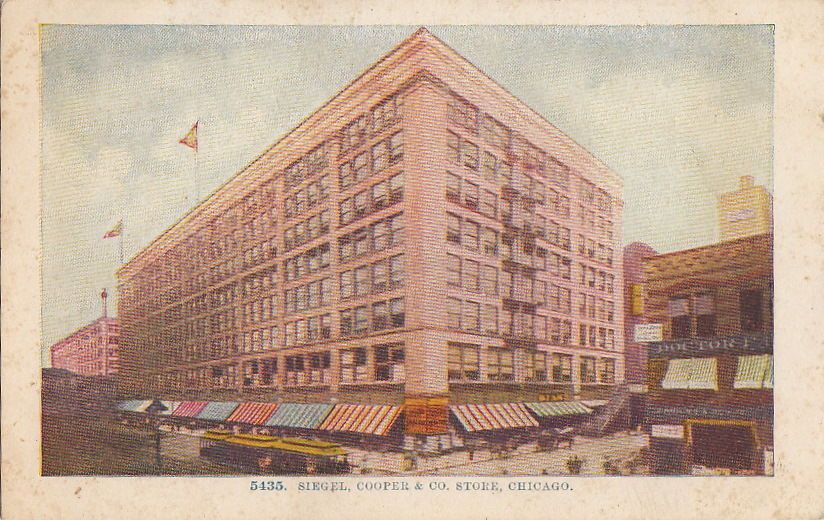


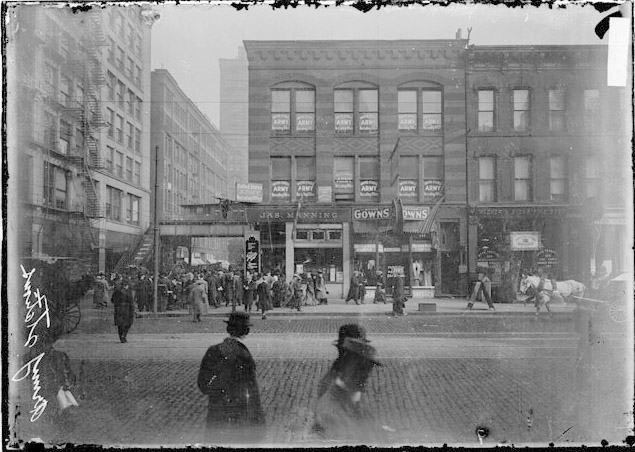


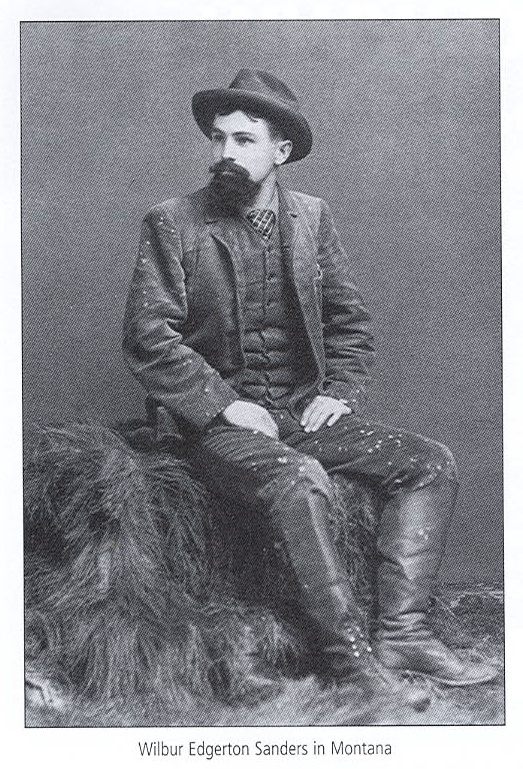

Sent from my LGUS995 using Tapatalk
I know of two that will no longer post here. Both deeply invested with money in the subject. When it's time. Waiting on announcements.
Sent from my LGUS995 using Tapatalk
Leonard Hevia wrote:rrath1 wrote:Leonard Hevia, I do apologize, texting and driving is against the law. I never studied English like you. Most foreigners do that. Quick to criticize, insult but nothing to contribute except 'its all in the Gardner Correspondences'. What if Gardner got it wrong? What if M.D. Marshall was lying? But why would he lie? Would the grave site answer one of those questions? Gardner is not the only researcher working the mystery of EATCT. 'Who was Endrase' was a good read, but hardly non-fiction.
Ha, ha! Good one Bill!
Yes--there's quite a bit of information in the Smith Gardner Correspondence. Mentioning the book IS a contribution to this thread to anyone interested in the identity of Erdnase. Gardner was certainly not the only researcher but was the first researcher to think of looking for Marshall Smith and dig up more information. If there are any other researchers working the mystery beyond the ones who post here, they haven't revealed themselves yet. Perhaps you know their identities? Then you can tell us who they are and contribute something.
Sent from my LGUS995 using Tapatalk
rrath1 wrote:I know of two that will no longer post here. Both deeply invested with money in the subject. When it's time. Waiting on announcements.
So much drama ... but no loss.
Roger M. wrote:rrath1 wrote:I know of two that will no longer post here. Both deeply invested with money in the subject. When it's time. Waiting on announcements.
So much drama ... but no loss.
I appreciate that. Long way from Really, would you care to elaborate?
In the absence of a detailed explanation, it would appear that you're:
ridiculously uninformed
lying
simply crazy
The floor is now yours ...
I do want to say, to all, thanks for the controversy discussion. My idea was to sell only 5 units of the informational package. As of this morning I had sold two. One to Chris for his ebook. But since this post exploded sold 3 more. One left, and that's it. I am selling no more informational package on this subject. The individuals who bought it will do the rest. My job is done.
https://www.ebay.com/itm/Erdnase-Expert ... 3024!US!-1
https://www.ebay.com/itm/Erdnase-Expert ... 3024!US!-1
rrath,
Just wanted to let you know that your eBay auction prices are a tad high. I have 7 copies of the 1945 Fireside edition (all of which are in excellent condition) and I didn't pay more than $35 for any of them. All of them have been bought in the past few years on eBay. They show up at a rate of about 2 or 3 a year. You have yours priced at ~ $600 depending on whether or not your "sale" is running.
I'd say you have a $30-40 book there at best.
Same goes for the 1945 Powner edition you have listed at $300+. It's a common edition and would probably sell for $30 or so, especially in the condition it's in.
Now, I'd love to see you sell them for sky-high prices - just makes mine seem all the more valuable. Just make sure you're overpricing them knowingly, and not because you don't understand their true worth.
Jason
PS: Would be happy to let my 6 additional Fireside '45 duplicates go for the rock bottom price of $2500.00.
Just wanted to let you know that your eBay auction prices are a tad high. I have 7 copies of the 1945 Fireside edition (all of which are in excellent condition) and I didn't pay more than $35 for any of them. All of them have been bought in the past few years on eBay. They show up at a rate of about 2 or 3 a year. You have yours priced at ~ $600 depending on whether or not your "sale" is running.
I'd say you have a $30-40 book there at best.
Same goes for the 1945 Powner edition you have listed at $300+. It's a common edition and would probably sell for $30 or so, especially in the condition it's in.
Now, I'd love to see you sell them for sky-high prices - just makes mine seem all the more valuable. Just make sure you're overpricing them knowingly, and not because you don't understand their true worth.
Jason
PS: Would be happy to let my 6 additional Fireside '45 duplicates go for the rock bottom price of $2500.00.
Jason England, Thanks for your opinion on my auctions at http://www.webrummage.com. Everyday, we have over 2800 items up for auction on any particular day. Some prices high, some prices low, but our prices are not just made up. We have a staff member who price compares every item we post. Learned this from a antique book dealer in Highland Park, IL 20 years ago. Lesson one, its not what you paid for the book that values a book. Lesson two, the price of the book is valued at what the market is asking for the book on any particular day. Our research shows:
1945 Charles T. Powner Edition $1017.00
About this Item: 1944. (New Jersey Berkeley Heights: The Fleming Book Company 1944). This is the Enlarged Edition printed by The Charles T Powner Company of Chicago. A name and date (from 1947) on the FFEP otherwise a near fine copy in a VG+ D/W with the fugitive red spine faded to a lighter hue and a touch of minor edge wear. A very nice copy indeed. Considered by many magicians and card sharps to be the one essential guidebook to attaining the highest level of card mastery. Uncommon especially in nice condition. A rare find indeed. Seller Inventory # 355490716748
James M Pickard, 21 Grenfell Road, Leicester, LE2 2PA, The United Kingdom. Tel: 0116 2707169. E-mail: JPRAREBOOK@aol.com. $1017.00 plus postage from UK
About this Item: Fireside Publications Limited, Paragon Agencies Co., Toronto, 1945. Paperback. Condition: Good. Reprint. 205 pages. Over 100 black and white illustrations. "Embracing the whole calendar of sleights that are employed by the gambler and conjurer, describing with detail and illustration every known expedient, maneuver, and stratagem of the expert card handler." - from title page. Reprint of the 1902 first edition. Unmarked with moderate wear and external soiling. Binding intact. A quality early copy of this classic work which Gill (307) describes as "Without doubt the single most influential work on advanced sleight-of-hand with cards, and one which totally revolutionized card theory and technique. Still of immense value to modern exponents of card magic, and many of the concepts have yet to be improved upon.". Seller Inventory # 642H1061
Call 1-877-660-6118 or +1-250-245-8959 to order today. We ship in sturdy new cartons with full insurance and tracking. Photos available upon request. Questions? Please ask. Misdescribed items fully refunded. Contact: Jim and Mina Stachow, RareNonFiction.com, 13387 Code Road, Ladysmith BC V9G 1H7, Canada. Note to Canadians: we will not request additional GST or HST. :- Price: $695.00
Priced $678.37
About this Item: 1944. (New Jersey Berkeley Heights: The Fleming Book Company 1944). This is the Enlarged Edition printed by The Charles T Powner Company of Chicago. A VG+ copy in a VG spine faded D/W with shallow chipping at the spine tips (not affecting any lettering). A nice copy. Considered by many magicians and card sharps to be the one essential guidebook to attaining the highest level of card mastery. Uncommon. Seller Inventory # 355490716856 Price: $678.37
Terms of Sale:
James M Pickard, 21 Grenfell Road, Leicester, LE2 2PA, The United Kingdom. Tel: 0116 2707169. E-mail: JPRAREBOOK@aol.com.
This is just three examples of researching a value of a book.
Your estimate of $30.-$40 a book at best. My response is I will offer you $50 per for all seven copies from you, for a 66% return on your purchase price. Nice return, hey? Let me know, will pay-pal immediately.
1945 Charles T. Powner Edition $1017.00
About this Item: 1944. (New Jersey Berkeley Heights: The Fleming Book Company 1944). This is the Enlarged Edition printed by The Charles T Powner Company of Chicago. A name and date (from 1947) on the FFEP otherwise a near fine copy in a VG+ D/W with the fugitive red spine faded to a lighter hue and a touch of minor edge wear. A very nice copy indeed. Considered by many magicians and card sharps to be the one essential guidebook to attaining the highest level of card mastery. Uncommon especially in nice condition. A rare find indeed. Seller Inventory # 355490716748
James M Pickard, 21 Grenfell Road, Leicester, LE2 2PA, The United Kingdom. Tel: 0116 2707169. E-mail: JPRAREBOOK@aol.com. $1017.00 plus postage from UK
About this Item: Fireside Publications Limited, Paragon Agencies Co., Toronto, 1945. Paperback. Condition: Good. Reprint. 205 pages. Over 100 black and white illustrations. "Embracing the whole calendar of sleights that are employed by the gambler and conjurer, describing with detail and illustration every known expedient, maneuver, and stratagem of the expert card handler." - from title page. Reprint of the 1902 first edition. Unmarked with moderate wear and external soiling. Binding intact. A quality early copy of this classic work which Gill (307) describes as "Without doubt the single most influential work on advanced sleight-of-hand with cards, and one which totally revolutionized card theory and technique. Still of immense value to modern exponents of card magic, and many of the concepts have yet to be improved upon.". Seller Inventory # 642H1061
Call 1-877-660-6118 or +1-250-245-8959 to order today. We ship in sturdy new cartons with full insurance and tracking. Photos available upon request. Questions? Please ask. Misdescribed items fully refunded. Contact: Jim and Mina Stachow, RareNonFiction.com, 13387 Code Road, Ladysmith BC V9G 1H7, Canada. Note to Canadians: we will not request additional GST or HST. :- Price: $695.00
Priced $678.37
About this Item: 1944. (New Jersey Berkeley Heights: The Fleming Book Company 1944). This is the Enlarged Edition printed by The Charles T Powner Company of Chicago. A VG+ copy in a VG spine faded D/W with shallow chipping at the spine tips (not affecting any lettering). A nice copy. Considered by many magicians and card sharps to be the one essential guidebook to attaining the highest level of card mastery. Uncommon. Seller Inventory # 355490716856 Price: $678.37
Terms of Sale:
James M Pickard, 21 Grenfell Road, Leicester, LE2 2PA, The United Kingdom. Tel: 0116 2707169. E-mail: JPRAREBOOK@aol.com.
This is just three examples of researching a value of a book.
Your estimate of $30.-$40 a book at best. My response is I will offer you $50 per for all seven copies from you, for a 66% return on your purchase price. Nice return, hey? Let me know, will pay-pal immediately.
rrath1 wrote: Lesson two, the price of the book is valued at what the market is asking for the book on any particular day.
When a seller asks a higher price than anyone is willing to pay (such as some of the more expensive copies appearing on Abebooks) over a long period of time, and never sells his copy because no buyer is willing to spend that much, then obviously that high price doesn't represent the "value" of the book.
I think most folks would agree on a definition more like:
The value of something is what an informed willing seller and an informed willing buyer agree upon, without either party being under duress.
rrath,
I don't doubt you did research. But I think you ran across some other sellers' inflated prices and thought that those must be the "going rates" for that title.
A much better method to determine pricing isn't to look at what people are asking for copies, but rather what they're getting for copies.
One of the sellers you listed (Pickard) is asking $1000 for one copy of the HB 1944 Powner in DJ and $600 for another copy. It's possible that this is the same copy with a price drop; it's tough to tell.
Regardless, in August of 2017 (less than a year ago), that exact copy sold at a major magic auction house in Chicago for the grand sum of...(wait for it)...$50.00. With the hammer fee - $75.00.
That's actually a little less than what I would've thought that book would sell for (I'd have said $100.00). But a room full of informed (thanks, Bill) buyers didn't even go that high.
Even the much rarer plain-wrapper DJ version of that exact same book (1944 Power) in MINT condition only sold for $550. That's about right for that copy in the condition. But $600 for a paperback Powner of any year or condition is preposterous if you know that market.
I'm hoping you find plenty of suckers for your price. A rising tide lifts all boats.
Jason
I don't doubt you did research. But I think you ran across some other sellers' inflated prices and thought that those must be the "going rates" for that title.
A much better method to determine pricing isn't to look at what people are asking for copies, but rather what they're getting for copies.
One of the sellers you listed (Pickard) is asking $1000 for one copy of the HB 1944 Powner in DJ and $600 for another copy. It's possible that this is the same copy with a price drop; it's tough to tell.
Regardless, in August of 2017 (less than a year ago), that exact copy sold at a major magic auction house in Chicago for the grand sum of...(wait for it)...$50.00. With the hammer fee - $75.00.
That's actually a little less than what I would've thought that book would sell for (I'd have said $100.00). But a room full of informed (thanks, Bill) buyers didn't even go that high.
Even the much rarer plain-wrapper DJ version of that exact same book (1944 Power) in MINT condition only sold for $550. That's about right for that copy in the condition. But $600 for a paperback Powner of any year or condition is preposterous if you know that market.
I'm hoping you find plenty of suckers for your price. A rising tide lifts all boats.
Jason
That is ideal. In really, as a merchant I do not care if the buyer is informed. And just a FYI they do sell. Many enthusiasts around the world do not care about price. They just want it now. Internet Auction Services LLC isn"t making a profit on informed collector's. 40% of the items we sell are overseas. We have a full time staff making a living. So. In conclusion, I run a business not a hobby.
Sent from my LGUS995 using Tapatalk
Sent from my LGUS995 using Tapatalk
rrath,
Incidentally, if you'd been 10 or even 20% higher than going rates I probably wouldn't have even noticed. I see those all the time. But when you're an order of magnitude off of the going price it's eye-opening to a serious collector like me.
I was only trying to help you actually sell the books in a reasonable amount of time. I wasn't attempting to laugh or point fingers at your prices. Seeing the inflated prices of other sellers is confusing to anyone that doesn't also see those same copies selling at much more reasonable prices routinely.
I'll do my best to keep my eye on your eBay auction, but please let me know if someone pays those prices anytime soon. I'd be very interested in that.
Jason
Incidentally, if you'd been 10 or even 20% higher than going rates I probably wouldn't have even noticed. I see those all the time. But when you're an order of magnitude off of the going price it's eye-opening to a serious collector like me.
I was only trying to help you actually sell the books in a reasonable amount of time. I wasn't attempting to laugh or point fingers at your prices. Seeing the inflated prices of other sellers is confusing to anyone that doesn't also see those same copies selling at much more reasonable prices routinely.
I'll do my best to keep my eye on your eBay auction, but please let me know if someone pays those prices anytime soon. I'd be very interested in that.
Jason
Jason I apologize.
Sent from my LGUS995 using Tapatalk
Sent from my LGUS995 using Tapatalk
You are right, there are customers for whom convenience and "right now" are worth more than money. If you have cornered that market, good for you.
I've got a couple of dozen assorted K.C. Card, Drake, Firefly, Powner, Frost, etc editions in good to mint condition ... and I'd not value a single one of them at more than $100.00 ... indeed most (if not all) are worth between $35.00 and $85.00.
I've long considered Jason's estimates of assorted EATCT editions cash value as the most credible available.
Many sellers have a higher asking price than Jason notes ... but the actual traffic in EATCT sales and trades occur at or around the prices Jason noted in his earlier post.
I've long considered Jason's estimates of assorted EATCT editions cash value as the most credible available.
Many sellers have a higher asking price than Jason notes ... but the actual traffic in EATCT sales and trades occur at or around the prices Jason noted in his earlier post.
Another round of text analysis - soon?
https://blog.jonlu.ca/posts/the-federal ... clustering
https://blog.jonlu.ca/posts/the-federal ... clustering
Many of us find anything Erdnase related interesting, no matter how obscure, so I thought this might be of interest to some Erdnase Forum followers:
E. S. Andrews is usually described as a "reverse spelling" of S. W. Erdnase.
Whereas an "anagram" is a new word or name created by rearranging letters, and a "palindrome" is a word or name that is the same spelled backward or forward, a "semordnilap" is a new word or name created by reversing the letters of a word or name, so E. S. Andrews is a "semordnilap". ("Semordnilap" backwards is "palindromes".)
E. S. Andrews is usually described as a "reverse spelling" of S. W. Erdnase.
Whereas an "anagram" is a new word or name created by rearranging letters, and a "palindrome" is a word or name that is the same spelled backward or forward, a "semordnilap" is a new word or name created by reversing the letters of a word or name, so E. S. Andrews is a "semordnilap". ("Semordnilap" backwards is "palindromes".)
Awfully quiet these days.
Should we take evidence of absence from some the absence of evidence?
Should we take evidence of absence from some the absence of evidence?
I prefer the more mellifluous term anadrome to the clever but rather clunky semordnilap.Bjorn Hanson wrote: so E. S. Andrews is a "semordnilap".
Perhaps people have just run out of things to write ABOUT ERDNASE.
Richard Kaufman wrote:Perhaps people have just run out of things to write ABOUT ERDNASE.
Richard Kaufman wrote:There will be a new candidate announced later this year that will throw everyone into a tizzy. It's not coming from me, but from someone else. Whether it is true or not, time will tell.
We are all still waiting with baited breath!
I have extremely strong doubts about the unnamed candidate, but I assume eventually he will be named.
I hope this one comes with lots of historical context. That's fun to read.Richard Kaufman wrote:the unnamed candidate
Richard Kaufman wrote:I have extremely strong doubts about the unnamed candidate, but I assume eventually he will be named.
To have any credibility, he will have to have done business with McKinney in 1902; he will have to have knowledge of sleight of hand; there will have to be a link with the name Dalrymple and he will have to be in need of money.
If there is any indication of his height, he will have to be about 5ft 6ins - and he will have to be roughly 40-45 years old.
Oh yes - and he will have to be an American. Several of the candidates already proposed, by people who should have known better, would definitely have had a foreign accent!
I, for one, am looking forward to the new revelation
Zenner wrote:To have any credibility, he will have to have done business with McKinney in 1902; he will have to have knowledge of sleight of hand; there will have to be a link with the name Dalrymple and he will have to be in need of money.
All except the need of money. That was the author's reason for writing the book--if you take it at face value. David Alexander made it clear in his essay: Anyone experienced in publishing can tell you that publishing and selling a book to a small market is not the way to fast money.
Folks really need to let the "he needed the money" thing go for good.
It was a sarcastic statement, made as a passing joke by the author.
Anybody reading that comment in the context of the sentences that surround it should get that immediately.
Even in 1902, anybody selling a book for $2 bucks ... and then dropping the price down to a buck within a year certainly wasn't making any money off book sales ... and certainly would have known in advance exactly how little money was to be made in small run, personal publishing ventures.
He didn't need the money.
It was a sarcastic statement, made as a passing joke by the author.
Anybody reading that comment in the context of the sentences that surround it should get that immediately.
Even in 1902, anybody selling a book for $2 bucks ... and then dropping the price down to a buck within a year certainly wasn't making any money off book sales ... and certainly would have known in advance exactly how little money was to be made in small run, personal publishing ventures.
He didn't need the money.
Roger M. wrote:Folks really need to let the "he needed the money" thing go for good.
It was a sarcastic statement, made as a passing joke by the author.
Anybody reading that comment in the context of the sentences that surround it should get that immediately.
Even in 1902, anybody selling a book for $2 bucks ... and then dropping the price down to a buck within a year certainly wasn't making any money off book sales ... and certainly would have known in advance exactly how little money was to be made in small run, personal publishing ventures.
He didn't need the money.
"Erdnase" (whoever he was) said that he needed money. 116 year later you say that he didn't. You cannot possibly know and therefore you cannot state that as a fact. You say that it was a joke; it's no joke to be in need of money. Your statements of fact can only be your opinions.
I have checked with an online inflation calculator. $2.00 in 1902 equates to $56.77 in 2018. $1.00 equates to $28.38. It wasn't a cheap book that he was touting. If you are in need of money then anything would be welcome.
Even Marshall D. Smith said "that he [was] anxious to save his money", according to Martin Gardner.
If the book had been aimed solely at magicians then it would indeed not produce a lot of money. It wasn't; it was aimed at the general public as well. To anybody with the slightest interest in manipulating cards, to whatever ends they may choose. He wrote the book, he published the book, he got the illustrations done as cheaply as possible - and (if I am correct in it being Benedict) he distributed it as well. It was a money making exercise, whether or not it made as much as he would have liked.
When you need money, usually that means you need it now--not months from now. There are faster ways to generate needed cash than publishing a book. The author wrote it to show off his skills acquired in the "cold school of experience." As for the author's frugality, the fact that he worked on a budget does not mean he was cash strapped. The wealthy are known to penny pinch. I have seen expensive Euro cars parked at my local thrift shops.
That high $56.00 asking price for the general market didn't work out too well either. Not many copies sold and the price had to be lowered.
That high $56.00 asking price for the general market didn't work out too well either. Not many copies sold and the price had to be lowered.
He couldn't have been much of a card cheat if he "needed the money"!
Leonard Hevia wrote:When you need money, usually that means you need it now--not months from now. There are faster ways to generate needed cash than publishing a book. The author wrote it to show off his skills acquired in the "cold school of experience." As for the author's frugality, the fact that he worked on a budget does not mean he was cash strapped. The wealthy are known to penny pinch. I have seen expensive Euro cars parked at my local thrift shops.
That high $56.00 asking price for the general market didn't work out too well either. Not many copies sold and the price had to be lowered.
Leonard (and Roger): Being a proud practitioner of Logic, it grieves me to see you shaming the art with your tendency to jump to conclusions. I have tried to pass on a few tips to you fellows, but alas! You are back at it.
Let us take it slow and easy. Your initial observation--that publishing a book is not the quickest way to make money--is true. However, we cannot therefore assume that the author DID NOT MEAN WHAT HE SAID. The sensible way to proceed is to consider other interpretations that justify the statement. Such as--Though there might have been swifter ways to accumulate cash, they might not have been convenient for him. He might have preferred a more economical approach, a plan which enabled him to use his own skills and make use of printing facilities that were readily and cheaply available.
It is embarrassingly bad logic, to suppose that the phrase "need the money" signifies immediate desperation, and thus--it must be false. No. Your conclusion ought to be a last resort, after exhausting all the other possibilities. And if you do dismiss these intermediary theories, you need to give reasons for rejecting them. You are acquainted with both the Gallaway and the Benedict hypotheses, that explain WHY the author might have regarded publishing as a sensible enterprise (experience, acquaintance, and direct accessibility). Why do you disdain these rational propositions in favour of the dubious notion that your candidate was simply joking? I suspect it is only because you fancy him more than the others. You "sense" or you "feel" that yours is the right one.
Mr. Zenner is correct. It is your opinion and nothing more. Now nobody can say whose guess is more accurate--but yours rely to a much greater extent on intuition. It's just annoying to see you vaunting of superior reasoning skills. You would need to be able to contact the Spirit Of Erdnase in order to know what you claim to know of his intentions.
performer wrote:He couldn't have been much of a card cheat if he "needed the money"!
But he does say elsewhere: "The winnings are known as 'pretty money,' and it is generally spent as freely as water. The average professional who is successful at his own game will, with the sublimest unconcern, stake his money on that of another's, though fully aware the odds are against him. He knows little of the real value of money, and as a rule is generous, careless and improvident."
It sounds like he was talking from personal experience and was in and out of money regularly, with a cycle of winning it and then spending/risking/losing it. If so, the part about needing the money (as a reason for doing the book) might be an exaggeration with that in mind.
Oh, I am sure it was just a bit of a joke. It is exactly the sort of thing that I would have said. However, at this stage I do not wish to confirm or deny that I wrote Expert at the Card Table.
performer wrote:Oh, I am sure it was just a bit of a joke. It is exactly the sort of thing that I would have said. However, at this stage I do not wish to confirm or deny that I wrote Expert at the Card Table.
The reason why we can never presume what Erdnase meant by "need the money" is that EVEN IF WE CAN DETECT A NOTE OF JOCULARITY in his manner, he still might have been telling the truth. He might merely have been laughing off the fact that he was going bankrupt. It is not unusual for jolly souls to make light of their own misfortunes.
Dispersed knowledge or entertainment value... but maybe there's a coded message hidden in the typesetting irregularities?
If you recall the origin of the indian rope trick in the Tribune paper ... the printed page was put to subtle uses even back then.
If you recall the origin of the indian rope trick in the Tribune paper ... the printed page was put to subtle uses even back then.
Bob Coyne wrote:"The winnings are known as 'pretty money,' and it is generally spent as freely as water. The average professional who is successful at his own game will, with the sublimest unconcern, stake his money on that of another's, though fully aware the odds are against him. He knows little of the real value of money, and as a rule is generous, careless and improvident."
...the price. Sounds about like an addiction to risk.
Jonathan Townsend wrote:Bob Coyne wrote:"The winnings are known as 'pretty money,' and it is generally spent as freely as water. The average professional who is successful at his own game will, with the sublimest unconcern, stake his money on that of another's, though fully aware the odds are against him. He knows little of the real value of money, and as a rule is generous, careless and improvident."
...the price. Sounds about like an addiction to risk.
yes, seems that way to me too:
Winning is not his sole delight. Some one has remarked that there is but one pleasure in life greater than winning, that is, in making the hazard.
I don't think he ever "made the hazard" whoever the hell he was. He does not sound like any card cheat I ever heard of. He knows too many magic tricks, knows too many sleights and writes in too posh a manner. And if he "needs the money" he may well be a professional magician since most of them are broke.
Any card cheat I ever knew looked like they had just come out of jail, could hardly read let alone write a book, knew about 3 sleights which they did very crudely but was all they needed and didn't know a single card trick.
Sorry Erdnase-----you can't fool me.
Any card cheat I ever knew looked like they had just come out of jail, could hardly read let alone write a book, knew about 3 sleights which they did very crudely but was all they needed and didn't know a single card trick.
Sorry Erdnase-----you can't fool me.
performer wrote:I don't think he ever "made the hazard" whoever the hell he was. He does not sound like any card cheat I ever heard of. He knows too many magic tricks, knows too many sleights and writes in too posh a manner. And if he "needs the money" he may well be a professional magician since most of them are broke.
Any card cheat I ever knew looked like they had just come out of jail, could hardly read let alone write a book, knew about 3 sleights which they did very crudely but was all they needed and didn't know a single card trick.
Sorry Erdnase-----you can't fool me.
I also get that impression from the author, but I think he actually gambled and lost quite a bit. I like to believe he was one of the progenitors of the card magician/gambling expert that continued down the line with MacDougall, Garcia, and Ortiz.
Leonard Hevia wrote:... I think he actually gambled and lost quite a bit...
He says that was the case in the "Professional Secrets" section when he says that he "bucked the tiger voluntarily" and "began to imbibe wisdom in copious draughts at the customary sucker rates..." and also in the "Short Deck" section where he confesses that this bold ruse cause him "a continuous and protracted run of "hard luck"".
On another topic, this German Film project on Erdnase includes a link to the FISM in Busan (see the bottom of their "Research" page). Did this project have a visible presence therre?
http://www.erdnase-film.com/
Richard Hatch wrote:He says that was the case in the "Professional Secrets" section when he says that he "bucked the tiger voluntarily" and "began to imbibe wisdom in copious draughts at the customary sucker rates..." and also in the "Short Deck" section where he confesses that this bold ruse cause him "a continuous and protracted run of "hard luck"".
I wanted to ask Ormond McGill about all the stuff he put into his "Psychic Magic" series. Having never seen or heard of anybody doing most of the material in those booklets, I thought that the man himself could elucidate. I got my chance and was most disappointed when he told me that he had never done any of it - not even contact mindreading!
When I showed my surprise, he said, "You don't have to do a thing to be able to write about it." True, I suppose, but I was still disappointed. Erdnase must have been able to do the material in his book in order to demonstrate it for Smith, but his background could well have been made up in order to make it an interesting story. He wrote well and that's why it's still in print and we are still talking about it. Don't forget that he wanted the book to sell - he needed the money
Haven't any of you heard of "author's licence"?
Oh, I strongly suspect that Ormond didn't believe in hypnotism either despite being one of the leading authorities on it! It seems he gave a lecture on it and afterwards someone asked him if he believed the stuff he was saying and he said "of course not!"
And I will never forget the time that Martin Breese once remarked to me , "Gil Boyne (another world renowned authority on hypnotism) sat in that very chair you are sitting in now and told me that hypnotism was bunkum"
And so did another couple of well known hypnotists in Ireland one of whom had written very learned articles on the subject. In fact he studied medicine with my uncle but discontinued his studies. He also told me that hypnosis was baloney and that he had never "hypnotised" a single person in his long career.
You can indeed write about stuff you know little about. The secret is research. However, I think sleight of hand is different. It must be difficult to write about technical moves you haven't mastered yourself although I concede not impossible. Erdnase was obviously a magician and I have grave suspicions that although he may have played cards and lost money he never actually did any cheating. I don't get the vibe from his writing that he had the mentality for it. You should all be looking for a very well known card technician of the time. Probably a member of a magic club somewhere. I should check the membership of the local magic clubs of where he operated. I bet magicians of the day gossiped about who Erdnase was. I am surprised nobody ever asked them while they were still alive.
And I will never forget the time that Martin Breese once remarked to me , "Gil Boyne (another world renowned authority on hypnotism) sat in that very chair you are sitting in now and told me that hypnotism was bunkum"
And so did another couple of well known hypnotists in Ireland one of whom had written very learned articles on the subject. In fact he studied medicine with my uncle but discontinued his studies. He also told me that hypnosis was baloney and that he had never "hypnotised" a single person in his long career.
You can indeed write about stuff you know little about. The secret is research. However, I think sleight of hand is different. It must be difficult to write about technical moves you haven't mastered yourself although I concede not impossible. Erdnase was obviously a magician and I have grave suspicions that although he may have played cards and lost money he never actually did any cheating. I don't get the vibe from his writing that he had the mentality for it. You should all be looking for a very well known card technician of the time. Probably a member of a magic club somewhere. I should check the membership of the local magic clubs of where he operated. I bet magicians of the day gossiped about who Erdnase was. I am surprised nobody ever asked them while they were still alive.
John Olsson, the Forensic Linguist (hired by Chris Wasshuber) has written a sequel to Wordcrime:
"Grammatical curiosities, lexical quirks, typographic stylings and patterns of use can all give away even the most hard-bitten and careful of criminals. And Olsson doesnt stop there. From the giveaway compound nouns of heavy-handed police statements to the startling similarities displayed in what should be individual office accounts, the police are given a run for their money too. Wordcrime is easy to commit -- and hard to escape. More Wordcrime features a series of chapters where gripping cases are described - involving murder, sexual assault, hate mail, suspicious death and criminal damage. In approachable and clear prose, he details how forensic linguistics helps the law beat the criminals, and how the long arm of the law is prevented from overreaching."
"Grammatical curiosities, lexical quirks, typographic stylings and patterns of use can all give away even the most hard-bitten and careful of criminals. And Olsson doesnt stop there. From the giveaway compound nouns of heavy-handed police statements to the startling similarities displayed in what should be individual office accounts, the police are given a run for their money too. Wordcrime is easy to commit -- and hard to escape. More Wordcrime features a series of chapters where gripping cases are described - involving murder, sexual assault, hate mail, suspicious death and criminal damage. In approachable and clear prose, he details how forensic linguistics helps the law beat the criminals, and how the long arm of the law is prevented from overreaching."
Not sure anybody here puts a whole lot of confidence in Olsson's work as it relates to the hunt for Erdnase.
Olsson seemed to flail a bit in his efforts with Erdnase (at least those that were shared with the community) ... as if he was given a desired result up front, and asked to create a scenario which duplicated that desired result as closely as possible.
Linguistic analysis was terribly compromised by the efforts of a few pundits to try and force Olsson's findings to match-up to pre-ordained personalities - rather than maintain the open mind required of true researchers.
Deserved or not, it's likely Olsson will not soon live down how his name was intertwined with Erdnase over the past few years.
Olsson seemed to flail a bit in his efforts with Erdnase (at least those that were shared with the community) ... as if he was given a desired result up front, and asked to create a scenario which duplicated that desired result as closely as possible.
Linguistic analysis was terribly compromised by the efforts of a few pundits to try and force Olsson's findings to match-up to pre-ordained personalities - rather than maintain the open mind required of true researchers.
Deserved or not, it's likely Olsson will not soon live down how his name was intertwined with Erdnase over the past few years.
Following on from what Mark says - I think T. Nelson Downs could be a good shout.
I wonder if the T. Nelson Downs/Edward Tex McGuire Letters would throw up any light? I remember reading them a few years ago. It was a reprint of a 2 issue article from The Linking Ring magazine. Back from around 1971.
I wonder if the T. Nelson Downs/Edward Tex McGuire Letters would throw up any light? I remember reading them a few years ago. It was a reprint of a 2 issue article from The Linking Ring magazine. Back from around 1971.
Joe Mckay wrote:Following on from what Mark says - I think T. Nelson Downs could be a good shout.
I wonder if the T. Nelson Downs/Edward Tex McGuire Letters would throw up any light? I remember reading them a few years ago. It was a reprint of a 2 issue article from The Linking Ring magazine. Back from around 1971.
Not likely Downs was Erdnase. He was fairly tall, and most likely touring vaudeville in Europe in 1901 with his coin act. He definitely didn't need the money. Downs was also not at the vanguard of card moves. He was constantly seeking out the secrets of those who knew more than h e did about card gambling maneuvers.
Do you remember what 1971 issue of the Linking Ring that contained that Downs/McGuire correspondence?
It was definitely not Downs. He was too much of an egotist to have his name hidden . And I suspect he wasn't much of a writer since he even got John Northern Hilliard to write his own book, "The Art of Magic."
Leo - check out the April & May (1971) issues of The Linking Ring.
PM me if you need copies of the magazines.
PM me if you need copies of the magazines.
In Sept 1889, the Duke & Sons tobacco company released a set of 24 trade cards in association with their "Honest Long Cut" tobacco entitled "Tricks with Cards", each of which described a card trick.
Trick #1 was a Rising Card (from a glass). Erdnase included a Rising Card trick (from the hands).
Tricks #3 and 8 were Card Stabs (3 cards stabbed on a sword, single card stabbed on a wand). Erdnase included a Card Stab (Malini-style, single card stabbed on table).
Trick #4 was "The Row of Ten Cards" as written up in Erdnase, under a different title.
Trick #6 was where a performed slaps a deck held in a spectator's hands, leaving a singled (selected) card. Erdnase included this as a "Sleight for Terminating Tricks".
Trick #9 has the effect of a single phase of "3 Card Monte". Erdnase included "3 Card Monte".
Tricks #10 and 21 are based on the "Eight Kings" stack. Erdnase includes a discussion of the stack in "Tricks with a Prearranged Deck", and based a trick on it.
Trick #12 is a selected card at a selected number. Erdnase accomplishes a similar effect, with a different method, in "Power of Concentrated Thought."
Trick #17 is accomplished by use of the Glide, which Erdnase discusses and calls "The Slide".
It may be that Erdnase was a smoker, and was familiar with this set of trade cards.
Trick #1 was a Rising Card (from a glass). Erdnase included a Rising Card trick (from the hands).
Tricks #3 and 8 were Card Stabs (3 cards stabbed on a sword, single card stabbed on a wand). Erdnase included a Card Stab (Malini-style, single card stabbed on table).
Trick #4 was "The Row of Ten Cards" as written up in Erdnase, under a different title.
Trick #6 was where a performed slaps a deck held in a spectator's hands, leaving a singled (selected) card. Erdnase included this as a "Sleight for Terminating Tricks".
Trick #9 has the effect of a single phase of "3 Card Monte". Erdnase included "3 Card Monte".
Tricks #10 and 21 are based on the "Eight Kings" stack. Erdnase includes a discussion of the stack in "Tricks with a Prearranged Deck", and based a trick on it.
Trick #12 is a selected card at a selected number. Erdnase accomplishes a similar effect, with a different method, in "Power of Concentrated Thought."
Trick #17 is accomplished by use of the Glide, which Erdnase discusses and calls "The Slide".
It may be that Erdnase was a smoker, and was familiar with this set of trade cards.
An interesting find Bill! This tobacco company must have paid somebody well versed in card magic to write up the tricks on those trading cards. Since most of those card tricks appear in The Expert, you have to wonder if it might have been the author.
https://thetraderspeaks.com/n138-tricks-with-cards/
Hey, thanks. Great find in terms of history. Does the explanation text scan as familiar?
Hey, thanks. Great find in terms of history. Does the explanation text scan as familiar?
Jonathan Townsend wrote: Great find in terms of history. Does the explanation text scan as familiar?
Not to me, it doesn't.
Great find!!!
I've chewed a lot of gum and smoked plenty of cigarettes but only came up with comics and a smelly left hand.
I've chewed a lot of gum and smoked plenty of cigarettes but only came up with comics and a smelly left hand.
What's the method Bill?
Where how do you find this stuff .
Where how do you find this stuff .
I've only been "into" magic seriously for 20 years. I started collecting cards in the late 1970s, and have known about this particular set for a long time. I only just now took the trouble to compare them to Erdnase, though.
Bill, that's amazing.
John Moehring had an interesting article about these tobacco cards in the June 2001 issue of MAGIC magazine. Check out page 52.
The article is in three parts. The second part is in the July 2001 issue of MAGIC. Check out page 54.
And the third part is in the August 2001 issue of MAGIC. Check out page 50.
There isn't really much information in the articles. It is mainly devoted to reproductions of the tobacco cards.
And the third part is in the August 2001 issue of MAGIC. Check out page 50.
There isn't really much information in the articles. It is mainly devoted to reproductions of the tobacco cards.
The Erdnase/tobacco cards possible connection begs the question: Were the card tricks on those tobacco trading cards popular effects with card magicians in the late 19th century? Much like the packet trick craze of the 1970s.
If yes then it might account for the appearance of those effects in The Expert. The author surely didn't just randomly pick out those effects for inclusion in the book. It would also be neat to know the identity of the magician who was contracted by the tobacco company to write up those tricks.
If yes then it might account for the appearance of those effects in The Expert. The author surely didn't just randomly pick out those effects for inclusion in the book. It would also be neat to know the identity of the magician who was contracted by the tobacco company to write up those tricks.
Joe Mckay wrote:John Moehring had an interesting article about these tobacco cards in the June 2001 issue of MAGIC magazine. Check out page 52.
The article went on for the next two issues, as well. It featured Burton Sperber's set of the cards, who also wrote them up in an issue of his publication "A Real Miracle". Potter & Potter sold his set in 2014. It went for $3400 plus buyer's premium -- over $4000.
There are a couple of minor errors in the articles. The cards were released in Sept 1889, not 1887 (I found reference to their release at that time in an issue of Tobacco, a trade journal for tobacco producers and sellers). And "Honest Long Cut," the product in which the cards were inserted, was not a brand of cigarettes. It was a loose-cut tobacco, suitable for either rolling your own cigarettes, or for chewing.
Leo, the Duke set of cards is highly rare, accounting for its high price. I don't know of another set that early which describes card tricks of this type.
Leonard Hevia wrote:The Erdnase/tobacco cards possible connection begs the question: Were the card tricks on those tobacco trading cards popular effects with card magicians in the late 19th century? Much like the packet trick craze of the 1970s.
I think they are (mostly) more or less "standard" tricks, popular then and now. The Rising Card and the Card Stab are timeless.
Bill Mullins wrote:Leonard Hevia wrote:The Erdnase/tobacco cards possible connection begs the question: Were the card tricks on those tobacco trading cards popular effects with card magicians in the late 19th century? Much like the packet trick craze of the 1970s.
I think they are (mostly) more or less "standard" tricks, popular then and now. The Rising Card and the Card Stab are timeless.
Eight Kings goes back to 1876 (at least) (Hoffman's Modern Magic).
"Selected card at selected number by different methods" .. that's most card tricks, isn't it?
3 Card Monte - a specialty of Canada Bill Jones (1837-1877).
observer wrote:
Eight Kings goes back to 1876 (at least) (Hoffman's Modern Magic).
Eight Kings was first described in The Expositor, or, Many Mysteries Unravelled - Including that of the Learned Pig published in Boston in 1805 by William Frederick Pinchbeck. The trick begins on page 95: "By what manner the Pig is thought to know the card drawn".
It is not the first cyclical stack: earlier examples exist - in Latin - going back to the late Middle Ages (cfr. Ye Olde Magic Mag, Vol. 2 #3).
Marco Pusterla wrote:observer wrote:
Eight Kings goes back to 1876 (at least) (Hoffman's Modern Magic).
Eight Kings was first described in The Expositor, or, Many Mysteries Unravelled - Including that of the Learned Pig published in Boston in 1805 by William Frederick Pinchbeck. The trick begins on page 95: "By what manner the Pig is thought to know the card drawn".
Yes
For anyone who cares, I'm pretty sure that the font of the front cover of the 1st edition of Expert is Post Oldstyle. The font was derived from the cover design of The Saturday Evening Post, which made me go "D'oh!" when I read it -- I've been staring at copies of covers of that magazine for over forty years, since I worked for an old magazine dealer in the 1970s who bought and sold them, looking at the illustrations by Rockwell, Wyeth, Leyendecker, Flagg, etc., and should have caught the connection long ago.
The italicized "The" is not the italic version of Post Oldstyle, but looks to be from some other compatible font.
A modern commercially-available implementation is Lamp Post JNL.
The italicized "The" is not the italic version of Post Oldstyle, but looks to be from some other compatible font.
A modern commercially-available implementation is Lamp Post JNL.
The description of the Eight Kings set-up should be noted as another Erdnase error. He wrote, "Eight Kings threatened to save Ninety-five Queens from one sick Knave" which should be "for one sick Knave."
Stephen Burton wrote:The description of the Eight Kings set-up should be noted as another Erdnase error. He wrote, "Eight Kings threatened to save Ninety-five Queens from one sick Knave" which should be "for one sick Knave."
There is no "right" or "wrong" way to utilize the mnemonic, there have been multiple versions over the years ... as is highlighted in this early Genii Forum thread:
viewtopic.php?t=6584
Roger M. wrote:Stephen Burton wrote:The description of the Eight Kings set-up should be noted as another Erdnase error. He wrote, "Eight Kings threatened to save Ninety-five Queens from one sick Knave" which should be "for one sick Knave."
There is no "right" or "wrong" way to utilize the mnemonic, there have been multiple versions over the years ... as is highlighted in this early Genii Forum thread:
viewtopic.php?t=6584
I see your point, it doesn't matter the actual word as long the performer knows that the word "from" is equivalent to the number four. I had just always read it as "for one sick Knave" and indeed Pinchbeck had it that way in 1805. It does seem to make more sense for the Kings to be saving the Queens from a sick Knave instead for him. That is, if you can attribute any sort of logic to a doggerel. Thanks for the link to the thread.
Earlier in the thread I've listed magicians who used their names reversed as pseudonyms. I've found another:
Mel Stover wrote as "Rev. O. T. Slem" in A Fork Full of Appetizers II.
Mel Stover wrote as "Rev. O. T. Slem" in A Fork Full of Appetizers II.
After doing some research I’ve concluded that the word “from” in the Erdnase description of the Eight Kings setup is indeed an error. The following books from before and after the publication of The Expert at the Card Table all show “for one sick knave” as the last four words in the doggerel.
The only example I could find in any book with the last four words being “from one sick knave” is The Expert at the Card Table. In publications, I could find a scant two examples and they are both in MUM. Harry Riser has it this way in the June, 1987 issue (and he is quoting Erdnase) and Ian Kendall has it as “from” in the December 2010 issue.
These books all have it as “for one sick knave”:
Pinchbeck, The Expositor, 1805
Magician’s Own Book, 1857
The Secret Out, 1859
Cremer, Hanky Panky, 1872
Hoffman, Modern Magic, 1876
Hercat, Card Tricks, 1888
Hilliar, Modern Magician’s Handbook, 1902
David Devant, Magic Made Easy, 1910
Ellis Stanyon, Stanyon’s Magic, May, 1913
George Johnson, The Magic Wand, March, 1919
Raymond Dixie, The Boy Magician, 1922
Charles Eastman, French’s Manipulative Magic, 1930
Annemann, The Book without a Name, 1931
Stewart Judah, Subtle Problems You Will Do, 1937
Hilliard, Card Magic, 1945
Also Harry Stanley, Henry Hay, Jim Steinmeyer, Ralph Hull, Wilfred Jonson, etc.
That I could not find any other example of the word “from” in the Eight Kings descriptions leads me to think that either S.W. Erdnase learned the doggerel incorrectly, deliberately changed the word “for” to “from”, or it was a typographical error. The most likely conclusion is, to me, that it was an error as I cannot believe would make a mistake in either learning the description or obfuscate the phrase by changing the logical use of the word, “for”.
An interesting thing I learned from this research was the Sloane 424 manuscript from the 1600s has a stacked deck with the same Four, Ace, Six, Knave (soldier) sequence (Gibeciere, Vol. 5 No.2, Summer 2010). However, there was no mnemonic sequence given to learn this, although Stephen Minch provides a possible example.
The only example I could find in any book with the last four words being “from one sick knave” is The Expert at the Card Table. In publications, I could find a scant two examples and they are both in MUM. Harry Riser has it this way in the June, 1987 issue (and he is quoting Erdnase) and Ian Kendall has it as “from” in the December 2010 issue.
These books all have it as “for one sick knave”:
Pinchbeck, The Expositor, 1805
Magician’s Own Book, 1857
The Secret Out, 1859
Cremer, Hanky Panky, 1872
Hoffman, Modern Magic, 1876
Hercat, Card Tricks, 1888
Hilliar, Modern Magician’s Handbook, 1902
David Devant, Magic Made Easy, 1910
Ellis Stanyon, Stanyon’s Magic, May, 1913
George Johnson, The Magic Wand, March, 1919
Raymond Dixie, The Boy Magician, 1922
Charles Eastman, French’s Manipulative Magic, 1930
Annemann, The Book without a Name, 1931
Stewart Judah, Subtle Problems You Will Do, 1937
Hilliard, Card Magic, 1945
Also Harry Stanley, Henry Hay, Jim Steinmeyer, Ralph Hull, Wilfred Jonson, etc.
That I could not find any other example of the word “from” in the Eight Kings descriptions leads me to think that either S.W. Erdnase learned the doggerel incorrectly, deliberately changed the word “for” to “from”, or it was a typographical error. The most likely conclusion is, to me, that it was an error as I cannot believe would make a mistake in either learning the description or obfuscate the phrase by changing the logical use of the word, “for”.
An interesting thing I learned from this research was the Sloane 424 manuscript from the 1600s has a stacked deck with the same Four, Ace, Six, Knave (soldier) sequence (Gibeciere, Vol. 5 No.2, Summer 2010). However, there was no mnemonic sequence given to learn this, although Stephen Minch provides a possible example.
Typesetter or editor?Stephen Burton wrote:... deliberately changed the word “for” to “from”...
Was it common to call the mnemonic a jingle?I've been looking at the sequence as well. What struck me as interesting is that usually, it was "nine fine ladies" or "nine fair ladies" pre-Erdnase. Then Hoffmann, in Modern Magic, used "ninety-five ladies" and used it again in More Magic. Roterberg, in New Era Card Tricks, used "Ninety-five queens".
William E. Robinson used "ninety-five ladies" in an 1895 issue of The Vaudeville (a variant of Mahatma).
Hilliar, in Modern Magicians' Hand Book, used "ninety-five ladies". It came out in 1902 as well, but wasn't copyrighted until later in the year, well after Erdnase.
Others have identified Sachs, Hoffmann, and Roterberg as sources for Erdnase. I'd suspect that he learned the Eight Kings stack from Hoffmann.
William E. Robinson used "ninety-five ladies" in an 1895 issue of The Vaudeville (a variant of Mahatma).
Hilliar, in Modern Magicians' Hand Book, used "ninety-five ladies". It came out in 1902 as well, but wasn't copyrighted until later in the year, well after Erdnase.
Others have identified Sachs, Hoffmann, and Roterberg as sources for Erdnase. I'd suspect that he learned the Eight Kings stack from Hoffmann.
The "Eight Kings" stack makes an interesting appearance in the newspaper detective comic strip "Kerry Drake" in June 1945. The villian, Shuteye, needs to get a message to his moll, Roulette, but knows he's about to be picked up by Kerry.
6/26/1945
"Gripping the bridge cards firmly, Shuteye writes on the edges . . .
'Lucky I taught Roulette how to "stack" a deck!'
Then he shuffles the cards and pencils a question on the top card!
'Remember the one about 95 Queens and a sick Knave?' "
6/28/1946 -- Roulette has received the deck.
"'These cards must be a message from Shuteye!. . . He wrote on the top one . . It's the old code for "stacking" a deck! Yeah! "Eight kings threatened to save 95 queens for one sick knave!'
Swiftly arranging the cards by the secret formula, Roulette sees on the edge . . .
'Midnight . . . Boat . . . Foot of Surf Street' "
Kerry and his assistant, Gabby, capture Roulette and the deck. He orders a bunch of magic and gambling books from the library. Gabby discovers the secret of the Eight Kings stack in an "Encyclopedia of Card Tricks".
7/2/1945
" 'When d' cards are fixed in that order, this writin' on d' edges stands out like a "porched" egg on a plate of hash!' "
Gabby, hoping to impress Kerry, goes alone to the boat to capture Shuteye. But things go awry from there . . . .
This same ruse of writing a secret message on the edge of a deck stacked in Eight Kings order is also used in the newspaper serial prose story "Murder on the Avenue" by Carolyn Wells (1942).
6/26/1945
"Gripping the bridge cards firmly, Shuteye writes on the edges . . .
'Lucky I taught Roulette how to "stack" a deck!'
Then he shuffles the cards and pencils a question on the top card!
'Remember the one about 95 Queens and a sick Knave?' "
6/28/1946 -- Roulette has received the deck.
"'These cards must be a message from Shuteye!. . . He wrote on the top one . . It's the old code for "stacking" a deck! Yeah! "Eight kings threatened to save 95 queens for one sick knave!'
Swiftly arranging the cards by the secret formula, Roulette sees on the edge . . .
'Midnight . . . Boat . . . Foot of Surf Street' "
Kerry and his assistant, Gabby, capture Roulette and the deck. He orders a bunch of magic and gambling books from the library. Gabby discovers the secret of the Eight Kings stack in an "Encyclopedia of Card Tricks".
7/2/1945
" 'When d' cards are fixed in that order, this writin' on d' edges stands out like a "porched" egg on a plate of hash!' "
Gabby, hoping to impress Kerry, goes alone to the boat to capture Shuteye. But things go awry from there . . . .
This same ruse of writing a secret message on the edge of a deck stacked in Eight Kings order is also used in the newspaper serial prose story "Murder on the Avenue" by Carolyn Wells (1942).
Bill Mullins wrote:The "Eight Kings" stack makes an interesting appearance in the newspaper detective comic strip "Kerry Drake" in June 1945. The villian, Shuteye, needs to get a message to his moll, Roulette, but knows he's about to be picked up by Kerry.
6/26/1945
"Gripping the bridge cards firmly, Shuteye writes on the edges . . .
'Lucky I taught Roulette how to "stack" a deck!'
Then he shuffles the cards and pencils a question on the top card!
'Remember the one about 95 Queens and a sick Knave?' "
...
Gabby, hoping to impress Kerry, goes alone to the boat to capture Shuteye. But things go awry from there . . . .
That almost reads as a presentation for Gertner's Unshuffled trick.
In the erdnase text a few sentences down from the stack- is mention of tricks with named numbers and cards.
There's even a French mnemonic for the same order:
Huit (8) rois (rois) très (3) discrets (10), de (2) cette (7) neuvième (9) sainte (5) dame (dame) Katryn (4), assistent (as - 6) le valet (valet)
I don't know who came up with it or whether it came before the English version - I found it on a blog by Jean-Francois Gérault that has lots of information (in French) about various stacks, including some early references, at http://jeanfrancoisgerault.blogspot.com/2017_06_23_archive.html.
Huit (8) rois (rois) très (3) discrets (10), de (2) cette (7) neuvième (9) sainte (5) dame (dame) Katryn (4), assistent (as - 6) le valet (valet)
I don't know who came up with it or whether it came before the English version - I found it on a blog by Jean-Francois Gérault that has lots of information (in French) about various stacks, including some early references, at http://jeanfrancoisgerault.blogspot.com/2017_06_23_archive.html.
I just noticed this palindrome by Philip T. Goldstein, quoted by Denis Behr at his Conjuring Archive website:
"S. W. Erdnase? He's Andrews!"
"S. W. Erdnase? He's Andrews!"
Bill Mullins wrote:I just noticed this palindrome by Philip T. Goldstein, quoted by Denis Behr at his Conjuring Archive website:
"S. W. Erdnase? He's Andrews!"
I was informed offline that this has been brought up on the forum twice already, and that one of the bringer-uppers was me. Sorry about that.
Was it the summary before the reveal?
(Callback from other thread...)
(Callback from other thread...)
From the Moline, IL Dispatch, of 8 March 1946.
This is the only time I have ever seen any indication that the name "Erdnase" was possibly the real name of a real person. Without further details, however, it is possible that in this case Erdnase is a typo on the part of the court or the newspaper, or a false name given by the actual driver.
(I'd note that Silvis and Carbon Cliff are small towns immediately east of East Moline, IL, where the Seely's and the Seeley's were bumping into each other 140-odd years ago.)
ARREST CARBON CLIFF MAN ON DRIVING COUNT
Silvis -- E. Erdnase of Carbon Cliff was arrested last night and jailed on a charge of reckless driving. The Carbon Cliff motorist was still in jail this morning awaiting arraignment before Magistrate Lawrence Bobb.
This is the only time I have ever seen any indication that the name "Erdnase" was possibly the real name of a real person. Without further details, however, it is possible that in this case Erdnase is a typo on the part of the court or the newspaper, or a false name given by the actual driver.
(I'd note that Silvis and Carbon Cliff are small towns immediately east of East Moline, IL, where the Seely's and the Seeley's were bumping into each other 140-odd years ago.)
Bill Mullins wrote:From the Moline, IL Dispatch, of 8 March 1946.ARREST CARBON CLIFF MAN ON DRIVING COUNT
Silvis -- E. Erdnase of Carbon Cliff was arrested last night and jailed on a charge of reckless driving. The Carbon Cliff motorist was still in jail this morning awaiting arraignment before Magistrate Lawrence Bobb. etc...
Dare I ask if a check of the 1940 or 1950 census for that locale has already been done?
I've checked 1940 and earlier censuses many times, through several different access portals. no luck.
The 1950 census has not been released by the Census Bureau yet. It has to be 70 years after the census before they will make it publicly available, so it will become searchable sometime after 2020.
The 1950 census has not been released by the Census Bureau yet. It has to be 70 years after the census before they will make it publicly available, so it will become searchable sometime after 2020.
Edward Gallaway's bookplate includes a cherub ornament in its design. That ornament can be found in the specimen books of the American Type Founders, which also include samples of the font "Post Oldstyle". As I mentioned above recently, that seems to be the font used on the front cover of the book.
ATF's Chicago Office was at 203/205 Monroe in 1903, only a couple blocks north of Printer's Row in Chicago.
I don't for a moment believe that Gallaway's ornament and Erdnase's font sharing a common source is evidence that Gallaway and Erdnase were the same person, although I wouldn't be surprised to see that suggested soon. ATF was a dominant source of type. It's like saying that both Gallaway and Erdnase used Microsoft Windows, therefore they were the same guy. To me, the likely inference is that Gallaway's employer used ATF products, so it was straightforward for Gallaway to use ATF products when designing his bookplate.
I expected to also see the "acorn" device which is used on the front cover of 1st edition copies of Expert in this specimen book, but haven't located it yet.
The McKinney bankruptcy records include reference to supplies of a font named "Old Style"; perhaps it is the same one.
ATF's Chicago Office was at 203/205 Monroe in 1903, only a couple blocks north of Printer's Row in Chicago.
I don't for a moment believe that Gallaway's ornament and Erdnase's font sharing a common source is evidence that Gallaway and Erdnase were the same person, although I wouldn't be surprised to see that suggested soon. ATF was a dominant source of type. It's like saying that both Gallaway and Erdnase used Microsoft Windows, therefore they were the same guy. To me, the likely inference is that Gallaway's employer used ATF products, so it was straightforward for Gallaway to use ATF products when designing his bookplate.
I expected to also see the "acorn" device which is used on the front cover of 1st edition copies of Expert in this specimen book, but haven't located it yet.
The McKinney bankruptcy records include reference to supplies of a font named "Old Style"; perhaps it is the same one.
Possibly I missed the reference, but I did a search in this topic of Hofzinser and I am posting the information that I have discovered. Perhaps it was covered previously, so I apologize if this is redundant.
Bart Whaley, who did extensive research on the identity of Erdnase, contributed 90% of the material in the book, THE MAN WHO WAS ERDNASE, co-authored by Jeff Busby and Martin Gardner, allowed me full access and a copy of his book/notes. I recently found this advertisement and Whalet's hand written note that references Hofzinser's Kartenkuste (Feb. 1925 Sphinx) and a translation by James Harto.

Incidentally, Whaley was referred to as "the father of deception" at the Central Intelligence Agency.
Bart Whaley, who did extensive research on the identity of Erdnase, contributed 90% of the material in the book, THE MAN WHO WAS ERDNASE, co-authored by Jeff Busby and Martin Gardner, allowed me full access and a copy of his book/notes. I recently found this advertisement and Whalet's hand written note that references Hofzinser's Kartenkuste (Feb. 1925 Sphinx) and a translation by James Harto.
Incidentally, Whaley was referred to as "the father of deception" at the Central Intelligence Agency.
Who did the Hofzinser translations that appeared in the Sphinx in 1922?
Richard Kaufman wrote:Who did the Hofzinser translations that appeared in the Sphinx in 1922?
"To Mr. Fred T. Singleton, formerly of Kansas City, now a prominent artist and designer of New York City, is due the credit of translating Prof. Hofzinser's book. The entire book will be published in monthly installments of reasonable length." (Sphinx, March, 1922)
I have posted in the past my candidates for the authorship of Expert at the Card Table, James Andrew.
I am pleased to announce that the French Lick Hotel has named two new buildings at the hotel after James Andrews and Hiram Wells. Their legacy lives on! This was done from a suggestion from my cousin Jeff Lane who is the Hotel and Casino Curator and Archivist
Just to recap, the original manuscript for the artifice section, I believe, was written by James Andrews, who was related to Milton Franklin Andrews, and the French Lick Dealers. The manuscript was then given to Oliver Victor Limerick and some of the illustrators from the Blue Pencil Club (part of the New York Press Club) to write some of the text and illustrate. The manuscript was then given to Jim McKinney for printing and was caught up in bankruptcy. The manuscript made its way through two sources T. N. Doutney and the original founders of the Society of American Magicians, where the magic trick section was added and further illustrated by M D Smith. There is much more to the story but that is it in a nutshell.
I posted earlier how Journalists and Illustrators, during that time period, manipulated the stock markets via the Bucket Shops. The text and illustrations published in Monthly Journals and newspapers had hidden code to transmit the stock market fluctuations allowing for stock market manipulation to corner the markets.
The subject I would like to bring up today concerns the illustration given from M D Smith to Martin Gardiner and the hidden code that it possibly contains.
I will list SOME of the code that can be found in the illustration:
First: On the paint pallet you will find the word Lade. This I believe is referring to the Latin word meaning “Mother of Helen”. Greek mythology states that Zeus came to Helen of Troy in the form of a swan and impregnated her with twins. This seems pretty far fetched but please stay with me. You will also find an image of a swan in the left leg of the painter. If you follow that lead you will find that there was a book written called Helen’s Babies, written by John Habberton. This book was made into a silent film starring Beryl Vera Nassau Adams. She played The mother of Helen in the movie. She was related to James Andrews.
Second: The word Hill is also found in the leg. James Andrews was related to the Hill family and it was also used by Milton Franklin Andrews as an alias. Phonography, Morse Code and Shorthand were all methods used to transmit information to the bucket shops. If you look under the word Hill, you will find in morse code the letters E and R. Using Photography you will find it spells Hillier.
Third: In the base of where the magician is standing you will find the words W. G. Mortimer. He was the author of Puru, A History of Coco, and the first president of the Society of American Magicians. He was related to James Andrews through his first wife Sara Ann Adams.
Fourth: Just Under the base you will also find the words Burt C. This refers to Andrews Burt Cobb the famous illustrator and a founding member of the Blue Pencil Club. It even has his signature paint brush that can be found in some of his cartoons. Burt Cobb was related to Benjamin F Cobb from the Jack Henderson book series that M D Smith illustrated between 1902 through about 1905. Burt Cobb was related to James Andrews and worked for The Puck and The Judge Magazines.
Fifth: If you look at the front of the base of the cartoon, you will find the letter G. Now look at the letter upside down and you will find the letter D formed by the outline around the same letter G. Next to the letter D, there is an outline of the Letter H. If you look on the other side of the D you will find a small cartoon caricature of a man on his knees. By using Phonography, you will see that it says H+D+Man on his knees, which equates to HOUDINI.
Six: If you look where M D Smith signed the cartoon you will find three names in one. Smith uses photography to spell out two of the names. The three names listed in the signature section are M D Smith, T N Doutney and HOUDINI.
Seven: If you look at the cards that the magician is juggling, you will see, inside the cards morse code creating the words ERDANSE WAS HOUDINI. This can be hard to spot but keep looking, he uses some of the card sides as dashes. Smith had incredible vision.
The cartoon also contains a picture of a woman, the head of a man that Sargent, the second president of the Society of American Magicians, used in his book Smoke and Bubbles. By the way that book was illustrated by Nella Fontaine Binckley. There is quite a story about Smith, Clinton Burgess, Sargent, Houdini and Fontaine.
The picture also has clues that are written in shorthand. See if you can find them! Hint: Use the Campbell Shorthand Technique.
If you want more information, you can look at the updated slideshow on my website: swerdnase.net
I humbly ask that you to be polite if you have any responses to this post. There is no need for character assassination. I am just proposing a theory, not running for Supreme Court Justice.
Scott Edward Lane
I am pleased to announce that the French Lick Hotel has named two new buildings at the hotel after James Andrews and Hiram Wells. Their legacy lives on! This was done from a suggestion from my cousin Jeff Lane who is the Hotel and Casino Curator and Archivist
Just to recap, the original manuscript for the artifice section, I believe, was written by James Andrews, who was related to Milton Franklin Andrews, and the French Lick Dealers. The manuscript was then given to Oliver Victor Limerick and some of the illustrators from the Blue Pencil Club (part of the New York Press Club) to write some of the text and illustrate. The manuscript was then given to Jim McKinney for printing and was caught up in bankruptcy. The manuscript made its way through two sources T. N. Doutney and the original founders of the Society of American Magicians, where the magic trick section was added and further illustrated by M D Smith. There is much more to the story but that is it in a nutshell.
I posted earlier how Journalists and Illustrators, during that time period, manipulated the stock markets via the Bucket Shops. The text and illustrations published in Monthly Journals and newspapers had hidden code to transmit the stock market fluctuations allowing for stock market manipulation to corner the markets.
The subject I would like to bring up today concerns the illustration given from M D Smith to Martin Gardiner and the hidden code that it possibly contains.
I will list SOME of the code that can be found in the illustration:
First: On the paint pallet you will find the word Lade. This I believe is referring to the Latin word meaning “Mother of Helen”. Greek mythology states that Zeus came to Helen of Troy in the form of a swan and impregnated her with twins. This seems pretty far fetched but please stay with me. You will also find an image of a swan in the left leg of the painter. If you follow that lead you will find that there was a book written called Helen’s Babies, written by John Habberton. This book was made into a silent film starring Beryl Vera Nassau Adams. She played The mother of Helen in the movie. She was related to James Andrews.
Second: The word Hill is also found in the leg. James Andrews was related to the Hill family and it was also used by Milton Franklin Andrews as an alias. Phonography, Morse Code and Shorthand were all methods used to transmit information to the bucket shops. If you look under the word Hill, you will find in morse code the letters E and R. Using Photography you will find it spells Hillier.
Third: In the base of where the magician is standing you will find the words W. G. Mortimer. He was the author of Puru, A History of Coco, and the first president of the Society of American Magicians. He was related to James Andrews through his first wife Sara Ann Adams.
Fourth: Just Under the base you will also find the words Burt C. This refers to Andrews Burt Cobb the famous illustrator and a founding member of the Blue Pencil Club. It even has his signature paint brush that can be found in some of his cartoons. Burt Cobb was related to Benjamin F Cobb from the Jack Henderson book series that M D Smith illustrated between 1902 through about 1905. Burt Cobb was related to James Andrews and worked for The Puck and The Judge Magazines.
Fifth: If you look at the front of the base of the cartoon, you will find the letter G. Now look at the letter upside down and you will find the letter D formed by the outline around the same letter G. Next to the letter D, there is an outline of the Letter H. If you look on the other side of the D you will find a small cartoon caricature of a man on his knees. By using Phonography, you will see that it says H+D+Man on his knees, which equates to HOUDINI.
Six: If you look where M D Smith signed the cartoon you will find three names in one. Smith uses photography to spell out two of the names. The three names listed in the signature section are M D Smith, T N Doutney and HOUDINI.
Seven: If you look at the cards that the magician is juggling, you will see, inside the cards morse code creating the words ERDANSE WAS HOUDINI. This can be hard to spot but keep looking, he uses some of the card sides as dashes. Smith had incredible vision.
The cartoon also contains a picture of a woman, the head of a man that Sargent, the second president of the Society of American Magicians, used in his book Smoke and Bubbles. By the way that book was illustrated by Nella Fontaine Binckley. There is quite a story about Smith, Clinton Burgess, Sargent, Houdini and Fontaine.
The picture also has clues that are written in shorthand. See if you can find them! Hint: Use the Campbell Shorthand Technique.
If you want more information, you can look at the updated slideshow on my website: swerdnase.net
I humbly ask that you to be polite if you have any responses to this post. There is no need for character assassination. I am just proposing a theory, not running for Supreme Court Justice.
Scott Edward Lane
Expert at the Card Table was written by a magician who knew some gambling stuff. The evidence for this is very strong.
According to John Crimmins, Hugards Monthly VOL 9, 1952, he says the first English edition was 1931, so I think Harto was publishing a typewritten style manuscript.
J. N. Hofzinser's "Card Conjuring"translated by S. H. Sharpe from the Ottokar Fischer German title "J. H.Hofzinser Kartenkunste" ranks high in the estimation of every card man. Unfortunately this 183-page English edition published in 1931 is very difficult to obtain today, and I should think some enterprising Americanp ublisher would find it extremely worthwhile to issue a new edition.[/i]
J. N. Hofzinser's "Card Conjuring"translated by S. H. Sharpe from the Ottokar Fischer German title "J. H.Hofzinser Kartenkunste" ranks high in the estimation of every card man. Unfortunately this 183-page English edition published in 1931 is very difficult to obtain today, and I should think some enterprising Americanp ublisher would find it extremely worthwhile to issue a new edition.[/i]
Yes, 1931 for Hofzinser, published by George Johnson in London.
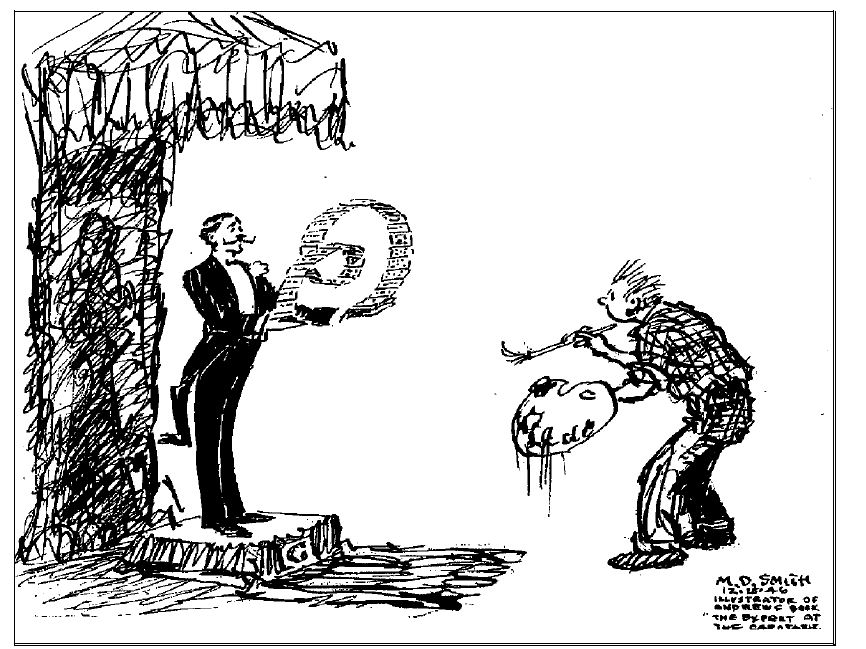
I don't see it.
I see what could be construed as "lade" on the paint palate.
I also see a "G" on the base the magician is standing on, but I see no other letters on that same surface.
Beyond the two things above, I seen nothing else that Scott makes note of in his post.
I also see a "G" on the base the magician is standing on, but I see no other letters on that same surface.
Beyond the two things above, I seen nothing else that Scott makes note of in his post.
Richard Kaufman wrote:Expert at the Card Table was written by a magician who knew some gambling stuff. The evidence for this is very strong.
A bold statement considering we have absolutely no idea who S.W. Erdnase was!
I get that folks can throw stuff at the wall to see what sticks, or that pretty much anybody can say anything they want about Erdnase ... and the reason they can say anything they want about Erdnase? ... Well, it's because we (as noted above) have absolutely no idea who Erdnase was.
Ergo, anybody can say anything they want and be no more "wrong" or "right" from the next guy who may say something completely different!
Here's the Sargent book: https://archive.org/details/smokeandbub ... /page/n151
Shorthand? This word seems apropos : https://en.wikipedia.org/wiki/Pareidolia
Entropy wins anyway. No need to throw Curate's eggs.
Shorthand? This word seems apropos : https://en.wikipedia.org/wiki/Pareidolia
Entropy wins anyway. No need to throw Curate's eggs.
Roger M. wrote:Ergo, anybody can say anything they want and be no more "wrong" or "right" from the next guy who may say something completely different!
Gotta disagree here. As this thread has proven several times, some people can be much, much more wrong than the next guy.
There's always "degrees of wrong" I guess
I am generally making reference though, to folks making comments that tend to at least make sense as to why they might be making them.
Like Richards comment above, as I totally get where he's coming from when he states that Erdnase was a magician, and although I personally believe Erdnase was a gambler, in reality neither Richard or I are any more right or wrong than the other.
Then there are outright fabrications and utter nonsense - which I'd agree are simply so wrong they can't possibly be right, even though we still have no idea whatsoever who Erdnase actually was.
I am generally making reference though, to folks making comments that tend to at least make sense as to why they might be making them.
Like Richards comment above, as I totally get where he's coming from when he states that Erdnase was a magician, and although I personally believe Erdnase was a gambler, in reality neither Richard or I are any more right or wrong than the other.
Then there are outright fabrications and utter nonsense - which I'd agree are simply so wrong they can't possibly be right, even though we still have no idea whatsoever who Erdnase actually was.
No, in reality one of you is right and one of you is wrong.Roger M. wrote:In reality neither Richard or I are any more right or wrong than the other.
Dan Brown has the outline of his next novel pretty much mapped out I believe.
All he needs to do now is add in a few pointing statues and he will have another bestseller on his hands!
All he needs to do now is add in a few pointing statues and he will have another bestseller on his hands!
Roger M. wrote:I see what could be construed as "lade" on the paint palate.
I also see a "G" on the base the magician is standing on, but I see no other letters on that same surface.
Beyond the two things above, I seen nothing else that Scott makes note of in his post.
The G is obviously for Gardner - the drawing was a gift to him. As for the apparent lettering on the pallette, it could say "Tada" in response to the flourish that the magician is performing. I can't see anything else that is supposed to be there.
Brad Jeffers wrote:No, in reality one of you is right and one of you is wrong.Roger M. wrote:In reality neither Richard or I are any more right or wrong than the other.
No, we could both also be wrong, or we could both also be right.
Erdnase could have been a serious magician who gambled for a living, or a serious professional gambler who studied magic studiously (making us both right)
Making us both wrong, I'll use myself as an example.
I'm neither a gambler or a magician per see ... but I've studied EATCT for over 40 years, know the book inside out, and continue to be interested in every aspect of it, including the search for the identity of its author.
Erdnase could have been that train agent, and been a witness to gambling, developing extensive expertise and knowledge over the years ... but never actually betting his own money, or performing a magic trick for anybody other than himself.
Splitting hairs to a degree? ... maybe.
But the point is that Richard and I have our opinions, and without knowing the true identity of Erdnase, each of those opinions is no more "wrong", or no more "right" than the other.
Obviously, once Erdnase's identity is known, the entire playing field changes at its most fundamental level, and the points above become moot.
Zenner wrote:Roger M. wrote:I see what could be construed as "lade" on the paint palate.
I also see a "G" on the base the magician is standing on, but I see no other letters on that same surface.
Beyond the two things above, I seen nothing else that Scott makes note of in his post.
The G is obviously for Gardner - the drawing was a gift to him. As for the apparent lettering on the pallette, it could say "Tada" in response to the flourish that the magician is performing. I can't see anything else that is supposed to be there.
I too see "Tada" quite clearly ... and as Zenner points out, it's entirely in context of what's going on with the flourish.
However, my eyes still don't see any of the remainder of Scott's observations ... despite spending time looking.
Since I posted the earlier picture, Scott has asked for some assistance with posting some more detailed views. Here they are.
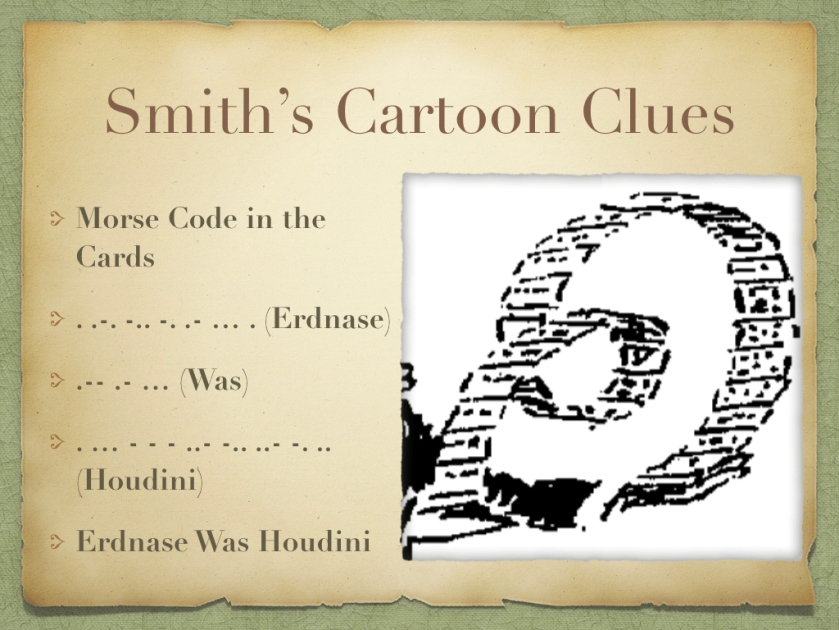

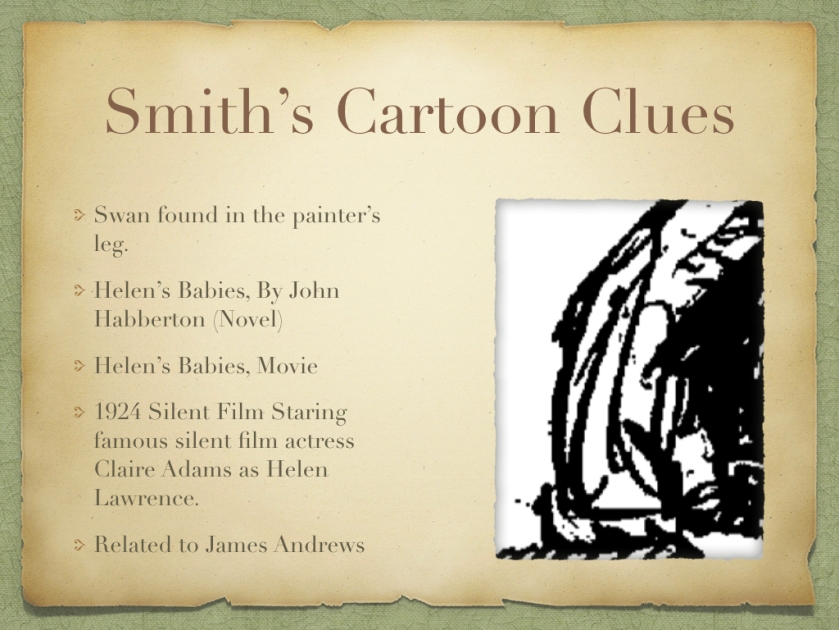
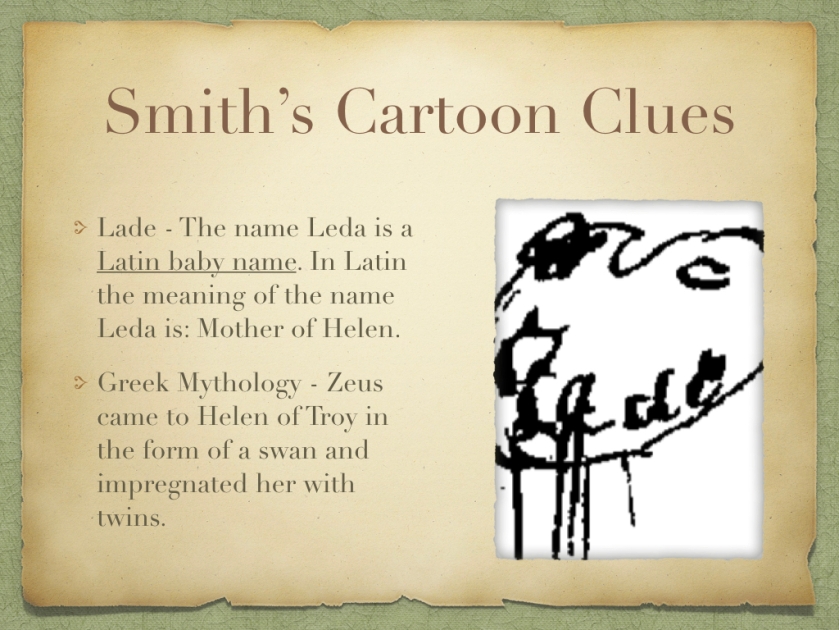
Earlier in the thread I've listed writers who have used an anagram of their name as a pseudonym, in support of the idea that S. W. Erdnase is an anagram. I've found another -- science fiction author Randall Garrett used "Darrel T. Langart" as a pseudonym.
(SNIP)Bill Mullins wrote:Since I posted the earlier picture, Scott has asked for some assistance with posting some more detailed views. Here they are.
Scott has a very vivid imagination
Houdini was Erdnase? Are we expected to believe that it was Houdini who demonstrated the tricks for Smith and then posed for the illustrations in that pokey little room?
I believe that if Houdini had written Expert, then he would have made sure that his name was on the cover, just like his other books. He may have been temporarily hard up but he always wanted to promote his own name - and neither of his two names appear in the McKinney Files.
Nah...
Zenner wrote:(SNIP)Bill Mullins wrote:Since I posted the earlier picture, Scott has asked for some assistance with posting some more detailed views. Here they are.
Scott has a very vivid imagination
Houdini was Erdnase? Are we expected to believe that it was Houdini who demonstrated the tricks for Smith and then posed for the illustrations in that pokey little room?
I believe that if Houdini had written Expert, then he would have made sure that his name was on the cover, just like his other books. He may have been temporarily hard up but he always wanted to promote his own name - and neither of his two names appear in the McKinney Files.
Nah...
And of course, if Houdini was "Erdnase", Smith should have had no difficulty in identifying him. Even if he had been unaware of Houdini prior to the publication of EATCT, he surely must have recognised him after he became a film star (and thus in retrospect)!
Well, if Scott is correct, then regardless of ones personal opinion, and regardless of how many fabricated situations one can dream up to propose as to why Houdini couldn't be Erdnase ... you've still got a major problem if Smith went out of his way to indicate (for whatever reason) in a cartoon that Houdini was Erdnase.
Scott, which direction is "Erdnase was Houdini" displayed from - in the flourish of cards? ... in other words, which hand does it start in?
I can't seem to find any more than a few correct letters regardless of which hand I start in ... and that's being generous with what might be a DOT and what might be a DASH.
For example, starting from the left hand, the first letter definitely could be an "E", and the second letter an "R" ... but then it all seems to break down.
The text on the left is obviously correct in terms of the proper DOT and DASH for each letter, but the text doesn't seem to match the cartoon?
Scott, which direction is "Erdnase was Houdini" displayed from - in the flourish of cards? ... in other words, which hand does it start in?
I can't seem to find any more than a few correct letters regardless of which hand I start in ... and that's being generous with what might be a DOT and what might be a DASH.
For example, starting from the left hand, the first letter definitely could be an "E", and the second letter an "R" ... but then it all seems to break down.
The text on the left is obviously correct in terms of the proper DOT and DASH for each letter, but the text doesn't seem to match the cartoon?
Further to my above post, compounding the problem is that there are noticeably more playing cards with potential dots and dashes on them (23) than there are the 17 letters in the proposed sentence?
A lot of nonsense.
It is beyond unimaginable that Houdini wrote Expert because ... Houdini could never have written that detailed text. He lacked the ability.
It is beyond unimaginable that Houdini wrote Expert because ... Houdini could never have written that detailed text. He lacked the ability.
Scott asked in an extremely polite fashion if folks would give him the respect of not attacking him, or declaring his findings to be "nonsense" ... presumably extended to mean that he wished to have an opportunity to respond to rational questions, if they were asked.
Scott has made some specific observations regarding his first slide of the Houdini flourish, and before declaring his comments "nonsense", perhaps we should give him a chance to respond?
First off, folks have to be able to see what Scott see's in order to proceed with any sort of intelligent conversation. If nobody see's what Scott see's in that slide, then the conversation really has no place further to go.
If some folks do see the reference to Houdini in the phrase as Scott see's it, then the next question might be to ask what that phrase could possibly mean ... as it seems nearly impossible (if not entirely impossible) that Houdini was actually Erdnase.
But first we have to discuss whether the Morse Code that Scott see's on the playing cards is Morse Code at all, and then how it's to be read, and further what it might mean.
I'm sure I'm not alone in finding that it's far more tempting to simply declare somebody as "nuts" (as I have many times here), or to declare their comments or conclusions about Erdnase as "nonsense" (as I have many times here) ... but all that did earlier in this thread was generate 70 pages of somewhat useless back and forth insults from both sides of the conversation (and calling it a "conversation" is being extremely generous).
Scott has made some specific observations regarding his first slide of the Houdini flourish, and before declaring his comments "nonsense", perhaps we should give him a chance to respond?
First off, folks have to be able to see what Scott see's in order to proceed with any sort of intelligent conversation. If nobody see's what Scott see's in that slide, then the conversation really has no place further to go.
If some folks do see the reference to Houdini in the phrase as Scott see's it, then the next question might be to ask what that phrase could possibly mean ... as it seems nearly impossible (if not entirely impossible) that Houdini was actually Erdnase.
But first we have to discuss whether the Morse Code that Scott see's on the playing cards is Morse Code at all, and then how it's to be read, and further what it might mean.
I'm sure I'm not alone in finding that it's far more tempting to simply declare somebody as "nuts" (as I have many times here), or to declare their comments or conclusions about Erdnase as "nonsense" (as I have many times here) ... but all that did earlier in this thread was generate 70 pages of somewhat useless back and forth insults from both sides of the conversation (and calling it a "conversation" is being extremely generous).
Reading the Morse Code in the Smith Cartoon
Starting from the left hand:
Each set of Dots and Dashes run from left to right within the card.
The First Four Cards says ERDNASE
Card 1 = Dot = E
Card 2 = Dot Dash Dot = R
Card 3 = Dash Dot Dot = D
Card 4 = Dash Dot, Dot Dash, Dot Dot Dot, Dot = NASE
(From Left to Right - The first dash is the left side of the card and the second dash is the right side of the card)
The Fifth Card says WAS
Card 5 = Dot Dash Dash, Dot Dash, Dot Dot Dot
(The Last Dot is possibly on the line of the card above)
Card Six and Seven Cards = HOUDI
(Again you have to use the side of the card to make the Dashes. It seems like he was running out of room.)
Card Eight says Dash Dot meaning the letter N
Going around the curve has the last Dot Dot making the letter I.
(Completing the word HOUDINI)
As you go down the left side of the card juggle, going into the final circle, towards the right hand, it almost seems like the message starts to repeat itself.
Maybe I am trying to see something that is not there …. but maybe it is there.
I do believe that the other Houdini references in the cartoon help to substantiate the theory.
Houdini did carry a gun to protect himself from the gamblers and was publishing gambling exposes during that time period.
I don’t believe that Houdini wrote the book text. I think the other players in my presentation wrote the text.
According to the theory I have presented, the gambling systems in the book were written many years prior to publication. Wells and Andrews owned and operated the french lick casinos in the 1870s but stuck around for many years afterword. The West Baden Springs Hotel and Casino burned down in 1901 and reopened in September of 1902. Wells died in July 1902. The original gambling information was possibly used as a casino manual.
Houdini could have met Smith in the hotel in the late 1890s. He was documented as being in Chicago at that time, prior to going overseas. One theory is he dressed in disguise but Andrews was also in Chicago at the time.
I do believe Smith had a motive to keep it from Gardner due to his family connections to the gamblers, the SAM founders, the New York Press Club (Blue Pencil Club Members) and to Houdini himself.
One thing is for sure, my family had intimate knowledge and relations with the gamblers/dealers in French Lick and Milton Franklin Andrew’s extended family. My revelations concerning Ellis, Howards, Andrews and Campbells all tie into the research done by Whaley, Gardner and Busby in TMWWE.
One of the hardest things to do is to realize that TEATCT is romanticized fiction.
My family members were all living and working the hotels and casinos at the time Dai Vernon visited French Lick and West Baden Springs looking for the Center Deal. After this blows over, I will tell you the true story of what happened when Vernon arrived and tried to pass himself off as a gambler. The story is not as straight forward as others have written. Although, in my opinion, he was one of the greatest magicians that ever lived.
Starting from the left hand:
Each set of Dots and Dashes run from left to right within the card.
The First Four Cards says ERDNASE
Card 1 = Dot = E
Card 2 = Dot Dash Dot = R
Card 3 = Dash Dot Dot = D
Card 4 = Dash Dot, Dot Dash, Dot Dot Dot, Dot = NASE
(From Left to Right - The first dash is the left side of the card and the second dash is the right side of the card)
The Fifth Card says WAS
Card 5 = Dot Dash Dash, Dot Dash, Dot Dot Dot
(The Last Dot is possibly on the line of the card above)
Card Six and Seven Cards = HOUDI
(Again you have to use the side of the card to make the Dashes. It seems like he was running out of room.)
Card Eight says Dash Dot meaning the letter N
Going around the curve has the last Dot Dot making the letter I.
(Completing the word HOUDINI)
As you go down the left side of the card juggle, going into the final circle, towards the right hand, it almost seems like the message starts to repeat itself.
Maybe I am trying to see something that is not there …. but maybe it is there.
I do believe that the other Houdini references in the cartoon help to substantiate the theory.
Houdini did carry a gun to protect himself from the gamblers and was publishing gambling exposes during that time period.
I don’t believe that Houdini wrote the book text. I think the other players in my presentation wrote the text.
According to the theory I have presented, the gambling systems in the book were written many years prior to publication. Wells and Andrews owned and operated the french lick casinos in the 1870s but stuck around for many years afterword. The West Baden Springs Hotel and Casino burned down in 1901 and reopened in September of 1902. Wells died in July 1902. The original gambling information was possibly used as a casino manual.
Houdini could have met Smith in the hotel in the late 1890s. He was documented as being in Chicago at that time, prior to going overseas. One theory is he dressed in disguise but Andrews was also in Chicago at the time.
I do believe Smith had a motive to keep it from Gardner due to his family connections to the gamblers, the SAM founders, the New York Press Club (Blue Pencil Club Members) and to Houdini himself.
One thing is for sure, my family had intimate knowledge and relations with the gamblers/dealers in French Lick and Milton Franklin Andrew’s extended family. My revelations concerning Ellis, Howards, Andrews and Campbells all tie into the research done by Whaley, Gardner and Busby in TMWWE.
One of the hardest things to do is to realize that TEATCT is romanticized fiction.
My family members were all living and working the hotels and casinos at the time Dai Vernon visited French Lick and West Baden Springs looking for the Center Deal. After this blows over, I will tell you the true story of what happened when Vernon arrived and tried to pass himself off as a gambler. The story is not as straight forward as others have written. Although, in my opinion, he was one of the greatest magicians that ever lived.
The first card in the Smith illustration looks like an Ace, maybe the Ace of Clubs. The next card looks like a three, then another three, and then a five. And then a six, and then another five. Maybe Scott also believes that ancient Aztec carving represents an astronaut?
Scott Lane wrote:Reading the Morse Code in the Smith Cartoon
Starting from the left hand:
Each set of Dots and Dashes run from left to right within the card.
The First Four Cards says ERDNASE
Card 1 = Dot = E
Card 2 = Dot Dash Dot = R
Card 3 = Dash Dot Dot = D
Card 4 = Dash Dot, Dot Dash, Dot Dot Dot, Dot = NASE
(From Left to Right - The first dash is the left side of the card and the second dash is the right side of the card)
All good until the 4th card. With the same strategy you can make up just about any 4-letter word by placing the 1-4 available dashes wherever you want in between the dots. I just don't see a pattern.
I agree with Carlo.
Despite a fair bit of time looking, I don't see what Scott is seeing.
If it was straight up Morse Code, then I think it might be something of note.
But if you allow for things like the edges of cards to represent dots or dashes (where convenient), or don't account for all the visible cards, then it starts to become more a free-for-all in terms of making statements regarding what the playing cards might (or might not) say in Morse Code.
Sorry Scott, but I have to say that I just don't see it.
With reference to the other slide close-ups you posted, I'm wondering if there is any possibility that you can highlight some of the words and names you see?
It might help if you could trace over the text you propose with a alternate colour than black?
With the exception of the letters on the painters palate (last slide), I'm have difficulty finding words or names elsewhere in your slides. Tracing them out might help others see them?
Despite a fair bit of time looking, I don't see what Scott is seeing.
If it was straight up Morse Code, then I think it might be something of note.
But if you allow for things like the edges of cards to represent dots or dashes (where convenient), or don't account for all the visible cards, then it starts to become more a free-for-all in terms of making statements regarding what the playing cards might (or might not) say in Morse Code.
Sorry Scott, but I have to say that I just don't see it.
With reference to the other slide close-ups you posted, I'm wondering if there is any possibility that you can highlight some of the words and names you see?
It might help if you could trace over the text you propose with a alternate colour than black?
With the exception of the letters on the painters palate (last slide), I'm have difficulty finding words or names elsewhere in your slides. Tracing them out might help others see them?
Very good comment! That is a valid criticism. Thank you! The way I rationalized it was that the dashes are the sides of the card, which are connected at the bottom. The next card, the fifth card, starts with a dot but it is below the vertical side line of the card.
I followed the code from left to right and from bottom up within the card. What do you think of the fifth card? Do you think it could be the word “WAS”? If you do, than we areaway be in agreement for over half of the cards, and we spell “ERDNASE WAS”. That is interesting in itself.
I also liked the comment concerning The Chariots of the Gods. If that book was written with no speculation and commentary, it would not have sold so many copies and spawned so many other books, documentaries, and cable TV shows. Controversy can be good.
If I was to say to you that Erdnase was “John Doe” and revealed the true name of Erdnase, nobody would really care. Lets face it, the book is not very interesting to the general public. The interesting aspects concerning TEATCT is the history of the book, the people involved in producing the book and the stories surrounding the book.
Try making a documentary out of the contents of Gus’s book New Era Card Tricks. It would flop like a lead balloon. Only a handful of magicians would find it interesting.
One of the reasons I wanted to post this information on the Genii forum was to document some of these findings in a public forum so I could release a couple of people that I currently have in NDAs (Non Disclosure Agreements).
I would like to thank Bill Mullins for his help with posting the illustrations, he is truly a very nice person and his research has always been honest and fair minded. If he disagrees, he always remains a complete gentleman and scholar.
I would also like to thank Richard Kaufman for his input. As I said in a previous post, I have a huge magic library and if I took out all the books, magazines and related material that he has written, produced or illustrated, my library would look skimpy and very incomplete. He has done more to advance the art of magic than almost anyone in the last century.
Also, thank you Roger for your wisdom concerning your comments about the other slides. I will put something together and post in the near future. Although… even if I can show you, and everyone agrees the images are there, I am not sure it will prove anything.
If anyone else has any comments or questions, feel free to post, I will do my best to answer.
I truly am proud to put my two cents in concerning the Erdnase mystery. I am honored to post my theory to this thread enabling me to share my comments with some of the most talented and intelligent magicians in the magic community.
It is OK that we may not all agree! We all have one thing in common, a profound love and passion for the art of magic.
Sincerely,
Scott Edward Lane
Promoting the Art of Magic with Relentless Gradualism ....
I followed the code from left to right and from bottom up within the card. What do you think of the fifth card? Do you think it could be the word “WAS”? If you do, than we areaway be in agreement for over half of the cards, and we spell “ERDNASE WAS”. That is interesting in itself.
I also liked the comment concerning The Chariots of the Gods. If that book was written with no speculation and commentary, it would not have sold so many copies and spawned so many other books, documentaries, and cable TV shows. Controversy can be good.
If I was to say to you that Erdnase was “John Doe” and revealed the true name of Erdnase, nobody would really care. Lets face it, the book is not very interesting to the general public. The interesting aspects concerning TEATCT is the history of the book, the people involved in producing the book and the stories surrounding the book.
Try making a documentary out of the contents of Gus’s book New Era Card Tricks. It would flop like a lead balloon. Only a handful of magicians would find it interesting.
One of the reasons I wanted to post this information on the Genii forum was to document some of these findings in a public forum so I could release a couple of people that I currently have in NDAs (Non Disclosure Agreements).
I would like to thank Bill Mullins for his help with posting the illustrations, he is truly a very nice person and his research has always been honest and fair minded. If he disagrees, he always remains a complete gentleman and scholar.
I would also like to thank Richard Kaufman for his input. As I said in a previous post, I have a huge magic library and if I took out all the books, magazines and related material that he has written, produced or illustrated, my library would look skimpy and very incomplete. He has done more to advance the art of magic than almost anyone in the last century.
Also, thank you Roger for your wisdom concerning your comments about the other slides. I will put something together and post in the near future. Although… even if I can show you, and everyone agrees the images are there, I am not sure it will prove anything.
If anyone else has any comments or questions, feel free to post, I will do my best to answer.
I truly am proud to put my two cents in concerning the Erdnase mystery. I am honored to post my theory to this thread enabling me to share my comments with some of the most talented and intelligent magicians in the magic community.
It is OK that we may not all agree! We all have one thing in common, a profound love and passion for the art of magic.
Sincerely,
Scott Edward Lane
Promoting the Art of Magic with Relentless Gradualism ....
Writing at the bottom designed to be read when the illustration is held almost parallel to the sight line? Two such? ( viewed from bottom corners )
Was Smith that playful elsewhere?
Was Smith that playful elsewhere?
Scott Lane wrote:Very good comment! That is a valid criticism. Thank you! The way I rationalized it was that the dashes are the sides of the card, which are connected at the bottom. The next card, the fifth card, starts with a dot but it is below the vertical side line of the card.
I followed the code from left to right and from bottom up within the card. What do you think of the fifth card? Do you think it could be the word “WAS”?
I am not sure... where do you place the second dash of W ?
Mr Townsend’s Comment:
"Writing at the bottom designed to be read when the illustration is held almost parallel to the sight line? Two such? ( viewed from bottom corners )"
Answer:
You will find a clue in the cartoon everywhere you see a little Imp in the drawing. The imps look like the imps that are in many magician posters.
Mr Morpurgo’s Comment:
"I am not sure... where do you place the second dash of W ?"
Answer:
The fifth card in the morse code possibly says “WAS”. The code goes like this within the card
Going from left to right and bottom to the top:
Dot Dash Dash, Dot Dash, Dot Dot Dot
The first dot is on the bottom left side of the card. The next two dashes are in line just to the right. The second dash is not as big as the first and has the possibility of putting the card in question. It seems like it is bigger than a dot but not as big as the dash preceding it.
Moving up the card is the next dot, closer to the middle, but still following the pattern of left to right and bottom to top. The next dash is the side of the card, which is definitely a dash and higher than the previous dot. The next three dots are obvious and go in a line completing the word “WAS”.
I am still working on outlining another set of slides to help provide clarity.
Thank you so much for the questions!
Scott Edward Lane
"Writing at the bottom designed to be read when the illustration is held almost parallel to the sight line? Two such? ( viewed from bottom corners )"
Answer:
You will find a clue in the cartoon everywhere you see a little Imp in the drawing. The imps look like the imps that are in many magician posters.
Mr Morpurgo’s Comment:
"I am not sure... where do you place the second dash of W ?"
Answer:
The fifth card in the morse code possibly says “WAS”. The code goes like this within the card
Going from left to right and bottom to the top:
Dot Dash Dash, Dot Dash, Dot Dot Dot
The first dot is on the bottom left side of the card. The next two dashes are in line just to the right. The second dash is not as big as the first and has the possibility of putting the card in question. It seems like it is bigger than a dot but not as big as the dash preceding it.
Moving up the card is the next dot, closer to the middle, but still following the pattern of left to right and bottom to top. The next dash is the side of the card, which is definitely a dash and higher than the previous dot. The next three dots are obvious and go in a line completing the word “WAS”.
I am still working on outlining another set of slides to help provide clarity.
Thank you so much for the questions!
Scott Edward Lane
Not impossible if you read for distinctions - experience in doing and recall of others showing, or imagination. The author as mystery in TEATCT is great mcguffin for historical fantasy.Scott Lane wrote:One of the hardest things to do is to realize that TEATCT is romanticized fiction.
* Agreed about dramatizing Roterburg's book or attempting to unshuffle the Hofzinser trick descriptions. Fun for a few but not nearly as dramatic as the "erdnase" efforts.
Jonathan Townsend wrote:Writing at the bottom designed to be read when the illustration is held almost parallel to the sight line? Two such? ( viewed from bottom corners )
Pictures from Jonathan:
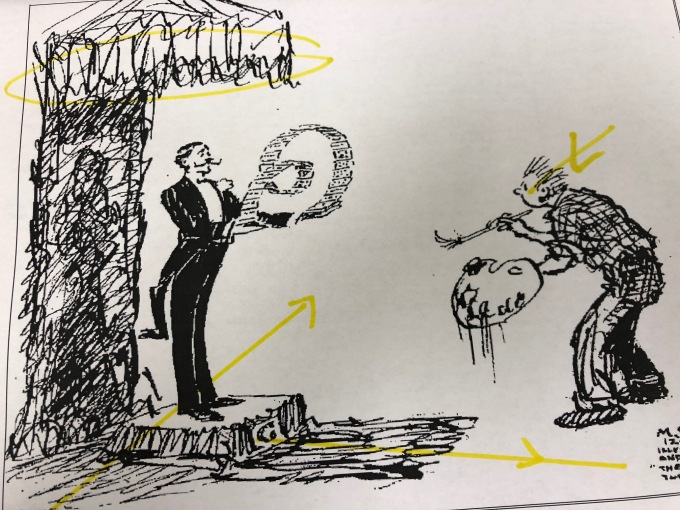
According to David Saltman, Carl “Compars” Herrmann was Houdini’s uncle.
http://www.houdinifile.com
In the current issue of the Society of American Magicians, MUM, there is an article about John William Sargent and Alexander Herrmann possibly being the same person, or in my opinion related.
There is also a theory that Ella Fontaine Binkley, the illustrator of Sargent’s book Smoke and Bubbles, was once married to M D Smith. His death certificate states that he was “widowed”.
M D Smith’s sister did marry into the Sargent Family.
Houdini is accredited to writing the following:
Source: https://www.wildabouthoudini.com/p/by-houdini.html
Books by Houdini:
The Right Way to Do Wrong (1906)
The Unmasking of Robert-Houdin (1908)
Handcuff Secrets (1910)
Magical Rope Ties and Escapes (1920)
Miracle Mongers and Their Methods (1921)
Houdini's Paper Magic (1922)
Elliot's Last Legacy (1923) - Editor
A Magician Among the Spirits (1924)
The Cancer of Superstition (unfinished)
Witchcraft (unfinished)
Short Stories by Houdini:
A One-Night Engagement (1904)
Bahl Yahn the Strongman (1907)
Dan Cupid - Magician (1908)
Cupid Present the Bullet-Catching Trick (1909)
The Magician's Christmas Eve (1921)
The Spirit Fakers of Hermannstadt (1924)
The Hoax of the Spirit Lover (1924)
Imprisoned With The Pharaohs aka Under The Pyramids (1924)
The Zanetti Mystery (1925)
Blood Brothers (unpublished)
Thoughts and Feelings of a Head Cut Off (unpublished)
Plays by Houdini:
Challenged or Houdini Upside Down (1911)
Walking Through A Brick Wall (1914)
Buried Alive (1914)
Film Treatments and Screenplays by Houdini:
The Marvelous Adventures of Houdini (1917)
The Great Tontine (undated)
The Monster (undated)
The Vulture (undated)
Floating Through Space (undated)
The Man From Beyond (1922)
Haldane of the Secret Service or Mysterious Mr. Yu (1923)
Ill Mistero de Osiris or The Mystery of the Jewel (1921)
Yar, the Primeval Man (undated)
Research has found that Houdini may have additional writings under various aliases.
Scott Edward Lane
http://www.houdinifile.com
In the current issue of the Society of American Magicians, MUM, there is an article about John William Sargent and Alexander Herrmann possibly being the same person, or in my opinion related.
There is also a theory that Ella Fontaine Binkley, the illustrator of Sargent’s book Smoke and Bubbles, was once married to M D Smith. His death certificate states that he was “widowed”.
M D Smith’s sister did marry into the Sargent Family.
Houdini is accredited to writing the following:
Source: https://www.wildabouthoudini.com/p/by-houdini.html
Books by Houdini:
The Right Way to Do Wrong (1906)
The Unmasking of Robert-Houdin (1908)
Handcuff Secrets (1910)
Magical Rope Ties and Escapes (1920)
Miracle Mongers and Their Methods (1921)
Houdini's Paper Magic (1922)
Elliot's Last Legacy (1923) - Editor
A Magician Among the Spirits (1924)
The Cancer of Superstition (unfinished)
Witchcraft (unfinished)
Short Stories by Houdini:
A One-Night Engagement (1904)
Bahl Yahn the Strongman (1907)
Dan Cupid - Magician (1908)
Cupid Present the Bullet-Catching Trick (1909)
The Magician's Christmas Eve (1921)
The Spirit Fakers of Hermannstadt (1924)
The Hoax of the Spirit Lover (1924)
Imprisoned With The Pharaohs aka Under The Pyramids (1924)
The Zanetti Mystery (1925)
Blood Brothers (unpublished)
Thoughts and Feelings of a Head Cut Off (unpublished)
Plays by Houdini:
Challenged or Houdini Upside Down (1911)
Walking Through A Brick Wall (1914)
Buried Alive (1914)
Film Treatments and Screenplays by Houdini:
The Marvelous Adventures of Houdini (1917)
The Great Tontine (undated)
The Monster (undated)
The Vulture (undated)
Floating Through Space (undated)
The Man From Beyond (1922)
Haldane of the Secret Service or Mysterious Mr. Yu (1923)
Ill Mistero de Osiris or The Mystery of the Jewel (1921)
Yar, the Primeval Man (undated)
Research has found that Houdini may have additional writings under various aliases.
Scott Edward Lane
The majority of Houdini's published writings were ghostwritten.
Richard,
You, published one of my favorite books, Conjurer’s Monthly Magazine, with Alan Greenberg. I don’t know what year you did this, but it is absolutely beautiful. It consists of two volumes in a slip case on acid free paper (thank you for the quality). I remember frantically saving up to purchase this many, many years ago.
Houdini was the editor (writer)?
My question is: The first issues have drawings on the sides of the magazine. Did you add these illustrations or were they in the original publications?
Scott Edward Lane
You, published one of my favorite books, Conjurer’s Monthly Magazine, with Alan Greenberg. I don’t know what year you did this, but it is absolutely beautiful. It consists of two volumes in a slip case on acid free paper (thank you for the quality). I remember frantically saving up to purchase this many, many years ago.
Houdini was the editor (writer)?
My question is: The first issues have drawings on the sides of the magazine. Did you add these illustrations or were they in the original publications?
Scott Edward Lane
Scott Lane wrote:There is also a theory that Ella Fontaine Binkley, the illustrator of Sargent’s book Smoke and Bubbles, was once married to M D Smith. His death certificate states that he was “widowed”.
Per the 1900 Census, Smith's wife was named Alice.
A fun story.Scott Lane wrote:...
Imprisoned With The Pharaohs aka Under The Pyramids (1924)...
Jonathan Townsend wrote:A fun story.Scott Lane wrote:...
Imprisoned With The Pharaohs aka Under The Pyramids (1924)...
Also not written by Houdini.
Rob Block wrote:Jonathan Townsend wrote:A fun story.Scott Lane wrote:...
Imprisoned With The Pharaohs aka Under The Pyramids (1924)...
Also not written by Houdini.
Yes, it was ghost-written for him by H. P. Lovecraft.
I did not do anything to The Conjurors' Monthly. It was reproduced exactly as the original, but enlarged slightly to fill the 8.5 x 11 size of the page. This had the nice side effect of making it easier to read.
As an interested bystander to the Erdnase question, the view is getting more interesting all the time. I must say, the idea that Marshall Smith could have had some reason to keep Erdnase's identity secret means a jolly huge amount of reconsidering of evidence.
Pete, I was wondering the same. Something to ponder.
I'm not sure the idea has morphed into anything beyond one mans subjective take on the evidence.
Certainly no confirmed evidence related to M.D. Smith withholding information has been forthcoming.
Despite my efforts to note some of the "clues" that Scott pointed out, I simply can't see them at this point in time.
To be honest, I wish I could see some of the clues Scott posted in his picture set ... but IMO we're exactly where we've been for a long while now, with a short list of possible candidates, and with absolutely zero incontrovertible evidence to support any of them.
Certainly no confirmed evidence related to M.D. Smith withholding information has been forthcoming.
Despite my efforts to note some of the "clues" that Scott pointed out, I simply can't see them at this point in time.
To be honest, I wish I could see some of the clues Scott posted in his picture set ... but IMO we're exactly where we've been for a long while now, with a short list of possible candidates, and with absolutely zero incontrovertible evidence to support any of them.
Pete McCabe wrote: I must say, the idea that Marshall Smith could have had some reason to keep Erdnase's identity secret means a jolly huge amount of reconsidering of evidence.
But it's just an idea. If there were any evidence to support it, then it could be upgraded to a theory.
If Smith was "in on it," what was his motivation? Why hold on to the secret 45 years later?
He was interviewed and queried extensively, over a period of several years, by Gardner, who never picked up any indication that Smith was anything other than an artist who did a job, got paid, and promptly forgot about it.
At the 1947 SAM convention, Vernon and Rosini and others all pushed Smith for details, and none of them ever indicated that Smith's story seemed hinky.
To be sure, there are a dearth of facts with regards to the production of the book and who wrote it. But all the facts we have support the idea that Smith was simply an artist for hire, and none of the facts we have suggest anything other than that. If Occam's Razor is of any use at all, it would surely suggest the same.
Roger M. wrote:, and with absolutely zero incontrovertible evidence to support any of them.
Not much controvertible evidence, either.
I think it's fairly obvious that who we think of as "M.D. Smith" was actually Erdnase. He hired an illustrator, got the drawings he needed and then killed him and stole his identity. Teaching himself to paint and becoming a well-known regional artist himself was a nice touch.
Jason
PS: If you ranked all of the Erdnasian authorship theories in this thread this one is about the 5th craziest.
Jason
PS: If you ranked all of the Erdnasian authorship theories in this thread this one is about the 5th craziest.
Chris W. maintained that Erdnase was Edward Gallaway, who at one time was a newspaperman.
He put forth the theory that Erdnase ="earth nose," a German nickname.
Better, SW ERDNASE = READS NEWS
He put forth the theory that Erdnase ="earth nose," a German nickname.
Better, SW ERDNASE = READS NEWS
Jack Shalom wrote:Chris W. maintained that Erdnase was Edward Gallaway, who at one time was a newspaperman.
He put forth the theory that Erdnase ="earth nose," a German nickname.
I believe it was Tom Sawyer who first made the Erdnase/earth nose connection. Wasshuber then twisted that to the German nickname idea.
True. My post was in keeping with the spirit of Mr. England's previous one; my theory is probably only the sixth craziest.
FYI Jason England
https://www.ebay.com/itm/312223045807
$465.00 dollars for EATCT Fireside edition SOLD
I believe your valuations of the early books is off abit. LOL
Magicians have no idea of value.
https://www.ebay.com/itm/312223045807
$465.00 dollars for EATCT Fireside edition SOLD
I believe your valuations of the early books is off abit. LOL
Magicians have no idea of value.
rrath1 wrote:FYI Jason England
https://www.ebay.com/itm/312223045807
$465.00 dollars for EATCT Fireside edition SOLD
I believe your valuations of the early books is off abit. LOL
Magicians have no idea of value.
no - the person who paid that much doesn’t.
Brad Henderson I disagree, you missed the point of my whole post (earlier in the thread) on the pricing of EATCT. The buyer doesn't have to know anything except he/she wants it. Market value is a concept distinct from market price, which is “the price at which one can transact”, while market value is “the true underlying value” according to theoretical standards. The concept is most commonly invoked in inefficient markets or disequilibrium situations where prevailing market prices are not reflective of true underlying market value. For market price to equal market value, the market must be informationally efficient and rational expectations must prevail. Everything about EATCT is anything but rational or informationally efficient. Therefore, market value isn't based on market price which most people base valuation on. What did the last one sell for at auction? Availability is the most important factor, with condition second and price, doesn't matter. Market value is not a defined number. It's open to interpretation. And in your case your interpretation is different then the global market.
terminé
terminé
Brad Henderson wrote:rrath1 wrote:FYI Jason England
https://www.ebay.com/itm/312223045807
$465.00 dollars for EATCT Fireside edition SOLD
I believe your valuations of the early books is off abit. LOL
Magicians have no idea of value.
no - the person who paid that much doesn’t.
Brad--If you wish to bring the price of this book down to a reasonable level, all you need do is purchase one at the inflated price and "flip it" for half of what you paid. Then everyone will demand it for that figure. But unfortunately, until someone does that, it's only the high bidders that determine its value. Those that sniff at it and don't buy it simply don't have any say in the matter. You can't reduce the price of a book like this unless nobody is willing to shell out that kind of money. But of course, somebody always is, due to the hype that forums like this generate. The more you folks venerate it, the more some ill-informed rich chap is going to be glad to pay.
The amount something sells for on eBay contributes nothing to the determination of value or potential sales price.
The purchaser could very easily be the seller using their sock puppet account, indeed many sellers attempt to boost the perceived value of an eBay item by doing just this.
Jason bases his valuations on vast personal experience (related to his EATCT collection), something far more relevant and authoritative than the ramblings of internet oddballs and troublemakers.
The purchaser could very easily be the seller using their sock puppet account, indeed many sellers attempt to boost the perceived value of an eBay item by doing just this.
Jason bases his valuations on vast personal experience (related to his EATCT collection), something far more relevant and authoritative than the ramblings of internet oddballs and troublemakers.
Bill Mullins wrote:...
If Smith was "in on it," what was his motivation? Why hold on to the secret 45 years later? He was interviewed and queried extensively, over a period of several years, by Gardner, who ...
... was a known prankster.
Roger M. wrote:The amount something sells for on eBay contributes nothing to the determination of value or potential sales price.
The purchaser could very easily be the seller using their sock puppet account, indeed many sellers attempt to boost the perceived value of an eBay item by doing just this.
Jason bases his valuations on vast personal experience (related to his EATCT collection), something far more relevant and authoritative than the ramblings of internet oddballs and troublemakers.
Roger--If the above was meant for me, let me say that I have more than a little experience at selling collectible books (on eBay and elsewhere). I have tried to evaluate items according to scarcity, demand and condition, but have found that most buyers care only for that quality that appeals to them. It could be the desirability (the "cool" factor), or the rarity, or the exceptional physical state. Sometimes, merely the market value itself, but very few take all these qualities into consideration. Thus, we have many items undervalued because buyers simply "want that" but are unwilling to appreciate its special qualities, and some that are overvalued due to high auction prices, popular trends, etc.
Yes, there is a sensible value for a given book, but in the real world, it's all about what you can get for it. All the rationale in the world, all the experience, isn't going to help you persuade the customer to buy it for what you think it's worth. The low-enders will try to get it for less, and the high-enders won't hesitate to give you more.
As someone who has purchased more than my fair share of Erdnase, I don't think that the sale of 1 book at a higher than average price is a good indication that someone's valuations are off.
For example, last year a First edition/First printing sold on eBay for a price significantly under the average of the last many that had come up for sale. Does this mean that the valuations are suddenly way off? I don't believe so.
I have paid more than what was reasonable for a copy simply because it was a variant I didn't have in my collection and I was willing to pay a premium, had I not been willing to pay the premium, it may have sat on the shelf for months or years.
I should add that in the Erdnase market, scarcity does not immediately drive the price up. For example, 1905 hardbound (pictorial or embossed) are far more rare than a first edition/first printing/first binding, yet the price they realize at auction or in private sale is far below the $5000-10,000 of the latter.
I will also add that I believe in a market with such limited quantity, it is relatively easy to manipulate the price and therefore the perceived value. It could be argued that I contributed to the increase in realized prices of first editions over the last 10 years.
Jason and I have a pretty solid understanding of the going price of various variants, an outlier or two doesn't change that much imo.
For example, last year a First edition/First printing sold on eBay for a price significantly under the average of the last many that had come up for sale. Does this mean that the valuations are suddenly way off? I don't believe so.
I have paid more than what was reasonable for a copy simply because it was a variant I didn't have in my collection and I was willing to pay a premium, had I not been willing to pay the premium, it may have sat on the shelf for months or years.
I should add that in the Erdnase market, scarcity does not immediately drive the price up. For example, 1905 hardbound (pictorial or embossed) are far more rare than a first edition/first printing/first binding, yet the price they realize at auction or in private sale is far below the $5000-10,000 of the latter.
I will also add that I believe in a market with such limited quantity, it is relatively easy to manipulate the price and therefore the perceived value. It could be argued that I contributed to the increase in realized prices of first editions over the last 10 years.
Jason and I have a pretty solid understanding of the going price of various variants, an outlier or two doesn't change that much imo.
This subject could get more complex than anyone really wants, but here's my thinking.
The concept of "demand" is not as clearly defined as that of "supply" or "condition".
For there are many degrees or levels of intensity when it comes to "collectibility". We have all wanted an item so badly we could taste it, but could not afford the price. So ultimately, it's not how much an item is desired, so much as WHO CAN PUT UP THE CASH.
Thus, if you're lucky, you won't have anyone richer than you bidding on it. But if there is someone with big bucks, he or she will grab it whether they really care or not.
In other words--there are multiple markets. There are those that cater to bargain hunters, and those that effectively EXCLUDE low bidders. If an item is auctioned at a starting price that is beyond the range of The Average Joe, then only the wealthy are going to determine its market value.
The concept of "demand" is not as clearly defined as that of "supply" or "condition".
For there are many degrees or levels of intensity when it comes to "collectibility". We have all wanted an item so badly we could taste it, but could not afford the price. So ultimately, it's not how much an item is desired, so much as WHO CAN PUT UP THE CASH.
Thus, if you're lucky, you won't have anyone richer than you bidding on it. But if there is someone with big bucks, he or she will grab it whether they really care or not.
In other words--there are multiple markets. There are those that cater to bargain hunters, and those that effectively EXCLUDE low bidders. If an item is auctioned at a starting price that is beyond the range of The Average Joe, then only the wealthy are going to determine its market value.
... but so entertaining.rrath1 wrote:...For market price to equal market value, the market must be informationally efficient and rational expectations must prevail. Everything about EATCT is anything but rational or informationally efficient. ...
Do second editions use the same plates and page layouts?
i recall a magic auction a few years ago when posters were selling for three and four times their established value. They sold for exorbitant prices that day.
but what of the next day, or the day after?
just as a low sale of a single item doesn’t suggest the item is worth less, a single sale at a high price doesn’t suggest it’s worth more.
but what of the next day, or the day after?
just as a low sale of a single item doesn’t suggest the item is worth less, a single sale at a high price doesn’t suggest it’s worth more.
That reads like you're conflating external with internal - dollar price realized in a transaction with sentimental value that's meaningful for others. Also perhaps treating value as having a quantifiable nature which stays constant over enough time and for enough people for there to be a meaningful market model. ... or "rules of the game". Which is fine if one can impose such rules in ones favor.Brad Henderson wrote:...just as a low sale of a single item doesn’t suggest the item is worth less, a single sale at a high price doesn’t suggest it’s worth more.
rrath1,
I never said you wouldn't be able to find a sucker willing to pay. My claim was only that those things regularly sell for far, far less than what you were asking (and on the same platform: eBay). If your buyer ever wises up, he may resent you preying upon his lack of knowledge. Perhaps you're okay with that.
I believe I also said that I hope you get your price, as a rising tide raises all ships. And I have about a half-dozen of the copy you just sold, sitting on a shelf in the next room.
Shall we start the bidding at $400 each fellas?
Jason
I never said you wouldn't be able to find a sucker willing to pay. My claim was only that those things regularly sell for far, far less than what you were asking (and on the same platform: eBay). If your buyer ever wises up, he may resent you preying upon his lack of knowledge. Perhaps you're okay with that.
I believe I also said that I hope you get your price, as a rising tide raises all ships. And I have about a half-dozen of the copy you just sold, sitting on a shelf in the next room.
Shall we start the bidding at $400 each fellas?
Jason
I have cleaned up the mess here.
I do not want to see any further posts in this thread by Mr. Keyes or Mr. Henderson. Please.
I do not want to see any further posts in this thread by Mr. Keyes or Mr. Henderson. Please.
Earlier in the thread I've listed magicians who used anagrams of their names as pseudonyms. I've found another:
The science fiction writer Reginald Bretnor wrote as Grendel Briarton, Bertrand Gironel, and E. Bertrand Loring.
The science fiction writer Reginald Bretnor wrote as Grendel Briarton, Bertrand Gironel, and E. Bertrand Loring.
(P.S. The main purpose of this post is to show an excerpt from an email I received from David Levy. I see now that I have written a rather long introduction, so feel free to skip the intro and jump to the quotation.)
A lot has been written pro and con on the candidacy of R.F. Foster. Some pretty good arguments have been made on both sides of the issue. To my mind, nothing truly conclusive has been presented, but enough has been presented on the negative side to make his candidacy somewhat dubious, especially in light of the existence of other candidates.
Nonetheless, he remains one of the more important candidates, especially for those interested in the authorship question primarily as an exercise in analysis. To me, Foster has long been one of the most fascinating candidates, even though he probably wasn’t Erdnase.
I think all the main arguments (for and against) up to this time can be found in the posts on this Erdnase thread. I haven’t looked at Hurt McDermott’s book lately, but as I recall, he had an extended discussion of Foster. And Dick Hatch has presented quite a bit on this thread, along with one of the most concrete negative-arguments (dealing with the differences between Erdnase and Foster in their attitudes toward Faro).
One of my friends in the card-game world is David Levy, who for years has been involved in what is unquestionably deeper research than anyone else in history regarding Edmond Hoyle and his works (and related subjects). David has been mentioned a few times earlier on this thread. Here are relevant external links some of you may wish to check out:
David's Edmond Hoyle blog
Bibliographical information on Hoyle
BooksOnGaming (David's Twitter account)
Since Foster is one of Hoyle’s main successors, David has done a noticeable amount of work on Foster, and some of that work pertains to Erdnase.
Below is a self-explanatory extract from a recent email I received from David, which further illuminates the situation regarding R.F. Foster. I asked David’s permission to quote this on this thread, and of course he said that would be fine for me to do so.
Some of you will be aware that the “Jessel” referred to by David is Frederic Jessel, the compiler of the 1905 A Bibliography of Works in English on Playing Cards and Gaming, which is still one of the best bibliographies dealing with its topic, if not the best. It is also of interest to magic-book collectors because of its many descriptions of early, rare magic books. As some of you know, I have a blog on card-game booklets published by Charles Goodall & Son, and I have mentioned Jessel or his bibliography in about 60 of the posts on that blog, and that gives some idea of his pivotal importance. (The Bodleian Library is a library of University of Oxford and is now in possession of the Jessel collection.)
Here goes the quotation from David Levy:
—Tom Sawyer
A lot has been written pro and con on the candidacy of R.F. Foster. Some pretty good arguments have been made on both sides of the issue. To my mind, nothing truly conclusive has been presented, but enough has been presented on the negative side to make his candidacy somewhat dubious, especially in light of the existence of other candidates.
Nonetheless, he remains one of the more important candidates, especially for those interested in the authorship question primarily as an exercise in analysis. To me, Foster has long been one of the most fascinating candidates, even though he probably wasn’t Erdnase.
I think all the main arguments (for and against) up to this time can be found in the posts on this Erdnase thread. I haven’t looked at Hurt McDermott’s book lately, but as I recall, he had an extended discussion of Foster. And Dick Hatch has presented quite a bit on this thread, along with one of the most concrete negative-arguments (dealing with the differences between Erdnase and Foster in their attitudes toward Faro).
One of my friends in the card-game world is David Levy, who for years has been involved in what is unquestionably deeper research than anyone else in history regarding Edmond Hoyle and his works (and related subjects). David has been mentioned a few times earlier on this thread. Here are relevant external links some of you may wish to check out:
David's Edmond Hoyle blog
Bibliographical information on Hoyle
BooksOnGaming (David's Twitter account)
Since Foster is one of Hoyle’s main successors, David has done a noticeable amount of work on Foster, and some of that work pertains to Erdnase.
Below is a self-explanatory extract from a recent email I received from David, which further illuminates the situation regarding R.F. Foster. I asked David’s permission to quote this on this thread, and of course he said that would be fine for me to do so.
Some of you will be aware that the “Jessel” referred to by David is Frederic Jessel, the compiler of the 1905 A Bibliography of Works in English on Playing Cards and Gaming, which is still one of the best bibliographies dealing with its topic, if not the best. It is also of interest to magic-book collectors because of its many descriptions of early, rare magic books. As some of you know, I have a blog on card-game booklets published by Charles Goodall & Son, and I have mentioned Jessel or his bibliography in about 60 of the posts on that blog, and that gives some idea of his pivotal importance. (The Bodleian Library is a library of University of Oxford and is now in possession of the Jessel collection.)
Here goes the quotation from David Levy:
Did I tell you about the letters from authors to Jessel pasted into a number of his books? There are a lot, for example, from RF Foster that demonstrated a long-time friendship.
Since I returned home, I noticed that Jessel had two early copies of Erdnase and I asked a friend at the Bodleian to take a look in those books to see if there might be letters or other inscriptions identifying the author. This was a low-likelihood request as Jessel would likely have identified Erdnase in his bibliography had he known. My friend confirmed there are no letters or inscriptions that might help. Oh well!
On the other hand, the Foster correspondence suggests that Foster is not Erdnase. Foster presented each new work to Jessel with a letter. None mentioned Erdnase. In particular, Foster listed all of his published works in a letter of November 16, 1903 as Jessel was then compiling his bibliography. I would think Foster would have included the Erdnase book had he written it.
—Tom Sawyer
A few months ago I noted that John Olsson, the Forensic Linguist (hired by Chris Wasshuber) has now written a sequel to Wordcrime.
The final chapter of More Wordcrime examines the possible identity of Erdnase.
The final chapter of More Wordcrime examines the possible identity of Erdnase.
Apparently, not everybody is a fan:
https://www.dailymail.co.uk/home/event/ ... -poor.html
Regardless, for a guy whose name has been noted repeatedly in this thread, it would seem it's about time for Mr. Olsson himself to post here with his thoughts on Erdnase, rather than the "interpretive" posts of an (apparently pouting) third party claiming to know what the mysterious Mr. Olsson thinks about mysterious Mr. Erdnase.
Considering most (if not all) of the comparative texts were simply handed to Mr. Olsson to comment on, it's not at all like Olsson found Erdnase out of the blue ... indeed I would posit that Mr. Olsson wouldn't know Mr. Erdnase if Mr. Erdnase jumped up and bit Mr. Olsson on the nose
https://www.dailymail.co.uk/home/event/ ... -poor.html
Regardless, for a guy whose name has been noted repeatedly in this thread, it would seem it's about time for Mr. Olsson himself to post here with his thoughts on Erdnase, rather than the "interpretive" posts of an (apparently pouting) third party claiming to know what the mysterious Mr. Olsson thinks about mysterious Mr. Erdnase.
Considering most (if not all) of the comparative texts were simply handed to Mr. Olsson to comment on, it's not at all like Olsson found Erdnase out of the blue ... indeed I would posit that Mr. Olsson wouldn't know Mr. Erdnase if Mr. Erdnase jumped up and bit Mr. Olsson on the nose
The reviewer Craig Brown is one of my favourite comedy writers.
https://www.telegraph.co.uk/comment/425 ... antry.html
https://www.telegraph.co.uk/comment/per ... world.html
I suspect Craig lost interest and didn't read the final chapter which discusses Erdnase.
https://www.telegraph.co.uk/comment/425 ... antry.html
https://www.telegraph.co.uk/comment/per ... world.html
I suspect Craig lost interest and didn't read the final chapter which discusses Erdnase.
I got John Olsson's More Wordcrime book just now, with its final chapter on Erdnase (thanks for the reference to it, Richard Stokes!). At a glance, it appears to cover the same ground as in Wasshuber's original release: Olsson still says that there are "362,880 permutations of the letters that form the name 'S. W. Erdnase'", which would be true if all nine letters were different, but since the E and S are repeated, that reduces the number by 4, to 90,720. A rather surprising error for a member of the "Royal Statistical Society". And his analysis of Hilliar's description of the Charlier Pass is compromised, because Hilliar's description in Modern Magician's Handbook (1902) is taken from Hoffmann's More Magic (1890), so he is really comparing Erdnase to Hoffmann, not Erdnase to Hilliar. I pointed both these out to Chris several years ago and he made corrections to his book in light of them. As in the original, Olsson's conclusion is simply that Gallaway is the most likely of the candidates he compared, not that Gallaway is Erdnase. He rules out Hilliar (really Hoffmann), Roterberg and Wilson, but not Sanders (lack of material to compare).
Chris Wasshuber comments in his latest newsletter (which is worth subscribing to, for several reasons) that Erdnase copied tricks and descriptive language from Hoffmann's More Magic.
THE TRAVELING CARDS:
- Erdnase: "Sleights: Masterly feats of Palming and Unflinching Audacity."
CARDS PASSING UP THE SLEEVE (p. 60)
- Hoffmann: "...lies in dexterous card-palming supplemented by unflinching audacity on the part of the performer."
THE ROW OF TEN CARDS:
- Erdnase: "The trick is one of the very best of those not requiring sleight of hand."
A ROW OF CARDS BEING PLACED . . . (p. 37)
- Hoffmann: "The trick in the above form is one of the best of non-sleight-of-hand feats."
(Note that both of these effects had previously appeared in Hoffmann's Tricks With Cards (1889), much of which later appeared in More Magic, but neither of the 1889 descriptions included the language referred to above).
Chris heard about the first of these from David Britland, and says "I don't know who was the first to discovery the re-use of 'unflinching audacity' by Erdnase. Vernon?"
Busby/Whaley/Gardner make reference to the duplication of language in The Man Who Was Erdnase (p. 227), and Jim Steinmeyer notes it in his column in Magic in Feb 1998.
Chris says, "Erdnase essentially 'copies', with some rewriting, a sentence from another book. . . . I am not saying that Erdnase is a plagiarist. He clearly is not."
I would not be so quick to excuse Erdnase from plagiarism -- this is exactly the sort of things modern students do to evade anti-plagiarism software that professors use. Erdnase has taken the work of another and minimally rephrased it to use as his own. True, plagiarism standards have changed since 1900, but this would certainly be called plagiarism by today's standards.
It has long been recognized that Erdnase was aware of, and copied tricks from, earlier magic authors like Hoffmann and Sachs. But this emphasis on copied language opens up a new avenue of research. If, for example, you could find similar examples of copied Hoffmann material in the works of a person who is thought to be Erdnase, that would be useful information. And running blocks of Erdnase text through anti-plagiarism software, or running text from a candidate author to compare it to Erdnase, may reveal something new.
(And one more thing. While I certainly agree that Erdnase's use of "unflinching audacity" refers directly to Hoffmann, there are many others who used the phrase, and it is not unique to Hoffmann.)
THE TRAVELING CARDS:
- Erdnase: "Sleights: Masterly feats of Palming and Unflinching Audacity."
CARDS PASSING UP THE SLEEVE (p. 60)
- Hoffmann: "...lies in dexterous card-palming supplemented by unflinching audacity on the part of the performer."
THE ROW OF TEN CARDS:
- Erdnase: "The trick is one of the very best of those not requiring sleight of hand."
A ROW OF CARDS BEING PLACED . . . (p. 37)
- Hoffmann: "The trick in the above form is one of the best of non-sleight-of-hand feats."
(Note that both of these effects had previously appeared in Hoffmann's Tricks With Cards (1889), much of which later appeared in More Magic, but neither of the 1889 descriptions included the language referred to above).
Chris heard about the first of these from David Britland, and says "I don't know who was the first to discovery the re-use of 'unflinching audacity' by Erdnase. Vernon?"
Busby/Whaley/Gardner make reference to the duplication of language in The Man Who Was Erdnase (p. 227), and Jim Steinmeyer notes it in his column in Magic in Feb 1998.
Chris says, "Erdnase essentially 'copies', with some rewriting, a sentence from another book. . . . I am not saying that Erdnase is a plagiarist. He clearly is not."
I would not be so quick to excuse Erdnase from plagiarism -- this is exactly the sort of things modern students do to evade anti-plagiarism software that professors use. Erdnase has taken the work of another and minimally rephrased it to use as his own. True, plagiarism standards have changed since 1900, but this would certainly be called plagiarism by today's standards.
It has long been recognized that Erdnase was aware of, and copied tricks from, earlier magic authors like Hoffmann and Sachs. But this emphasis on copied language opens up a new avenue of research. If, for example, you could find similar examples of copied Hoffmann material in the works of a person who is thought to be Erdnase, that would be useful information. And running blocks of Erdnase text through anti-plagiarism software, or running text from a candidate author to compare it to Erdnase, may reveal something new.
(And one more thing. While I certainly agree that Erdnase's use of "unflinching audacity" refers directly to Hoffmann, there are many others who used the phrase, and it is not unique to Hoffmann.)
In my Erdnase: Past, Present and Future notes from a few years ago, I mentioned that Erdnase appears to have lifted the term "the slide" rather than "the glide" from Sach's Sleight of Hand.
It doesn't surprise me at all that Erdnase lifted words and/or phrasings. I don't think he was a magician (or a cheater). He was a self-taught "meta-expert" that studied the literature of the time in both areas, added what he felt were improvements and published.
Jason
It doesn't surprise me at all that Erdnase lifted words and/or phrasings. I don't think he was a magician (or a cheater). He was a self-taught "meta-expert" that studied the literature of the time in both areas, added what he felt were improvements and published.
Jason
All I know is this. Erdnase sounds so much like Mark twain, it's crazy.
Ron Giesecke wrote:All I know is this. Erdnase sounds so much like Mark twain, it's crazy.
Martin Gardner apparently thought so, too, and explored the possibility that Twain might have helped edit or ghost the book for Milton Franklin Andrews, since both were residents of Hartford, Connecticut and billiard players. But he eventually dismissed the notion after checking with Twain scholars, who pointed out that Twain was in Europe for most of the period when Andrews was in Hartford. He did find one distant relative of Twain (Clemens) would told him that Twain had known Andrews, but other Twain scholars told him that fellow was notoriously unreliable on such things.
Richard Hatch wrote:Martin Gardner apparently thought so, too, and explored the possibility that Twain might have helped edit or ghost the book for Milton Franklin Andrews, since both were residents of Hartford, Connecticut and billiard players.
This thread should just be made into a book by itself. That’s cool, Richard.
Sent from my iPhone using Tapatalk
Hi all,
Any word on the proposed rumored documentary release please?
Cheers.
Any word on the proposed rumored documentary release please?
Cheers.
Bill Mullins wrote:Chris Wasshuber comments in his latest newsletter (which is worth subscribing to, for several reasons) that Erdnase copied tricks and descriptive language from Hoffmann's More Magic.
In his latest newsletter, he continues this train of thought.
Unfortunately, he bases almost his entire edition of this newsletter on the premise that (in his words), the phrase "gift of the gab" is an "unusual phrase".
He then goes on to further double down by noting that he "stresses that gift of the gab is a highly unusual phrase".
Unfortunately, in the context of undertaking solid research, this line of reasoning is entirely misguided.
"Gift of the Gab" isn't at all an unusual phrase, and indeed is commonly (and frequently) used today in exactly the same context as it was used in 1902.
The phrase is so common in fact, that the Oxford Dictionary makes a detailed note of it (as do all major dictionaries).
As much as I have recently been trying to give the benefit of the doubt to Erdnase researchers I disagree with, I still have to take issue with researchers making completely false statements being presented as fact ... especially when using those same false statements as a foundational element for an entire fork of their "research".
jkeyes1000 wrote:I have seen and heard the phrase, "gift of gab" frequently, but I have never encountered anywhere else (to my feeble recollection), "the gift of THE gab". The addition of the second article is indeed most rare.
In Magic maybe. But I doubt it.
And certainly not where I live. Entirely the opposite, in fact. The absence of the second THE is nonexistent in my neck of the woods.
Chris Wasshuber is entirely correct. Although where it fits in the Erdnase Conundrum, I certainly have no idea.
Leo Garet wrote:Chris Wasshuber is entirely correct.
Wasshuber is entirely incorrect ... as he's saying the very opposite of what you're saying (and I happen to agree with you).
Ben.James wrote:Any word on the proposed rumored documentary release please?
There was indication earlier in 2018 (in this thread) that there might/may/would be a new candidate presented, but I've not heard anything about a serious effort aimed at releasing a documentary.
Have you got a link to the proposal that you're referring to?
You can view frequency of usage over time of "gift of the gab" and "gift of gab" in the Google Books NGram viewer.
https://books.google.com/ngrams/graph?content=gift+of+the+gab&year_start=1800&year_end=2000&corpus=15&smoothing=3&share=&direct_url=t1%3B%2Cgift%20of%20the%20gab%3B%2Cc0
https://books.google.com/ngrams/graph?content=gift+of+the+gab&year_start=1800&year_end=2000&corpus=15&smoothing=3&share=&direct_url=t1%3B%2Cgift%20of%20the%20gab%3B%2Cc0
Bob Coyne wrote:You can view frequency of usage over time of "gift of the gab" and "gift of gab" in the Google Books NGram viewer.
And doing so shows that from the early 1800s, until just before WW2, "gift of the gab" is more common that "gift of gab".
In the Library of Congress's Chronicling America digitized newspaper database, "gift of gab" show up on 2837 newspaper pages and "gift of the gab" shows up on 558.
"Gift of the gab" is used in King Koko by Prof. Hoffmann and The Gambling World: Anecdotal Memories and Stories of Personal Experience in the Temples of Hazard and Speculation by Rouge et Noir (1898).
jkeyes1000 wrote:Bill Mullins wrote:Bob Coyne wrote:You can view frequency of usage over time of "gift of the gab" and "gift of gab" in the Google Books NGram viewer.
And doing so shows that from the early 1800s, until just before WW2, "gift of the gab" is more common that "gift of gab".
In the Library of Congress's Chronicling America digitized newspaper database, "gift of gab" show up on 2837 newspaper pages and "gift of the gab" shows up on 558.
"Gift of the gab" is used in King Koko by Prof. Hoffmann and The Gambling World: Anecdotal Memories and Stories of Personal Experience in the Temples of Hazard and Speculation by Rouge et Noir (1898).
I am wondering, Bill, whether you inadvertently transposed the stats. In your comment you seem to be affirming rather that "gift of the gab" occurs less frequently than "gift of gab".
The stats seem to point in different directions. Perhaps this is a case where the genre and format affects the language, with newspapers and books having different levels of formality and editing guidelines, readership, layout constraints, etc.
In either case, neither phrase strikes me as obscure or unusual. And the Google NGram Viewer shows that "gift of the gab" was even more common back around 1890-1900 than it is today.
Roger M. wrote:Leo Garet wrote:Chris Wasshuber is entirely correct.
Wasshuber is entirely incorrect ... as he's saying the very opposite of what you're saying (and I happen to agree with you).
Faux Pas City. Oops Oops and Oops Again.
You're right. I'm right. Stating it how I did meant I was wrong.
I suffer from congenital Gift Of The Clumsy Fingers. My thinking apparatus suffers from glassy-eye syndrome too.
jkeyes1000 wrote: I am wondering, Bill, whether you inadvertently transposed the stats.
I did not. NGram viewer shows "gift of the gab" to be more common; Chronicling America shows "gift of gab" to be more common.
Newspapers.com, delimited from 1600 - 1902, shows "gift of gab" as more common 5517 pages to 2338.
Genealogybank's newspaper collection, similarly delimited by date, has "gift of gab" leading 2441/692.
Google Books, 1600 - 1902, has "gift of gab" leading by 23 to 15.
But simple hit counts aren't really very useful, because they are so inaccurate. They miss many examples because the OCR on muddy microfilm don't catch many examples, and they probably are more inaccurate on longer phrases than on short ones (which would bias in favor of "gift of gab".)
Plus, the algorithms that do the searches and report the hits are wonky. Google Books did not report Erdnase in the 15 hits for "gift of the gab" when you do a date-delimited search in Google Books Advanced Search. But if you simply put ["gift of the gab" Erdnase] into Google Books search, it comes right up.
Mr. Keyes has been permanently banned.
I have the gift of gab. I got it when I kissed the Blarney stone. This is not a joke, by the way.
Pete McCabe wrote:I have the gift of gab. I got it when I kissed the Blarney stone. This is not a joke, by the way.
You have highlighted the salient point Pete ... which is that the phrase is entrenched in history, such that legend has long stated that by kissing the Blarney Stone one acquires ...(wait for it) .... "the gift of the gab"!
The specific legend as it's directly associated with kissing the Stone and the phrase "gift of the gab" is posited to date back to somewhere around 1800.
Of course the phrase is still in use today, indeed my mother used in on a regular basis (until her passing a couple of years ago) in order to describe to me how she viewed my ability to go on endlessly about pretty much anythingl
The ultimate point being only that the phrase is an incredibly popular one, both in Erdnase's day, up on through to January 2019.
And that the phrase is neither "unusual" or "highly uncommon" as is the basis for CW's current newsletter write-up.
http://www.irelandseye.com/blarney/blarney.shtm
Just to add one more data point, I am 58, an English teacher and writer, and I went to Blarney Castle in Ireland and kissed the Blarney stone. And I have never heard or read "the gift of the gab." I have only ever heard of "the gift of gab." Not sure if that's part of what you all are arguing about or not.
New newsletter from Chris today. Does he even read the forum anymore?
He said, "Some folks took issue with me calling the phrase "gift of the gab" uncommon. However, nobody has offered data to support their claims." Bob Coyne used Google N-Gram, and I reported statistics from several text databases on the relative use of "gift of the gab" vs "gift of gab." Both contain real data.
Then Chris linked to a Google N-Gram comparison of the two variants of the phrase. Without any credit to Bob or myself for having done exactly that. As if it were a new and original idea. (this from the guy who discussed plagiarism only two newsletters ago)
He said "Some commented that 'gift of gab' is more common. As the graph shows this is only true for usage in books for the most recent 30 years or so." It is also true when you consider data from assorted newspaper databases, like Chronicling America and Newspapers.com (which Chris will use and cite when they support his theses, but apparently ignores when they don't).
"Gift of the gab" is not a commonly used phrase. But it is not so uncommon, that if one sees it in a 1902 book and also in an 1870 book of similar subject matter, that one should assume that the author of the 1902 book copied it from the 1870 book (which is a summary of the argument that Chris is making). It shows up in newspapers, in magazines, and in books from the years immediately preceding 1902, and if one assumes that Erdnase was well-read (which Chris has asserted often), then it would be entirely expected that he had run across the phrase in some place or another. It is in two slang dictionaries, for example: Albert Barrère's A dictionary of slang, jargon & cant . . . (1897); and in James Maitlan'd's The American Slang Dictionary (1891) published in Erdnase's own Chicago. It appears (at least) 14 times in the Chicago Tribune in the years before 1902.
"But, Bill" you say, "Erdnase used the phrase in the exact same context that Steinmetz did -- when he was discussing patter! Wipe the scales from your eyes -- he must have cribbed it!" The discussion of patter is the only place in the book that it makes sense to use "gift of the gab". Why would you use it when talking about shifts, or stacking decks? That it appears in similar context doesn't add anything to the argument.
Chris also says "Now with this importance of "The Gaming Table" for Erdnase in mind, further consider that the author of the book was called Andrew Steinmetz. That is an Andrew S. -> Andrews. Could it be that Erdnase adopted the pseudonym 'Andrews' from the first name of the author of the book he so loved? As a kind of homage to the author of the book? I think it is possible. I actually think that this is a pretty sound explanation for the possible pseudonym Andrews."
I am truly glad that Chris has finally come to accept that "S. W. Erdnase" is in fact a reversal of "E. S. Andrews", and has nothing to do with the German translation of "earth nose".
He said, "Some folks took issue with me calling the phrase "gift of the gab" uncommon. However, nobody has offered data to support their claims." Bob Coyne used Google N-Gram, and I reported statistics from several text databases on the relative use of "gift of the gab" vs "gift of gab." Both contain real data.
Then Chris linked to a Google N-Gram comparison of the two variants of the phrase. Without any credit to Bob or myself for having done exactly that. As if it were a new and original idea. (this from the guy who discussed plagiarism only two newsletters ago)
He said "Some commented that 'gift of gab' is more common. As the graph shows this is only true for usage in books for the most recent 30 years or so." It is also true when you consider data from assorted newspaper databases, like Chronicling America and Newspapers.com (which Chris will use and cite when they support his theses, but apparently ignores when they don't).
"Gift of the gab" is not a commonly used phrase. But it is not so uncommon, that if one sees it in a 1902 book and also in an 1870 book of similar subject matter, that one should assume that the author of the 1902 book copied it from the 1870 book (which is a summary of the argument that Chris is making). It shows up in newspapers, in magazines, and in books from the years immediately preceding 1902, and if one assumes that Erdnase was well-read (which Chris has asserted often), then it would be entirely expected that he had run across the phrase in some place or another. It is in two slang dictionaries, for example: Albert Barrère's A dictionary of slang, jargon & cant . . . (1897); and in James Maitlan'd's The American Slang Dictionary (1891) published in Erdnase's own Chicago. It appears (at least) 14 times in the Chicago Tribune in the years before 1902.
"But, Bill" you say, "Erdnase used the phrase in the exact same context that Steinmetz did -- when he was discussing patter! Wipe the scales from your eyes -- he must have cribbed it!" The discussion of patter is the only place in the book that it makes sense to use "gift of the gab". Why would you use it when talking about shifts, or stacking decks? That it appears in similar context doesn't add anything to the argument.
Chris also says "Now with this importance of "The Gaming Table" for Erdnase in mind, further consider that the author of the book was called Andrew Steinmetz. That is an Andrew S. -> Andrews. Could it be that Erdnase adopted the pseudonym 'Andrews' from the first name of the author of the book he so loved? As a kind of homage to the author of the book? I think it is possible. I actually think that this is a pretty sound explanation for the possible pseudonym Andrews."
I am truly glad that Chris has finally come to accept that "S. W. Erdnase" is in fact a reversal of "E. S. Andrews", and has nothing to do with the German translation of "earth nose".
Hi All,
Above there is a bit of discussion from Bill Mullins relating to the chronology of the first appearance of two of Professor Hoffmann’s books, namely Tricks With Cards (as published by Warne) and More Magic. I thought I would toss in a few remarks.
The Warne book’s full title is Tricks With Cards: A Complete Manual of Card Conjuring. It seems pretty certain that the first edition was published in late 1889. And the first edition of More Magic was published in late 1889, even though the first edition bore the date 1890 on the title page. I think all of the foregoing is consistent with what Bill said. The following details address the first publication of certain parts of More Magic.
The main card material in More Magic appears near the front of the book, in Chapters II through VI.
All but (basically) three chapters of the book were serialized in Every Boy’s Magazine, and also appeared partly in Every Boy’s Annual for 1888 and partly in Every Boy’s Annual for 1889.
Interestingly, Chapters II through VI were included within Every Boy’s Annual for 1888. Even more interestingly, that volume appears to have been published in or around October 1887. The normal practice in that era was for Every Boy’s Annual to be designated with the year that followed the year of publication.
Boiled down, this all means that virtually all of the card material in More Magic was originally published about two years before Warne’s Tricks With Cards was originally published.
The serialized material of More Magic was not identical to the corresponding material in the book version. I have not specifically compared the card material of the two (as far as I can recall), but I presume that there are small differences. I know that some material toward the beginning (before the card material) is very different.
As I discuss in my Professor Hoffmann and His Conjuring Serials of 1872-1888 (page 128), it is quite possible that the serialization of More Magic began in late 1886.
To be clear, the last-named book is not the same as the Routledge book called Tricks With Cards, which was basically material extracted from Modern Magic.
—Tom Sawyer
Above there is a bit of discussion from Bill Mullins relating to the chronology of the first appearance of two of Professor Hoffmann’s books, namely Tricks With Cards (as published by Warne) and More Magic. I thought I would toss in a few remarks.
The Warne book’s full title is Tricks With Cards: A Complete Manual of Card Conjuring. It seems pretty certain that the first edition was published in late 1889. And the first edition of More Magic was published in late 1889, even though the first edition bore the date 1890 on the title page. I think all of the foregoing is consistent with what Bill said. The following details address the first publication of certain parts of More Magic.
The main card material in More Magic appears near the front of the book, in Chapters II through VI.
All but (basically) three chapters of the book were serialized in Every Boy’s Magazine, and also appeared partly in Every Boy’s Annual for 1888 and partly in Every Boy’s Annual for 1889.
Interestingly, Chapters II through VI were included within Every Boy’s Annual for 1888. Even more interestingly, that volume appears to have been published in or around October 1887. The normal practice in that era was for Every Boy’s Annual to be designated with the year that followed the year of publication.
Boiled down, this all means that virtually all of the card material in More Magic was originally published about two years before Warne’s Tricks With Cards was originally published.
The serialized material of More Magic was not identical to the corresponding material in the book version. I have not specifically compared the card material of the two (as far as I can recall), but I presume that there are small differences. I know that some material toward the beginning (before the card material) is very different.
As I discuss in my Professor Hoffmann and His Conjuring Serials of 1872-1888 (page 128), it is quite possible that the serialization of More Magic began in late 1886.
To be clear, the last-named book is not the same as the Routledge book called Tricks With Cards, which was basically material extracted from Modern Magic.
—Tom Sawyer
Interesting article about using anti-plagiarism software to identify a source document for Shakespeare.
Bill Mullins wrote:Interesting article about using anti-plagiarism software to identify a source document for Shakespeare.
Yes, very interesting...great how a new source can be found even at this late date, after a couple centuries of digging and research.
The relation between Shakespeare's texts and their sources is fascinating. He took plots and text from various sources, some easily identified, and others much more questionable. And the relation between those sources and his work naturally bleeds into the whole question of who actually wrote the plays, since some of the sources were in other languages and would have required knowing those languages, travel to foreign countries, etc...something the man from Stratford probably couldn't have done. In addition, comparisons can be made between the writing of various authorship candidates and Shakespeare's texts.
Also, with Shakespeare there are various versions of his own texts...good and bad quartos for various plays, as well as the First Folio itself. And there's lots of debate over whether certain quartos are earlier versions that he rewrote, or edited down for performance, or "memorial reconstructions" made by actors later, as well as issues of collaboration. Plus, there's debate over whether certain passages in the plays and sonnets have topical references to events or people of the day. It's all similar to Erdnase authorship question, but on a larger scale and more complicated due to the amount of text involved. And despite having been combed over by so many scholars, there are still as many questions as answers!
Bill,
I didn't read the article. Did it conclude Edward Galloway wrote Shakespeare? Has anyone searched lists of his possessions to see if he owned a copy of Shakespeare's complete works?
Jason
I didn't read the article. Did it conclude Edward Galloway wrote Shakespeare? Has anyone searched lists of his possessions to see if he owned a copy of Shakespeare's complete works?
Jason
Jason England wrote:I didn't read the article. Did it conclude Edward Galloway wrote Shakespeare?
People that believe that the plays were written by Shakespeare are Stratfordians, since Willie the Shake was from Stratford-upon-Avon. If you credit them to Devere, the Earl of Oxford, you are an Oxfordian.
If you believe that the plays were written by Edward Gallaway, who was from Delphos, OH, then you are a Doophus.
Bill Mullins wrote:Jason England wrote:I didn't read the article. Did it conclude Edward Galloway wrote Shakespeare?
People that believe that the plays were written by Shakespeare are Stratfordians, since Willie the Shake was from Stratford-upon-Avon. If you credit them to Devere, the Earl of Oxford, you are an Oxfordian.
If you believe that the plays were written by Edward Gallaway, who was from Delphos, OH, then you are a Doophus.
Let's not forget Marlowe. He gets everywhere.
Is there some background for Houdini writing (or having directed some writing) as N. Osey?
Conjuror's Monthly: Notes from Our Special European Correspondent - Herr. N. Osey [German Notes]
Conjuror's Monthly: Notes from Our Special European Correspondent - Herr. N. Osey [German Notes]
More about Mahatma here: viewtopic.php?t=18528
and in particular:
and in particular:
That's pretty close to when "Expert..." went to the printer. Right on the nose?Volume 5, #3 - Sept. 1901 - 10pp - Selbit on Cover. Column From Our Special European Correspondent. N. Osey. This was Houdini. Love the N. Osey = Nosey.
If you go to the Library of Congress to search the copyright history of a work, you are directed to a huge 3x5" card index, like an old-style card catalog. The LoC has scanned these cards. One of them may be of interest.

This is an incredible find! Mullins pulled another rabbit out of his hat! Does the handwriting on this index card match W.E. Sanders' handwriting? With the small sample photo depicting that 1896 notebook list of camping supplies from the September 2011 issue of Genii--the answer is yes!
Not much to go on from that notebook list, but there are uncanny similarities. The number sevens and nines from both samples have a long similar drop. Now look at the the bottom of the camping list where it says "5 Undershirts." The cursive letter "h" is a close match to the cursive "h" in the word "Chicago" from the index card. There is also a match in the "h" from "Lamp Chimney" in the notebook.
In both samples the dot over the letter "i" is a bit to the right above the next letter in the word. In the index card the dot is over the letter "c" in "Chicago." Now look near the top of the camping list where it says "2 shirts." The dot in the letter "i" is above the letter "r".
I wish I had more samples of Sanders' handwriting to compare with the index card. The writing in the notebook is more loose and sloppy compared to the careful and deliberate work in the index card, but that's to be expected. Given the sloppiness of the notebook writing, it's even more fascinating that there are uncanny similarities.
Not much to go on from that notebook list, but there are uncanny similarities. The number sevens and nines from both samples have a long similar drop. Now look at the the bottom of the camping list where it says "5 Undershirts." The cursive letter "h" is a close match to the cursive "h" in the word "Chicago" from the index card. There is also a match in the "h" from "Lamp Chimney" in the notebook.
In both samples the dot over the letter "i" is a bit to the right above the next letter in the word. In the index card the dot is over the letter "c" in "Chicago." Now look near the top of the camping list where it says "2 shirts." The dot in the letter "i" is above the letter "r".
I wish I had more samples of Sanders' handwriting to compare with the index card. The writing in the notebook is more loose and sloppy compared to the careful and deliberate work in the index card, but that's to be expected. Given the sloppiness of the notebook writing, it's even more fascinating that there are uncanny similarities.
I believe these cards were prepared by people who worked in the Copyright Office in DC. No reason to think that Sanders was there in Feb 1902 . . .
Bill Mullins wrote:I believe these cards were prepared by people who worked in the Copyright Office in DC. No reason to think that Sanders was there in Feb 1902 . . .
Did you compare both handwriting samples? If you are correct, we have two people that wrote in cursive similarly.
Leonard Hevia wrote: If you are correct, we have two people that wrote in cursive similarly.
A phenomenon I have run into before.
Bill Mullins wrote:Leonard Hevia wrote: If you are correct, we have two people that wrote in cursive similarly.
A phenomenon I have run into before.
In other words, the person at the copyright office who filled out that Oz application wrote in a style similar to Jamieson?
Leonard Hevia wrote: I wish I had more samples of Sanders' handwriting
As Bill says, I would assume that the handwriting on that card is from the copyright office.
But here are a couple photos with samples of Sanders' handwriting, which are interesting to see in any case. They're from his thesis and/or his summer camp report.
http://www.cs.columbia.edu/~coyne/sanders-handwriting-finis.jpg
http://www.cs.columbia.edu/~coyne/sanders-handwriting-thesis.jpg
Speaking of Sanders...I recently discovered some new passages he wrote. In 1895, Sanders took over the compilation, editing and publishing of Volume 2 of Contributions to the Montana Historical Society, due to the illness of the previous editor. The volume consisted of reminiscences, diaries, and other documents pertinent to Montana's early history. The Introduction to the volume was unattributed but almost surely written by Sanders, given his primary role in preparing the volume and the numerous overlaps (stylistic and topic-wise) with his other known writings (see below). In addition to the Introduction, Sanders also wrote a few extended footnotes throughout the volume.
The new texts add some very interesting topical, linguistic, and thematic correspondences with Erdnase.
1) In other writings, Sanders refers to gambling games (faro, etc). Here he alludes to a particular sleight of hand manoevre (while describing fallacious accounts of Montana's history):
"the literary huckster ... has PALMED OFF upon us our own alleged history."
2) In a footnote about Captain William Clark(e), Sanders discusses the varied spelling of Clark's name (with and without the "e") and declares that "A SIMILAR MUTATION in the spelling of names is illustrated in many OTHER INSTANCES beside this." This is yet another example of Sanders' strong and recurrent interest in names and arrangements of letters (and, by extension, anagrams). And perhaps it is also a sly, covert reference to the particular MUTATION from "WE Sanders" to "ES Andrews" to "SW Erdnase."
3) One passage in the Introduction closely mirrors Erdnase's often quoted rant against "self-styled 'Ex-Professionals'" and instead targets "self-constituted 'historians'". In both phrases they a) mock a professional class (historians/card cheats), b) reinforce an ironic tone by using scare quotes, and c) use almost identical hyphenated adjectives sharing the same lead word: "SELF-styled" vs "SELF-constituted".
In addition, the two passages correspond in several other ways (detailed below). Here are the two passages with relevant words in CAPS.
Erdnase: SELF-STYLED "EX-PROFESSIONALS" have regaled the PUBLIC with ASTOUNDING DISCLOSURES of their former wiles and wickedness, and have proven a wonderful KNOWLEDGE of the subject by exhuming some ANTIQUATED MOSS-COVERED RUSES as well known as NURSERY RHYMES, and even these extraordinary revelations are calmly dismissed with the assertion that this or that artifice is employed; in nowise attempting to explain the process or give the DETAIL of the action mentioned. If TERRIFIC DENUNCIATION of erstwhile associates, and a DIATRIBE on the awful consequences of gambling are a criterion of ability, THESE PURIFIED PRODIGALS must have been very dangerous companions at the card table.
Sanders/intro: That UNBLUSHING VISIGOTH, the literary HUCKSTER with his SECOND-HAND wares, has BROKEN IN upon our sleeplessness, JARRED COARSELY on our sensibilities, usurped without invitation or consent the most responsible and solemn position which our CIVILIZATION has created and in which every CITIZEN has an interest, and has PALMED OFF upon us our own alleged history. These literary commercial travelers seize EXTANT INFORMATION without reference to its RELIABILITY to give currency to wares of UNIMPORTANT or APOCRYPHAL QUALITY [...] His mission is fulfilled when he tumbles into one kaleideoscopic mass what has been said, without reference to what has occurred. Such is our SELF-CONSTITUTED "HISTORIAN" and of such quality is his ALLEGED "History."
Both passages describe a set of shameless and self-promoting HUCKSTERS who have HOODWINKED the PUBLIC with old, subpar INFORMATION in an aggressive/crude/deceptive MANNER.
THE HUCKSTERS (shameless/sanctimonious):
- self-constituted "historian" VS self-styled "ex-professionals"
- unblushing visigoth; literary huckster VS purified prodigals
THE INFORMATION (old and subpar):
- second-hand wares; extant VS antiquated moss-covered ruses as well known as nursery rhymes
- unreliable; apocryphal; unimportant; alleged VS no explanation of the process; lacking detail
THE PUBLIC
- every citizen; civilization VS the public
THE MANNER (aggressive, crude, and deceptive)
- broken in; jarred coarsely; palmed off VS terrific denunciation; diatribe; astounding disclosures (ironic)
Also note the similarity between:
Sanders: JARRED COARSELY on our SENSIBILITIES [in Intro above]
Erdnase: EXTREMELY GALLING to their aristocratic SENSIBILITIES. [in Exclusive Coterie]
4) In Montana Historical Society Contributions Volume 2, Sanders included an errata correcting a spelling mistake, in text he had written, where INCOGNITA in TERRA INCOGNITA was misspelled INCOGNITO. Sanders tellingly makes this error while describing a "venturesome life" where the "chiefest delight" is in "overcoming dangers," a close parallel to Erdnase's description of a gambler's "delight" in "making the hazard." This suggests the possibility that INCOGNITO was a Freudian slip, revealing that Sanders operated incognito under pseudonyms (e.g. Erdnase and/or Andrews) in order to hide his true identity.
A comparison with Sanders' other writings and the Introduction are given here (http://www.cs.columbia.edu/~coyne/erdna ... vol2-intro). In addition, the fuller document has been updated over the past several months and contains many other new interesting correspondences between the two writers.
The new texts add some very interesting topical, linguistic, and thematic correspondences with Erdnase.
1) In other writings, Sanders refers to gambling games (faro, etc). Here he alludes to a particular sleight of hand manoevre (while describing fallacious accounts of Montana's history):
"the literary huckster ... has PALMED OFF upon us our own alleged history."
2) In a footnote about Captain William Clark(e), Sanders discusses the varied spelling of Clark's name (with and without the "e") and declares that "A SIMILAR MUTATION in the spelling of names is illustrated in many OTHER INSTANCES beside this." This is yet another example of Sanders' strong and recurrent interest in names and arrangements of letters (and, by extension, anagrams). And perhaps it is also a sly, covert reference to the particular MUTATION from "WE Sanders" to "ES Andrews" to "SW Erdnase."
3) One passage in the Introduction closely mirrors Erdnase's often quoted rant against "self-styled 'Ex-Professionals'" and instead targets "self-constituted 'historians'". In both phrases they a) mock a professional class (historians/card cheats), b) reinforce an ironic tone by using scare quotes, and c) use almost identical hyphenated adjectives sharing the same lead word: "SELF-styled" vs "SELF-constituted".
In addition, the two passages correspond in several other ways (detailed below). Here are the two passages with relevant words in CAPS.
Erdnase: SELF-STYLED "EX-PROFESSIONALS" have regaled the PUBLIC with ASTOUNDING DISCLOSURES of their former wiles and wickedness, and have proven a wonderful KNOWLEDGE of the subject by exhuming some ANTIQUATED MOSS-COVERED RUSES as well known as NURSERY RHYMES, and even these extraordinary revelations are calmly dismissed with the assertion that this or that artifice is employed; in nowise attempting to explain the process or give the DETAIL of the action mentioned. If TERRIFIC DENUNCIATION of erstwhile associates, and a DIATRIBE on the awful consequences of gambling are a criterion of ability, THESE PURIFIED PRODIGALS must have been very dangerous companions at the card table.
Sanders/intro: That UNBLUSHING VISIGOTH, the literary HUCKSTER with his SECOND-HAND wares, has BROKEN IN upon our sleeplessness, JARRED COARSELY on our sensibilities, usurped without invitation or consent the most responsible and solemn position which our CIVILIZATION has created and in which every CITIZEN has an interest, and has PALMED OFF upon us our own alleged history. These literary commercial travelers seize EXTANT INFORMATION without reference to its RELIABILITY to give currency to wares of UNIMPORTANT or APOCRYPHAL QUALITY [...] His mission is fulfilled when he tumbles into one kaleideoscopic mass what has been said, without reference to what has occurred. Such is our SELF-CONSTITUTED "HISTORIAN" and of such quality is his ALLEGED "History."
Both passages describe a set of shameless and self-promoting HUCKSTERS who have HOODWINKED the PUBLIC with old, subpar INFORMATION in an aggressive/crude/deceptive MANNER.
THE HUCKSTERS (shameless/sanctimonious):
- self-constituted "historian" VS self-styled "ex-professionals"
- unblushing visigoth; literary huckster VS purified prodigals
THE INFORMATION (old and subpar):
- second-hand wares; extant VS antiquated moss-covered ruses as well known as nursery rhymes
- unreliable; apocryphal; unimportant; alleged VS no explanation of the process; lacking detail
THE PUBLIC
- every citizen; civilization VS the public
THE MANNER (aggressive, crude, and deceptive)
- broken in; jarred coarsely; palmed off VS terrific denunciation; diatribe; astounding disclosures (ironic)
Also note the similarity between:
Sanders: JARRED COARSELY on our SENSIBILITIES [in Intro above]
Erdnase: EXTREMELY GALLING to their aristocratic SENSIBILITIES. [in Exclusive Coterie]
4) In Montana Historical Society Contributions Volume 2, Sanders included an errata correcting a spelling mistake, in text he had written, where INCOGNITA in TERRA INCOGNITA was misspelled INCOGNITO. Sanders tellingly makes this error while describing a "venturesome life" where the "chiefest delight" is in "overcoming dangers," a close parallel to Erdnase's description of a gambler's "delight" in "making the hazard." This suggests the possibility that INCOGNITO was a Freudian slip, revealing that Sanders operated incognito under pseudonyms (e.g. Erdnase and/or Andrews) in order to hide his true identity.
A comparison with Sanders' other writings and the Introduction are given here (http://www.cs.columbia.edu/~coyne/erdna ... vol2-intro). In addition, the fuller document has been updated over the past several months and contains many other new interesting correspondences between the two writers.
Bob,
Does Erdnase use PALMING OFF a card, as opposed to just PALMING a card, anywhere?
Does Erdnase use PALMING OFF a card, as opposed to just PALMING a card, anywhere?
Jack Shalom wrote:Bob,
Does Erdnase use PALMING OFF a card, as opposed to just PALMING a card, anywhere?
Yes, several times:
- hand and palm off the extra cards without fuss or unusual
- middle, then palm off and hand the deck to the spectator to
- Should the performer wish to palm off the selected card
- (Shift and palm off card.)
- Place palmed card on top and palm off eight or ten more with it in right hand,
- (When this is done, shift, palm off, and hand deck to be
Leonard Hevia wrote:Bill Mullins wrote:Leonard Hevia wrote: If you are correct, we have two people that wrote in cursive similarly.
A phenomenon I have run into before.
In other words, the person at the copyright office who filled out that Oz application wrote in a style similar to Jamieson?
That's my best guess.
Leonard Hevia wrote:In both samples the dot over the letter "i" is a bit to the right above the next letter in the word. In the index card the dot is over the letter "c" in "Chicago." Now look near the top of the camping list where it says "2 shirts." The dot in the letter "i" is above the letter "r".
I'll concede similarity, but not so much that I think it's a match. Plus, there are some pretty big differences.
- The horizontal strokes at the top of the digit "7" are substantially different.
- The capital "C" ("Playing Cards" from the list, and "Chicago" from the index card) are very different.
- Lower case "b" are different ("Tobacco" vs. "Feb.")
- Capital "S" ("2 Shirts" vs. "S. W. Erdnase") are different
And compare docs provided by Bob. Again, some pretty big differences:
- Capital "S" ("Sanders" in thesis, vs ""S. W. Erdnase" in copyright index)
- Initial serif/loop of digit "2" ("230' high" in camp report, vs. "1902" in copyright index)
Who has the Houdini papers / correspondence from 1900-1901?
Great find, Bob! The phrase "palmed off" is too close to magic or gambling to go unnoticed. Glad you added the new material to your Sanders document.
The phrase palm off has been in use since 1822. So it’s use as a descriptor of dishonest actions would have been in the public vocabulary.
Do other magic/gambling books of or before that era refer to the SLEIGHT as palming ‘off’ or just palming?
Do other magic/gambling books of or before that era refer to the SLEIGHT as palming ‘off’ or just palming?
The term palmed off as used by Sanders in the sentence "the literary huckster ... has PALMED OFF upon us our own alleged history" has really no correlation with the term "palm off" as used by Erdnase.
If we found a candidate had written something like "he had a sudden SHIFT in position regarding his vote in the upcoming election", we would not then say, "here he alludes to a particular sleight of hand maneuver", would we?
If we found a candidate had written something like "he had a sudden SHIFT in position regarding his vote in the upcoming election", we would not then say, "here he alludes to a particular sleight of hand maneuver", would we?
Brad Henderson wrote:The phrase palm off has been in use since 1822. So it’s use as a descriptor of dishonest actions would have been in the public vocabulary.
Do other magic/gambling books of or before that era refer to the SLEIGHT as palming ‘off’ or just palming?
Yes, clearly it's in the public vocabulary. If not, it would make no sense to use the term, given that the Introduction was written for the general public!
However, the choice of the term is an indication of some level of familiarity with cheating and sleight of hand, even if used metaphorically. This is similar to his other writings when he references gambling games such as faro and the shell game. And while these other terms are also all in the public vocabulary, they are significant because he chose to use them in the first place. None of these gambling or cheating references are determinative on their own, but cumulatively I think they add substantial weight to the totality of the evidence.
Brad Jeffers wrote:The term palmed off as used by Sanders in the sentence "the literary huckster ... has PALMED OFF upon us our own alleged history" has really no correlation with the term "palm off" as used by Erdnase.
If we found a candidate had written something like "he had a sudden SHIFT in position regarding his vote in the upcoming election", we would not then say, "here he alludes to a particular sleight of hand maneuver", would we?
"Palmed off" is being used figuratively by Sanders. i.e. Literary hucksters are not literally palming off anything. And it derives this figurative meaning by the understanding (at least in a general way) of what it means literally (as a sleight). You understand one in terms of the other.
In contrast, the use of "shift" in your example doesn't derive its meaning from the sleight of hand move. Instead it's being used in the common/general sense of moving something from one position to another (whether that position is meant spatially or in some more abstract space of beliefs, as in your sentence).
Bill Mullins wrote: Martin Gardner speculated that Mark Twain might have written Erdnase
“Nothing seems to please a fly so much as to be taken for a currant; and if it can be baked in a cake and palmed off on the unwary, it dies happy.”
― Mark Twain
I guess the above quote adds one more notch to the Mark Twain theory.
Brad Jeffers wrote:Bill Mullins wrote: Martin Gardner speculated that Mark Twain might have written Erdnase
“Nothing seems to please a fly so much as to be taken for a currant; and if it can be: baked in a cake and palmed off on the unwary, it dies happy.”
― Mark Twain
I guess the above quote adds one more notch to the Mark Twain theory.
No it does not. Mr. Twain has not left behind a cumulative trail of evidence pointing to the The Expert as we see in the case of Sanders.
Leonard Hevia wrote:Brad Jeffers wrote:Bill Mullins wrote: Martin Gardner speculated that Mark Twain might have written Erdnase
“Nothing seems to please a fly so much as to be taken for a currant; and if it can be: baked in a cake and palmed off on the unwary, it dies happy.”
― Mark Twain
I guess the above quote adds one more notch to the Mark Twain theory.
No it does not. Mr. Twain has not left behind a cumulative trail of evidence pointing to the The Expert as we see in the case of Sanders.
Exactly! There's a lot tying Sanders to gambling, cheating, magic, and card playing on top of all the other evidence (linguistic, biographical, interest in naming/wordplay/anagrams, etc.) This use of "palmed off" fits very nicely into it that set of evidence.
Personally, I find the mocking use of "self-constituted 'historians'" vs "self-styled 'professionals'" duping the public with their "second-hand wares" vs "antiquated moss-covered ruses" to be more significant new evidence than the use of the term "palmed off." But, however you weigh any individual correspondence, it's really the accumulation of all the evidence that makes the case so compelling (IMHO).
For reference, here are the gambling-oriented terms that Sanders employed in his writings: on the square, "make good," quit the game, faro, poker, shell game, roulette, cassino (misspelled same way as Erdnase), honorable dealing, palmed off. In addition, we know from letters/diaries that he bought a half dozen packs of playing cards for a trip; that he had gambling debts; that he wrote down the secret to a card trick; that he wrote about "seeing through" the tricks of an illusionist; and that he was a Montana resident, in close proximity to the magician Del Adelphia, the one person known to be friends with Erdnase.
Re: ERDNASE
by Bob Coyne » 09 Mar 2019 08:06
For reference, here are the gambling-oriented terms that Sanders employed in his writings: on the square, "make good," faro, poker, shell game, roulette, cassino (misspelled same way as Erdnase), palmed off. In addition, we know from letters/diaries that he bought a half dozen packs of playing cards for a trip; that he had gambling debts; that he wrote down the secret to a card trick; that he wrote about "seeing through" the tricks of an illusionist; and that he was a Montana resident, in close proximity to the magician Del Adelphia, the one person known to be friends with Erdnase.
I don't have a horse (or a dog) in this race but I understand that the phrase "on the square" originates in Freemasonry and not gambling per se.
Daniel Z wrote:I don't have a horse (or a dog) in this race but I understand that the phrase "on the square" originates in Freemasonry and not gambling per se.
That's interesting to know, but it doesn't change the fact that "on the square" is strongly gambling-related. And that's the clear sense in which Sanders uses it. Here's the relevant excerpt (from a poem he wrote about a classmate):
Come, Johnson, cease your naughty ways,
Make simple faro, poker plays
Or roulette e'en, but stop this craze
For playin' the "Shell game."
However, Johnson, when I learn
The shell game played by your concern
Is not the western game I yearn
To see played on the square,
[...]
Your game is right and fair.
Bob Coyne wrote:Brad Jeffers wrote:The term palmed off as used by Sanders in the sentence "the literary huckster ... has PALMED OFF upon us our own alleged history" has really no correlation with the term "palm off" as used by Erdnase.
If we found a candidate had written something like "he had a sudden SHIFT in position regarding his vote in the upcoming election", we would not then say, "here he alludes to a particular sleight of hand maneuver", would we?
"Palmed off" is being used figuratively by Sanders. i.e. Literary hucksters are not literally palming off anything. And it derives this figurative meaning by the understanding (at least in a general way) of what it means literally (as a sleight). You understand one in terms of the other.
In contrast, the use of "shift" in your example doesn't derive its meaning from the sleight of hand move. Instead it's being used in the common/general sense of moving something from one position to another (whether that position is meant spatially or in some more abstract space of beliefs, as in your sentence).
Bob, many people use the phrase ‘palm off’ in the context he uses for literary hucksters and I’m sure most have no understanding to its connections with gambling. (Just like many use the term on the square without being aware of its freemasonry connections.) That was my point - that this ‘turn of phrase’ was in the public eye and it’s not particularly relevatory that he uses it that way.
However, I am curious if the use of ‘palm off’ as erdnase used to describe sleights is perhaps uncommon compared to just ‘palm the top card’.
If erdnase uses palm off when the contemporary magic practice would be to use just ‘palm,’ we would have a signature at least by which to compare him to other magic writers who might be candidates.
Brad Henderson wrote:Bob, many people use the phrase ‘palm off’ in the context he uses for literary hucksters and I’m sure most have no understanding to its connections with gambling. (Just like many use the term on the square without being aware of its freemasonry connections.) That was my point - that this ‘turn of phrase’ was in the public eye and it’s not particularly relevatory that he uses it that way.
However, I am curious if the use of ‘palm off’ as erdnase used to describe sleights is perhaps uncommon compared to just ‘palm the top card’.
If erdnase uses palm off when the contemporary magic practice would be to use just ‘palm,’ we would have a signature at least by which to compare him to other magic writers who might be candidates.
Interesting question about whether Erdnase use of "palm off" vs just "palm" is a signature of sorts. Though it seems unlikely that the phrase would have acquired its public use in the form "palm off" unless it was first used in that way in its literal sense earlier. In which case, it wouldn't be tied to Erdnase.
Sanders' figurative use of "palm off" is similar to saying someone is "dealing from the bottom of the deck" as in this sentence (grabbed from google books search): "Underpaid workers resent union members, when in fact it is management dealing from the bottom of the deck who have deprived them of COLA"
In both cases, the phrases are meant figuratively but simultaneously understood literally. Apparently we disagree, but I think everyone would know what palming or bottom dealing is, at least in a vague sense. Terms like "bottom dealing" and "palming off" when used figuratively retain a relatively strong connection to their literal meaning. And it's the literal sense that anchors and gives meaning the metaphorical use. So it's really the predilection to use gambling-related phrases (especially when done repeatedly by Sanders) that is significant and shows a certain mind-set.
The exact balance and obviousness of the literal component can vary quite a bit from phrase to phrase. So the obscure derivation of "on the square" from freemasonry is really not comparable, since it's not how someone would normally think of that phrase (or even know about). i.e. It's become divorced from its literal original meaning. Instead it's now strongly and primarily attached to gambling (as it's default literal meaning) and by extension to honesty more generally (as its figurative meaning).
‘On the barrel head’ is a phrase commonly used without understanding of the specific game to which it is referred. While WE read palm off and assume it must be speaking to a sleight of hand procedure, I would like to have that confirmed.
It may have had nothing to do with cards but with skimming a till or some other practice that gambling related per se.
It may have had nothing to do with cards but with skimming a till or some other practice that gambling related per se.
http://wordwizard.com/phpbb3/viewtopic.php?t=21220
I found a blogger who believes palm off originated from the magicians term but they offer no sources.
The yellow background sections of the site above list some of the origins of the term and it’s sister phrase - pawn off.
I think we have to prove that ‘palm off’ originated as a gambling idiom/reference prior to suggesting that it’s use by sanders is equivalent to, say, shell game references
I found a blogger who believes palm off originated from the magicians term but they offer no sources.
The yellow background sections of the site above list some of the origins of the term and it’s sister phrase - pawn off.
I think we have to prove that ‘palm off’ originated as a gambling idiom/reference prior to suggesting that it’s use by sanders is equivalent to, say, shell game references
Brad Henderson wrote:http://wordwizard.com/phpbb3/viewtopic.php?t=21220
I found a blogger who believes palm off originated from the magicians term but they offer no sources.
The yellow background sections of the site above list some of the origins of the term and it’s sister phrase - pawn off.
I think we have to prove that ‘palm off’ originated as a gambling idiom/reference prior to suggesting that it’s use by sanders is equivalent to, say, shell game references
Here's another language usage site that describes the literal and figurative meaning of "palm off" in the context of how various phrases are commonly misused etc. In this case the differentiation is made between "pawn off" (incorrect) and "palm off" (correct). No additional background info is given, but it ties "palm off" to the sleight of hand sense and at least represents how it is perceived by someone who studies language but presumably isn't a magician or gambler.
PAWN OFF/PALM OFF
Somebody defrauds you by using sleight of hand (literal or figurative)
to "palm" the object you wanted and give you something inferior instead.
The expression is not "to pawn off," but "to palm off."
https://s3.wp.wsu.edu/uploads/sites/135 ... orsRTF.txt
If you look into the link I provided you will see that pawn off has been in use for some time - appearing 10 years after palm off - and there appears to be subtle differences in use.
I have yet to see any documentation that establishes this phrase has its root in palming as used by magicians or gamblers. I’ve seen two people (now) make that claim, but without support.
I have yet to see any documentation that establishes this phrase has its root in palming as used by magicians or gamblers. I’ve seen two people (now) make that claim, but without support.
I don't think the links below add much (if anything) to the "palm off" discussion, but I'll post them anyway on the off chance that they might be helpful somehow:
https://en.wiktionary.org/wiki/palm_off
https://www.etymonline.com/word/palm
I was going to snoop around in the OED to try to help clarify derivation of the phrase, but, alas, a subscription costs $90 a year and I'm currently saving my dollars to renew my Genii subscription because my magic budget got blown to bits by two fantastic purchases: Richard's DeLand book and Juan Tamaraiz's Magic Rainbow.
https://en.wiktionary.org/wiki/palm_off
https://www.etymonline.com/word/palm
I was going to snoop around in the OED to try to help clarify derivation of the phrase, but, alas, a subscription costs $90 a year and I'm currently saving my dollars to renew my Genii subscription because my magic budget got blown to bits by two fantastic purchases: Richard's DeLand book and Juan Tamaraiz's Magic Rainbow.
Brad Henderson wrote:If you look into the link I provided you will see that pawn off has been in use for some time - appearing 10 years after palm off - and there appears to be subtle differences in use.
Right, whether "pawn off" is incorrect (as that site claimed) isn't really relevant, though it's certainly possible that it initially emerged as a bastardization of "palm off". But over time, such things can become just as valid and accepted as their initial source.
Brad Henderson wrote:I have yet to see any documentation that establishes this phrase has its root in palming as used by magicians or gamblers. I’ve seen two people (now) make that claim, but without support.
I agree it would be useful to see substantiation for the claim that "palm off" as used figuratively in the public sense is derived from the literal gambling/cheating/magic meaning (i.e. palming) and not some other unrelated source. But the fact that the claim is being made at all shows that the term is perceived by some as such. So unless those people are complete outliers, I think it's pretty safe to say that "palm off" has some generally understood card cheating or sleight of hand connotations (much like "dealing from the bottom" and variants).
If we want to believe it’s use by sanders is significant because it adds to the list of known gambling references made by him, then its connection/derivation from gambling/sleight of hand jargon must be established.
Oil one’s palm was in use (If I understood what I just read correctly) since the 1600’s to describe bribery.
Perhaps that was the source of the phrase, not the magicians move. That would presume palming as a magicians technique was well entrenched in the public’s collective knowledge by the early 1800’s.
Was it?
Oil one’s palm was in use (If I understood what I just read correctly) since the 1600’s to describe bribery.
Perhaps that was the source of the phrase, not the magicians move. That would presume palming as a magicians technique was well entrenched in the public’s collective knowledge by the early 1800’s.
Was it?
Leonard Hevia wrote:Brad Jeffers wrote:Bill Mullins wrote: Martin Gardner speculated that Mark Twain might have written Erdnase
“Nothing seems to please a fly so much as to be taken for a currant; and if it can be: baked in a cake and palmed off on the unwary, it dies happy.”
― Mark Twain
I guess the above quote adds one more notch to the Mark Twain theory.
No it does not. Mr. Twain has not left behind a cumulative trail of evidence pointing to the The Expert as we see in the case of Sanders.
Well that's not fair, now is it?
You want to ascribe the use of the term "palmed off" in his writings as one more bit of evidence to suggest that Sanders might be Erdnase,
but you won't afford the same thing to Mark Twain!?
What about other candidates such as James Dewitt Andrews or Edwin Summer Andrews or Edward Gallaway?
Suppose it's found that one of them used the term "palmed off" somewhere in his writings? Should that not be used to bolster his case in exactly the same way it's being used for Sanders?
How big the cumulative trail of evidence is for one candidate over another is irrelevant.
If the using of the term "palmed off" is evidence for one candidate, then it is equal evidence for all.
If there were 100 pieces of evidence pointing to Sanders, now there are 101.
If there were 2 pieces of evidence pointing to Twain, now there are 3.
Or better yet, let's totally disregard the using of the term "palmed off" in both cases, as it is really evidence of nothing.
Brad Henderson wrote:If we want to believe it’s use by sanders is significant because it adds to the list of known gambling references made by him, then its connection/derivation from gambling/sleight of hand jargon must be established.
Rather than establishing it as 100% true (which would be nice), I think it's fine to say (based on incomplete information) that it's probably true and therefore significant. If more information turns up then the level of significance can be adjusted.
Why would this ‘probably be true’?
I’m not asking for 100% certainty. I just think we should have one academic source that establishes that gambling/sleight of hand was the origination of this turn of phrase.
I find it doubtful that enough of the public was familiar with the magicians term palming at this time to allow it to transmute into an idiom. Further, the acts most often described as ‘palming off’ don’t really fit what actually happens with the term. Palming off in the idiom speaks to Misrepresentation, not stealing away.
Could this be another clue? Yes. Can we say it is - not until you can establish the proper lineage of that phrase.
I’m not asking for 100% certainty. I just think we should have one academic source that establishes that gambling/sleight of hand was the origination of this turn of phrase.
I find it doubtful that enough of the public was familiar with the magicians term palming at this time to allow it to transmute into an idiom. Further, the acts most often described as ‘palming off’ don’t really fit what actually happens with the term. Palming off in the idiom speaks to Misrepresentation, not stealing away.
Could this be another clue? Yes. Can we say it is - not until you can establish the proper lineage of that phrase.
Brad Henderson wrote:Why would this ‘probably be true’?
I’m not asking for 100% certainty. I just think we should have one academic source that establishes that gambling/sleight of hand was the origination of this turn of phrase.
I find it doubtful that enough of the public was familiar with the magicians term palming at this time to allow it to transmute into an idiom. Further, the acts most often described as ‘palming off’ don’t really fit what actually happens with the term. Palming off in the idiom speaks to Misrepresentation, not stealing away.
Could this be another clue? Yes. Can we say it is - not until you can establish the proper lineage of that phrase.
Ok, just sounds like we have different sense of how the term is/was understood (and hence its significance). i.e. you find it "doubtful" while I find it "likely". I think that's fine. If I found it "doubtful" I wouldn't assign any significance to it either. One other way to remove (or add doubt) would be to ask some current day laypeople (i.e. not "cardpeople" or especially "cardmen"
) how they understand the term and see if a reasonable number are aware of the sleight of hand connotation.Ok, to keep things interesting, here's something more speculative... some intriguing potential evidence that Sanders wrote under multiple aliases! If nothing else, it perhaps provides another road of investigation.
The excerpts below appear in Contributions to the Montana Historical Society, Volume 3. This was published in 1900, very shortly before EATCT. Sanders had left his post as Librarian for the Historical Society of Montana by this time. A letter from Sanders to the Society is included in this Volume that details some unfinished work that needed to be done. The Volume also included extended footnotes containing biographical sketches of two historical figures (Major John P. Bruce and Thomas Josiah Dimsdale) along with their actual writings. These sketches were attributed to a "Thomas Baker" from the Rocky Mountain Magazine.
A remarkable set of parallels with Sanders/Erdnase appear in these passages, suggesting that perhaps Sanders at one point also wrote under the name of "Thomas Baker." This is augmented by the high density of correspondences (given the brevity of the passages -- 130 and 140 lines respectively) and the fact that they all happen to appear in a published work from an organization that Sanders was recently and intimately involved with. It's also worth noting Sanders also wrote biographical sketches of his classmates in his college class reunion writings, so it was a form he seemed to enjoy.
The correspondences below include gambling references, unusual phrases, word choices, metaphors, anecdotes, topics of interest to Erdnase/Sanders, and even a biographical connection.
---- passion for play/gaming
Baker: PASSION FOR GAMING
Erdnase: PASSION FOR PLAY
---- bucking the tiger
Baker: in a hand at poker or BUCKING THE equally seductive "TIGER" (i. e.. playing FARO.)
Erdnase: We BUCKED THE TIGER voluntarily, and censure no one for the inevitable result.
Sanders: Make simple FARO, poker plays
---- dalliance with a deck/pasteboards
Baker: often found deep in DALLIANCE with the mystic pasteboards in a HAND AT POKER
Erdnase: DALLIANCE with the DECK is allowed [p60]
Erdnase: when the company will stand for DALLIANCE at all
Sanders: to tread the primrose paths of DALLIANCE and joyance.
---- cognomen [echoing Sanders' and Erdnase's interest with names and lexical derivations]
Baker: Major Bruce gained the popular APPELLATIVES of the "'war horse" and "wheel horse" of the republican and democratic parties respectively, COGNOMENS which will not die
Sanders: ERNEST JULIUS HYACINTH AMY...a name which served the double use of his COGNOMEN and our own mark of affection, for he was never known to us by his FRONT NAME or any of them.
---- many a...joke/prank/...
Baker: MANY A COVERT DIG was made and PRACTICAL PLEASANTRY PERPETRATED AT HIS EXPENSE... playing a JOKE upon him
Sanders: and enjoyed MANY A MERRY LARK and JEST and PRANK.
Note also the alliteration in both of these. And in particular the similarity between Baker's "practical pleasantry perpetrated at his expense" and Sanders' (elsewhere) "positive, probable, and possible" and "placed the passage presents a pleasing appearance." Erdnase also used similar alliteration in "passion for play," "pretensions of piety," "purified prodigals," and "presumptuous plebeians." Baker, himself, alliteravely titled his sketches with "Pencil Pictures of Pioneer Pencillers" (see below)
---- more (of a anecdote/letter/tale) "might be" said, but not here/now
Baker: a VOLUME MIGHT BE FILLED with ANECDOTES illustrative of his peculiar characteristics, but THESE MUST SUFFICE FOR THE PRESENT.
Sanders: More of the LETTER MIGHT BE GIVEN, BUT I REFRAIN.
Sanders whereby hangs a TALE which Sanders says is TOO LONG AND BOLD TO relate here
Erdnase: the back palm once helped us out of a difficult situation BUT THAT IS ANOTHER STORY.
--- pen/pencil pictures
Baker: PENCIL PICTURES of Pioneer Pencillers [title of Baker's Rocky Mountain Magazine biographical sketches]
Sanders: it would be in the possession of PEN PICTURES so graphic as to be of absorbing interest.
See link: https://scholarworks.umt.edu/cgi/viewco ... ontext=etd
--- parenthetical punctuation
Baker: and the paper's magnanimous (?) abstinence from unpleasant remarks about them brought ducats to the treasury and...
Erdnase: careless (?) dealer
Erdnase: when his error (?)
Sanders: innate and in(co)herent modesty
Sanders: We were fed fit for princes (?) stuffed with veal without the veal
--- unbiased (impartial | fair minded ) writer/engineer
Baker: reputation as an UNBIASED and IMPARTIAL POLITICAL WRITER.
Sanders: a perusal of the following excerpts from the text will convince any FAIR MINDED UNBIASED MINING ENGINEER
--- practice and proficiency in using a gun to hit a target
Baker: sallying forth to PRACTICE with the unwonted WEAPON; and how elated he was when he got PROFICIENT enough in HANDLING THE GUN to be able to HIT an oyster can at ten steps once in ten times!
Erdnase: PROFICIENCY in TARGET PRACTICE is not the sole qualification of the TRAP SHOOTER. Many experts with the GUN who can nonchalantly ring up the bull's eye in a SHOOTING GALLERY could not HIT the side of a barn in a duel.
---- characterization of young girls
Baker: and blushing like a SCHOOL GIRL when receiving praise
Erdnase: is to him much the same as a Saratoga trunk to a SUMMER GIRL
--- presenting/furnishing (with sequence of hyphenated adjs)
Baker: friends PRESENTED him with an IVORY-HANDLED, SILVER-MOUNTED pistol as a testimonial of appreciation of his work
Sanders: (the historian assumes that he is safe by a comfortable margin) in FURNISHING a CLOSE-FITTING, PLUSH-LINED, BURGLAR-PROOF biographical sketch
Sanders: a peculiarly fit subject for one of our patent NON-COLLAPSIBLE DOUBLE-RIVETED reinforced obituaries
We also find a biographical link . Baker describes how Bruce died (in 1866) in the arms of his long-time friend Col W. F. Sanders, who just happened to our Sanders' father! And this information is conveyed in a very knowing way ("and it may be said"), as though the writer was intimately connected with the event (which Sanders would have been, as a boy living at home).
---- biographical
Baker: in his sickness, his long-tried and staunch friend, Col W. F. Sanders, was an almost constant attendant at the bedside, and it may be said that the departing journalist literally died in the arms of his friend.
These and other examples of correspondences between Baker and Sanders/Erdnase are given here (http://www.cs.columbia.edu/~coyne/erdna ... html#baker).
Also of relevance is that Thomas Baker's name appears in the list of Honorary Members of the Society in an opening section of Volume 2 (which Sanders edited/published in 1896). So it's also possible that Baker was a real person who Sanders used as a conduit. One further avenue of research would be to see what else, if anything, was written/published by Thomas Baker and whether he was a real person or not.
The excerpts below appear in Contributions to the Montana Historical Society, Volume 3. This was published in 1900, very shortly before EATCT. Sanders had left his post as Librarian for the Historical Society of Montana by this time. A letter from Sanders to the Society is included in this Volume that details some unfinished work that needed to be done. The Volume also included extended footnotes containing biographical sketches of two historical figures (Major John P. Bruce and Thomas Josiah Dimsdale) along with their actual writings. These sketches were attributed to a "Thomas Baker" from the Rocky Mountain Magazine.
A remarkable set of parallels with Sanders/Erdnase appear in these passages, suggesting that perhaps Sanders at one point also wrote under the name of "Thomas Baker." This is augmented by the high density of correspondences (given the brevity of the passages -- 130 and 140 lines respectively) and the fact that they all happen to appear in a published work from an organization that Sanders was recently and intimately involved with. It's also worth noting Sanders also wrote biographical sketches of his classmates in his college class reunion writings, so it was a form he seemed to enjoy.
The correspondences below include gambling references, unusual phrases, word choices, metaphors, anecdotes, topics of interest to Erdnase/Sanders, and even a biographical connection.
---- passion for play/gaming
Baker: PASSION FOR GAMING
Erdnase: PASSION FOR PLAY
---- bucking the tiger
Baker: in a hand at poker or BUCKING THE equally seductive "TIGER" (i. e.. playing FARO.)
Erdnase: We BUCKED THE TIGER voluntarily, and censure no one for the inevitable result.
Sanders: Make simple FARO, poker plays
---- dalliance with a deck/pasteboards
Baker: often found deep in DALLIANCE with the mystic pasteboards in a HAND AT POKER
Erdnase: DALLIANCE with the DECK is allowed [p60]
Erdnase: when the company will stand for DALLIANCE at all
Sanders: to tread the primrose paths of DALLIANCE and joyance.
---- cognomen [echoing Sanders' and Erdnase's interest with names and lexical derivations]
Baker: Major Bruce gained the popular APPELLATIVES of the "'war horse" and "wheel horse" of the republican and democratic parties respectively, COGNOMENS which will not die
Sanders: ERNEST JULIUS HYACINTH AMY...a name which served the double use of his COGNOMEN and our own mark of affection, for he was never known to us by his FRONT NAME or any of them.
---- many a...joke/prank/...
Baker: MANY A COVERT DIG was made and PRACTICAL PLEASANTRY PERPETRATED AT HIS EXPENSE... playing a JOKE upon him
Sanders: and enjoyed MANY A MERRY LARK and JEST and PRANK.
Note also the alliteration in both of these. And in particular the similarity between Baker's "practical pleasantry perpetrated at his expense" and Sanders' (elsewhere) "positive, probable, and possible" and "placed the passage presents a pleasing appearance." Erdnase also used similar alliteration in "passion for play," "pretensions of piety," "purified prodigals," and "presumptuous plebeians." Baker, himself, alliteravely titled his sketches with "Pencil Pictures of Pioneer Pencillers" (see below)
---- more (of a anecdote/letter/tale) "might be" said, but not here/now
Baker: a VOLUME MIGHT BE FILLED with ANECDOTES illustrative of his peculiar characteristics, but THESE MUST SUFFICE FOR THE PRESENT.
Sanders: More of the LETTER MIGHT BE GIVEN, BUT I REFRAIN.
Sanders whereby hangs a TALE which Sanders says is TOO LONG AND BOLD TO relate here
Erdnase: the back palm once helped us out of a difficult situation BUT THAT IS ANOTHER STORY.
--- pen/pencil pictures
Baker: PENCIL PICTURES of Pioneer Pencillers [title of Baker's Rocky Mountain Magazine biographical sketches]
Sanders: it would be in the possession of PEN PICTURES so graphic as to be of absorbing interest.
See link: https://scholarworks.umt.edu/cgi/viewco ... ontext=etd
--- parenthetical punctuation
Baker: and the paper's magnanimous (?) abstinence from unpleasant remarks about them brought ducats to the treasury and...
Erdnase: careless (?) dealer
Erdnase: when his error (?)
Sanders: innate and in(co)herent modesty
Sanders: We were fed fit for princes (?) stuffed with veal without the veal
--- unbiased (impartial | fair minded ) writer/engineer
Baker: reputation as an UNBIASED and IMPARTIAL POLITICAL WRITER.
Sanders: a perusal of the following excerpts from the text will convince any FAIR MINDED UNBIASED MINING ENGINEER
--- practice and proficiency in using a gun to hit a target
Baker: sallying forth to PRACTICE with the unwonted WEAPON; and how elated he was when he got PROFICIENT enough in HANDLING THE GUN to be able to HIT an oyster can at ten steps once in ten times!
Erdnase: PROFICIENCY in TARGET PRACTICE is not the sole qualification of the TRAP SHOOTER. Many experts with the GUN who can nonchalantly ring up the bull's eye in a SHOOTING GALLERY could not HIT the side of a barn in a duel.
---- characterization of young girls
Baker: and blushing like a SCHOOL GIRL when receiving praise
Erdnase: is to him much the same as a Saratoga trunk to a SUMMER GIRL
--- presenting/furnishing (with sequence of hyphenated adjs)
Baker: friends PRESENTED him with an IVORY-HANDLED, SILVER-MOUNTED pistol as a testimonial of appreciation of his work
Sanders: (the historian assumes that he is safe by a comfortable margin) in FURNISHING a CLOSE-FITTING, PLUSH-LINED, BURGLAR-PROOF biographical sketch
Sanders: a peculiarly fit subject for one of our patent NON-COLLAPSIBLE DOUBLE-RIVETED reinforced obituaries
We also find a biographical link . Baker describes how Bruce died (in 1866) in the arms of his long-time friend Col W. F. Sanders, who just happened to our Sanders' father! And this information is conveyed in a very knowing way ("and it may be said"), as though the writer was intimately connected with the event (which Sanders would have been, as a boy living at home).
---- biographical
Baker: in his sickness, his long-tried and staunch friend, Col W. F. Sanders, was an almost constant attendant at the bedside, and it may be said that the departing journalist literally died in the arms of his friend.
These and other examples of correspondences between Baker and Sanders/Erdnase are given here (http://www.cs.columbia.edu/~coyne/erdna ... html#baker).
Also of relevance is that Thomas Baker's name appears in the list of Honorary Members of the Society in an opening section of Volume 2 (which Sanders edited/published in 1896). So it's also possible that Baker was a real person who Sanders used as a conduit. One further avenue of research would be to see what else, if anything, was written/published by Thomas Baker and whether he was a real person or not.
This is a fantastic find, Bob! It may have been possible that Sanders used the alias of Thomas Baker for other endeavours.
Leonard Hevia wrote:This is a fantastic find, Bob! It may have been possible that Sanders used the alias of Thomas Baker for other endeavours.
Yes, it raises various new possibilities lines of inquiry. One other thing that just occurred to me is that Sanders was convicted as part of a conspiracy for stealing ore in 1897. Perhaps the end of his tenure as Librarian for the Historical Society in 1896 is related to this event as is the adoption of an assumed name to continue writing (if his own name was under a cloud).
chetday wrote:I was going to snoop around in the OED to try to help clarify derivation of the phrase, .
The OED doens't have an entry specifically for "palm off".
For the verb "palm":
palm, v.
Pronunciation: Brit. /pɑːm/, U.S. /pɑ(l)m/
Origin: Formed within English, by conversion.
Etymology: < palm n.2 With branch II. compare Middle Dutch palmen to catch, grasp, lay hold of (Dutch palmen to pull hand over hand), Italian †palmare to grip or stroke with the palm of the hand (1598 in Florio), French paumer la gueule (à quelqu'un) to strike (a person) on the face (1649; now arch.), French regional (Paris) †paumer to slap (c1670).
orig. colloquial.
I. To conceal in the palm; to deceive, etc.
1. transitive.
a. To conceal (an object) in the palm of the hand, esp. in order to cheat at a game, or in the course of a conjuring trick. Also (occasionally) intransitive. Cf. palm n.2 6.
1671 [implied in: R. Head & F. Kirkman Eng. Rogue IV. xviii. sig. R*5v When late at night and the company grows thin and your eyes dim with watching then is the time for false Dice to be put on the ignorant then also is there a security in Palming, Tobping, Slurring, &c. (at palming n.2 1a)].
1680 Dryden Kind Keeper iv. i. 39 I think in my Conscience he's Palming and Topping in my Belly.
1680 C. Cotton Compl. Gamester (ed. 2) xv. 96 He palms them as much as he can, nimbly passing the last Card.
1706 Phillips's New World of Words (new ed.) To palm, to juggle in one's Hand; to cog or cheat at Dice.
a1732 J. Gay Fables (1738) II. xii. 112 Is't I who cog or palm the dice?
1755 Freethinker's Catech. 16 To use my Hands to palm an Ace or cog a Die.
1877 W. H. Thomson Five Years' Penal Servitude ii. 119 The warder..watches that the prisoner does not ‘palm’ anything—in other words, practise some legerdemain trick to conceal any contraband article.
1882 Sat. Rev. 54 629 You may show a dozen men how to ‘palm’ a card, yet not one of them will be able to do it.
1911 Chambers's Jrnl. Mar. 201/1 Then they palmed the scorpions and made them reappear.
1966 F. Herbert Dune I. 53 It had been easy to palm Dr. Yueh's sleeping tablet, to pretend to swallow it.
1990 W. Stewart Right Church Wrong Pew (1991) ii. 10 You can crackle a five-dollar bill in your hand in full sight of the congregation before palming the five, substituting a one, and sealing it in the envelope.
"palm off" is mentioned, though:
2. transitive.
a. Originally: to impose (something) fraudulently on, upon, etc., a person. Now chiefly with off: to pass off by trickery, fraud, or misrepresentation; (orig. U.S. Law) to sell or display (the product or property of another) as one's own.
1679 J. Crowne Ambitious Statesman iv. 59 Thinking you cou'd pawme such stuffe on me.
1711 J. Addison Spectator No. 117. ¶4 She..has made the Country ring with several imaginary Exploits that are palmed upon her.
1755 T. Smollett tr. Cervantes Don Quixote II. iv. iv. 356 My lord duke has palmed his lacquey upon us, in lieu of my lawful husband.
1822 C. Lamb in London Mag. Mar. 284/1 Have you not tried to palm off a yesterday's pun?
1851 H. Melville Moby-Dick lv. 295 As for the narwhale, one glimpse at it is enough to amaze one, that..such a hippogriff could be palmed for genuine upon any intelligent public of schoolboys.
1880 Federal Reporter 1 37 It is sufficient that the court is satisfied that there was an intent on the part of the respondent to palm off his goods as the goods of the complainant.
1910 Encycl. Brit. I. 407/1 Butchers have palmed off upon their customers imported fresh meat as home-grown.
1973 N.Y. Law Jrnl. 17 Apr. 4/5 A claim that Borden attempted to ‘palm off’ its dried soup package as that of Lipton's.
1990 N. Gordimer My Son's Story 131 My mother's relatives..run fruit and vegetable stalls and palm off to the blacks produce that's gone bad.
b. To fob or put (a person) off with something.
1830 J. W. Warter tr. Aristophanes Acharnians 21 The Chorus..should stand by like fools, that I may palm them off with diminutive words.
1894 Idler Sept. 168 The public..cannot always get the books it wants..and is frequently palmed off with other books which it does not in the least care about.
1934 Punch 30 May 592/3 I lost seven holes running this morning absolutely and entirely because I had been palmed off with a little swine who sniffed whenever I was about to strike my ball.
1960 B. Kops Dream of Peter Mann iii. 66 We couldn't have our Superstore just yet and we were palmed off with promises.
1994 A. Gurnah Paradise (1995) 223 Yusuf refused to be palmed off with what he thought was an evasion.
Note the 1822 quotation, which Brad mentioned earlier. It's not difficult to antedate that:
_The Leeds [England] Intelligencer_ 11 Dec 1770 p 2
"Be careful to ask for Slack's Memorandum-Book, lest some paultry Imitation of it should be palmed off in its stead."
Brad Henderson wrote: I just think we should have one academic source that establishes that gambling/sleight of hand was the origination of this turn of phrase.
Unfortunately, it is extremely unlikely that the origination of a phrase like this could be established with certainty. The best that lexicographers and etymologists can do is to find examples in print, like I did above, and make inferences from them. And the fact that it was trivial for me to push the phrase back by 50 years shows that the existing data isn't very authoritative. As more printed material becomes digitized and searchable, it is very likely that even earlier cites can be found.
When magicians and gamblers palm something they often are removing it from play -- they are taking it and concealing it. To "palm off" has the opposite connotation -- it is to get rid of something, to pass it to someone else. I'd be inclined to look for origins in other examples of palming. Consider how you might slip a maitre d' a ten-spot to get a good table, by giving it to him as you shake his hand.
Bill Mullins wrote:When magicians and gamblers palm something they often are removing it from play -- they are taking it and concealing it. To "palm off" has the opposite connotation -- it is to get rid of something, to pass it to someone else. I'd be inclined to look for origins in other examples of palming. Consider how you might slip a maitre d' a ten-spot to get a good table, by giving it to him as you shake his hand.
That's a good point...that "palm off," as used in this public/colloquial sense, refers to using palming and sleight of hand to secretly unload something concealed in the palm. Whereas in magic/gambling, the phrase is generally used to refer to the action of secretly loading something into the palm.
So both are referring to sleight of hand and covertly having something palmed, just for a different part of the action. As long as that's the case (i.e. it's understood as ultimately referring, literally or figuratively, to sleight of hand palming), then I think Sanders' use of the phrase is significant. However, if the phrase used colloquially is conceptually divorced from any sleight of hand meaning (as Brad thinks), then it's mostly irrelevant. That can be tested to some degree by seeing what modern people (those untainted by magic) think.
It doesn’t matter what modern people think.
What matters is what people in sanders time thought.
What matters is what people in sanders time thought.
Brad Henderson wrote:It doesn’t matter what modern people think.
What matters is what people in sanders time thought.
They're correlated. So it's a proxy. In fact, one would generally expect the literal derivation of a meaning to fade over time. So if moderns are aware of the literal meaning from which it's derived then people back then would be more likely to be aware of it.
Bob Coyne wrote:Brad Henderson wrote:It doesn’t matter what modern people think.
What matters is what people in sanders time thought.
They're correlated. So it's a proxy. In fact, one would generally expect the literal derivation of a meaning to fade over time. So if moderns are aware of the literal meaning from which it's derived then people back then would be more likely to be aware of it.
btw, Here's a definition from Dictionary of Phrase and Fable - giving the derivation, source, or origin of common phrases, allusions, and words that have a tale to tell. by E Cobham Brewer. 1870
to palm off wares, tricks, etc, upon the unwary. The allusion is to jugglers, who conceal in the palm of their hand what they pretend to dispose of in some other way. These jugglers were sometimes called palmers.
Note that in this definition, as in Sanders, the term WARES is used to describe what is being palmed off onto the unwary/public. So it closely matches Sanders' usage in its figurative sense as well as establishing the literal reference to sleight of hand.
btw, he also provides the derivation of "juggler" (with its sleight-of-hand implications).
Juggler means a player on a jongleur a sort of hurdy-gurdy. These jugglers accompanied the minstrels and troubadours, to assist them, and added to their musical talents sleight-of-hand, antics, and feats of prowess, to amuse the company assembled. In time the music was dropped as the least attractive, and tricks became the staple of these wandering performers.
https://books.google.com/books?id=XvUIA ... 22&f=false
Brad Henderson wrote:It doesn’t matter what modern people think.
What matters is what people in sanders time thought.
Here are 600+ examples of the use of the phrase "palm/palmed off" from 1895, when Sanders used it. I'm not going to go through all of them, but of the first forty, none of them explicitly are in reference to sleight of hand. All of them carry a figurative meaning, along the lines of "substitute something that is inferior for something that is of good quality." Usually it is used in an advertisement, but sometimes in editorial text, always with that meaning. So the phrase does carry a connotation of deception, but not of sleight of hand. And this usage is completely consistent with how Sanders used it.
How about the word skinned in that context? Same source, same page.
Leonard Hevia wrote:This is a fantastic find, Bob! It may have been possible that Sanders used the alias of Thomas Baker for other endeavours.
After some more investigation, it looks like Thomas/Tom Baker was a real person...a newspaper person in Montana. So unless theres some reason to believe otherwise, it seems likely that the biographical sketches quoted were in fact written by him (rather than Sanders as I speculated). Here's a reference to him as a newspaper man.
The Madisonian. Virginia City, Montana oct 17 1896.
Wicked Thomas Baker, whose thinker has produced more funny things than that of any other newspaper man in Montana, was in the city this week for the purpose of refreshing his memory with reference to the mineral resources of this region.
Thomas Baker born in England in 1837, died in Helena MT in 1919. Definitely a real person. He edited the first daily newspaper in Montana, The Montana Post.
That it is so easy to assume that articles which seem similar in style and vocabulary are written by the same person, when it can shown that they are not, should give us pause in thinking that Erdnase was Gallaway or Sanders for the same reasons. I think that stylometry may end up providing the answer, but it should be based on quantitative results, using controls and other recognized techniques. Not "X and Y both share the same uncommon words, they must be by the same author."
That it is so easy to assume that articles which seem similar in style and vocabulary are written by the same person, when it can shown that they are not, should give us pause in thinking that Erdnase was Gallaway or Sanders for the same reasons. I think that stylometry may end up providing the answer, but it should be based on quantitative results, using controls and other recognized techniques. Not "X and Y both share the same uncommon words, they must be by the same author."
Bob Coyne wrote:Brad Henderson wrote:It doesn’t matter what modern people think.
What matters is what people in sanders time thought.
They're correlated. So it's a proxy. In fact, one would generally expect the literal derivation of a meaning to fade over time. So if moderns are aware of the literal meaning from which it's derived then people back then would be more likely to be aware of it.
No. Not at all
It doesn’t matter what moderns believe at all, because there is no reason for those beliefs to be considered reflective of anything beyond what moderns believe.
We use tons of phrases the actual derivation thereof we don’t know. Just because someone thinks they know what it means today doesn’t mean they have any idea of what it meant then.
You might recall the case of the administrator fired for using the word ‘niggardly’. The moderns believed it must be racist. It’s wasnt.
You’re making some very large leaps, bob. Just because something looks like it might have a connection to magic and gambling doesn’t mean it does. Just because a word looks racist, doesn’t mean it is.
I like sanders as a candidate, but bad scholarship helps no case.
Your position requires that the concept of palming be so well known to people of all walks of life in the early 1800’s that it is being used in popular idioms.
I’m not convinced.
Bill Mullins wrote:That it is so easy to assume that articles which seem similar in style and vocabulary are written by the same person, when it can shown that they are not, should give us pause in thinking that Erdnase was Gallaway or Sanders for the same reasons.
Except that there were reasons beyond stylometry that drew Sanders to David Alexander's attention.
Pete McCabe wrote:Just to add one more data point, I am 58, an English teacher and writer, and I went to Blarney Castle in Ireland and kissed the Blarney stone. And I have never heard or read "the gift of the gab." I have only ever heard of "the gift of gab." Not sure if that's part of what you all are arguing about or not.
My wife and I have been watching a series called "800 Words" on dvd. It is set in New Zealand. A recent episode had two characters uttering the phrase "Gift of the gab". Assuming one writer might have written the entire dialog, but it shows that at least some folk use the debated phrase currently.
Bill Mullins wrote:Thomas Baker born in England in 1837, died in Helena MT in 1919. Definitely a real person. He edited the first daily newspaper in Montana, The Montana Post.
That it is so easy to assume that articles which seem similar in style and vocabulary are written by the same person, when it can shown that they are not, should give us pause in thinking that Erdnase was Gallaway or Sanders for the same reasons. I think that stylometry may end up providing the answer, but it should be based on quantitative results, using controls and other recognized techniques. Not "X and Y both share the same uncommon words, they must be by the same author."
Though I certainly didn't claim that they must be the same author. In fact I prefaced the Baker idea as "speculation" for that very reason. It was an intriguing/wild idea which didn't pan out but seemed worth investigating. In general, I think it's good to test out ideas and not get too attached to them and to see where the evidence runs.
Not sure what you are arguing for with the phrase "palm off" in the erdnase text. To my eye the phrase appears inconsistently along with other phrasings of "palm" and a few instances of "skin". For example:
Now it may be a matter of opinion, but we think it would appear quite as natural if the performer were to shuffle the deck himself, immediately when the card is replaced in the middle, then palm off and hand the deck to the spectator to shuffle.
Brad Henderson wrote:It doesn’t matter what moderns believe at all, because there is no reason for those beliefs to be considered reflective of anything beyond what moderns believe.
We use tons of phrases the actual derivation thereof we don’t know. Just because someone thinks they know what it means today doesn’t mean they have any idea of what it meant then.
You might recall the case of the administrator fired for using the word ‘niggardly’. The moderns believed it must be racist. It’s wasnt.
You’re making some very large leaps, bob. Just because something looks like it might have a connection to magic and gambling doesn’t mean it does. Just because a word looks racist, doesn’t mean it is.
The default assumption should be a) that the meaning of terms will remain relatively stable over time, and b) the connection between an idea and its origins will fade over time rather than strengthen. So people long ago might have known that a "glove compartment" in a car had that name because it stored the gloves for turning the crank to start the car and/or for the gloves to keep hands warm while driving. But over time it just became a compartment that had that funny name. People can infer that it was originally for gloves, but it just mostly became a name for storing car manual etc, without the idea of gloves springing to mind. The strength of the literal connection faded over time. This is a general pattern.
Of course there are cases when a new meaning comes out of nowhere (for whatever reason) to attach itself to a term. Your example of "niggardly" is a good example of that. But this is less common in the timeframes in question, and therefore less probable (the fact that we can read/understand old texts illustrates the point that meanings remain relatively stable for the most part). The exception proves the rule.
Again, it's all really just about what's likely, not what's certain (unless and until something can be proved one way or another). It seems very likely that "palming off" came from covertly palming an object (i.e. hiding it in the palm of your hand associated with secretly loading or unloading it). That's the explanation expressed in the modern blog articles we found, as well as in the past (e.g. in the 1870 book, Dictionary of Phrase and Fable, I cited earlier). And I think if you ask people today who are familiar with the phrase, they'd give a similar explanation...I asked a couple and that was the case. Anyway, unless there's evidence for either some other derivation or evidence that people in practice understand it in a substantially way (which is the real issue), I think the default assumption should be that "palming off" alludes to palming.
I actually think a stronger argument against "palming off" is not the one you're giving. Instead, it's one of relevance. i.e. one could argue that the figurative meaning dominates vs the literal one. If so, then Sanders' choice to use a phrase with sleight of hand connotations doesn't really mean much, since it is used most often in the figurative sense. I would agree to some extent. But I think "palming off" still has pretty strong literal connotations to general notions of palming...that things can be concealed in the palm. So unless the literal meaning is completely opaque, it fits into the larger pattern of Sanders' multiple references to gambling and strengthens the overall case to some degree. So it's a question of to what degree rather than all or nothing or one of certainties.
Jonathan Townsend wrote:Not sure what you are arguing for with the phrase "palm off" in the erdnase text. To my eye the phrase appears inconsistently along with other phrasings of "palm" and a few instances of "skin". For example:Now it may be a matter of opinion, but we think it would appear quite as natural if the performer were to shuffle the deck himself, immediately when the card is replaced in the middle, then palm off and hand the deck to the spectator to shuffle.
The argument is not to establisth a direct correspondence with Erdnase text. Instead it's a case of Sanders using an idiom that refers to a sleight of hand move. It adds to other instances of other gambling terms he used elsewhere. Bill correctly pointed out that Erdnase uses "palm off" to refer to loading into the palm, which I think you're saying too. Whereas the idiomatic sense used by Sanders references the unloading of the secretly palmed item. So it's the same basic sleight but a different part of the overall action. But it really doesn't even matter that it's the same sleight. What matters is that it's a sleight of any sort (to the degree that the literal meaning has enough valency vs the figurative sense).
The Sanders evidence looks more like Americanization of "fob off" https://www.phrases.org.uk/meanings/fob-off.html
https://www.collinsdictionary.com/dicti ... h/palm-off into American use.
Greene is best known as a contributor to the pamphlet A Groats-Worth of Wit, which is widely interpreted as an attack on Shakespeare. Nevertheless, Shakespeare was happy to pick up 'fobbed' (as 'fubd' in his original manuscript) and used it in a speech by Mistress Quickly in Henry IV Part II:
I have borne, and borne, and borne, and have been fubbed off, and fubbed off, and fubbed off, from this day to that day, that it is a shame to be thought on.
So, if you want phrase derivations we are here for you, don't be fobbed off with tour guide stories.
https://www.collinsdictionary.com/dicti ... h/palm-off into American use.
Bob. You don’t seem capable of objectivity. You want to assume palming off has something to do with the sleight because it sounds like it might coming from your personal experience and desires.
The idiom (as I pointed out early on) isn’t an accurate usage of the term if we want to believe it refers to the sleight as well. To palm off something idiomatically is to misrepresent - not steal away.
Just as one can assume glove box was a reference to keeping gloves and be right does not keep someone from assuming the word niggardly has racial connotations and be wrong.
When the only tool you have is a hammer everything looks like a nail. When your a magician, everything looks like a sleight.
Your argument in this case is weak. Your defenses are as desperate as some of chris’s
Be better than that
The idiom (as I pointed out early on) isn’t an accurate usage of the term if we want to believe it refers to the sleight as well. To palm off something idiomatically is to misrepresent - not steal away.
Just as one can assume glove box was a reference to keeping gloves and be right does not keep someone from assuming the word niggardly has racial connotations and be wrong.
When the only tool you have is a hammer everything looks like a nail. When your a magician, everything looks like a sleight.
Your argument in this case is weak. Your defenses are as desperate as some of chris’s
Be better than that
Brad Henderson wrote:Bob. You don’t seem capable of objectivity. You want to assume palming off has something to do with the sleight because it sounds like it might coming from your personal experience and desires.
The idiom (as I pointed out early on) isn’t an accurate usage of the term if we want to believe it refers to the sleight as well. To palm off something idiomatically is to misrepresent - not steal away.
Just as one can assume glove box was a reference to keeping gloves and be right does not keep someone from assuming the word niggardly has racial connotations and be wrong.
When the only tool you have is a hammer everything looks like a nail. When your a magician, everything looks like a sleight.
Your argument in this case is weak. Your defenses are as desperate as some of chris’s
Be better than that
Brad, I really don't want to get into an argument over whether I'm being objective or not, or in any sense "desperate." In general, you seem to be interpreting things (both the evidence itself and my claims about it) in black and white when we're dealing with gray.
The evidence (in the 1870 phrase book, modern blogs, and default assumptions based on the established meaning of "palming" on its own) points towards it being understood as referring to sleight of hand (covertly hiding something in the palm). Many laymen have a vague sense of what palming is, so arguing about whether secretly loading or unloading matches how the phrase "palming off" is used literally vs idiomatically is not very relevant. What matters is that it's commonly interpreted as some sort of sleight of hand. If that's not the case, then I'd readily admit that I'm wrong. Aside from the written/documented interpretations, which support the sleight of hand interpretations, asking moderns how they interpret the literal meaning of the phrase is probably as good a proxy as we can have for how it was understood 120 years ago. Your blanket rejection of the relevance of that is puzzling.
So to connect the dots a little more... I'm sure some people who use the idiom wouldn't make a connection to sleight of hand, but a good number would, both then and now, for the reasons given. So in the absence of other evidence, its usage by Sanders has significance, since the case is made on likelihoods and an accumulation of evidence. The degree to which it buttresses the case depends on how you assign the weights etc above, and how much relevance it has as a result, is surely open to debate. But it's not a debate that deals in absolutes.
Jonathan Townsend wrote:The Sanders evidence looks more like Americanization of "fob off"
Seems unlikely to me given that "palming" (irrespective of "palming off") has fairly well known meaning and will hence anchor the interpretation. Also, while "palm off" is not a common phrase, "fob off" is way more obscure. Though, interestingly, both it and "pawn off" (which one blog article claimed was an incorrect bastardization of "palm off") seem to have gained some currency lately. So there's probably some interaction between the three terms. e.g. people who don't attach to the literal meaning of "palm off" might use "pawn off" or "fob off" to express the same figurative meaning more or less.
See google ngram viewer below comparing "palm off" vs "fob off".
https://books.google.com/ngrams/graph?c ... ff%3B%2Cc0
Hmmmm - I have just come across this on the Internet -
https://iase-web.org/icots/10/proceedin ... 0_C278.pdf
So, students have obtained grants to study The Expert at the Card Table. Messrs Galloway and Benedict are included and yet neither The Genii Forum, Chris Wasshuber or myself have been credited. Plagiarism? Hmmmm.
https://iase-web.org/icots/10/proceedin ... 0_C278.pdf
So, students have obtained grants to study The Expert at the Card Table. Messrs Galloway and Benedict are included and yet neither The Genii Forum, Chris Wasshuber or myself have been credited. Plagiarism? Hmmmm.
Zenner wrote:Hmmmm - I have just come across this on the Internet -
https://iase-web.org/icots/10/proceedin ... 0_C278.pdf
So, students have obtained grants to study The Expert at the Card Table. Messrs Galloway and Benedict are included and yet neither The Genii Forum, Chris Wasshuber or myself have been credited. Plagiarism? Hmmmm.
The primary author of the linked paper, David Holmes, has been part of the active Erdnase research community since 2011, when his article (co-written by Richard Wiseman) using modern stylometric techniques to analyze the authorship of Expert appeared in Genii.
And since the linked article didn't copy any of Wasshuber's or your own work, or anything that appeared on the forum, I can't see how plagiarism is even considered here.
Bob Coyne wrote:Brad Henderson wrote:When the only tool you have is a hammer everything looks like a nail. When your a magician, everything looks like a sleight.
It could be. Or it could be that some people are aware of palming and connect the idiom to that meaning. The question is how many interpret it that way.
So far I've asked three non-magicians who were familiar with the idiomatic meaning of "palming off" what literal meaning they thought it referred to. Two connected it to some sort of covert action of hiding an object in the palm (i.e. sleight of hand), but the latest one thought it might have something to do with palming a basketball (an interpretation that probably would be less common 120 years ago). Anyway, it would be interesting to know the distribution of interpretations that emerge in a larger sample (also how that varies with age and other demographics). While it would surely be somewhat different than Erdnase's era, it would still give a general sense of how the idiom tends to be understood.
Bob Coyne wrote:The evidence (in the 1870 phrase book, modern blogs, and default assumptions based on the established meaning of "palming" on its own) points towards it being understood as referring to sleight of hand (covertly hiding something in the palm).
The "evidence" you've mentioned isn't all that good. The 1870 dictionary doesn't match contemporary usage of "palm off" (i.e., it is wrong), and modern blogs and default assumptions don't apply to the late 1800s. The best scholarship in lexicography is found in historical dictionaries like the OED. A word's meaning is derived from its usage. If people use "palm off" to mean sleight-of-hand, then that's what it means. If they use it in another sense, then it doesn't mean sleight-of-hand. So you have to find examples of usage and from context, derive the meaning. (This is why the OED includes so many quotations that use a word or phrase).
If "palming" in the phrase "palming off" has the same meaning as "palm" in the-sleight-of hand sense, that would substantiate your argument. But the evidence doesn't support that.
- The common usage in the 1895 newspapers don't show any significant usage of "palming off" with a sense of sleight-of-hand. The examples don't even show that things being "palmed off" were ever in one's hands.
- The OED puts "palming off" in the transitive verb entry for palm, where "palm" as magicians understand the term is an intransitive verb. Yes, the two terms are spelled the same and derive from a common origin, but by 1822 (or 1770), when "palm off" becomes a phrase with its own meaning, the two terms are lexicographically different words.
If you could show significant usage in the late 1800s where people said or wrote "palm/palmed off" and clearly meant it to mean "I concealed something in my palm and got rid of it," then the argument that Sanders was referring to sleight of hand would become stronger. But I don't think that such usage exists. When people said "palm/palmed off", they meant to pass on something without the receiver being aware of the nature of what was being passed. The act of passing was not secret (as it would be if it were palmed in the sleight-of-hand sense); it was overt. The deception was in the thing being passed.
You've done significant work in finding other places where Sanders's language usage is parallel to Erdnase's. This isn't one of them.
Leonard Hevia wrote:Zenner wrote:Guess who!
Can you provide a few examples of Benedict's writing to exhibit any syntactic similarities to Erdnase? Being a magician is only half the equation.
If you click on the link that Zenner provided above and read it, there was a sylistic exercise performed in 2011 on 8 candidates for the identity of Erdnase. None of the writings of the original names investigated showed similarity to the Expert. Then, a second round of testing in 2017 which included Benedict, showed that Benedict's writing had a lot in common with the magic section of Expert.
Add to that the bankruptcy and subsequent apparent discharge a year later and I have to believe Benedict is one of the two authors of Expert. The other was likely another magician who enjoyed gambling and was more authoritative on the gambling aspects of the book whereas Benedict was more involved in the legerdemain section.
Ray J wrote:If you click on the link that Zenner provided above and read it, there was a sylistic exercise performed in 2011 on 8 candidates for the identity of Erdnase. None of the writings of the original names investigated showed similarity to the Expert.
If you go to the actual study itself ("Stylometry and the Search for S. W. Erdnase", Richard Wiseman and David Holmes, Genii, Feb. 2011), you will see that 10 candidates were examined, and that How Gamblers Win by Gerritt Evans (pseud. for Edward Grandin, who died in 1883) matches some of the introductory text to Expert.
Bill Mullins wrote: And since the linked article didn't copy any of Wasshuber's or your own work, or anything that appeared on the forum, I can't see how plagiarism is even considered here.
Since I have not published anything about Benedict anywhere else but on this Forum, they have obviously obtained their information on him from here and from me. It would have been courtesy for them to credit their source. As has been shown in the past few years, Chris can fight his own battles
Zenner wrote:Bill Mullins wrote: And since the linked article didn't copy any of Wasshuber's or your own work, or anything that appeared on the forum, I can't see how plagiarism is even considered here.
Since I have not published anything about Benedict anywhere else but on this Forum, they have obviously obtained their information on him from here and from me. It would have been courtesy for them to credit their source.
Yes, a footnote acknowledging the source would have been appropriate. But a simple statement that reiterates your conclusion hardly rises to the level of plagiarism. To an academic, plagiarism is a mortal sin, and can be a career-ender. You shouldn't fling that word around when it isn't appropriate.
Another reversed-name pseudonym:
Science fiction author Harlan Ellison had a story called "Assassin!" published in the Feb 1957 issue of Science Fiction Adventures. Just a few months before, however, in Science Fiction Five-Yearly #2 (Nov-Dec 1956), he started a serial called "!Nissassa" under the pseudonym of Nalrah Nosille.
Science fiction author Harlan Ellison had a story called "Assassin!" published in the Feb 1957 issue of Science Fiction Adventures. Just a few months before, however, in Science Fiction Five-Yearly #2 (Nov-Dec 1956), he started a serial called "!Nissassa" under the pseudonym of Nalrah Nosille.
? where did you find that story - found "The Way of the Assassin"
https://fritzfreiheit.com/wiki/Harlan_Ellison
https://fritzfreiheit.com/wiki/Harlan_Ellison
Bill Mullins wrote: Yes, a footnote acknowledging the source would have been appropriate.
Thank you.
But a simple statement that reiterates your conclusion hardly rises to the level of plagiarism. To an academic, plagiarism is a mortal sin, and can be a career-ender. You shouldn't fling that word around when it isn't appropriate.
My conclusion was that I thought Benedict was Erdnase. The research that led me to that conclusion was posted on this Forum and some of it found its way into David Holmes' article. That information was unearthed by me and anyone passing it on should, I believe, have credited their source.
I used to respect John Booth until he obtained the Jeff Busby material and rushed to get it into print before Jeff could get his Whaley book out. If a certain academic does that same dirty trick on me, I will be most upset.
Bill Mullins wrote:Bob Coyne wrote:The evidence (in the 1870 phrase book, modern blogs, and default assumptions based on the established meaning of "palming" on its own) points towards it being understood as referring to sleight of hand (covertly hiding something in the palm).
The "evidence" you've mentioned isn't all that good. The 1870 dictionary doesn't match contemporary usage of "palm off" (i.e., it is wrong), and modern blogs and default assumptions don't apply to the late 1800s. The best scholarship in lexicography is found in historical dictionaries like the OED. A word's meaning is derived from its usage. If people use "palm off" to mean sleight-of-hand, then that's what it means. If they use it in another sense, then it doesn't mean sleight-of-hand. So you have to find examples of usage and from context, derive the meaning. (This is why the OED includes so many quotations that use a word or phrase).
Yes, things could have changed in the interpretation of "palm off" from 1900 to now, but is there good evidence for that? If anything I'd expect the literal interpretation (of palming as sleight of hand) to fade over time, not get stronger. Plus Brewer's entry shows, the phrase was believed to have sleight of hand connotations/derivation in 1875. Whether right in the details or not, that clearly seems to have been the belief, which is what really matters.
Regarding the OED. It doesn't include Erdnase's more common literal variant of the phrasal verb "palm off" (for loading into the palm) either. So I don't think you can draw conclusions from its absence. Apparently phrasal senses are often not cited in the OED (http://homes.chass.utoronto.ca/~cpercy/ ... amont.html).
As I mentioned, most of the people I've informally asked (4/5, including one PhD Linguist/author) have assumed some sleight-of-hand/palming intepretation, though none with certainty. Not being magicians, they had only vague notions of what it actually entailed, but they were aware of the idea of hiding something in the palm in order to do sneaky things, and that's what they are connecting to. People infer/assume this intuitively. If you know what "palming" is (even vaguely), then "palm off" as sleight of hand is a logical interpretation and easily attaches to the figurative sense. Similar to how "hand off" or "pass off" are conceptually derived from "hand" and "pass" respectively. Phrasal verbs like these often follow semi-regular patterns in terms of how the particle ("off" in this case) modifies the verb to produce the new meaning. People produce those interpretations quite naturally.
For reference, here's an assortment of a dozen quotes/definitions culled from Google searches, all pointing toward using sleight of hand (to conceal an object in the palm in order to secretly load somewhere else) as the literal interpretation of "palm off" in concert with the figurative sense used by Sanders.
1) Brewer -- to PALM OFF wares, tricks, etc, upon the unwary. The allusion is to jugglers, who CONCEAL IN THE PALM OF THEIR HAND what they pretend to dispose of in some other way. These jugglers were sometimes called palmers. Juggler means a player on a jongleur a sort of hurdy-gurdy. These jugglers accompanied the minstrels and troubadours, to assist them, and added to their musical talents SLEIGHT-OF-HAND, antics, and feats of prowess, to amuse the company assembled. In time the music was dropped as the least attractive, and tricks became the staple of these wandering performers.
2) this generation of Irish abroad, which is highly educated, will not be PALMED OFF WITH SUCH A SLEIGHT-OF-HAND, the political equivalent of sending a monkey into space.
3) Had an artificially-dated planet been PALMED OFF ON US by a clever SLEIGHT-OF-HAND ARTIST we would not be without excuse, we'd have a great excuse!
4) It is a shame that the ACCG does not affirm its support of a transparent and accountable antiquities trade so that collectors can buy in confidence they are not having looted and smuggled items PALMED OFF ON THEM BY SLEIGHT OF HAND of dealers' suppliers.
5) The phrase “TO PALM OFF” something literally means to use SLEIGHT OF HAND, a magician’s trick with reality, to sell as genuine alternative facts or products with the intention to deceive.
6) “Pawn off” is an interesting mishearing of “PALM OFF.” The original term with “palm” means to pass something off to some unwitting person — a usage Merriam Webster’s says is PROBABLY A REFERENCE TO CHEATING AT CARDS OR SLEIGHT-OF-HAND TRICKS.
7) PALM OFF -- Pass off by deception, substitute with intent to deceive, as in The salesman tried to palm off a zircon as a diamond, or The producer tried to palm her off as a star from the Metropolitan Opera. This expression alludes to CONCEALING SOMETHING IN THE PALM OF ONE'S HAND. It replaced the earlier palm on in the early 1800s.
8) Mcgraw-Hill's dictionary of American Idioms -- PALM SOMEONE OR SOMETHING OFF† (on someone) (as someone or something) and pass someone or something off† (on someone) (as someone or something); pawn someone or something off† (on someone) (as someone or something) Fig. to give someone or something to someone as a gift that appears to be someone or something desirable. (As if the gift had been CONCEALED IN ONE’S PALM UNTIL IT WAS GOTTEN RID OF.)
9) Thus, the phrase "pawn off" should be used only when referring to trading an item as collateral for a loan. That hasn't stopped people from confusing the saying with the similar-sounding "PALM OFF," which means to get rid of something or someone by means of deception [source: Macmillan Dictionary]. This PHRASE LIKELY CAME FROM CARD-PLAYING AND CONCEALING CARDS IN THE PALM OF YOUR HAND.
10) Redal-Stan chuckled. "You saw her PALM IT OFF INTO MY CUP, too, eh?"
11) Examiner 1852 -- You must not change the name of the thing. Conjure it and deal with it by whatever SLEIGHT OF HAND they may, they would never think they can PALM IT OFF UPON the people of England under another name.
12) By a SLEIGHT-OF-HAND, B.P. flashes the legitimate burden upon a proponent to sustain an action and tries to PALM IT OFF AS a transferred burden. Though it may work with rabbits, the SLEIGHT-OF-HAND won't work with the allocation of the burden of proof.
If you could show significant usage in the late 1800s where people said or wrote "palm/palmed off" and clearly meant it to mean "I concealed something in my palm and got rid of it," then the argument that Sanders was referring to sleight of hand would become stronger. But I don't think that such usage exists. When people said "palm/palmed off", they meant to pass on something without the receiver being aware of the nature of what was being passed. The act of passing was not secret (as it would be if it were palmed in the sleight-of-hand sense); it was overt. The deception was in the thing being passed.
I think you're highlighting the figurative sense (an entity getting transfered to someone by deception without knowing it or knowing exactly what they're getting). However, the literal interpretation doesn't get to be a "palmed off" restatement of the figurative one!
Instead, I think the literal connotation of "palm off" is most likely connected to the verb "palm" and hence refers to some variant of sleight of hand and, specifically, hiding in the PALM. Maybe people don't think of any literal connotations and the figurative one totally dominates, in which case the point is moot. But if they do, then the question is what is the most likely concrete interpretation of what it is.To palm off of or to palm off upon? While there may be some deception involved in both activities - the latter is an openly visible deposit and former a secretly managed withdrawal. Fire bugs may cause fires but lightning bugs are not known to cause lightning. In magic texts on sleight of hand it's palm off (of). Though in ad copy...Bob Coyne wrote:... I think the literal connotation of "palm off" is most likely connected to the verb "palm" and hence refers to some variant of sleight of hand and, specifically, hiding in the PALM.
Jonathan Townsend wrote:To palm off upon or to palm off of? While there may be some deception involved in both activities - one is an openly visible deposit and the other a secretly managed withdrawal. Fire bugs may cause fires but lightning bugs are not known to cause lightning.Bob Coyne wrote:... I think the literal connotation of "palm off" is most likely connected to the verb "palm" and hence refers to some variant of sleight of hand and, specifically, hiding in the PALM.
The phrasal verb "palm off" seems to have a couple related senses. "I palmed off three cards (from the top of the deck)" and "I palmed off the prediction (into his coat pocket)" are both variants of palming but highlight different aspects (loading vs unloading). In general, verbs can be very flexible with how they allow different semantic roles to be filled by the same syntactic argument (and vice versa). And this affects what aspect of an overall action is highlighted. E.g. "He shot the gun" (weapon) vs "he shot the deer" (target) vs "he shot the bullets" (projectile). In one, you don't know if anything was targeted, while in another you don't know what weapon was used, etc.
A shot of vs a shot at. Photograph, liquor, or target. Different ideas.
Bob. No one would ever say they palmed off the prediction into someone’s pocket. And even if they did - that isn’t congruent with the Act of misrepresentation at the heart of the phrases idiomatic use.
Is this the hill on which you’ve chosen to die?
Is this the hill on which you’ve chosen to die?
Jonathan Townsend wrote:A shot of vs a shot at. Photograph, liquor, or target. Different ideas.
Shooting a photograph is likely a metaphorical extension of shooting a weapon (involves aiming some instrument at a target, triggering the shooting event). And perhaps "he shot the liquor down his throat" would be similar, focusing on the liquor as the projectile. And then that's nominalized into "a shot of liquor." So I think these are all metaphorical extensions rather than literal variants.
In contrast, the various versions of shooting weapon/target/projectile are literal variants just as are the phases of palming (the loading vs unloading). However, once "palming off" gets used figuratively (where no actual palming takes place), it still relates to the literal sense but focuses instead on something being foisted onto someone by deceptive means. A similar thing could be said of "he shot down all her ideas in the meeting" where the connection to literal "shoot" is clear, but the physical entities (weapons, projectiles) are mapped to a conceptual ones (ideas, verbal exchange).
Jonathan Townsend wrote:? where did you find that story - found "The Way of the Assassin"
https://fritzfreiheit.com/wiki/Harlan_Ellison
Not sure what you're getting at, Jon -- the links are in the post.
Brad Henderson wrote:Bob. No one would ever say they palmed off the prediction into someone’s pocket. And even if they did - that isn’t congruent with the Act of misrepresentation at the heart of the phrases idiomatic use.
Is this the hill on which you’ve chosen to die?
Well, one of the examples I found used it in exactly that manner:
10) Redal-Stan chuckled. "You saw her PALM IT OFF INTO MY CUP, too, eh?"
It's a mistaken assumption that the idiomatic use must be "congruent". For example, and speaking of hills to die on: You can "PUT DOWN the glass onto the table" (literal) Or you can "PUT DOWN the sick animal" (figurative). Are you doubting that the figurative is conceptually connected to the literal? And yet it has much different meaning gap compared to the literal vs figurative for "palm off" both of which inherently involve deception. That's the nice thing about metaphors and language in general...we don't need absolute congruence, since our minds are good at flexing a bit to interpret them while simultaneously widening the scope of the underlying words.
To impose upon -
https://books.google.com/books?id=8vRaA ... 70&f=false
https://books.google.com/books?id=hsu47 ... in&f=false
Any thoughts on the term "skin"? (same page - same discussion about removing extra cards from ones hand)
https://books.google.com/books?id=8vRaA ... 70&f=false
https://books.google.com/books?id=hsu47 ... in&f=false
Any thoughts on the term "skin"? (same page - same discussion about removing extra cards from ones hand)
Bob. You are drawing connections for which there is no evidence. And palming off into a cup is not the same as palming off a painting as original.
In the first case there is a correlation, in the second there isn’t.
Words have lots of meanings. If you want to prove that these words in this order are related to gambling you have to make that connection. Otherwise putting a tiger in your tank is a reference to Faro - and it isn’t.
In the first case there is a correlation, in the second there isn’t.
Words have lots of meanings. If you want to prove that these words in this order are related to gambling you have to make that connection. Otherwise putting a tiger in your tank is a reference to Faro - and it isn’t.
Brad Henderson wrote:Bob. You are drawing connections for which there is no evidence. And palming off into a cup is not the same as palming off a painting as original.
In the first case there is a correlation, in the second there isn’t.
Words have lots of meanings. If you want to prove that these words in this order are related to gambling you have to make that connection. Otherwise putting a tiger in your tank is a reference to Faro - and it isn’t.
The metaphorical extension between the literal and metaphorical for "palm off" is clear and very easy to make (assuming you know what palming is), and that's why the various explications and examples I've found have mentioned sleight of hand. So that is evidence. Maybe you don't perceive it that way, but others do. Plus it's mistake to think metaphors must be "congruent" to the literal meaning.
And again, I'm not claiming Sanders use of the idiom proves he had sleight of hand in mind, just that it increases the odds that he had some level of familiarity with it. Yes, the idiom "tiger in the tank" doesn't have any faro connotations (even assuming one knows of the tiger/faro connection). But in many cases, the use of an idiom does show familiarity with the literal meaning. E.g. if someone uses the metaphor "dealing from the bottom of the deck" they probably have some knowledge about poker etc. So there's a spectrum of how strongly the literal sense is evoked from the metaphor. There are various experiments on such things where the subjects are "primed" with the literal meaning as stimulus to see if they more readily recognize the metaphor.
As for "palm off", I tend to think it's relevant since the literal meaning references a specific sleight ("palming" like "bottom dealing"). But I have no evidence for that; that's just a judgement call. I'm only saying a) the literal connection to the metaphorical use seems pretty clear, and the evidence while not perfect supports it b) given that literal meaning, it's worth considering how relevant the use of the metaphor is. Your mileage may differ, of course. [metaphor alert]
Literal is not the same as actual. Sentient is not the same as sapient. Subtle is not the same as blatant. But eventually burning wax candles will wane. Sometimes there's just not enough violins on TV.
Bill Mullins wrote: If "palming" in the phrase "palming off" has the same meaning as "palm" in the-sleight-of hand sense, that would substantiate your argument. But the evidence doesn't support that.
- The common usage in the 1895 newspapers don't show any significant usage of "palming off" with a sense of sleight-of-hand. The examples don't even show that things being "palmed off" were ever in one's hands.
[...]
If you could show significant usage in the late 1800s where people said or wrote "palm/palmed off" and clearly meant it to mean "I concealed something in my palm and got rid of it," then the argument that Sanders was referring to sleight of hand would become stronger. But I don't think that such usage exists.
Bill, I found a bunch of quotes from that period where "palming off" seems to me to be clearly linked to sleight of hand. In some it's used literally to refer to sleight of hand, and in others it's used figuratively but alludes in the same text to its magic or gambling origins.
- "Now take care not to let your coin slip. Clench it. Presto ---!" and Herrmann made several theatrical waves and passes with his arms. "How open your hand." The man did so, and there lay a bright, new one-dollar gold piece. "Well, you did it after all," said the conceited one cunningly, a little crestfallen, "and as slick as I could have done it myself," and he turned to go away. "Good-bye," said Herrmann, "you may leave me my gold dollar, though before you go." "What do you mean?" said the man, with a twinkle in his eye. "why, the gold dollar I PALMED OFF ON YOU. Here's your five cent piece." "Nonsense," said the man: "you changed my five cent piece into a gold coin without its leaving my hand. I'll leave it to the crowd if you didn't." [daily independent. june 3, 1890]
- a villain named George Mcgill was arraigned for peddling "snide" finger rings and roping in the unsophisticated by means of a JUGGLING TRICK of the "NOW YOU SEE IT, AND HOW YOU DON'T SEE IT" order. The officer stated that he PALMED OFF the spurious rings for gold and several boxes of the Pecknsniff finger bands were put on exhibition, together with a box by means of which he worked the SLEIGHT-OF-HAND trick. [daily globe st. paul minn. sept 10 1881]
- with a sixth member of the gang who through SLEIGHT-OF-HAND work buncoed them out of a large part of their share and PALMED OFF several $50 bills as $500 ones. [evening statesman, walla wall, wash. april 1 1909]
- There is as much pleasure for the spectator in Herrmann's manner of doing a thing as in the thing he does. His skill is amazing. He manipulates live rabbits and ducks and other unwieldy material with as much easy grace as he PALMS OFF the coin of the republic or makes vanish an egg. [los angeles daily herald. oct 7 1889]
- and especially against any financial LEGERDEMAIN which proposes to make people rich by PALMING OFF cheap money upon them. [the diamond drill. sept 19 1896]
- a spiritual JUGGLER who PALMS OFF shams as realities. [wilmington daily gazette march 13 1874]
- It is a kind of THREE CARD MONTE or THIMBLERIG game. NOW YOU SEE IT AND NOW YOU DON'T SEE IT, and it is altogether the biggest political fraud all round ever PALMED OFF on a credulous people. But they are tiring of it and the old political GAMBLERS are growing desperate in consequence.
- they will hardly again try the TRICK of PALMING OFF a secession platform, shifted with the ADROITNESS of a THIMBLE RIGGER, for the one adopted in public meeting. [burlington weekly hawkeye, iowa. july 5 1862]
- he showed them good money, got a certain sum from them for a much larger number of counterfeit dollars, and then through SLEIGHT OF HAND PALMED OFF sawdust or paper upon them. [new york sun. march 2 1886]
Bob -- Where I said "significant," I should have said "dominant". My bad. But I'm not sure that 9 examples over a 47 year stretch rises to the level of "significant".
I searched for "palm off/palming off" without "sleight of hand", and the vast majority of what I found didn't include sleight of hand in any way. If you searched for "palm off/palming off"+ "sleight of hand" and found some matches, I'm not surprised. Both phrases are common enough that one would expect to find some colocations. But the important measure is the relative frequency of colocations, not whether or not they exist at all.
My quick-and-dirty search described above leads me to believe that when the phrase "palm off/palmed off/palming off" was used in general English in 1895, the user almost invariably had no intention of connoting sleight of hand. The existence of occasions when sleight of hand was indirectly or even overtly implied does not disprove this. You found nine examples in the years between 1862 and 1909 where "palm/palmed/palming off" was used in conjunction with sleight of hand or something related. I found in Jan of 1895 forty examples where it wasn't, and no examples where it was, and stopped looking.
To get back to the issue, you said in reference to Sanders "Here he alludes to a particular sleight of hand manoevre (while describing fallacious accounts of Montana's history): "the literary huckster ... has PALMED OFF upon us our own alleged history." "
I think it is clear that he was not alluding to a "particular sleight of hand manoevre", but he was using the vastly more common figurative meaning of the phrase, as most people of the era did.
Later you backtrack a little and say "the choice of the term is an indication of some level of familiarity with cheating and sleight of hand, even if used metaphorically." This is where I can't follow, and where I don't think the evidence leads. Far too many people were using the phrase at the time for it to indicate any deep familiarity. It was used broadly by the general public -- are we to assume that the general public was familiar with sleight of hand? If that's so, then its usage can't mean that that any random speaker or writer who used the phrase was so familiar as to lead one to believe he had the skills of Erdnase, because that skill set was unique (or practically so).
I searched for "palm off/palming off" without "sleight of hand", and the vast majority of what I found didn't include sleight of hand in any way. If you searched for "palm off/palming off"+ "sleight of hand" and found some matches, I'm not surprised. Both phrases are common enough that one would expect to find some colocations. But the important measure is the relative frequency of colocations, not whether or not they exist at all.
My quick-and-dirty search described above leads me to believe that when the phrase "palm off/palmed off/palming off" was used in general English in 1895, the user almost invariably had no intention of connoting sleight of hand. The existence of occasions when sleight of hand was indirectly or even overtly implied does not disprove this. You found nine examples in the years between 1862 and 1909 where "palm/palmed/palming off" was used in conjunction with sleight of hand or something related. I found in Jan of 1895 forty examples where it wasn't, and no examples where it was, and stopped looking.
To get back to the issue, you said in reference to Sanders "Here he alludes to a particular sleight of hand manoevre (while describing fallacious accounts of Montana's history): "the literary huckster ... has PALMED OFF upon us our own alleged history." "
I think it is clear that he was not alluding to a "particular sleight of hand manoevre", but he was using the vastly more common figurative meaning of the phrase, as most people of the era did.
Later you backtrack a little and say "the choice of the term is an indication of some level of familiarity with cheating and sleight of hand, even if used metaphorically." This is where I can't follow, and where I don't think the evidence leads. Far too many people were using the phrase at the time for it to indicate any deep familiarity. It was used broadly by the general public -- are we to assume that the general public was familiar with sleight of hand? If that's so, then its usage can't mean that that any random speaker or writer who used the phrase was so familiar as to lead one to believe he had the skills of Erdnase, because that skill set was unique (or practically so).
Brad Henderson wrote:Do other magic/gambling books of or before that era refer to the SLEIGHT as palming ‘off’ or just palming?
Prof Hoffmann, More Magic p. 23 "If proficient in sleight of hand you might again pick up the cards with the indicated heap undermost, thereby making the chosen card the top card ; palm off that card, and finish the trick at your pleasure."
p. 54 "You make the " Charlier " pass (see p. 9), thereby bringing the card to the top, bring the right hand over it, and palm off the chosen card, instantly offering the pack with the right hand, that it may be shuffled."
Wm. E. Robinson, Mahatma, Mar 1895, p. 7 "Palm off the mica and return handkerchief. "
H. J. Burlingame, Herrmann the Magician: His Life; His Secrets 1897, p 197. "Palm off the watch and hand the bag to him to tie up."
Roterberg, New Era Card Tricks, 1897, p. 95 ". . . the conjurer takes advantage of this opportunity to palm off the top card of pack . . ."
T. Nelson Downs, Modern Coin Manipulation 1900 p. 211 "Palm off the fake and give the book for examination."
Ok, fair enough. I should have said originally "he possibly alludes" since there's really no way to know if the literal connotation was an influence in his choice of that idiom or not. Though as I've tried to say all along, I think the main weakness in this example is not the link of the phrase to sleight of hand (which seems pretty solid to me) but whether or not the use of the idiom in a figurative way evokes the literal meaning enough to be significant. I do find Sanders' choice of phrase interesting, though not necessarily hugely significant in the grand scheme of things for the reasons given. Anyway, I will change my Sanders document to cast it more clearly in that light.
Regarding the "colocation argument"... Obviously, the idiom took on a life of its own that dominates the literal meaning, in which case there's no reason for the literal meaning to be mentioned. The instances I gave, where it is mentioned, are more than mere random colocations, though. They're cases where it seems pretty clear to me that the writer is deliberately either making a connection between the idiom and its source or is using the phrase literally. I found a lot more that i would classify as mere collocations, without any real significance, and ignored those. And there were some where it was hard to discern the writer's intention, so I ignored those too. So, unless I'm misreading them, the fact that the writers are deliberately linking "palming off" to sleight of hand in these examples indicates that *they* think there's a connection. Whether Sanders or any of the other people using it figuratively had that in mind is, of course, a very different question.
btw I found another definition (probably partly derived from earlier definitions....)
How it started by jean newton
"to palm off"
We are all familiar with this bit of slang which is frequenty used in everyday speech to signify deception, whether it is inferior material that is being "palmed off" or a false excuse. The phrase comes to us from the parlance of the showman, the referece being originally to the juggler or "magician" who causes an article to disappear and then suddenly produces it in the palm of his hand. The "magician's" trade is an old one, and "palming off" is no upstart in the history of language. As far back as the early seventeenth century Dryden said: "you may palm upon us new for old." [evening star. washington dc. nov 27 1924]
Regarding the "colocation argument"... Obviously, the idiom took on a life of its own that dominates the literal meaning, in which case there's no reason for the literal meaning to be mentioned. The instances I gave, where it is mentioned, are more than mere random colocations, though. They're cases where it seems pretty clear to me that the writer is deliberately either making a connection between the idiom and its source or is using the phrase literally. I found a lot more that i would classify as mere collocations, without any real significance, and ignored those. And there were some where it was hard to discern the writer's intention, so I ignored those too. So, unless I'm misreading them, the fact that the writers are deliberately linking "palming off" to sleight of hand in these examples indicates that *they* think there's a connection. Whether Sanders or any of the other people using it figuratively had that in mind is, of course, a very different question.
btw I found another definition (probably partly derived from earlier definitions....)
How it started by jean newton
"to palm off"
We are all familiar with this bit of slang which is frequenty used in everyday speech to signify deception, whether it is inferior material that is being "palmed off" or a false excuse. The phrase comes to us from the parlance of the showman, the referece being originally to the juggler or "magician" who causes an article to disappear and then suddenly produces it in the palm of his hand. The "magician's" trade is an old one, and "palming off" is no upstart in the history of language. As far back as the early seventeenth century Dryden said: "you may palm upon us new for old." [evening star. washington dc. nov 27 1924]
Bill Mullins wrote:Bob --to get back to the issue, you said in reference to Sanders "Here he alludes to a particular sleight of hand manoevre (while describing fallacious accounts of Montana's history): "the literary huckster ... has PALMED OFF upon us our own alleged history." "
I think it is clear that he was not alluding to a "particular sleight of hand manoevre", but he was using the vastly more common figurative meaning of the phrase, as most people of the era did.
You think it is clear that Sanders was not alluding to a particular sleight of hand maneuver? That would imply Sanders was a layman who was not familiar with magic and sleight of hand. The evidence in his notebook indicates he was familiar with card magic--if only on an elementary level. In the world of card magic, Sanders had his feet wet. So if he writes the phrase PALMED OFF that would make an Erdnase scholar sit up and take notice.[/quote]
Bob Coyne wrote: So, unless I'm misreading them, the fact that the writers are deliberately linking "palming off" to sleight of hand in these examples indicates that *they* think there's a connection. Whether Sanders or any of the other people using it figuratively had that in mind is, of course, a very different question.
That sounds completely reasonable.
No, I don't think so. An idiom can have a figurative meaning, and have its origins in a a literal concept, and a person can be generally aware of the literal concept -- but all that taken together doesn't necessarily imply that anyone who uses it in the figurative sense is specifically invoking the literal version. George H. W. Bush famously said "Read my lips" -- surely no one seriously thinks that his use of the phrase should be interpreted to mean that he was able to tell what someone was saying when he couldn't actually hear their speech.Leonard Hevia wrote:You think it is clear that Sanders was not alluding to a particular sleight of hand maneuver? That would imply Sanders was a layman who was not familiar with magic and sleight of hand.
In the same introduction as is under discussion, the author (and remember, we are assuming it is Sanders, but don't really know so) says:
"The citizens . . . did not know how great a drama they were enacting; on how large a theatre they moved, nor how vast an audience would be spectators of their every action. . . " Any argument that Sanders had a background in sleight of hand because he wrote "palmed off" should also assert that he had a theatrical background because of the above.
The evidence in his notebook indicates he was familiar with card magic -- if only on an elementary level. In the world of card magic, Sanders had his feet wet. So if he writes the phrase PALMED OFF that would make an Erdnase scholar sit up and take notice.
If you are referring to "Mutus Nomen," that is a non-sleight of hand trick. So I can't see that his knowledge of it enhances the proposition that his saying "palmed off" in a figurative sense means that he had specific knowledge related to its literal meaning.
Bill Mullins wrote:we are assuming it is Sanders, but don't really know so)
Wait a minute, wasn't that PALMED OFF quote directly from Sanders material that Bob recently stumbled on? I thought it was.
Bill Mullins wrote:If you are referring to "Mutus Nomen," that is a non-sleight of hand trick. So I can't see that his knowledge of it enhances the proposition that his saying "palmed off" in a figurative sense means that he had specific knowledge related to its literal meaning.
I can see it. Sanders was an intelligent and very literate man, as you once pointed out here. If he thought well enough to record a self working card trick into his notebook, the chances are good that he may have read more material on card magic. Anyone who begins reading card magic literature will quickly see terms like "palming" and "sleight of hand."
This assumes that the trick was conveyed to him via print and not as part of an oral tradition. I have encounter many people who know a version of the mutus nomen trick who have never seen a magic book in their lives. Card tricks are like jokes - they get passed around from person to person. Knowing a card trick is not evidence of having studied magic. It’s merely proof that one knows a card trick.
Brad Henderson wrote:This assumes that the trick was conveyed to him via print and not as part of an oral tradition. I have encounter many people who know a version of the mutus nomen trick who have never seen a magic book in their lives. Card tricks are like jokes - they get passed around from person to person. Knowing a card trick is not evidence of having studied magic. It’s merely proof that one knows a card trick.
Without equivocation, but Sanders was an intelligent and curious man. Sometimes getting into trouble. Assuming that he may have read more card magic is not far fetched. Especially in light of the fact that he purchased six decks of cards before going on a camping trip. Faro shuffling in front of the crackling fire while the crickets chirped into the night?
So all curious people are curious about card tricks? Enough to study them?
The key word is assumption. And we haven’t defined far fetched. Is it possible? Yes? Is it likely?
I see no evidence for that.
The key word is assumption. And we haven’t defined far fetched. Is it possible? Yes? Is it likely?
I see no evidence for that.
Not sure if anyone in this forum listens to the Dan Cummins “Timesuck” podcast. But I submitted this overall subject as a suggestion for one of his involved expeditions. He put it up for a vote in the forum. It’d be interesting to hear it aired in such a way.
Sent from my iPhone using Tapatalk
Sent from my iPhone using Tapatalk
Leonard Hevia wrote: Wait a minute, wasn't that PALMED OFF quote directly from Sanders material that Bob recently stumbled on? I thought it was.
Yes, the "palmed off" quote is from that text. As I briefly mentioned in my initial post, the new Sanders' texts I found were in Vol 2 of Contributions to Historical Society of Montana. These consist of some extended footnotes in his name and most likely the unattributed Introduction to the volume. Sanders took over the compiling, editing, and publishing for the Volume after the initial person became ill. He continued as Librarian to the Historical Society and later wrote about the work he put into finishing and publishing it. It's clear that he worked extensively on it and was responsible for the final product. In addition, the writing style/content closely match other text written by Sanders for the Society and elsewhere. So on that basis, I think it is very likely (though not provable) that he wrote the Introduction.
Some of the correspondences with his other known text are listed here:
http://www.cs.columbia.edu/~coyne/erdna ... vol2-intro
I'd also note that it's not the "palmed off" phrase that I find to be the strongest connection to Erdnase in these new texts. It's the whole extended passage it comes from, which is a remarkably close parallel to Erdnase's mocking of "self-styled 'professionals'" hoodwinking the public with their "moss-covered ruses." Sanders, instead, targets "self-constituted 'historians'" hoodwinking the public with their "second-hand wares." In addition to the sarcastic tone and structural/thematic/semantic similarities, the topic phrases use the identical hyphenation and word choice, leading with "SELF-" (self-constituted vs self-styled). And they both put scare quotes around the head word (historians/professionals). The parallels are mapped out a bit more here:
http://www.cs.columbia.edu/~coyne/erdna ... historians
Brad Henderson wrote:And we haven’t defined far fetched.
Far-fetched: unlikely and unconvincing; implausible.
How uncommon were those phrase/patterns at the time? Here's a finding for Twain on "moss-covered":
https://books.google.com/books?id=0kJIH ... xt&f=false
https://books.google.com/books?id=0kJIH ... xt&f=false
Jonathan Townsend wrote:How uncommon were those phrase/patterns at the time? Here's a finding for Twain on "moss-covered":
I'm not sure I understand the relevance of the frequency of "moss-covered". That's only used by Erdnase, not Sanders, and not related to my comparison except for it's *meaning*, where Erdnase's "moss-covered ruses" corresponds with Sanders' "second-hand wares". And the overlapping meanings are reinforced by the larger context of the overall passage.
It's also worth noting that Erdnase's mocking of "ex-professionals" who "exhume" those moss-covered ruses is mirrored again (!) in a *different* passage from Sanders where he mocks "professionals" whose bogus works have been "exhumed." And in those passages, very similar alliteration is used ("wiles and wickedness" vs "wicked waste").
http://www.cs.columbia.edu/~coyne/erdna ... tml#exhume
When such similar metaphors, attitude, themes, argument structure, lexical elements, and style are found in extended passages like this, I think there are greatly increased odds that we're dealing with the same author. That kind of alignment indicates a common mindset, set of concerns, and manner of expression.
But to answer your question, one good tool for finding out how common words or phrases over time is the Google NGram viewer. (https://books.google.com/ngrams)
"Moss-covered" is used about the same amount as "self-constituted" and "self-styled" (also in those passages). Those all have about the same frequency as "dalliance" (relatively uncommon word used by erdnase and sanders elsewhere). A word used three times more frequently (but still uncommon) is "subterfuge". A more common word like "reservoir" is used 10 times more often than "subterfuge." It's interesting/instructive to compare words and see the graphs it produces. You can see how some words/phrases become more or less frequent over time.
Bob Coyne wrote:I'd also note that it's not the "palmed off" phrase that I find to be the strongest connection to Erdnase in these new texts. It's the whole extended passage it comes from, which is a remarkably close parallel to Erdnase's . . .
Which is why I've been so critical of the "palmed-off" phrase -- the assertion that its use shows some greater than average familiarity in sleight of hand by the author damages the rest of your argument.
Leonard Hevia wrote:Brad Henderson wrote:And we haven’t defined far fetched.
Far-fetched: unlikely and unconvincing; implausible.
Implausible, no.
Unlikely, yes.
Unconvincing, definitely
far-fetched
/ˌfärˈfeCHt/Submit
adjective
unlikely and unconvincing; implausible.
"the theory sounded bizarre and far-fetched"
synonyms: improbable, unlikely, implausible, scarcely credible, difficult to believe, dubious, doubtful, unconvincing, incredible, unbelievable, unthinkable, beyond the bounds of possibility;
/ˌfärˈfeCHt/Submit
adjective
unlikely and unconvincing; implausible.
"the theory sounded bizarre and far-fetched"
synonyms: improbable, unlikely, implausible, scarcely credible, difficult to believe, dubious, doubtful, unconvincing, incredible, unbelievable, unthinkable, beyond the bounds of possibility;
I am listening to Scott Wells' interview with Guy Hollingworth.
https://www.themagicwordpodcast.com/scottwellsmagic/479-guy-hollingworth
Guy has an interesting (and wild) idea about the possible candidate for Erdnase.
He speculates that there may have been two authors. One for the gambling section and one for the conjuring section.
He notes as well that the first-person plural is used throughout the book but he is well aware that this was common parlance back then.
Running with the idea he proposes this. Take the name SW ERDNASE and just focus on the ERDNASE part of the name.
When this is reversed you get ESANDRE.
Another way of looking at that is ES AND RE. So perhaps the book is a collaboration between two authors?
He wonders if ES is Edwin Sachs? And if RE is the initials of a gambler?
Again - he admits this is a throwaway piece of speculation. But it is an interesting theory nevertheless.
https://www.themagicwordpodcast.com/scottwellsmagic/479-guy-hollingworth
Guy has an interesting (and wild) idea about the possible candidate for Erdnase.
He speculates that there may have been two authors. One for the gambling section and one for the conjuring section.
He notes as well that the first-person plural is used throughout the book but he is well aware that this was common parlance back then.
Running with the idea he proposes this. Take the name SW ERDNASE and just focus on the ERDNASE part of the name.
When this is reversed you get ESANDRE.
Another way of looking at that is ES AND RE. So perhaps the book is a collaboration between two authors?
He wonders if ES is Edwin Sachs? And if RE is the initials of a gambler?
Again - he admits this is a throwaway piece of speculation. But it is an interesting theory nevertheless.
How does the sleight of hand in Sachs's book compare with what's described in erdnase?
A first edition Expert, lot 35, sold for $14,000 in today's Potter & Potter Tom Blue auction:
https://auctions.potterauctions.com/mob ... ryid=16289
https://auctions.potterauctions.com/mob ... ryid=16289
Counting buyer's premium, that was $16,800. I don't believe that a copy has ever sold for that much before.
Don’t forget the extra 3% if paid with credit card and an additional 3 if the bid was placed through live auctioneers. It all adds up pretty quickly.
I REALLY REALLY should have waited to sell mine!
Another reverse-spelling pseudonym:
Comic book artist Will Eisner published some material under the name of Willis B. Rensie.
Comic book artist Will Eisner published some material under the name of Willis B. Rensie.
Bill Mullins wrote:Another reverse-spelling pseudonym:
Comic book artist Will Eisner published some material under the name of Willis B. Rensie.
Good find, Bill! How many of these have you identified so far?
A couple dozen? I'd have to go back through the archives of the thread to see.
But while we are at it, artist John Severin worked as "Nireves".
Comics guys used anagrams, too.
Steve Gerber wrote as "Reg Everbest."
But while we are at it, artist John Severin worked as "Nireves".
Comics guys used anagrams, too.
Steve Gerber wrote as "Reg Everbest."
And Stevie Wonder recorded as Eivets Rednow.
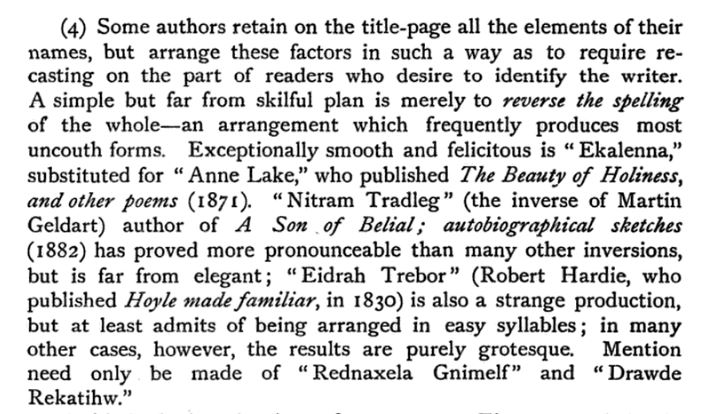
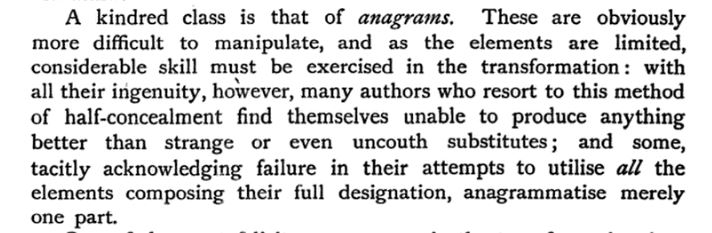
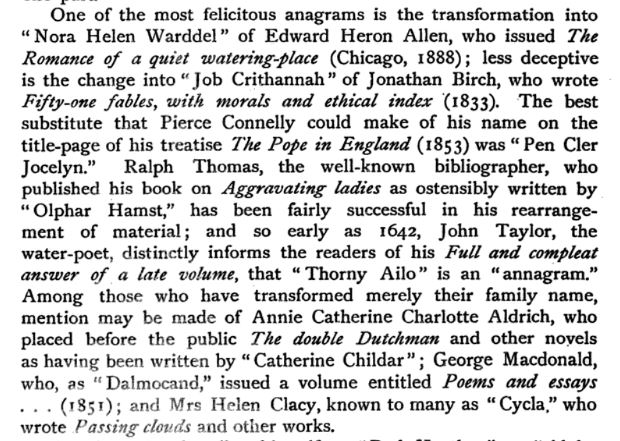
I very much enjoyed reading the recent posts on Erdnase's use of language, particularly Chris Wasshuber's investigation into Erdnase's and Edward Galloway's similar deployment of the phrase "gift of the gab" (in Chris's newsletter, extended by others on this forum), and Bob Coyne's examination the phrase "palm off" as used in The Expert at the Card Table and the writings of W.E. Sanders. The manner in which the text of The Expert at the Card Table regularly uses common, vernacular phrases is one of its unique hallmarks, and I have mentioned some examples in a previous post about Erdnase's linguistic wit.
Another instance--which I have not seen discussed elsewhere with regards to its idiomatic character--occurs on page 116, as part of the section "The Player Without an Ally: The Short Deck." Erdnase writes:
This is a play on an American idiom from the early 20th Century: to "give cards and spades." The phrase derives from the card game cassino, where "cards" and "spades" are two of the methods of scoring. It effectively means to give someone a handicap by awarding them an advantage in the final scoring.
Erdnase's use of the phrase is notable for several reasons. Erdnase only encloses the technical terms "cards" and "spades" in "scare quotes," (which was his general practice), instead of putting quotes around the entire idiom. This is consistent with most of his other manipulations of idiomatic language, such as "could not hit the side of a barn" (p. 23), "walk and stock" (p. 74), and "lightning don't strike in the same place often" (p. 79), which are usually incorporated into the text of The Expert without any separation or special indication. Additionally, Erdnase's use of the phrase exhibits a sophisticated sense of humor by returning the idiom to its literal source--the game of cassino--while inverting its sense to show how the cheater is unwittingly credited with what would be a common advantage.
To me, it is clear that the author of The Expert was in the habit of appropriating popular and vernacular words and phrases to lend a casual, slangy feel to his text. Much of the book's literary aesthetic derives from his juxtaposition of detailed instructions, a very Latinate and French vocabulary, and the regular deployment of a colloquial American voice. It is a unique and confident mixture of styles, and can serve as a literary fingerprint for Erdnase when assessing any authorial candidates.
The "'cards' or 'spades'" phrase came to my attention when preparing a new, hardcover edition of The Expert at the Card Table for publisher Charles & Wonder. Erdnase's play on the cassino idiom coincides with one of the book's technical errors, which has previously gone unremarked, and which I detail fully in the "Errata" of the new edition. (That edition is now available for sale on Amazon.) The latest edition brings my account of the book's technical errors up to 20. (By technical error, I mean errors that could result in readers not being able to accurately perform the maneuvers described in the book. Technical errors do not include typos, misspellings, errors in grammar and mistakes in naming/terminology, such as the author's habitual confusion of "sleight/slight" and referring to the Charlier pass as "the 'Charlies pass'.") I suspect Erdnase's error in "The Short Deck" section had gone unnoticed for much the same reason that his playful use of the idiom was not noted: Cassino is an uncommon game these days.
Another instance--which I have not seen discussed elsewhere with regards to its idiomatic character--occurs on page 116, as part of the section "The Player Without an Ally: The Short Deck." Erdnase writes:
With this arrangement, or depletion, an adversary enjoying ordinary luck, will find in summing up his points that he does not make 'cards' or 'spades' in a very long time indeed, and of course he credits his opponent with three points.
This is a play on an American idiom from the early 20th Century: to "give cards and spades." The phrase derives from the card game cassino, where "cards" and "spades" are two of the methods of scoring. It effectively means to give someone a handicap by awarding them an advantage in the final scoring.
Erdnase's use of the phrase is notable for several reasons. Erdnase only encloses the technical terms "cards" and "spades" in "scare quotes," (which was his general practice), instead of putting quotes around the entire idiom. This is consistent with most of his other manipulations of idiomatic language, such as "could not hit the side of a barn" (p. 23), "walk and stock" (p. 74), and "lightning don't strike in the same place often" (p. 79), which are usually incorporated into the text of The Expert without any separation or special indication. Additionally, Erdnase's use of the phrase exhibits a sophisticated sense of humor by returning the idiom to its literal source--the game of cassino--while inverting its sense to show how the cheater is unwittingly credited with what would be a common advantage.
To me, it is clear that the author of The Expert was in the habit of appropriating popular and vernacular words and phrases to lend a casual, slangy feel to his text. Much of the book's literary aesthetic derives from his juxtaposition of detailed instructions, a very Latinate and French vocabulary, and the regular deployment of a colloquial American voice. It is a unique and confident mixture of styles, and can serve as a literary fingerprint for Erdnase when assessing any authorial candidates.
The "'cards' or 'spades'" phrase came to my attention when preparing a new, hardcover edition of The Expert at the Card Table for publisher Charles & Wonder. Erdnase's play on the cassino idiom coincides with one of the book's technical errors, which has previously gone unremarked, and which I detail fully in the "Errata" of the new edition. (That edition is now available for sale on Amazon.) The latest edition brings my account of the book's technical errors up to 20. (By technical error, I mean errors that could result in readers not being able to accurately perform the maneuvers described in the book. Technical errors do not include typos, misspellings, errors in grammar and mistakes in naming/terminology, such as the author's habitual confusion of "sleight/slight" and referring to the Charlier pass as "the 'Charlies pass'.") I suspect Erdnase's error in "The Short Deck" section had gone unnoticed for much the same reason that his playful use of the idiom was not noted: Cassino is an uncommon game these days.
Is the error that there's an extra "s" in Casino?
Marty Demarest wrote: This is consistent with most of his other manipulations of idiomatic language, such as "could not hit the side of a barn" (p. 23), "walk and stock" (p. 74), and "lightning don't strike in the same place often" (p. 79), which are usually incorporated into the text of The Expert without any separation or special indication. Additionally, Erdnase's use of the phrase exhibits a sophisticated sense of humor by returning the idiom to its literal source--the game of cassino--while inverting its sense to show how the cheater is unwittingly credited with what would be a common advantage.
That's interesting about Erdnase's reference to making "cards" or "spades." I never knew what that was referring to!
Regarding his other idioms, you mention "walk and stock," but I don't find that in Erdnase. Perhaps you mean "stock and talk" ("a few repetitions of the same formula enables one to stock and talk at the same time")? But what's the actual idiom there? A variant of "walk and chew gum at the same time"?
The linking of an idiom or metaphor to its original source is something I've noticed elsewhere in Erdnase's writing. For example, he describes palming being done "in a flash" (idiom) without any "snap or crack" sound (literal) and then further ties these together by making the metaphor explicit by describing the palming as "lightning-like" (since lightning both literally flashes and makes a snap/crackling sound).
Sanders, tellingly, makes the same linkage between flash (used metaphorically) and lightning (its origin). He describes a professor whose "mirth and humor would FLASH and beam in him as FLASH the LIGHTNINGS of his beloved Physics."
Bob Coyne wrote:Regarding his other idioms, you mention "walk and stock," but I don't find that in Erdnase. Perhaps you mean "stock and talk" ("a few repetitions of the same formula enables one to stock and talk at the same time")? But what's the actual idiom there? A variant of "walk and chew gum at the same time"?
That is my error, Bob--I did indeed mean "stock and talk" as I had correctly quoted in my other post about Erdnase's witty use of language.
To my mind, Erdnase is playing with the idiomatic expression "walk and talk at the same time" in the phrase that you quote from page 74.
Pete McCabe wrote:Is the error that there's an extra "s" in Casino?
That's not the error I point out and correct. For anyone interested, I detail the technical error in "The Short Deck" section, along with Erdnase's other 19 technical errors, in the "Errata" of the new hardcover edition of The Expert at the Card Table from Charles & Wonder.
As to the spelling of cassino, I've found the game spelled both with single and double "s"s. The author of The Expert at the Card Table actually uses both spellings: "casino" on page 93, and "cassino" on page 116. The author's inconsistency in the spelling of the game's name may well be another one of Erdnase's distinguishing literary quirks--or it could simply be a typo.
Notably, W.E. Sanders spells/misspells the game similarly in his diaries.
To my mind, what is perhaps most revealing about Erdnase is that cassino is one of the few games (along with faro) that he admits to having played (and lost). From pages 116-117:
S.W. Erdnase wrote:The idea of so many cards being withheld from the deck without being noticed, will doubtless cause certain Cassino players to smile. We don't think many shrewd players could be so imposed upon, but we regret the truth of the confession that once upon a time we were, and we marveled greatly and also sorrowed, over a continuous and very protracted run of "hard luck."
Again, W.E. Sanders is the one Erdnase candidate I am aware of who also confessed to playing (and losing) at cassino, but I would be very interested to hear of evidence for others.
A first edition Expert, just sold for $4,400 in today's Potter & Potter Auction.
Quite a drop from the last one.
Quite a drop from the last one.
Joe Lyons wrote:A first edition Expert, just sold for $4,400 in today's Potter & Potter Auction.
Quite a drop from the last one.
Indeed. That's quite the price swing, guess I should have got out of bed this morning to bid!
It had water damage. Plus, the description indicated more damage and defects, but the pictures didn't allow you to see how bad it was, which may have scared some bidders off. (and with premium, it went for $5280).
The previous copy was in much better condition.
The previous copy was in much better condition.
Bill Mullins wrote:The previous copy was in much better condition.
True.
And “About the best copy we’ve seen” from Potter & Potter certainly didn’t hurt the bidding.
Does anyone recognize where this photo

was published? I'm drawing a blank.
was published? I'm drawing a blank.
It's from Magicol magazine August 1951.
It accompanies an article by Martin Gardner entitled Editions of Erdnase.
It accompanies an article by Martin Gardner entitled Editions of Erdnase.
Thanks! Has it been reprinted somewhere since then? I know the article itself has.
Bill Mullins wrote:Thanks! Has it been reprinted somewhere since then? I know the article itself has.
I don't have it handy, but I'm pretty sure the same headshot of Smith circa 1902 was first reproduced in Gardner's article "The Mystery of Erdnase" in the 1947 SAM Convention program (I think it is in blue ink there, rather than black). It is also reproduced in TMWWE (p 63).
Over in the thread about Werner Reich, it mentions that he had been in Auschwitz with Herbert Levin, who later performed as "Nivelli". Another name reversal.
Another anagrammatic name: Salvador Dali was dubbed "Avida Dollars" by the poet Andre Breton in reference to the commercialization of his art and his lust for money.
Any collectors have correspondence about the "in-process" status of a book on card cheating technique or tricks using just sleight of hand? The passing mentions of writing up some sleights or assembling some material for a project... that kind of thing?
More reversals --
Publisher Harvey Conover was lost at sea on his yacht Revonoc in 1958.
Stuart Conover, the London correspondent for the N Y Dramatic Mirror, wrote under the name Revonoc in the early 1900s.
And the NY Clipper's San Francisco correspondent, Marcus Mayer, wrote as Reyam Sucram in the 1860s.
Tom Ransom wrote as M. O'Snart (see p. 15).
Magician Charles Conrad performed as Darnoc in the years before WW1. And actor William Conrad did voice work as J. Darnoc.
Publisher Harvey Conover was lost at sea on his yacht Revonoc in 1958.
Stuart Conover, the London correspondent for the N Y Dramatic Mirror, wrote under the name Revonoc in the early 1900s.
And the NY Clipper's San Francisco correspondent, Marcus Mayer, wrote as Reyam Sucram in the 1860s.
Tom Ransom wrote as M. O'Snart (see p. 15).
Magician Charles Conrad performed as Darnoc in the years before WW1. And actor William Conrad did voice work as J. Darnoc.
Has anyone seen the paperback reprint of the Busby/Whaley/Gardner The Man who was Erdnase, advertised on page 101 of the current issued (June 2019) of Genii? $29.95 postpaid in the US from http://www.houdini.com. I can't find it on the website...
Punctuation-based stylometry.
Amusing digression: An example of what happens when historical research does not come up with the desired profound mythical ...
https://www.tor.com/2019/06/11/the-gree ... ore-462640
I'm still conflicted about the "chesty" versus "common herd" discussion. Anyway time will tell about matching text to context and authorship.
https://www.tor.com/2019/06/11/the-gree ... ore-462640
I'm still conflicted about the "chesty" versus "common herd" discussion. Anyway time will tell about matching text to context and authorship.
Is Yann Yuro playing Erdnase in a film about his life? Wiki says it's going to be out in November of this year. Anyone nothing anything about this?
From the Wiki page...
Film adaptation
A film based on the life of the mysterious author, adapted by German director Hans-Joachim Brucherseifer, is currently in production. The magicians Yann Yuro (S.W. Erdnase) and Alfonso Rituerto (himself) play the lead roles. It is scheduled to be released in November, 2019.
Film adaptation
A film based on the life of the mysterious author, adapted by German director Hans-Joachim Brucherseifer, is currently in production. The magicians Yann Yuro (S.W. Erdnase) and Alfonso Rituerto (himself) play the lead roles. It is scheduled to be released in November, 2019.
Yes, that is what I was referring to......
Thank you Brad...... Hope it comes to fruition!
Even if it does manage to get released, I'd not get my hopes up too high.
"a possible serial killer" ... please.
"a possible serial killer" ... please.
Roger M. wrote:Even if it does manage to get released, I'd not get my hopes up too high.
"a possible serial killer" ... please.
I agree Roger!.....
Granted, that's rubbish, but it is obviously taken from the the film's poster, which is intended to look like a WANTED poster.
Hence, looking for S.W. Erdnase, a magician or engineer (or printer) would certainly have sounded less compelling. That's marketing, folks!
Let's give these young magicians and film enthusiasts a chance with their ambitious project! I look forward both to the fictionalized parts and to the interviews with Juan Tamariz, Jason England, and others (if I remember correctly)!
Hence, looking for S.W. Erdnase, a magician or engineer (or printer) would certainly have sounded less compelling. That's marketing, folks!
Let's give these young magicians and film enthusiasts a chance with their ambitious project! I look forward both to the fictionalized parts and to the interviews with Juan Tamariz, Jason England, and others (if I remember correctly)!
Zig Zagger wrote:Granted, that's rubbish.....
It is indeed.
I'm not interested in another fundamentally inaccurate MFA take on Erdnase.
Every additional bit of made-up crap dished out as "hard fact" obfuscates the case that much further - and does nothing to advance the conversation.
Roger M. wrote:Zig Zagger wrote:Granted, that's rubbish.....
It is indeed.
I'm not interested in another fundamentally inaccurate MFA take on Erdnase.
Every additional bit of made-up crap dished out as "hard fact" obfuscates the case that much further - and does nothing to advance the conversation.
You do have a very valid point Roger. I am surprised that the whole story of Erdnase has not been made into some feature-length film. There have been multi-million dollar budgets spent on many inferior subjects...
Saying that "if" something was made it probably would be based on fiction. Maybe there is not enough context to make a worthy full-length film. The only short film I have seen was on the 10 DVD Erdnase set done by Allan Ackerman. One of the first scenes was Erdnase shuffling with a plastic Bee deck from about 2003..... attention to detail at its best!
If you start with the printer, the fire, the plates, and the exact documented input of the illustrator ... you have your mystery. Whether or not you add "Nosey" to finance the book or the literati of the time ... well remember the lesson of the Lotta.
Roger M. wrote:I'm not interested in another fundamentally inaccurate MFA take on Erdnase.
Every additional bit of made-up crap dished out as "hard fact" obfuscates the case that much further - and does nothing to advance the conversation.
Then you will be interested in this scholarly article found by Q. Kumber about flaws in recent Voynich Manuscript research and debates and the telling parallels with our Erdnasian skirmish here: https://forums.geniimagazine.com/viewtopic.php?f=1&t=51963
More anagrammatic pseudonyms:
Science Fiction author Hugo Gernsback (for whom the Hugo Award is named) wrote under the names Grego Banshuck, Greno Gashbuck, Kars Gugenchob, Gus N. Habergock & Beno Ruckshagg. Mort Weisinger wrote under the name Tom Erwin Geris.
And for those of you scoring at home, don't miss the examples in this thread.
Science Fiction author Hugo Gernsback (for whom the Hugo Award is named) wrote under the names Grego Banshuck, Greno Gashbuck, Kars Gugenchob, Gus N. Habergock & Beno Ruckshagg. Mort Weisinger wrote under the name Tom Erwin Geris.
And for those of you scoring at home, don't miss the examples in this thread.
Bill Mullins wrote:More anagrammatic pseudonyms:
Science Fiction author Hugo Gernsback (for whom the Hugo Award is named) wrote under the names Grego Banshuck, Greno Gashbuck, Kars Gugenchob, Gus N. Habergock & Beno Ruckshagg. Mort Weisinger wrote under the name Tom Erwin Geris.
And for those of you scoring at home, don't miss the examples in this thread.
Nice...amazing how many there are!
For anyone wanting to see all of the above and others in one place, I've collected them from this thread and put in an appendix to my Sanders/Erdnase document: http://www.cs.columbia.edu/~coyne/erdnase-sanders-use-of-language.html#reversed-pen-names
My father was a coin collector, and a collector of related things. He also collected medals and tokens, paper money, depression scrip, and old checks drawn on middle Tennessee banks (where he lived his whole life). So when he died, Mom and I and to go through a lot of stuff. Amongst other things, he had a bunch of issues of The Check Collector, which was a privately published periodical for collectors of checks, with articles about them, ads for sale, etc. There are issues of this on the Internet Archive, if you want to see them.
Oddly enough, one of them has an article by Chris Wasshuber, in which he gives a short version of the Erdnase story and requests help in finding the check written to Marshall D. Smith to pay for Smith's artwork. It would be a billion-to-one shot if it is ever found, but good for him for asking. The funny thing about it is that the editor of the journal, after Chris's short article, immediately points out that S. W. Erdnase is E. S. Andrews, reversed: "This would be quite a coincidence if it were not purposeful. . . . "
Oddly enough, one of them has an article by Chris Wasshuber, in which he gives a short version of the Erdnase story and requests help in finding the check written to Marshall D. Smith to pay for Smith's artwork. It would be a billion-to-one shot if it is ever found, but good for him for asking. The funny thing about it is that the editor of the journal, after Chris's short article, immediately points out that S. W. Erdnase is E. S. Andrews, reversed: "This would be quite a coincidence if it were not purposeful. . . . "
Hi,
Just wondering, is this "our" Marshall D. Smith?
http://www.askart.com/artist/Marshall_D ... Smith.aspx
And if so, is it true he lived until 1973--almost a hundred years?
Just wondering, is this "our" Marshall D. Smith?
http://www.askart.com/artist/Marshall_D ... Smith.aspx
And if so, is it true he lived until 1973--almost a hundred years?
That's him.
He was (is) somewhat renowned for his street scenes, especially those in New Orleans.
Interestingly, Smith's paintings have sold for over $150,000.00 ... which makes the $10,000.00 (give or take a few thousand) that a EATCT in good condition tends to go for look like a bargain!
He was (is) somewhat renowned for his street scenes, especially those in New Orleans.
Interestingly, Smith's paintings have sold for over $150,000.00 ... which makes the $10,000.00 (give or take a few thousand) that a EATCT in good condition tends to go for look like a bargain!
Podcast on Forensic Linguistics.
If you're looking for a copy of the Gardner-Smith Correspondence, here's one on eBay that is currently a bargain, with just a day or so left. Seller has a good rating:
https://www.ebay.com/itm/1999-The-Gardner-Smith-Correspondence-ERDNASE-Expert-at-the-Card-Table-CHEATING/254407605758
https://www.ebay.com/itm/1999-The-Gardner-Smith-Correspondence-ERDNASE-Expert-at-the-Card-Table-CHEATING/254407605758
I missed this when it first appeared -- an article about M. F. Andrews.
It’s a study that will never end.
Sent from my iPhone using Tapatalk Pro
Sent from my iPhone using Tapatalk Pro
~9 NPR minutes on forensic linguistics.
Bill Mullins wrote:~9 NPR minutes on forensic linguistics.
Very very interesting
Sent from my GT-N5110 using Tapatalk
Did the printer McKinney have partners?
https://books.google.com/books?id=TAdGA ... 00&f=false
https://books.google.com/books?id=TAdGA ... 00&f=false
I've recently come across another distinctive linguistic trait (and type of wordplay) shared by Erdnase and Sanders. They both exhibit a tendency to transform words from their common form into a non-standard and different part of speech. This results in quite unusual adverbs (slantingly) or verbs (to convex). And it fits in well with the other similarities in how Erdnase and Sanders creatively play with language, adding weight to the argument that they are the same person.
In this example, an adjective or noun is used in an uncommon manner as a causative or inchoative verb, representing the object taking on a geometric shape.
Erdnase: Then, with a sliding downward movement of the left thumb crimp or CONVEX the cards sufficiently to read the index on each
Sanders: the material will CONE UP on the floor of the bin
In this example, a common noun or verb is converted into an unusual adverb.
Erdnase: The deck is held SLANTINGLY
Sanders: First PROTESTINGLY, then insistently, and finally angrily, he insisted upon a return of the missing article
In this example, the word crowding is used in a much less common adjectival form.
Erdnase: who have been least CROWDING and therefore more deserving
Sanders: and have followed with admiration and pride their CROWDING labors through nearly half a century
In this example, an adjective or noun is used in an uncommon manner as a causative or inchoative verb, representing the object taking on a geometric shape.
Erdnase: Then, with a sliding downward movement of the left thumb crimp or CONVEX the cards sufficiently to read the index on each
Sanders: the material will CONE UP on the floor of the bin
In this example, a common noun or verb is converted into an unusual adverb.
Erdnase: The deck is held SLANTINGLY
Sanders: First PROTESTINGLY, then insistently, and finally angrily, he insisted upon a return of the missing article
In this example, the word crowding is used in a much less common adjectival form.
Erdnase: who have been least CROWDING and therefore more deserving
Sanders: and have followed with admiration and pride their CROWDING labors through nearly half a century
Another great find Bob! The distinctive stylizing of the nouns and verbs shared by both writers is uncanny. More circumstantial evidence to add to your file on Sanders.
Whew, it looks like Mr. Erdnase might need to change his FB status soon from "legend" to "has-been"... 
Pitching his forthcoming tome "Gambling Sleight of Hand - Forte Years of Research", Steve Forte writes:
You can find out more here: https://www.gamblingsleightofhand.com/
Pitching his forthcoming tome "Gambling Sleight of Hand - Forte Years of Research", Steve Forte writes:
Was Erdnase a cheater who plied his trade with moves and systems that he invented? Unfortunately, my findings suggest that Erdnase was neither a cheater nor an expert at the card table! I expect this chapter to jolt many cardmen.
You can find out more here: https://www.gamblingsleightofhand.com/
Somewhere, Tony Giorgio is smiling...
Ian .....Am I right in thinking that Tony thought that real hustlers treat Erdnase methods as “myth.”
Pretty much.
If you have a Genii sub, head over to the archives and read The Erdnase Letters (from the 80s and 90s).
TG was not a fan, let's put it that way
If you have a Genii sub, head over to the archives and read The Erdnase Letters (from the 80s and 90s).
TG was not a fan, let's put it that way
I think we have to apply some logic on Erdnase that I am sure has been spoken about in great length here. Erdnase in the eyes of the magician is a very different Erdnase in the eyes of the gambler, hustler or cheat. The legend always ends up being bigger than the actual truth. This was the same with Walter Scott the phantom at the card table. I am sure when we get to read Steve Forte's take on Erdnase it will redefine our views forever.
Ian Kendall wrote:Pretty much.
If you have a Genii sub, head over to the archives and read The Erdnase Letters (from the 80s and 90s).
TG was not a fan, let's put it that way
I think TG shared his lack of fandom equally between Erdnase and the worshippers in the Magic fraternity.
Ian Kendall wrote:Pretty much.
If you have a Genii sub, head over to the archives and read The Erdnase Letters (from the 80s and 90s).
TG was not a fan, let's put it that way
Thanks Ian will have a look.
Hahahahahaha.
A little early in the year but - sure,
brianarudolph wrote:Thoughts on this announcement?
https://www.miraclefactory.net/product/ ... 7bdc162697
Wow! It sounds like a wealth of new evidence has been uncovered up and that the author has been definitively identified. Amazing and wonderful if true. I can't wait to find out more!
Karr has always had some rather original thinking on Erdnase, and it will be interesting to see who his candidate is, and whether the author has the chops to break down EATCT with any real authority. It's one thing to declare you've identified the author, and another thing entirely to break down his book in a manner that could be described as "expert".
Two things I find uncomfortable though, and that's that it appears that Karr is committing an entire book to the concept that he's discovered the true identity of Erdnase.
Hopefully he's got the evidence to back it up, and that evidence will further be accepted as legitimate by the Erdnase community.
The second thing of course, is pre-ordering from Miracle Factory ... not something I'd ever consider doing.
In short, if ever there was a book which might require a potential purchaser to wait for the reviews, this would be it.
Two things I find uncomfortable though, and that's that it appears that Karr is committing an entire book to the concept that he's discovered the true identity of Erdnase.
Hopefully he's got the evidence to back it up, and that evidence will further be accepted as legitimate by the Erdnase community.
The second thing of course, is pre-ordering from Miracle Factory ... not something I'd ever consider doing.
In short, if ever there was a book which might require a potential purchaser to wait for the reviews, this would be it.
It’s certainly enticing.
From the email:
”(If you've followed some of my previous writings on the pseudonymously credited author, S. W. Erdnase, this is NOT colorful conman E. S. Andrews or any other lead I previously examined.)“
Bold italics mine.
A brand new candidate?
From the email:
”(If you've followed some of my previous writings on the pseudonymously credited author, S. W. Erdnase, this is NOT colorful conman E. S. Andrews or any other lead I previously examined.)“
Bold italics mine.
A brand new candidate?
Joe Lyons wrote:It’s certainly enticing.
From the email:
”(If you've followed some of my previous writings on the pseudonymously credited author, S. W. Erdnase, this is NOT colorful conman E. S. Andrews or any other lead I previously examined.)“
Bold italics mine.
A brand new candidate?
Given that the book will include selections from the author's magic notebooks, annotations and variations the author made on EATCT, and photos and other writings of the author, it sounds like this must someone who left a fairly extensive paper trail. I wonder if this is a magician who is known and even published but not previously identified as being Erdnase?
Richard Kaufman wrote:Hahahahahaha.
So...you're skeptical?
From the ad copy, "Written, researched, and designed by Todd Karr" which would make him "the author" .Bob Coyne wrote:Given that the book will include selections from the author's magic notebooks, annotations and variations the author made on EATCT, and photos and other writings of the author, it sounds like this must someone who left a fairly extensive paper trail. I wonder if this is a magician who is known and even published but not previously identified as being Erdnase?
Jack Shalom wrote:Richard Kaufman wrote:Hahahahahaha.
So...you're skeptical?
Or, to ask more precisely: Laughing at the notion of a new Erdnase "ex machina" or at the announcement "coming summer 2020"?
I know who the candidate is. It's beyond preposterous.
Bob Coyne wrote:Given that the book will include selections from the author's magic notebooks, annotations and variations the author made on EATCT, and photos and other writings of the author, it sounds like this must someone who left a fairly extensive paper trail. I wonder if this is a magician who is known and even published but not previously identified as being Erdnase?
Probably time to lay our bets on the table and take sides before these two exciting books will be out!
I'd love to learn that Dr. JameS W. E lliott, known both as "Champion Card Manipulator of the World" amongst magicians and "The Boston Kid" amongst card sharps, was in fact erDmaSe...uumm...Erdnase! Not the most improbable candidate I have seen...
In 2015, Karr posted this (in this thread):
So seems like this could be the new candidate presented in the upcoming book. (i.e. different than his previous E.S. Andrews candidate)
I'm pretty sure I've got my man.
Charles L. Andrews aka Charles E. Andrews was later William G. Andrews, advance man for Alexander Herrmann, and wrote extensive articles describing card moves and effects in language and terms matching The Expert.
I'm arranging my hundreds of documents into a complete timeline with documentation.
So seems like this could be the new candidate presented in the upcoming book. (i.e. different than his previous E.S. Andrews candidate)
jwjmcd wrote:Ian .....Am I right in thinking that Tony thought that real hustlers treat Erdnase methods as “myth.”
I have suspected for years that Erdnase was no card shark. I am quite sure he was a magician who knew as much about cheating at cards as I do about the care and breeding of Japanese butterflies or alternatively as most members of the Genii Forum know about magic. The book is too well written and the word "magician" jumps right off the pages. I have met some nefarious characters in my life, some of whom have been card cheats. They aren't the brightest sparks in the universe and only know a tiny handful of cheating moves, probably only one or two, (three at the VERY most) and do them quite crudely.
No card cheat knows all those myriad moves in Erdnase. Only a magician would come up with all that stuff and writing a section on magic at the back of the book rather gives the game away. And very few magicians have the mentality or the nerve to cheat at cards anyway. They would make very good librarians or accountants. Alas they are far too innocent in the ways of the world to indulge in wickedness of that kind. I have always suspected the author of that book was a well known card magician who was around at that time.
No. I think Tony Giorgio was right all along.
Bob Coyne wrote:In 2015, Karr posted this (in this thread):I'm pretty sure I've got my man.
Charles L. Andrews aka Charles E. Andrews was later William G. Andrews, advance man for Alexander Herrmann, and wrote extensive articles describing card moves and effects in language and terms matching The Expert.
I'm arranging my hundreds of documents into a complete timeline with documentation.
So seems like this could be the new candidate presented in the upcoming book. (i.e. different than his previous E.S. Andrews candidate)
Interesting. Good catch, Bob, thank you!
performer wrote:No card cheat knows all those myriad moves in Erdnase. Only a magician would come up with all that stuff and writing a section on magic at the back of the book rather gives the game away. And very few magicians have the mentality or the nerve to cheat at cards anyway. They would make very good librarians or accountants. Alas they are far too innocent in the ways of the world to indulge in wickedness of that kind. I have always suspected the author of that book was a well known card magician who was around at that time.
Your psychic vibes may be right, performer, but my librarian/accountant vibes tell me that you have vented this assessment before.
Richard Kaufman wrote:I know who the candidate is. It's beyond preposterous.
Honestly, if the named candidate for Erdnase (who presumably contributes substance to a substantial portion of the book) is "beyond preposterous", and taking into account the fact that nobody really considers Karr a noted "card expert" ... I can't see the book being in much demand?
If the book was $75.00 I'd consider it if not just for the fact that it would contribute to my being an obsessive Erdnase completest, but at a few hundred bucks and with a history of shaky Miracle Factory pre-orders ... it's not likely to spur much interest.
Invest your money in Steve Forte's new set of books. His chapter on Erdnase is all you need.
Forte must have some very compiling evidence regarding Erdnase otherwise there would be no way he would even publish it.
"Roger M. - If the book was $75.00 I'd consider it if not just for the fact that it would contribute to my being an obsessive Erdnase completest"
I agree completely, I considered buying the book for that reason but at that price point... I think I will give it a miss.
Steve Forte's book will be all you need as Richard says.
"Roger M. - If the book was $75.00 I'd consider it if not just for the fact that it would contribute to my being an obsessive Erdnase completest"
I agree completely, I considered buying the book for that reason but at that price point... I think I will give it a miss.
Steve Forte's book will be all you need as Richard says.
Christopher1979 wrote:Forte must have some very compelling evidence regarding Erdnase otherwise there would be no way he would even publish it.
It'll be interesting to see what Forte says and how it differs from and goes beyond Tony Giorgio's claims that Erdnase was a magician, not a gambler. I found Giorgio's arguments interesting though not conclusive. It's not just a matter of some "ground truth" about gambling techniques but how you interpret Erdnase's text and his motives/approach for writing what he did. Plus there's no black and white line between being a gambler vs a magician. Erdnase strikes me as being more concerned with the artistry than either winning the money or getting the applause. In any case, from its description, I don't think the Forte book makes claims about who Erdnase actually was beyond the magician/gambler issue, does it?
The Karr book, on the other hand, presents actual biographical/historical evidence pertaining to Erdnase's identity. The book webpage blurb says the book contains "The author’s own annotations to The Expert at the Card Table" and "Rare photos of the author performing moves from the book" and "Selections from the author’s notebooks of card magic". He also says "All evidence carefully documented; no speculation." So if all that's true, he's revealing something very different than Forte. If the candidate is preposterous (as RK says), then it sounds like the claims made on the book website can't all be true.
steve forte wrote the introduction to erdnase in the italian edition... it's in an old genii issue and also can be found on another forum...
it was written in 1995.. so it will be interesting to see how much his perspective has changed or if it remains the same...
it was written in 1995.. so it will be interesting to see how much his perspective has changed or if it remains the same...
JustinM wrote:steve forte wrote the introduction to erdnase in the italian edition... it's in an old genii issue and also can be found on another forum...
it was written in 1995.. so it will be interesting to see how much his perspective has changed or if it remains the same...
See Genii, June 2001 (with Paul Osborne on the cover)
"The Karr book, on the other hand, presents actual biographical/historical evidence pertaining to Erdnase's identity."
Hahahahahaha.
He's trying to sell books: it's ad copy.
Hahahahahaha.
He's trying to sell books: it's ad copy.
Richard Kaufman wrote:"The Karr book, on the other hand, presents actual biographical/historical evidence pertaining to Erdnase's identity."
Hahahahahaha.
He's trying to sell books: it's ad copy.
Could be...You clearly know quite a bit more about what's in the book beyond what's been publicly released. I was just contrasting the differences in the *claims* (w/r Erdnase) that the two books seem to be making. Forte's takes up the question of whether E was a magician or gambler, while Karr tries to identify exactly who he was. The validity of their arguments/claims is a different question, and maybe Karr's case is preposterous as you said earlier. However, until I hear more about it, I remain very curious to learn more about Karr's candidate and evidence.
Both claims may well not contradict each other.
This claim is particularly hilarious: "The author’s own annotations to The Expert at the Card Table."
So, you happen to locate a copy of Erdnase that belongs to person X, and suddenly person X's copy now becomes Erdnase's copy because you have a fantasy that person X is Erdnase and is annotating his own copy of Expert. Nonsense.
I also have Person X's notebooks. You can fill a book with the material, but it has little to do with Expert at the Card table.
So, you happen to locate a copy of Erdnase that belongs to person X, and suddenly person X's copy now becomes Erdnase's copy because you have a fantasy that person X is Erdnase and is annotating his own copy of Expert. Nonsense.
I also have Person X's notebooks. You can fill a book with the material, but it has little to do with Expert at the Card table.
Chirs Wasshuber, in his new newsletter:
"While it is always of interest to hear what others have to say about Erdnase, I would be surprised if anything particularly new and insightful will be argued by Steve Forte."
That goodness we have Chris to warn us off from placing any stock in what Steve Forte, probably the greatest expert on gambling sleight-of-hand ever, has to say. Is it too late to get a refund on my purchase price?
He closes with "I think . . . Forte might like Gallaway as Erdnase." So he's got that going for him. Which is nice.
"While it is always of interest to hear what others have to say about Erdnase, I would be surprised if anything particularly new and insightful will be argued by Steve Forte."
That goodness we have Chris to warn us off from placing any stock in what Steve Forte, probably the greatest expert on gambling sleight-of-hand ever, has to say. Is it too late to get a refund on my purchase price?
He closes with "I think . . . Forte might like Gallaway as Erdnase." So he's got that going for him. Which is nice.
When I read the contents of the Karr book I nearly fell off my chair "Rare photos of the author performing moves from the book"... Just this sentence alone. We are talking about actual photos of Erdnase performing moves from the EATCT?.... and the way we describe this is RARE?....
"The Expert at the Card Table, with his additional writings"...... I suppose the additional writings come from the notepad he discovered while going through Erdnase's personal effects that he has stored away without ever telling a soul about until now!
"The Expert at the Card Table, with his additional writings"...... I suppose the additional writings come from the notepad he discovered while going through Erdnase's personal effects that he has stored away without ever telling a soul about until now!
Sounds like somewhat hinkey ad copy.
There are no photos of Erdnase performing sleights out of Expert. Just like the "annotated copy," this is wish fulfillment nonsense. There are published photos of person X (same guy) doing some card sleights, but he's not Erdnase.
Richard Kaufman wrote:There are no photos of Erdnase performing sleights out of Expert. Just like the "annotated copy," this is wish fulfillment nonsense. There are published photos of person X (same guy) doing some card sleights, but he's not Erdnase.
Right, the main question is what evidence he has that person X is Erdnase. If he can't credibly establish that, then all the annotated texts and photos of X are meaningless. You know who the new candidate is and presumably also have some idea of the evidence he has for that candidate. So that puts you in a position to make a judgement. But without knowing those specifics, it's much harder to conclude anything.
Richard Kaufman wrote:There are no photos of Erdnase performing sleights out of Expert. Just like the "annotated copy," this is wish fulfillment nonsense. There are published photos of person X (same guy) doing some card sleights, but he's not Erdnase.
I am surprised they have the nerve to publish this book in the first place then? Presumably, they realize this jumbled up theory holds no weight.
L’Homme Masque was Erdnase
Christopher1979 wrote:Richard Kaufman wrote:There are no photos of Erdnase performing sleights out of Expert. Just like the "annotated copy," this is wish fulfillment nonsense. There are published photos of person X (same guy) doing some card sleights, but he's not Erdnase.
I am surprised they have the nerve to publish this book in the first place then? Presumably, they realize this jumbled up theory holds no weight.
While I don't know much more than has been stated in this thread, I have spoken a little with Todd about his candidate in general terms. He doesn't believe the theory is "jumbled up"; as far as he is concerned, it is legit. Likewise, Chris W. believes that Gallaway is Erdnase, and that his evidence supports that theory; and Marty Demarest finds the case for W. E. Sanders to be convincing.
So the question is, what is the evidence? I, ultimately, did not find the evidence for Sanders to be persuasive, and the evidence for Gallaway even less so. Maybe Todd has put together a better case.
I suppose the main question now is who is going to cough up the money to buy a copy of this book in order to find out! I feel pretty happy to give it a miss.
It looks like there are already 32 pre-orders for the $350 "deluxe" edition of the Todd Karr book, which brings to mind a comment I made last year in regards to this failed Kickstarter campaign ...
I then went on to correctly predict that the Kickerstarter campaign would most likely fail ...
I know from first hand experience that Mr. Karr is in no way lacking in nerve!
I would like to read this book but agree that the price is too steep.
My prediction for this venture is that it will be a profitable one for The Miracle Factory - however; unlike the Steve Forte book; this book will never sell 1000 copies.
There are people who collect any and all editions of Erdnase.
For these people there is a need to own at least one copy of every edition ever printed or else their collection will be incomplete.
Therefore, I feel that if you were to print 100 copies of each variant and priced them at $100 apiece, you would quickly sell out.
I then went on to correctly predict that the Kickerstarter campaign would most likely fail ...
Paradoxically however, I think there is a good chance that you will not make your $12,000 Kickstarter goal.
Although the obsessive collector will quite readily part with $300 for three copies of new editions that exist, he may not be so ready to pay $300 to bring three new editions into existence.
Christopher1979 wrote:I am surprised they have the nerve to publish this book in the first place
I know from first hand experience that Mr. Karr is in no way lacking in nerve!
I would like to read this book but agree that the price is too steep.
My prediction for this venture is that it will be a profitable one for The Miracle Factory - however; unlike the Steve Forte book; this book will never sell 1000 copies.
Eugene Burger, paraphrasing Jesus, said Magic is a house with many rooms.
Mine is more of a library than a stage.
Having as of yet been burned by Mr. Karr, I pre-ordered the book and look forward to reading the evidence in the case of Mr. X. If they arrive late I have many more unread to keep me occupied. My only disappointment would be if the case were poorly made.
When my girls (or I in my dotage) sell the books, if they fail to recoup their price, I have dozens more in my collection that will dollar cost average the investment.
Mine is more of a library than a stage.
Having as of yet been burned by Mr. Karr, I pre-ordered the book and look forward to reading the evidence in the case of Mr. X. If they arrive late I have many more unread to keep me occupied. My only disappointment would be if the case were poorly made.
When my girls (or I in my dotage) sell the books, if they fail to recoup their price, I have dozens more in my collection that will dollar cost average the investment.
Richard felt comfortable stating that the Karr candidate was "preposterous", and that statement resonates heavily IMO.
Predicating an entire book on a false premise seems a massive waste of time.
On the other hand, I very much look forward to reading Forte's thoughts as he lays out his opinion of Erdnase.
In the absence of hard evidence, I've long made note of the fact that I though deep understanding of, and solid expertise with the actual card work in EATCT was the only route to trying to determine how, when, and where the author came up with what became the contents of EATCT - possibly pointing to his background, even if we couldn't determine his actual name.
Forte fits that bill perfectly ... Gallaway's champion and Karr himself most certainly don't fit that bill.
I don't think a purchase of the book is required to determine which way the wind is blowing however - what with book reviews, blogs, podcasts, Facebook, and this very thread ... I'm sure we'll start hearing quite quickly from people.
I'm beginning to strongly suspect that there's a trend developing whereupon authors offer poorly researched and terribly outrageous proposals as to who Erdnase might have been, not to further the Erdnase discussion in any constructive way, but with the sole purpose selling 100 - 400 books at a few hundred dollars a pop.
Predicating an entire book on a false premise seems a massive waste of time.
On the other hand, I very much look forward to reading Forte's thoughts as he lays out his opinion of Erdnase.
In the absence of hard evidence, I've long made note of the fact that I though deep understanding of, and solid expertise with the actual card work in EATCT was the only route to trying to determine how, when, and where the author came up with what became the contents of EATCT - possibly pointing to his background, even if we couldn't determine his actual name.
Forte fits that bill perfectly ... Gallaway's champion and Karr himself most certainly don't fit that bill.
I don't think a purchase of the book is required to determine which way the wind is blowing however - what with book reviews, blogs, podcasts, Facebook, and this very thread ... I'm sure we'll start hearing quite quickly from people.
I'm beginning to strongly suspect that there's a trend developing whereupon authors offer poorly researched and terribly outrageous proposals as to who Erdnase might have been, not to further the Erdnase discussion in any constructive way, but with the sole purpose selling 100 - 400 books at a few hundred dollars a pop.
Roger M. wrote:I'm beginning to strongly suspect that there's a trend developing whereupon authors offer poorly researched and terribly outrageous proposals as to who Erdnase might have been, not to further the Erdnase discussion in any constructive way, but with the sole purpose selling 100 - 400 books at a few hundred dollars a pop.
Indeed.
But it's hardly exclusive to Magic and Erdnase.
Just look around at history and "historians". There's more codzwallocks from people who know nothing, or at least haven't dug particularly deep than at any time in, well history.
And as for TV documentaries.
So maybe Magic is getting off lightly. Maybe.
Is it possible that Rufus Steele wrote Expert at the Card Table? Perhaps with help from Dr. James Elliott?
Has anyone already looked into him? Just a thought Ive had for awhile. I need time to read all 181 pages of this thread.
Has anyone already looked into him? Just a thought Ive had for awhile. I need time to read all 181 pages of this thread.
Brian Hebert wrote:Is it possible that Rufus Steele wrote Expert at the Card Table? Perhaps with help from Dr. James Elliott?
Has anyone already looked into him? Just a thought Ive had for awhile. I need time to read all 181 pages of this thread.
Rufus Steele was born in 1881, which would have made him around 21 in 1902. That seems too young and conflicts with M. D. Smith, who said Erdnase was about 40 when he did the illustrations.
I don't think MD Smith's memory can be trusted, not that it matters.
I have heard that Rufus Steele was not a particularly good writer and in fact got another writer to pen his books. I think (but am not sure) that the other writer was Robert Parrish.
Grippo's Wish wrote:L’Homme Masque was Erdnase
Probably as much as any other. Any proof to back it up, maybe certificates of his mastery of the English language, to start with?
Richard Kaufman wrote:I don't think MD Smith's memory can be trusted, not that it matters.
It matters ... why do you think that?
Doubting M.D. Smith's mental acuity isn't that rare a concept, but I always wonder what exactly that line of thinking is based on?
As I recall these discussions, there are at least five points to consider:
1. In general, people are lousy observers and horrible witnesses. You can ask any police officer, criminologist or judge about this. Also think of phenomena such as inattentional blindness and change blindness.
2. There is recent research that shows that we can create false memories ourselves over time, and we fully believe them.
3. Try to remember any single, insignificant event in your life 40+ years ago in detail and describe height, manner, speech etc. of any person you have met only once or twice back then... Good luck! Except for some major events (like „...and that guy smacked me with a big yellow stuffed rabbit!“) you are very likely to fail or misremember.
4. Smith was not under rigorous interrogation, but likely prodded and influenced by an enthusiastic and biased Martin Gardner, who may inadvertently have forced many „facts“ on Smith, seeking affirmation.
5. Smith was the only real person mentioned on the frontispiece of TEATCT, so there is a chance that he was „in on it“, so he may have given false clues in order to protect the anonymity of Erdnase.
In total, I wouldn‘t count much on Smith‘s „recollections,“ and I would never exclude a promising candidate because „his height or age doesn’t match with Smith‘s description.“
As for inattentional blindness, I have put a small test on my blog. If you think you know the faces of your beloved playing cards in and out, take the test and experience the limits of your attention and memory system! You are likely to fail miserably. If not, you can even win a little prize.
1. In general, people are lousy observers and horrible witnesses. You can ask any police officer, criminologist or judge about this. Also think of phenomena such as inattentional blindness and change blindness.
2. There is recent research that shows that we can create false memories ourselves over time, and we fully believe them.
3. Try to remember any single, insignificant event in your life 40+ years ago in detail and describe height, manner, speech etc. of any person you have met only once or twice back then... Good luck! Except for some major events (like „...and that guy smacked me with a big yellow stuffed rabbit!“) you are very likely to fail or misremember.
4. Smith was not under rigorous interrogation, but likely prodded and influenced by an enthusiastic and biased Martin Gardner, who may inadvertently have forced many „facts“ on Smith, seeking affirmation.
5. Smith was the only real person mentioned on the frontispiece of TEATCT, so there is a chance that he was „in on it“, so he may have given false clues in order to protect the anonymity of Erdnase.
In total, I wouldn‘t count much on Smith‘s „recollections,“ and I would never exclude a promising candidate because „his height or age doesn’t match with Smith‘s description.“
As for inattentional blindness, I have put a small test on my blog. If you think you know the faces of your beloved playing cards in and out, take the test and experience the limits of your attention and memory system! You are likely to fail miserably. If not, you can even win a little prize.
I see your point Zig, but (for me) I remember unique experiences with much more clarity than the mundane. I guess one thing to ask about Smith's memory of the event, was it a really odd event in his life. I imagine meeting a guy to draw pictures of his hands holding cards would be a very interesting/different job. Therefore, maybe more likely to have been a stronger memory?
Sure, Tom, that may be. But then again, a free-lance artist may have met hundreds, if not thousands of clients over the years, maybe with quite a few of them having very "special" assignments. And was drawing hands a totally odd job at the time? Maybe, maybe not. Who knows.
And maybe a fine artist would pay special attention to the hands of this strange clients. But then again, maybe he was so busy getting the finger positions, cards, and angles right that he wouldn't remember a thing about the man's real hands...
As for estimating a person's age and height, this seems very thin ice to me. There's a huge subjective factor in it. Also, from today's perspective, a lot of people on photos 100 or more years ago seem to look so much older then they actually were at the time.
And as I've just learned from Joe Posnanski's interesting book, "The Life and Afterlife of Harry Houdini," even the world's most famous and most publicized artist of his time, who undoubtedly was a short man, had quite a range of heights attributed to him.
My biggest point though are the indisputable limits of our senses and our brain when it comes to attention, perception, and memory. Please feel free to take my little test on http://www.zzzauber.com. If, after 10,000 or more hours of toying with playing cards right under our noses, we are not even able to tell which Jack looks which way or which Kings do not sport a mustache, what kind of peripheral information are we supposed to report reliably then decades after an incident?
I think it's so telling that we marvel at the few enviable people with eidetic memories, as this incredible trait is so many light-years away from our own experience in daily life.
That's why I wouldn't bet more than a dollar on the reliability of Smith's recollection. And I certainly wouldn't use them as "evidence" against or in favor of one Erdnase candidate or another.
And maybe a fine artist would pay special attention to the hands of this strange clients. But then again, maybe he was so busy getting the finger positions, cards, and angles right that he wouldn't remember a thing about the man's real hands...
As for estimating a person's age and height, this seems very thin ice to me. There's a huge subjective factor in it. Also, from today's perspective, a lot of people on photos 100 or more years ago seem to look so much older then they actually were at the time.
And as I've just learned from Joe Posnanski's interesting book, "The Life and Afterlife of Harry Houdini," even the world's most famous and most publicized artist of his time, who undoubtedly was a short man, had quite a range of heights attributed to him.
My biggest point though are the indisputable limits of our senses and our brain when it comes to attention, perception, and memory. Please feel free to take my little test on http://www.zzzauber.com. If, after 10,000 or more hours of toying with playing cards right under our noses, we are not even able to tell which Jack looks which way or which Kings do not sport a mustache, what kind of peripheral information are we supposed to report reliably then decades after an incident?
I think it's so telling that we marvel at the few enviable people with eidetic memories, as this incredible trait is so many light-years away from our own experience in daily life.
That's why I wouldn't bet more than a dollar on the reliability of Smith's recollection. And I certainly wouldn't use them as "evidence" against or in favor of one Erdnase candidate or another.
There was nothing special about the job to MD Smith--draw a bunch of hands holding playing cards. It was just another job of many hundreds of jobs.
Many decades passed between when he met Erdnase and when he was questioned about it.
I would not trust any details he shared because they are just as likely to be wrong as right.
Many decades passed between when he met Erdnase and when he was questioned about it.
I would not trust any details he shared because they are just as likely to be wrong as right.
Zig, I think there's a big different between remembering small visual details such as which way different picture cards face vs remembering the approximate age, height, race, sex, hair color, body build, etc of a person. If you remember a person at all, you'll generally remember those sorts of things about them.
I looked at your memory test about the court cards and couldn't even form a picture in my mind of any of them to that level of detail! In contrast, I have no trouble recalling some main salient characteristics of various people I associated with from decades ago, even if can't picture them exactly. So I think that Smith's recollections are pretty relevant, even if they're only approximate and subject to error. He said he had a vivid memory of the time and location of the meeting (since it was a bitter cold winter day) and other aspects of the meeting and of Erdnase himself. And he readily admitted when he couldn't remember something or if the memory was vague. For example, all he could recall about his name was that it might have a W in it.
In the case of Rufus Steele, it seems to me that the age difference (21 vs 40) is the type of categorical difference (young vs middle aged) you would remember if you remember a person at all. Smith was 28 at the time, so Erdnase would have been over a decade older vs Steele being more than a half a decade younger. This is similar to the huge height differential with Milton Andrews vs Smith's memory of Erdnase. Smith remembered Erdnase being short (about 5'6) and looking down at him (Smith was 6'). While he would have had to look up at Andrews (who was over 6'1). Even if you're not sure of or can't remember the exact height or age, it's normal to remember the general direction and approximate degree of difference relative to yourself.
I looked at your memory test about the court cards and couldn't even form a picture in my mind of any of them to that level of detail! In contrast, I have no trouble recalling some main salient characteristics of various people I associated with from decades ago, even if can't picture them exactly. So I think that Smith's recollections are pretty relevant, even if they're only approximate and subject to error. He said he had a vivid memory of the time and location of the meeting (since it was a bitter cold winter day) and other aspects of the meeting and of Erdnase himself. And he readily admitted when he couldn't remember something or if the memory was vague. For example, all he could recall about his name was that it might have a W in it.
In the case of Rufus Steele, it seems to me that the age difference (21 vs 40) is the type of categorical difference (young vs middle aged) you would remember if you remember a person at all. Smith was 28 at the time, so Erdnase would have been over a decade older vs Steele being more than a half a decade younger. This is similar to the huge height differential with Milton Andrews vs Smith's memory of Erdnase. Smith remembered Erdnase being short (about 5'6) and looking down at him (Smith was 6'). While he would have had to look up at Andrews (who was over 6'1). Even if you're not sure of or can't remember the exact height or age, it's normal to remember the general direction and approximate degree of difference relative to yourself.
Bob, I agree with your first point, and I didn't mean to imply it that way. Inattentional blindness is just one (very obvious and very telling) phenomenon among many others when it comes to revealing the weaknesses of our power of attention, observation, memory storage, and recall.
A "vivid memory" may exactly be part of the problem. It may have been a bitter cold winter day. It may have been in Smith's initial memory. It may have been deduced by him from other facts, like a cold hotel room or a man not taking off his coat. And it may have become a false memory over time. In the article I once read about false memory research, the scientist said something along the lines (if I do recall it correctly...) that our memory files are constantly being rewritten without us noticing, especially in episodes we tell and "remember" over and over again. Vernon may have firmly believed that his father had brought home a copy of The Expert.
If details may either be right or wrong, facts or factoids, I don't see how they can be relevant. As the discussion shows, when Smith's recollections fit someone's candidate, they are considered worth a ton of gold; if not, they are questioned and rejected. That problem cannot be solved, and hence it doesn't drive the investigation further.
A "vivid memory" may exactly be part of the problem. It may have been a bitter cold winter day. It may have been in Smith's initial memory. It may have been deduced by him from other facts, like a cold hotel room or a man not taking off his coat. And it may have become a false memory over time. In the article I once read about false memory research, the scientist said something along the lines (if I do recall it correctly...) that our memory files are constantly being rewritten without us noticing, especially in episodes we tell and "remember" over and over again. Vernon may have firmly believed that his father had brought home a copy of The Expert.
If details may either be right or wrong, facts or factoids, I don't see how they can be relevant. As the discussion shows, when Smith's recollections fit someone's candidate, they are considered worth a ton of gold; if not, they are questioned and rejected. That problem cannot be solved, and hence it doesn't drive the investigation further.
I read the comments of Zig and Richard and all I can really think is "OK, but nothing mentioned applies specifically to M.D. Smith"?
In the complete absence of any solid evidence or research otherwise, there is little reason to doubt the descriptions and comments offered by M.D. Smith, a man who spent his life observing the world deeply, and interpreting what he saw with his own eyes into artworks on a canvas.
And if you create an "instant" conspiracy, like one that posits that M.D. Smith was "in on it", well then sure, you can doubt everything ... but creating an instant conspiracy is no different than picking a name out of a hat and declaring to the world that you've discovered the identity of Erdnase - when in fact you've done nothing of the sort.
If you start off with the assumption that there's something wrong with M.D. Smiths memory, you immediately wind up getting nowhere. All that works then is finding some sort of document that says "Jack Roberts is S.W. Erdnase, and here's a photo of him holding the original printing plates for EATCT to prove it" ... and that, is highly unlikely to happen in any of our lifetimes.
M.D. Smith is one of the very few fact based elements of the story, I'd not be so quick to toss it away.
In the complete absence of any solid evidence or research otherwise, there is little reason to doubt the descriptions and comments offered by M.D. Smith, a man who spent his life observing the world deeply, and interpreting what he saw with his own eyes into artworks on a canvas.
And if you create an "instant" conspiracy, like one that posits that M.D. Smith was "in on it", well then sure, you can doubt everything ... but creating an instant conspiracy is no different than picking a name out of a hat and declaring to the world that you've discovered the identity of Erdnase - when in fact you've done nothing of the sort.
If you start off with the assumption that there's something wrong with M.D. Smiths memory, you immediately wind up getting nowhere. All that works then is finding some sort of document that says "Jack Roberts is S.W. Erdnase, and here's a photo of him holding the original printing plates for EATCT to prove it" ... and that, is highly unlikely to happen in any of our lifetimes.
M.D. Smith is one of the very few fact based elements of the story, I'd not be so quick to toss it away.
I think the relevance of Smith's recollections to a given candidate is combination of a) how much weight to give to Smith's memories generally b) how strong/specific the particular memory was and c) how closely his recollections match the candidate. i.e. it's not all or nothing but a weighting of factors.
I don't think Smith's account should be discarded or accepted based on whether it fits a candidate or not. Nor should a candidate be discarded if they differ in minor ways, since 40 year old memories are necessarily fuzzy and subject to some distortion. But a major difference should raise a red flag. Of course, there's always the possibility that Smith is lying or confusing someone else with Erdnase (or other forms of false memories), in which case a candidate who doesn't match is still possible. Though it seems to me that Smith is relatively honestly and accurately describing what he remembers. Note how he pushes back on Gardner when Gardner tries to get him to validate MFA. And when he doesn't remember something he says so.
Regarding false memories...I think most memories are just fuzzy, not false. If memory was so faulty and false memories common, we'd have a hard time functioning. And we'd notice it happening very frequently. Instead, I think false memories are outliers. More common is just not being able to remember at all, or vagueness -- only remembering the most salient characteristics but not all the details. And that's easy to test/verify. For example, you can try to remember hair color or general height/weight of classmates or teachers from high school and then go check pictures in a yearbook. If you actually still remember a person, it's those basic characteristics that stick in your mind.
I don't think Smith's account should be discarded or accepted based on whether it fits a candidate or not. Nor should a candidate be discarded if they differ in minor ways, since 40 year old memories are necessarily fuzzy and subject to some distortion. But a major difference should raise a red flag. Of course, there's always the possibility that Smith is lying or confusing someone else with Erdnase (or other forms of false memories), in which case a candidate who doesn't match is still possible. Though it seems to me that Smith is relatively honestly and accurately describing what he remembers. Note how he pushes back on Gardner when Gardner tries to get him to validate MFA. And when he doesn't remember something he says so.
Regarding false memories...I think most memories are just fuzzy, not false. If memory was so faulty and false memories common, we'd have a hard time functioning. And we'd notice it happening very frequently. Instead, I think false memories are outliers. More common is just not being able to remember at all, or vagueness -- only remembering the most salient characteristics but not all the details. And that's easy to test/verify. For example, you can try to remember hair color or general height/weight of classmates or teachers from high school and then go check pictures in a yearbook. If you actually still remember a person, it's those basic characteristics that stick in your mind.
OK, having spent the last couple of days contemplating the meaning of the words Limited Edition and the last couple of minutes preparing wings for the bowl game and failing Zig Zagger's memory test, I ask you: who do you think Karr's candidate for Erdnase is?
He claims it is "not the colorful conman E. S. Andrews or any other lead I previously examined."
Kaufman knows but he's not telling.
My own candidate for Erdnase? Hilliar. Don't ask me why, it's all circumstantial.
Any guesses as to who Karr is nominating?
He claims it is "not the colorful conman E. S. Andrews or any other lead I previously examined."
Kaufman knows but he's not telling.
My own candidate for Erdnase? Hilliar. Don't ask me why, it's all circumstantial.
Any guesses as to who Karr is nominating?
It's not Hilliar.
And the best argument against Smith's recollections is the amount of time that had passed.
And the best argument against Smith's recollections is the amount of time that had passed.
I'm far from exemplary in the memory department, but as a 63 year old man today, I have vivid recollections of dozens to hundreds of different scenarios that occurred when I was 20 in and around the touring club band scene (even with the associated booze). Those memories are confirmed by friends who were there then, and are still around now.
I think lots of folks have a memory that can accurately recall occurrences from 40 or 50 years ago, and do so quite easily.
I think lots of folks have a memory that can accurately recall occurrences from 40 or 50 years ago, and do so quite easily.
Hilliar was already discussed in The Man who was Erdnase, I believe.
I know Karr's candidate and am curious how the case will be put together. I'm fascinated, but skeptical.
I know Karr's candidate and am curious how the case will be put together. I'm fascinated, but skeptical.
This article may be appropriate as we head into another round of "what evidence fits".
https://www.snopes.com/news/2020/01/31/ ... rxi1SiR-iY
I for one am just happy the subject is getting some legs again!
https://www.snopes.com/news/2020/01/31/ ... rxi1SiR-iY
I for one am just happy the subject is getting some legs again!
Media manipulation is at the root of a lot of things
Media manipulation ...aka sleight of hand.Christopher1979 wrote:Media manipulation is at the root of a lot of things
Denis Behr wrote:Hilliar was already discussed in The Man who was Erdnase, I believe.
Yes, Whaley thought he ghosted it for MFA.
Karr must have a big name in mind for Denis to find it fascinating and Richard to declare it preposterous.
Jonathan Townsend wrote:Media manipulation ...aka sleight of hand.Christopher1979 wrote:Media manipulation is at the root of a lot of things
.....there you go!So right now two persons know the candidate. One is T.K. who claims to have proofs, photos, books, etc. And R.K. who says that that same candidate is “beyond preposterous”. Perhaps we need a third one to decide?
You left out Denis Behr, who also knows.
If I were to tell you the candidate, just blurt out the name, you would likely be intrigued for a few seconds. I happen to know the candidate's work extremely well. This is what gives me my insight.
If I were to tell you the candidate, just blurt out the name, you would likely be intrigued for a few seconds. I happen to know the candidate's work extremely well. This is what gives me my insight.
Richard Kaufman wrote:I happen to know the candidate's work extremely well. This is what gives me my insight.
Ok, so Hilliard or DeLand?
I just want to make it perfectly clear that notwithstanding Todd's claims, I am not Erdnase and those pictures of me have been taken completely out of context.
Erdnase = Far Bomber?
I wonder if the hands pictured on karr's cover of the book can be compared to the hand of hilliard on cover of the lost notebooks.
Well, obviously his candidate is Hilliard, that’s the only person who matches all the clues. It’ll be interesting to see the evidence.
Christopher1979 wrote:Media manipulation is at the root of a lot of things
It's not just media manipulation, many things create bias.
https://www.visualcapitalist.com/50-cog ... EHpE9P0FTA
Back in the 1990s, Tony Forgio offered his opinion of Erdnase, and some other cheating methods, in a Flim-Flam column. I have posted it here.
FLIM-FLAM
BY
TONY FORGIO, TOUGH GUY
“Huh?”
— Tony Forgio
This is Antonio Forgio talkin’. Don’t call me Tony. Only my close personal friends call me that. Some very rough people. Connected. Capisce?
By now you probably heard Farmer got whacked in Vegas. Tried some of the crap he’s dishes out here on two wiseguys and they popped him. Ended up with bullets for teeth in the trunk of a stolen car at the airport.
Let me tell you somethin’. You listenin’? Yeah, starting right now you’re gonna get the real work. No more of that namby-pampy Martin Gardner intellectual crap. Guy like Gardner try that stuff back in Jersey and they’d sew his ears to his toes.
He wears glasses, for cryin’ out loud.
THE REAL SECRET OF CHEATING AT CARDS
There’s a guy I used to run with named Paulie. We called him Paulie the Beast because he was big and he was a beast. So we called him that. Back in the old days we always called guys names like that. Capisce?
Not like today. Today you got people wit’ names like “Darren” and “Stanley.” Back in the old days, you say you’re name was “Darren,” they’d jack up your chest and suck out your heart.
Okay, so Paulie the Beast and me we’re in Saratoga. This is the early fifties, maybe the middle fifties, so the place is jumping with high rollers. And we’re in this stud game with this guy from Boston, a total sucker, with lots of moolah (“moolah” is the word hustlers use to mean money).
Anyway, Paulie’s real good with a cold deck and I’ve been dealin’ the guy great hands all night so he’s got like a ton of cash in front of him. I give Paulie the high sign so he knows that on this deal we’re gonna take this guy. So the deal goes down and we wait.
Guy looks at his hand. Don’t say nothin’. So now it’s our move.
I hit the guy right across the forehead with a tire iron.
Paulie the Beast runs around the table, and as the guy hits the floor, Paulie sits right on him. The guy’s like crushed under Paulie.
I grab the money. I give Paulie the scram signal and we get the hell outta there.
DID VERNON EVER CHEAT?
Okay, now people ask me this all the time. Did you ever see Vernon hit a guy with a tire iron to get the money?
Let me tell you, Vernon never did this. Charlie Miller, now he’d do this. Actually Miller never used a tire iron, he always used a big rock.
Charlie would practice for hours on me. We’d sit at a regular card table and as soon as I caught a good hand, Charlie’d rock me, grab my moolah and run outside.
I’d say, “Charlie, enough with the rock, I’m gettin’ a headache.” But Charlie’d practice somethin’ ‘til it was right. I still got marks where that rock used to land. People say, what’s wrong wit’ your face and I say, that’s Charlie Miller’s rock.
THE REAL SECRET OF CHEATING AT DICE
There’s more suckers losin’ money on dice than any other thing. Mostly because suckers just don’t know the real odds.
Hey, I’ll prove it to you.
You throw a six.
Okay, what are the odds someone will hit you with a tire iron or a big rock before you make your point?
ERDNASE DON’T KNOW NOTHIN’
A lot of the so-called “gambling experts” think that Erdnase knew whereof he spoke. Let me tell you this: nowhere in Erdnase — and I challenge you to prove me wrong — does he mention the use of tire irons or big rocks.
WORDS YOU GOTTA KNOW
You wanna end up wasted like Farmer, use the wrong lingo. You gotta know the vernacular, see what I’m sayin’? Like you’d never say, “Yes, I believe I would enjoy a few rounds of that game with you chaps where each participant gets five cards.”
Just spit on the floor and say, “Deal’em.”
Whenever you fold a hand, always say, “Too rich for my blood.”
And right after you’ve used the hold-out to switch in the royal flush, show your hand and say, “Read’em and weep.”
When the big guy with nine fingers and a Sicilian accent cuts the deck look at him cold in the eye and say, “Cut deep to win a heap,” and wink. Real hustlers always do this.
ARRIVIDERCI
Until next month, I’m Tony Forgio. Keep your mouth shut.
FLIM-FLAM
BY
TONY FORGIO, TOUGH GUY
“Huh?”
— Tony Forgio
This is Antonio Forgio talkin’. Don’t call me Tony. Only my close personal friends call me that. Some very rough people. Connected. Capisce?
By now you probably heard Farmer got whacked in Vegas. Tried some of the crap he’s dishes out here on two wiseguys and they popped him. Ended up with bullets for teeth in the trunk of a stolen car at the airport.
Let me tell you somethin’. You listenin’? Yeah, starting right now you’re gonna get the real work. No more of that namby-pampy Martin Gardner intellectual crap. Guy like Gardner try that stuff back in Jersey and they’d sew his ears to his toes.
He wears glasses, for cryin’ out loud.
THE REAL SECRET OF CHEATING AT CARDS
There’s a guy I used to run with named Paulie. We called him Paulie the Beast because he was big and he was a beast. So we called him that. Back in the old days we always called guys names like that. Capisce?
Not like today. Today you got people wit’ names like “Darren” and “Stanley.” Back in the old days, you say you’re name was “Darren,” they’d jack up your chest and suck out your heart.
Okay, so Paulie the Beast and me we’re in Saratoga. This is the early fifties, maybe the middle fifties, so the place is jumping with high rollers. And we’re in this stud game with this guy from Boston, a total sucker, with lots of moolah (“moolah” is the word hustlers use to mean money).
Anyway, Paulie’s real good with a cold deck and I’ve been dealin’ the guy great hands all night so he’s got like a ton of cash in front of him. I give Paulie the high sign so he knows that on this deal we’re gonna take this guy. So the deal goes down and we wait.
Guy looks at his hand. Don’t say nothin’. So now it’s our move.
I hit the guy right across the forehead with a tire iron.
Paulie the Beast runs around the table, and as the guy hits the floor, Paulie sits right on him. The guy’s like crushed under Paulie.
I grab the money. I give Paulie the scram signal and we get the hell outta there.
DID VERNON EVER CHEAT?
Okay, now people ask me this all the time. Did you ever see Vernon hit a guy with a tire iron to get the money?
Let me tell you, Vernon never did this. Charlie Miller, now he’d do this. Actually Miller never used a tire iron, he always used a big rock.
Charlie would practice for hours on me. We’d sit at a regular card table and as soon as I caught a good hand, Charlie’d rock me, grab my moolah and run outside.
I’d say, “Charlie, enough with the rock, I’m gettin’ a headache.” But Charlie’d practice somethin’ ‘til it was right. I still got marks where that rock used to land. People say, what’s wrong wit’ your face and I say, that’s Charlie Miller’s rock.
THE REAL SECRET OF CHEATING AT DICE
There’s more suckers losin’ money on dice than any other thing. Mostly because suckers just don’t know the real odds.
Hey, I’ll prove it to you.
You throw a six.
Okay, what are the odds someone will hit you with a tire iron or a big rock before you make your point?
ERDNASE DON’T KNOW NOTHIN’
A lot of the so-called “gambling experts” think that Erdnase knew whereof he spoke. Let me tell you this: nowhere in Erdnase — and I challenge you to prove me wrong — does he mention the use of tire irons or big rocks.
WORDS YOU GOTTA KNOW
You wanna end up wasted like Farmer, use the wrong lingo. You gotta know the vernacular, see what I’m sayin’? Like you’d never say, “Yes, I believe I would enjoy a few rounds of that game with you chaps where each participant gets five cards.”
Just spit on the floor and say, “Deal’em.”
Whenever you fold a hand, always say, “Too rich for my blood.”
And right after you’ve used the hold-out to switch in the royal flush, show your hand and say, “Read’em and weep.”
When the big guy with nine fingers and a Sicilian accent cuts the deck look at him cold in the eye and say, “Cut deep to win a heap,” and wink. Real hustlers always do this.
ARRIVIDERCI
Until next month, I’m Tony Forgio. Keep your mouth shut.
Joe Lyons wrote:Well, obviously his candidate is Hilliard, that’s the only person who matches all the clues. It’ll be interesting to see the evidence.
Hilliard does seem to fit what's been revealed (well known figure; magic notebooks; look of the hands). I don't recall hearing any arguments for Hilliard being Erdnase in the past, so it'll be very interesting to see the evidence. Though I'm pretty skeptical that a compelling case could be made for him.
Bob Coyne wrote:Joe Lyons wrote:Well, obviously his candidate is Hilliard, that’s the only person who matches all the clues. It’ll be interesting to see the evidence.
Hilliard does seem to fit what's been revealed (well known figure; magic notebooks; look of the hands). I don't recall hearing any arguments for Hilliard being Erdnase in the past, so it'll be very interesting to see the evidence. Though I'm pretty skeptical that a compelling case could be made for him.
Don’t forget he was a reporter in Chicago early on and he was a New Yorker.
He was also a lyricist, and Karr mentions including music on a cd.
Bob Coyne wrote:Hilliard does seem to fit what's been revealed (well known figure; magic notebooks; look of the hands). I don't recall hearing any arguments for Hilliard being Erdnase in the past, so it'll be very interesting to see the evidence. Though I'm pretty skeptical that a compelling case could be made for him.
I believe I first put forward is name in 2008, within this thread...I had no other reason except that he was a magician who ghost wrote AOM, and also worked for the Chicago Press and the Chicago Herald when he was young. Later in 2015 I compared sentences within AOM and EATCT:
https://drive.google.com/file/d/0B3Wpud ... UZZb2xHbW8
There was a discussion thereafter, but it seemed that he was not a viable candidate.
Carlo Morpurgo wrote: I believe I first put forward is name in 2008, within this thread...I had no other reason except that he was a magician who ghost wrote AOM, and also worked for the Chicago Press and the Chicago Herald when he was young. Later in 2015 I compared sentences within AOM and EATCT:
https://drive.google.com/file/d/0B3Wpud ... UZZb2xHbW8
There was a discussion thereafter, but it seemed that he was not a viable candidate.
Oh right...I had forgotten about you raising that possibility earlier and the subsequent discussion! And that there is some text in AOM that's clearly copied/plagiarized from EATCT. So definitely seems like Hilliard was influenced by Erdnase.
btw, I noticed this from More Greater Magic, which would be very strange thing to say if he was Erdnase, unless he had a very ironic sense of humor: "I would rather be wrecked on a desert island with Sach's Sleight of Hand than Erdnase". (p 1278)
Bob Coyne wrote:Oh right...I had forgotten about you raising that possibility earlier and the subsequent discussion! And that there is some text in AOM that's clearly copied/plagiarized from EATCT. So definitely seems like Hilliard was influenced by Erdnase.
I agree... at the time I did not notice the timeline, so likely Hilliard copied text form eatct.
I should say, however, that the main idea about the comparison of text was to show similar patterns, catch phrases and such, even short. I had not gone through the whole list, but I did point out one single example "Cheap cards are clumsy".
Occam's Razor: is the simpler explanation that Hilliard borrowed from Expert, or that he was the secret author of Expert and borrowed his own work?
The simpler explanation is that he just borrowed the text from Expert.
The simpler explanation is that he just borrowed the text from Expert.
The CD is only included with the $350 deluxe edition, so if you are interested in hearing the music of Erdnase, you will have to act quickly. There are only 89 deluxe editions left.Joe Lyons wrote:He was also a lyricist, and Karr mentions including music on a cd.
Richard Kaufman wrote:Occam's Razor: is the simpler explanation that Hilliard borrowed from Expert, or that he was the secret author of Expert and borrowed his own work?
The simpler explanation is that he just borrowed the text from Expert.
Not sure about "simpler"...Perhaps more reasonable, yes, and I suggested that above. However, to play the devil's advocate, one could argue that very short phrases or sequences of words are unlikely to be deliberately borrowed from a given source, when in large number. We do tend to repeat certain words of sequence of words in our own writing. So it could be a combination of both, borrowing his own long paragraphs and unintentionally repeating certain sequences.
There seems to be something confusing going on... Both (William) Hilliar and (John Northern) Hilliard are being discussed here, if I am not mistaken. So who is the more likely candidate out of these two unlikely ones? Thank you!
Zig Zagger wrote:There seems to be something confusing going on... Both (William) Hilliar and (John Northern) Hilliard are being discussed here, if I am not mistaken. So who is the more likely candidate out of these two unlikely ones? Thank you!
I brought up Hilliar as an uneducated dart throw, because of his ties to Chicago and the publishing co., etc.. Hilliard appears to be the subject of The Miracle Factory's new book and is the topic of conversation here.
Carlo Morpurgo wrote:Not sure about "simpler"...Perhaps more reasonable, yes, and I suggested that above. However, to play the devil's advocate, one could argue that very short phrases or sequences of words are unlikely to be deliberately borrowed from a given source, when in large number. We do tend to repeat certain words of sequence of words in our own writing. So it could be a combination of both, borrowing his own long paragraphs and unintentionally repeating certain sequences.
I think lots of these duplicates are just a result of the common domain and the limited ways to phrase things, given the same or similar content. E.g. for phrases like "is now placed on top of the".
And many other of the shorter overlaps are very generic, e.g. "it is obvious that the".
I agree the more distinctive phrasings (e.g. "cheap cards are clumsy") would be more significant, except that Hilliard clearly read Erdnase, so those phrases could have easily been rattling around in his head, if not deliberately copied.
Bob Coyne wrote:I think lots of these duplicates are just a result of the common domain and the limited ways to phrase things, given the same or similar content. E.g. for phrases like "is now placed on top of the".
And many other of the shorter overlaps are very generic, e.g. "it is obvious that the".
I agree the more distinctive phrasings (e.g. "cheap cards are clumsy") would be more significant, except that Hilliard clearly read Erdnase, so those phrases could have easily been rattling around in his head, if not deliberately copied.
Certainly...most of those common short sentences are part of common language, especially in magic. Let me point out though that the sentence "Hilliard clearly read Erdnase" has a built-in assumption that Hilliard is not Erdnase...So that part of the argument is not so enlightening (at least to me).
Hilliar was not a sleight of hand expert whereas Erdnase most certainly was. I do not think it was Hilliar.
performer wrote:Hilliar was not a sleight of hand expert whereas Erdnase most certainly was. I do not think it was Hilliar.
Pretty sure I’ve read about Hilliar being good at coins and cards and stood in for Thurston’s Card act once. I’ll try to find it.
Joe Lyons wrote:performer wrote:Hilliar was not a sleight of hand expert whereas Erdnase most certainly was. I do not think it was Hilliar.
Pretty sure I’ve read about Hilliar being good at coins and cards and stood in for Thurston’s Card act once. I’ll try to find it.
Mahatma named him second only to Downs in coin manipulation.
Here is some ad copy:
"The sleight of hand and card manipulation of Hilliar is acknowledged by all magicians to be the finest ever seen in this country."
Admittedly this is his own advertisement but I know I've read other reports of his skill.
Carlo Morpurgo wrote:Bob Coyne wrote:[...] I agree the more distinctive phrasings (e.g. "cheap cards are clumsy") would be more significant, except that Hilliard clearly read Erdnase, so those phrases could have easily been rattling around in his head, if not deliberately copied.
Certainly...most of those common short sentences are part of common language, especially in magic. Let me point out though that the sentence "Hilliard clearly read Erdnase" has a built-in assumption that Hilliard is not Erdnase...So that part of the argument is not so enlightening (at least to me).
I don't think it really has that built-in assumption. I'm just pointing out the different conditional probabilities. I.e. it's distinguishing the case where two authors generated the same (or nearly identical) texts where there was little or no chance of either one of them being familiar with the other's text. In that case, they'd likely be the same person. However, if we know that one author had read the other's texts (as in the case of Hilliard with Erdnase, given the explicit references he makes to Erdnase by name, etc), then the overlap is more likely due to that familiarity than from them being the same person.
Joe Lyons wrote:Joe Lyons wrote:performer wrote:Hilliar was not a sleight of hand expert whereas Erdnase most certainly was. I do not think it was Hilliar.
Pretty sure I’ve read about Hilliar being good at coins and cards and stood in for Thurston’s Card act once. I’ll try to find it.
Mahatma named him second only to Downs in coin manipulation.
Here is some ad copy:
"The sleight of hand and card manipulation of Hilliar is acknowledged by all magicians to be the finest ever seen in this country."
Admittedly this is his own advertisement but I know I've read other reports of his skill.
You are correct. I was confusing him with Owen Clark. Stanley Collins mentioned both of them in Bobo's Modern Coin Magic and I got them confused. He said that Hilliar was dextrous with coins and Owen Clark wasn't. I got it the wrong way round.
Bob Coyne wrote:I don't think it really has that built-in assumption. I'm just pointing out the different conditional probabilities. I.e. it's distinguishing the case where two authors generated the same (or nearly identical) texts where there was little or no chance of either one of them being familiar with the other's text. In that case, they'd likely be the same person. However, if we know that one author had read the other's texts (as in the case of Hilliard with Erdnase, given the explicit references he makes to Erdnase by name, etc), then the overlap is more likely due to that familiarity than from them being the same person.
Bob, I said "built-in" in the sense that when you say "X obviously read/referenced Y" you are automatically assuming (or concluding) that X and Y are in fact different people. The issue is (or could be, rather, since I am not making any strong argument one way or the other) precisely to argue that X and Y cannot be the same person. I don't think that citing references to Erdnase in AOM is hitting this mark.
You know, in my field, or in academy in general, authors cite themselves (openly) a lot in their own papers/books, including often entire pieces of their own work published somewhere else. In fact, many of them overdo it.
Carlo, folks, how do you distinguish writing of that time from specific authorship?
The editor of The Sphinx plays American and writes his own Sharps and Flats in first person... then offers the Modern Magicians Handbook?
The editor of The Sphinx plays American and writes his own Sharps and Flats in first person... then offers the Modern Magicians Handbook?
Jonathan Townsend wrote:Carlo, folks, how do you distinguish writing of that time from specific authorship?
The editor of The Sphinx plays American and writes his own Sharps and Flats in first person... then offers the Modern Magicians Handbook?
Sorry Jonathan, I do not understand what you are asking.
I think he's referring to Hilliar, a Brit, passing as American. Not sure about the rest.
Carlo Morpurgo wrote:Jonathan Townsend wrote:Carlo, folks, how do you distinguish writing of that time from specific authorship?
The editor of The Sphinx plays American and writes his own Sharps and Flats in first person... then offers the Modern Magicians Handbook?
Sorry Jonathan, I do not understand what you are asking.
I believe he's asking if it's possible for an Englishman, Hilliar, to write EATCT (his version of Maskelyne's Sharps and Flats) in an American vernacular while using his own voice for his other literary works.
Jonathan?
Yes, that would be a lot of work for one book.
Tony Forgio, publish your memoirs!
Carlo Morpurgo wrote:Jonathan Townsend wrote:Carlo, folks, how do you distinguish writing of that time from specific authorship?
The editor of The Sphinx plays American and writes his own Sharps and Flats in first person... then offers the Modern Magicians Handbook?
Sorry Jonathan, I do not understand what you are asking.
I do hope that one day the mind and musings of JT will also become the subject of in-depth research and debate here! Obviously, he‘s not Erdnase, but quite another enigma. After all, his true identity may be Johan Wand Sonnett!
I believe we will know the true identity of Erdnase before we know the true meaning of Jonathan Townsend's posts.
I thought it was just me after all these years....
I have noticed that there is no post of mine in this thread yet...
So, I will give my humble opinion after having read TONS of "literature" regarding this mystery.
In my opinion Erdnase is (was) August Roterberg.
So, I will give my humble opinion after having read TONS of "literature" regarding this mystery.
In my opinion Erdnase is (was) August Roterberg.
Zig Zagger wrote:I do hope that one day the mind and musings of JT will also become the subject of in-depth research and debate here! Obviously, he‘s not Erdnase,
Are you sure?
Wand jots; then anon.
Paco Nagata wrote:I have noticed that there is no post of mine in this thread yet...
So, I will give my humble opinion after having read TONS of "literature" regarding this mystery.
In my opinion Erdnase is (was) August Roterberg.
Interesting, Paco! Would you share some more thoughts on this?
I think there might be a connection between Roterberg and Dr. Elliott...
Jack Shalom wrote:Zig Zagger wrote:I do hope that one day the mind and musings of JT will also become the subject of in-depth research and debate here! Obviously, he‘s not Erdnase,
Are you sure?
Wand jots; then anon.
Hmmm... Who knows?!
But I‘d say he is too young and not in it for the money.
Zig Zagger wrote:Interesting, Paco! Would you share some more thoughts on this?
I think there might be a connection between Roterberg and Dr. Elliott...
Well, let's see:
1- First, I believe that this book was written by a card magician; not by a gambler.
Why would a gambler being interested in writting a book talking about sleight of hand with cards as card magic anonymously? Who would have he wanted to hide from in that case?
Whereas, if he wanted to written a book revealing sleight of hands as gambling, it would be reasonable to do it anonymously (to hide from gamblers), but, why writting about card magic as well?
So, I believe he was principally a card magician.
2- Second, judging by the book itself, I think that the writter was kind of upset about the use of sleight of hand in card gambling for cheating. So, he decided to writte a book showing clearly both aspects. Hence, doing it anonymously.
3- Thrid, I personally disagree with the backward spelling theory.
Why?
I reckon that if someone wanted to write a book anonymously, it wouldn't have much sense to give clues or hints about the author. If the author were a totally unknown person, it would be reasonable to leave some clues for the future, however, I believe that the author was known by the magic community, so that prefering to stay anonymous.
4- Fourth, I think that the backward spelling case is just a coincidence with the German childhood nickname "Erdnase" (the nickname Erdnase in German means 'Earth Nose'), according to the great theory of Chris Wasshuber; see the following document:
https://www.lybrary.com/the-hunt-for-er ... -a-27.html
5- Fifth, in "New Era Cars Tricks" was published for the first time "Penetration of Matter," the nowadsys famous and popular card trick in which a card penetrates a handkerchief. Well, 5 years late the same trick was published in "The Expert at the Card Table." This trick has not much to do with sleight of hands, so, why the author selected it for that book being so many great card tricks out there related to sleight of hands?
Well, those are my principal arguments.
Those are all interesting ideas, indeed most of them have been posited in one form or another before.
However, none of them draw a line between Roterberg and Erdnase/EATCT ... so where are you getting that specific connection from?
However, none of them draw a line between Roterberg and Erdnase/EATCT ... so where are you getting that specific connection from?
Well, Roterberg was German, so there's your "earth nose."
Paco Nagata wrote:
4- Fourth, I think that the backward spelling case is just a coincidence with the German childhood nickname "Erdnase" (the nickname Erdnase in German means 'Earth Nose'), according to the great theory of Chris Wasshuber;
Credit for this insight goes to Tom Sawyer, not Wasshuber.
Paco Nagata wrote:Zig Zagger wrote:Interesting, Paco! Would you share some more thoughts on this?
I think there might be a connection between Roterberg and Dr. Elliott...
(...)
5- Fifth, in "New Era Cars Tricks" was published for the first time "Penetration of Matter," the nowadsys famous and popular card trick in which a card penetrates a handkerchief. Well, 5 years late the same trick was published in "The Expert at the Card Table." This trick has not much to do with sleight of hands, so, why the author selected it for that book being so many great card tricks out there related to sleight of hands?
A good point, Paco!
Actually, the word ERDNASE is also hidden (or present) in the title "New Era Card Tricks,", but that's a very long shot, I guess. (And so is TRACK ERDNASE.)
As for the German word "Erdnase", I disagree with Chris Wasshuber's assessment that this was or could have been a common nickname for a child back then (although I greatly respect Chris for his out-of-the-box thinking, his deep original research and his dogged determination to prove his points). I have yet to see more than just a passing reference to "buy" this point. (I think I wrote about this question earlier here or at least in the Erdnase section of my magic blog.)
I agree with you and many others that "E.S. Andrews" as a reversal of "S.W. Erdnase" (or vice versa) is probably just too easy to miss and therefore unlikely to be the author's real name if he actually had had reasons to remain anonymous.
On the other hand, Erdnase was apparently very proud of his own creations. Being a tiny bit of a creator myself, I'd have a hard time believing that you would attach a totally unrelated name to your brain child (like the S.W.E. Shift). Hence I would argue that, no matter what the real meaning behind it, S.W.E. had a significant meaning for the author. (This certainly would have worked for JameS W. E_lliott.)
On Roterberg, it is probably worth mentioning (though a long shot again) that his name translates as "red mountain" or "red hill". The German word "Erdnase" also means hill (but not really mountain), and it's easy to twist "red" into "erd"...
I have also wondered how common or uncommon the term "card handler" (from the frontispiece of TEATCT) was at that time, because the German noun "Händler" (spelled differently, but pronounced very similarly) means "dealer" (not as in "card dealer" but as in "magic dealer)?
Bill Mullins wrote:Paco Nagata wrote:
4- Fourth, I think that the backward spelling case is just a coincidence with the German childhood nickname "Erdnase" (the nickname Erdnase in German means 'Earth Nose'), according to the great theory of Chris Wasshuber;
Credit for this insight goes to Tom Sawyer, not Wasshuber.
Ah, "Chris Wasshuber Alert!" buzzing on your phone again, Bill?
I think Paco is just referring to the "Erdnase as nickname" theory here.
That "Erdnase" is a real German noun may be an "insight" to a foreigner, but rather common sense for most (slightly educated) German native speakers.
(There is also an "Erdhase," which, surprisingly, is not a rabbit or hare, but actually some mouse.)
Richard Kaufman wrote:Well, Roterberg was German, so there's your "earth nose."
That’s it?
May as well say it’s Kirk Douglas ... if he could be Spartacus he could also be Erdnase.
Would Roterberg or Elliott fit Smith's physical description? I imagine Roterberg would have had an accent for Smith to acknowledge?
No, he didn't fit Smith's physical description, or even come close.
Smith notes Erdnase as "blondish", and "not having dark hair or eyes" ... Roterberg has dark hair and a huge dark moustache.
Smith also recalls that Erdnase "spoke in good english", Smith also noted that Erdnase didn't have a foreign accent, and that if anything, he had an "American accent" ... Roterberg moved away from Germany as a teenager, and came to America with a noticeable German accent.
All this information is well established in the available literature.
Smith notes Erdnase as "blondish", and "not having dark hair or eyes" ... Roterberg has dark hair and a huge dark moustache.
Smith also recalls that Erdnase "spoke in good english", Smith also noted that Erdnase didn't have a foreign accent, and that if anything, he had an "American accent" ... Roterberg moved away from Germany as a teenager, and came to America with a noticeable German accent.
All this information is well established in the available literature.
Paco Nagata wrote:5- Fifth, in "New Era Cars Tricks" was published for the first time "Penetration of Matter," the nowadsys famous and popular card trick in which a card penetrates a handkerchief. Well, 5 years late the same trick was published in "The Expert at the Card Table." This trick has not much to do with sleight of hands, so, why the author selected it for that book being so many great card tricks out there related to sleight of hands?
"The Row of Ten Cards" is also a non-sleight trick in Erdnase, and it comes from Hoffmann. So by this logic, Hoffmann is as good a candidate as Roterberg.
To make the case for Roterberg = Erdnase, you have to have a good explanation for why Roterberg didn't simply publish the material under his own name.
And to make the case for Anyone = Erdnase, you have to have a good explanation for why Anyone used the name "S. W. Erdnase". If the author's real name is E. S. Andrews, you have a good explanation -- he reversed his own name to make the pseudonym, a practice that has been used many times by many authors. There's no good explanation for why Roterberg would do this.
Zig Zagger wrote:[
That "Erdnase" is a real German noun may be an "insight" to a foreigner, but rather common sense for most (slightly educated) German native speakers.
Then why did it go unremarked upon in the German literature for 90 years, until an American brought it up in the English literature?
Roger M. wrote:Those are all interesting ideas, indeed most of them have been posited in one form or another before.
However, none of them draw a line between Roterberg and Erdnase/EATCT ... so where are you getting that specific connection from?
I guess that everything that can be said about "Erdnase" may have been already said, so I certainly may have not said nothing new but my personal "vote" from all reflections.
How about doing a POLL?
Regarding some particular connection, maybe the most important one is the writing style, as many researchers have pointed out.
Thank you for telling that those are all interesting ideas, because I thought about some of them in an independent way.
Bill Mullins wrote:Credit for this insight goes to Tom Sawyer, not Wasshuber.
Sorry, I didn't know that.
Bill Mullins wrote:Zig Zagger wrote:[
That "Erdnase" is a real German noun may be an "insight" to a foreigner, but rather common sense for most (slightly educated) German native speakers.
Then why did it go unremarked upon in the German literature for 90 years, until an American brought it up in the English literature?
Fair question! Sadly, I'm not qualified to give a satisfying answer. My guess is that Erdnase is, at least in its core and for most years, a very American or Anglo-American thing. So I'd also guess there simply is or was no 90 years of Erdnase reception in the German magic literature. Maybe not even 20 years. Perhaps a card expert like Reinhard Müller or Roberto Giobbi or Denis Behr could give an answer when Erdnase became a hot topic in German circles, if ever?
But I remember when I was a late teen or young twen, I saw a paperback edition of Erdnase advertised in a magic catalog and I looked at the title, only mildly interested, and said to myself, "Funny, this guy seems to have a very unusual German name!" Maybe I even thought that this strange name probably wasn't real. But I wouldn't take any credit for this "insight." Which is not a statement against Tom Sawyer and his fine research.
Bill Mullins wrote:To make the case for Roterberg = Erdnase, you have to have a good explanation for why Roterberg didn't simply publish the material under his own name.
Maybe he was afraid of gamblers. Gamblers may think that he was making fun exposing those sleights. As far as I know the book wasn't written as a card magic book, but as an exposing card cheating book.
Zig Zagger wrote:On the other hand, Erdnase was apparently very proud of his own creations. Being a tiny bit of a creator myself, I'd have a hard time believing that you would attach a totally unrelated name to your brain child (like the S.W.E. Shift). Hence I would argue that, no matter what the real meaning behind it, S.W.E. had a significant meaning for the author. (This certainly would have worked for JameS W. E_lliott.)
That's a good one!
Maybe that's a clue about some theories that says it was written by more than one author, hence, the anonymity of the book.
Erdnase was Harry Kellar.
I have always been baffled as to why anyone cares who the hell Erdnase was...............
performer wrote:I have always been baffled as to why anyone cares who the hell Erdnase was...............
Who loves a mystery more than magicians?
I don't think I do. I often see tricks that I have no idea how they are done. However, I don't care how they are done either. I haven't the slightest interest in secrets. I probably did when I was young. Not any more though.
As to who Erdnase was it seems to me that it was not a card cheat since card cheats do not know all those fancy moves. I am sure it was some well known card magician of the time. And I have always had a psychic vibe that it was written in a different time period than it was supposed to be written. No evidence whatsoever for this and I have no idea why I am saying it. Just a gut feeling or hunch. Psychics get things like this all the time and they don't know where it comes from. It might just happen that one day you will find out that I was right all along.
As to who Erdnase was it seems to me that it was not a card cheat since card cheats do not know all those fancy moves. I am sure it was some well known card magician of the time. And I have always had a psychic vibe that it was written in a different time period than it was supposed to be written. No evidence whatsoever for this and I have no idea why I am saying it. Just a gut feeling or hunch. Psychics get things like this all the time and they don't know where it comes from. It might just happen that one day you will find out that I was right all along.
Being a tiny bit of a creator myself, I'd have a hard time believing that you would attach a totally unrelated name to your brain child (like the S.W.E. Shift). Hence I would argue that, no matter what the real meaning behind it, S.W.E. had a significant meaning for the author. (This certainly would have worked for JameS W. E_lliott.)
If one is going to take the SWE Shift clue seriously, then this: it's a shift, i.e a cut, not backwards and not leaving it alone. Hence shifting SWE gives you WES. Which would seem to favor the WE Sanders theory.
Zig Zagger wrote:Bill Mullins wrote:Zig Zagger wrote:That "Erdnase" is a real German noun may be an "insight" to a foreigner, but rather common sense for most (slightly educated) German native speakers.
Then why did it go unremarked upon in the German literature for 90 years, until an American brought it up in the English literature?
Fair question! Sadly, I'm not qualified to give a satisfying answer.
I don't know either. I assume that book wasn't that known or discussed. But it's literally the first thing a German speaker will think of. It's the same as choosing "S.W. Earthnose" as a name, you cannot miss it.
Richard Kaufman wrote:Erdnase was Harry Kellar.
Says who?
Karr, or Kaufman, or Milky the Clown???
Jack Shalom wrote:Being a tiny bit of a creator myself, I'd have a hard time believing that you would attach a totally unrelated name to your brain child (like the S.W.E. Shift). Hence I would argue that, no matter what the real meaning behind it, S.W.E. had a significant meaning for the author. (This certainly would have worked for JameS W. E_lliott.)
If one is going to take the SWE Shift clue seriously, then this: it's a shift, i.e a cut, not backwards and not leaving it alone. Hence shifting SWE gives you WES. Which would seem to favor the WE Sanders theory.
True, Jack, but the same theory could also produce and justify the outcome ESW.
SWE could also stand for South-West-East, thus pointing towards North(ern)... Who knows?
But with the wealth of research going on, I‘m positive we will bust Erdnase with conclusive evidence in the years ahead!
Richard Kaufman wrote:Erdnase was Harry Kellar.
Oh man! I thought I was a connoisseur of magic history as I have read quite a lot about magic, however I see that my knowledge about magic is not so good... I have never heard about Harry Kellar! I have google it and now I can say I know more about magic...
Definitely thanks to this forum I'm increasing my magic culture!
Harry Kellar was famous for having no digital ability as a magician.
Paco, I think the Chief Genii was just mocking the recent discussions here with one of the most improbable candidates ever.
Or, he was just trying to misdirect us, to keep us away from the new hottest candidate...
Apart from that, it certainly doesn't hurt to learn a bit more about the Golden (Non-Card) Age of Magic and the likes of Alexander Herrmann, Kellar, Thurston, or Dante.
Or, he was just trying to misdirect us, to keep us away from the new hottest candidate...
Apart from that, it certainly doesn't hurt to learn a bit more about the Golden (Non-Card) Age of Magic and the likes of Alexander Herrmann, Kellar, Thurston, or Dante.
I read much mention of "Earth Nose" but nowhere do I see what is the meaning. I realise is German sobriquet, but definition is unclear.
What did this mean at time when book was published? The answer to this question might help to identify the author.
He is calling himself this, so is not likely to be an insult. What could this signify in positive way?
Advocates of the Sanders fellow say it relate to mining industry. I think this is very tenuous suggestion.
It must be nick-name given by close friends, or a kind of self-flattery.
If Sanders were Erdnase, this name would be unlikely, as he had no experiences that we know of German companions. From what I learn, he would probably make name from classic language like Latin, or romance language like French. Why German unless intimate connection with that country?
What did this mean at time when book was published? The answer to this question might help to identify the author.
He is calling himself this, so is not likely to be an insult. What could this signify in positive way?
Advocates of the Sanders fellow say it relate to mining industry. I think this is very tenuous suggestion.
It must be nick-name given by close friends, or a kind of self-flattery.
If Sanders were Erdnase, this name would be unlikely, as he had no experiences that we know of German companions. From what I learn, he would probably make name from classic language like Latin, or romance language like French. Why German unless intimate connection with that country?
Zig Zagger wrote:Paco, I think the Chief Genii was just mocking the recent discussions here with one of the most improbable candidates ever.
Or, he was just trying to misdirect us, to keep us away from the new hottest candidate...
Apart from that, it certainly doesn't hurt to learn a bit more about the Golden (Non-Card) Age of Magic and the likes of Alexander Herrmann, Kellar, Thurston, or Dante.
I see!
I get it now!
PavelTheGreat wrote:If Sanders were Erdnase, this [German] name would be unlikely, as he had no experiences that we know of German companions. From what I learn, he would probably make name from classic language like Latin, or romance language like French. Why German unless intimate connection with that country?
Sanders was trained as a mining engineer in the 1880s at Columbia College in New York. At that time, the ability to read and write in German was an important part of the engineering curriculum - German was the dominant language in the hard sciences, as English is today. Sanders would have been able to read, write and speak in German.
The 1881-82 Register for Columbia is online. Sanders was a student at this time (see p. 47.) Pages 38-40 are the faculty for the school of mines, and Frederick Stengel is listed as "Instructor in German."
In addition, as a mining engineer, his job was to "sniff out" valuable ores (and that is exactly what he did after graduating -- he roamed the west looking for good spots to put mines). Thus, "earth nose" is an appropriate nickname for him, especially since "S. W. Erdnase" is an anagram of his own name, W. E. Sanders.
(Missed the edit window)
In addition, Marty Demarest's original article on Sanders (Genii, Sep 2011) points out that before Sanders went to Columbia, he was tutored in German at home, and also studied German at the Wooster School of Language in 1879.
In addition, Marty Demarest's original article on Sanders (Genii, Sep 2011) points out that before Sanders went to Columbia, he was tutored in German at home, and also studied German at the Wooster School of Language in 1879.
In addition to the connection between Erdnase/earth-nose and Sanders' knowledge of German and profession of a prospector and mining engineer, there's another significant tie-in between Erdnase and mining. In the trick The Divining Rod, the patter centers around a mining-related theme, where a pen knife magically locates a spectators hidden/lost card, much as a divining rod would detect precious metals.
Bill Mullins wrote:PavelTheGreat wrote:If Sanders were Erdnase, this [German] name would be unlikely, as he had no experiences that we know of German companions. From what I learn, he would probably make name from classic language like Latin, or romance language like French. Why German unless intimate connection with that country?
Sanders was trained as a mining engineer in the 1880s at Columbia College in New York. At that time, the ability to read and write in German was an important part of the engineering curriculum - German was the dominant language in the hard sciences, as English is today. Sanders would have been able to read, write and speak in German.
The 1881-82 Register for Columbia is online. Sanders was a student at this time (see p. 47.) Pages 38-40 are the faculty for the school of mines, and Frederick Stengel is listed as "Instructor in German."
In addition, as a mining engineer, his job was to "sniff out" valuable ores (and that is exactly what he did after graduating -- he roamed the west looking for good spots to put mines). Thus, "earth nose" is an appropriate nickname for him, especially since "S. W. Erdnase" is an anagram of his own name, W. E. Sanders.
Yes, but my question is about the colloquial meaning of the phrase which in English is called "Earth Nose". I think better translation would be "Dirt Nose". I suspect usage of this term by average person had no relation to mining business.
Far more likely that this name was a sort of friendly teasing, like "Stinky", perhaps from childhood rather than adult career.
And who would call this Sanders "Earth Nose" just because he studied German language? As you say, it was for technical use, not so much for fun.
performer wrote:
As to who Erdnase was it seems to me that it was not a card cheat since card cheats do not know all those fancy moves. I am sure it was some well known card magician of the time. And I have always had a psychic vibe that it was written in a different time period than it was supposed to be written. No evidence whatsoever for this and I have no idea why I am saying it. Just a gut feeling or hunch. Psychics get things like this all the time and they don't know where it comes from. It might just happen that one day you will find out that I was right all along.
I see that my psychic vibe has caused a fuss on Facebook. I can now say that I have now found fulfillment in life.
Roger M. wrote:I'm far from exemplary in the memory department, but as a 63 year old man today, I have vivid recollections of dozens to hundreds of different scenarios that occurred when I was 20 in and around the touring club band scene (even with the associated booze). Those memories are confirmed by friends who were there then, and are still around now.
I think lots of folks have a memory that can accurately recall occurrences from 40 or 50 years ago, and do so quite easily.
I can certainly confirm this experience. I can remember virtually everything that has happened in my entire life as if it happened yesterday. Mind you I can't remember what the hell I was doing 5 minutes ago.........................
Roger M. wrote:No, he didn't fit Smith's physical description, or even come close.
Smith notes Erdnase as "blondish", and "not having dark hair or eyes" ... Roterberg has dark hair and a huge dark moustache.
Smith also recalls that Erdnase "spoke in good english", Smith also noted that Erdnase didn't have a foreign accent, and that if anything, he had an "American accent" ... Roterberg moved away from Germany as a teenager, and came to America with a noticeable German accent.
All this information is well established in the available literature.
Again, which does not necessarily mean that these are all established and indisputable FACTS. So we're back to square one...
Bob Coyne wrote:In addition to the connection between Erdnase/earth-nose and Sanders' knowledge of German and profession of a prospector and mining engineer, there's another significant tie-in between Erdnase and mining. In the trick The Divining Rod, the patter centers around a mining-related theme, where a pen knife magically locates a spectators hidden/lost card, much as a divining rod would detect precious metals.
I'm not sure whether this remark is serious or tongue-in-cheek?
(I sometimes have a hard time detecting irony in English texts without emojis!)In my view, it's a long shot to bring this trick into mining context. Yes, Erdnase patters about "water or metals that lay hidden far under the ground" here, but also about "wonderful arts...by the ancients" and "the mysterious power of divining." To the best of my (limited) knowledge, a divining rod has never been an accepted tool in (German) mining or engineering. It would rather put Erdnase in the psychic business of Uri Geller, wouldn't it?
Along the same reasoning you could argue that Erdnase was of royal descent (The Exclusive Coterie!) or maybe a hatter (The Card and Hat!).
In addition to that, this alleged connection is probably a good example for a "quasi-fact": an ostensibly cogent "evidence" only when viewed from a very specific angle which is predetermined by your theory or assumption on something. From any other angle, it would not be evident at all or even go unnoticed. In other words, it's the biblical Matthew approach: "Seek, and ye shall find." It's fun and it's only human, but it may be very misleading. I feel the entire Erdnase discussion carries a lot of quasi-facts, no matter what candidate.
Zig Zagger wrote:Roger M. wrote:No, he didn't fit Smith's physical description, or even come close.
Smith notes Erdnase as "blondish", and "not having dark hair or eyes" ... Roterberg has dark hair and a huge dark moustache.
Smith also recalls that Erdnase "spoke in good english", Smith also noted that Erdnase didn't have a foreign accent, and that if anything, he had an "American accent" ... Roterberg moved away from Germany as a teenager, and came to America with a noticeable German accent.
All this information is well established in the available literature.
Again, which does not necessarily mean that these are all established and indisputable FACTS. So we're back to square one...
No my friend, those are indeed hard, cold, FACTS.
They are FACTS that are not only indisputable, but also long established.
They are the exact words as Smith choose to convey them to Gardner in response to Gardners questions. Indeed these are detailed and specific observations from the only man we know actually shook hands with Mr. Erdnase.
Whether you choose to believe Smith or not is your choice ... but the FACT of the matter is that Smith's description of Erdnase is very specific, and an accurate transcript of his direct answers to Gardeners direct questions.
performer wrote:Roger M. wrote:I'm far from exemplary in the memory department, but as a 63 year old man today, I have vivid recollections of dozens to hundreds of different scenarios that occurred when I was 20 in and around the touring club band scene (even with the associated booze). Those memories are confirmed by friends who were there then, and are still around now.
I think lots of folks have a memory that can accurately recall occurrences from 40 or 50 years ago, and do so quite easily.
I can certainly confirm this experience. I can remember virtually everything that has happened in my entire life as if it happened yesterday. Mind you I can't remember what the hell I was doing 5 minutes ago.........................
I agree, but my point was not about vivid memories from our personal life many years ago. It's not about our old friends or locations we chose to spend time at or trips we have taken back then. Most of us would probably remember a lot of details in this area. But I'd challenge every freelancer in the world to remember each and every client out of hundreds or thousands they have met only once or twice in their business and to describe them to the marrow forty years later. Some may do better than others, but their recollections may nonetheless be sketchy or incomplete or warped. One problem with our memories is that we don't realize it if they have moved away from "reality" over time. Our brain won't tell us. It will rather deceive us and pretend, that tricky little ba****d.
Expertise in the subject area of "human memory" could be a very important part of this discussion, especially if we were going to challenge (or elevate for that matter) the memories of those who are confirmed to be associated with the creation and publication of EATCT.
I certainly don't have that expertise ... and equally important would be that neither does anybody else posting to this thread.
So in the absence of that expertise, we simply return to the fact that Smith answered all of Gardner's questions about Erdnase ... in his own words, and with detailed answers.
Those who choose not to validate Smith's recollections simply because they "think" that human memory can't be trusted after 40 years are certainly welcome to do so, but such pondering is of little (if any) value.
Smith said what he said, and if anybody has any actual evidence to support the belief that what Smith said was inaccurate, I"ve certainly not ever seen it in this thread, or in any valid published work.
Further ... tossing aside Smith's memories simply because they don't match up with ones pre-determined candidate is the kind of sloppy, amateur research we've seen here before.
I certainly don't have that expertise ... and equally important would be that neither does anybody else posting to this thread.
So in the absence of that expertise, we simply return to the fact that Smith answered all of Gardner's questions about Erdnase ... in his own words, and with detailed answers.
Those who choose not to validate Smith's recollections simply because they "think" that human memory can't be trusted after 40 years are certainly welcome to do so, but such pondering is of little (if any) value.
Smith said what he said, and if anybody has any actual evidence to support the belief that what Smith said was inaccurate, I"ve certainly not ever seen it in this thread, or in any valid published work.
Further ... tossing aside Smith's memories simply because they don't match up with ones pre-determined candidate is the kind of sloppy, amateur research we've seen here before.
Zig Zagger wrote:In my view, it's a long shot to bring this trick into mining context. Yes, Erdnase patters about "water or metals that lay hidden far under the ground" here, but also about "wonderful arts...by the ancients" and "the mysterious power of divining." To the best of my (limited) knowledge, a divining rod has never been an accepted tool in (German) mining or engineering. It would rather put Erdnase in the psychic business of Uri Geller, wouldn't it?
Of course a divining rod isn't a part of actual/real mining engineering. It is, however, part of the mythical lore of mining and prospecting. Plus Erdnase, himself, ties it to modern science and engineering as part of the patter.
Erdnase: "I have mapped out a PLAN OF EXPERIMENT and study that will in time, I trust, enable me to give once more to the world complete and SCIENTIFIC DATA for positively ascertaining the immediate whereabouts of such metals as GOLD, SILVER, OR COPPER by a process as simple as the waving of a willow wand over the PROSPECTED area."
In addition to mining/prospecting, this same trick invokes another theme -- that of the importance of archaeology and recovering/preserving the lost arts and artifacts from the past. Perhaps you're not aware of it, but this is also a topic of intense interest to Sanders in his role as Librarian for the Historical Society of Montana. Note the similarity (archaelogy, wonderful, completely/irretrievably lost, possessed, ancients/early dwellers) in how they address this topic .
Erdnase: "It is a fact well known to ARCHAEOLOGISTS that many very WONDERFUL ARTS which were POSSESSED by the ANCIENTS have, through the COURSE OF AGES, been completely LOST to MODERN CIVILIZATION."
Sanders: "...the various objects which might serve to enlighten us upon the ARCHAEOLOGY and Ethnology of the Northwest; and such narratives and RELICS as would be of future interest which deal with the lives and works of the EARLY DWELLERS and travellers in this section or tend to illustrate some incident IN HISTORY... What a vast mass of WONDERFULLY interesting and valuable material might be gathered. Already much from our PAST that we SHOULD POSSESS is IRRETRIEVABLY LOST to us"
None of this proves Erdnase had a connection to mining or to historical preservation, but the fact that he invoked the two major aspects of Sanders' professional life into the patter for one of his featured tricks is surely of some significance. And the mining/prospecting aspect is reinforced by the translation of Erdnase as Earth-nose in German (which Sanders had studied).
I am agreeing with Mr. Zig Zagger about dubious clues. "Earth Nose" can just as well be support for Chris Wasshuber's fellow (Galloway?).
I have some experience in printing business (old style printing press). Everybody who works this job gets black smudge on nose. And is difficult to wash off, so friends will look at your nose and laugh, make remark that you look dirty.
Now here is the point: "Erdnase" would seem to be sort of "in-joke", right? And the author would not regard it as insult. He would think is funny too. This fits Galloway better than Sanders. For what is the joke with Sanders? Is just implication that he sniffs the ground for precious metals? This is to me a stretch. Especially because the phrase in German vernacular is not likely to have been invented just for miners. It must have more common meaning. So why would Sanders use this name if nobody would understand his peculiar definition? He would be calling himself "Smutty Nose". I don't see how this could be interpreted as reference to mining by anybody except...advocates of Sanders.
However, there is one thing I will concede. The name "Erdnase" is basically a contraction of Erden-Nase (Erdennase). You could say that elimination of two letters ("Erd[en]nase") was done to fit Sanders name. Although it could also be used for Andrews, etc.
I have some experience in printing business (old style printing press). Everybody who works this job gets black smudge on nose. And is difficult to wash off, so friends will look at your nose and laugh, make remark that you look dirty.
Now here is the point: "Erdnase" would seem to be sort of "in-joke", right? And the author would not regard it as insult. He would think is funny too. This fits Galloway better than Sanders. For what is the joke with Sanders? Is just implication that he sniffs the ground for precious metals? This is to me a stretch. Especially because the phrase in German vernacular is not likely to have been invented just for miners. It must have more common meaning. So why would Sanders use this name if nobody would understand his peculiar definition? He would be calling himself "Smutty Nose". I don't see how this could be interpreted as reference to mining by anybody except...advocates of Sanders.
However, there is one thing I will concede. The name "Erdnase" is basically a contraction of Erden-Nase (Erdennase). You could say that elimination of two letters ("Erd[en]nase") was done to fit Sanders name. Although it could also be used for Andrews, etc.
Interesting the difference in Smith's recollection of Erdnase. Which is the only eye witness description we have. The candidates that don't fit the description.... have their promoters challenging Smith's memory, those that do, it's all good. An artist would probably have a better attention to detail than someone off the street.
It has become well known that the least reliable type of evidence is eye-witness testimony. I don't see anything that Smith said as having much value, and like most inaccurately remembered eye-witness testimony, it only serves to divert people from focusing on more valuable information.
Richard Kaufman wrote:It has become well known that the least reliable type of evidence is eye-witness testimony. I don't see anything that Smith said as having much value, and like most inaccurately remembered eye-witness testimony, it only serves to divert people from focusing on more valuable information.
Exactly my point!
I'm neither degrading M.D. Smith nor pushing a candidate of different height or accent.
Mr. Smith may be right or wrong in his memories. We won't know for sure until Erdnase has been found and confirmed through other evidence. Until then, it's probably a 50/50 chance and thus neither unimportant nor decisive.
I don't even have a favorite candidate, and I actually don't care that much about Erdnase the man; I'm mainly in it for the riddle and the clues and the interesting meta-level of truths, claims, semi-truths, and quasi-facts displayed in these interesting discussions here.
As I have shown (mockingly!), Dai Vernon was Erdnase. There's ample "evidence" for that, not the least being that his name is cleverly displayed on the frontispiece of TEATCT... Seek, and ye shall find!
PavelTheGreat wrote:The name "Erdnase" is basically a contraction of Erden-Nase (Erdennase). You could say that elimination of two letters ("Erd[en]nase") was done to fit Sanders name. Although it could also be used for Andrews, etc.
As has been stated correctly before by Chris Wasshuber, our German language has a lot of compound nouns. Quite often a syllable of the first part gets dropped in the contracted composition. You are right, Pavel, that "Erd-" is derived from "Erde", and there are many other - and better known - German words starting with Erd- (like "Erdäpfel," an older term for potatoes). Erdnase is actually a shortened genitive construction ("nose of the earth"). But that's how the word was coined or has developed. I don't see that the word was deliberately shortened by someone to nickname someone else.
I also need to point out that, in my understanding, the German word Erdnase describes figuratively a topographical peculiarity: a hill in a mostly flat landscape. It may be a natural hill or a (huge) pile of soil that someone has dug out of the ground. (The hole in the ground would be called "Erdfall" accordingly, but that word seems even rarer in use than Erdnase.) That's the main meaning of the word. Proof of the other meaning, a direct reference to our face's nose and figuratively to someone sticking his nose into the earth/dirt can only be found in very, very few texts after a long Google search, but its super rarity makes me question this nickname theory. And there are much more prominent German words for mudlarks or litterbugs. In fact, Erdnase (without the S.W.) is the rarest German word I have ever googled. So I think there is a fair chance that the author's false name just came out of the reversal of some Mr. Andrews's name, without the intention or even awareness of turning out a rare German noun.
Roger M. wrote:Zig Zagger wrote:Roger M. wrote:No, he didn't fit Smith's physical description, or even come close.
Smith notes Erdnase as "blondish", and "not having dark hair or eyes" ... Roterberg has dark hair and a huge dark moustache.
Smith also recalls that Erdnase "spoke in good english", Smith also noted that Erdnase didn't have a foreign accent, and that if anything, he had an "American accent" ... Roterberg moved away from Germany as a teenager, and came to America with a noticeable German accent.
All this information is well established in the available literature.
Again, which does not necessarily mean that these are all established and indisputable FACTS. So we're back to square one...
No my friend, those are indeed hard, cold, FACTS.
They are FACTS that are not only indisputable, but also long established.
They are the exact words as Smith choose to convey them to Gardner in response to Gardners questions. Indeed these are detailed and specific observations from the only man we know actually shook hands with Mr. Erdnase.
Whether you choose to believe Smith or not is your choice ... but the FACT of the matter is that Smith's description of Erdnase is very specific, and an accurate transcript of his direct answers to Gardeners direct questions.
It's funny that we seem to have so different notions of FACTS. I'd love to share your happy world view, but I can't. Here's an example why, straight along your reasoning:
Alexander Graham Bell was obviously very detailed and specific in describing how he invented the telephone. He applied for and got a patent, and I'm sure he answered many questions directly and they were accurately transcripted and printed in the press and elsewhere. They were indisputable and long established, repeated and reprinted again and again, over more than a hundred years. Millions of people took (and probably still do take) these as hard, cold facts. But objectively, in the light of more recent research, these "facts" are objectively wrong or only semi-truths. The guy had been stealing and lying, outmaneuvering others, maybe misremembering things later, too. He didn't invent the telephone. Not even the name. He improved significantly on the work of two or three others before him. And, if I remember correctly, he admitted parts of it later. Heck, history and science books are full of once indisputable, cold, hard facts! Remember the longstanding "fact" that spinach was super-ferruginous? Just a misprint in a table, repeated thousands of times over decades.
Again, I'm not saying M.D. Smith was a liar or didn't remember a thing. But under the demand of hard scientific evidence, his "facts" may be objectively true or not (to be proven), but they cannot be declared as indisputable as the law of gravity just because he stated these as facts. Beyond nature's laws, very, very few things are indisputable.
We aren't disputing facts. There was a printer in Chicago. Dai Vernon liked the book. Smith recalled some of the illustrations. * ... and then things got chesty with claims and justifications.
and then things got chesty with claims and justifications.PavelTheGreat wrote:IEspecially because the phrase [erdnase] in German vernacular is not likely to have been invented just for miners.
I've never seen any evidence that this phrase existed in German vernacular in 1902, any more than "earth nose" is a phrase in English vernacular (it isn't). It's just a pair of colocated nouns.
That being the case, it seems more likely to me that "Erdnase" as a pseudonym was invented for another reason (like by reversing a common English name), and the fact that it happens to have a meaning in German is simply a coincidence. Since there's no indication at all that anyone ever was called "Erdnase" as a nickname, the fact that someone could have been called that isn't persuasive that they were.
If, in 100 years, someone were to run across the pseudonym "Rendrag" and conclude that the person who had that pseudonym was a person who went to renaissance ("ren") faires in drag, and they discounted the possibility that their last name was Gardner and had simply reversed it, it would be analogous to looking for reasons that Erdnase wasn't really named Andrews, and people had nicknamed him "Earth Nose".
Richard Kaufman wrote:It has become well known that the least reliable type of evidence is eye-witness testimony.
No argument from me, although that statistic applies to a court of law rather than a magician/mathematician asking a fine artist a question about somebody he may have done some drawings for (thus your use of the word "testimony").
Smith wasn't giving "testimony", he was participating in a very casual back and forth conversation with Gardner, answering Gardner's questions as he asked them.
But I get yours (and others) point ... some folks are comfortable discounting Smiths recollections not because they doubt Smith (the man), but rather they don't trust the human memory in general as an accurate repository of facts.
Suppose you went through Martin Gardner's recollections of his interviews with Smith, and through the Smith-Gardner correspondence, and the limited recollections of the few other people who met Smith at the SAM convention, and listed everything that was said about Erdnase. You'd have a list of "facts", and given all the reasons listed here about human memory and fallibility, the odds that each and every one of them is correct are pretty small.
But if you look at any given one, the way to bet is that it, as a stand-alone fact, is correct. Erdnase probably was related to an artist named Dalrymple. Erdnase probably didn't have a foreign accent. Erdnase probably had smooth hands. Etc.
But if you look at any given one, the way to bet is that it, as a stand-alone fact, is correct. Erdnase probably was related to an artist named Dalrymple. Erdnase probably didn't have a foreign accent. Erdnase probably had smooth hands. Etc.
We have Barton Whaley on the matter. And the Smith / Gardner letters. Listen to him. Look at some of his writing and then listen to how he makes claims.
Zig Zagger wrote:PavelTheGreat wrote:The name "Erdnase" is basically a contraction of Erden-Nase (Erdennase). You could say that elimination of two letters ("Erd[en]nase") was done to fit Sanders name. Although it could also be used for Andrews, etc.
As has been stated correctly before by Chris Wasshuber, our German language has a lot of compound nouns. Quite often a syllable of the first part gets dropped in the contracted composition. You are right, Pavel, that "Erd-" is derived from "Erde", and there are many other - and better known - German words starting with Erd- (like "Erdäpfel," an older term for potatoes). Erdnase is actually a shortened genitive construction ("nose of the earth"). But that's how the word was coined or has developed. I don't see that the word was deliberately shortened by someone to nickname someone else.
I also need to point out that, in my understanding, the German word Erdnase describes figuratively a topographical peculiarity: a hill in a mostly flat landscape. It may be a natural hill or a (huge) pile of soil that someone has dug out of the ground. (The hole in the ground would be called "Erdfall" accordingly, but that word seems even rarer in use than Erdnase.) That's the main meaning of the word. Proof of the other meaning, a direct reference to our face's nose and figuratively to someone sticking his nose into the earth/dirt can only be found in very, very few texts after a long Google search, but its super rarity makes me question this nickname theory. And there are much more prominent German words for mudlarks or litterbugs. In fact, Erdnase (without the S.W.) is the rarest German word I have ever googled. So I think there is a fair chance that the author's false name just came out of the reversal of some Mr. Andrews's name, without the intention or even awareness of turning out a rare German noun.
Yes I was only conceding a remote possibility to the advocates of Sanders. If "erdnase" is an actual German word, then it is logical to assume that it evolved colloquially into this form.
Therefore, it is relatively unlikely that a man like Sanders, who had strict German education, would know of it. Only those that spoke in German language socially would spell it this way.
Which may be why we see few examples in print. It was mostly word-of-mouth. In those days, slang words were not typically found in dictionaries.
I am not convinced that "Erdnase" is.Gernan nick-nzme. I think this might be meaningless coincidence. But if it does have German meaning, we ought to look for someone that had very extensive knowledge of the vernacular, not just technical terminology.
Pavel -- you keep assuming that "Erdnase" was a slang or vernacular term in 1902. There is no evidence to support that idea.
Bill Mullins wrote:Pavel -- you keep assuming that "Erdnase" was a slang or vernacular term in 1902. There is no evidence to support that idea.
My point is that it could have been slang, and this might be the reason for lack of evidence. Generally, printed words were proper. Only in fiction would we expect to find imperfect language as spoken by an ill-educated character.
I suggest it is logical to infer that such a contracted word had been in use for a long time amongst the commoners. Virtually all contractions evolved from casual speaking. Far less likely that a scholar would devise a contraction for literary use alone.
Bill Mullins wrote:Suppose you went through Martin Gardner's recollections of his interviews with Smith, and through the Smith-Gardner correspondence, and the limited recollections of the few other people who met Smith at the SAM convention, and listed everything that was said about Erdnase. You'd have a list of "facts", and given all the reasons listed here about human memory and fallibility, the odds that each and every one of them is correct are pretty small.
But if you look at any given one, the way to bet is that it, as a stand-alone fact, is correct. Erdnase probably was related to an artist named Dalrymple. Erdnase probably didn't have a foreign accent. Erdnase probably had smooth hands. Etc.
I think this is the right way to look at it. All things being equal, these memories are probably more right than wrong, even if we can't have complete trust in all of them. So while it's a mistake to count them as absolute truth, it's also a mistake to discount them altogether. Instead, Smith's recollections should be taken into account along with whatever other evidence or arguments there are for any given candidate.
The specificity and concreteness of some of the things Smith remembered indicates that he had a strong impression of Erdnase vs something vague and more like a guess on his part. So I tend to give Smith's account a fair amount of weight. For example, when I first learned about MFA and Gardner's theories, I found it hard to square the huge disparity between Smith's recollection and MFA's height. You'd have to believe that Smith was either totally misremembering or deliberately misleading Gardner.
PavelTheGreat wrote:Bill Mullins wrote:Pavel -- you keep assuming that "Erdnase" was a slang or vernacular term in 1902. There is no evidence to support that idea.
My point is that it could have been slang, and this might be the reason for lack of evidence. Generally, printed words were proper. Only in fiction would we expect to find imperfect language as spoken by an ill-educated character.
I suggest it is logical to infer that such a contracted word had been in use for a long time amongst the commoners. Virtually all contractions evolved from casual speaking. Far less likely that a scholar would devise a contraction for literary use alone.
It is not logical to infer that "such a contracted word had been in use for a long time amongst the commoners." In 1902, "erdnase" wasn't even a word at all. The only place it shows up before EATCT is as an attempt to define in German an Ainu (a Japanese language) word, that doesn't really have a German equivalent. So the translator takes two existing words and compounds them. I'm going to quote a post I made previously:
"It's as if I was translating from French and said "'Pomme de terre': potato -- literally, earth-apple." In that case, "earth-apple" isn't so much a word, as it is a portmanteau I've just made up to help explain the French for potato. There is no other context in which it would make sense to say "earth-apple". Likewise, in these uses, "Erdnase" isn't a word that was otherwise of any use, it was just the German compound word for "Earth-nose" (German is notorious for stringing together words into one that other languages would keep separate into the constituent words). So thinking of "Erdnase" as an existing word to be adapted into other uses, such as a nickname for a German speaking person, isn't something that would likely would have happened."
So, when Andrews (or whoever) wrote EATCT, "erdnase" wasn't a previously existing word in use. It wasn't a slang word, it wasn't a contraction, it wasn't part of German speech. It was two existing words that had been jammed together for a very specific reason, for one use only, because doing so was the only way to convey that thought. And if you weren't trying to convey that thought, there is no reason that you would write or say "erdnase". This is not to say that a native German speaker wouldn't recognize "erdnase" as being translatable as "earth nose". If I were to see "earthapple" written as a single word, even though it isn't an existing word in English, I'd readily be able to separate it into the two words "earth" and "apple". But even if I wanted to talk about something that the French call "pomme de terre", I wouldn't call it an earthapple, because there is already a perfectly useful English word: potato. Likewise, even though a German person could jam "Erde" and "Nase" together, he wouldn't, because if he needed to express the thought that "Erdnase" conveyed, he'd just use the word "Vorgebirge", because is already existed, and it means specifically and with precision what "Erdnase" kinda-sorta means.
There is a perfectly rational, logical, established with precedent, reason for the author to use "S. W. Erdnase" as his pseudonym. It is the reversal or (somewhat less likely) the anagram of his existing name.
When you see the name "S. W. Erdnase", which reverses to the common name E. S. Andrews, and you look for any other reason to use the Erdnase name, you are hearing hoofbeats, and instead of looking for horses, you are looking for zebras. No, not even zebras. You are looking for unicorns.
Sound of hoofbeats at the print shop
So back at the printer's they say "hey your book needs an author". "How about Andrews?" "Nah, he didn't want to be associated with the thing" - "so we use S. W. Erdnase". Sound of laughter. The typesetter reminds them that the titles for some sections would benefit from using the name to lend some credibility to the procedures. "Sure, use it there too".
So back at the printer's they say "hey your book needs an author". "How about Andrews?" "Nah, he didn't want to be associated with the thing" - "so we use S. W. Erdnase". Sound of laughter. The typesetter reminds them that the titles for some sections would benefit from using the name to lend some credibility to the procedures. "Sure, use it there too".
Bill Mullins wrote:PavelTheGreat wrote:Bill Mullins wrote:Pavel -- you keep assuming that "Erdnase" was a slang or vernacular term in 1902. There is no evidence to support that idea.
My point is that it could have been slang, and this might be the reason for lack of evidence. Generally, printed words were proper. Only in fiction would we expect to find imperfect language as spoken by an ill-educated character.
I suggest it is logical to infer that such a contracted word had been in use for a long time amongst the commoners. Virtually all contractions evolved from casual speaking. Far less likely that a scholar would devise a contraction for literary use alone.
It is not logical to infer that "such a contracted word had been in use for a long time amongst the commoners." In 1902, "erdnase" wasn't even a word at all. The only place it shows up before EATCT is as an attempt to define in German an Ainu (a Japanese language) word, that doesn't really have a German equivalent. So the translator takes two existing words and compounds them. I'm going to quote a post I made previously:
"It's as if I was translating from French and said "'Pomme de terre': potato -- literally, earth-apple." In that case, "earth-apple" isn't so much a word, as it is a portmanteau I've just made up to help explain the French for potato. There is no other context in which it would make sense to say "earth-apple". Likewise, in these uses, "Erdnase" isn't a word that was otherwise of any use, it was just the German compound word for "Earth-nose" (German is notorious for stringing together words into one that other languages would keep separate into the constituent words). So thinking of "Erdnase" as an existing word to be adapted into other uses, such as a nickname for a German speaking person, isn't something that would likely would have happened."
So, when Andrews (or whoever) wrote EATCT, "erdnase" wasn't a previously existing word in use. It wasn't a slang word, it wasn't a contraction, it wasn't part of German speech. It was two existing words that had been jammed together for a very specific reason, for one use only, because doing so was the only way to convey that thought. And if you weren't trying to convey that thought, there is no reason that you would write or say "erdnase". This is not to say that a native German speaker wouldn't recognize "erdnase" as being translatable as "earth nose". If I were to see "earthapple" written as a single word, even though it isn't an existing word in English, I'd readily be able to separate it into the two words "earth" and "apple". But even if I wanted to talk about something that the French call "pomme de terre", I wouldn't call it an earthapple, because there is already a perfectly useful English word: potato. Likewise, even though a German person could jam "Erde" and "Nase" together, he wouldn't, because if he needed to express the thought that "Erdnase" conveyed, he'd just use the word "Vorgebirge", because is already existed, and it means specifically and with precision what "Erdnase" kinda-sorta means.
There is a perfectly rational, logical, established with precedent, reason for the author to use "S. W. Erdnase" as his pseudonym. It is the reversal or (somewhat less likely) the anagram of his existing name.
When you see the name "S. W. Erdnase", which reverses to the common name E. S. Andrews, and you look for any other reason to use the Erdnase name, you are hearing hoofbeats, and instead of looking for horses, you are looking for zebras. No, not even zebras. You are looking for unicorns.
I think you mistake "absence of evidence" for "evidence of absence". Again, there would be no evidence for slang in print at this period (especially for obscure phrase, little used), because writing was formal. There were undoubtedly many words in common use that were never recorded. I have seen in English, "pug-nose", "snot-nose", "brown-nose", etc. In 1902, few if any of these words would be found in print, although they may have been spoken. Average person will make up word that is awkward to convey idea, it becomes popular because other folks think same way. The word "earth" in English means slightly different than century previous. Typically it meant loose soil, sometimes solid ground. Very rarely was it used to describe planet as we do today. As Mr Zagger points out, the word "Erdnase" is a contraction, and a genitive one. In common speech, it could very well have signified "nose of dirt", referring to unclean face.
I am not arguing for this notion, I am saying IF it were actual German word, it must be contraction, and therefore likely to be adopted from vernacular.
There is evidence of such terms in print from newspaper letters to the editor and books written in first person colloquial... and much more dating back to ancient Greek.PavelTheGreat wrote:I think you mistake "absence of evidence" for "evidence of absence". Again, there would be no evidence for slang in print at this period (especially for obscure phrase, little used), because writing was formal. There were undoubtedly many words in common use that were never recorded. I have seen in English, "pug-nose", "snot-nose", "brown-nose", etc. In 1902, few if any of these words would be found in print...
Jonathan Townsend wrote:There is evidence of such terms in print from newspaper letters to the editor and books written in first person colloquial... and much more dating back to ancient Greek.PavelTheGreat wrote:I think you mistake "absence of evidence" for "evidence of absence". Again, there would be no evidence for slang in print at this period (especially for obscure phrase, little used), because writing was formal. There were undoubtedly many words in common use that were never recorded. I have seen in English, "pug-nose", "snot-nose", "brown-nose", etc. In 1902, few if any of these words would be found in print...
Evidence for some colloquial words, but surely not all.
Lots to unpack here.
All I'm doing is pointing out that "erdnase" did not exist as a word when people are saying it was used as a nickname (last half of 19th century). If you want to assert that "erdnase" was a nickname in the years prior to 1902, I'm happy to believe you if you have evidence. So far, no one has any.
OTOH, there is plenty of evidence that people did in fact make pseudonyms by reversing their names, and there is plenty of evidence that there were people named E. S. Andrews at the right time and place to have written Expert. That is why I think the "name reversal" theory is much stronger than the "Erdnase as nickname" theory.
You may not be aware of slang in print in the 19th century and before, but it existed in depth, and it is trivially easy to show this.
Consider, for example, Ricky Jay's recitation of "Booze and the Blowens" in his show 52 Assistants. It is an 1887 translation of a French poem, "‘Tout aux tavernes et aux filles’", written in the 1400s by François Villon. Both the original French poem and the 1887 translation are full of contemporary slang.
There had been numerous slang dictionaries published by 1902.
Thomas Harman, A caveat or warning for common cursetors, vulgarly called vagabonds, 1567
B. E., gent. [gentleman], A new dictionary of the terms ancient and modern of the canting crew, ca. 1698.
Nathan Bailey, Canting Dictionary [thieving slang], 1736
Francis Grose, Dictionary of the Vulgar Tongue, 1811.
These are all in English, but similar books exist in German as well:,
Heinrich Baumann, Londinismen. Slang und Cant. 1887
Your example "pug nose" is found in the Oxford English Dictionary, with citations back to 1769. They find "pug nosed", as an adjective, back to 1788.
If that's the case, then my mistake. Your recent posts come across as if you don't believe the book was written by someone named Andrews (or an anagram of Erdnase). That being the case, the pseudonym "Erdnase" is not justified or explained, and to do so, you are endorsing the "Erdnase as nickname" theory. I happen to think that is an extraordinarily weak theory, for two reasons:
1. There is zero evidence that "Erdnase" existed in any sense in 1902 or before that would cause someone to think that word would make a good nickname for someone, especially for a writer fluent in standard American English (and presumably therefore a native of America).
2. There is zero evidence that any of the candidates for Erdnase to whom "Erdnase as nickname" has been applied (i.e., Gallaway) had nicknames.
But it was not a German word, so it wasn't a contraction or vernacular speech.
PavelTheGreat wrote:I think you mistake "absence of evidence" for "evidence of absence".
All I'm doing is pointing out that "erdnase" did not exist as a word when people are saying it was used as a nickname (last half of 19th century). If you want to assert that "erdnase" was a nickname in the years prior to 1902, I'm happy to believe you if you have evidence. So far, no one has any.
OTOH, there is plenty of evidence that people did in fact make pseudonyms by reversing their names, and there is plenty of evidence that there were people named E. S. Andrews at the right time and place to have written Expert. That is why I think the "name reversal" theory is much stronger than the "Erdnase as nickname" theory.
Again, there would be no evidence for slang in print at this period (especially for obscure phrase, little used), because writing was formal. There were undoubtedly many words in common use that were never recorded. I have seen in English, "pug-nose", "snot-nose", "brown-nose", etc. In 1902, few if any of these words would be found in print, although they may have been spoken.
You may not be aware of slang in print in the 19th century and before, but it existed in depth, and it is trivially easy to show this.
Consider, for example, Ricky Jay's recitation of "Booze and the Blowens" in his show 52 Assistants. It is an 1887 translation of a French poem, "‘Tout aux tavernes et aux filles’", written in the 1400s by François Villon. Both the original French poem and the 1887 translation are full of contemporary slang.
There had been numerous slang dictionaries published by 1902.
Thomas Harman, A caveat or warning for common cursetors, vulgarly called vagabonds, 1567
B. E., gent. [gentleman], A new dictionary of the terms ancient and modern of the canting crew, ca. 1698.
Nathan Bailey, Canting Dictionary [thieving slang], 1736
Francis Grose, Dictionary of the Vulgar Tongue, 1811.
These are all in English, but similar books exist in German as well:,
Heinrich Baumann, Londinismen. Slang und Cant. 1887
Your example "pug nose" is found in the Oxford English Dictionary, with citations back to 1769. They find "pug nosed", as an adjective, back to 1788.
I am not arguing for this notion,
If that's the case, then my mistake. Your recent posts come across as if you don't believe the book was written by someone named Andrews (or an anagram of Erdnase). That being the case, the pseudonym "Erdnase" is not justified or explained, and to do so, you are endorsing the "Erdnase as nickname" theory. I happen to think that is an extraordinarily weak theory, for two reasons:
1. There is zero evidence that "Erdnase" existed in any sense in 1902 or before that would cause someone to think that word would make a good nickname for someone, especially for a writer fluent in standard American English (and presumably therefore a native of America).
2. There is zero evidence that any of the candidates for Erdnase to whom "Erdnase as nickname" has been applied (i.e., Gallaway) had nicknames.
I am saying IF it were actual German word, it must be contraction, and therefore likely to be adopted from vernacular.
But it was not a German word, so it wasn't a contraction or vernacular speech.
Language gets passed by word of mouth and often changes orthography and accent along the way.
Try this name for sound: "Herr N. Osey"
Try this name for sound: "Herr N. Osey"
Bill Mullins wrote:Lots to unpack here.PavelTheGreat wrote:I think you mistake "absence of evidence" for "evidence of absence".
All I'm doing is pointing out that "erdnase" did not exist as a word when people are saying it was used as a nickname (last half of 19th century). If you want to assert that "erdnase" was a nickname in the years prior to 1902, I'm happy to believe you if you have evidence. So far, no one has any.
OTOH, there is plenty of evidence that people did in fact make pseudonyms by reversing their names, and there is plenty of evidence that there were people named E. S. Andrews at the right time and place to have written Expert. That is why I think the "name reversal" theory is much stronger than the "Erdnase as nickname" theory.Again, there would be no evidence for slang in print at this period (especially for obscure phrase, little used), because writing was formal. There were undoubtedly many words in common use that were never recorded. I have seen in English, "pug-nose", "snot-nose", "brown-nose", etc. In 1902, few if any of these words would be found in print, although they may have been spoken.
You may not be aware of slang in print in the 19th century and before, but it existed in depth, and it is trivially easy to show this.
Consider, for example, Ricky Jay's recitation of "Booze and the Blowens" in his show 52 Assistants. It is an 1887 translation of a French poem, "‘Tout aux tavernes et aux filles’", written in the 1400s by François Villon. Both the original French poem and the 1887 translation are full of contemporary slang.
There had been numerous slang dictionaries published by 1902.
Thomas Harman, A caveat or warning for common cursetors, vulgarly called vagabonds, 1567
B. E., gent. [gentleman], A new dictionary of the terms ancient and modern of the canting crew, ca. 1698.
Nathan Bailey, Canting Dictionary [thieving slang], 1736
Francis Grose, Dictionary of the Vulgar Tongue, 1811.
These are all in English, but similar books exist in German as well:,
Heinrich Baumann, Londinismen. Slang und Cant. 1887
Your example "pug nose" is found in the Oxford English Dictionary, with citations back to 1769. They find "pug nosed", as an adjective, back to 1788.I am not arguing for this notion,
If that's the case, then my mistake. Your recent posts come across as if you don't believe the book was written by someone named Andrews (or an anagram of Erdnase). That being the case, the pseudonym "Erdnase" is not justified or explained, and to do so, you are endorsing the "Erdnase as nickname" theory. I happen to think that is an extraordinarily weak theory, for two reasons:
1. There is zero evidence that "Erdnase" existed in any sense in 1902 or before that would cause someone to think that word would make a good nickname for someone, especially for a writer fluent in standard American English (and presumably therefore a native of America).
2. There is zero evidence that any of the candidates for Erdnase to whom "Erdnase as nickname" has been applied (i.e., Gallaway) had nicknames.I am saying IF it were actual German word, it must be contraction, and therefore likely to be adopted from vernacular.
But it was not a German word, so it wasn't a contraction or vernacular speech.
First let me apologise to all for not editing quote above (I know not how to do this).
I will not quibble about your logic, Bill, but inductive evidence of SOME vernacular does not prove that other spoken words (like "erdnase') ought to be found in print.
Rather I would explain the purpose of literary contraction. Regardless of which language you talk, the removal of a single letter from a word (such as "can't" for cannot) is done exclusively to make SAYING IT EASIER. It serves no purpose for those who merely write the word. If writer wants to save ink, he will abbreviate, not leave one letter out. He will write, "abbr.", not "abbrevate".
"Erdnase" is a contraction, a two-syllable word cut down from three ("er-de-nase"). There is no logical reason for the inventor of a word on paper to shorten it by one letter. Only speakers will do this. And writers will follow.
You are very good with the research. Find me one example of a contraction in any language that did not begin as spoken word. Only possible place to find one is bad poem in which syllable is eliminated to fit metre.
A name, perhaps but still pareidolia.
After 184 pages of this I don't think anyone has come anywhere near his identity. All I see are very weak arguments and clutching at straws for every single candidate named. I don't think the real identity will ever be unearthed. I do also think that quite a lot of weight should be given to Marshall D Smith's description of the man. Just brushing aside his description on the grounds of an unproven poor memory because it doesn't fit your own hypothesis seems to me to be faulty thinking. I am quite sure that someone who comes in to see you demonstrating card cheating moves is something that sticks in the memory to someone who doesn't see that kind of thing every day.
Incidentally please remind me. I really don't want to wade back through all this. How did the artist describe Erdnase? I think that might be the best avenue to explore.
Incidentally please remind me. I really don't want to wade back through all this. How did the artist describe Erdnase? I think that might be the best avenue to explore.
Just to be clear, my main problem is not with either hypothesis--that "Erdnase" is an anagram, or that it is German word. My scepticism is for those that think both together are corroborative evidence.
EITHER THEORY could easily be true, but the odds are astronomical that somebody could spell his name backwards and get German word that describes his profession.
Even to re-arrange letters creatively would be long-shot. I say is one or the other. Just anagram, or just German word.
EITHER THEORY could easily be true, but the odds are astronomical that somebody could spell his name backwards and get German word that describes his profession.
Even to re-arrange letters creatively would be long-shot. I say is one or the other. Just anagram, or just German word.
Jonathan Townsend wrote:We aren't disputing facts. There was a printer in Chicago. Dai Vernon liked the book. Smith recalled some of the illustrations. * ...
Haha, I hope you don't mind me saying that, JT, but that's probably the funniest and most spot-on post I've ever read from you here!
Bob Coyne wrote:Bill Mullins wrote:Suppose you went through Martin Gardner's recollections of his interviews with Smith, and through the Smith-Gardner correspondence, and the limited recollections of the few other people who met Smith at the SAM convention, and listed everything that was said about Erdnase. You'd have a list of "facts", and given all the reasons listed here about human memory and fallibility, the odds that each and every one of them is correct are pretty small.
But if you look at any given one, the way to bet is that it, as a stand-alone fact, is correct. Erdnase probably was related to an artist named Dalrymple. Erdnase probably didn't have a foreign accent. Erdnase probably had smooth hands. Etc.
I think this is the right way to look at it. All things being equal, these memories are probably more right than wrong, even if we can't have complete trust in all of them. So while it's a mistake to count them as absolute truth, it's also a mistake to discount them altogether. Instead, Smith's recollections should be taken into account along with whatever other evidence or arguments there are for any given candidate.
Two great conclusions, gentlemen, which I would fully and happily subscribe to!
Pavel -- You keep treating "erdnase" as if it is a word (or, was a word in the 19th century).
I don't disagree with the second sentence in the quote above; I'm just drawing a different conclusion from it.
Since there is "no logical reason for the inventor" to have shortened it by one letter, I say he didn't -- it never had the extra letter to begin with, since "Erdenase" was never a word. "Erdnase" didn't come from contracting "Erde" + "Nase", it came from reversing "E. S. Andrews".
Don't focus on just the last name, "Erdnase". That isn't the pseudonym. The pseudonym is "S. W. Erdnase", and if you are going to explain it, you have to explain the whole name. Reversing "E. S. Andrews" explains it; anagramming "W. E. Sanders" explains it; the German words for "earth" and "nose" don't explain a big part of it.
"Erdnase" is a contraction, a two-syllable word cut down from three ("er-de-nase"). There is no logical reason for the inventor of a word on paper to shorten it by one letter.
I don't disagree with the second sentence in the quote above; I'm just drawing a different conclusion from it.
Since there is "no logical reason for the inventor" to have shortened it by one letter, I say he didn't -- it never had the extra letter to begin with, since "Erdenase" was never a word. "Erdnase" didn't come from contracting "Erde" + "Nase", it came from reversing "E. S. Andrews".
Don't focus on just the last name, "Erdnase". That isn't the pseudonym. The pseudonym is "S. W. Erdnase", and if you are going to explain it, you have to explain the whole name. Reversing "E. S. Andrews" explains it; anagramming "W. E. Sanders" explains it; the German words for "earth" and "nose" don't explain a big part of it.
Bill Mullins wrote:Pavel -- You keep treating "erdnase" as if it is a word (or, was a word in the 19th century)."Erdnase" is a contraction, a two-syllable word cut down from three ("er-de-nase"). There is no logical reason for the inventor of a word on paper to shorten it by one letter.
I don't disagree with the second sentence in the quote above; I'm just drawing a different conclusion from it.
Since there is "no logical reason for the inventor" to have shortened it by one letter, I say he didn't -- it never had the extra letter to begin with, since "Erdenase" was never a word. "Erdnase" didn't come from contracting "Erde" + "Nase", it came from reversing "E. S. Andrews".
Don't focus on just the last name, "Erdnase". That isn't the pseudonym. The pseudonym is "S. W. Erdnase", and if you are going to explain it, you have to explain the whole name. Reversing "E. S. Andrews" explains it; anagramming "W. E. Sanders" explains it; the German words for "earth" and "nose" don't explain a big part of it.
Bill Mullins wrote:Pavel -- You keep treating "erdnase" as if it is a word (or, was a word in the 19th century)."Erdnase" is a contraction, a two-syllable word cut down from three ("er-de-nase"). There is no logical reason for the inventor of a word on paper to shorten it by one letter.
I don't disagree with the second sentence in the quote above; I'm just drawing a different conclusion from it.
Since there is "no logical reason for the inventor" to have shortened it by one letter, I say he didn't -- it never had the extra letter to begin with, since "Erdenase" was never a word. "Erdnase" didn't come from contracting "Erde" + "Nase", it came from reversing "E. S. Andrews".
Don't focus on just the last name, "Erdnase". That isn't the pseudonym. The pseudonym is "S. W. Erdnase", and if you are going to explain it, you have to explain the whole name. Reversing "E. S. Andrews" explains it; anagramming "W. E. Sanders" explains it; the German words for "earth" and "nose" don't explain a big part of it.
I am surprised that you so boldly asset that there was no such word as "erdnase". As I said, absence of evidence is not evidence of absence.
Knowing that people put words together like this, it is not improbable that folks had occasion to call someone "earth nose" at some point in history. The number of compound words created spontaneously by people trying to express their ideas is incalculable. The concept is simple: people want to say something as efficiently as possible, so they say "snot-nose" instead of "nose with mucous dripping".
When you say "dirty nose" (for instance) you are literally saying "nose of dirt", because "dirty" is a Genitive of Description. That is to say, "of the quality of dirt, dirt-like").
Many of these make-shift phrases undoubtedly failed to become popular, but they might have been trendy for a while and then fell out of use.
It is worth noting I think, that Erdnase was evidently a collector of obscure phraseology, although we have no reason to believe that he invented any new words.
Yes, Erdnase could be an anagram. But you ought to concede that it could be German slang.
performer wrote:Incidentally please remind me. I really don't want to wade back through all this. How did the artist describe Erdnase? I think that might be the best avenue to explore.
Some of the key physical/behavioral attributes:
- Short (5'5-5'7) and slight build
- about 40 years old
- blondish...not dark hair or eyes
- good looking. sharp (vs blunt) features
- spoke in good american english. Quiet and soft spoken.
- Extremely gentlemanly. good dresser
- very soft hands
And then various other things from their meeting... e.g. that Erdnase said he was a former card shark; was relative to the well known cartoonist Dalrymple; how he (Smith) did the drawings, etc.
Thank you kindly. First time I have seen the information all gathered together in one place. I am now more convinced than ever that Mr Smith's recollections were correct. Far too specific to be misremembered.
Smith recalled meeting a guy claiming to be a former card shark writing an expose, with specific recall of meeting once and in a cold hotel room. Smith mentions a folding card tabletop as about two feet square. Smith claimed to recognize the lettering but not the drawings.
But you ought to concede that it could be German slang.
If it was German slang, then the author of Expert was, as far as we can tell, the first person to put it down in print. The odds of this particular writer, in a book about sleight of hand with cards, deciding to use a term from a foreign language that no one ever had put down in print before, are so small that it doesn't make sense.
If the book was about a kid named Hans who played in the dirt, or a pig rooting for truffles in the Black Forest, it would be conceivable. Not in a book about bottom deals and stacking poker hands.
performer wrote:Thank you kindly. First time I have seen the information all gathered together in one place. I am now more convinced than ever that Mr Smith's recollections were correct. Far too specific to be misremembered.
One thing bothers me about the focus on Mr. Smith's recollections, and that is virtually everybody's assumption that the man he met was the author of the book.
If (as I believe) it was a collaborative effort, the man Mr. Smith remembered so vividly might have been a partner.
So you're taking the "we needed the money" literally then?
Bill Mullins wrote:But you ought to concede that it could be German slang.
If it was German slang, then the author of Expert was, as far as we can tell, the first person to put it down in print. The odds of this particular writer, in a book about sleight of hand with cards, deciding to use a term from a foreign language that no one ever had put down in print before, are so small that it doesn't make sense.
If the book was about a kid named Hans who played in the dirt, or a pig rooting for truffles in the Black Forest, it would be conceivable. Not in a book about bottom deals and stacking poker hands.
In this sort of situation, we can talk about "odds" and likelihood, but bottom line is that anything is possible, because we don't know what the author was thinking.
Chris Wasshuber has shown me several instances of "Erdnase" in print prior to 1902. And he tells me that you Bill are aware if this if you read his book.
I happen to believe that his man Gallaway is most likely for many reasons (However, I also believe that Gallaway was not sole contributor to EATCT). He had much more knowledge of German idiom than Sanders or Andrews, had several German acquaintsinces, even married woman who spoke German as I seem to recall. Anyone of these might have called him "Earth Nose" or "Dirt Nose" affectionately.
It is therefore not so unthinkable.
Only if we discount Gallaway, and prefer someone like Sanders, does this become a remote possibility.
If it was a collaborative effort I think it would be far more likely that the secret would be out by now. The more people involved the more the word gets out.
PavelTheGreat wrote:
Only if we discount Gallaway, and prefer someone like Sanders, does this become a remote possibility.
Well it's definitely a possibility then, as Gallaway has about as much chance of being Erdnase and writing EATCT as Charlie Chaplin does.
Gallaway is not just a weak candidate, arriving at his name requires multiple unbelievablely large leaps of faith, it also requires telling a series of outright lies in order to arrive at, and support his candidacy.
But at least you've clarified where you're coming from with your argument, trying to squeeze that square peg into that round hole, and acting as Chris's sock-puppet here in the forum.
So, according to the "backward spelling theory" the book IS NOT an anonymous book; the writer wrote his name!
And "S. W. Erdnase" IS NOT a pseudonym since it is not a name, but just a game; a joke. As if the author were fooling around with the authorship of the book.
Maybe the author wrote it as a joke, just to get some money?
Hence, we all know the name of the author of "The Expert at the Card Table" because he wrote it.
So, the next question would be:
Which funny "Andrews" wrote it?
Or...
Who used the name "Andrews" as a TRUE pseudonym but backwards to hide things more, and maybe knowing that several "Andrews" were related with cardshark and gambling at that time?
Writting a book with your name backwads is not to hide your identity. Maybe to be funny, but not to hide your identity.
Or, maybe the backward name is not the real name as well!
And "S. W. Erdnase" IS NOT a pseudonym since it is not a name, but just a game; a joke. As if the author were fooling around with the authorship of the book.
Maybe the author wrote it as a joke, just to get some money?
Hence, we all know the name of the author of "The Expert at the Card Table" because he wrote it.
So, the next question would be:
Which funny "Andrews" wrote it?
Or...
Who used the name "Andrews" as a TRUE pseudonym but backwards to hide things more, and maybe knowing that several "Andrews" were related with cardshark and gambling at that time?
Writting a book with your name backwads is not to hide your identity. Maybe to be funny, but not to hide your identity.
Or, maybe the backward name is not the real name as well!
performer wrote:If it was a collaborative effort I think it would be far more likely that the secret would be out by now. The more people involved the more the word gets out.
Here is what I think: Gallaway works for printer, but also likes gambling and/or magic. He has ambition to write book himself. Writes first part of EATCT but is too short. Perhaps he knows magician in Chicago (what is name of Zig Zagger's candidate?) and the second part (the stage magic) is written by the other guy.
Roger M. wrote:PavelTheGreat wrote:
Only if we discount Gallaway, and prefer someone like Sanders, does this become a remote possibility.
Well it's definitely a possibility then, as Gallaway has about as much chance of being Erdnase and writing EATCT as Charlie Chaplin does.
Gallaway is not just a weak candidate, arriving at his name requires multiple unbelievablely large leaps of faith, it also requires telling a series of outright lies in order to arrive at, and support his candidacy.
But at least you've clarified where you're coming from with your argument, trying to squeeze that square peg into that round hole, and acting as Chris's sock-puppet here in the forum.
You are a fascinating fellow Roger. You say much, and imply a great deal, but give no support for your argument. Will you please tell me what is this "series of lies" that is told by believers in Gallaway?
I believe this:
1) Gallaway worked for printer that printed book.
2) Gallaway had enormous experience with German language (and numerous Germanic acquaintances as well as spouse)
3) "Erdnase" is demonstrably a German word (and prior to 1902).
4) Meaning of word is uncertain, but could very well be nick-name for printer with ink-stain on nose.
5) Though it is tenuous possibility that Gallaway had extensive knowledge of magic (and stage performance like that in back of book), he could have known this magician fellow that Zig Zagger has proposed--the guy who also distributed books for the very printer/publisher that printed the book.
These are the main reasons for my belief. Where are the lies?
PavelTheGreat wrote: (what is name of Zig Zagger's candidate?)
Are you confusing Zig Zagger with Zenner?

Bill Mullins wrote:PavelTheGreat wrote: (what is name of Zig Zagger's candidate?)
Are you confusing Zig Zagger with Zenner?
Yes, I may have got the wrong name. Zenner I think is the one who proposed the magician from Chicago.
To the printers it was just another book that didn't sell too well. They had other concerns. Not so long after...performer wrote:If it was a collaborative effort I think it would be far more likely that the secret would be out by now.
https://books.google.com/books?id=ng8hA ... go&f=false
Anyway - the book lives on as mythic tome
PavelTheGreat wrote:Roger M. wrote:PavelTheGreat wrote:4) Meaning of word is uncertain, but could very well be nick-name for printer with ink-stain on nose.
There are no words.
PavelTheGreat wrote:Chris Wasshuber has shown me several instances of "Erdnase" in print prior to 1902. And he tells me that you Bill are aware if this if you read his book.
Chris mentions one use of "erdnase" (the Ainu-Japanese dictionary I've mentioned), and two of "erdnasen", in which the term seems to mean "foothills". In addition to those, I've also located a 1756 document in which "erdnasen" seems to mean either "foothills" or "sod" (my German is weak, and I'm also struggling with the old-style fraktur font).
So, at best, erdnase/erdnasen was very uncommon; it is unlikely that a native American English speaker would have run across it; to the extent it was a real word in 1902, there's nothing about a book on card cheating/magic or its author that would suggest the pseudonym was used in reference to it; and to suggest that the pseudonym was a nickname meaning something like "dirty nose" is a leap of faith unsupported by anything. You might as well say that the author was Robert Heller -- there's just as much evidence for that.
And most importantly, if you say that Erdnase was a nickname applied to the author, so what? Saying so is useless in finding anything about the author, or in validating a candidate. No matter who your candidate is, you can say "his childhood nickname could have been dirty-nose", and there is no way to confirm or deny it. Since you can apply it to any possible candidate, it doesn't tend to support one candidate over another. It would be as if I had a candidate, and said that "Exclusive Coterie" is in the book because when the author was a teenager, a friend of his father could have showed him an ace assembly with 4 queens.
I happen to believe that his man Gallaway is most likely for many reasons . . . Anyone of these might have called him "Earth Nose" or "Dirt Nose" affectionately..
And anyone might have called W. E. Sanders, or E. S. Andrews, or Zenner's candidate, or R. F. Foster, or Roterberg, etc., etc. by that name as well.
If you can demonstrate that a candidate was called "Erdnase" or "Dirty nose", you have something useful. Saying that a candidate could have been called that is just another way of saying you don't have a good explanation for why the candidate used the pseudonym.
While I said that I believe that every German native speaker will make the connection to "Earthnose", when I first came across the book in the 90s I found it a funny coincidence that there is some German meaning in the surname. I have never seen or heard the word used in any other context. Could it be used as a nickname for a child or a dog or something else? I guess so, but I've not come across it.
Roger M. wrote:PavelTheGreat wrote:Roger M. wrote:
There are no words.
So your statement above, about "series of lies" is baseless.
Let me tell you something. I am not a stooge for Chris Wasshuber. I have my own hypothesis that differs from his in a number of ways.
The fact that you accuse me of being his spokesperson only shows how intolerant you are of the idea of Gallaway.
Knowing something of human psychology, I would infer that your spiteful response to this alternate theory is based on the frustration of seeing your own elaborate narrative over-shadowed by simpler and more reasonable one.
I am not pounding square peg in round hole, I am employing Law of Parsimony. It is less imaginative to think that persons that were directly involved with the printing, publishing and distributing of the book were responsible for its content than a mining engineer (who may have visited Chicago briefly). Of all the candidates (except Zenner's), nobody has much credibility as a magician. It is a stretch (quite literally) to propose a candidate that lived far away just because his name can spell "Erdnase".
I don't know which is your candidate (Sanders? Andrews?) but from what I have read, none of the others have a better connection with the book than Gallaway.
PavelTheGreat wrote:1) Gallaway worked for printer that printed book.So did a bunch of other people. Many, indeed most people working for a printer are not authors. The suggestion that Gallaway is an author because he worked for the printer is completely fabricated. Demonstrate Gallaway was the owner of the original plates, or offer up anything at all to indicate a solid connection and you might have something, but currently this is irrelevant, and the intimate connection being suggested between Gallaway and EATCT is completely fabricated.
2) Gallaway had enormous experience with German language (and numerous Germanic acquaintances as well as spouse)Beyond simply saying out loud that there is a relationship between the German language and the book, there is no evidence that the author had anything to do with the German language. This is irrelevant.
3) "Erdnase" is demonstrably a German word (and prior to 1902).Same response as point #2 above, and equally as irrelevant
4) Meaning of word is uncertain, but could very well be nick-name for printer with ink-stain on nose.This is simply ridiculous, and typical of all the Gallaway "evidence" that is repeatedly trotted out as being factual. I can't even read this with a straight face - it's ripe with comedy overtones.
5) Though it is tenuous possibility that Gallaway had extensive knowledge of magic (and stage performance like that in back of book), he could have known this magician fellow that Zig Zagger has proposed--the guy who also distributed books for the very printer/publisher that printed the book.This demonstrates a statement from somebody who is in need of further study, and a deeper understanding of EATCT. Anybody on earth who created or documented the sleights that Erdnase did in EATCT would also have expansive knowledge of card magic. It is simply not believable that one could be as well versed with card sleights as Erdnase was and simultaneously know nothing at all about card magic. Considering the book is written in a singular voice, and in the absence of any actual evidence indicating a second author, yours (and Chris's) positing to date leaves Erdnase as the sole author of EATCT, and most definitely not Gallaway.
PavelTheGreat wrote:Knowing something of human psychology, I would infer that your spiteful response to this alternate theory is based on the frustration of seeing your own elaborate narrative over-shadowed by simpler and more reasonable one.
You can read back through my posts in this thread Pavel, and you'd quickly discover that I don't have "a narative" to defend.
What I abhor is ridiculously childish research, outright lies, and leaps of faith that are simply impossible to take.
Gallaway is a ridiculous candidate, it's no more complicated than that - I have no agenda.
Allow me to quickly point out that my comments are no different than your comments. You are free to trumpet Gallaway, and I am equally free to point out how ridiculous he is as a candidate for Erdnase.
Carry on.
Bill Mullins wrote:PavelTheGreat wrote:Chris Wasshuber has shown me several instances of "Erdnase" in print prior to 1902. And he tells me that you Bill are aware if this if you read his book.
Chris mentions one use of "erdnase" (the Ainu-Japanese dictionary I've mentioned), and two of "erdnasen", in which the term seems to mean "foothills". In addition to those, I've also located a 1756 document in which "erdnasen" seems to mean either "foothills" or "sod" (my German is weak, and I'm also struggling with the old-style fraktur font).
So, at best, erdnase/erdnasen was very uncommon; it is unlikely that a native American English speaker would have run across it; to the extent it was a real word in 1902, there's nothing about a book on card cheating/magic or its author that would suggest the pseudonym was used in reference to it; and to suggest that the pseudonym was a nickname meaning something like "dirty nose" is a leap of faith unsupported by anything. You might as well say that the author was Robert Heller -- there's just as much evidence for that.
And most importantly, if you say that Erdnase was a nickname applied to the author, so what? Saying so is useless in finding anything about the author, or in validating a candidate. No matter who your candidate is, you can say "his childhood nickname could have been dirty-nose", and there is no way to confirm or deny it. Since you can apply it to any possible candidate, it doesn't tend to support one candidate over another. It would be as if I had a candidate, and said that "Exclusive Coterie" is in the book because when the author was a teenager, a friend of his father could have showed him an ace assembly with 4 queens.I happen to believe that his man Gallaway is most likely for many reasons . . . Anyone of these might have called him "Earth Nose" or "Dirt Nose" affectionately..
And anyone might have called W. E. Sanders, or E. S. Andrews, or Zenner's candidate, or R. F. Foster, or Roterberg, etc., etc. by that name as well.
If you can demonstrate that a candidate was called "Erdnase" or "Dirty nose", you have something useful. Saying that a candidate could have been called that is just another way of saying you don't have a good explanation for why the candidate used the pseudonym.
You are being subjective, almost as much as Roger.
My point is clear, that it is far more likely that Gallaway would be given a German nick-name, because we know that he had German acquaintances, and even a wife. Other than Sanders German professor, who might have given him this?
And no, it is not unlikely for "Erdnase" to mean "dirt-nose". All that is necessary is to understand that "earth" is same thing as "dirt". Let us not think that two English words that mean same thing are different.
As I mentioned earlier, I have done printing and can assure everyone present that it is VERY COMMON for printer to be laughed at for smutty nose. Ink is hard to wash off so all acquaintances will see it (even after work) and jokingly suggest that you look "dirty".
Gallaway had been in the newspaper business--German language newspaper. Thus he had relationship with many German-Americans, and presumably (inevitably) got ink on his hands and rubbed his nose frequently (the ink makes your nose itch so you keep rubbing it all day).
He would have been seen almost daily with a "dirty" nose by many German speaking people. Please do not tell me that this is hard to believe. Maybe you don't wish to believe, but I can assure you it is a sensible hypothesis.
If it is so sensible, it should be easy to find an example of a German printer who was called "Erdnase" because of his dirty nose. There are many German-language newspapers in America which have been digitized and are online; there is an extensive literature of the printing trade on Google Books which has been discussed in the forum and is easily accessible, and there are numerous people with a German background in those journals.
But wouldn't they then use a nickname like Schumtzige Nase (dirty nose), or Shmutznase (dirt nose), or even Tintinnase (ink nose)?PavelTheGreat wrote:He would have been seen almost daily with a "dirty" nose by many German speaking people.
Earth and dirt may be the same thing, but I never saw a movie were James Cagney called anyone "You earthy rat!".All that is necessary is to understand that "earth" is same thing as "dirt".
Roger M. wrote:PavelTheGreat wrote:Roger M. wrote:
There are no words.
I beg to differ. There seems to be rather a LOT of words on this thread!
Brad Jeffers wrote:But wouldn't they then use a nickname like Schumtzige Nase (dirty nose), or Shmutznase (dirt nose), or even Tintinnase (ink nose)?PavelTheGreat wrote:He would have been seen almost daily with a "dirty" nose by many German speaking people.Earth and dirt may be the same thing, but I never saw a movie were James Cagney called anyone "You earthy rat!".All that is necessary is to understand that "earth" is same thing as "dirt".
I'm afraid you're on a wrong track here, Pavel.
In German, "Erde" translates as "(planet) earth" and as "top soil" or "mold", but it's not a synonym for "dirt". (That would indeed be "Schmutz" or "Dreck".) At least not in today's German. I'm not sure about 100 years ago, but it doesn't seem very likely to me. So it is a bit stretched for me to imagine a printer with an ink-blotted face being called "earth nose" instead of mudlark, litterbug or "ink-face" or something in German, neither as an exclamation nor as a nickname.
Roger M. wrote:So you're taking the "we needed the money" literally then?
So you're taking M.D. Smith's memories literally then?
PavelTheGreat wrote::ugeek:Bill Mullins wrote:PavelTheGreat wrote: (what is name of Zig Zagger's candidate?)
Are you confusing Zig Zagger with Zenner?
Yes, I may have got the wrong name. Zenner I think is the one who proposed the magician from Chicago.
Thank you for pointing that out! It's important because I don't have a candidate to vouch for. That's why I cannot be accused of deliberately advocating special "facts" or rejecting others just for the purpose of fitting. I'm in it for the riddle and for the fun process of the investigation. That's why I'm an advocate of logical reasoning, of not excluding options prematurely, of not deducing prematurely, of questioning each and every "evidence" thoroughly, of not twisting semi-truths or hearsay into indisputable facts, etc. Sherlock Holmes is a wonderful blueprint for this, just remember the following and many other famous quotes: "There is nothing more deceptive than an obvious fact."
I'm as much in awe about the amount of original research and the deep, clever thinking displayed by some Erdnasians here over the years as I'm annoyed by the silly, repetitive patter of many bystanders who have never contributed a single original thought at all.
Also, I'm more than mildly interested in the topic, but I haven't read each and every account or post on Erdnase. I may have missed important pieces, but it is my educated (?) guess or vibe that there may be more to be found in the direction of August Roterberg and James William Elliott.
performer wrote:Thank you kindly. First time I have seen the information all gathered together in one place. I am now more convinced than ever that Mr Smith's recollections were correct. Far too specific to be misremembered.
I'd say that this is a tempting yet very dangerous conclusion, performer. It's exactly the small, specific details that may be added or altered over time as we unconsciously rewrite parts of our "memories."
We actually find both strategies being consciously employed in magic: trying to make our spectator "forget" that our paw went south before the final load, or trying to make him misremember (!) that he himself shuffled the deck (instead of just cutting or else)!
Bill Mullins wrote:I've also located a 1756 document in which "erdnasen" seems to mean either "foothills" or "sod" (my German is weak, and I'm also struggling with the old-style fraktur font).
Bill, if you want to send me a link or screenshot at zzzauber [at] arcor [dot] de, I'd be happy to try to help with the translation in context!
Zig Zagger wrote:Roger M. wrote:So you're taking the "we needed the money" literally then?
So you're taking M.D. Smith's memories literally then?
I do see your "wink" .. but I'll just state not "literally" so much as I am considering his memories "priority evidence" - that is to say evidence which trumps all random theories lacking any facts or evidence to back them up.
Actual evidence doesn't require a massive leap of faith, a mis-truth stated as fact, or some sort of oblique jump through a hoop in order to supoprt any given candidate as being Erdnase - rather it's just straight forward evidence.
A perfect example of such high quality evidence would be Smith's recalling his memories of Erdnase in response to Gardner's questions. Two men, both highly intelligent, one an artist, the other a mathematician ... having a detailed conversation about a very specific man that Smith met in a Chicago hotel room, a man who pulled out a small board on which to place his playing cards, and who then proceeded to execute the most amazing sleight of hand which Smith then rendered into line drawings for EATCT (YMMV depending on how you interpret "from life").
You know - that kind of really, really good evidence ... at least as opposed to the kind of evidence which repeatedly posits that all of this revolves around an apparent German printer walking around with ink on his nose - to the great joy of his fellow workers, friends and family, all of whom can't wait to nickname him "dirt-nose" ... but in German, and with a word that doesn't actually exist in the vernacular.
Zig Zagger wrote:Brad Jeffers wrote:But wouldn't they then use a nickname like Schumtzige Nase (dirty nose), or Shmutznase (dirt nose), or even Tintinnase (ink nose)?PavelTheGreat wrote:He would have been seen almost daily with a "dirty" nose by many German speaking people.Earth and dirt may be the same thing, but I never saw a movie were James Cagney called anyone "You earthy rat!".All that is necessary is to understand that "earth" is same thing as "dirt".
I'm afraid you're on a wrong track here, Pavel.
In German, "Erde" translates as "(planet) earth" and as "top soil" or "mold", but it's not a synonym for "dirt". (That would indeed be "Schmutz" or "Dreck".) At least not in today's German. I'm not sure about 100 years ago, but it doesn't seem very likely to me. So it is a bit stretched for me to imagine a printer with an ink-blotted face being called "earth nose" instead of mudlark, litterbug or "ink-face" or something in German, neither as an exclamation nor as a nickname.
Okay, I need to clarify something. When I say that folks will tease a printer for looking "dirty", I am not suggesting that they are seriously believing he has dirt on his nose. They know it is ink, but they pretend it is dirt in order to make joke.
Thus they would not call him *ink nose" etc., because this would be insult. If it were insult, the author would not use it to describe himself. Is silly joke, not accurate description.
Printer walks into room with friends partying. Some wise guy looks up and sees his pal with the black smudge on his nose. He grins and says, "Hey, Dirt-Nose! How is it going?"
Annoyed printer explains (as always) to the crowd that is INK NOT DIRT. This is source of amusement for joker, to see printer trying to "save face".
In retrospect, this sort of taunting might seem funny even to the subject.
I got that. INK IS NOT DIRT. But Erd- does not translate as DIRT either. At least not in present times.
? erd as in 'erd (herd or heard) but not "herr n osey"? A mondegreen?
Agreed that E. S. Andrews could be a name reversed.
But about the lettering and not the pictures... tall or short... the table but not the hands in proportion to the cards... mysteries.
Agreed that E. S. Andrews could be a name reversed.
But about the lettering and not the pictures... tall or short... the table but not the hands in proportion to the cards... mysteries.
There's plenty of literature in German from the last few hundred years to look at if you'd like to argue from evidence.Zig Zagger wrote:In German, "Erde" translates as "(planet) earth" and as "top soil" or "mold", but it's not a synonym for "dirt". (That would indeed be "Schmutz" or "Dreck".) At least not in today's German. I'm not sure about 100 years ago, but it doesn't seem very likely to me.
Zig Zagger wrote:I got that. INK IS NOT DIRT. But Erd- does not translate as DIRT either. At least not in present times.
I do not know how "erde" was commonly used in late 19th century, but I do know (as before mentioned) that "earth" at that time was most often used in reference to soil or ground, much less than planet. In literature, I see "earth" in the sense of loose dirt, as in "sprinkling a handful of earth upon the coffin".
And let us not forget the phrase "earthy complexion" which no doubt dates to this period.
Also England 1765. Please stop.PavelTheGreat wrote:And let us not forget the phrase "earthy complexion" which no doubt dates to this period.
Another point about use of words at turn of century. Many words were considered rude in society. It is doubtful that an author such as "Erdnase", who wrote like a proper gentleman, would prefer "dirt" to "earth". The same standards of decency would have been applied to both English and German speech, especially if we are talking about German-Americans living in the same place.
Jonathan Townsend wrote:Also England 1765. Please stop.PavelTheGreat wrote:And let us not forget the phrase "earthy complexion" which no doubt dates to this period.
May I ask what is your point? This quote is saying that people have dirty faces (earthy complexion) because of washing with "foetid waters". This supports my claim. Is this not how you interpret? Or are you saying is from earlier period? I might have said that the phrase flourished at turn of century and perhaps long before, but I fail to see the relevance of this observation.
Unfortunately "earthy complexion" has been used to describe colors including yellow and darker hues. In fiction it might work to have a character disguised by colored makeup on his nose, though that's not yet established as relevant or useful in this search for an author.
Jonathan Townsend wrote:Unfortunately "earthy complexion" has been used to describe colors including yellow and darker hues. In fiction it might work to have a character disguised by colored makeup on his nose, though that's not yet established as relevant or useful in this search for an author.
Earthy complexion may be described as colour, but underlying meaning is "dirty" or looking dirty. In other words, euphemism for dirty, used by polite people.
Zig Zagger wrote: I'm in it for the riddle and for the fun process of the investigation.
As Siskel and Ebert used to say, Two Thumbs Up!
PavelTheGreat wrote: The same standards of decency would have been applied . . .
I think you are projecting here, rather than making a statement that could be verified.
A text may speak to us and we may come to imagine things about the author. Such imaginings are an "effect" whose "method" is studied elsewhere. But behind that effect, as with the Wizard in Oz, there was a person who brought those words to the print shop in Chicago.
How strange that the illustrator recalls his lettering but not the figures. Recalls soft hands and soft voice, clothes, some small talk about family, but not the tricks or the guys name.
Then there's mention of Vernon noticing the Canadian copyright filing including photographs. Any hope of finding that document?
How strange that the illustrator recalls his lettering but not the figures. Recalls soft hands and soft voice, clothes, some small talk about family, but not the tricks or the guys name.
Then there's mention of Vernon noticing the Canadian copyright filing including photographs. Any hope of finding that document?
I think it has been fairly well established that the book with photographs that Vernon saw was Combined Treatise on Advantage Card Playing and Draw Poker by F. R. Ritter. David Ben located the entry for this book in the Canadian copyright records, during the period when Vernon's father worked in that office.
Bill Mullins wrote:PavelTheGreat wrote: The same standards of decency would have been applied . . .
I think you are projecting here, rather than making a statement that could be verified.
You do not give full quote so even I do not know precisely what I said here, but my suggestion was that within a given community (say Philadelphia or Chicago) comprised of immigrants from England, Germany and other countries) you are likely to find same class structure. Yes, diversity (rich/poor, sophisticated/crude, etc.) but same counter-parts. Same upper-crust vanity, same elitism, same snobbery, same moral code, same manners, etc.
By the way--the use of the word "earth/erde" to describe planet was much less employed, presumably because astronomy was furthest thing from most people's mind. They thought of "earth" not as sphere in heavens, but as ground they walk on, soul they till. Thus meaning of words evolve based on relevance to Society.
Jonathan Townsend wrote:How strange that the illustrator recalls his lettering but not the figures. Recalls soft hands and soft voice, clothes, some small talk about family, but not the tricks or the guys name.
That's one of the "little details" that most intrigues me, as "Columbo" used to say.
Jonathan Townsend wrote:...or the guys name.
The writter may have not been specially interested in hiding his name if we assume that it is showed just backward. So, I wonder why Smith didn't want to identify the guy even decades after.
Maybe the writter is actually Smith?
Whew! I have just been doing some catching up on the Forum. I am just as eager as anybody to see what Messrs Forte and Karr have to say but I am not spending that kind of money on a whim. I still feel sure that Edward Douglas Benedict was "Erdnase" and will be very surprised if he turns out to be anybody else!
1. Erdnase was a magician (the evidence is in the book.) Benedict was an ex-professional magician whose show was in three parts. One of those parts consisted of sleight of hand with coins and cards.
2. Erdnase was a customer of McKinney, the printer. Benedict was a customer of McKinney, the printer (See the Bankruptcy Files.) Find me another candidate who was a customer of McKinney!
3. Benedict and Smith both had offices in the same building.
4. Erdnase wrote in an "educational" manner. Benedict was educated at a "Normal School", i.e., a teacher training college.
5. Erdnase knew about publishing books. After retiring from the stage, Benedict became a Sales manager for a book publishing company.
6. Erdnase needed money and Benedict went bankrupt soon after the publication of the book.
Benedict's description tallies with that given by Smith but, unfortunately, I haven't been able to find any reference to his height.
Bye for now,
Peter
1. Erdnase was a magician (the evidence is in the book.) Benedict was an ex-professional magician whose show was in three parts. One of those parts consisted of sleight of hand with coins and cards.
2. Erdnase was a customer of McKinney, the printer. Benedict was a customer of McKinney, the printer (See the Bankruptcy Files.) Find me another candidate who was a customer of McKinney!
3. Benedict and Smith both had offices in the same building.
4. Erdnase wrote in an "educational" manner. Benedict was educated at a "Normal School", i.e., a teacher training college.
5. Erdnase knew about publishing books. After retiring from the stage, Benedict became a Sales manager for a book publishing company.
6. Erdnase needed money and Benedict went bankrupt soon after the publication of the book.
Benedict's description tallies with that given by Smith but, unfortunately, I haven't been able to find any reference to his height.
Bye for now,
Peter
Zenner wrote:Whew! I have just been doing some catching up on the Forum. I am just as eager as anybody to see what Messrs Forte and Karr have to say but I am not spending that kind of money on a whim. I still feel sure that Edward Douglas Benedict was "Erdnase" and will be very surprised if he turns out to be anybody else!
1. Erdnase was a magician (the evidence is in the book.) Benedict was an ex-professional magician whose show was in three parts. One of those parts consisted of sleight of hand with coins and cards.
2. Erdnase was a customer of McKinney, the printer. Benedict was a customer of McKinney, the printer (See the Bankruptcy Files.) Find me another candidate who was a customer of McKinney!
3. Benedict and Smith both had offices in the same building.
4. Erdnase wrote in an "educational" manner. Benedict was educated at a "Normal School", i.e., a teacher training college.
5. Erdnase knew about publishing books. After retiring from the stage, Benedict became a Sales manager for a book publishing company.
6. Erdnase needed money and Benedict went bankrupt soon after the publication of the book.
Benedict's description tallies with that given by Smith but, unfortunately, I haven't been able to find any reference to his height.
Bye for now,
Peter
I like your theory, but one thing is a bit problematic. If Benedict and Smith both worked in same building, how likely is it that Benedict would be total stranger to Smith?
This fact you provide is very important! I think it supports the notion of collaboration. Benedict (in my opinion) was possibly writer of at least magic section, if not whole book, but might have been partner to Gallaway.
Benedict might have recommend Smith even to Gallaway, and Gallaway meet with Smith.
For what it's worth, I think either Gallaway wanted to write book, and asked Benedict to contribute his routines (perhaps sell them outright), or Benedict was looking to publish a magic book, but McKinney wasn't interested.
Gallaway might have made Benedict an offer for his input, but retain rights as "author"
Zenner wrote:Whew! I have just been doing some catching up on the Forum. I am just as eager as anybody to see what Messrs Forte and Karr have to say but I am not spending that kind of money on a whim. I still feel sure that Edward Douglas Benedict was "Erdnase" and will be very surprised if he turns out to be anybody else!
1. Erdnase was a magician (the evidence is in the book.) Benedict was an ex-professional magician whose show was in three parts. One of those parts consisted of sleight of hand with coins and cards.
2. Erdnase was a customer of McKinney, the printer. Benedict was a customer of McKinney, the printer (See the Bankruptcy Files.) Find me another candidate who was a customer of McKinney!
3. Benedict and Smith both had offices in the same building.
4. Erdnase wrote in an "educational" manner. Benedict was educated at a "Normal School", i.e., a teacher training college.
5. Erdnase knew about publishing books. After retiring from the stage, Benedict became a Sales manager for a book publishing company.
6. Erdnase needed money and Benedict went bankrupt soon after the publication of the book.
Benedict's description tallies with that given by Smith but, unfortunately, I haven't been able to find any reference to his height.
Bye for now,
Peter
Very interesting!
Just curious: Have you also already figured out a possible explanation for "S.W. Erdnase" from the Benedict angle? I'd agree with Bill and others that every promising candidate should have a somewhat comprehensible link to that strange name or anagram.
(Which is not to say, in my view, that it needs to be a totally logical one; I remember once reading about the famous Russian illusionist KIO, who allegedly picked his stage name when seeing a German neon sign for a cinema (= KINO) with a defunct N, leaving KI_O... Name me any researcher who would either come up with this explanation or accept it as "reasonable" 100 years later!)
Jonathan Townsend wrote:How strange that the illustrator recalls his lettering but not the figures. Recalls soft hands and soft voice, clothes, some small talk about family, but not the tricks or the guys name.
Then there's mention of Vernon noticing the Canadian copyright filing including photographs. Any hope of finding that document?
Thank you for pointing out these discrepancies! I was about to mention them, too.
As for Vernon, I believe this could either be a case of deliberately "retrofitting" his Erdnase story later (to make it more coherent or impressive) or a striking case of misremembering and/or subconsciously altering these "memories" over time while actually believing in the rewritten version.
PavelTheGreat wrote:Zig Zagger wrote:I got that. INK IS NOT DIRT. But Erd- does not translate as DIRT either. At least not in present times.
I do not know how "erde" was commonly used in late 19th century, but I do know (as before mentioned) that "earth" at that time was most often used in reference to soil or ground, much less than planet.
I do agree with that. And by giving both meanings and the "planet earth" thing one first, I did't mean to imply an order.
PavelTheGreat wrote:In literature, I see "earth" in the sense of loose dirt, as in "sprinkling a handful of earth upon the coffin".
But here I need to disagree again on the "dirt" aspect. It's at least a very bad example, because the German connotation of "Erde" here is rather a religious one: sprinkling loose, fertile soil from Mother Earth, where all life begins and ends, and NOT sprinkling DIRT upon the deceased. I think a - false - English equivalent here would be to claim, "Ashes to ashes, dirt to dirt." That's just not the right context.
Zig Zagger wrote:PavelTheGreat wrote:Zig Zagger wrote:I got that. INK IS NOT DIRT. But Erd- does not translate as DIRT either. At least not in present times.
I do not know how "erde" was commonly used in late 19th century, but I do know (as before mentioned) that "earth" at that time was most often used in reference to soil or ground, much less than planet.
I do agree with that. And by giving both meanings and the "planet earth" thing one first, I did't mean to imply an order.PavelTheGreat wrote:In literature, I see "earth" in the sense of loose dirt, as in "sprinkling a handful of earth upon the coffin".
But here I need to disagree again on the "dirt" aspect. It's at least a very bad example, because the German connotation of "Erde" here is rather a religious one: sprinkling loose, fertile soil from Mother Earth, where all life begins and ends, and NOT sprinkling DIRT upon the deceased. I think a - false - English equivalent here would be to claim, "Ashes to ashes, dirt to dirt." That's just not the right context.
What I am saying is that "earth" was almost always used for "dirt" in print in this time. "Dirt" was considered a crude word, nearly as bad as word for excrement (which appears to be closely related, as "turd").
In German-American society (not necessarily in Germany itself), relatively vulgar German words might likewise have been verboten.
Paco Nagata wrote:The writter may have not been specially interested in hiding his name if we assume that it is showed just backward. So, I wonder why Smith didn't want to identify the guy even decades after.
Maybe the writter is actually Smith?
I agree that there's another discrepancy, Paco, and thus I have questioned the role of M.D. Smith earlier here, too. (Just as a question worth asking, not as a claim or with any proof!)
Scenario 1: (simple short story)
One E.S. Andrews writes the book and has a good reason for not publishing it under his real name (family matters, a joke among friends, whatever). So he just reverses it to S.W. Erdnase. He puts another clue into the title (and Ruse = Andrews) and also gives the real name of the illustrator, M.D. Smith. So obviously he is not very concerned about being found with a bit of effort, neither through the anagram nor through M.D. Smith. Case closed. Only that we still haven't managed to nail that real E.S. Andrews to everyone's content. And the big question is: Why not? What have we missed?
Scenario 2: (drama)
One Mr X writes the book and has strong reasons for not publishing it under his real name (creditors, the enraged gambling mob, whatever), and he never ever wants to be found. He somehow comes up with the name E.S. Andrews as a red herring or with S.W. Erdnase as a very personal joke that cannot be traced back to him. His real name is never disclosed or it is very well hidden, only for the knowing, somewhere in the text.
And this is where Smith comes in. In this scenario, it would seem quite unlikely to me for the author to take the unnecessary risk of being found via the illustrator. So, theoretically, Smith could have been a false name, too (but apparently it wasn't); or Smith could have been in on it, as a friend of the author or because he was paid an extra amount to tell a fictitious story if someone would ever come to question him about Mr X...
Scenario 3: (science fiction)
M.D. Smith is Mr X, and his clever ruse is making up Erdnase/Andrews while himself taking the unassuming backseat as "illustrator only"... (I know, not very likely; but maybe not over-investigated either?)
I'm not pushing any of these or other scenarios; but what it comes down to, in my view, is that M.D. Smith plays more than a minor role here. Depending on which scenario we lean to, his role shifts; and depending on how much we trust or mistrust him, the reasonable scenario also shifts...
Zenner wrote:Whew! I have just been doing some catching up on the Forum. I am just as eager as anybody to see what Messrs Forte and Karr have to say but I am not spending that kind of money on a whim. I still feel sure that Edward Douglas Benedict was "Erdnase" and will be very surprised if he turns out to be anybody else!
Peter
With what we're hearing about Forte's 124 page long Erdnase analysis in his new book , this "new" information might serve to reinforce Benedict as a candidate?
Considering Benedict was already in the top 5 or so candidates, once we're given a chance to analyze Forte's details when his book starts showing up in peoples mail boxes we might see a move to elevate Benedict even higher in his candidacy, in that it appears that Forte may start to doubt that Erdnase was a gambler at all, and was more likely to have been a magician?
There are other magicians mentioned across the spectrum of the hunt for Erdnase, although (IMO) none of the magicians noted besides Benedict can be taken seriously.
There are many reasons to buy Steve Forte's book, including what will probably be the most insightful analysis of the contents of the book ever put on paper. But Steve writes nothing about which candidate he thinks it might be, nor does he introduce a new candidate. Steve's book is about other things. I suspect Karr's book is about only one thing.
PavelTheGreat wrote:Zig Zagger wrote:PavelTheGreat wrote:
I do not know how "erde" was commonly used in late 19th century, but I do know (as before mentioned) that "earth" at that time was most often used in reference to soil or ground, much less than planet.
I do agree with that. And by giving both meanings and the "planet earth" thing one first, I did't mean to imply an order.PavelTheGreat wrote:In literature, I see "earth" in the sense of loose dirt, as in "sprinkling a handful of earth upon the coffin".
But here I need to disagree again on the "dirt" aspect. It's at least a very bad example, because the German connotation of "Erde" here is rather a religious one: sprinkling loose, fertile soil from Mother Earth, where all life begins and ends, and NOT sprinkling DIRT upon the deceased. I think a - false - English equivalent here would be to claim, "Ashes to ashes, dirt to dirt." That's just not the right context.
What I am saying is that "earth" was almost always used for "dirt" in print in this time. "Dirt" was considered a crude word, nearly as bad as word for excrement (which appears to be closely related, as "turd").
In German-American society (not necessarily in Germany itself), relatively vulgar German words might likewise have been verboten.
Just to make sure that I don't misunderstand you: You are referring to earth/dirt in the English language and in American print, right? And you are assuming that the replacement mechanism is (or was) the same in German with Erde/Dreck, right? If so, my assessment would be no, rather not.
Of course I wouldn't know for sure, and I obviouly haven't studied such a specific question; but I have a degree in German philology and consider myself pretty well read, and I'd say that I haven't come across such a drastic word exchange strategy. I also think that such matters were probably more prevalent in Puritan American circles and in Victorian England than in Germany. And I seem to recall that most immigrants (German and others) to the U.S. in the 19th century were working class people and thus probably not overly concerned with calling someone among friends or family politely "Erdnase" instead of "Schmutzfink." But I'd be happy to stand corrected if there are some telling examples in German print from that time.
And we should not forget that the word Erdnase, as rare as it is, was and is mainly a topograpical term (just like Felsnase, which you would call "beak of rock", I believe), likely more so than figurative speech for kids or dogs. So it might actually make sense in the context of mining, and it might even imply that S.W. could be hinting at a location, south-westerly of a (prominent) Erdnase. Who knows...
Zig Zagger wrote:PavelTheGreat wrote:Zig Zagger wrote:
I do agree with that. And by giving both meanings and the "planet earth" thing one first, I did't mean to imply an order.
But here I need to disagree again on the "dirt" aspect. It's at least a very bad example, because the German connotation of "Erde" here is rather a religious one: sprinkling loose, fertile soil from Mother Earth, where all life begins and ends, and NOT sprinkling DIRT upon the deceased. I think a - false - English equivalent here would be to claim, "Ashes to ashes, dirt to dirt." That's just not the right context.
What I am saying is that "earth" was almost always used for "dirt" in print in this time. "Dirt" was considered a crude word, nearly as bad as word for excrement (which appears to be closely related, as "turd").
In German-American society (not necessarily in Germany itself), relatively vulgar German words might likewise have been verboten.
Just to make sure that I don't misunderstand you: You are referring to earth/dirt in the English language and in American print, right? And you are assuming that the replacement mechanism is (or was) the same in German with Erde/Dreck, right? If so, my assessment would be no, rather not.
Of course I wouldn't know for sure, and I obviouly haven't studied such a specific question; but I have a degree in German philology and consider myself pretty well read, and I'd say that I haven't come across such a drastic word exchange strategy. I also think that such matters were probably more prevalent in Puritan American circles and in Victorian England than in Germany. And I seem to recall that most immigrants (German and others) to the U.S. in the 19th century were working class people and thus probably not overly concerned with calling someone among friends or family politely "Erdnase" instead of "Schmutzfink." But I'd be happy to stand corrected if there are some telling examples in German print from that time.
And we should not forget that the word Erdnase, as rare as it is, was and is mainly a topograpical term (just like Felsnase, which you would call "beak of rock", I believe), likely more so than figurative speech for kids or dogs. So it might actually make sense in the context of mining, and it might even imply that S.W. could be hinting at a location, south-westerly of a (prominent) Erdnase. Who knows...
I do not so much dispute the claim that "erdnase" was used in reference to topography, but the suggestion that no German speaking person would make the connection between "ground" and "dirt". Are you suggesting that the ground would be called "erde" but if a kid gets this "erde" on his clothes is something totally different?
Of course there are many colloquial terms for dirt/stains/discolorations/ etc.,--and each generation has its own trendy word for this--but presumably "erde" is soil as opposed to rock. It erodes, turns to mud when rain falls, turns to dust when wind blows. That somebody might say "earth" meaning particulates of topsoil in German I think would be as likely as in English. Now here is the point: Nobody in English says "earth" for dirt today. Is antiquated. So judging from modern usage is not valid. Idioms change inevitably over the course of centuries.
However--this is not the main problem with using "erdnase" to support Sanders. I would accept an argument that says Erdnase is anagram of Sanders. I would accept an argument that says Erdnase means hills and dales, so maybe a mining reference. But I reject argument that says is likely that man re-arranges letters of his name and gets German word that describes his profession. This combination of "evidence" does not make candidate more viable, but less. The chances of this happening are as remote as winning Powerball.
PavelTheGreat wrote:However--this is not the main problem with using "erdnase" to support Sanders. I would accept an argument that says Erdnase is anagram of Sanders. I would accept an argument that says Erdnase means hills and dales, so maybe a mining reference. But I reject argument that says is likely that man re-arranges letters of his name and gets German word that describes his profession. This combination of "evidence" does not make candidate more viable, but less. The chances of this happening are as remote as winning Powerball.
Sanders rearranged the letters in his name in different ways in his childhood diaries. And his other writings are filled with wordplay. So it seems very likely that he came across some of the various anagrams of his name, including "ES Andrews", "Wes Anders", "Ward Essen" etc. And if he was the author (given his knowledge of German), "ES Andrews" (reversed) would have led to the chosen pen name of "SW Erdnase", thus affording a clever reference to his profession as well as a throw off (with the obvious backwards spelling of ES Andrews) to misdirect from his true name, which was also embedded in the pen name. This, to me, is a much more satisfying and better explanation than the simpler reversed ES Andrews solution (though that's an adequate solution too). In either case, a candidate (such as Galaway and others) without any connection via the anagrams or reversed spellings are starting with a huge deficit.
In addition, putting the unexplained ES Andrews reversed spelling aside, the idea that Galaway as a printer would have called himself "earth nose" seems pretty far fetched, given that "nose for" is used figuratively to signify a talent for finding something. A prospector/miner is looking for metals and minerals in the ground, thus requiring a nose for it, to "sniff" them out in the ground/earth. Or you might call a farmer "earth nose" if they know when to plant or tend to crops in the ground. So, unless there was some special circumstances in Galaway's case, it seems like a very contrived argument to say that because printers deal with ink and sometimes get it on their bodies, that you'd call one "earth nose."
And even then, why in the world would Galaway pick an obscure reference (in German no less) that just happened to spell a real name ES Andrews backwards? If there's a backwards spelling, there needs to be an explanation for it. With Sanders, in contrast, everything fits beautifully together, especially given that we have documentary evidence that he played with anagrams on his name and engaged in wordplay more generally.
Bob Coyne wrote:PavelTheGreat wrote:However--this is not the main problem with using "erdnase" to support Sanders. I would accept an argument that says Erdnase is anagram of Sanders. I would accept an argument that says Erdnase means hills and dales, so maybe a mining reference. But I reject argument that says is likely that man re-arranges letters of his name and gets German word that describes his profession. This combination of "evidence" does not make candidate more viable, but less. The chances of this happening are as remote as winning Powerball.
Sanders rearranged the letters in his name in different ways in his childhood diaries. And his other writings are filled with wordplay. So it seems very likely that he came across some of the various anagrams of his name, including "ES Andrews", "Wes Anders", "Ward Essen" etc. And if he was the author (given his knowledge of German), "ES Andrews" (reversed) would have led to the chosen pen name of "SW Erdnase", thus affording a clever reference to his profession as well as a throw off (with the obvious backwards spelling of ES Andrews) to misdirect from his true name, which was also embedded in the pen name. This, to me, is a much more satisfying and better explanation than the simpler reversed ES Andrews solution (though that's an adequate solution too). In either case, a candidate (such as Galaway and others) without any connection via the anagrams or reversed spellings are starting with a huge deficit.
In addition, putting the unexplained ES Andrews reversed spelling aside, the idea that Galaway as a printer would have called himself "earth nose" seems pretty far fetched, given that "nose for" is used figuratively to signify a talent for finding something. A prospector/miner is looking for metals and minerals in the ground, thus requiring a nose for it, to "sniff" them out in the ground/earth. Or you might call a farmer "earth nose" if they know when to plant or tend to crops in the ground. So, unless there was some special circumstances in Galaway's case, it seems like a very contrived argument to say that because printers deal with ink and sometimes get it on their bodies, that you'd call one "earth nose."
And even then, why in the world would Galaway pick an obscure reference (in German no less) that just happened to spell a real name ES Andrews backwards? If there's a backwards spelling, there needs to be an explanation for it. With Sanders, in contrast, everything fits beautifully together, especially given that we have documentary evidence that he played with anagrams on his name and engaged in wordplay more generally.
I think you are failing to get my point. I have not calculated the odds, but the chances of anybody re-arranging the letters of his name and getting an actual word or phrase are slight. To discover that this word is fitting to his character or his job is many times more unlikely. This is an absurd conflation.
I will grant you that is fairly possible that a man will make anagram out of his name. But to go further than this is venturing on wild speculation.
I would sooner believe that a mining engineer named Fred P. Jones was Erdnase'. Anybody BUT a man who could re-spell his name as "Erdnase" This is not reasonable argument, is most unreasonable of all arguments in this thread (including "dirt nose").
It fits TOO PERFECTLY. That is the problem.
Richard Kaufman wrote:There are many reasons to buy Steve Forte's book, including what will probably be the most insightful analysis of the contents of the book ever put on paper. But Steve writes nothing about which candidate he thinks it might be, nor does he introduce a new candidate. Steve's book is about other things. I suspect Karr's book is about only one thing.
Indeed.
I wasn't implying SF was going to offer up a candidate, or indicate which of the current crop was his favourite ... only that he had some distinct thoughts on whether Erdnase was a gambler or a magician - based on the contents of EATCT.
In his lengthy examination of EATCT, it would seem that the information contained throughout those pages would either support or detract from his eventual conclusion, making the entire section on EATCT of potential interest to those who desire to understand Erdnase better ... even if we still don't know who he actually was.
PavelTheGreat wrote:I think you are failing to get my point. I have not calculated the odds, but the chances of anybody re-arranging the letters of his name and getting an actual word or phrase are slight. To discover that this word is fitting to his character or his job is many times more unlikely. This is an absurd conflation.
I will grant you that is fairly possible that a man will make anagram out of his name. But to go further than this is venturing on wild speculation.
I would sooner believe that a mining engineer named Fred P. Jones was Erdnase'. Anybody BUT a man who could re-spell his name as "Erdnase" This is not reasonable argument, is most unreasonable of all arguments in this thread (including "dirt nose").
It fits TOO PERFECTLY. That is the problem.
The reversed spelling and the anagrams and the meaning of Erdnase (as earth nose) are all there. So it's not a question of how likely that is to happen, since it happened. Instead it's a question of whether a given person who fits ALL of those criteria like a glove (Sanders) is a more likely candidate than another given person (Galaway) who matches NONE of them. Clearly the former is more likely, since that person has a reason to notice and then use that particular pen name. Sanders would surely have chosen that name (if he was the author) since it is so perfect, whereas the total mismatch with Galaway makes it much less likely he'd choose it if he was the author. Hence, on that alone, Sanders is a much more likely candidate.
Bob Coyne wrote:PavelTheGreat wrote:I think you are failing to get my point. I have not calculated the odds, but the chances of anybody re-arranging the letters of his name and getting an actual word or phrase are slight. To discover that this word is fitting to his character or his job is many times more unlikely. This is an absurd conflation.
I will grant you that is fairly possible that a man will make anagram out of his name. But to go further than this is venturing on wild speculation.
I would sooner believe that a mining engineer named Fred P. Jones was Erdnase'. Anybody BUT a man who could re-spell his name as "Erdnase" This is not reasonable argument, is most unreasonable of all arguments in this thread (including "dirt nose").
It fits TOO PERFECTLY. That is the problem.
The reversed spelling and the anagrams and the meaning of Erdnase (as earth nose) are all there. So it's not a question of how likely that is to happen, since it happened. Instead it's a question of whether a given person who fits ALL of those criteria like a glove (Sanders) is a more likely candidate than another given person (Galaway) who matches NONE of them. Clearly the former is more likely, since that person has a reason to notice and then use that particular pen name. Sanders would surely have chosen that name (if he was the author) since it is so perfect, whereas the total mismatch with Galaway makes it much less likely he'd choose it if he was the author. Hence, on that alone, Sanders is a much more likely candidate.
Again you are missing the point. You say all the elements are there--the reversed spellings, anagrams, and meaning of "Erdnase" as earth-nose. These are all hypotheses, not proven facts.
We do not know that Erdnase is an anagram. It might be just German word. It might be just anagram, but not chosen for meaning. I will give you odds of 1-1,000 that Sanders was Erdnase BASED SOLELY ON ANAGRAM THEORY. But if you add the "earth nose" meaning, I give you odds of 1-1,000,000.
PavelTheGreat wrote:Again you are missing the point. You say all the elements are there--the reversed spellings, anagrams, and meaning of "Erdnase" as earth-nose. These are all hypotheses, not proven facts.
We do not know that Erdnase is an anagram. It might be just German word. It might be just anagram, but not chosen for meaning. I will give you odds of 1-1,000 that Sanders was Erdnase BASED SOLELY ON ANAGRAM THEORY. But if you add the "earth nose" meaning, I give you odds of 1-1,000,000.
Many pen names are reversed spellings or other forms of anagrams. Bill Mullins has compiled a list of many dozens that have been used throughout history. It's almost impossible to believe that the backwards spelling wasn't deliberate, especially when the forwards spelling is something so odd as "Erdnase." So anyone who fits in that regard, either directly or indirectly via anagram, is much more likely as a candidate.
The resulting forward spelling of Erdnase (as earth nose) might have just been chance and used almost as a nonsense word (like "Rendrag Nitram" for Martin Gardner) . If so, the earthnose meaning doesn't help any candidate, and their respective likelihoods would be based solely on whether they match the reversed spelling or anagrams. But if we assign significance to erdnase as earth nose, then a candidate such as Sanders who matches that also becomes even more likely than he would be otherwise.
Either way, Sanders has a much stronger connection to the pen name (in all respects) than Galaway.
Bob Coyne wrote:PavelTheGreat wrote:Again you are missing the point. You say all the elements are there--the reversed spellings, anagrams, and meaning of "Erdnase" as earth-nose. These are all hypotheses, not proven facts.
We do not know that Erdnase is an anagram. It might be just German word. It might be just anagram, but not chosen for meaning. I will give you odds of 1-1,000 that Sanders was Erdnase BASED SOLELY ON ANAGRAM THEORY. But if you add the "earth nose" meaning, I give you odds of 1-1,000,000.
Many pen names are reversed spellings or other forms of anagrams. Bill Mullins has compiled a list of many dozens that have been used throughout history. It's almost impossible to believe that the backwards spelling wasn't deliberate, especially when the forwards spelling is something so odd as "Erdnase." So anyone who fits in that regard, either directly or indirectly via anagram, is much more likely as a candidate.
The resulting forward spelling of Erdnase (as earth nose) might have just been chance and used almost as a nonsense word (like "Rendrag Nitram" for Martin Gardner) . If so, the earthnose meaning doesn't help any candidate, and their respective likelihoods would be based solely on whether they match the reversed spelling or anagrams. But if we assign significance to erdnase as earth nose, then a candidate such as Sanders who matches that also becomes even more likely than he would be otherwise.
Either way, Sanders has a much stronger connection to the pen name (in all respects) than Galaway.
You clearly do not understand how "odds" work. The more complex the speculation, the more remote are the chances. You are piling on several layers, thinking you are increasing your odds while you are really decreasing them. To simplify is to better your chances.
Example: The odds of me being able to reverse my name or make anagram out of it is 1:1
Odds of having a name with right letters to spell ANY KIND OF WORD is, let us say, 1:1,000
Odds of that word having any relevance to my character or calling is out-of-this-world.
The trouble with your theory is that it is based fundamentally on the name of the author. You start by assuming it is anagram, then look for Sanders and Andrews, etc. to find one that might have written book.
You say Sanders (and presumably Andrews) has stronger connection with pseudonym than Gallaway. This is weak logic, as there are hundreds of Sanders and Andrews near Chicago with equally strong connection to monicker.
And you don't even know whether it is an anagram! This is house of cards kind of logic.
Solid foundation is based on writing analysis REGARDLESS OF NAME. Also, investigation of principles (such as Mr. Smith). And circumstances of book production and publication.
By starting with name you are putting cart before horse. YOU CAN BE TOTALLY WRONG.
Remember the words of Shakespeare:
"What's in a name? A rose by any other name should smell as sweet".
By focusing on only those candidates that are anagrams, you are dismissing the distinct possibility that NONE OF THEM IS ERDNASE.
In your mind, you think is a good assumption, so you close your mind to other possibilities.
Thus may be fun game, but is not good detective work.
PavelTheGreat wrote:The trouble with your theory is that it is based fundamentally on the name of the author. You start by assuming it is anagram, then look for Sanders and Andrews, etc. to find one that might have written book.
The pen name, like many others of that ilk, is almost certainly is based on the reversed spelling of ES Andrews (either directly or as an anagram). There are a large number of pseudonyms formed in this way...it's a fairly common practice (see Bill Mullins' list). In contrast, there are no instances I've ever seen of a obscure/odd sounding pseudonym that happens to spell out a recognizable real name backwards, where that real name isn't connected to the person. So it's pretty much a requirement that the candidate matches ES Andrews in some way.
For reference, here is a list of just the pre-1902 instances of name reversals and anagrams, many of which are strange/nonsense sounding when read forward. For more, see http://www.cs.columbia.edu/~coyne/erdnase-sanders-use-of-language.html#reversed-pen-names
Hercat (real name R. D. Chater), born ca. 1843, and performed widely in the US and England in the latter part of the 19th century
Ornum magic emporium in London, owned by George Munro, and advertised in The Showman in 1900
Italian poet Trilussa (real name Carlo Albert Salustri), started writing 1887
Olphar Hamst (real name Ralph Thomas), author of The Handbook of Fictitious Names (1868)
Alcofribas Nasier (real name François Rabelais), French Renaissance writer
Barry Waller, Poet (real name Bryan Waller Procter), English early 19th century poet
Dralloc (real name John Collard), 18th cent English logician
F. Pylodet (real name F. Leypoldt), 19th cent German-American writer
James Hasolle (real name Elias Ashmole), 16th century alchemist (anagrammists of old would substitute J for I)
Walter Ramal (real name Walter de la Mare), English writer from 1890s
Arnold Lacretie (real name Jules Claretie), French 19th cent writer
H. Trusta (real name Elizabeth Stuart Phelps), 19th century American writer
Partenio Etrio (real name Pietro Aretino) Italian 16th cent writer
Telliamed (title of work by Benoit de Maillet) French 17th-18th cent scientist
Rudolfus Otreb (real name Robertus Fludd) English 16th-17th cent physician
Ryhen Pameach (real name Henry Peacham) English 16th-17th cent writer
Thorny Ailo (real name John Taylor; J for I substitution) English 16th-17th cent poet
P. H. Treleinie (real name Peter Heylin) English 17th cent author
W. J. Andre (real name W. Jerdan) Scottish writer
Johann Abricht (real name Jonathan Birch) 19th cent poet
Ekalenna (real name Anne Lake) - The Beauty of Holiness and other poems (1871)
Eidrah Trebor (real name Robert Hardie) - published Hoyle made familiar (1830)
Rednaxela Gnimelf (real name Alexander Fleming) - 1840s
Drawde Rekatihw (real name Edward Whitaker) - 1681
Nora Helen Warddel (real name Edward Heron Allen) - issued The Romance of a quiet watering-place (1888)
Job Crithannah (real name Jonathan Birch) - wrote Fifty-one fables, with morals and ethical index (1833)
Pen Cler Jocelyn (real name Pierce Connelly) - wrote The Pope in England (1853)
Catherine Childar (real name Annie Catherine Charlotte Aldrich) - wrote The double Dutchman
Dalmocand (real name George Macdonald) - issued a volume Poems and essays ... (1851)
Cycla (real name Helen Clacy) wrote Passing clouds
PavelTheGreat wrote:What I am saying is that "earth" was almost always used for "dirt" in print in this time. "
You keep making statements about how things were without backing them up. This one is easy enough to disprove.
Go to Chronicling America -- the Library of Congress's free newspaper archive. Search for "Earth" on 2/15/1902 (the day that EATCT was copyrighted). On the first page of results, there will be 20 newspaper pages that use "Earth" somewhere on them. Sort by date (because sorting by "relevance" may weight one meaning more than the other). Don't count compound words that use "Earth" (like earthquake), or proper nouns (like Blue Earth County [Minnesota]). A substantial majority of the results mean planet Earth or the world we live on, rather than dirt.
But I reject argument that says is likely that man re-arranges letters of his name and gets German word that describes his profession.
This isn't at all an accurate description of the chain from W. E. Sanders to Erdnase.
First, W. E. Sanders has nine letters, and Erdnase has 7. So if you want to make the change, you have the freedom to throw away extraneous letters.
Second, as you have pointed out, the actual phrase/compound word in German is Erde-Nase. So you get to delete the letter of your choice in the name of the profession.
Finally, Sanders' profession was miner or mining engineer. Obviously, this doesn't match an anagram of the name, so you get to pick any language you want to force-fit.
So, while it may be unlikely for a person to anagram their name into their profession (although nominative determinism says that names match professions quite often - the article mentions, for example, an attorney named "Sue Yoo"), the possibility grows substantially when you are allowed to take a name, subtract a few letters, translate it to any language you want, and delete letters from the foreign word.
Bob - your link in the post previous isn't working. Late-night network maintenance?
Bill Mullins wrote:Bob - your link in the post previous isn't working. Late-night network maintenance?
Strange...I just now tested it in three different browsers browsers, and it worked. So maybe some temporary network glitch when you tried it. Here's the link as text (vs using the URL bbcode, in case that caused it to get truncated or mangled something in your browser)...though I notice this also gets turned into a clickable link vs pure text.
http://www.cs.columbia.edu/~coyne/erdna ... -pen-names
Zig Zagger wrote:Paco Nagata wrote:The writter may have not been specially interested in hiding his name if we assume that it is showed just backward. So, I wonder why Smith didn't want to identify the guy even decades after.
Maybe the writter is actually Smith?
I agree that there's another discrepancy, Paco, and thus I have questioned the role of M.D. Smith earlier here, too. (Just as a question worth asking, not as a claim or with any proof!)
Scenario 1: (simple short story)
One E.S. Andrews writes the book and has a good reason for not publishing it under his real name (family matters, a joke among friends, whatever). So he just reverses it to S.W. Erdnase. He puts another clue into the title (and Ruse = Andrews) and also gives the real name of the illustrator, M.D. Smith. So obviously he is not very concerned about being found with a bit of effort, neither through the anagram nor through M.D. Smith. Case closed. Only that we still haven't managed to nail that real E.S. Andrews to everyone's content. And the big question is: Why not? What have we missed?
Scenario 2: (drama)
One Mr X writes the book and has strong reasons for not publishing it under his real name (creditors, the enraged gambling mob, whatever), and he never ever wants to be found. He somehow comes up with the name E.S. Andrews as a red herring or with S.W. Erdnase as a very personal joke that cannot be traced back to him. His real name is never disclosed or it is very well hidden, only for the knowing, somewhere in the text.
And this is where Smith comes in. In this scenario, it would seem quite unlikely to me for the author to take the unnecessary risk of being found via the illustrator. So, theoretically, Smith could have been a false name, too (but apparently it wasn't); or Smith could have been in on it, as a friend of the author or because he was paid an extra amount to tell a fictitious story if someone would ever come to question him about Mr X...
Scenario 3: (science fiction)
M.D. Smith is Mr X, and his clever ruse is making up Erdnase/Andrews while himself taking the unassuming backseat as "illustrator only"... (I know, not very likely; but maybe not over-investigated either?)
I'm not pushing any of these or other scenarios; but what it comes down to, in my view, is that M.D. Smith plays more than a minor role here. Depending on which scenario we lean to, his role shifts; and depending on how much we trust or mistrust him, the reasonable scenario also shifts...
Brilliant!
I have enjoyed a lot reading those thought of you, Jan!
That's what I would call "to go to the point, instead of "beating around the bush."
In the "Scenario 2" I would add the possibility that the guy that Smith met wasn't the real writter, but an impostor playing the role of "Erdnase" to hide his identity even from Smith. Who really knows?
Although in this case, this Scenario may become a kind of "science fiction" Scenario (^_^)
Seriously, any of those three perspectives could drive us to the correct path.
Well done!
Paco Nagata wrote:Brilliant!
I have enjoyed a lot reading those thought of you, Jan!
That's what I would call "to go to the point, instead of "beating around the bush."
Thank you, Paco!
It's not really rocket science, and likely all of this has been stated here before one way or the other. But I strongly agree that it helps to focus on key facts and motifs first (as in every criminal investigation) and then to deduce the "main suspects" rather than to declare the suspect early and then spend years looking only for clues to prove your point. In general, it also helps to be open-minded and not to jump to conclusions prematurely, defining maybes as hard facts while ruling out other maybes or even facts as irrelevant or preposterous, as has been displayed in this thread occasionally.
In the "Scenario 2" I would add the possibility that the guy that Smith met wasn't the real writter, but an impostor playing the role of "Erdnase" to hide his identity even from Smith.
Yes, absolutely! It may be more unlikely than likely, but we definitely shouldn't rule it out. We need to understand that there is a huge difference in saying "Smith claims that he met the man who claimed to be the author" (= this is a fact) versus "We know that Smith met Erdnase because he said so" (which is but an assumption which may turn out correct or false one day). No, we don't know, because none of us were there. We have one statement to claim this, which is certainly better than none, but independent evidence were needed to turn it into a fact. (Which reminds me of my training as a journalist back in the days when we were drilled in 101 class to always find a second independent source to verify a controversial statement, claim, or rumor before publishing it.)
PavelTheGreat wrote:Solid foundation is based on writing analysis REGARDLESS OF NAME. Also, investigation of principles (such as Mr. Smith). And circumstances of book production and publication.
By starting with name you are putting cart before horse. YOU CAN BE TOTALLY WRONG.
Remember the words of Shakespeare:
"What's in a name? A rose by any other name should smell as sweet".
By focusing on only those candidates that are anagrams, you are dismissing the distinct possibility that NONE OF THEM IS ERDNASE.
In your mind, you think is a good assumption, so you close your mind to other possibilities.
Thus may be fun game, but is not good detective work.
Oops, you have basically made the very same point right before I did. Sorry!
Odds of having a name with right letters to spell ANY KIND OF WORD is, let us say, 1:1,000
Odds of that word having any relevance to my character or calling is out-of-this-world.
That's not quite my experience. I've toyed a lot with anagrams years ago. There are some great (and free) anagram generators on the internet. It's amazing how many words and combinations they may come up with. Of course it depends a bit on the length of the name, the vowels used, etc., but most names can rather be turned into meaningful anagrams (often in two or three words) than not. Also, I found it fascinating how often you can actually create anagrams that may fit the right (or alleged) context of a person. For your mild amusement, here are some fun anagrams for magicians, and they weren't that hard to find:
Criss Angel = Caring Less
David Copperfield = Prop Fiddle Advice
Phil Goldstein = Shielding Plot
Pit Hartling = A Light Print
Siegfried & Roy = Fireside Orgy
Jon Racherbaumer = Am Rehab Conjurer
Richard Kaufman = Human Card Fakir
As for ERDNASE, its six different letters unfortunately rank among the ten most used ones in the English language (ETAOINSHRD) and even among the top eight in German (ENISRATD), thus allowing for many, many variations and speculations. Only the “W” from S.W. is much less common and, therefore, may be a more relevant clue--if there actually IS a connection between the pseudonym and the man behind it.
Some anagrams of S.W. Erdnase, by the way, would be Reads News / Wands Seer / Sends Ware / Draw Sense. Pure coincidence, but in the right context with the right person it could actually make sense: A printer reads news. A dealer sends ware. An illustrator might even draw sense, etc.
I do not so much dispute the claim that "erdnase" was used in reference to topography, but the suggestion that no German speaking person would make the connection between "ground" and "dirt".
I didn't mean to suggest that. Of course they are family. One man's fertile soil is another man's dirt. One man's weed is another man's flower, etc. But Erde and Dreck are neither synonyms nor easily interchangeable. Words and language are highly ambiguous. That's why the specific meaning of language is usually a combination of the written word and its application in a given context. (That's how irony comes about.)
Nobody in English says "earth" for dirt today. Is antiquated. So judging from modern usage is not valid. Idioms change inevitably over the course of centuries.
Agreed. But then there should be evidence for that in print in German, and I have yet to see it to be convinced.
But here's why I think that this particular discussion doesn't really further any case:
In my view, and from my feel for language, neither meaning of Erdnase would actually qualify as a personable nickname in the sense of a label that is permanently applied to a person (like Dwayne “The Rock” Johnson – don’t ask me why he just crossed my mind) and used to identify him or her precisely; their use is clearly context-based, not universal. I could probably imagine a mother calling out (in German), “Get out of the mud and come into the house now, you dirty little Erdnase!”, but not “Erdnase, darling, come down for dinner, please!” Thus, it seems rather unlikely to me that someone would remember a descriptive, contextual and non-personal label like Erdnase or Mudlark as their “personal childhood nickname” and put it to good use for hiding their identity decades later in a book project. That's why I'm currently not convinced of any nickname theory.
An omission and a couple of answers.
In my hurried posting yesterday I forgot to mention the first indication that Benedict might be a candidate worth researching. There was a Dalrymple family linked to a Benedict family in the genealogy book I downloaded. So there was a reason that Benedict might have thought that he was related to Louis Dalrymple.
Long time readers may remember that I had discovered that an E.C. Andrews worked for the same company as Harry S. Thompson. E.C.'s signature looked as if it was "E.S. Andrews" (There is a photograph of it, if you care to look back.) I have discovered a reason why Benedict would have known E.C. and his parents; his cousin shared a house with them!
The building in which Benedict and Smith both had an office was a very large building - a skyscraper. When "Erdnase" was looking for an artist, he might have remembered seeing a sign on a door, or in the lobby. They may not have actually been known to each other before the enquiry was made.
Roger accepts that Benedict is in the top five possibilities. Why not #1 Roger? I have studied the cases for all the other candidates and have had to dismiss all those who would have had a foreign accent, or were way too old, and those for which there is no evidence that they knew anything about sleight of hand. Thanks to Chris Wasshuber's finding of the McKinney Bankruptcy Files, I know that he was the only candidate to have been a customer of McKinney. Unless we can find someone else in those files who fits all the rest of the criteria, it has to be Edward Douglas Benedict!
In my hurried posting yesterday I forgot to mention the first indication that Benedict might be a candidate worth researching. There was a Dalrymple family linked to a Benedict family in the genealogy book I downloaded. So there was a reason that Benedict might have thought that he was related to Louis Dalrymple.
Long time readers may remember that I had discovered that an E.C. Andrews worked for the same company as Harry S. Thompson. E.C.'s signature looked as if it was "E.S. Andrews" (There is a photograph of it, if you care to look back.) I have discovered a reason why Benedict would have known E.C. and his parents; his cousin shared a house with them!
The building in which Benedict and Smith both had an office was a very large building - a skyscraper. When "Erdnase" was looking for an artist, he might have remembered seeing a sign on a door, or in the lobby. They may not have actually been known to each other before the enquiry was made.
Roger accepts that Benedict is in the top five possibilities. Why not #1 Roger? I have studied the cases for all the other candidates and have had to dismiss all those who would have had a foreign accent, or were way too old, and those for which there is no evidence that they knew anything about sleight of hand. Thanks to Chris Wasshuber's finding of the McKinney Bankruptcy Files, I know that he was the only candidate to have been a customer of McKinney. Unless we can find someone else in those files who fits all the rest of the criteria, it has to be Edward Douglas Benedict!
Zenner wrote:An omission and a couple of answers.
In my hurried posting yesterday I forgot to mention the first indication that Benedict might be a candidate worth researching. There was a Dalrymple family linked to a Benedict family in the genealogy book I downloaded. So there was a reason that Benedict might have thought that he was related to Louis Dalrymple.
Long time readers may remember that I had discovered that an E.C. Andrews worked for the same company as Harry S. Thompson. E.C.'s signature looked as if it was "E.S. Andrews" (There is a photograph of it, if you care to look back.) I have discovered a reason why Benedict would have known E.C. and his parents; his cousin shared a house with them!
The building in which Benedict and Smith both had an office was a very large building - a skyscraper. When "Erdnase" was looking for an artist, he might have remembered seeing a sign on a door, or in the lobby. They may not have actually been known to each other before the enquiry was made.
Roger accepts that Benedict is in the top five possibilities. Why not #1 Roger? I have studied the cases for all the other candidates and have had to dismiss all those who would have had a foreign accent, or were way too old, and those for which there is no evidence that they knew anything about sleight of hand. Thanks to Chris Wasshuber's finding of the McKinney Bankruptcy Files, I know that he was the only candidate to have been a customer of McKinney. Unless we can find someone else in those files who fits all the rest of the criteria, it has to be Edward Douglas Benedict!
I still like your theory, but another question I would ask.
What motive would Benedict have to write pseudonymously? In most reasonable scenario, he wishes to write magic book. Why not use real name? He is already public figure (performing magician) and contemporary audience may even recognise his act.
To me, it makes more sense that "Erdnase" was made up name for purpose of false attribution or appropriation of Benedict's work.
While Gallaway could have claimed to be the author of EATCT, having simply purchased the rights from Benedict, it would have seemed rather unethical. Perhaps "Erdnase" wanted the copyright, but did not feel justified in applying his proper name to the book.
Bill Mullins wrote:PavelTheGreat wrote:What I am saying is that "earth" was almost always used for "dirt" in print in this time. "
You keep making statements about how things were without backing them up. This one is easy enough to disprove.
Go to Chronicling America -- the Library of Congress's free newspaper archive. Search for "Earth" on 2/15/1902 (the day that EATCT was copyrighted). On the first page of results, there will be 20 newspaper pages that use "Earth" somewhere on them. Sort by date (because sorting by "relevance" may weight one meaning more than the other). Don't count compound words that use "Earth" (like earthquake), or proper nouns (like Blue Earth County [Minnesota]). A substantial majority of the results mean planet Earth or the world we live on, rather than dirt.But I reject argument that says is likely that man re-arranges letters of his name and gets German word that describes his profession.
This isn't at all an accurate description of the chain from W. E. Sanders to Erdnase.
First, W. E. Sanders has nine letters, and Erdnase has 7. So if you want to make the change, you have the freedom to throw away extraneous letters.
Second, as you have pointed out, the actual phrase/compound word in German is Erde-Nase. So you get to delete the letter of your choice in the name of the profession.
Finally, Sanders' profession was miner or mining engineer. Obviously, this doesn't match an anagram of the name, so you get to pick any language you want to force-fit.
So, while it may be unlikely for a person to anagram their name into their profession (although nominative determinism says that names match professions quite often - the article mentions, for example, an attorney named "Sue Yoo"), the possibility grows substantially when you are allowed to take a name, subtract a few letters, translate it to any language you want, and delete letters from the foreign word.
If you want to persuade anyone that "earth" was used less often than "dirt" in 1902, you need to show super-abundance of examples of "dirt" in print. Happy hunting, Bill.
PavelTheGreat wrote: What motive would Benedict have to write pseudonymously? In most reasonable scenario, he wishes to write magic book. Why not use real name? He is already public figure (performing magician) and contemporary audience may even recognise his act.
Perhaps he didn't want other magicians to know that he was exposing?
PavelTheGreat wrote: To me, it makes more sense that "Erdnase" was made up name for purpose of false attribution or appropriation of Benedict's work.
Loads of people have written under pseudonyms without telling their readers why.
PavelTheGreat wrote: While Gallaway could have claimed to be the author of EATCT, having simply purchased the rights from Benedict, it would have seemed rather unethical. Perhaps "Erdnase" wanted the copyright, but did not feel justified in applying his proper name to the book.
Why bring Gallaway into it at all? Nobody has ever claimed to be the author of the book. There is no evidence that Gallaway even read the book that he filched from work, let alone could do any of the material therein.
I'm going back into hibernation now.
Bye-bye
Zenner wrote:PavelTheGreat wrote: What motive would Benedict have to write pseudonymously? In most reasonable scenario, he wishes to write magic book. Why not use real name? He is already public figure (performing magician) and contemporary audience may even recognise his act.
Perhaps he didn't want other magicians to know that he was exposing?PavelTheGreat wrote: To me, it makes more sense that "Erdnase" was made up name for purpose of false attribution or appropriation of Benedict's work.
Loads of people have written under pseudonyms without telling their readers why.PavelTheGreat wrote: While Gallaway could have claimed to be the author of EATCT, having simply purchased the rights from Benedict, it would have seemed rather unethical. Perhaps "Erdnase" wanted the copyright, but did not feel justified in applying his proper name to the book.
Why bring Gallaway into it at all? Nobody has ever claimed to be the author of the book. There is no evidence that Gallaway even read the book that he filched from work, let alone could do any of the material therein.
I'm going back into hibernation now.
Bye-bye
I have never believed (or suggested) that Gallaway is the most likely to have WRITTEN THE BOOK. I think is possible that he wrote some part of it, but perhaps not a word.
What I think is that "Erdnase'" is not strictly a pseudonyms of the author, but of the publisher.
Now it is generally assumed that EATCT was self-published, but it could have been published by somebody that bought the material. We can be fairly sure that McKinney only printed it. We may guess that the author wished McKinney to publish it, but he refused.
When Erdnase says he "need the money", he might mean money from sale of book to public, or advance money from publisher.
We know that Gallaway worked for McKinney. He might very well have designed it and set the type.
Why bring Gallaway in? He is already in. He is one of two people we know who were close enough to be in involved with the production of book. Himself and artist Smith.
Though is true, Benedict had dealings with McKinney, his connection to EATCT is less direct.
It is not Implausible that Gallaway became acquainted with Benedict through McKinney, nor that he might have known of Benedict's desire to publish book, nor that McKinney rejected idea.
Gallaway might have taken advantage of the situation and offered to publish it himself. As Benedict was probably desperate for money, he might have let Gallaway have the rights for a small sum.
Benedict is a legitimate candidate.
Gallaway is a ridiculous distraction best left alone back on Chris’s blog.
Gallaway is a ridiculous distraction best left alone back on Chris’s blog.
Roger M. wrote:Benedict is a legitimate candidate.
Gallaway is a ridiculous distraction best left alone back on Chris’s blog.
Sorry, it is not ridiculous to posit that Gallaway might have bought rights to Benedict's book and put his own pseudonyms, "Erdnase" on the cover.
You are being stubborn and this is not helpful to objective inquiry.
Gallaway is irrelevant.
Roger M. wrote:Gallaway is irrelevant.
You are irrelevant.
Oh Pavel ... stick with the subject matter and avoid getting personal.
Gallaway is irrelevant - now rather than resort to personal insults, make a cohesive case demonstrating that he’s not irrelevant.
That’s how forums work.
Gallaway is irrelevant - now rather than resort to personal insults, make a cohesive case demonstrating that he’s not irrelevant.
That’s how forums work.
Roger M. wrote:Benedict is a legitimate candidate.
Gallaway is a ridiculous distraction best left alone back on Chris’s blog.
What are the main points for Benedict connecting him with Erdnase?
Roger M. wrote:Oh Pavel ... stick with the subject matter and avoid getting personal.
Gallaway is irrelevant - now rather than resort to personal insults, make a cohesive case demonstrating that he’s not irrelevant.
That’s how forums work.
His relevance is:
1) He was there (at McKinney)
2) Benedict was there (at McKinney)
3) If Benedict wrote book and Gallaway was involved in any way (design, type-setting etc) they are likely to have met
4) If Benedict "need cash" he will first try to sell book to publisher rather than try to market it himself. If you don't believe this you have never tried to sell a book.
5) And if Benedict was desperate, he might take petty cash.
6) Gallaway could seize opportunity to print book cheaply (using his own labour) and obtain rights to book. A good investment with little risk.
6) "Erdnase" could be nick-name for Gallaway but has no credible connection to Benedict
7) Gallaway adequately fits description by Smith
8) Smith did not know Erdnase from Adam--either before or after the meeting. And yet Smith and Benedict worked in same building!
9) No known reason for Benedict to use pseudonym. As a performer he sought fame, and he even WROTE ARTICLES for magic magazines using his real name.
Bob Coyne wrote:What are the main points for Benedict connecting him with Erdnase?
He's Peter Zenner's candidate, and Peter has done a quality job of presenting his candidacy.
Look over "Zenner's" past posts, he lays out the case very clearly:
search.php?author_id=3311&sr=posts
Key point is that he was a well known magician who is confirmed to have had dealings with McKinney and was in very close proximity (the same office building) as M.D. Smith.
If the recent, multiple efforts to describe Erdnase as a magician (rather than a gambler) in any way feeds your own personal narrative on Erdnase, then Benedict becomes a strong candidate.
PavelTheGreat wrote:
His (Gallaway's) relevance is:
1) He was there (at McKinney)
confirmed, but so were lots of other people
2) Benedict was there (at McKinney)
not entirely accurate, bordering on convenient wordplay ... Benedict was a customer at McKinney, and may never have met anybody but the secretary at the front counter
3) If Benedict wrote book and Gallaway was involved in any way (design, type-setting etc) they are likely to have met
"Likely" is a leap of faith - "may have met" would be more accurate, and indicates they "may not" have met.
4) If Benedict "need cash" he will first try to sell book to publisher rather than try to market it himself. If you don't believe this you have never tried to sell a book.
This is an unacceptably large leap of faith, and is pure conjecture
5) And if Benedict was desperate, he might take petty cash.
Pure conjecture lacking any evidence whatsoever
6) Gallaway could seize opportunity to print book cheaply (using his own labour) and obtain rights to book. A good investment with little risk.
Pure conjecture lacking any evidence whatsoever
6) "Erdnase" could be nick-name for Gallaway but has no credible connection to Benedict
I find the entire nickname theory silly at best, and a distraction, I don't give it any weight as a result. I consider it to be pure conjecture.
7) Gallaway adequately fits description by Smith
"Adequate" is a pretty broad term. "Accurately" wold be a better one ... but overall, this is in the "+" column
8) Smith did not know Erdnase from Adam--either before or after the meeting. And yet Smith and Benedict worked in same building!
I've worked in a medium sized office building for over a decade, and don't know 85% of the people who also work there. It's commonplace to know your "neighbours", but not know anybody beyond those neighbours
9) No known reason for Benedict to use pseudonym. As a performer he sought fame, and he even WROTE ARTICLES for magic magazines using his real name.
Purporting to be revealing both magicians and gamblers secrets is reason enough for any author who made his living in one of those two fields to write anonymously
Thanks for laying out your case so clearly Paco, even if I may not agree with you.
Paco?
No, no! It wasn't me!
I'm just a humble initially Rotemberg voter (^_^)
No, no! It wasn't me!
I'm just a humble initially Rotemberg voter (^_^)
Roger M. wrote:PavelTheGreat wrote:
His (Gallaway's) relevance is:
1) He was there (at McKinney)
confirmed, but so were lots of other people2) Benedict was there (at McKinney)
not entirely accurate, bordering on convenient wordplay ... Benedict was a customer at McKinney, and may never have met anybody but the secretary at the front counter3) If Benedict wrote book and Gallaway was involved in any way (design, type-setting etc) they are likely to have met
"Likely" is a leap of faith - "may have met" would be more accurate, and indicates they "may not" have met.4) If Benedict "need cash" he will first try to sell book to publisher rather than try to market it himself. If you don't believe this you have never tried to sell a book.
This is an unacceptably large leap of faith, and is pure conjecture5) And if Benedict was desperate, he might take petty cash.
Pure conjecture lacking any evidence whatsoever6) Gallaway could seize opportunity to print book cheaply (using his own labour) and obtain rights to book. A good investment with little risk.
Pure conjecture lacking any evidence whatsoever6) "Erdnase" could be nick-name for Gallaway but has no credible connection to Benedict
I find the entire nickname theory silly at best, and a distraction, I don't give it any weight as a result. I consider it to be pure conjecture.7) Gallaway adequately fits description by Smith
"Adequate" is a pretty broad term. "Accurately" wold be a better one ... but overall, this is in the "+" column8) Smith did not know Erdnase from Adam--either before or after the meeting. And yet Smith and Benedict worked in same building!
I've worked in a medium sized office building for over a decade, and don't know 85% of the people who also work there. It's commonplace to know your "neighbours", but not know anybody beyond those neighbours9) No known reason for Benedict to use pseudonym. As a performer he sought fame, and he even WROTE ARTICLES for magic magazines using his real name.
Purporting to be revealing both magicians and gamblers secrets is reason enough for any author who made his living in one of those two fields to write anonymously
Thanks for laying out your case so clearly Paco, even if I may not agree with you.
Do you doubt that I could say "pure conjecture" about your points? Who here is not conjecturing?
By the way-:here is another piece of evidence to support 'partnership" between author and somebody else:
10) Smith recalls that Erdnase' had cold hands. He had to "warn up" before he could demonstrate moves. If Benedict was author (and worked in same building), he could have just walked down hall FROM HIS OWN OFFICE. Why come in from the cold and waste time warning up? Impression we get from Smith is that Erdnase walk in from outside. He would have to be in great rush to go straight to Smith's office. But Smith does not say he looked rushed. Just man coming from some other part of town to have meeting.
You ask, what is relevance?
Relevance is making solid case for Benedict. Without giving good answers for these discrepancies, theory is flawed.
Ummm, they weren't in the office building Pavel, they met in a hotel room.
You might want to buff up on the basic research before making any premature statements about what did or didn't happen.
You know ... facts.
Anyway, conjecture doesn't work quite like you think it does. There are 327 million people in the United States today, and "conjecture" would be to claim that they've all met one another.
In reality, we start off with the basic fact that those 327 million people almost certainly haven't met one another - until such time as somebody can demonstrate that they have.
That's not "conjecture", that's just recognizing an obvious bit of stark reality.
You might want to buff up on the basic research before making any premature statements about what did or didn't happen.
You know ... facts.
Anyway, conjecture doesn't work quite like you think it does. There are 327 million people in the United States today, and "conjecture" would be to claim that they've all met one another.
In reality, we start off with the basic fact that those 327 million people almost certainly haven't met one another - until such time as somebody can demonstrate that they have.
That's not "conjecture", that's just recognizing an obvious bit of stark reality.
Roger M. wrote:Ummm, they weren't in the office building Pavel, they met in a hotel room.
You might want to buff up on the basic research before making any premature statements about what did or didn't happen.
You know ... facts.
Anyway, conjecture doesn't work quite like you think it does. There are 327 million people in the United States today, and "conjecture" would be to claim that they've all met one another.
In reality, we start off with the basic fact that those 327 million people almost certainly haven't met one another - until such time as somebody can demonstrate that they have.
That's not "conjecture", that's just recognizing an obvious bit of stark reality.
Good to know it was not office building where they met, but there are still some serious problems with trying to make Erdnase both the writer of the book and the man that Smith met.
Your response to my point about why would Benedict need a pseudonym, now that is conjecture, Mr. Hypocrite. Is too easy to say, maybe he was worried about exposing methods. The facts are that Benedict exposed tricks in print under his own name. This is very problematic.
And I don't think you are advocating Benedict. Rather I think you are wanting the Benedict theory to be as flawed as your own. You seem to be most vehemently opposed to idea that challenges yours.
Roger M. wrote:Ummm, they weren't in the office building Pavel, they met in a hotel room.
You might want to buff up on the basic research before making any premature statements about what did or didn't happen.
You know ... facts.
Anyway, conjecture doesn't work quite like you think it does. There are 327 million people in the United States today, and "conjecture" would be to claim that they've all met one another.
In reality, we start off with the basic fact that those 327 million people almost certainly haven't met one another - until such time as somebody can demonstrate that they have.
That's not "conjecture", that's just recognizing an obvious bit of stark reality.
Good to know it was not office building where they met, but there are still some serious problems with trying to make Erdnase both the writer of the book and the man that Smith met.
Your response to my point about why would Benedict need a pseudonym, now that is conjecture, Mr. Hypocrite. Is too easy to say, maybe he was worried about exposing methods. The facts are that Benedict exposed tricks in print under his own name. This is very problematic.
And I don't think you are advocating Benedict. Rather I think you are wanting the Benedict theory to be as flawed as your own. You seem to be most vehemently opposed to idea that challenges yours.
Painfully obvious that you haven't done your research Pavel, you're just throwing crap at the wall.
Yes, they met in a hotel - not an office.
Is it just "good to know" that fact, or is it actually critical to know before you toss out some ridiculous, uninformed leading question about why Erdnase had cold hands when he met with Smith?
Read up Pavel, get a grasp of the basic facts before you start arguing with people who've actually done their research.
Yes, they met in a hotel - not an office.
Is it just "good to know" that fact, or is it actually critical to know before you toss out some ridiculous, uninformed leading question about why Erdnase had cold hands when he met with Smith?
Read up Pavel, get a grasp of the basic facts before you start arguing with people who've actually done their research.
Roger M. wrote:Painfully obvious that you haven't done your research Pavel, you're just throwing crap at the wall.
Yes, they met in a hotel - not an office.
Is it just "good to know" that fact, or is it actually critical to know before you toss out some ridiculous, uninformed leading question about why Erdnase had cold hands when he met with Smith?
Read up Pavel, get a grasp of the basic facts before you start arguing with people who've actually done their research.
You appear to be gloating over a very minor point. Which is your way of deflecting the broader argument. Most of your critical remarks about my hypothesis are subjective opinions, such as "Gallaway is irrelevant", or "that is conjecture". It is clear what you are really saying is that you don't like the idea of anybody but your candidate being Erdnase.
You have closed mind. You are sure you are right, and you will hear no opposing evidence. You will merely sweep it aside with glib condescension. It was you (was it not?) that flatly stated that advocates of Gallaway promulgated "series of lies". I ask you to explain, but I got no answer.
Your debating style is about ad cool and rational as a flame thrower.
Nobody is perfect. This is a complex mystery due to all the sources of fact and speculation. So I make an assumption that Smith and Erdnase met at Smith's office, because this has rarely if ever been mentioned in my reading (perhaps those who cite Smith's recollections think it irrelevant).
But as assumptions go it was reasonable. I mean, this is what offices are for.
Which raises another question in my mind which possibly you can inform me. If (as I believe), EATCT was written by Benedict, it would be very strange circumstance for he and Smith to meet in hotel, when they could meet in office building where they both work.
Is the reason for meeting in hotel explained by Smith, or just matter-of-fact?
PavelTheGreat wrote:
....It is clear what you are really saying is that you don't like the idea of anybody but your candidate being Erdnase.
I don't have a candidate, and as a result you don't have a point.
You have closed mind. You are sure you are right, and you will hear no opposing evidence.
Far too personal an analysis considering you don't know me. Regardless, I'm open to any evidence of substance as my years of posts in this thread will demonstrate. What you're presenting is uninformed claptrap, so I'm not interested
Your debating style is about ad cool and rational as a flame thrower.
I'm not debating anybody. You think this is a debate.
Nobody is perfect. This is a complex mystery due to all the sources of fact and speculation. So I make an assumption that Smith and Erdnase met at Smith's office, because this has rarely if ever been mentioned in my reading
It's a fundamental element of the foundational research. You haven't done any research, so you don't know this.
But as assumptions go it was reasonable. I mean, this is what offices are for.
It was ridiculous, as any Erdnase investigator is aware that they met in a cold hotel room.
Which raises another question in my mind which possibly you can inform me. If (as I believe), EATCT was written by Benedict, it would be very strange circumstance for he and Smith to meet in hotel, when they could meet in office building where they both work.
Do your own research. You haven't done any to date, so now would be a good time to start.
I'll leave you now Pavel. You have done ZERO research, and make everything far too personal. This makes an exchange with you difficult if not impossible.
Roger M. wrote:PavelTheGreat wrote:
....It is clear what you are really saying is that you don't like the idea of anybody but your candidate being Erdnase.
I don't have a candidate, and as a result you don't have a point.You have closed mind. You are sure you are right, and you will hear no opposing evidence.
Far too personal an analysis considering you don't know me. Regardless, I'm open to any evidence of substance as my years of posts in this thread will demonstrate. What you're presenting is uninformed claptrap, so I'm not interestedYour debating style is about ad cool and rational as a flame thrower.
I'm not debating anybody. You think this is a debate.Nobody is perfect. This is a complex mystery due to all the sources of fact and speculation. So I make an assumption that Smith and Erdnase met at Smith's office, because this has rarely if ever been mentioned in my reading
It's a fundamental element of the foundational research. You haven't done any research, so you don't know this.But as assumptions go it was reasonable. I mean, this is what offices are for.
It was ridiculous, as any Erdnase investigator is aware that they met in a cold hotel room.Which raises another question in my mind which possibly you can inform me. If (as I believe), EATCT was written by Benedict, it would be very strange circumstance for he and Smith to meet in hotel, when they could meet in office building where they both work.
Do your own research. You haven't done any to date, so now would be a good time to start.
I'll leave you now Pavel. You have done ZERO research, and make everything far too personal. This makes an exchange with you difficult if not impossible.
You say that you have no candidate, and yet you are vehemently defensive (that is to say, offensive) in your arbitrary judgement of what is relevant and what is not.
I am guessing that you have a candidate, but that you have learned to keep silent in order to shield yourself from the very kind of criticism that you dish out.
But even without mentioning a candidate, your excuse for logic and your disdain for objectivity shows in every syllable you utter.
It is not reasonable to accuse me of not doing the research on account of a single oversight. If, as you suggest, I had not done a great deal, you would have more than this trivial error to belabour
Which sources of fact beyond the printer, the book, and the artist do you believe to be relevant?PavelTheGreat wrote:Roger M. wrote:This is a complex mystery due to all the sources of fact and speculation. So I make an assumption that Smith and Erdnase met at Smith's office
Jonathan Townsend wrote:Which sources of fact beyond the printer, the book, and the artist do you believe to be relevant?PavelTheGreat wrote:Roger M. wrote:This is a complex mystery due to all the sources of fact and speculation. So I make an assumption that Smith and Erdnase met at Smith's office
I take all into consideration, and only after giving each its due, do I determine its relevance. Unlike Roger, I do not exclude ideas that do not appeal to me or serve my purpose.
But to answer your question directly--I regard the principles as most important. They being the book, the artist, and the printing company.
I would not include anagrams or nick-names or anecdotal references to how many packs of playing cards a man takes with him on a camping trip in the first rank of significance.
I ask, what sort of man was the author? He would seem to have been outgoing and loud-spoken-:a barker and a showman. Which disagrees with Smith's description of a soft-spoken sort. It also disagrees with what I know of card players. They tend to be quiet and expressionless, not excitable, enthusiastic, or chatty as Erdnase seems to be.
I conclude (as others have done) that the author was likely a stage performer, a professional magician.
This leads me to favour Mr. Zenner's candidate. And so it goes.
PavelTheGreat wrote:
If you want to persuade anyone that "earth" was used less often than "dirt" in 1902, you need to show super-abundance of examples of "dirt" in print. Happy hunting, Bill.
I'm not trying to persuade anyone that "earth" was used less often than "dirt". I'm responding to your claim that when people said "earth", they meant "dirt". You made this claim to suggest that "Erdnase" was a nickname implying "dirty nose".
Bob Coyne wrote:Bill Mullins wrote:Bob - your link in the post previous isn't working. Late-night network maintenance?
Strange...I just now tested it in three different browsers browsers, and it worked. So maybe some temporary network glitch when you tried it. Here's the link as text (vs using the URL bbcode, in case that caused it to get truncated or mangled something in your browser)...though I notice this also gets turned into a clickable link vs pure text.
http://www.cs.columbia.edu/~coyne/erdna ... -pen-names
Hmm. Doesn't work with (my installation of) Chrome, but I can access it with MS IE (or Edge, or whatever it is being called nowadays).
And since Benedict has been revived, I think it's worth pointing out that you can associate him (or his name) with magic tricks maybe 8 or 10 times in the conjuring literature, and a few more in newspaper articles. Many of those are explicitly not card-related; they are coins, or mentalism, or apparatus tricks. In only one place is he associated with playing cards -- an article he wrote about an apparatus-based rising cards trick. Despite the fact that he was a magician, there is no evidence at all that he had the necessary skill with playing cards to be behind Expert.
And the fact that he (and Gallaway, for that matter) had business dealings with McKinney doesn't add to the case for him being Erdnase at all. Most people who work in publishing don't write books. Most people who write books don't work in publishing. So if you have a guy who worked in publishing, why should it suggest he wrote a book?
If you discount Benedict's day job (as I think you should), all you are left with is that he is a magician in Chicago who may resemble the man Smith remembered. He has no known reason to use the name "Erdnase"; he has no known skill with cards; He had a wife and kid, which doesn't fit with the image of the card shark (reformed or not). I don't think the case for him is particularly strong.
Bill Mullins wrote:PavelTheGreat wrote:
If you want to persuade anyone that "earth" was used less often than "dirt" in 1902, you need to show super-abundance of examples of "dirt" in print. Happy hunting, Bill.
I'm not trying to persuade anyone that "earth" was used less often than "dirt". I'm responding to your claim that when people said "earth", they meant "dirt". You made this claim to suggest that "Erdnase" was a nickname implying "dirty nose".Bob Coyne wrote:Bill Mullins wrote:Bob - your link in the post previous isn't working. Late-night network maintenance?
Strange...I just now tested it in three different browsers browsers, and it worked. So maybe some temporary network glitch when you tried it. Here's the link as text (vs using the URL bbcode, in case that caused it to get truncated or mangled something in your browser)...though I notice this also gets turned into a clickable link vs pure text.
http://www.cs.columbia.edu/~coyne/erdna ... -pen-names
Hmm. Doesn't work with (my installation of) Chrome, but I can access it with MS IE (or Edge, or whatever it is being called nowadays).
And since Benedict has been revived, I think it's worth pointing out that you can associate him (or his name) with magic tricks maybe 8 or 10 times in the conjuring literature, and a few more in newspaper articles. Many of those are explicitly not card-related; they are coins, or mentalism, or apparatus tricks. In only one place is he associated with playing cards -- an article he wrote about an apparatus-based rising cards trick. Despite the fact that he was a magician, there is no evidence at all that he had the necessary skill with playing cards to be behind Expert.
And the fact that he (and Gallaway, for that matter) had business dealings with McKinney doesn't add to the case for him being Erdnase at all. Most people who work in publishing don't write books. Most people who write books don't work in publishing. So if you have a guy who worked in publishing, why should it suggest he wrote a book?
If you discount Benedict's day job (as I think you should), all you are left with is that he is a magician in Chicago who may resemble the man Smith remembered. He has no known reason to use the name "Erdnase"; he has no known skill with cards; He had a wife and kid, which doesn't fit with the image of the card shark (reformed or not). I don't think the case for him is particularly strong.
You know what I am saying, Bill. I should not have to repeat that "Erdnase" being literally "earth-nose" could easily be translated as "dirt nose" because in any language, earth and dirt are same thing. It is disingenuous to suggest that they were (or are) distinctly different.
As you may have noticed, Mr. Zig Zagger has conceded this. He simply cannot imagine anyone using "dirt nose" as a term of endearment, whereas I can surely suppose that Gallaway's German-speaking wife might teasingly use this expression.
Now this is the major point I am making here--that the search for "Erdnase" may be complicated by the involvement of more than one person. It may be vain to try to ascribe all of the qualities and conditions to ONE CANDIDATE.
We may have one fellow that could be called "Erdnase", who met with Smith but did not write book. We could have one that was a quiet gambler and another who was loud speaking entertainer. If EATCT was a collaboration this would explain.
And why dismiss the possibility? To say "no evidence" is again disingenuous. The evidence is the disparity, the divergence within the book itself. If you can leap to conclusion that Erdnase is anagram, I fail to see why you will not consider notion that more than one man night have hand in creation of EATCT. To me this is far more sensible inference.
I did say that I was going back into hibernation but I feel that I must respond to a few of Mr Mullins' comments.
Somebody had to distribute Expert and the fact that Benedict was by then a professional distributer of books is, I believe, pertinent.
You haven't been reading the latest posts, Bill. I have explained how Benedict knew E.C. Andrews, who signature read "E.S. Andrews". I have reason to believe that he used the name E.S. Andrews when he was up to the fraudulent activities outlined by Todd Karr. I don't know why he picked on that name; it was probably an "in" joke.
Catch up Bill. His full evening show consisted of three parts. One of those parts was SLEIGHT OF HAND with coins and CARDS.
He wasn't a card shark; he was a magician who wanted to sell a book. As a seller of books, he knew what it took to sell books.
You are entitled to an opinion. In my opinion, a magician who performed sleight of hand with cards and who was a customer of McKinney makes a very good candidate: in fact the only one worth bothering with! You can claim that Smith had dementia and made it all up, but those two facts earn him a place at the top of the list
Bill Mullins wrote: If you discount Benedict's day job (as I think you should), all you are left with is that he is a magician in Chicago who may resemble the man Smith remembered.
Somebody had to distribute Expert and the fact that Benedict was by then a professional distributer of books is, I believe, pertinent.
Bill Mullins wrote: He has no known reason to use the name "Erdnase";
You haven't been reading the latest posts, Bill. I have explained how Benedict knew E.C. Andrews, who signature read "E.S. Andrews". I have reason to believe that he used the name E.S. Andrews when he was up to the fraudulent activities outlined by Todd Karr. I don't know why he picked on that name; it was probably an "in" joke.
Bill Mullins wrote: he has no known skill with cards;
Catch up Bill. His full evening show consisted of three parts. One of those parts was SLEIGHT OF HAND with coins and CARDS.
Bill Mullins wrote: He had a wife and kid, which doesn't fit with the image of the card shark (reformed or not).
He wasn't a card shark; he was a magician who wanted to sell a book. As a seller of books, he knew what it took to sell books.
Bill Mullins wrote: I don't think the case for him is particularly strong.
You are entitled to an opinion. In my opinion, a magician who performed sleight of hand with cards and who was a customer of McKinney makes a very good candidate: in fact the only one worth bothering with! You can claim that Smith had dementia and made it all up, but those two facts earn him a place at the top of the list
Peter, if you continue to make derogatory remarks about someone else who is contributing to this thread in your posts you will indeed go into hibernation.
Richard Kaufman wrote:Peter, if you continue to make derogatory remarks about someone else who is contributing to this thread in your posts you will indeed go into hibernation.
Well said and well put. Though it's always nice to have it confirmed that Bill, and, presumably everybody else is entitled to an opinion.
Zenner wrote:Somebody had to distribute Expert and the fact that Benedict was by then a professional distributer of books is, I believe, pertinent.
This actually works against Benedict. Who ever distributed Expert wasn't very good at their job. It was remaindered soon after publication.
Bill Mullins wrote: He has no known reason to use the name "Erdnase";
You haven't been reading the latest posts, Bill. I have explained how Benedict knew E.C. Andrews, who signature read "E.S. Andrews".
Don't forget, Peter, that you're talking to the guy who found that signature.
And as I posted here, Benedict didn't know E. C. Andrews early enough to adopt a corruption of his name for a pseudonym.
But suppose he did. You contend that knowing a guy with bad handwriting named Andrews is sufficient reason to adopt a reversal of his poorly-spelled name as a pseudonym? Really?
I have reason to believe that he used the name E.S. Andrews when he was up to the fraudulent activities outlined by Todd Karr.
Still looking for any reason to think that Benedict and Karr's Andrews are the same person.
Bill Mullins wrote: he has no known skill with cards;
Catch up Bill. His full evening show consisted of three parts. One of those parts was SLEIGHT OF HAND with coins and CARDS.
If this has been made clear previously, my apologies for forgetting it. But I spent a while reviewing everything I could find about Benedict before posting, and while I saw mention of his sleight of hand skills, I saw nothing that said he handled cards. Can you give the explicit reference?
Bill Mullins wrote: He had a wife and kid, which doesn't fit with the image of the card shark (reformed or not).
He wasn't a card shark;
He told Smith that he was a reformed card shark. This is better evidence than just about anything you use to support his case.
And before I forget . . .
There was a Dalrymple family linked to a Benedict family in the genealogy book I downloaded. So there was a reason that Benedict might have thought that he was related to Louis Dalrymple.
A guy named Bendict being related to a woman named Dalrymple is not evidence that Edward Benedict was related to Louis Dalrymple.
PavelTheGreat wrote: in any language, earth and dirt are same thing. It is disingenuous to suggest that they were (or are) distinctly different.
Pavel -- I've noticed that this is how you make your case. You make a statement about how things are, or how they would have been, without giving any facts that support your statements. This is what you've done with Earth and dirt. I've shown clearly that you are wrong about this -- that when people said "Earth" in 1902, they meant the planet or the world the majority of the time. You responding, "No, earth and dirt meant the same thing" doesn't fly here. If you want to persuade me, you've got to make a supported logical argument. You can't just keep asserting otherwise.
the search for "Erdnase" may be complicated by the involvement of more than one person. It may be vain to try to ascribe all of the qualities and conditions to ONE CANDIDATE.
Except that the very best evidence we have, the book itself, says that the book was published by the author. Singular. Not "the authors."
We may have one fellow that could be called "Erdnase", who met with Smith but did not write book.
Smith believed he was talking to the actual author of the book, not a stand-in: "could Andrews have had someone represent him, while doing business with me or the publisher? I doubt that. The man I met, I’m sure, was the real article. He was good, he was honest with me. By that I do not mean the money, I have in mind the way he talked to me. He put more cards on the table than was necessary. He withheld nothing. I liked his ways. He sold himself to me."
Bill Mullins wrote:PavelTheGreat wrote: in any language, earth and dirt are same thing. It is disingenuous to suggest that they were (or are) distinctly different.
Pavel -- I've noticed that this is how you make your case. You make a statement about how things are, or how they would have been, without giving any facts that support your statements. This is what you've done with Earth and dirt. I've shown clearly that you are wrong about this -- that when people said "Earth" in 1902, they meant the planet or the world the majority of the time. You responding, "No, earth and dirt meant the same thing" doesn't fly here. If you want to persuade me, you've got to make a supported logical argument. You can't just keep asserting otherwise.the search for "Erdnase" may be complicated by the involvement of more than one person. It may be vain to try to ascribe all of the qualities and conditions to ONE CANDIDATE.
Except that the very best evidence we have, the book itself, says that the book was published by the author. Singular. Not "the authors."We may have one fellow that could be called "Erdnase", who met with Smith but did not write book.
Smith believed he was talking to the actual author of the book, not a stand-in: "could Andrews have had someone represent him, while doing business with me or the publisher? I doubt that. The man I met, I’m sure, was the real article. He was good, he was honest with me. By that I do not mean the money, I have in mind the way he talked to me. He put more cards on the table than was necessary. He withheld nothing. I liked his ways. He sold himself to me."
Citing newspaper articles from 1902 will not give accurate understanding of colloquial speech. Newspapers print stories about regional and global issues. Not likely that headline will read, Man Called by Spouse 'Etdnase' Due to Ink Stain. Such personal matters would not be reported by The Press.
You can (and should) eliminate all references to planet Earth (capital E) as this is not what I am talking about. I mean earth as in soil/ground/land/dirt. These all mean precisely same thing. Only distinction between them is different etymology. As such, we may choose to interpret "erdnase" in English as "earth nose", "soil nose", "ground nose" or "dirt nose'. There is no rule that says is STRICTLY "earth nose". This is arbitrary choice of whoever coined term.
Indeed, if term were coined in 1902, it would be "earth nose" because that was the preferred word for dirt. I have suggested to you to look up in your newspapers the word "dirt" to prove to us all how frequently it occurs. For some reason you are either not motivated to seek this information, or you do not wish to share it.
Another point is this: that colloquial phrases tend to be adopted largely because they sound good, or are easy to say. If you wonder why somebody would not say "drecknase" or 'schmutznase", it is probably because they are not as euphonious as "erdnase".
I think if is very sad that you question my interpretation of this word (which is essentially a literal one), while you advance the notion that "earth nose" may be interpreted as someone who "sniffs the ground" in search of mineral deposits. Are you not aware that this is MORE OF A STRETCH?
You say there is no evidence for "erdnase" to mean "dirt nose", but where is evidence that it mean "sniffer of earth"? If we define the term solely as topographical feature, this gives us little connection to any of the candidates, including Sanders.
not excitable, enthusiastic, or chatty as Erdnase seems to be.
Whether Erdnase is all these things is impossible to know from a book. They're words. Writers are not their characters.
Pavel the no-so-great was Mr. Keyes, should there have been any doubt, and he has been banned again.
Seem like he try to disguise self by affecting certain writing style - leaving out article and preposition, and not pluralize certain word in sentence he write on various thread. But then in more recent posts on this thread, was inconsistent because majority of sentences grammatically correct. But Richard look into crystal ball and see through disguise...
Thank you Richard.
Thanks Richard. I can't believe I got sucked into a back and forth with him (again).
MagicbyAlfred wrote:Seem like he try to disguise self by affecting certain writing style - leaving out article and preposition, and not pluralize certain word in sentence he write on various thread. But then in more recent posts on this thread, was inconsistent because majority of sentences grammatically correct. But Richard look into crystal ball and see through disguise...
Good misdirection!
For a while he had me thinking he was an overeager newbie fellow from Eastern Europe...
I was finding kind of suspicious how incredible good he was improving his English!
I didn't dare to add anything to the conversation because of some inferiority complex about my English!
By the way, do you think it was also "misdirection" when he said that he didn't know how to show partial quotes?
I didn't dare to add anything to the conversation because of some inferiority complex about my English!
By the way, do you think it was also "misdirection" when he said that he didn't know how to show partial quotes?
Paco, you never need to feel inferior about your English! I would give anything to speak Spanish (or any other language) as well as you speak English. Not to mention (but to mention) tha you have written a book in English that has influenced and inspired me.
Oh, that is a surprise! He certainly fooled me! I thought that English was not his native language!
I wish I had known it was him because if I did I would have been delighted to inform him that Victor Farelli agreed with his assertion in another thread that a magician should not tell lies when performing. I think he mentioned it in "the Odin Rings"
I wish I had known it was him because if I did I would have been delighted to inform him that Victor Farelli agreed with his assertion in another thread that a magician should not tell lies when performing. I think he mentioned it in "the Odin Rings"
MagicbyAlfred wrote:Paco, you never need to feel inferior about your English! I would give anything to speak Spanish (or any other language) as well as you speak English. Not to mention (but to mention) tha you have written a book in English that has influenced and inspired me.
Muchas gracias, Alfred, for your encouraging words!
Let me say that you don't have to feel bad at all about your level in other language, not any English native speaker, since you don't have the so special motivation I have had to learn English being the most useful language in the world.
And I appreciate a lot the kindness and patience of native speakers with non natives, in addition to improve my English thanks to all of you guys!
Sorry for ignoring the subject of the thread; but having more than 7400 posts I'm pretty sure that we will be on track immediately ; - )
A bit quiet on this thread today.
Then again, maybe I should just keep my erde-nase out of other folk’s business...
Andrew
Then again, maybe I should just keep my erde-nase out of other folk’s business...
Andrew
Is there something like the google search for phonetically related phrases? https://books.google.com/ngrams/graph works for words but how about 'sounds like' - transliterations or mondegreens?
Bill Mullins wrote: He has no known reason to use the name "Erdnase";
You haven't been reading the latest posts, Bill. I have explained how Benedict knew E.C. Andrews, who signature read "E.S. Andrews".
Bill Mullins wrote: Don't forget, Peter, that you're talking to the guy who found that signature.
You hadn't even heard of E.C. Andrews before I introduced him to the Forum. I already had that book downloaded into my files. You are the one who posted the link, but only after you had been chasing around checking up on me.
Bill Mullins wrote: And as I posted here, Benedict didn't know E. C. Andrews early enough to adopt a corruption of his name for a pseudonym.
When I suggested that you hadn't been reading my posts, I was accused of being "derogatory". Now it appears that you are not even reading your own posts. I clicked on "here" and was taken back to your post dated August 21, 2015. That was when we were discussing the fact that Andrews and Harry S. Thompson worked for the same company. Your post clearly mentions Thompson's name several times and not a mention of the name Benedict. I didn't introduce him as an alternative candidate until October 2, 2017!
Bill Mullins wrote:But suppose he did. You contend that knowing a guy with bad handwriting named Andrews is sufficient reason to adopt a reversal of his poorly-spelled name as a pseudonym? Really?
It's as good a reason as any of the other suggestions put forward for other candidates. At least there is a connection.
Bill Mullins wrote:Still looking for any reason to think that Benedict and Karr's Andrews are the same person.I have reason to believe that he used the name E.S. Andrews when he was up to the fraudulent activities outlined by Todd Karr.
I am still working on that; you will have to bear with me.
Bill Mullins wrote: he has no known skill with cards;
Catch up Bill. His full evening show consisted of three parts. One of those parts was SLEIGHT OF HAND with coins and CARDS.
Bill Mullins wrote: If this has been made clear previously, my apologies for forgetting it. But I spent a while reviewing everything I could find about Benedict before posting, and while I saw mention of his sleight of hand skills, I saw nothing that said he handled cards. Can you give the explicit reference?
"As a manipulator of cards and coins he is not surpassed by the great Herrmann." (The Rock Island Argus, Thursday, April 25, 1889)
Bill Mullins wrote: And before I forget . . .There was a Dalrymple family linked to a Benedict family in the genealogy book I downloaded. So there was a reason that Benedict might have thought that he was related to Louis Dalrymple.
A guy named Bendict being related to a woman named Dalrymple is not evidence that Edward Benedict was related to Louis Dalrymple.
Benedict was 10 in 1870. The Genealogy of the Benedicts in America was published in that year. Edward's family is listed on page 153 and a family of Dalrymples is listed on page 162. There was a link between the two names which could have been enough to make Edward believe that he might have been distantly related to Louis Dalrymple. I don't believe that he was but Edward D. Benedict is the only candidate to have his name linked to the name Dalrymple.
Zenner wrote:Benedict was 10 in 1870. The Genealogy of the Benedicts in America was published in that year. Edward's family is listed on page 153 and a family of Dalrymples is listed on page 162. There was a link between the two names which could have been enough to make Edward believe that he might have been distantly related to Louis Dalrymple. I don't believe that he was but Edward D. Benedict is the only candidate to have his name linked to the name Dalrymple.
Marty Demarest found a connection between Sanders and Dalrymple, mentioned in his Montana Magazine article and summarized in this thread a few years ago:
Sir John Dalrymple is a prominent a surname in and around the same areas occupied by Sanders and their kin and at a minimum the families new, traded, bought and sold property to and from each other and in one instance have likely produced offspring together from legitimate unions. On 18 Feb 1790, Elizabeth Dalrymple, of Stair, Cumberland, England married Sir. Myles Sandys of Edinburgh, Midlothian, Scotland. This is significant because the likelihood of this being a direct family link to today's Sanders and Dalrymple is fairly high.
Zenner wrote:Bill Mullins wrote: And as I posted here, Benedict didn't know E. C. Andrews early enough to adopt a corruption of his name for a pseudonym.
When I suggested that you hadn't been reading my posts, I was accused of being "derogatory". Now it appears that you are not even reading your own posts. I clicked on "here" and was taken back to your post dated August 21, 2015. That was when we were discussing the fact that Andrews and Harry S. Thompson worked for the same company. Your post clearly mentions Thompson's name several times and not a mention of the name Benedict. I didn't introduce him as an alternative candidate until October 2, 2017!
You are correct; my mistake (and apologies). I was confusing Benedict and Thompson.
Bill Mullins wrote:But suppose he did. You contend that knowing a guy with bad handwriting named Andrews is sufficient reason to adopt a reversal of his poorly-spelled name as a pseudonym? Really?
It's as good a reason as any of the other suggestions put forward for other candidates. At least there is a connection.
This falls into the "I don't have a real reason so I'm making stuff up" category -- like Erdnase = dirty nose.
Bill Mullins wrote:Still looking for any reason to think that Benedict and Karr's Andrews are the same person.I have reason to believe that he used the name E.S. Andrews when he was up to the fraudulent activities outlined by Todd Karr.
I am still working on that; you will have to bear with me.
We await with bated breath (but, since even Todd has abandoned this guy as being relevant, I'm not sure what good it does).
Bill Mullins wrote: he has no known skill with cards;
Catch up Bill. His full evening show consisted of three parts. One of those parts was SLEIGHT OF HAND with coins and CARDS.Bill Mullins wrote: If this has been made clear previously, my apologies for forgetting it. But I spent a while reviewing everything I could find about Benedict before posting, and while I saw mention of his sleight of hand skills, I saw nothing that said he handled cards. Can you give the explicit reference?
"As a manipulator of cards and coins he is not surpassed by the great Herrmann." (The Rock Island Argus, Thursday, April 25, 1889)
Thanks for reminding me of this (I see I commented on the information right after you first posted it in Mar 2018, so all I can say is the thread is long and I don't remember all of it).
On other hand, maybe he wasn't that good after all . . .
The Salt Lake Tribune, 22 Nov 1891, Page 4
"Benedict, the magician, gave a performance at the Opera House on Friday night which attracted only a small audience. The entertainment was not worthy of much criticism, and was inferior to many shows of a similar nature."
Or maybe he was an okay stage magician, but was not even the right guy:
The Kearney NE Daily Hub, 3 Dec 1891, p 3
"If Kearney people have the impression that Benedict is a second class magician they are entirely mistaken -- Benedict hails from Australia and he is making a trip east from the Pacific slope."
It is indeed difficult to demonstrate that one magician named Benedict isn't really a different magician named Benedict:
The Paterson NJ News 23 Feb 1897, p. 4
"The Excelsior Quartette composed of Mr. James Taylor, George Pepplin, John Laird, Marine Pepplin, will appear; also Nathan Benedict, magician."
Edward D. Benedict is the only candidate to have his name linked to the name Dalrymple.
I suppose I'm not the only one to have forgotten things previously posted in the Erdnase thread.
Bill Mullins wrote:Edwin S. Andrews was related (by marriage) to Louis Dalrymple.
Credit to Richard Hatch for much of this research.
I must admit that I don't remember that particular post, but I do have a copy of Erdnase Unmasked, which contains Richard's essay 'Reading Erdnase Backwards'. On page 27 we get the paragraph, "Based on what we know, Edwin was the right age, in all the right places at precisely the right times, with a history of CARD PLAYING activity and a POSSIBLE family relationship (by marriage) to Louis Dalrymple."
If you are reading this, Richard, would you mind confirming that you eventually found evidence that Andrews was actually related (by marriage) to Louis Dalrymple. If you did then I shall apologise to both Bill and yourself for suggesting that Benedict was the only candidate with a link to the name Dalrymple.
Whatever your answer is, Benedict is the only current candidate who was both a customer of McKinney and also a performer of sleight of hand with cards. To my mind, at least, those two facts indicate that he was Erdnase; all the rest is icing on the cake.
Bill Mullins wrote: On other hand, maybe he wasn't that good after all . . .
Who says he was? We all know poor performers who write books; indeed, even non-performers write books!
Bill Mullins wrote:The Salt Lake Tribune, 22 Nov 1891, Page 4 - "Benedict, the magician, gave a performance at the Opera House on Friday night which attracted only a small audience. The entertainment was not worthy of much criticism, and was inferior to many shows of a similar nature."
We can all have a bad night. Do you, or did you ever, perform Bill? If so, you will know that.
Bill Mullins wrote: Or maybe he was an okay stage magician, but was not even the right guy:
The Kearney NE Daily Hub, 3 Dec 1891, p 3
"If Kearney people have the impression that Benedict is a second class magician they are entirely mistaken -- Benedict hails from Australia and he is making a trip east from the Pacific slope."
Couldn't find that quote. All I got on page 3 of that newspaper was "Benedict the famous prestidigitator at the opera house tonight" and "We can assure the public that Benedict is a magician of more than ordinary reputation."
I don't recall E.D. Benedict ever claiming that he was from Australia, but others in show business have claimed to be from where they weren't. Who was it that claimed to have been born in the same place as whoever he was talking to?
Bill Mullins wrote: It is indeed difficult to demonstrate that one magician named Benedict isn't really a different magician named Benedict:
The Paterson NJ News 23 Feb 1897, p. 4
"The Excelsior Quartette composed of Mr. James Taylor, George Pepplin, John Laird, Marine Pepplin, will appear; also Nathan Benedict, magician."
E.D. Benedict was always billed as "Benedict the Magician", or just Benedict. I have come across references to Nathan Benedict but he always seemed to use his full name. When searching through The Sphinx for references to "our" Benedict, I also found references to British magician, 'Professor' Hugall Benedict, and Dr. Francis G. Benedict of Wisconsin. It was always clear which Benedict was which.
Zenner wrote:Bill Mullins wrote:Edwin S. Andrews was related (by marriage) to Louis Dalrymple.
Credit to Richard Hatch for much of this research.
I must admit that I don't remember that particular post, but I do have a copy of Erdnase Unmasked, which contains Richard's essay 'Reading Erdnase Backwards'. On page 27 we get the paragraph, "Based on what we know, Edwin was the right age, in all the right places at precisely the right times, with a history of CARD PLAYING activity and a POSSIBLE family relationship (by marriage) to Louis Dalrymple."
If you are reading this, Richard, would you mind confirming that you eventually found evidence that Andrews was actually related (by marriage) to Louis Dalrymple. If you did then I shall apologise to both Bill and yourself for suggesting that Benedict was the only candidate with a link to the name Dalrymple.
Whatever your answer is, Benedict is the only current candidate who was both a customer of McKinney and also a performer of sleight of hand with cards. To my mind, at least, those two facts indicate that he was Erdnase; all the rest is icing on the cake.
While I don't want to speak on behalf of Richard, let me point out that Erdnase Unmasked was published in 2011, and I established the relationship between E. S. Andrews and Louis Dalrymple much later; the post I mentioned it in was Oct 15, 2017, and I believe I found the final links about a week prior. But Richard found the key bits of information -- that both Andrews and Dalrymple had relatives named Seely, which is what I was specifically acknowledging Richard for -- much earlier. He first mentioned it in this thread in 2003, and there it stood, tantalizingly, until 2017.
Bill Mullins wrote: Or maybe he was an okay stage magician, but was not even the right guy:
The Kearney NE Daily Hub, 3 Dec 1891, p 3
"If Kearney people have the impression that Benedict is a second class magician they are entirely mistaken -- Benedict hails from Australia and he is making a trip east from the Pacific slope."
Couldn't find that quote. All I got on page 3 of that newspaper was "Benedict the famous prestidigitator at the opera house tonight" and "We can assure the public that Benedict is a magician of more than ordinary reputation."
I've sent that page to you by email.
I'm not as convinced as you are that the Benedict who Herrmann was not better than is the same Benedict who dealt with McKinney. The Benedict you've been advocating was born in Ohio (per the genealogy book you've linked); the performing Benedict of the 1880s/1890s may well be a different one, from Australia. It may be true that "Australia" is a bit of puffery, as you suggest, but maybe they are different guys. Hard to say right now, and as more information becomes available, it may clear the matter up.
But suppose they are the same guy. Then Benedict and M. F. Andrews are the only two candidates who have what I'd call a "good" position with respect to sleight of hand with cards -- Benedict in magic, and Andrews in cheating. That only puts Benedict in the same position as any other card magician in Chicago who knew a guy named Andrews. Which is probably a bunch.
I still don't think that his business relationship with McKinney makes him more likely than someone without one. That factor doesn't correlate in any way that I've seen with other authors and other publishers. And by the same logic, I don't think Gallaway having been employed there makes him any more likely. There simply isn't a big track record of authors who worked in the printing industry taking advantage of those relationships when publishing their own books (or if there is, no one has bothered to analyze it).
I just noticed that Markus Magnuson ("mam" here on the forum) has updated his single-page Erdnase thread, to take it as far as last fall.
I hadn't been checking it, but I recall that it stayed at its initial length for some time, even as the "real" Erdnase thread grew longer and longer.
mam, if you are watching, thanks! That is a really useful piece of work, and to keep it current is most helpful.
I hadn't been checking it, but I recall that it stayed at its initial length for some time, even as the "real" Erdnase thread grew longer and longer.
mam, if you are watching, thanks! That is a really useful piece of work, and to keep it current is most helpful.
Bill Mullins wrote:I still don't think that his business relationship with the McKinney makes him more likely than someone without one.
How can someone who had no business relationship with the book's printer be Erdnase?
The fact that Benedict has been proven to have had a business relationship with McKinney is the strongest piece of evidence in his favor.
Bill Mullins wrote:Bill Mullins wrote: I'm not as convinced as you are that the Benedict who Herrmann was not better than is the same Benedict who dealt with McKinney. The Benedict you've been advocating was born in Ohio (per the genealogy book you've linked);
"Benedict the Magician" is the only performer who used that billing. He was born in Lansing, Michigan. His parents were "of Toledo, Ohio" but at the time of Edward's birth they were staying at a hotel in Lansing.Bill Mullins wrote:the performing Benedict of the 1880s/1890s may well be a different one, from Australia. It may be true that "Australia" is a bit of puffery, as you suggest, but maybe they are different guys. Hard to say right now, and as more information becomes available, it may clear the matter up.
I know that you will do your best to prove me wrong, Bill, but I don't believe that there was an Australian "Benedict the Magician".Bill Mullins wrote: But suppose they are the same guy. Then Benedict and M. F. Andrews are the only two candidates who have what I'd call a "good" position with respect to sleight of hand with cards -- Benedict in magic, and Andrews in cheating.
Did you really mean to put "M.F. Andrews" just then, Bill? Age 29, 6ft 1½ins tall, and no evidence of him having all that magical knowledge?Bill Mullins wrote:That only puts Benedict in the same position as any other card magician in Chicago who knew a guy named Andrews. Which is probably a bunch.
Have a look at the customers' names in the McKinney Bankruptcy Files. Do you recognise any of them as card magicians other than "E.D. Benedict"? He was 41 at the time of the publication of Expert (Smith was only one year out) Your "bunch" has diminished to ONE!Bill Mullins wrote:I still don't think that his business relationship with McKinney makes him more likely than someone without one.
WHAT? (I am really trying hard to stop myself from being "derogatory" now.) Why would McKinney print the book without having a business relationship with the author/publisher?Bill Mullins wrote:That factor doesn't correlate in any way that I've seen with other authors and other publishers. And by the same logic, I don't think Gallaway having been employed there makes him any more likely. There simply isn't a big track record of authors who worked in the printing industry taking advantage of those relationships when publishing their own books (or if there is, no one has bothered to analyze it).
There is no evidence that Gallaway could do any sleight of hand or have the knowledge to write Expert. How Chris can place him in that cold room showing card tricks to Smith defies logic.
Has anyone ever run TEATCT and a couple of Hoffmann books through modern stylometric software?
A customer who brings a job in for printing, pays, then picks it up a month later has almost no relationship with the printer.
Richard Kaufman wrote:A customer who brings a job in for printing, pays, then picks it up a month later has almost no relationship with the printer.
On the money. Who knows what things were like when whoever-Erdnase-was was putting the book together.
The experiences I've had with printers is that unless it's a one-man band, you rarely see the same person twice. And if it is a one-man band, Mister Kaufman's comment applies.
Leo Garet wrote:Richard Kaufman wrote:A customer who brings a job in for printing, pays, then picks it up a month later has almost no relationship with the printer.
On the money. Who knows what things were like when whoever-Erdnase-was was putting the book together.
The experiences I've had with printers is that unless it's a one-man band, you rarely see the same person twice. And if it is a one-man band, Mister Kaufman's comment applies.
Now come on chaps. You and I know that "Erdnase" didn't just walk in with a job and then pick it up. The copyright application was made by "S.W. Erdnase, care of Jas. McKinney & Co., 73 Plymouth Place, Chicago, Ill.". There was more to their dealings than you are insinuating.
You are indicating that the fact that E.D. Benedict was a customer of McKinney at the time the book was published doesn't mean a light.
Others have said that we can ignore everything Marshall D. Smith said because he was recalling an incident from 40-odd years before. Others have said that the book was written by people for which there is no proof that they knew anything about sleight of hand.
There are people who are seriously trying to find Erdnase and there are those who will pour cold water on anything that might take us one step nearer. I get the impression that they don't want him to be found. Why? I don't know - maybe they don't want the game to end.
I neither know nor care who Erdnase was but I will say that from what I have been reading Benedict seems a reasonably good candidate.
Zenner wrote:Now come on chaps. You and I know that "Erdnase" didn't just walk in with a job and then pick it up. The copyright application was made by "S.W. Erdnase, care of Jas. McKinney & Co., 73 Plymouth Place, Chicago, Ill.". There was more to their dealings than you are insinuating.
That claim needs support. Why does a service provided by a printing company suggest more than a service provided by a printing company?
You are indicating that the fact that E.D. Benedict was a customer of McKinney at the time the book was published doesn't mean a light.
No, people are indicating that merely having been a customer of a printing firm doesn’t mean that customer was Erdnase
There are people who are seriously trying to find Erdnase and there are those who will pour cold water on anything that might take us one step nearer. I get the impression that they don't want him to be found. Why? I don't know - maybe they don't want the game to end.
The goal isn’t to find anyone who COULD be Erdnase, but to actually find Erdnase.
That means every claim must be analyzed.
You yourself have no problem throwing ‘cold water’ on others ‘evidence’ that points to their candidate. So clearly water throwing isn’t the issue.
What you mean to say, I think, is you don’t want people throwing water on YOUR Candidate. If you really wanted to find the true Erdnase you would welcome every question and criticism as necessary to insure the steps being made are indeed forward.
Joe Lyons wrote:Has anyone ever run TEATCT and a couple of Hoffmann books through modern stylometric software?
The reason I ask:
Here are some quotes about Hoffmann previously posted, forgive me for not posting all of the authors names:
"First of all, stay tuned for Martin Breese's upcoming CD-ROM release of the entire file of The Magic Wand. The very first issue (1910) begins a series by Professor Hoffmann analyzing moves in Erdnase"
"I believe Charlier is also mentioned in Hoffmann's 1889 Tricks with Cards"
"On Stanyon's "Magic" I find first advertizing of Erdnase on December 1904 and book prise was 4/6. If I understand well it was pounds. How much it was on dollars than time? All three books of Hoffmann sold by same price."
"Also, Professor Hoffmann did a long series called "Some Useful Card Sleights" which quotes Erdnase extensively starting in the first issue of the British magazine "Magic Wand""
"which you attribute to Hilliar was actually plagiarized by Hilliar from Professor Hoffmann's MODERN MAGIC, p. 11 (the introductory remarks to Chapter II). It would not be surprising that Hoffmann's writing style might have influenced Erdnase,"
"I guess it's not surprising Hoffmann would sound like Erdnase at times, given the influence ARTIFICE, RUSE had on him and how deeply he immersed himself in THE EXPERT"
"I think you have it backwards. Modern Magic was much more of an influence on Erdnase than Erdnase was on Hoffmann."
What is the title of a 1911 magic book that has about thirty references to The Expert at the Card Table?
Answer: Our Magic, by Maskelyne and Devant. The Erdnase book is referred to many times in Professor Hoffmann's "Bibliographical Index of Card Tricks," as found in that book."
I don't suppose you see cancels too often in magic books, but I do have at least one book translated by Professor Hoffmann in which the title page is a cancel."
"Hoffmann's columns in _The Magic Wand_ starting in Sept 1910 are the first major recognition in the magic community of the book (although, per personal communications with Will Houstoun, Hoffmann was mentioning the text favorably in correspondence several years earlier)."
"A phrase which was discussed on another thread (but with several people from this thread taking part) is "unflinching audacity." The phrase was used by Professor Hoffmann in More Magic"
"Unrelated second question: Do we know where Sanders might have seen the Mutus Nomen trick under that name? How many places was it in print at the time?It's in Chapter 3 of Hoffmann's Modern Magic titled "The Pairs Re-paired"
"THE TRAVELING CARDS:
- Erdnase: "Sleights: Masterly feats of Palming and Unflinching Audacity."
- Hoffmann: "...lies in dexterous card-palming supplemented by unflinching audacity on the part of the performer."
THE ROW OF TEN CARDS:
- Erdnase: "The trick is one of the very best of those not requiring sleight of hand."
- Hoffmann: "The trick in the above form is one of the best of non-sleight-of-hand feats."
"Others have identified Sachs, Hoffmann, and Roterberg as sources for Erdnase. I'd suspect that he learned the Eight Kings stack from Hoffmann."
"And his analysis of Hilliar's description of the Charlier Pass is compromised, because Hilliar's description in Modern Magician's Handbook (1902) is taken from Hoffmann's More Magic (1890), so he is really comparing Erdnase to Hoffmann"
"Gift of the gab" is used in King Koko by Prof. Hoffmann"
"Do other magic/gambling books of or before that era refer to the SLEIGHT as palming ‘off’ or just palming?
Prof Hoffmann, More Magic p. 23 "If proficient in sleight of hand you might again pick up the cards with the indicated heap undermost, thereby making the chosen card the top card ; palm off that card,"
I have noticed some common stylistic choices and repeated phrases from Modern Magic and TEATCT not previously mentioned and I'm sure that stylometric software has advanced greatly in the last few years, so does anyone know if this has been done?
I can't answer your question, but to me the biggest problem with Hoffmann as a possibility is his published annotations of Erdnase (available in the old Gamblers Book Club edition). I gave away my copy years ago, so can't quote you any examples, but his notes made it clear that he really didn't understand Erdnase!
It's not Hoffmann!
El Mystico wrote:I can't answer your question, but to me the biggest problem with Hoffmann as a possibility is his published annotations of Erdnase (available in the old Gamblers Book Club edition). I gave away my copy years ago, so can't quote you any examples, but his notes made it clear that he really didn't understand Erdnase!
Thanks, Dominic, I haven't seen those annotations. I doubted Hoffmann anyways primarily because surely Thomas Sawyer would have outed him by now.
My thoughts are these:
1) Whether a ghostwriter or a magician/gambler surely the author has written before - he's too good at it.
2) With modern stylometric software and the ready availability of most of the written works of magic of that time period being on PDF it seems the author could be discovered whether he's Erdnase or not - much in the way that DNA advances are just now solving many older crimes.
What brings you to that opinion?Richard Kaufman wrote:It's not Hoffmann!
If you give any credence at all to Smith's recollections, Hoffmann couldn't have been Erdnase. He was too old (born 1839, age 62 when the book was published); his accent would have been British (Gardner's notes show that Smith remembered the author having had an American accent); every photograph I've seen of him showed him with a full beard (Smith couldn't remember a mustache); Smith thought the author was from NY, not England; to my knowledge, Hoffmann never went to America.
Honest question follows this paragraph*. Agreed if absolutely certain about the author being the same and singular person as Gardner met. However, we have an unreliable text by an unreliable printer and reports from an unreliable prankster author/reporter. "Erdnase, S. W." is the name in the text. According to Gardner the fellow did not say that was his name or do an "Elwood P. Dowd" introduction with his business card and a phone number crossed out and invitation to dinner.
* No mention of the particular style of palaver we find in the divining rod and exclusive coterie routines - or was that typical for card tricks and unremarkable?Bill Mullins wrote:If you give any credence at all to Smith's recollections...
Brad Jeffers wrote:Bill Mullins wrote:I still don't think that his business relationship with the McKinney makes him more likely than someone without one.
How can someone who had no business relationship with the book's printer be Erdnase?
The fact that Benedict has been proven to have had a business relationship with McKinney is the strongest piece of evidence in his favor.
If you knew that someone had written a book, and you didn't know who its publisher or printer was, but you knew that the author was connected to a printing firm, then it makes sense to investigate whether that firm published the book. It would make sense for the author to leverage the pre-existing relationship.
But here, we have a known print shop, and an unknown author. If you want to find the author, why would you start by looking at employees or customers or clients of the print shop? The development of the book doesn't start with the print shop, and then reach out to people who are associated with it. It starts with an author, who has an idea. He then would find someone to publish or print it. Working from the printer to the author puts the cart before the horse.
Consider an analogous book -- The Modern Wizard, the first book written by by Augustus Roterberg, published in early 1896. Suppose the author was unknown. The book was self-published, as was Expert (says so right there on the title page, also like Expert), and it was printed by Johnston Printing Co. If you started looking for the author there, you'd come up empty, because Roterberg had no known relationship with Johnston prior to hiring them to print his book.
Or look at other books printed by McKinney: were any of them written by people who previously had connections to McKinney's firm? I'm not aware of such.
I think the following is a good summary of the relationship between Erdnase and McKinney:
Sometime prior to late December 1901, Erdnase wrote a book. He hired M. D. Smith to do illustrations. He needed a printer. Perhaps Smith recommended McKinney, or perhaps he went to Printer's Row and McKinney was the first door he walked in (and maybe McKinney recommended Smith, if things happened in that order). Either way, McKinney needed a printer, found McKinney, and hired him to print the book. As part of the service, Jamieson (at McKinney's office) filled out the paperwork for the copyright and sent it in. Erdnase picked up his books, and they never met again.
The process of "Erdnase needs a printer, finds McKinney, and hires him" does not require that Erdnase had a pre-existing business or employment relationship with McKinney, and given the typical relationships between self-publishing authors and the printers they hire, the odds are strongly against it. That's not how it happens. It is much more likely that he found McKinney by word of mouth, via McKinney's advertising, or any of the myriad ways one of us would find a tradesman whose services we need.
Zenner wrote:Bill Mullins wrote:the performing Benedict of the 1880s/1890s may well be a different one, from Australia. It may be true that "Australia" is a bit of puffery, as you suggest, but maybe they are different guys. Hard to say right now, and as more information becomes available, it may clear the matter up.
I know that you will do your best to prove me wrong, Bill, but I don't believe that there was an Australian "Benedict the Magician".
Maybe not. But that would be a matter of faith; the evidence is that at least one Benedict the Magician was from Australia.
Bill Mullins wrote: But suppose they are the same guy. Then Benedict and M. F. Andrews are the only two candidates who have what I'd call a "good" position with respect to sleight of hand with cards -- Benedict in magic, and Andrews in cheating.
Did you really mean to put "M.F. Andrews" just then, Bill? Age 29, 6ft 1½ins tall, and no evidence of him having all that magical knowledge?
I don't think MFA was Erdnase, as I've said several times in the past. The comments speaks for itself: MFA has more documented skill with cards of the type described in Expert than any other prominent candidate.
Bill Mullins wrote: And by the same logic, I don't think Gallaway having been employed there makes him any more likely. There simply isn't a big track record of authors who worked in the printing industry taking advantage of those relationships when publishing their own books (or if there is, no one has bothered to analyze it).
There is no evidence that Gallaway could do any sleight of hand or have the knowledge to write Expert. How Chris can place him in that cold room showing card tricks to Smith defies logic.
At least we find ourselves in agreement on one point.
Jonathan Townsend wrote:What brings you to that opinion?Richard Kaufman wrote:It's not Hoffmann!
I doubt it was Hoffman. He was British and lived in England as far as I am aware. Is there any record of him visiting America at any point so he could have been in touch with the artist? And I think if he indeed meet Smith he would have been quite old. I think the artist described someone much younger.
One thing I did find interesting is that he wrote his magic books under a different name because he felt that if he didn't it would affect his career as a lawyer. I suppose if he were to write a book on cheating at cards he would have to be extra careful and I can quite see him changing his name again!
I doubt it though. If he had ever met Marshall D Smith the artist would probably have mentioned a British accent.
A few days ago, I mentioned the existence of a book from the 1756 that used the word "Erdnasen". Imagine my surprise when, on Wednesday, I received Chris Wasshuber's newsletter, in which he says while revisiting the nickname theory "I found a further example from much earlier, 1756".
So, even though he doesn't participate here any more, he does lurk, and continues to take things previously done by others and put it into his own writings as if it was his own work.
So, even though he doesn't participate here any more, he does lurk, and continues to take things previously done by others and put it into his own writings as if it was his own work.
Some time back, Richard Evans noted that the title page of Expert included in the copyright application was kerned differently from the one in published copies of the book. Here are the two versions, one laid over the other.
Richard Kaufman wrote:A customer who brings a job in for printing, pays, then picks it up a month later has almost no relationship with the printer.
Bill Mullins wrote:The process of "Erdnase needs a printer, finds McKinney, and hires him" does not require that Erdnase had a pre-existing business or employment relationship with McKinney, and given the typical relationships between self-publishing authors and the printers they hire, the odds are strongly against it. That's not how it happens. It is much more likely that he found McKinney by word of mouth, via McKinney's advertising, or any of the myriad ways one of us would find a tradesman whose services we need.
Brad Henderson wrote:Why does a service provided by a printing company suggest more than a service provided by a printing company? People are indicating that merely having been a customer of a printing firm doesn’t mean that customer was Erdnase.
All of the above comments with regard to the relationship of Benedict with McKinney are absolutely correct!
Benedict and McKinney were most likely not drinking buddies. They may have never even met. However, Benedict has been proven to have had a business relationship with the McKinney printing company and although "merely having been a customer of a printing firm doesn't mean that customer was Erdnase" is true, it is also true that whoever is Erdnase was a customer of the McKinney printing firm.
We should not discount this bit of evidence in favor of Benedict. I think it may be the only piece of direct, rather than circumstantial, evidence that exists for any candidate.
@Bill, do later editions follow the kerning of the first or the copyright application?
Brad -- my comments were just as much about Gallaway as they were about Benedict, and what you are saying doesn't apply to Gallaway. WRT to Benedict, if Zenner had said "I think that when McKinney went bankrupt, Erdnase still owed him for printing the book, and therefore the list of creditors contains his identity," then your reasoning makes sense (not sure I agree with it -- there's no evidence for [or against] it -- but at least I follow it). But the claim has never been that specific -- it's always stated like I said earlier: a person known by McKinney is more likely to have been Erdnase that someone who wasn't known by McKinney. I always took that to mean a person known by McKinney prior to the printing, because obviously McKinney knew him post-printing.
Jonathan - The title pages of later editions are completely re-typeset, starting with the 1905 Drake Hardbound editions (like the Houdini copy at the Library of Congress). So when people talk about the plates going from printer to printer, it doesn't include the plate for the title page.
Jonathan - The title pages of later editions are completely re-typeset, starting with the 1905 Drake Hardbound editions (like the Houdini copy at the Library of Congress). So when people talk about the plates going from printer to printer, it doesn't include the plate for the title page.
Let's please avoid spoilers here at least for the next week until everyone has received their copies.
Hey all, I've not followed this thread of late, so apologies in advance for any rehashing or ignorance of Erdnase news! One of Brad's and Bill's posts got me thinking ...
Or, are we assuming some sort of personal contact on the strength of the book's mere existence? Such an assumption seems neither unreasonable nor irrational, but I think one could propose a fairly plausible story-line that would render it false: Erdnase did indeed meet with Smith for the illustration work, and did indeed pay Smith with a check, unbeknownst to Smith drawn on an account that wasn't in Erdnase's actual name. For reasons we may never precisely know, Erdnase did not want his real name known in relation to the book, at the least to certain groups of people. (How truly he wanted anonymity could be debated, but the fact that he was rather publicity shy seems axiomatic.) Thus he had no direct dealings with McKinney and instead used an agent to manage and pay for the book production. (McKinney might or might not have known it was dealing with an agent, but either way that agent would be the only customer of McKinney's practical, and perhaps even legal, concern.) McKinney used its own address for the copyright registration because that's what the agent asked (such an accommodation was apparently not a problem for McKinney). ***
*** What was the significance of requiring an author's contact address in the copyright application? Would its absence nullify the copyright, or was it just a bureaucratic requirement with no practical import? Was the LOC supposed to mail an acknowledgement of receipt of the books and application, and was possession of this receipt important for some specific reason? Any takers?
To my knowledge, we still only have two sources of direct evidence on author identity. The first is his book, the words in it and its artifactual characteristics. This is both direct and irrefutable evidence of Erdnase's existence and identity. The rub is in the interpretation of such evidence (as we’ve seen over the years in this thread!). The other and more problematic source is Marshall Smith's recollections of Erdnase's appearance, physical stature, words, manner of speaking, etc. Absent Smith's deception, the rub for this evidence has three strands, which can sometimes be very difficult or impossible to disentangle: the assessment of the interviewer's accuracy in recording the question and Smith's answer; the interpretation of what Smith said; and the assessment of its reliability (largely due to memory accuracy concerns). All things considered, it seems fair to say that Smith's testimony falls on a continuum; bits of it seem irrefutable (e.g., that Smith met a man who played a role in the production of the book), and other bits, especially when groaning under the weight of a strained interpretation, seem readily refutable.
Asides: If Galloway were the author, would he thus qualify as a McKinney 'customer'? If Galloway were a sometime employee or a sometime partner of McKinney, would that qualify as a business relationship with McKinney?
Depends on how we define 'customer', and what such a business link is ultimately trying to prove. Does being a customer require some degree of direct contact with one or more of McKinney's people in the course of book production? If no, then what is the helpfulness (relevance, strength) of establishing such a link when trying to prove the author's identity? If yes, then what evidence to date shows that Erdnase, as author himself, had any sort of direct, authoritative contact with McKinney during book production? Examples of such evidence would be a timely diary entry from a McKinney employee, discussing a visit from the man who wrote the card gambling and magic book, or a Smith recollection of Erdnase talking about the latter's personal dealings or meetings with McKinney.Brad Jeffers in part wrote:Benedict and McKinney were most likely not drinking buddies. They may have never even met. However, Benedict has been proven to have had a business relationship with the McKinney printing company and although "merely having been a customer of a printing firm doesn't mean that customer was Erdnase" is true, it is also true that whoever is Erdnase was a customer of the McKinney printing firm. [text italicized by magicam]
Or, are we assuming some sort of personal contact on the strength of the book's mere existence? Such an assumption seems neither unreasonable nor irrational, but I think one could propose a fairly plausible story-line that would render it false: Erdnase did indeed meet with Smith for the illustration work, and did indeed pay Smith with a check, unbeknownst to Smith drawn on an account that wasn't in Erdnase's actual name. For reasons we may never precisely know, Erdnase did not want his real name known in relation to the book, at the least to certain groups of people. (How truly he wanted anonymity could be debated, but the fact that he was rather publicity shy seems axiomatic.) Thus he had no direct dealings with McKinney and instead used an agent to manage and pay for the book production. (McKinney might or might not have known it was dealing with an agent, but either way that agent would be the only customer of McKinney's practical, and perhaps even legal, concern.) McKinney used its own address for the copyright registration because that's what the agent asked (such an accommodation was apparently not a problem for McKinney). ***
*** What was the significance of requiring an author's contact address in the copyright application? Would its absence nullify the copyright, or was it just a bureaucratic requirement with no practical import? Was the LOC supposed to mail an acknowledgement of receipt of the books and application, and was possession of this receipt important for some specific reason? Any takers?
To my knowledge, we still only have two sources of direct evidence on author identity. The first is his book, the words in it and its artifactual characteristics. This is both direct and irrefutable evidence of Erdnase's existence and identity. The rub is in the interpretation of such evidence (as we’ve seen over the years in this thread!). The other and more problematic source is Marshall Smith's recollections of Erdnase's appearance, physical stature, words, manner of speaking, etc. Absent Smith's deception, the rub for this evidence has three strands, which can sometimes be very difficult or impossible to disentangle: the assessment of the interviewer's accuracy in recording the question and Smith's answer; the interpretation of what Smith said; and the assessment of its reliability (largely due to memory accuracy concerns). All things considered, it seems fair to say that Smith's testimony falls on a continuum; bits of it seem irrefutable (e.g., that Smith met a man who played a role in the production of the book), and other bits, especially when groaning under the weight of a strained interpretation, seem readily refutable.
Asides: If Galloway were the author, would he thus qualify as a McKinney 'customer'? If Galloway were a sometime employee or a sometime partner of McKinney, would that qualify as a business relationship with McKinney?
Are you saying that Benedict's business relationship with McKinney constitutes direct evidence that Benedict was Erdnase?Brad Jeffers in part wrote:We should not discount this bit of evidence in favor of Benedict. I think it may be the only piece of direct, rather than circumstantial, evidence that exists for any candidate.
Collector's speak aside, if the typesetting in the book only differs on the title page, then its a reissue, not a new edition. The 1905 Drake publication is a reissue of the first edition.Bill Mullins in part wrote:Jonathan - The title pages of later editions are completely re-typeset, starting with the 1905 Drake Hardbound editions (like the Houdini copy at the Library of Congress). So when people talk about the plates going from printer to printer, it doesn't include the plate for the title page.
Clay -- When I said "edition", I was not speaking in bibliographic jargon, but was using the term as other Erdnase collectors I have seen use it. Each separate printing, distinguishable from other printings by differences in cover, pagination, typesetting, printed cover prices, binding, etc., being a separate "edition". Dunno what the correct technical term would be -- impression? printing? issue?
Bill Mullins wrote:Some time back, Richard Evans noted that the title page of Expert included in the copyright application was kerned differently from the one in published copies of the book. Here are the two versions, one laid over the other.
I think that many of us have assumed that since a copy of the title page was enclosed in the dated copyright application, then copies of the book itself were available at that time. But if the title page included with the copyright application was from a different print run than that of the book itself, I suppose that the assumption isn't valid.
magicam wrote: Are you saying that Benedict's business relationship with McKinney constitutes direct evidence that Benedict was Erdnase?
No.
What I'm saying is that Benedict's name appearing in the McKinney bankruptcy files constitutes direct evidence that Benedict was a customer of the McKinney printing company. We know for a fact that Erdnase was a customer of McKinney. Benedict is the only candidate that has been proven to have done business with the company.
I consider the strength of this piece of evidence to be on par with that of S.W. Erdnase being an anagram of W.E. Sanders.
Brad Jeffers wrote:magicam wrote: Are you saying that Benedict's business relationship with McKinney constitutes direct evidence that Benedict was Erdnase?
No.
What I'm saying is that Benedict's name appearing in the McKinney bankruptcy files constitutes direct evidence that Benedict was a customer of the McKinney printing company. We know for a fact that Erdnase was a customer of McKinney. Benedict is the only candidate that has been proven to have done business with the company.
I consider the strength of this piece of evidence to be on par with that of S.W. Erdnase being an anagram of W.E. Sanders.
Thanks for your support Brad. I don't believe that those two pieces of evidence are "on par" though. The point is that, as far as we can tell, Benedict was the only customer of McKinney who had knowledge of, and ability with, sleight of hand.
Is there any evidence that Benedict had published some other books or something requiring McKinney's services?
Creditor, supplier, customer?Brad Jeffers wrote:...Benedict's name appearing in the McKinney bankruptcy files constitutes direct evidence that Benedict was a customer of the McKinney printing company.
The copyright page included with the copyright application does not have to be from any print run. It could simply be a printer's proof struck from the title page plate, done before the book was printed.
So before long, it will be appropriate to start talking in depth about Steve Forte's new book and his thoughts on Erdnase. Should that discussion stay in this thread? or should a new one start up? (I vote for this thread). (and, yes, I already have Opinions)
Yes, this thread.
I think it should be okay by this Thursday. Most people should have received their books by then (at least in the States).
I think it should be okay by this Thursday. Most people should have received their books by then (at least in the States).
Geez ... perhaps we could give those who are still waiting for their books in other countries a bit more time in order not to completely spoil their reading of the Erdnase chapter(s)?
I'd like to continue to visit this thread as I've done for years now, but not at the expense of having my much anticipated reading of my as yet to be delivered Forte book ruined by having the Erdnase contents repeated here, rendered along with a massive dose of "personal opinion" (as is the delightful wont of this thread).
I don't even have my delivery notice yet, so definitely won't be in receipt of my book by "Thursday".
Whatever, spoilers suck at the best of times ... especially so on a $300.00 investment. Think twice about opening the thread up to breaking down Forte's Erdnase chapter(s) on "Thursday" please.
I'd like to continue to visit this thread as I've done for years now, but not at the expense of having my much anticipated reading of my as yet to be delivered Forte book ruined by having the Erdnase contents repeated here, rendered along with a massive dose of "personal opinion" (as is the delightful wont of this thread).
I don't even have my delivery notice yet, so definitely won't be in receipt of my book by "Thursday".
Whatever, spoilers suck at the best of times ... especially so on a $300.00 investment. Think twice about opening the thread up to breaking down Forte's Erdnase chapter(s) on "Thursday" please.
Roger, I assumed everyone who ordered the book in the USA would have it by then. Mine showed up last week. I am happy to delay the spoiler.
Just to say - Reading through Steve's thoughts and ideas on Erdnase was like reading an exciting novel. I couldn't put it down. Going to read through it a second time and hopefully by the time I have digested it all it will be ok to chat on the forum about it.
It is interesting. I found myself intrigued by some of the information on gambling houses and how the crime syndicates operated. I would be interested in more of that information - not for any connection to Erdnase per se, but just for the sake of interest in the topic. If anyone has any good book recommendations on that, I’d appreciate them. Feel free to PM to not take this thread into a tangent
Another possibility is for people who have not received their books to just not read this thread until their book arrives.
You're being rational again.Pete McCabe wrote:Another possibility is for people who have not received their books to just not read this thread until their book arrives.
As a distraction... were Houdini and Twain traveling in the same area around 1900?
Jonathan Townsend wrote:As a distraction... were Houdini and Twain traveling in the same area around 1900?
Hmmm.
No Houdini matches here: https://www.gutenberg.org/files/3196/3196-h/3196-h.htm
Or here: https://www.gutenberg.org/files/3197/3197-h/3197-h.htm
Jon, I'm not too sure if Houdini and Twain were traveling in the same area in 1900 but I do know who was. Edwin S. Andrews and the infamous Blonger brothers of Denver, Colorado. Andrews lived at 17th and Stout in 1900 which was the absolute epicenter of the Blonger crime dynasty.
Seriously!.... Wow!... Thank you, Joe.
Google handles the search string with no problems
https://www.themagiccafe.com/forums/vie ... &forum=188
Courtesy to the folks who ordered the book and will have it in a few days seems a good idea. Let them find the contents as presented rather than as footnotes or remedial reading. Spoilers is a notion from the world outside, and a time before opening that first book distinguishing effect from method.
A thread of "would you really try this in a card game with money on the table" might be fun though
https://www.themagiccafe.com/forums/vie ... &forum=188
Courtesy to the folks who ordered the book and will have it in a few days seems a good idea. Let them find the contents as presented rather than as footnotes or remedial reading. Spoilers is a notion from the world outside, and a time before opening that first book distinguishing effect from method.
A thread of "would you really try this in a card game with money on the table" might be fun though
I have it. I feel grateful that I'm in a financial place that I could afford this book.
A couple thoughts about it:
1. At first I skimmed over it looking at random pages and sentences. I was struck by how each thing I read was aimed at an issue I had experienced or was struggling with.
A simple example: How to deal with a break showing up along the side of the deck when picking up a jog when doing an overhand shuffle control. I've always thought that was a real problem. As I said I just glanced through the book and he mentions the same issue.
There were other comments like that.
2. Decided to stop skimming and start in at the beginning.
I am only 60 or so pages in but its already been worth the purchase price.
As I advance in years I am more and more preoccupied with things that I think are true but just maybe aren't. How do you find out some cherished idea or belief you have is simply false? Not always easy to see.
It helps when someone who has put in the work comes along and points you in the right direction. Mr. Forte has uncovered several things that I considered true and presented me with another way to look at it.
3. I thought the advertising on the website was a little "off" when it he mentioned that with a little practice one could learn things in the book. Going through the section on how to practice and just touching upon the riffle shuffle basics I am beginning to see what he was saying. There are small touches presented that will improve the look of what you are doing but aren't going to take years to master.
(I'm sure there are hard things to learn as well.)
Simply put, this is the book I have wanted since reading Scarne's claim about dead cutting aces back in 77.
Can't wait to get back to it. Gotta pay the bills though:)
A couple thoughts about it:
1. At first I skimmed over it looking at random pages and sentences. I was struck by how each thing I read was aimed at an issue I had experienced or was struggling with.
A simple example: How to deal with a break showing up along the side of the deck when picking up a jog when doing an overhand shuffle control. I've always thought that was a real problem. As I said I just glanced through the book and he mentions the same issue.
There were other comments like that.
2. Decided to stop skimming and start in at the beginning.
I am only 60 or so pages in but its already been worth the purchase price.
As I advance in years I am more and more preoccupied with things that I think are true but just maybe aren't. How do you find out some cherished idea or belief you have is simply false? Not always easy to see.
It helps when someone who has put in the work comes along and points you in the right direction. Mr. Forte has uncovered several things that I considered true and presented me with another way to look at it.
3. I thought the advertising on the website was a little "off" when it he mentioned that with a little practice one could learn things in the book. Going through the section on how to practice and just touching upon the riffle shuffle basics I am beginning to see what he was saying. There are small touches presented that will improve the look of what you are doing but aren't going to take years to master.
(I'm sure there are hard things to learn as well.)
Simply put, this is the book I have wanted since reading Scarne's claim about dead cutting aces back in 77.
Can't wait to get back to it. Gotta pay the bills though:)
I've read most of the portion of Steve's book which directly addresses Expert at the Card Table. In one sense I am not shocked because I have always believed Erdnase was an amateur magician. But in every other sense I am shocked by Steve's Erdnase chapter. (No spoilers yet.) It would seem very difficult for anyone to mount a successful argument against the conclusion Steve draws because of the overwhelming amount of evidence he presents.
I agree with you, Richard. Interestingly, one of the books Steve was using for his supporting evidence I had on my bookshelf so I was very much enjoying flicking through it at the points he was relating to.
Chris,
Which book was mentioned? My books don't come until tomorrow!
Which book was mentioned? My books don't come until tomorrow!
Many are mentioned but what I was referring to was a Jonathan Green gambling book from 1857
I'm familiar with Jonathan Green and of course that's one book I DON'T HAVE......
Richard Kaufman wrote:I've read most of the portion of Steve's book which directly addresses Expert at the Card Table. In one sense I am not shocked because I have always believed Erdnase was an amateur magician. But in every other sense I am shocked by Steve's Erdnase chapter. (No spoilers yet.) It would seem very difficult for anyone to mount a successful argument against the conclusion Steve draws because of the overwhelming amount of evidence he presents.
I get a vibe he was a very well known amateur magician under his real name. I am psychic and know these things.
? The cant of the reformed(?) gambler?
Christopher1979 wrote:Many are mentioned but what I was referring to was a Jonathan Green gambling book from 1857
Green is mentioned in the Britland and Gazzo book Phantoms of the Card Table.
He was named as father of the gambling expose.
Yes!, as Richard pointed out Steve has some overwhelming evidence. Green is just one of a long line of supporting references
I see from my new arrivals that Steve must have finally baulked at the idea of signing two thousand books.
A move that is very useful for mentalists and mental-magic practitioners is the Charlier Shuffle. Many magicians don't know the move and think I'm talking about the Charlier Cut. Also, Erdnase himself says it is NOT a good move and every schoolboy knows it, but I think it has gone full circle and nowadays is a useful thing. It is good at the beginning of a routine with a setup if you learn to do it casually. Then you can take out a Joker to get a break and double-undercut to the break to get your setup back in order. If you don't do that (or cut to a short card or crimp, or bridge) the deck will be like it was given a straight cut. Later in the routine you can do false cuts or Zarrow's or whatever, but at the start it is useful and casual. I've found that every schoolboy doesn't know this, anymore, and many magicians seem not to know it.
Just received my books this afternoon in Canada..... Speechless, overwhelmed, and extremely grateful to the "40 team"....
Let's hope no one starts a thread on the true identity of, "Steve Forte," which after all is an anagram for possibly the real author, Feet Stover.
And what is Bob Farmer an anagram of ? Anyway, on to the topic at hand...I was lucky to have been privy to many tapes of Steve Forte's work and was amazed of course...and always thought since then that he must be the best...and he said he was only scratching the surface of what he could show. So, I'm surprised and pleased that he did a book and not a video.
Bob Farmer wrote:Let's hope no one starts a thread on the true identity of, "Steve Forte," which after all is an anagram for possibly the real author, Feet Stover.
I find it funny that I can find "Fear Mr Bob" as your anagram
When will it be ok to start talking about Steve's book?... The Erdnase from Steve's perspective makes you rethink everything!
I think we can open the discussion up on Friday. Any objections?
This book has been a harsh and humbling experience so far. There were small details that I knew were a little off. A break showing when it shouldn't or the placing of slugs in my riffling stacking procedure breaking up the smooth flow of the riffle itself.
Having Mr. Forte call them out in print feels like having him looking over my shoulder and whispering in my ear, "It could be bettter."
It's awesome but a bit painful.
Having Mr. Forte call them out in print feels like having him looking over my shoulder and whispering in my ear, "It could be bettter."
It's awesome but a bit painful.
Randy Naviaux wrote:This book has been a harsh and humbling experience so far. There were small details that I knew were a little off. A break showing when it shouldn't or the placing of slugs in my riffling stacking procedure breaking up the smooth flow of the riffle itself.
Having Mr. Forte call them out in print feels like having him looking over my shoulder and whispering in my ear, "It could be bettter."
It's awesome but a bit painful.
Very well put Randy. I think one of the main things we get from Forte is the breadth and depth of his understanding in his field. As a student of gambling-related subjects whether it be Pseudo related or the "real work" it is plain to see that Forte is at the top of his game. It is very rare to get a look inside this world and although this book of Forte's was not written for the gambler there are many gems between the pages that I am sure will take years or even a lifetime to master.
Looking forward to talking about this in much more detail soon!
His thoughts in the beginning on the center deal were a real surprise to me, loving it so far. Glad its finally here
Began reading today..... One tip from Steve changed my whole approach to a simple technique that 99.9% of magicians do!
Still speechless.
Still speechless.
Breaking embargo a day early. Feel free to discuss all aspects of the book.
In terms of The Expert at the Card Table, it's shocking to learn how much is plagarized, and that the original Erdnase shifts were published earlier elsewhere.
The plagiarism is what got me too! I always knew that Erdnase was not a professional gambler but to have everything laid out on the table as Steve did really made me think about our view of The Expert at the Card Table.
After reading some of Steve's thoughts, I experienced a real "a-ha moment" when the realization hit me that - obviously - most of the sleights taught in EATCT would never fly in a real game. What Steve does very well is to differentiate between gambling moves from a magician's viewpoint vs the "real work".
It is also very interesting how he makes a point of the fact that the coverage of the second deal is "shockingly scant" seeing it is one of the core moves in card cheating. Also, there are many important sleights that he never even discusses which would be important to include in such a book if it indeed was meant for fellow gamblers.
There is a lot to digest and take stock of and I am sure we will all have great fun posting it on this tread!
After reading some of Steve's thoughts, I experienced a real "a-ha moment" when the realization hit me that - obviously - most of the sleights taught in EATCT would never fly in a real game. What Steve does very well is to differentiate between gambling moves from a magician's viewpoint vs the "real work".
It is also very interesting how he makes a point of the fact that the coverage of the second deal is "shockingly scant" seeing it is one of the core moves in card cheating. Also, there are many important sleights that he never even discusses which would be important to include in such a book if it indeed was meant for fellow gamblers.
There is a lot to digest and take stock of and I am sure we will all have great fun posting it on this tread!
Richard Kaufman wrote:In terms of The Expert at the Card Table, it's shocking to learn how much is plagarized, and that the original Erdnase shifts were published earlier elsewhere.
So Gallaway was Erdnase after all!
Seeing no activity in both the Erdnase and Steve Forte book threads since they were separated, I have reconsidered and merged them. Let's see some thoughts on Steve's books!
So far, he's brutal but honest. This is my favourtie quote:
“If you were attending a class on false deals taught by Erdnase, it couldn’t even be called ‘False Deals 101’. Something like ‘A Few Random Thoughts About A Few Uncommon Deals’ would have been more appropriate. “
“If you were attending a class on false deals taught by Erdnase, it couldn’t even be called ‘False Deals 101’. Something like ‘A Few Random Thoughts About A Few Uncommon Deals’ would have been more appropriate. “
Richard Kaufman wrote:Seeing no activity in both the Erdnase and Steve Forte book threads since they were separated, I have reconsidered and merged them. Let's see some thoughts on Steve's books!
I suspect some will be taking a little time to digest Mr Forte’s views, which I have read with interest.
While I’m not fully au fait with the research undertaken on Erdnase thus far, my initial questions would be: -
- Do Mr Forte’s views make the case for any of the candidates extant more or less compelling?
- Are Dai Vernon’s ‘Revelations’ less revelatory than previously thought?
- Is the grail-like ‘hunt’ for the author’s identity still ‘a thing’?
I’m in no way dismissing any of the research carried out over the years - merely wondering if things have changed following the publication of Mr Forte’s thoughts on the topic.
Cheers
Andrew
I've never really gotten a straight answer from anyone about why there is so little content by Vernon in Revelations. I sat down with Vernon long before it was published and got a lot of information from him about Erdnase that I put into Genii. None of that is in Revelations.
I wonder if any of this is likely to affect the "Must-Have" reputation of Erdnase.
It certainly bursts the bubble, however I know some folks don't agree with parts of Steve's writings.
It's hard to give up your false god when you've invested so much time in it.
It's hard to give up your false god when you've invested so much time in it.
Maybe Erdnase was the Wizard of Oz...
(and I'm not talking about Pearlman)
(and I'm not talking about Pearlman)
I'm not finished the Erdnase section yet, but it's probably worth noting that if anything, detailed analysis as SF offered in the book only sharpens the interest in the search for Erdnase.
Forte has, for the first time, offered more than the typical throw away statements "I think he was a magician", or "I think he was a hustler".
Forte backs his statements up with deep and knowledgable thinking on the specific elements in EATCT that lead him to the conclusion he reaches, from specifics of the sleights in the book, to comments made by Erdnase in passing.
Worth pointing out however, is that this is only SF's personal opinion. We still have no idea who Erdnase was, so everybody involved in the search is offering what can only be described as personal opinions ... we'll have to see how willing folks are to be swayed by a detailed analysis as it's offered by a consummate professional such as Steve Forte.
It will likely take some time in order to digest how effective SF is at changing the narrative as to what Erendase was, and what he was not.
Based on my reading of the Erdnase chapter so far, it would be my initial impression that Forte will effectively sway the search for Erdnase away from a search for a hare core hustler and gambler, and focus it on what Forte describes in great detail as a "hobbyist" (which is not by definition a "magician").
Forte has, for the first time, offered more than the typical throw away statements "I think he was a magician", or "I think he was a hustler".
Forte backs his statements up with deep and knowledgable thinking on the specific elements in EATCT that lead him to the conclusion he reaches, from specifics of the sleights in the book, to comments made by Erdnase in passing.
Worth pointing out however, is that this is only SF's personal opinion. We still have no idea who Erdnase was, so everybody involved in the search is offering what can only be described as personal opinions ... we'll have to see how willing folks are to be swayed by a detailed analysis as it's offered by a consummate professional such as Steve Forte.
It will likely take some time in order to digest how effective SF is at changing the narrative as to what Erendase was, and what he was not.
Based on my reading of the Erdnase chapter so far, it would be my initial impression that Forte will effectively sway the search for Erdnase away from a search for a hare core hustler and gambler, and focus it on what Forte describes in great detail as a "hobbyist" (which is not by definition a "magician").
Richard Kaufman wrote:It certainly bursts the bubble, however I know some folks don't agree with parts of Steve's writings.
It's hard to give up your false god when you've invested so much time in it.
Well, that's a glib way to dismiss disagreements. Neither Erdnase or Forte are gods, and maybe the arguments against parts of what Forte concludes are valid. I think it's best to deal with the actual arguments, which in this case will take time, given the amount of new material.
In a first pass through the Erdnase section I found a lot of interesting and valuable info (and insights), but also various instances of what I thought was faulty reasoning. For example, Forte identifies several new instances of what he claims are plagiarism in Erdnase in order to buttress his claim that Erdnase was just pretending to be a cheat and largely copied from other sources. But as Richard Hatch points out (in correspondence included in the book), just describing the same or similar ideas doesn't constitute plagiarism. You have to use the same or very similar language. Hatch concisely sums it up as: "Erdnase has expressed similar ideas in superior language." But even if he did plagiarize in some instances, so what? Shakespeare appropriated from many sources (casting it into superior language as well). One wouldn't conclude that the Bard didn't understand the material or the psychology behind it just because he sometimes drew on other sources. No, instead, he used it as a starting place to express a finer or more nuanced view in superior way. Erdnase does the same.
In addition, the plagiarism charge fits into other aspects of Fortes' analysis that I find equally unconvincing. For example, unlike the instances of supposed plagiarism that Forte culls from the card table literature, there is the more obvious case of the phrase "unflinching audacity" that Erdnase likely cops from Prof Hoffmann in a magic context. Would Forte claim, as a result of this more obvious filching, that Erdnase was not a magician either? This gets to the core problem as I see it so far (admittedly on a single quick scan of this chapter), that things aren't so simple or black and white. There's lots of middle ground, where a writer can a) plagiarize phrases, b) copy ideas c) write from personal experience as a card cheat d) invent new techniques e) write beautifully and perceptively about both techniques and the psychology behind it. I think Erdnase did all of the above and was both a cheater/gambler and a magician, but not a professional in either. So to my thinking, it's not a question of *if* Erdnase cheated at the card table, but to what degree, in what venues, what types of games, how often, with whom, etc. Maybe his knowledge and experience was incomplete in certain respects but deep in others. And flaws in the book would reflect that.
Not to get off topic, but if Erdnase was WE Sanders, then he'd fit that middle ground. He was a professional mining engineer, frequently on the move, who gambled and could have cheated at a variety of places, both formal and informal (mining camps, pool rooms, trains, the Silver Bow Club, and who knows where else). Such a person might well have the sort of experience we see reflected in the pages of the book. Forte perceptively points out that Erdnase created "systems" and didn't just describe individual moves. It so happens that Sanders did the same in his writings on mining engineering, where he invented a reference scheme for mine working, among other things. He motivates it with "a simple and symmetrical yet expansive system of classification must be devised, one that is capable of being extended to cover all possible exigencies and conditions of future operations within the property."
None of the above is meant to disparage the books...they contain an astounding amount of valuable material and information. However, his theories on Erdnase must be looked at separately from the data he presents relative to Erdnase, which can be interpreted in different ways. And also separately from the rest of the book. And maybe some of his insights and data will advance thinking on the Erdnase authorship question independently from the particular conclusions he draws.
After wading through quite a bit of Steve Forte's Erdnase section, I keep coming back to two statements near the beginning. Both reflect key themes running throughout the text. The first (page 611) implies that Steve's core finding - that SWE was not a professional card cheat - is inconsistent with the belief of most magicians. I'm not sure this is so cut-and-dried. The list of suspected authors compiled over the course of this thread alone demonstrates some doubt... but this is purely academic, and a bit petty on my part. The second (page 618) - that SWE never really got to the heart of how to cheat - is IMO his most compelling high-level proof. Mechanics alone, while critical, aren't enough to keep one out of jail or the hospital. Of course, it could just be that the author intentionally narrowed the scope of his instruction... but I'm leaning Steve's way. GREAT read.
Richard Kaufman wrote:In terms of The Expert at the Card Table, it's shocking to learn . . . that the original Erdnase shifts were published earlier elsewhere.
If you are referring to 52 Wonders, I don't see this as plagiarism. I truly think it is independent invention. For one thing, the details are not copied so precisely with respect to this as they are in other cases that Forte points out. For another, there's no reason to think a "hobbyist" in Chicago would have seen the other book. 52 Wonders was published on the other side of the continent from Expert; even if Erdnase was Sanders, it's a leap of faith to say that Erdnase was ever exposed to Wonders. It was obscure to start with, and by the late 1890s, it would have been essentially unknown. Other books that Forte says Erdnase used as source material -- Sharps and Flats, Green's books, How Gamblers Win, etc. -- were sold nationally. You can't say that about 52 Wonders.
It certainly bursts the bubble, however I know some folks don't agree with parts of Steve's writings.
It's hard to give up your false god when you've invested so much time in it.
"False god"? I know I have "invested" a lot in the book, and so have others. But I think most of us are pretty clear-headed about what the book and its author represent. It is a great book for its era; it was (and remains, despite a new look at it) the single most important book on conjuring of the 20th century. Without it there would be no Vernon, and without Vernon . . . .
It was a substantial advance in how technical sleight of hand was described compared to what came before it. And the mystery of who Erdnase was still exists, and will continue to draw interest to the book.
Potter & Potter have just released a new catalog on their next Gambling auction with some quality Erdnase lots. One lot is a 1st edition, another is a Drake HB, and a third is a group of miscellaneous later versions. It will be interesting to see if the perceived value goes up or down compared to earlier sales. (I know of one prominent collector who sold his 1st edition copy in advance of Forte's book coming out.)
(And speaking of Potter & Potter auctions, having picked up a couple of Vernon silhouettes in the last year, I was pleased to see how they are selling.)
I have some Erdnase's for sale, if any of you "magicians" want to buy them....... Forte's book is everything Erdnase wanted to be.
I wish Vernon were alive to see Steve's book... He'd be the 1st to throw his Erdnase in the garbage (and one of you "magicians" would probably dive in to retrieve it lol)
See you guys in the 21st century!
I wish Vernon were alive to see Steve's book... He'd be the 1st to throw his Erdnase in the garbage (and one of you "magicians" would probably dive in to retrieve it lol)
See you guys in the 21st century!
This thread is now back to "Erdnase" related posts. If you want to discuss something about Erdnase from Steve Forte's book, post it here. Anything else about Steve's book should go in the thread devoted to it.
Presumption: Todd Karr likes Hilliard for Erdnase, based on several clues including Richard's silence which reminds me of the dog in The Adventure of Silver Blaze.
Having finished reading Forte's Erdnase section I could find nothing that eliminated Hilliard, in fact it sounded supportive to that possibility.
Question: Anyone read anything that would cancel him out?
Having finished reading Forte's Erdnase section I could find nothing that eliminated Hilliard, in fact it sounded supportive to that possibility.
Question: Anyone read anything that would cancel him out?
I need to read through the Erdnase chapter one more time in order to comment in detail, but my initial impression on first read through doesn't render an opinion as to whether I agree with SF's final analysis or not, rather I would say that the high quality research on the content of EATCT that Forte provides is extremely refreshing, all of it backed up by very detailed notes.
It's definitely (IMO) the finest research on the actual contents of the book to date.
It's a lot to digest, but the quality of the research is so high that questioning it (the research) becomes moot ... which is nice for a change.
I suspect my second read of the Erdnase chapter will shift my previous belief that Erdnase was a professional gambler (but may very well not have been a magician either) which is a large shift for me.
The word "hobbyist" could, moving forward, become an important piece of Erdnase puzzle.
It's definitely (IMO) the finest research on the actual contents of the book to date.
It's a lot to digest, but the quality of the research is so high that questioning it (the research) becomes moot ... which is nice for a change.
I suspect my second read of the Erdnase chapter will shift my previous belief that Erdnase was a professional gambler (but may very well not have been a magician either) which is a large shift for me.
The word "hobbyist" could, moving forward, become an important piece of Erdnase puzzle.
Ok, here is a superficial idea. Has anyone considered John Zimmer?
I think it is generally accepted now that Erdnase was not a professional gambler. Probably a magician with interest in gambling techniques. The Legerdermain section makes it clear he was familiar with magicians and magicians’ literature. But there is also evidence that he had pupils (eg that a blind shuffle can be taught in five minutes). How would someone get students? They’d need to advertise. Mahatma June 1902 has an ad for lessons in sleight of hand given to a high degree by John Zimmer. Now, I think it likely that Erdnase came from Chicago since that is where the book was published, and Zimmer was from Philadelphia. So he’s far from an ideal candidate. But I just wanted to flag the possibility.
I think it is generally accepted now that Erdnase was not a professional gambler. Probably a magician with interest in gambling techniques. The Legerdermain section makes it clear he was familiar with magicians and magicians’ literature. But there is also evidence that he had pupils (eg that a blind shuffle can be taught in five minutes). How would someone get students? They’d need to advertise. Mahatma June 1902 has an ad for lessons in sleight of hand given to a high degree by John Zimmer. Now, I think it likely that Erdnase came from Chicago since that is where the book was published, and Zimmer was from Philadelphia. So he’s far from an ideal candidate. But I just wanted to flag the possibility.
There would have been plenty of small printing houses in Philly for Zimmer to have used. He might have gone to Chicago just to provide some shade.
Did anyone attend the New England Magic Collector's meeting? I'm wondering how Chris Wasshuber's talk on Erdnase was received.
Patience... The meeting is scheduled (so far) for March 29: https://nemca.com/wp/
Another magician with a reversed name: William Mayoh performed as Asian magician Ho Yam.
Assuming Forte is correct that Erdnase wasn't a professional gambler but a magician, this to me is the most compelling reason why he didn't use his real name. His peers would have called him out as a fraud.
Back in Wilbur Edgerton Sanders's day, I'm thinking the world of gamblers and the world of magicians did not overlap much at all. Back when Vernon was searching for Kennedy seems to be the beginning of any overlap. Lately Ricky Jay did a lot to promote ideas about the world of gamblers but so did Micky MacDougall. Frank Garcia's Man With the Million Dollar Hands spoke about the "how to detect crooked gambling" angle. I feel Sanders probably knew some gin rummy players who knew some things, in his travels. But probably an amateur magician mainly. Where can I get the Forte book?
I'm not sure there's much different overlap between magic and gambling now vs the past. Robert-Houdin's "The Sharper Detected and Exposed" and John Nevil Maskelyne's "Sharps and Flats" were both books on cheating at the card table written by magicians in the mid to late 1800s.
I've always wondered about the Vernon story: his father comes home and has a copy of Erdnase. His father worked for the government department that handled copyright registrations and, apparently, the book had been filed for copyright purposes. Who made the filing and when was that done? If it was Erdnase, his signature would be on the paperwork. It also means that whomever the filer was, he or she was had a sophisticated understanding of copyright law.
It likely never did. Perhaps the short con practitioner... ? The text about showing skill beyond the common herd in Expert applies. The gambler enjoys a thrill we don't risk in magic. Imagine Doug Henning at the card table.webbmaster wrote:...the world of gamblers and the world of magicians did not overlap much
@Bob, was a copyright statement of that time something like: "Entered during the week ending ***, at the Department of Agriculture - Copyright and Trademark branch." as listed in the Canada Gazette from that time.
https://books.google.com/books?id=FB0-A ... 02&f=false
Bob Farmer wrote:...Who made the filing and when was that done? If it was Erdnase, his signature would be on the paperwork. ...
I believe that paperwork has been searched for by multiple parties over the years, to no avail.
The David Ben biography of Vernon has the story told differently: That Vernon's father came home and told Dai about a book on cheating at cards, but wouldn't bring him a copy (and that the book in question was illustrated with photographs, not drawings, and likely was Ritter's Combined Treatise on Advantage Card Playing and Draw Poker). A few weeks later, Dai was in a bookstore, saw the early Drake paperback version of Expert, and bought it out of his own money.
Steve Forte's book doesn't seem to have done too much to the market for early editions. Yesterday Potter & Potter sold a decent looking copy of a 1st edition for $10,625, and a Drake hardcover for $1500.
"Linguistic fingerprints" are again in the news.
For some reason I'm thinking about Tony Giorgio, and wondering what he thought of Erdnase. Also, does anyone know how good Micky MacDougall was ?
Everybody knows what Tony Giorgio thought about Erdnase! He wrote extensively about it in Genii. He thought Erdnase was a magician, not a card cheat.
Here are some additional linguistic/thematic similarities I've recently found in Erdnase and Sanders.
1) Both Erdnase and Sanders were innovative and "devised" systems that provided general solutions for many "variations" and particular cases. Erdnase presents his own systems for palming, culling, etc. Steve Forte in his recent Gambling Sleight of Hand makes the same point -- that Erdnase not only invented moves but systems. Sanders does the same in the field of mine engineering, particularly in his Reference Scheme for Mine for Mine-Workings, where he describes a flexible system for annotating and documenting the various locations and components involved in mine-working.
--- the system/procedure/scheme/plan devised to be varied/extended for different situations/conditions
Erdnase: the PROCEDURE IS THE SAME for two sets, or for sets of three, or pairs, or, in fact, for the stocking of ANY NUMBER OR KIND, with SLIGHT VARIATION in the calculation. [p75]
Erdnase: The methods [SYSTEM of palming] following were originated by us, and we believe them to be the most rapid and subtle ever DEVISED. [p83]
Sanders: A simple and symmetrical yet expansive SYSTEM of classification must be DEVISED, one that is capable of being EXTENDED to COVER ALL POSSIBLE EXIGENCIES AND CONDITIONS of future operations within the property.
Sanders: the above reference SCHEME ... CAN BE APPLIED to the workings of ANY and all other classes of mineral deposits, WITH SUCH VARIATIONS IN ITS DETAILS as may be necessitated by changes in the methods of developing and operating such other deposits.
Sanders: The PLAN must be such in principle that it MAY BE MADE TO APPLY to ALL CLASSES of underground mining, and be capable of fulfilling all the requirements that FUTURE EXTENSION of the mine-workings shall demand of it.
Furthermore, both men make the same general point that it is difficult to provide a concise formula to cover all cases. So they instead go on to highlight a flexible system that can be extended as needed.
--- the general difficulty (impossibility; cumbersome) of providing a concise formula for (every; any particular) circumstance
Erdnase: It is IMPOSSIBLE to GIVE A FORMULA that will answer for EVERY SITUATION. There is no end to THE VARIETY of positions the desired cards may be in. [p80]
Sanders: To WRITE OUT IN FULL A SUFFICIENT DESCRIPTION of ANY PARTICULAR LOCALITY or working of a mine, or even to explain the locations from which a lot of samples have been taken, would be far TOO CUMBERSOME FOR PRACTICAL PURPOSES.
2) In a previous update, I gave examples where both Erdnase and Sanders invented/used unusual adverbs that were formed from other parts of speech (slantingly, protestingly) as well as other cases where words were adapted from one part of speech to another. In this similar example, we find sequences of unusual hyphenated adjectives, sometimes formed from verb participles:
Erdnase: extravagant prices are demanded and paid, for these INNOCENT-APPEARING little SILVER-PLATED articles. [p18]
Sanders: the historian assumes that he is safe by a comfortable margin in thus furnishing a CLOSE-FITTING, PLUSH-LINED, BURGLAR-PROOF biographical sketch. [CR bio]
Sanders: one of our patent NON-COLLAPSIBLE DOUBLE-RIVETED reinforced obituaries [CR bio]
3) Here both authors use the word "summer" to modify a noun while making a comparison:
Erdnase: AS a Saratoga trunk to A SUMMER GIRL. [p185]
Sanders: AS clouds through SUMMER HAZE [CR Poem]
4) The relatively distinctive phrase "a great favorite" is used by both
Erdnase: The first shift described is executed with both hands and is A GREAT FAVORITE. [p97]
Erdnase: This is A GREAT FAVORITE for terminating certain tricks [p170]
Sanders: who had been a fellow-cadet with him at West Point and A GREAT FAVORITE there [MHS-vol2]
The full document I've compiled with many more of these linguistic and thematic parallels is found here:
http://www.cs.columbia.edu/~coyne/erdnase-sanders-use-of-language.html
1) Both Erdnase and Sanders were innovative and "devised" systems that provided general solutions for many "variations" and particular cases. Erdnase presents his own systems for palming, culling, etc. Steve Forte in his recent Gambling Sleight of Hand makes the same point -- that Erdnase not only invented moves but systems. Sanders does the same in the field of mine engineering, particularly in his Reference Scheme for Mine for Mine-Workings, where he describes a flexible system for annotating and documenting the various locations and components involved in mine-working.
--- the system/procedure/scheme/plan devised to be varied/extended for different situations/conditions
Erdnase: the PROCEDURE IS THE SAME for two sets, or for sets of three, or pairs, or, in fact, for the stocking of ANY NUMBER OR KIND, with SLIGHT VARIATION in the calculation. [p75]
Erdnase: The methods [SYSTEM of palming] following were originated by us, and we believe them to be the most rapid and subtle ever DEVISED. [p83]
Sanders: A simple and symmetrical yet expansive SYSTEM of classification must be DEVISED, one that is capable of being EXTENDED to COVER ALL POSSIBLE EXIGENCIES AND CONDITIONS of future operations within the property.
Sanders: the above reference SCHEME ... CAN BE APPLIED to the workings of ANY and all other classes of mineral deposits, WITH SUCH VARIATIONS IN ITS DETAILS as may be necessitated by changes in the methods of developing and operating such other deposits.
Sanders: The PLAN must be such in principle that it MAY BE MADE TO APPLY to ALL CLASSES of underground mining, and be capable of fulfilling all the requirements that FUTURE EXTENSION of the mine-workings shall demand of it.
Furthermore, both men make the same general point that it is difficult to provide a concise formula to cover all cases. So they instead go on to highlight a flexible system that can be extended as needed.
--- the general difficulty (impossibility; cumbersome) of providing a concise formula for (every; any particular) circumstance
Erdnase: It is IMPOSSIBLE to GIVE A FORMULA that will answer for EVERY SITUATION. There is no end to THE VARIETY of positions the desired cards may be in. [p80]
Sanders: To WRITE OUT IN FULL A SUFFICIENT DESCRIPTION of ANY PARTICULAR LOCALITY or working of a mine, or even to explain the locations from which a lot of samples have been taken, would be far TOO CUMBERSOME FOR PRACTICAL PURPOSES.
2) In a previous update, I gave examples where both Erdnase and Sanders invented/used unusual adverbs that were formed from other parts of speech (slantingly, protestingly) as well as other cases where words were adapted from one part of speech to another. In this similar example, we find sequences of unusual hyphenated adjectives, sometimes formed from verb participles:
Erdnase: extravagant prices are demanded and paid, for these INNOCENT-APPEARING little SILVER-PLATED articles. [p18]
Sanders: the historian assumes that he is safe by a comfortable margin in thus furnishing a CLOSE-FITTING, PLUSH-LINED, BURGLAR-PROOF biographical sketch. [CR bio]
Sanders: one of our patent NON-COLLAPSIBLE DOUBLE-RIVETED reinforced obituaries [CR bio]
3) Here both authors use the word "summer" to modify a noun while making a comparison:
Erdnase: AS a Saratoga trunk to A SUMMER GIRL. [p185]
Sanders: AS clouds through SUMMER HAZE [CR Poem]
4) The relatively distinctive phrase "a great favorite" is used by both
Erdnase: The first shift described is executed with both hands and is A GREAT FAVORITE. [p97]
Erdnase: This is A GREAT FAVORITE for terminating certain tricks [p170]
Sanders: who had been a fellow-cadet with him at West Point and A GREAT FAVORITE there [MHS-vol2]
The full document I've compiled with many more of these linguistic and thematic parallels is found here:
http://www.cs.columbia.edu/~coyne/erdnase-sanders-use-of-language.html
Hi Bob--are these newly discovered similarities now in your PDF?
Leonard Hevia wrote:Hi Bob--are these newly discovered similarities now in your PDF?
Hi Leo, I keep the online html webpage up-to-date. It lists the update time at the top of the page.
I used to generate a PDF, but haven't been doing that for quite a while, since it's harder to control the formatting, given that pdf exporting wants to insert page breaks (and often not where I'd want them). But ignoring that issue, it's easy enough to export to PDF. So here's a link to a pdf generated from the current version.
http://www.cs.columbia.edu/~coyne/erdnase-sanders-use-of-language.pdf
Circling back to the New England Magic Collector's meeting question asked a month ago.
Can anybody report back on how Chris Wasshuber's Erdnase presentation went?
He indicated in his newsletter a couple of months ago that, depending on how the presentation went at the NEMC meeting, it might be the last public presentation he ever gives on the subject matter.
Can anybody report back on how Chris Wasshuber's Erdnase presentation went?
He indicated in his newsletter a couple of months ago that, depending on how the presentation went at the NEMC meeting, it might be the last public presentation he ever gives on the subject matter.
Was NEMC canceled due to the pandemic?
There are a few spelling anomalies in Erdnase. The most well known being Charlier vs Charlies, which can easily be attributed to a typographical or printing error. Possibly more interesting, in that it happens more frequently, is sleights, which is spelled slights three times (with about thirty occurrences of the more usual either sleight or sleights). Could slights be an alternative spelling rather than an error?
I noticed that Sanders has a similar odd spelling with the word height, which is consistently spelled hight in his 1907 Mine Timbering book article. In Sanders' other writings (including the original 1898 Mine Timbering article that got spiffed up with illustrations for the book), Sanders spells it with the more usual height. Sanders contributed two articles to the book, which contains roughly a dozen articles altogether. All the articles use the same unusual spelling, so this was clearly a choice imposed by the editor. I had always thought that Sanders edited the volume, and that seems plausible given his background, having the lead article, and his publishing experience, but I can't find anything to actually back that up now. The short Preface is just signed "Editor".
I also noticed another unusual spelling choice in that same Mine Timbering book, where align is consistently spelled aline. But his other writings spell it with the usual align.
If Sanders was the editor of Mine Timbering, then these variant spellings (align/aline, height/hight) could be signficant for the authorship question, in that his use here mimics a very similar spelling variation that we find in Erdnase (with sleights/slights). If not, it's still interesting in that apparently in that day, there was some variance in how these terms were spelled. And perhaps the slights in Erdnase was part of that accepted variation rather than being a typographical error.
I noticed that Sanders has a similar odd spelling with the word height, which is consistently spelled hight in his 1907 Mine Timbering book article. In Sanders' other writings (including the original 1898 Mine Timbering article that got spiffed up with illustrations for the book), Sanders spells it with the more usual height. Sanders contributed two articles to the book, which contains roughly a dozen articles altogether. All the articles use the same unusual spelling, so this was clearly a choice imposed by the editor. I had always thought that Sanders edited the volume, and that seems plausible given his background, having the lead article, and his publishing experience, but I can't find anything to actually back that up now. The short Preface is just signed "Editor".
I also noticed another unusual spelling choice in that same Mine Timbering book, where align is consistently spelled aline. But his other writings spell it with the usual align.
If Sanders was the editor of Mine Timbering, then these variant spellings (align/aline, height/hight) could be signficant for the authorship question, in that his use here mimics a very similar spelling variation that we find in Erdnase (with sleights/slights). If not, it's still interesting in that apparently in that day, there was some variance in how these terms were spelled. And perhaps the slights in Erdnase was part of that accepted variation rather than being a typographical error.
There's about two weeks worth of posts from April 18th to May 2nd 2020 missing from this thread?
Roger M. wrote:There's about two weeks worth of posts from April 18th to May 2nd 2020 missing from this thread?
Nothing missing...there's a separate "Erdnase photographer" thread that got started in that timeframe.
Leo, yes.
Ahhh, my error.
Bob Coyne wrote: Possibly more interesting, in that it happens more frequently, is sleights, which is spelled slights three times (with about thirty occurrences of the more usual either sleight or sleights). Could slights be an alternative spelling rather than an error?
It is an alternative spelling, but is (and was) less common.
If you're looking for a reasonably priced copy of the Gardner-Smith correspondence, I spotted one here today:
https://www.magicabra.com/product/the-gardner-smith-correspondence/
The email that led me to it indicated 20% off first orders using the coupon code WELCOME. I believe the site is run by Daniel Rhod. Probably some other interesting stuff there, too.
https://www.magicabra.com/product/the-gardner-smith-correspondence/
The email that led me to it indicated 20% off first orders using the coupon code WELCOME. I believe the site is run by Daniel Rhod. Probably some other interesting stuff there, too.
R. Paul Wilson on Expert.
I just tried to go to MAM's single-page Erdnase thread, and it was gone. I hope this is a temporary glitch -- it was awfully convenient to have it formatted that way.
Name Reversals
Professor Seiden (best known as Malini's teacher) performed at Austin & Stone's Museum in Boston in Oct, 1889. I just ran across an account of the show that he was in:
"Handsome Andy Gaffney will show his great strength, Prof. Seiden, wonder of magic, and Sig. Nedies, in equally wonderful seances."
I submit that Sig. Nedies was Seiden, performing twice on one bill.
Professor Seiden (best known as Malini's teacher) performed at Austin & Stone's Museum in Boston in Oct, 1889. I just ran across an account of the show that he was in:
"Handsome Andy Gaffney will show his great strength, Prof. Seiden, wonder of magic, and Sig. Nedies, in equally wonderful seances."
I submit that Sig. Nedies was Seiden, performing twice on one bill.
Nice find! Any idea what the "Sig." is derived from?
Bob, "Sig." is the short form of Italian "Signore" - "Mister" - what in English is "Mr."
It was a common prefix to the name for artists in the 19th and early 20th century to give an air of exoticism, which did not always indicate any Italian origin. One such example was of Sig. Blitz, but there were many more.
It was a common prefix to the name for artists in the 19th and early 20th century to give an air of exoticism, which did not always indicate any Italian origin. One such example was of Sig. Blitz, but there were many more.
I just learned that Erdnase has been translated into Czech.
Recently, I got an email from The Miracle Factory, talking about an upcoming book "The Expert". In the email, Todd states:
" I've finally located a long-lost film of the author of The Expert at the Card Table in action, demonstrating several examples of his card finesse in this brief clip. "
among other things having to do with images and film of the author.
Do we know anything about this?
" I've finally located a long-lost film of the author of The Expert at the Card Table in action, demonstrating several examples of his card finesse in this brief clip. "
among other things having to do with images and film of the author.
Do we know anything about this?
Perhaps. Do you own a copy of the book Card Magic?
Richard Kaufman wrote:Perhaps. Do you own a copy of the book Card Magic?
"Card Magic" by Lewis Ganson?
Of some other book with "Card Magic" in its title - be it "Royal Road" or something else?
I assume he means Cardmagic, by Richard Kaufman. (Although he should know the title is one word .)
Yehuda
.)Yehuda
Ahhh, yes!
Thanks Yehuda.
I sense another Erdnase revelation on the horizon, so I'll go get my copy and flip through for clues!!!
Thanks Yehuda.
I sense another Erdnase revelation on the horizon, so I'll go get my copy and flip through for clues!!!
Todd certainly does know how to research the crap out of any given subject matter, so this should be interesting.
https://www.miraclefactory.net/product/erdnase/
Can't find any clues in Richard's Cardmagic though?
https://www.miraclefactory.net/product/erdnase/
Can't find any clues in Richard's Cardmagic though?
I suspect Richard is suggesting Todd's book has as much to do with the real author of Expert at the Card Table as CardMagic has to Shakespeare.
Richard will have to confirm what he actually meant, but I do agree that it seemed his multiple Shakespeare "interviews" are somehow involved.
All the contributors to Cardmagic weren't yet born in 1902, so pretty safe bet (if there is any such thing when it comes to Erdnase) that the reference isn't to one of his contributing authors!
All the contributors to Cardmagic weren't yet born in 1902, so pretty safe bet (if there is any such thing when it comes to Erdnase) that the reference isn't to one of his contributing authors!
I believe this is the book Richard refers to:

Joe is correct.
So ... the "Hilliard is Erdnase" theory?
I believe this has been posited by a few others over the years as well.
It may prove to be an enlightening read.
I believe this has been posited by a few others over the years as well.
It may prove to be an enlightening read.
Roger M. wrote:It may prove to be an enlightening read.
It should be interesting.
In the prolegomenon of Greater Magic Hilliard writes, describing The Art of Magic 1909 : "The first born, however flawed and footless,is always the fondling. One flings one's cap over the moon but once." And: "Barely had this firstling been founded...."
Pretty convincing prose that AoM was his first book...
Yes, Art of Magic.
Glenndini wrote:I would also recommend a friends set of DVD's... the Alan Ackerman DVD set on Erdnase as you go through the book a second or a third time.
This set also includes a disc with pdf files of the Gardner-Smith Correspondence and some other authorship research materials.
Joe Lyons wrote:I believe this is the book Richard refers to:
This is only the card section from “Greater Magic”.
It was already pointed out in this thread that Todd’s Hilliar (Hilliard?) is William Hilliar(d), an assistant to Alexander Herrmann.
It's not Hilliar. He was investigated long ago and dismissed as a potential author.
Erdnase features a trick in which the queens represent high society, or "the smart set."
J. N. Hilliard wrote a poem, "Her Barrette", which appeared in the Mar 1910 issue of (get this!) --- The Smart Set.
My work here is done.
J. N. Hilliard wrote a poem, "Her Barrette", which appeared in the Mar 1910 issue of (get this!) --- The Smart Set.
My work here is done.
Hilliard's play, "A Tale of Hoffmann", is an obvious tribute to Professor Hoffmann, from whom he learned so much.
Need I say more?
Need I say more?
Hilliard's poem, "The Train to Trundlebed", published in the travel magazine The Four-Track News, speaks to his years on the railroad, fleecing passengers and becoming an artist with cards.
Do you need Fox Mulder to show you that THE TRUTH IS OUT THERE?
Do you need Fox Mulder to show you that THE TRUTH IS OUT THERE?
Interesting findings Bill. Thanks.
There's also a poem from 1922 about Sherlock Holmes.
Not sure how E. T. A Hoffmann or 'Tales' connects to the card table book but it's fun to see Hilliard's writing in context.
There's also a poem from 1922 about Sherlock Holmes.
Not sure how E. T. A Hoffmann or 'Tales' connects to the card table book but it's fun to see Hilliard's writing in context.
I hope it is obvious that my preceding 3 posts were made tongue in cheek. Some of the "proofs" of earlier candidates have been anything but. I anticipate that the evidence that Todd will eventually show for Hilliard, or whoever it turns out to be, will be somewhat stronger.
Bill Mullins wrote:Erdnase features a trick in which the queens represent high society, or "the smart set."
J. N. Hilliard wrote a poem, "Her Barrette", which appeared in the Mar 1910 issue of (get this!) --- The Smart Set.
My work here is done.
OMG, and "The Smart Set" contains 'ertmasse' which could be 'Erdmasse' (which is German and translates as "earth mass" or "soil") which is but a typo away from Erdnase!
I need a beer now.
A graphic novel in Spanish about Erdnase.
A newish Spanish paperbound edition.
A new German hardbound edition.
A newish Spanish paperbound edition.
A new German hardbound edition.
The new German edition came out last year. Curiously, it is a totally new translation (by Rainer Vollmar), while the previous translation into German by Christian Scherer was published in 1991 as a hardcover and reprinted 2009 as a softcover.
I am out of the loop in these discussions.
Does anyone know anything about the new Todd Karr book? Also - does anyone feel like he will have finaly solved this mystery?
Does anyone know anything about the new Todd Karr book? Also - does anyone feel like he will have finaly solved this mystery?
Joe Mckay wrote:I am out of the loop in these discussions.
Does anyone know anything about the new Todd Karr book? Also - does anyone feel like he will have finaly solved this mystery?
I would guess it's going to depend almost entirely on the veracity of the evidence Karr is promising to present to the readers of his book.
He seems to be indicating that his evidence is somewhat iron clad ... but then he's out to sell some books, so the final analysis will have to be rendered by the books readers.
There's "evidence" and then there's "EVIDENCE!" ... and hopefully Karr will have a good helping of the later, as opposed to wisps of conjecture, personal opinion, unprecedented leaps of faith, and outright falsehoods strung together and presented as "fact" (as have some other candidates been presented in the past few years).
It's two large volumes, although there is the seemingly obligatory "annotated" EATCT included, which could take up a sizeable portion of the book, and which may or may not prove insightful, depending on your personal view of Karr as an "expert" enough card handler to analyze EATCT from that perspective - as opposed to simply proposing and further verifying a candidate.
It seems J.N Hilliard may be a candidate, which wouldn't be too much of a stretch ... but the evidence to back that claim up will have to wait until Karr releases the book.
I've never been big on pre-ordering books, and will likely wait until the book generates some knowledgeable reviews, as it's all too easy to propose a candidate, back him up with nebulous evidence, and hope to quickly sell 1000 books at $250.00 a throw (not that Karr is doing anything remotely like that, just that's it's all to easy to do).
Expert at the Card Table graphic novel:
https://www.amazon.com/Artifice-Subterfuge-Expert-Table-Graphic/dp/0997892781/
https://www.amazon.com/Artifice-Subterfuge-Expert-Table-Graphic/dp/0997892781/
There is some complicated publishing history behind the graphic novel Bob just linked to.
(Sarah and David Trustman were responsible for the Memory Arts book about memorizing a deck.)
(Sarah and David Trustman were responsible for the Memory Arts book about memorizing a deck.)
Complicated indeed.
David does not even give a mention to Sarah on the page where he thanks a few people "for their input and tolerance during my very intense creation period of this book".
Cold!
David does not even give a mention to Sarah on the page where he thanks a few people "for their input and tolerance during my very intense creation period of this book".
Cold!
Brad Jeffers wrote:Complicated indeed.
David does not even give a mention to Sarah on the page where he thanks a few people "for their input and tolerance during my very intense creation period of this book".
Cold!
Wouldn't it be ironic if he forgot?
I'm sure there's more to the story.
A detailed explanation from one side of a divorce, while the other side of the divorce remains silent doesn't really offer anything you might call a fact.
Regardless, I'd never purchase the book simply on principle ... at least until I knew more about the accuracy of her claims of outright theft.
A detailed explanation from one side of a divorce, while the other side of the divorce remains silent doesn't really offer anything you might call a fact.
Regardless, I'd never purchase the book simply on principle ... at least until I knew more about the accuracy of her claims of outright theft.
She should have sued him! She certainly appears to have the evidence to support her case.
If you have Amazon Prime, here is a few minutes of the late Denny Haney on Erdnase.
Bill Mullins wrote:If you have Amazon Prime, here is a few minutes of the late Denny Haney on Erdnase.
Wow, thanks for that link, Bill. So much misinformation there! Where does EATCT discuss center deals and riffle stacking? Fun to see Denny again, but it makes me wonder if he ever read it?
Richard Hatch wrote: Where does EATCT discuss center deals and riffle stacking?
David Ben has kindly pointed out to me that there are several subtle and sophisticated references to riffle stacking in EATCT.
In the section on "Ordinary methods of stocking, locating and securing" (pp. 60-65 of the standard editions) his "dalliance with the deck" involves riffling the deck to stack cards, and riffling is also used to glimpse top cards before positioning them in favorable positions.
I'm not sure that is what Denny meant when making passing reference to riffle stacking in EATCT, but I accept a correction on that point! If there are any center deal references, let me know.
Bob Coyne wrote:Expert at the Card Table graphic novel:
https://www.amazon.com/Artifice-Subterfuge-Expert-Table-Graphic/dp/0997892781/
I received a copy of this from Amazon. It's a pretty decent execution of an odd idea.
Has anyone ever looked into newspaperman Eber S. Andrews? He certainly had the writing chops, publishing know-how, and financial means necessary to pull off the first edition. What he lacked was everything else - any known connection to gambling or magic.
JHostler wrote:Has anyone ever looked into newspaperman Eber S. Andrews? He certainly had the writing chops, publishing know-how, and financial means necessary to pull off the first edition. What he lacked was everything else - any known connection to gambling or magic.
I looked at a lot of "E. S. Andrews" in my initial explorations, including this one. I thought he was a good prospect, being a publisher within striking distance of Chicago. In my presentation on Erdnase at the LA Conference in 2001, I mentioned him and showed a photo of his publishing business, with "E. S. Andrews, Printer" shown clearly (from a book with a history of Williamston). I abandoned him in favor of Edwin S. Andrews when I found out about him, since he seemed a much better fit to me. Eber is about 9 years older (born 1853) than M. D. Smith, the artist, recalled the man he met being, and I wondered why he would have had the book printed in Chicago, when he could have done it in house. I also was unable to find passages in his newspaper that he would have authored, that sounded to me like the book. He also survived until 1945, which makes one wonder why he never came forward to take credit for such a publishing success. But I can't yet rule him out, so if someone can find more information about him that makes him a better candidate, I'd love to see it!
Richard Hatch wrote:... I wondered why he would have had the book printed in Chicago, when he could have done it in house.
I assume for the same reason he used a pseudonym. Upstanding member of the community etc. etc. The nine-year age difference doesn't bother me so much; a man in good health at 49 could pass for 40. The deal-breaker for me (after floundering for a few hours) was a lack of apparent connection to either magic or gambling. Argh!
Four new editions (to me) of Erdnase in the last week. L to R: Czech, Spanish, German, and Trustman graphic novel.
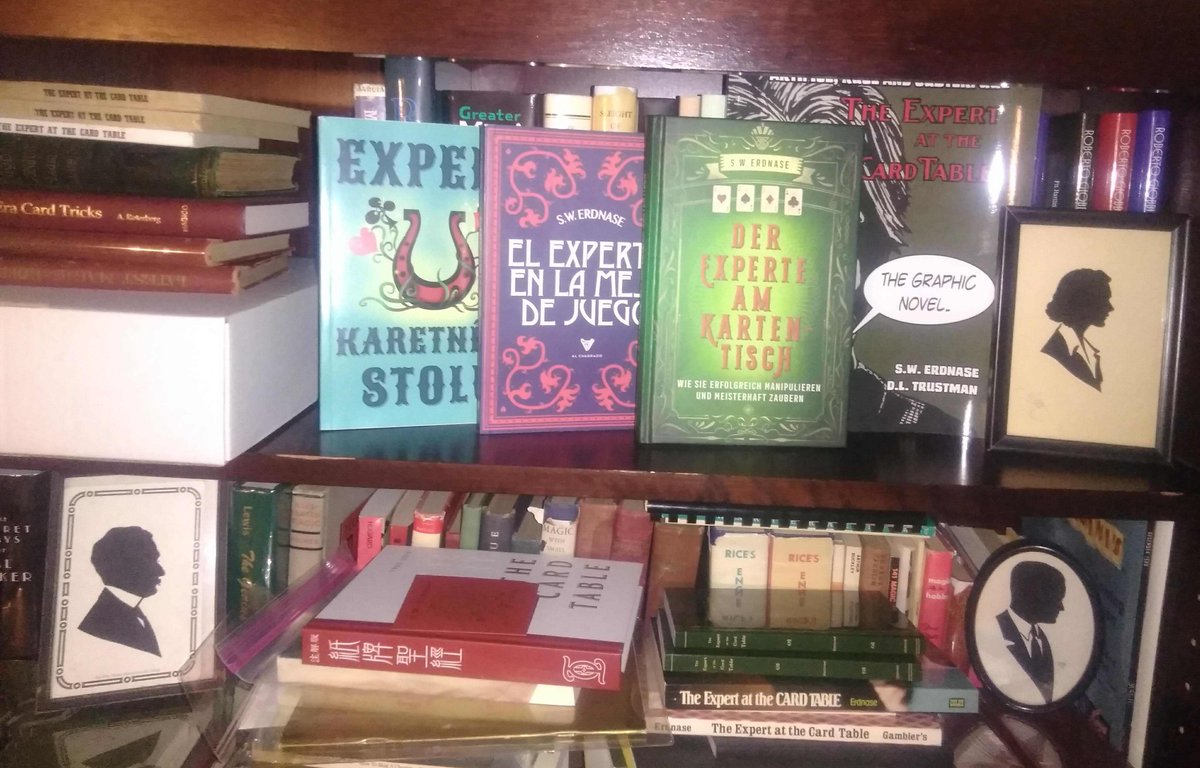
It must be interesting flipping through a familiar text in a foreign language. It's like watching a foreign film without the subtitles. The brain reverts back to a childlike state of wonder.
I'm thinking about buying the graphic novel version because I like graphic novels almost as much as I like magic. Is it worth the money, Bill? At my age I should be downsizing my magic library instead of adding to it, but I'm tempted on this one.
The Spanish graphic novel "The Last Gambler" was also printed in Dutch (I believe). I know this because the Dutch version showed up at my house the other day completely out of the blue. I don't think I ordered it, so it must be a very nice gift from someone involved in its production.
Thank you, whomever you are!
Jason
Thank you, whomever you are!
Jason
chetday wrote:I'm thinking about buying the graphic novel version because I like graphic novels almost as much as I like magic. Is it worth the money, Bill? At my age I should be downsizing my magic library instead of adding to it, but I'm tempted on this one.
I don't think I can answer that, for a lot of reasons -- the big one being that I don't know how much you like $25 vs how much you like graphic novels, especially considering that Expert is not a book that lends itself to the graphic novel format. I can tell you that I'm pleased to have mine (but I am not normal -- I already have 35 or so different variants, and I just bought 3 more different editions that I can't even read [and 35 is bush league compared to Jason and a couple of other folks]). I will note that I am sure that the artist got quite tired of drawing Erdnase's face and hands -- the art is somewhat repetitive in that respect. The book is large. I would have preferred smaller pages and more of them. The cover stock tends to curl. OTOH, $25 isn't too much for this sort of thing. The next one I'm looking at getting is this, another quasi-facsimile that I just noticed, and it is $50. And having just got the 3 foreign editions pictured, I'm pricing some of the other foreign editions that have been available -- but unfortunately, several of them seem to have gone out of print. I'm also intrigued by these:

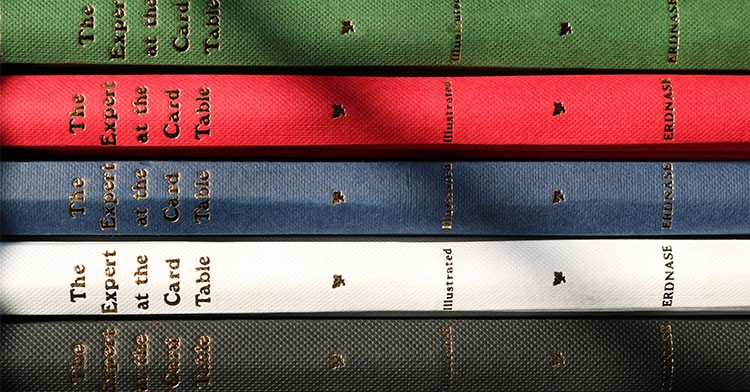
Bill,
I may have missed this, but where are those hardbacks of various colors shown in the picture from?
Jason
I may have missed this, but where are those hardbacks of various colors shown in the picture from?
Jason
Jason, those are journals from MagicEncarta.
What John said.
link
And John -- I have your book packaged up and should be taking it to the post office tomorrow.
link
And John -- I have your book packaged up and should be taking it to the post office tomorrow.
Is your first edition copy of Expert toxic?
I've agreed to give a 50 minute talk entitled "Chasing Erdnase" as part of the upcoming United Magicians for the World event in a few weeks. This will be followed by a discussion. My talk will be in English at 8 p.m. Italian time on Sunday, October 25th. I believe that will be 3 p.m. EST (because they go on their version of daylight savings time that weekend). The entire 100 hour event looks really good and a donation of any size gets you access. Here's a link, which will be updated as more details are added:
http://www.unitedmagiciansfortheworld.com/
http://www.unitedmagiciansfortheworld.com/
Mr. Hatch presented a fascinating PowerPoint synopsis on Erdnase that in short was like the entire Erdnase thread condensed into a one hour discussion. Anyone dropping in to hear this scholar would have been rewarded with an up to date summary on just about all things Erdnase. I don't agree with him on the supposed differing writing styles of Sanders and Erdnase. One need not look further than Bob Coyne's PDF on Sanders for the compelling comparisons. I also don't believe Gallaway's writing style even remotely resembles Erdnase. It's totally stilted with none of the Erdnase sly humor.
Richard Hatch wrote:I've agreed to give a 50 minute talk entitled "Chasing Erdnase" as part of the upcoming United Magicians for the World event in a few weeks. This will be followed by a discussion. My talk will be in English at 8 p.m. Italian time on Sunday, October 25th. I believe that will be 3 p.m. EST (because they go on their version of daylight savings time that weekend). The entire 100 hour event looks really good and a donation of any size gets you access. Here's a link, which will be updated as more details are added:
http://www.unitedmagiciansfortheworld.com/
Any chances the lecture could be available in the future?
Carlo, my understanding is that the presentations (including mine) were only available to live stream during the 100 hours. I believe they were being recorded, however, so perhaps they will be made available at some point. I have been approached about giving a similar presentation to other groups as a result of this, so that might happen.
Just ran across this video, posted recently on this topic. I thought it was pretty good, aside from a few minor errors, on the MFA theory. Looking forward to the forthcoming video that presents an opposing point of view.
https://www.youtube.com/watch?v=A-9c7B2lo9U
https://www.youtube.com/watch?v=A-9c7B2lo9U
Alex Romanoff's second video is out and this one delves into W.E. Sanders. Nothing really new here for those who have followed the trail on Sanders, but it was fun to watch. Mentioning that Sanders had met Marshall Smith in that Chicago hotel was a stretch but Sanders wasn't far away from there at the time. The upcoming third video will discuss Hatch's candidate E.S. Andrews.
https://m.youtube.com/watch?v=iCM0tx3r-Fs
https://m.youtube.com/watch?v=iCM0tx3r-Fs
I had not been much convinced by Chris W's defense of Gallaway before, but his latest newsletter contains some persuasive pieces of information which make me much more inclined to view Gallaway as a credible candidate.
As a teen-ager, Gallaway had written up a newspaper story on con games at the local circus including thimble-rigging, and he details the method and expresses his views of the suckers playing. I think it's at least as persuasive as WE Sanders's multiple decks of cards.
As a teen-ager, Gallaway had written up a newspaper story on con games at the local circus including thimble-rigging, and he details the method and expresses his views of the suckers playing. I think it's at least as persuasive as WE Sanders's multiple decks of cards.
Jack -- have you already received a newsletter for this week? I have not, and I don't see one on the rolling archive at lybrary.com
Bill, I received on 12/2 11:47 am NYC time newsletter #957 which is dated 12/3.
Odd, I don't see it posted on the website either. Maybe he doesn't post the current copy and waits until the next week?
Leave me your email in a PM and I'll forward a copy to you.
Odd, I don't see it posted on the website either. Maybe he doesn't post the current copy and waits until the next week?
Leave me your email in a PM and I'll forward a copy to you.
Okay, I received a copy during the night, and I've read it.
Two comments, which are consistent with my arguments about Chris and his methods for the past few years.
1. The "editorial" in question might better be characterized as a feature/news article; I've read it in its entirety (not just the snippets Chris copies) and I see no reason to call it an "editorial" (unless, of course, you have previously said that Gallaway was writing editorials at age 17 for the paper; and therefore any writing you find in the paper that you think bolsters the case for Gallaway must be called an "editorial" instead of simply an "article".) And there's no reason to suppose it was written by Gallaway over any other unnamed staff member of the Herald.
2. Chris says "In my ebook I have an entire section dedicated to the analytic negative . . ." (referring to phrases like "uses no sophistry" and "betray no confidences"). Does he? Ctrl-F "analytic" finds nothing; Ctrl-F "no sophistry" hits twice, and neither case is an analysis of the structure. Maybe he's thinking of an earlier, original examination of the structure. He says "it is rarely found in other works . . .particularly in combination with personal pronouns."
Except it is found:
Hoffmann, Modern Magic "we know no sleight", "you will find no difficulty", "you will have no difficulty", "you have no card concealed"
Roterberg, Latter Day Tricks, "our conjurer proving no exception"
Downs, Modern Coin Manipulation, "peformer . . . will find no difficulty", "show no trickery"
C. Lang Neil, After Dinner Sleights and Pocket Tricks, "draws no attention"
So, these new "revelations" are of a piece with the rest of the book -- find some snippet, that if it applied to Gallaway, might be construed to support the case that Gallaway was Erdnase. Then assume without evidence that it applies to Gallaway. (In this case, though, even if we knew with certainty that Gallaway wrote an article about a crooked carnival coming through town when he was seventeen, I can't see how it confirms that he wrote a book on sleight of hand 16 years later. The link is pretty tenuous.) Follow with sloppy research, based on the uncredited work of others.
Two comments, which are consistent with my arguments about Chris and his methods for the past few years.
1. The "editorial" in question might better be characterized as a feature/news article; I've read it in its entirety (not just the snippets Chris copies) and I see no reason to call it an "editorial" (unless, of course, you have previously said that Gallaway was writing editorials at age 17 for the paper; and therefore any writing you find in the paper that you think bolsters the case for Gallaway must be called an "editorial" instead of simply an "article".) And there's no reason to suppose it was written by Gallaway over any other unnamed staff member of the Herald.
2. Chris says "In my ebook I have an entire section dedicated to the analytic negative . . ." (referring to phrases like "uses no sophistry" and "betray no confidences"). Does he? Ctrl-F "analytic" finds nothing; Ctrl-F "no sophistry" hits twice, and neither case is an analysis of the structure. Maybe he's thinking of an earlier, original examination of the structure. He says "it is rarely found in other works . . .particularly in combination with personal pronouns."
Except it is found:
Hoffmann, Modern Magic "we know no sleight", "you will find no difficulty", "you will have no difficulty", "you have no card concealed"
Roterberg, Latter Day Tricks, "our conjurer proving no exception"
Downs, Modern Coin Manipulation, "peformer . . . will find no difficulty", "show no trickery"
C. Lang Neil, After Dinner Sleights and Pocket Tricks, "draws no attention"
So, these new "revelations" are of a piece with the rest of the book -- find some snippet, that if it applied to Gallaway, might be construed to support the case that Gallaway was Erdnase. Then assume without evidence that it applies to Gallaway. (In this case, though, even if we knew with certainty that Gallaway wrote an article about a crooked carnival coming through town when he was seventeen, I can't see how it confirms that he wrote a book on sleight of hand 16 years later. The link is pretty tenuous.) Follow with sloppy research, based on the uncredited work of others.
I wasn't aware that the article wasn't signed. That puts a different light on it. But if it were found to be Gallaway's, then while not confirmatory evidence, I think it's a strong piece of evidence. As I said, much like WE Sanders decks of cards. It shows a strong interest in these kinds of matters--and interest enough to write about it. But certainly Chris would have to prove that it was Gallaway's article.
I spent the last month finally digesting this entire thread. Thank you to everyone who has contributed and kindled my interest in the hunt for Erdnase. I am in no way connected to this gentleman but I just noticed this posted for sale on the Cafe. The story behind the discovery of this seems apropos.
https://www.themagiccafe.com/forums/vie ... 7&forum=78
https://www.themagiccafe.com/forums/vie ... 7&forum=78
As part of the discussion above, I downloaded the most recent version of Chris's ebook. There is new material in it compared to the last time I checked, several months ago. He had committed to tell purchasers via email when the book was updated, and I haven't received such an email in some time. Are other people getting notifications?
Here's one line of argument made in the ebook.
1. Prof. Charles P. Wilson is known to have performed Punch and Judy shows.
2. There's a book called Copyfitting that Chris presumes is by Gallaway.
3. The introduction for it contains a line, "To all those who regard system as red tape, to all who can “guess close enough for all practical purposes,” our sincere advice on Copyfitting is the same as that Punch gave to the young man about to marry — Don't!"
4. Chris thinks Gallaway performed as Wilson. Chris: "Gallaway is quoting Punch. Why would anybody do that in a technical book on copyfitting? It is an odd choice, unless you are a Punch & Judy performer who is intimately familiar with the dialogue."
5. Wilson also performed magic.
6. Since Gallaway = Wilson, Gallaway performed magic and therefore wrote Expert.
So, the argument is a series of links in a chain, and the chain falls apart if any link (Gallaway = Wilson, Gallaway wrote Copyfitting, etc., etc.) fails. One of the links is that the Punch who gives advice is Punch of Punch & Judy.
It isn't. The author of Copyfitting wasn't referring to Punch & Judy. "Punch" refers to the British satirical magazine. See here.
Here's one line of argument made in the ebook.
1. Prof. Charles P. Wilson is known to have performed Punch and Judy shows.
2. There's a book called Copyfitting that Chris presumes is by Gallaway.
3. The introduction for it contains a line, "To all those who regard system as red tape, to all who can “guess close enough for all practical purposes,” our sincere advice on Copyfitting is the same as that Punch gave to the young man about to marry — Don't!"
4. Chris thinks Gallaway performed as Wilson. Chris: "Gallaway is quoting Punch. Why would anybody do that in a technical book on copyfitting? It is an odd choice, unless you are a Punch & Judy performer who is intimately familiar with the dialogue."
5. Wilson also performed magic.
6. Since Gallaway = Wilson, Gallaway performed magic and therefore wrote Expert.
So, the argument is a series of links in a chain, and the chain falls apart if any link (Gallaway = Wilson, Gallaway wrote Copyfitting, etc., etc.) fails. One of the links is that the Punch who gives advice is Punch of Punch & Judy.
It isn't. The author of Copyfitting wasn't referring to Punch & Judy. "Punch" refers to the British satirical magazine. See here.
Chris doesn't do "research", he tells fantastical yarns based on bits and pieces of information he's dug up and stitched together with nothing more than a desire to stitch those yarns together.
He does this all with the specific goal of fulfilling his own personal confirmation bias regarding Gallaway.
Ultimately, he writes fiction (which is fine), but labels it "research" (which isn't fine).
He does this all with the specific goal of fulfilling his own personal confirmation bias regarding Gallaway.
Ultimately, he writes fiction (which is fine), but labels it "research" (which isn't fine).
Speaking of which ...
2020 is almost over. Has anyone received their copy of the Todd Karr book?
2020 is almost over. Has anyone received their copy of the Todd Karr book?
Brad Jeffers wrote:Speaking of which ...
2020 is almost over. Has anyone received their copy of the Todd Karr book?
Hahahahaha.
Richard Hatch, I see that listing is now gone on the Cafe. Did you ever get an answer to your question regarding the provenance of the book?
I PM'ed the poster at the Cafe and asked for pics of the books -- never heard back. Yesterday, I sent Slowdini a PM asking for pictures, and gave him my email address. I haven’t heard back from him.
Also, I’ve searched for any record of an Ernesto or any other magician drowning in Lake Ponchartrain. If it happened like Slowdini said, you’d think there would be some notice in newspapers or Genii or somewhere. I couldn’t find anything confirming the story.
Also, I’ve searched for any record of an Ernesto or any other magician drowning in Lake Ponchartrain. If it happened like Slowdini said, you’d think there would be some notice in newspapers or Genii or somewhere. I couldn’t find anything confirming the story.
Actionjack wrote:Richard Hatch, I see that listing is now gone on the Cafe. Did you ever get an answer to your question regarding the provenance of the book?
There was a posting 12 hours ago by someone wanting more details, then the topic disappeared. Does Slowdini have other posts on the Cafe?
I never got any reply to my questions. Strange!
Alex Romanoff did a 2.5 hour interview with me on the topic of the Erdnase Hunt and managed to edit it down to 30 minutes in an entertaining (I think!) way. This is his third Erdnase Hunt video in his "Art of Illusion" YouTube series. I think he may be burnt out on the topic for now, but I'd love to see him interview Chris Wasshuber, Marty Demarest, Todd Karr, Peter Zenner, Bill Mullins, Geno Munari, Juan Tamariz, etc. Here's a link to the most recent one (link to the others are available there in case you missed them here):
https://www.youtube.com/watch?v=vVRKECAPkl8
https://www.youtube.com/watch?v=vVRKECAPkl8
Interesting presentation Richard.
Richard Hatch wrote: Does Slowdini have other posts on the Cafe?
Yes, and they do not enhance his credibility.
Brad Jeffers wrote:Speaking of which ...
2020 is almost over. Has anyone received their copy of the Todd Karr book?
The new issue of MUM has a cover feature on Todd.
Another interesting and entertaining video by Romanoff. Mr. Hatch's anecdote about Alexander presenting his candidate in their hotel room the night before the Conference was worth the price of admission. The writing similarities between Erdnase and Sanders are too compelling to ignore. I wish Mr. Hatch would realize this.
Leonard Hevia wrote:Another interesting and entertaining video by Romanoff. Mr. Hatch's anecdote about Alexander presenting his candidate in their hotel room the night before the Conference was worth the price of admission. The writing similarities between Erdnase and Sanders are too compelling to ignore. I wish Mr. Hatch would realize this.
Yes, it was great hearing that anecodote! It surprises me that Richard Hatch doesn't hear the same writing voice in Sanders and Erdnase. I suspect it's partly due to lack of familiarity with Sanders' writing and that looking at illustrative examples (see below) side-by-side can help. The similarities are almost overwhelming.
One point to make first: Erdnase, himself, varies his style quite dramatically throughout the text. The Introduction and Card Table Artifice sections are most strongly what we think of as Erdnase's most characteristic voice. This is where he makes especially incisive comments and most strongly exhibits his personality and mode of thought. Much of the body of the main text, describing sleights, is very analytical and precise. There are generalizations and insights sprinkled throughout, but the main text is primarily focused on clearly describing how to perform the sleights. The third style is in the patter for the tricks, which has a much more oratorical flavor. All three styles, while different, are extremely well executed. Sanders, likewise, exhibits different styles in his various writings on mining, montana history and linguistics, and poems and anecdotes about his college classmates. And his writing effortlessly adapts to these disparate subjects and domains. In addition, Sanders training as an engineer is evident in Erdnase as well. For example, for a one-handed bottom deal, Erdnase describes how "the IMPETUS and DIRECTION given to each card must be nicely CALCULATED," much as how a physics student would think of the trajectory of body in motion after a force has being applied to it.
Erdnase and Sanders both take delight in pointing out hypocrisy. In this example, they both sarcastically mock the pretensions of so-called "professionals" and their inflated claims. In doing so, they use the same metaphor (EXHUMING) and almost identical alliteration ("wicked waste" vs " "wiles and wickedness").
Erdnase: Self-styled "EX-PROFESSIONALS" have regaled the public with ASTOUNDING DISCLOSURES of their former WILES and WICKEDNESS, and have proven a wonderful knowledge of the subject by EXHUMING SOME ANTIQUATED MOSS-COVERED ruses
Sanders: certainly in part it is too good to keep, and in a spirit of benevolence and as an offering upon the shrine of professional goodwill toward PROFESSIONAL brethren, the following extracts have been EXHUMED FROM THEIR OBSCURE PLACE OF BURIAL [...] and how many reports PRESUMING TO DESCRIBE mining properties are written that should never have been penned - because of the WICKED WASTE of ink resulting therefrom.
They both characterize the large quantities of worldly knowledge (wisdom) that they acquired in their younger days. And Sanders interestingly characterizes the "hustling" he performed in "many various lines," perhaps in a sly nod to his hustling at the card table.
Erdnase: We naturally began to imbibe WISDOM in COPIOUS DRAUGHTS at the customary sucker rates. ...and the sum of our PRESENT KNOWLEDGE is proffered in this volume
Sanders: We did a lot of hustlin' then and gained a HEAP OF KNOWLEDGE and picked VAST WISDOM UP IN CHUNKS in MANY VARIOUS LINES.
Erdnase is constantly emphasizing the best way to do this or that. Sanders does the same:
Erdnase: It is an EXCELLENT MANNER of holding the deck for the true shuffle, and SHOULD BE STRICTLY ADHERED TO on all occasions.
Sanders: this latter is an AXIOM in mining during this period of development, and SHOULD BE INVARIABLY FOLLOWED where possible.
They both talk about the excellence of devices in almost identical ways.
Erdnase: the MOST novel AND perfect MACHINES EVER CONSTRUCTED
Sanders: the simplest AND MOST easily manipulated DEVICE YET CONSTRUCTED
The often use the same distinctive phrases.
Erdnase: we sorrowfully admit that OUR OWN EARLY KNOWLEDGE was acquired ...
Sanders: From MY EARLY KNOWLEDGE of you
Erdnase: The bottom palm may be held while the deal is in progress WITHOUT INCONVENIENCE.
Sanders: leaves sufficient hight for passage WITHOUT INCONVENIENCE.
Or sometimes the same generalization is made (e.g. the impossibility of providing a single formula/description to cover all cases)
Erdnase: It is impossible to give a formula that will answer for every situation. There is no end to the variety of positions the desired cards may be in.
Sanders: To write out in full a sufficient description of any particular locality or working of a mine, or even to explain the locations from which a lot of samples have been taken, would be far too cumbersome for practical purposes.
Anyway, this is just scratching the surface. See http://www.cs.columbia.edu/~coyne/erdnase-sanders-use-of-language.html for approximately 250 corresponding examples between Erdnase and Sanders as well as a summary of the overall evidence and other goodies.
Great comparisons Bob! The example comparing the same distinctive phrases is amazing!
A new trailer featuring some familiar faces:
https://www.youtube.com/watch?v=nK3Hcliay1Y
https://www.youtube.com/watch?v=nK3Hcliay1Y
Bob - your case fails to convince. Take the copious draughts example - if that word choice had been repeated you would have a convincing case. But it isn’t. Just a paragraph on consuming knowledge which is hardly a unique concept.
In your examples either the most interesting and idiosyncratic word choices fail to be shared - only general concepts which hardly makes the case that they are the same writer - or when word choices are replicated they are hardly unique or idiosyncratic.
To suggest that it is unique for authors of instructional texts to focus on the best ways of doing things is hardly dispositive. If anything - not doing so would be unexpected.
In your examples either the most interesting and idiosyncratic word choices fail to be shared - only general concepts which hardly makes the case that they are the same writer - or when word choices are replicated they are hardly unique or idiosyncratic.
To suggest that it is unique for authors of instructional texts to focus on the best ways of doing things is hardly dispositive. If anything - not doing so would be unexpected.
Brad Henderson wrote:Bob - your case fails to convince. Take the copious draughts example - if that word choice had been repeated you would have a convincing case. But it isn’t. Just a paragraph on consuming knowledge which is hardly a unique concept.
In your examples either the most interesting and idiosyncratic word choices fail to be shared - only general concepts which hardly makes the case that they are the same writer - or when word choices are replicated they are hardly unique or idiosyncratic.
To suggest that it is unique for authors of instructional texts to focus on the best ways of doing things is hardly dispositive. If anything - not doing so would be unexpected.
Brad--If the most interesting and idiosyncratic word choices shared by Erdnase and Sanders fail to be listed in the above examples, Bob did not fail to overlook those types of words and lists a number of compelling examples in his PDF. The word dalliance:
Erdnase: If DALLIANCE with the deck is allowed [p60]
Erdnase: when the company will stand for DALLIANCE at all [p62]
Sanders: to tread the primrose paths of DALLIANCE and joyance. [CR bio]
Dalliance is an uncommon word used by both writers. Dalliance is defined as: "Frivolous spending of time; dawdling: passed the summer in idle dalliance."
Or perhaps the word coups:
Erdnase: Two or three COUPS in the course of an evening will not flush the quarry [p19]
Sanders: In fact, we're in a precious mess through all their COUPS des main [CR poem]
Or perhaps the word longitudinal:
Erdnase: The LONGITUDINAL Shift [p130]
Sanders: and their designations marked within the main LONGITUDINAL workings
Sanders: distance pieces, where necessary, retain the sets in their proper relative positions, LONGITUDINALLY;
Or perhaps the word coincident:
Erdnase: When the blind shuffles with the COINCIDENT jog and break [p126]
Erdnase: a movement appearing as COINCIDENT card table routine [p96]
Sanders: within the bin, approximately COINCIDENT with or at a slightly steeper inclination
Or perhaps the word countenance:
Erdnase: Where the civil authorities COUNTENANCE these institutions [p11]]
Sanders: ever at the front to give the light of his COUNTENANCE [CR bio]
Sanders: our friend Page was removing from his COUNTENANCE a week's ragged growth of whiskers [CR bio]
Or perhaps the word interwoven:
Erdnase: so that the left hand holds several cards that are not INTERWOVEN at the bottom [p162]
Sanders: so closely INTERWOVEN as to make their undergraduate lives warp and woof of the same fabric
The fact that Bob did not list interesting and idiosyncratic words in his above comparisons does not imply they don't exist. I don't believe anybody can make an informed decision about Sanders' candidacy without first reading Bob's PDF.
Brad Henderson wrote:Bob - your case fails to convince. Take the copious draughts example - if that word choice had been repeated you would have a convincing case. But it isn’t. Just a paragraph on consuming knowledge which is hardly a unique concept.
In your examples either the most interesting and idiosyncratic word choices fail to be shared - only general concepts which hardly makes the case that they are the same writer - or when word choices are replicated they are hardly unique or idiosyncratic.
To suggest that it is unique for authors of instructional texts to focus on the best ways of doing things is hardly dispositive. If anything - not doing so would be unexpected.
Brad, you state your opinion as though it was fact. The arguments might not convince *you*, but that doesn't mean they fail to be convincing. I have had feedback from many people who have read them and find them very compelling. And of course, they're built on top of all the other evidence for Sanders.
Furthermore, I didn't suggest that any particular parallel example is dispositive on its own. That's a straw man argument. The "copious draughts" example is one of about 250 examples. The aggregate is what is important, and even that can't constitute absolute proof. Though I think it adds greatly to the case for Sanders, which was already very strong.
A few points on your specific objections to the "copious draughts" example.
- Both passages *do* use the same two central words "Wisdom" and "Knowledge". So your statement that word choice wasn't repeated isn't true.
- It's not just word choice (as I've tried to make clear) but modes of thought and attitudes as manifested in the writer's overall voice. I give many examples, some are very specifically about word choice, others about biographical overlap, others about shared metaphors, others on lexical-syntactic constructions, and so on.
- In this case, both passages invoke very similar visual/concrete metaphors. They describe 1) a very PERSONAL account, in 2) a similar HYPERBOLIC style, of 3) how they soaked in "WISDOM/KNOWLEDGE" in 4) LARGE QUANTITIES (copious, heap, vast) in 5) their EARLY FORMATIVE YEARS. So it's all these factors, which is a much more specific parallel than both saying that they consumed knowledge as you characterized it.
And YOU are stating your opinion as fact.
It is a fact that Neither use of the word wisdom nor knowledge is interesting at all as neither word is unique or used in an idiosyncratic manner.
I’m sure there are many authors who have used both words before.
And Leonard offers examples where more unusual words are highlighted but are used by the authors in different ways. And why use coup and coup de mains? If both had used the latter you might have a case. Not so with the reality of word choices in the text.
Interwoven - longitudinal : again, not unique words.
I like sanders as a candidate, but this seems to be entirely cases of motivated reasoning.
It is a fact that Neither use of the word wisdom nor knowledge is interesting at all as neither word is unique or used in an idiosyncratic manner.
I’m sure there are many authors who have used both words before.
And Leonard offers examples where more unusual words are highlighted but are used by the authors in different ways. And why use coup and coup de mains? If both had used the latter you might have a case. Not so with the reality of word choices in the text.
Interwoven - longitudinal : again, not unique words.
I like sanders as a candidate, but this seems to be entirely cases of motivated reasoning.
Brad--when you pointed out that the use of identical interesting and idiosyncratic words by both authors would be more convincing evidence of the same authorship, you neglected to mention that both identical words had to have the same meaning. Out of left field you now raised the bar and added another parameter. It isn't enough that both authors use the same unusual word, the words must also have the same meaning. Why is this?
Isn't the fact that both authors used the word "coups" for example--compelling? In any case both usages of the word have the same meaning. Note also that both authors use the words "dalliance" and "coincident" in exactly the same way.
The words "interwoven" and "longitudinal" may not be unique, but they certainly are interesting. Admittedly "interesting" is subjective but you did list that as a parameter for compelling use of identical words. Both authors shared uncommon words, no motivated reasoning is needed here. It's either the same man or yet another interesting coincidence--among many.
Isn't the fact that both authors used the word "coups" for example--compelling? In any case both usages of the word have the same meaning. Note also that both authors use the words "dalliance" and "coincident" in exactly the same way.
The words "interwoven" and "longitudinal" may not be unique, but they certainly are interesting. Admittedly "interesting" is subjective but you did list that as a parameter for compelling use of identical words. Both authors shared uncommon words, no motivated reasoning is needed here. It's either the same man or yet another interesting coincidence--among many.
Brad Henderson wrote:And YOU are stating your opinion as fact.
It is a fact that Neither use of the word wisdom nor knowledge is interesting at all as neither word is unique or used in an idiosyncratic manner.
I’m sure there are many authors who have used both words before.
You seemed to have missed the point on that WISDOM example. It's significance is not that wisdom/knowledge are rare words. Instead it is a case of using those same words in the context of very similar visual metaphors (imbibing copious amounts of wisdom vs picking up vast heaps of wisdom in chunks), with the same type of humorous/hyperbolic style in the context of giving a very personal account where they look back at their formative early years.
And as I've said, there are 250 examples that highlight various types of overlap. In some cases, it's biographically relevant allusions where Sanders uses gambling terms lilke "faro" and "poker" or Erdnase referring to archaeological/anthropological preservation and prospecting for gold (both central to Sanders' professions). In other cases, it's a thematic overlap (e.g. a concern for excellence and rigor or motivation/instructions on how to read their text) in conjunction with almost identical phrasing and word choice. In other cases, it's unusual words, as Leo gives some more of those examples. And there are many others. You, personally, may not be atuned to metaphorical and stylistic similarities. So perhaps the more direct and literal syntactic/lexical overlaps are more convincing to you. Have you read the full document? And as I said, it's the aggregate. No single example is dispositive.
Leonard
If a word is unusual one would expect it be used used in the same manner - not in different ones. You can’t move a goal post that should be so obvious that one should feel their head smacked against it.
Bob - you make my point. Drinking and picking up are both interesting metaphors and had he used the same in both cases re wisdom you would have a good example.
The mere fact he used a metaphor isn’t enough - combined with two different words for the same thing makes it less so
And i have no doubt a motivated reasoner could find countless examples, as many have done with bible codes and Qanon posts. That doesn’t make any of them convincing.
While it’s convenient for you to accuse me ‘not being attuned you stylistic/metaphorical similarities’ is it not equally possible that you lack discernment and your motivation/ interests encourage you to hear as similar what isnt ?
If a word is unusual one would expect it be used used in the same manner - not in different ones. You can’t move a goal post that should be so obvious that one should feel their head smacked against it.
Bob - you make my point. Drinking and picking up are both interesting metaphors and had he used the same in both cases re wisdom you would have a good example.
The mere fact he used a metaphor isn’t enough - combined with two different words for the same thing makes it less so
And i have no doubt a motivated reasoner could find countless examples, as many have done with bible codes and Qanon posts. That doesn’t make any of them convincing.
While it’s convenient for you to accuse me ‘not being attuned you stylistic/metaphorical similarities’ is it not equally possible that you lack discernment and your motivation/ interests encourage you to hear as similar what isnt ?
Brad Henderson wrote:Bob - you make my point. Drinking and picking up are both interesting metaphors and had he used the same in both cases re wisdom you would have a good example.
The mere fact he used a metaphor isn’t enough - combined with two different words for the same thing makes it less so
No, I think it's actually an excellent example as it stands. You are being far too literal in what you expect from a metaphor. Which is sort of ironic if you think about it.
Here's the mapping: The metaphor in both cases starts by representing knowledge/wisdom as a physical object. And the acquisition of that knowledge is effected by a young naive person who is not yet wise to the ways of the world. That person acquires the wisdom in large gulps/handfuls as part of a maturing process. And they're presented, not just with a trickle or few items, but with a rapid/large influx of knowledge (copious draughts, vast heaps). The only real difference is at the concrete level of the metaphor, the particular means of acquiring the knowledge (drinking vs picking up). But that's the way metaphors work. You can vary aspects of them but keep the structure of the mapping and hence the crux of the feeling and meaning. In addition, the metaphor reveals something about the person who makes it...in this case how they think about their youth and how they characterize the path they took to becoming more worldly and wise.
On the subject of Sanders/Erdnase use of metaphor. The other one I listed has even more common elements in alignment. They use the same metaphor even at the concrete level (EXHUMING) as well as several distinctive/targeted common word choices ("professional" "preserve" "wicked") in addition to the same stylistic device of alliteration on the same word "wicked waste" vs "wiles and wickedness". And they both mock those same self-serving "professionals" with their inflated claims (moss-covered ruses or bogus mining reports) while referring to knowledge being "well/carefully preserved". Plus the mocking tone and obvious disdain for hypocrisy is mirrored and reinforced by other parts of their writings. The same personality shines through. I would say this example, even on it's own, is as as close to dispositive as one could hope to find.
And again, there are many common aspects to their writing (stylistic, thematic, etc). The point of identifying these 250 correspondence is to triangulate, to see from different angles. If you judge from just one direction (e.g. individual word choice), you don't get a convincing a case as when you consider many aspects metaphors, psychology, puns, dialectical speech, syntactic constructions, etc.
The brushes with which you choose to paint are far too wide.
Brad Henderson wrote:The brushes with which you choose to paint are far too wide.
Hey, you're getting the hang of metaphor!
I have enjoyed reading Bob Coyne’s article and work-in-progress, entitled: “S.W. Erdnase and W.E. Sanders — Textual Analysis” (http://www.cs.columbia.edu/~coyne/erdna ... guage.html) (until very recently, entitled, “S.W. Erdnase and W.E. Sanders — Linguistic Analysis”) I find the case that Bob makes for S.W. Erdnase being a pseudonym for E. S. Sanders to be a persuasive. In addition to the perfect anagram, there is a plethora of evidence Bob advances in support of his position, as a review of the article will reveal, but my comment here will be limited to linguistic evidence. In other words, evidence emerging from a comparison of the respective word choices in the writings of Sanders and “Erdnase.”
Below, I have set forth below, 42 of the approximately 250 linguistic comparisons (a/k/a examples) that Bob and various others whom he credits have gleaned from the writings of Erdnase and Sanders. I selected this subset of 42 based on some rather strict ground rules I set for myself: (1) I have only cited examples comprised of two or more words; (2) the words must be identical, or in the rare instances where the words are not identical, they vary primarily only in tense or number (e.g. “make good” versus “made good” or “preclude the possibility of” versus “precludes the possibility of”). Or, in some instances, in between the identical words, there is one (and only one) intervening word (e.g. “quite equal” versus “quite of equal” or, “particularly adapted” versus “particularly well adapted”). But in almost all of the examples I cite, the combinations of words are literally word-for-word identical; (3) I have omitted what I deemed to be extremely common word combinations (although, to be even-handed, at least some of the phrases I’ve included are arguably not extremely uncommon); and (4) I have editorialized very sparingly – only discretionarily in a few select instances – as I want the examples largely to speak for themselves, so that others may evaluate for themselves.
My purpose in doing this is to show the basis of my personal opinion that there’s a strong case for Sanders and Erdnase being one and the same. As I noted, my opinion is not exclusively based on the linguistics, but rather, the linguistics in combination with other evidence. But I will not be discussing any evidence other than linguistic here. As can be seen from the 42 comparative examples I’ve sifted out from Bob’s article, there is an uncanny similarity, indeed identicality, in the verbiage and phrasing running through the writings of Sanders and Erdnase – I believe more than can be accounted for by mere coincidence. The 42 examples being cited here were interspersed throughout Bob’s article, in different places, under various sub-headings. My feeling was that if these examples were all grouped together in one place and reviewed consecutively, it would be very striking, and the examples would then have their optimal impact as evidence supporting Sanders as a candidate.
In my opinion, when the linguistic evidence (particularly that which is cited here) is coupled with other evidence cited by Bob Coyne and others, there is reasonable support for Bob’s (at least implicit) position that the case for Sanders is “compelling,” even if not dispositive. I should add that, in citing only a portion of the linguistic examples from the article, in no way do I mean to imply that the remaining examples cited in the article are not relevant or persuasive. Again, as I mentioned, I set out some strict and narrow criteria that I am following, and I have done so in order to shine a bright spotlight on the strength of the case for Sanders. I have omitted volume and page citations, as those can be found in the article.
So, without more, here are the linguistic comparisons/examples I’ve excerpted from the article Judge for yourself:
Erdnase: we shall describe several processes that MAY BE EMPLOYED ADVANTAGEOUSLY UNDER SPECIAL CIRCUMSTANCES.
Sanders: Such shafts are particularly well adapted to firm ground, but they MAY BE EMPLOYED ADVANTAGEOUSLY UNDER ALL CONDITIONS, EXCEPT WHERE ...
Erdnase: he coolly proposes to "MAKE GOOD" by transforming the wrong card
Sanders: Has "MADE GOOD" at the bar, where he shines
Erdnase: A CAREFUL PERUSAL OF THE FOLLOWING
Sanders: A PERUSAL OF THE FOLLOWING
Erdnase: AS IT IS UTTERLY IMPOSSIBLE for me to see at all
Sanders: AS IT IS UTTERLY IMPOSSIBLE to replace the missing papers...
Erdnase: so as to PRECLUDE THE POSSIBILITY OF the schemer being discovered with the goods on him.
Sanders: the slope of the vein (21 degrees) PRECLUDES THE POSSIBILITY OF the tripod support being used...
Erdnase: The thumb movement is IDENTICALLY THE SAME AS IN the true deal [p55]
Sanders: when set the machine is operated in IDENTICALLY THE SAME WAY AS IN sinking or...
(*Note, this is a curious redundancy that “both” writers used)
Erdnase: it is QUITE EQUAL to the hand shuffle as a blind
Sanders: and the sets nearly or QUITE of EQUAL size.
(Note: Again, odd phraseology. Just as one is either pregnant or not, as opposed to “quite pregnant,” things are either equal or they are not. The word “quite” in the above context is superfluous.)
Erdnase: We give the FACTS AND CONDITIONS of our subject as we find them
Sanders: is so exact in its fidelity to the topographical features of the region and to geographical FACTS AND CONDITIONS
(*Note: I’ve frequently seen the words “facts and circumstances” used in combination, but not so as to “facts and conditions”)
Erdnase: can be accomplished to ANY CONSIDERABLE extent
Erdnase: all men who play for ANY CONSIDERABLE stakes are looking for the best
Sanders: is not in itself sufficient to sustain ANY CONSIDERABLE thrust without a tendency ....
Sanders: the discovery had brought together ANY CONSIDERABLE number of persons
Erdnase: if requested to determine from what single artifice THE GREATEST ADVANTAGE is derived we would unhesitatingly decide...
Sanders: the plan above described may be of THE GREATEST ADVANTAGE in blocking-out the ores...
Erdnase: THE MOST PERFECT shift ever devised
Sanders: One side or face, therefore, is selected — THE MOST PERFECT and even one
(Note: This is notable because if something is described as “perfect,” particularly by a competent writer, the word perfect would not be modified by an adverb such as “most” or “least.” Perfect is perfect.)
Erdnase: The latter position is AN EXCELLENT ONE
Sanders: this joint is without doubt AN EXCELLENT ONE
Erdnase: A VARIED EXPERIENCE has impressed us with the belief that all men...
Sanders: From the winter of '88 until the fall of '90 a somewhat VARIED EXPERIENCE as expert in twine manufacture
Erdnase: knowledge was acquired at the usual EXCESSIVE COST to the uninitiated.
Sanders: because it does away with the ponderous and EXCESSIVELY COSTLY ...
Erdnase: we shall describe several processes that MAY BE EMPLOYED ADVANTAGEOUSLY UNDER SPECIAL CIRCUMSTANCES.
Sanders: Such shafts are particularly well adapted to firm ground, but they MAY BE EMPLOYED ADVANTAGEOUSLY UNDER ALL CONDITIONS, EXCEPT WHERE ...
Erdnase: shift that MAY BE EMPLOYED WITH the GREATEST probability of success [p99]
Sanders: and it MAY BE EMPLOYED WITH GREAT benefit
Erdnase: A third way, and the most GENERALLY EMPLOYED, is for
Sanders: now so GENERALLY EMPLOYED among the metal mines
Erdnase: THERE WOULD BE LITTLE ADVANTAGE derived from clever shuffling, WERE the order to be subsequently disturbed in cutting [p39]
Sanders: THERE CAN BE LITTLE ADVANTAGE to the profession at large IF the discussion as to the best shape for a shaft is to be...
Erdnase: The methods described can BE SUCCESSFULLY WORKED with as many as eight or ten cards
Sanders: from the deposits too small to BE SUCCESSFULLY WORKED in a commercial way
Erdnase: To show THE EASE WITH WHICH the cards travel I shall
Sanders: and THE EASE WITH WHICH it may be manipulated
Erdnase: The top palm can be made with the right hand IN MUCH THE SAME MANNER
Erdnase: right hand packet again on top IN MUCH THE SAME MANNER.
Sanders: near the center of the set IN MUCH THE SAME MANNER as are located the end posts or plates.
Erdnase: It can be ACCOMPLISHED IN THE FOLLOWING MANNER:
Sanders: the hole is now charged which is ACCOMPLISHED IN THE FOLLOWING MANNER d,...
Erdnase: This method of blind cutting is PARTICULARLY ADAPTED for working in with the blind riffle
Sanders: Such shafts are PARTICULARLY WELL ADAPTED to firm ground
Erdnase: but he can pick up any card or group of cards in the order BEST SUITED TO his design
Sanders: come together from the six directions in a manner BEST SUITED TO the needs of the occasion.
Erdnase: THE USUAL PRACTICE is to deal from the bottom.
Sanders: THE USUAL PRACTICE in the West being for each
Sanders: THE USUAL PRACTICE being to make the inner faces of the station sets aline [sic] with those of...
Erdnase: bring it down IN THE USUAL WAY of shuffling on
Sanders: are hung IN THE USUAL WAY by lag-screws
Erdnase: card with the thumb IN THE USUAL MANNER
Sanders: to afford secure support to the sets by blocking and wedging IN THE USUAL MANNER.
Erdnase: it leaves the top and bottom cards IN THE SAME RELATIVE POSITION
Sanders: both being placed IN THE SAME RELATIVE POSITION within the joint
Erdnase: it is generally dealt ON THE SQUARE in gambling rooms that are run openly
Sanders: Is not the western game I yearn to see played ON THE SQUARE,
Erdnase: These examples of CULLING, if FAIRLY WELL executed.
Sanders: FAIRLY WELL filled with data CULLED in a measure from geologic reports...
Erdnase: This example MIGHT WELL BE TERMED a fancy cull [p82]
Sanders: from the extraction of ores with what MIGHT BE TERMED open blocks...
Sanders: by what MIGHT BE TERMED an enclosing and protecting shield
Erdnase: His PURPOSE in that respect IS SUFFICIENTLY ANSWERED by keeping the desired cards...
Sanders: the required information ... IS SUFFICIENTLY ANSWERED in and by the workings of adjoining property
Erdnase: it has been my VERY GREAT GOOD FORTUNE to discover...
Sanders: we know the VERY GREAT AND GOOD FORTUNE we had in studying under you
(*Note: I find this to be an extraordinarily unique and idiosyncratic phraseology)
Erdnase: The first shift described is executed with both hands and is A GREAT FAVORITE.
Erdnase: This is A GREAT FAVORITE for terminating certain tricks
Sanders: who had been a fellow-cadet with him at West Point and A GREAT FAVORITE there
Erdnase: Faro cards, USED IN CONNECTION WITH a certain form of "brace" box, are treated in this manner.
Sanders: Waste filling is frequently USED IN CONNECTION WITH and as adjunct to the various systems of timbering
Erdnase: knowing players require NOTHING MORE THAN a bare suspicion of skill to
Sanders: a method of timbering ... is NOTHING MORE THAN the crib of the flat deposits
Erdnase: and the reputation is liable to precede him in MANY ANOTHER.
Sanders: among files containing MANY ANOTHER mining report that is less picturesque, less unique.
Sanders: as sweet and handsome as MANY ANOTHER
(*Note: I don’t believe I have heretofore encountered the expression “many another”)
Erdnase: IT IS WELL TO insist that but one card must be moved at a time.
Sanders: IT IS WELL TO leave the tops undisturbed
Sanders: in this classification IT IS WELL TO assume as of the normal type those rocks that possess...
Erdnase: but we regret the truth of the confession that ONCE UPON A TIME we were, and we marveled greatly and also sorrowed, over a continuous and very protracted run of hard luck
Sanders: ONCE UPON A TIME, as all good fairy tales begin, callow, bashful and hopeful youths met together
Erdnase: The deck SO ARRANGED makes every thirteenth card the same value [p179]
Sanders: shafts are of two kinds, one being SO ARRANGED that the ore cars
Erdnase: IT IS NEEDLESS TO SAY THAT I do not know which cards were selected
Sanders: IT IS NEEDLESS TO SAY THAT exactness in the fitting together...
Erdnase: AND AT THE SAME TIME sliding pack outwards and to the right
Sanders: AND AT THE SAME TIME to furnish an opening between the plates and the foot of the shield
Below, I have set forth below, 42 of the approximately 250 linguistic comparisons (a/k/a examples) that Bob and various others whom he credits have gleaned from the writings of Erdnase and Sanders. I selected this subset of 42 based on some rather strict ground rules I set for myself: (1) I have only cited examples comprised of two or more words; (2) the words must be identical, or in the rare instances where the words are not identical, they vary primarily only in tense or number (e.g. “make good” versus “made good” or “preclude the possibility of” versus “precludes the possibility of”). Or, in some instances, in between the identical words, there is one (and only one) intervening word (e.g. “quite equal” versus “quite of equal” or, “particularly adapted” versus “particularly well adapted”). But in almost all of the examples I cite, the combinations of words are literally word-for-word identical; (3) I have omitted what I deemed to be extremely common word combinations (although, to be even-handed, at least some of the phrases I’ve included are arguably not extremely uncommon); and (4) I have editorialized very sparingly – only discretionarily in a few select instances – as I want the examples largely to speak for themselves, so that others may evaluate for themselves.
My purpose in doing this is to show the basis of my personal opinion that there’s a strong case for Sanders and Erdnase being one and the same. As I noted, my opinion is not exclusively based on the linguistics, but rather, the linguistics in combination with other evidence. But I will not be discussing any evidence other than linguistic here. As can be seen from the 42 comparative examples I’ve sifted out from Bob’s article, there is an uncanny similarity, indeed identicality, in the verbiage and phrasing running through the writings of Sanders and Erdnase – I believe more than can be accounted for by mere coincidence. The 42 examples being cited here were interspersed throughout Bob’s article, in different places, under various sub-headings. My feeling was that if these examples were all grouped together in one place and reviewed consecutively, it would be very striking, and the examples would then have their optimal impact as evidence supporting Sanders as a candidate.
In my opinion, when the linguistic evidence (particularly that which is cited here) is coupled with other evidence cited by Bob Coyne and others, there is reasonable support for Bob’s (at least implicit) position that the case for Sanders is “compelling,” even if not dispositive. I should add that, in citing only a portion of the linguistic examples from the article, in no way do I mean to imply that the remaining examples cited in the article are not relevant or persuasive. Again, as I mentioned, I set out some strict and narrow criteria that I am following, and I have done so in order to shine a bright spotlight on the strength of the case for Sanders. I have omitted volume and page citations, as those can be found in the article.
So, without more, here are the linguistic comparisons/examples I’ve excerpted from the article Judge for yourself:
Erdnase: we shall describe several processes that MAY BE EMPLOYED ADVANTAGEOUSLY UNDER SPECIAL CIRCUMSTANCES.
Sanders: Such shafts are particularly well adapted to firm ground, but they MAY BE EMPLOYED ADVANTAGEOUSLY UNDER ALL CONDITIONS, EXCEPT WHERE ...
Erdnase: he coolly proposes to "MAKE GOOD" by transforming the wrong card
Sanders: Has "MADE GOOD" at the bar, where he shines
Erdnase: A CAREFUL PERUSAL OF THE FOLLOWING
Sanders: A PERUSAL OF THE FOLLOWING
Erdnase: AS IT IS UTTERLY IMPOSSIBLE for me to see at all
Sanders: AS IT IS UTTERLY IMPOSSIBLE to replace the missing papers...
Erdnase: so as to PRECLUDE THE POSSIBILITY OF the schemer being discovered with the goods on him.
Sanders: the slope of the vein (21 degrees) PRECLUDES THE POSSIBILITY OF the tripod support being used...
Erdnase: The thumb movement is IDENTICALLY THE SAME AS IN the true deal [p55]
Sanders: when set the machine is operated in IDENTICALLY THE SAME WAY AS IN sinking or...
(*Note, this is a curious redundancy that “both” writers used)
Erdnase: it is QUITE EQUAL to the hand shuffle as a blind
Sanders: and the sets nearly or QUITE of EQUAL size.
(Note: Again, odd phraseology. Just as one is either pregnant or not, as opposed to “quite pregnant,” things are either equal or they are not. The word “quite” in the above context is superfluous.)
Erdnase: We give the FACTS AND CONDITIONS of our subject as we find them
Sanders: is so exact in its fidelity to the topographical features of the region and to geographical FACTS AND CONDITIONS
(*Note: I’ve frequently seen the words “facts and circumstances” used in combination, but not so as to “facts and conditions”)
Erdnase: can be accomplished to ANY CONSIDERABLE extent
Erdnase: all men who play for ANY CONSIDERABLE stakes are looking for the best
Sanders: is not in itself sufficient to sustain ANY CONSIDERABLE thrust without a tendency ....
Sanders: the discovery had brought together ANY CONSIDERABLE number of persons
Erdnase: if requested to determine from what single artifice THE GREATEST ADVANTAGE is derived we would unhesitatingly decide...
Sanders: the plan above described may be of THE GREATEST ADVANTAGE in blocking-out the ores...
Erdnase: THE MOST PERFECT shift ever devised
Sanders: One side or face, therefore, is selected — THE MOST PERFECT and even one
(Note: This is notable because if something is described as “perfect,” particularly by a competent writer, the word perfect would not be modified by an adverb such as “most” or “least.” Perfect is perfect.)
Erdnase: The latter position is AN EXCELLENT ONE
Sanders: this joint is without doubt AN EXCELLENT ONE
Erdnase: A VARIED EXPERIENCE has impressed us with the belief that all men...
Sanders: From the winter of '88 until the fall of '90 a somewhat VARIED EXPERIENCE as expert in twine manufacture
Erdnase: knowledge was acquired at the usual EXCESSIVE COST to the uninitiated.
Sanders: because it does away with the ponderous and EXCESSIVELY COSTLY ...
Erdnase: we shall describe several processes that MAY BE EMPLOYED ADVANTAGEOUSLY UNDER SPECIAL CIRCUMSTANCES.
Sanders: Such shafts are particularly well adapted to firm ground, but they MAY BE EMPLOYED ADVANTAGEOUSLY UNDER ALL CONDITIONS, EXCEPT WHERE ...
Erdnase: shift that MAY BE EMPLOYED WITH the GREATEST probability of success [p99]
Sanders: and it MAY BE EMPLOYED WITH GREAT benefit
Erdnase: A third way, and the most GENERALLY EMPLOYED, is for
Sanders: now so GENERALLY EMPLOYED among the metal mines
Erdnase: THERE WOULD BE LITTLE ADVANTAGE derived from clever shuffling, WERE the order to be subsequently disturbed in cutting [p39]
Sanders: THERE CAN BE LITTLE ADVANTAGE to the profession at large IF the discussion as to the best shape for a shaft is to be...
Erdnase: The methods described can BE SUCCESSFULLY WORKED with as many as eight or ten cards
Sanders: from the deposits too small to BE SUCCESSFULLY WORKED in a commercial way
Erdnase: To show THE EASE WITH WHICH the cards travel I shall
Sanders: and THE EASE WITH WHICH it may be manipulated
Erdnase: The top palm can be made with the right hand IN MUCH THE SAME MANNER
Erdnase: right hand packet again on top IN MUCH THE SAME MANNER.
Sanders: near the center of the set IN MUCH THE SAME MANNER as are located the end posts or plates.
Erdnase: It can be ACCOMPLISHED IN THE FOLLOWING MANNER:
Sanders: the hole is now charged which is ACCOMPLISHED IN THE FOLLOWING MANNER d,...
Erdnase: This method of blind cutting is PARTICULARLY ADAPTED for working in with the blind riffle
Sanders: Such shafts are PARTICULARLY WELL ADAPTED to firm ground
Erdnase: but he can pick up any card or group of cards in the order BEST SUITED TO his design
Sanders: come together from the six directions in a manner BEST SUITED TO the needs of the occasion.
Erdnase: THE USUAL PRACTICE is to deal from the bottom.
Sanders: THE USUAL PRACTICE in the West being for each
Sanders: THE USUAL PRACTICE being to make the inner faces of the station sets aline [sic] with those of...
Erdnase: bring it down IN THE USUAL WAY of shuffling on
Sanders: are hung IN THE USUAL WAY by lag-screws
Erdnase: card with the thumb IN THE USUAL MANNER
Sanders: to afford secure support to the sets by blocking and wedging IN THE USUAL MANNER.
Erdnase: it leaves the top and bottom cards IN THE SAME RELATIVE POSITION
Sanders: both being placed IN THE SAME RELATIVE POSITION within the joint
Erdnase: it is generally dealt ON THE SQUARE in gambling rooms that are run openly
Sanders: Is not the western game I yearn to see played ON THE SQUARE,
Erdnase: These examples of CULLING, if FAIRLY WELL executed.
Sanders: FAIRLY WELL filled with data CULLED in a measure from geologic reports...
Erdnase: This example MIGHT WELL BE TERMED a fancy cull [p82]
Sanders: from the extraction of ores with what MIGHT BE TERMED open blocks...
Sanders: by what MIGHT BE TERMED an enclosing and protecting shield
Erdnase: His PURPOSE in that respect IS SUFFICIENTLY ANSWERED by keeping the desired cards...
Sanders: the required information ... IS SUFFICIENTLY ANSWERED in and by the workings of adjoining property
Erdnase: it has been my VERY GREAT GOOD FORTUNE to discover...
Sanders: we know the VERY GREAT AND GOOD FORTUNE we had in studying under you
(*Note: I find this to be an extraordinarily unique and idiosyncratic phraseology)
Erdnase: The first shift described is executed with both hands and is A GREAT FAVORITE.
Erdnase: This is A GREAT FAVORITE for terminating certain tricks
Sanders: who had been a fellow-cadet with him at West Point and A GREAT FAVORITE there
Erdnase: Faro cards, USED IN CONNECTION WITH a certain form of "brace" box, are treated in this manner.
Sanders: Waste filling is frequently USED IN CONNECTION WITH and as adjunct to the various systems of timbering
Erdnase: knowing players require NOTHING MORE THAN a bare suspicion of skill to
Sanders: a method of timbering ... is NOTHING MORE THAN the crib of the flat deposits
Erdnase: and the reputation is liable to precede him in MANY ANOTHER.
Sanders: among files containing MANY ANOTHER mining report that is less picturesque, less unique.
Sanders: as sweet and handsome as MANY ANOTHER
(*Note: I don’t believe I have heretofore encountered the expression “many another”)
Erdnase: IT IS WELL TO insist that but one card must be moved at a time.
Sanders: IT IS WELL TO leave the tops undisturbed
Sanders: in this classification IT IS WELL TO assume as of the normal type those rocks that possess...
Erdnase: but we regret the truth of the confession that ONCE UPON A TIME we were, and we marveled greatly and also sorrowed, over a continuous and very protracted run of hard luck
Sanders: ONCE UPON A TIME, as all good fairy tales begin, callow, bashful and hopeful youths met together
Erdnase: The deck SO ARRANGED makes every thirteenth card the same value [p179]
Sanders: shafts are of two kinds, one being SO ARRANGED that the ore cars
Erdnase: IT IS NEEDLESS TO SAY THAT I do not know which cards were selected
Sanders: IT IS NEEDLESS TO SAY THAT exactness in the fitting together...
Erdnase: AND AT THE SAME TIME sliding pack outwards and to the right
Sanders: AND AT THE SAME TIME to furnish an opening between the plates and the foot of the shield
If you take 50,000-100,000 words each by any pair of English-language writers, I'm sure you will find similar pairs of coincident phrases. For example. So this is only persuasive if the number of pairs here is significantly higher than whatever the average is. Without comparisons to other random pairs of authors for control, it's hard to say what the discoveries above mean.
Bill Mullins wrote:If you take 50,000-100,000 words each by any pair of English-language writers, I'm sure you will find similar pairs of coincident phrases. For example. So this is only persuasive if the number of pairs here is significantly higher than whatever the average is. Without comparisons to other random pairs of authors for control, it's hard to say what the discoveries above mean.
Bill, a couple points:
All things being equal, I would agree that you would expect to find more overlapping phrases between Erdnase and Sanders than whatever the average is. However, defining and measuring the average is not usually possible, especially when the topics and genres vary widely. For example, Sanders' humorous writing in his class reunion blurbs and poems sounds quite a bit different than his Mine Timbering texts. And in particular, I've noticed less overlap in unusual words or phrases across groupings versus within each grouping. And sometimes, even within a grouping (e.g. one mining article vs another) you'll sometimes find significant differences. So much depends on the exact topic.
So instead of expecting to decide such things by a simple number (deviation from an "average"), you can use your ear, much as you do to identify a voice of a person you hear (but don't see) as being someone you know or not. Or whether two voices are probably the same person or not. Or whether a piece of music "sounds like" Beethoven. Or if a person you see in a distance is who you think it is based on their stance or gait or some other ill-defined attribute. As human beings we do this all the time, and while our judgements aren't perfect, we can usually get a good sense if different perceived phenomena are likely or possibly from the same source or not. Of course there's error in doing that, and that is one reason for identifying a large number of examples and "triangulating" across different aspects of the textual evidence (of which MagicbyAlfred's list is merely one).
The link to Teddy Roosevelt examples that match some in Erdnase doesn't really support your point, since the corpus of text attributable to Roosevelt is an order of magnitude (or more) larger than Erdnase or Sanders. You'd have to count and normalize by the corpus size. Also, as I pointed out when you first posted it, the TR examples you provided aren't as close matches with Erdnase and lack some of the nuances found in the equivalent examples of Sanders with Erdnase.
OK, it has been brought to my attention that there are other comparative examples in Bob's article that were not included in my previous post but which fit the criteria I laid out for the compilation. This now brings my compilation to 57 examples. So here are some that I had overlooked:
Erdnase: the writer uses no sophistry AS AN EXCUSE FOR its existence.
Sanders: he explains this integration or accretion of good hoss-sense AS AN EXCUSE FOR his lapse from...
Erdnase: used certain terms FOR THE SAKE OF BREVITY
Sanders: FOR THE SAKE OF BREVITY in description, certain symbols letters or figures
Erdnase: and the third card PROVES TO BE the ace.
Sanders: should either of the walls PROVE TO BE weak
Erdnase: IT WILL BE SEEN THAT the old-fashioned or hand shuffle
Sanders: IT WILL BE SEEN THAT a great deal of timber is used....
Erdnase: IT WILL HAVE BEEN SEEN BY THE FOREGOING THAT the presentation
Sanders: Therefore, FROM THE FOREGOING IT WILL BE SEEN THAT the cost of the square set...
Erdnase: an understanding of the CAUSE AND EFFECT of the various actions.
Sanders: the relation between CAUSE AND EFFECT
Erdnase: He knows little of THE REAL VALUE OF money
Sanders: THE REAL VALUE OF the inclined-bottom bin lies in its facility of discharge
Erdnase: This objection IS entirely OVERCOME BY THE USE OF the break
Sanders: this difficulty IS OVERCOME BY THE USE OF a half right-angled miter
Erdnase: and FOR PRACTICAL PURPOSES stocking more than three should not be attempted
Sanders: would be far too cumbersome FOR PRACTICAL PURPOSES
Erdnase: various METHODS OF LOCATING AND producing selected cards
Sanders: the METHODS OF LOCATING AND aligning the sets are those used for...
Erdnase: He also performs HIS PART with the shears when the lambs come to market
Sanders: That he's played well HIS PART
Erdnase: select the four Jacks FOR THE PURPOSE OF ILLUSTRATING how an original athletic tendency
Sanders: FOR THE PURPOSE OF ILLUSTRATION, assume that...
Erdnase: we sorrowfully admit that our own EARLY KNOWLEDGE was acquired ...
Sanders: From my EARLY KNOWLEDGE of you
Erdnase: The bottom palm may be held while the deal is in progress WITHOUT INCONVENIENCE.
Sanders: leaves sufficient hight [sic] for passage WITHOUT INCONVENIENCE.
Erdnase: That THIS IS GENERALLY TRUE cannot be denied, but it is by no means always so.
Sanders: THIS IS GENERALLY TRUE but has one or two exceptions
And just to address Bill's point, I would ask whether, in order to evaluate the evidence presented and find someone guilty or not guilty in a particular trial, must the jury first analyze comparative studies of evidence and verdicts from other cases? Or, can a jury of laypersons, unschooled in the law, except for a very brief crash course from the judge at the end of the case ("jury instructions") bring their own common sense to bear in deciding whether or not the evidence is sufficient to convict?
Erdnase: the writer uses no sophistry AS AN EXCUSE FOR its existence.
Sanders: he explains this integration or accretion of good hoss-sense AS AN EXCUSE FOR his lapse from...
Erdnase: used certain terms FOR THE SAKE OF BREVITY
Sanders: FOR THE SAKE OF BREVITY in description, certain symbols letters or figures
Erdnase: and the third card PROVES TO BE the ace.
Sanders: should either of the walls PROVE TO BE weak
Erdnase: IT WILL BE SEEN THAT the old-fashioned or hand shuffle
Sanders: IT WILL BE SEEN THAT a great deal of timber is used....
Erdnase: IT WILL HAVE BEEN SEEN BY THE FOREGOING THAT the presentation
Sanders: Therefore, FROM THE FOREGOING IT WILL BE SEEN THAT the cost of the square set...
Erdnase: an understanding of the CAUSE AND EFFECT of the various actions.
Sanders: the relation between CAUSE AND EFFECT
Erdnase: He knows little of THE REAL VALUE OF money
Sanders: THE REAL VALUE OF the inclined-bottom bin lies in its facility of discharge
Erdnase: This objection IS entirely OVERCOME BY THE USE OF the break
Sanders: this difficulty IS OVERCOME BY THE USE OF a half right-angled miter
Erdnase: and FOR PRACTICAL PURPOSES stocking more than three should not be attempted
Sanders: would be far too cumbersome FOR PRACTICAL PURPOSES
Erdnase: various METHODS OF LOCATING AND producing selected cards
Sanders: the METHODS OF LOCATING AND aligning the sets are those used for...
Erdnase: He also performs HIS PART with the shears when the lambs come to market
Sanders: That he's played well HIS PART
Erdnase: select the four Jacks FOR THE PURPOSE OF ILLUSTRATING how an original athletic tendency
Sanders: FOR THE PURPOSE OF ILLUSTRATION, assume that...
Erdnase: we sorrowfully admit that our own EARLY KNOWLEDGE was acquired ...
Sanders: From my EARLY KNOWLEDGE of you
Erdnase: The bottom palm may be held while the deal is in progress WITHOUT INCONVENIENCE.
Sanders: leaves sufficient hight [sic] for passage WITHOUT INCONVENIENCE.
Erdnase: That THIS IS GENERALLY TRUE cannot be denied, but it is by no means always so.
Sanders: THIS IS GENERALLY TRUE but has one or two exceptions
And just to address Bill's point, I would ask whether, in order to evaluate the evidence presented and find someone guilty or not guilty in a particular trial, must the jury first analyze comparative studies of evidence and verdicts from other cases? Or, can a jury of laypersons, unschooled in the law, except for a very brief crash course from the judge at the end of the case ("jury instructions") bring their own common sense to bear in deciding whether or not the evidence is sufficient to convict?
@Bob -- if what you are saying all that is necessary is to decide that Erdnase and Sanders sound alike, then I guess we don't agree. People are, it turns out, not all that good at identifying each other. "Mistaken Identifications are the Leading Factor In Wrongful Convictions". Think how many times in your own life you've had to say, or someone said to you, "Oh, I'm sorry, I thought you were someone else."
I'm happy to agree that there are some very interesting coincidences in what you and I and others have found when comparing Sanders and Erdnase. I just don't think it's anything other than a curiosity. Like you said, "You'd have to count and normalize by the corpus size" before a list of coincidences means anything.
The point of the list I made 9 years ago was not that Erdnase must be TR; it was that it is possible to find extensive points of comparison in a pair of random authors with very little effort and in very little time. I made that list in an hour or two, as I recall. If I were to spend a long time, the list would be better, I'm sure.
@MagicByAlfred
We don't ask juries to do that. Each side gets expert witnesses, people who have demonstrated significant expertise in a subject, to do that, and then the juries evaluate their conclusions.
I've probably spent as much time and effort as anyone alive in investigating the major candidates. And once you identify someone as a candidate, if you can find out much about them, you will find things that suggest something in common with Erdnase. Every candidate who has been investigated in any depth reveals "clues" that point to Erdnase. Sanders has a pretty big published record, so of course you will find words and phrases he used in common with Erdnase. But if you find someone else of approximately same time frame with a similar published record, I guarantee you will also find coincident words and phrases for that author.
I didn't have much use for the conclusions that Wasshuber drew from Olsson's analysis, but I think one point made by Olsson is relevant: that writers of ca. 1900 were exposed to the same influential books from the previous 40 years or so. If, today, you were to see two different writers use the phrases "Steal this Book" or "I have a dream" or "trickle-down economics", you wouldn't jump to the conclusion that they were in fact the same person. You'd assume that they both were familiar with Abbie Hoffman, Martin Luther King Jr., and Ronald Reagan. And to decide that since Erdnase and Sanders used similar language, you'd first have to rule out that the coincident phrases weren't a result of both of them being exposed to an earlier influential writer who also used them.
Most academic studies that investigate authorship don't use the unusual phrases that stand out. The use analysis of shorter, common words that don't stand out when reading. If analysis of the writing of Erdnase ever reveals the author, I think it will come from looking at those patterns rather than from the unusual turns of phrase.
I'm happy to agree that there are some very interesting coincidences in what you and I and others have found when comparing Sanders and Erdnase. I just don't think it's anything other than a curiosity. Like you said, "You'd have to count and normalize by the corpus size" before a list of coincidences means anything.
Also, as I pointed out when you first posted it, the TR examples you provided aren't as close matches with Erdnase and lack some of the nuances found in the equivalent examples of Sanders with Erdnase.
The point of the list I made 9 years ago was not that Erdnase must be TR; it was that it is possible to find extensive points of comparison in a pair of random authors with very little effort and in very little time. I made that list in an hour or two, as I recall. If I were to spend a long time, the list would be better, I'm sure.
@MagicByAlfred
And just to address Bill's point, I would ask whether, in order to evaluate the evidence presented and find someone guilty or not guilty in a particular trial, must the jury first analyze comparative studies of evidence and verdicts from other cases?
We don't ask juries to do that. Each side gets expert witnesses, people who have demonstrated significant expertise in a subject, to do that, and then the juries evaluate their conclusions.
I've probably spent as much time and effort as anyone alive in investigating the major candidates. And once you identify someone as a candidate, if you can find out much about them, you will find things that suggest something in common with Erdnase. Every candidate who has been investigated in any depth reveals "clues" that point to Erdnase. Sanders has a pretty big published record, so of course you will find words and phrases he used in common with Erdnase. But if you find someone else of approximately same time frame with a similar published record, I guarantee you will also find coincident words and phrases for that author.
I didn't have much use for the conclusions that Wasshuber drew from Olsson's analysis, but I think one point made by Olsson is relevant: that writers of ca. 1900 were exposed to the same influential books from the previous 40 years or so. If, today, you were to see two different writers use the phrases "Steal this Book" or "I have a dream" or "trickle-down economics", you wouldn't jump to the conclusion that they were in fact the same person. You'd assume that they both were familiar with Abbie Hoffman, Martin Luther King Jr., and Ronald Reagan. And to decide that since Erdnase and Sanders used similar language, you'd first have to rule out that the coincident phrases weren't a result of both of them being exposed to an earlier influential writer who also used them.
Most academic studies that investigate authorship don't use the unusual phrases that stand out. The use analysis of shorter, common words that don't stand out when reading. If analysis of the writing of Erdnase ever reveals the author, I think it will come from looking at those patterns rather than from the unusual turns of phrase.
Bill Mullins wrote:@Bob -- if what you are saying all that is necessary is to decide that Erdnase and Sanders sound alike, then I guess we don't agree. People are, it turns out, not all that good at identifying each other. "Mistaken Identifications are the Leading Factor In Wrongful Convictions". Think how many times in your own life you've had to say, or someone said to you, "Oh, I'm sorry, I thought you were someone else."
I'm happy to agree that there are some very interesting coincidences in what you and I and others have found when comparing Sanders and Erdnase. I just don't think it's anything other than a curiosity. Like you said, "You'd have to count and normalize by the corpus size" before a list of coincidences means anything.
Yeah, sometimes you mistake someone for someone else. But that's only notable because of the default situation where you *can* identify people correctly. Or at a minimum you can do so at a MUCH greater level than chance. We couldn't function if our perceptual faculties were largely wrong. So, yes, sounding alike doesn't prove they're the same, but it strengthens the case considerably.
btw, I'm not saying further analysis based on statistically measurable qualities is unwarranted. The more info and angles to interpret the data, the better. For example, one thing I ran across (and I think you might have mentioned too) is that both Erdnase and Sanders use the word "but" as meaning "only", as in "there are but two or three players in a game." In addition to sounding somewhat stilted and archaic, a simple search in Google N-Gram viewer verifies that usage of that construction drops by a factor of 5 or so from 1900 to 2000. A similar construction and falloff in usage is found in phrases like "some little distance" vs the more modern "a little distance." So these phrases are less distinctive than they might naively appear to be, just based on the changes of language as it is used over time. As an avenue of research, I also wonder whether there are any regional dialectical patterns that show up in the writing. Sanders was from the West, and I suspect (especially in those days) there were some identifiable phrases or constructions associated with that region of the country. Maybe some of the above patterns (e.g. "some little distance" etc) varied not just over time but over geography.
"But if you find someone else of approximately same time frame with a similar published record, I guarantee you will also find coincident words and phrases for that author."
Possibly. But will you find someone of the same time frame with a similar published record, whose name is a perfect anagram for S.W. Erdnase, who has written the same number of identical phrases, or more, and for whom there is other substantial evidence supporting their candidacy?
Possibly. But will you find someone of the same time frame with a similar published record, whose name is a perfect anagram for S.W. Erdnase, who has written the same number of identical phrases, or more, and for whom there is other substantial evidence supporting their candidacy?
Bill Mullins wrote:Most academic studies that investigate authorship don't use the unusual phrases that stand out. The use analysis of shorter, common words that don't stand out when reading. If analysis of the writing of Erdnase ever reveals the author, I think it will come from looking at those patterns rather than from the unusual turns of phrase.
Yes, words and phrases that don't stand out can be significant. And various surface metrics such as sentence length, position of words within sentence, etc. But that's just one way to look at things, and not the traditional approach or necessarily the approach that gives the most insight. When scholars identify sources for Shakespeare's text, for example, they find correspondences of the type I've identified with Sanders and Erdnase. In the example below, the highlighted words all stand out. It's not some hidden quality of normal sounding phrases.
From Thomas North's translation of Plutarch's Lives:
but to take her BARGE in the river of Cydnus, The POOPE whereof was of GOLD, the SAILES OF PURPLE, and the OARES OF SILVER, which kept STROKE in rowing after the sound of musicke of FLUTES,
From Shakespeare's Antony and Cleopatra:
the BARGE she sat in, like a burnish'd throne,
Burn'd on the water: the POOP was beaten GOLD;
PURPLE the SAILS, and so perfumed that
The winds were love-sick with them; the OARS were SILVER,
Which to the tune of FLUTES kept STROKE, and made
The water which they beat to follow faster,
You also find Shakespeare copying himself, sometimes within the same play, again with words and phrases that pop out. A very obvious example is shown below.
Tempest: And DEEPER THAN DID EVER PLUMMET SOUND. I'll drown my book.”
Tempest: I'll seek him DEEPER THAN E'ER PLUMMET SOUNDED. And with him there lie mudded.
There are other phrases in some early Shakespeare plays and some apocryphal plays that raise authorship questions. For example the apocryphal play "The Taming of a Shrew" (vs Shakespeare's canonical "The Taming of THE Shrew") that has the line "Or icy hair that grows on Boreas' chin !" This line stands out because it mirrors ""whose fleece was as white as the haires that grow on father Boreas chinne" by Robert Greene and Thomas Nashe's ""get Boreas by the beard, and the heavenlie bull by the deaw-lap." And thence ensues complex analysis of who wrote what first and who copied whom. And then arguments about who wrote "The Taming of a Shrew" (was it an earlier draft of Shakespeare's, or did he copy from it, etc). The point is that the investigation starts by identifying those common or related words and phrases.
MagicbyAlfred wrote:Possibly. But will you find someone of the same time frame with a similar published record, whose name is a perfect anagram for S.W. Erdnase, who has written the same number of identical phrases, or more, and for whom there is other substantial evidence supporting their candidacy?
The other substantial and circumstantial evidence:
1. Toyed with anagrams of his name in his notebook as a grade school student.
2. Was near Chicago at the right time: December 1901 and the hotel meeting with Marshall Smith.
3. Purchased six decks of playing cards along with other essentials on a camping trip to the Rockies.
4. Frequented gambling houses.
5. Was familiar with card magic.
Leonard Hevia wrote:The other substantial and circumstantial evidence:
1. Toyed with anagrams of his name in his notebook as a grade school student.
2. Was near Chicago at the right time: December 1901 and the hotel meeting with Marshall Smith.
3. Purchased six decks of playing cards along with other essentials on a camping trip to the Rockies.
4. Frequented gambling houses.
5. Was familiar with card magic.
Yes, I think are all very strong points in addition to the textual evidence and anagram on his name. Some other points in his favor:
- Sanders knew German, and the word "Erdnase" in German means "earth nose", apropos for a prospector and mining engineer.
- experience with publishing
- probable knowledge of copyright law (via clerking on his father's Senate committee)
- The one person known to be a friend of Erdnase was Del Adelphia, who like Sanders was a Montana resident
- good match physically (size, age, demeanor) with most aspects of Smith's recollections
- possible Dalrymple family connection
- was known to have been working a book in 1900 (mine timbering wasn't published until 1907 and only contained two articles by Sanders)
- had a strong motive for anonymity (his prominent family and father being a Senator)
@Bob Coyne -- I don't see how showing that two different people (Shakespeare and Thomas North) used the same language advances the case that Erdnase and Sanders were the same person.
Bob makes my point. In Shakespeare you see him repeating distinctive phraseology EXACTLY. Authors often plagiarize themselves.
You don’t see that in the examples offered re sanders erdnase except in cases of highly common and trivial word pairing for what one could like find hundreds of authors who also employed them.
Having a masters degree in music Ed and having done advanced graduate work in music history I am well aware of the use of the ‘ear’ to determine who wrote a work.
And I can tell you - it is highly unreliable.
Yes. Some composers have extremely distinctive ‘Voices’ but even then it is far too easy to confuse a work written by another as one written by the more well known artist. It’s because we want to classify what we hear as that well known artist. We know his work well. And that encourages use to hear in the lesser known work the definitive elements that we seek.
You don’t see that in the examples offered re sanders erdnase except in cases of highly common and trivial word pairing for what one could like find hundreds of authors who also employed them.
Having a masters degree in music Ed and having done advanced graduate work in music history I am well aware of the use of the ‘ear’ to determine who wrote a work.
And I can tell you - it is highly unreliable.
Yes. Some composers have extremely distinctive ‘Voices’ but even then it is far too easy to confuse a work written by another as one written by the more well known artist. It’s because we want to classify what we hear as that well known artist. We know his work well. And that encourages use to hear in the lesser known work the definitive elements that we seek.
Bill Mullins wrote:@Bob Coyne -- I don't see how showing that two different people (Shakespeare and Thomas North) used the same language advances the case that Erdnase and Sanders were the same person.
Bill, That example wasn't intended to show that Erdnase and Sanders were the same person. Instead it was a response to your claim that issues of authorship hinged on words or phrases that don't stand out. While that can be true in some cases, the more typical approach in traditional literary analysis is to identify obviously similar text and make judgements from there. This applies not only to authorship issues but also to interpreting literary allusions, dating of texts, etc.
The Antony and Cleopatra example was one where the copying was very obvious. In other cases, it gets murkier and other arguments come into play. E.g. some of the witches' incantations in Macbeth are posited by some to be written and inserted after-the-fact by John Middleton. I believe this is partially based on the fact that he had written other witches dialog in other plays and partially based on some textual similarities. Different types of arguments come into play depending on the individual cases, but words and phrases that stand out are usually the starting point.
Brad Henderson wrote:Bob makes my point. In Shakespeare you see him repeating distinctive phraseology EXACTLY. Authors often plagiarize themselves.
You don’t see that in the examples offered re sanders erdnase except in cases of highly common and trivial word pairing for what one could like find hundreds of authors who also employed them.
The phrase "MAY BE EMPLOYED ADVANTAGEOUSLY UNDER" is used by both Sanders and Erdnase. It turns up NO hits on Google N-Gram viewer (which looks at all publications from the 1800s to the present day) and a half dozen hits on regular Google search, half of which are for the Erdnase line (or Sanders via my document).
Your example is very low on the monkey scale. I don’t think you understand what a unique turn of phrase means.
Bill, though just to be clear, I agree with you that it's not always the unusual words or phrases that stand out that define a writing style or common authorship. A writer's voice involves much more -- how phrases more generally are constructed and strung together, what choices of often regular words are made, how the sentences flow, the themes and topics they focus on, the rhetorical devices they employ, the metaphors they invoke, etc. It's all relevant, and that's why my document tries to identify similarities between Erdnase and Sanders in all those dimensions.
I think it's actually the examples that simultaneously represent several of these different elements that are the most convincing. In particular, the case where a single (and highly characteristic) Erdnase passage (about exhuming moss-covered ruses) is mirrored in a letter by Sanders, where they both use the same metaphor on the same word ("exhume"), use the same alliteration (based on "wicked"), make the same characterization (information that is carefully/well "preserved"), and mock the same group ("professionals").
And not only that, but a second passage by Sanders mirrors the same Erdnase passage in very similar ways, mocking self-constituted "historians" (Sanders) vs self-styled "ex-professionals" (Erdnase). In doing so, the same almost identical hyphenated terms are used, and the respective subjects are encased in scare quotes to mock their self-inflated status. And the information being peddled to an unsuspecting public/citizens is described as being out of date ("antiquated moss-covered" vs "second hand" and "extant information").
In both cases, no single word or phrase within these passages stands out as being highly unusual on its own, but the overall meaning, mocking tone, word choice, and rhetorical style mesh almost identically as they denounce self-promoting professionals (and/or historians) peddling their wares (in card table artifice, mining properties, and historical documentation respectively) to an unsuspecting public.
I think it's actually the examples that simultaneously represent several of these different elements that are the most convincing. In particular, the case where a single (and highly characteristic) Erdnase passage (about exhuming moss-covered ruses) is mirrored in a letter by Sanders, where they both use the same metaphor on the same word ("exhume"), use the same alliteration (based on "wicked"), make the same characterization (information that is carefully/well "preserved"), and mock the same group ("professionals").
And not only that, but a second passage by Sanders mirrors the same Erdnase passage in very similar ways, mocking self-constituted "historians" (Sanders) vs self-styled "ex-professionals" (Erdnase). In doing so, the same almost identical hyphenated terms are used, and the respective subjects are encased in scare quotes to mock their self-inflated status. And the information being peddled to an unsuspecting public/citizens is described as being out of date ("antiquated moss-covered" vs "second hand" and "extant information").
In both cases, no single word or phrase within these passages stands out as being highly unusual on its own, but the overall meaning, mocking tone, word choice, and rhetorical style mesh almost identically as they denounce self-promoting professionals (and/or historians) peddling their wares (in card table artifice, mining properties, and historical documentation respectively) to an unsuspecting public.
Brad Henderson wrote:Your example is very low on the monkey scale. I don’t think you understand what a unique turn of phrase means.
You had claimed that we only find "highly common and trivial word pairing" with Sanders/Erdnase. The phrase I provided is neither a pairing (it's 5 words long) nor highly common (there were less than a handful of occurrences of its use on all of Google and none in Google books/ngrams.
The example I earlier gave with Shakespeare self-copying was in response to Bill's assertion that "Most academic studies that investigate authorship don't use the unusual phrases that stand out. They use analysis of shorter, common words that don't stand out when reading." I'm saying that it can be either. And I provided the Shakespeare examples as cases where the pairings did stand out. It's easy to provide many more literary examples of that sort. My Erdnase/Sanders document tries to look at all the relevant matches, whether they "stand out" or not. Some are unusual words; others express the exact same point using the same phrasing with a combo of matching words and synonyms; others are relevant because of their frequency -- many variations on the same theme; some employ the same wordplay; etc.
It would be great if you just stuck to the discussion and made a good faith attempt to respond to and clarify what is said vs hurling insults (which don't advance your argument). And maybe you'd find some actually agreement if you'd take a less aggressive stance. Or maybe you don't want that
Bob -- I don't deny at all that there are some very intriguing similarities of phrase in what Erdnase and Sanders wrote. I've found some of them myself, as a review of this thread will show. I just don't think that the similarities prove (or even suggest) that Erdnase and Sanders are the same guy, for (at least) two reasons:
a. There can be other reasons that two people can write similarly, including common influences (as mentioned above), or a common aesthetic in what makes good writing (I don't know why Ricky Jay wrote the way he did, but I'm sure it resulted from a choice, and other writers might make similar choices that would result in similar prose).
b. The Law of Large Numbers says that if you get two big enough samples, there will be coincidences of phrasing. Without some way of determining what a baseline level of coincidences is, there's no way to say that the ones identified here are so far away from the norm that they suggest something other than coincidence.
If there were some way to compare 100 pairs of 50,000 word blocks of text from random late 19th century writers, and determine that for every 10,000 words there will be 3.2 occasions where strings of 5 words match, but if you analyze the pairing of Sanders and Erdnase and you get a rate 3 standard deviations above that, then that would be much more convincing.
a. There can be other reasons that two people can write similarly, including common influences (as mentioned above), or a common aesthetic in what makes good writing (I don't know why Ricky Jay wrote the way he did, but I'm sure it resulted from a choice, and other writers might make similar choices that would result in similar prose).
b. The Law of Large Numbers says that if you get two big enough samples, there will be coincidences of phrasing. Without some way of determining what a baseline level of coincidences is, there's no way to say that the ones identified here are so far away from the norm that they suggest something other than coincidence.
If there were some way to compare 100 pairs of 50,000 word blocks of text from random late 19th century writers, and determine that for every 10,000 words there will be 3.2 occasions where strings of 5 words match, but if you analyze the pairing of Sanders and Erdnase and you get a rate 3 standard deviations above that, then that would be much more convincing.
Another thing -- I think that most of Sanders' writing in which the unusual phrase matches are found post-dates 1902. If we accept that Sanders was in fact interested in card play at a level that suggests he could have written Expert, then isn't even more likely that he was a reader of Expert, and it influenced him so much that phrases from it crept into his own work? When August Derleth wrote of eldritch lore and the Great Old Ones and other tropes from the Cthulhu Mythos, it didn't mean that he was Lovecraft's alter ego, it meant that he was influenced by Lovecraft. You've got to rule out that possibility before concluding that Sanders and Erdnase were the same.
Bill Mullins wrote:Another thing -- I think that most of Sanders' writing in which the unusual phrase matches are found post-dates 1902. If we accept that Sanders was in fact interested in card play at a level that suggests he could have written Expert, then isn't even more likely that he was a reader of Expert, and it influenced him so much that phrases from it crept into his own work? When August Derleth wrote of eldritch lore and the Great Old Ones and other tropes from the Cthulhu Mythos, it didn't mean that he was Lovecraft's alter ego, it meant that he was influenced by Lovecraft. You've got to rule out that possibility before concluding that Sanders and Erdnase were the same.
I guess it's possible that Sanders read and was influenced by Erdnase. While it's a possibility, it doesn't seem like a more likely explanation. For one thing, I've read some magicians obviously influenced by Erdnase's writing style, and it always sounds like a poor imitative copy! You'd also have to discount any apparent influence that flows in the opposite direction. For example, Erdnase constructs patter around mining/prospecting and archaeological preservation (both Sanders' professions) and shows interest in name origins and dialectical speech (both of which Sanders was already demonstrably interested and knowledgeable about). And there's also the issue of "Erdnase" itself meaning "earth nose" with the mining/prospecting connotations.
It's true that a good chunk of Sanders' writing was post 1902 (his 25th college reunion text; the Montana naming article; some short mining articles; and that amazing "exhuming" mining letter that you were the first to discover). The pre-1902 texts that I'm aware of are his diaries, some of the other Montana Historical Society writing, and the two mining articles that were incorporated into Mine Timbering later on. I haven't noticed any dramatic shift in Sanders more analytic writing style pre- and post- Erdnase (e.g. in his mining or historical articles). Also, the two Sanders' passages that mirror Erdnases' "exhuming moss-covered ruses" paragraph are on opposite sides of the 1902 divide. His college 1910 college reunion writing (very humorous, inventive, and playful) has no real analog in pre-1902 Sanders, though maybe some of that flavor comes through in his diaries which I haven't seen).
The textual evidence doesn't have to rule out all possibilities and/or carry the full burden of establishing the likelihood that they're the same person. Just as having the decks of cards, playing with anagrams on his name, or writing down the key to the magic trick don't need to individually prove it either. They all contribute to the total case. How you weigh the combined evidence and whether you think it makes a convincing enough case is ultimately a judgement call. I think it does, even if it's not iron-clad.
Bob
1) don’t tell me what to do
2) monkey scale is not an insult. It’s a reference - and one to the example given and not to you
May be employed advantageously under - is not a uniquely meaningful phrase even if you cannot find many examples of it. It conveys nothing unique as to content nor is it particularly beautiful. It is a combination of highly mundane words used to convey a highly mundane meaning.
Now if you had found this turn of phrase used multiples times by both men - a sort of authors tick, as it were - then maybe.
But put enough monkeys in enough rooms with enough typewriters (assuming monkeys are already versed in typing full words in the English language) and it’s not surprising at all that two of them stumbled upon the same 5 word sequence. Especially given the frequency that each of these words occurs in the english language. The only interesting word is advantageous- and the topics of both texts suggests that word is likely to come up, not quirks of authorship.
3) if you can’t stand the heat . . .
1) don’t tell me what to do
2) monkey scale is not an insult. It’s a reference - and one to the example given and not to you
May be employed advantageously under - is not a uniquely meaningful phrase even if you cannot find many examples of it. It conveys nothing unique as to content nor is it particularly beautiful. It is a combination of highly mundane words used to convey a highly mundane meaning.
Now if you had found this turn of phrase used multiples times by both men - a sort of authors tick, as it were - then maybe.
But put enough monkeys in enough rooms with enough typewriters (assuming monkeys are already versed in typing full words in the English language) and it’s not surprising at all that two of them stumbled upon the same 5 word sequence. Especially given the frequency that each of these words occurs in the english language. The only interesting word is advantageous- and the topics of both texts suggests that word is likely to come up, not quirks of authorship.
3) if you can’t stand the heat . . .
Brad Henderson wrote:Bob
1) don’t tell me what to do
2) monkey scale is not an insult. It’s a reference - and one to the example given and not to you
May be employed advantageously under - is not a uniquely meaningful phrase even if you cannot find many examples of it. It conveys nothing unique as to content nor is it particularly beautiful. It is a combination of highly mundane words used to convey a highly mundane meaning.
Now if you had found this turn of phrase used multiples times by both men - a sort of authors tick, as it were - then maybe.
But put enough monkeys in enough rooms with enough typewriters (assuming monkeys are already versed in typing full words in the English language) and it’s not surprising at all that two of them stumbled upon the same 5 word sequence. Especially given the frequency that each of these words occurs in the english language. The only interesting word is advantageous- and the topics of both texts suggests that word is likely to come up, not quirks of authorship.
3) if you can’t stand the heat . . .
Yes, I know perfectly well "monkey scale" was a reference. I wasn't talking about that. You said "I don’t think you understand what a unique turn of phrase means." And that's insulting. You have no idea what I understand or not.
Language is largely used to convey mundane meanings. And a writer's choice of those mundane words and phrases is a part of what defines their particular style. It is not necessary for stylistically significant text to be a "uniquely meaningful phrase" or "beautiful." Think of all the times Erdnase uses the word "employ." This has been noticed many times as a word (with related phrasings) that he uses. It so happens that Sanders also uses that extensively. So it's definitely part of a style. And you could argue that style is to some degree determined by the subject matter and domain (technical writing for sleights or mining etc). But nonetheless, it is part of a style. And furthermore, the particular phrase I identified using that term is both part of that style and highly uncommon.
Yeah monkeys typing forever will eventually write Shakespeare. We're not talking about that amount of text. Instead, Erdnase is about 50K words, and Sanders is roughly the equivalent (maybe 100k?). So the chances of the two of them happening to have so many phrases in common, especially rare combinations, is astronomically lower than your room of monkeys.
haha, you think your comments are heat? I just think they border on rude. But if that's how you want to behave, then go ahead. I just think it detracts from the discussion and is totally unnecessary.
One more point on this particular duplicated phrase that I think is significant. It's not just the extremely uncommon match of "MAY BE EMPLOYED ADVANTAGEOUSLY UNDER" but also also what follows. Sanders and Erdnase both qualify its applicability with respect to the conditions or circumstances. So there's further alignment of meaning in the extended phrase even beyond what's conveyed in those five words.
Erdnase: we shall describe several processes that MAY BE EMPLOYED ADVANTAGEOUSLY UNDER SPECIAL CIRCUMSTANCES.
Sanders: Such shafts are particularly well adapted to firm ground, but they MAY BE EMPLOYED ADVANTAGEOUSLY UNDER ALL CONDITIONS, EXCEPT WHERE ...
I think it's important to take note of multiple prongs of alignment (lexical matches, phrasal structure, semantics, metaphor, etc). In my document, I highlight or otherwise make note of whatever seems relevant in each of the pairings. Generally, it's not just sequences of exact word matches, though examples of that sort provide a good entry point, and MagicbyAlfred's list of those is now included in an Appendix.
Erdnase: we shall describe several processes that MAY BE EMPLOYED ADVANTAGEOUSLY UNDER SPECIAL CIRCUMSTANCES.
Sanders: Such shafts are particularly well adapted to firm ground, but they MAY BE EMPLOYED ADVANTAGEOUSLY UNDER ALL CONDITIONS, EXCEPT WHERE ...
I think it's important to take note of multiple prongs of alignment (lexical matches, phrasal structure, semantics, metaphor, etc). In my document, I highlight or otherwise make note of whatever seems relevant in each of the pairings. Generally, it's not just sequences of exact word matches, though examples of that sort provide a good entry point, and MagicbyAlfred's list of those is now included in an Appendix.
For comparison's sake, this phrase also appears in The Journal of Animal Behavior, volume 2, 1912.
Hunter: for the method may be employed advantageously under widely differing conditions
As with Erdnase and Sanders, there's further alignment of meaning in the extended phrase even beyond what's conveyed in those 5 words.
One thing that bothers me. Why were those 5 words chosen specifically? My suspicion is selection bias at work. A couple observations that might lead credence to that idea:
1) If you search for the extra word at the end of the phrase in Erdnase's usage, "may be employed advantageously under special," now we have zero matches.
2) If you remove a word from Erdnase and search for "may be employed advantageously," google's book search shows more matches than I can count.
Sometimes the search for Erdnase reminds me of the search for Jack The Ripper. There are many books that propose various candidates for Jack The Ripper. Most of them make a convincing case unless you come in with enough background information and a skeptical mind. Why? I think two reasons. Authors tend to jump all over coincidences that line up and ignore any information to the contrary. Also, most people back then died without leave a footprint behind. The "best" candidates for Jack The Ripper tend to be the ones with the most material to sift through and find more coincidences. In my opinion this is happening with Sanders.
Hunter: for the method may be employed advantageously under widely differing conditions
As with Erdnase and Sanders, there's further alignment of meaning in the extended phrase even beyond what's conveyed in those 5 words.
One thing that bothers me. Why were those 5 words chosen specifically? My suspicion is selection bias at work. A couple observations that might lead credence to that idea:
1) If you search for the extra word at the end of the phrase in Erdnase's usage, "may be employed advantageously under special," now we have zero matches.
2) If you remove a word from Erdnase and search for "may be employed advantageously," google's book search shows more matches than I can count.
Sometimes the search for Erdnase reminds me of the search for Jack The Ripper. There are many books that propose various candidates for Jack The Ripper. Most of them make a convincing case unless you come in with enough background information and a skeptical mind. Why? I think two reasons. Authors tend to jump all over coincidences that line up and ignore any information to the contrary. Also, most people back then died without leave a footprint behind. The "best" candidates for Jack The Ripper tend to be the ones with the most material to sift through and find more coincidences. In my opinion this is happening with Sanders.
Sauerweb,
All these textual examples reinforce each other. They show that the two authors write in very similar manner (linguistically, stylistically, and in terms of the themes, topics, and metaphors they invoke). Among the textual overlaps are many that are very unusual (such as this one); while others are less so on their own but help reinforce a sense of two writers' overall voice.
It's hard for me to imagine looking at the whole set of examples without getting a strong sense that the writing of two men is very similar, i.e. not at all what you'd expect by chance. This is supported both by the number of overlaps and the specificity of some of them. While it's possible that two different people wrote in the same way and invoked the same themes, it becomes much less likely when you consider that we're restricting the pool to those who could have plausibly written EATCT. Once you take into account other evidence for Sanders (use of anagrams, decks of cards, notes about a magic trick, gambling involvement, etc), then it seems that he is very likely to be the author.
All these textual examples reinforce each other. They show that the two authors write in very similar manner (linguistically, stylistically, and in terms of the themes, topics, and metaphors they invoke). Among the textual overlaps are many that are very unusual (such as this one); while others are less so on their own but help reinforce a sense of two writers' overall voice.
It's hard for me to imagine looking at the whole set of examples without getting a strong sense that the writing of two men is very similar, i.e. not at all what you'd expect by chance. This is supported both by the number of overlaps and the specificity of some of them. While it's possible that two different people wrote in the same way and invoked the same themes, it becomes much less likely when you consider that we're restricting the pool to those who could have plausibly written EATCT. Once you take into account other evidence for Sanders (use of anagrams, decks of cards, notes about a magic trick, gambling involvement, etc), then it seems that he is very likely to be the author.
Occasionally the subject of reversed names comes up here. I've just run across two more, in the last two days.
Remlap AL -- a small town south of me that is named for the Palmer family, who live in the area.
Aloris tool posts are a type of fixture for mounting tools on a machinist's lathe. They are named for the inventor, Frank Silora.
Remlap AL -- a small town south of me that is named for the Palmer family, who live in the area.
Aloris tool posts are a type of fixture for mounting tools on a machinist's lathe. They are named for the inventor, Frank Silora.
Bill Mullins wrote:Occasionally the subject of reversed names comes up here. I've just run across two more, in the last two days.
Remlap AL -- a small town south of me that is named for the Palmer family, who live in the area.
Aloris tool posts are a type of fixture for mounting tools on a machinist's lathe. They are named for the inventor, Frank Silora.
Cool to find them applied to things other than the people they were derived from
I added those to the others in the appendix in my sanders/erdnase document.I ran across one myself a little while ago (that I don't think I've seen mentioned before):
Samuel Sheppard (1624-1655) wrote under pseudonym (and inexact anagram) of Raphael Desmus
The confirmation bias in Bob’s work is clear.
It reminds me more of Qanon and bible code ravings than actual scholarship. Bill Mullins (and most recently Sauerweb) has pointed out the reasons for this - until you find a baseline of usage for other authors in that time, the linguistic comparisons are meaningless. You have to control for literary influences that may be common to many writers. Etc.
There is one Erdnase hunter who has found thousands of coincidences of numbers, ink smears, indentations, and paper markings. If you look long enough you can find whatever it is you want to find.
It reminds me more of Qanon and bible code ravings than actual scholarship. Bill Mullins (and most recently Sauerweb) has pointed out the reasons for this - until you find a baseline of usage for other authors in that time, the linguistic comparisons are meaningless. You have to control for literary influences that may be common to many writers. Etc.
There is one Erdnase hunter who has found thousands of coincidences of numbers, ink smears, indentations, and paper markings. If you look long enough you can find whatever it is you want to find.
Bill Mullins wrote:Aloris tool posts are a type of fixture for mounting tools on a machinist's lathe. They are named for the inventor, Frank Silora.
As was kindly pointed out off-list, I made a typo here. The inventor's name is Frank Sirola.
Bill Mullins wrote:Bill Mullins wrote:Aloris tool posts are a type of fixture for mounting tools on a machinist's lathe. They are named for the inventor, Frank Silora.
As was kindly pointed out off-list, I made a typo here. The inventor's name is Frank Sirola.
Perhaps it was not so much a typo as it was a Freudian anagram...
Brad Henderson wrote:The confirmation bias in Bob’s work is clear.
It reminds me more of Qanon and bible code ravings than actual scholarship. Bill Mullins (and most recently Sauerweb) has pointed out the reasons for this - until you find a baseline of usage for other authors in that time, the linguistic comparisons are meaningless. You have to control for literary influences that may be common to many writers. Etc.
Brad, you've just thrown out hundreds of years of literary scholarship on practically every author. Scholars routinely identify parallel passages both within and across texts. e.g even something as simple as one line early on foreshadowing something later. As human beings we are attuned to patterns in both style and meaning. We couldn't function if we weren't generally accurate when we do that.
And as I've pointed out, you can usually identify someone's voice without seeing them or visually recognize someone at a distance just by their general stance and gait. Or recognizing someone's handwriting. Of to take an extreme case, recognizing any person or object you see right in front of you. Sure you could be wrong if you're in a stupor, deranged, or hallucinating. Or when the phenomena is ambiguous or too vague. But, in general, this is just what our perceptual system can do without any need to do a statistical analysis. The same goes with written text, though there is admittedly more uncertainty. But nonetheless, the same principle applies.
So I don't know if you just don't perceive the similarities (with Erdnase/Sanders) and/or if you are looking for proof and only trust quantitative statistical arguments. Regarding the latter, as I've also pointed out, it's not a choice between proof and meaningless pareidolia (seeing patterns that aren't really there). It's a question of whether the textual similarities as perceived are significant enough to add to the overall evidence. Any additional evidence involving statistical analysis can add (or subtract) from the case. Both perceptual and statistical arguments have inherent uncertainty and a set of assumptions. But it's not necessary to eliminate uncertainty in order to make a judgement.
MagicbyAlfred wrote:Bill Mullins wrote:Bill Mullins wrote:Aloris tool posts are a type of fixture for mounting tools on a machinist's lathe. They are named for the inventor, Frank Silora.
As was kindly pointed out off-list, I made a typo here. The inventor's name is Frank Sirola.
Perhaps it was not so much a typo as it was a Freudian anagram...
Hmmm...Freudian anagram = Nude Fair?
Bob Coyne Wrote: "But it's not necessary to eliminate uncertainty in order to make a judgement."
Indeed. If it was necessary, we would have to throw out the entire civil judicial system, and start from scratch, at least in the United States, where jurors are instructed by the judge to find the defendant liable if they find that, based on the evidence, it is "more likely than not" (i.e. 51%) that the defendant committed the wrongful act and it caused harm to the plaintiff.
As to Sauerweb's cavalier dismissal of the evidence pointing to Sanders, compiled over decades, through exhaustive research and profiling by some brilliant people, as nothing more than "coincidence," I wonder if he has read Bob Coyne's Textual Analysis in its entirety, along with two very important articles re Erdnase/Sanders that appeared in Genii in January 2000 (David Alexander) and September 2011 (Marty Demarest), respectively.
Indeed. If it was necessary, we would have to throw out the entire civil judicial system, and start from scratch, at least in the United States, where jurors are instructed by the judge to find the defendant liable if they find that, based on the evidence, it is "more likely than not" (i.e. 51%) that the defendant committed the wrongful act and it caused harm to the plaintiff.
As to Sauerweb's cavalier dismissal of the evidence pointing to Sanders, compiled over decades, through exhaustive research and profiling by some brilliant people, as nothing more than "coincidence," I wonder if he has read Bob Coyne's Textual Analysis in its entirety, along with two very important articles re Erdnase/Sanders that appeared in Genii in January 2000 (David Alexander) and September 2011 (Marty Demarest), respectively.
I’ve read the exact same defense by Qanon types who are convinced in their conspiracy theories. Even down to the ‘do you own research’ angle.
Bob - yes you can sometimes identify someone without seeing them by their voice. And you can also just as likely get the identification wrong, especially when you are emotionally predisposed to want to to believe that is the person to whom you are talking.
Just as correlation doesn’t equal causation, merely finding parallels is not proof of anything. You can acknowledge the existence of real scholarship and still recognize that bible codes and qanon are [censored].
You can do better
The question is, will you?
Just as correlation doesn’t equal causation, merely finding parallels is not proof of anything. You can acknowledge the existence of real scholarship and still recognize that bible codes and qanon are [censored].
You can do better
The question is, will you?
Are we then to believe that the anecdotal and undocumented proclamation, "I've read the exact same defense by Qanon types who are convinced in their conspiracy theories," constitutes legitimate "scholarship"?
Brad Henderson wrote:Bob - yes you can sometimes identify someone without seeing them by their voice. And you can also just as likely get the identification wrong, especially when you are emotionally predisposed to want to to believe that is the person to whom you are talking.
Just as correlation doesn’t equal causation, merely finding parallels is not proof of anything. You can acknowledge the existence of real scholarship and still recognize that bible codes and qanon are [censored].
Most judgements are qualitative, not quantitatively derived. And we certainly don't normally require "proof" to make those judgements. In my example of identifying a voice of a person you can't see, you claim "you can also JUST AS LIKELY get the identification wrong..." Well, that depends on various factors (who is speaking, how well you know them, the clarity of the sound, etc). But, even assuming you get it wrong half the time in a give scenario, that's still a HUGE level of positive identification and significance vs mere chance. i.e. you've reduced the probabilities from one out of millions (i.e. pure chance) to fifty-fifty. And that is especially relevant if it's combined with other evidence (as is the case with Sanders).
As an aside, you're asserting that I'm somehow predisposed to believe that Erdnase is Sanders (confirmation bias etc). Two points on that. First off, I'm primarily claiming that the data I've identified and structured provides a basis for others to make their own judgements. It has nothing to do with me. Secondly, I didnt approach this with confirmation bias. Instead, I was curious about Sanders and noticed the textual similarities at first through reading Sanders' writing. In doing so, various things jumped out at me. I then decided it was worthwhile collecting them more methodically in order to have more examples to make a more considered judgement.
btw, the same iterative approach (noticing => collecting => analyzing) applies in many domains. For example let's say you hear a song that sounds like another. You might then listen to them side-by-side and figure out why they sound alike (chord progression, harmonies, lyrical content, melodic contour, etc). So that's analogous to identifying the word choice, syntactic patterns, metaphors, thematic elements, etc in textual examples. And, of course, just because one song sounds like another, doesn't mean that they were written or sung by the same person or even that one influenced the other, but it increases the odds of that. But that's a separate matter. The first thing to determine is whether they in fact are similar and how.
I just got email that The Man Who Was Erdnase is now available digitally at Lybrary.com. It's a very interesting and informative book even if you don't share its conclusions that Milton Franklin Andrews was Erdnase.
https://www.lybrary.com/the-man-who-was ... 24114.html
https://www.lybrary.com/the-man-who-was ... 24114.html
$45 for a PDF? I wonder who gets royalties (besides Chris) -- all three authors are deceased.
During the holidays I ordered a copy of Marty Demarests's article in the Montana Historical Society magazine, Montana. I finally got around to reading the article and found it very interesting. I know much of the information has been discussed here but it seemed to have additional supporting information than I recall from just reading this entire thread. On a side note, I was very impressed with the customer service I received from the staff of the Montana Historical Society and the quality of the publication itself. I love western history and may have to subscribe in the future.
https://app.mt.gov/shop/mhsstore/mt-mag ... 013-winter
https://app.mt.gov/shop/mhsstore/mt-mag ... 013-winter
Yes, I agree! That's a great article. And as you say, it contains some interesting information not included in his Genii article (or in this thread). In addition to some Sanders-specific info not detailed elsewhere, there's quite a bit about the gambling culture in Montana (and the West more generally) at the time.
I am currently reading Phantoms of the Card Table by David Britland and Gazzo. There is a chapter on Erdnase that I just finished. I forgot about the theory put forth by Jerry Sadowitz that Robert Frederick Foster, who authored The Complete Hoyle, may have ghost authored with Milton Franklin Andrews. I went back and did not see that this theory gain much traction throughout this thread. Has there been anything more current or is it a dead horse? The chapter I am referring to states, "Jerry Sadowitz has uncovered other information that links the two men and is convinced that Foster is the key that will unlock the Erdnase mystery."
There may be the possibility of a connection, but only if you believe Milton Franklin Andrews is a viable candidate for Erdnase.
A lot of folks have written off Milton completely as an Erdnase candidate for a variety of reasons, most of which were either first expressed, or were reported in this very thread.
That said, when it comes to the identity of Erdnase, nothing is ever completely off the table.
A lot of folks have written off Milton completely as an Erdnase candidate for a variety of reasons, most of which were either first expressed, or were reported in this very thread.
That said, when it comes to the identity of Erdnase, nothing is ever completely off the table.
Actionjack wrote:I am currently reading Phantoms of the Card Table by David Britland and Gazzo.
Are you aware of the new edition?
Bill I was lucky enough to get that for Christmas! I've perused it but haven't delved into it seriously. That book is gonna take some time to absorb.
Chris Wasshuber has just published a digital version of my December 1999 MAGIC article, "Searching for Erdnase", which is basically the talk I gave at the 1999 Los Angeles Conference on Magic History, just prior to David Alexander's amazing presentation revealing his theory of W. E. Sanders as Erdnase. I've added a short introduction about how my talk and my interest in this topic came to be. https://www.lybrary.com/searching-for-erdnase-p-924147.html
Back when Steve Forte's magnum opus came out, I saw some speculation that it was so revolutionary that it might push Expert aside in the pantheon of essential sleight-of-hand texts, so much so that one could expect the collector value of the book to fall.
Last Saturday, Potter & Potter sold a copy for $9500 ($11,400 with premium), so it hasn't crashed yet.
Last Saturday, Potter & Potter sold a copy for $9500 ($11,400 with premium), so it hasn't crashed yet.
More thoughts on Erdnase from my interview last December with Alex Romanoff:
https://www.youtube.com/watch?v=i32nZ9lyTBY
https://www.youtube.com/watch?v=i32nZ9lyTBY
Richard, Thanks for posting that video. Very interesting about the frontispiece photo of The Man who Was Erdnase possibly being of Pratt's brother! I agree the nose doesn't seem match at all with the morgue picture of the actual Andrews. And also interesting about the other inconsistencies/lies in Pratt's assertions.
I'm not sure this is a good deal.
Except for the fact that it once belonged to Erdnase.
Then we may even have his fingerprints on the taping!
Zig Zagger wrote:Then we may even have his fingerprints on the taping!
Or, even better, his DNA.
David Ben wrote:Except for the fact that it once belonged to Erdnase.
Okay, I'll bite. Would you care to elaborate?
I thought David was kidding?
David supports E.S. Andrews quite strongly as his candidate ... so maybe there's an E.S. Andrews connection to this book sale?
David supports E.S. Andrews quite strongly as his candidate ... so maybe there's an E.S. Andrews connection to this book sale?
I think David meant that if the book was really published in 1902, as an author Erdnase might have had that specific book in his possession as he was trying to sell them.
Paywall.
The copy for sale, linked above by Bill, is a reprint from between 1918 and 1930... with sellotape to keep the covers in place (and as the source for the joke about fingerprints and DNA) for which the seller is asking a price way over any market value... Here you can see more pictures. The bookseller (in Canada) has a very low rating and the book is a K. C. Card Co. print, definitely not a first edition as stated... The joke is lost on me
It was a joke and no, Marco, we are not going to explain it to you.
Richard Kaufman wrote:Paywall.
Boston Globe lets you have 1 freebie a month, I think. If you'er at the limit, you can try:
wait a month
dump your cookies and try again
open a new "incognito" window in your browser,
Open a different browser.
Open a differen computer, or your phone.
Bill Mullins wrote:Richard Kaufman wrote:Paywall.
Boston Globe lets you have 1 freebie a month, I think. If you'er at the limit, you can try:
wait a month
dump your cookies and try again
open a new "incognito" window in your browser,
Open a different browser.
Open a differen computer, or your phone.
Here's a (non-paywall) link to McCarthy's textual correspondences between Thomas North and Shakespeare. The Boston Globe article references some of these along with general background about McCarthy's research into North.
https://sirthomasnorth.com/2021/03/21/s ... -the-pics/
It's important to be aware that North's writing (primarily his translation of Plutarch's Lives) has long been known to be source material for various Shakespeare's plays. What's new is that McCarthy has found text from North's unpublished writings that also appear in the plays. So his thesis is that North was more than just textual source but instead was responsible for writing early drafts of the plays (converting his own prose into verse and drama) that Shakespeare then put on stage (as a sort of play broker).
Just popped by the Miracle Factory website to check on the status of Todd's upcoming two volume Erdnase set ... and (unfortunately) it's still listed as "coming soon".
Granted it's really only been "coming soon" since the summer of 2020 ... but I won't put my order in until "coming soon" changes to "available now" (although I'll definitely put an order in once the book is released).
Has anybody acquired any recent updates, anecdotal or otherwise on the timeline for this books release?
Granted it's really only been "coming soon" since the summer of 2020 ... but I won't put my order in until "coming soon" changes to "available now" (although I'll definitely put an order in once the book is released).
Has anybody acquired any recent updates, anecdotal or otherwise on the timeline for this books release?
Marco Pusterla wrote:The copy for sale, linked above by Bill, is a reprint from between 1918 and 1930...
Even later. I don't think KC was printing copies until the mid-40s.
Jason
Name Reversals ---
In the Jul 1913 issue of The Sphinx, a trick is credited to "Pejaie Senrab". For other reasons, I had occasion to research him. He was Philip J. Barnes, the 25 year old son of a banker in Minneapolis.
The same reversal (Barnes -> Senrab) was used by others. Billy Senrab ran the Senrab shows in vaudeville at about the same time.
In the Jul 1913 issue of The Sphinx, a trick is credited to "Pejaie Senrab". For other reasons, I had occasion to research him. He was Philip J. Barnes, the 25 year old son of a banker in Minneapolis.
The same reversal (Barnes -> Senrab) was used by others. Billy Senrab ran the Senrab shows in vaudeville at about the same time.
Tonight's episode of NCIS: Los Angeles featured a character identified as "CIA Officer Steven Erdnase". The episode's writer and director (who also had a guest staring role) is "Frank Military". Anyone know if he's a magic fan?
He is.
If you search Google for "Frank Military" card magic or "Frank Military" magic you'll find many corroborating results such as this one about Bill Malone.
If you search Google for "Frank Military" card magic or "Frank Military" magic you'll find many corroborating results such as this one about Bill Malone.
Are the achieves of the Chicago Tribune available for electronic search?
Jonathan Townsend wrote:Are the achieves of the Chicago Tribune available for electronic search?
Yes, back to 1849 through newspapers.com
Also in ProQuest Historical Newspapers. Jon, if you have a NYPL card, you should be able to search them from your home. Or you can email me and I'll look up whatever you need.
I just popped by Todd Karr's Miracle Factory website for my quarterly update on his Erdnase book, and the site is down with one of those "we'll be back soon" placeholder pages.
I wonder how long it's been offline?
https://www.miraclefactory.net
I wonder how long it's been offline?
https://www.miraclefactory.net
Erda--who?
Richard Hatch wrote:Tonight's episode of NCIS: Los Angeles featured a character identified as "CIA Officer Steven Erdnase". The episode's writer and director (who also had a guest staring role) is "Frank Military". Anyone know if he's a magic fan?
There’s also a recurring shady character named “Alex Elmsley”.
Sent from my iPad using Tapatalk
If anyone watches Billions, the final episode of Season 3 was entitled Elmsley Count.
There was a line in episode about ‘magicians with their double lifts and Elmsley Counts.’
Written by Brian Koppelman and David Levien.
There was a line in episode about ‘magicians with their double lifts and Elmsley Counts.’
Written by Brian Koppelman and David Levien.
Speaking of Elmsley, the manual for the Panasonic DVD Home Theater Sound System
Model No. SC-PTX7 includes a hypothetical playlist of songs that you can store on it:
I can feel love by Don Alan
Christmas by John Carney
True White by Alex Elmsley
Summer vacation by Slydini
Playhouse by Slydini
Model No. SC-PTX7 includes a hypothetical playlist of songs that you can store on it:
I can feel love by Don Alan
Christmas by John Carney
True White by Alex Elmsley
Summer vacation by Slydini
Playhouse by Slydini
Bill Mullins wrote:Speaking of Elmsley, the manual for the Panasonic DVD Home Theater Sound System
Model No. SC-PTX7 includes a hypothetical playlist of songs that you can store on it:
I can feel love by Don Alan
Christmas by John Carney
True White by Alex Elmsley
Summer vacation by Slydini
Playhouse by Slydini
What!??
Sent from my iPad using Tapatalk
also listed on page 46!
Addiction Dai Vernon
Can You Keep A Secret? Anneman
Cut and paste Ken Krenzel
Cat walk Daley
funny!
Addiction Dai Vernon
Can You Keep A Secret? Anneman
Cut and paste Ken Krenzel
Cat walk Daley
funny!
I like how Elmsley occupies the third position.
Anyone found an Ed Marlo reference in the manual?
https://www.manualslib.com/manual/64744 ... =33#manual
Searching by track name
A Song For Us Kenton Knepper
Addiction Dai Vernon
Can You Keep A Secret Annenann
Cut and Paste Ken Krenzel
Cat walk Daley
***
Page 34 recently recorded...
Bleep bleep Daniel Bellman
I can feel love Don Alan
Christmas John Carney
True White Alex Elmsley
Summer Vacation Slydini
Playhouse Slydini
https://www.manualslib.com/manual/64744 ... =33#manual
Searching by track name
A Song For Us Kenton Knepper
Addiction Dai Vernon
Can You Keep A Secret Annenann
Cut and Paste Ken Krenzel
Cat walk Daley
***
Page 34 recently recorded...
Bleep bleep Daniel Bellman
I can feel love Don Alan
Christmas John Carney
True White Alex Elmsley
Summer Vacation Slydini
Playhouse Slydini
A couple (or more) of weeks later, Todd Karr's "Miracle Factory" website is still offline.
I wonder if any of the folks who pre-ordered his Erdnase tomes are getting nervous yet?
I guess, if Karr is a one-man operation, he could have shut down the website for a summer vacation, albeit that's a strange way to alter ones website for vacation if it's ones sole source of income.
https://www.miraclefactory.net
I wonder if any of the folks who pre-ordered his Erdnase tomes are getting nervous yet?
I guess, if Karr is a one-man operation, he could have shut down the website for a summer vacation, albeit that's a strange way to alter ones website for vacation if it's ones sole source of income.
https://www.miraclefactory.net
Roger M. wrote:A couple (or more) of weeks later, Todd Karr's "Miracle Factory" website is still offline.
I wonder if any of the folks who pre-ordered his Erdnase tomes are getting nervous yet?
I guess, if Karr is a one-man operation, he could have shut down the website for a summer vacation, albeit that's a strange way to alter ones website for vacation if it's ones sole source of income.
https://www.miraclefactory.net
If the changes to the site are large (i.e. a complete change of web back end or a lot of old information needing to be removed) then what Todd has posted seems pretty legit to me. It's possible they're changing their whole web backend. which could also make it awkward to leave the old site up while making the changes.
True Chris, although in my personal experience with large, commercial websites, whomever is developing the "new" website most often has it completely ready to go before the old site is retired.
Thus a break of a day or two might be expected in order to populate the new site onto DNS servers around the world ... but there's no getting around that a 2+ week period of no activity is a bit unusual for a commercial website.
I do hope it's just a vacation, or a slowly inaugurated new website - because I'm prone to get in line for Karr's pending Erdnase publication, especially if it contains something new and/or of value, as has been teased.
Thus a break of a day or two might be expected in order to populate the new site onto DNS servers around the world ... but there's no getting around that a 2+ week period of no activity is a bit unusual for a commercial website.
I do hope it's just a vacation, or a slowly inaugurated new website - because I'm prone to get in line for Karr's pending Erdnase publication, especially if it contains something new and/or of value, as has been teased.
No one takes down an existing website before thoroughly building and testing the new website that's going to take its place. We've been working on a new website just for my books for about six months. It won't go live until it's ready, and the existing site won't be taken off line before that happens.
Some changes are definitely afoot, albeit not directly related to publishing books:
http://magictimes.com/my-magic-acquires ... of-tricks/
http://magictimes.com/my-magic-acquires ... of-tricks/
Roger M. wrote:True Chris, although in my personal experience with large, commercial websites, whomever is developing the "new" website most often has it completely ready to go before the old site is retired..
And Karr's is not a "large commercial website", so.. your point is what exactly?
The message on the site is clear (new stuff coming!) so not sure why you'd want to go out of your way to shade that in some way. If someone wants to take down their site (with a clearly stated message as to it coming back) until a new one is ready, that's their prerogative, whether we think it's "best practice" or not.
Johnson's Prescsion Magic website has been "down for maintenance" for over a year now.
Some people have been standing in that line for almost two years!
Roger M. wrote: I'm prone to get in line for Karr's pending Erdnase publication
Some people have been standing in that line for almost two years!
Chris Aguilar wrote:so.. your point is what exactly?
.....so not sure why you'd want to go out of your way to shade that in some way.
I though my point was pretty clear ... I'm sorry you missed it.
The website has been "down" for more than two weeks, simply stating a fact.
Anyway, back to Erdnase.
I am ending this discussion about the Miracle Factory website and do not wish to see it continued in this thread. The sale to Meir Yedid of marketed tricks is not related to the current status of the website, which I've been told is simply being redone. I don't know of anyone else with a business model like that, but hey ... it's not my business.
An association copy of the 1st edition of some significance is currently at auction.
Over the years, I thought I had come across just about every book and pamphlet that has been published about Erdnase. And I own a copy of most of them. But I'm having trouble identifying one that caught my attention while perusing some old auction listings. Do any of you recognize the brown pamphlet in this image that I've marked with the red box? Much appreciated!

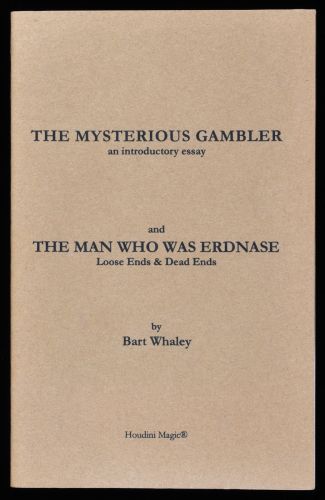
Bill Mullins wrote:An association copy of the 1st edition of some significance is currently at auction.
Kind of surprised that Sotheby's repeated the error of listing the place of publication as London. Elsewhere, they spell Hofzinser correctly six times, and wrong twice ("Hofsinzer")
I guess that's the only location mentioned in the front matter of the first edition, so they wrongly assumed that London was the place of publication rather than Chicago. I'm not lucky enough to own the first edition, but I suppose it didn't implicitly state the location of the publisher because the facsimiles don't. Maybe it was published in London, then shipped over to Chicago for distribution!
The typos do seem odd given that this is Sotheby's. However, there was a well-publicised coding error in the Tim Berners-Lee NFT that they sold recently for $5.4 million, so perhaps proofreading isn't their strong point!
Marty
P.S. I think I linked to a digital edition of TEATCT that I created to help me learn the material somewhere in this thread. Unfortunately, it is no longer available on my now-defunct blog, but I have recreated it using Google Docs: bit.ly/teatct. Hopefully, this will help magicians who don't have enough money to buy Ricky Jay's copy!
The typos do seem odd given that this is Sotheby's. However, there was a well-publicised coding error in the Tim Berners-Lee NFT that they sold recently for $5.4 million, so perhaps proofreading isn't their strong point!
Marty
P.S. I think I linked to a digital edition of TEATCT that I created to help me learn the material somewhere in this thread. Unfortunately, it is no longer available on my now-defunct blog, but I have recreated it using Google Docs: bit.ly/teatct. Hopefully, this will help magicians who don't have enough money to buy Ricky Jay's copy!
Marty Jacobs wrote:P.S. I think I linked to a digital edition of TEATCT that I created to help me learn the material somewhere in this thread. Unfortunately, it is no longer available on my now-defunct blog, but I have recreated it using Google Docs: bit.ly/teatct. Hopefully, this will help magicians who don't have enough money to buy Ricky Jay's copy!
Thank you for that link, Marty. That is very helpful.
Thank you for that link, Marty. That is very helpful.
You're welcome. My "primary motive" was to provide a more pleasant electronic version of Erdnase; those already freely available online tend to suffer from poor formatting and layout. I've tried to optimise this version for reading on a screen and retain the charm of the original text. You can also save a copy of the document as a PDF file by going to File > Download > PDF document (.pdf). There's also an option to save it as a Word document if you prefer that format.
Please let me know if anyone has any recommendations on improving this version of The Expert at the Card Table.
You may have also noticed that I've added a section called "The Importance of Being Erdnase" to the book. This is because I started writing an article about the identity of the mysterious S.W. Erdnase a few years ago but never got around to finishing it. When I do, I intend to add it here.
Read Erdnase
Marty
Hurt McDermott's book looked at the Comstock Laws and their possible influence on the circumstances of the publication of EATCT.
There's a new book about Comstock. The author posts about it here.
(And for what it's worth, my own research tells me that Comstock was mostly, almost exclusively, focused on material of a sexual nature; gambling was not something he spent much time on. For that reason, I don't think the Comstock Laws had much to do with the Erdnase mystery.)
There's a new book about Comstock. The author posts about it here.
(And for what it's worth, my own research tells me that Comstock was mostly, almost exclusively, focused on material of a sexual nature; gambling was not something he spent much time on. For that reason, I don't think the Comstock Laws had much to do with the Erdnase mystery.)
Another name acronym:
The first vampire story written in America was "The Black Vampyre: A Legend of St. Domingo" published in 1819 in response to John Polidori's The Vampyre: A Tale by Lord Byron. It was written under the name of Uriah Derick D’Arcy. In the 1840s, it was claimed that the author's real name was Robert C. Sands, but scholars today believe it was written by Richard Varick Dey (a near-acronym; the V was changed to a U).
The first vampire story written in America was "The Black Vampyre: A Legend of St. Domingo" published in 1819 in response to John Polidori's The Vampyre: A Tale by Lord Byron. It was written under the name of Uriah Derick D’Arcy. In the 1840s, it was claimed that the author's real name was Robert C. Sands, but scholars today believe it was written by Richard Varick Dey (a near-acronym; the V was changed to a U).
Nice one!
I've added it to the list (mostly all found by Bill) in one of the appendices of my erdnase/sanders language document:
http://www.cs.columbia.edu/~coyne/erdna ... -pen-names
I've added it to the list (mostly all found by Bill) in one of the appendices of my erdnase/sanders language document:
http://www.cs.columbia.edu/~coyne/erdna ... -pen-names
Uriah Derick D’Arcy...Richard Varick Dey (a near-acronym; the V was changed to a U).
More an anagram than an acronym, yes?
[best Ed McMahon voice] You are correct sir!
Not trying to be picky--pointing it out only because your argument about Erdanse is about the frequent occurence of anagram pseudonyms.
I didn't take it as picky. I had a brain-fart, and put it in print.
Another anagram. Cinimod had a line of magic effects starting in the mid 1970s. From a Tannen's ad in 1976:
"P. Cinimod spelled backwards is Dominic P. (Paolino). He's a clever magic inventor and innovator who keeps having moments of inspiration and putting them into good use for the benefit of magicians everywhere."
"P. Cinimod spelled backwards is Dominic P. (Paolino). He's a clever magic inventor and innovator who keeps having moments of inspiration and putting them into good use for the benefit of magicians everywhere."
The refreshed Miracle Factory website is back online.
The last line of his new blurb for his pending Erdnase book is interesting, in that Karr states clearly that "all evidence is carefully documented".
If that's true, and there isn't any spin or poetic license taken in using that specific phrase ... this could be a much more solid candidate than some (or all) candidates who have come before.
https://www.miraclefactory.net/product/expert/
The last line of his new blurb for his pending Erdnase book is interesting, in that Karr states clearly that "all evidence is carefully documented".
If that's true, and there isn't any spin or poetic license taken in using that specific phrase ... this could be a much more solid candidate than some (or all) candidates who have come before.
https://www.miraclefactory.net/product/expert/
Hahahahaha ... he's trying to sell books.
In truth, most Erdnase (re)searchers should probably state this:
"All evidence is creatively crafted by applying wishful thinking, retrofitting, "seek and ye shall find" reasoning and Occam's Swiss knife."
"All evidence is creatively crafted by applying wishful thinking, retrofitting, "seek and ye shall find" reasoning and Occam's Swiss knife."
In any case a "massive new biography" of Hilliard and a comprehensive study of The Expert at the Card Table would be interesting.
Chris Wasshuber's latest newsletter links to an ebook including correspondence between David Alexander and Richard Kyle, who worked together prior to David's article in Genii introducing W. E. Sanders as a potential candidate for Erdnase.
The cover for the ebook calls it "The Erdnase Report", and it is putatively written by "Elyk D. Rahcir" -- "Richard Kyle" written backwards. Good to see Wasshuber endorsing pseudonyms spelled backwards.
And speaking of such, Alex Schomburg was an illustrator/artist who did the covers for a number of comic books and pulp magazines in the 1940s. For a while, he did them in an airbrush style, and would sign them "Xela" -- "Alex" spelled backwards.
The cover for the ebook calls it "The Erdnase Report", and it is putatively written by "Elyk D. Rahcir" -- "Richard Kyle" written backwards. Good to see Wasshuber endorsing pseudonyms spelled backwards.
And speaking of such, Alex Schomburg was an illustrator/artist who did the covers for a number of comic books and pulp magazines in the 1940s. For a while, he did them in an airbrush style, and would sign them "Xela" -- "Alex" spelled backwards.
Just to correct the record and supply some context to one of Chris's claims in his most recent newsletter... Chris says "For me, Sanders can't be Erdnase because he does not write like Erdnase. Even DAVID ALEXANDER and Richard Kyle, who worked with David, admit this."
This is not really true. I don't know exactly what David may have "admitted" earlier on, but he wrote to me (in email in 2009) about Sanders' diary that "It sounded just like Erdnase...the same sardonic voice."
However, Chris is correct that David didn't hear Erdnase's "voice" in Sanders' Mine Timbering. David wrote "I don't read any similarity to Erdnase's style as it is rather dry and straightforward engineering. Nothing 'personal' that I could determine...just straight facts and figures." In this he was just reacting to the technical style, which certainly doesn't reveal the same sardonic personality or "voice" he found in Sanders' diaries and parts of Erdnase. However this is very different than saying that there are no similarities in the writing at a more granular linguistic level. In fact, David expressed interest in investigating and comparing the texts at that level (something I subsequently did and documented). And it turns out that there are many striking similarities between Erdnase's text and even Sanders' drier technical prose.
I also don't think David was fully aware of Sanders' colorful college reunion writings and the historical documents he wrote (all of which have since become available online). In these, Sanders' personality and other stylistic and thematic overlaps with Erdnase really shine through.
This is not really true. I don't know exactly what David may have "admitted" earlier on, but he wrote to me (in email in 2009) about Sanders' diary that "It sounded just like Erdnase...the same sardonic voice."
However, Chris is correct that David didn't hear Erdnase's "voice" in Sanders' Mine Timbering. David wrote "I don't read any similarity to Erdnase's style as it is rather dry and straightforward engineering. Nothing 'personal' that I could determine...just straight facts and figures." In this he was just reacting to the technical style, which certainly doesn't reveal the same sardonic personality or "voice" he found in Sanders' diaries and parts of Erdnase. However this is very different than saying that there are no similarities in the writing at a more granular linguistic level. In fact, David expressed interest in investigating and comparing the texts at that level (something I subsequently did and documented). And it turns out that there are many striking similarities between Erdnase's text and even Sanders' drier technical prose.
I also don't think David was fully aware of Sanders' colorful college reunion writings and the historical documents he wrote (all of which have since become available online). In these, Sanders' personality and other stylistic and thematic overlaps with Erdnase really shine through.
Sorry if this has been mentioned before, but:
In the Coterie section I came across the word "bosh." Now that's a common word for an Englishman, but maybe less so for a guy from Chicago. Any stats on the use of "bosh" in US books of the early 20th century?
In the Coterie section I came across the word "bosh." Now that's a common word for an Englishman, but maybe less so for a guy from Chicago. Any stats on the use of "bosh" in US books of the early 20th century?
If you search "more bosh than" in Archive.org, you get hits from both UK and American sources. Likewise Hathitrust. It shows up in a G. K. Chesterton novel, and in an article about typefaces in a printing/bookbinding journal from Chicago (the author was A. Raymond Hopper, who was born in 1888, a little late to have been Erdnase).
It's hard to make a relative comparison, because you need to make sure to take account of how many UK and American documents you are searching from. I searched for "bosh" at newspapers.com, and many of the first results were from Cherokee-language newspapers from Oklahoma. But the phrase as used as a comparison by Erdnase, "more bosh than XXX", is common enough in US newspapers of the era that I don't necessarily think it is a marker of UK dialog.
It's hard to make a relative comparison, because you need to make sure to take account of how many UK and American documents you are searching from. I searched for "bosh" at newspapers.com, and many of the first results were from Cherokee-language newspapers from Oklahoma. But the phrase as used as a comparison by Erdnase, "more bosh than XXX", is common enough in US newspapers of the era that I don't necessarily think it is a marker of UK dialog.
The google ngram viewer uses google's corpus of scanned books and is useful for finding relative frequencies of words/phrases over time. Here's a comparison between bosh, blather, poppycock, hogwash, and bunk from 1800 to the present. Until around 1890, bosh and bunk had by far the most references compared to the other terms. But currently bunk has by far the most, with the others all around the same. So bosh seems to have faded in relative popularity over time. You can switch between American English and British English and Fiction and some other categories to see how the results change (not much). You can also add whatever other terms or phrases you like for comparison.
https://books.google.com/ngrams/graph?content=bosh%2Cblather%2Cpoppycock%2Chogwash%2Cbunk&year_start=1800&year_end=2019&corpus=26&smoothing=3&direct_url=t1%3B%2Cbosh%3B%2Cc0%3B.t1%3B%2Cblather%3B%2Cc0%3B.t1%3B%2Cpoppycock%3B%2Cc0%3B.t1%3B%2Chogwash%3B%2Cc0%3B.t1%3B%2Cbunk%3B%2Cc0
https://books.google.com/ngrams/graph?content=bosh%2Cblather%2Cpoppycock%2Chogwash%2Cbunk&year_start=1800&year_end=2019&corpus=26&smoothing=3&direct_url=t1%3B%2Cbosh%3B%2Cc0%3B.t1%3B%2Cblather%3B%2Cc0%3B.t1%3B%2Cpoppycock%3B%2Cc0%3B.t1%3B%2Chogwash%3B%2Cc0%3B.t1%3B%2Cbunk%3B%2Cc0
Perhaps I'm using the Gogle ngram incorrectly, but when I put in "more bosh than" (without quote marks) for 1880-1920, with American English I get no results, but with British English, at least some results, albeit very low.
Bosh isn't a common word, so when you put it in a phrase you're making it that much less common. Hence little or no results depending on the corpus (english or american).
@Jack -- that must be a failing of the NGram viewer, because the phrase does exist in American and English corpuses in Google Books (from which NGram viewer draws its information).